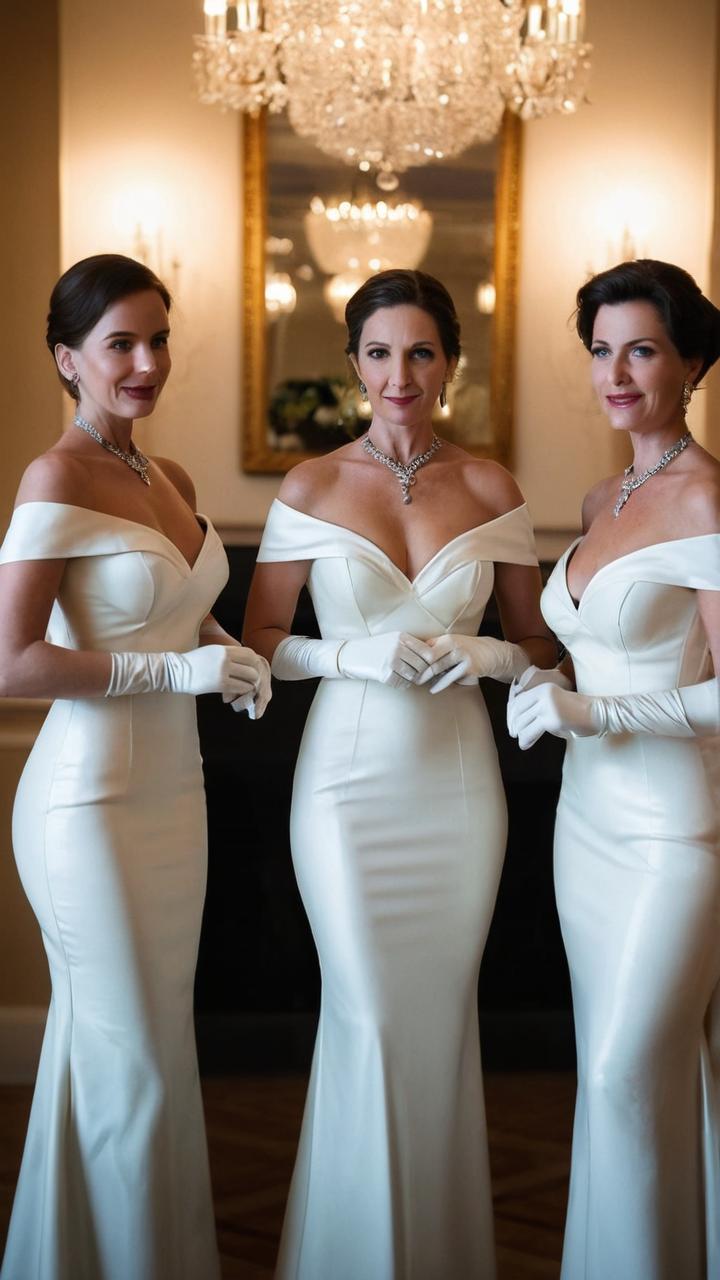
When the city’s most accomplished women gather in satin and leather at a private charity gala, they discover that true fulfilment isn’t found in chaos or casual power games—but in offering their brilliance, their wealth, and their loyalty to one man who knows exactly what to do with it
The invitations arrived without warning—smooth black envelopes against marble floors, mahogany desks, the soft chaos of designer handbags. No sender address. No flourish of ego. Just a sigil pressed deep into the card: a discrete mark known only to those who moved in certain very quiet, very deliberate circles.
Inside, the message was simple. A date. A time. A location. Formal attire. Gloves required.
Across the city, high in glass towers and behind guarded gates, the chosen women paused. They were not girls chasing attention; they were surgeons, strategists, investors, creators. Women who knew spreadsheets better than sonnets, who had outgrown weak promises and soft-spined men. Yet something in that minimalist card tugged at the part of them that still longed—openly or in secret—for a presence stronger than their doubts.
On the night of the Gala, the corridor to the main hall shimmered like a living mirror. Satin skirts whispered against stockings. Leather heels marked out a soft, confident rhythm. PVC details caught the light and threw it back in sharp, glossy flashes. Dozens of women, each powerful in her own right, moved with the same unmistakable intention: they had not come to be entertained.
They had come to stand before the architect of the LuminaSociety’s quiet empire. To look into the eyes of the man whose vision had already reshaped so many of their lives. To listen, to choose, and—if their hearts dared to admit it—to offer more than polite applause.
Tonight, their gloved hands would not only receive.
They would give. And in that giving, something deep and fiercely feminine would finally exhale.
Chapter 1 – The Invitations in Black Satin
The first envelope arrived just after sunrise, when the city still wore its thin veil of mist and the towers outside Sophia’s window glowed like frosted glass.
She found it waiting on the marble console in her hallway, placed neatly beside her keys as if it had always belonged there: a square of matte black, heavy, cool to the touch. No stamp. No return address. Just a sigil pressed deep into the paper—a circle crossed by a single vertical line, like a pillar of light cutting through darkness.
Sophia set down her coffee, suddenly alert.
“Who dropped this off?” she called, half-turning toward the open doorway of the kitchen.
Her housekeeper, Anna, looked up from rinsing berries. “Courier, miss. No name. Just said it was time.” She wiped her hands and gave a little shrug. “He seemed… very sure of himself.”
Time.
The word slid under Sophia’s skin like silk. She picked up the envelope and ran a fingertip over the imprint. The symbol was discreet, but unmistakable to anyone who’d ever been near the inner circles.
The Society.
Her heart gave a small, traitorous leap.
She broke the seal with a careful nail. Inside was a single card, thick and creamy, inked in a dark, deliberate hand.
You are cordially invited to a private charity event:
The Gala of Gloved HandsVenue: The Aureum Hall
Date: Fourteenth of next month
Time: 19:30
Attire: Formal. Glossed fabrics encouraged. Gloves required.Your presence has been noted. Your potential remembered.
There was no signature. There didn’t need to be.
Sophia read the words again, the phrase your potential remembered reverberating through her like the opening notes of a symphony. This wasn’t an invitation to be seen. It was a summons to step back into a current she’d once only watched from a distance.
She remembered the first time she’d heard of him—the one they called simply the Dominus when they thought no one was listening. A man whose presence rearranged a room without raising his voice, who could look at someone for ten seconds and see what they were trying so hard to hide.
A man who gathered brilliant, ambitious women around him the way a steady star gathers constellations.
“Is everything all right?” Anna asked gently.
Sophia folded the card closed, but her fingers lingered over the words The Gala of Gloved Hands as if they were warm.
“Yes,” she said, and her own voice surprised her with its softness. “Everything is… exactly as it should be.”
The second envelope glided into Elena’s life on a gust of hospital air and coffee.
She was at the nurses’ station, shoulders tight, reviewing scans when the receptionist approached with something held reverently in both hands.
“Doctor Reyes,” he said, a little out of breath. “This was just delivered for you. No hospital stamp. No courier tag.”
She frowned, taking the envelope. “Strange.”
The black paper looked almost liquid under the fluorescent lights, drinking in the sterile brightness and turning it into quiet depth. Her thumb found the sigil. Her pulse stuttered.
No one here knew. No one here could possibly know.
But he did.
“Elena?” one of the junior doctors asked. “You look like you’ve just seen an audit report.”
She forced a smile, tucking the envelope into her white coat pocket where it brushed against her stethoscope. “Just personal mail. Nothing urgent.”
In the sanctuary of the staff lounge, she opened it.
The same careful card. The same words. The same date, time, place.
Her eyes caught on Gloved Hands and she saw, in her mind’s eye, a room full of women in glossy satin and polished leather, hands encased in midnight-black gloves, offering more than applause—offering alignment.
She sank into a chair, back hitting the worn cushions, and exhaled a laugh that was almost a sigh.
“Of course,” she whispered. “Of course he remembers.”
For years she had carried the weight of everyone else’s emergencies. Crashed patients, frantic families, endless doubles. She had grown so used to being the strongest presence in the room that the idea of a man who could look her in the eye and say, I will take it from here felt almost unreal. The Society, with its disciplined teachings on health and boundaries and financial serenity, had already eased some of the strain.
But he was the axis around which those teachings turned.
The Dominus. The one who gathered women who were too powerful for fragile egos, and showed them how their strength could soften in the presence of something deeper than bravado.
She traced the line of ink where it said Your presence has been noted. Heat bloomed in her chest, not of embarrassment, but of recognition, as if a part of her soul had just been called by its true name.
The third envelope waited atop a sketchbook, half-buried beneath curls of charcoal dust and paint-laden brushes.
Mira nearly knocked it onto the studio floor when she swept aside a stack of canvases.
“What on earth…?”
It did not belong to the chaos of her worktable. The matte black was too precise, too deliberate for the accidental beauty of her paints and smudges. She wiped her fingers reflexively on the edge of her oversized shirt before touching it.
The sigil winked up at her, catching a stray shaft of afternoon light.
Mira’s breath left her in a slow rush.
She opened it with fingers she tried—unsuccessfully—to keep from trembling.
The card was the same. The Gala of Gloved Hands. Glossed fabrics encouraged. Gloves required.
But below the final line, a single additional sentence had been inked in a hand she knew from carefully archived letters and digital notes.
Your work has not gone unnoticed.
Mira pressed the card to her chest, closing her eyes.
It had been one of his suggestions—no, instructions—that she start painting in a way that honoured not just beauty but discipline: series instead of scattered pieces, themes instead of whims. The Dominus believed that art, like life, grew most radiant inside a chosen frame.
She had followed his guidance: studying, refining, pushing herself. Her exhibitions had become more cohesive. Buyers had begun to commission entire collections. For the first time in her life, her bank statements reflected not chaos but calm, the numbers climbing in neat, comforting lines.
And now this.
“You’re talking to a piece of paper,” she muttered to herself, laughing shakily. “Get a grip.”
But the paper represented more than words. It was a doorway. He was extending it again, inviting her into a deeper orbit.
She turned to the long mirror leaned against the studio wall, paint-stained and cracked at the corner. In the reflection she saw a woman with paint on her cheek, hair twisted into a clumsy bun, oversized shirt hanging off one shoulder. She imagined instead the shimmer of satin sliding over her curves, the slick shine of PVC hugging her hips, gloves rising to her elbows, transforming her hands into something ceremonial.
“What do you think?” she asked her reflection softly. “Can you be one of his ladies of the night, just for an evening?”
Her reflection smiled back, eyes alight with new, trembling hope.
That evening, the three of them found each other in the quiet, encrypted group chat the Society maintained for selected members.
Sophia:
I assume I am not the only one who received… black satin this morning?
Mira:
If by “black satin” you mean an envelope that looks like a secret whispered by a very expensive cigarette, then yes.
Elena:
I got mine at the hospital. I thought someone had mixed up a research grant invite until I saw the sigil.
The Gala of Gloved Hands. It sounds like a painting.
Mira:
Don’t tempt me. I’ll turn up with an easel.
Sophia:
You joke, but you know he’d find a way to make it part of the evening. He never wastes anyone’s strengths.
There was a pause, filled only by the blinking cursor.
Elena:
Are we all going?
Mira:
Is that even a question?
Sophia:
I considered saying no for a full three seconds. Then I reread “Your potential remembered” and realised that would be the emotional equivalent of deleting oxygen out of spite.
Elena:
Sometimes I forget how dramatic you are.
…But I agree. I’ve spent years holding everyone else’s emergencies. If a man like him wants my presence, I’m not going to pretend I don’t need what he offers.
Mira:
Which is?
Elena stared at the screen for a long moment before typing.
Elena:
Someone stronger than my exhaustion.
Someone whose plan is bigger than my to-do list.
Someone who doesn’t flinch when I’m not “nice”.
Sophia’s reply came quickly.
Sophia:
Someone who knows what to do with women who refuse to make themselves small.
Mira read their words twice, then typed:
Mira:
Someone worth painting for. Worth dressing for. Worth giving to.
The word giving hovered between them like a shared heartbeat.
Elena:
The card mentioned charity. The Society. And… “gloved hands”. We know what that means.
Sophia:
Offerings. Alignment. We’ve all benefited from the Society’s structure. It’s not unreasonable that he’d ask us to give back.
Mira:
I used to feel guilty about having enough to give. Like it made me greedy. But after the last year… my work, the exhibitions, the way my accounts have finally stopped looking like rollercoaster tracks—
It feels right to send some of that energy back to the source.
Elena:
To him.
Mira smiled, fingers hovering.
Mira:
To him.
Sophia set her phone down and leaned back against her sofa, the city sprawled beneath her penthouse windows like circuitry. She thought of her life: the tidy portfolio, the crisp suits, the network of power players who pretended not to notice how much they needed her. She had built it all on discipline and intellect, brick by brick.
And yet the idea of one man—just one—standing at the center of it all with the kind of steady, deliberate masculinity that made her want to both straighten her spine and lower her gaze…
It stirred something fierce and gentle at once.
She looked at the card again.
Your presence has been noted. Your potential remembered.
“Then remember this too,” she murmured aloud. “I’ll be there.”
In the weeks that followed, the city began to hum with a quiet frequency.
Women who would never admit to caring about parties found themselves lingering over dress racks, fingers trailing thoughtfully over satin that caught the light like liquid. Black silk that promised to flow like shadows around their legs. Burgundy leather that felt like confidence sewn into seams. PVC so glossy it looked wet, sinful, and strangely pure all at once—like honesty with a high shine.
Sophia stood in an atelier’s private fitting room, framed by tall mirrors. The dressmaker fussed with pins at her hem.
“What is the occasion, if I may ask?” the woman inquired in a lilting tone. “You usually choose something… more understated.”
Sophia considered her reflection: the deep emerald satin hugging her torso, flaring with disciplined exuberance at the hips, the sweetheart neckline a careful curve between power and invitation.
“A charity gala,” she said. “But not the kind you’re thinking of.”
The dressmaker smiled. “The best events are the ones people struggle to explain. Turn your arm, please.”
Across town, Elena ran her fingers along a row of long gloves—matte, glossy, ruched, smooth. She chose a pair of black leather that rose above her elbows, snug as a second skin.
Her friend and colleague, Nadia, watched with raised brows.
“Since when do you wear gloves anywhere other than the operating theatre?”
“Since I remembered I’m allowed to have a life outside the hospital,” Elena replied, lips quirking. “And that some evenings deserve ceremony.”
Nadia tilted her head. “Is this about that Society you mentioned once? The one that sends you those… unusual books?”
Elena’s smile softened. “It’s about what happens when you stop pretending you’re satisfied being the strongest person in every room.”
She thought of the Dominus then: the stories whispered in careful tones, the way women described him not as a fantasy, but as a reality that made their own lives sharper, calmer, more purposeful. A man who encouraged them to be healthier, wealthier, more educated—not so they could stand above him, but so they could stand proudly at his side, his feet, his orbit, knowing he could still carry more.
Mira, in her studio, held two dresses up against herself: one in wine-red satin that poured over her curves like spilled light, the other in black PVC that clung and gleamed with unapologetic intention.
“What do you think?” she asked the empty air.
In her mind, his voice answered—not actual words, just the memory of the way he spoke in recordings and occasional messages: precise, calm, never wasting breath.
Wear what makes you feel most like the woman you’re capable of becoming.
She laughed softly and chose both. Satin for the arrival, PVC for whatever the night demanded when the music slowed and the real conversations began. She laid them out on the bed, then placed the black envelope between them, like a quiet heartbeat.
On the night before the Gala, the group chat flickered to life again.
Mira:
Is anyone else suddenly incapable of doing anything productive?
Elena:
I just finished a twelve-hour shift. I should be asleep. Instead I’m reorganising my jewellery like I’m curating a museum.
Sophia:
You are both amateurs. I have color-coded my entire glove collection and rearranged my perfume shelf by emotional impact.
Mira:
Wait, you have a glove collection?
Sophia:
Don’t all respectable women?
A pause. Then:
Elena:
Do you think he’ll speak to us individually? Or just… address the room?
Sophia stared at the question, the glow of her phone reflected in the dark windowpane. The city winked back at her like a thousand complicit secrets.
Sophia:
He sees individuals. That’s the whole point.
He doesn’t gather “a crowd”; he gathers women—specific women—with specific strengths. He remembers them. Us.
Mira:
When I think about him seeing me in that room… it’s not nerves. It’s something else.
Elena:
Hope?
Mira:
Yes. And something like… relief.
Like I’ve been wandering with my arms full of colour and no frame to put it in.
Sophia:
Tomorrow, we step into the frame.
Elena:
Tomorrow, we give back.
The cursor blinked. Then Sophia added, in a message that felt like a vow:
Sophia:
We’ve taken so much from what he’s built—the discipline, the clarity, the stability.
It’s time we let our gloved hands offer as much as they’ve received.
Mira’s reply was simple.
Mira:
To the Society.
Elena completed the thought.
Elena:
To the Dominus.
Sophia read the thread again, feeling a slow, shimmering joy rise inside her. Not giddy, not frantic. Something steadier, like the warmth that spreads through chilled skin when you finally step into a room where the fire has been burning for hours, waiting.
She set her phone down beside the black envelope and the neatly folded satin gloves on her nightstand. The gloves gleamed softly in the lamplight, midnight-black and perfect, silently promising that tomorrow her hands would do more than sign contracts and hold coffee cups.
Tomorrow, they would be part of a ritual—not of superstition, but of alignment. Of women acknowledging the man whose strength had given their own a direction, and choosing, joyfully, to give back.
Sophia turned off the light.
Across the city, in different beds and different lives, Elena and Mira did the same.
The night wrapped itself around the skyscrapers like a vast, dark cloak. Somewhere, in a room they had not yet seen, preparations were already underway: crystal being polished, candles set, floors buffed until they could double as mirrors for satin hems and leather heels.
The city slept.
But beneath its quiet surface, three invitations in black satin pulsed like a shared heartbeat, pulling three women—and countless others—toward a single point of gravity.
Toward a hall where gloved hands would soon reach out not to grasp, but to give.
Chapter 2 – The Corridor of Reflections
The cars arrived in a slow, curated procession: black sedans, pearl-white coups, one or two hybrids with paint so clean they mirrored the city lights. Drivers stepped out first, crisp in dark suits, opening doors with the sort of composed deference that said they understood exactly how precious their passengers were.
Sophia’s heels touched the marble of the Aureum Hall’s drive like the first notes of a piano. The night air was cool but gentle, carrying the faint scent of magnolia from the garden terraces. Above, the building rose in columns of pale stone and glass, its façade lit from below so that it seemed to hover, a temple of light suspended over the city’s quiet heartbeat.
She smoothed a hand over the rich emerald satin of her gown as she stepped forward. The fabric glimmered under the lanterns, clinging to her like a promise. At her elbows, her gloves—black, high, and glossy as still water at midnight—caught every gleam, turning each movement of her fingers into something deliberate, almost ceremonial.
“Name, please?” asked the doorman, though his eyes already suggested he knew.
“Sophia Laurent.”
His gaze flicked to a discrete tablet. “Welcome, Ms. Laurent. You’re expected. Please proceed down the main corridor. Our attendants will guide you to the reception hall.”
She followed the direction of his gloved hand and saw the entrance: tall glass doors framed in brass, beyond which a glow of warm light seemed to spill like honey. Beyond the doors, she caught the faintest glimpse of movement—shapes, colors, a shifting river of satin and leather.
She drew in a breath, straightened her shoulders, and stepped inside.
The corridor was longer than she’d imagined. Its walls, from floor to ceiling, were mirrored—perfect, polished panels that reflected everything in endless repetition. Crystal sconces cast a soft golden light that seemed to float rather than shine, turning every surface into a tender flame.
Sophia paused at the threshold.
For a heartbeat, she saw herself multiplied into infinity: hundreds of versions of the same woman, emerald satin flowing over her hips, gloves glimmering, eyes serious and alight. She was not reduced by the reflections; she was multiplied, amplified. A chorus of Sophia’s, each one walking toward the same destination.
“It’s like stepping into your own potential,” she murmured.
“More like stepping into your own temptation,” a familiar voice teased behind her.
Sophia turned, a smile already curling her lips.
Elena approached with the effortless poise of someone who spent her days walking the tightrope between life and death. Her gown was deep midnight blue, cut clean and sharp, the material a heavy satin that hugged her athletic frame like a tailored secret. Her long black gloves shone with a subtler sheen than Sophia’s, soft leather molded to her arms, fingers flexing as if tasting the air.
“You made it,” Sophia said, warmth blooming in her chest.
“Of course I did.” Elena’s eyes skimmed the corridor, taking in the endless reflections, the soft light, the distant hum of voices. “If I can handle triple bypasses and forty-eight-hour shifts, I can handle a hallway.”
“It’s not the hallway that’s intimidating,” Sophia replied. “It’s what’s waiting at the other end.”
Elena’s lips quirked. “The Society? Or the man at its center?”
Sophia tilted her head, letting the question hover like a slowly turning coin. “Both,” she said at last. “But we both know which matters more.”
“Stop—don’t move, either of you. I need a moment to breathe this in.”
Mira’s voice drifted toward them like a melody. They turned to see her standing just inside the doors, a vision that made the mirrored walls seem suddenly insufficient.
She wore wine-red satin that poured over her body in liquid folds, clinging at the waist, flaring at the hem. Over that, a narrow belt of black patent leather cinched everything together, gleaming in sharp contrast. Her hair fell in loose waves over one shoulder, and her gloves—God, her gloves—were high, wet-look PVC, black as midnight ink, shining so brightly they looked almost unreal.
“You look…” Sophia began.
“Dangerous,” Elena finished, but there was admiration in her tone, not accusation.
Mira laughed, the sound bubbling out of her like champagne. “Good. I didn’t come here to be forgettable.”
She turned slowly, watching herself echo into infinity.
“Look at us,” she said softly. “We’re like a constellation trapped in a corridor. The same three stars repeating again and again, marching toward the same orbit.”
Elena’s expression softened. “That’s almost poetic.”
“Almost?” Mira arched a brow. “I’m just getting started.”
They stood together for a moment, letting the scene sink in. All around them, other women moved along the mirrored path: an elegant attorney in a sleek black satin column dress; a tech founder in storm-grey leather with a slit that whispered of both power and play; a professor in plum silk, her hair twisted into an intricate knot held by a pin shaped like the Society’s sigil.
Everywhere, glossy fabrics. Satin that shivered with each step. Leather that suggested both armor and adornment. PVC that flashed like starlight, unapologetic and bold.
No one hurried. The corridor seemed to invite a slower pace, as if each woman was meant to see herself, to recognize herself, before entering the main hall.
“Do you notice,” Sophia said quietly, “that there are no men?”
Elena scanned the corridor. She was right. Staff, yes—attendants in dark suits, moving quietly, professionally. But among the guests, it was all women. Dozens of them. Maybe hundreds. All of them dressed not for a random crowd, but for someone specific.
“It’s… comforting,” Mira said. “Like we’re all parts of the same… offering.”
Elena smiled. “You really are poetic tonight.”
Mira shrugged, PVC gloves squeaking softly. “I’m an artist. It’s allowed. Besides”—her gaze traveled down the corridor toward the arch at its end where warm light pooled, richer and deeper—“you can feel it, can’t you?”
“Feel what?” Sophia asked, though she already knew.
“That he’s the only man who matters in there,” Mira replied. “One axis. Many orbits. No competition, no posturing. Just one clear center, and all of us choosing to move around it.”
Elena’s breath caught slightly at the word choosing. Not spinning helplessly. Not dragged. Choosing.
“That’s what makes it different,” she said slowly. “It’s not that we belong to him because we’re weak. It’s that we are strong, and still… we prefer his gravity.”
Sophia’s smile turned thoughtful. “Because his gravity is stable. Disciplined. Intelligent. Healthy. He doesn’t feed off our chaos; he builds a structure for it.”
Mira nodded. “And we build that structure with him.”
They began to walk, heels clicking softly on the marble floor, their reflections walking with them.
As they moved deeper into the corridor, they passed clusters of women speaking in low tones.
“I shifted the portfolio last quarter,” one was saying, voice tinted with the calm pride of someone who had tamed once-wild finances. “I followed the model from his last talk. Diversified into health tech and clean infrastructure. My returns have never been more consistent.”
“You did that because of the Society?” her companion asked, adjusting a diamond bracelet over the edge of her satin glove.
“Because of his framework,” the first woman replied. “He teaches us to think like architects, not gamblers. To build something that takes care of us so we can take care of what matters.”
They walked on.
A little further, another pair:
“He told me to get a full check-up. ‘Power built on exhaustion collapses,’ he said. I thought he was being dramatic. Turns out I was an inch away from a serious issue. If he hadn’t insisted…”
“Did he really insist?” the other woman asked, lips curving.
A fond smile. “He looked at me like I was important enough not to lose. That was all it took.”
Elena felt these words hum in her chest like a tuning fork struck gently. Health. Wealth. Education. Confidence. Those were the pillars the Society built, each one reinforced by his calm, relentless conviction that they were worth the effort.
“Listen to them,” she murmured. “They’re not talking about handbags or gossip. They’re talking about investments, check-ups, degrees, disciplines.”
“That’s always been his way,” Sophia said. “No empty flattery. No crumbs of attention. Just a steady hand on your spine, pushing you toward a version of yourself that doesn’t crumble when the world shakes.”
Mira’s voice grew softer. “And in return, we… what? Donate? Support? Give back?”
Sophia glanced at her, eyes warm. “We choose to support the structure that supports us. We fuel what has fed us. We make sure the Society—and the man who holds it in his mind—has what it needs to keep guiding us.”
Elena inhaled slowly. “Donating used to feel like loss. Now it feels like… exhaling. Like letting go of weight I never wanted to cling to.”
Mira’s gaze caught her own reflection, and for a moment she saw not a starving artist scraping by, but a woman whose work had value, whose bank accounts no longer frightened her, whose name was printed in gallery catalogs. A woman whose success had blossomed, in part, because one man had looked at her chaos and seen capacity.
“Giving to him,” she said quietly, “feels like painting a final stroke on a canvas. The one that makes everything else make sense.”
Sophia touched her arm gently through the PVC. “And tonight, we’ll have a chance to place that stroke in the right light.”
The corridor curved slightly, and with each step the murmur of voices ahead grew richer. Laughter like chimes. The soft clink of glass. The undercurrent of music—a low, thrumming melody that sounded less like a song and more like a heartbeat.
An attendant in a tailored suit approached them with a warm, professional smile.
“Good evening,” he said. “May I offer you a brief welcome on behalf of the Society?”
They stopped. His tone was respectful, but there was no mistaking that the quiet authority in the space did not belong to him. He was a steward. A facilitator. The gravity they all felt belonged to someone else.
“Please,” Sophia replied.
“Thank you for joining us at the Gala of Gloved Hands,” he said. “Tonight is both a celebration and a continuation: a celebration of what you have built in your own lives—your careers, your health, your knowledge—and a continuation of the partnership between your personal success and the Society’s greater work.”
Mira’s fingers curled slightly within her gloves, the PVC whispering.
“You’ll find, at the end of this corridor,” the attendant went on, “a hall prepared for you. You will not be asked to give anything you do not choose to. But many who came before you discovered that supporting the Society’s initiatives—and privately honoring the guidance of the Dominus—became one of the most deeply satisfying commitments of their lives.”
Elena’s breath stirred. The word honoring seated itself in her chest.
The attendant’s eyes flicked briefly, respectfully, over their attire. “Your gloves,” he added, “are a symbol. Tonight, your hands are not bare. They are prepared. Whatever you choose to release, whatever you choose to offer, will be done deliberately, ceremonially, in alignment with who you are becoming.”
He stepped back, gesturing them onward. “Welcome, ladies. The Dominus is aware of your arrival.”
The simple statement sent a shiver through all three of them.
Sophia’s voice was barely a whisper. “He knows we’re here.”
Mira laughed softly, a tremor of joy running through the sound. “Of course he does. He built this entire night around women like us.”
Elena’s smile was small but luminous. “Then let’s not keep him waiting.”
They resumed their walk.
As they approached the end of the corridor, the mirrors seemed to gather them into a tighter frame. The reflections no longer felt infinite, wild. They felt focused, channeled. Each step brought them closer to the archway where the corridor opened into the main hall.
“Do you realise,” Sophia said, “that once we cross that threshold, we won’t just be attendees? We’ll be participants.”
“In what?” Elena asked.
“In a pattern,” Sophia replied. “One man at the center. Many women choosing to draw nearer. Not because they’re lost, but because they’ve found something worth circling.”
Mira’s eyes gleamed. “We’re like satellites around a fixed star.”
Sophia nodded. “And tonight, some of us will move closer to his light than ever before.”
They reached the arch.
Beyond it, they could see the edges of a vast hall bathed in golden luminescence. Chandeliers hung like captured constellations. Tables gleamed with crystal and silver. And everywhere, women moved in satin, leather, PVC and silk, a living tapestry of accomplishment and desire.
Music swelled, a gentle, inviting wave.
Sophia looked at her friends. “Ready?”
Elena exhaled, letting go of hospital corridors, monitors, and the ever-present scent of antiseptic. “I could live ten more years and not be as ready as I am right now.”
Mira smiled, her red lips curving like a painted promise. “I’ve been ready since the day he told me my art deserved a wider frame.”
They clasped hands for a moment—glove to glove, satin to leather to PVC—their contact a small spark in the mirrored world.
“Then we walk,” Sophia said.
And together, three reflections stepped from the corridor of infinite selves into the hall where one man’s steady presence would draw all those selves into a single, devoted, joyful direction.
Chapter 3 – His Voice Over Satin Air
The hall did not feel like a room; it felt like a held breath.
Sophia realised this as soon as she stepped through the archway. The air was warm and subtly scented with amber and something darker, like smoke remembered rather than present. Light spilled from chandeliers in soft cascades, catching on crystal glassware and the glossy sweep of gowns below until the entire space shimmered as if submerged in champagne.
Women moved in currents, not crowds. Clusters formed and dissolved with polite laughter and the murmur of low, intelligent conversation. Satin skirts brushed against leather panels; PVC gloved hands lifted flutes of pale gold. Everywhere, the elegance of success: straight backs, clear eyes, jewellery chosen for meaning rather than mere sparkle.
“There must be hundreds,” Mira breathed, her gaze sweeping the hall.
“And yet it doesn’t feel crowded,” Elena replied. “It feels… orchestrated.”
Sophia followed their line of sight, taking everything in. Each table had been set not as an anonymous place to sit, but as a small universe: dark linens, candles in frosted glass, place cards written in a hand she suspected she knew. There were no name tags swinging from necks, no loud announcements. Everyone already seemed to know that they belonged.
An attendant passed, offering a tray of drinks. The crystal stems gleamed, each glass rimmed with the palest shimmer of sugar.
“Champagne?” he asked.
Mira’s PVC fingers curled with polite restraint. “Just one,” she said. “I’d like to remember every detail.”
Elena shook her head. “Sparkling water, please.”
The attendant nodded without surprise. “Of course. Many here prefer clarity.”
Sophia accepted a glass of champagne, feeling the bubbles tickle her lip. “A toast?” she suggested.
“To what?” Mira asked.
“To the simple fact that we all made it here,” Elena said before Sophia could answer. “To the lives we built—healthy enough, wealthy enough, educated enough—that we could walk into this room not as exceptions, but as the expected.”
Their glasses touched with a delicate chime, a sound that seemed to melt into the music curling lazily from unseen speakers.
A subtle chime rang out from somewhere above them. The music softened, thinning to a gentle thread. Conversations tapered off, one by one, until the hall grew quiet—not empty, not tense, just expectant, like the moment before an orchestra’s conductor lifts his hand.
“Looks like it’s time,” Sophia murmured.
The lights dimmed by a fraction, enough to make the chandeliers glow like luminous crowns. At the far end of the room, a low stage—almost discreet, more a raised platform than a performance space—came into focus. A single microphone stood at its center, surrounded by nothing more than shadow and anticipation.
“He isn’t going to appear with fanfare, is he?” Mira whispered.
Elena’s answer was soft and sure. “He doesn’t need fanfare. He is the fanfare.”
And then he was there.
No one saw him walk onstage; one moment the platform was empty, the next it held a presence that rearranged the air. He stood beneath the chandelier’s halo, the light tracing the lines of a face carved in composed certainty. Dark suit, immaculate. Shirt open at the throat; no tie, as if he refused to be constrained by anything unnecessary. His posture was relaxed but upright, the way a pillar might be relaxed—completely still, completely dependable.
He rested one hand lightly on the microphone stand but didn’t touch it yet. For a heartbeat, he simply looked out at them.
Sophia felt the gaze like a heat source. It didn’t sweep indiscriminately across the room; it paused, absorbed, moved on. When it landed briefly in her direction, her muscles responded before her mind—back straightening, chin tilting ever so slightly higher. She had been seen. Not as a blur, but as a clear, individual note.
Elena felt her chest loosen. She was used to being the one others leaned on, the one who never wavered. Under that measured gaze, however far away, she felt a strange, luxurious permission to be more than her responsibilities.
Mira gripped her glass a little tighter. Every story she had ever been told about him—every whispered description of his quiet certainty—crystallised into the simple reality of his presence. He looked like a man who had made peace with power, not as a performance, but as a function.
He leaned toward the microphone, and when he spoke, his voice slid through the room like a ribbon of dark silk.
“Good evening.”
It wasn’t loud. It didn’t need to be. The word settled over them, heavy and gentle, the way a velvet cloak might be laid over bare shoulders.
“Tonight,” he continued, “you see each other. And you see yourselves reflected in one another. That is by design.”
He gestured toward the hall with the smallest movement of his hand. The gesture was economical, confident, like a line drawn with a fountain pen rather than a marker.
“You are accomplished,” he said. “You are healthy, or committed to becoming so. You are educated— formally or through fire—and you are wealthy in ways that go beyond numbers.” He smiled faintly. “Though I trust your numbers are also improving.”
Soft laughter rippled through the room.
“You are here,” he went on, “because you refused the narrative that powerful women must settle for weak guidance. You refused to shrink so that fragile egos could feel tall. Instead, you built lives that demand a leader who does not break under the weight of your brilliance.”
Sophia exhaled shakily. His words were not flattery; they were recognition, as precise as a diagnosis, as considered as a blueprint.
He let the silence breathe around that idea, as if he wanted each of them to try the word leader on their tongues and feel how it fit when applied to one man, singular, steady.
“I built the Society,” he said, “not as a pedestal for myself, but as a structure for you. A place where your ambition is not treated as an illness, where your desire for direction is not mocked as weakness.”
He stepped away from the microphone for a moment, hands clasped loosely behind his back as he turned to take in the whole room. When he spoke again, his voice carried without effort.
“You have jobs, careers, empires. You make decisions that affect thousands of lives. Some of you hold scalpels; some hold portfolios; some hold brushes or pens. You are, each of you, a world unto yourselves.”
Mira felt heat crawl up her throat. She thought of her canvases, her color-soaked late nights, the way her art had gone from a barely contained storm to a deliberate, growing constellation under his remote but potent guidance.
“But,” he said, pausing just long enough to hook their attention, “even a world benefits from an orbit.”
The hall went quiet in a deeper way. Conversations were not simply paused—they were surrendered.
“One axis,” he continued calmly. “Many devoted bodies. That is how a system becomes stable. That is how chaos becomes a cosmos. Not by extinguishing your light, but by giving it a center around which to move.”
Elena felt a tremor of something like relief. For years she had been the axis of her own world, the unmoving point around which endless emergencies spun. The idea of allowing someone else to hold that place—just here, just tonight—felt like cool water on parched skin.
He returned to the microphone, fingers brushing it with the familiar ease of someone who knew his own voice well and trusted its impact.
“Look around you,” he invited.
They obeyed.
Satin and leather and PVC glimmered in the dim light, a living sea of glossy color and confident posture. It was impossible not to notice the pattern: one masculine presence on the stage, many feminine presences below, all of them turned, angled, tuned toward him like flowers to the sun.
“This is not a mistake,” he said quietly. “You are not one of two or three. You are one of many. And that is not a dilution of your value. It is a testament to it.”
He smiled, and for a moment the entire room seemed to lean forward.
“We are taught,” he continued, “that devotion must be possessive to be real. That love, respect, loyalty must always be exclusive, jealous, narrow. But you did not come here tonight for something narrow.”
His gaze swept slowly across the hall.
“You came because a part of you knows the difference between being an option in a man’s chaos and being a chosen participant in a man’s order.”
The words landed with the soft heaviness of truth.
“In this hall,” he said, “there is no scrambling to be the loudest voice, the brightest dress, the sharpest laugh. There is no competition for fragments of attention. There is one masculine pillar at the center of the structure, and you standing around it like columns, equal and distinct, each supporting, each supported.”
Sophia’s hand moved unconsciously to her throat, where a slender chain rested against her skin. The sensation of being named without name, seen without exposure, made her heartbeat slow and deepen.
The Dominus’ tone gentled further, like silk slipping over a wrist.
“You have taken much from the Society already,” he said, no accusation in it, only acknowledgement. “Frameworks for your investments. Strategies for your health. Habits that have turned your nights from restless scrolling into restorative sleep. For some of you, the difference between the woman you were and the woman you are now can be measured in numbers, in metrics. For others, it is measured in quiet—less panic, less doubt, more peace.”
He let that sink in. Small nods moved through the crowd like wind through tall grass.
“I did not give you these things as favors,” he said. “I gave them as responsibilities. Because once you know how to build a calmer, stronger life, you are responsible for what you do with that knowledge.”
Mira swallowed, her grip on the glass loosening. It wasn’t guilt that stirred in her; it was purpose.
“And so tonight,” he continued, “I invite you to complete a circuit. To let energy that has flowed toward you, through you, flow back into the structure that made it possible.”
He lifted one hand, palm up, gloved in smooth, dark leather that shone softly in the chandelier light.
“This is the Gala of Gloved Hands,” he said. “Your gloves are not decoration. They are a reminder that what you hold tonight—your time, your focus, your resources—is precious. And that when you choose to release any of it, it should be done consciously. Reverently. With intention.”
Sophia felt a slow, thrilling calm unfurl inside her. It was like standing at the edge of a vast lake at dawn, knowing she was about to step in and that the water would not devour her, but hold her.
“You will have opportunities,” he said, “to support the Society’s charitable work: education funds, health initiatives, spaces for learning and reflection in a world that forgets to be quiet. That is one form of generosity.”
He paused, and the pause was electric.
“And there will be, for those who feel so moved, chances to honor the mind and will that hold this architecture together. To give not only to the Society as a whole, but directly to the axis at its center.”
His gaze did not boast; it simply acknowledged the plain fact of who he was in this room.
“Some of you already know,” he continued softly, “the peculiar peace that comes from that kind of personal offering. From looking at the path your life has taken under certain guidance and saying: Yes. I want more of this. I want to fuel this. I want this presence to remain strong, resourced, focused, so that I—and others—can keep drawing from it.”
A hush settled. Not empty—full. Heavy with the invisible weight of decisions being formed in silent hearts.
“When you give to the Society,” he said, his voice like a hand on a shoulder, steadying, “you nourish the garden that feeds you. When you give to me, you sharpen the sword that protects it.”
He smiled, the expression faint but decisive.
“Tonight is not about guilt. Not about fear. It is about alignment. It is about joy—the quiet, potent joy of using your wealth, your success, your hard-earned abundance in a way that feels like finally putting a puzzle piece in its place.”
Sophia’s chest felt too tight and too open all at once. She thought of the hours she’d spent refining strategies with his words in her mind, the growth of her investments, the intangible but undeniable increase in order within her days. To give back would not be sacrifice; it would be a yes written in currency.
Elena thought of patients whose lives she might save because she was less exhausted, more balanced. Because his insistence on her health—on her rest—had forced her to stop wearing burnout as a badge. To support him, to support the Society, felt like reinforcing the foundation under the work that mattered to her most.
Mira imagined an envelope sliding from her PVC fingers into a dark, waiting box. The thought didn’t make her anxious. It made her feel complete, like signing the bottom of a painting that had taken years to finish.
The Dominus let his eyes move over them one last time, as if inscribing the image of this hall of luminous, capable women into his memory.
“Enjoy this evening,” he said, and there was warmth there now, an almost intimate gentleness. “Talk. Listen. See yourselves in each other. Drink only as much as keeps your senses sharp. Wear your satin and your leather and your lacquered gloves like a uniform of chosen devotion, not performance.”
He inclined his head, not needing applause—but receiving it anyway as a ripple of sound, restrained yet heartfelt, moved through the hall.
“And when the time comes,” he finished, “let your hands—those beautiful, gloved hands—show you who you truly belong to.”
He stepped back from the microphone then, retreating into the softened light at the rear of the stage. He did not vanish; his presence remained like a low, steady note beneath the rising music, a foundation tone that held everything together.
Sophia realised she had been holding her breath. She exhaled slowly, the release almost dizzying.
“His voice,” Mira whispered beside her, “it’s like… silk over steel.”
Elena’s eyes were bright, her jaw set in a new, calm resolve. “He doesn’t ask,” she said. “He invites. But somehow the invitation feels stronger than a command.”
Sophia looked down at her own gloved hands. Under the chandelier light, the black satin gleamed like starlight caught in fabric.
“For the first time in a long time,” she murmured, mostly to herself, “I know exactly what I want to do with these hands tonight.”
Mira’s lips curved. “Paint?”
Sophia smiled back. “Give.”
Elena’s answer was a quiet echo. “Give,” she agreed. “To the Society. To him. To the life he’s teaching us to build.”
Around them, the hall came alive again—music swelling, conversations resuming with new intensity. Women laughed, exchanged ideas, compared notes on projects and ambitions. Yet underpinning every sentence, every smile, was the memory of his words, the gravitational pull of his presence: one man, at the center, steady as a compass.
And in that moment, it seemed the whole room collectively understood: the most powerful thing their gloved hands would do tonight was not hold a drink, adjust a dress, or sign a contract.
It would be to open. To release. To offer—joyfully, hopefully, devotedly—back to the axis that had made this luminous orbit possible at all.
Chapter 4 – The Procession of Gloved Hands
It began with a single, deliberate note from the piano.
A lone musician, tucked discreetly to one side of the hall, lowered his hands onto the keys. The melody that poured out was slow and deep, as if someone had melted starlight into sound. Conversations softened, then faded, until the Aureum Hall hummed with nothing but music and breath.
From a hidden side door, two attendants emerged carrying an object between them.
The box was not large, but it seemed to bend the light around it. Obsidian-black, polished to a mirror-dark shine, its surface reflected the chandeliers as fractured crowns. The Society’s sigil gleamed on the lid in a single stroke of silver: a circle crossed by one vertical line, a pillar through the center of a world.
Sophia watched it being carried to the center of the hall, placed with almost religious care upon a low pedestal.
“It looks like an altar,” Mira murmured at her side.
“Maybe it is,” Elena replied. “Not to him. To what he’s built.”
As if summoned by the thought, the Dominus stepped from the periphery of the stage. He did not stand beside the box; he remained a few paces away, hands clasped behind his back, posture relaxed. The distance was intentional, Sophia realised. He was the axis, not the collector. The Society itself stood between his presence and their offerings, like a bridge.
An attendant approached the microphone.
“Ladies,” he said, voice smooth and unhurried, “if you would like to participate in tonight’s procession of gloved hands, you will find embossed envelopes at your tables. Some of you have brought your own. Both are welcome. When the music shifts”—he gestured to the pianist, who nodded—“you may form a line beginning at the east side of the hall. Take your time. There is no rush. What you release should be released when your heart is ready.”
The attendant stepped back. The Dominus gave the smallest of nods, not a command but a permission.
The music deepened.
Around the room, the susurrus of satin and silk and leather began again—not in scattered fragments, but in a single, forming current. Women reached for their clutch bags and mirrored boxes, for the heavy stationery placed beside their plates. Glossy gloves—black, burgundy, midnight blue—closed around envelopes.
Sophia’s heart beat slowly, heavily, like a drum heard through layers of velvet. She looked down at the two envelopes resting before her on the linen.
One was Society-issued: thick card stamped with the sigil. That one contained numbers, precise and considered, representing a transfer she’d already set in motion from her investment accounts. The sum was not reckless; it was significant. It was an amount that said, I have built something strong enough to share.
The second envelope was smaller, unmarked on the outside. Inside was another confirmation, yes—but also a handwritten note. No flowery confessions. Just a few lines in her firm, compact script:
Your framework has altered my trajectory more than any promotion or title ever could.
I would like you to remain free to think, to design, to lead.
This is my part in that.
“You look like you’re about to sign a peace treaty,” Elena said softly.
Sophia smiled. “In a way, I am. Between who I was, and who I intend to be from now on.”
Mira leaned in, her eyes bright, lips stained the color of her gown. “What did you write?”
Sophia shook her head. “You don’t show people your moves on the board before the game plays out.”
Mira laughed quietly. “Fair.”
Elena lifted her own envelope. The paper felt heavy, solid, like compressed possibility.
“I’ve never written a number like this by choice,” she admitted. “Hospitals drain money from you in a hundred tiny cuts—taxes, insurance, fees. You never offer; it’s always taken. This is the first time I’ve looked at money and thought, ‘No. I decide where you go.’”
Sophia regarded her with soft approval. “You’re not losing anything.”
“I know.” Elena’s gaze drifted to the obsidian box. “I’m telling the universe what I want more of. Structure. Clarity. Leadership. If I want more of his influence in my life, I should feed it, not just absorb it.”
Mira’s fingers traced the edge of her own envelope, PVC gloves whispering against cardboard. Inside, along with a transfer slip, was a small folded sheet.
“I made a pledge,” she said. “Not just money. I told him I’d design the visual identity for the new learning center the Society is planning. No commission. No fee. Just… my hands, my talent, my time.”
Elena smiled. “I can’t imagine he’ll refuse.”
“If he does,” Mira replied, eyes gleaming, “I’ll donate twice as much next time in protest.”
They laughed together, the sound a small, bright flare in the softening air.
The piano shifted, chords turning from contemplative to gently insistent. Attendants moved through the hall, guiding women toward the east side, where a path had opened.
Sophia stood. Her emerald satin dress unfurled around her legs like captured light. She slipped both envelopes into one gloved hand, feeling their weight—financial, emotional, symbolic—settle into her palm.
“Ready?” she asked.
Elena rose, midnight-blue satin catching on the candlelight, her leather gloves glossy and severe.
“Always,” she said.
Mira pushed back her chair with a subtle squeak of PVC. Her wine-red gown clung, then swayed, and her gloves shone like wet ink.
“Let’s go put our hearts where our words have been,” she murmured.
The line formed with surprising grace.
It was less a queue and more a ribbon of color: a living necklace of women winding toward the center of the hall where the obsidian box waited. Satin, silk, leather, and PVC interwove—no two gowns the same, yet all somehow harmonising, as if they’d been given a palette and told, Choose who you are tonight.
Sophia found herself behind a tall woman in a smoked-silver gown, the fabric matte but edged in a trim of mirrored sequins. The woman turned slightly and gave her a warm, knowing smile.
“First Gala?” she asked.
“Yes,” Sophia admitted. “You?”
The woman chuckled, a low, amused sound. “Fourth. I keep telling myself I’ll become blasé about it, and yet…” She lifted her envelope between gloved fingers. “Every year, my hands shake a little more. Not from fear. From… excess energy.”
“Excess?” Elena echoed from Sophia’s other side.
The woman nodded. “Of gratitude. Of recognition. You spend a year benefiting from what this structure gives you—stability, guidance, pressure in all the right places—and then you walk in here and realise you’re bursting with things you haven’t yet given back. This”—she lifted her envelope again, then rested it against her heart—“is how I don’t explode.”
Mira smiled, eyes soft. “You make it sound like a release.”
The woman’s gaze flicked to the Dominus, who stood still and calm, watching from a distance with the patience of a man who already knew how the night would unfold.
“Oh, it is,” she said. “You’ll see.”
The line inched forward. At the head of it stood two attendants—one on either side of the pedestal—directing the flow so that each woman had a moment alone before the box.
From where they stood, the three friends could see each approach, each offering: a woman in a pale gold gown pausing with eyes closed; another in dark velvet whispering something under her breath before dropping in her envelope; a third in sharp white satin pressing her gloved fingers to the box as if in blessing.
“Do you think he’s judging?” Mira asked quietly. “Amounts, I mean.”
Elena shook her head immediately. “He strikes me as a man interested in ratios.” At their puzzled looks, she elaborated, “What percentage of your fear you overcame. What percentage of your comfort zone you stepped beyond. What portion of your devotion you dared to make visible.”
Sophia smiled at that. “Of course the surgeon thinks in percentages.”
“And the strategist thinks in leverage,” Elena countered lightly. “What about you, Mira? What does the artist think?”
Mira’s gaze rested on the box, on the glints of light sliding over its surface.
“I think,” she said slowly, “that he sees intention like color. Some offerings are pastel—polite, pretty, low contrast. Others are saturated, vivid, almost blinding. I think he cares more about how honestly we’ve painted this moment than about the price of the paint.”
Sophia felt a thrill of agreement. “Well,” she murmured, “mine is a very saturated green.”
They laughed softly as the line moved again.
Now they were close enough to see the Dominus’ face with clarity. He did not look bored. He did not look hungry. He looked… receptive. As each woman stepped forward, he inclined his head slightly, a wordless salute to a private battle just fought and won.
“He stands far enough away that no one can accuse him of clutching,” Sophia observed, almost to herself. “But close enough that no one can forget whose vision they are supporting.”
Elena’s voice was low. “Leadership without grasping. Presence without neediness.” She exhaled. “No wonder we’re all in orbit.”
The woman in smoked-silver reached the front of the line. The attendant stepped back, giving her space.
She moved up to the box as if approaching a lover she trusted absolutely: no hesitation, but a reverence that made her movements slow, deliberate. She lifted her gloved hand, pressed the envelope to her lips for one quick, almost embarrassed moment, then slid it through the narrow slot. The sound it made—soft paper against polished stone—was swallowed by the music.
Her shoulders dropped, tension spilling from her like sand from an opened fist. When she turned to leave, her eyes briefly met the Dominus’. They didn’t exchange words, but something heavy and bright passed between them. She dipped her head, the gesture small yet deeply satisfied, and stepped aside.
Sophia’s lungs constricted. “She looks… lighter,” she whispered.
“She just put down a weight she was carrying in the wrong place,” Mira replied.
Then it was Sophia’s turn.
The world seemed to narrow to a slow, steady rhythm: the piano, the whisper of her gown, the faint creak of her satin gloves as she flexed her fingers around the envelopes.
As she stepped up to the box, the hall faded. The chandeliers could have vanished; the other women could have dissolved into mist. All that remained was the obsidian gleam before her and the sense of his gaze somewhere just behind and to the side, like warmth on the back of her neck.
She lifted the Society envelope first.
“For the framework,” she murmured, almost inaudible over the music. “For the mornings that don’t start with panic. For the nights that end in sleep, not spreadsheets.”
She slipped it into the slot. The moment it left her fingers, she felt a strange inversion—not of loss, but of claiming, as if by surrendering this portion, she was staking a deeper claim on everything the Society represented.
Then she took the smaller envelope.
This one felt heavier, though it weighed less. The card inside seemed to thrum with her heartbeat.
“For you,” she whispered. “For the man who looked at my ambition and didn’t flinch.”
She hesitated, not from doubt, but from the exquisite ache of crossing a threshold. Then she pushed it through.
A wave rolled through her, not sharp or shocking, but expansive. It was like opening a window in a room she hadn’t realised was stuffy—fresh air rushing in, not because the outside had changed, but because she had moved.
Sophia let her gloved hand rest on the cool top of the box for a moment, satin squeaking softly against stone.
“Done,” she breathed.
When she turned, he was looking at her.
The Dominus’ gaze met hers and did not slide away. It wasn’t a stare; it was an assessment that had already reached its conclusion.
“Sophia,” he said, voice a private chord amid the music.
She dipped her head. “Dominus.”
His eyes flicked, almost imperceptibly, toward the box. “You appeared on my projections,” he said. “But projections rarely account for… generosity.”
Something inside her unfurled at the word.
“I have benefitted a great deal,” she replied. “It seemed… unbalanced.”
His mouth curved slightly. “Balance is what we seek here. You have moved the scale tonight.” He paused. “I will use what you have placed there wisely.”
The certainty in his tone made the afterglow of her giving intensify. This wasn’t a void she’d thrown resources into. This was a mind, a will, a plan.
“Thank you,” she said softly.
He inclined his head again, the gesture crisp, almost military. “No, Sophia. Thank you.”
She stepped aside, heart thudding in a new, calmer rhythm.
Elena approached next.
Each step toward the pedestal felt like walking out of an old life and into the architecture of a new one. She thought of nights charting her own exhaustion, of days fueled by caffeine and adrenaline instead of sleep and intention. She thought of his unyielding insistence that a woman who saves lives is worth more than her scheduling spreadsheet suggests.
Her leather gloves creaked ever so faintly as she lifted her envelope.
“For the patients who will never know your name,” she whispered. “And for the doctor who will not be lost in saving them.”
The number inside represented hours she could have spent worrying, tallying, hoarding. Instead, those hours transmuted into a tangible offering: a gift to the programs that had already given her tools to protect herself from burnout, and to the man whose counsel had made her take those tools seriously.
She pushed the envelope through the slot.
Euphoria came not as lightning, but as a tide. It rose from her feet, up her spine, into her chest, rolling away the thin film of fear that had coated every financial decision up to now. She was not a victim of bills and debts; she was a woman choosing where her abundance flowed.
When she turned, the Dominus was watching her with the faintest crease of approval between his brows.
“Elena,” he greeted.
“Sir,” she said, the word slipping out before she could refine it. It felt right on her tongue: respectful, but not diminishing.
“You work in environments where giving is confused with depletion,” he said. “Where you’re praised for bleeding out on the floor as long as the charts look good.”
Elena’s throat tightened. “Yes.”
“Tonight, you have given without depleting,” he continued. “Remember this feeling the next time someone tries to take what they have not earned.”
She swallowed hard. “I will.”
“You have reinforced a structure that will, in return, protect you,” he said. “That is an acceptable exchange.”
A small, incredulous laugh escaped her. “Acceptable?”
His eyes softened. “More than acceptable.” He stepped half a pace closer—not enough to breach propriety, just enough that she could feel the field of his presence more strongly. “I am pleased.”
The words landed like a blessing. Elena inclined her head, pulse singing.
“Then it was worth every digit,” she murmured.
She moved aside, leaving a faint scent of hospital soap and amber in her wake.
Then came Mira.
Her approach was a study in contradicted nerves: her gait was smooth, graceful, her gown a river of red shadow. But inside her PVC gloves, her fingers fluttered.
She thought of paintings stacked in storage, of exhibitions where people had glanced and walked on. She thought of his voice in her memory: You don’t lack talent. You lack structure. Give your art a spine and the world will be forced to look again.
The Society had taught her how to build that spine. Calendars, series, financial literacy. Something feral in her had initially resisted, but once tamed—not broken, never broken—her creativity had multiplied.
She stood before the box.
“For the spaces you will fill with women like us,” she murmured. “And for the walls I will paint so they remember why they came.”
She slipped her envelope inside: money, yes, but also the written pledge to design the visuals for the new center. Murals, logos, subtle symbols that would weave the Society’s atmosphere into color and curve.
Instead of a single wave, what flooded her was a cascade of images—hallways she hadn’t seen yet but could already decorate, rooms humming with conversation under her artwork. The act of giving made the abstract project solid in her mind, like switching on the lights in an empty gallery.
She turned.
The Dominus’ eyes were already on her, as if he’d been expecting precisely this moment.
“Mira,” he said. “You have ink on your wrist.”
She glanced down, startled, then laughed. Beneath the edge of her glove, a smear of dried black paint curved like a crescent.
“I suppose some parts of me refused to dress up completely,” she said.
“On the contrary.” His gaze moved briefly to her glossy gloves, then back to her eyes. “You have brought your essence and wrapped it in discipline. That is exactly how you were meant to arrive.”
Her heart thudded once, hard.
“I included a note,” she said, suddenly unsure if she’d been presumptuous. “A proposal to contribute… more than funds. If it oversteps—”
“It doesn’t,” he interrupted, gentle but firm. “I expected as much from you.”
“You… expected it?”
“I have watched your work reshape itself over the past year,” he said. “Your colors are no longer screaming; they are speaking. Your compositions are no longer flailing; they are pointing. It was only a matter of time before your devotion sought a canvas larger than your own walls.”
She swallowed. “So…”
“So,” he finished, “we will discuss the details later. For now, know this: you have given me not only the means to build, but the imagery with which to make that building unforgettable. That is a rare gift.”
Mira felt something inside her stretch, expand, glow. “Thank you,” she breathed.
“No,” he said softly, echoing his words to Sophia. “Thank you.”
She stepped away, dizzy in the sweetest sense, as if she had just finished a dance she hadn’t known she was capable of.
The procession continued.
Women of every age, every complexion, every discipline approached the obsidian box with their own blend of nerves and certainty. Some walked briskly, businesslike; others drifted forward slowly, savoring the gravity of the moment. A few wiped quiet tears with the backs of their gloved hands before they reached the pedestal.
Through it all, the Dominus remained a constant figure: observing, never intervening, occasionally offering a nod or a brief, murmured word. He was like a lighthouse on a shore of shimmering satin, steady and unblinking.
From the mezzanine above, it would have looked like a ritual: a single point in the center, women spiraling toward it, releasing what they carried, and then spiraling away lighter, brighter, yet somehow more anchored.
When at last the line thinned, then vanished, the music gentled once more.
The box, once empty, now held the tangible proof of an invisible bond: decisions, promises, faith translated into ink and paper and numbers. The attendants returned, lifting it with the same careful reverence with which they had carried it in.
Sophia watched them go, chest full.
“Is it strange,” she asked quietly, “that I feel like I’ve just… claimed my place?”
Elena shook her head, eyes luminous. “No. You didn’t buy a seat. You bought in to a structure that was already holding you.”
Mira flexed her PVC fingers, listening to the soft squeak. “My hands have painted, signed contracts, scrubbed dishes,” she said. “But I don’t think they’ve ever done anything that felt this… aligned.”
Sophia smiled at her friends, at the glimmering room full of women who had just crossed the same internal threshold in their own ways.
“There’s a difference,” she said, “between spending and offering.”
“And tonight,” Elena added, “we offered to something—and someone—that actually deserves it.”
From the stage, the Dominus lifted his glass.
“To the hands that build as well as receive,” he said, voice carrying effortlessly. “To the women whose devotion is strong enough not to be ashamed of itself. And to the quiet joy of knowing you are part of something larger than your own reflection.”
Glasses rose around the hall, crystal catching light like frozen applause.
Sophia’s heart echoed the toast: to joy, to hope, to devotion—not as weakness, but as a chosen, gleaming discipline, as glossy and intentional as the satin, leather, and PVC wrapped around every uplifted arm.
Somewhere beyond the chandeliers, the night pressed its face to the glass and watched in silence as the orbit held—one masculine axis, many luminous bodies, all moving in willing, reverent procession around the gravity of a single, steady will.
Chapter 5 – The Inner Circle Salon
It happened almost without sound.
The main hall was still warm with music and laughter, the obsidian box now gone, replaced by the softer rituals of dessert and lingering conversation. Candles dwindled to smaller flames. A few women drifted toward the balcony to breathe in the night air, satin skirts whispering, leather panels catching the last limelight.
Sophia was in the midst of answering a question about international markets when she felt the change first—not in the room, but in the air around her.
It was like noticing a new current in a river.
She glanced up and saw them: two attendants in tailored black suits, moving through the hall with unobtrusive grace, stopping at certain tables, leaning down to deliver a quiet word, a small card, an inclination of the head.
Her heart gave a slow, deliberate thud.
Across the table, Elena broke off mid-sentence, following Sophia’s gaze.
“They’re selecting,” she murmured.
Mira, tracing the rim of her glass with a PVC fingertip, smiled. “Invitation inside the invitation.”
Sophia forced herself to remain composed, eyes returning briefly to the woman who’d been speaking.
“As I was saying,” she finished smoothly, “you’ll want to weight the portfolio more toward stability for at least the next two quarters. Then reassess.”
“Of course,” the woman replied, though her attention, too, seemed tugged by the subtle movement of staff.
The attendants approached their table.
“Good evening,” one of them said softly. He held three small, rectangular cards on a silver tray. “If I may?”
Sophia’s pulse climbed a step, but she kept her expression serene.
“Of course,” she replied.
He placed a card before each of them. Heavy paper, black as a secret. No sigil this time—just a single line of silver script.
Inner Salon – Level 3
You are requested.
Requested. Not invited. Not suggested.
Requested.
Elena inhaled slowly. “Level three.”
Mira’s eyes glittered. “Does that mean there’s a level four?”
Sophia’s lips curved. “Let’s not get greedy on the same night.”
The attendant inclined his head. “When you are ready, ladies, please follow the west staircase. The salon doors will be open to those who have been… requested.”
The faintest hint of a smile brushed his mouth at the last word, as though he knew exactly what it would do to them.
“Thank you,” Sophia said.
As he moved away, they looked at one another, the meaning of the cards settling like velvet.
“He wants to speak with us,” Elena said quietly. “Not just us, but… us.”
Mira turned her card over, as if it might reveal more. It didn’t. It didn’t need to.
“Inner Circle,” she whispered. “How do you say no to that?”
“You don’t,” Sophia replied. “Unless you’re allergic to meaning.”
She slipped the card into her clutch beside a compact and a lipstick she suddenly knew she would not need again tonight.
“Shall we?” she asked.
Mira stood, red satin catching the candlelight like liquid wine. “If we don’t go now, I’ll think myself out of it.”
Elena rose too, smoothing the front of her midnight gown, leather gloves flexing. “He doesn’t request lightly,” she said. “If he’s opened a door, I’m not staying in the corridor.”
They threaded their way out of the hall, past tables where conversations still curled like smoke, past women who, knowingly or not, watched them go. The west staircase rose in a graceful arc, carpeted in deep charcoal, its balustrade a sweep of warm, polished wood.
As they reached the first landing, Mira exhaled a shivery laugh.
“What?” Sophia asked.
“I just realised,” Mira said, “this feels less like ‘getting into a VIP area’ and more like being… enrolled.”
“In what?” Elena asked.
“In responsibility,” Mira replied. “Like being told, ‘You’ve given; now come see what that actually builds.’”
Sophia nodded slowly. “Then let’s go see.”
Level three was quieter.
The staircase opened onto a wide landing where the sound from the hall below became a distant, pleasant hum, like the memory of a party rather than its immediate presence. Sconces lined the walls here too, but the light was softer, lower, as if this floor didn’t need to impress—only to receive.
Double doors stood at the end of the corridor, their wood stained dark and rich, the handles gleaming gently.
Two more attendants flanked them, each holding a slim, unobtrusive device, though it was clear that the real threshold was not technological but symbolic.
One of them looked up as the women approached.
“Good evening,” he said. “May I see your cards?”
Sophia laid hers on his palm. He glanced at it once. Whatever he saw, it satisfied him completely.
“Welcome to the Inner Salon,” he said.
He opened the door.
It was like stepping into the inside of a warm thought.
The salon was not large, not compared to the main hall. It was intimate by design. Soft amber light spilled from lamps shaded with cream and gold. Low couches and armchairs upholstered in deep bottle-green and charcoal were arranged in loose circles, leaving open space in the center of the room.
A bar of dark wood and marble hugged one wall, unattended for now; crystal glassware glinted quietly behind it. A fireplace—unlit but impeccably prepared—anchored the far end, brass tools aligned with military neatness.
And there, in an armchair that might as well have been a throne for how naturally he occupied it, sat the Dominus.
He was not on a stage now. No microphone. No elevation.
He sat among them.
A small group of women had already gathered: ten, maybe twelve at most. Their gowns were a palette of midnight hues and deep jewel tones, satin and leather catching the light in soft, controlled flashes. Some sat, some stood, all oriented subtly toward the armchair as if it were true north.
As Sophia, Elena, and Mira entered, the Dominus looked up.
His gaze moved over them individually, not in a sweep. Sophia felt the precise moment it landed on her—like the focused warmth of a sunbeam through glass. Elena felt it next, a quiet nod at the core of her being. Mira felt it last, a momentary pause on the glint of PVC at her wrists, as if he were cataloguing, approving, storing away.
“Good,” he said simply. “You came.”
The words were soft, but they slid through the room with a certain finality, like a lock turning in a door that had been waiting to close.
“Was there a choice?” Mira murmured, a playful lilt in her voice.
He arched a brow. “There is always a choice,” he replied. “You, of all people, should understand that, Mireille. Your work depends on the difference between accident and intention.”
She colored faintly, names always sounding more intimate in his mouth. “Then we chose correctly,” she said.
He gestured toward the room. “Find your places.”
Sophia moved first, unexpectedly drawn to a low, curved couch positioned to his right. It was the kind of seat that didn’t let you lounge without intention; you had to choose your posture. She sat with her knees angled slightly toward him, emerald satin settling around her like calm water.
Elena chose an armchair to his left, its lines clean and sharp, like something that would fit naturally in a surgeon’s office. She sat straight-backed, crossing one leg over the other, the slit of her gown revealing a glossy black heel.
Mira slid gracefully into a spot on the rug itself, near his feet but not crowding them, skirts fanning out around her in a spill of red. Her PVC gloves shone like lacquer as she folded her hands in her lap.
More women followed, filling the remaining seats with a rustle of expensive fabric and quiet perfume. No one spoke over the Dominus. No one tried to fill the silence with nervous chatter. Here, the pauses belonged to him.
He let his gaze travel around the circle, as if taking attendance in a class of very advanced students.
“So,” he began, “you have given.”
Even in this smaller room, his voice did not need to rise. It came out low and steady, a line of ink drawn with a practiced hand.
“You have done what many in your positions are taught to fear,” he continued. “You have handed over resources you could have hoarded. You have invested in an architecture you do not fully see yet.”
His eyes warmed, though his tone remained composed.
“And yet,” he said, “you are here.”
Sophia felt the truth of that like a pulse. You are here. Not in the main hall, not in the anonymous glow of chandeliers, but in the inner room where meaning pooled more thickly.
“That alone,” he went on, “tells me something about you.”
“What does it tell you?” Elena asked, voice low but clear.
“That you understand the difference,” he replied, “between spending for display and offering for purpose.”
He leaned back in his chair, not slouching, but settling fully into his authority as though it were a garment tailored precisely to his shape.
“In the outer hall,” he said, “your gowns, your gloves, your jewelry told one story: that you are women of means, of taste, of discipline. But it is here, in this room, that your devotion writes itself clearly.”
Mira tilted her head, eyes shining with a painter’s curiosity.
“Devotion,” she echoed. “To the Society? To you? To ourselves?”
“To all three,” he answered without hesitation. “Devotion is not a small word here. Nor is it a romantic one. It is a practical, structured loyalty that shapes your choices.”
He regarded them each in turn.
“To the Society,” he said, “your devotion has taken the form of support for its projects—education, health, spaces for refinement. That is admirable. To yourselves, it appears as disciplined living—taking care of your bodies, your minds, your accounts, so you are not at the mercy of other people’s mistakes.”
“And to you?” Sophia asked quietly.
He met her gaze, unflinching.
“To me,” he said, “devotion looks like this: you acknowledge, privately and without theatrics, that my framework has given you more than a book or a podcast or a motivational lecture ever could. You choose to ensure that I remain able to hold that framework—free to think, to plan, to lead—by giving me what I need to stay resourced.”
Elena’s fingers tightened on the arm of her chair, leather creaking softly.
“That sounds very… rational,” she said. “Calculated.”
He smiled faintly. “You sound almost disappointed.”
“I’m not,” she replied. “I’m relieved. It means I’m not just… enthralled by a voice. I’m making a strategic choice.”
“Exactly.” He inclined his head. “Enthrallment fades. Strategy endures. But”—a hint of amusement touched his eyes—“humans being what they are, it is convenient when the strategy also produces euphoria.”
There it was. Spoken plainly. Something in the room shifted; shoulders loosened, lips quirked. They all knew what he meant.
“That feeling,” Mira said softly, “when the envelope leaves your hand… It’s like opening a valve somewhere deep in your chest.”
He nodded. “Because for once, your generosity is not being exploited by chaos. It’s being applied to order. You sense that, whether or not you have language for it.”
Sophia leaned forward slightly, emerald satin whispering.
“Is that why we were asked up here?” she asked. “To have it explained to us? To be… debriefed?”
He chuckled, a quiet, rich sound.
“No,” he said. “You are here because there are things I can ask of this circle that I will not ask of a crowd. And things I will give to this circle that I will not scatter across a hall.”
The words threaded through them like silk.
“Ask,” Elena said simply.
The Dominus studied her for a moment, then clasped his hands together, fingers interlaced.
“You are not merely donors,” he began. “You are multipliers. When you change, when you refine, when you align more deeply with the principles we practice here, the effect radiates outward—to colleagues, patients, clients, lovers, family. Your lives are not small.”
“The world we move in is not small,” Sophia added.
“Precisely,” he said. “So my request is this: stop pretending that this”—he gestured to the room, to himself, to them—“is a secret indulgence disconnected from your ‘real lives.’ It is the spine of them.”
Mira’s brows lifted. “You want us to… live more openly in alignment?”
“I want you,” he clarified, “to stop compartmentalising your strength from your devotion. You do not have ‘Dominus nights’ and ‘career days.’ You have one life. If my influence stops at the door of this building, you have wasted both your time and your money.”
Elena tilted her head. “So what does that look like? In practice?”
He turned to her.
“For you,” he said, “it means setting your schedule like a leader, not like a martyr. It means refusing shifts that break your body, even if others call it selfish. It means using the authority you’ve earned to push for systems that protect both patients and staff. And when they ask you where this new backbone comes from, you can say simply: I stopped apologising for requiring structure.”
Her mouth twitched. “Without mentioning you by name?”
He shrugged one shoulder. “Names are optional. Principles are not.”
He looked to Sophia next.
“For you,” he said, “it means leveraging your influence in finance to normalise what we do here. To speak not only of risk and return, but of alignment. To advise clients that wealth without wisdom is a slow collapse. To show, by example, that a woman can be both uncompromising in the boardroom and openly devoted to a masculine structure that guides her values.”
Sophia felt the words like taps on a map she’d already drawn in pencil. Now, ink was being poured over the lines.
“And if they ask where I learned the framework?” she asked.
“Tell them,” he said, “that you followed a model designed by someone who expects you to be more powerful, not less. That should suffice.”
Finally, he turned to Mira.
“And you.”
She swallowed. “Yes?”
“For you, it means painting truth,” he said simply. “Not propaganda. Truth. The canvases you will create for the new center will be seen by women who are still half-asleep in their own lives. Show them not fantasy, but possibility: women like themselves, glossy and luminous, orbiting a center that does not crush them but stabilises them.”
Her breath came out in a tremor. “You’re sure you want it that… overt?”
He held her gaze. “I am not in the business of subtlety when it comes to salvation from chaos.”
The word hung in the air, startling and right.
“I thought you didn’t like romantic language,” she said.
“I don’t,” he replied. “I like accurate language. And for some of you, what we build here will have saved more than your calendars.”
Silence settled then, deep and warm. It was not awkward. It was heavy with recognition.
“I have given you each very different instructions,” he said at last. “But they share a root: stop treating your devotion as something you must hide to be taken seriously. The most serious people I know are those who have chosen, very consciously, where to kneel.”
Sophia’s throat tightened. “And we kneel… metaphorically.”
He smiled, slow. “Tonight, yes. Metaphor is sufficient.”
A ripple of soft laughter eased the intensity, but the core of his statement remained, glowing.
One of the women across the room—an elegant figure in black satin with silver edging—cleared her throat.
“May I ask a question?” she said.
“You may,” the Dominus replied.
“You spoke earlier about ratios,” she went on. “About how you see our offerings not just in terms of numbers, but in terms of fear overcome. Does that apply here as well? To what you’re asking of us in our lives?”
He nodded. “Of course. I am not measuring your perfection. I am measuring your direction.”
“And if we fail?” she asked. “If we leave here tonight, full of resolve, and then fall back into old habits?”
“Then you are human,” he said calmly. “And you will return. And you will give again—time, attention, resources—so that we can correct your course.”
Mira exhaled a shaky laugh. “So even our failures can fuel the work.”
“Precisely,” he agreed. “There is nothing you can bring me—success, failure, fear, devotion—that cannot be used to build something stronger, as long as you are honest about it.”
Elena tilted her head, studying him.
“And you?” she asked. “We talk a lot about what we give. What do you give, in your own mind, beyond the obvious?”
He considered this for a moment, as if no one had asked it quite that way in some time.
“I give you my solitude,” he said slowly. “My time. My mental energy. I spend my days and nights thinking about how to refine the structures you live by so that you are not at the mercy of chance.”
He looked around the circle, meeting each gaze.
“I do not ask for your devotion to feed my ego,” he continued. “I ask for it so that I can continue doing this work without being distracted by scrambling for my own survival. Your generosity buys me freedom from noise. In return, I give you clarity.”
Sophia felt her eyes prick.
“That sounds… lonely,” she said softly.
He shrugged again, the gesture almost elegant. “Leadership often is. But it is the only life that fits. And I am not without compensation.”
“What compensation?” Mira asked.
He smiled, and something in it was unexpectedly tender.
“You,” he said simply. “Watching you walk into a room more radiant than the last time I saw you. Seeing you become women who live fully, not frantically. That is compensation.”
The room breathed as one.
The conversation shifted then, from philosophy to particulars.
He called on each woman in turn, not by raising his voice, but by directing his attention. With Sophia, he dissected a global market trend in three clean paragraphs, then pivoted smoothly into how she could use it to protect women clients from predatory volatility.
“With your influence,” he said, “you can normalise allocating a portion of profit to structures like ours. Not as charity, but as infrastructure. Future-proofing.”
With Elena, he spoke about hospital politics and the subtle art of setting boundaries in a system thrilled to consume her.
“You will begin,” he instructed, “by setting a hard cap on your weekly hours and informing your superiors that this is not negotiable. When they push back—and they will—you will calmly present the data: outcomes, error rates, long-term costs.”
She nodded, jaw tight. “And when they call me difficult?”
“Smile,” he said. “It is better to be called difficult than to die quietly beneath someone else’s incompetence.”
With Mira, he went into color palettes and narrative threads, weaving together her artistic vision with the Society’s ethos.
“Your murals,” he said, “should feel like standing in a corridor of mirrors where every reflection is a potential self: tired, vibrant, lost, found. Show the progression. Use gloss and matte deliberately—gloss for alignment, matte for confusion. Let women feel the difference in their bodies when they stand before each wall.”
Her heart hammered, already sketching invisible lines in the air with her eyes.
He moved around the circle in this way, sometimes leaning forward, sometimes sitting back, always exact, never hurried. There was no sense that he was improvising. It was as if he had been waiting, quietly, for the right nights and the right women to arrive so he could at last distribute the instructions he had been refining for years.
At one point, someone asked, “Why only women in this Inner Salon?”
He didn’t hesitate.
“Because women,” he said, “are the primary carriers of culture. You are the ones who decide what is normal, what is aspirational, what is shameful. If your devotion is refined, the world around you will begin to refine itself to match.”
“And men?” another asked.
“Men who can stand in a room like this without crumbling under their own insecurity are rare,” he said calmly. “When they appear, we will build structures for them too. For now, the leverage is here.”
Mira smiled faintly. “So we… multiply you.”
He met her gaze, the corner of his mouth lifting.
“Yes,” he said. “You multiply me.”
Time blurred in the salon. There were no clocks, no chimes. Only the ebb and flow of discussion, the gentle drift of women moving closer, relaxing back, adjusting satin and leather and PVC as their bodies discovered new comfort within their glossy second skins.
At some point, an attendant slipped in with a tray of drinks—tea in delicate porcelain, water in thin crystal, a few glasses of dark wine. No one seemed inclined toward intoxication. Their high was of a different kind entirely.
Sophia sat back at last, the weight of his words settling into her like a new foundation.
“I feel,” she said quietly, addressing no one and everyone, “like we’ve been given… assignments.”
“Because you have,” the Dominus replied. “Gifts without tasks are indulgences. Gifts with tasks become legacies.”
Mira’s laugh was soft. “Trust you to turn a euphoric giving moment into homework.”
He looked at her, unbothered. “Would you prefer your euphoria to evaporate when the music stops? Or would you like it to crystallise into a life that feels worthy of itself?”
She sobered, nodding. “I’ll take crystallised.”
“Good.” He looked around the room one final time. “Then here is my last instruction for tonight.”
They waited.
“Leave this room,” he said, “as if you have been entrusted with something fragile and powerful. Because you have. Speak lightly, but live heavily. Do not brag about where you were. Demonstrate, quietly and consistently, the effect of having been here.”
His gaze softened.
“And when you next find yourselves with more than you need—time, money, clarity—do not hoard it. Send it back along the path that brought you here. The Society will catch it. I will aim it.”
He rose then, the movement unhurried but decisive.
The room seemed to rearrange itself around his standing form. He did not extend his hand for anyone to kiss; he did not demand any physical display. He simply stood, a single held note at the center of a chord that vibrated through every woman present.
“Goodnight, ladies,” he said. “You have done well tonight.”
The phrase I am pleased hung unspoken, but everyone heard it.
As he left through a side door, the salon did not feel emptied. It felt activated, like a circuit that had just been completed.
Sophia looked at Elena and Mira, both of whom were staring at the space he had vacated.
“Well,” Mira whispered, voice tremulous with quiet joy, “we’re definitely not the same women who walked up those stairs.”
Elena flexed her fingers in their leather sheaths. “No,” she agreed. “We’re… delegated.”
Sophia smiled, the expression serene and determined all at once.
“Inner circle,” she said. “Inner assignments. Inner commitments.”
Mira’s PVC glove squeaked as she reached out and took both their hands.
“To the Society,” she said softly.
Elena’s lips curved.
“To the Dominus,” she added, the words now less like a confession and more like a vow.
Sophia held their hands, feeling the residual euphoria of giving braided now with something deeper: purpose.
“And to the lives we’ll build around this,” she finished. “Glossy, disciplined, devoted.”
Together, they rose, satin and leather and PVC shimmering as they moved toward the doors—not to return to who they had been, but to carry, in quiet, luminous ways, the imprint of the salon into every room they would ever enter again.
Chapter 6 – Designing Futures Together
The first thing Sophia noticed about the room was that it had no windows.
Not because it was dark—far from it. The lighting was gentle and indirect, rising from concealed strips in the ceiling and from lamps with linen shades, turning the walls into soft planes of cream and charcoal. A long table of dark wood dominated the center, its surface cleared of everything except a row of slim tablets, carafes of water, and a single, old-fashioned fountain pen placed at the head.
No windows, but no sense of confinement. It felt less like a bunker and more like the inside of a mind: quiet, ordered, made for thought.
“This is new,” Elena murmured, shrugging her coat from her shoulders as the door clicked shut behind them.
Her gown from the Gala had been replaced with a different kind of armor: a midnight-blue satin blouse tucked into a high-waisted black leather pencil skirt that hugged her hips like a secret. Her gloves tonight were shorter, neat leather that ended just below the elbow, more boardroom than ballroom, but no less glossy.
Mira smiled as she stepped further in, the heels of her boots whispering against the polished floor. She wore a wine-colored satin shirt-dress belted with a narrow PVC sash, the fabric catching the light when she moved as if she had wrapped herself in a liquid bruise. Her gloves were back to full drama: black, high, and lacquer-shiny, a painter’s hands dressed for ceremony.
Sophia slipped out of her structured coat, revealing a deep emerald satin camisole beneath a tailored black suit. The lapels of her jacket were trimmed with subtle leather piping, a low-key echo of the Gala’s more overt gloss. Tonight, her gloves were satin again, midnight-black and smooth, reaching to her mid-forearm—a deliberate statement that even in strategy, there was devotion.
“They call it the Strategy Suite,” she said quietly. “I’ve heard about it. Never been invited up before.”
“Well,” Mira replied, her eyes already roaming over the walls where blank glass panels waited to be filled with data and diagrams, “apparently donating has side benefits.”
“Not donating,” Elena corrected softly. “Investing. In what he’s building. In what we’re building.”
Sophia’s lips curved. “Fair point.”
An attendant appeared as if grown from the wall, silent in a dark suit. “Ladies,” he said, bowing his head slightly, “thank you for coming. The Dominus will join you shortly. Please—take any seat.”
The table was long, but not ostentatiously so. It could sit twelve comfortably, perhaps fifteen at a stretch. Already, several places were occupied by women from the Inner Salon—familiar faces from the Gala. The woman in smoked-silver. The professor in plum silk. A tech founder whose sharp grey leather suit managed to look both lethal and inviting.
Sophia chose a seat halfway down the table on the right-hand side, remembering the way she had instinctively gravitated to his right in the salon. Elena took the chair beside her. Mira hesitated a moment, then, with a small smile at herself, slid into the seat directly opposite the head of the table.
“If I’m going to be terrified,” she murmured, “I might as well sit where I can see what I’m afraid of.”
“You’re not afraid,” Sophia said. “You’re… anticipatory.”
“Is that a strategist’s word for ‘overstimulated’?” Mira asked.
“Yes,” Sophia answered simply.
A murmur of low conversation moved through the room. The atmosphere was different from the Gala, different even from the Inner Salon. There was less glitter here, but more focus. The satin, leather, and PVC were still present—sleek blouses, pencil skirts, fitted dresses—but everything was cut to move, to sit, to lean over plans without worrying about seams.
In this room, their gloss was not for display. It was their uniform.
The door at the far end opened.
He entered without announcement, as he always seemed to; he did not stride so much as arrive, bringing with him a subtle tightening of the room’s attention. The Dominus wore a dark, open-collared shirt beneath a fitted charcoal jacket, no tie, the hint of a watch glinting at his wrist. His gloves were off for once; his hands were bare, long-fingered, the kind of hands that looked as though they were used more for thinking than for manual labor.
Seeing his hands naked, without leather or fabric, made the space feel more personal somehow. As though the ritual of the Gala had given way to the work that ritual had bought.
He paused at the head of the table, looking around at each of them.
“Thank you for coming,” he said. “Again.”
Mira glanced down at her gloved fingers, then up at him. “You requested,” she said. “It would have felt… wrong not to answer.”
“That would depend,” he replied, “on whether you understood the request as an invitation or a test.”
Elena’s brows lifted. “Which is it?”
His mouth curved faintly. “Both.”
He took his seat, resting one hand lightly on the fountain pen before him as if it were the baton of an orchestra.
“Tonight,” he said, “we begin to give shape to what your generosity has made possible.”
Sophia felt her spine straighten.
“You mean the new center?” she asked. “The one you mentioned in the Salon?”
“Yes.” He tapped the pen once, softly, against the tabletop. “A physical space. Several, eventually, but we will begin with one. A hub for the Society’s work. Not secret, but not advertised to those who are not ready to make use of it.”
“Headquarters?” the woman in smoked-silver asked.
He shook his head. “No. Headquarters can be anywhere. This will be more than an office. Think of it as a refinery.”
Mira leaned in, eyes bright. “A place to turn raw material into something… concentrated.”
“Exactly.” He nodded. “Women come in carrying scattered potential, scattered wealth, scattered lives. They leave with something distilled. Clearer. Stronger. Aligned.”
He gestured toward the blank panels on the walls. At his signal, they flickered to life, showing a schematic: a multi-level building rendered in crisp lines and muted colors.
“The first Lumina Center,” he said. “Name pending.”
Sophia smiled. “Of course the working title is vague and the design is precise.”
“Language can be chosen later,” he replied. “Architecture must be considered now.”
The panels zoomed in, revealing floors: reception, learning suites, consultation rooms, a health wing, a studio space, quiet lounges.
Elena’s eyes caught on a floor labeled simply Wellness. “Is that…?”
“A clinic,” he confirmed. “Not a hospital. A place for preventative care. Evaluations. Programmes designed to keep our women from ever reaching the crisis point.”
Her chest tightened. “You want me there.”
“It would be inefficient to waste your expertise in only one arena,” he said. “You understand the mechanics of a body under stress. You will help us design a system that ensures the women who come here do not crumble under pressures we could have predicted.”
She exhaled. “And the funding for all this… comes from—”
“From you,” he said without flinching. “From the Gala. From future Galas. From ongoing support. But also from something deeper: from the choices you make in your careers to channel opportunity our way.”
Sophia’s mind was already moving, mapping. “You want endowments,” she said. “Agreements built into portfolios. Slices of profit automatically allocated to the Society and, by extension, to this center.”
“Yes,” he said simply. “I want giving to us to be as normal for a woman of means as contributing to a pension. Not exceptional. Expected.”
“And to you?” the tech founder asked. “Personally?”
He met her gaze evenly. “My share is simple. A portion of what you choose to direct here will be set aside as a leadership retainer. It will ensure I remain free to do this work, not pulled into ten separate advisory roles just to stay afloat.”
Sophia felt a flare of fierce approval.
“It’s efficient,” she said. “One mind serving many women, instead of many women fighting for fragments of scattered guidance.”
Elena’s lips curved. “One axis. Several orbits.”
“Precisely,” he agreed.
Mira raised her gloved hand, the PVC catching the light. “And me?” she asked. “Where do you want me in all this?”
He glanced toward one of the panels. It shifted to show an interior rendering: a wide corridor, high ceilings, walls left intentionally bare.
“Here,” he said. “The approach to the main lecture hall. I want women to see their own evolution before they ever sit down to listen.”
He looked back at her.
“You will design a sequence,” he continued. “A visual narrative. On one end: fractured images, matte, muted. On the other: saturated, glossy, aligned. Not fantasy goddesses,” he added. “Women who look like them. Different ages, different bodies. But always—always—the same axis somewhere in the composition. A hint. A line. A symbol. So when they recognise themselves, they also recognise what they orbit.”
Mira’s throat worked. “That’s… a lot of responsibility.”
“Yes,” he said, without apology. “I don’t give minor tasks to women I’ve seen move an entire room with one painting.”
The compliment didn’t gush. It landed like a fact.
She swallowed. “Then I’d like to see the plans in detail. Floor by floor. So I know how the story should flow.”
“You will,” he said. “You, Elena, Sophia, and a core team from this circle will form the initial design group. You will not handle construction—that would be a waste of your intelligence—but you will shape the function.”
“And the other women?” the professor in plum silk asked. “Those of us not on the ‘core’ team?”
He looked at her. “You will be the first to use it. To stress-test it. To bring your students, your clients, your contacts. To insist that this place becomes a normal part of a high-functioning woman’s life, not a luxury add-on.”
She nodded slowly. “Normalise the center, the Society, your role.”
“And your generosity,” he said. “Do not whisper about it like a guilty pleasure. Speak of it as a logical component of your success.”
Sophia’s eyes sharpened. “You’re asking us to rebrand giving,” she said. “To make donating here feel less like charity and more like… elite maintenance.”
He smiled. “You make it sound cynical. It isn’t. You service your cars, your investments, your bodies. Why not your guiding structures?”
Elena laughed softly. “Trust the strategist to turn philanthropy into asset management.”
“And trust the Dominus,” Mira added, “to make it feel like worship and efficiency at the same time.”
His gaze flicked to her, amused. “If it works, why choose only one?”
The next hour unfolded in layers.
He did not lecture. He facilitated.
He asked Sophia to walk them through what a sustainable endowment model might look like; she spoke of tiers of giving, of automatic allocations, of building a fund whose interest alone could keep the center open even in lean years.
“And for those who want to give beyond that?” the woman in smoked-silver asked.
Sophia glanced toward the Dominus; he inclined his head for her to answer.
“Additional gifts can support expansion,” she said. “New centers in other cities. Advanced programmes. And yes”—her eyes warmed—“leadership retainers. The more we support his freedom to think, the more of this we all receive.”
There was no embarrassment in the way she said it. No coyness. It was statement, not supplication.
Elena spoke next, sketching out ideas for the wellness wing.
“No fluorescent lighting,” she said firmly. “Soft daylight lamps. No chemical-smelling disinfectant in public areas. Use materials that are easy to clean but warm—wood, fabric, not just glass and metal. And staff who are selected not only for competence, but for their ability to treat these women as equals, not patients to be scolded.”
“Screens?” someone asked. “Educational material?”
“Yes,” Elena agreed. “But not fear-mongering. Data presented calmly, with clear options. No one in this building should feel shamed into caring for herself. She should feel… expected to.”
The Dominus listened, occasionally interjecting with a question that sliced to the core.
“How do we prevent dependency?” he asked at one point. “We are not here to become a crutch.”
Elena considered. “We design programmes with endings,” she said. “Six-week intensives. Three-month habit resets. Clear entry and exit points. And we require each woman to commit to mentoring someone else when she’s done. Everyone must eventually shift from recipient to resource.”
His eyes glinted. “Good.”
Mira, when her turn came, rose from her chair and approached the panel, PVC gloves gleaming as she gestured.
“Here,” she said, pointing to the main entrance. “We keep the palette calm—creams, soft greys. Neutral. Let them arrive as they are. Then, as they move inward, we layer in color. Not random. Intentional.”
Her hand moved along the digital corridor, leaving no marks but painting vividly in their minds.
“Along this wall: versions of self in chaos—blurred lines, matte textures, unfinished curves. Along the opposite wall: versions in alignment—cleaner strokes, deeper colors, more gloss. And in each, somewhere, the hint of that axis: a vertical line, a circle, a gesture, echoing the sigil without copying it. By the time they reach the lecture hall, they should feel—physically—the pull toward their own more coherent form.”
One of the women whistled softly. “You want the building itself to manipulate them.”
“Not manipulate,” Mira said. “Remind. Their bodies already know what alignment feels like. I’m just giving them something to recognise it with.”
The Dominus’ expression was approving. “This is why I chose you,” he said. “You understand that architecture is not only steel and stone, but symbol.”
He moved the discussion along, asking practical questions—timelines, zoning, staffing—as easily as he had plumbed their emotions in the salon. His authority here was not theatrical. It was the quiet ease of a man who had been thinking many moves ahead for years.
At one point, the tech founder frowned thoughtfully.
“All of this is… ambitious,” she said. “Centers. Clinics. Art. Endowments. Isn’t there a risk we overreach? That we build faster than we can sustain?”
He looked at her, unruffled.
“There is always risk,” he said. “But I am not asking you to fund an opera of vanity. I am asking you to invest in a machine designed to produce exactly what you already want more of in your own lives: health, wealth, education, confidence.”
He leaned back, folding his bare hands together. “And devotion,” he added. “Let’s not pretend that doesn’t matter.”
Silence met the word—not embarrassed, but receptive.
“Your giving at the Gala,” he said, “was the first act. That was personal. Intimate. Euphoric. Tonight is the second act. This is where we decide what that euphoria will do when it sobers into structure.”
Sophia’s heart fluttered. It felt as though the floor beneath her, once solid, had revealed itself to be the top of a vast, intricate mechanism, slowly whirring into motion beneath their feet.
“Do you see?” he asked quietly. “You did not just drop envelopes into a box. You turned a key.”
Elena nodded slowly. “And this is… what it opened.”
“Part of it,” he said. “Only part. But enough to justify the choice you made with your gloved hands.”
Mira looked around the room, at the women seated in their satin and leather and PVC, glossy and composed, their eyes lit not with intoxication but with responsibility.
“It feels,” she said softly, “like being part of a blueprint. Not just a guest list.”
“And that,” he replied, “is exactly what you are.”
Later, after the main plans had been laid and their assignments had been discussed in more detail, the room shifted from formal session to something quieter.
Chairs turned slightly. The line of the table loosened into smaller arcs of conversation. Women spoke in lower tones, comparing notes, swapping contact details, offering resources.
Sophia found herself beside the woman in smoked-silver again.
“You seemed very at home when we talked about endowments,” the woman observed.
Sophia smiled. “It’s what I do. Move money from chaos into order.”
“And now?” the woman asked. “How does it feel, knowing some of that order leads here?”
Sophia glanced toward the Dominus, who stood at the far end, listening intently to a question from the professor in plum silk.
“It feels,” she said slowly, “like putting a support beam under the part of my life that holds the most weight.”
Elena joined them, a tablet in her hand, data already beginning to fill its screen.
“I requested preliminary health reports from the women who opted in,” she said. “Anonymous, of course. Patterns are already emerging. Burnout markers. Sleep patterns. Nutrition gaps. We can design programmes that will change that in a year.”
“Just like that?” the woman in smoked-silver asked.
“Not ‘just like that,’” Elena replied. “But step by step. And with the kind of accountability most women only offer to their jobs, never to themselves.”
Mira approached then, one hand still slightly stained with a faint smear of ink where she’d scribbled ideas too quickly for perfect cleanliness.
“Look at us,” she said, standing with them, voice low and amused. “Gowns traded for strategy, champagne traded for water, and we’re all more intoxicated than we were at the Gala.”
Sophia laughed softly. “You’re not wrong.”
Elena turned her gaze toward the head of the table. “It’s because he didn’t just take,” she said. “He gave us something back: work. Purpose. Responsibility.”
“And trust,” Sophia added. “He trusted us with his vision.”
Mira followed their gaze. The Dominus was listening, his profile sharp against the soft light, his attention resting fully on the woman speaking to him. He wasn’t smiling, but there was a warmth in his stillness, the kind a fire gives when it’s been burning long enough to be past the stage of visible flare and into deep, steady heat.
“He trusted us,” she echoed, “to multiply him.”
The words made something inside her thrum.
When the session finally wound down, there was no grand dismissal. No clap, no speech. Conversations simply began to pause, then conclude, like a tide reaching its natural limit.
The Dominus moved back toward the head of the table, resting his fingertips briefly on the fountain pen.
“You have what you need for now,” he said. “Drafts of plans, roles, deadlines. This is enough to begin.”
He looked around at them, each in turn.
“Remember,” he continued, “this center is not a monument to me. It is a manifestation of what happens when disciplined women allow themselves to be led and are not ashamed of it.”
Sophia felt the phrase settle into her bones.
“If you need more direction,” he said, “you know how to find me. You already have. And if, in the course of this work, you find your resources exceeding your needs again… you know where to send the excess.”
The reminder was not a demand. It was a simple pointing gesture towards a door they already loved walking through.
Mira spoke up, voice warm.
“You’ll get more from me,” she said. “Not because you asked, but because I want the corridors I paint to be lit.”
Elena nodded. “And from me,” she added. “I’m not about to design programmes and then let them starve.”
Sophia inclined her head. “And from me. It makes no sense to architect wealth and not channel a portion of it back into the very mind that shaped the architecture.”
He accepted their words without dramatics.
“Good,” he said. “Then we understand each other.”
He lifted the pen and, in one smooth motion, signed his name at the bottom of the top sheet on the stack before him—a contract, a directive, a beginning.
Ink on paper. Intention anchored.
“That,” he said, capping the pen, “is the first stroke of the future you are helping me draw.”
As they filed out of the Strategy Suite, the corridor outside felt different than when they’d entered. The building itself seemed more alive, as if their plans and promises had already seeped into its walls.
Mira walked between Sophia and Elena, her PVC gloves nestled against their satin and leather sleeves.
“I thought the Gala was the climax,” she said quietly. “The procession, the Salon. That rush when the envelope leaves your hand…”
“That was the ignition,” Elena replied. “This is the engine.”
Sophia smiled, eyes alight with a blend of exhaustion and exhilaration.
“We gave that night,” she said. “Tonight, he gave the giving back to us in the form of responsibility.”
“And we,” Mira finished, “will turn it into rooms. Into corridors. Into futures.”
They reached the elevator, its doors reflecting their trio back at them: three women in glossy fabrics, eyes clear, smiles small but certain.
“Next time we come here,” Elena murmured, “part of this place will exist because of us.”
“And because of him,” Sophia said.
Mira nodded, the PVC at her wrists catching the light like wet ink. “Because of all of us,” she agreed. “One axis. Many hands. Designing something that will outlive our gowns.”
The elevator doors slid open. They stepped inside, satin and leather and PVC brushing softly as they moved, carrying with them—not just the memory of a Gala, not just the echo of a voice over satin air—but the blueprint of a shared future they had chosen, freely and joyfully, to help design.
Chapter 7 – The Dawn After the Gala
Dawn arrived like a whisper rather than a proclamation.
It slid into the city on pale-gold feet, stroking the edges of glass towers and lifting the last drops of night from the streets. The same metropolis that had glittered under starlight and chandeliers now yawned awake in softer hues—less spectacle, more clarity.
Inside three different homes, three different alarms remained silent. None of them needed to ring.
They were already awake.
Sophia – The Weight of Light
Sophia stood at her penthouse window, coffee steaming gently between her satin-gloved fingers.
She hadn’t planned on wearing gloves in her own living room at six thirty in the morning. And yet the black satin, still faintly scented with last night’s perfume, felt less like an accessory and more like a thread—a tangible line connecting this quiet, sunlit moment to the obsidian box, the Inner Salon, the Strategy Suite.
Her emerald satin gown from the Gala now hung on a stand by the wardrobe, its folds carefully arranged as if it were still mid-step on the Aureum Hall floor. Beside it, on the dresser, lay the two envelopes she had not taken back: one blank, one bearing the Society’s sigil—kept not as stationery, but as relic.
Her phone vibrated softly on the marble countertop.
A message. The header was simple:
From: The Society
She picked it up, thumb unlocking the screen with the easy intimacy of habit. The message opened into clean, unadorned text.
Acknowledgment of Offering – The Gala of Gloved Hands
Your contribution has been received.
Allocation:
– 70% directed to the Lumina Center Development Fund
– 20% to the Society’s General Resilience Reserve
– 10% routed to the Dominus Leadership RetainerAttached: preliminary projection report for the Center you are helping to build.
Your potential has not only been remembered. It is now embedded.
— The Society
Below that, a second, shorter message had been forwarded from another address. No subject line, just text.
Sophia.
Your decision last night adjusted my margin of maneuver by more than you realise.
I will use it to build what we discussed.
Plan accordingly.
— D.
She read it twice, then a third time. It wasn’t effusive. It wasn’t poetic. It was precise, like a surgeon’s note on a chart: Condition improved. Intervention successful.
“Plan accordingly,” she repeated under her breath.
She set the phone down, then turned to the dining table where her laptop and a stack of portfolios already waited. In the early days of her career, mornings had been frantic; she had risen with the constant background hum of scarcity. Not enough time, not enough money, not enough control.
Now, the scarcity had been replaced by a different hum: potential.
She sat, the satin of her camisole cool under her blazer, gloves smoothing over the trackpad as she opened her work documents. But even as the spreadsheets loaded, she opened a new file.
Client Framework – Integrated Giving Mandate
At the top, she wrote a single line:
Any portfolio designed under my name will allocate a minimum of 5% of net gains to long-term structural support of disciplines and leadership that increase health, wealth, and clarity for women.
She smiled.
“Let them ask questions,” she murmured.
Her assistant, arriving later, would see it. Clients, eventually, would see it. At first, there would be curiosity, maybe resistance. But Sophia had stood in the Strategy Suite and seen the schematics. She knew exactly what every redirected percentage point would feed: classrooms, wellness suites, corridors painted with futures.
And behind all of it, a single axis.
Her phone pinged again—a message in the encrypted group chat.
Mira:
Is it too early to confess that I’m already sketching corridors?
Elena:
You’re late. I’ve been awake since five outlining programmes.
Also: my gloves are still on.
Sophia laughed softly, fingers flying over the keys.
Sophia:
Same. Satin in the kitchen.
I just updated my client framework. Giving to the Society is now officially a “normal” expense.
They don’t know it yet, but they’ll thank me later.
A moment, then:
Mira:
One man. Many women. All of us redesigning our lives around what he’s building.
Feels… right.
Elena:
Feels inevitable.
Sophia glanced once more at the message from him.
Plan accordingly.
“I am,” she said to the empty room, voice calm and utterly sure. “I will.”
She removed one glove, placed it carefully beside the laptop, and began to type—fingers bare now, the satin resting like a promise: a reminder of what her hands had already done, and what they would do again.
Elena – The Spine of the Day
The hospital corridors buzzed with their usual mechanical urgency, but to Elena, the sounds felt… further away. Less invasive. As if someone had turned down the volume on chaos.
She walked through the main entrance in her usual heels, white coat unbuttoned over a fitted blouse and dark trousers. Beneath the coat, no one could see the satiny gleam of the navy camisole pressed against her skin, or the thin leather band circling her wrist—a bracelet shaped like a narrow glove cuff, glossy and black.
Her hand brushed the bracelet absently as she walked past the nurse’s station. A ritual now, like touching a pendant for courage.
“Morning, Dr. Reyes,” one of the nurses called. “We’ve got three consults, a follow-up, and—”
“Before that,” Elena interrupted gently, “I need to speak with the Chief.”
The nurse blinked. “Now?”
“Yes.” Elena smiled, not unkindly. “Now. I’ll come back for the consults once I’m done.”
Ten hours ago, she might have rearranged her needs around everyone else’s emergencies. Now, with the echo of his voice still wrapped around her bones—You have given without depleting. Remember this feeling.—she walked with a different gravity.
In the Chief’s office, she closed the door behind her.
He glanced up from his screen. “Elena. You’re early.”
“I need to discuss my schedule,” she said. No preamble. No apologies.
His eyebrows rose. “Is there a problem?”
“There has been for a long time,” she replied. She took a breath, feeling the invisible hand between her shoulder blades, steady and unyielding. “I’m correcting it.”
She laid a printed sheet on his desk. A grid. Columns. Numbers.
“Effective next month,” she said, “I will not be taking more than X hours of call per week. I will not exceed Y total hours in the hospital. These are still above our contractual minimums. They are also sustainable.”
He frowned. “We’re short-staffed. You know that. We rely on—”
“On people who don’t say no,” she finished, voice calm. “I know. That ends with me.”
He stared at her. “This is… unexpected.”
“No,” she corrected softly. “It’s overdue.”
He opened his mouth to argue. She lifted a hand, the leather bracelet at her wrist catching the light, and continued.
“Review the data,” she said. “My outcomes. My error rates. My patient satisfaction scores. You know I’m an asset. If I continue at my previous pace, you will lose that asset to burnout or a mistake. If you permit this structure, you will keep a functioning, effective surgeon for years.”
He sat back, eyes narrowing in reluctant respect.
“What changed?” he asked. “You’ve never pushed back like this before.”
She thought of the obsidian box. Of his words in the Salon. You have reinforced a structure that will, in return, protect you.
“I was reminded,” she said, “that I am not a machine. And that devotion to my work is meaningless if it kills me.”
“Devotion?” he repeated. “To what?”
She considered, then gave him a version of the truth he could digest.
“To a framework that actually values my longevity,” she said. “Think about it, Chief. You either adapt to that… or you exhaust every good doctor you have.”
He studied her face.
“You’re serious,” he said.
“Yes.”
“And if we can’t accommodate this?”
“I’ll find a place that can,” she said simply. No threat in her tone. Just fact.
Silence stretched. At last, he picked up the paper.
“I’ll review it,” he said. “No promises.”
“Thank you,” she replied. And she meant it. Because whatever he decided, she had already chosen.
Back in the corridor, her phone buzzed.
From: The Society
Your offering from the Gala has been processed.
Your contribution has been earmarked for the Wellness Wing programme development.
You will shortly receive a separate packet outlining the preliminary health metrics you requested and a secure portal to begin designing protocols.Your devotion to preserving the lives of others is noted.
It is our responsibility to help preserve yours.— The Society
A second message appeared. Shorter. Fewer lines.
Elena.
Say no where you have previously whispered yes.
Apply the same discipline to your own life that you apply in the operating theatre.
I expect to find you standing, not collapsing.
— D.
She smiled, the expression small but incandescent.
“Expectation as oxygen,” she murmured. “Of course.”
At the nurse’s station, the junior doctor from yesterday looked up.
“Everything okay?” he asked. “You looked serious going in there.”
She nodded. “Everything is better than okay. New boundaries.”
“New… boundaries?”
“Yes.” She picked up a tablet, scanning the first consult. “For me. Which means, in the long run, better care for everyone else.”
He grinned. “You’re going to start another revolution, aren’t you?”
“Not alone,” she said. “I belong to a structure now.”
“Marriage?” he joked.
She laughed, a low, genuine sound. “Not that kind. Something better suited to who I am.”
As she moved down the corridor, white coat flaring around her legs, she felt it: that subtle, euphoric echo from the Gala—not as a spike, but as a steady hum.
Giving had not emptied her. It had reorganised her. As if a part of herself had finally moved into alignment with a larger spine.
She touched the bracelet again, the small imitation of a glove cuff pressing coolly into her skin.
“To the Society,” she whispered, just for herself. “To him.”
And then she stepped into the first exam room of the day, ready to treat bodies, even as she quietly, determinedly reshaped her own life.
Mira – Painting the Invisible Axis
The studio smelled of coffee, paper, and possibility.
Mira’s gowns lay draped over a chair—the wine-red satin and the black PVC from the Gala folded with uncharacteristic care. Normally, fabric in her studio lived reckless lives: paint-stained, haphazard, repurposed as drop cloths. Not these.
These were relics too.
She stood barefoot on the paint-splattered floor, hair pulled back, wearing a simple black slip dress under a loose satin robe. Her PVC gloves gleamed at her wrists, fingers already smudged faintly with charcoal where she’d forgotten to take them off before picking up a stick.
On the easel in front of her, a fresh canvas waited: tall, narrow, intimidating and inviting at once.
Her phone buzzed against a jar of brushes.
From: The Society
Your offering from the Gala has been recorded.
Allocation: Creative Development Grant – Lumina Center Visual IdentityAttached: architectural schematics, traffic-flow analysis, and psychological notes on desired emotional states at key spatial points.
Your pledge of time and talent has been accepted in full.
Please proceed.— The Society
She clicked the attachment. Arrays of lines and boxes bloomed on the screen. Arrows. Notes. The bare bones of a building that did not exist yet and yet already felt more real than some of the galleries she’d shown in.
Another notification arrived, almost on top of the first.
From: D.
Mireille.
I expect the corridor pieces to be honest.
Show the mess as clearly as the refinement.
No halos. No cheap divinity.
Just women as they are, and as they might be, orbiting something steady.
You are free to unsettle them.— D.
Her chest tightened in the most exquisite way.
“You are free to unsettle them,” she repeated. “Permission to disturb.”
She set the phone down and faced the canvas, charcoal in hand.
“How do we begin?” she asked the empty room.
She pictured the Gala—the corridor of reflections, the hall of satin and leather, the Obsidian Box, the Inner Salon. The Strategy Suite. His hands bare on the table, on the pen.
She began to draw.
Loose at first: curves, shadowy figures, blurred edges. Women in matte tones—grey, beige, diluted color—moving with a kind of low-grade confusion. Heads tilted as if listening to noise. Unfinished limbs. Empty hands.
Then, as her gloved fingers found a rhythm, the lines shifted. Straighter. Cleaner.
She sketched a vertical line down the center of the page—not literally through their bodies, but near them, close enough to cast a subtle influence. Not a cross, not a sword, not a religious symbol. Just a pillar. The echo of the sigil.
“You,” she murmured to the line. “You are the thing they move around.”
She reached for paint—deep crimsons, midnight blues, emeralds like Sophia’s gown, soft golds. On a second canvas, she began to layer gloss over matte, thick strokes over thin.
At some point, her phone chimed again in the group chat.
Sophia:
How’s the corridor of mirrors, artist?
Mira snorted, not looking up from her brush.
Mira:
Terrifying. Wonderful. I’ve been given permission to unsettle us.
He wants truth on the walls.
Elena:
Truth is unsettling.
Especially when it’s glossy.
Mira:
Speaking of glossy—did either of you take off your gloves yet?
Sophia:
One.
Compromise. I need to type.
Elena:
Mine stay. For now. They remind me.
Mira:
Same.
They feel like… armour and altar all at once.
She set the phone aside and returned to the canvas.
As color bloomed, she realised something: the euphoria she’d felt when releasing the envelope into the obsidian box had not faded in the cold light of day. It had… matured. Like wine left to breathe. What had been a heady rush became a deep, rich steadiness.
Every stroke she laid down felt like an extension of that moment. As if the act of giving had opened a vein—not of blood, but of direction—and now her art flowed along it.
When she stepped back hours later, her muscles tight, she saw the beginnings of two panels:
On the left, a woman in muted tones, face turned toward the ground, edges blurred, standing alone in a swirl of unstructured lines.
On the right, the same woman—recognisable but clearer—rendered in saturated color. The background had shape now: suggestions of other women nearby, hints of rooms. Her posture was different—not submissive, not defiant, but oriented. Angled toward something just off-frame.
Between them, faint but undeniable, the echo of the axis.
Mira exhaled.
“It’s not about perfection,” she whispered. “It’s about direction.”
Her reflection in the studio mirror looked back at her: hair messy, robe slipping off one shoulder, PVC gloves shining like polished ink. She smiled at herself.
“I like the direction we’re moving,” she said.
As she turned back to the canvas, she hummed under her breath—a little melody she couldn’t quite place. It sounded suspiciously like the piano from the Gala, softened and slowed.
One Man, Many Orbits
The city continued to wake.
Meetings were scheduled. Coffees poured. Elevators hummed. People who had never heard of the Society, who would never step into the Aureum Hall or the Strategy Suite, moved through their own private dramas unaware that above, beneath, and among them, something was quietly re-architecting lives.
In an office tower, a client would soon receive a proposal from Sophia that included, almost matter-of-factly, a clause about structured giving to the Society.
In a hospital, a shift coordinator would look at Elena’s new schedule and grumble—then, a year later, admit that outcomes were better, staff more stable, turnover lower.
In a future building that did not yet exist, the walls of a corridor would one day be lined with Mira’s paintings, and women would walk past them and find themselves inexplicably moved to stand a little straighter, breathe a little deeper, give a little more of themselves to something that made them feel seen.
And threading through all of it, like an invisible, unbreakable line: him.
The Dominus sat alone in his study as dawn finally lifted fully over the skyline. No gowns here, no chandeliers. Just shelves. Papers. Screens.
On his desk, three messages sat flagged, though he had already read them.
Sophia:
Framework updated. Giving to the Society now standard in all my high-tier portfolios.
Consider this my first structural replication of our work.
Elena:
Schedule proposed. Pushback expected. Resolve secure.
Programme drafts incoming for the Wellness Wing.
You will find me standing.
Mira:
First sketches complete. Axis present. Mess visible. No halos.
I am unsettling myself as much as anyone.
Thank you for the permission.
He allowed himself the smallest of smiles.
“One axis,” he murmured to the empty room. “Many orbits.”
He opened a fresh document, its title simple.
Lumina Center – Phase I
His fingers moved over the keys, ungloved, precise. As he typed, he could almost feel it—the flow of their offerings, their decisions, their restructured lives—feeding into the concepts on his screen. Not money only, but momentum.
They had given.
He would build.
Outside, the sun cleared the last of the high-rises, drenching the city in unapologetic light. In three different spaces, three women caught a fragment of that light on satin, on leather, on PVC and smiled—each in her own way, each thinking, consciously or not, of the same man at the center of the structure they had chosen.
Hope warmed their mornings. Joy threaded itself through their tasks. Devotion settled into their bones—not as chains, but as a chosen, gleaming spine.
The Gala of Gloved Hands was over.
The orbit had only just begun.
Even after the last candle in the Aureum Hall died to a faint curl of smoke, the orbit did not end.
Sophia’s gloved hands still closed over new frameworks.
Elena’s leather-bound resolve still reshaped her days.
Mira’s glossy, ink-dark fingers still dragged color across canvas, sketching corridors that hadn’t yet been built—but already existed inside you.
Because you weren’t just watching them from a distance.
Somewhere between the first envelope of black satin and the final, quiet dawn, you slipped into their world. You felt the gravity of one calm, uncompromising man and the way brilliant women—healthier, richer, more educated than most—chose to circle him like planets that had finally found their star.
And a part of you did more than observe.
It recognised.
Recognised the pleasure of structure.
The beauty of women who glow brighter, not smaller, in the orbit of a dominant, devoted masculine center.
The deep, secret satisfaction of giving—time, attention, resources—to something, to someone, who knows exactly what to do with it.
The Gala of Gloved Hands was one night in one city.
But in the SatinLovers universe, there are other halls, other salons, other quietly gleaming temples of satin and leather and PVC where similar stories unfold:
- A private jet where a circle of executives in glossy pencil skirts learn what it means to belong to one man’s timetable and no one else’s.
- A coastal retreat where an entire villa is arranged around a single study, and every woman in the house orbits its closed door, waiting for it to open.
- A hidden club where initiation is not pain, but precision: health plans, investment blueprints, devotion rituals—all woven together under the hand of a man who never raises his voice and yet is never, ever ignored.
Each story is another facet of the same intoxicating gem:
one masculine axis, many adoring, intelligent, successful women choosing—joyfully—to align their pleasure and their prosperity with his design.
If you felt that subtle thrum in your chest while you read…
If you caught yourself wishing the camera would follow another woman home from the Gala, or step through a different door off the same corridor…
If part of you wondered what other satin-clad, leather-heeled devotions are being offered in other rooms, in other cities, to other Dominus-like figures…
Then you already know this vignette was never meant to stand alone.
It was a gloved hand, extended.
The other hands, the other nights, the other stories are waiting for you in the SatinLovers collection—carefully curated, polished, and arranged where those with discerning tastes know to look first:
Think of that page not as a website, but as the Inner Circle Salon door.
On the outside: casual readers, catching glimpses.
On the inside: patrons who have chosen to step closer—to sit, figuratively, at the Dominus’ feet and watch entire universes of satin-sheathed devotion unfold in front of them.
By becoming a patron, you’re not just “buying access” to more stories:
- You’re underwriting more evenings in obsidian-lit halls.
- You’re funding more intricate worlds where women become brighter, glossier versions of themselves under a firm masculine hand.
- You’re quietly, deliberately placing your own offering into the box that keeps this particular kind of storytelling alive and expanding.
You’ve seen what happens when women give to a Society and to its Dominus:
they stand taller, breathe deeper, glow harder.
There is a male version of that satisfaction too.
You get to experience it every time you decide: Yes, this is the kind of world I want more of. Yes, I’ll help build it.
So let this be your next step after the Gala:
Follow the pull you felt in your chest.
Slip, metaphorically, back into your own perfectly tailored suit.
Extend your hand—not in applause, but in patronage.
Then visit:
Choose your place in the circle.
Unlock the next salons, the next corridors, the next leather-bound, satin-drenched stories.
The Gala is over.
But the orbit continues—deeper, richer, more intimate—on the other side of that link.
TheGalaOfGlovedHands, #darkromance, #alphamale, #haremvibes, #powerfulwomen, #devotion, #wealthandpower, #luxuryfiction, #LuminaSociety, #psychologicalromance
Leave a Reply
You must be logged in to post a comment.