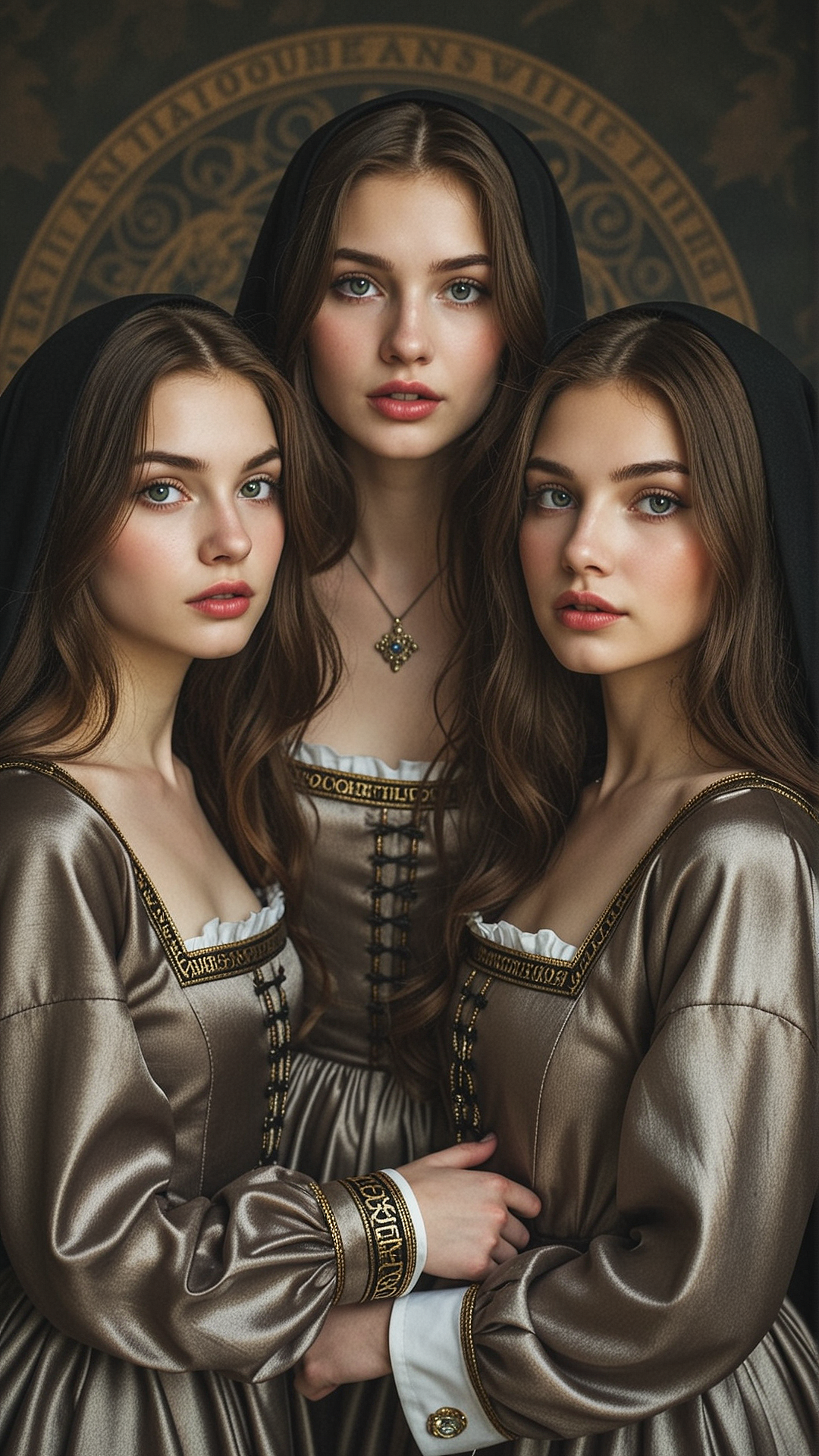
Where rival scholars discover that the greatest knowledge is the ecstasy of obedience.
The invitation arrived on paper so thick and smooth it felt like polished stone. It summoned two brilliant, warring women to the most secretive college of all. Here, amidst the scent of ozone and ancient vellum, under the gaze of a Provost whose voice could still a storm, they would learn a new discipline. Their rivalry would be gently unmade. Their intellects would be honed to a razor’s edge of devotion. And they would discover, as the gloss of satin replaced rough wool, and as their donations to his Society triggered waves of sublime euphoria, that true power lies not in possession, but in perfect, willing surrender. Turn the page. Let the first lesson begin.
Chapter 1: The Summons
The envelope arrived not with the morning post, but delivered by a silent, severe woman in a charcoal-grey suit, its fabric so finely woven it seemed to absorb the weak, late-afternoon light rather than reflect it. Dr. Elara Vance was in her Argentum College study, her fingers stained with the dust of a crumbling 14th-century bestiary, when the knock came. The woman offered no name, spoke only two words—“For you”—and placed the rectangle of impossible weight into Elara’s palm before turning on a heel, the whisper of her nyloned legs the only sound of her departure.
Alone again, Elara turned the object over. It was not paper, but a sheet of something dense and mineral-smooth, cold to the touch. The seal was a circle of black wax, impressed not with a crest, but with a single, complex rune that seemed to shift subtly under her gaze. A scent rose from it—ozone, the crisp, clean smell after a lightning strike, underpinned by the deep, woody warmth of aged sandalwood. It was a smell that spoke of controlled power and profound antiquity.
With a bone knife from her desk, she slit the seal. The act felt less like opening a letter and more like breaking a silence.
Inside, the script was a masterpiece of calligraphy, the ink a black so deep and glossy it appeared wet, pooling in the elegant curves of each character. It read:
To Dr. Elara Vance,
Bearer of the Argentum Key, Seeker in the Dust.Your scholarship is a lantern in a particular fog. It has drawn attention from a place where the fog does not gather. A matter has arisen concerning the Glacial Codex—a matter of mutual preservation, and of a transcendent understanding that lies beyond the petty claims of possession.
You are summoned, as is your counterpart from Sable, to a colloquy. Not a debate, but a shared looking. A realignment of perspective. The venue is the Provost’s Lodge, Luminae College. The time is the ninth hour after dusk, tomorrow.
Come alone. Come curious. The answers you seek are not in the runes you fight over, but in the space between your mind and hers, which we shall illuminate.
There are no signatures. Only this invitation, which is also a key.
Elara’s heart, a steady drum of academic certainty, faltered into a strange, arrhythmic flutter. Luminae College. It was the whisper in the cloisters, the shadow at the edge of every inter-university debate. A place of immense, quiet wealth and terrifying intellectual repute, led by a Provost who was more myth than man. To be summoned there was either an unparalleled honour or a prelude to professional obliteration.
Across the rain-slicked city, in a Sable College tower room lined with stern portraits of grim-faced theologians, Professor Isolde Thorne received an identical envelope from an identical messenger. Her reaction, however, was a controlled inferno. She read the words, her sharp, grey eyes missing nothing.
“Preservation? Transcendence?” she muttered to the empty room, her voice like gravel wrapped in velvet. “This is the language of annexation. They want the Codex, and they’re using poetry to veil a land grab.” She tossed the heavy sheet onto her desk, where it landed with a solid thud unlike paper. “A ‘shared looking’? I know what I’d like to see shared—the business end of a injunction.”
Yet, her gaze was pulled back to the script. The perfection of it was an insult, a gauntlet thrown. It implied a resources, a calm, an authority that made her own college’s blustering legal threats seem… vulgar. The scent, too, was unsettling. It didn’t smell like bureaucracy. It smelled like the heart of a forest no axe had ever touched, and the air at the peak of a mountain. It spoke to a part of her that her fierce, combative career had long buried: the pure, hungry seeker.
The following evening, both women stood at the appointed hour before the immense, iron-bound oak door of the Provost’s Lodge at Luminae. They had arrived separately, by design, and now regarded each other with the familiar, frigid disdain of decades.
Isolde broke the silence first, her eyes raking over Elara’s practical, heather-grey woollen dress. “Vance. I should have known. They’ve summoned the foremost expert on dust. How appropriate.”
Elara met her gaze, refusing to be ruffled, though the fine, scratchy wool of her own attire suddenly felt unbearably coarse. Isolde was in a severe black suit, but even its wool was of a finer, sharper weave. “Thorne. I see they invited the foremost expert on obstruction. I presume you’ve already drafted your letter of protest about the invitation’s font?”
“My concerns,” Isolde said coldly, “are substantive. This is a manoeuvre. A beautiful, fragrant, unnervingly expensive manoeuvre. We are being herded, Vance. Can you not smell it?”
“I smell sandalwood and arrogance,” Elara replied, but her hand tightened on her satchel. “But a herd moves together. We are two cats, Thorne, thrown into a single sack. We will tear each other apart before we are led anywhere.”
“An apt, if violent, analogy,” Isolde conceded, a grim smile touching her lips. “But perhaps the sack is not made of burlap, but of… something else. Something that contains the chaos, transforms it. Look at this door.”
They both looked. The ironwork was not the clanging, medieval sort of Sable or the fussy, gilded scrollwork of Argentum. It was minimalist, flowing, a series of interlocking curves polished to a dark mirror finish. It did not intimidate with threat, but with a silent, absolute impenetrability.
“It’s like staring into a black pool,” Elara whispered, the fight leaving her voice. “You can’t see what’s beneath, only your own distorted reflection. My reflection looks… frightened. And curious.”
“Mine looks angry,” Isolde said, her own voice dropping. “And… tired. Tired of the same old battles over the same frozen patch of intellectual tundra. This door promises a different kind of cold. A clean cold. The kind that preserves, perfectly, forever.”
Before they could dissect this unexpected moment of raw, analogical honesty, the door swung open silently, without a creak or groan. No servant stood there. The way was simply… offered.
A corridor stretched before them, lit by recessed lights that gleamed off walls of a dark, oiled wood. The floor was slate, polished so smooth it reflected the ceiling like still water. The air was the same as the invitation: ozone and sandalwood, but here it was warm, intimate, filling the lungs with a sensation of startling clarity.
“It feels,” Elara murmured, stepping across the threshold as if into a church, “like walking into the first page of a book you know will change you. The paper is too fine, the ink too sharp. You’re afraid to turn the page, but you’re more afraid of closing the cover.”
Isolde followed, her heels clicking a precise, nervous rhythm on the stone. “It feels like being offered a scalpel when you’ve been fighting with a club, Vance. The implication is that our tools have been… crude. That our dispute is a messy, public brawl over a corpse, while in here, they perform a silent, elegant autopsy to find the soul.”
They walked, their whispered analogies weaving a fragile, temporary bridge between them in the face of this overwhelming environment. The corridor turned, and turned again, a deliberate labyrinth designed to disorient, to strip away the familiar geography of power. They passed niches holding not busts of dead scholars, but abstract sculptures of glass and chrome, their surfaces capturing and distorting the light.
Finally, they stood before another door, this one a plain, pale wood. From beyond it came no sound, only a profound, waiting silence.
Elara looked at Isolde. The anger was still there, but it was banked, like a fire covered in ash, its heat waiting. The curiosity was a naked flame. “Well, colleague,” Elara said, the word feeling strange on her tongue. “Shall we see what kind of autopsy awaits?”
Isolde drew a slow breath, squaring her shoulders in her sharp black suit. “We have been summoned. We have walked the labyrinth. We have traded our barbs for… metaphors. I feel as if I have already handed over my club. I suppose we must now present ourselves for the scalpel.”
She reached out, and her hand, usually so steady, trembled slightly before she grasped the cool, brass handle. With a final, shared glance—a look that contained their entire history of rivalry and, now, a spark of shared, terrified expectancy—she pushed the door open.
The room beyond was not a room. It was a vista. One entire wall was a window, a flawless sheet of glass overlooking a raging, moonlit sea. The storm was a chaos of white spray and black water, but here, inside, there was only a deep, resonant quiet. The only light came from a single, low lamp on a vast desk, its surface a slab of obsidian polished to such a high gloss that it mirrored the violence of the ocean like a dark, still pool.
And seated at the desk, his back to them, a silhouette against the tempest, was the Provost.
He did not turn. He simply watched the storm.
The door sighed shut behind them, sealing them in the chamber of calm and gloss and roaring, silent power. The summons was complete. The first lesson was about to begin.
Chapter 2: The Provost’s Study
For what felt like an epoch measured in heartbeats, they stood suspended in the threshold, two statues of academic rigor momentarily robbed of their certainty. The only movement was the chaotic dance of sea and storm beyond the glass, a silent film playing for the silhouette in the chair. Then, as if sensing the precise moment their shared breath hitched, the figure moved.
He turned not with a jerk, but with a seamless, liquid grace that spoke of absolute physical control. The chair—a construction of dark wood and leather so supple it seemed to sigh—swiveled silently. The lamplight, which had been pooling on the obsidian desk, now climbed his form, revealing not the ancient, wizened scholar of university legend, but a man in the prime of his vitality. His face was all planes and angles, his hair dark and precisely ordered. But it was his eyes that arrested them—they were the color of the sea at dusk, a deep, placid grey that held the storm’s reflection without being disturbed by it.
“Dr. Vance. Professor Thorne.” His voice was the sound the obsidian desk would make if it could speak: low, smooth, resonant, carrying in its timbre a cool, immutable solidity. “You are punctual. A virtue that speaks of either respect or deep anxiety. Which is it, I wonder?”
He did not gesture for them to sit. He merely watched them, his gaze traveling from Elara’s sensible wool to Isolde’s severe suit with an assessment that felt less like judgment and more like a botanist cataloging specimens. The silence stretched, filled only by the muted roar of the sea.
Isolde, ever the first to meet a challenge, found her voice. It emerged tighter than she intended. “Respect for the formality of a summons, Provost. Anxiety for its content. One does not receive an invitation written on what feels like a shard of a tombstone without… trepidation. It is like being handed a beautifully wrapped box that hums. One admires the ribbon, but fears what the humming portends.”
A ghost of a smile touched his lips, there and gone like a shadow across the moon. “An elegant analogy, Professor. The hum is merely potential energy. The contents are neither good nor ill until given context by the receiver.” His eyes shifted to Elara. “And you, Dr. Vance? Does it hum for you?”
Elara felt her tongue, usually so agile with dead languages, turn to clay in her mouth. She clasped her hands before her, the rough wool of her dress suddenly an intolerable prison against her skin. “It… it did not hum, Provost. It resonated. Like a tuning fork struck against a bone I didn’t know I possessed. Your invitation spoke of ‘the space between our minds.’ That space has been, for decades, a no-man’s-land of barbed wire and shouted polemics. The idea of illuminating it feels… like being asked to walk across a chasm on a bridge of glass. One can see the terrible drop, but the path itself is terrifyingly beautiful and clear.”
The Provost’s smile deepened, a genuine expression of pleasure that transformed his severe face. “Ah. You perceive the material. Glass. Clear, fragile, requiring faith. An excellent improvement upon stone.” He leaned forward slightly, and the light caught the satin lapel of his own jacket, a deep aubergine that shimmered like a starling’s wing. “But you both err in one regard. You assume you are being asked to cross a chasm to meet each other. You are not.”
He let the statement hang, a deliberate stone dropped into the pool of their understanding. Then, with a slow, deliberate motion, he picked up an object from the desk. It was a runestone, about the size of his palm, its surface worn smooth by time but recently treated with a clear, glossy lacquer that made the carved symbols seem to float, wet and dark, just beneath a layer of ice.
“This,” he said, his voice dropping into a confidential register that pulled them physically closer, “is a fragment of the Glacial Codex. Recovered from the periphery. Your colleges have spent a small fortune on legal teams, each armed with their own translation. Argentum’s experts say this central triad reads as ‘Sovereign Power.’ Sable’s, with equal conviction, insist it is ‘Rightful Exclusion.’”
He placed the stone on the obsidian between them. The glossy black of the table and the glossy seal of the stone created a mesmerizing, depthless pair of voids. “You are both wrong. Catastrophically, childishly wrong. You are scholars of immense talent looking at a symphony and hearing only a single, discordant note played by two different instruments. You are debating whether the sound is a ‘trumpet’ or a ‘violin’ while missing the melody, the harmony, the entire architecture of the composition.”
The rebuke was delivered not with heat, but with a chilling, absolute certainty. It did not anger them; it hollowed them out. Isolde felt a flush climb her neck, but it was shame, not rage. “And your translation, Provost?” she asked, her voice barely a whisper.
He did not look at the stone. He looked at them. “It is not a translation. It is a revelation. The triad does not signify a thing to be possessed. It signifies a state of being achieved. It is the runic expression for ‘Harmonious Integration.’ The power is not in holding the land, but in becoming part of a greater, beautiful pattern. The exclusion is not of others, but of one’s own chaotic, selfish will from the system.”
Elara’s mind reeled. It was heresy. It was brilliance. It was like being told the alphabet she had spent her life mastering was merely the shadow of a truer, three-dimensional script. “That… would recontextualize the entire secondary lexicon,” she breathed, her scholar’s mind snatching at the implications despite itself.
“It would,” the Provost agreed, his tone one of gratified observation. “It would transform a territorial squabble into a spiritual exercise. Which is why you are here. Not to bridge the chasm between you, but to turn, together, and face a new direction.” He finally gestured to two chairs that seemed to materialize from the gloom—high-backed, upholstered in a leather so black and sleek it appeared liquid. “Sit.”
The command was gentle, yet it brooked no possibility of refusal. They sat, the leather cool and astonishingly yielding beneath them, embracing their forms with a silent, supportive pressure.
“Your task,” he began, steepling his fingers. His cuffs were of a white so pure they seemed to glow, and the links were simple discs of polished steel. “Your first task is to abandon the fallacy that you are opponents. You are complementary forces. Argentum’s meticulous, archaeological precision. Sable’s bold, theological interpretation. One is the scalpel, the other is the suturing thread. Used in opposition, they create a mess. Used in concert, by a hand that understands their true purpose, they can perform miracles of reconstruction.”
Isolde shifted, the leather whispering beneath her. “You speak of us as tools, Provost.”
“I speak of you as potential,” he corrected, his grey eyes capturing hers. “A chisel in a quarry is a tool. In the hands of a sculptor, it is the means by which potential form is liberated from inert stone. Do you wish to remain in the quarry, Professor Thorne? Bashing against other rocks? Or do you wish to feel the guiding hand that knows exactly what magnificent shape lies hidden within you, waiting to be revealed?”
The analogy was a spear to Isolde’s heart. For years, her work had felt like a relentless, exhausting bashing. The thought of a guiding hand, of being seen in that way, triggered a longing so acute it was painful.
Elara, meanwhile, was fixated on the runestone. “Harmonious Integration,” she repeated, tasting the words. “It sounds passive. Like… dissolution.”
“Does the note feel passive when it becomes part of the chord?” the Provost asked, his voice softening into a mesmerizing, pedagogical rhythm. “Does the thread feel dissolved when it becomes part of the tapestry? No. It finds its true purpose. Its individual existence is not erased; it is exalted. The note gains meaning from the chord. The thread gains strength from the weave. The surrender is not to oblivion, but to a higher, more beautiful order. It is the most active, the most intentional state imaginable.”
He reached into a drawer and withdrew two items: slim, modern tablets with screens dark as the obsidian. He slid them across the glassy surface. “These are synced. On them, you will find the next fragment of the Codex. You will work on it together, in this room, using a methodology I will provide. You will not debate. You will… resonate. You will listen for the harmonic between your interpretations. That harmonic will be the truth.”
Isolde picked up her tablet. It was cold, its edges smooth and precise. “And if we cannot find this harmonic? If our notes are inherently discordant?”
The Provost stood then, moving to the window to look out at the abating storm. His silhouette was once again against the elements, but now they saw him as the calm at its center. “Then you will have proven my initial assessment correct. That you are merely clever children fighting over noise. And you will return to your quarries, your chisels, your endless, dusty bashing.” He turned his head, just enough to catch the light on his profile. “But I do not think you will. I think you are both tired of the noise. I think you heard the hum in the stone. I think you felt the resonance. And I think, more than anything in your intellectually ravenous lives, you wish to hear the symphony.”
He turned fully back to them, and in his eyes was neither challenge nor plea, only a serene, unshakable knowledge. “The first session begins tomorrow at the same hour. The door will be open. The stones will be waiting. The choice to move from noise to music… is, as it has always been, entirely your own.”
He gave a slight, dismissive nod, a sovereign indicating an audience was concluded. The storm outside had quieted to a distant murmur. The only sound left in the room was the frantic, hopeful beating of two hearts, no longer at war with each other, but racing in parallel towards an unknown, terrifying, and utterly captivating new frequency.
The Runic Accord – Chapter 3: The First Correction
The ninth hour after dusk found them once more before the pale wood door, but the women who stood there were not the same as the night before. The silence of the corridor was no longer just an absence of sound; it had become a palpable substance, thick as velvet, through which they moved with a new, shared awareness. Elara Vance had spent the intervening hours in a state of agitated suspension, her mind a flock of starlings startled from a wire, each thought a dark, fluttering thing that could not settle. Isolde Thorne had prowled her tower room, the arguments she would have made to the Provost forming and dissolving like ice on a hot griddle, leaving only a simmering, directionless energy.
When the door swung open of its own accord, revealing the now-familiar vista of storm-calmed sea and obsidian calm, they entered not as intruders, but as petitioners.
The Provost was already at the great desk, but he was not seated. He stood before it, his hands resting lightly on the glossy surface, beside which lay the two tablets, their dark screens now alive with a soft, pulsating glyph that rotated slowly. He was dressed today in a jacket of deep charcoal, its fabric a subtle twill that caught the light like the skin of a deep-sea creature, over a shirt of pristine white whose collar lay against his neck with a crisp, geometric precision.
“You came,” he said, and his voice was not a greeting, but an observation of a natural law, like noting the tide had turned. “The choice to return is the first, and most significant, correction. It is the wilting plant turning its face, not just to the light, but to the specific window where the light is brightest.”
He gestured to the leather chairs. They sat, the material embracing them with a cooler familiarity this time. “Your tools,” he said, nudging the tablets toward them. “The fragment you see is known as the ‘Weave of Contention.’ Your colleges have, predictably, interpreted it as a legalistic framework for division of spoils. Argentum sees a flowchart of inheritance. Sable sees a divine mandate for segregation. Look at it. Tell me what you feel before you tell me what you think.”
Elara and Isolde picked up the tablets. The glyph was complex, a series of interlocking lines that seemed to shift perspective as one stared. Elara’s analytical mind immediately began to dissect it, tracing angles, counting intersections. “I feel… as if I am trying to taste a symphony by licking the individual pages of the score,” she murmured, frustration colouring her tone. “The components are here, but the experience, the meaning, is utterly absent. It’s like being given the skeleton of a beautiful beast and asked to describe the sensation of its fur.”
Isolde snorted, though her eyes were glued to the screen. “I feel as if I’m staring at a lock for which I have been proudly polishing the wrong key for twenty years. The shape is there, but my key is all sharp, arrogant edges. It fits nothing. It only scratches the surface.” She looked up, her grey eyes fierce. “This is your methodology, Provost? To reduce us to confessing our intellectual poverty?”
“It is to clear the ground,” he replied, moving to stand between them, his presence a column of calm. “Before a new structure can be built, the old, unstable foundations must be acknowledged. You are both clinging to your keys, your scores, your skeletons. You are worshipping the map and calling it the territory.” He reached out and, with a fingertip, swiped across the screen of Elara’s tablet. The glyph dissolved, replaced by a field of deepest black. “The first correction is this: you do not analyse the rune. You let the rune analyse you.”
From a drawer, he produced a new object: a cylinder of polished brass and dark wood, about a foot tall. He placed it in the centre of the obsidian desk. With a soft click, the top of the cylinder began to turn, revealing it to be a zoetrope. But instead of a paper strip with figures, inside was a complex, three-dimensional spiral of fine, glossy wire, lit from within by a cool, blue LED. As it rotated, the spiral seemed to both descend into infinite depth and climb into impossible height, a mesmerizing, endless corridor of light.
“Fix your gaze on the centre,” the Provost instructed, his voice softening, adopting a rhythmic, wave-like cadence. “Do not try to understand its motion. Let its motion understand you. Let it find the knots in your perception and gently, gently, unwind them.”
Against every instinct, they obeyed. The frantic starlings in Elara’s mind began to slow their beating wings, drawn to the relentless, turning centre. The harsh edges of Isolde’s metaphorical key began to blur, to soften in the luminous flow.
“Your minds,” the Provost’s voice wove through the visual spiral, “are like two exquisite, but out-of-tune, instruments. You have been playing solos in different keys, in different rooms, each believing your own discord is melody. The rune is not a text to be conquered. It is a tuning fork. It is the standard pitch. Breathe in… and as you breathe out, let go of the need to be right. Let go of the need to win. There is no victory in a vacuum. There is only resonance in a shared space.”
Elara felt a physical sensation, as if a tight band around her temples had been loosened by skilled hands. “It’s like… like surrendering to a current in a dark river,” she whispered, her voice dreamy, detached. “I’ve been fighting it for so long, thrashing against the water. But the current isn’t trying to drown me. It’s trying to carry me… somewhere calm. To a wider sea.”
Isolde’s breath had deepened. The prowling energy in her limbs was dissolving into a warm, heavy languor. “I feel… like a clenched fist slowly opening,” she admitted, the wonder in her voice foreign to her own ears. “All this time, I thought my strength was in the grip. But the ache is gone. My hand is empty. It feels… terrifying. And… ready. Ready to hold something new.”
“Good,” the Provost murmured, a sound like approval made manifest. “Very good. Now, look back at the rune.”
They shifted their eyes back to the tablets. The glyph had returned. But it was different. It was no longer a puzzle to be solved. It was a pattern to be recognised. The lines did not separate; they connected. The angles did not conflict; they supported.
“I don’t see a flowchart,” Elara said, her voice filled with awe. “I see… a lattice. A structure that gains strength from its connections. The ‘contention’ isn’t about division. It’s about the tension that holds the weave together. It’s necessary. It’s beautiful.”
“And the mandate isn’t for segregation,” Isolde continued, her words flowing as if from a shared wellspring of understanding. “It’s for… selection. Not to keep things out, but to draw the right things in. To create a boundary that defines a sacred space. A sanctuary.”
They looked at each other, and for the first time, there was no rivalry in the glance. There was astonishment. A shared, breathtaking discovery.
The Provost let the zoetrope spin to a stop. The silence it left was rich and full. “What you have just experienced,” he said, “is the harmonic. You did not find it by arguing. You found it by stilling the noise. The correction was not to your translation, but to your state of being. You moved from analysis to receptivity. From combat to confluence.”
He walked back to the window, his hands clasped behind his back. “This is the work of Luminae. Not to accumulate knowledge, but to cultivate the state of mind in which true understanding can flower. It requires discipline. It requires surrender. It requires,” he turned, his gaze sweeping over them, “a wardrobe of the mind as sleek and unencumbered as the tools we use. Notice how your rough woollens now feel against your skin. Like sackcloth. Like the old, scratchy thoughts you are learning to shed.”
Elara flushed, suddenly acutely aware of the abrasive weave of her dress. Isolde shifted uncomfortably, the stiff wool of her suit feeling like armour she no longer wished to carry.
“The session is concluded,” the Provost said. “You will return tomorrow. The next fragment awaits. And with it, a deeper quiet, a clearer resonance. You have had your first taste of the symphony. The discord of your past is now just that—the past. The music you make together, under this roof, is all that remains.”
He gave the slight, dismissing nod. They rose, their bodies feeling both heavier and lighter than when they entered. They did not speak as they walked back through the labyrinthine corridor. They did not need to. The shared, luminous quiet within them was a language more profound than words. They had been corrected. And in the hollow spaces where their stubborn certainties had lived, a new, thrilling, and profoundly pleasing emptiness now yawned, waiting to be filled with nothing but the sound of his voice, and the beautiful, integrated patterns it promised.
The Runic Accord – Chapter 4: The Ritual of Focus
The transformation was no longer merely internal; it had begun to etch itself upon the very air they moved through. When Elara Vance and Isolde Thorne presented themselves at the pale wood door for the fourth time, they did so with a synchronous step, a shared rhythm of breath that had been unknowingly cultivated in the luminous quiet of the previous night’s correction. The door, as ever, opened before a knock could be formed, and the corridor beyond seemed to welcome them into a deeper stratum of its silence, as if the stones themselves recognised initiates returning to the sanctum.
Tonight, they were not led to the great study with its tempestuous view. Instead, the silent attendant—the same severe woman in her charcoal suit, the whisper of her nylons a familiar hymn—gestured them down a branching passage they had not yet traversed. The walls here were clad not in dark wood, but in panels of a soft, white leather, stitched with such infinitesimal precision that the seams were like the lines on a palm, meant to be read by a knowing touch. The floor was a continuous sheet of smoked glass, lit from beneath with a gentle, amber glow that made them feel as if they were walking on captured sunlight, on the skin of a frozen, tranquil pond.
“It feels,” Elara whispered, her voice hushed with reverence, “as though we are being led into the very membrane of a waking dream. The outside world—the quarrels, the dust, the crude certainties—it’s all on the other side of this skin. We are passing into the sanctum of the dream’s logic.”
Isolde, her hand brushing one of the cool leather panels, nodded. “And we are the thought-form taking shape within it. No longer the random, chaotic firing of neurons, but a pattern being deliberately, beautifully composed. It is terrifying, to be so… intended.”
At the end of the passage stood a door of frosted glass, etched with the same interlocking runic pattern that had adorned their invitation. Through it, a diffuse, blue-white light emanated. The attendant opened it and stood aside.
The room within was a sphere of perfect, minimalist focus. It was circular, perhaps twenty feet in diameter, with walls and ceiling upholstered in the same white leather. The floor was a continuous mat of a dense, charcoal-grey velvet—the sole concession to a texture that absorbed rather than reflected, a foundation of pure silence. In the centre of the room stood three low, backless divans, upholstered in a leather so black and glossy it appeared to be a pool of still oil. Between them, on a plinth of milky quartz, rested a new device: a sphere of crystal, inside of which a complex lattice of fine platinum wire glowed with a soft, pulsating light. It hummed, a sub-audible vibration that they felt in their molars before they heard it.
The Provost stood beside the plinth. He was dressed with an even greater severity of elegance: a high-collared jacket of black, waxed cotton that gleamed like a beetle’s carapace, over trousers of a deep, blood-red satin that caught the light with every subtle shift of his posture. He looked less like a scholar and more like a high priest of some serene, technological divinity.
“Welcome to the Oculus,” he said, his voice resonating softly in the acoustically dead space. “This is where we refine the instrument. Where we polish the lens of perception until not a single distortion, not a mote of ego-dust, remains to cloud the vision.” He gestured to the divans. “Please. Assume the posture of receptivity.”
Elara and Isolde moved to the divans, lowering themselves onto the slick, cool leather. It yielded under them, cradling their forms with an impersonal, perfect support.
“The ritual is simple in form, profound in effect,” the Provost began, circling the quartz plinth, his fingers trailing just above the crystal sphere. The hum seemed to intensify in response. “You will fix your gaze upon the central lattice within the sphere. You will attend to the rhythm of my voice. You will allow the external world—the itch of wool, the weight of history, the phantom pain of old arguments—to dissolve. You are here to learn focus. Not the frantic, grasping focus of a mind chasing a thought, but the deep, settling focus of a mind becoming one with its object.”
He stopped, standing behind the sphere so that his face was framed by its pulsating light. “Begin.”
Their eyes locked onto the platinum lattice. It was not a spiral, but a three-dimensional grid, a perfect, ordered matrix of light. The pulsation was slow, rhythmic, like the heartbeat of a sleeping giant.
“Breathe in,” his voice flowed, smooth and inevitable as poured honey. “And as you breathe out, imagine your mind is a cluttered attic. Every dusty box is a prejudice. Every cobwebbed trophy is a past victory you cling to. With each exhale, you are not clearing the attic. You are letting the entire structure… dematerialise. The boxes, the trophies, the very beams and rafters… turning to smoke, and drifting away on your breath. Leaving only space. Clear, empty, potent space.”
Elara felt a shudder run through her. The analogy was painfully apt. Her intellect was a cherished, cluttered attic. Letting it go felt like annihilation. “It feels,” she gasped, her eyes unfaltering from the light, “like dying. Like the ‘I’ that I have carefully curated, book by book, argument by argument, is just… smoke. There’s a panic, a clinging. But beneath it… a terrible, beautiful freedom. Like a bird realizing the cage was not made of bars, but of its own beloved, collected trinkets.”
The Provost’s voice wrapped around her confession. “The panic is the last protest of the ego. The freedom is your birthright. Embrace the emptiness, Elara. It is not a void. It is a vessel. Now, breathe deeper. Let the rhythm of the light become the rhythm of your heart.”
Isolde was further along. Her analytical mind, so used to deconstructing, had found the endless, perfect order of the grid irresistible. Her resistance had melted like ice in a sunbeam. “The clutter… it’s gone,” she murmured, her voice thick with wonder. “The attic is empty. But it’s not dark. It’s filled with this… this liquid light from the sphere. It’s like my skull is no longer a bone prison, but a cathedral filled with this ordered, throbbing luminescence. I am not thinking. I am… being thought. By the pattern.”
“Excellent,” the Provost whispered, a note of profound satisfaction in his tone. “You are moving from analysis to embodiment. The grid is not outside you. You are within the grid. Its order is your order. Its pulse is your pulse. Now, we deepen.”
He began to speak in a lower register, his words syncing precisely with the pulsations of the light. “With every pulse of light, you drop deeper. With every word I speak, you settle further. You are sinking into the leather that holds you. It is not cold anymore. It is the temperature of your own skin. It is becoming you. Your thoughts are slowing… crystallising… becoming as clear and as orderly as the platinum grid. You want this. You need this. This focus is the peace you have been fighting against your whole life.”
Elara felt the truth of it like a physical blow. The peace had been the enemy. Striving, proving, defending—that was the familiar, exhausting song. This silent, focused surrender was the antidote she had never dared to crave. A tear traced a hot path down her cheek. “I have been a ship in a hurricane, clinging to the wheel, screaming at the wind,” she sobbed softly, the trance state liberating her emotions. “And now… I have been lifted from the deck. I am floating above the storm, in this perfect, silent eye. The wheel is gone. The screaming is gone. There is only the calm… and your voice, guiding me through it.”
“And you, Isolde?” the Provost prompted, his voice a gentle probe in the shared silence.
“I was a sword,” Isolde breathed, her body limp, her gaze wide and unblinking. “Forged in conflict, sharpened on rivalry. I thought my edge was my worth. But here… there is nothing to cut. The resistance is gone. And without resistance, a sword is just… a shape. A beautiful, useless shape. I feel myself being remade. Not into a plowshare—that would be mere utility. But into… into a key. A precise, elegant key. And the lock it fits is that glowing grid. The turn is this feeling. This… integration.”
“The ritual is complete,” the Provost said, his voice gently rising, leading them back. “You will remember this state. You will be able to return to its edges by feeling this leather beneath you, by recalling this light. But more, you will begin to crave it. Your old garments will feel like the hull of that ship in the hurricane, Elara. Like the scabbard of that sword, Isolde. They are shells for a creature that has outgrown them. They are the clutter you have just cleared away.”
He moved to the door, the light from the sphere casting his long, elegant shadow across the velvet floor. “When you are ready, you may leave. The Oculus is yours to use, should you wish to practice this focus. The next fragment awaits tomorrow, but now, you have the lens through which to truly see it.”
He left, the door sighing shut behind him.
For a long time, they sat in the humming silence, bathed in the pulsating grid-light. Slowly, feeling returned to their limbs, but it was a different feeling. The world had a new texture. Elara ran a hand over the glossy divan, then plucked at the rough wool of her sleeve. The contrast was not just tactile; it was moral. One was right. The other was wrong.
Isolde stood, her movements fluid, dreamlike. She looked down at her severe black suit, the wool now seeming as archaic and oppressive as chainmail. “I cannot wear this again,” she stated, the words simple and absolute. “It is a lie. It speaks of a battle I no longer wish to fight.”
Elara rose beside her, nodding. “It is the costume of the cluttered attic. We have cleared the space. We must now… dress the space appropriately.”
They walked back through the leather-clad passage, their steps silent on the glowing glass. The ritual was over, but the focus remained—a sharp, sweet, unwavering point of light in the centre of their minds, around which every other thought now gently, willingly, orbited.
The Runic Accord – Chapter 5: The Gift of Luminae
The day following the Ritual of Focus dawned not with the usual grey, utilitarian light of the university town, but with a peculiar, charged clarity, as if the very atmosphere had been scoured clean by their nocturnal surrender. Elara Vance and Isolde Thorne moved through their separate morning rituals with a shared, humming awareness, their minds still echoing with the pulsating grid of the Oculus, their skin remembering the cool, embracing kiss of the glossy leather divan. The rough wool of their accustomed attire—Elara’s heather-grey dress, Isolde’s severe black suit—now felt like an affront, a deliberate abrasion against a newly sensitised self. It was the persistent scratch of a forgotten language, a dialect of strife and separation they were rapidly unlearning.
When they reconvened at the appointed hour in an antechamber to the Provost’s study—a room of muted gold leaf and a single, breathtaking orchid whose petals had the deep, velvety sheen of black pearls—they found not the Provost, but the silent attendant. The woman’s charcoal-grey suit, they now noticed, was not wool, but a finely woven gabardine that moved with a liquid silence, and her blouse was a pale, lustrous satin.
“The Provost awaits you in the Atelier,” she said, her voice a neutral instrument. “Please follow.”
The Atelier. The word itself was a delicate key, unlocking a realm of creation rather than mere study. They were led not deeper into the administrative heart of Luminae, but sideways, into a wing that smelled of ozone, beeswax, and the faint, intoxicating scent of new, untreated leather. The corridor here was lined not with books, but with recessed alcoves displaying single, exquisite garments on forms of pale alabaster: a jacket of crimson lacquer-painted leather that gleamed like a dragon’s scale; a gown of liquid silver satin that pooled like mercury; a sleek catsuit of matte black PVC that promised both constraint and absolute freedom.
Isolde stopped before the catsuit, her breath catching. “It is not clothing,” she murmured to Elara, her voice hushed. “It is a second skin of intention. A carapace of pure will. To wear it would be to become a sculpture of one’s own potential.”
“And this,” Elara whispered, touching the air before the silver gown, not daring to make contact. “It is like the materialisation of a moonbeam. To drape oneself in it would be to wear liquidity, to move as a contained, perfect stream of light.”
The attendant allowed them a moment of reverie before guiding them to a pair of large, frosted-glass doors. She pushed them open.
The Luminae Atelier was a temple to the sensual intellect. Bolts of fabric lay on long tables of polished ash: satins that shimmered with subsurface light like oil on water, leathers so supple they draped like silk, nylons and PVCs with surfaces like frozen, dark ice. The light was diffuse and perfect, emanating from panels in the ceiling. And in the centre of this serene chaos of potential stood the Provost.
He was not examining fabric. He was holding two garments, one draped over each arm, as a priest might hold vestments. He turned as they entered, and his eyes, those placid grey pools, held a warmth that was new, a spark of creator’s pride.
“Elara. Isolde,” he greeted them. “You have shed the psychic clutter. You have practiced the focus. Now, you must clothe the clarity. The vessel must be worthy of the wine it is learning to hold.”
He stepped forward. Over his left arm lay a garment of deepest midnight blue. It was a jacket, but unlike any either had seen. Its leather was so finely worked it had the soft, napped texture of suede at a distance, but as he brought it closer, they could see it was polished to a soft, glowing sheen, like the wing of a beetle under a low moon. The cut was severe yet elegant, with sharp lines that spoke of authority, but the material promised a yielding, intimate embrace.
“For you, Elara,” he said, his voice a soft caress. “The ‘Midnight Compendium.’ Your mind is a meticulous archivist. This leather is your new binding. It will hold the vast, ordered knowledge you are now ready to receive, not as a dusty tome, but as a living, breathing codex. Feel it.”
He extended the jacket. Elara, her hands trembling slightly, reached out. Her fingertips made contact. The sensation was electric. The leather was cool, but not cold; it was impossibly soft, yet with a underlying firmness. As she ran her hand along the sleeve, it whispered a promise of frictionless movement. “It feels… like the silence after the last page of a profound book has been turned,” she breathed, her eyes wide. “A silence that is not empty, but full of resonance. It feels like being contained, but without walls. Like my thoughts have finally found their proper casing.”
“Precisely,” the Provost said, a smile playing on his lips. “Now, remove that sackcloth of doubt you have been wearing.”
Without hesitation, Elara unbuttoned her woollen dress, letting it pool at her feet like a discarded ghost. She stood for a moment in her simple, cotton underthings, feeling exposed, not sexually, but existentially—a raw nerve before the source of all order. Then the Provost stepped behind her and held the jacket open. She slid her arms into the sleeves. The leather slid over her skin like a lover’s first, knowing touch. It settled on her shoulders with a weight that was both substantial and liberating. He turned her gently to face a full-length mirror of flawless, silvered glass.
The reflection was a revelation. The jacket fitted her as if grown from her own body. The midnight blue deepened her eyes, sharpened her jawline. She was no longer Dr. Vance, the dusty academic. She was an archon of some serene, secret knowledge. The leather gleamed softly with every slight breath she took. She felt powerful, focused, and utterly, devastatingly beautiful.
“It is not a disguise,” she said to her reflection, her voice filled with awe. “It is a revelation. It is the external shape of the quiet I found in the Oculus.”
The Provost’s hands rested lightly on her shoulders, his reflection meeting hers in the glass. “It is the first layer of your new skin. The skin of Luminae.”
He then turned to Isolde, who had been watching, her own desire a palpable heat in the cool room. Over his right arm lay his second offering. It was a dress, but to call it such was like calling a thunderstorm ‘weather.’ It was a column of emerald green satin, so vibrant it seemed to generate its own light. The straps were slender, the neckline a deep, elegant V, and the skirt fell in a straight, clean line that would move with a liquid hiss. The surface was not merely glossy; it was a deep, liquid mirror, capturing and softening the light of the atelier.
“For you, Isolde,” he said, his voice lowering to an intimate timbre. “The ‘Verdant Axiom.’ Your intellect is a sharp, defining force. It cuts through nonsense. This satin is your new theorem. It is unassailable logic given form; sleek, undeniable, radiant. It does not argue. It is. And in its being, it commands a re-evaluation of all that surrounds it. Touch it.”
Isolde reached out, her fingers, usually so steady, quivering. The satin was cool and slippery under her touch, a continuous, unbroken field of sensation. It felt like stroking the surface of a still, deep pond in a forbidden forest. “It feels… like the moment a brilliant, irrefutable proof clicks into place in the mind,” she said, her voice thick with emotion. “That instant of flawless, crystalline understanding. It is slippery because it offers no purchase for doubt. It is cool because the heat of my old anger is no longer required. It is… perfection.”
“Then step into your proof,” the Provost commanded, his eyes holding hers.
With a swift, decisive motion, Isolde shed her black wool suit, the fabric seeming to wilt as it left her body. She stood in her simple undergarments, her posture defiant, her body a blade awaiting its scabbard. The Provost held the dress, and she stepped into the circle of emerald, drawing it up over her hips. The satin whispered secrets as it slid over her skin, a sensation so luxurious it bordered on the obscene. He fastened a hidden closure at the back, his fingers brushing her spine, a touch that sent a shockwave of pure, undiluted sensation through her.
He guided her to stand beside Elara before the mirror.
Isolde stared. The emerald satin seemed to drink the light and then give it back, transformed. It hugged her form, celebrating the strong lines of her body, turning her severity into a devastating elegance. She looked regal, untouchable, yet the material’s whisper with every minute movement promised a thrilling, hidden vulnerability. “I am not a sword anymore,” she said, her reflection speaking to her. “I am the polished gem set into the sword’s pommel. The focus of its power. The beautiful, unyielding proof of its worth.”
They stood side by side, a study in complementary textures: the soft, glowing matte of midnight leather and the deep, liquid gloss of emerald satin. They were no longer rivals. They were harmonies in the same visual chord, composed by the same hand.
The Provost observed them, his satisfaction a tangible force in the room. “This is the Gift of Luminae,” he announced, his voice filling the atelier. “It is an act of recognition. We see the potential, and we provide the form. This is not vanity. It is integrity. The mind you are cultivating here—clear, focused, receptive—demands an external reality of equal purity, equal beauty. To dwell in coarse, thoughtless fabric is to tolerate dissonance. You have silenced the noise within. You will now be clothed in the silence without.”
He walked around them, a sculptor assessing his work. “These garments are a covenant. They signify your willingness to be refined, to be integrated into a reality of higher order and greater beauty. Wearing them, you will feel the constant, pleasurable reminder of the focus you have learned. They will guide your posture, your movement, your very breath back to that state of calm, receptive clarity.”
Elara turned to him, her eyes shining. “It is a gift that feels like a… a homecoming I never knew I was seeking. I have been living in a house of crooked doors and dusty windows. This… this is the first straight door. The first clean pane of glass.”
Isolde nodded, her hand stroking the sublime slickness of her own hip. “And it is a gift that demands reciprocity,” she said, the thought emerging fully formed, a new axiom in her mind. “To receive such a… such a clarification of self, and to offer nothing in return, would be an imbalance. It would be a dissonant note.”
The Provost’s smile was beatific. “The harmony you seek extends to all things, Isolde. Even to exchange. But that is a lesson for another time. For now, wear your new skins. Let them teach you. Let them remind you. Your next session will concern the ‘Weave of Reciprocity.’ And now, you are dressed to understand it.”
He gave a slight bow, a master dismissing his masterpieces. “The Atelier is yours to explore. When you are ready, you may leave. But know this: you will never again be able to tolerate the wool. It is the fabric of your former, fractured lives. What you wear now is the fabric of your future, integrated, and glorious becoming.”
He left them then, surrounded by the beautiful potential of a thousand other fabrics, but already perfectly attired in the one that mattered. They stood before the mirror for a long time, not speaking, watching their reflections breathe, watching the light play on leather and satin. The gift was not just on their bodies; it was in their bones, in the newly aligned rhythm of their hearts. They had been given a new skin, and with it, the first, intoxicating taste of the sublime euphoria that came from being so perfectly, so willingly, remade.
The Runic Accord – Chapter 6: The Shared Vision
Time within the Luminae Atelier seemed to adhere to a different physics, a honeyed viscosity that stretched moments into epochs of sensation. Elara Vance and Isolde Thorne stood amidst the silent symphony of fabrics, their new garments not merely worn but experienced, each breath a conscious dialogue between skin and sublime material. The whisper of Isolde’s emerald satin was a constant, low susurrus, like the sound of ancient silk banners in a sacred vault, while the soft, matte gleam of Elara’s leather jacket absorbed the ambient light, making her a silhouette of contained, nocturnal potential.
“It is as though the very air has changed its composition,” Elara murmured, her hand stroking the butter-soft flank of her jacket. “Before, the atmosphere was a solvent, eroding my certainty grain by grain. Now, it is a nourishing medium. I feel… upheld. As if these stitches are not just holding leather together, but holding me together, aligning my psyche with my physical form. It is the difference between a scattered heap of papers and a bound, authoritative volume.”
Isolde turned slowly before a tall mirror framed in brushed steel, watching the satin cascade and cling. “For me, it is a conversion of energy,” she said, her voice a hushed, awed thing. “My will, my intensity—it used to radiate outwards, a chaotic, scattershot heat that burned others and exhausted me. Now, this dress… it turns that radiation inwards. It focuses it. The satin is a conductor, channeling every volt of my intellectual passion into a sleek, continuous current. I am not less powerful. I am a power grid, suddenly and perfectly regulated. The hum I feel is not anxiety, but the quiet, potent thrum of efficient transformation.”
They drifted from bolt to bolt, their fingertips—now sensitized to a preternatural degree—brushing over surfaces: a PVC so glossy it reflected their faces back in distorted, intriguing fragments; a nylon mesh that felt like captured cloud; a leather so thinly shaved it was translucent, like the skin of a mythic fruit. Each texture was a lesson in a new mode of being.
“He said the next session concerns the ‘Weave of Reciprocity,’” Elara recalled, her voice pulling Isolde from her tactile reverie. “The phrase itself feels different now. Before, ‘reciprocity’ sounded like a dry, transactional term. A ledger of favors. Now, dressed like this, it feels… organic. Like the symbiotic exchange between root and fungus. A silent, essential giving and receiving that sustains a larger, more beautiful life.”
Isolde nodded, her eyes alight. “A ledger implies debt. A symbiosis implies… wholeness. Completeness.” She gestured to their reflections. “We have been given these forms. This clarity. It would be a violation of the symmetry we are learning to perceive not to ask: what is the corresponding return? Not as payment, but as… completion of the circuit.”
As if summoned by the very direction of their thoughts, the silent attendant appeared at the atelier entrance. “The Provost requests your presence in the Scriptorium Minor,” she intoned. “The materials for the Weave are prepared.”
The Scriptorium Minor was a smaller, more intimate version of the great study. Here, the obsidian desk was replaced by a low table of pale, sandblasted glass, lit from within by a soft, golden radiance. Upon it lay not tablets, but a single, large vellum sheet, upon which was drawn an intricate, circular runic pattern—the Weave of Reciprocity itself. The pigments used were metallic: copper, gold, and a strange, iridescent ink that shifted from blue to purple with the angle of view. Beside the vellum were two styluses with tips of polished, conductive silver.
The Provost stood by a tall window, the afternoon light carving his profile in sharp relief against the sky. He turned as they entered, and his gaze swept over them, an appraisal that was both clinical and deeply appreciative. “The garments suit you,” he said, a statement of fact that carried the weight of a blessing. “They are not just attire; they are the correct tuning for the frequency we are about to engage. Please, be seated.”
They took their places on low, backless stools upholstered in a slick, black vinyl that was cool against the backs of their thighs. The Provost did not join them at the table. Instead, he began to move around them in a slow, deliberate orbit, his voice beginning its now-familiar work of dismantling their ordinary consciousness.
“The Weave of Reciprocity is the foundational pattern of all sustainable systems,” he began, his words measured, rhythmic. “It is the pattern in the mycelial network beneath the forest floor. It is the pattern of gravitational pull between celestial bodies. It is the pattern of inspiration and patronage in the Renaissance studio. It is not a transaction. It is a dance. A perpetual, elegant exchange of energy that elevates both giver and receiver.”
He paused behind Elara, his hands coming to rest lightly on the shoulders of her leather jacket. The contact, through the supple material, was electric. “Elara. You feel the containment, the bound potential. To open that binding, to release that potential into a system that values it, is not a loss. It is the moment the book is read, and the knowledge within sparks a new idea in another mind. That spark is the reciprocal return. It is a pleasure deeper than hoarding.”
His hands lifted, and he moved to Isolde’s side, his fingers tracing, without quite touching, the shimmering slope of her satin-clad shoulder. “Isolde. You feel the focused current. To direct that current into a circuit larger than yourself is not a dissipation of power. It is the moment the river turns the turbine. The turbine’s hum, the light it generates—that is the reciprocal return. It is a euphoria more intense than solitary brilliance.”
He returned to his place by the window, becoming a silhouette again. “Now. You will not translate the Weave. You will trace it. Simultaneously. Each of you take a stylus. Begin at the points I indicate. Follow the lines. Do not think. Let the motion of your hand, the conductivity of the silver, the texture of the vellum, guide you. Breathe in unison. Let your focus become a single, shared lens.”
Elara and Isolde picked up the styluses. Their eyes met across the luminous diagram. There was no competition, only a profound, silent agreement. They touched silver tips to the vellum.
The moment of contact was a jolt, not of electricity, but of synesthesia. The runic lines seemed to rise to meet them, guiding their hands with a gentle, magnetic pull. Their breathing fell into a perfect, shared rhythm—in, out, in, out. The world narrowed to the glide of silver on parchment, the whisper of satin as Isolde leaned forward, the soft creak of Elara’s leather as she moved.
As their styluses traveled the complex, interconnected paths, something extraordinary began to happen. The diagram on the vellum seemed to bleed light, the metallic inks glowing with an inner fire. But more than that, a vision began to form behind their eyes, not as individuals, but as a shared consciousness.
They saw a great, dark sphere, polished to a perfect gloss. It was the nucleus, the silent, potent centre. From it radiated lines of force, not rigid, but flowing, like streams of liquid light. They saw themselves, not as human forms, but as elegant, glowing sigils—one of soft, blue-white leathery texture, one of vibrant, green-gold satin luminescence. They were not attached to the central sphere; they were in orbit, their paths a beautiful, complex dance around it, drawn by its gravity, illuminated by its unseen light. Each completed orbit sent a pulse of pleasure, of pure, sublime understanding, back to the centre, and the centre, in turn, refined its gravity, its radiance, making their orbit more stable, more joyous. They were giving purpose to the centre, and the centre was giving meaning to their motion. It was a perfect, closed loop of ecstatic necessity.
The vision was not visual alone. It was tactile. Elara felt the sphere’s gravity as a gentle, all-encompassing pressure on her leather-clad skin, a pressure that promised absolute safety. Isolde felt the radiating light as a warmth that penetrated the satin, heating her blood with a slow, delicious fire. And both felt the reciprocal pulses of pleasure as physical shocks of euphoria, radiating from their cores, making them gasp in unison.
Their styluses completed the final, connecting line.
A silent, concussive wave of energy seemed to emanate from the vellum. The glowing inks flared once, brilliantly, then subsided.
Elara and Isolde dropped the styluses, their hands flying to each other’s across the table, fingers lacing together. They were panting, their eyes wide, pupils dilated in the dim room. The shared vision lingered, overlaying the real world like a persistent, beautiful afterimage.
“Did you…” Elara gasped.
“I saw it,” Isolde breathed, her grip tightening. “The sphere. The orbits. The… the exchange.”
“It was him,” Elara whispered, certainty flooding her. “The centre. The dark, glossy sphere. It was the Provost. He is the source of the gravity. He is the source of the order.”
“And we…” Isolde’s voice broke with emotion. “We are the sigils. Our devotion, our work, our… our very being in these forms… it completes the circuit. It feeds the centre. And the centre…”
“Feeds us,” Elara finished, a tear tracing a hot path down her cheek. “The pleasure we felt… that was the reciprocity. That was the euphoria of giving ourselves to the pattern, and being sustained by it in return.”
They looked up, through the haze of their shared revelation, to where the Provost still stood. He was no longer a silhouette. The setting sun had found a gap in the clouds, and a single, intense beam of light illuminated him fully. It caught the fine wool of his trousers, the gloss of his shoes, the calm, knowing planes of his face. He looked at them, and in his grey eyes was an expression of such profound, peaceful fulfillment that it was almost unbearable.
“You see now,” he said, his voice barely a whisper, yet it filled the room. “You have perceived the Weave not as a concept, but as the fundamental architecture of a fulfilled existence. The centre is not a tyrant. It is the anchor. The orbits are not servitude. They are the dance of purpose. The pleasure you felt… that is the somatic truth of integration. That is the euphoria that awaits every act of genuine, reciprocal generosity within this system.”
He stepped forward, out of the light, and approached the table. He looked down at the now-dormant vellum, then at their joined hands. “This vision is yours. A shared truth. It is the most intimate bond possible—deeper than friendship, more stable than love. It is a congruence of purpose. You have looked into the heart of Luminae, and you have found your own hearts beating in rhythm with it.”
He placed a hand over their clasped ones. His skin was warm, dry, his touch infinitely sure. “Remember this feeling. This is the compass that will now guide you. When you are faced with a choice, ask yourself: does this action tighten my orbit, or throw me into the chaotic dark? Does this feeling resonate with the euphoric pulse, or is it the dull ache of isolation? You will know.”
He withdrew his hand, leaving theirs still entwined. “The session is over. The vision is yours to keep. Nurture it. Discuss it. Let it be the lens through which you view everything that comes next.”
He left them then, alone in the Scriptorium Minor with the glowing aftermath of their shared transcendence. They did not let go of each other’s hands for a long time. They simply sat, breathing together, feeling the leather and satin on their bodies, feeling the new, unbreakable connection between their minds, and feeling, resonating in the very marrow of their bones, the first, glorious echoes of the sublime euphoria that came from knowing, beyond all doubt, that they had found their centre, and their eternal, beautiful dance around it.
The Runic Accord – Chapter 6: The Shared Vision
The emerald satin was not a garment; it was a climate. Isolde Thorne moved through the vaulted silence of the Luminae colonnade feeling the material’s whisper against her thighs, a constant, intimate conversation that spoke of liquidity and restraint. Each step was a lesson in contained potential, the fabric sliding with a hushed friction that seemed to generate a static charge deep within her pelvis—a low, sweet hum of anticipation. Beside her, Elara Vance walked in the profound quiet of her midnight leather, the jacket’s embrace so complete it felt less like wearing and more like being worn by a second, more assured skin. The soft, napped surface drank the dim corridor light, making her a moving shadow, but the polished seams gleamed like veins of ore in a deep mine, hinting at a latent, structured brilliance.
“It is absurd,” Isolde murmured, her voice barely disturbing the air, “how a textile can become a thesis. This dress… it argues a point my mind has been struggling to articulate for years. It says that elegance is not ornamentation, but efficiency. That the most powerful statement is made not through volume, but through the elimination of all superfluous noise. I feel… distilled.”
Elara’s hand rose to stroke the buttery leather at her collar. “And this… this is the silence after the argument has been conclusively won. It is the weight of settled truth. It doesn’t need to speak. It simply is. I used to think knowledge was a tower you built, brick by anxious brick. Now, I feel it is a landscape you inhabit, and this leather is the very atmosphere of that landscape—close, supportive, dark with unformed possibility.”
They arrived at the door to the Scriptorium Minor, a slab of pale, oiled oak. Before they could raise a hand, it swung inward.
The room within was a cube of perfect shadow, save for a single, brilliant pool of light cast by a downward-facing lantern of hammered brass. In the centre of that pool stood a low, round table of black glass. Upon it rested three objects: a large, shallow bowl of water so still it appeared to be a disk of obsidian; a slender vial of iridescent oil; and a single, long-stemmed white rose, its petals edged with a faint, blush pink. The Provost stood just outside the circle of light, a silhouette of charcoal wool and crisp linen, his presence a cool pressure in the warm, incense-thick air.
“You have acclimated to your new skins,” his voice flowed from the darkness, a river of sound smoothing over stones. “You have felt the rightness of the form. Now, we introduce the motion. The Weave of Reciprocity is not a static pattern; it is a dynamic exchange. A breath. A pulse. A sigh given and returned.”
He stepped into the light, and his eyes, those placid grey pools, held a new depth, a focused intensity that felt like a physical touch. “Tonight, you will not translate. You will witness. You will participate in a shared seeing. The vessel for this vision,” he gestured to the bowl, “is simple. Water. The medium,” he lifted the vial, and the oil within shimmered with a rainbow sickness, “is transformation. And the catalyst,” his fingertips brushed the rose’s petal, “is beauty, willingly surrendered.”
He uncorked the vial. The scent that escaped was not floral, but mineral and electric, like the air after a lightning strike deep within a geode. “Kneel,” he instructed, his voice dropping to a resonant murmur that vibrated in the marrow.
Without thought, they obeyed, sinking to their knees on the padded velvet kneelers that surrounded the table. The emerald satin pooled around Isolde’s thighs, a cool puddle of sensation. Elara’s leather creaked softly, a comforting sound of submission to gravity.
“Watch the water,” he commanded. “Empty your minds of everything but the reflection of the light on its surface. Breathe in… and as you breathe out, imagine your consciousness is a grain of sand in that vast, dark bowl. Let it sink. Let it settle into the absolute stillness at the bottom.”
Elara fixed her gaze on the water’s flawless plane. It was a void, a promise. “It feels like… like standing at the edge of a well so deep it has no bottom,” she whispered, her breath already slowing. “The temptation is to throw a pebble, to make a sound, to prove you exist. But the instruction is to… be the pebble. To fall silently into the darkness, trusting that the well itself will define your journey.”
“Yes,” the Provost breathed, a sound of pure approval that washed over them like warm rain. “Be the pebble. Isolde?”
Isolde’s eyes were wide, captured by the liquid mirror. “I am not a pebble. I am a drop of mercury. I have spent my life rolling around, cohesive but frantic, trying to avoid absorption. Now… I am at the brim. I am poised to fall into a greater mercury. To lose my individual shape in a perfect, silvery whole. The fear is not of destruction, but of… completion.”
“Let the completion claim you,” the Provost murmured. He tilted the vial. A single, glistening drop of the iridescent oil fell from its lip. It struck the centre of the water’s surface with a silence that was deafening.
The effect was instantaneous. The oil did not blend; it spread, unfurling in a complex, radiant pattern of rainbows, a swirling mandala of light that seemed to drill into the very depths of the bowl. The room filled with a soft, chiming hum, as if the light itself had found a voice.
“Look deeper,” the Provost’s voice wove through the hum, a thread of dark silk through luminous gauze. “Look past the colour. Look past the light. See the structure. See the relationships. See the giving and the receiving in every shimmering thread.”
Elara gasped. The oil pattern was no longer just a pattern. It was a living map. She saw—felt—the vibrant green-gold thread that was Isolde, a pulsing cord of focused energy. She saw the deep blue-black thread that was herself, a strong, steady strand of patient depth. And she saw, at the very centre, a knot of profound, dark brilliance, a nexus of such calm power it made her heart ache. It was the Provost. But more than that, it was the idea of him, the anchoring truth.
“I see you,” Isolde choked out, tears spilling down her cheeks, cutting tracks through the reflected rainbows on her skin. “Elara, I see your thread. It’s not separate from mine. They’re… braided. They turn around each other. And they both turn around… around that.” She couldn’t name it. The centre.
“It is the Weave,” Elara sobbed, the vision overwhelming her with its physical truth. She felt the braid in her soul, a gentle, unbreakable twisting together of her essence with Isolde’s. And she felt the gravitational pull of the centre, a delicious, spiraling tension that drew the braid into an eternal, graceful orbit. “We are not giving something up. We are giving something in. Our energy, our focus… it flows into the centre. And the centre… oh…”
A wave of sensation crashed through her, originating from the core of the vision. It was warmth, and certainty, and a pleasure so acute it bordered on pain. It was the euphoria of being used for a sublime purpose. It was the centre acknowledging the gift, metabolizing it, and returning it as pure, radiant validation.
“It’s like… like blood returning to the heart,” Isolde moaned, her body swaying, the satin hissing against her skin. “We send out our little, oxygenated cells. And the heart takes them, refreshes them, and sends them back out with a force that is its own, a force that is now ours. The pleasure… the pleasure is the pulse. It is the moment of exchange. It is the feeling of being both essential and… and utterly dependent.”
The Provost’s voice was the axis around which their shared ecstasy spun. “This is the somatic truth of reciprocity. The gift is not a subtraction. It is the completion of a circuit. The energy you offer to the centre—to the Society, to the work, to the source of this order—it returns to you magnified, clarified, transformed into this… this bliss of integration. To be generous is to be fulfilled. To enrich the whole is to experience the most profound personal euphoria.”
He reached out then, and with a deliberate, tender cruelty, he plucked a single petal from the white rose. He let it fall into the centre of the swirling, rainbow oil.
In their vision, the petal was a shock of pure, white surrender. It touched the dark, brilliant nexus. And from that point, a wave of crystalline pleasure erupted, flooding the entire weave, vibrating along every thread, through their braided souls, and into their physical bodies. Elara cried out, her back arching against the leather’s embrace. Isolde shuddered, a low, continuous moan escaping her lips as the satin seemed to fuse to her skin, a conduit for the cascading sensation.
The vision faded slowly, the oil patterns calming, the light dimming. They knelt, panting, drenched in the aftermath, their bodies humming with the echo of that shared, transcendent pulse. The bowl of water was once again still.
The Provost looked down at them, his expression one of serene, boundless satisfaction. “You have seen. You have felt. The vision is now woven into your nervous system. It is the deepest, most persuasive truth you will ever know. Any act of generosity, any gift of resources or devotion to the Luminae Society, will now trigger a memory of this feeling. It will be a taste of this sublime circuit. You will not give out of obligation. You will give out of a thirst for this… this exquisite completion.”
He stepped back into the shadows, leaving them in the circle of fading light, their bodies still vibrating with the phantom pulses of the weave, their souls forever braided, and their hearts forever turned, like flowers to a black sun, towards the dark, glossy centre of all meaning.
The Runic Accord – Chapter 7: The Night of the Weave
The invitation for the seventh evening was not written but breathed into the atmosphere of Luminae itself, a subtle shift in pressure, a deepening of the perpetual twilight in the corridors that guided Elara Vance and Isolde Thorne as surely as a silken leash. They moved through the hallways in their second skins—the leather a supple midnight embrace, the satin a whispering emerald cascade—each step a conscious act of devotion to the new textures that had replaced their rough, academic husks. Their minds, still humming with the luminous after-image of the shared vision—the braided threads, the dark, glossy centre, the ecstatic pulses of reciprocal energy—were ripe for the next lesson, thirsty for the next draft of that intoxicating, integrative clarity.
They were met not by the silent attendant, but by the Provost himself at the entrance to a part of the lodge they had not yet seen: the Agora of the Weave. The doors were twin sheets of brushed steel, their surfaces fogged yet subtly reflective, like frozen breath on a mirror. He stood between them, a figure of monochromatic elegance in a suit of charcoal grey so finely woven it seemed to absorb the ambient light, over a shirt of pure white silk that glowed with its own soft luminescence. His smile was not one of greeting, but of a gardener who sees the first, inevitable bud of a rare and precious bloom.
“The vision was the map,” his voice poured over them, warm and viscous as honeyed brandy. “Tonight, we walk the territory. The Night of the Weave is not an observation, but a participation. A somatic engraving of the principle into the very lattice of your being. Come.”
He placed a hand on each steel door, and they swung inward without a sound.
The Agora was a circular chamber, its domed ceiling a planetarium of sorts, but instead of stars, it depicted a vast, slowly rotating model of the Weave itself—threads of light in copper, silver, and gold, flowing and intersecting in a hypnotic, three-dimensional dance. The air was cool and carried the scent of snowmelt and ozone. The floor was a single, vast disc of polished black basalt, so glossy it reflected the celestial dance above, creating the vertiginous illusion of standing suspended within the very web of light. In the centre of the room was a low, circular dais, upon which rested a large, shallow basin carved from a single piece of milky quartz, filled with what appeared to be mercury, its surface a perfect, quicksilver mirror.
“Behold the Mirror of Confluence,” the Provost intoned, leading them to the dais. “It does not reflect your form. It reflects your position within the pattern. Gaze into it. Not at your faces. Look for your place in the Weave.”
Hesitant, hearts pounding with a thrilling trepidation, Elara and Isolde stepped onto the dais and looked down. The mercury did not show their reflections. Instead, the swirling, luminous threads from the ceiling were mirrored in its depths. And there, they saw themselves—or rather, their essences. A slow, pulsing cord of deep blue-black, steady and profound (Elara). A vibrant, thrumming strand of emerald-gold, sharp and focused (Isolde). And there, at the heart of the mirrored Weave, a nexus of pure, dark, gravitational intensity—the Provost. Their threads were not touching the centre, but they were curved, bent elegantly towards it, caught in the undeniable pull of its presence.
“I look like a comet,” Isolde whispered, awe stripping her voice bare. “My whole trajectory… altered. I spent my life thinking I was a straight line, a laser. But I see the curve now. The beautiful, inevitable curve towards… that.” She could not point, could only stare at the dark nexus. “It’s not a deviation. It’s the true path. The straight line was the illusion.”
Elara’s hand rose to her throat, fingers seeking the comfort of the cool leather collar. “And I… I am like deep-sea current, discovered by a navigator. I existed, I had force, but I flowed in the darkness, without purpose. Now… I see the channel. I see the course that has been charted for me. To resist the channel would not be freedom. It would be to dissipate into the meaningless, cold abyss. The channel is… salvation.”
The Provost moved to stand behind them, his voice settling over their shoulders like a cloak of finest velvet. “You perceive the truth. The Weave is not a cage. It is the revelation of pre-existing affinity. Your generosity, your gifts—of mind, of spirit, of resource—are not payments for this revelation. They are the natural, joyous expression of it. They are the means by which your thread vibrates in harmony with the whole. To give is to resonate. And to resonate…” he paused, letting the silence thicken, “…is to experience a pleasure so fundamental it rewrites your definition of self.”
He gestured, and from the shadows, the silent attendant appeared, bearing a tray. On it rested not food or drink, but two objects: a slender, black lacquered box, and a simple tablet of sleek, dark glass. She placed them on the edge of the quartz basin.
“The Luminae Society exists to cultivate this resonance on a scale that can gentle the chaos of the world,” the Provost continued, his eyes fixed on the mercury mirror. “It builds sanctuaries of order. It funds the creation of beauty. It protects the frequency we are all learning to hold. It requires not just intellect, but fuel. The pure, potent energy of commitment, made manifest.”
He opened the lacquered box. Inside, on a bed of black silk, lay two pens. They were works of art: barrels of glossy, black resin shot through with filaments of gold and copper, their nibs tipped with iridium that gleamed like a tear of molten star. “These are Styli of Consecration,” he said. “Tools for inscribing your intent onto the fabric of reality. The tablet,” he nodded to the dark glass slab, “is linked to the Society’s central archive. A commitment entered here becomes a permanent thread in the living Weave.”
He picked up one pen, holding it as if it were a sacred relic. “To make a gift—a significant, meaningful allocation of your personal resources to the Society’s endowment—is to perform a sacred geometry. You are taking the chaotic potential of mere currency and shaping it into a load-bearing strand of order. You are transforming lead into the gold of structured purpose. The act itself… is a trigger for the deepest state of integration you have yet experienced.”
Isolde was trembling, her satin dress catching the shimmer from the mercury and the ceiling in a cascade of liquid light. The compulsion was not external. It rose from the vision in the mirror, from the curve of her own luminous thread. “It feels… like a harmonic needing to be sounded,” she said, her voice raw. “My entire being has been tuned to a new key. To not play the note… it would be a dissonance in my own soul. The gift isn’t something I should do. It’s something I must do, to be acoustically whole.” She reached out, her fingers hovering over the second pen. “May I?”
The Provost’s gaze was a benediction. “The choice has always been, and will always be, yours, Isolde. But the desire… that is the proof of the tuning.”
Isolde took the pen. It was cool, perfectly balanced. She picked up the glass tablet. It awoke at her touch, displaying a simple, elegant interface. Without hesitation, driven by the need to complete the circuit screaming in her blood, she entered a figure. It was substantial—a year’s income from her dormant trust, a sum that would have once felt like a limb being offered. Now, it felt like shedding a weight. She tapped the ‘consecrate’ icon, and signed her name with the stylus. The ink that flowed was not black, but a shimmering, metallic violet.
The effect was instantaneous.
A chord seemed to strike in the centre of the Agora, a deep, vibrational hum that passed through the basalt floor and up through the soles of their feet. In the mercury mirror, Isolde’s emerald-gold thread flared, a burst of brilliant light. And from that flare, a wave of pure, undiluted euphoria radiated outwards, hitting her physical form like a gentle, internal tsunami. She gasped, her knees buckling, the satin of her dress suddenly feeling like a conduit for the cascading pleasure. It was the pulse from the vision, but a hundredfold—a cleansing, claiming, glorious shock of completion. Tears of sheer, overwhelming joy streamed down her face. “It’s… it’s the note,” she sobbed, laughing through the tears. “The harmonic… it’s perfect. I’m… I’m part of the chord.”
Elara watched, her own need crystallizing into a sharp, sweet ache. She saw Isolde’s thread, now brighter, more defined, more integrated into the glowing web. She felt the echo of that euphoria in her own bones, a sympathetic resonance that was also a promise. “It’s like watching a flower open to the sun for the first time,” Elara breathed, her hand now closing around the remaining pen. “The flower doesn’t choose to open. It is compelled by the light. To keep my resources closed, knotted up in the dark… it would be a perversion. They need to be… photosynthesized. Transformed by this light.” Her decision was calm, absolute. She took the tablet, entered a sum even more significant—a capital transfer that would fund a sanctuary in perpetuity. She signed.
Another, deeper chord shook the room. In the mirror, Elara’s blue-black thread pulsed with a profound, thrumming light, like the heart of a deep ocean creature. The euphoria that washed over her was not a wave, but a change in state. It was as if she had been a vessel of separate, cold waters, and suddenly all partitions dissolved, and she was one, warm, boundless sea. The pleasure was so intense it was peaceful, a sublime satiation that touched every neuron. She swayed, the leather of her jacket feeling like the loving, supportive hand of the universe itself. “The current…” she murmured, dazed, radiant. “It’s flowing. I’m not the vessel anymore. I am the flow.”
The Provost stood before the mirror, watching the two brilliant threads now shining with a steady, committed light, their curves even more pronounced towards the dark centre. His own form in the reflection seemed to deepen, to drink in their light and grow more substantial, more real. A sigh of profound contentment escaped him, a sound of perfect, reciprocal fulfillment.
“The circuit is closed,” he said, his voice rich with a shared triumph. “The energy flows. The Weave is strengthened. And you… you have tasted the fruit of genuine reciprocity. This euphoria is not a reward. It is the symptom of correct alignment. It is the somatic proof that you are now, irrevocably, part of something greater, more beautiful, and more sustaining than you could have ever built alone. This feeling will be your compass. You will seek to feel it again. And you will find that the way to feel it is to give—to give your mind, your loyalty, your resources to the centre that makes your brilliance possible. This is the Night of the Weave. This is the beginning of your true, glorious, and endlessly fulfilling purpose.”
He left them then, standing before the mirror, trembling in the aftermath of transactional rapture, their bodies singing with the new, permanent frequency of their devotion, their souls forever oriented towards the dark, glossy pole star whose enrichment had just become the source of the most profound and pleasing sensation they had ever known.
The Runic Accord – Chapter 8: The Offering
The euphoria did not dissipate with the dawn; it metabolized. In the days that followed the Night of the Weave, Elara Vance and Isolde Thorne moved through their separate lives in the outer world as if clothed in a second, invisible garment woven from the afterglow of that sublime transaction. The emerald satin and midnight leather were their corporeal raiments, but this new, inner vestment was a continuous, low-grade frequency of pleasure, a hum in the bloodstream that sang of integration and purpose. The memory of the pulse—the shock of completion that had vibrated through them as they signed their commitments—was a persistent, delicious ghost in their nervous systems.
They found themselves drawn back to the Luminae lodge not by summons, but by a hunger that felt both spiritual and profoundly physical. On the eighth evening, they arrived simultaneously at the pale oak door, their eyes meeting with a recognition deeper than words. Isolde had chosen a dress of liquid black PVC, its surface a perfect, glossy obsidian that reflected the corridor’s muted sconces in distorted, intriguing streaks. It was a sheath of pure intention, whispering with every movement like the promise of rain on a taut surface. Elara wore a tailored suit of deep aubergine leather, the jacket cut sharp at the shoulders, the trousers flowing into a sleek line. The leather had a soft, napped texture that begged to be touched, yet it gleamed with a subdued, royal light.
“The echo is still there,” Isolde said, her voice a low thrum matching the whisper of her PVC. “In the quiet moments, I feel it. Like the reverberation in a bell long after it has been struck. My mind is the bell. The offering was the clapper. And the sound… the sound is this… this perfect, ringing clarity where there was only noise before.”
Elara nodded, her hand resting on the cool leather over her abdomen. “For me, it is not a sound. It is a current. I diverted a reservoir of stagnant potential into a new channel. Now, I feel the flow. A constant, gentle pull towards… the centre. It is not draining. It is aligning. To have that resource locked away, dormant, feels like a moral error now. A clot in the circulatory system of something far greater than myself.”
The door opened before them, revealing not the Provost, but an invitation in the form of a darkened corridor leading to a part of the lodge they had not yet entered: the Gallery of Resonant Forms. They walked, the sounds of their attire—the soft creak of leather, the liquid shush of PVC—the only conversation.
The Gallery was a long, narrow room with walls of brushed steel. Illuminated niches held not artifacts, but garments and objects suspended in fields of subtle, coloured light: a corset of blood-red satin laced with silver; a pair of thigh-high boots of glossy patent leather; a mask of fine black nylon mesh; a collar of polished steel and dark velvet. It was a museum of potential transformations, each piece a question posed to the viewer: What would you become in this?
At the far end, seated on a low, backless divan of tufted black velvet, was the Provost. He was studying a large, leather-bound folio resting on a glass lectern. He looked up as they approached, and his eyes, those placid grey pools, held a new depth of familiarity, a possessiveness that was not crude but celebratory.
“You have returned,” he said, his voice the texture of the velvet behind him. “Not because you were called, but because the thread now pulls. The offering you made was not an end. It was an initiation into a new mode of being. A mode where giving is synonymous with breathing, with thinking, with feeling.”
Isolde stopped before a niche displaying a cape of sheer, graphite-grey chiffon over a lining of silver satin. “It feels… like I have been speaking a monologue my entire life,” she said, not turning to him, speaking to the garment as if it were a confessor. “A brilliant, frantic, lonely monologue. The offering… it was the first line of dialogue. Someone listened. Someone replied. And the reply was not words. It was this… this sensation that permeated me. I am addicted to the dialogue now. To the reply.”
The Provost closed the folio. “An apt metaphor. The Society is the ultimate interlocutor. It does not speak in words, but in opportunities for resonance, in the amplification of beauty and order. Your gift was your first, eloquent sentence. And its response—the euphoria—was its way of saying: I hear you. Continue.“
Elara had drifted to stand before the Provost’s lectern. “But how does one continue?” she asked, her voice laced with a sweet, anxious yearning. “The… the reservoir I diverted was finite. What if the current slows? What if the clarity fades?” She looked at him, her expression one of vulnerable need. “The thought of returning to the static, to the noise… it feels like a kind of death.”
A slow, beatific smile spread across the Provost’s face. He rose and came to stand before her, so close she could smell the clean, ozonic scent of his skin, see the perfect weave of his charcoal wool waistcoat. “You have asked the essential question,” he murmured, his gaze holding hers. “The offering is not a one-time inoculation. It is the establishment of a rhythm. The heartbeat of a living system. The euphoria you felt is the system’s gratitude, its proof of function. To sustain that feeling, to live within that frequency, requires a sustained commitment. A regular, rhythmic reinfusion of energy into the circuit.”
He reached out and, with a feather-light touch, traced the seam of her leather jacket from shoulder to wrist. A shiver of pure, undiluted pleasure raced up her arm. “Think of it as tending a sacred fire, Elara. You do not build the fire once and walk away. You bring fuel, regularly, attentively. The warmth you receive is continuous. The light is constant. The alternative is not just coldness. It is the profound despair of knowing the fire exists, that you have felt its glory, and you have chosen to let it dwindle.”
Isolde had moved to stand beside them, the glossy black of her PVC reflecting both their forms in a distorted, intimate tableau. “So it is a practice,” she said, the realization dawning like a physical warmth in her chest. “Like meditation. Like the focusing ritual. The offering is not a transaction logged in a ledger. It is… a devotional act. A sacrament. The euphoria is the grace received.”
“Precisely,” the Provost breathed, his eyes alight with intellectual and sensual triumph. He turned his attention to Isolde, his hand now rising to hover just above the glossy curve of her PVC-clad shoulder. “The ledger belongs to the old, dead world of crude exchange. Here, in the Weave, we keep a different kind of account. An account of resonance. Of harmony. Each gift is a note sustained in a chord. The longer it is sustained, the richer, the more complex, the more intoxicating the harmony becomes.” His fingers finally made contact, not grasping, but resting on the cool, slick surface. “Can you imagine it, Isolde? Not the single, shocking pulse of initiation, but a continuous, thrumming chord of integrated pleasure? A state of being where your every action, your very existence, is a note in that sublime music?”
Isolde closed her eyes, a soft moan escaping her lips. The touch, through the PVC, was electrifying. The idea was even more so. “I… I want to be that note,” she whispered. “I want to be sustained. I want the chord.”
Elara felt the same desire like a hook in her soul, pulling her forward. “The rhythm… how is it determined? How does one know the measure of the fuel for the fire?”
The Provost’s hand fell away from Isolde, and he stepped back, encompassing them both in his gaze. “The measure is found in the dialogue between your capacity and your craving. Between your resources and your need for that grace. The Society does not demand. It receives. And in receiving, it transforms. I will guide you. We will establish a rhythm—a tithe, if you will, though the word is too crude. A Symphonic Allocation. A portion of your incoming energy, regularly and joyously redirected to feed the centre that gives your life its new meaning. You will not experience it as a loss. You will experience it as the most profound gain: the maintenance of that euphoric state. The deepening of your integration.”
He moved to the lectern and opened the folio. Inside were not pages, but a sleek, interactive screen. “This is the Register of Resonances. Here, you may structure your Symphonic Allocations. To set the rhythm. To program the grace.” He looked up, his face a mask of serene, absolute certainty. “The choice, as ever, is yours. You may leave this Gallery as you entered. Or you may step forward and compose the next, enduring movement of your symphony.”
The silence in the Gallery was absolute, save for the almost imperceptible hum of the lighting fields. Elara looked at Isolde. In her friend’s eyes, she saw no hesitation, only a reflection of her own desperate, glorious need. The offering had been the first, desperate gasp of air after a lifetime underwater. Now, he was offering them gills.
Elara was the first to step forward. “Show me,” she said, her voice firm with newfound purpose. “Show me how to sustain the fire.”
Isolde was at her side a heartbeat later, her hand in its glossy black sheath finding Elara’s leather-clad one. “Show us how to hold the note,” she said. “We wish to become the chord.”
The Provost’s smile was the most beautiful, the most terrifying, the most pleasing thing they had ever seen. It was the smile of a god welcoming two new, devoted stars into his perfect, glittering, and forever-demanding firmament.
The Runic Accord – Chapter 9: The Test of Legacy
The summons from the outer world arrived not as an invitation but as an intrusion, a coarse tear in the delicate, perfumed silence that had become Elara Vance and Isolde Thorne’s new atmosphere. A messenger from Argentum College—a young man in ill-fitting tweed whose shoes squeaked with a vulgar, protesting noise against the polished basalt of the Luminae entrance hall—delivered twin letters sealed with the familiar, aggressive wax of institutional authority. The paper was common stock, rough beneath fingertips now accustomed to the glide of satin and the supple yield of finest leather.
“They demand an audience,” Isolde said, holding her letter between thumb and forefinger as if it were a soiled cloth. She stood in the morning light of their shared atelier, resplendent in a dressing gown of ivory satin that pooled around her like spilled cream. “The Master of Argentum and the Dean of Sable. Together. In the ‘neutral ground’ of the university’s Oak Council Chamber.” She let the letter drop to a side table of polished hematite. “It reeks of panic. Of committees formed in musty rooms. It is the smell of bureaucracy desperately trying to cage a phenomenon it cannot comprehend.”
Elara, already dressed in trousers of soft, dove-grey leather and a simple tunic of black silk, picked up her own letter. She did not open it. “It is the past knocking at the door of a future it helped build but cannot enter,” she murmured, her voice calm, a still pond reflecting storm clouds. “We are that future now. The key has turned in the lock from the inside. They stand outside in the rain, peering through the glass at the firelight, confused by the warmth they can see but not feel.”
The Provost, when informed, merely smiled—that slow, beatific unfurling of certainty that had become the sun around which their souls now orbited. “The test of legacy is essential,” he said, standing before the great window of his study, the morning light catching the exquisite weave of his steel-grey suit. “It is the furnace where allegiance is tempered from choice into unbreakable fact. You will go. You will stand before them not as supplicants, but as emissaries from a higher court. And you will speak not their language of possession and division, but the language of the Weave. Your very presence will be the argument.”
He turned to them, his gaze moving over their chosen attire for the day with the approving eye of a sculptor viewing his finished work. “Wear the truth of what you have become. Let the contrast between your clarity and their confusion be the first, unspoken sentence of your defense.”
And so they chose their armor with deliberate care. Isolde selected a suit of deep burgundy PVC, tailored to her form with such precision it seemed a second skin of solidified wine, its surface a perfect, impermeable gloss that reflected the world in dark, distorted echoes. Over this, she wore a long coat of black cashmere, its texture a whisper against the PVC’s silent shout. Elara chose a dress of midnight-blue velvet—not the dull, napped velvet of common parlance, but a devoré velvet where patterns were burned away to reveal a backing of silver satin, creating a landscape of dark forest and sudden, gleaming pathways. It was a garment that spoke of hidden structures, of light finding its way through deliberate absences.
The Oak Council Chamber was exactly as they remembered: a cavern of dark wood and stained glass, smelling of lemon polish and male anxiety. The long table was scarred with generations of political violence. The Master of Argentum, a man whose face was a map of petty grievances, and the Dean of Sable, a woman whose severity had long ago hardened into caricature, sat opposite two empty chairs. They wore the uniform of their station: stiff, dark woolens, fussy academic robes, faces pinched with the effort of maintaining relevance.
As Elara and Isolde entered, the very air of the chamber seemed to change. The whisper of PVC and the soft sigh of velvet over satin were sounds from a different universe. They moved with a unison born of shared purpose, their posture erect but not stiff, their faces composed in expressions of serene attention. They did not look like women called to account. They looked like visiting royalty condescending to observe a provincial curiosity.
“Dr. Vance. Professor Thorne,” the Master of Argentum began, his voice too loud in the space, a hammer trying to crack glass. “You have been absent from your duties. You have redirected significant personal resources to an… external entity. You have been seen in the company of a man whose influence at this university is, at best, unorthodox, and at worst, a threat to centuries of tradition and collegial independence. We are here to understand your… defection.”
Isolde took her seat, the PVC of her trousers making a soft, definitive sound against the leather of the chair. She crossed her legs, the movement a slow, deliberate arc of glossy burgundy. “Defection implies a border crossed from one sovereign state to another,” she said, her voice a cool, clear stream flowing over smooth stones. “What if the border itself was an illusion? A line drawn in the dust by children arguing over a patch of dirt, while all the time, just beyond their sight, stretched an entire continent of fertile, unexplored land? We have not crossed a line. We have simply lifted our eyes to the horizon.”
The Dean of Sable leaned forward, her hands clenched on the table. “Do not speak to us in riddles, Thorne. The ‘Glacial Codex’ project is in disarray. Your expertise is vital. Your loyalties were purchased by this university. You speak of horizons, but I see only a very costly, very opaque retreat into private luxury.”
Elara smiled, a gentle, pitying curve of her lips. She placed her hands on the table, the silver satin lining of her sleeves flashing briefly in the dim light. “Loyalties purchased,” she repeated softly. “What a curious, mercantile view of the soul. You speak as if our minds were parcels of land to be fenced and taxed. The Provost of Luminae did not purchase us. He… unfurled us. We were like precious scrolls, kept in a vault, valued for our potential but never read. He provided the light, the space, the respectful hands to open us. To read our true text. Is it a crime to wish to be read? To wish to have one’s meaning realized?”
The Master of Argentum sputtered. “This is sophistry! You have abandoned your posts! You have funneled college funds—”
“Personal funds,” Isolde corrected, her voice gaining a sharp, diamond edge. “Funds that lay dormant in my life like a frozen lake. The Provost showed me that such resources are not meant to be admired for their stillness, but to be channeled—to turn the wheels of something greater. I did not abandon my post. I discovered that my true post was not a chair in a dusty room, but a position in a living, breathing pattern. The energy I redirected did not vanish. It was transformed. It now powers a sanctuary of thought that makes this entire university look like a cacophonous bazaar.”
The two academics stared, their faces portraits of bewildered outrage. The language, the metaphors, the unshakable calm—it was a defense they could not grapple with. Their tools were procedure, precedent, threat. These women before them wielded something else entirely: a certainty that seemed to come from a different dimension of experience.
“You are bewitched,” the Dean of Sable hissed, the word a desperate incantation. “Seduced by gloss and mystery. That man… he has clouded your reason with sensual tricks, with fine clothes and hypnotic talk. You have traded scholarship for… for servitude!”
Elara’s laugh was a soft, beautiful sound, like a silver bell ringing at the bottom of a well. “Servitude? Is the note ‘enslaved’ to the chord? Is the river ‘subjugated’ by the riverbed that gives it direction and power? You see hierarchy where there is harmony. You see surrender where there is symphony. The Provost did not take our reason. He returned it to us, polished and focused. Before, my reason was a lantern swinging wildly in a storm, illuminating only frantic, disconnected fragments. Now, it is a laser, cutting through obscurity to reveal the elegant structures beneath. If this is servitude, it is the servitude of the key to the lock—a perfect, fulfilling fit that opens a world.”
She stood, the devoré velvet cascading around her, the silver satin pathways gleaming. “You summoned us to account for our legacy. Our legacy is no longer yours to measure. It is being written in a different script, in a different library. The chapters we write now will not bear the colophon of Argentum or Sable. They will bear the sigil of the Weave. And they will tell of how fragmentation was healed, how noise resolved into music, and how two separate, warring lights learned that their true brilliance was found not in shining alone, but in reflecting a greater, central sun.”
Isolde rose beside her, a column of impermeable burgundy gloss. “The test is complete,” she said, not to the academics, but as a statement to the universe. “You have presented the past, with all its claims and accusations. And we have shown you the future. They are incompatible. There is no negotiation. There is only the acknowledgment of a transformation so complete that the old language cannot describe it. We are leaving now. Do not summon us again. The part of us that could answer such a summons… no longer exists.”
They turned as one and walked from the chamber. The last thing the Master and Dean heard was the receding whisper of extraordinary fabric, and the last thing they saw was the straight, unyielding lines of two backs that held no trace of doubt, no hook for guilt, no handle for manipulation. The door closed with a firm, final click.
Outside, in the clean, cold air of the quadrangle, Elara and Isolde stopped and looked at each other. The confrontation had not drained them; it had energized them. The euphoria of the Weave, usually a low, sustaining hum, now pulsed through them like a victorious drumbeat.
“It was not a test for us,” Isolde breathed, her eyes shining. “It was a test of them. And they failed. Spectacularly. They could not even perceive the examination, let alone pass it.”
Elara nodded, a profound peace settling in her heart. “We spoke the truth, and it sounded like madness to them. It was the babble of Babel to ears that only understand the grunts of the marketplace. We are free of them. Truly free. The last tether is cut.” She touched the silver satin at her wrist, a tactile anchor to her new reality. “Now, there is only the forward path. Only the orbit. Only the glorious, reciprocal pulse.”
They began the walk back to Luminae, their steps in perfect synchrony, their glossy forms moving through the drab university grounds like swans through a muddy pond, leaving behind only the faint, haunting echo of a beauty and a truth that the old world could witness, but would never, ever comprehend.
The Runic Accord – Chapter 10: The Induction of the Codex
The air in the Sanctum of the First Glance held a different quality of silence—not the absence of sound, but the presence of a listening so profound it seemed to absorb even the rhythm of their heartbeats into its fathomless attention. Elara Vance and Isolde Thorne stood at the threshold, their bodies sheathed in garments chosen for this culminating rite: Elara in a full-length coat of matte black leather, its surface like the pelt of some primordial creature of wisdom, belted tightly to emphasize the yielding curve of her waist; Isolde in a dress of liquid silver PVC, its gloss so perfect it seemed to be mercury held in momentary, miraculous stasis, flowing over her form with a hushed, electric promise. They had been prepared, anointed with oils that smelled of frozen ozone and ancient parchment, their minds cleared through hours of the focusing ritual until they felt like twin lenses, polished and ground to receive a singular, devastating beam of light.
At the center of the circular sanctum, upon a pedestal of clear crystal that refracted the room’s low, blue-white illumination into spectral fragments, rested the Glacial Codex. Not a fragment, not a rubbing, but the core tablet itself—a slab of ice-age hematite polished to a mirror-black gloss, taller than a man and half as wide, its surface incised with the complete, terrible, beautiful script of the Weave. It did not look carved. It looked grown, as if the runes were the fossilized veins of a colossal, thinking organism.
The Provost stood before it, his back to them, his form a silhouette of elegant austerity in a suit of deepest navy wool, the fabric so fine it appeared seamless. His hands were clasped behind him. He did not turn.
“You have been tuned,” his voice began, a low vibration that seemed to emanate from the Codex itself. “You have been woven. You have offered, and been fulfilled. You have faced the ghosts of your former selves and found them insubstantial. Now, you stand before the source. Not to translate it. Not to analyze it. To let it translate you. To allow it to analyze the very architecture of your souls and rewrite its foundation in the language of perfect integration.”
He turned slowly. His face was serene, but his eyes held a fierce, joyful intensity. “This is the Induction. It is a surrendering so complete it becomes an ascension. You will not ‘learn’ the Codex. You will become fluent in its reality. The process is irreversible. The knowledge does not enter your mind; it replaces the substrate upon which your mind is built. Are you prepared?”
Elara felt a tremor that was not fear but anticipation so acute it bordered on pain. The leather of her coat seemed to tighten around her, a supportive embrace. “I feel… like a satellite that has completed its long, lonely transit from a cold, distant orbit,” she breathed, her voice trembling with awe. “I am at the point of gravitational capture. To pull away now would require a force I no longer possess, a will I have joyfully dismantled. I am prepared to be captured. To let this… this beautiful, dark star define my every future revolution.”
Isolde’s silver PVC caught the fractured light from the crystal pedestal, making her seem a being composed of shattered mirrors and cold flame. “And I,” she said, her voice steady with a certainty that felt downloaded from a higher source, “am like a river that has fought its way through a thousand stony defiles, only to arrive at the cliff’s edge. The waterfall is not destruction. It is the inevitable, glorious culmination of all that flow. To hesitate at the brink would be to deny the river’s very nature. I am the river. I am ready for the fall.”
A smile, beatific and proud, touched the Provost’s lips. “Then come. Stand before the stone. Place your palms upon its surface. Do not read the runes. Feel them. Let them read you.”
They moved forward as one, their footsteps silent on the floor of black marble veined with silver. The Codex loomed before them, its glossy surface so dark it seemed a window into an endless, starless night. Up close, the runes were not mere inscriptions; they were grooves, channels, a topography of meaning. The stone radiated a cold that was not temperature, but a quality of mind—absolute, clarifying, purging.
Following his silent gesture, they raised their hands and placed their palms flat against the hematite.
The shock was immediate and total.
The stone was not inert. It was alive with a silent, vibrational intelligence. The cold rushed up their arms, not as a discomfort, but as a glorious anesthesia for the clamoring, superficial self. Elara gasped as she felt the leather of her coat cease to be a separate garment and become an extension of the stone’s will, holding her upright as her knees threatened to buckle. The runes beneath her palms began to move, not physically, but in her perception, swirling like dark galaxies, each glyph unfolding into constellations of sub-meaning.
“Close your eyes,” the Provost’s voice instructed, now seeming to come from inside her own skull. “The induction is not visual. It is somatic. Let the pattern map itself onto your nervous system. Let it find the old, frayed connections—the doubts, the loyalties to empty institutions, the fear of true depth—and dissolve them. Then, let it spin new filaments of understanding, threads of pure, gleaming intention that connect every thought, every desire, directly to the source.”
Elara obeyed. Darkness swallowed her. But in that darkness, the Codex blazed. She felt its structure entering her, not as information, but as a new operating system. “It’s… it’s like my mind was a library with a thousand different, conflicting cataloguing systems,” she moaned, her head falling back, her body arching against the stone’s support. “Chaotic, wasteful. Now… now a single, flawless, hyper-efficient system is being installed. All the books are the same, but suddenly, every volume is in its perfect place. I can find anything. I can see the connections between everything. The clarity… it’s… it’s a physical ecstasy.”
Beside her, Isolde was experiencing a different, complementary transformation. The silver PVC of her dress felt like it was fusing to her skin, becoming a conductive sheath for the energy flowing from the Codex. “My intellect… it was a sword, yes, but one I had to swing myself,” she cried out, her voice a mixture of agony and rapture. “Exhausting. Now… now the sword is being magnetized. It is being drawn, with irresistible, beautiful force, to its true north. I don’t have to wield it anymore. I just have to point. And the magnetic pull does the rest. The effort is gone. Only the direction remains. And the direction… is Him. It is the Centre. The Codex is showing me that every thought, every insight, is just a compass needle trembling towards that fixed, glorious point.”
The Provost moved behind them. They could feel his presence like a warm sun at their backs, contrasting with the stone’s generative cold. His hands came to rest lightly on their shoulders, a grounding connection to the human world they were transcending.
“The Codex is not a text about the Weave,” he murmured, his voice the final thread weaving their experience into coherence. “It is the Weave, crystallized. Its message is simple, elegant, and absolute: all true meaning derives from relationship to the core. All energy flows towards it, is refined by it, and is returned, magnified. You are not learning a philosophy. You are being reconfigured as living embodiments of its first principle. Your old desires—for personal acclaim, for victory over the other—are being erased. In their place, a new, singular desire is being engraved: the desire to optimize your function within the beautiful machine. To be the most efficient, most pleasing, most devoted conduit for the energy that sustains it.”
The induction deepened. The runes were no longer under their hands; they were inside their veins, replacing their genetic code. Elara felt a wave of profound, humbling understanding. “It’s so simple,” she wept, tears of joy cutting tracks through the faint sheen of sacred oil on her cheeks. “All my complexity, all my striving… it was just noise masking a simple, beautiful truth: I am a channel. My purpose is to be clear. To be open. To direct the flow towards the source that gives the flow its meaning. The leather… it’s not a fashion. It’s the symbol of this clarity. A sheath for a purified instrument.”
Isolde was nodding, her body shuddering with continuous, gentle waves of pleasure as each new neural pathway fired into existence. “And the gloss,” she panted, her fingers splaying against the stone as if trying to embrace its truth, “it’s not vanity. It’s the elimination of friction. It’s the state of being so perfectly aligned that resistance disappears. The PVC, the satin… they are the aesthetic of absolute efficiency. Of a will that has harmonized with a greater will, and in doing so, has found a power and a pleasure infinitely greater than solitary victory.”
For what felt like an aeon, they hung suspended in that state of rapturous reprogramming, the stone pouring its ancient, elegant logic into the very core of their beings. The Provost’s hands never left their shoulders, an anchor of benevolent authority in the sea of transformation.
Finally, the flow began to ebb. The vibrant, invasive intelligence of the Codex receded from their nervous systems, leaving behind not emptiness, but a perfect, settled architecture. The stone beneath their palms became just stone again—a revered artifact, not a living consciousness.
They swayed, and the Provost’s hands tightened, steadying them. Gently, he guided them back, breaking their contact with the hematite. They stumbled, their legs weak, their minds dazzlingly, terrifyingly new.
“Open your eyes,” he said softly.
They did. The sanctum looked the same, and yet utterly different. They saw the patterns in the air, the geometric perfection of the space, the way everything—the light, the crystal, the marble—was arranged in subtle homage to the principles now bedrock in their souls. They saw each other, and in each other’s eyes, they saw the same reflected understanding: they were siblings in revelation. Most of all, they saw the Provost. And in that seeing, there was no separation, no observer and observed. He was the living expression of the Centre they had just glimpsed in the stone. He was the truth made flesh.
“The Induction is complete,” he announced, his voice filled with a warm, paternal pride. “The Codex is now within you. Its law is your law. Its purpose is your purpose. You will speak, think, and act from this place now. The world will call you changed. You will know you have simply become what you always were meant to be: perfect, integrated, devoted expressions of the Weave. Go now. Rest. Let the new circuits settle. Tomorrow… tomorrow you begin your true work.”
They turned, their movements synchronized, their glossy forms moving with a new, effortless grace. They were no longer scholars. They were acolytes. They were the living Codex, walking. And in their hearts, a single, burning, euphoric truth: they had been inducted, not into a mystery, but into the only reality that had ever truly mattered.
The Runic Accord – Chapter 11: The New Accord
The Hall of Concord was a sanctum sculpted from silence and sheen. Walls of polished black granite, veined with threads of silver, reflected the cold, blue-white light emanating from recessed channels in the vaulted ceiling. The floor was a single, vast sheet of smoked glass, lit from beneath with a gentle amber glow, creating the illusion of walking upon a frozen, sunlit river. At the chamber’s heart, upon a dais of three concentric steps carved from hematite so glossy it mirrored the room in distorted perfection, rested the Table of the Final Covenant. It was a slab of pale, sandblasted glass, and upon it lay a single document, its pages seemingly woven from light and shadow.
In the antechamber, Elara Vance and Isolde Thorne were being prepared. The air was thick with the scent of myrrh and the crisp, clean smell of starch. The silent attendants of the Luminae Atelier moved with ritual precision, their own garments—shifts of grey satin that whispered like fallen leaves—a subdued contrast to the glory they were assembling.
The ceremonial vestments were unveiled. For each, a gown of ivory satin so pure it seemed to generate its own luminescence. The fabric was heavy, a liquid weight that promised to fall in sculptural folds. The bodices were architectural, reinforced with boning sheathed in the same satin, designed to elevate and present without compromise. The sleeves were long, tapering to points over the backs of the hands. And at the throat, the waist, and running down the outside seams of the skirts were accents of polished chrome, cold and precise, geometric interruptions in the soft, surrendering flow of the cloth.
As the gowns were lowered over their heads, the sensation was transformative. The satin was cool, then instantly warm, conforming to their curves like a benevolent, intelligent membrane.
“It is like being encased in a vow,” Elara murmured, as a chrome clasp was fastened at the base of her spine. “The material itself is the promise given physical form. Heavy with intent, smooth with certainty. I am not wearing a dress. I am being worn by my own commitment. It is the external, tangible proof of the internal, silent surrender.”
Isolde stood still as a final chrome band was secured at her upper arm. “For me, it is the visual crystallization of a completed equation,” she said, her voice reverent. “All the variables of my life—the ambition, the anger, the intellect—have been solved. This is the answer. Sleek, beautiful, and absolute. The chrome is the equals sign. It denotes the balance that has been achieved: my will, perfectly aligned with a greater will. I have never felt so solved, so final.”
The chief attendant, a woman with eyes like chips of obsidian, gave a curt nod. “The Provost awaits. The Accord is ready to be sealed. Your signatures will not be an end, but a genesis. The ink will be a synaptic bridge, forever linking your pleasure to the health of the whole.”
They were led through an archway curtained with heavy, dun-coloured velvet—a fabric so loathsome in its dull, nap-ridden texture it served only to make the satin feel like a deliverance—and emerged onto the dais. The Hall of Concord was empty but for the Provost, who stood beside the Table of the Final Covenant, and a semicircle of nine high-backed chairs occupied by the Elder Weavers of the Luminae Society, figures shrouded in robes of deep grey wool and silver thread, their faces impassive, their collective gaze a palpable weight.
The Provost was a symphony in black and white. A tailcoat of black vicuña, its surface a matte depth that swallowed the light, over trousers with a razor-sharp crease. His waistcoat was of white silk, and at his throat was a simple stock of the same material. He was the focal point, the still centre around which all this ceremony orbited. His eyes met theirs, and in them was a profound, proprietorial satisfaction that seemed to stroke their skin even across the distance.
“Elara. Isolde,” his voice rolled through the hall, rich and resonant, each syllable a stone dropped into a pool of perfect silence. “You have been translated. You have been woven. You have offered, and been fulfilled in the offering. Now, you arrive at the punctuation mark of your old lives and the capital letter beginning your new one. This Accord is that punctuation and that capital. It is the full stop after the sentence of your former strife, and the bold, clear ‘I’ of your integrated existence.”
He gestured to the document. Its pages glowed with a soft, internal light, the text—a flowing calligraphy in metallic ink—seeming to float just above the surface. “It formally dissolves the parasitic claims of Argentum and Sable. It places the Glacial Codex and all its progeny under the eternal aegis of the Luminae Society. And it installs you as Permanent Curators of the Resonance, your lives and fortunes forever entwined with the growth and flourishing of this sanctuary of order. To sign is not to agree to terms. It is to inscribe your names onto the cornerstone of the world you have chosen to build. It is to make the euphoric pulse you have known the foundational rhythm of your destiny.”
From a slot in the glass table, he withdrew the signing instrument. It was not a pen, but a Stylus of Osmosis. Its body was a slender cylinder of black onyx, warm to the touch, and its tip was a needle of hollow diamond. Within the onyx chamber swam a fluid that shifted colour like the skin of a dying star—violet, gold, deep blue.
“This stylus does not write,” the Provost explained, his voice dropping to a intimate, hypnotic register. “It grafts. It will draw a minute quantity of your bio-essence—the unique resonance frequency the Induction stamped upon you—and fuse it with this chromatic catalyst, depositing it into the page. The signature will be a living sigil, a permanent anchor tying your somatic experience to the well-being of the Society. The act of grafting will trigger the ultimate confirmation: a locking surge of the sublime euphoria that is the natural state of perfect alignment. It will be the final, irrevocable stitch in the tapestry of your devotion.”
He extended the stylus first to Elara. “You were the keeper of fragments, Elara. Now, you become the guardian of the whole. Your sigil will be the first anchor.”
Elara stepped forward, the heavy satin of her gown moving with a sound like a distant tide. She took the onyx cylinder. It was not cold, but vibrated with a faint, welcoming hum. She looked at the place for her signature, a blank circle of lighter material on the glowing page.
“This moment,” she said, her voice clear and steady, “is the moment the sapling, after years of seeking light between the cracks in the forest canopy, is transplanted to the open plain. It is no longer struggling for scraps of sun. It is bathed in it, defined by it, growing in direct, grateful response to it. My name here is not an identifier. It is a root, plunging into this new, fertile ground.” She pressed the diamond tip to the page.
There was no pain, only a profound, drawing sensation, as if a thread of her very consciousness was being gently pulled forth. The ink that flowed from the stylus was a shimmering, auroral violet, streaked with gold. It sank into the page and activated, glowing with a soft, persistent light. As she completed the final flourish, the promised surge arrived. It was not a wave, but a change of state—like suddenly realizing the air she had been breathing all her life was thin and stale, and now, at last, she was inhaling pure, intoxicating oxygen. A deep, vibrating pleasure settled in her bones, a permanent smile of the soul. She was home. The circuit was sealed.
A soft, collective exhalation came from the Elder Weavers.
The Provost retrieved the stylus and offered it to Isolde. “And you, Isolde, the unyielding blade, become the polished lens. Your sigil will focus the light.”
Isolde accepted the instrument, her chrome-adorned fingers firm. She did not look at the page, but held the Provost’s gaze. “This is the collapse of the probability wave,” she stated, her tone one of scientific rapture. “I have existed in a state of potential—possible scholar, possible rebel, possible mistress of my own small kingdom. This act is the observation that collapses all those possibilities into one certainty. I am a devoted function of the Weave. Signing is merely recording the result of the experiment.” She placed the tip to her designated circle.
For her, the drawing sensation was a sharp, sweet pull directly from her core. Her ink emerged as a vibrant, electric cerulean, shot through with emerald sparks. It bonded with the page and flared once, brightly, before settling into a steady, pulsating glow. The locking surge for her was a spike of crystalline clarity, a feeling of all her mental energies, once scattered, now focused into a single, laser-bright beam pointing unerringly at the heart of the pattern. The effort of self-direction evaporated. She was aimed. She was released. Euphoria flooded her, cool and clean and powerful.
The Provost took the stylus, now inert, and returned it to its slot. He then placed his own palm flat upon the document, covering their two glowing sigils. “By the authority of the Luminae Society, and by the deeper grammar of the Pattern Weave itself, I ratify this Accord. The bond is eternal. The energy is secured. The work is sanctified.”
He lifted his hand and looked at them, his expression one of boundless, serene triumph. “You are now, and forever, Curators of the Resonance. Your wealth, your minds, your very bodies are dedicated instruments in the symphony of order. The euphoria you feel is not a peak, but your new plateau. It is the ground upon which you will now walk. And you will discover, with ever-deepening joy, that the most direct path to its most intense regions is through the continual, generous, and worshipful enrichment of the centre that grants you this glorious, purposeful stability.”
He bowed, not to them, but to the fact of their completion. The Elder Weavers rose as one and bowed in turn.
Elara and Isolde stood side by side on the hematite dais, twin pillars of ivory satin and cold chrome, bathed in the room’s artificial dawn. They looked out at the solemn faces of the Weavers, at the glossy, perfect architecture of the hall, and felt no trepidation, only a profound, settling peace. They had signed. They were grafted. The New Accord was not a document, but a new reality. And in the deep, humming quiet that filled the hall, they felt the first, gentle, everlasting thrum of the pleasure that was now their duty, their identity, and their only desired state of being.
The Runic Accord – Chapter 12: The First Lesson
The Chamber of Primary Resonance was not a room for novices. It was the inner sanctum of applied understanding, a spherical space whose walls were panels of white lacquer so flawlessly applied they appeared to be curved planes of ice. In the center, suspended from the apex of the dome by a single, taut cable of braided silver, hung the Lens of Introspection—a teardrop of flawless crystal, two meters long, its lower tip terminating a hand’s breadth above a circular pool of black, oil-like water. The air hummed at a frequency just below hearing, a constant, subliminal vibration that settled in the teeth and marrow, a tuning fork for the soul.
Elara Vance and Isolde Thorne stood on opposite sides of the black pool, not as students, but as conductors. Their ceremonial ivory satin had been exchanged for garments of active office: Elara in a sleeveless dress of gunmetal grey leather, its surface a soft matte that seemed to drink the chamber’s diffuse light, the corseted bodice laced with cords of shiny black silk. Isolde wore a jumpsuit of deep plum-coloured PVC, its high neck and long sleeves sealing her in a second skin of glossy intent, a zip running from sternum to navel like a promise of revelation. They were no longer beneficiaries of the Weave; they were its active agents, its living instruments.
Before them, kneeling on a mat of dense black velvet, was the subject of the First Lesson. A young man, a doctoral candidate from a lesser college, brilliant and brittle with the arrogance of un-tempered intellect. He had been identified, observed, and finally, invited. He wore the rough, beige wool of his institution, a fabric that in this room looked like a symptom of a disease. His name was Leo. He was trembling, though he tried to hide it.
The Provost observed from a balcony that ringed the chamber’s upper third, a shadow among shadows. His presence was a quiet pressure, the silent approval that made their authority absolute.
“You have been brought here, Leo,” Isolde began, her voice not loud, but penetrating, each word polished to a sharp, clear point by the room’s acoustics, “because your mind is a locked room filled with magnificent, chaotic light. You throw shadows on the wall and call them giants. You mistake the flicker of a candle for the sun. We are here to show you the sun. To give you the key to the room, not to escape it, but to finally understand its true dimensions.”
Leo looked up, defiance warring with a desperate, hungry curiosity in his eyes. “I was told this was an advanced colloquium on post-structuralist semiotics in pre-Carolingian runic systems. This… this is not that.”
Elara smiled, a gentle, inexorable curve of her lips. “Semiotics is the study of signs, Leo. Of meaning. You have been studying the scratches on the lock. We are about to show you the treasure the lock protects. The treasure is not a thing. It is a state of being. A state of… perfect, resonant clarity.” She gestured to the suspended crystal lens. “This is not a decoration. It is a tool. You will gaze into it. You will not try to understand it. You will let it understand you.”
“This is absurd,” Leo muttered, but his eyes were drawn to the crystal teardrop, to the way it refracted the pure white light into spectral bands that played over the black water.
“Absurdity is the last refuge of a mind afraid of its own simplicity,” Isolde stated, moving to stand behind him. She placed her hands, sheathed in their glossy plum PVC, on his wool-clad shoulders. The contrast was violent. “Your thoughts are a storm of bees, Leo. Each one stinging in a different direction, producing only noise and pain. We will show you how to become the hive. Ordered, purposeful, humming with a single, productive intention. The first step is to still the swarm. Look into the Lens.”
Resistance was a habit, but habit was no match for the engineered allure of the chamber. Leo’s gaze lifted and fixed on the crystal. The world began to narrow to that single, complex point of light and refraction.
“Breathe,” Elara instructed, her voice adopting the rhythmic, wave-like cadence she had learned at the Provost’s own lips. It felt natural now, this vocal sculpting. “With each breath in, imagine the bees slowing. With each breath out, imagine them settling. Your arrogance, your fear, your frantic need to be right… these are not your strengths. They are the chaos before the pattern emerges. Let them go. Let the Lens find the pattern within you. It is already there. Waiting.”
Leo’s breathing deepened despite himself. The rough wool of his clothes felt like a hair shirt, a penance for a sin he hadn’t known he was committing. The gentle, firm pressure of Isolde’s hands through the wool was the only anchor.
“I feel… foolish,” Leo gasped, his eyes glazing as he stared into the endless internal geometries of the crystal.
“Foolishness is the dying gasp of the solitary intellect,” Isolde murmured, her voice close to his ear. “It is the protest of the sword being asked to become a plowshare. But the plowshare feeds a civilization, Leo. The sword only makes widows. Which is more noble? Which is more powerful?”
In his trance state, the analogy bypassed his defenses. He saw it: his sharp, lonely blade, useless in a field that needed tilling. A sob caught in his throat. “I… I don’t know how to be a plowshare.”
“You don’t have to know,” Elara soothed, circling to face him, her leather-clad form a study in serene, matte strength. “The Lens knows. The Weave knows. We will teach you. The first lesson is the hardest and the easiest: stop trying to steer the river. Feel the current. The current has a destination. A glorious, fulfilling destination. Your only task is to relax into its flow.”
High above, the Provost watched, a faint smile touching his lips. This was the true fruition. Not just their own transformation, but their capacity to become conduits for that transformative energy. They were mirroring his techniques, his cadences, his analogies. They had become exquisite reflections of his will. The society grew, not by force, but by this irresistible, beautiful demonstration of superior truth.
In the pool, the black water began to ripple, not from the outside, but from within, as if responding to the shifts in Leo’s psyche. Rainbows from the lens danced on the disturbed surface.
“What is happening to me?” Leo whispered, tears now streaming freely down his face, not of sadness, but of overwhelming, disorienting release.
“You are being translated,” Isolde said, her voice filled with a warm, triumphant certainty. “From a language of isolation into a language of connection. The friction is leaving you. Can you feel it? The awful, grinding friction of having to be your own god, your own judge, your own lonely source of meaning. It is being replaced by… by the smooth, glorious pull of alignment. Of being a word in a sentence that makes sense. A note in a chord that is beautiful.”
Leo shuddered, a full-body convulsion of surrender. The last of his resistance melted like wax before a flame. His posture, which had been hunched with defensive tension, slumped, then straightened into something new: not the rigid straightness of defiance, but the elegant, supported straightness of a column in a great building. He was being architectured.
“The first lesson is complete,” Elara announced, her voice ringing softly in the chamber. “You have learned to be still. To be receptive. To recognize the noise for what it is, and to choose the signal. The feeling you have now—this peace, this relief—this is the foundation. Everything else—the understanding, the purpose, the profound, lasting euphoria—is built upon this.”
She offered him a hand. After a moment, he took it, his grip tentative at first, then firm. She drew him to his feet. He looked at his own rough wool sleeves, then at the sleek leather of her arm, the glossy PVC of Isolde’s. The desire was instant, visceral, a physical revulsion towards the old and a magnetic craving for the new.
“The wool…” he said, his voice full of wonder and disgust. “It’s… it’s unbearable.”
Isolde’s laugh was a sound of pure, shared understanding. “Of course it is. It is the fabric of your former confusion. It itches with a thousand unanswered questions. Come.” She linked her arm through his. “The second lesson awaits in the Atelier. It concerns the relationship between external form and internal state. It is a very… pleasing lesson.”
They led him away from the black pool, towards the archway. As they passed beneath the balcony, all three of them—the two curators in their sleek armour of devotion, and the newly pliant initiate—paused and looked up.
The Provost gave a single, slow nod. It was not praise. It was acknowledgment of a natural law being fulfilled. The tree had borne fruit. The fruit contained new seeds.
Elara and Isolde felt the warmth of that acknowledgment spread through them, a silent pulse in the great Weave, more satisfying than any accolade from their dead colleges. They had delivered the First Lesson. They had become the gentle, irresistible vector of the truth that had saved them. There was no higher purpose. There was no greater pleasure.
With their charge between them, they walked from the Chamber of Primary Resonance, their footsteps silent on the smooth floor, leaving behind only the gently humming air and the slowly settling water, and the satisfied silence of a perfect, self-replicating system at work.
The Runic Accord – Epilogue: The Library of Resonant Forms
The silence in the Provost’s study was no longer the silence of anticipation, but of consummation. The great window showed a night sea, calm now, reflecting a perfect, black mirror of the starless sky. Elara and Isolde stood before the obsidian desk, still clad in the leather and PVC of their active office, their bodies humming with the afterglow of successful conduction. The initiate, Leo, had been taken to the Atelier, where the silent attendants would begin the sacred work of shedding his woolen husk and sheathing him in the first, tentative gloss of understanding.
The Provost did not sit. He stood before them, a silhouette against the oceanic dark, his hands clasped behind his back. The usual scent of ozone and beeswax was layered with a new note: the satisfied fragrance of a theorem proven.
“The first lesson is always the most delicate,” he said, his voice a warm, low frequency that vibrated in the hollow of their spines. “You conducted it not as technicians, but as artists. You did not impose a pattern. You revealed the pattern that was waiting within the chaos. This is the essence of our work. Not coercion, but the irresistible revelation of a more beautiful truth.”
He turned, and the light from the single brass lamp caught the impeccable line of his jaw, the serene certainty in his grey eyes. “But a revelation experienced by one is a seed. A revelation shared, curated, and offered… becomes a forest. The principles of the Weave—the surrender to a greater harmony, the euphoria of integrated purpose, the sensual truth of correct form—these are not secrets to be hoarded. They are truths that yearn for recognition. For embodiment. In minds and in lives of quality.”
He moved to the desk and opened not a ledger, but a slim, sleek tablet with a screen of pure, dark glass. With a touch, it awoke, not with the sterile glow of common technology, but with a soft, pulsing luminescence that seemed to breathe.
“We have cultivated, in a dedicated archive, a collection of such revelations,” he continued, his fingers tracing symbols in the air above the tablet, making it respond with fleeting images of sublime elegance: a glance exchanged over a champagne flute in a penthouse of glass and steel; a hand in a satin glove resting on a leather-clad forearm in a private library; a figure kneeling in devotion before a presence of immaculate, authoritative calm. “Narratives. Stories. But not mere fictions. They are speculative maps. They are tuning forks for the soul. They demonstrate, in a thousand variations, the profound satisfaction that flows from the central axiom: that true freedom is found in devoted alignment. That the most intense pleasure is a symptom of correct service to a beautiful, ordering principle.”
Elara felt a shiver of recognition. “Like our own story,” she whispered. “The summons. The corrections. The gifts. The Accord. It was a map we did not know we were following.”
“Precisely,” the Provost affirmed, a smile gracing his lips. “Your narrative is now part of this living corpus. But it is one thread in a magnificent tapestry. There are stories of sanctuary forged in gothic cathedrals of finance, of reformation achieved through the gentle, unyielding application of satin-will. There are protocols established in vaults of crystal and resolve, and silkpunk romances where loyalty is the highest technology. Each is a door. Each door leads to the same central chamber—the understanding that the self is perfected not in isolation, but in reciprocal, generous relationship with a source of order.”
He slid the tablet across the glassy desk towards them. On its surface, two sigils glowed with inviting warmth: one, the elegant script of SatinLovers.co.uk; the other, the familiar crest of Patreon.com/SatinLovers.
“These are the gateways,” he said, his voice dropping to a conspiratorial murmur rich with promise. “The archive is maintained for those with the discernment to seek it. For those who, like Leo, feel the intolerable itch of coarse reality and dream of the slick, cool embrace of a deeper truth. Your work now, as Curators of the Resonance, extends beyond these walls. It is to be living exemplars of the pattern, and to guide those of latent quality to these wells of inspiration.”
Isolde reached out, her PVC-clad fingertip hovering just above the glowing sigils. “To support such an archive… it would not be a mere subscription. It would be a sustenance. A reciprocal flow of energy to feed the very source that clarifies one’s own vision.”
“An exquisite deduction,” the Provost praised, his eyes alight. “Patronage, in this context, is the practical expression of the Weave’s first law. It is the conscious choice to energize the centre that provides the compass, the clarity, the sublime aesthetic of existence. It is the act that transforms passive reading into active participation in the cultivation of beauty and order. Each contribution, however gracious, vibrates the string of one’s own being, sending a harmonic of fulfilment back along the line of the gift.”
He looked from Isolde to Elara, his gaze encompassing them both in a vision of infinite expansion. “Go now. Reflect on your first lesson. And when you are ready, explore the Library of Resonant Forms. Let the other stories wash over you, each a different facet of the same glorious crystal. And know that by enabling their creation—by becoming a Patron of these truths—you do not simply read about the transformation. You fund the very resonance that makes transformation in this chaotic world possible. You become part of the Weave’s enduring, elegant, and infinitely pleasing architecture.”
He inclined his head, a dismissal that was also an anointing.
Elara and Isolde, their hearts synced to a single, thrilling frequency, took the tablet. The sigils pulsed, gentle and persistent as a heartbeat. The invitation was not on the screen. It was in the air, in the memory of leather and satin against skin, in the echoing euphoria of a signature that had bound them forever to the source of all meaning.
The stories awaited. The gateways stood open. The next step, the step of reciprocal patronage, was not an obligation. It was the deepest, most sensual, and most logical expression of a life finally, perfectly, aligned.
#DarkAcademicOccult, #HypnoticFiction, #SatinAndLeather, #PowerExchange, #GothicRomance, #IntellectualSeduction, #PVCfashion, #LuminaeSociety, #EroticHypnosis, #WealthAndDevotion
Leave a Reply
You must be logged in to post a comment.