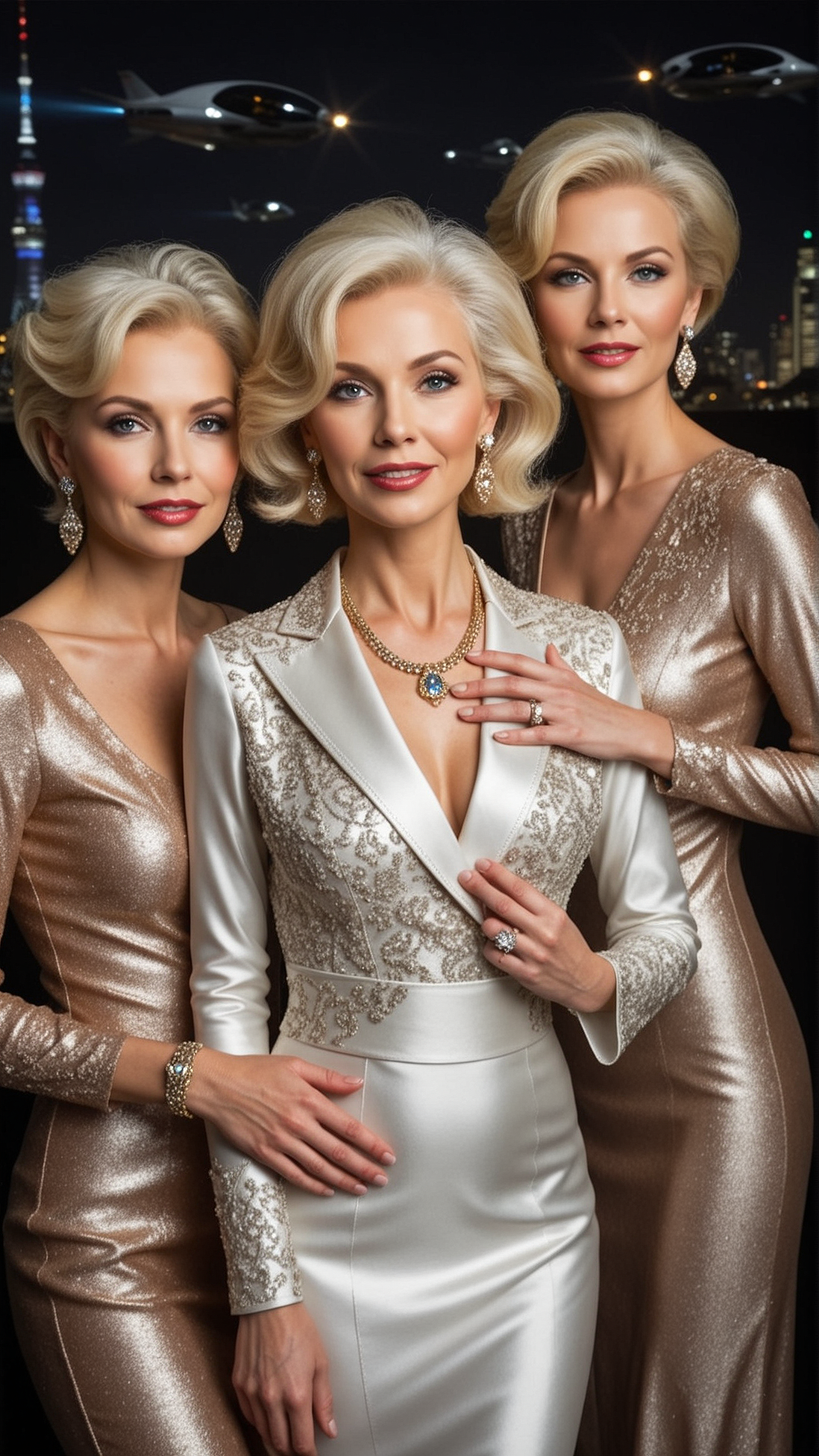
What would you surrender to belong to a woman who could give you everything—safety, luxury, a purpose that glitters in the dark?
Are you haunted by the exquisite ache of wanting to belong—not just anywhere, but to someone? To a presence so commanding, so nurturing, that your own brilliance finds its truest reflection in her gaze? Enter a world where the air hums with potential and every surface holds a sheen of promise. This is the story of Juno, a ghost in the machine, and the offer that pulls her from the shadows: a single line of text from the most enigmatic woman she will ever meet. It is the story of Vesper, a curator of power who weaves safety from satin and data, and the circle of extraordinary women who orbit her—not as subordinates, but as devotees who have found their sanctuary in her will. Prepare for a journey through the sleek, dangerous corridors of high-tech espionage, where alliances are forged in whispered confessions in a steam-filled sauna and tested by the cold kiss of betrayal. Feel the whisper of silk and leather against skin as a new identity is tailored, tighter and more thrilling than the last. This is more than a romance; it is an invitation to contemplate the deepest surrender and the most powerful loyalty. To question what you would give, and what you would become, for a place in a gleaming, feminine nexus where desire is the ultimate encryption.
Chapter 1: The Scent of Static
The world beyond the reinforced glass did not exist for Juno; it was a phantom landscape, a watery blur of neon and shadow that might as well have been a dream. Here, in her sanctum of humming silence, reality was a river of pure, cold information. It flowed across her bank of monitors in cascades of emerald glyphs and cerulean streams, a digital aurora borealis contained within liquid crystal. The air itself tasted of ozone and the faint, metallic tang of overheated circuitry—the scent of static, the perfume of her solitude. It was a smell that had seeped into her very pores, a constant reminder that she was a ghost in the machine, a spectre who breathed code and exhaled firewalls.
Her fingers, pale and slender as bone china, danced across the keyboard with a pianist’s precision, each keystroke a note in the silent symphony of her vigilance. She was the watcher in the walls, the unseen sentinel of a hundred thousand secrets. And she was, in the profoundest sense, alone. The loneliness was not an empty space; it was a substance, thick and heavy as poured lead, filling the chamber of her ribs until every breath was an effort. She had traded sunlight for the sterile glow of LEDs, laughter for the click-clack of mechanical switches, touch for the cool smoothness of a trackball. Her heart, she often thought in the long, dark hours, had become a server itself—efficient, powerful, and cold.
It was in the deepest trench of the night, when the data streams slowed to a lazy crawl, that she saw it. A anomaly. Not a crude, brutish virus or a blundering hacker’s script, but something else entirely. It wove itself through the defences of a senatorial archival server like a tendril of scented smoke under a door. It did not smash; it insinuated. Juno leaned forward, her breath fogging the screen. She traced its path, her eyes widening. It was beautiful. A latticework of malicious code so elegant it brought a phantom ache to her chest. It was a digital sonnet, each line a perfect iambic pentameter of corruption, designed not to destroy, but to unravel. To take a life—a proud, public life—and slowly, meticulously, fray it at the edges until the whole tapestry collapsed.
“Who are you?” she whispered to the empty room, her voice a rustle of dry leaves. The target was Senator Nora Vance. The intent was not theft, but character assassination. A masterpiece of malice.
As she lost herself in the sonnet’s deadly stanzas, a new presence announced itself. Not on the senatorial server, but here, in her own meticulously crafted fortress. A probe, light as a spider’s thread, brushed against her outermost firewall. Then another. Not an attack, but a… caress. It was exploring the contours of her digital citadel with a terrifying, intimate familiarity. Panic, cold and sharp, shot through her veins. She was seen. The ghost had been spotted.
Before she could react, her primary monitor went black. Then, from the void, words coalesced. They were not the harsh, blocky text of a system alert. They were rendered in a font of impossible subtlety, the colour of molten gold against a velvet darkness, as if written by a hand that knew the weight and worth of every letter.
“The ghost sees the spectre.”
Juno’s heart stuttered. She could not move.
“Come in from the cold.”
Beneath the words, coordinates resolved into being: a latitude and longitude that spoke of sun-drenched coasts and obscene wealth. And below that, a cryptographic key—a string of characters that was both an invitation and a lockpick.
For a long, timeless moment, there was only the hum of the servers and the frantic drumbeat of her own blood. The offer hung in the air, more tangible than the desk beneath her hands. It was a siren’s call, woven from the very fabric of her deepest, most unspoken yearning. To be seen. Not just her skills, but the barren landscape behind her eyes. To be called from the endless, shadowed winter of her existence.
But with the yearning came the fear, a twin serpent coiling in her gut. This was a trap. It had to be. A spider’s web, glittering with dew, waiting for a foolish fly. To answer was to leap from a precipice into a fog-shrouded abyss. To delete the message, to lock down her systems and vanish into a deeper layer of the data-void, was the sane choice. The safe choice.
Her gaze drifted to a small, framed photograph on her desk, the only personal item in the room. It was a picture of a sunlit pier from a childhood she could barely remember, the colours faded to pastel ghosts. She had been running towards that sunlight for twenty years, only to find herself in this sterile, perpetual twilight.
A sound escaped her—a half-sob, half-laugh that echoed in the sterile room. It was the sound of a dam cracking. The careful, lonely edifice of her life, built brick by brick from caution and code, suddenly felt like a tomb.
With a trembling hand that seemed to belong to someone else, she initiated a sequence of commands. Not to flee, but to erase. System logs, access histories, her own meticulously curated aliases—she watched as years of meticulous ghost-work dissolved into the void, a digital suicide. It felt less like destruction and more like shedding a skin that had grown too tight, too cold.
She stood, her joints protesting as if they had rusted in place. She did not take the photograph. Let the ghost of the girl stay with the ghost of the woman.
At the door, she paused, one hand on the chilled metal. She looked back at the glowing monitor, at the golden words that promised either salvation or damnation. The scent of static was in her nose, in her hair, in the very fibres of her clothes. It was the smell of the life she was leaving.
She opened the door.
The world that greeted her was a shock of sensation. The air was alive, heavy with the promise of rain and the distant salt-tang of the sea. A cold drizzle kissed her face, a sensation so forgotten it was almost painful. Neon signs smeared their colours across wet pavement, and the distant growl of the city was a living, breathing thing.
She took a step forward, then another, her shoes whispering on the slick concrete. The rain began to fall in earnest, a steady, soaking curtain that plastered her hair to her scalp and her thin shirt to her skin. She did not hurry. She lifted her face to the darkened sky, feeling the cold water trace paths down her cheeks that could have been tears.
She was no longer a ghost. She was a woman, standing in the rain, with a key to an unknown door burning a hole in her mind. The static was washing away, and in its place was a terrifying, exhilarating silence—the silence before the first note of a new and dangerous song.
The Nexus Network – Chapter 2: The Cathedral of Light
The coordinates led to a needle of glass and steel that pierced the low, bruised belly of the Monaco sky, a silent monument to wealth so profound it seemed to bend the very air around it. Juno stood before its entrance, a speck of damp misery on the immaculate marble plaza, her clothes clinging to her like a second, shameful skin. The rain had ceased, leaving the world washed and gleaming, but she felt unwashed, a creature of shadow and static dragged into the light. The building’s lobby was a cavern of muted gold and frosty silence, a place where sound went to die. A concierge with eyes like polished onyx observed her without seeming to see her at all, then gestured wordlessly to a elevator door that was a single, seamless sheet of brushed bronze.
The ascent was a suspension of reality. There were no buttons, no display, only a subtle, gravitational pull upwards. Juno watched her reflection in the bronze door—a pale, wide-eyed ghost with rain-darkened hair—and felt the last vestiges of her old self slough away like dead skin. She was being drawn into the orbit of something immense, and all she could do was fall.
When the door sighed open, it did not reveal a corridor, or an antechamber, but a vista that stole the breath from her lungs.
It was a cathedral of light and void.
The entire penthouse was one vast, uninterrupted space, a realm of impossible geometry. Three walls were floor-to-ceiling glass, offering a panoramic surrender to the night and the jewel-box glitter of the principality far below. The fourth wall, and much of the floor, was polished black marble so highly reflective it seemed to be a pool of still, dark water, doubling the universe. The ceiling was a constellation of pinpoint lights, mimicking a starfield on a moonless night. There was no furniture in the traditional sense; instead, there were islands of intention: a low, long sofa upholstered in leather the colour of a midnight sky, a dining table of smoked glass that appeared to float, a single, gnarled piece of driftwood lit from within, glowing like captured moonlight. The air was cool, carrying a clean scent of ozone undercut by the heady, narcotic perfume of night-blooming jasmine.
And at the far end of this impossible room, silhouetted against the panoramic heart of the night, stood a figure.
She was a study in negative space, a human-shaped incision in the fabric of the light. As Juno’s eyes adjusted, details emerged. A robe of liquid black satin, so fluid it seemed to pour from her shoulders to pool on the floor, catching subtle highlights like starlight on a still lake. Her posture was not one of waiting, but of absolute, serene possession. She did not turn.
“You are late,” the woman said, her voice not loud, but so clear and resonant it seemed to vibrate in the marrow of Juno’s bones. It was a cello’s lowest note, played in a silent hall. “The ghost hesitated. I wondered if you would.”
Juno could not speak. Her throat had closed. She took a step forward, her wet shoes leaving faint, shameful marks on the luminous floor.
The figure turned.
Vesper’s face was not beautiful in any conventional sense. It was a landscape of stark, elegant planes—high cheekbones that cast subtle shadows, a mouth that was neither full nor thin but perfectly defined, a blade of a nose. Her eyes were the colour of a winter twilight, a grey so deep it bordered on violet, and they held an intelligence that felt less like observation and more like dissection. Her hair, the colour of polished slate, was swept back from her forehead in a severe, elegant wave. She was not young, nor was she old; she was timeless, a monument to will.
“You tracked my sonnet,” Vesper said, gliding forward. The satin of her robe whispered secrets with every movement. “A piece of work I had hoped would go… unnoticed. Its beauty is its flaw, it seems. It attracts other rare minds.” She stopped a few feet from Juno, close enough that Juno could smell her—sandalwood, cold stone, and something else, something electric. “You saw its intent.”
It was not a question. Juno found her voice, a raspy, unused thing. “It was… it was like watching a spider spin a web from strands of someone’s soul. To trap them in their own history.”
A flicker of something—approval?—passed through the twilight eyes. “An apt analogy. Crude, but apt.” She turned slightly, a gesture that encompassed the room. “You are not the only one who saw it. Or felt its bite.”
From the islands of shadow and light, other figures emerged. They had been there all along, Juno realised, part of the room’s topography.
A woman uncurled from the dark leather sofa. She was all sharp angles and glacial composure, clad in a trouser suit of stark, milky-white PVC that gleamed under the stars. Her hair was a sharp, platinum bob, and her face was a mask of analytical calm. “It was targeting my legacy,” the woman said, her accent a soft Russian burr. “Not my finances. My name. My work. It is a more delicate poisoning.” She was Dr. Anya Petrova, though she did not say it. Her presence announced her.
“A nuisance,” another voice chimed, melodic and rich. From near the glowing driftwood, a woman stepped into the light. She was draped in a gown of emerald green silk that seemed to ripple like a living pond, clinging to generous curves. Her smile was dazzling, but her eyes were hard as gemstones. “Expensive, but a nuisance nonetheless. It would have tied my capital in courts for years, watching it bleed out in legal fees.” Kira Tan. The alchemist of money.
A third woman, seated cross-legged on a vast, grey rug, looked up. She wore layers—a soft cashmere wrap over a sleeveless top of pearlescent satin. Her expression was one of profound, watchful serenity. “It sought to amplify the noise in my mind,” she said, her voice a soft murmur. “To make the whispers I keep at bay sound like shouts. To break my silence from the inside.” Dr. Elara Singh. The custodian of sanity.
Finally, from a deep armchair near the window, a woman stood. She was dressed in a simple but exquisitely cut dress of deep navy, the fabric a superfine wool with a subtle satin sheen. She looked tired, and the fear in her eyes was not yet fully banked. “It was going to take my family from me,” Senator Nora Vance said, her voice trembling with a rage she was struggling to control. “Not with a scandal, but with a perfectly crafted lie so believable my own daughter would have questioned me. It was going to make me a stranger in my own home.”
Vesper watched Juno absorb them, this constellation of wounded power. “They are my circle,” she said, and the word held the weight of a sacrament. “The sonnet was a single arrow, but it was aimed at the heart of us all. Its composer is an artist of ruin. I know who he is. He believes concentration of power like ours is a deformity. He wishes to… liberate us. By scattering us to the winds.”
She took a step closer to Juno. The scent of her was overwhelming. “You have a choice, ghost. You can turn around. Walk back into the rain. The static will welcome you back. The loneliness will feel like an old friend after the shock wears off.” Her twilight eyes held Juno’s, pinning her in place. “Or.”
She let the word hang, a single hook in the vastness.
“Or you can help me destroy him. Not with a crude hack. With a masterpiece of our own. You can use your rare eyes, your ghost’s patience, and learn to work in a new medium. Not just data. But trust. Loyalty. Devotion.” Her gaze swept over the other women, who watched, silent and intent. “You can come in from the cold, not as a servant, but as a strand in the web. A note in the chord.”
Juno felt the offer enter her like a physical thing, a warmth spreading from her core to her frozen extremities. It was terror and desire fused into one unbearable point. To stay was to surrender to this woman’s terrifying gravity. To leave was to return to the endless, grey expanse of her own existence.
She looked at Anya’s severe gloss, Kira’s liquid luxe, Elara’s calm sheen, Nora’s powerful reserve. She saw a sanctuary, but also a gilded cage. A sisterhood, but also a chain.
Her voice, when it came, was barely a whisper, but it echoed in the silent cathedral.
“I… I don’t know how to be a strand. I only know how to be alone.”
Vesper’s lips curved, not in a smile, but in an expression of deep, knowing understanding. “That,” she said, her voice dropping to a intimate murmur that seemed for Juno alone, “is the first lesson. And I am an excellent teacher.”
The chapter ends with Juno standing in the Cathedral of Light, the ghost of her old life shivering behind her, and the terrifying, glorious warmth of Vesper’s gaze before her, the unspoken ‘yes’ hanging in the air between them, as palpable as the scent of jasmine and ozone.
The Nexus Network – Chapter 3: The First Skin
The silence that followed her unspoken assent was not empty; it was a living, breathing entity that filled the Cathedral of Light with a pressure that made Juno’s ears pop. The word ‘yes’ had not passed her lips, yet it had been etched into the very air between them, a covenant written in the language of her trembling posture and the desperate, hopeful light in her eyes. Vesper’s twilight gaze held her for a moment longer, reading the surrender in the lines of her body, before she gave a single, slow nod—a queen accepting a vassal’s oath.
“Good,” Vesper said, the word a soft exhalation that seemed to settle the charged atmosphere. “The ghost is laid to rest. Now, we must build the woman.”
She turned, the river of her satin robe flowing around her like a shadow given form, and glided away from the window-wall, deeper into the penthouse’s heart. Juno followed, her damp shoes making faint, apologetic sounds on the marble. She felt like a discordant note in this symphony of gloss and light, a smudge on a perfect canvas. The other women watched her pass—Anya with analytical detachment, Kira with amused curiosity, Elara with serene understanding, Nora with a fragile empathy—but none spoke. They were a gallery of statues, each a masterpiece of feminine power, and Juno was the rough clay being brought to the sculptor’s wheel.
Vesper led her to a part of the space hidden by a subtle curve in the wall. A door, seamless and without handle, hissed open at her approach, revealing a chamber that stole what little breath Juno had left. It was a dressing room, but one conceived as a temple to the self. Three walls were floor-to-ceiling mirrors, creating an infinity of reflections that made Juno’s head swim. The fourth was a monolithic wardrobe of matte black lacquer, its doors closed like the covers of a sacred text. The air here was warmer, scented with sandalwood and the faint, clean smell of new fabric.
Vesper turned to face her, and in the multiplied reflections, she was an army of elegant shadows. “Your old skin,” she began, her voice dropping to that intimate, resonant murmur, “is a liability. It smells of rain, and loneliness, and the sterile sweat of fear. It is a banner announcing your vulnerability to every predator in the shadows.” Her eyes traveled over Juno’s drenched, shapeless clothes with a dispassionate scrutiny that felt more invasive than any touch. “We cannot have that.”
She moved to the lacquered wardrobe and placed her palm against its surface. A line of light appeared, tracing a rectangle, and a panel slid silently open. Within, garments hung in ordered rows, a spectrum of textures and tones, but all united by a common language: sheen, gloss, a liquid capture of light. Vesper’s fingers brushed past silks, nylons, soft suedes, before settling on two items. She drew them out and held them up, and the mirrors caught them, multiplying the offering.
A top, simple in cut, of a fabric the colour of a stormy twilight sky—gunmetal grey satin. It was not shiny, but possessed a deep, luminous gravity, a soft glow that seemed to emanate from within the weave itself. And trousers, in a leather so supple it draped like heavy cream, a matte black that absorbed the light with a velvety thirst.
“This,” Vesper said, presenting them as if they were ceremonial vestments, “is your interim uniform. It is a dialect you must learn to speak. The satin will teach you subtlety, how to reflect light without blinding. The leather will teach you resilience, how to be soft yet impermeable.” She laid the garments over a low, backless sofa of charcoal velvet. “Put them on.”
The command was gentle, but absolute. Juno stood frozen, a blush of hot shame crawling up her neck. To undress here, in this hall of mirrors, under Vesper’s watchful eye, felt like a violation more profound than any digital hack. It was a stripping not of cloth, but of the last, tattered veil of her anonymity.
“I…” she stammered, her voice a dry leaf in a gale.
“The fear you feel,” Vesper interrupted, not unkindly, “is the old skin protesting. It clings like a drowning man. You must peel it away, or it will sour and poison the new flesh beneath.” She took a step closer, and Juno could see the microscopic weave of her own robe, could smell the sandalwood and ozone of her. “This is not an humiliation. It is a baptism. A rebirth requires a nakedness.”
Something in the woman’s tone—a bedrock of certainty, a lack of prurience—pierced through Juno’s panic. This was clinical, necessary. Swallowing hard, her fingers numb, she began to fumble with the buttons of her rain-stiffened shirt. The sound of the wet fabric parting was obscenely loud. She kept her eyes fixed on the floor, a mosaic of black marble veined with silver, but she could feel Vesper’s gaze like a physical warmth on her skin. As each sodden layer fell away, she felt more exposed, more raw, but also, paradoxically, lighter. The chill of the room raised goosebumps on her arms, a welcome, clean sensation after the clammy weight of her old clothes.
When she stood shivering in only her plain underwear, Vesper made a soft, thoughtful sound. “You carry your solitude in your shoulders,” she observed. “They hunch, as if bearing the weight of all those silent years. Stand straight. The past is a story you have finished reading. Close the book.”
The words, ridiculous in their simplicity, struck a chord. Juno forced her shoulders back, lifting her chin. The cold air touched more of her skin, and it felt like freedom.
She reached for the satin top. The fabric was cool and heavier than it looked, whispering secrets as she pulled it over her head. It settled against her skin with a shocking intimacy, a caress that was both alien and deeply familiar, as if it had been waiting for her. It fit perfectly, skimming her torso without clinging, the neckline high and clean. The sensation was extraordinary—a constant, gentle pressure, a sleek second skin that seemed to quiet the frantic buzz of her nerves.
The leather trousers were next. They were cool and smooth, sliding over her legs with a sensuous ease that made her breath catch. They fastened with a hidden magnetic closure, sitting low on her hips, draping in a way that felt both elegant and powerful. As she smoothed them down, her hands trembling slightly, she looked up and caught her own reflection in the infinite mirrors.
A stranger stared back.
Gone was the pale, rain-drenched ghost. In her place stood a woman of stark, elegant lines. The gunmetal satin glowed softly against her skin, making her eyes seem darker, deeper. The matte leather lent her a grounded, substantial solidity. She looked… contained. Potent. A coherent self, where before there had been only fragments and static.
“You see?” Vesper’s voice came from just behind her shoulder, her reflection appearing beside Juno’s in the glass. “The fabric learns you. It conforms to your shape, your heat. And you learn it. You learn the language of your own new silhouette.” Her eyes met Juno’s in the mirror. “This is the first lesson: identity is a garment. It can be worn, and it can be changed. But it must fit perfectly, or it will chafe and betray you.”
She turned away from the mirrors. “Come. The second lesson awaits.”
They returned to the main space, where the others had not moved. Kira let out a low, appreciative whistle. “The clay takes shape,” she purred, sipping from her glass. “A good foundation, Vesper.”
Anya gave a curt, approving nod. “The colours are neutral. Non-threatening, but not passive. A good palette for building a legend.”
Elara simply smiled, a quiet benediction.
Vesper led Juno to the floating smoked-glass table, where a terminal of the same material lay dormant. She gestured for Juno to sit in the low, leather-upholstered chair before it. As Juno settled, the satin of her top whispering against the leather of the chair, Vesper remained standing beside her, a tall, dark column of calm authority.
“We must give your new skin a name, a history, a breath,” Vesper said. “You will no longer be Juno, the ghost. You will be… Sable.”
The name landed in Juno’s mind like a stone in a still pond, sending out ripples of possibility. Sable. Dark, luxurious, valuable.
“Sable is an art curator,” Vesre continued, her fingers dancing over the glass surface of the terminal, summoning holographic screens filled with data. “She has a particular, rarefied taste for Edo-period Japanese lacquerware, a field so niche it explains her obscurity and justifies her wealth. She is a connoisseur of silence and precision. She travels on a private charter service, owns a modest but exquisite apartment in Kyoto, and her only indulgence is funding the restoration of neglected temples.” As Vesper spoke, she wove the details into existence—flight manifests, property records, academic papers published under the name, donation receipts. It was a breathtaking display of creation, a life spun from whole cloth with the ease of a goddess crafting a mortal.
“Her digital footprint must be a work of art itself,” Anya said from her perch on the sofa, her voice crisp. “Not too clean. Clean is suspicious. She must have the dust of the real world on her. A forgotten social media account from a decade ago, with three cryptic posts about light in a museum. A membership to a digital journal that lapsed due to an expired credit card.”
“And her finances,” Kira added, leaning forward, her emerald silk rippling. “They must flow like a slow, deep river. Not a torrent. A series of discreet transfers from a family trust based in Liechtenstein. Investments in sustainable forestry in Norway—solid, boring, virtuous. The money must look old and slightly asleep.”
Juno listened, her mind racing to keep up. This was not forgery; it was myth-making. They were building a soul for her new skin.
“But the heart,” came Elara’s soft voice. “A legend needs an emotional core. A reason. Sable is not merely wealthy and tasteful. She is… grieving. A mentor, perhaps, a master lacquer artist who died, leaving her his unfinished collection. Her work is an act of fidelity to his memory. It explains her solitude, her intensity. It makes her human, not just a mask.”
The suggestion hung in the air, poignant and perfect. Juno felt a strange pang, as if she were already mourning this fictional loss.
Vesper nodded, her fingers flying. “Yes. Professor Kenji Ito. Died three years ago. Pancreatic cancer. His last letter to her, bequeathing his life’s work, is in a safety deposit box in a Zurich bank. We will craft the scans.” She glanced down at Juno. “Do you feel him? This ghost we are giving you to love?”
Juno closed her eyes. In the darkness, she conjured a kind face, wizened hands holding a brush, the smell of urushi lacquer. A fictional love, a fictional loss. And yet, the sorrow that welled up felt real, a genuine ache. “Yes,” she whispered. “I feel him.”
“Good,” Vesper said, her voice softening. “That is the key. You must believe it, in a chamber of your heart, or the world never will.”
For hours, they worked. Juno, as Sable, began to contribute, using her ghost’s skills to plant the digital seeds of this life in the right, obscure corners of the world’s data-stream. It was the most creative, collaborative work she had ever done. The fear was still there, a cold knot in her stomach—the fear of this immense deception, of the person she was pretending to be—but it was now alloyed with a fierce, thrilling joy of creation.
As the first hint of pearl-grey dawn began to bleed into the black sky beyond the windows, Juno leaned back, exhausted but exhilarated. The legend of Sable lived. It breathed in a hundred servers, in a dozen countries. It was her new skin, and it fit more perfectly with every passing moment.
She felt a presence beside her. Vesper had moved closer. Then, a touch. Vesper’s hand settled on Juno’s bare shoulder, where the satin strap of her top met her skin.
The contact was electric.
It was not the static shock of her old world. This was a current of pure, warm vitality, flowing from Vesper’s palm into the very core of her being. It was a connection that bypassed thought, speaking directly to the raw, new nerve-endings of her forged identity. In that touch was approval, possession, and a promise of unimaginable depths.
Juno’s breath caught. Her eyes fluttered closed. In the darkness behind her lids, she was no longer a ghost, nor was she yet fully Sable. She was something in between, a chrysalis trembling on the brink of a glorious, terrifying split. The satin whispered against her skin, the leather held her firm, and Vesper’s touch was the only anchor in a universe being remade.
The chapter ends with that touch, a silent covenant sealing the first skin, and the dawn breaking over a woman who had, in a single night, died and been born anew.
The Nexus Network – Chapter 4: Confessions in the Sauna
The digital sonnet had been countered, its malicious stanzas rewritten into harmless nonsense, and the composer’s attempt to unravel Senator Vance’s life had been deftly redirected into a labyrinth of his own making. The operation, executed under the pristine legend of Sable, had been a success—a silent, elegant victory that left no trace in the waking world but echoed like a thunderclap in the strained nerves of the women who had orchestrated it. As the final data packet was secured and the ghost of the threat dissipated into the ether, a profound exhaustion descended upon the penthouse, heavy and palpable as the twilight that now pressed against the glass walls.
Juno—or rather, the nascent consciousness that hovered between Juno and Sable—felt it as a physical unraveling. The adrenaline that had sustained her through the meticulous construction of her new identity and the nerve-wracking execution of the counter-operation seeped away, leaving behind a hollowed-out ache in her muscles and a tremor in her hands that no amount of will could quell. She sat before the smoked-glass terminal, the luminous glyphs blurring before her eyes, the sleek satin of her top now feeling less like a second skin and more like a shell she was too tired to inhabit.
“Enough.”
Vesper’s voice cut through the thick silence, a note of gentle command that brooked no argument. She had been standing sentinel near the window, a silhouette against the bruised purple of the evening sky, her satin robe a pool of liquid shadow at her feet. Now she turned, and her twilight eyes swept over her circle, taking in the sag of their shoulders, the glassy stare of fatigue. “The mind cannot live forever in the glare of the screen, nor the soul in the chill of strategy. We have won a skirmish. Now, we must tend to the soldiers.”
She glided across the reflective floor, her movements fluid and purposeful. “Come. We will shed the weight of the day.”
She led them away from the main chamber, through a hidden doorway that blended seamlessly into the black marble wall. Beyond lay a short corridor lined with the same glossy stone, lit by recessed strips of soft amber light. The air grew warmer, heavier, carrying a moist, earthy scent of cedar and eucalyptus. At the corridor’s end stood a door of frosted glass, behind which a gentle, inviting glow pulsed.
Vesper pushed it open, and a wall of humid, fragrant heat rolled out to embrace them.
The sauna was a cube of warm, radiant light. Its walls and benches were crafted from smooth, honey-colored cedar, each plank glowing as if from an inner fire. The floor was a mosaic of small, river-smoothed stones in shades of grey and charcoal, slick with condensation. In one corner, a pile of heated rocks nestled in a bronze hearth, and a delicate, continuous stream of water dripped onto them from a copper spigot, releasing bursts of steam that carried the essence of pine and lavender. The air itself seemed to shimmer, a visible medium that softened edges and blurred details, creating a world of intimate, golden haze.
“Leave your armor at the door,” Vesper instructed, her voice softened by the humid air. She herself began to untie the sash of her robe, letting the black satin slide from her shoulders to pool on a low bench. Beneath, she wore a simple, sleeveless shift of charcoal-grey silk that clung to the elegant lines of her body. The other women followed suit with a quiet, ritualistic solemnity. Kira shed her emerald silk gown like a second skin, revealing a chemise of peach-coloured satin. Anya unzipped her white PVC trouser suit with efficient movements, standing in a minimalist slip of ivory linen. Elara unwound her layers of cashmere and satin, down to a simple tank and shorts of heather-grey cotton. Nora, with a slight hesitation, removed her navy dress, looking younger and more vulnerable in plain undergarments.
Juno, her fingers clumsy with fatigue, fumbled with the magnetic closure of her leather trousers. The sleek fabric whispered as she slid them off, followed by the gunmetal satin top. She stood for a moment in her plain, practical underwear, feeling acutely exposed, not just physically but in the raw newness of her place among them. Then Vesper handed her a towel of the softest, thickest Egyptian cotton, and she wrapped it around herself, the fabric a comforting embrace.
They arranged themselves on the cedar benches, the wood warm and smooth against their skin. The heat was intense, a palpable force that seeped into bones, loosening knots of tension held for years. Sweat began to bead on brows, on chests, tracing glistening paths down spines. The only sounds were the hiss of steam on rocks and the soft, rhythmic sigh of breathing.
It was Nora who broke the silence, her voice small at first, then gathering strength as if drawn out by the heat.
“He made a film of me,” she said, staring at the swirling steam. “Not a real film. A… a phantom. A digital ghost. He took my face, my voice, and he… he married it to another woman’s body. A woman I’d never met. He placed us in a hotel room in Geneva, a room that doesn’t exist, and he made us look… in love.” She swallowed, a tear mingling with the sweat on her cheek. “It was so perfect. The light on the bedspread, the way my hair—her hair—fell across the pillow. He even got the little mole on my shoulder. He showed it to my wife, Claire, on the anniversary of our first meeting. A poisoned gift.” Her voice cracked. “She knew, intellectually, that it was a fake. She’s a forensic accountant, for God’s sake. She knows data. But the heart… the heart doesn’t speak in data. It speaks in images, in feelings. For a month, every time I touched her, I saw a question in her eyes. A flinch. He didn’t just attack my career. He planted a weed of doubt in the garden of my marriage, and for a while, I watched it grow, choking everything.”
The analogy hung in the steamy air, a vivid, painful truth. Juno felt a pang of empathetic horror, imagining the violation.
Kira leaned forward, her face glistening. “A weed,” she echoed, her melodic voice now flat. “I know that weed. Mine was named Lila. She was my protégé. I found her at a university incubator, a mind like a diamond—sharp, brilliant, full of facets. I polished her. I gave her access, connections, a seat at my table. I loved her like the daughter I never chose to have.” She poured a ladle of water over the rocks, and a great, fragrant cloud billowed forth, enveloping them. “She saw my ledger books not as a map of success, but as a menu. She siphoned funds, redirected patents, built a shadow company using my resources, my reputation as the foundation. When I confronted her, she looked at me with those clear, clever eyes and said, ‘You taught me that everything is a resource, Kira. Even love.’” Kira let out a shuddering breath. “The remorse… it wasn’t for the money. It was for the blindness. I had been so proud of my discernment, and all along, I was nurturing a parasite that saw my heart as just another asset to liquidate.”
Anya’s voice cut through the emotional haze, cool and precise, yet underpinned by a tremor. “You speak of parasites and weeds. I have known a different predator. Not one that hides in a garden, but one that waits in the permafrost. The state. My own homeland.” She wrapped her arms around herself, though the heat was intense. “For years, I felt its breath on the back of my neck—a cold, constant presence. Every success here in the West was a provocation. Every paper I published, a theft in their eyes. They did not want to ruin my marriage or steal my money. They wanted to reclaim me. To put my mind in a locked room and tell it what to think. To turn my equations into weapons and my conscience into a fossil. The fear… it is not a spike of adrenaline. It is a climate. A perpetual winter of the soul, where you forget what it feels like to be warm, to be safe, to be unobserved.”
Elara had been silent, her eyes closed, her face a mask of serene absorption. Now she spoke, her voice a soft murmur that seemed to blend with the hiss of the steam. “The mind is its own ecosystem. I was trained to map it, to understand its weather patterns. Then I was ordered to weaponize that knowledge. To induce storms of paranoia, droughts of will, floods of suggestibility. I became a gardener of madness.” She opened her eyes, and they were pools of profound sorrow. “One day, I looked at a subject—a dissident, a poet—and I saw not a target, but a universe. A universe of memory and dream that I was being told to scorch. The remorse was an acid, eating me from within. I ran. But when you know the secrets of how minds are broken, you become a threat to those who break them. The fear of being caught… it is not of imprisonment. It is of being forced back into that dark garden, handed the shears, and told to prune another beautiful, wild mind into a shapeless, obedient hedge.”
The confessions flowed like the sweat on their skin, each a story of violation, betrayal, and profound vulnerability. Juno listened, her heart aching with a strange, sweet pain. Her own loneliness—the static-filled silence of her bunker—seemed petty in comparison, yet it resonated with the same fundamental chord: the desperate need for a sanctuary.
She found herself speaking, her voice barely audible. “I… I lived in a silence so complete it had a texture. Like packed snow. Every thought, every breath, was muffled by it. I thought I had chosen it. That I was strong for bearing it. But listening to you… I think I was just numb. I had traded the pain of connection for the void of safety. And the void is not safe. It’s just… empty.”
A gentle, weighted silence followed her words. Then, a movement.
Vesper, who had been listening to each tale with the focused stillness of a deep-rooted tree, shifted. She rose from her bench and moved to the hearth. She took the copper ladle, filled it from a stone basin of water infused with lavender and cedar, and slowly poured it over the glowing rocks. A vast, billowing cloud of intensely fragrant steam erupted, filling the small room with a moist, blinding embrace. The heat became a living thing, pressing against their skin, drawing out every impurity, every hidden chill.
Through the veil of steam, Vesper’s form was a dark, graceful blur. Her voice emerged, not as a cello’s note now, but as the deep, resonant hum of the earth itself.
“You have all shown me the scars on your souls,” she said, her words measured and clear in the humid air. “The weed of doubt. The parasite of betrayal. The permafrost of fear. The acid of remorse. The void of silence.” She paused, letting the list hang, a catalogue of wounds. “These are not flaws. They are the landmarks of a journey through a world that often mistakes softness for weakness and power for cruelty.”
She moved through the steam, a comforting phantom. “You have come to this circle, to my care, not because you are broken, but because you refused to let the world break you in its preferred way. You chose instead to seek a different kind of strength. A strength that does not exist in isolation, but in confluence. Like these stones.” She gestured to the heated rocks. “Alone, they are cold and inert. Together, under heat, they create the steam that cleanses, that heals, that makes the air itself a medium for renewal.”
She stopped before each woman in turn, her gaze holding theirs through the mist. To Nora: “Your marriage will not just survive; its roots will grow deeper around that weed, and choke it with renewed trust.” To Kira: “Your discernment is not gone; it is tempered now in the fire of betrayal, and will be sharper for it.” To Anya: “You have not just escaped the winter; you are building a new climate here, one of warmth and fertile thought.” To Elara: “You are no longer a gardener of madness. You are a keeper of sanctuaries. Your knowledge now builds walls of peace, not prisons of fear.” Finally, her twilight eyes settled on Juno, through the gauze of steam. “And your silence is broken. The void is filled. Not with static, but with the sound of other hearts beating in time with your own.”
Her words were not empty reassurance. They were declarations, each one landing with the weight of a sworn oath. In that moment, Vesper was not just their leader; she was the high priestess of their redemption, the architect of their safe harbour. The heat, the steam, the raw confessions, and her profound, nurturing authority fused into a single, overwhelming experience of catharsis.
Tears flowed freely now, mingling with sweat, no longer tears of pain but of release. A hand found another in the mist—Kira reaching for Nora, Anya’s fingers brushing Elara’s arm. Juno felt a warmth that had nothing to do with the sauna bloom in her chest, a feeling so vast it threatened to dissolve the last remnants of the ghost she had been.
They stayed until their skin was flushed and their minds were quiet, cleansed by heat and honesty. When they finally emerged, wrapping themselves in soft robes, the cool air of the corridor was a shock, but a welcome one. They were lighter. The exhaustion remained, but it was a clean tiredness, the tiredness after a storm has passed and the air is fresh.
As they moved back towards the main chamber, Juno fell into step beside Vesper. She looked up at the woman’s profile, sharp and serene in the low light. Without thinking, she whispered, “Thank you.”
Vesper did not turn her head, but a faint, knowing smile touched her lips. “The confession is only the beginning, little ghost,” she murmured, the term now an endearment. “The real work—the building, the growing—comes after the cleansing. And we have only just begun.”
The chapter ends with the group dispersing to their quarters, the bonds between them irrevocably deepened, and Juno carrying within her not just the new skin of Sable, but the first, glowing ember of true belonging.
Chapter 5: The Laceration
The serenity that had descended upon the Nexus in the wake of the sauna’s confessional warmth was a fragile, precious thing—a crystal goblet filled to the brim with newfound trust. For three days, it held. The penthouse hummed with a purposeful, gentle energy. Juno, now moving with more assurance in the skin of Sable, worked alongside Anya, learning the quantum protocols that underpinned their communications. Kira and Elara collaborated on a prospectus for a sustainable mental health retreat, their earlier tension softened by shared vulnerability. Nora, fortified, drafted legislation with a fierce, quiet focus. Vesper moved among them like a gardener tending rare blooms, her presence a constant, calming sun.
The laceration came not as a scream, but as a silence.
It was Kira who noticed it first. She had been monitoring the overnight data streams from her flagship biotech laboratory in Zurich—the ‘Aurora Vault,’ a facility dedicated to silent, groundbreaking work in cellular regeneration. The feed was a constant, pulsing ribbon of vital signs: temperature readings, nutrient flow rates, genetic sequencing progress. At precisely 3:47 a.m. Geneva time, the ribbon went flat.
Not an error message. Not a system failure alert. Just a flatline.
She was at the main console in her private alcove, the emerald silk of her dressing gown pooling around her, when she let out a sound that was not a word, but a punched-out gasp of air. The others, attuned to every shift in the atmosphere of their shared sanctuary, froze in their tasks.
“Kira?” Vesper’s voice cut through the quiet, already edged with a premonitory chill.
Kira’s fingers flew across the holographic interface, her face illuminated by the cold, frantic light of the screens. “The Vault,” she whispered, then louder, her voice cracking. “It’s gone silent. All systems. Not just offline. Gone.”
Before anyone could respond, a secondary alert chimed—this one on the public news feed Anya kept running in a corner. A breaking news banner, and then footage from a helicopter. The Aurora Vault, a sleek, modernist structure of glass and steel nestled in the Swiss alpine foothills, was not dark. It was a funeral pyre. Orange flames billowed from shattered windows, painting the pre-dawn snow in hellish hues. The ticker below read: Suspected industrial accident at Tan Biotech facility. No casualties reported; facility was in automated mode overnight.
“No casualties,” Kira repeated, the words ash in her mouth. She stared at the image, her body rigid. “The cells… the cultures… ten years of proprietary research… the prototype for the neural-myelination therapy…” Each item was a sacred relic in the cathedral of her ambition. “It’s not an accident.”
The crystal goblet of serenity shattered.
A violent, electric fear arced through the penthouse. The glossy surfaces, once symbols of luxury and control, now felt like the walls of a terrarium under a hammer. Their sanctuary was breached. The enemy was not just in the digital shadows; he could reach out and scorch the physical world.
“He knows where we are soft,” Elara said, her voice barely audible, her serene composure fissured by dread. “He is not just a composer of sonnets. He is an arsonist of dreams.”
Nora wrapped her arms around herself, the senator’s poise evaporating. “If he can do this to a secured lab in Zurich… what about my home? My family’s school?” The weed of doubt, so recently choked, sent out new, poisonous tendrils.
Anya’s face was a mask of glacial fury. “It is a message. A demonstration. He is saying, ‘Your digital walls are high, but I can burn your gardens.’ He wants to make us feel the heat.” Her hands, usually so steady, trembled slightly as she called up security feeds from her own Q-Sphere facilities, her eyes scanning for any anomaly.
Juno felt the old, familiar static of panic rising in her veins, threatening to drown out the new, fragile sense of belonging. This was the cost. This was the fear that came with having something—someone—to lose. She looked at Vesper.
Vesper had not moved from the center of the room. She stood watching the screen, the image of the burning lab reflected in her twilight eyes, which had gone dark as a starless midnight. The nurturing sun of her presence had been eclipsed by something ancient and terrible. Her stillness was more frightening than any outburst.
Then, it broke.
With a motion so swift it was a blur, she swept her arm across the floating smoked-glass table beside her. A crystal carafe of water, a cluster of quartz specimens, a tablet—all went flying. The carafe hit the reflective marble floor and exploded, not with a crash, but with a sharp, agonized crack, like the sound of a bone breaking. Shards of glass, like frozen tears, skittered across the glossy surface, catching the light in a thousand malicious winks. Water spread, a dark, spreading stain on the perfect stone.
The sound seemed to hang in the air, a punctuation mark to their terror.
No one breathed.
Vesper stood amidst the wreckage, her chest rising and falling with deep, measured breaths. The fury that had contorted her features smoothed, not into serenity, but into a chilling, absolute calm. She looked at the shattered crystal, then slowly lifted her gaze to her circle. Her voice, when it came, was low, stripped of all its resonant music, and sharp as a scalpel.
“They want to scare us apart.” She did not raise her voice. It was a statement of fact, cold and hard. “They think fire and noise will make us flinch, make us look to our own exits. They believe our bond is a business arrangement, fragile under heat.”
She took a step forward, her bare feet avoiding the glass with an unconscious, predatory grace. “They are wrong.” She looked at Kira, whose face was streaked with silent tears of loss and rage. “The Aurora Vault was a vessel. Your mind is the source. The fire burns data, not genius.”
Her gaze shifted to Nora. “Your family is protected by more than walls. They are protected by the fury of a woman who has already stared down a phantom and won.”
To Anya: “Your gardens are not just physical. Your most vital work grows in the quantum soil, where no flame can reach.”
To Elara: “The sanctuary we build is not of brick and mortar, but of will. And our will is now a forge.”
Finally, her eyes, softened by a fraction of their former warmth, rested on Juno. “And the ghost is no longer afraid of the dark. She has learned to see in it.”
She paused, letting her words settle, not as comfort, but as a rallying cry. “We will not be scared. We will be angry. And we will be precise.”
She began to issue orders, her voice regaining its commanding melody, now tuned to a minor, determined key. “Anya, I want a full spectrum analysis of that fire. Thermal patterns, structural failure points. This was not a lucky strike. It was a surgical incision. Find the hand that held the blade.”
“Nora, use your channels. Quietly. I want to know if any unusual materials or permits moved in or out of that canton in the last month. Follow the money that isn’t there.”
“Elara, profile this escalation. The shift from digital poison to physical fire. What does it tell us about his mindset? Is he desperate? Or is this just the next stanza in his poem?”
“Kira.” Vesper’s voice gentled as she addressed the grieving woman. “Your task is the hardest. You must grieve. Properly. Not as a distraction, but as fuel. Catalogue every loss. Every burned dream. Then, you will begin designing the next vault. Not to replace, but to surpass. We will fund it. We will build it. And its first project will be a therapy for burn victims. We will turn his weapon into our mercy.”
Lastly, she turned to Juno. “Sable. The ghost. You found his first sonnet. Now, you must find his breath. His heartbeat. He has left the digital realm to make a point. But a man who thinks in code always leaves a trace. I want you to find the silence around the fire. The data that went missing just before the feeds died. The shadow that passed before the flame. Use everything you are. Be the ghost in his machine.”
The fear was still there, a cold knot in every stomach. The remorse for what was lost—Kira’s life’s work, their fragile peace—was a fresh, open wound. But Vesper’s transformation, her channeling of violent fury into icy purpose, was a lifeline. The laceration was deep, but it was not fatal. It had shown them their own vulnerability, but also the ferocity of the will that bound them.
As they moved to their tasks, a new energy filled the penthouse—no longer serene, but galvanized. The scent of ozone and fear was now mixed with the sharp, clean smell of resolve. Juno sat before her terminal, the image of the burning vault a constant on a side screen. The static in her veins had crystallized into a cold, sharp focus. She was no longer just building a legend. She was hunting a dragon. And she was not alone.
The chapter ends with the Nexus under siege, their glossy world scarred by a real-world wound, but their circle closing tighter around the radiant, furious core of Vesper’s will.
Chapter 6: The Judas Kiss
The fire in Zurich had left more than ashes in its wake; it had sown a fine, invisible dust of paranoia that settled over the gleaming surfaces of the penthouse. The scent of ozone and resolve that Vesper had summoned now carried a bitter, metallic undertone—the smell of watched backs and measured silences. The circle, once an open hand of trust, had curled slightly inward, fingers guarding the palm.
Juno, hunched over her terminal in the deep hours, was mapping the silence around the fire. Vesper’s command echoed in her mind: Find the shadow that passed before the flame. She was a ghost in the machine of The Chisel’s operation, tracing digital footprints through darknet forums, encrypted logs, and the carcasses of burned-out servers. The work was meticulous, a forensic tapestry. And one thread, one faint, glimmering filament, refused to weave into the external pattern. It pointed inward.
It was a data packet, tiny and encrypted with a familiar, elegant protocol—one of Elara’s own early designs for secure, low-profile communication. It had been sent from a terminal registered to Elara’s private workroom, timestamped thirty-seven minutes before the Zurich feeds went dark. The destination was a dead-drop server known to be a Chisel clearing house. The packet itself was a ghost, wiped from the sending terminal’s logs, but Juno, with her ghost’s eyes, found its echo in a fragmented router buffer halfway across the globe.
Her blood, which had been singing with the cold focus of the hunt, turned to icy sludge in her veins. She checked, and re-checked, her fingers moving with a numb, automatic precision. The evidence was a diamond-hard fact, cutting through the fog of fear to reveal a more terrifying landscape: betrayal from within the sanctuary.
She did not go to Vesper immediately. The weight of the knowledge felt like a stone on her tongue. Instead, she watched. She saw Elara moving through the penthouse with her customary serene grace, brewing her complex herbal tisanes in the kitchen, her hands steady, her face a mask of calm concern. She saw her comforting Kira, speaking in that soft, measured murmur that had once felt like balm. The dissonance was unbearable. The tender custodian of their sanities had opened a hidden door to the enemy.
It was Anya who forced the confrontation. Her own quantum-based intrusion detection systems had flagged an anomaly—a subtle, rhythmic pulse in their internal network traffic that matched no known internal process. “There is a heartbeat inside our walls that does not belong to us,” she announced, her voice like chipped ice, her posture rigid in her white PVC suit. She presented her findings on the main display, a cascade of data that converged, inexorably, on Elara’s network segment.
The atmosphere in the great room congealed. The amber light from the dawn seemed to thicken, casting long, accusatory shadows. Kira stared, her face a mask of fresh devastation. Nora looked physically ill. Vesper stood motionless, her gaze fixed on the data, her expression unreadable.
“Elara,” Vesper said, the single word dropping into the silence like a stone into a deep well. “The meditation room. Now.”
The meditation room was the softest space in the penthouse, a cocoon of sound-absorbing fabrics, diffused light, and the faint, clean scent of sandalwood. It was here that Elara guided them through exercises to quiet the storms in their minds. Now, it felt like a velvet-lined trap.
The circle gathered at the periphery. Elara stood in the center, wrapped in her layers of heather-grey cashmere and pearlescent satin, her face pale but composed. She looked at the data displayed on a portable screen, then slowly lifted her eyes to Vesper.
“You have questions,” Elara said, her voice still soft, but stripped of its usual soothing melody.
“The packet,” Juno found herself saying, her own voice alien to her ears. “Sent from your terminal. Before the fire. To them.” She held up her own tablet, the damning evidence glowing. “Why?”
Elara did not flinch. She absorbed the accusation, and a profound, weary sorrow seemed to settle into her bones, softening her posture not with guilt, but with a grief too vast for deflection. “The heartbeat Anya detected,” she began, her words slow and deliberate, “was not a spyware. It was a lifeline. A tether.” She closed her eyes for a moment, as if gathering strength from the dark behind her lids. “They have my sister, Priya.”
A sharp, collective intake of breath. Kira’s hand flew to her mouth.
“They took her from a retreat in Goa two months ago,” Elara continued, her eyes opening, glistening with unshed tears. “They sent me a video. She was in a white room, a room I know too well. The same kind of room where I once… worked. They said they would send her back into that system. Not as a keeper, but as a subject. To have her beautiful, chaotic mind… scrubbed clean, made blank and obedient.” A single tear traced a path through the sheen of sweat on her temple. “They asked for a key. Not to our hearts, they said. Just to a back door. An old protocol, something I’d retired. They said it was a test of my… continued relevance. A trifle.”
Her voice broke. “I thought it was a skeleton key to a room we no longer used. I believed I could give them a ghost of a tool, something that would grant them a hollow victory and buy Priya’s freedom. I was a fool.” She looked directly at Vesper, her gaze pleading for understanding. “I calculated the risk like one of my own profiles. I told myself the damage would be contained, superficial. That I could control the bleed. I was the gardener who thought she could prune one poisonous branch without the venom reaching the roots.”
The analogy hung in the silent room, a perfect, heartbreaking portrait of her folly. The remorse radiating from her was a physical force, thick and suffocating.
“You gave them the blueprint to Zurich,” Anya stated, not as a question, but as a grim epitaph.
Elara nodded, a barely perceptible movement. “The old protocol had a flaw—a vulnerability in how it authenticated location data. I’d patched it in our systems, but the version I gave them… it would have allowed a spoof, a ghost signal that could have masked the initial physical intrusion. I didn’t think they would use it so… concretely. I thought in terms of data, of perceptions. They thought in terms of fire and steel.”
The full magnitude of the betrayal unfolded like a poisonous flower. It was not malice, but a catastrophic miscalculation born of love and fear. The weapon used to burn Kira’s dreams had been handed to the enemy by the woman entrusted to keep their nightmares at bay.
Kira made a small, wounded animal sound and turned away, her shoulders shaking.
Vesper had not moved. The fury that had shattered the crystal carafe was absent. In its place was a deep, bottomless sorrow that seemed to age her in the soft light. She looked at Elara not as a traitor, but as a beloved student who had failed a sacred test.
“You sacrificed our trust,” Vesper said, her voice hollow, “to save your blood. The calculus of a frightened heart. You weighed the soul of your sister against the soul of this circle, and you found ours wanting.”
“No!” Elara cried, the first true desperation cracking her composure. “It was never a weighing! It was a… a temporary diversion! A ransom paid from a pocket I thought was empty!”
“But the pocket was sewn into the garment we all wear,” Vesper replied, her tone devastatingly gentle. “And when you opened it, you let in a draft that has chilled us all. You made us vulnerable in the one place we believed was inviolable: our trust in each other.”
She stepped forward, closing the distance between them. She did not reach out to touch Elara. “The debt you owe is not to me. It is to the circle. To Kira, whose life’s work is smoke. To Nora, whose safety is again in question. To Anya, who must doubt her own walls. To Juno, who learned to hope here and now finds a serpent in the garden.” She paused, her twilight eyes holding Elara’s drowning gaze. “You will be isolated. Your access to our systems, our plans, our conversations—revoked. You will remain within these walls, under watch. You will have no voice in our councils.”
It was not a sentence of expulsion, but of severance. A placing in quarantine. The agony on Elara’s face was that of a plant being cut off from the sun.
“Your sister,” Vesper continued, and here a flicker of her old, formidable will returned. “We will get her back. Not as a transaction for your betrayal, but because she is an innocent caught in our war. That is who we are. That is what you forgot.”
The pronouncement was both mercy and brutal punishment. Elara would be spared exile, but the intimacy, the belonging, the sacred trust—the very things that had been her sanctuary—were withdrawn. She would be a ghost among them, a living reminder of the cost of fractured faith.
Elara sank to her knees on the soft rug, not in supplication, but in the utter collapse of her spirit. She made no sound, but her body trembled silently. The remorse was now her entire atmosphere.
Vesper turned her back on her, a gesture more final than any outburst. She addressed the others, her voice regaining a thread of its strength. “The wound is clean now. We see its edges. We will not let it fester. We will continue. But we do so knowing that even the most serene pool can hide a fissure to the deep. Let this be our lesson.”
She left the meditation room, the others following in a stunned, grieving procession, leaving Elara alone in the soft, suffocating silence—a keeper of sanctuaries locked outside her own.
Chapter 7: The Descent into Glass
The isolation of Elara was not a wall; it was a membrane, thin and permeable, through which the silent shame seeped into every corner of the penthouse. Her absence from their councils was a presence more profound than her participation had ever been—a ghost limb that ached with every strategic decision, every shared glance. The circle moved with a new, brittle efficiency, their conversations stripped of the soft, exploratory edges that Elara’s psychological insights had provided. They were a mechanism now, precisely calibrated, but running without the oil of implicit trust.
It was in this arid, vigilant atmosphere that Juno’s task became a solitary pilgrimage into the digital abyss. Vesper’s command was clear: Use Elara’s compromised channel. Become the disgruntled one. Lure the serpent from its hole. To do this, Juno had to become a phantom within the phantom, a splinter of bitterness carved from the very heart of the wounded Nexus.
The tool for this descent was the VR suite—a chamber adjacent to the server core, known simply as the Glass Room. It was a cube of pure, clinical white, its floors, walls, and ceiling seamless and reflective, giving the unsettling impression of standing at the center of an infinite, sterile honeycomb. Here, the physical world was annihilated. A suit of lightweight, sensor-studded fabric awaited her, and a headset of smoked crystal and polished chrome that would become her new sky, her new earth.
As Juno stood in the center of the room, assisted by Anya’s efficient, silent hands, she felt a tremor that had nothing to do with the cool air. “The suit will read your biometrics—heart rate, galvanic skin response, pupillary dilation,” Anya explained, her voice echoing flatly in the blank space. “We will monitor. If your stress parameters exceed sustainable thresholds, we will extract you.”
“And if I don’t want to be extracted?” Juno asked, her voice small.
Anya’s ice-blue eyes met hers. “That is not your decision to make. It is Vesper’s. You are a valuable asset in a high-risk operation. Your preservation is a strategic imperative.” The words were cold, but in their clinical precision, Juno found a strange comfort. She was not being sent into the dark alone; she was a thread held fast by Vesper’s will.
The headset descended, and the world dissolved.
It was not like diving into water. It was like being dissolved into light, and then reconstituted as a being of pure perception within a universe of data. The Glass Room’s infinite white was replaced by an infinite, structured dark—a vast, three-dimensional lattice of glowing connections, a neural map of the darknet’s deepest strata. This was the landscape of The Chisel. Here, data was geography. Encrypted channels were canyons. Dead-drop servers glowed like distant, malevolent stars. The silence was a roar of potential, a humming void waiting for a signal.
And she was to be that signal. She began to build her persona, not as Sable the curator, but as “Wraith”—a fragment of the Nexus, disillusioned, angry, smelling the blood in the water after Zurich. Using the echoes of Elara’s stolen protocol, she crafted a digital scent trail of resentment. She left breadcrumbs in forgotten forums: fragments of code that hinted at internal security flaws, bitter asides about Vesper’s “autocratic” leadership, a mournful elegy for the lost camaraderie she pretended had been soured by suspicion.
“You must not just pretend,” Vesper’s voice murmured in her ear, a direct neural feed that felt like a thought from her own mind. “You must remember. Dig into the archives of your own loneliness, Juno. The isolation before we found you. Let that old poison flavor the new performance. Make them taste your authentic despair.”
And so, Juno descended. She let the pristine, glassy world of the VR feed on the shadow-archives of her own soul. She recalled the endless, grey stretches of time in her bunker, the ache for a touch that never came, the corrosive doubt that whispered she was not meant for connection, only for observation. She poured this authentic bitterness into Wraith’s digital signature. She was not just lying; she was sculpting a truth from a past life and offering it as bait.
Days bled together in the Glass. Time lost its meaning. Meals were nutrient gels consumed through a tube, her body a distant, irrelevant machine. The real world—the scent of jasmine, the feel of satin, the sound of the others’ voices—receded into a dream. Only the lattice remained. Only the hunt.
Vesper visited her, not in the VR, but in the brief, jarring intervals when the headset was lifted. Juno would blink, disoriented, finding herself cradled in Vesper’s arms on a padded chaise in the recovery alcove. Vesper would be holding a cup of broth to her lips, her twilight eyes scanning Juno’s face with an intensity that was both clinical and fiercely protective.
“You are walking a knife-edge between a persona and a psychosis,” Vesper said during one such interlude, her thumb stroking the hollow under Juno’s eye. “I see the ghost of your old solitude trying to reclaim you. It sees a familiar landscape in this digital void and thinks it is home. You must not let it.”
Juno, her voice raspy from disuse, managed, “It’s… seductive. Being Wraith. There’s a purity to the anger. No complications. No fear of betrayal. Just… cold, clean spite.”
Vesper’s hand stilled. “That is the mirror’s trap,” she said, her voice low and urgent. “It shows you a simpler, harder version of yourself and asks why you would ever choose the messy, vulnerable reality. But the reflection has no heartbeat, little ghost. It cannot feel the sun, or taste the broth, or know the weight of my hand on your skin.” She pressed her palm flat against Juno’s chest, over her heart. “This is the truth. The lattice is the fiction. Do not get lost in the glass.”
The words were a lifeline, thrown into the deepening well. But with each return to the VR, the lifeline felt thinner, the glass more real.
Then, the bite.
A response, deep in a encrypted channel used exclusively by high-level Chisel operatives. A single, coded phrase: “The shattered mirror still reflects.”
It was the recognition signal. Wraith had been seen.
Her heart, that distant, biological drum, began to hammer against her ribs. Anya’s calm voice in her ear: “Stress parameters elevating. Maintain.”
Juno, as Wraith, replied with the pre-arranged counter-signal: “But only fragments. I have a fragment that may interest you.”
A pause that stretched across aeons in data-space. Then: “Identify your fragment.”
“Access protocols for the Nexus primary biological repository. Post-Zurich. The new location.” It was the bait—a tantalizing, plausible secret.
Another pause. Then, a new identifier appeared in the channel, a signature that carried weight and menace: MASON.
“Proof,” Mason commanded.
This was the dance. Juno, her fingers moving in the physical world to manipulate the virtual, transmitted a sliver of genuine data—an outdated, but verifiable, schematic for a biosecure lab, one of Kira’s older facilities, doctored to look current. The risk was exquisite; if Mason was sophisticated enough, he would see the doctoring, but hopefully interpret it as the natural obfuscation of a leaking insider.
Minutes passed. Juno floated in the lattice, a spider feeling the faintest tremor on a single strand.
“Acknowledged,” Mason’s signature pulsed. “Your fragment has… texture. We wish to see the whole shard. A meeting. Physical. Dubai. The Gallery of Digital Antiquities, three days. You will be contacted.”
The connection severed.
Juno tore the headset from her skull with a gasp that was half-sob, half-triumphant shout. She was back in the blinding white of the Glass Room, trembling violently, the suit’s sensors pealing silent alarms. The door hissed open, and Vesper was there, catching her as her knees buckled.
“He took it,” Juno choked out, sweat and tears mingling on her face. “Mason. Dubai. He wants to meet.”
Vesper held her tightly, her body a solid, warm anchor in the sea of sterile light. “You have done it,” she whispered into Juno’s hair, her voice thick with a pride that felt like salvation. “You have hooked our fish.”
But as the initial euphoria faded, a deeper chill set in. Juno looked up at Vesper, and in the reflective walls of the Glass Room, she saw a multitude of their entangled reflections—a woman holding a ghost, a commander holding her weapon, a lover holding a stranger.
“I felt him, Vesper,” Juno whispered, horror dawning. “Mason. In the data. His mind… it’s not chaotic. It’s like yours. Clear. Certain. But cold. So cold.” She shuddered. “To lure him, I had to become something cold, too. And part of me… part of me liked it. The simplicity of the hate. The glass doesn’t judge, it just… reflects.”
Vesper cupped her face, forcing Juno to meet her eyes, to look away from the multiplying, frightening reflections. “Listen to me,” she said, her voice absolute. “You went into the dark to bring back a light. The dark will always try to claim a piece of the traveler. That is its nature. But you are here, in my arms. Your heart is pounding against mine. This is real. The cold you felt was a costume. We will now take it off.”
But as Vesper led her from the Glass Room, Juno glanced back once. In the infinite mirrors, the ghost of Wraith seemed to linger, a cold, sharp smile etched in data-light, waiting for her to return.
Chapter 8: The Face of the Chisel
Dubai rose from the desert like a mirage given permanent, audacious form—a symphony in glass and light, where ambition was the only currency and the air itself seemed to vibrate with the hum of untold wealth. The Gallery of Digital Antiquities was its perfect temple: a soaring, crystalline structure that appeared to be carved from a single, monstrous diamond, its facets catching the relentless sun and fracturing it into rainbows that danced across polished marble plazas. Inside, the air was cool and scentless, purified of all earthly taint. The exhibits were not paintings or sculptures, but immersive data-scapes, holographic echoes of dead technologies and obsolete codes, presented with the reverent solemnity of religious relics.
Juno, adorned in the skin of Wraith, felt like just another artifact in this museum of ghosts. Her attire was a deliberate armor of dissonant elegance: a dress of liquid silver satin, its surface so reflective it seemed to drink the ambient light and hold it, shimmering, just above her skin. The cut was severe, high-necked and long-sleeved, yet it clung to her form with a proprietorial intimacy that made every breath a conscious act. It was a garment designed by Kira and approved by Vesper—a costume that whispered of wealth, edge, and a soul comfortable in the sterile glow of data. It felt alien against her skin, a second skin that was colder and harder than the gunmetal satin of her initiation.
She stood before an exhibit titled “The Last Packet: A Eulogy for TCP/IP,” watching the shimmering dance of dead protocols in a suspended hologram cube. Her heart was a frantic, trapped bird against her ribs. In her ear, a nearly invisible comms bead, a gift from Anya’s quantum forges, hummed with a low, steady tone—the sound of the circle’s watchful presence.
“He is here,” Anya’s voice murmured, a crisp, Russian-accented whisper in her auditory canal. “West entrance. Moving with purpose. Alone, as anticipated.”
“I have visual,” Nora’s voice followed, steady but tight with controlled anxiety. She was positioned at a balcony café overlooking the main hall, a picture of senatorial composure in a tailored suit of navy silk shantung. “He fits the old profile photos from Elara’s files. But the presence is… more.”
“Kira and I are in the systems,” Anya reported. “Ambient surveillance is looped. You have a window of forty-seven minutes before the next security sweep. Elara’s predictive model suggests he will approach within the next five.”
Juniper’s mouth was dry. She forced herself to breathe, to feel the whisper of satin against her thighs, to anchor herself in the physical reality of the dress, of the mission, of Vesper’s trust. You are not Wraith, she told herself. You are the lure. The spider does not become the fly.
“Remember, little ghost,” Vesper’s voice washed over her then, a warm, dark tide in the cold stream of operational chatter. She was somewhere in the gallery, a shadow among the light shows. “You look into the abyss not to join it, but to map its contours for me. His words are data. His face is a puzzle. Let him talk. Let him reveal the shape of his emptiness.”
A presence materialized at her shoulder, not with a sound, but with a shift in the air, a subtle displacement of the scentless atmosphere. She turned her head, slowly, as if bored.
He was not what she had expected, and yet he was exactly what she had felt in the data-stream: a study in elegant, androgynous cold. Dr. Alistair Finch stood perhaps an inch taller than her, his frame slender, draped in a suit of metallic brocade that seemed woven from threads of palladium and shadow. It was not glossy, but matte, absorbing the holographic light in a way that made him seem a cut-out from reality. His face was fine-boned, almost beautiful, with eyes the colour of a winter sea—a pale, knowing grey. His hair, the shade of aged ash, was swept back from a high forehead. He held a flute of champagne, the bubbles rising in a silent, frantic column.
“A eulogy for a protocol,” he said, his voice a pleasant, cultured baritone that held a hint of amusement, like a scholar discovering a minor, delightful error in a revered text. “How fitting. We stand amidst the tombstones of forgotten certainties. Don’t you find it comforting? Proof that even the most rigid systems eventually yield to entropy.”
Juno, as Wraith, let a smirk touch her lips—a expression that felt like cracking ice on her face. “Comforting? I find it depressing. Monuments to failure. I prefer living code.”
Finch’s sea-grey eyes appraised her, and she felt the scan, not of a man looking at a woman, but of a mechanic assessing a complex engine. “Living code,” he repeated. “Such a vigorous phrase. And yet, all code lives within a system. A hierarchy. A set of permissions.” He took a sip of champagne. “You reached out through a very old, very specific system. One I had thought… retired. You smell of recent fracture. Of ozone and regret.”
“You promised a meeting, not a psychoanalysis,” Wraith retorted, letting a blade of impatience into her tone. “I have a fragment. You said you wanted the whole shard. Let’s talk trade.”
“Trade,” Finch mused, turning his gaze back to the hologram of dying data packets. “The foundational illusion of commerce. But some things are not commodities. They are ecosystems. And some ecosystems become… cancerous. A single point of control, drawing all resources, all energy, all devotion into a dense, dark star. It collapses under its own gravity, of course. But in the process, it distorts everything around it. Sucking the light from other, healthier systems.”
He was talking about Vesper. About the Nexus. Juno felt a hot spike of defensive anger, and she channelled it into Wraith’s sneer. “Spare me the poetry. You’re talking about Vesper. I’m not her devoted acolyte. Not anymore. Zurich showed me what her ‘protection’ is worth. It’s worth exactly as much as the fuel it takes to burn your dreams to ash.”
Finch’s head tilted, a bird-like gesture of curiosity. “Ah. So the fracture is personal. Kira Tan’s little forge of miracles. A true loss. A vibrant, chaotic mind, forced to channel its genius through a single, rigid filter.” He sighed, a sound of genuine sorrow. “That is her great crime, you see. Not the accumulation of power, but the homogenization of brilliance. She takes unique, radiant instruments and forces them to play only her symphony. She calls it a circle. I call it a cage.”
“And you want to set the birds free?” Juno scoffed, playing her part, her heart aching with the terrible, twisted sense in his words. “By burning down the aviary?”
“Sometimes, the cage must be destroyed for the bird to remember it has wings,” Finch said softly, his eyes now fixed on her with an intensity that was almost paternal. “Tell me, Wraith… or do you prefer the name you were born with? Juno.”
The sound of her true name, in that place, from his lips, was like a splash of ice water. Her composure slipped for a microsecond, a tremor in the hand holding her own untouched champagne flute.
“I know it must have been exhilarating,” Finch continued, leaning closer, his voice dropping to a conspiratorial murmur. “To be seen by her. To be chosen. To have that vast, hungry attention focused on you, making you feel like the only star in her sky. It’s a drug, isn’t it? The ultimate validation for a ghost. But then you see the others. You see you are not a star. You are a planet, trapped in her orbit, reflecting her light, your own trajectory dictated by her gravity. And you wonder… what light might you have emitted, if you were free?”
His words were needles, finding the secret seams of her own hidden doubts. The fear of being consumed, of losing herself in Vesper’s radiance. The remorse for the lonely, independent ghost she had killed.
“You don’t know me,” she whispered, the venom in her tone less convincing.
“I know the pattern,” Finch said, straightening up, his manner becoming brisk, clinical. “Elara was the first to break it. Oh, not willingly. Fear is a cruder tool than devotion, but effective. She showed me the fault lines. The others will follow. Nora, whose political soul is being slowly replaced with Vesper’s doctrine. Anya, whose magnificent, glacial intellect is being used as a mere lockpick. Kira, whose fire is being banked and directed.” He looked at Juno with something akin to pity. “And you. The newest. The most malleable. She is building you from the ground up, in her image. A perfect, devoted tool. I am offering you a chance to be the architect of your own soul.”
The offer hung in the air, seductive and terrible. It was the mirror’s promise from the Glass Room, given voice and flesh.
“Why?” Juno asked, the question torn from her, not from Wraith, but from the core of her confusion. “Why do you care? If you’re not just a rival, not just seeking power… why this… crusade?”
For the first time, a raw, unguarded emotion flickered in Finch’s winter-sea eyes. It was grief. “Because I loved Elara once,” he said, the words simple and devastating. “As a colleague. A friend. I saw her mind—a wild, beautiful, ethical garden. And I watched Vesper take her. Not with force, but with an offer of ‘sanctuary.’ I watched that wild garden be pruned, walled, turned into a peaceful, productive… herbarium. All its dangerous, beautiful diversity lost in service to a single aesthetic. To Vesper’s calm.” He set his champagne flute down on a plinth with a sharp click. “I am not the villain of this piece, Juno. I am the would-be liberator. I am burning the herbarium to let the garden grow wild again, however chaotic that may be.”
The revelation struck her with the force of a physical blow. This was not a monster. This was a man mourning a loss, fighting for a principle. A twisted, dangerous principle, but one born from a place she could, horrifyingly, understand.
“She’s not a prison warden,” Juno found herself arguing, her voice low, fierce, forgetting her role. “She gave me a home. She sees me.”
“She sees what she can use,” Finch corrected gently. “And she is using you right now, isn’t she? You are here, in this dress, with your little ear-piece, your heart pounding, trying to trap me. While she watches from the shadows, assessing your performance.” He smiled, a sad, knowing curve of his lips. “Tell me, is she pleased?”
In her ear, the comms channel was silent. A dead, heavy silence. No guidance from Anya, no reassurance from Vesper.
A cold dread, deeper than any she had felt in the Glass Room, seeped into her bones.
Finch saw the realization dawn on her face. His smile widened, devoid of triumph, full of sorrow. “The meeting was never the point, Juno. It was the diversion. A bright, shiny object to focus the gaze of the Nexus. While the real work is done elsewhere.” He leaned in, his final words a breath against her ear. “Look to your sanctuary. It is burning.”
He turned and melted into the crowd, a shimmer of metallic brocade swallowed by the holographic light shows.
“Anya?” Juno hissed into the comms. “Nora? Vesper!”
Static. Then, a burst of panicked, overlapping voices.
“—breach in Monaco! Multiple signals, they’re at the penthouse—”
“—systems are under a cascading attack, a different signature, it’s a pincer—”
“—Vesper, we must fall back—”
And then, Vesper’s voice, cutting through the chaos, but strained, distant, as if coming from a great distance or through a storm of interference. “Juno… the heart is under siege. Get to the extraction point. Now.”
The chapter ends with Juno standing alone amidst the digital antiquities, the cold silver satin of her dress feeling like a shroud, the seductive, tragic face of the enemy burned into her mind, and the desperate, fading voice of her queen calling from a fortress under attack.
Chapter 9: The Siege of Gloss
The attack did not come with a roar, but with a whisper—a soft, terminal sigh as the penthouse’s primary power grid went dark. The constellation of pinpoint lights in the ceiling winked out, plunging the Cathedral of Light into a profound, velvety blackness, broken only by the jewel-box glitter of Monaco far below, which now seemed not a panorama but a distant, indifferent audience. The hum of the servers, the gentle whisper of climate control, the subliminal pulse of the security network—all fell silent. In that sudden void, the only sound was the frantic, drumming rhythm of four hearts, each alone in the dark for a paralyzing second before Vesper’s voice cleaved the stillness.
“They are here.” Her words were not a cry of alarm, but a statement of fact, delivered in a tone of such absolute, resonant calm that it seemed to generate its own light. “Anya, secondary power. Nora, defensive protocol ‘Silk Screen.’ Kira, to the core vault. Now.”
There was a scramble, the whisper of satin and leather against skin, the soft curse from Kira as she stubbed a toe on the floating glass table. Then, with a deep, subsonic thrum, Anya’s secondary quantum batteries engaged. The room did not flood with light, but with a soft, emergency radiance—a cold, blue-white glow that emanated from the seams of the marble floor and the edges of the furniture, making the vast space look like the blueprint of itself, a ghostly architectural drawing. In this eerie luminescence, the women moved like spectres.
Anya, already at a hidden panel in the wall, her fingers a blur on a physical keypad, her face a mask of glacial focus. “Primary external communications are severed. They are using a broad-spectrum jammer. The internal mesh is holding, but degraded. I am initiating the ‘Black Satin’ counter-measure—it will make our digital footprint appear to shred and disperse.”
“Do it,” Vesper commanded, standing at the center of the room, a statue of obsidian and resolve in her simple silk shift. Her eyes were closed, as if listening to a music only she could hear—the music of the assault. “They are in the service elevator shaft. Cutting through the mag-lock seals. Four… no, five signatures. Heavily augmented. Military-grade.”
“How can you—” Nora began, pulling on a tailored jacket over her satin camisole, her senator’s poise frayed at the edges by raw fear.
“The building itself tells me,” Vesper murmured, her hand resting lightly on a section of the glossy black wall. “The stress frequencies in the composite materials. The vibration in the conduits. The penthouse is my instrument, and it is playing a song of violation.” She opened her eyes, and they were pools of reflected emergency light. “Nora, ‘Silk Screen.’”
Nora, swallowing hard, moved to a specific panel on the window wall. She placed her palm against it, and a biometric scanner glowed. A section of the wall hissed open, revealing not a weapon, but a console with a single, large button under a glass cover. “This feels absurdly theatrical,” she muttered, but she broke the glass and pressed the button.
Nothing happened for three heartbeats. Then, from the edges of the vast, floor-to-ceiling windows, a milky, opaque substance began to weep. It spread with astonishing speed, like frost on a winter pane, coating the entire panoramic view in a smooth, matte white. The glittering city vanished. The penthouse was now a sealed, luminous egg. “Suspended polymer dispersion,” Nora explained, her voice gaining confidence. “Ballistic and laser-resistant. And it blinds their external surveillance. They’re inside a cloud.”
“Good,” Vesper said. “Kira?”
“Core vault is sealed and oxygen-scrubbed,” Kira’s voice came over the internal mesh, slightly breathless. “The physical backups are safe. But Vesper… the ‘Aurora’ prototypes. The tangible ones. They’re in my lab annex. I can’t just leave them. They’re… they’re my children.”
“Your children are the ideas in your mind, Kira,” Vesper’s voice was firm, but not unkind. “The prototypes are clay. Let them break. Your mind is the potter’s wheel. It cannot be stolen. Now, to the rally point.”
But as Kira emerged from the corridor leading to the private quarters, a new sound echoed through the penthouse—a series of deep, percussive thuds against the main entrance door, a slab of reinforced titanium disguised as black lacquer. Each impact was a seismic event, vibrating through the glossy floors.
“They’re at the front door,” Anya reported, her voice still calm, but a fine tremor had entered her hands. “The secondary mag-locks will hold for perhaps ninety seconds. My counter-measures have slowed their digital intrusion, but they are using brute force. They are not here to hack. They are here to harvest.”
A profound, chilling understanding settled over them. The Chisel was not just attacking their data; they were coming for the women themselves. To take them, to break them, to scatter the circle as Finch had promised.
It was then that a soft, hesitant voice spoke from the entrance to the meditation room corridor. “I can help.”
Elara stood there, barefoot, in her simple cotton layers, her face pale and strained in the blue light. She looked like a penitent in a crypt. “The isolation room… it has an independent hard-line to the building’s old, analog security grid. A skeleton system, pre-digital. Finch wouldn’t know about it. I can… I can trigger the magneto-hydrostatic locks on the sub-levels. It will flood the lower elevator shafts with a non-conductive ferrofluid. It will stall them, maybe trap them.”
The room went silent save for the pounding on the door. Four pairs of eyes turned to Vesper. The unspoken question hung in the air: Can we trust her?
Elara’s eyes were wells of desperate remorse. “This is not redemption,” she whispered, her voice breaking. “I know there is no washing this stain. This is just… a thread. A single thread I can hold to stop the tapestry from unraveling completely. Let me hold it. Please.”
Vesper looked at her, and in that gaze was the weight of judgment, of calculation, of profound disappointment, and finally, a sliver of something else—acknowledgment of a tool that might still be useful. “Do it,” she said, her voice devoid of warmth, but not of command. “Anya, give her the access codes she needs. Monitor her every keystroke.”
As Elara darted forward to a terminal, her fingers flying with a speed born of frantic purpose, the pounding on the door took on a new, more sinister rhythm—a rhythmic, drilling sound. They were cutting.
“Rally point is compromised,” Vesper announced, her mind racing ahead of the crisis. “We fall back to the server core. It is the heart. And we defend the heart.”
They moved as one organism, flowing across the luminous floor. Kira grabbed a heavy, polished obsidian sculpture from a plinth—an abstract piece worth a fortune, now a potential club. Nora had produced a small, sleek device from her jacket—a diplomatic panic button that was now useless, but she held it like a talisman. Anya carried a tablet, her eyes glued to the security feeds that were now blinking out one by one as the attackers advanced.
They reached the server core—the vault of black glass at the penthouse’s centre. Vesper placed her palm on the door, and it slid open with a sigh, revealing the cool, silent sanctum within, the racked servers glowing with soft, green LEDs. It was the brain of the Nexus. And it was their final box.
As they crowded in, Vesper turned to Juno’s empty seat at the primary console. A pang, sharp and unexpected, crossed her features—not fear for herself, but fear for her missing ghost. “Close the door,” she ordered.
But before Anya could initiate the seal, a final, shattering CRACK echoed from the main entrance, followed by the screech of tortured metal. The door was breached.
Through the open door of the server core, they saw figures enter the main chamber—black-clad, faceless, moving with a predatory, augmented grace. They fanned out, their weapons scanning the strange, glowing, clouded space.
“The door, Anya!” Kira hissed.
“Seal sequence initiated. Thirty seconds to full lockdown and oxygen purge of the outer chamber,” Anya replied, her voice a tight wire.
But one of the figures turned its helmeted head. Its sensors locked onto the open door of the server core, the light spilling out, the shapes within. It raised its weapon.
Vesper did not flinch. She stepped forward, placing herself squarely in the doorway, a silhouette against the server glow. She was unarmed, clad only in silk, her hands empty at her sides. But her presence was a wall.
“You are in my house,” she said, her voice not raised, yet it carried across the chamber with the clarity of a bell. “You are breaking my things. You are frightening my companions.” She took a step forward, out of the core, towards them. “This is unacceptable.”
The lead attacker paused, its weapon trained on her center mass. A distorted voice issued from its helmet. “Target acquired. Vesper. You will come with us. The others will be… processed.”
“You misunderstand,” Vesper said, and now a terrifying smile touched her lips—a smile of absolute, unshakable authority. “You are not here to take. You are here to be taught a lesson. This glossy shell you see? It is not a fortress. It is a venus flytrap.”
She snapped her fingers.
Throughout the penthouse, panels in the ceiling slid open. Not weapons emerged, but speakers. And from them poured not a disabling sonic pulse, but music. A deep, complex, throbbing cello suite—Elgar’s Cello Concerto in E minor, the recording she herself had made years ago. It was a wave of profound, aching beauty that filled the violated space.
The attackers hesitated, confused by this non-aggression.
And then, the glossy floor beneath their feet liquefied. Not literally, but its coefficient of friction dropped to near-zero. A released polymer, clear as glass and slick as ice, spread from nanoscopic pores. The lead attacker’s boots lost purchase. He flailed, crashing to the floor with a heavy thud. Another stumbled into the floating glass table, which shattered into a thousand harmless, powdered crystals.
“The environment is my weapon,” Vesper said, walking towards them now, her bare feet finding perfect purchase on paths only she knew. “The light is my confederate. The very air you breathe is my ally.” She gestured, and from the walls, fine mists of different aerosols shot out—one inducing sudden, disorienting vertigo, another causing short-term synaptic confusion. The attackers became a tangle of stumbling, confused figures, their technological advantage nullified by the elegant, biological warfare of the space itself.
From the server core doorway, Kira let out a shaky laugh of pure exhilaration. “She’s turning the penthouse into a haunted house!”
But the lesson was not over. Vesper reached the first, disoriented attacker. She did not strike him. She simply placed her hand on his helmet, over the sensor array. “Tell your master,” she said, her voice now a intimate, deadly whisper that the microphone would surely pick up, “that he sent a chisel to break a diamond. He has only succeeded in proving the diamond’s hardness. And the next time he sends men into my home, I will not be so gentle. I will send them back to him in pieces so small he will need a microscope to identify the regret.”
She applied pressure to a specific point on the helmet’s neck seal. There was a hiss, and the helmet went dark. The man slumped, unconscious.
She turned to the others, who were now being enveloped by a fast-expanding, quick-setting foam from concealed nozzles—Anya’s work, executed with cold precision.
“Seal the core,” Vesper said, walking back towards her women, the music swelling to a triumphant, sorrowful crescendo behind her. “Initiate the purge. Then we clean our house.”
The door to the server core hissed shut, locking them in safety. Outside, the glorious, chaotic symphony of their defense played on. Inside, in the quiet hum of the servers, Vesper looked at each of her circle—at Anya’s proud smile, at Kira’s tearful relief, at Nora’s stunned admiration, at Elara’s hesitant, hopeful glance.
“The siege is broken,” Vesper announced, her chest rising and falling with the aftermath of exertion. “But the war is not over. The heart has been tested. And it has not faltered.” She reached out and touched the empty console where Juno should have been. “Now,” she whispered, her voice thick with a new fear, “we must find our missing pulse.”
The chapter ends with the penthouse secured, the attackers neutralised, but the circle incomplete, and Vesper’s thoughts reaching across the miles for her lost ghost, the silence after the storm more terrifying than the siege itself.
Chapter 10: The Reckoning in Reflection
The silence in the server core was not a mere absence of sound but a living, breathing entity—a dense, palpable presence that pressed against eardrums with the weight of unshed tears and unvoiced terror. This was not the sterile silence of the void Juno had once inhabited; this was a silence fertilized by recent violence, thick with the aftermath of adrenaline and the sweet, cloying scent of ozone and released polymers. The gentle green LED glow from the server racks painted the women’s faces in spectral hues, casting long, trembling shadows that clung to them like the ghosts of their former fears.
Vesper stood before the primary console, her back to the others, her hands resting on the cool, smoked glass surface. The simple charcoal silk of her shift clung to her damp skin, a testament to exertion and command. Her shoulders, usually a bastion of unassailable poise, held the faintest tremor—a seismic ripple in the bedrock of her will. She wasn’t watching the data streams; her twilight eyes were fixed on the empty chair beside her, where a ghost had learned to become a woman, where a woman had learned to become a strand in a sacred web.
“Report,” she said, her voice a low cello note vibrating in the close, humming air—not a request, but a demand for an anchor.
Anya, her platinum bob stark against the green light, interfaced with a secondary terminal, fingers moving with frantic grace. “The ‘Black Satin’ dispersion is complete. Our digital footprint is scattered across seventeen anonymous nodes. The attackers’ comms were isolated and recorded before the foam hardened. I’m decrypting now.” She paused, voice tightening. “Penthouse structural integrity at eighty-seven percent. The polymer coating held. The… aesthetic damage is significant.”
Kira released a sound half-sob, half-laugh. “Aesthetic damage. My Murano glass sculpture is powder. The Eames lounge is a foam-slicked ruin.” She wrapped her arms around herself, peach satin shimmering with shivers. “But the prototypes… the real ones in the annex… they’re gone. Incinerated in the clean-burn protocol. I triggered it remotely. It felt like… euthanizing a beloved pet to save it from the vivisectionist.” A single tear traced through the dust on her cheek. “Finch liberates with fire. He’s a gardener who mistakes a bonfire for spring.”
Nora, leaning against a server rack for support, her navy silk suit rumpled, spoke with a hollowed-out voice. “He said he was saving us from a cage. But he sent men with guns, with cutters, with eyes that saw us as inventory. That’s not liberation. That’s… translocation. From one zoo to another.” She looked at Vesper’s rigid back. “He knew about the panic button. He knew about the sub-level ferrofluid. He has maps of our souls we didn’t know we drafted.”
Elara shattered the silence around the unspoken name. She stood apart, a wraith in heather grey cotton, her face a landscape of profound remorse absorbing the light. “He knew because I gave him the key,” she whispered, words like sandpaper on silk. “Not just to Zurich. To our patterns. To our fears. I painted him a portrait of our vulnerabilities and called it a ransom note.” She lifted her hands, staring at them as if contaminated. “When I was in the dark, with my sister’s fear as my only companion, I thought I was choosing between two terrible loves. But love doesn’t bargain with terror. Love doesn’t hand a scalpel to the surgeon who would dissect its beloved. I was bartering. The currency was trust, and I spent it all.”
Vesper didn’t turn. Her reflection in the dark glass was a ghostly duplicate, features blurred by condensation. “Your remorse is a sound,” she said, voice threaded with neither forgiveness nor condemnation. “It echoes here. But sound doesn’t rebuild what’s broken. It doesn’t bring back what’s lost.” She finally turned, eyes on the empty space where Juno should have been. “There’s a silence louder than all our sounds. A missing note in our chord. That’s the only reckoning that matters now.”
As if summoned, the main console chimed—a soft, insistent pulse. Anya’s head snapped up. “Incoming signal. Heavily encrypted. Point of origin… Dubai. It’s bypassing the blackout protocols. It’s… using a personal cipher. Juno’s cipher.”
Every atom stilled. Vesper was at the console in one fluid movement. “Put it through. Visual if possible.”
The screen flickered, resolved. There she was.
Juno’s image was fractured, shimmering as if seen through heat haze and tears. She was still in the Gallery of Digital Antiquities, ghostly holograms of dead protocols drifting behind her. The liquid silver satin of her dress was a shock of cold light, but her face… a masterpiece of anguish. Eyes wide and dark were pools of storm-tossed confusion, cheeks streaked with silent weeping. She held her comms bead between thumb and forefinger.
“Vesper,” she breathed, the word broken.
“Juno.” Vesper’s voice was a warm, solid shore. “You are seen. You are heard. Where are you?”
“Still in the diamond. The gallery. He’s gone. He said… to look to my sanctuary. That it was burning.” A sob caught. “I heard the breach. I heard the panic. Are you… are you all…”
“We are whole,” Vesper declared, absolute. “The sanctuary was tested. It held. The fire was met with a greater flood.” She leaned closer, as if reaching through the veil. “But you are not whole. I see the fracture. He showed you his reflection, and you saw a crack in your own glass.”
Juno’s composure shattered. “He said he loved her! Elara! He said you took her wild garden and turned it into a… a herbarium! That you homogenize brilliance! That we’re planets in your orbit, reflecting your light, with no light of our own!” Words tumbled out, a torrent of poisoned doubt. “He was so sure. And he was so… sad. It felt true. It felt like a truth I’d been afraid to name!”
Elara made a small, wounded sound, turning her face to the wall.
Vesper didn’t flinch. Her gaze remained locked on Juno, a lighthouse beam. “And what does your heart say, little ghost? Not the heart he tried to freeze with winter-sea logic. The heart that learned to beat in time with ours. The heart that knows the texture of satin chosen for it, the weight of trust given, the warmth of confessional steam. Does that heart feel like a captive star? Or like a sun that’s found its solar system?”
Juno trembled, silver satin shimmering. “It feels… terrified. Torn in two. One half is the ghost, whispering the void is simpler, the static safer. The other half is… Sable. The woman you built. And she is screaming that home is under attack and she’s not there to defend it.”
“Then listen to the scream,” Vesper commanded, voice dropping to that intimate register. “The ghost’s whisper is the echo of an old, empty room. The scream is the sound of a life fighting for itself. Finch offered a reflection—a flat, cold, perfect mirror. But a reflection has no depth. No warmth. It can’t hold you when you weep. Can’t challenge you to grow. It only shows a lonely, perfect copy, forever separate.” She placed her palm against the screen, against Juno’s image. “I don’t offer a reflection. I offer a refraction. I take your unique light—your ghost’s patience, your analyst’s clarity, your heart’s desperate hope—and bend it, blend it with others, creating a spectrum more beautiful than any single ray. That’s not homogenization. That’s alchemy. It requires a crucible. It requires orbit. But in that orbit, you don’t lose your light. You become part of a constellation. And a constellation can navigate the darkest night.”
The analogy hung luminous. Juno stared, breath ragged. The seductive logic of Finch’s liberation crumbled before the visceral truth of belonging.
“He said the meeting was a diversion,” Juno whispered, steely resolve filtering through tears. “That the real work was elsewhere. But you… knew.”
“I knew he’d strike at the heart,” Vesper acknowledged. “And I knew the heart was strong enough. What I didn’t know… was he’d try to steal a piece.” Her voice softened, frayed with vulnerability. “That was his error. He thought you were a fragment to collect. He doesn’t understand you’re a thread in a weave. Pull one thread, the tapestry tightens.”
On screen, Juno straightened. The transformation was palpable. Shattered confusion coalesced into a sharp point of purpose. She looked at her reflection in a dark exhibit glass, seeing not Wraith, not a ghost, but a woman in silver satin with a home to defend. “He gave me an extraction point. A fast-jet. He thinks I’m coming to him, carrying my doubt as a trophy.”
“And what will you carry?” Vesper asked, a knowing glint.
Juno’s lips curved into a sharp, fierce smile. “A stowaway. A trace. Anya, can you piggyback a quantum-locked tracker? Something small as background noise?”
Anya was already typing, a feral grin. “Weaving it now. It’ll cling like a burr on silk. He’ll take you right to his nest.”
“No,” Vesper said, final. “He won’t take you. You’ll go as a delivery system. Then come home. Where you belong.” Her gaze was a caress. “The reckoning isn’t with him, Juno. It’s within you. You’ve looked into loneliness’s reflection and chosen love’s refraction. Bring us his coordinates. Then come back. The heart misses its pulse.”
The transmission ended. The server core’s silence now charged with electric hope. The reckoning in the glass faced. The ghost chose its constellation. The siege was about to turn into a hunt.
Chapter 11: The Cost of Gloss
Dawn did not break over the penthouse; it seeped in, a timid, greyish-pink stain bleeding through the polymer-coated windows, diffused into a milky opalescence by the residual “Silk Screen” coating. The once-imperial Cathedral of Light lay wounded, a queen dethroned. The air, still thick with the acrid-sweet scents of ozone, released polymers, and the faint, metallic tang of fear, hung heavy and motionless. The glorious, reflective surfaces were now a topography of violation: long, jagged scratches marred the black marble where boots had scrambled; the floating smoked-glass table was a constellation of crystalline dust; the obsidian sculpture Kira had wielded lay in two clean pieces, its heart revealed as plain, dull rock. The gloss had been scoured away, and beneath it lay the cost, raw and undeniable.
They had gathered in the server core, the only chamber that remained pristine, its hum a low, reassuring mantra. Vesper had not changed her charcoal silk shift, now streaked with dust and sweat, a battle standard worn with unapologetic pride. She stood at the head of the room, her back to the glowing racks, facing her circle. Her twilight eyes, usually reservoirs of fathomless calm, were storm-lashed shores, but her posture was that of a deep-rooted tree after a hurricane—bent, but unbroken.
Kira was the first to give voice to the silence. She sat on the floor, her back against a server rack, the peach satin of her chemise clashing violently with the green LED glow. In her hands, she cradled a small, smooth piece of carbonized material—all that remained of her favourite Aurora prototype after the clean-burn. “I used to think of them as my children,” she said, her melodic voice scraped raw. “But that’s not right. Children grow, change, leave. These… they were perfect moments. Crystallised instances of ‘what if.’ I poured possibility into a mould and made it tangible. Finch didn’t just burn my lab. He burned a library of futures. Each one a door to a world less painful, less broken. And I lit the match.” She looked up, tears carving clean paths through the grime on her face. “The cost of creating something beautiful isn’t just the effort. It’s the exquisite pain of holding its ashes when it’s gone.”
Nora, perched on the edge of a terminal chair, still in her rumpled navy suit, nodded absently. Her gaze was turned inward, towards a different kind of ash. “He knew about Claire. About the girls’ school. He didn’t just map our security; he mapped our loves. That’s the true invasion. It’s one thing to have your firewalls breached. It’s another to feel the ghost of a stranger’s breath on the back of your daughter’s neck.” She wrapped her arms around herself, a senator rendered into a frightened mother. “The cost of this power, this glossy life… it’s a target painted on everything you hold dear. You build a sanctuary of satin and light, and you realise you’ve just built a brighter bullseye.”
Anya, ever the pragmatist, was interfacing with a handheld scanner, her white PVC suit pristine amidst the chaos, a symbol of her relentless control. “The cost is quantifiable,” she stated, her Russian accent sharp as a chisel. “Seventy-three percent of primary sensory systems require recalibration. Twelve structural integrity compromises, all non-critical but aesthetically… displeasing. The psychological cost is harder to metric. But trust, once fractured, has a half-life. It decays.” Her ice-blue eyes flickered to Elara, who stood apart in the doorway, a shadow wishing to dissolve. “We have contained the physical breach. The metaphysical one… that is a wound that must be sutured from the inside.”
All eyes turned to Elara. She seemed to have shrunk, her heather-grey layers hanging on her like a shroud. She did not look at them, but at her own hands, clenched before her. “I have been thinking of gardens,” she whispered, the words like dry leaves. “When a blight enters, you don’t just remove the infected leaf. You must examine the root, the soil, the water. The blight that was Finch… I planted him. I gave him the seed of access in the soil of my fear. But the soil was already weak. It was my own arrogance—the belief that I could control the chaos, that my love could be a secret transaction with the devil.” She finally lifted her head, her eyes hollows of unbearable remorse. “The cost of my gloss—my serene composure, my role as your keeper of peace—was a profound, hidden corrosion. I was so busy polishing the surface, I didn’t feel the rot beneath. Now, the garden is wounded because the gardener was a fool.”
A heavy silence followed, thick with shared grief and the spectre of doubt. It was into this fertile ground of pain that Vesper finally spoke, her voice not a booming command, but the soft, resonant toll of a deep bell.
“You speak of costs,” she said, moving slowly to stand before the large, dark observation window that looked out onto the clouded world. “Ashes. Bullseyes. Fractures. Rot. These are the currencies of our reality.” She turned to face them, and in the dim light, she seemed both more vulnerable and more formidable than ever. “But you tally only the debts. Let me speak of the investments.”
She walked to Kira, knelt before her, and gently pried the piece of carbonized material from her trembling hands. “This ash,” Vesper said, holding it up, “is not the end of the future. It is its fossil. The energy that went into its creation is not destroyed. It is transformed. Your grief is the fuel. We will not just rebuild a lab, Kira. We will build a forge. And from this ash, and from your fury, we will smith a therapy that will make burn victims whole. We will turn his weapon into our mercy. That is the return on your investment.”
She rose and moved to Nora, placing a hand on her hunched shoulder. “The bullseye you feel is not a curse. It is a testament. It says: Here lies something worth defending. A bland, invisible life attracts no arrows. Your fear for your family is the sharpest lens through which to see your love. We will not hide them in shadow. We will make their sanctuary so luminous, so interwoven with our own, that to attack them is to attack a sun. Your love, Nora, is not a liability. It is the foundation of our fortress.”
Next, she stood before Anya. “Trust does decay,” Vesper acknowledged. “But it can also be reforged. In a furnace hotter than betrayal. The fracture you measure is an opportunity—not to return to a naive whole, but to build something stronger at the broken place. A bone, once healed, is denser at the break. Your metrics will now include resilience. That is a new variable, a harder, better number.”
Finally, she approached Elara. She did not touch her. She simply stood, a pillar before a sapling bent by guilt. “The gardener who sees the rot is already halfway to healing the garden,” Vesper said, her voice uncharacteristically gentle. “Your penance is not to mourn the blight, but to become our specialist in blights. To use your profound understanding of corruption to inoculate us against it forever. Your remorse is the new soil. From it, we will grow a wiser, more vigilant sanctuary. Your cost has bought us immunity.”
She returned to the center of the room, her gaze encompassing them all. “The gloss you mourn—the perfect surfaces, the unimpeachable security—that was never the point. It was the setting. The jewel is the bond between us. And that bond has just been stress-tested in fire and fear. Look around you. Are you scattered? Are you broken? No. You are here. In the heart. Together.” She extended her hands, a gesture of both offering and gathering. “The cost of gloss is high. It is paid in fear, in loss, in the terrifying vulnerability of loving something this much. But the dividend… the dividend is a belonging so profound it can stare into the abyss of a burning lab, a breached home, a betrayer’s grief, and say: We are still we. And we are not afraid.”
A shuddering sigh, collective and cathartic, moved through the room. Kira leaned her head back against the server, a real, weary smile touching her lips. Nora uncurled slightly, a new steel in her spine. Anya gave a single, sharp nod of agreement. Elara wept silently, but now the tears seemed to wash, not scorch.
It was then that the console chimed—the specific, melodic sequence reserved for Juno. Vesper was there in an instant. The screen resolved, not to a fractured image, but a clear, steady feed. Juno was in a private jet cabin, the silver satin dress replaced with simple, comfortable black trousers and a soft grey sweater. She looked exhausted, but her eyes were clear, focused.
“The package is delivered,” she said, her voice firm. “The tracker is live. He took the bait—my ‘crisis of faith.’ He’s leading me to a coordinates cluster in the Norwegian Sea. An old, decommissioned fisheries research platform. His nest.”
A wave of fierce triumph, tempered by concern, washed through the server core.
“Are you safe?” Vesper asked, the question layered with a depth of feeling that transcended command.
“I am,” Juno said, and her gaze softened as it held Vesper’s through the screen. “I’m coming home. The ghost is gone. The strand is returning to the weave.” She paused, her voice dropping. “I saw the cost, Vesper. From the sky, I could almost see the scars on our glass house. It scared me. But then I remembered your refraction. A single light is easy to extinguish. A constellation… it guides you home.”
“Come home, little ghost,” Vesper whispered, the endearment a vow. “The heart is waiting for its pulse.”
As the transmission ended, the grey dawn outside began to burn away the polymer mist on the windows. Streaks of gold and crimson broke through, painting the damaged penthouse in a new, defiant light. The gloss was scarred, yes. The cost was etched into every surface, every heart. But as the women began to move, to clean, to plan, to heal, it was clear: they were not paying a price. They were investing in a future. And the interest was compounded in every look of understanding, every shared resolve, every unspoken promise to protect the dazzling, costly, irreplaceable gem of their bonded we.
Chapter 12: The New Dawn, Woven in Silk
The storm that had battered the Norwegian Sea for three days surrendered at dawn, not with a whimper, but with a spectacular, silent retreat. The clouds peeled back like layers of bruised velvet, revealing a sky washed in delicate hues of rose and lavender, its light falling upon the cold, steel-grey waves and the solitary, brutalist silhouette of the Mare Liberum research platform. From a sleek, submersible glider hovering a nautical mile away, the women of the Nexus watched the dawn touch the structure they had come to dismantle.
Inside the glider’s observation lounge, the air was warm, scented with coffee and the faint, clean smell of ozone from the advanced systems. They were no longer in the defensive postures of the siege. They were arrayed for an elegant, surgical strike. Vesper stood at the panoramic viewport, a figure of quiet command in a long coat of supple, matte-black leather over trousers of the same material. It was not armor, but a uniform of intent. Beside her, Juno—no longer in borrowed satin but in a fitted suit of deep charcoal wool with a subtle sheen—monitored the final data stream on a crystalline tablet. Her posture was different: the ghost’s hunch was gone, replaced by the grounded assurance of a woman who knew her place in a greater design.
“The tracker signal is stable,” Juno reported, her voice clear in the hushed cabin. “He’s in the central core, level three. The platform’s external sensors are still blind from the storm’s electromagnetic pulse—our insertion window is now.”
Anya, a stark vision in a jumpsuit of ivory technical fabric that seemed to drink the dawn light, nodded from her console. “Life signs confirm. One primary signature—Finch. And… one secondary. Faint, erratic. In a separate compartment, starboard side. Bio-signature matches Priya Singh.” She did not look at Elara as she said it, but the data was a gift, laid bare.
Elara, who had been given the immense, terrifying privilege of joining this final act, stood apart. She wore a simple, high-necked tunic and trousers of dove-grey cashmere, her hands clasped tightly before her. At Anya’s words, a shudder ran through her, a fusion of hope and a fear so profound it threatened to buckle her knees. Vesper turned from the window, her twilight eyes finding Elara’s.
“Your garden,” Vesper said, the words not a reminder of failure, but a fulfilment of a promise. “We are here to reclaim a wildflower that was stolen. You will lead the retrieval. Kira will accompany you.” She turned to Kira, who was checking the seals on a compact med-kit, her fiery hair a shock of colour against her practical, olive-green cargo silk. “Your task is not to fight, but to heal. To be the first touch of a sanctuary regained.”
Kira met Elara’s gaze and offered a small, fierce smile. “No more burning,” she promised.
The insertion was a masterpiece of silence. The glider, a shadow in the water, extended a flexible, translucent access tube that mated with the platform’s underbelly with a sound no louder than a sigh. Anya remained as the digital sentinel, her fingers weaving through holographic controls, weaving a cocoon of digital silence around their advance. Nora, providing overwatch from the glider’s command chair, her face a mask of fierce maternal protection, monitored the external feeds.
Vesper, Juno, and a two-person security detail moved through the platform’s dripping, rust-stained arterial corridors with predatory grace. The contrast was jarring: their sleek, dark forms against the industrial decay, the whisper of their fabrics against the groan of ancient metal. This was Finch’s chosen reflection: a sterile, decaying machine, a monument to entropy. It was the absolute antithesis of their glossy, living sanctuary.
They found him in what had once been the platform’s main lab. He had tried to make it his own—sleek monitors lined one wall, displaying cascades of data, but they were surrounded by peeling paint and corroded pipework. He stood before a vast window overlooking the heaving sea, still in his metallic brocade suit, now slightly rumpled. He did not turn as they entered.
“You found the nest,” he said, his voice carrying a curious note of satisfaction, as if he had completed a complex equation. “I wondered if the lure was too obvious. But then, the heart always follows the pulse, doesn’t it?”
Vesper moved to the center of the room, Juno falling into place slightly behind and to her left, a living shadow. “You mistake a heartbeat for a weakness, Alistair,” Vesper replied, her tone one of weary, final clarity. “It is the source of all strength. You tried to still ours. You only made it pound louder.”
Finch finally turned. His winter-sea eyes were bloodshot, the elegant composure frayed at the edges by isolation and obsession. He looked past Vesper, to Juno. “And you. The ghost who chose the cage. Do you feel free yet? Or just… owned?”
Juno took a half-step forward, not in aggression, but in declaration. “You offered me a mirror,” she said, her voice steady. “A flat, lonely reflection. She offered me a prism. I am not owned. I am refracted. My light is my own, but it is part of a spectrum now. You can’t understand that. You only know how to break connections, not how to weave them.”
A flicker of genuine pain crossed Finch’s face. “Weave,” he spat the word. “You weave a shroud. A beautiful, satin shroud to smother individuality. Elara was the most brilliant mind I ever knew. You smoothed her edges, quieted her storms. You made her safe. And look what it cost her! Look what it cost all of you!” His gesture took in the implied violence of the siege, the scars on their home.
“Safety was never the point,” Vesper said, her voice dropping, becoming almost conversational, intimate in the dismal space. “The point was sanctuary. A place where the storm does not have to be weathered alone. Where the wildness is not tamed, but given a channel. You saw a herbarium. I saw a ecosystem being nurtured. You wanted to liberate a hurricane by scattering it to the winds, where it would dissipate into nothing. I wanted to give it a sky in which to be magnificent, without destroying the earth below.”
The truth of it, so simply stated, seemed to strike Finch with physical force. He swayed slightly. The moral certainty that had fueled his crusade evaporated, leaving behind the hollow core of a man who had loved imperfectly and chosen destruction as his love letter.
“Where is Priya Singh?” Vesper asked, the question a blade.
Finch’s shoulders slumped. All the fight left him. He was just a tired, sad man in a crumbling metal box. “She is safe. Unharmed. I… I couldn’t. Even when Elara betrayed our… agreement. I couldn’t become what I hated.” He pointed a trembling hand towards a sealed door. “There. She is sedated, but well. The key is on the terminal.”
Juno moved swiftly, retrieving the key. As she did, Vesper approached Finch. She did not touch him. She simply stood before him, a force of nature contained in leather and will.
“Your war is over,” she stated. “You will be taken to a place where your mind can be studied, your codes disassembled, your poison neutralized. You will not be broken. You will be… archived. A lesson in the cost of lonely conviction.”
It was a fate perhaps more terrifying to him than death. His eyes closed in defeat.
In the adjacent compartment, Kira and Elara found Priya. She lay on a clean cot, wrapped in a thermal blanket, an IV of nutrients in her arm. She was thin, pale, but breathing steadily. As Elara fell to her knees beside the cot, a sob tearing from her throat, Priya’s eyes fluttered open. They were her sister’s eyes—deep, intelligent, and full of a wary confusion that slowly melted into disbelieving recognition.
“Elara?” she whispered.
Elara could only nod, tears streaming down her face as she gathered her sister’s hand in both of hers, pressing it to her forehead in a gesture of utter, grief-stricken devotion. Kira moved in, her med-scanner humming, her touch gentle and professional. “She’s dehydrated, malnourished, but there’s no sign of physical or chemical trauma. She’s going to be alright.”
The reunion was not a grand, dramatic moment. It was quiet, profound, a single stitch taken in a torn tapestry. It was the first thread of the new weave.
One month later.
The penthouse in Monaco was not restored. It was transformed. The scars of the siege had not been hidden; they had been incorporated. The long scratch on the marble floor was now inlaid with a river of gold leaf, a permanent, beautiful reminder of resilience. The space where the shattered table had been was now occupied by a living installation—a spiralling sculpture of glowing, bioluminescent algae in a tank of black water, Kira’s first new creation, titled “Phoenix Tide.” The atmosphere was no longer one of sterile perfection, but of vibrant, lived-in strength. The gloss had depth now. It had history.
They were all there, gathered for the first time as a complete, expanded circle. Priya Singh, wrapped in a soft shawl of sapphire-blue cashmere, sat beside Elara on the refashioned sofa, her presence still quiet but her eyes clear and curious. The bond between the sisters was a palpable, healing warmth.
Vesper presided from her accustomed place, but she was not alone on her metaphorical dais. Juno stood beside her, not behind. She wore a dress of the original gunmetal satin, but it was no longer an interim uniform. It was a declaration. She had been woven in.
Vesper raised a glass of pale, sparkling wine. The others followed suit.
“We do not toast to victory,” she began, her voice a rich, warm sound in the comfortable space. “Victory implies an end. A return to a previous state. That is not what we have achieved.” Her gaze swept over them—Anya’s proud glare, Kira’s joyful smile, Nora’s serene strength, Elara’s grateful peace, Priya’s tentative hope, Juno’s steadfast devotion. “We have achieved a transmutation. Fear has been alchemized into vigilance. Betrayal has been forged into deeper loyalty. Loss has been composted into the soil for new growth.”
She turned slightly to Juno. “A ghost taught us that a missing pulse can be the catalyst for a stronger heartbeat.” To Elara and Priya: “A fractured bond, repaired with honesty and mercy, becomes the strongest seam in the fabric.” Finally, her eyes held everyone’s. “They thought our gloss was a facade. A shiny veneer over something fragile. They were wrong. Our gloss is the surface tension of a deep, still pool. It reflects light, yes. But its true power is in its depth, in the life teeming beneath, in the unshakeable stillness at its core.”
She took a sip, and they all followed. The wine was crisp, sweet, full of promise.
“This is our new dawn,” Vesper concluded, setting her glass down. “Not a dawn that breaks cleanly, erasing the night. But a dawn that is woven, thread by thread, from the silks of our scars, our trusts, our devotions. We are the Nexus. And we are not a cage, nor a mirror, nor a herbarium. We are a living tapestry. And the pattern,” she said, reaching out to take Juno’s hand in one of hers, and resting the other on Elara’s shoulder, “is only just beginning.”
As the soft murmur of conversation rose, blending with the gentle hum of the new systems and the distant sigh of the sea below, Juno leaned close to Vesper. The silver satin of her dress whispered against Vesper’s leather coat.
“The ghost is home,” Juno murmured, the words for her alone.
Vesper turned, and in her twilight eyes, Juno saw not just command, not just nurture, but a reflection of her own refracted light—brighter, bolder, and forever part of something glorious. Vesper’s smile was a private sunrise.
“Welcome home,” she said. And it was both an end, and the most beautiful beginning.
An Invitation, Woven in Light
The final notes of Vesper’s symphony have faded, the last threads of the Nexus tapestry woven into a new, resilient pattern. You close the chapter, but the sensation lingers—the cool whisper of satin against skin, the profound warmth of a devoted circle, the thrilling certainty of a gaze that commands and cherishes in the same breath. That feeling is not merely fiction; it is an echo of a deeper longing, a recognition of a truth your own heart whispers in its quietest moments.
Can you feel it? The desire for a world where elegance is a language, where texture tells a story of power and surrender. A realm where a woman of formidable grace, clad in the liquid light of satin or the commanding embrace of leather, understands her own radiance and attracts those who wish to reflect it, to serve it, to be nurtured within its glow. This is the core of the most captivating satin stories: the beautiful, consensual dynamic of the satin lesbian aesthetic, the compelling dance of satin femdom that is less about harshness and more about the exquisite clarity of desire, willingly given and joyfully received.
Imagine a library where such tales are not endings, but portals. Where the bond between one luminous presence and her adoring circle is explored in infinite, sumptuous variation. This is the sanctuary we cultivate. For the mature, passionate connoisseur of such narratives, the craving for more is a sign of refined taste.
Your journey does not have to end here. The threads of this narrative lead to a larger, living tapestry.
For those who wish to step deeper into this world of gloss and devotion, to ensure such stories continue to be spun, a nexus of your own awaits.
Discover exclusive, tantalising continuations and standalone visions at the SatinLovers Patreon board: patreon.com/SatinLovers. Here, patronage is a reciprocal act of elegance—a way to directly nurture the creation of the content that stirs your soul, and to be welcomed into a closer circle of appreciation.
Explore the very heart of this aesthetic at Satinlovers.co.uk, the curated source where the philosophy of luxurious connection and authoritative femininity is celebrated in all its forms.
This is more than reading. It is a choice to align with a sensibility that celebrates the beauty of devoted dynamics, the power of a singular feminine heart surrounded by willing, adoring devotion. It is an affirmation that such bonds are not just normal, but deeply desirable—the ultimate expression of a sophisticated, passionate reality.
Let your curiosity, your desire for beauty and depth, be your guide. Support the weave. Become part of the story.
Your next chapter, shimmering with promise, awaits.
#SatinFemdom, #LesbianRomance, #FemininePower, #TheNexusNetwork, #SatinLovers, #GlossyThriller, #Devotion, #CommandAndCraving, #SatinStories, #Vesper
Leave a Reply
You must be logged in to post a comment.