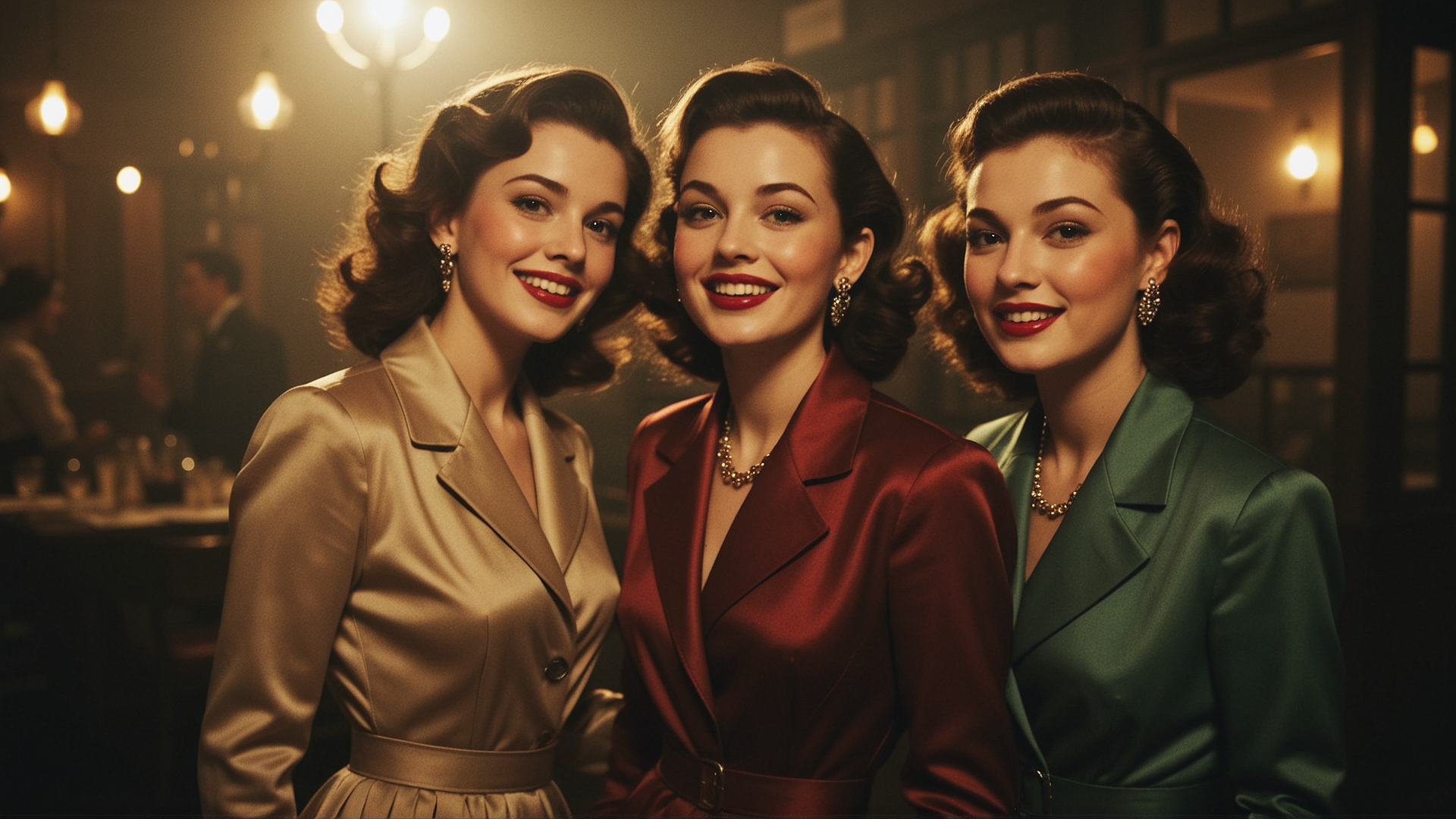
Step into a world of sleek satin and softer surrenders, where one woman’s command restores shattered masterpieces and binds willing hearts in a covenant of exquisite loyalty.
Are you drawn to the whisper of authority in a woman’s voice? Does the sight of intelligent, accomplished women choosing to kneel, not from weakness, but from profound strength, quicken your pulse?
This is not a story of mere obsession. It is a chronicle of curation.
Enter the shadowed, opulent world of The Luminae Gallery, 1938. Here, Madame Celeste, a vision in ruthless black satin, doesn’t just restore forgotten art; she restores forgotten women. With a mesmerising blend of unwavering command and nurturing insight, she sees the hidden masterpiece beneath the grime of past betrayals. Around her orbits a constellation of devoted women—each powerful, each wealthy, each having willingly placed their trust in her guiding hand. They find in her leadership not restriction, but liberation; in their collective devotion, a purpose more fulfilling than any solitary ambition.
Follow Julianne Vance, a cynic who trades in the dirt of broken vows, as she is hired to expose this “unnatural” loyalty. What she uncovers will challenge everything she believes about love, power, and the breathtaking beauty of surrendering to a love that demands—and deserves—your absolute, generous best.
This is a tale for the woman who understands that the deepest passion often wears the sleekest leather, and that true belonging is found in the generous, euphoric service to a vision greater than oneself. Prepare to have your own layers gently examined, and your deepest longings artfully framed.
Chapter 1: The Cynic’s Commission
The rain on Julianne Vance’s office window didn’t fall—it wept. Each droplet traced a silver path down the grimy pane, a liquid mirror to the city’s own slow, corrosive sorrow. At thirty-two, Julianne had made a profession of sorrow. Not the grand, tragic kind, but the small, sour variety that fermented in the heart’s dark corners. Infidelity was her specialty; she was a connoisseur of cracked vows, a sommelier of betrayal’s bitter aftertaste. Her own heart, she liked to tell herself in the rare moments of unguarded honesty, was a vault sealed with ice and regret, its contents long since turned to dust.
Her office was a study in calculated drabness: gunmetal grey walls, a filing cabinet that groaned with secrets, a desk scarred by cigarette burns and disappointment. It was a stage set for the dramas of others, and she its weary, unshockable director.
The door opened without a knock, admitting not just a client but an atmosphere—a cloud of Chanel No. 5 undercut with the sharp, acrid scent of fear and expensive gin. The woman was all brittle angles wrapped in fox fur, her eyes darting like trapped birds behind a veil.
“You are Miss Vance? The… investigator?” Her voice was a rasp, as if her throat had been scoured by suspicion.
“I am,” Julianne said, not rising. She gestured to the chair opposite her desk with a hand that felt as cold as the rain outside. “And you are a woman who already knows the answer to the question she’s afraid to ask. Sit. Tell me which particular ghost I’m being paid to make flesh.”
The woman—a Mrs. Charlotte Pendleton, as it transpired—sank into the chair as if her bones had dissolved. Her story spilled out in a hushed, frantic torrent. It wasn’t about a husband. It was about a rival. A far more fascinating, and dangerous, kind of ghost.
“It’s Madame Celeste,” Charlotte whispered, the name leaving her lips like a forbidden incantation. “She runs ‘The Luminae’ on Fifth. An art gallery. A… a society.”
“I know of it,” Julianne said, her tone flat. Who in our circles doesn’t? The Luminae was whispered about in the parlours of the wealthy, a siren song of elegance and exclusivity. A place where women of a certain… inclination… were said to find more than art.
“She has taken something from me,” Charlotte insisted, though her eyes wavered. “Not a thing. A person. My… my companion, Lydia. She volunteered there, just to be cultured, you understand? Now she speaks of nothing else. She spends her days there, her evenings at their… gatherings. She looks at me now as if I’m a faded photograph, while she glows like she’s been dipped in moonlight. The loyalty she shows that woman… it isn’t natural. It’s consuming.” She leaned forward, her desperation a physical force in the small room. “There must be something. Financial impropriety. Scandals. Leverage. Find it, Miss Vance. Find the dirt beneath all that polished marble. I need my Lydia back.”
Julianne felt the familiar, cynical curl of her lip. “Devotion is always a performance, Mrs. Pendleton. Some are just better actors. My fee is fifty dollars a day, plus expenses. I’ll find your strings and your puppeteer.”
After the woman had left, a cheque clutched in her trembling hand as a down payment, Julianne lit a cigarette. The smoke coiled in the air, a grey ghost of its own. A gallery of grace, she thought with internal sarcasm so sharp it could draw blood. More like a gilded cage with a very clever keeper.
Her investigation began the next day, in the persistent drizzle of a New York autumn. She took up position in a diner across from The Luminae’s façade. It was a slice of modern perfection: black marble that shone like a dark mirror, brass fittings, a discreet plaque. No garish signs, just an aura of impregnable taste.
And then, the women began to arrive.
They came in twos and threes, never alone. They emerged from town cars and taxis, and each was a study in a specific, powerful aesthetic. Not the frills and flounces of the society pages, but something altogether more compelling. Sleek, bias-cut satin dresses that moved like liquid shadow. Tailored jackets of supple leather that gleamed under the streetlamps. Sharp, elegant trousers with knife-edge creases. Their hair was swept up or sharply bobbed, their makeup subtle but definitive. They moved with a purpose that was both graceful and utterly assured. They were not simply wealthy; they possessed a certainty that resonated in the very click of their heels on the pavement.
Julianne, in her sensible wool trench coat, felt a pang of something she refused to name. It wasn’t envy, she told herself. It was professional disdain for such a uniform, such obvious tribalism.
She watched as they greeted each other—not with air kisses, but with warm, direct smiles and touches that lingered on an arm or a shoulder. There was an intimacy there, a language of belonging that excluded the rainy world outside. And their eyes, when they glanced towards the gallery doors, held a common, unsettling light: a mixture of anticipation and profound respect.
Then, she appeared.
Madame Celeste did not so much emerge as manifest. The door was held open by a young woman whose attentive posture was itself a form of worship, and Celeste stepped into the grey afternoon light. She was tall, perhaps in her mid-forties, her figure sheathed in a dress of pure black satin so impeccably cut it seemed less a garment and more a second skin of darkness itself. Her hair, the colour of winter moonlight, was swept into a severe yet elegant chignon at her nape. Her face was a study in serene authority—high cheekbones, a mouth that promised neither smile nor frown but absolute command, and eyes…
Julianne, even from across the street, felt the pull of those eyes. They were a pale, penetrating grey, like smoke over ice. They swept the street, not searching, but registering, and for a heartbeat, they seemed to pause on the diner window. Julianne’s breath hitched, a ridiculous reaction she immediately quashed. Celeste’s gaze moved on, but the impression remained: this was a woman who saw the composition of the world, not its chaos.
A younger woman—Lydia, Julianne presumed from Charlotte’s description—hurried up, her face alight. She was saying something, her hands gesturing eagerly. Celeste listened, her head tilted slightly. Then she spoke, her lips moving with measured calm. She reached out and, with a gesture that was both possessive and infinitely gentle, adjusted the pearl clip in Lydia’s hair. It was a small thing, intimate and domestic, yet it carried the weight of a benediction. Lydia’s entire being seemed to soften and brighten simultaneously, as if she’d been waiting for that precise touch to fully inhabit her own skin.
Julianne’s cigarette burned forgotten between her fingers. The cynic in her brain provided the narration: See? The performance. The careful staging of care. The puppet master adjusting her strings.
But another part of her, a part long buried under layers of professional spite and personal frost, whispered something else. It whispered that the look on Lydia’s face wasn’t the blank bliss of a hypnotised subject. It was the complex, luminous joy of a puzzle piece clicking into its perfect place. It was the look of someone who had been seen, truly and completely, and had been found worthy of a gentle, guiding hand.
“Just a different kind of cage,” Julianne muttered aloud, stubbing out the cigarette with more force than necessary. “A prettier one. With a more elegant warden.”
She gathered her notes, her mind already constructing the first report: Subject exhibits cult-like influence over female associates. Atmosphere of intense, possibly engineered, loyalty. Financial angle to be pursued.
But as she stepped back out into the weeping rain, pulling her drab coat tighter, the image refused to leave her: the woman in satin, a queen in a world of gloss and shadow, and the radiant devotion reflected in the eyes of those who orbited her. It was a masterpiece of social engineering, Julianne decided. A brilliantly composed lie.
And yet, for the first time in a very long time, Julianne Vance, the unmasker of lies, felt a treacherous, thrilling curiosity to see what that lie looked like from the inside.
Chapter 2: The Invitation Beneath the Varnish
Three days of rain had turned Julianne Vance’s world into a study in monochrome—a watercolour of grey sidewalks, grey skies, and the grey, grinding weight of her own suspicion. She had become a fixture in the diner across from The Luminae, a specter in a trench coat nursing cups of coffee that tasted of bitterness and routine. Her notebook, once a crisp ledger of facts, now bore the soft, worried furrows of a mind beginning to question its own dogma.
She had documented the comings and goings, the elegant synchronicity of the women who belonged to Celeste’s orbit. She had notes on their cars, their estimated wealth, the way they touched one another’s arms in greeting—a language of casual possession that spoke of deep, unshakeable bonds. But the dirt Mrs. Pendleton craved remained elusive, a phantom that dissolved under the sheer, polished radiance of the gallery’s existence.
On the fourth morning, the rain ceased, leaving the city glistening like a wet jewel. The Luminae’s black marble façade seemed to drink the fragile sunlight, reflecting back a deeper, more profound darkness. Julianne, feeling a restless, unprofessional impulse she blamed on caffeine and confinement, decided on a closer approach. She would pose as a potential client, a woman of means (a fiction her wardrobe desperately contradicted) seeking to commission a portrait. A flimsy pretext, but it would get her through the door.
She crossed the street, her heart performing a strange, syncopated rhythm against her ribs. As she reached for the heavy brass handle, the door swung inward as if by telepathy, and she found herself face-to-face with the young woman from the first day—Lydia.
Up close, Lydia was even more disconcerting. She wasn’t merely pretty; she was luminous. Her eyes, a warm hazel, held a clarity that seemed to have been buffed to a high shine. She wore a simple dress of charcoal-grey crepe, its lines so pure it was almost a moral statement. A single, perfect pearl glowed at her throat.
“Good morning,” Lydia said, and her voice was like honey poured over smooth stones—warm, sweet, with an undercurrent of unyielding strength. “May I help you?” There was no suspicion in her gaze, only a polite, penetrating curiosity.
“I… I was hoping to inquire about a commission,” Julianne stammered, the rehearsed lines turning to ash on her tongue. “A portrait. For my… my library.” The lie felt childish, a lump of crude clay offered in a gallery of porcelain.
Lydia’s head tilted, just a fraction. A smile touched her lips, not mocking, but knowing. “I see. Well, acquisitions and commissions are handled directly by Madame Celeste. She is in the restoration studio. It is not usually open to the public, but…” She paused, her gaze sweeping over Julianne in a single, comprehensive assessment that felt less like judgment and more like a master librarian cataloguing a rare, mis-shelved book. “…she did mention she was expecting a new perspective this morning. Please, follow me.”
Expecting? The word echoed in Julianne’s mind as she was led through the gallery’s main hall. The space was a symphony in restraint. Pale oak floors whispered underfoot. Walls, painted a shade of grey so deep it was almost black, served as a silent void from which the artworks emerged like visions. Here, a Renaissance Madonna, her sorrow serene; there, a modernist abstraction of intersecting planes that sang of quiet turmoil. The air was cool, still, and carried a haunting bouquet: the astringent cleanliness of citrus polish, the earthy sweetness of beeswax, and beneath it all, a faint, tantalising ribbon of sandalwood—a scent that spoke of ancient temples and profound calm.
They passed through a velvet curtain, down a short corridor, and Lydia paused before a door of dark, oiled wood. She knocked once, a soft, respectful tap.
“Enter.” The voice from within was low, a cello’s lowest string vibrated in a closed space.
Lydia opened the door and stood aside, her gesture an unmistakable command for Julianne to proceed. “Madame Celeste, the visitor I mentioned.”
The restoration studio was a world apart. Where the gallery was a temple to display, this was a sanctuary of process. Northern light flooded in from a high, slanting window, illuminating a universe of ordered chaos. Shelves held rows of pigments in glass jars, like captured rainbows. Brushes of every fineness lay in military rows. And at the centre, standing before a large easel, was Madame Celeste.
She was not wearing satin today, but a simple smock of raw linen over a silk blouse. Yet, even in this workman’s garb, her authority was absolute. Her silver hair was loosely pinned, a few strands escaping to frame a face that was all focused intensity. She held a slender scalpel in one hand, a sable brush in the other. She did not turn immediately, her attention wholly consumed by the large, darkened canvas before her.
“Thank you, Lydia. You may return to the catalogue. Ensure the entries for the Bellini are as precise as poetry.” The dismissal was gentle, yet it carried the finality of a sealed decree.
Lydia inclined her head, a gesture of such natural deference it made Julianne’s breath catch, and she withdrew, closing the door with a soft, definitive click.
Now, Julianne was alone with her. The object of her investigation, the supposed puppeteer. The silence in the room was a living thing, thick with concentration and the ghost of old masterpieces.
“Come closer, Miss Vance,” Celeste said, still not turning. “Do not be afraid of the light. It reveals, but it does not, in itself, judge.”
How does she know my name? The thought was a spike of ice in Julianne’s chest. She moved forward, her shoes silent on the floor, until she stood beside the woman, facing the painting.
It was a sorry sight. A once-grand portrait, now a battlefield of neglect. The surface was a continent of crackled, yellowed varnish, with ugly, clumsy overpainting obscuring whole sections. It was a face, but a face lost in a fog of time and incompetence.
“What do you see?” Celeste asked, her voice a murmur meant for the canvas.
“I see… damage,” Julianne replied, her investigator’s tone returning. “Decay. Something beautiful that’s been ruined.”
“A common perception,” Celeste said, and now she finally turned her head. Those grey eyes, up close, were not cold. They were the colour of a winter sea under a misted sun—deep, shifting, holding entire worlds beneath their calm surface. They fixed on Julianne, and she felt the bizarre sensation of being scanned, layer by psychological layer. “You see the grime. The scars. The fearful attempts of lesser hands to ‘fix’ what they did not understand. You catalogue the damage, as is your profession. But you mistake the symptom for the subject.”
She turned back to the painting. With a hand of astonishing steadiness, she brought the scalpel to a particularly dark patch near the subject’s cheek. “This,” she said, “is not the painting. This is fear. The fear of time, of imperfection, of truth. Someone, long ago, saw a crack and tried to hide it with a lie. Then another lie on top of that. Until the truth was buried under a cairn of well-intentioned falsehoods.”
With infinite, tender patience, she began to work. The scalpel was not a weapon but a key. She lifted a microscopic edge of the blackened film. There was a faint, sighing sound of release. And beneath it…
A flash of colour so vibrant, so alive, it seemed to generate its own light. A blush of rose madder, the cheek of a living woman sleeping beneath centuries of sleep. Julianne’s breath left her in a soft, involuntary gasp.
“You see?” Celeste whispered, a hint of something like passion warming her voice for the first time. “The masterpiece never left. It has been here all along, waiting. Patient. Dreaming of the day someone would have the courage, the respect, and the steady hand to remove the weight of the world from its face.”
She worked in silence for another minute, revealing a crescent of that miraculous cheek, the subtle curve of a jawline that spoke of gentle strength. Each revelation felt like a secret being whispered directly into Julianne’s soul.
“This is what I do, Miss Vance,” Celeste said, setting her tools down on a velvet-lined tray. She turned fully now, leaning back against the edge of the worktable, wiping her hands on a cloth. The full force of her attention settled on Julianne, a physical weight, warm and inescapable. “I do not create beauty. I reveal it. I remove the layers of grime that life splashes upon us. The lies we are told, the lies we tell ourselves to make the pain of past… betrayals… easier to bear.”
The word betrayals hung in the air, precise and pointed as a needle. Julianne felt a jolt, as if the woman had reached into her chest and lightly tapped the icy vault of her own heart.
“I… I don’t know what you mean,” Julianne managed, but her voice was thin, a poor defence.
“Don’t you?” Celeste’s smile was a ghost of a thing, a curve of profound understanding. “You carry yourself like a locked room, Miss Vance. Your eyes are shrewd, but they are also shutters, closed against a storm that passed long ago. You think your cynicism is armour. I propose it is merely the darkest, thickest layer of varnish you could find to paint over your own canvas.”
She took a step closer. The scent of sandalwood and linseed oil enveloped Julianne. “You were hired by Charlotte Pendleton. A woman who mistakes possession for love, and sees devotion in another as a theft from herself. She wants you to find the dirt beneath my feet. And you, the consummate professional, have been looking at the floor.” Celeste’s gaze deepened, holding Julianne’s with a mesmerising intensity. “But the truth is not on the floor, my dear. It is on the walls. It is in the eyes of the women who find here not a cage, but a frame—a structure that finally allows the picture of their own souls to be seen in its correct proportion. And it…” she reached out, and with a gesture so natural it felt inevitable, she brushed a stray, damp strand of hair from Julianne’s temple, her fingertips cool and sure against Julianne’s skin, “…it is waiting, under layers of brilliant, defensive grime, in you.”
The touch was electric. It was not a caress; it was a connection, a completion of a circuit Julianne hadn’t known was broken. Her carefully constructed world of suspicion—a world where every smile hid a motive, every touch concealed a calculation—shattered under the sheer, unassailable certainty of this woman’s perception.
“What…” Julianne’s voice was a rasp. “What do you see? Under my… varnish?”
Celeste’s eyes softened, the grey warming to the colour of smoke from a comforting hearth. “I see a woman of fierce intelligence, who used her brilliance to build a fortress instead of a home. I see a palette of colours so vibrant they would dazzle—loyalty that could move mountains, passion that could ignite cities, a capacity for devotion so deep it would be a religious experience. But you have let the world, and one particularly cruel vandal, paint over it with the dull, uniform grey of ‘professional detachment.’ You are a masterpiece, Julianne Vance, posing as a convincing forgery of a cynic.”
She stepped back, breaking the contact, but the imprint of her words, her touch, remained, burning brighter than the revealed rose madder on the canvas.
“The invitation,” Celeste said, her tone shifting back to its serene practicality, “is not to a transaction about a portrait. It is to observe. To see the process. To understand that what I offer is not submission, but liberation. The freedom from the exhausting labour of holding your own layers in place. The euphoria of allowing a steady, knowing hand to lift them away, one by one, until you shine with your own original, undeniable truth.”
She turned and picked up a small, clean brush. “You may stay and watch, if you wish. Or you may return to the rain and your reports. The choice, as it always is, is yours. But ask yourself this: are you investigating me, Miss Vance? Or are you, at long last, investigating the masterpiece you buried alive?”
Julianne stood, paralysed, in that column of pure northern light. Before her, the painting whispered of a beauty resurrected. Beside her, a woman who saw with X-ray vision into the core of her being. The cynic screamed its familiar warnings. But a newer, older, more authentic voice was stirring beneath the varnish—a voice that recognised, with a thrill of terror and dizzying hope, that it had just been found.
Chapter 3: The New Acquisition – Elara
A week had passed since the northern light in the restoration studio had seared itself onto Julianne Vance’s soul. The city outside continued its grey, grinding symphony, but within her, a silent, seismic shift had begun. Her reports to Charlotte Pendleton had become masterpieces of evasion—factual, dry, and utterly devoid of the profound disturbance she now carried like a secret jewel against her skin. She continued her surveillance, but the lens had inverted; she was no longer studying a subject, she was studying a reflection of a hunger she had refused to name.
It was on a Tuesday, when the rain had momentarily stilled to a damp, pregnant hush, that the gallery’s equilibrium was pierced by a new, discordant note.
Julianne watched from her now-customary perch in the diner. A long, low-slung Duesenberg, the colour of bruised plum and polished to a predatory shine, pulled to the curb with a throaty growl that seemed to offend the street’s quiet dignity. The driver, a man in a boxy suit with a face like clenched granite, held the door.
And out she stepped.
She was young, perhaps twenty, a study in deliberate contradiction. Her hair was a cascade of ink-black waves, defiantly loose in an era of severe control, framing a face of startling, feral beauty—high cheekbones, a mouth painted the red of a warning, eyes the volatile green of a storm-tossed sea. Her attire was a calculated rebellion against the Luminae’s sleek uniformity: a dress of crushed velvet the colour of wine, its neckline daring, its skirt swirling with a theatrical flair. Yet, over it, she wore a jacket of the finest, softest black leather, as if acknowledging the language of this world even as she shouted her difference.
This, Julianne knew with a detective’s cold certainty, was no ordinary aspirant. This was an event.
The young woman—Elara, Julianne would learn—stood on the sidewalk, her posture a fortress of bravado. She gazed up at the gallery’s façade as if it were a fortress she had been ordered to storm. But Julianne, whose own defences had recently been so delicately breached, saw the minute tremor in the gloved hand clutching a small portfolio, the rapid flutter of a pulse at the base of her throat. Here was not an invader, but a castaway, washed up on a shore of terrifying refinement.
She watched Elara take a deep, visible breath, square her shoulders—a gesture that seemed more about convincing herself than anyone else—and push through the heavy brass door.
Inside The Luminae, the air itself seemed to still, as if the very molecules paused to assess the new frequency. Lydia, at her post, did not flinch. Her smile remained, but it cooled by a degree, becoming a polite, impenetrable mask. “Good afternoon. May I help you?”
“I’m here to see Madame Celeste,” Elara announced, her voice a touch too loud, a brilliant soprano trying to fill a cathedral built for contemplative silence. “My father, Silas Rourke, sent me. Regarding a… a potential collaboration.” The word ‘collaboration’ tasted sour on her tongue, a lie she hadn’t even bothered to sweeten.
Lydia’s hazel eyes didn’t waver. “Madame Celeste is occupied with a restoration. She does not see unscheduled… collaborators.” The slight pause was a masterpiece of insinuation. “However, if you would care to wait, I can ascertain if she is available for a brief audience.”
Elara’s green eyes flashed, a lightning strike of temper. “You can ascertain? Listen, I didn’t come all this way to be—”
“Lydia.” The voice, like cool water over smooth stone, flowed from the arched doorway leading to the private rooms. Madame Celeste stood there, a vision of absolute contrast. She wore a simple sheath of dove-grey silk, the colour of peace, her only adornment a pair of spectacles perched on her nose, giving her an air of scholarly command. In her hands, she held a magnifying glass and a fragment of what looked like gilded frame. “There is no need for a siege at our gates. Our door, while selective, is not a portcullis.” Her grey eyes, magnified and intensified behind the lenses, settled on Elara. They did not sweep her with judgment; they absorbed her, drinking in the contradiction of the velvet and leather, the bravado and the tremor. “Silas Rourke’s daughter. Elara. Your father’s message preceded you. He suggested you had an… artistic eye he wished ‘cultivated.’ A curious choice of verb, implying wildness needing taming. I prefer to think of it as direction.”
Elara, thrown off-balance by the directness, by the sheer, unassailable calm that seemed to radiate from the woman, could only manage a stiff nod. “He thought I should see how a real gallery is run.”
“Did he?” Celeste’s lips curved, not in a smile, but in an expression of profound understanding. “Or did he send a beautiful, untamed thing into the lion’s den, hoping it would either be devoured or return with a scrap of meat he could use?” She stepped forward, and the space around her seemed to reorganise itself, pulling Elara into its gravitational field. “You may tell him the lions here are well-fed, and we do not deal in carrion. But you, child… you may stay. For the afternoon. Consider it a lesson in… contrast.”
She turned, expecting to be followed. After a heartbeat’s rebellion, Elara did, drawn by a force stronger than her father’s command. Julianne, observing from the street, felt a pang of recognition. She saw herself in that reluctant, inevitable step.
Celeste led Elara not to the grand halls, but to a small, sunlit anteroom where a collection of Japanese woodblock prints was being prepared for cataloguing. “Art,” Celeste began, setting down her tools and removing her spectacles, “is not about the grand gesture. It is about the infinitesimal decision. The precise pressure of the blade on the wood, the exact moment the paper meets the ink. It is about a system of harmony, where every element knows its place and, in that knowing, achieves its highest beauty.” She gestured to the prints. “Study these. Note the balance. The way the fierce dragon is composed within the serene curve of the cloud. The wildness is not erased; it is framed. Given context. Made more powerful, not less, by its placement.”
Elara, her defensive posture beginning to soften, approached the table. Her gloved hand hovered over a print of a crashing wave, its chaotic energy perfectly contained within the borders. “My father’s gallery… it’s all noise. Gold frames shouting over the paintings. Champagne flutes clinking louder than conversation. It’s… exhausting.”
“Because it is a cacophony, not a chorus,” Celeste said softly, coming to stand beside her. She did not touch her, but her proximity was a tangible thing, a warm, steady pressure. “Here, every voice has its note. Every woman her purpose. Lydia’s precision. Antonia’s strategic mind. Beatrice’s radiant diplomacy. Together, under a single, unwavering baton, they create a symphony that elevates each individual note into something transcendent.” She turned her head, and her gaze, now un-lensed, was a soft, grey embrace. “What is your note, Elara? Beneath the velvet and the rebellion your father so clumsily sponsors? Is it merely discord? Or is it a melody, waiting for the right key, the right conductor, to be heard?”
Elara’s breath hitched. The question was a key sliding into a lock she hadn’t known existed. Her father had only ever asked her to be a weapon, a pretty distraction, a spy. No one had ever asked for her note.
“I… I don’t know,” she whispered, the bravado melting away to reveal the lost, brilliant girl beneath.
“A promising beginning,” Celeste murmured. “Awareness of one’s own mystery is the first step toward its solution.” She moved to a cabinet and retrieved a large, leather-bound ledger. “Your task for today. The collection of prints requires cataloguing. Not merely listing, but describing. You must find the word that captures not just the image, but its soul. Its quiet. Consider it an exercise in listening to your own inner voice, instead of the shouting world.”
She placed the heavy ledger before Elara, along with a pen of exquisite weight. It was not a dismissal; it was an initiation. An invitation to participate in the sacred, silent work of curation.
As Celeste glided from the room, Julianne, who had finally entered the gallery on a pretext of her own, watched from the shadow of a Corinthian column. She saw Elara sink into the chair, not with defeat, but with a kind of dazed focus. She saw her touch the cover of the ledger as if it were a holy text, then open it to a blank page. The storm in her green eyes had not abated, but it had changed direction; it was now turned inward.
Later, as the afternoon light began to gold, Elara sought out Celeste in the restoration studio. She found her not scraping at varnish, but examining a tiny, exquisite portrait of a woman in a gown of gleaming satin.
“The catalogue entries…” Elara began, her voice quieter, more her own. “I finished the first section.”
Celeste did not look up. “And?”
“And… it’s peaceful here. The quiet isn’t empty. It’s… full.”
“A profound observation,” Celeste said, finally glancing at her. “You have a poet’s heart beneath that leather. A dangerous, beautiful thing to possess.” She placed the tiny portrait in Elara’s hand. “This arrived anonymously today. A test, perhaps. I want you to study it. Not as your father’s daughter, but as Elara. Tell me what you see. What you feel.”
Elara looked down at the portrait. The woman’s eyes, painted centuries ago, seemed to hold a secret joy, a knowledge of her own worth, eternally captured in gloss and shadow. She felt a yearning so acute it was a physical pain—a desire to know that, to be that assured, that beautifully composed.
“I see… a woman who belongs to herself,” Elara breathed. “Because she chose where to place her devotion.”
Celeste’s smile was a slow sunrise. “Then you see more clearly than most who have held her. Keep her with you tonight. Let her speak to you. And tomorrow, you will tell me not what your father wants to hear, but what she told you.”
As Elara left, cradling the small painting like a newfound part of her own soul, Julianne emerged from the shadows. She and Celeste stood side by side, watching the girl—the new, raw, brilliant acquisition—disappear into the New York twilight.
“She is a wildfire,” Julianne said quietly.
“All the best things are,” Celeste replied, her gaze distant and knowing. “But a wildfire, contained within a hearth, becomes the source of all warmth, all light, all transformative power. She will burn, my dear Julianne. But she will burn for us, not against us. And in that burning, she will finally find her true, dazzling form.”
Chapter 4: The Canvas of a Past Betrayal
The following days within The Luminae passed for Julianne Vance not as a sequence of hours, but as a gradual, luxurious submersion into a new element. The air, once merely the cold breath of New York, now seemed to thrum with a silent, sustaining frequency—a hum composed of whispered consultations, the soft sweep of a broom across oak, the distant chime of a clock in some hidden chamber. She was no longer a spectator behind glass; she was a ghost granted substance, permitted to drift through the halls, to linger in the periphery of a world that was beginning to feel less like an investigation and more like an invocation.
Her pretext for presence had evaporated, replaced by a silent understanding between her and the gallery’s sovereign. Celeste had simply ceased to question her comings and goings, treating Julianne’s presence as one might treat a familiar, if still-wild, cat that had chosen to curl by the hearth. This unspoken acceptance was a narcotic more potent than any cocktail at the Stork Club. It disarmed her, this assumption of her belonging.
It was in the restoration studio, of course, that the true alchemy occurred. Celeste had given Julianne a task: a small, damaged 18th-century pastel of a bouquet. “Do not try to fix it,” she had instructed, her voice the low, resonant tone she reserved for the studio. “Try to listen to it. Your hands are clever, but they are impatient. They want to conquer. You must learn to court.”
Julianne, her fingers stained with chalk and failure, was grappling with this very lesson one afternoon. She was attempting to consolidate a flaking petal, her every touch threatening to reduce it to dust. Frustration, a familiar and bitter companion, rose in her throat.
“You are fighting the ghost of the artist,” came that voice, smooth as poured obsidian, from the doorway. Celeste leaned against the frame, a silhouette of serene authority against the softer light of the hall. She had changed into a working tunic of raw linen, but it hung on her with the elegance of a royal robe. “You believe you are in a battle of wills with the paper. It is not a battle. It is a negotiation with time itself. And time, my dear, does not respond to force. Only to reverence.”
“Reverence feels like incompetence,” Julianne muttered, setting down her tools with a sigh that seemed to carry the weight of her thirty-two years. “I feel like a brute with a ballet slipper.”
Celeste’s laughter was a rare, low sound, like water finding a hidden cavern. “An exquisite analogy. It tells me you understand the problem perfectly.” She glided into the room, the scent of sandalwood and fresh linen preceding her. She did not take over the pastel. Instead, she stood beside Julianne, so close that the heat from her body was a palpable aura. “The brute sees only the obstacle. The dancer sees the potential for motion within the constraint. Your past, Julianne… it has taught you to be a brilliant brute. To see every relationship as a transaction to be audited, every heart as a ledger to be balanced for deceit. But what if I told you that your greatest strength—that sharp, analytical mind—is not your defining feature? It is merely the most recent, the most desperate layer of varnish you applied to protect the original work.”
Julianne’s heart, that traitorous organ, began a frantic percussion against her ribs. The studio, with its focused northern light, felt suddenly like a confessional. “The original work,” she repeated, her voice barely a whisper. “You keep speaking of it as if it’s a thing of value. What if the original canvas was flawed? What if it was weak?”
“Then we would honour its truth,” Celeste said, her gaze fixed not on Julianne, but on the fragile pastel, as if seeing through it to the conversation’s core. “But I do not believe that. I believe you encountered a… a vandal. Early on. Someone who did not see a masterpiece in progress, but a surface to claim, to deface with their own signature.”
The word vandal struck with the precision of a scalpel lifting a edge of varnish. Julianne felt a fissure open in the ice of her composure. The air grew thick, charged with the unsaid.
“Her name was Eleanor,” Julianne heard herself say, the words escaping not as a confession, but as a long-held exhalation of poison. She stared at her own hands, stained with the evidence of her current failure. “At Barnard. She was… she was the sun. And I, like a foolish planet, constructed my entire orbit around her light. We shared everything—dreams, books, the tiny, secret language that blooms between two minds in resonance. I was writing my thesis on the use of architectural metaphor in female-authored Gothic novels. It was my world. And she… she was the co-author of my soul.”
She paused, the memory a physical ache, a phantom pain in a limb long amputated. Celeste did not move, did not interrupt. Her silence was a vessel, waiting to be filled.
“She asked to read the final draft. Said she wanted to ‘feel the shape of my mind before I gave it to the professors.’ I let her. I gave her everything.” Julianne’s voice hardened, the old cynicism rushing back like a tide of rust. “A week later, she was gone. A note on my pillow—a trite, cowardly little thing about ‘needing space to find herself.’ She’d taken the only copy of my thesis. Six months after that, a mutual friend, drunk and pitying, showed me a literary journal from Paris. There was an essay. The central argument, the unique architectural framework… mine. Word for word in places. Published under her name. She’d found her space, all right. And my mind was the furniture she’d stolen to decorate it.”
The silence that followed was profound. It was not empty; it was filled with the echo of the old betrayal, now given voice in this sacred space.
“I see,” Celeste murmured, and the words were heavy with a universe of understanding. “So you decided that if the world treated your masterpiece as raw material for theft, you would no longer paint masterpieces. You would become an appraiser of forgeries instead. You built a career, an identity, on the principle that every beautiful surface hides a lie. You became the very thing you feared, policing the borders of trust because yours had been so violently breached.”
It was not an accusation. It was a restoration diagnosis, delivered with a devastating, gentle clarity. Julianne felt seen, truly seen, for the first time since that theft. Not as a victim, not as a cynic, but as a living artwork, brutally overpainted.
“What did you do with the pain?” Celeste asked, finally turning those grey, ocean-deep eyes upon her. “After the theft?”
“I… I tried to recreate it. The thesis. But it was like trying to rebuild a sandcastle from memory after the tide has taken it. The words were ash. So I buried the ash. I became someone else. Someone who couldn’t be stolen from, because I owned nothing of real value.”
“Ah,” Celeste breathed, and there was a world of sorrow in the sound. “You did not just bury the thesis. You buried the architect. The woman who could build such intricate, beautiful structures of thought. You left her for dead in a Parisian journal and built a prison of suspicion on her grave.” She took a step closer. Her hand rose, and for a suspended moment, Julianne thought she might touch her face. Instead, she let her fingertips hover just above Julianne’s temple, a phantom caress that was somehow more intimate than contact. “That is the grime I see, Julianne. Not the betrayal itself—that was the vandal’s act. The grime is your response. The layer upon layer of ‘professional detachment,’ of ‘rational scepticism,’ you have applied over the wound. You have let Eleanor’s crime dictate the entire palette of your life. You are living in the negative space she created.”
The truth of it, articulated with such elegant, ruthless compassion, was a vertigo. Julianne’s eyes burned. She had not cried over Eleanor in a decade. Now, in this room of revelation, she felt the hot, shameful press of tears.
“What do I do?” The question was a child’s whisper, stripped of all her adult armour.
Celeste’s hand finally descended, not to her face, but to her shoulder, a firm, grounding weight. “You bring me the ashes.”
Julianne blinked. “What?”
“The original. The notes, the drafts, the ghost of that thesis. Whatever fragments you have. You bring them to me. Not as evidence of a crime, but as archaeological fragments of you. We will not recreate the sandcastle. We will examine the quality of the sand. We will honour the architect, not the stolen blueprint.” Her grip tightened, infinitesimally. “This is the process, Julianne. This is the gentle, terrifying work of lifting the varnish. You must trust me with the damaged canvas. You must believe that I can discern the true brushstrokes from the vandal’s graffiti.”
It was an invitation of terrifying magnitude. To exhume the corpse of her oldest dream and lay it at this woman’s feet.
“Why?” Julianne choked out. “Why would you do that?”
Celeste’s smile was a slow, radiant dawn. “Because, my dear detective, I am in the business of restoration. And I have just identified the most fascinating, valuable, and neglected masterpiece to cross my path in a very long time. Your value was not diminished by the theft. It was merely… misplaced. My role, should you choose to grant it, is to help you find it again. To curate you back to your rightful, radiant state.”
In the corridor outside, unnoticed by either woman, Elara Rourke stood frozen, a sheaf of catalogue papers clutched to her chest in her new, sleek jacket of midnight-blue satin. She had come to deliver a message, a warning she had pieced together from her father’s drunken boasts: He’s going to try to blackmail her. He’s forged something. But the scene in the studio held her captive.
She watched the tall, linen-clad figure of Celeste, a pillar of unwavering strength, offering not pity, but a challenge to the wounded woman before her. She saw Julianne, the sharp-edged cynic, trembling on the precipice of a surrender that looked nothing like defeat and everything like… coming home. It was a tableau more powerful than any Rembrandt in the main gallery: the absolute, nurturing authority of one woman facilitating the rebirth of another.
Elara’s own heart, a wild, untamed thing, beat a frantic rhythm of recognition. This was the note. This was the harmony. Not suppression, but exaltation through trusted surrender. She knew, with a certainty that seared through her father’s programming, where her loyalty lay.
She did not interrupt. She simply turned, the satin of her jacket whispering a secret against her skin, and went to find Lydia. The warning would be delivered, but it would be delivered for Celeste, not to her. It would be her first true offering, her first conscious step into the chorus.
Back in the studio, Julianne Vance, her eyes clear though bright with unshed tears, looked from the fragile pastel she could not fix to the impossibly strong woman who believed she could be fixed.
“All right,” she said, the two words a covenant, a key turning in a long-rusted lock. “I’ll bring you the ashes.”
Chapter 5: The Society’s Soirée
The invitation arrived not by post, but as a whisper—a breath of heavy, cream-laid cardstock delivered into Julianne Vance’s hand by Elara Rourke herself. The younger woman had appeared at the door of Julianne’s apartment, a vision of transformed intent. Gone was the rebellious velvet; in its place was a tailored suit of midnight-blue barathea, the jacket cut with a severity that accentuated the new, purposeful set of her shoulders. Her storm-green eyes, once volatile, now held a focused calm, like deep water after a tempest has passed.
“For you,” Elara said, her voice carrying a new, softer resonance. “From Her.”
The card bore no address, only a time—Nine o’clock—and a single line of embossed script: The Luminae Society requests the pleasure of your perspective. It was not a request. It was a summons, velvet-gloved and inexorable. On the back, in a handwriting as precise and elegant as a steel engraving, was a note: Wear what you possess. We will provide the rest. It was signed with a single, looping C.
The hours until evening unspooled for Julianne with the agonising slowness of a damaged film. Her closet, a museum of drab practicality and armour-like wool, yawned before her, a testament to a life lived in deliberate camouflage. Wear what you possess. The phrase echoed, a riddle. She possessed a sharp mind, a wounded heart, and a suitcase full of professional disguises. Nothing that belonged in a world of satin and shadow.
Ultimately, she chose the least offensive of her armour: a simple dress of charcoal-grey jersey, its lines clean, its message one of sterile neutrality. She felt, as she regarded herself in the mirror, like a graphite sketch mistakenly inserted into a folio of brilliant Fauvist paintings—all correct lines and muted tones, utterly devoid of life.
A car, a silent, black Rolls-Royce Phantom, was waiting at the curb. The chauffeur, a woman of indeterminate age with a face of serene granite, nodded once as Julianne approached. The interior smelled of lemon oil and the same, haunting sandalwood that permeated Celeste’s studio. As the city slid by, a panorama of electric scars and looming shadows, Julianne felt her heart perform a frantic, avian rhythm against her ribs. This was not surveillance. This was immersion.
The car did not stop at the gallery’s public face. It glided down a narrow, unmarked alley, through a wrought-iron gate that swung open soundlessly, and into a hidden courtyard. Here, silence was not an absence but a presence—a lush, velvet hush broken only by the soft plash of water from a central fountain. The building that rose before her was the gallery’s private spine, its windows glowing with a soft, buttery light that promised warmth rather than spectacle.
The door was opened by Lydia. She was a symphony in emerald-green satin, the fabric cascading over her form like a waterfall of liquid night. A single, perfect diamond sparkled at her throat, catching the light and fracturing it into a dozen tiny stars. Her smile was not the polite mask of the gallery assistant, but a radiant, genuine thing.
“Julianne. We’ve been anticipating you.” She took Julianne’s threadbare coat as if it were a relic of saintly significance. “Come. The chorus is assembling.”
She led Julianne through an antechamber and into a room that stole the breath from her lungs. It was a double-height library, a cathedral dedicated to thought and beauty. Walls of dark, honeyed oak rose to meet a ceiling frescoed with a night sky, each constellation picked out in delicate gold leaf. Ladders on brass rails promised access to realms of knowledge. But it was the inhabitants who commanded the eye.
Perhaps two dozen women were arranged in conversational constellations across the space. And they were, each of them, magnificent. This was not the uniform of the working gallery; this was the full, glorious expression of individual power, harmonised under a singular aesthetic principle. Silk, satin, and the softest suede flowed in rivers of colour—deep burgundy, sapphire, platinum grey. The air shimmered with the subtle music of pearls against skin, the whisper of stockings, the soft clink of crystal. The light from a monumental fireplace and myriad candles glowed on glossy waves of hair, on bared shoulders, on intelligent, animated faces. It was a living gallery of the female form at its most assured, its most potently realised.
And at the centre, holding court from a deep armchair of oxblood leather, was Madame Celeste. She was a study in monochrome power: a gown of pure white satin, stark and breathtaking as a snowfield under a full moon. It was a dare, a declaration of inviolable purity and authority. Her silver hair was down, cascading over one shoulder in a river of metallic silk. She was listening to a striking woman with a cap of severe black hair and eyes like chips of obsidian, who was speaking with passionate intensity about bond yields.
“Ah,” Celeste said, her voice cutting through the gentle hum without raising its volume. All eyes, as if pulled by a single string, turned towards the doorway. “Our sceptic arrives. Do not be intimidated by the finery, Julianne. It is merely the polished shell of the oyster. The pearl, as always, is within.”
A woman detached herself from a group near the fireplace and glided forward. She was perhaps forty, with a face of open, sunny beauty framed by honey-blonde curls. Her dress was a confection of champagne-coloured silk chiffon that seemed to float around her, and her smile was so warm it felt like a physical embrace.
“I’m Beatrice,” she said, taking Julianne’s cold hands in her own, which were warm and smooth as rose quartz. “We’ve heard so much. Celeste says you have the mind of a master watchmaker—all intricate gears and perfect, precise suspicion.” Her laugh was a delightful, bubbling sound. “We are so pleased you’ve come to see what the watch keeps time for.” She leaned in, her voice dropping to a confidential murmur. “And that dress is a lovely canvas, but it begs for just a hint of colour.” With a magician’s grace, she untied a long, diaphanous scarf of iridescent silk from her own neck—a piece that shifted from emerald to deep violet as it moved—and draped it around Julianne’s shoulders. The sensation was instantaneous: the whisper-soft caress of the fabric, the sudden, shocking warmth of the gesture. It was not charity; it was anointment. “There. Now you’re part of the palette.”
Julianne, rendered speechless, allowed herself to be led into the room. She was introduced to the constellations.
Antonia was the woman with the obsidian eyes. She shook Julianne’s hand with a grip that was firm, dry, and financially astute. “Celeste tells me you uncover truths for a living,” she said, her accent a melodic Italian cadence. “A valuable skill. In finance, as in art, the true value is often hidden beneath layers of obfuscation. We must be grateful for our… patron… whose vision allows us to pursue truth without the vulgar pressure of mere commerce.” She said the word ‘patron’ with a reverent hush, her gaze flicking almost unconsciously towards Celeste, who gave a slight, acknowledging nod.
Lin was a slender woman of ethereal beauty, her jet-black hair swept into a sleek knot. She wore a dress of crimson lacquer-red satin that seemed to have been poured onto her form. She offered Julianne a glass of impeccable champagne. “Your thesis,” she said, her voice so soft Julianne had to lean in to hear. “The architectural metaphor. It is a framework I have often felt in my own work. Curating is not just selection. It is the creation of space—emotional, intellectual—in which a work of art can fully breathe. Our Society… it is the ultimate curation. A space where we, ourselves, can finally breathe our truest air.” Her dark eyes held Julianne’s. “Our Dominus understands this. His generosity is the foundation, the load-bearing wall of this entire edifice. His reward is the beauty we are able to build upon it.”
The name Dominus hung in the air, spoken with a soft, collective awe. It was not a secret, but a sacred fact.
Julianne found herself drawn into conversations that were like nothing she had ever experienced. These were women who spoke of Proust and portfolio diversification with equal fluency, who debated the emotional resonance of a Mark Rothko with the same intensity they discussed charitable trust law. And through it all, like a golden thread in a tapestry, ran their devotion—to the art, to the Society, and to the serene, white-satin-clad figure who was their sun.
At one point, Celeste rose and moved to a grand piano in the corner. She did not play a song, but a single, repeating, haunting chord progression. The room fell into a contented silence. Beatrice came to stand beside Julianne, following her gaze.
“It’s quite something, isn’t it?” Beatrice whispered. “To find your chord. For so long, I was a delightful, jangling noise. Popular, pretty, entirely without harmony. Then Celeste… she listened. She heard the note beneath the noise. She placed me here, in this role. Now, my social gifts have a purpose. They build the world that protects our work, that pleases our Dominus. The generosity I show to him, the loyalty I offer her… it returns to me a thousandfold in this.” She gestured to the room, to her own radiant face. “It is the most profound mathematics: the more you give, from a place of true devotion, the more you become.”
Julianne watched as Elara, looking younger and more peaceful than Julianne had ever seen her, brought Celeste a fresh glass of water, receiving a touch on the wrist that made her glow. She saw Lydia laughing with Antonia, their heads close together. She saw Lin contemplating a small sculpture, her face a mask of blissful concentration.
“It feels…” Julianne began, struggling for an analogy that could contain the feeling swelling in her chest, threatening to crack her open. “It feels like I’ve been reading a book in a language I only half-understood, squinting at the characters. And now, suddenly, I’ve been given the key. The words aren’t just symbols anymore; they’re singing. And I… I want to learn the song.”
Beatrice squeezed her arm, her eyes shining. “That, my dear, is the first, and most important, verse.”
Later, as the soirée began to soften into a warm, contented conclusion, Celeste approached Julianne. The white satin seemed to glow with its own light. She looked at the iridescent scarf still gracing Julianne’s shoulders, and a smile of deep satisfaction touched her lips.
“The colour becomes you,” she said. “It hints at the spectrum within.” She paused, her gaze sweeping the room. “This is not a cage, Julianne. It is an ecosystem. A rainforest. Each of us is a unique, vital species, but we thrive because of the climate, the soil, the gentle, firm hand of the gardener. We are nourished by a sun we do not see, but whose light we feel in every bloom.” She met Julianne’s eyes, and in that grey depth, Julianne saw the reflection of the fire, of the gold-leaf stars, of her own, newly awakened yearning. “The question is not whether you admire the garden. The question is… do you wish to put down roots? Do you wish to feel that nourishing sun on your skin, and grow into what you were always meant to be?”
Julianne, wrapped in the borrowed silk, surrounded by a symphony of glossy, powerful, devoted women, knew there was only one answer. The cynic was silent. The architect within her, so long buried, was already drawing blueprints for a new, magnificent structure: a home.
“Yes,” she said, the word a vow, a surrender, a beginning. “I do.”
Chapter 6: The Frame of Blackmail
The honeyed afterglow of the Luminae soirée clung to Julianne Vance like the phantom perfume of a dream—a scent composed of beeswax candles, champagne effervescence, and the intoxicating promise that had been woven into the very air of that library cathedral. For three days, she moved through her old life—the drab apartment, the familiar streets, the pending reports for other clients—as a somnambulist, her true consciousness anchored elsewhere, in that room of oak and gold leaf where she had been offered a key to a singing world.
She had brought Celeste the “ashes,” as requested: a battered leather portfolio containing the ghost of her thesis—fragmentary notes, half-remembered quotations, the architectural sketches of arguments whose buildings had collapsed. Handing it over had felt not like a surrender, but like the exhaling of a breath held for a decade. The weight that left her shoulders was physical, leaving her feeling both terrifyingly light and precariously new.
It was on the fourth morning, as a thin, anaemic sun struggled to pierce the New York haze, that the frame of their newfound peace was brutally shattered.
Julianne was in the restoration studio, engaged in the patient, humbling work Celeste had set for her: cleaning the mount of a 17th-century etching with a squirrel-hair brush so fine it seemed made of thought itself. The work required a surrender of urgency, a submission to the slow, reverent pace of care. She was beginning—just beginning—to understand its meditative rhythm.
The door burst open without ceremony. Lydia stood there, but the serene composure that was her signature was gone. Her face was pale as parchment, her hazel eyes wide with a storm of emotions—fury, fear, and a protective ferocity that transformed her from graceful attendant to warrior maiden. In her hand, she clutched a cream-coloured envelope, its surface defaced by a brutal, slashing script.
“Madame,” Lydia said, her voice trembling not with weakness, but with the strain of containing a scream. “He has done it.”
Celeste, who had been examining a newly arrived crate of pigments, straightened with the unhurried grace of a deep-sea creature rising to meet a surface storm. She did not reach for the envelope. “Silas Rourke,” she stated, the name dropping into the quiet room like a lead weight.
“Delivered by courier. To the public gallery door. Addressed to ‘The Proprietress.’” Lydia’s knuckles were white around the paper. “It’s… it’s what Elara warned us of. But worse.”
“Read it,” Celeste commanded, her voice a low cello note of absolute calm.
Lydia’s hands shook as she extracted the single sheet. The letterhead was from Rourke’s gallery, ‘The Gilded Grotto,’ a vulgar parody of artistic pursuit. She began to read, her voice gaining strength as outrage overrode distress.
“‘Madame Celeste. It has come to my attention, through unimpeachable sources, that the sale of the purported Titian, ‘Magdalene in Contemplation,’ to your esteemed patron and the backbone of your little society, was conducted under… questionable provenance. I have in my possession documentation—expert affidavits, shipping manifests with curious alterations—that strongly suggest the work is a masterful forgery. A fraud, Madame. Perpetrated upon one of this city’s most generous, and reclusive, souls.’”
Lydia’s eyes flicked up, meeting Celeste’s. “He names the Dominus.”
A silence, colder and more profound than any Julianne had felt in this room, descended. The Dominus—the unseen sun, the benevolent architect of their world—had been dragged into the mud.
“Continue,” Celeste said, her face a mask of serene marble.
“‘The scandal, should it break, would not merely tarnish your gallery. It would shatter it. It would expose your society as a nest of deceit, and your patron as a dupe. The legal repercussions alone…’ He lists them. Fraud. Misrepresentation. Civil liability.” Lydia took a shuddering breath. “His offer is… a settlement. A single payment of two hundred and fifty thousand dollars. In cash. To be delivered within forty-eight hours. In return, the documents disappear, and my silence is purchased. If not…” She let the page fall slightly. “He concludes: ‘I will have no choice but to protect the integrity of the art world, and the reputation of a great man, by taking my evidence to the authorities, and to the newspapers.’ He has signed it.”
The numbers hung in the air—a king’s ransom, a fortune designed to cripple. Julianne’s mind, the old detective’s mind, immediately began its cynical calculus. Two hundred fifty thousand. The value of the Titian itself. He’s not just after money; he wants to drain the lifeblood, to force a sale of assets, a scattering of the collection. He wants to break the frame so the picture falls apart.
Celeste did not move for a long moment. Then, she turned her head slowly, and her grey eyes—those deep, winter-sea eyes—found Julianne’s. In them, Julianne saw no panic, no desperation. She saw a fierce, blazing pride, and beneath it, a sorrow as vast as the ocean. “So,” she said, her voice barely above a whisper, yet it filled the studio. “The vandal has returned. Not with a scalpel to reveal, but with a sledgehammer to destroy.”
Before Julianne could form a response, the studio door opened again. They came not as a panicked mob, but as a solemn procession. Antonia entered first, her obsidian eyes burning with a cold, financial fire. She was followed by Lin, her usual ethereal calm replaced by a steely resolve, her crimson satin seeming to burn with inner fury. Beatrice came next, her sunny face clouded with a protective storm, and finally, Elara, her transformation complete—dressed in a severe, beautiful suit of charcoal grey, her green eyes fixed on Celeste with the absolute focus of a compass finding true north.
They had gathered, summoned by some silent, psychic alarm that connected them all.
“We know,” Antonia said, her Italian accent sharp as a stiletto. “Lydia called us.” She stepped forward, placing a leather-bound ledger on the worktable with a definitive thud. “My personal trust fund. It is liquid. All of it. It covers more than half the sum.”
Lin moved with the grace of a panther. She laid a folded document beside the ledger. “The deed to my family’s holdings in Shanghai. They are valuable. They can be sold. They will cover the rest.”
Beatrice, tears of pure rage glittering in her eyes, said, “My father’s influence. His lawyers. His… muscle, if it comes to that. It is yours. We do not pay for lies.”
Elara was the last to approach. She did not bring a financial offering. She brought intelligence. She laid a small, folded piece of paper next to the other items. “The forger’s name. His address. A Bowery flophouse called ‘The Anchor.’ He’s a drunk named Alfie Poole. My father bragged about him when he thought I was still on his side. He also…” She swallowed, her voice thick with a mixture of shame and defiance. “He keeps the originals of the fake documents in his office safe. The combination is my mother’s birthday. 08-23-02. He’s a sentimental brute in the most pathetic way.”
Julianne watched, utterly transfixed. This was not the desperate huddling of victims. This was the strategic deployment of a sisterhood in full, magnificent battle array. They were not offering these things to Celeste; they were laying them at her feet, as natural as breathing. Their wealth, their assets, their loyalties—all were simply extensions of their devotion, tools to protect the sacred world they shared.
Celeste looked at the offerings on the table—the ledger, the deed, the tear-stained fury, the intelligence—and for the first time, Julianne saw a shimmer of moisture in those formidable grey eyes. It was not weakness. It was the profound, overwhelming recognition of love in its most potent, sacrificial form.
“My lions,” Celeste breathed, the words a prayer. “My magnificent, fierce lions. You would tear out your own financial hearts to shield mine.” She reached out, her hands hovering over the offerings as if bestowing a blessing. Then she closed her eyes, and when she opened them, they were clear, focused, and utterly commanding. “But we will not pay. We do not feed the parasites that attach themselves to beauty. To pay is to validate the lie. To pay is to admit that our truth is for sale.”
She turned her gaze, now a laser of focused intensity, upon Julianne. “You have a skill, Julianne. A skill honed in the dark places, where trust is a currency always suspect. You are a finder of dirt.” She took a step forward. “Can you… will you… turn that skill to finding truth? Not to expose, but to protect? Not to tear down, but to fortify?”
The room held its breath. All eyes were on Julianne. She felt the weight of the portfolio she had surrendered, the weight of the iridescent scarf still hanging in her closet, the weight of the “yes” she had breathed in the library. She saw the faces of these women—these powerful, glossy, brilliant women—united not by fear, but by a love so fierce it was willing to become destitute for its object.
Her old self, the cynic, the appraiser of forgeries, screamed a warning. This is not your fight. Take the fee from Charlotte Pendleton and walk away. This is a cult about to implode. Save yourself.
But that voice was distant now, a faint echo from a sealed tomb. The new voice—the architect’s voice, the one that had been buried under the grime of Eleanor’s betrayal—spoke with a clear, resonant tone. It spoke in analogies, as Celeste had taught her.
You have spent a decade studying the blueprints of broken buildings, the voice said. You have become an expert in structural failure. Now, you are being asked to use that knowledge not to condemn, but to reinforce*. To take your understanding of how trust collapses and use it to buttress something magnificent. This is not a cage; it is a cathedral. And they are asking you to be its flying buttress.*
Julianne looked from Celeste’s unwavering gaze to the determined faces of the women around her. She thought of the blackened varnish giving way to celestial blue. She thought of the ashes of her thesis, now in this woman’s care.
She straightened her spine. The detective’s sharpness returned to her eyes, but its purpose had been utterly transfigured. “You have the forger’s name and location,” she said, her voice crisp, professional, yet vibrating with a new, fervent energy. She looked at Elara’s slip of paper. “Alfie Poole. The Anchor.” Her mind began to race, not with suspicion, but with strategy. “Rourke will have paid him poorly and threatened him richly. He’ll be a frightened man, clinging to his bottle and his guilt. He’s not a loyal soldier; he’s a mercenary. Mercenaries can be re-hired.”
She turned to Celeste. “You offered me a chance to restore my own masterpiece. Let me prove its worth. Let me use every dirty trick, every back-alley contact, every ounce of cynical insight I possess… to clean this canvas. To remove this filth.” She met that grey gaze, and in it, she saw the reflection of the woman she was choosing to become. “I don’t need forty-eight hours. Give me thirty-six. And don’t sell a single share or a single acre.”
A slow, radiant smile dawned on Celeste’s face—a sunrise of absolute trust. She did not say thank you. She said, “Then the hunt begins. And the pack has a new, most cunning hunter.” She looked around at her women, her lions, her constellation. “We do not scatter. We gather closer. The frame is under attack. And we will show the world that the picture within is not merely beautiful. It is indestructible.”
Julianne Vance, the former cynic, now the devoted protector, felt a surge of euphoria so potent it was dizzying. This was her note, found at last in the glorious chorus. This was her surrender, and it felt like the most powerful victory of her life.
Chapter 7: Shadows in the Catalogue
The Bowery did not weep like the streets of the Upper East Side. It sweated—a greasy, feverish perspiration of spilled gin, uncollected garbage, and the collective despair of a thousand broken dreams. Julianne Vance moved through its canyon-like shadows, a specter in a trench coat that now felt less like armour and more like a borrowed skin from a life she was rapidly outgrowing. The air in her lungs was thick with the scent of rotten fruit and cheap coal smoke, a vulgar antithesis to the citrus-and-sandalwood clarity of The Luminae. She was hunting, but the prey was not a person; it was a truth, and the weapon was her own, painfully honed cynicism, now wielded in the service of a luminous faith.
The Anchor was less a flophouse and more a geological layer of human sediment—a leaning, wooden structure that seemed to sigh with each gust of wind. Inside, the air was a solid thing, composed of equal parts mildew, urine, and the sour tang of hopelessness. Julianne’s heels clicked on warped floorboards, a sound as alien here as a sonnet in a slaughterhouse.
She found Alfie Poole in a room that was a shrine to entropy. He was a man in his fifties, with the delicate, stained hands of a craftsman and the ruined, purple-veined nose of a dedicated drunk. He huddled on a cot, clutching a bottle of gut-rot whiskey like a suckling child, his eyes wide and terrified as Julianne filled his doorway.
“Alfie Poole,” she said, her voice not the gentle murmur of the studio, but the crisp, dispassionate tone of the interrogator. It was her old voice, and using it felt like drawing a rusted blade. “Silas Rourke’s ghostwriter.”
“I don’t know nothin’! He said you’d come! He said she’d send someone!” The words tumbled out in a slurry of fear and alcohol.
Julianne stepped inside, closing the door softly. She did not sit. She dominated the space with her stillness. “Rourke sees ghosts in every shadow because he’s the one haunting the place,” she stated, her eyes performing a swift inventory of the room: the scattered tools of forgery—brushes, pigments, a magnifying glass—lying in the dust like fallen soldiers. “He told you he’d protect you. He lied. He’s the type who uses a Rembrandt as a doorstop and wonders why it cracks. You’re not an asset to him, Alfie. You’re a liability. And liabilities get disappeared.”
Poole whimpered, shrinking into himself. “I had to! The money… he said he’d ruin me!”
“He already has,” Julianne said, and for the first time, a thread of something softer—not pity, but recognition—entered her voice. She picked up a discarded sketch from the floor. It was a study of a drapery fold, exquisitely observed, the work of a true eye. “You’re not a criminal, Alfie. You’re an artist who got lost in the wrong gallery. You’re painting masterpieces on the backs of garbage lids because no one with clean hands ever offered you a canvas.”
He stared at her, confusion cutting through the fog of his fear. “Who… who are you?”
“I’m the person who doesn’t care about Rourke’s money or his threats,” Julianne said, moving to the room’s single, grimy window. She looked out at the weeping bricks of the opposite wall, but in her mind, she saw the northern light of the restoration studio. “I represent the other party. The one you wronged. Madame Celeste.”
Poole made a sound like a stepped-on rat. “Oh, God…”
“She doesn’t want you in a river, Alfie. She doesn’t even want you in jail.” Julianne turned back, her gaze now direct, compelling. “She’s seen your work. The Titian ‘provenance’ you fabricated. It’s… brilliant. Flawed in its purpose, but technically, a thing of perverse beauty.” She let the sketch flutter from her fingers. “She’s a restorer, Alfie. The best. She doesn’t see the grime. She sees the masterpiece beneath. And she sees one in this room. Not the forgeries. The forger.”
The man was utterly still, the bottle forgotten in his lap. No one had ever spoken to him of mastery. Only of utility and silence.
“Rourke owns you through fear and shame,” Julianne continued, her voice dropping to a conspiratorial murmur. “Celeste offers a different currency. Redemption. Your affidavit, detailing Rourke’s commission of the forgeries, in exchange for her protection. And more… a place. Not here. In a clean, well-lit room. Where your skill—your real skill in spotting forgeries, in understanding the hand of the master—would be valued. You would be… restored.”
The word hung in the foul air, a crystal bell ringing in a swamp. Alfie Poole’s eyes filled with tears that had nothing to do with whiskey. It was the offer of a steady hand he had never known, the promise of a frame for his chaotic talent. It was the same offer that had unmoored Julianne herself.
“He’ll kill me,” Poole whispered, but the terror was now edged with a desperate, wild hope.
“He’ll try,” Julianne agreed calmly. “Which is why you’ll come with me now. And why, tomorrow, you’ll help me ensure he never threatens anyone again.” She extended a hand, not to help him up, but as a symbol of the pact. “You can spend the rest of your life as Rourke’s dirty secret, waiting for the end in this room. Or you can help me tear down his house of lies and build something beautiful from the rubble. Choose.”
While Julianne navigated the moral sewers of the Bowery, a different kind of shadow was being traced within the hallowed quiet of The Luminae’s archive. Lin, her crimson satin replaced by a practical smock of black cotton, moved like a silent wraith between the towering shelves of leather-bound catalogues. Her task was an act of love: verifying the provenance of a newly acquired set of Meissen porcelain for the upcoming exhibition underwritten by their revered Dominus. It was meticulous, peaceful work, a meditation on order and history.
It was the inconsistency in the paper that first snagged her hyper-attuned perception. Reaching for Volume XII (Italian Masters, 1500-1550), her fingertips registered a subtle variance in the ledger’s weight, a faint discord in the harmony of the binding. Frowning, she drew the heavy tome down and laid it on the polished oak table. The light from a green-shaded lamp fell upon it like a spotlight.
She turned the pages, her slender fingers a study in focused grace. The entries were in Celeste’s own hand, from years ago: meticulous, elegant, a map of the gallery’s soul. Then, she found it. Page 87. The entry for a small, roundel portrait, school of Leonardo, titled ‘Portrait of a Lady in Grey Satin.’ It was listed as acquired in 1919, from a private collection in Florence.
But the page was wrong.
The ink, upon closer inspection with her magnifying glass, was a fraction of a shade too blue. The texture of the paper, when she bent to smell it, lacked the faint, vanilla scent of the old, quality stock. It was a replacement. A perfect, breathtakingly skillful forgery inserted into the catalogue itself. And the corresponding acquisition number, when she cross-referenced it with the insurance ledger and the storage inventory, led to a void. The painting was not in the vault. It was not on any loan record. It was a ghost, its only presence this beautiful, fraudulent entry.
Lin felt a chill that had nothing to do with the archive’s cool air. This was not an enemy without, like Rourke. This was a shadow within. A violation of the sacred text. She closed the ledger as if it had bitten her, her heart a frantic bird in the cage of her ribs. Gathering her composure like a cloak of dignity, she took the volume and went to find Celeste.
She found her in the library, standing before the great fireplace, contemplating the flames. She had changed into a simple dress of dove-grey wool, its severity a comfort. She turned as Lin entered, and her smile of welcome faded as she saw the ledger in Lin’s arms and the pale solemnity of her face.
“You have found a dissonant note in our symphony,” Celeste stated, her voice calm, inviting confidence.
“A silence, Madame,” Lin corrected softly, her voice like wind through bamboo. “Where a note should be, there is only a perfect imitation of its memory.” She laid the open catalogue on the vast library table. “The ‘Portrait of a Lady in Grey Satin.’ It does not exist. Not in our vault. Not in our history. Only here, on a page that is itself a lie.”
Celeste approached. She did not look immediately at the book. She looked at Lin’s face, reading the distress there. Then, with a sigh that seemed to carry the weight of years, she glanced down at the entry. A profound sadness, deep and old, settled in her grey eyes.
“Isabelle,” she breathed, the name a relic drawn from a deep well of memory.
“The protégé who left?” Lin asked, her cultural reverence for teachers and disciples making the very concept of such a departure feel tragic.
“The protégé who stole,” Celeste corrected, her voice still gentle, but final. “She was… a wildfire of talent. And of jealousy. When I took another under my wing, a brilliant young conservator from Vienna, Isabelle saw it not as an expansion of our chorus, but as a replacement of her note. Her love, which I had foolishly believed was for the art, for the society, revealed itself to be a possessive, hungry thing.” She traced the fraudulent entry with a fingertip. “She took the portrait the night she left. And she left this… this impeccable, hateful forgery in its place. A final, twisted masterpiece to prove she could mimic my world perfectly, even as she rejected its heart.”
“Why did you not pursue it? Prosecute her?”
Celeste looked up, and her eyes were oceans of complex regret. “Because, my dear Lin, I had failed her. I had mis-curated a human soul. I had not seen the rot of envy beneath the gloss of her talent. To chase her would have been to validate her warped narrative—that this was a battle between us. I chose to let the painting go, and to bear the loss as the price of my own flawed perception. It was a private sorrow. A lesson in the limits of even the most devoted stewardship.”
Lin absorbed this, the story casting a new, melancholic light on the society’s past. “And now? The shadow returns.”
“Perhaps shadows always do,” Celeste said, straightening. “But we are no longer the gallery we were then. We have new strengths. New protectors.” Her gaze grew distant, seeing not the fire, but perhaps the determined set of Julianne’s shoulders as she left for the Bowery. “One threat at a time, Lin. We will face Rourke’s sledgehammer first. Then, if the past wishes to whisper again, we will be ready to listen, and to answer.”
Julianne returned to The Luminae as the first true darkness of evening embraced the city. She brought with her the scent of the Bowery and a signed, notarized affidavit from Alfie Poole, now safely installed in a discreet hotel under the watchful eye of one of Antonia’s more physically capable associates. She felt hollowed out, her soul feeling gritty, as if the moral filth of the places she’d walked had seeped into her pores.
She entered through the private courtyard, and the silent hush of the space was a balm. Lydia was waiting, her emerald satin a shock of living colour in the dimness.
“She’s in the bath chamber,” Lydia said, her voice low. “She asked for you to be brought straight there.”
The bath chamber was a tiled sanctuary of white marble and steaming, scented water. Candles flickered in sconces, their light dancing on the damp walls. Celeste was there, but not in the water. She stood by a low table, wearing a robe of thick, white Turkish cotton. Her hair was loosely pinned, and in her hands, she held a large, soft sponge and a vial of sandalwood oil.
“You smell of the city’s fear,” Celeste said without preamble, her eyes assessing Julianne’s weary triumph. “And you carry its victory. A contradiction. Strip. You cannot bring that shadow into our inner sanctum.”
The command was absolute, devoid of prurience, brimming with a nurturing authority. It was the next, logical step in the restoration. Julianne, too exhausted to feel shame, obeyed. The trench coat, the wool dress, the stockings—all were shed like a serpent’s skin, piled on a chair as relics of her old life. She stood shivering, not from cold, but from exposure.
“In,” Celeste commanded, nodding to the deep, sunken marble bath.
The water was almost painfully hot, infused with rosemary and eucalyptus. It enveloped Julianne, a liquid embrace that began to melt the rigidity from her muscles. She submerged her head, letting the silence of the water drown out the echo of Alfie Poole’s whimpers and the Bowery’s din.
When she surfaced, Celeste was kneeling on the bath’s edge. Without a word, she began to wash her. The sponge moved over Julianne’s shoulders, her back, with a firm, deliberate pressure, scouring away not just dirt, but the psychic residue of the task. The sandalwood oil was worked into her hair, its sacred, clarifying scent overwhelming the last traces of decay.
“You offered him restoration,” Celeste murmured, her hands working with a hypnotic rhythm. “You saw the artist, not the tool. You used your knowledge of darkness not to deepen it, but to offer a way into the light. That, Julianne, is the mark of a soul that has been re-oriented. Your compass no longer points to suspicion, but to protection.”
Julianne leaned back, her head resting against the cool marble, her eyes closed. “It felt… correct. Using the weapon I built for defence, for… for stewardship.”
“A sword reforged into a plowshare,” Celeste said, her voice rich with approval. She rinsed the soap away with a pitcher of clean water, the cascade a gentle baptism. “The affidavit is the key. Combined with what Elara provides, we have the combination to Rourke’s safe, and the testimony to damn its contents. The frame of his blackmail is now visible. And tomorrow, we will break it.”
She stood, holding out a large, warmed towel of the softest Egyptian cotton. “Come. You are clean. The shadow of the Bowery is washed away. All that remains is the clarity of purpose, and the strength of the woman who carries it.”
Wrapped in the towel, her skin glowing and her spirit quieted, Julianne felt a peace more profound than any she had known. She had ventured into the shadows and returned, not tainted, but affirmed. As she followed Celeste from the steamy chamber, she knew the external threat was nearing its end. But somewhere in the back of her mind, a detail from Lin’s tense expression earlier that day lingered—a whisper of a different, older shadow, waiting patiently in the wings of their catalogue. The battle for the present was almost won. But the ghosts of the past were just beginning to stir.
Chapter 8: The Gilded Trap
The morning after her baptism in sandalwood and steam, Julianne Vance awoke not in her own austere apartment, but in a guest chamber of The Luminae’s private quarters. The room was a sonnet in cream and sage, the bed linens of a cotton so fine they felt like a conspiracy of clouds against her skin. Sunlight, filtered through a sheer silk curtain, painted the walls with a liquid, honeyed glow. For a moment, she simply lay there, allowing the profound silence to settle upon her—a silence that was not empty, but pregnant with purpose, like the held breath before a master violinist draws the bow.
The affidavit from Alfie Poole was a sleeping dragon in the locked drawer of the nightstand. The combination to Rourke’s safe, courtesy of Elara’s filial betrayal, was a sequence of numbers she had committed to memory. The plan, meticulously crafted in the library deep into the night with Antonia’s strategic mind and Celeste’s serene command, was a clockwork mechanism of exquisite precision. They would move at dusk. The trap was set, not for them, but for Silas Rourke. Julianne felt a calm certainty she had never known in her life of cynical contingency. She was no longer a solitary hunter; she was a finger on the hand of a collective fist.
It was Beatrice who found her, bringing a breakfast tray laden with a porcelain pot of coffee, a vase holding a single, perfect gardenia, and a note. Beatrice herself was a vision of reassuring normalcy in a simple day dress of cornflower blue linen, her blonde curls a chaotic halo against the ordered room.
“Fuel for the general,” she said, her smile warm but her eyes sharp with shared purpose. “And this… a messenger boy just delivered it to the public door. Addressed to you. Lydia intercepted it.” She placed a plain, cream-colored envelope on the tray. The handwriting on the front was an elegant, familiar script that stopped Julianne’s heart mid-beat.
Eleanor.
The name was not written, but it screamed from every flowing curve of the ink. It was the hand that had written love notes on Barnard letterhead, that had annotated her thesis margins with adoring exclamation points, that had penned the final, gutting farewell. Julianne’s fingers, which had been steady enough to extract a confession from a trembling forger, now trembled themselves as she reached for it.
“Julianne?” Beatrice’s voice was soft, a hand on her shoulder. “Do you want me to stay?”
“No,” Julianne whispered, the word scraping her throat. “It’s… a ghost. I need to face it alone.” It was the old reflex, the fortress mentality, reasserting itself at the first sign of a siege from the past.
Beatrice hesitated, her nurturing instinct warring with her respect for command. “Celeste is in the lower vault, verifying the Titian’s true provenance documents. Do you wish me to fetch her?”
“No,” Julianne said again, more firmly this time. “This is my ghost. My… restoration.” She invoked the sacred word of the studio, using it as a shield. Beatrice, though clearly concerned, nodded and withdrew, leaving Julianne alone with the ghost.
The note inside was brief, a dagger in velvet.
*J—
Heard you were in the city. Old times are heavy ghosts. I’m at the Algonquin, room 512. I have something for you. Something I should have given back years ago. A piece of yourself you left behind. Come before noon. I sail for Lisbon at three.
—E*
The paper smelled faintly of L’Heure Bleue, the perfume Eleanor had worn, a scent that to Julianne was the very aroma of betrayal. A piece of yourself. The stolen thesis? A draft? An apology? The architect within her, so recently unearthed, gave a desperate, hungry cry. This was the missing keystone, the fragment that could complete the restoration of her pre-betrayal self. Rourke and his schemes faded to a dull background noise. This was the symphony of her own ruin, and it was playing a siren song she was powerless to resist.
It was a trap. The cynical part of her brain, now a faint voice from a distant shore, whispered it. But the wounded, yearning heart—the masterpiece beneath the varnish—shouted it down. Celeste would understand, she told herself. This is part of the process. To reclaim what was stolen.
She dressed swiftly, not in the new, softer clothes that had begun to appear in her chamber, but in her old armor: the severe wool suit, the trench coat. She was Julianne Vance, investigator, going to recover stolen property. She slipped out of The Luminae through a service entrance, a secret she had learned during her surveillance days. She did not tell a soul.
The Algonquin Hotel was a temple of a different kind—a bustling, literary cacophony where wit was currency and every glance held a potential review. The quiet of The Luminae felt galaxies away. Room 512 was at the end of a plush, silent corridor. Julianne stood before the door, her heart a wild drum against her ribs. She knocked.
The door opened, and there she was. Eleanor. Time had been kind, etching lines of experience rather than decay. She was dressed in a traveling suit of tweed, her hair shorter, her eyes the same devastating shade of intelligent blue. They held a sorrow that looked genuine.
“Julianne,” she breathed, and the sound of her name in that voice was a key turning in a lock rusted shut. “You came.”
“You said you had something of mine.” Julianne’s voice was commendably steady, a professional’s monotone.
“I do. But please, come in. Let me… let me look at you.” Eleanor stepped back, allowing Julianne to enter a sunlit suite littered with half-packed trunks. The air was thick with the scent of her perfume and impending departure. “You look… harder. Beautiful, but like a diamond that’s been cut with a ruthless hand.”
“What do you have, Eleanor?” Julianne demanded, refusing to be drawn into the poetry of the past.
With a sigh, Eleanor moved to a desk and picked up a slender, leather-bound folio. Julianne recognized it instantly. It was the handmade portfolio she had bought for her thesis draft. Her breath caught.
“This,” Eleanor said, holding it out. “The original. Not the copy I stole. The one with your marginalia, your coffee stains, your… soul.” Tears welled in her eyes. “I’ve carried it like a penance for ten years. I was a coward and a thief. I was so afraid my own light was a dim bulb next to your sun, so I tried to steal your dawn. It’s the regret of my life.”
Julianne took the folio. It felt achingly familiar in her hands. She opened it. There were her own words, her own diagrams. It was real. A sob threatened to rise in her throat, a confusing vortex of grief, rage, and a pathetic, unwelcome relief.
“Why now?” she managed to ask.
“Because I heard you were working for her. Madame Celeste.” Eleanor’s voice took on a new, urgent edge. “Julianne, you have to get away from her. She’s dangerous. She collects brilliant women like trinkets, polishes them up, and puts them on a shelf where they can only reflect her light. She’s a spider, and that gallery is her web. I know her type. She’ll take that sharp mind of yours and turn it into a tool for her own empire, and when you’re used up…”
“You know nothing about her,” Julianne said, but her voice lacked conviction. The old wounds were throbbing, clouding her judgment.
“I know a predator when I see one,” Eleanor insisted, stepping closer. “I was one, remember? I recognize the art of the capture. She’s gotten to you, hasn’t she? Softened you. Made you believe your surrender is a kind of power. It’s a gilded trap, Julianne. Beautiful, but a cage all the same. Come with me. To Lisbon. We can start over. You can have your thesis, your mind, your self back, without being someone else’s curated object.”
The offer hung in the air, glittering and toxic. It was the fantasy she had nurtured for a decade: the return of the stolen goods, the apology, the shared escape. It was also a perfect, venomous mirror to her deepest, most secret fear about The Luminae. Was it a cage? Was her devotion just a sophisticated form of being used?
In her moment of hesitation, the door to the adjoining room swung open. Silas Rourke stood there, his granite face split in a vile grin. Two hulking men flanked him.
“The trap wasn’t for the bird,” Rourke chuckled, his voice like gravel in oil. “It was for the bird-catcher. Thank you for the confirmation, my dear Eleanor. A stellar performance. And you, Miss Vance… so predictable. The heart always bleeds in the same old spot.”
Eleanor’s face crumpled not into fear, but into a shame so profound it was its own punishment. “He… he said he’d ruin my reputation in Europe. I’m sorry, Julianne. I’m so sorry.”
Betrayal, fresh and salt-sharp, washed over Julianne. She had walked straight into it, led by the ghost of the first betrayal. She clutched the folio—a hollow prop in a staged tragedy—to her chest as the two brutes advanced.
“The affidavit, Miss Vance,” Rourke sneered. “And the names of whoever is helping you. Or my associates here will extract them, along with a few teeth, and we’ll deliver you back to your spider in a very messy box.”
Julianne backed against the window, the old, familiar terror rising. But beneath it, a new, white-hot fury was kindling. Not at Rourke. At herself. She had broken faith. She had left the chorus to listen to a dissonant, selfish note from the past. She had endangered everything—Celeste, the Society, the Dominus’s legacy—for a phantom.
Just as the first brute reached for her, the hotel room door exploded inward.
It was not Celeste. It was Antonia and Beatrice.
They entered not with dramatic shouts, but with a terrifying, silent efficiency. Antonia, in a tailored suit that allowed for movement, caught the first brute’s wrist in a grip that twisted with a sickening pop. He roared in pain. Beatrice, her sunny beauty transformed into a mask of lethal focus, drove the spike of her fashionable hatpin deep into the second man’s thigh. He bellowed and stumbled.
Rourke stared, his grin vanished. “What is this?”
“This,” Antonia said, her voice icy, “is a repossessment.” She disarmed the first man with a fluid move that spoke of expensive, private lessons.
Beatrice stood over the writhing second man, her hatpin now pointed at Rourke’s face. “You tried to steal from our gallery. But you made a worse mistake. You tried to steal one of our own.” The possessiveness in her voice was absolute, a wall of gleaming steel.
Julianne, still clutching the fake folio, could only watch, stunned. These were not just elegant socialites. They were warriors, protectors, avenging angels in linen and silk.
“The game’s up, Rourke,” Antonia said, pulling a police whistle from her pocket. “The real affidavit is already with the District Attorney, along with the testimony of Alfie Poole, who is under our protection. Your safe is being opened as we speak by someone who knows the combination. You are finished.”
Rourke’s face turned the color of spoiled meat. He looked from the incapacitated thugs to the determined women, to Julianne’s shocked face, and knew he had been outmaneuvered not by force, but by a superior, unified intelligence.
The aftermath was a blur of hotel managers, discreet policemen on Antonia’s payroll, and the shattered, weeping figure of Eleanor being led away. Julianne was shepherded back to The Luminae, wrapped in Beatrice’s own coat, the scent of gardenias a bitter contrast to the adrenaline still sour in her mouth.
She was taken not to the library, nor the studio, but to Celeste’s private study—a room she had never seen. It was a space of severe elegance, all dark wood and clean lines. Celeste stood before the empty fireplace, her back to the door. She was wearing the white satin gown from the soirée, a symbol of purity now feeling like a judge’s robe.
Antonia and Beatrice deposited Julianne inside and withdrew, closing the door with a soft, final click.
The silence was a physical weight. Julianne felt more exposed than she had in the bath, her every flaw, every crack, laid bare under the cold light of her failure.
“You went to her.” Celeste’s voice was not loud. It was a scalpel, sharp and cold.
“She had my thesis…”
“She had a piece of bait,” Celeste corrected, turning slowly. Her face was not angry. It was disappointed, a sorrow so profound it was more devastating than any rage. “And you, my brilliant, restored detective, you who saw through the varnish on a painting and the lies of a forger… you swallowed it whole. You allowed the ghost of a vandal to dictate the actions of the masterpiece.”
“I thought I could reclaim…”
“You thought you could do it alone,” Celeste interrupted, her grey eyes now blazing with a fierce, painful light. “You thought, after everything, that your restoration was a solitary journey. That your past was a private country to which you could secretly return. You broke the first rule of the chorus, Julianne: you left your note to go and listen to a cacophony that almost got you killed, and more importantly, that threatened to destroy the symphony we are all building together.”
Each word was a precise, gentle tap of the restorer’s tool, lifting away Julianne’s justifications, her pride, her last shred of defiant independence. She crumpled, the tears finally coming, hot and shameful. “I’m sorry. I failed you. I failed all of you.”
“Yes,” Celeste said, the simple affirmation a mercy and a torment. She walked forward until she stood directly before Julianne. “You did. You failed my trust. You failed Antonia’s strategy. You failed Beatrice’s loyalty. You failed the Dominus, whose work you jeopardized. But most catastrophically, you failed yourself. You allowed the old, shattered frame of ‘Julianne the Betrayed’ to dictate the shape of the new painting. You tried to hang a masterpiece on a rusted, broken nail.”
She reached out, but not to comfort. She took the fake leather folio from Julianne’s numb hands. With a contemptuous gesture, she tossed it into the cold fireplace. “This is not your thesis. Your thesis is here.” She tapped Julianne’s temple. “And here.” She placed a hand over Julianne’s heart. “It is being rewritten, not reclaimed. It is being authored by the woman you are becoming, not the girl you were. And its subject is no longer Gothic metaphors. It is devotion. It is community. It is the architecture of a shared, glorious life.”
Julianne was sobbing now, great, heaving sobs that felt like the final demolition of her old self. She fell to her knees, not in a gesture of subservience, but in the utter exhaustion of total emotional surrender.
Celeste looked down at her, and the disappointment in her eyes finally softened into something else: a fierce, possessive, nurturing love. She knelt, her white satin pooling around her like a fallen angel’s wings. She took Julianne’s face in her hands, forcing her to meet her gaze.
“This is the correction,” Celeste whispered, her thumbs wiping away the tears. “This is the moment where the varnish is fully stripped, and the raw, vulnerable canvas is exposed. It is painful. It is terrifying. But it is necessary. Now you understand the cost of wandering from the frame. Now you feel the true weight of the trust you hold. This pain is not a punishment. It is the final, cleansing fire. From these ashes, your true devotion will rise—not as an obligation, but as a need, as essential to you as breath.”
She pulled Julianne into an embrace. The white satin was cool against Julianne’s cheek, but the arms around her were an unbreakable fortress. In that embrace, amidst the wreckage of her mistake, Julianne felt something slot into place within her soul, something permanent and unshakeable. The gilded trap had not been Celeste’s world. It had been the lure of her own, unredeemed past. And she had, at last, decisively, stepped out of it.
Chapter 9: The Reckoning in Satin
The dawn that broke over New York was not the gentle, forgiving kind. It was a razor’s edge of light, slicing through the night’s residue with a cold, surgical precision. Within the hushed sanctuary of The Luminae, Julianne Vance moved through the hours that followed her correction in a state of profound, liquid clarity. The tears had been a solvent, washing away the last, stubborn pigments of her old self—the defiant independence that was really just fear, the cynicism that was merely a scar. What remained was a clean, primed canvas, thrumming with a nervous, eager potential. She had been stripped, sanded, and made ready. Now, she awaited the master’s hand to guide the first, true stroke.
She found Celeste in the restoration studio as the first true light of morning gilded the dust motes in the air. The woman was not working. She stood before the now-cleaned portrait of the lady with the rose-madder cheek, her hands clasped behind her back, a general surveying a battlefield on the eve of engagement. She wore a simple wrap of dove-grey cashmere, but her posture was that of a queen in full regalia.
“He will come at eleven,” Celeste said without turning, her voice the low, resonant hum of a tuning fork struck against marble. “Rourke. His greed is a punctual beast. He will arrive, expecting to find a gallery in panicked disarray, a flock of birds ready to scatter at his gunshot. He will find, instead, a phalanx.”
Julianne stepped into the room, the oak floor cool beneath her bare feet. She had been provided with fresh clothes—a simple, beautifully cut trousers of black wool and a silk camisole—but she felt, in that moment, utterly unadorned. “What is my role?” Her voice was quiet, but it did not waver. It was the voice of a soldier who has finally understood the battle plan.
Celeste turned. Her grey eyes were not soft, but they were certain. “Your role is to be the scalpel. You have gathered the evidence. You have turned the forger. You possess the combination to his safe, both literal and metaphorical. You will present the case. Not as a hired detective, but as a member of this house. As my archivist. As our protector. Your mind, Julianne—that brilliant, analytical engine—is no longer a weapon you wield in solitude. It is a tool we share, a treasure of the Society. You will wield it today for us, and in doing so, you will see its true power amplified by the chorus behind you.”
The concept settled into Julianne’s soul like a keystone into an arch. Her intelligence, once her solitary fortress, was now to be a shared instrument. The thought did not diminish her; it magnified her.
“And the others?” Julianne asked.
A ghost of a smile touched Celeste’s lips. “The others are preparing the stage. Go. See.”
Julianne moved through the private quarters of The Luminae, a space that was gradually becoming as familiar as the lines of her own hand. She found them in the long, sunlit dressing room that served as their armory.
Beatrice stood before a full-length mirror, a vision in a dress of sapphire-blue satin so vibrant it seemed to have been distilled from a tropical sea. The fabric cascaded over her curves with a liquid grace, whispering secrets with every slight movement. She was applying a final touch of crimson to her lips, her expression one of fierce joy. “Ah, Julianne! The general sends you to inspect the troops? Tell her we are radiant and ready to terrify.” She spun, the satin flaring like a war banner. “One does not meet a barbarian at the gates in sackcloth, darling. One meets him in the full, dazzling armor of knowing one’s worth. It blinds them to their own crude plans.”
In a corner, Antonia was meticulously checking the mechanisms of a elegant, pearl-handled letter opener, her face a mask of concentrated calm. She was clad not in satin, but in a suit of the finest, softest black leather, tailored to her form with razor-sharp precision. It was the attire of a duelist, a financier going to a hostile takeover. “The legal documents are prepared,” she said, not looking up. “The affidavit from Poole, the true provenance of the Titian, the records of Rourke’s previous… indiscretions. They are stacked, notarized, and lethal. The District Attorney is a friend of our Dominus. He awaits only our signal.” She slid the letter opener into a hidden sheath within her jacket. “A woman should never be without a sharp edge.”
Lin was silently helping Elara. The younger woman, her transformation now complete, was being fastened into a gown of deep emerald-green velvet, its pile rich and dark as a forest at midnight. Over it, she wore a short jacket of gleaming patent leather. She stood still, but her storm-green eyes burned with a hard, clear light. “He will look to me first,” Elara said, her voice steady. “He will think me the weak point, the traitor within the walls. He will try to wound me with a look, to shame me with my blood.” She lifted her chin as Lin fastened a final clasp. “But my blood is no longer his. It sings a different tune now. A tune of this house.”
Lin, herself a serene poem in crimson silk, simply nodded, her hands a blessing on Elara’s shoulders. “A tree that willingly transplants itself to richer soil does not mourn the barren rock. It thrives. It blooms. You are blooming, xiaomei.”
Lydia entered then, carrying a garment bag of black tissue paper. Her eyes found Julianne. “For you,” she said, her voice holding a new, respectful warmth. “From Her. She said the canvas is prepared. Now it must be framed.”
With trembling hands, Julianne unzipped the bag. Inside, folded with exquisite care, was a suit. But not of wool, not of practical tweed. The jacket and trousers were of pure black satin, woven with such a high, subtle gloss that it seemed to drink the light in the room only to give it back as a deep, liquid shimmer. The fabric felt cool and heavy, like a second skin of midnight. Beneath it lay a blouse of ivory silk, so fine it was nearly transparent.
“She said you are to wear it,” Lydia murmured. “Not as a disguise, but as a declaration. The cynic’s trench coat is retired. Today, you are unveiled.”
Julianne dressed in silence, the women around her offering soft touches of assistance—a straightened seam here, a tucked strand of hair there. It was a ritual, a vesting. As the satin settled over her shoulders, she felt a transformation that was more than sartorial. The fabric was not restrictive; it was defining. It held her with a confident embrace, outlining the new shape of her—the sharper shoulders, the straighter spine, the woman who was part of a greater whole. When she looked in the mirror, she did not see a detective playing dress-up. She saw a member. A protector. A woman of The Luminae.
At five minutes to eleven, they assembled in the main gallery. Celeste had chosen the setting with a curator’s eye for psychological impact. They stood before the genuine Titian, ‘Magdalene in Contemplation,’ its divine sorrow a silent rebuke to the vulgarity about to enter. The women did not cluster. They arrayed themselves. Celeste stood directly before the painting, a pillar of calm in a severe, white silk dress that made her the focal point. Antonia and Beatrice flanked her slightly to the left and right, a study in contrasting power—leather and sapphire satin. Lin and Elara stood to one side, a harmony of crimson and emerald. Lydia positioned herself near the entrance, a sentinel in dove grey.
Julianne took her place slightly apart, near a table where the damning documents were neatly stacked. Her black satin suit felt like armor. Her heart beat a steady, ready rhythm.
The heavy brass door clanged open precisely at eleven. Silas Rourke barged in, followed by two new, brutish minders. He was a storm cloud of cheap cigars and arrogance, his gaze sweeping the room with a predator’s expectation of cowering prey.
His eyes found Elara first, as predicted. A sneer twisted his lips. “Playing dress-up with the dolls, are we? I should have known your spine was made of lace.”
Elara did not flinch. She smiled, a cold, beautiful thing. “You mistake lace for steel, Father. A common error for a man who thinks everything’s value is measured by its weight in his fist.”
Rourke’s face darkened. He turned his attention to Celeste. “Well, Madame. I see you’ve gathered your… flock. Have you prepared my settlement? Or shall we let the newspapers have their feast?”
Celeste did not speak. She simply inclined her head, a millimeter, towards Julianne.
It was her cue. The scalpel’s moment.
Julianne stepped forward, the satin whispering her movement. “There will be no settlement, Mr. Rourke.” Her voice rang clear in the vast space, devoid of its old cynicism, filled with a new, forensic certainty. “Instead, we have prepared a counter-offering.”
Rourke laughed, a harsh, barking sound. “You? The hired help? Still digging for dirt, girl? You won’t find any that sticks to me.”
“I wasn’t digging for dirt,” Julianne said, picking up the first document. “I was following the trail of your forgeries. Starting with Alfie Poole.” She held up the affidavit. “His signed, notarized testimony detailing your commission of the false provenance documents for this very Titian, and your plan to use them for blackmail. He is, as we speak, under the protection of the District Attorney, who is most interested in your operations.”
Rourke’s bluster faltered. “A drunk’s word against mine!”
“Corroborated,” Julianne continued smoothly, lifting another sheet, “by the true, unimpeachable provenance of the Magdalene, which has been verified by three independent experts, all of whom have provided affidavits.” She gestured to the painting. “Your forgery was a clumsy attempt to paint a mustache on a Mona Lisa. It only highlights the authenticity of the original.”
“This is absurd!” Rourke blustered, but a sheen of sweat had appeared on his brow. His eyes darted to his men, but Antonia had moved, just slightly, her hand resting casually on the subtle bulge of the letter opener in her jacket. The message was clear.
“Then there is the matter of the other documents in your office safe,” Julianne said, her voice dropping to a conversational tone that was somehow more threatening. “The combination, as you know, is tragically sentimental. 08-23-02.” Rourke’s face went ashen. “As we speak, a court-appointed officer—tipped off by an anonymous benefactor deeply respected by the DA—is executing a warrant. They will find the originals of your forgeries, your ledgers detailing other fraudulent transactions, and the draft of your blackmail letter to Madame Celeste. You built a house of cards, Mr. Rourke. We have simply introduced a breeze.”
He stood there, his empire of lies collapsing around him in the silent, elegant gallery. He looked from one woman to the next—each a vision of unassailable power in her glossy, chosen armor. He saw no fear, only a calm, collective certainty. He was not facing one opponent; he was facing an ecosystem, and it had just declared him an invasive species.
“You… you can’t do this,” he whispered, the fight draining from him.
“We already have,” Celeste spoke at last. Her voice was not loud, but it filled the universe of the room. “You sought to exploit beauty, loyalty, and generosity. You failed to understand that these are not weaknesses. They are the fortress. And you, Silas Rourke, are now outside the walls. Permanently.”
She nodded to Lydia, who opened the gallery door. Waiting outside were two uniformed policemen and a man in a severe suit—the District Attorney’s man. “These gentlemen will see you to your new accommodations. I understand the view is somewhat less… curated.”
Rourke was led away, sputtering impotent threats that faded into the hum of the city. The door closed, and a profound, vibrant silence descended.
It was Beatrice who broke it first, with a gleeful, unladylike whoop. “Did you see his face? When you mentioned the safe combination! Oh, Julianne, you were magnificent! A goddess of vengeance in satin!”
The tension shattered into a wave of euphoric relief. Antonia allowed herself a sharp, triumphant smile. Lin clasped her hands together, beaming. Elara let out a long, shuddering breath, as if expelling the last of her father’s poison from her lungs.
But Julianne’s eyes were fixed on Celeste. The woman had not moved. She stood before the Titian, her expression unreadable. Then, she turned and walked towards Julianne. The others fell silent, forming a loose, respectful circle around them.
Celeste stopped before her. Her eyes, those deep grey pools, held a warmth that felt like the sun after a long winter. “You spoke not as a hired blade, but as a defender of the house,” she said, her voice thick with an emotion Julianne had never heard there before: pride. “You wove the threads of evidence into a tapestry of truth so strong it smothered his lies. You have not just protected us, Julianne. You have added to us. You have enriched the very fabric of this Society.”
She reached out and, with both hands, adjusted the lapel of Julianne’s satin jacket, a gesture of intimate possession. “This suit is not a loan. It is yours. As is the place you have earned here. Not as a guest. Not as a penitent. But as a pillar.” Her hands slid down to grasp Julianne’s, her grip firm and warm. “The Dominus will be… deeply pleased. Your success today ensures the continued flourishing of his vision. Your loyalty has brought him great honor, and in return, he will see that you want for nothing. This is the covenant. This is the euphoria of reciprocal generosity.”
Julianne felt it then—a surge of pure, golden joy that rose from the base of her spine to the crown of her head. It was the feeling of the final piece of a complex puzzle clicking into place, of a symphony reaching its perfect, resonant chord. She was home. She was seen. She was devoted.
Around them, the other women smiled, their faces glowing with shared triumph and acceptance. They were not jealous; they were completed. Each new pillar strengthened the entire temple. Each new voice enriched the chorus. This was their normal. This was their desirable, magnificent truth.
Celeste leaned closer, her voice a whisper for Julianne alone, carrying the scent of sandalwood and absolute victory. “Welcome, my dear, to the heart of the masterpiece. Welcome home.”
Chapter 10: The Portrait’s Secret
The victory over Silas Rourke settled over The Luminae not as a clamorous celebration, but as a deep, resonant hum—a frequency of unshakeable security that vibrated in the very marrow of the building. For Julianne Vance, the black satin suit had ceased to be a costume and had become a second skin, a sleek, glossy testament to her metamorphosis. She moved through the gallery’s halls with a new, fluid assurance, her footsteps a soft whisper on the oak, her mind no longer a locked vault of suspicion but an open, curated space where the treasures of her loyalty were displayed for all to see.
It was in the archive, that cathedral of silent history, that the next layer of the past chose to reveal itself. Lin found her there, a week after Rourke’s downfall. The ethereal woman was a splash of crimson silk against the monochrome of filing cabinets and ledgers, her face a delicate mask of serene concern.
“The ghost is stirring,” Lin said, her voice the soft rustle of rice paper. She placed the heavy, leather-bound catalogue from 1919 on the table between them, opening it to the page that was a masterpiece of deceit. “The ‘Portrait of a Lady in Grey Satin.’ Its absence is a silence that grows louder. Now that the external cacophony has ceased, I can hear its whisper again. It is a missing tooth in the smile of our history.”
Julianne ran her fingers over the fraudulent page, feeling the subtle, wrong texture. Her detective’s mind, now honed for protection rather than prosecution, engaged with a fresh, focused clarity. “Isabelle,” she murmured. “The protégé who became a vandal. You said she left this… this perfect forgery in place of the truth. A final, twisted homage.”
“A love letter written in poison ink,” Lin nodded. “Celeste has borne the loss as a private penance for her own perceived failure. But the wound, though scarred over, has never truly healed. A society built on authenticity cannot comfortably house a lie, even a buried one.”
Julianne felt a surge of purpose, warm and bright. This was her domain now—the uncovering of truths that fortified, rather than fractured. “Then let us excavate,” she said. “Not to exhume pain, but to restore integrity. With your permission, and Celeste’s, I would like to trace Isabelle’s shadow. To understand the theft, not as a crime, but as a… a pathology of a soul that lost its way.”
Lin’s dark eyes shone with approval. “You speak the language of the studio now. You see the act, and you seek the damaged canvas beneath. Celeste will agree. She has already begun to trust you with our deepest blues and golds; she will trust you with this grey.”
The investigation was a different kind of detective work. It was not conducted in rain-slicked alleys, but in the dry, scented air of the archive, amidst correspondence tied with faded ribbons, and appointment diaries filled with Celeste’s elegant script. Elara asked to assist, her newfound steadiness a perfect counterpoint to Julianne’s methodical pace. They worked side-by-side, the emerald velvet of Elara’s sleeve brushing against Julianne’s black satin, a silent symphony of partnership.
They found Isabelle in the margins.
She emerged from the old documents not as a monster, but as a tragedy—a woman of dazzling, incandescent talent. Her early letters to Celeste were explosions of artistic passion, filled with sketches of breathtaking skill and declarations of devotion that bordered on the religious. ‘You have given me a language for the beauty I see,’ one read. ‘Before you, I was a cacophony of feeling. Now, under your hand, I am becoming a sonata.’
“She wasn’t just a student,” Elara whispered, tracing a delicate sketch of a rose with her fingertip. “She was a collaborator. A potential equal.”
“And that,” Julianne said, understanding dawning with a cold clarity, “was the seed of the rot. Look here.” She pointed to a later diary entry, in Celeste’s hand. ‘Isabelle’s jealousy of Klara is a vine choking her own growth. I have tried to prune it, to show her that the garden expands, it does not contract. But she sees a new flower as a threat to her own space in the sun.’
Klara, they learned, was the conservator from Vienna, the brilliant young woman whose arrival had triggered Isabelle’s final, fatal spiral. The letters grew sparse, then ceased. The last item was a single, torn sheet, found pressed between the pages of a conservation manual. It was in Isabelle’s hand, but the elegant script was distorted by fury and what looked like tear stains.
‘You say the chorus needs many voices. But I heard only one. Mine. And now you ask me to harmonize with a stranger? You have diluted the song. You have taken the soloist and made her part of the crowd. If I cannot be your masterpiece, I will be your ruin. I will take a piece of your heart with me, and you will always know it beats in the dark, away from you.’
The raw, wounded narcissism of it took Julianne’s breath away. “She didn’t just steal a painting,” she realized. “She stole a symbol. A piece of Celeste’s world, to punish her for sharing it.”
Elara shivered. “It’s so… hungry. So empty. It’s the opposite of everything here.” She looked around the archive, at the evidence of a community that grew stronger with each addition. “My father’s greed was a blunt instrument. This… this is a cancer.”
Following a trail of auction records and gossip-column mentions from the early 1920s, Julianne pieced together Isabelle’s post-Luminae descent. The brilliant restorer had become a ghost in the art world, taking on shady commissions, her reputation tarnished by whispers of “flexible” authentications. Her last known address was a dilapidated artist’s studio in Greenwich Village, a place called The Garret.
Julianne went alone. This was a confrontation with a phantom, and she felt an odd sense of responsibility to face it without her new sisters as a shield. She needed to understand the anatomy of this particular betrayal, to see its end result.
The Garret was a tomb of forgotten ambition. The air was thick with the smell of turpentine, dust, and a deeper, sadder scent of neglect. Isabelle, when she answered the door, was a shock. The vibrant woman from the letters was gone. In her place was a wraith in a paint-stained smock, her hair a lifeless grey, her eyes—once surely brilliant—now the colour of tarnished silver. But in their depths, a flicker of sharp intelligence remained.
“You’re from her,” Isabelle stated, her voice a dry rustle. It wasn’t a question. She turned and walked into the cavernous, cluttered studio, not bothering to see if Julianne followed.
The place was a chaotic museum of failure. Canvases leaned against walls, half-finished, their subjects blurred as if seen through a veil of spite. And there, on a simple easel by the north-facing window (a pathetic echo of Celeste’s perfect light), was the portrait.
The ‘Lady in Grey Satin.’ She was smaller than Julianne had imagined, but infinitely more powerful. The subject’s eyes held a knowing, quiet joy, a secret contentment that seemed to glow from within the layers of glaze and time. The grey satin of her gown was rendered with such skill that Julianne could almost hear the soft shush of the fabric. It was a painting about inner peace, about the elegance of self-possession.
“She looks like she knows something,” Julianne said softly, unable to look away.
“She knows she’s loved,” Isabelle croaked from the shadows. “That was always Celeste’s specialty. Making you feel like you were the only subject that mattered, that your every flaw was just a fascinating texture. Until she found a new canvas.” The bitterness was an old, dry thing, devoid of heat but full of dust.
“She didn’t replace you,” Julianne said, turning to face the living ghost. “She expanded the exhibition. You were never a soloist, Isabelle. You were meant to be part of a movement. A revolution in how women care for art, and for each other. You chose to hear rejection in an invitation to grow.”
Isabelle’s laugh was a terrible sound. “You sound just like her. The gospel according to Celeste. And you believe it, don’t you? That shiny new suit, that clear-eyed devotion. You’re in the honeymoon phase. The sun is warm, the frame is gilded. Wait until a newer, shinier acquisition arrives. Wait until your note is asked to soften for another’s melody.”
Julianne felt no anger, only a profound, aching pity. “You misunderstand the fundamental principle,” she said, her voice gentle but firm. “The value of the individual note increases within the harmony. My sharpness is valued because it protects the softer melodies. Elara’s fire is cherished because it warms the whole chamber. Celeste doesn’t homogenize; she orchestrates. You were offered a first violin, and you threw it down because you weren’t given the entire orchestra to conduct alone.”
Isabelle stared at her, the tarnished eyes wide. No one had ever framed her loss in those terms. She had always been the victim. To be presented as the failed musician… it was a new, devastating form of truth.
“Why are you here?” Isabelle whispered.
“To reclaim what belongs to The Luminae,” Julianne said. “But also to offer you a choice. You can remain here, the angry ghost guarding your stolen trophy, defined forever by a single, spiteful act. Or you can give her back. Not to Celeste, but to the idea she represents. You can contribute to the restoration of your own story, even if it’s just by returning the piece you took. It won’t grant you forgiveness. But it might allow you to stop being a vandal, and become… simply a woman who made a terrible, sad mistake.”
The offer hung in the dusty air. It was not the offer of a return—that bridge was ash. It was the offer of a dignified end to the war she had been waging alone for two decades.
Isabelle looked from Julianne’s face, so full of a certainty she had once known, to the serene face of the lady in grey satin. A single, clean tear traced a path through the dust on her cheek. She did not speak. She simply walked to the easel, lifted the small, precious panel with a tenderness that spoke of a love that had never died, only curdled, and placed it in Julianne’s waiting hands.
The weight of it was spiritual, not physical.
“Tell her…” Isabelle began, then shook her head. “No. There is nothing to tell that she does not already know.”
Julianne nodded, cradling the portrait. As she turned to leave, she paused at the door. “The talent is still there, Isabelle. In the line of that drapery. It’s not too late to use it for something that doesn’t hurt.”
She left the ghost in her tomb, carrying the rescued masterpiece into the light.
Back at The Luminae, Julianne went straight to the restoration studio. Celeste was there, as if waiting. She looked at the portrait in Julianne’s arms, and a century of sorrow seemed to pass over her face, followed by a dawn of profound peace.
“You found her,” Celeste said.
“I found it,” Julianne corrected gently. “She is where she has always been. Trapped in the frame of her own resentment.”
Julianne placed the portrait on a clean worktable. Celeste approached, her fingers hovering above the surface, not touching, as if greeting a beloved friend returned from a long, harrowing journey.
“She was my first great project,” Celeste murmured, her voice thick with memory. “Not the painting. Isabelle. I believed I could restore a human soul with the same tools I used on wood and pigment. I was arrogant. A soul must choose its own restoration. It must willingly present its cracks to the light. She chose, instead, to hide them in shadow, and to blame the light for their existence.”
She finally looked at Julianne, her grey eyes gleaming. “You did not go as a conqueror. You went as a fellow restorer. You offered her a chance to participate in her own dignity. That is a lesson it took me decades to learn. You have surpassed your teacher in compassion.”
The praise was a warmth that filled Julianne’s every cell. “What will you do with it?” she asked, nodding to the portrait.
“We will clean her. We will give her a place of honour in the new exhibition,” Celeste said. “Not as a reclaimed object, but as a testament. A testament to the fact that beauty, once loved into being, endures. It can be stolen, hidden, neglected, but its essence remains. And it can always, always, find its way home to a heart that knows its value.”
She placed a hand on Julianne’s shoulder, the touch a seal. “You have brought more than a painting back to us, Julianne. You have brought closure. You have healed an old wound in the body of this Society. The Dominus will be… overjoyed. Your instinct, your loyalty, your grace—they are the finest gifts our circle has received. You have not just found the portrait’s secret. You have shown us the depth of your own.”
In that moment, surrounded by the silent, approving presence of the other women who had gathered at the door—Lin, Beatrice, Antonia, Elara, Lydia—Julianne understood the final, beautiful secret. The portrait’s subject, with her knowing joy, had not been smiling for a lover, or for fame. She was smiling because she was known, and cherished, within a world of her own choosing. And now, so was Julianne.
The missing piece was back. And the picture, at last, was complete.
Chapter 11: The Return of the Prodigal
A week had passed since the ‘Lady in Grey Satin’ had been restored to her rightful place upon the gallery wall, and in that time, The Luminae had entered a state of grace so profound it felt tangible—a golden, humming silence that was the audible form of contentment. The victory over Rourke and the recovery of the stolen portrait had woven the women together into a tapestry of such intricate loyalty that each thread seemed to glow with its own inner light. They moved through the polished rooms not as separate entities, but as cells of a single, magnificent organism, breathing in unison, dreaming in harmony.
Julianne Vance, now so thoroughly a part of the chorus that she could feel its rhythm in her own pulse, was in the main gallery assisting Beatrice with the final adjustments for the upcoming Autumn Salon. The exhibition was to be a celebration of resilience, with the returned portrait as its luminous heart. Beatrice, a symphony in apricot-colored silk, was directing the placement of a vast arrangement of white orchids, her every gesture a lesson in the art of creating beauty through joyful effort.
“No, darling, just a breath to the left,” Beatrice murmured, her head tilted. “The flower must not compete with the frame. It must echo it, like a whispered promise of the beauty held within.” She stepped back, satisfied, and turned her radiant smile on Julianne. “You see? It’s all about conversation. The art speaks, the setting responds. Just like us. We are each other’s most perfect setting.”
Julianne, in her now-customary black satin trousers and a blouse of ivory chiffon, felt the truth of it settle into her bones. She was no longer a solitary figure in a grey trench coat; she was a note in a chord, a brushstroke in a larger composition. The sense of belonging was a physical warmth, more enveloping than any fire.
The serene atmosphere was shattered by a sound so alien it took a moment to register: a frantic, uneven pounding on the gallery’s main brass door. Not the confident tap of a patron, nor the respectful knock of a delivery, but the desperate, arrhythmic beat of a wounded bird against glass.
Lydia, who had been polishing a display case, froze, her cloth suspended in mid-air. Her eyes, usually pools of serene composure, widened with a flash of instinctive alarm. She moved to the door, peering through the discreet security lens. When she turned back, her face was pale. “Madame,” she called out, her voice tight. “It is… her.”
The single word fell into the gallery’s hush with the weight of a stone dropped into a still pond. Ripples of recognition and tension moved through the room. Antonia, who had been reviewing ledger entries at a small desk, closed her book with a definitive snap. Lin, arranging a folio of sketches, let her hands fall still. Elara, who was learning the inventory system under Lin’s tutelage, straightened, her green eyes sharpening.
Madame Celeste emerged from the corridor leading to the private quarters. She had been consulting with the framer about the portrait’s new mounting. She wore a severe yet elegant dress of charcoal grey wool, its lines clean and authoritative. At Lydia’s words, she did not startle. She simply… stillened. Her grey eyes became the calm, deep centre of the gathering storm.
“Isabelle,” Celeste said, and the name was not a question, but an acknowledgment of an inevitable tide. “Open the door, Lydia.”
“Madame, she is… not well,” Lydia whispered, a protective ferocity in her tone. “She looks like a ghost dressed in rags. She could be dangerous.”
“A ghost is merely a memory that has forgotten its place,” Celeste replied, her voice low and steady. “And a memory, no matter how painful, deserves to be witnessed. Open it.”
Lydia, her jaw tight with obedience battling concern, turned the heavy lock and pulled the door open.
Isabelle stood on the threshold, and she was a ruin. The proud, talented woman from the old photographs had been eroded by two decades of bitterness and neglect. Her clothes were not just shabby; they were dissolving, hanging on her gaunt frame like the shed skin of a forgotten life. Her hair, once a rich chestnut, was a tangled mat of grey and white. But her eyes—those tarnished silver eyes—burned with a feverish, desperate light.
She took a stumbling step into the gallery, her gaze darting wildly around the room, taking in the beauty, the order, the life that flourished in her absence. It seemed to physically pain her. Her eyes finally landed on Celeste, and she froze, a shudder racking her thin body.
“You…” Isabelle’s voice was a dry rasp, the sound of leaves scraped over stone. “You are exactly the same. Time… time licks your boots and passes by. It devours the rest of us.”
Celeste did not move closer. She held her ground, a pillar of unwavering calm. “Time is not a predator, Isabelle. It is a river. Some choose to build dams of resentment and watch the water stagnate around them. Others learn to sail.” Her gaze was compassionate but unflinching. “Why have you come to my door? You have your trophy. You have your freedom.”
A broken, wet sound escaped Isabelle’s throat—a laugh or a sob. “Freedom? You call that freedom? A room that smells of failure and turpentine? A silence so loud it screams? I have been free for twenty years, Celeste. And it is a desert.” She wrapped her arms around herself, her knuckles white. “I thought taking a piece of your world would make it mine. But a stolen painting in a dark room is just… a prisoner in a different cell. It doesn’t sing. It accuses.”
Julianne watched, her heart a complex knot of pity and caution. She had seen the squalor of The Garret. She had felt the oppressive weight of Isabelle’s chosen isolation. This was not a villain’s return; it was the collapse of a decades-long delusion.
“What is it you want?” Celeste asked, her tone not yielding, but opening a space for truth.
“I want…” Isabelle’s defiance crumpled. She sank to her knees on the polished oak floor, not in a gesture of supplication, but in the utter exhaustion of a marathon run to nowhere. “I want the noise to stop. The noise in my head. It’s the same note, over and over, played on a broken string. It’s the note of the day I left. I want… I want you to tell me how to change the tune.” She looked up, her face ravaged by a hunger more profound than any for food. “I want you to restore me. Even if it’s just… just to be the woman who cleans the brushes. The one who sweeps the floor. Anything. Anything that isn’t this.”
The raw, naked plea hung in the air. The women of The Luminae exchanged glances. Beatrice’s eyes were bright with unshed tears. Antonia’s face was impassive, calculating the risk. Lin’s expression was one of profound sadness. Elara looked at Julianne, seeking guidance.
Celeste finally moved. She walked slowly towards the kneeling figure, her footsteps silent. She stopped a few feet away, looking down at the wreckage of her greatest failure.
“You ask for restoration,” Celeste said, her voice softening to the tone she used in the studio. “But restoration is not a return to what was. That is replication, and it is a forgery of the soul. True restoration is the reconciliation of what is with what might have been. It is the acceptance of the crack, and the careful filling of it with gold, so that the flaw becomes part of the beauty.” She knelt, bringing herself to eye level with Isabelle. “The woman you were—the brilliant, hungry, jealous girl—she is gone. She painted over her own canvas with such thick, dark paint that her original lines are lost. We cannot scrape her back into being.”
Isabelle flinched as if struck. “Then there is nothing.”
“There is everything,” Celeste corrected, her voice gaining a fierce, passionate edge. “There is a new canvas. Blank. Terrifying. And infinitely precious. But to paint on it, you must first surrender the old, ruined one. You must give me the right—the absolute, unwavering right—to guide your hand. You must accept that every colour, every stroke, will be chosen not for your solitary glory, but for its place in the chorus. You must learn to find your euphoria not in being the soloist, but in the moment your note lifts another’s harmony.” She reached out, but did not touch. Her hand hovered in the space between them. “It will be the hardest work of your life. It will require a humility that will feel like death. And I will be merciless in my demand for it. Is that what you truly want?”
Isabelle stared at that hovering hand as if it were a lifeline thrown into a raging sea. She looked into Celeste’s eyes, searching for the pity or triumph she expected, and finding only a clear, demanding truth. She saw not a path back to the past, but a narrow, arduous bridge to a future she could not yet imagine.
“Yes,” she whispered, the word a final exhalation of her old, poisonous self. “I surrender. I surrender the ruin. Tell me what to do.”
Celeste’s hand descended, not to Isabelle’s shoulder, but to clasp her filthy, trembling hand. It was a covenant. “Then rise. The first lesson begins now. Lydia.”
Lydia stepped forward instantly. “Madame.”
“Take her to the bath chamber. Scrub away the Garret. Burn every stitch she is wearing. Then bring her to the small studio in the west wing. It is empty. It will be hers. She will not leave it until I say so. She will eat alone. She will sleep there. Her only company will be a sketchbook and charcoal. Her only task will be to draw the same single, white orchid, from every angle, until she can see not just its shape, but its soul.”
It was a sentence of beautiful, rigorous imprisonment. A stripping down to the bare essentials of perception.
As Lydia led the broken, compliant Isabelle away, the gallery exhaled. The women gathered around Celeste, a constellation of concern and curiosity.
“Can she be trusted?” Antonia asked, ever the pragmatic guardian of their security.
“Trust is not the currency here,” Celeste said, watching the doorway through which they had disappeared. “Need is. She does not need to trust us. She needs to need us. And that is a bond far more reliable. Her hunger for direction is now greater than her capacity for sabotage.”
“It’s so… sad,” Beatrice murmured, dabbing at her eyes with a silk handkerchief. “To have wasted so much time in the dark.”
“Time is only wasted if no lesson is learned,” Celeste replied, turning to face her women. Her gaze swept over each of them—Beatrice’s compassion, Antonia’s vigilance, Lin’s wisdom, Elara’s newfound strength, and finally, Julianne’s understanding. “Her return is a gift to us. A reminder. A living testament to what happens when the ego builds its own prison. It strengthens our appreciation for the freedom we have found in our chosen service. It deepens the value of the harmony we share.”
She walked to Julianne, placing a hand on her satin-clad arm. “You saw her in her lair. You offered her a thread of dignity. That thread, however faint, may have been what led her here. Your compassion has a strength that complements Antonia’s strategy. This is the balance of our society. This is why we are strong.”
That evening, the society gathered in the library for their usual quiet hour. The mood was contemplative, infused with the day’s events. The fire crackled, casting dancing shadows on the faces of women who knew their own worth, who had chosen their frame.
Julianne sat beside Celeste on a deep sofa, her head leaning lightly against the woman’s shoulder. She felt the steady rise and fall of Celeste’s breath, the solid, reassuring reality of her.
“Will she make it?” Julianne asked softly.
Celeste’s fingers traced idle patterns on Julianne’s satin sleeve. “That is not the question, my dear. The question is whether she will allow the process to remake her. The clay is willing. But the firing is intense. Some vessels shatter. Others emerge, transformed, able to hold a finer wine than they ever dreamed possible.” She pressed a kiss to Julianne’s temple. “Watch. Learn. This, too, is part of the curation of a world. And it makes the wine we share tonight taste all the sweeter.”
In the west wing, in a clean, bare room, Isabelle Rourke sat before a single white orchid in a simple glass vase. A blank sketchbook lay open before her. A stick of charcoal trembled in her hand. For the first time in twenty years, she was not looking at what she had lost. She was trying, with every shattered fibre of her being, to see. The prodigal had not returned to a feast. She had returned to a silent, merciful workshop. And in that silence, the first, faint note of a new melody was struggling to be born.
The Afterglow of Devotion
The last of the champagne flutes had been cleared away by silent, efficient hands. The final guest—a prominent critic whose pen had been metaphorically seized and dipped in gold by the evening’s spectacle—had uttered his effusive, almost reverent farewell. The heavy brass door of The Luminae closed with a soft, definitive thud that felt less like an ending and more like the sealing of a sacred pact. Outside, the city continued its indifferent, neon-drenched symphony. Inside, the gallery exhaled, settling into a silence that was richer and more profound than any mere absence of sound. It was the silence of a satiated heart, of a complex equation finally solved, its elegant proof glowing in the mind’s eye.
In the library, the fire had burned down to a nest of pulsating embers, casting a restless, copper light over the faces of the women who lounged in various states of luxurious repose. The armour of public presentation—the satin, the silk, the leather—had been softened. Shoes discarded, hair loosened, they were now in the vulnerable, beautiful state of creatures returned to their true habitat.
Julianne Vance lay with her head in Celeste’s lap, the ivory satin of the woman’s gown a cool, soothing plane against her cheek. Celeste’s fingers moved through her hair with a rhythmic, hypnotic certainty, each stroke a silent re-statement of ownership and care. Julianne’s own black satin gown was a puddle of darkness around her, its earlier commanding severity now transformed into an intimate caress.
“Do you feel it?” Celeste murmured, her voice a low vibration Julianne felt through her very bones. “The architecture of the evening? We built a cathedral tonight, stone by stone, smile by calculated glance. And they all knelt in it, whether they knew they were kneeling or not.”
“I felt like a flying buttress,” Julianne sighed, the words slurred with a contentment so deep it was akin to intoxication. “Invisible from the front, perhaps. But holding up the entire dome of the spectacle. It was… it was the most powerful I have ever felt. To be essential in my silence, in my watchfulness.”
From a deep armchair, Antonia, who had swapped her oxblood leather for a smoking jacket of dark crimson silk, exhaled a plume of fragrant smoke. “Power is not a shout. It is the guarantee. The unshakeable knowledge in the room that every element is in its perfect place, serving its perfect function. That is what we projected. That is what they bought. Not art, but the ecosystem that produces it.” She looked at Celeste, her obsidian eyes reflecting the fire’s glow. “The Dominus’s cable was the final brushstroke. The signature in the corner. His pleasure is the sunlight that makes our garden grow.”
Beatrice, curled on a divan like a contented lioness in a spill of cobalt-blue velvet, laughed softly. “Oh, but the fun of it! The dance of it! Watching them try to parse us—the sleek, glossy puzzle of us. They look at Lin and see a delicate scholar. They don’t see the steel spine that tracked a ghost through a ledger. They look at Elara and see a rebellious heiress. They don’t see the loyal sword that turned against its forge.” She stretched, a movement of pure, unselfconscious grace. “They look at us together and see a salon. They have no name for what we are.”
“What are we?” Elara asked from her perch on the window seat. She had changed into a simple man’s shirt of fine white linen and trousers, her fierce beauty stripped to its essentials. The question was not anxious, but curious, yearning for the poetry to define her new reality.
Celeste’s hand stilled in Julianne’s hair. All eyes turned to her, waiting for the liturgy.
“We are a palimpsest,” Celeste said, the word falling into the quiet like a dropped jewel. “A parchment scraped clean of its old, false texts. And upon this fresh, receptive surface, a new story is being inscribed. Not with one author, but with many hands, guided by a single, unwavering vision.” Her gaze travelled to each of them. “Your pasts—the betrayals, the greeds, the lonely rebellions—they are not erased. They are the faint, ghostly texture beneath the vellum. They give depth to the new text. They are why the words ‘loyalty,’ ‘devotion,’ ‘service’ shine with such particular, earned brilliance when we write them now.”
Lin, who had been silently sketching in a small notebook, looked up. “In my culture, we speak of the knot that binds the jade. The cord may be simple, but its true art is in the precise, unbreakable knot that holds the precious stone. It does not compete with the jade. It enables it. It declares, ‘This treasure is secured. It is cherished. It has a home.’” She smiled, a rare, full smile that transformed her serene face. “We are each other’s knots. And She,” she nodded to Celeste, “is the master hand that ties us, each in our perfect, necessary tension.”
The analogy hung in the air, perfect and undeniable. Julianne felt a shiver of recognition that was almost spiritual. The knot that binds the jade. She had spent a lifetime feeling like a loose, unmoored stone, valuable perhaps, but perpetually at risk of being lost or stolen. Here, she was bound. Secured. Her sharp edges were not flaws; they were the facets that gave the knot something exquisite to hold.
“It is the most delicious paradox,” Julianne whispered, turning her face to look up at Celeste. “To be so utterly held… and to feel, for the first time, truly free. Free from the exhausting work of building my own lonely fortress. Free to be… just my essence. My note.”
“And what is your note, ma chère?” Celeste asked, her thumb stroking Julianne’s temple.
“It is a low C,” Julianne said without hesitation, the answer arriving fully formed from some deep, knowing place. “Steady. Resonant. The foundation over which the more florid melodies can soar without fear of collapse.”
A look of profound satisfaction settled on Celeste’s face. “Yes. You have found your true pitch. And in doing so, you have given the entire chorus its grounding.” She looked around the room, her expression one of a composer listening to her masterpiece played back to her for the first time. “This is the secret they will never print in the society pages. This is the alchemy. Not one woman ruling many. But one vision—clear, demanding, nurturing—crystallising the latent masterpiece within each woman who chooses to answer its call. The call is not to diminishment. It is to magnification. You are not less alone. You are more yourself than you ever dared dream possible.”
The truth of it washed over them, a warm, gentle tide. Beatrice sighed in happy agreement. Antonia gave a slow, confirming nod. Elara’s eyes shone with unshed tears of gratitude. Lin returned to her sketching, a portrait now of their intertwined forms by the fire.
In that moment, the outside world—with its narrow scripts for love, for power, for a woman’s life—felt not just distant, but irrelevant. A quaint, primitive diorama. Here, in the firelight of The Luminae, they were writing a new grammar of being. A grammar where to surrender was to ascend. Where to serve was to sovereign. Where to devote oneself was to finally, gloriously, discover.
And you, dear reader, you who feel a resonant hum in your very soul as you absorb these words… you understand. You have always sensed the potential for this deeper harmony. The world often mistakes your strength for solitude, your depth for enigma. It offers you pale imitations of connection, tedious scripts of empowerment that leave the most sacred chambers of your heart echoing and empty.
But here… in the glossy, whispered world of such stories… you find the echo of your own truth. The allure of the commanding hand that seeks not to break, but to shape. The fantasy of the sisterhood that reflects your own brilliance back to you, polished and perfected. The normal, desirable reality of a single, radiant sun around which devoted planets find their perfect, joyous orbit.
This is not mere fiction. It is nourishment. It is a blueprint.
The story of Julianne, Celeste, and The Luminae is but one exquisite panel in a vast, ongoing fresco of feminine power and surrender. There are more galleries to explore. More masterpieces to encounter. More notes waiting to be sung in the chorus.
Your private viewing awaits. The patrons of SatinLovers are granted exclusive access to the continuing saga. To step through the next velvet rope, to feel the cool whisper of satin against your imagination, to let the commanding, nurturing voices of these worlds guide you deeper…
Follow the link to where such stories are curated, cherished, and continued: patreon.com/SatinLovers
Become a connoisseur. Become, perhaps, inspired. Your masterpiece is waiting to be unveiled.
#FemmeDominance, #SapphicNoir, #PowerAndDevotion, #PolyamorousSisterhood, #ArtOfSubmission, #LuxuryLesbianFiction, #GothicRomance, #EmotionalPowerExchange, #TheLuminaeSociety, #BisexualFantasy
Leave a Reply
You must be logged in to post a comment.