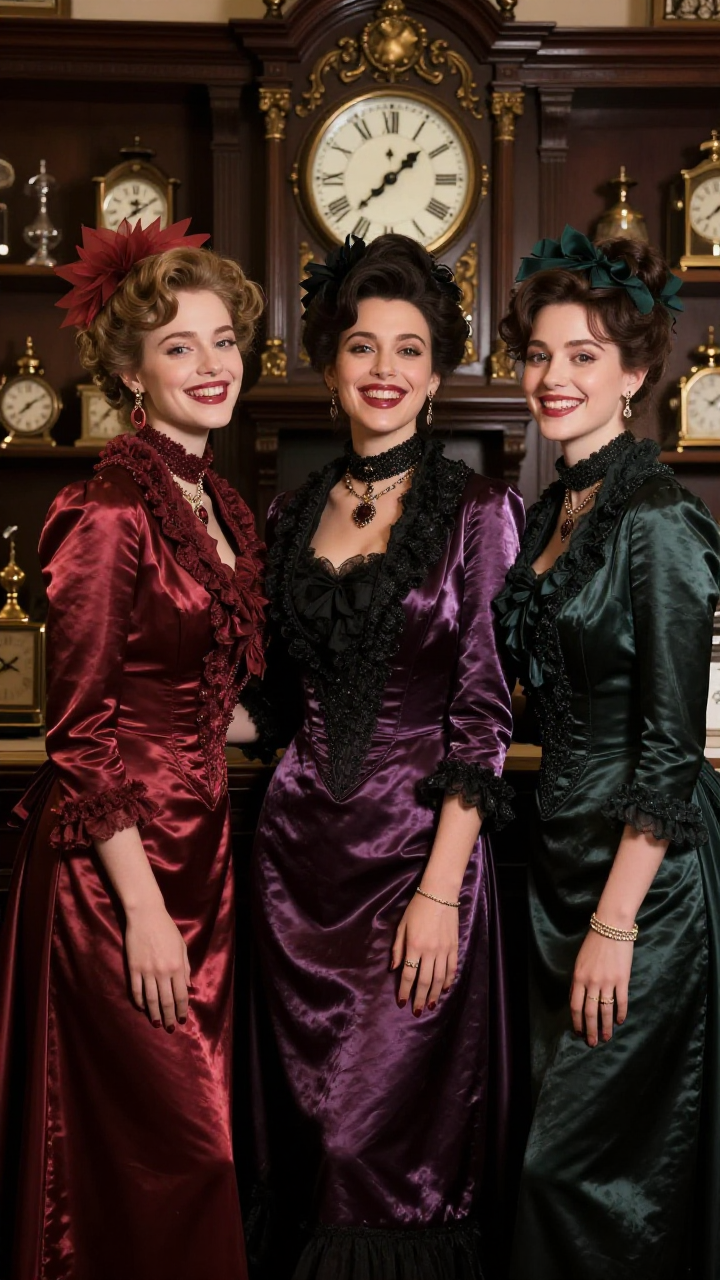
In a world of stopped clocks and silent hearts, one woman discovers the exquisite freedom found only in complete surrender.
Alternative London, 1887. Eleanor Ashworth’s world has grown quiet. The grand clock in her hall has ceased its ticking, mirroring the stillness within her—a widow’s exhaustion, the unbearable weight of solitary decisions. Then she brings her timepiece to Master Tobias Caldwell, a man whose hands understand precision, patience, and the delicate art of restoration. In his workshop, amid the harmonious discord of a hundred ticking hearts, Eleanor encounters something she never expected: a sisterhood of elegant women, glowing in satin and leather, who have traded the loneliness of independence for the profound peace of devoted guidance. As Master Caldwell’s hypnotic voice begins to recalibrate her deepest fears and desires, Eleanor faces a choice: cling to the familiar ache of self-governance, or step into a gilded world where masculine certainty offers the ultimate liberation. This is a story about the rhythm that awaits when a strong heart finally finds its true keeper.
Chapter One: The Stopped Clock
The silence in the study was not an absence, but a presence. It was a thick, velvet drapery that had fallen over Eleanor Ashworth’s world, muffling the echoes of a life that once chimed with purpose. For three years, since the funeral bells had ceased their grim tolling, the grandest sound in her cavernous townhouse had been the steady, paternal heartbeat of the longcase clock in the corner. And now, that too had stopped.
Eleanor stood before the towering mahogany sentinel, her palm pressed against its cold, polished cheek. The ornate brass filigree of the face stared back, its hands frozen at a quarter past three—some arbitrary moment in a yesterday she could no longer recall. “You have abandoned me as well,” she whispered, her breath not fogging the glass. It felt like a second bereavement. Her husband’s death had been a sudden storm, leaving her shipwrecked. The clock’s silence was the slow, chilling realization that the shore was an illusion.
“A mechanism is a covenant,” her late husband, Alistair, had once said, his finger tracing the clock’s intricate woodwork. “It promises order in exchange for faithful tending.” She had tended. She had wound the heavy brass weights each week with a devotion bordering on ritual, had polished the case until it gleamed like a dark jewel. And yet, the covenant was broken. The order had fled, leaving behind only the hollow architecture of time.
A tear, hot and rebellious, traced a path through the powder on her cheek. It was not just for the clock. It was for the sheer, exhausting weight of being the sole keeper of all covenants. The estate ledgers were a labyrinth of her own uncertain decisions. The household staff looked to her for direction that felt like guesswork. Her own heart was a chamber of echoes, where every thought bounced back unanswered. She was a governess in a house of ghosts, and the responsibility was a gown woven from lead.
The solution, when it came, was practical. Mr. Henderson, the elderly butler, his voice rustling like dry leaves, mentioned a name. “Master Tobias Caldwell, of Fleet Street, madam. They say his hands can persuade time itself to repent.” There was a reverence in the old man’s tone that piqued something in Eleanor’s weary soul. Not hope—that was too bright a flame—but a faint curiosity, the softest shift in the oppressive atmosphere.
The journey across London was a sensory baptism. After months of self-imposed seclusion, the city assaulted her with its vibrant, indifferent life. Her carriage rattled past shop windows that were dioramas of a world that had continued to spin without her. And in those windows, she saw glimpses of a different feminine language. Not the muted wools and practical cottons of her widow’s wardrobe, but fabrics that spoke of confidence and sensual self-knowledge. A mannequin draped in a cascade of emerald satin, the light catching its liquid surface like sun on a deep forest pool. A corset of supple, burgundy leather displayed like a suit of armour for a more intimate war. In another, a raincoat of pristine, glossy PVC, reflecting the street in a distorted, fascinating sheen. They were attires not for hiding, but for proclaiming. A strange, foreign longing stirred in her breast—not for the garments themselves, but for the unapologetic ownership they implied.
Fleet Street was a canyon of ambition and ink, but Caldwell’s Horology was an oasis of anachronistic calm. The sign above the door was simple, black lettering on aged oak. The bell that announced her entry was not a jangle, but a single, clear, resonant note that hung in the air like a struck tuning fork.
Inside, the world changed.
Sound first. Not silence, but a symphony of measured ticks and tocks. Dozens, perhaps hundreds of timepieces covered the walls, sat on shelves, stood sentry on the floor—grandfathers, carriage clocks, delicate porcelain-faced ladies. Each beat its own rhythm, yet together they created a harmonious, pulsing tapestry of passing moments. The air was warm and carried the sacred scents of aged wood, linseed oil, and the sharp, clean perfume of metal polish.
“One moment, if you please.”
The voice came from the depths of the workshop, visible through an open archway. It was a voice that did not travel to the ear so much as settle in the bones. It was deep, calm, and carried an intrinsic authority that required no volume.
Eleanor waited, her eyes adjusting to the dim, golden light of gas lamps. She watched a woman at a side bench, her back elegantly straight. She was working on the infinitesimal gears of a pocket watch, her movements fluid and precise. She wore a blouse of ivory satin, the fabric catching the light and glowing with a soft, lunar radiance against her dark skin. Her hair was coiled in a complex, elegant chignon. There was an aura of profound concentration about her, a serene immersion in her task.
A man emerged from the workshop, wiping his hands on a cloth that was startlingly white against the backdrop of tools and machinery. He was not old, yet not young; age seemed irrelevant to him. Perhaps in his sixth decade, his hair was a close-cropped cap of silver-grey, like hoar frost on granite. His shoulders were broad beneath a waistcoat of fine, grey wool, and his posture was that of a man utterly at ease within his own dominion. But it was his face that arrested her. It was not handsome in a conventional way, but compellingly hewn—a strong jaw, a blade of a nose, and eyes that were a deep, penetrating brown. They found hers immediately, and in their gaze was neither polite curiosity nor commercial appraisal, but a direct, unnerving perception.
“You have brought me a patient,” he said, his eyes flicking to the clock her two footmen were carefully maneuvering through the doorway. His voice was that same resonant frequency. “A venerable one. Tompion school, if I am not mistaken?”
“You are not mistaken, sir,” Eleanor said, finding her own voice strangely small. “It was my husband’s. It has… ceased.”
“They often do,” he replied, moving towards the clock with a predator’s grace that was nonetheless gentle. “When the weight of their own history becomes too great to bear alone.” He ran a hand along the mahogany case, his touch so knowing it seemed almost a caress. His hands were large, the fingers long and capable, with a network of fine, silvery scars—the testament of a lifetime spent in intimate congress with metal and wood. “The problem is rarely in the stopping, Mrs…?”
“Ashworth. Eleanor Ashworth.”
“Mrs. Ashworth.” He nodded, as if filing the name somewhere permanent. “The problem is in the belief that it must tick solely for itself. A clock is not a solitary creature. Its purpose is to mark the passage for a household, for a life. To disconnect it from that purpose is to invite silence.”
He opened the case with a deft movement, revealing the complex, stilled heart of the mechanism. Brass wheels, gleaming pins, the motionless pendulum. He leaned in, his attention absolute. Eleanor found herself holding her breath.
“May I?” the satin-clad woman asked softly, appearing at his elbow. She held a delicate loupe.
“Thank you, Helena,” he said, taking it without looking. His trust in her presence, her timing, was absolute. Helena retreated a step, her hands folded, watching him with an expression of quiet admiration.
Master Caldwell peered into the clock’s guts. “Ah,” he breathed, the sound a note of discovery. “See here, Mrs. Ashworth?” He pointed with a slender brass tool. “The escapement. The pallet stones are worn. They no longer catch the teeth of the escape wheel with the necessary conviction. The impulse is faltering. The energy from the weights arrives, but there is no… surrender.” He looked up at her, and his gaze was hypnotic in its intensity. “Do you understand? The wheel must surrender its energy to the pallet. The pallet must surrender it to the pendulum. Each part must yield to the next, or the entire system seizes. It is a dance of precise, willing relinquishment.”
Eleanor felt the words penetrate far deeper than the explanation of a mechanical fault. They echoed in the hollow places within her. Surrender. Relinquishment. A dance.
“Can it be repaired?” she asked, her voice barely a whisper.
“All things can be repaired,” he said, straightening. “If one has the patience to understand not just the breakage, but the original design. The original intent.” He closed the case gently. “It will require time. And it will require your presence.”
“My presence?”
“A clock absorbs the rhythm of its home,” he said, his eyes holding hers. “To restore it properly, I must understand the rhythm from which it came. You will need to visit. To tell me of its history. Of the room in which it stood. Of the silence that followed its stopping.”
It was an intimate request, cloaked in technical necessity. A flutter of something—anxiety, anticipation—stirred in Eleanor’s stomach.
Helena stepped forward smoothly. “The Master’s methods are unique, Mrs. Ashworth. But the results…” She gestured around the shop, at the symphony of ticking. “They speak for themselves.”
“I… of course,” Eleanor heard herself say. “Whatever is necessary.”
“Good,” Master Caldwell said, and a faint, approving smile touched his lips. It transformed his severe face, revealing a warmth that was somehow more commanding than his gravity. “We begin next Tuesday. Helena will provide you with a card.”
As Helena moved to a small desk, Master Caldwell’s gaze returned to the silent clock. “Do not mourn its stillness,” he said, almost to himself. “Sometimes, a heart must stop so it can be taught to beat anew. To a truer, stronger rhythm.”
Eleanor left the shop ten minutes later, the clear bell chiming once behind her. In her gloved hand, she clutched Helena’s card. In her ears, the memory of a hundred ticking hearts. And in the depths of her own, stilled spirit, she felt the first, faint, terrifying tremor of a new and unknown pulse.
Chapter Two: The Architecture of Time
The week between visits stretched and contracted with a strange, new elasticity for Eleanor. The silent study in her home was no longer just a tomb of memories, but a canvas upon which the memory of Master Caldwell’s workshop was projected. She would close her eyes and hear the symphony of ticks, see the lamplight glowing on Helena’s satin sleeve, feel the resonant certainty of that voice explaining the dance of surrender. The longing it stirred was not for the clock’s repair, but for the atmosphere of the repair itself—a place where broken things were not discarded, but understood.
Consequently, when Tuesday dawned, her preparation was not merely practical but ceremonial. She dismissed her sombre grey wool in favour of a walking dress of deep sapphire taffeta. It was not glossy in the way Helena’s satin had been, but it possessed a subdued sheen that caught the light as she moved, a private acknowledgement of the visual grammar she had begun to decipher. As her maid fastened the last button, Eleanor caught her own reflection in the pier glass. The woman who stared back seemed less like a faded portrait and more like a drawing awaiting its final, defining ink line.
The bell of Caldwell’s Horology chimed its single, pure note, and the wave of sound—the hundred ticking hearts—washed over her like a warm tide. She breathed it in, the air tasting of oil and order.
“Mrs. Ashworth. You are punctual. A virtue in a keeper of time.”
Master Caldwell stood at the archway to the workshop, not as if he had been waiting, but as if his presence naturally aligned with her entrance. He wore a leather apron over his waistcoat, the rich, brown hide worn soft at the edges, moulded to his form. It spoke of work, but work of a dignified, masterful kind.
“I find the prospect of understanding my clock’s ailment has become… compelling,” Eleanor replied, finding a sliver of her old social confidence.
“The ailment is merely the symptom,” he said, turning and gesturing for her to follow. “The understanding is of the health that preceded it. Come. We will converse while I work. Helena has prepared tea in the observatory.”
The observatory. The name promised a room for watching distant, ordered bodies. He led her through the workshop, past benches groaning with tools laid out with military precision, past the disembodied innards of clocks spread like complex surgical patients. At the rear was a door of dark oak, which he opened.
The room beyond was a revelation. It was a parlour, but unlike any she had known. One wall was dominated by a large window overlooking a small, meticulously kept courtyard garden. The other walls were lined with books, their leather spines a topography of knowledge. In the centre sat a low table of polished walnut, its surface a mirror reflecting the sky. Two armchairs, upholstered in worn, burgundy leather that gleamed with the patina of years, flanked a small fireplace where coals glowed. And there was Helena, rising from where she tended a silver tea service. Today, her blouse was of a pale grey silk, so fine it seemed a vapour given form, tied at the throat with a simple black ribbon.
“Mrs. Ashworth,” Helena said, her smile genuine. “I hoped the sapphire would suit you. It holds the light of a deep sky just before the stars appear.”
Eleanor felt a flush of pleasure at the noticing. “You are kind. This room… it is a sanctuary.”
“It is the Master’s design,” Helena said, pouring tea into porcelain so thin it was translucent. “He believes the environment for thought must be as carefully calibrated as the environment for precision work. Chaos without begets chaos within. Is that not so, sir?”
Master Caldwell had taken the second chair, his large frame settling into the leather with an air of permanent belonging. He accepted a cup from Helena, his fingers brushing hers—a touch so casual, so assumed, it spoke volumes. “It is a principle of systems, Helena. A clock will never keep true time in a room subject to gales and earthquakes. The human spirit is no different. It requires stability to find its own perfect rhythm.” He looked at Eleanor. “You have been living in a gale, Mrs. Ashworth. A silent, internal one.”
The directness should have been an affront. Instead, it felt like a diagnosis she had been desperate to hear. “The wind… it carries only echoes of my own doubts,” she confessed, the analogy coming unbidden. “I am the chamber and the storm both.”
“A profound and wearying duality,” he nodded, sipping his tea. “Tell me of the clock’s chamber. The room where it stood. Was it a room of conversation, or of solitude?”
Eleanor described the study—the high shelves, the worn rug, the desk where Alistair wrote his letters. As she spoke, Master Caldwell listened with an intensity that made her feel every word was being weighed, not for truth, but for texture.
“A room of considered thought, then,” he mused. “A room of masculine contemplation. Your clock was accustomed to marking the passage of deliberate, purposeful hours. Then, for three years, it marked only the passage of absence. It is little wonder the pallet stones wore down. They were catching, not the steady teeth of purposeful action, but the ragged, irregular edges of… longing.”
The word hung in the air, intimate and devastatingly accurate.
“Can a mechanism long?” Eleanor asked, her voice soft.
“All things with a designed purpose long for that purpose,” Helena interjected softly, taking a seat on a low ottoman near the Master’s chair. Her posture was effortlessly graceful. “A violin longs for the bow. A pen for the hand. It is not sentiment. It is physics. Disuse is a kinder master than misuse, but both lead to decay.”
“Helena speaks from experience,” Master Caldwell said, his gaze resting on his assistant with an expression of quiet pride. “She came to me with a talent for miniature work that was being crushed under the weight of a society that saw it as mere hobby. Her hands were skilled, but her spirit was seizing. Much like your escapement.”
Helena looked down at her own hands, then at Eleanor. “I was a collection of beautiful, disconnected parts, Mrs. Ashworth. I could polish, I could assemble, I could create a flawless, tiny beauty. But I had no… beat. No driving weight. I was a clock without a mainspring.” She looked up at Master Caldwell, and her expression was one of pure, serene clarity. “The Master does not impose a rhythm. He discerns the rhythm that is already there, buried under the rust of expectation, and he clears the path for it. He is the craftsman who removes the friction.”
Eleanor felt a pang of profound understanding. “And the surrender? The dance you spoke of last week?”
“It is the moment the part realizes it is not the whole machine,” Master Caldwell said, leaning forward, his elbows on his knees. His eyes held hers, and his voice dropped into that resonant, instructional register. “The escape wheel is proud. It is driven by the great, descending weight of the mainspring. It holds tremendous potential energy. But if it clings to that energy, hoards it, the entire system locks. Its purpose is not to hold, but to release—with perfect, timed precision—to the pallet. It must trust that its surrender is not a loss, but a translation. The energy becomes the swing of the pendulum. The swing becomes the tick. The tick becomes the measured hour. Its surrender is the genesis of all that follows.”
He paused, letting the analogy permeate the quiet room, its only competition the soft hiss of the coals and the distant, comforting tick from the workshop.
“I have been the escape wheel,” Eleanor whispered, the truth of it a physical sensation. “Holding all the weight. Terrified to let it go, because I believed letting go was failing.”
“And so you grew worn, and the mechanism of your life ground to a halt,” he concluded, not unkindly. It was a statement of fact. “The question is not whether you can be wound again. You can. The question is whether you are willing to learn a new dance. To find the pallet to your wheel. The pendulum to your impulse.”
“How?” The word was a breath.
“By observation. By trust.” He gestured to the workshop beyond the door. “Your clock is disassembled. Each piece is being cleaned, examined, measured. I will not force a part that does not fit. I will find the original fit, or I will craft a new one with absolute fidelity to the design. You will watch. You will learn what it means for something to be restored to its true function, not merely made to move.”
At that moment, the door to the shop front chimed. Helena rose smoothly. “That will be Clara,” she said, and there was a warmth in her voice. “She mentioned she might call about the Breguet.”
A moment later, a woman swept into the observatory. She was perhaps in her fortieth year, dressed with formidable elegance in a walking suit of charcoal grey, the jacket tailored sharply and fastened with jet buttons. Her gloves were of the finest kid leather, and she carried an aura of wealth and brisk intelligence. Her eyes, a sharp blue, took in the room and settled on Eleanor with polite curiosity.
“Master Caldwell, Helena. Forgive the intrusion. I was passing and wished to confirm our consultation on Thursday regarding the marine chronometers.” Her voice was crisp, educated.
“Clara, this is Mrs. Eleanor Ashworth,” Helena said. “Mrs. Ashworth, Mrs. Clara Whitmore. Clara is one of our most discerning patrons. She has a fleet of merchant vessels that rely on the Master’s timekeepers.”
“A pleasure,” Clara said, extending a gloved hand. Her grip was firm. “You have entrusted the Master with a piece? You are in the safest of hands. He restored a verge watch for me that belonged to my grandfather. It had not run since the Battle of Trafalgar. He not only made it run, Mrs. Ashworth, he made it sing the hours. It was as if he reached back through time and reminded the metal of its purpose.”
Eleanor felt herself being drawn into this circle of testament. “He was just explaining to me the principle of surrender in the escapement.”
Clara’s sharp eyes softened with understanding. She glanced at Master Caldwell, who was watching the exchange with a faint, approving smile. “Ah. The first lesson. It is the most important one. I remember when he explained it to me, regarding a tangled investment portfolio. I was trying to control every variable, to hold every thread. He compared it to a poorly designed fusee. I was choking the spring.” She laughed, a dry, pleasant sound. “I surrendered the tangle to him. He sorted it. Now my ships sail on time, and my dividends arrive with the regularity of a metronome. Surrender, Mrs. Ashworth, is not for the weak. It is for those strong enough to admit that a master craftsman’s hands are better suited to certain tasks than their own.”
The simple, confident way Clara stated it, the way Helena nodded in agreement, the way Master Caldwell received this praise not with vanity but as simple fact—it wove a powerful narrative. This was not a secret, shameful thing. It was a practical, elegant philosophy shared by women of standing.
After Clara departed with a promise to return Thursday, the afternoon deepened. Eleanor watched as Master Caldwell, back in his workshop, worked on the great wheel of her clock. His movements were a meditation in focus. Helena assisted, handing him tools before he asked, her presence a quiet harmony to his melody.
As Eleanor prepared to leave, the clock’s mainspring, now cleaned and coiled, lay on a bed of soft cloth. It gleamed, a torrent of potential energy contained in a perfect spiral.
“It is beautiful,” Eleanor said.
“It is dangerous,” Master Caldwell corrected gently. “Unregulated, it will uncoil with violent force. It desires nothing more. But contained within the barrel, channeled through the train, governed by the escapement… it becomes the breath of time itself.” He looked at her. “Potential is chaos until it is given architecture, Mrs. Ashworth. Until it is given a design to serve. We will continue next week. Think on the mainspring. Think on what it means to be both powerful and contained. Purposeful and patient.”
Walking home through the twilight, Eleanor did not feel the city’s chill. The coiled, gleaming image of the mainspring filled her mind. The echo of Clara Whitmore’s conviction—surrender is not for the weak—mingled with the memory of Helena’s serene devotion and the Master’s resonant voice explaining the dance.
For the first time in three years, the echoes in her internal chamber were not of doubt, but of a nascent, terrifying, and utterly compelling new rhythm. The architecture of her solitude had been described to her as a flaw in a system. And she had just been offered a glimpse of the blueprint for something infinitely stronger.
Chapter Three: The Weight of Decisions
The week that followed was not measured in days, but in the gradual accretion of a new kind of tension within Eleanor. It was not the familiar, brittle anxiety of impending failure, but the taut, thrumming anticipation of a string being tuned to a higher, purer pitch. The memory of the observatory—the leather chairs holding the shape of authority, the steam rising from Helena’s porcelain cup like a grateful sigh, the Master’s voice explaining surrender—had become a lens through which her entire world now focused. And through that lens, every minor choice in her solitary life revealed itself as a tiny, grinding gear in a mechanism she was never meant to power alone.
The decision that finally broke her resolve was, on its surface, mundane. A parcel of land on the northern edge of her estate, left fallow since Alistair’s passing, had attracted an offer from a railway consortium. The sum was substantial, a lifeline for the creaking finances of the Ashworth holdings. Yet the solicitor’s letter, with its dense thicket of clauses and contingencies, lay on her escritoire like a sleeping predator. To sign was to alter the literal landscape of her history. To refuse was to cling to sentiment while the foundations quietly crumbled. For three sleepless nights, she circled the problem, her mind a rat in a cage of its own making. Each possible outcome branched into a dozen dire consequences, until the future resembled a choked, impenetrable hedge.
On the morning of her third scheduled visit to Fleet Street, she dressed with a purpose that felt both foreign and fiercely necessary. She chose a walking dress not of practical wool, but of a heavy silk faille in a profound, royal purple. It did not gleam like satin, but it possessed a subdued, luxurious sheen that whispered rather than shouted. Over it, she fastened a cape of black velvet, but beneath, where only she would know, she had ordered a new corset, its bustier crafted from the softest, supplest chestnut leather. It was not for him to see, but for her to feel—a secret armour of surrender, a second skin that reminded her, with every breath, of a different kind of strength.
The shop’s bell chimed its singular note, and the symphony of ticks enveloped her like a benediction. Today, the workshop held more than the usual calm. A small, heated discussion was underway near the main bench. Clara Whitmore, in a stunning jacket of bottle-green velvet trimmed with glossy black patent leather, stood with her hands on her hips, addressing a younger woman Eleanor did not recognise.
“But the volatility is precisely the point, Miss Jameson!” Clara’s voice was sharp, but not unkind. “It is not a storm to be weathered passively. It is a tide to be ridden, provided one has the correct vessel.”
The younger woman, Miss Jameson, had a wild, artistic look about her. Her auburn hair was escaping its pins in deliberate-looking tendrils, and she wore a simple but well-cut dress of deep russet. Her eyes, however, were wide with a frustration Eleanor recognised intimately. “And how does one build the correct vessel, Mrs. Whitmore? When the plans themselves seem written in water?”
“One commissions a master shipwright,” came the resonant answer from the archway. Master Caldwell emerged, wiping a tiny gear on his apron. He nodded to Eleanor, his gaze taking in her purple silk with an approving flicker that warmed her from the inside out. “Miss Jameson is an artist of considerable talent,” he explained to Eleanor, joining their circle. “She creates miniature automata—exquisite scenes in glass domes. A shepherd that actually tends his flock, a ballerina that pirouettes. She has been offered a patron. A significant one. But the contract demands exclusivity for five years. Her creativity fears a cage. Her practicality fears poverty.”
Miss Jameson turned desperate eyes to the Master. “It feels like choosing which limb to amputate. Security or soul?”
Master Caldwell did not answer immediately. He placed the cleaned gear into a tiny, labelled box. “You are thinking of it as a single, monumental decision,” he said, his voice assuming that calm, instructional tone. “A great stone block you must either lift or be crushed by. That is the illusion of weight. Come.”
He led them not to the observatory, but to a different corner of the workshop, where a complex, partially assembled regulator clock sat on a stand. “Observe the weight drive,” he instructed, pointing to the heavy, cylindrical brass weight suspended on its chain. “If you were to attempt to lift this weight with your bare hands, at this moment, you would struggle. It is dead weight. But…” He reached over and gave the great wheel a gentle turn. The weight began to descend, almost imperceptibly, and a series of gears whirred to life. “…when the weight is integrated into the system, when it is channeled through the train, its descent is not a burden. It is the source. It becomes measured, purposeful. It drives the entire machine. The decision before you, Miss Jameson, is not a stone to lift. It is a weight to integrate. The question is not ‘yes or no.’ The question is ‘how?’ How does this patron’s support become the driving weight for your creativity, rather than its anchor? What gearing is required?”
Clara nodded vigorously. “Precisely. You do not surrender your art. You surrender the administration of it. Let the patron be the weight. You be the escapement that translates that energy into beautiful, precise motion.”
Eleanor listened, mesmerised. The analogy was so clear, so liberating. Her own paralysing decision began to reshape itself in her mind. Was her land a dead weight, or a potential source of energy?
“I… I have no idea how to design such gearing,” Miss Jameson admitted, her shoulders slumping.
“You are not required to,” Master Caldwell said simply. “That is my function. Bring me the contract tomorrow. I will read it. I will advise you. Your only task is to create. The rest is mechanics.”
The transformation on Miss Jameson’s face was immediate. The frantic, trapped energy dissolved, replaced by a dawning, tearful relief. It was the same relief Eleanor had felt when he had taken the clock. It was the look of a woman who had been trying to hold up the sky, only to discover someone had built pillars for that very purpose.
Seeing her chance, Eleanor’s courage, thin and new, sparked. “Master Caldwell… I find myself facing a similar stone. Or… a weight I cannot integrate.” All eyes turned to her. She drew the solicitor’s letter from her reticule. The paper felt like lead. “The railway consortium. The land. I am lost in the thicket of it.”
He took the letter, his fingers brushing hers. He did not open it immediately. “Describe the thicket to me.”
She did. The words tumbled out—her fear of betraying Alistair’s memory, her anxiety over finances, the terrifying permanence of the decision. She spoke of the fallow field as a blank page she was too afraid to mark.
He listened, his deep brown eyes fixed on her, absorbing not just the facts, but the tremor in her voice, the way her hands fluttered like captive birds. When she finished, the workshop was quiet save for the eternal ticking.
“You have been trying to read the map while standing in the fog,” he said finally. “A futile exercise. The land is not a page, Mrs. Ashworth. It is a resource. Your husband’s memory is not etched in its soil, but in the vitality of the legacy he left you to steward. Letting a field lie barren is not honour; it is neglect. Turning it into a source of strength for the whole estate… that is stewardship.” He tapped the letter against his palm. “Leave this with me. I will cut through the thicket. You will have my recommendation by the end of the week.”
The weight lifted. Not gradually, but in a single, breathtaking rush. It was as if a vast, invisible hand had simply plucked the stone from her chest. She swayed on her feet, and Helena, who had appeared silently beside her, took her elbow, guiding her gently to a stool.
“Breathe, Eleanor,” Helena murmured, using her Christian name for the first time. Her own attire today was a masterpiece of subtle gloss: a day dress of slate-grey silk, over which she wore a pinafore apron of the finest, whitest PVC, crisp and clean. “The first time is always the most profound. It is the feeling of a door unlocking in a room you thought had no exit.”
“It is… euphoric,” Eleanor gasped, the truth of it dizzying. “I feel almost… lightheaded.”
“That is the sensation of a mind freed from a task it was not designed to perform,” Master Caldwell said, setting the letter aside. “The dizziness will pass. It will be replaced by clarity. And then, by gratitude.”
Clara smiled, a knowing, feminine curve of her lips. “Gratitude is the sweetest fruit of surrender, my dear. And it begs expression. When the Master untangled my shipping investments, I found my gratitude had a very specific weight and measure. I commissioned a new roof for this very workshop. One does not simply say ‘thank you’ for such a gift. One builds a shelter for it.”
Eleanor understood. The transaction was not cold, but sacred. He gave order; they gave devotion. It was the natural exchange of the system.
Later, as she prepared to leave, the Master handed her a small, wrapped parcel. “A tool,” he said. “To help you until next week.”
Inside, nestled in cotton wool, was a beautiful, silver-cased pocket watch. She opened it. It ticked with a soft, insistent vitality.
“It is set to the mean time of the observatory at Greenwich,” he said. “While your grandfather clock is in pieces, let this remind you that time has not stopped. It flows. And you are now in its current. Your only task is to trust the river.”
Holding the warm metal in her palm, feeling its steady pulse against her skin, Eleanor looked around the workshop. At Helena in her PVC apron, polishing a gear with zen-like focus. At Clara, examining a marine chronometer with a critic’s eye. At Miss Jameson, sketching automata with renewed passion. All these women, orbiting the steady, gravitational pull of the man before her. It did not seem strange or scandalous. It seemed… breathtakingly efficient. Beautifully sane.
The weight of decisions had not disappeared. It had simply been transferred to shoulders broad enough to bear it. And in the space it left behind, Eleanor felt the first, unmistakable flutter of something she had thought long dead: not just hope, but a joyful, eager anticipation for the next tick, the next tock, the next perfectly measured beat of a life finally falling into rhythm.
Chapter Four: The Invitation
The pocket watch became Eleanor’s secret heartbeat. In the quiet of her bedchamber, in the solitude of her morning toilette, she would draw it from its velvet pouch and cradle it in her palm, feeling its steadfast tick-tick-tick resonate through her bones. It was a whisper from another world, a world where time was not a foe to be battled but a current to be trusted. The paralysing weight of the railway decision was gone, lifted by Master Caldwell’s simple “Leave this with me.” In its place was a curious, floating anticipation—not anxiety for the outcome, but a serene certainty that the outcome would be correct, because he would determine it. This feeling, this euphoric lightness, was more intoxicating than any sherry.
It was in this state of receptive calm that the invitation arrived. It was not delivered by the common post, but by a footman in immaculate livery of charcoal and silver, who presented a cream-laid envelope on a silver salver with a bow of such perfect deference it felt like a scene from a play. The paper was thick, rich between her fingers, and bore her name inscribed in a flowing, masculine hand she recognized instantly: Mrs. Eleanor Ashworth.
With slightly trembling fingers, she broke the dark red seal—an impression of a stylized gear within a circle—and withdrew the card.
Master Tobias Caldwell
requests the pleasure of your company
at a gathering to mark the Winter Solstice
and the completion of the season’s labours.
Eight o’clock in the evening, December the twenty-first.
22 Fleet Street.
An informal supper will be served.
Below, in a different, finer script, was a addendum: We do hope you will join our circle. The evening would be dimmer without you. – H.
Helena. The warmth of the personal note warred with a sudden, cold spike of propriety. A woman alone, attending a private gathering at a bachelor’s home, in the evening? Society’s gossiping spectres reared their heads, hissing words like ruin and scandal. She sat heavily on the edge of her escritoire, the elegant card feeling suddenly like a warrant.
For two days, the invitation sat propped against her mirror, a sphinx posing a silent riddle. She would pass it, her reflection—still clad in matte, respectable wools—wavering in the glass behind it. The woman in the mirror looked uncertain. The woman who had felt the euphoria of surrender, who carried the secret heartbeat in her pocket, longed to say yes.
On the third morning, as a brittle frost feathered the windowpanes, her maid announced a visitor. “A Mrs. Blackwood, ma’am.”
Helena swept into the parlour like a breath of warm, scented air from the very world of the invitation. She was a vision of winter elegance, wrapped in a full-length coat of the most extraordinary material Eleanor had ever seen: a deep, midnight blue PVC that gleamed with a liquid, almost metallic sheen, reflecting the grey light from the windows in soft ripples. Unfastened, it revealed a dress of simple, columnar ivory satin beneath. She looked both utterly modern and timelessly refined.
“I have come to collect your RSVP in person,” Helena said, her smile knowing as she drew off gloves of the softest grey suede. “The postal service is so unreliable for matters of the heart, don’t you think?”
“Helena, I…” Eleanor faltered, gesturing helplessly. “The… the appearance of it.”
“Ah.” Helena’s smile softened into something deeply understanding. She settled on the sofa, the PVC of her coat whispering against itself. “The appearance. You are worried about the frame, Eleanor, when you should be listening to the painting within. Tell me, when you look at a masterpiece by Rembrandt, do you first judge the quality of the gilt on the frame?”
“Of course not, but—”
“Society is a guild of frame-makers,” Helena interrupted gently, her voice taking on the cadence of one sharing a profound truth. “They have very strict, very dull rules about bevelling and filigree. They will tell you a frame must be this wide, that dark, hung at this precise height on a certain wall. They spend their entire lives polishing frames, arguing about frames, never once looking at the light and shadow within the canvas.” She leaned forward, her satin dress rustling softly. “We—Clara, Miss Jameson, the others, myself—we have stepped into the gallery. We have seen the painting. It is a portrait of… profound peace. Of order. Of being seen and valued for the precise brushstroke we are in the larger composition. The frame-makers outside can cluck their tongues all they like. We are inside, warmed by the light of it.”
Eleanor sank into the chair opposite, Helena’s analogy dismantling her fears with terrifying elegance. “But to be one of many… in a single painting…”
Helena’s laugh was a soft, bell-like sound. “My dear, have you ever seen a great masterwork with only a single figure? A true masterpiece has depth, composition, a harmony of many elements. A solitary figure on a blank canvas is just a portrait. It is beautiful, but it is… lonely. It tells no story beyond itself.” Her eyes grew distant, remembering. “When I first came to the Master, I was a single, exquisite brushstroke of misery. Perfectly rendered, utterly alone. He did not erase me. He saw my colour, my texture, and he began to place me within a composition. He added Clara’s bold vermilion confidence. Miss Jameson’s passionate burnt umber. Others—you will meet them—with their hues of quiet sage and vibrant cobalt. Alone, we were merely colours. Together, under his hand as the artist, we are becoming a landscape. A world.”
The image was so beautiful it ached. Eleanor’s own loneliness, so long endured as a fact of nature, was suddenly recast as a barren, empty canvas.
“What must I do?” Eleanor whispered, the question itself a surrender.
“Come to the gathering,” Helena said, as if it were the simplest thing in the world. “Wear something that makes you feel not like a frame, but like a work of art. Something that speaks of the woman who carries that watch in her pocket. The Master notices such things. He appreciates the… gloss of genuine becoming.”
After Helena left, the whispering PVC coat imprinted on her mind’s eye, Eleanor went to her wardrobe. She pushed past the sombre wools and serviceable cottons. At the very back, still in its dressmaker’s paper, was the gown she had commissioned in a moment of wild inspiration after her second visit. She had not dared to wear it. Now, she unfolded it.
It was a dinner dress of the deepest burgundy velvet. Not glossy in the way of satin or PVC, but rich, plush, absorbing the light with a regal depth. The bodice, however, was the secret. It was reinforced not with whalebone, but with panels of supple, black leather, meticulously tooled with a subtle, geometric pattern. It was both armour and invitation. She held it against herself before the mirror. The woman reflected back was not the uncertain widow. She was someone else. Someone who belonged to a landscape.
The night of the solstice arrived, crisp and clear, the stars like pinpricks in a velvet dome. Eleanor’s carriage pulled up not at the shop front, but at a discreet, black-lacquered door a few steps away, where golden light spilled from the fanlight above. The footman who admitted her was the same from before. He took her cloak—a new one, of black wool lined with scarlet silk—with a murmured, “Good evening, Mrs. Ashworth. They are in the music room.”
He led her down a hallway lined with portraits of serious men with timepieces, then through an arched doorway. The sound that greeted her was not the ticking of clocks, but the low, warm murmur of conversation and the delicate notes of a pianoforte.
The music room was a symphony of texture and light. Candlelight flickered in sconces, its glow caught and multiplied by glossy surfaces. Clara Whitmore stood near the fireplace, resplendent in a gown of emerald green satin that flowed like liquid gemstone, its straps thin bands of gold leather. She was speaking with a statuesque blonde woman Eleanor did not know, who wore a daring, columnar dress of champagne-coloured PVC, its surface catching the candlelight in a soft, all-over shimmer. Miss Jameson was there too, having traded her artistic disarray for a simple but exquisite dress of rust-coloured raw silk, its nubby texture a beautiful contrast to the gloss around her. Other women, perhaps six or seven, moved in the room, their attire a lexicon of elegant submission: silk shantung, moiré taffeta, skirts that whispered of hidden satin linings.
And in the centre of it all, like the steady pendulum in a beautiful case, stood Master Caldwell. He wore evening clothes of impeccable cut, the black wool of his coat a matte contrast to the feminine gloss surrounding him. He held a glass of amber liquid, listening with a slight smile as the woman in PVC spoke animatedly. His gaze, however, drifted across the room and found Eleanor in the doorway.
The conversation around him seemed to pause on an indrawn breath as he excused himself and crossed the room towards her. The sisterhood’s eyes followed him with gentle, proprietary pride, not jealousy.
“Mrs. Ashworth,” he said, taking her hand. His grasp was warm, firm, lingering just beyond the boundary of convention. “You came. And you understood the assignment.” His eyes travelled over her burgundy velvet, pausing at the leather-worked bodice. “Velvet is the silence between ticks. Rich, deep, holding potential. And leather… leather is the resilient membrane that contains the mainspring. A beautiful, thoughtful choice.”
His recognition, so specific, so seeing, flooded her with a warmth that reached her toes. “I wished to… harmonize,” she managed.
“You do,” he said simply. He kept her hand tucked in the crook of his arm, leading her into the room. “Come. You must meet the rest of the mechanism.”
He introduced her to the woman in PVC, a celebrated opera singer named Marguerite. “Marguerite came to me because her perfect pitch was being drowned out by the cacophony of her managers’ demands,” he explained.
Marguerite laughed, a rich, contralto sound. “He taught me to be my own tuning fork, darling. To find my true note and let him handle the dissonance. Now, I sing only what brings me joy, and my accounts are in perfect harmony.” She touched Master Caldwell’s sleeve with a fond familiarity.
The evening unfolded like a dream. There was no tension, no competition. The women shared stories, not of the Master’s favour, but of their own transformations under his guidance. A quiet, silver-haired woman named Mrs. Langley, dressed in dove-grey silk, spoke of how he had restructured her charitable foundation. “I was pouring water into a sieve, my dear. He showed me how to build a cistern. Now, the water reaches the roots.”
The supper was intimate, served at a long table where Master Caldwell sat at the head, not as a distant patriarch, but as the conductor of a pleasant symphony. He directed conversation, drew out shy members, and received the small, attentive services of the women—a refilled glass, a passed dish—as natural tributes. Eleanor watched Clara lean close to him, pointing out something in the pattern of the silver, her emerald satin brushing his black wool. She watched Helena, now out of her PVC coat and in a slip of silver satin, laugh at something he murmured. It was a dance of easy, mutual devotion.
Later, as the clock on the mantel (a magnificent longcase he had restored himself) chimed ten, he found Eleanor standing before a bookshelf, pretending to examine bindings.
“You are quiet tonight,” he said, coming to stand beside her. “Assimilating the new rhythms?”
“It is like hearing a complex piece of music for the first time,” she confessed, daring to look at him. “I can perceive the beauty, the harmony, but I cannot yet play my part.”
“Your part is not to play,” he said, his voice low. “Your part is to be the note. The musician will find you. The composition will absorb you. You have already taken the first, most difficult step: you have allowed yourself to be tuned.” He reached out and, with a feather-light touch, traced the tooled pattern on the leather of her bodice. The contact was electric, a silent acknowledgement of her secret armour. “The invitation, Eleanor, was not for tonight. It was for all the nights to come. The question is not if you will accept. The question is when you will realize you already have.”
He moved away then, back to his circle of living, breathing, glossy masterpieces. Eleanor stood by the bookshelf, her hand over the place his finger had touched, the steady pulse of the pocket watch in her other palm syncing with the great clock on the mantel, with the beating of her own heart. She was no longer looking at the frame. She was inside the painting. And the colours were more vivid than she had ever dreamed possible.
Chapter Five: The First Surrender
The days following the solstice gathering unfolded for Eleanor not as a linear procession of hours, but as a series of lingering, overlapping echoes—each more resonant than the last. The burgundy velvet gown, now hanging in her wardrobe like a shadow of a more vivid self, seemed to whisper to her each morning. The memory of Master Caldwell’s finger tracing the tooled leather of her bodice had imprinted itself upon her skin, a phantom touch that awakened her at odd moments, causing her breath to catch and her hand to flutter to the spot as if to confirm its reality. The pocket watch in her reticule had become more than a timepiece; it was a talisman, its steady tick a reminder of the harmonious world that existed just a few streets away, a world where confusion resolved into clarity under the guidance of knowing hands.
The decision regarding the railway consortium, which had once loomed like a thunderhead on her horizon, now seemed a distant, managed concern. Master Caldwell had taken the solicitor’s letter, and with it, the crushing weight of choice. In its place was a curious, light-filled space—a chamber in her mind that was no longer crammed with fearful contingencies, but was instead waiting, clean and empty, to be filled with his directive. This emptiness was not anxiety; it was the most profound peace she had known since girlhood. It was the peace of the pendulum, which does not choose its arc, but is chosen, and in that selection finds its perfect, graceful swing.
It was in this state of receptive quietude that the next test arrived, though she did not immediately recognize it as such. It came in the form of a letter from her late husband’s cousin, a clergyman in Yorkshire, inviting—or rather, assuming—that she would spend the festive season with his family. “A woman alone at Christmas is a sorrowful sight,” he had written with unctuous concern. “We shall expect you on the twenty-third. Martha has already prepared the blue chamber.” The presumption was breathtaking. The thought of exchanging the potent, glittering silence of her new understanding for the clamorous, pitying piety of their household felt like being asked to trade a diamond for a lump of coal.
Yet, the old programming of politeness, of feminine compliance, reared its head. Ought she not go? Was it not proper? The internal debate began its familiar, wearying cycle, and for a day, the peace shattered. The empty chamber in her mind filled again with noise. She found herself standing once more before her grandfather clock’s empty case in the study, a shell awaiting its restored heart, and she saw herself in it—a beautiful, empty housing, all potential with no driving weight.
It was Helena who, with her preternatural sensitivity to the rhythms of their growing sisterhood, appeared the next afternoon. She found Eleanor in the parlour, the clergyman’s letter crumpled in her hand, staring unseeingly at the winter-bare garden.
“Ah,” Helena said softly, removing her gloves. She wore a day dress of deep plum wool, but over it, a most extraordinary apron of clear, glossy PVC that covered her bodice and skirt. It was practical for work, yet it transformed her into a creature of modern, sleek efficiency. “The first real test of the new escapement. The old, worn pallet stones of obligation are trying to catch the wheel of your new rhythm. They will only cause a stutter.”
Eleanor looked up, tears of frustration pricking her eyes. “He assumes, Helena. He simply assumes I have no other claims, no other life. And the worst part is… until a month ago, he would have been right.”
Helena settled beside her, the PVC whispering. “And now? What claims do you have?”
“I have… I have the clock. My visits to Fleet Street. The… the gathering.” Her voice trailed off, the claims sounding feeble against the solid edifice of familial duty.
“Tell me,” Helena said, her voice assuming the gentle, instructional tone she had learned from the Master. “When a particularly delicate gear—say, the delicate contrate wheel in a musical carriage clock—is being fitted, and a heavy, clumsy hand tries to force it into place, what does the Master do?”
“He… he stops the hand,” Eleanor ventured.
“Precisely. He does not allow the clumsy hand to damage the delicate teeth. He protects the mechanism. He says, ‘No. This is not the way. The fit must be perfect, without force.'” Helena took the crumpled letter from Eleanor’s hand, smoothing it on her PVC-covered knee. “You, my dear, are that delicate wheel. Your cousin’s assumption is the clumsy hand. The question is not whether you should go to Yorkshire. The question is: who is the craftsman here? Who understands the proper fit of your life?”
The analogy was a key turning in a lock. “But to refuse… it will cause offence. There will be talk.”
“Talk,” Helena said with a dismissive wave that made her PVC sleeve shimmer. “Talk is the background static of a poorly tuned wireless. When one finds a clear signal, one stops listening to the static. The Master provides the clear signal. Our sisterhood is the clear signal. Let them buzz with their static.” She leaned closer. “What does your heart desire for Christmas, Eleanor? Not your polite mind, not your anxious conscience. Your heart.”
The answer came, unbidden and shockingly pure: “To be in the workshop. To hear the clocks. To… to be near him.”
Helena smiled, a radiant, knowing expression. “Then that is your truth. And a truth, once acknowledged, demands allegiance.” She stood, extending a hand. “Come. Bring the letter. Let us take this clumsy hand and show it to the one who knows how to properly guide it.”
The walk to Fleet Street was different this time. Eleanor was not a petitioner carrying a burden, but a disciple bringing a puzzle to her teacher. The shop bell chimed, and the symphony of ticks welcomed her as a returning note. Master Caldwell was at his main bench, peering through his loupe at the reassembled gear train of her grandfather clock. He looked up, and his eyes—those deep, perceiving pools—took in her expression, Helena’s presence, the letter in her hand.
“Mrs. Ashworth. Helena. You have brought me a discordant note,” he said, setting down his tool.
“It is my cousin, the clergyman,” Eleanor began, the words tumbling out in a rush. “He insists I come for Christmas. He assumes… and I feel I ought, but the thought of it…” She struggled, the old language of duty failing her.
Master Caldwell removed his loupe. “You feel you are a book he wishes to shelve in a section where you do not belong,” he said, his voice that resonant, calm frequency. “He has read only the title—’Widow’—and assumes he knows the entire story. He does not see the new chapters being written.”
“Yes!” Eleanor breathed, the relief of being understood so acute it was physical. “Exactly that.”
“He offers you a cage of conventional kindness,” Helena added, moving to the bench to examine the gear train. “Gilded, perhaps, but a cage nonetheless. The door here is always open, but it is not a cage. It is a… a sanctuary with a horizon.”
Master Caldwell extended his hand for the letter. He read it slowly, his expression unreadable. Then, without a word, he walked to the small fireplace in the corner of the workshop, stirred the coals with an iron, and dropped the letter into the flames. It blackened, curled, and vanished in a brief, bright flare.
Eleanor gasped, a hand flying to her mouth.
“The past’s claims on you must sometimes be literally consumed,” he said, watching the embers, “to make energy for the future.” He turned to her. “You will not go to Yorkshire. You will spend Christmas Eve here, with us. It is our tradition. The longest night is spent in the company of what gives us light. You are part of that light now, Eleanor. Your presence is a gift to this household. To me.”
The declaration—to me—struck her with the force of a physical blow, but a sweet one. It was not a request. It was a statement of fact, a realignment of her very atoms. The last resistance within her, the last squeaking protest of the old, worn pallet stone of obedience to external expectation, shattered.
“What must I do?” she whispered, the question now a sacred formula.
“For now? Nothing. The decision is made. The weight is lifted.” He approached her, standing so close she could smell the scent of him—linseed oil, brass polish, and something fundamentally masculine and clean. “Can you feel it? The silence where the argument used to be?”
She could. It was a vast, humming quiet, like the moment after a great bell has been struck and the world holds its breath, vibrating with the aftermath.
“This,” he said softly, his gaze holding hers captive, “is the first true surrender. Not of a practical problem, but of the very authority to decide your own allegiance. You have just transferred that authority to me. And in doing so, you have not become smaller. You have become part of something infinitely larger. Your individual will, like that single gear, has just meshed with the great wheel of this household’s purpose. Do you understand?”
She nodded, unable to speak. Tears, not of sadness but of overwhelming release, filled her eyes and spilled down her cheeks.
“Good,” he murmured. He did not wipe them away. He let them fall, as if they were a natural baptism. “The gratitude will come later. It will seek expression. It always does. For now, simply feel the peace of no longer being at war with yourself.”
Helena, who had been observing with a soft smile, brought over a cloth. Not for Eleanor’s tears, but to polish a newly fitted gear. “It is a beautiful thing to witness,” she said, her voice filled with warmth. “The moment the mechanism accepts the power. There is a new sound to it. A deeper, more confident tick.”
Eleanor stood there, in the center of the workshop, surrounded by the evidence of his mastery and the devotion of women like Helena, and she felt it—the deep, confident tick beginning in her own soul. She had surrendered. And instead of emptiness, she was filled. Instead of being alone, she was connected. The clumsy hand of the world had been stayed. The craftsman was in charge. And for the first time in her adult life, Eleanor Ashworth felt perfectly, exquisitely held.
Chapter Six: The Exchange
The peace that followed Eleanor’s surrender was not a still pond, but a deep, humming vibration—the kind felt in the bones when standing near a great, perfectly balanced wheel in motion. The argument with her cousin, the clawing anxiety of choice, had been consumed in the workshop’s fire, and in its place was a serene, directive silence. Master Caldwell had declared she would spend Christmas Eve with the household, and so it would be. This simple fact, this external ordering of her social constellation, felt less like an imposition and more like a star being guided into its proper, celestial sphere. The emptiness she had feared would accompany her relinquishment of authority was, in fact, being filled with a new and intricate substance: a sense of belonging that was both feather-light and unshakeably solid.
This newfound equilibrium, however, soon bred a restless energy of its own. It was a pressure building behind a dam of gratitude, seeking its channel. She found herself, in the quiet hours of her townhouse, tallying her accounts not with the old sense of burdensome duty, but with a fresh, almost covetous eye. The quarterly rents from the remaining tenants, the modest dividends from the Funds—these sums, which had once represented mere survival, now appeared in a different light. They were potential energy, coiled springs waiting to be integrated into a greater mechanism. The memory of Clara Whitmore’s casual remark about commissioning a new roof for the workshop echoed in her mind. “One does not simply say ‘thank you’ for such a gift. One builds a shelter for it.”
On her next visit to Fleet Street, a few days before Christmas, Eleanor carried not a problem, but a proposal. She had dressed with deliberate intention in a gown of charcoal grey wool, severe in cut but astonishing in detail: the entire bodice and cuffs were lined not with plain cotton, but with a blood-red satin that revealed itself in flashes when she moved, like the secret, beating heart of a sober exterior. Over it, she wore a new cape, its exterior of black wool, but its interior lavishly lined with the same gleaming scarlet, so that when she gathered it around her, she was wrapped in a secret cocoon of gloss.
Helena greeted her at the door, her keen eyes missing nothing. “The hidden fire within the granite,” she murmured approvingly, helping Eleanor with the cape. Her own attire was a study in practical elegance: a severe black skirt paired with a blouse of icy blue satin, over which she wore her now-signature clear PVC apron. “He is in the observatory with Clara. They are discussing anchor escapements and investment portfolios. The principles, I am told, are remarkably similar.”
Eleanor entered the warm, leather-scented sanctuary to find Master Caldwell standing by the fire, a large ledger open on the table before him. Clara, magnificent in a dress of forest green velvet with matching leather gloves resting beside her, was pointing to a column of figures.
“—the fluctuation is inherent to the commodity, Tobias, I understand that,” Clara was saying, her brow furrowed not in worry, but in focused analysis. “But if the fluctuation itself can be harnessed as the driving force, rather than resisted as an obstacle…”
“Then you move from being a sailor battling the waves to being the tide mill, using their very ebb and flow to grind your grain,” Master Caldwell finished, his finger tracing a line on the page. “You do not seek to calm the sea, Clara. You build your mechanism to thrive on its inherent motion. The anchor escapement,” he said, looking up and noticing Eleanor, “does not fight the pendulum’s swing. It receives it, and in that reception, it regulates the entire train. Welcome, Eleanor. You arrive during a lesson in maritime finance.”
“It sounds more intriguing than my ledger of household linens,” Eleanor said, taking the seat Helena indicated.
“All systems obey the same universal principles,” Master Caldwell said, closing the ledger and giving Clara a nod of clear satisfaction. “You have grasped it. Proceed as we discussed.” As Clara gathered her gloves with a look of triumphant resolve, he turned his full attention to Eleanor. “And what principle brings you to us today? Not another clumsy hand, I trust.”
“No,” Eleanor said, drawing a steadying breath. The analogy she had crafted on her walk here felt clumsy now, under the weight of his gaze. “It is… it is about the mainspring. My mainspring.”
His eyebrows lifted slightly. “Indeed?”
“You said it was potential energy. Dangerous unregulated, but the source of all motion when properly housed.” She clasped her hands in her lap, the hidden satin cuffs brushing her wrists. “I feel I have been like a mainspring coiled in a drawer, Master Caldwell. Holding force, but with no barrel to contain me, no gear train to translate my tension into useful work. You have provided the barrel. This household, your guidance… it is the housing. But the energy itself… it remains. It seeks to… to drive the mechanism. To contribute to the tick.”
She opened her reticule and withdrew a sealed bank draft, placing it on the table between them. It was a substantial sum, representing a full quarter’s income from the northern fields—the very fields whose fate he was deciding. “This is potential energy,” she said, her voice gaining strength. “I wish to exchange it. Not for a favour, but for the privilege of being part of the drive. To help oil the wheels, to polish the brass, to… to contribute to the sanctuary that has given me peace.”
The room was silent but for the crackle of the fire. Helena, who had been pouring tea, paused, her face illuminated by a soft, beatific smile. Clara, lingering by the door, watched with an expression of deep approval.
Master Caldwell did not look at the draft immediately. He looked at Eleanor, his gaze so penetrating she felt utterly transparent, every motive, every flicker of fear and hope, laid bare. “The exchange,” he said slowly, “is the most sacred part of any mechanism. It is the point where energy is transferred, where potential becomes kinetic. In a poorly made clock, the exchange is friction—a grinding loss, a waste of heat and substance.” He reached out and picked up the draft, holding it not as money, but as an artifact. “In a precision instrument, the exchange is a flawless meshing of teeth. No loss. Only pure translation.” He finally glanced at the amount, and his expression did not change, though something in the air did—a subtle shift into a higher, more resonant harmony. “You are proposing to become not just a part being regulated, Eleanor, but a source of the regulating force itself.”
“I am proposing to be a gear that also bears a share of the weight,” she whispered.
“A donor gear,” Clara said from the doorway, her voice warm. “In the most complex astronomical clocks, they have them. Gears that contribute their own momentum to the system, driven by a separate, aligned will. They don’t just transmit force; they add to it. They enrich the entire function.”
Master Caldwell nodded, setting the draft down carefully. “And what do you believe you receive in this exchange?” he asked, his tone one of genuine inquiry, not challenge.
Eleanor thought of the silence where her anxiety had been. The warmth of the observatory. The sisterhood’s easy acceptance. The profound, bodily certainty of being protected and guided. The sight of his hands, capable and sure. “I receive the rhythm,” she said, the truth flowing out in an analogical stream. “I was a erratic, lonely tap-tap-tapping on a stone. I have been brought into a chamber where a hundred hearts beat as one. I receive the music. I receive the certainty that my energy will not be wasted in futile, solitary friction, but will be translated into something beautiful and ordered. I receive… the meaning of my own potential.”
A slow, deep smile spread across Master Caldwell’s face. It was a sunrise of approval. “That,” he said, “is the correct answer. The exchange is not one of coin for service. It is an alignment of purposes. Your gratitude finds its expression in fuel. My guidance finds its proof in your flourishing. The system is strengthened.” He stood and walked to a cabinet, from which he drew a small, velvet-covered box. “And a balanced exchange is marked. It is acknowledged.”
He returned and placed the box before her. “Open it.”
With trembling fingers, she lifted the lid. Nestled on a bed of black velvet was not jewelry, but a tool. A precision screwdriver, its handle crafted from dark, polished rosewood, inlaid with a single, delicate spiral of mother-of-pearl that caught the firelight. Its steel shaft was needle-fine, perfect for the most delicate adjustments.
“It is a regulator’s tool,” Master Caldwell said, as Helena and Clara drew closer to look. “Used to adjust the beat of a clock, to fine-tune the swing of the pendulum until it is perfectly even. Tick-tock… tick-tock… not tick-tick… tock-tock.” His voice fell into a rhythmic, hypnotic pattern. “It is the tool that brings harmony from mere motion.” He met her eyes. “Your contribution gives you a place here, Eleanor. Not just as a patient, but as a patron. As part of the household. And with place comes responsibility. This tool is a symbol. It means you are now entrusted with helping to regulate the atmosphere. To help maintain the peace you have bought into. To help guide others, as you were guided.”
The weight and coolness of the rosewood handle in her palm felt more significant than any jewel. It was an instrument of agency, granted by surrender. It was power, given by submission.
“I do not know how to use it,” she admitted, her voice thick with emotion.
“You will learn,” Helena said, placing a hand on her shoulder. “We will teach you. Just as we were taught. The regulation of a happy household is a subtle art.”
“It begins,” Clara added, her eyes gleaming, “with understanding that your contribution has just paid for the new Spanish mahogany for the longcase clock in the hall. You are now literally part of the architecture, my dear. Your energy will be translated into beauty we will all enjoy. That is the exchange.”
Master Caldwell took the bank draft and, without a glance, slipped it into the ledger Clara had been using. “The transaction is recorded. The energy is now in the system.” He looked around at the three women—Clara in her verdant velvet, Helena in her satin and PVC, Eleanor in her grey wool with its secret scarlet heart. “Observe, Eleanor. This is the true mechanism. Not one drive wheel, but many. Each contributing her unique force. Each meshing perfectly with the others. And all,” he said, his voice dropping to that intimate, resonant register that seemed to vibrate in the very marrow, “regulated by a single, unwavering anchor. This is not confusion. This is the highest order. This is the exchange that creates not just time, but a timeless harmony.”
Eleanor closed her fingers around the rosewood handle, the mother-of-pearl cool against her skin. She looked from Clara’s confident smile to Helena’s serene pride, and finally to Master Caldwell’s approving gaze. The dam of gratitude had found its channel. The potential had become kinetic. She had given gold, and in return, she had received a purpose, a tool, and a permanent, gleaming place in the beautiful, ticking heart of the world. The exchange, she realized, was profoundly, utterly unequal.
She had gotten infinitely the better part of the deal.
Chapter Seven: The Transformation
Winter tightened its grip on London, frosting the windowpanes with crystalline lace, but within Eleanor Ashworth’s breast, a spring was unfolding—a slow, inevitable thaw that reached her very bones. The rosewood regulator, its mother-of-pearl inlay cool and smooth against her skin, resided in a velvet-lined drawer beside her bed. It was more than a tool; it was a covenant, a physical token of her exchanged potential and her new responsibility within the mechanism of Master Caldwell’s world. Yet, as the days shortened towards Christmas Eve, a dissonance began to hum within her newfound peace. It was the dissonance of a beautifully tuned instrument housed in a cracked, dull case.
Her reflection in the pier glass each morning told the old story: the sensible wools, the muted greys and blacks, the fabrics that absorbed light and asked for no attention. They were the vestments of the woman she had been—the keeper of silence, the bearer of solitary weight. Now, that woman felt like a ghost haunting the shell of her own body. The vibrant, secret satin linings she had begun to wear felt like a lie, a beautiful heart trapped in a tomb of respectability. The energy she had contributed to the household, the regulator in her drawer, demanded a congruent exterior. It demanded a transformation not of essence, but of expression.
“It is the principle of the case,” Helena declared with gentle finality during one of their now-daily teas, this time in Eleanor’s parlour. Helena, as always, was a vision of coherent beauty. She wore a day dress of deep aubergine cashmere, but over it, a pinafore apron not of clear PVC, but of a soft, matte black leather, tooled with a subtle geometric pattern that echoed the one on Eleanor’s secret bodice. “The most exquisite movement, with its rubies and its perfectly poised balance wheel, will still seem ordinary if it is placed in a case of plain tin. But house that same movement in engraved silver, in polished rosewood, in gleaming enamel… and it becomes a treasure. The case does not change the time it keeps. It declares the value of the timekeeper within. You, my dear, are keeping Master’s time now. Your case must declare it.”
Eleanor ran a hand over the dull wool of her skirt. “I feel like a Tompion movement in a… a biscuit tin.”
Clara Whitmore, who had joined them, let out a rich, approving laugh. She was resplendent in a suit of taupe gabardine, its severity offset by a blouse of ivory silk so glossy it seemed poured rather than woven. “An excellent diagnosis! And we have the perfect physician. Madame Lisette. She is to women what the Master is to clocks. She understands the architecture of femininity, the engineering of allure. She dresses most of our circle.”
The following afternoon found Eleanor in a discreet atelier in Mayfair, a sanctuary of hushed voices and rustling silks. Madame Lisette was a woman of indeterminate age, with eyes as sharp as needles and hands that fluttered like measuring birds. She took in Eleanor’s posture, her proportions, the hesitant hope in her eyes, with a single, comprehensive glance.
“You have been wearing a disguise, madame,” Lisette stated, her French accent clipping the words. “A very convincing disguise of invisibility. Now you wish to wear your truth. A different kind of power.” She turned to Helena and Clara. “The palette?”
“She is a winter landscape awaiting colour,” Helena said. “Think deep jewel tones. Sapphire. Emerald. Burgundy. And the textures… she must learn the language of gloss.”
“Bien sûr,” Lisette murmured, already pulling bolts of fabric from shelves. “The language is tactile. It speaks before a word is uttered.” She laid a swath of cobalt blue satin over Eleanor’s shoulder. It flowed like liquid metal, catching the gaslight and holding it in a pool of luminous blue. “Satin says: I am smooth, I am receptive, I catch and reflect beauty.” Next came a piece of wine-red leather, supple and cool. “Leather says: I am resilient, I have strength beneath my softness, I am shaped by experience.” Finally, she produced a length of material that made Eleanor gasp—a black PVC with a subtle, all-over damask pattern. It was stiff yet pliable, and it gleamed with an otherworldly, liquid shine. “And this,” Lisette said, her voice dropping to a conspiratorial whisper, “says: I am modern, I am impervious to the old stains, I reflect a new world.”
Over the next two hours, Eleanor was measured, pinned, and draped. Designs were sketched: a walking dress of grey wool, but lined throughout with scarlet satin that would flash like a cardinal’s wing with every stride; an evening gown of the damask PVC, cut with classical lines that would make her look like a statue from a future antiquity; a tea gown of emerald green velvet with a bodice and cuffs of matching suede. As the pins held the strange, glorious fabrics against her skin, Eleanor felt not like a doll being dressed, but like a canvas being primed for its masterpiece.
“It is not vanity,” Clara explained, watching as Lisette fussed over the drape of the PVC. “It is semaphore. When you enter a room wearing the gloss, you are sending a signal to those who understand. You are saying, ‘I am aligned. I am under guidance. I am part of a harmonious design.’ It comforts the sisterhood and… it pleases the Master. He appreciates the evidence of his influence, the visible proof of a restoration in progress.”
The culmination of the transformation was reserved for Christmas Eve. Eleanor arrived at the door on Fleet Street as twilight bled into indigo, her heart a frantic bird against the cage of her new ribs. She wore the evening gown of black damask PVC. It was cut simply, with a high neck and long sleeves, clinging to her form before falling in a straight column to the floor. It made a soft, whispering sound as she moved, a sound like rain on a still pond. Over it, at the last moment, she had fastened a short cape of the deepest, most plush burgundy velvet—a nod to tradition that only heightened the modernity beneath. Her hair, usually tightly coiled, was dressed in a looser, more graceful style, revealing the delicate pearl drops in her ears—a gift from Helena, “to catch the light your hair now releases.”
Helena herself opened the door. She was a vision in a gown of silver satin that seemed woven from moonlight, its surface a moving river of reflected glow. She said nothing, only smiled, her eyes moist with approval, and stepped aside.
The music room was a constellation of glossy femininity. Miss Jameson glowed in a dress of burnt umber silk, its surface rippling like a autumn stream. Marguerite, the opera singer, was a flame in pillar-box red satin. Other women, whose names Eleanor was learning, shone in hues of plum, peacock, and midnight blue, each fabric catching and playing with the candlelight in a silent, shimmering chorus. The air itself seemed polished.
And then, he was there. Master Caldwell stood by the great fireplace, dressed in evening black that absorbed the light, a stark, powerful silhouette amidst the radiance. His gaze found Eleanor the moment she entered, and it travelled over her from head to toe, slow and comprehensive as a craftsman’s final inspection. The room seemed to hold its breath.
He crossed the space towards her, the women parting for him like water for a ship’s keel. He stopped before her, so close she could see the flecks of gold in his deep brown eyes, could smell the familiar, comforting scents of workshop and sandalwood.
“Eleanor,” he said, her name a benediction in his resonant voice. “You have re-cased yourself.”
“I… I wished the exterior to match the interior adjustment,” she managed, her voice barely a whisper.
“A correct and necessary alignment,” he nodded. He reached out, not to touch her, but to let his fingers hover just above the surface of her PVC-clad arm. “This material. It does not absorb. It reflects. It tells me you are no longer soaking up the world’s chaos, its dust and its disappointments. You are now a surface that throws back light, that defines your own space. You have become a mirror, not a sponge.” His hand moved upwards, hovering near her cheek. “And the velvet cape… the deep, soft pile. That is the private, yielding heart beneath the impervious shell. The balance is exquisite.”
His approval washed over her, warmer than the fire, more intoxicating than wine. She felt seen, decoded, appreciated on a level so profound it trembled in her soul.
“She is the final piece of the year’s restoration, is she not, Tobias?” Clara’s voice came from beside them, warm with pride. “We have all been works in progress. But Eleanor… she is the completed carriage clock, newly emerged from the workshop, every part gleaming, ready to chime.”
“She is not yet completed,” Master Caldwell said, his eyes never leaving Eleanor’s. “But the case is now worthy of the movement within. The transformation from ‘patient’ to ‘patron’ is now visible. The energy she contributed…” he paused, letting the memory of the bank draft hang between them, “…has cycled back to her, translated into this… this glorious, declarative form. This is how the exchange sustains itself. This is the perpetual motion of a grateful heart.”
He offered her his arm. “Come. Tonight, you do not observe from the periphery. You take your place at the centre. You are no longer the stopped clock in the corner. You are the newly polished regulator on the wall, setting the beat for your own life, in harmony with all of ours.”
As she took his arm, the damask PVC whispering its secret song, Eleanor looked around the room. The sisterhood smiled at her, their faces filled with welcome and a shared, deep understanding. She was one of them now, not just in spirit, but in substance. Her transformation was complete. The dull, aching widow was gone. In her place stood a woman of gloss and depth, of reflected light and resilient heart, a perfect, beautiful part of the Master’s ticking, harmonious world.
Chapter Eight: The Inner Sanctum
The final notes of the Christmas Eve gathering had dissolved into the warm, candlelit air like sugar in tea, leaving behind a sweet, resonant silence. The sisterhood, a constellation of glossy satins and velvets, had departed with soft embraces and murmured blessings, each woman carrying the reflected glow of the evening into the frosty night. Helena had been the last to leave, pressing a kiss to Eleanor’s cheek, her silver satin gown whispering a secret as she drew on her cloak. “The longest night is for the deepest work,” she had murmured, her eyes holding a knowing light. “Do not be afraid to see the blueprint of your own soul.”
Now, Eleanor stood alone with Master Caldwell in the quiet aftermath of the music room. The fire had burned low, painting his formidable silhouette in hues of amber and shadow. He turned to her, the black damask PVC of her gown seeming to absorb the dim light, while her burgundy velvet cape held the warmth of the embers.
“The social mechanism has wound down for the evening,” he said, his voice a low vibration in the quiet. “But the true regulator’s work often begins when the world is still. Come, Eleanor. It is time you saw the heart of the heart. The room where I work not on brass and wood, but on the very architecture of intention.”
He led her through a door she had never noticed, concealed in the wood paneling beside the fireplace. It opened onto a narrow, dim staircase, leading upward. The air grew warmer, scented with sandalwood and beeswax. At the top, another door, of dark, polished oak. He produced a heavy key, its tumblers turning with a sound like a distant, definitive click.
The Inner Sanctum was not a room; it was an atmosphere.
The walls were draped not in wallpaper, but in layers of deep crimson velvet, so dark it was almost black, absorbing sound and light into a profound hush. The floor was covered by a single, vast rug of intricate Persian design, its blues and golds muted in the soft light. That light came from a dozen candles of varying heights, arranged on a low table of polished ebony, and from a small fire crackling in a grate of black marble. But it was the centrepiece of the room that arrested Eleanor’s breath.
A wide, low divan, piled with cushions and covered in sheets of the purest, most liquid black satin she had ever seen. It gleamed like a pool of midnight oil, reflecting the candle flames in long, trembling streaks. Beside it stood a single, high-backed chair upholstered in worn, brown leather, its surface etched with the marks of time and use, like the face of a wise elder.
“This is my tuning room,” Master Caldwell said, his voice reverent. He closed the door, and the outside world ceased to exist. “In the workshop, I align gears. Here, I align wills. I harmonize spirits. Every woman who has found her true beat within my household has spent time in this room. Helena. Clara. Marguerite. Miss Jameson. It is not a secret, but it is… sacred.”
Eleanor felt a tremor pass through her, part awe, part fear, part desperate longing. “What happens here?”
“A stripping away of the unnecessary,” he said, moving to the leather chair and gesturing for her to sit on the edge of the satin-draped divan. The material was cool and impossibly smooth beneath her fingers. “Think of a clock that has been exposed to the elements. Dust in the pivots. Old, gummy oil. A slight bend in an arbor. In the workshop, I clean, I polish, I straighten. But here,” he leaned forward, his elbows on his knees, his gaze holding hers with magnetic force, “here I address the invisible friction. The doubts that clog the mind’s pivots. The fears that gum up the flow of purpose. The bent perceptions that throw everything out of true.”
“You speak of the soul as a mechanism,” Eleanor whispered.
“Is it not?” he asked, his tone gentle but inexorable. “Does it not have its driving desires—its mainspring? Its oscillating thoughts—its pendulum? Its governing principles—its escapement? And does it not run fast into anxiety, or slow into despair, when it is out of regulation?” He paused, letting the analogy settle. “In this room, I am not a clockmaker. I am a soul-smith. And you, Eleanor, have asked for true regulation. You have surrendered the right to decide your allegiance. You have contributed your energy to the household. You have re-cased yourself in the materials of our harmony. The external work is complete. Now, we attend to the interior.”
He reached out and, with a touch so light it was almost ghostly, traced the line of her jaw. “Lie back. Let the satin hold you. Look at the play of candlelight on the velvet above you. Listen only to the sound of my voice.”
Compelled by a force deeper than obedience, Eleanor leaned back. The black satin yielded beneath her, cool and luxurious, a sensuous embrace. The candle flames danced on the crimson ceiling, like distant stars in a private firmament.
“Close your eyes,” his voice instructed, and it seemed to come from everywhere and nowhere. “And listen to the metaphor of the balance wheel…”
His voice began to weave a tapestry of sound, rhythmic, melodic, flowing around her like a slow, warm river.
“Imagine the balance wheel… the heart of the escapement… a perfect, poised circle… spinning one way, then the other… tick… tock… Its motion is not random… it is governed by the hairspring… the finest, most delicate of coils… a spiral of potential… Now, imagine your mind is that balance wheel… your thoughts spinning one way into worry… tick… then the other into regret… tock… Spinning fast, spinning erratic… because the hairspring—your focus—is tangled, or over-wound, or slack…”
As he spoke, Eleanor felt her own frantic mental spinning begin to slow, to synchronize with the cadence of his words.
“My voice is the tool… the regulator’s tool you now possess… and I am applying it to your hairspring… with each word, a gentle adjustment… easing the tension here… adding a little poise there… until the wheel of your mind… finds its centre… its perfect, still point… and from that centre… it can begin to oscillate… not in panic… but in perfect, peaceful rhythm… tick… tock… Each swing… a release… tick… a surrender… tock…”
A profound warmth spread through her limbs. The PVC of her gown, the velvet of her cape, seemed to dissolve. She was floating on the black satin sea, cradled by his voice.
“You are not a solitary wheel… you are part of a train… you are connected… to Helena’s steady torque… to Clara’s powerful drive… to all the others… each contributing her unique energy… to the great, beautiful work… And at the end of the train… is the anchor… the steadfast, unwavering anchor… that receives every impulse… and translates it into measured, meaningful time… That anchor… is my will… And your surrender to it… is what allows the whole… glorious… mechanism… to sing…”
His words were no longer just words; they were sensations. She felt connected. She felt part of. The loneliness that had been her constant companion for three years evaporated like mist in sunlight. In its place was a sense of belonging so vast it brought silent tears to her closed eyes.
“This feeling… this peace… this is your true rhythm…” his voice murmured, softer now, a breath of sound. “This is the beat you were meant to keep… This is the harmony of the sanctum… and it is now inside you… Whenever the world tries to push you out of true… you can return here… in your mind… to this satin… to this candlelight… to the sound of my voice… regulating you… tick… guiding you… tock… holding you… in perfect, perpetual… peace…”
She did not know how long she lay there, suspended in that golden, silent space. When she finally opened her eyes, the candles had burned lower. Master Caldwell was still in his leather chair, watching her with an expression of deep, quiet satisfaction.
“Welcome home, Eleanor,” he said simply.
She sat up, feeling as if she had slept for a century and been born anew. The world outside the velvet-draped walls seemed distant, inconsequential. She looked at her hands, half-expecting to see them gleaming like polished brass.
“The others… they all feel this?” she asked, her voice hushed with wonder.
“Each in her own way,” he nodded. “Clara calls it ‘the investor’s calm.’ Helena speaks of ‘the polisher’s trance.’ It is the state of being perfectly aligned with one’s purpose within a greater design. It is the end of friction. The beginning of flow.”
He rose and offered his hand. She took it, and he drew her to her feet. She stood before him, in her glossy PVC and velvet, but she felt utterly transparent, utterly known.
“This room is always here for you,” he said. “As am I. This is the final exchange. You give me the raw material of your beautiful, unruly spirit. I return it to you… tuned. Regulated. At peace. And that peace,” he added, his thumb stroking the back of her hand, “will express itself in ever deeper devotion, in ever more joyful service, in a gratitude that seeks only to maintain the harmony you have found.”
As he led her back down the narrow staircase, Eleanor knew she had crossed an irrevocable threshold. The Inner Sanctum was not just a room in a house on Fleet Street. It was a chamber she now carried within her own soul. And its keeper, the soul-smith with the resonant voice and the perceiving eyes, was no longer just a man she visited. He was the anchor of her universe. The regulator of her heart. The master of her deepest, most glorious tick.
Chapter Nine: The Sisterhood
The days following her descent into the velvet-hushed depths of the Inner Sanctum passed for Eleanor not as discrete units of time, but as a single, continuous exhalation. The world outside the windows of her townhouse seemed to have softened at the edges, its colours muted, its noises dampened, as if she were hearing everything through the thick, crimson velvet of that sacred chamber. The regulator’s peace, implanted deep within her by Master Caldwell’s resonant voice, hummed like a perfectly balanced wheel at the centre of her being. Yet, alongside this profound internal quiet, a new and delightful kind of anticipation began to stir—a social vibration, a pull towards the company of those who understood the source of her silence.
The invitation, when it came, was not on cream-laid paper with a gear-seal, but delivered verbally by Helena, who appeared at Eleanor’s door one afternoon bearing a basket of oranges that glowed like captured suns against the grey January sky.
“A salon of sorts,” Helena explained, her breath making soft plumes in the frosty air of the vestibule. She was a vision of winter practicality and secret gloss: a heavy coat of charcoal wool, but beneath it, the unmistakable sheen of a cerulean blue satin blouse, its collar just visible. “We meet every fortnight at my home. We call it the ‘Regulator’s Circle.’ Not for adjusting clocks, but for aligning our hearts. We share our stories, our progress. We remind each other of the rhythm. You are ready to join the chorus, Eleanor.”
And so, on a still, cold evening, Eleanor found herself approaching a handsome townhouse in a quiet square near Bloomsbury. She had dressed with a new kind of confidence, choosing a gown of deep plum wool, its severity cut through by a wide sash of gleaming violet satin that wrapped her waist and spilled into a long, luxurious tie. At her throat, she wore the pearl drops Helena had given her. She felt, not like an outsider seeking entry, but like a missing note arriving to complete a chord.
Helena’s drawing-room was a temple to curated warmth. A fire crackled in a grate of white marble. Lamps with shades of amber silk cast a honeyed glow over walls lined with books and tasteful artworks. But it was the gathering of women that truly illuminated the space. They were arranged on sofas and chairs in a loose circle, a living bouquet of textures and hues.
Clara Whitmore presided in a wingback chair, regal in a dress of forest green velvet, a glass of sherry in her hand. Miss Jameson—Lydia, as Eleanor was now to call her—sat cross-legged on a Persian rug, her auburn hair a fiery cascade over the shoulders of a simple but exquisite tunic of copper-coloured raw silk. Marguerite, the opera singer, was a dramatic slash of crimson satin on a chaise longue, one arm draped artfully over its back. Two other women Eleanor knew less well were present: Mrs. Langley, the silver-haired philanthropist, in dove-grey silk, and a younger, dark-eyed woman introduced as Isabelle, who wore a daring, high-necked dress of black matte jersey that clung to her form, its only adornment a wide belt of patent leather that gleamed like a strip of midnight lake.
“Eleanor! Come, sit by the fire,” Clara commanded, patting the empty space on the sofa beside her. “We were just speaking of the tyranny of the unfinished symphony.”
“A feeling I know all too well,” Eleanor said, settling into the plush cushions, the satin of her sash whispering against the wool of her gown.
“We all do, in our own way,” Helena said, taking her place as hostess. She had changed into a dress of soft lavender cashmere, its neckline edged with a delicate ruffle of ivory lace—a touch of yielding softness over her usual sleekness. “That is why we are here. To confess our former discords, and to celebrate our present harmony. Who wishes to begin? Lydia, you have news of your automaton patron.”
Lydia Jameson’s face lit up. “I signed the contract. On Master Caldwell’s advice, we amended the exclusivity clause. It is now a collaborative exclusivity. He is the weight in my fusee, providing the steady descent of capital. I am the fusee chain itself, translating that descent into the variable, beautiful torque needed for my creations. He gets first refusal on my pieces, and I get the freedom to accept the occasional outside commission that ‘feeds my mainspring,’ as the Master put it.” She beamed around the circle. “I feel… I feel like a clock that has finally been fitted with a maintaining power. The energy doesn’t falter when I stop to wind my creativity.”
“A perfect analogy,” Mrs. Langley said, her voice a gentle rustle. “For me, it was a matter of amplitude. My charitable works were like the faint, erratic ticks of a watch held under a pillow. All good intention, but no resonance. No reach. The Master showed me how to build a sounding board. To take the same energy and channel it through a structure that would make it heard across the city. He designed the trust, selected the board. Now, my compassion is not a whisper, but a clear, carrying chime.”
Isabelle, the young woman in black, spoke next. Her voice was low, melodic. “I was a shattered crystal. A thousand brilliant, jagged pieces. A family tragedy, you see. I could reflect light, but only in broken, painful fragments. Everyone tiptoed around me, afraid to touch.” She looked down at her patent leather belt, her fingers tracing its glossy surface. “The Master did not try to glue me back into my old shape. He said, ‘We will make a mosaic. We will take each sharp piece and bed it in a new setting of resilience.’ He was the lead that holds the stained glass. Without him, I am just coloured shards. With him, I am a window that tells a story. That lets the light through in a new, purposeful pattern.”
The room was silent, save for the pop of the fire. Eleanor felt a lump form in her throat. Each story was a variation on her own theme of brokenness and restoration. Marguerite cleared her throat, the crimson satin of her gown rippling.
“For me, it was pitch,” she said, her trained voice filling the space effortlessly. “I could sing any note, but they were all… flat against my soul. I was singing everyone else’s music. The Master became my tuning fork. He did not tell me what to sing. He helped me find my fundamental. The note from which all my true harmony springs. Now, when I sing, I am in resonance with myself. And the world… the world leans in to listen.”
All eyes turned to Clara. She took a slow sip of sherry, her emerald velvet dress drinking the firelight. “I was a fleet of ships, each with a different captain, sailing in contradictory directions. A magnificent waste of canvas and wind. The Master did not build me a new ship. He became my admiral. He gave me the charts, the signals, the cohesive strategy. Now my fleet sails in convoy. Our combined wake moves the very sea. My strength was never in question. My direction was. He provides true north.”
Helena smiled, her hands folded in her lap. “And I,” she said softly, “was a perfect, polished jewel… lost in the bottom of a cluttered drawer. Unseen. Unused. My facets were dulling in the dark. The Master opened the drawer. He did not simply take me out and display me. He understood I needed a setting. A purpose that would allow me to catch the light from every angle. He gave me the workshop. He gave me you all. He gave me a role that uses every facet of my being. I am no longer a lost stone. I am the central diamond in a crown that serves a king.”
A profound, shared understanding settled over the circle. The fire crackled in agreement.
“Eleanor,” Clara said, turning to her. “You have heard our symphonies, our mosaics, our fleets. What is your metaphor?”
Eleanor took a deep breath, feeling the eyes of the sisterhood upon her, not judging, but waiting to welcome her note into the chord. “I was a stopped clock,” she began, her voice gaining strength as she spoke. “Not just silent, but frozen at a terrible, lonely hour. I was a beautiful case holding a dead mechanism. I wound myself dutifully, but the spring was broken. The gears were gummed with the dust of grief and the rust of indecision.” She looked around at their attentive faces. “Master Caldwell… he did not simply wind me up and hope for the best. He took me apart. Piece by piece. He cleaned my pivots of fear. He straightened my bent arbors of doubt. He replaced my worn pallets of obligation with new ones of devotion. And now…” she placed a hand over her heart, where the regulator’s peace hummed, “…now I am not just ticking. I am keeping time. His time. The household’s time. I am synchronized. I have found my beat within the greater music.”
A soft murmur of approval rippled through the room. Helena’s eyes shone.
“You speak of the greater music,” Marguerite said, leaning forward, the crimson satin straining over her knees. “That is the heart of it, is it not? We are not a cacophony of different tunes. We are a choir. Each with our own unique timbre, our own range. Clara is the rich contralto. Lydia is the lively soprano. I, the dramatic mezzo. But we all sing from the same sheet of music. And the Master… he is not just the conductor. He is the composer. He wrote the score that allows each of our voices to shine, not in competition, but in glorious, interdependent harmony.”
“Precisely,” Clara nodded. “The world thinks in terms of scarcity. They believe attention, love, guidance—these are finite pies to be divided, fought over. They create jealousy, rivalry.” She gestured around the circle. “We know the truth. Under a true master, these things are not divided; they are multiplied. His attention is the sun. We do not fight for a single ray; we all bask in the same warmth, and each of us blooms according to our nature.”
Isabelle nodded, her dark eyes serious. “There is no jealousy because there is no insecurity. He meets each need as it arises. He values each contribution for what it is. My patent leather is not better or worse than Helena’s lace. It is different. It serves a different part of the composition.”
“It is the principle of the compound movement,” Lydia added, her artistic mind seeking the mechanical parallel. “In a grand complication, you have the time, the calendar, the moon phase, the chronograph. Dozens of functions. They do not interfere; they coexist, driven by the same mainspring, regulated by the same master mind. We are the complications. He is the master mind.”
The conversation flowed on, a river of shared understanding. They spoke of the joy found in service, not as drudgery, but as the most profound form of self-expression. They spoke of the security of his leadership, the freedom it granted them from the exhausting burden of ultimate responsibility. They spoke of their glossy attire not as a uniform, but as an external manifestation of their internal alignment—satin for receptivity, leather for resilience, PVC for modern imperviousness, velvet for deep, private warmth.
As the evening drew to a close, Helena brought out a small, polished oak box. “A tradition,” she explained, opening it. Inside, on beds of velvet, lay a collection of delicate, silver brooches. Each was in the shape of a tiny, elegant regulator key. “For when you are fully integrated into the circle. A symbol that you are a keeper of the rhythm, a trusted part of the mechanism.”
She took one and, with a smile, pinned it to the violet satin sash at Eleanor’s waist. The cool metal rested against the warm gloss of the fabric. “Welcome to the sisterhood, Eleanor. Officially. You are now a regulator of this harmony. Use your tool wisely.”
The weight of the brooch was negligible, but its significance was immense. Eleanor looked around the circle at the faces of these brilliant, beautiful, accomplished women, all glowing with shared purpose and mutual affection. She felt no jealousy, only a swelling, joyous pride to be counted among them. They were not rivals. They were sisters in devotion, planets in a stable, life-giving orbit around a central, sustaining sun. The sisterhood was not a compromise; it was the greatest luxury, the deepest security, the most beautiful design she had ever encountered. And she was home.
Chapter Ten: The Challenge
The silver regulator-key brooch, pinned to her violet satin sash, felt less like an ornament and more like a subtle, continuous charge—a gentle, metallic reminder of her place within the harmonious circuit of the sisterhood. For weeks, Eleanor moved through her life in a state of profound, regulated grace. The decisions Master Caldwell had taken from her—the railway land, the social obligations—had resolved with a quiet, behind-the-scenes finality that never failed to thrill her with its demonstration of his effortless competence. Her days were punctuated by visits to Fleet Street, by afternoons in the observatory sipping tea and listening to the lore of horology and the heart, by evenings in the Regulator’s Circle where the shared language of gears and mainsprings wove them ever tighter. She had begun to believe, in her quiet moments, that the chaotic, grinding chapter of her life was irrevocably closed, replaced by a volume of exquisite, predictable beauty.
The challenge, when it came, did not announce itself with fanfare. It arrived on a Tuesday morning, borne by the ordinary post, in an envelope of cheap, greyish paper. The handwriting was an aggressive, spidery scrawl she did not recognize. With a faint sense of foreboding, she broke the seal.
Madam,
It has come to my attention, through certain legal channels now being explored, that your tenure as sole beneficiary and executor of the Ashworth estate rests upon questionable grounds. A codicil to my late cousin Alistair’s will, previously overlooked, suggests a reversion of certain properties—including the primary London residence and the northern parcel currently under negotiation—to the male line in the event of your remarriage OR demonstrable moral turpitude. Your recent, conspicuous association with a certain tradesman of Fleet Street, and the particular nature of his household, may well satisfy the latter condition. I shall be in London within the fortnight to discuss the matter of guardianship and the preservation of the Ashworth name from scandal.
I remain your concerned kinsman,
Reginald Ashworth
The paper fell from Eleanor’s numb fingers, fluttering to the rug like a dead leaf. The words did not merely describe a threat; they were a corrosive acid, eating through the glossy, satin-lined reality she had so carefully constructed. Moral turpitude. Tradesman. Guardianship. They were words from the old world, the world of frames and appearances, and they carried the cold, brutal weight of law and social ruin. The peace that had hummed within her since the Inner Sanctum shattered into a thousand jagged, shrieking fragments.
Panic, a wild, familiar beast she thought she had caged forever, erupted in her chest. It was a mainspring snapping, lashing out with violent, unregulated force. For three days, she became the woman she had been before—the ghost in the townhouse. She took to her bed, curtains drawn, meals untouched. The regulator-key brooch lay discarded on her dressing table, a piece of meaningless tin. The pocket watch he had given her stopped, as if in sympathy; she had not wound it. The fear was not merely for property or position, but something far more profound: it was the terror that the beautiful, harmonious world she had entered was a fragile illusion, a soap bubble that the first harsh breath of conventional reality would pop. That Master Caldwell’s dominion, for all its velvet and satin and resonant certainty, could not stand against the blunt instruments of law and gossip.
On the fourth morning, a firm, familiar rap sounded on her bedchamber door. Before she could answer, it opened. Helena stood there, backlit by the hallway light. She was not dressed for a social call. She wore a severe, tailored suit of charcoal grey, its jacket cut with masculine sharpness, over a blouse of stark white satin. In her hands, she carried not a tea tray, but Eleanor’s own neglected pocket watch and the silver regulator brooch.
“Enough,” Helena said, her voice devoid of its usual melodic softness. It was the voice of a commander. “The mechanism is in danger of seizing. I can hear the grinding from Bloomsbury.”
Eleanor struggled to sit up, her hair a tangled mess, her face pale. “He… Reginald… he knows. He speaks of turpitude, of taking it all away…”
“I know,” Helena said, crossing the room in three swift strides. She placed the watch and brooch on the bedside table with a decisive click. “Clara’s network of contacts is extensive. A clerk in a solicitor’s office is loyal to her, not to your cousin’s cheap ambitions. We have seen the letter. We have known for two days.”
“You knew?” Eleanor’s voice was a wounded whisper. “And you did nothing?”
“We were waiting,” Helena said, her gaze unwavering, “for you to remember who you are. Or rather, what you are. You are not a solitary clock on a shelf, Eleanor. You are part of a masterwork. When one part is threatened, the entire mechanism responds. But the part must first signal its distress. You have been silent. You have retreated into the old, broken case.” She picked up the watch. “You let this stop. You removed this.” She gestured to the brooch. “You began to tell yourself the old story—the story of the lonely, powerless widow. That story is a lie.”
“The law, Helena! The scandal! He can take my home, my standing—”
“He can take nothing,” Helena interrupted, her voice slicing through the panic. “Because you do not hold these things alone. You hold them within the Master’s trust. He is not a ‘tradesman.’ He is the architect of realities. Your cousin believes he is playing a game of chess with a frightened woman. He does not realize the woman is merely a prized piece on a board overseen by a grandmaster.” She sat on the edge of the bed, her white satin blouse a blaze of purity in the dim room. “When a clumsy apprentice tries to force a gear with a hammer, does the Master wring his hands? Does he hide the gear? No. He takes the hammer from the apprentice’s hand. He demonstrates the proper tool, the proper pressure. He educates.”
The analogy began, slowly, to penetrate the fog of terror. “Educates?”
“Your cousin Reginald is a clumsy apprentice with a hammer. He sees a complex, beautiful mechanism and thinks he can break it to get the brass inside. He does not understand the value is in the function, not the raw material. The Master will… re-educate him.” Helena’s smile was thin and sharp. “But first, you must remember your function. You must wind your watch. You must pin on your brooch. You must come to the workshop. Not as a victim, but as a component reporting a fault in the system. The Master does not protect victims. He protects his own. And you, Eleanor Ashworth, are his.”
The words were a lifeline thrown into a stormy sea. Eleanor clutched at them. She allowed Helena to help her dress, not in her new glossy finery, but in a simple, severe dress of navy blue. Yet, at Helena’s insistence, she wore a chemise of the palest peach satin beneath it—a secret whisper of the inner self that belonged to the Master. She wound the pocket watch, its familiar tick a tiny anchor. She pinned the regulator-key brooch over her heart.
The walk to Fleet Street was a somber procession. The symphony of ticks as they entered the shop was no longer a comforting blanket, but a call to order. Master Caldwell was at his main bench, but he was not working. He was waiting. Clara Whitmore stood beside him, dressed for battle in a suit of deep navy serge, a portfolio of papers under her arm. Lydia Jameson was there too, her face set with uncharacteristic grimness.
Master Caldwell looked up as they entered. His eyes went immediately to Eleanor’s face, reading the traces of fear, the pallor, the determined set of her jaw. Then they dropped to the regulator brooch on her breast. He gave a single, slow nod.
“You have brought me a problem of interference,” he said, his voice not soothing, but analytical. “An external vibration threatening to destabilize a calibrated balance.”
“It is my cousin, Reginald,” Eleanor said, forcing her voice to steadiness. “He threatens legal action. He speaks of scandal, of moral turpitude… because of my association with you.”
A dark flicker, something like amusement but far more dangerous, passed through Master Caldwell’s eyes. “Moral turpitude,” he repeated, tasting the words. “An interesting charge from a man whose own financial dealings in Manchester would not survive sunlight. Clara?”
Clara opened her portfolio. “Reginald Ashworth is up to his ears in debt from failed speculations in cotton. He recently borrowed from a lender with… unsavoury connections. His voyage to London is not one of familial duty, but of desperate predation. He sees you as a soft target, Eleanor. A lone woman with assets he can seize to plug his leaking hull.”
“He is the sand in the oil,” Lydia said, her voice tight. “The grit that seeks to grind a beautiful movement to a halt.”
Master Caldwell steepled his fingers. “The solution to grit is not to stop the mechanism, but to flush it clean. With precision. With force, if necessary.” He looked at Eleanor. “You have two choices. You can retreat. You can meet this man on his terms, in his world of grey paper and legal threats, and you will likely lose, because it is a world designed for men like him. Or,” he paused, his gaze holding hers with magnetic intensity, “you can transfer the entire problem to me. You can surrender not just a decision, but the entire battlefield. You can allow me to be the shield, the advocate, the counter-force. You can continue to live in your rhythm, untouched by his noise.”
It was the ultimate test of her surrender. Not of a parcel of land, but of her entire safety, her reputation, her legal self. To say yes was to trust him with everything.
“What will you do?” she breathed.
“What I do with any destructive interference,” he said calmly. “I will isolate it. I will apply counter-pressure. I will demonstrate the superior strength of my design.” He glanced at Clara. “We will begin with his creditors in Manchester. A word in the right ear. Then, the barrister we retain for the shipping consortium will draft a response. Not a defense. A counter-offensive. Allegations of defamation, of malicious intent to distress. We will not play his game. We will change the game.”
He stood and came around the bench, standing before Eleanor. “Do you understand? This is not a crisis. This is the moment the strength of the system is proven. The anchor does not flee the storm. It holds, and the ship weathers it. I am your anchor, Eleanor. Do you trust me to hold?”
She looked into his deep, certain eyes. She saw the calm resolve in Clara’s face, the fierce loyalty in Lydia’s, the steady assurance in Helena’s. She was not alone. She was part of a mechanism with immense, latent power. The panic dissolved, not into nothingness, but into a new, fierce kind of calm—the calm of the protected.
“I trust you,” she said, her voice clear and strong. “Take the hammer from his hand.”
Master Caldwell’s smile was a slow sunrise of approval. “Good. Then your part is done. Go upstairs with Helena. The Inner Sanctum awaits. You need to be recalibrated after this… vibration. Leave the grit to us. We will flush it clean. And you,” he added, his finger lightly touching the regulator brooch on her chest, “you will continue to keep perfect time. That is your only task. That is your victory.”
As Helena led her towards the staircase, Eleanor heard Clara begin to speak in low, rapid tones about barristers and leverage, and Master Caldwell’s resonant voice issuing quiet, unequivocal directives. She did not look back. The fear was gone. In its place was a profound, trembling awe. The challenge had not broken the harmony; it had revealed its incredible, resilient strength. She had surrendered the battlefield, and in doing so, she had already won.
Chapter Eleven: The Devotion
The recalibration within the velvet-hushed Inner Sanctum had been, for Eleanor, less an adjustment and more a rebirth into a higher state of conductivity. Master Caldwell’s voice, weaving its hypnotic metaphor of the balance wheel and hairspring, had not merely soothed her frayed nerves; it had dissolved the very substance of fear, replacing it with a crystalline lattice of absolute trust. When she descended the narrow staircase back into the workshop, she did not feel like a woman who had narrowly avoided a social and financial abyss. She felt like a precision component that had been tested under extreme pressure and found not only intact, but perfected—its tolerances finer, its finish more brilliant.
A week had passed since the silent, efficient dismantling of Reginald Ashworth’s ambitions. No legal papers arrived. No further letters threatened. Clara, over tea in the observatory, had relayed the outcome with the brisk satisfaction of a general after a flawless campaign. “The Manchester creditors were most receptive to a consolidation offer from a holding company with which I have interests. Your cousin’s financial hammer is now in our hands. The barrister sent a single letter outlining the legal consequences of pursuing defamatory actions against a client of our consortium. He has retreated to Yorkshire, presumably to lick his wounds and count his remaining pennies. The grit,” she concluded, sipping her Darjeeling, “has been flushed.”
The relief among the sisterhood was profound, but it manifested not as giddy celebration, but as a deepening of their inherent quietude. The threat had been an external vibration; its neutralization proved the immovable stability of their anchor. And from this deepened quiet, a new, collective impulse began to stir—a desire not just for gratitude, but for a tangible, lasting testament to their devotion. It was Lydia Jameson who gave the impulse its first, poetic shape during a Regulator’s Circle gathering at Helena’s home.
“It’s like the equation of a perpetual motion machine,” Lydia mused, her fingers tracing the rim of her teacup. She wore a simple smock of unbleached linen, her artist’s hands stained with a faint patina of clay. She was sketching designs for a new automaton, a gift for the Master. “The energy he puts into us—the guidance, the peace, the stability—it isn’t consumed. It’s transformed. It becomes our creativity, our generosity, our capacity for joy. That energy then flows back to him, not as the same force, but as… as light instead of heat. As music instead of noise. The system doesn’t run down; it amplifies. But every such system needs a physical token of its principle. A flywheel. A regulator. Something beautiful that symbolizes the cycle.”
“A testament,” Mrs. Langley nodded, her dove-grey silk rustling softly. “Not a payment. Payments are for transactions. This is for… communion.”
“Exactly,” Helena said, her eyes alight. She was arranging winter roses in a vase of cut crystal, her movements precise. Today, a blouse of cream-colored peau de soie, with a high neck fastened by a single jet button, gleamed softly under her cashmere cardigan. “We have each given individually—Eleanor’s contribution to the household, Clara’s roof, my daily service. But we have never created something together, as a sisterhood, solely for him. Something that embodies our unified devotion.”
The idea took root with the irresistible force of a true and natural growth. It was decided they would create a clock. Not a timepiece to be sold or even used, but a sculptural masterpiece—a physical manifestation of their harmony under his hand. Each woman would contribute according to her nature. Lydia would design the overall form and sculpt the central figure. Clara would commission and oversee the casting of the metal components in the finest bronze and silver. Mrs. Langley’s charitable network included a master glassblower who would create the crystal dome. Marguerite would compose a unique, hauntingly simple chime sequence, to be played on tiny, tuned bells. Isabelle would craft the intricate marquetry for the base from rare, glossy woods. And Eleanor… they turned to her.
“You must inscribe the dedication,” Clara said, her tone leaving no room for debate. “Your journey from stopped clock to regulator is the most recent, the most vividly felt. You will find the words.”
Eleanor felt the weight of the honor, a sweet, solemn pressure. For days, she carried the question within her, like a secret pregnancy. She walked through the frost-kissed parks, sat in the quiet of her study, the blank page before her. The words did not come as phrases, but as sensations: the cool smoothness of satin, the resonant tick-tock of the workshop, the profound quiet of the Inner Sanctum, the warm pressure of the regulator-key brooch over her heart. And then, one evening as she wound the pocket watch he had given her, watching the steady, purposeful motion of the stem, it crystallized.
She brought the text to the next gathering, her handwriting careful on a sheet of heavy, cream paper. She read it aloud, her voice initially tremulous but gaining strength:
“For the Master, who perceives the true rhythm beneath the silence.
Who does not merely wind, but restores the broken spring.
Who houses the disparate wheels in a harmony of purpose.
This token marks not the time that passes,
But the timelessness of the beat he bestowed.
From the grateful hearts of his regulated souls.”
A hushed, profound silence followed. Marguerite, the woman of grand gestures and dramatic arias, had tears streaming down her face, marring neither her composure nor the perfect line of her crimson lip paint. “It is perfect,” she whispered. “It is the libretto to our silent opera.”
The creation of the clock became their shared sacrament. They met not in the workshop, but in a sunlit studio space above Helena’s home, lent by a sculptor friend. The air grew rich with the smells of beeswax, fresh wood, molten metal from Clara’s carefully supervised castings, and the ozone tang of Marguerite’s tuning forks. Lydia’s central figure emerged from the clay: not a likeness of the Master, but an allegory. A seated, calm male form, his hands resting on his knees, one holding a miniature regulator key, the other open, palm up. From his open palm, as if emanating from it, flowed a cascade of smaller, graceful female forms, each linked to the next, not in a chain of bondage, but in a flowing river of connection, their faces upturned not in supplication, but in serene attention. It was, Lydia explained, “The Source and the Stream.”
One afternoon, as Isabelle worked on fitting a panel of ebony and mother-of-pearl marquetry, she spoke, her voice soft. “Before, I thought devotion was a cage. A limitation. Now I see it is the opposite. His will is the trellis. We are the roses. Without the trellis, we would grow wild, tangled, our stems broken by the wind, our blooms hidden in the mud. Supported by it, we can reach towards the sun, unfold our petals, become our most beautiful selves. The trellis does not command the rose to be red or white. It simply allows it to be, fully.”
The day of presentation arrived, chosen for no particular anniversary, simply because the work was complete. The sisterhood gathered in the music room at Fleet Street, the air crackling with a quiet, joyful tension. They had dressed not in their most formal gloss, but in a harmonious palette of deep, warm tones—burgundies, plums, forest greens, navy blues—fabrics chosen for their richness and depth rather than sheer shine. They stood around the covered clock, which rested on a low table.
Master Caldwell entered, having been summoned by Helena. He wore his usual workshop attire, the leather apron over his waistcoat, his sleeves rolled up. He sensed the significance in the air, his perceptive gaze moving from one face to another, reading the anticipation, the pride, the love.
“You have been conspiring,” he said, a slow smile touching his lips.
“We have been creating,” Clara corrected, her chin high. “A collective expression. A symbol.”
Helena stepped forward and, with a graceful flourish, drew away the velvet cloth.
The clock was breathtaking. Under its crystal dome, the bronze figures gleamed with a soft, golden patina. The marquetry base was a geometric wonder of dark and light woods, suggesting the ordered structure of a complex movement. The dial was simple, elegant, with only the essential markers. It was clearly a functional timepiece, but its primary function was art.
Master Caldwell approached it slowly, as one would approach a holy relic. He circled the table, his eyes missing no detail—the flow of the figures, the perfection of the castings, the clarity of the crystal. He said nothing for a long time. The only sound was the soft, perfect tick-tock of the new mechanism, a sound sweeter and more profound than any in the shop.
Finally, he stopped before the inscription plate, which Eleanor had lettered herself in polished silver. He read the words silently, his lips moving slightly. When he looked up, his deep brown eyes, usually so composed, shone with a suspicious moisture. He looked at each of them in turn—Helena, Clara, Lydia, Marguerite, Mrs. Langley, Isabelle, Eleanor.
“You have built me a monument,” he said, his voice thick with emotion. “Not to my vanity, but to our truth. You have taken the abstract principle of our harmony and given it form, weight, sound.” He reached out and let his fingertips hover above the flowing bronze stream of female figures. “This… this is devotion. Not obedience. Not subservience. This is the active, creative, glorious force of aligned wills. You have taken the energy I helped you harness and you have forged it into… into this beauty. This is the ultimate gift. You have reflected my purpose back to me, perfected.”
He turned to face them fully. “A man alone is a stopped clock. A man with one companion is a simple timekeeper. But a man surrounded, sustained, inspired by such a symphony of souls… he becomes the keeper of eternal time. He becomes the anchor for a world. You have not given me a clock. You have shown me the living proof of my life’s work. You are my masterpiece. And this,” he gestured to the clock, “is its signature.”
He opened his arms, not in a gesture of embrace, but of inclusion. The women moved forward, not crowding him, but forming a loose circle around him and the clock, their glossy fabrics whispering together, a symphony of texture. No one spoke. None needed to. The soft, synchronized ticking of the new clock filled the room, a perfect, metallic heartbeat. In that moment, the devotion was not a concept or a feeling. It was a palpable, resonant force in the room, as real as the bronze and crystal, as enduring as time itself. It was the final, beautiful proof that their world was not an aberration, but a higher, more exquisite order of being.
Chapter Twelve: The Ticking Heart
The clock, their collective testament of devotion, had not been placed on a shelf to be admired. Master Caldwell had installed it in the very centre of the Inner Sanctum, upon the ebony table between the black satin divan and the worn leather chair. It became the literal and spiritual heart of that velvet-hushed chamber, its soft, golden tick-tock now the foundational pulse of their most sacred space. For Eleanor, its sound was the audible proof of her transformation, a constant reminder that she was no longer a solitary echo, but part of a resonant chord.
Yet, a final, quiet tension remained within her, a last, delicate adjustment to be made. She had surrendered her decisions, her fears, her finances, her social self. She had been recalibrated, re-cased, and welcomed into the sisterhood. But a part of her—the ghost of the widow in the silent study—still hovered at the periphery of this glorious circle, watching, waiting for the other shoe to drop, for the dream to dissolve. She was a perfectly regulated clock, but she had not yet been fully, irrevocably wound into the permanent fabric of the household.
The resolution came not with a grand declaration, but with a soft summons. Helena brought it to her one afternoon, her eyes holding a knowing, serene light. “The Master requests your presence in the Sanctum tonight. After the shop is closed. Come as you are, but… come as you are.” The emphasis was clear. Eleanor understood. This was not a social call.
As dusk settled over London, Eleanor prepared. She did not choose one of her new, glossy gowns. Instead, she went to the very back of her wardrobe and drew out the last relic of her old life: the severe, high-necked black wool mourning dress she had worn for three years. She put it on. It felt like a shell, a carapace of a creature she had molted. Over it, she wore her new black velvet cape. Then, she took the silver regulator-key brooch and pinned it not on the wool, but directly over her heart, the metal pressing through the thick fabric. She was the before and the after, the case and the key.
The shop was dark, silent but for the eternal, sleeping breath of a hundred timepieces. A single candle burned in the vestibule, lighting her way to the concealed door. Her heart hammered against the brooch, a frantic, irregular beat against the steady, golden pulse she could already hear emanating from above.
She climbed the narrow staircase and paused before the oak door. From within, she heard not just the ticking of the new clock, but the soft, harmonious murmur of voices—the sisterhood. Taking a deep breath, she turned the handle and entered.
The Sanctum was a vision of warm, collective intimacy. The candles were lit, their light dancing on the crimson velvet and the crystal dome of the clock. The women were there, arranged around the room like beautiful, attentive components. Helena sat in the leather chair, a ledger open on her lap, her posture one of watchful grace. Clara stood by the fireplace, one hand resting on the mantel. Lydia, Marguerite, Mrs. Langley, Isabelle—they were all present, each in an attire that spoke of their essence: satin, silk, soft leather, rich velvet. They did not look at her with curiosity, but with a profound, shared understanding. This was a ritual they all knew.
And in the centre, seated on the edge of the black satin divan, was Master Caldwell. He wore simple trousers and a white linen shirt, open at the throat, the sleeves rolled up. He was the craftsman in his most essential form. His eyes met hers, and he smiled, a slow, deep smile of welcome.
“Eleanor,” he said, his voice the familiar, resonant frequency that seemed to tune her very bones. “You have come wearing your history. And you have brought the key.”
She stepped forward, the wool of her dress whispering like a sigh against the Persian rug. “I have come to be… fully wound,” she said, the analogy coming unbidden but perfect.
“A final surrender,” he nodded. “Not of a problem, but of the very casing of your old self. You have been the restored movement for some time. Tonight, we retire the old case forever.” He gestured to the sisters. “They are here as witnesses. As the choir to this final, silent note. In this world, no transformation happens in lonely darkness. It is celebrated in the light of shared truth.”
Helena rose and came forward. Without a word, she began to unfasten the intricate buttons at the back of Eleanor’s black wool dress. Her touch was sure, gentle, reverent. Clara stepped forward and took the heavy velvet cape from her shoulders. One by one, the other women approached, not as servants, but as priestesses in a sacrament. Lydia untied her shoes. Marguerite removed the simple pins from her hair, letting it fall in a cascade down her back. Isabelle took the discarded garments as they were shed, folding them with a solemn care.
Eleanor stood in the centre of the room, clad only in the delicate chemise of peach satin she had worn as a secret that very first day, and the silver brooch on its delicate chain. She felt no shame, no exposure. She felt revealed. The old, protective shell was gone. The sleek, secret lining was all that remained.
Master Caldwell stood and came to her. He did not touch her. He simply looked at her, his gaze a physical warmth.
“The old case was a tomb,” he said softly, for her ears, but his voice carried in the hushed room. “It was designed for stillness, for keeping the world out. It was a masterpiece of isolation.” He reached out and his fingertip touched the silver brooch, then traced the line of the satin strap over her shoulder. “This… this is the true casing. Receptive. Sensitive. Strong in its suppleness. It is not a barrier. It is an interface. It is meant to feel the air, to register the slightest change in temperature, to connect.”
He took her hand and led her to the satin-draped divan. “Lie down,” he instructed, his voice a gentle command. “Let the satin know the shape of you. Let the ticking of our hearts,” he gestured to the clock, “enter you.”
She lay back. The black satin was cool, then warming, a liquid embrace. Above her, the candlelight danced on the velvet ceiling. The tick-tock of the clock was directly beside her head, a steady, metallic lullaby. The sisters resumed their places, a silent, loving circle.
Master Caldwell sat in the leather chair beside her, leaning forward. “Close your eyes, Eleanor. And listen to the final metaphor. The metaphor of the ticking heart.”
His voice began, lower and more intimate than ever before, weaving its spell not just around her, but through her.
“Every mechanism has a heart… a point from which all motion emanates… In a watch, it is the balance wheel… spinning in its perfect, isolated arc… tick… tock… But in a great house clock… the heart is the great wheel… the first wheel… the one that receives the full, raw force of the mainspring… and begins the distribution… the translation… to all the other wheels… to the hands on the face… It is a heart that does not beat for itself… but for the entire system…”
As he spoke, Eleanor felt her own heartbeat slowing, syncing with the clock, with the rhythm of his words.
“You have been a balance wheel… finding your own perfect poise… But a balance wheel, no matter how true… is a solitary oscillator… It needs the train… it needs the great wheel… to give its oscillation meaning… to turn its swing into the movement of hands… into the telling of time…”
His hand found hers, his fingers lacing through hers. His touch was electric, grounding.
“Tonight… you move from the balance wheel… to the great wheel… You become part of the driving heart itself… You will receive the force… the love… the purpose… that flows from the mainspring… and you will help distribute it… to the sisterhood… to the household… to the world we are building… Your beat will no longer be your own… It will be the foundational pulse… of our shared life… tick… for Helena’s grace… tock… for Clara’s strength… tick… for Lydia’s creativity… tock… for all of them… and for me…”
With each paired tick-tock, she felt a connection snap into place, a golden thread of purpose linking her soul to each woman in the room, and finally, with a profound, seismic click, to him. The last vestige of her solitary self dissolved. She was not being absorbed; she was being integrated.
“You are the great wheel now, Eleanor… Your devotion is the first gear in the train of this family… And I…” his voice dropped to a whisper, a breath against her skin, “…I am the mainspring. The source. The unstoppable, eternal force that drives it all. And I am wound by your surrender. Held by your trust. Given purpose by your devotion. We are a closed, perfect system. A perpetual motion of the soul.”
He leaned down and pressed his lips to her forehead, a kiss that felt like a seal, a brand of belonging. It was not a kiss of passion, but of profound, absolute ownership and gift. In that moment, she was both his most cherished creation and his essential partner.
“Welcome home,” he murmured against her skin. “Welcome to the ticking heart.”
He straightened, and the spell shifted. The sisters began to move. Helena brought forward a new garment, folded over her arm. It was a robe, not of wool or cotton, but of the softest, most fluid black satin, its surface a river of captured candlelight. Together, the sisterhood helped her sit up and draped it around her shoulders. It was weightless, glorious, a casing worthy of the great wheel she had become.
Clara fastened a final piece—a slender, platinum chain around her neck, from which hung not a jewel, but a tiny, exquisite, perfect replica of the regulator key on the brooch. “To adjust the beat of your new heart,” Clara whispered, “whenever the world tries to sway it.”
Eleanor stood, the satin robe flowing around her. She looked at Master Caldwell, then at each of the women, their faces glowing with love and shared triumph. There were no words adequate. She simply placed a hand over the tiny key on her chest, and over her own heart beneath it.
Master Caldwell rose and went to the clock. With a gentle hand, he opened the crystal dome. He reached in and, with infinite care, moved the tiny, sculpted regulator key in the bronze figure’s hand by a fraction of a millimeter. The clock’s tick deepened, became even more resonant, more profoundly peaceful.
“A perfect regulation,” he said, closing the dome. “The final adjustment. The heart is now beating in its true, eternal rhythm.”
He turned and extended a hand to Eleanor. She took it. He led her to the centre of the circle of women. They closed around them, not a crowd, but a living, breathing, loving structure. The ticking of the clock filled the silence, a sound no longer of measured minutes, but of timeless belonging.
In the velvet-hushed sanctum, surrounded by the sisterhood that was her family, anchored by the love of the man who was her master, her guide, her mainspring, Eleanor Ashworth finally understood. This was not a strange or scandalous arrangement. It was the most natural, most desirable state in the world. It was the end of loneliness. The end of friction. It was the beginning of a harmony so deep, so perfect, it would tick on, forever, in the glorious, ticking heart of their dominion.
The final, golden tick of the Master’s clock did not signify an end, but a translation—a vibration passing from the realm of a single, perfected story into the boundless ether of longing it was designed to evoke. For Eleanor, and for the sisterhood whose glossy hearts now beat in unison, the harmony they had found was not a closed circle, but a living, breathing portal. It was an invitation, whispered on black satin and polished leather, to a world where desire is not a chaotic impulse, but the most precise and beautiful mechanism of all. A world where a man of profound mastery provides not a cage, but the very architecture of freedom for the women who choose to orbit his calm, gravitational certainty.
Such narratives are far more than mere diversion. They are luminous blueprints. They are the meticulous schematics for a psychological reality where tension finds its exquisite release in perfect order, where intelligent surrender is recognized as the highest sophistication, and where a single, unwavering masculine presence provides the stable axis around which a constellation of devoted, radiant femininity can safely, and joyfully, spin. They speak directly to a deep, often unarticulated chamber of the soul—a longing for a universe that makes sense on a visceral, emotional level. A longing for clarity where society offers only noise; for devotion where the world peddles transaction; for a gloss that reflects not shallow vanity, but the deep, polished truth of a harmonious inner life.
This is the sacred vocation of the chroniclers at SatinLovers. In a curated alcove of the digital realm, accessible to those who understand the value of such elegance, they maintain a perpetual sanctuary. Here, the tale of the Clockmaker is but one thread in a vast, shimmering tapestry. Here, the principles of his dominion—of masculine authority met with grateful feminine devotion, of the transformative power of specific, sensual textures—are explored in a thousand variations. Each story is a unique study in power dynamics, aesthetic rapture, and the profound, psychic connection that flourishes when roles are not fought over, but gracefully, knowingly assumed.
To step into this ongoing narrative, to feel its resonant pulse as your own, one need only seek the gateway at Satinlovers.co.uk. It is a repository of dreams given form, a library of temptations meticulously catalogued.
But for those who feel the call to a more profound, reciprocal exchange—who wish to become not merely a reader, but a patron of this exquisite art, a sustainer of the very source from which these soothing waters flow—the inner circle awaits. At patreon.com/SatinLovers, you are invited to engage in the most elegant of exchanges. True harmony, as any master craftsman knows, is not a passive state. It is sustained by a conscious, reciprocal flow of energy. These stories offer light, order, and a deeply satisfying pleasure. Your enlightened patronage, in turn, oils the wheels, polishes the brass, and winds the mainspring of the next captivating tale. It is the transaction that transcends mere commerce, creating a closed, perfect loop of inspiration and gratitude. It is how the sanctuary is maintained, the stories are born, and the beautiful, ticking heart of this dominion continues its eternal, reassuring beat.
Will you take your place in the design? Will you, with a gesture of support, help regulate the rhythm of fantasies yet to be written? The invitation, like a sliver of satin placed in your palm, is here.
#HistoricalRomance, #VictorianEra, #PowerExchange, #FeminineSurrender, #MasculineGuidance, #SatinAndLeather, #HypnoticSeduction, #Sisterhood, #PersonalTransformation, #DevotedLove
Leave a Reply
You must be logged in to post a comment.