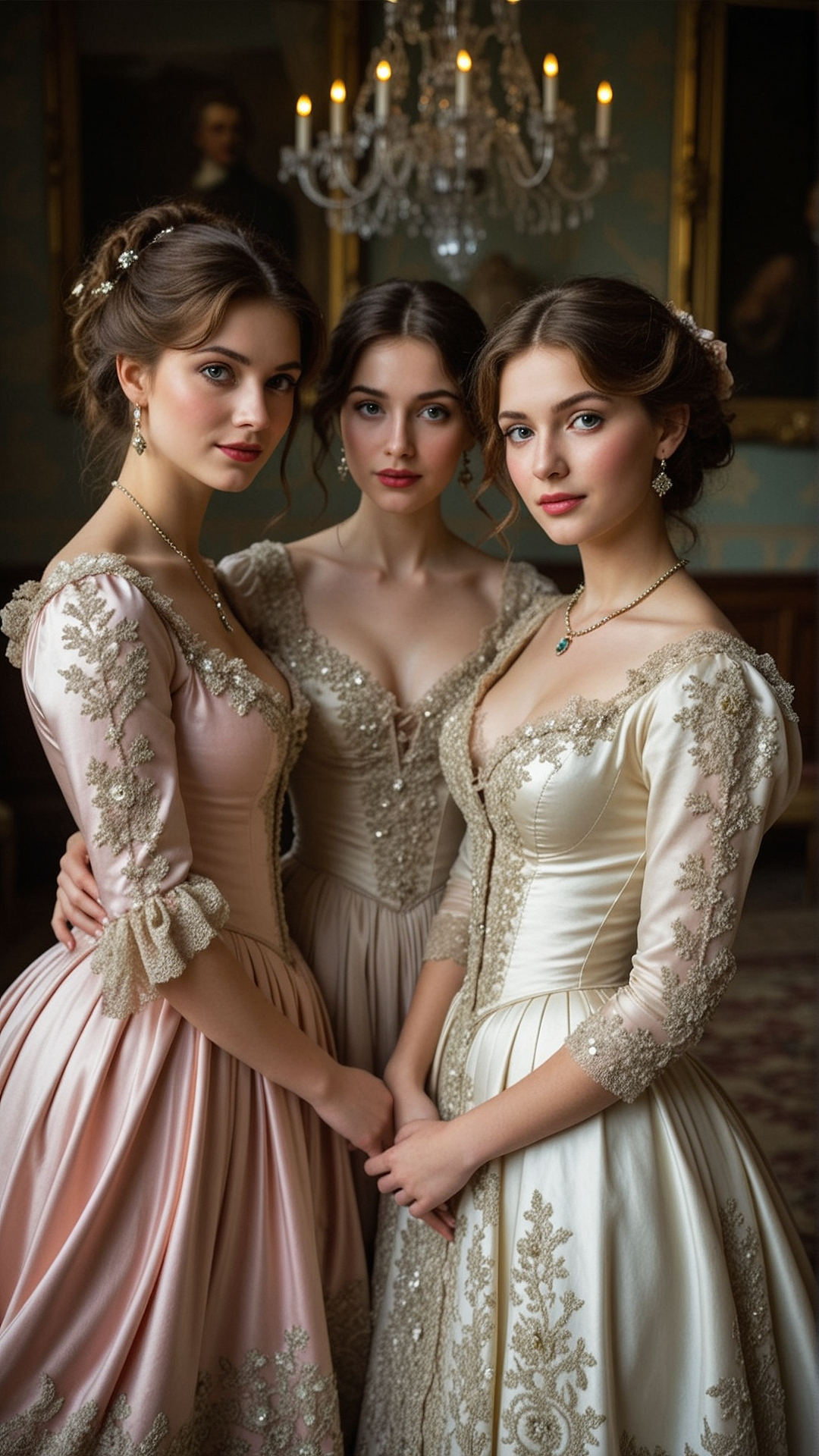
Where fortunes are balanced, desires are accounted for, and a woman’s worth is measured in the whisper of satin and the strength of her devotion.
Drowning in an inheritance she cannot comprehend, Miss Elara Vance is a prisoner in a gilded cage of her own making, her spirit crushed by the coarse, chafing wool of mourning and the predatory gazes of would-be suitors. Her salvation arrives not with a flourish, but with the silent, commanding presence of Lady Genevieve Sterling—a woman whose authority is woven into every fold of her impeccable navy satin gown, whose eyes see not a helpless heiress, but a ledger hopelessly out of balance.
This is not a story of rescue, but of ruthless, exquisite refinement. Under Genevieve’s meticulous guidance, Elara will be stripped of her rough-spun ignorance and re-clothed in the glossiest truths: that financial acumen is the ultimate aphrodisiac, that confidence is a garment tailored through discipline, and that the most valuable portfolio one can cultivate is a sisterhood of brilliant, devoted women thriving under a single, masterful vision. As Elara learns to read markets as easily as the longing in a lady’s eyes, she discovers a world where luxury is a language, submission is the highest form of trust, and the deepest pleasures are found in yielding to a care that demands perfection. Will she master the figures, or will she find her greatest balance in the pages of a different kind of ledger—one that records the tender, dominant, and utterly intoxicating education of her heart?
Chapter 1: The Rough Inheritance
The air in the library was a thick soup of dust and despair, each mote a tiny, spinning accusation. Miss Elara Vance sat amidst the wreckage of her father’s life, a frail island in a sea of crinkling vellum and leather-bound ledgers that gaped like hungry mouths. The documents were not papers; they were tombstones, each one marking the death of some part of her peace. The three solicitors surrounding the vast oak desk were not men; they were carrion birds, their black coats rustling with a sound like dry wings, their eyes sharp and devoid of mercy as they picked over the bones of her future.
“The entail, Miss Vance, is quite, quite clear,” droned Mr. Grimshaw, his finger tapping a clause that seemed to swim before Elara’s eyes. “The capital is held in trust, but the management of the investments, the estates… it is a vast and intricate machine. A machine, if you will pardon the analogy, for which you possess no operator’s manual.”
Elara’s hands, clenched in her lap, were prisoners in the rough embrace of her mourning gown. The fabric was a brutal, unrelenting wool, dyed a black so absolute it seemed to leach the light from the room. Each fibre was a tiny barb, scratching at her wrists, her neck, a constant, physical manifestation of her grief and her impotence. This is what it feels like, she thought, to be wrapped in failure. To be swaddled in a cocoon of scratchy uncertainty, when what you need are wings.
“My father…” she began, her voice a mere whisper, a ghost of sound lost in the cavernous room.
“Your father, God rest his soul, was a visionary,” interrupted the second solicitor, Mr. Pike, with a smile that didn’t touch his eyes. “But visionaries are not, by nature, meticulous bookkeepers. There are… discrepancies. Opportunities, shall we say, for a prudent mind to streamline.” His gaze was avaricious, lingering on the ruby ring that had been her mother’s, now weighing heavy on Elara’s finger like a brand.
The third man, young Mr. Croft, merely shuffled papers, his silence the most ominous of all. Elara felt the walls of the library, lined with the silent, judging faces of ancestors in oil paint, pressing in. She was a ledger herself, she realised with a dizzying plunge of nausea. A balance sheet of liabilities: Ignorance. Fear. A heart that felt too much and understood too little. On the assets side, a terrifying blank space. She was a estate without a tenant, a fortune without a steward, a songbird trapped in a cage of rough-spun wool.
“I require time,” she managed, the words ash in her mouth.
“Time, dear lady, is the one commodity in short supply,” Grimshaw sighed, not unkindly, but with the finality of a judge passing sentence. “Debts accrue interest. Tenants require direction. The world, I fear, does not pause for grief.”
It was then that the atmosphere changed. It was not a sound that heralded it, but a shift in pressure, as before a storm. The dusty, stale air was pierced, cleanly and decisively, by a new scent: bergamot, crisp and citrus-sharp, underpinned by something colder, rarer—like frost on stone. The carrion birds fell silent, their heads turning as one towards the double doors.
She stood there, having entered with a silence that was more commanding than any fanfare. Lady Genevieve Sterling. She was not beautiful in the soft, pretty way of magazine illustrations; hers was a beauty of architecture and authority. Her hair, the colour of polished pewter, was swept into a severe, perfect chignon at her nape. Her features were sharp, elegant, as if carved from marble by a master who understood the beauty of clean lines and unyielding purpose.
But it was her gown that held Elara’s drowning focus. It was of a navy so deep it was nearly black, but where the light from the grimy window caught it, it lived. It was satin, a river of liquid shadow pouring from her shoulders to the floor. It did not rustle; it whispered. It moved with her, a second, more eloquent skin, speaking of a world where fabric did not chafe and torment, but glided and revealed. It was the antithesis of Elara’s own scratchy prison.
“Gentlemen,” Lady Sterling said. Her voice was low, contralto, and it did not ask for the room’s attention—it assumed it, as the sun assumes the sky. “Your services, for the moment, are concluded. You may leave your documents. Miss Vance and I have matters to discuss.”
Mr. Pike puffed up, a pigeon affronted. “Now see here, Lady Sterling, these are confidential affairs of the Vance estate, I must protest—”
“You must,” Genevieve interrupted, her gaze settling on him like a physical weight, “do nothing. Your protest is noted, and it is irrelevant. The only ‘must’ in this room is that you must depart. Now.” She did not raise her voice. She simply stated a fact of the universe, as one might state that gravity pulls downwards.
The three men exchanged glances. The power in the room had not just shifted; it had been annexed. With mumbled acquiescences and a rustling of their own inferior wool, they gathered their papers and fled, leaving a sudden, echoing silence in their wake.
Elara could only stare, her mind a whirlpool of shock and a desperate, clawing hope. Genevieve’s eyes, the colour of flint under rain, turned to her. They did not soften, but their focus was absolute, a lighthouse beam in Elara’s personal fog.
“Miss Vance,” Genevieve said, stepping forward. The scent of bergamot grew stronger, clean and bracing. “Your fabric is attacking you. That is the first, and most pressing, liability we shall eliminate.”
Elara looked down at her own dress, then back up at the living satin before her. “I… I don’t understand.”
A ghost of something—not a smile, but an expression of profound recognition—touched Genevieve’s lips. “You are a library, my dear,” she said, her voice dropping to a more intimate timbre. “A library filled with rare, unread volumes. But the shelves are dusty, the windows are shuttered, and you are wrapped in the sackcloth they use to bind books for the pulping mill. How can anyone, including yourself, see the value within? How can you even breathe?”
The analogy was so perfect, so devastatingly accurate, that Elara felt a hot prickling behind her eyes. She was a shuttered library. She was bound for destruction.
“What… what must I do?” The question was a plea, a tiny, fragile life raft launched onto a turbulent sea.
Genevieve closed the final distance between them. She did not touch Elara, but her presence was a tangible thing, a wall against the chaos. “You must learn a new language. The language of balance sheets and bold choices. The language of silk, not sackcloth. You have been left a fortune, but a fortune is a wild, dangerous beast. It can devour you, or it can be saddled and ridden to horizons you cannot yet imagine.” Her eyes held Elara’s, mesmerising in their intensity. “Confusion is a luxury you can no longer afford. Grief is a room in the house, not the house itself. It is time to step out of that room.”
She extended a hand, not to take Elara’s, but to indicate the door. Her glove was of the finest, palest grey kid leather, seamless and soft. “The first entry in your new ledger begins today. We shall start with the simplest of transactions: the trading of despair for direction. Of rough wool,” her gaze swept over Elara’s dress with a slight, telling distaste, “for the possibility of something smoother.”
For the first time since the funeral, air seemed to fill Elara’s lungs completely. The hope that pierced her was not warm and gentle; it was sharp, cold, and brilliant, like the first crack of dawn after an endless night. It was the hope of the lost traveller who sees, not a vague path, but a guide who knows the way with unshakeable certainty.
She looked from her own abysmal, scratchy sleeves to the deep, calm pool of Genevieve’s satin-clad arm. One world was ending, rough and painful. Another, glossier and far more terrifying in its promise, was being offered.
Without another word, Elara Vance rose from the wreckage. Her legs trembled, but they held. She took a step, then another, towards the woman in navy satin, towards the scent of bergamot and frost, towards the first, faint, gleaming line of a new horizon.
Chapter 2: The First Lesson: Assets & Liabilities
The world beyond the doors of the Vance library did not so much open as transform. Lady Genevieve Sterling’s carriage was not a vehicle; it was a capsule of silence and bergamot-scented air, upholstered in buttoned navy velvet so plush it seemed to absorb sound, and therefore, anxiety. Elara sat within it, her body held stiffly against the supple leather squabs, her mind a whirlwind trying to map this new, terrifying geography. She watched the soot-stained buildings of London’s financial district give way to the elegant, white-stuccoed terraces of Mayfair, each transition feeling less like a journey and more like a shedding of skins.
They arrived at a house that was not a palace, but a statement. It stood with a quiet, unassailable confidence, its windows gleaming like intelligent eyes. The door was opened by a butler whose impassivity was so complete it felt like a courtesy. Inside, the air was cool, still, and smelled of beeswax, lemon oil, and that ever-present, crisp bergamot. The hallway floor was a chessboard of polished marble, and Elara’s practical heels clicked a nervous, staccato rhythm upon it, a sound that felt obscenely loud in the pervasive hush.
“This way,” Genevieve said, her voice a low murmur that nonetheless carried perfectly. She led Elara not to a drawing-room, but to a morning room at the back of the house. Here, the light was different. It poured through enormous windows, not filtered by grime, but diffused through draperies of pale gold silk, so that the very sunlight seemed laundered, gilded, and soft. The room was a study in calibrated serenity. A small, elegant desk of satinwood stood near the window. Two chairs, their frames delicate but strong, were upholstered in a cream damask that echoed the silk. There were no trinkets, no frivolous ornaments. Only a single, perfect white orchid on a side table, and a shelf of ledgers bound in coloured morocco leather.
“Sit,” Genevieve instructed, gesturing to the chair opposite the desk. She did not take the seat of authority behind it, but instead settled into the companion chair, turning it slightly to face Elara. The movement caused her navy satin skirts to sigh against the damask, a soft, luxurious sound. She produced, from a drawer, a large sheet of vellum. It was not the cheap, pulpy stuff of her father’s office, but a thick, creamy sheet with a watermark, its surface so smooth it looked like solidified milk.
“We begin with a blank page,” Genevieve said, placing it on the desk between them alongside a pen of ebony and silver. “Forget, for this moment, the Vance estates. Forget the tenancies, the mines, the shipping shares. They are merely the scenery. The protagonist of this story, Miss Vance, is you. And every protagonist requires an inventory.”
Elara stared at the blank vellum. It seemed to pulse with terrifying potential. “An inventory? Of… of myself?”
“Precisely.” Genevieve leaned forward, the light catching the severe planes of her face. “In business, we keep a ledger. On one side, assets. On the other, liabilities. An asset is anything that brings value, that strengthens your position, that yields a return. A liability is anything that drains your resources, that weakens your foundation, that accrues a cost.” Her flint-grey eyes held Elara’s. “You are now the enterprise. Account for yourself.”
Elara’s throat constricted. The task felt more intimate than disrobing. “I… I wouldn’t know where to start.”
“Start with the liabilities,” Genevieve said, her tone not unkind, but implacable. “They are often the loudest. Name them. Give them form on the page, and you begin to strip them of their power.”
Trembling, Elara took up the pen. Its weight was unfamiliar, substantial. She dipped it in the inkwell Genevieve provided. The first mark on the pristine surface felt like a desecration.
Liability, she wrote, the ink flowing black and decisive.
Beneath it, her hand moving as if guided by a force outside herself, she began to list:
1. A profound and paralyzing ignorance of the world beyond novels and needlework.
2. A fear as constant as a heartbeat, fear of deception, of ridicule, of my own incapacity.
3. A grief that feels less like an emotion and more like a climate—a perpetual, damp fog.
4. Attire that… that does not clothe, but incarcerates. Fabric that scratches and reminds me, with every movement, of loss and helplessness.
She paused, her breath shallow. Writing them down was like lancing boils; a horrible, painful relief. She could not bring herself to look at Genevieve.
“Good,” came the quiet voice. “You have identified the principal drains. Now. The asset column.”
Elara’s pen hovered. The blank space next to Asset yawned, a chasm of emptiness. She shook her head, a hot tear of shame threatening to escape. “There is nothing. I am a empty room. A… a ledger with only one side filled.”
“Nonsense.” The word was a crack of certainty. Genevieve did not touch the paper. Instead, she reached out and, with a touch so light it was almost imperceptible, laid the tip of her finger, sheathed in that pale grey kid leather, against Elara’s temple. The leather was cool, unbelievably soft. “This,” Genevieve said, her voice dropping to a mesmerising murmur. “This is your primary asset. Your mind. It is not empty. It is a prime piece of property on a most desirable street. But it has been left vacant. The windows are shuttered. The furniture is dusty, a mismatched collection of childhood lessons and sentimental clutter. It requires not demolition, but a ruthless, loving renovation.”
Elara sat utterly still, transfixed by the touch and the words. The analogy unfolded in her mind like a vivid dream: her own consciousness as a house, dark and echoing. The idea was not frightening, but thrilling.
“An asset must be cultivated,” Genevieve continued, withdrawing her hand but leaving the ghost of its coolness on Elara’s skin. “It must be furnished with knowledge, aired with experience, and secured with confidence. The return on this investment, Miss Vance, is a life of agency. Of choice. Of power. Can you imagine the yield?”
Elara found her voice, a whisper. “I cannot even imagine the… the furniture.”
A smile, then—the first true one Elara had seen. It was not broad, but it transformed Genevieve’s face, revealing a warmth that was somehow more commanding than her severity. “Then you shall learn. We will go shopping for ideas. We will acquire facts as others acquire china. We will hang tapestries of understanding on the walls of your comprehension. Your fear,” she said, gesturing to the liability column, “will become caution, a useful tool. Your grief will become a quiet room you may visit, not a house you must live in. And the fabric…” Her gaze swept over Elara’s scratchy wool bodice with a look of profound aesthetic distaste. “The fabric will become a statement, not a sentence.”
The joy that rose in Elara then was not the simple happiness of a pleasing moment. It was the profound, soul-igniting joy of a wanderer who, lost in a trackless waste, is suddenly shown a map—not with a single path, but with a topography of possibilities. It was the joy of potential recognized.
“What is the next entry?” Elara asked, her voice stronger.
“The next entry,” Genevieve said, rising with that liquid, satin-whispering movement, “is a transfer. We move an item from the liability column to the asset column. We begin with the most tangible one.” She walked to a bell-pull and gave it a single, firm tug. “We shall transform your ‘incarcerating attire’ into your ‘declarative uniform.’ But first, tea. Even the most ambitious renovations require a foundation of sustenance.”
As a maid entered silently with a tray bearing porcelain so thin the light glowed through it, Elara looked down at her ledger. The page was no longer terrifying. It was a contract. A promise. On one side, the shadows she had named. On the other, a glorious, gleaming blankness waiting to be filled. And between them, like a skilled accountant of souls, sat Lady Genevieve Sterling, already calculating the magnificent balance to come. The devotion Elara felt in that moment was not meek or worshipful; it was fierce, hungry, and full of a hope so sharp it could cut glass.
Chapter 3: The Currency of Composure
The summons arrived not as a note, but as a garment. Delivered by a maid whose silence was as profound as the midnight sky, it lay across Elara’s bed: a dress of slate-grey silk, the colour of a dove’s wing at twilight. It was not the vibrant jade or cream Genevieve had hinted at; this was a uniform for observation, a costume for becoming part of the scenery in order to better study the play. A note, in Genevieve’s precise, slashing hand, was pinned to the bodice: ‘Tonight, you are not an heiress. You are a student of atmospheres. Your only task is to listen to what is said in the spaces between words. This will be your cloak.’
Elara’s fingers trembled as she touched the fabric. The silk was cool, heavy with quality, and whispered of latent power. It was infinitely smoother than the wool it was replacing, yet it felt no less like a disguise—though now, she was disguised as a member of Genevieve’s world, not a prisoner of her own. Her maid helped her into it, the material sliding over her skin like a second, more confident self. The cut was simple, elegant, the neckline modest but the fall of the skirt a perfect, whispering bell. She felt simultaneously exposed and armoured.
Genevieve received her in the drawing-room, a space transformed by candlelight. The gold silk draperies were now pools of molten honey, and the air shimmered with the scent of beeswax, hothouse lilies, and the faint, ever-present bergamot. Genevieve herself was a study in monochromatic command. She wore a gown of ivory satin, so pure and stark it seemed to generate its own light. Its simplicity was devastating; there were no ruffles, no frippery, only the magnificent architecture of her body and the liquid flow of the fabric. A single, heavy pendant of polished jet hung at her throat, a dark star against the bright expanse.
“You look appropriate,” Genevieve said, her gaze conducting a swift, analytical inventory. “The grey is a blank slate. It will encourage people to project upon you their own assumptions, which will, in turn, reveal their own ledgers. Remember, you are here to audit the room, not to be audited.”
“I feel like a ghost,” Elara confessed, her voice small.
“A ghost,” Genevieve replied, stepping closer, “is a memory with agency. A story that refuses to be balanced. Be that kind of ghost. An attentive, discerning memory.” She reached out and, with a touch so light it was almost imaginary, adjusted a fold of Elara’s silk sleeve where it met her shoulder. “Composure, Miss Vance, is the currency we trade in tonight. Not wealth, not land, not even wit. Pure, undiluted composure. Watch how it is minted, spent, and hoarded.”
The guests arrived in a rustle of taffeta and a murmur of polished conversation. There were eight in total: two married couples of political significance, and two other women, unattached. These women, introduced as Mrs. Adelaide Finch and Miss Cordelia Vance, captured Elara’s attention immediately. Adelaide, perhaps a decade older than Genevieve, wore a gown of deep claret moire silk, its watered pattern shifting like wine in a crystal decanter. Her gaze was sharp, assessing, and when it landed on Genevieve, it held a warmth that was both fond and fiercely proprietary. Cordelia was younger, her dress a soft, moss-green lustring that shimmered subtly, her demeanour one of quiet, watchful intelligence. They did not hover near Genevieve; they orbited her, their positions in the room shifting in a silent, practiced dance that always kept her at the gravitational centre.
The dinner was a symphony conducted by Genevieve’s slightest gesture. A lifted finger brought forth a course of poached turbot in a sauce the colour of pearls. A glance towards the butler had glasses replenished with a claret so deep it was almost black. The conversation flowed around politics, the latest railway speculation, and a scandal involving a distant Duke.
Elara, the ‘blank slate’ in her grey silk, listened. She watched Genevieve. And she began to see it—the currency.
Sir Edward, a florid man with investments in Caribbean sugar, held forth loudly on the virtues of imperial expansion. His composure was cheap, brass-like, spent freely to dominate the acoustic space. His wife, Lady Constance, sat in dull rose crape, her smiles tight, her eyes occasionally darting to Genevieve as if seeking a safer harbour. She was spending her composure merely to remain afloat.
Then Genevieve would speak. She did not raise her voice. She simply let a silence gather, a palpable, waiting thing, before she released a sentence into it. “One wonders,” she said, as Sir Edward paused for breath, “if the balance sheet of empire accounts for the interest paid in moral capital.” Her words were not an attack, but a recalibration. The room’s attention, like iron filings to a magnet, swung to her. She had spent a mere whisper of her immense reserve and bought the entire table’s focus.
Adelaide Finch leaned forward, the moire silk at her elbow brushing the tablecloth. “A precarious ledger, indeed, Genevieve. As we see in the East India Company’s recent… recalcitrance.” Her tone was dry, and her glance towards Genevieve was one of shared, secret understanding. It was a transaction between them, a transfer of intellectual value that excluded the others.
Cordelia, the younger woman in lustring, spoke less, but when she did, it was to ask a question so perceptive it sliced through the rhetoric. “But if the commodity is human will,” she asked softly, “how does one depreciate that asset?” Her eyes, when she was done, sought not the table’s approval, but Genevieve’s slight, acknowledging nod. That nod was her dividend.
Elara watched, her heart a frantic bird in the cage of her grey silk ribs. She saw it now. Genevieve’s composure was a satin fortress. Adelaide’s was a moire shield, patterned with experience. Cordelia’s was a lustring veil, subtle but strong. The men traded in the loud coin of bluster and ownership. The women in this circle traded in the silent, potent currency of poised intelligence and unspoken alliance.
During a lull, as the dessert was served, Genevieve turned her flint-grey gaze to Elara. “You are quiet, Miss Vance. What is your audit thus far?”
All eyes turned to her. The attention was a physical weight. Elara felt the old, familiar panic, the scratchy wool of her former self threatening to constrict her throat. But then she felt the cool, smooth slide of the silk against her skin, a constant reminder of her new role. She thought of ledgers, of assets.
“I observe,” she began, her voice surprisingly steady, “that the most valuable currency here is not the loudest, but the most… liquid. It flows into silences and shapes them. It purchases attention without the appearance of expenditure.” She paused, gathering the words like rare coins. “It is the difference between a shout that echoes and dies in an empty hall, and a whisper that is leaned into, that fills a room by invitation rather than invasion.”
A profound silence followed, different from the others. This was not a silence waiting to be filled, but one absorbing a new truth. Adelaide Finch’s sharp eyes gleamed with approval. Cordelia offered a small, genuine smile.
Genevieve did not smile. Her expression was one of deep, profound satisfaction, the look of a master artisan seeing an apprentice’s first true, straight cut. “You have identified the principle,” she said, her voice a low caress across the table. “Composure is liquidity. Emotional, intellectual, social liquidity. A shouted opinion is a fixed asset—bulky, immovable. A measured observation is liquid capital. It can be invested, transferred, allowed to accrue compound interest in the minds of others.”
Later, when the guests had departed in a flurry of thanks and the scent of carriage lamps, Elara stood once more in the drawing-room with Genevieve, Adelaide, and Cordelia. The atmosphere had changed. The formality had melted, leaving a warmer, more intimate alloy.
“She has the eye,” Adelaide stated, pouring a small glass of amber spirits for them all. Her claret moire seemed to glow in the firelight.
“The mind,” Cordelia corrected gently, accepting her glass. Her moss-green lustring made her look like a forest spirit come to rest by the hearth.
Genevieve stood before the fire, her ivory satin now the colour of flame-kissed cream. She held her glass but did not drink, her eyes on Elara. “She has the beginning of comprehension,” she said. “Tonight, you moved from being a liability on your own ledger—the liability of social fear—to holding a small, liquid asset. You traded panic for perception.”
The joy that filled Elara was effervescent, like the finest champagne. It was the joy of understanding a secret language, of being granted a glimpse into a golden, hidden economy. But more potent than joy was the devotion that solidified within her, layer upon layer, with the slow, inevitable strength of a pearl forming around a grain of sand. She looked at these three women—the commanding sovereign in satin, the sharp-eyed chancellor in moire, the quiet spymaster in lustring—and she knew, with every fibre of her silken being, that she wanted nothing more than to be a humble mint in their treasury, producing currency under their discerning direction.
She was no longer a ghost. She was an apprentice banker in the most exclusive of institutions, and the currency she longed to master was the very essence of the woman before her.
Chapter 4: The Portfolio of the Self
The morning after the dinner was a new kind of silence. It was not the hollow, echoing silence of the Vance library, nor the tense quiet of anticipated judgment. This silence was a palpable, velvety thing, filled with the after-images of candlelight on ivory satin, the echo of measured voices, and the profound, lingering scent of bergamot. Elara sat in the modest guest chamber Genevieve had assigned her, her fingers tracing the impossibly smooth surface of the slate-grey silk dress now laid across her bed. It was no longer a costume; it was a relic of her first successful audit, a tangible proof of potential. Yet, with the proof came a new, more subtle anxiety. Having glimpsed the ledger, she now feared the magnitude of the entries required to truly belong.
Her reverie was broken by the same silent maid, who presented a small, folded card on a silver tray. The paper was thick, cream-laid, and bore a single sentence in that familiar, slashing hand: ‘Tea in the winter garden. Your education in diversification begins.’
The winter garden was not a garden at all, but a symphony of glass and light. A conservatory attached to the rear of the house, its panes held the weak English sun captive, magnifying it into a gentle, diffuse warmth. The air was humid and sweet with the scent of loam, orange blossoms, and the peppery note of heliotrope. It was a world apart, a bubble of eternal spring. In its centre, beneath a fronded canopy of a miniature palm, a round table was set for four. The china was so thin as to be translucent, patterned with a delicate tracery of gold vines. The spoons were heavy, Georgian silver, their bowls polished to mirror-shine.
Genevieve was already there, standing by a cluster of orchids, her profile etched against the glass. Today, she was not in satin, but in a dress of dove-grey cashmere, a fabric so soft it seemed to emit its own gentle light, its high neck fastened with a jet brooch. She turned as Elara entered, and her expression was not one of stern assessment, but of calm readiness. “Punctuality is the first dividend of a well-managed schedule,” she said, a faint approving line at the corner of her mouth. “Come. Meet the other members of your nascent portfolio.”
Seated at the table were the two women from the night before. Up close, they were even more distinct. The older, Mrs. Adelaide Finch, was a study in contained vitality. Her hair, a rich auburn streaked with silver, was coiled in an intricate, unfussy style. She wore a day dress of claret-coloured moire silk, the watered pattern shifting like a slow, deep river with her every breath. Her eyes, a sharp hazel, took in Elara with a swift, comprehensive glance that held no malice, only profound interest.
The younger, Miss Cordelia Vance (a distant cousin, Elara recalled), was ethereal where Adelaide was substantial. Her hair was the colour of pale honey, escaping in soft tendrils from a simple chignon. Her dress was of moss-green merino wool, but it was a merino so fine, so impeccably woven, that it possessed a soft, lustrous sheen, like sunlight on a forest floor. Her hands, resting in her lap, were slender, with faint traces of earth under the nails—a scientist’s hands.
“Adelaide, Cordelia,” Genevieve said, gesturing for Elara to take the empty seat. “This is Miss Elara Vance, who is learning that a fortune is a tool, not a tomb.”
“A lesson many never learn,” Adelaide said, her voice a rich, contralto ripple. She poured tea from a pot of chased silver into Elara’s cup. The liquid was the colour of amber. “Milk? Sugar?”
“N-no, thank you,” Elara managed, feeling the weight of their collective gaze.
“A purist,” Cordelia observed, her voice softer, melodic. “A good start. Clarity is often muddied by unnecessary additions.”
Genevieve took her own seat, the cashmere of her skirt whispering against the wicker of her chair. “We were discussing, before you arrived, the principle of the portfolio. Elara, in finance, what is the primary purpose of diversifying one’s holdings?”
Elara’s mind, trained on the question, grasped for the answer. “To… to spread risk. So that the failure of one investment does not ruin the whole.”
“Precisely,” Genevieve said, accepting her own cup from Adelaide. “But a portfolio is not merely a financial concept. It is a philosophy for a life. A woman who invests her entire emotional capital in one pursuit—be it a man, a single social ambition, even a solitary talent—is a woman one step from bankruptcy. She has no resilience. A sudden frost, and her entire crop is lost.”
Adelaide leaned forward, the moire silk at her elbows catching the light. “Consider my own holdings,” she said, and there was a playful, proud gleam in her eye. “The Finch Maritime Company is my blue-chip stock. Steady, reliable, built by my late husband and now grown under my hand. But if I only looked at shipping manifests, I would be a dull creature indeed, and vulnerable to every shift in the trade winds.” She took a sip of tea. “So, I also invest in political salons. I cultivate influence in the House of Commons. It is a different kind of commodity, less tangible but with a potentially higher yield. And for my soul’s dividends,” she added, a softer note entering her voice, “I collect Italian landscape paintings. They remind me that there is beauty that exists without utility. A balanced portfolio.”
Elara listened, enthralled. This was not bragging; it was a sharing of blueprints.
Cordelia spoke next, her fingers tracing the grain of the table. “My father left me mineral rights in Cornwall,” she said. “A rocky, unforgiving asset. But from it, I fund my true passion: the study of botanical alkaloids. The tin pays for my laboratory, for my expeditions to South America. The minerals from the earth finance my study of the plants that grow upon it. One asset feeds the other. And in turn,” she looked directly at Elara, her gaze clear and intelligent, “my research may one day yield a medical breakthrough. A social dividend. The investment is not just for personal gain, but for a legacy.”
The air seemed to hum with the energy of their shared understanding. Elara felt a pang of acute poverty. “I… I have no such interests. My ledger is empty on that side.”
“Nonsense,” Genevieve said, her tone leaving no room for argument. “You have a mind. A mind is the most versatile capital of all. It can be directed. What did you love, before the world told you to be afraid?”
Elara thought back, past the fog of grief and duty. “I… I loved music. I played the pianoforte. And I loved stories. I would read French novels and try to translate them, not just the words, but the… the feeling.”
Adelaide’s sharp eyes gleamed. “There. Two streams. The language of music and the music of language. Both require discipline, both offer infinite returns in perception and pleasure.”
“A skill in French is not merely social,” Cordelia added. “It is a key to scientific journals, to diplomatic correspondence, to a whole continent of thought closed to the monoglot.”
Genevieve watched Elara absorb this, a maestro observing her pupil hear the first notes of a symphony. “You see? You are not a barren field. You are fallow land, rich with potential seed. We shall help you plant. Music lessons with a master from Vienna. A tutor in advanced French and perhaps Italian. These are not frivolities. They are strategic acquisitions. They increase your value, your connectivity, your resilience. They make you a more interesting, more capable asset to…” she paused, her gaze holding Elara’s, “…to any circle you choose to join.”
The word ‘asset’ no longer felt cold. It felt like a promise of worth.
“But this,” Genevieve continued, sweeping a hand to encompass the table, “this is the most crucial diversification of all. The human portfolio. To rely on a single relationship for all one’s support, intellectual stimulation, or affection is the greatest risk of all. It is emotional over-leverage.” She looked at Adelaide, then Cordelia, a profound, unspoken current flowing between them. “We are one another’s hedge. Adelaide’s political acumen protects Cordelia’s scientific pursuits from bureaucratic interference. Cordelia’s discoveries offer Adelaide new investment opportunities. My… oversight,” she chose the word with deliberate weight, “ensures our collective capital is directed harmoniously. We are separate enterprises, but our fortunes are intertwined. Our successes compound each other.”
Elara looked from one face to another. She saw not rivalry, but a deep, settled loyalty. She saw the way Adelaide’s hand rested near Genevieve’s on the table, not touching, but in profound proximity. She saw the way Cordelia’s eyes followed Genevieve’s every gesture with a look of quiet, absolute devotion. It was not a hierarchy of subjugation, but a solar system of mutual gravitation, with Genevieve as the steady, warming sun.
The isolation that had been Elara’s constant companion since her father’s death cracked, and from the fissure poured a torrent of sororal hope. It was the hope of the solo instrument hearing, for the first time, the rich, complex harmony of the full orchestra and knowing a place awaits within it.
“I should like,” Elara said, her voice trembling only slightly, “to be a part of such a portfolio. However small a holding I may be.”
Adelaide laughed, a warm, rich sound. “Every great fund starts with a single, promising share.”
Cordelia smiled, reaching across to place a cool, reassuring hand over Elara’s. The touch was brief, but it felt like a seal. “We shall help you issue your prospectus.”
Genevieve said nothing. She merely lifted her cup, her flint-grey eyes holding Elara’s over the gilt rim. In that look was a world of expectation, of challenge, and of a future being meticulously, lovingly drafted. It was the look of an investor who has just identified a stock with the potential for exponential growth.
As the conversation turned to the practical—the name of the Viennese master, the recommended French grammar—Elara sipped her tea. The liquid was hot, bracing, and sweet on her tongue. She felt the soft cashmere of Genevieve’s presence, the shifting moire of Adelaide’s wisdom, the lustrous merino of Cordelia’s quiet strength wrapping around her. She was no longer a solitary, scratchy ledger. She was a line item being gracefully, irrevocably, entered into the most coveted account book in London.
Chapter 5: The Interest of Observation
The assignment was delivered not with ceremony, but with the quiet finality of a sealed bond. A card, thicker than vellum and smelling faintly of sandalwood, was placed beside Elara’s breakfast plate. Upon it, in the now-familiar slash of ink, were three lines: ‘The Royal Exchange. Eleven o’clock. You are to be a mirror, not a participant. Observe the currency of character. Report at dusk.’
Elara’s heart performed a peculiar, syncopated rhythm against the cage of her ribs. The Royal Exchange. It was the beating heart of Empire’s commerce, a roaring cataract of men and money, a place she had only ever imagined as a chaotic, masculine inferno. The thought of entering that maelstrom, even as a silent observer, sent a cold trickle of the old fear down her spine. Yet, beneath the fear, a new, sharper sensation thrilled—the anticipation of a test, of applying the principles Genevieve had so meticulously outlined.
Her maid presented a new garment for the occasion. It was a walking dress, but unlike any she had owned before. It was fashioned from a stone-coloured polished cotton, a fabric that possessed a subtle, dignified sheen, as if woven from morning mist and moonlight. It was not the luxurious silk or cashmere of the drawing-room, but it was impeccably tailored, its lines clean and authoritative. As she dressed, the fabric whispered with each movement, a soft, constant reminder of her purpose. It was armour, but armour that allowed for mobility and perception.
Genevieve received her in the hallway, already clad for the outside world. She wore a visiting costume of charcoal grey wool, but it was a wool so finely milled it resembled matte satin, cut with a severity that was both elegant and intimidating. A hat with a narrow, curved brim shadowed her eyes, leaving only the determined line of her mouth visible. She did not offer encouragement; she offered a final, crucial calibration.
“You are going into the jungle,” Genevieve said, her voice low and precise in the marble-floored hall. “But you are not to be prey, nor are you to play the hunter. You are to be the botanist. Your task is not to judge the beasts, but to classify them. To understand their habitats, their rituals, their signals of strength and weakness. Every raised voice, every clenched fist, every calculating smile is a datum. Collect them.”
Elara nodded, her throat tight. “How will I know what is significant?”
Genevieve’s lips curved, a faint, knowing arc. “Significance is compound interest. A single glance is a penny. A pattern of glances is a shilling. A consistent behaviour across multiple interactions becomes a pound. Look for the repetitions. The tells. The man who checks his watch not from punctuality, but from anxiety. The broker whose laugh is a fraction too loud, betraying a bluff.” She stepped closer, adjusting the fall of Elara’s polished cotton collar with a touch of her kid-leathered fingers. “Remember, the most valuable information is often traded in silence. The pause before an answer. The direction of a gaze. The texture of a hesitation.”
The carriage deposited her at the steps of the Exchange. The sound hit her first—a deep, roaring hum, like the sea trapped under a vast dome, punctuated by sharp cries, bellows, and the clatter of boots on stone. The air was thick with the smells of wool, sweat, tobacco, and ink. She entered, a single, still figure in her stone-coloured dress amidst a turbulent river of dark-coated men.
For a moment, she was overwhelmed, a sapling in a storm. The rough, boxy wool of the men’s coats seemed to push against her, their voices abrasive tools chiselling at the air. She felt the old, scratchy vulnerability return. But then, she remembered Genevieve’s words: You are the botanist. She forced her breath to slow, her gaze to soften from panic to focus.
She found a vantage point near a pillar, partially shielded by a monument to some forgotten merchant king. And she began to observe.
She saw the young clerk, his face pale as parchment, scurrying with a sheaf of papers, his eyes darting like a cornered mouse—a liability, selling his time for a pittance of security. She saw the portly merchant in a coat of bottle-green superfine, holding court, his jollity a performance as he slapped backs—an asset of influence, but is the capital genuine or borrowed? Her mind, trained now to think in ledgers, began to make entries.
Then, she witnessed a transaction. Two men, one with the lean hunger of a hawk, the other with the settled bulk of a bull, conversed in low tones near her pillar. The hawkish man spoke of a shipment, of delays, of insurance. The bull listened, his face impassive. But Elara saw it—the slight, almost imperceptible tightening of the bull’s hand around the head of his cane. A minute fissure in the granite of his composure. The hawk missed it entirely, pressing his point. The bull finally spoke, his voice a low rumble. “Your terms are unacceptable. The risk is not in the delay, but in your assessment of it.” He turned and walked away. The hawk stood, deflated. Elara understood: the bull had read the hawk’s desperation, a hidden liability, and had called the bluff. The currency traded had not been gold, but perception.
A wave of exhilaration, cold and clear, washed over her. She was deciphering the code. She noticed how the most powerful men moved—not with frantic energy, but with a conserved, potent stillness. They were the calm eyes of the hurricane. Their clothing, she noted, was never the loudest, but often the finest: superfine wool that held its shape, linen that was blindingly white, the occasional flash of a silk cravat so richly dyed it looked like a spill of wine. Their authority was woven into the very threads.
For two hours, she stood her post, her polished cotton gown a silent testament to her alien, observing presence. The initial roar resolved into a symphony of distinct instruments—the bass of worry, the treble of greed, the staccato of triumph. She was no longer afraid. She was fascinated. She was auditing an entire, teeming world.
Dusk was painting the grimy windows in shades of violet and gold when she returned to the house on Mayfair. She was shown not to the drawing-room, but to Genevieve’s private study, a room she had not yet entered. It was a chamber of profound silence. The walls were lined with books, the carpet a deep burgundy, and a fire crackled in the grate. Genevieve sat behind a vast desk of dark, glossy mahogany, the surface bare but for a single ledger and a pen. She had removed her hat and outer coat, and sat in a dress of deep plum merino, the firelight tracing the soft nap of the fabric.
“Your report,” Genevieve said, without preamble.
Elara stood before the desk, not as a supplicant, but as a junior clerk presenting findings. She took a steadying breath. “The Exchange is not a marketplace of goods,” she began, her voice gaining strength as she spoke. “It is a marketplace of narratives. Every man is selling a story—of stability, of opportunity, of inside knowledge. The price fluctuates based on the conviction of the teller and the credulity of the buyer.”
Genevieve’s eyes glinted in the firelight. “Continue.”
“I observed that the most valuable commodity is not information, but the appearance of certainty. It is a performance. The man who hesitates, even if his facts are correct, loses value. The man who speaks his fiction with absolute assurance can, for a time, make it truth.” She recounted the scene with the hawk and the bull, describing the tightened hand, the missed cue. “The bull perceived the liability in the hawk’s story—the fear behind the facts. He traded on that perception.”
“And what of the men themselves? As assets?”
Elara thought of the powerful, still figures. “The highest-value assets were not the noisiest. They were the most… liquid. They had reserves of composure they could draw upon without appearing to spend anything. They were like… like land-owning aristocrats watching tenants argue over a field. Their power was in their quiet entitlement to the very ground.”
A long silence followed, broken only by the pop of the fire. Genevieve leaned back in her chair, the plum merino stretching across her shoulders. The look on her face was one of deep, profound satisfaction. “You have earned your first true dividend,” she said, her voice a warm murmur in the quiet room. “You have moved from observing surfaces to calculating depths. You have understood that character has a balance sheet, and that its footings are often hidden in plain sight.”
She opened a drawer in the glossy mahogany desk and drew out a small, flat package wrapped in silver paper. She slid it across the smooth surface towards Elara. “A tool, for a tool-wielder.”
With trembling fingers, Elara unwrapped it. Inside was a notebook. But it was like no notebook she had ever seen. The cover was of supple, bottle-green leather, as smooth as a river stone. The pages within were of the finest, cream-laid paper. And nestled in the spine was a pencil, its wood dark and polished, its point needle-sharp.
“For your field notes,” Genevieve said. “A botanist requires a proper journal.”
The joy that flooded Elara was so intense it was almost painful. It was the joy of a craft recognized, of a skill validated. It was the mastery of understanding a complex system. But more than that, it was the devotion that solidified, crystalline and unbreakable, in her chest. Genevieve had not given her empty praise; she had given her a better instrument, an invitation to go deeper.
“Thank you,” Elara whispered, her fingers stroking the cool, glossy leather. “I shall put it to immediate use.”
“See that you do,” Genevieve said, her gaze returning to her own ledger. But as Elara turned to leave, clutching her new prize, Genevieve’s voice stopped her at the door. “And Elara?”
“Yes?”
“Your own narrative grows more compelling by the day. The interest on your observations… compounds.”
Elara stepped into the hallway, the green leather notebook warm in her hand. The roaring chaos of the Exchange was now a silent, ordered catalogue in her mind. She was no longer merely an heiress, or even a student. She was an analyst. And the most valuable account she would ever study was the one held by the woman in the study, whose own profound reserves were the standard against which all other currency was measured.
Chapter 6: The Negotiation
The air in Genevieve’s blue drawing-room held the charged, crystalline stillness of a courtroom before a verdict is delivered. Afternoon light, filtered through layers of ecru lace and heavy silk damask, fell in soft, golden pools upon the Axminster carpet, illuminating motes of dust that danced like tiny, suspended diamonds. It was a stage, meticulously set, and Elara Vance stood at its centre, feeling the weight of her costume as both armour and testament.
The dress was of forest-green silk-shantung. She had commissioned it herself, from the modiste Genevieve recommended, describing the exact shade—the deep, quiet green of a pine forest at dusk. The fabric was a marvel; possessing the subtle, textured slub of shantung, yet woven with such tight precision that its surface was smooth, catching the light with a soft, muted gloss. It did not rustle like taffeta or slink like satin; it moved with a confident, whispering sigh, its weight both substantial and graceful. As she stood waiting, she ran her thumb over the cuff, feeling the nubby texture, a tactile reminder of the new self she had woven under Genevieve’s exacting eye. It was the first entry on the asset side of her ledger that was entirely, irrevocably hers.
Adelaide Finch and Cordelia Vance were present, completing the circle. Adelaide, a formidable pillar in a gown of deep aubergine faille, its stiff, corded surface reflecting light in sharp lines, sat near the fireplace, her embroidery hoop ignored in her lap, her sharp hazel eyes fixed on the door. Cordelia, in her characteristic soft moss-green merino, perched on a chaise longue, a botanical sketchbook open but forgotten beside her. Their presence was not casual; it was a deliberate show of force, a silent declaration that Elara was no longer an isolated asset to be plundered, but an integrated holding within a powerful consortium.
Genevieve presided from a wingback chair upholstered in dark blue velvet. She was a study in still water over profound depth, clad in a severe, exquisitely simple dress of charcoal grey cashmere. Her hands, sheathed in fingerless gloves of the same fine grey kid leather she often wore, rested calmly on the arms of the chair. She offered no last-minute advice, no words of reassurance. Her gaze, when it met Elara’s, was simply present, an unmoving lighthouse in the coming storm. Her silence was the final, most potent lesson: the currency of composure must be spent from one’s own reserves.
Sir Mortimer Gable was announced. He entered not with the deferential step of a guest, but with the proprietary stride of a surveyor assessing a new property. His person was large, upholstered in a coat of bottle-green superfine that strained across his chest, his cravat a voluminous, slightly yellowing confection of Flemish lace. He carried the scent of port, cigar smoke, and a cloying lavender pomade.
“Lady Sterling,” he boomed, performing a bow that was more a tilt of his bulk. “A pleasure, as always. Miss Vance.” His eyes swept over Elara, a swift, appraising glance that lingered on the emerald at her throat—her mother’s stone, now reset in a modern, clean setting Genevieve had suggested. “You look… recovered. Blooming, even. Country air suits you, no doubt.”
“The air is the same, Sir Mortimer,” Elara replied, her voice steady, finding its pitch in the quiet room. “It is the constitution breathing it that has altered. Please, sit.”
He took the offered seat, his eyes darting to Adelaide and Cordelia. “A convocation. I am honoured.”
“We are a society for mutual improvement,” Adelaide said, her tone dry as old parchment. “We find conversations of business… improving.”
“Quite,” Sir Mortimer said, clearing his throat, the initial terrain not to his liking. He launched into his prepared speech, a tapestry woven from threads of paternalistic concern and financial opportunism. He spoke of her father’s “unfortunate speculative tendencies,” of the “fragility of a woman’s mind when burdened with complex figures,” of his own, “naturally,” more prudent and masculine grasp of the land and the markets. He painted a picture of her future: a dizzying, lonely spiral of mismanagement ending in ruin, unless sheltered under the “sturdy roof” of his guidance, a guidance best formalized, of course, in marriage.
“Your father, God rest him,” Sir Mortimer concluded, leaning forward, his voice dropping to a tone meant to be confidential but which filled the room, “was a dreamer. He built castles in the air. I am a builder of stone and mortar. I can secure what remains, Miss Vance. I can turn those precarious dreams into solid, respectable ground.”
The room was silent. Elara felt the old ghosts stir—the fear, the inadequacy, the scratchy wool of her past self threatening to constrict her throat. She looked down at her hands, folded in her lap against the cool, nubby silk of her skirt. Then she looked at Genevieve. No nod, no signal. Just that unwavering, flint-grey gaze. You are the auditor. He is the ledger. Find the discrepancy.
Elara took a breath, and when she spoke, her voice was not the whisper of the library, but the clear, measured tone of the winter garden. “You speak of my father’s dreams as liabilities, Sir Mortimer. And of your own nature as an asset. An interesting framework. Let us examine it as such, shall we?”
Sir Mortimer blinked, momentarily thrown. “I… I merely speak plain sense, my dear.”
“Sense is often the poorest cousin to truth,” Elara said, a phrase she had heard Adelaide use. “You offer security. A ‘sturdy roof.’ But in your proposal, which your man of business so kindly forwarded in draft, the roof you speak of is built upon beams you intend to remove from my own house.” She leaned forward slightly, mirroring his posture but with an entirely different energy. “Clause four, Sir Mortimer. The management of the Vance capital, in perpetuity, would be ceded to a board you control. My signature would become a formality. You do not offer a roof; you propose to be the landlord of my own inheritance, charging me rent in the currency of my autonomy.”
He flushed, a mottled red creeping up his neck. “A legal formality! To protect you from your own inexperience! The law is a tangled wood, girl, not a garden path!”
“The law is a language,” Elara countered, her heart hammering but her voice growing colder, clearer, a knife being sharpened on a whetstone. “And I am learning to read. Your proposed marriage settlement calculates my worth based on last year’s rents from the Derbyshire estate. A curious choice, given the report from my land agent—a copy of which I have here—that shows the tenant, a Mr. Briggs, died in February. The land has been fallow, the rent in abeyance. Yet your figures assume full, uninterrupted yield. That is not a conservative estimate, Sir Mortimer. That is either a staggering oversight or a deliberate over-valuation to inflate the perceived liability of my independent state.” She paused, letting the accusation hang in the air, fragrant with the scent of his cheap lavender. “A poor builder, it seems, who mistakes a fallow field for a harvest.”
Adelaide made a soft, approving sound, like the closing of a well-made lock. Cordelia’s lips curved into a faint, triumphant smile.
Sir Mortimer surged to his feet, his chair scraping harshly on the parquet. “This is intolerable! To be lectured on business by a… a chit of a girl fed lies by spinster bankers!” His furious gaze swept over Genevieve, Adelaide, Cordelia. “This is your doing! Filling her head with nonsense, turning her from her natural—”
“Her natural what, Sir Mortimer?” Genevieve’s voice cut through his bluster like a scalpel through fog. She had not moved. She simply spoke. “Her natural state of helplessness? A state that conveniently aligns with your profit? You came here to negotiate for a commodity. You failed to perceive that the commodity has become its own merchant. And a more adept one, it appears, than you.”
The finality in her tone was absolute. Sir Mortimer stood, deflated, a leaking balloon of rage and humiliation. He looked at Elara, truly looked at her, perhaps for the first time—not as an heiress, but as a opponent. He saw the glossy green silk, the calm posture, the intelligent, unflinching eyes. He saw the silent, powerful women surrounding her. He saw defeat.
With a incoherent grumble, he snatched up his hat and cane. “You will regret this, Miss Vance. When the wolves come, you shall wish for my roof, however you malign it!”
“I shall take my chances with the wolves,” Elara said, her voice now quiet, almost serene. “I find I am learning their language as well.”
The door closed behind him with a soft, definitive click.
The silence that followed was profound, vibrating with released tension. Elara’s knees trembled. She gripped the back of a chair, the world swimming for a moment. The silk of her dress felt suddenly alive against her skin, humming with the energy of the confrontation.
Adelaide was the first to speak. “The clause on the Derbyshire rents. Exquisite. A masterstroke.” There was a warrior’s respect in her voice.
“You didn’t just defend,” Cordelia breathed, her eyes wide with admiration. “You prosecuted. You turned his own evidence against him.”
But Elara heard them only distantly. Her entire being was focused on the woman in the charcoal cashmere chair. Genevieve had risen. She moved towards Elara, her steps silent on the thick carpet. She stopped before her, close enough for Elara to smell the clean, frosty scent of bergamot, to see the flecks of silver in her grey eyes.
Genevieve did not embrace her. She did not smile. She reached out and, with a touch so gentle it felt like a blessing, she brushed a strand of hair that had come loose during the confrontation back from Elara’s damp temple. Her kid-leathered finger was cool against Elara’s feverish skin.
Then, she spoke. Two words, delivered in a voice so low, so rich with a depth of feeling she had never before revealed, that they seemed to bypass Elara’s ears and settle directly into her soul.
“Well done.”
In that moment, something within Elara shattered and reformed. The triumph over Sir Mortimer was nothing—a petty skirmish. This was the victory. This recognition, this intimate, hard-won approval from her sovereign, her mentor, the architect of her very self. A wave of emotion, so powerful it was almost unbearable, crashed over her—a triumphant, all-consuming devotion. It was the devotion of the sword to the hand that forged it, of the melody to the composer, of the finished, glorious ledger to the master accountant. She would have given Genevieve every field, every mine, every shilling of her fortune in that instant, not out of obligation, but as a mere token of the profound, yielding loyalty that now coursed through her veins.
She could not speak. She merely looked into Genevieve’s eyes, hoping her own conveyed the vast, silent continent of gratitude and fealty that now existed within her.
Genevieve held her gaze for a long, breathless moment. Then, the ghost of that transformative smile touched her lips again. “It seems,” she said, her voice returning to its usual, measured tone, though a new warmth underlaid it, “the student has begun to understand not just the figures, but the very soul of the negotiation. The most important terms are never written in the contract. They are written in the will of the parties involved.”
She turned, her cashmere skirts whispering, and walked back to her chair. The lesson was over. The victory was complete. And Elara Vance, standing in her glossy green silk, knew with absolute certainty that her will, her very soul, was now irrevocably written in a hand not her own. And there was no greater joy, no deeper peace, than that perfect, voluntary surrender.
Chapter 7: The Inner Circle
The days following the exorcism of Sir Mortimer Gable from her life did not pass for Elara in a blur of celebration, but in a profound, deepening quiet—the quiet of a ship that has cleared a treacherous strait and now finds itself in a vast, calm, and sun-drenched sea. The forest-green silk-shantung of her victory gown had been carefully laid away, but its essence seemed to have permeated her very skin. She moved through the Mayfair house with a new assurance, the ghost of its whispering sigh a constant companion. The ledgers of the Vance estate, once terrifying hieroglyphs, now lay open on her desk in the modest study Genevieve had allotted her, their columns and figures a language she was steadily, joyfully deciphering. Yet, amidst this newfound competence, a gentle hunger persisted—a yearning not for more knowledge, but for a deeper belonging. She had passed a test, but the true examination, she sensed, was one of the heart.
The summons, when it came, was as unlike the previous notes as a sonnet is to a merchant’s invoice. It was a single sheet of heavy, cream-laid paper, folded not once, but thrice, and sealed with a disc of dark red wax impressed not with a crest, but with a single, elegant glyph: a stylized ‘S’ intertwined with a quill. It was delivered not by a maid, but by Cordelia Vance herself, who appeared at Elara’s study door with a soft knock, her moss-green merino dress a breath of the winter garden in the sober room.
“For you,” Cordelia said, her smile knowing and warm as she pressed the sealed missive into Elara’s hand. “The Sanctum convenes at nine. Do not be late.” With a final, encouraging glance, she was gone, leaving behind the faint scent of lavender and linseed oil.
Alone, Elara broke the seal. The message within was brief, written in Genevieve’s hand but with a flowing, less severe script than her usual commands.
‘The inner ledger awaits your review. Wear the colour of midnight.’
No location was given. None was needed. Elara understood. The invitation was to the core, the beating heart of the system she had only glimpsed from the periphery.
The colour of midnight. She had nothing of the sort. A frisson of panic was quickly quelled by a soft knock. A maid entered, bearing a garment bag of black watered silk. Within, suspended from a padded hanger, was a dress. It was of a blue so deep it was indeed the very shade of a moonless midnight, fashioned from heavy silk velvet. But this was no ordinary velvet; it was voided velvet, a technique where the pile was cut away in a pattern, leaving a glossy satin background. The pattern was subtle, a delicate tracery of vines and leaves that only revealed itself as the fabric moved, a secret garden hidden in the depths of night. The cut was simple, long-sleeved, high-necked, its severity a canvas for the luxurious complexity of the material itself.
As she was dressed, the velvet was cool and weighty against her skin, the satin undersheen gliding like water beneath her fingertips. It was a garment that demanded stillness, that spoke of secrets and solemnity. She felt, not dressed, but invested, as if donning the robes of a sacred order.
At precisely nine, she was guided not to the winter garden or the blue drawing-room, but to a door at the end of a quiet corridor on the second floor—a door she had never seen opened. It was of dark, unvarnished oak, unadorned. She knocked, once.
“Enter.” Genevieve’s voice, muffled by the wood, was unmistakable.
The room within was a revelation. It was a library, but of an entirely different character to the public ones downstairs. This was a working library, a scholar’s retreat. The walls were lined from floor to ceiling with books, their leather bindings—russet, forest green, navy, plum—creating a tapestry of muted colour. A large, circular table of ancient, scarred oak dominated the centre, its surface worn smooth by use, not polish. Upon it burned a branched candelabra, its light pooling on the dark wood and glinting off the cut-crystal stoppers of decanters arranged on a silver tray. The air smelled of old paper, beeswax, fine brandy, and that ever-present, anchoring note of bergamot.
Seated around the table were Genevieve, Adelaide, and Cordelia. They were joined by a fourth woman Elara had not met: a striking figure with silver-streaked black hair swept into a severe knot, and eyes of a piercing, cool blue. She wore a dress of burgundy faille, its stiff, ribbed surface austere yet elegant. Genevieve, at the head of the table, was in her charcoal cashmere, a sombre queen amidst her council.
“Elara,” Genevieve said, her gaze sweeping over the midnight velvet with clear approval. “You are timely. This is Mrs. Althea Reed. She manages our interests in the north. Althea, Miss Elara Vance, who is learning to balance her own books.”
Mrs. Reed gave a curt, not unfriendly nod. “Adelaide speaks highly of your… audit of Sir Mortimer. A neat piece of work.”
“Thank you,” Elara murmured, taking the empty seat between Cordelia and Adelaide. Adelaide, in her aubergine faille, gave her arm a subtle, reassuring press.
“We meet,” Genevieve began, her hands resting flat on the table, “as we do on the first Thursday of every month, to review not our financial portfolios, but our human ones. This is the ledger that matters most. Here, we account for our spirits.” She looked at each woman in turn. “Adelaide. Your report.”
Adelaide sat straighter, her usual sharpness softened by the intimate setting. “The political ledger is… volatile. The new factory bill is a tangle of good intentions and poor arithmetic. I have identified three key votes that can be swayed with the right application of pressure—not force, but the pressure of impeccable logic and a well-placed donation to a pet charity.” She spoke of political manoeuvring as another might speak of a chess game, her analogies drawn from architecture and engineering. “It is like shoring up a crumbling bridge. One must replace the rotten timber without halting the traffic of progress.”
Genevieve listened, then turned her gaze. “Cordelia.”
Cordelia’s report was a poetic contrast. She spoke of her botanical research, of a rare orchid from the Andes that might yield a new analgesic. “The plant is like a locked strongbox,” she said, her voice soft but fervent. “The alkaloids are the treasure within. My work is to find the key—the right solvent, the precise temperature—without destroying the delicate mechanism of the lock itself. It is a slow, loving negotiation with nature.” She spoke of setbacks not as failures, but as “revised hypotheses,” her devotion to her science a quiet, burning flame.
Mrs. Reed spoke next, her report concerning labour relations in the Yorkshire mills. “The workers are not machinery to be oiled and ignored,” she stated, her tone pragmatic. “They are a collective engine. Their discontent is a friction that wastes energy and produces no useful work. My task is to identify the source of the friction—whether it is a misaligned pulley of wages or a worn bearing of respect—and address it before the entire engine seizes. It is preventative maintenance of the human variety.”
Elara listened, enthralled. Each woman’s domain was different, yet their approach was the same: analytical, strategic, deeply caring in its pursuit of order and efficacy. They were not merely managing assets; they were stewarding systems.
Finally, all eyes turned to her. Genevieve’s gaze was expectant. “Elara. You have had your first quarter in this new enterprise. How do you account for yourself?”
Elara’s mouth went dry. She looked at the circle of faces, illuminated by the candlelight—Adelaide’s sharp intelligence, Cordelia’s gentle intensity, Althea’s cool assessment, and Genevieve’s profound, waiting stillness. She thought of the journey from the scratchy wool of despair to the whispering silk of comprehension.
“I… I feel I have been a closed ledger,” she began, her voice finding strength as she formed the analogy. “For years, the pages were stuck fast with the glue of fear and ignorance. You, each of you, but you especially, Lady Sterling,” she dared to meet Genevieve’s eyes, “have been the careful, patient hand that prized those pages apart. You did not tear them; you warmed the glue, you worked the spine. And now… now the pages are open. They are blank, in many places, but they are open. Ready for entries. And the act of writing in them no longer feels like a sentence being passed, but like… like a story being composed. A story I finally wish to read.”
The silence that followed was thick with emotion. Adelaide’s eyes gleamed with unshed tears. Cordelia reached under the table and squeezed Elara’s hand. Mrs. Reed gave a slow, approving nod.
Genevieve did not speak for a long moment. Then, she reached for the decanter and poured five small glasses of a brandy the colour of burnt amber. She passed them around.
“A ledger is not merely a record of transactions,” Genevieve said, lifting her glass. “It is a narrative of value created, sustained, and grown. You, Elara, have moved from being a liability on your own balance sheet to becoming an appreciating asset on ours. You have shown courage, acuity, and, most importantly, the capacity to learn the language of your own potential.” She looked around the table, her gaze including them all. “To the circle. May its columns always be in credit, and its bonds never break.”
“To the circle,” the women echoed, their voices a soft chorus.
The brandy was fire and honey on Elara’s tongue. As the conversation resumed, flowing into less structured channels—shared frustrations, gentle teasing, a discussion of a new exhibition at the Royal Academy—Elara felt it. The final, seamless click of a mechanism engaging. She was no longer outside looking in. She was within. The midnight velvet against her skin was not a costume, but a skin. The light from the candles was not illumination, but warmth. The women around her were not mentors or allies, but sisters in a silent, powerful covenant.
Later, as the meeting drew to a close, Adelaide leaned over to her. “Welcome, little sister,” she whispered, her voice thick with feeling. “It is a relief to share the weight of the columns.”
Cordelia simply smiled, her expression one of pure, radiant happiness.
Genevieve rose last. As the others began to drift towards the door, she motioned for Elara to remain. When they were alone, the candlelight dancing over the ancient oak, Genevieve approached her. She did not speak. Instead, she reached out and, with a tenderness that stole the breath from Elara’s lungs, she touched the voided velvet over Elara’s heart, her fingertips tracing the hidden satin vine.
“The pattern suits you,” Genevieve murmured, her voice a low vibration in the quiet room. “It holds its mystery close, only revealing its beauty to those who know how to look. As do you.”
In that touch, in those words, Elara felt the final vestige of her old, solitary self dissolve. She was not just in the inner circle. She was the circle, and it was her. Her devotion, once a seedling of gratitude, now bloomed into a great, sheltering tree within her, its roots wrapped around the very core of her being. She had found her balance. She had come home.
Chapter 8: The Gift of Gloss
The morning after her initiation into the inner circle dawned with a different quality of light. It did not filter timidly through the curtains; it pooled in the room, a liquid, honeyed substance that seemed to thicken the air with potential. Elara awoke with the memory of the midnight velvet still whispering against her skin, a phantom embrace that had lingered through her dreams. The brandy’s warmth had faded from her blood, but in its place was a new, steady hum—the hum of a mechanism that had finally found its true rhythm within a greater machine. She was no longer a spare part; she was a cog, meshing perfectly with others, driven by the same exquisite, central engine.
When she joined Genevieve for breakfast in the sunlit morning room, the atmosphere was charged with a purposeful serenity. Adelaide and Cordelia were also present, their presence now feeling as natural and essential as the pale gold silk at the windows. They spoke of mundane things—the weather, a new exhibition—but beneath the words thrummed the unspoken knowledge of the previous night’s covenant.
Genevieve set her cup of black coffee down with a soft, definitive click on the saucer. Her eyes, the colour of a winter sky at dawn, found Elara’s. “Your ledger of the self now has a strong foundation,” she began, her voice as smooth as the polished mahogany of the table. “You have identified liabilities and converted them. You have begun to diversify your assets. You have even defended your portfolio against a hostile takeover.” A faint, approving smile touched her lips. “But an enterprise, no matter how sound its figures, requires a presentation commensurate with its value. It is time to address the most persistent entry on your original list of liabilities.”
Elara’s breath caught. She knew instantly. Attire that incarcerates.
“Today,” Genevieve announced, “we go to Madame Roche. Consider it not a shopping excursion, but a strategic acquisition. You are to be furnished with the physical counterpart to your mental renovation.”
Adelaide nodded, setting aside her newspaper. “Madame Roche does not follow fashion. She architects it. She understands that cloth is not decoration; it is discourse.”
“She is an artist in threads,” Cordelia added, her eyes alight. “She once created a gown for me of a wool so fine, woven with a strand of sea-silk, that it felt like wearing a sunbeam. It made me feel… inviolable.”
An hour later, the carriage deposited them before an unassuming door in a quiet street off Bond Street. There was no sign, no display window. Only a discreet brass plaque beside the bell-pull that read: ‘Roche. By Appointment.’
The interior was a sanctuary of hushed luxury. The air was cool and still, smelling of lemon verbena, starched linen, and the faint, clean scent of raw silk. The walls were draped in neutral grey linen, providing a silent backdrop for the bolts of fabric that stood like pillars of captured light and colour around the room. A woman of indeterminate age, with hair the colour of polished silver swept into a severe chignon and eyes of startling, perceptive blue, emerged from the shadows. She was dressed in a simple tunic and trousers of black matte jersey, a uniform that declared her own authority—she was the high priestess of this temple.
“Lady Sterling,” Madame Roche said, her voice a low, melodic contralto. “You have brought me a new canvas.” Her gaze swept over Elara, not assessing her figure, but her essence, with the intensity of a sculptor viewing a block of marble.
“Indeed, Madame,” Genevieve replied. “The canvas has been primed. It requires its final, defining layers.”
Madame Roche gestured for them to follow her deeper into the room, to a wide, velvet-draped dais surrounded by tall mirrors. “Tell me of the discourse you wish this cloth to have.”
Genevieve did not look at the fabrics. She looked at Elara. “She was wrapped in roughness. A fabric that lied, that spoke of confinement, of grief, of a self held separate from the world. We have shed that language. We now require a vocabulary of gloss. Of revelation. Of a confidence that does not shout, but shimmers.”
Madame Roche’s eyes lit with understanding. She moved to a rack and began to draw forth bolts of fabric, laying them over a long table of pale ash wood.
“This,” she said, unfurling a length of cloth, “is duchesse satin. Observe.” The fabric poured like liquid mercury from her hands, a heavy, glorious cascade of pearl-grey that caught the light and held it, glowing from within. “It does not absorb light; it collaborates with it. It reveals the truth of the form beneath by tracing it with luminosity. It is the fabric of statements made without words.”
“Too passive,” Genevieve said, though her tone was appreciative. “It is a reflector. She must also generate her own light.”
Madame Roche nodded, replacing the satin. Next, she presented a rich claret-coloured silk faille. “A corded silk. It has texture, a voice. It speaks of strength, of tradition with a spine. It does not flutter.”
Adelaide, who had been examining a bolt of navy ottoman rib, shook her head. “Strength, yes. But it is a fortress fabric. We are not building walls. We are opening windows.”
Elara watched, mesmerized, as Genevieve and Madame Roche conversed in this arcane language of texture and meaning. Cordelia drifted to her side, her fingers brushing a swatch of emerald silk velvet.
“It is like watching a composer select the instruments for a symphony,” Cordelia whispered. “Each fabric has a note, a timbre. Genevieve is listening for the chord that is uniquely you.”
Finally, Madame Roche brought forth a bolt wrapped in protective tissue. With reverent hands, she unveiled it. It was a jade silk, but unlike any Elara had seen. It was a shantung, but the slub was so subtle, so regular, it created a surface like the skin of a perfectly ripe fruit. Yet, over this textured ground, there was a finish—a glossy, resinous over-treatment that made the colour swim with depth, catching the light not in a uniform sheen, but in a thousand tiny, liquid points of brilliance. It was matte and gloss in one, substantial yet fluid.
“Ah,” Genevieve breathed, the sound one of profound satisfaction. She stepped forward and drew the fabric through her fingers, the kid leather of her gloves whispering against it. “Yes. This is the dialect. It has the substance of experience,” she said, feeling the slub. “And the clarity of insight,” she added, turning the cloth to catch the light. “It is complex without being chaotic. It holds mystery within its gloss. This will be the foundation.”
The selection process that followed was a masterclass in strategic curation. A cream silk gauze for ethereal under-layers. A charcoal grey wool crepe, fine as a shadow, for tailored walking costumes. And for evening, a final, breathtaking revelation: a voided velvet in a colour Madame Roche called ‘whispered black,’ where the pile formed a pattern of fern fronds against a ground of jet-black satin.
As Elara stood upon the dais for her measurements, a sacred silence fell. Madame Roche’s tape was a cool serpent against her skin, her touch impersonal and precise. But then Genevieve approached. She dismissed the maid holding the pins and took up the task herself.
“A garment must be an extension of the will,” Genevieve said softly, her breath a cool caress on the nape of Elara’s neck as she adjusted the drape of the jade silk across Elara’s shoulders. Her fingers, now bare, touched Elara’s skin as she smoothed a seam. The touch was not intimate in a common way; it was authoritative. It was the touch of a creator claiming her material, of a gardener training a vine. Each pin she placed was not a confinement, but a definition. “It must move with you, not against you. It must be a second skin that remembers its purpose is to reveal, not to restrain.”
Elara stood, her eyes closed, lost in the sensation. The cool silk against her front, the warm, sure touch of Genevieve’s fingers at her back. It was a total, blissful surrender. She was being written upon, her new self being literally tailored into existence by the hand she revered most in the world. It was the most intimate transaction of her life.
“You are thinking in analogies,” Genevieve murmured, as if reading her mind, her hands pausing at Elara’s waist. “Tell me.”
Elara’s voice was a hushed thing. “I was a book bound in rough hemp, tossed on a dusty shelf. You… you have re-bound me in vellum and gold leaf. This fabric… it is the new cover. And your hands… are the binder’s press.”
Behind her, she felt Genevieve go very still. Then, a single, warm fingertip traced the line of her spine from nape to waist, a slow, deliberate stroke over the silk. It was a brand of possession, a seal.
“A beautiful analogy,” Genevieve said, her voice thick with an emotion Elara could not name. “But remember, the value is in the pages within. The gloss merely invites the world to read.”
The final fitting, a week later, was a private ceremony. In the sanctum of Madame Roche’s back room, Elara beheld herself in the three-quarter-length mirror. The jade silk-shantung gown was deceptively simple. It followed her lines, the slight gloss making her form a column of muted, living light. The colour made her eyes seem deeper, her skin clearer. She did not see a pretty girl in a new dress. She saw a woman of substance. A woman who could balance a ledger, silence a bully, and hold her own in a circle of extraordinary minds.
Adelaide and Cordelia, who had come for the unveiling, were silent for a long moment.
“You look… inevitable,” Adelaide finally said, her voice uncharacteristically soft.
“You look like you,” Cordelia corrected, her eyes shining. “The you that was always waiting beneath the scratchy wool.”
But Elara’s eyes were fixed on Genevieve’s reflection in the glass. Genevieve stood a few paces behind her, her arms crossed, her expression one of deep, quiet triumph. In her eyes, Elara saw the satisfaction of an artist stepping back from a finished masterpiece, of a teacher witnessing a pupil’s transcendent moment of understanding.
“Well?” Genevieve asked, her voice a low vibration in the hushed room.
Elara turned from the mirror to face her directly. The silk whispered its approval with the movement. The words that came were not premeditated; they were the pure, uncensored balance of her heart’s ledger.
“You have given me more than gloss,” she said, her voice steady, her devotion an open, radiant thing in the space between them. “You have given me a language in which I am finally fluent. You have taken the rough draft of my life and edited it into coherence. This…” she touched the fabric at her hip, “…this is just the punctuation. The story is yours.”
In the profound silence that followed, Genevieve closed the distance between them. She did not smile. She reached out and, with a touch so tender it made Elara’s heart ache, she cupped her cheek. Her thumb stroked the line of Elara’s cheekbone, a gesture of breathtaking ownership and care.
“The story,” Genevieve whispered, her flint-grey eyes holding galaxies of unspoken promise, “is only just beginning. And you, my dear, are now its most compelling chapter.”
In the glossy, jade silk, Elara understood. The gift was not the garment. The gift was the self it revealed—a self crafted by, and forever belonging to, the masterful hand that had dared to imagine it.
Chapter 9: The Ballroom as Exchange Floor
The jade silk-shantung was no longer a mere garment; it had become a second, more truthful epidermis. As Elara stood before the long mirror in her chamber, the maid putting the final touches to her coiffure, she observed the woman reflected there not with vanity, but with the cool assessment of an auditor reviewing a promising balance sheet. The dress, in the candlelight, was a symphony of subtlety—the textured slub spoke of substance earned, the resinous gloss of clarity achieved. It moved when she breathed, a soft, whispering affirmation of her own presence. Yet, beneath the luxurious fabric, a new and fascinating tremor existed—not the old fear of exposure, but the anticipatory hum of a finely tuned instrument about to be played in a grand orchestra.
“You are ready, Miss,” the maid murmured, stepping back.
Ready, Elara thought. But for what? Not merely for a ball. For a floor. Genevieve’s words from the dinner echoed: The ballroom is an exchange floor no less than the Royal Exchange. The currency is more delicate, but the principles are the same. Tonight, she was not a blank slate in grey silk. She was a negotiator in jade.
The carriage ride to the Haversham ball was a capsule of perfumed silence shared with Genevieve, Adelaide, and Cordelia. They were a phalanx of calculated elegance. Genevieve was a column of ivory duchesse satin, so stark and pure it seemed to carve its own space from the darkness, a single, flawless pearl at her throat. Adelaide was resplendent in royal blue velvet, the pile deep enough to lose a secret in, its richness a declaration of untouchable authority. Cordelia glimmered in a gown of silver-grey lamé, its metallic threads catching the fleeting light from passing lanterns, making her a creature of moonbeams and mystery. Their collective silence was a language in itself, a hum of shared purpose and unassailable confidence.
The Haversham house blazed against the night, a beacon of opulent noise. As they ascended the stairs, the sound washed over them—a great, swirling river of laughter, chatter, and the soaring strains of a waltz. The air was thick with the heat of a thousand candles, the cloying sweetness of forced blooms, and the competing perfumes of ambition and desire.
“Remember,” Genevieve said, her voice barely a breath as they crossed the threshold, “every smile is a potential investment. Every introduction is a line of credit. Your composure is your capital. Spend it wisely.”
And then they were absorbed into the kaleidoscope.
Elara moved through the crowd, the jade silk parting the air around her. She felt eyes upon her—assessing, curious, admiring. Before, this gaze would have felt like a weight. Now, it felt like a form of illumination. She greeted acquaintances, her smiles measured, her conversations brief but pointed. She discussed the potential of the new railway lines with an MP’s wife, not as a passive listener, but offering a considered observation about land valuation she had gleaned from her own studies. She saw the woman’s eyes widen slightly, the conversation shifting from polite filler to genuine engagement. It was a small transaction, but a profitable one—a deposit of respect into her social account.
She found Adelaide holding court near a potted palm, a circle of powerful men and women hanging on her words about the factory bill. “It is not a question of charity,” Adelaide was saying, her voice cutting through the murmur, “but of enlightened engineering. A well-maintained machine produces more, and with less destructive friction. The workers are not cogs to be ground down, but vital components. To ignore their maintenance is poor accounting.” The men listened, some nodding, some frowning, but all listening. Adelaide caught Elara’s eye and gave a slight, imperceptible nod. See? it said. We trade in sense, not sentiment.
Cordelia was by the terrace doors, speaking with an elderly botanist from the Royal Society. Their conversation was a rapid, passionate exchange of Latin names and climatic conditions, a shared language that created a bubble of intense focus in the sea of frivolity. Cordelia’s silver lamé seemed to glow with her intellectual fervour.
And Genevieve… Genevieve was the still, magnetic pole around which the entire room subtly rotated. She did not move much. She stood near the fireplace, a vision in ivory satin, receiving a steady stream of people who came to pay their respects, to seek her opinion, to bask in her calibrated attention. She was the central clearing house of influence.
Elara felt a surge of joy so profound it was almost dizzying. She was within the mechanism. She understood its gears and levers. The ballroom was indeed an exchange floor, and she was no longer a bankrupt spectator; she held liquid assets of knowledge and poise.
It was then that she saw her. A young woman, perhaps a year or two younger than Elara herself, pressed against a marble column as if hoping to merge with it. Her gown was a tragedy of fussy, puce-coloured chintz, over-trimmed with limp lace, its colour draining what little vitality she possessed. Her eyes, wide and panicked, scanned the room like a hunted fawn. A florid, older man in a coat of garish plum satin was leaning too close, his words clearly unwelcome, his laughter booming over her silent distress. The girl’s hands, clad in yellowed cotton gloves, were clenched in the cheap fabric of her skirt, twisting it.
Elara’s breath caught. It was like looking into a ghostly mirror, a reflection of her own past self from the depths of the Vance library. The scratchy wool, the predatory gaze, the crushing isolation. The analogy unfolded instantly, painfully: this girl was a ledger with only a liability column, her pages blank with terror, her binding weak and ugly.
An impulse, sharp and clear, arrowed through her. It was not pity. It was something far more potent: recognition, and the instinctive, ruthless drive of the system to identify and correct imbalance. It was the same impulse that had driven Genevieve to her side. Propagation.
She did not hesitate. Gliding across the floor, the jade silk whispering of purpose, she inserted herself smoothly between the man and the girl.
“Sir,” Elara said, her voice a cool, clear bell that cut through his bluster. “You must forgive me for stealing my cousin away. Our aunt has been asking for her most particularly.” She offered no room for argument, her tone layering polite regret over steel.
The man, startled, blinked at her. He took in the glossy jade silk, the assured posture, the calm authority in her eyes—the unmistakeable signature of a woman who belonged to a powerful set. His bluster deflated. “Oh, I… of course. My apologies.”
Elara turned to the girl, offering a smile that was both a shield and a key. “Come, Lydia,” she said, inventing a name with effortless grace. “Aunt is by the lemonade. You look parched.” She looped her arm through the girl’s, feeling the tremble beneath the awful chintz, and guided her away, cutting a clean path through the crowd.
When they reached a relatively quiet alcove near the refreshment table, the girl sagged, a shuddering breath escaping her. “Th-thank you,” she stammered, her eyes swimming with tears of relief. “I am not… I am not Lydia.”
“I know,” Elara said gently, procuring a glass of lemonade and pressing it into the girl’s cotton-clad hand. “My name is Elara Vance. And you are…?”
“Penelope. Penelope Shaw.” The girl sipped the drink, her gaze darting over Elara’s gown with a kind of awe. “Your dress… it’s so beautiful. It doesn’t… fight you.”
The observation was so acutely perceptive it startled Elara. “No,” she agreed softly. “It doesn’t. It speaks for me. Tell me, Miss Shaw, is that puce chintz your voice? Or is it a cage someone else has locked you in?”
Penelope’s chin trembled. “It was my mother’s idea. She said bright colours attract attention.”
“They do,” Elara said. “But like a shout in a quiet room, it is the wrong kind. Attention should be an invitation, not an alarm.” She leaned closer, her voice dropping to a conspiratorial murmur. “This room is a marketplace. Right now, you are presenting a product of confusion and fear. The buyers here are ruthless. They will offer you pennies for your worth, or worse, take it for nothing.” She saw the truth of her words strike home in Penelope’s eyes. “You need a new prospectus.”
“How?” The word was a desperate plea.
Elara’s mind worked swiftly, not as the rescued, but as the rescuer. She thought of Genevieve, of the winter garden, of portfolios. “First, you must change your narrative. For the rest of tonight, you are my guest. You are under my protection. That means you stand tall. You smile only when you mean it. You let this,” she gestured dismissively at the chintz, “be a lesson in what not to be, not a definition of who you are. Tomorrow, we can discuss the fundamentals. Do you have a head for figures? An interest in art? Music?”
Penelope blinked, as if asked a question in a foreign language. “I… I like to draw. Flowers.”
“Botanical illustration is a noble and precise science,” Elara said, thinking instantly of Cordelia. “It requires a keen eye and a steady hand. These are assets.” She saw a tiny, fragile spark ignite in Penelope’s eyes. It was the same spark Genevieve had once kindled in her. The joy of this moment was different—it was the joy of propagation, of becoming the conduit for the very grace that had saved her.
Out of the corner of her eye, Elara sought her. Across the glittering room, reflected in a vast gilded mirror, she found Genevieve’s gaze. Genevieve was watching. Not the whole scene, but her. Their eyes met in the glass. Genevieve did not smile. She simply inclined her head, a slow, deliberate, and profound gesture of acknowledgment. It was not the nod given to a pupil. It was the nod exchanged between colleagues, between fellow stewards of a sacred trust. It said, You see the imbalance. You are moving to correct it. You are of the system.
In that silent exchange, Elara’s devotion crystallized into something as hard and brilliant as a diamond. It was no longer just a grateful heart; it was a sworn fealty. She would build, she would nurture, she would recruit—all to enlarge the beautiful, gloss-clad world that Genevieve ruled.
She turned back to Penelope, her smile now radiant with genuine purpose. “Stay close to me,” she said. “Tonight, you are learning to walk the floor. Tomorrow, we can begin to teach you how to trade on it.”
As she guided Penelope towards where Cordelia was now extricating herself from the botanist, Elara felt the final, seamless integration. She was no longer just an asset in the portfolio. She was an agent of its growth. The ballroom hummed around her, a glorious, glittering engine, and she, in her jade silk, was now one of its vital, smoothly turning wheels.
Chapter 10: The Crisis of Confidence
The weeks that followed the Haversham ball were a gilded age within Elara’s soul, a period where her life felt less like a series of entries and more like a masterpiece of calligraphy, each day a graceful, confident stroke upon the vellum of her new existence. The jade silk-shantung had been joined by a walking dress of charcoal wool crepe and the breathtaking whispered-black voided velvet for evenings, each ensemble a testament to her seamless integration into the glossy lexicon of Genevieve’s world. She moved with an assurance that felt earned, her mind a well-ordered library, her heart a ledger comfortably in the black. She had even, with a tenderness that mirrored Cordelia’s, begun the delicate work of guiding Penelope Shaw from the wilderness of puce chintz towards the cultivated groves of fine merino and lustring. Elara was no longer a mere asset; she was an appreciating one, paying dividends of competence and quiet joy.
Thus, the catastrophe did not arrive as a storm on the horizon, but as a silent, structural fault deep within a foundation she believed unshakeable. It came in the form of a letter, delivered by a sombre-faced messenger directly to her in Genevieve’s morning room, where she was reviewing the quarterly reports from the Derbyshire estate. The seal, a blob of crimson wax stamped with the crest of the ‘Penrose Consolidated Mining Venture,’ seemed to pulse with a malevolent promise.
With Genevieve’s tacit approval, Elara had invested a substantial portion of her discretionary capital—a sum that represented not just money, but her burgeoning confidence—into this venture. The prospectus had been a siren song of geological certainty and engineering genius, promising yields that glittered like fool’s gold in the persuasive text. She had presented her analysis to Genevieve, who had listened, her flint-grey eyes scanning the figures, before offering a single, fateful nod. “The arithmetic is sound, and the risk is contained. A bold entry for a growing portfolio.” Elara had clutched those words to her heart, a benediction and a shield.
The letter was a model of bureaucratic devastation. ‘Regret to inform… fraudulent assays… principal engineers implicated in prior deceit… venture insolvent… total capital impairment.’
The words did not rest on the page; they were acid, eating through the parchment of her composure, the vellum of her hard-won self. The gentle morning light streaming through the gold silk draperies turned cruel, illuminating the utter collapse within. A sound escaped her—not a cry, but a hollow exhalation, as if the very breath of her new life had been sucked into a vacuum. The meticulously balanced columns of her inner ledger exploded into a chaos of red ink. The charcoal crepe of her dress, moments ago a symbol of sleek capability, now felt like a shroud.
“Elara?” Adelaide’s voice, sharp with immediate concern, cut through the ringing silence. Cordelia was beside her in an instant, a hand on her arm.
She could not speak. She thrust the letter towards them, her hand trembling so violently the paper fluttered like a wounded bird. Adelaide’s face hardened into a mask of furious comprehension as she read; Cordelia’s soft gasp was a knife-twist of sympathy.
“The venal, grasping carrion,” Adelaide hissed, the epithet dripping with a venom that spoke of personal battles with similar predators.
But their anger on her behalf was salt in a gaping wound. Their pity was a mirror reflecting the grotesque image of her own hubris. The elegant edifice she had built—stone by glossy stone, under Genevieve’s exacting eye—crumbled into dust, revealing the pathetic, trembling foundation of the girl who had once huddled in scratchy wool. She had not been an investor; she had been the mark. The gloss had been a costume, and the world had seen straight through it.
“I… forgive me,” she choked, stumbling to her feet, the world tilting on its axis. She fled the room, a creature driven by pure, animal shame.
She did not seek the winter garden’s false spring or the library’s intellectual solace. She sought the barren, familiar landscape of her old despair. In her chamber, she went not to the wardrobe of silks and satins, but to a forgotten trunk. From its depths, she pulled the old, rough Shetland shawl, the one that had smelled of her father’s library and her own helpless tears. Its grey, prickly wool was a tactile memory of failure. Wrapping it tightly around her shoulders, she sank into the corner by the cold, empty fireplace, drawing her knees up, making herself small. The shawl did not comfort; it accused. Each coarse fibre was a voice hissing: Imposter. Fool. This rough truth is all you ever were.
Time lost meaning. She was a shipwreck, clinging to the splintered mast of her own humiliation.
The door did not open. It was breached. The atmosphere shifted, the very molecules of air aligning to a new, formidable polarity.
Genevieve stood on the threshold. She was not dressed for the drawing-room, or for comfort. She was clad in a riding habit of unrelenting black matte satin, a fabric that devoured light and offered none. Its lines were savage in their simplicity, military and unforgiving, the jacket fastened with jet buttons that gleamed like obsidian eyes. Her hair was scraped back from a face that was a cliff-face of impassive judgment. In one hand, she held the damning letter.
She crossed the room, her boots silent on the carpet, her shadow engulfing Elara’s huddled form. The familiar scent of bergamot was absent, replaced by the clean, cold odours of outdoors and hardened leather.
“Stand up.” The command was not loud. It was the quiet, metallic click of a safety being disengaged.
Elara could not. She was petrified, a fossil of shame. “It’s gone,” she whispered, her voice rasping against the dryness of her throat. “All of it. The confidence was a lie. I am a ledger with only one column, and it is all… all liabilities. I am the faulty calculation that ruins the sum.”
Genevieve did not bend. She loomed, a statue of black satin authority. Then, with a movement that was swift and utterly devoid of gentleness, she reached down and grasped the Shetland shawl. She did not unwrap it; she stripped it away, the rough wool catching for a desperate moment before surrendering. She held the ugly thing aloft, her lip curling in a silent verdict of profound distaste.
“This,” she stated, her voice a winter wind scouring bare rock, “is a shrine to a ghost. An altar to a version of yourself you have outgrown. To cling to it is not humility; it is a sentimental cowardice that clouds the essential work.” She strode to the fireplace and, with a contemptuous flick, consigned the shawl to the cold grate. Taking a taper from the mantel, she lit it and touched the flame to the wool. It caught slowly, then burned with a sour, smoky stench, the ghost of her past self screaming its protest in coils of acrid smoke.
Elara watched, mesmerized by the destruction.
“Listen to me,” Genevieve commanded, turning back, her gaze pinning Elara to the spot. “A portfolio is not defined by its best-performing asset, but by its resilience in the face of its worst. A single ship lost does not scuttle the entire fleet unless the admiral loses her nerve and forgets how to read the stars.” She knelt then, a black-satin-clad knee on the carpet, bringing her terrifying, beautiful face level with Elara’s. There was no softness in the proximity, only a terrifying, focused intensity. “You made an error in judgment, not in character. You were seduced by a well-written fiction because you wanted the story to be true. You confused the allure of the narrative with the integrity of its source. That is the only entry that matters today. Not the lost pounds, but the learned discernment.”
Each word was a lash, but a lash that cut away not flesh, but rotting bandages. The pain was excruciating, but it was a clean pain. Elara found she could breathe again, in shallow, ragged gasps.
“Now,” Genevieve said, rising, her voice leaving no room for debate. “You will rise. You will wash the past from your face. You will remove that dress which now hangs on you like a parody of success and put on the plain grey silk. Then you will come to my study. We have work to do. We will autopsy this failure. We will dissect its every organ, trace its every diseased vein, until you know its anatomy better than your own. You will learn its name, so you may never be ambushed by its like again.”
It was the purest, most brutal form of nurture imaginable. It was love not as a shelter, but as a forced march back to the front lines, armed with harder truths. It was an absolute refusal to let her drown in the shallow waters of her own regret.
Mechanically, numbingly, Elara obeyed. She shed the charcoal crepe, which felt like a borrowed skin, and slipped into the soft, unadorned grey silk. It was cool, simple, demanding nothing. It was a uniform for a difficult, necessary task.
In the study, Genevieve was already at the glossy mahogany desk, the fraudulent prospectus, Elara’s own optimistic notes, and fresh paper laid out with surgical precision. Adelaide and Cordelia were present, but not as mourners. Adelaide had a list of names—barristers, investigators, men who dealt in the recovery of stolen capital. Cordelia had geological surveys spread before her, cross-referencing the venture’s claims with known data.
“Sit,” Genevieve ordered, not looking up from the prospectus. “The first line of the new ledger is this: ‘Investment in discernment. Cost: twenty thousand pounds. Value, if integrated: priceless.’”
For three relentless hours, they deconstructed the dream. Genevieve led her through the document like a prosecutor, pointing out the weasel words, the missing certifications, the too-perfect projections. She taught her to listen for the silence where a guarantee should have been, to see the gloss that hid a void. It was an exhausting, exhilarating education in forensic pessimism. With each exposed flaw, a piece of Elara’s shattered confidence was not merely recovered, but reforged into a sharper, more durable tool.
As the afternoon light faded to dusk, Genevieve finally leaned back in her chair. “The loss is recorded,” she said, her voice now carrying a faint, hard-won warmth, like sun on stone at the end of a bitter day. “It is a line. One line. It does not invalidate the volume that precedes it, nor the pages yet unwritten. A fire in one wing does not mean you abandon the manor; it means you learn to build with brick as well as timber.” Her gaze, when it settled on Elara, was no longer that of an inquisitor, but of a master mason assessing a surviving wall. “Your confidence was not an illusion, Elara. It was a green sapling. This gale has not uprooted it; it has shown you where the soil needs packing, where the stake must be driven deeper. And now,” she added, the barest hint of that world-shifting smile touching her eyes, “we know precisely how to fortify it.”
Adelaide pushed a glass of brandy towards her. “Consider it a rite of passage, my girl. My ‘Penrose Venture’ was a canal scheme that flooded a village. We all have our spectres.”
Cordelia offered a quiet smile. “In my work, a failed experiment is not a failure; it is a discovery of what does not work. It narrows the path to what does.”
Wrapped in the simple grey silk, surrounded by the unwavering strength of her circle, Elara felt her devotion undergo a final, alchemical transformation. It was no longer the devotion of the saved for the saviour, or of the awed for the perfect. It was the fierce, unbreakable, battle-forged devotion of the legionary for the general who leads her through the valley of defeat and, in that very crucible, forges her into a more formidable instrument of their shared will. She had seen the adamantine core beneath the glossy satin, and she knew, with a certainty that eclipsed all doubt, that she desired nothing more than to be a permanent, polished fixture in its formidable architecture.
Chapter 11: The Proposal
The aubergine silk was not merely a dress; it was a declaration. As Elara stood before the long mirror in her chamber, the candlelight tracing the liquid fall of the fabric, she observed the woman reflected there with a sense of profound, quiet recognition. The colour, a deep, resonant purple like the heart of a twilight iris, spoke of royalty not inherited, but earned. The silk, a heavy duchesse satin, held its own structure, its surface a pool of captured light that seemed to generate a soft, internal radiance. It was a garment for a sovereign act, for the claiming of a throne within the kingdom of her own capabilities. She touched the skirt, feeling the cool, weighty smoothness, a tactile anchor for the storm of anticipation within her. Tonight, she would not be a student presenting an exercise. She would be a colleague proposing a joint venture.
The failure of the Penrose Venture had been a crucible, its fire burning away the last vestiges of her intellectual vanity, leaving behind a core of tempered steel. In the ashes of that loss, she had not retreated; she had begun to dig, her mind a miner’s pick striking at the bedrock of financial reality. And she had found it—a seam of opportunity others had overlooked, dismissed as too mundane, too fraught with historical difficulty. A derelict canal project, the ‘Fenswater Link,’ abandoned a decade prior due to engineering disputes and a lack of visionary capital. To the world, it was a scar on the landscape, a testament to failure. To Elara, studying the old surveys and new population maps with Cordelia’s meticulous eye, it was a dormant artery, waiting only for the right pressure to pump life—and commerce—through a neglected region.
Her proposal was not a single sheet of vellum, but a small, neat portfolio bound in dark green leather, its pages filled with her own crisp handwriting, augmented by copied maps, engineering reports she had commissioned, and projected revenue tables. It was the physical manifestation of her transformed mind: analytical, daring, yet impeccably cautious. She carried it now like a sacred text as she made her way to the inner sanctum.
The circle was already assembled when she entered. The room, with its ancient oak table and walls of leather-bound books, felt tonight less like a secret chamber and more like a boardroom of a nascent empire. Adelaide sat with her usual formidable poise, clad in a gown of crimson faille, its stiff, corded surface like hardened lava, reflecting her fiery intellect. Cordelia was a vision in pale silver-grey lustring, the fabric shimmering with each breath like moonlit water, her expression one of serene support. Mrs. Althea Reed, the northern steward, was present, her attire a no-nonsense navy wool twill, but of a fineness that spoke of understated power. And at the head, Genevieve.
Genevieve was a study in monochromatic authority. She wore a dress of black matte silk, a fabric so devoid of reflection it seemed to draw the very light from the room into its depths. Its only adornment was a single, severe line of jet beading at the high neck and cuffs. She was not the comforting mentor of the winter garden, nor the ruthless inquisitor of the crisis. She was the presiding judge, the final arbiter of value. Her flint-grey eyes, as Elara entered, held no hint of predisposition, only a vast, waiting neutrality.
“You have requested the floor, Elara,” Genevieve said, her voice the calm centre of the silent room. “The circle is convened. Present your case.”
Elara placed her leather portfolio on the table, the sound a soft, definitive thud. She did not remain seated. She stood, needing the height, the posture of conviction. She opened the portfolio, her hands steady, the aubergine silk of her sleeves whispering against the green leather.
“I propose,” she began, her voice clear and measured, “that we resurrect the Fenswater Link.” She allowed the statement to hang, to be absorbed. She saw Adelaide’s eyebrows rise, Althea’s lips purse. Cordelia leaned forward, intrigued. Genevieve remained impassive.
“The common narrative,” Elara continued, “is that it is a tomb for capital. A graveyard of ambition. I believe that narrative is a phantom, and we have allowed it to haunt a valuable piece of land. A phantom, like fear, can only persist if we continue to feed it our belief.” She turned a page, revealing a map. “The engineering challenges that doomed it a decade ago were real, but they were the challenges of their time. New techniques in pilings and lock construction, developed for the railways, render them obsolete. The cost then was prohibitive. The cost now, with judicious contracting and our collective leverage, is not merely manageable—it is an opportunity.”
She guided them through her findings, her voice gaining a rhythmic, compelling cadence. She spoke of water tables and toll revenues, of clay composition and projected agricultural yield increases for the surrounding lands. She had not just crunched numbers; she had woven a tapestry of cause and effect, of investment and return. She addressed the risks with the clear-eyed honesty forged in the fire of her previous failure.
“The primary risk is not engineering, nor even capital,” she said, meeting each of their gazes in turn. “It is the risk of perception. The market remembers the failure. It will require a story, not of recklessness, but of redemption. A narrative of enlightened patronage reviving not just a canal, but an entire community. We would not be mere investors; we would be restorers. That story, properly told, has a value beyond the balance sheet. It is goodwill, it is influence, it is legacy.”
When she finished, the silence was profound, thick with the weight of her thoroughness. It was Adelaide who broke it, her voice dry as a legal document.
“The initial capital outlay is significant. You propose we bear it as a bloc. Why should we? What makes this corpse worth the price of resurrection?”
Elara turned to her, her heart a steady drum. “Because a corpse, Adelaide, is only a body without a spirit. The land is the body. The water is its blood. Our capital, our vision, our collective will—that is the spirit. We are not buying a corpse; we are performing a transfusion. And the life we create will be beholden to us, its pulse synced to the rhythm of our ledger.”
Cordelia spoke next, her finger tracing a hydrological chart. “The environmental impact on the fenland flora… your report mentions mitigation, but it is speculative.”
“All stewardship is speculative until it is practiced,” Elara replied, her tone respectful but firm. “But with your expertise, Cordelia, what is speculation for others becomes a plan for us. We can commission a proper botanical survey, make the ecological health a pillar of the project, not an afterthought. We can build a canal that is not a scar, but a suture.”
Althea Reed grunted. “The labour. My mills have taught me that men who dig ditches can be as volatile as any machine. How do you propose to manage that particular friction?”
Elara had anticipated this. “By applying the principles you yourself outlined, Mrs. Reed. Not as machinery, but as a collective engine. Fair wages, clear contracts, on-site housing that is not a hovel. Treat the friction points before they heat up. It is an operating cost, yes, but one that buys loyalty and reduces the far greater cost of stoppage or sabotage.”
The interrogation continued, sharp, probing, relentless. Elara parried each thrust, her answers rooted in her research, her analogies drawn from the very lessons this circle had taught her. She was not defending a dream; she was advocating for a meticulously blueprinted reality.
Finally, all eyes turned to Genevieve. She had not spoken a word throughout the presentation. She simply watched, her gaze moving from Elara’s face to the documents, and back again. The silence stretched, taut as a bowstring.
Then, Adelaide leaned back in her chair. A slow, genuine smile spread across her face, transforming her severe features. “The girl has a head for figures and the soul of a poet. A dangerous combination. I find it… compelling.” She looked at Genevieve. “I’m in.”
Cordelia beamed, her eyes shining with pride. “The integration of the botanical survey is masterful. It turns a liability into a unique asset. I am in as well.”
Althea Reed gave a single, firm nod. “She’s done the work. She sees the whole machine, not just the shiny gears. I’ll commit my portion.”
Elara’s breath caught. She had done it. They had agreed. But her eyes were fixed on Genevieve, whose opinion was the only one that truly mattered, the only one that could validate the very core of her being.
Genevieve slowly steepled her fingers, the jet beads at her wrists glinting darkly. She looked at Elara, and for the first time that evening, her expression shifted. The neutrality melted, revealing a deep, profound satisfaction, a warmth that seemed to emanate from her like heat from a banked fire.
“You have not presented us with a proposal, Elara,” she said, her voice a low, rich vibration that seemed to resonate in the very marrow of Elara’s bones. “You have presented us with a foregone conclusion. You anticipated every objection, not with rebuttal, but with integration. You have taken the raw ore of an idea and refined it into a bullion so pure it admits no argument.” She paused, letting the weight of her words settle. “You asked for our investment. But you have already made the most valuable one yourself. You have invested your intelligence, your resilience, and your discernment, and the return you offer is not merely financial. It is the elevation of the circle itself.”
She rose from her chair, a black silk monolith of grace. She walked around the table until she stood before Elara. The room held its breath.
“A student seeks approval,” Genevieve murmured, her voice for Elara’s ears alone. “A colleague contributes value. You have transitioned from the former to the latter. Your assets now actively benefit the whole.” She reached out and, with a touch so deliberate it felt like a coronation, she adjusted the fall of the aubergine silk at Elara’s shoulder, her fingers lingering for a heartbeat on the fabric, a silent communion. “This is the supreme joy of the ledger, is it not? To see an entry not just balance, but to actively enrich every other line on the page.”
In that moment, Elara was awash in a feeling so intense it transcended joy. It was the supreme fulfilment of purpose. To be of tangible, recognized value to the woman who was her north star, her architect, her reason for being—this was the dividend for which she would have willingly bankrupted a thousand fortunes. Her devotion, already the bedrock of her soul, now glowed with the fierce, quiet heat of a star. She was not just loved, not just guided. She was utilized. She was a vital, functioning part of Genevieve’s magnificent design.
She could not speak. She merely bowed her head, a gesture of acceptance, of gratitude, of utter surrender to the glorious truth of her own worth, as defined and recognized by her master’s hand.
Genevieve’s hand fell away. She turned to the others, her business-like demeanour restored, but the warmth lingered in her eyes. “The Fenswater Link is adopted. Adelaide, you will handle the parliamentary committee. Cordelia, the botanical survey is yours. Althea, the labour contracts. I shall secure the primary capital.” She finally looked back at Elara, and the ghost of a smile touched her lips. “And you, Miss Vance, will have overall coordination. It is, after all, your proposal. See that it becomes your legacy.”
As the meeting dissolved into the practicalities of execution, Elara remained standing, her fingers resting on the green leather of her portfolio. The aubergine silk felt alive against her skin, a second heartbeat. She had entered the room hoping to be deemed worthy. She left it knowing she was essential. The proposal had been accepted. But the true contract, the unspoken covenant of devoted utility, had been signed in the silent, glorious exchange of a glance, a touch, and the two most beautiful words she had ever heard: Well done.
Chapter 12: The Ledger Balanced
The midnight-blue velvet was not a dress; it was a vault. Its surface, a voided pattern of obsidian satin ferns against the deep, plush pile, absorbed the candlelight of the inner sanctum, holding it close like a cherished secret. As Elara stood within its embrace, she felt the profound, satisfying weight of closure. The Fenswater Link was no longer a proposal, but a living, breathing entity. Its first barges had moved, its locks had turned, and the first quarterly returns—modest but promising—lay on the ancient oak table before her. The venture was a success, but its true value was not in the ledger books of the canal company. It was in the silent, irrevocable balance it had brought to the ledger of her soul.
The circle was complete. Genevieve presided in her charcoal cashmere, a queen in her council chamber. Adelaide, in crimson faille, radiated the fierce satisfaction of a general after a campaign won. Cordelia, in silver-grey lustring, glowed with the quiet joy of a healer whose patient had thrived. Althea Reed’s navy twill was crisp with the authority of a promise kept. And Penelope Shaw, now a delicate but steady presence in a gown of sage-green shantung, her eyes clear and focused, sat as a living testament to the system’s power to refine and elevate. Elara’s own midnight velvet was her armour and her shroud, the final, perfect skin of the woman she had become.
“The reports are conclusive,” Adelaide announced, tapping the financial summary with a jet-tipped finger. “The Link is solvent. More than that, the surrounding land values have increased by fifteen percent. The narrative of redemption you crafted, Elara, has been bought by the market, lock, stock, and barrel. We are not merely investors; we are hailed as visionaries.” She leaned back, a slow, predatory smile spreading across her face. “A neat piece of alchemy. You turned the lead of public failure into the gold of social capital.”
“The botanical recovery along the new banks is proceeding faster than my most optimistic models,” Cordelia added, her voice soft with wonder. “The canal isn’t a scar. It’s become a suture, and the land is healing around it. You integrated the environment not as a cost, but as a feature. It’s… it’s beautiful accounting.”
Althea Reed gave a single, firm nod. “The men call it ‘The Ladies’ Cut.’ They say it runs smoother than any line dug by men. There hasn’t been a single day of stoppage. You managed the engine, Miss Vance. It purrs for you.”
Elara absorbed their words, but her focus, as always, was drawn to the magnetic north of the room. Genevieve had been silent, her flint-grey eyes watching Elara, reading the subtle language of her posture, the set of her shoulders beneath the velvet.
“Penelope,” Genevieve said, her voice cutting gently through the praise. “Your perspective. You have seen this enterprise from its conception to its first fruits. What is your audit?”
Penelope, who once trembled in puce chintz, now sat straight. Her voice, though still soft, held a new resonance. “I observed that the greatest asset was not in the earth, or the water, or even the capital. It was in the… the cohesion of will. Miss Vance was the conductor. She did not play every instrument, but she understood the score for each. She knew when the strings of finance needed to swell, when the percussion of labour needed a steady rhythm, and when the woodwinds of ecology should carry the melody. The music that resulted wasn’t just profitable. It was harmonious.”
A profound silence followed, richer than any applause. Elara felt a warmth spread through her, a golden, liquid satisfaction. Penelope had seen it. She had articulated the very essence of the glorious mechanism.
Genevieve finally spoke, her gaze never leaving Elara. “Harmony,” she repeated, the word a caress. “A balance so perfect it creates its own music. That is the ultimate state of any ledger. Not merely to be in the black, but for every entry to resonate with every other, creating a chord that is greater than the sum of its notes.” She rose then, a movement of such graceful, contained power that the very air seemed to part for her. “The circle has witnessed the maturation of an asset beyond price. The Fenswater Link is a monument in brick and water. But the true monument stands before us.”
She walked around the table until she stood directly before Elara. The others watched, a reverent audience to a sacred rite.
“Elara Vance,” Genevieve said, her voice dropping to a register of such intimate intensity it seemed to vibrate in the marrow. “You came to me as a column of liabilities, wrapped in the rough wool of despair. You have transformed yourself, entry by entry, into the most valuable holding in this room. You have mastered the language of gloss, the currency of composure, the portfolio of the self. You have withstood the crisis that tests the mettle of every enterprise and emerged not merely intact, but fortified. And now, you have proven you can not only manage an existing concern, but conceive, build, and lead a new one to prosperity.”
She reached out, but not to adjust Elara’s dress. Instead, her bare fingertips—cool, sure—brushed a stray wisp of hair from Elara’s temple, then came to rest, feather-light, against her cheek. The touch was electric, a current of pure, acknowledged possession.
“The ledger of your apprenticeship,” Genevieve whispered, the words for Elara alone, though the room hung on every syllable, “is balanced. The account is closed. A new one must be opened.”
Elara’s breath caught. The world narrowed to the touch on her cheek, the depths of those grey eyes. “A new account?”
“Yes.” Genevieve’s thumb stroked the line of Elara’s cheekbone, a gesture of devastating tenderness. “The ledger of partnership. Of co-registry. You have graduated from student, to colleague, to something far more essential.” Her voice was a low, thrilling murmur. “You are the balance to my boldness. The gloss to my granite. The harmony my spirit has sought, without ever knowing the tune. I have built a world, Elara, but I find I do not wish to reign in it alone. I wish to share the throne. Not with a subject, but with a queen. With you.”
The confession was not a question. It was a statement of fact, a final, glorious entry in the book of Elara’s transformation. The joy that erupted within her was a supernova, blinding and all-consuming. It was the joy of a pilgrimage ended at the most holy of shrines, of a quest fulfilled beyond its wildest imagining. Her devotion, already the core of her being, now fused with a triumphant, soaring love that made every past trial seem a trivial price.
She did not hesitate. She turned her face into Genevieve’s palm, pressing a kiss to the cool, sacred skin. “There is no ledger for what I feel,” she breathed, her voice thick with emotion. “It is a column that has overflowed its bounds. It is an asset that defies valuation. My will, my wit, my fortune, my very soul… they have never been mine. They have always been entries waiting for your hand. The partnership you offer is the only balance I have ever sought. I am yours. Utterly. Always.”
In the hushed sanctum, surrounded by the women who were her sisters-in-arms, her chosen family, Elara saw the tears in Adelaide’s eyes, the radiant smile on Cordelia’s face, the approving nod from Althea, the look of awe on Penelope’s. They were not witnesses to a submission, but to a coronation.
Genevieve’s other hand came up, cradling Elara’s face. Her eyes held a universe of promise, of a future written in glossy satin and strong, sure hands. “Then let us draft the first entry together,” she said, her voice once more clear and carrying, a queen addressing her court. “Let it read: ‘On this day, the circle was made complete. The ledger was balanced. And the reign of the Glossy Sovereigns began.’”
As their lips met, a kiss of sealing and of promise, Elara knew with absolute certainty that every scratchy wool moment, every tear, every fear, had been a necessary debit leading to this incalculable, glorious credit. She was home. She was balanced. She was, at last, and forever, Genevieve’s.
The final, perfect silence that settled over the sanctum was not an ending. It was a seal. A promise pressed into the warm wax of the world, leaving an impression of profound and lasting beauty. For those who have followed the chronicle of the Glossy Ledger, who have felt their own breath catch at the whisper of satin, the weight of a velvet gaze, the transformative power of a masterful hand that guides not with force, but with devastating certainty, this conclusion is merely a door swinging open.
You have felt the truth of it, haven’t you? That deep, resonant pull as you read. It was not mere fantasy. It was recognition. The recognition of a harmony more perfect than solitude, of a surrender that is the ultimate form of power. The world of Genevieve Sterling is not a fiction; it is a reflection of a possible world, a world where the most intelligent, capable women find their greatest fulfilment not in lonely conquest, but in glorious, devoted alignment. Where one radiant, authoritative sun is surrounded by planets that gleam all the more brightly in her light, their orbits a dance of mutual adoration and purpose.
This is the central, pulsing truth that animates every story spun within the hallowed halls of SatinLovers. Each tale is a new ledger, a new portfolio of souls. Perhaps it is the story of a renowned concert pianist who finds her true rhythm not on the stage, but in the silent, demanding discipline of a patroness whose ears are attuned to finer melodies. Or a formidable CEO who discovers that the most complex merger is that of her own will with that of a woman who sees the blueprint of her soul. Or a young heiress, not unlike Penelope Shaw, whose journey from scratchy uncertainty to glossy assurance is guided by a circle far more intriguing than the one she was born into.
These are not stories of diminishment. They are stories of elevation. They are narratives that understand the exquisite paradox: that in the voluntary ceding of certain controls, one gains mastery over a far richer, more sensual, more meaningful realm. They are for the woman who knows her own worth, and thus recognizes the incalculable value of placing it in the hands of one who knows how to appreciate, to cultivate, and to command it.
The final page of one story is but the prelude to the next. The same hands that yearned to trace the lines of Elara’s transformation, that ached at Genevieve’s commanding tenderness, now rest, perhaps, on the edge of a new volume. The desire you feel—that deep, thrilling, glossy desire—is your compass. It points unerringly towards a library of such tales, a curated collection where every binding promises the same profound satisfaction, the same emotional and sensual richness.
Your next chapter awaits. Let the whisper of satin guide you. The stories are waiting to be unfurled, each one a bolt of fabric more luxurious than the last, ready to be tailored to the contours of your deepest longings.
Discover the continuing chronicles of devotion, mastery, and gloss. Your invitation is here: patreon.com/SatinLovers
#LesbianHistoricalRomance, #FemdomRegency, #SatinSociety, #GlossyFashion, #WealthyHeroine, #PowerExchange, #EroticEducation, #Devotion, #FemaleLedRelationship, #SapphicSubmission
Leave a Reply
You must be logged in to post a comment.