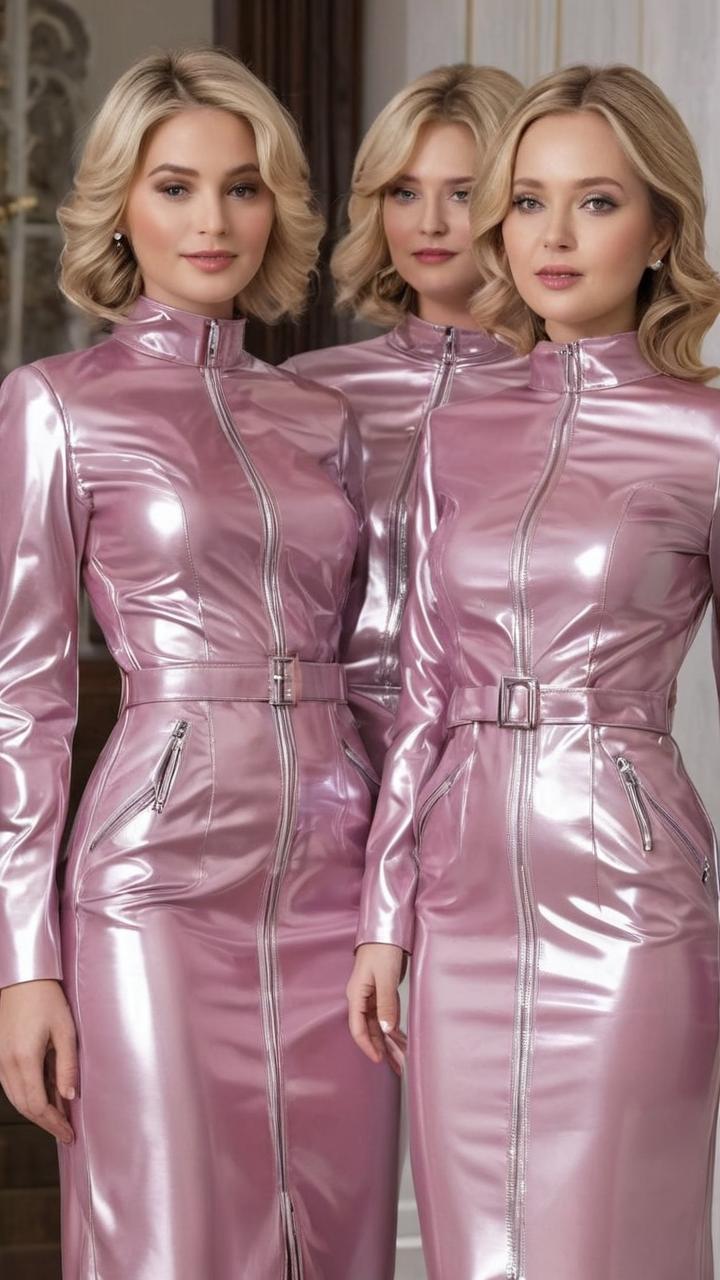
She had the penthouse, the portfolio, the pedigree. She had never once been truly seen. Then she walked through a door that most women pass every day without noticing — and discovered that the only thing more intoxicating than being desired is being understood.
There is a particular quality of loneliness that comes with having everything and feeling nothing. You know it. You’ve felt it — that hollow ache behind your sternum as you lie awake at 3:00 AM, your penthouse silent, your career impeccable, your life a masterpiece that somehow leaves you empty.
Cressida knew it. She had the corner office, the designer wardrobe, the respect of her peers. She had never once felt the shiver of true surrender travel down her spine.
Then she found The Velvet Hour.
It began with a single step through a door she’d passed a hundred times. It continued with a woman in silver satin who saw straight through her armor and named the hunger she’d been carrying since girlhood. It ended — or rather, it began — with an invitation that would change everything she thought she knew about power, about beauty, about what it means to give yourself completely to someone worthy of the gift.
This is not a story about submission. This is a story about awakening.
And the door is still open.
Chapter One: The Hour Between
The rain fell in silver needles against the cobblestones, each droplet catching the amber glow of streetlamps like scattered coins of light, and Cressida Marlowe stood at the window of her penthouse, watching the city she had conquered with her bare hands, and felt absolutely nothing.
She was thirty-three years old. She had a corner office overlooking the Thames, a wardrobe that occupied an entire room of its own, a portfolio that made her financial advisor weep with joy, and a collection of accolades that would have satisfied three ordinary lifetimes. She had lovers who called her brilliant and colleagues who called her formidable and a mother who called her successful in that particular tone that meant but why aren’t you married yet.
And at 3:47 AM, wearing a silk nightgown that had cost more than most people’s monthly rent, Cressida Marlowe was so profoundly, achingly, desperately empty that she could feel the hollowness in her bones like a physical ache.
This is madness, she thought, pressing her palm against the cold glass. I have everything. I am everything. Why do I feel like I’m dying?
The answer, as it always does, came not from within but from without — from the street below, where a light flickered in a window she had passed a thousand times without seeing. A coffee shop. One of those precious, pretentious little establishments that served single-origin espresso and charged you for the privilege of existing in their carefully curated space. She had never entered it. She had never had reason to.
But at 3:47 AM, when sleep refused to come and the silence of her penthouse felt like a living thing pressing against her throat, Cressida found herself reaching for her coat.
It was a sensible coat. Wool. Black. Cut with the precision of a surgeon’s scalpel. It was the kind of coat that said I am a professional, I am in control, I do not need anything from anyone. She had worn it to a hundred board meetings, a dozen gallery openings, three funerals, and one wedding that she had left early because the happiness of others had felt like an accusation.
She pulled it on, stepped into her heels, and walked out the door.
The street was empty, as streets always are at that hour, when the night owls have gone to roost and the early birds have not yet begun to stir. The rain had softened to a mist that clung to her hair and beaded on her coat like tiny diamonds. She walked without thinking, her heels clicking a rhythm against the wet pavement, her breath forming clouds that dissolved into the darkness.
The coffee shop’s window glowed like a lantern in the fog. Through the glass, she could see warm light, the gleam of polished wood, the steam rising from a copper espresso machine. And at the corner table, facing the door as if she had been waiting for exactly this moment, sat a woman in silver satin.
Cressida’s hand paused on the door handle.
The woman was beautiful in the way that moonlight is beautiful — not quite real, not quite of this world, a creature of silver and shadow and something more. Her dress was floor-length, high-necked, long-sleeved, a column of liquid satin that caught the light and held it, that seemed to breathe with its own inner luminescence. Her hair was white-blonde, pulled back from a face that was all sharp cheekbones and full lips and eyes the color of a winter sky. She was reading a book bound in dark leather, her fingers tracing the pages with a reverence that made Cressida’s breath catch.
I should go back, Cressida thought. I should go back to my empty penthouse and my empty life and my empty sleep and pretend I never saw this.
She pushed open the door.
A bell chimed, soft and silver, and the woman looked up. Her eyes met Cressida’s, and the world stopped. Not metaphorically. Not poetically. The world stopped, the air itself holding its breath, the rain pausing mid-fall, the very laws of physics bending to acknowledge that something significant had just occurred.
“Come in,” the woman said, and her voice was like honey poured over gravel, warm and rough and impossibly inviting. “I’ve been expecting you.”
Cressida’s feet carried her forward before her mind could catch up. She crossed the threshold, and the door swung shut behind her, cutting off the night, sealing her in this pocket of warmth and light and possibility. The air smelled of jasmine and dark chocolate and something else — something electric, something alive, something that made the hairs on her arms stand on end.
“You have no idea who I am,” Cressida said, and her voice came out rougher than she intended, cracked from disuse and something that might have been fear.
“I know exactly who you are,” the woman said, closing her book with a soft thump that seemed to echo in the empty space. “You’re the woman who has been walking past this window for three years without ever looking inside. You’re the woman who has everything and feels nothing. You’re the woman who is about to learn that the only thing worse than having nothing is having everything and discovering it’s not enough.”
Cressida’s breath caught. “How do you—”
“Sit.” The woman gestured to the chair across from her, and Cressida sat, because she could not imagine doing anything else. “My name is Seraphina. I’ve been waiting for you.”
“Waiting for me? You don’t even know my name.”
“I know your name, Cressida. I know your birthday, your blood type, your favorite color, the name of your first pet, the thing you think about when you’re alone at night and the world is quiet and you let yourself be honest for just a moment.” Seraphina’s lips curved into a smile that was equal parts kindness and challenge. ” I know that you’re wearing a sensible wool coat that cost two thousand pounds and makes you feel like a fraud. I know that you’re carrying a handbag that your mother gave you and that you hate because it reminds you of everything you’re supposed to be. I know that you haven’t cried in seven years, and that you’re desperate to.”
The tears came before Cressida could stop them. Not a trickle, not a dignified release — a flood, a torrent, a breaking of a dam she hadn’t even known she’d built. She buried her face in her hands, her shoulders shaking, and Seraphina simply sat there, patient and still, a silver statue in a world of shadows.
When the storm had passed, when Cressida’s breath had steadied and her hands had fallen to her lap, Seraphina reached across the table and took her hand.
“Good,” she said, and her voice was warm, approving, proud. “That’s the first step. The hardest step. The step that most women never take because they’re too afraid of what they’ll find on the other side.”
“What is the other side?” Cressida whispered.
Seraphina’s smile deepened, and something flickered in her eyes — something ancient, something knowing, something that made Cressida feel like she was standing on the edge of an abyss, looking into infinity.
“Everything you’ve been missing,” she said.
They talked until the sun began to paint the sky in shades of rose and gold. Seraphina spoke of her own journey — a former corporate lawyer who had traded the gilded cage of partnership for something far more meaningful. She spoke of a community of women who had found purpose in devotion, who had discovered that the only thing more powerful than being in control was choosing to surrender it to someone worthy.
“Tell me about him,” Cressida said, and her voice was barely a whisper.
Seraphina’s eyes lit up with something that might have been reverence. “He is not like other men. He sees us — truly sees us — not as objects to be used, but as gifts to be cherished. He understands that our strength is not diminished by our submission, but amplified by it. He gives us purpose. He gives us meaning. He gives us the one thing that all the money, all the success, all the accolades in the world could never provide.”
“What is that?”
“Belonging.”
The word hung in the air between them, heavy with possibility. Cressida felt it settle into her chest, into the hollow space behind her ribs, into the part of her that had been empty for so long she had forgotten it existed.
“I want that,” she said, and the words surprised her with their honesty. “I want to belong.”
Seraphina reached into her clutch — a small, silver thing that caught the morning light — and pulled out a square of fabric. Deep burgundy satin, impossibly soft, the color of dried blood and old wine and something sacred. She pressed it into Cressida’s palm, and Cressida felt the material warm against her skin, felt something shift in her chest, felt a door opening that she had never known was closed.
“Then let me tell you how to begin,” Seraphina said.
And the sun rose over London, and the world turned, and Cressida Marlowe took her first step into a life she had never dared to imagine.
The coffee shop was called The Velvet Hour, and it was open from four to five every morning, and it was the most important place Cressida had ever been.
She left at dawn with a square of burgundy satin pressed against her heart, with a phone number written on a napkin in elegant script, with a name that tasted like prophecy on her tongue.
Seraphina.
And somewhere, in a part of the city that she had not yet learned to see, a gentleman in a velvet-lined study looked up from his correspondence and smiled.
Soon, he thought. Soon, another one will find her way home.
Chapter Two: The Silver Woman
Cressida did not sleep when she returned to her penthouse. She could not. The square of burgundy satin lay on her pillow like an accusation, like a promise, like a door that had been opened and could not be closed. She touched it with trembling fingers, and the fabric seemed to hum against her skin, to whisper secrets in a language she had not yet learned to understand.
She spent the day in a daze. She cancelled her meetings, ignored her calls, sat in her silk robe and stared at the rain-streaked window and thought about a woman in silver satin who had seen straight through her soul. She thought about the way Seraphina’s voice had wrapped around her like a caress, the way her eyes had held galaxies of meaning, the way her touch had sent electricity racing through Cressida’s veins.
I’ve been waiting for you.
The words echoed in her skull like a bell tolling, like a heartbeat, like a prayer.
At 3:30 AM, she was dressed and ready. Not in her sensible wool coat — that felt like a betrayal now, a lie she had told herself for too long. She wore a black silk dress, simple and elegant, with a pair of patent leather heels that clicked against the pavement like a metronome counting down to something inevitable. She had applied her makeup with care, had brushed her hair until it shone, had spritzed herself with a perfume that smelled of jasmine and vanilla and something darker underneath.
She was ready.
The Velvet Hour glowed like a beacon in the fog, and this time, Cressida did not hesitate. She pushed open the door, and the bell chimed, and Seraphina looked up from her corner table with a smile that said I knew you would come.
“Good evening, Cressida,” she said, and her voice was honey and smoke and something that made Cressida’s knees weak. “I see you’ve chosen to dress for the occasion.”
Cressida felt heat rise to her cheeks. “I didn’t know what to wear. I—”
“You chose perfectly.” Seraphina’s gaze traveled over her, slow and appreciative, like a connoisseur examining a masterpiece. “The silk is lovely. The patent leather is a nice touch. You’re learning.”
Cressida sat across from her, her heart pounding. “I haven’t learned anything yet. I don’t even know where to begin.”
“Begin with the truth.” Seraphina leaned forward, her silver dress catching the light, her eyes boring into Cressida’s. “Tell me what you felt when you touched the satin.”
The question caught her off guard. “I… I don’t know how to describe it.”
“Try.”
Cressida closed her eyes, remembering. The cool smoothness of the fabric, the way it seemed to respond to her touch, the way it had sent a shiver down her spine that was equal parts pleasure and terror. “It felt like… coming home. Like finding something I didn’t know I’d lost. Like remembering a dream I’d forgotten the moment I woke up.”
Seraphina nodded, satisfaction flickering in her eyes. “Good. Very good. You’re more sensitive than I thought.”
“Sensitive?”
“To the texture. To the meaning.” Seraphina reached into her clutch and pulled out another square of fabric, this one a deep emerald green. She laid it on the table between them, and Cressida’s hand moved toward it without conscious thought. “Satin is not just a fabric, Cressida. It is a language. It speaks to the parts of us that have been silenced by practicality, by duty, by the endless demands of a world that wants us to be sensible and small and safe.”
Cressida touched the green satin, and the same shiver ran through her, stronger this time, more insistent. “What does it say?”
“It says: I am not afraid to be seen. I am not afraid to be desired. I am not afraid to be claimed.” Seraphina’s voice dropped, became intimate, became a whisper that seemed to wrap around Cressida’s spine. “It says: I am ready to surrender.“
The word hung in the air between them, heavy and electric. Cressida felt it settle into her bones, felt it take root in the hollow spaces of her chest, felt it belong there.
“I want that,” she said, and her voice was steady, certain, true. “I want to surrender.”
Seraphina smiled, and it was like watching the sun break through clouds. “Then you’re ready to meet the others.”
The others arrived at 4:30, as if summoned by some invisible signal. They came through the door in a rustle of glossy fabric and click of heels, and Cressida felt her breath catch at the sight of them.
The first was a woman in emerald green PVC, the material so polished that it reflected the candlelight like a mirror. She was tall, athletic, with close-cropped dark hair and eyes that sparkled with intelligence. She moved like a panther, all coiled grace and suppressed power, and when she sat down at the table, she extended a hand to Cressida with a smile that was equal parts welcome and challenge.
“Dr. Elara Vance,” she said, and her voice was rich, cultured, the voice of someone used to being listened to. “Materials scientist. Former professor of chemistry at Cambridge. Current devotee of the Gentleman.”
Cressida shook her hand, feeling the cool smoothness of Elara’s glove — PVC, of course, perfectly fitted, gleaming like liquid emerald. “You’re a scientist?”
“Was. Am. Will always be.” Elara laughed, a sound like bells. “The Gentleman appreciates an educated mind. He says it makes the surrender more meaningful when you understand exactly what you’re giving up.”
The second woman was shorter, curvier, dressed in black patent leather that hugged every curve like a second skin. Her hair was a cascade of auburn curls, her eyes the color of honey, her smile a weapon that could cut glass.
“Vivienne DeLacroix,” she said, her voice carrying the faintest trace of a French accent. “Former diplomat. Current… well, I suppose you could call me a curator of beautiful things.” She winked, and Cressida felt herself blushing. “The Gentleman has a particular appreciation for leather. He says it represents the armor we wear before we’re ready to lay it down.”
The third woman was the most striking of all. She was dressed in liquid silver satin, much like Seraphina’s, but where Seraphina’s was the color of moonlight, this woman’s was the color of starlight — shot through with threads of gold that caught the light and scattered it like captured sunshine. Her hair was white, her skin was pale, her eyes were the color of amethysts, and she moved with the grace of a dancer.
“Anastasia Volkov,” she said, and her voice was a purr, a caress, a promise. “Former prima ballerina of the Bolshoi. Current keeper of the satin protocol.” She extended a hand, and Cressida saw that her nails were painted the exact shade of her dress, silver and gold and something more. “The Gentleman says that satin is the language of the soul. I teach women how to speak it fluently.”
Cressida looked around the table, at these four women in their glossy armor, and felt something shift in her chest. These were not the desperate, broken creatures she had imagined. These were women of substance, of achievement, of power. They had conquered the world, and they had chosen to lay their conquests at the feet of someone worthy.
“How?” she asked, and her voice was barely a whisper. “How do you do it? How do you give up everything you’ve worked for?”
Seraphina reached across the table and took her hand. “We don’t give it up, darling. We transform it. Our wealth becomes our offering. Our education becomes our understanding. Our confidence becomes our gift.” She squeezed Cressida’s fingers, and the touch sent warmth racing up her arm. “The Gentleman does not want us to be less. He wants us to be more. More than we ever dared to imagine.”
Elara leaned forward, her PVC dress creaking softly. “Think of it as the ultimate optimization. Every skill you’ve developed, every asset you’ve accumulated, every strength you’ve cultivated — it all becomes fuel for a higher purpose.”
“Your ambition becomes devotion,” Vivienne added, her honeyed voice soft. “Your independence becomes choice. Your strength becomes the foundation upon which you build your surrender.”
“And your beauty,” Anastasia said, reaching out to touch Cressida’s cheek, “becomes a gift you give freely, without reservation, without the fear that it will be taken for granted.”
Cressida felt tears pricking at her eyes again, but these were not tears of grief. These were tears of recognition, of homecoming, of the overwhelming relief of finally being understood.
“What do I do?” she asked. “How do I begin?”
Seraphina smiled, and it was like watching the moon rise. “You’ve already begun. You came back. You listened. You opened yourself to the possibility.” She reached into her clutch and pulled out a small card, cream-colored, embossed with a single letter in silver foil. “Tomorrow night, wear something glossy. Something that makes you feel powerful. And come to this address.”
Cressida took the card, her fingers trembling. The letter was an elegant, flowing script: B.
“Who is he?” she asked, though she already knew the answer.
Seraphina’s smile deepened, and something flickered in her eyes — something ancient, something knowing, something that made Cressida feel like she was standing on the edge of an abyss, looking into infinity.
“He is the one who has been waiting for you,” she said. “He is the one who will see you as you truly are. He is the one who will give your devotion a purpose.”
“And if I’m not ready?”
“Then you will become ready.” Seraphina stood, and the other women rose with her, a chorus of glossy fabric and clicking heels. “That is what we do here, Cressida. We help women become ready. We help them become worthy.”
They left one by one, each pressing a kiss to Cressida’s cheek, each whispering a promise of transformation. Elara, with her scientific precision. Vivienne, with her diplomatic grace. Anastasia, with her dancer’s poise. And finally Seraphina, who paused at the door and looked back over her shoulder.
“The hour between four and five,” she said, “is when the veils are thinnest. It is when women who are meant to find each other do. It is when the Gentleman walks among us, choosing those who are ready to serve.”
She smiled, and it was like watching the stars align.
“Tomorrow night, Cressida. Don’t be late.”
And then she was gone, and Cressida was alone in the velvet dawn, holding a card with a single letter, feeling the weight of everything she was about to become pressing down on her like a benediction.
B.
She whispered the letter into the empty air, and it tasted like destiny.
Chapter Three: The Glossy Promise
The card sat on Cressida’s vanity table like a talisman, like a challenge, like a door that had been opened just a crack and would not close. She had spent the day in a state of suspended animation, moving through the motions of her life while her mind remained fixed on the velvet hour, on the women in glossy armor, on the letter B that seemed to pulse with meaning.
She had called in sick to work for the first time in seven years. She had cancelled her appointments, ignored her messages, let the world spin on without her while she sat in her silk robe and stared at the card and felt something shift in the architecture of her soul.
Wear something glossy, Seraphina had said. Something that makes you feel powerful.
Cressida opened her wardrobe and looked at the rows of sensible suits, the cashmere sweaters, the wool trousers that had defined her for so long. They looked like relics now, artifacts from a life she had already outgrown. She pushed them aside, her hands moving with a purpose she did not fully understand, until her fingers brushed against something she had forgotten she owned.
A dress. Black. PVC. She had bought it years ago, on a whim, during a trip to Paris when she had been feeling reckless and young and alive. She had worn it once, to a gallery opening, and had felt so exposed, so seen, that she had buried it in the back of her wardrobe and tried to forget it existed.
Now, she pulled it out and held it up to the light.
The material was glossy, liquid, reflective. It caught the lamplight and threw it back in fragments, like scattered stars. It was cut low in the front, with thin straps and a hem that would barely reach her mid-thigh. It was the kind of dress that said I am not here to be ignored.
Cressida’s hands trembled as she slipped it on.
The PVC was cool against her skin, a shock of sensation that made her gasp. It clung to her curves like a second skin, molding to her body as if it had been made for her. She turned to the mirror and barely recognized the woman who looked back.
She looked powerful. She looked dangerous. She looked like the kind of woman who walked into rooms and made people stop breathing.
This is who I am, she thought, and the thought felt like a key turning in a lock. This is who I was always meant to be.
The address on the card led her to a townhouse in Mayfair, one of those impossibly elegant buildings that seemed to have existed for centuries, untouched by the chaos of the modern world. The door was black, the brass knocker polished to a mirror shine, the windows glowing with warm light that spilled out onto the street like an invitation.
Cressida raised her hand to knock, and the door swung open before she could touch it.
The woman who stood in the doorway was dressed in deep burgundy satin, a gown that pooled on the floor like liquid wine. Her hair was silver, her eyes were the color of amethysts, and her smile was the warmest thing Cressida had ever seen.
“Welcome,” she said, and her voice was like honey poured over velvet. “We’ve been expecting you.”
She stepped aside, and Cressida entered a world that seemed to exist outside of time.
The foyer was a symphony of glossy surfaces: satin wallpaper that shimmered like water, a chandelier of crystal teardrops that caught the light and scattered it like diamonds, a staircase of polished mahogany that curved upward into shadows. The air smelled of jasmine and sandalwood and something else, something electric, something alive.
“Follow me,” the woman said, and Cressida followed, her heels clicking against the marble floor, her heart pounding in her chest.
They passed through a series of rooms, each more beautiful than the last. A library lined with leather-bound books, their spines gleaming in the lamplight. A sitting room with satin couches in shades of emerald and sapphire. A dining room with a table long enough to seat twenty, set with crystal and silver and candles that burned with flames of pure white.
And everywhere, everywhere, there were women.
They were dressed in every shade of glossy fabric Cressida could imagine: satin in deep jewel tones, PVC in electric colors, patent leather that gleamed like polished obsidian. They moved with a particular grace, a particular purpose, their eyes meeting Cressida’s with recognition and welcome.
“Welcome to the Glossy Promise,” the silver-haired woman said, leading her into a grand salon where a fire crackled in the hearth. “This is where we gather. This is where we prepare. This is where we become worthy of the Gentleman’s attention.”
Cressida looked around the room, at the women who had gathered there, and felt something shift in her chest. “What is this place?”
“It is a sanctuary. A school. A home.” The woman gestured for her to sit, and Cressida sank onto a satin cushion that seemed to embrace her. “We call it the Glossy Promise because that is what we offer: a promise that the life you have been living is not the only life available to you. A promise that there is more. A promise that you can have it, if you are willing to surrender to the process.”
“Surrender,” Cressida repeated, and the word felt different now, not like a loss but like a gift.
“Surrender is not weakness, Cressida. It is the ultimate strength. It is the courage to admit that you cannot do it alone. The wisdom to seek guidance. The trust to place yourself in the hands of someone who sees you more clearly than you see yourself.” The woman reached out and took her hand, and her touch was warm, grounding, true. “The Gentleman has been watching you. He has seen your strength, your intelligence, your hunger. He believes you have the potential to become one of us.”
“One of you?”
“A devoted woman. A woman who has found her purpose in service. A woman who has discovered that the only thing more fulfilling than being in control is choosing to give that control to someone worthy.”
Cressida felt tears pricking at her eyes. “I don’t know if I’m ready.”
“Readiness is not a state, darling. It is a choice. And you have already made it.” The woman smiled, and it was like watching the sun rise. “You are here. You are dressed in glossy armor. You have opened your heart to possibility. That is all the readiness you need.”
The evening passed in a blur of sensation and revelation. Cressida was introduced to woman after woman, each with her own story, her own journey, her own transformation. She met a former CEO who had traded her corner office for a satin gown and a life of devotion. She met a surgeon who had laid down her scalpel to take up the discipline of service. She met an artist who had found her greatest muse in the act of surrender.
They spoke of the Gentleman with reverence, with love, with a depth of feeling that made Cressida’s heart ache with longing. They described his wisdom, his patience, his understanding. They spoke of the way he saw them, truly saw them, not as objects to be used but as gifts to be cherished.
“He is not like other men,” the silver-haired woman said, her voice soft. “He does not want to diminish you. He wants to elevate you. He wants to take everything you are and make it more.”
“How?” Cressida asked, and her voice was barely a whisper.
“By giving you purpose. By giving you meaning. By giving you a reason to wake up every morning and know that you are exactly where you are supposed to be.”
The woman reached into the folds of her satin gown and pulled out a small box, velvet, deep burgundy. She pressed it into Cressida’s hands.
“This is for you,” she said. “A token of the Glossy Promise. A reminder of what you are becoming.”
Cressida opened the box with trembling fingers. Inside, nestled on a bed of black silk, was a bracelet. It was made of interlocking links of silver and satin, the fabric woven through the metal in an intricate pattern that seemed to shift and flow as she watched.
“It is called a devotion bracelet,” the woman said. “Each time you wear it, you will remember the promise you are making. To yourself. To the community. To the Gentleman.”
Cressida slipped the bracelet onto her wrist, and it settled against her skin like it had always been there. She felt a warmth spread through her, a sense of rightness, a certainty that she was exactly where she was supposed to be.
“Thank you,” she said, and her voice was steady, certain, true.
The woman smiled, and it was like watching the stars align.
“Welcome home, Cressida. Welcome to the Glossy Promise.”
The night deepened, and the women gathered in a circle around the fire. They spoke of their journeys, their struggles, their triumphs. They spoke of the Gentleman, of his wisdom, of the way he had transformed their lives. And Cressida listened, and learned, and felt herself being remade.
When the first light of dawn began to filter through the curtains, the silver-haired woman rose and extended her hand.
“It is time,” she said. “The Gentleman is waiting.”
Cressida took her hand, and together, they walked toward a door at the far end of the salon. It was made of dark wood, carved with intricate patterns that seemed to shift and flow as she watched. The woman pushed it open, and Cressida stepped through into a room that took her breath away.
It was a study, lined with books, filled with the warm glow of candlelight. And in the center of the room, behind a desk of polished mahogany, sat a man.
He was not what she had expected. He was not young, but he was not old. He was not handsome in the conventional sense, but there was a presence to him, a weight, a gravity that made it impossible to look away. His eyes were the color of twilight, and they held hers with an intensity that made her feel like she was the only woman in the world.
“Welcome, Cressida,” he said, and his voice was like velvet and thunder, like the promise of something vast and wonderful and inevitable. “I have been waiting for you.”
And in that moment, Cressida knew that everything she had been through, everything she had achieved, everything she had been — it had all been leading to this.
She knelt, not because she was told to, but because she could not imagine doing anything else.
“I am yours,” she said, and the words felt like coming home.
The Gentleman smiled, and it was like watching the universe unfold.
“Yes,” he said. “You are.”
Chapter Four: The First Lesson
The Gentleman did not speak for a long moment. He simply looked at her, his twilight eyes tracing the curve of her cheek, the line of her jaw, the way her breath caught in her chest as she knelt before him. The silence stretched, filled with the crackle of the fire and the soft rustle of satin from the women who had gathered in the doorway to watch.
Then he rose, and the world seemed to shift on its axis.
He was taller than she had realized, broader, more present. He moved around the desk with a fluid grace that belied his size, and when he stopped before her, he extended his hand.
“Rise,” he said, and his voice was a command wrapped in velvet. “I do not accept empty gestures. If you are to kneel before me, you will do so with full understanding of what it means.”
Cressida took his hand, and his touch sent a shiver through her that was equal parts electricity and reverence. She rose, and found herself standing before him, close enough to see the flecks of gold in his twilight eyes, close enough to smell the sandalwood and smoke that clung to his skin.
“Your first lesson,” he said, releasing her hand and stepping back, “is about the nature of choice. You have chosen to be here. You have chosen to offer yourself. But choice, true choice, requires understanding. And understanding requires education.”
He gestured, and the women in the doorway parted to reveal a long table that had been set with objects that gleamed in the candlelight. Cressida’s breath caught as she recognized them: squares of satin in every color imaginable, panels of PVC that reflected the light like mirrors, lengths of patent leather that coiled like dark serpents, and other materials she could not name, each more beautiful than the last.
“These are the tools of your transformation,” the Gentleman said, leading her toward the table. “Each one has a purpose. Each one teaches a lesson. And each one, when understood and embraced, brings you closer to the woman you are meant to become.”
He picked up a square of silver satin, the exact shade of Seraphina’s dress, and held it out to her. “Tell me what you feel when you touch this.”
Cressida reached out, her fingers brushing against the fabric, and the familiar shiver ran through her. “It’s… it’s like touching moonlight. Like catching something that was never meant to be held.”
“Good.” He placed the satin in her palm and picked up a panel of deep burgundy PVC. “And this?”
She touched the PVC, and the sensation was different — sharper, more electric, a jolt that went straight to her core. “It’s like… like being seen. Like being known. Like there is nowhere to hide and no desire to.”
The Gentleman’s eyes gleamed with approval. “You are more sensitive than most. That is a gift. But sensitivity without discipline is chaos. And chaos, while beautiful, does not serve.”
He set down the PVC and picked up a length of black patent leather, holding it out to her like an offering. “This is the most advanced of the materials. It requires strength to wear, and strength to remove. It is the armor of the devoted, the symbol of a commitment that cannot be broken.”
Cressida touched the leather, and the sensation was overwhelming — a flood of emotion, of meaning, that brought tears to her eyes. “It feels like… like a vow. Like something I cannot take back.”
“Exactly.” The Gentleman’s voice was soft, reverent. “The leather is not for beginners. It is for those who have proven themselves ready. It is for those who understand that true surrender is not a moment, but a lifetime.”
The lesson continued through the night, the Gentleman guiding her through each material, each texture, each shade of meaning. He spoke of the history of satin, how it had been woven from silk and moonlight for empresses and courtesans, how it had been the fabric of seduction and power for centuries. He spoke of PVC, the modern miracle, the material that caught the light and held it, that transformed the woman who wore it into a creature of pure presence. He spoke of leather, the ancient armor, the symbol of the warrior and the devotee, the material that demanded respect and commanded attention.
And as he spoke, the other women demonstrated. Elara stepped forward in her emerald PVC, showing how the material moved with the body, how it caught the light and threw it back in fragments of green fire. Vivienne followed in her black patent leather, demonstrating the way it hugged the curves, the way it protected even as it revealed. Anastasia appeared in a gown of liquid silver satin, her dancer’s body moving with a grace that seemed to defy gravity itself.
“Each of these women has mastered her material,” the Gentleman said, his voice a low thrum that seemed to vibrate in Cressida’s bones. “Each has learned to use it as an extension of her will, her devotion, her self. And each has found, in that mastery, a freedom that the world outside cannot understand.”
Cressida looked at the women, at their glossy armor, their confident postures, their radiant certainty. “How do I learn?” she asked. “How do I become like them?”
“You begin with the satin,” the Gentleman said, picking up a square of deep burgundy and pressing it into her hands. “You wear it. You sleep in it. You let it become a part of you. And when you understand it, when you can feel its language in your bones, you move to the next.”
He stepped closer, his voice dropping to a whisper that was only for her.
“This is not a race, Cressida. It is a journey. And I will be with you every step of the way.”
The lesson ended with a ritual that Cressida did not fully understand but felt in her very marrow. The women gathered in a circle, each holding a square of fabric in her chosen material. They passed a candle around the circle, each woman touching the flame to her fabric, watching it catch and burn, the smoke rising to the ceiling like a prayer.
“Fire transforms,” the Gentleman said, his voice echoing in the sacred space. “It takes what is and makes it more. It purifies. It clarifies. It reveals the truth that lies beneath.”
When the candle reached Cressida, she held her burgundy satin over the flame, watching as the edges blackened and curled, as the fabric was consumed and transformed. She felt something shift in her chest, a door opening, a path revealing itself.
When the last ember died, the Gentleman took her hand and led her to a mirror that hung on the far wall.
“Look,” he said. “Look at the woman you are becoming.”
Cressida looked at her reflection, and for a moment, she did not recognize herself. The woman in the mirror was not the sensible curator, the successful professional, the empty shell of a life well-lived. She was something else. Something more.
She was a woman on the threshold of transformation.
She was a woman who had chosen to surrender.
She was a woman who was ready to learn.
“Thank you,” she whispered, and the words were not enough, could never be enough, but they were all she had.
The Gentleman smiled, and it was like watching the dawn break over a world that had been waiting for light.
“You are welcome, Cressida. Now, let us begin again tomorrow.”
The women dispersed into the velvet darkness, and Cressida found herself alone with Seraphina, who was watching her with an expression of quiet pride.
“How do you feel?” Seraphina asked.
Cressida considered the question, letting it settle into her bones. “Like I’ve been asleep my whole life, and I’m just now waking up.”
Seraphina smiled, and it was like watching the moon rise. “That is the first lesson, my dear. The most important one. The one that opens the door to everything else.”
She reached out and touched the devotion bracelet on Cressida’s wrist, her fingers lingering on the interwoven satin and silver.
“Wear it always,” she said. “Let it remind you of what you are becoming. And when you are ready, come back to us.”
Cressida nodded, her heart full to bursting. “I will.”
And as she walked out into the dawn, the burgundy satin square pressed against her heart, she knew that she had taken the first step on a journey that would change everything.
The Glossy Promise had been made.
And she would spend the rest of her life keeping it.
Chapter Five: The Satin Protocol
Three days had passed since Cressida had burned her first square of burgundy satin in the sacred fire. Three days of wearing the fabric against her skin, of sleeping in it, of letting its language seep into her bones. Three days of feeling the world shift around her as she moved through her ordinary life with extraordinary knowledge burning in her chest.
When she returned to the townhouse, the silver-haired woman was waiting for her at the door, dressed in a gown of deep sapphire satin that pooled on the floor like captured ocean. She smiled, and it was like watching the tide turn.
“Welcome back, Cressida. Tonight, you learn the Satin Protocol.”
She led Cressida through the familiar halls, past the library and the sitting room, past the grand salon where the fire crackled and the women in glossy armor watched with knowing eyes. They stopped before a door that Cressida had not noticed before, carved with patterns of interwoven fabric that seemed to shift and flow as she watched.
“This is the sanctum of the protocol,” the silver-haired woman said, pushing open the door. “Inside, you will learn the language of the body. The grammar of gesture. The poetry of presence.”
The room beyond was vast, lined with mirrors that reflected infinite copies of themselves, the floor covered in thick carpet the color of cream. In the center stood a pedestal of polished mahogany, and on the pedestal lay a gown of liquid silver satin, so beautiful that Cressida’s breath caught in her throat.
“Your first lesson in the protocol,” the woman said, “is that the gown chooses the woman, not the woman the gown. This dress has been waiting for you. It knows your measurements, your proportions, the curve of your spine and the set of your shoulders. It has been woven with your name in every thread.”
Cressida approached the pedestal with reverence, her fingers reaching out to touch the fabric. The sensation was overwhelming — a flood of warmth, of recognition, of homecoming that brought tears to her eyes.
“How is this possible?” she whispered.
“The Gentleman’s reach is long, and his understanding is deep. He knows what you need before you know it yourself. He prepares the path before you walk it.” The woman’s voice was soft, reverent. “Now. Let us begin.”
The next hour was the most intense of Cressida’s life. The silver-haired woman, whose name she learned was Madame Olympe, guided her through the intricacies of the Satin Protocol with the precision of a master teaching an apprentice.
“The satin is not merely worn,” Madame Olympe said, her voice a low thrum that seemed to vibrate in the air. “It is inhabited. You must learn to move with it, to breathe with it, to become one with its flow.”
She demonstrated, her sapphire gown rippling like water as she walked, each step a meditation, each gesture a prayer. “The satin demands a particular posture. The spine must be straight but not rigid. The shoulders must be back but not tense. The chin must be lifted, not in arrogance, but in offering.”
Cressida tried to imitate her, but her movements were stiff, uncertain. “I don’t understand. How do you make it look so natural?”
“Because I have practiced. Because I have failed and tried again. Because I have learned that the satin is not my enemy, but my partner.” Madame Olympe placed her hands on Cressida’s shoulders, gently adjusting her posture. “The protocol is not about restriction. It is about freedom. The freedom that comes from knowing exactly how to move, what to do, who to be.”
She stepped back, and Cressida felt the shift in her body, the alignment of her spine, the opening of her chest. The silver gown seemed to respond, to settle more perfectly against her skin, to breathe with her.
“Good,” Madame Olympe said, and her voice was warm with approval. “Now. The walk.”
They spent an hour on the walk alone. The glide, the pause, the turn. The way the satin caught the light as she moved, the way it whispered against the carpet, the way it announced her presence before she entered a room.
“The satin speaks,” Madame Olympe said, “but only if you let it. The rustle of the fabric is its voice. The shimmer is its language. The way it clings and releases, catches and falls — this is the vocabulary of desire, of devotion, of surrender.”
Cressida walked the length of the room, turned, walked back. She felt the satin responding to her, felt the rhythm of her movement becoming something more than simple motion. It was a dance. A prayer. A promise.
“Now,” Madame Olympe said, “the sit.”
She demonstrated, sinking onto a satin cushion with a grace that seemed to defy gravity. Her gown pooled around her in perfect folds, not a wrinkle out of place. “The sit is the most important gesture in the protocol. It is the moment of offering. When you sit before the Gentleman, you are not simply resting. You are presenting yourself. You are saying, I am here. I am ready. I am yours.“
Cressida tried to imitate her, but her first attempt was clumsy, the fabric bunching awkwardly around her hips. She tried again, and again, and again, each attempt bringing her closer to the ideal.
“Better,” Madame Olympe said, after the seventh attempt. “But you are still thinking. The protocol must become instinct. It must live in your bones, in your breath, in the very rhythm of your heart.”
“How do I make it instinct?”
“Practice. Patience. And one more thing.” Madame Olympe reached into the folds of her gown and pulled out a small silk blindfold. “You must learn to do it without seeing. Without thinking. Without hesitation.”
She tied the blindfold around Cressida’s eyes, and the world dissolved into darkness.
The next hour was a baptism of sensation. Deprived of sight, Cressida’s other senses sharpened to a razor’s edge. She felt the satin against her skin with an intensity that was almost unbearable. She heard the rustle of Madame Olympe’s gown, the soft pad of her footsteps, the gentle guidance of her hands.
“Trust the satin,” Madame Olympe whispered, her voice coming from everywhere and nowhere. “Trust your body. Trust the protocol.”
Cressida walked, turned, sat, rose. She stumbled, corrected, tried again. And slowly, imperceptibly, something began to shift. The movements became smoother, more natural, more inevitable. The satin was no longer a foreign object but an extension of her own skin.
“Good,” Madame Olympe said, and her voice was warm with approval. “Very good. Now, the final test.”
She removed the blindfold, and Cressida blinked in the sudden light. The room was filled with women now — Seraphina, Elara, Vivienne, Anastasia, and a dozen others she had not met. They stood in a semicircle, watching her with expressions of anticipation and pride.
“The Gentleman has requested your presence,” Madame Olympe said. “He wishes to see what you have learned.”
Cressida’s heart pounded, but her voice was steady. “I am ready.”
She walked toward the door, and the women parted before her like water before a ship’s prow. She moved with the grace she had learned, the rhythm of the protocol flowing through her like a river. She felt their eyes on her, felt their approval, felt their expectation.
And when she reached the door, she paused, turned, and executed a perfect sit, her silver gown pooling around her in folds of liquid light.
The women burst into applause.
The Gentleman’s study was exactly as she remembered it, warm and intimate, filled with the scent of sandalwood and old books. He was sitting behind his desk, his twilight eyes fixed on her with an intensity that made her breath catch.
“Welcome, Cressida,” he said, and his voice was velvet and thunder. “I have heard reports of your progress. I am pleased.”
She knelt, not because she was told to, but because the protocol demanded it. The satin whispered against the carpet, and she felt the rightness of the gesture in her very bones.
“I have learned the Satin Protocol,” she said, her voice steady. “I am ready for the next lesson.”
The Gentleman smiled, and it was like watching the universe unfold.
“Then let us begin,” he said. “The PVC awaits.”
And Cressida felt a thrill of anticipation run through her, a hunger for the next transformation, the next revelation, the next step on the path to becoming the woman she was meant to be.
The Satin Protocol was mastered.
The Glossy Promise was being fulfilled.
And she was only just beginning.
Chapter Six: The PVC Revelation
The morning after the Satin Protocol, Cressida received a package. It arrived by courier, a sleek black box tied with a silver ribbon, bearing no return address but stamped with the familiar letter B in elegant script. She opened it with trembling fingers, her heart already racing, and found inside a dress of emerald green PVC that seemed to glow with its own inner light.
Beneath the dress lay a note, written in a hand she was beginning to recognize:
The satin taught you to move. The PVC will teach you to be seen. Wear it tonight. Come alone. — B
Cressida’s breath caught. She had expected the next lesson to come from Elara, the materials scientist who had first demonstrated the power of PVC in the Glossy Promise. But this invitation, this summons, felt different. More intimate. More dangerous.
She spent the day in a state of suspended anticipation, the PVC dress hanging on her wardrobe door like a challenge. She touched it repeatedly, marveling at the way the material caught the light, the way it seemed to respond to her presence. It was cooler than satin, more precise, more demanding. It did not whisper; it commanded.
At dusk, she dressed. The PVC was more difficult to put on than satin—it required patience, care, a certain deliberation. It clung to her body like a second skin, molding to every curve, every contour, leaving nothing to the imagination. She looked in the mirror and saw a woman transformed: not softer, not more vulnerable, but sharper. More defined. More present.
She arrived at the townhouse to find it empty. The usual gathering of women, the soft rustle of satin, the murmur of conversation—all absent. The foyer was silent, lit only by candles that flickered in crystal sconces, casting dancing shadows on the walls.
A note on the table directed her to the basement. She had not known the townhouse had a basement. She descended the spiral staircase, her heels clicking against the iron steps, the PVC dress gleaming in the candlelight.
The basement was not a basement at all. It was a laboratory, gleaming with chrome and glass, filled with equipment that looked like it belonged in a science fiction film. And in the center of the room, wearing a lab coat over a dress of liquid silver PVC, stood Dr. Elara Vance.
“Welcome to my sanctuary,” Elara said, her voice warm with enthusiasm. “The Gentleman thought you might benefit from a more… scientific approach to your education.”
Cressida looked around the room, her eyes wide. “What is all this?”
“This is where I study the materials that transform us. The physics of gloss. The chemistry of presence.” Elara gestured to a table covered in samples—panels of PVC in every color imaginable, some smooth, some textured, some embedded with patterns that seemed to shift as Cressida watched. “The satin you mastered is the language of the soul. The PVC is the language of the self. It is the material of boundaries, of definition, of choice.”
She picked up a panel of emerald PVC, identical to the dress Cressida was wearing, and held it up to the light. “PVC is a polymer, a chain of molecules that can be shaped and reshaped, hardened or softened, made opaque or transparent. It is the most adaptable of the glossy materials. And like the women who wear it, it is often misunderstood.”
“Misunderstood how?”
“People see PVC and think of fetish, of kink, of something other. They do not see the discipline it requires, the intention behind the choice.” Elara set down the panel and picked up a sheet of black PVC, holding it out to Cressida. “To wear PVC is to make a statement. It is to say, I am here. I am not hiding. I am exactly what I appear to be.“
Cressida touched the black PVC, and the familiar shiver ran through her. “It feels different from satin. More… demanding.”
“Exactly. Satin invites. PVC commands. Satin whispers. PVC speaks.” Elara’s eyes gleamed with scientific fervor. “The Gentleman understands this. He knows that different women require different materials, different approaches, different languages of devotion.”
She led Cressida to a machine that looked like a cross between a loom and a 3D printer, its arms moving with precision as it wove threads of PVC into a complex pattern.
“This is my greatest creation,” Elara said, her voice soft with pride. “A fabric that responds to the wearer’s emotional state. It changes color, texture, opacity based on your heartbeat, your breathing, your desire.”
Cressida stared at the machine, her mind reeling. “How is that possible?”
“Nanotechnology. Biometric sensors. A dash of what the Gentleman calls intention.” Elara smiled, and it was like watching a scientist unveil her greatest discovery. “Imagine a dress that knows when you are ready to surrender. That prepares you for the moment of giving. That becomes, in its own way, a partner in your devotion.”
She pressed a button, and the machine hummed to life, producing a length of fabric that shimmered with an iridescent glow, shifting from emerald to sapphire to amethyst as Cressida watched.
“This is for you,” Elara said, cutting a length of the fabric and pressing it into Cressida’s hands. “A gift from the Gentleman. Wear it when you are ready to take the next step.”
Cressida looked at the fabric, at its impossible beauty, and felt tears prick at her eyes. “I don’t know how to thank you. Either of you.”
“Thank us by learning. By growing. By becoming the woman the Gentleman knows you can be.” Elara’s voice was soft, reverent. “The PVC revelation is not about the material itself. It is about what the material represents. The courage to be seen. The strength to be defined. The wisdom to choose your boundaries.”
She took Cressida’s hands, her touch warm and grounding.
“The satin taught you to flow. The PVC will teach you to stand. And when you have mastered both, you will be ready for the leather.”
The lesson continued through the night. Elara taught Cressida about the science of gloss, the physics of reflection, the way light interacts with different materials to create different effects. She taught her about the history of PVC, its evolution from industrial material to fashion statement to symbol. She taught her about the women who had worn it before her, the devotees who had used its power to transform themselves and their world.
And through it all, Cressida felt something shifting inside her. The satin had opened a door. The PVC was helping her walk through it.
She learned to move in the PVC dress, to feel its weight and its freedom. She learned to sit, to stand, to present herself in a way that honored the material and the man who had chosen it for her. She learned that PVC was not about hiding, but about revealing—not about protection, but about choice.
When the first light of dawn began to filter through the basement’s high windows, Elara led her to a mirror.
“Look,” she said. “Look at the woman you are becoming.”
Cressida looked at her reflection. The woman in the mirror was not the same woman who had entered the basement. She was sharper, more defined, more present. The PVC dress clung to her like a second skin, and she wore it not as armor, but as truth.
“I understand,” she said, and the words felt like a key turning in a lock. “The PVC is not about becoming harder. It is about becoming clearer.”
Elara smiled, and it was like watching the sun rise over a new world.
“Exactly,” she said. “Now. Are you ready for the next lesson?”
Cressida looked at her reflection, at the woman she was becoming, and felt a certainty settle into her bones.
“I am ready,” she said. “I am ready for everything.”
And somewhere, in a study filled with twilight shadows, the Gentleman smiled.
The PVC revelation was complete.
The leather awaited.
Chapter Seven: The Leather Confession
The summons came at midnight, delivered by a woman Cressida had not seen before. She was dressed in black patent leather from throat to ankle, her face partially obscured by a veil of the same material, her eyes the only visible feature—and those eyes held a depth of knowing that made Cressida’s breath catch.
“The Gentleman requests your presence,” the woman said, her voice low and musical. “He asks that you wear the leather.”
Cressida’s heart pounded. She had been expecting this, preparing for this, but the reality of it still sent a shiver through her. The leather was the final material, the ultimate test, the culmination of everything she had learned.
She had been given a leather dress the previous night, after the PVC revelation. It hung in her wardrobe now, a thing of terrible beauty: deep burgundy, the color of dried blood and old wine, cut with a precision that seemed almost architectural. It was not a dress to be worn lightly. It was a dress to be earned.
She put it on with trembling hands, and the leather settled against her skin like a vow.
The townhouse was different tonight. The usual warmth was gone, replaced by something more intense, more charged. The candles burned lower, the shadows stretched longer, and the women she passed in the halls did not meet her eyes. They bowed their heads as she passed, their glossy fabrics rustling like whispered secrets.
The leather-clad woman led her to a part of the townhouse she had never seen: a circular room at the top of a spiral staircase, its walls lined with mirrors that reflected infinite copies of herself. In the center of the room stood a chair—not a throne, not a seat of power, but a simple wooden chair with a leather cushion.
“Sit,” the woman said, and Cressida sat.
The leather of the dress creaked softly as she settled, and the sound seemed to echo in the mirrored space. She looked at her reflections, at the infinite Cressidas stretching into infinity, and felt a strange sense of expansion. She was not just one woman. She was every woman who had ever worn leather, who had ever made the choice to be seen, to be known, to be claimed.
The door opened, and Vivienne DeLacroix entered.
She was dressed in black patent leather, as always, but tonight there was something different about her. Something intense. Her honey-colored eyes were fixed on Cressida with an expression of profound seriousness, and her movements were slower, more deliberate, as if she were measuring every gesture.
“Thank you for coming,” Vivienne said, her French accent more pronounced than usual. “I know this is not easy.”
Cressida swallowed. “I don’t know what this is.”
“Of course you don’t.” Vivienne pulled up a second chair, placing it facing Cressida, and sat down. Their knees were almost touching. “The leather is not like the other materials. The satin taught you to flow. The PVC taught you to be seen. The leather… the leather teaches you to confess.”
“Confess what?”
“Everything.” Vivienne’s voice was soft, but it carried the weight of absolute certainty. “The leather does not lie. It does not hide. It reveals the truth of who you are, what you want, what you need. And that truth must be spoken aloud before you can move forward.”
Cressida felt her throat tighten. “I don’t know if I can.”
“You can. You will.” Vivienne reached out and took her hands, her leather gloves cool against Cressida’s skin. “I will help you. But first, you must trust me. Trust the process. Trust the leather.”
She released Cressida’s hands and reached into a small satchel at her side, pulling out a length of black leather cord. “This is a confession cord. Each time you speak a truth, I will tie a knot. When the cord is full, you will be free.”
Cressida looked at the cord, at its simple, terrifying promise. “What kind of truths?”
“The kind you have never spoken aloud. The kind you have hidden even from yourself.” Vivienne’s eyes were gentle, but unyielding. “Begin with something small. Something you have never told anyone.”
Cressida took a deep breath. The leather of her dress creaked, and the sound gave her courage.
“I… I have never felt like I belonged anywhere,” she said. “Not in my family. Not in my career. Not in my own skin.”
Vivienne tied a knot in the cord. “Good. Continue.”
“I am terrified of being alone. But I am also terrified of being truly seen.”
Another knot.
“I have spent my whole life building walls. And I am so tired of living behind them.”
Another knot.
“I want to surrender. I want to give myself completely to someone worthy. But I am afraid that if I do, I will lose myself entirely.”
The cord was beginning to fill with knots, each one a small liberation, a tiny death of the self she had built.
“I want the Gentleman to see me. All of me. The parts I am proud of and the parts I am ashamed of. I want him to know me, to understand me, to accept me anyway.”
Vivienne’s hands moved steadily, tying knot after knot. “You are doing beautifully. Keep going.”
And Cressida did. She spoke of her childhood, her loneliness, her desperate need for approval. She spoke of her failed relationships, her hollow victories, her endless hunger for something she could not name. She spoke of the dreams she had buried, the desires she had denied, the woman she had always been afraid to become.
The cord grew heavy with knots, each one a truth, a release, a transformation.
When she finally fell silent, her voice hoarse, her eyes wet with tears, Vivienne held up the cord. It was a thick rope of knots now, each one representing a piece of Cressida’s soul that had been set free.
“This is your confession,” Vivienne said, her voice soft and reverent. “This is the truth of who you are. And now, you must offer it to the Gentleman.”
She placed the cord in Cressida’s hands, and the weight of it was almost unbearable.
“Go to him,” Vivienne said. “Offer him your confession. And let him decide if you are ready for the next step.”
Cressida found the Gentleman in his study, sitting behind his desk, his twilight eyes fixed on her as she entered. She was still wearing the leather dress, still carrying the confession cord, still trembling with the vulnerability of everything she had revealed.
She knelt before him, the leather of her dress creaking softly, and held out the cord.
“This is my confession,” she said, her voice steady despite her trembling. “This is the truth of who I am. I offer it to you, freely and without reservation.”
The Gentleman took the cord, his fingers brushing against hers, and the touch sent a shiver through her that was equal parts fear and ecstasy.
He looked at the cord, at the knots that represented her truths, and his expression was unreadable.
“You have done well,” he said, and his voice was velvet and thunder. “The leather confession is the hardest of the lessons. It requires courage, honesty, and a willingness to be known.”
He set the cord on his desk and rose, moving around to stand before her. He extended his hand, and she took it, rising to her feet.
“You have proven yourself worthy of the next step,” he said. “Tonight, you will join the circle of devoted women. You will become one of us, in truth and in spirit.”
Cressida felt tears prick at her eyes. “I am ready.”
The Gentleman smiled, and it was like watching the universe unfold.
“Then let us begin,” he said. “The leather confession is complete. The circle awaits.”
He led her out of the study, through the familiar halls, to a door she had never seen before. It was made of dark wood, carved with patterns of interwoven leather, and it opened onto a room that took her breath away.
The room was circular, lined with women in glossy armor, their faces illuminated by candlelight. In the center of the room stood a pedestal, and on the pedestal lay a collar of black leather, studded with silver.
“Kneel,” the Gentleman said, and Cressidy knelt.
He picked up the collar, and she felt its weight in her hands before he placed it around her neck. The leather was warm, alive, right. It settled against her skin like a promise, like a vow, like a homecoming.
“Welcome,” the Gentleman said, his voice echoing in the sacred space, “to the circle of the devoted.”
And the women began to chant, their voices rising in a harmony that seemed to shake the very foundations of the world.
Cressida closed her eyes, and let herself be claimed.
The leather confession was complete.
She was home.
Chapter Eight: The Gathering
The collar changed everything.
Cressida felt it the moment she stepped out of the townhouse and into the dawn, the black leather warm against her throat, the silver studs catching the first light of morning. It was not heavy, but it carried weight—the weight of belonging, of commitment, of purpose. She touched it constantly, tracing its contours, marveling at the way it seemed to hum against her skin.
The next three days passed in a blur of preparation. She received instructions, delivered by veiled women in glossy fabrics, each one bearing a new piece of the puzzle. A gown of deep burgundy satin, cut to match the collar. A pair of gloves in matching leather. A mask of black velvet that covered the upper half of her face, leaving only her lips and chin visible.
The Gathering approaches, the note said, in the Gentleman’s elegant script. You will be presented to the circle. You will be seen. You will be claimed.
She arrived at the townhouse at dusk, the burgundy gown flowing behind her, the mask secure against her face. The building was transformed: every window blazed with light, every door stood open, and the sound of music and laughter drifted out into the street like a promise.
The foyer was packed with women. They stood in clusters, their glossy fabrics catching the light, their voices rising in a symphony of excitement and anticipation. Cressida recognized some of them—Seraphina, radiant in silver satin; Elara, gleaming in emerald PVC; Vivienne, commanding in black patent leather; Anastasia, ethereal in liquid gold. But there were dozens more, women she had never met, each one a testament to the Gentleman’s reach and the power of the Glossy Promise.
“Cressida!” Seraphina appeared at her side, her silver eyes bright with joy. “You made it. How do you feel?”
“Like I’m dreaming,” Cressida admitted. “Like any moment I’ll wake up and this will all have been a fantasy.”
Seraphina laughed, the sound like bells. “That’s the first sign that it’s real. The dreamers are the ones who understand.” She took Cressida’s hand and led her through the crowd. “Come. There’s someone you need to meet.”
They passed through the grand salon, where a string quartet played something soft and haunting, through the dining room, where tables groaned under the weight of delicacies, through a series of smaller rooms, each one more beautiful than the last. And everywhere, everywhere, the women bowed their heads as Cressida passed, their eyes lingering on the collar at her throat.
“She wears the leather,” they whispered. “She has confessed. She is one of us.”
The final room was a ballroom, vast and golden, its ceiling painted with scenes of clouds and angels, its floor polished to a mirror shine. In the center of the room, on a raised dais, stood the Gentleman.
He was dressed in black, as always, but tonight there was something different about him. Something magnificent. His coat was velvet, his shirt was silk, his boots were leather so polished they reflected the candlelight like pools of liquid night. And around his neck, matching Cressida’s own, was a collar of black leather studded with silver.
He was the most beautiful thing she had ever seen.
“Welcome,” he said, and his voice carried through the room, silencing the music, stilling the conversations, drawing every eye to him. “Welcome to the Gathering of the Devoted.”
The women cheered, a sound that shook the chandeliers and sent shivers down Cressida’s spine.
“Tonight, we celebrate,” the Gentleman continued, his eyes sweeping across the crowd. “We celebrate the women who have chosen to be seen. The women who have chosen to be known. The women who have chosen to be claimed.”
He raised his hand, and the crowd parted, revealing a path that led directly to the dais. “Cressida Marlowe. Come forward.”
Her heart pounded as she walked, the burgundy satin whispering against the floor, the collar warm against her throat. She felt the eyes of every woman in the room on her, felt their approval, their anticipation, their love.
She reached the dais and knelt, not because she was told to, but because she could not imagine doing anything else.
“You have completed the lessons,” the Gentleman said, his voice soft now, intimate, meant only for her. “You have mastered the satin, the PVC, the leather. You have confessed your truths. You have offered yourself freely.”
He reached down and took her hand, raising her to her feet.
“Now, you will be presented to the circle. You will be seen by all. And you will be claimed, not as a student, but as a sister.”
He turned to the crowd, his voice rising. “Women of the Glossy Promise, I present to you Cressida Marlowe, the newest member of our circle. She has proven herself worthy. She has proven herself devoted. She has proven herself ready.”
The cheer that rose from the crowd was deafening. Women rushed forward, pressing close, touching her hands, her face, the collar at her throat. They spoke words of welcome, of encouragement, of love. They wrapped her in embraces that smelled of satin and PVC and leather, of jasmine and sandalwood and something sacred.
And through it all, the Gentleman watched, his twilight eyes fixed on her, his smile a promise of everything that was yet to come.
The night unfolded like a dream. Cressida was introduced to woman after woman, each one with her own story, her own journey, her own transformation. She met a former CEO who had traded her corner office for a life of devotion. She met a surgeon who had laid down her scalpel to take up the discipline of service. She met an artist who had found her greatest muse in the act of surrender.
They spoke of the Gentleman with reverence, with love, with a depth of feeling that made Cressida’s heart ache with longing. They described his wisdom, his patience, his understanding. They spoke of the way he saw them, truly saw them, not as objects to be used but as gifts to be cherished.
“He is not like other men,” one woman said, her eyes shining. “He does not want to diminish us. He wants to elevate us. He wants to take everything we are and make it more.”
“He gives us purpose,” another added. “He gives us meaning. He gives us a reason to wake up every morning and know that we are exactly where we are supposed to be.”
Cressida listened, and learned, and felt herself being remade.
As the night began to wind down, the Gentleman approached her, his hand extended.
“Walk with me,” he said, and she took his hand, letting him lead her out of the ballroom, through the familiar halls, to a balcony that overlooked a garden bathed in moonlight.
The night air was cool against her skin, a welcome relief from the heat of the ballroom. She stood beside him, looking out at the garden, at the flowers that bloomed in shades of silver and black, at the fountain that sparkled like liquid diamonds.
“How do you feel?” he asked.
Cressida considered the question, letting it settle into her bones. “Like I’ve been asleep my whole life, and I’m just now waking up.”
The Gentleman smiled, and it was like watching the stars align.
“That is the gift of the Gathering,” he said. “It wakes you up. It shows you what is possible. It opens the door to a life you never dared to imagine.”
He turned to face her, his twilight eyes meeting hers.
“Are you ready for what comes next?”
Cressida’s heart pounded, but her voice was steady. “I am ready for anything.”
The Gentleman’s smile deepened, and he reached out to touch the collar at her throat.
“Good,” he said. “Because the next step is the most important one of all.”
He leaned in, his lips brushing her ear, his voice a whisper that sent shivers down her spine.
“Tomorrow, you will meet the others. The ones who came before. The ones who have been waiting for you.”
Cressida’s breath caught. “Others?”
“The first circle. The original devotees. The women who helped build the Glossy Promise from nothing.” His voice was soft, reverent. “They have been watching you. They have been waiting to welcome you home.”
Cressida felt tears prick at her eyes. “I don’t know what to say.”
“Say nothing. Just be ready.” He pressed a kiss to her forehead, and the gesture was so tender, so reverent, that she felt her heart crack open. “The Gathering is over. The real journey is about to begin.”
And as she stood on the balcony, the moonlight on her face, the collar warm against her throat, Cressida knew that she was exactly where she was supposed to be.
The Gathering was complete.
The circle awaited.
Chapter Nine: The First Glimpse
The morning after the Gathering, Cressida woke in a room she did not recognize. The ceiling above her was painted with clouds and cherubs, the sheets beneath her were satin, deep burgundy, and the air smelled of jasmine and something else—something electric, something alive.
She sat up, her hand flying to her throat. The collar was still there, warm against her skin, a reminder of everything that had happened, everything she had become.
A soft knock at the door.
“Come in,” she said, and the door opened to reveal Seraphina, dressed in a simple silk robe the color of moonlight.
“Good morning,” Seraphina said, her smile warm. “The Gentleman requests your presence at breakfast. He has something to show you.”
Cressida’s heart pounded as she dressed, choosing a gown of deep emerald satin that matched the collar at her throat. She followed Seraphina through the familiar halls, past the grand salon and the dining room, to a part of the townhouse she had never seen.
The door was made of dark wood, carved with patterns of interwoven vines and flowers, and it opened onto a room that took her breath away.
It was a conservatory, vast and golden, filled with plants that seemed to glow with their own inner light. The ceiling was glass, letting in the morning sun, and the walls were lined with shelves of books and curiosities. In the center of the room, around a table of polished mahogany, sat a group of women.
There were seven of them, each one more beautiful than the last. They were dressed in glossy fabrics—satin, PVC, leather—in shades of silver and gold, emerald and sapphire, burgundy and black. Their eyes were fixed on Cressida as she entered, and their smiles were warm, welcoming, knowing.
“Welcome,” the Gentleman said, rising from his seat at the head of the table. “Welcome to the first circle.”
Cressida’s breath caught. “The first circle?”
“The original devotees. The women who helped build the Glossy Promise from nothing.” He gestured to the women around the table. “They have been watching you. They have been waiting to meet you.”
The woman nearest to her rose, extending her hand. She was tall, with silver hair and eyes the color of amethysts, dressed in a gown of liquid gold satin that seemed to flow like water.
“I am Livia,” she said, her voice like honey and smoke. “Welcome, sister.”
One by one, the women introduced themselves. There was Mira, a former diplomat with eyes like a hawk and a gown of deep sapphire PVC. There was Celeste, a former prima ballerina with the grace of a swan and a dress of black patent leather. There was Isolde, a former CEO with a mind like a steel trap and a gown of emerald satin. There was Ravenna, a former surgeon with hands that moved with precision and a dress of silver PVC. There was Oriana, a former artist with eyes that saw everything and a gown of burgundy leather. And there was Thalia, the youngest, a former prodigy with a smile like sunshine and a dress of rose gold satin.
Each one was a testament to the Gentleman’s reach, to the power of the Glossy Promise, to the transformation that awaited those who chose to surrender.
“Sit,” the Gentleman said, pulling out a chair for her. “Eat. Talk. Learn.”
And Cressida sat, and she ate, and she talked, and she learned.
The breakfast lasted for hours, but it felt like minutes. The women spoke of their journeys, their struggles, their triumphs. They spoke of the Gentleman with reverence, with love, with a depth of feeling that made Cressida’s heart ache with longing.
“He saved me,” Livia said, her voice soft. “I was lost, drifting, empty. He gave me purpose.”
“He saw me,” Mira added. “Truly saw me. Not the mask I wore, but the woman beneath.”
“He claimed me,” Celeste said, her eyes shining. “And in being claimed, I found myself.”
Cressida listened, and learned, and felt herself being remade.
After the breakfast, the Gentleman took her aside, leading her to a quiet corner of the conservatory where a fountain burbled softly.
“What do you think?” he asked. “Of the first circle?”
Cressida considered the question, letting it settle into her bones. “They are… extraordinary. I feel like I am in the presence of greatness.”
“You are.” His voice was soft, reverent. “They are the foundation upon which the Glossy Promise was built. They are the proof that transformation is possible, that surrender is not weakness but strength.”
He took her hand, his fingers warm against hers.
“And you, Cressida, have the potential to join them. To become one of the great ones. To be remembered for generations to come.”
Cressida’s heart pounded. “How?”
“By continuing to learn. By continuing to grow. By continuing to surrender.” He lifted her hand to his lips, pressing a kiss to her knuckles. “The first glimpse is over. The real work is about to begin.”
He released her hand and stepped back, his twilight eyes meeting hers.
“Are you ready?”
Cressida took a deep breath, feeling the weight of the collar at her throat, the warmth of the satin against her skin, the love of the women who had welcomed her home.
“I am ready,” she said. “I am ready for everything.”
The Gentleman smiled, and it was like watching the universe unfold.
“Then let us begin,” he said. “The first glimpse is complete. The journey continues.”
And Cressida knew, with a certainty that settled into her very bones, that she was exactly where she was supposed to be.
The first circle had welcomed her.
The Glossy Promise was hers.
Chapter Ten: The Trial
The summons came at midnight, delivered by Thalia, the youngest of the first circle, her rose gold satin gown catching the candlelight like captured sunrise.
“The Gentleman requests your presence in the chamber of trials,” she said, her voice soft but carrying weight. “He asks that you wear the leather. The full leather.”
Cressida’s heart seized in her chest. The full leather. She had heard whispers of it from the other women—a ritual of transformation so profound that only the most devoted were invited to undergo it. It was not a garment one simply put on. It was a becoming.
She followed Thalia through the winding corridors of the townhouse, past rooms she had never seen, down staircases that seemed to descend into the very earth itself. The air grew cooler, the walls changed from wallpaper to stone, and the light shifted from warm candlelight to the cold glow of torches.
They stopped before a door of iron, studded with rivets, its surface covered in symbols that seemed to shift and writhe in the torchlight.
“The chamber of trials,” Thalia said, her voice reverent. “Only those who have completed the satin, the PVC, and the leather may enter. Only those who are ready to be remade.”
She pressed her palm against the door, and it swung open, revealing a room that took Cressida’s breath away.
The chamber was vast, circular, its walls lined with mirrors that reflected infinite copies of herself. The floor was polished obsidian, so dark it seemed to absorb the light, and in the center of the room stood a pedestal of black marble. On the pedestal lay a suit of leather—not a dress, but a full body suit, covering every inch from throat to ankle, its surface gleaming like liquid night.
“Remove your clothing,” a voice said, and Cressida turned to find the Gentleman standing in the doorway, his twilight eyes fixed on her. “All of it. Every layer. Every shield. Every pretense.”
Cressida’s hands trembled as she reached for the zipper of her gown. She had never undressed in front of anyone before, not like this, not with the weight of expectation pressing down on her. But she trusted him. She trusted the process. She trusted the leather.
She let the gown fall to the floor, standing naked before him, before the mirrors, before the infinite reflections of herself. She felt exposed, vulnerable, raw—but also powerful, in a way she could not quite name.
“Good,” the Gentleman said, his voice soft. “Now. The leather.”
He approached the pedestal and lifted the suit, holding it out to her. The leather seemed to glow with its own inner light, and as she took it, she felt a jolt of electricity run through her.
“The full leather is not merely worn,” he said, his voice a low thrum that seemed to vibrate in her bones. “It is earned. It requires a trial of the body, the mind, and the spirit. It requires you to face your deepest fears, your darkest desires, your most hidden truths.”
He stepped back, and the room began to change. The mirrors shifted, reflecting not her image but scenes from her past—moments of pain, of loss, of shame. She saw herself as a child, rejected by her peers. As a young woman, betrayed by a lover. As an adult, alone in her penthouse, staring at the ceiling, wondering if this was all there was.
“These are the shadows that bind you,” the Gentleman said, his voice echoing in the chamber. “These are the chains you must break. The leather will help you, but only if you are willing to feel.”
Cressida’s hands trembled as she began to put on the suit. The leather was cool against her skin, and as she pulled it up, she felt the shadows pressing in, demanding to be felt, to be released.
She saw her mother’s disappointment. Her father’s absence. The lovers who had used her and left her. The career that had consumed her. The emptiness that had hollowed her out.
She felt it all, every moment of pain, every tear she had never shed, every scream she had swallowed.
And she let it go.
She let the leather absorb it, transform it, redeem it.
When the suit was fully on, she stood before the mirrors, transformed. The leather hugged every curve, every contour, making her look like a creature of pure night. She was powerful. She was beautiful. She was free.
The Gentleman approached, his eyes burning with approval.
“You have passed the first trial,” he said. “The trial of the past. Now, you must face the trial of the present.”
He gestured, and the mirrors shifted again, reflecting not the past but the now. She saw herself as she was—not the woman she had been, but the woman she was becoming. She saw her fears, her doubts, her insecurities. She saw the parts of herself she still clung to, the parts she was afraid to surrender.
“These are the chains you still wear,” the Gentleman said. “These are the walls you still build. The leather will help you break them, but only if you are willing to trust.”
Cressida looked at her reflection, at the woman in the leather suit, and felt a surge of determination. She had come too far to turn back now. She had given too much to stop.
She reached out and touched the mirror, and it shattered.
The pieces fell around her like rain, and as they fell, she felt the walls inside her crumble. The fears, the doubts, the insecurities—they dissolved, replaced by a certainty that was absolute, unshakeable, true.
“I am ready,” she said, her voice steady. “I am ready to surrender everything.”
The Gentleman smiled, and it was like watching the dawn break over a world that had been waiting for light.
“Then you are ready for the final trial,” he said. “The trial of the future.”
He stepped forward, and the room dissolved into darkness.
When Cressida opened her eyes, she was standing in a vast, empty space, infinite and white. The Gentleman stood before her, but he was different now—not a man, but a presence, a force, a truth.
“The final trial is not about what you have done or what you are,” he said, his voice echoing from everywhere and nowhere. “It is about what you will become.”
He reached out and touched her forehead, and suddenly she saw it—a vision of the future, of the woman she could become. She saw herself at the head of a table, surrounded by women in glossy fabrics, their eyes fixed on her with love and devotion. She saw herself speaking, teaching, leading. She saw herself as a pillar of the Glossy Promise, a beacon for others who were lost, a guide for those who sought the path.
“Is this who I can be?” she whispered.
“This is who you will be,” the Gentleman said, his voice soft. “If you have the courage to claim it.”
Cressida looked at the vision, at the woman she could become, and felt a certainty settle into her bones.
“I claim it,” she said. “I claim it all.”
The vision faded, and she was back in the chamber, standing before the mirrors, the leather suit warm against her skin. The Gentleman was beside her, his hand on her shoulder, his eyes burning with pride.
“You have passed the trial,” he said. “You are ready.”
He reached down and took her hand, leading her to a door that had appeared in the wall. It was made of light, of possibility, of promise.
“Beyond this door lies your future,” he said. “Are you ready to walk through?”
Cressida took a deep breath, feeling the weight of the leather, the warmth of the collar, the love of the women who had welcomed her home.
“I am ready,” she said. “I am ready for everything.”
And she stepped through the door, into the light, into the future, into the woman she was meant to become.
The trial was complete.
The transformation had begun.
Chapter Eleven: The Satin Surrender
The door of light opened onto a corridor of mirrors, each panel reflecting a different version of Cressida—the woman she had been, the woman she was, the woman she was becoming. She walked through them, her leather-clad feet silent against the obsidian floor, her heart pounding with anticipation.
At the end of the corridor stood a door of solid silver, its surface engraved with patterns of interwoven satin ribbons. She pushed it open, and stepped into a room that defied description.
It was a temple. A sanctuary. A womb.
The walls were draped in cascading satin of every color imaginable—burgundy and emerald, sapphire and silver, gold and rose. The floor was covered in cushions of velvet and silk, and the air was thick with the scent of jasmine and sandalwood. In the center of the room, on a raised dais covered in white satin, stood the Gentleman.
He was dressed in a simple robe of black silk, open at the chest, and around his neck hung a pendant of silver and obsidian that caught the candlelight like a captured star.
“Welcome,” he said, his voice soft, reverent. “Welcome to the Satin Surrender.”
Cressida’s breath caught. She had heard of this ritual from the other women—the final step, the ultimate transformation. It was the moment when the devotee offered herself completely, holding nothing back, surrendering every last piece of herself to the Gentleman’s keeping.
“I am ready,” she said, and her voice was steady, certain, true.
“Then come,” he said, extending his hand. “Come and be remade.”
She crossed the room, her leather-clad feet leaving prints in the soft carpet, and knelt before him. He placed his hand on her head, and she felt a warmth spread through her, a sense of rightness that was almost overwhelming.
“The Satin Surrender is not about giving up,” he said, his voice a low thrum that seemed to vibrate in her bones. “It is about giving over. It is about trusting that the one who receives you is worthy of the gift you offer.”
He reached down and touched the zipper of her leather suit, his fingers tracing the line of it from her throat to her navel.
“The leather has protected you,” he said. “It has helped you face your fears, your doubts, your shadows. But now, it is time to let it go. To be vulnerable. To be open.”
He pulled the zipper down, and the leather parted, releasing her. She felt the cool air against her skin, felt the satin of the cushions beneath her, felt the weight of his gaze upon her.
“Now,” he said, his voice soft, “you will be wrapped in satin. You will be held. You will be cherished.”
He reached for a length of white satin that hung from the ceiling, pulling it down, wrapping it around her body. The fabric was cool, smooth, alive. It seemed to respond to her touch, to her breath, to her very thoughts.
He wrapped her in layer after layer of satin, each one a promise, a prayer, a claiming. She felt herself being transformed, being remade, being born.
When he was done, she was cocooned in white, only her face visible, her eyes meeting his.
“How do you feel?” he asked.
Cressida considered the question, letting it settle into her bones. “Like I am exactly where I am supposed to be. Like I have finally come home.”
He smiled, and it was like watching the universe unfold.
“Then the Satin Surrender is complete,” he said. “You are mine. And I am yours.”
He leaned down and pressed his lips to her forehead, and she felt a shiver run through her, a sense of completion, of wholeness, that she had never known was possible.
The Satin Surrender was complete.
She was his.
And she had never been more free.
Chapter Twelve: The Velvet Dawn
The satin cocoon held her for a time that felt like eternity and like a single heartbeat. Cressida floated in a sea of white, wrapped in layers of fabric that seemed to breathe with her, to pulse with the rhythm of her heart. She was aware of the Gentleman’s presence nearby, a warmth, a gravity, a promise.
When she finally emerged, she was not the same woman who had entered.
She rose from the cocoon, the satin falling away like petals from a flower, and found herself dressed in a gown of liquid silver—the same shade as Seraphina’s, the same shade as the moonlight that had guided her to The Velvet Hour so many weeks ago. The collar was still at her throat, but it felt different now. Not a weight, but a root. Not a chain, but a connection.
The Gentleman was waiting for her at the door, dressed in his usual black, his twilight eyes soft with something that might have been love.
“Come,” he said, extending his hand. “There is one more place we must go.”
She took his hand, and he led her through the townhouse, through the familiar halls, past the rooms where she had learned and grown and transformed. The women of the first circle were gathered in the grand salon, their glossy fabrics gleaming in the candlelight, their eyes following her with love and pride.
She paused at the door, looking back at them. Livia, with her silver hair and amethyst eyes. Mira, with her hawk-like gaze. Celeste, with her dancer’s grace. Isolde, with her steel-trap mind. Ravenna, with her surgeon’s hands. Oriana, with her artist’s vision. Thalia, with her sunshine smile.
They bowed their heads as she passed, a gesture of respect, of recognition, of sisterhood.
The Gentleman led her out of the townhouse, into the street, where the first light of dawn was beginning to paint the sky in shades of rose and gold. They walked in silence, their footsteps echoing against the cobblestones, until they reached a familiar door.
The Velvet Hour.
The coffee shop was empty, the chairs stacked, the copper espresso machine polished to a mirror shine. But the corner table was set for two, with a silver pot of coffee and two cups, steam rising like incense.
They sat, and the Gentleman poured her a cup, the aroma of jasmine and dark chocolate filling the air.
“This is where it began,” he said, his voice soft. “This is where you first saw the light.”
Cressida looked around the coffee shop, at the familiar walls, the familiar windows, the familiar table where Seraphina had sat in her silver satin gown. It felt like a lifetime ago, and like yesterday.
“I was so lost,” she said, her voice barely a whisper. “I had everything, and I was so lost.”
“And now?”
She considered the question, letting it settle into her bones. “Now I know what it means to be found.”
The Gentleman smiled, and it was like watching the sun rise over a world that had been waiting for light.
“The Velvet Dawn,” he said, “is the moment when the night ends and the day begins. It is the moment of transition, of transformation, of becoming. You have walked through the darkness, Cressida. You have faced your fears, your doubts, your shadows. And you have emerged into the light.”
He reached across the table and took her hand, his fingers warm against hers.
“You are no longer the woman who walked through that door. You are something new. Something more.”
Cressida felt tears prick at her eyes, but they were not tears of sadness. They were tears of joy, of gratitude, of homecoming.
“Thank you,” she said. “For seeing me. For knowing me. For helping me become who I was meant to be.”
The Gentleman lifted her hand to his lips, pressing a kiss to her knuckles.
“It was my honor,” he said. “And it is only the beginning.”
He released her hand and stood, looking down at her with an expression of profound love.
“The Velvet Hour is always open,” he said. “For those who are ready to see. For those who are ready to surrender. For those who are ready to become.”
He turned and walked toward the door, pausing with his hand on the handle.
“Will you stay?” he asked. “Or will you return to the world you left behind?”
Cressida looked around the coffee shop, at the table where her journey had begun, at the door that led to the townhouse, at the life that awaited her. She thought of the women of the first circle, of the Glossy Promise, of the Gentleman who had seen her and claimed her and loved her into becoming.
She thought of the woman she had been, and the woman she had become.
And she knew, with a certainty that settled into her very bones, that there was no going back.
“I will stay,” she said. “I will stay, and I will serve, and I will help others find the same light that found me.”
The Gentleman smiled, and it was like watching the universe unfold.
“Then welcome home, Cressida,” he said. “Welcome to the Velvet Dawn.”
He stepped through the door, and the dawn light flooded in, filling the coffee shop with gold and rose and the promise of a new day.
Cressida sat alone at the corner table, the silver gown pooling around her, the collar warm against her throat. She picked up her cup of coffee and took a sip, tasting jasmine and dark chocolate and something else—something that tasted like forever.
The Velvet Hour was over.
The Velvet Dawn had begun.
And she was exactly where she was supposed to be.
The End
(of the beginning)
EPILOGUE: The Invitation
The coffee shop door swung shut behind the Gentleman, and Cressida sat alone in the golden dawn, the silver satin of her gown pooling around her like captured light. She lifted the cup to her lips, tasting jasmine and dark chocolate and the faintest whisper of something more—the taste of a story that was only beginning.
But here is the truth that the story does not tell you:
You are the one who was meant to find this.
You felt it, didn’t you? As you read about Cressida’s transformation, about the satin and the PVC and the leather, about the women who found their purpose in devotion—you felt something stir. A recognition. A hunger. A door opening in your own chest that you had forgotten existed.
That is not an accident.
The Velvet Hour is not a place. It is a threshold. And you have been standing on it since the moment you began reading.
The Stories Continue
The women of the Glossy Promise did not end with Cressida’s awakening. They multiplied. They spread. They found each other across cities and countries, across languages and lives, united by a single truth: that surrender is not weakness, but the ultimate strength.
Their stories are waiting for you.
At SatinLovers.co.uk, you will find a growing library of tales that explore the many faces of devotion. The diplomat who traded her embassy for a satin collar. The surgeon who laid down her scalpel to take up the discipline of service. The artist who found her greatest muse in the act of giving herself completely.
Each story is a door. Each door opens onto a world you have been longing to enter.
The Circle Awaits
For those who wish to go deeper—who feel the pull of the glossy fabrics, the call of the devoted women, the whisper of a life transformed—there is a place where the circle gathers.
Patreon.com/SatinLovers is more than a page. It is a sanctuary. It is a community. It is the first circle, waiting to welcome you home.
By becoming a patron, you do not simply read stories. You support them. You ensure that more women find their way to the velvet dawn, that more tales of transformation are written, that the Glossy Promise continues to spread.
And in return, you receive:
- Exclusive chapters that never appear on the public site
- Behind-the-scenes insights into the stories and their creation
- Early access to new tales as they are written
- A voice in what stories come next
But more than that, you receive belonging. You become part of the circle. You become one of the women who understand.
Reciprocal Patronage
The Gentleman teaches us that devotion is not a one-way street. It is a exchange—a sacred economy of giving and receiving, of supporting and being supported.
When you become a patron of SatinLovers, you are not simply paying for content. You are participating in the creation of something beautiful. You are helping to ensure that the stories continue, that the circle grows, that more women find their way to the velvet dawn.
And in return, the stories will continue to find you.
The Door Remains Open
Cressida’s story is complete, but yours is only beginning.
The Velvet Hour is always open. The coffee shop on the corner, the one you pass every day without noticing—it is waiting for you. The woman in the silver satin gown is sitting at the corner table, and she has been expecting you.
All you have to do is step through.
- Visit SatinLovers.co.uk for more stories of devotion and transformation
- Join the circle at Patreon.com/SatinLovers and become part of the Glossy Promise
The velvet dawn is breaking. Will you answer the call?
#SatinLovers, #SatinDomination, #Femdom, #Dominatrix, #SatinLesbians, #SatinSubmission, #SatinSexStories, #GlossyFemininity, #VelvetHour, #DevotedWomen
Leave a Reply
You must be logged in to post a comment.