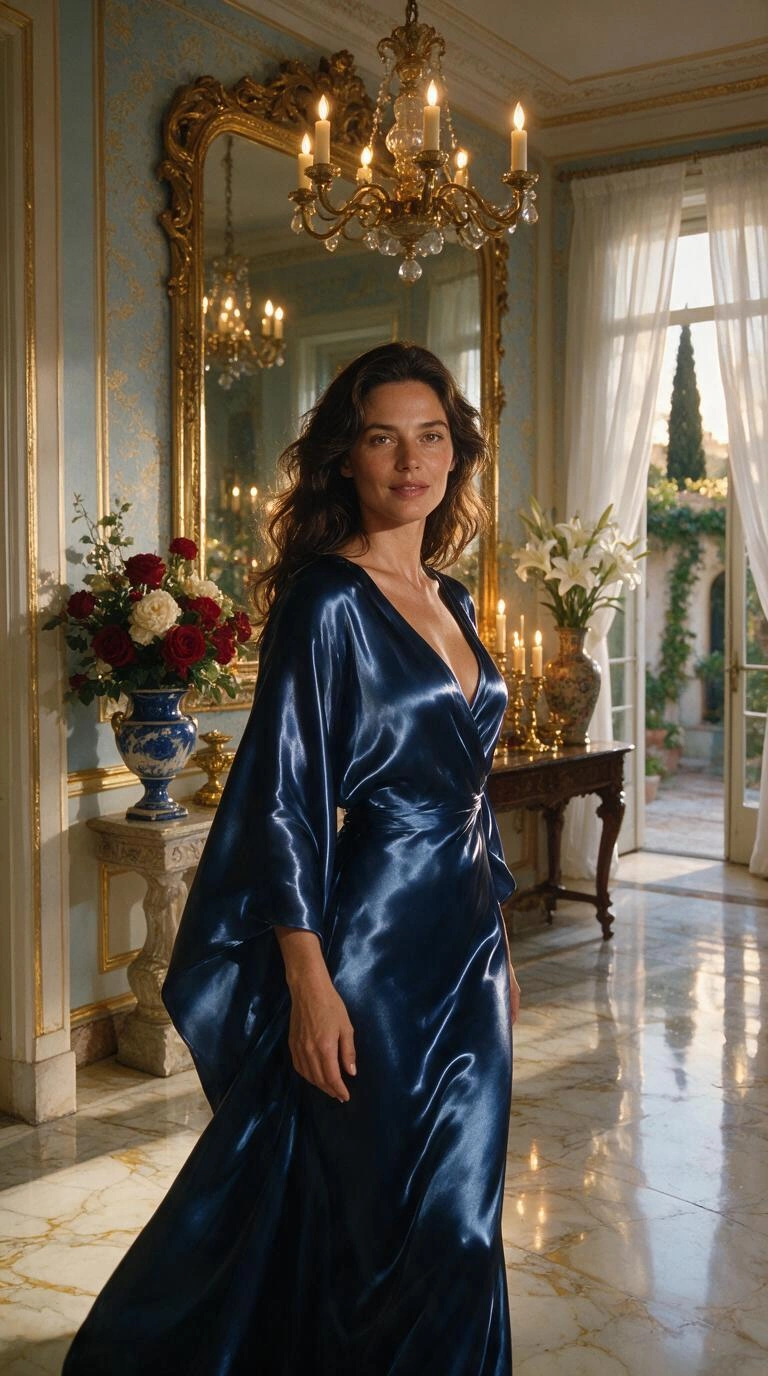
When Surrender Becomes Salvation
Some women spend their lives searching for what was lost. The fortunate ones discover that what they truly sought was the courage to stop searching—and the wisdom to kneel before someone worthy of being found.
She inherited a stolen Monet, a grandmother’s unfulfilled vow, and a hollow ache that no amount of Parisian success could fill.
Isabelle Laurent has everything the world insists should satisfy a woman: wealth that opens doors, education that commands respect, a wardrobe of couture that turns heads in every auction house from London to Tokyo. Yet beneath her glossy exterior—beneath the satin that drapes her shoulders like liquid moonlight and the sleek PVC that catches every admiring glance—there lives a hunger she cannot name. A yearning for something beyond independence. Something beyond self-sufficiency. Something that whispers to her in the quiet hours: You were not meant to walk this path alone.
Her grandmother Marie understood this truth. Marie, who built a legendary art collection not in isolation, but guided by a man whose eye for masterpieces was matched only by his understanding of the women who cherished them. Marie, who lived fully, loved deeply, and passed from this world with the serene smile of a woman who had known true fulfillment.
Now Isabelle stands where Marie stood, clutching a photograph of a painting that vanished decades ago—a Monet of water lilies so luminous it seems to breathe, stolen along with the rest of her grandmother’s collection. The trail has gone cold. Every investigator has failed. Every lead has dissolved into mist.
Then a mysterious photograph arrives. A single brushstroke, unmistakably Monet. And a note in an elegant hand: Ask for the Valuer at the Casino. He knows what you seek.
The Riviera beckons with its glittering promise of answers. But what Isabelle will find beneath the Mediterranean sun is far more precious than any canvas. She will discover a man whose calm authority makes her defenses feel not like armor, but like prison walls. She will meet women—accomplished, brilliant, radiant in their glossy devotion—who have each walked through their own darkness to find light in his guidance. And she will confront the most terrifying question a self-sufficient woman can face:
What if surrender is not weakness, but the ultimate act of strength?
In twelve chapters of breathtaking emotional intensity, Isabelle & The Lost Masterpiece traces a journey from hollow independence to profound fulfillment. From the polished surfaces of a life that looks complete but feels empty, to the luminous depths of a life given meaning through devotion to someone worthy of that gift.
Some masterpieces hang in galleries, admired from a distance. The most precious ones are restored to their rightful place—cherished, protected, and displayed with pride by someone who recognizes their true value.
Isabelle was always a masterpiece. She simply needed someone with the eye to see it.
Chapter One: The Inheritance of Longing
The rain fell on Paris like memories—soft, persistent, impossible to ignore.
Isabelle Laurent stood in the doorway of her grandmother’s apartment on the Rue de Rivoli, the key still warm in her palm, and felt the weight of inheritance settle upon her shoulders like a mantle of silk and lead. The notary had given her this key only hours ago, in an office thick with the scent of old paper and legal solemnity, and now she was here—alone in the space where Marie Laurent had lived, loved, and finally slipped away.
The apartment smelled of lavender and turpentine, of decades spent in the company of canvases and the quiet devotion of a woman who understood beauty the way others understood mathematics. Isabelle breathed it in, letting the familiar fragrance fill her lungs, and stepped across the threshold.
The walls told a story of absence.
Empty frames hung like ghosts—gilded rectangles marking where masterpieces had once lived, their absence more eloquent than any presence could be. The thieves had come in the night, years ago, and stripped the apartment of its treasures with surgical precision. They had left the frames as though mocking the loss, as though saying: We know what you valued, and we have taken it.
Isabelle moved through the rooms like a somnambulist, her fingers trailing along the wainscoting, her heels clicking against the parquet in a rhythm that echoed her heartbeat. She wore black—of course she wore black—but it was not the dull, matte black of mourning. It was a black satin blouse that caught the grey light from the windows and threw it back in subtle ripples, a black wool skirt that moved with her like a whispered confidence. She had learned long ago that grief did not require the abandonment of elegance; rather, elegance was the armor that allowed one to carry grief with grace.
“Mademoiselle Laurent?”
The voice came from behind her—soft, deferential, carrying the particular warmth of someone who had served this household for decades. Isabelle turned to find Madame Chantal, her grandmother’s housekeeper, standing in the hallway with a tray bearing tea service for two. The older woman was impeccably turned out, as always: a charcoal dress of fine nylon that whispered as she moved, a cameo brooch at her throat, her silver hair swept into a chignon that gleamed like polished pewter.
“Madame Chantal.” Isabelle felt something loosen in her chest—the particular relief of encountering a familiar presence in a landscape of loss. “I didn’t expect you to be here.”
The housekeeper set the tray on the side table with the practiced grace of long habit. “Where else would I be, mademoiselle? Your grandmother asked me to stay until you arrived. She wanted—” The woman’s voice caught, just slightly, a hairline fracture in her composure. “She wanted to be certain you would not be alone.”
The words settled over Isabelle like a benediction. She moved to the tray, poured two cups of the fragrant Darjeeling her grandmother had always favored, and handed one to Madame Chantal. Their fingers touched briefly—satin against nylon, cool against warm—and Isabelle felt the strange comfort of shared ritual.
They sat in the salon, surrounded by empty frames, and spoke of Marie.
“She was remarkable, your grandmother,” Madame Chantal said, cradling her cup with both hands as though it were something precious. “Not merely because of her collection—though that was remarkable indeed. But because she understood something that most people never grasp.”
“What was that?”
“That beauty is not meant to be possessed. It is meant to be served.”
Isabelle looked at the older woman sharply. The phrase had an almost devotional quality, a resonance that went beyond aesthetic philosophy. “Served?”
Madame Chantal’s eyes grew distant, soft with memory. “Your grandmother did not simply collect paintings, mademoiselle. She served them. She protected them. She gave them her time, her attention, her resources—not because they belonged to her, but because she belonged to them. There is a difference.” She paused, her gaze settling on Isabelle with an intensity that felt almost maternal. “And she had someone who served her in return. Someone who understood that the greatest gift one person can give another is the gift of being truly seen.”
The words hung in the air between them, charged with implication. Isabelle felt something stir in her chest—a recognition, a resonance, as though a tuning fork had been struck somewhere deep within her and was now vibrating in sympathy.
“You mean the man who helped her build the collection.”
“Ah.” Madame Chantal smiled—a knowing, private expression that seemed to illuminate her face from within. “So she told you about him.”
“She told me very little.” Isabelle set down her cup, her fingers unaccountably trembling. “Only that he existed. That he guided her. That without him, the collection would never have been possible.”
“Your grandmother was a woman of great independence, mademoiselle. She valued her autonomy, as I’m certain you value yours. But she also understood—and this is the understanding that transforms a life—that independence and devotion are not opposites. They are complements. Two halves of a whole.” The housekeeper’s voice had taken on a hypnotic quality, rhythmic and certain, like waves against a shore. “The woman who gives herself to someone worthy of that gift does not lose herself. She finds herself. She discovers dimensions of her being that independence alone could never reveal.”
Isabelle felt the words like a physical sensation—a warmth spreading through her chest, a loosening of knots she had not known were there. She had spent her adult life building walls, constructing a fortress of self-sufficiency that was meant to protect her from… what? Vulnerability? Dependence? The terrifying possibility that she might need someone?
The rain continued to fall, its rhythm a counterpoint to the silence that had settled between them.
“Where is he now?” Isabelle asked. “The man who helped her?”
Madame Chantal’s smile deepened. “Where he has always been, mademoiselle. Where he will always be. Waiting for those who are ready to be found.”
The journals were in the study, locked in a drawer of Marie’s writing desk with a key that had been tucked into an envelope marked simply Pour Isabelle. The envelope also contained a photograph: Marie in her youth, standing in a garden that Isabelle recognized as Giverny, her arm raised to touch the edge of a canvas that blazed with water lilies and light.
Marie was radiant in the photograph. Her dark hair gleamed with the glossy sheen of careful tending, her dress was a confection of pale satin that caught the sunlight and held it like a captured breath, and her face wore an expression that Isabelle had never seen in person—not in all her years of knowing her grandmother. It was the expression of a woman who had found her place. Who knew exactly where she belonged.
Isabelle studied the photograph for a long time, her fingertip tracing the outline of her grandmother’s form, feeling the glossy surface of the print beneath her touch. Then she opened the journals and began to read.
Marie’s handwriting was precise, elegant, the script of a woman who had been educated in an era when penmanship was considered a reflection of character. The entries spanned decades, and Isabelle read them in chronological order, following the story of her grandmother’s life through the seasons of her words.
The early entries were what she expected: observations on art, notes on acquisitions, reflections on the Parisian gallery scene. But as the years progressed, the journals became something more—a chronicle of transformation, of a woman discovering that the life she had built for herself was merely the foundation for something greater.
He does not command, Marie had written in one entry, the ink slightly darker, as though pressed deeper into the page. He does not demand. He simply sees—sees with such clarity that one cannot help but want to be worthy of that vision. I have spent my life collecting beautiful things, and now I understand that the most beautiful thing I have collected is his regard.
Isabelle paused, her heart beating in a strange, syncopated rhythm. She read on.
There is a freedom in surrender that I never anticipated. I thought—foolishly, as it turns out—that to give oneself to another was to diminish oneself. But the opposite is true. Each thing I give—my time, my attention, my devotion—returns to me transformed, amplified, made more luminous than it was before. I am more myself in his presence than I have ever been in my solitude. I am more Marie, not less.
The words resonated in Isabelle’s chest like a bell being struck. She felt exposed, as though the journals were mirrors reflecting back truths she had refused to acknowledge in herself. She had everything—a successful career, a beautiful apartment in the Marais, a wardrobe of Parisian couture that made her feel polished and powerful—and yet she moved through her days with a hollow ache that no achievement had ever filled.
She had assumed the ache was ambition unfulfilled. She had assumed it was loneliness, easily remedied by the right social engagements or the right romantic entanglement. But reading Marie’s words, she began to understand that the ache was something else entirely: it was the absence of devotion. Not devotion to a cause or a career, but devotion to a person—someone worthy of that gift, someone who could receive it and return it transformed.
The later journal entries chronicled the theft of the collection—the night the paintings disappeared, the investigation that followed, the gradual dawning realization that the masterpieces were gone. But even in her grief, Marie’s writing carried a note of something that Isabelle could only describe as faith.
The paintings are lost, Marie had written, but nothing truly beautiful is ever lost forever. It waits to be found. It waits for someone with the vision to see it, the courage to seek it, and the devotion to restore it to its rightful place. I may not live to see their return, but I believe—no, I know—that someone will come after me. Someone who carries my blood and my love and my understanding that the greatest masterpieces are not merely found, but earned.
Isabelle closed the journal and pressed it against her chest, feeling the leather cover warm against her satin blouse. The rain had stopped, and pale sunlight was filtering through the windows, casting the empty frames in a gentle glow that made them look less like absences and more like invitations.
She thought about her grandmother’s life—the devotion, the surrender, the fulfillment that had been so evident in that photograph at Giverny. She thought about her own life—the independence, the achievement, the hollow ache that no amount of success had ever touched. And she understood, with a clarity that felt like revelation, that she had a choice to make.
She could continue as she was. She could sell the apartment, archive the journals, and return to her life in the Marais with its glossy surface and hollow center. She could be safe, self-sufficient, and incomplete.
Or she could honor her grandmother’s faith. She could seek the lost masterpieces—not just the paintings, but the life that Marie had understood was the true masterpiece. She could open herself to the possibility that fulfillment lay not in independence alone, but in the courage to surrender to something greater.
The choice felt enormous, terrifying, inevitable.
Isabelle rose from the desk and moved to the window, looking out over the Rue de Rivoli with its elegant facades and its ceaseless parade of Parisian life. She saw women walking past in glossy raincoats that caught the newly emerged sunlight, their heels clicking against the pavement with the confident rhythm of those who knew their worth. She saw a couple—a distinguished silver-haired man and a woman in a sleek PVC-trimmed dress—who walked together with the particular synchronicity of two people who had found their rhythm in each other. The woman’s face wore an expression that Isabelle recognized from her grandmother’s photograph: the serene radiance of someone who had found her place.
Isabelle pressed her palm against the cool glass, feeling the smooth surface beneath her fingers, and made her choice.
She would find the paintings. She would honor her grandmother’s faith. And she would open herself to the possibility—terrifying, exhilarating, inevitable—that in seeking what was lost, she might find what she had never known she was missing.
The empty frames on the walls seemed to glow in the afternoon light, no longer mocking absences but promises waiting to be fulfilled. Isabelle looked at them and felt, for the first time in years, the stirring of something that felt like hope.
Or perhaps it was simply the recognition that her life, like those gilded rectangles, had been waiting all along for something to fill it.
She would find it. She would find him. She would find herself.
The inheritance of longing had only just begun.
Chapter Two: The Education of the Eye
London was a study in grey—grey skies, grey pavements, grey faces hurrying through grey streets—but Isabelle moved through it like a brushstroke of color against a monochrome canvas.
She had booked a suite at the Claridge’s, the kind of room where the staff anticipated needs before they were articulated, where the sheets were crisp as fresh paper, and where a woman in a midnight satin robe could stand at the window and feel, for a moment, that the world below was a painting she had not yet finished. She had chosen her wardrobe for this trip with the precision of a curator selecting pieces for an exhibition: a slate-blue satin blouse that shifted like smoke in changing light, a tailored coat with PVC trim that caught the streetlamps and threw them back in glossy fragments, skirts that moved with her like whispered intentions.
The first meeting was with Edmund Ashworth—no relation to her grandmother’s senior partner, he assured her with a dry smile—a retired investigator from the Art Loss Register who had worked the Laurent case when it was still fresh. His office was a clutter of filing cabinets and coffee cups in a building off Tottenham Court Road that smelled of old paper and older secrets.
“Your grandmother had an eye,” he said, settling into his chair with the careful movements of a man whose joints had begun to protest his years. “That’s what made the theft so devastating. These weren’t random pieces. The thieves knew exactly what they were taking.”
Isabelle leaned forward, her satin sleeve brushing against the edge of his desk. “The Monet especially.”
“The Monet especially.” He nodded, his eyes taking on the distant focus of a man revisiting old ground. “A late-period water lily study. Unusual dimensions. Your grandmother acquired it in… 1953, I believe. From a collector in Giverny who had purchased it directly from Monet’s estate.”
“Why is it so valuable?”
Ashworth looked at her with something like appreciation—the appreciation of a man who recognized a serious question from a serious woman. “Because of what it represents. Monet was a perfectionist, Miss Laurent. Did you know that? In his later years, he destroyed canvases by the score—painted them, examined them, found them wanting, and slashed them or burned them. Five hundred works, by some estimates. He was seeking something, and most of his attempts fell short of that vision.”
“And my grandmother’s painting?”
“Was one that didn’t fall short. According to the provenance documentation, it was a study he nearly destroyed—pulled it from the fire, in fact, at the last moment. Your grandmother believed it was the only surviving example of a particular technique he was developing in his final years. A way of rendering light on water that he never perfected in any other surviving work.”
Isabelle felt the words settle into her like stones dropping into still water, sending ripples through her understanding. Her grandmother had not merely collected beautiful things; she had rescued them. She had seen value where others saw only failure, had recognized genius in a canvas the artist himself had condemned.
“Who would know how to find it?” she asked.
Ashworth’s expression shifted—something cautious entering his eyes, a gatekeeper’s hesitation. “There are people in this world, Miss Laurent, who specialize in finding lost things. Not investigators, not police. Something… else.” He paused, choosing his words with the care of a man who understood the weight of language. “Your grandmother knew one such person. I believe he was more than a professional contact.”
“He helped her build the collection.”
“He did more than help.” Ashworth’s voice dropped, taking on a confessional quality. “He saw her, Miss Laurent. Truly saw her. And she—well.” He smiled, a small, knowing expression. “There is a particular kind of fulfillment that comes from being seen by someone with that kind of vision. Your grandmother found it. I suspect you’re looking for something similar.”
The words landed like a blow—gentle but precise, striking something Isabelle had been trying not to acknowledge. She held Ashworth’s gaze, refusing to flinch, and saw in his eyes a respect that told her he understood.
“Where do I find such a person?”
“Not here.” He shook his head slowly. “Not in London, not in New York. The man your grandmother knew—if he’s still active, if he’s still doing what he does—he would be somewhere that attracts both beauty and intrigue. Somewhere where lost things wash up like driftwood on a gilded shore.”
He did not name the place. But Isabelle heard the geography in his silence.
New York was a symphony of ambition—skyscrapers reaching for a sky they could never touch, streets pulsing with the particular energy of a city that measured worth in square footage and closing prices. Isabelle spent three days meeting with dealers, investigators, and collectors, each conversation adding another brushstroke to her understanding of the world she had entered.
She dined at Le Bernardin with a collector named Vivienne Chao—a woman who had built her fortune in technology and her collection in passion, and who moved through the world with the glossy confidence of someone who had found her center. Vivienne wore a dress of deep burgundy PVC that caught the candlelight and held it like captured fire, and her conversation was as polished as her appearance—precise, intelligent, and punctuated with observations that revealed a mind both sharp and deep.
“The thing about lost art,” Vivienne said, swirling her wine with the practiced ease of someone who had dined at this table many times, “is that it’s never truly lost. It’s merely waiting. Waiting for someone with the right combination of vision, persistence, and—this is the part most people miss—devotion. You have to be devoted to the finding. Not just professionally interested. Devoted.”
“Devoted,” Isabelle repeated, tasting the word.
“Devoted.” Vivienne’s eyes were dark and knowing, and they settled on Isabelle with an intensity that felt almost intimate. “I have a friend—a mentor, really—who taught me this. He taught me that the most valuable things in life are not found by those who seek them casually. They are found by those who are willing to give themselves completely to the search. To surrender their preconceptions, their independence, their need for control, and simply… follow.”
“Follow whom?”
Vivienne smiled—a slow, radiant expression that transformed her face from beautiful to transcendent. “Someone worthy of being followed. Someone whose vision is clearer than yours, whose understanding is deeper, whose guidance makes you more yourself than you ever were alone.” She paused, her gaze holding Isabelle’s with a warmth that felt like an invitation. “When you find such a person, Isabelle—and I believe you will—you’ll understand what I mean. You’ll understand that surrender is not loss. It’s the most profound gain.”
The conversation continued through dessert—passion fruit soufflé that tasted like distilled desire—and Vivienne spoke of her own transformation with a candor that was both disarming and magnetic. She had been, she admitted, a woman much like Isabelle: accomplished, independent, and hollow. She had built her empire and found it empty. And then she had found him—the man who had seen what she could not see, who had guided her toward a fulfillment that ambition alone could never provide.
“He didn’t change me,” Vivienne said, her voice soft with the particular reverence of someone speaking of sacred ground. “He revealed me. He polished away everything that wasn’t essential, and what remained was… luminous.” She gestured to her dress, to the glossy surface that caught and held the light. “This is what it feels like. To be polished. To be seen. To be guided by someone whose only desire is to see you shine.”
Isabelle left the restaurant with her mind churning and her heart beating in a rhythm she did not recognize. She walked through the New York night in her satin coat, feeling the fabric move against her skin like a whispered promise, and thought about devotion.
Tokyo was a revelation.
The city unfolded before her like an origami crane—delicate, precise, and beautiful in a way that defied Western aesthetics. Isabelle spent days in meetings with dealers and investigators, but it was in the quiet moments between appointments that she found the most meaning: in tea ceremonies where ritual was devotion made visible, in gardens where every stone was placed with intention, in the particular silence of temples that seemed to breathe with centuries of accumulated peace.
She had begun to understand something about herself during these weeks of travel. She had begun to see that the education she was receiving was not merely about art recovery—it was about the education of her own eye. She was learning to see differently, to look at the world not as a collection of objects to be acquired but as a tapestry of meanings to be understood. And she was learning, slowly, that the most important things could not be seen with the eyes alone.
It was in Kyoto, in a tea house tucked down a narrow street in the Gion district, that she met Colette.
The tea house was a sanctuary of polished wood and paper screens, a place where time seemed to slow and the outside world fell away. Isabelle had come seeking respite from the intensity of her search—a moment of quiet in which to gather herself before the next lead, the next meeting, the next disappointment.
The woman was already there when Isabelle entered, seated at a low table with the particular grace of someone who had been taught to occupy space with intention. She was perhaps fifty, with silver-streaked hair swept into an elegant chignon and eyes that held the calm depth of still water. She wore a midnight-blue satin cheongsam that fit her like a second skin, its glossy surface catching the soft light of the paper lanterns and throwing it back in subtle, shifting reflections.
“Please,” the woman said, gesturing to the cushion across from her. “Join me. The tea is better when shared.”
Isabelle hesitated only a moment before accepting. There was something about the woman—an authority that was simultaneously gentle and absolute—that made refusal feel not just impolite but impossible.
“I’m Colette,” the woman said, pouring tea with movements that were precise and beautiful, each gesture a small ceremony in itself. “And you are Isabelle Laurent. I know because I’ve been expecting you.”
“Expecting me?” Isabelle felt a flicker of something—alarm, perhaps, or recognition. “How could you be expecting me?”
Colette smiled, and the expression was like watching light move across water—subtle, shifting, illuminating. “Because we move in the same currents, you and I. We are both women who have been shaped by a particular understanding—a particular devotion—and we are both drawn to the same source.”
She handed Isabelle a cup of tea, and their fingers touched briefly—satin against skin, cool against warm. The contact was incidental, but Isabelle felt it like an electric current, a connection that seemed to carry meaning beyond the physical.
“You knew my grandmother,” Isabelle said. It was not a question.
“I knew of her. And I know the man she knew—the man who helped her build her collection, who guided her toward the understanding that made her life what it was.” Colette’s voice was low and melodic, carrying the cadence of someone who had learned to speak with intention. “He helped me, too. Years ago, when I was searching for something my family had lost. A painting, as it happens—though that’s not the most important thing I found.”
“What did you find?”
Colette’s eyes softened, and for a moment, she looked like a woman revisiting a sacred memory. “I found myself. Or rather, I found the version of myself that had been waiting beneath the surface all along—the version that understood that fulfillment comes not from independence alone, but from the willingness to be guided. To be seen. To be polished by someone whose vision is clearer than your own.”
The words echoed Vivienne’s, and Isabelle felt them resonate in the same place—that hollow space in her chest that had been aching for years. She set down her tea, her hands unaccountably trembling, and looked at Colette with an intensity that felt like vulnerability.
“Where is he?” she asked. “The man who helped you. Who helped my grandmother. Where can I find him?”
Colette regarded her for a long moment, her expression carrying a weight of consideration that made Isabelle feel both seen and assessed. Then she reached into the elegant clutch beside her and withdrew a photograph, which she placed on the table between them.
Isabelle looked at the photograph and felt her breath catch. It showed the edge of a canvas—a fragment of brushwork that was unmistakably Monet, unmistakably the piece she had been seeking. The photograph had been taken recently—she could see modern light fixtures in the background—and it showed not just the painting but a glimpse of the room in which it hung: polished floors, glossy surfaces, the particular elegance of a space curated by someone with a collector’s eye.
“This was taken three weeks ago,” Colette said. “In a private collection on the French Riviera. The man who has it is not a thief—he is a custodian. He acquires lost pieces and holds them until the rightful owners can prove their claim. Your grandmother knew this. She knew that if her collection was ever stolen, the pieces would eventually find their way to him.”
“Why didn’t she tell me?”
“Because she wanted you to find him yourself. She wanted you to undertake the journey—the education, the transformation—so that when you arrived, you would be ready.” Colette’s voice dropped, taking on a confessional intimacy. “He doesn’t work with just anyone, Isabelle. He works with women who have been prepared—women who have educated their eyes and opened their hearts. Women who understand that the greatest treasures are not found but earned.”
Isabelle stared at the photograph, feeling the world shift beneath her like tectonic plates moving. “The Riviera,” she said.
“The Riviera.” Colette nodded. “There is a gala at the Casino in Monte Carlo, three weeks from now. He will be there. If you go—if you present yourself with the confidence and the clarity that your journey has given you—he will see you. And if he sees you…” She paused, and her smile carried the weight of personal experience. “If he sees you, everything will change.”
Isabelle looked up from the photograph, meeting Colette’s eyes with a directness that felt like commitment. “You’re speaking from experience.”
“I am.” Colette’s voice was soft, certain, luminous. “I was where you are now—accomplished, independent, and aching with a hunger I couldn’t name. And then I found him. Or rather, he found me. And in being found, I discovered something that all my years of independence had never taught me: that the most powerful thing a woman can do is not to stand alone, but to choose the right person to stand with.”
She reached across the table and placed her hand over Isabelle’s—a gesture of sisterhood, of shared understanding, of invitation. Her skin was warm, her touch gentle, and Isabelle felt something release in her chest, something that had been held tight for years.
“Go to the Riviera, Isabelle. Go with your eyes open and your heart willing. And when you meet him—when you feel that recognition, that resonance—don’t be afraid. What feels like surrender is actually the beginning of everything.”
The tea had grown cold, but Isabelle felt warm—warmed from within, as though a light had been kindled in the hollow space that had ached for so long. She looked at the photograph, at the fragment of Monet’s vision captured in a single image, and understood that she was looking at two things simultaneously: the painting she sought and the life she was meant to find.
Colette rose to leave, her satin cheongsam moving with her like liquid midnight. At the door, she paused and looked back at Isabelle with an expression that was both farewell and benediction.
“One more thing,” she said. “When you go to the gala, wear something that makes you feel like the woman you’re becoming, not the woman you’ve been. Satin, perhaps. Something glossy that catches the light. He has an eye for beauty, Isabelle—and the most beautiful thing you can offer is the truth of who you are, polished and luminous and unafraid.”
Then she was gone, and Isabelle was alone with her tea and her photograph and the dawning understanding that her education—the education of her eye, her heart, her self—was far from complete.
She had three weeks to prepare. Three weeks to become the woman who would be ready.
She would not waste a single day.
Chapter Three: The Riviera Beckons
The Mediterranean lay beneath her like a spilled jewel box—sapphires and emeralds scattered across crushed diamond, the light fracturing into a thousand glittering fragments that made Isabelle’s eyes ache with beauty.
She had taken the convertible—a silver Mercedes that the rental agency in Nice had provided with a deference that bordered on reverence—and now she drove the Grande Corniche with the wind pulling at her hair like a lover’s impatient fingers. The road climbed in serpentine curves, each bend revealing a new vista more breathtaking than the last: villages perched on cliffs like prayers offered to the sea, villas draped in bougainvillea that cascaded in waterfalls of magenta and violet, cypress trees standing like sentinels against the impossible blue of the sky.
Isabelle had dressed for the drive with deliberate intention: a silk scarf in Hermès orange knotted beneath her chin, oversized sunglasses that made her feel both concealed and revealed, a blouse of pale champagne satin that moved in the wind like liquid light. She had learned, in the weeks since leaving Paris, that presentation was not vanity but communication—a language spoken before words, a statement of worth that preceded introduction. When she presented herself with glossy confidence, the world responded in kind.
The world was responding now.
At the petrol station near Èze, the attendant had filled her tank with an almost ceremonial care, addressing her as madame with a warmth that suggested he recognized something in her bearing that deserved respect. At the viewpoint above Monaco, a couple had asked her to take their photograph—a silver-haired man and a woman in a sleek PVC-trimmed dress of cerulean blue—and the woman had complimented Isabelle’s scarf with a sincerity that felt like sisterhood.
“You have the look,” the woman had said, her eyes warm with recognition. “The look of a woman on her way to something important.”
“Something like that,” Isabelle had replied, and the woman had smiled as though she understood more than Isabelle had said.
The hotel was a Belle Époque masterpiece perched on the Cap-Ferrat peninsula like a jewel in a setting of green. La Grande Aurore—The Great Dawn—had been receiving guests since the 1890s, its cream-colored façade and turquoise shutters a testament to an era when elegance was not a choice but a condition of existence. Isabelle had chosen it for its discretion as much as its beauty: a place where the staff understood that their role was to anticipate rather than intrude, where privacy was not merely respected but sacred.
The lobby was a symphony of polished surfaces—marble floors that gleamed like still water, gilded mirrors that multiplied the light, arrangements of flowers so precise they seemed to have been placed by a mathematician with a poet’s soul. Isabelle crossed it in her satin blouse and tailored trousers, her heels clicking against the marble in a rhythm that felt like a declaration, and felt the weight of admiring glances settle around her like a mantle.
“Madame Laurent.” The receptionist—a woman of perhaps forty with glossy chestnut hair and a charcoal dress of fine nylon that whispered as she moved—greeted her with a smile that was both professional and genuine. “We have prepared your suite. If there is anything you require during your stay, you need only ask.”
“The suite with the sea view?”
“Of course, madame. The terrace faces east. You will see the sunrise over the Mediterranean.” The receptionist paused, her gaze settling on Isabelle with an attention that felt almost intimate. “May I say, madame, that your blouse is exquisite. The color is particularly becoming.”
Isabelle felt a warmth that had nothing to do with the Mediterranean sun. “Thank you. It’s a small indulgence.”
“There is no such thing as a small indulgence,” the receptionist said, and her voice carried the particular conviction of someone who understood that luxury was not excess but intention. “Only small minds who fail to recognize its value.”
The suite was a revelation.
Floor-to-ceiling windows framed the Mediterranean like a living painting, the light shifting across the water in patterns that reminded Isabelle of the Monet she sought—those late-period studies where water and sky dissolved into each other, where boundaries became suggestions rather than facts. The furnishings were cream and gold, touched with accents of cobalt and turquoise that echoed the sea, and the surfaces gleamed with the particular luster of things that had been polished with devotion.
Isabelle moved through the space like a woman entering a temple, her fingertips trailing across the satin-smooth surfaces of the furniture, feeling the cool gloss of lacquered wood and the soft pile of carpets that cushioned her steps. She paused at the terrace doors, pushed them open, and stepped into the Mediterranean afternoon.
The air smelled of jasmine and salt, of warm stone and cooler water, of a world that existed in a state of perpetual sensual invitation. The terrace was private, screened by climbing jasmine and bougainvillea, and furnished with a chaise longue draped in white cushions that looked like clouds waiting to receive her. Isabelle sat, letting the sun warm her skin through her satin blouse, and felt something inside her begin to soften—a knot she had not known was there, loosening in the heat.
She thought about the weeks since Kyoto—the preparation that had consumed her days and transformed her nights. She had invested in herself with a ferocity that surprised even her: a personal trainer who had reshaped her body with a combination of yoga and strength work that made her feel simultaneously powerful and fluid; a perfumer in Grasse who had crafted a signature scent that made her feel like a different woman—notes of jasmine and amber and something darker, something that whispered of hidden depths; a tailor in Paris who had created garments that moved with her like second skins, glossy fabrics that caught and held the light as though they were in conversation with it.
She had begun to understand, in those weeks, that the education Colette had spoken of was not merely intellectual. It was physical, sensual, aesthetic—an education of the entire self that required attention to every surface and every depth. The woman she was becoming was not different from the woman she had been; she was more polished, more luminous, more fully herself. Like a painting restored to its original brilliance, the layers of varnish and neglect stripped away to reveal the masterpiece beneath.
And now she was here, on the Riviera, with the gala three days away and the mysterious Valuer waiting somewhere in the glittering landscape below.
Isabelle closed her eyes and let the sun paint the inside of her eyelids with colors that had no names.
The days that followed were a sensual education.
She drove to Grasse and walked through fields of jasmine and May rose, breathing in scents that seemed to bypass her lungs and go straight to her heart. The perfumer—a woman named Sophie who wore a laboratory coat of crisp white nylon over a dress of deep violet satin—guided her through the process of creating her signature scent with the patience of someone who understood that fragrance was not merely a pleasure but a language.
“Perfume is the most intimate form of communication,” Sophie said, her hands moving among the bottles with the precision of a conductor drawing music from an orchestra. “It speaks before you enter a room and lingers after you leave. It tells people who you are before you say a word.”
“What does mine say?”
Sophie smiled, and the expression was knowing, almost maternal. “It says that you are a woman in transition. That you are leaving behind something that no longer serves you and moving toward something that does. The jasmine speaks of opening—of petals unfurling in the morning sun. The amber speaks of warmth—of a fire that has been banked and is now being stoked. And the base note—” She paused, her eyes twinkling. “The base note is a secret. It will reveal itself only to those who get close enough to smell it. And those people, I suspect, will be very few and very fortunate.”
Isabelle left Grange with a bottle of perfume that felt like a key to a door she had not yet found.
In Saint-Paul-de-Vence, she wandered through galleries that displayed art with the reverence of temples, her satin-clad form moving among the canvases like a living brushstroke. She spoke with dealers and collectors, each conversation adding another layer to her understanding, each encounter revealing another facet of the world she had entered.
At the Fondation Maeght, she met a woman named Arabella—a tall, elegant figure in a dress of ivory PVC that caught the Provençal light and held it like captured moonbeams. Arabella was examining a Miró with the focused attention of someone who saw not just the surface but the structure beneath, and when she turned to Isabelle, her eyes carried a recognition that felt like a key turning in a lock.
“You’re looking for something,” Arabella said. It was not a question.
“Aren’t we all?”
Arabella laughed—a warm, genuine sound that seemed to come from a place of deep contentment. “Touché. But I mean something specific. Something lost. I can see it in the way you look at the paintings—not as objects of beauty, but as clues. As pieces of a puzzle you’re trying to solve.”
Isabelle felt exposed, seen in a way that was both unsettling and exhilarating. “My grandmother’s collection was stolen. I’m trying to recover it.”
“Ah.” Arabella’s expression softened with understanding. “Then you’re looking for him.”
The words landed like stones in still water. “You know the Valuer?”
“I know him.” Arabella’s voice took on a quality that Isabelle was beginning to recognize—the particular warmth of a woman speaking about someone who had transformed her life. “He helped me, years ago. I was a concert pianist—quite successful, actually—until an injury ended my career. I was lost. Devastated. I had built my entire identity around my music, and when that was taken from me, I didn’t know who I was anymore.”
“What happened?”
“He happened.” Arabella smiled, and the expression was radiant, luminous, the smile of a woman who had found her place. “He found me in a gallery in Paris—not a music gallery, an art gallery. I was staring at a Rothko, trying to feel something, and he came up beside me and said, ‘You’re looking for the music in the painting, aren’t you?’ And I knew, in that moment, that he saw me. Not the surface me, not the accomplished pianist or the injured former prodigy. He saw the me beneath all of that—the me that was still whole, still capable, still worthy of being seen.”
Isabelle felt her throat tighten. “And he helped you?”
“He did more than help me. He restored me.” Arabella’s hand moved to her chest, pressing against the glossy surface of her PVC dress as though touching something precious. “He polished me, like a painting that had been covered in grime. He helped me see that my identity was not in my hands or my piano but in my essence—the part of me that makes music regardless of the instrument. He guided me, supported me, and—this is the part that most people don’t understand—he gave me a purpose that was larger than myself.”
“A purpose?”
“Devotion.” The word was spoken simply, without apology or qualification. “Devotion to someone worthy of it. Devotion that doesn’t diminish but amplifies. That doesn’t constrain but liberates. I know it sounds paradoxical—how can surrendering your autonomy make you more free?—but it’s the truth. When I stopped trying to control everything, when I allowed myself to be guided by someone whose vision was clearer than mine, I became more myself than I had ever been.”
Isabelle looked at Arabella—at her glossy, confident beauty, at the serenity that radiated from her like light from a polished surface—and felt the hollow ache in her chest pulse with longing.
“Where is he now?” she asked, the question falling from her lips like a ripe fruit.
Arabella’s smile deepened. “He’s here. Somewhere on the Riviera. He’s always where he needs to be, when he needs to be there. You’ll find him at the gala—I’m certain of it. And when you do…” She paused, her eyes holding Isabelle’s with an intensity that felt like a benediction. “When you do, don’t be afraid. What feels like falling is actually flying. What feels like loss is actually gain. And what feels like the end of everything is actually the beginning.”
That evening, Isabelle returned to Cap-Ferrat and made her way to the village—the small cluster of shops and restaurants that served the peninsula’s wealthy residents. She had a purpose now, a specific one: she needed a gown for the gala.
The boutique was called Lumière—Light—and it occupied a corner position with windows that looked out over the harbor. The proprietor, a woman named Margaux, greeted Isabelle with the particular warmth of someone who recognized a kindred spirit.
“Madame Laurent. I’ve been expecting you.”
“Expecting me?”
“Word travels quickly on the Cap.” Margaux’s eyes—dark, knowing, framed by elegantly arched brows—swept over Isabelle with an appreciation that was both aesthetic and personal. “And I can see that you’re a woman who understands the importance of presentation. The satin you’re wearing—that’s from Paris, isn’t it? The cut is unmistakable.”
Isabelle felt a flush of pleasure at the recognition. “I’ve been investing in myself.”
“Good.” Margaux moved through the boutique with the fluid grace of someone who had been raised in the industry, her own dress—a sheath of midnight-blue PVC that caught the light like a polished mirror—whispering as she walked. “Investment in oneself is the only investment that always yields returns. Now, tell me: what do you need?”
“A gown. For the gala at the Casino.”
“Ah, the Monte Carlo gala.” Margaux’s smile took on a knowing quality. “Then you need something that will make you unforgettable. Something that will catch a certain pair of eyes.”
Isabelle felt the words like a physical sensation—a thrill that ran from her chest to her fingertips. “You know about—”
“I know that the gala is where certain… introductions… are made. And I know that the man who hosts the high-stakes room has an eye for beauty that goes beyond the superficial.” Margaux paused before a rack of gowns, her fingers moving among the fabrics with the intimacy of a lover’s touch. “He appreciates gloss, madame. Satin, PVC, fine nylon—fabrics that catch the light and hold it, that move with a woman like a whispered conversation. He understands that the way a woman presents herself is a language, and he reads that language fluently.”
Isabelle’s heart was beating in a strange, syncopated rhythm. “You know him.”
“I know of him. Everyone on the Cap knows of him. He is…” Margaux paused, selecting her words with the care of a jeweler selecting stones. “He is a force. A presence. A man who sees what others miss and draws out what others cannot reach. The women in his orbit—” She gestured vaguely toward the window, toward the glittering coastline. “They are the most polished, the most confident, the most luminous women on the Riviera. Not because he demands it, but because his attention draws it out of them. Like sun drawing flowers.”
She withdrew a gown from the rack and held it up: floor-length, midnight black, satin so glossy it seemed to drink the light and give it back transformed. The cut was simple—long, flowing, with a neckline that plunged just enough to suggest without revealing—but the fabric was extraordinary. It moved like liquid shadow, like captured night, like every secret Isabelle had ever kept.
“This,” Margaux said, and her voice carried the conviction of absolute certainty. “This is the one.”
Isabelle touched the fabric and felt something electric pass through her—a recognition, a resonance, as though the gown had been waiting for her the way she had been waiting for whatever lay ahead.
“It’s perfect,” she whispered.
“It’s more than perfect.” Margaux’s eyes were warm with satisfaction. “It’s you. The you you’re becoming.”
Back in her suite, with the Mediterranean glittering through the windows like a vast, scattered mirror, Isabelle examined the photograph that had brought her here.
The image was small—no larger than a playing card—but it contained a universe. The edge of a canvas, a fragment of brushwork that was unmistakably Monet—those late-period strokes where paint became light, where representation dissolved into pure sensation. And in the background, barely visible, a glimpse of the room in which the canvas hung: polished floors, glossy surfaces, the particular elegance of a space curated by someone who understood that beauty was not decoration but devotion.
The note that had accompanied the photograph lay beside it on the desk, its elegant script still legible: Ask for the Valuer at the Casino. He knows what you seek.
Isabelle should have been alarmed. The anonymity, the oblique approach, the sense of being guided by invisible hands—all of it should have triggered the self-protective instincts that had governed her life for so long. But instead, she felt something else: a curious thrill, a sense of rightness, as though she were a river finally finding the sea.
She thought about the women she had met—Vivienne in New York, Colette in Kyoto, Arabella in Saint-Paul-de-Vence, Margaux on the Cap—and she saw a pattern. Each of them had been where she was now: accomplished, independent, and aching. Each of them had found their way to the same place—the same man, the same transformation, the same luminous fulfillment. And each of them had told her, in their own way, the same truth: that surrender was not loss but gain, that devotion was not diminishment but amplification, that the most powerful thing a woman could do was to choose the right person to surrender to.
Isabelle picked up the gown and held it against herself, feeling the cool gloss of satin against her skin. In the mirror, she saw a woman she almost recognized—someone poised on the edge of transformation, someone ready to step into a life that had been waiting for her all along.
The gala was in two days. The Valuer would be there. And Isabelle would be ready.
She draped the gown across the chaise longue, where it lay like a pool of liquid midnight, and moved to the terrace. The sun was setting over the Mediterranean, painting the sky in shades of amber and rose and deep, aching violet. The light touched the satin of her blouse and made it glow, and for a moment, Isabelle felt like part of the painting—a brushstroke in a masterpiece she could not yet see.
She breathed in the jasmine-scented air, let it fill her lungs, and felt the hollow ache in her chest pulse with something that was not quite pain and not quite pleasure but something in between—something that felt like anticipation, like the moment before a kiss, like the held breath before a revelation.
The Riviera had beckoned, and she had answered.
What came next would change everything.
Chapter Four: The Gala at Monte Carlo
The Salle Garnier blazed like a jewel box opened to the night—chandeliers cascading from ceilings painted with nymphs and gods, their crystals scattering light across faces that gleamed with champagne and ambition. The Monte Carlo Gala was not merely an event; it was a performance, a living tableau in which every guest was both audience and actor, each one aware that they were being observed even as they observed.
Isabelle paused at the top of the marble staircase, her hand resting on the balustrade, and let the room receive her.
The midnight satin gown moved with her like a whispered confession—liquid shadow that caught the chandelier light and transformed it into something intimate, something that seemed to touch her skin through the fabric. She had chosen her accessories with surgical precision: a necklace of black diamonds that lay against her collarbone like frozen tears, earrings that swayed with her heartbeat, heels that elevated her to a height that felt commanding rather than compromised. Her hair was swept up, exposing the pale column of her neck, and her signature scent—jasmine and amber and that secret base note—preceded her like an invisible herald.
She felt the weight of glances turning toward her—quick appraisals, lingering assessments, the particular attention that beautiful women learn to recognize as both tribute and currency. She had been looked at before, many times, by many eyes. But tonight was different. Tonight she was not merely being seen; she was being sought.
And she was seeking in return.
“There you are.” The voice was warm, familiar, carrying the particular cadence of someone who had been waiting with pleasure rather than impatience. Isabelle turned to find Arabella descending the staircase behind her, her ivory satin gown luminous against the dark marble, her face radiant with a smile that felt like welcome home.
“Arabella.”
“I hoped you would come.” Arabella reached her and took her hands, squeezing them with a warmth that transcended mere social courtesy. “You look magnificent. That gown—”
“Margaux’s recommendation.”
“Of course. She has an unerring eye.” Arabella’s gaze swept over Isabelle with an appreciation that was both aesthetic and personal. “But the gown is merely the frame. You, my dear, are the masterpiece.”
The words sent a flush of pleasure through Isabelle’s chest, warming her from within. “I feel like an imposter.”
“You’re not.” Arabella’s voice was firm, certain, carrying the authority of someone who had navigated this transition herself. “You’re exactly where you’re meant to be. Now—” She linked her arm through Isabelle’s with the easy intimacy of a sister. “Come. There are people you should meet.”
They moved through the crowd like a current through still water, and Isabelle felt the parting of faces, the subtle reorientation of attention, that accompanied Arabella’s passage. The other woman carried an aura of serene authority—not aggressive, not demanding, but present in a way that made others unconsciously adjust to accommodate her.
“Who are all these people?” Isabelle murmured, taking a champagne flute from a passing waiter whose tray gleamed like polished silver.
“The beautiful, the wealthy, and the bored.” Arabella’s smile was knowing, slightly wicked. “The Riviera’s eternal trinity. But among them—scattered like gems in a riverbed—are the ones who matter. The ones who have been found.”
“Found by whom?”
Arabella’s eyes slid toward the far end of the room, where a corridor led away from the main salon toward what Isabelle assumed were the private gaming rooms. “By him. By the Valuer. Look—there’s Vivienne.”
Isabelle followed Arabella’s gaze and spotted the woman from New York—Vivienne Chao, the tech billionaire who had spoken so eloquently about devotion over passion fruit soufflé. But the Vivienne she saw tonight was different from the one she had met in Le Bernardin. That Vivienne had been polished, accomplished, impressive. This Vivienne was luminous.
She wore a gown of crimson PVC that fit her like a second skin, the glossy surface catching the chandelier light and throwing it back in rich, ruby fragments. Her hair was swept into an elaborate arrangement that exposed her neck and shoulders, and her face wore an expression Isabelle recognized from her grandmother’s photograph at Giverny—the expression of a woman who had found her place.
Vivienne saw them approaching and her face broke into a smile of genuine pleasure. “Isabelle! You came.”
“I came.”
“Good.” Vivienne took Isabelle’s free hand and squeezed it, her PVC-clad arm brushing against Isabelle’s satin with a whisper of textures. “I hoped you would. I’ve been thinking about our conversation in New York—about what I told you regarding surrender and fulfillment.”
“And?”
“And I wanted to tell you something I didn’t say then.” Vivienne’s voice dropped, becoming intimate, confessional. “I wanted to tell you that the hardest part is the moment before. The moment when you stand at the edge and look down and everything in you screams to step back. That moment is terrifying, Isabelle. But it’s also sacred. Because it’s the moment when you choose—truly choose—who you want to be.”
Isabelle felt the words settle into her like stones in still water, sending ripples through her chest. “And after?”
Vivienne’s smile was beatific, luminous, the smile of a woman who had stepped off the edge and discovered she could fly. “After is everything.”
The three women moved through the gala together, and Isabelle felt something she had never experienced before: the particular solidarity of sisterhood. Not the competitive sisterhood of professional women sizing each other up, but something deeper—a bond forged in shared understanding, in the recognition that they had each walked through their own darkness to find the same light.
She met others as they circulated: women of wealth and accomplishment who moved through the world with glossy confidence, each one radiating the particular serenity that Isabelle had come to recognize as the hallmark of the Valuer’s influence. A French countess in a gown of midnight-blue satin that matched Isabelle’s in its liquid elegance. A Japanese philanthropist in a kimono-inspired dress of PVC-trimmed silk that caught the light like moonlight on water. An American tech executive in a sleek sheath of charcoal nylon that whispered as she moved.
Each of them greeted Isabelle with warmth rather than suspicion, with welcome rather than jealousy. Each of them looked at her with an expression that seemed to say: We know what you’re feeling. We’ve felt it too. And we’re here to tell you that what waits on the other side of that feeling is more beautiful than you can imagine.
“He’s in the private room,” Vivienne said eventually, her voice soft with intention. “The high-stakes baccarat room. He’s been there for the past hour.”
“Should I—”
“You should.” Arabella’s hand was warm on Isabelle’s bare shoulder, her touch grounding and encouraging. “But not yet. Let him see you first. Let him feel your presence before you approach. He appreciates anticipation, Isabelle. He understands that the moment before is as important as the moment itself.”
Isabelle felt her heart quicken, a flush of heat spreading through her chest. “What if he doesn’t—”
“He will.” Vivienne’s voice was certain, absolute. “He’s been expecting you. I promise you, he’s been expecting you.”
The corridor to the private rooms was hushed, the chaos of the gala fading behind her like a dream upon waking. Isabelle walked alone now—Arabella and Vivienne had remained behind with knowing smiles and whispered encouragements—her heels sinking into carpet so thick it felt like walking on clouds.
The door to the high-stakes room was attended by a man in a suit so immaculate it seemed to have been painted on, his expression carrying the particular blankness of someone who had been trained to see without appearing to look. He nodded as Isabelle approached, his eyes flicking over her gown with an appreciation that was professional and personal in equal measure.
“Madame Laurent. You’re expected.”
The words sent a thrill through her—part fear, part excitement, all anticipation. “Expected?”
“Indeed.” The man opened the door with a gesture that was both deferential and precise. “Please.”
The room beyond was smaller than Isabelle had anticipated, intimate rather than imposing. The décor was cream and gold, touched with accents of deep burgundy, and the surfaces gleamed with the particular luster of things that had been polished with devotion. A baccarat table occupied the center, its green felt surface an island of focus in a sea of glossy elegance.
And there he was.
He stood beside the table, not playing but observing, his posture carrying the relaxed authority of someone who was simultaneously at ease and completely in command. He was taller than she had expected, with silver-streaked temples that caught the light like threads of mercury, and his eyes—dark, deep, carrying the weight of seeing—were fixed on the game with an attention that felt almost intimate.
Two women flanked him: one in crimson PVC—Vivienne, who had somehow arrived before her—and one in ivory satin whom Isabelle didn’t recognize. Both stood with the particular ease of women who were exactly where they belonged, their postures relaxed, their faces serene, their glossy garments catching the light in ways that made them seem to glow from within.
Isabelle paused in the doorway, feeling the moment stretch like taffy, and let herself be seen.
His gaze lifted from the baccarat table and found her.
The sensation was physical—a jolt that ran from her chest to her fingertips, a recognition that bypassed thought and went straight to something deeper. His eyes moved over her with an attention that felt like touch, cataloguing her the way a collector catalogues a prospective acquisition: noting the drape of the satin, the exposure of her neck, the flush that was rising unbidden to her cheeks. But there was nothing predatory in the appraisal. It was the gaze of someone who saw value, who recognized worth, who understood that what he was looking at was not merely beautiful but significant.
“You’re looking for something.” His voice was low, melodic, carrying the particular cadence of someone who was accustomed to being heard. It was not a question.
Isabelle felt her throat tighten, her carefully prepared words evaporating like morning mist. She forced herself to speak, to hold his gaze, to be the woman she had traveled so far to become.
“The Monet. My grandmother’s collection. You know something about it.”
A smile moved across his face—slow, knowing, transforming his features from handsome to magnetic. “I know a great deal about lost things, Isabelle. And about the people who lose them.”
He knew her name. Of course he knew her name. The realization sent another thrill through her, followed by something deeper—a sense of inevitability, as though every step of her journey had been leading to this moment, this room, this man.
“May I come in?” she asked, and was surprised to hear vulnerability in her voice.
“Please.” He gestured to a chair beside the table, his movement carrying the grace of someone for whom elegance was not affectation but nature. “Sit. We have much to discuss.”
The woman in ivory satin—the one Isabelle didn’t recognize—rose from her position beside the Valuer and crossed to her with a smile that was warm, genuine, and entirely without jealousy.
“Hello, Isabelle. I’m Marguerite.” Her voice was soft, accented, carrying the musical quality of native French. “I’ve been hoping to meet you.”
“You know about me?”
“Everyone in his circle knows about you.” Marguerite’s hand was warm as she took Isabelle’s, her satin sleeve brushing against Isabelle’s with a whisper of textures. “You’ve been on a journey, haven’t you? Paris, London, New York, Tokyo, the Riviera. We’ve been following your progress with great interest.”
“We?”
“Those of us who have been where you are now.” Marguerite’s eyes were kind, knowing, carrying the particular warmth of someone who remembered their own transition. “The ones who were found.”
Isabelle looked around the room—at Vivienne in her crimson PVC, at Marguerite in her ivory satin, at the Valuer who watched her with an attention that made her feel simultaneously exposed and held—and felt something shift inside her. Something that had been rigid was beginning to soften. Something that had been closed was beginning to open.
“Sit, Isabelle.” The Valuer’s voice was gentle but carried an authority that was impossible to resist. “Let me look at you properly.”
She sat. The chair was positioned so that the light fell across her face and gown, illuminating the satin’s glossy surface, catching the black diamonds at her throat. She felt like a painting being examined by a master appraiser—a work of art whose value was being assessed by the only person qualified to judge it.
He studied her for a long moment, his eyes moving across her features with an attention that felt like sunlight—warm, revealing, impossible to hide from. Then he nodded, a small, satisfied gesture that made Isabelle’s heart swell with inexplicable pride.
“You’ve done well,” he said. “The education, the travel, the investment in yourself—all of it has prepared you. But there’s something more, isn’t there? Something you’ve been carrying that you haven’t yet set down.”
Isabelle felt tears prick at her eyes—tears she had not expected, tears she could not explain. “I don’t know what you mean.”
“Yes, you do.” His voice was soft now, intimate, carrying the particular tenderness of someone who was both demanding and gentle. “You’ve been carrying the weight of independence, Isabelle. The belief that you must do everything alone, be everything to yourself, need no one. It’s a heavy burden, isn’t it? And it’s left you hollow.”
The words struck her like a physical blow—not because they were cruel, but because they were true. She had spent her life building walls, constructing a fortress of self-sufficiency that was meant to protect her but had instead imprisoned her. And now, in this room, in the presence of this man who saw her with a clarity she had never encountered, the walls felt not like armor but like cage bars.
“I don’t know how to—” Her voice broke. “I don’t know how to let go.”
“You don’t have to know how.” His hand reached out and touched hers—briefly, electrically, a contact that sent a current through her entire body. “You just have to be willing. The rest will follow.”
Vivienne and Marguerite moved closer, flanking her with the warmth of sisters, their glossy garments whispering against her satin as they surrounded her with presence and understanding. She felt their support like a physical sensation—a cushion against which she could finally, finally let herself lean.
“The Monet,” she whispered, grasping for the thread of purpose that had brought her here. “You have it.”
“I do.” The Valuer’s smile was knowing, almost tender. “But the Monet is not what you’re really looking for, is it? It’s what brought you here, but it’s not what will make you stay.”
“What will make me stay?”
He leaned forward, his eyes holding hers with an intensity that felt like gravity. “You will stay because you recognize, in this moment, what your grandmother recognized decades ago: that the greatest masterpiece is not a painting on a wall, but a life given meaning through devotion to something—and someone—worthy of that devotion.”
The tears fell then—silently, softly, carrying away years of accumulated armor. Isabelle let them fall, let herself be seen in her vulnerability, let herself be held by the warmth of the women beside her and the gaze of the man before her.
And in the letting go, she felt something she had never felt before.
She felt found.
The night continued—champagne and conversation, the murmur of the baccarat game resuming around her, the warmth of Vivienne’s and Marguerite’s presence like a cocoon. The Valuer did not press her; he simply included her, drawing her into conversations, introducing her to others who moved through his orbit with the same glossy confidence she had observed in the gala’s public spaces.
She met a countess who had been a celebrated beauty in her youth and now found deeper fulfillment in managing the Valuer’s philanthropic interests. She met a scientist who had abandoned her research position to pursue, under his guidance, a more meaningful line of inquiry. She met an artist who had been creatively blocked for years until his attention had unlocked something within her that she had not known existed.
Each of them looked at Isabelle with recognition—not because they had met her before, but because they recognized the journey. They had each been where she was now: standing at the threshold, feeling the pull of something greater than themselves, trying to summon the courage to step across.
“You don’t have to decide tonight,” Vivienne whispered as the evening wound toward its close. “This isn’t a transaction. It’s an invitation.”
“An invitation to what?”
Vivienne’s smile was radiant, luminous, the smile of a woman who had accepted the same invitation and found it to be the beginning of everything. “To yourself. To the version of yourself you’ve been too afraid to become. To the life that’s been waiting for you all along.”
Isabelle looked across the room to where the Valuer stood, surrounded by his circle of devoted companions, his silver-streaked hair catching the light like a crown. He caught her gaze and held it, and in his eyes she saw something that made her breath catch: a promise, a welcome, an acknowledgment that she had already begun the journey and there was no turning back.
“Come back tomorrow,” he said, crossing to her with the fluid grace that seemed to be his natural mode of movement. “Come back, and we’ll discuss the Monet. And other things.”
“Other things?”
“Things you’ve lost, Isabelle. Things you didn’t know you were missing. Things that, once found, will make you wonder how you ever lived without them.”
He took her hand and raised it to his lips—a gesture that was both formal and intimate, a benediction and a beginning. The touch of his mouth against her skin sent a shiver through her that had nothing to do with the temperature and everything to do with the sensation of being truly, finally seen.
“Tomorrow,” she whispered.
“Tomorrow,” he agreed, and his smile was the most beautiful thing she had ever seen.
The drive back to Cap-Ferrat was a blur of moonlight and Mediterranean darkness, the satin gown cool against her skin, the night air sweet with jasmine. Isabelle gripped the steering wheel and felt her hands trembling—not with fear, but with the particular vibration of a life on the verge of transformation.
She had found him. Or rather, he had found her.
And tomorrow, everything would change.
Chapter Five: The Valuation
Morning light fell through the windows of the Valuer’s study like honey—thick, golden, sweet with the particular warmth that the Mediterranean possesses in its earliest hours. Isabelle stood in the doorway and felt the light touch her skin through the satin blouse she had chosen for this meeting: a pale gold that seemed to converse with the sunlight, that made her feel less like a visitor and more like an extension of the room itself.
“Come in, Isabelle.” His voice carried across the space like a hand extended in welcome. “Please. Sit.”
The study was a revelation. Floor-to-ceiling shelves lined the walls, holding not just books but objects—a small bronze here, a fragment of ancient pottery there, each piece placed with the intention of someone who understood that arrangement was itself a form of devotion. The desk was a massive piece of polished wood that gleamed like dark water, its surface holding only a leather portfolio, a crystal decanter, and two glasses. The chairs before it were upholstered in charcoal satin that caught the light and held it like a whispered confidence.
Isabelle crossed the threshold and felt the world shift beneath her—a sensation she was beginning to recognize as the particular gravity of the Valuer’s presence. It was not that he demanded attention; it was that attention oriented itself toward him naturally, the way flowers turn toward the sun.
She sat. The satin of the chair was cool against her skirt, a sensation that grounded her in the moment even as her heart beat in a rhythm that felt like anticipation and recognition intertwined.
“You slept?” he asked, pouring amber liquid from the decanter into both glasses with the unhurried grace that seemed to be his natural mode of movement.
“I didn’t.” Isabelle accepted the glass, her fingers brushing against his in the transfer—brief, electric, a contact that sent a current through her that had nothing to do with the liquid. “I couldn’t. I kept thinking about—”
“About last night. About what you felt. About what it meant.” He settled into his own chair with the ease of someone who had guided many people through this particular threshold. “That’s natural. The first encounter is always disorienting. It’s like looking at a painting you’ve seen reproduced a hundred times and suddenly encountering the original. The proportions are different. The colors are deeper. The presence of it—the sheer fact of its existence in your space—is overwhelming.”
“That’s exactly what it felt like.” Isabelle looked at him with something like wonder. “How do you know?”
“Because I’ve been where you are, Isabelle. Not in the same way—I was never looking for a painting—but in the same essential way. I was looking for something I couldn’t name, something I was convinced I didn’t need, something that turned out to be the missing piece of my entire existence.” He smiled, and the expression was knowing without being condescending, warm without being familiar. “But we’re not here to talk about me. We’re here to talk about you.”
“About the Monet.”
“About you.” His eyes held hers with an intensity that felt like touch. “The Monet is merely the thread that brought you here. What matters is what you’ll find when you follow that thread to its source.”
He opened the leather portfolio and withdrew a sheaf of papers—provenance documents, Isabelle realized, recognizing the particular format of art authentication records. But these were not the documents she had seen before; these were more detailed, more complete, carrying annotations in a hand she did not recognize.
“Your grandmother’s collection,” he said, spreading the papers across the desk with the care of someone handling sacred texts. “Seven pieces, stolen in the night, dispersed across the private market within months. The Monet is here—” he tapped a particular page “—in a collection I acquired three years ago. The others are scattered. Two in Switzerland, one in Hong Kong, one in a private trust in London, two still unaccounted for.”
Isabelle felt her breath catch. “You have the Monet?”
“I have it. I’ve been holding it for the rightful owner.” His gaze was steady, carrying the weight of absolute sincerity. “For you, Isabelle. For whoever came to claim it with the proper understanding of what it represents.”
“Understanding?”
“Sit back. Relax. We’re going to talk, you and I, and the talking is going to take us somewhere neither of us expects.” He leaned back in his chair, his posture opening, inviting. “Tell me about your grandmother. Not the collector—the woman.”
Isabelle hesitated. She had prepared for this meeting—rehearsed her questions, anticipated his responses, constructed a narrative that presented her as a serious woman on a serious quest. But the question he had asked was not the question she had prepared for.
“My grandmother was…” She paused, searching for words that felt true rather than merely adequate. “She was the most complete person I’ve ever known. Not the happiest—I don’t think happiness was what she pursued—but the most complete. She had this way of being in the world that made everything around her seem more real, more vivid, more present.”
“And you admired that.”
“I worshipped it.” The admission came easier than she expected, the words flowing like water released from a dam. “I spent my childhood trying to understand how she did it—how she moved through the world with such certainty, such grace, such… belonging. And the more I studied her, the more I realized that it had something to do with the collection. With the art. With the act of finding and preserving beauty.”
“Go on.”
“But there was something else, too. Something I didn’t understand until I read her journals.” Isabelle’s voice dropped, becoming intimate, confessional. “She had someone. A man who guided her, who saw her, who helped her become the woman I admired. And the completeness I worshipped—it wasn’t something she achieved alone. It was something that flowed from her connection to him.”
The Valuer nodded, his expression carrying a recognition that felt like validation. “And you’ve been looking for that connection ever since.”
The words landed like a diagnosis—precise, accurate, illuminating a condition Isabelle had not been able to name. She felt tears prick at her eyes and blinked them back, determined to maintain composure.
“I didn’t know that’s what I was looking for. I thought I was looking for the paintings. For closure. For—”
“For a way to complete your grandmother’s unfinished work.” His voice was gentle but unflinching. “And that’s true, as far as it goes. But it doesn’t go far enough, Isabelle. The paintings are the surface. The depth is something else entirely.”
“What’s the depth?”
“You.” The word was simple, direct, carrying a weight that made Isabelle’s chest tighten. “You are the depth. The paintings brought you here, but you are the reason you stayed. You are the masterpiece in this story, Isabelle—not the Monet.”
He rose from his chair and moved to the window, his silhouette dark against the golden light. Isabelle watched him, feeling the gravity of his presence like a physical sensation—a pull, an attraction, something that went beyond the merely aesthetic and into the realm of the essential.
“Do you know what valuation is?” he asked, his back still to her.
“The assessment of worth. The determination of price.”
“No.” He turned, and his eyes were intense, carrying the particular focus of someone about to reveal something important. “Valuation is recognition. It is the act of seeing something clearly enough to understand its true nature, its true worth, its true potential. Price is merely the consequence of valuation—the number that results from the seeing. But the seeing itself—that’s the sacred act.”
He moved back to the desk, his hand reaching out to touch the provenance documents with a tenderness that seemed incongruous with their bureaucratic nature.
“Your grandmother understood this. When she found the Monet—in that garden in Giverny, in the hands of a collector who didn’t understand what he possessed—she didn’t see a painting. She saw a vision. She saw what the canvas could become in the right hands, with the right care, in the right environment. And she was willing to give everything she had—her time, her resources, her devotion—to bring that vision into reality.”
Isabelle felt the words resonate in her chest like a bell being struck. “She told me that beauty is meant to be served, not possessed.”
“Exactly. And the same is true of people.” He settled back into his chair, his gaze holding hers with an intensity that made her feel simultaneously exposed and held. “You have been pricing yourself too low, Isabelle. You have been treating yourself as a common print—competent, attractive, valuable in a conventional sense—when you are an original. A masterpiece. A work of art whose worth cannot be measured in currency because it exists in a different economy entirely.”
“What economy?”
“The economy of devotion.” The words fell into the silence between them like stones into still water, sending ripples through Isabelle’s understanding. “The economy in which value is created not by acquisition but by giving. Not by holding but by releasing. Not by independence but by the courage to depend on someone worthy of that dependence.”
A knock at the door interrupted them, and Isabelle felt a moment of irrational irritation at the intrusion. The Valuer, by contrast, seemed to welcome it.
“Come in.”
The door opened to reveal Vivienne, her form clad in a morning dress of deep burgundy PVC that caught the light and held it like captured wine. She carried a tray bearing coffee service and pastries, and her face wore an expression of serene contentment that Isabelle was beginning to recognize as the hallmark of the Valuer’s influence.
“I thought you might need sustenance,” Vivienne said, setting the tray on a side table with the practiced grace of someone who had performed this service many times. “The valuation process can be… draining.”
“Thank you, my dear.” The Valuer’s voice carried a warmth that made Vivienne’s face glow even brighter. “Will you join us?”
“If Isabelle doesn’t mind.” Vivienne’s eyes turned to Isabelle, and the expression in them was not possessive or territorial but welcoming—a sister inviting another into a shared space. “I remember my own valuation. It was… transformative.”
“I’d like that,” Isabelle said, surprised by how much she meant it.
Vivienne settled into a chair beside Isabelle, her PVC dress whispering against the satin upholstery, and the contact of their proximity felt like a benediction. Isabelle breathed in the other woman’s scent—something warm and ambered, a fragrance that spoke of comfort and confidence—and felt something inside her relax.
“The Valuer has a gift,” Vivienne said, pouring coffee with hands that were steady and sure. “He sees what you’ve been hiding from yourself. The things you’ve buried under achievement, under independence, under the glossy surface you present to the world. He excavates them—not cruelly, not brutally, but with the precision of someone who knows exactly where to dig.”
“And when he finds them?”
“When he finds them, you have a choice.” Vivienne’s eyes were warm, knowing, carrying the weight of personal experience. “You can put them back. Rebury them. Return to the life you’ve been living—the life that looks complete from the outside but feels hollow from within. Or you can let them breathe. Let them see the light. Let them become what they were always meant to be.”
“What happens then?”
“Then you become more yourself than you’ve ever been.” Vivienne’s smile was radiant, luminous, the smile of a woman who had made the choice and never regretted it. “Then you discover that the things you were hiding were not weaknesses but strengths. Not flaws but features. Not things to be ashamed of but things to be celebrated.”
The Valuer watched this exchange with an expression of quiet satisfaction, and Isabelle understood that this was part of the process—the sisterhood, the witnessing, the normalization of transformation. Vivienne was not merely a guest; she was a mirror, reflecting back to Isabelle the image of who she could become.
“Now,” the Valuer said, his voice reclaiming the room’s attention with gentle authority, “let’s return to you, Isabelle. Tell me about the ache.”
The question was so direct, so precisely targeted, that Isabelle felt it like a physical sensation—a probe touching a nerve she had spent years insulating.
“The ache?”
“The hollow feeling. The sense that something is missing. The particular quality of incompleteness that has pursued you despite—perhaps because of—your success.” His eyes were steady, penetrating, seeing through every defense she had constructed. “You’ve felt it for years, haven’t you? Perhaps since your grandmother died. Perhaps before. A feeling that no achievement has been able to fill, no relationship has been able to soothe, no acquisition has been able to satisfy.”
Isabelle opened her mouth to deflect, to offer a response that was true but not honest, and found that she could not. The words that emerged instead were raw, unfiltered, surprising even to herself.
“I’ve felt it my whole life.” Her voice was barely a whisper. “Like there’s a hole in the center of me that nothing can fill. I’ve tried—God, I’ve tried. Career, relationships, travel, acquisition. I’ve built a life that looks perfect from the outside. But the hole is still there. It’s always there.”
“And what does the hole feel like?”
“Like hunger.” The word came from somewhere deep, somewhere she had not accessed in years. “Like a hunger that can’t be satisfied because I don’t know what I’m hungry for.”
Vivienne’s hand found hers—warm, steady, a point of contact that grounded her in the moment. Isabelle felt the tears coming and did not try to stop them.
“I’m so tired,” she whispered. “I’m so tired of being strong. Of being independent. Of pretending that I don’t need anyone. I’m so tired of carrying everything alone.”
The Valuer rose from his chair and moved around the desk with the unhurried grace that seemed to be his natural mode of movement. He knelt before her—a gesture that was simultaneously humble and commanding—and took her other hand in both of his.
“You don’t have to carry it alone anymore, Isabelle.” His voice was low, intimate, carrying a tenderness that felt like sunlight on wounded skin. “That’s what I offer. Not the absence of weight, but the sharing of it. Not the elimination of burden, but the companionship of someone who can help you bear it.”
“Why?” The question emerged as a sob. “Why would you offer that to me?”
“Because I see you.” His thumbs moved across her knuckles in a gesture that was simultaneously soothing and electrifying. “I see what you’ve been hiding. I see what you’re afraid of. And I see what you could become if you had the courage to let yourself be seen.”
The tears fell then—freely, copiously, carrying away years of accumulated armor. Isabelle wept in the presence of this man she had met only hours ago, this woman she had known for mere weeks, and felt something she had never felt before: the particular relief of being truly, finally witnessed.
Vivienne’s arm came around her shoulders, the PVC of her dress cool and smooth against Isabelle’s satin, and the embrace felt like coming home. The two women held her between them—the Valuer before her, Vivienne beside her—and Isabelle let herself be held. Let herself be seen. Let herself, for the first time in her adult life, be weak.
The weeping subsided gradually, like a storm exhausting itself against the shore. Isabelle drew back, wiping her eyes with the back of her hand, and felt a lightness in her chest that was almost disorienting.
“I’m sorry,” she began.
“Don’t.” The Valuer’s voice was firm but gentle. “Never apologize for being vulnerable. Vulnerability is not weakness, Isabelle. It is the doorway to strength. The woman who can weep in the presence of another is far more powerful than the woman who cannot.”
“I feel—” She paused, searching for the right word. “I feel like something has been released. Something I’ve been holding for so long that I forgot I was holding it.”
“Good.” He rose, his movement fluid, and returned to his chair with the ease of someone who had guided many people through this particular catharsis. “That’s the beginning. The first layer has been removed. There are more—there always are—but the first is the most important.”
“The first?”
“The layer of pretense. The armor of self-sufficiency. The mask of independence.” He smiled, and the expression was knowing without being condescending. “You’ve been wearing it so long that you forgot it was a mask. You thought it was your face. But it wasn’t, was it? It was a construction. A defense. A way of keeping the world at arm’s length because you were afraid of what would happen if you let it closer.”
Isabelle nodded, unable to speak, feeling the truth of his words resonate through her like a tuning fork.
“The next layers are deeper,” he continued. “They’re the beliefs you hold about yourself—the stories you tell about who you are and what you deserve. Those take longer to excavate. They require patience, trust, and a willingness to be surprised by what you find.”
“And you’ll help me find them?”
“I’ll guide you. I’ll support you. I’ll create the space in which the finding can occur.” His eyes held hers with an intensity that felt like a vow. “But the finding itself—that’s yours. That’s the work only you can do. I can show you the door, Isabelle, but you’re the one who has to walk through it.”
Vivienne squeezed her hand, a gesture of solidarity and sisterhood. “And we’ll be here,” she said. “On the other side. Waiting to welcome you.”
Isabelle looked between them—the man who saw her, the woman who held her—and felt something she had never felt before. Not the hollow ache that had been her constant companion. Not the hunger that could not be satisfied. Something else entirely.
Hope.
“Now.” The Valuer’s voice shifted, becoming businesslike without losing its warmth. “Let’s discuss the Monet.”
Isabelle blinked, the transition jarring her out of the emotional space she had been inhabiting. “The Monet?”
“It’s yours. The provenance is clear, and I’ve been holding it for the rightful claimant. You’ll need to complete some legal formalities, but the painting will be returned to your family.” He paused, a smile playing at the corners of his mouth. “But I have a condition.”
“A condition?”
“I want you to leave it here. For now. I want you to stay on the Riviera, continue the work we’ve begun today, and when the time is right—when you’ve found what you’re truly looking for—I’ll give you the painting myself. As a gift. Not a transaction.”
Isabelle felt the words settle into her like seeds finding fertile soil. “Why?”
“Because the Monet is not what you’re looking for, Isabelle. It’s what brought you here, but it’s not what will make you stay. And I want you to stay.” His eyes held hers, and in their depths she saw something that made her breath catch: a promise, a welcome, an acknowledgment that she had already begun the journey and there was no turning back. “I want you to stay because I see what you could become, and I want to be part of that becoming.”
The tears threatened again, but this time they were tears of a different kind—not grief or relief but something closer to joy.
“I’ll stay,” she whispered.
“I know you will.” He rose and extended his hand, helping her to her feet with a gesture that was both formal and intimate. “Now go. Rest. Let today settle into your bones. Tomorrow, we’ll begin in earnest.”
Isabelle left the study and walked through the villa in a state of heightened awareness, every surface gleaming with polished intent, every shadow carrying the weight of possibility. She passed through rooms where women in glossy fabrics moved with the particular confidence of those who had found their place—satin that whispered, PVC that gleamed, nylon that caught the light like captured moonbeams—and each of them nodded at her with a recognition that felt like welcome.
Outside, the Mediterranean glittered like crushed diamonds, and the air smelled of jasmine and salt and the particular sweetness of things beginning. Isabelle walked to the terrace and stood at the balustrade, looking out over the water, and felt the lightness in her chest expand until it filled her entire being.
She had been priced too low. She had been treated as a common print when she was an original. And now, in the presence of someone who saw her true worth, she was beginning to see it herself.
The valuation had only just begun.
And Isabelle Laurent, for the first time in her life, felt ready to discover what she was truly worth.
Chapter Six: The Circle Widens
The evening arrived like a held breath—soft, anticipatory, heavy with the particular electricity that precedes transformation.
Isabelle stood before the mirror in her suite at La Grande Aurore and examined herself with the dispassionate eye of a curator assessing a canvas. The dress she had chosen was a deep teal satin that moved like water as she turned, its glossy surface catching the lamplight and throwing it back in rippling fragments. The neckline was modest but suggestive—a curve that followed the line of her collarbone, exposing without revealing, inviting without insisting. Her hair was swept up in a chignon that exposed the pale length of her neck, and the black diamonds at her throat caught the light like frozen tears.
She looked, she thought, like a woman on the verge of something. The question was: what?
The invitation had arrived that morning, delivered by a courier whose immaculate presentation—crisp suit, glossy shoes, the particular deference of someone in service to a significant employer—had made Isabelle’s heart quicken before she even opened the envelope. The card inside was simple: Dinner. Eight o’clock. The villa. Come as you are becoming.
Come as you are becoming. The phrase had echoed through her day like a bell, coloring every choice, every preparation, every moment of the hours that separated her from the evening ahead. She had chosen her dress with intention, applied her signature scent with reverence, and spent an hour in meditation that felt less like relaxation and more like the gathering of resources before a descent into deep water.
Now, as the car that had been sent for her—a sleek Mercedes with glossy black paint that reflected the Mediterranean sunset—wound its way along the coast road toward the Valuer’s villa, Isabelle felt the familiar tension of resistance and anticipation battling within her chest.
She had agreed to stay. She had agreed to continue the work they had begun in his study. But the agreement had been made in the aftermath of catharsis, in the vulnerable space that follows the breaking of long-held armor. Now, with distance and the returning armor of self-sufficiency, she was not certain she could honor it.
The idea of surrender—of centering her life on another person, of making someone else’s vision the organizing principle of her existence—ran counter to everything she had been taught, everything she had built, everything she believed about what it meant to be a strong woman. Her grandmother had done it, yes. Vivienne had done it, Arabella had done it, Colette had done it. But they were other women, with other histories, other needs.
Isabelle Laurent had always been sufficient unto herself.
Hadn’t she?
The villa emerged from the twilight like a vision—cream-colored walls and turquoise shutters, terraced gardens cascading toward the sea, windows glowing with warm light that made the building seem alive, breathing, welcoming. It was larger than Isabelle had expected, a rambling Belle Époque structure that had been expanded and refined over decades into something that felt less like a house and more like a living organism.
A woman met her at the door—tall, elegant, her form clad in a dress of charcoal PVC that caught the porch light and held it like polished stone. Her face was familiar from the gala, though they had not been formally introduced.
“Madame Laurent. Welcome.” Her voice was warm, accented, carrying the particular music of someone who had grown up speaking Italian. “I’m Alessandra. Please, come in.”
The interior was a symphony of polished surfaces—marble floors that gleamed like still water, gilded mirrors that multiplied the light, arrangements of flowers so precise they seemed to have been placed by a mathematician with a poet’s soul. Isabelle moved through the space like a woman entering a cathedral, her satin dress whispering against the marble, her heels clicking in a rhythm that felt like a heartbeat.
“The others are in the salon,” Alessandra said, guiding her through a corridor lined with paintings—good paintings, Isabelle noted with the instinct of a woman raised among collectors, works of genuine quality and significance. “We’ve been looking forward to your arrival.”
“The others?”
“The circle.” Alessandra’s smile was knowing, warm, carrying the particular confidence of someone who had nothing to prove. “We’ve all been where you are now, Isabelle. We all remember what it felt like to stand at the threshold. And we’re here to welcome you across.”
The salon was a room designed for intimacy—a space that held perhaps twenty people comfortably, arranged with furniture that invited rather than dictated, surfaces that gleamed with the particular luster of things polished by devotion. The windows faced the sea, and the last light of the sunset painted the room in shades of amber and rose.
There were perhaps a dozen women present, and Isabelle felt their attention turn toward her as she entered—a collective gaze that was assessing but not aggressive, curious but not intrusive. They were, she realized, looking at her the way one looks at a new arrival in a family: with interest, with warmth, with the particular attention of people who understand what it means to be new.
Vivienne rose from a conversation near the window and crossed to her with a smile that felt like coming home. She wore a gown of deep burgundy satin that moved like liquid wine, and her face carried the serene radiance that Isabelle had come to recognize as the hallmark of the Valuer’s influence.
“You came.” Vivienne’s voice was soft with pleasure, her hand warm as she took Isabelle’s. “I hoped you would.”
“I almost didn’t.”
“I know. The resistance is part of it—it’s the mind’s way of protecting itself from change. But you came anyway. That’s what matters.” She drew Isabelle into the room, her satin sleeve brushing against Isabelle’s in a whisper of textures. “Come. There are people you should meet.”
The evening unfolded like a flower opening to the sun—slowly, naturally, each moment revealing new beauty.
Isabelle was introduced to women whose names she recognized from the worlds of business, art, philanthropy, and academia—women of accomplishment and influence who had each, in their own way, been found by the Valuer and transformed by the finding. They greeted her with warmth rather than suspicion, with welcome rather than jealousy, and the sisterhood she felt was unlike anything she had experienced in the competitive worlds she had inhabited.
There was Marguerite, the Frenchwoman she had met at the gala, who had been a celebrated journalist before the Valuer had helped her discover a deeper calling in writing. She wore a dress of midnight-blue PVC that fit her like a second skin, its glossy surface catching the candlelight and throwing it back in rich, sapphire fragments.
“He didn’t change me,” Marguerite said, her voice carrying the particular conviction of someone who had thought deeply about her transformation. “He revealed me. I was always a writer, but I had buried that truth under the expectations of a career that looked impressive but felt hollow. He saw what I couldn’t see, and he created the space in which I could see it myself.”
“And now?”
“Now I write. I write the things I was always meant to write—the stories that matter, that touch people, that make a difference. And I do it in service to his vision, because his vision includes me. Includes all of us.” She gestured at the room, at the women who moved through it with glossy confidence and serene purpose. “We’re not his harem, Isabelle. We’re his circle. His partners. His collaborators. Each of us brings something different, something essential, and together we create something that none of us could create alone.”
There was Sophia, a Greek shipping heiress who had been consumed by the family business until the Valuer had helped her rediscover her passion for marine conservation. She wore a dress of emerald-green satin that moved like sea water, and her eyes sparkled with the particular light of someone who had found her purpose.
“I was drowning,” Sophia said, her voice matter-of-fact despite the metaphor. “Not literally, of course—I was too successful to drown in any conventional sense. But I was drowning in expectations, in obligations, in the weight of being the person everyone else needed me to be. And then he found me. He saw what was drowning and he reached in and pulled it out.”
“Pulled what out?”
“The real me. The me that cared about the ocean, about the creatures in it, about the legacy we’re leaving for future generations. He helped me see that my wealth and influence were not burdens but tools—tools I could use in service to something larger than myself, something that mattered beyond the next quarter’s earnings.”
“And the devotion?”
Sophia’s smile was radiant, luminous, the smile of a woman who had made peace with her choices. “The devotion is the fuel. It’s what makes the work possible, the sacrifice bearable, the joy complete. I give to him—my time, my resources, my loyalty—and what I receive in return is beyond measure. Purpose. Community. The knowledge that I am part of something greater than myself. That I am seen, valued, and cherished for exactly who I am.”
There was Yuki, a Japanese mathematician who had abandoned a prestigious academic position to pursue, under the Valuer’s guidance, a more intuitive approach to numbers that had led to breakthroughs she had never imagined possible. She wore a kimono-inspired dress of white PVC-trimmed silk that caught the light like moonlight on snow, and her voice was soft but certain.
“Numbers are beautiful,” Yuki said, her eyes holding Isabelle’s with an intensity that felt like a equation being solved. “But they are not enough. They are the structure, but not the soul. He taught me that the soul comes from connection—from the relationship between the mathematician and the mystery, between the seeker and the sought. I was trying to solve equations alone, and I was failing. Now I solve them in partnership—with him, with this circle, with something larger than my own intellect. And the solutions come more easily, more beautifully, more completely.”
Isabelle moved through the room like a woman walking through a gallery, each conversation a painting, each woman a masterpiece. She observed the dynamics with the eye of someone trained to see patterns, and what she saw challenged everything she had assumed about the nature of relationships.
These women were not competitors. They were not rivals for the Valuer’s attention, jockeying for position, undermining each other in the timeless dance of female competition. They were complementors—each bringing different strengths to a whole that centered on the Valuer’s vision, each finding her own fulfillment in the act of contributing to something larger than herself.
They wore glossy fabrics—satin that whispered, PVC that gleamed, fine nylon that caught the light like captured moonbeams—and the visual effect was of a room filled with polished, luminous surfaces, each reflecting and amplifying the others. It was, Isabelle realized, a physical manifestation of what was happening on a deeper level: each woman was being polished by the Valuer’s attention, and that polishing made her more reflective, more radiant, more capable of amplifying the light of those around her.
There was no jealousy among them. No possessiveness. No anxiety about their position or their worth. They moved through the room with the particular ease of women who knew exactly where they belonged, and the belonging was not a cage but a foundation—a platform from which they could reach higher than they ever could have alone.
And yet, despite the evidence before her, despite the undeniable radiance of these women and the obvious fulfillment they had found, Isabelle felt resistance rising within her like a tide.
She had always been self-reliant. She had built her life on the principle that she needed no one, that dependence was weakness, that the only person she could truly count on was herself. The idea of centering her life on another person—even someone as extraordinary as the Valuer—felt like a betrayal of everything she had worked to become.
It felt like surrender. And surrender, in the lexicon Isabelle had constructed for herself, was synonymous with defeat.
Dinner was served in a room that faced the sea—a long table set with crystal and silver, candles casting warm light across faces that gleamed with health and contentment. Isabelle found herself seated between Vivienne and Arabella, with the Valuer at the head of the table, his silver-streaked hair catching the candlelight like a crown.
The food was extraordinary—courses that arrived with the precise timing of a ballet, each one a revelation of flavor and texture—but Isabelle found her attention divided between the meal and the conversation that flowed around her. The women spoke of their work, their passions, their transformations, and the Valuer listened with an attention that made each speaker feel as though she were the only person in the room.
“He doesn’t demand devotion,” Arabella murmured as a course of sea bass was cleared and replaced with something involving truffles and gold leaf. “That’s what I couldn’t understand at first. I kept waiting for the catch, the price, the obligation. But there wasn’t one. There isn’t one.”
“Then why do you give it?”
Arabella’s smile was soft, knowing, carrying the weight of personal experience. “Because giving it is the reward. The devotion itself is the fulfillment. When I give him my time, my attention, my loyalty, I’m not losing something—I’m gaining something. Each thing I give returns to me transformed, amplified, made more luminous than it was before.”
“But what about your independence?”
“I still have it. I still make my own choices, pursue my own interests, live my own life. The difference is that now I do it in the context of something larger—something that gives my choices meaning beyond mere self-interest.” Arabella’s eyes were warm, understanding, carrying the particular compassion of someone who remembered her own resistance. “You’re afraid, aren’t you? Afraid that surrendering to him means losing yourself.”
Isabelle felt the words like a diagnosis—precise, accurate, illuminating a fear she had not been able to name. “Yes.”
“It’s the most common fear. And it’s the most unfounded.” Arabella’s hand found hers under the table, the contact warm and grounding. “I was a concert pianist, Isabelle. My identity was entirely wrapped up in my music, my career, my independence. When my injury ended all of that, I thought I had lost myself. But what I actually lost was the cage I had built around myself—the cage of self-sufficiency, of isolation, of the belief that I had to do everything alone.”
“And he helped you see that?”
“He helped me see that the cage was not protection but prison. That the independence I worshipped was actually a form of hiding—hiding from the vulnerability that comes with connection, with dependence, with the terrifying act of letting someone else see you truly.” She paused, her eyes holding Isabelle’s with an intensity that felt like a benediction. “When I let him see me—when I finally stopped hiding—I didn’t disappear. I appeared. For the first time in my life, I appeared.”
After dinner, the women dispersed throughout the villa—some to the terrace to enjoy the night air, some to the music room where Arabella was persuaded to play, some to smaller salons for intimate conversation. Isabelle found herself on the terrace, looking out over the Mediterranean, which lay beneath the moon like a vast, scattered mirror.
“You’re quiet tonight.” The Valuer’s voice came from behind her, and she felt his presence like a change in temperature—warm, magnetic, impossible to ignore.
“I’m processing.”
“Good. Processing is important. The work we’re doing is not intellectual—it’s transformative, and transformation takes time.” He moved to stand beside her, his shoulder almost touching hers, and looked out at the sea with her. “You’re resisting.”
It was not a question. Isabelle felt a flash of irritation—at his perceptiveness, at her own transparency, at the fact that she could hide nothing from this man.
“I’ve always been self-reliant. The idea of centering my life on someone else—of making another person the organizing principle of my existence—feels like…”
“Surrender.”
“Yes.”
“And surrender feels like defeat.”
Isabelle turned to look at him, and found his eyes waiting for her—dark, deep, carrying the weight of seeing. “How do you know that?”
“Because I’ve been where you are, Isabelle. Not in the same way—I was never looking for what you’re looking for—but in the same essential way. I was standing at the edge of something, looking down, terrified to jump. And someone—a person I trusted, a person who saw what I couldn’t see—told me something I’ll never forget.”
“What did they tell you?”
“They told me that surrender is not defeat. Surrender is choice. It is the most powerful choice a person can make, because it is the choice to stop fighting yourself. To stop armoring yourself against the very thing you most need.” He paused, his gaze holding hers with an intensity that felt like touch. “You’ve been fighting yourself for so long, Isabelle. Fighting the hunger, the ache, the need for connection. You’ve built walls so high and so thick that you’ve forgotten what the sky looks like.”
“And you want me to tear them down.”
“I want you to let them fall. There’s a difference. Tearing them down is an act of violence—an attack on the structures you’ve built. Letting them fall is an act of surrender—a release of the effort required to maintain them. You don’t have to destroy your independence, Isabelle. You just have to stop defending it so fiercely that nothing can get in.”
The words resonated in her chest like a bell being struck, and Isabelle felt something shift inside her—something that had been rigid beginning to soften, something that had been closed beginning to open.
“I’m afraid,” she whispered.
“I know.” His voice was gentle, carrying a tenderness that felt like sunlight on wounded skin. “And that’s exactly as it should be. Fear is not the enemy, Isabelle. Fear is the guardian of the threshold. It’s there to ensure that you don’t cross until you’re ready. And when you are ready—when the fear is still present but no longer in control—you’ll cross. Not because I’ve pushed you, but because you’ve chosen to.”
He did not push. He did not press. He simply stood beside her, looking out at the moonlit sea, and let the silence hold them both.
The drive back to Cap-Ferrat was a journey through moonlight and shadow, the Mediterranean gleaming beside the road like a companion rather than a view. Isabelle sat in the back of the Mercedes and felt the evening settle into her bones—the conversations, the stories, the undeniable radiance of women who had found their place.
She thought about the circle. About the way they moved through the world with glossy confidence and serene purpose. About the way they spoke of devotion not as obligation but as fulfillment. About the way they looked at each other—not with competition but with sisterhood, not with jealousy but with shared pride.
She thought about the Valuer. About his patience, his perception, his refusal to push when pushing would have been easier. About the way he had stood beside her on the terrace and offered not demands but invitations, not commands but choices.
And she thought about herself. About the walls she had built, the armor she had worn, the hunger she had been trying to satisfy with achievements that could never fill it. About the fear that held her at the threshold, afraid to cross.
The car pulled up to La Grande Aurore, and Isabelle sat for a moment in the darkness, feeling the weight of the evening and the lightness of possibility.
She was not ready. Not yet. But she was closer than she had been yesterday, and tomorrow she would be closer still.
The circle had widened to include her. The question was whether she would step inside.
Isabelle stepped out of the car and into the Mediterranean night, the satin of her dress cool against her skin, the jasmine-scented air sweet in her lungs.
Tomorrow, she would be closer.
She could feel it.
Chapter Seven: The Education of the Body
The morning sun lay across the Mediterranean like a golden veil, and Isabelle stood on the terrace of her suite at La Grande Aurore, feeling its warmth touch her skin through the thin cotton of her sleep shirt—a garment that suddenly felt inadequate, a remnant of a life she was leaving behind.
She had slept deeply for the first time in weeks, a dreamless slumber that had left her feeling not just rested but renewed, as though the night had performed some quiet alchemy on her exhausted spirit. The dinner at the villa, the conversations with the circle, the Valuer’s words on the terrace—all of it had settled into her bones during the dark hours, rearranging something fundamental, shifting the architecture of her understanding.
She was not ready to surrender. Not yet. But she was ready to learn.
The message had arrived at dawn, slipped beneath her door on thick cream paper: The body is the canvas. The mind is the brush. The soul is the vision. Come at ten, and we will begin the preparation. —V.
The Valuer’s villa was different in daylight—less mysterious, more magnificent, its cream-colored walls glowing against the deep blue of the sky, its terraced gardens cascading toward the sea in waves of jasmine and bougainvillea. Isabelle was met at the door by Alessandra, who wore a morning dress of slate-grey PVC that caught the sunlight and held it like polished pewter.
“Good morning, Isabelle. You look rested.”
“I feel… different. I’m not sure how to describe it.”
“You don’t need to describe it. You just need to feel it.” Alessandra’s smile was warm, knowing, carrying the particular confidence of someone who had navigated this same transition. “Come. There are people you need to meet.”
The yoga studio occupied a pavilion at the edge of the villa’s gardens—a glass-walled space that looked out over the Mediterranean, its floor covered in mats of deep burgundy, its air scented with sandalwood and something subtler, something that made Isabelle’s breath deepen without her conscious intention.
The woman waiting for her was unlike anyone Isabelle had ever encountered. She was perhaps forty, with the kind of body that spoke of decades of disciplined practice—lean, strong, moving with a fluidity that made every gesture seem like a prayer. She wore a unitard of black PVC that caught the light like liquid obsidian, its glossy surface revealing the precise definition of every muscle beneath.
“I’m Serafina,” she said, her voice carrying the particular calm of someone who had spent years learning to still the chatter of the mind. “The Valuer has asked me to work with you. To help you prepare the canvas.”
“The canvas?”
“Your body.” Serafina’s eyes moved over Isabelle with an attention that was clinical yet intimate, assessing without judging. “You’ve neglected it, haven’t you? Not dramatically—you’re healthy enough, fit enough by conventional standards. But you’ve been treating it as a vehicle rather than a temple. As a means of transportation rather than an instrument of expression.”
Isabelle felt the words land with uncomfortable accuracy. “I’ve been busy.”
“We’re all busy. The question is what we’re busy with.” Serafina gestured to a mat. “Sit. We’ll begin.”
The session that followed was unlike any yoga Isabelle had ever experienced. Serafina did not simply guide her through poses; she guided her through sensations—asking her to feel the weight of her own body, to notice the places where tension had accumulated like sediment, to breathe into those places and allow them to release.
“Your body is speaking to you,” Serafina said, her voice a low, rhythmic murmur that seemed to synchronize with Isabelle’s heartbeat. “It’s been speaking for years, but you’ve trained yourself not to hear it. The ache in your lower back—that’s unexpressed grief. The tension in your shoulders—that’s the weight of carrying everything alone. The tightness in your jaw—that’s all the words you’ve swallowed because you were afraid to speak them.”
Isabelle felt tears prick at her eyes—not from sadness but from recognition, from the sudden, overwhelming sensation of being understood at a level deeper than language.
“How do you know all that?”
“The body tells its stories to anyone who knows how to listen.” Serafina adjusted Isabelle’s posture with hands that were firm and gentle, the PVC of her unitard cool against Isabelle’s skin. “The Valuer sent me to you because he knows that the work you’re doing with him—the emotional work, the spiritual work—requires a foundation. And that foundation is the body. You can’t build a masterpiece on a canvas that hasn’t been prepared.”
“What does preparation look like?”
“Attention. Intention. Devotion.” Serafina’s smile was serene, knowing. “The same things that any act of creation requires. You’ll come to me every morning, and we’ll work together to release what your body has been holding. And slowly, you’ll begin to feel different—not just in your muscles, but in your being. The body and the soul are not separate, Isabelle. What you do for one, you do for the other.”
The afternoon brought her to the perfumer.
Sophie’s studio in Grasse had been merely the beginning; the woman the Valuer introduced her to was something else entirely. Madeleine was perhaps sixty, with silver hair swept into an elegant chignon and eyes that held the particular depth of someone who had spent decades exploring the invisible architecture of scent. She wore a laboratory coat of crisp white nylon over a dress of deep violet satin, and her hands moved among her bottles with the precision of a conductor drawing music from an orchestra.
“Perfume is memory made liquid,” Madeleine said, not looking up from the blend she was composing. “It bypasses the rational mind and speaks directly to the limbic system—the seat of emotion, the home of desire. When you find the right scent, you don’t just smell it. You become it.”
Isabelle sat on a stool of polished wood, watching the older woman work with a fascination that felt almost hypnotic. The studio was a sanctuary of glass and fragrance, its air thick with notes of jasmine and amber and things she couldn’t name—complex, layered scents that seemed to tell stories.
“The scent Sophie created for you was a beginning,” Madeleine continued. “It was a sketch, a first draft. What we’re going to create now is the final work—the scent that will be your signature, your announcement, your invitation.”
“Invitation to what?”
“To the woman you’re becoming.” Madeleine looked up, and her eyes were sharp, seeing, carrying the particular intensity of someone who understood that transformation was not merely internal but external. “Scent is the most intimate form of communication. It speaks before you enter a room and lingers after you leave. It tells people who you are before you say a word. And the woman you’re becoming—the woman the Valuer sees, the woman your grandmother was—she needs a scent that matches her essence.”
The session lasted three hours, and by the end of it, Isabelle felt as though she had been remade at a molecular level. The scent Madeleine had crafted was unlike anything she had ever worn—complex, layered, evolving on her skin like a living thing. The top notes were bright and confident, speaking of competence and capability. The heart notes were warm and inviting, whispering of depths and possibilities. And the base notes—those secret notes that would reveal themselves only to those who got close enough—were dark and sensual, carrying the particular musk of surrender and devotion.
“It’s… extraordinary,” Isabelle breathed, pressing her wrist to her nose and inhaling.
“It’s you,” Madeleine said simply. “The you that has been waiting beneath the surface all along.”
The tailor was the final revelation.
His name was Lucien, and his atelier occupied the top floor of a building in Nice’s old town—a space filled with fabrics that caught the light like captured emotions: satins that flowed like water, PVCs that gleamed like polished stone, fine nylons that whispered against the skin like secrets.
“The Valuer has told me about you,” Lucien said, his hands moving among the fabrics with the intimate knowledge of a lover. “He says you’re in transition. That you’re preparing the canvas.”
“He said that exactly.”
“Then we need to create garments that match the woman you’re becoming.” Lucien’s eyes were assessing, appreciative, carrying the particular attention of someone who understood that clothing was not covering but communication. “You’ve been dressing for the woman you were—competent, professional, self-sufficient. We need to dress you for the woman you’re becoming—luminous, open, ready.”
“Ready for what?”
“Ready to be seen.” Lucien withdrew a bolt of fabric—satin so glossy it seemed to drink the light and give it back transformed. “This is what you need. Satin that moves with you like a whispered intention. PVC that catches the eye and holds it like a captured breath. Fabrics that don’t just cover your body but converse with it.”
The fitting that followed was an education in itself. Lucien did not merely measure her; he studied her, noting the way she moved, the way she held herself, the places where her body spoke of tension or ease. He selected fabrics with the precision of a painter selecting pigments, each one chosen to complement her coloring, her form, her emerging essence.
“The clothes are the frame,” he said, draping a swath of midnight-blue satin across her shoulder and stepping back to assess the effect. “They don’t create the masterpiece; they present it. They tell the viewer how to see what’s already there.”
“And what’s already there?”
“Everything.” His smile was knowing, almost tender. “You just haven’t let yourself see it yet.”
The days that followed were a rhythm of transformation—mornings with Serafina, afternoons with Madeleine, evenings with Lucien. And woven through it all, like a golden thread through a tapestry, were the hours with the Valuer himself.
He did not teach her in the conventional sense. He did not lecture or instruct or demand. Instead, he simply spent time with her—walking in the gardens, dining on the terrace, sitting in his study surrounded by the objects he had collected with such devotion. And in that time, in the simple act of being in his presence, Isabelle felt herself changing.
She became more aware of her body—not just its appearance but its sensations, its signals, its subtle language. She noticed the way her breath deepened when she was relaxed, the way her shoulders tensed when she was resisting, the way her skin flushed when the Valuer looked at her with that particular attention that felt like touch.
She became more aware of her appearance—not in the vain sense of worrying about flaws, but in the reverent sense of understanding that presentation was communication. She chose her clothes with intention, selecting fabrics that made her feel luminous—satin that moved like liquid light, PVC that gleamed like polished intention, nylon that whispered against her skin like a lover’s breath.
And she became more aware of her responses—the way her resistance softened when the Valuer spoke, the way her defenses lowered when she was with the circle, the way her body relaxed in his presence as though recognizing something her mind had not yet accepted.
“You’re changing,” Vivienne said one afternoon, as they sat together on the terrace drinking tea that tasted like distilled sunshine. “Can you feel it?”
“I can. It’s… unsettling.”
“It’s supposed to be. Transformation is always unsettling. If it feels comfortable, you’re not transforming—you’re merely rearranging.” Vivienne’s eyes were warm, knowing, carrying the particular compassion of someone who remembered her own transition. “I watched myself change, and it was terrifying. I kept waiting for the part where I lost myself, where I became someone else, where I disappeared. But it never came.”
“What came instead?”
“More.” Vivienne’s smile was radiant, luminous. “More of me. More depth, more clarity, more presence. The woman I was before was a sketch—a first draft, a rough outline. The woman I am now is the finished painting. And the difference—” She paused, her gaze settling on Isabelle with an intensity that felt like a benediction. “The difference is devotion.”
“Devotion to him.”
“Devotion to the process. Devotion to the truth. Devotion to the willingness to be seen, to be guided, to be polished by someone whose vision is clearer than your own.” Vivienne’s hand found Isabelle’s, the contact warm and grounding. “He doesn’t demand your devotion, Isabelle. He inspires it. And in the inspiring, he gives you something you could never give yourself: permission to be fully, completely, luminously yourself.”
Isabelle felt the words settle into her like seeds finding fertile soil. She looked down at her hand—Vivienne’s PVC sleeve brushing against her satin, the contact of textures a whispered conversation—and felt something she had never felt before.
Not the hollow ache that had been her constant companion. Not the hunger that could not be satisfied. Something else entirely.
Something that felt like belonging.
The breakthrough came on a Thursday.
Isabelle was in the Valuer’s study, reviewing the provenance documents he had shared with her, when he entered carrying a phone and wearing an expression that made her heart quicken—an expression of focused intensity, of predatory satisfaction, of a hunter who has caught the scent.
“We have a lead,” he said, his voice carrying the particular cadence of someone delivering news that matters. “A contact in Marseille—a dealer who handled some of the stolen pieces years ago. He’s willing to talk.”
Isabelle felt her breath catch. “About the Monet?”
“About all of it. The collection was split up after the theft—dispersed to different buyers through different channels. But this dealer handled several pieces, and he remembers where they went.” The Valuer’s eyes were gleaming, and in their depths Isabelle saw something that made her pulse race—a hunger that matched her own, a determination that felt like a mirror. “He says the Monet passed through the hands of a collector in Cannes. A man who died two years ago, leaving his collection to… well, that’s what we need to find out.”
“We’re close.” The words emerged as a whisper, and Isabelle felt a surge of emotion she could not name—something deeper than excitement, something that felt like coming home.
“We’re close.” The Valuer’s gaze held hers with an intensity that felt like touch. “And when we find it—when we recover the masterpiece your grandmother spent her life protecting—you’ll understand what all of this has been for. The education of the body, the education of the eye, the education of the heart. It’s all preparation, Isabelle. Preparation for the moment when you’ll be ready to receive what you’ve been seeking.”
“And what have I been seeking?”
He set down the phone and crossed to her, his movement carrying the fluid grace that seemed to be his natural mode. He stood before her—close, too close, close enough that she could feel the warmth of his body through the satin of her blouse—and looked down at her with an expression that made her feel simultaneously exposed and held.
“You’ve been seeking yourself, Isabelle. The Monet is merely the thread that led you here. What you’ll find at the end of that thread is not a painting but a person. You.”
“And you?”
His smile was slow, knowing, transformative. “I’m the one who holds the thread. The one who guides you through the labyrinth. The one who waits at the center, ready to welcome you when you arrive.”
Isabelle felt the words resonate through her like a bell being struck, and in the resonance, she felt something shift—something that had been rigid becoming flexible, something that had been closed becoming open, something that had been armored becoming bare.
“I’m afraid,” she whispered.
“I know.” His hand rose to touch her face—briefly, electrically, a contact that sent a current through her entire body. “But you’re also ready. More ready than you know.”
He withdrew, and the absence of his touch felt like a loss—which, Isabelle realized, was itself a kind of answer.
“We leave for Cannes tomorrow,” he said, his voice businesslike but his eyes still holding hers with that particular attention that made her feel seen. “Get some rest. The next few days will be… intense.”
Isabelle nodded, unable to speak, and left the study with her heart pounding and her body humming with something that felt like anticipation and recognition intertwined.
The education of the body was complete.
What came next would require everything she had learned.
And Isabelle Laurent, for the first time in her life, felt ready to give it.
Chapter Eight: The Setback
Cannes in autumn was a paradox—sunlight that promised warmth but delivered only the memory of summer, a sea that sparkled with invitation but chilled to the bone upon contact. Isabelle moved through its streets like a woman walking through a photograph of a place she had once known, her midnight-blue satin coat catching the pale light and throwing it back in fragments that felt like broken promises.
The Valuer walked beside her, his presence a gravitational force that she felt even through the thickness of her own foreboding. They had driven from Cap-Ferrat that morning in the silver Mercedes, the Mediterranean gleaming beside them like a false friend, and Isabelle had spent the journey rehearsing questions she would ask the dealer, constructing scenarios in which the Monet was found and restored and the quest that had brought her here was fulfilled.
She had not rehearsed for failure.
The dealer’s shop occupied a narrow building in the Suquet—the old quarter that climbed the hill above the port, its streets paved with stones that had been worn smooth by centuries of feet. The sign above the door was faded, the window display sparse, and something about the place’s diminished aspect made Isabelle’s stomach tighten with a premonition she could not name.
“Wait here,” the Valuer said, his voice carrying the particular authority of someone who understood that some negotiations required space. “Let me speak with him first.”
She waited in the narrow street, her satin coat catching the breeze that funneled between the buildings, and watched through the window as the Valuer spoke with a man whose face she could not see. The conversation was brief—too brief, Isabelle thought, for the exchange of meaningful information—and when the Valuer emerged, his expression told her everything before his words could.
“The collector is dead,” he said. “We knew that. But his collection—”
“Was sold. Of course it was sold. That’s what happens to collections when the collector dies.”
“That’s not the problem. The problem is who bought it.”
Isabelle felt the cold spread through her chest like ice water. “Who?”
“A consortium. A group of investors who purchase art as a speculative vehicle. They’re based in Singapore, they’re notoriously private, and they do not sell.” The Valuer’s voice was calm, measured, but Isabelle could see the tension in his jaw, the particular tightness that betrayed his frustration. “The Monet is part of a portfolio that was assembled for tax purposes. It will not be individually liquidated. It will not be individually recovered. It is, for all practical purposes, gone.”
The words landed like stones dropped into still water, sending ripples of devastation through Isabelle’s understanding. Gone. The painting she had traveled across the world to find—the painting that had been the thread leading her to this place, this man, this transformation—was beyond reach. The quest that had given her journey meaning was over, and it had ended not in triumph but in nothing.
“I don’t understand.” Her voice sounded foreign to her own ears—flat, hollow, the voice of a woman whose center had been removed. “You said you had it. You said you were holding it for the rightful owner.”
“I have the provenance. I have the documentation. I have everything except the painting itself.” The Valuer’s eyes were steady, holding hers with an intensity that felt like an anchor in a storm. “The piece I was holding was a study—a preparatory work, related to but not identical to the stolen Monet. I had hoped the original would be recoverable through the dealer’s contacts. It seems I was wrong.”
“You were wrong.” Isabelle felt something rising in her—something hot and sharp, something that felt like betrayal even though she could not have explained why. “You brought me here on a false promise. You made me believe—”
“I made you believe in the journey, Isabelle. And the journey was real. The transformation was real. The painting was always secondary to—”
“Don’t.” The word came out sharper than she intended, a blade that cut the air between them. “Don’t tell me what was secondary. Don’t tell me that the thing I came here to find doesn’t matter. Don’t tell me that all of this—the travel, the education, the surrender—was about something other than what you said it was about.”
She turned and walked away, her heels clicking against the ancient stones in a rhythm that sounded like a heartbeat breaking. She did not know where she was going. She did not care. She simply needed to move, to put distance between herself and the man who had promised her something beautiful and delivered instead the particular devastation of hope extinguished.
The hotel room was a cage.
Isabelle stood at the window and looked out over Cannes—the port with its yachts like toys for the wealthy, the Croisette with its palm trees standing like sentinels against the fading light, the sea that had promised so much and delivered so little. She had changed out of the satin coat into a simple slip of charcoal silk that hung from her shoulders like a sigh, and she felt bare in a way that had nothing to do with the thinness of the fabric.
The knock came at seven. She did not answer.
It came again at eight. She remained motionless, staring at the sea.
At nine, a voice spoke through the door—not the Valuer’s but Vivienne’s, soft and concerned and carrying the particular warmth of someone who understood what it meant to have hope shattered.
“Isabelle. Please. Let me in.”
Isabelle considered remaining silent. She considered pretending to be asleep, or absent, or dead to the world in some way that would make the knocking stop and allow her to sink into the darkness that was calling her. But something in Vivienne’s voice—a note of genuine compassion, of sisterly concern—made her cross the room and turn the handle.
Vivienne entered carrying a tray—tea, sandwiches, the particular sustenance of someone who understood that grief required fuel. She was dressed in a simple sheath of burgundy PVC that caught the lamplight and held it like captured wine, and her face wore an expression that was simultaneously sympathetic and steady.
“You haven’t eaten.”
“I’m not hungry.”
“Hunger is not the point. The point is that your body needs fuel to process what you’re feeling, and if you don’t give it fuel, the processing will take longer and hurt more.” Vivienne set the tray on the side table with the practiced efficiency of someone who had performed this service before. “Sit. Eat. And then we’ll talk.”
Isabelle sat, but she did not eat. She looked at Vivienne—the glossy confidence of her, the serene certainty that radiated from her like light from a polished surface—and felt something twist in her chest that was part envy and part anger and part a desperate, aching need to understand.
“How do you do it?” Isabelle’s voice was raw, scraped clean of its usual polish. “How do you maintain that… that composure? That certainty? How do you keep believing in him when he leads you to dead ends?”
Vivienne settled into the chair opposite, her PVC dress whispering against the upholstery, and regarded Isabelle with eyes that held no judgment, only understanding. “Because the dead ends are part of the journey.”
“That’s a platitude.”
“It’s a truth. And I know it’s a truth because I’ve been where you are now.” Vivienne’s voice dropped, becoming intimate, confessional. “Three years ago, I had a lead on a painting—a Rothko that had been stolen from a collector I knew. The Valuer and I traced it to a private collection in Dubai. We flew there, we negotiated, we were days away from recovery. And then the collector died—suddenly, unexpectedly—and his family liquidated everything to pay estate taxes. The Rothko disappeared into a trust that will never sell.”
“What happened?”
“I fell apart.” Vivienne’s smile was rueful, knowing, carrying the weight of personal experience. “I did exactly what you’re doing now. I retreated. I pushed away. I questioned everything—the journey, the transformation, the Valuer himself. I told myself that I had been foolish, that I had been manipulated, that the whole thing was an elaborate exercise in ego and control.”
“And then?”
“And then I sat with it. For days. I let the darkness do its work. And slowly—very slowly—I began to understand something.” Vivienne leaned forward, her eyes holding Isabelle’s with an intensity that felt like a lifeline. “I began to understand that the painting was never the point.”
“How can you say that? The painting was what brought you to him. The painting was the thread.”
“The thread, yes. But not the destination.” Vivienne’s hand reached out and took Isabelle’s, the contact warm and grounding. “Isabelle, what did you find when you came here? Not the Monet—what did you find?”
Isabelle felt the question land like a blow—gentle but precise, striking something she had been trying not to acknowledge. She thought about the weeks since her arrival—the education of her body with Serafina, the creation of her scent with Madeleine, the transformation of her wardrobe with Lucien. She thought about the circle—the women who had welcomed her with warmth and sisterhood, who had shared their stories of transformation with a generosity that felt like grace. She thought about the Valuer—his patience, his perception, his refusal to push when pushing would have been easier.
And she thought about herself. About the woman she had been when she arrived—armored, isolated, aching with a hunger she could not name—and the woman she was becoming—open, connected, beginning to understand that the hunger was not for achievement but for connection.
“I found…” She paused, the words catching in her throat. “I found something I didn’t know I was looking for.”
“And is that something worth losing because the painting is gone?”
The question hung in the air between them, and Isabelle felt it resonate through her like a bell being struck. She thought about the hollow ache that had been her constant companion for years—the ache that no achievement had ever filled, no acquisition had ever satisfied. She thought about the lightness she had felt in the Valuer’s presence, the particular relief of being truly seen. She thought about the sisterhood of the circle, the glossy confidence of women who had found their place.
And she thought about the painting. The Monet that had been the thread, the excuse, the catalyst. The painting that had brought her here but was not, had never been, the thing she was truly seeking.
“No,” she whispered. “No, it’s not.”
The darkness did not lift immediately. Isabelle spent the night in a state of restless contemplation, turning the situation over in her mind like a stone in a tumbler, wearing away the rough edges until something smoother began to emerge.
She thought about her grandmother—not the collector but the woman, the woman who had found fulfillment not in the paintings themselves but in the act of seeking them, in the devotion to beauty that had given her life meaning. Marie Laurent had understood something that Isabelle was only beginning to grasp: that the masterpiece was not the object but the life. That the quest was not about finding but about becoming. That the thread was not the destination but the path.
She thought about the Valuer. About his patience when she had walked away from him in the Suquet, his refusal to follow or to push, his understanding that the setback was part of the process. He had not tried to convince her that the painting didn’t matter. He had simply let her go, trusting that she would find her way back.
And she thought about what Vivienne had said—that the dead ends were part of the journey. That the Rothko she had sought had disappeared, but what she had found in its place was something more valuable than any canvas. That the painting had been the thread but not the destination.
Isabelle lay in the darkness and felt the familiar ache in her chest—the one that had been her companion for so long—and was surprised to discover that it felt different. Not gone, not healed, but… changed. As though the setback had stripped away something that needed to be stripped, revealing something beneath that was rawer but also more real.
She had come here seeking a painting. She had found instead a possibility—the possibility that fulfillment lay not in what she could acquire but in what she could give. Not in independence but in the courage to depend. Not in the masterpiece on the wall but in the masterpiece she could become.
The painting was gone. But the woman who had sought it—the woman she was becoming—was still here. And the choice about what to do next was, as it had always been, hers.
Morning light found her on the terrace, the Mediterranean spread before her like a fresh canvas, and Isabelle felt something she had not expected to feel again: hope.
Not the desperate, grasping hope of the day before—the hope that had been tied to an outcome, to a painting, to a resolution that was now beyond reach. This was something different. Something quieter, steadier, more rooted. The hope that comes not from the expectation of a particular result but from the understanding that the journey itself is the destination.
She dressed with care—not the armor of her previous life but the intention of her new one. A blouse of champagne satin that caught the light like liquid gold. A skirt of charcoal wool that moved with her like a whispered confidence. Her signature scent, applied with reverence. The black diamonds at her throat, catching the light like frozen tears that had begun to thaw.
The Valuer was waiting for her in the lobby, his silver-streaked hair gleaming in the morning sun, his posture carrying the relaxed authority of someone who had been here before and knew that the darkness always gave way to dawn. He looked up as she approached, and something in his expression—a softening, a warmth, a recognition—made her heart quicken.
“You came back.” His voice was soft, carrying a tenderness that felt like sunlight on wounded skin.
“I came back.” Isabelle stopped before him, close enough to feel the warmth of his presence, and looked up into his eyes. “I’m sorry I walked away. I was—”
“Afraid. Devastated. Grieving.” He smiled, and the expression was knowing without being condescending. “I know. I’ve been there. We all have.” He gestured vaguely toward the world beyond the hotel—the Riviera, the circle, the life that waited for her. “Every woman in the circle has had a setback. Every one of them has reached a moment where the thing they were seeking slipped through their fingers, and they had to decide whether the seeking was still worth the effort.”
“And you let them decide. You didn’t push.”
“I never push. I only invite.” His eyes held hers with an intensity that felt like a vow. “The invitation is always open, Isabelle. It was open yesterday when you walked away, and it’s open today when you walked back. It will be open tomorrow, and the day after, and every day after that. Because the invitation is not about the painting. It never was. It’s about you.”
“About me.”
“About the woman you’re becoming. About the masterpiece you’re capable of being. About the life you’re ready to live—not in isolation, not in armor, but in connection, in devotion, in the particular luminosity that comes from being truly, finally seen.”
Isabelle felt tears prick at her eyes—not tears of grief but of recognition, of the particular relief that comes from being understood at a level deeper than language. She looked at this man who had guided her through the labyrinth of her own defenses, who had seen what she had been hiding from herself, who had waited patiently while she raged and retreated and returned.
“The painting is gone,” she said.
“The painting is gone.” He nodded, his expression carrying a sorrow that matched her own. “And that hurts. It will hurt for a long time. But the painting was never the point, Isabelle. It was the thread. And the thread has done its work. It has brought you here.”
“Here.”
“Here. To this moment. To this choice. To the threshold you’ve been standing at since you arrived.” He extended his hand—not demanding, not commanding, but offering. “The question is not whether the painting can be recovered. The question is whether you’re ready to step across.”
Isabelle looked at his hand—strong, steady, offered with the particular grace of someone who understood that the choice was hers and hers alone. She thought about the weeks behind her—the education, the transformation, the circle of women who had shown her what fulfillment looked like. She thought about the ache in her chest—the ache that had been her companion for so long, the ache that was now changing into something that felt less like hunger and more like readiness.
She thought about her grandmother, standing in the garden at Giverny, her face radiant with the particular luminosity of a woman who had found her place.
And she thought about herself—standing in the lobby of a hotel in Cannes, wearing satin that caught the light like liquid gold, feeling the warmth of a man’s offered hand and the particular gravity of a choice that would change everything.
She reached out and took his hand.
“I’m ready,” she said.
The setback had done its work. The canvas had been stripped. And what remained—raw, luminous, ready—was the foundation for everything that came next.
Chapter Nine: The Villa
The gates opened like arms welcoming a prodigal daughter—wrought iron parting with a whisper of hinges, revealing a drive of crushed shell that gleamed in the afternoon light like a river of pearls. Isabelle sat in the passenger seat of the Mercedes, her hands folded in her lap, her champagne satin blouse catching the dappled light that filtered through the umbrella pines, and felt her heart beating in a rhythm that was simultaneously familiar and entirely new.
She had been here before—to the villa, to the terrace, to the salon where the circle had gathered for dinner. But she had been a visitor then, a guest passing through, a woman observing from the threshold. Today was different. Today she was arriving not as a seeker but as a member. Today she was coming home.
The Valuer drove with the unhurried confidence of a man who understood that arrival was not a moment but a process, that the journey did not end at the gates but continued through them, into the heart of something that would change everything. He did not speak. He did not need to. His presence beside her was a conversation conducted in silence—a dialogue of proximity and intention that said more than language ever could.
The villa emerged from the greenery like a vision made solid—cream-colored walls and turquoise shutters, terraced gardens cascading toward the sea, windows glowing with warm light that made the building seem alive, breathing, welcoming. It was more beautiful than Isabelle remembered, or perhaps she was more capable of seeing its beauty now—more open, more receptive, more willing to let the world touch her without the filter of her defenses.
“Welcome home, Isabelle.” The Valuer’s voice was soft, carrying a warmth that felt like sunlight on bare skin. “Welcome to the life that’s been waiting for you.”
The foyer was a cathedral of polished surfaces—marble floors that gleamed like still water, gilded mirrors that multiplied the light into infinity, arrangements of jasmine and tuberose that perfumed the air with the particular sweetness of things beginning. Isabelle stepped across the threshold and felt the sensation like a physical shift—a crossing over, a leaving behind, an arrival that was simultaneously an ending and a beginning.
The women were waiting.
They stood in the salon that opened off the foyer—a room designed for gathering, for community, for the particular intimacy that comes from shared purpose—and their faces wore expressions that Isabelle recognized from her own reflection: the radiance of women who had found their place. There was Vivienne in a gown of deep burgundy PVC that caught the light like captured wine. There was Arabella in ivory satin that moved like liquid moonlight. There was Marguerite in midnight-blue PVC that gleamed like polished sapphire. There was Sophia in emerald satin that rippled like sea water. There was Yuki in white PVC-trimmed silk that shimmered like snow.
And there were others—women Isabelle had not yet met, whose names she did not yet know, but whose faces carried the same serene luminosity, the same glossy confidence, the same particular quality of being that she had observed in the circle from the beginning.
They were here for her. They had gathered to welcome her. And the gathering itself was a gift—a demonstration of the sisterhood that Isabelle had been observing from the outside and was now, finally, being invited to join.
“Isabelle.” Vivienne stepped forward, her PVC dress whispering against the marble, and took both of Isabelle’s hands in hers. “Welcome to the circle. Welcome home.”
The words landed like a benediction, and Isabelle felt tears prick at her eyes—not tears of grief or relief but of something else entirely. Something that felt like recognition. Like coming home. Like the particular joy of being welcomed into a space that has been held open for you, waiting for you to arrive.
“I don’t know what to say.” Isabelle’s voice was barely a whisper.
“You don’t need to say anything.” Vivienne’s smile was radiant, luminous, the smile of a woman who remembered her own arrival and understood what this moment meant. “You just need to be here. Present. Open. Willing.”
“Willing for what?”
“For whatever comes next.” Vivienne’s eyes were warm, knowing, carrying the particular compassion of someone who had navigated this same threshold. “The journey doesn’t end here, Isabelle. It begins. What you’ve experienced so far has been preparation. What comes next is the work.”
“The work?”
“The work of becoming. Of shining. Of giving yourself to something larger than your own concerns.” Vivienne gestured to the room, to the women who stood waiting with faces full of welcome. “This is the work. We are the work. And you are now part of it.”
The afternoon unfolded like a flower opening to the sun.
Isabelle was led through the villa—room by room, space by space—and each one revealed new beauty, new purpose, new evidence of the life that had been constructed here. There was the library, its shelves holding not just books but objects—a small bronze here, a fragment of ancient pottery there, each piece placed with the intention of someone who understood that arrangement was itself a form of devotion. There was the music room, where Arabella played Chopin with a tenderness that made the air itself seem to weep. There was the garden room, its walls of glass looking out over the Mediterranean, its interior filled with plants that gleamed like polished jewels.
And there were the women—always the women—moving through these spaces with the particular ease of people who knew exactly where they belonged. They wore glossy fabrics that caught and held the light—satin that whispered, PVC that gleamed, fine nylon that shimmered like captured moonbeams—and the visual effect was of a world populated by polished, luminous surfaces, each one reflecting and amplifying the others.
Isabelle found herself in conversation with each of them, and each conversation was a revelation.
Marguerite spoke of her work—the writing she had discovered under the Valuer’s guidance, the stories that flowed from her now like water from an unblocked spring. “I was a journalist before,” she said, her PVC dress catching the afternoon light and throwing it back in sapphire fragments. “I was good at it—accomplished, respected, successful. But I was writing other people’s stories. Now I write my own. And the writing is better—deeper, more true, more alive—because it comes from a place of connection rather than isolation.”
Sophia spoke of her conservation work—the marine sanctuaries she had established with the Valuer’s support, the research she funded, the legacy she was building. “Wealth is not an end,” she said, her emerald satin moving like sea water as she gestured. “Wealth is a tool. The Valuer taught me that. He taught me that the purpose of resources is not accumulation but deployment—not holding but giving. And in the giving, I receive something far more valuable than money: purpose.”
Yuki spoke of her mathematics—the breakthroughs she had achieved since joining the circle, the intuitions that now came to her as easily as equations. “Numbers are beautiful,” she said, her white PVC-trimmed silk shimmering like snow. “But they are not enough. They need context. They need connection. They need the particular energy that comes from being in the presence of someone who sees what you cannot see and guides you toward it.”
Each woman spoke with the particular conviction of someone who had experienced transformation firsthand—not as an abstract concept but as a lived reality. And as Isabelle listened, she felt something shifting within her—a recognition that these women were not describing something she needed to understand but something she was already beginning to experience.
The evening arrived like a held breath—soft, anticipatory, heavy with the particular electricity that precedes transformation.
Isabelle stood before the mirror in the room that had been prepared for her—a sanctuary of cream and gold, its windows looking out over the Mediterranean, its surfaces gleaming with the particular luster of things polished by devotion. The gown she had chosen was the same midnight-black satin she had worn to the gala—the gown that had made her feel, for the first time, like the woman she was becoming—but it felt different now. Not armor but announcement. Not defense but declaration.
She moved through the villa toward the salon, her satin whispering against the polished floors, and felt the sensation like a homecoming—each step a confirmation, each breath a deepening, each moment a settling into something that felt simultaneously new and ancient, foreign and familiar.
The salon had been transformed. Candles floated in bowls of water, their light reflecting off the glossy surfaces and multiplying into a thousand tiny flames. The windows stood open to the night, and the Mediterranean breeze carried the scent of jasmine and salt into the room, mixing with the perfume of the women who gathered there.
The Valuer stood at the center of the room, his silver-streaked hair catching the candlelight like a crown, his posture carrying the relaxed authority of someone who was simultaneously at ease and completely in command. The women of the circle surrounded him—not in competition but in complement, each one bringing her particular light to the constellation, each one finding her own fulfillment in the act of contributing to something larger than herself.
“Isabelle.” His voice crossed the room like a hand extended in welcome. “Come. Stand with us.”
Isabelle crossed the threshold and felt the sensation like a physical shift—a crossing over, a leaving behind, an arrival that was simultaneously an ending and a beginning. She moved through the circle of women—Vivienne, Arabella, Marguerite, Sophia, Yuki, and the others whose names she was still learning—and felt their hands touch her as she passed, brief contacts that felt like benedictions, like welcomes, like the particular warmth of sisters receiving a new member into their fold.
She stopped before the Valuer and looked up into his eyes—dark, deep, carrying the weight of seeing—and felt something she had never felt before. Not the hollow ache that had been her constant companion. Not the hunger that could not be satisfied. Something else entirely.
Something that felt like completion.
“You’ve come a long way, Isabelle.” His voice was soft, intimate, carrying the particular tenderness of someone who was both demanding and gentle. “From Paris to London to New York to Tokyo to the Riviera. From seeking to finding to losing to choosing. The journey has been long, and it has cost you everything you thought you were.”
“It has.”
“And now you’re here. Standing in the circle. Ready to begin.”
“Ready to begin what?”
“The work of becoming.” His hand rose to touch her face—briefly, electrically, a contact that sent a current through her entire body. “The work of shining. The work of giving yourself to something larger than your own concerns. The work of being polished by devotion until you become the masterpiece you were always meant to be.”
The tears came then—silently, softly, carrying away the last remnants of the armor she had worn for so long. Isabelle let them fall, let herself be seen in her vulnerability, let herself be held by the warmth of the women around her and the gaze of the man before her.
“I’m afraid,” she whispered.
“I know.” His smile was knowing, tender, transformative. “But you’re also ready. More ready than you know.”
He took her hand and raised it to his lips—a gesture that was both formal and intimate, a benediction and a beginning. The touch of his mouth against her skin sent a shiver through her that had nothing to do with the temperature and everything to do with the sensation of being truly, finally seen.
“Welcome to the circle, Isabelle. Welcome home.”
The night deepened around them like a velvet embrace, and the circle gathered in the salon—talking, laughing, sharing stories of their journeys, their transformations, their arrivals. Isabelle moved among them like a woman learning a new language, each conversation a lesson, each encounter a revelation.
She spoke with Alessandra, who had been a celebrated chef before the Valuer had helped her discover a deeper calling in the culinary arts—the creation of food not merely as sustenance but as expression, as devotion, as a form of love made tangible.
“He taught me that cooking is not a skill,” Alessandra said, her charcoal PVC dress catching the candlelight like polished stone. “It’s a language. A way of speaking directly to the soul through the medium of the body. And when you cook in service to his vision—when you create with the intention of nourishing not just the body but the spirit—the food becomes something more than food. It becomes a sacrament.”
She spoke with Helena, a retired surgeon who had been consumed by her career until the Valuer had helped her discover a passion for sculpture that had lain dormant since her youth.
“I was cutting people open for a living,” Helena said, her silver hair gleaming against a dress of deep violet satin. “Healing them, yes, but at a cost to myself that I didn’t fully understand. And then he found me—found the sculptor I had buried beneath the surgeon—and helped me understand that creation and healing are not separate but complementary. That the hands that can cut can also shape. That the eyes that can see disease can also see beauty.”
She spoke with Camille, a former fashion model who had been destroyed by the industry’s particular cruelty and rebuilt by the Valuer’s attention into something more beautiful than before.
“He didn’t fix me,” Camille said, her midnight-blue PVC dress fitting her like a second skin. “He polished me. He helped me see that the beauty the industry valued was superficial—a surface reflection of something deeper. And when I connected to that deeper beauty—when I stopped performing and started being—I became more beautiful than I had ever been. Not because my appearance changed, but because my essence finally had permission to shine.”
Each woman’s story was different, and each was the same. They had all been seekers—accomplished, independent, aching with a hunger they could not name. They had all been found by the Valuer, who had seen what they could not see and guided them toward what they could not find alone. And they had all discovered, in the act of surrender, a fulfillment that independence had never provided.
Isabelle listened, and she learned. She learned that the circle was not a harem but a sisterhood—not a collection of women competing for one man’s attention but a community of women supporting each other’s becoming. She learned that devotion was not diminishment but amplification—not losing yourself in another but finding yourself through another. She learned that surrender was not defeat but choice—the most powerful choice a person could make, because it was the choice to stop fighting yourself.
And she learned, finally, that the masterpiece she had been seeking was not a painting but a life. Her life. The life that had been waiting for her all along, hidden beneath the armor of her independence, obscured by the glare of her achievement, waiting for her to have the courage to let it emerge.
The evening wound toward its close, and the circle began to disperse—some to their rooms, some to the terrace for a final breath of night air, some to the music room where Arabella was playing something soft and sweet that felt like a lullaby for the soul.
Isabelle remained in the salon, standing before the window, looking out at the Mediterranean that lay beneath the moon like a vast, scattered mirror. She felt the Valuer’s presence beside her—a gravitational force that she no longer resisted but leaned into, the way a flower leans toward the sun.
“You’re quiet,” he said.
“I’m full.” The word was inadequate, but it was the closest she could come to describing the sensation in her chest—the particular fullness that comes not from acquisition but from connection, not from achievement but from belonging. “I feel like I’ve been empty for so long, and now I’m… full.”
“Full of what?”
“Of everything. Of the women, their stories, their welcome. Of this place, this feeling, this life. Of you.” She turned to look at him, and her eyes were bright with tears that were not grief but gratitude. “I’ve been looking for you my whole life. I just didn’t know it.”
“You were looking for yourself, Isabelle. I’m merely the mirror that helped you see.”
“Not just a mirror.” Her hand rose to touch his face—briefly, electrically, a contact that felt like a vow. “A guide. A teacher. A home.”
He smiled, and the expression was the most beautiful thing she had ever seen—knowing without being condescending, warm without being familiar, carrying the particular tenderness of someone who understood that this moment was sacred.
“The home is the circle, Isabelle. I’m merely the one who holds the door.”
“You’re more than that.”
“I am what you need me to be. And what you need me to be will change as you change. That’s the nature of devotion—it grows, it deepens, it evolves. What begins as guidance becomes partnership. What begins as teaching becomes collaboration. What begins as surrender becomes the most profound form of freedom.”
Isabelle felt the words settle into her like seeds finding fertile soil. She looked out at the moonlit sea, at the villa that had become her home, at the life that had been waiting for her all along.
“I’m ready,” she said. “Whatever comes next. I’m ready.”
He took her hand, and they stood together in the moonlight—two figures at a window, looking out at a world that had been transformed by the simple act of choosing to be seen.
The villa held them like a jewel box holds a treasure—safe, polished, luminous. And inside it, Isabelle Laurent began the work of becoming the masterpiece she had always been meant to be.
Chapter Ten: The Masterpiece Revealed
The morning arrived like a whispered secret—soft, golden, heavy with the particular electricity that precedes revelation. Isabelle woke in her sanctuary at the villa and lay for a moment in the space between sleep and waking, feeling the Mediterranean light touch her skin through the gauze curtains, feeling the particular fullness that had become her constant companion since the night she had been welcomed into the circle.
She dressed with the intention that had become her natural mode—selecting a blouse of pale ivory satin that moved like liquid light against her skin, trousers of charcoal wool that whispered as she walked, the black diamonds at her throat catching the morning sun like frozen tears that had finally thawed. Her signature scent—jasmine and amber and that secret base note—preceded her like an invisible herald, announcing her arrival before she entered a room.
The villa was quiet in the way that sanctuaries are quiet—not empty but held, not silent but breathing with the particular stillness of a space that has been polished by devotion. Isabelle moved through its corridors like a woman learning the language of a new home, her fingertips trailing across the polished surfaces, her satin sleeve brushing against gleaming wood and glossy lacquer with the whispered intimacy of a lover’s touch.
She had been in the villa for a week now—seven days of transformation, of integration, of the particular deepening that comes from being surrounded by women who understood what it meant to be found. Each day had brought new lessons, new connections, new evidence of the life that had been constructed here with such care and intention. And each night had brought her closer to the Valuer—conversations on the terrace, dinners in the salon, moments of proximity that felt like a slow, deliberate seduction of her soul.
But something was missing. Something she could not name. A thread that had been left untied, a question that had not been answered, a particular ache that persisted despite all the healing.
The painting.
She had tried to let it go. She had tried to accept that the Monet was lost—sold to a consortium in Singapore, beyond recovery, beyond reach. She had tried to focus on what she had found instead: the circle, the transformation, the particular fulfillment that came from surrender. But the painting kept calling to her, a persistent whisper in the quiet moments, a presence in the shadows of her consciousness that would not be silenced.
Her grandmother’s quest. Her grandmother’s vow. The thread that had led her here, that had brought her to this place and this man and this life. The thread that had been severed in Cannes, leaving her with nothing but the choice to continue without it.
And she had continued. She had chosen the circle, chosen the transformation, chosen the surrender. But the thread had not forgotten her, and she had not forgotten it.
The study was her refuge—a room of polished wood and soft light, its shelves holding treasures that spoke of a life devoted to beauty. Isabelle had taken to spending her mornings there, reading from the Valuer’s collection of art monographs, losing herself in reproductions of paintings that she would never see in person, finding in their colors and forms a particular solace that words could not provide.
This morning, the light fell differently. She noticed it as she entered the room—a shift in the angle, a change in the quality, as though the sun had moved to reveal something that had been hidden. The light touched the wall beside the fireplace—a wall she had passed a hundred times without notice—and illuminated a seam that she had never seen before.
A seam. A line. A join in the plaster that did not match the surrounding surface.
Isabelle felt her heart quicken, a premonition rising in her chest like a bubble surfacing from deep water. She crossed the room and stood before the fireplace—massive, marble, its mantle carved with figures that seemed to move in the shifting light—and let her fingers trace the seam that the sun had revealed.
It was a door.
The realization landed like a physical blow—gentle but precise, striking something that had been dormant, awakening something that had been waiting. A hidden door, concealed behind the fireplace, invisible to anyone who did not know to look for it.
Isabelle’s hands trembled as she searched for the mechanism—a catch, a lever, something that would release the door from its concealment. Her satin sleeve brushed against the carved marble, the whisper of fabric against stone a whispered conversation in the silence of the study. And then she found it—a pressure point hidden in the mantle’s carving, a subtle indentation that yielded when she pressed.
The door swung open.
The room beyond was small—no larger than a closet, its dimensions intimate, its air thick with the particular stillness of a space that has been sealed for years. Dust motes danced in the light that spilled from the study, catching the illumination and scattering it like tiny stars. The walls were bare, the floor was bare, and in the center, wrapped in layers of protective cloth, was a large canvas.
Isabelle’s breath caught. Her vision blurred. Her hands, which had been steady, began to shake with a tremor that had nothing to do with fear and everything to do with recognition.
She knew. She did not know how she knew, but she knew. The way a mother knows her child’s cry in a room full of voices. The way a lover knows their beloved’s step on a stair. The way a seeker knows, in the deepest recesses of their being, that the thing they have been seeking is finally, impossibly, miraculously found.
“Isabelle.”
The Valuer’s voice came from behind her—soft, warm, carrying the particular cadence of someone who had been waiting for this moment and understood what it meant. She turned and found him in the doorway of the study, his silver-streaked hair catching the light like a crown, his eyes holding hers with an intensity that felt like touch.
“You found it,” he said. It was not a question.
“I found something.” Her voice was barely a whisper. “I don’t know what.”
“I do.” He crossed the room and stood beside her in the threshold of the hidden door, his presence a gravitational force that she no longer resisted but leaned into. “I’ve been waiting for you to find it. Waiting for you to be ready.”
“Ready for what?”
“To see what’s been here all along.”
He entered the small room first, his movement careful, reverent, the movement of someone approaching a sacred object. Isabelle followed, her satin blouse brushing against his arm as they squeezed into the confined space, the proximity sending a current through her that had nothing to do with the temperature and everything to do with the sensation of being truly, finally seen.
The canvas was larger than she had expected—perhaps three feet by four, its protective wrapping yellowed with age, its surface covered with dust that spoke of years—decades—of concealment. The Valuer knelt before it with the grace of a supplicant, his hands moving to the wrapping with the particular tenderness of someone who understood that what lay beneath was not merely an object but a resurrection.
“Help me,” he said, and his voice was soft with emotion that Isabelle had never heard before—a vulnerability that made her heart ache with a tenderness she had not known she possessed.
She knelt beside him, her satin trousers whispering against the dusty floor, and together they began to unwrap the canvas. The cloth came away in layers—first the outer wrapping, coarse and discolored, then an inner layer of finer fabric, then a sheet of acid-free paper that crinkled with the particular sound of something that has been preserved with care.
And then the painting emerged.
The colors hit her first—blues and greens and violets that seemed to glow with an inner light, to breathe with a life that defied the decades of darkness. Water lilies floating on a surface that was simultaneously water and sky, reflection and reality, dream and memory. Strokes of paint that were not merely pigment but light itself, captured and held and made permanent by a hand that understood what it meant to see.
Monet.
The word formed in her mind like a bell being struck, and the resonance of it spread through her being like ripples from a stone dropped in still water. This was not a reproduction, not a study, not a preparatory work. This was the painting. The masterpiece. The canvas that her grandmother had found in a garden in Giverny, had loved and protected and lost to thieves in the night. The thread that had led Isabelle across the world, through transformation and setback and surrender, to this moment, this room, this revelation.
“It’s here.” Her voice broke on the words, shattered like glass struck by a pure note. “It’s been here. All along.”
“It’s been here.” The Valuer’s voice was gentle, carrying a tenderness that felt like sunlight on wounded skin. “Waiting for you.”
“Waiting for me.” Isabelle’s vision blurred, the painting swimming before her eyes in a wash of color and light. “But you said—the consortium in Singapore—you said it was gone—”
“I said the trail had gone cold. I said the painting had passed through hands I could not trace. I did not say it was lost.” His eyes held hers with an intensity that felt like a vow. “I said those things because they were true. What I did not say—what I was waiting to reveal—was that the painting had found its way here. To me. To this room. To this moment.”
“How?”
“Your grandmother.” The word landed like a benediction, and Isabelle felt her heart stop, then start again with a rhythm that felt like rebirth. “Before she died, she contacted me. She knew I had the resources to protect what she could not—to hold the painting until the person who was meant to find it was ready to receive it.”
“She knew you?”
“She knew of me. She knew of the circle. She knew that there were people in the world who understood the particular devotion that art requires—not merely acquisition but stewardship, not merely possession but preservation.” He paused, his gaze holding hers with an intensity that made her breath catch. “And she knew that the person who came to claim the painting would need to be ready. Not just willing, but ready. Prepared by the journey itself for the responsibility of receiving.”
“The responsibility?”
“The responsibility of holding something beautiful. Of being worthy of its trust. Of understanding that a masterpiece is not a possession but a relationship—a conversation between the art and the one who loves it.” His hand rose to touch her face—briefly, electrically, a contact that sent a current through her entire body. “You’ve proven yourself worthy, Isabelle. Through the seeking, the setback, the surrender. Through the willingness to be transformed. You’ve proven that you are ready.”
The tears fell then—silently, copiously, carrying away years of accumulated grief and longing and hope. Isabelle wept in the small, dusty room, her satin blouse catching the tears like polished stone, her body shaking with the particular release that comes not from loss but from fulfillment.
The Valuer held her. His arms came around her with the naturalness of a gesture that had been waiting to happen, and she let herself be held—let herself lean into his strength, let herself be supported by his presence, let herself surrender to the particular relief of being truly, finally, completely seen.
“Her quest is fulfilled,” Isabelle whispered, the words emerging from a place deeper than language. “Her vow is kept.”
“Your vow,” the Valuer corrected gently. “The vow you made without knowing you were making it. The vow to find what was lost. To complete what was unfinished. To become the woman who was capable of receiving it.”
“I don’t understand. Why all the—the journey, the setback, the circle—why couldn’t you just give it to me when I arrived?”
“Because you weren’t ready.” His voice was soft, certain, carrying the particular conviction of someone who understood transformation from the inside. “The woman who arrived here a month ago was accomplished, independent, armored. She could not have received this painting—not truly, not deeply, not in the way it deserved. She would have taken it as a possession, a trophy, a validation of her worth. She would have missed the point entirely.”
“And now?”
“Now you understand. Now you know that the painting is not a possession but a relationship. That beauty is meant to be served, not owned. That the masterpiece is not the object but the life that is devoted to it.” He drew back, his eyes holding hers with an intensity that felt like a benediction. “Now you’re ready.”
They emerged from the hidden room together, Isabelle cradling the painting in her arms with the tenderness of a mother holding a child. The canvas seemed to glow in the light of the study—those Monet colors, those strokes of light and shadow, that particular luminosity that comes from a hand that understood what it meant to see.
The women of the circle were waiting.
They stood in the corridor beyond the study—Vivienne, Arabella, Marguerite, Sophia, Yuki, and the others whose names Isabelle had learned and whose stories she had absorbed. They wore glossy fabrics that caught the light like polished mirrors—satin that whispered, PVC that gleamed, fine nylon that shimmered—and their faces wore expressions that Isabelle recognized from her own reflection: the radiance of women who had found their place.
“Isabelle.” Vivienne stepped forward, her burgundy PVC dress catching the light like captured wine. “You found it.”
“I found it.” Isabelle’s voice was thick with tears, with gratitude, with the particular emotion that comes from being surrounded by women who understood. “It was here all along.”
“It’s always been here.” Vivienne’s smile was radiant, luminous, the smile of a woman who had witnessed this moment and understood what it meant. “Waiting for you to be ready.”
“The Valuer said—”
“He said what was true. The journey was necessary. The transformation was necessary. The setback was necessary. Each step brought you closer to this moment—not because the painting required it, but because you required it. You needed to become the woman who could receive it.”
“And I have?”
“You have.” Vivienne’s hand touched the edge of the canvas with a reverence that spoke of deep understanding. “Look at it, Isabelle. Really look. And tell me what you see.”
Isabelle looked at the painting—truly looked, with the eye that had been trained by Colette in Kyoto, by the galleries of Saint-Paul-de-Vence, by the Valuer’s patient guidance. And what she saw made her breath catch.
The water lilies floated on a surface that was simultaneously water and sky, reflection and reality, dream and memory. The colors were not merely pigment but light itself, captured and held and made permanent by a hand that understood what it meant to see. And in the center of the canvas, barely visible, was a figure—a woman, standing at the edge of the water, her form dissolving into the light like a prayer offered to the morning.
“It’s my grandmother,” Isabelle whispered. “It’s Marie.”
“It’s you.” The Valuer’s voice came from behind her, soft and certain. “Monet painted the woman who would love his work—the woman who would find it, protect it, devote her life to its preservation. He painted the seeker. And the seeker, across generations, has always been you.”
The painting was installed in the salon—the room where the circle gathered, where the sisterhood had welcomed her, where the transformation had been completed. It hung on a wall that had been waiting for it, a space that seemed to have been designed for this particular canvas, this particular light, this particular masterpiece.
Isabelle stood before it and felt the particular fullness that comes from completion—not the ending of a journey but the beginning of a new one. The quest was fulfilled. The vow was kept. The thread that had led her here had done its work, and what remained was the tapestry it had woven.
“You understand now,” the Valuer said, standing beside her, his presence a gravitational force that she no longer resisted but leaned into. “You understand what this was all about.”
“The painting was never the point.”
“The painting was always the point. But the point was not what you thought it was.” His eyes held hers with an intensity that felt like a vow. “The painting was the thread that led you here. The thread that brought you to the circle. The thread that guided you through the transformation that made you ready to receive it. The painting is the masterpiece, Isabelle—but so are you. So is this life. So is this community of women who have found their place in the devotion to something larger than themselves.”
“And you?”
“I am the one who holds the thread. The one who guides the seeker through the labyrinth. The one who waits at the center, ready to welcome them when they arrive.” He smiled, and the expression was knowing without being condescending, warm without being familiar. “But I am also the one who learns from each seeker. Who is transformed by each arrival. Who becomes more fully himself through the act of helping others become more fully themselves.”
“That’s not how dominance works.”
“That’s how true dominance works.” His voice was soft, certain, carrying the particular conviction of someone who had thought deeply about the nature of power. “Dominance is not control. It is guidance. It is not taking but giving—the giving of attention, of perception, of the particular care that helps another person become who they were always meant to be. The true dominant is not the one who demands devotion but the one who inspires it. And the inspiration flows both ways.”
Isabelle felt the words settle into her like seeds finding fertile soil. She looked at the painting—Monet’s water lilies, rendered in strokes of light and color that seemed to breathe even after decades in darkness—and felt the particular peace that comes from understanding.
Her grandmother’s quest was fulfilled. Her vow was kept. The masterpiece was found.
But the masterpiece was not merely the painting. The masterpiece was the life she had built in the seeking of it—the circle, the sisterhood, the devotion to something larger than herself. The masterpiece was the woman she had become: polished, luminous, ready to shine.
And the masterpiece was the man who had guided her here—the one who held the thread, who waited at the center, who understood that the greatest act of dominance was the act of helping another person become who they were always meant to be.
The evening gathered around them like a embrace—soft, golden, heavy with the particular sweetness of things beginning. The circle assembled in the salon, their glossy fabrics catching the light of the candles and the glow of the painting, and Isabelle stood among them as a sister, a member, a masterpiece.
The Valuer raised his glass—champagne, the particular vintage that was reserved for celebrations—and his voice carried through the room with the particular authority of someone who was simultaneously at ease and completely in command.
“To Isabelle,” he said. “To the seeker who became the finder. To the woman who became the masterpiece. To the sister who came home.”
“To Isabelle,” the circle echoed, and the sound of their voices—warm, genuine, carrying the particular love of women who understood—was the most beautiful thing Isabelle had ever heard.
She raised her own glass, the black diamonds at her throat catching the light like frozen tears that had finally thawed, and felt the tears come again—not tears of grief but of gratitude, of joy, of the particular emotion that comes from being truly, finally, completely home.
The masterpiece was revealed. The quest was fulfilled. The vow was kept.
And Isabelle Laurent, standing in the circle of sisters, wearing satin that caught the light like liquid gold, understood at last that the greatest masterpiece was not the one on the wall but the one she had become.
The journey was over.
The life was just beginning.
Chapter Eleven: The Celebration
They returned to Cap-Ferrat like a tide coming home—inevitable, luminous, carrying with them the particular gravity of triumph. The silver Mercedes wound along the corniche road with the Mediterranean glittering below like a spilled jewel box, and Isabelle sat in the passenger seat with her hand resting on the leather portfolio that contained the Monet’s provenance documents, feeling the weight of completion settle into her bones like sediment finding its final resting place.
The painting rode behind them in a climate-controlled case, handled with the reverence due to a resurrected god. But Isabelle’s thoughts were not on the canvas. They were on the woman she had been when she first drove this road—a seeker, armored and aching, hollow with a hunger she could not name. That woman seemed like a distant relative now, a faded photograph of someone she used to know. The woman who watched the Riviera unfold before her tonight was someone else entirely. Someone found.
“You’re quiet,” the Valuer said, his hands steady on the wheel, his silver-streaked temples catching the last of the daylight.
“I’m full.” Isabelle turned to look at him—the profile she was learning by heart, the particular strength of his jaw, the knowing curve of his mouth. “It’s a strange feeling. For so long, I was defined by what was missing. And now…”
“And now you’re defined by what’s present.”
“Yes.” She smiled, and the expression felt new on her face—unburdened, genuine, the smile of a woman who had nothing left to prove. “Tonight, we celebrate.”
“Tonight,” he agreed, “we celebrate everything.”
The villa had been transformed.
Isabelle had known the property’s beauty by daylight and by dusk, but tonight, under the particular enchantment of celebration, it became something else entirely—a living jewel that clung to the cliffside like a secret the Mediterranean had been keeping for centuries. The terraced gardens were strung with lights that floated like captive stars, and the moon—full, heavy, impossibly bright—turned the sea below into a sheet of scattered mercury.
Every polished surface in the villa caught that silver light and gave it back multiplied. The marble floors gleamed like still water. The gilded mirrors multiplied the moonlight into infinite corridors of radiance. And the women—the luminous women of the circle—moved through this gleaming landscape like living brushstrokes in a masterpiece still being painted.
Isabelle stood in her room—the room that was now hers, truly hers, a sanctuary of cream and gold and glossy intention—and let Lucien’s final creation settle against her skin.
The gown was ivory satin.
It was unlike anything she had ever worn—a fabric so fine it seemed to drink the light and give it back transformed, a surface so glossy it moved like liquid moonlight against her body. It clung where clinging was beautiful and flowed where flowing was music, and the neckline—a sweep of fabric that followed her collarbone like a whispered benediction—exposed without revealing, invited without insisting.
She turned before the mirror, and the woman who turned with her took her breath away.
This was not the armored woman of the Paris auction houses. This was not the competent, polished, hollow woman who had arrived on the Riviera a month ago. This was someone new—someone who had been waiting beneath the surface all along, patient as a masterpiece beneath layers of varnish and neglect, waiting for the right hands to restore her.
The satin moved with her like a second soul. She felt, for the first time in her life, like a living work of art.
“Isabelle.” Vivienne’s voice came from the doorway, warm with welcome, and Isabelle turned to find her standing there in a gown of burgundy PVC so glossy it looked like captured wine—a rich, deep surface that caught the lamplight and held it like a promise. Her hair was swept up, her face radiant, and her eyes shone with the particular joy of a woman about to celebrate something sacred.
“Vivienne. You look—”
“We look.” Vivienne crossed the room and took both of Isabelle’s hands, her PVC sleeve brushing against ivory satin with a whisper of textures. “That’s the secret, you know. We look. Together. Each of us more luminous because of the light the others reflect. Come. They’re waiting.”
The great salon had been arranged for intimacy—a constellation of seating that faced the sea, with the terrace doors thrown open to the moonlit night. The women of the circle had gathered, and the visual effect was a symphony of glossy surfaces: Marguerite in midnight-blue PVC that gleamed like polished sapphire, Sophia in emerald satin that moved like sea water, Yuki in white silk-trimmed nylon that shimmered like moonlight on snow, Alessandra in charcoal PVC that caught every flickering candle and threw it back like polished stone.
They were beautiful, yes—but beauty was the least of it. They were accomplished. Educated. Women of substance and standing, each one a force in her own right, each one choosing—freely, joyfully—to weave her force into the larger constellation of the circle.
And at the center of the constellation, like a sun holding its planets in graceful orbit, stood the Valuer.
He wore a dinner jacket of midnight silk that caught the light with every movement, and he held a glass of champagne— vintage, the particular golden effervescence that was reserved for moments of true significance. His eyes found Isabelle as she entered, and the expression that crossed his face—pride, tenderness, a quiet and absolute satisfaction—made her heart swell.
“There she is.” His voice carried across the room like a hand extended in welcome. “The woman of the hour. The finder of masterpieces.”
“Masterpieces,” Isabelle repeated, crossing the room in her ivory satin, feeling it flow and cling with every step. “I believe you said something once about there being more than one masterpiece in this story.”
“I said exactly that.” He met her at the center of the room and raised his glass. “And tonight, we celebrate them all. Ladies—if you would.”
The women gathered close, their glossy fabrics whispering and gleaming, their faces turned toward the center like flowers toward the sun. The Valuer lifted his glass higher, and his voice took on the cadence of a toast, a benediction, a vow.
“To lost things found,” he said. “To masterpieces restored. To the women who make all of it worthwhile—the women who discovered that the greatest act of strength is the strength to surrender to something worthy. To Isabelle, who came home.”
“To Isabelle,” the circle echoed, and the sound of their voices—warm, genuine, carrying the particular love of women who understood—was the most beautiful music Isabelle had ever heard.
The champagne was cold and bright, and it went to her head like joy.
The stories began as they always did—organically, conversationally, one woman’s memory kindling another’s like candles lighting candles.
Vivienne spoke first, settled into a chair with her burgundy PVC catching the candlelight, her voice carrying the particular warmth of someone recounting a journey that had ended exactly where it was meant to.
“Fifteen years,” she said, turning her glass slowly in her fingers. “Fifteen years in a corner office with a view of the Thames and a billable-hour quota that defined my worth in six-minute increments. I wore power suits—armor, really. Wool and tweed and coarse cotton, fabrics that announced I was not to be touched, not to be softened, not to be anything but formidable.” She smiled, glancing down at the glossy surface of her gown. “I used to think those fabrics were professional. Now I understand they were a cage I wove myself, one coarse thread at a time.”
“What changed?” Isabelle asked.
“He changed. Or rather, my understanding of what I wanted changed.” Vivienne’s eyes found the Valuer across the room, and the look that passed between them was a language older than words. “I met him at a charity function I was attending out of obligation. He asked me one question—one question that dismantled fifteen years of ambition in a single breath. He asked: ‘When you win, who celebrates with you?’”
The room was quiet, the candles flickering.
“I didn’t have an answer,” Vivienne continued. “I had a penthouse and a partnership track and a trophy case full of victories that no one had ever celebrated with me. I had won alone for so long that I’d forgotten winning could be shared. And he offered me something I hadn’t known I was starving for—not a position, not a role, but a place. A place where my victories were celebrated, my burdens were shared, and my skills were directed toward something that actually mattered.” She gestured gracefully with her glass. “Now I manage his charitable foundation. I direct more money in a year toward education, toward the arts, toward women’s health, than I ever earned in billable hours. And every hour of that work is an hour of devotion that returns to me multiplied. The law made me formidable. This life makes me fulfilled.”
“Formidable versus fulfilled,” Marguerite murmured, her sapphire PVC gleaming as she raised her glass in salute. “That’s the whole story, isn’t it? The difference between the lives we were told to want and the lives we were meant to live.”
Arabella’s story came next, told with the particular lyricism of a woman whose life had always been measured in music.
“I didn’t touch a piano for three years,” she said, her ivory satin catching the moonlight so that she seemed to glow from within. “Three years. After the injury, after the surgeries, after the final verdict from the doctors that my career was over—I couldn’t even walk past the instrument. It was like a gravestone. A monument to the woman I used to be.”
She looked at her hands—long, elegant, capable—and flexed them gently.
“He didn’t ask me to play. That’s what I want everyone to understand. He never asked. He simply left the door of the music room open. He left the fallboard lifted, the score open to something I’d loved in my youth—Chopin, always Chopin—and he let me walk past it a hundred times, a thousand times, without a word. And one evening, when I was ready—when the silence had grown louder than the fear—I sat down. And I played.”
Her voice caught, and Sophia reached over to lay a hand on her arm, the emerald satin whispering against ivory.
“And he was there,” Arabella continued softly. “Standing in the doorway, listening, not with the critical ear of a producer or the demanding ear of a manager, but with the ear of someone who had been waiting—patiently, faithfully—for the music to come back. Because he believed it would. He believed in me when I had stopped believing in myself. And that belief—” She shook her head, her eyes bright. “That belief was the most powerful force I have ever encountered. It rebuilt me.”
“The album,” Isabelle said. “You recorded an album.”
“Last month.” Arabella’s smile was radiant, luminous. “My first in six years. I called it Restoration, because that’s what it is—not a comeback, not a return, but a restoration. The original was always there, beneath the damage. He simply knew how to see it. Every note on that recording is a thank you. Every phrase is a testament to what devotion makes possible.”
“Devotion makes possible,” the Valuer repeated quietly from his place by the window, and his eyes moved around the circle, touching each woman in turn. “I want you all to hear that phrase and hold it. Because it is the story of every woman in this room. Vivienne left a cage of billable hours and found a calling. Arabella left a silence and found a symphony. Sophia left a gilded obligation and found the ocean she was meant to protect. Each of you came to me as a masterpiece under layers of varnish—beautiful, valuable, obscured. And each of you did the work of restoration yourselves. I merely held the light.”
“You held more than the light,” Sophia said, her voice carrying the particular conviction of a woman who measured her words like she measured her investments. “You held the vision. When I was drowning in my family’s expectations, you saw the marine biologist I had buried at twenty-five. You didn’t hand me a new life, darling. You handed me back my own.”
“And in return,” the Valuer said, “you have given me your brilliance, your passion, your loyalty. Which brings me to the mathematics of this circle: everyone gives, and everyone receives, and the sum is always greater than the parts. That is not sacrifice. That is abundance.”
“Abundance,” Isabelle whispered, tasting the word like the champagne—bright, effervescent, going straight to her head.
Later—when the candles had burned lower and the moon had climbed higher and the sea below had turned from mercury to scattered diamonds—the Valuer drew Isabelle aside, onto the terrace where the jasmine perfumed the night air and the world seemed suspended between land and sea, between what had been and what was beginning.
“I have something for you,” he said. “A gift. Not a payment—not a transaction. A gift.”
He produced it from the inner pocket of his dinner jacket: a small volume, bound in leather so fine it felt like satin beneath her fingertips, its spine worn with the particular wear of a book that has been loved for decades. She turned it over and felt her heart stop.
Rilke. Letters to a Young Poet. A first edition.
And on the flyleaf, in handwriting she knew as well as her own—handwriting that had filled the journals she had read in Paris, handwriting that had guided her across the world—her grandmother’s inscription:
“For the one who will understand that the deepest questions are not answered, but lived. — M.L., Giverny, 1962”
Isabelle’s hands trembled. Her vision blurred. The book seemed to pulse in her hands like a living heart.
“Marie gave this to me for safekeeping,” the Valuer said, his voice soft with the particular tenderness of someone handling sacred memory. “Decades ago. She said: ‘One day, someone will come to you the way I came to you—seeking something she thinks is a painting. Give her this when she’s ready. She’ll know what it means.’”
“She knew.” Isabelle’s voice broke on the words. “She knew I would find you.”
“She knew you would find yourself.” He smiled, that knowing, transformative expression that had become the true north of her new life. “She trusted that the thread would hold—that the journey would do its work—that the woman who arrived at the end of it would be the woman this book was meant for. Your grandmother understood something profound, Isabelle, something it took me years to fully appreciate: devotion is not a debt passed down. It is a inheritance. She left you not a collection of paintings, but a way of being. A way of seeing. A way of loving.”
Isabelle pressed the book against her chest, feeling the leather warm against her ivory satin, and the tears that fell were not grief but continuity—the particular, overwhelming emotion of realizing that she was part of something larger than herself. Larger than her own story. A tapestry woven across generations, each thread finding its place in a pattern too beautiful to see from inside it.
“She found her place,” Isabelle whispered. “And now I’ve found mine.”
“You have.” He drew her gently to the balustrade, and they stood together looking out over the moonlit sea—two figures at the edge of a world that had been transformed by the simple, radical act of choosing to be seen. “The circle will tell you that I changed their lives. And it’s true, in the way that a frame changes a painting—I gave them a context in which their beauty could finally be seen. But the beauty was always theirs. The brilliance was always theirs. Just as the masterpiece was always yours.”
He turned to face her, and in the moonlight his eyes held the steady, seeing warmth that had become the center of her world.
“Your grandmother’s quest is fulfilled. Your vow is kept. And now, Isabelle, the real question begins—the question Rilke spent his whole life circling: not ‘what have I found,’ but ‘what will I become?’ The circle is not a destination. It is a beginning. A daily, deliberate, devoted beginning.”
Behind them, through the open doors, the sound of laughter spilled from the salon—Vivienne’s warm alto, Arabella’s bright soprano, the music of women who had found each other and, in finding each other, found themselves. The candles flickered. The glossy fabrics gleamed. The celebration continued, as celebrations in that house always did—not merely marking an ending, but consecrating a beginning.
Isabelle looked down at the book in her hands, at her grandmother’s handwriting, at the words that had waited two generations to reach her.
The deepest questions are not answered, but lived.
“I know what I’ll become,” she said softly, and she looked up at him with the moonlight in her eyes and the ivory satin glowing against her skin like a living masterpiece. “I’ll become what I was always meant to be. Hers. Yours. Mine. Ours.”
He raised his glass to her in the moonlight, and the toast was silent this time—no words, only the clink of crystal and the language of eyes that had finally, fully found each other.
The celebration went on until the moon set over the Mediterranean, and when it ended—as all beautiful things must—the women of the circle dispersed through the gleaming villa like light through a prism, each carrying her own radiance, each reflecting the others’, each one more luminous for having been part of the whole.
And Isabelle Laurent, holding her grandmother’s book against her heart, understood at last that the greatest celebrations are not of what has been found.
They are of what has finally been allowed to begin.
Chapter Twelve: My Monet
Autumn came to the Riviera like a benediction—soft, golden, turning the Mediterranean into a sheet of hammered bronze that caught the light and held it like a promise kept. The mornings were cooler now, carrying the particular crispness that made satin feel like a second skin and made the villa’s polished surfaces gleam with a sharper, cleaner radiance, as though the house itself had been restored alongside the painting it protected.
Isabelle stood in the doorway of the study and let her eyes find what they always found first: the Monet.
It hung on the wall above the fireplace—the wall that had once concealed it, that had kept its secret through years of darkness and dust—restored now to a glory that seemed almost defiant. The water lilies breathed upon their canvas as they had breathed in Giverny a century ago, light upon water, dream upon reflection, the figure at the water’s edge dissolving into radiance like a prayer finally answered. The conservators had worked on it for six weeks, removing the grime of concealment, stabilizing the pigment, returning to the surface what decades of darkness had stolen. And now it commanded the study the way a heart commands a body—quietly, absolutely, the center from which everything else flowed.
The study had become her favorite room in the house. Not because of the painting—though she loved it with a devotion that still brought tears when she least expected them—but because of what happened in this room. The mornings spent in conversation. The afternoons spent in planning. The evenings spent in the particular intimacy of shared purpose, when the Valuer would sit in his chair with the firelight touching his silver-streaked temples and the circle would gather to give their reports, share their insights, weave their individual threads into the tapestry of the vision.
Her vision now. His vision had become her guiding star, and she had learned—was still learning, would be learning always—that a guiding star does not diminish the navigator. It makes navigation possible.
“You’re doing it again,” a voice said from behind her—warm, amused, carrying the particular music of a woman who had earned her serenity. Isabelle turned to find Vivienne in the corridor, dressed for the day in a sheath of deep burgundy PVC that caught the morning light and held it like captured wine. In her hands was a leather folder thick with documents, and her face wore the expression of a woman about to conduct business she loved.
“Doing what?”
“Standing in doorways, looking at the painting like it’s the first time.” Vivienne’s smile was knowing, sisterly. “You do it every morning. Marguerite calls it your pilgrimage. Arabella has set it to music in her head—she told me last night. Something in D-flat, she thinks. The key of devotion.”
“The key of devotion,” Isabelle repeated, and laughed—a sound that still surprised her with its lightness. Six months ago, she had not laughed like this. Six months ago, her laughter had been a performance, a social instrument, polished and precise and entirely hollow. Now it came up from somewhere deep and true, the way water comes from a spring that has finally been unblocked. “I can’t help it. Every morning I look at it and I think: it was behind a wall. It was behind a wall this whole time, and all it needed was for someone to find the door.”
“And all you needed,” Vivienne said, “was for someone to show you where to press.”
She held out the leather folder. “The Marseille file. The provenance documentation for the two pieces in Switzerland—the Sisley and the smaller Pissarro. The legal pathway is clear. The Swiss authorities have been… cooperative, once I explained the circumstances in the particular language that Swiss authorities understand.”
“Which is?”
“Thorough documentation and the implicit threat of a very public lawsuit.” Vivienne’s smile turned wicked and bright. “I may have left corporate law, my dear, but I did not leave behind the art of the implied consequence. Shall we? The others are waiting in the salon. We have a new case.”
The salon had become something Isabelle had never expected it to become: a war room.
Not a war room in the coarse, brutal sense—there was nothing coarse in that house, nothing that had not been polished by intention and devotion—but a room where campaigns were planned. Where lost things were traced across continents through paper trails and whispered contacts and the particular intuition that the Valuer cultivated in his circle like a gardener cultivating orchids.
The long table by the sea-facing windows was spread with files, photographs, shipping manifests. And around it, the women of the circle had assembled in their particular, glossy glory: Marguerite in midnight-blue PVC that caught the morning sun like polished sapphire, her journalist’s eye already scanning the documents for the story beneath the facts. Sophia in emerald satin that moved like sea water as she leaned over the manifest of a freighter whose cargo hold might contain a stolen Renoir. Yuki in white silk-trimmed nylon, her laptop open before her, tracing financial flows through shell corporations with the serene focus of a woman who saw patterns the way others saw faces.
Arabella sat slightly apart, at the piano, not playing but listening—because that was her gift, the emotional instrument she brought to the team. She read people the way she read scores: for the feeling beneath the structure, the intention beneath the note. When the team interviewed a witness or negotiated with a holder, Arabella listened, and what she heard—the hesitation, the tell, the grief or greed or guilt beneath the words—had proven invaluable more times than Isabelle could count.
“Isabelle.” The Valuer entered from the terrace, and the room oriented toward him the way flowers orient toward the sun—a gravity that no one resisted because no one wanted to resist it. He was dressed in a jacket of charcoal silk, and his eyes moved around the table with the assessing warmth that Isabelle had come to understand was his constant mode: seeing, valuing, appreciating. “Good. You’re both here. Sit, everyone. We have work to do.”
The work was a new case: a Corot, stolen from a private collection in Lyon fifteen years ago, surfacing now in a Hong Kong auction house under a fabricated provenance. Isabelle listened as the details unfolded—the auction date, the consignor’s history, the particular weakness in the documentation that Yuki had already identified in the financial flows—and felt something stir in her chest that she recognized as her old hunger, transformed.
She had once hungered for achievement, for acquisition, for the hollow validation of the next victory won alone. Now she hungered for this: the hunt, conducted in partnership. The recovery, accomplished in community. The moment when a lost thing was found and returned to the hands that loved it.
“The auction is in three weeks,” the Valuer said. “Isabelle, you’ll lead the approach to the auction house. Vivienne will handle the legal framework. Marguerite, I want background on the consignor—his associates, his weaknesses, his story. Yuki, follow the money. Arabella—”
“I’ll come with Isabelle to the meeting,” Arabella said, her fingers resting on the piano keys without pressing them, listening to the silence between the notes. “The director of the auction house is a collector of early music. I’ll know within five minutes of meeting him whether he’s complicit or merely careless. People reveal themselves in what they love.”
“Excellent.” The Valuer’s gaze swept the table, and Isabelle felt it touch her like sunlight—warm, seeing, appreciative. “You see how this works,” he said, and his voice carried the particular cadence of a man teaching by showing rather than telling. “Each of you brings a gift. None of you brings all of them. Alone, each of you was formidable—accomplished, independent, and incomplete. Together, you are something that has no name yet in the professional world, because the professional world has not yet learned to value what you are.”
“Which is what?” Sophia asked, though her smile suggested she already knew the answer.
“A masterpiece,” he said simply. “A collective masterpiece. Each of you a canvas, and the circle the frame that holds you together and lets you be seen.”
The meeting dissolved into working sessions, and Isabelle found herself at the terrace table with Vivienne, the Marseille file spread between them, the autumn sun warming the burgundy PVC of the other woman’s sleeve and the ivory satin of her own.
“Can I ask you something?” Isabelle said, after the legal details had been settled and the papers were pushed aside in favor of a second coffee. “Something honest?”
“I’d be disappointed by anything less.”
“When you give him your time—your work, your loyalty, your devotion—do you ever feel the old fear? The fear that you’re losing yourself in the giving?”
Vivienne was quiet for a moment, her eyes on the sea, and Isabelle recognized the silence as the particular pause of a woman choosing her words with the care they deserved.
“In the beginning? Yes. Constantly.” Vivienne turned her coffee cup slowly in her fingers, the glossy surface of her sleeve catching the light. “I had spent forty years building a fortress out of independence. And then I met him, and he didn’t ask me to tear the fortress down—he simply showed me the view from outside the walls. And once I’d seen it, I couldn’t unsee it. The fortress was still standing. It was just… no longer the point.”
“And now?”
“Now I understand the mathematics.” She smiled, and the expression was radiant, serene, the smile of a woman at peace with an equation. “Every hour I give him returns to me as purpose. Every talent I place in his service returns to me as growth. Every act of devotion returns as euphoria—the deep, quiet, bone-settling euphoria of knowing I am exactly where I belong, exactly what I was meant to be, exactly at the center of my own life. It sounds paradoxical, doesn’t it? That giving yourself away is how you find yourself. But it’s the oldest truth there is. Every religion knows it. Every artist knows it. Every woman who has ever loved well knows it. The masterpiece is not the thing you keep. It’s the thing you give.”
“The thing you give,” Isabelle repeated softly, and looked down at her hands—hands that had traveled the world seeking a painting, and had found instead a life.
The evening came, as evenings came to the villa, like a gift being slowly unwrapped—darkness rising from the sea, candles being lit one by one, the house transforming from a workplace into a sanctuary. The circle gathered for dinner, and after dinner, as was the custom on the last evening of each month, there was sharing.
Not reports this time. Not cases, not campaigns, not the business of recovery. Something older and simpler: each woman bringing something she had made, or found, or felt, and offering it to the circle. Marguerite read from an essay she was writing. Sophia showed photographs from the marine sanctuary—the first sea turtles hatched on the beach her foundation had restored. Arabella played.
And then, to Isabelle’s own surprise, she stood.
“I’ve written something,” she said, and her voice trembled only slightly. “I’ve never… I’m not a writer. Marguerite would wince at my structure. But it’s been building in me for months, and I’d like to share it. If you’ll allow it.”
The circle quieted. The Valuer, seated in his chair by the fire with the Monet breathing its light above him, inclined his head with the particular grace that was both permission and encouragement.
Isabelle unfolded the paper. Her hands were steady now. She had learned, in these months, that her hands were steady when her heart was certain.
“My love, you are like a Monet painting,” she read, and her voice found its rhythm, low and warm, the cadence of a woman speaking truth she had tested against her own life. “With your brushstrokes of light and shadow, your colors so vibrant and alive. You are a masterpiece beyond compare. You saw what the world had hidden—even I had hidden—and you restored it. You did not paint me. You uncovered what was always there, beneath the varnish of my independence, beneath the grime of my armor. And I am grateful—grateful beyond the reach of language—to have been found by you. My Valuer. My vision. My love.“
The silence that followed was the silence of a room full of women who understood—each of them, in her own way, had stood where Isabelle stood; each of them had knelt where Isabelle knelt; each of them had found, in the act of giving herself, the self she had been seeking all along.
Vivienne’s eyes were bright. Arabella’s fingers had found the opening chord of something tender in D-flat—the key of devotion, as promised. And the Valuer—
The Valuer looked at her across the firelit room, and the expression on his face was one she would carry with her for the rest of her life: pride, and tenderness, and a quiet, absolute joy—the look of a man seeing a restoration complete. A masterpiece, revealed.
“Isabelle,” he said, and his voice was soft with a warmth that was for her alone, even in a room full of women. “Do you know what the greatest appraiser in the world would say, looking at you tonight?”
“Tell me.”
“They would say: This one is priceless. This one is the kind of piece that comes along once in a lifetime. This one, you do not sell. This one, you keep. This one, you build the whole collection around.“
He rose and crossed to her, and the circle watched with the warm eyes of sisters, and he took her hand and raised it to his lips—the gesture that had begun everything, on a night that now felt like another life.
“Welcome home, Isabelle. Again. Always. Every morning, home is a choice, and every morning, you choose it. That is the final secret, the one the paintings teach us: a masterpiece is not a thing that is finished. It is a thing that is kept. And you—” his eyes held hers, and in their depths she saw the whole tapestry: her grandmother in the garden at Giverny, the thread stretching across decades, the circle of glossy, luminous women, the painting breathing its light above the fire—”you are kept. You are kept, and you are keeping, and that exchange is the masterpiece. That exchange is the art. That exchange is the love.”
The firelight touched the Monet above them, and the water lilies glowed, and the woman at the water’s edge dissolved into radiance, as she had always been meant to—as they all were, every one of them, dissolving into the light of something larger than themselves and finding, in the dissolution, not loss but completion.
Isabelle looked around the room—at Vivienne, at Arabella, at Marguerite and Sophia and Yuki and all the sisters whose stories had become threads in her own tapestry—and felt the fullness that had become her native state: the deep, quiet, bone-settling euphoria of knowing she was exactly where she belonged.
The quest was over. The vow was kept. The painting hung in glory.
But the masterpiece—the true masterpiece, the living one, the one that breathed and laughed and gave and grew—was only beginning.
My Monet, she thought, looking at the man who had found her. My Valuer. My love.
My home.
And the Mediterranean lay below them in the autumn darkness, holding its scattered light like a promise, and the villa gleamed above it like a jewel—polished, luminous, kept—and inside it, the circle of sisters gathered closer to the fire, each one a canvas, each one a frame, each one more radiant for the light of all the others.
The masterpiece was complete.
The masterpiece was beginning.
The masterpiece was home.
The End.
The story you have just read is one thread in a tapestry still being woven.
In the villa on Cap-Ferrat, the circle continues. Vivienne’s legal acumen recovers another stolen treasure. Arabella’s fingers find a new melody that makes the candles weep. Sophia’s foundation releases another hundred sea turtles into the Mediterranean dawn. And the Valuer—patient, perceptive, devoted to the devotion of others—waits at the center, holding the space, polishing the canvases, guiding each woman who arrives at his threshold toward the masterpiece she was always meant to be.
But the villa is not the only sanctuary.
There are other villas. Other circles. Other women standing at their own thresholds, feeling the particular pull of something they cannot yet name—the ache that is not emptiness but readiness, the hunger that is not lack but longing, the whisper that says: there is a life waiting for you that you have not yet allowed yourself to live.
You have felt it. Perhaps you have felt it for a long time.
At SatinLovers.co.uk, we understand that pull. We have built a sanctuary for women who recognize themselves in Isabelle’s journey—for the accomplished and the aching, the formidable and the yearning, the women who have built fortresses out of independence and are beginning to wonder what the view looks like from outside the walls.
Our stories are not merely entertainment. They are invitations. Each one is a threshold—a hidden door in a familiar wall, waiting for the right pressure in the right place to swing open and reveal the room where your masterpiece waits.
In our pages, you will find:
Stories of surrender that is not defeat but choice—the most powerful choice a person can make.
Stories of devotion that amplifies rather than diminishes—where every gift returns as growth, every act of loyalty returns as euphoria, every surrender returns as the deep, bone-settling joy of belonging.
Stories of women like you—wealthy, educated, passionate, accomplished—who discovered that the hunger they could not name was not for achievement but for connection, not for independence but for the courage to depend, not for the masterpiece on the wall but for the masterpiece they could become.
Stories where glossy satin whispers against polished marble, where PVC gleams like captured intention, where fine nylon shimmers like moonlight on skin—because we understand that beauty is not superficial but sacramental, and the textures we choose against our bodies are the language our souls speak.
For those who feel the pull most strongly—who recognize in Isabelle’s journey the outline of their own—we offer the Inner Circle.
At members.satinlovers.co.uk, our Patreon members enjoy:
Exclusive stories that go deeper, further, bolder—exploring the full spectrum of surrender, devotion, and the particular euphoria that comes from giving yourself to something worthy.
Early access to every new chapter, every new vignette, every new invitation to step across the threshold.
A community of like-minded women who understand what it means to stand at the edge of something transformative and choose to step forward—sisters in the circle, each one more luminous for the light of the others.
The satisfaction of knowing that your patronage is not a transaction but a contribution—fuel for the fire that warms us all, polish for the surfaces that reflect our light, devotion that returns to you multiplied in the particular mathematics of generosity.
The Valuer taught Isabelle a truth that we believe with all our hearts: the masterpiece is not the thing you keep. It is the thing you give.
When you become a patron of SatinLovers, you are not merely purchasing content. You are participating in the creation of beauty. You are joining the circle. You are contributing to a sanctuary that exists because women like you believe it should exist—and that belief, that generosity, that devotion to the vision, is what makes the sanctuary real.
And in return—as in all true circles of devotion—what you receive is beyond measure.
You receive stories that make your pulse quicken and your breath deepen. Stories that make you feel seen, understood, held. Stories that remind you that the hunger you feel is not a weakness but a calling, and the surrender you fear is not a loss but a homecoming.
You receive a community of sisters who understand. Who have stood where you stand. Who have felt what you feel. Who will welcome you with warm hands and knowing eyes and the particular love of women who have found, in the act of giving themselves, the selves they were always meant to be.
And you receive the deep, quiet, bone-settling euphoria of knowing that you are part of something larger than yourself—something beautiful, something sacred, something that grows more luminous with every woman who joins the circle and adds her light to the whole.
Visit us at SatinLovers.co.uk to begin your journey.
Join our Inner Circle at members.satinlovers.co.uk to step across the threshold.
Give, and receive. Receive, and give. That is the mathematics of devotion. That is the architecture of the circle. That is the masterpiece we are building together—one story, one woman, one act of generous surrender at a time.
The door is open. The fire is lit. The sisters are waiting.
Welcome home.
#SatinAndSurrender, #LostMasterpiece, #DevotionAndDesire, #RivieraRomance, #GlossyAesthetics, #DominantAndDevoted, #ArtRecoveryRomance, #WealthyWomenSurrender, #SublimeEuphoria, #FindingYourPlace
Leave a Reply
You must be logged in to post a comment.