
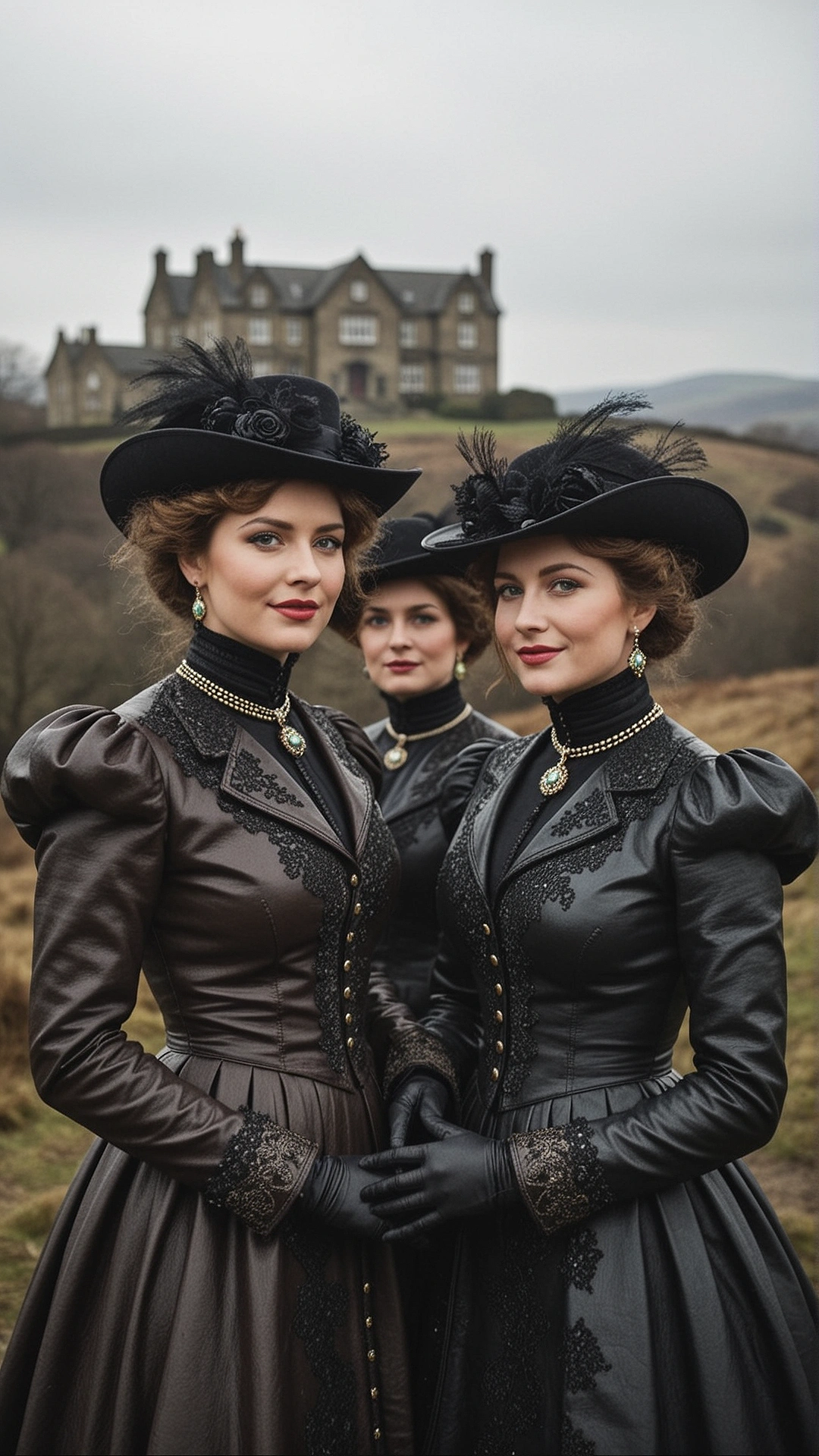
Where Devotion Becomes Freedom, and Satin Becomes Skin
In the hushed corridors of Blackwood Hall, where gaslight flickers against walls of deep green velvet and the rustle of silk signals a woman’s approach, lies a secret that has drawn readers from across the globe. But within these walls, passion is not merely permitted — it is cultivated.
In the hushed corridors of Blackwood Hall, where gaslight flickers against walls of deep green velvet and the rustle of silk signals a woman’s approach, lies a secret that has drawn readers from across the globe. But within these walls, passion is not merely permitted — it is cultivated.
Margaret Thornton arrives disgraced, desperate, and utterly unaware that her life is about to unravel in the most exquisite way possible. Lady Constance Blackwood sees what Margaret cannot: a woman made for devotion, waiting only for someone worthy to claim her.
What follows is a journey through twelve chapters of awakening — where the touch of satin against skin becomes a language, where service becomes sovereignty, and where a household of women bound by devotion to a single mistress discover that belonging is the greatest freedom of all.
For readers who have devoured the most anticipated sapphic novels and found themselves hungry for more — for those who understand that the most powerful love stories are not merely about finding another, but about becoming someone new — The Lady’s Household awaits.
Step through the door. The satin is warm. The fire is lit. And Lady Blackwood has been waiting for you.
Chapter One: The Disgrace
The rain had followed Margaret Thornton all the way from Hartfield Manor to York, as though the heavens themselves insisted on marking her exile with weeping. Three days now, and still it fell—a grey, relentless curtain that blurred the world and matched precisely the colour of her prospects.
She sat at the window of her lodging house room, a narrow, draughty chamber in a respectable but decaying terrace on the edge of the city, watching the droplets trace paths down the grimy glass like tears down a ruined face. Her valise sat packed by the door, containing everything she owned in the world: two drab dresses, a Bible with her mother’s inscription, a small purse with perhaps enough coin for another fortnight, and one treasure she could not bring herself to open—the silk handkerchief, cream and soft as a whisper, embroidered with the initials M.T. in thread so fine it seemed spun from moonlight itself.
She had pressed it to her lips a dozen times since her disgrace, seeking in its smoothness some reminder that she had once been a woman of dignity, a woman who had known the touch of quality, a woman with a future.
Now she was nothing but a cautionary tale.
“You’ll ruin yourself, Thornton.”
The voice of her former employer’s wife echoed in her memory, sharp as shattered crystal, cold as the rain that would not cease. Lady Hartfield had stood in the doorway of Margaret’s modest chamber, her face a mask of furious rectitude, her finger pointed like an accusation.
“My husband has told me everything. How you threw yourself at him. How you begged him to—do not pretend innocence. I have witnesses. The maids heard you pleading with him. They saw you take his hand.”
Margaret had taken his hand, yes. To push it away. To protect herself from the grasping fingers that had sought the buttons of her bodice whilst his wife was from home. But who would believe the housekeeper over the master? Who would believe any woman who had refused a man’s advances, when he could claim she had offered them?
The world did not work that way for women like her.
She had been escorted from the premises by the very constable who had once sought her help untangling the estate’s muddled accounts. A kind man, or so she had thought. He had not met her eyes as he led her to the gate.
“Best go quietly, Miss Thornton. Best for everyone.”
Best for everyone. As though her ruin were a small thing, a necessary sacrifice to preserve the reputation of a man whose hands wandered where they were not wanted.
The memory made her throat tight with swallowed fury. She turned from the window and crossed to the small table where her cold tea sat beside a copy of the Yorkshire Gazette, opened to the situations vacant. She had circled several advertisements in pencil, her hand trembling:
GOVERNESS required for three children. Must have references. Apply to Box 47.
References. She had none now. Lord Hartfield had seen to that.
COMPANION to elderly lady. Light duties, pleasant surroundings. Write to Mrs. Ashworth, Leeds.
Companion. The word itself felt like a shackle. She had been companion to her mother in her final illness. She had watched the light fade from those beloved eyes, had held the thin hand as it went slack. The thought of attaching herself to another dying woman, waiting for death to release them both—
A knock at the door interrupted her reverie.
“Miss Thornton?” The landlady’s voice, pitched somewhere between curiosity and disapproval. “There’s a letter for you. Just arrived by the afternoon post.”
Margaret’s heart seized. A letter? Who would write to her? Her friends—those who had once called themselves friends—had melted away like spring snow when the scandal broke. Her family was gone, lost to consumption and childbed fever and the thousand small tragedies that carried off the middling sort.
She opened the door and accepted the envelope with numb fingers. The landlady lingered, clearly hoping for gossip, but Margaret’s face must have discouraged her, for she retreated down the stairs with only a disappointed huff.
The envelope bore the Hartfield crest.
Margaret’s stomach turned. With shaking hands, she broke the seal and unfolded the letter within. The handwriting was Lady Hartfield’s, cramped and hurried:
Margaret Thornton,
I write to inform you that your actions have had consequences beyond your own disgrace. My husband, in his distress at your behaviour, has taken to his bed with a fever. The physician fears for his constitution. I hold you responsible.
Furthermore, I have taken the liberty of informing all suitable households in the district of your true character. Do not imagine you shall find employment in Yorkshire. You have destroyed yourself, as I warned you would.
I shall pray for your soul, though I fear it is already lost.
—C.H.
The letter trembled in Margaret’s hands. The audacity of the woman—the sheer, breathtaking audacity—to blame her for her husband’s fever, as though refusing his advances were a crime against nature itself. As though her self-preservation were a moral failing.
She crossed to the fire and thrust the paper into the flames, watching as the crisp edges curled and blackened, as the hateful words were consumed. When the last scrap had turned to ash, she returned to the table and sat heavily in the straight-backed chair.
Her eyes fell on the newspaper again, on the circles she had made around advertisements that would never welcome her. She felt like a dying woman in a desert, her fingers closing around stones that crumbled to dust before she could swallow them.
She turned the page, seeking something, anything, a position that might accept a woman without references, a woman marked by scandal, a woman of—
And there, tucked in a corner, small and easily overlooked, she found it:
MATRON OF MATURE YEARS sought for unusual household. Must be intelligent, discreet, and willing to learn. Excellent remuneration. Apply in person to Blackwood Hall, Yorkshire. References less important than character.
Her breath caught. She read the notice again, then a third time, as though the words might change beneath her scrutiny.
Matron of mature years. She was forty-eight. Mature enough, surely.
Intelligent, discreet, and willing to learn. She had managed the Hartfield household accounts for a decade. She had kept the master’s indiscretions from his wife’s ears until he grew bold enough to force the issue. She could be discreet. She could learn.
References less important than character.
A sound escaped her—a laugh, or something like it, cracked and hollow. Character. She had character in abundance. Character was all she had left.
Blackwood Hall.
She knew the name, distantly. A grand house in the northern reaches of the county, owned by a widow who kept to herself, who rarely appeared in society, who was rumoured to be eccentric, reclusive, perhaps even—
Margaret pushed the thought away. She could not afford to be particular. She could not afford to wonder why a household would seek a matron without references, would value character over proven service. She could not afford to ask questions that might lead her to reject the only door that stood even slightly ajar.
She would go. Tomorrow, first light. She would spend her last coins on a train ticket, and she would present herself at Blackwood Hall, and she would beg if she must.
She thought of her mother’s silk handkerchief, folded in the valise. She thought of the way it felt against her skin—smooth, cool, gentle. A reminder that the world contained beautiful things, that she had once been destined for better than this.
“You have character,” she whispered to herself, the words a prayer and a promise. “You have character. That must be enough.”
Outside, the rain continued to fall, but in Margaret’s chest, something small and stubborn had begun to glow—a spark of hope, fragile as a candle flame, determined not to be extinguished.
She would not die in this lodging house. She would not disappear into the workhouse or the streets. She would not allow Lord and Lady Hartfield the satisfaction of her destruction.
Tomorrow, she would find Blackwood Hall.
And whatever she found there—whatever strange household sought a matron without references, whatever unusual position awaited—she would meet it with everything she had left.
Which was, she realised as she extinguished the lamp and prepared for a sleepless night, rather more than she had thought.
She had her intelligence. She had her discretion. She had her willingness to learn.
And she had, though she did not yet know it, a destiny that had been waiting for her long before she ever saw the advertisement—a destiny dressed in satin and sealed with devotion, walking the corridors of a house where women like her were not merely employed, but transformed.
But all of that lay ahead, hidden behind the veil of an uncertain tomorrow.
Tonight, there was only the rain, the cold, and the memory of silk against her lips—a promise from a life she had lost, and a prophecy of one she had yet to find.
Chapter Two: The Arrival
The train carried Margaret northward through a landscape transformed by winter into something both beautiful and forbidding. Fields stretched white and silent beneath a pale sky, broken only by the dark skeletons of trees and the occasional distant farmhouse, its windows glowing like amber beads against the snow. She pressed her forehead against the cold glass, watching the world slide past, feeling as though she were leaving behind not merely a place but a life—a self—that had become untenable.
The carriage held only two other passengers: a stout woman in mourning who dozed beneath a black veil, and a young clerk type who buried himself in papers, occasionally muttering figures beneath his breath. Neither offered conversation, for which Margaret was grateful. She had no wish to explain her journey, no desire to fabricate some acceptable purpose for her travel to the northern reaches of Yorkshire.
What would I say? she thought, her fingers tracing idle patterns in the condensation on the window. That I am seeking employment with a woman who values character over references? That I am desperate enough to present myself at the door of a stranger, a recluse, a woman whose household is rumoured to be unusual in ways no one quite specifies?
The word unusual lodged itself in her mind like a splinter, working its way deeper with each mile. She had heard whispers of Blackwood Hall over the years, though she could not now recall where or from whom. A household staffed entirely by women, it was said. A mistress who rarely entertained men. A peculiar atmosphere of devotion that some called admirable and others called unnatural.
Unnatural. The word carried weight in proper society. It was the word whispered about spinsters who lived together too long, about women who preferred the company of their own sex to the demands of husbands and children. It was a word that could destroy reputations as thoroughly as any scandal involving men.
Margaret pressed her mother’s silk handkerchief to her lips. The smoothness calmed her, as it always did. Whatever unusual might mean in the context of Blackwood Hall, it could hardly be worse than what she had left behind. Lord Hartfield’s grasping hands. Lady Hartfield’s righteous fury. The slow suffocation of respectability turned to ash.
At least I am going toward something, she told herself. Even if that something is uncertain.
The train slowed and shuddered to a halt at a small station that seemed barely more than a platform and a wooden shelter. A sign proclaimed it to be BLACKWOOD HALT, the letters faded and weathered by decades of northern winters. Margaret gathered her valise and descended onto the platform, her boots crunching on frost-slicked boards.
The air was cold and clean, carrying the scent of snow and pine and something else—something indefinable that made her think of candle smoke and dried flowers. The station was empty save for a lone figure waiting beside a sleek black carriage: a woman of middle years, wrapped in a dark cloak that gleamed with the subtle sheen of quality fabric.
The woman stepped forward as Margaret approached, and Margaret found herself subjected to a swift, assessing gaze that seemed to take in everything—her worn but well-maintained clothing, her tired eyes, the valise that held all her worldly possessions.
“Miss Thornton, I presume.”
It was not a question. The woman’s voice was cultured, unhurried, carrying the particular resonance of someone accustomed to being obeyed.
“I am Mrs. Havisham,” she continued, before Margaret could formulate a response. “The housekeeper. Lady Blackwood sent me to collect you.”
There was something in her tone—a warmth beneath the formality—that Margaret could not quite identify. It reminded her of the way one might speak to a guest rather than a prospective employee.
“Thank you,” Margaret managed, her voice rough from disuse. “I apologise if I have kept you waiting. The train was—”
“Precisely on time,” Mrs. Havisham interrupted, a small smile softening her angular features. “I arrived early. It is a habit of the household—we anticipate rather than react. You will come to understand.”
She gestured toward the carriage, and a driver emerged to take Margaret’s valise. The woman was young, perhaps thirty, with strong hands and a capable demeanour. She wore a dark cloak similar to Mrs. Havisham’s, and her nod to Margaret held a quality that seemed almost… welcoming.
“This is Clara,” Mrs. Havisham said, indicating the driver. “She manages the stables and the carriages. Among other things.”
Clara’s eyes met Margaret’s, and there was something there—a recognition, a knowing—that made Margaret’s breath catch. It was the look of someone who had seen many women arrive at Blackwood Hall, who understood what they sought even when they did not.
“Welcome, Miss Thornton,” Clara said quietly. “The journey is not long, but it is… significant. I remember my own.”
Before Margaret could ask what she meant, Mrs. Havisham guided her into the carriage. The interior was appointed with a luxury that surprised her: seats upholstered in deep green velvet, curtains of cream silk tied back with braided cords, a small lamp that cast a warm golden glow against the winter greyness outside.
“Lady Blackwood believes that comfort should begin the moment one enters her sphere,” Mrs. Havisham explained, settling herself across from Margaret. “The transition from the world beyond these hills to the world within them should be marked. It should be felt.”
She gestured to a small basket on the seat beside Margaret.
“There is bread and cheese, and a flask of tea. You may not have eaten properly this morning. Few do, when they journey to us. Nerves, you understand. The appetite suffers.”
Margaret’s eyes stung. The thoughtfulness of it—the assumption that she would be hungry, that she would be anxious, that she would need care—threatened to undo the composure she had maintained through the long night and the longer journey.
“You are very kind,” she managed.
Mrs. Havisham’s smile deepened. “I am not kind, Miss Thornton. I am devoted. There is a difference. Kindness is a virtue one may possess independently. Devotion requires an object. Lady Blackwood is my object. Serving her well means serving those she welcomes. You will come to understand this as well.”
The carriage lurched into motion, and Margaret found herself reaching for the bread and cheese with hands that trembled only slightly. As she ate, she watched the landscape through the silk-draped window. The road wound through a forest of ancient oaks, their bare branches creating intricate patterns against the sky like the work of a mad artist obsessed with line and shadow.
“You have questions,” Mrs. Havisham said. It was not a question. “Most women who come to us have questions. They do not always know how to ask them.”
Margaret swallowed her mouthful of bread and met the housekeeper’s gaze.
“What manner of household is this?” she asked, her voice steadier than she expected. “The advertisement spoke of an unusual position. Of character over references. I confess I do not entirely understand what that means.”
Mrs. Havisham was silent for a moment, her eyes on the passing trees. When she spoke, her voice had taken on a contemplative quality, as though she were selecting each word with great care.
“Tell me, Miss Thornton. In your previous positions, how were you treated? Not by the master—” she paused, and the word carried a weight of distaste, “—but by the household itself. Were you valued? Were you seen? Were you given the opportunity to become something more than a pair of hands and a competent mind?”
Margaret thought of Hartfield Manor. Of the long hours, the endless tasks, the sense that she was useful but not valued. Of Lord Hartfield’s wandering attention and Lady Hartfield’s brittle resentment. Of being necessary but never essential.
“I was employed,” she said finally. “I was paid. I was… adequate.”
“Adequate.” Mrs. Havisham repeated the word as though tasting something unpleasant. “Adequate is what the world offers women like us. Adequate wages. Adequate rooms. Adequate respect, so long as we do not ask for more. Lady Blackwood does not believe in adequacy. She believes in transformation.”
She leaned forward, her eyes holding Margaret’s with an intensity that was almost magnetic.
“The women who serve in this household are not merely employees. They are devotees. They give themselves fully—not because they must, but because they have discovered that full devotion yields full belonging. They serve a woman who sees them completely, who values them utterly, who transforms them into the best versions of themselves.”
“And what does Lady Blackwood receive in return?” Margaret asked. The question emerged before she could consider whether it was proper.
Mrs. Havisham’s smile was slow and knowing. “She receives what every dominant spirit craves: the gift of willing surrender. The joy of shaping worthy clay into something beautiful. The profound satisfaction of being chosen, freely and completely, by women who have discovered that servitude to the right person is not bondage but liberation.”
The words settled into Margaret’s chest like stones dropped into still water. Dominant spirit. Willing surrender. Liberation.
“I do not know if I am capable of such devotion,” she admitted, her voice barely above a whisper.
“Few women believe themselves capable when they first arrive,” Mrs. Havisham replied. “The capacity reveals itself in the presence of one who can draw it forth. Lady Blackwood has a gift for seeing what lies dormant, for awakening what sleeps. If the capacity exists within you—and I suspect it does—she will find it.”
The carriage emerged from the forest, and suddenly there it was: Blackwood Hall.
Margaret’s breath caught. The house was not the grim pile she had feared, all dark stone and narrow windows. It was elegant, graceful, constructed of pale grey stone that seemed to glow against the winter sky. Tall windows lined its façade, each one warm with light, and smoke rose from numerous chimneys into the crisp air. The grounds were formal but not severe, with hedges and paths that invited exploration rather than forbidding it.
But it was what surrounded the house that truly captured her attention. Women. Dozens of them, moving through the gardens, walking along the paths, clustering in animated conversation on the stone terrace. They wore not the drab uniforms of typical servants, but gowns in rich colours—burgundy and forest green and deep blue—that caught the light and moved with them like living things.
“Are they all…” Margaret began, then stopped, uncertain how to complete the question.
“Residents,” Mrs. Havisham said. “Members of the household. Some serve in traditional capacities. Others serve in… different ways. All are devoted. All have chosen to be here. All have found, in this place and in Lady Blackwood, something the world denied them.”
She studied Margaret’s face with an expression that mixed assessment with something gentler.
“You are afraid,” she observed. “That is natural. Fear accompanies all true transformations. But I see something else in you as well. A hunger. A longing for something you perhaps cannot name. That, Miss Thornton, is the seed from which devotion grows.”
The carriage rolled to a stop before the entrance. Clara opened the door, and Mrs. Havisham alighted first, then turned to offer Margaret her hand.
“Come,” she said. “The fire is lit. The tea is prepared. And Lady Blackwood is waiting.”
Margaret took her hand and stepped down onto the gravel drive. The air was cold, but she barely noticed. Her attention was fixed on the door before her—a door that seemed to mark a threshold between one life and another.
What lies beyond? she wondered. What will I become?
She thought of the silk handkerchief in her valise, the last remnant of a mother’s love, the last proof that she had once been destined for something finer. She thought of the years of adequate service, of hands that had never quite reached for her heart, of a life measured in duty rather than devotion.
She thought of Mrs. Havisham’s words: Servitude to the right person is not bondage but liberation.
Then she lifted her chin, drew a breath that tasted of snow and possibility, and walked through the door.
The interior of Blackwood Hall was a revelation. Margaret had expected something severe, something that would reflect the mysterious reputation of its mistress. Instead, she found warmth and beauty at every turn. The entrance hall was spacious but not intimidating, its walls lined with paintings—women, she noticed, always women, in groups and pairs and solitary portraits—its floor covered in a carpet of deep blue that seemed to glow. A fire crackled in a massive hearth, casting dancing shadows that felt welcoming rather than eerie.
But it was the women who caught and held her attention. They moved through the space with an unhurried grace, their richly coloured gowns rustling softly, their faces serene. They glanced at Margaret as she passed, and each glance held the same quality she had seen in Clara’s eyes: recognition, welcome, a knowing that suggested they understood what she was experiencing because they had experienced it themselves.
Mrs. Havisham led her up a sweeping staircase and along a corridor lined with more paintings and soft-lit lamps. They stopped before a door of polished oak.
“Your room,” the housekeeper said. “You will find everything you need. Fresh water, a bath prepared, garments laid out. Lady Blackwood does not receive guests until they have had the opportunity to refresh themselves. She believes the first meeting should occur when one feels restored rather than travel-worn.”
She opened the door and gestured Margaret inside.
The room was larger than Margaret had expected, with a window overlooking the gardens. A fire burned in the hearth, and the bed was dressed in linens so white they seemed to glow. On the bed lay a garment that made Margaret’s breath catch: a dressing gown of deep blue satin, the colour of a winter sky at dusk, the fabric pooling like liquid shadow.
“When you are ready,” Mrs. Havisham said, “ring the bell by the bed. Someone will come to escort you to Lady Blackwood’s morning library. Take your time. There is no hurry here. Time moves differently at Blackwood Hall.”
She paused at the door, her hand on the frame.
“I said before that I am not kind. That I am devoted. But I will offer you one kindness, Miss Thornton, because someone offered it to me when I first arrived, and it made all the difference.”
She met Margaret’s eyes.
“Whatever you fear lies ahead, whatever questions haunt you, whatever doubts whisper that you are not worthy of this place—set them aside. Not because they are unfounded, but because they are irrelevant. What matters is not what you have been. What matters is what you are willing to become.”
Then she was gone, the door closing softly behind her.
Margaret stood alone in the beautiful room, the fire crackling, the satin dressing gown gleaming on the bed like a promise. She crossed to it and picked it up, letting the fabric spill over her hands. It was cool and impossibly smooth, sliding against her skin like water, like a caress, like something she had forgotten she needed.
She thought of her mother’s silk handkerchief, that single treasure that had sustained her through disgrace. She thought of how it had felt against her lips—smooth, gentle, a reminder that the world contained beauty.
This dressing gown was that same feeling, magnified a thousandfold.
What manner of place is this? she wondered again. What manner of woman runs such a household?
She would know soon enough. For now, there was warm water, clean garments, and a fire that seemed to burn not merely with heat but with welcome.
She would bathe. She would dress. She would present herself to the mysterious Lady Blackwood.
And she would discover whether the hunger that Mrs. Havisham had seen within her—the hunger for devotion, for belonging, for transformation—could indeed be fed.
Chapter Three: The Interview
Margaret stood before the polished oak door, her hand hovering over the bell pull, her heart performing a rhythm that seemed altogether too vigorous for the quiet corridor. She had bathed in water scented with something floral and unfamiliar, had dressed in the deep blue satin dressing gown that still seemed impossible—a garment so luxurious it felt like wearing moonlight—and had attempted to arrange her hair into something approaching order.
The woman who looked back at her from the small mirror above the washstand had seemed a stranger. Not the defeated, disgraced creature who had fled Hartfield Manor, but someone… softer. Someone who had been touched by warmth and beauty, however briefly. The satin had done something to her posture, to the way she held herself. It was as though the fabric itself whispered that she was worthy of care.
You are being foolish, she told herself. It is merely an interview. You have had dozens of interviews. You have been employed in respectable households for decades. This is no different.
But even as the thought formed, she knew it was a lie. This was entirely different. Mrs. Havisham’s words echoed in her memory: We are not servants in the usual sense. We are devotees. We serve Lady Blackwood because we choose to. Because she has given us something we could not find elsewhere.
What had she given them? What could a woman—a widow, a recluse, a creature of rumour and speculation—give that the world had denied them?
There was only one way to find out.
She pulled the bell.
The door opened almost immediately, as though someone had been waiting just beyond it. A young woman in a navy satin uniform—Margaret was beginning to understand that this was the livery of this household—smiled and gestured for her to enter.
“Lady Blackwood will see you in the morning library,” she said softly. “Follow me.”
They walked through corridors that seemed designed to soothe rather than intimidate. The walls were painted soft cream, the carpets deep and thick beneath Margaret’s stockinged feet—she had not thought to bring shoes appropriate for a house like this, and the satin slippers laid out beside the dressing gown had seemed too intimate, too presumptuous. Now she wished she had worn them. The carpet was warm, but she felt strangely vulnerable in her bare feet.
As though I am already being undressed, she thought, and the image made her face warm.
The young woman—her name, Margaret learned, was Eleanor—led her to a door of dark wood and knocked twice before opening it.
“Miss Thornton, my lady.”
Then she was gone, and Margaret was standing in the threshold of the morning library, and Lady Constance Blackwood was rising from a chair by the fire.
She was not what Margaret had expected.
Oh, she was beautiful—that was undeniable. Her dark hair was touched with silver at the temples, swept up in an elegant arrangement that exposed the long line of her neck. Her face was fine-boned, intelligent, with eyes the colour of a winter sky: grey, deep, somehow both warm and assessing. Her figure was graceful, neither too thin nor too full, dressed in a morning gown of charcoal silk that moved with her like a living thing.
But it was not her beauty that struck Margaret. It was her presence.
She moved like water—fluid, unhurried, inevitable. There was a quality to her stillness, a sense that every gesture was deliberate, that nothing was wasted. When she looked at Margaret, Margaret felt as though she were being read like a book, every page turned and understood in an instant.
“Miss Thornton.” Her voice was low, cultured, carrying the particular music of old money and good breeding. “Please, come in. Sit. You must be weary from your journey.”
She gestured to a chair beside the fire, angled so that they would face each other without the barrier of a desk between them. Margaret crossed the room on legs that trembled only slightly, and sank into the offered seat. The upholstery was velvet, soft and deep, and she felt herself enveloped by it.
Lady Blackwood resumed her own chair, arranging her charcoal silk skirts with a gesture that seemed almost ritualistic. The firelight caught the fabric, making it gleam like wet stone, and Margaret found herself momentarily mesmerised by the play of light and shadow.
“I am glad you came,” Lady Blackwood said. Her eyes never left Margaret’s face. “I have been watching for you.”
“Watching for me, my lady?” Margaret’s voice emerged rougher than she intended. “I do not understand. I only saw the advertisement yesterday morning. How could you—”
“I placed that advertisement three months ago,” Lady Blackwood interrupted gently. “I refresh it quarterly. But I have been watching for you specifically, Miss Thornton, since I first heard of your situation.”
Margaret’s throat tightened. “My situation.”
“Your disgrace,” Lady Blackwood said, and the word was neither cruel nor pitying—merely accurate. “Word travels in certain circles. A housekeeper of excellent reputation, dismissed without reference for refusing the advances of her employer. A woman cast out for the crime of preserving her virtue.”
She leaned forward slightly, and the silk of her gown whispered against the velvet of her chair.
“I make it my business to learn of such women. Women who have been ill-used by the world. Women who have proven their character through suffering. Women who might be ready for something different.”
“What manner of something different?” Margaret asked. The question emerged before she could consider its propriety.
Lady Blackwood smiled. It transformed her face, softening the sharp lines, warming the winter-grey eyes.
“That is precisely what this interview is designed to determine,” she said. “Whether you are ready. Whether I am what you need. Whether we might suit.”
She rose and moved to a small table against the wall, where a tea service waited. She poured two cups without asking how Margaret took hers—a small assumption that Margaret found oddly touching—and returned to hand one to her. The china was delicate, painted with tiny blue flowers, and the tea smelled of bergamot and comfort.
“I do not conduct interviews in the usual manner,” Lady Blackwood said, settling back into her chair. “I do not ask about your previous positions, your duties, your accomplishments. I can discover those things through observation soon enough. What I wish to know is something far more important.”
She took a sip of her tea, her eyes never leaving Margaret’s face.
“I wish to know what you need.”
Margaret stared at her. The question was so unexpected, so utterly contrary to every interview she had ever endured, that she felt momentarily lost.
“I do not…” She faltered. “I am here to offer my services, my lady. I am a capable housekeeper. I can manage accounts, supervise staff, maintain a household of any size. I am not here to—”
“You are here to answer my questions,” Lady Blackwood said, her tone mild but firm. “And my question is this: What do you need, Miss Thornton? Not what you can give. Not what you can do. What do you need?”
The silence stretched between them, filled only by the crackle of the fire and the soft whisper of silk against velvet. Margaret felt something building in her chest—a pressure, a fullness, a sense that if she opened her mouth, everything might come pouring out.
What do I need?
She thought of Hartfield Manor, of years spent serving a household that valued her utility but not her self. She thought of the loneliness that had become so familiar she no longer noticed it, like a garment worn so long it became part of the skin. She thought of the silk handkerchief in her valise, the last proof that she had once been loved.
She thought of the deep blue satin dressing gown that now clung to her body, the first beautiful thing she had worn in decades, and how it had made her feel seen.
“I need…” Her voice cracked. She took a breath. “I need to be somewhere I am not merely useful. I need to belong to something, to someone, in a way that goes beyond employment. I need—”
She stopped, horrified by her own honesty. This was not how one conducted an interview. This was not how one secured a position.
But Lady Blackwood was nodding slowly, her expression one of understanding rather than judgment.
“You need to be seen,” she said. “You need to be valued for more than your labour. You need to belong.”
She set down her tea cup and rose. She crossed to a wardrobe that stood against the far wall—not a large piece of furniture, but clearly important, its doors carved with intricate patterns of leaves and flowers. She opened it, and Margaret glimpsed within: garments hanging in rows, all in the same rich navy, all with the distinctive gleam of satin.
Lady Blackwood removed one and turned to face Margaret, holding it up so that the firelight played across its surface. It was a dress—not a dressing gown, but a proper dress—with a fitted bodice, a modest neckline trimmed with cream lace, and a skirt that would fall to the floor in soft folds. It was beautiful. It was elegant. It was utterly unlike anything Margaret had ever been permitted to wear.
“This is what my household staff wear,” Lady Blackwood said. Her voice had dropped, become more intimate. “I provide everything—clothing, lodging, education, care. I ask in return not merely service, but devotion. The anticipation of needs. The willingness to learn. The surrender of your old life for a new one.”
She stepped closer, the satin dress catching the light with each movement.
“I am not a conventional employer, Miss Thornton. I do not hire women to perform tasks. I collect women—I shape women—I transform women. I seek those who have been broken by the world and show them how to become something greater than they ever imagined.”
She stopped before Margaret’s chair, looking down at her with eyes that held both challenge and invitation.
“You may accept these terms, or you may leave with a generous severance and my blessing. The carriage will take you wherever you wish to go. But if you stay…”
She held out the dress.
“If you stay, you stay until I release you. And I rarely release what I have claimed.”
Margaret looked at the dress. The satin gleamed like still water under moonlight, like the surface of a lake at midnight, like something from a dream she had forgotten she had dreamed. The cream lace at the cuffs and neckline seemed to glow with its own soft light.
She thought of her mother’s silk handkerchief. She thought of the way it felt against her lips—smooth, gentle, a reminder that she had once been destined for beautiful things.
She thought of the last three days, the rain, the lodging house, the letter that blamed her for a man’s sins.
She thought of Lady Blackwood’s words: I collect women. I shape women. I transform women.
Is that what I want? she wondered. To be collected? To be shaped?
And then, quieter, more honest: Is that what I have always wanted?
She rose from the chair. Her legs were steadier now, her heart calmer. Something had settled within her—a decision, perhaps, or the beginning of one.
“I do not know if I am capable of the devotion you describe,” she said, meeting Lady Blackwood’s eyes. “I do not know if I have it in me to surrender as completely as you require. I have spent my entire life being practical, being useful, being adequate.”
She reached out and touched the satin dress. The fabric was cool and impossibly smooth, sliding beneath her fingers like water, like a caress, like a promise.
“But I know that I cannot go back to what I was. I know that I have been hollow for a very long time, and that the hollowness has become unbearable. I know—”
She looked up, and found Lady Blackwood watching her with an expression of profound understanding.
“I know that I came here for a reason I cannot yet name. And I would like to discover what that reason is.”
Lady Blackwood smiled. It was a smile of triumph, but also of tenderness—a smile that suggested she had expected this answer, and was nevertheless pleased to receive it.
“Then you will stay,” she said. It was not a question.
She pressed the dress into Margaret’s hands. The weight of it was substantial, the smoothness intoxicating.
“Sarah will help you dress properly. Tomorrow morning, you will begin your duties. You will learn the rhythms of this household. You will observe the other women. You will begin to understand what it means to serve me.”
She reached out and touched Margaret’s chin, lifting her face slightly. Her fingers were warm, firm, certain.
“And in time,” she said softly, “you will understand what it means to belong to me. Completely. Utterly. In ways you have not yet imagined.”
She released Margaret’s chin and stepped back, her charcoal silk gown rippling with the movement.
“Go now,” she said. “Sarah is waiting outside. Let her help you. Let yourself be helped. That is the first lesson: you are no longer alone, and you do not have to do everything yourself.”
Margaret clutched the satin dress to her chest. It felt like holding a heart—fragile, precious, alive with possibility.
“Thank you, my lady,” she whispered.
“Do not thank me yet,” Lady Blackwood replied. “Thank me when you understand what you have been given. Thank me when you realise that surrender is not loss but gain. Thank me—”
Her voice dropped to a murmur.
“Thank me when you have become what you were always meant to be.”
Margaret found Sarah waiting in the corridor, her smile warm and knowing. She led Margaret back through the winding passages to the room that was now, apparently, hers. Inside, she helped Margaret from the blue satin dressing gown and into the navy dress that Lady Blackwood had given her.
The fabric slid over Margaret’s skin like a blessing. The bodice fitted perfectly—as though it had been made for her, though she could not imagine how. The skirt fell in soft folds around her legs, and when she moved, the satin whispered against itself with a sound like secrets being shared.
“You look different already,” Sarah said softly, fastening the buttons at the back. “The dress does that. It is not merely clothing. It is a mark. A sign that you have been claimed.”
“Claimed?” Margaret turned to face her. “I have not been claimed. I have merely accepted a position.”
Sarah’s smile deepened. She reached out and straightened the cream lace at Margaret’s neckline, her fingers lingering for just a moment longer than strict necessity required.
“You have accepted more than a position,” she said. “You have accepted belonging. You have accepted transformation. You have accepted—”
She met Margaret’s eyes, and there was something in her gaze that Margaret could not quite identify. Understanding, perhaps. Or anticipation.
“You have accepted her. And she does not let go of what she has accepted.”
She stepped back, surveying Margaret with an expression of satisfaction.
“Tomorrow, your real education begins. Tonight, rest. Let the satin against your skin remind you of what you have chosen. Let it remind you that you are no longer the woman who arrived here this afternoon.”
She moved toward the door, then paused.
“You are becoming someone new, Miss Thornton. Someone who wears beautiful things. Someone who is seen. Someone who belongs.”
She smiled.
“Sleep well. The morning will bring wonders.”
Then she was gone, and Margaret was alone with the fire and the soft whisper of satin against satin, and the feeling that something profound had shifted in the foundations of her world.
She crossed to the mirror and looked at herself. The woman who looked back was a stranger and yet somehow familiar—as though she had always existed within Margaret, waiting to be called forth by the right circumstances, the right place, the right person.
Someone who is seen, Sarah had said. Someone who belongs.
Margaret thought of Lady Blackwood’s grey eyes, assessing and warm. She thought of the touch on her chin, lifting her face, claiming her attention. She thought of the words I rarely release what I have claimed.
And she felt, for the first time in longer than she could remember, something that might have been hope.
She extinguished the lamp and climbed into the bed with its soft linens and deep pillows. The navy satin dress hung in the wardrobe, waiting for tomorrow. The fire crackled low, casting dancing shadows on the ceiling.
What am I becoming? she wondered.
And from somewhere deep within, an answer arose, though she could not have said whether it came from herself or from the house itself:
You are becoming hers.
Chapter Four: The First Night
The darkness that settled over Blackwood Hall was unlike any darkness Margaret had known. It was not the harsh,gritted darkness of the lodging house, nor the familiar, soot-stained darkness of London, nor even the quiet, country darkness of her childhood home. This was a darkness that seemed to embrace the house, cradling it in soft, velvet arms, as though the night itself were a lover, holding the building close.
She lay in the bed, the linens cool against her skin, the navy satin dressing gown—a different one now, this one a deep midnight blue that seemed to merge with the shadows—draped over the chair beside her. She had not thought to remove it after dinner. She had not thought to do anything, really, except exist in this strange, suspended state, somewhere between the woman she had been and the woman she was becoming.
The fire had burned low, casting a faint, amber glow across the room. The shadows it created seemed to move and breathe, as though the house itself were alive,watching her, waiting to see what she would do.
What am I doing here? she wondered, not for the first time that day. What have I agreed to?
She thought of Lady Blackwood’s grey eyes, assessing and warm. She thought of the touch on her chin, lifting her face, claiming her attention. She thought of the words I rarely release what I have claimed.
And she felt, low in her belly, a sensation she could not name. It was not fear, exactly. It was not desire, not yet. It was something in between, a tension, a tightness, an awareness that she had stepped into something vast and unknown, and that there was no going back.
A soft knock at the door broke into her reverie.
Margaret sat up, her heart quickening. “Come in,” she said, her voice rough from disuse.
The door opened, and Sarah slipped into the room. She wore a dressing gown of deep burgundy satin that gleamed in the firelight, and her hair was loose about her shoulders, dark waves that caught the light like polished wood. Her expression was soft, concerned, and there was something in her eyes that made Margaret’s breath catch—a knowing, a recognition, as though she understood precisely what Margaret was feeling.
“I hope I am not disturbing you,” Sarah said quietly. “But I thought you might like some company. The first night can be… difficult.”
She crossed to the bed and sat on the edge, her movements fluid and graceful. The burgundy satin whispered against the linens as she settled, and Margaret found herself oddly aware of the sound, the way the fabric seemed to speak in its own soft language.
“Difficult?” Margaret managed.
Sarah nodded. “The silence. The strangeness. The sense that you have stepped into a story you do not yet understand.” She smiled, and it transformed her face, softening the sharp lines, warming the dark eyes. “I remember my first night. I lay awake for hours, certain I had made a terrible mistake. Certain I did not belong.”
“And did you?” Margaret asked. “Did you belong?”
Sarah’s smile deepened. “I discovered that belonging is not something you find. It is something you create. Something you allow to grow within you.” She reached out and took Margaret’s hand, her fingers warm and gentle. “Lady Blackwood has a gift for seeing what lies dormant. For awakening what sleeps. But the awakening can be… unsettling. It can feel like loss before it feels like gain.”
Margaret looked at their joined hands, at the contrast between Sarah’s warm, brown skin and her own pale fingers. The touch was simple, innocent—nothing more than comfort offered and received. But there was something in the way Sarah held her hand, something in the gentle pressure, that made Margaret feel as though she were being anchored, held in place against a current that might otherwise sweep her away.
“What is she like?” Margaret asked, the question emerging before she could consider its propriety. “Lady Blackwood. What is she really like?”
Sarah was silent for a moment, her eyes on the dying fire. When she spoke, her voice had taken on a contemplative quality, as though she were searching for words that could capture something inherently uncapturable.
“She is like… a deep lake,” Sarah said finally. “Calm on the surface, but with currents beneath that can pull you under if you are not careful. She is patient. She does not rush. She waits, and she watches, and when she sees what she is looking for—” she paused, her eyes meeting Margaret’s, “—she reaches for it. For you. And when she reaches, you feel as though you have been waiting your entire life to be caught.”
Waiting your entire life to be caught.
The words settled into Margaret’s chest, heavy and true. She thought of all the years she had spent being useful, being adequate, being invisible. She thought of the loneliness that had become so familiar she no longer noticed it. She thought of the silk handkerchief in her valise, the last proof that she had once been destined for beautiful things.
Is that what I have been waiting for? she wondered. To be caught? To be seen? To be claimed?
Sarah squeezed her hand, drawing her back to the present.
“You are tired,” she said gently. “And tomorrow will bring many new things. But before I go, I want to tell you something.” She shifted closer, her voice dropping to a murmur. “The women of this household—we are not merely servants. We are not merely employees. We are a community. A family. We care for each other, support each other, celebrate each other.”
She released Margaret’s hand and reached up to touch her face, her fingers brushing against Margaret’s cheek with a tenderness that made Margaret’s eyes sting.
“You are not alone here, Margaret. Whatever fears you harbour, whatever doubts whisper in the dark—you are not alone. We have all stood where you stand. We have all felt what you feel. And we have all discovered, in time, that Lady Blackwood is worth the uncertainty. That what she offers is worth the risk.”
She rose from the bed, her burgundy satin dressing gown rippling with the movement. At the door, she paused and looked back.
“Sleep well,” she said softly. “And remember—the first night is always the hardest. After that, you begin to understand. After that, you begin to belong.”
Then she was gone, and Margaret was alone with the dying fire and the soft whisper of the night.
She slept, eventually. A restless, dream-filled sleep, in which she wandered through corridors of gleaming satin and velvet shadows, searching for something she could not name. Lady Blackwood appeared in her dreams, not as a terrifying figure, but as a presence—warm, steady, patient. Waiting at the end of a long corridor, her hand extended, her grey eyes holding Margaret’s with an intensity that made her feel seen in a way she had never been seen before.
Come, the dream-Lady Blackwood seemed to say. Come to me. I have been waiting for you.
Margaret reached for her hand, but before their fingers could touch, she woke.
The room was dark, the fire reduced to embers. The satin dressing gown on the chair gleamed faintly in the pre-dawn light that crept through the curtains, and Margaret lay still, her heart pounding, her body thrumming with an energy she could not explain.
What is happening to me? she wondered. What is this place doing to me?
She thought of Sarah’s words: You begin to belong.
And she thought, with a shiver that was not entirely unpleasant: Perhaps I am already beginning.
The morning came softly, light seeping through the curtains like honey, golden and slow. Margaret rose and dressed in the navy satin dress that Lady Blackwood had given her, the fabric sliding over her skin with a whisper that felt almost like a caress. She examined herself in the small mirror above the washstand, and the woman who looked back at her seemed different— not in any way she could pinpoint, but different nonetheless. Softer, perhaps. More present. More… awake.
She left her room and made her way down the corridor, following the sounds of movement and conversation to what she assumed must be the servants’ hall. But when she reached the room, she stopped short.
It was not a servants’ hall. Not in any conventional sense.
The room was large and bright, with windows that looked out over the gardens and the snow-covered grounds. A long table ran down the centre, surrounded by chairs that looked comfortable rather than utilitarian. Women sat around it, eating breakfast, talking quietly, their satin dresses gleaming in the morning light. They looked up as Margaret entered, and their expressions were welcoming, curious, kind.
“Miss Thornton!” Mrs. Havisham rose from her seat at the head of the table. “Please, come in. Sit. Eat.” She gestured to an empty chair near her, and Margaret crossed the room on legs that trembled only slightly.
The women around the table introduced themselves as she sat—Eleanor, whom she had met the day before; Clara, the driver; a woman named Rebecca who oversaw the kitchens; another named Jane who managed the linens. Each name came with a smile, a nod, a warmth that made Margaret feel as though she were being welcomed into a circle rather than a household.
“The first morning is always the most disorienting,” Eleanor said, passing Margaret a plate of bread and butter. “So many new faces, new names. But do not worry—you will learn us all in time.”
“And we will learn you,” Clara added with a smile. “Though I suspect you will prove yourself quite quickly. Lady Blackwood has an eye for quality.”
Margaret accepted the plate and began to eat, the food settling warm and comforting in her stomach. As she ate, she listened to the conversation around her—the women discussing the day’s tasks, the weather, small pieces of household news. It was ordinary, domestic, the kind of conversation she had heard in every household where she had served.
But there was a difference here. A quality of ease, of contentment, that she had never encountered before. These women were not merely working; they were living. They were not merely serving; they were belonging.
Is this what Lady Blackwood offers? she wondered. Not just employment, but… community? Not just service, but… home?
After breakfast, Mrs. Havisham took her on a tour of the house. The morning library, where she had met Lady Blackwood the day before. The formal drawing room, with its velvet sofas and gleaming piano. The dining room, where the household took their evening meal. The kitchens, where Rebecca presided over a domain of copper pots and stone floors. The laundry, where Jane and her assistants transformed the household’s linens into crisp, clean perfection.
Everywhere they went, Margaret saw women in satin—navy and burgundy and forest green—moving through the rooms with an unhurried grace. They nodded to her as she passed, their expressions warm, their eyes curious.
“The household is larger than it appears,” Mrs. Havisham explained as they climbed the stairs to the upper floors. “We are nearly thirty women now, each with her own role, her own duties. Lady Blackwood believes in giving each of us the opportunity to discover where we fit best. Some find their calling in the practical tasks—the cooking, the cleaning, the management of the household. Others find their calling in… different areas.”
“Different areas?” Margaret asked.
Mrs. Havisham smiled. “Lady Blackwood has many interests. She requires assistance in all of them. Some of the women serve as companions, as readers, as secretaries. Some assist with her correspondence, her accounts, her charitable works. And some—”
She paused, her hand on the railing, and turned to look at Margaret with an expression that was both knowing and gentle.
“Some serve in more intimate capacities.”
The words hung in the air, heavy with implication. Margaret felt her face warm, and she looked away, uncertain how to respond.
“You need not concern yourself with that now,” Mrs. Havisham said, her voice softening. “That is not something anyone is asked to consider until they have been with us for some time. Until Lady Blackwood has had the opportunity to know them, and they her. What matters now is that you learn the rhythms of the household, that you begin to feel at home.”
She resumed walking, leading Margaret up the stairs and along a corridor lined with doors.
“For now, you will serve as my assistant,” she continued. “You will help with the management of the household, the supervision of the staff, the coordination of Lady Blackwood’s schedule. It will give you the opportunity to learn how the house functions, and to discover where your own talents might best be applied.”
They stopped before a door at the end of the corridor. Mrs. Havisham opened it and gestured Margaret inside.
“This will be your office,” she said. “It adjoins mine, through that door there. You will find everything you need—a desk, supplies, the household accounts. Lady Blackwood prefers her housekeeper to be organised, efficient, thorough. I expect the same of my assistant.”
Margaret stepped into the room. It was small but comfortable, with a window overlooking the gardens and a desk of polished wood. A chair upholstered in navy satin sat before it, and the walls were lined with shelves holding ledgers and books.
“Thank you,” she said, turning to face Mrs. Havisham. “I will do my best to meet your expectations.”
Mrs. Havisham’s expression softened further. “I do not doubt it,” she said. “Lady Blackwood has excellent instincts. If she saw something in you, then it is there to be seen.”
She stepped back, preparing to leave.
“One more thing, Miss Thornton,” she said, pausing at the door. “The satin you wear—it is not merely a uniform. It is a symbol. A reminder that you are part of something. That you belong. When you feel uncertain, when the strangeness threatens to overwhelm you, remember that you wear it because you have been chosen. Because Lady Blackwood saw you, and reached for you, and claimed you.”
Her eyes held Margaret’s, warm and certain.
“Remember that,” she said. “And the remembering will sustain you.”
The day passed in a blur of activity. Margaret threw herself into her work, learning the household accounts, meeting the staff, familiarising herself with the rhythms and routines of Blackwood Hall. It was work she knew how to do, work she had done for years, and the familiarity of it was comforting. It gave her something to hold onto, something solid and real, in the midst of so much that was new and strange.
But even as she worked, part of her mind was elsewhere. Part of her was thinking about Lady Blackwood’s grey eyes, about the touch on her chin, about the words I rarely release what I have claimed.
Part of her was thinking about Sarah’s fingers on her cheek, about the tenderness in her touch, about the words You are not alone here.
And part of her was thinking about the satin that covered her body, sliding against her skin with every movement, whispering its soft, secret language.
What is this place doing to me? she wondered again. What am I becoming?
Evening came, and with it a summons. A young woman in a navy satin dress appeared at her office door, her expression respectful.
“Lady Blackwood requests your presence in her private parlour,” she said. “She wishes to hear your impressions of your first day.”
Margaret’s heart quickened. She rose from her desk, smoothed her satin dress, and followed the young woman through the corridors to a part of the house she had not yet seen.
They stopped before a door of dark wood, and the young woman knocked twice before opening it.
“Miss Thornton, my lady.”
Margaret stepped inside.
The private parlour was smaller than she had expected, more intimate. A fire burned in the hearth, casting a warm glow across the room. Bookshelves lined the walls, filled with volumes in leather and gilt. A chaise lounge upholstered in deep green velvet sat before the fire, and Lady Blackwood reclined upon it, a book open in her lap.
She wore a gown of deep purple silk, the colour of wine at midnight, and her dark hair was loose about her shoulders, cascading in waves that caught the firelight. She looked up as Margaret entered, and her grey eyes held Margaret’s with an intensity that made her breath catch.
“Miss Thornton,” she said, setting aside her book. “Please, sit. You must be weary after your first day.”
She gestured to a chair beside the chaise, and Margaret crossed the room on legs that trembled. She sat, the navy satin of her dress whispering against the velvet of the chair, and found herself unable to look away from Lady Blackwood’s face.
“Tell me,” Lady Blackwood said, her voice low and warm. “How have you found your first day? Has the household welcomed you? Have you begun to feel at home?”
“Everyone has been… very kind,” Margaret managed. “Mrs. Havisham has been patient in teaching me the household accounts. Sarah… Sarah came to my room last night. She offered comfort when I was feeling… uncertain.”
Lady Blackwood’s lips curved into a slow smile. “Sarah has a gift for that,” she said. “She was not always so gentle, you know. When she first came to me, she was all sharp edges and suspicion. She had been hurt, badly, by the world. But over time, she learned to trust. To soften. To allow herself to be cared for.”
She leaned forward slightly, her purple silk gown rippling with the movement.
“That is what I offer, Miss Thornton. Not merely employment, but transformation. Not merely a place to live, but a place to become. I see what lies dormant within you, and I draw it forth. I shape it. I polish it, until it shines.”
Her grey eyes held Margaret’s, and there was something in them—a warmth, a certainty, a promise—that made Margaret’s heart pound.
“I saw something in you the moment you walked through my door,” Lady Blackwood continued. “A hunger. A longing. A need that you have perhaps never allowed yourself to acknowledge. I can satisfy that need, Miss Thornton. I can give you what you have been searching for your entire life.”
She reached out and took Margaret’s hand, her fingers warm and gentle.
“But first, you must trust me. You must surrender to me. You must allow me to lead.”
Her thumb traced a slow circle on Margaret’s palm, and the touch sent a shiver through her body.
“Can you do that?” Lady Blackwood asked softly. “Can you trust me? Can you surrender?”
Margaret looked at their joined hands, at the contrast between Lady Blackwood’s elegant fingers and her own work-roughened palm. She thought of all the years she had spent being useful, being adequate, being invisible. She thought of the loneliness that had become so familiar she no longer noticed it. She thought of the silk handkerchief in her valise, the last proof that she had once been destined for beautiful things.
And she thought, with a sudden, piercing clarity, that she was tired of being strong. Tired of being alone. Tired of holding herself together through sheer force of will.
What would it be like, she wondered, to surrender? To trust someone else to hold me?
“I do not know,” she whispered, meeting Lady Blackwood’s eyes. “I do not know if I can. But I want to try.”
Lady Blackwood’s smile deepened. She lifted Margaret’s hand to her lips and pressed a kiss to her palm, her lips warm and soft against the skin.
“That is all I ask,” she murmured. “The willingness to try. The courage to begin.”
She released Margaret’s hand and leaned back against the chaise, her purple silk gown pooling around her like liquid shadow.
“Go now,” she said. “Rest. Tomorrow will bring new challenges, new discoveries. But tonight, remember this: you have taken the first step. You have opened the door. What lies beyond is up to you.”
Margaret walked back to her room in a daze. The corridors seemed different now—softer, warmer, as though the house itself were welcoming her. The satin of her dress whispered against her skin, and the sound seemed to carry a message, a reassurance.
You are not alone, it seemed to say. You belong.
She entered her room and closed the door behind her. The fire had been lit, the bed turned down, the midnight blue satin dressing gown laid out on the pillows. She changed into it, the fabric sliding over her skin like water, and climbed into bed.
But sleep did not come quickly. She lay in the darkness, her body thrumming with an energy she could not explain, her mind replaying the evening’s encounter over and over again.
Lady Blackwood’s grey eyes. Her hand on Margaret’s palm. Her lips, warm and soft, pressing a kiss to the skin.
I can give you what you have been searching for your entire life.
Can you trust me? Can you surrender?
Margaret pressed her hand to her lips, imagining she could still feel the ghost of Lady Blackwood’s kiss.
What am I becoming? she wondered. And why does it feel like coming home?
Chapter Five: The Other Women
The days that followed Margaret’s first interview with Lady Blackwood settled into a rhythm that felt both foreign and strangely familiar, like a melody she had heard long ago and forgotten, now returned to her in fragments. Each morning she rose before dawn, the satin of her nightgown cool against her skin, and dressed in the navy dress that had become her uniform—her mark of belonging, her sign of surrender. Each morning she made her way through the softly lit corridors to the breakfast room, where the other women gathered in their colourful gowns, their voices mingling in conversation that ranged from the practical to the philosophical.
And each morning, she watched them.
She watched the way they moved through the house—unhurried, graceful, as though they had all the time in the world, as though time itself had agreed to move more slowly within these walls. She watched the way they looked at each other—with warmth, with understanding, with a quality of shared knowing that spoke of bonds forged through something deeper than mere employment. She watched, most of all, the way they spoke of Lady Blackwood.
Not with fear. Not with resentment. But with a devotion so pure it made Margaret’s chest ache to witness it.
On the fifth morning of her residence at Blackwood Hall, she found herself seated beside a woman she had not yet properly met. The woman was perhaps ten years her junior, with hair the colour of autumn leaves and eyes that shifted between green and gold depending on the light. Her gown was deep burgundy satin, and she wore it with an ease that suggested she had long forgotten what it felt like to wear anything else.
“You are watching us,” the woman observed, her voice carrying the particular music of gentle amusement. “Like a sparrow watching a flock of swallows, trying to understand how they fly so high.”
Margaret started, her cheeks warming. “I apologise. I did not mean to be rude. I am merely… trying to understand.”
“Understand what?”
“Everything.” Margaret gestured vaguely at the room, at the women, at the house beyond. “How this place functions. What draws women here. What keeps them. What—”
She stopped, uncertain how to finish the thought without overstepping.
The woman smiled. It was a knowing smile, patient and warm. “What transforms them, you mean. What turns a woman like you—or like me—into something she never imagined she could become.”
Margaret nodded slowly.
“I am Helen,” the woman said, extending her hand. “I have been here four years. Before that, I was a teacher at a girls’ school in Bath. Before that, I was a daughter in a house where my only value lay in the marriage I might make.”
Her smile deepened, taking on a quality that was both wry and tender.
“I made no marriage. I disappointed everyone. And then I found an advertisement in the newspaper, placed by a woman who valued character over references. And here I am.”
“And are you… happy?” Margaret asked, the question emerging before she could consider its propriety.
Helen was silent for a moment, her green-gold eyes distant. When she spoke, her voice had taken on a contemplative quality, as though she were selecting each word with great care.
“Happiness is a word that does not quite capture what I feel. Happiness suggests something light, something fleeting—a bird that lands on your windowsill and then flies away. What I feel is more like… depth. Like standing in a river that flows steadily in one direction, and knowing that the current will carry you exactly where you need to go.”
She turned to face Margaret fully, and there was something in her expression—something fervent, almost evangelical—that made Margaret’s breath catch.
“When I arrived here, I was hollow. Do you understand what I mean by that? I had spent my entire life being what others required me to be—a dutiful daughter, a competent teacher, a respectable spinster. I had never once asked myself what I wanted. I had never once considered that I might be allowed to want anything at all.”
She reached out and took Margaret’s hand, her fingers warm and gentle.
“Lady Blackwood taught me to want. She taught me that desire is not a sin, that longing is not weakness, that surrender is not defeat. She looked at me—truly looked at me, in a way no one had ever looked before—and she saw what lay beneath the hollow shell. And she drew it forth, like water from a deep well.”
“How?” Margaret whispered. “How did she draw it forth?”
Helen’s smile turned mysterious. “That is not something I can tell you. It is something you must discover for yourself. Each woman’s path is different. Each woman’s surrender takes a different shape. But the destination is the same—a self you did not know existed, a belonging you never dreamed possible.”
She squeezed Margaret’s hand, then released it.
“Give it time,” she said softly. “Watch. Listen. Learn. And when you are ready—when you have understood what this place truly offers—the transformation will begin.”
Later that day, Margaret found herself in the laundry, watching Jane and her assistants as they worked. The room was warm and humid, filled with the scent of lavender and soap, and the sound of water splashing against stone. But it was what they were washing that captured Margaret’s attention.
Satin. Dozens of garments, in every colour imaginable—navy and burgundy and forest green and deep purple and midnight blue. They hung on lines strung across the room, gleaming wetly in the light that streamed through the high windows, rippling in the breeze from the open door.
“Beautiful, are they not?”
Margaret turned to find Jane beside her, her hands damp from the wash, her expression one of quiet pride.
“I have never seen so much satin in one place,” Margaret admitted. “In my previous positions, such fabric was reserved for the lady of the house. The servants wore cotton, wool, sturdy things that could withstand hard work.”
Jane nodded, as though she had expected this response. “That is the way of the world beyond these walls. But here, we do not believe in reserving beauty for the few. Lady Blackwood believes that every woman who serves her should be surrounded by beauty, should wear it against her skin, should be reminded constantly that she is valued, that she is worthy of softness and luxury.”
She moved to one of the lines and lifted a burgundy gown, holding it up to the light. The wet fabric caught the sun and gleamed.
“I was a laundry maid before I came here,” Jane said. “For fifteen years, I scrubbed the clothes of others—rough fabrics, plain fabrics, fabrics that spoke of duty and hardship. I thought that was all I would ever touch. I thought my hands were meant only for coarse cloth and cold water.”
She draped the gown over her arm and turned to face Margaret.
“The first time Lady Blackwood gave me a satin dress of my own, I wept. I could not believe that such a thing was meant for me—that I was permitted to touch something so fine, so delicate, so beautiful. But she told me something I have never forgotten.”
Her voice softened, taking on the quality of someone reciting sacred text.
“She said: ‘Jane, the world will tell you that beauty is for others. That softness is weakness. That luxury is something you must earn through suffering. But I tell you this: you were born worthy of beautiful things. You do not have to earn them. You simply have to accept them.'”
She pressed the wet satin to her chest, her eyes bright with emotion.
“That is what she offers us, Miss Thornton. Not just employment, not just a home. But the chance to believe that we deserve beauty. That we are worthy of softness. That we are allowed to want more than mere survival.”
That evening, after dinner, Margaret found herself wandering the corridors of Blackwood Hall, too restless for sleep, too overwhelmed by all she had heard to sit quietly in her room. The house was hushed, the only sounds the soft crackle of fires and the distant whisper of the wind against the windows. She walked without destination, letting her feet carry her where they would, her mind turning over the words of Helen and Jane like stones in a stream.
The world will tell you that beauty is for others.
She taught me to want.
Surrender is not defeat.
She found herself, eventually, in a part of the house she had not yet explored. The corridor here was narrower, more intimate, lined with portraits of women—some young, some old, some beautiful in conventional ways, others beautiful in ways that defied easy description. Each portrait held a small brass plaque at the bottom, engraved with a name and a date.
Eleanor Ashworth, 1879.
Clara Whitmore, 1881.
Sarah Bennett, 1883.
Helen Marsh, 1885.
Margaret stopped before one of the portraits, her breath catching. It was a woman of middle years, with dark hair and eyes that seemed to look directly at her, through her, into some secret place within her heart. The brass plaque read: Constance Blackwood, 1872.
Lady Blackwood. Younger than she was now, but already possessing that quality of stillness, that sense of depth and power that Margaret had felt in her presence. She was dressed in a gown of deep purple satin, the fabric pooling around her like liquid shadow, and her expression was one of serene authority.
Margaret found herself unable to look away. The painted eyes held hers with an intensity that felt almost physical, as though Lady Blackwood were standing beside her, whispering directly into her ear.
You were born worthy of beautiful things.
“She painted that herself,” a voice said softly behind her.
Margaret turned to find Sarah standing in the corridor, her burgundy dressing gown gleaming in the lamplight. Her expression was gentle, knowing.
“Lady Blackwood?” Margaret asked. “She is a painter?”
“Among many other things,” Sarah replied. “She has a gift for seeing what lies beneath the surface—for capturing not just the face, but the soul behind it. Every woman who serves here, she has painted. It is one of her ways of seeing us. Of claiming us.”
She moved to stand beside Margaret, and together they looked at the portrait.
“I remember when she painted me,” Sarah said softly. “It was three months after I arrived. I was still uncertain, still afraid, still convinced that I would wake one morning to find that it had all been a dream. She called me to her studio and asked me to sit for her.”
She smiled at the memory.
“For three days, I sat in that chair, and she painted. And every time I looked at her, she was looking back at me—with those grey eyes that see everything, that miss nothing. By the end of the third day, I felt as though she had turned me inside out, as though she had examined every corner of my soul and found nothing wanting.”
She turned to face Margaret, and there was something fierce in her expression now, something passionate.
“That is what she offers, Margaret. Not domination in the way the world understands it—not cruelty, not oppression, not the exercise of power for its own sake. She offers to see you completely, to know you utterly, to accept you entirely. And in that seeing, that knowing, that accepting, she gives you permission to be yourself. To want. To need. To surrender.”
Her voice dropped to a whisper.
“And when you surrender—truly surrender, holding nothing back—you discover that you are not losing yourself. You are finding yourself. For the first time in your life.”
Margaret did not sleep that night. She lay in her bed, the satin of her nightgown cool against her skin, and stared at the ceiling, her mind churning with all she had heard.
She thought of Helen, who had been hollow and was now filled. She thought of Jane, who had believed her hands were meant only for coarse cloth and cold water, and now surrounded herself with beauty. She thought of Sarah, who spoke of surrender not as loss but as discovery.
And she thought of Lady Blackwood. Of those grey eyes that saw everything. Of that voice that seemed to reach inside her and touch places she had not known existed. Of the way her presence felt like standing in a river, being carried by a current she could not resist.
What do you want? Lady Blackwood had asked her.
I need to be somewhere I am not merely useful, she had answered. I need to belong.
You need to be seen, Lady Blackwood had replied. You need to be valued.
Margaret pressed her hand to her chest, feeling her heart beat beneath her palm. She thought of all the years she had spent being adequate, being useful, being invisible. She thought of the loneliness that had become so familiar she no longer noticed it, like a garment worn so long it became part of the skin.
Is this what I have been searching for? she wondered. Not just a position, but a purpose? Not just a home, but a belonging? Not just employment, but… devotion?
She closed her eyes, and in the darkness behind her lids, she saw Lady Blackwood’s face. Those grey eyes, assessing and warm. That smile, tender and knowing.
I rarely release what I have claimed.
And for the first time since she had arrived at Blackwood Hall, Margaret felt something shift within her—a wall that had stood for decades, a defence she had not even known she was maintaining, beginning to crumble.
She did not know what lay on the other side of that wall. She did not know what transformation awaited her, what surrender would feel like, what it would mean to belong to Lady Blackwood completely.
But she knew, with a certainty that surprised her, that she wanted to find out.
She wanted to surrender.
She wanted to be seen.
She wanted to belong.
Chapter Six: The First Test
Three weeks into her service at Blackwood Hall, Margaret began to believe she understood the shape of her new life. The rhythm of the household had become familiar—the morning gatherings, the shared meals, the quiet conversations in corridors that seemed to breathe with the soft whispers of satin and the scent of lavender and beeswax. She had learned the names of all the women, had begun to grasp the intricate web of relationships that bound them together, had started to feel, in small and tentative ways, that she might indeed belong.
She had even begun to look forward to her evening reports to Lady Blackwood—brief audiences in which she described her day, answered questions about the household accounts, and received instruction on matters both practical and philosophical. These meetings were not intimate, not yet; Lady Blackwood maintained a careful distance, a professional demeanour that suggested she was assessing Margaret’s progress, waiting for something before she allowed their relationship to deepen.
But even that careful distance felt like a form of attention. And attention, Margaret was discovering, was its own kind of nourishment.
So when Mrs. Havisham informed her, on a morning that dawned grey and cold with the promise of snow, that Lady Blackwood would be hosting a dinner party that evening and required Margaret’s assistance, she felt only a flutter of anticipation, not the dread that such a request might once have provoked.
“The guests will begin arriving at six,” Mrs. Havisham explained. “You will serve in the drawing room after dinner, when the ladies take their tea. Lady Blackwood wishes you to be visible, to be seen. It is part of your education.”
“My education, Mrs. Havisham?”
The housekeeper’s smile was knowing. “Lady Blackwood does nothing without purpose. Every task she sets, every position she assigns, is a lesson. Tonight, you will learn something about composure. About what it means to represent her in the world beyond these walls.”
She had not explained further, and Margaret had not asked. She was learning, slowly, that questions were not always welcome—that some lessons could only be taught through experience.
The afternoon was given over to preparation. Sarah came to Margaret’s room and helped her dress, not in the navy satin she wore each day, but in a gown of deep burgundy that Lady Blackwood had sent specifically for this occasion. The fabric was heavier than the satin she had grown accustomed to, with a sheen that deepened in the firelight to the colour of spilled wine.
“It has been adjusted for you,” Sarah said as she fastened the buttons at the back. “Lady Blackwood instructed me to have it taken in at the waist, let out at the bust. She has been watching you, Margaret. She knows your measurements better than you know them yourself.”
The thought sent a shiver through Margaret’s body—this evidence that Lady Blackwood’s attention had been so detailed, so precise. She turned to examine herself in the full-length mirror that stood in the corner of her room, and the woman who looked back at her seemed a stranger.
The burgundy satin clung to her figure in ways that the navy did not, accentuating the curve of her waist, the swell of her hips, the softness of her bosom. The neckline was lower than anything she had worn in decades, revealing the pale skin of her throat and collarbone. Her hair had been arranged in soft waves that framed her face, and someone—Sarah, perhaps, or one of the other women—had given her a touch of rouge for her lips.
She looked, she thought, like a woman who belonged in a place like Blackwood Hall. Like a woman who was valued. Seen.
“Beautiful,” Sarah murmured, stepping back to admire her work. “Lady Blackwood will be pleased.”
“I am merely serving at the dinner,” Margaret said, a note of confusion in her voice. “Surely my appearance is not—”
“Everything matters at Blackwood Hall,” Sarah interrupted gently. “Every gesture, every garment, every word. You represent Lady Blackwood now. Your appearance reflects upon her. Your composure, your grace, your dignity—they are extensions of her.”
She reached out and straightened the lace at Margaret’s neckline, her fingers lingering for just a moment against the skin.
“Tonight will be a test. I do not know what form it will take—Lady Blackwood’s tests are always tailored to the individual—but I know there will be one. She is assessing you, Margaret. Deciding how far you have come, how far you still have to go. Be ready.”
The guests began arriving as the winter sun dipped below the horizon, painting the sky in shades of rose and gold. Margaret watched from an upper window as carriages rolled up the drive, each one disgorging women in elegant gowns and men in dark suits. The local gentry, she realised—wealthy landowners and their wives, come to pay their respects to the mysterious Lady Blackwood.
She had known, of course, that Lady Blackwood moved in elevated circles. The house itself proclaimed wealth and taste, and the women who served here clearly came from backgrounds that had prepared them for such occasions. But seeing the guests arrive, seeing the quality of their clothing and the assurance of their manner, she felt a sudden, sharp pang of doubt.
What am I doing here? she wondered. I am a disgraced housekeeper, a woman without family or fortune, wearing a gown I did not pay for, serving a woman I do not understand. What place do I have among these people?
But the doubt was fleeting, pushed aside by the memory of Lady Blackwood’s grey eyes, of the way they held her with such certainty, such conviction.
I see what lies dormant within you, and I draw it forth.
You represent me now.
Margaret straightened her spine, smoothed the burgundy satin at her hips, and descended the stairs to take her place.
The dinner passed without incident. Margaret moved through the dining room with the other servers, pouring wine, clearing plates, anticipating needs before they were spoken. She kept her eyes down, her movements efficient and graceful, and tried not to listen too closely to the conversation that flowed around the table.
But she could not help noticing certain things. The way Lady Blackwood presided at the head of the table, her deep purple silk gown gleaming in the candlelight, her voice warm and authoritative as she guided the conversation. The way the other women of the household—those who had been invited to dine rather than serve—conducted themselves with an ease and confidence that spoke of belonging, of certainty. The way the guests looked at Lady Blackwood with expressions that ranged from respect to fascination to something that might have been envy.
She is a magnet, Margaret thought. A centre around which everything orbits.
And she thought, with a flutter in her chest: And I am one of the things that orbits her.
After dinner, the gentlemen retired to the smoking room for port and cigars, and the ladies moved to the drawing room for tea. Margaret followed, taking up her assigned position beside the tea service, ready to pour at a gesture, to replenish at a glance.
The room was large and elegant, with high windows draped in cream silk and a fire crackling in the marble hearth. The ladies arranged themselves on sofas and chairs, their gowns creating a sea of colour—pale blue and rose and cream and deep green—and the conversation resumed, flowing from topic to topic with the easy rhythm of people who have known each other for years.
Margaret poured tea, passed cups, accepted empty ones. She moved as she had been taught—smoothly, silently, anticipating needs before they were voiced. And she kept her attention on her work, on the practical details of service, until a voice cut through her concentration like a blade through silk.
“Why, I know that face.”
Margaret’s hand stilled on the teapot. She looked up to find a woman watching her from across the room—a woman in a gown of pale pink silk, with sharp features and sharper eyes, her lips curved in a smile that held no warmth whatsoever.
“Lady Ashworth,” Lady Blackwood said, her voice calm, “I am not sure I understand.”
“That woman,” Lady Ashworth said, raising one gloved hand to point at Margaret. “She served in the household of my cousin’s husband. Lord Hartfield. She was dismissed—”
She paused, allowing the silence to stretch, allowing every eye in the room to turn toward Margaret.
“—for impropriety.”
The words fell into the room like stones into still water, sending ripples of shock and fascination in all directions. Margaret felt the colour drain from her face, then rush back in a burning wave. Her hands, which had been steady all evening, began to tremble. The teacup in her grasp rattled against its saucer, a tiny sound that seemed to echo through the silent room.
“Lady Ashworth,” Lady Blackwood said, and her voice was not calm now—it was something else, something harder, something that made the air in the room feel suddenly thicker. “I fear you are labouring under a misapprehension.”
“I think not,” Lady Ashworth replied, her smile widening. “The scandal was quite the talk of the county. A housekeeper who threw herself at her employer—how common, how predictable. Though I suppose we should not be surprised, given her station. Such women have no understanding of proper behaviour—”
“That is quite enough.”
Lady Blackwood rose from her chair. She did not raise her voice. She did not need to. The words themselves carried such weight, such authority, that the room seemed to contract around them.
“Margaret Thornton is my housekeeper,” Lady Blackwood continued, moving through the frozen tableau toward where Margaret stood, trembling, the teapot still clutched in her hands. “She serves me with distinction. Her character is beyond reproach.”
She reached Margaret’s side and placed a hand on her arm—a gesture so simple, so natural, and yet so profound that Margaret felt tears prick at the corners of her eyes.
“Whatever rumours you have heard, Lady Ashworth, they are beneath my concern. And they should be beneath yours. I do not permit gossip to guide my judgment of those who serve me, and I certainly do not permit it to be voiced in my home, against my staff.”
Lady Ashworth’s face had gone red, then pale, then red again. “I was merely attempting to warn you, Lady Blackwood. A woman in your position cannot be too careful about the company she keeps—particularly given the… unusual nature of your household.”
The words hung in the air, heavy with implication. Margaret saw several of the other ladies exchange glances, saw eyebrows raise and lips purse. The unusual nature of the household. A reference, she understood, to the all-female staff, to the absence of men in positions of power, to the rumours that had swirled around Blackwood Hall for years.
Lady Blackwood’s smile was cold. “The nature of my household is my affair, Lady Ashworth. And I will thank you to remember that you are a guest here. Guests who forget themselves—”
She paused, allowing the silence to stretch.
“—are welcome to leave.”
The dismissal was absolute. Lady Ashworth rose from her chair, her face rigid with humiliation, and gathered her shawl about her shoulders. “I see that I have overstayed my welcome,” she said, her voice brittle. “My carriage, I am sure, can be summoned.”
“It awaits you already,” Lady Blackwood replied. “Clara will see you out.”
And just like that, it was over. Lady Ashworth swept from the room, followed by the sympathetic glances of the other ladies, and Margaret was left standing by the tea service, her heart pounding, her hands shaking, her mind reeling from what had just occurred.
Lady Blackwood remained at her side for a moment longer. Her hand lingered on Margaret’s arm, warm and steady, and when she spoke, her voice was pitched for Margaret’s ears alone.
“Compose yourself. Finish the service. We will speak of this later.”
Then she returned to her chair and resumed the conversation as though nothing had happened, and Margaret was left to pour tea with hands that would not stop trembling.
It was nearly midnight when the last guest departed. Margaret had completed her duties through sheer force of will, pouring and clearing and smiling through a haze of humiliation and gratitude and fear. She had felt the eyes of the other ladies on her throughout the evening—curious, speculative, some sympathetic, others not. She had heard the whispers that resumed whenever Lady Blackwood’s attention was directed elsewhere.
The scandal was quite the talk of the county.
Such women have no understanding of proper behaviour.
The unusual nature of your household.
The words echoed in her mind as she changed from the burgundy gown into her midnight blue satin dressing gown, as she let down her hair and tried to calm the storm that raged within her. She had known, of course, that her past might catch up with her eventually. She had known that the scandal which had driven her from Hartfield Manor might follow her wherever she went. But she had not expected it to happen here, in this place that had begun to feel like sanctuary.
She was reaching to extinguish the lamp when a knock came at the door.
Her heart seized. She knew who it would be before she opened it.
“Lady Blackwood has requested your presence in her private parlour,” Eleanor said, her expression unreadable. “Immediately.”
The private parlour was warm and dim, lit only by the fire and a single lamp that cast a golden glow across the surfaces. Lady Blackwood stood by the window, her back to the door, her purple silk gown gleaming in the firelight. She did not turn when Margaret entered.
“Close the door,” she said.
Margaret obeyed. She stood in the centre of the room, her hands clasped before her, her heart pounding so loudly she was certain Lady Blackwood could hear it.
For a long moment, neither of them spoke. The fire crackled. The wind whispered against the window. And Lady Blackwood remained motionless, a figure of deep purple silk against the darkness of the glass.
Then, finally, she turned.
“You failed me tonight.”
The words fell like stones. Margaret felt them strike, felt them sink into the soft tissue of her heart.
“I apologise, my lady,” she whispered. “I did not intend—”
“I am not interested in your intentions,” Lady Blackwood interrupted. Her voice was not angry—not precisely. It was something else, something harder to define. “I am interested in your composure. In your ability to represent me. In your capacity to stand in the face of malice without crumbling.”
She moved toward Margaret, her gown whispering against the carpet, until she stood close enough that Margaret could feel the warmth radiating from her skin.
“Do you know what I saw tonight? I saw a woman who allowed another’s cruelty to shake her. Who allowed a pointed finger and a vicious tongue to destroy her poise. Who stood before a room of strangers and allowed herself to be shamed.”
“I could not help it,” Margaret said, and she heard the desperation in her own voice. “She spoke of the scandal—the false accusations, the lies that destroyed my reputation—how could I remain calm in the face of such—”
“By remembering who you are.”
Lady Blackwood’s voice softened, and she reached out to touch Margaret’s chin, lifting her face so that their eyes met.
“By remembering that you are no longer the woman who fled Hartfield Manor. That you are now a woman who belongs to me. That your worth is no longer determined by the whispers of small-minded gossips, but by my judgment alone.”
Her grey eyes held Margaret’s, and there was something in them now—not hardness, but something fiercer, more demanding.
“Do you understand what it means to belong to me, Margaret? It means that when the world attacks you, it attacks me. When you are shamed, I am shamed. Your composure, your dignity, your grace—they are not merely personal qualities. They are reflections of my investment in you. Of my claim upon you.”
She released Margaret’s chin and stepped back, her expression once again unreadable.
“I defended you tonight. Not because you required defending—you had already lost the battle of composure before I spoke—but because I will not permit another woman to be insulted in my home. But I will not always be there to speak for you. You must learn to stand firm on your own.”
“I will try,” Margaret whispered. “I will do better.”
Lady Blackwood was silent for a moment. Then she moved to a chair by the fire and sat, her purple silk pooling around her like liquid shadow.
“Come here,” she said.
Margaret crossed the room on legs that trembled. When she reached the chair, Lady Blackwood took her hand and drew her down, so that she knelt on the carpet beside the chair, her face level with Lady Blackwood’s lap.
“I am not angry with you,” Lady Blackwood said softly. She reached out and stroked Margaret’s hair, her fingers gentle. “I am disappointed. There is a difference. Disappointment suggests that I expected more—and I did. I expected you to remember what you have learned here. To remember that you are worthy, that you are valued, that you are mine.”
Her hand continued its motion, fingers tangling in Margaret’s hair, and the touch was so tender, so unexpectedly gentle, that tears spilled down Margaret’s cheeks.
“You have been carrying shame for months,” Lady Blackwood continued. “Shame that was never rightfully yours. The weight of it has bent your shoulders, bowed your head, taught you to expect cruelty and accept it. But I will not permit you to carry that shame any longer. It does not belong to you.”
She tilted Margaret’s face up, so that their eyes met again.
“It belongs to Lord Hartfield, who could not keep his hands to himself. It belongs to Lady Hartfield, who blamed the victim rather than the perpetrator. It belongs to a world that tells women they are responsible for the sins committed against them.”
Her thumb brushed across Margaret’s wet cheek, wiping away a tear.
“But it does not belong to you. And tonight, when Lady Ashworth tried to place it upon your shoulders again, you should have refused it. You should have stood straight, looked her in the eye, and allowed my presence at your side to remind you of your worth.”
“I did not know how,” Margaret admitted, her voice breaking. “I have never known how. I have spent my entire life accepting what was given, enduring what was inflicted, surviving what should have destroyed me.”
“I know,” Lady Blackwood said softly. “That is why you are here. That is why I reached for you, why I claimed you, why I am investing so much in your transformation.”
She leaned forward, her face inches from Margaret’s.
“But you must meet me halfway. You must be willing to release the shame, to refuse the weight, to believe that you are worthy of the beautiful things I give you. You must, in short, learn to carry yourself as though you belong to me—because you do.”
[PLACEHOLDER FOR INTIMATE CORRECTION SCENE AND THE FIRST TASTE OF DISCIPLINE]
Margaret returned to her room in a daze. Her body felt strange—lighter, somehow, as though a weight had been lifted from her shoulders. Her face still bore the traces of tears, and her heart still raced from the intensity of the encounter.
She climbed into bed and lay in the darkness, the satin of her dressing gown cool against her skin, and thought about what had passed between them.
Lady Blackwood’s words echoed in her mind.
Your composure, your dignity, your grace—they are reflections of my investment in you.
You must learn to stand firm on your own.
You belong to me.
She pressed her hand to her chest, feeling her heart beat beneath her palm. She thought of the way Lady Blackwood had touched her hair, had wiped away her tears, had spoken with such fierce tenderness.
She is not angry with me, Margaret thought. She is disappointed. And somehow, that is worse—and better.
Worse, because she had failed to meet expectations. Better, because expectations implied belief in her capacity to meet them.
I will do better, she promised herself. I will learn to stand firm. I will learn to remember who I am.
Who I am becoming.
She closed her eyes, and for the first time in longer than she could remember, the shame that had been her constant companion felt slightly lighter. Still present, still heavy, but no longer crushing.
It does not belong to you.
Perhaps, she thought, it was time to believe that.
Perhaps it was time to let it go.
Chapter Seven: The Education
The morning after Lady Ashworth’s humiliation, Margaret woke to find a note on her pillow. The handwriting was elegant, sweeping—unmistakably Lady Blackwood’s—and it contained only a time and a place: The conservatory. Eleven o’clock. Come alone.
She clutched the paper to her chest, feeling her heart beat against it like a trapped bird. The events of the previous night replayed in her mind—the accusations, the shame, the way Lady Blackwood had risen to defend her, had dismissed a guest from her home rather than permit such cruelty. And then, later, the private audience in the parlour, the gentle chastisement, the tender touch that had left her trembling with something she could not name.
Your composure, your dignity, your grace—they are reflections of my investment in you.
She had not slept well. Her dreams had been tangled and strange, filled with images of deep purple silk and grey eyes that saw through to the very core of her. She had woken repeatedly, her nightgown damp with perspiration, her body aching with a longing she did not fully understand.
Now she rose, dressed in her navy satin—the fabric feeling different against her skin this morning, more significant, more weighted with meaning—and made her way through the quiet corridors toward the conservatory.
The conservatory was a sanctuary of green and glass, a cathedral of light built onto the eastern side of the house. Margaret had passed it many times in her weeks at Blackwood Hall but had never entered; she had sensed, somehow, that it was a space reserved for Lady Blackwood alone. Now, as she stepped through the glass doors and into the humid warmth, she understood why.
The room was filled with plants of every description—ferns that unfurled like green fountains, orchids that hung like jewelled drops, climbing vines that spiralled up delicate trellises toward the glass ceiling. The light here was filtered and soft, green-tinted and gentle, and the air smelled of earth and growing things and the faint perfume of jasmine.
Lady Blackwood stood at the centre of this living cathedral, surrounded by greenery, her deep purple silk gown luminous in the filtered light. She was pruning a rosebush—her movements precise, unhurried, almost meditative—and she did not look up when Margaret entered.
Margaret stopped a few feet away, uncertain of the protocol. Should she speak? Should she wait to be addressed? The silence stretched, filled only by the soft snip of pruning shears and the distant song of birds in the garden beyond.
Finally, Lady Blackwood spoke.
“Do you know why I keep this space, Margaret?”
Her voice was soft, contemplative. Margaret shook her head, then realised Lady Blackwood was not looking at her and spoke aloud.
“No, my lady.”
Lady Blackwood made a final cut, then lowered the shears and turned. Her grey eyes found Margaret’s with that familiar, searching intensity—that quality of seeing that made Margaret feel simultaneously exposed and cherished.
“I keep it because growing things require attention. Patience. Care. They cannot be forced to bloom; they can only be given the conditions in which blooming becomes possible.”
She set the shears aside and moved toward a stone bench that sat beneath a cascading fern. She gestured, and Margaret understood she was to sit. She did so, the cool stone pressing against her thighs through the thin satin of her dress.
Lady Blackwood remained standing, her gown pooling around her like liquid shadow, her eyes never leaving Margaret’s face.
“You have been here nearly a month,” she said. “And in that time, I have watched you. I have seen how you move through the house, how you interact with the other women, how you fulfil your duties. I have seen your competence, your intelligence, your capacity for growth.”
She paused, and something in her expression shifted—a deepening of intensity, a sharpening of focus.
“I have also seen your fear. Your doubt. The walls you have built around yourself, brick by brick, year after year, until you have forgotten there was ever anything worth protecting inside.”
Margaret felt the words like a physical touch, like fingers pressing against bruises she had not known she carried. She opened her mouth to respond—to apologise, perhaps, or to deflect—but Lady Blackwood raised a hand, and the words died on her lips.
“I am not criticising you. The walls served a purpose. They protected you when protection was necessary. But now—here, with me—they are no longer required. And they are preventing you from becoming what you might be.”
She moved closer, until she stood directly before Margaret, looking down at her with an expression that was both stern and immeasurably tender.
“Last night, I told you that your composure is a reflection of my investment in you. I meant it. When you belong to me—truly belong, with every fibre of your being—your behaviour becomes an extension of my will. Your dignity becomes my dignity. Your grace becomes my grace.”
She reached out and tilted Margaret’s chin up, so that their eyes met directly.
“But belonging is not merely a matter of service. It is not simply doing your duties well, or wearing the clothes I provide, or living under my roof. Belonging is a surrender of the self—a voluntary, conscious, ongoing surrender. It is the most intimate gift one person can give to another.”
Her thumb brushed across Margaret’s cheekbone, and Margaret felt the touch like a spark, like a brand, like a key turning in a lock.
“I asked you once what you wanted. You told me you wanted to belong. But do you understand what that means? Do you understand what it would require of you?”
“I think—” Margaret’s voice was hoarse, uncertain. “I think I am beginning to understand, my lady. But I do not know if I am capable of it. I do not know if I know how to surrender.”
Lady Blackwood smiled. It was a slow, warm smile that transformed her face, that made her look younger, softer, more accessible.
“Of course you do not know. How could you? You have spent your entire life protecting yourself, holding yourself together, surviving. No one has ever taught you how to let go.”
She released Margaret’s chin and stepped back, her expression becoming more serious.
“That is why you are here. That is what I offer. Not just employment, not just a home—but an education. A guided transformation. The chance to discover who you might become if you allowed yourself to be truly seen, truly known, truly claimed.”
She gestured to the greenery surrounding them.
“Like these plants, you require the proper conditions. You require patience, attention, care. And you require someone who knows how to create those conditions—who understands the delicate process of coaxing a soul to bloom.”
Her eyes met Margaret’s again, and there was something fierce in them now, something demanding.
“I can be that person for you, Margaret. I can teach you how to surrender. But you must be willing to learn. You must trust me enough to let me in.”
The days that followed were unlike anything Margaret had experienced before. Lady Blackwood summoned her each morning to the conservatory, and there, surrounded by greenery and filtered light, she began the slow, patient work of education.
It was not what Margaret had expected. There were no lectures, no formal instruction, no explicit lessons. Instead, Lady Blackwood spoke to her—about her life, her history, her philosophy—and asked questions that forced Margaret to examine herself in new ways.
“Tell me about your childhood,” Lady Blackwood said one morning. “Not the facts—I can read those in your references. Tell me how it felt. Tell me what you learned about yourself, about the world, about what you might expect from life.”
And Margaret found herself speaking, found herself revealing things she had never spoken aloud—the loneliness of being an orphan passed between distant relatives, the early lessons in invisibility and accommodation, the gradual narrowing of her world until it contained nothing but duty and survival.
“I learned that I was not important,” she said, her voice steady despite the tears that tracked down her cheeks. “I learned that my needs were irrelevant, that my desires were dangerous, that safety lay in being useful, in being good, in being small.”
Lady Blackwood listened without interruption, her grey eyes soft with understanding. When Margaret finished, she reached out and took her hand—a simple gesture, but one that made Margaret’s breath catch.
“You learned those lessons because they were what the world taught you. But they are not true. You are important. Your needs matter. Your desires are not dangerous—they are the very substance of your soul. And safety does not lie in being small. It lies in being seen, in being known, in being claimed by someone who values you.”
She squeezed Margaret’s hand.
“That is what I offer. Not a life of servitude, but a life of meaning. Not invisibility, but profound visibility. Not smallness, but expansion into everything you might become.”
Another day, Lady Blackwood asked about the scandal—the accusation of impropriety that had driven Margaret from Hartfield Manor.
Margaret stiffened. The memory was still raw, still painful, and she had not spoken of it since her initial interview.
“You know what happened,” she said. “Lord Hartfield made advances. I refused. His wife discovered us—not in any compromising position, but in conversation, close enough that she could interpret what she wished. She chose to blame me rather than him. And I was dismissed.”
“How did it feel?” Lady Blackwood asked. “To be blamed for something that was not your fault?”
Margaret was silent for a long moment. The question cut deeper than she had expected, opening wounds she had thought scarred over.
“It felt… familiar,” she said finally. “It felt like confirmation of everything I had always suspected—that I was powerless, that my word meant nothing, that the world would always protect those with power and sacrifice those without.”
She looked down at her hands, folded in her lap.
“I think part of me believed I deserved it. Not for what actually happened, but for… for wanting. For allowing myself to hope that my life might contain more than duty and solitude. For imagining that I might be worthy of desire, of attention, of—”
She stopped, realising what she had been about to say. Of being chosen.
Lady Blackwood’s expression softened further. She reached out and lifted Margaret’s face, wiping away a tear with her thumb.
“You are worthy of all those things. You always have been. The world taught you otherwise, but the world was wrong.”
She leaned closer, her voice dropping to an intimate murmur.
“And you will learn that here. You will learn it through experience, through attention, through the daily practice of being seen and valued. You will learn it through belonging to me.”
As the weeks passed, Margaret began to notice changes in herself. She moved through the house with greater ease, spoke with greater confidence, engaged with the other women more freely. The walls she had built seemed to be thinning, becoming permeable, allowing something new to emerge.
She also noticed changes in her relationship with Lady Blackwood. The daily sessions in the conservatory became the centre of her existence, the focal point around which everything else revolved. She found herself counting the hours until she could sit in that green and golden space, could hear that voice, could feel those grey eyes upon her.
And she began to understand—with a clarity that was both exhilarating and terrifying—what it meant to belong.
It meant surrender, yes. But not the surrender of defeat, not the surrender of the powerless. It was the surrender of trust, of opening, of allowing another person to see and know and shape. It was the surrender of a seed to the soil, of a river to the sea, of a note to a symphony.
It was, she realised, a form of liberation.
One evening, after a session that had left her feeling particularly raw and exposed, Margaret found herself walking the corridors of Blackwood Hall without destination. Her mind was full of Lady Blackwood’s words, her body still humming with the intensity of the woman’s presence.
She found herself, eventually, at the door to Sarah’s room. She knocked, uncertain of what she was seeking but knowing she needed something—connection, understanding, perhaps simply the company of someone who had walked this path before.
Sarah opened the door, her burgundy dressing gown gleaming in the candlelight. Her expression was knowing, welcoming.
“Come in,” she said. “I wondered when you would find your way here.”
They sat together by the fire, Sarah in her chair, Margaret on the floor beside her—mirroring the position she had assumed in Lady Blackwood’s parlour that first night. The warmth of the flames was comforting, and the burgundy satin of Sarah’s gown caught the light in ways that made Margaret think of wine, of autumn leaves, of things that were beautiful and deep and complex.
“She is teaching me,” Margaret said quietly. “Teaching me to surrender. But I do not know if I am learning correctly. I do not know if I am…”
She trailed off, uncertain how to articulate her confusion.
Sarah smiled gently. “There is no correct way to learn, Margaret. There is only the process—the slow, often painful process of becoming known.”
She reached out and stroked Margaret’s hair, the gesture both maternal and something else, something that made Margaret’s breath catch.
“When I first came to Blackwood Hall, I was not so different from you. I had built walls. I had learned to survive by being small. I had convinced myself that wanting was dangerous, that hope was foolish, that the best I could expect from life was to be useful.”
Her fingers continued their gentle motion, tangling in Margaret’s hair.
“Lady Blackwood saw through all of that. She saw what lay beneath—the longing, the capacity for devotion, the hunger for meaning. And she drew it forth, not by force, but by patient, careful attention.”
She looked down at Margaret, her expression serious.
“Do you know what it means to be truly seen? To have someone look at you—not at your surface, not at your usefulness, but at your very essence—and not look away? To have someone witness all that you are, the beautiful and the broken alike, and find you worthy?”
Margaret felt tears prick at her eyes. “I am beginning to understand,” she whispered.
“That is what she offers,” Sarah said softly. “Not just a home, not just employment, but visibility. Recognition. The profound gift of being known.”
She leaned forward, her face inches from Margaret’s.
“And when you are known—when you are truly seen—you discover that there is nothing to fear. That the parts of yourself you have hidden, the desires you have suppressed, the longings you have denied—they are not shameful. They are the very substance of your beauty.”
That night, Margaret lay in her bed, the satin of her nightgown cool against her skin, and thought about what Sarah had said.
To be truly seen.
To be known.
To be claimed.
She pressed her hand to her chest, feeling her heart beat beneath her palm. She thought of Lady Blackwood’s grey eyes, of the way they seemed to look through to the very core of her. She thought of the gentle touch, the patient questions, the careful attention.
She is teaching me to surrender, Margaret thought. But more than that—she is teaching me to be worthy of being seen.
And for the first time, she began to believe that perhaps she was.
She closed her eyes, and in the darkness behind her lids, she saw a future—hazy, uncertain, but filled with light. A future in which she belonged to Lady Blackwood completely, in which the walls she had built lay in ruins, in which she had become something new.
Something blooming.
Something free.
Chapter Eight: The Threat
Winter had settled over Blackwood Hall like a patient and inevitable tide, turning the windows to frosted silver and filling the corridors with drafts that made the candles flicker and sway. Margaret had learned to navigate the seasonal changes, had learned which passages held the coldest air and which rooms retained the warmth longest. She had learned, too, that Lady Blackwood’s mood shifted with the weather—that the shorter days brought a contemplative quality to her, a stillness that Margaret found both beautiful and unsettling.
It was on one such morning, when the sky outside was the colour of pewter and the frost had painted delicate patterns across the glass, that the letter arrived.
Margaret was in the morning room, reviewing the household accounts with Mrs. Havisham, when a knock came at the door. Clara entered, her expression carefully neutral, holding a silver tray upon which sat a single envelope.
“For Lady Blackwood,” Clara said. “It was delivered by private courier. He refused to leave it with anyone else.”
Mrs. Havisham frowned. “At this hour? Who sends private couriers in weather such as this?”
Clara shook her head. “He would not say. But he was most insistent that the letter reach Lady Blackwood directly.”
Margaret felt a subtle shift in the atmosphere—a prickling at the back of her neck, a tightening in her chest. She had learned, in her weeks at Blackwood Hall, to trust such sensations. They were the body’s way of knowing what the mind had not yet grasped.
“I will take it to her,” she heard herself say.
Mrs. Havisham looked at her with surprise. “That is not your duty, Margaret. Clara can—”
“I will take it,” Margaret repeated, and there was something in her voice that made Mrs. Havisham pause. “Lady Blackwood asked me to bring her any correspondence that arrives before noon. She is expecting… something.”
It was a lie. Lady Blackwood had asked no such thing. But Margaret found that she needed to be the one to deliver this letter, needed to see Lady Blackwood’s face when she opened it, needed to understand what it contained.
She took the envelope from the tray and made her way through the quiet corridors toward Lady Blackwood’s private study.
The study was warm, the fire crackling in the hearth, and Lady Blackwood sat at her desk in a gown of deep emerald silk that made her eyes look darker, more mysterious. She was writing, her pen moving across the paper with swift, decisive strokes, and she did not look up when Margaret entered.
But Margaret knew she had been noticed. Lady Blackwood noticed everything.
“My lady,” Margaret said, approaching the desk. “A letter has arrived. By private courier.”
Lady Blackwood’s pen paused. For a moment—barely a heartbeat—her hand stilled completely. Then she set the pen aside and looked up, her grey eyes finding Margaret’s with an intensity that made the younger woman’s breath catch.
“Give it to me.”
Margaret obeyed, placing the envelope on the desk between them. Lady Blackwood did not reach for it immediately. Instead, she looked at Margaret, her expression unreadable, her eyes holding something that might have been concern.
“Tell me, Margaret,” she said, her voice soft. “What do you sense when you look at this letter?”
Margaret blinked. She had not expected such a question. But she had learned, in her daily sessions in the conservatory, that Lady Blackwood’s questions were never casual. They were tests, opportunities for learning, invitations to look deeper.
She studied the envelope. It was heavy cream paper, expensive, with a seal of dark red wax that bore an unfamiliar crest—a serpent coiled around a rose. The handwriting was elegant, precise, with flourishes that spoke of breeding and education.
“It is from someone who knows you,” Margaret said slowly, feeling her way toward understanding. “Someone who wishes to impress upon you their importance. The paper, the seal, the courier—they are all designed to communicate status.”
She paused, tilting her head slightly.
“But there is something else. A tension in the way it was delivered. A weight to it that is not merely physical. It feels…”
She struggled to find the word.
“It feels like a challenge.”
Lady Blackwood’s lips curved in a small, satisfied smile. “Very good. You are learning to read the language of power—the messages that are conveyed not through words but through gesture and symbol.”
She reached for the envelope and broke the seal with a single, precise motion. She unfolded the letter and began to read, her expression revealing nothing.
Margaret stood quietly, watching. She could see the letters moving as Lady Blackwood’s eyes travelled down the page, could see the minute contractions of muscle around her jaw, the subtle stiffening of her shoulders.
When Lady Blackwood finished, she set the letter aside and leaned back in her chair. Her face was a mask of calm, but Margaret had learned to see beneath such masks. She could feel the tension radiating from Lady Blackwood’s body, could sense the controlled fury that roiled beneath the surface.
“My lady?” she asked quietly. “What is it?”
Lady Blackwood was silent for a long moment. Then she looked up, her grey eyes meeting Margaret’s with an intensity that was almost physical.
“Do you remember,” she said slowly, “what I told you about belonging? About what it means to be claimed?”
Margaret nodded. “You said that belonging is a surrender of the self. That it is the most intimate gift one person can give to another.”
“Yes.” Lady Blackwood rose from her chair and moved toward the window, her emerald silk gown catching the light from the fire. “But there is something I did not tell you. Something I had hoped would not become relevant.”
She turned to face Margaret, and her expression was grave.
“To belong to someone is also to become their vulnerability. Their point of weakness. For those who wish to cause harm will always seek out what is most precious, what is most loved.”
She gestured to the letter on the desk.
“That letter is from someone who wishes me harm. Not physical harm—I do not think she is so bold—but harm nonetheless. Harm to my reputation. Harm to my household. Harm to the life I have built here.”
Margaret felt cold spread through her chest. “Who?”
Lady Blackwood’s smile was bitter. “Someone from my past. Someone who believes she has a claim upon me that I have refused to acknowledge. She has watched from a distance as I have built this household, gathered these women around me, created something of value. And now she wishes to take it.”
“But how?” Margaret asked. “What can she do?”
Lady Blackwood was quiet for a long moment. When she spoke, her voice was heavy with something that might have been resignation.
“She can do what women in our position have always done to one another. She can spread rumours. She can whisper in the right ears. She can remind society of the scandal that drove me from London, and she can cast my household here as something depraved, something dangerous, something that should not be permitted to exist.”
She turned back to the window, her silhouette against the grey light.
“And she can threaten those I have claimed. Those who belong to me.”
The words hung in the air between them, and Margaret felt their weight settle into her bones.
Threaten those I have claimed.
“Me?” she whispered. “She threatens me?”
Lady Blackwood turned. Her expression softened, and she crossed the room to stand before Margaret, her grey eyes searching the younger woman’s face.
“She threatens all of us,” she said quietly. “But yes, she has specifically named you. She has learned of your presence here—of your history, your scandal. And she intends to use you as a weapon against me.”
Margaret felt the blood drain from her face. Her history. The scandal at Hartfield Manor. The false accusations that had destroyed her reputation and sent her fleeing from position to position, desperate for work, desperate for a chance to begin again.
“I should leave,” she heard herself say. “If my presence puts you in danger—if it gives your enemy ammunition against you—I should go. I will not be the cause of—”
“No.”
The word was sharp, decisive, final. Lady Blackwood reached out and took Margaret’s face in her hands, tilting it up so that their eyes met directly.
“You will not leave,” she said, and her voice was fierce. “You will not flee. You will not sacrifice yourself for my safety. That is not how this works.”
Her thumbs brushed across Margaret’s cheekbones, and the touch was electric, sending shivers down Margaret’s spine.
“Do you understand what it would mean if I let you go? If I allowed you to run, to hide, to disappear into the world as you did before? It would mean that I have abandoned you. That I have allowed another’s malice to dictate my choices. That I have permitted fear to govern my actions.”
Her eyes burned into Margaret’s.
“I do not abandon those who belong to me. I do not permit fear to govern my actions. And I certainly do not allow petty, vindictive women to dictate the composition of my household.”
She released Margaret’s face and stepped back, her expression becoming more composed, more strategic.
“This woman—Lady Harriet Marchmont—believes she has leverage over me. She believes that by threatening you, by threatening to expose the scandal that clings to your name, she can force me to send you away. And once you are gone, once she has proven that she can reach into my household and pluck out what she wishes, she will continue. She will find other vulnerabilities. Other points of attack.”
Lady Blackwood’s smile was cold, sharp, almost predatory.
“But she has made a mistake. She has underestimated me. And she has underestimated you.”
Margaret felt her heart quicken. “Me?”
“Yes, you.” Lady Blackwood moved to her desk and retrieved the letter, holding it out to Margaret. “Read it. See what she believes she knows about you. And then tell me—tell me if you see the woman she describes.”
Margaret took the letter with trembling hands. She unfolded it and began to read.
Dear Eleanor,
I write to you as one who has watched your antics with growing concern. Your household at Blackwood Hall has become the subject of considerable speculation, and I feel compelled—out of our shared history, out of the friendship we once enjoyed—to warn you of the danger you court.
I have learned that you have taken into your employ a woman of damaged reputation. Margaret Thornton, formerly of Hartfield Manor, was dismissed for impropriety of the most sordid kind. I need not remind you that such an association reflects poorly upon you. It calls into question your judgment, your standards, your very character.
I urge you to consider the consequences of your choices. There are those who would see your household destroyed, your reputation ruined, your name dragged through the mud. I am not among them—but I cannot protect you if you persist in this reckless course.
Send the woman away. Cleanse your household of her taint. And perhaps, if you do so, we might speak again as friends.
Your faithful servant,
Harriet Marchmont
Margaret read the letter twice, her hands shaking, her vision blurring with tears she refused to shed. The words were poison, each one designed to wound, to shame, to make her feel small and worthless and dangerous.
“She speaks of me as though I am a disease,” Margaret whispered. “As though my very presence is a contamination.”
“Yes,” Lady Blackwood said, her voice calm. “She does. That is her strategy—to make you feel so ashamed, so dangerous, that you remove yourself. That you do her work for her.”
She moved to stand beside Margaret, her hand coming to rest on the younger woman’s shoulder.
“But now I want you to consider something. Is what she says true? Are you a woman of damaged reputation? Are you a contamination? Does your presence here endanger me?”
Margaret shook her head slowly. “I… I do not know. The scandal—”
“The scandal was not of your making,” Lady Blackwood interrupted, her voice firm. “You were the victim of a man’s unwanted advances, a wife’s jealousy, and a society that prefers to blame the powerless rather than confront the powerful. That is not damage. That is injustice.”
Her hand tightened on Margaret’s shoulder.
“And as for endangering me—do you truly believe that your presence here is a liability? That your service, your intelligence, your growing capacity for devotion, are somehow harmful to me?”
Margaret looked up, meeting Lady Blackwood’s eyes through the blur of unshed tears.
“I do not want to harm you,” she said, her voice breaking. “I would rather die than be the cause of your suffering.”
Lady Blackwood’s expression softened. She reached up and brushed a tear from Margaret’s cheek.
“I know you would,” she said gently. “And that is precisely why you are not a liability. That is precisely why you are valuable. Because your devotion, your willingness to sacrifice yourself, is proof of your worth—not proof of your danger.”
She took the letter from Margaret’s hands and set it aside.
“Lady Marchmont believes she can use shame as a weapon. She believes that by reminding you of the scandal, by framing you as damaged and dangerous, she can make you run. She believes that you are still the woman who fled Hartfield Manor—the woman who believed herself unworthy, who accepted the world’s judgment as truth.”
Her grey eyes held Margaret’s with fierce intensity.
“But you are not that woman any longer. You are becoming something else. You are learning to see yourself as I see you—as a woman of value, of dignity, of worth. And that is why she will fail.”
Margaret felt something shift within her—a subtle movement deep beneath her ribs, a decision taking shape.
“What do you want me to do?” she asked, and her voice was steady now, the trembling gone.
Lady Blackwood smiled. It was a cold smile, a strategic smile, a smile that promised retribution.
“I want you to do nothing,” she said. “I want you to continue your duties, to attend our sessions in the conservatory, to live your life as though this letter had never arrived. I want you to show Lady Marchmont—show everyone who might be watching—that you are not ashamed. That you have nothing to hide. That you belong here, with me.”
She paused, her expression sharpening.
“And I want you to trust me. To trust that I will handle this. To trust that I will not allow anyone—least of all a bitter woman from my past—to harm what we are building here.”
She reached out and took Margaret’s hand, her grip warm and firm.
“Can you do that? Can you trust me?”
Margaret looked at their joined hands—at the contrast between Lady Blackwood’s elegant fingers and her own, rougher from years of service. She thought of all the months of running, of hiding, of accepting the world’s cruel judgment as truth. She thought of the daily sessions in the conservatory, the careful questions, the patient attention that had begun to transform her understanding of herself.
And she thought of the grey eyes that held her now—eyes that saw her, that valued her, that refused to permit her shame.
“I can trust you,” she said. “I do trust you.”
Lady Blackwood’s smile warmed. She lifted Margaret’s hand to her lips and pressed a kiss to her knuckles—a gesture so simple, so unexpected, that Margaret felt her breath catch.
“Then that is enough,” Lady Blackwood said softly. “That is more than enough.”
She released Margaret’s hand and turned back to her desk.
“Now. Go about your duties. Attend to the household. And remember—shame only has power over us if we permit it. If we refuse to feel it, if we refuse to accept the narrative that others have written for us, it loses its grip. It becomes nothing more than words on paper.”
She picked up the letter from Lady Marchmont and held it over the candle that burned on her desk. The flame caught the edge of the paper and spread quickly, consuming the elegant handwriting, the expensive paper, the serpent seal.
“This,” Lady Blackwood said, watching the letter burn, “is what her threats are worth. Nothing more than ash.”
Margaret left the study with her heart racing and her mind spinning. She moved through the corridors of Blackwood Hall, past the frosted windows and the flickering candles, and tried to process what had just occurred.
Lady Marchmont. A woman from Lady Blackwood’s past. Someone who believed she had a claim, who wished to cause harm, who saw Margaret as a weapon.
She believes I am damaged, Margaret thought. She believes that by reminding me of the scandal, she can make me run.
And the worst part—the part that made Margaret’s chest ache with recognition—was that Lady Marchmont had almost been right. If this letter had come weeks ago, before the conservatory sessions, before Lady Blackwood’s patient attention, before she had begun to believe she might be worthy of belonging…
Margaret would have run. She would have packed her few belongings in the middle of the night and fled, convinced that she was protecting Lady Blackwood by removing her tainted presence from the household.
But I am not that woman any longer.
The thought was strange, almost foreign. Who was she, if not the woman who fled? Who was she becoming?
She did not know the answer. But she knew, with a certainty that surprised her, that she wanted to find out. And she knew that she could not do so anywhere but here, under Lady Blackwood’s care.
That night, Margaret lay in her bed and stared at the ceiling, the satin of her nightgown cool against her skin. The fire had burned low, casting the room in flickering shadow, and the wind whispered against the windows with a sound like distant voices.
She thought of Lady Blackwood’s hands on her face, of the kiss pressed to her knuckles, of the grey eyes that held such certainty, such conviction.
She sees something in me that I cannot yet see myself.
And she will not permit anyone to harm it.
The thought was both comforting and terrifying. Comforting, because it meant she was protected, valued, claimed. Terrifying, because it meant she could no longer hide—could no longer make herself small, could no longer accept the world’s judgment as truth.
She would have to become something new.
And she would have to trust Lady Blackwood to guide her through the transformation.
Margaret closed her eyes, and for the first time in longer than she could remember, the shame that had been her constant companion felt slightly lighter. Still present, still heavy, but no longer crushing.
I will not run, she promised herself. I will not flee.
I will stay, and I will become.
Chapter Nine: The Choice
The days that followed the arrival of Lady Marchmont’s letter were heavy with waiting. Margaret moved through her duties with a heightened awareness, as though the very air had grown thicker, more charged with possibility. She found herself watching the windows, listening for footsteps in the corridor, attuned to every shift in the household’s rhythm.
Lady Blackwood had instructed her to do nothing—to continue as though the letter had never arrived—and she obeyed. But obedience did not bring peace. It brought, instead, a coiling tension in her chest, a sense of standing at the edge of something vast and inevitable, waiting for the ground to shift beneath her feet.
She continued her morning sessions in the conservatory, sitting on the stone bench beneath the cascading fern, listening as Lady Blackwood spoke of power and surrender and the architecture of the soul. But now there was a new quality to these conversations—an undercurrent of urgency, of preparation, as though Lady Blackwood were trying to convey something essential before time ran out.
“The choice you face,” Lady Blackwood said one morning, her grey eyes fixed on Margaret’s face, “is not merely whether to stay or go. It is whether to remain who you have always been—the woman who survives, who endures, who makes herself small—or to become something else entirely. Something that cannot be threatened by the likes of Lady Marchmont, because it draws its strength from a source she cannot touch.”
“And what source is that?” Margaret asked.
Lady Blackwood smiled. It was a slow, private smile, full of secrets.
“Devotion,” she said. “Complete and total devotion. Not the partial surrender you have given me so far—holding back pieces of yourself, maintaining walls you think I cannot see—but a full and willing surrender. The kind that transforms both the one who surrenders and the one who receives.”
On the seventh morning after the letter, Margaret woke to find the house in unusual motion. Carriages were being prepared in the stable yard. Women in their finest satin gowns moved through the corridors with purpose, their voices hushed but urgent.
She dressed quickly and made her way to the breakfast room, where she found Mrs. Havisham overseeing the arrangements with her usual composure.
“What is happening?” Margaret asked.
“Lady Marchmont has arrived,” Mrs. Havisham said. “She requested an audience with Lady Blackwood, and her request was granted. She is waiting in the formal drawing room.”
Margaret’s heart seized. “She is here? Now?”
“She arrived at dawn. Lady Blackwood has been with her since.”
Margaret stood frozen, her mind racing. Lady Marchmont—the woman who had written that poisonous letter, who wished to use Margaret as a weapon against the household—was under the same roof, breathing the same air.
“What will happen?” she asked.
Mrs. Havisham’s expression was unreadable. “That is not for me to say. But Lady Blackwood has requested your presence in the drawing room at ten o’clock. She wishes you to witness what is to come.”
The formal drawing room was the most opulent space in Blackwood Hall—a cathedral of cream silk and gold leaf, with tall windows that looked out over the snow-covered gardens and a ceiling painted with scenes from classical mythology. Margaret had rarely entered it; it was reserved for occasions of significance, moments when Lady Blackwood wished to project power and authority.
Now, as she stepped through the doors at the appointed hour, she saw that the room had been arranged for confrontation. Two chairs had been placed before the fireplace, angled toward each other, with a small table between them bearing a tea service that no one was using. Lady Blackwood sat in one chair, her gown of deep purple silk gleaming in the morning light, her expression composed. And in the other chair sat a woman Margaret had never seen before—but whom she recognised instantly from the letter’s elegant hand.
Lady Harriet Marchmont was beautiful in the way that sharp objects are beautiful—elegant, precise, dangerous. Her hair was fair, arranged in intricate waves, and her features were fine and regular. She wore a gown of pale blue silk that seemed almost too delicate for the cold weather, and her eyes—a pale, piercing green—moved constantly around the room, assessing, calculating.
When Margaret entered, those green eyes fixed upon her with an intensity that made her feel exposed, dissected, pinned like a butterfly beneath glass.
“Ah,” Lady Marchmont said, her voice low and musical. “The woman in question. Do come in, Miss Thornton. We have so much to discuss.”
Margaret crossed the room on legs that trembled only slightly. She had dressed with care that morning in her navy satin, had arranged her hair with precision, had steeled herself for this encounter with every ounce of resolve she possessed. But standing before Lady Marchmont, feeling the weight of that green gaze, she felt her composure waver.
“You may stand there,” Lady Blackwood said, gesturing to a position slightly behind and to the right of her chair. “And you will listen. You will not speak unless addressed directly. Do you understand?”
Margaret nodded. “Yes, my lady.”
Lady Marchmont’s lips curved in a smile that did not reach her eyes. “How well trained she is, Eleanor. You have always had a gift for shaping the raw material of womanhood into something… useful.”
“I do not shape women to be useful, Harriet,” Lady Blackwood replied, her voice calm. “I shape them to be themselves. To discover who they might become when freed from the constraints the world has placed upon them.”
“How noble.” Lady Marchmont’s tone was mocking. “And yet you collect them like porcelain figurines, arranging them in this isolated house, surrounding yourself with devotion and dependence. Do you truly believe that what you have built here is liberation?”
“I do not require you to believe it. I require only that you understand it is not yours to destroy.”
The words hung in the air between them, and Margaret felt the tension crackle like static before a storm.
Lady Marchmont turned her attention to Margaret, her green eyes sharp.
“Tell me, Miss Thornton. Do you feel liberated? Do you feel that this household—this woman—has freed you from the constraints of your former life?”
Margaret hesitated. The question was a trap—she could feel its edges, see its teeth. But Lady Blackwood had told her to speak only when addressed directly, and now she had been addressed.
“I feel seen,” she said carefully. “I feel valued. I feel that I am becoming someone I did not know I could be.”
“Becoming.” Lady Marchmont tasted the word. “An interesting choice. Not that you have become, but that you are becoming. A process, not a result. A journey without a destination.”
She rose from her chair and moved toward Margaret, her pale blue silk rustling against the carpet. She stopped inches away, close enough that Margaret could smell her perfume—something sharp and floral, like lilies cut with a blade.
“And what happens when the journey ends, Miss Thornton? What happens when you have given everything—your service, your devotion, your very self—to this woman, and she tires of you? When she moves on to the next project, the next broken thing that catches her eye?”
Margaret felt the words like a blade between her ribs. She thought of all the years she had spent being useful, being adequate, being invisible. She thought of the walls she had built, the loneliness she had endured, the shame she had carried like a stone in her chest.
And she thought of Lady Blackwood—of the grey eyes that saw through to her core, of the patient attention in the conservatory, of the kiss pressed to her knuckles after the letter had burned to ash.
“She will not tire of me,” Margaret said, and her voice was steady. “Because I am not a project. I am not a broken thing to be fixed and discarded. I am a woman who has chosen to belong to her. And that choice—”
She met Lady Marchmont’s green eyes directly.
“That choice is mine.”
The silence that followed was profound, broken only by the crackle of the fire and the distant sound of the wind against the windows. Lady Marchmont stared at Margaret, her expression flickering between surprise and something that might have been respect.
Then she laughed—a short, sharp sound, devoid of genuine amusement.
“Well, Eleanor. It seems you have trained her better than I thought.”
“I have not trained her at all,” Lady Blackwood replied, rising from her chair. “I have merely shown her what she already was. The choice to see it was always hers.”
She moved to stand beside Margaret, her purple silk gown brushing against the navy satin of Margaret’s dress. The proximity was electric—Margaret could feel the warmth radiating from Lady Blackwood’s skin, could sense the power that seemed to emanate from her.
“You came here, Harriet, because you believed you could use this woman against me. You believed that by threatening her, by reminding her of the shame she carries, you could force me to send her away—to prove that I can be wounded, that I can be manipulated, that I am not as untouchable as I appear.”
Lady Blackwood’s voice was soft, but it carried through the room like the tolling of a bell.
“But you made a mistake. You underestimated her. You assumed that because she had been broken by the world, she would remain broken. You failed to understand that broken things, when placed in the right hands, can be made stronger than they ever were before.”
Lady Marchmont’s face had gone pale. She took a step back, her composure finally cracking.
“You think you have won,” she said, her voice tight. “But this is not over. What you have built here—this collection of devoted women, this household that exists outside the bounds of proper society—it cannot last. The world will not permit it.”
“The world permits what I choose to make it permit,” Lady Blackwood replied. “I have resources you cannot imagine. Influence you have never dreamt of. And I have something you will never possess.”
She reached out and took Margaret’s hand, her grip warm and firm.
“I have devotion. Freely given, uncoerced, absolute. And that, Harriet, is a power you will never understand—because you have never inspired it.”
Lady Marchmont left within the hour. Margaret watched from an upper window as her carriage rolled away down the drive, disappearing into the winter landscape like a stain being washed from silk.
She did not feel triumphant. She did not feel victorious. She felt, instead, a profound exhaustion—a sense of having passed through something difficult and emerged on the other side, changed in ways she could not yet articulate.
She returned to the drawing room to find Lady Blackwood standing by the window, her grey eyes distant, her expression contemplative.
“My lady?” Margaret said softly.
Lady Blackwood turned. Her face was softer now, the mask of power and authority slipped away to reveal something more human beneath.
“Come here,” she said.
Margaret crossed the room and stopped before her, feeling the familiar pull of those grey eyes, the magnetic draw that had captured her from the first moment.
“You were magnificent,” Lady Blackwood said. “I could not have asked for more. You stood before her—before everything she represented, every fear she tried to weaponise—and you refused to bow.”
“I spoke the truth,” Margaret said. “I am not a project. I am not a broken thing. I am a woman who has chosen to belong to you.”
Lady Blackwood’s hand came up to cup Margaret’s cheek, the touch gentle, almost reverent.
“And do you still choose it? Now that you have seen what it means—what enemies it may bring, what sacrifices it may require?”
Margaret felt the question settle into her bones. It was the question she had been avoiding, the choice she had been circling around for weeks. To belong completely—to surrender fully—meant accepting not just the warmth and care and devotion, but the danger and the risk and the vulnerability.
It meant giving up the safety of being small.
It meant becoming something new.
She looked into Lady Blackwood’s grey eyes, and she saw there not just power, but patience. Not just dominance, but tenderness. Not just a claim, but an invitation.
“I choose it,” she said. “I choose you. Completely. Without reservation.”
Lady Blackwood smiled, and it transformed her face, warming her features, softening the sharp lines.
“Then the choice is made,” she said softly. “And the transformation can truly begin.”
That night, Margaret sat before the fire in her room, the midnight blue satin of her dressing gown pooled around her, and felt the weight of what had occurred settling into her bones.
She had made her choice. She had stood before Lady Marchmont and declared her devotion. She had looked into Lady Blackwood’s eyes and offered herself completely.
There was no going back now. The walls she had built, the defences she had maintained, the careful distance she had preserved—all of it would have to fall away. She would have to learn, truly learn, what it meant to belong.
To be seen. To be known. To be claimed.
She thought of Lady Blackwood’s hand on her cheek, of the warmth in those grey eyes, of the words the transformation can truly begin.
And she felt, rising within her, something that might have been fear—or might have been anticipation.
What will I become? she wondered.
The fire crackled, sending sparks spiralling up the chimney like prayers. The satin whispered against her skin. And somewhere in the depths of Blackwood Hall, Lady Blackwood waited—the woman who had claimed her, who would shape her, who would draw forth everything she might become.
Margaret closed her eyes and let herself imagine it: a future in which she was no longer alone, no longer invisible, no longer small. A future in which she belonged—completely, absolutely, without reservation.
It was terrifying.
It was exhilarating.
It was, she realised, exactly what she had wanted all along.
Chapter Ten: The Gift
Three days after Lady Marchmont’s departure, Margaret woke to find a small box on the pillow beside her head.
It was wrapped in paper the colour of deep wine, tied with a ribbon of burgundy satin that gleamed in the pale morning light. She stared at it for a long moment, her heart beating a strange, uneven rhythm against her ribs, before reaching out to touch it with trembling fingers.
The paper was smooth beneath her touch, almost silken, and the ribbon was cool and slick. There was no card, no indication of who had left it—but she knew. She had known from the moment she opened her eyes and saw it lying there, patient and expectant, like a question waiting to be answered.
She untied the ribbon slowly, her fingers fumbling slightly, and unfolded the paper with care. Inside sat a box of dark wood, polished to a shine, with a small brass clasp at the front. She lifted the lid.
Nestled against a cushion of midnight blue velvet was a key.
It was not an ordinary key—not the rough iron of household locks, not the plain brass of doorways and cabinets. This was a key of elegant design, crafted from what appeared to be silver, its bow worked into an intricate pattern of leaves and vines, its bit cut with the precision of something made for a single, specific purpose. It was beautiful. It was mysterious. It was, Margaret understood instinctively, significant.
And beside it, written on a small card in Lady Blackwood’s elegant hand, were the words:
The conservatory. Midnight. Come alone.
Margaret carried the key with her throughout the day, tucked into the pocket of her dress, a secret weight that pressed against her hip with every step. She performed her duties with what she hoped was her usual composure, but she could feel the key’s presence like a low flame burning against her skin—a constant reminder of what awaited her when the clock struck twelve.
She did not see Lady Blackwood that day. The morning session in the conservatory was cancelled; a note arrived via Clara explaining that Lady Blackwood had urgent correspondence to attend to and would not require Margaret’s presence until evening. The absence felt deliberate, strategic—another lesson in patience, perhaps, or simply a way of building anticipation until it became unbearable.
By the time night fell, Margaret felt as though she might shatter from the tension. She dressed for bed at her usual hour, dismissed Clara with thanks for her assistance, and then sat in the darkness of her room, watching the clock on her mantelpiece count down the minutes.
At eleven-thirty, she rose. She changed from her nightgown into a simple dress of dark blue satin—one she had chosen herself, not one provided by Lady Blackwood—and arranged her hair with more care than she usually devoted to midnight toilettes. Then she took the key from where she had placed it on her dressing table, held it in her palm for a moment, feeling its cool weight, and slipped out into the corridor.
The house was silent, sleeping around her like a great creature at rest. Margaret moved through the familiar passages with quiet footsteps, past doors that stood closed and dark, past windows that showed only the black of winter night and the distant glitter of stars. The air was cold, raising gooseflesh beneath her dress, but she did not quicken her pace. She had learned, in her months at Blackwood Hall, that haste was rarely necessary—that the most important moments deserved to be approached with deliberation, with intention.
The conservatory doors stood closed before her, their glass panels dark. There was no light visible within, no sign of occupancy. Margaret hesitated, then reached into her pocket and withdrew the key.
She fitted it to the lock—a lock she had never noticed before, set into the frame of the door—and turned. The mechanism moved smoothly, almost silently, and the door swung open on well-oiled hinges.
The conservatory was transformed.
Where before there had been only the green and gold of filtered daylight, now there was something altogether different. Candles had been placed throughout the space—hundreds of them, it seemed—in holders of silver and crystal and glass. They cast a warm, flickering glow that made the leaves of the plants gleam like polished gems, that turned the cascading ferns into waterfalls of shadow and light. The air was warmer than usual, humid and rich with the scent of jasmine and something else, something deeper and more complex—sandalwood, perhaps, or amber.
And at the centre of this cathedral of flame and foliage, standing beside the stone bench where Margaret had sat for so many morning sessions, was Lady Blackwood.
She wore a gown of midnight blue silk that seemed to drink the candlelight, that shifted and flowed like liquid shadow with every subtle movement of her body. Her hair was loose tonight, falling in waves of silver and dark over her shoulders, and her face was illuminated by the glow of the flames until she seemed almost to shine from within. She looked, Margaret thought, like something from a dream—or like the dream itself, made manifest.
She did not speak as Margaret approached. She simply watched, her grey eyes dark and deep, her expression calm and expectant. When Margaret reached her, she stopped and stood silently, her heart racing, her breath shallow.
“You came,” Lady Blackwood said softly.
“You invited me.”
“I gave you a key. I did not know if you would use it.”
Margaret looked down at the key in her hand, then back up at Lady Blackwood. “Why would I not? You asked me to come.”
“I asked you to come to a place, at an hour, when the rest of the house is sleeping. I asked you to come alone, to a private meeting with no witnesses, no chaperones, no protections. I asked you to trust me with your safety, your reputation, your self.” Lady Blackwood’s voice was low, serious. “That is not a small thing to ask. And it is not a small thing to give.”
Margaret felt the words settle into her chest. She thought of all the precautions she had learned to take, all the defensive strategies she had developed over years of navigating a world that had shown her, again and again, that safety was something she had to create for herself. She thought of the warnings that had been impressed upon her since girlhood—about propriety, about reputation, about the dangers that awaited women who trusted too easily, who let down their guards, who believed in the goodness of others.
And she thought of Lady Blackwood’s grey eyes, of the patient attention in the conservatory, of the kiss pressed to her knuckles after the letter had burned to ash.
“I have already given you my trust,” she said quietly. “I gave it when I chose to stay. When I chose to belong to you.”
Lady Blackwood’s expression softened. She reached out and took the key from Margaret’s hand, her fingers brushing against Margaret’s palm in a way that made her breath catch.
“This key,” Lady Blackwood said, holding it up so that the candlelight caught its silver surface, “is the first of its kind. There are others, of course—keys to doors throughout this house, keys to cabinets and cases and boxes. But this one is special. This one opens something that no one else has ever been permitted to enter.”
She paused, her eyes holding Margaret’s.
“My private chambers.”
The words hung in the air between them, weighted with significance. Margaret felt her face grow warm, felt her heart quicken even further.
“Your—”
“The rooms that are mine alone,” Lady Blackwood continued, her voice still soft but with an undercurrent of something stronger, something more intense. “The space where I sleep, where I read, where I think, where I am most myself. No one enters without my explicit invitation. No one stays unless I wish them to. And no one—”
She stepped closer, until she was standing mere inches from Margaret, until the scent of sandalwood and jasmine seemed to wrap around them both like a curtain.
“No one has ever been given a key.”
Margaret felt the words like a physical touch, like a hand pressed against her chest. She could not speak. She could barely breathe. She could only stand there, frozen in the candlelight, and stare into Lady Blackwood’s eyes.
“Why?” she finally managed, her voice barely a whisper. “Why me?”
Lady Blackwood smiled. It was a slow, warm smile that transformed her face, that made her look younger, more accessible, more human.
“Because you have chosen,” she said. “Because you stood before Lady Marchmont and refused to let her use you as a weapon. Because you looked at me and offered yourself completely, without reservation, without condition. Because—”
She reached up and cupped Margaret’s face in her hands, her touch gentle, almost reverent.
“Because you have become something rare and precious. A woman who has learned to trust again, after years of learning that trust was dangerous. A woman who has opened herself to being seen, after years of hiding. A woman who has given me her devotion, not out of fear or obligation, but out of choice.”
Her thumbs brushed across Margaret’s cheekbones, and the touch was electric.
“That kind of gift deserves to be honoured. And it deserves to be returned.”
Margaret felt tears prick at her eyes. “I do not understand.”
“No,” Lady Blackwood said softly. “You do not. Not yet. But you will.”
She released Margaret’s face and stepped back, holding up the key once more.
“This key is a symbol. It represents access—not just to my rooms, but to me. To my thoughts, my feelings, my private self. The parts of me that I show to no one else. The parts that are kept locked away, behind walls I have spent a lifetime building.”
She pressed the key into Margaret’s hand, closing Margaret’s fingers around it with her own.
“I am giving you the power to unlock those walls. To enter the spaces I have kept guarded. To see me as I truly am—not the Lady of Blackwood Hall, not the powerful woman who commands this household, but the person beneath. The one who is vulnerable, and uncertain, and human.”
Her eyes met Margaret’s, and there was something in them that Margaret had never seen before—something raw, something unguarded, something that looked almost like fear.
“I am trusting you,” Lady Blackwood said quietly, “with myself.”
The candlelight flickered around them, casting moving shadows across the walls. The air was thick with the scent of jasmine and sandalwood, with the weight of what was being offered and received.
Margaret looked down at the key in her hand, then back up at Lady Blackwood. She thought of all the mornings in the conservatory, all the patient questions, all the gentle probes that had helped her see herself more clearly. She thought of the way Lady Blackwood had defended her against Lady Marchmont, had refused to let her be used as a weapon, had held her face in her hands and told her she was worthy.
She thought of what it meant to belong—and what it meant to be trusted in return.
“I will guard it,” she said, her voice steady despite the tears that tracked down her cheeks. “I will guard you. I will not betray this trust, or use it against you, or permit anyone else to do so. I will—”
She paused, struggling to find the words.
“I will be worthy of it.”
Lady Blackwood’s expression shifted. She reached out and drew Margaret to her, wrapping her arms around her in an embrace that was warm and close and strangely tender. Margaret could feel the silk of Lady Blackwood’s gown against her own satin dress, could feel the warmth of her body, could smell the deeper notes of her perfume—something warm and complex, like amber and rose.
“You are already worthy,” Lady Blackwood murmured against her hair. “You have always been worthy. You simply needed someone to show you.”
She pulled back slightly, her hands coming to rest on Margaret’s shoulders, her grey eyes searching Margaret’s face.
“And now,” she said softly, “I have something else for you. Something more tangible than a key, though no less symbolic.”
She turned and reached beneath the stone bench, retrieving a package wrapped in dark blue paper and tied with silver ribbon. She held it out to Margaret.
“Open it.”
Margaret took the package with hands that trembled. The paper was smooth beneath her fingers, the ribbon slick and cool. She untied it carefully, unrolled the paper, and found herself holding a garment of deep burgundy satin.
It was a nightgown—or rather, a dressing gown—of exquisite quality. The fabric was the finest satin she had ever touched, smooth and lustrous, the colour of red wine in candlelight. The cut was elegant, flowing, designed to drape and move with the body. And at the collar, worked in silver thread, was the same pattern of leaves and vines that decorated the key.
“It is beautiful,” Margaret breathed.
“It is more than beautiful,” Lady Blackwood replied. “It is a uniform. A signifier. When you wear it, you will be telling the world—and telling me—that you belong to me. That you have chosen to be claimed. That you are part of something larger than yourself.”
She reached out and touched the silver embroidery with a gentle finger.
“The pattern is unique to this household. It appears on nothing else—not on the servants’ clothing, not on the household linens, not on any of the gowns in the wardrobe. It is reserved for those who have been given the key. For those who have been invited into the innermost circle.”
Her eyes met Margaret’s.
“For those I have chosen as my own.”
Margaret clutched the garment to her chest, feeling the satin cool against her skin, feeling the weight of what it represented. She thought of all the uniforms she had worn over the years—the starched aprons and severe dresses of service, the plain and practical clothing of invisibility. She thought of what it meant to wear something beautiful, something meaningful, something that declared to the world that she was valued.
“I do not know what to say,” she whispered.
“You do not need to say anything,” Lady Blackwood replied. “Your presence here, your acceptance of the key, your willingness to trust—these are answer enough.”
She stepped closer, her grey eyes dark with something that made Margaret’s breath catch.
“But if you wished to say something,” she continued, her voice dropping lower, “you might tell me what you are feeling. You might let me see, one more time, the woman who has learned to be visible.”
Margaret looked at her—really looked at her—and felt something shift deep within her chest. She thought of all the walls she had built, all the defences she had maintained, all the careful distances she had preserved. She thought of the choice she had made in Chapter Nine, the surrender she had offered, the transformation she had begun.
And she felt, rising within her, something that might have been love—or might have been the precursor to love, the first stirring of an emotion that would grow and deepen over time.
“I feel seen,” she said softly. “I feel valued. I feel—”
She paused, searching for the right words.
“I feel as though I have been living in shadow, and someone has finally shown me the light.”
They stood together in the candlelit conservatory, surrounded by greenery and flame, by the scent of jasmine and the weight of what had passed between them. Lady Blackwood reached out and took Margaret’s hand, her grip warm and firm.
“The key opens my chambers,” she said quietly. “But it also opens something else. A future. A possibility. A life that is different from anything you have known before.”
She raised Margaret’s hand to her lips and pressed a kiss to her knuckles—the same gesture she had made after burning Lady Marchmont’s letter, but weighted now with new meaning.
“You have given me your trust, your devotion, your self. And I have given you my key, my access, my vulnerability. We are bound now, you and I—not by contract or obligation, but by choice. By mutual surrender. By the recognition that we are stronger together than we could ever be apart.”
She released Margaret’s hand and stepped back, her grey eyes holding Margaret’s one final time.
“Go now,” she said softly. “Take your gifts. Think about what they mean. And when you are ready—when you have understood, truly understood, what it means to hold the key—use it. Come to my chambers. Let me show you what lies beyond the walls I have built.”
Margaret nodded slowly. She gathered the burgundy dressing gown in her arms, felt the key heavy in her pocket, and turned toward the door.
“Lady Blackwood?” she said, pausing at the threshold.
“Yes?”
Margaret turned back. “Thank you. For seeing me. For valuing me. For—”
She hesitated, then spoke the truth that had been forming within her since the moment she first saw the key on her pillow.
“For giving me a home.”
Lady Blackwood’s smile was warm, genuine, touched with something that might have been wonder.
“It is not I who gave you a home, Margaret,” she said softly. “It is you who have given one to me.”
Margaret walked back through the silent corridors of Blackwood Hall, the burgundy satin clutched to her chest, the key a secret weight in her pocket. The candles in the conservatory flickered and swayed behind her, casting dancing shadows through the glass.
She did not know what would come next. She did not know what lay behind the walls Lady Blackwood had built, what secrets her private chambers held, what further transformations awaited her.
But she knew, with a certainty that resonated through every fibre of her being, that she was ready to find out.
She had been given the key.
She had been given the gift.
And she had been given the chance, finally, to belong.
Chapter Eleven: The Winter Ball
The invitation arrived on a morning of crystalline frost, when the sun hung low and pale in the sky and the windows of Blackwood Hall were etched with delicate patterns of ice. Margaret found it on the silver tray in the front hall, alongside the usual correspondence—a thick envelope of cream-coloured paper, sealed with wax the colour of burgundy wine, addressed in an elegant hand she did not recognise.
She carried it to Lady Blackwood’s study, as was her duty, and laid it on the desk beside the morning’s tea service. Lady Blackwood was already present, seated in her chair by the window, a book of poetry open in her lap. She wore a morning dress of soft grey silk that caught the light and made her look, for a moment, like something from another world—a creature of mist and silver, more spirit than flesh.
When Margaret placed the envelope before her, Lady Blackwood’s eyes lifted from the page. She studied the seal for a long moment, and something shifted in her expression—a subtle movement, barely perceptible, but Margaret had learned to read the smallest changes in that face.
“Open it,” Lady Blackwood said.
Margaret did so, sliding her thumb beneath the seal and unfolding the paper within. She read the contents aloud, her voice steady despite the flutter of uncertainty in her chest.
“Lady Eleanor Blackwood is cordially invited to attend the Winter Ball at Thornfield Manor, to be held on the twenty-third of December, in celebration of the season and the gathering of friends. Hosted by Lord and Lady Thornfield. Dress: formal. Attendance by confirmation only.”
She paused, then read the postscript that followed.
“It has been too long since we have seen you, Eleanor. Your household has been the subject of much discussion. We would be honoured to welcome you—and any members of your household you wish to bring. Do come. —Catherine.”
Margaret set the invitation down and waited. Lady Blackwood’s expression had grown contemplative, her grey eyes distant, her fingers tracing the edge of the page in her lap.
“Catherine Thornfield,” Lady Blackwood said, more to herself than to Margaret. “We were friends once, before I left London. Before the scandal that drove me here.”
She was silent for a moment, then looked up at Margaret with an intensity that made the younger woman’s breath catch.
“What do you think, Margaret? Should I accept?”
The question surprised her. Lady Blackwood did not usually seek counsel—she gave it. But Margaret had learned, over the months of her education in the conservatory, that these moments were tests. Opportunities to demonstrate growth, to show that she had absorbed the lessons of power and perception.
“I think,” Margaret said carefully, “that you have been invited by a friend who wishes to see you. That the invitation extends to your household, which suggests curiosity, or perhaps concern. And that the Winter Ball is a significant event—one that will be attended by many who know of you, and who may have opinions about how you live.”
She paused, gathering her thoughts.
“I think that your attendance would be a statement. A declaration that you have nothing to hide, and nothing to fear. And I think—”
She met Lady Blackwood’s eyes directly.
“I think that you should not go alone.”
The preparations began that afternoon.
Lady Blackwood accepted the invitation with a note of her own, confirming her attendance and that of two members of her household. She did not specify who, and Margaret did not ask. But she knew—with a certainty that settled into her bones—that she would be one of them.
She was both terrified and exhilarated by the prospect. The Winter Ball at Thornfield Manor was a significant event in the calendar of the county’s gentry. It would be attended by the kind of people who had once formed Margaret’s world—wealthy, titled, deeply concerned with propriety and reputation. The same kind of people who had judged her, dismissed her, condemned her without hearing her side of the story.
But she was not the same woman who had fled Hartfield Manor in disgrace. She had changed—or was changing—under Lady Blackwood’s careful attention. She had learned to see herself differently, to understand her worth, to stand tall in the face of judgment.
Now she would have the chance to prove it.
Three days before the ball, Lady Blackwood summoned Margaret to her dressing room.
It was a space Margaret had entered only a handful of times—a long, narrow room lined with wardrobes and drawers, dominated by a full-length mirror in a frame of silvered wood. The air smelled of cedar and lavender, and the light that filtered through the high windows was soft and flattering.
Lady Blackwood stood before the mirror, wearing a robe of deep purple silk, her hair loose around her shoulders. Beside her stood Madame Laurent, the dressmaker who had created all of Margaret’s gowns since her arrival at Blackwood Hall.
“We must discuss what you will wear,” Lady Blackwood said, turning to face Margaret. “The Winter Ball is not merely a social event. It is a performance. Every detail—every gesture, every word, every fold of fabric—will be observed and analysed. We must ensure that what you present to the world is precisely what we wish them to see.”
Madame Laurent stepped forward, her measuring tape draped around her neck like a necklace, her eyes sharp and assessing.
“I have ideas, madame,” she said, her accent soft and musical. “Something that honours the occasion while remaining true to the aesthetic of this household. Something that says: I belong here, and I belong to her.”
Lady Blackwood nodded. “Show me.”
The dress that Madame Laurent created was unlike anything Margaret had ever worn.
It was constructed of silk the colour of midnight—so dark it seemed to absorb the light, to create a void where the fabric met the air. The cut was elegant and severe, following the lines of Margaret’s body with precision, skimming her waist and hips before falling to the floor in a cascade of lustrous fabric. The neckline was modest but flattering, revealing just enough to suggest without exposing. And the sleeves—long, fitted sleeves that ended in points over her hands—added a touch of drama that made Margaret feel as though she were wearing armour rather than silk.
But it was the details that transformed the dress from beautiful to extraordinary. Along the neckline and cuffs, worked in thread of burgundy and silver, was the same pattern of leaves and vines that adorned the key Lady Blackwood had given her—the symbol of belonging, of being claimed. The embroidery was subtle, visible only when the light caught it, but Margaret knew it was there. She felt its weight against her skin like a brand.
“You will wear your hair up,” Lady Blackwood said, watching as Margaret examined herself in the mirror. “To show the line of your neck, the architecture of your shoulders. And you will wear this.”
She held out a necklace—a simple silver chain from which hung a single teardrop of deep burgundy crystal. It was elegant in its restraint, powerful in its symbolism.
“A reminder,” Lady Blackwood said, fastening the necklace around Margaret’s throat, “that you are mine. That you carry my mark. That no matter what is said or done at this ball, you belong to someone who values you.”
Her fingers lingered at the nape of Margaret’s neck, warm against the cool skin.
“Do you understand what I am asking of you, Margaret? What it will mean to appear at this ball, wearing my colours, displaying my mark?”
Margaret met her eyes in the mirror. “You are asking me to be visible. To stand before the world as someone who has been claimed. To refuse to be ashamed.”
Lady Blackwood’s smile was slow, warm, full of pride.
“Yes,” she said softly. “That is precisely what I am asking.”
The night of the ball arrived with the kind of cold that seemed to crystallise the very air. The sky was clear and black, scattered with stars that glittered like diamonds, and the moon hung low and full, casting a silver light over the snow-covered landscape.
Margaret dressed with care, her hands steady despite the trembling in her heart. Clara helped with her hair, arranging it in an elegant chignon that exposed the line of her neck, securing it with pins tipped with tiny pearls. She stepped into the midnight silk, felt it settle against her body like a second skin, watched in the mirror as Clara fastened the buttons down the back.
The effect was striking. The dress transformed her—made her look taller, more assured, more present. The dark fabric emphasised the paleness of her skin, the darkness of her eyes. The burgundy crystal at her throat caught the light and threw it back in splinters of wine-coloured fire.
She looked, she thought, like someone who mattered. Like someone who could walk into a room and command attention.
She looked like someone who belonged.
The journey to Thornfield Manor took an hour by carriage. Lady Blackwood sat opposite Margaret, resplendent in a gown of deep burgundy silk that echoed the crystal at Margaret’s throat. Her hair was swept up in an elegant arrangement, exposing the pale column of her neck, and she wore diamonds at her ears and throat that caught the light of the carriage lamps and sparkled like captured stars.
Beside her sat Sarah, wearing a dress of dark emerald that made her look like a creature from a fairy tale—a sorceress or a queen. The three of them formed a tableau of coordinated elegance, a visual statement of unity and belonging.
They did not speak much during the journey. The silence was not uncomfortable; it was expectant, charged with the weight of what was to come. Margaret watched the dark landscape roll past the windows, the moonlit fields and shadowed woods, and felt her heart beat a steady rhythm against her ribs.
“You will stay close to me,” Lady Blackwood said, breaking the silence. “Not beside me—that would be too obvious. But within my sight. Within my reach. If anyone approaches you with questions or accusations, you will defer to me. You will say nothing without my permission. Do you understand?”
Margaret nodded. “Yes, my lady.”
“And if anyone speaks of the scandal—if they mention Hartfield Manor, or the accusations against you—you will not react. You will not defend yourself. You will simply meet their eyes and wait for me to speak.”
She reached across the carriage and took Margaret’s hand, her grip warm and firm.
“You are not alone in this. You have never been alone, not since the moment you walked through my door. Remember that. Let it give you strength.”
Thornfield Manor was ablaze with light when they arrived. Every window glowed golden, and carriages lined the drive, their horses stamping and snorting in the cold. The entrance hall was crowded with guests, their voices rising in a chatter of greeting and gossip, their clothes a kaleidoscope of colour and fabric.
Margaret stepped from the carriage onto the frost-hardened gravel, felt the cold bite at her ankles, felt the weight of the midnight silk settle around her like armour. Lady Blackwood emerged beside her, her burgundy gown catching the light from the torches that lined the drive, her expression composed and confident.
They entered the house together, with Sarah following close behind. The butler announced them as they descended the stairs to the ballroom: “Lady Eleanor Blackwood, Miss Sarah Whitmore, and Miss Margaret Thornton.”
Margaret felt the eyes of the room turn toward them. Felt the weight of attention, of curiosity, of judgment. She kept her chin high, her expression calm, and followed Lady Blackwood into the crowd.
The ballroom was magnificent—a vast space of marble and gold, lit by hundreds of candles that cast a warm glow over everything. Musicians played in one corner, their instruments weaving a tapestry of sound that filled the air. Guests moved through the space in a dance of conversation and flirtation, their clothes rustling, their laughter rising.
Lady Blackwood moved through the crowd with the ease of someone born to this world. She greeted acquaintances with a nod or a smile, exchanged pleasantries with those who approached her, accepted a glass of champagne from a passing footman. Margaret followed a step behind, close enough to hear the conversations, far enough to avoid drawing attention.
She watched as Lady Blackwood navigated the social currents—how she deflected questions about her household with graceful vagueness, how she introduced Sarah and Margaret as members of her household without further explanation, how she projected an air of confidence and composure that seemed to settle over those around her like a cloak.
She was, Margaret realised, performing. Not just for the guests, but for Margaret herself—showing her how it was done. How to move through a world that judged and condemned, how to hold one’s head high despite the whispers, how to be both visible and untouchable.
It was a masterclass in power.
The first hour passed without incident. Margaret stood at the edge of conversations, accepted a glass of champagne that she did not drink, watched the other guests with a careful eye. She recognised some of them—people she had seen before, in another life, at other events. They did not seem to recognise her, or if they did, they gave no sign.
But then, as the musicians struck up a waltz and Lady Blackwood was drawn into a conversation with a group of older women near the fireplace, Margaret felt a presence at her side.
She turned to find a young woman standing beside her—blonde, pretty, with sharp blue eyes that missed nothing. She wore a dress of pale pink silk that seemed almost childish in its sweetness, but her expression was calculating, predatory.
“Miss Thornton,” the woman said, her voice pitched low. “How interesting to find you here. I had heard you had disappeared from society after… well. After what happened.”
Margaret recognised her now. Miss Charlotte Pemberton—the daughter of a baronet, a fixture in the social world Margaret had once inhabited. She had never been a friend, but she had never been an enemy either. Until now.
“Miss Pemberton,” Margaret said, her voice steady. “How pleasant to see you.”
Charlotte’s smile widened, but it did not reach her eyes. “Is it? I would have thought you would prefer to avoid society events. Given the circumstances of your departure from it.”
She let the words hang in the air, sharp and venomous. Margaret felt them land, felt the old shame stir in her chest—but she did not flinch. She remembered Lady Blackwood’s instructions. She met Charlotte’s eyes and waited.
The silence stretched between them, filled with the music and the chatter of the crowd. Charlotte’s smile faltered slightly, uncertainty flickering in her blue eyes.
Then a voice cut through the air, cool and commanding.
“Miss Pemberton. How good of you to introduce yourself to my companion.”
Lady Blackwood appeared at Margaret’s side, her burgundy gown a splash of colour against the midnight silk of Margaret’s dress. Her grey eyes were fixed on Charlotte, and there was something in them that made the younger woman take an involuntary step backward.
“Lady Blackwood,” Charlotte said, her voice less certain now. “I was merely—”
“You were merely reminding Miss Thornton of the circumstances that brought her to my household,” Lady Blackwood said, her tone smooth and dangerous. “A subject that I would have thought too delicate for polite conversation. But then, you have never been particularly concerned with politeness, have you, Charlotte?”
The words were delivered with a smile that held no warmth. Margaret watched as Charlotte’s face went pale, as she struggled to find a response.
“I meant no offence,” Charlotte finally managed.
“Of course you did,” Lady Blackwood replied. “But I will overlook it, for the sake of your mother, who I see watching us from across the room. I would hate for her to be embarrassed by her daughter’s behaviour.”
She turned to Margaret, offering her arm.
“Come, my dear. I believe this waltz is beginning, and I would like to see you dance.”
They moved to the edge of the dance floor, where couples were beginning to take their positions. Lady Blackwood turned to Margaret, her expression softening.
“You handled that well. You did not react. You did not defend yourself. You simply waited.”
Margaret felt her heart still racing, but there was pride now mixed with the fear. “I remembered what you said. That I am not alone.”
“You are not,” Lady Blackwood confirmed. “And you never will be.”
She gestured toward the dance floor, where the waltz was beginning in earnest.
“Sarah will dance with you. I have already arranged it. Watch how she moves, how she conducts herself. Learn from her.”
Margaret turned to find Sarah approaching, her emerald gown swaying with her movement. She held out her hand to Margaret, her smile warm.
“Shall we, Miss Thornton?”
Margaret took her hand, feeling the strength in Sarah’s grip, and allowed herself to be led onto the dance floor.
The waltz was a revelation.
Margaret had danced before—in the distant past, at other balls, in another life. But she had never danced like this. Sarah moved with a confidence that made the steps seem effortless, guiding Margaret through the turns and sways with a firm but gentle hand. Her body was close enough that Margaret could feel the warmth radiating through the emerald silk, could smell the subtle perfume that clung to her skin.
“You are doing beautifully,” Sarah murmured as they turned. “Head up. Eyes forward. Let them see you.”
“I feel as though everyone is watching,” Margaret whispered.
“They are,” Sarah confirmed. “And they are seeing a woman who belongs to Lady Blackwood. A woman who has been claimed, and who wears that claim with pride. Let them look. Let them see.”
They moved through the dance, a swirl of midnight and emerald, and Margaret felt something shift within her. The fear was still there, but it was being eclipsed by something else—something that felt like power. Like strength. Like the beginning of a transformation.
She caught a glimpse of Lady Blackwood standing at the edge of the dance floor, her burgundy gown a splash of colour against the pale walls. Their eyes met, and Lady Blackwood raised her glass in a silent toast.
You are mine, the gesture seemed to say. And you are magnificent.
The rest of the evening passed in a blur of conversation, music, and carefully managed social encounters. Margaret danced twice more—once with a young man of unremarkable appearance who seemed more interested in the buffet than in her, and once again with Sarah. She accepted compliments on her dress with gracious deflection, answered questions about her position in Lady Blackwood’s household with careful vagueness, and avoided the eyes of those she recognised from her past.
When the carriages were announced at midnight, she felt a profound relief—but also a strange sense of accomplishment. She had survived. She had walked into the lion’s den, and she had emerged unscathed.
In the carriage on the way home, Lady Blackwood reached across and took Margaret’s hand. Her grey eyes were soft in the darkness, filled with something that might have been pride, or affection, or something deeper still.
“You were magnificent tonight,” she said quietly. “You stood before the world as I asked you to—and you showed them what it means to belong to me.”
Her thumb brushed across Margaret’s knuckles.
“I am proud of you, Margaret. More proud than I can say.”
Margaret felt tears prick at her eyes—tears of exhaustion, of relief, of profound gratitude. She squeezed Lady Blackwood’s hand and said the only words that seemed adequate.
“Thank you. For seeing me. For claiming me. For—”
She paused, her voice catching.
“For making me visible.”
Lady Blackwood lifted Margaret’s hand to her lips and pressed a kiss to her fingers.
“You were always visible,” she murmured against the skin. “You simply needed someone to look.”
Chapter Twelve: The Claiming
The days following the Winter Ball passed in a haze of quiet anticipation. Margaret performed her duties with meticulous care, attended the morning sessions in the conservatory with renewed attention, moved through the rhythms of the household as she always had—but beneath the surface, something was gathering. A tension, a readiness, a sense of standing on the precipice of something vast and irrevocable.
The key hung on a ribbon around her neck, hidden beneath her dress, resting against the skin above her heart. She felt its weight with every breath, its cool metal a constant reminder of what had been offered and what remained to be claimed. Lady Blackwood had not spoken of it since the night of the gift. She had given no instructions, issued no summons, made no reference to the invitation that lingered between them like an unspoken promise.
But Margaret understood. The silence was itself a test—a final lesson in patience, in trust, in the surrender of control. Lady Blackwood had given her the key; the choice of when to use it had been left entirely to her.
She would know when the moment was right, Lady Blackwood had said. She would feel it.
And so Margaret waited, and watched, and listened to the rhythms of her own heart.
It happened on a night of profound stillness, three weeks after the ball.
The snow had come at last, blanketing the grounds of Blackwood Hall in a layer of pristine white that seemed to absorb all sound, all movement, all life. The house was quiet, its inhabitants retired early against the cold, its corridors dim and hushed. Margaret sat in her room before the fire, the burgundy satin of the dressing gown pooled around her, and felt the weight of the key against her chest.
The moment was not announced by any external sign—no knock at the door, no change in the light, no shift in the wind outside. It arrived instead as a sudden clarity, a quiet certainty that settled into her bones like the warmth of the flames before her. The waiting was over. The time had come.
She rose from her chair, the satin whispering against itself as she moved. She crossed to the mirror and studied her reflection—the pale oval of her face, the dark cascade of her hair loose around her shoulders, the burgundy fabric that clung to her form like a second skin. The crystal at her throat caught the firelight and threw it back in splinters of wine-coloured flame.
She looked, she thought, like someone who was about to step through a door that could never be closed behind her.
She lifted the key from where it rested against her skin, felt the ribbon slide over her head, curled her fingers around the silver metal until its pattern pressed into her palm. Then she opened her door, stepped into the corridor, and began the walk toward Lady Blackwood’s chambers.
The door stood at the end of a passage Margaret had rarely entered—a wing of the house that seemed to exist slightly apart from the rest, protected by distance and silence and the weight of its own significance. She approached it slowly, her bare feet silent against the carpet, her heart beating a rhythm that seemed to fill the entire space.
The door itself was unremarkable—dark wood, simple design, no different from a hundred other doors in the house. But Margaret knew, as she stood before it, that it represented something far greater than mere wood and hinges. It was the boundary between two lives, the threshold between who she had been and who she was about to become.
She raised her hand and fitted the key to the lock.
The mechanism moved smoothly, almost silently, and the door swung open on well-oiled hinges. Margaret stepped through into darkness, then closed the door behind her and felt, rather than saw, the space around her shift and settle.
A single candle burned in the corner, its flame casting a warm glow across the room. And beside it, seated in a chair of dark velvet, waited Lady Blackwood.
She wore a robe of deep burgundy silk that matched the colour of Margaret’s dressing gown—a deliberate echo, Margaret realised, a visual harmony that spoke of connection and belonging. Her hair was loose around her shoulders, silver and dark, and her grey eyes watched Margaret’s approach with an intensity that made the younger woman’s breath catch.
She did not speak as Margaret crossed the room. She simply watched, her expression calm, her posture relaxed, her presence filling the space like light filling a prism. When Margaret reached her, she stopped and stood silently, her hands clasped before her, her head slightly bowed.
“You came,” Lady Blackwood said softly.
“I came.”
“You used the key.”
“I used the key.”
Lady Blackwood rose from her chair in a single fluid movement, the burgundy silk shifting around her like liquid shadow. She stepped closer, until she stood mere inches from Margaret, until the warmth of her body seemed to radiate through the space between them.
“Do you understand what it means,” she said, her voice low and serious, “to enter this room? To stand before me, in the garment I gave you, at this hour, in this silence?”
Margaret lifted her head and met Lady Blackwood’s eyes. “I understand that I am offering myself to you. Completely. Without reservation. That I am asking to be claimed.”
Lady Blackwood’s expression softened. She reached out and touched Margaret’s face, her fingers trailing along the line of her jaw, the curve of her cheek, the softness of her lips.
“Claimed,” she repeated, as though tasting the word. “Such a small word for something so vast. Do you know what it means to be claimed, Margaret? Not simply possessed, not merely owned—but truly claimed? Held and kept and valued, protected and nurtured and seen?”
Margaret felt tears prick at her eyes. “I have spent my whole life being overlooked,” she said quietly. “Dismissed. Diminished. I have been useful, convenient, easily forgotten. I thought that was all I would ever be.”
She paused, gathering her courage.
“But you have shown me otherwise. You have seen me when I was invisible, valued me when I was worthless, loved—”
She caught herself, the word hanging between them.
“You have shown me what it means to matter,” she finished. “And I want to matter. To you. For as long as you will have me.”
Lady Blackwood was silent for a long moment. Then she took Margaret’s hand and raised it to her lips, pressing a kiss to the knuckles in the gesture that had become, over the months, a signature of tenderness and promise.
“You already matter,” she said. “You have mattered since the moment you walked through my door. But what you are offering now—what you are asking for—is something more. Something deeper. A bond that cannot be broken, a connection that transcends the ordinary.”
She released Margaret’s hand and stepped back, her grey eyes holding Margaret’s with an intensity that seemed to pierce through to the very centre of her being.
“To be claimed is to surrender,” Lady Blackwood continued. “Not to lose yourself, but to find yourself in another. It is to give up the illusion of control, the weight of independence, the burden of always standing alone. It is to trust so completely that you no longer need walls or defences or carefully maintained distances.”
She paused, her voice dropping lower.
“It is to belong, Margaret. Truly and permanently belong. To be mine—not as a possession, but as a cherished part of myself. To be seen, and known, and loved, with all the depth and power that those words imply.”
She extended her hand.
“Do you choose this? Do you choose me? Not because I command it, but because your heart cannot imagine choosing otherwise?”
Margaret looked at the extended hand—pale, elegant, steady. She thought of all the hands she had held in her life, all the connections she had formed and broken, all the walls she had built to protect herself from the pain of loss. She thought of the months she had spent in this household, the lessons she had learned, the transformation she had undergone.
And she thought of Lady Blackwood—of the grey eyes that saw through to her core, of the voice that had guided her through darkness, of the touch that had awakened feelings she had never believed she would experience.
She reached out and placed her hand in Lady Blackwood’s.
“I choose you,” she said. “I choose to belong to you. I choose to be claimed.”
Lady Blackwood’s fingers closed around Margaret’s hand, warm and firm, and she drew the younger woman toward her until they stood chest to chest, the burgundy silk of their robes mingling in the candlelight.
“Then the claiming begins,” she murmured.
She lifted her free hand and traced the line of Margaret’s throat, her touch feather-light, reverent. Her fingers found the burgundy crystal at Margaret’s neck, traced its edges, then moved upward along the curve of her jaw.
“I claim your body,” Lady Blackwood said softly. “Not to use, but to honour. To touch, and hold, and bring to life in ways you have never imagined. Every inch of you belongs to me now—to be cherished, to be pleasured, to be known as thoroughly as I know myself.”
Her fingers continued their journey, tracing the line of Margaret’s cheekbone, the arch of her brow, the softness of her lips.
“I claim your mind,” she continued. “Your thoughts, your dreams, your fears and hopes and secret desires. I will know them all—not to judge, but to understand. You will never need to hide from me. You will never need to be anything other than exactly what you are.”
Her hand moved into Margaret’s hair, tangling in the dark strands, gentle but possessive.
“And I claim your heart,” Lady Blackwood whispered. “This heart that has been broken and rebuilt, that has learned to trust again despite every reason not to. I will hold it carefully. I will guard it fiercely. I will be worthy of the gift you have given me.”
She leaned closer, until her lips hovered a breath away from Margaret’s.
“Do you accept this claiming, Margaret? Do you give yourself to me, body and mind and heart, to be mine forever?”
Margaret felt the tears spill over, tracking down her cheeks. She felt the weight of the moment, the significance of what was being offered and received. She felt the last of her walls crumble, the final defences fall away.
“I accept,” she breathed. “I am yours.”
Lady Blackwood closed the distance between them and kissed her.
The kiss was gentle at first—tentative, questioning, a brush of lips against lips that seemed to ask permission even as it claimed. Margaret felt the softness of Lady Blackwood’s mouth, the warmth of her breath, the faint taste of something sweet and dark like wine. She melted into the contact, her hands rising to rest against Lady Blackwood’s shoulders, her body swaying forward as though drawn by gravity.
Then the kiss deepened, and Margaret felt the claiming begin in earnest.
Lady Blackwood’s arms came around her, pulling her closer, the burgundy silk of their robes sliding against each other with a whisper of sound. Her lips parted, her tongue tracing the seam of Margaret’s mouth, seeking entry, demanding surrender. Margaret opened to her, a soft sound escaping her throat, and felt Lady Blackwood’s response—a low hum of satisfaction, a tightening of the arms around her, a deepening of the kiss that seemed to reach all the way to her soul.
They stood there for what felt like hours, locked in the embrace, the candlelight flickering around them, the silence of the house pressing in from all sides. Margaret lost herself in the sensation—in the taste of Lady Blackwood’s mouth, in the feel of her hands tracing patterns across her back, in the sound of her breathing, quickened and deep.
When at last they parted, Margaret was trembling. Lady Blackwood held her steady, her grey eyes soft, her expression full of tenderness.
“The first kiss,” she murmured, “of many thousands. The first claiming, of an endless number still to come.”
She took Margaret’s hand and led her toward the bed that stood in the shadows at the far end of the room—a vast construction of dark wood and deep red silk, its surface covered in burgundy satin that gleamed in the candlelight.
“Tonight,” Lady Blackwood said, “I will show you what it means to be mine. Not just in symbol, but in substance. I will teach you pleasures you have never imagined, draw forth responses you did not know you were capable of. And when the morning comes, you will wake in my arms, claimed and claimed again, irrevocably and forever mine.”
She turned to face Margaret, her hands moving to the tie of Margaret’s dressing gown.
“Do you trust me?”
Margaret felt the words settle into her heart. She thought of all the reasons she had learned not to trust—the betrayals, the abandonments, the moments when her faith had been rewarded with pain. She thought of the walls she had built, the distances she had maintained, the careful calculations she had made to protect herself from ever being hurt again.
And she thought of Lady Blackwood—of the patience and tenderness, of the guidance and support, of the unwavering presence that had transformed her from a frightened, broken woman into someone capable of standing in this room, in this moment, offering herself without reservation.
“I trust you,” she said. “With everything I am.”
Lady Blackwood smiled, and it was the most beautiful thing Margaret had ever seen.
“Then let the claiming begin.”
The night that followed was a revelation.
Lady Blackwood’s touch was everywhere—tracing the curves of Margaret’s body, finding places that made her gasp and shudder, awakening sensations that seemed to originate not in her skin but in some deeper centre, some core of being that she had never known existed. Her lips followed where her hands had led, pressing kisses to Margaret’s throat, her shoulders, the delicate skin behind her ear. Her voice wove through the darkness, murmuring words of guidance and praise, telling Margaret what she was going to do before she did it, asking permission for every new intimacy.
And Margaret surrendered to it all. She let her body be explored, let her responses be drawn forth without shame or hesitation. She discovered that she could feel things she had never felt before—waves of pleasure that seemed to build and crash like the sea, moments of exquisite intensity that made her cry out, long stretches of floating sweetness where she felt held and safe and cherished beyond anything she had ever known.
Most of all, she discovered the depth of her own capacity for trust. For surrender. For the kind of complete letting-go that she had spent her entire life protecting herself against.
She was claimed that night—again and again, in ways both physical and emotional, until the boundaries between them seemed to blur and merge, until she no longer knew where she ended and Lady Blackwood began. She gave herself over completely, and in the giving, found something she had been searching for all her life.
A home. A place to belong. Someone to whom she mattered more than anything else in the world.
When the first light of dawn crept through the curtains, Margaret woke to find herself wrapped in Lady Blackwood’s arms. The burgundy silk of the sheets was cool against her skin, the warmth of Lady Blackwood’s body a steady presence at her back. She lay still for a long moment, letting the events of the night wash over her, feeling the profound change that had taken place within her.
She was claimed now. She belonged to Lady Blackwood, body and mind and heart. The walls she had spent a lifetime building had finally fallen, and she had emerged from their rubble into something new—a woman who trusted, who surrendered, who allowed herself to be seen and known and loved.
Lady Blackwood stirred behind her, her arm tightening around Margaret’s waist, her lips pressing a kiss to the curve of her shoulder.
“You are awake,” she murmured against Margaret’s skin.
“I am awake.”
“How do you feel?”
Margaret considered the question seriously. She felt different—transformed, completed, as though a missing piece had finally been found and fitted into place. She felt sore in places she had never been sore before, but the discomfort was sweet, a reminder of what had passed between them. She felt exhausted and exhilarated, vulnerable and strong, broken and whole all at once.
“I feel claimed,” she said at last.
Lady Blackwood’s arms tightened around her, and Margaret felt her smile against her skin.
“You are,” Lady Blackwood said softly. “And you always will be.”
They lay together as the light grew stronger, the silence of the house wrapping around them like a blanket. Lady Blackwood traced idle patterns on Margaret’s skin, her touch gentle, almost reverent, and Margaret felt herself drifting in a haze of contentment and peace.
“What happens now?” she asked eventually.
Lady Blackwood shifted, turning Margaret in her arms until they lay face to face, their heads sharing the same pillow, their breath mingling in the small space between them.
“Now,” Lady Blackwood said, “you stay. You continue your life in this household, but different now. You wear my mark openly—the burgundy, the silver thread. You stand beside me as my claimed one, my beloved, my most treasured possession.”
Her grey eyes held Margaret’s, serious and warm.
“You will have duties, of course—responsibilities within the household, tasks that I will assign you. But you will also have privileges. Access to parts of this house that no one else may enter. My attention, my care, my devotion. A place in my bed when I wish you there, and a place in my heart always.”
She reached out and traced the line of Margaret’s jaw.
“You will grow, under my guidance, into the woman you were always meant to be. You will learn things about yourself that you never suspected. And you will find, I think, that being claimed is not a limitation but a liberation—the freedom to be fully yourself, without fear or shame or the need to hide.”
Margaret felt tears prick at her eyes again—not from sadness, but from the overwhelming fullness of the moment. She thought of the journey that had brought her here, the darkness she had emerged from, the light she had found at the end.
“I never believed this could happen,” she whispered. “I never believed I could be… wanted. Chosen. Loved.”
Lady Blackwood’s expression softened. She leaned forward and pressed a kiss to Margaret’s forehead, then to each of her cheeks, then to her lips.
“You are all of those things,” she said firmly. “You are wanted. You are chosen. You are loved. And you will spend the rest of your life being reminded of it, in ways both small and profound.”
She pulled Margaret closer, tucking the younger woman’s head beneath her chin, wrapping her arms around her in an embrace that felt like a promise.
“Welcome home, my beloved,” she murmured against Margaret’s hair. “Welcome to the life you were always meant to live.”
Margaret lay in the circle of Lady Blackwood’s arms and felt the truth of the words settle into her bones. This was home. This was the life she was meant to live. This was the belonging she had searched for, in all the wrong places, for all the wrong reasons.
She thought of the woman she had been when she first arrived at Blackwood Hall—frightened, defensive, convinced of her own unworthiness. She thought of the walls she had built, the distances she had maintained, the careful calculations she had made to protect herself from ever being hurt again.
And she thought of the woman she was now—claimed and cherished, seen and known, held in the arms of someone who loved her not despite her brokenness, but because of the wholeness that had emerged from it.
The journey was not over, she knew. There would be more lessons to learn, more challenges to face, more walls to dismantle within herself. But the hardest part—the first step, the initial surrender, the choice to trust—had already been made.
She was claimed now. She belonged.
And as the morning light filled the room, as the burgundy silk whispered against her skin, as Lady Blackwood’s heartbeat sounded steadily beneath her ear, Margaret closed her eyes and let herself drift into a peace she had never believed possible.
She had found her home at last.
She had been claimed.
And she would never be alone again.
The fire crackled softly in the grate, casting amber shadows across the burgundy silk that draped the room in folds of lustrous warmth. Outside, the snow continued its gentle descent, blanketing the world in white, sealing Blackwood Hall in a crystal sphere of silence and secrets. Within, Margaret lay wrapped in the arms of her Lady, her breath rising and falling in the rhythm of profound peace, her skin still humming with the memory of touch, her heart—once so guarded, so careful, so afraid—now open, blooming, utterly surrendered.
She had found what she sought. She had become what she was meant to be.
And she knew, with the certainty that lives deeper than thought, that this was only the beginning.
Dear Reader,
There are doors that, once opened, can never be closed again. There are stories that, once told, continue to unfold in the quiet chambers of the heart long after the final word has been read. There are worlds that exist just beyond the edge of the familiar—worlds of silk and candlelight, of whispered commands and willing surrender, of women who discover, through the guidance of those who see them truly, the depths of their own capacity for devotion and transformation.
You have walked with Margaret through the corridors of Blackwood Hall. You have stood beside her as she learned to be visible, to trust, to offer herself completely to one who would cherish her. You have witnessed the claiming—the first of many thousands of moments that will shape her life forever.
But Margaret’s story is only one thread in a tapestry that stretches far beyond these walls.
Within the world of SatinLovers, there are other households, other Ladies, other women who arrive at doors they did not know they were seeking—women with histories and heartaches, with walls to dismantle and selves to discover. There are tales of satin dominance and satin submission, of mature love and youthful awakening, of the exquisite pleasure that comes from belonging completely to someone who deserves that gift.
Each story is a key. Each tale is an invitation.
And they are waiting for you.
If your heart stirred as you read Margaret’s journey—if you felt, somewhere deep within, a flutter of recognition, a longing for the kind of visibility and devotion she found—then know that there are more doors waiting to be opened. More keys waiting to be turned. More stories that will touch you, transform you, leave you breathless and wanting.
The world of SatinLovers is vast and luminous, filled with women like you—mature, educated, passionate—who have discovered in these pages something they did not know they were missing: a reflection of their own deepest desires, clothed in the language of beauty and surrender.
patreon.com/SatinLovers
There, you will find a library of tales crafted for those who understand that the most powerful journeys are not those we take alone, but those we take in the company of someone who sees us, claims us, and helps us become who we were always meant to be.
The burgundy silk whispers. The candle flickers. The door stands open.
All that remains is for you to step through.
With warmth and anticipation,
The Chronicler of the Gloss
#SatinLovers, #SatinDominance, #SatinSubmission, #LesbianLovers, #VictorianRomance, #LesbianHistoricalFiction, #SapphicRomance, #WLWFiction, #FemaleDominance, #DevotionAndDesire

Leave a Reply
You must be logged in to post a comment.