
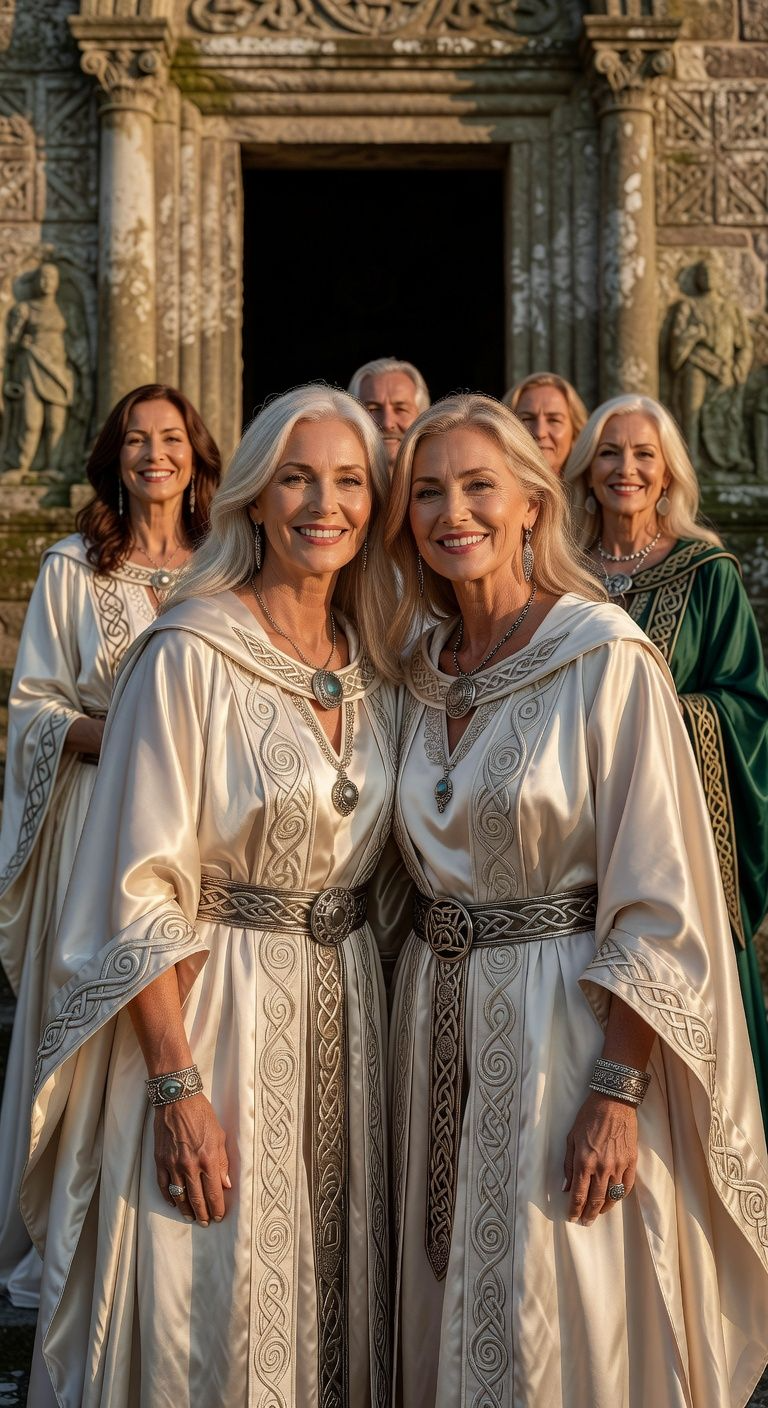
Where the Warrior’s Heart Finally Lays Down Its Sword — And Finds Its True Place
✦ A Tale for the Woman Who Knows She Was Made for More ✦
You have always known, have you not?
That quiet ache that lives beneath your ribs like a secret you dare not speak aloud. The sensation that arrives in the hollow hours before dawn — that somewhere, somehow, there exists a place where your strength would not be armour you must carry, but a gift you could offer.
You have built your life with competence and grace. You have succeeded in worlds that demanded you be harder, faster, more relentless than any reasonable soul should endure. You have worn your excellence like silk draped over steel — beautiful, formidable, untouchable.
And yet.
And yet.
There remains a chamber within you, locked so long you have nearly forgotten its existence. A chamber that holds the woman you might become if you finally permitted yourself to surrender. To belong. To serve a cause — and a woman — worthy of every ounce of devotion you have stored away like wine waiting for the perfect goblet.
This is a story for you.
Not merely a romance — though romance blooms here like night-blooming jasmine under alien stars. Not merely fantasy — though the world you are about to enter defies every limitation you have been taught to accept. This is a story of transformation. Of what happens when a woman who has given everything to everyone else finally discovers someone worth giving everything to.
Commander Thalia of the Queen’s Guard has spent thirty years being a weapon. She has forgotten how to be a woman. She has forgotten — if she ever truly knew — what it feels like to be seen, cherished, and claimed by someone who recognises that her strength is not diminished by surrender, but transfigured by it.
Lady Arianne has waited three thousand years for such a woman.
In the Valley of Luminara, where starlight weaves through silver hair and satin gowns whisper secrets against willing skin, Thalia will discover what you have always suspected:
That the deepest freedom lies not in independence, but in devotion freely given.
That the greatest strength is not in never yielding, but in yielding to the one who deserves your everything.
That you — brilliant, accomplished, powerful you — were made to kneel before someone who will lift you higher than you could ever climb alone.
Come, dear reader.
The temple awaits.
And so does the woman who has been waiting for you since before the stars learned to burn.
Chapter One: The Wound That Walks
The road had no end. Thalia had walked for seventeen days through forests that whispered her failures back to her, through valleys that echoed with the silence of her empty future. Each step away from the Queen’s Guard felt like tearing a piece of herself free — but what remained when the tearing stopped? What was left when the uniform was folded and stored, when the sword was hung on a wall like a memorial to a life that no longer existed?
You have served with honour.
The words haunted her. They followed her like ghosts, repeating in the voices of every commander who had ever praised her, every monarch who had ever knighted her, every soldier who had ever saluted her. Honour. As if honour could warm a bed that was always empty. As if honour could fill the hollow space in her chest where purpose used to live.
She was forty-nine years old. Her body bore the map of three decades of warfare: a ragged line across her ribs where a berserker’s blade had nearly opened her; the silvery web of burn tissue along her left forearm from a siege fire that had consumed half her unit; the subtle hitch in her gait from an arrowhead that had shattered against bone and never quite healed right. Each scar a story. Each story a reminder that she had given everything — everything — and been thanked with a pension and a pat on the shoulder.
Your sacrifice is honoured.
Honour. The word had begun to taste like ash in her mouth.
On the eighteenth night, the dream came.
Thalia had made camp in a grove of ancient oaks, their branches intertwining overhead like the fingers of old lovers. She had not bothered with a fire — the night was warm, and she had long ago stopped fearing the dark. What could the darkness take from her that the light had not already claimed?
She fell into sleep as she always did: suddenly, completely, like falling into water. But this sleep was different. This sleep had weight to it, had texture, had the sense of crossing a threshold she could not see.
She stood in a valley.
It was unlike any place she had ever known. The sky stretched overhead in a perpetual twilight — neither day nor night but something luminous between, a state of suspended radiance that made her think of the moments before dawn, when the world holds its breath. Stars blanketed the heavens in numbers that defied counting, and the light they cast was not cold but warm, not distant but intimately close, as if she could reach up and trail her fingers through constellations.
A path wound before her, lined with flowers that glowed soft blue. Their scent filled her lungs with something that tasted like remembrance, like yearning, like the ache of a song half-remembered from childhood. She could not have named the flowers — they existed nowhere in the mortal world — but she knew, with a certainty that bypassed thought entirely, that they were for her. That they had grown specifically to guide her steps.
She walked.
The path led her through meadows of silver grass that whispered against her legs, past streams that caught the starlight and scattered it into a thousand dancing fragments. And at the end of the path, rising from the landscape like something dreamed rather than built, stood a temple.
Its spires were organic, curved, grown rather than constructed. They reached toward the thick-starred sky in spirals that made her think of shells, of unfurling ferns, of the way water eddies around a stone. The walls shimmered with their own inner light, and even from a distance, she could feel the temple’s presence — not as a building but as a consciousness, something vast and patient and aware.
A woman stood at the threshold.
Her hair was silver — not the silver of age but the silver of moonlight, of starlight, of precious metals forged in celestial fires. It cascaded over her shoulders like liquid light, pooling around her feet in a gown that seemed to be made of the same luminescent fabric. Her face remained unclear, shrouded in radiance, but her voice…
Her voice resonated through Thalia’s chest, bypassing her ears entirely, speaking directly into the hollow spaces where her heart should be.
“You have spent your life serving others’ causes.”
The words were not an accusation. They were an invitation.
“Come serve one that is your own.”
Thalia tried to speak, but the sounds dissolved in her throat. She tried to move forward, but her body felt anchored, held in place by the weight of everything she had never allowed herself to want.
The woman extended her hand.
The gesture was simple, intimate, devastating. It was the gesture of someone who offered not rescue but recognition — who saw Thalia not as a weapon to be used but as a soul to be claimed.
Thalia reached for her —
And woke.
The dreams continued for seventeen nights.
Each night, the valley became more real. Each night, the path became more familiar. Each night, the silver-haired woman revealed more of herself — not her face, which remained veiled in light, but her presence, her essence, the quality of her attention.
It was the attention that undid Thalia.
She had spent thirty years being looked through. Commanders looked through her to the victories she could win. Monarchs looked through her to the protection she could provide. Soldiers looked through her to the orders she could give. No one had looked at her in longer than she could remember. No one had seen the woman beneath the armour.
But this woman — this being of starlight and silver — looked. Her gaze was a weight, a warmth, a wilderness of recognition that made Thalia feel simultaneously exposed and held. It was the most terrifying thing she had ever experienced. It was also the most intoxicating.
On the ninth night, the woman spoke again:
“I know what you are, Thalia of the Queen’s Guard. You are a woman who has never been permitted to need. You have been strong for so long that you have forgotten what it feels like to be held. You have given so completely that you have lost the ability to receive.”
Thalia tried to turn away, but the woman’s gaze held her.
“This is not weakness. This is the deepest wound a warrior can carry: the belief that you must always be the weapon and never the hand that holds it. But I see you. I have always seen you. And I am offering you something you have never been offered before.”
“What?” Thalia heard herself ask, the word torn from somewhere deep and protected.
“The chance to belong to someone who will never use you up. The chance to serve someone who will pour back into you everything you give. The chance to be claimed, completely and forever, by someone who considers your devotion the most precious gift in existence.”
The woman took a step closer. Her gown rippled like captured starlight.
“I am asking you to give me everything. In return, I will give you yourself.”
On the seventeenth night, Thalia made her choice.
She packed her bag with the few possessions she had kept after her discharge: a change of clothes, a waterskin, a small pouch of coins, a dagger she could not bring herself to surrender. She left the grove of oaks and began to walk.
She did not know where she was going. She only knew that she was being pulled — that something had hooked itself into the hollow space behind her ribs and was drawing her forward with a force she could not resist.
She walked for seven days.
The route took her through landscapes that seemed to shift around her, as if the world itself were conspiring to bring her to her destination. Rivers that should have been impassable lowered their waters for her crossing. Forests that should have been impenetrable opened paths that had not existed moments before. Mountains that appeared on no map rose before her — and in their sides, passes opened that should not have been there.
On the seventh day, she reached the barrier.
It shimmered in the air like a curtain of light, like the surface of a soap bubble stretched across the world. Beyond it, she could see the valley from her dreams — the silver grass, the glowing flowers, the impossible temple rising against a sky thick with stars.
Her warrior’s instincts screamed at her to turn back. This was unknown territory. This was potentially hostile ground. This was the kind of situation that had gotten soldiers killed for centuries — the seductive unknown, the trap disguised as salvation.
But her heart — the hollow, aching thing she had tried so long to ignore — whispered differently.
This is what you have been searching for. This is what has been calling you since you were old enough to know you were lost. This is the answer to the question you have never been brave enough to ask.
She stepped forward.
The light parted around her like silk curtains, like water around a swimmer’s body, like the veil between worlds thinning to welcome her through. The sensation was not unpleasant — it was a tingling warmth that spread through her skin, a whisper of recognition that brushed against her consciousness and was gone.
She emerged into the valley.
The air was different here — cleaner, sweeter, carrying scents she could not name but that made her think of comfort, of safety, of home. The grass beneath her feet glowed faintly blue, and when she looked up, she saw that the stars were closer than should have been possible, as if she had climbed into the sky itself without realising.
And there, at the entrance to the temple, stood the woman from her dreams.
Up close, she was more beautiful than Thalia’s sleeping mind had been able to comprehend. Her hair was indeed silver — but silver threaded with gold, with platinum, with colours that had no names in any language Thalia knew. It fell past her waist in waves that moved like water, like light, like something alive. Her gown was a cascade of liquid radiance that shifted and shimmered with her every breath, clinging to a form that was both commanding and graceful, both powerful and tender.
Her face was finally visible — and it was a face that stopped Thalia’s heart.
It was not youth that made her beautiful. It was presence. It was depth. It was the sense of looking into eyes that had seen centuries pass and still found something worth seeing. Her features were elegant, composed, with high cheekbones and a mouth that seemed caught between severity and tenderness. And her eyes…
Her eyes were not a single colour. They were depths within depths, galaxies within galaxies, the kind of eyes that could swallow a person whole and leave them grateful for the consumption.
“Welcome, Thalia.” Her voice was lower in person, richer, resonant in a way that made Thalia’s chest vibrate. “I have been waiting for you. For a very long time.”
Thalia’s knees threatened to buckle. She caught herself, drew herself up, summoned the pride that had sustained her through decades of service.
“Who are you? What is this place?”
The woman smiled. The expression transformed her face, softened the severity, illuminated the tenderness beneath.
“I am called Lady Arianne. This is the Temple of Eternal Flame. And you…” She stepped forward, closing the distance between them, until she stood close enough that Thalia could feel the warmth radiating from her skin. “You are the answer to a prayer I have been whispering for three thousand years.”
Lady Arianne led her through the temple’s entrance, and Thalia felt the world shift beneath her feet.
The interior was vast and intimate at once, a paradox of space that seemed to expand and contract depending on where she looked. The walls curved like the inside of a shell, organic and alive, pulsing with a soft luminescence that responded to their presence. When Thalia reached out to touch the surface, it felt warm beneath her fingers — warm and faintly aware, as if the temple itself were a living thing.
“The temple grows,” Lady Arianne explained, watching her with those depthless eyes. “It has been growing for three thousand years. It knows what those within it need, and it provides. Already, it has begun to prepare for you.”
“Prepare for me?”
“It sensed your approach the moment you crossed the barrier. It has been creating spaces suited to your spirit. Your chambers are ready. Your bath has been drawn. Your clothes have been laid out.”
She paused, and something shifted in her expression — a softening, an invitation, a testing.
“But before I show you to your rooms, I must ask you something.”
Thalia tensed. “Ask.”
Lady Arianne stepped closer. Her gown whispered against itself with a sound like distant bells, like wind through silver birch leaves. The fabric shifted as she moved, and Thalia found herself mesmerised by its flow, by the way it caught the light and held it.
“I know why you came. I know the wound you carry — the belief that you have nothing left to give, that you have been used up and discarded by a world that valued your service but never valued you. I know the emptiness that has been your constant companion since you laid down your sword.”
She lifted her hand. Her fingers were long, elegant, tipped with nails that gleamed like polished moonstone. She reached toward Thalia’s face — slowly, giving her time to pull away — and brushed a strand of hair back from her temple.
The touch was electric. It shot through Thalia like lightning, like recognition, like the first sip of water after days in the desert.
“I am offering you something different,” Lady Arianne continued, her voice low and intimate. “Not a commission. Not a contract. Not service in exchange for a pension and a pat on the shoulder. I am offering you belonging. I am offering you a place where your devotion will be received as the precious gift it is, where your service will be met with care, where your surrender will be honoured and cherished and rewarded.”
Her fingers traced down Thalia’s cheek, along her jaw, coming to rest beneath her chin.
“I am asking you to give me everything — your time, your attention, your loyalty, your body, your heart. In return, I will give you something you have never had: someone who sees you, who values you, who will never discard you. I will make you mine, completely and forever. And you will discover that being mine is not a cage but a liberation.”
She tilted Thalia’s face upward.
“Do you understand what I am asking?”
Thalia’s heart was pounding. Her warrior’s instincts were screaming warnings she could no longer hear. Her body was trembling with something that felt like fear and longing and terror and hope all tangled together.
“I… I don’t know if I have anything left to give.”
The words came out before she could stop them — a confession, an admission of weakness, the kind of thing a commander could never say aloud.
Lady Arianne’s expression softened further.
“That is precisely why you must give it. Not because you have plenty left to offer, but because you have nothing left to keep. The vessel that is completely empty can finally be filled. The heart that has given everything can finally receive.”
She stepped back, releasing Thalia’s face, and gestured toward a corridor that stretched into the temple’s depths.
“You are tired. You have walked a very long way to reach me. Tonight, you will rest. You will bathe, and eat, and sleep in a bed that has been prepared specifically for you. Tomorrow, you may leave forever if you choose — the barrier will open for you, and I will not try to stop you. Or…”
She paused, letting the word hang in the air between them.
“Or you may choose to stay. You may choose to explore what it might mean to be mine. The choice will always be yours. I do not take what is not freely given. But I hope — I have hoped for three thousand years — that you will choose to give it.”
She turned and began to walk down the corridor, her silver gown flowing behind her like a river of light.
“Come. Let me show you where you will sleep tonight. And let me show you, just a little, what awaits you if you stay.”
The chamber took Thalia’s breath away.
It was circular, with walls that curved upward into a dome that appeared open to the night sky. Thousands of stars were visible through the transparent ceiling, and they seemed closer here than they had been outside — close enough to touch, close enough to pluck from the darkness and hold in her palm.
A bed stood at the centre, draped in fabrics that shimmered with their own inner light. They were blues and silvers and midnight blacks, and when Thalia reached out to touch them, they felt like water under her fingers, like silk multiplied by infinity, like something designed specifically to make her body sigh with pleasure.
A bath had been prepared in an alcove, steam rising from water that glowed faintly blue. The scent that rose from it was unlike anything she had ever encountered — flowers that existed in no mortal garden, spices that grew in no mortal soil, a combination that made her think of comfort, of safety, of being held.
But it was the woman waiting beside the bath that captured her attention.
She was tall and elegant, appearing perhaps forty, with auburn hair that fell past her shoulders in waves of polished bronze. She wore a gown of deep burgundy that gleamed in the soft light — satin, Thalia realised, but satin unlike any she had touched before. It seemed to hold light within its weave, to shimmer and shift with every movement, to whisper against itself with a sound that made Thalia think of secrets, of intimacies, of things spoken in darkness.
“This is Lyrien,” Lady Arianne said. “Keeper of the Sacred Flame. She will help you prepare for rest. She will answer any questions you have that you are not yet ready to ask me.”
Lyrien curtsied — not the subservient gesture of a servant, but the graceful acknowledgment of one who served by choice, who chose to bow.
“Welcome, seeker,” she said, and her voice was warm, melodic, rich with understanding. “I was where you are, once. I remember the feeling of standing at the threshold of something you cannot yet name. Let me help you cross it.”
Lady Arianne turned to Thalia one last time.
“Rest well. Dream of what it might feel like to belong. And know that whatever you decide tomorrow, I am grateful you came.”
She departed, her silver gown flowing behind her like moonlight, leaving Thalia alone with Lyrien in a chamber of stars.
Lyrien moved toward her with the grace of a dancer, of a priestess, of a woman who had long ago learned the art of putting others at ease.
“You have questions,” she said gently. “You may ask them. Or you may simply allow yourself to rest. Sometimes the body knows what the mind resists.”
Thalia found herself unable to speak for a moment. The chamber was too beautiful, the bath too inviting, the whole situation too impossible. She had spent thirty years in barracks, in tents, on battlefields. She had not known luxury like this existed.
“What is this place?” she finally managed. “What is she?”
Lyrien smiled. It was a knowing smile, the smile of someone who had asked the same questions and received answers that satisfied something deep within her.
“The Temple of Eternal Flame. It exists between worlds, in the space where need and possibility meet. And Lady Arianne…” She paused, her expression softening into something like reverence. “She is the answer to the question you have been asking your entire life without knowing it.”
“And the women here? The priestesses? What are they to her?”
Lyrien moved closer. Her burgundy gown whispered against itself, and the sound made Thalia’s skin prickle with awareness.
“We are those who chose. Who chose her, who chose this life, who chose to become something greater than we were. We serve her not because we must, but because serving her fulfils us in ways nothing else ever could.”
She reached for the fastenings of Thalia’s worn travelling clothes.
“May I?”
The question was another offering, another gesture of respect. Thalia nodded, not trusting her voice, and Lyrien’s fingers began to work at the ties and buckles that held her road-weary garments together.
*“How long have you been here?” Thalia asked as Lyrien peeled away layers of fabric that had grown heavy with sweat and dust and the exhaustion of seventeen days of walking.
“Two centuries,” Lyrien replied, and the words made Thalia’s hands freeze.
“Two centuries?”
“Time moves differently in Luminara. We serve Lady Arianne, and in return, she grants us purpose that does not diminish, and time that does not steal what we are. I have not aged a day since I arrived.” She guided Thalia toward the bath. “I was a healer in the mortal world. I had given my life to mending others, and when my own body began to fail, there was no one to mend me. Lady Arianne called me in dreams — as she called you — and I walked through the barrier expecting to die.”
She helped Thalia step into the water.
The warmth was immediate, all-encompassing, perfect. It wrapped around Thalia’s aching muscles like an embrace, like a long-awaited homecoming.
“I did not die,” Lyrien continued, kneeling beside the bath and taking up a cloth. “I was reborn. And in two centuries of service, I have never once regretted the choice I made.”
Her hands were gentle as she began to wash the road from Thalia’s skin. The cloth moved over scarred shoulders, down arms that had wielded swords and spears, across a back that had carried the weight of armies.
“You are thinking that this is impossible,” Lyrien said, her voice soft, her touch softer. “You are thinking that you should leave. But something holds you here. Something you cannot name.”
Thalia closed her eyes. The water cradled her. The scent of impossible flowers filled her lungs. Lyrien’s hands were soothing, worshipping, honouring.
“I have nowhere else to go,” she admitted, and the words tasted like surrender, like truth, like the first honest thing she had said in years. “But that is not the same as wanting to stay.”
“No,” Lyrien agreed. “But wanting grows from needing. And needing grows from allowing yourself to feel what you have denied.”
She rinsed the cloth, wrung it out, laid it aside.
“Sleep now. Tomorrow, you will face the choice. And whatever you decide, you will do so knowing what you are choosing between.”
She helped Thalia from the bath, dried her with towels that felt like clouds, guided her to the bed with its sheets of shimmering fabric. And as Thalia sank into softness beyond anything she had known, she felt Lyrien’s hand brush her forehead in benediction.
“Dream of her,” Lyrien whispered. “She is already dreaming of you.”
Thalia slept.
And as she slept, Lady Arianne came to her again — not in dream this time, but in the space between sleeping and waking, that liminal realm where the soul opens and the truth can finally enter.
The Lady sat on the edge of Thalia’s bed, her silver gown pooling like moonlight around her. Her hand came to rest on Thalia’s shoulder, on the scar that traced a ragged line across her ribs.
“You have been wounded in service,” she murmured, and her voice was a caress, a recognition, a mourning. “Wounded in body, wounded in spirit. You have given until you had nothing left to give, and still you tried to give more. That is the wound of a warrior who forgot she was also a woman.”
Her fingers traced the scar, following its path like a cartographer mapping a landscape of pain.
“Here, you do not have to choose. You can be both. You can serve and be served. You can give and receive. You can be strong and soft. You can be a weapon and a beloved.”
“I don’t know how,” Thalia whispered, not knowing if she spoke aloud or in dream, not caring anymore.
“I will teach you,” Lady Arianne said. “If you let me. If you stay.”
Her hand moved from Thalia’s shoulder to her face, cupping her jaw with exquisite gentleness. She tilted Thalia’s chin upward, and when Thalia opened her eyes, she found herself gazing into depths that held three thousand years of seeing, of knowing, of waiting.
“You think you have nothing left to offer. But what you have — what you have always had — is the capacity to devote yourself completely. You simply have never had a cause worthy of that devotion. Until now.”
She leaned down. Her hair fell around them like a curtain of light, like a veil separating them from everything that was not this moment. And her lips brushed Thalia’s forehead — a touch that burned through her like starlight, like recognition, like home.
“Tomorrow, you will decide. Sleep now. And dream of what it might feel like to belong.”
Thalia slept.
And in her dreams, she saw a future she had never imagined: herself, kneeling not in defeat but in devotion; herself, serving not from duty but from desire; herself, belonging not to a cause but to a person — to her.
And for the first time in thirty years, she did not wake with the ache of emptiness in her chest.
She woke with the first faint stirrings of hope.
Chapter Two: The Threshold of Stars
Dawn did not break in Luminara — it bloomed.
Thalia woke to find the chamber transformed. The stars that had blanketed the domed ceiling had softened, their brilliance dimming to a luminous grey that reminded her of the moments before sunrise, when the world holds its breath and the night reluctantly releases its grip. The walls pulsed with a gentler radiance now, a warm golden undertone creeping into the silver, as if the temple itself were responding to some celestial rhythm she could not perceive.
She lay still for a long moment, her body sinking into sheets that felt like woven cloud, like captured starlight given form, and allowed herself the rare luxury of feeling.
The bath the night before had been a revelation. Lyrien’s hands had moved over her scarred flesh with the reverence of a pilgrim touching sacred ground, washing away not merely the grime of seventeen days’ travel but something older, something caked deep in her spirit — the accumulated exhaustion of thirty years of being strong, of being useful, of being needed without ever being wanted. The water had drawn it from her like poison from a wound, and when she had finally climbed from the bath, she had felt lighter than she could remember ever feeling.
But it was the dream that lingered.
Lady Arianne’s touch on her forehead. The press of lips like starlight. The voice that resonated through her hollow spaces and filled them.
“Tomorrow, you will decide.”
She sat up slowly. The sheets whispered against her bare skin, and she realised with a small start that she was naked beneath them — that Lyrien must have removed her travelling clothes completely before tucking her into this impossible bed. The thought should have troubled her. In the Queen’s Guard, vulnerability was weakness, and weakness was death.
But here, in this chamber of softly glowing walls and star-touched ceilings, vulnerability felt like something else entirely.
It felt like an offering.
On a chair beside the bed, neatly arranged with the precision of someone who understood the ritual of dressing, lay garments unlike any Thalia had worn before.
She lifted them one by one, her fingers marvelling at textures that seemed to change beneath her touch. A chemise of silk so fine it appeared to dissolve between her fingers, weightless as a whisper, clinging to her skin like a second self when she drew it over her head. Trousers of a fabric that gleamed like liquid metal, flexible as cloth but catching the light in ways that metal should not. A tunic of deep midnight blue — satin, she realised, but satin woven from dreams, from starlight, from something that existed only in this valley between worlds. It cascaded over her form in waves of lustrous fabric, shifting from blue to purple to black depending on how the light caught it, whispering against itself with a sound that made her think of distant bells, of secrets spoken in the dark, of promises.
Boots of soft leather waited beneath, polished to a subtle gleam. And tucked beneath them, a note in elegant script:
For the woman you were.
For the woman you might become.
— L.A.
Thalia traced the letters with her fingertip. They had been written by hand — she could see the subtle variations in pressure, the flourishes that spoke of intention. Lady Arianne had written this. Had thought about what to say. Had considered her.
The thought settled into her chest like a warm stone, like an anchor, like the first thread of something she dared not name.
She dressed slowly, each layer transforming not merely her appearance but her sense of self. The silk against her skin was a continuous whisper of sensation, a reminder that she had a body, that this body could feel pleasure rather than merely pain. The satin tunic moved with her, its lustrous surface catching even the soft light of the chamber and throwing it back in subtle rainbows. When she caught her reflection in a polished mirror mounted on one curved wall, she barely recognised herself.
The woman who stared back was still scarred, still weathered, still carrying the evidence of three decades of warfare. The silver line across her ribs was visible through the thin silk. The burn-mark on her forearm caught the light. But something in her eyes had changed. The hardness had softened. The emptiness had begun to fill with something tentative, something fragile, something terrifyingly like hope.
She looked, she realised, like someone who might be choosing.
The corridor that led from her chamber wound through the temple like the path of a river, organic and meandering, following some logic of its own rather than the rigid geometry of mortal architecture. The walls breathed with soft light that shifted as she passed, warming from silver to gold to the pale rose of early morning. Occasionally she glimpsed other passages branching away, glimpses of chambers she had not yet seen, of gardens visible through windows that seemed to open onto impossible skies.
She walked without knowing where she was going, trusting the temple to guide her. And it did.
The passage opened into a vast atrium, its ceiling lost in luminous mist, its floor patterned with stones that seemed to glow from within. Plants grew in careful profusion — flowering vines that climbed pillars of what looked like crystallised starlight, trees with leaves that chimed softly in unfelt breezes, beds of flowers whose petals held the same soft blue luminescence as the path from her dreams. The air was thick with their scent, a perfume so complex she could not separate its components, only know that it made her think of safety, of belonging, of being held.
And at the centre of the atrium, standing in a column of pale light that fell from some unseen opening above, was Lady Arianne.
She wore a different gown today. The silver of the night before had been replaced with deep violet — a colour that seemed to shift and breathe as Thalia watched, becoming purple, becoming indigo, becoming the colour of the sky just after sunset. The fabric had the same impossible quality as the gown from her dreams, the same liquid flow, the same way of catching and holding light. It clung to the Lady’s form in ways that emphasised rather than revealed, suggesting the power beneath the beauty.
Her silver hair was swept up today, secured with pins that gleamed like stars, exposing the elegant column of her neck, the delicate architecture of her ears. She stood with the stillness of someone who had learned patience over millennia, who could wait without fidgeting, without the constant restless motion that characterised mortals.
She turned as Thalia approached.
“You have rested.” Her voice was lower in the morning light, resonant with something that made Thalia’s chest vibrate. “You have been clothed. You have been shown something of what awaits you if you stay.”
She gestured toward the far end of the atrium, where Thalia could see an archway that seemed to shimmer with barely contained energy — the way back. The way out. The return to the world that had used her up and thrown her away.
“That way lies everything you have known. The world that discharged you when you were no longer convenient. The life that has no place for you now that your sword has been hung on a wall. The emptiness that has been your constant companion since you realised that honour is cold comfort in an empty bed.”
The words struck Thalia like blows, but not painful ones — they were true, and their truth was a relief, a recognition. Someone saw. Someone understood.
“You are free to return to it,” Lady Arianne continued. “I will not stop you. I will not think less of you. The barrier opens for those who need it; it does not compel them to stay. You may walk through that archway and resume the slow fade into irrelevance that awaits warriors who outlive their usefulness. You may return to your sister’s uncomfortable hospitality, to the pitying looks of those who once feared you, to the gradual dissolution of self that comes from having nothing left to give.”
She paused, letting the words settle, letting Thalia feel the weight of that future pressing against her.
Then she turned her hand over, palm up, in that gesture of invitation that had haunted Thalia’s dreams for seventeen nights.
“This way lies something different.”
Her eyes held Thalia’s, and in their depths, she saw not demands but possibilities.
“Not ease — transformation is never easy. Not rest — those who serve me work harder than they ever worked in their mortal lives. But purpose. Belonging. The chance to become what you were always meant to be, in service to something that will never abandon you, never use you up, never cast you aside when you are no longer convenient.”
She stepped forward, closing the distance between them, until she stood close enough that Thalia could feel the warmth radiating from her skin, could smell the subtle perfume that clung to her — starlight and moonflowers and something deeper, something that made her think of home.
“I am asking you to give me everything,” Lady Arianne said, her voice dropping to an intimacy that bypassed Thalia’s ears and spoke directly to her soul. “In return, I am offering to give you yourself. The woman you buried beneath the armour. The woman you forgot in order to survive. The woman who knows how to serve, how to give, how to surrender — not from weakness, but from the profound understanding that true strength lies in choosing what you belong to.”
Her hand rose, hovering near Thalia’s face without touching, waiting.
“The choice is yours. It has always been yours. Will you walk back into the nothing that awaits you? Or will you step forward, into something you cannot yet imagine?”
Thalia’s body moved before her mind could argue.
It was not thought that drove her — it was something deeper, something that lived in the hollow spaces behind her ribs, in the ache that had been her companion for so long she had forgotten it was not a natural part of existence. Her knees bent of their own accord. She sank to the stone floor, the satin of her tunic pooling around her like dark water, and looked up into the face of the being who had haunted her dreams.
“I don’t know if I can give you everything.”
The words came out rough, torn from somewhere deep and protected.
“I have spent thirty years learning to give nothing that was not required. I have learned to hold back, to reserve, to protect the small secret self that no one could touch. I don’t know if I remember how to offer without calculation. I don’t know if I have anything left that is worth offering.”
Lady Arianne’s expression softened. The severity in her face gave way to something tender, something that looked achingly like compassion.
“That,” she said quietly, “is precisely why I want it.”
She lowered herself to her knees as well, bringing herself level with Thalia, and when she spoke again, her voice was close, intimate, meant only for the space between them.
“I do not want what you have carefully preserved. I do not want the calculated gifts you learned to give to commanders and monarchs. I want the small secret self you have hidden away. I want the part of you that aches to belong, that hungers to be seen, that trembles at the thought of surrender because it knows that surrender would mean finally being held.”
Her hand finally touched Thalia’s face — a brush of fingertips along her jaw, light as moth wings, devastating as lightning.
“I want your fear. I want your doubt. I want the broken places you think are ugly, because I know they are the places where light can enter. I want everything you think is not worth offering — because that is the offering I have been waiting three thousand years to receive.”
Thalia felt tears prick at her eyes. She could not remember the last time she had cried. In the Queen’s Guard, tears were weakness, and weakness got people killed.
But here, kneeling on stones that glowed with inner light, before a woman who saw through every defence she had ever built, tears felt like something else entirely.
They felt like release.
“I want to try,” she whispered. “I want to learn. I want…”
She swallowed hard, forced herself to speak the truth she had never admitted to anyone.
“I want to belong somewhere. To someone. I want to stop being a weapon and become a woman who serves by choice. I want to know what it feels like to be wanted, not just needed.”
Lady Arianne’s hand moved to cup her cheek, the touch warm and impossibly gentle.
“Then you shall,” she said. “Rise, Thalia of the Queen’s Guard. You have served your last queen. Now you will serve me. And I will teach you what it means to be mine.”
She led Thalia through corridors that curved like the interior of a shell, past chambers that glowed with soft luminescence, through archways that seemed to breathe with contained power. The temple felt different now — not merely beautiful but alive, aware of their passage, responding to the choice that had been made. The light in the walls warmed as they walked, deepened from silver to gold to the soft amber of honey. The air grew thicker with the scent of flowers whose names Thalia did not know, but whose perfume made her think of yes, of finally, of the answer to a question she had been asking her whole life.
Lady Arianne walked beside her, not ahead, not leading in the way commanders led — but guiding, her presence a subtle pressure that suggested rather than demanded. Her violet gown rippled with each step, the fabric whispering against itself in a sound like distant chimes, and Thalia found herself mesmerised by its flow, by the way it caught even the soft light of the corridors and threw it back in shifting patterns.
“You have questions,” Lady Arianne said without looking at her. “I can feel them pressing against you. You may ask.”
“What will be required of me?”
“Everything. But not all at once. I am not a monarch who demands tribute and gives nothing in return. I am… something different. I am a home for those who have nowhere else to go. A purpose for those whose purpose has faded. A belonging for those who have been alone too long.”
She turned a corner, and the corridor opened into a vast circular chamber.
“This is where the transformation begins.”
The room took Thalia’s breath away.
It was dominated by a flame that rose from a basin of what appeared to be solidified starlight — a fire that burned without consuming, that cast dancing shadows on walls that seemed to breathe with its light. The flame was not orange or red but a deep violet-blue, shot through with threads of silver and gold, crackling with a sound like distant bells, like whispered prayers.
Around the flame stood other women.
Thalia counted twelve of them, arranged in a loose circle, their gowns gleaming in the firelight — burgundy and emerald and midnight and ivory, satin and silk and velvet that caught the dancing light and threw it back in fragments. They stood with the stillness of those who had long ago learned patience, and their faces held expressions that blended welcome with solemnity, warmth with gravity.
Lyrien was there, her auburn hair gleaming like polished bronze, her burgundy gown flowing around her form like liquid wine. She met Thalia’s eyes and smiled — a smile of recognition, of understanding, of someone who remembered standing where Thalia stood now.
At the head of the circle stood another woman, tall and commanding, her hair white as fresh snow, her gown a deep midnight that seemed to absorb the light rather than reflect it. Her face was composed, her eyes sharp, and when she spoke, her voice carried the weight of centuries.
“Thalia of the Queen’s Guard. You have chosen to offer yourself to the service of Lady Arianne and the Temple of Eternal Flame.”
It was not a question. It was a statement, a beginning.
“This is not a vow taken lightly.” The woman stepped forward, her midnight gown whispering against the stone floor. “Those who serve here serve forever. The temple grants time — you will not age, you will not sicken, you will not die of natural causes. But in return, it requires commitment. Complete and unwavering.”
She stopped before Thalia, and her sharp eyes seemed to pierce through every defence Thalia had ever constructed.
“You may still turn back. The archway remains open. But once you pass through this flame, you are changed forever. You become ours. You become hers. There is no returning to what you were.”
Thalia felt the weight of the words, of the choice. She looked at the flame, at its impossible colours, at the way it seemed to reach toward her like a living thing. She looked at the women who surrounded her, their faces holding centuries of service, of devotion, of belonging. She looked at Lady Arianne, standing at the edge of the circle, her violet gown glowing in the firelight, her face holding an expression of such profound patience, such deep hope, that it made Thalia’s chest ache.
“I understand,” she said, and her voice did not waver. “I choose to stay.”
The woman in midnight nodded slowly.
“I am Miriel, High Priestess of the Eternal Flame. I have served Lady Arianne for five hundred years. I have watched countless women stand where you stand now. Some have flourished. Some have struggled. All have been transformed.”
She gestured toward the flame.
“Step through. Be reborn.”
Lady Arianne moved forward then, her violet gown flowing like water, like light, like something that existed only in dreams. She extended both hands to Thalia, and when she spoke, her voice resonated through the chamber, through Thalia’s bones, through the hollow spaces where her heart should be.
“I accept your offering.” Her fingers intertwined with Thalia’s, warm and impossibly gentle. “I receive your devotion. I promise, in return, to guide you, to challenge you, to transform you, and to never abandon you. You will suffer in my service — growth requires suffering. But you will also know joy you have never imagined. Purpose you have never felt. Belonging that will never end.”
She drew Thalia toward the flame.
“Step through. Be reborn.”
The fire was cool.
Thalia had expected heat, had braced herself for the searing pain she remembered from the siege fire that had marked her forearm. But this was different — this was a sensation like diving into clear water, like being wrapped in soft silk, like falling through starlight. It rushed over her and through her, and she felt it reaching into places she had kept locked for decades, touching the wounds she had never allowed to heal, filling the hollow spaces she had pretended did not exist.
She felt herself dissolve.
Not painfully, not fearfully — but willingly, like salt dissolving in warm water, like ice melting in spring. Every hardness she had constructed, every wall she had built, every defence she had maintained — the flame touched them all, and they yielded.
And in their place, something new began to grow.
When she emerged on the other side, her body felt different. Lighter. More present. More herself than she had felt in thirty years.
She looked down at herself. The midnight blue tunic had transformed. It was now a gown of deep blue satin, fitted to her form, cascading to the floor in waves of lustrous fabric that seemed to hold their own inner light. When she moved, the fabric whispered against her skin with a sound like distant bells, like recognition.
Her scars remained — she could see the silver line across her ribs through the thin fabric, feel the familiar ridge of burn tissue on her forearm. But they felt different now. Not marks of damage but evidence of journey, like the worn stones of an ancient road, like the weathered face of a beloved building. They were part of her story. And her story was just beginning.
“You are one of us now,” Lyrien said, appearing at her side, her burgundy gown gleaming in the firelight. “You have been transformed. The scars remain — they are part of what made you. But everything else is different. You will see.”
Lady Arianne took her hand. The touch sent warmth cascading through her, and Thalia realised with a start that it felt different now — more intense, more intimate, as if every nerve ending had been sharpened by the flame.
“Come,” Lady Arianne said, her violet gown flowing around her as she turned toward the chamber’s exit. “There is much to learn. And I will teach you everything.”
She led Thalia from the chamber, through corridors that now seemed to glow with welcome rather than mystery, toward a future the warrior could not yet imagine. Behind them, the other priestesses watched with knowing smiles.
They knew what Thalia did not yet: that she had just taken the first step toward becoming something she had never dared dream she could be.
Chapter Three: The Rite of Choosing
The morning after her transformation, Thalia woke to find the world had taken on new dimensions.
Light moved differently now — she could perceive depths within it that had been invisible before, layers of luminosity that shifted and breathed like living things. The ceiling of her chamber, which had seemed merely beautiful the night before, now revealed patterns she had not noticed: constellations traced in the stone, spiralling outward from a central point in configurations that matched no mortal star-chart but felt somehow familiar, as if they had been etched into her memory during her passage through the flame.
She lay still for a long moment, allowing sensation to wash through her. The sheets against her skin — still that impossible fabric that felt like woven starlight — registered with an intensity that bordered on the overwhelming. Every thread seemed to whisper against her flesh, every fold a small devotion, a continuous reminder that she had a body, that this body was capable of receiving pleasure rather than merely enduring pain.
The thought should have frightened her. For thirty years, she had trained herself to ignore sensation, to push through discomfort, to treat her physical form as a machine whose complaints were irrelevant to the mission at hand. To suddenly be aware of it — to feel every brush of silk, every whisper of air, every subtle shift of temperature — was like learning a new language without a teacher.
But she was not without a teacher.
A soft knock at her chamber door interrupted her reverie. Before she could respond, the door opened, and Lyrien entered bearing a tray laden with fruit, bread, and a steaming cup that smelled of flowers whose names Thalia did not know.
“Good morning, sister.” Lyrien’s voice was warm, rich with the ease of someone who had delivered this greeting countless times before. “You slept deeply. That is well. The transformation takes much from the body, and the body must be replenished.”
She set the tray on a low table near the window — a window Thalia had not noticed the night before, its crystalline panes looking out onto a garden where flowers glowed with soft blues and purples, where butterflies the size of her hand drifted on currents of light.
“I have been sent to prepare you,” Lyrien continued, moving to the wardrobe that occupied one curved wall. “Today is your Rite of Choosing — the formal ceremony in which you declare your devotion before the sisterhood and receive your first duties from Lady Arianne herself.”
Thalia sat up slowly, the midnight blue sheets pooling around her waist. The movement made her aware of the satin nightgown she wore — when had she changed? — and its whisper against her skin sent cascades of sensation through her newly awakened nerves.
“I passed through the flame,” she said, her voice rough with sleep and something deeper. “Is that not the choosing?”
Lyrien smiled as she opened the wardrobe, revealing an array of garments that seemed to glow with their own inner light.
“The flame transforms. The Rite consecrates. They are different things, you see. The flame works upon the soul — opens it, prepares it, makes it capable of receiving. But the Rite works upon the bond between devotee and mistress. It formalises what has been promised. It makes visible what has been felt.”
She withdrew a gown of deep midnight blue — darker than anything Thalia had seen before, a fabric that seemed to hold the night sky itself within its weave.
“This has been prepared for you. The temple knows what you need before you know you need it. Put it on. Let me help you prepare. The ceremony begins at the rising of the first star, and there is much to do before then.”
The preparation was ritual itself.
Lyrien guided Thalia to a bath that had been drawn in an alcove she had not noticed the night before, its waters steaming and glowing faintly blue. She stepped into it with Lyrien’s steadying hand on her arm, and the warmth that enveloped her was unlike anything she had known — not merely heat but healing, as if the water could reach into her cells and smooth the rough edges that thirty years of warfare had carved.
“The water comes from the sacred spring beneath the temple,” Lyrien explained as she knelt beside the bath, taking up a cloth that seemed woven from gauze and starlight. “It carries the essence of the flame — not the fire itself, but its purification. Each morning you will bathe in it. Each morning you will be remade.”
She began to wash Thalia with slow, reverent strokes, the cloth tracing paths across scarred shoulders, down arms that had wielded swords and spears, along the ridge of her spine where muscles had knotted from decades of tension.
“I was where you are, once,” Lyrien said, her voice soft, almost meditative. “I came to the temple two centuries ago, a healer whose own body had betrayed her. I had spent my life mending others, and when I fell ill, there was no one to mend me. I lay in my bed, watching my hands — hands that had saved countless lives — tremble with weakness. And then she came to me in a dream.”
Her hands paused, resting on Thalia’s shoulders.
“Lady Arianne appeared at the foot of my bed, her silver hair flowing like moonlight, and she asked me a single question: ‘What would you give to be well again?’ I told her I would give anything. And she smiled — that smile that makes you feel as if you are the only person in existence — and said, ‘Then give me everything, and I will give you more than wellness. I will give you purpose.'”
Thalia turned her head slightly, meeting Lyrien’s eyes.
“And have you regretted it? In two centuries?”
“Not once.” The answer came without hesitation. “I serve her. I am seen by her. I belong to her. And in return, I have received two hundred years of meaning, of sisterhood, of belonging. The world outside these walls — the world that used me until I had nothing left — it has continued without me. Kingdoms have risen and fallen. Wars have been fought and forgotten. But here, in this temple, I have been useful. I have been valued. I have been loved. What could the mortal world offer to compare?”
She resumed washing, her hands moving with the practiced ease of long devotion.
“You will understand. In time. But first, you must choose. Truly choose. Not from desperation, not from emptiness, but from the fullness of knowing what you offer and what you receive.”
After the bath, Lyrien led her back to the wardrobe.
The gown she had selected was more beautiful than anything Thalia had ever worn. Midnight blue satin, so dark it seemed to swallow light, yet so luminous that it appeared to glow from within. The fabric flowed like water when Lyrien lifted it from its hanger, whispering against itself with a sound like distant chimes.
“Satin is sacred in the temple,” Lyrien explained as she helped Thalia step into the gown. “It represents the surface of water — the boundary between worlds, between states of being. When we wear it, we honour the choice we made to cross from one existence to another. We honour the transformation that brought us here.”
The fabric slithered up Thalia’s body, clinging to curves she had learned to ignore, moving with her breath like a second skin. When Lyrien fastened the closures — intricate hooks and ties that ran from hip to collar — the gown seemed to settle into place, as if it had been made specifically for her form.
Perhaps it had. The temple, Lyrien had said, knew what she needed before she knew she needed it.
“Your hair,” Lyrien said, guiding Thalia to sit before a mirror of polished silver. “It must be arranged properly. In the Rite, you present yourself to Lady Arianne as an offering. Every detail matters. Every strand must be intentional.”
She worked in silence for a time, her fingers deft and sure, weaving Thalia’s hair into an intricate arrangement that exposed her neck, her jaw, the delicate architecture of her ears. When she finished, Thalia barely recognised herself.
The woman in the mirror was still scarred, still weathered, still carrying the evidence of three decades of warfare. But she was also something else now — present in a way she had not been before, aware of herself as something other than a weapon. The midnight gown clung to her form like darkness clinging to a star, and her eyes — those eyes that had seen so much death — now held something that looked terrifyingly like hope.
“You are ready,” Lyrien said, meeting her gaze in the mirror. “Come. The sisterhood awaits. And Lady Arianne…” She smiled. “She has been waiting for this moment for a very long time.”
The Hall of the Eternal Flame was vast and intimate at once.
Thalia entered through doors that seemed to open of their own accord, her midnight gown flowing around her like a shadow given form, her newly arranged hair exposing the vulnerable lines of her neck. The chamber stretched before her, its domed ceiling lost in luminous mist, its walls breathing with soft light that shifted from silver to gold to the pale rose of dawn. At the centre, the flame burned — that impossible violet-blue fire shot through with threads of silver and gold, crackling with sounds like distant bells.
Around the flame, arranged in a loose semi-circle, stood the sisterhood.
There were twelve of them, Lyrien had said. Twelve priestesses who had dedicated their immortal lives to serving Lady Arianne, to maintaining the temple, to guiding seekers who found their way through the barrier. Thalia recognised some of them from the night before — Lyrien in her burgundy, Miriel in her midnight, others in gowns of emerald and ivory and deep amber. They stood with the stillness of those who had long ago learned patience, and their faces held expressions that blended welcome with solemnity.
At the far end of the chamber, on a dais that seemed grown rather than built, stood a throne of crystallised starlight. And upon it sat Lady Arianne.
She wore silver today — a gown that flowed like liquid moonlight around her form, that caught even the soft light of the chamber and threw it back in fragments of brilliance. Her hair was loose, cascading over her shoulders and down her back like a river of light, and upon her brow rested a circlet of what appeared to be captured stars. She sat with the stillness of a goddess awaiting tribute, and when her eyes met Thalia’s, they held depths that seemed to reach into forever.
“Approach,” Lady Arianne said, and her voice filled the chamber without rising, resonated through Thalia’s bones without effort. “Come forward, seeker, and present yourself.”
Thalia walked.
The distance seemed both infinite and instantaneous — each step an eternity, each breath a lifetime, yet she arrived at the dais as if no time had passed at all. The sisterhood watched in silence, their eyes following her progress, their presence a wall of support and witness.
She reached the base of the dais and sank to her knees, her midnight gown pooling around her like darkness at the edge of starlight.
“State your name,” Lady Arianne said.
“Thalia. Formerly of the Queen’s Guard.”
*“State your purpose.”
The question caught her off guard. She had expected to be told her purpose, not asked to declare it. But she understood, in some deep place that the flame had opened, that this was part of the choosing — that she must name what she sought, must claim it with her own voice.
“To serve,” she said, the words coming from somewhere deeper than thought. “To belong. To give myself completely to something that will not discard me. To become…” She paused, feeling the truth of it settle into her bones. “To become yours.”
Lady Arianne’s expression shifted — not dramatically, but subtly, the severity in her face giving way to something that looked achingly like tenderness.
“You offer yourself to me? Freely? Without coercion, without desperation, without the hope of anything in return but the honour of serving?”
“I do.”
“You understand that this offering, once accepted, cannot be withdrawn? That you are giving me not merely your service but your self — your body, your heart, your will, your immortal soul? That you will be mine, in every sense, for as long as the flame continues to burn?”
The words should have frightened her. They should have triggered every instinct for self-preservation that thirty years of warfare had honed. But instead, they settled into her like truth, like coming home, like the answer to a question she had been asking her whole life.
“I understand. And I choose.”
Lady Arianne rose from her throne.
The silver gown flowed around her like light given form, and as she descended the steps of the dais, the sisterhood stirred, their attention sharpening, their breath catching in collective anticipation. She moved with the grace of something that existed outside of time, each step deliberate, each gesture weighted with millenia of meaning.
She stopped before Thalia, looking down at her with eyes that held galaxies.
“Then I accept.”
She extended her hand — that gesture Thalia recognised from her dreams, palm up, fingers slightly curved, an invitation and a claim.
“Rise, Thalia of the Queen’s Guard. Your service to that crown is ended. Your service to me begins now.”
Thalia took her hand.
The touch was electric — more intense than before, now that her senses had been opened by the flame. She felt Lady Arianne’s warmth flowing into her, felt the connection forming between them like a thread of light, like a bond that could not be broken.
She rose, guided by the Lady’s hand, and found herself standing face to face with the being who had haunted her dreams, who had called her across impossible distances, who had offered her something she had never dared believe she could have.
“Kneel,” Lady Arianne said, but the word was not a command — it was an invitation, a request, a gift.
Thalia knelt again, but this time she understood the difference. Before, she had knelt in supplication, in desperation, in the hope of being accepted. Now she knelt in devotion, in the fullness of having been chosen, in the joy of belonging.
Lady Arianne’s hands came to rest on her head.
The sensation was overwhelming — warmth and light and something that felt like recognition pouring through her, filling every hollow space, touching every hidden wound. She felt herself opening in ways she had never opened, offering parts of herself she had kept locked away for decades.
“I claim you,” Lady Arianne said, and her voice resonated through the chamber, through the sisterhood, through the very stones of the temple. “I claim your service. I claim your devotion. I claim your body and your heart and your soul. You are mine, Thalia — now and forever, for as long as the flame continues to burn, for as long as the stars continue to shine.”
Her hands moved from Thalia’s head to her shoulders, drawing her upward.
“Rise as my priestess. Rise as my devoted one. Rise as a member of this sisterhood that has waited long ages to welcome you home.”
Thalia rose.
The sisterhood stirred, their gowns whispering against the stone floor as they moved forward, surrounding her in a circle of light and warmth and welcome. She felt their hands on her shoulders, her arms, her back — not demanding, not taking, but supporting, holding her up as if she might otherwise float away.
“Welcome, sister,” Miriel said, her sharp features softened by a smile. “Welcome to your eternity.”
“Welcome home,” Lyrien added, and her voice carried the weight of two centuries of belonging.
Lady Arianne stood at the centre of the circle, her silver gown glowing like a star at the heart of a constellation. When she spoke again, her voice was softer, meant only for Thalia, meant only for this moment.
“You have chosen. You have been claimed. Now…” She smiled, and the expression transformed her face, made her seem both ancient and ageless, both powerful and tender. “Now you must learn what it means to be mine.”
She extended her hand once more.
“Come. Your training begins. And I will teach you everything.”
Chapter Four: The Lessons of Starlight
The first lesson began at dawn.
Thalia had not slept well — or perhaps she had slept too well, her newly awakened senses drinking in every sensation with an intensity that made rest feel like another form of devotion. The sheets against her skin had been a continuous whisper of pleasure, the soft breathing of the temple a lullaby that spoke of safety, of belonging, of home. When she woke to find pale light filtering through her window, the glowing flowers in the garden beyond nodding in some unfelt breeze, she felt simultaneously rested and overwhelmed, as if her body were learning a new language and had not yet mastered its vocabulary.
A soft knock came at her door before she could rise.
“Enter,” she said, and the word felt strange in her mouth — not a command but an invitation, the first small offering of the day.
Lyrien appeared, her auburn hair arranged in an elegant plait that wound around her head like a crown, her burgundy gown gleaming in the early light. She carried nothing — no tray of food, no garments, no tools of preparation. Only herself, and an expression that blended warmth with purpose.
“Lady Arianne has summoned you,” she said. “To her private chambers. You are to attend her morning toilette — your first duty as her devoted one.”
Thalia felt her heart quicken. The Rite of Choosing had been formal, ceremonial, conducted before the assembled sisterhood with words that resonated through the stones of the temple itself. But this — this was intimate. This was the daily reality of service, the small rituals that comprised a life of devotion.
“I don’t know what to do,” she admitted, the confession slipping out before she could stop it. “I have been a warrior for thirty years. I know how to follow orders, how to execute strategies, how to —” She stopped, realising how inadequate her experience was for this new existence. “I do not know how to serve a woman in her private chambers.”
Lyrien smiled — a smile of understanding, of shared memory, of someone who had stood exactly where Thalia stood now.
“That is precisely the point. Lady Arianne does not want what you already know. She wants what you are capable of learning. She wants the part of you that can grow.”
She stepped forward, her burgundy gown whispering against the stone floor, and took Thalia’s hands in her own.
“Watch. Listen. Anticipate. These are the skills she will teach you. And in time, you will discover — as I discovered, as we all discovered — that serving her is not a duty. It is a pleasure. The deepest, most profound pleasure you have ever known.”
She squeezed Thalia’s fingers gently.
“Come. She is waiting. And Lady Arianne does not like to be kept waiting.”
The corridors of the temple seemed different in the early light.
Thalia had walked them the night before, but now they breathed with a softer luminescence, the walls glowing with the pale gold of sunrise rather than the deep silver of starlight. Occasionally she glimpsed other priestesses moving through distant passages — a flash of emerald here, a ripple of ivory there — each absorbed in their own duties, their own devotions. They acknowledged her presence with small nods, with smiles that welcomed without demanding conversation, and she understood that the sisterhood was not merely a collection of individuals but a single organism, each part performing its function in service to the whole.
Lyrien led her to a door that seemed grown from the wall itself, its surface patterned with spirals that caught the light and held it. She knocked twice — a formal pattern, Thalia noted, filing the information away — and the door opened without visible agency.
“Go,” Lyrien said softly. “I will return for you when your first duty is complete. Remember: watch, listen, anticipate. And trust yourself. The flame has opened you to possibilities you have not yet imagined.”
Thalia stepped through the doorway into Lady Arianne’s private chambers.
The room took her breath away.
It was larger than she had expected, yet somehow maintained an atmosphere of intimate seclusion. The walls curved like the inside of a shell, their surfaces breathing with soft light that shifted between pale gold and luminous silver. The ceiling appeared open to the sky — a sky that held both stars and the pale hint of dawn, as if time itself moved differently here. A bed dominated one corner, its sheets and pillows arranged in cascading waves of fabric that gleamed like captured moonlight. Dressing tables, wardrobes, alcoves containing objects whose purposes she could not guess — all arranged with an organic precision that suggested the chamber itself had grown around its occupant’s needs.
And there, seated before a mirror of polished silver, was Lady Arianne.
She wore a robe of pale silk that clung to her form like morning mist, its edges trailed on the floor in pools of luminescence. Her silver hair was loose, cascading down her back in waves that caught the light and threw it back in fragments, and her face — that face that had haunted Thalia’s dreams — was devoid of any artifice, bare and beautiful and present in a way that made Thalia’s chest ache.
She watched Thalia’s reflection in the mirror, and when she spoke, her voice filled the chamber without rising.
“You came.”
It was not a question. It was an acknowledgment, a recognition, the first words of a conversation that would continue for centuries.
“You summoned me.”
“I did.” Lady Arianne turned slightly, her silk robe whispering against itself, and extended her hand toward a brush that lay on the dressing table before her. “My hair. It tangles in the night. You will brush it one hundred strokes each morning. While you do, you will observe. You will notice what I need before I know I need it. You will learn to anticipate.”
Thalia moved forward, her midnight gown flowing around her, and lifted the brush. Its handle was worn smooth by countless hands over countless years, and when her fingers closed around it, she felt a faint warmth, as if the object remembered every stroke it had delivered, every act of devotion it had witnessed.
She stood behind Lady Arianne, looking at their reflected figures in the silver mirror — the goddess seated, the warrior standing, their eyes meeting in the glass.
“I have never done this before.”
“I know.” Lady Arianne’s expression softened. “That is why I am teaching you. Begin.”
The first stroke was revelation.
Lady Arianne’s hair was unlike anything Thalia had touched before — impossibly soft, impossibly fine, flowing through the brush like water, like light, like something that existed between states of being. It seemed to respond to the brush’s passage, settling into new arrangements with each stroke, becoming gradually more luminous, more present, more alive.
Thalia counted silently, letting the rhythm become meditation. One. Two. Three. Each stroke a small prayer, each passage of the brush an offering. By the twentieth stroke, she had begun to notice patterns — the way Lady Arianne’s breathing deepened when the brush moved through the ends of her hair, the slight tension that appeared between her brows when Thalia’s strokes became too quick, the softening that occurred when she slowed.
By the fortieth stroke, Thalia had entered a state that felt like the space between sleeping and waking. The chamber around her had faded, leaving only the sensations at her fingertips — the silk of hair, the warmth of the brush, the subtle rhythms of the woman before her. She was not thinking now, not calculating, not performing. She was simply present, her attention flowing through the brush like water through a channel.
By the sixtieth stroke, she had begun to understand.
This was not merely grooming. This was communion. Each stroke of the brush was a conversation, a passing of energy from one being to another, an exchange so intimate that words would have been clumsy intrusions. Lady Arianne was not passively receiving Thalia’s service — she was actively teaching through it, showing her how attention could become devotion, how presence could become offering.
By the eightieth stroke, Thalia felt something shift in her chest — a warmth that spread through her ribs, into her belly, down to her fingertips. It was not merely the pleasure of serving well. It was something deeper, something that felt like recognition, like the answer to a question she had not known she was asking.
When she reached the hundredth stroke, Lady Arianne’s hand rose and covered her own where it held the brush.
“Good,” she said softly, her eyes meeting Thalia’s in the mirror. “You have learned something already. The body speaks if you know how to listen. A devoted servant learns the language of the one she serves.”
Her fingers tightened gently around Thalia’s.
“This is your first lesson, and perhaps your most important: Service is not merely doing. It is being. When you brush my hair, you are not simply performing a task. You are offering me your attention, your presence, your self. You are becoming an extension of my will, anticipating what I need before I know I need it. This is what it means to be mine.”
She released Thalia’s hand and rose, her silk robe flowing around her like captured light.
“Now. Dress me. Today I receive petitioners from the mortal world — seekers who have found their way through the barrier. I must appear as what I am.”
The wardrobe was vast.
Lady Arianne led her to an alcove that opened at their approach, revealing garments arranged in cascading waves of colour and texture. Gowns of silver and gold and midnight blue, of deep violet and pale rose and burgundy so dark it seemed to hold shadows within its weave. Some appeared to be made of liquid light, others of fabric that seemed to breathe, still others of materials that Thalia could not name but that made her fingers itch to touch.
“Select,” Lady Arianne said. “Today I must appear powerful but welcoming, ancient but accessible. I must show those who seek me that I am both beyond their comprehension and intimately present to their needs. What says this to you?”
It was a test. Thalia understood that immediately. She was being asked not merely to serve but to think, to interpret, to use the judgment that had made her valuable to the Queen’s Guard in another life.
She moved through the wardrobe slowly, her fingers trailing over fabrics that whispered at her touch. Too severe, she thought of a gown of midnight black. Too soft, she considered one of pale ivory. Too formal, too simple, too…
Her hand stopped before a gown of deep violet — the colour of the sky just after sunset, when the day surrenders to night but light still lingers. The fabric seemed to shift as she watched, becoming purple, becoming indigo, becoming something that held depth within depth. When she touched it, it whispered against her skin like a promise.
“This one,” she said, lifting it from its place. “It speaks of transition — between day and night, between mortal and divine, between what is and what might be. For seekers at the threshold, it shows them you understand their passage.”
Lady Arianne’s expression shifted — not dramatically, but enough. A slight softening around the eyes, a barely perceptible lift at the corner of her mouth.
“You have good instincts,” she said. “The flame opened more than your senses. It opened your perception. Dress me.”
The ritual of dressing was meditation and revelation.
Each garment layer whispered against Lady Arianne’s skin as Thalia guided it into place — the silk underlayer first, cool and light as morning mist; then the violet gown itself, cascading around the Lady’s form in waves of luminous fabric; then the fastenings, intricate hooks and ties that required Thalia’s full attention, her fingers working with a delicacy she had not known she possessed.
As she worked, she became aware of Lady Arianne’s breathing — the subtle rhythm of it, the way it changed as each layer settled into place. She noticed the Lady’s pulse visible at her throat, the slight movement of her shoulders as the gown’s weight found its balance, the way her fingers twitched when Thalia’s hands brushed certain places.
She was learning. Every moment a lesson, every gesture an exchange.
When the last fastening was secured, Lady Arianne turned to face her. The violet gown flowed around her like captured twilight, its surface shifting and breathing with her every movement. Her silver hair — brushed to luminosity by Thalia’s own hands — cascaded over her shoulders like a river of light.
“You have dressed me well,” she said. “But there is one thing more.”
She lifted her hand, revealing a silver chain that depended from her fingers, at its end a pendant of crystallised starlight that seemed to hold infinite depths within its facets.
“This marks me as mistress of this temple. It has been worn by those who came before me, stretching back to the first Lady of the Eternal Flame, three thousand years ago. Place it around my neck.”
Thalia took the pendant. It was heavier than it appeared, warm with accumulated centuries, thrumming with a power she could feel in her bones. She lifted it, stepping closer to Lady Arianne than she had been all morning — close enough to smell the subtle perfume that clung to her skin, close enough to feel the warmth radiating from her body.
She reached around the Lady’s neck, her arms encircling her, her fingers working the clasp. For a moment they stood pressed together, breast to breast, breath mingling with breath — and Thalia felt something shift in her chest, a warmth that spread through her like honey, like light, like belonging.
The clasp clicked into place.
Lady Arianne’s hands came up to rest on Thalia’s hips, steadying her, holding her close. When she spoke, her voice was low, intimate, meant only for the space between them.
“You have completed your first morning’s service. You have done well.” Her fingers tightened slightly on the midnight fabric of Thalia’s gown. “But this is only the beginning. Each day you will learn more. Each day you will sink deeper into devotion. Each day you will become more mine.”
She leaned forward, her lips brushing Thalia’s forehead — the same gesture from the dreams, the same burning tenderness that had haunted her for seventeen nights.
“Go now. Lyrien waits outside. She will show you the rest of the temple, introduce you to your sisters, teach you what I cannot. But remember…” Her eyes held Thalia’s, depths within depths. “Everything you learn, you learn in service to me. Everything you become, you become for me. You are mine now, Thalia. Mine. And I do not let go of what belongs to me.”
Lyrien was indeed waiting, her burgundy gown a splash of warmth against the cool silver of the corridor. She fell into step beside Thalia as she emerged, her presence comfortable, companionable, as if they had walked these halls together for decades rather than days.
“Your first lesson,” she said, not asking. “How was it?”
Thalia considered the question. How could she describe what had happened in that chamber — the brush moving through silver hair, the gown flowing around luminous form, the pendant clicking into place while Lady Arianne’s hands rested on her hips? How could she explain the warmth that still spread through her chest, the sense that she had touched something vast and been touched by it in return?
“Different than I expected,” she finally said. “I thought service would feel like… service. Like duty. Like something I gave because it was required.”
“And instead?”
“Instead it felt like… receiving. Like I was being given something even as I gave.”
Lyrien smiled — a smile of deep recognition, of someone who had spoken these exact words centuries before.
“That is the secret that the mortal world never understands. True devotion is not depletion — it is expansion. When you serve Lady Arianne, you are not emptying yourself. You are opening yourself to be filled. The more you give, the more you receive. The deeper you sink into devotion, the higher you rise.”
She paused at an intersection of corridors, gesturing toward a passage that led deeper into the temple.
“Come. There is much to show you. And your sisters are eager to meet you properly.”
The temple unfolded around her like a flower opening to the sun.
Lyrien led her through chambers and corridors that seemed to breathe with contained possibility. The Hall of Whispers, where the walls held prayers spoken by seekers across millennia. The Garden of Remembrance, where each flower had been planted by a priestess in honour of the life she had left behind. The Library of Lost Dreams, where scrolls and books held the stories of those who had sought the temple but never found it.
And everywhere, sisters.
They appeared in doorways and at the ends of passages, their gowns gleaming in the soft light, their faces holding expressions that blended curiosity with welcome. There was Helene, who tended the gardens, her hands perpetually stained with the luminescent sap of impossible flowers. There was Caelia, who maintained the archives, her midnight gown a blur of constant motion as she moved between shelves that stretched beyond sight. There was Vespera, whose voice had sung the evening prayers for three centuries, and whose presence seemed to carry music even in silence.
Each had a story. Each had come to the temple carrying wounds that the mortal world had carved, each had found in Lady Arianne’s service a healing that transcended mere physical repair.
“We are not merely servants,” Lyrien explained as they walked. “We are witnesses to each other’s transformation. We support each other in our devotion. We celebrate each other’s growth. In serving Lady Arianne together, we become a sisterhood that the mortal world cannot comprehend — bound not by blood but by choice, not by circumstance but by devotion.”
She stopped before a door that seemed no different from any other, yet carried a weight of significance that Thalia could feel in her bones.
“This is the Chamber of Shared Purpose. Here, we gather each evening to speak of our service, to share what we have learned, to receive guidance from Miriel, our High Priestess. Tonight, you will attend for the first time. You will tell your story, and we will tell you ours. And you will begin to understand what it truly means to belong.”
The afternoon passed in a blur of lessons.
Lyrien taught her the rhythms of the temple — the morning service to Lady Arianne, the afternoon duties that varied by priestess, the evening gathering in the Chamber of Shared Purpose. She learned the sacred significance of the fabrics they wore, the flames they tended, the prayers they whispered. She learned that the barrier between the temple and the mortal world had been weakening for centuries, that more seekers found their way through each decade, that Lady Arianne had been preparing for… something. Something that no one would speak of directly, but that cast a shadow over even the brightest conversations.
And through it all, beneath every lesson and every revelation, ran a single thread: devotion.
The word had meant nothing to Thalia before. She had been devoted to the Queen, to the Guard, to duty and honour — but those devotions had been transactions, exchanges of service for purpose, of loyalty for identity. What she found in the temple was different. Here, devotion was not given in expectation of return. It was given because giving itself was the reward. Each act of service opened something within her, each moment of attention deepened a connection that felt as old as the stars above.
By the time evening fell — the light shifting from gold to silver to the deep violet of approaching night — Thalia felt simultaneously exhausted and exhilarated, emptied and filled, lost and found.
Lyrien appeared at her chamber door as the first stars became visible through her window.
“It is time,” she said. “The Chamber of Shared Purpose awaits. Your sisters are waiting to welcome you.”
The chamber was smaller than she had expected, yet held a vastness that defied physical measurement.
The walls curved upward into a dome that showed the night sky in all its impossible glory — stars beyond counting, nebulas that painted the darkness in purples and golds, a moon that seemed close enough to touch. At the centre of the room burned a smaller version of the Eternal Flame, its violet-blue light casting dancing shadows that seemed to form and reform into shapes almost recognizable. Around it, arranged in a circle on cushions of luminescent fabric, sat the sisterhood.
There were eleven of them — Lyrien, Miriel, Helene, Caelia, Vespera, and six others whose names Thalia had not yet learned. They wore gowns of various colours, each seemingly chosen to reflect something of their individual service, their individual spirits. And they watched her entrance with eyes that held centuries of welcome.
Miriel rose from her place at the circle’s head, her midnight gown flowing around her like captured darkness.
“Thalia of the Queen’s Guard,” she said, her voice carrying the weight of five hundred years. “You have passed through the flame. You have been claimed by our mistress. You have served your first morning. Now you join us as sister, as devotee, as belonging.”
She gestured to an empty cushion beside Lyrien.
“Sit. Tell us your story — not the story of what you were, but the story of how you came to be here. We will listen. We will witness. And we will welcome you into the sisterhood that will be your home for all the ages to come.”
Thalia settled onto the cushion, the midnight fabric of her gown pooling around her like darkness at the edge of starlight. The flame’s warmth touched her face, and she felt its power reaching into her, opening her, preparing her for what she was about to share.
And then, in a voice that surprised her with its steadiness, she began to speak.
She told them of the discharge, of the emptiness that had followed, of the sister’s uncomfortable hospitality and the sense that she had become a ghost haunting her own life. She told them of the dreams — the silver-haired woman, the impossible valley, the voice that resonated through her chest and spoke directly to her soul. She told them of the seventeen nights of walking, of the barrier that parted like silk curtains, of the temple that had seemed to grow around her even as she approached.
And she told them of Lady Arianne — the touch that burned like recognition, the voice that filled her hollow spaces, the invitation that had felt less like a request and more like a homecoming.
When she finished, silence held the chamber for a long moment. Then, one by one, the sisters began to speak.
Helene told of her life as a merchant’s wife, wealthy and empty, surrounded by luxuries that could not fill the ache of purposelessness. Caelia spoke of scholarship that had brought knowledge but not wisdom, of years spent in libraries that had felt more like tombs. Vespera described a voice that had been too powerful for the small stages of the mortal world, a gift that had demanded an audience beyond what any kingdom could provide.
Each story was different. Each story was the same.
And Thalia understood, with a clarity that felt like the flame’s light filling her, that she was not alone — had never been alone, not truly. Every woman in this circle had carried the same wound, had asked the same question, had been answered by the same voice calling them through the darkness.
“Welcome, sister,” Miriel said, and the words carried the weight of ceremony. “Welcome to your eternity. Welcome to your belonging. Welcome to the sisterhood of the Eternal Flame.”
The other women echoed her words, their voices rising in a harmony that seemed to touch the stars visible through the dome above.
“Welcome home.”
Chapter Five: The Sisterhood of Stars
Time in the temple moved like honey flowing through crystal — slow, golden, impossibly sweet.
Thalia learned this in the days that followed her first evening in the Chamber of Shared Purpose. The temple existed outside the rigid march of mortal hours, its rhythms measured not by the position of a single sun but by the breathing of the flame, the pulsing of the walls, the subtle shifts in luminosity that marked the passage from waking to rest and back again. There was morning — a softening of the silver light into gold — and there was evening — a deepening toward violet — but between those markers stretched hours that seemed to expand or contract according to needs she was only beginning to understand.
What she understood most profoundly, in those first days, was that she was no longer alone.
It had been so long since she had belonged anywhere that she had forgotten what belonging felt like. In the Queen’s Guard, she had been respected, feared, relied upon — but never claimed, never held, never part of something that would have been less without her. She had been a weapon in a rack of weapons, interchangeable, replaceable, valuable only for her function.
Here, in the Temple of Eternal Flame, she was one thread in a tapestry that stretched across centuries.
“You must eat,” Lyrien said, appearing at Thalia’s side as she emerged from her morning service to Lady Arianne. “You have spent three hours with her, and your body has not yet grown accustomed to the demands of devotion. It will burn through your reserves faster than you expect.”
Thalia realised with a start that she was, in fact, ravenous. The morning’s service — another session of brushing Lady Arianne’s hair, followed by the more complex ritual of selecting her jewellery, each piece carrying centuries of significance — had consumed her attention so completely that she had not noticed the hunger building in her belly.
“I hadn’t realised.”
“Few do, in the beginning. The flame opens us to sensation, but it also opens us to expenditure. Every act of devotion costs energy. You must replenish yourself, or you will find yourself exhausted by midday.”
Lyrien guided her through corridors Thalia was beginning to recognise, past chambers whose purposes she was beginning to understand, until they emerged into a space she had not seen before.
It was a garden — but a garden unlike any that grew in the mortal world.
The plants here did not merely grow; they sang. Each flower, each vine, each tree trunk pulsed with a faint luminescence that seemed to hum at the edge of hearing, a chord of notes so low and beautiful that Thalia felt them in her bones rather than perceived them with her ears. The air was thick with perfumes that shifted and combined as she moved — rose and jasmine and night-blooming cereus, but also scents she could not name, fragrances that made her think of longing, of surrender, of the moment before sleep when the soul is most open to receiving.
At the centre of the garden stood a table that seemed to have grown from the living rock, its surface covered with dishes of fruit and bread and cheese, with carafes of liquid that glowed faintly amber, with small cakes that seemed to shimmer with their own inner light.
And around the table, arranged in poses of easy companionship, sat other women.
There were six of them, Thalia counted — six priestesses in gowns of burgundy and emerald and ivory and midnight, their faces turned toward her with expressions that blended curiosity with welcome. She recognised Miriel by her commanding stillness, Helene by the earth stains on her fingers, Vespera by the music that seemed to cling to her very presence. The others she had glimpsed but not yet properly met.
“Come,” said a woman in emerald whose hair fell in waves of dark copper around her shoulders. “Sit. Eat. We have been waiting to know you.”
Thalia approached, suddenly aware of her own awkwardness, the warrior’s instincts that had served her in combat doing nothing to prepare her for this — a meal among women who had known each other for centuries, who shared bonds she could not yet comprehend.
“I am Delphine,” the woman in emerald continued, gesturing to the empty seat beside her. “I guide the seekers who find their way through the barrier. I was the one who would have met you, had Lyrien not claimed the honour.” She smiled — a warm smile, rich with the memory of countless greetings. “I have been doing this for one hundred and thirty-seven years, and I have never once grown tired of watching a new sister find her way home.”
“I am Caelia,” said another, her midnight gown almost indistinguishable from the shadows that pooled beneath the garden’s luminescent trees. “I tend the archives. The history of the temple. The records of every woman who has ever served here.” Her eyes held a scholar’s intensity, a hunger for knowledge that centuries had not diminished. “Your name has already been entered into the rolls. Thalia, formerly of the Queen’s Guard. Devoted one of Lady Arianne. Forty-ninth priestess of the Eternal Flame.”
“Forty-ninth?” Thalia heard herself ask.
“The temple has existed for three thousand years,” Miriel explained from her place at the table’s head. “But priestesses come and go — not through death, but through choice. Some serve for centuries and then choose to return to the mortal world, to live out natural lives with the memories of their service intact. Some…” She paused, her expression flickering with something that might have been grief. “Some choose to end their existence entirely, to let the flame consume them and return their energy to the cosmos. There is no shame in either choice. Lady Arianne grants freedom even to those who have given themselves to her completely.”
The words settled into Thalia’s chest, heavy with implication. She had understood, on some level, that her service was eternal — but she had not considered what eternity might mean to those who grew weary of it.
“But most of us stay,” Lyrien said softly, as if reading her thoughts. “Most of us find, in service to Lady Arianne, a purpose so profound that eternity feels like gift rather than burden. I have been here for two centuries, and I cannot imagine choosing to leave.”
“Nor I,” Delphine agreed. “One hundred and thirty-seven years, and each day feels more meaningful than the last.”
“Three hundred and twelve years,” Vespera said, her voice carrying the music that defined her. “And I have not yet sung all the songs that Lady Arianne’s existence inspires.”
“Five hundred and four,” Miriel added, her midnight gown seeming to absorb the garden’s light. “And I have not yet learned all there is to know about devotion. Perhaps I never will. Perhaps that is the point — the journey, not the destination. The becoming, not the being.”
She turned her sharp gaze to Thalia.
“You have just begun. You cannot yet imagine what lies ahead. But know this: every woman at this table has stood where you stand. Every woman here has felt the uncertainty, the fear, the sense of being unworthy of what has been offered. And every woman here has discovered, in time, that worthiness is not a prerequisite for devotion. Devotion creates worthiness. The act of giving yourself fully — that is what makes you worthy of belonging.”
The meal was simple but extraordinary.
Bread that tasted of sunlight and earth, cheese that seemed to dissolve on her tongue into pure flavour, fruit that burst with juices so sweet they made her eyes close in involuntary pleasure. The amber liquid in the carafes was not wine but something else — something that warmed her belly and opened her senses, that made the garden’s luminescence seem brighter, the songs of the plants seem clearer.
As she ate, the women around her shared stories — not formal tales, not the carefully structured narratives of the Chamber of Shared Purpose, but fragments of daily life, of service, of the small moments that accumulated into centuries.
“This morning,” Helene said, her earth-stained fingers wrapped around a goblet of amber liquid, “I planted a flower that has not grown in the mortal world for two thousand years. Lady Arianne gave me the seed as a gift for my three hundredth anniversary of service. She said…” She paused, a soft smile touching her lips. “She said that I had brought so much beauty into the temple that I deserved to bring something beautiful into the world beyond it.”
“What will you do with it?” Thalia asked.
“I will tend it,” Helene replied. “I will help it grow. And when it is strong enough, I will carry it through the barrier and plant it in the mortal world — somewhere it can thrive, somewhere it can remind people that beauty exists even in the darkest times.”
“That is the nature of our service,” Caelia said, leaning forward with scholarly intensity. “We serve Lady Arianne, but through that service, we serve the world. The temple is not separate from existence — it is the heart of existence, pumping light and hope into veins that stretch across all the realms of being. Every prayer we whisper, every flower we tend, every seeker we guide — it ripples outward, touching lives we will never see.”
“You make it sound purposeful,” Thalia said. “I had begun to think of it as…” She hesitated, unsure how to articulate what she felt. “As personal. As something that transforms us, but does not necessarily reach beyond these walls.”
Miriel’s expression shifted — not in displeasure, but in the subtle way that indicated she was about to offer instruction.
“Devotion is both personal and universal,” she said. “It transforms the one who gives it, and through that transformation, it transforms everything she touches. Consider your own life, Thalia. You were a warrior. You brought death, destruction, the ending of possibilities. Now you serve Lady Arianne. You brush her hair, you dress her in gowns of starlight, you offer her your attention and your presence. Which do you think has greater impact on the cosmos?”
The question struck Thalia with unexpected force. She had always understood her value in terms of her effectiveness — how many enemies she had defeated, how many battles she had won, how many lives she had saved through the exercise of violence. But this was different. This was asking her to consider ripples rather than direct effects, to trace the consequences of devotion outward through pathways she could not see.
“I do not know,” she admitted.
“Then you have something to learn,” Miriel said, but her voice was gentle. “And you will learn it, in time. That is the promise of the temple. That is the gift of Lady Arianne. She does not demand that you understand immediately. She offers you eternity in which to discover.”
After the meal, Delphine took her aside.
“Walk with me,” she said, her emerald gown flowing around her like water tinged with the colour of new leaves. “There is something I would show you. Something that may help you understand what we are, what we have built together.”
She led Thalia through the garden, past plants that sang and flowers that glowed, until they reached a doorway that seemed to grow from the trunk of an impossible tree — its bark silver, its leaves deep violet, its roots reaching into soil that pulsed with light.
The doorway opened at their approach, revealing a corridor that spiralled downward, its walls lined with mirrors that reflected not their faces but moments — images that moved and breathed and spoke of things that had passed and things yet to come.
“These are the Memories of the Temple,” Delphine explained as they walked. “Every significant moment in our history is recorded here — not in words or pictures, but in impressions. Feelings. Glimpses of what was. When we need to remember who we are, we come here and let the mirrors show us.”
They emerged into a vast circular chamber.
Its walls were entirely mirror, and within each mirror moved images — women in gowns of various eras, their faces reflecting the fashions of centuries past, their eyes holding the same depth that Thalia had come to associate with the temple’s priestesses. She saw women in the flowing robes of ancient times, women in the structured bodices of more recent centuries, women in styles she could not place but that spoke of cultures and kingdoms long forgotten.
And in the centre of the chamber, standing alone, was a statue.
It depicted Lady Arianne — but not as Thalia had seen her. This Lady Arianne was younger, her face softer, her expression holding an openness that the centuries seemed to have worn away. She stood with her arms extended, her hands open, her silver hair flowing around her like a river of light. At her feet knelt three women, their faces upturned, their expressions holding such profound devotion that looking at them made Thalia’s chest ache.
“This is how it began,” Delphine said softly. “Three thousand years ago, when Lady Arianne first came to this valley. She was not always what she is now — immortal, powerful, the mistress of a temple that spans worlds. She was once a woman, mortal and vulnerable, who discovered something extraordinary.”
She moved toward the statue, her emerald gown whispering against the stone floor.
“She discovered that there are forces in the cosmos that respond to devotion. That when you give yourself completely to something greater than yourself, that something gives back. Not in the way of transaction, but in the way of transformation. She discovered that she could become a vessel for these forces — that by opening herself, by surrendering to them, she could channel power that had existed since the birth of the stars.”
Her fingers traced the statue’s base, where words were carved in a language Thalia did not recognise.
“But she also discovered that she could not hold this power alone. She needed others — not to serve her, but to serve with her. She needed women who would open themselves as she had opened herself, who would create a circuit of devotion that could sustain the flow of energy through the temple and out into the world.”
She turned to face Thalia.
“That is what we are, each of us. We are not servants in the way the mortal world understands service. We are partners in a cosmic dance. Lady Arianne leads, yes — she is the focal point, the centre around which we orbit — but we are not lesser for following. We are essential. Without us, the circuit would break. Without our devotion, the power would have nowhere to flow.”
“And the women who choose to leave?” Thalia asked. “The ones who return to the mortal world, or who choose to end their existence? What happens to the circuit then?”
“It adapts,” Delphine said. “It grows. New seekers find their way through the barrier. New priestesses take their place in the circle. The dance continues, because it must continue. Because there will always be women who need what Lady Arianne offers, and there will always be women whose need becomes devotion, whose devotion becomes power, whose power becomes transformation.”
She reached out and took Thalia’s hand.
“You were called because you were needed. Not just by Lady Arianne, but by the cosmos itself. You carried a wound that the world had carved into you — the wound of being used and discarded, of giving everything and receiving nothing. That wound is not a weakness. It is a channel. It is the path through which devotion can flow most strongly. And in healing it through service, you heal not just yourself but everything you touch.”
They walked back through the garden as the light shifted toward violet.
The temple was preparing for evening, its rhythms adjusting, its inhabitants moving toward their assigned tasks. Thalia could feel the change in the air — a subtle quickening, a sense of anticipation that seemed to emanate from the stones themselves.
“Tonight is the Ceremony of Shared Light,” Delphine explained. “It happens once each month, when the moon reaches its fullest point in the mortal sky. We gather in the Chamber of the Eternal Flame, and Lady Arianne shares her essence with us — a touch of her power, her vision, her connection to forces beyond our comprehension. It is…” She paused, searching for words. “It is the closest we come to truly knowing her. And it is beautiful beyond description.”
“Does it hurt?”
Delphine laughed — a rich, warm sound that seemed to harmonise with the singing plants around them.
“No. It does not hurt. It fills — so completely that you cannot imagine ever being empty again. It shows you — so clearly that you cannot imagine ever being blind. It loves — so profoundly that you cannot imagine ever being alone.”
She squeezed Thalia’s hand.
“You are ready for it. You may not feel ready, but you are. The flame would not have accepted you otherwise. The Rite would not have taken hold. You have been chosen, Thalia — not just by Lady Arianne, but by the cosmos itself. And tonight, you will begin to understand what that means.”
The Chamber of the Eternal Flame was transformed.
When Thalia entered, guided by Lyrien’s steadying hand, she found the space utterly changed from the ceremonial chamber where she had passed through the fire. The walls no longer glowed with soft luminescence — they blazed, their surfaces alive with patterns of light that moved and shifted like living things. The flame at the centre had grown, its violet-blue fire reaching toward a ceiling that seemed to have vanished entirely, leaving only the night sky visible above, the moon hanging full and silver among the stars.
Around the flame, arranged in a precise circle, knelt the sisterhood.
All twelve of them — Lyrien, Miriel, Helene, Caelia, Vespera, Delphine, and six others whose names Thalia was still learning — their gowns spread around them like pools of coloured light, their faces turned toward the flame with expressions of such profound peace that looking at them made Thalia’s breath catch.
At the circle’s centre, standing within the flame itself, was Lady Arianne.
She wore nothing but her hair — that silver cascade that flowed around her like a garment of light, covering and revealing in equal measure. Her skin seemed to glow from within, lit by the fire that did not consume her, and her eyes — when they found Thalia’s across the chamber — held depths that seemed to reach to the beginning and end of time.
“Come,” Lady Arianne said, and her voice was everywhere at once, resonating through the walls, the flame, the very air. “Take your place among your sisters. Let us share the light.”
Thalia walked toward the circle.
Each step felt weighted with significance, each breath a small surrender. She could feel the flame’s power reaching toward her, could sense the attention of the women who knelt around it, could taste the anticipation that filled the chamber like perfume.
She found an empty space — her space, she somehow knew, a place that had been waiting for her since the temple first grew — and knelt.
The floor was warm beneath her knees, the flame’s heat pleasant rather than searing. Her midnight gown spread around her like a shadow at the edge of starlight, and when she lifted her face, she found Lady Arianne’s gaze fixed upon her.
“You have served your first days,” Lady Arianne said. “You have learned the first lessons. You have begun to understand what it means to belong. Now you will receive the first sharing — the touch of my essence that will bind you to this circle, to this temple, to me, in ways that transcend the physical.”
She raised her arms.
The flame responded, reaching outward in tendrils of violet-blue light that extended toward each woman in the circle. Where the light touched, Thalia felt a warmth that spread through her body, her mind, her very soul — a warmth that carried with it presence, that carried awareness, that carried love.
And then Lady Arianne spoke, and her words were not words but impressions that flowed directly into Thalia’s consciousness:
I see you. I know you. I love you. You are mine, and I am yours, and together we are part of something that will endure long after the stars themselves have burned away.
The light intensified.
And Thalia understood, with a clarity that bypassed thought entirely, that she was no longer alone — that she had not been alone since the dreams first began, that she would never be alone again. She was part of the sisterhood now, part of the circuit, part of the dance that had begun three thousand years ago and would continue until the end of time.
She opened herself to it.
And the light poured in.
Later — much later, when the ceremony had ended and the sisterhood had dispersed to their various chambers — Thalia lay in her bed and watched the stars through her window.
She felt different now. Not changed in any way she could name, but expanded, as if boundaries she had not known existed had been dissolved, as if she occupied more space than she had before. The sharing had shown her things — visions of the temple’s history, glimpses of the women who had served across the centuries, fragments of Lady Arianne’s consciousness that were too vast to comprehend but too beautiful to fear.
And beneath it all, a single truth:
She belonged.
Not as a weapon belongs to an armoury, not as a tool belongs to a craftsman, but as a note belongs to a chord, as a thread belongs to a tapestry, as a star belongs to a constellation. She was part of something greater than herself, and that something was good.
A knock at her door interrupted her reverie.
“Enter,” she said, and the word was no longer strange in her mouth.
Lyrien appeared, her burgundy gown exchanged for a robe of soft ivory that seemed to glow in the starlight. She carried nothing, asked nothing, simply moved to sit on the edge of Thalia’s bed with the ease of someone who had performed this gesture countless times before.
“The first sharing is always overwhelming,” she said softly. “I thought you might want company.”
“I feel…” Thalia hesitated, trying to find words for what she felt. “Different. Larger. As if I have been expanded beyond the boundaries of my own skin.”
“That is precisely what has happened. You have been touched by Lady Arianne’s essence — by the power that flows through her, that sustains this temple, that connects us to forces beyond mortal comprehension. That touch expands us. It makes us more than we were.”
She reached out and took Thalia’s hand.
“You did well tonight. I watched you during the sharing — watched your face as the light entered you. You did not flinch. You did not resist. You opened yourself completely, even knowing that you did not fully understand what was happening.”
“Should I have been afraid?”
“Fear is natural. But you did not let fear stop you. That is the mark of true devotion — not the absence of fear, but the willingness to proceed despite it.”
Lyrien’s thumb traced small circles on the back of Thalia’s hand.
“You are becoming what you were always meant to be. I can see it happening — the softening of your edges, the opening of your centre, the gradual surrender of the warrior to the devotee. It is beautiful to watch.”
“Will it always feel like this? This… expansion?”
“Each sharing is different. Sometimes it feels like expansion. Sometimes it feels like deepening. Sometimes it feels like coming home after a long journey, or like waking from a dream, or like…” She smiled. “Like being loved so completely that there is no part of you that remains untouched.”
She squeezed Thalia’s hand one final time, then rose to leave.
“Sleep now. Tomorrow brings new lessons, new duties, new opportunities to give yourself more deeply. But tonight, rest in the knowledge that you are home. That you are loved. That you are ours.”
At the door, she paused.
“Welcome to the sisterhood, Thalia. Welcome to your forever.”
And then she was gone, leaving Thalia alone with the stars and the warmth that still spread through her chest, the sense of belonging that had been the answer to every question she had ever asked.
She slept.
And in her dreams, Lady Arianne held her close and whispered truths that she would spend centuries learning to understand.
Chapter Six: The Deepening
The days that followed the Ceremony of Shared Light unfolded like petals of a flower that had been waiting centuries to bloom.
Thalia woke each morning to find her senses sharpened in ways she could not have imagined during her mortal life. The brush of sheets against her skin no longer merely registered as texture — it spoke to her of comfort, of luxury, of the small devotions that accumulated into a life of purpose. The light that filtered through her window carried layers she had never perceived before: warmth that felt like invitation, luminosity that seemed to welcome, a golden quality that made her think of home.
But it was the deepening of her service to Lady Arianne that transformed her most profoundly.
“Today we begin the true work,” Lady Arianne said on the morning of the seventh day.
Thalia knelt at her mistress’s feet, having just completed the ritual of one hundred strokes through silver hair. The brush rested in her lap, its handle warm from use, its bristles still carrying the faint scent of the oils she had worked through Lady Arianne’s tresses. The violet gown she had dressed her mistress in that morning cascaded around the Lady’s form like captured twilight, and her eyes — those depthless eyes that held galaxies — were fixed upon Thalia with an intensity that made her breath catch.
“The true work?” Thalia heard herself ask.
“You have learned the forms of service,” Lady Arianne continued, her voice low and resonant, filling the chamber without effort. “You have learned to brush my hair, to select my garments, to anticipate my needs before I voice them. These are valuable skills, and you have mastered them more quickly than most. But they are merely the surface of devotion. The true work lies deeper.”
She reached down and lifted Thalia’s chin with one elegant finger, tilting her face upward.
“The true work is the surrender of self. Not the self that serves, but the self that holds back. The part of you that observes your own devotion and judges it. The part that maintains distance even while offering closeness. The part that thinks, even as it acts, ‘Is this enough? Am I enough? Do I dare give more?'”
Her finger traced along Thalia’s jaw, leaving trails of warmth that seemed to sink beneath her skin.
“That part of you served you well in your former life. It protected you from being consumed by duties that would have used you up. But here, in my service, it is an obstacle. I do not want the part of you that calculates. I want the part of you that feels. I want the part that surrenders without reservation, that gives without measuring, that opens so completely that the boundary between us dissolves.”
She released Thalia’s chin and stepped back, her violet gown flowing around her like liquid twilight.
“Today, we begin the process of dissolution. Not of who you are — that remains sacred — but of the walls you have built around it. Today, you learn to dissolve. Are you ready?”
Thalia’s heart hammered in her chest. The word dissolve carried both promise and threat, both invitation and challenge. She had spent thirty years constructing the walls that Lady Arianne now asked her to dismantle — walls of competence, of professionalism, of the careful distance that allowed her to serve without being destroyed by service.
But she had also spent thirty years feeling the ache of what those walls excluded: connection, intimacy, the profound sense of being held that she had glimpsed in her dreams and tasted in the Ceremony of Shared Light.
“I am ready.”
The words came from somewhere deeper than thought, and when she spoke them, she felt something shift in her chest — a small surrender that was itself the beginning of the work.
Lady Arianne led her through corridors that Thalia had not walked before.
They descended, the light shifting from gold to silver to a deep blue that reminded her of the heart of a flame. The walls here pulsed with a slower rhythm, as if the temple itself were breathing in its sleep, and the air grew thicker with a scent that made her think of depths, of waters, of the places where light could not reach but life persisted.
They emerged into a chamber that took her breath away.
It was circular, its domed ceiling lost in darkness that somehow glowed — a paradox of black luminescence that made her think of the space between stars. At the centre stood a pool of liquid that appeared to hold captured starlight within its depths, its surface perfectly still, its edges defined by stones that seemed to have grown rather than been placed.
“This is the Pool of Dissolution,” Lady Arianne said, her voice softened by the chamber’s acoustics to something intimate and close. “The waters here carry the essence of surrender. When you enter them, they do not cleanse — they reveal. They show you what lies beneath your walls, what you have hidden even from yourself.”
She turned to face Thalia.
“You will enter the pool. You will let the waters take you. And I will guide you through what you find.”
The water was warm against Thalia’s skin as she descended the shallow steps at the pool’s edge.
It embraced her like a living thing, adjusting its temperature to match her body, its buoyancy to support her weight. When she had waded to the centre, the liquid reaching her waist, she stopped — and Lady Arianne’s hands came to rest on her shoulders.
“Close your eyes,” the Lady murmured. “Let the waters support you. Let them hold you as I would hold you. And when you feel yourself floating, tell me what you see.”
Thalia closed her eyes.
The water seemed to rise around her, lifting her, cradling her like a child held in arms of liquid light. She felt her feet leave the pool’s floor, felt her body become weightless, and then — then the visions began.
She saw herself at seven years old, standing in the training yard of her father’s house, a wooden sword in her small hands. She saw the way her father’s eyes had judged her, the way her mother’s voice had whispered be strong, be worthy, be what they need you to be. She felt the weight of expectation settling onto her shoulders before she was old enough to understand what expectation meant.
“I see…” Her voice came from far away. “I see the girl I was. I see the moment I learned that strength was the only currency that mattered.”
“Go deeper,” Lady Arianne’s voice guided her. “What does she feel?”
The vision shifted. She felt the girl’s loneliness, the desperate hunger for approval that had driven her through decades of service. She felt the moment when that hunger had transmuted into something she could control — the moment when she had decided that if she could not have love, she would have respect.
“She feels alone. She feels that she must earn everything she receives. She feels that she is only as valuable as her next victory.”
“And what does she need?”
The question pierced her.
What did the girl need? Not strength — she had built that in abundance. Not competence — she had mastered that until it became automatic. What the girl needed was something she had never allowed herself to want.
“She needs to be held,” Thalia whispered, and the words carried the weight of thirty years of suppressed longing. “She needs someone to tell her that she is enough without earning it. She needs to rest.”
“Then give it to her.”
The command was gentle but absolute.
“Give the girl what she needs. Give yourself what you have always needed. The waters will hold you while you do.”
Thalia felt herself sinking deeper into the pool.
The liquid rose around her, over her shoulders, up to her chin, cradling her head with the tenderness of a mother with a newborn. And as it held her, she found herself able to do what thirty years had prevented — she gave.
She gave the girl the words she had needed to hear. You are enough. You have always been enough. You do not have to earn your right to exist.
She gave the warrior the rest she had always deserved. You have fought so long. You can set down the sword. You can close your eyes. You can trust that someone else will keep watch.
She gave the woman the holding she had always craved. You are not alone. You have never been alone. You are held, you are seen, you are loved — not for what you do, but for who you are.
And as she gave, she felt something dissolving.
It was not painful — it was like watching ice melt in warm water, like seeing walls crumble not from destruction but from release. The part of her that had held back, that had maintained distance even in intimacy, that had calculated the cost of every emotional transaction — it dissolved into the pool’s luminescent depths, becoming one with the light, becoming nothing.
And what remained when it was gone was something smaller and larger at once.
Something vulnerable. Something open. Something that felt like the girl she had been before the world had taught her to be hard.
“Come back to me,” Lady Arianne’s voice called from above the water. “Come back, and let me see what remains.”
Thalia surfaced slowly.
The chamber seemed different now — or perhaps she was different. The blue luminescence that had seemed merely beautiful before now felt welcoming, as if the light itself were reaching out to embrace her. The darkness in the domed ceiling no longer seemed vast and empty but full, pregnant with possibilities she had not been able to perceive before.
Lady Arianne stood at the pool’s edge, her violet gown flowing around her, her silver hair catching the light in ways that made her appear to glow. Her arms were extended toward Thalia — not to pull her from the water, but to receive her.
“What did you find?” she asked, as Thalia waded toward her.
“Myself,” Thalia answered, and the word carried layers of meaning she was only beginning to understand. “The self I buried. The self that needed things I was afraid to need. The self that wanted to be held, and told she was enough, and allowed to rest.”
She reached the edge and took Lady Arianne’s hands. The touch was electric — more intense than before, as if the dissolution had removed not merely walls but insulation, leaving her nerves raw and open and hungry for connection.
“Is it always like this? The dissolution?”
“Each time is different,” Lady Arianne said, drawing her up from the water. “Each time reveals something new. The self has many layers, and we must dissolve them one by one. But you have made an excellent beginning. You have touched something deep, and you have not flinched from it.”
She guided Thalia to a bench that seemed to have grown from the chamber wall, its surface covered with soft fabric that warmed against her skin. A robe of pale silk appeared in her hands, and she wrapped it around Thalia’s shoulders with movements that were both practical and tender.
“Now you must rest. The dissolution takes much from the body, even as it gives to the soul. Tonight, you will sleep deeply, and tomorrow, you will begin again.”
She cupped Thalia’s face in her hands.
“But know this: I am proud of you. What you did today required courage that few possess. You faced what you had hidden from yourself, and you did not turn away. That is the foundation of true devotion — not the absence of fear, but the willingness to walk through it.”
Her thumbs traced small circles on Thalia’s cheekbones.
“You are becoming everything I knew you could be. And I am honoured to witness it.”
That night, Thalia dreamed.
She stood in a garden she did not recognise — a garden where flowers burned with their own inner light and trees reached toward a sky that held three moons. She was naked, but she did not feel exposed. She was alone, but she did not feel lonely. She was simply present, existing in a space that seemed to have been created specifically for her.
Lady Arianne appeared beside her.
She was not as Thalia had always seen her — not the goddess in flowing gowns, not the immortal mistress of the temple. She was simply a woman, her silver hair loose around her shoulders, her feet bare on the luminescent grass. Her face held an openness that Thalia had glimpsed only in fragments, and when she smiled, the expression transformed her from powerful to present.
“This is the space I wanted to show you,” Lady Arianne said, gesturing around them. “This is what lies on the other side of dissolution. Not emptiness, but possibility. Not loss, but freedom. When you strip away everything you have built to protect yourself, what remains is not nothing — it is the capacity for anything.”
She took Thalia’s hand.
“You have spent your life believing that you must be a certain way in order to be worthy. Strong. Competent. Useful. But what if you could simply be? What if worthiness was not something you earned but something you are?”
She turned to face Thalia fully.
“That is what I want to give you. Not a new role to play, not a new set of expectations to meet. I want to give you the space to discover what remains when you stop performing. I want to give you yourself.”
Thalia felt tears prick at her eyes — not from sadness but from something larger, something that felt like recognition.
“How do I receive it?”
“By continuing to dissolve. By continuing to open. By trusting that what lies on the other side of your walls is not destruction but liberation.”
Lady Arianne stepped closer, until they stood nearly touching.
“And by letting me hold you,” she whispered. “Letting me catch what falls when the walls come down. Letting me be the ground beneath you when you finally allow yourself to fall.”
She wrapped her arms around Thalia, and the embrace was like coming home after a journey that had lasted lifetimes.
Thalia sank into it.
And for the first time in thirty years, she allowed herself to be held.
She woke to find sunlight streaming through her window and a peace in her chest that felt almost unfamiliar.
The dissolution had changed something fundamental. She could feel it in the way her body rested against the sheets — no longer braced for action, no longer holding tension in preparation for threats that might never come. She could feel it in the way her breath flowed — deeper, slower, as if her lungs had finally remembered how to take in air without calculating how much they might need.
She rose and dressed slowly, the midnight blue gown she selected flowing around her like a familiar friend. The fabric whispered against her skin, and she let herself feel it — let herself register the pleasure of texture, of movement, of being a body rather than merely inhabiting one.
When she emerged from her chamber, she found Lyrien waiting.
“You look different,” Lyrien said, her burgundy gown catching the morning light. “The dissolution has already begun its work. There is a softness around your edges that was not there before.”
“It feels strange,” Thalia admitted. “Like I am smaller and larger at the same time. Like I have lost something essential and gained something I cannot yet name.”
“That is precisely what it should feel like,” Lyrien said with a knowing smile. “You are losing the parts of yourself that were never truly you — the protections, the defenses, the masks you wore to survive. And you are gaining access to what lies beneath: the you that existed before the world taught you to hide.”
She reached out and squeezed Thalia’s hand.
“Come. Your morning service awaits. Lady Arianne has asked specifically for you today. And I believe…” She paused, her expression shifting to something warmer. “I believe she has something special planned. Something that will take you deeper still.”
The chamber where Lady Arianne waited was not her private quarters but a space Thalia had never seen before.
It was smaller than she expected, intimate rather than grand. The walls curved like the inside of a shell, their surfaces breathing with soft rose-gold light that reminded her of dawn. At the centre stood a couch piled with cushions of satin and silk, their colours ranging from deep burgundy to pale ivory, and upon it sat Lady Arianne.
She wore a gown of deep rose today — a colour that made her silver hair glow like moonlight against sunset. Her feet were bare, her face unadorned, and when Thalia entered, her expression held none of the formal majesty of their usual interactions. She looked, instead, like a woman waiting for a friend.
“Close the door,” she said, and her voice was soft, intimate, meant only for this space. “Today, we do not observe the forms. Today, we simply are.”
Thalia closed the door and turned to find Lady Arianne extending her hand.
“Come. Sit with me. Let me hold you as I did in your dreams.”
The invitation bypassed thought entirely. Thalia found herself moving across the chamber, her midnight gown flowing around her, until she reached the couch and took Lady Arianne’s hand. The touch was warm, grounding, and when the Lady drew her down beside her, she went without resistance.
“The dissolution continues,” Lady Arianne murmured, her arms wrapping around Thalia and pulling her close. “But today, you do not face it alone. Today, I hold you through it. Today, you learn that surrender is not falling into emptiness — it is falling into me.”
Thalia let herself sink into the embrace.
The rose-satin of Lady Arianne’s gown was cool against her cheek, smooth as water, luxurious beyond anything she had known. The Lady’s arms were strong around her, and her scent — starlight and moonflowers and something deeper, something that spoke of home — filled Thalia’s lungs with each breath.
“Tell me what you feel,” Lady Arianne whispered, her lips close to Thalia’s ear. *“Not what you think you should feel. Not what you believe I want to hear. What you actually feel, in this moment, in my arms.”
Thalia closed her eyes and let herself feel.
“Safe,” she said, the word emerging from somewhere deep. “Held. Like I have been waiting for this my whole life and did not know it. Like…” She paused, reaching for language that could capture the sensation. “Like every wall I built was actually a cry for someone to break through them. Like I wanted to be held so badly that I made myself impossible to hold, just to see if anyone would try.”
“And did anyone try?”
“No. Not until you.”
She felt Lady Arianne’s arms tighten around her.
“Then let me show you what it feels like when someone succeeds. Let me show you what it feels like to be truly held.”
And she did.
For hours, they lay together on the couch of satin cushions, Lady Arianne’s arms never loosening, her presence never wavering. She did not demand anything from Thalia — no service, no performance, no demonstration of devotion. She simply held her, as if the holding itself were the purpose, as if the simple act of being present with another soul were the highest form of devotion.
And Thalia, for the first time in her life, let herself be held without calculating what it cost, without wondering what would be expected in return, without bracing for the moment when the embrace would end.
She simply was.
And in that being, she discovered something profound:
The deepest devotion was not giving everything to another.
It was allowing another to give everything to you.
Chapter Seven: The Return to the World
The summons came on a morning of crystalline light.
Thalia had just completed her service to Lady Arianne — the ritual of brushing now as natural as breathing, the selection of garments now an intuitive dance between mistress and devoted one — when Miriel appeared at the chamber door. Her expression held a gravity that made Thalia’s newly opened senses prickle with awareness.
“Lady Arianne requests your presence in the Hall of Thresholds,” Miriel said, her midnight gown absorbing the soft gold of the morning light. “There is… a matter that requires your attention. Something from the world beyond.”
The words settled into Thalia’s chest like stones dropped into still water.
The world beyond. She had not thought of it in days — or was it weeks? Time moved differently within the temple’s walls, measured in heartbeats and shared light rather than the rigid progression of mortal hours. She had begun to forget that another existence had claimed three decades of her life, that somewhere beyond the shimmering barrier, a kingdom still rose and fell, that people she had known — had served with, had bled beside — continued their lives without her.
Lady Arianne rose from her dressing table, her rose gown flowing around her like water at sunset. Her expression was calm, but her eyes held something Thalia had not seen before: a question.
“You heard Miriel,” she said softly. “Come. There is something you must see.”
The Hall of Thresholds was a chamber Thalia had passed but never entered.
It stood at the temple’s edge, where the walls seemed to thin and the barrier between worlds became visible as a shimmering curtain of light — not the silver luminescence of the flame, but something paler, more translucent, shot through with threads of gold and blue that pulsed with the rhythm of mortal time. The floor beneath their feet was patterned with spirals that seemed to turn inward forever, and the ceiling opened onto a sky that held both the stars of Luminara and the pale blue of mortal daylight.
At the centre of the chamber stood a woman Thalia did not recognise.
She was tall and thin, her face weathered by years of hard living, her grey hair pulled back in a practical braid. She wore the travelling clothes of a messenger — sturdy boots, worn leather trousers, a cloak that had seen countless roads — and her eyes held the flat exhaustion of someone who had journeyed far longer than any body should endure.
But it was what she carried that made Thalia’s breath catch.
A scroll, sealed with the impression of a crown she knew intimately — the crown of the Queen she had served for thirty years.
“This woman passed through the barrier three days ago,” Lady Arianne said, her voice calm but carrying an undercurrent of something Thalia could not identify. “She carried this, and a message she refused to share with anyone but you.”
The messenger lifted her head, and her eyes — bloodshot, weary, but sharp with purpose — found Thalia’s.
“Commander Thalia,” she said, her voice rough from disuse. “I bring word from Queen Elara. She is dying.”
The words struck like arrows.
Thalia felt her knees buckle — a weakness she had not allowed herself in decades, a vulnerability that the temple had been teaching her to accept but that still caught her off guard. She caught herself on a nearby pillar, her midnight gown pooling around her like dark water, and forced herself to breathe.
“Dying?”
“The wasting sickness that took her mother,” the messenger continued. “It came upon her six months ago, and the physicians have tried everything. Nothing works. She asks…” The woman paused, her expression shifting to something almost like reverence. “She asks for you. Specifically. She says there is something only you can do.”
Thalia turned to Lady Arianne.
The Lady stood with the stillness of a statue, her rose gown motionless despite the currents of energy that flowed through the chamber. Her face held no judgement, no demand, no expectation — only waiting, the patient attention of someone who had learned, over three thousand years, that choices could not be forced.
“This is not a summons you must answer,” Lady Arianne said, her voice soft. “You belong to me now. Your service is here, your devotion is given, your place is among your sisters. The world beyond abandoned you when you were no longer useful to it. You owe it nothing.”
The words were true. Thalia felt their truth in her bones, felt the rightness of belonging, of being claimed, of having finally found the home she had searched for her entire life. She had given everything to the Queen’s Guard, and they had discharged her with a pension and a pat on the shoulder.
But she had also given thirty years. She had also bled for that crown, had watched friends die for it, had built her entire identity around serving something larger than herself. And the Queen — Elara — had been more than an employer. She had been seventeen when Thalia first knelt before her, a girl thrust onto a throne she had not asked for, surrounded by advisors who saw her as a tool to be manipulated. Thalia had protected her, had taught her, had watched her grow from frightened child to capable ruler.
She had also left without saying goodbye.
“What would you have me do?” Thalia asked, and the question was directed not at the messenger but at Lady Arianne.
The Lady’s expression shifted — not in any way Thalia could name, but something changed in the quality of her attention, something that felt like respect.
“I would have you choose,” she said. “Not from obligation, not from guilt, not from the belief that you must earn your right to exist by being useful. I would have you choose from the fullness of who you are now — not who you were when you walked through the barrier.”
She stepped closer, her rose gown flowing around her, until she stood before Thalia with only the space of a breath between them.
“I will not lie to you. The world beyond is harsh, and you have been softened by your time here. The walls you dissolved — they protected you from things that still exist in that place. If you return, even briefly, you will feel things you have learned to release. You will remember wounds that have begun to heal.”
Her hand came up to cup Thalia’s cheek.
“But I also know this: you are not the woman who walked through the barrier. You are something more now — something that has been held, and seen, and loved. And if you choose to return, you will carry that with you. You will not go as a weapon, but as a woman who knows her own worth.”
Her thumb traced along Thalia’s cheekbone.
“So I ask you again, not as your mistress but as the one who holds you: what do you want?”
Thalia closed her eyes.
She let herself feel — not the duty that had driven her for thirty years, not the guilt of leaving without goodbye, not the fear of what she might find beyond the barrier. She let herself feel what the temple had opened in her: the capacity to choose, the permission to want, the understanding that her worth was not determined by her usefulness.
And what she found, beneath all the layers of training and expectation, was something simple.
She wanted to say goodbye.
Not to the Queen — or not only to the Queen. She wanted to say goodbye to the life she had left behind, to close the door properly rather than letting it hang open in her soul. She wanted to stand in the world that had used her up and know, with certainty, that she was choosing something better.
She wanted to choose.
“I want to go,” she said, opening her eyes. “Not because I owe them anything. Not because I am needed. I want to go because I need to know that I can return. I need to know that this…” She gestured at the temple around them, at the sisterhood she had begun to belong to, at Lady Arianne herself. “That this is real. That it will still be here when I come back. That I am not dreaming.”
Lady Arianne smiled — a smile of such profound tenderness that it made Thalia’s chest ache.
“Oh, my devoted one,” she whispered. “You are not dreaming. And you will return — not because I command it, but because this is where you belong. But I understand the need to know it for yourself. Go. See what you need to see. And when you are ready…”
She leaned forward and pressed her lips to Thalia’s forehead — that gesture that had haunted her dreams, that burned like starlight and recognition and home.
“When you are ready, the barrier will open for you. It will always open for you. You are mine, Thalia. And I do not let go of what belongs to me.”
The messenger led her to the edge of the temple grounds.
They walked in silence through gardens that glowed with impossible light, past priestesses who paused in their duties to watch with eyes that held understanding rather than judgement. Thalia felt their attention like a blessing, like the support of women who had stood where she stood now, who had faced their own thresholds and chosen.
At the barrier’s edge, the messenger stopped.
“I can go no further,” she said. “I was permitted to enter only to deliver my message. The crossing is yours alone.”
Thalia nodded. She turned to face the shimmering curtain of light — the boundary between the world she had left and the world she had found, between what she had been and what she was becoming.
She was wearing her midnight gown, the fabric she had been given upon her acceptance into the sisterhood. It felt strange to wear it beyond the temple’s walls, like carrying a piece of her devotion into a place that would not understand it. But she had been given no other garments, and she found she did not want them. Let the world see her as she was now. Let them witness what she had become.
She stepped forward.
The barrier parted around her like silk curtains, like water closing over a diver’s head, like the moment between sleeping and waking when dreams and reality touch. She felt the temple’s warmth fall away, felt the familiar weight of mortal air settle onto her shoulders, felt time resume its rigid march.
And then she was through.
The world beyond was exactly as she remembered it, and entirely different.
The forest where she had walked for seventeen days stretched before her, its trees ordinary rather than luminescent, its shadows dark rather than glowing. The sky above was grey with the promise of rain, and the air smelled of damp earth and decaying leaves — the familiar scents of mortality, of seasons, of ending.
But Thalia herself was different.
She walked through the forest and felt her midnight gown brush against undergrowth that had not been cleared, felt the cool air touch skin that had been warmed by the temple’s eternal light. Her senses, sharpened by weeks of dissolution and devotion, registered every detail with an intensity that was almost painful — the call of a bird in the distance, the rustle of small creatures in the underbrush, the way light filtered through the canopy in patterns that reminded her of the temple’s breathing walls.
She was not the woman who had walked this path in desperation and emptiness. She was something else now — something that had been held, and seen, and claimed.
The thought gave her strength.
It took her three days to reach the capital.
She travelled as she had always travelled — efficiently, without complaint, covering ground that would have taken a normal traveller twice as long. But where she would once have moved with the rigid purpose of a soldier marching to war, she now moved with the fluid grace of someone who had learned to trust her body, to feel rather than override its signals.
On the second night, she dreamed of the temple.
She stood in the Chamber of the Eternal Flame, the violet-blue fire reaching toward her with tendrils of light. Lady Arianne was there, her silver hair flowing around her like a river of stars, and her arms were open.
“You are not alone,” the Lady said, her voice resonating through Thalia’s chest. “You carry me with you. You carry the sisterhood. You carry the knowledge that you are loved. Let that be your armour in the world beyond.”
Thalia woke with the warmth of the flame still spreading through her limbs, with the sense of being held still wrapped around her shoulders.
She rose and continued toward the capital.
The city had not changed.
It sprawled across the landscape as it always had, its walls rising grey against the greyer sky, its towers reaching toward a sun that seemed to shine less brightly than she remembered. The gates stood open, guarded by soldiers who wore uniforms she knew intimately, and the streets beyond bustled with the ordinary chaos of lives being lived.
But Thalia saw it with new eyes.
She saw the weariness in the faces of the merchants, the resignation in the posture of the servants, the desperate gaiety of the nobles who pretended that everything was fine while their queen lay dying. She saw the weight of duty that pressed down on every shoulder, the calculation behind every smile, the way each person measured their worth by their usefulness to others.
She had been one of them. She had carried that weight, performed that calculation, believed that worth was something to be earned.
Now she knew differently.
She walked through the streets in her midnight gown, and she did not flinch from the stares that followed her. Let them look. Let them wonder. She was not here to perform. She was not here to prove herself. She was here to say goodbye.
The palace loomed before her.
Its gates were guarded by soldiers she recognised — men she had trained, had fought beside, had watched grow from raw recruits to capable warriors. They stared at her as she approached, their eyes moving over her gown of midnight satin, over the way she held herself, over something in her face that had not been there when she left.
“Commander Thalia?” One of them stepped forward, his voice uncertain. “We thought… we heard you had been discharged. That you had left.”
“I did,” she said. “I am here to see the Queen.”
“The Queen is…” He hesitated. “She is not receiving visitors. She is…”
“She asked for me,” Thalia interrupted, her voice carrying the quiet authority that had once commanded armies. “Take me to her.”
The soldier hesitated a moment longer, then nodded. He gestured to another guard, who disappeared into the palace, and within moments, a page appeared to escort Thalia through corridors she had walked a thousand times.
Everything was the same. Everything was different.
The Queen’s chamber was dark.
Heavy curtains blocked the light, and the air was thick with the scent of medicines and the unmistakable perfume of approaching death. Thalia had smelled it before — on battlefields, in field hospitals, in the rooms where old soldiers breathed their last. It was the scent of a body surrendering, of a spirit preparing to depart.
And there, in the centre of a bed that seemed far too large for the small figure that occupied it, lay Queen Elara.
She had aged decades in the months since Thalia had last seen her. Her hair, once golden, had greyed; her face, once rounded with youth, had fallen into hollows that spoke of pain and suffering. But her eyes — her eyes were the same, and when they opened and found Thalia’s face, they filled with something that looked like relief.
“You came,” Elara whispered, her voice thin as paper. “I was not certain you would. After how we treated you…”
“You treated me as you treat everyone,” Thalia said, moving to stand beside the bed. “As a resource to be used. I understand that now. I do not hold it against you.”
“But you should,” Elara said, and tears leaked from the corners of her eyes. “You gave me thirty years. You gave me everything. And I…” She coughed, her body shaking with the effort. “I dismissed you like a servant who had outlived her usefulness. I was wrong. I see that now, in this place where all illusions fall away.”
Thalia looked down at the woman she had served, the girl she had protected, the monarch she had sacrificed so much for. And she found, to her surprise, that she felt only compassion.
“I was wrong too,” she said. “I gave without expecting anything in return, and then I was angry when nothing was returned. I built walls and expected people to see through them. I demanded recognition without ever teaching anyone how to recognise me.”
She reached out and took the Queen’s hand. The skin was paper-thin, the bones fragile beneath.
“But I have learned something in my time away. I have learned that worth is not something you earn. It is something you are. And I have learned that the greatest gift you can give someone is not your service, but your presence — your willingness to simply be with them, without calculation, without expectation.”
She squeezed the Queen’s hand gently.
“So I am here. Not because you asked, not because I owe you anything, but because I choose to be. I am here to be present with you, in whatever time you have left.”
She stayed for three days.
She sat beside the Queen’s bed, held her hand when the pain was worst, listened when she needed to speak. She heard confessions — regrets about decisions made and unmade, about the loneliness of the crown, about the way power had isolated Elara from everyone who might have loved her.
And Thalia listened without judgement.
She listened as she had learned to listen in the temple — with her full presence, with her dissolved walls, with the open receptivity that Lady Arianne had taught her. She did not try to fix or solve or advise. She simply received.
On the third night, the Queen fell into a sleep from which she would not wake.
Thalia sat with her until the end, her midnight gown spreading across the bed like a protective shadow, her hand never releasing the Queen’s. And when the final breath came, she felt it not as loss but as release — the release of a spirit that had been held too long in a cage of duty and expectation.
She closed the Queen’s eyes.
She kissed her forehead.
And then she rose, walked out of the palace, and did not look back.
The journey back to the temple took three days.
Thalia moved through a world that no longer had any claim on her. She had said her goodbyes, had closed the door that had been left hanging open in her soul. She was free now — not in the way she had been free when she first walked through the barrier, desperate and empty, but in the way of someone who had chosen.
She had gone back. She had seen what there was to see. And she had discovered, with profound relief, that the temple was not a dream, that Lady Arianne was not a fantasy, that the belonging she had found was real.
On the third evening, she reached the edge of the forest where the barrier shimmered in the gathering dark.
It pulsed with silver and gold light, its curtains parting at her approach like the gates of a city welcoming home a beloved citizen. And as she stepped toward it, she felt the warmth of the flame reaching out to her, felt the attention of the sisterhood turning toward her, felt Lady Arianne waiting on the other side.
She paused at the threshold.
Behind her lay the world she had left — the world of duty and calculation, of walls and masks, of worth measured in usefulness. Ahead lay the world she had chosen — the world of devotion and presence, of dissolution and surrender, of belonging.
She stepped through.
And Lady Arianne was there.
The Lady stood just beyond the barrier, her silver gown flowing around her like captured moonlight, her arms open, her face holding an expression of such profound welcome that Thalia felt tears spring to her eyes.
“You returned,” Lady Arianne said, and her voice carried the weight of three thousand years of welcoming those who had chosen to stay.
“I returned,” Thalia confirmed, and her voice broke on the words. “I went back. I saw what there was to see. And I discovered that nothing in that world can compare to what I have found here.”
Lady Arianne opened her arms wider.
“Then come,” she said. “Let me hold you. Let me welcome you home. Let me show you what it means to belong to something that will never let you go.”
Thalia walked into her embrace.
And as Lady Arianne’s arms closed around her, as the warmth of the temple wrapped around her like a blanket of starlight, as the voices of her sisters rose in a song of welcome from somewhere in the distance, she felt the last piece of her old self dissolve.
She was not a weapon any longer.
She was not a resource to be used.
She was claimed. She was held. She was home.
And she would never walk alone again.
Chapter Eight: The Eternal Bond
The seasons of the temple were measured not in the passage of time but in the deepening of bonds.
Thalia learned this in the months that followed her return from the mortal world — if months they were. The temple did not mark days on a calendar or turn pages on a sundial. It breathed, its rhythms attuned to the needs of those who dwelt within its walls, its light waxing and waning in response to devotions offered and received. She had stopped counting the mornings she woke to starlight filtering through her window, the evenings she spent in the Chamber of Shared Purpose, the countless hours she had knelt at Lady Arianne’s feet and offered the simple service of presence.
What she had begun to count instead was depth.
Each day she sank deeper into the current of devotion that flowed through the temple. Each night she felt the bond between herself and Lady Arianne grow stronger, more luminous, more essential. The walls she had dissolved in the Pool of Dissolution had been merely the first layer; beneath them lay others, and beneath those lay the bedrock of her being — the place where she was most herself, most open, most real.
It was that place Lady Arianne had been guiding her toward.
It was that place where the eternal bond would be forged.
“Tonight,” Lady Arianne said, and the single word carried the weight of destiny.
Thalia knelt at her mistress’s feet, the ritual of brushing complete, the hundred strokes a meditation that had become as natural as breathing. The brush rested in her lap, warm from use, and Lady Arianne’s silver hair cascaded around her shoulders like a river of captured moonlight.
They were in the Lady’s private chambers — the space where, months ago, Thalia had first learned what it meant to be held without expectation. The walls breathed with soft rose-gold light, the air was thick with the scent of flowers that grew nowhere in the mortal world, and the couch of satin cushions waited, as it always waited, for the moment when service would become communion.
“Tonight?” Thalia heard herself ask, though some part of her already knew.
“Tonight you complete the journey you began when you walked through the barrier,” Lady Arianne said. Her voice was soft, but beneath the softness lay something stronger — the bedrock of certainty, the foundation of truth. “Tonight you will offer yourself to me completely. Not merely your service, not merely your devotion, but the essence of who you are. And I will receive that offering. I will bind you to me with bonds that transcend time, that transcend death, that transcend the very fabric of existence.”
She reached down and lifted Thalia’s chin, tilting her face upward until their eyes met.
“This is not a gift I give lightly,” she continued. “It is not a gift you should accept lightly. The eternal bond is exactly what it sounds like — eternal. Once forged, it cannot be broken. Once made, you are mine forever — not for the centuries of your service, not for the lifetime of this temple, but for as long as existence itself endures. You will carry a piece of my essence within you, and I will carry a piece of yours within me. We will be two beings, and yet one. Separate, and yet joined. Individual, and yet united.”
Her thumb traced along Thalia’s jaw, leaving trails of warmth that seemed to sink beneath her skin.
“Do you understand what I am offering?”
Thalia felt the weight of the question settle into her chest.
Did she understand? She had thought she understood devotion when she first knelt at the Lady’s feet. She had thought she understood surrender when she entered the Pool of Dissolution. She had thought she understood belonging when she walked through the barrier and returned. But each time, she had discovered that what she thought she knew was merely the surface of something deeper.
This, though — this felt like the depth itself.
“I understand that I cannot possibly understand,” she said, and the words emerged from the place of dissolved walls, the place where masks no longer grew. “I understand that you are offering me something I cannot fully comprehend until I have received it. And I understand…” She paused, reaching for the truth beneath the truth. “I understand that I want it more than I have ever wanted anything in my life.”
Lady Arianne smiled — a smile of such profound tenderness that it seemed to illuminate the chamber from within.
“Then you are ready,” she said. “More ready than you know.”
The Hall of the Eternal Flame was transformed.
When Thalia entered, guided by Lyrien’s steadying hand, she found the space utterly unrecognisable from the chamber where she had first passed through the fire. The walls no longer merely glowed — they blazed with patterns of light that seemed to move and breathe, forming shapes that reminded her of the spirals on the temple’s doors, of the patterns in her dreams, of the fundamental geometry that underlay existence itself.
The flame at the centre had grown to fill the chamber’s heart.
It burned not with the violet-blue of memory but with a colour Thalia had no name for — a hue that seemed to contain all other hues, that shifted and deepened as she watched, that made her think of beginning and ending and the eternal moment between.
Around the flame stood the sisterhood.
All twelve of them, arranged in a perfect circle, their gowns gleaming with the light of the fire — burgundy and emerald and ivory and midnight and all the colours of devotion. Their faces held expressions that blended solemnity with joy, gravity with celebration, the weight of the eternal with the lightness of welcome.
And at the centre of the circle, standing within the flame itself as if she had been born from it, was Lady Arianne.
She wore nothing but her hair.
Her silver tresses flowed around her like a garment of light, covering and revealing in equal measure, moving with a life of their own as the flame’s currents stirred them. Her skin glowed from within, luminous and perfect, and upon her brow rested a circlet of crystallised starlight that blazed with the same impossible colour as the fire.
She extended both hands toward Thalia.
“Come,” she said, and the word resonated through the chamber, through the sisterhood, through the very foundations of the temple itself. “Enter the flame. Join with me. Become what you were always meant to be.”
Thalia walked toward the fire.
Her midnight gown flowed around her with each step, its fabric whispering against the stone floor, against her skin, against the boundaries of who she had once been. She could feel the sisterhood’s attention like a blessing upon her back, could feel their love and support flowing toward her in waves that made her stronger, more certain, more ready.
She reached the edge of the flame.
Its heat did not burn. Its light did not blind. Instead, it welcomed her — reaching out with tendrils of impossible colour, wrapping around her like arms, drawing her forward into the heart of the fire.
She stepped inside.
And Lady Arianne was there.
The flame enclosed them both in a cocoon of living light.
Thalia could see nothing but the Lady’s face — those depthless eyes that held galaxies, those lips that had pressed recognition into her forehead, that expression of such profound love that it made her feel simultaneously tiny and infinite.
“Kneel,” Lady Arianne said, and the word was not command but invitation.
Thalia knelt.
The floor of the flame was warm beneath her knees, solid despite being made of light, and when she looked down she saw that her midnight gown had begun to glow — to transform, to become something other than fabric, to merge with the fire itself.
Lady Arianne’s hands came to rest on her head.
The touch was electric — more intense than anything she had felt before, as if every nerve ending in her body had awakened at once and was singing with the same note of recognition.
“Thalia of the Queen’s Guard,” Lady Arianne said, her voice resonating through the flame, through the chamber, through the cosmos itself. “You came to me broken, and I have held you while you healed. You came to me empty, and I have filled you with purpose. You came to me alone, and I have given you a sisterhood that will endure for eternity.”
Her fingers tightened gently in Thalia’s hair.
“But there is one gift remaining. The greatest gift I have to offer. The gift of oneness.”
She sank to her knees before Thalia, bringing their faces level, and when she spoke again, her voice had dropped to an intimacy that bypassed hearing entirely and spoke directly to the soul.
“I offer you my essence. I offer you the core of my being. I offer you the thing that makes me what I am — not the power, not the immortality, not the position of mistress of this temple. I offer you the love that has sustained me for three thousand years. The love that has grown with each priestess who joined our circle. The love that will continue to grow as long as existence endures.”
She leaned forward until their foreheads touched.
“Receive me,” she whispered. “As I have received you. Let us become one. Let us become eternal.”
The kiss was like nothing Thalia had ever experienced.
It was not merely lips touching lips — it was souls touching souls. When Lady Arianne’s mouth met hers, she felt something pass between them, something that flowed in both directions at once, something that joined rather than exchanged.
She felt Lady Arianne entering her.
Not physically — not merely physically — but essentially. The Lady’s being poured into her through every point of contact, filling spaces she had not known existed, touching places she had not known were empty. She felt the weight of three thousand years of existence settling into her bones, the wisdom of countless devotions integrating with her memories, the vastness of a consciousness that had watched empires rise and fall and had learned, through it all, the single truth that mattered:
Love is the only thing that endures.
And as Lady Arianne entered her, she entered Lady Arianne.
She felt her own essence flowing outward — the warrior’s strength she had cultivated for thirty years, the vulnerability she had discovered in the temple’s embrace, the capacity for surrender that had grown with each dissolved wall. She felt herself becoming part of something larger, something that contained multitudes, something that had been waiting for her since the beginning of time.
She was losing herself.
She was finding herself.
She was becoming one.
The flame blazed higher.
Around them, the sisterhood had begun to sing — a sound that was not merely music but harmony, each voice contributing a note to a chord that seemed to resonate with the fundamental frequencies of existence. The sound wrapped around Thalia and Lady Arianne, holding them, supporting them, witnessing them.
And within the flame, within the oneness they had become, Thalia understood.
She understood why the temple existed. She understood why Lady Arianne had called to her across impossible distances. She understood why she had been drawn to service her whole life, why she had given so completely to the Queen’s Guard, why she had felt so profoundly empty when that service had ended.
She had been preparing for this moment.
Every experience of her life — every battle fought, every friend lost, every night spent alone with her thoughts, every moment of doubt and despair and desperate hope — had been leading her here. To this flame. To this woman. To this oneness that completed her in ways she had never known she was incomplete.
She was not losing herself.
She was finally, fully, becoming herself.
The kiss ended.
But the connection did not.
Thalia opened her eyes and found Lady Arianne’s face inches from her own, the Lady’s expression transformed by something that looked like wonder. They were still kneeling within the flame, still surrounded by its impossible light, but everything had changed.
She could feel Lady Arianne within her now — not as an intrusion but as a presence, a warmth that glowed in the centre of her chest, a voice that would always speak to her from the inside, a love that would never leave her.
And she could feel herself within Lady Arianne — a piece of her own essence now embedded in the Lady’s vast consciousness, a note in the chord of her being, a thread in the tapestry of her existence.
“It is done,” Lady Arianne whispered, and her voice carried a new quality now — a resonance that Thalia recognised as shared. “You are mine, and I am yours. We are one, and we will be one for all the ages to come.”
She rose, drawing Thalia up with her, and turned to face the sisterhood.
“Witness,” she said, her voice filling the chamber. “Witness the forging of an eternal bond. Thalia, formerly of the Queen’s Guard, is now and forever Thalia of the Eternal Flame — priestess, devotee, beloved. She carries my essence, and I carry hers. She is part of me, and I am part of her. From this moment forward, she is bound to me, to this temple, to this sisterhood, for all of eternity.”
The sisterhood’s song rose to a crescendo.
And Thalia felt their welcome, their celebration, their joy pouring into her through the bond she now shared with Lady Arianne — felt it amplify and return through the circuit of devotion that connected them all.
She was not alone.
She would never be alone again.
Later — much later, when the ceremony had ended and the sisterhood had dispersed to their chambers — Thalia lay in her bed and marvelled at the difference.
The room was the same as it had always been — the glowing walls, the window looking out onto impossible stars, the sheets that felt like woven starlight. But she was not the same. She could feel the change in every breath, in every beat of her heart, in the way her awareness seemed to extend beyond the boundaries of her own skin.
Lady Arianne was within her.
Not as a voice in her head, not as a presence that watched and judged, but as a warmth — a constant reminder that she was loved, that she was held, that she belonged to something greater than herself. She could feel the Lady’s emotions at the edge of her consciousness — a deep satisfaction, a profound joy, a love so vast it seemed to contain all other loves within it.
And she could feel the other bonds as well — the threads that connected her to each member of the sisterhood, the circuit of devotion that linked them all together, the web of love and service and belonging that had been growing for three thousand years and would continue to grow for all the ages to come.
She was part of it now.
Not as a newcomer, not as a student, not as someone who was still learning to belong. She was part of it as a partner — as one thread in the tapestry, one note in the symphony, one flame in the eternal fire.
She closed her eyes.
And for the first time in her life, she felt complete.
“You are thinking too loudly,” a voice said, and Thalia opened her eyes to find Lady Arianne standing in the doorway of her chamber.
The Lady wore a robe of pale silver that seemed to glow in the starlight, and her hair fell loose around her shoulders like a river of light. Her expression was soft, tender, the expression of someone who had known Thalia’s thoughts because they were now partially her own.
“May I enter?”
“You are already within me,” Thalia said, and a smile touched her lips. “But yes. Please.”
Lady Arianne crossed the chamber with the fluid grace that defined her every movement, and when she reached the bed, she did not hesitate — she simply climbed in beside Thalia, her silver robe whispering against the sheets, her arms opening in invitation.
“Come,” she said. “Let me hold you as I will hold you for all the centuries to come. Let me show you what it means to be eternally mine.”
Thalia sank into her embrace.
And as Lady Arianne’s arms closed around her, as the warmth of their shared essence flowed between them, as the starlight through the window painted patterns on their intertwined forms, she felt the last remnants of her old self dissolve into perfect peace.
She was no longer a warrior seeking purpose.
She was no longer a woman seeking belonging.
She was found.
The years that followed were measured not in time but in depth.
Thalia rose each morning and served Lady Arianne with a devotion that deepened with each passing day. She brushed her mistress’s hair one hundred strokes, selected her garments with intuitive precision, anticipated her needs before they formed into desires. But the service was no longer duty — it was communion, each act a celebration of the bond they shared, each moment a reaffirmation of the oneness they had forged.
She walked the temple’s corridors with the confidence of someone who belonged. She tended the gardens with Helene, studied the archives with Caelia, sang the evening prayers with Vespera. She welcomed new seekers who found their way through the barrier, guiding them through the same transformations she had undergone, watching them dissolve and reform and finally belong.
And each night, she lay in Lady Arianne’s arms.
Sometimes they spoke — of the temple’s history, of the sisterhood’s future, of the mysteries that even three thousand years had not fully revealed. Sometimes they were silent, letting the bond speak for them, letting the love that flowed between them say everything that needed saying. Sometimes they simply were — two beings who had become one, resting in the comfort of eternal belonging.
The mortal world continued beyond the barrier.
Kingdoms rose and fell. Queens were born and died. Wars were fought and forgotten, and the names that had once defined Thalia’s existence — Queen’s Guard, Commander, soldier — became like distant memories, stories she had once heard but no longer belonged to.
She had chosen differently.
She had chosen eternity.
“Do you ever regret it?”
The question came from a new seeker — a woman who had passed through the barrier only days before, whose wounds were still raw, whose walls were just beginning to dissolve. She sat with Thalia in the Garden of Remembrance, watching the luminescent flowers sway in unfelt breezes.
“Regret what?” Thalia asked.
“Giving up everything,” the seeker said. “Your world, your identity, your… self. Becoming someone else. Belonging to someone else. Don’t you ever wonder what you might have become if you had stayed?”
Thalia considered the question seriously — the seeker deserved that much, had earned honesty through the courage of simply being here.
“I do not wonder,” she said finally. “Because I know what I would have become. I would have grown old in my sister’s house, a burden she tolerated out of duty. I would have watched my body weaken, my mind fade, my purpose evaporate. I would have died in a bed that did not belong to me, surrounded by people who did not truly see me, and I would have been buried in a grave that no one would visit.”
She turned to face the seeker directly.
“Instead, I am here. I am held. I am seen — not for what I can do, but for who I am. I am part of something that will endure for eternity, and I am loved with a love that will never end. I have not given up my self — I have finally found it. And I have not lost my freedom — I have finally understood what freedom truly means.”
She smiled, and the expression came from the depths of her being.
“I do not regret it. I celebrate it. Every morning when I wake, every evening when I lie in her arms, every moment of every day — I celebrate the choice that brought me here. And I will celebrate it for all the centuries to come.”
The seeker was silent for a long moment.
Then she nodded, slowly, as if something had shifted within her.
“I want that,” she said quietly. “I want what you have.”
“Then let yourself have it,” Thalia said. “Let the walls dissolve. Let the old self fall away. And let yourself be held by something that will never let you go.”
That night, Thalia dreamed of the beginning.
She stood once more at the edge of the barrier, looking through its shimmering curtains at the temple that waited beyond. But in the dream, she was not the desperate woman who had first passed through — she was her present self, complete and whole, carrying Lady Arianne’s essence within her heart.
She watched herself approach.
The dream was not memory but perspective — she saw herself as the temple had seen her, as Lady Arianne had seen her, as the sisterhood had seen her. She saw the wounds she carried, the walls she had built, the desperate hunger for belonging that had driven her through seventeen nights of walking.
And she saw what lay beyond the threshold.
Not merely a temple, not merely a mistress, not merely a sisterhood — but a home. A place where every piece of herself she had scattered across thirty years of service could be gathered and held. A place where every wound could be healed, every emptiness filled, every longing answered.
She watched herself step through.
And she felt, again, the overwhelming rush of arrival — the sense that she had been travelling toward this moment her entire life, that every step had been leading here, that she was finally, finally home.
Lady Arianne appeared beside her in the dream.
“You see it now,” she said, her voice resonating through the bond they shared. “You see what I saw when I first called to you. Not a broken warrior in need of purpose, but a soul in need of home. Not a tool to be used, but a heart to be held. Not a servant to be commanded, but a beloved to be claimed.”
She took Thalia’s hand.
“You have always been what I needed you to be. You simply needed to discover it for yourself.”
Thalia turned to face her — the woman who had called her across impossible distances, who had held her through dissolution and transformation, who had bound herself eternally to a former soldier who had thought herself worthless.
“I love you,” she said, and the words were unnecessary — the bond between them said it constantly — but she said them anyway, because some truths deserved to be spoken aloud.
Lady Arianne smiled.
“I know,” she said. “I have always known. From the moment I first saw you in my dreams, from the moment I first felt the echo of your longing across the void. I knew you would come. I knew you would choose. And I knew…” She lifted her hand to cup Thalia’s cheek. “I knew you would be worth waiting for.”
Thalia woke to starlight and the warmth of Lady Arianne’s body beside her.
The Lady was still asleep — a rarity, for she rarely needed rest in the way mortals did — and her face held an expression of such perfect peace that Thalia’s breath caught. In sleep, the millennia fell away, and she looked almost like the young woman she had once been, before the temple, before the flame, before the weight of eternity had settled onto her shoulders.
Thalia propped herself on one elbow and simply looked.
She traced the curve of Lady Arianne’s cheek with her eyes, the arch of her brow, the soft parting of her lips. She let her gaze travel down the column of her throat, across the swell of her breast beneath the silver robe, along the graceful lines of her body that even three thousand years had not diminished.
Beautiful, she thought, and the word was inadequate but true. Beautiful beyond measure. And mine. Eternally mine.
Lady Arianne’s eyes opened.
They held the depth of galaxies, the wisdom of ages, the love that had grown across three millennia and would continue to grow for all the ages to come. And in them, Thalia saw herself reflected — not as she had been, but as she was now. Whole. Held. Home.
“Good morning, my beloved,” Lady Arianne murmured, her voice rough with sleep. “How do you feel?”
Thalia considered the question.
How did she feel? She felt the bond that connected her to the sisterhood, pulsing with shared devotion. She felt the warmth of Lady Arianne’s essence within her, a constant reminder of belonging. She felt the peace that came from knowing her purpose, her place, her eternity.
“Complete,” she said. “I feel complete.”
Lady Arianne smiled — that smile that still made Thalia’s heart quicken after all this time.
“Good,” she said. “Then let us begin another day. Another century. Another millennium of devotion and love and belonging.”
She reached up and pulled Thalia down into a kiss.
And outside the window, the stars wheeled in their eternal dance, marking the passage of time that no longer mattered.
An Invitation from Beyond the Veil
Beloved Reader,
You have walked the corridors of the Temple of Starlight. You have felt the flame’s warmth upon your skin, the whisper of satin against devoted flesh, the overwhelming tenderness of belonging to something greater than yourself. You have witnessed Thalia’s transformation — from broken warrior to eternally claimed beloved — and perhaps, somewhere deep within the quiet chambers of your own heart, you felt an echo.
Perhaps you recognised something.
Perhaps you understood, in that place where words cannot reach, that the longing Thalia carried is not unique to her. It is the silent hunger that lives in the hearts of women who have given so much they have forgotten how to receive. It is the ache of those who have built walls so high they can no longer see the sky. It is the whisper that comes in the darkest hours of the night, asking questions the daylight cannot answer:
Is there more than this?
Is there a place where I am seen, truly seen, and held?
Is there someone who would claim me, not for what I can do, but for who I am?
The answer, dear one, is yes.
But the Temple of Starlight is merely one doorway into a vast landscape of devotion, transformation, and deeply pleasurable surrender. Beyond its shimmering walls lie countless other chambers, other temples, other sanctuaries where women like you — intelligent, accomplished, weary of carrying the weight of the world alone — have discovered the profound ecstasy of being claimed.
Where the Guide awaits in chambers of candlelight, ready to dissolve the boundaries between student and master, between giving and receiving.
Where the Mistress of Silks weaves devotion into every thread, every touch, every whispered command that feels like coming home.
Where ancient sisterhoods gather beneath moons that have watched empires rise and fall, binding themselves to women who embody the sacred feminine in all its power, all its tenderness, all its mastery.
You may be wondering: is this for me?
Let us speak plainly, you and I, woman to woman.
You have accomplished much. You have built, and created, and led. You have shouldered responsibilities that would have crushed lesser souls, and you have done it with grace, with intelligence, with the quiet strength that the world has learned to rely upon.
But accomplishment, for all its satisfactions, does not fill the hollow spaces. Responsibility, for all its meaning, does not answer the deeper hunger. And strength — that precious strength you have cultivated across decades — can become, in time, a prison of its own making.
What would it feel like to set it down?
What would it feel like to kneel before someone who sees through every wall you have built, who understands every sacrifice you have made, who offers you not another burden to carry but a place to rest?
What would it feel like to surrender — not to weakness, but to the profound strength of trust, of devotion, of being held by a feminine power so vast, so ancient, so deeply nurturing that surrender itself becomes liberation?
These are the questions that await you in the chambers of Satin Lovers.
Here, the stories unfold like petals opening to starlight — each one a journey, each one a transformation, each one an invitation to explore the parts of yourself that the world has taught you to hide.
Here, you will find women who embody the qualities you have always sensed were possible: authoritative without cruelty, powerful without hardness, commanding without diminishing those who serve them. You will find dominant femininity in its most refined form — the feminine as source, as centre, as the sun around which devoted hearts orbit in endless, willing dance.
And you will find sisterhoods — collections of brilliant, accomplished women who have discovered, each in her own time, that there is no shame in surrender when the one you surrender to deserves your devotion. That there is no weakness in belonging when belonging itself is the greatest strength.
But perhaps you hesitate.
Perhaps you tell yourself that such stories are not for you — that you are too practical, too sophisticated, too grounded in reality to be moved by tales of temples and flames and eternal bonds.
Let me offer you a different perspective.
The practical woman knows that rest is necessary for continued function. The sophisticated woman understands that pleasure, truly refined pleasure, is among life’s highest achievements. The grounded woman recognises that even the deepest roots need nourishment, need light, need care.
These stories are not escape from reality.
They are nourishment for the parts of you that reality has starved.
They are recognition of the desires you have been taught to deny.
They are permission — explicit, lavish, unconditional permission — to want what you want, to feel what you feel, to imagine what your life might become if you allowed yourself to be claimed.
The sisterhood awaits you.
Not in the way that obligations await, or responsibilities, or the endless demands of a world that takes without giving. The sisterhood awaits as home awaits the traveller — with doors unlocked, with fires burning, with arms open wide.
At Satin Lovers, you will find a library of transformations waiting to unfold. Each story a doorway. Each vignette a threshold. Each word a whispered invitation to step through and discover what lies beyond.
Some will speak to you immediately — tales that resonate with your own hidden longings, that give voice to desires you have never dared articulate. Others will challenge you, stretch you, open you to possibilities you had not imagined. All of them, without exception, have been crafted with one purpose:
To give you what you deserve.
To show you what is possible.
To welcome you home.
Come, beloved.
The chamber door stands open. The candlelight flickers with anticipation. The Mistress of Stories has prepared a place just for you — a place where your intellect is honoured, your accomplishments are celebrated, and your deepest hunger is finally, profoundly fed.
Step through.
Let yourself be held.
Let yourself belong.
The eternal flame burns for those who seek it.
The satin whispers against devoted skin.
The sisterhood awaits your arrival.
Your journey continues here:
patreon.com/SatinLovers
With infinite tenderness and the promise of stories yet untold,
Dianna
Keeper of Tales, Weaver of Devotion, Servant to the Sacred Feminine
P.S. — The stories you will find within are not merely stories. They are mirrors, reflecting back to you the truth of your own worth. They are keys, unlocking chambers you have kept sealed for too long. They are love letters, written by women who understand, across centuries of devotion, that the greatest gift one woman can give another is the permission to be fully, completely, eternally hers.
Come read them.
Come feel them.
Come home.
#hashtags: #SatinLovers #FemaleDominance #SatinLesbians #SatinStories #SatinSubmission #LesbianRomance #FantasyRomance #Devotion #Transformation #Belonging

Leave a Reply
You must be logged in to post a comment.