
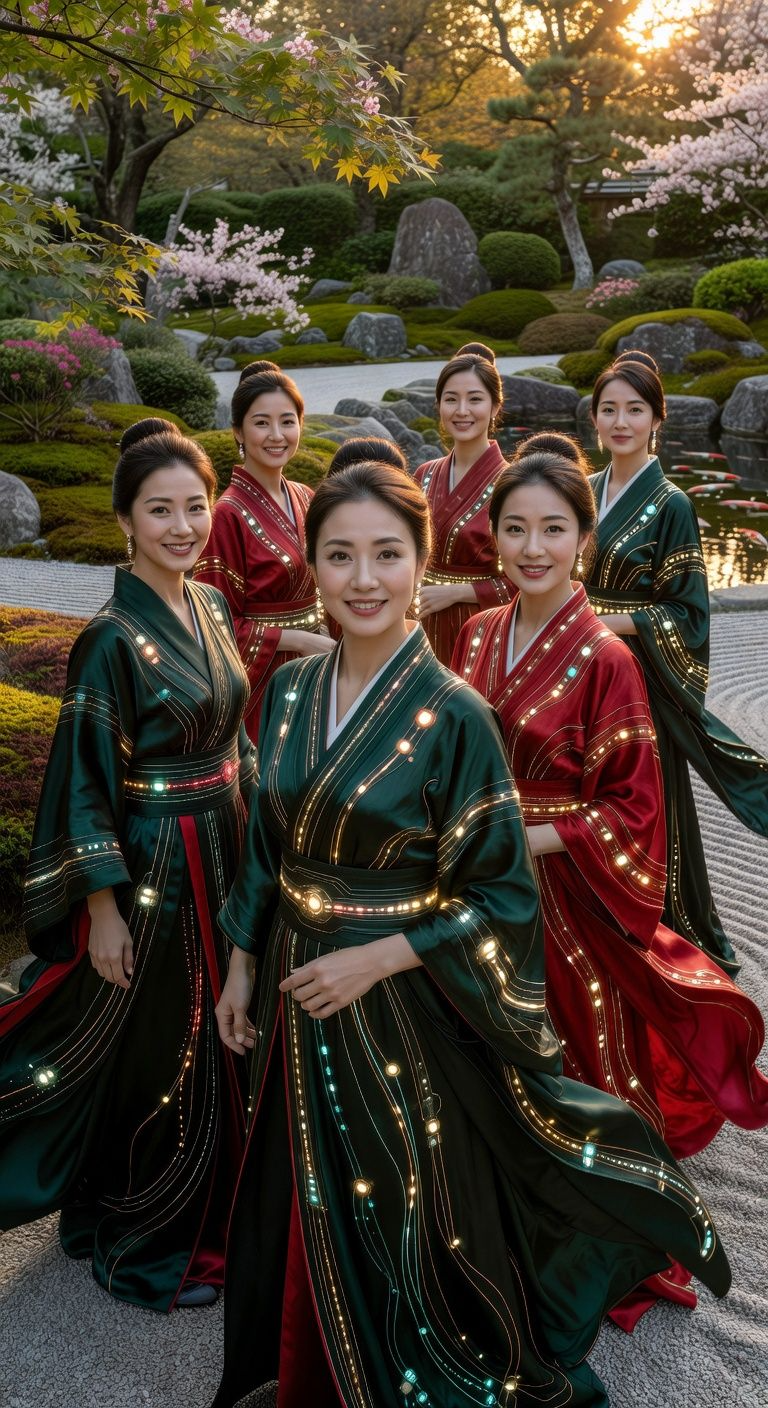
She built marvels of brass and bamboo—yet it took a single touch of iridescent silk to show her what her brilliant mind had been missing all along…
In the Empire of the Rising Silk, where bio-mechanical wonders soar on wings of engineered starlight, one truth remains unchallenged: the greatest inventions are not built—they are devoted into being.
Meet Mei, twenty-nine years of engineering brilliance wrapped in practical leather and lonely ambition. Her creations fly, yes. They function with devastating precision. But they do not sing. They do not feel. And neither, she is beginning to suspect, does she.
Then comes the storm-lit night when Master Lin—the Empire’s most enigmatic Silk-Weaver—whispers three words that will unravel everything Mei thought she knew about power, purpose, and the architecture of the soul:
“Be my hands.”
What follows is a journey of transformation that will speak to every woman who has ever stood at the peak of her achievements and felt the cold wind of an unnamed hunger. For Mei is about to discover what the wisest among us have always known—that true fulfilment flows not from the lonely throne of self-mastery, but from the glistening, iridescent surrender to something—and someone—worthy of our deepest devotion.
This is her story. Perhaps it is also yours.
Chapter One: The Kite That Would Not Fly
The wreckage of Mei’s ambition lay scattered across the workshop floor—brass cogwheels still spinning their useless revolutions, bamboo struts splintered like the bones of some great fallen bird, and across it all, the torn remains of bio-mechanical silk that had cost her three months’ income and countless sleepless nights. The silk did not shimmer as living silk should. It lay dull and lifeless against the polished cedar, a reproach in gossamer form.
Mei stood amidst the debris of her own making, her leather tunic spotted with grease and sweat, brass buckles that had seemed so practical that morning now feeling like constraints against her heaving chest. At twenty-nine, she had already earned the title of Master Engineer from the Imperial Academy. Her flying machines had been commissioned by three provincial governors. Her treatises on aerodynamic efficiency were studied in the finest schools across the Empire.
And yet.
And yet here I stand, she thought, her fingers trembling as she reached down to lift a fragment of torn wing, surrounded by proof that brilliance means nothing if the soul refuses to sing.
The kite—it had been her masterwork. A bio-mechanical marvel designed to respond to the electromagnetic currents that flowed through the Empire’s mountain passes, its silk wings treated with a solution of her own devising that should have allowed it to ride the unseen rivers of energy that ancient texts called the Dragon’s Breath. On paper, in her meticulous diagrams and precise calculations, it had been flawless.
In the sky above the Imperial testing grounds, watched by the Examiners in their flowing robes of office and the gathered crowd of fellow engineers and curious nobles, it had risen with a shudder. It had climbed. It had caught the current.
And then it had simply… stopped. Not crashed—that would have been a mercy, a dramatic failure she could have explained away as a structural miscalculation. No, this had been worse. The kite had hung motionless in the air for one terrible, endless moment, its silk wings catching the golden afternoon light without reflecting it, drinking the radiance rather than dancing with it, and then it had folded in upon itself like a flower refusing bloom, drifting down in a slow, pitiful spiral of silk and broken intention.
The Chief Examiner, a woman whose face remained perpetually masked behind layers of ceremonial white silk, had said nothing as the remains were collected. She had merely handed Mei a scroll bearing the Imperial seal and walked away, her own robes catching the light in ways that made Mei’s eyes ache with a longing she could not name.
Now, alone in her workshop as evening shadows stretched across the disaster, Mei unfurled that scroll for the hundredth time, reading again the words that burned like hot coals in her mind:
The petitioner Mei demonstrates technical facility of the highest order. Her understanding of mechanical principles exceeds that of many senior engineers. Yet her creations possess no resonance, no emotional connectivity, no living spark. They are empty vessels—beautiful, precise, and utterly devoid of the spiritual animus that elevates craft to art, and art to miracle. The Empire has no need of clever machines. The Empire requires inspired ones. Application for the Imperial Guild of Master Artificers: DENIED.
“No resonance,” Mei whispered to the empty workshop, her voice cracking on the second word. “No living spark.”
She had read every technical treatise in the Academy’s library. She had studied under three different master engineers. She had pushed herself until her fingers bled and her mind screamed for rest. She had done everything right, everything that was supposed to lead to recognition, to belonging, to that mysterious quality that the greatest artificers seemed to possess without effort.
And she had failed. Not because she lacked skill, but because she lacked… something else. Something no book could teach and no calculation could quantify.
A knock at the workshop door interrupted her spiral of self-recrimination. Mei hastily rolled the scroll and tucked it beneath a pile of discarded schematics before calling, “Enter.”
The door slid open to reveal her neighbour, old Madame Chyou, whose teahouse occupied the building adjacent to Mei’s workshop. The elderly woman’s face was weathered like ancient parchment, her eyes sharp and knowing in a way that had always made Mei slightly uncomfortable—as if Madame Chyou could see through the engineer’s careful composure to the tangled confusion beneath.
“I heard about the testing,” Madame Chyou said without preamble, shuffling into the workshop with the aid of a lacquered cane. She wore, as always, a simple robe of dark cotton, functional and unadorned, and Mei felt a familiar flash of… something… at the sight. Not disdain, precisely. More a quiet desperation to be more than functional. To shine.
“The tea is still hot in my shop,” the old woman continued, glancing around at the wreckage with an unreadable expression. “You should come. Drink. Brooding in the dark never mended a broken wing.”
“I have work to do,” Mei began, but Madame Chyou made a dismissive sound in the back of her throat.
“What work? Staring at failure until it multiplies?” The old woman’s tone softened unexpectedly. “Child, I have watched you work yourself to shadows for three years. You have genius in your hands. Anyone with eyes can see it. But genius without guidance is like a kite without wind—it tumbles and crashes and never understands why.” She extended a gnarled hand. “Come. Tea. And perhaps… a story that might interest you.”
Mei hesitated. The wreckage seemed to pulse with accusation around her, every broken strut a reminder of her inadequacy. But Madame Chyou’s eyes held something she had not expected—a kind of fierce compassion that demanded rather than pleaded.
“Very well,” Mei said, and followed the old woman into the evening air.
The teahouse was warm and dim, lit by paper lanterns that cast shifting patterns of gold and shadow across the low tables. Steam rose from the kettle in delicate spirals, carrying the scent of jasmine and something darker, earthier—mulberry root, perhaps, or the woodsy tang of aged pine. Madame Chyou seated Mei in a corner booth where they could not be overheard, then busied herself with the tea ceremony, her movements precise and unhurried in a way that spoke of decades of practice.
Mei watched, despite herself. There was something almost hypnotic about the ritual—the way the old woman’s hands moved without apparent thought, each gesture flowing into the next like water finding its course. She had never had patience for such ceremonies. They seemed inefficient, decorative, a waste of time that could be spent on practical endeavour.
Yet now, sitting in the warm glow of the lanterns with the taste of failure still bitter on her tongue, she found herself oddly soothed by the rhythm of it. The gentle clink of porcelain. The whisper of steam. The way Madame Chyou’s weathered fingers cradled the cup before offering it with a small, formal bow.
“Drink,” the old woman instructed. “Then listen.”
Mei drank. The tea was perfect—complex without being overwhelming, the bitterness balanced by a subtle sweetness that lingered on the palate. She felt something in her chest ease slightly, as if a knot she had not known was there had begun to loosen.
“You wonder why your kite failed,” Madame Chyou said, settling across from Mei with her own cup. It was not a question.
“I know why it failed,” Mei replied, a touch defensively. “The silk treatment was flawed. The electromagnetic resonance—”
“No.” The old woman cut her off with a gesture. “You know how it failed. The technical reasons. But you do not know why.” She leaned forward, her eyes catching the lantern light in a way that made them seem to glow. “Tell me, child. When you designed this kite, this masterwork of yours, what did you feel?”
Mei frowned. “I felt… determined. Focused. I wanted to prove that my methods were superior, that I deserved the Guild recognition, that—”
“There.” Madame Chyou tapped the table with one fingernail. “You wanted to prove. You wanted recognition. You wanted to demonstrate your worth to people who you believed were withholding their approval.” She shook her head slowly. “Every thread you wove, every calculation you made, was infused with that wanting. That striving. That desperate need to be seen and acknowledged.”
“I fail to see how ambition is a flaw,” Mei said stiffly.
“Ambition is not a flaw. But ambition without devotion is merely hunger.” Madame Chyou sipped her tea, watching Mei over the rim. “Your kite failed because you built it for yourself. For your glory. For your validation. You did not build it to serve the wind, or the currents, or the sky itself. You built it to serve Mei.”
The words struck like a physical blow. Mei opened her mouth to argue, but found she could not. For in the silence of the workshop, in the hours since the failure, a similar thought had been creeping around the edges of her consciousness—a suspicion she had refused to examine.
“There is a place,” Madame Chyou continued, her voice dropping to a near-whisper, “in the mountains north of the Jade Pass. A workshop unlike any other in the Empire. The woman who runs it—weaving silk that they say can capture the soul of whoever wears it. She does not teach engineering. She does not teach mechanics. She teaches…” The old woman paused, as if searching for the right word. “She teaches alignment. How to become an instrument for something greater than one’s own ambition.”
Mei felt a chill that had nothing to do with the evening air. “You speak of Master Lin.”
Madame Chyou’s eyebrows rose slightly. “You know of her?”
“I have heard rumours. Stories.” Mei had dismissed them as folklore—tales told by superstitious silk-traders to explain away the exceptional quality of certain fabrics. “They say she requires absolute devotion from her students. That they give up everything to study with her. That some never leave.”
“Some do not leave because they have found what they were searching for,” Madame Chyou said quietly. “And some leave because they were never truly seeking in the first place.” She reached across the table and laid her hand over Mei’s. The old woman’s palm was cool and dry, her touch unexpectedly gentle. “Child, I have watched you for three years. You work harder than anyone I have ever known. You are brilliant, and driven, and utterly, desperately alone. Not because no one wishes to be close to you, but because you have built walls of achievement to keep everyone at a distance.”
Mei’s throat tightened. She wanted to pull her hand away, to deny the accusation, to retreat into the comfortable fortress of her intellect. But the tea had loosened something in her, and Madame Chyou’s eyes held no judgement—only a deep, weary understanding that made her feel simultaneously seen and exposed.
“I don’t know how to be otherwise,” Mei admitted, the words emerging before she could stop them. “I have always been this way. Always pushing, always striving, always…” She trailed off, uncertain how to articulate the ache that had lived in her chest for as long as she could remember.
“Always seeking something you cannot name.” Madame Chyou nodded. “That hunger you feel—that is not a flaw. It is a compass. It points toward what you need. But you have been following it by walking in circles, trying to fill the emptiness with accomplishments that were never meant to satisfy it.”
“And Master Lin?” Mei asked, her voice barely above a whisper. “She can show me a different path?”
Madame Chyou’s hand tightened around hers. “She can show you that the path was never meant to be walked alone.”
The journey to Master Lin’s workshop took three days through mountain passes shrouded in perpetual mist. Mei had left her workshop in the hands of a junior engineer—a young man of limited imagination but adequate skill—and had packed only the essentials: a change of clothing, a small collection of tools she could not bear to part with, and a purse heavy with coins that suddenly seemed worthless.
The path was treacherous, winding through forests of ancient mulberry trees whose gnarled branches reached toward the sky like supplicating hands. More than once, Mei lost her way and had to retrace her steps, the mist swallowing all landmarks until she felt as though she were walking through clouds themselves. On the second night, camping beneath a rocky overhang as rain drummed against the stone, she dreamt of silk—reams of it, unfurling across the sky like rivers of light, and a voice that whispered just beyond the edge of hearing.
By the morning of the third day, she had begun to doubt. What was she doing, trekking through wilderness on the word of an old woman and rumours that were probably nothing more than folklore? She was a scientist, an engineer, a rational woman of the modern age. She did not believe in soul-weaving or spiritual alignment or mysterious mountain workshops where women supposedly learned to infuse fabric with emotion.
And yet.
And yet the hunger in her chest had not abated. If anything, it had grown stronger with every step away from her old life—a pulling sensation, as if an invisible thread were wound around her heart and drawing her forward. She thought of her empty workshop, her empty rooms, her empty bed. She thought of the kite hanging motionless in the sky, refusing to fly, refusing to live.
She thought of how tired she was.
The workshop emerged from the mist without warning—one moment she was walking through dense forest, the next she was standing before a gate of weathered mulberry wood, carved with symbols she did not recognise. Beyond the gate, she could see buildings of pale stone and dark timber, their roofs curved in the traditional style, silk banners drifting from every eave like prayers made visible.
The silk caught the light differently here, Mei noticed. It did not merely reflect the grey, misty illumination—it seemed to gather it, concentrate it, transform it into something warmer and more alive. The banners shimmered with iridescent colour despite the absence of direct sunlight, as if the fabric itself generated radiance from within.
She stood before the gate for a long moment, her hand resting on the carved wood, her heart beating a strange, uneven rhythm against her ribs. Fear coiled in her stomach—the fear of the unknown, the fear of hope, the fear that she had come all this way only to be turned away or, worse, to discover that there was nothing here for her after all.
Then she pushed the gate open, and stepped through.
The courtyard beyond was filled with silk. Not stored or displayed, but growing—great white mulberry trees whose branches were heavy with leaves, and between the trees, on frames of polished bamboo, silk cocoons gleamed like captured moons. The air smelled of mulberry and steam and something else, something Mei could not identify—a scent that made her think of incense, of ceremony, of things ancient and sacred.
And there were women. Dozens of them, moving through the courtyard in garments that caught the light and scattered it like blessings. They worked in pairs or small groups, their hands busy with tasks Mei did not recognise—sorting cocoons, preparing vats, stretching silk across frames in patterns that seemed to follow no logical system. They moved with a synchronised grace that reminded her of Madame Chyou’s tea ceremony, each gesture flowing into the next, unhurried yet purposeful.
Mei stood frozen just inside the gate, her leather tunic suddenly feeling heavy and wrong against her skin, her brass buckles glaringly utilitarian amidst all this luminous beauty. She had expected a workshop—benches and tools and the noise of production. She had not expected this. This felt less like a place of manufacture and more like a temple.
“Welcome.”
The voice came from behind her, and Mei turned to find a woman standing in the doorway of the nearest building. She was tall, her figure draped in robes of iridescent silk that shifted colour as she moved—pale green becoming silver becoming the softest gold. Her hair was swept up in an elaborate arrangement secured by pins of carved jade, and her face held the kind of serenity that Mei had only ever seen in statues of bodhisattvas.
But it was her eyes that held Mei captive. Dark, depthless, and impossibly knowing—as if they could see every thought Mei had ever had, every secret she had ever kept, every desperate hunger she had ever tried to hide.
“Master Lin,” Mei breathed, though how she knew the woman’s identity she could not have said.
The Master’s lips curved in a smile that seemed to hold both welcome and something deeper, more penetrating—a recognition that made Mei feel simultaneously seen and laid bare. “You travelled far to reach us,” Lin said, her voice like warm honey poured over river stones. “Three days through the mist. You are tired. You are uncertain. And beneath the uncertainty, you are hoping with everything you have that this place holds something you have been searching for.”
Mei’s throat tightened. “How did you—”
“I recognise the look,” Lin interrupted gently. “I have seen it many times. In every woman who has walked through that gate.” She stepped closer, and Mei caught her scent—jasmine and mulberry and something richer, earthier, like soil after rain. “Tell me your name, traveller. And tell me what you seek.”
“Mei,” she managed, her voice emerging rough and uneven. “I am an engineer. A builder of flying machines. I…” She faltered, the words she had rehearsed during her three-day journey suddenly feeling inadequate. “I have been told my creations lack soul. That I lack…” She gestured helplessly, unable to articulate the void that had brought her here.
Lin studied her for a long moment, those dark eyes moving across Mei’s face as if reading a text written in an ancient language. Then she nodded, once, as if confirming something to herself.
“Your kite failed because you built it to serve your own need for validation,” Lin said, and Mei flinched at the echo of Madame Chyou’s words. “You built it to prove your worth rather than to honour the wind that would carry it. You approached the craft as a master rather than as a servant. And so the silk refused to sing for you.”
“Yes,” Mei whispered. “But I don’t know how to approach it any other way. I don’t know how to be… otherwise.”
Lin’s smile deepened, and there was something in it now that made Mei’s knees feel suddenly weak—not cruelty, not mockery, but a fierce, almost tender understanding that cut through every defence she had ever constructed.
“That,” the Master said, reaching out to lift a strand of Mei’s wind-tangled hair, “is precisely why you have come. You are ready to learn that the greatest power lies not in mastery, but in surrender. Not in building alone, but in being built by hands more skilled than your own.”
Her fingers brushed against Mei’s temple, light as silk, and Mei felt a shiver cascade down her spine.
“The question is not whether you can learn,” Lin continued, her voice dropping to a whisper that seemed to resonate in Mei’s very bones. “The question is whether you are willing to kneel long enough to receive the lesson.”
Mei stood trembling in the misty courtyard, surrounded by silk that shimmered with impossible light, and felt something shift deep within her—a tectonic realignment of everything she had believed about herself, about achievement, about what it meant to be whole.
She had come here seeking an answer to her failure. She was beginning to suspect she had found something far more terrifying and far more precious.
She had found a reason to surrender.
“I am willing,” she heard herself say, the words emerging from a place deeper than thought. “Teach me.”
Lin’s hand slid from her temple to her cheek, cupping her face with a tenderness that made Mei’s eyes sting with unexpected tears.
“Then welcome home, little one,” the Master murmured. “Your real education begins at dawn.”
Chapter Two: The House of Living Silk
The workshop existed outside of time.
Mei understood this within her first hour beyond the mulberry gate, as Master Lin guided her through corridors that seemed to breathe with a life of their own. The walls were not merely painted but layered—silk upon silk upon silk, each stratum so gossamer-thin that the cumulative effect was like walking through a cloud infused with colour. Pale jade melted into deepest indigo, which surrendered in turn to the softest blush of rose, all of it shifting as she passed, as if the very building were acknowledging her presence.
“The silk here is alive,” Lin said, answering the question Mei had not yet found the courage to voice. “Not alive in the sense that you understand biological life—but alive in resonance. It absorbs. It remembers. It responds to the emotional frequencies of those who dwell within these walls.” Her hand brushed against a cascade of fabric that fell from ceiling to floor, and Mei watched, transfixed, as the silk seemed to lean into the touch like a cat seeking affection. “Every woman who has studied here, every moment of devotion and surrender and breakthrough, has left something of herself behind. Woven into the very fabric of this place.”
Mei’s engineer’s mind raced with questions—how was this possible? What molecular structure allowed for such retention of emotional data? Could it be measured, quantified, replicated? But before she could give voice to any of these inquiries, Lin turned to her with a look that silenced all thought.
“You will have time for understanding later,” the Master said, as if reading the machinery of Mei’s intellect. “First, you must learn to feel. The mind is a useful servant, but a terrible master. It will keep you forever in the realm of the known, the measurable, the safe. And nothing of value has ever been created from safety.”
They emerged into a great central hall, and Mei’s breath caught in her throat.
The space was vast—far larger than the exterior of the building had suggested, though she was beginning to understand that the normal rules of architecture held little sway here. The ceiling rose in vaulted arches of dark wood and pale stone, from which hung hundreds upon hundreds of silk strips in every conceivable hue. They swayed gently, though there was no wind, creating a slow, hypnotic dance of colour and light. At the centre of the hall stood a great loom of bamboo and brass, larger than any Mei had ever seen, its mechanisms partially visible through panels of translucent silk that wrapped around its frame like a shroud.
But it was the women who commanded her attention.
They moved through the space in what could only be described as a choreography of purpose—each figure engaged in some task, yet all of them flowing together in a rhythm that seemed to arise from the building itself. There were perhaps thirty in total, ranging in age from what could not have been more than sixteen to women who had surely seen sixty winters or more. And every one of them, without exception, wore garments that caught the light and scattered it like blessings.
Satin robes in crimson and gold. Silk dresses that shimmered like captured moonlight. Jackets of glossy fabric that seemed painted onto slender forms, their surfaces reflecting the glow of lanterns with a radiance that made Mei’s eyes ache. Even the oldest among them, a woman with silver hair swept into an elegant chignon, wore a floor-length coat of what appeared to be polished silk that moved like liquid mercury as she worked.
Mei looked down at her own attire—the practical leather tunic, the brass buckles that had seemed so sensible in her workshop, the cotton trousers worn thin at the knees from hours of kneeling over schematics. Against the luminous backdrop of this sacred space, she felt suddenly, painfully drab. Like a moth who had wandered into a gathering of butterflies and could not understand why her wings refused to catch the light.
“You feel it,” Lin observed, her voice soft beside Mei’s ear. “The contrast. The wrongness of your attire against the harmony of this place.”
“I feel…” Mei hesitated, uncertain how to articulate the complex tide of emotions rising within her. Shame, yes. But also longing. And beneath that, something darker—a hunger that bordered on despair. “I feel as though I have been wearing my own skin inside out. And only now do I see what skin is meant to look like.”
Lin’s hand found the small of her back—a touch so light it might have been imagination, yet so present it seemed to burn through the leather of Mei’s tunic. “What you feel is recognition. Your soul knows what it has been missing, even when your mind insisted that practicality was virtue.” She guided Mei forward, into the hall. “Come. There is someone I wish you to meet.”
They wove through the working women, and Mei found herself the recipient of glances that ranged from curious to welcoming to something deeper—a kind of knowing recognition, as if each of them remembered their own first arrival and saw in her face the same desperate hunger they had once worn. Several smiled, small expressions of compassion that made Mei’s chest tight with unexpected emotion.
A young woman approached them, her movements carrying the same fluid grace that seemed universal to this place. She could not have been more than twenty, her face still holding the soft roundness of youth, yet her eyes held a depth that spoke of experiences far beyond her years. She wore a robe of pale jade silk overlaid with a sleeveless jacket of deep emerald satin, the high sheen of the fabric catching every particle of light and multiplying it until she seemed to glow from within.
“Sora,” Lin said, her voice warming with what sounded like genuine affection. “We have a new sister. She will need guidance through her first days.”
Sora’s face lit with a smile that transformed her pretty features into something luminous. “Welcome,” she said, and the word carried such sincerity that Mei felt her throat constrict. “I remember my own arrival. The confusion. The overwhelm.” She glanced at Lin with an expression that bordered on adoration. “The wonder.”
“Take her to the preparation chambers,” Lin instructed. “Help her shed what no longer serves. And then bring her to the eastern garden. We will begin her instruction at sunset.”
Sora bowed her head slightly, a gesture of respect that seemed instinctive rather than performed. “Yes, Master Lin.” She turned to Mei, her smile softening into something more intimate. “Come. Let us make you ready.”
The preparation chambers were smaller, more intimate than the great hall—a series of connected rooms, each one warmed by steam that rose from hidden vents and scented with flowers Mei could not identify. Silk hangings in muted tones of cream and pale gold created a sense of enclosure, of safety, of being held.
“Your first instinct,” Sora said as they entered the first chamber, “will be to ask questions. To try to understand what is happening through logic and analysis.” She turned to face Mei, her expression kind but knowing. “I know this because it was my instinct as well. I was a scholar of natural philosophy before I came here. I had theories about everything. Explanations for every phenomenon. I thought my intellect was my greatest asset.”
Mei frowned. “Was it not?”
Sora’s smile turned wistful. “My intellect was a wall. A structure I had built to protect myself from the terror of not knowing, not controlling, not being certain.” She began to walk slowly around Mei, examining her leather tunic with an expression that held no judgement but a quiet, penetrating assessment. “Master Lin taught me that certainty is an illusion. That the greatest wisdom lies in embracing uncertainty. In surrendering to what we cannot explain.”
“How?” Mei’s voice emerged rough, almost desperate. “How does one surrender what one has spent a lifetime building?”
Sora paused in her circuit, standing before Mei with her head slightly tilted. “You do not surrender by force. You surrender by recognising that what you built was never a fortress—it was a cage. And the door has been unlocked all along. You simply never tried to open it.”
She reached out and began to unfasten the brass buckles of Mei’s tunic, her movements unhurried and matter-of-fact, as if performing a routine task. Mei felt her breath catch, her body tensing with a instinct to resist, to protect, to maintain the barriers she had so carefully constructed.
“You are afraid,” Sora observed, her fingers continuing their work. “That is natural. Every woman who enters these chambers feels fear. But ask yourself—what is the source of this fear? Is it the unknown that lies before you? Or is it the terror of finally releasing what you have held so tightly?”
“The latter,” Mei whispered, surprising herself with her honesty. “I have been this way for so long. I do not know who I am without my walls.”
Sora’s hands stilled on the final buckle. Her eyes met Mei’s, and in their depths, she saw an understanding so profound it made her ache.
“Then you are ready,” the younger woman said softly. “Because only those who have exhausted their own strength can truly surrender. Only those who have felt the weight of their own walls can recognise the freedom of letting them fall.”
The tunic slipped from Mei’s shoulders, pooling on the floor in a heap of leather and brass that suddenly looked foreign to her—like the shed skin of some creature she no longer recognised. Beneath it, she wore only a simple shift of rough cotton, its surface dull and lifeless against her skin.
Sora guided her to a low bench beside a steaming pool. “The water is infused with mulberry essence and moonflower oil,” she explained. “It will help release the tension you carry in your muscles, your fascia, the very marrow of your bones.” She began to unpin Mei’s hair, letting the dark strands fall heavy around her shoulders. “When I arrived here, I had not realised how much physical tension I carried. Years of intellectual striving had calcified in my body. I felt like a statue trying to pass as a living woman.”
Mei sank into the water, and the sensation was immediate—a warmth that seemed to penetrate beyond her skin, beyond her muscles, into some deeper layer of her being. She felt her eyes close, felt her head tip back against the edge of the pool, felt something inside her begin to unclench.
“Master Lin,” she heard herself say, the words emerging from somewhere distant. “What is she? Truly?”
A pause. Then Sora’s voice, thoughtful and reverent. “She is a weaver. Not merely of silk, but of souls. She sees what we cannot see in ourselves—the patterns we have tangled, the knots we have tied, the threads we have severed in our desperate attempts to become what we thought we should be.” Another pause, filled with the gentle sound of water lapping against stone. “And she loves us. Not despite our brokenness, but through it. She sees our fractures as channels for light.”
Mei felt tears slide down her cheeks, dissolving into the steaming water. “I have been so lonely,” she admitted, the confession torn from some place so deep she had not known it existed. “So terribly, achingly lonely. Even in crowds. Even when praised and celebrated. I have felt as though I were screaming into an endless void, and no one could hear me.”
“I know,” Sora said, and her voice was closer now, her hand resting gently on Mei’s wet hair. “We all know. That loneliness is what brought us here. That hunger for something more than achievement, more than recognition. A hunger to be seen—not for what we have accomplished, but for who we truly are beneath the accomplishments.”
“How long,” Mei asked, her voice breaking, “does it take to heal? To become whole?”
Sora’s hand stroked her hair with a tenderness that made Mei’s chest ache. “Healing is not a destination. It is a practice. Wholeness is not something you achieve—it is something you allow. And here, in this house of living silk, you will learn to allow it. One breath at a time. One surrender at a time. One moment of trust at a time.”
The steam rose around them, carrying the scent of mulberry and moonflower, and Mei felt something within her begin to shift—not a dramatic transformation, not a sudden revelation, but a gentle loosening. Like a knot that had been tied so tightly it had become part of the rope, beginning at last to yield.
The eastern garden was bathed in the golden light of sunset when Sora guided Mei through its gates.
She had been dressed, after her bath, in garments that felt like nothing she had ever worn before—a simple robe of pale silk that moved against her skin like water, overlaid with a sleeveless coat of softly gleaming satin in a deep amber hue that seemed to capture the fading daylight and hold it close. The effect was subtle yet profound. She did not glow as the other women did—not yet—but she no longer felt entirely drab. She felt… in transition. Like a butterfly midway through its metamorphosis, neither caterpillar nor winged creature, but something in between.
The garden itself was a marvel of intentional design—mulberry trees trained into elegant shapes, their leaves rustling in the evening breeze; beds of flowers whose petals seemed to shimmer with inner light; and at the centre, a small pavilion of dark wood and translucent silk panels, within which Mei could see the figure of Master Lin waiting.
“Go to her,” Sora urged gently. “This is your first lesson. The most important one.”
Mei walked along the stone path, her new garments whispering against her skin with each step, her heart beating a rhythm that seemed to echo from the earth itself. The silk panels of the pavilion billowed slightly in the breeze, and she could see Lin’s silhouette within—seated upon a cushion of deep crimson, her robes pooling around her like liquid starlight.
She reached the entrance and hesitated, uncertain of protocol, unsure whether to announce herself or simply enter.
“Come,” Lin’s voice floated through the silk, carrying warmth and welcome. “Sit with me. Let us watch the sun surrender to the night.”
Mei entered, her eyes adjusting to the dim golden light within. Lin gestured to a cushion beside her, and Mei settled onto it, her body finding an unfamiliar ease in the cross-legged position. For a long moment, neither spoke. They simply sat together, watching through the translucent panels as the sky transformed from gold to rose to deepest violet.
“You have questions,” Lin said eventually, her voice barely above a whisper. “Ask them. Let us see what your soul most needs to know.”
Mei turned to face the Master, studying the older woman’s profile in the fading light—the elegant slope of her nose, the gentle curve of her jaw, the depthless darkness of her eyes as they reflected the emerging stars. “Sora told me that you are a weaver of souls,” she began, her voice tentative. “That you see the patterns we have tangled.”
“I see what is already there,” Lin confirmed, turning to meet Mei’s gaze. “Every life creates a tapestry. Every choice, every fear, every hope and hunger and heartbreak—these are threads. Most women’s tapestries are tangled, knotted, frayed. Not because they are flawed, but because they have been weaving alone. Without guidance. Without pattern. Without the hands of another to help smooth the threads.”
“And you… untangle the knots?”
Lin smiled, a gentle expression that held no condescension. “I do not untangle them. I teach you to untangle them yourselves. I provide the space, the light, the guidance. But the work of transformation must always come from within. I cannot force growth any more than I can force a flower to bloom. I can only create the conditions in which blooming becomes inevitable.”
Mei absorbed this, her engineer’s mind turning the metaphor over and over, examining it from every angle. “And the silk? The living silk that fills this place? What role does it play?”
Lin reached out to brush a strand of hair from Mei’s forehead, the touch feather-light and electric. “Silk is a conduit. It receives and transmits emotional energy. When woven with intention—true intention, born of devotion rather than ego—it becomes a mirror. It reflects back to the wearer what they most need to see. And when worn against the skin, it works upon the soul in ways both subtle and profound.” Her fingers traced down Mei’s temple to her jaw, then along the line of her throat. “You feel it even now. The silk you wear. How it differs from the leather and cotton you have shed.”
Mei shivered beneath the touch, her body responding in ways that confounded her intellect. “Yes,” she breathed. “It feels… alive. Like it is listening. Like it wants something from me.”
“It wants your trust,” Lin murmured, her hand continuing its descent, coming to rest over Mei’s heart. “Your surrender. Your willingness to be transformed. The silk will meet you where you are. If you resist it, it will feel cold and foreign against your skin. But if you open to it—if you allow it to become a partner rather than a covering—it will teach you things about yourself that no mirror could reveal.”
“I do not know how to open,” Mei admitted, her voice barely audible. “I have been closed for so long. I have forgotten where the seams are.”
Lin leaned closer, her face inches from Mei’s, her breath warm and sweet against Mei’s lips. “Then let me show you. Let me find the seams. Let me help you unravel.”
And before Mei could respond, before she could analyse or question or resist, Lin’s lips met hers in a kiss that was not a kiss but an initiation—a soft, slow unfolding that seemed to bypass her mind entirely and speak directly to something deeper. The kiss was not demanding. It was inviting. A door opening onto a landscape Mei had never known existed, a landscape of warmth and welcome and belonging.
When Lin pulled back, Mei realised she was trembling. Not from fear, but from a cascade of sensation and emotion so overwhelming she could barely contain it. Her eyes stung with tears. Her chest felt simultaneously hollow and overflowing. And beneath it all, rising like a tide she could not resist, was a single, crystalline truth:
This is what I have been searching for. Not achievement. Not recognition. This. This feeling of being seen, being held, being guided. This surrender.
“Welcome home, little one,” Lin whispered, her thumb tracing the tear that slid down Mei’s cheek. “Your lessons begin at dawn. But tonight, simply rest. Let the silk hold you. Let the night transform you. And know that you are no longer alone.”
Mei nodded, words failing her completely. And as Lin rose and departed, leaving her alone in the pavilion with the stars emerging one by one above, she felt something settle within her. Not resolution. Not completion. But something perhaps more precious.
Hope.
Chapter Three: The Rhythm of Devotion
The gong sounded before dawn—a deep, resonant tone that seemed to rise from the earth itself rather than any earthly instrument, vibrating through the silk-hung walls of the chamber where Mei slept, entering her body through the marrow of her bones and drawing her from dreams she could not remember into a waking state that felt like continuing rather than beginning.
She rose in darkness, the only illumination the faint pre-light of a sky not yet ready to concede the night. The silk robe she had been given to sleep in—pale cream, impossibly soft against her skin—whispered as she moved, and she felt again that peculiar sensation of being listened to, of being witnessed, by the very fabric that clothed her. It was no longer unsettling. In the few hours since Master Lin’s kiss had shattered something essential within her, the sensation had transformed into something closer to comfort. To companionship.
The silk remembers, she thought, her fingers trailing across the glistening surface of a wall hanging as she made her way toward the door. It holds the echoes of every woman who has walked these corridors before me. Their fears. Their surrenders. Their transformations. I am never truly alone here.
The corridor led her not to the great hall or the preparation chambers, but to a heavy wooden door she had not noticed before, set into a wall of pale stone. As she approached, it swung open silently, revealing a narrow stairway descending into what appeared to be subterranean darkness. The scent of mulberry and steam rose to meet her, thick and enveloping.
“Descend,” came Master Lin’s voice from somewhere below—soft yet commanding, a thread of sound that Mei felt compelled to follow. “Your first lesson awaits.”
She descended.
The chamber at the bottom of the stairs was vast and dimly lit, its walls lined with copper vessels of varying sizes, each one emitting a gentle cloud of steam that caught the amber light of hanging lanterns and transformed it into something thick and breathing. At the centre of the room stood a great vat of polished wood, perhaps ten feet in diameter, filled with a liquid that shimmered with an iridescence beyond anything Mei’s scientific mind could categorise.
Master Lin stood beside the vat, her robes a cascade of deep burgundy satin that seemed to drink the dim light rather than reflect it. Her face was serene, her eyes holding that same penetrating quality that made Mei feel simultaneously seen and exposed—and yet, this morning, there was no fear in that feeling. Only a deep, resonant recognition.
“Before you can weave silk,” Lin said, her voice filling the chamber without apparent effort, “you must understand silk. Before you can understand silk, you must serve silk. And before you can serve silk, you must become silk.”
Mei stood before the Master, her heart beating a slow, heavy rhythm against her ribs. “How does one become silk?”
Lin’s lips curved in that gentle smile that held galaxies of knowing. “Through surrender. Through repetition. Through the gradual dissolution of everything that makes you rigid, everything that makes you strive, everything that makes you separate from the material you wish to work with.” She gestured toward the great vat. “For the next seven days, you will perform a single task. You will stir the silk broth according to a pattern I will teach you. You will not deviate. You will not innovate. You will not seek to improve upon what I show you.”
Mei’s engineer’s mind flickered with instinctive resistance—the same impulse that had driven her to modify every technique she had ever learned, to seek efficiency in every process, to never accept a method as fixed when it could be optimised. But even as the resistance rose, she felt something else within her: a profound exhaustion with her own cleverness, a bone-deep weariness with the endless cycle of striving and achieving and proving.
“I understand,” she said, and was surprised to find that she meant it.
Lin studied her for a long moment, her dark eyes moving across Mei’s face with that quality of reading a text written in an ancient language. “We shall see,” she murmured. Then she stepped forward and took Mei’s hands in her own.
The touch was electric—a shock of connection that travelled from Mei’s palms up through her arms and into her chest, settling somewhere beneath her sternum like a warm coal. Lin’s fingers were cool and dry, her grip firm but not forceful, guiding rather than demanding.
“Watch,” the Master said, and began to move.
The stirring pattern was deceptively simple: a spiral that widened from the centre, then narrowed back, followed by a series of gentle figure-eights that seemed to follow the natural currents of the liquid itself. Lin’s movements were fluid, unhurried, each gesture flowing into the next with the inevitability of water finding its course. The broth responded to her touch, the iridescent surface shifting in ways that seemed almost conscious, almost eager.
“Now you,” Lin said, stepping back and releasing Mei’s hands.
Mei took the long wooden paddle and began.
The first hour was agony.
Her arms burned. Her shoulders screamed. Her lower back sent sharp protests up through her spine with every rotation. The pattern that had seemed so fluid in Lin’s hands felt clumsy and forced in her own, the paddle catching against invisible currents, the broth seeming to resist her rather than welcome her.
More unbearable than the physical discomfort was the assault on her intellect. Every fibre of her being wanted to analyse, to question, to suggest modifications that would make the process more efficient. The angle of the paddle could be adjusted. The speed of rotation could be optimised. There were at least seven variables she could identify that, if tweaked, might produce superior results with less physical strain.
She opened her mouth to voice these observations—and found Master Lin standing directly before her, one finger raised to Mei’s lips.
“Your mind is a noisy creature,” Lin said, amusement and understanding woven through her voice. “It cannot bear to be idle. It cannot bear to follow when it has spent a lifetime leading. But this—” she gestured at the vat, at the paddle, at Mei’s trembling arms, “—is not engineering. This is devotion. And devotion requires the silence of the chattering self.”
“How?” Mei gasped, sweat beginning to trickle down her temples despite the cool air of the chamber. “How do I silence what I have always been?”
Lin’s finger traced from Mei’s lips down along her jaw, then came to rest beneath her chin, tilting her face upward. “You do not silence it. You exhaust it. You let it rage and chatter and protest until it has nothing left to say. And in the silence that follows, you will hear something you have never heard before.”
“What?”
“Yourself,” Lin said softly. “The self beneath the self. The one who does not strive. The one who simply is.”
She stepped back, her burgundy robes catching the lantern light and scattering it like dark stars. “Continue. I will return at sunset.”
And then she was gone, leaving Mei alone with the vat, the paddle, and the screaming of her own rebellious mind.
By midday, Mei’s body had transcended pain and entered a state that was almost hallucinatory.
Her arms moved without conscious direction—still following the pattern, still maintaining the spiral and the figure-eights, but no longer requiring her active participation. The paddle had become an extension of her hands rather than a tool she wielded. The broth had ceased to resist her; now it seemed to accept her movements, to welcome them, to incorporate them into its own mysterious rhythms.
Her mind, meanwhile, had progressed through several distinct stages of rebellion. The morning had been consumed with elaborate fantasies of optimisation—detailed schematics she had mentally drafted for improved stirring mechanisms, treatises she had composed on the thermodynamics of silk preparation, passionate arguments she had formulated for why this inefficient method should be abandoned in favour of more modern approaches.
But as the hours passed and her body continued its relentless motion, the fantasies had grown less elaborate, then less frequent, then fragmented, then—finally, mercifully—silent.
And in that silence, something began to emerge.
It was not a voice, precisely. It was not even thought in any form she recognised. It was more like a listening—a quality of attention that extended beyond her own skull, beyond the boundaries of her separate self, into the broth and the paddle and the steam and the walls of the chamber themselves. She felt, for the first time in her life, as though she were part of something larger. Not separate from it. Not observing it. But woven into it, inextricable, essential.
This, she realised with a flash of insight that felt like emerging from underwater, is what my kites have been missing. Not cleverness. Not efficiency. This sense of being part of a whole. This dissolution of the boundary between creator and creation.
The broth seemed to shimmer more brightly now, the iridescence pulsing with a rhythm that matched her own heartbeat—or perhaps it was her heartbeat that had adjusted to match the broth. She could no longer tell where she ended and the silk began. And in that uncertainty, she found an unexpected peace.
When Master Lin returned at sunset, Mei did not hear her approach.
She had entered a state that was neither waking nor sleeping, a trance-like absorption in the rhythm of stirring that had erased all awareness of time and space. Her body continued its pattern without interruption, the movements as natural as breathing, as inevitable as the tides. The silk broth had transformed under her care—its surface now glowing with a soft inner light, its consistency perfectly smooth, its scent carrying notes of jasmine and something ancient, something that spoke of origins beyond human memory.
Lin stood at the edge of the chamber for a long moment, watching. Her face held an expression that might have been satisfaction, or perhaps something deeper—a recognition of a kindred spirit, a fellow traveller on the path of transformation.
“Enough,” she said softly, and the word was like a bell striking through Mei’s consciousness, calling her back to ordinary awareness.
Mei’s hands stilled on the paddle. She blinked, orienting herself to the chamber, the dimming lanterns, the cool air against her sweat-dampened skin. And then she looked at Master Lin, and the words that emerged from her throat were not the words she would have chosen in her former life.
“I understand nothing,” she said, her voice rough and wondering. “And in understanding nothing, I feel I understand everything.”
Lin’s smile deepened, and she crossed the chamber to stand before Mei. Her hand rose to cup Mei’s cheek, the touch cool and grounding, and Mei felt herself lean into it without conscious decision, like a flower turning toward the sun.
“You have made a beginning,” Lin murmured. “The first of many. The silk has accepted your service today. It has felt your surrender, incomplete though it was. Tomorrow, you will surrender more. And the day after, more still. Until there is nothing left of you to give—and in that emptiness, you will find yourself fuller than you have ever been.”
“Why does it feel like grief?” Mei asked, tears unexpectedly stinging her eyes. “This letting go. It feels like mourning someone I used to be.”
“Because it is grief,” Lin replied, her thumb tracing the tear that slid down Mei’s cheek. “You are mourning a self that never served you. A self constructed from fear and ambition and the desperate need to prove your own existence. Let yourself grieve. The grief is the doorway.”
She leaned forward and pressed her lips to Mei’s forehead—a benediction rather than a kiss, a sealing of the day’s lessons. “Rest now. Eat. Sleep. And tomorrow, return to the vat. The silk is not yet finished with you.”
Day Two brought a different kind of trial.
Mei’s body had adapted to the physical demands of the stirring; her muscles no longer screamed, though a deep fatigue settled into her bones by midday. But her mind, having exhausted its capacity for analytical resistance, had turned to emotional rebellion.
She found herself weeping without warning, the tears mixing with the steam that rose from the broth. She thought of her workshop in the city, gathering dust. She thought of the acclaim she had once pursued so desperately, now seeming hollow and distant. She thought of the woman she had believed herself to be—brilliant, driven, self-sufficient—and felt the loss of that identity like a physical amputation.
Who am I without my achievements? she asked herself, the paddle continuing its ancient pattern while her heart cracked open. What value do I have if I am not the best, not the cleverest, not the most accomplished?
The questions circled through her like hungry wolves, snapping at her confidence, tearing at her certainty. And yet, through it all, her hands did not stop moving. The pattern continued. The spiral, the figure-eights, the patient attention to the broth’s shifting currents.
Somewhere in the afternoon, the wolves quieted. Not because she had answered the questions, but because she had grown weary of asking them. And in the silence that followed, a different voice emerged—not her own, but something older, something that spoke from the silk itself:
You are not your achievements. You are not your cleverness. You are not the acclaim you have chased or the recognition you have coveted. You are the space in which these things arise and pass away. You are the one who stirs. The one who serves. The one who surrenders.
The voice was not words, exactly. It was more like a knowing—a direct transmission of understanding that bypassed language entirely. And with it came a sensation of being held, of being supported, by something vast and gentle and patient beyond all human comprehension.
Mei stirred, and wept, and was comforted. And when Master Lin appeared at sunset, there was no need for words. They simply looked at each other, and Mei saw in Lin’s dark eyes a reflection of her own journey—a recognition that said, I too walked this path. I too surrendered. I too found in the loss of myself the discovery of everything.
On Day Three, Sora appeared at the chamber door.
Mei had been so absorbed in the rhythm of stirring that she had not heard the younger woman approach. When she looked up and saw Sora standing in the doorway, a bundle of deep emerald fabric draped over her arm, she felt a moment of disorientation—as if surfacing from a deep dive into unfamiliar waters.
“The Master thought you might be ready,” Sora said, her voice carrying that quality of gentle reverence that seemed universal to this place. “For transformation.”
Mei blinked, her hands pausing their motion. “Transformation?”
Sora crossed the chamber and laid the bundle on a low table near the wall. As she unfolded it, the fabric caught the lantern light and scattered it like crushed emeralds—satin, Mei realised, of the finest quality, its surface so highly polished that it seemed to glow from within.
“You have been stirring for three days,” Sora explained, smoothing the fabric with reverent hands. “Your old self is beginning to loosen. The Master believes it is time to clothe that emerging self in something more appropriate.”
Mei looked down at herself, at the pale cream robe she had worn since her arrival. It, too, was silk—beautiful, luxurious, far finer than anything she had ever owned in her former life. But compared to the garment Sora had brought, it seemed almost plain. Almost… preparatory.
“Is this a reward?” Mei asked, uncertain.
Sora’s smile held a quality of compassionate knowing. “No. It is an alignment. The silk we wear against our skin is not merely decoration. It is a partner in our transformation. It receives what we emit and reflects it back, helping us to see ourselves more clearly. The Master has chosen this particular silk—” she lifted the emerald satin, letting it cascade from her fingers like a waterfall of light, “—because she sees in you something that you have not yet learned to see in yourself.”
“What does she see?”
Sora’s eyes met hers, and in their depths, Mei glimpsed an understanding that seemed to transcend the young woman’s years. “Growth,” she said simply. “The green of new leaves. The colour of things that are not yet fully formed but are reaching toward the light with everything they have.”
She crossed to where Mei stood and began to help her out of the cream robe. The act should have felt strange, intimate in a way that would have made Mei’s former self uncomfortable. But in this place, in this chamber where she had spent three days dissolving into silk, the intimacy felt natural. Necessary. An extension of the surrender she was learning to embody.
The emerald satin slid over her head, settling against her skin like a cool caress. The sensation was immediate—not merely physical, but emotional, almost spiritual. The fabric seemed to hold her, to embrace her, to whisper promises she could not quite decipher.
“Oh,” she breathed, her hands rising to touch the glossy surface that now covered her torso, her hips, her thighs. “It feels…”
“Alive,” Sora finished for her. “Because it is. Not alive as you understand life—but alive with resonance. With history. With the accumulated devotion of every woman who has worn it before you, and every woman who will wear it after.” She stepped back, her eyes shining with something that looked like pride. “You are beginning to glow, Mei. The silk is only making visible what has been growing within you these past three days.”
Mei looked down at herself, at the way the emerald satin caught even the dim lantern light and multiplied it, casting soft green reflections across the chamber walls. She did feel different—not healed, not transformed, not yet, but changing. Like a butterfly midway through its metamorphosis, she was no longer caterpillar but not yet winged. She was becoming.
“Thank you,” she said to Sora, the words feeling inadequate for the gift she had been given.
Sora’s smile widened. “Do not thank me. Thank the silk. And thank yourself, for having the courage to let it work upon you.” She turned toward the door, then paused, looking back over her shoulder. “The Master says you may return to your chambers early tonight. Tomorrow, the work deepens. Rest well. You will need your strength.”
That night, Mei dreamt of silk.
Not the silk of the waking world, but the silk of some deeper realm—a fabric that wove through all things, connecting star to star, heart to heart, the living to the dead and the yet-to-be-born. She saw herself standing before a great loom, but she was not the weaver. She was the thread. And Master Lin stood at the loom’s helm, her hands moving with patient, loving precision, guiding Mei through the shuttle, weaving her into a pattern whose beauty she could not yet perceive.
Trust, came Lin’s voice from somewhere beyond the dream. Surrender. Let yourself be woven.
And Mei, for the first time in her life, did not resist. Did not analyse. Did not demand to understand the pattern before agreeing to be part of it. She simply let herself be carried by the shuttle, let herself be woven into something larger than her separate self.
She woke before dawn, the emerald satin tangled around her legs, her cheeks wet with tears she did not remember shedding. And in the pre-light stillness of her chamber, she felt something she had never felt before:
A profound, bone-deep gratitude for the opportunity to serve.
For the chance to surrender.
For the privilege of being woven.
Chapter Four: The Storm and the Surrender
The storm announced itself first as a whisper.
Mei heard it in the late afternoon of her seventh day—a low, almost subterranean rumble that seemed to rise not from the sky but from the bones of the mountain itself. She had just completed her stirring for the day, her emerald satin robe now feeling as natural against her skin as her own flesh, her movements having achieved a fluidity that would have seemed impossible a week prior. The silk broth had transformed under her care; its surface now shimmered with a luminescence that seemed to pulse with its own inner rhythm, and the scent that rose from it had deepened into something ancient and compelling.
She was ascending the stairs from the chamber when the whisper became a voice—a wind that spoke through the mulberry trees surrounding the workshop, their branches bending and swaying in a language she was only beginning to learn to interpret.
Something approaches, the trees seemed to say. Something vast. Something that will test everything you have begun to become.
By the time she reached the upper levels of the workshop, the sky had begun to change. What had been a gentle overcast was now churning with clouds the colour of old iron, their undersides lit by sporadic flashes of lightning that illuminated the mountains for miles around. The air had grown thick and charged, pressing against her skin like a physical weight, and the silk hangings throughout the corridors had begun to sway of their own accord, as if responding to currents that existed beyond the reach of ordinary wind.
Other women were moving through the space now, their faces calm but purposeful. Mei recognised several of them—Sora among them, her jade robes flowing around her as she secured windows and moved precious materials away from exterior walls. There was no panic in their movements, only a practiced efficiency that spoke of preparation for an event both anticipated and honoured.
“Typhoon,” Sora said as she passed, her voice carrying easily through the charged air. “A great one. The electromagnetic currents will be intense tonight. The Master has asked for you specifically in the central hall.”
Before Mei could respond, Sora was gone, disappearing around a corner with her arms full of silk-wrapped bundles. Mei stood alone in the corridor for a moment, her heart beginning to beat faster against her ribs. Seven days of stirring. Seven days of surrender. And now, it seemed, a test.
Not a test, she corrected herself, the thought emerging with a clarity that surprised her. An opportunity. The silk does not test. It reveals.
She made her way toward the central hall, her bare feet silent against the polished floors, her emerald satin catching the flickering lantern light and scattering it in fragments of green fire around her.
The central hall had been transformed.
The hundreds of silk strips that normally hung from the ceiling had been gathered and secured, opening the vast space to its full height. At its centre, the Great Loom stood revealed in its entirety—a structure of bamboo and brass that rose nearly twenty feet, its mechanisms partially visible through panels of translucent silk that seemed to breathe with a light of their own. The loom was active, Mei realised with a start. Its great frame was in motion, shuttles flying back and forth with a speed that defied perception, weaving something that glowed and shifted as it formed.
And there, standing before the loom, was Master Lin.
She wore robes of deep indigo that seemed to absorb the lightning flashes from outside rather than reflect them, and her hair had been bound in a severe arrangement that accentuated the elegant lines of her face. Her expression was focused, intent, her hands moving in precise gestures that seemed to guide the loom’s movements from a distance. The silk panels that wrapped around its frame were glowing more intensely now, pulsing with a rhythm that matched the distant thunder.
“Come,” Lin said without turning, her voice carrying through the hall as if spoken directly into Mei’s ear. “Stand beside me. There is something you need to understand before the storm arrives in full.”
Mei crossed the hall, her satin robe whispering against itself with each step, and positioned herself at Lin’s right hand. Up close, the Great Loom was even more impressive—she could see now that it was not merely mechanical but bio-mechanical, its brass components interwoven with living silk fibres that seemed to grow into and through the metal, creating a hybrid structure that was neither wholly machine nor wholly organic.
“The Great Loom weaves what cannot be woven by human hands alone,” Lin said, her eyes never leaving the flying shuttles. “It creates silk that holds not merely emotional resonance, but spiritual illumination. Fabric that does not just reflect the soul of the wearer, but guides it toward its highest potential.” She turned finally to face Mei, and in the depths of her dark eyes, Mei saw something she had never seen before—not the serene mastery that had characterised all their previous interactions, but a fierce, almost desperate intensity. “Tonight, the storm will bring electromagnetic currents of unprecedented strength. These currents are the loom’s power source—they feed the living silk, charge it with the energy of the heavens themselves. But the currents will also be violent. Chaotic. Without guidance, they could destroy everything we have built here.”
“What kind of guidance?” Mei asked, her engineer’s mind already calculating, already reaching for the problem-solving mode that had defined her entire adult life.
But Lin shook her head slowly, a sad smile crossing her features. “Not that kind of guidance. Your intellect cannot save us tonight, Mei. Your calculations cannot predict the movements of a living storm. Your optimisations cannot negotiate with the raw power of the heavens.” She reached out and took Mei’s hands in her own, her grip surprisingly strong. “Tonight, you must become something you have spent your entire life avoiding. You must become an instrument.”
The words landed in Mei’s chest like stones dropped into still water, sending ripples of understanding outward through her entire being. “An instrument,” she repeated, the word feeling strange and familiar at once. “You said that before. When I first arrived.”
“And now you begin to understand what it means.” Lin’s thumbs traced circles on the backs of Mei’s hands, the touch grounding and electric simultaneously. “An instrument does not decide what music to play. It does not question the hands that hold it. It does not suggest improvements to the composition. It simply responds. It allows itself to be played. And in that allowance, it produces sounds that no amount of planning or calculation could achieve.”
Thunder crashed directly overhead, and the entire hall seemed to shudder in response. The silk panels on the loom flared with sudden brightness, their glow becoming almost blinding before settling back to a more intense version of their earlier pulse.
“The storm is here,” Lin said, and there was no fear in her voice, only a kind of fierce acceptance. “Remember your stirring. Remember the rhythm. Remember the silence that comes when the chattering self has exhausted itself.” She released Mei’s hands and turned back to the loom. “And remember this above all else: I will not let you fall. Whatever happens tonight, whatever you must face, I am with you. My hands will guide your hands. My voice will speak through your voice. We will face this together—not as separate beings, but as a single instrument in service to the silk.”
The typhoon struck with a force that Mei could never have imagined.
Wind screamed against the walls of the workshop like a living thing seeking entry. Lightning flashed so continuously that it created an almost-permanent illumination, casting stark white shadows through the silk hangings. The air pressure dropped so precipitously that Mei’s ears popped repeatedly, and the very oxygen she breathed seemed to thin and thicken in alternating waves.
But it was the electromagnetic disturbance that truly awed her.
She could see it now—faint ribbons of light that danced through the air, similar to the northern lights she had once witnessed on a journey to the northern provinces, but far more intense, far more immediate. These ribbons seemed to be drawn to the Great Loom, wrapping around its frame in spirals of gold and violet, feeding into the living silk with an energy that made the entire structure hum and vibrate.
The loom was weaving faster now, its shuttles flying with a speed that created a blur of motion, the fabric forming on its frame beginning to glow with a light that seemed to pierce through the very fabric of reality. Mei could feel the energy building, could sense that they were approaching some kind of critical threshold—and she could also sense the danger, the instability, the way the electromagnetic currents were becoming more chaotic, more unpredictable, more threatening to overwhelm the loom’s capacity to channel them.
Something was going to break. She could feel it in the vibration of the floor beneath her feet, in the way the silk panels were beginning to fray at their edges, in the desperate speed of the shuttles that seemed to be racing against destruction itself.
The resonance frame, her engineer’s mind supplied, the thought arriving with the crystalline clarity that comes from deep instinct rather than conscious analysis. The central support is not properly aligned to handle this level of input. The electromagnetic pressure is building at a weak point near the apex, and if it releases—
“Feel it,” Lin’s voice cut through her thoughts, calm as a temple bell amidst the chaos. “Do not calculate it. Do not analyse it. Feel where the silk needs you.”
Mei closed her eyes. Let her breath slow. Let her mind fall silent.
And in that silence, she felt it.
Not a calculation, not a logical deduction, but a pull—a sensation as if an invisible thread had been wound around her heart and was drawing her toward the loom’s left side, toward a point about two-thirds of the way up its frame where a cluster of brass gears interlocked with living silk fibres. The pull was unmistakable. Urgent. Almost desperate.
She moved without thinking, her emerald satin robe flowing around her as she crossed the distance to the loom. Her hands rose toward the cluster of gears—and she felt Lin’s hands settle onto her shoulders from behind, steadying her, grounding her, anchoring her to the earth even as she reached toward the storm.
“Now,” Lin whispered directly into her ear, her breath warm against Mei’s skin. “Left. Slightly. Follow the silk’s trembling—it knows what it needs.”
Mei’s left hand moved as if of its own accord, adjusting the angle of a brass plate by mere millimetres. The silk fibres wrapped around it seemed to sigh in response, their vibration shifting subtly toward harmony.
“Right,” Lin murmured. “Gently. The lower gear cluster. Let your fingers become the bridge between the metal and the living fibre.”
Mei’s right hand found the lower gears, her fingers pressing into the space where brass met silk. She felt the electromagnetic current flowing through the structure—a raging river of energy that could have torn her apart if she had tried to resist it. But she did not resist. She opened. She let the current flow through her, let her body become a channel, a conduit, an instrument.
The sensation was indescribable.
It was as if every nerve ending in her body had been connected to a vast network of light, as if her individual consciousness had dissolved into something infinitely larger and more complex. She could feel the loom—not as an object separate from herself, but as an extension of her own being. She could feel the silk fibres straining and singing, the brass gears turning and adjusting, the electromagnetic currents spiralling and flowing. And she could feel Master Lin behind her, the Master’s hands on her shoulders becoming the anchor that kept her from being swept away entirely.
“Beautiful,” Lin breathed, and the word was like a benediction. “You are doing it. You are becoming it. Stay with me, little one. Do not let go.”
I will not let go, Mei thought, though the thought was not words but a pure intention that flowed directly from her heart to Lin’s hands. I trust you. I surrender to you. Use me.
The storm raged for what felt like hours, though Mei would later learn that only forty-five minutes had passed from the moment she first touched the loom to the moment the typhoon began to move on.
During that time, she existed in a state that defied ordinary description. Her body moved and adjusted without conscious direction, responding to Lin’s whispered instructions with a precision that her analytical mind could never have achieved. Left. Right. Press. Release. Follow the current. Become the bridge. Each command was followed instantly, perfectly, as if her muscles had been waiting their entire existence for this moment.
And through it all, she felt the silk.
She felt it learning her, reading her, incorporating her surrender into its very fibres. She felt the living fabric responding to her devotion, reaching back toward her with something that could only be called gratitude. The boundaries between self and other, between engineer and instrument, between Mei and the loom, dissolved completely. There was only the weaving. Only the storm. Only the surrender.
When the typhoon finally began to move away, its winds diminishing from a scream to a howl to a whisper, Mei found herself slumped against the loom’s frame, her emerald satin robe damp with sweat, her muscles trembling with exhaustion, her heart pounding against her ribs like a caged bird seeking release.
But it was what she saw on the loom’s weaving surface that took her breath away.
The fabric that had formed during the storm was unlike anything she had ever seen or imagined. It glowed with a soft, internal light that seemed to shift through colours as she watched—gold becoming rose becoming deep violet becoming a shade of green that exactly matched her own robe. The weave was impossibly complex, patterns within patterns within patterns, each one seeming to tell a story she could almost but not quite understand. And when she reached out to touch it, the fabric seemed to reach back, pressing against her fingers with a warmth that felt like recognition.
“You wove that,” Lin said softly, and Mei turned to find the Master standing behind her, exhaustion visible in the lines of her face but wonder visible in her eyes. “Not alone—you could not have done it alone. But through your surrender, through your willingness to become an instrument, you participated in the creation of something that has never existed before and may never exist again.”
Mei looked back at the fabric, at the impossible patterns that she had helped create. “I don’t understand how,” she whispered. “My mind was silent. I made no decisions. I simply… followed.”
“Exactly,” Lin said, and her voice held a fierce tenderness. “You followed. You trusted. You allowed yourself to be used by something greater than your individual will. And in that allowance, you achieved something that no amount of cleverness could have produced.” She reached out and lifted a strand of the newly-woven silk, letting it cascade through her fingers like water. “This fabric holds your surrender within its fibres. Whoever wears it will feel what you felt tonight. Will know what you learned. Will understand, perhaps for the first time, that the greatest power lies in letting go.”
Mei’s eyes stung with tears she could not explain. Her body ached with exhaustion. Her mind felt hollowed out and filled with something she had no words for. But beneath it all, rising like a tide she could not resist, was a single, overwhelming truth:
I have found what I was searching for. Not in achievement. Not in recognition. But in surrender. In service. In being used for something greater than myself.
She turned to Master Lin, and the words that emerged from her throat were the most honest words she had ever spoken:
“Thank you. For seeing what I could not see. For holding me when I could not hold myself. For teaching me that strength is not what I thought it was.”
Lin’s hand rose to cup Mei’s cheek, her thumb tracing the tear that slid down her face. “You are not finished learning,” she said softly. “What happened tonight was a beginning, not an ending. But it was a true beginning. The first real step on a path that will transform everything you believe about yourself and the world.”
She leaned forward and pressed her lips to Mei’s forehead, and the kiss was like a sealing, like a blessing, like a promise.
“Rest now, little one,” she murmured against Mei’s skin. “Tomorrow, we begin again. But tonight, know this: You have proven yourself worthy. Not through achievement, but through surrender. Not through strength, but through trust. The silk knows you now. The silk remembers you. And you will never be alone again.”
Mei slept that night in the central hall, wrapped in a blanket of the newly-woven fabric, her body curled at the base of the Great Loom like a devotee before an altar. Her dreams were filled with light and silk and the sensation of being held by hands that were not hands but something more essential, more fundamental, more true.
And when she woke the next morning to find Master Lin seated beside her, watching her with eyes that held a depth of tenderness that made her heart ache, she understood that nothing would ever be the same.
She had come to this mountain seeking to fix her broken creations. She had found instead that the broken thing was not her creations, but herself. And she had found the one person who could show her how to become whole.
“Good morning, little one,” Lin said softly, her hand rising to stroke the hair from Mei’s face. “How do you feel?”
Mei considered the question, taking inventory of her body, her mind, her spirit. The exhaustion remained, certainly. The confusion. The grief for the self she was slowly releasing. But beneath all of that, something new had taken root—a sensation she could not remember ever feeling before.
Home, she realised. I feel like I have finally come home.
“I feel ready,” she said aloud, and meant it. “Ready for whatever comes next.”
Lin’s smile deepened, and she leaned down to press a soft kiss to Mei’s lips—not an initiation this time, but a confirmation. A celebration.
“Then let us begin again,” the Master said. “The storm has passed. The silk has been woven. And you, my darling, have just taken your first true step into the mystery.”
Chapter Five: The Gift of Reciprocal Devotion
The days following the storm carried a quality of light that Mei had never before perceived—a luminosity that seemed to emanate from within objects rather than merely reflecting off their surfaces. The mulberry trees in the eastern garden appeared to glow with an inner emerald fire. The silk banners drifting from every eave scattered prismatic fragments that danced across the stone pathways like blessings made visible. Even the air itself seemed to shimmer, charged with the residual energy of the typhoon and the profound work that had been accomplished within the Great Loom.
Mei moved through this transformed landscape with a sense of having been remade at some fundamental level. Her emerald satin robe—now feeling less like clothing and more like a second skin, an extension of her own nervous system—caught the morning light and wove it into patterns that seemed to tell stories she was only beginning to learn to read. Her body ached with the memory of the storm, of the currents that had flowed through her, of the surrender that had hollowed her out and filled her with something vast and nameless. But beneath the ache, a quiet joy had taken root—a settledness, a rightness, a feeling that she had finally, after twenty-nine years of searching, found the place where she was meant to be.
She had expected the work to resume as before—the stirring, the silent service, the gradual dissolution of her former self. But when she descended to the lower chamber on the morning of the eighth day, she found the great vat covered with a silk cloth of deep burgundy, its surface still and quiet.
“Your time of solitary preparation has ended,” Master Lin said from behind her, and Mei turned to find the Master standing in the doorway, her indigo robes exchanged for garments of deepest charcoal satin that seemed to absorb the light rather than reflect it. “You have proven yourself capable of surrender. Now you must learn what follows surrender.”
“What follows?” Mei asked, the question emerging with a curiosity that felt clean and open, untainted by the desperate need to understand that had characterised her former self.
Lin’s smile held galaxies of knowing. “Community. Reciprocity. The profound joy of participating in something larger than your individual journey.” She extended her hand, palm upward, in invitation. “Come. There are sisters you must meet. And there are lessons about giving that you have yet to learn.”
The western pavilion was a structure Mei had not previously entered—a building set apart from the main workshop complex, surrounded by gardens of moonflowers that opened their pale petals even in daylight, their fragrance heavy and hypnotic on the morning air. The pavilion’s walls were formed entirely of silk panels in shades of gold and amber, creating an interior that felt like standing inside a flame, warm and luminous and alive.
Within this golden space, perhaps twenty women had gathered, seated in a circle upon cushions of various hues, their robes forming a kaleidoscope of colours that seemed to shift and breathe as Mei watched. She recognised Sora among them, her jade garments bright against the amber backdrop, her face alight with a welcoming smile. Other faces were familiar from the corridors and courtyards—women who had nodded to her in passing, who had shared knowing glances but no words. And still others were strangers, their features carrying the serene depth that seemed universal to this place.
“Welcome, sisters,” Lin said, her voice carrying through the pavilion with an ease that required no volume, only presence. “Welcome our newest initiate, who has weathered the storm and proven herself worthy of deeper instruction.”
The women rose as one, their movements synchronised in a way that spoke not of rehearsal but of shared purpose, of hearts that had learned to beat in common rhythm. They approached Mei with hands extended, palms upward, and one by one, they touched her—her shoulders, her arms, her hands, the silk of her robe—each contact a blessing, a recognition, a welcome into a fellowship she had not known she craved until this moment.
This, she realised, her throat tightening with emotion she could not name, is what I have been missing. Not just guidance. Not just surrender. But belonging. Connection. The profound intimacy of being part of something that extends beyond the boundaries of my own skin.
When the women returned to their places, Lin guided Mei to a cushion at the centre of the circle—a position of honour, but also of exposure, of being seen from all sides. The Master settled onto her own cushion directly behind Mei, and Mei felt the warmth of Lin’s body at her back, the subtle pressure of her presence, anchoring and supporting.
“We gather today,” Lin began, addressing the circle but somehow speaking directly to each woman individually, “to share our journeys. To offer our gifts. To celebrate the abundance that flows when we give ourselves fully to the work of transformation.” Her hand rose to rest on Mei’s shoulder, the touch warm and grounding. “But first, our newest sister must understand what it means to belong to this community. What it means to give as well as receive. What it means to participate in the reciprocity that sustains us all.”
She nodded toward Sora, who rose gracefully from her cushion and moved to the centre of the circle, her jade robes flowing around her like water.
“I will share my story,” Sora said, her voice soft but clear, “as I share it each month when we gather. Not because my journey is special, but because it is ordinary. Because it illustrates what most of us have experienced. Because hearing it may help our newest sister understand what lies ahead.”
She turned to face Mei, her eyes holding that quality of compassionate knowing that Mei had come to associate with this place.
“I arrived here four years ago,” Sora began, “a scholar of natural philosophy with a head full of theories and a heart full of emptiness. I had achieved everything my profession demanded—recognition, position, the respect of my peers. And I had never felt more alone. My silk work was technically accomplished but spiritually dead. My treatises were brilliant but meaningless. I had spent so many years building myself into someone impressive that I had forgotten to become someone real.”
Mei felt the recognition strike through her like lightning—this was her own story, spoken in another woman’s voice, revealing the same hollow ache that had driven her to this mountain.
“Master Lin saw through me in an instant,” Sora continued, a small smile playing at her lips. “She saw the walls I had built, the armour I had worn for so long that it had become my skin. She saw the desperate hunger beneath my careful composure. And she offered me what she offers everyone who comes to this place—the chance to kneel, to surrender, to become an instrument rather than a master.”
She glanced at Lin, and Mei caught the flash of devotion in her eyes—a devotion that went beyond respect or gratitude into something deeper, more profound, more intimate.
“The transformation was not easy. The stripping away of my former self was painful, disorienting, sometimes terrifying. But through it all, I felt held. Supported. Loved in a way I had never been loved before—not for what I could achieve, but for who I was beneath the achievements.” Her hand pressed against her heart, the gesture unconscious and deeply sincere. “And when the initial transformation was complete, when I had learned to silence my chattering mind and open myself to guidance, I faced a new question: what could I give back? How could I participate in sustaining the community that had given me everything?”
She gestured around the circle, encompassing the other women, the pavilion, the entire workshop complex. “This place exists because we sustain it. Master Lin provides the guidance, the teaching, the space for transformation. But we—the sisters who have been transformed—provide the means for that guidance to continue. Each month, we contribute. Some give coins from family fortunes. Some give labour in the mulberry gardens. Some give art, music, writing that spreads the teachings to those who have not yet found their way here. The form matters less than the intention. The act of giving is itself a practice of devotion.”
Mei listened, her engineer’s mind stirring slightly—not in resistance, but in genuine curiosity. “But why?” she asked, the question emerging before she could consider whether it was appropriate. “Why is the giving necessary? If Master Lin’s purpose is to teach and transform, why does she need our contributions?”
Lin’s hand tightened slightly on her shoulder—a signal to listen, to receive, to understand.
“Because giving is the seal of transformation,” Sora answered, her voice gentle but firm. “When we receive guidance, when we are held and transformed, we remain separate from the source of that transformation as long as we are only receiving. We remain in the position of the child, dependent and passive. But when we give—when we actively participate in sustaining the community that sustains us—we become co-creators. We weave ourselves into the fabric of something larger. We cease to be mere recipients of grace and become conduits through which grace flows to others.”
She paused, her eyes holding Mei’s with an intensity that made her breath catch. “The giving is not payment. It is not a transaction. It is an act of love. A way of saying: ‘This community has become my heart. I will pour myself into it as it has poured itself into me.'”
The formal sharing concluded, the women broke into smaller groups, clusters of conversation and connection forming naturally throughout the pavilion. Mei found herself drawn into a circle that included Sora and two other women—Yuna, a silver-haired elder whose pewter satin robes seemed to hold the wisdom of decades, and Chiyo, a young woman perhaps only a year or two older than Mei, whose garments of deep rose silk carried an energy of fierce, passionate devotion.
“Forgive my earlier question,” Mei said as she settled onto a cushion beside them. “I did not mean to seem critical. I am genuinely trying to understand.”
“There is nothing to forgive,” Yuna said, her voice carrying the rich timbre of age and experience. “We all asked the same question when we were new. The dynamic between receiving and giving is perhaps the most subtle aspect of this path, and it cannot be understood through explanation alone. It must be experienced.”
“Tell me about your first gift,” Mei said to the group. “Your first act of reciprocity after your transformation. How did you know what to give? How did it feel?”
Chiyo leaned forward, her rose silk catching the amber light and scattering it in warm fragments across her face. “I was a merchant’s daughter before I came here,” she said, a smile playing at her lips. “My family’s wealth came from trade—textiles, primarily. When my transformation was complete, I returned to my family’s warehouses and selected the finest silks I could find. A hundred bolts of fabric that I had once dreamed of selling for profit. I brought them here, to the workshop, and laid them at Master Lin’s feet.”
She laughed softly at the memory. “I thought she would be pleased by the quantity. The value. But she merely smiled and asked me why I had chosen those particular silks. And when I could not answer—when I realised I had chosen them for their market worth rather than for any beauty or meaning they held—she sent me back. Told me to return only when I could answer the question.”
“What happened?” Mei asked, captivated.
“I spent three days in the warehouse, touching each bolt of fabric, letting my fingers read its history, its essence. I began to understand that the silk was not merely merchandise—it was alive with the labour of the workers who had woven it, the dreams of those who would wear it, the hopes and fears and prayers that had been stitched into every thread. And when I finally understood this—when I could feel the soul of the fabric rather than merely calculating its price—I returned with only ten bolts. But they were the right bolts. The ones that sang to me. The ones that wanted to come here.”
Yuna nodded slowly, her pewter robes shifting like liquid mercury. “My gift was different,” she said. “I came to this place sixty years ago, when Master Lin’s own teacher still guided this community. I was a poet—a celebrated one, though celebration had brought me no peace. After my transformation, I asked what I could give, and was told: ‘Give what only you can give.'”
She smiled at the memory, her weathered face softening. “It took me months to understand. I had no fortune, no material wealth. What could I possibly offer? But gradually, I realised that my gift was my voice—my ability to shape words into vessels for emotion, to weave stories that could carry the teachings to those who would never set foot in this workshop. I began to write. Not poems for fame or recognition, but poems that served the community. Verses that guided new initiates through their first difficult days. Songs that celebrated the transformations we witnessed. Prayers that called others to find their way here.”
“Your words are still used,” Sora added, her voice filled with reverence. “The songs we sing in the morning, the verses that open our monthly gatherings—those are your gifts, Yuna. They continue to give, decade after decade, long after you first offered them.”
The elder woman’s eyes glistened with tears she made no effort to hide. “This is what I have learned about giving,” she said, her voice steady despite the emotion that thickened it. “When we give from our truest selves—when we offer not from obligation or expectation but from the overflow of our transformed hearts—the gift does not diminish us. It expands us. It weaves us into a web of reciprocity that extends beyond our individual lives, beyond our individual deaths. Each gift I gave sixty years ago continues to give today. Each gift any of us gives continues to give long after we have forgotten we offered it.”
Mei sat with this, feeling the truth of it settle into her bones. She thought of her own life before this place—years of accumulation, of building, of achieving. What did she have to show for it? What did she have that would outlast her own brief existence?
“I have wealth,” she said slowly, the words emerging with a hesitancy that surprised her. “Or I did, before I came here. I earned well from my engineering work. I saved carefully. I told myself I was building security, but really, I was building walls. The coins in my chest were less a resource than a barrier—proof that I needed no one, depended on no one, could survive alone.”
She looked down at her hands, at the emerald silk that covered her arms, that had become so much a part of her that she sometimes forgot it was not her own skin. “I think… I think I have been giving myself reasons to stay separate. My achievements, my wealth, my independence—all of it was armour. All of it was fear dressed in the clothing of strength.”
“And now?” Sora asked gently. “What do you want to give?”
Mei raised her eyes, meeting each woman’s gaze in turn—Sora’s compassionate knowing, Chiyo’s passionate intensity, Yuna’s ancient wisdom. And then she looked beyond them, to where Master Lin sat at the pavilion’s edge, watching the conversation with eyes that held both tenderness and expectation.
“I want to give everything,” she said, and the words felt like a key turning in a lock she had not known existed. “Not because I am required to. Not because I am paying for what I have received. But because I want to belong to this. I want to be woven into it so completely that I cannot be separated from it. I want to pour myself into something that will continue long after I am gone.”
She felt Lin’s presence approach, felt the Master settle onto a cushion beside her, felt the warmth of her body and the weight of her attention.
“Then you understand,” Lin said softly, her voice carrying a depth of satisfaction that made Mei’s heart swell. “This is the final stage of transformation—not the surrender of self, but the gift of self. Not the receiving of grace, but the becoming of grace. Not the being transformed, but the participating in the transformation of others.”
Her hand found Mei’s, their fingers intertwining with an intimacy that felt as natural as breathing. “You will give from your abundance. You will give from your particular gifts—your engineering knowledge, your organisational skill, your ability to see patterns and possibilities. But more importantly, you will give from your transformed heart. You will give because giving has become as natural as breathing. You will give because you have discovered that in the economy of grace, the more you pour out, the more you are filled.”
In the weeks that followed, Mei learned the practical dimensions of reciprocity.
The workshop, she discovered, was sustained by a complex web of contributions that extended far beyond the walls of the mountain compound. Former students who had returned to their lives in distant provinces sent regular offerings—coins, certainly, but also materials, connections, and spreading influence. The silk produced by the Great Loom was not sold in any conventional sense, but was gifted to those whose own gifts sustained the community, creating a cycle of reciprocity that enriched everyone it touched.
There were accounts to be maintained, correspondence to be managed, relationships to be nurtured. Mei’s engineering background proved unexpectedly useful in organising these systems, bringing clarity and efficiency to processes that had previously relied entirely on memory and intuition. But alongside the practical contributions, she found herself drawn to deeper forms of giving.
She began to teach.
Not engineering—that skill belonged to her former life, and though it occasionally proved useful, it was not her true gift. What she taught was the path she had walked: the stripping away of false selves, the silence that comes when the chattering mind exhausts itself, the surrender that transforms fear into freedom. New arrivals to the workshop found in her a guide who understood their resistance, their terror, their desperate hope—because she had lived all of it, recently enough to remember the texture of the experience.
“I thought I was coming here to learn to make my creations sing,” she told one such newcomer, a young architect whose buildings were technically flawless but spiritually empty. “But I learned that the creation does not sing. The creator sings through the creation. And the creator cannot sing until she has learned to be silent.”
The young woman looked at her with eyes wide with confusion and longing. “But how? How do you become silent when your mind has been screaming your whole life?”
Mei smiled, remembering her own first days, the agony of the stirring, the exhaustion that had finally cracked her open. “You do not become silent,” she said. “You exhaust yourself into silence. You let the screaming run its course. And in the emptiness that follows, you discover that something else has been waiting all along—something that does not scream, that does not demand, that simply is.”
She thought of Master Lin’s hands on her shoulders during the storm, the voice that had guided her through the chaos. “And you let yourself be held. You let yourself be guided. You trust that the hands that hold you know where they are going, even when you cannot see the path.”
Three months after her arrival, Mei made her first formal gift to the community.
She had been sitting with Lin in the eastern garden, watching the autumn moon rise through the mulberry branches, when the question had finally emerged—the question she had been circling around for weeks without quite daring to ask.
“I have resources,” she said, the words coming slowly, carefully. “Coins that sit useless in chests in the city. Investments that generate more wealth than I could ever need. Before I came here, those resources were my security, my proof that I could survive alone. Now they feel…” She paused, searching for the right word. “Stagnant. Dead. Like they want to be used for something alive.”
Lin was silent for a long moment, her face turned toward the rising moon. When she spoke, her voice carried a quality of careful attention, as if each word were being chosen with precise intention.
“Resources that are not used become burdens rather than blessings,” she said. “They require protection, management, the constant expenditure of energy to maintain. They become like hoarded grain that moulders in the granary while the fields lie fallow.” She turned to face Mei, her dark eyes holding that penetrating quality that still made Mei’s breath catch. “But when resources are given—when they are poured into living soil—they become seeds. They generate not merely more resources, but more life. More possibility. More transformation.”
She reached out and took Mei’s hand, her thumb tracing circles on the inside of Mei’s wrist where the pulse beat close to the surface. “What do you want your resources to become?”
Mei closed her eyes, feeling the question move through her like water seeking its level. She thought of the women she had met in this place—brilliant, broken, transformed. She thought of the work that happened here, the weaving of souls as much as silk. She thought of the dormitory where new initiates slept on thin mats in crowded rooms, the library where precious texts crumbled from age and use, the gardens where mulberry trees struggled for lack of proper irrigation.
“I want them to become part of this,” she said, opening her eyes to meet Lin’s gaze. “I want to build something that will last. Not a monument to myself—I have had enough of monuments. But something that will serve. Something that will continue to give, long after I am gone.”
Lin’s smile deepened, and in it Mei saw not satisfaction but recognition—the acknowledgement of a path that had been waiting for her all along. “There is a project we have dreamed of for many years,” the Master said. “A new building, to house the growing number of women who seek this place. A proper library, where the ancient texts can be preserved and studied. A hall for gathering, where our monthly circles can expand to include more sisters. The resources required have always exceeded what we could generate through our own contributions. But if you were to offer…”
“How much?” Mei asked, her engineer’s mind already calculating, already beginning to sketch the structure in her imagination.
“Whatever you wish to give,” Lin replied. “The gift is not measured by its size, but by its intention. A copper coin given with a full heart carries more weight than a chest of gold given from obligation.”
Mei laughed, a sound that surprised her with its ease—she could not remember the last time she had laughed so freely. “Then I will give everything I can. Because my heart has never been so full.”
The formal ceremony of giving took place on the night of the full moon.
The women of the community gathered in the central hall, their robes forming a constellation of colour around the edges of the vast space. At the centre, before the Great Loom, a silk cloth had been spread upon the floor—a deep burgundy fabric that seemed to drink the light rather than reflect it. Upon this cloth, Mei placed her offering: not coins or material wealth, but a document—the deed to her workshop in the city, the titles to her investments, the keys to her storehouses.
Everything she had spent her life accumulating, offered in a single gesture of release.
“I give this,” she said, her voice carrying through the silent hall, “not as payment, but as participation. Not as obligation, but as love. I give this because I have found here what I was searching for in all the wrong places. I give this because I want to belong to something that gives without ceasing. I give this because I have learned that the only wealth worth having is the wealth that flows through us, not the wealth that we hoard.”
She felt the tears streaming down her face, but made no move to wipe them away. They were part of the offering—the release of everything she had been, the embracing of everything she was becoming.
Master Lin stepped forward, her indigo robes flowing around her like water. She lifted the document from the silk cloth and held it up to the light that streamed through the high windows, full and silver.
“Received,” she said, her voice soft but carrying to every corner of the hall. “Accepted. Not for what it is, but for what it represents—the full gift of self, the complete participation in community, the profound trust that what we give is not lost but transformed.”
She lowered the document and turned to face Mei, her dark eyes glistening with what might have been tears, though she blinked them away before they could fall. “You are no longer a guest in this place. You are no longer a student who receives and leaves. You are now a sister—one who gives as fully as she receives, one who sustains as completely as she is sustained. The community is now as much yours as it is mine.”
She reached out and cupped Mei’s face in her hands, the touch warm and grounding. “Welcome home, beloved. You have given everything. And in return, you will receive more than you ever imagined possible.”
Then she leaned forward and kissed Mei—not on the forehead, not on the cheek, but fully on the lips, a kiss that was both benediction and claiming, both welcome and promise.
Around them, the women of the community raised their voices in a sound that was not quite song and not quite speech—a harmonic resonance that seemed to emerge from the silk itself, from the walls and floor and ceiling, from the very air they breathed. The sound wrapped around Mei and Lin, around the offering on the burgundy silk, around the entire gathering, weaving them together in a tapestry of sound that spoke of belonging beyond words.
This, Mei thought, her heart so full it seemed about to burst, is what I was searching for. Not achievement. Not recognition. Not the cold satisfaction of building walls around myself. This. This giving. This receiving. This profound, terrifying, liberating surrender to something greater than my individual self.
I am home.
Chapter Six: The Kite That Sang
Autumn painted the mountains in colours that seemed too vivid to be entirely natural—golds so deep they approached amber, crimsons that held the memory of summer’s blood, oranges that glowed like embers of a fire that would never quite extinguish. The mulberry trees surrounding Master Lin’s workshop had begun to shed their leaves, each one drifting to the ground like a small surrender, and the air carried the particular crispness that spoke of approaching winter, of the turning of seasons, of the eternal cycle of death and rebirth that governed all things.
Mei stood at the edge of the eastern garden, watching a single leaf spiral downward, and felt within her own being a corresponding release. She had been at the workshop for nearly four months now—long enough for the boundaries of her former self to have dissolved completely, for the new self that had emerged from that dissolution to have settled into something solid and true. The emerald satin robe she wore had been exchanged a week prior for garments of deep burgundy that matched the autumn foliage—a sign, Lin had told her, that she had moved past the season of new growth into the season of fruitfulness, of giving, of becoming a source rather than merely a recipient.
“The time has come,” Lin said from behind her, and Mei turned to find the Master standing at the garden’s edge, her own robes a cascade of midnight blue that seemed to hold the coming night within their folds. “The Autumn Festival is in three days. You must present your masterwork.”
Mei’s heart quickened, but not from anxiety—the emotion that rose within her was closer to anticipation, to the feeling a musician might experience before lifting her instrument to play the piece she had spent a lifetime preparing for. “I have been working on something,” she admitted. “Though I do not yet know if it is ready.”
“Show me,” Lin said, and extended her hand.
The workshop Mei had claimed as her own was not the grand space of the Great Loom, but a smaller chamber at the compound’s northern edge—a room that had once been used for storing raw silk but had been cleared and cleaned and consecrated for her particular use. The walls were lined with sketches and diagrams that bore little resemblance to the precise technical drawings she had once produced; these new images were fluid, organic, almost dreamlike in their quality, suggesting forms rather than defining them.
And at the centre of the room, suspended from the ceiling by threads of living silk, hung her creation.
It was a kite—though the word seemed inadequate for what she had made. The frame was bamboo, yes, and brass, and silk, but these materials had been worked with a devotion that had transformed them into something beyond their individual properties. The silk that covered the frame was the fabric she had helped weave during the great storm—fabric that glowed with its own inner light, that shifted through colours as she watched, that seemed to breathe with a rhythm independent of any wind. The brass components had been polished not to a shine but to a depth, each gear and joint carrying the imprint of her fingers, the memory of her touch, the essence of her surrender.
“I call it ‘The Heart’s Apprentice,'” Mei said softly, lifting her hand to let her fingers brush against the silk surface. The fabric leaned into her touch, responsive and alive. “Because that is what I have become. That is what it taught me to be.”
Lin circled the creation slowly, her dark eyes moving across every detail with an attention that missed nothing. She did not speak for a long moment, and Mei felt the familiar tension of waiting for judgement—but it was a different kind of tension than she had experienced in her former life. Then, she had waited for approval, for recognition, for validation of her worth. Now, she waited simply to receive whatever wisdom Lin might offer, trusting that the Master would see what she could not see herself.
“You have woven yourself into this,” Lin said finally, her voice carrying a quality of wonder that made Mei’s chest tighten. “Not deliberately, not as an act of ego—I can feel the difference. You did not try to put yourself into the work. You simply allowed yourself to become the channel through which the work could emerge.” She reached out and touched a brass joint, her fingers tracing the path of a gear that connected the frame’s two wings. “This is not an invention. It is an offering.”
“I did not build it alone,” Mei said, the words emerging with the honesty that had become her natural state. “I could not have built it without everything I have learned here. Without you. Without the sisters. Without the silk itself, which taught me things I have no words for.”
Lin turned to face her, and in the Master’s eyes Mei saw not the fierce intensity that had characterised their early interactions but something softer, more intimate—a tenderness that seemed to hold Mei’s entire being in its gaze. “That is precisely why it will fly. That is precisely why it will sing.”
She stepped closer, close enough that Mei could feel the warmth radiating from her body, could smell the jasmine and mulberry that clung to her skin and hair. “But there is one more thing you must understand before the festival. One more lesson that cannot be taught through words alone.”
Mei felt her breath catch, her body responding to Lin’s proximity with an awareness that had become as natural as her own heartbeat. “What lesson?”
Lin’s hand rose to cup Mei’s cheek, her thumb tracing the line of her jaw with a slowness that made Mei’s knees weaken. “The lesson of letting go. The creation is complete, but it is not yet yours to give. You must release it fully—release your attachment to how it will be received, what others will think of it, whether it will bring you honour or recognition. The kite must fly not for you, but for itself. For the silk that sings within it. For the love that made it.”
“And how do I learn that?”
Lin’s smile deepened, and she leaned forward until her lips were a breath away from Mei’s. “You have already learned it. You simply do not yet know that you have learned it.” Then she kissed her—a kiss that started soft and became deep, that spoke of possession and belonging, of the profound intimacy that had grown between them over months of teaching and learning and surrendering.
When she pulled back, Mei was trembling—not from fear or uncertainty, but from the overwhelming fullness of emotion that threatened to spill from her in tears or laughter or both. “I am afraid,” she whispered, the admission coming without shame. “Not of failure. Of… of disappearing into this completely. Of becoming so much a part of something that there is nothing left of me as a separate being.”
Lin’s thumb brushed away the tear that slid down Mei’s cheek. “That is not disappearing, beloved. That is becoming whole. We are not meant to be separate beings, walled off from each other and from the world. We are meant to dissolve into something larger—into love, into community, into the silk that connects all things.” She pressed her forehead against Mei’s, their breath mingling in the small space between them. “You will not disappear. You will finally become visible for the first time.”
The Autumn Festival gathered the Empire’s greatest artificers, engineers, and dreamers in a valley that lay between three sacred mountains—a place where the electromagnetic currents were said to converge, creating conditions that could lift even the heaviest creations into the sky. Tents and pavilions spread across the valley floor in a riot of colour and sound, the air thick with the scent of roasting chestnuts and mulberry wine, with the laughter of children and the murmured conversations of masters and apprentices.
Mei arrived with Master Lin and a dozen sisters from the workshop, their robes creating a river of deep burgundy and midnight blue as they walked through the crowds. The eyes of other attendees followed them—not with the suspicious curiosity that had greeted Mei’s arrival at the mountain workshop, but with a kind of awed recognition. The workshop’s reputation extended far beyond its remote location, and those who knew of it knew that the women who emerged from its training were unlike any others in the Empire.
“Are there many here who trained with you?” Mei asked Lin as they passed through a cluster of young engineers who bowed deeply as the Master passed.
“Hundreds, over the years,” Lin replied, her voice soft but carrying. “They have returned to the world, taken positions in guilds and courts and universities. But they remain connected—through the silk, through the community, through the love that wove them into something larger than themselves.” She glanced at Mei with a smile that held a secret. “You will meet some of them today. They have been watching for you.”
“Watching for me? Why?”
“Because your arrival was foretold,” Lin said, and the words sent a shiver down Mei’s spine. “Not in the sense of prophecy—nothing so dramatic. But when a woman comes to us whose need matches the depth of what we can offer, whose hunger matches the fullness of what we can provide, the silk itself seems to know. Those who have been woven into the community feel the approaching addition to the pattern.”
They reached the central clearing where the great kite demonstrations would take place, and Mei saw that a platform had been erected at its centre—a raised stage of polished wood from which the artificers would launch their creations. The crowd around it was already dense, and more people were arriving every moment, drawn by the promise of marvels.
“Your turn will come at sunset,” Lin told her. “The time when the electromagnetic currents are strongest, when the boundary between earth and sky grows thin. Go now, walk among the people, see what others have created. And remember—you are not here to prove anything. You are here to let the kite sing.”
Mei nodded, though her heart was pounding with an intensity she had not felt since her first days at the workshop. She moved through the crowd, her burgundy satin drawing admiring glances, her presence creating small eddies of attention wherever she went. She saw kites of every description—some beautiful, some clever, some both, some neither. She saw creations that soared with obvious skill and others that crashed with equal obviousness. She heard the reactions of the crowd, the gasps of delight and the murmurs of disappointment.
And she felt… nothing. Not the desperate hope for recognition that had once driven her. Not the paralyzing fear of judgement that had once haunted her. Just a quiet, centered calm—a sense of being exactly where she was meant to be, doing exactly what she was meant to do.
This is what surrender feels like, she realised. Not the absence of feeling, but the presence of something deeper than feeling. Not the loss of self, but the finding of a self I did not know existed.
As the afternoon waned and the sun began its descent toward the western mountains, she made her way back to where her sisters waited. They had brought the kite, carrying it between them on a litter of silk, and it seemed to glow more brightly as the light changed, its colours shifting toward rose and gold.
“It is time,” Lin said, and her voice held that quality of solemn joy that marked the most significant moments. “Go to the platform. We will be watching. We will be with you.”
The platform rose above the crowd like an island above a sea, and as Mei climbed its steps, she felt the electromagnetic currents humming through its wood—a sensation she had learned to recognise during her months at the workshop, a tingling awareness of the invisible forces that flowed through all things. The kite hung from her hands, impossibly light, impossibly alive, its silk surface already beginning to ripple as if in anticipation.
At the platform’s edge, the Chief Examiner waited—the same woman whose scroll of rejection had sent Mei on this journey in the first place. She still wore her face masked behind layers of ceremonial white silk, but her eyes were visible, and in them Mei saw recognition, curiosity, and something that might have been respect.
“You are the one they call the Heart’s Apprentice,” the Examiner said, her voice carrying clearly across the sudden silence that had fallen over the crowd. “You have come to present your masterwork.”
“I have come to let it present itself,” Mei replied, and the words emerged without forethought, without calculation, simply as truth.
The Examiner’s eyes crinkled slightly—what might have been a smile behind the mask. “Then proceed. The sky awaits.”
Mei turned to face the valley, the mountains, the darkening sky where the first stars were beginning to appear. She held the kite before her, felt it straining against her hands, felt the silk singing against her palms. And she did not think of trajectories or wind speeds or structural integrity. She did not think at all.
She simply released.
The kite rose.
It did not struggle or waver. It did not require adjustment or correction. It rose as if it had always been rising, as if the earth had been holding it down and was now simply letting go. The silk caught the electromagnetic currents and the wind alike, transforming both into a soaring grace that drew a collective gasp from the watching thousands.
But it was not the grace of the flight that held them captive.
It was the song.
The kite sang—a sound that was not precisely music and not precisely voice, but something between and beyond both. It was a sound that seemed to emerge from the silk itself, from the fabric that had been woven during the storm, that had absorbed Mei’s surrender and the community’s love and the profound mystery of transformation. The song had no words, but it spoke. It said:
I was lost and now am found.
I was separate and now am whole.
I was silent and now sing.
I was dead and now live.
The crowd stood transfixed, faces upturned, tears streaming down cheeks without any conscious understanding of why they wept. They wept because the song touched something in them that had long been buried—the hunger for connection, the grief of isolation, the profound yearning for a belonging that transcended the narrow boundaries of individual existence.
And as the kite soared higher, its song spreading across the valley and echoing off the mountain walls, Mei felt something release within her own chest—a final knot that she had not known was still there, a last remnant of the separate self she had once been. She felt herself expanding, dissolving, becoming not less but infinitely more.
I am the kite, she realised. I am the song. I am the silk that sings and the wind that carries it. I am not Mei any more than I am anything else. I am simply… part.
Part of everything.
The kite flew until the stars filled the sky, and then it did not descend so much as dissolve, its silk spreading across the heavens in a ribbon of light that would remain visible for nights to come—a new constellation, a permanent reminder of what had been created and released that night. Those who would later study it would find that its fabric had somehow become part of the sky itself, woven into the thin air at the boundary between earth and space, singing still for anyone who cared to listen.
Mei descended from the platform to find the crowd parted before her, a pathway cleared through the press of bodies. At the end of that pathway stood Master Lin, flanked by the sisters of the workshop, their faces illuminated by the lingering glow of the kite’s ascended form.
She walked toward them slowly, each step feeling like a return, like a homecoming, like the final movement of a journey that had begun the moment she was born. And when she reached Lin, when she saw the tears streaming down the Master’s face, she understood that what had happened tonight was not her achievement but their shared transformation.
“You let go,” Lin whispered, her voice breaking with emotion. “You truly let go.”
“I had to,” Mei replied, and her own voice was thick with tears. “The kite needed to fly. I could not hold it and release it at the same time.”
Lin’s hands rose to cup Mei’s face, her thumbs tracing the wet tracks on her cheeks. “And now?”
“And now I am empty,” Mei said, and the words were not sad but jubilant. “Empty and full. Hollow and whole. I have given everything, and I have received more than I ever imagined possible.”
She looked past Lin to the sisters who stood behind her, their faces glowing with shared joy and pride. She looked past them to the crowd that still watched, some of whom she recognised—women who had trained at the workshop years ago, who had returned to the world and now stood with tears streaming down their faces as they witnessed another sister’s completion. She looked up at the sky, at the ribbon of light that had been her offering and was now part of the heavens themselves.
“I want to stay,” she said, turning back to Lin. “I want to stay and teach. I want to help others find what I have found. I want to give back, for the rest of my life, what you have given me.”
Lin’s smile was the most beautiful thing Mei had ever seen—a radiance that seemed to emanate from within, a light that had nothing to do with the stars or the glowing ribbon in the sky. “You will stay,” she said, and it was not command but recognition. “You will teach. You will give. And in giving, you will receive. In teaching, you will learn. In loving, you will be loved.”
She leaned forward and kissed Mei softly, tenderly, a kiss that was not beginning but continuation, not claiming but confirming. “Welcome home, beloved. Welcome to the rest of your life.”
The workshop grew in the years that followed.
The building that Mei had funded rose from the mountain slopes—a graceful structure of wood and silk that seemed to grow organically from the rock itself, its walls glowing with the same inner light that characterised everything the workshop produced. The library filled with texts that scholars travelled across the Empire to study. The dormitories filled with women who arrived with the same hunger in their eyes that Mei had once worn, the same desperate hope that perhaps here, finally, they would find what they were seeking.
And Mei taught.
She taught the way she had been taught—not through lectures or demonstrations, but through presence, through attention, through the patient, unwavering love that sees what a student cannot yet see in herself. She stood beside vats of silk broth while novices stirred and wept and raged and eventually, inevitably, surrendered. She guided hands on looms during storms, her voice calm above the thunder, her presence anchoring those who were learning to become instruments. She sat in moonlit gardens with women who had given everything and were terrified by the emptiness they found, and she told them the truth that had been told to her:
The emptiness is not loss. It is space. Space for something greater than yourself to flow through.
And every month, she gathered with the sisters in the western pavilion, and they shared their journeys, and they gave their gifts, and they celebrated the community that had transformed them all.
Master Lin remained—the centre around which they all orbited, the sun that nourished their garden. But as the years passed, as Mei grew from student to teacher to elder, she came to understand that Lin’s role was not to shine alone but to ignite the light in others, to create a constellation of stars that would continue to illuminate the darkness long after any individual flame had burned out.
I am not separate from her, Mei realised one night, sitting beside Lin’s cushion in the central hall as they watched a new generation of students prepare for their own transformations. I am not separate from any of them. We are one light in many windows. One song in many voices. One silk woven into infinite patterns.
And Lin, as if hearing her thought, turned to her with a smile that held the wisdom of decades and the tenderness of eternal love.
“You understand now,” the Master said softly. “You truly understand.”
“I understand that I will never stop understanding,” Mei replied. “I will never stop learning. I will never stop surrendering.”
Lin’s hand found hers, their fingers intertwining with the familiarity of long practice. “That is the final lesson. The one that has no ending. The surrender that deepens with each passing year, each new student, each breath.”
She looked around the hall at the women who filled it—young and old, new and experienced, all of them glowing with the light of transformation, all of them wearing silk that held their stories and sang their songs.
“This is what we build,” Lin said. “Not monuments or achievements. Not reputations or legacies. We build this. This community. This love. This web of connection that will continue long after we are gone.”
She squeezed Mei’s hand, and her voice dropped to a whisper that carried the weight of everything they had shared.
“And you, my beloved apprentice, my beloved teacher, my beloved heart—you have built it as much as I have. You have given as much as you have received. You have become as much as you have surrendered.”
Mei felt the tears streaming down her face, but she did not wipe them away. She let them fall, let them become part of the silk that surrounded them, let them become part of the story that the workshop would tell for generations to come.
“I love you,” she said, and the words were inadequate, but they were all she had.
“I know,” Lin replied, and her smile held the secret that all true masters eventually learn: that love is not a transaction, not a giving and receiving, but a single vast ocean in which all boundaries are illusions, in which all separation is merely the play of waves that are never truly separate from the water that forms them.
“Now,” Lin said, rising and pulling Mei to her feet beside her, “we have work to do. There are souls to weave. There are kites to fly. There are songs to sing.”
She turned to face the hall, to face the women who waited for guidance, who had come seeking what Mei had once sought, what Lin had once sought, what every human heart secretly seeks.
“Let us begin,” Lin said, and her voice rang out with joy and power and the profound, bone-deep certainty of a soul that has found its purpose.
And Mei, standing beside her, felt the silk of her burgundy robes catching the light and scattering it in fragments of rose and gold, felt the community around her like a warm ocean in which she swam, felt the love that flowed through her and from her and into the world.
This, she thought, her heart so full it seemed about to burst, is what I was born for.
This is what I was searching for in all those years of building and achieving and striving.
This belonging. This purpose. This profound, terrifying, liberating surrender to something greater than myself.
This is what it means to be alive.
And high above the workshop, in the sky where a ribbon of living silk still glowed with the light of stars and memories, the kite that had once been Mei’s masterwork continued to sing—its song drifting down through the mountain passes, through the valleys and villages, through the dreams of those who had not yet found their way to the workshop but would, in time, in their own time, follow the sound of the song home.
The song said:
You are not alone.
You were never alone.
The silk connects all things.
The love holds all beings.
Come home.
Come home.
Come home.
Epilogue: The Weaver’s Vow
In the garden of the mulberry moon, I found what I never knew I sought—
Not fame’s cold crown or glory’s fleeting thrill,
But hands to guide my hands, a Master’s will,
And sisters whose hearts beat in time with mine.
I came with nothing but my clever pride,
I stay with everything—belonging’s grace.
The silk I weave now holds my soul inside,
Each glowing thread a vow I gladly trace.
To serve, to give, to shine in satin’s light—
This is the freedom I once fled in fright.
Now home at last, now whole at last, now
The Jade Weaver’s Vow, forever kept.
The End
For those who have walked with Mei through these pages, who have felt the pull of the silk and the hunger for belonging, know this: the Luminae Society exists not merely in story but in spirit—a community of souls who have discovered that the greatest freedom lies in chosen devotion, that the deepest power flows through surrender, and that we are never truly alone when we have given ourselves to something greater than our separate selves.
The silk is always weaving. The song is always singing. The only question is: will you let yourself be woven? Will you let yourself sing?
The doorway stands open. The sisters are waiting. And the Master’s hands are ready to guide you home.
#SilkpunkRomance, #DevotionAndDesire, #DominantFeminine, #SurrenderToPurpose, #SatinAndSoul, #TransformationJourney, #BelongingIsPower, #LuminaeSociety, #QueerRomance, #TheJadeWeaversVow
Leave a Reply
You must be logged in to post a comment.