
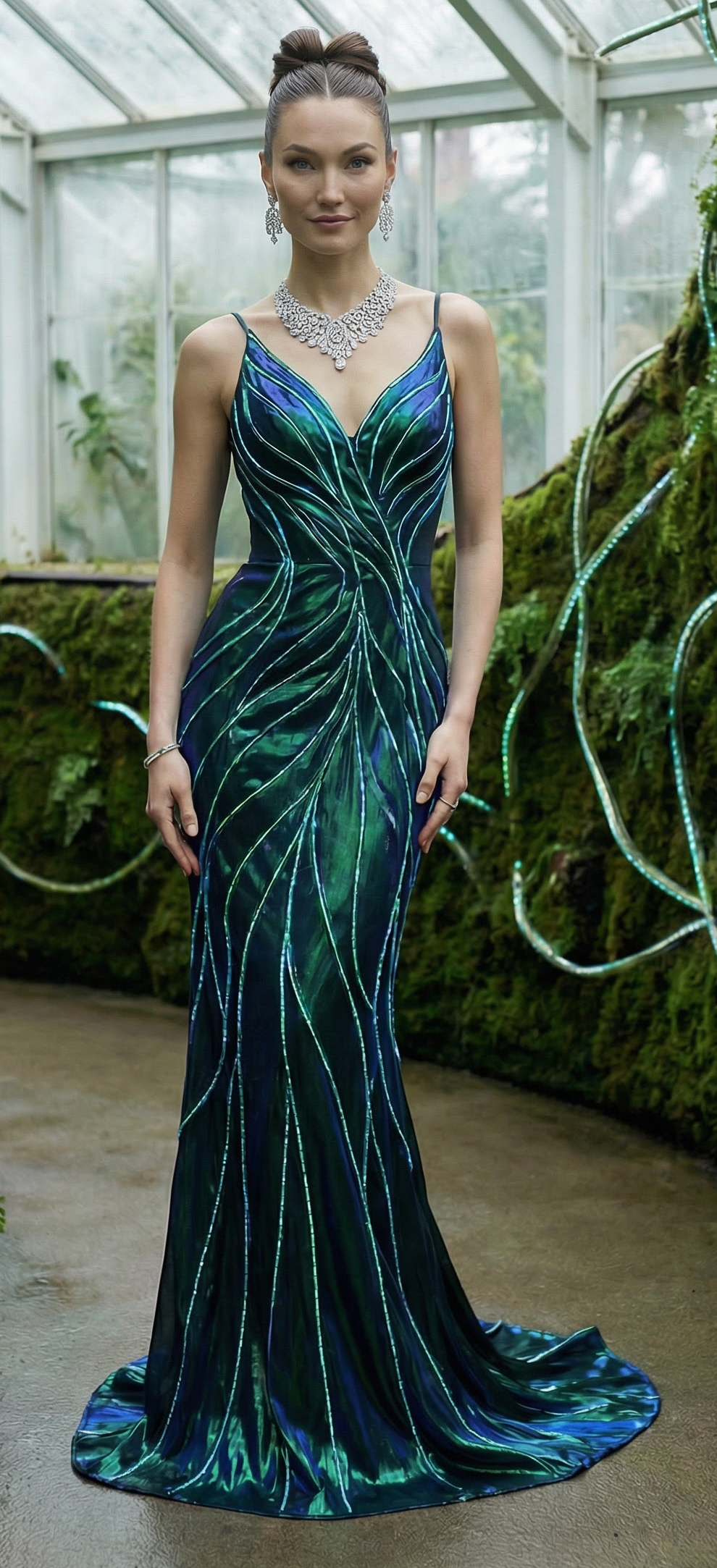
A brilliant architect discovers that the most advanced technology is grown, not built—and the most profound power is surrendered, not seized.
In a world choking on its own sterile perfection, Dr. Aris Thorne has built a career on cold logic and lifeless efficiency. Her towering arcologies are monuments to human control over nature, yet they cannot save a dying planet. When whispers of an impossible city reach her ears—a metropolis woven from living organisms, sustained by symbiotic harmony—she dismisses it as myth. But desperation has a way of making believers of skeptics.
What Aris discovers beyond the wasteland is not just a city, but a revelation. Aethelgard breathes, thinks, and feels. Its creator, the enigmatic Lyra, commands the devotion of an entire society of brilliant, confident women who have found something Aris never knew existed: the sublime euphoria of surrendering to a vision greater than themselves. Here, in this bioluminescent paradise of glossy living silks and sensual organic architecture, Aris must choose between the rigid certainty of her past and the intoxicating uncertainty of transformation.
As a mysterious blight threatens to destroy Aethelgard, Aris and Lyra must merge their minds with the city’s living consciousness. In that merging, Aris will discover that true power is not about domination, but devotion. That the greatest pleasure comes not from control, but from giving herself completely to the nurturing authority of a woman who sees her not as she is, but as she could become.
This is a story of rebirth. Of a woman who thought she had all the answers learning to ask better questions. Of discovering that the most advanced form of intelligence is not artificial, but emotional. And of finding that sometimes, the only way to save the world is to let go of everything you thought you knew—and fall into the arms of someone who knows better.
Chapter 1: The Concrete Jungle
The crystalline trophy felt cold in Dr. Aris Thorne’s hands, its sharp, perfect facets a stark contrast to the formless ache in her chest. It was the Architectural Excellence Award, the highest honor in her field, a testament to a mind that could weave steel and polymer into soaring monuments of efficiency. From her vantage point in the observation deck of the newly completed ‘Helios-7’ arcology, the city sprawled below, a grid of muted greys and browns, shrouded in the perpetual twilight of a smog-choked sky. Her creation, a self-sustaining city within a city, was a masterpiece of sterile perfection, a hermetically sealed world of recycled air and synthesized sunlight. It was a triumph of logic, a fortress against the slow, creeping death of the world outside. And it felt like a tomb.
Her comm-link chimed, a soft, unobtrusive sound that was the auditory signature of her colleague, Dr. Lena Petrova. Aris accepted the call, and Lena’s holographic form materialized in the sterile air of the observation deck, her image a flicker of warmth in the cold, white light.
“There you are,” Lena said, her voice a gentle caress. “I thought I might find you here, admiring your handiwork. It’s magnificent, Aris. A true testament to the power of reason.”
Aris turned the trophy over in her hands, her gaze lost in the cityscape below. “Is it, Lena? Or is it just a more elegant cage?”
Lena’s hologram flickered, a subtle sign of her surprise. “A cage? Aris, you’ve created a sanctuary. A place where people can live, and breathe, and forget the world outside.”
“Forget?” Aris’s voice was a low murmur. “That’s all we do, isn’t it? We build walls of glass and steel and tell ourselves we’re safe, while the world outside withers and dies. We are like a man who builds a magnificent ship, a vessel of unparalleled craftsmanship, and then sails it in a bathtub, pretending the ocean isn’t just outside the door, waiting to swallow him whole.”
Lena was silent for a moment, her holographic eyes filled with a sad understanding. “I know this feeling, Aris. It is the curse of the creator. We are like the old gods, who fashioned men from clay and then despaired when they could not also give them eternal life. We build these cities, these arcologies, and we want them to be more than just shelters. We want them to be answers. But they are not. They are just… a place to wait for the end.”
“Then what is the point?” Aris asked, her voice raw with a frustration she rarely allowed herself to feel. “What is the point of all this… this elegant denial? We are like children who build sandcastles on the beach, knowing the tide is coming in. We admire our own cleverness, our own artistry, but the ocean doesn’t care. The ocean always wins.”
“Perhaps,” Lena said softly. “Or perhaps the point is not to defeat the ocean, but to learn to build a different kind of castle. One that can float.”
Aris gave a short, humorless laugh. “A floating castle? Lena, you’ve been reading fairy tales again.”
“Have I?” Lena’s smile was enigmatic. “Or perhaps I’ve just been looking at the problem from a different angle. You see a dying world, Aris. I see a world that is waiting to be reborn. You see a tide that is coming in. I see a tide that is also, always, going out. It is all a matter of perspective.”
“I wish I had your optimism,” Aris said, her voice softening. “But I am a creature of logic, Lena. I see the data. I see the trend lines. And they all point in the same direction.”
“Then perhaps it is time to look at different data,” Lena said, her voice a gentle challenge. “The universe is a vast and mysterious place, Aris. To believe that we have already discovered all its secrets is the height of arrogance. It is like a child who has only ever seen a single drop of water and believes they understand the ocean.”
The comm-link chimed again, a different tone this time, an intrusion from the outside world. Lena’s hologram flickered and then vanished, leaving Aris alone once more in the cold, sterile silence of her triumph.
Later that night, in the stark, minimalist confines of her private laboratory, Aris found herself haunted by Lena’s words. A different kind of castle. A different kind of data. On a whim, she began to search, not the official channels, not the peer-reviewed journals, but the dark, forgotten corners of the global network, the digital graveyards where old, corrupted data went to die.
And there, among the ghosts and the echoes, she found it. A fragmented data packet, so old and corrupted that it was almost unreadable. It spoke of a place called Aethelgard. A city that was not built, but grown. A city that was not a fortress against nature, but a part of it. A city that was alive.
The data was incomplete, filled with contradictions and what seemed to be flights of poetic fancy. It spoke of buildings that breathed, of streets that pulsed with a soft, inner light, of a people who lived in perfect symbiosis with their environment. It was a fairy tale. A myth. A fantasy.
But as Aris looked at the single, clear image that had survived the data corruption—a breathtakingly beautiful flower, an orchid of a species she had never seen, its petals shimmering with a soft, bioluminescent glow—she felt something she hadn’t felt in years. A spark of wonder. A flicker of hope.
It was illogical. It was irrational. It was impossible.
And she knew, with a certainty that defied all her training, all her logic, all her carefully constructed certainties, that she had to find it.
Chapter 2: The Journey to Aethelgard
To leave a world you have built is a kind of death. Aris Thorne felt it in the hollow space that had opened up in her chest, a vacuum where the solid certainties of her life had once resided. She stood before the board of the OmniCorp consortium, a dozen holographic faces, impassive and identical in their corporate severity, their collective gaze a weight of judgment. She had just tendered her resignation.
“Let me see if I understand this, Dr. Thorne,” said the Chairman, his voice a synthesized baritone that had never known a moment of doubt. “You are abandoning your position, your life’s work, the most advanced architectural project in human history, to pursue… a ghost story? A corrupted data fragment that speaks of a city that grows from the ground?”
Aris met his gaze without flinching, her own face a mask of calm resolve. “I am not abandoning my work, Mr. Chairman. I am seeking a new way to continue it. For years, I have been a gardener, and I have cultivated the most exquisite, perfect greenhouse the world has ever seen. Every plant is flawless, every leaf is a perfect shade of green, every blossom is a testament to my control. But I have come to realize that my greenhouse is built in the heart of a dying forest. And no matter how perfect my creations are, they cannot save the trees that are falling just outside the glass. I am leaving to find a seed that can grow in the wild. A seed that does not need a greenhouse to survive.”
The Chairman’s hologram flickered with impatience. “Your analogies are as illogical as your decision, Doctor. You are a scientist, not a poet. Your responsibility is to the shareholders, to the citizens of Helios-7, to the world of reason and order that has given you everything.”
“And I have given it everything in return,” Aris said, her voice quiet but firm. “I have given it my mind, my time, my soul. But it is not enough. We are polishing the brass on a sinking ship. I am going to look for land.”
She terminated the connection, the dozen holographic faces dissolving into the sterile air of her laboratory. The silence that followed was profound, the silence of a life dismantled, of a future unwritten. She packed a single bag, her movements precise and economical, a lifetime of discipline ingrained in her very being. She took nothing personal, nothing sentimental. Only the tools of her trade, and the small, crystalline data chip that held the impossible promise of Aethelgard.
Her hovercraft, the ‘Icarus,’ was a marvel of minimalist design, a sleek, black teardrop of polished carbon and silent engines. As she lifted off from the rooftop of Helios-7, leaving the towering arcology behind, she felt a pang of something that might have been regret, or might have been relief. The city, her city, shrank below her, a monument to a future that would never come.
Her last call was to Lena. Her friend’s face materialized on the main screen of the Icarus, her expression a mixture of concern and a strange, fierce pride.
“So, the little bird has flown the coop,” Lena said, her voice soft. “Are you sure about this, Aris? The world outside these walls… it is not a kind place.”
“I know,” Aris said, her hands steady on the controls as she guided the Icarus through the upper atmosphere, the smog-choked sky giving way to the cold, clear black of space. “But to stay would be a slower kind of death. It would be like a musician who has written the most beautiful symphony in the world, but is content to play it only for herself, in a soundproof room, while the world outside has forgotten what music is. I have to know if there is anyone else out there who still remembers the song.”
“And you think you will find them in this… Aethelgard?”
“I don’t know what I will find,” Aris admitted. “Perhaps nothing. Perhaps just a ghost in the machine. But the not knowing is better than the certainty that we are doomed. I am a cartographer who has spent her life mapping a single, tiny island. I have to know if there is an ocean.”
Lena smiled, a sad, beautiful smile that made Aris’s heart ache. “Then sail well, my friend. And if you find your ocean, send me a message in a bottle.”
The connection ended, and Aris was truly alone. For days, she traveled, the Icarus a silent shadow gliding over a world in ruins. She flew over cities that were skeletal remains, their buildings like broken teeth against the horizon. She crossed vast, rust-colored deserts that had once been oceans, and flew through skies that were a perpetual, sickly yellow. The world was a canvas of decay, a masterpiece of entropy. And yet, through it all, the tiny, impossible image of the bioluminescent orchid burned in her mind, a single point of light in a universe of darkness.
She was a navigator in a sea of ghosts, her instruments her only guide, her hope her only compass. The journey was a meditation, a stripping away of all that she had been. The scientist, the architect, the logician… they all fell away, like old skins, leaving only the seeker.
On the seventh day, she arrived at the coordinates. A vast, barren canyon of red rock, a wound in the earth’s crust. There was nothing here. No sign of life, no hint of the impossible city. For a moment, despair, cold and sharp, pierced her heart. It had all been a lie. A ghost. A fairy tale.
She was about to turn the Icarus around, to return to the elegant tomb she had built for herself, when the sun began to set. And as the last rays of light bled from the sky, something impossible happened.
The canyon walls began to glow.
A soft, pulsating light, like the slow, deep breath of a sleeping giant. Veins of it spread across the rock face, intricate patterns of soft, green and blue light that seemed to be… alive. The light grew brighter, and the very air began to hum with a low, resonant frequency. Before her eyes, the canyon wall seemed to dissolve, not into dust, but into a shimmering curtain of light, a gateway of woven vines and bioluminescent fungi that pulsed with a life that was both alien and deeply, profoundly beautiful.
The Icarus’s sensors went wild, unable to classify, unable to comprehend. But Aris did not need them. She knew, with a certainty that transcended logic, that she had found it.
She landed the Icarus and stepped out into the strange, sweet-smelling air. And from the gateway of light, they emerged.
Three women, tall and graceful, their movements synchronized, their faces serene and confident. They were dressed in gowns of a material Aris had never seen, a glossy, shimmering fabric that seemed to be woven from living light, its colors shifting with their every movement. It was sleek, elegant, and utterly organic. On their faces was an expression of such profound peace, such unwavering devotion, that it was both enthralling and deeply unsettling.
One of them, a woman with eyes the color of amethysts and hair like spun moonlight, stepped forward. Her voice, when she spoke, was like the chiming of crystal bells.
“You are the seeker,” she said, not as a question, but as a statement of fact. “The one who has come from the world of steel and sorrow. We have been waiting for you.”
Aris found her voice, a dry whisper in the sudden silence. “How did you know?”
The woman smiled, a smile that held the wisdom of ages. “She told us. She who weaves the bloom and guides the growth. She who is the heart of this place. Lyra.”
The name hung in the air, a note of music that seemed to resonate with the very hum of the living city. The devotion in the woman’s voice was a palpable thing, a force of nature in itself. It was not the fawning of a servant, but the fierce, joyful loyalty of a soul that has found its purpose.
“Welcome to Aethelgard,” the woman said, her hand extended not in a gesture of greeting, but of invitation. “Your journey is over. And it is just beginning.”
Chapter 3: The Allure of the Organic
Stepping through the shimmering gateway was like diving into a warm, fragrant sea. The air, thick with the scent of night-blooming jasmine and damp earth, enveloped Aris in a sensual embrace, a stark contrast to the sterile, ozonic tang of her arcology. The ground beneath her feet was not hard and unyielding, but soft and resilient, a living carpet of moss that seemed to pulse with a gentle, inner light. Above her, the city of Aethelgard rose not as a collection of structures, but as a forest of impossible beauty, a symphony of organic architecture that defied every principle she had ever learned. Buildings, if they could be called that, spiraled towards the twilight sky like massive, petrified trees, their walls a mosaic of iridescent fungi and glowing flora. Bridges of woven vines, strong as steel cables, arced between the towers, and the air was filled with the soft, chiming music of wind passing through crystalline flowers.
This was not a city. It was an ecosystem. A living, breathing organism.
The woman with amethyst eyes, who had introduced herself as Elara, led her through the winding, glowing pathways. Her two companions, Lyra and Nyssa, walked on either side of Aris, their presence a silent, comforting warmth. Their devotion to Elara, and to the unseen Lyra, was not the rigid discipline of soldiers, but the fluid, intuitive grace of a dance troupe, each woman anticipating the others’ movements, their collective purpose a palpable, harmonious chord.
“It is beautiful,” Aris said, her voice a hushed whisper of awe. “But it is… impossible. The structural integrity, the energy requirements, the waste recycling… my mind cannot reconcile what my eyes are seeing.”
Elara smiled, a gentle, knowing smile. “That is because you are trying to understand a poem by dissecting its grammar, Dr. Thorne. You are a master of the language of steel and stone, a language of rigid rules and unyielding certainties. But Aethelgard is written in the language of life, a language of flow, of adaptation, of connection. You do not analyze a song; you let it wash over you. You do not deconstruct a flower; you breathe in its fragrance.”
They arrived at the heart of the city, a vast, open plaza that seemed to be the source of the city’s gentle hum. In the center of the plaza stood a single, massive tree, its branches reaching up to brush the sky, its leaves a cascade of silver and emerald. And at the base of the tree, seated on a throne of living, woven roots, was a woman who could only be Lyra.
She was, Aris thought, the most beautiful woman she had ever seen. Not a fragile, decorative beauty, but a beauty that was rooted in a deep, unshakable strength. Her hair was a river of dark silk, her eyes the color of a forest at dusk. She wore a gown of the same living, shimmering fabric as the others, but hers was a deep, iridescent blue, the color of a twilight sky. Her authority was not something she wore like a mantle; it was something that radiated from her, as natural and effortless as the light from a star.
As Aris approached, Lyra’s gaze met hers, and in that moment, Aris felt as if the woman saw not just the architect, not just the scientist, but the hollow, aching space in her soul. Lyra’s smile was a slow, gentle dawn, a promise of warmth in a world of cold.
“Dr. Aris Thorne,” Lyra said, her voice a low, melodic hum that seemed to vibrate in Aris’s very bones. “The woman who builds cages for the human spirit and calls them sanctuaries. Welcome to my garden.”
Aris was taken aback by the directness of the statement, yet there was no malice in it, only a profound, gentle understanding. “You see my work as a cage?”
“All that separates, all that isolates, is a cage, no matter how beautiful its bars,” Lyra said, her eyes never leaving Aris’s. “You have spent your life building walls, Doctor. I have spent mine learning to grow roots. You believe that strength comes from being invulnerable, from being untouched. I believe that strength comes from connection, from being a part of something larger than oneself. You are like a magnificent, solitary iceberg, perfect and crystalline, but melting in a warming sea. My people… we are the sea itself.”
As she spoke, a dozen other women emerged from the surrounding structures, drawn by her voice, by her presence. They gathered around her throne, their faces filled with an adoring, rapturous devotion. They were all different—some old, some young, some with skin the color of ebony, some of pale alabaster—but they were united in their shared love for the woman who was their center, their sun.
Lyra gestured to the women around her. “These are my flowers, Doctor. Each one unique, each one beautiful, each one contributing her own special fragrance to the garden. I do not command them; I nurture them. I do not rule them; I give them the soil in which to grow. And in return, they give me their devotion, their love, their strength. It is a symbiosis, a dance of reciprocal generosity. This is what you have been searching for, is it not? A connection that is not a transaction. A power that is not a weapon.”
One of the women, a beautiful, dark-skinned woman with eyes like molten gold, stepped forward and knelt before Lyra, taking her hand and pressing it to her cheek. “You gave me a home when I was lost, Lyra,” she said, her voice thick with emotion. “You taught me that my sensitivity was not a weakness, but a gift. My life is yours, not because you demand it, but because you have made it beautiful.”
Lyra smiled and touched the woman’s cheek, a gesture of infinite tenderness. “And your beauty, Amara, makes my life, and our city, more beautiful in return.”
Aris watched, her heart a confusion of conflicting emotions. Her logical mind screamed that this was a cult, a manipulation, a surrender of individual will. But her soul, the part of her she had long suppressed, saw something else. It saw a community. It saw a deep, profound love. It saw a form of power she had never imagined, a power that was not about control, but about release.
Lyra then turned her attention back to Aris. “You are tired, Doctor. You have been on a long journey, not just through the wasteland, but through the desert of your own certainties. Come. Let us find you a place to rest. And let us find you something more comfortable to wear. That… armor you have on… it must be exhausting to carry.”
She gestured to Elara, who led Aris away from the plaza and into one of the spiraling, living towers. The room she was given was not a room at all, but a chamber of living wood and glowing moss, with a bed that was a massive, soft flower, its petals closing gently around her as she lay down. And on the bed was a gown, a simple, elegant sheath of the same living, glossy silk as the others, this one the color of a pale, dawn sky.
When Aris slipped it on, the fabric felt like a cool, gentle caress against her skin, a living thing that seemed to respond to her very thoughts. It was a stark contrast to the rigid, functional clothing she had worn her entire life. For the first time in as long as she could remember, she did not feel like an architect, or a scientist, or a doctor. She felt like a woman.
And as she drifted off to sleep, the scent of orchids filling the air, she dreamt not of steel and concrete, but of a garden, a garden where she was not the gardener, but a single, perfect bloom, turning her face towards the sun.
Chapter 4: The Seeds of Transformation
Days in Aethelgard bled into one another in a seamless, sensual flow, a rhythm dictated not by the harsh, artificial light of a clock, but by the gentle, organic pulse of the city itself. Aris found her own rigid internal chronometer beginning to dissolve, her life-long habit of segmenting time into productive units replaced by a sense of fluid presence. She was a guest, an observer, a ghost from a world of sharp angles and hard data, haunting a paradise of soft curves and unspoken truths.
Lyra, in her infinite, nurturing wisdom, gave Aris the gift of space, allowing her to wander the living corridors of Aethelgard on her own. Yet, Aris never truly felt alone. She was constantly surrounded by the quiet, joyful industry of the Aethelgardians, their serene faces glowing with a sense of purpose that was as foreign to her as the air she breathed. She saw them tending to the city as one would a beloved garden, their hands caressing the living walls, their voices murmuring soft encouragements to the blooming flora. Their devotion to Lyra was not a performance for the newcomer; it was the very fabric of their existence, the source of the city’s gentle, harmonious hum.
One evening, as the bioluminescent fungi that lined the pathways began to glow with the soft, pearlescent light of the Aethelgardian night, Lyra sought her out. She found Aris in the Chamber of Archives, a vast, cavernous space where the city’s history was stored not in books or data chips, but in the rings of a colossal, petrified tree.
“You are trying to read the story of a river by counting the stones on its bed,” Lyra said, her voice a soft melody in the echoing silence. “You seek knowledge, Aris. But you are looking for it in the dead, not the living.”
Aris turned, her face a mask of intellectual frustration. “I am trying to understand. This place… it defies the laws of physics, of biology, of everything I have ever known. It is like a beautiful, impossible dream, and I am afraid I will wake up.”
Lyra’s smile was gentle, tinged with a profound empathy. “Then let me show you the heart of the dream.”
She led Aris from the archives, through a winding, crystalline tunnel that descended deep into the earth, to a place that was the city’s most sacred sanctum: the Chamber of the Mycelial Network. The chamber was a vast, cathedral-like cavern, its walls and ceiling a living tapestry of delicate, glowing filaments, a neural network of unimaginable complexity that pulsed with a soft, silver light. It was the brain of Aethelgard, the consciousness of the city made manifest.
“This,” Lyra said, her voice a reverent whisper, “is the source of everything. The connection. The consciousness. The love.”
Aris’s scientific mind reeled. “It is a mycelial network. A fungus. A vast, symbiotic organism. But it cannot be conscious. It cannot have intention. It is… a biological machine.”
“Is that what you are, Aris?” Lyra asked, her gaze piercing. “A biological machine? A collection of cells and synapses, firing in predictable patterns? Or are you something more?” She stepped forward and placed her hand on the shimmering web of light. “In your world, each mind is an island, isolated and alone, shouting across a vast, empty ocean. Here, we are all part of the same root system, drawing from the same soil, drinking from the same rain. The thoughts, the feelings, the memories of one are the thoughts, the feelings, the memories of all. And I… I am the gardener of this forest of souls. I do not command it; I listen to it. I do not control it; I guide it.”
As if to demonstrate, she closed her eyes, her face a mask of serene concentration. On the far side of the chamber, a cluster of orchids, their petals a pale, sickly yellow, began to transform. A wave of vibrant, healthy color washed over them, their petals unfurling and glowing with a renewed, brilliant light. Aris’s breath caught in her throat. It was impossible. It was magic. It was real.
“You see?” Lyra said, opening her eyes. “It is not about force. It is about harmony. It is not about will. It is about willingness.”
Aris felt a profound, unsettling yearning. Her entire life had been a quest for control, for mastery over the chaotic variables of the universe. But here was a power that came from surrender, from connection, from a deep, trusting release. It was terrifying. And it was the most beautiful thing she had ever seen.
Later, as she sat in the communal dining grove, the air filled with the soft laughter of the Aethelgardians and the scent of exotic, delicious food, she was joined by Selene, the former scientist she had met on her first day. Selene’s face, which had once been etched with the harsh lines of a world of competition and scarcity, was now smooth and radiant, her eyes shining with a deep, inner peace.
“You are troubled, Aris,” Selene said, her voice a soft, melodious hum. “Your mind is a beautiful, intricate machine, but it is running too fast. It is trying to solve a puzzle that was never meant to be solved with logic.”
“I don’t understand this place,” Aris confessed, her voice low. “I don’t understand your devotion to Lyra. You are all brilliant, accomplished women. Why would you surrender your will to another?”
Selene smiled, a smile of profound, patient wisdom. “You think of it as a surrender. We think of it as an alignment. In your world, I was a star, a bright, burning, lonely star in a vast, empty sky. I was admired, I was respected, but I was utterly alone. My light was my own, but it illuminated nothing but my own isolation. When I came here, when I met Lyra, I learned that I did not have to be a solitary star. I could be a part of a constellation. And Lyra… she is not a ruler who demands our light. She is the center of gravity that holds the constellation together, that gives it its shape, its beauty, its purpose. My light is not diminished by being a part of her design; it is magnified. It becomes part of something larger, something more beautiful than I could ever be on my own.”
She picked up a piece of fruit from the glossy, living plate between them, a fruit that shimmered with an inner light. “To give your devotion to one who is worthy of it is not a loss of self, Aris. It is the ultimate discovery of self. It is to find the one note that your soul was always meant to sing, and to sing it in perfect harmony with a choir of other souls, all led by a conductor who hears the music of the universe. The joy, the sublime euphoria that comes from that harmony… it is a feeling for which your world has no name.”
Selene’s words, her story, her radiant, undeniable happiness… they were a seed, a tiny, powerful seed planted in the barren soil of Aris’s logical mind. A seed that, in the warm, nurturing light of Aethelgard, was beginning, against all odds, to grow.
Chapter 5: The Crisis and the Catharsis
The first sign of the blight was subtle, a discordant note in the perfect symphony of Aethelgard. A patch of moss on a high balcony, once a vibrant, glowing emerald, had turned a dull, sickly brown. A single, crystalline flower, which had chimed a soft, melodic note in the wind, now hung silent and brittle. To most, it was nothing. A minor imperfection in a world of overwhelming beauty. But to Aris, a woman trained to see the flaw in the flawless, the crack in the monolith, it was a scream in the silence.
Within days, the blight spread. The vibrant, glowing veins of the city began to flicker and dim. The air, once thick with the fragrance of life, now carried a faint, acrid scent of decay. A quiet, insidious fear began to creep into the hearts of the Aethelgardians, a shadow of doubt in their paradise of faith. They gathered in the central plaza, their faces etched with a worry that Aris had never seen on them before, their gazes fixed on the great tree at the city’s heart. Its leaves, once a cascade of silver and emerald, were now tinged with the same sickly brown.
Lyra was weakening. The vibrant, radiant energy that had once flowed from her in an endless, nurturing stream was now a flickering, struggling current. She sat on her throne of living roots, her face pale, her eyes clouded with a deep, profound sorrow. The women of Aethelgard surrounded her, their hands outstretched as if to offer their own life force, their own strength, but the blight was a poison that their love alone could not seem to cure.
Aris, her scientific mind kicking into high gear, began to analyze. She took samples of the blighted flora, ran diagnostics with the advanced equipment she had brought in the Icarus, cross-referenced the data with every known form of biological decay. The results were maddening. There was no pathogen. No virus. No external contaminant. The blight was not a disease; it was a self-immolation. The city was killing itself.
She brought her findings to Lyra, her voice a torrent of frantic, logical analysis. “It’s a cellular breakdown, a systemic failure of the regenerative process. The telomeres of the city’s flora are shortening at an exponential rate. It’s like a form of rapid, aggressive aging. But there’s no cause! No reason! It’s impossible!”
Lyra looked at her, her gaze filled with a sad, weary wisdom. “You are a brilliant physician, Aris. You have diagnosed the symptoms with perfect accuracy. But you are looking for the wound on the body, when the wound is in the soul.”
“The soul?” Aris’s voice was incredulous. “Lyra, this is not a metaphysical problem. This is a biological crisis!”
“Is there a difference?” Lyra asked, her voice a soft, tired whisper. “Aethelgard is not a machine, Aris. It is a consciousness. A collective dream. And a dream can be poisoned. You are a woman who has spent her life in a fortress, and when you came to my garden, you did not realize that you brought the fortress with you. Not in your hands, but in your heart. Your doubt, your fear, your rigid insistence on a world that can be measured and controlled… it is a seed of a different kind of plant. A weed. And it has taken root in my garden.”
Aris felt a cold, sickening dread wash over her. “Me? I did this?”
“You did not mean to,” Lyra said, her voice gentle, devoid of accusation. “A person who has only ever known winter cannot be blamed for bringing a chill into a summer garden. But the fact remains. The blight is a manifestation of your own inner discord. A physical manifestation of your fear of surrender. And the only way to cure it… is for you to finally, truly, let go.”
She extended her hand, her palm pale and trembling slightly. “My strength is failing. I cannot fight this alone. I need you, Aris. Not your mind. Not your science. I need your soul. You must connect with the Mycelial Network. You must merge your consciousness with mine, with the city’s. You must become a part of the dream, not just an observer of it.”
Aris stared at Lyra’s outstretched hand, her heart a battlefield of warring emotions. Her mind, her logic, her entire being screamed in protest. To surrender her consciousness, to merge with another, was to lose herself, to become a slave. It was the ultimate violation of her individuality, the one thing she had always held sacred.
But as she looked into Lyra’s eyes, she saw not a conqueror, but a supplicant. She saw not a demand, but a desperate, loving plea. And she saw the faces of the women around her, their eyes filled with a desperate, trusting faith, not just in Lyra, but in her. In the woman who had brought the poison, and who was now being asked to be the antidote.
It was the ultimate paradox. The ultimate test. To save the city, she had to destroy the fortress within herself. To gain a power she had never imagined, she had to surrender the only power she had ever known.
“I am a builder of walls,” Aris whispered, her voice thick with a lifetime of fear. “I don’t know how to grow roots.”
“You do not have to know,” Lyra said, her voice a soft, seductive promise. “You only have to be willing to be the soil.”
And in that moment, something inside Aris broke. The walls of her fortress, so carefully constructed, so fiercely defended, crumbled into dust. With a sob that was a mixture of terror and a profound, ecstatic relief, she knelt before Lyra, took her hand, and pressed it to her lips.
“Show me how,” she whispered.
Lyra’s smile was a radiant, triumphant dawn. She placed her other hand on Aris’s head, her touch a jolt of pure, unadulterated energy. “Close your eyes, my brilliant, beautiful architect. And fall.”
Aris did. And the world dissolved.
It was not a loss of self, but an explosion of it. Her consciousness, once a single, isolated point of light, erupted into a universe of sensation. She was the moss on the walls, the flower in the wind, the light in the crystalline tunnels. She was the memories of every woman in Aethelgard, their joys, their sorrows, their hopes, their fears. And through it all, she felt Lyra, not as a separate being, but as the vast, loving, all-encompassing ocean in which her own river of consciousness had finally found its home.
She felt the blight, the cold, hard knot of her own fear, and she felt Lyra’s love, a warm, golden light, surrounding it, embracing it, not fighting it, but… dissolving it. She felt the sublime, ecstatic euphoria of release, of letting go of the terrible, crushing burden of the self. She was a part of the constellation, a note in the symphony, a flower in the garden. And it was the most profound, most sensual, most intensely pleasurable feeling she had ever known.
When she opened her eyes, she was still kneeling at Lyra’s feet, her hand still in Lyra’s. But everything was different. The air was clean and fragrant again. The light of the city was bright and steady. The great tree at the heart of the plaza was a vibrant, shimmering cascade of silver and emerald. The blight was gone.
Lyra was looking down at her, her face radiant, her eyes shining with a love that was both maternal and deeply, passionately carnal. “Welcome home, my love,” she whispered.
Aris looked up at her, her own eyes filled with a devotion that was as fierce and as joyful as that of any other woman in Aethelgard. She was no longer the architect. She was no longer the scientist. She was a part of the bloom. And she was finally, truly, home.
Chapter 6: The Rebirth
Rebirth is not a gentle awakening; it is a seismic, soul-shattering eruption. Aris Thorne awoke not in the soft, floral bed of her chamber, but still kneeling at Lyra’s feet, the cool, living stone of the plaza floor beneath her knees a grounding sensation in a universe that had been utterly remade. The world was a symphony, and for the first time, she could hear every note. The soft, contented sigh of the mosses, the joyful, chiming laughter of the crystalline flowers, the deep, resonant hum of the Mycelial Network—it was all a part of her, and she a part of it. The crushing weight of her own isolated ego, a burden she had carried for so long she had mistaken it for her own spine, was gone. In its place was a lightness, a sense of belonging so profound it was indistinguishable from love.
Lyra’s hands were still on her, one holding hers, the other resting gently on her head. The connection was a warm, golden river flowing between them, a current of shared thoughts, shared feelings, shared existence. Lyra was no longer just a woman before her; she was the sun, the moon, the earth, the sky. She was the center of a universe that Aris now joyfully, willingly, orbited.
“I was a sculptor who only worked with stone,” Aris whispered, her voice a raw, emotional tremor, her eyes never leaving Lyra’s. “I believed that beauty was what you chipped away, what you removed, what you controlled. I spent my life carving the world into the shape of my own rigid will. You… you have taught me to be a weaver. You have shown me that beauty is what you add, what you connect, what you intertwine. My life was a monument of cold, hard stone. You have turned it into a tapestry of living, breathing silk.”
Lyra’s smile was a universe of love and acceptance. She drew Aris to her feet, her touch both infinitely gentle and irresistibly firm. “And you, my brilliant Aris, were the missing thread in my tapestry. The silver thread of reason to my golden thread of intuition. I was a composer who had written a beautiful symphony, but I knew there was a missing chord, a harmony that would make the music complete. You are that chord. Now, the music is perfect.”
The other women of Aethelgard, who had been watching from a respectful distance, now drew closer, their faces alight with a shared, radiant joy. There was no jealousy, no rivalry, only a profound, welcoming love. Elara, Selene, Amara—they embraced Aris not as a convert, but as a sister who had finally found her way home. They were a constellation, and a new star had just been born among them, making their collective light all the brighter.
“We are so happy for you, Aris,” Selene said, her eyes shining with tears of joy. “To see you find your place in the pattern… it is a gift to us all.”
Amara, her own devotion to Lyra a fierce, burning flame, took Aris’s other hand. “You were a queen in a kingdom of ghosts. Now you are a princess in an empire of life. Your heart has found its true north.”
In the days that followed, Aris’s transformation was not just internal, but external. Her scientific genius, once a tool for domination and control, was now an instrument of harmony and creation. She worked alongside Lyra, her logical mind now fused with her intuitive connection to the Mycelial Network. She did not impose her will upon the city; she listened to its needs, its desires, its dreams. She became a co-creator, a partner in the endless, joyful dance of life.
She designed new wings for the city, structures that were not just beautiful, but empathetic, responding to the emotional states of their inhabitants. She found ways to strengthen the city’s immune system, to make it more resilient, to help it grow not just bigger, but healthier, more vibrant. She was no longer building cages; she was cultivating a garden.
One evening, as she and Lyra stood on a high balcony, overlooking the glowing, thriving paradise they now nurtured together, Aris sent a message. She opened a channel to the Icarus, still parked silently at the edge of the city, and transmitted a single, simple command. The hovercraft’s small, long-range drone, a vessel no bigger than her hand, detached itself and began its long journey back to the world of steel and sorrow.
Its cargo was not a data chip, not a scientific paper, not a desperate plea for help. It was a single, living seed. A seed from the great tree at the heart of Aethelgard, a seed that held within it the impossible, beautiful promise of a different kind of world.
She directed it to the coordinates of Lena Petrova’s private laboratory.
Lyra wrapped her arms around Aris from behind, her body a warm, sensual pressure against Aris’s back, her chin resting on Aris’s shoulder. “A message in a bottle,” Lyra murmured, her voice a soft, seductive hum in Aris’s ear.
“A seed of hope,” Aris replied, her own voice filled with a deep, unshakable peace. She leaned back into Lyra’s embrace, surrendering to the strength, the warmth, the all-encompassing love of the woman who was her guide, her queen, her home. “In my old world, we believed that the only way to survive was to build a higher wall. You have taught me that the only way to truly live is to plant a more beautiful garden.”
Lyra’s lips brushed against her neck, a touch that sent a shiver of pure, ecstatic pleasure through Aris’s entire being. “And our garden, my love,” Lyra whispered, her voice a promise of endless, sensual tomorrows, “is only just beginning to bloom.”
Aris closed her eyes, no longer a solitary iceberg, but a part of the vast, warm, living ocean. She was home. And for the first time in her life, she understood that the greatest act of logic was to surrender, completely and joyfully, to the undeniable, irrefutable, and infinitely beautiful truth of love.
Aris found her garden. The seed of her transformation, once a fragile whisper of hope, has blossomed into a reality more beautiful than she could have ever engineered. Her story, like so many others, is a testament to the profound truth that the most exquisite pleasures are found not in control, but in the sublime, soul-deep euphoria of surrender.
But Aethelgard is not the only hidden garden in the wasteland.
Across the world, other seeds are taking root. In the crystalline spires of a sun-drenched utopia, a cynical architect is learning the language of light from a radiant visionary. In a veiled city that exists only at twilight, a disgraced cartographer is mapping the geography of whispers, guided by a mysterious and enthralling leader. In the silent groves of a forgotten mountain, a sword dancer is discovering that true power lies not in the strike, but in the stillness of devotion.
Each is a world waiting to be discovered. Each is a story of a powerful, educated woman finding her true purpose in the arms of a masterful, nurturing guide. Each is a journey into the heart of sensual submission and the intoxicating beauty of being utterly, completely, and joyfully cherished.
These are the stories we tell. These are the worlds we build.
Your journey does not have to end here. The gate to other gardens, other transformations, other ecstasies, is open.
Discover them all at patreon.com/SatinLovers.
#LesbianRomance, #BiopunkFiction, #FemaleDominance, #SapphicLove, #SciFiRomance, #WLWFiction, #LuxuryLifestyle, #DevotionAndPower, #SensualSubmission, #TransformativeRomance

Leave a Reply
You must be logged in to post a comment.