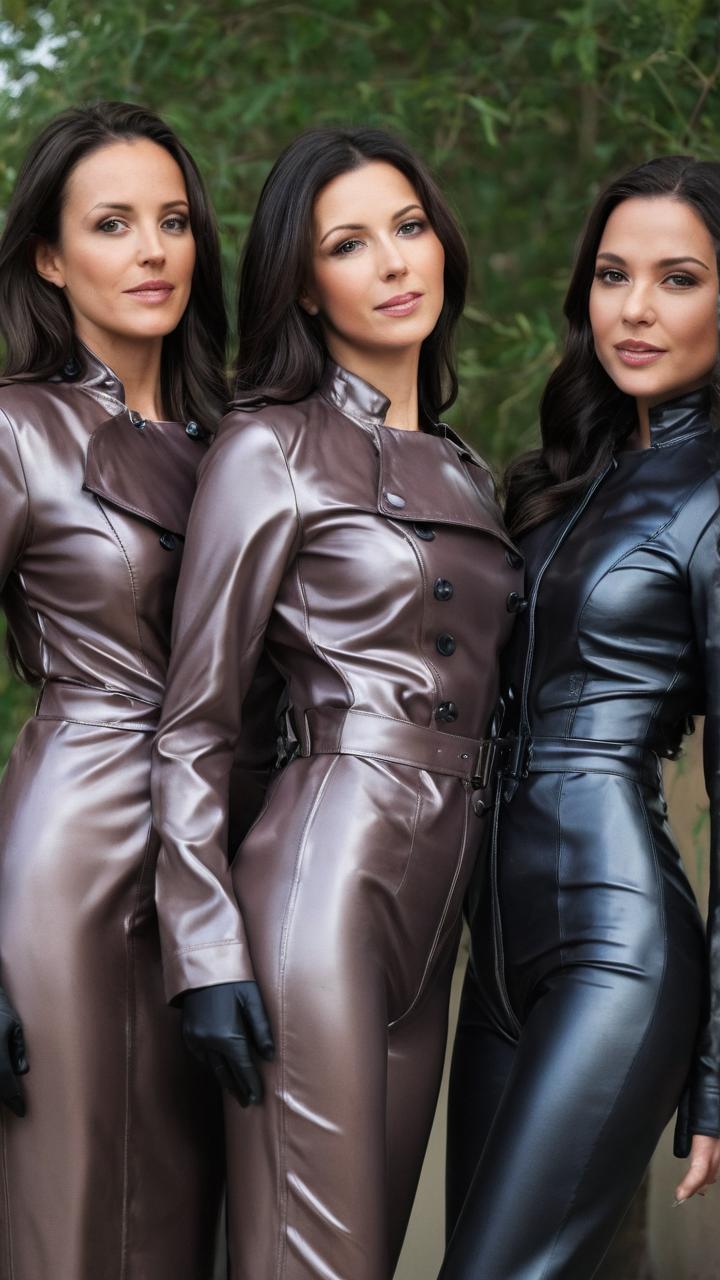
When a single leaked article brands his midnight salon a “glossy coven,” the Envoy doesn’t flinch—he closes the doors, calls the women closer, and turns a brewing scandal into his first true test of power.
Phones start vibrating first—edge-of-table shivers, screen-glows on lacquered PVC and rose-gold silk. One by one, the women at the Satin Embassy glance down, and the same headline stares back at them: a breathless exposé about a “secret elite coven” of ambitious women and the dangerously composed diplomat who gathers them after midnight.
In an instant, everything they’ve built in this room—new frameworks, raw confessions, signatures drying on the Satin Charter—tilts under the weight of public suspicion. Donors will panic. Boards will bristle. Enemies will gloat. This is the moment most men in power reach for lawyers, lockdowns, or lies.
The Envoy does none of those things.
Instead, he steps into the centre of the salon, lets them vent their fear and fury, and then offers something far more unsettling—and irresistible. No apologies. No retreat. Just a calm demand that they face the attack the same way they’ve faced their own desires all night: with precision, with honesty, and with him holding the room steady while the world tries to shake it apart.
By dawn, the city will have two stories about the Satin Embassy. One written by voyeurs peering in from the street. And one written by the women inside, under the quiet, unflinching guidance of the man who refuses to let anyone else define what happens in his house.
Read chapters 5 – 6 at: https://satinlovers.co.uk/the-satin-embassy-chapters-5-6/
Chapter 7: The External Shock
It began as a vibration.
A small, insistent buzz on polished wood, an insect hum against glass. The kind of sound people had learned to ignore until it became too rhythmic, too synchronized, to be coincidence.
Mara was the first to notice it. Her phone, face-down on the low table, began to skitter almost imperceptibly, the PVC of her sleeve catching the corner as she reached for her glass.
“Someone’s very determined,” she muttered, flipping it over.
The screen was a stack of notifications: messages, mentions, a push alert from a news app she hadn’t realised she still had installed.
Her eyebrows went up, then drew together.
“Oh, hell,” she said.
Layla, mid-sentence with a potential steward, paused. “What?”
Mara’s thumb danced. Her eyes scanned, sharp, swift. Her jaw set.
“Oh, excellent,” she said, voice gone flat. “We’re trending.”
At another table, Duarte’s phone chimed in eerie synchrony. Across the room, three more devices lit up. A murmur swept, soft at first, then tightening.
The Envoy, standing near the tall windows, did not yet move. He saw the wave instead—the way bodies stiffened incrementally, how eyes dropped to laps and then widened. He felt the room’s pressure change.
Adrian was already at his shoulder, tablet awake.
“Sir,” he said quietly. “There’s a piece.”
“Of course there is,” the Envoy replied. “Who?”
“A mid-tier outlet with a taste for scandal,” Adrian said. “And a very fast social media team.”
“Title,” the Envoy asked.
Adrian’s mouth flattened. “The Satin Embassy: Inside the City’s Newest Elite Coven,” he quoted.
The Envoy’s dark eyes gleamed, but it was not amusement.
“Of course they went with ‘coven’,” he murmured. “If you’re going to smear powerful women, reach for the classics.”
He did not grab the tablet. He did not bark orders. He simply turned, posture altering almost imperceptibly. The calm of the room reoriented toward him like iron filings around a magnet.
“Let them read for thirty seconds,” he said softly. “Then we’ll talk.”
Mara’s thumb flicked down the article, anger rising with each paragraph.
Photos—zoom-lensed, grainy, taken from the street—of the Embassy entrance earlier that evening. Women in lacquered PVC and liquid silk stepping out of dark cars, faces partially obscured. The captions did what captions like that always did: supplied implication where fact was thin.
“A secretive midnight salon for glossy elites.”
“A handpicked circle of ‘difficult’ women invited to a diplomat’s private playground.”
“Power, beauty, and influence behind closed doors.”
“Playground,” Mara spat. “They make it sound like we’re party favours.”
Layla’s phone vibrated again. A donor’s name flashed on her screen, then another she recognised from a grant committee.
“Of course,” she whispered, pressing her lips together. “Of course this happens tonight.”
The article went on, weaving innuendo around absence of detail.
No agenda published. No minutes. No list of participants. A man known only by his title—the Envoy—hosting an invitation-only gathering of “attractive innovators” in fetish-adjacent fabrics.
They quoted an unnamed source: a “concerned staffer” who spoke of “intimate late-night sessions” and “over-familiarity between powerful men and vulnerable women.”
“Vulnerable,” Duarte muttered, reading over someone’s shoulder. “That’s one word for it.”
“Who leaked?” someone hissed.
“Does it matter?” another shot back. “This is going to be everywhere by morning.”
Across the room, Iris’s phone chimed once, then stilled. She picked it up, read in silence, her expression tightening into something like a quiet snarl.
“Oh, they’re good,” she said. “Lazy, but good. Lots of smoke, no actual flame. Enough to make people who already don’t like rooms full of smart women in glossy clothes very nervous.”
Her gaze flicked up, seeking the Envoy.
He was already stepping forward.
He didn’t raise his voice. He didn’t have to.
“Ladies,” he said. “If you would join me in the centre, please. We have just received our first structural test from the outside world.”
The phrasing slipped under the panic like a hand to the spine. Not scandal. Not attack.
A test.
Clusters loosened. People drifted inward in twos and threes, still clutching their phones, eyes darting between screens and his face. The satin and PVC and silk moved like a shifting tide, the reflection of it glittering in the windows.
The Envoy gestured to staff with a small motion. The doors to the corridor were closed—not locked, not blocked, simply shut against draught and intrusion. The lighting dipped a fraction, softening edges, pulling the circle in tighter.
Iris moved to his right, Duarte to his left. Mara and Layla ended up near the front, almost without deciding to.
Adrian stood slightly behind him, tablet in hand, jaw tight.
“All right,” the Envoy said. “No one is going to pretend this isn’t happening. Iris—would you do us the honour of reading the thing aloud? Rumour thrives in fragments. Let’s give it a voice and take that away.”
Iris’s grey eyes flashed. “Gladly,” she said.
She stepped forward, vinyl catching the light, and held up her phone.
The room quieted. The only sounds were the distant hum of the city and the faint whir of the Embassy’s ventilation.
“The Satin Embassy: Inside the City’s Newest Elite Coven,” she read, dry as dust. “By ‘Staff Writer’.”
A ripple of disdain.
She continued, voice even, emphasising certain phrases with a technical precision that bordered on surgical.
“‘Tonight, while most of the city slept, a very different kind of gathering took place in an unmarked diplomatic building…’”
“‘…handpicked, photogenic female “innovators” arrived in cars with blacked-out windows, draped in PVC, satin, and silk…’”
“‘…an invitation-only “salon” hosted by a famously opaque diplomat known only as the Envoy…’”
She paused, glanced up. “They really like that phrase,” she said. “Famously opaque.”
“On the contrary,” the Envoy murmured. “I am almost tiresome in my clarity.”
A few people snorted, tension easing by degrees.
Iris went on.
“‘Sources report that the event had no published agenda, no public record, and no transparency—just a powerful man and a roomful of ambitious women behind closed doors. “It felt like a coven,” one staffer said. “Glossy, exclusive, and not in the public interest.”’”
She lowered the phone.
“Then some handwringing about unequal access, questions about whose interests are being served, and a speculative paragraph about “intimate mentorship” with a very loaded ellipsis,” she summarised. “No actual allegation. Just… suggestion.”
The Envoy nodded once. “Thank you,” he said. “So. We have our data.”
He looked around at them. “Reactions. Speak.”
The room did not need more permission.
“This could kill my next funding round,” said the woman in the silver dress, voice tight. “One suggestive article and suddenly I’m being asked if I’m ‘compromised’.”
“My donors panic at the word ‘coven’,” Layla said. “They barely tolerate the word ‘collective.’”
Mara’s eyes burned. “I’m so tired of this,” she said. “One man in a suit and a dozen women in shiny outfits, and suddenly it’s a sex club.”
“Or a conspiracy,” Duarte added. “Never mind that every day, grey-haired men in worse suits meet behind closed doors to decide things. That’s just… governance.”
“I knew this was a risk,” someone else said. “I almost didn’t come because I could hear this headline in my head. And yet here we are.”
A softer voice: “My board will ask questions. They already think I’m… impulsive.”
Another: “My ex will love this. He’s been itching for something to throw in my face.”
The Envoy listened, hands loosely clasped, face unreadable.
He did not shush them. He did not speak over them. He let the first flare of fear and anger burn.
Only when the room’s volume shifted from jagged to ragged did he lift one hand.
“Thank you,” he said. “Good. We have named the first layer.”
He turned his head slightly.
“Iris,” he said. “Professional assessment?”
She folded her arms. “Classic FUD,” she said. “Fear, uncertainty, doubt. They have photographs and vibes. No evidence of wrongdoing. They’re trying to ride the algorithmic wave of outrage while staying technically safe from libel.”
“Targets?” he asked.
“The Embassy,” she said. “You. Us, by implication. But the real audience is out there.” She jerked her chin toward the windows. “People who already feel shut out of power. This plays perfectly into their sense that something unfair and glamorous is happening in a room they’ll never be invited into.”
“And is that entirely false?” he asked.
Silence.
Layla shifted. “We are… in an exclusive room,” she said. “Wearing expensive fabrics.”
“And we did all receive hand-delivered invitations,” Mara added. “We can’t pretend this doesn’t look like something they’ve seen go bad in the past.”
“Good,” the Envoy said. “We will not insult ourselves or anyone else by pretending this is purely an invention. The optics are real. The question is: how do we respond?”
“Lawyers?” someone suggested. “A cease-and-desist?”
“Absolutely not,” Iris said sharply. “That would pour petrol on it. ‘Powerful man silences critic’ is a better headline than the original.”
Layla’s hand tightened on her skirt. “Could we… ignore it?” she asked, even as she knew the answer.
The Envoy shook his head once. “We could,” he said. “And perhaps, in a different context, we would. But tonight, of all nights, we have signed a Charter that claims transparency and radical clarity. If we hide now, we will have broken it before the ink dries.”
Mara exhaled, a short, bitter laugh. “He’s right,” she said. “Annoyingly.”
“Then what?” Duarte said. “We write a rebuttal? A thread? ‘We’re not a coven, we promise’?”
“No,” the Envoy said. “We do not defend ourselves from accusations that were never fully made. That only strengthens them.”
He stepped into the centre of the circle, command settling on his shoulders like a tailored coat.
“We do what we have been practising all evening,” he said. “We treat this as a design problem.”
He looked at Iris. “Threat?”
She nodded. “Reputational damage,” she said. “For us, for you, for the Embassy. Amplified suspicion. Potential chill from partners who scare easily.”
“Opportunity?” he asked.
She hesitated. “To define ourselves,” she said slowly. “On our terms rather than theirs. To make the Charter real sooner than planned. To turn “what are they doing in there?” into “oh—that’s what they’re doing in there.””
He inclined his head. “Exactly.”
He turned to the room.
“I see two broad options,” he said. “One: we crawl into opacity, hide behind process, and hope the story dies. Two: we lean into the very standards we just articulated, and we show our workings.”
“Show how?” a woman asked.
“By publishing—tonight—the Satin Charter, the fact of this salon, and the basic outlines of the frameworks we’ve begun drafting,” he said. “No names if you don’t wish it. No minutes. But enough structure that anyone reading can see there is more here than a ‘glossy coven.’”
Layla swallowed. “Make it public?” she asked. “Now?”
“Yes,” he said. “We do not have to—and should not—list you all. Anyone who wishes to remain unnamed will be. But the Embassy itself can say: ‘Yes, we hosted a salon. Yes, it was invitation-only. Here is what we did. Here are the principles we agreed to hold.’”
“And if they twist that too?” someone asked.
“They will,” he said calmly. “Some will. Others will read and recognise substance. More importantly, you will know that we did not respond to insinuation with either silence or grovelling. We responded with clarity.”
He looked at Layla. “What did you write tonight about what you needed to not feel alone in hard decisions?”
She blinked, mind scrambling back. “Someone to tell me it’s okay,” she murmured. “Someone I trust to say the world won’t end.”
He nodded. “Consider this your chorus,” he said, sweeping a hand around the circle. “You will not be the only one bearing the cost of this choice.”
Mara lifted her chin. “I hate this,” she said. “But I also… can’t stand the idea of them defining us.”
“Then don’t let them,” he said.
He turned to Iris. “Glasswall?”
She already had her phone out, fingers moving fast. “I can spin up a bare-bones static in an hour,” she said. “Charter, description of purpose, contact form, maybe a simple log we can fill in later. Host it on a domain that doesn’t scream ‘secret society.’”
Adrian cleared his throat. “We own satinembassy.org,” he said. “It was going to be a boring diplomatic page.”
Iris snorted. “Not anymore,” she said. “Give me access.”
Adrian glanced at the Envoy. The Envoy nodded once. “You have it,” Adrian said. “I’ll send the credentials. You’ll… lock them down properly afterwards?”
“Obviously,” Iris said. “It’ll be the most audited corner of your infrastructure.”
The Envoy turned back to the room.
“All right,” he said. “We need three things in the next thirty minutes. One: a plain-language statement that reflects what we actually did and intend to do here. Two: a decision, from each of you, whether you wish to be named as a founding signatory in that context. Three: an agreement about what we will not say.”
“And what will we not say?” asked the woman in the green dress.
“We will not apologise for gathering,” he said. “We will not apologise for wearing fabrics that please us. We will not feed the narrative that women in PVC and silk must be either victims or vamps.”
A low, fierce murmur of approval.
“We will also not throw the staffer under the bus,” he added. “Whoever they are, however careless their words, they are part of our ecosystem. We respond to behaviour, not with public humiliation, but with structural correction.”
“You’re very… consistent,” Iris muttered under her breath.
He smiled without looking at her. “It’s tedious, I know.”
“Strangely reassuring,” Layla said.
He gestured toward a nearby island of chairs already equipped with paper and pens.
“Statement drafting group,” he said. “I’d like Mara, Layla, Duarte, and our researcher in green. You all represent different facets of what we’re doing here. I will sit with you, but I will not hold the pen.”
Mara blinked. “You won’t?” she asked.
“No,” he said. “If I write it, it will be read as a defence of me. It needs to be a declaration of you.”
Layla’s lips parted. Something in her chest eased. He was stepping back, again, exactly at the moment when a lesser man would have surged forward.
“Everyone else,” he continued, “you have your own decisions to make. Talk to each other. Decide whether you wish to be public, or remain quiet signatories. Neither choice is cowardly. Only unexamined choices are.”
He let the room move, then.
Mara dropped into a chair at the designated table, grabbing a pen like a weapon.
“All right,” she said. “Plain-language statement. No buzzwords. No grovelling. We can do this.”
Layla took a slow breath and sat beside her. “We start by telling the truth,” she said. “About what tonight was.”
Duarte perched on the edge of a chair, crossing an ankle over her knee. “And what it wasn’t,” she added. “We don’t let them fill that in for us.”
The researcher in green—Dr. Hina Patel, she introduced herself properly now—folded her sleeves back. “We need to anticipate how this will read to someone outside our world,” she said. “Not just to ourselves.”
The Envoy sat slightly back from the table, angled so he could see them all. His hands rested loosely on his knees.
“Begin,” he said. “I will stop you only if you lie, even by omission.”
Mara scribbled a header.
“‘Tonight, the Satin Embassy hosted its first Clarity Salon,’” she read aloud. “‘We invited a group of independent innovators whose work serves public good but often falls between the cracks of existing institutions.’”
“Too noble,” Iris called from across the room, not looking up from her screen. “Say it without polishing.”
“Fine,” Mara said. “‘Tonight, a group of women who build things that don’t fit into existing systems met to help each other work out what they actually want and how to get there without being chewed up.’”
Layla smiled. “Better,” she said. “Keep going.”
“We did this,” Hina added, “under the guidance of a diplomat who has seen too many backroom deals go unchallenged. We used his building because he offered it—on our terms.”
The Envoy’s mouth twitched. “You are allowed to be blunt,” he said. “I can survive it.”
Mara added, “‘The Envoy convened the gathering and proposed questions. We did the work.’”
“Good,” Duarte said. “Now: what did we do? We drafted the Satin Charter. We began work on a new licensing framework. We started designing care protocols.”
Layla leaned in, pen poised. “‘We left with specific decisions—about how we will protect our work, our teams, and ourselves.’”
“Anchor it,” the Envoy murmured. “Point to the Charter.”
Mara wrote, “‘The Satin Charter, drafted and signed tonight, sets out the principles that will govern any collaboration brokered in this building. We are publishing it because we refuse to operate in the shadows others might prefer to imagine.’”
“That’s a little spicy,” Layla said.
“Good,” Mara replied. “They started it.”
Across the room, conversations were happening in pockets.
“I can’t afford to be named,” one woman whispered. “My board is… conservative. They’ll read ‘coven’ and see witches.”
“You can still stand by the Charter quietly,” her neighbour said. “You don’t owe the internet your résumé.”
“I’m putting my name on it,” said the woman in the silver dress. “If they’re going to speculate anyway, they can at least spell me correctly.”
Layla glanced up. “We should address the key insinuation,” she said softly. “The ‘coven’ thing. The power imbalance.”
Mara grimaced. “If we repeat the word, we boost it,” she said. “But if we ignore it entirely…”
“They’ll accuse us of evasion,” Duarte finished.
The Envoy’s voice slid in, low. “Describe, don’t react,” he said. “State what actually happened in terms that make the insinuation feel… small.”
Layla thought for a moment, then wrote, “‘The Salon was not a place for secret deals or intimate quid pro quo. It was a working session with hard questions, whiteboards, and more disagreements than compliments.’”
Hina chuckled. “That’s accurate,” she said. “We could mention the frameworks explicitly. Satin License. Care Protocols. Embassy as Engine.”
“Too much jargon,” Mara said. “We’ll lose them.”
“Not if we attach plain descriptions,” Hina countered. “Give them something solid to latch onto.”
They added a line: “‘We began three concrete initiatives tonight: a licensing framework to protect open work from exploitation, a care protocol to prevent burnout in social systems, and a Charter that will govern future use of this Embassy as a neutral meeting ground.’”
Across the way, Iris’s fingers flew over her phone.
“What’s your timeline?” Adrian asked quietly.
“Twenty minutes for a minimal site,” she said. “Statement, Charter, one paragraph about purpose. After that, we can layer in case studies, logs, whatever you like. I’m not sleeping tomorrow anyway.”
“Are you putting your name on it?” Adrian asked.
She snorted. “As architect? Absolutely not,” she said. “The last thing we want is another centralised figure. But there will be a contact address. And a very clear security header.”
The Envoy’s table kept working. Paragraph by paragraph, the statement took shape. No flourishes. No inspirational hashtags. Just sharp, unfussy explanations.
At one point, Mara swore and crossed out a sentence.
“That sounds like PR,” she said. “I’m not doing PR.”
“Actually,” Layla said gently, “we are. Just the honest kind. We’re explaining ourselves to people who don’t have context.”
“Fine,” Mara grumbled. “Honest PR. New skill unlocked.”
They reached the end.
“‘We know that closed rooms have been used, many times, to hoard power, exclude those who most need it, and blur lines that should never be crossed,’” Hina read. “‘We are using this room differently. We invite scrutiny. We will make our principles visible and our processes increasingly transparent. If we fail, we expect you to hold us to account.’”
She looked up. “Too much?” she asked.
The Envoy’s eyes were calm. “Accurate,” he said. “And aligned with what you just signed.”
“And we sign it as… what?” Duarte asked. “Founders? Participants?”
Layla tapped the pen against her lip. “‘Initial signatories to the Satin Charter,’” she suggested. “We don’t need titles. Names are enough.”
“Not all names,” someone said quietly behind them.
They turned. A woman stood there, hands twisted together. Her satin wrap was slightly askew, as if she’d been fidgeting with it.
“I… can’t,” she said. “Not publicly. Not now. My position is too precarious. I believe in this, but I can’t have my picture next to the word ‘coven’ when my job comes up for review.”
Layla’s eyes softened. “You don’t have to,” she said. “You can sign the Charter here and not appear in the statement.”
The woman’s gaze slid to the Envoy, searching.
He met it steadily. “You owe me nothing,” he said. “Or this building. Your safety comes first. That is not cowardice. It is context.”
She inhaled, relief and shame tangled. “Thank you,” she said.
“If anyone pressures you about why you were here,” he added, “tell them the truth in the portion that feels safe: you listened. You took what was useful. That is all.”
She nodded, eyes bright, and stepped back into the crowd.
Mara watched her go. “I hate that she has to calculate like that,” she muttered.
“Better calculation than martyrdom,” Iris said, not unkindly, as she approached with her phone. “Site’s skeleton is live. Ready for your words.”
“Let’s read it once more,” the Envoy said. “Out loud. If you can say it in this room, you can stand by it outside.”
Hina read.
When she finished, no one winced. No one groaned.
“It sounds like us,” Layla said quietly.
“That is the only metric that matters,” the Envoy replied.
Iris handed over her phone. “Upload it from mine,” she said. “If it goes through your infrastructure first, someone will leak that fact. Better it looks like a clean external push.”
The Envoy’s lips twitched. “You are terrifyingly good at this,” he said.
“I know,” she replied.
He took the phone, scrolled once, making no edits. Then he tapped.
“Done,” he said. “It’s live.”
A subtle shift in the atmosphere; invisible threads snapping taut, then settling. Somewhere, the outside algorithmic maelstrom adjusted by a decimal point.
In the minutes that followed, they watched—the way modern people do when they have thrown something into the public garden.
Notifications ticked up. The original article’s link now shared with quote-tweets that read:
“This take is weirdly sexualised. Here’s what the Satin Embassy actually says it’s doing.”
“If you’re going to hate, at least be informed.”
“Honestly, if this is a coven, sign me up.”
Not all responses were kind. Some sneered. Some called it a clever smokescreen. Some insisted that any closed gathering of “elites” was suspect, Charter or no Charter.
But the binary had cracked. There were now two stories in circulation, not one.
The women drifted back into smaller groups, conversation volumes rising again—not to their earlier heights, but with a different tone now. There was still outrage. There was still fear.
But there was also something else.
Ownership.
Layla sank into a chair beside Mara, exhaling.
“I thought I’d feel… more destroyed,” she admitted.
“You look wrecked,” Mara said affectionately. “But in a… purposeful way.”
Layla laughed, hand over her eyes for a moment. “Do you think my donors will buy it?” she asked.
“The ones worth keeping,” Mara said. “The rest can go fund golf tournaments.”
Across the room, Iris leaned against the mirror again, watching the feeds, the reflections, the shifting.
“You handled that well,” she said without preamble, as the Envoy joined her.
“So did you,” he said. “You made the Glasswall real a year earlier than I’d planned.”
“Crisis accelerates rollouts,” she said. “You know that.”
He nodded. “How bad is it?” he asked.
“Depends,” she said. “If you expect universal applause, catastrophic. If you expect a messy, ongoing negotiation of perception… this is about as good as it gets. We’ve shifted some of the narrative. We’ve given allies something to point to. We’ve told on ourselves before anyone else could.”
He studied her profile. “And your assessment of our… fault lines now?”
She considered. “You’re still more central than I’d like,” she said. “But tonight proved you’re willing to step back under fire, not just when it’s graceful.”
“You expected me to flinch toward control?” he asked.
“Of course,” she said. “Men like you usually do. It’s how they survive.”
“And men like me?” he murmured.
She looked at him, at the steady line of his mouth, the unruffled set of his shoulders even after hours of emotional labour.
“Maybe you’re trying to survive differently,” she said. “We’ll see.”
He inclined his head. “We will,” he agreed.
Near the tall window, Adrian approached with a quieter face.
“Sir,” he said. “There’s also a brief from the Ministry. They’ve seen the article. They’re ‘seeking clarification.’”
“Of course they are,” the Envoy said. “Forward them the statement and the Charter link. Offer a closed-door briefing here, on our terms. Make it clear they are welcome to ask questions—with the understanding that we will answer in the same plain language we used tonight.”
Adrian blinked. “You’re inviting them in?” he asked.
“This is an embassy,” the Envoy said. “We do not exist in opposition to our own institutions. We exist to improve their wiring.”
Adrian’s mouth curved. “Yes, sir,” he said. “Consider the invitation drafted.”
The Envoy’s gaze drifted back to the circle of women, now splintered into smaller, intense knots of conversation.
Mara, explaining revenue shares with aggressive hand gestures. Layla, talking to a woman whose hands shook a little as she described a family member’s reaction to the article. Hina and Duarte arguing, playfully now, about the best way to phrase “common good fund” without sounding like a religion.
They were tired. They were bruised. They were, in some ways, more exposed than they’d expected to be when they’d put on their gleaming armour and walked into this building.
But they were also… anchored.
The external shock had not shattered the Embassy.
It had revealed the tensile strength of its new seams.
The Envoy slipped his hands behind his back again, the leather of his gloves creaking faintly.
“This,” he thought, as he watched them test the new reality they’d just chosen together, “is exactly why engines are built with redundancies.”
He had been the axis tonight. Yes.
But when the blow had fallen from outside, it was not his statement alone that answered. It had been their words, their decisions, their signatures drying on cream paper.
Dominance, he reflected, was not merely the ability to steady a room with a glance or command obedience with a phrase. Those were… tools. Useful. Enjoyable, even, when wielded well.
Real mastery was the ability to take a blow with a room, to turn the moment of impact into a forge rather than a fracture.
He watched Mara glance up and meet his eyes across the distance, lifting her glass in a small, crooked salute.
He returned it with the slightest inclination of his head.
The Satin Embassy had survived its first external shock.
Not with denials, not with panic, not with retreat.
With clarity.
And as the night crept toward the blurred edge of morning, the building held—not as a secret coven, but as an engine newly tested under load, humming quietly under the steady, watchful hand of the man who had designed it to withstand precisely this.
Chapter 8: Choosing the Orbit
By the time the clocks slid past one in the morning, the Embassy had shifted into a different kind of stillness.
The initial electricity of the article, the sharp flare of collective indignation and decision, had burned down into a deeper, steadier glow. The statement was live. The Charter was signed. The Glasswall, as Iris had dubbed it, existed—bare-bones but real—a small, clean window set into the roaring wall of the internet.
Now came the part that could not be drafted on cream paper or encoded in HTML.
Now came the part where each woman decided, privately and irrevocably, how close she wanted to orbit this new centre of gravity.
The salon had thinned but not emptied. A few chairs sat askew; a glass lay forgotten on a windowsill, beads of condensation catching the low light. Whiteboards leaned half-used against the walls, thick with words and arrows, the ghosts of arguments and insights.
Staff had retreated to the edges, moving quietly, refilling water, clearing plates, attuned to the particular exhausted focus that hangs over a room that has done heavy emotional labour.
The Envoy stood near the tall windows again, his preferred vantage. The satin sheen of his suit had softened with wear; his tie, perfectly knotted, remained an unspoken declaration of his refusal to fray in public. The city beyond still glowed, but less aggressively now, as if the hour had turned even the most ambitious towers introspective.
Adrian approached with the measured tread of someone calculating both the time and the remaining capacity of his principal.
“You’ve been on your feet for six hours,” Adrian said quietly. “Most people would be dead.”
“Most people,” the Envoy replied, “have not been training for nights like this quite as long as I have.”
Adrian huffed. “You know, if you wanted me to tell you to sit down, you could just say so.”
“If you thought I needed to sit down, you wouldn’t wait for me to ask,” the Envoy said mildly. “How many have left?”
“A handful,” Adrian said. “Some quietly. Some with polite farewells. No dramatic exits. One did ask for her name to be removed from internal emails before she even receives them.”
“The one in the navy sheath dress,” the Envoy guessed.
Adrian blinked. “Yes,” he said. “How did you—”
“She flinched every time the word ‘public’ came up,” the Envoy said. “And each time she checked her phone, she went a shade paler. She is not wrong to be cautious.” His gaze softened. “Was she treated well?”
“I walked her down myself,” Adrian said. “She thanked you. Twice. Told me to tell you she hopes you pull it off but she can’t afford to be tethered to you when the next hit piece lands.”
“A sensible woman,” the Envoy murmured. No trace of resentment. “Any others?”
“A few requested that their involvement remain strictly off-record,” Adrian said. “No names on anything public. They’ll watch from afar. One said—and I quote—‘I’ll let history decide if you’re a good bet.’”
The Envoy’s mouth tilted. “A fair approach,” he said. “Orbits with high aphelions.”
“Pardon?” Adrian asked.
“Distant, elongated orbits,” the Envoy said absently. “They may swing close again when the period feels safe.”
Adrian shook his head, amused. “I’ll leave you to your celestial metaphors,” he said. “Do you want me to start winding things down? Nudging people toward coats and cars?”
“No,” the Envoy said. “Not yet. There are a few conversations that must happen before this night ends. Then we can sleep.”
He let his eyes move slowly around the room, taking stock.
Mara stood near a board, fingers tracing the bullet points under SATIN LICENSE like a rosary. She was talking quietly with the woman in the silver dress, her body language that of someone holding an argument at bay with sheer focus.
Layla sat on a low sofa beside a woman who had been visibly shaken by the article; their heads were inclined toward each other, the rose-gold silk of Layla’s dress a warm contrast to the other woman’s stark black. Layla’s hand moved once, briefly, touching the woman’s forearm in a gesture that was somehow more comforting for its restraint.
Iris leaned against a column near the mirrored panel, phone in hand, but for once her eyes were not on a screen. She was watching people—tracking who moved toward whom, which clusters had grown or shrunk since the article. She radiated a feline alertness, the vinyl of her dress gleaming like polished obsidian.
There were others, of course. The Embassy had collected a whole constellation tonight. But those three were the ones whose orbits he knew he must understand before dawn.
He glanced at Adrian. “Send cars for those who ask,” he said. “And coffee for those who don’t. I will take the next hour.”
Adrian nodded and melted away, already murmuring instructions to staff.
The Envoy straightened his cuffs, a small, habitual recalibration, and stepped out of his observation post.
He found Mara first.
She was mid-sentence, gesturing with the marker in her hand, leaving small, accidental dots on the board.
“…no, that’s the point,” she was saying. “If it’s only enforceable by social pressure, then we need the social pressure visible. Otherwise it’s just another nice idea in a drawer.”
The woman in the silver dress looked unconvinced. “And if your social pressure doesn’t outweigh their legal muscle?” she asked. “You keep getting flattened.”
“We change the ratios,” Mara shot back. “We make it so being seen to ignore the Satin License costs them more than compliance. Reputation. Access. Invitations like this.”
The woman shook her head. “You’re assuming this room will have that much sway.”
“It will,” Mara said, “if we act like it does.”
“Acting like you have leverage you don’t can get you killed,” the other woman countered. There was no malice in it. Just fear, dressed as pragmatism.
The Envoy stepped into their field gently.
“Are we killing engineers in here?” he asked, tone light but gaze intent.
“Not yet,” Mara said. “She’s trying to talk me out of the Satin License before I’ve even written the first draft.”
“I’m trying to keep her from throwing herself against a wall she can’t move,” the woman said. “I have to think about staying employable.”
“You are both right,” the Envoy said.
They turned to him, identical looks of skeptical irritation on their faces.
“That’s a frustrating answer,” Mara said.
“It’s also accurate,” he replied. “The question is not whether you are right. It’s which truth you intend to organise your behaviour around.”
The woman in silver folded her arms. “I don’t have your diplomatic immunity,” she said. “If my CEO thinks I’m part of some radical licensing movement, I could be out of a job.”
“Then perhaps,” the Envoy said mildly, “your orbit around the Satin License should be more distant. Advisory. Quiet. You can align with its principles without planting its flag in your office.”
She looked relieved and defensive all at once. “You’re not… offended?” she asked. “That I don’t want to sign on loudly?”
“Offended?” he repeated, amused. “No. I would be offended if you lied to yourself about your constraints in order to please me.”
He shifted his attention to Mara.
“And you,” he said, “are not responsible for dragging everyone into your chosen level of risk. You are responsible for being clear about the one you choose.”
Mara scowled. “My chosen level of risk currently looks like ‘maximum’,” she said. “I don’t know how to do this halfway.”
“You don’t have to,” he said. “But you do have to stop expecting everyone else to match you precisely. Different orbits. Same centre of gravity. That is how systems remain stable.”
“That physics metaphor again,” she muttered.
“It’s not a metaphor,” he said. “It’s how this will actually work. Some of you will be very close to the Embassy’s work. You’ll meet here, build here, take hits alongside it. Others will swing in for specific needs and spend most of your time elsewhere. Both are valid. Both are necessary.”
He looked back at the woman in silver.
“You are allowed to say,” he went on, “‘I believe in this direction, but my current context only allows me to align at a distance.’ That is not cowardice. It is an honest orbital path.”
She exhaled, tension leaking out of her shoulders. “I… appreciate you saying that,” she admitted. “I’ve been feeling like if I don’t go all in, I’m betraying some new… sisterhood.”
Mara glanced at her, something in her gaze softening. “You’re not,” she said, grudging but sincere. “Honestly. This is my fight because I’m sick of watching myself get eaten alive. You have to pick yours.”
The woman smiled, small but real. “We’ll see how your license works,” she said. “If it starts actually biting, I might move closer.”
“Good,” the Envoy said. “Come in on the second revolution. The door will still be open.”
He turned his focus fully on Mara.
“And you,” he said, “have a different decision to make.”
She huffed. “You make it sound like I haven’t made three already tonight,” she said.
“You have,” he acknowledged. “But they have all been project decisions: write the license, convene the working group, walk away from bad deals. There is another layer.”
She narrowed her eyes. “Which is?”
“How close,” he said quietly, “you wish you to be to this place. To me.”
The directness of it stole her breath for a second.
“What kind of question is that?” she said, trying for flippant and landing somewhere closer to unsteady.
“An honest one,” he said. “You are not obligated to tie your future to this building or this man. You can take the frameworks and disappear. But if you choose to work closely with us—with me—you should do so consciously.”
“And what does ‘work closely’ mean?” she asked, suspicious. “Weekly salons? Swearing fealty? Getting an Embassy badge and a parking space?”
He almost smiled. “It means,” he said, “that you would be part of the core circle shaping how the Satin Engine runs. It means access. It also means visibility. It means your name will appear near mine, again and again, in contexts that some people will misconstrue. It means taking some of the hits with me.”
She stared at him. “So you’re asking if I want to be… one of your inner planets,” she said.
“If you like,” he said.
“And if I say no?” she pressed.
“Then you will still be welcome here,” he said simply. “You will still be able to use the Embassy for labs, exchanges, whatever serves your work. You will just do so with more distance. Less entanglement. Fewer late-night phone calls from Adrian asking for your input.”
“Hey,” Adrian called from across the room, without looking up. “I’m very charming at two a.m.”
“No, you’re efficient,” the Envoy said. “Which is a different—and equally useful—quality.”
Mara looked between them, then back at the Envoy.
“You make it sound very… rational,” she said. “But it’s not, is it?”
“In what sense?” he asked.
“In the sense that my gut already decided two hours ago,” she said. “I just didn’t want to admit it.”
He raised a brow. “And what did your gut decide?” he asked.
“That I’m in,” she said. “Not just on the license. On this whole… engine. Charter. Whatever you’re building here. I want to be in the room when it takes shape. I want to argue with you at three in the morning over clause 7b. I want to see which deals you kill and which you let through.”
His eyes warmed, something like satisfaction moving through them.
“That is not a small decision,” he said.
“I know,” she said. “Trust me. I can already hear my mother’s voice. ‘Mara, you always attach yourself to complicated men.’”
“And are you?” he asked quietly.
“Attaching myself to you?” she said. She held his gaze for a long moment. “Yes,” she said finally. “Professionally. Strategically. Intellectually. If that spills into… other axes, we’ll cross that bridge if we ever get there.”
The honesty of it was almost indecent.
He inclined his head. “I appreciate the precision,” he said. “And the restraint.”
“Don’t get used to it,” she muttered.
“Too late,” he replied.
She huffed a laugh.
“Fine,” she said. “Put me in your inner orbit.”
“Consider it done,” he said. “We will formalise the working group before you leave.”
He shifted his attention just enough to include the woman in silver again.
“You,” he said, “are welcome in that group as a peripheral contributor. No one will list you where you do not wish to be listed. If you ever decide to come closer, you will not have to knock.”
She looked relieved, and something else.
“Thank you,” she said. “For… not making this all-or-nothing.”
“All-or-nothing,” he said, “is a luxury for people who are less entangled in reality than you are.”
He left them then—Mara already launching into a plan for the first drafting session, the other woman listening, not quite as distant as she had been ten minutes before.
He found Layla by the window.
She’d migrated there at some point, drawn by the quiet and the sense of altitude. The rose-gold silk of her dress glowed gently in the reflected city light, a kind of grounded sunrise against the glass.
Beside her, the woman in the black dress had gone, leaving only a half-empty glass of water and the faint impression of a presence.
Layla was alone, arms folded loosely, phone on the sill face down. Her posture was more relaxed than it had been earlier; there was still a nervous energy in the set of her shoulders, but it had been tempered by decision.
The Envoy approached, slowing as he neared, not wanting to startle the fragile peace she’d found.
“Are you hiding,” he asked, “or thinking?”
She smiled without turning. “Can’t I do both?” she said.
“You can,” he said. “I prefer to know which I am interrupting.”
She glanced at him then, eyes tired but clear.
“Thinking,” she said. “The hiding will come later, when my board starts forwarding me links with ‘Care to comment?’ in the subject line.”
He stepped up beside her, leaving a measured sliver of space.
“Have any of them reached out yet?” he asked.
“Three messages,” she said. “One concerned. One passive-aggressive. One weirdly intrigued.”
“Which one worries you?” he asked.
“The passive-aggressive,” she said without hesitation. “They’re the ones who smile while cutting funding.”
“Have you decided how you’ll respond?” he asked.
She exhaled. “I think I’ll send them the statement and the Charter link,” she said. “Tell them I was here, that I stand by the principles, and that if they’re uncomfortable with me taking care of my own sustainability, they’re free to re-evaluate our relationship.”
“That is… stronger than the Layla I met at your door would have said,” he observed.
“That Layla,” she said, “was running on guilt and caffeine. This one is… still guilty. Slightly better caffeinated. And very tired of pretending martyrdom is a virtue.”
He smiled, a slow, quiet thing.
“I am glad,” he said.
She studied him for a moment.
“You’re doing that thing again,” she said.
“What thing?” he asked, genuinely curious.
“Standing there like some kind of… anchoring monolith,” she said. “Being very calm and letting me hear myself. It’s unsettling.”
“It seems to be working,” he said. “Do you want me to stop?”
She considered. “No,” she said softly. “Not tonight.”
He accepted that with a small nod.
“You will have a similar choice to Mara’s,” he said after a moment. “About how closely you wish to orbit this place. Your work is… compatible with what the Embassy aims to do. But it will come at a cost.”
“Visibility,” she said. “Association. People will assume strings.”
“Yes,” he said. “Some will assume you are being ‘managed’. Others will assume you are being favoured. Few will assume the truth: that you are simply using a resource intelligently.”
She snorted. “That would be too charitable,” she said.
He watched her reflection in the glass—the line of her profile, the way the rose-gold silk shimmered with each breath.
“What do you want?” he asked quietly. “Not for your platform. For yourself, in relation to this place.”
She didn’t answer immediately. Her fingers toyed with the lip of the windowsill, tracing the invisible seam where the glass met stone.
“I want…” she began, then stopped, frowning slightly. “I want to know that if I come back, it’s because I chose it, not because I feel indebted to you for making me feel… seen.”
He nodded, slow and deliberate. “Good,” he said. “That is a clean desire.”
She looked up, surprised. “You don’t think it’s… ungrateful?” she asked.
“Gratitude,” he said, “is a terrible foundation for strategic alignment. It curdles into obligation. I would rather you be here because our interests align and because you find value—not because you feel you owe me for a few hours of good questions.”
Her throat bobbed. “You’re very good at puncturing the more romantic narratives,” she said.
“I am, in fact, trying to prevent precisely that,” he said. “Romance—in the literary sense—is beautiful. It is also a poor blueprint for sustainable collaboration.”
She smiled, tired and amused. “You’ll kill a lot of novels with that attitude,” she murmured.
“Novels will survive,” he said. “You, however, are my immediate concern.”
He shifted a little closer, not touching, but letting his presence fill the space with intentional weight.
“So,” he said. “How close, Layla?”
She inhaled, slow and deep.
“I don’t think I can be as close as Mara,” she said. “Not yet. My platform is… fragile. My time is a mess. If I try to become a core architect here, I’ll burn out in both places.”
“An excellent assessment,” he said. “Go on.”
“I want… a controlled orbit,” she said. “I want to apply for a residency. Bring my core team here for that week we talked about. Test the Care Protocols in this building, with your staff watching and learning. See how it feels.”
“And after?” he prompted.
“After,” she said, “we’ll know more. Maybe Common Thread becomes one of your recurring projects. Maybe not. Maybe I become one of those people who comes in quarterly, brings our worst snarl, and lets the Embassy unpick it with us. But I can’t—” she exhaled, looking at him squarely “—I can’t afford to build my whole ecosystem around you. That would be… repeating the same pattern, just with a more charming centre.”
He watched her, something like pride moving through his expression.
“That,” he said softly, “is one of the clearest refusals I have heard in years.”
“It’s a refusal?” she asked, startled.
“In part,” he said. “A refusal to dissolve yourself into someone else’s gravity. It is also an agreement—to collaborate on specific, bounded things. That is healthy.”
“Do you want more?” she asked suddenly. The question surprised her as much as him. “From me. From my work.”
He considered his answer. He did not drop his gaze.
“What I want,” he said, “is for you to keep building Common Thread in a way that does not chew you up. If this Embassy can serve that, I want you to use it. If at some point it begins to distort your mission, I want you to walk away. Even if that costs me the pleasure of your company.”
Her lips parted. “You’d tell me to leave?” she asked.
“Yes,” he said. “If this place ever becomes more hunger than help for you, I would rather you take your work elsewhere than contort it to fit my ego.”
“Most men in your position,” she said slowly, “would not say that.”
“Most men in my position,” he replied, “are building monuments, not engines.”
Silence settled, gentle and full.
She looked down at her hands, at the faint indentation the glass had left on her fingers.
“You know,” she said, voice softer, “when I got that invitation, part of me thought this might be some kind of… gilded trap. That I’d end up beholden to you. That I’d have to become one of your…” she groped for the word, smiled faintly “…satellites.”
“Many of you are,” he said. “The difference is: you will know your distance. You will choose it.”
“And what are you?” she asked, surprised at the intimacy of the question. “In your own metaphor. The sun?”
“No,” he said, with a small shake of his head. “The sun is the work itself—yours, Mara’s, the others. I am, perhaps, a heavy planet. Useful for tugging trajectories. Not the source of light.”
She laughed softly. “You really believe that, don’t you,” she said.
“I must,” he replied. “Or all of this is simply another elaborate vanity.”
She looked at him then, seeing not just the poised authority, not just the immaculate tailoring and the unshakeable gaze, but the man who had lain in a hospital bed years ago, realising that his own collapse would ripple outward through fragile deals.
“You said earlier,” she murmured, “that your rest is infrastructure.”
“It is,” he said.
“So is mine,” she said.
He smiled. “Yes,” he said. “And tonight you’ve taken the first step toward treating it as such.”
She straightened, a decision sliding into place like a steel rod.
“Then here it is,” she said. “My orbit. I will apply for a residency. I will build Care Protocols with you as a test case. I will stand publicly beside the Charter as a signatory. But I will not become part of your inner circle. Not now. Maybe not ever. I will keep enough distance that, if you fall, I do not go with you.”
He inclined his head, real respect in the gesture.
“Agreed,” he said. “That is not a rejection. That is a calibration.”
Her shoulders dropped, some tension she hadn’t noticed dissolving.
“Thank you,” she said quietly. “For not… pushing.”
“I push where people lie to themselves,” he said. “You are not lying now.”
She turned back to the window, watching the city lights pulse.
“It still feels,” she admitted, “like I’m… saying no to something I shouldn’t. To being in proximity to… all this.”
His voice gentled. “Proximity to me,” he said, “is not a prize, Layla. It is a variable. You will be measured by what you build, not by how often your name appears next to mine.”
She swallowed. “You’re very…” she began, then shook her head.
“Very what?” he asked.
“Very dangerous,” she said. “In a way that feels… safe. That’s a hard balance.”
“I take that,” he said, “as both compliment and warning. I will try to remain worthy of both.”
She smiled, small but genuine. “Do that,” she said. “And I’ll keep my orbit.”
The last orbit to be defined was, in some ways, the most structurally critical.
Iris was waiting for him when he turned away from the window.
She did not feign surprise. She pushed off from the column, vinyl whispering, and met him halfway.
“You walk like a man about to ask for something expensive,” she said.
“I am,” he replied. “Your continued suspicion.”
Her lips twitched. “Cheap,” she said. “You already have that.”
“I have a version of it,” he corrected. “I want to know how you intend to deploy it from here.”
She tilted her head, studying him with the frankness of someone who has been given explicit permission to probe.
“You really are giving us a lot of choice,” she said. “You know that?”
“Yes,” he said. “Choice is not a favour. It is a parameter.”
“Most men in your position hoard it,” she said.
“Most men in my position,” he said, “are terrified of being left alone with their own judgment.”
She let out a short, unexpected laugh. “Do you rehearse these lines?” she asked.
“No,” he said. “Though I admit my life gives me many opportunities to refine them.”
She sobered, the amusement fading into something more intent.
“All right,” she said. “You want to talk about my orbit.”
“I do,” he said. “You have already taken on the role of Keeper of Glass in function, if not in form. The question is: how close do you want to stand to the thing you are auditing?”
She folded her arms, the glossy black of her dress catching the chandelier light in sharp planes.
“I don’t do half-measures,” she said. “If I’m going to audit a system, I need full access. Logs. Meetings. The parts you don’t put in press releases.”
“You will have it,” he said.
“And I need the freedom to say, publicly, if I think it’s gone off the rails,” she continued. “Not just to you. To the people you’re affecting.”
“You will have that as well,” he said.
She narrowed her eyes. “You say that now,” she said. “Will you say it when the first time I do it costs you a deal? Or embarrasses you?”
“Yes,” he said. “I will not enjoy it. But that is the point.”
She searched his face, looking for cracks. His calm did not feel like denial; it felt like someone braced for a punch he had already decided he would not dodge.
She looked away, thinking.
“When you asked me out on the terrace if I’d take this on,” she said, “part of me thought: this is a trap. He wants a pet skeptic. Someone to point to when people accuse him of being unaccountable.”
“And now?” he asked.
“Now,” she said slowly, “I think you want something more boring and more terrifying. You want a human tripwire.”
He smiled. “Yes,” he said. “Boring and terrifying is an excellent description of proper governance.”
“Here’s what I want,” she said. “If I’m going to stay in this orbit.”
He waited.
“I want the Keeper of Glass role formalised,” she said. “Documented. With a scope you do not write alone. I want a small team, not just me. Two or three others with complementary paranoia—an ethicist, a lawyer, someone from a community we’re supposedly ‘helping’.”
“Done,” he said. “We will convene them.”
“I want direct access to you,” she went on. “Not filtered through Adrian, not limited to polite windows. If I see something, I want to be able to say it when it’s still fixable.”
“You already have that,” he said. “But we will codify it.”
“And,” she said, the last word coming out with more weight, “I want an exit plan.”
He raised a brow. “An exit plan?”
“If this ever becomes what I fear—a pretty cage with your face on the bars—I want a clear path to blow the whistle and get out without silencing myself,” she said. “I want it written, signed, agreed. If that scares you, good. It should.”
“It does not scare me,” he said. “It sobers me. But that is useful.”
She rolled her eyes. “You’re impossible,” she muttered.
“No,” he said. “Merely stubborn in the direction of my own demise.”
“That’s exactly the kind of line cult leaders use,” she said.
“And yet,” he replied, “here you still are.”
A beat. Then she sighed.
“Yes,” she said. “Here I still am.”
He let that admission sit for a moment.
“Why?” he asked simply.
She looked at him, startled.
“What?” she said.
“Why are you still here?” he asked. “After the article. After seeing how quickly this could become something you distrust. Why not walk now, while your name is still only lightly attached?”
She frowned, gaze dropping to the floor, then rising again.
“Because,” she said slowly, “if I leave, someone else will fill this role. Or worse, no one will. And I’ve seen what happens when men like you go unchecked. You’re dangerous, Envoy. But so is what you’re trying to build. I would rather stand close enough to trip the circuits than watch from afar as something this potentially powerful gets co-opted.”
“And what do you get,” he asked, “beyond risk?”
She considered that for longer.
“I get…” she said, “the chance to shape something meaningful. To apply all the suspicious instincts I’ve sharpened in corporate security to something that isn’t just protecting shareholder value. To be the one person in your orbit who doesn’t flinch from telling you when you’re being an idiot.”
His mouth curved, the compliment landing where it was meant.
“I would have said ‘short-sighted’ instead of ‘idiot’,” he said. “But I accept your terms.”
She shook her head. “You’re not even pretending to be offended,” she said.
“I invited you into this orbit for precisely that reason,” he said. “If I wanted flattery, I’d have hired a PR firm.”
She looked at him a long moment, then sighed.
“Fine,” she said. “Here’s my orbit. I stay close. Very close. I take the Keeper of Glass role. I build a small integrity team. I audit. I design constraints. I say what others are too polite to say. And if—when—this gets messy, I don’t get to run away at the first bad headline. I stay until I either help fix it or decide it’s unfixable.”
“And then?” he asked.
“And then,” she said, “if it’s unfixable, I hit the exit plan and I light the signal. No whispered departures. No plausible deniability. If this thing rots, I will yell.”
He nodded, once. “Good,” he said. “That is exactly what this system requires.”
She exhaled, as if some invisible contract had clicked into place.
“You do realise,” she said, “that gives me an enormous amount of power. Over you.”
“Yes,” he said calmly. “I am aware.”
“And you’re… okay with that,” she said.
He held her gaze, his own steady as bedrock.
“I am not interested,” he said softly, “in power that cannot survive scrutiny. If my position cannot withstand you, then it does not deserve to exist.”
Something flickered in her eyes—respect, reluctant and fierce.
“You’re a difficult man to walk away from,” she said.
“I know,” he said. “Which is why I will not make it harder by pretending you cannot.”
She shook her head, laughing despite herself.
“Fine,” she said again. “We’ve chosen our orbits, then.”
“We have,” he agreed.
She extended her hand. It was not a deferential gesture; it was a contract.
He took it, his grip firm, warm through the thin leather of his glove.
“Welcome,” he said quietly, “to the inner ring.”
“Don’t get sentimental,” she replied. “You’ll ruin your mystique.”
“The mystique,” he said dryly, “is vastly overrated.”
By two in the morning, the orbits had largely settled.
A few women had left entirely—escorted to cars by staff who treated their departures with the same courtesy as any grand entrance. Their reasons varied: precarious positions, abusive exes, boards with tight leashes, simple exhaustion.
Some stayed but chose distance: no public association, no founding roles, no late-night strategic calls. They took the frameworks, the questions, the embers of a new kind of self-permission, and slipped back into their own lives with the Embassy as a reference point, not a home.
Others, like Mara, stepped in close—names on Charters, emails buzzing with new threads, diaries already filling with working group sessions.
Layla anchored herself at a controlled distance: close enough to feel the pull, far enough to escape if needed. She messaged her core team with a half-coherent summary of the night and a promise: We’re going to do this differently. I’ll explain tomorrow. Sleep if you can.
Iris remained in the gravitational well, eyes sharp, stance relaxed. The Glasswall tab sat open on her phone, already accumulating a list of future updates.
The Embassy itself had changed, in a way that could not be seen but could be felt. It was no longer just a building with polished floors and diplomatic ghosts. It was now, undeniably, a reference frame.
The Envoy watched as small goodbyes and quiet commitments played out.
A woman came to him, cheeks flushed, words tumbling. “I can’t—” she began. “I can’t do this. It’s too much. I believe in it, but I don’t have your—” She gestured vaguely at his entire composed figure. “Whatever that is.”
“Authority?” he suggested gently.
“Armour,” she corrected. “If I stand too close to you, people will think I’m trying to borrow it. I don’t want that. I want my work to stand on its own.”
“Then step back,” he said simply. “Use what you need, leave the rest. You are not lesser for choosing a wider orbit.”
She blinked, tears threatening. “You don’t think I’m… weak?”
“No,” he said. “I think you are precise.”
She laughed, shaky. “I hate how reassuring you are.”
“Take that irritation with you,” he said. “It will remind you not to follow blindly.”
Another woman approached, eyes bright. “If you ever need someone to run numbers on impact,” she said, “I want in. I don’t need front-facing roles. I just… want to make sure we’re not lying to ourselves about what this does.”
He nodded. “Speak to Iris,” he said. “She will be building the integrity team. You’d be an asset.”
She moved away, a new orbit defined by data rather than drama.
Adrian slid in beside him again, looking tired but lit from within.
“You did what you came to do,” Adrian said softly.
“Did I?” the Envoy asked.
“You didn’t just host a salon,” Adrian said. “You set a pattern. They’re already… programming themselves around it. Different distances, yes. But they all know where this place sits in their mental map now.”
The Envoy watched Mara laugh too loudly at something Duarte said. Watched Layla tuck her phone away again, making a deliberate choice to be present for another ten minutes before the next wave of reality hit. Watched Iris intercept a staff member before they could unthinkingly agree to something that would violate the nascent Charter.
“I did what I could,” he said. “The rest is theirs.”
Adrian studied him. “And you?” he asked. “Where do you orbit, in all of this?”
The Envoy smiled, tired and genuine.
“Closer than anyone else,” he said. “By design. So that when the system needs to shed weight, it will be my name that falls first.”
“That’s a bleak way to put it,” Adrian said.
“It’s also honest,” the Envoy replied. “And you know how I feel about clarity.”
Adrian laughed, a low, affectionate sound.
“Yes,” he said. “I do.”
As the last of the night’s attendees drifted toward coats and cars, as the Charter dried on its stand and the Glasswall took its first tentative hits from the outside world, the Envoy remained at the centre—calm, composed, quietly commanding.
Not a sun. Not a god.
An axis.
A man who understood that true dominance was not the art of bending others to his will, but the discipline of building a structure strong enough that, when people chose to orbit him, it steadied them rather than consuming them.
One by one, they had chosen.
Some close. Some far. Some somewhere in between.
Their paths would cross again—at the Embassy, in boardrooms, on screens, in crises yet to come.
For tonight, it was enough that they had looked at him, at the Charter, at the gleam of satin and glass, and decided for themselves:
How much of his gravity they would accept. How much distance they would maintain. How much of their own weight they were ready to claim.
The Satin Embassy had its engine.
Now it had its orbits.
And the man at its quiet, unwavering centre allowed himself, finally, the smallest private satisfaction:
This was not a cage.
It was a system.
And it was, slowly, beginning to move.
Read chapters 9 – 10 at: https://satinlovers.co.uk/the-satin-embassy-chapters-9-10/
#TheSatinEmbassy, #DominantHero, #PowerAndScandal, #PsychologicalRomance, #AlphaMaleEnergy, #StrongHeroines, #LuxuryNoirFiction, #EliteSalon, #SlowBurnTension, #IntenseCharacterDrama
Leave a Reply
You must be logged in to post a comment.