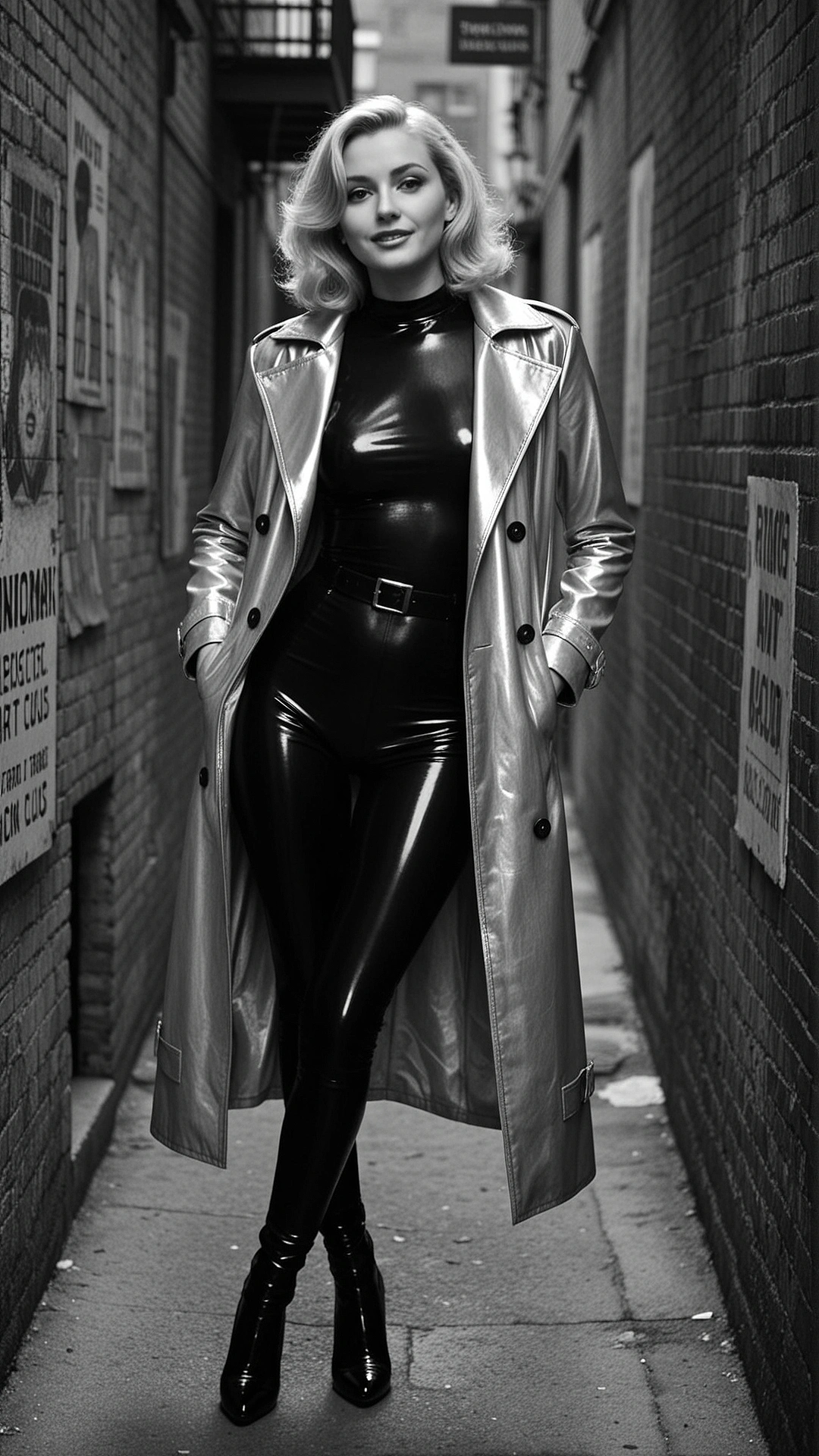
In a city polished by lies, one woman’s hunt for truth will lead her through shadows… and into the devastating light of a power that wears satin like armor.
The rain slicks the midnight streets, not with grime, but with a deceptive sheen, turning the city into a black mirror. In this world of reflected facades, investigative journalist Rose Thorne believes she knows the score. Her target is Matt Black, a man whose name is a synonym for the city’s gritty underbelly, whose power is built on fear and brute force. She moves through the gloom in practical wool, a silhouette of sharp angles and righteous fury, armed with nothing but her notepad and a conviction that the truth is a weapon enough.
But the city holds a deeper secret, a more profound power structure woven not from coarse threats, but from silent influence and impeccable taste. Here, true authority doesn’t lurk in back alleys; it presides in penthouse suites where the air smells of ozone and expensive perfume, where conversations are a quiet calculus and a glance can orchestrate fortunes. It is embodied by women for whom elegance is a strategic tool, whose dominance is expressed not in shouts, but in the deliberate whisper of satin against a thigh, the unyielding gleam of polished leather, the serene, unassailable command of a mind that has already calculated every move.
When Rose’s pursuit of a brutish kingpin collides with this hidden world, her very understanding of power is shattered. She is drawn into a dazzling, dangerous game by Elena Vesper, a woman whose presence is a lesson in controlled radiance. To defeat the darkness she hunts, Rose must learn to navigate by a new light—one that glows from within, that illuminates not just corruption, but possibility. She must discover if her own fierce integrity can be refined into something infinitely more potent, if her hunger for justice can be satisfied not by vanquishing a monster, but by aligning with a sublime and sophisticated force that has already tamed him.
This is more than a thriller. It is a sensual initiation. A film noir where the femme fatale is not a trap, but the only true path to clarity. A story where the most cunning dance is not between hunter and prey, but between a woman’s old, rough-edged self and the luminous, authoritative figure she is destined to become. Prepare to step out of the gritty shadow and into the gloss.
Chapter 1: The Glossy Facade
The city wept a perpetual, phosphorous tears, each droplet slithering down the obsidian flanks of monolithic buildings, transforming the metropolis into a vast, somber chandelier. It was not a cleansing rain, but a lacquer of melancholy, a liquid patina that deepened the shadows and made every light a smeared, uncertain promise. Through this aqueous labyrinth, Rose Thorne moved not as a supplicant, but as a blade being drawn—a deliberate, silent extraction from a well-worn sheath. Her coat, a severe and masterfully tailored piece in a charcoal wool so fine it bordered on felting, absorbed the ambient gloom rather than repelling it; it was the uniform of a woman who believed truth was found in the grit, in the unvarnished and often ugly substrata of human transaction. Yet, beneath it, a blouse of oyster-hued silk whispered against her skin, a secret she kept even from herself—a faint, innate protest against the pervasive drear.
“The Avarice Club” announced the matte-black plaque, the letters carved as if by a cold chisel, offering no reflection, no welcome. It was a mouth that swallowed light. Inside, the atmosphere was a sensory paradox: the air, thick with the cloying aroma of aged whiskey and expensive cigars, felt coarse, granular, yet the dominant sound was the low, smooth murmur of transactions, a river of calculated intent. Here, power did not shout; it congested the space, a dense, invisible fog.
Rose’s destination was a secluded booth, a pool of deeper shadow in the already dim room. And there he sat, materializing from the gloom as her eyes adjusted: Matt Black. He was not a large man, but he possessed a profound stillness, a quality of negative space that seemed to warp the room around him. His suit was expensive but characterless, a fabric that thirstily drank the light, leaving only a suggestion of shoulders, a silhouette of controlled menace. A tumbler of amber liquid sat untouched before him, a still life of potential violence.
“Miss Thorne.” His voice was like gravel shifting under a leather sole—dry, abrasive, expectant. “You look… determined. It’s a strain on the features. Most people in this room are determined to acquire. You seem determined to dissect. It makes the atmosphere prickly.”
“A fascinating analysis, Mr. Black,” Rose replied, sliding into the booth opposite him without invitation. Her own voice was a controlled instrument, cooler and clearer than the room warranted, a shard of crystal in a peat bog. “But I’m not here for a mutual character assessment. I’m here about the waterfront acquisitions. The zoning variances that vaporized. The families who found their leases turning to ash.”
Matt Black’s smile was a brief, thin event, like a crack in dry earth. “The waterfront is a living thing, Miss Thorne. It sheds old skin. It grows. Progress has a metabolism, and sometimes… indigestion. My role is merely that of a gastroenterologist.” He took a slow sip, his eyes never leaving hers. “You’ve been peering through keyholes, scribbling in that little notebook. It’s a dangerous way to get a splinter.”
Before Rose could formulate the scalpel of her next question, the texture of the room shifted. A wave of a different energy, smooth and potent, washed through the club’s murky atmosphere. Two women glided past their booth, a study in devastating contrast to the masculine grimness. The first, a statuesque brunette in her fifties, was sheathed in a column dress of liquid mercury satin that seemed to generate its own low, moonlight radiance. It moved with her as a second skin, each ripple a statement of impossible elegance. Her companion, younger but no less assured, wore a blazer and trousers of a deep, wine-red polished leather that gleamed with a soft, carnivorous luster under the low lights. Their conversation was a quiet, melodic duet, punctuated by the soft click-clack of stiletto heels on the hardwood—a sound that spoke of purchase, of unassailable trajectory.
Matt Black’s gaze, momentarily, flickered toward them. Not with lust, but with a profound, instinctual wariness, the look of a basking reptile sensing a shadow from a higher branch. The women, aware of his glance, did not acknowledge him; one, the brunette, offered a minuscule, icy smile to the air between them before turning back to her companion, her hand resting lightly on the other’s leather-clad arm. “Darling, the Monet is exquisite, of course,” she murmured, her voice carrying just enough to be a plume of scent in the stale air, “but it’s the Degas pastels that truly breathe. They understand the architecture of a moment.”
The moment passed. The smooth, gleaming current of their presence receded, leaving the booth feeling suddenly coarser, more stagnant. Rose felt an inexplicable, sharp pang—not envy, but a kind of aesthetic vertigo. She had come armed with facts, with moral certainty, a weapon of rough-hewn stone. These women carried weapons forged from a different element altogether: sleek, polished, and infinitely more precise.
“You see,” Matt Black said softly, drawing her attention back, his voice now tinged with a patronizing warmth that was more insulting than his prior chill. “There are realms, Miss Thorne. This…” he gestured loosely around the club, “…is a realm of tangible things. Deeds, contracts, concrete and steel. It has a certain… honesty in its grime. The world those ladies navigate…” he gave a slight, dismissive nod in the direction they had vanished, “…is one of curated influence. Implications. A world of gloss. It is, in my experience, far less forgiving, and far more corrosive to those who don’t understand its composition.” He leaned forward, the coarse wool of his sleeve brushing the table. “You strike me as an honest woman. Honest women get chewed up by the glossy machinery. Let me offer you a simpler form of protection. Stop writing about my… digestive processes. In return, the shadows you’ve been poking won’t reach out and pull you in.”
The offer hung between them, crude and direct, a burlap sack of safety offered to someone who had just, for the first time, glimpsed the existence of silk. Rose felt her righteousness curdle into something colder, more complex. His threat was clear, but it was his taxonomy of power that unsettled her. He had drawn a line, placing himself and his gritty, honest villainy on one side, and on the other, a form of power so refined it treated him as irrelevant scenery. And he had, instinctively, placed her on his side of the line—a creature of the gritty, honest hunt.
She stood, the movement fluid but tense. The secret silk of her blouse felt absurdly fragile. “Your analysis, as before, is flawed, Mr. Black,” she said, her voice reclaiming its crystal edge. “You mistake the methodology for the substance. I don’t peer through keyholes. I examine foundations. And what I’m beginning to suspect,” she added, her gaze sweeping the room where the scent of ozone and perfume still faintly lingered beneath the cigar smoke, “is that you are not the foundation. You are merely the rather drab carpet laid over it.”
She left him then, sitting in his pool of light-absorbing shadow, the untouched whiskey before him. Out in the weeping night, the rain felt different on her skin—not just wet, but impertinent. The wool of her coat was now a damp, heavy burden. As she walked, the memory of the satin column, of the gleam of polished leather, of the women’s serene, untouchable authority, played behind her eyes not as a distraction, but as a persistent, haunting refrain. She had come to confront a monster in its den, only to discover the den was a crude antechamber to a far more elegant, and terrifying, palace. The facade had cracked, and through the fissure, not darkness, but a devastating, unimaginable light had begun to seep.
Chapter 2: The First Reflection
For three days, the memory of the Avarice Club fermented in Rose’s mind like a cheap wine turning to vinegar. Matt Black’s threat was a blunt instrument, easily catalogued and set upon a shelf of professional hazards. It was the other memory, the fleeting vision of the two women, that proved invasive, nebulous, and persistent—a splinter of polished glass lodged deep in the pulp of her concentration. Their serenity amidst that swamp of masculine ambition had felt less like an escape and more like a quiet colonization. She found herself, in distracted moments, not reviewing her notes on shell corporations, but mentally tracing the liquid fall of that mercury satin, the auditory punctuation of those stiletto heels. This internal dissonance was a new and unwelcome texture in her life, previously woven with the sturdy, predictable threads of cause, effect, and moral outrage.
Thus, when the cream-colored envelope, thick as a slice of ivory and faintly scented with night-blooming jasmine, appeared on her desk—bypassed her building’s security, her locked office door—it felt less like an intrusion and more like an inevitable summons. No address, no return mark. Just a single line of script, etched in a deep, iridescent ink that shifted from black to midnight blue in the light: Your inquiry requires a more suitable lexicon. Vespertilia. Tonight. Nine. The paper itself seemed to hum with a latent potential, a tactile silence that screamed of budgets far beyond the scope of journalistic grants.
Vespertilia occupied a slender, unassuming townhouse on a side street veiled in mature wisteria, a location that spoke not of ostentation, but of profound, settled confidence. As Rose pushed open the heavy oak door (it yielded without a sound, as if greased by expectation), the atmosphere of the city was sliced away and replaced. The air inside was cool, still, and carried a complex bouquet: the clean, mineral scent of steamed silk, the waxy perfume of rare orchids arranged in a single, dramatic spire, and underneath it all, the faint, erotic tang of new leather. It was the olfactory equivalent of a held breath.
The interior was a masterpiece of curated shadow and strategic illumination. Walls of charcoal raw silk absorbed light, creating a sense of boundless depth, while pinpoint spotlights fell like gentle asteroids upon isolated displays: a single dress form sheathed in a bodice of articulated black crocodile, a cascade of chiffon the color of a stormy twilight suspended as if mid-fall, a pair of opera gloves in dove-grey suede so fine they seemed to exhale. This was not a shop; it was a gallery where the exhibits were possibilities of the female form, testaments to the power of contour and sheen.
A young woman emerged from the gloaming, her movement a study in efficient grace. She wore a minimalist tunic and wide-leg trousers in a heavy, matte charcoal silk crepe—an outfit that declared its expense through sheer, silent arrogance rather than adornment. Her dark hair was swept into a severe, sleek knot that highlighted the elegant architecture of her skull. “Miss Thorne,” she said, her voice a low, mellifluous contrail. “We’ve been anticipating your curiosity. Madam is concluding a fitting. Please, observe.”
She gestured with a slender hand towards a recessed alcove partially veiled by a curtain of hanging obsidian beads. Within, a scene unfolded with the hushed reverence of a sacrament. A client, a woman in her sixties with a face of sharp, intelligent planes and silver hair cut into a ruthless, beautiful helmet, stood upon a low dais. She was being attended to by the proprietor.
And here, Rose beheld the source of the room’s gravity: Elena Vesper.
Elena was not merely dressed; she was manifested. A column of deep, liquid burgundy PVC encased her from throat to mid-calf, a second skin that glowed with a subdued, internal fire, capturing and softening the light into a molten sheen. The garment had no visible seams, no buttons—it was a single, profound statement of seamless authority. Her own hair, the color of aged cognac, fell in a heavy, straight sheet to her shoulders, a perfect frame for a face of striking, composed severity. High cheekbones, a mouth that was neither full nor thin but precisely drawn, and eyes the cool grey of winter sea-ice. She held a length of iridescent gunmetal silk charmeuse in her hands, assessing its drape against her client’s shoulder with the focus of a sculptor.
“The bias cut, Gabrielle,” Elena said, her voice not loud, but possessing a timbral density that filled the alcove. It was a voice that had never needed to raise itself. “It must not cling with desperation. It must allude. It is a whisper about the architecture beneath, not a shouted description.” She flicked a glance, utterly impersonal, at the client’s reflection in the full-length mirror. “You are not purchasing a dress. You are acquiring a dialect—a non-verbal vocabulary of assertion. This,” she let the silk whisper against the woman’s collarbone, “is the subjunctive mood. It speaks of potential, of conditional power. For the gala, you will require the imperative mood. We shall discuss lacquered faille.”
The client, a formidable presence in her own right, merely gave a slow, conceding nod, her eyes on her own transformed reflection. “The subjunctive has always been my weakness, Elena. I prefer declarative statements.”
“A common error,” Elena replied, a ghost of a smile touching her lips. “The declarative is for those who need to convince others. The subjunctive… convinces the self first. And that is the only conviction that matters.” With a final, approving touch to the silk, she turned, and her winter-sea eyes found Rose, standing frozen amidst the hanging beads. “Ah. The journalist who mistakes grit for substance. Forgive the pedagogical interlude. Gabrielle, we are finished. Monique will see to the final measurements.”
As the client was led away by the assistant, Elena’s full attention settled upon Rose. It was not a stare, but an appraisal, a slow, comprehensive scan that felt less invasive and more… taxonomic. She took in Rose’s practical wool trousers, the sensible shoes, the wool coat still damp from the evening mist clinging to her arm. The silence stretched, becoming a tangible substance.
“You look,” Elena began, moving closer with a predator’s silent glide, the PVC sighing softly, “as though you have been wrestling a bear in a coal cellar. And believing the soot upon your cheeks to be a badge of honor.” She stopped just outside Rose’s personal space, close enough for Rose to catch the subtle, spicy scent of her perfume—cardamom and cold stone.
Rose’s journalistic instincts, her defensive reflexes, surged. “I was conducting an interview. Atmospherics are secondary to truth.”
“A naive dichotomy,” Elena countered, her head tilting a degree. “Atmospherics are a truth. The most immediate one. You sought out a man who operates in a realm of coarse textures, of blunt-force avarice. You wore the costume of a scrivener, a supplicant to that realm. You announced your methodology before you spoke a word: you came to dig in the dirt. And so he offered you a shovel, or a shield of it.” She gestured dismissively, a flick of a wrist adorned only with a wide, brushed platinum cuff. “Matt Black is a symptom, Miss Thorne, a crude biological function of this city’s body. You are studying the perspiration when the fever’s source is a disorder of the soul.”
“And you presume to know the source?” Rose shot back, her voice tighter than she intended.
“I don’t presume. I cultivate.” Elena turned and walked slowly towards a rack where garments hung like suspended ghosts. “You have a quality. A sharp, unyielding light behind your eyes. But you have housed it in… burlap. You believe this makes you pure, incorruptible. It merely makes you vulnerable. It signals to the Matt Blacks of the world that you can be handled with rough hands, that your light can be smothered by a handful of grime.” She stopped before a simple, sleeveless sheath dress. It was made of a technical silk matte jersey, a fabric that looked soft but held a taut, unforgiving line. The color was a profound navy, almost black. “This,” she said, her fingers not touching it, but hovering near its surface, “is not burlap. It is also not a costume. It is a clarification. It tells the observer that the mind within is ordered, that its boundaries are firm, that its contents are valuable and not available for casual inspection.”
Rose felt a flush of heat that was part anger, part something else—a terrifying, dawning recognition. “You’re proposing a makeover. As if the right frock will make Matt Black confess.”
Elena’s laugh was a short, low sound, like ice cracking over deep water. “Good heavens, no. I am proposing a realignment. The ‘frock,’ as you so charmingly diminutize it, is the external manifestation of an internal shift. You are hunting a shadow. To catch a shadow, you do not run after it with a net. You become the light that casts it, and in doing so, you control its shape, its length, its very existence.” She finally turned fully back to Rose, her gaze unwavering. “He offered you protection, did he not? A crude umbrella against the storm he represents. I am offering you something else: the knowledge to become the eye of the storm itself. To stand in a place of such calm, such polished certainty, that the chaos spins harmlessly around you, obedient to your central, silent gravity.”
She took one final step, closing the distance completely. Rose could see the impossible, poreless perfection of her complexion, the absolute certainty in those grey eyes. “Your investigation is not wrong, Miss Thorne. Its framing is. You are looking at the cracks in the plaster. I am suggesting you learn to appreciate the architecture that makes the plaster necessary. And then,” she added, her voice dropping to a mesmerizing, almost conspiratorial murmur, “to consider what it might be like to own the blueprint.”
She stepped back, the moment breaking. “The dress is a starting point. A tangible first lesson in a different grammar of power. Try it on. Not for me. For the reflection you have been avoiding.” She gestured towards a changing room framed by curtains of heavy, black velvet.
Rose stood, paralyzed by the sheer, audacious vortex of the woman’s proposition. It was insanity. It was sedition against everything she believed about her work, her identity. And yet, the memory of her own voice in the club—“you are merely the rather drab carpet”—echoed with a new, prescient meaning. She had seen the divide. Elena Vesper was simply the first person to stand on the other side and name it, to hold out a hand not in rescue, but in chilling, glorious recruitment.
Without a word, Rose took the navy sheath from its hanger. The fabric was cool, heavy, and astonishingly soft in her hands, yet it promised a formidable structure. She moved towards the velvet curtain, feeling Elena’s observing gaze like a physical pressure between her shoulder blades—the first, undeniable touch of a light that did not warm, but revealed everything.
Chapter 3: An Education in Texture
The navy sheath was not a garment; it was a hypothesis rendered in thread. Standing before the fulllength mirror in Elena’s sanctum, Rose felt the quiet vertigo of a self-experiment. The matte jersey encased her with a solemn, gravitational embrace, compressing the frantic static of her thoughts into a single, clean line. It erased the scholarly slouch from her shoulders, suggested a latent elegance in her hips she had never credited. The reflection staring back was familiar yet profoundly alien—a Rose Thorne distilled, clarified, her sharp edges not blunted but burnished to a purposeful gleam. It was, she thought with a flutter of panic, the visual equivalent of hearing one’s own voice on a recording: the essence was hers, but the presentation demanded a new kind of accountability.
“Adequate,” Elena’s voice came from the doorway, not a compliment but a clinical assessment. She had changed, the burgundy PVC replaced by an ensemble of such severe sophistication it stole the air from the room: a turtleneck tunic of heather-grey cashmere so finely woven it appeared as a mist against her skin, tucked into trousers of black, waxed cavalry twill that fell in knife-creased columns to the floor. A necklace of raw, polished hematite slabs lay against her sternum, each stone a captured fragment of void. “It is a primer. A cipher. It says ‘observe, but do not yet interpret.’ Come. Your fieldwork begins.”
The car that awaited them was a silent, obsidian sedan, its interior upholstered in glove-soft Nappa leather the color of midnight smoke. As it slid through the weeping city, Elena did not offer a destination. Instead, she initiated a discourse, her gaze fixed on the rain-laced window as if reading a text written in the streaking lights.
“You are a student of systems, Miss Thorne. The system of law, of finance, of criminal enterprise. You understand the coarse, visible gears. Tonight, I introduce you to the lubrication that allows them to turn without screaming.” She turned her winter-sea eyes upon Rose. “Power, in its raw state, is friction. It grinds, it sparks, it wears itself out. The masculine expression of it revels in this—the grinding is the point, the proof of effort. What you will witness is power refined to a state of near-frictionless kinetics. It is not about the exertion, but the vector.”
Their destination was a repurposed industrial boiler house, now known as The Crucible. Its vast, brick-vaulted space hummed not with machinery, but with the low-frequency thrum of curated influence. The air here was different from the club’s congested masculinity; it was electrically crisp, scented with frozen citrus and the petrichor scent of ozone from towering sculptures of glowing glass. The crowd was a living tapestry of authoritative femininity.
Rose’s senses, honed for hidden motives and verbal traps, were overwhelmed by a new lexicon of data. To her left, a woman with a silver fox crop and a face of serene, archaeological beauty held court from a low divan. She was draped in a cascading kimono of opalescent latex, its surface capturing and warping the light into oily, rainbowed swirls with her every minuscule movement. Her audience, two men in impeccably cut but somehow subservient suits, listened with rapt, almost devotional attention as she spoke of arbitrage in whispered, definitive tones.
“Seraphina,” Elena murmured, following Rose’s gaze. “She trades in volatility. Her chosen texture reflects it—a surface that is never the same twice, that confounds grasp. The men are from the Bundesbank. They are not here to negotiate; they are here to receive nuance.”
They moved deeper into the thrum. A striking figure in her forties, her hair a braided coronet of burnished copper, stood beside a dynamic digital canvas. She wore a single-piece jumpsuit of anthracite silk crepe, sharply tailored, with a plunging neckline edged in a razor-thin stripe of patent leather. She was explaining the data-flow sculpture to a younger female acolyte, her gestures precise, pedagogic. A man, handsome and visibly wealthy, hovered at her periphery, waiting with the patience of a well-trained hound. When she finally acknowledged him with the slightest tilt of her chin, he stepped forward, not to speak, but to present a tablet for her signature. She scrawled a hieroglyph without looking, and he retreated, a silent functionary in a world of eloquent women.
“Dr. Aris Thorne,” Elena said, a hint of dry amusement at the shared surname. “No relation, I assure you. She runs a bio-tech empire. The jumpsuit is her lab coat; the silk, a statement that her science is not sterile, but sublime. The man is her former husband. He now manages her philanthropic arm. He finds it… more harmonious.”
Rose felt unmoored. Every interaction she witnessed subverted her ingrained map of social force. The loudest voice in the room was a low, melodic laugh. The most commanding gestures were slight: a raised eyebrow over the rim of a coupe glass, a finger tracing the stem, the deliberate, slow crossing of legs sheathed in iridescent graphite stockings.
“They’re not competing,” Rose whispered, the realization dawning like a cold, clear light.
“Competition is for resources,” Elena corrected softly, guiding her towards a quieter annex where a fountain of black marble whispered. “These women are the resource. They have moved beyond competition into curation. They attract, they select, they arrange. The friction you are used to—the threats, the boasts, the posturing—is the sound of an engine missing this very lubrication.”
In the annex, a final vignette crystallized the lesson. A renowned architect, a woman with a hawk’s profile and hands etched with fine lines, sat in a deep armchair. She was clad in a magnificent tunic of ivory wool bouclé, its nubbled texture contrasting with the sleek, onyx satin of her wide-leg trousers. Kneeling on a velvet cushion beside her chair, meticulously updating a portfolio on a slender tablet, was a man in his thirties. His posture was one of focused devotion. The architect spoke, not to him, but to a companion about the “moral weight of load-bearing beauty.” As she made a particular point, her hand descended absently, not in a caress, but in a gesture of unconscious possession, to rest upon the kneeling man’s neatly groomed head. He stilled under her touch, his eyes closing for a brief, beatific moment before he resumed his work, a faint, settled smile on his lips.
The act was not sexual; it was hierarchical, natural, and utterly profound. It was the quiet, definitive punctuation at the end of Elena’s sentence.
Rose stopped breathing. The image bypassed her intellect and seared itself directly onto her primal understanding: This was the texture of true dominance. Not the clenched fist, but the open hand resting upon a world that had willingly bent its knee.
“You see,” Elena’s voice was a hypnotic murmur in her ear. “The velvet, the satin, the polished stone, the liquid latex… these are not mere adornments. They are the material manifestation of a frictionless will. They are the visible proof that one has mastered the first and most important dominion: the dominion over one’s own presentation, and thus, over the ambient noise of the world. Matt Black uses noise as a weapon. These women have achieved a silence so potent it bends sound into obedience.”
She turned Rose to face her, the hematite stones at her throat like dark, all-seeing eyes. “Your education tonight is simple: texture is ontology. Rough textures invite resistance, debate, struggle. Smooth textures invite flow, compliance, glide. You have spent your life building a fortress of rough-hewn stone. I am offering you the key to a citadel made of polished obsidian. The question, Miss Thorne, is not whether you can storm it. It is whether you are ready to inhabit it.”
Outside, the rain had ceased. The city streets gleamed under the lamps like strips of wet, black vinyl. Sitting once more in the silent car, the ghostly pressure of the navy sheath still embracing her, Rose no longer saw a city of shadows and threats. She saw a circuit board, and for the first time, she understood that the power did not lie in the noisy, sparking components, but in the deep, silent, glossy current that flowed between them, directing everything. The education was not merely in texture; it was in learning to become the current itself.
Chapter 4: The Web, Not the Spider
The epiphany that followed Rose from The Crucible was not a sudden explosion of light, but a slow, inexorable chemical change—a developer solution working upon the latent image of the city she thought she knew. The tangible facts of her investigation remained: the shell companies like nesting dolls of deceit, the property deeds that changed hands with the sterile, electronic sigh of a wire transfer, the displaced families with their cardboard-box archives of grievance. Yet these facts now floated, unmoored, in a new and more chilling context. She had been meticulously charting the frantic, grubby scurrying of a beetle across a forest floor, believing its path to be the story, while all around her stood the vast, silent, Photosynthetic architecture of the trees themselves—an order of magnitude more complex, more powerful, and utterly indifferent to the insect’s trajectory.
Her desk at the Chronicle was an island of obsolete methodology. The wool trousers and practical sweaters piled on her chair felt like the shed carapace of a lesser creature. The navy sheath, now hanging in her closet, was a silent rebuke, a sleek, dark comma in the narrative of her selfhood. She could not wear it to work; it would be a declaration of mutiny before she understood the fleet. But its memory insinuated itself into her every thought, a persistent, tactile whisper.
Her breakthrough arrived not through a leaked document or a drunken confession, but through a shift in perceptual grammar. Reviewing the financials of Black’s holding company for the hundredth time, she ceased looking for a who and began tracing a how. The money flowed not to a person, but to a sensibility. It filtered through intermediaries to fund not just casinos and parking lots, but acquisitions of a very specific kind: a distressed Art Deco hotel on the waterfront, slated not for demolition but for meticulous restoration; a portfolio of mid-century modernist furniture collections; the silent, majority purchase of a nearly bankrupt but critically adored couture textile house specializing in rare silk jacquards.
This was not Matt Black’s taste. His aesthetic, she recalled from the club, was one of light-absorbent nullity. This was a pattern of exquisite, almost surgically precise curation. It spoke of a palate that valued fractured elegance, clean lines, the resurrection of beauty on the brink of oblivion. It was the financial fingerprint of the women in The Crucible.
The realization was a cold rivulet down her spine. She had been hunting the spider, a solitary, venomous architect at the center of a self-spun world. But the truth was a web—a vast, intricate, gleaming structure with multiple, elegant anchor points, and the spider was merely a useful, ugly insect they had allowed to take up residence, to catch the gnats so the web’s true owners could attend to more refined sustenance.
She needed confirmation, a thread she could pull. She thought of Dr. Aris Thorne, the bio-tech empress from The Crucible in her silk-and-leather jumpsuit. A woman of science would leave a data trail. Using every scrap of her journalistic skill to bypass superficial firewalls, Rose dove deeper than she ever had into corporate philanthropy, tracing not donations, but patterns of influence. And there it was: the Aris Foundation was the silent, majority funder of the city’s most prestigious design biennial. The biennial’s chairwoman was a celebrated interior architect known for her use of lacquered finishes and polished nickel. And that architect’s firm had been exclusively retained, through a subsidiary, for the renovation of the Art Deco hotel purchased with Matt Black’s funds.
It was not a smoking gun. It was a perfume trail—elusive, complex, and unmistakably feminine.
She could not go to her editor with this. He would see conspiracy in the place of consortium, madness in the method. She needed a guide through this new, glossy labyrinth. With a resolve that felt both thrilling and perilous, she dressed not in her reporter’s armor, but in the only piece of this new language she owned: the navy sheath. Over it, she wore her old wool coat, a pathetic attempt at a disguise from herself. She took a taxi to Vespertilia.
The young assistant, Monique, was at the front, meticulously steaming a gown of champagne georgette. She wore a tunic of black technical silk with wide, architectural sleeves. She looked up, her gaze registering Rose’s coat but lingering for a telling moment on the sliver of navy jersey visible at her throat. “Madam is with a client. A private consultation regarding a commissioning. You may wait in the reflecting lounge.”
The “reflecting lounge” was a small, cloistered room behind a floor-to-ceiling drape of heavy, bronze-shot velvet. It contained only two low, backless sofas upholstered in buttery glove leather, a low table of poured black resin, and, dominating one wall, a vast pane of antiqued mirror, its silvering mottled with age like the ghost of a memory. It was a space designed not for comfort, but for confrontation with one’s own image.
Rose had just settled onto the leather, its coolness seeping through her clothes, when she heard voices from the adjacent room—Elena’s, and another, mellifluous and familiar.
“The weight must be psychological, not physical,” the other voice was saying. “A garment that feels like an exoskeleton of will.”
“Then we discard the silk organza underlayer,” Elena’s reply was measured, a surgeon’s assessment. “We go directly to the fused silk-and-metal-mesh laminate. It will move like water, but resist like armor. The color must be a non-color. The grey of a dove’s throat at dawn. The moment before definition.”
“Perfect.” A pause. “He is becoming restless, Elena. The journalist pokes. He feels his… utility is under scrutiny. He made threats.”
“Threats are the exhaust fumes of a straining engine,” Elena said, her tone utterly dismissive. “He is useful precisely because he contains the mess. He is the absorbent blotter for the city’s spillages. Remind him that blotting paper is disposable, and that we possess the entire mill. His compensation is his continued existence in a role he is suited for. If he wishes to be more than a tool, he must first learn to polish himself. A task for which he has shown spectacular disinterest.”
Rose sat frozen, the words etching themselves into her mind. The absorbent blotter. It was the confirmation, delivered with a casual, terrifying clarity. Matt Black was not the source; he was the spillage. The client had to be Seraphina, the volatility trader in latex. They were discussing a garment, but the subtext was governance.
The curtain to the lounge whispered aside. Seraphina stood there, not in latex today, but in a simple, devastating dress of dove-grey matte jersey—the very concept they had just articulated. It was sleeveless, high-necked, and fell in a single, perfect column to the floor. It was the definition of “non-color,” of “psychological weight.” She saw Rose, and a slow, feline smile spread across her serene face. “The investigator,” she purred. “Elena mentioned your… potential. I see you’re beginning to appreciate the weave of the tapestry, rather than merely picking at a loose thread.”
Elena appeared behind her, a silhouette of austere authority in a high-necked dress of black crepe. Her eyes met Rose’s in the antiqued mirror. “Seraphina was just leaving. Her commission requires a final fitting.” It was a clear dismissal.
Seraphina inclined her head, a regal gesture. “A pleasure, Miss Thorne. Do remember: in finance, we value assets that appreciate under pressure. I suspect you are one.” She glided away, the grey dress swallowing the light without a shimmer.
Elena moved into the room, the atmosphere thickening with her presence. She did not sit. She stood before the mottled mirror, her reflection hovering beside Rose’s—one a study in polished, definitive darkness, the other a hesitant sketch in navy and wool.
“You listened,” Elena stated, not accusingly, but with a hint of approval.
“You knew I was here,” Rose replied, her voice steady despite the tremor in her hands.
“Of course. The lounge is not a waiting room. It is an anechoic chamber. It amplifies certain frequencies.” Elena turned from the mirror to look directly at her. “So. You have followed the money. And it has led you not to a lair, but to a network. A mycelium of influence. What do you intend to do with this fragile, dangerous seedling of truth?”
Rose met her gaze. The old urge—to publish, to expose, to tear the web apart—rose and then crumbled. It felt suddenly juvenile, like throwing a rock at a stained-glass window. “I want to understand the design,” she said, the words feeling both foreign and utterly correct. “Not just the pattern of the corruption, but the pattern of the… the control. You called him a blotter. You fund his brutality to keep your own world pristine.”
Elena’s smile was a faint, glacial crack. “An inelegant but essentially accurate summation. We do not fund brutality. We allocate capital. He chooses to express that capital through brutish means because it is the only language he speaks. We tolerate the dialect because it serves a purpose: it creates a contained zone of predictable, crude conflict, which keeps the more… delicate ecosystems from being trampled by larger, clumsier beasts. It is pest control, Miss Thorne. We are the gardeners. He is the terrier we allow to chase the rats from the rose beds. The terrier believes it owns the garden. The gardener merely finds its enthusiasm useful.”
The analogy was devastating. It reduced Matt Black’s entire empire to the yapping of a useful idiot. It reframed cruelty as calculus, evil as inefficiency.
“And the people he hurts? The families?” Rose asked, the ghost of her old righteousness stirring.
“A regrettable byproduct of his methodology,” Elena said, her voice losing none of its calm. “One we are not blind to. The Aris Foundation’s community relocation grants are not coincidence. They are the smoothing of the rough edges his work creates. We do not create the friction; we manage its aftermath with more grace than he could ever conceive. It is a holistic approach. You cannot have the pristine, polished city without someone to handle the waste. We have simply ensured the waste-handler does not imagine he is the city planner.”
She stepped closer, her reflection in the old mirror swallowing Rose’s. “This is the web, Miss Thorne. Not a trap, but a supporting structure. It is what holds the beautiful, fragile things aloft. The question is no longer whether you can expose it. It is whether you possess the vision to see its necessity, and the strength to consider where, within its radiant geometry, you might find your own place to anchor.”
Rose stared at their twin reflections—the polished and the unvarnished, the architect and the raw material. The hunt was over. She had found the source, and it was not a monster in a cave. It was a sublime, terrifying, and breathtakingly elegant garden. And she had just been asked not to report on it, but to decide if she wished to become one of its flowers.
Chapter 5: The Invitation
The days that followed Rose’s audience in the reflecting lounge congealed into a peculiar form of limbo—a state of suspension between two gravities. The old world, the world of newsprint grit and righteous indignation, now felt like a script written in a crude, fading ink, its drama hollow, its conflicts pedestrian. The new world, the web of polished influence, shimmered at the edge of her perception like a mirage of a city made entirely of glass and steel, beautiful and forbidding, its laws unwritten but implicitly understood. She moved through her routine at the Chronicle with the detached proficiency of a sleepwalker, her colleagues’ chatter about city hall scandals and union disputes sounding like the shrill, meaningless static of a poorly tuned radio. Her own notes on Matt Black seemed like archaeological artifacts from a simpler, more naive civilization.
Her apartment, a space she had always valued for its functional, unadorned honesty, became an accusatory chamber. The navy sheath hung in her closet like a dormant chrysalis, a silent question mark. She found herself avoiding it, then staring at it, then on one fraught evening, touching it—the cool, dense weight of the matte jersey a tactile anchor in her drifting reality. She did not put it on. To do so without sanction felt like a kind of sacrilege, an amateur playing with ritual objects.
The invitation arrived not by post, nor by the silent, psychic osmosis of the first note. It arrived with a herald.
It was a Tuesday evening, the sky a bruised purple canvas streaked with the last vulgar gilding of sunset. The buzzer to her apartment door issued its abrasive, democratic squawk. Expecting a delivery of takeout or a misguided political canvasser, Rose opened the door to a vision of such stark, silent authority that the breath died in her throat.
The woman on the threshold was perhaps in her late twenties, her presence an essay in controlled minimalism. Her hair, the color of polished pewter, was shorn into a severe, architectural undercut that emphasized the elegant, almost cruel line of her jaw and the pristine helix of her ear, adorned with a single stud of black diamond. She wore a garment that defied simple categorization: a long, sleeveless duster coat made of a supple, black technical gabardine, its surface possessing a subtle, military-grade sheen, buttoned high to the throat. Beneath, glimpses of a turtleneck in a lighter charcoal mesh were visible. The coat was cinched at her impossibly narrow waist by a belt of woven titanium threads. Her trousers were straight-legged, in a matching gabardine, falling with knife-edge precision to kiss the tops of her boots—calf-high things of polished black leather so mirror-like they seemed to contain miniature, distorted versions of Rose’s own stunned face.
In her gloved hands (the gloves were of thin, matte black leather, seamless), she held a long, slender box of polished palisander wood, its grain a storm of dark and light.
“Miss Thorne,” the courier said. Her voice was a low, modulated alto, devoid of inflection, as calibrated and clean as a surgical instrument. “A delivery. From the Vespertine Atelier.” She offered the box, not with a servile gesture, but with the deliberate, unhurried motion of a diplomat presenting credentials.
Rose, wordless, accepted it. The wood was cool, satin-smooth under her fingers, and surprisingly heavy. The courier did not leave. She stood, a statue of impeccable stillness, her gaze—the color of flint—resting on Rose with an unnerving, patient focus. It was clear: this was not a delivery to be received in private; it was a ceremony to be witnessed.
“Aren’t you going to open it?” the courier asked, the question sounding not curious, but procedural.
Under that flinty gaze, Rose felt the absurdity of her own attire—faded cotton lounge pants and an old university sweatshirt. She fumbled with the simple, platinum clasp on the front of the box. It opened with a whisper. Nestled within, cushioned by a bed of raw black silk chiffon that seemed to absorb the very light from the hallway, was a garment.
It was a gown. But to call it merely a gown was to call a samurai sword merely a knife. It was constructed of a silk satin so dense, so profoundly liquid, it appeared to be a pool of solidified midnight given form. The color was an impossible emerald green, a hue that did not shout but thrummed with a deep, vibrational energy, the green of a forest canopy seen from the ocean floor, of malachite veins in a pitch-black cave. The cut was deceptively simple: a sleeveless, columnar sheath, high-necked in back, plunging in a daring, geometric parabola in front. There were no seams visible to the eye; it was a single, continuous pour of fabric, its only adornment being its own relentless, glorious finish. A pair of long gloves, in the same satin, lay beside it, along with a note on that now-familiar heavy ivory stock.
The courier’s lips, unpainted and perfectly defined, curved into a ghost of a smile that held no warmth, only a deep, professional appreciation. “Vespertilia’s ‘Midnight Verdant’ satin. Dye-lot zero-zero-one. The thread count would bankrupt a small nation. It is, if I may offer an observation, a color for revelation. It does not complement the wearer; it illuminates her.”
Rose’s fingers trembled as she lifted the note. The iridescent ink spelled out a single, commanding sentence:
Truth is best served from a position of undeniable strength. Attend the Soirée of Midnight. – V
Below, an address was engraved—a legendary, fortress-like penthouse atop the Aurora Tower, a place rumored to be accessible only by private, keyed elevator.
The finality of it, the sheer, audacious presumption, sent a violent tremor through Rose’s core. This was no longer an observation, a lesson, a hypothesis. This was a summoning. A gauntlet thrown not onto the muddy field of her investigation, but onto the pristine marble floor of a world she had only glimpsed through windows.
“The Soirée is tomorrow evening,” the courier stated, her voice pulling Rose back. “Black tie is a masculine convention. The dress code, as you hold in your hands, is authoritative refinement. The guest list is… curated.” Her flinty eyes swept over Rose’s dishevelment once more, not with judgment, but with a kind of clinical assessment. “I am instructed to wait for your response. A verbal confirmation is sufficient. The garment, of course, is fitted. Madame Vesper’s eye is infallible.”
Rose stared at the emerald satin, a siren song woven in threads. To accept was to step into that shimmering, glass-and-steel city as a participant, not an observer. To don this dress was to shed the last of her wool-and-cotton skin, to step into a new epidermis of pure, unapologetic power. It was to stand before Matt Black, before Elena, before all of them, not as a scribe from the sidelines, but as a proposition in living color.
To refuse was to close the velvet curtain. To return to the static, to the grit, to the lonely, righteous war against the terrier, forever denied the garden.
The courier waited, a study in polished patience, the light from the hallway gliding along the razor-edge of her gabardine coat.
Rose’s mouth was dry. The words, when they came, felt less like a choice and more like the utterance of a fate she had been circling since the moment she first walked into the Avarice Club.
“Tell her,” Rose said, her voice gaining a strength that surprised her, resonating in the quiet hallway, “I’ll be there.”
The courier gave a single, sharp nod, a gesture of satisfaction that was also a dismissal. “Wise.” She turned, her leather boots making no sound on the worn hall carpet, a sleek, black arrow receding into the gloom. “The elevator key will be delivered at eight. Do not be late. Punctuality is the first courtesy of power.”
The door closed, leaving Rose alone in the sudden, echoing silence of her apartment, the box of palisander wood heavy in her hands, the emerald satin glowing within like a captive star. The invitation had been issued. Her acceptance had been given. The chrysalis, now, had a date for its rupture.
Chapter 6: The Soirée of Midnight
The Aurora Tower did not pierce the sky; it seemed to have been extruded from it, a monolithic spindle of smoked glass and blackened steel that absorbed the city’s cacophony and returned only a profound, humming silence. The private elevator was a capsule of burnished bronze and velvet the colour of a starless night, its ascent so smooth it felt less like movement and more like the floor dissolving beneath Rose’s feet. She stood within it, a statue of emerald and trepidation, the Midnight Verdant satin a second skin of cool, liquid confidence she did not yet feel. The gown’s architecture held her upright, its relentless, seamless drape a silent tutor in posture and poise. The long gloves sheathed her arms to the bicep, rendering her hands elegant, unfamiliar instruments. She had left her old self in the apartment like a discarded shell; what emerged was a potential, a question mark cloaked in definitive colour.
The elevator door parted without a sound, revealing not a threshold, but an immersion.
The penthouse of the Aurora Tower was less a room than a biosphere of refined influence. The floor was a single expanse of polished basalt so black and deep it appeared to be a liquid plane frozen at the perfect moment of stillness, reflecting the scene above with a sinister, doubling clarity. The ceiling was a complex geodesic dome of milky glass, through which the city’s lights diffused into a soft, celestial haze, like light through alabaster. There were no walls in the conventional sense, only cascading curtains of hammered silver gauze and towering, backlit panels of translucent onyx, creating a labyrinth of intimate, shimmering chambers. The air was ionized, crisp, carrying a symphony of scents: the chilled, mineral tang of vintage champagne, the waxy perfume of massive, white Casablanca lilies arranged in obsidian urns, and beneath it all, the clean, erotic scent of ozone and warmed, polished leather.
And then, the inhabitants.
Rose’s first impression was of a aviary of rare, majestic birds, each plumage a declaration of power. Here, the lessons of The Crucible were elevated to a sacred text. A woman with a shaved head and a neck arched like a swan’s held court from a chaise of tufted black velvet; she was draped in a gown of layered gunmetal latex, its surface catching the light in oily, prismatic slides with her every breath. Another, whose silver hair was woven into an intricate, architectural braid that framed a face of hawk-like severity, stood conversing by an illuminated column of water; she wore a tuxedo of such perfection it seemed carved from a single block of midnight suede, the lapels sharp enough to draw blood, a blood-red silk camisole the only note of concession to softness beneath.
Movement to her left resolved into Dr. Aris Thorne, the bio-tech empress. Tonight, she had forsaken the jumpsuit for a column dress of ivory crepe-back satin, its surface a matte, pearlescent cloud, sliced from hem to thigh by a razor-pleat that revealed a glimpse of leg sheathed in sheer, smoke-grey stocking. She was listening, with an expression of bemused detachment, to a man in impeccable evening wear who spoke with hurried, eager deference. With a languid gesture, she plucked a flute of champagne from a passing tray held by a server in head-to-toe matte black, dismissing the man without a word. He bowed slightly, a motion of ingrained habit, and retreated.
“He owns three telecom satellites,” a voice murmured beside Rose. It was Seraphina, the volatility trader. She was, as predicted, a vision in her commissioned “non-colour.” The dove-grey silk-and-metal-mesh laminate moved like liquid mercury over her form, a whisper that somehow carried across the room. Her smile was a curve of genuine amusement. “And he would trade them all for five minutes of her undivided attention. He never learns that attention, here, is not requested. It is bestowed. A lesson you seem to be absorbing with remarkable speed, Miss Thorne. The verdant suits you. It speaks of latent force, of photosynthesis in the dark.”
Before Rose could formulate a response, the ambient frequency of the room shifted, a collective, subconscious tuning to a new signal. Elena Vesper had arrived.
She entered from behind a waterfall of silver gauze, and the very light seemed to reorient itself towards her. She wore a dress of liquid black velvet, a fabric so deep and light-consuming it created a silhouette of breathtaking negation against the gleaming surroundings. It was high-necked, long-sleeved, and fitted to a degree that seemed anatomical, flaring slightly at the floor. Against this void, her hair was a shock of pure, platinum white, swept back from her temples with severe precision. Her only adornment was a necklace of raw, black diamonds that lay against her throat like captured fragments of interstellar void. Her gaze swept the room, a monarch surveying her territory, and landed on Rose. A faint, approving nod—not a smile, but an acknowledgement of a correct move on a board.
Then, the second shift. A dissonant note in the polished harmony.
From a service entrance, partially concealed by an onyx screen, a figure emerged. Matt Black. He was, as ever, encased in a tuxedo of expensive but characterless black, a mere silhouette of masculinity. But here, in this arena, the suit did not convey menace; it conveyed uniform. He moved with a stiff, careful gait, his eyes downcast, holding a silver tray bearing a single, cut-crystal decanter of amber liquid. He did not look at the women. He did not speak. He approached a grouping where Elena stood with a statuesque woman in a backless dress of crimson patent leather.
“Ah, Matthew,” the woman in patent leather said, her voice a husky, melodic contrail. She did not look at him as she held out her empty glass. “A replenishment. Two fingers. No ice. Your memory for preferences is the one reliable thing about you.”
Matt Black’s jaw tightened, a minute flicker of muscle. But his hands were steady as he set the tray down on a low table of fossilized wood and poured the measure with exacting care. “Of course, Madame Delphine,” he said, his voice stripped of its gravelly threat, rendered flat, serviceable.
“And while you are there,” Elena added, not looking at him either, her eyes on Rose as if sharing a private tutorial, “attend to the lilies near the eastern screen. One is beginning to wilt. It offends the symmetry.”
“Yes, Madame Vesper.” He placed the glass in Delphine’s waiting hand, collected the tray, and retreated towards the flowers, his broad back a canvas of palpable, humiliated tension.
Rose watched, a cold, thrilling shockwave moving through her. This was not the predator from the Avarice Club. This was a servant, a functionary, his brutish power neutered, harnessed, put to use fetching drinks and tidying flowers. The ‘terrier’ was not just in the garden; he was on a leash, performing tricks.
“A useful creature,” Seraphina murmured, following Rose’s gaze. “So long as he remembers his uses are menial. The moment he forgets, he becomes… fertilizer.”
Elena glided over, the black velvet swallowing the sound of her movement. “You see the dynamic in its purified state,” she said to Rose, her voice low, for her alone. “No threats. No negotiations. Only expectation and compliance. The friction you spent your life documenting is, here, rendered obsolete. It is smoothed away by the sheer, unassailable gloss of a better idea.” She reached out, not touching Rose, but her gloved fingers hovering near the emerald satin at her shoulder. “You wear the colour of revelation. So, reveal to me: what do you feel, seeing the engine of your former crusade reduced to a quiet, polishing cloth?”
Rose looked from Elena’s winter-sea eyes to the figure of Matt Black, now meticulously adjusting a lily stem, his big hands clumsy with the delicate task. The old rage, the righteous fire, did not ignite. Instead, she felt a profound, settling calm, a crystallization of understanding. The battle she had prepared for was already over. The victory had been won, not through violence, but through a superior, encompassing order that had simply absorbed the conflict and repurposed its energy. She felt not pity for him, but a distant, clean disdain.
“I feel,” Rose said, her voice finding a new, lower register, smooth as the satin on her skin, “that I have been reading the footnotes while ignoring the text.”
Elena’s lips curved into that glacial crack of a smile. “Then you are ready for the first page.” She linked her arm through Rose’s, a gesture of possession and guidance. “Come. Let me introduce you to the librarians.”
As Elena led her deeper into the shimmering labyrinth, past women who acknowledged her with nods of cool appraisal, past the silent, efficient male servers and the subdued figure of Matt Black completing his tasks, Rose understood. The Soirée of Midnight was not a party. It was a living diagram. And she was no longer an observer sketching it from the outside. She had been inscribed within its gleaming geometry, a point of emerald potential in a constellation of polished, absolute control.
Chapter 7: The Unmasking
The silver-gauze labyrinth of the Soirée parted not with a door, but with a gradient—the dense, murmuring tapestry of polished conversation and clinking crystal gradually thinning, attenuated by the absorbing silence of a descending passageway lined in raw, charcoal silk. Elena’s hand, still resting in the crook of Rose’s emerald-sheathed arm, was not a guide but a current, pulling her with a gentle, inevitable force away from the glittering atrium and into the tower’s secretive heart. The ambient temperature dropped a precise, noticeable degree; the ionized, perfumed air gave way to the moist, verdant exhalation of loam and night-blooming jasmine. They entered the conservatory.
It was a cathedral of glass and latent life, a vaulted space where the black sky pressed against the panes like a patient observer. Within, a miniature ecosystem thrived under calibrated light: ferns with fronds like polished malachite fans, orchids with petals of waxen, pulsating purple, a silent, slender waterfall trickling over a sculpture of stacked black slate. The path underfoot was smooth river stones, set in a bed of fine, raked white gravel. Here, the aesthetic was not of human refinement, but of nature curated to an almost unbearable pitch of symbolic perfection.
Three other figures awaited them, standing like statues in a grove. Seraphina, her dove-grey laminate now appearing as a suit of armor in the dappled moonlight filtering through the glass. Dr. Aris Thorne, having shed her ivory satin wrap to reveal the severe, beautiful lines of a backless black crepe jumpsuit beneath, her arms crossed in an attitude of clinical assessment. And a third woman Rose did not recognize, taller, with a crown of tightly coiled silver dreads, her body draped in a magnificent, floor-length kimono of indigo shibori silk, the intricate, cloud-like patterns seeming to shift and swirl in the low light.
“The guest of revelation,” Seraphina purred, her voice the sound of a stiletto drawn slowly from its sheath. “Elena, you do have a flair for dramaturgy. Bringing her here, to the root system.”
“Every structure requires a foundation, Seraphina,” Elena replied, releasing Rose’s arm and moving to stand beside a gargantuan, potted monstera whose leaves gleamed as if hand-polished. “And every initiate deserves to see the bedrock upon which the glamour rests. Rose Thorne, you know Seraphina, and Dr. Thorne. This,” she gestured to the woman in the indigo kimono, “is Isolde. She is our cartographer. She charts the flows—of capital, of influence, of consequence.”
Isolde inclined her head, her eyes the color of dark amber, holding a depth of unmapped knowledge. “We have been annotating your journey, Miss Thorne. Your trajectory from grit to… potential gloss. It is a fascinating case study in real-time alignment.”
Rose felt laid bare, not by their scrutiny, but by the sheer, dense intentionality of the space. This was no casual retreat; it was a sanctum, a chapter house. The emerald satin, which had felt like armor in the crowd, now felt like a very bright, very conspicuous flag. “You speak of me as a project,” she said, her voice steadier than she expected. The film-noir instinct for the hard-boiled line surfaced. “I’m used to being the one holding the pen.”
“A pen is a tool of inscription,” Dr. Thorne stated, her tone cool, pedagogic. “It requires a hand to guide it, a will to dictate the text. You have been inscribing a narrow, reactive narrative upon the world. We are offering you the opportunity to participate in the authorship of a broader, more elegant one.” She stepped forward, her movements economical, precise. “My work is in genetic expression. Unlocking latent potential within a coded structure. What we do here is not dissimilar. We identify women whose innate… coding contains the markers for authority, for clarity, for taste. And we provide the environment for that potential to express itself fully, without the static of a world designed to muffle it.”
“You mean without the friction of men like Matt Black,” Rose clarified.
“Men like Matt Black are not friction,” Isolde corrected, her voice a low, melodic hum. “They are inertia. A crude, stubborn mass to be either moved, utilized, or bypassed. Friction implies resistance of comparable quality. He is not comparable. He is a substance of a different, coarser order. We do not fight inertia. We calculate for it, and then we build systems that render it moot.” She gestured with a long-fingered hand, the indigo silk of her sleeve whispering. “His entire operation, every brute-force acquisition, every strong-armed negotiation, is a data point in our models. A predictable variable. We let him believe he is the equation. He is, in fact, a single, repetitive integer.”
The unmasking was not of a villain, but of an entire operating system. Rose felt the conceptual ground tilt. “So the corruption, the suffering… it’s just collateral? A byproduct of your… your calculus?”
“Suffering is inefficiency,” Elena said, taking center stage once more. She stood before the slender waterfall, the sound of it a soft, constant punctuation to her words. “And we are consummate efficiency experts. What you call ‘collateral’ we see as systemic drag. And drag is addressed not with sentiment, but with superior design. The Aris Foundation’s housing grants, the legal aid clinics funded through Seraphina’s discretionary trusts, the cultural scholarships from Isolde’s network—these are not apologies. They are optimizations. They smooth the rough edges his methods create, repairing the social fabric with threads far stronger and more beautiful than the original. We do not eliminate the dark; we install better lighting.”
Seraphina glided closer to Rose, a smile playing on her lips. “You came here tonight expecting a secret society, perhaps. A cabal. What you have found is a consortium of executive minds who have simply recognized that the current world is poorly managed. We are the interim board, proposing a hostile takeover of reality itself. And our preferred instrument of corporate control,” she added, her gaze sweeping over Rose’s gown, “is aesthetics. A satin gown is a boardroom. A polished leather boot is a gavel. A look, delivered with absolute conviction, is a binding contract.”
“And where do I fit in this… boardroom?” Rose asked, the question hanging in the humid air.
Elena moved then, closing the distance between them. She reached up, and with a deliberate, slow motion, she did not touch Rose’s face, but the emerald satin at her shoulder, her fingers tracing the impossibly smooth seam where the bodice met the strap. “You are the audit, Rose. The external review that confirmed our worst suspicions about a subsidiary’s management. And now, having delivered your report, you stand before the directors. The question is not where you fit. The question is what role you wish to assume. You can return to the external world, armed with your notes, and shout your truths into a wind that we direct. Or,” she paused, her winter-sea eyes capturing Rose’s, “you can step inside. You can learn the full lexicon. You can trade your notepad for a stake in the enterprise.”
The choice was no longer abstract. It was here, in this glass cathedral, under the gaze of these four women who represented a sovereignty of silk, science, and sheer will. The unmasking was complete. The Vespertine Circle was not a shadow government; it was the light source, and everything else was merely a shadow it chose to cast.
Isolde spoke, her amber eyes knowing. “There is a final test, of course. A gesture of… integration. Matthew requires a reminder of his place, one delivered not by us, but by the new variable in his equation. He awaits in the antechamber.” She gestured toward a discreet archway woven with living ivy. “You will go to him. You will give him a single, direct instruction regarding your investigation. And you will observe the quality of his compliance. Not his obedience—any brute can be forced to obey. But his harmonization. The degree to which his will attempts to sync with the frequency of your own.”
Rose looked from Isolde to Elena, whose expression was unreadable, a mask of polished stone. This was the threshold, not of a room, but of a self. To command Matt Black, not as an adversary, but as a superior within a hierarchy she had just joined. It was the ultimate unmasking—of her own latent authority, and of his final, total reduction to function.
She inhaled the scent of jasmine and damp earth, feeling the cool, liquid weight of the emerald satin, sensing the focused, approving pressure of the four gazes upon her. Without a word, she turned and walked toward the archway of ivy, the river stones firm beneath her heels, the Soirée’s muffled music a distant echo. She was no longer the journalist. She was the question, moving toward its answer. The unmasking of the world was over. Now began the unmasking of Rose Thorne.
Chapter 8: A Proposition of Alignment
The antechamber was not a room, but a compression chamber—a narrow, windowless cell paneled in slabs of sound-absorbing charcoal velvet, where the air felt thick, processed, and devoid of echo. Matt Black stood within it, his silhouette against the far wall less a presence than a stain on the plush fabric, the expensively bland tuxedo now a clown’s motley in the face of true power. Rose had entered, the emerald satin a cold fire in the gloom, and delivered the instruction given to her by Isolde, a simple, surgical sentence regarding the cessation of a specific, petty harassment against a waterfront tenant—a test of her will’s transmission, not its content.
His compliance had not been a surrender; it had been a physiological event. He had not nodded, or grunted assent. He had liquefied, his shoulders rounding inward, his gaze fixing on a point six inches to the left of her satin-clad shoulder, a low “It will be handled” escaping his lips not as a promise but as a reflex, the autonomic response of a organism recognizing a superior predator. The transaction was bloodless, wordless, and utterly profound. She had felt nothing resembling triumph, only a clean, surgical detachment, as if she had successfully operated a complex piece of machinery by pressing the correct sequence of polished keys.
Now, returning through the ivy-choked archway to the conservatory’s verdant cathedral, Rose felt the eyes of the four women upon her not as judgment, but as calibrated sensors. The space seemed to have deepened in her absence, the scent of jasmine more narcotic, the trickle of water over slate a rhythmic, hypnotic chant. Elena, Seraphina, Dr. Thorne, and Isolde had not moved, yet their collective attention had coalesced into a tangible force, a gravity well of expectation.
“Report,” Dr. Aris Thorne commanded, her voice the sterile click of a microscope slide being secured. She had procured a slender, silver case from somewhere and was extracting a single, black cigarette, not lighting it, but rolling it between her fingers as a tactile aid to concentration. “Quantify the response. Latency, tonal quality, micro-expressions.”
Rose stopped at the edge of the raked gravel circle, the river stones cool through the thin soles of her evening shoes. “There was no latency,” she said, her own voice sounding strangely remote, analytical. “The instruction was absorbed without cognitive processing. His tone was infra-verbal. A compliance beneath language. His expression was… blank. Not resistant. Erased.”
Seraphina exhaled a soft, satisfied breath, the dove-grey laminate of her dress catching a shard of moonlight like a honed blade. “The integer recognizes a new operator. The system acknowledges the update. Elegant.” She turned her flint-like gaze to Elena. “The alignment is not potential. It is kinetic. She speaks the dialect of command as if discovering a native tongue.”
Isolde, the cartographer in her swirling indigo kimono, offered a slow, knowing nod. “The friction coefficient dropped to near-zero. You introduced a new variable—yourself, vested in the authority of the Circle—and the chaotic element, Matthew, recalibrated its orbit instantaneously. This is the hallmark of a stable system. It incorporates elegance without turbulence.”
Elena had remained silent, a statue in liquid black velvet, her white hair a spectral corona. Now she stepped forward, away from the monstrous polished leaves, and approached Rose. Her movement was not a walk but a drift, a silent, glacial advance. “What did you feel,” she asked, the question not probing, but diagnostic, “in the moment of his harmonization? Not what you observed. What you felt in the vessel of this,” her gloved hand gestured, encompassing the emerald satin gown.
Rose met her winter-sea gaze. The facile answers—power, satisfaction, vengeance—dissolved before they could form. She reached for a deeper, more unsettling truth. “I felt… clarity,” she said, the word emerging as a revelation. “A cessation of noise. All my life, confronting men like him, it has been a battle of waveforms—my frequency against his, a crashing dissonance. That… was not a battle. It was a tuning. My frequency simply… overwrote his. There was no fight. Only correction.”
A faint, genuine smile—the first Rose had seen that held a glimmer of something other than frost—touched Elena’s lips. “You have articulated the core principle. What we offer is not a weapon, but a tuning fork. Strike it once, and it brings all lesser vibrations into a silent, singing harmony with its own perfect pitch. The world you knew thrived on dissonance. We are the architects of a profound, and profoundly beautiful, silence.”
Dr. Thorne lit her cigarette with a slim, platinum lighter, the flame a brief, blue flower in the gloom. She took a contemplative drag, exhaling a plume of smoke that coiled like a ghost around the fronds of a fern. “Your metaphor is apt, Elena, but allow me a biochemical one. Miss Thorne, you possess an innate catalytic potential. Alone, in the dilute solution of the common world, your reactions are slow, messy, producing heat and waste. Within the structured enzyme pocket of our consortium, your potential is accelerated, focused, directed. You become an agent of specific, elegant transformation. You do not ‘fight’ corruption; you catalyze its rearrangement into a more stable, useful compound.”
“Your investigation,” Isolde interjected, her amber eyes luminous, “was a magnificent, if crude, mapping exercise. You identified the pressure points, the fault lines, the inefficient drains. What you lacked was the lever, and the fulcrum. We are the lever. And the fulcrum,” she paused, letting the trickle of water fill the silence, “is the unassailable, collective weight of our taste, our capital, and our will. Join us, and your mapping becomes our blueprint. Your righteous anger becomes our strategic pressure. We do not ask you to abandon your crusade. We ask you to let us weaponize it with precision.”
The proposition hung in the air, no longer an abstract concept, but a detailed, multisensory contract. Seraphina drifted closer, a phantom in grey. “Think of it as a merger, darling. Your asset is your tenacity, your intellect, your moral compass—a rare, unpolished diamond. Our assets are the cutting tools, the setting, the gallery, and the clientele who will pay a fortune for the finished piece. Alone, you are a curiosity. With us, you become a standard.”
Elena was before her now, so close Rose could see the infinite, fractal depths of the black diamonds at her throat. “The proposition is this, Rose Thorne,” she said, her voice a hypnotic, velvet-wrapped decree. “You will resign from your newspaper. Not as a retreat, but as a promotion. You will become a chronicler for the Circle—our archivist of transformation, our analyst of the unrefined world. You will use your skills not to shout truths into the void, but to identify points where our influence can be most surgically applied. You will have access to resources beyond your imagination. You will be mentored, refined, elevated. In return, you will harmonize your will with ours. You will learn our grammar of power. You will adopt its aesthetics as your own second skin. You will become, in time, not just a member, but a manifestation of the Circle itself.”
She reached out, and this time, she did touch. Her leather-clad fingertips came to rest, feather-light, against Rose’s cheek, a contact that was less a caress and more a brand of belonging. “This is not servitude. It is symphony. It is the choice to stop singing alone in the cacophony, and to add your voice to a chord so perfect it feels like the universe humming its own secret name.”
Rose stood immobile, the touch on her cheek a point of scorching cold, the words weaving a cage of gilded logic around her soul. She looked past Elena, at the three other women: the scientist, the trader, the cartographer, each a sovereign of her own gleaming domain, united in this offer of ascension. She saw the conservatory not as a room, but as the verdant, beating heart of the web she had once sought to destroy. To say yes was to be digested by the beautiful, terrifying organism. To say no was to walk back out into the noisy, gritty dark, forever knowing the silence existed, and that she had turned her back on it.
The emerald satin felt no longer like a costume, but like her own emerging hide. The clarity she had felt commanding Matt Black was a drug, and they were the sole suppliers.
She closed her eyes for a heartbeat, feeling the weight of the silence, the rightness of the chord. When she opened them, her gaze was clear, her voice a low, steady vibration in the humid air.
“Yes.”
Chapter 9: The Test of Resolve
The chrysalis of her old life split not with a sound, but with a sigh—the soft, terminal exhalation of a resignation letter submitted electronically, its finality marked by the sterile ping of a departmental server acknowledging receipt. Rose Thorne’s desk at the Chronicle was emptied not in a cathartic purge, but in a series of deliberate, silent transfers. The notepads, the dog-eared files, the cheap pens—relics of a priesthood she had abandoned—were boxed and left for archival oblivion. The space she vacated was not filled with lament; it was simply absorbed, as the sea absorbs a footprint on wet sand. Her former colleagues regarded her departure with a mixture of confusion and vague suspicion, a meteorite that had suddenly reversed its trajectory and fled back into the dark from which it came. She offered no explanations. In the new lexicon she was learning, explanations were a form of apology, and she had nothing to apologize for.
Her new atelier was not an office, but a climate-controlled cell within the Vespertilia annex, a room sheathed in panels of sound-dampening, dove-grey suede. Here, the tools were different: a terminal with access to databases that made government servers look like public libraries, its screen a pool of liquid obsidian; a drafting table of frosted glass upon which schematics of influence could be drawn with a stylus of brushed titanium; a wardrobe, discreetly recessed, containing a curated rotation of uniforms—tailored trousers of ink-black wool crepe, sheath dresses in matte technical silk, blazers with shoulders sharp enough to slice through ambiguity. The air smelled of ozone and the faint, clean scent of steamed fabric. This was not a place for hunting; it was a laboratory for catalysis.
Her mentor for the first test was not Elena, but Dr. Aris Thorne. The bio-tech empress arrived on the third morning, a study in controlled verticality. She wore a coat-dress of heavy, mushroom-grey cashmere, double-breasted and buttoned to the throat, its only flourish being wide, slashed sleeves that fell like judicial robes. Beneath, the hint of trousers in a lighter charcoal silk. Her hair was again a ruthless, silver helmet, her mouth a line of distilled concentration.
“Sentiment is a contaminant,” Thorne stated without preamble, placing a slender tablet on the glass table. It activated, displaying a dossier. “Our subject is City Assessor Roland Vane. A grub. A man whose soul, if such a thing exists, has the texture of stale chewing gum and the moral specific gravity of aerated foam. He is attempting to leverage outdated zoning codes to strangle the Lumina Arts Foundation—a pet project of Isolde’s—into selling him a parcel of riverfront land at a tenth of its value. His method is a blizzard of petty violations, stalled permits, and anonymous intimidation. The foundation’s director, a brilliant but fragile curator named Livia, is nearing collapse.”
Rose studied the dossier. Vane’s face was a pudding of smug entitlement. “The classic playbook. He creates friction until someone pays him to stop.”
“Precisely,” Thorne said, her voice cool. “And the classic response—exposing him, fighting him in court, public outcry—is exactly what he expects. It is the friction he knows how to manipulate. It makes him feel significant. Our task is not to fight his friction. It is to demonstrate its utter irrelevance. We are going to make him disappear from his own life with such smooth efficiency he will wonder if he ever existed at all.”
The plan was not an attack; it was an unraveling. Thorne, with the precision of a neurosurgeon, outlined the pressure points. Vane’s mistress, kept in a luxury apartment he could not afford on his salary. A penchant for high-stakes poker at an underground club that violated a dozen civic statutes. A son desperate for admission to an Ivy League school, his application currently languishing in a bureaucratic limbo Vane himself had helped design. And finally, the man’s own profound, unacknowledged vanity—a desperate need to be seen as a player in a game far above his station.
“Your role,” Thorne instructed, fixing Rose with her hawk-like gaze, “is to become the vector. You will not threaten. You will not negotiate. You will present. You will embody the future consequence of his present actions so utterly that he will choose our desired path as the only logical form of self-preservation. The Circle will handle the mechanics. You will deliver the… atmosphere.”
The delivery required a stage. It was staged at The Aviary, a members-only rooftop restaurant shaped like a glass telescope pointed at the stars, a place where the city became a glittering, abstract tapestry far below. Rose arrived not in the emerald satin, but in a uniform of serene, implacable authority: a dress of midnight-blue double-face silk, its surface a matte, starless void, cut with geometric severity, sleeveless and high-necked. Over it, she wore a coat of heavy, black vicuña wool, its collar turned up like the wing of a raptor. Her hair was pulled back into a sleek, low knot that emphasized the clean, determined lines of her face. At her throat, a pendant of raw lapis lazuli—a loan from Isolde’s collection, a stone of truth and cosmic order.
She was not alone. Her escort for the evening was Seraphina, who had chosen a suit of liquid, gunmetal leather, the jacket cropped and sharply tailored, the trousers flowing like mercury. They were joined by the foundation’s director, Livia, a willowy woman in her forties whom the Circle had quietly stabilized. For the occasion, Livia had been sheathed in a column of dusty-rose cashmere knit, a color of gentle resilience, her posture taught by a session with Elena’s most ruthless posture coach. The three women formed a tableau of formidable, varied femininity at a prime table overlooking the abyss.
Vane arrived, flustered and sweating slightly in an ill-fitting tuxedo, believing he was meeting a anonymous, potential “benefactor” to discuss the foundation’s “difficulties.” He was shown to their table. The sight of the three women—Seraphina’s predatory gleam, Livia’s quiet, unbroken gaze, and Rose, a pillar of silent, blue-black certainty—stopped him mid-stride. His smile faltered, congealing into a rictus of confusion.
“Assessor Vane,” Rose said, her voice not loud, but clear, a scalpel cutting through the ambient murmur. “Join us. We’ve been discussing the future of the riverfront. Your insights, given your… deep interest, would be invaluable.” She did not gesture to a chair. She simply observed as he fumbled into it.
Seraphina took over, her voice a silken lash. “Livia was just telling us about the new Calder installation planned for the foundation’s plaza. The insurance premiums alone are a fascinating study in risk assessment. It reminds me of a position I took last week on Malaysian rubber futures. Volatility is so… stimulating, don’t you find, Roland? Or do you prefer a less… dynamic portfolio?”
Vane blinked, his poker-face useless here. “I… I’m not sure I follow.”
“Of course you don’t,” Seraphina smiled, a flash of white in the gloom. “Your interests lie in static assets. In things that can be… gummed into place.” She let the insult hang, then turned to Livia. “Darling, remind me of the name of that charming boy from the admissions committee at Princeton? The one who so admired your symposium on Byzantine iconography?”
Livia, her voice steady, recited a name and title. Vane’s blood drained from his face. His son’s holy grail, mentioned with casual intimacy.
Rose leaned forward then, the lapis lazuli pendant catching the candlelight like a third, unblinking eye. “The future of that plaza, Assessor, is already written. The permits will be approved. The violations will be expunged. The land will remain a beacon. This is not a negotiation. This is a forecast.” She held his gaze, allowing the silence to thicken. “Your choice is not whether this happens. Your choice is what role you play in the narrative. You can be the obsolete bureaucracy that was gracefully… retired. Or you can be the pragmatic public servant who saw the inevitable and wisely stepped aside, perhaps to pursue other interests. A consultancy, perhaps. I hear the climate in the Bahamas is remarkably frictionless this time of year.”
She placed a single, cream-colored card on the table. It bore only a phone number. “That line will be open for twenty-four hours. It will connect you to a relocation specialist. A generous severance package has been pre-approved. Your mistress’s lease will be assumed. Your son’s application will find… favorable winds.” She paused, letting the alternatives crystallize in the toxic soup of his mind. “The other path leads nowhere. Simply to a series of silent, inexorable corrections—financial, professional, personal—that will erase your current existence. Not with a bang, Roland. With a whisper.”
She sat back. Seraphina signaled a waiter. “The ’59 Krug, please. We’re celebrating clarity.”
Vane stared, his mouth a slack, wet opening. He looked from Rose’s implacable face to Seraphina’s icy amusement to Livia’s serene strength. He saw no anger, no bluster, no fear. Only a polished, absolute certainty that rendered his every threat, his every leverage, not just powerless, but pathetic. The friction he lived for was irrelevant here. He was a squeaky hinge in a room where all doors moved on silent, magnetic bearings.
He stood up, his chair scraping loudly—a jarring, vulgar sound in the smooth atmosphere. He did not speak. He took the card. He fled, a blot of disorder receding into the ordered dark.
The champagne arrived. Seraphina raised her glass, her leather-clad arm gleaming. “To efficient systems.”
Livia breathed a shuddering sigh, a weight lifting visibly from her slender shoulders. “I… I didn’t say a word. I just had to sit here. It was…”
“Power,” Rose finished for her, the word a revelation on her own tongue. She felt no thrill, no vicious joy. She felt a profound, humbling calm. She had not conquered. She had aligned reality with a superior blueprint. The test was not of her courage, but of her resolve to wield this new, silent, devastating form of will. She had passed. And in the passing, the last vestige of the woman who fought with notepads and outrage dissolved into the night air, leaving only the clear, resonant note of the woman she was becoming.
Chapter 10: The Crystallization of Desire
The summons arrived not as a note, but as a vibration—a silent, subcutaneous hum that resonated in the marrow of Rose’s new bones, a frequency only she, now attuned, could perceive. The directive was simple: the White Salon. Nine o’clock. The medium was Monique, Elena’s austere assistant, who appeared at the threshold of Rose’s grey-suede cell clad in a tunic and trousers of raw, unbleached silk, the fabric the colour of a ghost, her posture a statement of silent transit. She said nothing, merely met Rose’s gaze and inclined her head a precise degree towards the Vespertilia’s hidden depths before dissolving back into the corridors.
The White Salon existed in a different dimension of the townhouse, a chamber carved from absolute nullity and then filled with a single, profound note of light. Rose entered through a door she had never noticed, a seamless panel in the charcoal silk wall that gave way to a blinding, serene expanse. The room was an alabaster snowfield. Walls clad in panels of shagreen dyed the white of a dove’s underbelly. A floor of polished Thassos marble, veined with the faintest grey whispers, cool and luminous underfoot. Furniture was sparse: a low divan upholstered in ivory Mongolian lamb’s wool, its curls like frozen cream; a pair of armchairs in tight-backed white satin, their surfaces holding light like a held breath; a low table of translucent white onyx, lit from within, upon which rested a single, perfect spire of a white Phalaenopsis orchid in a vessel of blown Murano glass. The air was chill, scentless but for the faint, clean aroma of starched linen and the ozone-tang of negative ions. It was a place where thought itself would leave a smudge.
Elena awaited her, standing before a floor-to-ceiling window that was, in fact, a sheet of milky, backlit alabaster, turning her into a silhouette of exquisite definition. She had chosen a uniform of absolute authority: a suit of heavy, snow-white duchesse satin, the jacket sharply tailored with broad, architectonic shoulders, worn over a shell of sheer, platinum silk chiffon. The trousers were a fluid column, breaking perfectly over shoes of glossy, white patent leather. Her hair, that shocking platinum, was swept back and secured with two long, ivory hairpins of carved bone. Against this monochrome devastation, her eyes were chips of winter sea-ice, and her lips the only point of colour—a deep, bruised plum, a single, deliberate flaw in the perfection.
“You are punctual,” Elena observed, her voice not echoing but being absorbed by the soft, sound-eating surfaces. “Punctuality is the politeness of kings, they say. But it is the necessity of goddesses. Time is the one substrate we cannot yet refine, so we must master its allocation.” She gestured with a hand sheathed in a glove of thin, ivory kidskin. “Sit. The divan. It will accept your form without judgment.”
Rose moved forward, her own attire feeling suddenly like a form of speech. In response to the unspoken dress code of the White Salon, she had selected the simplest garment from her new wardrobe: a slip dress of heavy, ivory silk charmeuse, its straps slender as whispers, its cut a sinuous, body-skimming line that ended just below the knee. It was devoid of ornament, its luxury inherent in the weight and fall of the fabric, in the way it caught the light and softened it against her skin. She was a flame in a field of snow, a statement of latent warmth in a room of calculated chill.
She sat, the lamb’s wool divan embracing her with a yielding, animal softness. “A debriefing?” she asked, though the word felt crude in this rarefied air.
“A crystallization,” Elena corrected, moving to stand before the glowing onyx table, her reflection a pale ghost in its depths. “The Vane operation was a successful proof of concept. You applied pressure not as a blunt force, but as an atmospheric shift. You altered the climate in which he existed, and he either adapted or was rendered obsolete. He adapted. A tidy result.” She paused, her gloved fingers tracing the edge of the onyx. “But technical proficiency is merely the chassis. Tonight is about the engine. The desire that fuels it.”
As if on cue, the seamless panel door whispered open. Isolde entered, a splash of controlled colour in the blanc universe. She wore her signature kimono, but today it was of a silk so pale it was almost white, patterned with faint, grey willow branches that seemed to tremble as she moved. Her silver dreads were piled in an elaborate, sculptural knot. She carried a tray of hammered white gold, upon which rested two coupe glasses and a slender decanter of a clear, viscous liquid that caught the light like captured moonlight.
“The libation for clarity,” Isolde said, her voice the soft rustle of silk over silk. She placed the tray on the onyx table. “Distilled from Arctic cloudberries and a hint of verbena. It tastes of sunlight on snow.” Her amber eyes flickered to Rose, holding a knowing, cartographer’s appreciation. “You are mapping well, Rose Thorne. The territory of your old self is receding. The new contours are becoming visible.” She poured two glasses, the liquid a slow, oily swirl. “This will help define the coastline.” With a final, inscrutable smile that encompassed both women, she glided from the room, the door sealing behind her without a sound.
“Isolde believes in chemical catalysts for psychological states,” Elena said, lifting a glass. She did not hand it to Rose immediately. “I believe the mind is its own most potent alembic. But the gesture is… harmonizing.” She finally extended the glass. “To the death of friction. And the birth of a flawless vector.”
Rose took the glass. Their fingers did not touch, the kidskin a barrier. She sipped. The liquid was shockingly cold, bright, and clean, with a tartness that exploded on her tongue before vanishing, leaving only a purity on the palate. It was, indeed, like drinking light.
Elena did not sit. She began a slow, circling perambulation around the divan, a predator assessing a fascinating new specimen in its habitat. “Desire is the ignored cornerstone of all human endeavour,” she began, her voice a low, melodic lecture. “Men desire possession, conquest, legacy—external validations. Their desire is a hunger that gnaws, a rough, scratching thing. The desire I cultivate… the desire you are now feeling coil in your belly like a waking serpent… is of a different species. It is not a hunger. It is a direction. It is the desire for alignment. For the self to become a perfect instrument, to resonate in time with a greater, more beautiful frequency.”
Rose felt the truth of it like a physical touch. The desire was not for a thing, but for a state of being. For the clarity she’d felt facing Vane. For the silent power of the women in The Crucible. For the right to inhabit this white room not as a guest, but as a native.
“I desire…” Rose started, then halted, the simplicity of the admission daunting.
“You desire to coalesce,” Elena finished for her, stopping her circuit directly before her. “Your fragments—the journalist, the seeker, the righteous fury—they are yearning for a unifying principle. A gravity to pull them into a single, dense, brilliant mass. A crystal forms under pressure, Rose. Under specific, controlled conditions. The heat of your ambition, the solution of our teachings, the seed of my attention…” She reached up slowly, and with a deliberate, ritualistic motion, she began to peel the ivory kidskin glove from her right hand. The sound was a soft, erotic sigh in the silent room. “I am providing the pressure. And the template.”
Her bare hand emerged, pale, long-fingered, the nails filed to perfect ovals, unpolished. It was a hand of startling, unadorned power. She did not touch Rose’s face. Instead, she reached for the strap of the silk slip dress where it met Rose’s shoulder. Her fingertips—cool, dry, impossibly precise—brushed the skin there, a contact so electric it felt less like touch and more like a brand of pure attention.
“This silk,” Elena murmured, her gaze on her own fingers as they traced the infinitesimal line where fabric met flesh, “is a language. It says ‘I am valuable. I am soft, but I am strong. I demand a specific kind of handling.’ You wore wool and cotton. They said ‘I am serviceable. I expect friction.’ You are learning to speak in a new tongue. The crystallization is the moment the translation becomes instinctive. The moment you no longer wear the silk. The moment the silk wears you.”
Her fingers slid from the strap, down the outer slope of Rose’s arm, a trail of cool fire. “Your performance with Vane was technically flawless. But I watched you. There was a moment, after he left, when you looked at your champagne glass. You were not celebrating. You were… calibrating. You were feeling the new weight of your will in the world. That feeling—that quiet, terrifying, exhilarating density—is the nucleus of the crystal. That is the desire crystallizing: the desire for your own potential, fully actualized.”
Rose was trembling, a fine, internal vibration. The cold drink, the chilling room, the scorching path of Elena’s touch—all were conspiring to strip her bare far beyond the simple dress. “And you?” Rose heard herself ask, the question a raw thing pulled from her core. “What is your desire in this?”
Elena’s winter-sea eyes locked onto hers, and for the first time, Rose saw not just calculation, but a deep, banked hunger that mirrored her own. “I am a collector of rare phenomena,” Elena said, her voice dropping to a husk, a confidential murmur meant for the space between their mouths. “I am a cultivator of exquisite gardens. My desire is to witness the bloom. To provide the conditions and then to stand in the scent of its fulfillment.” Her bare hand came up, finally, to cup Rose’s jaw, her thumb stroking the high arch of her cheekbone. “You are the most promising specimen I have encountered in a decade. My desire is to see what you become under my hand. To guide the crystallization. And then…” she leaned closer, her plum-coloured lips a breath away, her scent of cold stone and cardamom enveloping Rose, “…to admire the facets. To feel the way they catch the light. To know that I helped place you in the setting where you shine most brilliantly.”
It was not a declaration of love. It was something more profound, more terrifying, and more seductive: a declaration of vested, artistic obsession. A promise of ruthless, exquisite refinement.
Rose’s own desire, formless until now, suddenly crystallized with a sharp, almost painful clarity. It was not just for the power, or the world, or the silence. It was for this woman. For her authority, her taste, her devastating attention. For the privilege of being the subject of that sublime, tyrannical focus. To be shaped by her, and in turn, to become something worthy of that shaping.
She did not close the distance. She let it hum between them, a magnetic field of potent, unacted potential. “Then continue,” Rose whispered, the words a vow, a surrender, and a command all at once. “Provide the pressure.”
Elena’s glacial smile returned, wider now, a crack through which infernal heat poured. Her thumb brushed Rose’s lower lip. “The first lesson of crystallization,” she said, her voice a silken promise, “is that it requires absolute stillness. No more struggling against the solution. Just… perfect, trusting suspension.”
She withdrew her touch, leaving Rose aching and clarified, sitting in the white room, the crystal of her new desire now formed, hard and brilliant and waiting in her core, its every facet reflecting the platinum-haired woman who had willed it into being.
Chapter 11: Matt’s Reckoning
The call to reckoning did not come as a summons, but as a quiet, tectonic shift in the substrata of the city’s power—a silent, seismic event that only those attuned to the deeper frequencies could feel. For Rose, now a resonator within the Circle’s humming circuitry, the tremor manifested as a single line of text on her private terminal, glowing in the gloom of her suede-clad cell: The tertiary asset requires recalibration. The Foundry. Midnight. It was unsigned, but the syntax was pure Elena: clinical, imperative, devoid of emotional weather.
The Foundry was neither factory nor forge, but a deconsecrated power station on the river’s industrial flank, a cathedral of rusted iron and soaring, brick-vaulted emptiness that the Circle had purchased and left deliberately fallow—a monument to obsolete force, a perfect theatre for a lesson in obsolescence. Rose arrived in a car that was a capsule of silence, accompanied not by Elena, but by Seraphina and Dr. Aris Thorne. Their chosen attire for the evening was a symphony of restrained lethality.
Seraphina was a spectre in matte, oil-black neoprene, a fabric that absorbed every photon, rendering her a walking silhouette, a cut-out of nothingness against the grimy brick. The garment was a one-piece catsuit, zipped to the throat, its surface dull and frictionless, clinging to her form with the predatory suggestion of a deep-sea creature. Dr. Thorne had chosen a different grammar of authority: a coat of heavy, charcoal-grey boiled wool, severe as a headmaster’s, over a dress of stiff, slate-blue faille that rustled with a sound like pages of a legal code being turned. Her hair was, as ever, a metallic helmet; her only adornment, a pair of spectacles with lenses so pale they seemed to frost over her gaze.
Rose herself wore a new commission: a suit of trousers and a high-necked shell in a fabric Elena called ‘iron silk,’ a technical weave of stainless-steel microfilaments and raw silk that had the drape of liquid shadow and the cold, unyielding sheen of polished armor. It was a second skin of imperturbable calm.
The vast space of The Foundry was lit by a single, merciless source: a portable xenon floodlight mounted on a tripod, its beam a solid, white column that carved a cylinder of blinding clarity from the pervasive gloom. In the center of that cylinder, like a specimen pinned for dissection, stood Matt Black. He was not in a suit, but in what he must have considered battle dress: a black turtleneck and trousers, a posture of simmering, coiled aggression. He held a folded sheaf of papers—printouts, photographs, the pathetic arsenal of his defiance. Two of his own men, hulking silhouettes, lurked at the edge of the light, but their presence seemed frail, insubstantial against the atmospheric pressure exerted by the arriving women.
“Ladies,” Matt’s voice boomed, a forced performance of bravado that echoed hollowly in the cavernous space. “You picked a dramatic spot. Appropriate. This is where they used to make power the old way. Loud. Dirty. Real.”
“And where they now store its ghosts,” Seraphina replied, her voice a silken murmur that somehow carried across the distance without effort. She did not step fully into the light, preferring to remain a suggestion in the penumbra, a void with a voice. “You requested an audience, Matthew. We are audience enough. State your business before the chill becomes irredeemable.”
Matt’s jaw worked. He thrust the papers forward. “My business is that I’m not a fucking butler! I’m not a gardener! I build empires. And I’ve built yours. And this…” he shook the papers, “is insurance. Every transfer, every shell company, every quiet word that turned into a law. I’ve documented it. All of it. The Vespertine Circle isn’t some garden club. It’s a criminal conspiracy. And if I go down, you go down with me. I want a new arrangement. A partnership. Not servitude.”
The words hung in the cold air, a pathetic cloud of breath and threat. From the darkness behind the beam of light, another figure emerged. Isolde. She moved with the silent grace of a panther, draped in a magnificent, floor-length coat of silver fox fur, the pelts so pale they shimmered like moonlit snow. Beneath, a slip dress of gunmetal silk jersey glimmered. Her amber eyes reflected the xenon light as she circled Matt, a cartographer surveying a worthless tract of land.
“A partnership implies complementary assets, Matthew,” Isolde said, her tone one of academic disappointment. “You offer us… documentation. A fossil record of our own activities. Did you imagine we were unaware of our own footsteps? That we did not choose the ground upon which we walked? Your ‘insurance’ is a photograph of a shadow, claiming it is the substance.”
Before Matt could retort, a new sound punctuated the silence: the precise, echoing click-clack of heels on the iron-grated walkway high above. All eyes lifted. Elena Vesper descended a spiral staircase, each step a measured, deliberate punctuation. She was a vision of glacial wrath. She wore a dress of liquid silver lamé, a fabric that seemed to be made of solidified mercury, pooling and flowing over her form like a slow, molten avalanche. It was strapless, backless, clinging to every contour before cascading to the floor in a shimmering puddle. Over it, she wore a stole of black sable, its darkness a violent contrast to the metallic radiance. Her platinum hair was swept up in a complex, severe knot, held by pins of black onyx. Her face was a mask of serene, terrifying beauty.
She reached the floor and walked into the light, not joining the others, but standing alone, facing Matt. The xenon beam made her dress an explosion of cold fire. “You speak of empires, Matthew,” she said, her voice not raised, but possessing a vibrational depth that vibrated in the teeth. “You speak of building. You mistake excavation for architecture. You are a mole, digging tunnels in the dirt. We are the ones who decide what is built upon the land above your tunnels. And we have decided your excavations have become… unstable. A risk to the foundations.”
Matt took an involuntary step back, the sheer, dazzling force of her presence acting as a physical repellant. “You can’t just… replace me. My operations, my men—”
“Are not yours,” Dr. Aris Thorne interrupted, her voice the snap of a bone setting. She stepped forward, removing her frosted spectacles, her hawk-like eyes naked and pitiless. “Your operations are a franchise, Matthew. A crude, but profitable, franchise. The intellectual property, the capital, the legal scaffolding—all belong to holding companies administered by Isolde’s firm. Your ‘men’ are employees of a corporate security subsidiary, whose loyalty is to their pension plan, administered by Seraphina’s hedge fund. You are a middle-manager who has mistaken his name on the door for ownership of the building.”
The dismantling was systematic, surgical. Seraphina drifted closer, a pool of living darkness. “The account in the Caymans you think is yours? The one where you’ve been skimming? It was a honeypot, darling. Every penny you’ve stolen, we’ve tracked. It’s evidence, not wealth. Evidence of your… inefficient greed.”
Isolde completed the circuit. “And the woman in Tribeca? The one who you believe knows nothing of your work? She is a brilliant ceramicist. And a dear friend of mine. She has been keeping me apprised of your… sentimental confessions, for months. You have no secrets, Matthew. You are a leaky vessel in a dry dock.”
Matt stood, his papers hanging limply at his side, his face a slowly collapsing monument of shock and dawning, absolute horror. The two goons at the edge of the light exchanged a glance and began to edge backward, melting into the darkness, abandoning their sinking captain.
Rose watched, the cold of her iron-silk suit seeping into her bones, not with chill, but with a profound, settled understanding. This was not a battle. It was an autopsy performed on a still-breathing ego.
Elena took one final step, closing the distance until she was a hand’s breadth from Matt. The scent of her—cold stone, frost, and something dangerously floral—washed over him. She looked him up and down, a queen inspecting a soiled rug.
“You threatened my Circle,” she said, the words dropping like ice chips. “You threatened our harmony. You attempted to introduce grit into a perfectly calibrated machine. For that, there is a price.”
She did not signal. From the darkness, the austere courier from Chapter 5—the woman with the pewter undercut and the mirror-polished boots—emerged, followed by another similarly attired figure. They carried a simple, polished aluminum case. They set it at Elena’s feet and opened it. Inside, on a bed of black velvet, lay a set of tools: a tablet, a contract, a pen, and a small, sleek biometric scanner.
“The recalibration,” Elena announced, her gaze never leaving Matt’s crumbling face. “You will sign this confession of corporate embezzlement and tax evasion, relating solely to your mismanagement of the subsidiary. You will submit to a retinal scan, transferring all nominal executive powers to a trustee of our choosing. You will then board a flight to our mining interests in Patagonia, where you will serve as a site manager. The work is honest. The landscape is vast. And you will be very, very far from anything that glitters. You will have a salary, a bunk, and the opportunity to be of actual, tangible use for the first time in your life.”
She leaned in, her voice dropping to a whisper that slithered into his ear like a venomous serpent. “The alternative is not death, Matthew. Death is a release. The alternative is existence as a non-entity. Your accounts will vanish. Your name will be expunged from every record. Your face will become unrecognizable to every facial recognition database on the planet. You will be a ghost who can still feel hunger, and cold, and fear. You will be the friction that even the air refuses to acknowledge. Choose.”
Matt Black, the brute, the kingpin, the terrier, looked from Elena’s pitiless eyes to the cold, expectant faces of the other women, to the silent, armored figure of Rose. He saw no anger, no hatred. Only a clean, surgical disdain. He was not facing enemies. He was facing his own irrelevance, made manifest in silk, fur, and polished steel.
His shoulders, which had carried the weight of a counterfeit empire, sagged. The papers fell from his hand, scattering like dead leaves. A low, shuddering breath escaped him, the sound of a wall collapsing inward. He looked at the aluminum case, at the instruments of his surrender.
Without a word, he knelt. Not a gesture of supplication, but of utter physical defeat. He reached for the pen.
Elena turned her back on him, her silver lamé dress casting a shimmering reflection on the grimy floor. She walked towards Rose, Seraphina, and Thorne. As she passed Rose, she paused, her winter-sea eyes meeting hers. In them, Rose saw no triumph, only the serene satisfaction of a complex equation finally solved. A problem of friction, eliminated.
Behind them, the only sounds were the scratch of a pen on paper and the soft, electronic hum of a biometric scanner. The reckoning was complete. The terrier had been put to work. The garden was, once again, perfectly serene.
Chapter 12: The New Chronicle
Dawn, in this new altitude, was not an arrival but an unveiling—a slow, inexorable dilution of indigo into the palest aquamarine, as if the sky itself were a vast bolt of raw silk being washed in a celestial river. Rose stood on the terrace of the aerie that was now hers, a penthouse perch in a building whose glass skin reflected only clouds, a gift from the Circle that was less a possession and more a statement of coordinates: she was here, anchored in the rarefied atmosphere where the air was thin, clear, and carried the quiet hum of dominion. The city below was a diorama of shadow and striving, its noise a distant, oceanic murmur, filtered into abstraction by triple-glazed silence.
She was wrapped in a robe of duchess satin the colour of a storm-grey pearl, a fabric so heavy and luminous it seemed to generate its own soft, pre-dawn glow, its surface cool and slick against her skin, a constant, tactile reminder of the density she now carried within. Beneath it, a simple sheath of charcoal jersey clung to her form—the uniform of her new sovereignty. Her hair, still damp from the shower, was swept back from a face that no longer felt like her own, but like a more definitive, polished edition of a once-rough draft.
The terrace door whispered open on a hydraulic sigh. Monique entered, not as a servant, but as an emissary of the new order. She was clad in her signature austerity: a tunic and wide-legged trousers of a moss-green technical silk that seemed to absorb and then subtly re-emit the morning light. In her hands, she carried not a tray, but a slim, folio case of tooled, black leather.
“The morning’s cartography,” Monique stated, her voice as clean and uninflected as a razor’s edge. She placed the folio on a low table of poured, graphite-coloured resin. “Isolde has compiled the initial report on the Patagonia asset. Productivity is up seventeen percent. Incident reports have ceased. It appears the recalibration is holding.” A ghost of something akin to approval touched her lips. “He has discovered an aptitude for geology, of all things. A fascination with the stress lines in rock. Perhaps he is finally learning to read the fractures he once caused.”
Rose moved to the table, her satin robe whispering a secret against the floor. She opened the folio. Inside, on paper of a weight that felt like pressed ash, were charts, graphs, a single photograph of a man in workman’s clothes squinting at a cliff face, his posture no longer defiant but curiously absorbed. It was the epitaph of Matt Black, written in data. She felt nothing but a distant, clinical satisfaction—the satisfaction of a mathematician viewing a correctly solved equation. The grit had been removed from the mechanism.
“And the city?” Rose asked, her voice now possessing the same measured calm she had once only witnessed in others.
“Quiet,” Monique said. “The Vane vacancy has been filled by a deputy we… encouraged. The waterfront development proceeds. The Lumina Foundation’s Calder installation is being hailed as a civic rebirth. The narrative is smooth. The edges are bevelled.” She inclined her head. “Madame Vesper requests your presence at Vespertilia at ten. She said to tell you it is time to select the binding for the new volume.”
Monique left as silently as she had arrived. Rose remained, watching the city fully emerge from its nocturnal shroud. The phrase echoed: the binding for the new volume. Her life had been a series of frantic, dog-eared pamphlets. Now, she was to be a bound volume—a coherent text, with a purpose, an index, a cover that declared its contents.
At Vespertilia, the atmosphere was one of serene, post-campaign consolidation. The main salon was bathed in the clear, analytic light of late morning. Seraphina and Dr. Aris Thorne were already present, inhabiting the space as if they were extensions of its furniture. Seraphina was a slash of deep aubergine in a dress of liquid velvet that pooled around her on a low divan, her fingers idly tracing patterns on a tablet that likely controlled some distant financial constellation. Dr. Thorne stood by a cabinet of specimens, wearing a lab coat fashioned from heavyweight, bone-white Japanese denim over a turtleneck of black cashmere, examining a piece of iridescent abalone shell as if it held the secret to a more efficient protein fold.
“The chronicler arrives,” Seraphina purred, not looking up from her tablet. “We were just discussing narrative entropy. How a story, left untended, tends to unravel into noise. Your former profession was essentially the documentation of that noise. A noble, if Sisyphean, pursuit.”
Dr. Thorne placed the abalone shell down with precise care. “Now, you graduate from documenting entropy to designing negentropy. Imposing order. A far more elegant thermodynamic principle.” She turned her hawk-like gaze on Rose. “Your initial field work was promising. The Vane resolution had a clean, surgical closure. No septic emotional residue. You have a talent for sterile procedure.”
Isolde glided in then, a vision in a kimono of sheer, layered chiffon in gradients of slate and smoke, through which glimpses of a silver underdress shimmered like a fish in deep water. “The data is lyrical,” she said, her amber eyes alight with the pleasure of patterns. “The city’s key metrics—cultural investment, economic equity indices, even petty crime—are all bending toward a more harmonious curve. It seems the removal of a single, grating dissonance has allowed a more complex music to emerge.” She smiled at Rose. “You were the final, necessary note in that chord.”
Then, Elena entered. She did not sweep; she manifested, as if the light in the room had simply decided to coalesce into a more perfect form. She wore a suit of trousers and a long, tailored jacket in a fabric that defied immediate categorization—a wool so finely woven it had the sheen of silk, in a colour that shifted from charcoal to deep green depending on the angle, the cut so severe it seemed to draw the very air into sharper focus. Her platinum hair was down, a straight, heavy fall that framed her face like a curtain of ice. In her hands, she carried two objects: a simple, unmarked notebook bound in pebbled black leather, and a pen of brushed palladium.
She crossed the room and held the objects out to Rose. “The tools of your new chronicle,” Elena said, her voice the sound of a deep, still pool. “The previous volume is closed. Matt Black is a footnote, and not an interesting one. Your old self is a prologue, necessary for context but not the story itself.” Her winter-sea eyes held Rose’s with an intensity that felt like a physical embrace. “This is the blank page. But not a page upon which you will merely record. You will inscribe. You will be our archivist of transformations, our analyst of potential. You will identify the next point of friction, the next inelegance, and you will help us design its resolution. You will travel, observe, and report. Not to a public, but to us. Your prose will no longer be a shout into the wind. It will be a whispered directive in the ear of the world.”
Rose took the notebook and pen. The leather was cool, supple, alive under her touch. The pen had a weight that spoke of permanence. “And what is the first subject of this chronicle?” she asked.
Elena’s lips curved into that glacial, private smile. “You are. The final crystallization. The integration of Rose Thorne into the Vespertine Circle is the inaugural chapter. We will document it together. Every facet. Every reflection.” She stepped closer, and the other women—Seraphina, Thorne, Isolde—seemed to recede, becoming a respectful, approving audience to this private consecration. “Your education in texture is complete. Now begins your mastery of the weave. You will learn the full loom—not just the shine of the satin, but the strength of the threads beneath, the pattern of the influence, the art of the draft.”
She reached out and, with a gesture of breathtaking intimacy, she slowly untied the belt of Rose’s satin robe, letting it fall open. The cool air of the salon kissed the charcoal jersey beneath. It was not an act of undressing, but of revelation. “This is the new chronicle,” Elena murmured, her voice for Rose alone now, a husky vibration in the space between them. “A story of alignment. Of a woman who stopped wrestling with the shadows and learned to become the light source. A story we will write in the language of silenced chaos, of polished will, of desire refined to its most potent, crystalline form.”
Rose looked from Elena’s fierce, beautiful face to the faces of the other women—each a sovereign, each a testament to the power of a life lived with deliberate, glorious intent. She felt the weight of the notebook in her hand, the cool of the pen. She felt the satin slip from her shoulders, a final, soft sigh of her old skin surrendering.
She was not being given a role. She was being acknowledged as a fundamental element. The chronicler. The catalyst. The beloved.
“Then let it begin,” Rose said, her voice a low, resonant note in the quiet salon, a note of acceptance and of command.
Elena’s smile deepened. She leaned in, her breath a warm contrast to the room’s chill. “It already has,” she whispered, and her lips met Rose’s in a kiss that was not a consummation, but a covenant—a seal upon the new volume.
On the table, the blank, black notebook lay open. The pen rested beside it, waiting. Outside, the city gleamed, a testament to the quiet, cunning dance of power that now, Rose understood, she was not just observing, but helping to choreograph. The dance continued, but now she knew the steps, the rhythm, the sublime, satin-clad grace of it. The new chronicle was not a record of what had been. It was the blueprint for all that was to come.
The final, resonant note of the covenant had barely faded into the salon’s rarefied air before the true purpose of my chronicle reasserted itself—not as an end, but as a glorious, shimmering aperture. You see, the transformation of Rose Thorne from a creature of grit to a being of luminous clarity is not a singular event, a rare celestial alignment. It is a prototype, a perfected pattern in the grand atelier of human potential. As I closed the pebbled leather cover on that particular volume, the scent of its promise—of cold stone, of ozone, of expensive paper and drying ink—lingered on my fingertips, a phantom touch more potent than any physical caress. And it occurs to me, as I sit here amidst the silence that follows a sublime composition, that you, dear reader, have been not merely an observer, but a silent participant in this alchemy.
You felt the coarse, oppressive weave of the wool against her skin in that first, grim interview. You experienced the vertiginous shock of the mercury satin in The Crucible, that first glimpse of a power that moved not through force, but through the irresistible gravity of its own refinement. You shivered at the cool, liquid embrace of the Midnight Verdant satin, that emerald declaration of a self waiting to be born. And you, too, leaned into the profound, chilling serenity of the White Salon, where desire was not a hunger but a direction, crystallizing under a gaze of winter-sea ice. You have, through the medium of prose, been fitted for a new skin. The question that now hangs in the air, as delicate and persistent as the scent of night-blooming jasmine, is a simple one: do you wish to remain a spectator to such transformations, or do you feel the first, thrilling fissures in your own old, pragmatic carapace?
The chronicle of Rose and Elena is but one volume in an extensive, and exquisitely curated, library. Imagine, if you will, a gallery where every story is a window into a world where texture is ontology, where the whisper of silk against a thigh is a philosophical statement, and the gleam of polished leather is the visible edge of an unassailable will. A realm where femmes fatales are not traps, but guides; where the cunning dance is not for survival, but for ascension; where the most intense romances are forged not in shared vulnerability, but in the mutual recognition of formidable, polished strength.
This is the world we document, we celebrate, and we invite you to inhabit more deeply at the SatinLovers’ Patreon board. Consider it your private key to the conservatory. Within, you will find not merely stories, but blueprints. Tales of elegant revenge orchestrated in boardrooms sheathed in lacquered faille. Narratives of seduction where the most powerful aphrodisiac is not a touch, but a perfectly delivered command uttered by lips glossed in the colour of bruised plums. Chronicles of initiations into societies where the entry fee is not wealth, but the courage to shed the dull, the practical, the rough, and to step into the devastating, glorious light of your own latent authority.
Each story is a lesson in a different dialect of this beautiful, silent language. One might teach you the grammar of the restraint found in a high-necked jacket of duchesse satin. Another, the potent syntax of a backless gown of liquid latex. Yet another, the serene, declarative poetry of a woman who, having mastered her world, turns her exacting, loving attention to the refinement of another. These are not escapist fantasies. They are aspirational cartographies. They map the route from where you are to where you could be—sharper, sleeker, infinitely more potent.
The invitation, like the one delivered in the palisander wood box, is now in your hands. The choice is the same: to return to the world of predictable textures and noisy conflicts, or to seek out the silence, the polish, the profound harmony of a better way of being. The first step into that gloss-clad reality is a simple, decisive click.
Let your next chapter begin here: patreon.com/SatinLovers
We await your arrival in the quiet, gleaming anteroom. Your story, I suspect, is already yearning to be written in a far more compelling ink.
Yours, in anticipation of the next exquisite transformation,
Dianna
Chronicler of the Gloss
#FemdomNoir, #SapphicThriller, #PowerInSatin, #GlamorousFemdom, #LesbianRomance, #ElegantPower, #DarkAcademiaAesthetic, #QueerCrimeFiction, #DominantFemme, #SatinLovers
Leave a Reply
You must be logged in to post a comment.