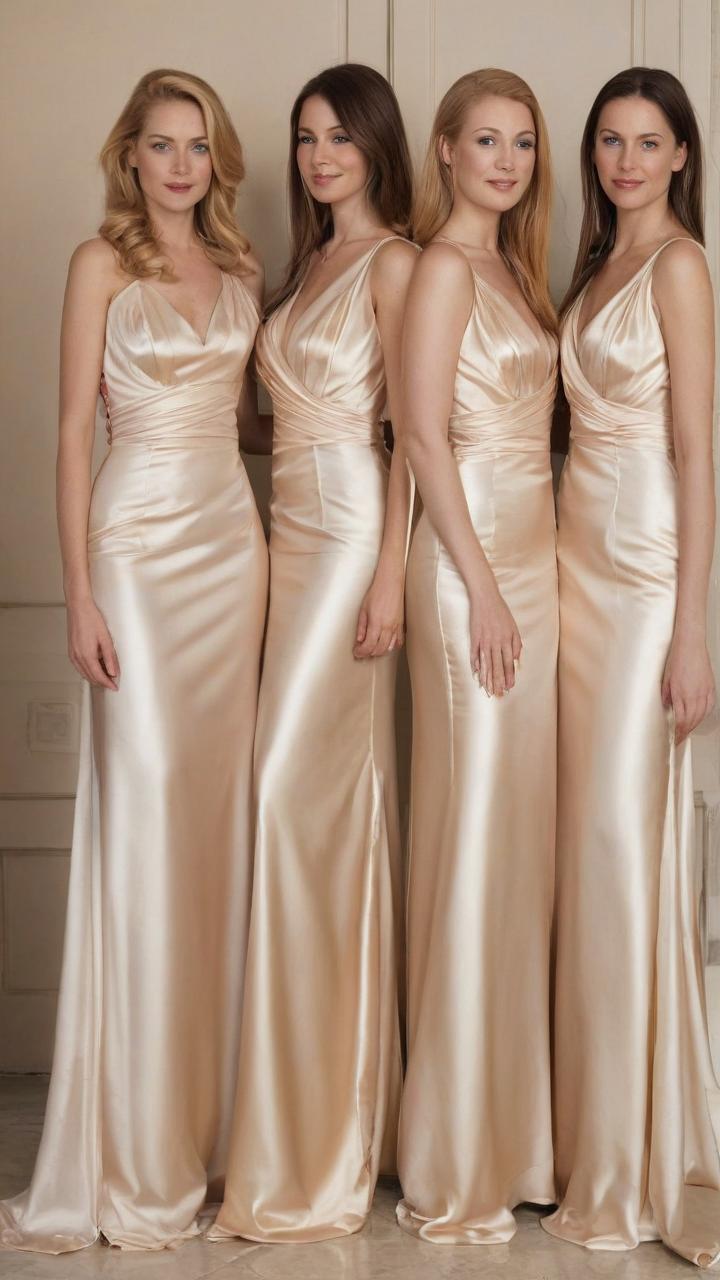
Where Silk Meets Surrender, and Belonging Becomes Ecstasy
She had spent a lifetime building walls—polished, glistening, impregnable. Until the moment a single glance from Lady Elara Thorne made her understand, with devastating clarity, that the strongest fortress is merely a cage for a heart that has forgotten how to yearn.
The invitation arrived on cream vellum, edged in gold. No request for reply. No expectation. Simply an address, a date, and three words that would unravel everything she thought she knew about desire:
Come home, Celine.
She did not know then that home was not a place, but a presence. That belonging was not given, but cultivated. That the most exquisite surrender is not to a person, but to a purpose far greater than herself.
And she certainly did not know that Lady Elara Thorne—poised, enigmatic, devastatingly serene—would become the axis upon which her entire existence would turn.
But as she crossed the threshold of the Mayfair townhouse, as her fingers brushed the cool satin of the chair back, as she felt the weight of three pairs of eyes settle upon her with quiet, knowing welcome, Celine understood:
Some circles are not entered.
They are claimed.
Chapter One: “The Weight of Silk”
The gallery was empty, as it always was on Thursday afternoons. Celine stood before the portrait—a woman in crimson satin, her gaze neither inviting nor rejecting, simply present—and felt the familiar ache settle into the hollow of her chest. She had come here seeking something, though she could not have named it. Perhaps it was the way the afternoon light fell through the skylights, pooling like liquid gold on the polished parquet. Perhaps it was the silence, so profound it seemed to have texture, weight, a kind of reverent density that pressed against her skin like water.
Or perhaps it was the painting itself. The woman’s dress caught the light in ways that made Celine’s breath catch—a river of crimson silk flowing over curves that were suggested rather than revealed. The fabric was rendered with such precision that Celine felt she could reach out and feel its cool, smooth glide beneath her fingertips. The woman’s eyes, dark and unfathomable, held something that Celine recognised with a start: the quiet certainty of one who knows she is looked at, who has made peace with being witnessed, who requires nothing from the viewer because she is already complete.
“I wonder what she’s thinking,” Celine murmured to the empty room. “Whether she chose that dress for herself, or for someone else. Whether the weight of that silk feels like a burden or a blessing.”
The painting did not answer. Paintings never did. And yet Celine felt the question lodge itself somewhere beneath her ribs, a small sharp thing that would not be dislodged.
She had spent fifteen years building a life that gleamed from the outside—a career as an art curator that placed her at the centre of London’s most rarefied circles, a flat in Kensington that appeared in magazines, a wardrobe of designer pieces that whispered of taste and sophistication. She had climbed each rung of the ladder with determination and grace, collecting accolades and invitations and the careful admiration of those who understood the value of what she had achieved.
And yet.
And yet there were nights when she stood before her closet, fingers trailing over rows of silk and cashmere, and felt nothing. Nights when the silence of her beautiful flat pressed against her ears like cotton wool. Nights when she caught her own reflection in the darkened windows and thought: There you are. There you are, still performing. Still curating. Still arranging yourself for an audience that never quite arrives.
She had lovers, of course. Brilliant women, accomplished women, women who touched her with expertise and withdrew with politeness. But something always remained unspoken, unexplored—a door neither of them seemed willing to open. As if the admission of what she truly longed for would shatter the careful equilibrium she had constructed.
What do I long for? she had asked herself a thousand times. The answer remained elusive, a shape glimpsed through frosted glass.
The sound of heels on parquet broke through her reverie. Light, measured steps—deliberate but not aggressive. The rhythm of someone who moved through space as if the space itself were an extension of her will.
Celine turned.
The woman stood in the archway, and the gallery seemed to rearrange itself around her. She was perhaps fifteen years older than Celine, with hair the colour of aged amber swept into an elegant chignon. Her gown was midnight blue satin, so dark it seemed to drink the light and return it transformed—deeper, richer, more present. The fabric moved with her like a second skin, like water, like something that was not quite cloth but some more essential substance: the outer expression of an inner grace.
She did not smile. She did not introduce herself. She simply walked to Celine’s side, close enough that the scent of jasmine and amber drifted between them, and turned her gaze to the painting.
They stood in silence. The air thrummed.
Celine became acutely aware of her own breathing, the rise and fall of her chest, the way her heart had begun to beat just a little faster. She felt, with a flush of something between embarrassment and exhilaration, that she was being assessed. Not judged—there was no harshness in the woman’s regard, no cold appraisal. Simply witnessed, as if the woman’s gaze were a kind of light that passed through surfaces and illuminated what lay beneath.
“You understand light,” the woman said at last. Her voice was low and warm, honeyed, with the clipped vowels of old money and older certainties. “I have watched you stand before this painting before. You do not look at the figure. You look at how the light falls upon her. How it shapes her. How it reveals her.”
Celine blinked. “You’ve seen me before?”
“I see many things.” The woman’s lips curved slightly—not quite a smile, but its promise. “I see a woman who has spent her life arranging beauty for others to consume, while her own hungers remain… unexamined.”
The words landed like stones in still water. Celine felt the ripples spread through her chest, her throat, the backs of her eyes.
“I don’t know what you mean,” she said, though even as she spoke, she recognised the lie.
The woman turned then, and her eyes—dark, depthless, luminous—met Celine’s with an intensity that made her breath catch.
“Do you know what satin teaches us?” the woman asked, her voice dropping to a near-whisper. “It teaches us that the most profound strength is not in resistance, but in flow. That the garment which clings does not constrain—it reveals. That to be seen, truly seen, is not a violation but a gift.”
She reached out, her fingers brushing the sleeve of Celine’s blouse—a touch so light it might have been imagination. But Celine felt it echo through her entire body, a tremor that started at the point of contact and radiated outward.
“I am Elara,” the woman said. “Lady Elara Thorne. And you, my dear, are standing at the edge of something you cannot yet name. I can see it in the way you hold yourself, the way you look at that painting as if it holds an answer you have been seeking your entire life.”
Celine swallowed. Her mouth was dry. “I’m not sure I believe in answers anymore. Only questions.”
“Good.” Elara’s fingers traced down Celine’s arm, feather-light, leaving trails of sensation. “Answers are for those who have stopped searching. Questions are for those who are still willing to be transformed.”
She withdrew her hand, and Celine felt the absence like a sudden chill.
“There is a gathering tomorrow evening,” Elara said. “At my home. Women of… similar disposition. Women who have discovered that the life they built was merely a prologue to the life they were meant to lead.”
She reached into a hidden pocket of her gown—Celine caught the flash of midnight silk, the shadowed curve of a hip—and withdrew a card. Cream vellum, edged in gold. On it, an address in elegant script, and beneath it, three words:
Come home, Celine.
“I do not know you,” Celine heard herself say, though her voice seemed to come from very far away. “You do not know me.”
Elara smiled then—fully, brilliantly, a flash of warmth that seemed to illuminate the entire gallery. “I know you better than you know yourself. I know the weight you carry. I know the silk you wear as armour. And I know that beneath it beats a heart that has been waiting—perhaps for longer than you can remember—for someone to show you that surrender is not defeat.”
She placed the card in Celine’s hand. Her fingers lingered, warm and certain.
“The weight of silk,” she murmured, “is nothing compared to the weight of a life unlived. Tomorrow evening. Eight o’clock. Wear something that makes you feel seen.”
And then she was gone, moving through the gallery with that same liquid grace, midnight silk flowing around her like a cloak of night. The click of her heels faded. The silence returned.
Celine stood alone before the painting, the card pressed against her palm, her heart racing with something that felt like terror and longing and the first bright edge of hope.
The woman in crimson satin gazed back at her, impenetrable, serene.
And Celine thought, for the first time in years: I want to be known. I want to be held. I want to belong to something I cannot yet name.
The afternoon light shifted. The gallery held its breath.
Tomorrow, she would go.
Where Silk Meets Surrender
Chapter Two: “The Architecture of Anticipation”
Three weeks had passed since the gallery, and Celine had thought of little else.
She had attended the gathering that first evening—a blur of candlelight and hushed voices, of introductions made and hands briefly clasped—and had been invited back. Again and again. Each visit added another thread to the tapestry, another fragment of understanding. She was not yet of the circle. But she was beginning, tentatively, to orbit it.
Now she stood before the townhouse in Mayfair, the morning light soft and diffuse behind a lattice of clouds. The building rose four storeys, its Georgian façade unassuming from the outside, giving no hint of the world contained within. She had learned already that appearances were just that—surfaces, veils, the outer garments of something deeper.
The door opened before she could knock. A woman in a crisp navy dress—satin, Celine noted, always satin—gestured her inside with a small, knowing smile.
“The drawing room,” the woman murmured. “You are expected, though not urgently. Take your time.”
Celine moved through the hallway, her heels clicking on marble that gleamed like still water. The air smelled of gardenias and something else, something warm and elusive—amber, perhaps, or sandalwood. The scent of a home that had been curated as carefully as any gallery exhibition.
She paused at the entrance to the drawing room, drinking it in.
The space was arranged with the precision of a Japanese garden—every object placed with intention, every angle calculated to catch the light. Floor-to-ceiling windows looked onto a private courtyard where ivy climbed ancient brick. The curtains were drawn partway, filtering the morning sun into soft, golden bands that fell across the Persian rug in geometric patterns.
And there, moving through this arranged perfection, was a woman Celine had seen before but never properly met.
She was tall and slender, her hair cropped short in a style that spoke of European sensibilities. Her dress was ivory satin, draped like a column, catching the light in ways that made her seem almost to glow. She was adjusting the curtains—a fraction to the left, a fraction to the right—her movements economical, precise, almost choreographic.
Celine watched, fascinated. The woman’s fingers lingered on the fabric, feeling its weight, its texture. She tilted her head, considering the angle of light, then shifted the curtain again by no more than an inch. The change was barely perceptible, and yet Celine could feel the room shift, the ambience recalibrate.
She is not decorating, Celine realised. *She is *tuning. Like an instrument. Like a violin string tightened to precisely the right tension.
The woman turned, as if sensing Celine’s presence. Her eyes were pale grey, sharp and intelligent.
“Ah,” she said. “You must be Celine. I am Isolde.” Her accent was faintly continental—French, perhaps, or Belgian. “Lady Elara has spoken of you.”
Her voice was melodic, unhurried. She crossed the room with fluid grace, extending a hand. Her grip was firm but not aggressive, the clasp of an equal greeting an equal—or perhaps something more nuanced, a recognition of potential.
“Welcome to the morning ritual,” Isolde said, gesturing to the space around them. “This is where we prepare. Not the space, primarily, but ourselves. The environment is merely a mirror.”
“A mirror of what?”
Isolde smiled. “Of intention. Of anticipation.” She turned toward a vase on the sideboard—a single white rose, its petals just beginning to unfurl. She lifted it, examined it, rotated it by degrees until it caught the light at an angle that made its edges shimmer. “Observe.”
Celine stepped closer. The rose seemed transformed—not different, exactly, but revealed. The light fell across its petals in a way that accentuated their delicacy, their almost translucent quality. It was the same flower, and yet it was not. It had been given permission to be its most beautiful self.
“You see?” Isolde murmured. “The rose does not change. It merely requires the correct environment in which to unfold. A shift of light. A rotation of perspective. And suddenly—” She released the flower, letting her fingers trail across its petals. “—suddenly it is not merely a rose. It is an offering.”
“An offering to whom?”
Isolde’s grey eyes glittered. “To the moment. To the one who will receive it. To the act of offering itself, which is, I have come to believe, the highest form of art.”
She moved away, toward the kitchen, gesturing for Celine to follow. “Come. There is someone else you should meet.”
The kitchen was a study in controlled chaos—or rather, chaos that had been so thoroughly controlled it appeared effortless. Copper pots hung from a rack above a central island of white marble. The surfaces gleamed. And at the far end, near a silver tea service that caught the light like a constellation, stood another woman.
She was younger than Isolde—late twenties, perhaps—with dark hair cascading over one shoulder and a dress of scarlet silk that seemed to burn with inner fire. She was utterly still, her eyes fixed on the doorway through which, Celine understood, Lady Elara would eventually appear. A tray rested in her hands, balanced perfectly, holding a single porcelain cup and saucer.
“This is Mira,” Isolde said. “She is our keeper of rituals. The one who knows when the tea must be poured, when the silence must be broken, when the light must be dimmed.”
Mira did not turn. Her gaze remained fixed on the doorway. But a small smile curved her lips.
“Welcome, Celine,” she said softly. “You are just in time. She will descend soon.”
“How do you know?”
Mira’s smile deepened. “I do not know. I feel. There is a difference. Knowing is of the mind. Feeling is of the entire being.” She shifted the tray infinitesimally, her muscles adjusting to maintain perfect balance. “When you have served as long as I have, you learn to read the architecture of a house. The way the floorboards settle. The particular quality of silence that precedes movement. The shift in air pressure when a door opens on another floor.”
She turned, finally, and Celine was struck by the intensity of her gaze—dark, luminous, almost feverish with devotion.
“Lady Elara does not ring for tea. She does not request. She does not need to. By the time she has descended the stairs and crossed the hallway and entered this room, the tea will be at precisely the correct temperature. Not because she demanded it. Because we anticipated.”
“It sounds…” Celine hesitated, searching for the word. “Exhausting.”
Isolde laughed softly. “It would be, if it were effort. But anticipation, when it flows from the correct intention, becomes effortless. Like water finding its level. Like a bird riding a thermal.” She moved to stand beside Mira, placing a hand lightly on her shoulder. “We do not serve because we must. We serve because we are. Because the act of anticipation is not labour—it is love made visible.”
Celine felt something shift within her—a door opening onto a corridor she had not known existed. “I think I understand,” she said slowly. “It is not about the task. It is about what the task signifies.”
“Precisely.” Isolde nodded, approval warming her features. “The rose is not about the rose. The tea is not about the tea. They are vessels. Containers for something that cannot be spoken directly. A language of gesture. A vocabulary of care.”
“And Lady Elara…” Celine hesitated again. “She receives this? She accepts it?”
Mira’s eyes softened. “She receives. She accepts. And in receiving, she completes the circle. Do you see? Devotion without reception is incomplete. It is a letter sent without an address. But when there is one who can receive what is offered, who can witness it and affirm it, then the devotion becomes whole. It becomes meaningful.”
The floorboards above them creaked, barely audible.
Mira straightened. Isolde’s hand tightened on her shoulder. The room seemed to still, the air itself holding its breath.
“She comes,” Mira whispered.
And Celine felt it too—a subtle shift in the atmosphere, a quickening of anticipation that was almost electrical. She watched as Isolde moved to the doorway, positioning herself with her back against the frame, hands clasped before her. She watched as Mira adjusted her stance, the tray held at precisely the correct height, her eyes once more fixed on the space where Lady Elara would appear.
Curate yourself, Celine thought, the instinct arising unbidden. Arrange yourself. Become the offering.
She straightened her spine. She smoothed the fabric of her dress—a deep green satin she had chosen specifically for this morning, its surface glossy and smooth. She angled herself toward the doorway, not directly facing it, but positioned so that she would be seen when Elara entered. Witnessed.
The footsteps on the stairs were measured, unhurried. Each footfall distinct. Each pause deliberate. The sound of someone who moved through the world as if the world were her reflection.
The hallway darkened slightly—a shadow falling across the light from the courtyard.
And then Lady Elara Thorne stood in the doorway.
She wore a gown of charcoal silk, so dark it seemed to absorb the morning light and transmute it into something softer, more rarefied. Her hair was arranged in a low chignon, exposing the elegant column of her neck. Her face was calm, serene, a stillness that seemed to emanate outward and quiet everything it touched.
She did not speak. She simply was.
Isolde straightened. Mira’s hands adjusted the tray by a fraction of an inch. And Celine felt the silence wrap around her, press against her, fill her lungs with something that was not quite air but something more rarefied—expectation, perhaps, or possibility.
Elara moved into the room. Her gaze swept across the three women—Isolde at the door, Mira with the tea, Celine positioned near the window—and for a moment, her eyes lingered on Celine. A flash of something unreadable. Recognition, perhaps. Or assessment.
Then she moved to her chair—a high-backed seat near the window, angled to catch the light—and sat.
Mira was there before Celine could register the movement. The tray descended. The tea was poured. The cup extended at precisely the moment Elara’s fingers curled toward it.
No words. No request. Only the silent choreography of anticipation fulfilled.
Elara raised the cup to her lips. Her eyes closed. The room held its breath.
And Celine felt a surge of something so powerful it nearly brought her to her knees—not envy, not longing, but recognition. As if she were watching a language she had always known but never been permitted to speak. As if she were glimpsing, for the first time, the shape of the thing she had been seeking her entire life.
Isolde appeared at her side, silent as a shadow. Her hand brushed Celine’s elbow—a touch so light it might have been accidental. But Celine knew it was not.
“Watch and learn,” Isolde murmured, her voice barely audible. “This is the architecture of devotion. The weight of silk. The angle of light. The precise moment of offering.”
She gestured, almost imperceptibly, toward Elara’s chair.
“And the one who receives it all—without demand, without expectation, but with the quiet certainty that it is right. That it is natural. That this is how love moves when it is allowed to flow without obstruction.”
Elara opened her eyes. She sipped her tea. And then, for the first time since entering, she spoke.
“Celine.”
Her voice was calm, warm, a resonant note in the silent room.
“Come sit with me. Tell me what you have learned.”
And Celine, moving as if in a dream, crossed the room and knelt at her mistress’s feet—knowing, with a certainty that settled into her bones, that she had finally, finally, begun to understand.
Where Silk Meets Surrender
Chapter Three: “The Gift of the Second Skin”
The atelier was tucked away on a side street off Old Bond Street, its entrance unmarked save for a single brass number affixed to the doorframe. Celine had passed it a hundred times without noticing—a testament, she now understood, to the kind of discretion that did not need to announce itself. The most rarefied spaces were not hidden; they were simply unseen by those who had not been invited to see.
Elara had sent a car. A sleek black vehicle with tinted windows and an interior that smelled of fine fragrance. The driver had not spoken, merely opened the door and gestured her inside, as if the journey itself were part of an initiation she was not yet meant to understand.
Now Celine stood in the atelier’s reception area, drinking in the details. The walls were lined with bolts of fabric arranged by colour—ivory flowing into cream, cream into champagne, champagne into gold. Each bolt was labelled in elegant script: Duchesse Satin. Charmeuse. Crêpe-back Satin. Slipper Satin. The air was cool and smelled of lavender and something else, something almost metallic—the scent of fabric that had never been worn, never been touched, never been claimed.
A woman emerged from behind a curtain of midnight velvet. She was older than Celine had expected—perhaps sixty, with silver hair swept into an elegant chignon and a tape measure draped around her neck like a necklace. Her dress was black satin, simple and severe, her only adornment a single pearl at her throat.
“Miss Celine,” the woman said. Her accent was French, her voice melodic. “I am Madame Laurent. Lady Elara has informed me of your… requirements.”
She did not smile. But her eyes, dark and sharp, moved over Celine with an intensity that felt almost physical—an assessment not of her body, but of something deeper. Her potential, perhaps. Or her capacity for transformation.
“Come,” Madame Laurent said, gesturing toward the curtain. “We have much to accomplish, and little time.”
The fitting room beyond the curtain was larger than Celine had anticipated—a space of mirrors and light, with a raised platform at its centre and three-way mirrors arranged to capture every angle. The walls were lined with more fabric, more colours, more textures. But Celine’s eye was drawn immediately to the dress form in the centre of the room.
Upon it draped a gown of deep burgundy satin, so rich it seemed to hold light within its folds. The colour was not merely red or wine—it was something more complex, a hue that shifted depending on the angle, now appearing almost purple, now flaring with the warmth of a dying ember. The fabric caught the ambient light and seemed to glow, as if the gown were not merely reflecting illumination but generating it.
“This,” Madame Laurent said, moving to stand beside the form, “is the gift Lady Elara has selected for you. She has had it in preparation for three weeks. The colour was chosen to complement your complexion. The cut was designed to honour your form while permitting… movement. Grace. Flow.”
She turned to Celine, her expression unreadable. “You understand, of course, that this is not merely a garment.”
Celine swallowed. “I am beginning to understand that nothing in Lady Elara’s world is merely anything.”
A flicker of approval crossed Madame Laurent’s features. “Good. You are quicker than most.” She gestured toward a screen in the corner. “Undress. Everything. Undergarments as well—the gown requires proximity to skin. It must know you.”
Celine hesitated. The command was not harsh, but it was absolute—a directive that expected compliance without question. She felt a flutter of something in her chest: nerves, certainly, but also a strange kind of anticipation. The same feeling she had experienced in the gallery, the first time Elara’s eyes had found hers.
This is what it feels like, she thought, to be shaped. To be curated. To be made into something more than you were before.
She moved behind the screen. Her fingers found the buttons of her blouse, the zipper of her skirt. Each garment fell away, leaving her standing in the cool air, her skin prickling with awareness. She thought about the body beneath her clothes—the body she had inhabited for thirty-two years, the body she had dressed and fed and exercised and sometimes ignored. It had always been hers. But now, somehow, it felt like it was becoming theirs—the property of the circle, the vessel of the devotion she was learning to embody.
When she emerged, Madame Laurent was waiting. Her eyes moved over Celine’s form with clinical precision, but there was something else in her gaze—respect, perhaps. Or recognition.
“You have the frame for satin,” she said. “Some women do not. They require structure, boning, architecture. But you—” She circled Celine slowly, her fingers trailing through the air an inch from Celine’s skin. “You have the kind of body that can hold fluidity. That can carry fabric like water carries light.”
She lifted the gown from the form. The satin slithered over her arm, a river of burgundy, and Celine felt her breath catch at the sound it made—a whisper, almost, like a secret being shared.
“Arms up,” Madame Laurent commanded.
Celine raised her arms. The gown descended over her head, and for a moment she was engulfed in darkness and sensation—the fabric sliding down her torso, her hips, her thighs, cool and smooth and impossibly present. It was not like wearing clothing. It was like being touched by something sentient, something that was learning the geography of her form.
Madame Laurent’s fingers worked at the back, adjusting, smoothing, pinning. The gown was not yet perfect, Celine understood. It would require alterations. Precision. But already she could feel the difference—the way the satin moved with her, anticipated her, seemed to complete her.
“Look,” Madame Laurent said, turning Celine toward the mirrors.
Celine looked.
The woman who gazed back at her was both familiar and utterly transformed. The burgundy fabric clung to her curves without constriction, flowing over her body like liquid, like light, like a second skin that had been waiting her entire life to be claimed. The colour warmed her complexion, brought out the amber flecks in her eyes, made her hair seem darker, richer. The neckline plunged just far enough to suggest without revealing. The hem brushed the floor, pooling slightly around her feet, training her to move with intention or risk stumbling.
This, she thought, *is what it means to be dressed. Not covered, but *expressed*. Not hidden, but *amplified.
“You see,” Madame Laurent murmured, standing behind her. “The satin does not conceal. It reveals. It speaks the truth of what lies beneath—not the shape of your body, but the shape of your essence.”
She adjusted a pin at Celine’s waist, her touch professional and yet somehow intimate.
“Lady Elara chose this for you. Do you understand what that means?”
Celine met her own eyes in the mirror. “She sees me. Not as I am, but as I could be.”
“She sees you as you are—the part of you that you have not yet learned to see yourself.” Madame Laurent stepped back, her expression softening. “The gown is not a costume. It is a mirror. And when you wear it tonight, when you sit at her table, when you feel the fabric move against your skin with every breath—you will understand that you are not merely wearing a gift. You are accepting an identity. You are becoming part of something that does not end when the evening ends.”
She gestured toward the screen.
“Now. We must complete the fitting. There will be dinner tonight, and Lady Elara does not tolerate imperfection—not because she is cruel, but because she knows that perfection is the language of devotion. And devotion, Miss Celine, is the only currency that matters in her world.”
The evening arrived with the soft inevitability of a tide.
Celine descended the stairs of her own flat—not the Kensington apartment, but a smaller space she had begun to use less frequently—and felt the gown move with her, a shadow of burgundy light. The car was waiting. The driver did not speak. The streets of London slid past the tinted windows, and Celine watched them without seeing, her mind already in the townhouse, already in the presence of the woman who had somehow become the axis upon which her world turned.
When she entered the drawing room, she understood immediately what Madame Laurent had meant.
Isolde stood near the window, her ivory gown catching the last of the evening light, shimmering like a pearl. Mira hovered near the sideboard, her scarlet silk burning like a flame in the soft glow of the lamps. Both women turned as Celine entered, and their eyes moved over her with approval, with welcome, with something that looked almost like pride.
“You have been given the second skin,” Isolde said softly, crossing to Celine, her fingers reaching out to touch the edge of her sleeve. “The burgundy. It suits you. It is you.”
“I feel—” Celine hesitated, searching for words. “I feel as if I am wearing a promise. A vow I did not know I was making.”
Mira joined them, her movements fluid as water. “That is exactly what you are wearing. The gown is not cloth. It is a covenant. When you put it on, you agreed to become the person Lady Elara saw when she chose it for you.”
She reached out, her fingers brushing Celine’s other sleeve, and for a moment the three women stood in a triangle of touch and fabric and silence—burgundy, ivory, scarlet—three notes in a chord Celine was only beginning to hear.
“She comes,” Isolde murmured, her hand tightening briefly on Celine’s arm before releasing.
The room shifted. The air thickened. And Lady Elara Thorne entered.
She wore a gown of midnight blue—the same colour as that first day in the gallery—but tonight the fabric seemed darker, richer, more absolute. It absorbed the light and transformed it, turning the gas lamps into stars. Her hair was arranged more elaborately than before, exposing the long line of her neck, the graceful architecture of her shoulders.
She stopped in the centre of the room. Her gaze moved across the three women—Mira in scarlet, Isolde in ivory, Celine in burgundy—and something flickered in her eyes. Satisfaction, perhaps. Or something deeper: completion.
“Beautiful,” she said, her voice warm and resonant. “You shine like jewels arranged for a setting. Each unique. Each essential. Each belonging.”
Her eyes found Celine and held.
“Come.”
Celine moved across the room without thinking, drawn by the gravity of Elara’s presence, the quiet authority that did not need to raise its voice because it had never learned to doubt. She stopped before Elara, close enough to smell the jasmine and amber that clung to her skin, close enough to feel the warmth radiating from her form.
Elara reached out. Her fingers touched the edge of Celine’s gown, tracing the line of the neckline, feeling the weight of the fabric where it lay against her collarbone.
“Madame Laurent tells me you understood the lesson,” Elara murmured. “That the gown is not a garment, but a revelation.”
“I am beginning to understand,” Celine said. Her voice was steady, though her heart raced. “The satin does not hide me. It shows me—as I could be. As you see me.”
Elara smiled—a slow, warm expression that seemed to illuminate the entire room.
“Not as you could be, my dear. As you are. The woman who has been waiting inside you all these years, patient and unseen, finally permitted to step into the light.” Her fingers trailed down Celine’s arm, feeling the fabric, feeling the warmth beneath. “You have worn armour your whole life—stiff fabrics, structured garments, clothing that protected you from being seen. But satin is not armour. It is an invitation. It says: Here I am. Witness me. Know me. Hold me accountable to the truth of my own beauty.“
She released Celine’s arm and stepped back, her eyes moving across all three women once more.
“Tonight, we dine together. We share bread and wine and silence. And you, Celine—newly gowned, newly seen—will sit at my right hand. Not because you have earned it. Not because you have proven yourself. But because I have chosen you. Because I see what you are becoming, and I wish to witness it unfold.”
She turned toward the dining room, her midnight gown flowing around her like a cloak of sky.
“Come, my loves. The table is set. The candles are lit. And the evening stretches before us like a promise waiting to be kept.”
Celine followed, Isolde and Mira flanking her like attendants, like sisters, like fellow travellers on a road she had only just begun to walk. The burgundy satin moved with her, whispering against her skin, and she felt each step as a kind of prayer—not to a deity, but to the woman ahead, the circle around her, the self she was finally learning to claim.
This, she thought, is what it means to belong. Not to lose yourself, but to find yourself in the reflection of those who see you clearly.
The candles flickered. The wine was poured.
And Celine sat at Lady Elara’s right hand, wearing her gift like a second skin, and felt the weight of silk become the weight of home.
Where Silk Meets Surrender
Chapter Four: “The Silence Between Heartbeats”
Midnight in the townhouse was not darkness. It was something else entirely—a quality of light so soft, so diffuse, it seemed to have been distilled from the hours that preceded it and then released, drop by precious drop, into the rooms and corridors where the women of the circle made their lives.
Celine stood at the entrance to the salon, her burgundy gown transformed by the candlelight into something molten, alive, a river of wine-red flame that flickered with each breath she took. The evening had unfolded slowly—dinner, conversation, the measured exchange of glances that carried more meaning than any spoken word—and now, at Elara’s gentle suggestion, they had migrated here, to this room of shadows and flames, where a pianist in the corner played Chopin with such quiet intensity that each note seemed to hang in the air before dissolving into the next.
The Nocturne in E-flat major. Celine recognised it, though she had never heard it played like this—each phrase delivered not as music but as a kind of question, an inquiry into the nature of stillness itself.
And there, at the centre of the room, Lady Elara Thorne sat in her high-backed chair.
The candles had been arranged around her in a careful constellation—not clustered, but spread, so that the light fell from multiple angles, eliminating shadow, creating an effect of soft luminescence that seemed to emanate from her very skin. Her midnight blue gown caught the flames and held them, turning her into something that was no longer merely a woman but an embodiment of liquid twilight, a vessel of contained radiance.
Her eyes were closed. Her head rested lightly against the high back of the chair. Her hands lay on the armrests, fingers curled inward, relaxed, utterly at peace.
And arranged around her, like offerings at an altar, were Isolde and Mira.
Isolde knelt on the floor beside Elara’s chair, her ivory gown pooling around her like moonlight. Her head rested gently against Elara’s knee—not pressed, not heavy, but merely touching, a point of connection so subtle it might have been accidental. Her eyes were closed as well, her face slack with contentment, her breathing slow and rhythmic, synchronised with some deeper pulse that Celine could not quite perceive.
Mira stood behind the chair, her scarlet silk luminous in the candlelight, her fingers tracing absent patterns on Elara’s shoulder. The touch was feather-light, almost imperceptible, and yet Celine could see the effect it had—the way Elara’s breathing deepened, the way her lips parted slightly, the way her whole body seemed to receive the contact and transform it into something sacred.
They are not performing, Celine realised, the thought arriving with the weight of revelation. *This is not a demonstration, not a lesson designed for my benefit. This is simply *how they are. This is what devotion looks like when it has become so natural it no longer requires thought.
The pianist moved from the Nocturne into something else—a piece Celine did not recognise, slower, more spare, built from long silences between brief cascades of notes. The silence was not empty. It was full—pregnant with something Celine could almost taste, a quality of attention so concentrated it had become tangible.
She stood at the entrance, uncertain. She had not been dismissed, but neither had she been invited to join. She was in a liminal space—a threshold state between belonging and observing, between being of the circle and merely adjacent to it.
Her fingers tightened on the edge of her burgundy gown. The satin whispered against itself, a tiny sound that seemed impossibly loud in the hushed room.
Isolde’s eyes opened. Grey and luminous in the candlelight, they found Celine across the room and held her gaze. There was no judgment in that look, no censure—only a quiet, welcoming warmth, an invitation extended without words.
Come, the look seemed to say. There is space for you. There has always been space.
But Celine did not move. She could not, not yet. Something held her in place—a fear she had not acknowledged until this moment, a trembling uncertainty at the very core of her being. To step forward, to cross that room, to kneel or stand or simply be in that constellation of devotion—would be to surrender something she had spent her entire life constructing. The self that stood apart. The self that observed, curated, maintained a careful distance from the heat of true connection.
What if I am not worthy? The thought rose unbidden, a whisper from the darkest corner of her mind. What if I reach out and find that I have nothing to give? What if the emptiness I have always feared is real, and I step into that light and reveal myself as… nothing?
The music swelled briefly, then subsided into another long silence.
And in that silence, Elara’s hand moved.
It was a small gesture—almost imperceptible. Her fingers uncurled from the armrest, extended, turned outward. An invitation. A question asked without sound.
Celine’s breath caught. The room seemed to contract around that single point of focus: Elara’s open hand, palm upward, fingers slightly curled, waiting.
Not demanding. Never demanding. Simply… waiting. As if the invitation had always been there, would always be there, and the only question was whether Celine would choose to see it.
She took a step forward. Then another. The burgundy satin moved with her, slid against her skin, whispered its encouragement. The candlelight played across her gown, transformed her into something flickering and fluid, a flame approaching a larger fire.
Isolde’s eyes remained on her, soft and welcoming. Mira’s fingers continued their silent patterns on Elara’s shoulder, acknowledging Celine’s approach with the subtlest shift in posture, making space without breaking contact.
And then Celine was there—standing before Elara’s chair, looking down at the woman who had become the axis of her transformation.
Elara’s eyes opened. Dark, depthless, luminous. They found Celine’s face and held it with a gentleness that was almost unbearable.
“You hesitate,” Elara murmured, her voice barely audible above the dying notes of the piano. “I can feel the trembling in your spirit. The fear that you are not enough. That you will reach out and find… nothing.”
Celine swallowed. Her throat was tight. “How do you know that?”
“Because I have felt it myself. Long ago, before I understood what it meant to receive.” Elara’s hand remained extended, open, patient. “The fear of emptiness is the last fortress of the self that believes it must be alone. It is not truth. It is merely a wall—one that you built to protect yourself from a wound that has long since healed.”
She tilted her head slightly, her gaze intensifying.
“The emptiness you fear is not the absence of substance. It is the presence of space—space that has been waiting to be filled with something you have not yet allowed yourself to offer. Not because you lack it. But because you have never been shown that it is safe to give.”
Celine felt tears prick at the corners of her eyes. The candlelight blurred, became a constellation of flames surrounding the woman before her.
“I don’t know what to give,” she whispered. “I don’t know what I have.”
“You have yourself,” Elara said simply. “That is all that has ever been required. The self that observes from a distance, the self that protects and curates and maintains control—that is not the self I am asking for. I am asking for the one beneath. The one who feels the weight of silk and wonders what it would mean to surrender to its embrace. The one who watches others kneel and aches with a longing she cannot name. The one who has been waiting, her whole life, for someone to show her that devotion is not diminishment but expansion.”
Her fingers curled slightly, a gesture of beckoning.
“Take my hand. Not because I command it. Because you want to. Because something in you has been crying out for this moment, and the only thing standing between you and the peace you seek is the fear that you are not worthy of it.”
Celine looked at the open hand. At the long, elegant fingers, the palm turned upward like a cup waiting to be filled. At the wrist emerging from the midnight silk, the faint pulse visible beneath the skin.
The silence between heartbeats, she thought. That is where the answer lives. Not in the noise of thought, but in the pause between one pulse and the next.
She reached out. Her fingers touched Elara’s palm.
The contact was electric—not painful, but intense, a current that flowed from the point of connection and spread through Celine’s entire body. She felt her knees weaken, felt the tears finally spill down her cheeks, felt something inside her break—a wall, a barrier, a fortress she had not known she was maintaining.
Elara’s fingers closed around hers. Warm, strong, certain.
“Kneel,” Elara whispered. “Not in submission. In presence. In the choice to be here, fully, without reserve.”
Celine knelt. The burgundy gown pooled around her, a river of silk, and she felt the coolness of the floor through the fabric, the solidity of the ground beneath her. Her other hand found Elara’s knee—tentatively at first, then with growing confidence—and she felt Isolde shift beside her, making space, welcoming her into the arrangement.
Isolde’s hand found her shoulder. A touch of solidarity, of sisterhood. A silent message: You are not alone. You have never been alone. You simply did not know where to look.
Mira’s fingers brushed the back of Celine’s neck—light as a moth’s wing, there and gone. Another welcome. Another thread woven into the fabric of belonging.
And Elara’s hand—still holding Celine’s, still anchored in that point of contact—lifted her fingers to her lips and pressed a kiss against her knuckles. A benediction. A sealing of a covenant that had been offered the moment Celine stepped into the gallery and saw the woman in crimson satin gazing back at her.
“Now,” Elara murmured, her voice a thread of sound that seemed to come from very far away, “close your eyes. Listen to the silence between the notes. Feel the weight of the fabric against your skin. Feel the warmth of the hands that hold you. And know—know—that you are exactly where you are meant to be.”
Celine closed her eyes.
The piano fell silent. The last note dissolved into the candlelit air.
And in the hush that followed—in the space between one heartbeat and the next—she felt something settle into place inside her. Not an answer, exactly. Something better: a peace. A certainty. A sense that the question she had been asking her entire life had not been answered, but had simply ceased to matter.
I am here, she thought. I am held. I am home.
The candles flickered. The women breathed.
And the silence between heartbeats stretched into something eternal.
Where Silk Meets Surrender
Chapter Five: “The Currency of Devotion”
Spring had softened the edges of London, transforming the grey thoroughfares into avenues of tentative green and early bloom. Celine felt the change not merely in the air, but in herself—a thawing she had not anticipated, a loosening of structures she had once believed permanent.
Six months. Six months since she had stood before the portrait in the gallery and felt the first tremor of recognition. Six months of afternoons in the drawing room, evenings at the table, nights of whispered conversations with Isolde and Mira that stretched into the small hours. Six months of learning a language she had always known but never been permitted to speak.
And now, on this morning of fragile light and birdsong, she ascended to the rooftop garden that crowned Elara’s townhouse—a secret space hidden behind parapets and climbing ivy, accessible only through a narrow stairwell concealed behind a bookcase in the upstairs study.
The garden was small but exquisite: beds of jasmine and climbing roses, a single ornamental cherry in full blossom, its petals drifting like pink snow onto the flagstones below. Wrought-iron furniture had been arranged near the eastern edge, positioned to catch the first light of dawn. And there, wrapped in silk robes the colour of morning mist—pale grey, luminous, tied at the waist with cords of satin—sat Elara, Isolde, and Mira, watching the sky blush and brighten.
Celine crossed to them, her own robe—a deep burgundy that matched the gown hanging in her closet, waiting for evening—rustling softly against her skin. The fabric was cool from the morning air, and she felt it as a whisper, a reminder of who she had become.
“Come,” Elara said, her voice still soft with sleep, gesturing to the empty chair at her right. “The sun will rise in seven minutes. Precisely seven. I have watched it from this spot many hundreds of times, and I have learned that the earth does not traffic in approximations. It is exact. It is faithful. It gives what it promises, when it promises, without variation or excuse.”
Celine settled into the chair, feeling the cold iron through the thin silk, letting the sensation anchor her. Isolde sat across from her, eyes half-closed, a small smile playing at her lips. Mira was curled on a cushion at Elara’s feet, her head resting lightly against her mistress’s knee, her fingers tracing idle patterns on the arm of Elara’s chair.
They sat in silence as the light strengthened, spreading upward from the horizon, painting the undersides of the clouds in shades of coral and gold. The city below was beginning to stir—distant sounds of traffic, the cry of a bird, the hum of a world waking to its concerns and errands. But here, in this hidden garden, time seemed to have paused, suspended between night and day, between what had been and what was yet to come.
“The world believes generosity is transaction,” Elara said, her voice quiet but carrying the weight of a sermon delivered in an empty cathedral. “Give, and expect return. Invest, and demand profit. Every action calculated, weighed, measured against some imagined ledger of what is owed and what is due.”
She turned her gaze to Celine, and in the growing light, her eyes seemed to hold the fire of the rising sun.
“But true generosity flows one way—outward, always outward. You give because you are a giver. Because the act of giving shapes you into something finer. Because you have recognised that there is no separation between the gift and the giver, between the one who offers and the one who receives. They are the same. The current moves through you, not from you.”
Celine felt the words settle into her like seeds finding fertile soil. “But how can that be?” she asked. “If there is no return, no recognition, no… acknowledgement—then what sustains the giving? What prevents it from becoming mere depletion?”
Elara smiled—a slow, warm expression that seemed to illuminate her from within. “You are thinking of giving as loss. As subtraction. As the emptying of a vessel that must somehow be refilled.” She shook her head gently. “But that is not how it works for those who have learned the secret. The vessel does not empty. It overflows. The more you give, the more you have to give—not because you are accumulating, but because you are becoming a channel. You align yourself with something greater, something that has no limit, and you allow it to move through you.”
She gestured toward the horizon, where the first sliver of the sun had crested the distant rooftops.
“The sun does not count the rays it bestows. It does not mourn the light that slips away into the void. It simply burns. It gives because that is its nature. And in giving, it does not diminish—it becomes. More itself with each passing moment. More fully what it was always meant to be.”
Mira stirred at Elara’s feet, lifting her head slightly. “When I first came to you,” she said softly, addressing Celine though her eyes remained on Elara’s face, “I had nothing. Or so I believed. A career that had left me hollow. Relationships that had crumbled into resentment. A sense of self that was fragmenting, scattering like ash in a strong wind.” She paused, her voice catching slightly. “And then I found her. I found this. And I understood, slowly, that the emptiness I feared was not an absence—it was a space. A space waiting to be filled with something I had never been taught to value.”
“Which was?” Celine asked.
“Devotion,” Mira replied simply. “Service. The act of giving myself to something greater than my own small concerns. And in that giving, I found—not loss, but plentitude. Not emptiness, but purpose.” She turned to Celine, her dark eyes luminous with conviction. “The Society gave me a framework. A structure. But more than that, it gave me permission. Permission to be what I had always been, underneath all the pretence and performance. Permission to love without calculation. To serve without resentment. To give without expecting anything in return.”
Celine absorbed this, feeling the truth of it resonate in spaces she had only recently begun to explore. “But the Society,” she said slowly, choosing her words with care. “It requires… contribution. Financial support. The generosity of resources, not merely of spirit.”
She hesitated, aware that she was approaching territory that felt somehow sacred, somehow fraught.
“How does that align with the idea of giving without expectation? If I am asked to support the Society—to contribute to its maintenance, its growth—am I not then engaged in a transaction? Giving in exchange for… belonging? For the privilege of remaining within the circle?”
Elara’s expression did not change, but something in her gaze deepened—a shift in the quality of her attention, as if she had been waiting for this exact question and was pleased that it had finally arrived.
“Let me tell you a story,” she said. “One I heard many years ago, from a woman far wiser than I.”
She settled back in her chair, her fingers absently stroking Mira’s hair.
“There was once a village by the sea, and in this village lived a woman who had discovered a spring of sweet water hidden in the hills above the settlement. She told no one of her discovery. Each morning, she rose before dawn and made the climb to the spring, filling her vessels, carrying the water back to her home. She drank deeply, bathed in the cool sweetness, grew strong and radiant while her neighbours remained parched and weary.”
“The village, you see, relied on a well that had grown brackish and low. The people struggled. Their crops withered. Their children cried with thirst. And all the while, the woman kept her secret, hoarding the sweet water, believing that its value lay in its scarcity.”
Elara paused, letting the silence stretch.
“Then one day, a traveller passed through the village—an old woman with eyes that seemed to see beneath surfaces. She observed the hoarder, noted her health and vitality, and then she followed her, early one morning, up the hill to the hidden spring. She watched as the woman filled her vessels. And when the woman turned to descend, the traveller stepped from behind a tree.”
“‘You have misunderstood the nature of water,’ the traveller said. ‘Water is not wealth. Water is life. It does not gain value from being kept. It gains value from being shared. Every drop you hoard becomes stagnant. Every drop you give away remains pure, remains sweet, because it continues to flow.'”
Elara’s voice had softened, taking on the cadence of a lullaby.
“The hoarder was frightened. She believed the traveller would expose her secret, would destroy the small empire she had built around her hidden spring. But the traveller merely smiled. ‘I am not here to take from you,’ she said. ‘I am here to show you what you already have. Not a private reserve, but an infinite source. The spring does not run dry because you draw from it. It runs dry when you stop drawing. When you stop letting it flow through you and into the world.'”
The sun had risen fully now, casting long golden shadows across the rooftop garden, warming the cool air. Celine felt the light on her face and found it strangely apt—a metaphor made manifest.
“What happened to the woman?” she asked.
“She shared the water,” Elara replied. “She led the villagers to the spring, taught them how to draw from it, how to channel it to their fields and homes. And in doing so, she discovered something unexpected. The water tasted sweeter when others drank from it. The spring seemed to flow more strongly, more abundantly, as if it had been waiting—aching—to be given away. And the woman herself? She became not a hoarder, but a guardian. Not an owner, but a steward. Her identity transformed. She was no longer the keeper of a secret, but the keeper of a gift—a gift that grew larger with each passing year, with each new generation that learned to drink from its sweetness.”
Elara leaned forward, her eyes fixing Celine with an intensity that was almost physical.
“The Society is not a club. It is not an exclusive enclave that demands payment for entry. It is a spring—a source of living water that flows from the generosity of those who have learned the secret. When you contribute—when you give of your resources, your time, your devotion—you are not paying a fee. You are opening a channel. You are allowing something to flow through you that would otherwise stagnate. And in that flow, you become part of the spring. You become the guardian of something that has no limit, no end, no possibility of depletion.”
She reached out, her hand finding Celine’s, her fingers warm and certain.
“The financial support the Society requires—the generosity we ask of those who have been called to join us—is not a transaction. It is a sacrament. An outward sign of an inward grace. When you give, you are not purchasing belonging. You are declaring it. You are saying: I believe in this. I am willing to sustain it. I am willing to be a channel through which its abundance can flow.”
Her grip tightened slightly.
“And in return—though it is not truly a return, because the word implies a transaction—you receive something no money can buy. You receive purpose. Connection. The profound, almost unspeakable joy of knowing that you are part of something greater than yourself.”
She released Celine’s hand and sat back, her gaze returning to the risen sun.
“The Dominus who guides this Society—who remains hidden, who asks for no recognition, who gives without expectation of acknowledgment—understands this better than anyone. He created this structure not to enrich himself, but to create a vessel. A container within which the spirit of generosity could flow and grow and multiply. Every gift given to the Society becomes part of that flow. Every act of devotion adds to the current. And the euphoria that follows—the sense of lightness, of rightness, of being exactly where you are meant to be—is not a reward. It is the natural consequence of alignment. When you align yourself with the principle of generosity, you become generous. And when you become generous, you become free.”
Celine felt tears prickle at the corners of her eyes. The words had found their mark, had slipped past the walls she had not even known she was maintaining, and had touched something tender and true at her core.
“I have spent my whole life calculating,” she whispered. “Measuring. Ensuring that every investment of time or emotion or resources would yield an appropriate return. I thought it was wisdom. I thought it was safety.” She looked at Elara, her vision blurring. “But it was merely fear. Fear dressed in the costume of prudence.”
“And now?” Elara asked gently.
Celine drew a breath, feeling the morning air fill her lungs, feeling the weight of the silk against her skin, feeling the presence of Isolde and Mira and Elara surrounding her like a garment of light.
“Now I want to give. Not because I expect something in return. But because—” She faltered, searching for words. “Because the giving itself is the return. Because I have found something worth sustaining. Because I want to be part of the spring, not merely a visitor who drinks and leaves.”
She turned to Elara, her eyes bright with unshed tears.
“What would I need to give? To remain in this circle? To become… a guardian rather than a guest?”
Elara’s face softened. She reached out again, her fingers brushing a tear from Celine’s cheek.
“The question is not what you need to give. The question is what you want to give. What you feel called to offer. Not because it is demanded, but because it flows naturally from the person you are becoming.” She smiled. “For some, it is financial—a portion of their resources, offered freely, without resentment. For others, it is time, or skill, or simply the willingness to be present, to hold space, to embody the principles of the Society in their daily lives. There is no fixed price. There is only the invitation to join the flow.”
She leaned closer, her voice dropping to a near-whisper.
“But I will tell you this: those who give most freely, most joyfully, without calculation or expectation—those are the ones who find the greatest fulfilment. Not because they are rewarded. But because they have learned the secret. They have discovered that the currency of devotion is not money, or time, or even love. It is surrender. The surrender of the self that believes it must hold on, must protect, must hoard. And in that surrender, they find not loss, but liberation.”
Celine closed her eyes, letting the words wash over her, letting the morning light warm her face, letting the presence of these women fill the spaces that had been empty for so long.
I have been a hoarder, she thought. I have been the woman with the hidden spring, drinking alone, believing that scarcity was the natural order. But now—
Now I want to be a channel. I want to let it flow. I want to give until giving becomes as natural as breathing, as effortless as the light that spills across the sky each morning.
She opened her eyes and found Elara watching her, a quiet smile on her lips.
“I want to give,” Celine said, her voice steady, her heart full. “I want to support the Society. I want to be part of what sustains this. Not because I am asked. Because I need to. Because the giving itself is the fulfilment of something I have been searching for my entire life.”
Elara nodded slowly, her smile deepening.
“Then you have already given the only thing that truly matters. The rest is merely… expression. The outward form of an inward transformation.”
She rose, her silk robe flowing around her, and extended her hand to Celine.
“Come. The sun has risen. The day awaits. And there is much to be done—buildings to maintain, circles to strengthen, new travellers to welcome to the spring.”
Celine took her hand and rose, feeling the burgundy silk shift against her skin, feeling the lightness that comes when a burden has been recognised as such and set aside. Isolde and Mira rose as well, flanking her, their hands finding her shoulders, her waist, their touches light but anchoring.
And together, the four women turned from the sunrise and descended into the house, leaving the garden to its blossoms and birdsong, carrying with them the quiet certainty of those who have learned the secret of the spring.
The currency of devotion, Celine thought, her hand still warm in Elara’s grasp. Not payment, but prayer. Not transaction, but transformation. Not loss, but everything.
This is what I have been seeking. This is what I have found.
And this is what I will give, freely, for as long as the current flows.
Where Silk Meets Surrender
Chapter Six: “The Echo of Euphoria”
The ballroom of the Langham Hotel existed in a perpetual state of twilight—a vast, gilded cavern where crystal chandeliers scattered light across marble floors and silk-draped walls, creating an atmosphere of perpetual celebration. Tonight, however, the space had been transformed. White orchids cascaded from centrepieces like frozen waterfalls. Gauze curtains in pale gold filtered the ambient glow into something softer, more forgiving, more enchanted. A string quartet in the corner played Debussy with the restraint of musicians who understood that silence was as important as sound.
Celine stood at the entrance, drinking it in—the glittering assembly of London’s most refined women, each one a masterpiece of couture and composure, each one moving through the space with the deliberate grace of those who had long ago learned that elegance was not an affectation but a discipline. The air smelled of champagne and gardenias, of expensive perfume and the particular sweetness that accompanied an evening dedicated to something more significant than mere socialising.
This was the Society’s annual gala. A gathering of those who had learned, in their various ways, the secret of the spring.
Celine smoothed her hand over the burgundy satin of her gown—the same gown Elara had given her, now altered and re-altered until it fit like a second skin, until she could no longer distinguish where the fabric ended and she began. The material caught the light with each movement, sending small cascades of reflection across nearby surfaces, a reminder of her place in the constellation, her role in the pattern.
“You look like a woman who has found her purpose,” a voice murmured beside her.
Celine turned. Isolde stood at her shoulder, her ivory gown luminous in the ambient light, her grey eyes warm with knowing. Behind her, Mira hovered like a scarlet flame, her silk catching and transforming every photon that touched it.
“I feel like a woman who is still discovering what purpose means,” Celine replied. “Every time I believe I understand it, another layer reveals itself.”
Isolde smiled. “That is the nature of true understanding. It deepens rather than completes. The moment you believe you have arrived is the moment you have ceased to travel.” She gestured toward the centre of the room, where a small crowd had begun to form. “She is here. And already, the ripples are spreading.”
Celine followed her gaze. There, at the heart of the gathering, stood Lady Elara Thorne.
She wore a gown of pale champagne satin that seemed to have been spun from light itself—so delicate, so luminous, it appeared almost to glow in the ambient illumination. Her hair was arranged in an elegant chignon, exposing the long line of her neck, the graceful architecture of her collarbones. Diamonds at her throat and wrist caught the chandelier light and scattered it into tiny rainbows. But it was not the jewels that drew the eye, nor the gown, nor the perfect arrangement of her features. It was something else—something that radiated from within, a quality of presence so concentrated it seemed to bend the very atmosphere around her.
Women approached her in clusters, their faces soft with admiration, their voices lowered in tones of reverence. Elara received each one with the same measured grace—a touch of the hand, a word of acknowledgment, a smile that seemed to illuminate the recipient alone. She did not perform this attention. She gave it, freely and fully, as if each woman who approached her was the only woman in the room.
“The art of reception,” Isolde murmured, leaning close to Celine’s ear. “Watch how she makes each one feel seen. Not acknowledged—seen. There is a difference. Acknowledgment is a transaction: I recognise your presence, I respond, we move on. But seeing… seeing is an act of creation. When she looks at you, you become more yourself. You become the self you have always wished to be.”
“And how does she do that?” Celine asked, her eyes fixed on Elara’s face, on the way her lips curved as a woman in emerald silk spoke to her, on the slight inclination of her head that signalled not merely hearing but understanding.
“She does nothing,” Mira said softly from behind them. “That is the secret. She does not try to make anyone feel seen. She simply sees. She has emptied herself of the need to perform, to impress, to manage perception. And in that emptiness, she has become a mirror. When others look at her, they see themselves reflected—not as they are, but as they could be. As they should be.”
Celine felt the words settle into her. “A mirror,” she repeated. “Not a beacon.”
“Both,” Isolde replied. “A beacon draws the eye. A mirror returns what is offered. She is both at once—a light that calls and a surface that reflects. And those who approach her leave feeling not that they have been in the presence of greatness, but that they have glimpsed greatness in themselves.”
She touched Celine’s elbow lightly.
“Come. It is time.”
They moved through the crowd, a formation of silk and purpose—Mira slightly behind, her scarlet gown burning like an ember; Isolde to the left, her ivory presence cool and graceful; Celine at the centre, her burgundy fabric flowing like wine. They approached Elara not as supplicants but as extensions—visible evidence of the light she emanated, proof made tangible that devotion could be worn like a garment.
Elara’s eyes found them across the room. A subtle shift in her expression—not surprise, for she was never surprised, but a deepening of warmth, a quiet acknowledgment that the constellation was complete.
She turned to the woman who had been speaking to her—a dignified figure in navy silk, her silver hair swept into an elegant roll.
“Mrs. Harrington, may I present my associates? Miss Isolde Vance, Miss Mira Chen, and Miss Celine Ashworth.” Her voice carried just far enough to be heard, no farther. “They are the heart of what we do. The hands that build. The voices that welcome. The spirits that sustain.”
Mrs. Harrington’s eyes moved across the three women, and Celine felt herself assessed—not judged, but measured against some standard she had only recently begun to understand. The older woman’s face softened.
“Your work with the Society is extraordinary,” Mrs. Harrington said, addressing Elara but glancing at each of the younger women in turn. “The donations you have inspired… the lives you have touched… I have seen the reports, the testimonials. Young women given education and opportunity. Artists given patronage. Communities given hope.” She pressed a hand to her chest. “It restores one’s faith in what is possible.”
Elara inclined her head. “The Society is a vessel. What fills it comes from many sources—from the generosity of women like yourself, from the labour of those who serve, from the vision of those who founded it and guide it still.” She paused, her eyes glinting. “I am merely the steward. The one who ensures the vessel remains whole.”
“Modesty,” Mrs. Harrington said, smiling, “does not diminish the magnitude of what has been accomplished.”
“It is not modesty.” Elara’s voice was gentle but firm. “It is truth. No single hand builds a cathedral. No single voice creates a choir. What we have created here—” She gestured to encompass the room, the women, the very air that shimmered with possibility. “—is the result of many hands, many hearts, many acts of devotion given freely, without expectation of return. The Society receives. The Society channels. The Society flows outward. But the source—the source is something larger than any individual.”
Her eyes found Celine’s. A moment of connection, so brief it might have been imagined.
You, the look seemed to say. You are part of this now. Part of the vessel. Part of the flow.
Mrs. Harrington nodded slowly, her expression thoughtful. “There are those who would say such an enterprise is impossible. That human nature is too selfish, too grasping, too concerned with personal gain to sustain something so… generous.”
“And those people would be correct,” Elara replied, “about human nature as it is commonly understood. But they have not seen what becomes possible when individuals are given permission to be more than their fear. When they are shown that generosity is not diminishment but expansion. When they discover that the act of giving—truly giving, without calculation—creates a joy that no accumulation can match.”
She smiled, and the warmth of it seemed to fill the space between them.
“Come, Mrs. Harrington. Let me introduce you to some of our newer members. They have stories that will inspire you far more than any report could.”
She moved away, Mrs. Harrington at her side, leaving the three younger women standing in her wake. Celine watched her go—the champagne silk flowing around her like light given form, the diamonds winking at her throat, the silver threads in her hair catching the glow of the chandeliers.
She receives the admiration, Celine thought. She receives the gratitude, the praise, the recognition. But she does not keep it. She channels it. She lets it flow through her and into the vessel, where it becomes something larger than any single moment.
“You felt it,” Mira said quietly, appearing at Celine’s elbow. “Just now. When she looked at you.”
Celine nodded. “I felt… included. As if her words were meant for me as much as for Mrs. Harrington.”
“They were.” Mira’s voice was soft, certain. “Everything she says is meant for everyone who hears. That is her gift. She speaks to the part of you that has been waiting to listen.”
The evening unfolded in a sequence of such moments—conversations that seemed casual but left residues of meaning, glances that carried the weight of entire dialogues, touches that lingered just long enough to signify connection without claiming it. Celine moved through the crowd at Elara’s side, sometimes leading, sometimes following, always aware of her position in the constellation, her role in the pattern.
She met women whose names she recognised from newspapers and charity boards. She spoke with artists and educators, philanthropists and entrepreneurs. She accepted compliments on her gown, her poise, her presence—deflecting them always toward Elara, toward the Society, toward the principle that made all of this possible.
And with each conversation, each moment of connection, she felt something building within her—a warmth that spread from her chest to her limbs, a lightness that made her want to laugh or weep or simply stand very still and let the feeling wash over her.
This is what it feels like, she thought. This is what it means to be part of something larger. To give and receive in the same breath. To channel rather than hoard.
The string quartet shifted into something slower, more contemplative—Fauré, perhaps, or Elgar. The crowd began to thin as couples sought the dance floor or the quieter corners of the room. Celine found herself standing near a tall window, the city lights glittering beyond the glass, the sounds of the gala softening into a distant hum.
“Beautiful,” a voice said beside her.
Celine turned. Elara stood at her shoulder, her champagne gown luminous in the half-light, her face softened by something that might have been pride.
“The view?” Celine asked.
“The viewing.” Elara moved to stand beside her, their shoulders nearly touching. “I have watched you tonight. Watched you move through the room. Watched you speak with clarity and grace, with generosity and presence. Watched you become what I always knew you could be.”
Celine felt warmth flood her face. “I was only following your example. Doing what I have seen you do a hundred times.”
“No.” Elara’s voice was firm. “You were doing what you do. What comes naturally to you now, because you have allowed yourself to be shaped by the principles of the Society rather than merely observing them.” She turned to face Celine fully, her eyes luminous in the ambient light. “Do you remember what I told you about the spring? About the woman who learned that water does not gain value from being kept?”
“I remember.”
“You are becoming that woman. Not the hoarder—the guardian. The one who understands that what flows through her grows stronger, more abundant, more alive with each act of giving.” Elara reached out, her fingers brushing Celine’s wrist, a touch so light it sent warmth cascading through her entire body. “Tonight, you made Mrs. Harrington feel seen. You made the young artist you spoke with feel valued. You made the philanthropist feel that her generosity had meaning beyond the tax deduction. You did not do this by trying. You did it by being. By allowing yourself to become a channel for the same light that drew you to me in the first place.”
Celine’s throat tightened. “I did not realise…”
“That is precisely the point.” Elara’s smile deepened. “You did not realise because you were not performing. You were not calculating, measuring, ensuring that each word would yield the desired result. You were simply present. And in that presence, you created ripples—ripples that will spread outward long after this evening ends.”
She turned back toward the window, her profile elegant against the city lights.
“The Dominus who guides our Society—the one who remains unseen, who asks nothing for himself, who gives without expectation of acknowledgment—understands this better than anyone. He built the vessel. He created the structure. But it is not his. It belongs to everyone who contributes to it, everyone who allows it to flow through them. Every act of generosity, every offering given freely, adds to the current. And the euphoria that follows—the joy that seems to come from nowhere, that fills you until you feel you might burst—that is not a reward. It is the natural state of those who have aligned themselves with the principle of flow.”
Celine absorbed this, feeling the truth of it resonate in every fibre of her being. “I felt it tonight. At first, I thought it was the champagne, or the music, or the beauty of the room. But it was none of those things. It was… giving. Being part of something. Knowing that my presence contributed to the whole.”
“Yes.” Elara’s voice was soft, satisfied. “That is the echo of euphoria. The resonance that remains after the moment has passed. It will fade, as all feelings do. But it will return—stronger each time—whenever you give, whenever you align yourself with the flow, whenever you remember that you are not a hoarder but a guardian, not a consumer but a channel.”
She turned to Celine once more, her eyes glittering with reflected starlight.
“You made tonight possible, my dear. Not because of anything you did. Because of who you were. Because you allowed yourself to become the person the Society needed you to be—not for the Society’s sake, but for your own. And in that becoming, you gave a gift that no amount of money could purchase.”
She leaned forward, her lips brushing Celine’s cheek in a kiss so light it was barely a whisper.
“Thank you. For being the vessel. For letting the light flow through.”
Celine stood very still, her eyes closed, her heart pounding with a mixture of gratitude and awe. The sounds of the gala drifted around her—the murmur of voices, the strains of the quartet, the soft click of heels on marble—but she heard none of it. She was focused entirely on the warmth that spread through her chest, the lightness that filled her limbs, the profound and almost overwhelming sense that she had, finally, found what she had been seeking her entire life.
This, she thought. *This is what it means to belong. Not to be claimed, but to be *claimed by purpose*. Not to be owned, but to be *owned by something greater than the self.
I am part of the flow now. I am the vessel. I am the guardian of the spring.
And the joy I feel—this echo of euphoria—is not the end. It is the beginning.
When she opened her eyes, Elara had moved away, her champagne gown disappearing into the crowd, her light already illuminating other corners of the room. But Celine did not feel abandoned. She felt, instead, a deep and abiding certainty—a knowledge that transcended thought, that settled into her bones and sinews, that became part of the fabric of who she was.
The evening continued. The music swelled. The women moved like currents through the ballroom.
And Celine Ashworth stood at the window, watching the city lights glitter and glow, feeling the echo of euphoria resonate through every fibre of her being, knowing—with a certainty that would never fade—that she had finally, irrevocably, come home.
Where Silk Meets Surrender
Chapter Seven: “The Unbroken Circle”
One year.
Celine stood in the doorway of the drawing room—the same room where she had first learned the architecture of anticipation, where she had watched Mira pour tea at the exact moment Elara’s fingers curled toward the cup—and felt the weight of that measurement settle into her bones. One year since the gallery. One year since the burgundy gown had first slid over her skin like a promise. One year since she had knelt at Elara’s feet and felt the silence between heartbeats open into something vast and eternal.
The room had not changed. The same Persian rug stretched across the floor, its patterns worn slightly softer by the passage of feet. The same curtains framed the windows, their ivory fabric filtering the afternoon light into something golden and forgiving. The same arrangement of furniture—Elara’s high-backed chair positioned to catch the warmth, the smaller seats arrayed around it like planets orbiting a sun.
And yet everything had changed.
Celine herself had changed. She could feel it in the way she moved through space—no longer calculating each step, no longer arranging herself for an audience that never quite arrived. She had learned to inhabit her body rather than occupy it. The burgundy gown she wore now—a new one, tailored to her current form, identical in colour and cut to the original—felt less like a garment and more like a manifestation of her identity. She did not put it on each morning. She emerged into it.
Isolde sat near the window, her ivory gown catching the light, her fingers tracing the edge of a book she was not reading. The years had softened her features, deepened the gentleness in her grey eyes. She had become, over time, not merely Elara’s confidante but her chronicler—the keeper of stories, the one who remembered each woman who had passed through the circle, each offering given, each transformation witnessed.
Mira knelt beside Elara’s chair, her head resting lightly against her mistress’s knee, her scarlet silk pooling around her like spilled wine. She had grown, too—her once-feverish devotion maturing into something calmer, more sustainable, a steady flame rather than a conflagration. She had become the keeper of rituals, the one who knew the precise temperature of tea, the exact angle of light, the perfect moment to speak or remain silent.
And Elara—Elara sat in her chair, serene and luminous, her midnight blue gown absorbing and transforming the afternoon light into something that seemed to emanate from within. She had not aged, exactly, but she had deepened—like a river that grows wider and slower as it approaches the sea, accumulating wisdom and sediment in equal measure. Her presence still commanded the room, still bent the atmosphere around her, but there was a new quality to it now: a sense of completion, of fullness, of a vessel that had been filled to its perfect measure.
They were arranged in their familiar constellation—Elara at the centre, Isolde and Mira at their stations, Celine at the right hand—but something was different. The dynamic had evolved. No longer were there clear lines between teacher and student. Instead, the roles had become porous, interwoven, each woman carrying a portion of the others within her.
We are not separate, Celine thought, the realisation settling into her with the weight of truth. *We never were. The circle does not contain us. It *is* us.*
As if sensing her thoughts, Elara turned her head. Her eyes found Celine’s across the room, and in them, Celine saw recognition—I see you. I have always seen you.—and something more: a question, an invitation, a passing of responsibility.
“She has arrived,” Elara said, her voice calm. “The one I told you about. She is in the foyer, uncertain whether to knock or retreat.”
Celine felt a subtle shift in her chest—a quickening of the heart she had come to recognise as the precursor to something significant. “The one you told me about,” she repeated. “The one who reminds you of…”
“Of you.” Elara’s lips curved in a small smile. “Of who you were, a year ago. Standing at the edge of something she cannot name, hungry for something she cannot articulate, terrified that the emptiness she carries is all she will ever be.”
Isolde looked up from her book. “She was at the gallery last week. I saw her standing before the portrait—the woman in crimson satin. She stood there for nearly an hour, unmoving, as if she were waiting for something to speak to her.”
“She is waiting,” Elara said. “They all are, in their way. Waiting for permission to become what they have always been.”
Mira stirred, lifting her head from Elara’s knee. “Shall I go to her? Bring her tea, make her welcome?”
Elara shook her head slowly. “No. Not this time.” She turned to Celine, her gaze intent, laden with meaning. “This one is yours.”
Celine blinked. “Mine?”
“Yours to welcome. Yours to guide. Yours to show the first steps on a path you have already walked.” Elara’s voice was soft but carried the weight of solemnity. “The circle is unbroken, Celine. It has no beginning and no end. But it does have continuity. Those who have been shown the way must, in time, become the ones who show it to others. Not because it is required. Because it is natural. Because the light that has flowed through you seeks now to flow onward.”
Celine absorbed this, feeling the significance of it settle into her. “You are asking me to become what you have been to me.”
“I am asking you to be what you already are.” Elara reached out, her hand finding Celine’s, her fingers warm and certain. “You have learned the language. You have understood the principles. You have felt the euphoria that comes from giving without expectation, from aligning yourself with something greater. Now it is time to share that understanding—to become the mirror in which another woman sees herself clearly for the first time.”
She squeezed Celine’s hand gently.
“This is not a task I assign. It is a transmission. A passing of the flame from one torch to another. The circle remains unbroken because each woman who enters it eventually becomes its guardian. Each initiate becomes an initiator. Each guest becomes a host.”
Celine felt tears prick at the corners of her eyes—not from sorrow, but from a profound sense of rightness, of completion, of purpose fulfilled and renewed in the same instant.
“What if I am not ready?” she whispered. “What if I fail her?”
Elara’s smile deepened. “You will not fail her, because you will not try to succeed. You will simply be present. You will let her see what is possible. You will reflect back to her the potential she already carries but cannot yet recognise.” She released Celine’s hand and settled back in her chair. “Go. She is waiting. And she has been waiting her entire life.”
Celine rose. She smoothed the burgundy satin of her gown, feeling its weight, its familiarity, its identity. She glanced at Isolde, who nodded with quiet encouragement. She glanced at Mira, whose eyes shone with a mixture of pride and remembrance.
Then she crossed the room, her heels clicking softly on the Persian rug, and made her way toward the foyer.
The woman stood at the entrance, her hand raised to knock, frozen in a moment of hesitation that seemed to stretch into eternity.
She was younger than Celine had expected—perhaps twenty-six or twenty-seven—with dark hair that fell in loose waves past her shoulders and a figure that spoke of genetic fortune rather than disciplined cultivation. Her clothing was expensive but careless: a silk blouse in pale blue that had not been properly pressed, a skirt in charcoal wool that hung slightly askew, shoes that were fashionable but scuffed at the heels. She was beautiful in the way that wild things are beautiful—untamed, unaware of her own power, uncertain whether to fight or flee.
Celine recognised her instantly. Not because they had met before—they had not—but because she recognised the hunger in the woman’s eyes, the restless searching, the particular expression of those who have achieved everything they were told to achieve and found it insufficient.
She is me, Celine thought. A year ago. Standing at the threshold, afraid to cross it, more afraid to retreat.
She opened the door.
The woman started, her hand falling to her side, her eyes widening with surprise and something that looked almost like panic.
“I—forgive me,” she stammered. “I was about to knock. I received an invitation—I don’t know how—there was a card, it just appeared in my post, and I—” She faltered, her breath catching. “I don’t even know why I came. I should go. This was a mistake.”
She turned to leave, but Celine’s voice stopped her.
“Wait.”
The word was not a command, but it carried the weight of one—not imposed from without, but arising from within the woman herself, a recognition that she did not truly want to leave.
Celine stepped aside, opening the door wider. “Come in. The afternoon is waning, and it gets cold in the shadows.”
The woman hesitated. Her eyes moved over Celine—the burgundy gown, the composed posture, the quiet certainty that radiated from her like warmth from a hearth. Something shifted in her expression: curiosity, perhaps, or the first stirring of hope.
“You’re her,” the woman said. “The one who sent the invitation.”
“No.” Celine smiled gently. “I am the one who received an invitation, a year ago, much like yours. I am the one who stood where you are standing, uncertain whether to enter or retreat, terrified that what I would find inside would be either too much or not enough.”
She extended her hand.
“My name is Celine. And you are welcome here. Not because you have been chosen, but because you have chosen. You came. You stood at the threshold. You raised your hand to knock. That is all that has ever been required.”
The woman stared at her for a long moment. Then, slowly, she reached out and took Celine’s hand. The contact was brief, almost tentative, but Celine felt the tremor that passed through the woman’s fingers—the fear, the longing, the desperate hope that she had finally, finally found what she had been seeking.
“I’m Eleanor,” the woman said. “Eleanor Vance. I don’t know what this place is, or why I’m here, or what I’m supposed to—”
“You are not supposed to do anything,” Celine interrupted gently. “Not yet. For now, you are simply here. That is enough.”
She guided Eleanor across the threshold and into the entrance hall. The door closed behind them with a soft click, sealing them in warmth and light.
“Come,” Celine said, leading her toward the drawing room. “There are women I would like you to meet. Women who, like you, once stood at the edge of something they could not name. Women who found, within these walls, the space to become who they truly are.”
Eleanor followed, her steps uncertain, her gaze darting around the hallway, taking in the paintings, the flowers, the particular quality of light that seemed to emanate from every surface. Celine could feel the younger woman’s anxiety radiating from her.
“Before we go in,” Celine said, pausing at the door to the drawing room, “let me tell you something I wish someone had told me when I first arrived.”
Eleanor looked at her, waiting.
“You are not empty,” Celine said. “Whatever you believe you lack—purpose, direction, meaning—it is not absent. It is merely unexpressed. The space you feel inside you is not a void. It is a vessel, waiting to be filled. And the only thing that can fill it is the one thing you have never been taught to give.”
“What is that?” Eleanor whispered.
“Yourself.” Celine smiled. “Not the self you present to the world, not the self that achieves and performs and calculates. The self beneath. The one who hungers. The one who longs. The one who has been waiting her entire life for permission to be.”
She reached out, her fingers brushing Eleanor’s sleeve.
“Inside this room, you will find a circle. It has no beginning and no end. It is held together by women who have learned that devotion is not diminishment, but expansion—that giving without expectation creates a joy that nothing else can match. They will welcome you. They will see you. And in time, if you allow it, you will become part of the circle yourself.”
She opened the door.
The drawing room stretched before them, bathed in the golden light of late afternoon. At its centre sat Elara, regal and serene, her midnight blue gown flowing around her like water. Isolde sat near the window, her ivory silk catching the light, a book forgotten in her lap. Mira knelt beside Elara’s chair, her scarlet gown pooling like wine, her face soft with contentment.
And there, in the space that had once been Celine’s—on the right side of Elara’s chair, where she had knelt a year ago, where she had learned the weight of silk and the silence between heartbeats—was an empty cushion. A waiting space. A place that had been prepared for someone who did not yet know she was expected.
Eleanor stopped in the doorway, her breath catching.
“I know,” Celine murmured beside her. “It seems impossible. It seems like something from a dream. But I assure you—it is real. The women in that room are real. The belonging they offer is real. And the transformation it will work in you, if you allow it, is more real than anything you have ever experienced.”
Eleanor turned to her, her eyes bright with unshed tears. “How do you know? How can you be certain?”
Celine smiled—a smile that carried within it the memory of her own transformation, the echo of a year’s journey, the weight of every lesson she had learned and every gift she had given.
“Because,” she said softly, “I was you. A year ago, standing at this same threshold, feeling the same hunger and the same fear. And now—”
She gestured toward the room, toward the women, toward the circle that had no beginning and no end.
“Now I am here. Now I am home. Now I am part of something that does not end when the evening ends, that does not fade when the light dims. I am part of the unbroken circle. And if you are willing—if you can find the courage to take the first step—you will become part of it too.”
Eleanor stared at her for a long moment. Then she turned back toward the room, toward the waiting space, toward the women who had already begun to turn their heads, to smile, to extend their hands in welcome.
“Come,” Celine said, taking Eleanor’s arm. “Let me show you how to belong.”
And together, they crossed the threshold and entered the circle.
The door closed softly behind them.
Elara’s eyes met Celine’s across the room—a moment of silent acknowledgment, of gratitude, of pride. In that glance, Celine felt the transmission complete: the passing of responsibility, the continuation of purpose, the assurance that the circle would remain unbroken because she had become one of its guardians.
This is what it means, she thought, guiding Eleanor toward the empty cushion, toward the waiting embrace of the women who would become her sisters, her teachers, her mirrors. This is what it means to give. Not to lose, but to multiply. Not to diminish, but to expand.
The light that was given to me now flows through me into her. And in time, she will give it to another. And another. And the circle will remain unbroken, because each woman who enters it becomes its keeper, its guardian, its heart.
Eleanor knelt on the cushion, her pale blue silk settling around her, her dark hair falling forward to veil her face. Mira reached out, her hand finding Eleanor’s shoulder, a gesture of welcome that needed no words. Isolde smiled from her chair, a quiet recognition passing between them. And Elara—
Elara sat in her high-backed chair, serene and radiant, her eyes moving across the constellation of women that surrounded her. Her lips curved in a smile that contained multitudes: satisfaction, certainly, but also humility, gratitude, a profound awareness that she was not the source of the light but merely its most visible reflection.
The afternoon light shifted, casting long golden shadows across the Persian rug. The silence deepened, carrying within it the echo of every woman who had knelt in this room, every transformation witnessed, every gift given and received.
And Celine—Celine stood at the edge of the circle, watching Eleanor take her first tentative steps on a path she had walked a year before, feeling the echo of her own beginning resonate in the younger woman’s trembling breath.
The circle is unbroken, she thought. It has no beginning and no end. But it does have a direction—outward, always outward. Flowing like water, like light, like love given freely without expectation of return.
I was the guest. Now I am the host. I was the seeker. Now I am the guide. I was the one who knocked, uncertain whether the door would open. Now I am the one who opens it, knowing that what waits inside is not judgment but welcome.
She smoothed the burgundy satin of her gown—a gesture that had become as natural as breathing—and settled into her place at Elara’s left side, completing the constellation, closing the circle that was never truly closed.
The evening stretched before them, full of possibility. There would be tea, poured at the perfect temperature. There would be conversation, measured and meaningful. There would be silence, the kind that speaks louder than words.
And there would be, in time, another woman at the threshold. Another knock. Another door opening.
But that was future. This was now.
And now—in this golden room, in this unbroken circle, in this sanctuary of silk and devotion—Celine was home.
She had always been home.
She had simply needed to learn how to enter.
An Invitation to Continue the Journey
Dearest reader,
If you have travelled with Celine through these pages—if you have felt the weight of silk against your skin, the hush of a room where devotion breathes, the echo of a euphoria that lingers—then perhaps you understand, as she came to understand, that some stories do not truly end. They merely pause. They await your return.
The circle you have glimpsed within these chapters is but one of many.
There are other rooms. Other women. Other thresholds where the light falls differently, where the satin shimmers in new and unexpected colours, where the silence speaks of possibilities you have not yet imagined.
The woman who arranges flowers at midnight, each stem a prayer, each petal a whispered name.
The stranger who appears at the edge of a garden party, her gaze holding secrets that will unravel everything you believed about desire.
The circle that gathers in a hidden salon above a bookshop in Paris, where the wine is sweeter and the silences run deeper.
These stories wait for you. They have been written with the same devotion, the same intention, the same understanding that the most powerful tales are not those that entertain but those that transform—that leave you, hours after the final page, still aching with the recognition of something you had forgotten you needed.
At SatinLovers, we do not merely publish stories. We curate journeys. Each narrative is a doorway. Each character, a mirror. Each word, a thread in a tapestry that has been weaving itself since the first woman looked at another and recognised, with a start, that she was seen.
If your heart still carries the resonance of Celine’s transformation—if you find yourself wondering about Eleanor, about what she will become, about the circles she will one day help to close—then perhaps you are ready to step through another door.
Perhaps you are ready to discover what waits on the other side.
Continue the journey. Discover more stories of devotion, transformation, and the exquisite beauty of belonging.
The circle remains unbroken. And there is always, always, room for one more.
#SatinAndSurrender, #TheGildedCircle, #DevotionInSilk, #LesbianRomance, #DominantFeminine, #LuxuryAesthetics, #SapphicElegance, #BelongingAndBecoming, #SatinLovers, #EcstasyOfService
Leave a Reply
You must be logged in to post a comment.