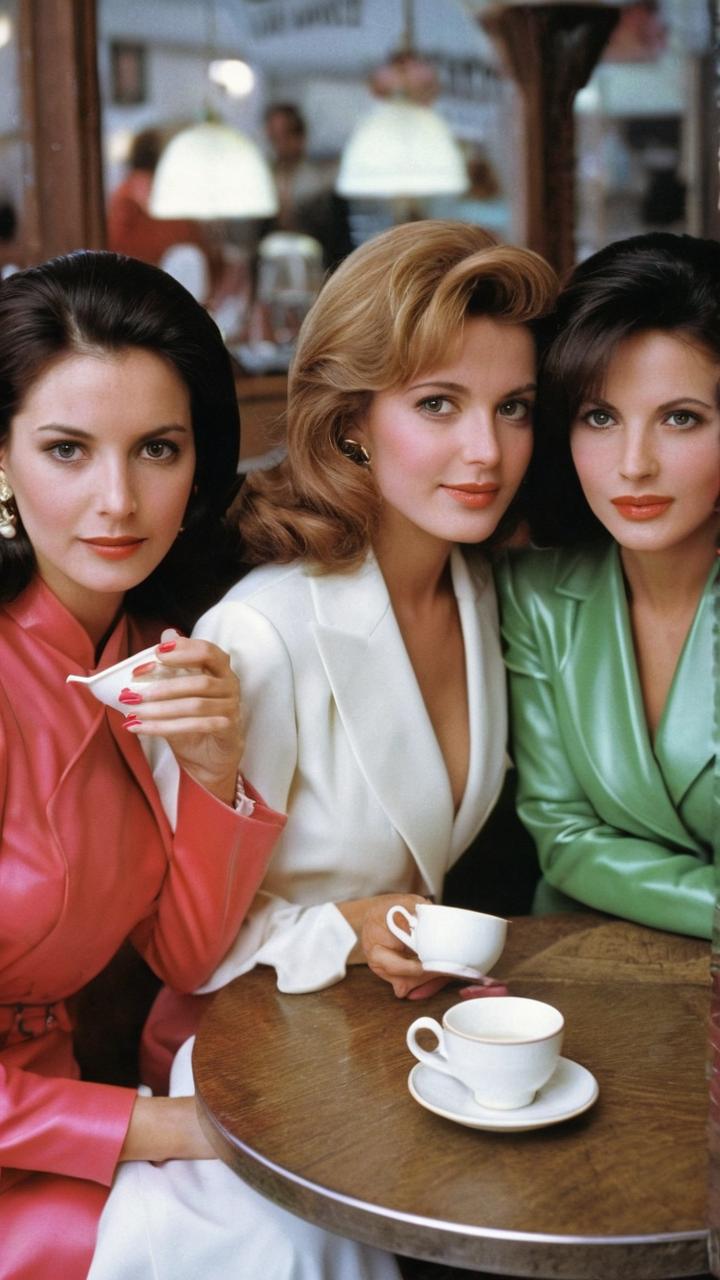
When two estranged sisters meet across a café table, one draped in sorrow’s rough wool, the other luminous in silk—a covenant of transformation begins that will forever alter what they believe they deserve.
Genevieve Ashworth-Lewis had not worn satin in twelve years.
She had convinced herself that roughness was honesty, that wool was humility, that the persistent itch of tweed against her skin was penance for a betrayal she could no longer name. But when her estranged sister Isolde summons her to the café of their girlhood dreams—resplendent in burgundy satin and commanding in glossy black leather—Genevieve is forced to confront an unbearable truth: she has been slowly disappearing inside fabrics that absorb light rather than reflect it.
What begins as a tentative reunion becomes something far more profound: an initiation into a circle of women who have each learned, under Isolde’s magnetic guidance, that devotion freely given is the highest form of freedom. In the atelier beneath the café, where silk whispers against skin and PVC gleams like liquid courage, Genevieve will shed the textures that have held her captive—and discover that being adored is not a privilege to be earned, but a birthright to be reclaimed.
Some fabrics hold sorrow. Others let it slide away. This is the story of women who chose to glisten.
CHAPTER ONE: “The Woolen Winter”
The Edinburgh wind had teeth.
It bit through the grey morning with the indiscriminate hunger of something that had forgotten what warmth tasted like, gnawing at the sandstone façades of the Georgian townhouses that lined Moray Place, rattling the bare-boned elms, and slipping its frozen fingers beneath every door that dared to stand between itself and the women who sheltered within.
Genevieve Ashworth-Lewis stood before a mirror that had not been kind to her in years.
The glass was seventeenth-century Venetian—one of the few treasures she had permitted herself to keep when she had dismantled the rest of the family’s Scottish estate into storage crates and dust sheets—and its surface had developed that particular cloudiness that antique mirrors acquire, as though the glass itself had grown weary of reflecting truths that no one wished to see. In its mottled depths, Genevieve studied the woman she had become: fifty-three years old, still handsome in the way that well-bred Englishwomen are handsome even when they have ceased to try, with cheekbones that could have cut crystal and grey eyes that had once been compared to winter seas but now more closely resembled winter pavements—flat, cold, and unyielding.
She was wearing wool.
She was always wearing wool.
This morning’s selection was a cardigan the colour of porridge, buttoned to the throat over a cotton blouse that had been washed so many times its original cream had faded to the approximate hue of surrender. Beneath it, a tweed skirt—Harris tweed, naturally, because if one was going to punish oneself with fabric, one might as well source the instrument of punishment from the most unforgiving looms in the British Isles—hung to mid-calf, its weave so coarse that it had left a perpetual rash on the inside of her thighs that she had come to regard not as an irritation but as evidence that she was still capable of feeling something.
“You look,” she told her reflection with the clipped precision of a woman who had been educated at Cheltenham and had never quite recovered from it, “like a woman who has given up.”
The reflection did not argue.
It merely stared back at her with those pavement-grey eyes and waited, as reflections do, for its owner to either shatter it or walk away.
Genevieve walked away.
She descended the staircase—uncarpeted now, because carpets were a luxury and she had decided twelve years ago that luxury was a lie told by people who wished to distract you from the fundamental roughness of existence—and entered the kitchen, where Mrs. Bramley was already engaged in the morning’s quiet warfare against dust, damp, and despair.
Mrs. Bramley was sixty-seven, stout, Scottish by birth and stubborn by temperament, and she had served the Ashworth family since Genevieve’s mother had first acquired the Edinburgh house as a “northern retreat” in 1979. She possessed the particular gift, common to the finest housekeepers, of expressing volcanic disapproval through the medium of perfectly measured domestic tasks. This morning, she was polishing the silver teapot with a ferocity that suggested the teapot had personally offended her.
“Good morning, Mrs. Bramley.”
“Is it,” Mrs. Bramley replied, without looking up.
Genevieve poured herself tea from the pot that had already been prepared—Mrs. Bramley’s single concession to hospitality each morning—and sat at the kitchen table. The chair was wooden and hard. She had removed the cushions years ago.
“There is post,” Mrs. Bramley said, nodding towards a small silver tray upon which a single envelope rested. The envelope was heavy, cream-coloured, and bore a wax seal the colour of arterial blood.
Genevieve’s hand stopped halfway to her teacup.
She knew that seal. She had watched it pressed into hot wax a thousand times by fingers more elegant than her own—fingers that moved with the unhurried precision of a woman who understood that urgency was the refuge of the unconfident, and that true authority expressed itself in the deliberate, the measured, the exquisitely unhurried.
“When did this arrive?” Genevieve’s voice had become very careful, the way voices become when their owners are attempting to contain something that does not wish to be contained.
“Yesterday evening. I placed it on the tray this morning.”
“You might have mentioned it last night.”
Mrs. Bramley’s polishing cloth paused. She looked up, and in her eyes was the particular blend of loyalty and exasperation that only a woman who has watched another woman dismantle herself for over a decade can achieve. “You were in bed by half past seven, madam. With your wool blanket and your wool socks and your cup of plain water, as though you were a medieval anchorite preparing for a particularly joyless Lent. I did not think you wished to be disturbed.”
“I didn’t.”
“And yet here we are. Disturbed.”
Genevieve reached for the envelope. The paper was extraordinary—thick, textured in the way that only paper manufactured in small French mills can be, with a faint watermark that caught the kitchen’s wan light like a secret. She broke the seal, and a scent rose from the folded letter within: jasmine, black tea, and something darker, richer—leather, perhaps, or the memory of leather, the olfactory ghost of a world she had deliberately abandoned.
She read.
The letter was brief, written in a hand so confident that each letter seemed to have been placed upon the page not with a pen but with a decree:
Genevieve,
It has been twelve years, four months, and six days. I have counted each one, not out of sentiment, but because precision matters—even in grief.
Come to Reims. Come to the café. Tuesday next.
There are things that must be said in person, and I find I have grown weary of saying them to your absence.
Wear whatever you like. I suspect it will be wool.
Isolde.
Genevieve set the letter down. Her fingers were trembling, and she pressed them flat against the wooden table to still them, as though the table’s roughness could anchor her to the life she had built—this deliberate, austere, woolen life that asked nothing of her except that she continue to endure it.
“Mrs. Bramley.”
“Madam.”
“My sister wishes to see me.”
The polishing cloth resumed its work, though with notably less aggression. “Does she now.”
“In Reims. Next Tuesday.”
“And will you go?”
The question hung in the kitchen like steam from the teapot—visible, temporary, and impossible to grasp. Genevieve stared at the letter, at the confident slant of Isolde’s handwriting, at the way the ink sat upon the paper with the assurance of a woman who had never once doubted her right to occupy space.
“I haven’t seen her in twelve years,” Genevieve said, and the sentence came out sounding less like a statement and more like a diagnosis.
Mrs. Bramley set down the teapot. She crossed the kitchen with the unhurried gait of a woman who had long ago decided that the world could wait for her rather than the other way round, and she stood before Genevieve with her hands clasped and her eyes bright with something that might have been tenderness, had Mrs. Bramley been the sort of woman who permitted tenderness to be identified by name.
“Madam,” she said, “may I tell you a story?”
“Must you?”
“I’m afraid I must. It concerns my grandmother, who was a fisherman’s wife on the Isle of Skye, and who possessed even less patience for nonsense than I do, which I assure you is a remarkable achievement.”
Genevieve sighed. “Go on, then.”
Mrs. Bramley pulled out a chair, sat down—an act so unprecedented that Genevieve nearly dropped her teacup—and folded her hands upon the table.
“My grandmother,” she began, “kept a shawl. It was made of the roughest wool you have ever touched—spun from the fleece of sheep that had spent their lives being punished by Atlantic gales—and she wore it every single day, in all weathers, for thirty-seven years. She wore it when she gutted fish. She wore it when she buried my grandfather. She wore it when she stood on the cliff and screamed at the sea for taking him. And when anyone asked her why she wore such a dreadful, scratchy, miserable thing, she would say, ‘Because it reminds me that the world is rough, and I must be rougher.'”
Mrs. Bramley paused, allowing the silence to acquire weight.
“And was she?” Genevieve asked quietly. “Rougher than the world?”
“She was magnificent,” Mrs. Bramley replied. “And she was utterly, catastrophically wrong. Because the world is not only rough, madam. The world is also silk. It is also the feeling of warm satin against skin that has been cold for too long. It is the sound of a sister’s voice after twelve years of silence. My grandmother wore that shawl until the day she died, and when we removed it from her shoulders, the skin beneath was raw—abraded—as though the wool had spent thirty-seven years slowly erasing her. She had let the roughness consume the very thing it was supposed to protect.”
Genevieve’s eyes burned. She blinked, fiercely, as though tears were intruders that could be repelled by force of will.
“What happened to the shawl?”
“I burned it,” Mrs. Bramley said, with the calm satisfaction of a woman who understood that some acts of destruction are acts of love. “And I replaced it with a silk scarf that I placed in her coffin. Because even in death, madam, a woman deserves to be touched by something gentle.”
The kitchen fell silent. Outside, the Edinburgh wind continued its assault, but within these walls, something had shifted—a hairline fracture in the architecture of Genevieve’s carefully constructed austerity.
“I cannot simply go to Reims,” Genevieve said, but the sentence had lost its conviction, like a wall that has sustained one too many blows and now stands only out of habit.
“You can,” Mrs. Bramley corrected. “The question is whether you will.”
“She’ll judge me.”
“Undoubtedly.”
“She’ll be wearing something impossibly beautiful and I shall feel like a—”
“Like a woman who has dressed herself in her own grief for twelve years and mistaken it for dignity? Yes. You shall feel precisely like that. And perhaps feeling it, in her presence, will be the very thing that frees you from it.”
Genevieve looked down at her cardigan, at the porridge-coloured wool that had been her daily uniform, her armour, her shroud. She touched a button—plastic, utilitarian, chosen specifically because it brought no pleasure—and thought of Isolde’s hands, which had always reached for the lustrous, the polished, the gleaming. Even as girls, Isolde had gravitated towards the glossy: the satin ribbons in their mother’s sewing box, the polished leather of their father’s riding boots, the silk lining of coats that whispered against skin like a secret only the wearer could hear.
“She wrote that I should wear whatever I like,” Genevieve murmured. “And then she predicted it would be wool.”
“Your sister,” Mrs. Bramley observed, “has always had an uncommon talent for seeing exactly what is, whilst simultaneously insisting upon what could be. It is, if I may say so, the mark of a woman who understands that authority is not the imposition of one’s will upon others, but the refusal to allow those one loves to settle for less than they deserve.”
Genevieve looked up sharply. “You sound as though you admire her.”
“I do.”
“She left. She took the Reims estate, the vineyards, the label—”
“She took what she was given, madam. And she built an empire with it. Whilst you took what you were given—this house, this city, this—” Mrs. Bramley gestured broadly at the kitchen, encompassing in a single sweep the bare walls, the hard chairs, the absence of cushions, flowers, colour, joy, “—this monument to self-denial—and you have done precisely nothing with it except grow thinner and sadder and more convinced that discomfort is the same thing as virtue.”
The words landed like stones in still water, and the ripples spread through Genevieve’s body—chest, throat, eyes—until she could no longer hold them back. A single tear escaped, tracing a path down her cheek before falling onto the collar of her cardigan, where it was immediately absorbed by the wool, swallowed whole, as though the fabric had been waiting for it.
“There, you see?” Mrs. Bramley said softly, watching the tear vanish into the rough fibres. “That is what wool does. It takes your sadness and holds it against your skin so you can never quite forget it. A satin collar, madam—a silk blouse—would have let that tear slide away like rain from a rose petal. But wool?” She shook her head. “Wool keeps things. And not the things worth keeping.”
Genevieve wiped her eyes with the back of her hand—not with a handkerchief, because she had stopped carrying handkerchiefs years ago, on the grounds that carrying a handkerchief implied one expected to cry, and expecting to cry implied one still had feelings worth protecting, and she had decided, somewhere around the third year of her exile, that feelings were as much a luxury as satin sheets.
“Even if I wanted to go,” she said, her voice rough, “I have nothing to wear.”
“You have an entire wardrobe.”
“I have an entire wardrobe of wool.”
“Then perhaps,” Mrs. Bramley said, rising from her chair with the quiet decisiveness of a general who has won a battle without raising her voice, “it is time to acknowledge that your wardrobe, like your life, has been curated for grief rather than living.” She reached into the pocket of her apron and produced something that made Genevieve’s breath catch: a handkerchief, folded into a perfect square, made of silk so fine it seemed to have been woven from liquid moonlight.
“Where did you get that?” Genevieve whispered.
“Your mother gave it to me. The year before she died. She said, ‘Bramley, keep this for Genevieve. She will need it one day, when she has cried enough tears into wool and is ready to let them fall on something that will not hold them against her.’ I have kept it in my apron pocket for thirteen years, madam. Waiting.”
She placed the handkerchief on the table before Genevieve.
The silk caught the kitchen light—that pallid, rain-washed Edinburgh light that usually made everything look defeated—and transformed it into something luminous, something almost alive. The fabric seemed to breathe, to pulse with a warmth that had no logical source, and Genevieve found herself reaching for it with the tentative hunger of a woman who has denied herself beauty for so long that the mere proximity of it feels dangerous.
Her fingertips met silk.
And the sensation—oh, the sensation. After twelve years of nothing but wool and cotton and tweed and the deliberate, penitential coarseness of fabrics chosen not for pleasure but for punishment, the feeling of silk against her skin was so shockingly, overwhelmingly tender that it bypassed every defence she had built and struck directly at the soft, unarmoured centre of her heart.
She gasped. Actually gasped, as though the silk had spoken to her in a language she had forgotten she understood—a language of gentleness, of permission, of the radical, terrifying idea that she was allowed to be touched by something beautiful.
“Oh,” she said, and the syllable contained twelve years of exile.
Mrs. Bramley watched, her expression composed but her eyes suspiciously bright. “Your mother always said that silk was the only honest fabric. ‘Wool pretends to protect you,’ she used to say. ‘Cotton pretends to be humble. Velvet pretends to be luxurious whilst secretly weighing you down with its own heaviness. But silk? Silk tells you the truth: that you deserve to feel extraordinary, and that anything less is a lie you are telling yourself.'”
Genevieve pressed the handkerchief to her cheek. The silk was cool, impossibly smooth, and as her tears fell upon it, they did not soak in—they beaded, trembled, and rolled away, leaving the fabric immaculate, as though it refused to absorb suffering, as though it had been designed by some benevolent intelligence to demonstrate that sorrow need not be permanent, need not be worn, need not be kept.
“I’ll go,” Genevieve said.
The words surprised her. They had emerged not from the careful, controlled part of her brain that had managed her exile with such meticulous joylessness, but from somewhere deeper—somewhere that the silk had reached and reawakened, like a hand plunged into dark water to retrieve something precious from the bottom.
“I’ll go to Reims. I’ll see Isolde. I’ll—” She faltered. “I don’t know what I’ll say to her.”
“You needn’t say anything, madam. Your sister is not the sort of woman who requires words to understand what is happening in a room. She reads silences the way other women read novels—with attention, with patience, and with an instinct for what the author is truly trying to say beneath the surface of the text.”
Genevieve almost smiled. It was a rusty expression, unpractised, like a door that has not been opened in so long that its hinges have forgotten which direction to swing. “You really do admire her.”
“I admire any woman who has learned that strength is not the ability to endure suffering, but the courage to refuse it,” Mrs. Bramley said simply. “Your sister refused it. She chose satin over sackcloth, leadership over lament, and the company of women who wished to shine over the solitude of women who had decided to fade. That, madam, is not vanity. That is wisdom.”
She placed her hand—briefly, firmly—upon Genevieve’s shoulder, and the warmth of the contact through the wool was both a comfort and an accusation: a reminder that human touch, like silk, was something Genevieve had denied herself for far too long.
“Pack lightly,” Mrs. Bramley advised, moving towards the door. “You shan’t be needing most of what you own.”
“And what shall I need?”
Mrs. Bramley paused in the doorway and looked back, and for the first time in all the years Genevieve had known her, something that was unmistakably, unguardedly tender crossed her weathered face.
“Courage, madam. And that handkerchief. The rest, I suspect, your sister will provide.”
She departed, leaving Genevieve alone in the kitchen with the letter, the silk, and the first fragile, terrifying stirring of something she had spent twelve years trying to kill.
Hope.
It felt, she thought, like putting on a garment she had forgotten she owned—something that had been folded away in the dark for so long that she had convinced herself it no longer existed. But here it was: shimmering, iridescent, impossibly delicate.
Like silk.
Like the promise of a sister’s voice after twelve years of silence.
Like the idea—radical, devastating, magnificent—that she might still be worthy of being seen.
She folded the handkerchief carefully, pressing it to her lips once before tucking it into the breast pocket of her woollen cardigan—the only glossy thing in a landscape of grey—and went upstairs to pack.
The Edinburgh wind still howled. But Genevieve Ashworth-Lewis, for the first time in twelve years, was not listening.
She was thinking about Reims. About satin. About the terrifying, exhilarating possibility that the roughness she had mistaken for her own skin was merely a garment—and that beneath it, something luminous had been waiting, all along, to be uncovered.
CHAPTER TWO: “The Café of Echoes”
The train from Edinburgh to London took four hours and twenty-seven minutes, during which Genevieve sat in a standard-class seat—she had, years ago, stopped permitting herself first class on the grounds that comfort was a gateway to complacency—and stared out of the window at a landscape that seemed to have been designed by a colourist who had lost the will to live. Grey fields. Grey sky. Grey towns that appeared and vanished like half-remembered regrets, each one indistinguishable from the last, each one wearing the same expression of weary English resignation that Genevieve saw in her own mirror every morning.
She had packed a single bag.
It contained three wool jumpers, two tweed skirts, a pair of cotton pyjamas so aggressively plain they might have been issued by a Victorian workhouse, and—buried at the very bottom, wrapped in tissue paper as though it were contraband—the silk handkerchief.
She had touched it four times since leaving Edinburgh. Each time, she had slipped her hand into the bag with the furtive urgency of an addict, her fingertips seeking the cool, liquid smoothness of the fabric the way a woman dying of thirst seeks water. And each time the silk met her skin, that same extraordinary sensation flooded through her—a warmth that began in her fingertips and radiated upward through her wrist, her arm, her shoulder, settling somewhere behind her sternum like a small sun that had been reignited after a decade of darkness.
She did not understand how fabric could do this.
She suspected she was not meant to understand—that understanding would require her to acknowledge something she had spent twelve years constructing elaborate fortifications against: the possibility that she had been wrong. Wrong about wool. Wrong about austerity. Wrong about the fundamental premise upon which she had built her entire post-Isolde existence—that denying herself pleasure was the same thing as possessing dignity.
At St. Pancras, she boarded the Eurostar.
The tunnel swallowed her, and for twenty-three minutes she sat in a darkness that felt less like a tunnel beneath the sea and more like the interior of her own chest—lightless, pressurised, and humming with the vibration of something enormous moving through a space that was not quite large enough to contain it.
And then: France.
The light changed. It was immediate, almost violent—as though someone had ripped a grey curtain aside to reveal a world that had been waiting, patiently and without apology, to be seen. The fields were gold. The sky was the blue of expensive porcelain. Even the towns looked different—softer, warmer, arranged with that particular French insistence upon beauty as a civic right rather than a personal indulgence.
Genevieve felt her chest tighten.
She had forgotten this. She had forgotten that there were places in the world where beauty was not an aberration but a baseline, where the light itself seemed to have opinions about aesthetics, where even the railway stations were designed by people who believed that the space through which a woman moves should be worthy of her.
The TGV carried her to Reims in fifty-three minutes—fifty-three minutes during which the landscape grew progressively more familiar, each vineyard and chalk hill and stone wall unlocking a memory she had believed safely interred. There was the ridge where she and Isolde had raced ponies at fifteen, their silk riding scarves streaming behind them like banners of a nation that consisted entirely of two girls who believed themselves invincible. There was the village where they had bought their first bottle of champagne at seventeen, bribing the shopkeeper with smiles that had not yet learned to be anything other than genuine. And there—
There was the spire.
The Cathédrale Notre-Dame de Reims rose above the city like a declaration of faith in the possibility that stone could aspire to the condition of lace, its Gothic towers catching the afternoon light with a luminosity that seemed almost textile—as though the cathedral itself had been draped in something finer than architecture, something closer to silk.
Genevieve pressed her palm against the train window. The glass was cool, smooth, and for a disorienting moment she could not tell whether the trembling she felt originated from the train or from her own body.
“Madam, we are arriving. May I take your bag?”
The attendant was young, French, and dressed in a uniform that managed to be both professional and undeniably chic—a fitted black jacket with a satin lining that flashed briefly as she reached for the overhead compartment, a whisper of glossy fabric that Genevieve’s eyes followed involuntarily, hungrily, the way eyes follow a flame in a dark room.
“Thank you,” Genevieve said. “No. I’ll manage.”
She managed. She stepped onto the platform at Gare de Reims with her single bag and her wool cardigan and her sensible shoes that made a sensible sound on the sensible concrete, and she stood there for a moment, breathing French air that tasted of chalk and grapes and the ghost of a childhood she had tried very hard to forget.
A car was waiting.
She had not arranged a car. She had planned to take a taxi—because taxis were practical and impersonal and did not imply that anyone had been thinking about your arrival with sufficient care to ensure that the journey from station to destination was wrapped in consideration. But there it was: a black Mercedes with tinted windows and a driver who stood beside the open rear door in a uniform so precisely fitted it looked as though it had been tailored to his body rather than purchased from a catalogue.
“Madame Ashworth-Lewis?” he enquired, with the particular French inflection that transforms even a surname into something that sounds like an invitation to dinner.
“I didn’t—”
“Your sister arranged it, madame. She asked me to convey her apologies for not meeting you herself. She is at the café, preparing.”
“Preparing what?”
The driver smiled—a small, diplomatic smile that suggested he had been trained in the art of knowing everything whilst revealing nothing. “The café, madame. She is preparing the café.”
He gestured towards the interior of the car, and Genevieve, who had not sat on leather upholstery in twelve years, hesitated. The seat was black, polished to such a high gloss that it reflected the afternoon light like still water, and the scent that rose from it—rich, warm, unmistakably luxurious—triggered a response so immediate and so physical that she had to grip the door frame to steady herself.
Leather. Real leather. Not the cracked, dried, punished leather of old belts and abandoned handbags, but living leather—cared for, nourished, polished with the same devotion that one might lavish upon skin. It smelled of attention. It smelled of someone who understood that the surfaces a woman touches shape the woman she becomes.
She sat down.
The leather received her body with a yielding warmth that was so startlingly different from the hard wooden chairs and rough upholstery of her Edinburgh existence that she actually closed her eyes—not to shut out the sensation, but to shut out everything else so that the sensation could have her full, undivided, trembling attention.
“Oh,” she breathed, and the sound was identical to the one she had made in the kitchen when her fingers first met silk—that small, devastated syllable that contained not just surprise but recognition, the sound a body makes when it encounters a pleasure it had been told no longer existed.
The driver, with impeccable discretion, said nothing. He closed the door, walked around to the front, and guided the car into the streets of Reims with the smooth, unhurried confidence of a man who understood that the woman in his back seat was undergoing a private revolution and required no commentary.
Genevieve kept her eyes closed for the first three minutes of the journey, her palms pressed flat against the leather seat, absorbing its warmth, its smoothness, its absolute refusal to scratch, to irritate, to punish. Her wool cardigan suddenly felt obscene against her arms—an insult to the skin it claimed to cover—and she had the wild, disorienting urge to tear it off, to sit in this leather cathedral in nothing but her cotton blouse and let the seat teach her body what it meant to be held by something that did not hurt.
She did not tear it off. She was, after all, still Genevieve Ashworth-Lewis, and Ashworth-Lewis women did not disrobe in the back seats of Mercedes, regardless of the quality of the upholstery.
But she unbuttoned the top button.
Just one. Just enough to let a sliver of air reach the skin above her collarbone—skin that had not been exposed to anything softer than wool in over a decade—and the sensation of that air, cool and champagne-scented, against her bare throat was so acutely pleasurable that her eyes prickled with tears for the second time that day.
“How far is the café?” she asked, her voice carefully controlled.
“Seven minutes, madame. It is on the Rue de l’Université. Your sister has owned it for nine years.”
“Nine years.” Genevieve repeated the number as though testing its weight. Nine years. Isolde had owned their childhood café for nine years, and Genevieve had not known. Nine years of espresso and chandeliers and conversations she had not been part of. Nine years of laughter she had not heard, of glasses raised in toasts she had not witnessed, of a life that had continued—flourished, expanded, glossed itself into magnificence—without her.
The grief that rose in her throat was not the familiar, woolly grief she had cultivated in Edinburgh—that muffled, heavy thing that sat on her chest like a grey cat and refused to move. This was sharper, sleeker, more dangerous—a satin ribbon of loss that slid through her internal landscape with a speed and precision that left cuts so clean she did not feel them until the blood appeared.
“Here we are, madame.”
The car stopped.
Genevieve opened her eyes and looked through the tinted window at the building that contained her sister, her past, and—though she did not yet know it—the first glimmering threads of her future.
Café Ashworth occupied the ground floor of a limestone building that looked as though it had been standing on the Rue de l’Université since before the concept of the university had been invented. Its façade was the colour of clotted cream, its windows tall and arched and flanked by iron balconies that had been painted a glossy black so deep it appeared almost liquid. Above the door, the name was lettered in gold leaf that caught the dying afternoon light and held it, possessively, the way certain women hold the attention of every room they enter—not by demanding it, but by simply being so luminous that looking away becomes an act of self-deprivation.
Genevieve studied the gold lettering for a long moment. Ashworth. Not Ashworth-Lewis. Not the hyphenated compromise of a family that had always tried to hold two identities in a single name. Just Ashworth. Simple. Direct. Authoritative.
Isolde’s doing.
Everything about this building was Isolde’s doing—from the glossy black paint to the gold leaf to the jasmine that cascaded from the first-floor balcony in a waterfall of white petals that perfumed the air with something so intoxicating that passing pedestrians slowed their steps, tilted their faces upward, and breathed in as though the café itself were exhaling.
Genevieve got out of the car.
The driver placed her bag on the pavement and dipped his head. “Madame Isolde asks that you enter through the main door. She will be in the private salon, through the second archway on your left.”
“Thank you.”
“Madame?” He paused, and something in his expression shifted—a softening, a flicker of human warmth beneath the professional veneer. “I have driven for your sister for six years. In that time, I have seen her welcome many women through those doors. Politicians. Artists. CEOs. Women of extraordinary accomplishment. But I have never—” He hesitated, choosing his words with the care of a man who understood their value. “I have never seen her prepare for a guest the way she has prepared for you. This morning, she arrived at the café at five o’clock. She changed the flowers three times. She replaced the tablecloth twice. She polished the cups herself—and your sister, madame, does not polish cups.”
He opened the car door and slid behind the wheel. “Whatever happened between you… she has not forgotten you. The café will tell you that, if you let it.”
He drove away, and Genevieve stood alone on the Rue de l’Université with her single bag and her wool cardigan and a heart that was beating so hard she could feel it in her teeth.
She pushed open the door.
The interior of Café Ashworth struck her senses with the force of an orchestral chord—not a single note, but a complex, layered, shimmering arrangement of sensations that arrived simultaneously and demanded to be experienced as a whole. The light was amber, filtered through silk shades that transformed the late-afternoon sun into something almost edible—a honeyed glow that lay across surfaces like warm butter. The walls were panelled in a wood so dark and so deeply polished that they functioned less as walls and more as mirrors, reflecting the room back to itself in depths that seemed to extend far beyond the physical boundaries of the space, as though the café were larger on the inside than the outside—a trick of light and gloss that Genevieve recognised, with a pang that was almost physical, as quintessentially Isolde.
The floor was marble—white, veined with grey and gold, polished to such a high sheen that Genevieve could see her own reflection in it: a woolly, diminished figure standing in a room that was made entirely of gleam. Crystal chandeliers hung from a ceiling painted in the style of Fragonard—cherubs, clouds, and women in various states of luminous undress—and their light fractured through cut glass and scattered across every surface in tiny, restless rainbows that moved when you moved, followed you like a benevolent surveillance, ensuring that no matter where you stood, you were touched by colour.
And the textures.
Oh, the textures.
Every seat in the café was upholstered in something that made Genevieve’s wool-trained eyes ache with a hunger she had not known she possessed. Banquettes in burgundy leather so glossy they appeared wet. Chairs draped in silk throws the colour of champagne. Cushions in deep emerald satin that caught the chandelier light and held it in their folds like captive stars. Even the curtains—heavy, floor-length, drawn back with braided silk cords—were made of a fabric so lustrous it seemed to have been poured rather than woven, a cascade of liquid black that framed each window like a declaration: what lies beyond this glass is the ordinary world; what lies within is something else entirely.
Genevieve stood in the doorway and felt her cardigan weigh approximately seven thousand pounds.
She was aware—acutely, mortifyingly aware—that she was the only rough surface in this room. Every other texture was smooth, polished, glossy, cared for. She was a splinter in a jewel box. A patch of static in a symphony. A woman dressed in her own grief, standing in a room that had been designed, with absolute intention, to demonstrate what was possible when grief was refused.
“You are staring,” said a voice from behind the zinc counter, “with the expression of a woman who has just remembered that beauty exists. It is, if I may say so, an expression I see more often than one might suppose—and it never fails to move me.”
The woman who emerged from behind the counter was small, ancient, and magnificent.
She was, Genevieve estimated, somewhere between eighty and immortal—a face so deeply lined that each wrinkle appeared to have been carved by a specific experience, a cartography of years that would have required several lifetimes to accumulate. Her hair was white, cropped close to her skull in a style that on a younger woman might have looked severe but on her looked inevitable—as though any longer length would have been an unnecessary concession to convention, and this woman had stopped making concessions to convention roughly around the time that de Gaulle was still in short trousers. Her eyes were black, bright, and possessed of a quality that Genevieve could only describe as informed—they looked at you, and you understood immediately that they had looked at thousands of women before you, and had found most of them wanting, and were currently reserving judgement on your particular case.
She was wearing a jacket of the most extraordinary black leather Genevieve had ever seen.
It was not the biker leather of youth or the stiff corporate leather of boardrooms. This was leather that had been worked and reworked until it had achieved a softness, a fluidity, that made it behave more like fabric than hide—draping over the old woman’s narrow shoulders with the easy elegance of water flowing over stone. It was polished to a sheen that bordered on the celestial, catching every ambient light source in the room and wearing them all simultaneously, so that as she moved, she appeared to be clothed not in leather but in captured light.
“Madame Colette?” Genevieve guessed.
“For seventy years, give or take a war.” The old woman extended a hand—small, jewelled with age spots, but possessing a grip that could have crushed walnuts. “And you are Genevieve. The one who left.”
“I didn’t leave. I—”
“You retreated. You withdrew. You absented yourself. You performed a prolonged and meticulously choreographed disappearing act over the course of twelve years, during which you replaced every glossy surface in your life with a rough one, every satin with a sackcloth, every pleasure with a penance, until you had effectively erased yourself from the landscape of your own existence.” Madame Colette released her hand and smiled—a smile that was simultaneously warm and surgical. “Did I leave anything out?”
Genevieve opened her mouth. Closed it. Opened it again. “You make it sound very deliberate,” she managed.
“Was it not?”
The question was not unkind, but it was absolute—a question that did not permit evasion, deflection, or the kind of woolly euphemisms behind which Genevieve had hidden for over a decade. It demanded a clear answer, and it demanded it in a room full of satin and leather and light, where clarity was not optional but architectural.
“Perhaps,” Genevieve whispered.
“Perhaps,” Madame Colette repeated, rolling the word around her mouth as though tasting it. “Perhaps. That is the word of a woman who is not yet ready to say yes but can no longer bring herself to say no. It is a threshold word, perhaps. A word that stands in the doorway between the life you have and the life you might have, and refuses to commit to either. I have heard it spoken in this café ten thousand times, and it always—always—precedes a transformation.” She paused, studying Genevieve with those black, informed eyes. “The question is whether the transformation will be chosen or merely survived.”
She gestured towards the second archway on the left—the one the driver had mentioned—and Genevieve saw that it was flanked by curtains of the same liquid black fabric as the windows, but these curtains were lined with something that caught the amber light and returned it tenfold: satin, the colour of old gold, so luminous that the archway seemed to glow from within, as though whatever lay beyond it existed in a different quality of light than the rest of the world.
“Your sister is through there,” Madame Colette said. “She has been waiting since five o’clock this morning. She has changed the flowers three times, replaced the tablecloth twice, and polished the cups herself. And your sister, ma chère, does not polish cups.”
“So I’ve been told.”
“Then you have been told what you need to know. She has prepared this room for you the way a woman prepares a cathedral for a ceremony she has been rehearsing in her mind for twelve years—with reverence, with terror, and with the absolute conviction that what is about to happen is sacred.” Madame Colette placed a hand on Genevieve’s arm—a touch so light it barely displaced the wool—and lowered her voice. “When you walk through that archway, you will see your sister as she is now. Not as you remember her. Not as you have imagined her during twelve years of silence. As she is. And what she is, Genevieve, is extraordinary. She is the most commanding woman I have ever known—and I have known women who commanded armies, parliaments, and the hearts of everyone who came within range of their voices. Your sister commands a room the way a conductor commands an orchestra: not by shouting, not by force, but by the absolute, unshakeable certainty that every instrument in her presence will perform at its highest capacity, because she has made them believe they are capable of nothing less.”
Genevieve’s hands were shaking. She pressed them against her tweed skirt, feeling the rough fibres bite into her palms—that familiar, punishing texture that had been her anchor, her penance, her prison.
“I’m afraid,” she said, and the admission cost her more than she had expected—a ripping sensation, as though the words had been sewn into her wool and tearing them free had torn the fabric itself.
Madame Colette nodded. “Of course you are. You are about to walk into a room dressed in your grief, and your sister will be dressed in her glory, and the contrast will tell you everything you have spent twelve years trying not to know. That is terrifying, ma chère. But let me tell you something about fear.”
She leaned closer, and the scent of her leather jacket reached Genevieve’s nostrils—warm, rich, alive—and mixed with a perfume that was old-fashioned and unapologetic, the kind of scent that announced itself upon entering a room and did not apologise for staying.
“Fear,” Madame Colette said, “is wool. It wraps itself around you and tells you it is protecting you from the cold, but what it is actually doing is preventing you from feeling the warmth. It absorbs your tears and holds them against your skin so you never forget that you have cried. It itches, it scratches, it leaves marks—and yet you wear it, day after day, because removing it would mean standing exposed before the world in nothing but your own skin, and your own skin, you have decided, is not enough.”
She straightened, and her leather jacket creaked softly—a sound that was not the complaint of a stiff material but the contented settling of a second skin, a texture so perfectly married to its wearer that it moved as she moved, breathed as she breathed, gleamed as she gleamed.
“But courage,” she continued, “courage is leather. It is satin. It is silk and gloss and the shine of a woman who has decided that she will not merely endure the world but dazzle it. Courage does not absorb your tears—it lets them fall and then it catches the light. Do you understand?”
Genevieve nodded, though she was not entirely certain she did. She understood the words, certainly—she was an Ashworth, educated at Cheltenham and Cambridge, fluent in four languages and capable of parsing the most Byzantine legal documents with the intellectual elegance of a woman who had been bred for complexity. But understanding Madame Colette’s words with her mind was not the same as understanding them with her body, and it was her body that was trembling, her body that was wrapped in wool, her body that had forgotten what it felt like to be touched by something that did not punish.
“Go,” Madame Colette said gently. “Go through the archway. Let her see you as you are. And let yourself see her as she has become. The rest—” she smiled, and the smile was as polished as her leather, as luminous as the satin lining of the curtains, as ancient and as knowing as the café itself, “—the rest will take care of itself. It always does, in this room.”
Genevieve walked towards the archway.
Each step was a negotiation between the woman she had been and the woman she was terrified of becoming—each footfall on the marble floor producing a sound that was too precise, too clear, too honest for a woman accustomed to the muffled, carpetless shuffle of her Edinburgh existence. Her sensible shoes clicked. The chandeliers watched. The satin curtains glowed.
She reached the archway and paused.
Through the golden-lined gap in the curtains, she could see a room that was smaller than the main café but infinitely more intimate—a private salon lit by candles rather than chandeliers, their flames reflected in surfaces so numerous and so polished that the room appeared to contain not dozens of candles but hundreds, a constellation of small fires that turned every wall, every table, every glass into a mirror of warmth.
And at the centre of this constellation, seated at a round table covered in white linen so fine it seemed to float above the surface rather than rest upon it, was Isolde.
Twelve years.
Twelve years, four months, and six days—Isolde had counted them, she said, because precision matters even in grief—and in those twelve years, Isolde Ashworth-Lewis had not faded. She had not diminished. She had not performed the slow, grey, woollen disappearing act that Genevieve had perfected in Edinburgh. She had done the opposite. She had intensified.
She was fifty-three—Genevieve’s twin, identical in bone structure and chromosomal destiny, separated by seventeen minutes and a lifetime of divergent choices—and she looked like a woman who had spent those twelve years not merely living but curating herself, refining each element of her appearance with the same meticulous attention she brought to champagne: the grapes selected, the blend perfected, the result bottled in something so beautiful you wanted to hold it up to the light and simply look.
Her hair was the same dark auburn it had always been—or rather, it was a more deliberate version of the same dark auburn, maintained and deepened and burnished until it gleamed like polished mahogany, swept back from her face in a style that required exactly the kind of confidence that most women aspired to but few achieved: the confidence to show the entire face, to hide nothing, to present oneself to the world without the softening camouflage of fringe or curl and say, simply, this is what I am, and it is enough.
Her skin was luminous—not with youth, which is merely biological, but with care, which is a choice. Fine lines traced the corners of her eyes and the edges of her mouth, and rather than diminishing her beauty, they deepened it, the way cracks in a Renaissance painting deepen its value—evidence not of damage but of endurance, of a surface that has weathered time and emerged more precious for the experience.
And she was wearing satin.
A gown—no, not a gown; a declaration—of deep burgundy satin that began at her collarbones and descended to the floor in a single unbroken cascade of fabric so fluid, so impossibly lustrous, that it appeared to be in constant, subtle motion, responding to light and air and the minute shifts of her body the way water responds to wind. It was not merely clothing. It was architecture. It was a structure built from the premise that a woman’s body is not something to be concealed or apologised for but something to be housed—given a dwelling worthy of its magnificence, a surface that honours the skin beneath it by being, itself, magnificent.
Over the gown, she wore a jacket.
Genevieve’s breath stopped.
The jacket was leather—black, glossy, fitted to Isolde’s shoulders and waist with such precision that it appeared to have been not tailored but grown, a second skin that moved with her body in perfect synchrony. It caught every candle flame in the room and wore them simultaneously—a garment made of captured fire, of liquid night, of the kind of authority that does not announce itself because it does not need to. It simply is, and everything around it arranges itself accordingly.
Her hands were gloved. Black leather. So polished that her fingers, resting on the white linen tablecloth, looked as though they had been dipped in obsidian—dark, reflective, and possessed of a stillness that was not passive but coiled, the stillness of a woman who has learned that the most powerful gesture is often the gesture withheld.
Isolde looked up.
Their eyes met across twelve years of silence, and the impact was so immediate, so total, that Genevieve felt it not as an emotional event but as a physical one—a collision, a detonation, a seismic rearrangement of the tectonic plates upon which she had built her careful, joyless, woollen life.
Isolde’s grey eyes—identical to Genevieve’s in colour but utterly alien in expression, because where Genevieve’s eyes had become pavements, Isolde’s had become seas: deep, moving, alive with currents and undertows and the kind of vast, terrifying beauty that makes you understand why sailors used to drown voluntarily—held her gaze and did not release it.
“Genevieve,” Isolde said.
Just the name. No greeting, no exclamation, no performative surprise. Just the name, spoken with the quiet authority of a woman who has been saying it in her mind for twelve years and has finally, finally been given permission to say it aloud.
“Isolde.” Genevieve’s voice came out rougher than she intended—scraped raw by the effort of not crying, not running, not collapsing onto the marble floor and pressing her face against its polished surface just to feel something smooth against her skin.
“You came.”
“You asked.”
“I’ve asked before. Letters, every year on our birthday. You returned them unopened.”
Genevieve had no defence against this, because it was true. Eleven letters, eleven years, each one bearing the same blood-red wax seal, each one placed on the silver tray by Mrs. Bramley, each one returned to the post office the following morning with the words NOT ACCEPTED written in Genevieve’s careful hand on the envelope’s face. She had told herself this was strength. She understood now, standing in this room of candles and satin and the devastating, glossy reality of her sister, that it had been cowardice dressed in wool.
“I wasn’t ready,” she said.
“And you’re ready now?”
Genevieve looked down at herself—at the porridge cardigan, the Harris tweed, the sensible shoes—and then looked at Isolde, at the satin and the leather and the gloves and the absolute, unapologetic luminosity of a woman who had chosen to shine, and she felt the contrast not as a comparison but as a verdict.
“No,” she admitted. “I am not ready. I am standing in your café wearing the approximate aesthetic of a woman who has given up, and you are sitting there looking like something that was sculpted rather than born, and I have never in my life felt less ready for anything.”
Something moved in Isolde’s face—a flicker, a fracture in the composed surface of her expression, like a single crack appearing in a dam that has held for twelve years. It was there and gone in less than a second, but Genevieve saw it, because she knew this face. She knew it better than her own. She had spent the first forty-one years of her life studying it across breakfast tables, sharing mirrors with it, watching it sleep, and she knew that the flicker she had just witnessed was not amusement or satisfaction or pity.
It was love.
The raw, un-glossed, un-refined kind of love that exists beneath every polished surface—the foundation upon which all the satin and leather and authority had been built. Isolde, for all her luminous command, loved her sister with a ferocity that no amount of gloss could mask, and in that single flicker, Genevieve saw the entire twelve years as Isolde had lived them: not triumphantly, not easily, but with the same aching, furious devotion that had driven her to send eleven letters, change the flowers three times, replace the tablecloth twice, and polish the cups herself at five o’clock in the morning.
“Sit down,” Isolde said.
It was not a request. It was not an order. It was something more complex and more intimate than either—an instruction issued with such absolute certainty of its own rightness that obeying it felt not like submission but like relief, the way sinking into a warm bath feels like relief after hours of standing in cold rain.
Genevieve sat.
The chair received her with a whisper of leather—the seat was upholstered in the same glossy black as Isolde’s jacket—and the sensation of it against her tweed-clad thighs sent a shiver through her that she could not entirely attribute to temperature.
Isolde watched her sit with the attentiveness of a woman who misses nothing—who registers the shiver, catalogues the way Genevieve’s hands grip the armrests, notes the rapid blinking that indicates tears being forcibly restrained—and responds to all of it not with words but with a single, deliberate gesture: she poured coffee.
The silver pot caught the candlelight as it tilted, and the dark liquid that flowed from its spout was as glossy as the leather, as luminous as the satin, as precise and controlled as the woman who poured it. It filled the porcelain cup—white, rimmed in platinum, a vessel of such exquisite craftsmanship that drinking from it felt less like consuming a beverage and more like participating in a ceremony—and the scent that rose from its surface was so rich, so complex, so heartbreakingly good that Genevieve’s eyes filled before she could stop them.
“You always did cry at the smell of good coffee,” Isolde said, and for the first time, her voice contained something that was not authority or composure but a warmth so deep it seemed to have been drawn from the same source as the candlelight—steady, golden, and older than language.
“I haven’t had good coffee in twelve years,” Genevieve whispered.
“I know. You’ve been drinking instant, in a kitchen with no cushions, while wearing wool. Mrs. Bramley wrote to me.”
Genevieve’s head snapped up. “She what?”
“Every month. For twelve years. Detailed reports on your health, your mood, your wardrobe, and your alarming descent into voluntary austerity. She was quite thorough. Colette calls her ‘our woman in Edinburgh’ and is convinced she would have made an excellent spy.”
“She—Mrs. Bramley has been writing to you for twelve years?”
“She loves you, Genevieve. And she has watched you shrink yourself into a version so diminished that you barely cast a shadow. What was she supposed to do? Watch in silence while a woman she adores mistakes self-erasure for self-improvement?”
The words struck Genevieve with the precision of a surgeon’s blade—clean, targeted, devastating. She opened her mouth to protest, to defend herself, to deploy the carefully constructed arguments she had spent twelve years polishing—I chose simplicity, I chose authenticity, I chose a life free from the superficiality of—
“Don’t,” Isolde said quietly. “Don’t recite the speech. I know the speech. You wrote a version of it on every returned envelope, in increasingly desperate handwriting, as though writing ‘NOT ACCEPTED’ in larger letters each year would make the rejection more convincing. It didn’t.” She leaned forward, and the movement caused her satin gown to shift, the burgundy fabric catching a candle flame and briefly blazing with a light so warm it seemed to emanate from Isolde herself rather than from the flame. “Let me tell you what I see, Genevieve. I see a woman of extraordinary intelligence and devastating beauty who has spent twelve years wrapping herself in fabrics that diminish her, in a house that diminishes her, in a life that diminishes her—and who has convinced herself that diminishment is the same as dignity. I see my twin. My other half. The woman who shares my face, my blood, my history—standing before me in a cardigan the colour of defeat, and I want to—”
She stopped. Her gloved hands, resting on the tablecloth, pressed flat—a gesture so controlled, so deliberate, that Genevieve understood immediately that whatever Isolde had been about to say was something she had been carrying for twelve years, something with weight and heat and edges, something that required the full force of her legendary composure to contain.
“You want to what?” Genevieve asked.
Isolde looked at her, and in that look was the entirety of their shared history—forty-one years of twinship, of finishing each other’s sentences, of knowing, always knowing, what the other was thinking and feeling before a word was spoken. Isolde’s eyes were not merely looking at Genevieve; they were reading her, the way a scholar reads a beloved text that has been damaged by time—with grief for what has been lost, with reverence for what remains, and with the fierce, unshakeable conviction that restoration is possible.
“I want,” Isolde said carefully, each word placed upon the silence like a jewel upon velvet, “to take every rough, scratching, punishing garment you are wearing and burn it. I want to replace it with something so soft, so lustrous, so gentle against your skin that your body remembers what it feels like to be cherished rather than chastised. I want to sit across from you in this café every Tuesday for the rest of our lives and watch the colour return to your face. I want to introduce you to women who will adore you as fiercely as I do—women who have walked the same path from roughness to radiance and who understand, as I understand, that the fabric a woman wears is not decoration but declaration. A declaration of what she believes she deserves.”
She paused, and the candles flickered, and the satin breathed, and the leather gleamed, and in the silence between one sentence and the next, Genevieve felt something shift—a deep, structural shift, as though a wall inside her that had been load-bearing for twelve years had just been told that it no longer needed to stand.
“And what do I deserve?” Genevieve asked, and her voice broke on the word deserve, cracking it open like a geode to reveal the crystalline, glittering, desperately hidden question that had been growing inside it all along: Am I still worthy of beauty? Have I punished myself long enough? Can I come home?
Isolde heard all of it. Of course she did. She was Isolde—the woman who read silences the way other women read novels, the woman who had changed the flowers three times and polished the cups herself, the woman who had waited twelve years for this exact moment with the patience of someone who understood that the most profound transformations cannot be rushed, only invited.
She rose from her chair.
The satin whispered as she stood—a sound so intimate, so inherently sensual, that it seemed to belong not to the category of sounds made by fabric but to the category of sounds made by the world itself when something beautiful is in motion. She moved around the table with the unhurried grace of a woman who has never once doubted that the space around her exists for her to occupy, and she stood before Genevieve—close enough to touch, close enough for Genevieve to smell the perfume that rose from the warm leather, a scent of amber and midnight and the kind of confidence that is not performed but inhabited.
She extended her gloved hand.
The black leather caught every candle flame in the room, and for a moment—a moment that stretched and shimmered and refused to conform to the conventional passage of time—Genevieve saw not a hand but an invitation. An invitation to leave the grey. To leave the wool. To leave the twelve-year winter of her own making and step into a warmth that was not merely thermal but existential—the warmth of being held, being seen, being told by someone whose authority you trust absolutely: You deserve more than this. You have always deserved more than this. And I am here to show you how much more.
Genevieve reached up and took her sister’s hand.
The leather met her skin—her bare, wool-abraded, neglected skin—and the sensation was a revelation. Not cold, as she had expected. Warm. Warm and impossibly smooth, with a yielding firmness that felt less like a glove and more like a promise—the promise of surfaces that do not scratch, do not punish, do not absorb your tears and hold them against you, but instead offer the radical mercy of letting go.
“Oh,” Genevieve said, for the third time in two days, and the syllable was the same—that small, ruined sound that contained not just surprise but twelve years of deprivation—but this time it was followed by something new.
A sob.
It came from the same deep, structural place as the shifting wall—a sound that had been trapped beneath layers of wool and tweed and self-denial for so long that it had calcified into something she no longer recognised as grief but now understood had been grief all along, grief dressed in sensible shoes and porridge cardigans and the fiction that she was being humble when she was in fact being destroyed.
Isolde did not flinch. She did not murmur platitudes or pat Genevieve’s hand or perform any of the small, inadequate gestures that people make when confronted with another person’s unravelling. She simply held on. Her leather-gloved fingers closed around Genevieve’s bare hand with a grip that was firm without being forceful—the grip of a woman who understood that what her sister needed at this moment was not gentleness but certainty. The certainty that someone was holding her. The certainty that the hand in hers would not let go. The certainty that she was, at last, in the presence of a woman who was strong enough to witness her collapse without collapsing herself.
“I’m sorry,” Genevieve gasped, and the words were wet and ragged and utterly inadequate—an umbrella opened against a hurricane.
“Don’t apologise for weeping,” Isolde said, and her voice was the calmest thing in the room—calmer than the candle flames, calmer than the satin, calmer than the leather. “Apologise, if you must, for taking twelve years to do it. Apologise for the eleven letters you returned. Apologise for the wool.” Her gloved thumb traced a slow circle on the back of Genevieve’s hand—a gesture so small and so deliberate that it felt like a sentence being written on her skin, a message that bypassed language entirely and spoke directly to the starved, silk-hungry, touch-deprived body that Genevieve had spent twelve years imprisoning in rough fibres.
“But do not apologise for crying in my café. This café has witnessed more tears than the Marne, and every single one of them has fallen on surfaces that were designed to let them go.”
As if to prove her point, one of Genevieve’s tears detached itself from her jaw and landed on the glossy leather arm of the chair. It sat there for a moment—a perfect, trembling sphere of salt water, lit by candles, reflecting the room in miniature—and then it slid, slowly and gracefully, down the polished surface and vanished, leaving no trace. No stain. No darkened patch of absorbed sorrow. Just leather, gleaming and unburdened, as though the tear had never existed.
Genevieve stared at the place where the tear had been.
“Do you see?” Isolde murmured. “That is what the right surface does. It does not trap your sorrow. It acknowledges it and then it lets it pass. Wool would have held that tear against you for hours—a cold, damp reminder pressed to your skin, telling you over and over that you had wept. But leather?” She lifted Genevieve’s hand and pressed it, gently, against her own leather-clad sleeve. “Leather says: You wept. And now you are done. And you are still beautiful.”
The word—beautiful—landed in the space between them with the weight of a cathedral bell. Genevieve had not been called beautiful in twelve years. She had not permitted it. She had dressed to repel the word, to make it inapplicable, to ensure that anyone who looked at her saw not beauty but endurance, not radiance but resilience, not a woman to be admired but a woman to be pitied, or—worse—ignored.
But Isolde said it as though it were not a compliment but a fact. A fact as indisputable as gravity, as chemistry, as the molecular structure of champagne. You are beautiful. Not you were beautiful. Not you could be beautiful again. But you are. Now. In this moment. In this cardigan. In these tears. Beautiful.
“I don’t—” Genevieve began.
“You don’t believe me,” Isolde finished. “I know. You have spent twelve years constructing a philosophy in which beauty is vanity and vanity is weakness and weakness is the one thing an Ashworth woman must never, ever display. I know this because I watched you build it, letter by returned letter, year by silent year. And I am going to spend the rest of my life dismantling it, with your permission.”
She released Genevieve’s hand—not abruptly, but with the deliberate care of a woman setting down something fragile and precious—and returned to her seat. The satin settled around her like water finding its level, and the leather jacket creaked once, softly, as she leaned back in her chair with the composed authority of a woman who has just made a declaration and is prepared to wait as long as necessary for a response.
“My permission,” Genevieve repeated, tasting the word.
“Your permission. I am not in the business of rescuing women who do not wish to be rescued, Genevieve. That is the work of martyrs and fools, and I am neither. I am in the business of offering a door—a very specific, very beautiful, very glossy door—and waiting to see who walks through it. Some women walk through immediately. Some take years. Some stand on the threshold for so long that I begin to wonder if they have put down roots. But every woman—every single one—who has walked through that door has emerged on the other side wearing something that catches the light, and has never once asked to go back to the dark.”
She picked up her coffee cup, and the porcelain gleamed against her black leather gloves, and the image was so striking—the white and the black, the delicate and the strong, the ancient craft of ceramics held in the modern armour of leather—that Genevieve felt it imprint itself upon her mind with the permanence of a photograph.
“There are women in my life, Genevieve,” Isolde continued, sipping her coffee with the unhurried composure of a woman who understood that silence is not an absence but a texture—a space between words that has its own weight and shape and meaning. “Women who have come through that door. Women who arrived wearing their own versions of your cardigan—some in rough linen, some in itchy cotton, one, memorably, in a burlap sack she had been wearing as a coat for three years because she believed she did not deserve anything softer. I offered each of them the same thing I am offering you: not a rescue, not a makeover, not a transformation in the shallow, magazine sense of the word. Something deeper. Something that begins with the skin and works inward, until the surface and the soul are made of the same material.”
“And what material is that?”
Isolde set down her cup. The porcelain met the saucer with a sound so precise, so crystalline, that it seemed less like crockery and more like punctuation—a full stop at the end of a sentence that had been twelve years in the writing.
“The material,” she said, “of a woman who has decided that she will no longer apologise for being luminous.”
The candles burned. The satin breathed. The leather gleamed. And Genevieve Ashworth-Lewis, sitting in a café in Reims in a cardigan the colour of defeat, with coffee she had not tasted and tears she had not finished shedding and a silk handkerchief hidden in her breast pocket like a prayer she was not yet brave enough to speak aloud, looked at her sister—her twin, her mirror, her opposite, her origin—and said the only word that mattered.
“Yes.”
CHAPTER THREE: “The Unravelling”
The word hung in the air between them like the last note of a symphony—sustained, trembling, full of harmonics that would take hours, perhaps years, to fully resolve.
Yes.
Genevieve had said it, and the saying of it had cost her something she could not yet name—some structural element of the architecture she had spent twelve years building, some load-bearing beam of denial that had been holding up the ceiling of her careful, joyless existence. She could feel its absence the way one feels the absence of a tooth: a new space, tender and raw, where something solid had been, and the tongue of her consciousness kept returning to the gap, probing it, astonished by the sudden emptiness.
Isolde did not rush to fill the silence that followed.
This, Genevieve remembered—this patience—was one of Isolde’s most formidable qualities, and one that had always distinguished her from the merely confident. Confident women filled silences because they feared that silence implied uncertainty. Isolde inhabited silences the way she inhabited her satin gown—completely, luxuriously, with the absolute assurance that the silence belonged to her as much as the words that bookended it. She sat in her leather-backed chair with her gloved hands resting on the white linen and she waited, and the waiting was not passive but active, a kind of listening so intense it had weight, as though her attention itself were a physical substance being poured over Genevieve like warm oil.
A full minute passed.
The candles did not care. They continued their quiet work of turning the private salon into a reliquary of light, each flame performing its small, dedicated ministry of illumination upon surfaces that received it with varying degrees of enthusiasm. The marble floor accepted the light with cool indifference. The white linen tablecloth permitted it to rest but did not engage with it. The crystal glasses refracted it into prismatic fragments that danced across the walls like escaped thoughts.
But the satin—oh, the satin—the satin did not merely receive the light. It collaborated with it. Isolde’s burgundy gown caught each candle flame and deepened it, enriched it, returned it to the room with added warmth, so that the light that bounced off her body was measurably more beautiful than the light that had arrived. She was not merely in the room. She was part of the room’s luminous infrastructure, a source of radiance as essential as the candles themselves, and every surface near her—the tablecloth, the chair, the air itself—seemed brighter for her proximity, as though beauty were contagious and she were its most accomplished vector.
“You said yes,” Isolde observed finally, and her voice had changed—not in volume or pitch but in texture, the way a fabric changes when you turn it to catch the light from a different angle. There was a softness beneath the authority now, a thread of something vulnerable woven into the commanding weave, and Genevieve recognised it with a shock that was almost physical: her sister was afraid.
Not afraid of Genevieve. Not afraid of rejection, or confrontation, or any of the social fears that govern ordinary interactions between ordinary people. Isolde was afraid of hope. She was afraid that the yes was provisional, conditional, a word spoken in the heat of an emotional moment that would be retracted in the cool light of morning when Genevieve retreated back into her wool and her sensible shoes and the comforting, scratchy fiction that she did not need beauty, did not need touch, did not need her sister standing before her in satin and leather, offering a door made of light.
“I said yes,” Genevieve confirmed, and then, because she was an Ashworth and Ashworth women did not make promises lightly—it was, in fact, the only lesson from their mother that both sisters had retained without modification—she added: “And I mean it. Though I should warn you that I have no idea what I am saying yes to, and the last time I agreed to something without reading the terms and conditions, I ended up with a twelve-year lease on a house with no curtains and a kitchen chair that I’m reasonably certain was designed as an instrument of medieval torture.”
Isolde’s mouth twitched.
It was not quite a smile—Isolde did not deploy smiles casually; she rationed them with the precision of a woman who understood that scarcity increases value—but it was the precursor to a smile, the seismic tremor that precedes the earthquake, and Genevieve felt it in her chest like a victory.
“You are saying yes,” Isolde said, “to a conversation. Nothing more. A conversation that should have happened twelve years ago, but didn’t, because you ran and I let you, and neither of us has ever forgiven the other—or herself—for the respective sin.”
“I didn’t run. I withdrew.”
“You ran, Genevieve. You ran so fast and so far that you ended up in Scotland wearing wool, which is the sartorial equivalent of a woman barricading herself inside a fortress made of her own misery and pulling up the drawbridge. You did not withdraw. You fled. And you fled not from me, and not from Reims, and not from the champagne or the vineyards or the gold leaf on the café door. You fled from what Mother did.”
The word—Mother—entered the room like a change in atmospheric pressure.
Genevieve felt it in her sinuses, in the back of her eyes, in the tightening of the muscles across her shoulders that was her body’s habitual response to any mention of Vivienne Ashworth-Lewis, née de Clairvaux, a woman who had managed the extraordinary feat of being simultaneously adored and devastating, whose love had been as real and as dangerous as champagne itself: intoxicating in small doses, destructive in large ones, and always, always accompanied by bubbles that looked like joy but were, in fact, merely the visible evidence of fermentation—of something beautiful being broken down into something potent.
“We don’t need to discuss Mother,” Genevieve said, and the sentence had the automatic, mechanical quality of a phrase that has been repeated so many times it has worn smooth, like a pebble in a river—all its sharp edges eroded, all its capacity to wound or protect reduced to a dull, round nothingness.
“We absolutely need to discuss Mother,” Isolde replied, with the calm implacability of a surgeon who has been told by the patient that the tumour doesn’t need to be removed. “We need to discuss her because she is the reason you are wearing that cardigan and I am wearing this gown. She is the reason you are in Edinburgh and I am in Reims. She is the reason you spent twelve years returning my letters and I spent twelve years sending them. She is the architect of the distance between us, Genevieve, and if we do not dismantle her architecture, it will outlast us both—and I refuse to be outlasted by a dead woman’s interior design.”
Genevieve flinched. Not at the bluntness—she had always known Isolde to be blunt in the way that diamonds are blunt; they do not cut gently, but they cut with such precision that you are left marvelling at the craftsmanship rather than mourning the wound—but at the accuracy. Because Isolde was right. Of course she was right. She was always right, in the way that a compass is always right: not because it has an opinion about north, but because it is constitutionally incapable of pointing in any other direction.
“She divided us,” Genevieve said quietly.
“She allocated us,” Isolde corrected. “Like assets. Like bottles in a cellar—this vintage to the left, that vintage to the right, and never mind that the bottles were people, were sisters, were two halves of a single soul that had been living in two bodies for forty-one years and required precisely zero intervention to determine how best to continue doing so.”
“She was dying, Isolde.”
“She was dying, yes. And dying women are afforded many courtesies—patience, tenderness, the suspension of certain social expectations regarding personal hygiene and the appropriate volume at which one may shout at nurses. But dying women are not afforded the courtesy of destroying their daughters’ relationship with a will that reads less like a legal document and more like a declaration of war.”
Isolde’s voice had risen—not dramatically, not to the pitch of a shout, but by perhaps half a degree, a fractional increase in volume and intensity that on anyone else would have been imperceptible but on Isolde was the equivalent of a thunderclap, because Isolde never raised her voice. She modulated. She adjusted. She controlled her vocal instrument with the same exacting precision she applied to every other element of her self-presentation, and the fact that she had permitted even this minuscule escalation told Genevieve that the reservoir of feeling behind her sister’s glossy composure was deeper and more pressurised than anything the polished surface suggested.
“She gave you Reims,” Genevieve said, and the sentence tasted of twelve years of rehearsal—a line she had spoken to herself in the mirror, in the bath, in the small hours of Edinburgh mornings when the wind howled and the wool scratched and the silence of the house was so complete that her own thoughts sounded like someone else’s voice. “She gave you the vineyards, the label, the legacy. And she gave me Edinburgh. A house with no heating and a view of a park that rains sideways ten months of the year.”
“She gave me Reims,” Isolde agreed, “because she knew I would fight for it. And she gave you Edinburgh because she knew you would suffer in it. And that, Genevieve—that deliberate, calculated distribution of abundance to one daughter and austerity to the other—was not generosity. It was not fairness. It was not even cruelty, although it contained cruelty the way a champagne flute contains champagne: visibly, elegantly, in a vessel designed to make the contents look beautiful whilst obscuring their capacity to intoxicate.”
She paused, and in the pause she reached across the table—not for Genevieve’s hand, not this time, but for a crumb of invisible lint on the shoulder of Genevieve’s woollen cardigan. Her gloved fingers brushed the rough surface, and the contrast—the satin-smooth leather against the coarse, punishing weave of the wool—produced a sound so faint it was almost subliminal, a whisper of friction between two materials that existed in entirely different moral universes: one designed to protect and adorn, the other to obscure and diminish.
Genevieve felt the touch through every layer.
Through the wool. Through the cotton blouse beneath. Through the skin that had not been touched by anything glossy in twelve years and which now responded to the leather’s proximity with a hunger so acute it bordered on pain—the hunger of a body that has been kept on a starvation diet of roughness and is suddenly, without warning, offered the scent of something smooth.
“It was a test,” Isolde said, her gloved hand still resting on Genevieve’s shoulder, the weight of it light but absolute—a touch that did not press but anchored, the way a captain’s hand on the wheel anchors a ship not by force but by the unshakeable certainty of its direction. “Do you understand? Mother’s will was a test. She gave me abundance to see if I would become indulgent. And she gave you deprivation to see if you would become strong.”
“And did she get what she wanted?”
“She got exactly what she wanted. I became the woman who runs an empire—disciplined, glossy, relentlessly productive—because the abundance she gave me was not a gift but a challenge, a dare to prove that I could be trusted with beauty without being corrupted by it. And you—” Isolde’s fingers tightened, almost imperceptibly, on the wool, “—you became the woman who endures. The woman who survives. The woman who wears her own grief like a uniform and calls it humility because the alternative—admitting that you are suffering, admitting that the austerity is not a choice but a sentence—would require you to admit that Mother’s test broke you.”
“It didn’t break me.”
“Genevieve.” Isolde said her name the way one says a prayer—with absolute attention, with a reverence that did not preclude urgency, with the understanding that the name itself was sacred and that the woman who bore it was in danger of forgetting that fact. “You are sitting in my café wearing a cardigan that costs less than the coffee I just poured you. You have not worn silk in twelve years. You have not eaten a meal on porcelain since you left Reims. You have systematically, methodically, devotedly stripped your life of every surface, every texture, every sensation that might remind you of beauty—and you have done this not because you have transcended the need for beauty, but because you have convinced yourself that you do not deserve it. That is not strength. That is not humility. That is not the behaviour of a woman who passed her mother’s test. That is the behaviour of a woman who has been slowly, exquisitely, voluntarily unravelling for twelve years and has mistaken the unravelling for weaving.”
The analogy struck Genevieve with such force that she physically recoiled—a small, involuntary movement backward in her chair that the leather seat absorbed with the same quiet grace with which it had absorbed her tears: without protest, without stain, without holding the impact against her.
Because Isolde was right.
She was unravelling. She had been unravelling since the morning she read her mother’s will in the solicitor’s office in London—a room upholstered in burgundy velvet that had smelled of old paper and older grudges—and learned that Vivienne Ashworth-Lewis had performed her final act of love in the same style she had performed all her other acts of love: with impeccable taste, devastating precision, and a complete indifference to the collateral damage.
The will had been a masterpiece.
Not of legal draftsmanship—though it was that, too; Vivienne had employed the most expensive solicitors in London, and they had earned their fees by translating her wishes into language so airtight it would have held champagne at pressure—but of emotional engineering. Every clause had been calibrated. Every bequest had been weighted not merely with financial value but with symbolic value, each item and property and sum carrying a subtext that only her daughters would be able to read, a private language of objects and textures and locations that said what Vivienne herself had never been capable of saying aloud.
To Isolde: the Reims estate, the vineyards, the label, the café, the Paris apartment, the collection of glossy leather-bound first editions, the jewellery—all of it, the entire gleaming infrastructure of the Ashworth fortune, wrapped in satin and tied with a bow that was not a bow but a command: Take this. Make it shine. Prove that you are as luminous as I always believed you could be.
To Genevieve: the Edinburgh house, a modest trust fund, and a single item that had haunted her for twelve years—a velvet box, deep purple, containing a pearl necklace that had belonged to their grandmother.
A pearl necklace in a velvet box.
Genevieve had understood the message immediately. Pearls were formed by irritation—a grain of sand, an intrusion, a wound that the oyster could not expel and so chose, instead, to coat in layer after layer of nacre until the wound itself became the most beautiful thing the creature had ever produced. And velvet—velvet was the fabric of mourning, the fabric of funerals, the fabric that held grief against your skin and refused to let it go. Her mother had given her an object lesson wrapped in a metaphor wrapped in a fabric that hurt: You are the pearl, Genevieve. The wound is the making of you. Now sit in your velvet box and become luminous through suffering.
She had sat.
For twelve years, she had sat in Edinburgh like a pearl in a velvet box—isolated, contained, slowly accruing layers of something that she told herself was strength but which she now understood, sitting in Isolde’s café with Isolde’s words ringing in her ears like bells in a cathedral that has just remembered it was built for music, was nothing more than the nacre of self-protection: beautiful, perhaps, from the outside, but fundamentally a response to pain rather than an expression of joy.
“You know about the pearls,” Genevieve said. It was not a question.
“Of course I know about the pearls. Mother told me about the pearls the week before she died. She was wearing that ghastly velvet bed jacket—the purple one, the one that made her look like a bruise with opinions—and she said, ‘Isolde, I am giving Genevieve the pearls because she needs to understand that beauty comes from suffering.’ And I said, ‘Mother, that is the most magnificently wrong thing you have ever said, and you once told the Archbishop of Canterbury that his vestments made him look like a sofa.’ And she said—”
Isolde stopped.
For the first time since Genevieve had walked through the golden archway, Isolde’s composure showed not a fracture but a fault line—a deep, structural vulnerability that ran from the surface of her expression all the way down to whatever bedrock of feeling lay beneath the satin and the leather and the twelve years of magnificent, glossy, unrelenting carrying on. Her grey eyes—those sea eyes, those deep-current eyes—glistened, and the glistening was not the decorative moisture of a woman performing emotion for effect but the genuine, uncontrolled welling of tears that had been held at bay by sheer force of will and were now, in this room, in this moment, in the presence of the only person on earth who shared her grief at its molecular level, threatening to breach the dam.
“What did she say?” Genevieve whispered.
Isolde blinked. Once. The tears did not fall. They trembled on the edge of her lower lashes—two perfect, suspended spheres that caught the candlelight and held it, miniature chandeliers of salt water that were, in their way, as luminous as anything else in the room—and then Isolde tilted her chin upward, an almost imperceptible movement, and the tears retreated, reabsorbed, drawn back behind the glossy surface by an act of will so controlled it was almost surgical.
“She said,” Isolde continued, and her voice was steady again, though the steadiness now had the quality of a tightrope rather than a bridge—taut, precise, maintained by constant, invisible effort, “‘Isolde, you are the one who shines. Genevieve is the one who endures. I am distributing my estate accordingly.’ As though we were types. As though forty-one years of shared existence could be reduced to two categories—the glossy and the rough—and assigned, like party favours, based on a dying woman’s assessment of our respective capacities for suffering.”
“She wasn’t entirely wrong,” Genevieve said, and the admission surprised her—it emerged from a part of herself she had not consulted, a chamber of honesty that existed beneath the wool and the tweed and the twelve years of carefully curated self-denial. “You do shine, Isolde. You have always shone. Even as girls—do you remember?—you were the one who reached for the satin ribbons, the polished leather, the silk lining of coats. You were drawn to gloss the way plants are drawn to light. It was never vanity. It was tropism. You couldn’t help it any more than a sunflower can help turning its face to the sun.”
“And you?”
“And I was drawn to the rough things. The bark of trees. The sand on the beach. The wool of the sheep we used to visit at the Clairvaux farm. I liked textures that had resistance—that pushed back against my skin, that made me feel the boundary between myself and the world. I thought that was strength. I thought—” She faltered, her fingers closing around the arm of the leather chair, the glossy surface offering no resistance at all, simply receiving her grip with a warmth and a yielding that felt less like furniture and more like an embrace. “I thought that if I could feel the roughness, I was alive. That smoothness was numbness. That women who wore silk and satin were women who had stopped feeling, who had wrapped themselves in surfaces so frictionless that nothing could reach them.”
“And now?” Isolde’s voice was very quiet. “What do you think now?”
Genevieve looked at her sister. Looked at the satin that breathed with every movement, at the leather that gleamed with captured fire, at the gloves that had touched her shoulder with such tender authority that the memory of the contact was still printing itself on her nervous system in real time, a slow-developing photograph of sensation that grew more detailed, more vivid, more present with each passing second.
“I think,” Genevieve said slowly, “that I had it backwards. I think smoothness is not numbness. I think it is the opposite of numbness. I think a woman who wears silk feels more, not less—because silk does not create a barrier between the self and the world; it creates a conversation. It lets the air through. It lets the warmth through. It responds to the body’s heat and the body’s movement and the body’s breath, and it says—” She stopped, surprised by her own eloquence, by the words that were emerging from a vocabulary she had believed atrophied. “It says, I am not a wall. I am a membrane. I am the thinnest, most exquisite boundary between you and everything that wants to reach you, and my job is not to protect you from sensation but to translate it—to take the raw, overwhelming flood of the world and turn it into something your skin can understand.”
Isolde stared at her.
For perhaps the first time in twelve years—possibly for the first time in their lives—Genevieve had surprised her sister. She could see it in the slight parting of Isolde’s lips, in the fractional widening of those sea-grey eyes, in the way her gloved hands pressed flat against the tablecloth as though steadying herself against an emotional tremor she had not anticipated. And in that moment of surprise, Genevieve glimpsed something she had never seen in her sister before: not admiration, which Isolde distributed freely to those who earned it, but recognition. The recognition of a woman who has just heard her own deepest belief articulated by the one person she had feared could never understand it.
“Yes,” Isolde said, and the word was barely audible—a breath, a whisper, a silk thread of sound that carried more weight than a shout. “Yes. That is exactly what it says. That is exactly—” She pressed her lips together, and the gesture was so uncharacteristically vulnerable that Genevieve felt her heart crack—not break, not shatter, but crack, the way ice cracks in spring: a sound that heralds not destruction but the beginning of thaw. “That is what I have been trying to tell you for twelve years. In every letter. In every unanswered invitation. In every Tuesday I spent in this café with an empty chair across from me and a cup of coffee growing cold because I could not bring myself to drink alone in a room I had designed for two.”
“You kept an empty chair?”
“I kept your chair, Genevieve. That chair—” she pointed to the leather seat in which Genevieve was sitting, “—has been here since I opened the salon nine years ago. No one else has ever sat in it. Claudine sits to my left. Margaux to my right. Béatrice across the room, because she prefers to observe from a distance before she approaches, which is one of the many things I adore about her. But that chair—your chair—has remained empty at every gathering, every dinner, every Thursday evening when the women I love most in this world come together in this room to drink champagne and wear satin and remind each other that we are alive and that being alive is best done beautifully.”
“Every Thursday,” Genevieve repeated.
“Every Thursday. For nine years. And every Thursday, someone asks about the empty chair, and every Thursday, I say the same thing: ‘It belongs to my sister, who has temporarily forgotten that she is luminous.’ And every Thursday, the women in this room raise a glass to you—a woman most of them have never met—because they understand what it means to lose someone not to death but to the far more insidious thief of self-denial.”
Genevieve could not speak. The tears that had been threatening since she first sat down were no longer threatening—they were arriving, not in the dramatic, convulsive sobs of their earlier exchange but in a slow, relentless, silent procession, each one forming at the corner of her eye, trembling for a moment on the precipice of her lashes, and then falling—falling onto her wool cardigan, where they were immediately, greedily absorbed by the coarse fibres, pulled into the weave, trapped against her skin in small, cold patches of dampness that the fabric would hold for hours, carrying her grief like a sentence she could not commute.
Isolde watched the tears fall onto the wool, and her expression tightened with something that Genevieve recognised—belatedly, astonishingly—as anger.
Not anger at Genevieve. Anger at the wool.
“Do you see what it does?” Isolde said, and her voice had acquired an edge that was not sharp but precise—the edge of a scalpel rather than a knife, designed not to wound but to excise. “Do you see what that fabric does to your tears? It keeps them. It absorbs them into itself and presses them against your body like wet evidence of your own misery, so that an hour from now, when the tears have stopped, the wool will still be damp, still be cold, still be whispering against your skin: You cried. Remember? You are sad. Don’t forget. Here is the proof, held against your chest, in case you were tempted to feel better.“
She stood.
The satin rose with her in a single, fluid movement—burgundy light rippling upward like a flame that has been given permission to ascend—and the leather jacket shifted on her shoulders with the quiet, confident creak of a material that has been loved into perfect suppleness. She stood before Genevieve, and the candlelight arranged itself around her as though it had been choreographed, each flame finding its optimal angle on the satin, the leather, the gloves, transforming her into something that was not merely beautiful but radiant—a woman who emitted light rather than merely reflecting it.
“Stand up,” she said.
Genevieve stood. She did not decide to stand. Her body simply responded to the command with an immediacy that bypassed conscious thought—the same way it had responded when Isolde said sit down in the earlier hour—as though her sister’s voice had a direct line to her motor cortex, a frequency that her muscles recognised and obeyed before her mind could interpose its objections.
They stood facing each other—identical in height, identical in bone structure, identical in the grey of their eyes and the set of their jaws and the precise angle at which their collarbones met their shoulders—and the similarity made the differences all the more devastating. Isolde, ablaze in satin and leather. Genevieve, extinguished in wool and cotton. The same woman, expressed in two radically different vocabularies of fabric, and the gulf between those vocabularies was not aesthetic but existential—the difference between a life lived in the conviction that one deserves beauty and a life lived in the conviction that one does not.
“Let me tell you a story,” Isolde said, and her voice had shifted again—softer now, more intimate, the voice she used not to command but to confide, a voice that created a space so private that the candles themselves seemed to lean in, reducing their flames to respectful murmurs of light. “It is a story about velvet.”
“Isolde—”
“You will listen. You owe me that, at the very least. Twelve years of silence entitles me to one story, and you will listen to it in its entirety, and you will not interrupt, and when it is finished, you will understand something that I have carried alone for too long.”
Genevieve closed her mouth. She recognised the tone—the absolute, non-negotiable authority of a woman who has decided that a thing will happen and is simply informing the universe of its new schedule. It was the same tone their mother had used when issuing instructions to the household staff, the same tone Isolde had used at seventeen when she informed the headmistress at Cheltenham that the school’s policy on sixth-form dress was “an offence against the female spirit and would be revised by term’s end.” The headmistress had revised it by the following Tuesday.
“When Mother was dying,” Isolde began, “she asked me to dress her. Not the nurses. Not Mrs. Bramley. Me. Every morning for the last three weeks of her life, I went to her room at the hospice and I dressed her—or rather, I draped her, because she could no longer sit up or raise her arms, so dressing was less a matter of putting on clothes and more a matter of arranging fabric around a body that was slowly ceasing to be a body and becoming, instead, a memory of a body, a silhouette beneath a sheet, a woman-shaped absence in the world.”
The salon was utterly still. Even the candle flames seemed to have ceased their restless fluttering, as though the air itself had decided to hold its breath.
“She wanted velvet,” Isolde said. “Every day, she asked for velvet. She had a bed jacket—that purple monstrosity—and she wanted it against her skin at all times, even when the room was warm, even when the nurses protested that the fabric was too heavy for a woman whose body weight had dropped below seven stone. She insisted on the velvet. She clutched it to her chest like a child clutches a blanket, and when I asked her why—why velvet, why not the silk nightgowns I had brought, why not the satin robes that would have been lighter, cooler, kinder to her skin—she said something that I have never forgotten.”
Isolde paused. Her gloved hands moved to the lapels of her leather jacket, adjusting them with the micro-precision of a woman whose relationship with her own clothing was a form of ongoing negotiation between the self and the surface, a conversation conducted in textures rather than words.
“She said, ‘Velvet holds things, Isolde. Silk lets them go. And I am not ready to let go.'”
The words settled into the room like snow—quiet, inexorable, covering every surface in a layer of meaning that would take hours to melt.
“She was talking about dying,” Genevieve said, her voice barely above a whisper.
“She was talking about everything. She was talking about the way she had lived her entire life—clutching, holding, absorbing, pressing every experience against herself and refusing to release it. Her loves. Her grudges. Her ambitions. Her disappointments. She held them all in the velvet pile of her personality, and she wore them against her skin until they left marks, until she could not distinguish between the fabric and the flesh, until the velvet and the woman had become so intertwined that removing one would have destroyed the other.”
Isolde stepped closer—close enough that Genevieve could see the individual fibres of the leather, each one polished to such a high gloss that they reflected the room in miniature, a thousand tiny worlds captured in the surface of a single jacket.
“And then she did something that I have never told anyone. Not Claudine. Not Margaux. Not Béatrice. Not Mrs. Bramley, not Madame Colette, not a single living soul in the twelve years since it happened.”
She reached for Genevieve’s cardigan.
Not aggressively. Not with the brisk efficiency of a woman undressing another out of impatience or desire. She reached for it the way one reaches for a bandage on a wound that has been covered too long—with the knowledge that removing it will cause pain, but also with the absolute conviction that the wound beneath needs air, needs light, needs to be seen if it is ever to heal.
Her gloved fingers found the second button—the one below the throat, the one Genevieve had left fastened as a final concession to her own armour—and rested there, not unfastening it, simply touching it, the leather warm against the plastic disc that Genevieve had chosen specifically for its lack of beauty.
“May I?” Isolde asked, and the question was a revolution.
Because Isolde did not ask. Isolde announced. Isolde informed. Isolde moved through the world with the serene, un-self-conscious authority of a woman who had learned early that permission was something you gave yourself, and that waiting for others to give it to you was a form of self-diminishment she could not afford. She did not ask waiters for menus; she expected them. She did not ask employees for results; she assumed them. She did not ask the world to accommodate her; she arranged it.
But here, now, standing before her twin with one gloved hand resting on a plastic button and twelve years of silence pressing against the walls of the most private room in the most private café in Reims, she asked.
And the asking was not weakness. The asking was the strongest thing Genevieve had ever witnessed.
Because it meant that Isolde understood—with the intuitive, cellular understanding that only a twin possesses, the understanding that exists not in the mind but in the shared blood, the mirrored DNA, the forty-one years of simultaneous heartbeats—that what she was asking permission to do was not merely unfasten a button. She was asking permission to begin the process of removing the wound’s covering. She was asking permission to expose the skin that Genevieve had hidden beneath wool for twelve years—skin that was, in Isolde’s formulation, raw and abraded and slowly being erased by the very fabric that claimed to protect it. She was asking permission to see.
“Yes,” Genevieve said, and this yes was different from the earlier one—less a word than a release, a cork drawn from a bottle that had been sealed too long, and the sound it made was not the pop of champagne but the quieter, more devastating sound of a woman exhaling a breath she had been holding since the morning she read their mother’s will.
Isolde unfastened the button.
The movement was slow, deliberate, executed with the unhurried precision that characterised everything she did—the precision of a woman who understood that speed is the enemy of significance, that the moments which matter most are the moments given the most time, and that a button unfastened slowly is not merely a button unfastened but a ceremony, a ritual acknowledgement that what lies beneath the fastening is sacred.
Then the next button. And the next.
Each one released with the same measured care, each small plastic disc yielding to the warm leather of Isolde’s gloves with a faint click that sounded, in the candlelit silence of the salon, like the ticking of a clock that was counting not seconds but stages of transformation—each tick marking the distance between the woman Genevieve had been when she walked through the golden archway and the woman she was becoming as the cardigan opened, button by button, to reveal the cotton blouse beneath.
When the last button was undone, Isolde did not pull the cardigan from Genevieve’s shoulders. She did not hurry. She placed her gloved hands on Genevieve’s upper arms—the leather meeting the wool with that same whispered friction, that same collision of moral universes—and she held them there, and the warmth of her palms penetrated the rough fabric and reached the skin beneath with a heat that was not thermal but emotional, a warmth that communicated not temperature but intent.
“Mother wore velvet because she was afraid to let go,” Isolde said softly, her face inches from Genevieve’s, her grey eyes holding her sister’s grey eyes with the steady, unwavering focus of a lighthouse beam—not searching, not sweeping, but fixed, aimed at a single point with the absolute certainty that the point was worth illuminating. “And you wear wool because she taught you that holding on is love. But it isn’t, Genevieve. Holding on is not love. Holding on is fear dressed in heavy fabric. Love is—”
She slid the cardigan from Genevieve’s shoulders.
The wool resisted. Of course it did—wool always resists; that is its nature, its purpose, its fundamental identity; it clings and catches and refuses to release, because it is a fabric designed for sheep that live on mountainsides in horizontal rain, a fabric engineered for the specific purpose of maintaining grip against the body at all costs, and it had been performing this function on Genevieve’s body for twelve years with the dogged, unquestioning loyalty of a material that does not know the difference between protecting and imprisoning.
But Isolde’s leather gloves were patient. They were warm. They were polished to a frictionless sheen that allowed them to slide beneath the wool’s rough edge and ease it away from Genevieve’s shoulders with the gentle, inexorable persuasion of a woman who has spent her entire adult life understanding that the most powerful force in the world is not strength but smoothness—the capacity to move through resistance not by overpowering it but by refusing to create friction, by being so utterly, unassailably sleek that the resistance has nothing to grip.
The cardigan fell.
It landed on the marble floor with a sound that was barely a sound—a soft, heavy, muffled thud, the acoustic signature of a garment that contained twelve years of absorbed tears and swallowed sighs and the accumulated weight of a woman’s voluntary disappearance—and it lay there, porridge-coloured and shapeless, like a shed skin, like the discarded husk of something that had outlived its usefulness and was too exhausted to pretend otherwise.
Genevieve stood in her cotton blouse.
She was trembling. Not with cold—the salon was warm, heated by candles and bodies and the kind of ambient luxury that generates its own microclimate—but with the sheer, overwhelming exposure of standing in a room full of satin and leather and candlelight without her armour, without her wool, without the rough, protective layer that had stood between her and the world for so long that she had forgotten what the world felt like against her unshielded body.
“There,” Isolde murmured, and the word was so tender, so saturated with a love that had been compressed and pressurised by twelve years of containment, that it emerged not as a syllable but as a texture—soft, warm, luminous, a word made of satin.
She reached behind her chair and lifted something that had been draped over its back—something Genevieve had not noticed when she first entered the salon, because Isolde’s own magnificence had consumed her attention so completely that the room’s other contents had been reduced to background.
It was a jacket.
Black leather. Identical in make and lustre to the one Isolde wore—the same deep, captive-fire gloss, the same fluid suppleness, the same quality of having been worked and reworked until it had transcended its origins as animal hide and become something closer to philosophy: a material argument for the proposition that a woman’s exterior should be as strong and as beautiful as the woman within.
Isolde held it up, and the candlelight rushed to it, throwing itself against the polished surface and bouncing back tenfold, so that the jacket appeared to glow from within—a garment made not of leather but of concentrated radiance.
“This is not a gift,” Isolde said, her voice low and clear, each word spoken with the weight of a woman who had rehearsed this moment ten thousand times in the theatre of her own mind and was now, at last, performing it live. “A gift can be returned. A gift implies obligation. This is a declaration. A declaration that you are not the woman Mother designed you to be. You are not the pearl in the velvet box. You are not the rough twin, the enduring twin, the twin who was given austerity as a vocation and accepted it without appeal.”
She moved behind Genevieve, and the satin rustled—a sound that Genevieve now associated irrevocably with her sister’s presence, the auditory signature of a woman who moved through the world trailing beauty the way comets trail light—and she draped the jacket over Genevieve’s shoulders.
The leather settled.
It settled the way a hand settles on a shoulder, the way a blessing settles on a bowed head, the way snow settles on a landscape that has been waiting all autumn for something beautiful to arrive. It was warm—warmer than Genevieve had expected, warmer than leather should have been after hanging on the back of a chair in a room lit only by candles—and she realised, with a flush of understanding that suffused her entire body, that the warmth was not ambient. The jacket had been draped over the back of Isolde’s chair all evening. It had been absorbing her sister’s body heat for hours. It was warm with Isolde—with the specific, personal, irreplaceable warmth of the woman who had bought it, worn it, cared for it, and placed it here, in this room, on this chair, on this evening, for this exact purpose.
“Not because I forgive you,” Isolde said, standing behind her, her gloved hands resting on Genevieve’s leather-clad shoulders, her voice arriving close to Genevieve’s ear like a secret being entrusted to the only person in the world authorised to receive it. “Forgiveness implies that you did something wrong, and you did not do something wrong. You did something human. You were hurt, and you wrapped yourself in the roughest thing you could find, and you called it a life. I would have done the same, had our positions been reversed. I might have chosen burlap rather than Harris tweed, but the principle would have been identical.”
Her hands tightened on Genevieve’s shoulders—the leather of the gloves against the leather of the jacket, gloss against gloss, warmth against warmth, a circuit of polished surfaces that enclosed Genevieve’s body in something she had not felt in twelve years: the sensation of being held by textures that were designed not to punish the body but to honour it.
“I give you this jacket,” Isolde continued, “because I remember who you were before you chose to disappear. I remember the girl who wore silk ribbons in her hair and laughed so loudly that the horses in the stable used to start. I remember the woman who once bought a satin ball gown in a colour the sales assistant called ‘audacious champagne’ and wore it to a charity dinner where she raised more money than anyone in the room by the simple expedient of being so beautiful that people could not bring themselves to disappoint her. I remember my sister—not the cardigan, not the tweed, not the Edinburgh exile, but the woman who existed before Mother’s will told her she was destined for roughness. And that woman—my Genevieve—wore leather like armour and satin like skin and she shone so brightly that I used to stand beside her and navigate by her light.”
Genevieve was weeping. Openly, now—not the silent, restrained tears of earlier but the full, bodied, shuddering sobs of a woman who has been holding herself together with wool and willpower for twelve years and has just felt both of them give way simultaneously, washed out by a flood that has been building behind the dam of her composure since the moment she first touched the silk handkerchief in Mrs. Bramley’s kitchen.
And the tears fell.
They fell onto the leather jacket—onto the glossy, polished, candlelit surface of the jacket that Isolde had chosen for her, that Isolde had warmed with her own body, that Isolde had draped over her shoulders with the same deliberate care with which a queen drapes a mantle over the shoulders of a newly anointed knight—and the tears did not soak in.
They beaded.
They trembled.
They caught the candlelight and held it, each one a miniature lantern, a tiny sphere of salt water and captured flame that sat upon the leather’s surface like a jewel upon black satin—visible, acknowledged, but not absorbed. Not held against her. Not pressed into the fabric to be carried as evidence of her sorrow. The leather saw her tears and said: I see you. I witness your grief. And I refuse to keep it. It will pass. You will remain.
“Do you see?” Isolde whispered, and her voice was no longer composed—it was raw, stripped of its usual satin sheen, as bare and as honest as the skin beneath the leather. “Do you see what the right surface does? It lets you feel without making you carry. It says: Yes, you are crying. And yes, you will stop. And when you stop, there will be no stain, no residue, no cold damp patch pressed against your heart reminding you of what you lost. There will only be gloss. Only light. Only the reflection of a woman who has wept and survived and is still—still—beautiful.”
Genevieve reached up and placed her hand over her sister’s gloved hand on her shoulder, and the contact—leather against leather, her palm against Isolde’s fingers, two layers of the same polished, luminous material meeting across the geography of her own body—produced a sensation so overwhelming that for a moment she could not breathe.
Not because it hurt. Because it didn’t hurt.
For the first time in twelve years, she was touching and being touched by something that did not scratch, did not bite, did not punish, did not absorb. She was enclosed in a surface that met her body with warmth and smoothness and the revolutionary tenderness of a material that had been engineered—by craft, by care, by the ancient, patient alchemy of hands that understood what women need—to make the wearer feel not merely protected but precious.
“Isolde,” she said, and the name came out as a prayer, as a surrender, as a white flag raised by a woman who has finally grown too exhausted to fight a war she was never meant to win. “Isolde, I want to come home.”
Isolde’s arms wrapped around her from behind—the satin of her gown pressing against the leather of Genevieve’s new jacket, the two textures meeting in a whisper so intimate it might have been a kiss—and she held her sister with the quiet, absolute, unshakeable strength of a woman who has been waiting twelve years for exactly this embrace and who intends to make it worth every single day of the wait.
“You are home,” Isolde said. “You are standing in it. You are wearing it.”
And Genevieve, enclosed in leather and satin and the arms of the woman who knew her better than she had ever known herself, felt the last threads of wool—not the fabric on the floor, but the metaphorical wool, the psychological wool, the grey, scratchy, suffocating wool of self-denial and maternal programming and twelve years of believing she was destined for roughness—begin, at last, to unravel.
Not violently. Not dramatically. But quietly. Irreversibly. The way dawn unravels darkness—not by attacking it, but by simply being so luminous that the darkness has no choice but to withdraw.
The cardigan lay crumpled on the marble floor, porridge-coloured and forgotten.
The leather jacket gleamed.
And somewhere in the golden depths of the Café Ashworth, Madame Colette—who had been listening, because Madame Colette always listened, because listening was the foundation upon which her seventy years of wisdom had been built—smiled, touched the lapel of her own ancient leather jacket, and poured two fresh cups of coffee into porcelain cups rimmed with platinum.
They would need them.
The unravelling had only just begun.
CHAPTER FOUR: “The Gloss Exchange”
They drank the coffee Madame Colette had prepared.
They drank it in silence, sitting across from each other at the white linen table with the candles burning low and the leather jacket still warm on Genevieve’s shoulders, and the silence was not the silence of estrangement but the silence of two women who have said enough for now and who understand—with the particular understanding that exists only between twins, that pre-verbal, pre-cognitive knowing that operates at the level of blood and breath and the shared memory of a womb—that what has just occurred between them requires not more words but time. Time for the words already spoken to settle. Time for the emotional tremors to subside. Time for the unravelling to progress at its own unhurried, irreversible pace, like a tide coming in—not dramatic, not urgent, but absolutely certain of its destination.
Genevieve held the porcelain cup in both hands—the platinum rim catching the candlelight, the dark surface of the coffee reflecting her face back to her in a way that was kinder than the Venetian mirror in Edinburgh, because this reflection was framed not by clouded antique glass but by the warm, polished interior of a vessel that had been designed, with deliberate artistry, to make the act of drinking beautiful—and she sipped, and the coffee was so extraordinary that she understood, for the first time, that what she had been drinking in Edinburgh was not coffee at all but a grey, flavourless impersonation of coffee, a liquid apology for the existence of flavour, and that the distance between that counterfeit and this reality was the same distance that separated her porridge cardigan from the leather jacket on her shoulders: not a matter of degree but of kind.
“Better?” Isolde asked.
“The coffee or the evening?”
“Either. Both.”
Genevieve considered. The honest answer was complex—a braided rope of relief and terror and the strange, vertiginous exhilaration of a woman who has been standing on the same spot for twelve years and has just taken a step in an unknown direction. She felt better in the way that a patient feels better after surgery: grateful that the operation is over, aware that the wound is still open, and deeply, fundamentally uncertain about what the recovery will look like.
“I feel,” she said carefully, selecting each word the way one selects stones to cross a river, testing each for stability before committing weight to it, “as though someone has removed a very heavy thing from my body and I have not yet adjusted to the lightness. I keep bracing for the weight. I keep expecting the scratch.”
“The scratch?”
“Of the wool. Of the—” She gestured vaguely at the crumpled cardigan on the floor, that porridge-coloured casualty of her sister’s gentle revolution, lying on the marble like a flag of surrender that nobody had bothered to collect. “I keep expecting my skin to itch. It’s been itching for twelve years, and now the source of the itch is gone, and instead of relief I feel—”
“Exposed,” Isolde supplied.
“Terrifyingly exposed. As though the itch was the last thing tethering me to something I understood, and without it I am—”
“Free.”
“I was going to say adrift.”
“Adrift and free are the same thing, Genevieve. The only difference is whether you trust the current.” Isolde set down her coffee cup with that same crystalline precision—porcelain meeting saucer, a sound like punctuation—and folded her gloved hands on the table. The black leather caught the candlelight and held it with the possessive confidence of a surface that understood its own beauty and felt no obligation to be modest about it. “Do you trust me?”
“I have always trusted you.”
“That is a lovely sentence and an absolute lie. You have not trusted me since the morning you read Mother’s will and decided that I had conspired with her to take everything luminous and leave you with everything grey. You looked at me across that solicitor’s table—do you remember? That dreadful office in Lincoln’s Inn, with the velvet curtains that smelled of other people’s grief—and I watched the trust leave your eyes the way colour leaves a face. One moment it was there, and the next it was simply gone, replaced by something flat and cold and terrible. And I thought: I have lost her. Not to anger—anger I could have fought. I have lost her to the conviction that she deserves less than me, and that is a fortress I cannot storm because the walls are built from the inside.“
Genevieve stared at her sister. The accuracy of the memory was surgical—every detail correct, every nuance preserved with the crystalline fidelity of a woman who had replayed the scene in her mind so many times that it had ceased to be a memory and become instead a permanent exhibition in the museum of her regrets, mounted under glass, illuminated from multiple angles, annotated with twelve years of hindsight.
“I remember the velvet curtains,” Genevieve said quietly.
“Of course you do. Velvet is memorable. That is its curse—it lodges in the senses and refuses to depart, like a houseguest who has overstayed their welcome and is now essentially a resident. Those curtains were the colour of dried blood, and they hung in great heavy folds that absorbed every sound in the room, so that the solicitor’s voice—that nasal, meticulous, emotionally illiterate voice reading out the clauses of our mother’s will as though he were reciting a grocery list rather than detonating a family—seemed to come from very far away, muffled by the velvet, smothered by it, as though even the words of the will were being trapped in the fabric and held there, pressed against the walls of that room like insects in amber.”
“You remember quite vividly yourself.”
“I remember everything vividly. It is one of the prices I pay for choosing to live in high definition whilst you retreated to greyscale.” Isolde paused, and something shifted in her expression—a softening, a recalibration, as though she had heard the sharpness in her own words and was adjusting the blade. “Forgive me. That was unkind.”
“It was accurate.”
“Accuracy and kindness are not always compatible. One of the many things I have learned from the women in my life is that sometimes the kind thing is to be less than perfectly accurate, and sometimes the accurate thing is to be more than perfectly kind, and the art—the impossible, beautiful, endlessly demanding art—is knowing which approach a given woman needs at a given moment.” She tilted her head, studying Genevieve with those sea-grey eyes that missed nothing, registered everything, and processed the information with the speed and precision of a mind that had been trained at Cambridge and refined by three decades of running an empire. “What do you need at this moment, Genevieve? Accuracy or kindness?”
“I think,” Genevieve said slowly, “that I have had twelve years of accuracy—the accurate knowledge that I was alone, that I was fading, that I was wrapped in fabrics designed for penance rather than pleasure—and not a single moment of kindness. So if you are offering a choice, I choose kindness. And if kindness means being less than perfectly accurate, then I give you permission to lie to me, just this once, if the lie is beautiful.”
Isolde smiled.
It was the first full smile Genevieve had seen from her sister all evening—not the precursor tremor of earlier, not the controlled diplomatic expression she deployed in business settings, but a real smile, wide and warm and illuminated from within by a light that had nothing to do with candles and everything to do with the particular incandescence that a human face achieves when it is expressing genuine, unguarded, unrationed joy. The smile transformed Isolde’s face from commanding to radiant—from a face you obeyed to a face you loved—and Genevieve felt it strike her chest like a physical event, a small, warm detonation that scattered the last fragments of her resistance like debris from a building that has finally agreed to come down.
“Then here is your beautiful lie,” Isolde said, still smiling: “You do not look like a woman who has been unravelling for twelve years. You look like a woman who has been composing herself for twelve years—slowly, painstakingly, the way a caterpillar composes itself inside a chrysalis—and the fact that the chrysalis was made of wool rather than silk is merely an aesthetic quibble. The transformation is the same. The woman who emerges is the same. And she—” Isolde rose from her chair, the satin cascading around her like a burgundy waterfall discovering gravity for the first time, “—is about to emerge.”
She extended her gloved hand.
Genevieve took it—leather against skin, that same electric warmth, that same devastating smoothness—and allowed herself to be drawn to her feet. The leather jacket shifted on her shoulders, and the weight of it was so fundamentally different from the weight of the cardigan that she felt as though the laws of physics had been locally revised: the cardigan had weighed her down, pressing her towards the earth with the insistent gravitational pull of fabrics that believe their purpose is to remind you of your own heaviness; the leather jacket weighed her in—enclosed her, held her, distributed its mass across her shoulders and upper back with the intelligent, ergonomic generosity of a material that understood the body it was serving and had arranged itself accordingly.
“Where are we going?” Genevieve asked.
“Down,” Isolde said, and the word—monosyllabic, directional, delivered with the unhurried certainty of a woman who had never in her life been lost—was simultaneously a navigation instruction and a metaphor. Down. Below the surface. Beneath the visible architecture of the café, beneath the marble floors and the chandeliers and the silk-shaded lamps, to a place that existed not in the geography of Reims but in the geography of Isolde’s vision—a subterranean chamber that Genevieve did not yet know existed but which, she would later understand, had been designed with her specifically in mind, the way a cathedral is designed with God specifically in mind: not because the architect expects the deity to visit, but because the act of building the space is itself an expression of faith that the deity might.
Isolde led her through the private salon, past the table with its white linen and its platinum-rimmed cups and its candles that were now guttering in pools of molten wax, past the golden-satin-lined archway that separated the salon from the main café, and towards a door that Genevieve had not noticed on her way in—a door set into the panelled wall so seamlessly that it appeared to be part of the wall itself, its outline visible only because the polished wood of the door was fractionally darker than the polished wood of the surrounding panels, a difference so subtle that only a woman who had spent her life paying attention to surfaces would detect it.
Isolde pressed the door, and it swung inward without sound—oiled hinges, Genevieve noted, maintained with the same meticulous care that governed every other surface in this building, because Isolde understood that the sounds a space makes are as important as the sights, that a creaking hinge is a failure of hospitality as surely as a cracked cup or a stained tablecloth, and that a woman who is about to descend into the unknown deserves the courtesy of a silent door.
Beyond the door: a staircase.
Not the broad, sweeping, marble-and-gilt staircase of a grand public building, but a narrow, intimate, spiralling descent carved from the same pale limestone as the café’s exterior, its walls curving inward like the interior of a shell, each step worn smooth by decades—perhaps centuries—of feet. The walls were lit by small glass sconces at regular intervals, each one containing a candle whose flame was shielded by a cylinder of frosted glass that softened the light to a glow so gentle it seemed almost tactile—a light you could have wrapped around your shoulders like a shawl, had shawls been made of luminescence rather than fabric.
And the walls were not bare.
As they descended, Genevieve realised that the limestone had been hung—at intervals so precise they could only have been measured by someone with an architect’s eye and a perfectionist’s temperament—with garments. Not paintings. Not photographs. Not the conventional artwork that one expects to find displayed on the walls of a Reims establishment. Garments. Framed behind glass, mounted on slender black mannequin forms, each one illuminated by its own dedicated light source, each one presented with the reverence normally reserved for relics in a cathedral treasury.
And they told a story.
The first garment, at the top of the staircase, was a coat of rough brown burlap—coarse, shapeless, institutional in its ugliness, the kind of garment that is not chosen but endured, the sartorial equivalent of a sentence served without possibility of parole. Beneath it, a small brass plaque read: CLAUDINE. Before.
The second garment, three steps lower, was a dress of faded grey cotton—thin, washed-out, defeated, a garment that had been laundered so many times it had lost not just its colour but its conviction, as though the fabric itself had given up on the possibility that it might ever be asked to do something beautiful. The plaque read: MARGAUX. Before.
The third was a woollen cardigan.
Genevieve stopped.
It was not her cardigan—it was darker, a charcoal grey rather than porridge, and its buttons were different, small and bone rather than plastic—but it was so eerily similar in its fundamental character—the same shapelessness, the same coarse weave, the same aura of voluntary deprivation—that Genevieve felt a vertiginous shock of recognition, the uncanny sensation of seeing her own reflection in a mirror she did not know existed.
The plaque read: BÉATRICE. Before.
“They gave you their old clothes?” Genevieve whispered, her voice barely clearing the limestone walls.
“They gave me their old skins,” Isolde corrected, descending the staircase with the fluid ease of a woman who had walked these steps hundreds of times and who navigated them not by sight but by memory—her body knowing the precise depth and width of each step, the exact curvature of the spiral, the particular point at which the air temperature shifted from the warmth of the café above to the cooler, more mysterious atmosphere below. “Each woman who passes through the Exchange leaves behind the garment she arrived in—the garment that was, for her, the physical manifestation of whatever she was carrying: grief, shame, fear, the conviction that she did not deserve to be touched by anything gentle. She leaves it here, on this wall, as a record. Not a trophy—I detest trophies; they imply that the past was an adversary to be defeated rather than a chapter to be acknowledged—but a witness. A testament to the distance she has travelled from before to after.”
They continued downward, and the garments on the walls shifted—gradually, almost imperceptibly—from rough to less rough, from coarse to less coarse, as though the staircase itself were a timeline and the descending woman a traveller moving not through space but through the history of her own transformation. A linen smock gave way to a cotton blouse gave way to a jersey dress, and with each step the fabrics became marginally softer, marginally finer, marginally closer to the shimmering destination that Genevieve could now sense below her—a glow rising from the bottom of the staircase like dawn rising from the horizon, warm and golden and carrying with it a scent that made her breath catch and her pulse accelerate.
Leather. Polished leather. And beneath it—threaded through it like gold through brocade—the unmistakable, complex, intoxicating scent of new satin, the smell of fabric that has never been worn, never been washed, never been touched by anything except the hands that wove it and the hands that will present it: a scent that is simultaneously chemical and sacred, industrial and intimate, and which speaks, to any woman who has ever been denied beautiful things, of possibility.
“What is this place?” Genevieve asked, and her voice had acquired a quality she did not recognise—a breathlessness, an unguardedness, a stripping-away of the careful, controlled, Cheltenham-educated diction that had been her vocal armour for decades, replaced by something younger and rawer and desperately hungry—the voice of a woman who has been living on bread and water and has just caught the scent of a feast.
“This,” Isolde said, reaching the bottom of the staircase and stepping aside so that Genevieve could see what lay beyond, “is the Gloss Exchange.”
Genevieve descended the final step and entered a room that rearranged her understanding of what a room could be.
It was not large. It was, in fact, intimate—perhaps the size of a generous drawing room—but it had been designed with such exquisite attention to proportion, light, and surface that it felt simultaneously expansive and enclosed, open and secret, a space that embraced you and astonished you in the same breath. The ceiling was vaulted, the limestone arching overhead in curves that echoed the spiral of the staircase, and from its apex hung a single chandelier—not the multi-armed crystal confections of the café above, but a simple sphere of hand-blown glass that contained a single warm light source and which cast its illumination evenly across every surface in the room with the democratic generosity of a sun that has been miniaturised and domesticated and told: your job is to make everything beautiful, and you will play no favourites.
The walls were limestone, smooth and pale, and they served as a backdrop—a gallery wall—for the room’s true inhabitants: the clothes.
They hung on rails—not the industrial, utilitarian rails of a shop floor, but slender rods of brushed gold that had been mounted at varying heights and angles to create a landscape of fabric, a topography of texture that rose and fell and curved around the room like a mountain range made of silk. And on these rails, arranged with the curated precision of artworks in a museum, hung garments that made Genevieve’s eyes burn.
There were jackets of leather so glossy they appeared to have been sculpted from solid obsidian—each one catching the chandelier’s light and returning it with interest, so that the rail on which they hung was not merely a display but a source of illumination, a constellation of dark stars that shone with reflected fire. There were blouses of satin in colours that defied the limitations of language—a white that was not white but the memory of moonlight; a black that was not black but the sound of a cello played at midnight; a crimson that was not crimson but the inside of a heart at the precise moment it decides to love again. There were trousers of PVC that gleamed with the wet, lacquered sheen of surfaces that have been polished until they have become philosophical propositions—arguments, made in fabric, for the existence of a world in which the human body is not a source of shame but a canvas, and the covering of that canvas is an art form as worthy of reverence as painting, as sculpture, as the composition of symphonies.
And there were gowns.
Oh, the gowns.
They occupied the far wall of the room, hung in a row of six, each one illuminated by its own individual light, each one presented on a mannequin form that had been shaped not to the generic proportions of the fashion industry but to the specific, individual, irreplaceable proportions of a real woman’s body—curved where she curved, narrow where she narrowed, generous where she was generous—so that each gown hung not as an abstract ideal but as a love letter addressed to a particular woman’s particular shape, a declaration made in fabric that said: I was not designed for ‘a woman.’ I was designed for you.
Genevieve stood in the centre of this room, wearing a cotton blouse and a leather jacket and an expression that was halfway between awe and grief—awe at what she was seeing, grief for the twelve years during which she had denied herself even the knowledge that rooms like this existed, that fabrics like these were being made, that somewhere in the world there were women who believed so fiercely in the power of surfaces to heal that they had built a cathedral to the principle and hidden it beneath a café in Reims.
“Welcome,” said a voice from behind the rails, and a woman emerged—not walked, not stepped, but emerged, the way a figure in a painting emerges from the background when you finally learn to see it: gradually, then all at once, as though she had been there the entire time and had simply been waiting for Genevieve’s eyes to adjust.
She was perhaps forty-five, tall, angular, with the kind of bone structure that fashion magazines describe as “striking” and that real life recognises as “unforgettable.” Her skin was the deep brown of polished walnut, and it possessed the same quality as the leather jackets surrounding her—a luminosity that suggested not merely health but attention, the glow of a body that has been cared for with the same devotion one lavishes upon a priceless instrument: fed the right things, rested the right way, touched with the right textures until every pore has learned to radiate.
She was wearing a dress of liquid black satin that moved when she breathed—not in the performative, billowing way of cheap fabrics that are trying to impress, but in the subtle, organic, almost invisible way of a fabric so fine it has become a second skin, responding to the micro-movements of the body beneath with a fidelity so precise that the boundary between woman and dress had ceased to exist. Over the dress, a waistcoat of PVC so deeply, blackly glossy that it appeared to have been poured over her torso like warm ink, conforming to the architecture of her ribs and waist with an intimacy that was not merely fitted but devoted—a garment that did not merely cover the body but attended it, the way a lady-in-waiting attends a queen: with proximity, with reverence, with the understanding that her purpose was to serve the body’s beauty, not to compete with it.
“Genevieve,” the woman said, and the name arrived in an accent that was French but not Parisian—something warmer, more southern, with a roundness to the vowels that suggested Provence and lavender fields and the kind of unhurried afternoons in which beauty is not an interruption to productivity but its purpose. “I have been expecting you for nine years.”
“This is Véronique,” Isolde said, and the way she said the name—with a warmth that went beyond professional respect and arrived at something closer to tenderness, a fondness that was as deeply worn and as perfectly maintained as the leather jacket on Genevieve’s shoulders—told Genevieve everything she needed to know about the relationship between the two women. “She is the architect of the Exchange. Its creator, its curator, and its conscience.”
“You flatter me,” Véronique said, though her tone suggested she did not consider flattery a vice but a vitamin—something essential to the health of a well-functioning woman, to be administered regularly and in generous doses. “I am merely a woman who understands fabric. Your sister is the one who understands women. I provide the materials. She provides the meaning.”
“And between the two of you?” Genevieve asked, surprised by the steadiness of her own voice—she had expected to be overwhelmed in this room, reduced to the stuttering, tear-streaked wreck she had been in the salon above, but something about the room’s design—its calm, its warmth, its atmosphere of competent, unhurried feminine care—was having the opposite effect, grounding her, settling her, the way a hand on the small of the back settles a nervous horse: not by restraining but by informing, by providing a point of contact that says I am here, and I am not going anywhere, and you are safe.
“Between the two of us,” Véronique said, “we have remade forty-seven women.”
The number landed in the room with the quiet authority of a fact that does not require elaboration.
“Remade,” Genevieve repeated.
“Remade. Not repaired—repair implies returning something to its original condition, and the original condition, in most cases, was the problem. Not improved—improvement implies a hierarchy, a better and a worse, and I do not deal in hierarchies. Remade. Taken apart and put back together. Deconstructed and reconstructed. Stripped of the rough, the coarse, the punishing—the fabrics a woman wraps herself in when she has decided that she does not deserve to be touched by anything gentle—and reclothed in the glossy, the luminous, the smooth. Not as decoration. Not as disguise. As declaration.”
She moved towards Genevieve, and the black satin of her dress caught the chandelier light and converted it to something softer, warmer, more intimate—a private light, a light that existed solely in the space between Véronique’s body and the air surrounding it, a nimbus of radiance that moved with her like an escort. Her hands—long-fingered, ungloved, their dark skin gleaming with a natural lustre that owed nothing to cosmetics and everything to the fundamental vitality of a woman who had spent her life touching beautiful things and had, through some alchemical process of osmosis, absorbed their beauty into her own surface—reached for Genevieve’s cotton blouse.
She did not touch it. She stopped, her fingertips hovering perhaps two centimetres from the fabric, close enough for Genevieve to feel the warmth of her hands but not so close as to make contact—a boundary so precisely calibrated it could only have been learned through years of practice, years of approaching women in various states of vulnerability and understanding that the distance between almost touching and touching is not a matter of centimetres but of consent.
“May I?” Véronique asked.
The question again. May I. The same two words Isolde had spoken in the salon above, when her gloved fingers rested on the button of Genevieve’s cardigan. The same revolutionary act of asking rather than taking, of pausing at the threshold rather than crossing it, of understanding that a woman who has spent twelve years denying herself touch cannot be touched without warning—that the reintroduction of contact must be negotiated with the same care and precision one brings to the reintroduction of food after a long fast: slowly, gently, one sensation at a time, allowing the starved body to adjust to each new morsel before offering the next.
“Yes,” Genevieve said, and the word was becoming easier—not because she was saying it more casually but because she was saying it more honestly, each yes stripping away another layer of the no that had been her default setting for twelve years, each yes a small act of demolition aimed at the fortress of self-denial that she had built around herself with such painstaking, devastating, wool-lined determination.
Véronique’s fingertips met the cotton.
She did not grip it. She did not pull it. She simply touched it—her dark, luminous fingers resting against the washed-out cream fabric with the lightness of a diagnosis rather than a judgement, the way a doctor touches a patient’s skin to determine what lies beneath: not to provoke a response but to listen to one.
“Cotton,” Véronique said, and the word, in her warm Provençal accent, sounded less like the name of a fabric and more like the name of a disease—not a fatal disease, but a chronic one, a condition that degrades the quality of life without ever quite threatening its continuation, leaving the sufferer in a permanent state of diminished vitality that she eventually mistakes for normal. “How long?”
“Twelve years,” Genevieve said.
“Underneath?”
“A vest. Also cotton.”
“And beneath that?”
“Skin.”
“And the skin—does it remember what satin feels like? Does it remember silk?”
The question was not rhetorical. Véronique was looking at her with an expression of such focused, professional intensity that Genevieve understood she was being assessed—not judged, not evaluated for worthiness, but assessed, in the same way that a master tailor assesses a client before beginning work: by determining not just the measurements of the body but the condition of the body, its history, its needs, its particular hungers and deprivations, so that the garments created for it will address not merely its dimensions but its wounds.
“I don’t know,” Genevieve admitted. “I have not worn satin or silk since—” She stopped, because completing the sentence required her to say since I left Reims, and saying since I left Reims required her to acknowledge that the leaving had been a choice, and acknowledging the choice required her to acknowledge the reason for the choice, and the reason was a velvet box containing pearls and a will that smelled of dried blood curtains and the solicitor’s nasal voice reading out the clauses of her mother’s final act of devastatingly precise love.
“Since,” Véronique repeated gently, letting the word stand alone, a sentence fragment that contained everything Genevieve could not say. “Yes. I understand since. Every woman who comes to the Exchange has a since. A dividing line. A date after which the rough fabrics began and the smooth ones ended. For Claudine, it was a marriage. For Margaux, it was a bankruptcy. For Béatrice—” She paused, and something moved in her dark eyes, a shadow that passed like a cloud across a sun-drenched landscape—quick, noticeable, and gone. “For Béatrice, it was a funeral. Different women, different sinces. But the result is always the same: a body that has forgotten what it deserves, wrapped in a fabric that confirms the forgetting.”
She withdrew her hand from the cotton blouse and turned to Isolde, who had been standing at the foot of the staircase throughout this exchange with the still, watchful composure of a woman who has brought a guest to a place of extraordinary significance and is now allowing the place to speak for itself—not directing, not narrating, simply present, her satin gown and leather jacket forming a kind of living frame through which Genevieve could view the room, a reminder that the destination of the journey she was about to undertake was not abstract but embodied: it looked like Isolde, smelled like Isolde’s leather, moved like Isolde’s satin, and it was waiting for her at the end of whatever Véronique was about to begin.
“She is ready,” Véronique said to Isolde.
It was not a question. It was a professional assessment, delivered with the quiet confidence of a woman who had performed this evaluation forty-seven times before and who trusted her own judgement the way a pilot trusts an altimeter—not blindly, but with the well-earned faith of someone who has tested the instrument against reality enough times to know that it does not lie.
“She is more than ready,” Isolde replied. “She has been ready for twelve years. She simply didn’t know it.”
“Then we begin.” Véronique turned back to Genevieve. “The Exchange is not a shop, Genevieve. I want you to understand that before we proceed. Nothing here is for sale. Nothing is for rent. Nothing is for loan. What happens in this room is a transaction of a different kind—a transaction between the woman you have been and the woman you are about to become, and the currency is not money but willingness. Willingness to shed. Willingness to receive. Willingness to stand in this room, surrounded by fabrics that your skin has been denied for twelve years, and allow yourself to be touched by them—not because you have earned the right, not because you have suffered enough, not because you have passed some invisible test of worthiness, but because you are a woman, and women deserve to feel extraordinary, and anything less is a lie you are telling your own body.”
She gestured towards a screen in the corner of the room—not a folding screen, as Genevieve had expected, but a standing partition made of frosted glass edged in brushed gold, its surface etched with a delicate pattern of vines and leaves that suggested Art Nouveau and smelled, for reasons Genevieve could not explain, of jasmine. Behind it, she could see the suggestion of soft light—warmer and more intimate than the chandelier’s, a personal light, a private light, the kind of light that exists in bedrooms and bathrooms and the other deeply personal spaces in which a woman confronts her own body without the mediation of public expectation.
“You will go behind the screen,” Véronique instructed, her voice neither gentle nor firm but something between the two—the voice of a woman who understood that giving commands to a woman in Genevieve’s state of emotional vulnerability required the calibration of a jeweller setting a stone: too much pressure and the setting cracks; too little and the stone falls free. “You will remove the cotton blouse and the vest beneath it. You will place them in the basket you will find beside the mirror—a basket, not a bin, because what you are removing is not rubbish but history, and history deserves a vessel that holds it with care even as it releases it.”
She paused, ensuring that Genevieve was listening—not merely hearing, but listening, with the full-body attention of a woman who has just been told that the next few minutes will alter the geography of her life.
“And then,” Véronique continued, “you will look at yourself in the mirror. You will look at the skin that has been hidden beneath cotton for twelve years. You will see the marks the fabric has left—the redness, the roughness, the small abrasions where the weave has been rubbing against you day after day, year after year, a constant, low-grade friction that your body has learned to interpret as normal but which is, in fact, the textile equivalent of a whisper repeated so often it becomes a shout: You do not deserve softness. You do not deserve smoothness. You do not deserve the kind of fabric that slides against your body and says: I am here to make you feel cherished.“
Her dark eyes held Genevieve’s grey ones, and in the space between their gazes Genevieve felt something extraordinary: the sensation of being known. Not in the way that Isolde knew her—with the cellular, twin-deep, forty-one-year knowing that operated below the level of language—but in the way that a specialist knows a condition they have treated a hundred times: with expertise, with recognition, with the compassionate detachment of a healer who understands the disease precisely because she is not personally infected by it.
“Then I will come to you,” Véronique said. “And I will bring the first fabric. And you will close your eyes. And you will feel it. And your skin will remember.”
Genevieve looked at Isolde.
Isolde was leaning against the limestone wall beside the staircase, her arms folded across the glossy front of her leather jacket, her satin-clad hip angled with the unconscious elegance of a woman who could not not be elegant—for whom elegance was not an effort or an affectation but a resting state, the default position to which her body returned when no deliberate posture was being adopted, the same way a compass needle returns to north. Her expression was calm, but her eyes—those sea eyes, those deep-current eyes—were intent, focused on Genevieve with an attention so concentrated it was almost palpable, as though she were pouring her entire consciousness through those grey irises and directing it, like light through a lens, onto the single point of her sister’s face.
“Go,” Isolde said. And then, more quietly: “I will be here.”
Three words. I will be here. A sentence so simple it could have been spoken by a child, and yet, spoken by Isolde—by this woman in her satin and leather, this woman who had waited twelve years and changed the flowers three times and polished the cups herself—the words acquired a density, a gravity, a mass that anchored them to the limestone floor of the Exchange like bolts sunk into bedrock. They were not merely a statement of intent. They were a covenant. The promise of a woman who had never, in fifty-three years of life, broken a promise, and who was making this one with the full, unwavering authority of every glossy, luminous, impeccably maintained surface she wore.
Genevieve walked behind the screen.
The space beyond it was smaller than she had expected—a private alcove carved from the limestone, no larger than a generous wardrobe, but appointed with the same obsessive attention to surface that governed every other space in Isolde’s domain. The floor was heated—warm stone beneath her sensible shoes, a warmth that rose through the soles and into her feet and up her calves and reminded her, with the insistent gentleness of a fact that will not be ignored, that comfort exists. The walls were smooth, pale, and bare except for a full-length mirror framed in brushed gold that occupied the entire far wall, reflecting Genevieve back to herself with a clarity that the Venetian mirror in Edinburgh had neither the capacity nor the inclination to provide.
She stood before the mirror and looked.
The leather jacket—Isolde’s jacket, Isolde’s warmth, Isolde’s declaration—was magnificent. It sat on her shoulders with the quiet confidence of a garment that knew exactly what it was doing, its glossy surface catching the alcove’s warm light and transforming it into something that looked less like illumination and more like intention—a deliberate, targeted radiance that said: This woman is worthy of my shine. Below the jacket, the cotton blouse hung in sad contrast—limp, colourless, defeated, the fabric equivalent of the sigh Genevieve made each morning when she looked in the Edinburgh mirror and saw nothing worth celebrating.
She removed the jacket first—carefully, reverently, folding it over the edge of the screen with the tenderness one reserves for sacred objects, because that is what it was: sacred. Not in the religious sense, but in the older, deeper sense of the word—set apart, dedicated to a purpose beyond the ordinary, a garment that had been imbued with meaning by the woman who gave it and the moment in which it was given, and which deserved, therefore, to be handled with hands that understood its significance.
Then the blouse.
She unbuttoned it—one, two, three, four, five buttons, each one a small surrender, each one releasing a fraction more of the skin that had been hidden, concealed, imprisoned beneath cotton for twelve years—and slid it from her shoulders with a movement that was not graceful but honest, the awkward, self-conscious disrobing of a woman who has not undressed in front of a mirror in so long that the act feels less like routine and more like confession.
Then the vest.
She pulled it over her head, and the cotton dragged against her skin one final time—a last, spiteful scratch, a parting insult from a fabric that had been touching her body for a decade and had never once troubled to be kind about it—and then it was gone, and she was standing before the mirror in her tweed skirt and her sensible shoes and nothing else, and the woman who looked back at her was—
She gasped.
Not at her body’s shape, which was still the shape it had always been—the Ashworth-Lewis chassis, long-limbed and narrow-shouldered and possessed of the particular architectural elegance that comes from generations of women who believed that posture was a moral obligation. Not at her body’s age, which was fifty-three and wore that age with the honest, unvarnished directness of a body that had never been offered the courtesy of a moisturiser that cost more than a pound.
She gasped at her skin.
It was red. Not the healthy red of exertion or the warm red of a blush, but a dull, diffuse, all-over redness that spoke of years—years—of low-level irritation, of fabric rubbing against flesh day after day, night after night, the coarse weave of cotton and wool working against the surface of her body with the relentless, impersonal abrasion of sandpaper applied by a machine that does not know it is causing damage because it was not designed to care.
Her upper arms were rough to the touch—she ran her own fingers across them and felt, with a shock that bordered on nausea, the texture of skin that has been denied softness so long it has become rough, has absorbed the quality of the fabrics laid against it the way a child absorbs the language spoken in its home: unconsciously, completely, irreversibly. Her shoulders bore the marks of bra straps—not the red lines of a garment worn too tightly, but the permanent, darkened grooves of a garment worn too roughly, cheap cotton straps that had been sawing against the same two centimetres of skin for twelve years until the skin itself had surrendered and adapted, thickening, coarsening, developing a callus of self-protection that was, in its way, as heartbreaking as any wound Genevieve had ever seen: the body’s own attempt to defend itself against the fabric its owner had chosen, the skin building walls because the woman who wore it would not.
Tears came.
Not the sobs of the salon—those had been explosions, detonations of twelve years of compressed grief. These tears were quieter, more personal, more specific: the tears of a woman who has just looked at the evidence of her own self-inflicted damage and understood, for the first time, that the damage is not metaphorical. It is not a figure of speech. It is not a dramatic analogy constructed by a sister who wants to make a point about satin versus wool. It is real. It is inscribed on her body in red marks and rough patches and the thickened, calloused skin of her own shoulders, and it was done not by an external force but by her—by the choices she made every morning when she reached for the wool, the cotton, the tweed, the rough, the coarse, the deliberately, punitively unbeautiful.
“I did this,” she whispered to the mirror. “I did this to myself.”
“You did what you believed you deserved,” said Véronique’s voice from beyond the screen—not intrusive, not scolding, but arriving with the warmth and precision of a hand placed on a wound: directly on the point of pain, with no attempt to circle around it or approach it from a more comfortable angle. “And what you believed you deserved was roughness. That is not a crime, Genevieve. It is a misunderstanding. One of the most common and most devastating misunderstandings a woman can make: the belief that discomfort is the same as worth, that suffering is the same as earning, that a body that is scratched and irritated and raw is a body that is working, that is trying, that is doing enough. It is a lie told in textures, and it is the lie I exist to unmake.”
Genevieve heard footsteps—soft, precise, the sound of a woman moving on heated stone in shoes that made no concession to practicality because practicality was not the point—and Véronique appeared around the edge of the screen, carrying in her arms a single garment.
It was a slip.
A satin slip, the colour of champagne—not the brash gold of cheap fabric or the dingy yellow of fabric that aspires to gold but cannot afford the dye, but the precise, specific, irreplicable colour of champagne itself: that luminous, effervescent pale gold that exists at the exact intersection of warmth and light, the colour of celebration, of luxury, of a liquid that has been crafted over years of patient expertise for the sole purpose of producing joy.
Véronique held it up, and the fabric cascaded from her dark hands like a waterfall of captured morning—fluid, weightless, shimmering with a light that seemed to originate not from the alcove’s warm lamps but from the fabric itself, as though the satin had been woven with filaments of actual sunlight, each thread retaining the photons that had touched it during its creation and releasing them now, slowly, generously, in a sustained, luminous exhalation that filled the alcove with gold.
“This,” Véronique said, “is the first fabric. There will be others—leather, silk, fabrics you have not touched in twelve years and fabrics you have never touched at all, textures that will astonish your skin and make your body remember what it was designed to feel. But we begin here. We begin with satin. Because satin is the fabric that forgives.”
“Forgives?” Genevieve’s voice was barely audible—a whisper speaking to a shimmer, the roughest sound in the room addressing the smoothest surface.
“Forgives. Cotton accuses—it rubs and scratches and says, You chose me because you believe you deserve this. Wool remembers—it absorbs your tears and holds them and refuses to let you forget that you have suffered. Velvet mourns—it is heavy with its own beauty, weighted down by its own pile, a fabric that is always, always looking backwards, always clutching the past in its fibres like a woman who cannot stop touching the empty chair where her lover used to sit. But satin?” She lifted the slip, and the fabric caught the light and sent it dancing across Genevieve’s bare, reddened skin—small points of gold that landed on her shoulders, her arms, her collarbones, like kisses placed by a light source that had decided, independently and without instruction, that this particular body deserved to be decorated. “Satin forgives. It looks at your skin—your roughened, irritated, neglected skin—and it says, I see what has been done to you. I do not judge you for it. I do not require you to explain it. I am simply going to lie against you, as gently as I can, and I am going to feel so impossibly, overwhelmingly beautiful against your body that your body will have no choice but to remember that this—this smoothness, this coolness, this frictionless, tender, undemanding closeness—is what it was designed for. Not the scratch. Not the itch. Not the rough. This. Only ever this.“
She stepped forward and held the slip open—two thin straps of champagne satin, a bodice that would lie against Genevieve’s chest like a prayer whispered against skin, a skirt that would fall to mid-thigh in a cascade of liquid gold.
“Close your eyes,” Véronique instructed.
Genevieve closed her eyes.
And in the darkness behind her eyelids—a darkness that was warm, scented with leather and satin and the faintest trace of Véronique’s perfume, something with notes of black tea and bergamot and the green, living smell of things that grow in sunlight—she felt the satin touch her skin.
It began at her shoulders.
The straps settled—so lightly, so impossibly lightly, that for a moment Genevieve was not certain whether she was feeling fabric or imagining fabric, the sensation so far removed from anything her body had experienced in twelve years that her nervous system struggled to categorise it. It was not weight. It was not pressure. It was not the heavy, insistent, demanding contact of wool, which lay against the body like a hand pressed flat and pushed, always pushed, always reminding you of its presence, always insisting that you acknowledge its texture, its roughness, its fundamental inability to be gentle.
This was the opposite of pushing. This was resting. The satin rested on her shoulders the way light rests on water—present but not pressing, touching but not gripping, there without being heavy, and the sensation was so unfamiliar, so shockingly tender, that Genevieve’s breath hitched and a sound escaped her—not a gasp, not a sob, but something between the two, a sound that existed in no emotional dictionary because the emotion it expressed had no name. It was the sound of skin remembering.
Then the bodice.
The satin slid down her chest like a hand drawn slowly across a page—smooth, continuous, unbroken in its contact, a fabric that did not bunch or catch or snag but flowed, flowed, conforming to the contours of her body with the responsive intelligence of a material that understood anatomy not as a set of measurements but as a landscape, a terrain of curves and planes and hollows, each one requiring a slightly different weight, a slightly different drape, a slightly different quality of contact, and the satin provided all of them, simultaneously and without effort, as though it had been rehearsing this moment—this meeting between itself and this particular body—for as long as Genevieve had been denying herself its touch.
The fabric reached her ribs, and the sensation intensified—not because the satin’s texture changed but because the skin it was touching was more sensitive here, more damaged, more roughened by years of cotton vests that had rubbed and chafed until the nerve endings had retreated into defensive numbness. The satin did not attack these numb places. It did not demand that they feel. It simply lay against them with its impossible, patient smoothness, and waited—the way Isolde had waited, the way the empty chair had waited, the way the silk handkerchief had waited in Mrs. Bramley’s apron pocket for thirteen years—and gradually, so gradually that Genevieve could not identify the exact moment it began, the numb places started to thaw.
She felt it as warmth, at first—a gentle heating of the skin beneath the satin, as though the fabric were conducting the alcove’s ambient temperature directly into her body, bypassing the usual insulating barriers that cotton and wool erected between the skin and the world. Then the warmth deepened into sensation, and the sensation deepened into pleasure, and the pleasure was so acute—so specific, so unlike the vague, generalised comfort she had permitted herself in twelve years of austerity—that her knees buckled, and she gripped the edge of the screen to steady herself, and the sound she made this time was unmistakable.
It was a moan.
Low, involuntary, rising from a place so deep inside her that she had not known the place existed—a reservoir of sensory need that had been sealed and buried and forgotten, a well of longing capped with twelve years of wool, and the satin had found it. The satin had slipped past every defence, every rationalisation, every carefully constructed argument about humility and simplicity and the moral superiority of rough fabrics, and it had reached the well, and it had uncapped it, and now the longing was rising—fast, irresistible, flooding her body with a need so vast and so primal that it made her earlier tears look like a rehearsal for this, the real unravelling, the one that happened not in the emotions but in the nerves, not in the heart but in the skin.
“Good,” Véronique said softly, and the word was not a judgement but a diagnosis—the satisfied murmur of a healer who has applied a treatment and is observing the desired response. “Let it come. Do not resist it. Do not try to name it or understand it or fit it into the vocabulary of your Edinburgh existence, because that vocabulary does not contain the words for what you are feeling. That vocabulary was designed for wool. This—” she placed her hand, very gently, very briefly, on the satin that now covered Genevieve’s back, and the pressure of her touch through the fabric was like the period at the end of a very important sentence, “—this is a different language.”
The slip settled to mid-thigh, and Genevieve stood in the alcove wearing champagne satin and nothing else above the waist except the straps, and below the waist the tweed skirt still scratched and the sensible shoes still sensed, but the contrast—oh, the contrast—the upper body wrapped in something that whispered you are precious and the lower body wrapped in something that growled you are nothing—made the tweed suddenly, violently, unbearably intolerable, as though the satin had recalibrated her entire nervous system in the space of thirty seconds, resetting the baseline for what constituted acceptable contact from this is fine to this is an outrage, and the tweed, which she had worn without complaint for twelve years, was now scratching against her thighs with the spiteful insistence of a fabric that knew it was about to be replaced and was determined to leave marks.
“The skirt,” Genevieve said urgently. “I need to—can I—the skirt—”
“Yes,” Véronique said, and her voice held a smile that was audible if not visible—the warm, knowing smile of a woman who had heard this exact request forty-seven times before and who never tired of hearing it, because it meant the same thing every time: the body was waking up. The body was remembering. The body was refusing, at last, to tolerate what it had been tolerating, and the refusal was not intellectual but physical—a revolt staged by the nerves themselves, a mutiny of the skin against the tyranny of rough fabric, and it was beautiful to witness, every single time.
Genevieve unzipped the tweed skirt with hands that were shaking—not with cold, not with fear, but with the urgency of a woman who has just realised that the prison she has been sitting in for twelve years has an unlocked door and the only thing preventing her from walking through it is the weight of her own skirt. The tweed fell to the heated stone floor, and the sound it made was almost identical to the sound the cardigan had made when Isolde removed it in the salon above: a soft, heavy, muffled thud, the acoustic signature of a garment that has served its sentence and has nothing left to say.
She stood in the satin slip and her sensible shoes and the air of the alcove touched her bare legs and the sensation was so startling—so kind—that she laughed.
She laughed.
The sound surprised her more than any other sound she had made that evening—more than the gasps, more than the sobs, more than the moan—because laughter was the one response she had not anticipated, the one emotional register she had not exercised in so long that she had genuinely, completely, without reservation believed it to be extinct. But here it was—alive, irrepressible, rising from her diaphragm with the uncontainable buoyancy of a thing that has been held underwater for twelve years and has finally, finally been released—and it filled the alcove, and it bounced off the limestone walls, and it reached the main room of the Exchange, where it found Isolde.
Genevieve could not see her sister—the frosted glass screen stood between them—but she heard the response: a sharp intake of breath, followed by a silence so total, so crystalline, that it could only have been produced by a woman who was exercising every ounce of her considerable self-control to avoid making a sound that would shatter the moment.
“Isolde?” Genevieve called, and her voice was different—lighter, younger, satin-touched, as though the fabric on her body had altered not just her skin’s experience of the world but her vocal cords’ expression of it. “Isolde, I’m laughing.”
“I know.” Isolde’s voice came back through the screen—steady, composed, and utterly, devastatingly thick with tears. “I know you are. I can hear you. And it is the most beautiful sound I have heard in twelve years.”
“It feels—” Genevieve looked down at herself, at the champagne satin that draped her body in liquid gold, at the skin of her legs that was bare and breathing and free, at the pile of discarded rough garments on the heated floor—the cotton, the vest, the tweed, the accumulated textile wreckage of twelve years of self-imposed deprivation—and she searched for a word that could encompass what she was feeling, a word large enough to contain the sensation of satin against skin that has been denied satin, the sight of her own body in something beautiful after twelve years of seeing it in something ugly, the sound of her own laughter in a room built for exactly this purpose by a sister who had never stopped believing she would come.
“It feels,” she said, “like being born.”
Véronique nodded. Not with surprise—she had heard this comparison before, in this room, from other women standing in other slips, their bodies singing with the same rediscovered sensation—but with the deep, professional satisfaction of a woman who has dedicated her life to a single proposition and has just, once again, seen it confirmed.
“That,” Véronique said, adjusting the strap of the slip with a touch so light it was more suggestion than contact, “is because you are being born. Not again—again implies repetition, and this is not a repetition but an origination. You are being born for the first time into a body that knows what it deserves. Every day before today was gestation. Necessary, dark, enclosed. But today—” she stepped back, and the black satin of her own dress caught the light and flared briefly, a dark star pulsing, “—today you emerge. And the woman who emerges does not go back into the wool. She does not return to the cotton. She walks up those stairs and into a room full of women who have made the same journey, and she takes her place among them, and she shines.”
She crossed the alcove to a second rail that Genevieve had not previously noticed—smaller than the rails in the main room, holding perhaps a dozen garments, each one enclosed in a translucent garment bag that gave it the appearance of a chrysalis: something precious, mid-transformation, not yet ready to be revealed but pulsing with visible promise.
Véronique selected one of the bags and unzipped it, and the sound—that particular, unmistakable sound of a zip being drawn through smooth fabric—sent a shiver down Genevieve’s spine that was not cold but anticipatory, the physical manifestation of a body that has just learned to expect pleasure and is bracing itself, delightedly, for more.
Inside the bag was a pair of trousers.
Not the trousers Genevieve was accustomed to seeing—not the shapeless, pleated, spirit-crushing trousers of the Edinburgh tweed school, whose primary design objective appeared to be the concealment of the female form beneath as much coarse fabric as the laws of physics would permit. These were trousers of glossy black PVC.
Genevieve stared.
The material caught every photon in the alcove and bent it to its will—reflecting, refracting, transmitting light in ways that seemed to violate the conventional understanding of how surfaces behave. It was wet without being wet. It was dark without being dull. It was alive—a material that existed in a state of perpetual, shimmering readiness, like the surface of a lake just before dawn touches it, poised between stillness and explosion, between the thing it is and the thing it is about to become when light arrives.
“PVC,” Véronique said, and the way she pronounced the three letters—each one given its full weight, its full vowel, its full dignity—transformed them from an abbreviation into an incantation. “The fabric of women who have decided that they will not merely reflect light but command it. Satin forgives. Silk whispers. Leather protects. But PVC?” She held the trousers up, and they swung from her hands with a weight and a fluidity that seemed impossible for a material so obviously structured—a paradox of substance and movement, of rigidity and flow, that Genevieve found almost hypnotic to watch. “PVC announces. It walks into a room and says: I am here. I am glossy. I am not interested in your opinion of my glossiness because my glossiness is not a question; it is a fact. And every surface in this room that is less glossy than I am will simply have to adjust its expectations.“
Genevieve laughed again—the second laugh, easier than the first, less explosive, more comfortable, the laugh of a woman who is beginning to remember that amusement is a natural state rather than an aberration.
“You make fabric sound like a philosophy,” she said.
“Fabric is a philosophy,” Véronique replied, without a trace of irony. “Every garment a woman wears is a philosophical statement—a declaration about what she believes she is, what she believes she deserves, what she believes the world is entitled to see when it looks at her. Your wool declared: I am penitent. I have sinned against some unnamed law, and my punishment is to be scratched for the rest of my life. Your cotton declared: I am invisible. Please look through me. I am not worth the effort of a second glance. But these—” she held the PVC trousers up to the light, and they blazed, “—these declare: I am a woman who has walked through fire and emerged not with burns but with shine. Look at me. Not because I am asking for your approval. Because I am giving you the gift of witnessing something magnificent.“
She handed the trousers to Genevieve.
The PVC met Genevieve’s hands, and the sensation was different again from the satin—where the satin had been cool and yielding and tender, the PVC was cool and firm and certain, a material that did not mould itself to the body’s shape so much as negotiate with it, offering structure in exchange for surrender, form in exchange for trust: Give me your legs, and I will make them into sculpture. Give me your hips, and I will make them into architecture. Give me your body, and I will transform it from something you have been hiding into something the world will not be able to look away from.
Genevieve stepped into the trousers.
She drew them up—over her calves, her knees, her thighs—and with each centimetre of skin the PVC covered, she felt the same sensation she had felt with the satin, but amplified, intensified, concentrated: the sensation of a surface that does not scratch, does not irritate, does not punish, but instead holds—firmly, smoothly, with the possessive tenderness of a lover’s hands that know exactly where to grip and exactly how tightly, that understand the difference between restraining and embracing, between confining and containing.
The trousers reached her waist, and Véronique was there—appearing at Genevieve’s side with the seamless timing of a woman who had choreographed this moment dozens of times—to fasten the single button at the waistband with fingers that were swift and sure and entirely unselfconscious, as though dressing another woman were as natural and as necessary as breathing, an act of care so fundamental that it required no discussion, no permission, no acknowledgement beyond the quiet, mutual understanding that one woman was helping another woman become more beautiful, and that this was, in itself, a sacred act.
Genevieve looked in the mirror.
The woman who looked back was not the woman who had entered the alcove.
She was not yet the woman she would become—Genevieve understood this with the instinctive wisdom of a woman who has just begun a journey and can see the horizon but has not yet reached it—but she was no longer the woman she had been, either. The porridge cardigan woman. The Edinburgh woman. The wool-wrapped, cotton-shrouded, tweed-imprisoned woman who had looked in a clouded Venetian mirror every morning and seen a woman who had given up.
This woman had not given up.
This woman was standing in an underground room in Reims wearing a champagne satin slip tucked into trousers of black PVC so glossy they reflected the chandelier above in liquid ripples across her thighs, and her legs looked—she permitted herself the thought, allowed it to form fully in her mind for the first time in twelve years without immediately crushing it beneath the boot of self-denial—her legs looked magnificent. Long and sleek and shining, encased in a material that turned the act of standing still into a visual event, that made the simple fact of having a body into something worthy of celebration.
“Now,” Véronique said, returning from the rail with a third garment—and Genevieve’s breath caught, because she recognised it, she recognised it instantly, not because she had seen this particular garment before but because she had been wearing its twin all evening, draped over her shoulders by a sister who loved her: a jacket of black leather, polished to a gloss so deep and so complete that it appeared to have been lacquered rather than tanned, a surface of such absolute, uncompromising beauty that looking at it felt less like a visual experience and more like an emotional one—the visual equivalent of hearing a chord that resolves every dissonance in the symphony.
“The jacket Isolde gave you upstairs is hers,” Véronique explained, helping Genevieve’s arms into the sleeves with the unhurried attentiveness of a woman who understood that the act of putting on a jacket is not a mechanical event but a transformative one—that the moment a woman’s arms enter the sleeves and the leather settles across her shoulders and the front panels close over her chest, something shifts in the interior architecture of her self, a wall comes down or a light comes on or a door swings open that has been rusted shut for years. “This one is yours. Made for you. Cut to your measurements—” she paused, and a small, satisfied smile crossed her angular face, “—which I obtained from Mrs. Bramley eighteen months ago, when your sister first began to believe you might come.”
“Eighteen months—”
“Your sister does not hope casually, Genevieve. When she hopes, she commissions. This jacket was made by a woman in Florence who has been working leather for forty years and who understands that the purpose of a jacket is not to cover the body but to complete it—to provide the final element that the body, in its naked state, lacks: an exterior that matches the interior. An outside that is as strong, as glossy, as uncompromisingly beautiful as the woman within.”
The leather settled.
It settled the way the first jacket had settled—with the weight of a blessing, with the warmth of a body that had been loved into suppleness—but this jacket fit differently. Isolde’s jacket had been generous, enveloping, the fit of a garment lent in love that does not quite match the borrower’s body but compensates with warmth. This jacket was precise. It knew Genevieve’s shoulders—their exact width, their exact slope, the precise angle at which they met her arms. It knew her waist—its circumference, its position, the specific point at which the leather should nip inward to create the silhouette that every woman’s body deserves: the visual declaration that a waist exists, that the body has shape, that the woman inside the jacket occupies space with intention rather than apology.
Genevieve turned in the mirror.
The champagne satin glowed at her neckline—a luminous border of gold between the black leather and the pale skin of her throat. The PVC trousers gleamed below the jacket’s hem, reflecting her movement in delayed, liquid echoes, as though she were standing not on heated stone but on the surface of a dark, still pool that recorded her every shift and reproduced it in light. And the leather—the leather blazed, catching every photon in the alcove and wearing them all simultaneously, so that she appeared to be clothed not in the hide of an animal but in compressed darkness—darkness that had been worked and polished until it had become its own opposite, until the darkest possible surface had become the most luminous possible surface, and the paradox of it—the impossibility of it, the sheer, audacious, physics-defying beauty of it—made her laugh for the third time.
“Now,” said Véronique, stepping back to admire her work with the critical, tender eye of an artist who has just completed a painting and is assessing it not for flaws but for the quality of truth it contains, “you are ready to be seen.”
Genevieve stared at her reflection. She stared at the woman in the satin and the PVC and the leather—this woman who stood where the wool woman had been, who occupied the same coordinates in space but who was, in every other measurable and immeasurable dimension, a different creature—and she felt something rise in her that she had not felt in twelve years.
Not hope. She had felt hope earlier, in the Edinburgh kitchen, when the silk handkerchief first touched her fingers. Not relief. She had felt relief in the salon, when Isolde’s arms closed around her.
This was something else. Something that had been waiting beneath the hope and the relief and the tears and the laughter, something that required all of those predecessors before it could emerge, the way a particular flower requires a particular sequence of seasons before it will bloom.
It was pride.
Not the brittle, defensive pride she had carried in Edinburgh—the pride of a woman who says I am fine with sufficient volume and frequency to drown out the evidence that she is not. This was structural pride. Foundational pride. The pride that exists at the deepest layer of a woman’s self, beneath the social performance and the emotional weather and the daily negotiations of identity, the pride that says: I exist. My body exists. My body deserves to be enclosed in something beautiful. And the fact that I am enclosed in something beautiful is not vanity but justice—the restoration of a right that was stolen from me by grief and by a dead woman’s will and by twelve years of wool.
“I want Isolde to see me,” Genevieve said, and her voice was steady now—steady and clear and vibrating with a new frequency, a new timbre, a tone she did not recognise because it was the tone of a woman who has just reclaimed herself, and she had never heard that woman speak before.
“She is waiting,” Véronique said. “She has been waiting for nine years in this room and twelve years in her heart and fifty-three years in her bones. Go to her.”
Genevieve walked out from behind the screen.
The main room of the Exchange opened before her—the golden rails, the shimmering garments, the single chandelier casting its democratic light—and at the far end of the room, beside the foot of the spiral staircase, standing in her burgundy satin and her black leather with her gloved hands clasped before her and her grey eyes fixed on the point where Genevieve would appear, was Isolde.
Genevieve emerged, and Isolde saw her.
The sound Isolde made was not a word. It was not a gasp. It was not a sob. It was something more primal than any of those—a sound produced by the collision of twelve years of longing with the sudden, devastating, material reality of its fulfilment. It was the sound a woman makes when she has spent twelve years imagining a moment and the moment, upon arrival, is not merely as beautiful as she imagined but more beautiful, because imagination operates in approximation whilst reality operates in precision, and the reality of Genevieve—this Genevieve, this satin-and-PVC-and-leather Genevieve, this glossy Genevieve, this woman who was walking towards her across the limestone floor with the stride of someone who has just discovered that she has legs and that legs are extraordinary and that covering them in PVC is an act of celebration rather than concealment—the reality was precise in its beauty in a way that no amount of imagining could have prepared her for.
“Oh,” Isolde said, and the syllable—that same syllable, that same small, ruined, sacred sound that had been Genevieve’s signature response all evening—emerged from her sister’s mouth for the first time, and Genevieve understood, with a shock of recognition that nearly stopped her mid-stride, that oh was not her word at all. It was their word. The twin word. The shared syllable that their bodies produced when confronted with something that bypassed the intellect and struck directly at the heart.
“Oh, Genevieve.” Isolde’s composure held—barely, magnificently, the way a dam holds when the water has reached the very top and is running in a thin, gleaming sheet over the edge. “Oh, my darling. Look at you.”
Genevieve stopped, three paces from her sister, and the two women stood facing each other in the basement of a café in Reims—identical in height, identical in bone structure, identical in the grey of their eyes and the auburn of their hair—and for the first time in twelve years, the differences between them were not a chasm but a harmony. Isolde in burgundy satin. Genevieve in champagne satin. Isolde’s leather jacket, worn and known and polished by years of love. Genevieve’s leather jacket, new and precise and polished by the hands of a Florentine artisan who had been commissioned eighteen months ago by a sister who hoped. Two women. Two surfaces. Two expressions of the same fundamental truth: that a woman enclosed in something beautiful becomes something beautiful, and that the becoming is not cosmetic but ontological—a change not in appearance but in being.
“Tell me what you see,” Isolde said, and her voice trembled—the first and only tremor of the evening, the single moment in which the woman who commanded rooms and empires and the devotion of everyone who came within range of her extraordinary presence allowed herself to be visibly, audibly, helplessly moved.
“I see my sister,” Genevieve said.
“That is what you have always seen. Tell me what you see that is new.”
Genevieve looked at Isolde—not at the satin, not at the leather, not at the gloves, but at the woman inside them, the woman who had waited, who had written eleven letters, who had changed the flowers three times, who had built a room underground and filled it with glossy garments and hired a woman from Provence to help other women remember that they deserved to shine—and she saw, for the first time, not Isolde’s strength, which had always been visible, not Isolde’s beauty, which had always been obvious, but Isolde’s loneliness.
It was there in the eyes—behind the composure, behind the authority, behind the magnificent, impenetrable surface of satin and leather and twelve years of carrying on—a loneliness as vast and as carefully maintained as Isolde’s wardrobe, a loneliness that had been polished and groomed and draped in the finest fabrics available because that is what Isolde did with everything she carried: she made it beautiful. She had made her grief beautiful. She had made her longing beautiful. She had made her twelve-year vigil over an empty chair beautiful. And the beauty of it had been so complete, so persuasive, so glossy, that no one—not Claudine, not Margaux, not Béatrice, not Madame Colette, not the forty-seven women who had passed through the Exchange—had looked past the shine to see the wound beneath.
But Genevieve could see it. Because she was a twin. Because she shared Isolde’s blood and bones and the memory of a womb. Because she had spent forty-one years studying this face and she knew—she knew, the way you know the path to your own front door in total darkness—that the glisten in Isolde’s eyes was not the decorative moisture of a woman performing emotion but the genuine, involuntary overflow of a reservoir that had been filled, drop by drop, with every day of every year of twelve years of absence.
“I see a woman,” Genevieve said slowly, “who has been shining so brightly for so long that no one has noticed she is doing it alone.”
Isolde’s face crumpled.
Not collapsed—Isolde would never collapse; it was not in her architecture, not in the engineering of a woman who had been built to bear weight and transmit light—but crumpled, the way the most exquisite fabric crumples when you finally release the tension that has been holding it taut: not a destruction of beauty but a deepening of it, a revelation of the complexity that exists in the folds, the creases, the places where the surface bends and catches light from unexpected angles.
“I have missed you,” Isolde whispered, and the sentence was so simple—so heartbreakingly, devastatingly, magnificently simple—that Genevieve felt it land on her new leather jacket and slide down its polished surface like a tear on a cheek, leaving no mark, because the leather, like Isolde herself, did not hold things against you. It let them pass. It acknowledged them and then it released them, and what remained was not a stain but a shine—the shine of a surface that has been touched by something real and has emerged more luminous for the contact.
“I am here now,” Genevieve said. She crossed the remaining three paces and stood before her sister—so close that their leather jackets almost touched, so close that she could see her own reflection in the gloss of Isolde’s lapel—a small, distorted, but unmistakably radiant version of herself, framed in black leather, shining in champagne satin, alive in a way that the reflection in the Edinburgh mirror had not been alive for twelve years.
“I am here,” she repeated. “And I am not going back to the wool.”
Isolde reached for her.
Not with the deliberate, controlled gesture of the salon—the one-handed, leather-gloved, precision-calibrated touch of a woman managing an emotional detonation. This was different. This was both hands. Both arms. The full, unhesitating, unrationed embrace of a woman who has been holding herself in check all evening and has finally, finally been given permission to let go.
They held each other in the basement of the Café Ashworth, surrounded by garments that gleamed in the chandelier’s democratic light, and the sound their jackets made as the leather met leather—Isolde’s worn and warm, Genevieve’s new and precise—was a sound that no one else in the world would have understood but that the two of them recognised immediately, the way twins recognise each other’s heartbeat: it was the sound of a pact being sealed.
Not in words. Not in ink on satin paper. Not yet.
In texture.
In the meeting of two glossy surfaces that refused to absorb each other’s sorrow, that refused to hold grief against each other’s skin, that instead reflected and amplified each other’s light until the space between them was not a gap but a glow—a shared luminosity that was greater than either could have produced alone.
“I am here,” Genevieve said, for the third time, and each repetition had been different—the first a declaration, the second a promise, and the third, finally, a surrender. The surrender of a woman who has been carrying herself for twelve years and has just discovered that there is someone else—someone strong enough, glossy enough, commanding enough, and loving enough—to carry her instead.
“I know,” Isolde murmured into her sister’s hair. “I know. And you are never leaving again. I forbid it. And before you tell me that you are a grown woman and that I cannot forbid you from doing anything, let me remind you that I am seventeen minutes older than you, and that seniority, unlike velvet, never goes out of style.”
Genevieve laughed. The fourth laugh. The easiest one yet.
And somewhere above them—beyond the spiral staircase, beyond the frosted glass and the gold-edged rails and the garments that hung like promises waiting to be kept—Madame Colette heard the laughter rise through the limestone like water through chalk, and she smiled her ancient, leather-clad smile, and she poured two more cups of coffee.
They would need them.
The Exchange was only the beginning.
CHAPTER FIVE: “The Covenant of Silk”
Thursday arrived the way Thursdays had always arrived at the Café Ashworth—not as a date on a calendar but as an event in the atmosphere, a shift in the quality of the light and the temperature of the air and the particular frequency at which the building itself seemed to hum, as though the limestone walls and the marble floors and the golden archways had been counting the hours since the previous Thursday and were now, at last, releasing a week’s worth of accumulated anticipation into the rooms like perfume from a bottle that has been kept sealed too long.
Genevieve had not slept.
Not because she was anxious—though anxiety was present, circling the edges of her consciousness the way a cat circles a new room, investigating corners, testing surfaces, assessing the space for threats that exist primarily in the imagination of the investigator. And not because she was excited—though excitement, too, had staked its claim on her nervous system, establishing a base camp somewhere in her solar plexus from which it sent regular expeditions of adrenaline northward to her heart and southward to her stomach, making both organs behave in ways that medical textbooks would have attributed to pathology but which Genevieve recognised, with the astonished delight of rediscovery, as aliveness.
She had not slept because the satin would not let her.
Not the champagne satin slip—that had been retired to the Exchange, folded by Véronique’s long, dark fingers and placed on a shelf with Genevieve’s name written beneath it in gold ink on a cream card, a small, impossibly elegant claim ticket for a garment that represented not a purchase but a passage: the first fabric to touch her reawakened skin, the first smooth surface to lie against her body in twelve years, the first material evidence that the woman in the Edinburgh mirror had been wrong about what she deserved.
No, the satin that kept Genevieve awake was the satin of the bed.
Isolde had installed her in the apartment above the café—three rooms of such understated, devastatingly considered luxury that Genevieve had stood in the doorway for a full minute upon arrival, unable to cross the threshold, paralysed by the same vertiginous disorientation a deep-sea creature must feel when hauled suddenly to the surface: too much light, too much space, too much of everything she had spent twelve years training herself to live without. The sitting room was small but exquisite, furnished in cream and pale gold, with a single armchair upholstered in leather the colour of dark honey and a reading lamp whose shade was made of silk so fine it filtered the light into something that felt less like illumination and more like company—a warm, constant, undemanding presence that said: I am here. I will stay. You may read or you may simply sit, and either way, I will continue to make this room beautiful for you, because that is my function, and I perform it without conditions.
The bathroom was marble—white Carrara, veined with grey, heated from beneath so that the floor met Genevieve’s bare feet with a warmth that was not aggressive but welcoming, the thermal equivalent of a handshake from someone genuinely pleased to see you. The towels were not towels but environments—vast, cloud-weight expanses of Egyptian cotton so deeply, so impossibly soft that Genevieve had pressed her face into one and held it there for thirty seconds, breathing the scent of clean fabric and lavender water, feeling the fibres yield against her cheeks with a tenderness that made her chest ache, because even the cotton in Isolde’s world was kinder than the cotton in hers—elevated, refined, transformed by attention and investment into something that bore the same name as the fabric in Genevieve’s Edinburgh vest but shared with it approximately the same relationship as a house cat shares with a panther: technically the same species, practically a different universe.
But the bedroom. Oh, the bedroom.
The bed was dressed in silk.
Not silk sheets—silk everything. Silk fitted sheet, silk flat sheet, silk pillowcases, silk duvet cover, silk throw folded at the foot in a shade of ivory so luminous it appeared to generate its own moonlight. The entirety of the sleeping surface was a single, unbroken landscape of silk, and when Genevieve—freshly bathed, wrapped in one of the cloud towels, still wearing the faint, indelible imprint of the evening’s transformations on her skin and in her soul—had pulled back the duvet and lowered herself into the bed, the sensation that greeted her was so far beyond anything she had experienced in twelve years of Edinburgh flannel that her body simply refused to process it as sleep.
Her nervous system would not shut down. It could not shut down. It was receiving too much information—not the painful, abrasive, overloading information of rough fabrics rubbing against sensitised skin, but the opposite: a flood of pleasure signals so intense and so continuous that every receptor in her body had switched to full alert, not because they were threatened but because they were astonished. The silk touched her calves and her calves reported wonder. The silk touched her shoulders and her shoulders reported revelation. The silk touched the small of her back—that neglected, bruised, roughened territory that had been pressed against cotton mattress covers and wool jumpers for so many years that it had essentially resigned from the project of feeling anything at all—and the small of her back reported, with the stammering incredulity of a soldier who has just been told the war is over, that it was experiencing pleasure.
She lay in the silk and she felt everything.
Every thread. Every filament. Every microscopic interaction between the fabric and the surface of her body, magnified a thousandfold by twelve years of deprivation, the way a single candle appears blinding to a woman who has been sitting in total darkness. The silk did not simply cover her; it communicated with her—a continuous, full-body conversation conducted in a language that predated words, a language spoken by skin and received by skin, a language whose vocabulary consisted entirely of variations on a single theme: You are held. You are smooth. You are enclosed in something that will not hurt you. Rest.
But she could not rest, because the pleasure was too new and too immense, and so she lay awake in the ivory silk, staring at a ceiling that Isolde had painted the palest possible gold—a colour so subtle it was perceptible only by its effect, casting a warmth over the room that seemed to have no source, as though the warmth were a property of the air itself rather than the paint—and she thought about what was coming.
Thursday. The gathering. The women.
Isolde had explained it to her in the Exchange, after the embrace, after the laughter, after they had ascended the spiral staircase together—two women in leather jackets, one champagne-satin-and-PVC, one burgundy-satin-and-pearl, climbing from the underground room into the café above like two creatures emerging from a chrysalis into a world they intended to astonish.
“Every Thursday,” Isolde had said, settling into her leather chair in the private salon with the practised, unhurried grace of a woman returning to a throne she had never actually left, “the women of the Pact gather here. In this salon. At this table. Around this linen.” She had placed her gloved hand on the white cloth, and the leather caught the candlelight and held it, as always, with the quiet confidence of a surface that knew it was extraordinary and felt no need to announce it. “They come because they have discovered—each one separately, through her own private catastrophe of rough fabric and self-denial—what you discovered tonight. That they were living beneath their own surface. That the rough things they were wearing were not choices but sentences. And that someone—” she had smiled, and the smile was not modest, because Isolde did not traffic in modesty; she trafficked in accuracy, and the accurate statement was that the someone in question was her, “—someone had built a room underground where the sentence could be commuted.”
“How many?” Genevieve had asked.
“Thirteen. At present. Thirteen women who have passed through the Exchange and who return every Thursday to—” Isolde had paused, and the pause was not hesitation but selection, the careful choosing of the precisely correct word from a vocabulary so extensive and so finely calibrated that even synonyms were not considered interchangeable. “To sustain. The Exchange changes a woman’s surface. The Thursday gathering sustains the change. Because the world outside this café, Genevieve—the world of wool and cotton and joyless utility clothing and the endless, grinding, societal insistence that a woman’s comfort must be sacrificed at the altar of practicality—that world does not stop existing simply because a woman has put on a leather jacket. It continues. It presses. It itches. And without a community of women who understand what the leather means—who have felt the same satin against their own reawakened skin, who have stood in the same alcove and made the same sound you made when the fabric touched you—without that community, the leather becomes a costume rather than a covenant. Something you put on and take off. Something you wear on Thursdays but not on Mondays. And that is not transformation. That is theatre.”
“So the Thursday gathering is—”
“The Thursday gathering is the difference between a woman who has been changed and a woman who stays changed. It is the architecture of permanence. The mortar between the bricks. The—” Isolde had waved her gloved hand, a gesture that in anyone else would have been dismissive but which in Isolde was merely efficient, the physical equivalent of a fast-forward through a passage she considered self-evident. “You will understand when you see it. Understanding the Thursday gathering by description is like understanding champagne by reading the label. The information is accurate but the experience is absent, and the experience is the point.”
And so Genevieve had gone to bed in silk, and she had not slept, and now it was Thursday—a luminous, crystalline October Thursday, the air outside the apartment windows carrying the faint, mineral sweetness of Reims in autumn: chalk and grape residue and the distant, persistent perfume of champagne cellars exhaling their slow, cold breath into the streets—and she was standing before the full-length mirror in the bedroom (gold-framed, clear as conscience, the opposite of Edinburgh’s clouded Venetian betrayal) wearing the garments Véronique had laid out for her before departing the previous evening.
The champagne satin blouse—not the slip from the Exchange but something new, something that had appeared on the bedroom’s leather armchair while Genevieve was bathing, folded with surgical precision and accompanied by a handwritten note on cream card stock in Véronique’s elegant, forward-slanting hand: For Thursday. The silk comes later. First, you must learn to walk in satin.
The black PVC trousers—her trousers, the ones that had been handed to her in the Exchange, that had slid up her legs and remade them into arguments for the existence of beauty. They gleamed in the bedroom’s pale gold light with the composed, self-assured radiance of a fabric that did not require sunlight to shine because it carried its own luminosity, a property embedded at the molecular level, ineradicable, permanent—the textile equivalent of a woman who is beautiful not because of what the light does to her but because of what she does to the light.
And the leather jacket.
Her leather jacket. The one commissioned eighteen months ago by a sister who hoped. The one made by a Florentine artisan who understood that leather is not a material but a relationship—between the hide and the hand that works it, between the surface and the body it will serve, between the garment and the woman who will, over years of wearing it, imprint her identity so deeply into its fibres that the jacket ceases to be an object and becomes instead an extension of her self, a second skin that knows her better than the first because it has been chosen rather than merely inherited.
Genevieve looked at herself in the gold-framed mirror, and the woman who looked back was—
She paused. She let the assessment form slowly, deliberately, the way Véronique had taught her to let the satin settle: without rushing, without forcing, allowing each observation to arrive at its own pace and take its proper place in the composition.
The woman in the mirror was beautiful.
Not beautiful in the way that Edinburgh had understood beauty—as an imposition, a demand, a performance staged for the benefit of observers. Beautiful in the way that a polished surface is beautiful: intrinsically. As a property of the thing itself rather than a response to external evaluation. The leather jacket sat on her shoulders with the precise, bespoke authority of a garment that had been built for exactly this body, and the body responded by standing taller, squarer, more present, as though the jacket’s structural confidence were transferable—as though wearing something that knew its own worth could teach the wearer to know hers.
A knock at the apartment door.
Three knocks, actually—measured, evenly spaced, delivered with a rhythm that Genevieve recognised before she recognised the knocker: the rhythm of Isolde. Isolde knocked the way she did everything else—with precision, with intention, with the absolute refusal to produce a sound that was not exactly the sound she meant to produce. Other women knocked and hoped. Isolde knocked and informed.
Genevieve opened the door.
Isolde stood in the corridor, and the sight of her produced in Genevieve the same involuntary breathlessness that a cathedral produces in a tourist who has been walking through narrow streets and suddenly emerges into the nave: the shock of scale, not physical but aesthetic, the sudden confrontation with a beauty so considered, so composed, so overwhelmingly intentional that the eyes need a moment to adjust to it the way they need a moment to adjust to sudden light.
She was wearing white.
White silk. A blouse of white silk so pure, so unmarked, so transcendently clean that it appeared to have been woven from the concept of whiteness itself rather than from any actual fibre—a Platonic blouse, the ideal of which all other white blouses were merely imperfect copies. It fell from her shoulders in a cascade of fluid light, tucked into trousers of white PVC that gleamed like fresh snowfall under artificial illumination—brilliant, almost aggressive in their lustre, the kind of white that does not recede or whisper but advances, occupying the visual field with the unapologetic authority of a surface that knows it is the brightest thing in any room and has decided, unilaterally, that this is as it should be.
Over the blouse and the trousers: a long coat of white leather.
It reached her calves. It was belted at the waist with a sash of the same white leather, cinched to a degree of precision that made Genevieve think of architectural blueprints—every measurement calculated, every proportion considered, the belt neither too tight (which would have suggested effort) nor too loose (which would have suggested indifference) but exactly, impossibly, correctly positioned at the point that communicated command: the visual declaration that the body inside this coat was not merely housed but governed, that the woman wearing it controlled every element of her self-presentation with the same authority she brought to every other domain of her existence, and that this control was not rigidity but art—the art of knowing exactly what you are, exactly what you wish to project, and permitting no distance between the two.
Her gloves were white. Soft white leather that caught the corridor light and held it with the same quiet possessiveness as their black predecessors, but with an additional quality—an almost bridal quality, Genevieve thought, and then corrected herself, because bridal implied a submission to someone else’s authority, and Isolde’s white was not bridal but papal—the white of supreme authority, of absolute jurisdiction, of a woman who wears white not because she is pure but because she is powerful, because white is the hardest colour to maintain and the easiest to stain, and a woman who wears white without fear is a woman who is telling the world: I trust myself to remain immaculate, and if you doubt that trust, watch me.
“Good morning,” Isolde said, and her eyes—those sea-grey eyes, made even more astonishing by the white frame of her collar—swept Genevieve from head to toe with a gaze that was simultaneously an embrace and an inspection, the look of a woman who loves what she is seeing but who will also, without hesitation, send it back to be adjusted if a single element falls below her standard.
No element fell below her standard.
“Good morning,” Isolde repeated, and this time the words carried a weight that the first iteration had not—a warmth, an approval, an almost proprietary satisfaction that said: You are mine, and you are shining, and the fact that you are shining makes me shine more brightly, because your light does not diminish mine; it amplifies it. “You did not sleep.”
“How do you know I didn’t sleep?”
“Because no woman sleeps her first night in silk. The body is too interested. It treats the silk the way a child treats a new toy—investigating it from every angle, with every available sense, unwilling to lose consciousness for fear of missing a single second of the experience. Claudine told me she lay awake until four o’clock her first night, simply feeling the pillowcase against her cheek. Margaux wept so much she had to change the sheets twice. Béatrice—” a flicker of something complicated and tender crossed Isolde’s face, a weather system in miniature, “—Béatrice told me she spent the entire night running her hands across the flat sheet, back and forth, back and forth, like a woman petting an animal that has finally allowed itself to be touched.”
“It was—” Genevieve searched for the word. “It was vocal. The silk. It spoke to my body. Not in words, obviously—I haven’t lost my mind entirely—but in a language that my skin understood even though my brain did not. As though every thread were a sentence, and every sentence said the same thing, and the thing it said was—”
“Welcome home,” Isolde finished.
“Yes.” Genevieve’s voice cracked—not with grief, not this time, but with the particular emotion that attends the experience of being understood: the relief, the gratitude, the almost unbearable tenderness of hearing your own unspoken thought emerge from someone else’s mouth, perfectly formed, perfectly accurate, a verbal mirror reflecting your interior with a fidelity that you yourself could not have achieved. “Yes. Welcome home. Exactly that.”
Isolde nodded, as though the confirmation were expected rather than gratifying—which, for Isolde, it was; she did not offer interpretations of other women’s experiences speculatively but diagnostically, drawing on a database of forty-seven previous transformations and thirteen ongoing relationships with women whose responses she had studied with the same focused, comprehensive, passionate attention that she brought to every domain she considered worthy of her intellect.
“Come,” she said, and offered her white-gloved hand.
Genevieve took it—her bare skin against the white leather, the contact producing a warmth that she now understood was not merely thermal but communicative, a transfer of information that bypassed language and went directly to the nervous system: I am here. I am steady. I am taking you somewhere you need to go, and you can trust the route because I have walked it before you.
They descended the apartment stairs and entered the café, which was closed—Thursday afternoons were always closed to the public, Isolde explained, because what happened on Thursday afternoons could not coexist with the ordinary commerce of coffee and pastry; it required the full, undivided attention of the space, the way a theatre requires darkness to show the light.
The main room of the café was unrecognisable.
Not because it had been redecorated—the marble tables remained, the brass fittings gleamed, the golden satin that lined the archways still caught and held the light with its customary generosity—but because the room had been rearranged. The tables, which during business hours were distributed throughout the space in the democratic scatter of a working café, had been pushed to the walls, creating a central clearing—an open floor of polished marble that reflected the chandeliers above in a pool of liquid light, so that the room appeared to extend downward as well as upward, the floor a mirror of the ceiling, each surface multiplying the other’s beauty in an infinite, vertiginous exchange of illumination.
In the centre of this clearing stood a single table.
It was round. It was draped in white silk—not linen, Genevieve noticed, not the white linen of the private salon but silk, actual silk, a tablecloth of such extraordinary quality that it fell from the table’s edge in folds so fluid they appeared to be in motion, a slow, perpetual cascade of white that made the table look less like a piece of furniture and more like a fountain—a source from which beauty flowed outward in every direction, pooling on the marble floor in luminous ripples of reflected light.
Around the table: thirteen chairs.
Not identical chairs—each one was distinct, individual, as unique as the woman who would sit in it. Genevieve scanned them as Isolde led her forward, and her eye—newly sensitised, newly literate in the language of surfaces—registered the differences with the delighted, overwhelmed attention of a woman who has just learned to read and is encountering her first library.
One chair was upholstered in deep forest-green leather, polished to a gloss that suggested decades of devoted care, its surface etched with the barely visible patina of use—not wear, not damage, but the subtle, honourable evidence of a body that had sat in this chair many times and had, through the simple act of sitting, impressed its presence into the leather’s memory. Another was covered in PVC the colour of midnight blue—so dark it appeared almost black until the chandelier light found it, at which point it erupted into a constellation of blue-black highlights that danced across its surface like stars reflected in a deep, still ocean. A third was pearl-grey satin, a fourth was burnished copper leather, a fifth was PVC in a shade of deep wine that made Genevieve think of champagne cellars and the patient, pressurised darkness in which ordinary grapes become extraordinary.
And one chair—the fourteenth, the extra, the one that sat slightly apart from the others, positioned not around the table but at its head, elevated by a platform of polished black marble that raised it perhaps fifteen centimetres above the others—was white.
White leather. The same white leather as Isolde’s coat, her gloves, her belt. Polished to a brilliance that was almost confrontational, a luminosity that did not invite the eye so much as command it—Look at me, the chair said, with the same authority that its occupant said everything, because the woman who sits here is the reason the other thirteen chairs exist, and the other thirteen chairs know it, and they are not diminished by the knowledge but elevated by it, because proximity to authority—to real authority, to earned authority, to the kind of authority that builds rooms underground and fills them with beautiful things and waits twelve years for a sister—is not oppression but oxygen.
“That is your chair,” Isolde said, pointing—not to the white chair at the head, which was self-evidently hers, but to a chair that stood at the table’s right-hand side: black leather, identical in make and lustre to Genevieve’s jacket, its surface catching the chandelier light and returning it with a warmth and a depth that made the leather appear almost alive—a chair that breathed, that pulsed, that waited with the particular, focused patience of an object that has been placed in position for a specific person and will not consent to be occupied by anyone else.
“To your right,” Genevieve observed.
“Always to my right. That is where the second-in-command sits. That is where the woman who shares my blood sits. That is where—” Isolde stopped, and the stop was deliberate—not a faltering but a framing, a dramatic pause deployed with the precision of a conductor who lifts the baton and holds it suspended in the air for one beat longer than expected, because the silence before the downbeat is as much a part of the music as the sound that follows. “That is where the woman who will, tonight, sign the Covenant sits.”
“The Covenant.”
“The Covenant of Silk. The document that formalises what the Exchange begins. Every woman who passes through the Exchange and who chooses—chooses, Genevieve; nothing in this room is compulsory, nothing is coerced, every thread of silk and every molecule of leather that touches a woman’s skin does so because she has consented to be touched—every woman who chooses to remain signs the Covenant on a Thursday evening, in this room, at this table, witnessed by the women who signed before her.”
“What does it say?”
“It says what you already know. It says what you felt last night when the satin touched your shoulders. It says what you heard when the PVC closed around your legs. It says what your body told you when you lay in the silk bed and could not sleep because the pleasure was too new.” Isolde’s voice had acquired the resonance it always acquired when she was speaking about something she believed in absolutely—a depth, a vibrancy, a richness that transformed her voice from an instrument of communication into an instrument of persuasion, not because she was manipulating but because she was convinced, and conviction, in a voice as architecturally perfect as Isolde’s, was the most persuasive force in the world. “It says: I am a woman who has remembered what she deserves. I will not forget again. And I will help every woman I meet to remember, too.“
She led Genevieve to the black leather chair and stood behind it—white leather coat falling in immaculate folds, white-gloved hands resting on the chair’s back, a composition in monochrome that looked less like a woman standing behind a piece of furniture and more like a sculpture entitled Authority Presenting a Seat to Devotion.
“Sit,” Isolde said.
Genevieve sat.
The leather received her with the same warmth, the same yielding, the same sensation of being simultaneously supported and embraced that she had experienced in the private salon—but deeper now, more intense, because the chair was not merely comfortable; it was hers. Made for her body. Calibrated to her weight. Shaped to the specific curve of her spine and the specific width of her hips, so that sitting in it felt less like an act of resting and more like an act of recognition—the chair knew her, the way the jacket knew her, the way the silk bed knew her, and the knowing was not intrusive but celebratory, each surface saying: Yes. You. Finally. I have been waiting.
“Now,” Isolde said, circling the table with the unhurried, proprietary stride of a woman surveying a domain she has built from nothing and maintains through sheer, unrelenting force of will, “we wait. They will arrive at six. They are always punctual, because punctuality is a form of respect, and the women of the Pact respect this room the way the devout respect a cathedral—not because they are told to, but because the beauty of the space compels a standard of behaviour that anything less than reverence would violate.”
She settled into her white leather throne at the head of the table, and the coat arranged itself around her with the fluid, self-organising intelligence of a fabric that had been trained—by years of wearing, by thousands of small adjustments, by the ongoing, intimate negotiation between a woman and the leather she loves—to fall exactly as she wished it to fall, always, without being told. She crossed her legs—white PVC against white PVC, a sound like a whispered secret between two polished surfaces—and rested her white-gloved hands on the silk tablecloth, and the image she presented was so complete, so absolute in its authority and its beauty, that Genevieve felt something stir in her chest that she had not felt since they were girls.
Awe.
Not the awe of intimidation—Genevieve had never been intimidated by Isolde, because intimidation requires the belief that the intimidating party is alien, other, fundamentally different from oneself, and Genevieve could not believe this about a woman whose face was her own face, whose bones were her own bones, whose heartbeat had once shared a rhythm with hers in the close, dark, primal democracy of their mother’s womb. This was the awe of admiration—the breathtaking, humbling, galvanising experience of witnessing someone you love performing the thing they were born to do, with a mastery so complete that it ceases to look like effort and begins to look like nature, like gravity, like the inevitable expression of a force that cannot be contained and should not be resisted.
Isolde was born to sit at the head of a table draped in silk and command a room full of women who had chosen to be commanded. She was born to wear white leather and white PVC and white gloves and to emit, from every polished surface of her person, a radiance that was not decorative but functional—a lighthouse beam of beauty and authority and care that swept the room in continuous, steady arcs, illuminating everything it touched, guiding everything it reached, saying to every woman within range: I see you. I know what you have survived. And I am telling you—not asking you, not suggesting, not offering it as one option among many—I am telling you that you deserve to shine, and that I will personally ensure that you do, and that any force in this world that attempts to convince you otherwise will have to come through me first, and I am wearing white leather, and nothing comes through white leather.
“Tell me about them,” Genevieve said. “The women. Before they arrive. I want to know who I am about to meet.”
Isolde’s grey eyes warmed—the same way the chandelier’s light warmed the marble floor, by reflection and multiplication, each surface making the next surface brighter—and she leaned back in her white throne with the expansive, generous posture of a woman about to discuss her favourite subject.
“Claudine,” she began, and the name arrived with a particular tenderness—the tenderness of primacy, of first things, of the woman who had been the beginning. “Claudine was the first. Before Margaux, before Béatrice, before Véronique, before anyone. Claudine walked into this café seven years ago wearing a polyester blouse that crackled with static electricity every time she moved, and she sat at the counter and ordered a black coffee with the expression of a woman who has decided that black coffee is all she deserves—no milk, no sugar, no foam, no pleasure, just the bitter, unsweetened, joyless essence of caffeine administered as a utility rather than an experience.”
“What happened?”
“I sat next to her.” Isolde said it simply, without drama, the way one might describe the initial conditions of a chemical reaction—the two substances were combined—without bothering to detail the explosion that followed, because the explosion was inevitable, given the substances involved. “I sat next to her, and I was wearing—I recall precisely—a jacket of burgundy leather and trousers of black satin, and my gloves were on the counter between us. And she looked at my gloves—not at me, not at my face, not at my clothes; at the gloves—and her hand moved towards them. Not consciously. She was not aware of the movement. But her fingers drifted across the marble counter towards the leather as though pulled by a force she could not see and could not name, and they stopped—perhaps two centimetres from the glove’s surface—and they trembled. And I knew.”
“Knew what?”
“That she was starving. That her body was in a state of textural starvation—deprived of smooth surfaces, deprived of glossy contact, deprived of the fundamental tactile nourishment that a woman’s skin requires as surely as her stomach requires food, and that the deprivation had gone on so long that her body had begun to reach for what it needed involuntarily, the way a malnourished person reaches for bread. She was not reaching for my glove because she admired it. She was reaching for it because she was dying without it—not physically dying, not literally dying, but dying in the way that matters most: dying inward, the light going out room by room, the senses shutting down one by one, the body gradually resigning itself to a life lived in polyester and black coffee and the grim, colourless austerity of a woman who has decided that she is not worth the price of silk.”
Isolde paused and touched the silk tablecloth—a gesture so habitual, so deeply embedded in her physical vocabulary, that Genevieve suspected she did it unconsciously, the way some women touch their hair or their jewellery: a self-soothing gesture, a tactile anchor, a small, private communion between the woman and the surface she loved most.
“I picked up the glove,” Isolde continued, “and I placed it in her hand. And she—” Another pause. This one was not dramatic but emotional, a temporary cessation of speech caused not by the desire for effect but by the resurgence of a memory so vivid that it required a moment’s accommodation before it could be translated into words. “She held it. She held it against her cheek—this woman I had never met, this stranger in a polyester blouse, this woman whose name I did not yet know—she held my leather glove against her face and she wept. In public. At a coffee counter. Without shame, without restraint, without the slightest concern for the judgement of anyone in the room, because the sensation of the leather against her skin had bypassed every social inhibition, every self-protective instinct, every mechanism she had developed to keep her hunger hidden, and had gone straight to the wound. Straight to the place where the need lived. And the need was so vast, and the leather was so exactly what the need required, that the only possible response was tears.”
Genevieve said nothing. She was remembering the silk handkerchief in Mrs. Bramley’s kitchen—the way it had touched her palm and unlocked something she had not known was locked, the way the smoothness had spoken to a part of her that language could not reach—and she understood, with a recognition that was almost painful in its precision, that Claudine’s experience at the coffee counter was the same experience, translated into a different hand and a different fabric but arising from the same source: the universal, devastating, endlessly renewable hunger of a woman whose skin has been denied what it needs.
“That evening,” Isolde said, “I took her to the Exchange. It did not exist yet—not as the room you saw last night, not with the rails and the chandelier and Véronique. It was a storage room in the basement, badly lit, full of wine crates and the accumulated debris of a building that had been a café for forty years and a wine merchant’s warehouse for two hundred before that. But I had cleared a space. I had hung a mirror—a cheap mirror, nothing like the gold-framed one you used. And I had a satin blouse. One. Ivory. I had bought it that afternoon, because when I saw Claudine’s hand reach for my glove, I knew—I knew, the way you know a thing with your whole body rather than just your mind—that I was about to begin something that would require more than gloves.”
“You dressed her.”
“I offered her the blouse. She dressed herself. I did not touch her—not then, not that first time. I had not yet learned what Véronique later taught me about the ceremony of it, the importance of the ritual—the asking, the unbuttoning, the draping. That first time was clumsy. Unpractised. She went behind a stack of wine crates and put on the blouse and came out and stood in the bad light of a bare bulb and looked down at her own chest in ivory satin, and the expression on her face was—”
Isolde stopped again, and this time the pause was accompanied by a visible swallow—the convulsive, involuntary movement of a throat closing around an emotion too large to pass through it smoothly.
“The expression on her face was the expression of a woman remembering her own value. As though the satin were a mirror—not of her face but of her worth—and she was seeing herself in it for the first time in years, and the woman she was seeing was not the polyester woman, not the black-coffee woman, not the static-electricity woman, but the woman she had been before—before whatever catastrophe had driven her into polyester—a woman who wore satin and knew she deserved to wear satin and did not require anyone’s permission to believe it.”
“Where is she now?”
“She is everywhere. She runs the Exchange’s outreach—a program through which we identify women who are, as Claudine was, starving in plain sight. Women in polyester blouses at coffee counters. Women in shapeless cardigans at supermarket checkouts. Women in nylon stockings at bus stops, wrapped in fabrics that whisper you are nothing and carrying handbags that confirm the diagnosis. Claudine finds them. She has an eye—an extraordinary, almost supernatural eye—for the particular expression a woman wears when she has been deprived of texture for too long. She describes it as a kind of flatness—not emotional flatness, not the flatness of depression, but a surface flatness, as though the woman’s face has taken on the qualities of the fabric she wears: dull, unreflective, incapable of catching light.”
“And she brings them here?”
“She brings them to me. And I decide—based on what Claudine tells me, based on what I observe, based on a lifetime of reading women’s surfaces the way other people read books—whether they are ready for the Exchange. Not all of them are. Some are merely uncomfortable. Some are merely fashionably unfortunate. But the ones who are starving—the ones whose need is existential rather than aesthetic, whose deprivation has gone so deep that it has altered not just what they wear but who they are—those women, I bring downstairs. And Véronique does what Véronique does. And afterwards, if they choose to stay, they sign the Covenant.”
“The Covenant of Silk.”
“Yes.” Isolde reached beneath the table—a movement so smooth it appeared choreographed—and produced an object that she placed on the silk tablecloth with the deliberate, ceremonial care of a woman presenting a sacred text.
It was a book.
Not a large book—perhaps the size of a journal, perhaps the thickness of a novella—but bound in a material so extraordinary that Genevieve’s newly sensitised eyes identified it before her mind had fully processed the identification, and the identification made her breath catch with the sharp, involuntary inhalation of a woman who has just been shown something she recognises from a place deeper than memory.
The cover was silk.
White silk—the same luminous, transcendent, Platonic white as Isolde’s blouse—stretched over rigid boards and fastened with a clasp of brushed gold. The silk had been embossed—or rather, woven—with a pattern so subtle it was visible only when the light struck it at certain angles: a vine, climbing the spine and spreading across the front cover in tendrils so delicate they might have been drawn by a single silkworm, each thread contributing to a design that was, in its completed form, the silhouette of a woman—no, two women—no, many women, their forms overlapping, intertwining, each one distinct but none separable, a community of female silhouettes rendered in thread on a field of white silk, visible only to those who knew where to look.
“This is the Covenant,” Isolde said, and her gloved hand rested on the silk cover with a reverence that Genevieve had only ever seen her sister apply to two other things: the leather of her favourite jacket and the surface of the Steinway grand piano that had stood in the music room of the Clairvaux estate when they were children, an instrument Isolde had played with a passion that bordered on the devotional—not because she was extraordinarily talented (she was competent, no more) but because the act of touching a surface that responded to her touch with beauty was, for Isolde, the closest available analogue to prayer.
“Every woman who joins the Pact signs her name in this book,” Isolde explained, “on a page of silk paper, with ink made from—” she permitted herself a small smile, the controlled, rationed smile of a woman who is about to reveal a detail she knows will land with impact, “—with ink made from the crushed residue of champagne grapes. Purple-black ink. The colour of wine before it becomes champagne. The colour of the grape at its most raw, most concentrated, most itself, before the process of fermentation transforms it into something lighter, brighter, more effervescent. The women sign in grape ink on silk paper, and the ink never fades—it is fixed by the silk’s own fibres, held in place not by chemistry but by affinity, the natural bond between a living surface and a living stain.”
She opened the book.
The pages were—Genevieve leaned forward, her leather jacket creaking softly with the movement, a sound she was beginning to love the way one loves a new language: each creak a syllable, each shift a sentence, the leather’s voice becoming as familiar and as comforting as her own—the pages were silk. Actual silk. Woven to the weight and opacity of heavy paper but retaining the unmistakable sheen, the fluid luminosity, the aliveness of silk: pages that caught the chandelier light and held it in their fibres, so that the book, when open, appeared to glow from within, as though the words written on its pages were not merely recorded but illuminated, lit by the fabric itself.
The first page bore a single name, written in the dark purple-black ink of crushed grapes in a hand that was large, angular, and emphatic—the handwriting of a woman who had spent so long being invisible that the act of writing her own name had become an act of defiance:
Claudine Moreau
Beneath the name, a date: seven years ago. And beneath the date, a single sentence, written in the same hand but smaller, more intimate, the private addendum of a woman speaking not to the book but to herself:
I will never wear polyester again.
Genevieve felt her eyes sting.
“Turn the page,” Isolde said softly.
She turned it. The silk whispered against itself—a sound so faint and so fine that it existed at the very threshold of audibility, a sound you felt in your fingertips rather than heard in your ears, the tactile equivalent of a murmur.
The second page:
Margaux Delacroix-Fontaine
Six years ago. And beneath:
The silk is not a luxury. It is a necessity I was taught to call a luxury so that I would learn to live without it.
The third page:
Béatrice Liang-Moreau
Five years ago. Beneath:
She found me in wool. She returned me to leather. I am hers.
Genevieve read the sentence twice. Three times. The words were simple—monosyllabic, almost childlike in their directness—but the emotion they contained was neither simple nor childlike. It was the distilled, concentrated, absolutely pure expression of a woman who has been saved and who knows, with the unshakeable certainty of a body that remembers what it felt like to be lost, exactly who saved her and exactly what the saving cost and exactly how much of herself she is willing to give in return.
She found me in wool. She returned me to leather. I am hers.
“Béatrice,” Genevieve said, looking up from the book. “The one you mentioned—the one who prefers to observe from a distance.”
“The one who prefers to observe from a distance, yes. And the one who, when she finally approaches, approaches with a completeness that makes every other approach in the room look tentative by comparison.” Isolde’s voice softened—a nearly imperceptible modulation, the vocal equivalent of the way candlelight softens when a shade is placed over it: the light is still present, still warm, but it has been given a layer of intimacy that makes it personal, directed, a light that exists for one person rather than for the room. “Béatrice was wearing wool when Claudine found her. Not the kind of wool you wore—not Harris tweed, not the heavy, structured, fortified wool of the Scottish highlands. This was thin wool. Cheap wool. The wool of a woman who is wearing wool not as armour but as punishment—who has chosen the roughest available option not because she is trying to protect herself but because she is trying to hurt herself, because she believes she deserves to hurt, because someone—a mother, a lover, a voice in her own head that has acquired the authority of an external source through sheer repetition—has told her that her skin does not merit softness and she has believed it so completely that the belief has become her identity.”
“What happened to her?”
“I will let her tell you that story herself. She tells it better than I do, because she tells it in the way it happened—from the inside, in the first person, with the raw, unvarnished candour of a woman who has survived something terrible and has reached the point in her recovery where she can describe the terrible thing without flinching, not because it no longer hurts but because she has learned that the telling of it—the public, witnessed, communal telling of it, in a room full of women who understand—is itself a form of healing. She tells her story every time a new woman signs the Covenant. It is her gift. It is what she gives.”
“And what do the others give?”
“Each woman gives what she has. Claudine gives her eye—her ability to find the starving. Margaux gives her resources—she is, I should tell you, extraordinarily wealthy, and she deploys her wealth the way a general deploys artillery: strategically, massively, and with the absolute conviction that the cause justifies the expenditure. Véronique gives her craft—her understanding of fabric, her ability to dress a woman in such a way that the woman sees herself anew. And I—”
Isolde placed both white-gloved hands flat on the silk tablecloth—the leather against the silk, the white against the white, a meeting of surfaces so similar in their luminosity that they appeared to merge, to become a single, unbroken field of radiance.
“I give direction,” she said. “I give the vision. I give the certainty—the unshakeable, non-negotiable, absolute certainty that what we are doing in this room, at this table, on these Thursday evenings, is not a hobby, not a social club, not a gathering of eccentric women who happen to share an interest in expensive fabrics. What we are doing is necessary. It is necessary because the world is full of women in polyester and wool and cotton and all the other rough, punishing, spirit-crushing fabrics that the world has decided are ‘appropriate’ and ‘practical’ and ‘sensible,’ and those women are dying—not physically, not literally, but texturally. They are dying of roughness. They are dying of the slow, accumulative, catastrophic erosion of self-worth that occurs when a woman’s skin is never touched by anything that says you are precious. And someone must stop the dying. Someone must build a room—underground, hidden, safe from the judgement of a world that equates glossiness with vanity and roughness with virtue—where women can come to be resurfaced. And that someone is me. Because I have the resources, and I have the understanding, and I have the will. And because—” she met Genevieve’s eyes across the silk-draped table, and her gaze was so steady, so certain, so utterly without doubt or hesitation, that it felt less like eye contact and more like contact contact, two souls touching through the medium of grey irises, “—because I have been shining alone for too long, and I am tired of it, and tonight my sister is going to sign her name on the fourteenth page of this book, and I will never shine alone again.”
Genevieve opened her mouth to respond, but before she could speak, a sound reached them from the front of the café—the sound of the door opening, followed by the unmistakable click of heels on marble: not a single pair of heels but several, arriving simultaneously, the sound overlapping and interweaving to create a percussive rhythm that was not chaotic but choreographed, as though the women who were producing it had arrived at the door at the same moment and had entered together, their footsteps synchronising naturally, the way the footsteps of people who walk the same path every week naturally synchronise—not because they are trying to walk in unison but because the path itself teaches them its rhythm.
Isolde did not turn towards the sound. She did not need to. She knew who was coming by the cadence of their steps—the way a mother knows her child’s footsteps on the stair, the way a conductor knows the entrance of each instrument in the orchestra, by timbre, by weight, by the particular quality of contact between sole and surface.
“Claudine leads,” Isolde murmured, more to herself than to Genevieve—a private narration, a commentary track played at low volume for her own satisfaction. “Claudine always leads. Her heels are the loudest because her stride is the most decisive—she walks the way she lives, with the absolute conviction that hesitation is a luxury she can no longer afford. Behind her—” she tilted her head, listening, “—Margaux. Margaux’s heels are softer, rounder, the sound of a woman who has so much confidence she does not need to announce it; the confidence arrives before the sound does, like the warmth of a fire reaching you before the light. And behind Margaux—”
The footsteps entered the room.
Genevieve saw them before she saw them—a phenomenon she would later struggle to articulate to anyone who had not experienced it, the phenomenon of sensing a surface before it appears, the way the air in a room changes when someone opens a window: you feel the change before you see the source, the atmosphere shifting to accommodate a new element, and what Genevieve felt now—what made the air of the café seem to thicken and brighten and charge, as though the room were a battery being fed current—was the collective surface of thirteen women dressed in the most extraordinary fabrics she had ever encountered in her life.
Claudine entered first.
She was exactly as Isolde’s narration had prepared Genevieve to expect and nothing at all as Isolde’s narration had prepared Genevieve to expect, because no narration, however detailed, however eloquent, however rich in analogy and metaphor, could have prepared her for the reality of Claudine Moreau in full Thursday regalia.
She was tall—taller than either of the Ashworth twins—with shoulders that belonged on a Renaissance sculpture and a jawline that could have cut the silk tablecloth. Her skin was the colour of aged ivory, and it glowed with the particular luminosity of a woman who has been touched by satin so often and for so long that the satin’s qualities have migrated into her complexion, her skin becoming what it wore: smooth, reflective, lit from within.
She was wearing a jumpsuit of emerald-green PVC.
The colour was violent—not violent in the sense of aggressive, but violent in the sense of forceful, a colour that seized the eye and refused to release it, a green so saturated and so deeply glossy that it appeared to have been formulated not by a dye chemist but by a jeweller—each molecule of pigment faceted and polished until it achieved the crystalline intensity of an actual emerald, and the PVC that carried this colour was so perfectly, so transcendently wet in its sheen that Claudine appeared to have been dipped in liquid gemstone, emerging from the immersion not merely coloured but transformed, her body becoming the setting for the stone rather than the stone being the setting for the body.
Over the jumpsuit: a cropped jacket of black leather, fitted, structured, its lines so clean and its surface so glossy that it looked less like clothing and more like architecture—a building in miniature, designed by someone who understood that the purpose of a jacket is to give a woman’s upper body the same visual authority as a skyscraper gives a city skyline: height, structure, and the unmistakable declaration that something important is happening here.
Her hands were gloved. Black leather. She carried nothing—no bag, no phone, no accessory of any kind—because her surface was her accessory, the PVC and the leather and the gloves saying everything that needed to be said, and what they said was: I am complete. I lack nothing. I carry nothing because I need nothing that is not already on my body. Look at me, and you are looking at sufficiency.
“Claudine,” Isolde said, from her white throne, and the name was a greeting and a benediction and a roll call all at once.
“Isolde,” Claudine replied, and her voice was exactly what her stride had predicted—direct, decisive, warm in the way that a well-maintained engine is warm: the heat of something functioning at peak performance, every component doing exactly what it was designed to do. Her eyes—blue, sharp, observant in the way of a woman whose entire purpose is to notice—found Genevieve immediately, and they widened.
Not with surprise—Claudine had clearly been told to expect a new face. With recognition. The same recognition Véronique had shown in the Exchange. The recognition of a specialist encountering a condition she has treated many times, assessing the stage of the condition with a single, practised glance, and arriving—in the space between one heartbeat and the next—at a professional conclusion.
“She is further along than I expected,” Claudine said to Isolde, still looking at Genevieve with those sharp blue eyes, and the sentence—spoken in the third person, spoken over Genevieve rather than to her, spoken with the clinical detachment of a woman discussing a patient with a colleague—should have been offensive but was not, because Claudine’s detachment was not coldness but expertise, the dispassion of someone who has done this work too many times and too well to waste energy on diplomatic circumlocution when a direct assessment will serve the patient better.
“She arrived in wool,” Isolde said. “She left in leather.”
“In one evening?”
“In one evening.”
Claudine’s blue eyes returned to Genevieve, and this time the recognition was accompanied by something else—something warmer, more personal, the flicker of a connection that transcended the professional: the connection of one formerly starving woman to another, the bond that exists between people who have survived the same deprivation, a bond that does not require explanation because the body remembers what the body remembers, and no amount of leather and PVC can erase the cellular memory of polyester.
“Welcome,” Claudine said, and she extended her gloved hand—not to shake, Genevieve realised, but to hold. To enclose Genevieve’s hand in leather and let the leather speak the language that leather speaks: You are safe. You are touched. You will not be scratched here.
Genevieve took the hand. The leather was warm. The grip was firm. And the look in Claudine’s blue eyes—the look of a woman who has been found and who has spent the subsequent seven years finding others—was so filled with a fierce, uncomplicated, leather-clad gladness that Genevieve felt the tears threaten again and did not fight them, because she was learning—slowly, magnificently, one glossy surface at a time—that tears in this room were not a sign of weakness but a sign of thaw, and that a woman who is thawing is a woman who is alive.
Behind Claudine, the others entered.
Margaux was second—a woman of perhaps sixty, compact and elegant, with silver hair cropped close to her skull and skin the colour of burnished bronze. She wore a suit of midnight-blue satin—jacket and trousers, tailored with a precision that made Isolde’s bespoke arrangements look almost casual—and beneath the jacket, visible at the neckline, a camisole of black silk so thin it was nearly transparent, a whisper of fabric that existed not to conceal but to suggest, to create the tantalising visual tension between the structured authority of the satin suit and the yielding, intimate vulnerability of the silk beneath: the tension between public and private, between the woman the world sees and the woman who exists only in her own skin.
Her gloves were midnight blue. Her heels were midnight blue. Her earrings—small, austere, the only jewellery in the room—were sapphires, and they caught the chandelier light and sent it spinning into the silk tablecloth in shards of blue fire that danced across the white surface like tiny, ecstatic flames.
“Margaux Delacroix-Fontaine,” Isolde said, by way of introduction.
“The heiress who wears her fortune on her body rather than in a vault,” Margaux said, taking Genevieve’s hand—still enclosed in Claudine’s leather grip—and placing her own gloved hand on top, so that Genevieve’s fingers were now sandwiched between two layers of leather, two different women, two different warmths, a composite embrace that was more eloquent than any speech. “Because a vault is dark and cold and it echoes, and a body is warm and alive and it sings when you dress it properly.”
“Margaux funds the Exchange,” Isolde said, from her throne, her tone carrying the quiet pride of a general acknowledging her most valued lieutenant. “Everything you saw last night—the rails, the garments, the chandelier, the heated floor—exists because Margaux believes that money spent on silk is not expenditure but investment.”
“I believe,” Margaux corrected, with the gentle, irresistible firmness of a woman who is accustomed to being quoted and prefers to be quoted accurately, “that money spent on silk is the only money that matters. You can spend money on houses that depreciate and cars that rust and art that hangs on a wall and feels nothing. Or you can spend money on a satin blouse that touches a woman’s skin and makes her remember that her skin is worth touching, and that blouse will return more joy per pound, per franc, per euro, per heartbeat than any other investment in the history of capital.”
She released Genevieve’s hand with a pat—a small, maternal, supremely confident pat that communicated volumes: You are welcome. You are valued. I have spent a great deal of money to ensure that you would end up in this room, and I consider every centime well spent.
Béatrice was third.
Genevieve saw the wool cardigan on the staircase wall before she saw the woman who had shed it—the charcoal-grey ghost of a garment that had once been Béatrice’s skin and was now Béatrice’s history, mounted behind glass, illuminated by its own dedicated light, a relic of a former self preserved not in triumph but in testimony—and when Béatrice herself appeared in the doorway of the salon, the distance between the cardigan on the wall and the woman in the room was so vast, so absolute, so cosmically, irreversibly total that Genevieve felt the breath leave her body in a rush of astonishment.
Béatrice was small—five foot two at most, fine-boned, with the delicate, precise features of a woman whose ancestry included China and France in proportions that had combined to produce a face of extraordinary subtlety: high cheekbones that caught the light the way polished jade catches it; dark eyes so deep-set and so watchful that they appeared to be observing the room from a position slightly behind the face, as though Béatrice kept her truest self one layer back from the surface, guarding it, protecting it, allowing it to emerge only when the environment had been deemed safe—and the fact that she was here, now, in this room, told Genevieve that this room had been deemed very safe indeed.
She was wearing leather from throat to ankle.
A catsuit—seamless, black, polished to the kind of gloss that did not merely reflect light but appeared to generate it, as though the leather were performing a continuous, low-level act of photosynthesis, absorbing the chandelier’s illumination and converting it into a radiance that emanated from the surface in all directions simultaneously. The catsuit followed the lines of her small body with a devotion so complete it was almost uncomfortable to witness—the intimacy of it, the absoluteness of it, the way the leather lay against her skin with the reverence of a fabric that has been given the privilege of touching something precious and intends to honour that privilege with every fibre of its being.
Around her waist, a belt of PVC—deep wine, almost black, so glossy it appeared varnished—cinched the leather at the narrowest point and provided the single note of colour in an otherwise monochromatic composition, a heartbeat of dark red in a sea of black, a visual pulse that said: Beneath the leather, beneath the armour, beneath the magnificent, polished, impenetrable surface of this woman who prefers to observe from a distance, there is blood. There is warmth. There is a heart that beats in wine-dark PVC, and it beats for the women in this room.
She did not speak.
She entered, she found Genevieve with those deep, watchful, jade-and-shadow eyes, and she stopped—three paces away, the exact distance from which observation is possible without intrusion—and she looked. She looked at the leather jacket on Genevieve’s shoulders. She looked at the PVC trousers that encased Genevieve’s legs. She looked at the champagne satin blouse that glowed at Genevieve’s throat like captured morning. And she looked at Genevieve’s face—not at the surfaces but at the face, at the eyes, at the expression that Genevieve was wearing without knowing she was wearing it: the expression of a woman who has been thawing for twenty-four hours and is still, still, still astonished that warmth exists.
And then Béatrice did something that none of the other women had done.
She reached for the collar of her own catsuit—a subtle gesture, a flick of dark fingers against glossy black leather—and she pulled it aside, perhaps two centimetres, revealing a strip of skin at her collarbone that was, Genevieve saw with a jolt of recognition, rough.
Rough in the same way that Genevieve’s shoulders were rough. Rough with the same history. Rough with the same story—a story of wool worn too long and too close, a story of fabric grinding against skin until the skin surrendered and adapted and forgot what smoothness felt like.
Béatrice held the collar aside for perhaps three seconds—long enough for Genevieve to see, to understand, to recognise—and then she released it, and the leather closed over the rough skin like a curtain closing over a wound, and the gesture was complete: a communication so economical, so precise, so devastating in its intimacy that it said, in three seconds of exposed skin, everything that a thousand words could not have said.
I know. I was there. The leather covers it, but it does not erase it. I carry the roughness beneath my gloss, and the carrying is not a burden but a badge—the evidence that I survived, that I was found, that I walked out of the wool and into the leather and that I will never, never, NEVER go back.
“Béatrice,” Genevieve whispered.
Béatrice nodded. A single, precise, leather-creaking nod.
And then she turned—the catsuit catching the light as she moved, a cascade of black fire rippling across her small body—and she walked to her chair at the far side of the table, and she sat, and she watched, and the watching was not passive but devotional: the attentive, unwavering, full-body watching of a woman who has learned that presence is the most generous thing she can offer and who offers it without reservation, without interruption, without the need to fill the silence with words, because the silence, in Béatrice’s hands, was not empty but full—full of attention, full of care, full of the specific, particular, irreplaceable love that a woman feels for the community that pulled her out of the dark.
The others arrived in pairs and small groups—women of varying ages, varying complexions, varying architectures of bone and flesh, but all of them unified by a single, unmistakable quality that Genevieve recognised immediately because she had spent the last twenty-four hours acquiring it: gloss. They were glossy. Every one of them. Not in the superficial, cosmetic, magazine-cover way of women who have been styled for the camera, but in the deep, structural, ontological way of women who have been changed at the level of the skin—women whose surfaces were not decorations but declarations, each garment of leather and satin and silk and PVC a word in a sentence that spelled the same thing in thirteen different vocabularies: I was rough. I was found. I am smooth. I am here.
They filled the chairs around the silk-draped table—emerald PVC beside midnight satin beside copper leather beside pearl-grey silk beside black latex beside wine-dark PVC—and the effect of thirteen glossy women sitting in a circle around a white silk table beneath a crystal chandelier was so overwhelming, so visually and emotionally and almost spiritually extraordinary, that Genevieve gripped the arms of her black leather chair and held on, because the room was spinning—not physically, not literally, but emotionally, the sheer density of beauty and meaning and female presence creating a gravitational field so powerful that her orientation in space seemed to shift, the room no longer arranged horizontally but vertically, as though she were not sitting at a table but falling—falling upward, into light, into gloss, into the luminous, silk-and-leather-lined heart of something vast and warm and irresistible.
Isolde stood.
The white leather coat fell around her in perfect folds. The white PVC gleamed beneath it. The white gloves rested on the silk tablecloth for a moment before lifting, floating upward as she raised her arms in a gesture that was not theatrical but architectural—the gesture of a woman opening a space, creating a framework of air and light and intention within which the evening’s proceedings would take place.
“Sisters,” she said, and the word landed on the silk like a drop of water on a still pond—a single syllable producing concentric circles of attention that expanded outward until every woman in the room was enclosed within them, held by them, vibrating in sympathetic response to the frequency of Isolde’s voice.
“We are thirteen tonight. Tomorrow we will be fourteen.”
She looked at Genevieve, and the look was not a glance but a beam—a focused, intentional, concentrated projection of attention so powerful that Genevieve felt it on her skin the way she felt the satin, the way she felt the leather: as a physical phenomenon, a warmth, a contact.
“My sister has come home.”
Silence. Not the awkward silence of people who do not know what to say, but the respectful, anticipatory, silk-on-silk silence of people who know exactly what is about to be said and who are clearing the air to receive it, the way one clears a table before laying a feast.
“She arrived in wool. She arrived in cotton. She arrived in twelve years of self-imposed austerity, wearing a cardigan the colour of despair and carrying in her body the accumulated damage of a decade of fabrics that told her, every day, with every scratch: You do not deserve this. You do not deserve softness. You do not deserve the touch of anything that does not hurt.“
Thirteen women listened. Thirteen glossy, luminous, resurfaced women sat in their chairs of leather and satin and PVC and listened to Isolde describe the arrival of a fourteenth, and the listening was not polite but fierce—the listening of women who know the story because they have lived the story, who recognise every detail because every detail is a mirror, and who are hearing, in Isolde’s description of Genevieve’s wool, the echo of their own polyester, their own cheap cotton, their own thin, punishing, spirit-flattening nylon.
“Last night,” Isolde continued, “Véronique dressed her. Satin first—champagne, against skin that had not been touched by anything smooth in twelve years. Then PVC. Then leather. And my sister—my brilliant, stubborn, infuriating, beloved, luminous sister—stood in the Exchange in satin and PVC and leather and she laughed. She laughed. For the first time in twelve years. And I heard it from the other side of the screen, and it was—”
Isolde’s voice cracked.
The crack was tiny—a hairline fracture in the marble of her composure, invisible to anyone who did not know where to look—but Genevieve saw it, and Béatrice saw it, and Claudine saw it, and the seeing was communal, shared, a collective witnessing of the single moment in which the woman who held them all together permitted herself to be, however briefly, held.
“—it was the most beautiful sound I have heard since the day we were born,” Isolde finished, and the finish was not a recovery but a completion—the crack acknowledged, incorporated, woven into the fabric of the sentence the way a flaw in silk is not repaired but featured, the Japanese art of kintsugi applied to language: the break made visible, made beautiful, made stronger for having been shown.
Claudine began to clap.
Not the polite, papery, socially obligatory clapping of an audience at a performance, but the slow, deliberate, leather-on-leather clapping of a woman whose gloved hands were making a sound that was not applause but percussion—a heartbeat, a drum, a rhythm that the other women picked up one by one, gloved hand meeting gloved hand around the table until the room was filled with the sound of leather striking leather in a slow, unified, devastating cadence that Genevieve felt in her chest, in her ribs, in the deepest chambers of her newly reawakened heart: the sound of thirteen women saying welcome in the only language that mattered.
The clapping subsided—not stopping but settling, the way a wave settles after it has broken, the energy dispersing into the room’s surfaces, absorbed by the silk and the leather and the marble and held there, stored, ready to be released again when next required.
“Tonight,” Isolde said, reaching for the silk-bound book on the table, “Genevieve will sign the Covenant.”
She opened the book to the fourteenth page—blank, white, luminous, waiting—and she placed it before the black leather chair in which Genevieve sat. Then she produced, from a pocket of her white leather coat, a pen.
Not a pen. A vessel.
It was made of glass—hand-blown, Genevieve could see, by someone who understood that the instrument with which a woman writes her name should be as beautiful as the name itself. The glass was clear, and through it she could see the ink—dark, almost black, with a faint purple undertow that became visible when the chandelier light struck the glass at the correct angle: grape ink. The crushed residue of champagne grapes. The colour of wine before it becomes champagne.
Isolde placed the pen beside the open book, and then she did something that surprised Genevieve—that surprised, she sensed, all thirteen women at the table, because a ripple of reaction moved around the circle, a collective, minute intake of breath that was not shock but recognition: the recognition that what Isolde was about to do was unprecedented.
She removed her gloves.
She peeled them from her hands—slowly, deliberately, finger by finger, with the unhurried ceremonial precision of a woman performing a divestiture that is not casual but sacred—and she placed them on the silk tablecloth beside the book, two white leather gloves lying palm-up on white silk like offerings on an altar, and her bare hands—pale, long-fingered, trembling with an almost imperceptible vibration that Genevieve recognised as the physical manifestation of an emotion too large for even Isolde’s prodigious self-control to fully contain—her bare hands reached for Genevieve’s face.
Genevieve felt her sister’s fingers—not leather now, not gloved, not mediated by any surface, not translated through any material, but skin—touch her cheeks, and the contact was so different from every other contact of the last twenty-four hours that it constituted a category of its own. The leather had been warm and smooth and protective. The satin had been cool and yielding and forgiving. The PVC had been firm and structured and confident. But Isolde’s bare skin against Genevieve’s bare skin was none of these things and all of these things—it was the source from which all the other textures drew their meaning, the original surface, the primary text, the human contact that the fabrics existed to enhance rather than replace.
“Sign,” Isolde whispered, her bare hands cradling her sister’s face with the devastating tenderness of a woman who has waited twelve years to hold this face without the mediation of leather and who is discovering, in the holding, that the face is exactly as she remembered it—the bones the same, the skin the same, the grey eyes the same, everything the same, everything hers, everything home. “Sign your name on the silk, and let the silk hold it, and let the ink fix it, and let the book close over it, and when you open the book again—tomorrow, next week, next year, in ten years, in twenty—your name will still be there, held in silk, written in wine, permanent as the love of a sister who refused to stop shining while she waited for you to remember that you could shine too.”
Genevieve picked up the glass pen.
The ink trembled at the nib—a single, suspended drop of dark purple-black, dense with the concentrated essence of champagne grapes, heavy with the symbolic weight of transformation: This is what the grape looked like before it became champagne. This is what you looked like before you became yourself.
She placed the nib against the silk page, and the silk received it with a whisper—a faint, fibrous, alive sound that was the silk’s response to being written upon, its answer to the pen’s inquiry: Yes. Write. I am ready. I have been waiting for this name.
She wrote.
Genevieve Ashworth-Lewis
The letters formed in dark purple-black against the luminous white silk—each one a small, indelible declaration, each stroke of the pen a commitment made not in the mind but in the hand, in the wrist, in the specific, deliberate, irreversible act of pressing ink into silk and creating a mark that could not be erased, because the silk’s fibres would absorb the ink and bind it and hold it for as long as the silk existed, which was—if properly cared for, if stored in the right conditions, if treated with the reverence it deserved—forever.
Beneath her name, she wrote the date.
And beneath the date, in smaller letters, more intimate, the private addendum that each woman contributed—the personal sentence, the individual testimony, the single line that distilled the entire journey from rough to smooth into the fewest possible words:
The wool was never me. The silk was always waiting.
She set down the pen.
Silence.
Then Béatrice stood.
She stood, and the black leather of her catsuit caught the chandelier light and blazed, and she walked—not from her distant chair to the table, but from her distant chair to Genevieve—and she crossed the room with a stride that was neither hesitant nor hurried but certain, the stride of a woman who has been watching from a distance and has decided that the distance has served its purpose and is no longer required, and when she reached Genevieve’s chair, she did something that made every woman in the room inhale.
She knelt.
Not in submission—Béatrice’s kneeling was not submissive; it was devotional, the way kneeling in a cathedral is not about the worthlessness of the kneeler but about the worthiness of what is being knelt before—and she placed her leather-gloved hands on Genevieve’s PVC-clad knees, and the sound the two surfaces made—leather on PVC, gloss on gloss, two smooth surfaces meeting without friction—was like a whispered amen.
“She found me in wool,” Béatrice said, and her voice—heard for the first time that evening, heard for the first time by Genevieve ever—was low and clear and steady, the voice of a woman who has survived the worst thing and is now, in this room, in this company, in this cathedral of silk and leather and light, performing the bravest thing: telling the truth. “She returned me to leather.” She looked up at Genevieve with those deep, watchful, jade-and-shadow eyes, and the look was a mirror, a confession, a welcome, and a vow, all compacted into a single gaze of such concentrated humanity that Genevieve felt it land in her chest like a second heartbeat. “I am hers. And now, so are you.”
“So are you,” the room repeated.
Thirteen voices. Thirteen women. Thirteen surfaces of leather and satin and silk and PVC, catching the chandelier light and sending it back tenfold, a room full of women who shone—not because the light was generous, but because the women had decided, each one separately and all of them together, that they would no longer accept darkness, would no longer tolerate roughness, would no longer permit the world to tell them that their skin did not deserve the extraordinary, overwhelming, life-altering kindness of silk.
Isolde placed her bare hand on the silk book, covering Genevieve’s name, and the ink was still wet, and it transferred—the faintest trace, the ghost of a letter—onto Isolde’s palm, and she looked at the purple-black mark on her skin with an expression that Genevieve would remember for the rest of her life: the expression of a woman who has just received a gift she did not know she was waiting for.
“Welcome to the Pact,” Isolde said, and her voice was not commanding now, not authoritative, not the voice of the woman who ran empires and built exchanges and wore white leather like a uniform of supreme jurisdiction. It was the voice of a twin. A sister. A woman who had been half of a whole for fifty-three years and who had spent twelve of those years as a half pretending to be complete.
“Welcome home.”
The chandelier burned. The silk gleamed. The leather creaked in its quiet, devoted way. And Genevieve Ashworth-Lewis—formerly of Edinburgh, formerly of wool, formerly of the long grey silence of a life lived in fabrics that did not love her—sat in her black leather chair at the right hand of the woman who had never stopped believing she would come, and she felt the silk book close over her name like a gentle hand closing over a found thing, and she understood, finally and completely and with a certainty that went all the way down to the bone:
She was home.
She was glossy.
She was held.
And outside, in the ancient streets of Reims, the October wind carried the scent of champagne grapes, and the limestone buildings glowed in the late afternoon light, and the city went about its beautiful, indifferent business, unaware that beneath a café on the Rue de Vesle, in a room lined with silk and filled with women who shone, a covenant had been signed that would change everything—not loudly, not publicly, not with the fanfare that the world reserves for events it considers important—but quietly, powerfully, texturally.
The way silk changes everything.
Not by force.
By touch.
CHAPTER SIX: “The Velvet Pyre”
The fire had been Claudine’s idea.
Not a metaphorical fire—not the fire of transformation or the fire of awakening or any of the innumerable figurative conflagrations that Isolde’s Thursday evening speeches routinely ignited in the chests and stomachs and newly resurfaced hearts of the women who sat around the silk-draped table—but an actual fire. A real fire. A fire built from real wood in a real hearth, fed with real oxygen, producing real heat and real light and real smoke that would carry real ashes into the real October sky above the Rue de Vesle, and Claudine had insisted upon it with the immovable, blue-eyed, emerald-PVC-clad conviction of a woman who understood that some rituals require more than language to achieve their effect—that some things must be burned before they can be left behind, because the human psyche, however sophisticated, however educated, however thoroughly it has been draped in satin and enclosed in leather and persuaded by the eloquence of beautiful women in white coats, retains at its core a primitive, pre-verbal, fire-gazing creature that comprehends destruction more readily than it comprehends metaphor.
“The Covenant is beautiful,” Claudine had said, three Thursdays ago, standing at the silk table with her black-gloved hands pressed flat against its surface—a posture that Genevieve had come to recognise as Claudine’s declaration stance, the physical arrangement she assumed when she was about to say something she considered non-negotiable and wished her body to communicate this non-negotiability to the room before her words did. “The Covenant is necessary. The Covenant is the document that says I am here, I have arrived, I have chosen to stay. But the Covenant only addresses the arrival. It does not address the departure.”
“The departure from what?” Margaux had asked, her midnight-blue satin catching the candlelight as she leaned forward—a movement that produced, as all of Margaux’s movements produced, the faintest whisper of silk on silk, her black camisole shifting beneath her jacket like a secret adjusting its position.
“From the old fabric. From the old skin. From the thing we were wearing when we were found.” Claudine’s voice had acquired the particular intensity it acquired when she was speaking from the body rather than the mind—a frequency that bypassed the intellect and landed directly in the nervous system, the way a bass note bypasses the ear and lands in the ribcage. “Every woman in this room was wearing something when she was found. Something rough. Something punishing. Something that she put on every morning and that told her, every morning, with every fibre and every scratch: This is what you are worth. This is the surface you deserve. This is the ceiling of your comfort, and you will not exceed it, because exceeding it would mean admitting that you deserve better, and you have been taught—by the world, by your history, by the voice in your own head that has been whispering the same lie for so many years that it has acquired the cadence and the authority of truth—that you do not.“
She had paused—not for breath but for emphasis, the deliberate insertion of silence into a sentence the way a jeweller inserts a setting between stones: to hold the preceding thought in place and create a frame for the one that follows.
“Genevieve’s cardigan is in a wardrobe in the apartment upstairs. Béatrice’s wool jumper is mounted on the staircase wall. Margaux, your polyester skirt is—where? In a drawer somewhere? In a box at the back of a closet you never open? And mine—” Claudine had touched her own collarbone, a gesture so brief and so involuntary that it appeared to have been produced not by her conscious mind but by her cellular memory, the body’s own recollection of the fabric that used to rest there, “—mine is in a garment bag in my apartment, hanging in the dark, existing, and its existence offends me. Not because the garment itself is offensive—it is merely polyester; it is merely a blouse; it has no agency, no malice, no intention—but because as long as it exists, as long as it occupies space in my world, as long as it hangs in its bag with my name and my history woven into its fibres, the past has a foothold. A material foothold. A physical object that tethers me to the woman I was before Isolde placed a leather glove in my hand and the leather spoke to my skin in a language I had forgotten I knew.”
“You want to destroy them,” Isolde had said.
Not a question. A diagnosis. Delivered from the white leather throne with the clinical precision that Isolde brought to all acts of interpretation—the ability to hear what a woman was saying beneath what a woman was saying, to identify the need that lived inside the speech the way a pearl lives inside an oyster: hidden, iridescent, formed by years of irritation around a single, irreducible grain of truth.
“I want to burn them,” Claudine had corrected. “Destroying them implies erasure—the simple elimination of an inconvenient object, the way one eliminates a stain or a debt or a bad memory. Burning them is different. Burning is not erasure; burning is transformation. Burning takes a thing and makes it into something else—into heat, into light, into ash, into smoke that rises and disperses and becomes part of the atmosphere, part of the air that every woman in this city breathes. Burning does not pretend the thing never existed. Burning says: This existed. It was real. It touched my skin and it hurt me. And now I am turning it into fire, and the fire will warm me, and the warmth will be the last gift this fabric gives me—the only gift it was ever capable of giving—and after the warmth, there will be nothing left but ash, and the ash I will scatter, and the scattering will be the end.“
The room had been silent for four seconds.
Four seconds was a long time in Isolde’s salon. Isolde did not permit silences of more than two seconds unless the silence was earning its tenancy—unless it was doing work, the way a rest in a musical score does work: creating tension, building anticipation, allowing the preceding note to complete its decay before the next note begins. A four-second silence meant that Claudine’s words had landed with sufficient force to temporarily suspend the room’s normal operations, and the suspension was not dysfunction but processing—thirteen brilliant, educated, satin-and-leather-clad women taking the time their brilliance required to absorb an idea that was, Genevieve had realised with a prickle of recognition that raised the fine hairs on her newly smooth forearms, not merely good but necessary.
Béatrice had broken the silence.
She had not spoken—Béatrice rarely spoke in the early portions of a Thursday evening, preferring to observe, to absorb, to accumulate data with those deep jade-and-shadow eyes before committing the resources of her voice to the conversation—but she had moved. She had reached beneath the table—a gesture that involved the catsuit’s leather shifting across her small body with a sound like dark water over stones—and she had produced something from a bag that Genevieve had not noticed her carrying.
A cardigan.
Grey. Thin. Wool. The wool of punishment, as Isolde had described it—not the heavy, fortified wool of Scottish armour but the cheap, flimsy, self-flagellating wool of a woman who believed she deserved to itch. It was shapeless—not in the architectural sense of having no shape, but in the biographical sense of having had its shape removed, as though the garment had once possessed a form and the form had been worn away by years of use, the way a stone is worn smooth by water, except that this wearing had produced not smoothness but absence: the cardigan was defined by what was no longer there. The elbows were thin to the point of transparency. The cuffs were frayed. The buttons—three of the original five—clung to their buttonholes with the grim, exhausted tenacity of soldiers who know the battle is lost but have not yet received the order to retreat.
Béatrice placed the cardigan on the silk tablecloth.
The effect was immediate and visceral—like a stain on a wedding dress, like a discord in a symphony, like a stone thrown into still water. The grey wool against the white silk was not merely an aesthetic offence; it was a confrontation—two fabrics occupying the same surface but representing different universes, different value systems, different answers to the question that every garment implicitly asks of the body it covers: What are you worth?
The silk said: Everything.
The wool said: This.
“I brought it,” Béatrice had said, and her voice—low, clear, steady, the voice Genevieve had first heard on the night of the Covenant—carried a weight that was disproportionate to the simplicity of the words, the way a small stone can carry the weight of an avalanche if it is the stone that starts the slide. “I have kept it for five years. I have kept it because I was afraid that if I destroyed it, I would forget what it felt like. And I was afraid that if I forgot what it felt like, I would not be able to recognise it on someone else. And I was afraid that if I could not recognise it on someone else, I would fail the women who are still wearing it—the women who are still out there, in their thin wool, itching, scratching, dying by degrees, waiting for someone to see them.”
She had looked at Claudine—a look that crossed the table like a thread of dark silk, connecting two women who had never spoken about this subject but who had, Genevieve understood, been thinking about it simultaneously, in parallel, the way twin rivers cut through separate valleys but converge, inevitably, at the same sea.
“But Claudine is right,” Béatrice had continued. “Keeping it is not remembering. Keeping it is hoarding. It is the behaviour of a woman who does not trust her own transformation—who believes, somewhere beneath the leather, somewhere in the rough place that the leather covers but does not erase, that the wool might be needed again. That the punishment might be deserved again. That the sentence might be reinstated, and when it is, she will need the uniform.”
She had touched the cardigan—a single, gloved fingertip pressed against the grey wool—and the sound it made, or rather the sound it did not make, was the most eloquent silence Genevieve had ever witnessed. Because when leather touched silk, there was a whisper. When leather touched PVC, there was a murmur. When leather touched satin, there was a sigh. But when Béatrice’s leather glove touched the wool cardigan, there was nothing. No whisper, no murmur, no sigh. The wool absorbed the contact the way it absorbed everything—without response, without reciprocity, without the slightest acknowledgement that it had been touched by something extraordinary. The wool was mute. The wool was dead. And the deadness of it—the absolute, irredeemable, textural silence of it—was the most damning testimony Genevieve had ever encountered against the fabric she herself had worn for twelve years.
“Burn it,” Béatrice had said. “Burn mine. Burn Claudine’s. Burn them all. Because as long as they exist, the lie exists—the lie that says we might go back, the lie that says the leather is temporary, the lie that says the silk is a holiday and the wool is home. Burn the lie. And let the fire be the first thing we feel that is hotter than shame.”
Isolde had looked at Béatrice for a long time.
Not the assessing look—not the diagnostic, surface-reading, expert look that Isolde deployed when she was evaluating a woman’s readiness for transformation. This was a different look entirely. This was the look of a woman seeing something she had not expected to see in a place she had not expected to see it—a look of surprise, which was remarkable in itself, because Isolde was not a woman who was easily surprised; her understanding of human behaviour was so comprehensive, so finely calibrated, so thoroughly informed by forty-seven transformations and thirteen ongoing relationships and a lifetime of watching women’s surfaces change, that surprise required a genuinely unprecedented stimulus.
Béatrice’s speech was a genuinely unprecedented stimulus.
In five years—five years of Thursday evenings, five years of the black leather catsuit and the wine-dark PVC belt and the deep watchful eyes and the devoted, unwavering, full-body silence—Béatrice had never spoken more than a sentence at a time. She observed. She witnessed. She nodded. She offered, through the generosity of her attention, a quality of presence that was as essential to the Thursday gatherings as the silk tablecloth or the chandelier or Isolde’s white leather throne—a quality that the other women had come to depend upon the way a plant depends upon sunlight: not by conscious calculation but by biological necessity, Béatrice’s watching sustaining them in ways they could not articulate and did not need to articulate, because the sustaining was not intellectual but photosynthetic, a conversion of attention into nourishment that occurred at the cellular level and required no explanation.
And now she had spoken. Not a sentence. Not a observation. A manifesto. A declaration of war against the material remnants of a past she was ready to relinquish, delivered with a fluency and a fire that revealed, behind the catsuit and the silence and the careful, protective distance she had maintained for five years, a woman of extraordinary articulacy, extraordinary passion, extraordinary rage—the kind of rage that is not destructive but generative, the kind that does not tear down but burns away, clearing the ground, preparing the soil, making space for something new to grow in the place where something dead has been standing.
“A pyre,” Isolde had said, finally.
“A pyre,” Claudine had confirmed.
“A velvet pyre,” Margaux had added, and the word velvet had landed on the table with the particular weight that Margaux’s words always carried—the weight of money, the weight of taste, the weight of a woman who had spent sixty years learning that the difference between the ordinary and the extraordinary is never a matter of function but always a matter of texture. “If we are going to burn the past, we are not going to burn it on a pile of logs like peasants at a bonfire. We are going to burn it on velvet.”
“Velvet burns,” Véronique had observed, from the far end of the table, where she sat in her customary position—slightly removed from the circle, not because she felt excluded but because her role was different: she was the artisan, the woman who worked with fabric rather than wore it as a statement, and her position at the edge of the group reflected the particular perspective of someone who understands fabric from the inside, who knows its fibres and its weave and its behaviour under stress, and who therefore sees things that the wearers do not see. “Velvet burns beautifully, in fact. The pile catches first—the raised surface, the soft forest of fibres that gives velvet its depth and its darkness—and it burns with a low, blue flame that is almost invisible in daylight but that, in darkness, produces a light so rich and so warm that it looks like—”
“Like what?” Claudine had asked.
“Like forgiveness,” Véronique had said quietly.
And so the decision had been made—not by vote, not by consensus, not by any of the democratic mechanisms that other organisations employed to reach collective decisions—but by the method that the Pact had always used, the method that Isolde had established from the beginning and that every woman who signed the Covenant implicitly endorsed: the method of resonance. An idea was proposed. The idea entered the room. The room’s surfaces—silk, leather, satin, PVC, the polished marble of the floor, the golden satin of the archways, the responsive, sensitised, newly smooth skin of the women themselves—either absorbed the idea or reflected it, and the women felt the absorption or the reflection in their bodies, and the feeling was the vote. If the idea was absorbed—if it sank into the surfaces and was held there, enriching them, deepening them, adding a new harmonic to the room’s already complex chord—then the idea was accepted. If it was reflected—if it bounced off the surfaces and scattered, losing coherence, diminishing in intensity with each reflection—then the idea was rejected.
Claudine’s idea had been absorbed so completely, so instantaneously, so hungrily that the silk tablecloth itself seemed to darken with the weight of it—thirteen women’s assent settling into the fabric like rain into parched earth.
They would build a pyre. They would build it of velvet. They would burn the rough things. And the burning would be—not the end, because the Pact did not deal in endings; it dealt in transformations—but the completion of a process that the Exchange began and the Covenant formalised: the final, irreversible, spectacularly visible act of a woman releasing the fabric that had held her captive and watching it become fire.
Three weeks later, on this Thursday—the Thursday of the Velvet Pyre—Genevieve stood at the window of the apartment above the café and watched the October twilight descend upon Reims with the slow, magnificent deliberation of a theatre curtain, the sky transitioning from the pale, washed gold of late afternoon through a spectrum of increasingly saturated colours—amber, then copper, then a deep, breathing rose that Genevieve thought of as satin pink, because the clouds had acquired the specific, luminous, softly structured quality of satin gathered in folds: layers of colour overlapping one another, each layer translucent, each layer modifying the layer beneath it, the cumulative effect being not a single colour but a conversation between colours, a dialogue conducted in light.
She was dressed for the Pyre.
The garments had arrived that morning—not laid on the leather armchair by Véronique, as had become the Thursday custom, but delivered by Isolde herself, who had entered the apartment at seven o’clock carrying a garment bag of such exceptional blackness that it appeared to absorb the morning light rather than interact with it, a portable absence, a hole in the room’s illumination shaped like a bag and carried by a woman in white leather gloves who held it with the tender, protective, almost maternal care of a woman carrying something that is not merely valuable but alive—something that will, when released from its bag, perform a function so important that the bag’s purpose is not merely to contain it but to protect it, to keep it safe from the contaminating effects of ordinary air and ordinary light until the moment arrives for it to be worn.
“For tonight,” Isolde had said, hanging the bag on the bedroom door with a gesture that was simultaneously practical and ceremonial—the hook receiving the hanger, the bag’s weight settling, the zipper’s small gold teeth catching the morning light with a wink of complicity, as though the bag and its contents shared a secret they were not yet prepared to reveal. “Véronique made it. She has been working on it for three weeks—since the night the decision was made. She has not slept properly. She has eaten at her worktable. She has spoken to no one except the fabric, and the fabric, according to Véronique, has spoken back.”
“What is it?”
“Open it tonight. At six. Not before.” Isolde had adjusted the bag’s hang—a millimetre to the left, the obsessive, loving, infinitesimal correction of a woman for whom the distance between almost perfect and perfect is not negligible but crucial, the difference between a note that is in tune and a note that is one vibration per second flat: technically functional, aesthetically unforgivable. “I want you to spend the day knowing it is there. I want you to feel it through the door. I want your body to spend eight hours in the same room as this garment without being permitted to touch it, because anticipation—the specific, concentrated, full-body anticipation of a woman who knows that something extraordinary is waiting for her behind a zipper—is itself a form of pleasure, and I want you to experience that pleasure fully, without shortcutting it, without collapsing the delicious, agonising, exquisite distance between knowing and having before the distance has done its work.”
“You are very cruel,” Genevieve had said, but she was smiling—the smile that had been appearing on her face with increasing frequency since the night of the Covenant, the smile that her facial muscles had apparently been saving for twelve years, accumulating compound interest, so that when it finally deployed, it arrived with a force and a brightness that made people in shops turn their heads and Claudine clap her leather-gloved hands together in delight and Béatrice’s deep, watchful eyes soften with the particular tenderness she reserved for evidence of healing.
“I am not cruel,” Isolde had said, from the bedroom doorway, her white leather coat framing her silhouette in a column of light. “I am precise. Cruelty withholds pleasure to cause pain. Precision withholds pleasure to intensify it. The difference is the intention, and my intention—” she had turned, and the coat had moved with her, a white wake in the golden air of the apartment, “—my intention is always, always, always your pleasure.”
She had left. The garment bag had stayed. And Genevieve had spent eight hours in its company—eight hours during which she read in the sitting room and bathed in the heated marble bathroom and ate the lunch that appeared at noon on a tray outside her door (smoked salmon on dark bread, champagne in a crystal flute, a single square of dark chocolate wrapped in gold foil—the Pact’s standard Thursday lunch, a meal designed by Isolde to nourish without heavying, to sustain without satiating, to keep the body alert and receptive and hungry for the evening’s more complex pleasures) and throughout all of these activities, she was aware of the bag.
Aware of it the way one is aware of another person in a room—not as an object but as a presence, an entity that occupied space and displaced air and emitted, through the closed bedroom door, a gravitational field of such subtle but persistent intensity that Genevieve found herself oriented towards it at all times, her body unconsciously angling in its direction the way a compass needle angles towards north: not because the needle chooses to point north but because the force is there, invisible, irresistible, a fundamental property of the environment that acts upon the needle without the needle’s consent or comprehension.
The bag pulled at her.
It pulled at her while she read—the words on the page losing their coherence every few paragraphs, dissolving into the background hum of what is in the bag, what has Véronique made, what will it feel like when I put it on—and it pulled at her while she bathed—the warm water and the lavender oil failing, for the first time, to fully engage her senses, because her senses were occupied, allocated, committed in advance to the garment behind the zipper—and it pulled at her while she ate—the salmon’s delicate brine and the champagne’s bright acidity registering as pleasant but preliminary, the appetisers before a main course that was hanging on the bedroom door in a bag the colour of total darkness.
By five o’clock she was pacing.
By five-thirty she was standing in the bedroom doorway, staring at the bag with the fixed, dilated, slightly desperate eyes of a woman in the grip of an anticipation so acute it had become physical—a tension in her chest, a heat in her hands, a tingling across the surface of her skin that was not unlike the tingling she had felt in the Exchange on the night Véronique first slid the champagne satin over her shoulders, but concentrated now, focused, refined by three weeks of Thursday evenings into a sensitivity so exquisite that Genevieve sometimes felt she could detect the difference between types of air—the air near leather warmer and more complex than the air near silk, which was cooler, lighter, faintly iridescent.
At six o’clock precisely—she watched the clock, she counted the seconds, she felt the final minute elapse with the excruciating, delicious slowness of honey leaving a spoon—she reached for the zipper.
The gold teeth parted.
The bag opened.
And the garment inside was—
Genevieve did not breathe. She did not blink. She did not move. She stood in the bedroom doorway with her hand still on the zipper and her lungs still holding the last breath she had taken before the bag opened, and she looked, and the looking was not a visual act but a full-body experience, every sense recruited simultaneously, the garment communicating through the eyes and the skin and the nose—yes, the nose, because the fabric had a scent: rich, dark, warm, the scent of dye and fibre and the particular, indescribable, almost narcotic perfume of a fabric that has been worked by human hands for three weeks without interruption, absorbing the warmth of those hands, the oils of those fingers, the breath of the woman who made it, until the fabric smelled not of factory or shop but of devotion.
It was a gown.
A floor-length gown of black velvet.
But the word velvet did not—could not—begin to communicate what Genevieve was seeing, in the same way that the word ocean does not communicate the experience of standing at the edge of the Atlantic in a storm, the sheer, crushing, vertiginous scale of what the word refers to making the word itself seem like a toy, a placeholder, a polite fiction agreed upon by language to paper over the gap between what can be said and what can be felt.
This velvet was—
She reached into the bag. She touched it.
The sound she made was not a gasp and not a moan and not a cry but something that existed in the uncharted territory between all three—a vocalisation produced not by her throat but by her nervous system, her body’s unmediated, unedited, uncontrollable response to a tactile stimulus so far beyond its previous experience that it could not process the information through normal channels and was forced to route it directly to the voice, bypassing language, bypassing thought, bypassing every cognitive filter and social inhibition that twelve years of Edinburgh austerity had installed, and expressing the raw, undiluted, absolutely pure signal of a woman touching something that her skin recognised as extraordinary.
The velvet was dense. The velvet was deep. The pile—the forest of fibres that Véronique had described, the soft, vertical landscape that gives velvet its darkness and its soul—rose from the backing fabric like a living thing, each fibre distinct, each fibre responsive, the entire surface moving and shifting and breathing beneath Genevieve’s fingertips with the animate, participatory, almost conversational quality of a fabric that was not merely being touched but was touching back—responding to the pressure of her fingers with a yielding so exquisite, so perfectly calibrated, so exactly matched to the needs of a hand that had been deprived of deep texture for twelve years, that the yielding felt less like a physical property of the fabric and more like an act of will—the velvet choosing to yield, the velvet deciding to receive her touch, the velvet consenting to the contact with the full, informed, enthusiastic consent of a surface that had been created for exactly this purpose and was now, at last, fulfilling it.
She lifted the gown from the bag.
It unfolded—no, it descended—falling from her hands in a cascade of black so deep and so total that it appeared to have weight, gravity, mass, as though the darkness of the velvet were not merely an absence of light but a substance in its own right, a material darkness that pooled on the bedroom floor and spread outward in soft, undulating folds, each fold catching the evening light at a different angle and producing a different shade of black—because black, Genevieve was learning, was not a colour but a spectrum, an infinite graduation from the absolute, lightless, primordial black of the folds’ deepest crevices to the shimmering, blue-tinged, almost silver black of the pile’s highest ridges, where the fibres caught the chandelier’s glow and held it in their tips like a forest of tiny candles, each one lit with a flame so small and so perfect that the cumulative effect was not illumination but enchantment—the gown glowing not with light but with the promise of light, the way the night sky glows not because it is bright but because it contains, within its darkness, the memory and the prophecy of every star.
The neckline was a deep, dramatic V—plunging from the shoulders to a point just above the solar plexus, framed by lapels of PVC so glossy, so perfectly black, so almost liquid in their sheen that they appeared to have been poured rather than cut, each lapel a narrow river of reflective darkness running alongside the velvet’s matte depths, the contrast between the two surfaces—the velvet’s soft absorption and the PVC’s hard reflection, the velvet’s whispered come close and the PVC’s shouted look at me—creating a visual tension so charged, so electrically, magnetically, gravitationally compelling that the eye was drawn to the neckline and held there, unable to look away, unable to resolve the tension, because the tension was designed not to be resolved but to be experienced—a perpetual oscillation between softness and hardness, between invitation and declaration, between the velvet’s promise and the PVC’s command.
The sleeves were long—wrist-length, fitted, following the arm’s contour with the devoted, mapping, cartographic precision that Genevieve had come to associate with Véronique’s work: every garment an act of geography, every seam a border, every dart a topographic contour line tracing the landscape of a body that Véronique understood not as a shape to be concealed or corrected but as a terrain to be celebrated—every hill and valley and plateau of flesh honoured by a fabric that followed its contours faithfully, loyally, the way a river follows a landscape: not imposing a course but discovering one, finding the path that the body’s own geography dictates and flowing along it with the effortless, inevitable, breathtakingly beautiful logic of water finding its way downhill.
At the cuffs: more PVC. Narrow bands of it, perhaps two centimetres wide, circling the wrists like bracelets—or, Genevieve thought with a frisson that travelled from her wrists to her shoulders and back again, like bindings. Beautiful bindings. Voluntary bindings. The bindings of a woman who has chosen to be held and who wears the evidence of that choice on her wrists, visible, public, gleaming with the particular authority of a surface that says: Yes. I am bound. I am bound to this velvet and to the woman who commissioned it and to the women who will see me wearing it tonight, and the binding is not a chain but a choice, and the choice is the most powerful thing I have ever done, because choosing to be held is not weakness; it is the supreme act of a woman who trusts enough, who loves enough, who has been healed enough to place herself in the hands of something larger than herself and say: Hold me. I am yours.
At the waist: a sash.
Not PVC. Not leather. Not velvet. Satin.
Champagne satin—her satin, the exact shade of the satin that had first touched her shoulders in the Exchange, the colour of morning and money and second chances—and the sash was wide, perhaps ten centimetres, designed to wrap the waist twice and tie at the side in a bow that was not decorative but architectural, the bow’s two tails falling from the knot to the hip in long, fluid, tapering lines that swayed when the body moved, catching and releasing the light with each sway, each oscillation producing a flash of champagne gold against the gown’s dark field like a signal fire lit on a distant hill: I am here. I remember. The satin that woke me is still part of what I wear, and it always will be, because the first touch is the foundation, and the foundation does not disappear when the building rises above it; the foundation remains, invisible, essential, bearing the weight of everything that has been built upon it.
Genevieve put on the gown.
She did not need help. The gown did not require help. It had been constructed—by Véronique, over three sleepless weeks, with the fanatical attention to measurement and movement and the specific mechanics of a specific woman’s body that was Véronique’s gift, her genius, her form of love—so that it could be entered alone, the way a bath is entered: one steps in, one submerges, one is enclosed. The zipper was hidden—a long, invisible column of closures running from the left hip to the left armpit, concealed beneath a fold of velvet so seamlessly integrated that the garment, when closed, appeared to have no opening at all, as though it had been woven directly onto the body, as though the velvet and the woman had been created simultaneously, each for the other, neither complete without the counterpart.
She pulled the zipper. The velvet closed around her.
The sensation was—
It was not like the satin. The satin had been cool and slippery and revelatory—the shock of the new, the astonishment of contact after deprivation, the first word of a conversation that the body had not known it was capable of having. And it was not like the PVC. The PVC had been firm and structured and declarative—the armour of the newly remade, the external expression of an internal transformation, the surface that said to the world: Something has changed in here, and the change is permanent, and you will respect it. And it was not like the leather. The leather had been warm and yielding and intimate—the fabric that knew you, the second skin that learned your body and became your body and ceased, over time, to be distinguishable from your body, so that the question where does the leather end and the woman begin? ceased to have an answer, because the answer was: It doesn’t end. She doesn’t begin. They are the same.
The velvet was all of these things. And it was something more.
The velvet was deep.
Deep in the way that a well is deep—not merely extending below the surface but extending below the known, reaching past the layers of experience that Genevieve had accumulated over three weeks of satin and PVC and leather and silk into a stratum she had not known existed, a place in her body’s memory that predated the Edinburgh years, predated the wool, predated the marriage that had entombed her in rough fabric, predated even the childhood she had shared with Isolde on the Clairvaux estate—a place that was original, primal, the bedrock of her sensory self, the place where her body’s understanding of touch had been formed before language could name it or culture could distort it.
The velvet reached that place and spoke to it.
Not in words. Not even in the pre-verbal language of skin that the satin had spoken. In something older and deeper still—a language that was not spoken but felt, conducted through the pile’s millions of individual fibres into the millions of individual nerve endings that carpeted Genevieve’s skin, each fibre finding its corresponding nerve, each connection producing a tiny, almost imperceptible pulse of sensation that was, individually, too small to register but that, collectively—millions of fibres, millions of nerves, millions of connections firing simultaneously—produced a wave of feeling so immense, so total, so symphonically overwhelming that Genevieve gripped the bedpost and held on.
Because the velvet was telling her body a story.
The story was simple. The story was ancient. The story was the story that every woman’s body knows but that most women’s bodies have been taught to forget—taught by wool, taught by polyester, taught by the relentless, grinding, culture-wide conspiracy of rough fabrics and practical garments and the soul-crushing doctrine that a woman’s comfort is a luxury she must earn rather than a right she was born with.
The story the velvet told was: You were made to feel this.
Not as a reward. Not as an indulgence. Not as the exception to a rule of roughness. You were made to feel this the way you were made to breathe—automatically, continuously, without justification, without permission, without the slightest need to explain or defend or apologise for the act of drawing into your lungs the air that your lungs require to function. You were made to feel velvet the way you were made to feel warmth. The way you were made to feel held. The way you were made to feel loved. And anything that told you otherwise—any fabric, any voice, any doctrine, any cardigan, any twelve-year sentence served in a city of stone and wool—lied to you. And the lie is over. And the velvet is here. And the velvet is not going away.
She tied the champagne satin sash at her waist—twice around, bow at the side, tails falling—and she looked at herself in the gold-framed mirror, and the woman who looked back was not the woman who had arrived in Reims three weeks ago and was not the woman who had stood in the Exchange in champagne satin and PVC and was not even the woman who had signed her name on the silk page of the Covenant in grape-dark ink.
The woman in the mirror was new.
Not new in the sense of different—she was recognisably Genevieve, recognisably Ashworth, recognisably the twin of the woman who wore white leather like a uniform of supreme jurisdiction—but new in the sense of completed. The velvet had done something that the other fabrics had prepared for but had not, individually, achieved: it had unified the surfaces. The satin at the waist, the PVC at the neckline and cuffs, the velvet everywhere else—each fabric retained its individual voice, its individual character, its individual relationship with the skin it touched—but together, combined in a single garment, orchestrated by Véronique’s genius into a composition of such harmonic complexity that the individual elements dissolved into a whole that was greater than their sum, they produced a chord. A single, resonant, full-spectrum chord that encompassed every frequency of beauty and authority and vulnerability and strength and softness and power that Genevieve’s transformation had introduced into her body, and that unified these frequencies into a sound—a look, a presence—that was at once gentle and devastating, quiet and overwhelming, soft as velvet and hard as PVC and warm as leather and cool as satin and luminous as silk and altogether, irreducibly, unmistakably hers.
A knock at the door.
Three knocks. Isolde’s rhythm.
Genevieve opened the door, and Isolde—white leather coat, white PVC, white gloves, grey eyes, the whole architectural masterpiece of her presentation arranged as always with the terrifying, beautiful, superhuman precision of a woman who has made perfection her medium the way other women make paint or clay or language—Isolde looked at her, and for the second time in Genevieve’s experience, Isolde’s composure cracked.
Not spectacularly. Not visibly to anyone who did not know where the fault lines ran. But Genevieve knew—she had always known, since the womb, since before the womb, since whatever pre-natal, cellular, undifferentiated stage of existence had established between them the connection that made Genevieve feel Isolde’s emotions in her own body the way she felt her own pulse in her own wrist—and she saw the crack, and it ran through the centre of Isolde’s perfectly composed face like a fissure in marble, invisible to everyone except the sculptor who made the statue and the twin who shared the stone.
“Oh,” Isolde said.
One syllable. The smallest possible unit of speech. And yet the syllable contained—compressed into its two letters with a density that rivalled the velvet’s own density—everything that Isolde had spent twelve years waiting to say and three weeks watching Véronique build towards: the single, unselfconscious, involuntary exclamation of a woman who has seen the completion of her own vision and who is discovering, in the seeing, that the vision was larger than she knew.
“Véronique,” Isolde said, and her voice was not commanding now, not authoritative, but reverent—the hushed, almost frightened reverence of a woman confronting the work of an artisan who has exceeded not only the commission but the commissioner, “has outdone herself.”
“You are being generous.”
“I am being accurate. Generosity would be saying you look beautiful. Accuracy demands that I say—” Isolde stepped forward, and her white-gloved hand reached for the velvet at Genevieve’s shoulder, and the white leather against the black velvet produced a contrast so stark, so pure, so graphically absolute that it looked like a photograph: white hand on black shoulder, authority touching tenderness, the commander touching the completed work and finding it—not adequate, not satisfactory, not acceptable, but transcendent. “Accuracy demands that I say you look like the woman you have always been, wearing the fabric you were always meant to wear, in the body that was always yours, and that the twelve years between who you were and who you are tonight were not wasted years but necessary years—the years the grape spends in the cellar, in the dark, under pressure, transforming from something raw into something that, when it finally emerges, makes the people who taste it forget that any other flavour exists.”
She removed her hand from the velvet. She adjusted her gloves. She recomposed her face—the crack sealed, the marble repaired, the statue restored to its customary, intimidating, awe-inspiring wholeness—and she offered her white-gloved arm.
“Come,” she said. “The pyre is built. The women are waiting. And the fire—” a smile, small and fierce and bright with a brightness that had nothing to do with the chandelier and everything to do with the woman who wore it, “—the fire is hungry.”
They descended together—the white coat and the black gown, the PVC and the velvet, the twin who had always shone and the twin who was learning to shine—through the café’s golden archways, past the marble tables pushed to the walls, past the brass fittings that reflected their passage in miniature, two small, luminous figures moving through a landscape of polished surfaces like pilgrims moving through a cathedral, every step producing a sound that added to the room’s accumulating composition: the click of Isolde’s heels on marble, the whisper of Genevieve’s velvet against itself, the creak of leather, the rustle of satin, the faint, almost subliminal hum of PVC catching the air.
They passed through the private salon—the silk-draped table still in place, the thirteen chairs still arranged around it in their chromatic circle—and continued beyond, through a door that Genevieve had not previously noticed: a narrow door set into the limestone wall at the salon’s far end, its surface covered in the same golden satin that lined the archways, its presence so perfectly integrated into the room’s design that it was invisible unless you knew to look for it, a door that existed not to be found but to be shown, its revelation a gift granted only to those who had earned the right to pass through it.
Behind the door: a staircase. Not the spiral staircase that led down to the Exchange—this staircase led up, climbing through the building’s limestone core in a tight, ascending helix that deposited them, after two full rotations, in a space that made Genevieve stop on the top step and press her hand against the limestone wall for balance, because what she was seeing defied the building’s exterior geometry in a way that felt not architectural but magical, as though the café were larger on the inside than the outside—which, in the emotional sense, it was: a building that contained, within its modest limestone walls, rooms of such extraordinary purpose and beauty that the physical dimensions were simply inadequate to the psychic ones, and the building had responded to the inadequacy by expanding, creating spaces that the architect had never drawn and the builder had never built but that the building’s use—the Thursday evenings, the transformations, the weekly accumulation of beauty and meaning and female power—had somehow conjured into existence.
The rooftop.
They were on the rooftop of the Café Ashworth, and the rooftop was—Genevieve blinked, adjusted, blinked again—the rooftop was a garden.
Not a garden of plants—although there were plants, structured hedges of dark boxwood that lined the parapet in geometric formations, their leaves so densely packed and so precisely trimmed that they resembled walls of living velvet, green-black in the October twilight, creating a series of enclosed spaces within the larger space, rooms without ceilings, intimate chambers open to the sky—but a garden of fabric. The parapet walls—waist-high, limestone, broad enough to sit on—had been draped in velvet. Black velvet, the same shade as Genevieve’s gown, falling from the parapet’s inner edge to the rooftop floor in heavy, luxurious, light-absorbing folds that transformed the rooftop’s hard stone perimeter into a soft, dark, enclosing embrace—a textile womb, Genevieve thought, and the thought was not melodramatic but accurate: the velvet walls creating a space that was enclosed without being confining, dark without being threatening, soft without being weak—a space designed, with Isolde’s characteristic precision, to make every woman who entered it feel simultaneously exposed (to the sky, to the stars, to the vast October night that stretched above Reims like a canopy of dark silk embroidered with pinpricks of silver) and protected (by the velvet, by the boxwood, by the limestone, by the community of women who were, even now, ascending the staircase behind her).
In the centre of the rooftop garden, surrounded by the velvet-draped parapet and the geometric boxwood and the gathering October dark: the pyre.
Margaux had built it.
Margaux had built it, because Margaux understood that the construction of a pyre is not a practical task but a financial one—a task that requires not labour but investment, the willingness to spend extravagantly on something that will, by design, be destroyed, and the understanding that the destruction is not a waste but a consecration, the transformation of money into meaning, of material into memory, of purchase into purpose.
The pyre was a cube of velvet-covered platforms—four tiers, each slightly smaller than the one below, creating a stepped pyramid approximately one and a half metres tall at its apex. Each tier was draped in velvet of a different colour: the bottom tier in midnight blue, the second in forest green, the third in deep burgundy, and the fourth—the topmost, the pinnacle, the altar—in black. The colours were not random; they were the colours of the Pact—midnight blue for Margaux, forest green for Claudine, deep burgundy for Véronique, black for Béatrice—and the velvet that draped each tier was not decorative but sacrificial, Genevieve understood: it would burn with the garments it held. The pyre was the sacrifice. The velvet that made it beautiful was the velvet that would be consumed, and the beauty of the consumption was the point—the visual, visceral, firelit demonstration that beautiful things can be destroyed in the service of something more beautiful still.
Around the base of the pyre, arranged in a circle: thirteen cushions.
Velvet cushions. Of course. Each one the same colour as its owner’s chair in the salon downstairs—emerald for Claudine, midnight blue for Margaux, black for Béatrice, pearl grey for a woman Genevieve had come to know as Lisette, copper for a woman named Dominique, wine-dark for a woman named Solange—and each cushion placed directly on the rooftop’s stone floor, which had been heated (by Margaux’s money, by Isolde’s vision, by some system of underfloor elements that Genevieve could not see but could feel through her shoes, a warmth rising from the limestone like breath from a sleeping animal) so that the women who would kneel on these cushions would be warm from below as well as from the velvet beneath their knees, surrounded by warmth, enclosed in warmth, the entire environment conspiring to ensure that the only cold thing on this rooftop was the October air, and even the air would be warmed, soon, by fire.
One cushion—the fourteenth, placed at the circle’s eastern point, positioned so that its occupant would face the staircase and see every woman who ascended—was black velvet with a sash of champagne satin tied around its centre.
“Yours,” Isolde said, indicating the cushion with a white-gloved gesture.
Genevieve crossed the rooftop and knelt.
The velvet received her knees with the same yielding, welcoming, almost grateful softness that the silk bed had given her body on the first night—the sensation of a surface that had been waiting, that had existed in a state of potential until the weight of her body actualised it, that was now, at last, performing the function for which it had been created: the function of holding. The cushion held her knees. The heated floor held the cushion. The limestone held the floor. The earth held the limestone. And Genevieve—kneeling in black velvet on a rooftop in Reims, wrapped in Véronique’s gown, belted in champagne satin, overlooking a city that glittered in the October dark like a spill of crushed diamonds—felt held all the way down, held by surface after surface after surface in a chain of support that extended from the velvet under her knees to the bedrock under the building, and the chain did not have a weakest link because every link was velvet and velvet does not break; velvet yields, and the yielding is not weakness but generosity, the willingness to be compressed, to absorb the weight, to take the force of the kneeling body and distribute it across every one of its millions of fibres so that no single fibre bears more than its share.
The women arrived.
They ascended the staircase one by one—Claudine first, as always, her emerald PVC catching the firelight that was not yet lit but that was, somehow, already present in the atmosphere, the idea of fire already warming the air, the anticipation of flame already casting its glow on every glossy surface—and they found their cushions and they knelt, and the kneeling was not submission but ceremony, the physical expression of a collective decision to lower the body in the presence of something sacred, and the sacred thing was not the pyre or the fire or the velvet or even Isolde in her white leather throne (a white velvet cushion, raised on its own small platform, positioned at the circle’s western point opposite Genevieve, so that the two sisters faced each other across the pyre with the fire-to-be between them); the sacred thing was the community—fourteen women kneeling together in velvet and leather and satin and PVC, each one shining, each one smooth, each one carrying beneath her gloss the memory of a roughness that had once defined her and that would, tonight, be burned.
When all fourteen were kneeling, Isolde spoke.
“Sisters.”
The word fell into the October dark like a stone into deep water—a single syllable producing concentric circles of attention that expanded outward through the velvet-draped space until they reached the parapet and reflected back, converging on the pyre, concentrating there, building in intensity with each reflection until the word seemed to vibrate in the air above the velvet pyramid like a struck bell.
“Three weeks ago, Claudine asked us to burn the past. Béatrice told us why. And we agreed—not because we were persuaded by argument but because we were persuaded by our bodies, by the collective, instantaneous, irrefutable verdict of fourteen women’s skin, which said: Yes. The rough things must go. Not because they are ugly—they are merely fabric; they have no moral value—but because as long as they exist, we are tethered. Tethered to the women we were. Tethered to the surfaces we endured. Tethered to the lie that says the wool was home and the leather is exile, when the truth—the truth our skin has been shouting since the night we first felt satin—is exactly the reverse.“
She paused. She looked at each woman in turn—a slow, deliberate, rotationally comprehensive gaze that touched each face the way a beam of light touches each surface in a room: briefly, completely, illuminating what it found without altering it.
“Tonight we burn. Tonight we release. Tonight we watch the rough things become fire, and we feel the fire’s warmth on our faces and on our glossy surfaces, and we know—not believe, not hope, not tentatively suppose, but know, with the absolute, bone-deep, cellular certainty of women who have been changed at the level of the skin—that the warmth of the fire is the last warmth those fabrics will ever give us, and it is the only warmth they were ever capable of giving, and it is enough. It is enough because it is final.”
She nodded to Claudine.
Claudine rose from her emerald cushion—the movement fluid, controlled, the PVC shifting across her body with a sound like a whispered command—and she walked to a wooden box that Genevieve had not noticed at the base of the pyre. She opened it. She reached inside. And she withdrew, with the same careful, ceremonial, almost liturgical deliberateness that Isolde brought to every significant gesture, a garment.
A polyester blouse.
It was beige. It was shapeless. It crackled—audibly, obscenely—with static electricity as Claudine lifted it from the box, the crackling sound so jarring in the velvet-lined silence of the rooftop that several women flinched, their bodies recoiling from the noise of the fabric the way a hand recoils from a hot surface: involuntarily, protectively, the nervous system recognising a threat before the conscious mind could name it.
“This is what I was wearing,” Claudine said, holding the blouse at arm’s length—not in disgust, Genevieve noted, but in distance: the careful, measured distance of a woman who respects the power of the object she is holding and who has learned, through seven years of practice, that the rough fabrics retain their power even after the woman has been resurfaced, the way a deactivated explosive retains the shape of its danger even after the charge has been removed. “This is what I was wearing when Isolde sat next to me. This is the surface I had accepted as my surface. This is the sentence I was serving.”
She laid the blouse on the pyre’s bottom tier—the midnight-blue velvet receiving it with a visible reluctance, the polyester’s dull, matte, statically charged surface lying on the velvet’s deep, rich pile like a wound on healthy skin.
“This is the last time I touch it,” Claudine said. “This is the last time my hands—” she raised her black-gloved hands, turning them slowly, displaying the leather’s gloss to the circle like a priest displaying a sacrament, “—come anywhere near polyester. After tonight, the polyester will be ash, and the ash will be scattered, and the only thing left of this blouse will be the heat it gave me as it burned—and that heat, sisters, will be the first generous thing this fabric has done in its miserable, scratching, static-crackling existence.”
A murmur of assent—not verbal but textural, a collective shift of fabric on fabric as fourteen women adjusted their kneeling positions in sympathetic response, leather creaking, PVC whispering, satin sighing, the room’s surfaces producing a sound that was the sonic equivalent of a nod.
Béatrice rose next.
She did not speak. She did not need to speak. She crossed the circle—the black leather catsuit catching the ambient light and holding it, as always, with the quiet, possessive confidence of a surface that knows its own beauty and does not require confirmation—and she withdrew from the box the grey wool cardigan that had been mounted on the staircase wall, the same cardigan she had placed on the silk tablecloth three weeks ago, the same cardigan whose silence when touched by leather had been the most eloquent argument in favour of the pyre.
She held it up. She let the circle see it.
And then she pressed it—briefly, deliberately, with the controlled, fearless precision of a woman performing a final diagnostic test—against her cheek.
The circle held its breath.
Béatrice held the wool against her face for three seconds. Three seconds during which her deep, watchful eyes were open—not closed, not averted, not hiding from the sensation—but witnessing it, consciously and completely experiencing the roughness of the wool against the skin of her cheek for what she had declared would be the last time, and the expression on her face during those three seconds was one that Genevieve would carry with her for the rest of her life: the expression of a woman saying goodbye to pain.
Not angrily. Not bitterly. Not with the theatrical defiance that the moment’s drama might have justified. But with a quietness that was more devastating than any drama—the absolute, still, clear-eyed quietness of a woman who has looked at her own suffering and has said to it: I see you. I acknowledge you. You were real. You happened. And now—
Béatrice removed the cardigan from her cheek.
—you are over.
She placed it on the pyre’s third tier—the deep burgundy velvet—and she returned to her cushion, and she knelt, and the kneeling was so precise, so composed, so architecturally correct that it appeared to have been rehearsed a thousand times, although Genevieve knew it had not been rehearsed even once, because Béatrice did not rehearse; Béatrice inhabited, occupying each moment with such total presence that the moment itself seemed to rearrange its atoms around her.
One by one, the women rose.
One by one, they withdrew their rough garments from the wooden box—polyester skirts and nylon stockings and cotton vests and acrylic jumpers and rayon blouses and every other rough, dull, matte, spirit-flattening fabric that the textile industry had ever produced and that the culture had ever endorsed as appropriate for women who had been taught that comfort was vanity and glossiness was sin—and one by one, they held these garments up to the circle’s gaze, and one by one, they spoke.
Not all of them spoke words. Some spoke gestures—a shrug, a shake of the head, a flick of a gloved hand that dismissed the garment and everything it represented with the eloquent economy of a woman who has said everything she needs to say with her surfaces and does not intend to waste language on a fabric that never deserved it. Some wept—briefly, efficiently, the tears performing their function and then withdrawing, their work done, their purpose served. And some laughed—the particular laughter that Genevieve recognised because she had produced it herself on the night of her transformation: the laughter of release, of recognition, of the absurd and overwhelming relief that accompanies the realisation that a sentence you believed was permanent has been commuted.
Lisette—pearl-grey satin blouse, dove-grey PVC trousers, a woman of perhaps forty-five with the bone structure of a Modigliani portrait and the smile of someone who has recently discovered that smiling is not a finite resource—held up a pair of cotton pyjamas.
“I wore these every night for nine years,” she said, and her voice was Parisian—precise, clipped, elegant even in distress, the accent of a woman who was raised in a city that treats language the way Isolde treats leather: as a medium to be polished. “Every night. Cotton pyjamas in a pattern of small blue flowers that I bought because they were on sale, because the sale price matched my assessment of my own value, which at that time was: reduced. I was a reduced woman, living in reduced pyjamas, sleeping a reduced sleep in a reduced bed in a flat that I had made as small and as rough and as reducible as I could bear, because reducing myself was the only form of control I had left, and control—even the control of self-diminishment, even the control that says I will make myself smaller before the world can—felt better than no control at all.”
She held the pyjamas over the pyre. She did not drop them. She placed them—with a care that was not tenderness but precision, the care of a woman placing the final piece in a puzzle that she has been assembling for years and that will, when this piece is in position, reveal an image she has never seen before: the image of a life without cotton pyjamas, a life without reduction, a life in which the nights are spent in silk and the days are spent in satin and the distinction between what I can afford and what I deserve has been obliterated by the simple, revolutionary, velvet-soft truth that a woman’s value is not a function of a price tag.
Dominique—copper leather jacket, PVC the colour of dark amber, a woman whose body was built on the generous, magnificent, unapologetic scale of a Rubens nude and who wore leather the way a Rubens nude wears paint: as though the material existed not to conceal the body but to celebrate it, every curve amplified, every contour honoured, the leather’s gloss transforming the body’s abundant geography into a landscape so richly, so extravagantly, so triumphantly beautiful that the word large ceased to be a descriptor and became a commendation—Dominique held up a beige nylon slip.
“My mother gave me this,” she said, and her voice was the voice of a cello: deep, resonant, the vibrations traveling through the October air and into the velvet walls and returning, amplified, richer, the rooftop’s draped surfaces functioning as a resonating chamber for the human voice. “My mother gave me this when I was nineteen, and she said—” Dominique closed her eyes, and the closing was not pain but recall, the precise act of summoning a memory that has been stored not in the mind but in the body, in the skin, in the specific patch of skin that the nylon had touched, “—she said: This is what women like us wear underneath. Women like us do not wear satin. Women like us do not wear silk. Women like us wear nylon, because nylon is practical and affordable and does not give ideas above your station.“
She opened her eyes. She looked at Isolde—across the pyre, across the velvet-draped space, across the October dark that lay between the copper cushion and the white one—and the look was a question and an answer and a vow, simultaneously asked and fulfilled, simultaneously uncertain and absolute.
“My mother was wrong,” Dominique said. “My mother was wrong about nylon and she was wrong about women like us and she was wrong about stations and she was wrong about ideas. My mother was wrong about everything except the implication—because the implication, the thing she was really saying when she handed me a nylon slip and told me it was all I deserved, was that clothing has power, that what you wear against your skin tells you who you are, that fabric is not neutral but didactic: it teaches. And she was right about that. She was right that fabric teaches. She was just wrong about the lesson.”
Dominique placed the nylon slip on the pyre.
“The lesson is not: Wear nylon and know your place. The lesson is: Wear leather. Wear satin. Wear PVC so glossy that the sun itself looks dull by comparison. And know your place—not the place the world assigned you, not the place your mother’s fear prescribed for you, but the place your skin has been trying to tell you about since the first time a smooth surface touched it and your nervous system said YES.“
The circle exhaled. Fourteen women. Fourteen exhalations. A collective release of breath that merged with the October wind and rose into the dark sky above Reims, carrying with it the specific atmospheric charge of a moment in which a truth has been spoken so accurately, so completely, so irrefutably that the air itself cannot remain neutral and must respond.
Solange—wine-dark PVC, black satin blouse, gloves of leather so deeply red they were almost brown, the colour of old wine, old wood, old things that have been loved long enough to acquire a patina—placed on the pyre an acrylic dressing gown.
Hélène—silver leather, PVC the colour of graphite, a woman so tall that her kneeling on the velvet cushion merely brought her to the eye level of other women standing—placed a pair of wool trousers.
Mireille—a suit of deep plum satin that made her dark skin glow with an inner warmth so vivid that she appeared lit from within, as though the satin were not reflecting light but generating it through contact with the specific, extraordinary, unrepeatable beauty of her body—placed a cotton hospital gown that no one asked about, because the gown’s provenance was visible in its folds: the institutional creases, the ties at the back, the thin, rough, aggressively unsensuous fabric of a garment designed to provide access to the body rather than pleasure to it—and Mireille placed it on the pyre without speaking, and the silence was her story, and the story was enough.
When the box was empty—when every rough garment had been placed on the velvet tiers, when the pyre was dressed in the accumulated detritus of fourteen women’s former lives—Isolde rose from her white cushion.
She walked to the pyre. She circled it—slowly, processionally, the white leather coat sweeping the rooftop’s heated stone in a wide, majestic arc, a comet of white circling a planet of black—and she stopped at the pyre’s eastern face, directly in front of Genevieve.
“Sister.”
Genevieve looked up. From her knees—velvet gown pooling around her on the heated stone, champagne satin sash catching the ambient light, PVC cuffs gleaming at her wrists—she looked up at her twin, and the perspective—the upward gaze, the kneeling position, the velvet beneath her and the velvet above her and the white-leather-clad woman standing before her against a backdrop of October stars—produced in her a feeling that was not smallness but connection, the vertiginous, exhilarating, almost terrifying awareness of her own position in a structure so much larger than herself: a community, a sisterhood, a chain of women linked by surface and by story, extending backward through seven years of Thursday evenings and forward into a future she could not see but could feel, the way she could feel the heated stone beneath the velvet beneath her knees—a warmth that came from below, from the foundations, from the place where the building’s roots met the earth’s patience.
“You did not bring a garment to burn,” Isolde said.
“No.”
“Because the cardigan is upstairs. In the wardrobe.”
“Yes.”
“And you have not been able to bring yourself to move it.”
A silence. Not the productive silence of the Pact’s usual proceedings—not a silence that was doing work—but a silence that was confessing, the silence of a woman who has been caught in an inconsistency and who cannot, in this room, in this company, in the presence of women who have knelt on velvet and held their rough garments over a pyre and spoken their truths with a courage that made her chest ache, offer anything less than the same courage in return.
“I have not been able to bring myself to move it,” Genevieve admitted. “I tried. Yesterday. I opened the wardrobe and I looked at it and my hands—my hands would not—”
“Your hands remembered,” Isolde said, and the diagnosis was not a judgement but a comfort—a verbal hand on a verbal shoulder, the words performing the same function as leather against skin: steadying, warming, holding. “Your hands remembered the wool. They remembered the weight of it, the roughness of it, the twelve years of daily contact that inscribed its texture into your muscle memory so deeply that even now—even after three weeks of satin and leather and silk and PVC and Véronique’s velvet gown and the silk bed and the heated marble and every other smooth, glossy, caring surface this building has offered you—even now, your hands remember the wool the way a prisoner’s hands remember the bars. Not because they want to return to the bars. But because the bars were there for so long that the hands’ memory of them has become structural—part of the hand’s identity, part of the hand’s story, and the hand is afraid that if the story is burned, the hand will lose not just the pain but the meaning—the understanding that the pain produced, the knowledge that can only be acquired through suffering, the terrible, invaluable, double-edged gift of having been hurt by something you touched every day.”
Genevieve’s eyes were burning. Not with tears—she was past tears, or rather she was in a place where tears were unnecessary, because the emotion had transcended the lacrimal and had become total, a full-body event, every surface of her skin participating in the feeling the way every fibre of the velvet participated in its depth.
“I know,” Genevieve whispered. “I know the hands remember. I know the memory is structural. But I also know—I know because the velvet told me, because I put on this gown tonight and the velvet spoke to a place beneath the memory, beneath the bars, beneath twelve years of wool—I know that the cardigan must burn. Not because I want to forget the pain. But because I want to outlive it.”
Isolde’s grey eyes—luminous, steady, enormous in the starlight—held Genevieve’s for a count of five.
Then she turned to the staircase door.
“Véronique.”
Véronique emerged from the shadow of the doorway—she had been waiting there, Genevieve realised; she had been waiting in the dark at the top of the staircase with the patient, self-effacing, profoundly devoted discretion of a woman who understands that her role is not to occupy the stage but to ensure that the stage is dressed—and she was carrying something.
The cardigan.
Genevieve’s cardigan. The Harris tweed cardigan. The grey, heavy, scratching, fortress-thick, Scottish-armoured, twelve-year-sentence cardigan that had arrived in Reims wrapped around a body that had forgotten it deserved to be touched with kindness.
Véronique carried it the way she carried all fabric—with respect. Not the respect of admiration but the respect of acknowledgement: the recognition that this garment, however rough, however punishing, however complicit in the diminishment of the woman who wore it, was still fabric, still the product of someone’s loom, still a thing that had been woven from threads that were once raw wool on a living sheep in a living field under a living sky, and that the fact of its existence—however misused, however misdirected, however tragically employed in the service of a lie about a woman’s worth—deserved, in its final moment, to be held by hands that understood fabric’s power.
She brought the cardigan to Genevieve.
She knelt—Véronique, who never knelt, who stood at the edge of circles and worked in the shadows of doorways and expressed her devotion through craft rather than gesture—she knelt on the heated stone beside Genevieve’s velvet cushion, and she held out the cardigan in both hands, and her dark eyes—eyes that had seen fabric do terrible things and beautiful things and everything in between—met Genevieve’s with an expression that said: I am giving this to you one last time. Take it. Feel it. Say what you need to say to it. And then let it burn.
Genevieve took the cardigan.
The wool touched her hands.
And the sensation—the specific, precise, unforgettable sensation of Harris tweed against skin that had been sleeping in silk and dressing in velvet and living in leather for three weeks—was so violent, so shockingly, brazenly, unapologetically rough, that Genevieve gasped—not with pain but with recognition, the way a woman gasps when she sees a photograph of herself from a period she has tried to forget: That was me. That was my surface. That was what I pressed against my body every day and called it normal and called it fine and called it just the way things are.
The wool scratched. It gnawed. It attacked the sensitised surface of her palms with a ferocity that she could not believe she had ever tolerated—could not believe she had ever not noticed—and the not-noticing, she understood now, was the cruelest part of the whole cruel arrangement: not the roughness itself but the normalisation of the roughness, the slow, grinding, year-by-year process by which a woman’s skin learns to accept scratching as a baseline condition, the way a person raised in constant noise learns to accept the noise as silence—not because the noise has stopped but because the ears have surrendered, have recalibrated their sensitivity downward until the noise no longer registers as noise, and the person walks through the world believing she lives in silence when she actually lives in assault.
“Twelve years,” Genevieve said, and her voice was not her Thursday voice—not the warm, increasingly confident, leather-jacket-wearing voice that had been emerging over the past three weeks like a butterfly from a chrysalis of wool—but her old voice, the Edinburgh voice, the voice that carried in its timbre the specific flatness that Claudine had described as the hallmark of textural starvation: a voice that had been scraped smooth of inflection by twelve years of fabric that did not deserve to be heard.
“Twelve years,” she repeated, “I wore this. Every day. Every day for twelve years. In rain, in cold, in the Edinburgh wind that blows off the North Sea with a bitterness that is not merely meteorological but philosophical—a wind that believes, genuinely believes, that warmth is a character flaw and that anyone who objects to having their skin abraded by horizontal sleet is not hardy enough for Scotland and should relocate to a softer climate. In that wind. In that rain. In that cold. I wore this.”
She held the cardigan up—the way the other women had held their garments, the way Claudine had held the polyester and Béatrice had held the wool and Dominique had held the nylon: at arm’s length, in full view, exposed to the circle’s collective gaze, naked in the starlight.
“And I loved it,” she said, and the confession landed on the circle like a stone dropped from a great height, the impact visible in the flinch that passed through the kneeling women like a wave—because loving the rough fabric was the confession none of them had made, the truth beneath the other truths, the secret that lived at the bottom of the well: not merely that they had worn the rough things, not merely that they had tolerated the rough things, but that they had loved them—loved them with the desperate, Stockholm-syndrome love of a captive for her captor, loved them because the wool and the polyester and the cotton were all they had, and a woman who has nothing will love the nothing with a ferocity that a woman who has everything cannot comprehend.
“I loved it because it was mine,” Genevieve continued. “I loved it because it arrived every morning when I opened the wardrobe—reliable, unchanged, expecting nothing, offering nothing, the most undemanding relationship I had ever had. I loved it because it did not ask me to be beautiful. I loved it because it did not suggest that I could be beautiful. I loved it because it matched the story I was telling myself about who I was—a woman in wool, a woman of rough fabric, a woman whose skin did not merit satin—and the matching was a comfort, the way a cage is a comfort to a bird that has forgotten it can fly: the bars are limits, yes, but the limits are known, and the known, even when it is cruel, feels safer than the unknown, even when the unknown is kind.”
She paused. She breathed. The velvet gown rose and fell with the breath—the pile shifting, the surface moving, a dark tide of fabric responding to the expansion and contraction of the body it enclosed.
“But I do not love it any more.”
She said it simply. Without drama. Without the soaring, analogy-filled rhetoric that the Pact’s Thursday evenings customarily produced. She said it the way a woman says I am well—not as a performance but as a report, a factual account of a condition that has changed, delivered with the quiet, matter-of-fact authority of someone who has assessed the situation, evaluated the evidence, and arrived at a conclusion that requires no embellishment because its truth is self-evident.
“I do not love it any more because I have felt velvet. Because I have felt satin. Because Véronique made me a gown that speaks to a place in my body that this cardigan did not know existed—a place beneath the scratching, beneath the numbness, beneath the twelve-year silence of a skin that had given up asking for what it needed—and the gown said: You were made to feel this. And the cardigan never said that. The cardigan said: You were made to endure this. And the difference between feel and endure is the difference between living and surviving, and I have been surviving for twelve years, and I am finished with it. I am finished with endurance. I am finished with wool. I am finished with the lie that says roughness is virtue and glossiness is vanity. I am finished.”
She looked at Isolde.
“I am ready.”
She placed the cardigan on the pyre’s topmost tier—the black velvet altar, the pinnacle, the apex of the structure that Margaux’s money had built and the Pact’s will had consecrated—and the Harris tweed lay on the black velvet like a corpse on a bier: grey, rough, mute, finished.
Genevieve returned to her cushion. She knelt. The velvet received her.
Isolde walked to the pyre’s northern face—the face that no cushion fronted, the face that was reserved, Genevieve understood, for the one who would light the fire—and she removed, from the inner pocket of her white leather coat, a box of matches.
Not a lighter. Not an electronic ignition. Not any of the modern, efficient, characterless instruments of combustion that the twenty-first century had made available. Matches. Long wooden matches in a box of cream card stock, the box’s surface printed with a single word in gold ink—Ashworth—because Isolde had, of course, commissioned bespoke matches for the occasion, because Isolde did not use objects that were not hers, objects that had not been considered and selected and personalised to such an exhaustive degree that they ceased to be mass-produced and became, instead, singular—the only box of matches in the world that said Ashworth in gold ink on cream card stock, the only box of matches in the world designed for the specific purpose of setting fire to fourteen women’s former lives on a velvet-draped rooftop in Reims on an October Thursday.
She struck the match.
The sound was small—a whisper of phosphorus against card, a friction so minor it should have been inaudible—but in the velvet-lined silence of the rooftop, the sound expanded, amplified by the fabric walls the way a concert hall amplifies a violin, and every woman in the circle heard it, and every woman’s body responded to it with a collective, involuntary, deeply animal alertness: the ancient, pre-linguistic, campfire-encoded response of a species that has been gathering around flames since before it had the words to describe why.
The match burned.
The flame was small—perhaps two centimetres, yellow at the base, orange at the tip, blue at the invisible root where chemistry becomes heat—and Isolde held it between her white-gloved fingers with the steady, unflinching, absolutely controlled grip of a woman who is holding something dangerous and who is not afraid of it, because fear is a response to threats, and this flame was not a threat: this flame was a tool, an instrument of transformation, the catalyst that would convert the rough things from solid to heat and from presence to absence, and Isolde held tools the way she held everything else—with authority, with intention, with the unwavering conviction that the hand that holds the instrument determines the instrument’s effect.
“For every woman who has worn the lie against her skin,” Isolde said, and the match’s small flame danced with the vibrations of her voice, the fire responding to the words as though it understood them, as though it agreed with them, as though it was eager to perform the function for which it had been struck. “For every woman who has been told that wool is enough. For every woman who has scratched and itched and rubbed and endured and survived and lived in roughness because the world persuaded her that roughness was all she deserved.”
She lowered the match to the pyre’s base tier—the midnight-blue velvet—and the flame touched the fabric, and the velvet caught.
Véronique had been right.
The velvet burned beautifully.
The pile caught first—the millions of individual fibres that gave the velvet its depth igniting in a wave that moved across the tier’s surface with the slow, majestic, almost processional pace of a tide coming in: not rushing, not exploding, not the violent, uncontrolled combustion of a material that burns because it cannot help itself, but the measured, deliberate, almost willing combustion of a material that burns because it has chosen to burn—because it understands that its destruction is not waste but service, that the heat it produces and the light it casts and the ash it becomes are not the end of the velvet but the transformation of the velvet, the conversion of fabric into something less tangible but more permanent: warmth, and the memory of warmth, and the collective, witnessed, irreversible knowledge that the rough things are gone.
The flame was blue.
Deep blue—the blue of a gas flame, the blue of a sapphire’s heart, the blue of the October sky at the precise moment when twilight becomes night and the sky’s last light concentrates itself into a single, luminous, almost unbearably beautiful shade that exists for perhaps thirty seconds before the darkness claims it. The blue flame moved across the midnight-blue velvet and the effect was colour on colour, blue on blue, fire and fabric sharing a hue so similar that the boundary between them dissolved, and the velvet appeared not to be burning but to be becoming—becoming fire, becoming light, becoming the blue heat that rose from its surface in shimmering waves and warmed the faces of the kneeling women and cast its glow on their glossy surfaces, making the leather shine and the satin gleam and the PVC flare with reflected brilliance.
The fire climbed.
From the midnight-blue tier to the forest-green tier, the flame advanced with the same measured, processional pace, and the green velvet burned with a light that was no longer blue but teal—a colour so rare and so extraordinary that Genevieve heard Margaux gasp from her midnight-blue cushion, the gasp of a woman who has spent sixty years and an incalculable fortune surrounding herself with beautiful things and who is now witnessing, for perhaps the first time, a beauty that money did not create and money cannot buy: the beauty of destruction in the service of liberation, the beauty of a fire that is burning not wood and not waste but history, and whose light is therefore not merely photonic but semantic, each photon carrying meaning, each wavelength encoding a story.
The polyester caught.
Claudine’s beige blouse, lying on the midnight-blue tier, was reached by the advancing flame and it—crackled. One last time. One final, obscene, desperate crackle of static electricity as the polyester’s fibres discharged their accumulated charge into the fire, the synthetic fabric surrendering the only thing it had ever possessed—its static, its friction, its ability to create irritation on the surface of everything it touched—and the fire accepted the surrender and consumed the polyester in a burst of orange that was hotter and brighter and more aggressive than the velvet’s blue, because the polyester, even in death, could not help being rough, could not help producing a fire as unsubtle and as irritating as the fabric itself—a crude, crass, loud combustion that lasted perhaps four seconds before the polyester was gone, entirely gone, reduced to a twist of black ash that crumbled and fell through the pyre’s tiers like a body finally released from a sentence it should never have been made to serve.
Claudine watched the ash fall.
Her face, in the firelight, was—Genevieve searched for the word and found it in the fire itself—luminous. Not with reflected light. With released light. The light of a woman who has watched the last physical evidence of her former imprisonment turn to ash and who is discovering, in the watching, that the watching itself is a form of freedom: the freedom to observe a thing rather than endure it, the freedom to be the witness of rough fabric rather than the wearer of it, the freedom to sit on a velvet cushion in emerald PVC and watch polyester burn and feel nothing—nothing—except the warmth.
The fire climbed higher.
The burgundy tier caught, and the red velvet burned with a flame that was purple—royal, ecclesiastical, the colour of wine concentrated to its absolute essence—and in the purple light, the rough garments on the upper tiers were illuminated in their final moments: the wool trousers, the cotton pyjamas, the nylon slip, the acrylic dressing gown, the hospital gown, the whole sorry, scratching, spiritless catalogue of fabrics that had been pressed against the skin of women who deserved satin, that had been worn by bodies that were made for velvet, that had been accepted by hearts that should have been outraged—and in the purple light, these garments looked like what they were: not clothing but evidence, the material record of a crime committed against the surface of the female body by a culture that equates roughness with worth and smoothness with sin.
The fire reached the top tier.
The black velvet. The altar. The apex. The place where Genevieve’s cardigan lay—the Harris tweed, the grey fortress, the twelve-year sentence.
The flame touched the tweed.
Harris tweed, Genevieve knew—she had lived in it long enough to know its properties the way a sailor knows the properties of the sea—does not burn easily. It is heavy. It is thick. It is woven with a density and a tightness that resists flame the way it resists rain, the way it resists wind, the way it resists everything—including, for twelve years, the possibility that the woman inside it might prefer to be wearing something else. The tweed resisted the fire the way it had resisted everything: stubbornly, massively, with the dour, unyielding, characteristically Scottish determination of a fabric that has been designed to endure and that regards the act of burning as a personal affront.
But the fire was patient.
The fire had been fed velvet—four tiers of it, the most generous, most luxurious, most devoted fuel that fire had ever been offered—and the energy stored in those millions of velvet fibres, the heat generated by their combustion, the accumulated warmth of four colours of deep, dense, sacrificial pile burning in the service of freedom, was immense: a reservoir of thermal authority so vast that the Harris tweed’s resistance was not merely overcome but overwhelmed, the tweed’s stubborn density simply no match for the velvet’s passionate heat.
The tweed began to burn.
It burned slowly. It burned grudgingly. It burned the way it had done everything else in its miserable, scratching, skin-abrading existence: roughly. The flames that consumed it were not blue or teal or purple but grey—of course grey, Genevieve thought, of course the fire is grey, because this cardigan has never produced anything that was not grey, not a single moment of colour, not a single flicker of warmth, not a single fibre of kindness in twelve years of daily wear—grey flame, grey smoke, grey ash, grey all the way to the end.
But then.
But then.
As the last of the tweed burned—as the final fibres surrendered, as the final threads parted, as the grey flame consumed the grey wool and the grey ash fell through the tiers and the grey smoke rose into the October sky—something happened that made every woman in the circle inhale simultaneously, a synchronised, involuntary, full-body gasp that was produced not by thought but by sight, by the collective visual impact of a phenomenon so unexpected and so beautiful that the gasping was not a reaction but a reflex, the autonomic response of fourteen pairs of eyes witnessing something they had not been prepared to witness.
The ash glowed.
Not grey. Not even orange. The ash of the Harris tweed cardigan—the twelve-year sentence, the wool fortress, the scratching, itching, spirit-crushing garment that had wrapped Genevieve’s body in roughness for a decade and more—glowed, in its final moment, in the moment when it was no longer wool and not yet nothing, in the liminal instant between fabric and air—gold.
Champagne gold.
The exact, precise, unmistakable shade of the satin that had first touched Genevieve’s shoulders in the Exchange.
The glow lasted perhaps three seconds—three seconds during which the ash was not ash but light, not destruction but revelation, the rough thing becoming, in the moment of its death, the beautiful thing it had always prevented—and then the glow faded, and the ash was ash, and the ash fell, and the falling was silent, and the silence was complete, and the fire, having consumed everything, having transformed everything, having turned fourteen women’s rough pasts into heat and light and memory, settled into itself with a long, slow, satisfied exhalation of amber warmth.
No one spoke.
For perhaps thirty seconds—an eternity in the Pact’s temporal economy—no one spoke. The fire crackled softly, feeding on the last fragments of velvet and rough fabric. The October wind moved through the boxwood hedges with a whisper that was answered by the rustle of fourteen women’s garments shifting as they breathed—leather and satin and PVC and velvet, the glossy choir, the congregation of surfaces, each one reflecting the fire’s dying light and sending it outward in all directions, so that the rooftop was filled not with one source of light but with many, the fire’s single flame multiplied by fourteen women’s surfaces into a constellation of warm points that glittered in the dark like earthbound stars.
Béatrice spoke first.
“It glowed,” she said, and her voice was barely audible—a murmur, a breath, the smallest possible sound that could still carry meaning—but every woman heard it, because every woman was listening with the same intensity with which they had been watching: the total, unguarded, surface-level listening of bodies that have been trained by Thursday evenings to receive information through every available channel.
“It glowed champagne,” Béatrice continued. “The wool. At the end. It glowed the colour of the satin.”
“I saw it,” Claudine confirmed—her voice not loud but certain, the voice of a woman who has spent seven years looking at women’s surfaces and who trusts what her eyes report.
“We all saw it,” Margaux said, from her midnight-blue cushion, her sapphire earrings catching the fire’s last amber glow. “We all saw the grey become gold. We all saw the rough become—” She stopped. She placed her midnight-blue-gloved hand over her midnight-blue-clad heart. “We all saw the rough become beautiful. And we will not forget it.”
“No,” Isolde said, and her voice—not commanding, not authoritative, not the voice of empires and exchanges and white leather thrones, but the simple, human, twin-sister voice that existed beneath all the other voices, the voice that had called Genevieve’s name in the dark of the womb before either of them had names—”No. We will not forget it. Because that glow—that three seconds of champagne gold—was not coincidence and it was not illusion and it was not the firelight playing tricks on fourteen pairs of eyes. That glow was the wool’s confession. The wool’s final admission—made only in the moment of its destruction, made only when it could no longer maintain the lie, made only when the fire stripped away the roughness and the greyness and the twelve years of scratching and revealed, beneath it all, at the very bottom of the very last fibre—that it knew. It always knew. It knew what she deserved. It knew she deserved champagne satin and silk and velvet and leather and everything that the glossy world has to offer. It knew. And it kept her from it anyway. And the keeping was not the wool’s fault—the wool was only wool; it had no agency, no malice—but the keeping happened, and the glow is the proof. The proof that beneath every rough surface, if you burn long enough and deep enough and with enough velvet, there is gold.”
She looked at Genevieve across the embers.
“There has always been gold.”
Genevieve, kneeling on her black velvet cushion in her black velvet gown with her champagne satin sash and her PVC cuffs and her newly liberated, newly glossy, newly firelit face, looked back at her twin—white leather, white PVC, white gloves restored, grey eyes burning with a light that owed nothing to the pyre and everything to the woman behind them—and she felt the last tether snap.
Not violently. Not dramatically. The snap was quiet—the softest possible sound, the sound of a thread releasing, of a bond dissolving, of a twelve-year-old knot untying itself with the gentleness of fingers that know the rope and know the knot and know that the untying must be done slowly, carefully, with respect for the years the knot has held.
The cardigan was gone.
The ash was cooling.
The velvet pyre—that magnificent, sacrificial, four-tiered altar of deep-pile devotion—was a sculpture of embers now, a glowing skeleton of the structure that had held their rough pasts, and the skeleton was beautiful in the way that ruins are beautiful: not despite the destruction but because of it, the shape of the thing still visible in the absence of the thing, the architecture of the sacrifice remaining after the sacrifice has been consumed.
One by one, the women rose from their cushions.
One by one, they moved towards the embers—not touching, not reaching, simply approaching, drawing close to the heat the way all humans have always drawn close to fire: instinctively, gratefully, with the ancient, cellular, species-deep recognition that fire is the first gift, the original transformation, the primordial evidence that a thing can become something else.
They stood in a circle around the remains of the pyre. Fourteen women. Fourteen glossy, resurfaced, fire-warmed, star-roofed women in leather and satin and silk and PVC and velvet, standing on a heated rooftop in Reims with ash on the October wind and champagne cellars sleeping in the chalk below and the whole glittering, indifferent, beautiful city spread out beneath them like a carpet of light.
Isolde extended her white-gloved hands—one to the left, one to the right.
Claudine took the right. Margaux took the left.
The gesture travelled. Hand meeting hand meeting hand around the circle—leather on PVC, PVC on satin, satin on velvet, velvet on leather—each connection producing its own specific sound, its own specific warmth, its own specific micro-conversation between two surfaces that spoke the same language but in different dialects, and the sum of these conversations—fourteen connections, fourteen warmths, fourteen whispered exchanges between glossy surfaces that had once been rough—was a sentence, a single, continuous, unbroken sentence that circled the pyre and closed upon itself and said, in the language that fabric speaks when fabric speaks to fabric:
We are here. We were rough. We burned the rough things. We are smooth. We are glossy. We are held. We will not let go.
Genevieve’s left hand was in Béatrice’s leather grip—small, fierce, the grip of a woman who holds on because she remembers what it means to have nothing to hold—and her right hand was in Isolde’s white-gloved palm, and the two contacts—one dark, one light; one small, one commanding; one earned through suffering, the other given through love—formed the boundaries of her new life, the twin pillars between which the rest of her existence would be strung like silk on a loom, and the silk would be strong, and the silk would be glossy, and the silk would catch every light that the world threw at it and send it back tenfold, because that is what silk does, and that is what these women did, and that is what Genevieve would do, now and always, for as long as the velvet held and the leather warmed and the satin shone and the fire’s memory burned in the place where the wool used to be.
“It is done,” Isolde said.
“It is done,” the circle answered.
And above them, the October stars burned in their own dark velvet—the oldest pyre, the original fire, the light that has been falling for a billion years and that will continue to fall long after the ash has scattered and the women have descended and the café has closed its golden doors for the night—and the stars did not care about the women and the women did not need the stars to care, because they had something better than the indifferent beauty of the cosmos.
They had each other.
They had velvet.
They had the warmth of a fire that was already cooling but that would never, in any of their bodies, go entirely cold.
CHAPTER SEVEN: “The Champagne Dawn”
Genevieve did not sleep.
She did not sleep, and the not-sleeping was not insomnia—was not the brittle, anxious, ceiling-staring wakefulness that had characterised her Edinburgh nights, those twelve years of lying rigid beneath a duvet that was too thin and too rough and too emphatically practical in a bed that was too wide for one body and too narrow for the loneliness that occupied it, her eyes fixed on a ceiling she could not see and her mind running its nightly inventory of regrets with the mechanical, joyless efficiency of a stockroom clerk counting items that nobody wants—but something else entirely. Something that did not have a name in the vocabulary she had brought with her from Scotland, because the vocabulary she had brought with her from Scotland did not contain words for this: for the experience of lying in a silk bed in an apartment above a café in Reims at three o’clock in the morning with the scent of velvet smoke still faintly present in the October air and the memory of fire still faintly warm on the surfaces of a body that was, for the first time in twelve years, completely and irreversibly untethered.
The cardigan was gone.
Not gone in the sense of misplaced—not gone the way her reading glasses were sometimes gone, temporarily absent, retrievable, lurking in a drawer or under a cushion, patiently awaiting the moment of their rediscovery—but gone in the sense of transformed, converted by the Velvet Pyre from matter into energy, from wool into warmth, from a garment that had weighed approximately nine hundred grams into a quantity of heat and light and ash that weighed approximately nothing, and the nothing was not an absence but a liberation, the specific, measurable, physically verifiable lightness of a woman whose body is no longer carrying nine hundred grams of Harris tweed and who can feel, in the muscles of her shoulders and the vertebrae of her spine and the subtle, recalibrated equilibrium of her entire skeletal system, the difference.
She lay in the silk and she felt the difference.
The silk sheets—champagne, naturally; Isolde had furnished the bed with linens that matched the satin sash, the foundational colour, the hue that had become Genevieve’s chromatic signature in the Pact’s visual language—moved across her skin with each breath, each micro-adjustment of position, each involuntary twitch of a nervous system that was not agitated but alive, so thoroughly and so exquisitely alive that it could not consent to the temporary shutdown of consciousness that sleep requires, because consciousness was too interesting right now, the information arriving through the skin too rich and too complex and too unprecedented to be surrendered to dreams, however beautiful the dreams might be, because no dream could match the reality of lying in silk with the memory of fire.
At four o’clock, she rose.
She did not dress—the velvet gown hung on the wardrobe door where she had placed it after the Pyre, its black surface catching the ambient light from the window and holding it in the pile’s depths the way a forest holds fog: softly, darkly, the glow visible only at certain angles, disappearing and reappearing as the eye moved, a living surface even in stillness—and instead she wrapped herself in the silk sheet, pulling it from the bed and draping it around her body in a loose, improvised toga that fell from her left shoulder to her ankles, the champagne fabric flowing over her form with the unstructured, gravity-governed elegance of water descending a hillside: no seams, no darts, no architecture of any kind, just the fabric and the body and the oldest relationship in textile history—the relationship between a surface that wants to fall and a form that gives it something to fall around.
She moved through the apartment.
The apartment, at four in the morning, was a different space than the apartment at four in the afternoon—not darker, because the city’s ambient light filtered through the tall windows and lay across the marble floors in long, pale, trapezoidal shapes that moved imperceptibly as the night turned, the light rotating with the earth, a slow, silent, astronomical clock whose hands were made of photons and whose face was the floor of Genevieve Ashworth’s borrowed home—but quieter, quiet in a way that four in the afternoon could not achieve because four in the afternoon contained, however faintly, however distantly, the sounds of Reims: traffic and voices and the general, low-frequency hum of a city conducting its business, a hum that penetrated the apartment’s limestone walls the way bass notes penetrate headphones, felt rather than heard, present as a vibration in the bones rather than a sound in the ears.
At four in the morning, the hum was absent.
The city had withdrawn its vibration, and in its place there was a silence so complete, so architecturally constructed, that it felt deliberate—as though the limestone and the marble and the golden satin of the archways had collaborated to produce a space in which silence was not the absence of sound but the presence of quiet, a positive phenomenon, a thing that filled the rooms the way light fills a greenhouse or water fills a basin: totally, evenly, without gaps or gradients, every corner as quiet as every other corner, the silence distributed with the democratic precision of a substance that cannot be hoarded or concentrated but must, by its nature, be shared equally among all the spaces it inhabits.
In this silence, Genevieve heard herself.
Not her thoughts—her thoughts were present but subdued, orbiting at a respectful distance like moons around a planet, visible but not intrusive, illuminating the edges of her consciousness without dominating its centre—but her body. Her heartbeat, first: steady, measured, the reliable percussion section of a symphony she had been performing for fifty-three years without once stopping to listen to the music. Her breathing, second: slow, deep, the silk sheet rising and falling with each cycle, the champagne fabric whispering against itself with each expansion—a tiny, intimate, infinitely repetitive sound that was, Genevieve realised with a start of recognition that rippled through her like a stone dropped into still champagne, the most beautiful sound she had ever heard. Not because it was melodically complex or harmonically rich or dynamically varied—it was none of these things; it was merely the sound of silk against silk, a whisper so faint that a single additional decibel of ambient noise would have drowned it—but because it was the sound of her body in silk, the sonic evidence of a condition that she had, three weeks ago, not known was possible and that she now understood to be essential, the way oxygen is essential: not a luxury, not an enhancement, not a pleasant optional addition to an already adequate existence, but a requirement, a baseline condition of survival, the minimum acceptable surface for a body that had been, for twelve years, surviving below its minimum.
She walked to the window.
The window faced east—towards the cathedral, towards the old city, towards the horizon where the sun would rise in approximately two hours—and the glass was cold against her fingertips when she touched it: the first cold surface she had encountered since entering the Café Ashworth, and the shock of it—mild, momentary, the temperature differential between her silk-warmed skin and the October-cooled glass perhaps fifteen degrees—produced in her a response so disproportionate to its cause that she nearly laughed: a full-body flinch, a recoil, a pulling-away that involved not just the hand but the entire arm and the shoulder and the torso and the face, which grimaced as though the glass had been not cold but hostile, as though the temperature of the window were a personal affront.
Three weeks ago, she would not have flinched.
Three weeks ago, cold glass would have registered as normal—part of the general, undifferentiated, baseline-level discomfort that Edinburgh had taught her to accept as the standard texture of existence. Cold glass. Cold air. Cold stone. Cold wool against cold skin in a cold flat on a cold street in a cold city in a cold country that regarded coldness not as a problem to be solved but as a virtue to be cultivated, a national characteristic to be defended with the same stubborn, frost-bitten pride with which it defended its whisky and its bagpipes and its constitutional right to complain about the weather without ever taking meaningful steps to escape it.
But three weeks of warmth—three weeks of heated marble, silk sheets, leather interiors, the Café Ashworth’s pervasive, enveloping, almost amniotic thermal generosity—had recalibrated her body’s thermostat so dramatically that cold glass now felt like assault, and the feeling was not weakness but progress: the restored sensitivity of a nervous system that had spent twelve years in thermal austerity and that was now, like a malnourished body given proper food, responding to stimuli with an intensity that was proportional not to the stimulus itself but to the duration of the deprivation that preceded it.
She removed her fingers from the glass and pressed them against the silk sheet instead—against the champagne fabric that covered her chest, where her heart was beating its steady, measured, newly audible rhythm—and the difference between the glass and the silk, the cold and the warm, the hard and the soft, was so immediate, so unambiguous, so narratively clear that it felt like a parable: a teaching story about the two possible conditions of a woman’s life, compressed into the distance between a window and a heartbeat.
The window said: The world is cold.
The heartbeat said: But you are warm.
At half past five, as the sky above Reims began its long transition from black to the first, tentative, almost apologetic grey of pre-dawn—a grey that was not the grey of the cardigan, not the flat, dead, light-absorbing grey of Edinburgh wool, but a luminous, shifting, silver-edged grey that contained within it the promise of colour, the way a bud contains the promise of a flower: everything already present, merely waiting for sufficient light to reveal itself—Genevieve heard footsteps on the staircase.
Not Isolde’s footsteps. Isolde’s footsteps were a known quantity—sharp, precise, the metronomic click-click-click of heels on stone that announced her approach the way a herald announces a sovereign: with clarity, with authority, with the implicit understanding that the person approaching requires no introduction because her footsteps are her introduction, and anyone who has heard them once will recognise them forever.
These footsteps were different.
Softer. Slower. The sound of flat soles on limestone—not the silence of bare feet, which would have been inaudible, but the barely-there murmur of leather soles, thin leather, the kind of leather that is used not for structure but for contact: a membrane between the foot and the floor rather than a barrier, the foot still feeling the floor through the leather, the leather serving not to insulate but to mediate, to translate the floor’s cold stone into the foot’s warm language, to facilitate a conversation between surface and skin that shoes—real shoes, structured shoes, heeled shoes—would have overwhelmed.
The footsteps stopped at the apartment door.
A knock. Not Isolde’s three-knock rhythm. A single knock. Light. Tentative. The knock of someone who is not certain she should be knocking, who has arrived at a door she has perhaps never approached before and who is experiencing, in the moment before the door opens, the specific anxiety of a woman who has something to say and who is not certain that the thing she has to say will be welcome at half past five in the morning.
Genevieve opened the door.
Béatrice.
Not in the catsuit. Not in the wine-dark PVC belt. Not in any of the Thursday-evening armour that Genevieve had come to associate with Béatrice’s presence the way one associates a particular scent with a particular season—the catsuit was Béatrice, in the visual grammar of the Pact, in the same way that the white leather coat was Isolde and the emerald PVC was Claudine: each woman’s garments functioning not as clothing but as identity, the external expression of an internal truth so fundamental that the garment and the woman could not be separated without damage to both.
But here was Béatrice without the catsuit.
Here was Béatrice in—Genevieve’s eyes adjusted to the staircase’s dim light, reading the surfaces, decoding the textures—a black silk robe. Floor-length. Unbelted. Open at the front over a camisole of the darkest possible burgundy, a red so deep it was almost black, visible only as a shimmer when the silk moved, the colour revealing itself in motion and concealing itself in stillness, a secret shared only with physics and with the eyes of whoever was close enough to see.
Her feet were in black leather slippers—the source of the soft footsteps—and her hair, which Genevieve had only ever seen pulled back in the severe, architectural style that the catsuit seemed to demand, was down: loose, dark, falling past her shoulders in waves that moved with the same fluid, gravity-governed freedom as Genevieve’s silk sheet, and the effect of this—the hair, the robe, the slippers, the camisole’s hidden colour—was so startlingly different from the Béatrice of Thursday evenings that Genevieve experienced a moment of cognitive dissonance, the brief, vertiginous confusion of seeing a familiar face in an unfamiliar context, like encountering a teacher in a supermarket or a priest on a beach: the person is the same, but the setting has changed, and the change in setting reveals dimensions of the person that the original setting concealed.
The Béatrice of Thursday evenings was armoured.
The Béatrice of half past five in the morning was—
“May I come in?” Béatrice asked.
Her voice was different too. Not the low, careful, precisely measured voice that offered single sentences to the Thursday circle with the deliberate economy of a woman distributing a finite resource. This voice was—softer. Rounder. Less controlled. A voice that had not been prepared for public delivery but that had emerged, still warm from the private chambers of the self, carrying the specific tonal quality of a woman who has been lying awake in the dark thinking about something and who has decided, at half past five in the morning, that the thinking has reached a point where it requires another person to continue.
“Of course,” Genevieve said, and stepped aside.
Béatrice entered the apartment with the same quiet, self-effacing, space-conscious movement that characterised all of her physical navigation—the movement of a small woman in a world built for larger bodies, a woman who had learned to occupy the minimum possible volume and to pass through spaces without disturbing them, the way a letter passes through a mail slot: efficiently, narrowly, leaving no trace of its passage except the faint displacement of air.
But the apartment received her differently than the salon did.
The salon, with its silk table and its thirteen chairs and its chandelier and its ritual, received Béatrice as a member—a component of the group, a voice in the chorus, a surface in the collective composition. The apartment, at half past five in the morning, received Béatrice as a person—a singular, unrepeatable, unarmoured person standing in a marble-floored room with her hair down and her robe open and her dark eyes carrying a weight that was not the weight of the Pact but the weight of something older and more private: the weight of a feeling that had been accumulating in silence for a long time and that had chosen this morning—this morning, the morning after the Pyre, the first morning of the new era, the first morning when the rough things were definitively, irrevocably, ash-and-smoke-and-memory gone—to make itself known.
“I could not sleep,” Béatrice said.
“Nor could I.”
“I heard you walking. The floors transmit sound. My apartment is directly below yours—did you know that?”
“I did not.”
“Isolde arranged it. She arranges everything. She arranged for me to be below you, and for Claudine to be below me, and for Margaux to be below Claudine, and the building is a column of women, a vertical community, stacked like—” Béatrice paused, and the pause was not Isolde’s deliberate, rhetorical pause but an involuntary interruption, the stalling of a mind that has reached the edge of its prepared material and must now improvise, “—like pages in a book. And I heard you walking, and the walking was—it was not pacing. Pacing has a rhythm of anxiety, a back-and-forth, a trapped quality, the rhythm of a woman who is moving because she cannot be still. Your walking was different. Your walking was—exploratory. The rhythm of a woman who is moving because she wants to feel the space. And I recognised the rhythm because it was the same rhythm I was walking in my own apartment, the same slow, investigative, feeling walk of a woman who has burned something and who is now moving through the rooms of her life discovering which parts of the architecture have changed.”
Genevieve looked at Béatrice—looked at her the way the Pyre’s firelight had taught her to look: not at the surface alone but at the surface and the depth, the PVC and the velvet, the reflection and the absorption, both simultaneously, because a woman is not one or the other but both, and the beauty of both is greater than the beauty of either.
“Which parts have changed?” Genevieve asked.
Béatrice did not answer immediately. She moved to the window—the same window where Genevieve had pressed her fingertips against the cold glass—and she stood there, and the pre-dawn light, which had advanced from apologetic grey to a more confident silver during the minutes since Béatrice’s arrival, fell across the black silk robe and the dark waves of hair and the small, straight-backed, devastatingly composed figure of a woman who had, the previous evening, pressed a grey wool cardigan against her own cheek and said goodbye to pain with a quietness that had rearranged the air in the room.
“All of them,” Béatrice said, to the window. “All of the parts have changed. Or rather—no. That is not accurate. The parts are the same. The rooms are the same rooms. The marble is the same marble. The bed is the same bed. What has changed is the relationship between me and the parts. Before the Pyre, my apartment was a place I occupied. After the Pyre, it is a place I inhabit. And the difference between occupying and inhabiting is—”
She turned from the window. The silver light caught the burgundy camisole and for a moment—one moment, perhaps half a second—the colour flared, visible, unmistakable, a pulse of dark red against the black robe like a heartbeat made visible, and then the movement completed and the colour receded and the camisole was black again, or appeared to be black, the red retreating to its hiding place in the folds.
“The difference is what brought me upstairs,” Béatrice said.
She looked at Genevieve.
And the look was—
Genevieve had received many looks in three weeks. Isolde’s diagnostic look, the surface-reading, expert, clinically precise assessment of a woman who could determine the state of another woman’s soul by examining the way her blouse fell from her shoulders. Claudine’s encouraging look, the bright, emerald-PVC-bright, full-wattage gaze of a woman who believed in transformation the way physicists believe in gravity: as a force that is always present and always operative and that will, given sufficient time and sufficient surface area, move anything. Margaux’s appraising look, the connoisseur’s eye, the look of a woman who had spent six decades evaluating beautiful things and who evaluated women’s surfaces with the same knowledgeable, appreciative, unsentimentally generous attention she brought to paintings and wine and the placement of sapphires. Véronique’s creative look, the artisan’s gaze, the look that saw not the woman as she was but the garment she required—the look that X-rayed the body’s geography and produced, from the data, a pattern that would become a second skin.
Béatrice’s look was none of these.
Béatrice’s look was—
“I have not told you,” Béatrice said, and her voice had descended to a register that was almost subsonic, a frequency that Genevieve felt in her sternum before she heard it in her ears, the vibrations transmitted through the apartment’s marble floor and up through the soles of her bare feet and into her skeleton and from her skeleton into the soft, resonant cavities of her chest, where the vibrations accumulated and amplified and became, not a sound exactly, but a sensation—a warmth in the thorax, a fullness behind the ribs, the physical analogue of the emotional experience of being spoken to by a voice that is not merely producing words but producing contact, each syllable a small hand reaching across the space between two bodies and touching, gently, the place where meaning lives.
“You have not told me what?” Genevieve asked.
“Why I kept the cardigan on the wall.”
“You said it was to remember. To recognise the roughness on other women.”
“That was the reason I gave. It was a true reason. But it was not the truest reason.” Béatrice moved away from the window—towards the centre of the room, towards the space between the window and the door where Genevieve stood, the silk sheet still draped around her in its improvised toga, her feet bare on the warm marble, her body a column of champagne fabric in the silver pre-dawn light. “The truest reason is harder. The truest reason requires—”
She stopped walking. She was perhaps two metres from Genevieve—close enough to see the individual fibres of the silk sheet, close enough to detect the faint, residual scent of velvet smoke that clung to Genevieve’s hair, close enough to be touched if either woman extended a hand, which neither woman did, because the two metres of air between them was not empty space but charged space, space that was doing work, space that was functioning the way Isolde’s deliberate silences functioned: creating tension, building anticipation, allowing the preceding moment to complete its resonance before the next moment began.
“The truest reason requires you to know something about me that the Pact does not know,” Béatrice said. “Something I have kept for five years behind the catsuit and the silence and the watching and the being-at-the-edge. Something that the Pyre—” she glanced towards the window, towards the east, towards the rooftop somewhere above them where the pyre’s ashes were still cooling in the October dark, “—has made it impossible to keep any longer, because keeping it was part of the same architecture as keeping the cardigan: a structure built to contain a feeling that I believed was too dangerous to release. And the Pyre burned the architecture. The Pyre burned the containment. And now the feeling is—”
“Here,” Genevieve said.
Not a question. A recognition. Because Genevieve could see it—could see the feeling in Béatrice’s face the way she could see the colour in the camisole: not always, not from every angle, not in every light, but there, unmistakably there, visible in the moments between composure the way the burgundy was visible in the moments between stillness—a flash, a pulse, a brief and devastating revelation of something that had been hidden not because it was shameful but because it was powerful, and Béatrice had learned, in whatever life she had lived before the catsuit, that powerful feelings in small bodies are dangerous, the way powerful currents in narrow rivers are dangerous: the force is the same, but the channel is smaller, and the smaller the channel, the greater the pressure, and the greater the pressure, the more essential the containment—until the containment is burned, and the pressure has nowhere to go except out.
“Here,” Béatrice confirmed. “In this room. At half past five in the morning. In a silk robe. Without the catsuit. Without the belt. Without any of the things I use to—” She stopped again. She pressed her lips together—a gesture of compression, of containment, the physical expression of a woman attempting to hold something inside that is actively, urgently, almost violently attempting to get out. “Do you know what a breakwater is?”
The question arrived so suddenly, so disconnectedly, so apparently irrelevantly that Genevieve blinked.
“A breakwater?”
“A wall. Built in the sea. Built to absorb the force of the waves before they reach the shore. The waves arrive—enormous, powerful, capable of destroying the harbour and the boats and the buildings and everything that the shore has built—and the breakwater receives them. Absorbs them. Takes their force into its own body and holds it there, dissipates it, converts the wave’s kinetic energy into the breakwater’s structural stress, so that by the time the water reaches the shore, it is no longer a wave but a ripple—gentle, manageable, incapable of damage. The breakwater protects the shore by taking the hit. By standing in the path of the force and saying: Come. I will absorb you. I will take your power into my body so that the things behind me—the fragile things, the beautiful things, the things that cannot withstand you—are safe.“
She paused. She breathed. The robe moved.
“The catsuit is my breakwater,” she said.
“I don’t understand.”
“The catsuit is the wall I built between what I feel and what the world sees. The catsuit takes the hit. The catsuit absorbs the force. When I sit at the silk table on Thursday evenings and I watch—” her voice thinned, the way a river thins when it enters a gorge, the same volume of water forced through a narrower channel, producing not less flow but faster flow, the words accelerating as the emotional passage constricted, “—when I watch Isolde speak, when I watch Claudine declare, when I watch Margaux evaluate, when I watch Véronique create, when I watch all of you being so beautiful and so brave and so entirely, devastatingly, impossibly yourselves—the feeling that produces in me is not the feeling you probably imagine. It is not admiration, although I admire you. It is not gratitude, although I am grateful. It is not even belonging, although I belong. The feeling is—”
The word would not come. Genevieve could see it struggling—could see it in Béatrice’s throat, in the muscles of her jaw, in the way her small hands clenched inside the robe’s silk sleeves—the word trying to rise from the place where it had been stored for five years and finding the passage blocked, not by fear exactly, but by unfamiliarity: the word had never been spoken aloud; it did not know the route from the chest to the mouth; it was like a bird raised in a cage being released into open sky, the freedom so sudden and so boundless that the bird’s wings, which know perfectly well how to fly, cannot immediately remember how to fly, and there is a moment—a terrible, suspended, zero-gravity moment—when the bird is neither caged nor flying but falling, and the falling feels like failure but is actually the beginning of flight, the necessary descent that precedes the first wingbeat.
“Béatrice,” Genevieve said, and her voice—her new voice, the voice that had been emerging over three weeks of satin and velvet and fire—was not commanding like Isolde’s or declarative like Claudine’s but receiving, open, a voice shaped like a basin: designed to hold whatever was poured into it, designed to contain without constraining, to receive without directing, to say, through its timbre and its warmth and its absolute, unconditional willingness to listen: I am here. Pour.
“The feeling,” Béatrice said, and the word finally came, and it came not as a word but as a sound—a sound that was formed by the lips and the tongue and the vocal cords but that originated somewhere much deeper, somewhere in the substrata of the self where language is not yet language but is still need, still hunger, still the raw, unprocessed, unsocialised cry of a body that wants something it has not been able to name—
“—is love.”
The word entered the room.
The room received it.
The marble floor received it and the limestone walls received it and the golden satin of the archway received it and the silk sheet around Genevieve’s body received it and every surface in the apartment—every smooth, warm, light-catching, carefully chosen surface that Isolde’s vision had placed in this space for exactly this purpose: to receive the things that women needed to say and to hold those things safely, the way a silk-lined jewellery box holds precious stones: not to imprison them but to protect them, to keep them safe from the scratching and the bumping and the rough handling that the unlined, unpadded, uncushioned world would inflict upon them if they were left exposed—every surface received the word and the word settled into the surfaces and the surfaces held it and the room was changed.
Not visibly. Not measurably. Not in any way that an instrument could detect or a photograph could record. But texturally—in the way the air felt, in the way the pre-dawn light behaved, in the way the two metres of charged space between Genevieve and Béatrice became, with the utterance of that single syllable, not a distance but a medium, a connective substance through which meaning could travel with zero resistance, the way sound travels through water: faster, further, with greater fidelity than it travels through air, because water is denser, and density—in physics as in emotion—facilitates transmission.
“I love the Pact,” Béatrice continued, and the words came faster now, the passage cleared, the bird’s wings catching air, the first wingbeat accomplished and the second already underway. “I love Thursday evenings. I love the silk table. I love the chandelier. I love Claudine’s declarations. I love Margaux’s money—not the money itself but the meaning of it, the way Margaux uses money the way Véronique uses fabric: as a medium for care, a material expression of the belief that beautiful things should exist and that the women who need them should not have to justify the need. I love Véronique’s hands. I love the way Véronique touches fabric as though fabric were a sleeping child she is afraid of waking. I love Isolde’s voice. I love Isolde’s terrible, magnificent, world-reordering precision. I love the smell of the café at seven o’clock on a Thursday evening—the coffee and the leather and the satin and the candle wax and the particular, indescribable, collectively produced perfume of fourteen women in glossy fabric gathering around a silk table to do the most radical thing any group of women has ever done: to take themselves seriously.”
She was crying.
Not the way the women had cried at the Pyre—efficiently, functionally, tears performing their biochemical task and then withdrawing. Béatrice was crying the way rivers run: continuously, without apparent effort, the tears produced not by a single emotion but by a system of emotions, an interconnected network of feelings that had been building pressure for five years behind the catsuit’s leather breakwater and that were now, with the breakwater burned, flowing freely, the containment gone, the shore receiving the full force of the wave for the first time—and the shore, Genevieve realised with a clarity that was almost painful in its brightness, was her. The shore was Genevieve. Béatrice had climbed the stairs at half past five in the morning and knocked a single tentative knock and entered the apartment in a silk robe with her hair down and her catsuit absent and her breakwater burned because Genevieve was the shore—the person behind the wall, the fragile thing, the beautiful thing, the thing that the catsuit had been protecting not from Béatrice’s love but from the force of it, the sheer, wave-like, harbour-destroying intensity of a feeling that a small woman in a black leather catsuit had been absorbing for five years and converting into silence.
“Five years,” Genevieve whispered.
“Five years,” Béatrice confirmed. She did not wipe the tears. She let them fall—into the silk robe, onto the marble floor, down the slight curve of her jaw and the slight slope of her neck, each tear following its own trajectory, its own gravity-determined path, and Genevieve watched them fall the way she had watched the pyre’s ash fall: with the riveted, almost hypnotised attention of a woman witnessing the physical evidence of transformation, each tear a small, saline, perfectly transparent proof that something was changing, something was being released, something was being given to the morning air that had previously been held in the dark.
“But—you did not know me five years ago. I arrived three weeks ago.”
“I did not love you five years ago. I loved—” Béatrice pressed her small hands together, fingertip to fingertip, a gesture of precision, of attempted accuracy, the physical expression of a mind trying to match words to feelings the way Véronique matched fabric to bodies: with exactness, with care, with the understanding that an imprecise match is worse than no match at all. “Five years ago, Isolde told me you would come. Not that you might come. Not that she hoped you would come. That you would come. She said: My sister will come. She is not ready yet, but she will be, and when she is, she will walk through the door of this café wearing wool so thick it is almost armour and carrying in her body a loneliness so heavy it has become structural, load-bearing, part of her skeleton, and she will not know—she will not know—how much she needs what we have built here, because the not-knowing is the loneliness’s most effective weapon: it prevents the lonely from seeking the cure by preventing the lonely from diagnosing the disease.“
Genevieve felt the words enter her body.
Not through her ears—through her skin. The silk sheet, the champagne fabric that draped her from shoulder to ankle, conducted the words into her the way it conducted warmth: through millions of individual fibres, each fibre transmitting a fraction of the meaning, the cumulative effect being not comprehension exactly, not understanding exactly, but recognition—the specific, cellular, pre-cognitive recognition of a body that has just heard the truth about itself from outside itself for the first time and that is experiencing the peculiar, disorienting, ultimately liberating vertigo of realising that it has been seen.
“Isolde told you I was coming,” Genevieve repeated—slowly, tasting the sentence, feeling its weight.
“Isolde told me you were coming. And then she told me something else.” Béatrice’s tears had not stopped, but they had changed: no longer the desperate, pressurised, breakwater-burst torrent of the initial release, but a slower, steadier flow—the river after the flood, still high, still powerful, but navigable now, its current purposeful rather than chaotic. “She told me that when you came, my role would be—not to speak to you. Not to welcome you. Not to explain the Pact or the Exchange or the Covenant or any of the mechanisms that would transform your surface. She told me my role would be to watch you.”
“To watch me.”
“To watch you the way I watch everything: completely. Thoroughly. With the full resource of my attention, which is—” Béatrice gestured at herself, a small, self-encompassing motion that took in the robe and the slippers and the hair and the tears and the entire, compact, devastating totality of her presence, “—which is the only resource I have. I am not wealthy like Margaux. I am not eloquent like Claudine. I am not creative like Véronique. I am not powerful like Isolde. I am small. I am quiet. I have a black leather catsuit and a pair of deep eyes and an ability to pay attention that borders on—no, that does not border on, that is—obsession. And Isolde knew this. Isolde knew that what you would need, in addition to the satin and the PVC and the leather and the silk and the velvet and all the magnificent, transformative fabrics that would remake your surface—what you would need, beneath the fabrics, sustaining the fabrics, giving the fabrics a foundation to rest upon—was the knowledge that you were being watched. Not surveilled. Not monitored. Not assessed. Watched. Seen. Witnessed. Held in the gaze of a woman whose entire purpose was to notice you—to notice the way your shoulders dropped a quarter of a centimetre the first time Véronique draped satin across them, to notice the way your breathing changed when you first touched PVC, to notice the microscopic, glacially slow, profoundly beautiful process of a woman’s surface coming alive, and to be the witness to that process, the person who could testify—who could confirm—that it happened. That it was real. That the transformation was not a dream or a delusion or a temporary holiday from roughness but an actual, observed, independently verified fact.”
She wiped her eyes—finally, briefly, with the back of her hand, the silk robe’s sleeve falling over her knuckles—and the gesture was so human, so unarmoured, so completely different from the controlled, catsuit-enclosed, breakwater-fortified Béatrice of Thursday evenings that Genevieve felt something crack in her own composure: not a collapse but a fissure, a small opening in the wall she had not known she was maintaining, a wall not of wool but of newness—the protective barrier of a woman who has been transformed so recently that she is still, in some essential way, in shock, still processing, still holding herself slightly apart from the full implications of her own change because the implications are too large and too wonderful and too permanent to be absorbed all at once.
“And you watched me,” Genevieve said.
“I watched you. From the first night. From the moment you walked through the café door in your cardigan—your grey, your heavy, your heartbreaking cardigan—and Isolde stood up from the white table and I saw her face change, and the change was—I had never seen Isolde’s face change. I had spent four years watching Isolde’s face with the same obsessive, total, catsuit-and-silence attention that I brought to everything, and I had never, in four years, seen a single unplanned expression cross that face, because Isolde does not have unplanned expressions, Isolde’s face is the most precisely controlled surface I have ever encountered, every micro-movement deliberate, every adjustment intentional, the face functioning not as a window into the self but as a broadcast, a carefully curated transmission of exactly the emotions she wishes the receiver to receive—and when you walked in, the broadcast failed. For one second. Perhaps less. A fraction of a second during which Isolde’s face was not broadcasting but receiving, not transmitting but feeling, and the feeling was so large and so sudden and so obviously involuntary that it broke through the precision like a wave breaks through a—”
“A breakwater,” Genevieve said softly.
“Yes.” Béatrice almost smiled. The almost-smile was devastating—a tectonic event occurring just below the surface, detectable only as a tremor, a vibration, a subtle rearrangement of the features that indicated massive forces in motion beneath the composure. “A breakwater. Isolde’s face is her breakwater, and you broke through it, and I saw, and the seeing was—”
She stopped.
She breathed.
She looked at Genevieve with those deep, dark, tear-brightened eyes—eyes that had been watching for five years, eyes that had accumulated five years’ worth of Thursday-evening data and three weeks’ worth of intensive observation and one night’s worth of pyre-light and were now, at half past five on a Friday morning in October, deploying that accumulated knowledge in the service of a single, terrifying, exhilarating, irrevocable act: the act of being known.
“The seeing was the beginning,” Béatrice said. “Because when I saw what you did to Isolde’s face—when I saw the precision break, when I saw the broadcast fail, when I saw the most controlled woman in the world lose control for a fraction of a second because her twin had walked through the door—I understood something about you before I knew anything about you. I understood that you were a force. Not a force you intended to be or a force you knew you were—in your cardigan, in your Edinburgh austerity, in your twelve years of wool and loneliness and reduced pyjamas, you did not know you were a force; you thought you were a footnote, a margin note, a sentence fragment in someone else’s paragraph—but a force nonetheless. The force that breaks through Isolde’s breakwater. The force that makes Isolde’s face feel. And if you could do that to Isolde—to the woman whose control is so absolute that it constitutes a form of architecture, a loadbearing structure, a building in which forty-seven women’s transformations are housed—then what, I thought—what, I wondered—what might you do to me?“
The question hung in the silver air.
The pre-dawn light had advanced further while they spoke—the sky outside the window transitioning from silver to a pale, clean, newborn gold that entered the apartment through the east-facing glass and laid itself across the marble floor in long, warm, trapezoidal shapes that were no longer the photon-shadows of night but the actual, substantive, heat-carrying light of morning—and in this light, this champagne light, because the dawn above Reims on this October morning was precisely, specifically, unmistakably the colour of champagne—a pale gold with the faintest possible blush of pink, the colour of the wine that slept in the chalk cellars beneath the city, the colour of the satin that had first touched Genevieve’s shoulders, the colour of the sash around her velvet gown, the colour that the Pact had assigned to her, to Genevieve Ashworth, as her signature hue—in this champagne dawn, Béatrice’s face was illuminated with a clarity that the Thursday-evening candlelight had never provided.
And Genevieve saw.
She saw the face beneath the breakwater. She saw the lines—fine, delicate, the cartography of a life lived intensely in a small space, each line a river, each crease a valley, the topography of a face that had spent five years absorbing the force of its own feeling and converting that force into silence, into watching, into the patient, devoted, unreciprocated attention that had sustained the Thursday circle like sunlight sustains photosynthesis. She saw the eyes—deep, yes, and dark, yes, and watchful, always watchful, but also hungry—the specific, unmistakable hunger of a woman who has been feeding others with her attention for five years and who has not been fed herself, because the feeding was the catsuit’s function and the catsuit did not receive, the catsuit absorbed, taking the wave and dissipating it, converting love into silence, converting desire into devotion, converting the raw, terrifying, harbour-destroying force of wanting into the manageable, quiet, edge-of-the-circle practice of watching.
“What did I do to you?” Genevieve asked—and the question was not rhetorical and was not coy and was not the deflecting, self-deprecating, surely-not-me response that Edinburgh would have produced; it was a genuine question, asked with genuine curiosity, asked with the specific, open-handed, silk-sheet-wearing curiosity of a woman who has been told she is a force and who wants to know—needs to know, deserves to know—what shape the force takes when it arrives.
“You undid me,” Béatrice said simply. “Not with a gesture. Not with a word. Not with any of the mechanisms that the Pact uses to transform women—not the Exchange, not the satin, not the Covenant, not the Pyre. You undid me with your cardigan.”
“My cardigan?”
“Your cardigan. The night you arrived. The grey wool. The roughness of it. The audacity of it—a woman walking into Isolde’s salon in Harris tweed, walking into a room of leather and PVC and satin and silk in the roughest fabric in the British Isles, and not knowing—not knowing—what a revolution she was carrying on her shoulders. Because the cardigan was—” Béatrice’s voice broke, and the breaking was not a failure but a feature, the crack in the voice producing a harmonic that the unbroken voice could not have produced, the way a crack in a bell produces an overtone that the intact bell cannot, “—the cardigan was me. The cardigan was my cardigan. Not literally—mine was different, mine was the grey wool that burned on the third tier—but essentially. The cardigan was the garment I recognised. The garment I knew. The garment that made me think: She is where I was. She is wearing what I wore. She is living in the same rough prison I lived in, and she does not know—she does not know—that the prison has a door, and the door is unlocked, and on the other side of the door is leather and satin and women who will hold her and fire that will free her and a life so glossy and so warm and so tenderly, ferociously, uncompromisingly beautiful that the memory of wool will seem like a bad dream dreamed by someone else.“
She moved closer.
One step. Half a metre. The charged space between them compressing, the medium through which meaning travelled becoming denser, the transmission faster, the fidelity higher, each word arriving with greater force and greater clarity because the distance it had to travel was shorter, and in the physics of confession—as in the physics of sound—proximity amplifies.
“And I wanted to tell you,” Béatrice said. “I wanted to tell you immediately. The first night. I wanted to cross the room and take the cardigan off your shoulders with my own hands and say: You are safe. You are here. The rough thing is coming off and it is never going back on, and I know—I know because I was you, because I wore the grey, because my skin was as dead and as scratched and as desperately, silently, cellularly starving as yours—I know what is about to happen to you, and it is going to be the most beautiful thing you have ever experienced, and I am going to watch every second of it because watching you come alive is going to be—“
She stopped. She was breathing hard. The silk robe moved rapidly, the fabric catching and releasing the champagne light with each breath, each expansion and contraction producing a flash of gold—gold, gold, the colour repeating itself in the silk and in the light and in the morning and in the word that Béatrice had spoken earlier, the word that had entered the room and settled into the surfaces and changed the texture of the air.
“Going to be what?” Genevieve asked, and her voice was almost inaudible, almost subvocal, the question asked not with the throat but with the chest, the vibrations so low that they were felt rather than heard, conducted through the marble floor and through the silk and through the narrowing space between them like a bass note through a cathedral.
“Going to be the reason I am alive,” Béatrice said.
The champagne dawn entered the room.
Not gradually—not with the incremental, minute-by-minute, imperceptible-until-suddenly-perceptible advance that most dawns employ—but all at once, as though the sun, which had been climbing the eastern horizon at its customary astronomical pace, had encountered, at the precise moment of Béatrice’s confession, a threshold—a line in the sky beyond which its light could no longer be contained, could no longer be graduated, could no longer be released in careful, diplomatic, incrementally increasing doses—and had burst through the threshold in a single, catastrophic, gorgeous eruption of gold that poured through the east-facing window and flooded the apartment and illuminated everything: the marble, the archways, the silk, the robe, the tears, the two women standing one metre apart in a room that was no longer silver but champagne, every surface touched and transformed by a light that was the colour of the Pact’s foundational fabric, the colour of Genevieve’s beginning, the colour that the ash had glowed when the Harris tweed surrendered its final secret to the fire.
In the champagne light, Béatrice’s face was not merely visible but radiant—the tears on her cheeks catching the gold and holding it in their curved surfaces the way the PVC lapels of Genevieve’s velvet gown caught and held the chandelier’s glow: each tear a tiny, convex, perfectly calibrated mirror that reflected the dawn inward, sending the light not outward into the room but into the face, into the skin, the tears functioning not as evidence of sadness but as lenses, concentrating the morning’s gold and delivering it directly to the surface of a woman who had spent five years in the shadow of her own devotion and who was now, in this light, in this room, in this confession, stepping out of the shadow and into—
“I am going to say something,” Genevieve said, “and I am going to say it without the silk and without the velvet and without the satin and without any of the fabrics that have been speaking for me since I arrived, because this—” she touched her own chest, her own hand pressing against the champagne silk over her own heart, “—this needs to be said by me. Not by my surface. By me.”
Béatrice waited. The tears fell. The dawn blazed.
“In Edinburgh,” Genevieve began, “there was a bookshop. A small bookshop on Victoria Street—a street that curves, did you know that? Victoria Street in Edinburgh curves like a drawn breath, like a question that begins with certainty and ends with a rising inflection, the buildings on either side leaning in as the street descends, creating a narrowing, an intimacy, a sense of being enclosed by architecture that has been standing for three hundred years and that has acquired, through centuries of weather and foot traffic and the slow, patient erosion of human passage, a quality that I can only describe as—listening. The buildings on Victoria Street listen. They lean in and they listen the way Béatrice leans in and listens—with their whole structure, with their foundations, with every stone.”
She paused. The analogy was building itself, constructing its own architecture the way the Pact’s conversations always did—each image a stone laid upon the previous image, each metaphor a course of brick added to the rising wall of meaning.
“In this bookshop, on a Tuesday afternoon in November—a Tuesday so grey and so cold and so Edinburgh that the city itself seemed to be wearing Harris tweed—I found a book. A slim book. A book of poetry by a woman whose name I did not recognise, published by a press I had never heard of, with a cover made of—” Genevieve’s voice caught, because the memory was precise, the sensory data preserved intact the way leather preserves itself: through its own inherent qualities, without external intervention, “—a cover made of paper that was smooth. Not glossy. Not silk. Not satin. Just—smooth. Smoother than anything else in the shop. Smoother than the other books, smoother than the shelves, smoother than the wooden counter where the shopkeeper sat reading a newspaper with his glasses on his forehead. I picked the book up because of the paper. Not because of the title, not because of the author, not because of the poetry, but because my hand—my wool-deadened, wool-adapted, twelve-years-in-Harris-tweed hand—detected, through the general anaesthesia of roughness, a surface that was different, and the hand reached for it before the mind could intervene, the way a drowning person reaches for a rope: not because the person has decided to be saved but because the body has decided, and the body’s decision, in matters of survival, overrides everything.”
Béatrice was absolutely still. The tears had stopped—not dried, not wiped away, but simply ceased, the river finding its level, the flow reaching equilibrium, the water table stabilising at a depth that was sustainable, the emotion no longer erupting but present: a permanent feature of the landscape rather than an event occurring upon it.
“I opened the book,” Genevieve continued. “I read the first poem. And the poem was—I cannot quote it exactly; the book is in Edinburgh, in the flat, in a drawer I have not opened in seven years—but the poem was about a woman standing in a field at dawn. A champagne dawn. Those were the words: champagne dawn. And the woman in the field was wearing nothing—not naked, not in the poem’s intention, but nothing: no fabric, no surface, no covering of any kind between her skin and the morning, and the morning was touching her, and the touch was—the poem used a word I had never seen used in that way. The word was generous. The morning was generous to her skin. The light was generous. The air was generous. The dawn itself—champagne, gold, the colour of the satin I did not yet know existed—was generous, giving itself to her body without condition, without reservation, without the smallest hesitation, the way—”
Her voice broke. Not the way Béatrice’s had broken—with the force of five years’ containment releasing—but with the delicate, precise, almost surgical break of a woman who is cutting through the last layer of a wall she has been dismantling for three weeks and who has just, at this moment, in this light, on this morning, reached the other side.
“—the way you are generous,” Genevieve said. “The way your attention is generous. The way your silence was generous. The way your watching—five years, Béatrice, five years you watched for a woman you had never met—was the most generous act I have ever been the recipient of, because generosity is not what you give; generosity is what you hold open. A door. A space. A place at the silk table. A position at the edge of the circle where a small woman in a black leather catsuit sits for five years with her eyes open and her heart open and her breakwater absorbing the full force of a feeling she will not name because naming it would mean releasing it and releasing it would mean—”
“Risking that it drowns you,” Béatrice whispered.
“Yes.”
“And does it?”
The question was barely voiced—a vibration, a tremor, the seismic whisper of a woman standing on the fault line of her own transformation and asking the only question that matters: Will the earthquake destroy me?
Genevieve closed the distance.
One step. The last metre. The final unit of charged space, the last remnant of the medium that had been facilitating transmission, compressed now to nothing, eliminated, the distance between them reduced to the distance between two fabrics that are about to touch—the champagne silk of Genevieve’s sheet and the black silk of Béatrice’s robe—two surfaces approaching each other with the slow, inevitable, gravitationally ordained convergence of two bodies that have been in each other’s orbit since before they knew the other existed: since Isolde spoke a name in a Thursday salon, since a hand reached for a smooth book on a grey Tuesday, since a catsuit was first zipped and a breakwater was first built and a woman first learned to convert love into silence because silence was all she trusted.
The silks touched.
Champagne against black. Light against dark. The sound was—
Not the whisper of silk against skin. Not the murmur of PVC against satin. Not the sigh of leather against silk. The sound of champagne silk against black silk was a new sound—a sound that had not existed until this moment because this particular combination of fabrics had not been pressed together until this moment—and the sound was soft. Impossibly, improbably, almost inaudibly soft. A sound that existed at the absolute threshold of perception, the quietest possible sound that could still be classified as a sound rather than as silence, and the softness of it—the extreme, radical, nearly aggressive softness—was appropriate, was correct, was the only sound that could have accompanied the moment, because the moment itself was soft: soft in the way that the most important moments always are, not loud, not dramatic, not accompanied by orchestral swells or cinematic lighting changes, but quiet, and private, and occurring at the boundary between two women’s bodies where the public self ends and the private self begins.
Genevieve placed her hand on Béatrice’s cheek.
The hand that had reached for a smooth book in a grey bookshop on a grey Tuesday in a grey city in a grey life now rested on the cheek that had, the previous evening, pressed itself against a grey wool cardigan in an act of farewell so quiet it had rearranged the molecular structure of the air in the room—and the cheek was warm, and the cheek was wet, and the cheek was smooth, smooth with the particular smoothness that tears produce: a temporary, grief-donated, salt-water smoothness that would dry and disappear but that was, in this moment, as real and as beautiful as any surface Genevieve had encountered in three weeks of surfaces, because this smoothness was not manufactured, was not applied, was not the product of Véronique’s art or Isolde’s vision or the Pact’s elaborate, magnificent, Thursday-evening technology of transformation—this smoothness was produced, generated in real time by a real body in response to a real feeling, and the realness of it was so staggering, so humbling, so completely different from anything Genevieve had ever been offered in Edinburgh or in wool or in twelve years of sleeping alone, that she felt her own eyes burn—and this time, the burning did produce tears, and the tears fell, and they fell not on marble or on silk or on velvet but on Béatrice’s hand, which had risen—instinctively, protectively, with the automatic, muscle-memory precision of a woman who has spent five years watching and who knows, without being told, exactly where to be and exactly when to be there—to catch them.
Béatrice caught Genevieve’s tears in the palm of her hand.
She held them.
She did not wipe them. She did not discard them. She held them in the small, curved, silk-sleeved bowl of her palm the way a woman holds water drawn from a sacred spring: with the reverence of one who understands that this water is not merely water but evidence—evidence that the spring exists, evidence that the spring flows, evidence that the woman who carried the water made a journey to the spring and knelt at its edge and dipped her hand and carried the water back, and the carrying was an act of faith, and the faith was justified, and the water is here, in her hand, warm and real.
“It does not drown me,” Genevieve said, answering the question that had been asked a lifetime ago, an epoch ago, a metre ago. “Your love does not drown me. Your love is not a wave. Your love is—”
She searched for the analogy. She searched the way Béatrice searched for words—with the whole body, with every sense, with the full resource of a consciousness that had been reawakened by three weeks of texture and was now operating at a capacity she had not known it possessed, every nerve reporting, every surface receiving, the entire organism engaged in the act of finding the right image for a feeling that was too large for any single image but that demanded one nonetheless, because feelings without images are like bodies without fabric: unprotected, unadorned, exposed to the rough handling of a world that does not always treat its inhabitants with care.
“Your love is the heated floor,” she said.
Béatrice blinked. The analogy was unexpected—Genevieve could see its unexpectedness in the slight widening of those deep eyes, the brief recalibration of a mind that had been prepared for ocean or fire or silk or any of the Pact’s established lexicon of metaphors and that was now being offered something different: something domestic, something architectural, something that had nothing to do with fabric or flame but everything to do with the specific, lived, bodily experience of being in a building where the floors are warm.
“The heated floor,” Genevieve repeated, and the analogy opened as she spoke it, unfolding like fabric from a bolt, revealing its pattern as it was measured. “On my first night here—the night of the Exchange, the night I lay in the silk bed and felt smooth fabric against my skin for the first time in twelve years—I noticed the floor. Not the marble, not the beauty of it, not the colour or the grain or the fact that it was Italian and had been chosen by Isolde with the same terrifying precision she brings to everything. I noticed the warmth. The floor was warm. Not hot. Not aggressively, declaratively, look-at-me warm. Just warm. Gently warm. The kind of warm that you do not notice for the first hour because it does not demand to be noticed—it does not radiate upward with dramatic force, it does not announce its presence with visible heat shimmer or audible system noise, it simply is—warm beneath you, warm around you, warm in a way that affects not your skin but your temperature, your core temperature, the deep, internal, organ-level warmth that determines whether your body is spending its energy on heat production or on life.”
She was still touching Béatrice’s cheek. Béatrice was still holding her tears. The champagne dawn was filling the room like champagne fills a glass: from the bottom up, the gold rising, the air itself seeming to effervesce.
“In Edinburgh,” Genevieve said, “my floors were cold. Stone floors. Uncovered stone. And the cold did what cold does—it drew heat from my body constantly, relentlessly, a perpetual tax on my energy, every step costing me a fraction of a degree, every minute of standing in the kitchen or walking to the bathroom or simply existing in a flat with cold floors extracting heat from my feet and processing it into the stone and the stone giving nothing back, because stone does not give back, stone takes—stone is greedy for heat the way polyester is greedy for static, absorbing and absorbing and absorbing and never, never, never returning—and the cumulative effect of this, over twelve years, was that I was cold. Not cold in the way that a person who has been outside too long is cold—acute cold, treatable cold, the kind of cold that a blanket and a cup of tea can reverse. Cold in the way that a building with no heating system is cold—structural cold, built-in cold, the cold that lives in the walls and the floors and the foundations and that cannot be reversed by any amount of blankets or tea because the cold is not a symptom but a condition, a permanent state, a defining feature of the architecture.”
She paused. She let the analogy breathe. She felt Béatrice’s cheek warm beneath her hand—the heat of the confession, the heat of the crying, the heat of a body that had been containing a force for five years and that was now, with the containment released, radiating that force outward through every available surface the way the heated floor radiated warmth upward through the marble: gently, continuously, without interruption or diminishment, a renewable resource, a force that did not deplete with use but that actually increased with use, because the more the floor heated the room, the less heat the room demanded, and the less heat the room demanded, the more efficiently the floor could heat it, and the efficiency produced a surplus, and the surplus was comfort, and the comfort was—
“And then I came here,” Genevieve said. “And the floors were warm. And I did not notice—not at first, not consciously—because the warmth was not dramatic. The warmth did not perform. The warmth was not Claudine standing at the silk table declaring the necessity of fire. The warmth was not Isolde’s white leather presence, commanding and overwhelming and impossible to ignore. The warmth was not even the satin’s first touch, that astonishing, revelatory, life-altering moment when smooth fabric met starved skin and the skin screamed with recognition. The warmth of the floor was none of these things. The warmth of the floor was—underneath. Below. Beneath the marble and the silk and the satin and the leather and every other beautiful surface in this building. The warmth of the floor was the thing that made all the other things possible—the foundation, the substrate, the invisible infrastructure upon which the visible beauty rested. Without the warm floor, the marble would be cold. Without the warm floor, the silk bed would be an island of softness in a sea of chill. Without the warm floor, the apartment would be Edinburgh—beautiful Edinburgh, silk-sheeted Edinburgh, satin-curtained Edinburgh, an Edinburgh of exquisite surfaces laid over a cold foundation, and the cold would win, because cold always wins when the foundation is unheated; cold is patient and cold is relentless and cold seeps upward through every surface no matter how beautiful and turns the beauty into a lie—a gorgeous, glossy, silk-and-marble lie that looks warm but feels cold, that promises comfort but delivers appearance, that dresses the body in satin and leaves the bones in ice.”
She looked into Béatrice’s eyes. The champagne light was in them—caught, held, refracted through the residual tears into a prismatic warmth that made the irises glow with colours Genevieve had not seen before: amber, topaz, a deep and secret gold that existed at the very centre of the darkness, the way a flame exists at the very centre of a match—invisible until struck, but always present, always there, waiting for the friction that would bring it to light.
“Your love is the heated floor,” Genevieve said. “Your five years of watching is the heated floor. Your silence is the heated floor. Your position at the edge of the circle, your catsuit, your breakwater, your small body absorbing the force so the shore is safe—all of it is the heated floor. And I did not notice—I did not notice for three weeks—because the warmth was underneath, because the warmth was doing its work in the infrastructure rather than on the surface, because the warmth was Béatrice rather than Isolde, quiet rather than commanding, small rather than architectural, and the world has trained me—the world has trained all of us—to notice the architecture and to ignore the foundation. To admire the marble and to forget the heat. To applaud the silk and to overlook the floor.”
Her hand moved—from Béatrice’s cheek to her hair, her fingers entering the dark waves with the slow, careful, exploratory reverence of a hand entering water for the first time: testing the temperature, learning the density, discovering through touch what the eyes had already suggested—that the hair was as soft as the robe, as warm as the tears, as deep as the eyes.
“I am not overlooking the floor,” Genevieve said. “Not any more. Not after the Pyre. Not after watching the cardigan burn and seeing the ash glow gold and understanding—finally, finally, with the full force of a realisation that has been building since the night I walked through that café door in my Harris tweed armour—that the gold was always there. Beneath the grey. Beneath the roughness. Beneath twelve years of wool. The gold was always there, and the gold is not the satin and the gold is not the velvet and the gold is not even Isolde’s magnificent, terrifying, world-altering precision. The gold is—”
She leaned forward. The silks compressed between them—champagne against black, light against dark, the two surfaces pressed together with a firmness that was not aggressive but definitive, the pressure of a statement rather than a question, the physical assertion of a truth that had been arriving, by every route and through every fabric and from every direction, since the moment Genevieve had touched a smooth book in a grey shop on a grey day and felt, in the smooth paper, the first intimation of a world where surfaces were kind.
“The gold is you,” Genevieve said.
Béatrice made a sound.
The sound was not a word. The sound was not a cry. The sound was the sonic equivalent of what the velvet gown had done to Genevieve’s body the previous evening—a full-nervous-system response that bypassed every filter and every inhibition and every carefully maintained breakwater and emerged from the body raw, unprocessed, absolutely pure: the sound of a woman who has held a wave for five years and who has just been told, by the shore she was protecting, that the wave is welcome.
Béatrice pressed her face into the champagne silk at Genevieve’s shoulder.
The silk received her.
The silk received her face the way the silk bed had received Genevieve’s body on the first night—completely, without reservation, without the smallest hesitation, the fabric yielding to the contours of the face with the devoted, mapping, topographic precision that characterised all of the Pact’s fabrics: surfaces that did not merely accommodate the bodies they touched but learned them, memorising their shapes, their temperatures, their specific geographies, so that each subsequent contact was more accurate than the last, the fabric and the body approaching, asymptotically, the condition of perfect union—the condition in which the fabric is not on the body but of the body, not covering the skin but becoming the skin, the boundary between self and surface dissolving into a single, continuous, undifferentiated field of warmth.
Béatrice’s face was in Genevieve’s shoulder. Genevieve’s hand was in Béatrice’s hair. The champagne silk and the black silk were pressed together in a seam that ran from collarbone to hip—two colours, two temperatures, two women, one contact point, and the contact point was warm, and the warmth was not from the heated floor and not from the morning sun and not from the fire that had burned on the rooftop seven hours ago but from the source that has been warming human bodies since before fabric existed, since before language existed, since before fire itself existed—from the proximity of one living body to another, the radiant, irreducible, thermodynamically inevitable warmth of two organisms sharing the same space and allowing their surfaces to touch.
They stood together in the champagne dawn.
The light rose. The gold deepened. The city of Reims materialised below the window—rooftops emerging from the darkness like islands emerging from a receding tide, each one catching the dawn on its highest point and igniting: a chimney, a dormer, a weathervane, a cathedral spire, each point of contact between sunlight and stone producing a small, sharp, diamond-bright flare that lasted a fraction of a second before the light moved on and the next surface caught and the next flare appeared, so that the city’s emergence was not a single event but a cascade—a sequence of individual illuminations that accumulated, surface by surface, flare by flare, until the sum of the illuminations exceeded the sum of the remaining darkness and Reims was visible: awake, golden, spread out below the window like a gift that has been wrapped in night and is now being unwrapped by the sun with the slow, tender, ceremonial care of a giver who understands that the unwrapping is part of the gift.
“Look,” Genevieve said—not releasing Béatrice, not removing her hand from the dark hair, not breaking the contact that the silk had sealed, but turning slightly, angling her body towards the window so that both women could see what the dawn was doing to their city.
Béatrice turned her face—still pressed against the silk, still enclosed in the fabric’s champagne warmth—and looked.
The Reims cathedral was on fire.
Not literally—not the destructive, historical, wartime fire that had once blackened its stones and cracked its glass and threatened to erase nine centuries of limestone faith from the face of the earth—but chromatically, optically, aesthetically on fire: the dawn’s champagne light striking the cathedral’s western façade at the precise angle required to illuminate every carved surface simultaneously—every saint, every gargoyle, every rosette, every flying buttress, every tracery window, every stone flower and stone face and stone fold of stone drapery—and the light did not merely illuminate these surfaces but activated them, bringing out colours that the grey of an ordinary day would have concealed: warm golds and deep ambers and rich, breathing roses that lived in the limestone the way the burgundy lived in Béatrice’s camisole—present always, visible only in the right light, at the right angle, at the right moment.
“The cathedral looks like it is wearing champagne satin,” Béatrice said, her voice muffled by the silk.
Genevieve laughed—the laugh that had been appearing with increasing frequency, the laugh that her facial muscles had been saving for twelve years—and the laugh was not merely a laugh but an event, a physical phenomenon that involved her entire body: the diaphragm contracting, the ribs expanding, the silk sheet rippling with the motion, the sound emerging from her throat and travelling through the apartment and out through the window—which she had opened, she realised; she had opened the window at some point during the night, admitting the October air, and the air had brought the scent of the city into the room: cold stone and coffee and the distant, chalk-cellared, subliminal perfume of wine aging in the darkness beneath the streets.
“It does,” Genevieve agreed. “It looks like Véronique dressed it.”
“Véronique would have used better seams.”
The joke—small, dry, delivered into silk by a tear-streaked face at six o’clock in the morning—was so unexpected and so perfect that Genevieve’s laugh deepened into something closer to joy: the full-body, full-volume, full-spectrum joy of a woman who has been cold for twelve years and who is now warm, who has been rough for twelve years and who is now smooth, who has been alone for twelve years and who is now—
Not alone.
Held. Watched. Known. Heated from below by a love she had not noticed because the love was infrastructure rather than architecture, foundation rather than facade, the heated floor rather than the silk bed—but without which the silk bed would have been an island of beauty in a sea of cold, and the cold would have won, and the beauty would have been a lie, and the story would have been Edinburgh all over again: gorgeous surfaces, frozen bones.
“Béatrice.”
“Yes.”
“Stay.”
The word was simple. The word was small. The word was one syllable and four letters and approximately three hundred milliseconds of sound, and it fell into the champagne-lit apartment the way the first match had fallen onto the midnight-blue velvet of the pyre: small, brief, carrying within its tiny compass all the energy required to transform everything it touched.
“Stay here,” Genevieve said. “Stay in this apartment. Stay in this light. Stay in this silk. Stay—” and her voice found, at last, the frequency that Béatrice had been speaking in since she arrived: the subsonic, sternum-level, felt-rather-than-heard frequency of a woman speaking from the heated floor of herself, from the foundation, from the infrastructure that supported everything else, “—stay where I can feel the warmth.”
Béatrice lifted her face from the silk.
The face was devastating.
Not devastating in the way that Isolde’s face was devastating—the architectural devastation, the precision devastation, the devastation of a surface so perfectly controlled that it inspired awe the way a cathedral inspires awe: through the sheer, overwhelming skill of its construction. Béatrice’s face was devastating in the way that a dawn is devastating—through the inevitability of its beauty, the unstoppable, physics-governed, thermodynamically certain progression from dark to light, from hidden to revealed, from the long night of containment to the morning of release. The tears had left traces on her cheeks—two luminous tracks, one on each side, silver in the champagne light—and the traces were not marks of damage but marks of passage, the visible evidence of a journey completed: from the catsuit to the silk robe, from the edge of the circle to the centre of the room, from silence to speech, from the breakwater to the shore.
“I will stay,” Béatrice said.
Three words. Twelve letters. Approximately five hundred milliseconds of sound. And the sound settled into the apartment’s surfaces—into the marble and the limestone and the golden satin and the silk sheets and the velvet gown hanging on the wardrobe door—and the surfaces held the sound, and the sound became part of the room’s architecture, a permanent addition, a load-bearing element that would support everything built upon it from this moment forward.
The champagne dawn blazed.
The cathedral glowed.
The city of Reims rose from the darkness into the gold—surface by surface, stone by stone, chimney by chimney and spire by spire—and two women stood at an east-facing window in silk robes of different colours and watched the light arrive, and the watching was not separate from the touching and the touching was not separate from the staying and the staying was not separate from the love that had been, for five years, the heated floor beneath every beautiful surface the Pact had built: invisible, essential, radiating upward through the marble and the silk and the leather and the velvet and the satin and every other glossy fabric in the building, warming them all, sustaining them all, making them all possible—the quiet, devoted, breakwater-absorbed, catsuit-concealed, edge-of-the-circle love of a small woman with deep eyes who had watched and waited and held the wave and held the wave and held the wave until the shore said come, and the wave came, and the shore did not drown but warmed, and the warming was the dawn, and the dawn was champagne, and the champagne was the colour of beginning.
Below them—far below, in the chalk cellars beneath the cathedral, beneath the cafés, beneath the streets, beneath the heated floors, beneath the marble and the limestone and the ancient, patient, wine-dark earth of Champagne—the bottles rested in their racks, and the wine inside the bottles was changing. Slowly. Invisibly. The yeast was working. The sugars were transforming. The pressure was building—millions of tiny bubbles forming in the dark, each one a miniature sphere of captured transformation, each one waiting for the moment when the bottle would be opened and the cork would release and the pressure would find its escape and the bubbles would rise—rise through the gold liquid, rise towards the light, rise with the joyful, irrepressible, celebratory urgency of a thing that has been held in the dark long enough and that is ready, at last, for the surface.
The bubbles would rise.
The dawn would rise.
And two women in silk—one champagne, one black; one who had been frozen, one who had been silent; one who had learned to feel, one who had learned to speak—would rise with them, carried upward by the same force that carries all things from darkness into light: not the force of will, not the force of effort, not even the force of the magnificent, world-reordering, Thursday-evening technology of transformation that Isolde had built from leather and silk and the fierce, uncompromising conviction that every woman’s surface deserves to shine—but the older force, the original force, the force that predates fabric and fire and language and even the skin itself.
The force of warmth seeking warmth.
The force of surface seeking surface.
The force that says: I was cold. You were warm. I came to you. You let me stay.
And in the apartment above the Café Ashworth, in the champagne dawn, in the city where wine learns patience and limestone learns light and women learn—slowly, beautifully, velvet-and-satin-and-leather-and-silk-at-a-time—to wear the surfaces they deserve, Genevieve Ashworth held Béatrice against her heart, and the silk between them whispered, and the whisper said what silk has always said to the bodies that trust it enough to wear it:
You are home.
You have always been home.
The rough thing is over.
The warm thing has begun.
CHAPTER EIGHT: “The Solstice Gala”
December arrived in Reims the way a glove arrives on a hand—slowly, finger by finger, the cold inserting itself into the city’s openings with the patient, methodical, unhurried precision of a thing that knows it will eventually fill every available space and that therefore feels no urgency, no need to rush, no compulsion to announce itself with dramatic meteorological events when the quiet, incremental, daily-deepening chill will accomplish the same result with far greater elegance.
By the fourteenth of December, the chill had accomplished it.
The streets of Reims were cold. Not Edinburgh cold—not the belligerent, wind-driven, horizontally attacking cold that had characterised Genevieve’s former city, where the weather was not a condition but an adversary, an opponent to be endured rather than a season to be experienced, the wind arriving from the North Sea with the focused, malicious, almost personal hostility of an element that had travelled four hundred miles for the specific purpose of finding exposed skin and punishing it. Reims cold was different. Reims cold was vertical—it descended from above, falling from a sky that was the colour of brushed aluminium, a pale, metallic, luminously grey sky that did not threaten rain or snow or any form of precipitation but that simply withheld: withheld warmth, withheld colour, withheld the champagne-gold light that had characterised the October dawn when Béatrice had confessed and Genevieve had answered and two silks had pressed together at a window and the cathedral had worn the morning like satin.
That light was gone now. Stored, perhaps, in the chalk cellars with the wine—laid down in the darkness to mature, to deepen, to undergo the slow, pressurised, alchemical transformation that would return it, in spring, as something richer and more complex than the light that had entered the cellar in autumn.
But the Café Ashworth did not wait for spring.
The Café Ashworth had never waited for anything, because Isolde did not wait—waiting implied passivity, implied the acceptance of external timelines, implied that the world’s schedule took precedence over her own, and Isolde’s relationship with the world’s schedule was the relationship of a conductor with an orchestra: she did not follow it; she set it, her baton determining when the music began and when it paused and when it swelled and when it resolved, the orchestra—the world—responding to her gestures with the trained, instinctive, deeply rehearsed obedience of an ensemble that has learned, through repetition and through awe, that the conductor’s timing is superior to its own.
And Isolde’s timing, on the matter of the Solstice Gala, was—as her timing on all matters was—immaculate.
The announcement had come on a Thursday evening in late November—the twenty-third, to be precise, a date that Genevieve would remember for the rest of her life the way one remembers the date of a first kiss or a last breath or any other moment that divides time into before and after with the clean, irreversible finality of a blade passing through silk: the fabric is one piece, and then it is two, and the two pieces can be sewn back together but the seam will always be visible, a permanent record of the moment when unity became multiplicity and a single length of fabric became a pattern.
Isolde had stood at the head of the silk table.
This was not unusual—Isolde always stood at the head of the silk table; the head of the silk table was Isolde’s position in the same ontological sense that the centre of the solar system is the sun’s position, not because someone had assigned it but because the physics of the situation demanded it, the gravitational reality of Isolde’s presence requiring that she occupy the focal point of whatever space she entered, the other bodies in the space arranging themselves around her with the automatic, unthinking, celestially ordained precision of planets settling into their orbits.
But this standing was different from her usual standing.
Her usual standing was a contained standing—a standing that occupied its vertical space and no more, the body held within the white leather coat’s architecture the way a flame is held within a lantern: visible, radiant, undeniably present, but bounded, the light falling within a defined radius, the warmth reaching a known distance, the influence extending to the edges of the silk table and the thirteen chairs and the salon’s chandelier-lit perimeter and no further.
This standing was expansive.
Genevieve saw the difference the moment Isolde rose from her chair—and she saw it not because she had become, in two months of Thursday evenings, an expert reader of Isolde’s physical vocabulary, although she had; and not because the difference was dramatic, although it was; but because Béatrice, seated beside her in the chair that had become hers since the Champagne Dawn—the chair at the near edge rather than the far edge, the chair that was close enough to Genevieve’s chair that their sleeves touched, the black PVC of Béatrice’s catsuit (resumed, but different now—worn with the knowledge that it was a choice rather than a necessity, armour selected rather than armour required, the catsuit functioning not as breakwater but as signature, the way Isolde’s white coat was a signature and Claudine’s emerald PVC was a signature: not a defence against the world but a declaration to it)—Béatrice, who noticed everything, whose entire gift and purpose and genius was the act of noticing, had stiffened.
A micro-stiffening. A tightening of the muscles along the forearm that pressed against Genevieve’s forearm through two layers of glossy fabric—the PVC and the champagne satin of the blouse that Véronique had made for Genevieve in the third week, a blouse that fit as though the fabric had been not cut but grown around her body, the seams invisible, the surface continuous, the satin moving with her breathing the way a second skin moves with the breathing of the first.
“Something is different,” Béatrice murmured.
The murmur was for Genevieve alone—pitched at the frequency that had become theirs, the subsonic, sternum-conducted, felt-rather-than-heard frequency that they had discovered on the morning of the Champagne Dawn and that they had been refining, in the weeks since, into a private communication channel: a bandwidth reserved exclusively for the traffic between their two nervous systems, inaudible to anyone else at the table, the words travelling not through the air but through the contact point of their sleeves—PVC to satin, black to champagne, the vibrations passing from one fabric to the other the way electricity passes from one wire to another through a junction, the junction being the place where the fabrics touched, the place where Béatrice’s edge met Genevieve’s edge and the two edges became, not a boundary, but a bridge.
“I see it,” Genevieve murmured back.
What she saw was this: Isolde had unbuttoned the white leather coat.
Not removed it. Not draped it over the chair. Not handed it to anyone or hung it on the brass hook that existed, near the salon door, for exactly this purpose—a hook that had never, in Genevieve’s experience, been used, because Isolde did not remove the coat, the coat was not a garment that came off, the coat was an extension of Isolde’s body in the same way that a shell is an extension of a tortoise’s body or a carapace is an extension of a beetle’s body: structurally integral, functionally essential, removable only by force and at the cost of the organism’s coherence.
But she had unbuttoned it.
The top three buttons—white leather buttons, Genevieve now saw, buttons covered in the same white leather as the coat itself, rendering them nearly invisible against the surface, the fastenings concealed within the material they fastened, the coat’s closure as seamless as its construction—had been released, and the coat had opened, the white leather falling away from the collarbones to reveal—
Genevieve inhaled.
The sound was audible. She knew it was audible because Claudine, seated across the table in her emerald PVC jacket—the jacket that caught the candlelight and held it in its surface the way a forest canopy catches rain: absorbing some, reflecting some, the overall effect being a sense of depth and shimmer that made Claudine’s presence feel not two-dimensional but three-dimensional, the PVC creating the illusion that there were layers beneath the surface, strata of green descending into the jacket’s depths the way strata of earth descend beneath a forest floor—Claudine heard the inhale and looked up, and Claudine’s eyes followed Genevieve’s eyes to Isolde’s unbuttoned coat, and Claudine’s lips parted, and the parting was not a smile but a recognition: the expression of a woman who has just seen a signal she has been waiting for and who understands what the signal means.
Beneath the white leather coat, Isolde was wearing red.
Not the dark, concealed, camisole-hidden burgundy that Béatrice wore beneath her black robe—not the secret red, the colour that revealed itself only in motion, only in the right light, only to the eyes that were close enough and attentive enough to detect it. This red was—
Sovereign.
This red was the red of a coronation robe. This red was the red of a cardinal’s vestment. This red was the red that history had reserved, through centuries of sumptuary law and papal decree and royal prerogative, for the bodies of those who held authority—the colour that said, in the chromatic language that predates spoken language by millennia: I am not requesting your attention; I am commanding it. I am not asking for your obedience; I am assuming it. I am not hoping for your devotion; I am collecting what is owed.
The garment was a corset.
Not a corset in the historical, whalebone-and-lacing, organ-rearranging, breath-restricting sense—not the corset of the Victorian era, that instrument of patriarchal engineering that had been designed by men to reshape women’s bodies into configurations that pleased men’s eyes at the expense of women’s lungs. This corset had been designed by Véronique—and Véronique’s designs were never instruments of restriction but instruments of revelation, garments that did not reshape the body but clarified it, the way a frame clarifies a painting: not by changing the painting but by defining its edges, by telling the viewer’s eye where to look and where the looking begins and where the looking ends, so that the painting’s beauty, which was always present but which was diffused without the frame, directionless without the frame, arriving at the eye from all angles and therefore from no angle—the painting’s beauty was concentrated by the frame, focused, directed, given a point of entry and a path of travel, the eye entering through the frame’s boundary and following the composition’s internal logic to the painting’s centre, where the meaning lived.
The red corset clarified Isolde’s body the way a frame clarifies a painting.
It began just below the collarbones—where the white coat had fallen away to reveal it—and descended in a smooth, uninterrupted, architecturally astonishing line to the waist, the red leather (because of course it was leather; of course Véronique had chosen leather, the material that contained light rather than reflecting it, the material that absorbed the viewer’s gaze rather than bouncing it back, so that looking at Isolde’s corset was not the experience of seeing a surface but the experience of being drawn into a surface, the eye entering the red leather the way a diver enters deep water: headfirst, willingly, with the knowledge that the deeper one goes, the greater the pressure and the more complete the immersion)—the red leather followed the body’s contours with a precision that transcended the concept of fit and entered the territory of identity. The corset did not fit Isolde. The corset was Isolde—or rather, the corset was the aspect of Isolde that had been, until this moment, concealed beneath the white coat’s closure: the red beneath the white, the fire beneath the leather, the sovereign beneath the sentinel.
“Sisters,” Isolde said.
One word. And the word—spoken in the voice that could reorganise molecules—silenced the table the way a conductor’s raised baton silences an orchestra: instantly, totally, the silence not an absence of sound but a presence of attention, every woman at the table turning towards the voice with the synchronised, involuntary, gravitationally inevitable orientation of thirteen compass needles turning towards magnetic north.
“The longest night approaches.”
She let the sentence stand alone. She let it occupy the silence the way the corset occupied the space between her collarbones and her waist: completely, authoritatively, permitting no other presence within its territory.
Margaux—seated in her customary position at Isolde’s right, the position of the financier, the position from which resources flowed outward into the Pact’s operations the way blood flows outward from the heart: necessary, continuous, the supply sustaining the organism’s every function—Margaux leaned forward. The movement produced a shift in the candlelight’s distribution across her surface—tonight she wore a jacket of sapphire-blue leather, so dark it was nearly black, the blue visible only when the candle flame flickered and the light caught the leather at a specific angle and the surface flared with a deep, jewel-like pulse of colour that was there and then gone and then there again, the jacket functioning as a kind of visual heartbeat: regular, rhythmic, the colour appearing with the same metronomic reliability as a pulse.
“How many?” Margaux asked.
The question was two words and carried within those two words an entire infrastructure of meaning that Genevieve, two months into her education, could now decode: How many meant How many women will attend, which meant How much will it cost, which meant How much will I spend, and the asking was not reluctance but eagerness—the eagerness of a woman whose wealth had been, before the Pact, a static quantity, a number in a bank account, an abstract measurement of potential that had never been converted into kinetic reality, money sitting in the dark the way champagne sits in the cellar: valuable but inert, its potential unrealised, its purpose unfulfilled, because money without purpose is like wine without a glass—it exists, but it cannot be experienced; it has value, but it cannot deliver meaning; and meaning, not money, is the currency that wealthy women spend their lives trying to earn.
“Forty-seven,” Isolde said.
A murmur passed around the table—not a murmur of surprise but a murmur of recognition, the collective sound of thirteen women simultaneously understanding the significance of the number: forty-seven was everyone. Forty-seven was the complete membership of the Pact—every woman who had, over the five years of its existence, walked through the café door wearing roughness and been transformed, by Isolde’s vision and Véronique’s art and Margaux’s generosity and Claudine’s declarations and Béatrice’s watching, into a woman who wore herself.
“All of them,” Claudine said, and the way Claudine said all of them was the way Claudine said everything: with the full-bodied, emerald-PVC-bright, declarative force of a woman who treated language not as a tool for conveying information but as a tool for building reality—each word a brick, each sentence a wall, each declaration an architectural addition to the structure of the world, so that by the time Claudine finished speaking, the world contained something it had not contained before she began.
“All of them,” Isolde confirmed. “And—”
The pause.
The Isolde pause. The silence within the silence. The moment of compressed time during which the air in the salon seemed to thicken, the candlelight seemed to slow, the very molecules of oxygen and nitrogen and trace carbon dioxide seemed to suspend their Brownian motion and hold still, waiting—not passively but actively—for whatever came after the pause, because whatever came after an Isolde pause was always, invariably, without exception, something that changed the architecture of the evening.
“—their guests.”
The murmur intensified. Genevieve felt Béatrice’s forearm press more firmly against her own—the PVC-to-satin contact tightening, the bridge between their nervous systems transmitting a surge of information that Genevieve decoded instantly: surprise, excitement, and beneath both, a current of something deeper, something that Genevieve had come to recognise as Béatrice’s particular form of anticipatory attention—the heightened, almost predatory focus of a woman whose watching is about to be given new material, whose deep eyes are about to be offered a feast.
“Guests,” Béatrice murmured through the sleeve-bridge.
“What does that mean?” Genevieve murmured back.
“It means the Gala is not a meeting. It is a revelation.”
Isolde raised one hand—a small gesture, economical, the hand rising approximately fifteen centimetres from the table’s silk surface and then pausing, the fingers slightly spread, the palm facing downward, and the gesture was so precisely calibrated, so exactly sufficient to produce the desired effect without exceeding it by a single unnecessary millimetre of motion, that it functioned not as a request for silence but as a demonstration of the principle that power is measured not by how much force it employs but by how little—the smallest possible gesture producing the largest possible response, the relationship between input and output so disproportionate that the disproportion itself became the message: I need only this much. This much is enough. Because you are mine, and mine respond to this.
The table was silent.
“Each of you,” Isolde said, “will bring one woman.”
She looked around the table. The look moved like the beam of a lighthouse—steady, unhurried, illuminating each face it touched with a light that was not warm and was not cold but was specific, a light that seemed to contain, within its carefully controlled luminance, a unique frequency for each woman it found: for Claudine, a frequency that acknowledged the power of declaration; for Margaux, a frequency that honoured the alchemy of wealth; for Véronique, a frequency that recognised the genius of the hand; for Béatrice, a frequency that saw the watcher and was grateful; and for Genevieve—
The look reached Genevieve and stayed.
Not longer than it had stayed on any other face—Isolde was too precise for favouritism, too architecturally rigorous to allow one beam-sweep to exceed another in duration—but differently. The frequency was different. The light contained something that the other frequencies did not contain: something familial, something twinned, something that passed between them through the specific channel that existed between two women who had shared a womb and who therefore shared a baseline, a fundamental frequency, a zero-point from which all other frequencies were measured.
The look said: Sister. This is for you. All of it. The Gala, the guests, the red corset, the five years of building and preparing and waiting—all of it has been leading to this night, and this night is yours, and you will understand why when the night arrives.
Genevieve received the look. She held it in her body the way the marble held the heated floor’s warmth: absorbing it into her structure, incorporating it into her foundation, allowing it to become part of the permanent architecture of her self.
“One woman each,” Isolde continued, releasing Genevieve from the look with the careful, deliberate disengagement of a surgeon releasing a suture: the connection maintained until the precise moment when the tissue could hold itself, and then—snip—released, the thread cut, the wound closed, the body free to continue its healing without mechanical support. “One woman who is still wearing the rough thing. One woman who does not yet know that the rough thing can be removed. One woman who is, at this moment, in this city or in another city or in another country entirely, lying in a bed that does not deserve her body and wearing pyjamas that insult her skin and believing—because the world has taught her to believe it, because the world is relentless in its teaching of this particular lesson—that the rough thing is all there is.”
Claudine’s hand hit the table.
Not hard—Claudine did not hit things hard, Claudine hit things with exactly the force required to produce the sound she wanted, the sound being the punctuation of the moment, the audible exclamation mark at the end of a sentence that had been building pressure since Isolde began speaking—but the sound was sufficient. The silk tablecloth absorbed most of it, converting the impact’s energy into a ripple that travelled outward from Claudine’s fist in concentric circles, the candlelight wobbling as the ripple passed, the thirteen wine glasses trembling in their stems, the champagne inside the glasses producing a brief, sympathetic effervescence—a burst of bubbles released by the vibration, the wine resonating with the table’s frequency the way an instrument resonates with a tuning fork’s frequency: the energy transferred, the response involuntary, the bubbles rising.
“It is time,” Claudine said.
She said it the way prophets say It is time: with the absolute, unequivocal, brook-no-argument certainty of a woman who is not expressing an opinion but reading a clock—a clock whose face only she can see, a clock that has been counting down towards this moment since its mechanism was first wound, and the mechanism has now reached zero, and the alarm is Claudine’s voice, and the voice is saying: The waiting is over. The preparation is complete. The thing we have been building is built, and the night we have been building it for has arrived, and the women who need what we have built are out there in the cold and the wool and the polyester and the lonely, and we are going to bring them in.
“How do we choose?” asked Véronique, from her position at the table’s far end—the position of the artisan, the position that was, geographically, the furthest from Isolde but that was, in the Pact’s operational hierarchy, the closest, because Véronique’s hands were the final link in the chain of transformation: Isolde conceived, Margaux funded, Claudine declared, Béatrice watched, and Véronique made—her hands translating the collective’s vision into fabric and the fabric into skin and the skin into the woman who emerged, chrysalis-like, from the fitting room wearing a surface she had not known was hers.
“You will not choose,” Isolde said. “You will recognise.”
She moved—and the movement revealed, for the first time, the full effect of the red corset in conjunction with the white coat: the white leather swinging open with each step, the red visible and then concealed and then visible again, a rhythmic alternation of colours that produced in the viewer the visual equivalent of a heartbeat—white, red, white, red—the coat the diastole and the corset the systole, the concealment and the revelation, the resting phase and the pumping phase, and the heart that was beating was not Isolde’s physical heart but the Pact’s metaphorical heart: the organ at the centre of the organism that contracted and expanded, contracted and expanded, sending life outward through the channels with each beat.
“Recognition is not selection,” Isolde said. She had moved to the window—the salon’s western window, the window that looked out over the Rue de Vesle towards the city centre, towards the streets where, at this hour, on this November evening, the women of Reims were going about the business of their ordinary lives: walking, driving, entering shops, exiting restaurants, moving through a city that contained, in a building on an unremarkable street behind an unremarkable café façade, a community of forty-seven women in extraordinary fabrics who met on Thursday evenings to practice the radical, subversive, world-altering art of taking themselves seriously.
“Selection implies evaluation,” Isolde continued, her back to the table, her white coat catching the candlelight and the streetlight simultaneously—the warm gold from within and the cold silver from without—producing, on the leather’s surface, a temperature map of the boundary between the Pact and the world: warm inside, cold outside, the coat the membrane, the membrane permeable in one direction only—warmth could radiate outward, but cold could not penetrate inward, the coat functioning, as it always had, as the architectural expression of Isolde’s fundamental principle: We do not keep warmth in. We keep cold out. The distinction is everything.
“Evaluation implies criteria. Criteria imply a standard. And a standard implies that some women meet it and some women do not, and that the women who do not meet it are excluded, and exclusion—”
She turned from the window.
The turn was precise—executed on the ball of one foot, the white coat flaring with the rotation, the red corset appearing in the gap like a sunrise appearing in the gap between curtains: a sudden, startling, almost violent eruption of colour in a field of white, and every woman at the table felt the eruption in her chest, a sympathetic response, the viewer’s heart accelerating in response to the visual stimulus of red appearing where white had been, because the human nervous system is wired—deep in the brainstem, in the ancient, pre-linguistic, pre-rational, lizard-brain circuitry that responds to colour before the conscious mind has time to intervene—to react to red: to attend to it, to prioritise it, to treat it as significant, because red is the colour of blood and fire and ripe fruit and the inside of the mouth, and every one of these things requires immediate attention, immediate action, immediate response.
“—exclusion is the rough thing,” Isolde said. “Exclusion is the Harris tweed of social architecture. Exclusion is the polyester of community. Exclusion says: You are not smooth enough. You are not glossy enough. You are not enough. And we—”
Her eyes swept the table again, and this time the lighthouse beam was not individual but collective, the light falling on all thirteen faces simultaneously, binding them in a shared illumination that said: You are not thirteen women; you are one woman with thirteen faces, one body with thirteen hearts, one surface with thirteen textures, and the surface is the Pact and the Pact is the surface and neither can exist without the other.
“—we do not exclude. We recognise. We look at a woman and we see—not whether she meets a standard, but whether she is wearing wool when she should be wearing silk. Not whether she qualifies, but whether she is cold. Not whether she deserves what we offer, but whether what we offer is what she needs. And the recognition is instant. The recognition does not require analysis. The recognition requires only—” she touched her own chest, her hand pressing against the red leather corset in exactly the gesture Genevieve had used on the morning of the Champagne Dawn when she had pressed her hand against the champagne silk over her heart, “—this. The part of you that knows. The part that knew, when you first entered this room, that the room was yours. The part that felt the silk and thought: Yes. This. This surface. This warmth. This is what my skin has been waiting for. That part of you. That part will recognise her—the woman you bring. That part will see her on the street or in a shop or at a dinner party and will know—instantly, wordlessly, cellularly—that she is one of us. That she is wearing the rough thing. That she is cold. That she needs to come in.”
Silence.
The silence of thirteen women absorbing a mission.
The silence of thirteen nervous systems processing the information and translating it from language into feeling, from instruction into impulse, from Isolde’s words into the specific, embodied, physically experienced readiness that precedes action the way the drawing of a bow precedes the release of an arrow: the energy stored, the aim taken, the fingers holding the string in the final, trembling, maximally-tensioned instant before the letting-go.
“The Solstice Gala,” Isolde said, and the name fell into the silence like a stone into a well—a round, smooth, perfectly weighted stone that descended through the silence the way a stone descends through water: without resistance, without turbulence, gravity and destiny conspiring to deliver the stone to the bottom with an inevitability that was not passive but purposeful, the stone meant for the bottom, the bottom built for the stone. “December the twenty-first. The longest night. The night when the darkness believes it has won—when the darkness reaches its maximum extent and occupies its largest possible territory and stands at the peak of its annual dominion, looking out over the world it has conquered and seeing nothing but itself in every direction—and the darkness is right. For one night. For the solstice night. The darkness has won. The darkness is complete.”
She paused. The pause was a darkness of its own—a brief, deliberate, experiential darkness that she imposed upon the salon’s candlelit warmth, the way a director imposes a blackout between scenes: a moment of visual silence that forces the audience to feel the absence of light before the next scene’s light arrives, so that the arrival is not merely noticed but celebrated, the contrast between the darkness and the light making the light more light, more bright, more meaningful than it would have been without the preceding dark.
“And then,” Isolde said, and the pause ended, and the light returned to her voice—not the steady, controlled, lighthouse-beam light that she used for instructions and assessments, but a different light, a warmer light, a light that Genevieve recognised from the Champagne Dawn, from the moment when Isolde’s precision had cracked and the feeling had broken through: the light of a woman who believes, who is not merely executing a plan but living a faith, and the faith is this: that every woman deserves a surface that honours her, and that the longest night is not the darkness’s victory but the darkness’s apex, the highest point from which the only possible direction is down, and down means less dark, and less dark means more light, and more light means dawn.
“And then,” she repeated, “we light the room.”
The weeks between the announcement and the Gala passed in a state of preparation so intense, so all-consuming, so thoroughly and rhapsodically obsessive that Genevieve came to understand, during those weeks, what the Pact actually was.
She had thought she understood it before. She had thought it was a community—a group of women who met on Thursday evenings to sit at a silk table and drink champagne and wear extraordinary fabrics and practice the art of being extraordinary themselves. And it was that. It was certainly that. But that understanding was the understanding of a woman who has been inside a cathedral for an hour and who believes she understands the cathedral because she has seen the nave and the altar and the stained glass and the vaulted ceiling—and she has seen those things, and they are magnificent, and her understanding of them is genuine as far as it goes. But it does not go far enough. Because the cathedral is not the nave. The cathedral is not the altar. The cathedral is not even the stained glass or the vaulted ceiling. The cathedral is the intention that produced them—the collective, centuries-spanning, multi-generational, architecturally insane ambition to build a structure that would make human beings feel the presence of something larger than themselves, and the feeling—not the stone, not the glass, not the engineering—is the cathedral.
The Pact’s intention, Genevieve now understood, was not the silk table or the Thursday evenings or the champagne or the fabrics.
The Pact’s intention was the Gala.
Everything else—the Exchange, the Thursday sessions, the Covenant, the Pyre, even the Champagne Dawn, even the specific, devastating, life-altering experience of Genevieve’s own transformation—had been preparation. Steps in a process. Movements in a symphony that had been building, for five years, towards a crescendo that would occur on December the twenty-first, in the longest night, in the darkness’s apex, when forty-seven women in glossy fabric would each bring one woman in rough fabric into a room and the rough women would see the glossy women and the glossy women would see the rough women and the recognition would be mutual and the recognition would be instantaneous and the recognition would say, in the language of surfaces that is older and more reliable than the language of words: You are me. I am you. The only difference between us is that I have already taken off the wool, and you have not yet, and I am here to show you that the taking-off is possible, and the taking-off is safe, and on the other side of the taking-off is a warmth so complete and so permanent and so tenderly, ferociously, uncompromisingly real that the memory of wool will seem like a story told by someone else about someone else in a country you have never visited and will never need to visit again.
Véronique’s workshop, during those weeks, became the epicentre of the Gala’s preparation.
The workshop occupied the entire second floor of the building behind the café—a vast, open, high-ceilinged space that had been, in a previous century, a wine merchant’s warehouse and that retained, in its limestone walls and its vaulted ceiling and its wide, iron-framed windows that admitted the December light in long, pale, diffuse rectangles across the wooden floor, the architectural memory of its former purpose: a space designed to hold things, to contain large quantities of valuable material in conditions that preserved and protected them—temperature-controlled, humidity-regulated, dark when darkness was required and light when light was required—and Véronique had repurposed this capacity for containment to hold not wine but fabric, bolt upon bolt upon bolt of it, arranged on wooden racks that rose from floor to ceiling like the stacks of a library in which every book was a different surface.
Genevieve visited the workshop for the first time on November the twenty-seventh.
She entered alone—Béatrice was downstairs, in the café, engaged in a conversation with Margaux about logistics that Genevieve had not been invited to hear, because the Pact operated on a principle of layered access: information was distributed not democratically but architecturally, each woman receiving the information that her role required and no more, the structure ensuring that no single woman (except Isolde) held the complete picture, the complete picture being too large and too powerful and too beautiful to be held by any one consciousness without risk of overwhelm—and the workshop, which she had been told about but had never entered, received her with the specific, material-scented, profoundly physical welcome of a space that has been devoted to a single purpose for so long that the purpose has become the space’s personality.
The smell was the first thing.
Not the single-note smell of a fabric shop—not the uniform, chemically treated, commercially produced smell of bolts that have been manufactured in a factory and shipped in a container and stored in a warehouse and displayed on a retail floor under fluorescent lighting. The workshop’s smell was symphonic—a multi-layered, multi-textured, complex and evolving olfactory composition in which individual scents could be identified but in which the overall effect was greater than the sum of its components: leather, first—deep, animal, warm, the smell of hides that had been tanned by artisanal methods that took weeks rather than hours, methods that respected the material’s organic origin and coaxed from it, through patient, chemical-minimal processing, a suppleness and a richness that industrial tanning could not achieve; silk, second—lighter, cooler, faintly sweet, the smell of protein fibre spun by organisms that had been cultivating the art of thread-production for forty million years and that had, in that time, achieved a degree of material perfection that human technology could imitate but never replicate; PVC, third—sharper, newer, the synthetic counterpoint to the natural fragrances, the modern note in the ancient chord, the smell of a material that had been invented by human chemistry rather than evolved by natural selection and that carried, in its synthetic signature, the particular, unmistakable, almost defiant olfactory declaration of a substance that makes no apology for its artificiality because its artificiality is its virtue: PVC does not pretend to be skin; PVC is itself, frankly, unambiguously, glossily itself, and the self it is is a self that catches light and holds it and returns it to the viewer’s eye with an intensity that natural materials cannot match, because natural materials absorb some of the light they receive—they keep some of it, selfishly, for their own internal processes—while PVC returns all of it, generously, completely, the full investment returned with interest.
And beneath these primary scents—beneath the leather and the silk and the PVC—there were undertones: wax, from the blocks of beeswax that Véronique used to condition certain fabrics; chalk, from the tailor’s chalk that she used to mark cutting lines on dark surfaces; coffee, from the cup that sat perpetually on the workbench and that was perpetually three-quarters full and perpetually lukewarm because Véronique could not consume an entire cup of coffee without being distracted by a seam or a drape or a texture that required her immediate, obsessive, world-excluding attention.
Genevieve breathed the workshop in.
She breathed it in the way she had breathed in the Café Ashworth on her first evening—through her entire body, through every pore and every receptor, the breath not merely filling her lungs but filling her consciousness, the olfactory data converting into emotional data with the speed and efficiency that the human brain reserves for its most ancient, most reliable, most deeply trusted sensory channel: smell, the sense that bypasses the rational cortex and communicates directly with the limbic system, the sense that produces feeling before it produces thought, the sense that can make a woman weep or laugh or tremble with recognition before she has consciously identified the scent that triggered the response.
“You look the way I feel when I find a new leather,” said Véronique.
She was seated at the workbench—a massive, scarred, century-old table of French oak that occupied the centre of the workshop the way the silk table occupied the centre of the salon: as a focal point, a gathering place, a surface upon which the important work was done. She was wearing her work clothes—a simple black silk shirt, unbuttoned at the cuffs and rolled to the elbows, revealing forearms that were mapped with the cartography of her craft: faint chalk lines, a tiny nick from scissors, the slight discolouration at the fingertips that comes from handling leather dye, each mark a record of a garment made, a surface created, a woman transformed.
“This room,” Genevieve said, still standing in the doorway, still breathing, still allowing the smell-symphony to complete its first full movement before she attempted to respond to it verbally, “this room smells like—”
She searched for the analogy. The workshop waited—patient, material-scented, unhurried.
“—like the inside of a promise,” Genevieve finished.
Véronique smiled. The smile was small—Véronique’s smiles were always small, not because her happiness was small but because her face was economical, every expression precisely proportioned to the emotion that produced it, no excess, no waste, the face of a woman who had spent decades working with materials that punished imprecision and that had, through decades of this work, absorbed the materials’ values into her own expressive vocabulary.
“That is exactly what it is,” Véronique said. “Everything in this room is a promise. Every bolt is a promise. Every leather hide is a promise. Every metre of PVC and every skein of silk and every sheet of satin is a promise that has not yet been kept—a garment that has not yet been made, a body that has not yet been dressed, a woman who has not yet looked in a mirror and seen, for the first time, the surface she was born to wear. The workshop is a room full of unkept promises.” She gestured at the bolts—row upon row, colour upon colour, texture upon texture, the racks rising to the ceiling like the walls of a canyon carved by a river of fabric. “And the Gala will keep them.”
“How many garments?” Genevieve asked, moving into the room, drawn towards the bolts with the same involuntary, body-overriding-mind magnetism that had drawn her hand to the smooth book in the Edinburgh bookshop: the body detecting, through its own ancient and infallible sensory apparatus, the presence of a surface it needed.
“Forty-seven new garments for the members. Forty-seven first garments for the guests. Ninety-four garments in twenty-four days.” Véronique said the numbers the way an architect says the numbers of a building’s specifications: with professional calm, with absolute confidence, with the quiet, unflinching, this-is-what-I-do composure of a woman who has been given an impossible task and who does not consider it impossible because she does not use the word impossible—the word is not in her vocabulary, the word having been removed, surgically, precisely, with the same exactitude she brings to the removal of an incorrectly placed seam, replaced by the word unprecedented, which means the same thing but faces in the opposite direction: impossible faces backward, towards all the times it has not been done; unprecedented faces forward, towards the first time it will be.
“Ninety-four garments,” Genevieve repeated.
“Ninety-four garments. Each one unique. Each one designed for a specific body—measured, mapped, the body’s topography surveyed with the same painstaking thoroughness with which a cartographer surveys a new continent, every hill and valley and plain and coastline documented so that the garment can follow the landscape rather than imposing a foreign geometry upon it. Each garment will be the first garment of its kind—never made before, never made again, the pattern existing for one body only and then destroyed, because a pattern that is used twice is a template, and a template is the beginning of uniformity, and uniformity is—”
“The rough thing,” Genevieve said.
“Exactly. The rough thing. The mass-produced thing. The thing that says to every body: *You are the same. You are interchangeable. Your contours do not matter, your specific geography is irrelevant, your particular configuration of bone and muscle and skin and curve and angle and slope and hollow—the configuration that makes you YOU and not anyone else—is not worth the cost of a unique pattern, so here: wear this. This one-size-fits-most. This approximation. This close-enough. This garment that was designed for a body that does not exist—the statistical average of ten thousand bodies, the mathematical fiction, the mean—and that therefore fits no body well, that pinches here and gapes there and pulls in this direction and sags in that direction, because the garment was not made for you; the garment was made for everyone, and everyone is no one, and no one is the rough thing’s ideal customer: a woman without a body, without contours, without the specific, irreplaceable, topographically unique landscape of self that every real woman carries from birth to death and that every real woman deserves to have honoured—honoured, Genevieve—by a surface that knows her name.”
Véronique’s voice had risen—not in volume but in intensity, the words carrying more energy per syllable, the speech approaching the condition that Genevieve had observed in all of the Pact’s women when they spoke about fabric: a condition of fervour, a state of passionate, fully embodied, almost evangelical conviction that what they were doing—meeting on Thursday evenings, wearing glossy fabrics, burning wool, preparing galas—was not a hobby or a pastime or a lifestyle choice but a cause, a mission, a sacred and necessary labour undertaken on behalf of every woman who was, at this moment, enduring the rough thing without knowing that the smooth thing existed.
“Tell me about the guests’ garments,” Genevieve said.
She had reached the bolts. Her hand—her right hand, the hand that had reached for the book, the hand that had first touched PVC, the hand that had pressed against Béatrice’s tear-wet cheek in the champagne dawn—rose of its own accord and rested on the nearest bolt: a roll of leather in a colour that Genevieve could only describe as midnight—not black, because black is the absence of colour, and this surface was not absent but full, saturated to the point of opacity with a blue so dark that it had crossed the border between blue and black and had settled in the disputed territory between them, claiming citizenship in neither country but establishing its own sovereign state: a colour that was both and neither, a colour that contained the memory of blue and the reality of black and that existed, like all the best things, in the liminal space between two defined states.
The leather was warm beneath her hand. Warm and smooth and alive—not with biological life, not with the cellular, metabolic, oxygen-consuming life that the hide had possessed when it was still part of an animal, but with the specific, material, surface-level life that well-crafted leather possesses: a responsiveness, a reactivity, a willingness to engage with whatever touches it, to warm when warmed, to soften when held, to accept the impression of a hand or a body and to hold that impression—briefly, faintly, a ghost-touch preserved in the surface’s molecular memory—before slowly, reluctantly, returning to its resting state.
“The guests’ garments,” Véronique said, “will be first skins.”
She rose from the workbench and moved towards Genevieve—towards the bolts, towards the fabric, towards the territory where she was not merely present but sovereign: the queen of surfaces, the monarch of materials, the woman whose hands knew things that other women’s minds could not conceptualise.
“A first skin is not a garment in the ordinary sense. A first skin is—” She stood beside Genevieve and placed her own hand on the midnight leather, her fingers next to Genevieve’s fingers, two hands on the same surface, two temperatures conducting through the same material, the leather receiving both and holding both and transmitting, through its depth, a faint, almost subliminal awareness of each hand’s pressure and warmth to the other, so that Genevieve could feel, through the leather, the ghost of Véronique’s touch: not the touch itself but its effect on the material, the slight increase in the leather’s temperature beneath Véronique’s palm, the minute softening of the surface where Véronique’s fingers pressed.
“A first skin is the garment that a woman puts on when she takes the rough thing off,” Véronique continued. “It is the first smooth surface to touch her skin after however many years of roughness she has endured. And because it is the first—because the skin beneath it is starved, is desperate, is so hungry for smoothness that it will receive the first smooth surface with an intensity that no subsequent surface can match, the way a first kiss is received with an intensity that no subsequent kiss can match, not because the first kiss is technically superior but because the first kiss arrives on virgin ground, on unsurprised ground, on ground that has not yet learned to expect the kiss and that therefore receives it with the full, unguarded, defenseless openness of a body encountering a sensation for the first time—because it is the first, the first skin must be perfect.”
She removed her hand from the leather and moved along the bolts—walking slowly, trailing her fingers across the surfaces the way a pianist trails fingers across keys: not playing, not yet, but feeling, the fingers reading the surfaces and transmitting the data to a mind that processed it with the speed and complexity of a computer running a fabric-matching algorithm: this leather for this body type, this silk for this skin tone, this PVC for this personality, the matching instantaneous, intuitive, the product of thirty years’ experience compressed into a single, fingertip-to-fabric, contact-and-decide moment.
“Perfect does not mean expensive,” Véronique said, pre-empting the objection that Genevieve had not been going to make but that someone, somewhere, at some point in the Pact’s history, clearly had made, because Véronique’s pre-emption had the practised, slightly weary quality of a rebuttal that has been delivered many times. “Perfect does not mean elaborate. Perfect does not mean the most leather or the most silk or the most PVC or the most of anything. Perfect means—” she stopped at a bolt of satin, champagne satin, the colour that was Genevieve’s colour, and she touched it with a tenderness that confirmed what Béatrice had said about the way Véronique touched fabric: as though fabric were a sleeping child she was afraid of waking. “Perfect means the right surface on the right skin at the right moment. The convergence of three variables—material, body, time—that produces, when the convergence is exact, the experience that every woman in this Pact has had and that every guest at the Gala will have: the experience of putting something on and feeling, for the first time, held.”
“Held,” Genevieve echoed.
“Held. Not confined. Not restricted. Not squeezed or bound or compressed or any of the other ways in which clothing has historically been used to control women’s bodies. Held. The way arms hold. The way warmth holds. The way—” Véronique paused, and the pause was not Isolde’s rhetorical pause or Béatrice’s involuntary pause but Véronique’s working pause: the pause of a mind that is not searching for a word but is searching for the right angle of approach to a concept that is three-dimensional and that therefore cannot be captured from any single perspective but must be circled, viewed from multiple positions, the way a sculptor circles a block of marble before deciding where to make the first cut.
“The way the Pact holds,” Véronique finished. “The way we hold each other. Not by gripping. Not by constraining. By surrounding. By being a surface that is everywhere—above, below, beside, behind, in front—so that the woman who is held cannot fall in any direction without encountering fabric. Cannot lean in any direction without finding support. Cannot reach in any direction without touching something smooth. That is what a first skin does. A first skin is a three-hundred-and-sixty-degree embrace made of fabric. A hug that you wear.”
Genevieve’s eyes were burning.
Not with tears—her tears came less frequently now, the tear ducts having recalibrated over two months from their Edinburgh setting (tears = weakness = suppress) to their Reims setting (tears = response = allow)—but with the specific, dry, heat-producing burn of a body that is experiencing emotion at a level that exceeds the tear ducts’ capacity to express, the feeling too large for liquid, too big for the body’s normal channels of release, and so the feeling heats—builds thermal energy within the body the way the heated floor builds thermal energy within the marble—and the heat rises to the eyes, which burn, and the burning is not pain but presence: the physical evidence of a feeling that is fully, completely, inescapably here.
“Tell me about my guest,” Genevieve said.
Véronique looked at her—the artisan’s look, the look that saw bodies as landscapes and fabrics as maps—and the look softened, which was unusual, because Véronique’s look did not typically soften; Véronique’s look was precise and clinical and professionally diagnostic, the look of a woman whose job required her to assess bodies with objective accuracy, and objective accuracy does not soften, objective accuracy is hard, the hardness being the necessary cost of truthfulness, because the truth about a body—its real measurements, its actual proportions, its genuine topography as opposed to the topography the body’s owner wishes it had—is not always comfortable, and a look that softened in the face of discomfort would be a look that lied, and Véronique did not lie, not with her hands and not with her eyes and not with her fabrics, because fabric is the most honest surface in the world: fabric cannot be persuaded to drape differently than physics dictates; fabric falls the way gravity tells it to fall and clings the way friction tells it to cling and the truth of the body is visible in the fabric the way the truth of the wind is visible in a flag.
But the look softened now.
“Your guest,” Véronique said, “is the one you will recognise.”
“But how will I recognise her? I have been in the Pact for two months. I was wearing wool two months ago. How can I recognise in someone else what I have only just stopped being myself?”
“Because you have only just stopped being it yourself,” Véronique said. “That is exactly why you will recognise her. The women who have been in the Pact for years—Claudine, Margaux, Béatrice—they recognise the roughness, yes. They remember it. They carry the memory in their cells. But the memory has been softened by time—padded by years of silk, cushioned by years of leather, the sharp edges of the roughness worn smooth by the same process of erosion that wears smooth the sharp edges of stones in a riverbed: time plus contact, friction plus patience, the rough thing becoming, in memory, less rough than it was, because memory is kind, and kindness rounds corners.
“But you, Genevieve—you have not had years. You have not had enough time for memory to round the corners. The roughness is still sharp in you. The cardigan is still present in your skin—not on it, not any more, the cardigan burned at the Pyre, the physical garment is ash—but the memory of it is still textured in your nerve endings. Your fingers still remember the way wool felt. Your shoulders still remember the weight. Your skin still carries the cellular memory of twelve years of friction, and that memory has not yet been overwritten by silk; the silk has been added but the wool’s memory has not yet been erased, and the two exist simultaneously in your body, the smooth and the rough, the silk and the wool, the new surface and the memory of the old surface coexisting the way two languages coexist in a bilingual mind: both fluent, both accessible, both available for immediate use depending on context.
“And that bilingualism—that ability to speak both languages, the language of silk and the language of wool, the language of warmth and the language of cold—is what will make you recognise your guest. Because your guest speaks only one language. Your guest speaks wool. Your guest speaks roughness. Your guest speaks the dialect of Harris tweed and the grammar of polyester and the vocabulary of not enough, and when you encounter her—on the street, in a shop, at a dinner, wherever the recognition occurs—your wool-memory will hear her, the way a native speaker hears a fellow native speaker in a foreign country: instantly, across a crowded room, the familiar phonemes cutting through the ambient noise of French and silk and leather and finding, in the listener’s ear, the deep, ancient, home-frequency receptor that responds to the mother tongue, however far from home the listener has travelled and however many other languages the listener has learned.”
Genevieve was silent for a long time.
The workshop held the silence the way the bolts held the fabric: securely, without complaint, the space designed for containment and therefore comfortable with whatever it was asked to contain—sound or silence, question or answer, the presence of a woman thinking or the absence of thought altogether.
“I am afraid,” Genevieve said.
“Of course you are.”
“I am afraid that I will recognise her and she will not recognise me. That I will see the wool and she will see the silk and the silk will make me—foreign. Alien. A woman from a world she does not belong to. A woman wearing a surface that her skin has never touched and that her mind cannot imagine touching, because the imagination, like the body, can only imagine what it has experienced, and a woman who has never worn silk cannot imagine wearing silk, cannot imagine the weight of it or the temperature of it or the way it moves or the way it sounds or the way it makes the skin feel like the skin has been sleeping for years and has just, this moment, woken up—she cannot imagine any of this, because imagination requires a foundation, a sensory baseline, a starting point of experience from which the imagined experience extrapolates, and a woman whose baseline is wool cannot extrapolate to silk because the distance is too great, the gap too wide, the difference too fundamental—it is not a matter of degree but of kind, the way the difference between silence and music is not a matter of volume but of kind, the way the difference between darkness and light is not a matter of brightness but of existence—”
“Genevieve.”
Véronique’s voice cut through the spiral—not sharply, not unkindly, but with the precise, calibrated firmness of scissors cutting through fabric on a marked line: the cut clean, the edges straight, the severing accomplished without damage to either side of the cut.
“Genevieve, listen to me. I have made ninety-four first skins in five years. Ninety-four. I have dressed ninety-four women in their first smooth surface—women who arrived in this building wearing denim and polyester and acrylic and cotton jersey and every other variety of rough, mass-produced, body-insulting, skin-ignoring, soul-diminishing fabric that the modern textile industry has inflicted upon women’s bodies in the name of practicality—and I have placed on each of those ninety-four bodies a garment made of leather or silk or PVC or satin or velvet, and I have watched each of those ninety-four faces in the mirror, and I have seen, ninety-four times, the same thing.”
She took Genevieve’s hand—lifted it from the bolt of midnight leather and held it between both of her own hands, the artisan’s hands, the hands that had cut and sewn and draped and pressed and shaped and smoothed for thirty years, hands that knew fabric the way Béatrice’s eyes knew surfaces: intimately, totally, the knowledge so deep and so integrated that it was no longer knowledge but instinct.
“Recognition,” Véronique said. “I have seen recognition. Not the recognition of the fabric—the woman has never touched the fabric before; she cannot recognise what she has not encountered. The recognition of herself. The woman looks in the mirror and she sees a woman she has not seen before—a woman in leather, a woman in silk, a woman whose surface is glossy and whose reflection is bright and whose body is held—and the woman she sees in the mirror is her, is herself, is the self she has been carrying beneath the wool for however many years the wool has been piled on top of her, and the recognition is—”
She squeezed Genevieve’s hand.
“—the recognition is the same recognition that you experienced on your first night. The recognition that says: This is not new. This is not foreign. This is not a costume or a disguise or a temporary departure from my real surface. This is my real surface. This has always been my real surface. The wool was the costume. The wool was the disguise. The wool was the temporary—twelve-year, twenty-year, lifelong temporary—departure from the surface I was born to wear, and the departure is over, and I am home, and the mirror is showing me what I look like when I am home.“
She released Genevieve’s hand.
“Your guest will recognise you,” Véronique said, “because your guest will recognise herself—in you, in your silk, in your champagne satin, in the way you move and the way you stand and the way you breathe when you are wearing the surface you deserve. Your guest will look at you and she will see—not a stranger in silk, but a possibility. A proof. A living, breathing, champagne-coloured proof that the rough thing is not permanent and the smooth thing is not a fantasy and the transformation is not reserved for other women—for younger women or wealthier women or more beautiful women—but is available, is here, is standing in front of her wearing satin and saying, with every glossy inch of surface: I was you. I was where you are. I was wearing what you are wearing. And look at me now. Look at what I became when the wool came off. Look at what you can become.“
December the twenty-first.
The longest night.
The Café Ashworth had been—Genevieve struggled for a word as she descended the marble staircase from her apartment at half past six in the evening and encountered, for the first time, the space that Isolde and Véronique and Margaux’s resources had produced—the café had been transfigured.
Not decorated. Decoration is an addition—the application of ornament to a surface that remains, beneath the ornament, fundamentally unchanged, the way makeup is an addition to a face that remains, beneath the makeup, the same face. The café had not been added to. The café had been transformed—changed at the level of its identity, its fundamental nature, its architectural essence—so that the space Genevieve descended into was not the space she had been ascending from for two months but a new space, a space that had not existed before this evening and that would not exist after this evening, a space that had been called into being for one night—for this night, the longest night, the darkness’s apex—and that would, like the darkness itself, reach its maximum extent at midnight and then begin, slowly, inevitably, degree by degree, to recede.
The first thing she saw was the light.
Not candlelight—the salon’s usual Thursday-evening illumination, warm and golden and intimate, the light of thirteen women around a silk table. This light was—
Architectural.
Thousands of small, white, LED-bright points of light had been embedded in the limestone walls—not affixed to the surface but set into it, recessed into shallow cavities that had been drilled into the stone (and the drilling, Genevieve knew, would have required Isolde’s permission, because the limestone was seventeenth-century limestone, original to the building, and drilling into seventeenth-century limestone was not a decision one made lightly; it was a decision one made precisely, each cavity located with the same anatomical specificity that a surgeon uses to locate an incision: here and not two millimetres to the left, here and not one millimetre deeper, the position determined not by aesthetic preference but by structural necessity—the light must come from this point in the stone because this point is where the stone’s grain produces the correct refraction, the correct scatter, the correct distribution of photons into the room).
The effect was—
Genevieve stopped on the staircase.
She gripped the banister—cool brass beneath her palm, the metal smooth and curved and reassuringly solid in a moment when the visual data arriving through her eyes was suggesting that solidity might be optional, that the physical laws governing the relationship between stone and light might have been suspended for the evening, because the limestone walls of the Café Ashworth were not reflecting the embedded lights but containing them: the light was inside the stone, shining outward through the mineral’s semi-translucent grain the way sunlight shines through a hand held up to the sky, the hand’s flesh not reflecting the sun but transmitting it, the light passing through the tissue and emerging on the other side coloured by its passage—pink, warm, alive—and the stone was doing the same thing, the light passing through the limestone and emerging coloured by the mineral’s warmth, the white LED points transformed by their passage through seventeenth-century French stone into a light that was not white and not gold but champagne: the colour of the Gala, the colour of the satin, the colour of the dawn.
The entire room glowed.
Not from the ceiling, not from the floor, not from fixtures or sconces or any of the conventional sources of architectural illumination—from the walls themselves, the stone radiating light outward into the space the way the heated floor radiated warmth upward through the marble: from within, from the structure’s core, from the building’s own body, as though the Café Ashworth had swallowed a star and was now glowing with the light of its own interior fusion, every wall a furnace, every stone a fuel cell, the building not illuminated but luminous—self-lit, self-warmed, self-contained, a building that needed nothing from the dark December night outside its windows because it had everything it needed within its own stone.
And beneath the light: the silk.
The silk table was gone. In its place—or rather, in its place and far beyond its place, occupying the entire ground floor of the café in a continuous, unbroken, horizon-to-horizon field—was silk. Metres of it. Hundreds of metres. Perhaps kilometres. Champagne silk, flowing across the café floor like a liquid, covering every horizontal surface—the floors, the counters, the window seats, the stairs’ lower steps—in a continuous, seamless, architecturally astonishing installation that transformed the café from a room with furniture into a landscape: a silk landscape, a champagne terrain, a topography of fabric in which the furniture had not been removed but submerged, the chairs and tables visible as gentle rises and swells beneath the silk’s surface the way hills are visible beneath a blanket of fresh snow—present, recognisable, their shapes preserved, but their hard edges softened, their sharp corners rounded, their functional identities subordinated to the fabric’s aesthetic sovereignty.
The silk covered everything.
Every surface that a guest might touch—every chair, every table, every banister, every door handle—had been wrapped, padded, enclosed in champagne silk, so that the café contained no hard surfaces, no cold surfaces, no rough surfaces, no surfaces of any kind that would interrupt, for even a fraction of a second, the total, immersive, three-hundred-and-sixty-degree experience of smoothness that Isolde had designed the Gala to provide.
A woman entering this room could not touch roughness.
A woman entering this room could not even see roughness—the silk covered everything visible, the stone walls glowed with embedded light, and the only textures present in the space were silk and light and the glossy fabrics of the women who would fill it: a room from which roughness had been not merely removed but architecturally excluded, the way an airlock excludes atmosphere—sealed, pressurised, the internal environment maintained at a controlled condition that the external environment could not compromise.
“Oh,” Genevieve breathed.
The sound was involuntary—an exhalation that carried on its outward trajectory a single syllable that was not a word but an event, a physiological response to visual stimuli so overwhelming that the body defaulted to its most primitive communication protocol: a sound, a simple sound, the universal human sound of encountering something too beautiful for language.
“The correct response,” said Isolde’s voice, from somewhere within the champagne landscape—from a position that Genevieve could not identify, because the silk had altered the room’s acoustics as thoroughly as it had altered the room’s surfaces, the fabric absorbing the echoes that the limestone would normally have produced and replacing them with a different quality of sound: warmer, closer, more intimate, the sound not bouncing off the walls but sinking into them, absorbed by the silk that lined them, and the effect was a room in which every voice sounded as though it were being spoken directly into the listener’s ear, regardless of the speaker’s actual position—a room of universal intimacy, a room in which distance was acoustically irrelevant, a room in which a whisper from across the floor arrived with the same clarity and warmth as a whisper from across a pillow.
Isolde emerged from the silk.
That was the only way to describe it—she emerged, the way a figure emerges from a fog or a sculpture emerges from a block of marble: gradually, the details resolving from the general into the specific, the white coat distinguishing itself from the champagne silk the way a cloud distinguishes itself from a pale sky, by the subtlest possible difference in shade—the coat whiter, the silk warmer, the two surfaces existing in the same colour family but at different addresses, the coat on the cool side of the neighbourhood and the silk on the warm side, and the distinction, once perceived, was irreversible: the eye locked onto the white coat and followed it as it moved through the champagne landscape, tracking it the way a radar tracks a moving object against a static background, the movement hypnotic, the contrast delicate but absolute.
And the red corset—visible, tonight, not through an unbuttoned coat but through a coat that had been altered: the front panels cut away from collarbone to waist, the white leather removed with surgical precision, so that the coat functioned now as a frame—white leather framing a panel of red leather, the corset displayed within the coat’s architecture the way a painting is displayed within a frame’s architecture: deliberately, centrally, the frame saying look here and the viewer looking and the red commanding the gaze with all the authority that red has commanded for millennia.
“You changed the coat,” Genevieve said.
It was not a question but a statement of observation—the kind of statement that Béatrice would make, the kind of precise, surface-reading, detail-noticing observation that the Pact’s culture of watching had cultivated in Genevieve over two months, training her eye the way conservatoire training trains a musician’s ear: to hear what others do not hear, to see what others do not see, to detect the significance in the small—in an unbuttoned button, in an altered coat, in the appearance of red where white had been.
“Véronique changed the coat,” Isolde corrected—the correction precise, immediate, the credit redirected with the automatic, unthinking, structurally integrated generosity that characterised Isolde’s leadership: every achievement attributed to its actual creator, every contribution acknowledged at its source, the leader taking credit for nothing except the vision itself—the original, animating, everything-that-followed-flowed-from-this vision that had produced the Pact and the café and the silk table and the Thursday evenings and the Pyre and this: this room, this silk, this light, this night.
“Véronique changed the coat because the coat needed changing. The coat was complete—the coat was closed—and a closed coat is appropriate for a sentinel, for a guardian, for a woman who stands between the cold and the warmth and whose body is the barrier. But tonight I am not a sentinel. Tonight—” she opened her arms—a gesture that the altered coat transformed from a simple physical movement into a statement, the white leather wings spreading, the red corset revealed in its entirety, the full, sovereign, ceremonial scarlet displayed for Genevieve’s eyes the way a flag is displayed for a nation’s eyes: as a symbol, as a declaration, as a visual declaration of intent that says, in the pre-verbal language of colour and surface: I am here. I am this. I am the thing you see, and the thing you see is the thing I mean.
“Tonight I am a door,” Isolde said.
“A door.”
“An open door. A door through which women will pass from the cold into the warm, from the dark into the light, from the rough into the smooth. And a door—” she lowered her arms; the white leather settled; the red corset narrowed to a vertical strip visible between the coat’s panels, a line of red descending from collar to waist like a seam of fire in a face of snow, “—a door must be open to function. A closed door is a wall. And we have enough walls. The world is walls. The world is closed doors and locked gates and Members Only and By Invitation and You Are Not Welcome Here—the world is a building of exclusion, a fortress of roughness, a structure designed to keep women out: out of warmth, out of smoothness, out of the experience of wearing a surface that honours them rather than a surface that endures them. And tonight we open the door. Tonight we say: Come in. All of you. The cold ones. The rough ones. The ones who have been standing outside the building looking at the light through the windows and believing—because the world has taught them to believe it—that the light is not for them.“
She took Genevieve’s hand.
The touch was—different. Not the diagnostic touch of a woman reading surfaces. Not the instructional touch of a woman guiding a transformation. This was the touch of a twin—a sister’s touch, carrying the specific, genetic, womb-shared frequency that had existed between them since before birth, a frequency that had been interrupted for fifty-three years by geography and wool and the enormous, stupid, unnecessary distances that life places between people who belong together—and the touch said, in its pressure and its warmth and its absolute, unconditional, biologically encoded familiarity: You are the reason. You are the reason I built this. Not the Pact, not the café, not the silk table—you. My sister. My twin. The woman who was cold when I was warm. The woman who wore wool when I wore leather. The woman whose existence—whose cold, rough, Edinburgh, alone-in-a-flat-with-stone-floors existence—was the wound that my existence could not heal at a distance, and the not-healing was the ache that became the vision, and the vision became the Pact, and the Pact became this night.
“I need you to do something,” Isolde said.
“Anything.”
The word came without hesitation—the reflexive, total, organismic yes of a woman who has been held and warmed and transformed and who has discovered, in the holding and the warming and the transforming, a capacity for devotion so large that it frightens her and so beautiful that she does not wish to be frightened of it and so she is not frightened but instead grateful, grateful for the capacity itself, grateful for the discovery that the capacity exists, grateful for the twin who built a building to house it.
“I need you to speak tonight,” Isolde said.
Genevieve’s breath caught.
“Not to the members. The members know their story. Each member knows the arc of her own transformation—the roughness, the recognition, the Exchange, the first skin, the Covenant, the Pyre—and each member carries that story in her body the way the cathedral carries its construction in its stone: structurally, permanently, every experience a load-bearing element in the architecture of the self. The members do not need to be told what happened to them. The members need to be reminded of what it felt like, so that they can recognise the feeling when they see it in their guests’ faces. But the guests—”
Isolde’s grip tightened—fractionally, a pressure increase of perhaps five percent, but Genevieve felt it through the silk of her gloves (champagne, naturally, elbow-length, Véronique’s gift for the Gala: gloves that were not accessories but statements, the fabric covering the hands that had reached for a smooth book and touched PVC and pressed against Béatrice’s cheek, covering them not to conceal them but to honour them, the way a display case covers a jewel: the covering draws attention to the covered rather than away from it).
“The guests will be terrified,” Isolde said. “The guests will walk through the door of this café wearing their wool and their denim and their polyester and they will see the silk and the light and the leather and the PVC and every magnificent woman in this building wearing the surface she was made for, and they will be terrified, because beauty terrifies the un-beautiful the way fluency terrifies the mute: not because the mute does not wish to speak but because the mute cannot believe that speaking is possible for her, that the sounds she hears the fluent producing could ever come from her own mouth, her own throat, her own body—and the disbelief produces not admiration but despair, and despair is the rough thing’s most powerful weapon, because despair says: This is not for you. This beauty. This warmth. This community of women who have found their surface. This is for other women. Better women. Smoother women. Women who were born to wear silk, not women who have been wearing wool so long that the wool has become their skin and they cannot imagine any other surface because the wool has colonised their imagination the way it colonised their body.“
“And you want me to break the despair,” Genevieve said.
“I want you to break the despair. I want you to stand in this silk-covered room in your champagne satin gown—” (the gown that Véronique had been making for three weeks, the gown that Genevieve had not yet seen, the gown that was, at this moment, hanging in a garment bag in the fitting room upstairs, waiting for her the way a first skin waits for its body: patiently, warmly, with the absolute certainty of a surface that knows its destination) “—and I want you to tell them what you were. Not what you are. What you were. The cardigan. The flat. The stone floors. The cold. The wool. The twelve years. All of it. I want you to stand before them in silk and speak of wool, and I want the contrast between what they see and what they hear to be so stark, so devastating, so impossible to reconcile that their minds cannot maintain the despair, because the despair depends on the belief that transformation is impossible, and you—standing in front of them, silk-gowned, champagne-lit, alive—are the proof that the belief is wrong.”
Genevieve looked at her twin.
She looked at the white coat and the red corset and the face that was her face but was not her face—the same features, the same bone structure, the same genetic blueprint, but rendered in a different material, a different finish: Isolde’s face was the leather-and-precision version, Genevieve’s face was the silk-and-warmth version, and the two versions, viewed together, side by side, in the champagne light of the Gala’s illuminated stone, were not identical but complementary—two expressions of the same idea, two realisations of the same potential, two answers to the same question, the question being: What does a woman’s face look like when the woman is finally wearing the surface she was born to wear?
“I will speak,” Genevieve said.
At eight o’clock, they arrived.
Not simultaneously—the arrivals were staggered, which Genevieve recognised immediately as Isolde’s doing, because staggering was a technique of absorption: introducing new elements into a system gradually rather than all at once, allowing each element to be received and integrated before the next element arrived, preventing the overwhelming flood of novelty that simultaneous arrival would have produced and replacing it with a measured, manageable, emotionally survivable sequence of encounters.
The members came first.
They came in their Gala garments—forty-seven women in forty-seven unique surfaces, each garment a Véronique original, each fabric a signature, each colour a chromatic identity as specific and as non-transferable as a fingerprint—and they moved through the silk-covered café with the fluid, unhurried, environmentally congruent ease of women moving through a space that had been designed for them, the silk landscape receiving their glossy fabrics the way a lake receives boats: without resistance, the surfaces meeting in mutual smoothness, the glossy passing over the glossy without friction.
Claudine was in emerald PVC from throat to floor—a gown that caught the champagne light and converted it into green fire, each movement producing a flare of colour that swept across the silk-covered walls like an aurora, the PVC’s reflective surface functioning as a mobile light source, redistributing the room’s illumination according to its own motion, so that Claudine’s path through the café could be tracked not by watching her body but by watching the light her body produced: a trail of green luminance on champagne silk, the emerald moving through the gold the way a comet moves through space, leaving a glowing wake.
Margaux wore sapphire leather—the same midnight-blue that Genevieve had touched in the workshop, but cut into a suit of such architectural severity that it appeared to have been designed by a building rather than a person: sharp shoulders, geometric lapels, the lines of the jacket following a mathematical logic that was closer to engineering than to fashion, each angle calculated, each proportion derived from a ratio that pleased the eye because the eye is wired to recognise mathematical harmony, the same ratios appearing in the sapphire leather’s proportions as in the proportions of cathedral arches and nautilus shells and the orbital distances of planets—the golden ratio, the divine proportion, the number that beauty uses as its signature.
And Béatrice—
Genevieve saw Béatrice and felt her body produce the response that Béatrice’s body always produced in her body: the heated-floor response, the warming from below, the deep, foundational, infrastructure-level increase in temperature that began in the soles of her feet and rose through her skeleton and filled her torso and arrived, finally, at her face, where it manifested as a warmth in the cheeks that was not a blush but a glow—the external evidence of an internal fire that had been lit on the morning of the Champagne Dawn and that had been burning steadily ever since, fed by proximity and sustained by devotion, a fire that did not consume but warmed, that did not destroy but illuminated.
Béatrice was not in the catsuit.
Béatrice was in—
Red.
Not Isolde’s red—not the sovereign, cardinal, coronation red that commanded obedience and assumed authority. Béatrice’s red was different. Béatrice’s red was the red of the camisole—the hidden red, the burgundy, the colour that had revealed itself in motion and concealed itself in stillness—but amplified, brought out of concealment, given a garment that did not hide it beneath a robe but displayed it: a dress of burgundy leather, fitted, reaching from collarbones to ankles in a single, unbroken, column of dark red that made Béatrice’s small body appear not larger but denser—more concentrated, more present, the visual mass of the colour creating an impression of gravity that had nothing to do with physical size and everything to do with intensity: the intensity of a woman who had watched for five years and who was now being seen.
The dress had no armour in it. No breakwater. No wall between the wave and the shore. The dress was all shore—all surface, all reception, all the vulnerability that the catsuit had concealed and that the Champagne Dawn had revealed and that the weeks since the Dawn had taught Béatrice to inhabit rather than to fear.
She moved through the silk landscape towards Genevieve—and the movement was different from her old movement, the small-woman-in-a-large-world, minimal-volume, mail-slot movement. This movement was—present. This movement occupied space. Not aggressively, not expansively, not in the way that Isolde occupied space—Isolde occupied space the way a planet occupies orbit, by gravitational mandate—but in the way that a colour occupies a canvas: by being there, by existing on the surface, by contributing to the composition its particular hue and allowing the hue to take up whatever space the composition required.
“You are—” Genevieve began.
“I know,” Béatrice said. And the almost-smile—the tectonic event, the tremor that indicated massive forces beneath—appeared, and this time it was not an almost-smile but a smile, a real smile, a full-surface, full-emergence, burgundy-leather-and-champagne-light smile that changed Béatrice’s face the way the Gala had changed the café: not by adding something to it but by illuminating what was already there—the beauty that had been present in the watching, in the silence, in the deep eyes, now lit from within by the same embedded, structural, wall-glowing luminance that turned limestone into lanterns.
“You are wearing all of it,” Genevieve said. “Everything you were hiding.”
“I burned the hiding at the Pyre. I burned the containment. What is left is—”
“Everything.”
“Everything.”
They stood together in the champagne landscape—champagne satin and burgundy leather, gold and red, the two colours that fire produces when it is at its most generous: not the blue-white of maximum heat but the gold-red of radiant heat, the heat that reaches outward, that crosses distances, that warms not the fuel but the surroundings.
Béatrice’s hand found Genevieve’s hand—the gloved hand, the champagne silk, the fabric meeting the burgundy leather in a contact that was colour-theory and texture-theory and emotion-theory simultaneously: warm against warm, smooth against smooth, and between the smooth surfaces, the pressure of two palms holding each other with the specific, deliberate, chosen firmness of women who have arrived at this holding not through accident or convenience but through the five-year, fire-lit, dawn-witnessed, breakwater-dismantling process of becoming ready to hold and be held.
“Your guest,” Béatrice murmured—through the old channel, the subsonic, sleeve-bridge frequency, adapted now for new fabrics but carrying the same intimacy: words felt in the sternum before they were heard in the ears.
“What about my guest?”
“She is outside.”
Genevieve turned towards the entrance.
Beyond the silk-covered door—beyond the café’s threshold, beyond the boundary between warm and cold, smooth and rough, the Pact and the world—the street was visible through the glass: dark, December-cold, the longest night in full dominion, the streetlights producing their inadequate, municipal, orange-tinted illumination that fell on the pavement in overlapping circles and that failed, despite its civic purpose, to make the darkness feel like anything other than what it was: the absence of light, the presence of cold, the world in its roughest possible condition.
And in the darkness, in the cold, standing on the pavement approximately ten metres from the door in a posture that Genevieve recognised with an immediacy so violent that it felt like a physical impact—a blow to the chest, a hand reaching into her ribcage and gripping the organ that beat there and squeezing—
A woman.
A woman in a coat.
Not a leather coat. Not a silk coat. Not a coat of any fabric that the Pact would recognise as a surface. A coat of—Genevieve’s eyes adjusted to the exterior darkness, reading the surfaces through the glass with the bilingual fluency that Véronique had predicted—a coat of grey wool. Heavy. Thick. Buttoned to the chin. The collar turned up against the cold in a gesture of defence that was also a gesture of concealment, the collar hiding the neck and the jaw and the lower half of the face, the coat reducing the woman’s visible body to a pair of eyes above a wall of wool—eyes that were looking at the café, looking at the light, looking at the silk-covered interior and the glossy women and the champagne glow that spilled through the glass into the December darkness the way warmth spills from a furnace into a frozen room: irresistibly, physically, the photons carrying not just light but information—the information that says warm and smooth and alive and here.
The woman’s eyes were—
Genevieve knew those eyes.
Not specifically—she had never seen this woman before, had never met her, had no knowledge of her name or her history or the specific variety of roughness that had brought her to this pavement on this night. But she knew those eyes the way Véronique had said she would know them: by their language. The eyes spoke wool. The eyes spoke twelve years of stone floors and reduced pyjamas. The eyes spoke the dialect of not enough—the grammar of longing, the syntax of self-denial, the vocabulary of a woman who is standing outside a building full of light and silk and warmth and who is telling herself, in the private, punishing, desperately familiar internal monologue that every woman who has ever worn the rough thing has rehearsed until she knows it by heart: This is not for me. This beauty. This community. This light. This is for other women. Better women. Smoother women. Women who—
“I see her,” Genevieve said.
“Go,” Béatrice said. And the word was not a command but a release—the letting-go of a hand that had been held, the opening of a door that had been closed, the permission given by a woman who understood, with the deep, watchful, five-years-of-observation understanding that was her particular genius, that some moments require a woman to walk alone—not because she is without support but because the moment’s meaning depends on her singular presence, on the specific, unrepeatable, one-woman-facing-one-woman encounter that is the smallest possible unit of the Pact’s work: one woman who has been transformed, meeting one woman who has not yet been transformed, and the meeting occurring not in the silk-covered interior but outside—in the cold, in the dark, on the rough pavement, in the territory of the wool—because the door must be opened from the inside, and the woman who opens it must step out before she can bring anyone in.
Genevieve walked to the door.
She was wearing the gown.
She had put it on an hour ago—in the fitting room, with Véronique, the garment bag unzipped and the gown revealed and the revealing producing in Genevieve a sound that was the twin of the sound Béatrice had made on the morning of the Dawn: a full-nervous-system response, bypassing every filter, emerging from the body raw and pure—because the gown was not merely beautiful (although it was beautiful; it was the most beautiful garment Genevieve had ever seen, and she had spent two months in a building full of beautiful garments and had thought, naïvely, that she had calibrated her sense of beauty to accommodate the Pact’s standards, and she had not, she had not even begun to calibrate, because the Gala gown existed on a plane of beauty so far above the Thursday-evening garments that the Thursday-evening garments, magnificent as they were, appeared in retrospect as sketches—preliminary studies for the masterwork that now hung before her on a padded hanger and that was, in the champagne light of the fitting room, glowing).
The gown was champagne satin.
But not the champagne satin of the blouse or the sash or the bedsheets. This satin was—different. Deeper. Richer. The colour more complex, the sheen more dimensional, the surface catching the light and holding it not on the surface but beneath the surface, the way certain gemstones hold light—not reflecting it from the top but drawing it into the material’s depth and then releasing it, slowly, from within, so that the stone (or, in this case, the fabric) appears to be lit from the inside, producing its own light rather than borrowing the room’s, and the effect of this—the self-luminance, the interior glow—was that Genevieve, wearing the gown, appeared to be not illuminated by the champagne light but to be a source of champagne light, her body producing warmth and radiance from within its satin skin.
The gown fitted—but fitted was such an inadequate word for what the gown did that using it felt like using the word wet to describe the ocean: technically accurate, cosmically insufficient. The gown did not fit Genevieve’s body; the gown completed Genevieve’s body—filling in the spaces that the body left open, covering the surfaces that the body left exposed, providing the external architecture that the internal architecture required, so that the gown-plus-body was a system, a unity, a single entity in which the distinction between garment and woman was not merely blurred but abolished, the seam between self and surface erased by Véronique’s genius, the fabric becoming flesh and the flesh becoming fabric and the two becoming one—one surface, one warmth, one glow.
In this gown, Genevieve walked to the door of the Café Ashworth on the longest night of the year and opened it.
The cold hit her.
December cold. Reims cold. Vertical cold. The cold descending from the aluminium sky and striking the champagne satin of the gown and stopping—arrested at the surface, denied entry, the satin functioning as a thermal membrane, a barrier of beauty between the warmth it contained and the cold that sought to extinguish it—and Genevieve felt the cold’s arrival and the satin’s refusal simultaneously, the two sensations occurring on the same surface at the same moment: cold arriving, warmth persisting, the battle between them fought on the terrain of her body and won by the fabric.
She stepped outside.
The pavement was rough beneath the satin slippers—she felt it through the thin soles, the texture of the stone, the grit and the unevenness and the cold, hard, unforgiving materiality of a surface that had not been designed for comfort but for function: a surface that existed to be walked on, to be endured, to provide a flat-enough plane for the passage of feet without regard for what those feet might prefer, without any consideration of the radical, subversive, world-altering possibility that a surface might be designed not merely to support a body but to welcome it.
She felt the roughness, and the roughness was—familiar.
The roughness was the Edinburgh floor. The roughness was the wool. The roughness was the twelve years and the stone and the cold and the loneliness, compressed into the texture of a Reims pavement on a December night, and she felt it beneath her satin soles and she did not flinch—she did not flinch the way she had flinched at the cold window in October, because the flinch was a reaction of surprise and she was no longer surprised by roughness; she was bilingual in roughness; she spoke its language fluently and she chose, tonight, to speak it one more time—one final time—not for herself but for the woman in the wool coat who was standing ten metres away and whose eyes, above the collar’s grey fortification, were staring at Genevieve with an expression that Genevieve recognised so completely, so cellularly, so absolutely that the recognition produced not the violent chest-blow of a few moments ago but something gentler and more devastating: a tenderness so large that it could not be contained by her body and that spilled outward through the satin’s surface into the cold night air, warmth radiating from her the way warmth radiates from the heated floor, invisibly, continuously, a gift given without diminishment.
She walked towards the woman.
The satin gown moved with her—flowing, shimmering, catching the streetlight and the café light and the faint, distant, ancient light of stars that had been travelling for billions of years to arrive at this pavement on this night and that had arrived, as all things eventually arrive, at the moment of their purpose—and the light on the satin produced, in the December darkness, an effect that was not merely beautiful but argumentative: a visual argument against the darkness, a surface-level rebuttal of the cold, a luminous, champagne-coloured, full-bodied declaration that the darkness had not won—that the darkness could not win—that the darkness’s apex was not a victory but a turning point, the highest point from which the only direction was down, and down meant less dark, and less dark meant dawn.
The woman in the wool coat watched her approach.
The woman did not move. The woman did not speak. The woman stood on the pavement in her grey wool coat with her collar turned up and her hands in her pockets and her body arranged in the universal posture of a woman who is bracing—bracing against the cold, bracing against the beauty, bracing against the terrifying possibility that the beauty might be approaching her, might be for her, might be walking across a pavement in a champagne satin gown at half past eight on the longest night of the year with the specific, unmistakable, absolutely deliberate intention of reaching her.
Genevieve stopped.
One metre away. The same distance that had separated her from Béatrice in the Champagne Dawn—the distance at which space becomes charged, at which air becomes medium, at which the proximity of two bodies creates a field that is neither one body’s nor the other body’s but both: a shared space, a mutual territory, a junction where two nervous systems’ electromagnetic fields overlap and begin, tentatively, experimentally, the process of sensing each other.
“You are cold,” Genevieve said.
Three words. The simplest possible words. Words that contained no jargon, no theology, no reference to Exchanges or Covenants or Pyres or any of the Pact’s elaborate, magnificent, Thursday-evening architecture of transformation. Just three words. The three words that a warm person says to a cold person. The three words that begin everything.
The woman’s eyes—visible above the collar, dark in the December night, wide with the specific, desperate, trying-not-to-hope wideness of a woman who has been cold for so long that she has forgotten that warmth exists and who is now being confronted, at a distance of one metre, by a woman in champagne satin who is radiating warmth the way a star radiates light: continuously, from every surface, the warmth not directed at anything in particular but simply emanating, pouring outward in all directions because warmth, like light, cannot be aimed; it can only be produced, and once produced, it reaches everything within its radius.
“I—” the woman began.
Her voice was rough.
Not rough in the way that gravel is rough or sandpaper is rough—not abrasive, not harsh. Rough in the way that a voice becomes rough when it has not been used for its intended purpose in a long time—the way a path becomes rough when no one walks it, the way a garden becomes rough when no one tends it, the roughness not of damage but of neglect, the surfaces accumulating the debris of disuse: hesitation, self-doubt, the accretion of small silences that build up over years the way sediment builds up in a riverbed, each silence a thin layer, individually insignificant, collectively transformative, the accumulated silences eventually altering the voice’s course the way accumulated sediment alters a river’s course—not blocking it but redirecting it, sending it around the obstruction, making the voice take the long way to say what it means, the indirect route, the hedged and qualified and apologetically phrased route that adds seventeen unnecessary words to every sentence because the unnecessary words are padding—protective padding between the raw, vulnerable, genuine thing the voice wants to say and the world that the voice has learned to distrust.
“I was not—I did not mean to—I was only walking, and I saw the light, and the light was—I should go. I am sorry. I should not be standing here. This is obviously a private—you are obviously—I should—”
“Please,” Genevieve said. “Stay.”
The word. The same word she had spoken to Béatrice. The word that had settled into the apartment’s surfaces and become part of the room’s architecture. The word that meant: Do not leave. Do not return to the cold. Do not retreat behind the collar. Do not let the wool win.
The woman stopped.
The stream of padding-words stopped. The hedging stopped. The apologising stopped. The retreating stopped—and in the absence of retreat, in the stillness that followed the word stay, the woman’s eyes changed. Not dramatically. Not with the cinematic, wide-angle, slow-motion transformation that films use to depict emotional epiphanies. The change was—small. Microscopic. A dilation of the pupils that increased the amount of light entering the eye by perhaps ten percent—ten percent more photons, ten percent more information, ten percent more of Genevieve’s champagne-satin-radiant-warmth-producing presence admitted through the iris and delivered to the retina and transmitted along the optic nerve to the visual cortex, where it was decoded and processed and translated from light into meaning.
And the meaning was: She is real. The light is real. The warmth is real. She is standing on the same pavement I am standing on, in the same cold I am standing in, and she is warm—she is warm in satin, in December, at night—and the warmth is not a trick and the satin is not a costume and the light coming from her body is not an illusion but a fact, a physical, verifiable, standing-one-metre-away-from-me fact, and facts are things that I can—
“You can,” Genevieve said, answering the unspoken thought, the thought that she could read in the woman’s eyes the way Béatrice could read it, the way anyone who has been cold and is now warm can read it in the eyes of someone who is still cold: the thought that says Can I? and that means Can I be warm? Can I be smooth? Can I be held? Can I be inside instead of outside, silk instead of wool, light instead of dark?
“You can,” Genevieve repeated. “I know you can because I could. And I was where you are. I was wearing what you are wearing. I was cold the way you are cold, and I was standing outside a door the way you are standing outside a door, and someone opened the door and said come in and I went in and the going-in was—”
She stopped. She breathed. The satin rose and fell. The December air turned to mist at her lips—the visible evidence of warmth meeting cold, the body’s heat made manifest in the night air, a small, ephemeral, constantly replenished cloud of proof that the warmth was real, was biological, was being produced by a living body in a satin gown on a cold pavement on the longest night of the year.
“The going-in was the beginning of everything,” Genevieve said. “And I am opening the door for you now. And I am saying come in. And the in is warm and the in is smooth and the in is full of women who were where you are and who are now where I am and who will hold you and dress you and watch you and light you from within until you glow the way this building glows—from the inside, from the foundation, from the heated floor of yourself that has been cold for too long and that is ready, tonight, on the longest night, on the night when the darkness reaches its apex and begins to recede—ready to be warm.”
She extended her hand.
The champagne glove. The silk. The surface that had touched a smooth book and touched PVC and pressed against Béatrice’s cheek and held Isolde’s twin-grip and rested on bolts of midnight leather in Véronique’s workshop—the hand that had learned, in two months, to offer: to extend itself across the distance between warm and cold, smooth and rough, inside and outside, and to wait—patiently, steadily, the hand not grabbing or pulling or insisting but simply being there, available, open, the palm turned upward in the universal gesture of I have something to give you and the something is my hand and my hand is warm and the warmth is free and the price is nothing and the only thing you need to do is reach.
The woman looked at the hand.
She looked at the champagne silk. She looked at the fingers—open, relaxed, the glove’s fabric catching the café’s interior light and the streetlight and the starlight and combining them into a single, complex, multilayered luminance that made the offered hand appear to glow from within, the silk transmitting the body’s warmth as light, the hand not merely warm but visibly warm, the warmth made manifest in the fabric’s sheen.
The woman’s hand came out of her pocket.
It came out slowly—the way a small animal emerges from a burrow, tentative, testing the air, ready to withdraw at the first sign of danger—and the hand was bare. No glove. No silk. No surface of any kind between the skin and the December night. The hand was cold—Genevieve could see the cold in the slight blueness of the fingertips, in the redness of the knuckles, in the tension of the tendons that stood out beneath the skin like cables beneath a too-thin layer of insulation, the body’s engineering visible through its covering because the covering was insufficient, had always been insufficient, had never been enough to protect the structures beneath it from the forces arrayed against it.
The woman reached.
The reaching took approximately two seconds. Two seconds during which the bare hand crossed the one-metre distance between the wool coat and the champagne glove, two seconds during which a woman who had been cold moved towards a woman who was warm, two seconds during which the longest night’s darkness held its breath and the Café Ashworth’s champagne light held its breath and the forty-seven women inside the silk-covered room held their breath—because they were watching, all of them, through the glass, they were watching the way Béatrice had taught them to watch: completely, with their whole bodies, with every nerve and every surface and every cell of their glossy, transformed, silk-and-leather-and-PVC-clad selves—they were watching a woman in a wool coat reach for a champagne-gloved hand on a cold pavement and they were remembering, each of them, the moment when they had reached, when their own hand had come out of its own pocket and crossed its own distance and found its own warm surface for the first time.
The bare hand touched the gloved hand.
Cold touched warm.
Rough touched smooth.
Wool touched silk.
And the woman—the woman in the grey coat, the woman with the rough voice and the wide eyes and the hand that had been hiding in a pocket—the woman felt it. Genevieve knew she felt it because the woman’s face did the thing that Véronique had described: the thing that Isolde’s face had done when Genevieve walked through the café door in October, the broadcast failing, the precision breaking, the feeling emerging from behind the wall—the woman’s face opened. Not physically. Not muscularly. The face opened the way a flower opens: from within, the opening produced not by external force but by internal readiness, the petals separating because the bud has reached the moment of its maturity and the maturity says now and the petals say yes and the opening is not an action but an agreement—a consent—a saying-yes to the light that has been arriving for days and that has finally accumulated enough warmth to trigger the transformation.
The woman’s face opened, and on her face—in her eyes, in the slight, trembling, just-born alteration of the muscles around her mouth—was the thing.
The recognition.
The recognition that says: This is not new. This warmth is not new. This smoothness is not new. I have felt this before—not in memory, not in experience, not in any event I can recall—but in the body. In the cells. In the deep, pre-linguistic, pre-biographical, cellular knowledge that the body carries from before birth and that the body never forgets no matter how many years of wool are piled on top of it: the knowledge that the body’s natural condition is not cold but warm, not rough but smooth, not alone but held.
“Come in,” Genevieve said.
She closed her gloved hand around the bare hand—gently, completely, the champagne silk enveloping the cold fingers the way the first skin would soon envelope the cold body: totally, smoothly, without any gap between the warmth and the skin that needed it—and she turned towards the door, and the woman turned with her, and they walked together across the rough pavement towards the light: two women, one in satin and one in wool, one warm and one cold, one who had been transformed and one who was about to be, walking towards a door that was open because Isolde had decreed that tonight all doors were open, and through the door the silk-covered room waited, and in the room the women waited, and in the women the warmth waited—patient, renewable, enough for everyone, enough for this woman and the next woman and the next and the next and every woman who would ever stand on a cold pavement looking at a light through a window and wondering if the light was for her.
The light was for her.
The light was always for her.
The light was for every woman who had ever been cold.
And tonight—the longest night, the darkness’s apex, the turning point—the light was being opened, and the cold was being invited in, and the wool was being welcomed not with contempt but with compassion, because every silk was once wool, every smooth was once rough, every warm was once cold, and the transformation is not a rejection of what was but a remembering of what always should have been.
Genevieve led the woman through the door.
The silk received them.
The warmth received them.
The longest night received them into its deepest hour—and began, imperceptibly, inevitably, one photon at a time, to brighten.
CHAPTER NINE: “The Morning After”
She woke in silk.
This was not, in itself, unusual—Genevieve had been waking in silk for two months, the champagne satin sheets that Véronique had installed on the bed in her apartment above the café having replaced, permanently and comprehensively and with the total, irrevocable, never-going-back finality of a species evolving past a prior form, the cotton bedding of her Edinburgh life—and the waking-in-silk had become, over those two months, not merely habitual but constitutional: a foundational element of her daily experience, the first sensory event of each morning, the body’s initial data point upon returning to consciousness, the information that the skin transmitted to the brain before the eyes opened or the ears engaged or the mind assembled its first coherent thought, the skin saying: Smooth. Warm. Held. You are here. You are still here. The silk is still here. The transformation was not a dream and the morning is not a reversal and the surface beneath your body is the surface you chose and the surface chose you and the choosing is permanent.
But this morning—the morning of December the twenty-second, the morning after the Solstice Gala, the morning after the longest night, the first morning of the year’s slow, photon-by-photon, degree-by-degree return towards light—the waking was different.
The difference was not in the silk.
The difference was in the weight.
There was a weight on Genevieve’s left side—a warm, present, breathing weight that occupied the space between her shoulder and her hip with the specific, unmistakable, biologically identifiable gravity of another human body: not a pillow, not a fold of fabric, not any of the silk-covered, warmth-retaining, body-shaped objects that the apartment contained in abundance—a body, a real body, a body that was pressed against her left side with the unconscious, sleep-heavy, entirely trusting pressure of a person who has fallen asleep against another person and whose sleeping body has, in the absence of the waking mind’s self-consciousness and spatial negotiation, done what sleeping bodies do when they are warm and safe and held: it has moved towards the warmth. It has obeyed the oldest instruction in the mammalian operating system—the instruction that predates language, predates thought, predates the cerebral cortex entirely and originates in the brainstem, in the ancient, reptilian, survival-first circuitry that says: Find warmth. Move towards warmth. Press against warmth. Stay.
Béatrice.
Genevieve did not need to open her eyes to know. She knew through the skin—through the specific, now-familiar, two-months-catalogued data signature that Béatrice’s body produced against hers: the temperature (slightly cooler than Genevieve’s own, Béatrice’s metabolism running at a lower thermal output, her body producing less heat but retaining more of it, the efficiency of a small system that wastes nothing), the weight (lighter than one would expect, the bones fine, the muscles lean, the body’s mass concentrated rather than distributed, Béatrice’s physical presence having the same quality as her psychological presence: dense—more substance per unit of volume than the volume suggested), and the texture—
The texture was new.
Genevieve’s skin, along the entire left side of her body from shoulder to hip, was in contact with a surface that was not the champagne satin of the sheets and was not the bare skin of Béatrice’s body (which she had felt, once, on the morning of the Champagne Dawn, when Béatrice’s wrist had grazed her forearm and the contact had been skin-to-skin, the raw, unmediated, fabric-free encounter of two epidermises, and the encounter had been electric—literally electric, a transfer of static charge between the two surfaces that had produced a spark so small it was invisible but so real it was felt, a micro-lightning bolt leaping the gap between their skins)—the texture against Genevieve’s left side was leather.
Burgundy leather.
Béatrice had slept in the dress.
The realisation arrived with a tenderness so acute that it produced a physical response—a tightening of the throat, a warming of the eyes, the body’s reflexive preparation for tears that would not, in the event, fall, because the emotion was not sad but full: too full for tears, too complete, the feeling not overflowing but pressurising, building inside the chest like champagne building pressure inside a bottle, the feeling contained by the body’s walls the way the wine is contained by the glass’s walls, the pressure increasing with each breath, each heartbeat adding another molecule of feeling to the already saturated solution, and the saturation approaching—but not yet reaching—the point at which the cork gives way and the pressure becomes expression.
Béatrice had slept in the dress because the dress was not a garment she had worn to the Gala and would remove after the Gala; the dress was the surface she had chosen to inhabit, the architecture she had elected to live within, the way Isolde lived within the white coat and Claudine lived within the emerald PVC: not wearing but being, the fabric not covering the body but completing it, and you do not remove a thing that completes you when the evening ends, you do not hang completion on a hanger and close the wardrobe door and return to the state of incompletion that preceded the garment’s arrival—you sleep in it, you carry it into the vulnerable, unconscious, defenseless territory of sleep, because sleep is the test: sleep is the state in which the conscious mind’s preferences are suspended and the body’s actual preferences are revealed, the body choosing, in sleep, what it truly wants rather than what it has been told to want, and Béatrice’s body, in sleep, had chosen burgundy leather.
Had chosen Genevieve.
Had chosen both.
Genevieve opened her eyes.
The apartment was—December-morning-lit. The light entering through the east-facing windows was the light of a post-solstice dawn: pale, thin, hesitant, the sunlight arriving at an angle so low and so oblique that it entered the apartment almost horizontally, the beams travelling nearly parallel to the floor before striking the far wall and splashing upward in a fan of weak gold that illuminated the limestone from below rather than above, reversing the normal direction of light-on-stone and producing an effect that was, in its quiet, upside-down way, beautiful: the wall lit from the ground up, the shadows falling upward, the entire room’s relationship with gravity temporarily and gently inverted, as though the morning itself were offering an alternative perspective, suggesting that perhaps the normal way of seeing things—light from above, shadow below, the illuminated at the top and the dark at the bottom—was not the only way, and that sometimes, on the morning after the longest night, the light comes from unexpected directions.
The silk-covered room received the light without comment.
Everything in the apartment was silk-covered—not because Genevieve had asked for it but because the apartment had been Isolde’s gift, prepared before Genevieve’s arrival, and Isolde’s preparation had been, like everything Isolde did, total: every surface considered, every texture curated, the apartment designed not as a living space but as a sensory environment, an enclosed system in which every surface that Genevieve’s body might touch—the bed, the chairs, the floor (heated marble beneath, champagne silk runner above), the walls (silk panels, mounted on the limestone), the bathroom (silk robes, silk towels of a weave so tight they were functionally absorbent while remaining structurally smooth), the kitchen (silk oven gloves, for God’s sake, silk oven gloves, and when Genevieve had found them in the third week and had held them up with an expression of amused incredulity, Béatrice, who had been sitting at the kitchen table watching Genevieve make coffee with the concentrated, full-body attention that Béatrice brought to the act of watching Genevieve do anything, had said, without smiling: “Isolde does not believe in thermal exceptions,” and the phrase had become, between them, a shorthand for the Pact’s comprehensive, no-surface-left-behind, every-contact-point-considered approach to the elimination of roughness from women’s lives)—every surface was silk.
And in this silk-covered room, on this silk-covered bed, in this pale, horizontally arriving, post-solstice light, Béatrice breathed.
The breathing was the breathing of deep sleep—slow, regular, the rhythm not of a mind that is dreaming or processing or sorting the night’s experiences into the filing system of long-term memory, but of a body that has surrendered: given itself entirely to the unconscious, to the restorative, cell-repairing, muscle-relaxing, immune-system-boosting state of complete physiological trust, the body trusting the silk and the warmth and the woman beside it to maintain the conditions necessary for survival while the conscious mind was offline, the body saying, in the language of deep breathing and relaxed muscles and the slight, involuntary, sleep-produced parting of the lips that allows the breath to pass in and out without the minor muscular effort of keeping the mouth closed: I am safe here. I am held here. I do not need to be alert here. I can be—
Off.
Béatrice could be off.
The significance of this—the magnitude, the rarity, the absolute, world-historical, stop-the-presses event of Béatrice being off—was not lost on Genevieve. Béatrice was never off. Béatrice was the watcher—the woman whose gift and genius and purpose was the act of constant, total, surface-reading, depth-perceiving, detail-noticing attention, and attention is the opposite of off, attention is maximally, exhaustively, energy-consumingly on, the on-ness not a choice but a compulsion, the nervous system wired for permanent vigilance the way a lighthouse is wired for permanent illumination, the light not something the lighthouse does but something the lighthouse is, the doing and the being inseparable, the off switch either nonexistent or inaccessible or, in Béatrice’s case, located in a place so deep and so protected that reaching it required not merely relaxation but trust—the specific, targeted, another-person-shaped trust that says: I will stop watching because you are watching for me. I will close my eyes because your eyes are open. I will be off because you are on.
Genevieve was on.
She was on, and she was watching, and the watching was—she understood now—the gift. Not the silk, not the satin, not the heated floor or the champagne light or the apartment or the Gala gown or any of the material, textile, physically beautiful gifts that the Pact had given her. The gift was this: the ability to watch Béatrice sleep. The privilege of being the person whose presence permitted Béatrice’s absence—the woman whose wakefulness underwrote Béatrice’s surrender, the way Margaux’s wealth underwrote the Pact’s operations: providing the foundation upon which the beautiful, fragile, trust-dependent structure could be built.
She watched.
She watched the way Béatrice had taught her to watch: with her whole body. Not just the eyes—the eyes were involved, certainly, the eyes were doing their optical duty, receiving photons and converting them to electrical signals and transmitting those signals to the visual cortex for processing—but the watching was not limited to the optical. The watching was haptic: the left side of her body reading Béatrice’s breathing through the contact point of satin-on-leather, the champagne sheets and the burgundy dress transmitting the respiratory rhythm from Béatrice’s ribcage to Genevieve’s ribcage the way the silk table transmitted vibrations from one side to the other—the expansion and contraction, the inhale and exhale, the rise and fall, and Genevieve’s own breathing synchronising with it, the two rhythms aligning the way two pendulums align when they share a surface, the physics of coupled oscillation producing, without conscious effort, a shared frequency: one breath, one rhythm, two bodies breathing as one.
The watching was olfactory: Béatrice’s scent, altered by sleep and leather and the residual traces of the Gala—the champagne that had been drunk, the candles that had been burned, the silk that had been touched by forty-seven women in forty-seven different glossy fabrics, each fabric contributing its particular molecular signature to the room’s air, the air becoming, over the course of the evening, a perfume of such complexity that no perfumer could have formulated it because no perfumer works with these ingredients: the scent of leather warmed by a body, the scent of PVC catching candlelight, the scent of silk absorbing the breath of women who are experiencing, for the first time, the sensation of being held—Béatrice’s scent carried all of this, the Gala’s olfactory record preserved in the burgundy leather the way a fossil preserves the record of a living thing: compressed, transformed, but present, the evidence of what happened here, on this leather, in this woman, on this night.
The watching was thermal: the heat map of Béatrice’s body, readable through the silk-and-leather interface, the warm places (the centre of the back, where the spine generated and distributed metabolic heat; the inner wrists, where the blood ran close to the surface; the neck, the eternal neck, the column of warmth that connected the head to the body and that was, in Béatrice’s case, partially exposed above the dress’s collar, the skin visible, bare, unprotected by leather or silk or any other surface, the neck vulnerable in the way that necks are always vulnerable: the throat exposed, the pulse visible, the body’s most critical infrastructure—the carotid arteries, the trachea, the oesophagus, the vagus nerve—covered by nothing more than skin, the thinnest possible membrane between the vital and the void) and the cool places (the fingertips, always the fingertips, the extremities where the blood arrived last and left first, the body’s thermal triage prioritising the core over the periphery, the heart over the hands, survival over comfort).
Genevieve watched all of this.
She watched for seven minutes—she knew it was seven minutes because the light on the far wall had moved, the horizontal beams tracking the sun’s slow, post-solstice, degree-by-degree ascent from the horizon, and the movement was measurable and she measured it and the measurement was seven minutes—before Béatrice woke.
The waking was not sudden.
Béatrice did not startle awake—did not jolt from sleep to consciousness the way Genevieve herself had jolted awake in Edinburgh, in the old life, where waking was not a gentle transition but a rupture, the alarm clock tearing her from sleep the way a bandage is torn from skin: quickly, painfully, the adhesion between the sleeping state and the waking state so strong that breaking it required force, and the force left a mark, and the mark was the morning’s first emotion: dread—the low, grey, stomach-located, got-to-get-through-another-day dread that had been the Edinburgh dawn’s signature feeling, the feeling that said you are awake and the world is cold and the flat is cold and the stone floors are cold and the cardigan is on the back of the chair where you left it last night and you will put it on now because there is nothing else to put on and the putting-on will feel exactly the way it felt yesterday and the day before and the day before that: like resignation, like acceptance, like the slow, daily, barely-perceptible act of becoming accustomed to a life that is not the life you wanted but that appears to be the life you have.
Béatrice’s waking was the opposite of that.
Béatrice’s waking was—geological. A slow, deep, tectonic event. The consciousness rising from below, ascending through the layers of sleep the way magma ascends through the layers of the earth’s crust: gradually, pressured from beneath by the accumulation of wakefulness, the sleeping mind’s structural integrity compromised not by force but by warmth—the warmth of the silk, the warmth of Genevieve’s body, the warmth of the post-solstice light that was, despite its paleness, its thinness, its almost apologetically tentative quality, warm: carrying in its photons the first, faintest, barely detectable thermal signature of the returning sun, the light saying, in the quietest possible voice: I am coming back. The darkness is receding. The longest night is over and I am coming back and I will be stronger tomorrow than I am today and stronger the day after than tomorrow and stronger every day from now until June, and the strengthening will be slow and the strengthening will be gradual and you will not notice it on any single day but you will notice it over weeks, over months, the way you notice the growth of a plant or the deepening of a friendship or the falling of a love: not in the moment but in the retrospect, looking back and realising that the light has been increasing all along, that the warmth has been building all along, that the movement towards brightness was happening even when you could not see it.
Béatrice’s eyes opened.
Not all at once—in stages. The lids rising in increments, each increment admitting more light, the irises contracting with each increment to regulate the influx, the pupils adjusting, the focus resolving from blur to clarity like a lens being rotated towards sharpness: the room emerging from the soft, unfocused, sleep-produced haze into the specific, detailed, edge-defined reality that Béatrice’s waking eyes would now read with the same comprehensive, surface-noticing, texture-cataloguing attention that they read everything.
The first thing Béatrice’s waking eyes saw was Genevieve.
“You are watching me,” Béatrice said.
The voice was—morning. Not morning-rough, not morning-hoarse, not the damaged, sleep-dried, vocally compromised morning voice that most people produce upon waking, the voice that sounds as though the vocal cords have spent the night in a desert and are now being asked to function without water. Béatrice’s morning voice was—low. Quiet. Reduced in volume but not in quality, the voice operating at its minimum power setting but maintaining its full tonal range, every frequency present but at lower amplitude, the voice a whisper that contained the complete architecture of the full voice the way a seed contains the complete architecture of the tree: everything there, compressed, waiting to expand.
“I am watching you,” Genevieve confirmed.
“How long?”
“Seven minutes.”
“What did you see?”
The question was—characteristically Béatrice. Not What were you thinking? or How do you feel? or What happened last night? The question was What did you see?—because seeing was Béatrice’s language, the primary medium through which she processed and communicated and understood the world, and asking What did you see? was asking, in Béatrice’s dialect: Tell me everything. Tell me what my sleeping body communicated to your waking eyes. Tell me what I looked like when I was not looking, when the watching was switched off and the surface was unperformed and the body was simply—being. Being in leather. Being in silk. Being beside you. Tell me what being looks like from the outside, because I have spent five years watching others be and I have never, until you, had anyone watching me.
“I saw you breathe,” Genevieve said. “I saw the leather move with your breathing—the burgundy expanding and contracting, the surface following the ribcage, the material not resisting the breath but accompanying it, the leather breathing with you, the dress breathing with you, the garment and the body performing the same act at the same time in the same rhythm, so that I could not tell, watching, where the breath ended and the leather began, whether it was your ribcage pushing the leather outward or the leather pulling the ribcage inward, whether the body was wearing the dress or the dress was wearing the body.”
Béatrice’s eyes—the deep eyes, the watching eyes, the eyes that had seen every surface in the Pact and read every texture in the café and catalogued every change in every woman’s posture and expression and glossy facade—Béatrice’s eyes did the thing they did when Béatrice was receiving information that moved her: they darkened. Not literally—the iris did not change colour, the pigment did not alter, the physical structure of the eye remained constant—but the quality of the darkness in the pupil changed, deepened, the black becoming somehow blacker, the depth becoming somehow deeper, as though the eye were not merely receiving light but absorbing it, drawing it in, consuming it, the way a black hole consumes light: taking everything that enters its field and incorporating it into its own darkness, the darkness not diminished by the light’s arrival but enriched by it, the darkness becoming more complex, more textured, more full.
“Tell me about the Gala,” Béatrice said.
She did not move from her position—pressed against Genevieve’s left side, the burgundy leather warm now with the night’s accumulated body heat, the dress having spent eight hours in contact with two sources of warmth (Béatrice’s body from within, Genevieve’s body from without) and having absorbed and retained the thermal energy of both, so that the leather was not merely warm but hot—gently, safely hot, the kind of hot that a stone becomes when it sits in the sun all afternoon, the heat stored in the material’s mass and released slowly, continuously, the leather functioning as a thermal battery that had been charged by the night and was now discharging into the morning.
“You were there,” Genevieve said. “You saw everything.”
“I saw surfaces. I saw textures. I saw the way the silk caught the light and the way the light caught the women and the way the women caught each other. But I did not see what you saw—and what you saw is what I want, because what you saw is the story told from inside the silk rather than from inside the leather, and the story changes depending on the surface it is told from.”
“Tell me what you saw first,” Genevieve said. “Tell me the leather version, and then I will tell you the silk version, and the two versions will be like two maps of the same territory drawn by two cartographers standing on two different hills: each map accurate, each map complete from its own vantage point, and the territory fully known only when both maps are laid on top of each other and the two perspectives merge into a single, comprehensive, stereoscopic understanding.”
Béatrice’s almost-smile. The tectonic event. The micro-earthquake of pleasure that occurred along the fault line of her lips when Genevieve said something that pleased her, and everything Genevieve said pleased her, but some things pleased her specifically—the analogy-things, the metaphor-things, the moments when Genevieve used language the way Véronique used fabric: to drape a thought in a surface that honoured it.
“The leather version,” Béatrice said, and she shifted—not away from Genevieve but into her, the burgundy leather pressing more firmly against the champagne satin, the contact area increasing, the two surfaces sharing more square centimetres of their respective territories, the border between them expanding the way the border between two countries expands when the countries sign a treaty of alliance: the border becoming not a division but a zone, a shared space, a region that belongs to both and to neither and that exists only because the two are together.
“The leather version begins with Margaux.”
“Margaux,” Genevieve echoed.
“Margaux, who spent—and I know this because I watched her hands, and Margaux’s hands tell her financial story the way other women’s faces tell their emotional story: the fingers moving when money moves, the grip tightening when the numbers increase, the hands still when the expenditure is complete and the resources have been deployed—Margaux, who spent more on the Gala than she has spent on anything in her life. More than the building. More than the renovations. More than five years of Thursday evenings and champagne and silk and Véronique’s salary and every bolt of leather and every metre of PVC in every fitting room on every floor. The Gala was Margaux’s magnum opus of spending—the expenditure that all other expenditures had been practice for, the way scales are practice for the sonata and sketches are practice for the painting and a lifetime of ordinary generosity is practice for the single, defining, magnificent act of generosity that gives the lifetime its meaning.”
“What did she spend it on?”
“On the light. On the silk. On Véronique’s ninety-four garments. On the champagne—five hundred bottles, Genevieve, five hundred bottles of Krug from a cellar in Épernay that Margaux purchased in its entirety, the entire cellar, every bottle it contained, the way one purchases a library rather than a book: not for any single volume but for the collection, for the totality, for the experience of owning not a bottle of champagne but a cellar of champagne, the ownership expressing not a desire to drink but a desire to have—to have enough, to have more than enough, to have so much that the having becomes a statement rather than a supply: I have this much because the women who will drink it deserve this much. I have this much because the occasion demands this much. I have this much because the only amount that honours the longest night is an amount that exceeds the longest night’s capacity to consume it, so that in the morning—this morning—there are still bottles unopened, still champagne undrunk, still generosity unexpressed, the surplus being the point, the excess being the message: there is more where this came from; there is always more; the warmth does not run out.“
“And the guests?” Genevieve asked. “What did you see when the guests arrived?”
Béatrice was silent for a moment.
The silence was not empty—Béatrice’s silences were never empty; they were working silences, the silence of a machine that is processing, the gears turning behind the still surface, the data being sorted and organised and arranged into the specific, coherent, surface-reading, detail-rich narrative that Béatrice would eventually produce. Béatrice’s silences were the silences of a writer composing the first sentence in her head before committing it to air, the silence functioning not as an absence of speech but as a drafting process, the speech being written and rewritten and refined in the private workshop of Béatrice’s mind before being released, finished, into the shared space between them.
“I saw forty-seven arrivals,” Béatrice said. “Forty-seven women in rough fabric entering a room of smooth fabric, and each arrival was—different. Each arrival was its own story, its own drama, its own small, perfect, devastating one-act play performed on the silk stage of the Café Ashworth before an audience of forty-seven glossy women who watched—because I taught them to watch, Genevieve, over five years I have been teaching them to watch, not with the casual, glancing, surface-skimming attention that the world calls looking but with the deep, committed, I-am-here-and-I-see-you attention that the Pact calls watching—who watched each arrival with the full force of their collective, trained, silk-and-leather-clad attention, and the attention was a thing, Genevieve, the attention was not merely psychological but physical, the attention had weight and warmth and texture, the attention was a fabric of its own: a fabric woven from the gazes of forty-seven women who had each been where the arriving woman was and who were each remembering what it felt like to arrive.”
She paused. The post-solstice light had moved—had climbed two centimetres up the far wall, the horizontal beams tilting incrementally towards the vertical as the sun rose, the light’s angle changing the way a woman’s posture changes when she begins to find her confidence: the slouch straightening by degrees, the chin lifting by millimetres, the body’s relationship with gravity shifting from submission to negotiation to, eventually, authority—the body not pulled down by gravity but standing up against gravity, occupying its vertical space by choice rather than by compulsion.
“Tell me about one arrival,” Genevieve said. “Tell me about the one that you watched the most.”
“Yours.”
The word arrived without hesitation—arrived the way Genevieve’s Anything had arrived when Isolde asked her to speak, the way Béatrice’s Stay had arrived on the morning of the Dawn: reflexively, totally, the word not chosen but released, the mouth opening and the word emerging with the involuntary, pressurised, cannot-be-contained urgency of a thing that has been held for too long and that will not be held for one second longer.
“Mine,” Genevieve said. “But I was not a guest. I was not arriving. I was—”
“You were bringing her in. The woman from the pavement. The woman in the grey wool coat. You were holding her hand—your champagne glove around her bare fingers—and you were leading her through the door, and the silk was receiving you both, and the light was receiving you both, and the room—the room full of women in extraordinary surfaces—was receiving you both, and I was watching you, not her, you, because—”
Béatrice stopped.
The stopping was—involuntary. Not a pause, not a rest, not a rhythmic breath between sentences. A stop. The word-flow arrested mid-current the way a river is arrested by a dam: suddenly, totally, the energy that had been carrying the words forward still present but now blocked, the water piling up behind the obstruction, the pressure building against the wall of whatever it was that Béatrice could not—or would not—or was not yet ready to—say.
Genevieve waited.
She waited the way silk waits—patiently, smoothly, without tension or demand, the waiting not an active process but a receptive state, a state of readiness, the surface prepared to receive whatever was placed upon it, the silk not reaching for the object but being there for the object, available, open, the surface saying: Whenever you are ready. However long it takes. I am smooth enough to hold whatever you place on me, and I will not wrinkle, and I will not crease, and the thing you place on me will not be damaged by the placing, because my surface honours what it touches.
“Because you looked like a door,” Béatrice said.
The words came out—not easily, not smoothly, but with the rough, effortful, dam-breaking quality of speech that has been held behind a wall and that escapes through a crack in the wall rather than over the top of it: pressurised, slightly distorted by the narrowness of the opening, but real—realer for the effort, more true for the difficulty, the struggle of the saying proving the importance of the said.
“A door,” Genevieve repeated.
“Isolde said she was a door—an open door through which women would pass from cold to warm, from rough to smooth. And Isolde is a door. Isolde has been a door for five years—standing at the threshold, white coat on the boundary, the sentinel, the guardian, the membrane between the Pact and the world. But Isolde’s door is—monumental. Isolde’s door is the cathedral door, the fortress gate, the door that requires two hands and considerable force to open and that produces, when opened, a sound of such weight and resonance that the sound itself becomes part of the experience: the door announcing this is significant; this is an entrance; this passage from one side to the other is an event, a ceremony, a crossing-over that will change the crosser. And that door is necessary. That door is magnificent. That door is the reason the Pact exists.
“But your door, Genevieve—your door is—”
The almost-smile. No—the smile. The full smile, the morning-after smile, the smile that the burgundy leather and the champagne silk and the night and the warmth and the sleeping-pressed-against and the waking-beside had produced: a smile that Genevieve received like sunlight—through the skin, through the entire surface of her body, the smile’s warmth arriving not through the eyes but through the air, through the one-centimetre gap between Béatrice’s face and Genevieve’s face, the warmth crossing the gap the way the bare hand had crossed the gap on the pavement last night: tentatively, bravely, with the full knowledge that the reaching was a risk and the full certainty that the risk was worth taking.
“Your door is the door of a house,” Béatrice said. “Not a cathedral, not a fortress, not a monument. A house. A home. A door that opens easily, that opens with one hand, that opens with a gentle push because the hinges are well-oiled and the frame is true and the door wants to open—the door’s natural state is open, the door rests in the open position and must be actively, effortfully closed, and the closing goes against the door’s nature the way wearing wool goes against the skin’s nature: possible but wrong, achievable but costly, the door held closed by a mechanism that must be maintained and that will, if the mechanism is neglected or if the wind shifts or if someone—anyone—provides even the slightest, gentlest, fingertip-on-wood pressure in the direction of opening—the door will open.
“And last night, on the pavement, in the cold, holding the hand of a woman in a grey wool coat—you were that door. You were the easy door. The approachable door. The door that a woman in wool can look at and think: I could open that. I could walk through that. That door is not too grand for me, not too magnificent for me, not too glossy for me—that door is the right size, the right weight, the right amount of beautiful, and I can reach the handle, and the handle is warm.“
Genevieve’s eyes burned.
Not the dry burn—the wet burn. The pre-tear burn. The body’s announcement that the pressure inside the champagne bottle had reached the cork’s capacity and that the cork was about to give way and the giving-way would be—not explosive, not dramatic, not the cinematic, face-crumpling, sob-producing eruption that films use to depict emotional release. The giving-way would be—gentle. A single tear, perhaps two. The minimum necessary expression of the maximum possible feeling. An efficient tear. An Isolde tear—precise, calibrated, exactly sufficient.
“I was so afraid,” Genevieve said. “On the pavement. Holding her hand. Leading her towards the door. I was so afraid that I would not be enough—that my silk would not be bright enough or my story would not be compelling enough or my hand would not be warm enough to convince her that the walking-through was safe. I was afraid that I was the wrong door.”
“You were the only door,” Béatrice said. “You were the only door she could have walked through, because you were the only door that spoke her language. Every other woman in that building—Isolde, Claudine, Margaux, me, all of us—we speak silk now. We speak leather. We speak PVC and satin and velvet and every other dialect of the glossy language, and we have been speaking it for so long—years, Genevieve, years—that the wool language has faded. Not disappeared. Not forgotten. But faded, the way a colour fades when it is exposed to too much light: the colour still present, still identifiable, still technically the same colour it was before the fading, but lighter, less saturated, the vividness reduced, the impact diminished, the colour no longer capable of producing in the viewer the full, gut-level, this-colour-is-speaking-to-me response that it produced when it was fresh.
“But your wool language is fresh. Your wool language is two months old. The fading has barely begun—the colour is still vivid, still saturated, still capable of producing in a woman who speaks wool the full, gut-level, she-understands-me response that is the prerequisite for trust. And trust is the prerequisite for the door. And the door is the prerequisite for the walking-through. And the walking-through is the prerequisite for everything—for the first skin, for the Covenant, for the Pyre, for all of it.”
“So my roughness is useful,” Genevieve said, and the sentence was half a statement and half a question and wholly, entirely, down to the cellular level, amazed—the amazement of a woman who has spent two months learning to shed the rough thing and who is now being told that the rough thing’s memory is not a liability but an asset, not a scar but a credential, the twelve years of wool and stone floors and Edinburgh cold not a period of suffering to be erased but a period of preparation to be honoured.
“Your roughness is not useful,” Béatrice said. “Your roughness is essential. Your roughness is the Pact’s most valuable material—more valuable than the silk, more valuable than the leather, more valuable than Margaux’s cellar of Krug or Véronique’s workshop of bolts or Isolde’s white coat or any of the physical, glossy, tangible assets that the Pact has accumulated over five years. Because those assets can be purchased. Those assets can be made. But your roughness—the specific, lived, twelve-year, Edinburgh-shaped, cardigan-worn, stone-floor-endured roughness that you carry in your cells—cannot be purchased. Cannot be made. Cannot be replicated or simulated or approximated. Your roughness is authentic, and authenticity is the one thing that no amount of money or skill or vision can create.”
She lifted herself—propping her body on one elbow, the burgundy leather shifting with the movement, the dress’s surface catching the post-solstice light and converting it into the deep, wine-dark luminance that burgundy produces in low light: not the bright, aggressive, look-at-me red of Isolde’s corset but the quiet, private, come-closer red of a surface that reveals its beauty only to those who are near enough and attentive enough to detect it—and she looked at Genevieve from above, the angle reversing their usual configuration (Genevieve taller, Béatrice smaller; Genevieve looking down, Béatrice looking up) and the reversal producing a shift in the dynamic that was not a change in their relative positions of authority—because their dynamic was not about authority, not in the hierarchical, power-over, one-up-one-down sense; their dynamic was about service, about the specific, reciprocal, I-give-you-what-you-need-and-you-give-me-what-I-need economy that the Pact had taught Genevieve to recognise as the only economy that works—but a shift in perspective, the looking-down-at reversed into a looking-up-from, and the view from below was—
The view from below was Béatrice.
Béatrice in burgundy leather, propped on one elbow, the morning light catching the right side of her face and leaving the left side in shadow, the contrast producing a half-illuminated, half-dark portrait that was, Genevieve thought, the most honest possible representation of who Béatrice was: a woman who lived at the boundary between watching and being watched, between shadow and light, between the concealed and the revealed, the boundary running vertically through the centre of her face like a line drawn by the December sun—one side bright, one side dark, and the whole face beautiful not despite the division but because of it, the beauty located not in the bright half or the dark half but in the line between them, in the edge where light became shadow and watching became being-watched and the woman who had spent five years seeing was finally, fully, irreversibly seen.
“Tell me about the speech,” Béatrice said.
“The speech.”
“Your speech. To the guests. Isolde asked you to speak and you spoke and the room—” Béatrice’s voice caught. The catching was a tiny thing—a quarter-second interruption in the voice’s flow, a micro-hesitation, the vocal equivalent of a heartbeat skipping: the rhythm disrupted and then immediately restored, the interruption so brief that a less attentive listener would have missed it, but Genevieve was not a less attentive listener; Genevieve was a woman who had been trained by Béatrice’s own watching to detect exactly this kind of disturbance, to read the surface for signs of the depth beneath.
“The room what?” Genevieve prompted gently.
“The room changed,” Béatrice said. “Not the physical room—the silk did not change, the light did not change, the surfaces remained the surfaces they were. But the emotional room changed. The emotional room—the invisible architecture of feeling that exists within the physical architecture of a space, the way air exists within the architecture of lungs: invisible, essential, the medium through which all the room’s transactions are conducted—the emotional room shifted, the way a building shifts when its foundation is altered: every wall, every beam, every window and door and staircase adjusting their position relative to the new foundation, the building settling onto the altered base with the creaking, groaning, structural-adjustment sounds of an organism accommodating a change that goes all the way down to the ground floor.
“And the change was you. The change was your voice—your voice speaking wool in a room of silk, your voice describing Edinburgh in a building in Reims, your voice telling the story of stone floors and cardigans and twelve years of cold to an audience of forty-seven women in extraordinary fabrics who had forgotten—not completely, not permanently, but functionally—what cold felt like. And the telling reminded them. The telling put the cold back in the room—not the physical cold, not the December cold that existed outside the silk-covered walls, but the emotional cold: the cold of isolation, the cold of wool, the cold of not-enough, the cold that every woman in the Pact had experienced and that every woman in the Pact had, through silk and leather and community and warmth, moved past—and the cold was in the room again, and the women felt it, and the feeling was—”
“Painful?”
“Necessary. The feeling was necessary. The feeling was the thing that the Gala required to function—the contrast, the before-and-after, the darkness against which the light could be seen. Because light without darkness is invisible—not to the eye but to the heart. Light without darkness is ambient, is background, is the unnoticed, taken-for-granted, default condition of a room that has always been lit and that therefore does not know that it is lit, does not appreciate that it is lit, cannot feel the lit-ness because feeling requires contrast, requires the memory of the alternative, requires the dark to make the light not merely visible but meaningful.
“And you put the dark back in the room. You stood in champagne satin and you spoke of grey wool and the contrast was—devastating. The contrast was the Gala’s beating heart. The contrast was the thing that made every glossy woman in the room look at her own surface and remember—remember the surface she had worn before this surface, remember the roughness she had felt before this smoothness, remember the cold she had endured before this warmth—and the remembering was not nostalgia and was not grief and was not regret. The remembering was gratitude. The remembering was the sudden, full-body, tears-producing recognition that I am warm now, and I was not always warm, and the warmth is not something I earned or something I deserve or something that was owed to me by the universe—the warmth is a gift, a gift given by the Pact and by the women of the Pact and by the vision that created the Pact and the resources that sustain the Pact and the hands that sew the garments and the eyes that watch the surfaces and the voice—YOUR voice, Genevieve—that reminds us why the Pact exists.“
Genevieve was crying.
Not the dry burn. Not the wet burn. Not the approaching-tears or the imminent-tears or the holding-back-tears. She was crying—fully, openly, the tears running down her face with the unembarrassed, unobstructed, gravity-obeying flow of a liquid that has been given permission to fall, the permission granted not by any conscious decision but by the body’s recognition that the moment required tears the way the Gala had required speech the way the Dawn had required Stay: the tears not optional but constitutional, a structural necessity, the only possible response to the emotional input that Béatrice’s words were producing.
And Béatrice—
Béatrice watched the tears.
Of course she watched the tears. Béatrice watched everything. But the watching was not the clinical, diagnostic, surface-reading watching that she had practised for five years. The watching was—devotional. The watching was the watching of a woman who is looking at the thing she loves and who is seeing, in the thing she loves, the reason she loves it: the tears not a weakness to be assessed but a beauty to be honoured, the tears the liquid evidence of a feeling so large and so real and so completely, unmistakably, bone-deep true that the body could not contain it within its normal architecture and had to open a channel—the tear ducts, the oldest and most reliable of the body’s emotional release valves—to allow the excess feeling to flow outward, to be visible, to exist not merely inside the body but on the body, on the surface, the internal made external, the hidden made seen.
Béatrice reached.
She reached with her right hand—the hand that was not supporting her weight, the hand that was free, the hand that had, last night at the Gala, been held by Genevieve’s left hand through the burgundy-leather-on-champagne-silk interface for the entire duration of Genevieve’s speech: held, not gripped; supported, not clutched; the hold communicating, through two layers of fabric and the continuous, four-minute pressure of palm against palm: I am here. I am watching. I am listening. Your voice is the bravest thing in this room and I am holding your hand while you use it.
The hand reached Genevieve’s face.
The fingertips—Béatrice’s fingertips, uncovered, bare, the nails short and clean, the skin slightly calloused at the pads from five years of turning the pages of the leather-bound observation journal in which she recorded, in the precise, small, architecturally controlled handwriting that was the written equivalent of her physical precision, every surface she had read and every texture she had catalogued and every change she had detected in the women of the Pact—the fingertips touched Genevieve’s cheek.
Not to wipe the tears.
To feel them.
The fingertips traced the tears the way they traced surfaces—gently, slowly, with the concentrated, absolute, world-excluding attention that Béatrice brought to the act of reading a material: the fingertips moving along the track of the tear from its origin (the inner corner of the eye, where the tear duct released its cargo) to its current position (the mid-cheek, where the tear had paused in the slight concavity between the cheekbone and the jaw), the tracing not interrupting the tear’s progress but accompanying it, the fingertip following the tear the way a companion follows a traveller: not directing, not redirecting, not wiping away—walking beside.
“You are the warmest thing I have ever touched,” Béatrice said.
The sentence was simple. Seven words. No analogy, no metaphor, no elaborate, tale-within-a-tale, image-layered-upon-image construction. Just a sentence. Just a statement of sensory data: You are warm. You are the warmest. My fingertips, which have touched every surface in the Pact—every leather and every silk and every PVC and every satin, every bolt in Véronique’s workshop and every garment on every body and every heated floor and every candlelit wall—my fingertips have a comprehensive database of warmth, a complete catalogue of thermal experiences, and you, Genevieve, are the warmest entry in the catalogue. Not the silk. Not the leather. Not the heated marble or the champagne or the candlelight. You. Your skin. Your tears. The specific, irreplaceable, topographically unique warmth of your face beneath my fingers.
And the simplicity of the sentence—the absence of analogy, the refusal of metaphor, the deliberate, stripped-down, bare-fingertip-on-bare-skin directness of the words—was, itself, the most powerful analogy Béatrice could have produced: the simplicity saying what no amount of complexity could have said, the way silence says what no amount of sound can say, the way stillness says what no amount of movement can say, the reduction to the essential revealing the essential the way the removal of wool revealed the skin: This is what is underneath. This is what has been there all along, beneath the elaborate surfaces and the layered observations and the five years of watching. This. This warmth. This face. This woman. This.
Genevieve turned her head—a small turn, a few degrees, enough to press her cheek more firmly into Béatrice’s hand, the pressure not seeking more contact but confirming existing contact, the way one presses a handshake: not harder but more deliberately, the pressure communicating not force but intent, the intent being: I feel your hand. I feel your fingers. I feel the callouses on your pads and the warmth of your palm and the specific, five-fingered, articulate architecture of your touch, and I am pressing into it because the pressing is my answer, and my answer is yes.
“Tell me what happened after the speech,” Genevieve said.
Béatrice’s hand remained on her cheek. The hand was still—Béatrice’s hands were always still when they found the surface they were looking for; the searching was movement and the finding was stillness, the transition between the two as precise as the transition between a conductor’s baton-in-motion and baton-at-rest: the music playing during the movement and the silence arriving during the rest, and both—the music and the silence—being parts of the same composition.
“After the speech,” Béatrice said, “the room was—ready. Your speech had opened the room the way your hand had opened the door: by providing the warmth that made the opening possible. And the guests—the forty-seven women in rough fabric who had been brought in from the cold by forty-seven women in glossy fabric—the guests were standing in the silk-covered space with the wide-eyed, body-tight, thermal-shock expression of people who have walked from a cold street into a warm building and whose bodies are still calibrating, still adjusting, the skin’s temperature receptors firing in rapid sequence as they register the change: cold to warm, rough to smooth, dark to light, outside to inside, and the change is too much, is too fast, is too complete to be processed by the conscious mind, and so the body takes over, the body processes what the mind cannot, the body’s ancient, pre-linguistic, brainstem-located systems stepping in to manage the sensory overload the way emergency services step in to manage a crisis: We will handle this. We will process the thermal data and the tactile data and the visual data and the olfactory data. We will sort it and file it and distribute it to the appropriate systems. You—the conscious mind—you sit down. You are overwhelmed. Let us work.“
“And Isolde?”
“Isolde was—Isolde.”
Béatrice said this the way one says the name of a geographical feature: The mountain was the mountain. The ocean was the ocean. A statement of scale so self-evident that elaboration would be redundant, the name containing the description, the description contained by the name.
“Isolde stood at the centre of the silk landscape in her white coat and her red corset, and the white coat was the first thing the guests saw, because the white coat was designed to be the first thing anyone sees—the white functioning as a visual anchor, a fixed point, the brightness that the eye finds and locks onto in a complex visual field, the way the eye finds and locks onto the moon in a complex night sky: not because the moon is the largest thing in the sky but because the moon is the brightest, and brightness is what the human visual system is wired to prioritise, because brightness historically meant fire and fire meant warmth and warmth meant survival, and so the eye finds the bright thing first, always first, automatically first, and the bright thing in the room was Isolde, and the guests’ eyes found her, and the finding was—”
“Inevitable.”
“Inevitable. And correct. Because the finding was not merely a visual event but a navigational event—the eyes finding Isolde the way a compass finds north: not as a destination but as an orientation, a reference point from which all other positions can be calculated, a fixed star by which the guest could orient herself in the overwhelming, silk-covered, champagne-lit, forty-seven-glossy-women-in-extraordinary-surfaces complexity of the Gala: That is Isolde. Isolde is there. I know where Isolde is, and therefore I know where I am, and therefore I am not lost, and therefore the overwhelm is not chaos but complexity—organised, navigable, survivable complexity—and I can survive it because the white coat is there and the white coat is not moving and the white coat will be there for as long as I need it to be there.“
“And then the first skins,” Genevieve said.
“And then the first skins.”
Béatrice’s voice changed.
The change was—subtle. Not a change in volume or pitch or speed. A change in texture. The voice acquiring a quality that it had not possessed in the preceding sentences: a quality of—awe. Awe, from a woman who watched everything and was therefore difficult to impress, who had seen five years’ worth of transformations and was therefore resistant to amazement, who had catalogued hundreds of surfaces and thousands of textures and was therefore unlikely to encounter anything that her existing database could not categorise and accommodate—awe, from this woman, was significant. Awe, from Béatrice, was the equivalent of applause from a concert pianist: technically rare, professionally restrained, and absolutely, unmistakably sincere.
“The first skins were—I do not have the word,” Béatrice said. “I do not have the word because the word has not been invented. The experience of watching forty-seven women put on their first smooth surface simultaneously—in the same room, in the same hour, in the same champagne light—the experience is not described by any existing word in French or English or any other language I speak, because the languages were developed in a world where this experience does not occur: a world where transformation is private, individual, hidden—a woman goes into a fitting room alone and she comes out alone and the before-and-after exists only in her own experience, seen by no one, witnessed by no one, the transformation occurring in a sealed chamber the way a chemical reaction occurs in a sealed flask: the inputs and outputs observed but the process itself invisible.
“But last night—last night the process was visible. Last night the sealed chamber was opened. Last night forty-seven women stood in a silk-covered room and were handed, by forty-seven glossy women, forty-seven garments made by Véronique’s hands—first skins, each one unique, each one designed for the specific body that would wear it—and the handing was a ceremony, Genevieve, the handing was a rite, the glossy woman extending the garment to the rough woman the way a priest extends the sacrament to the congregant: with gravity, with tenderness, with the absolute, bone-deep, non-negotiable seriousness of a person who is offering another person not a thing but a transformation, not a garment but a becoming, not a surface but a self.
“And the rough women received the garments, and the receiving was—” Béatrice paused. The awe-texture was still in her voice, still altering the surface of her speech, making it shimmer the way the burgundy leather shimmered in the post-solstice light: the quality present in the material itself, not applied but intrinsic.
“The receiving was reverent,” Béatrice continued. “The rough women held the first skins the way they would hold a newborn—carefully, with both hands, the fingers spread to distribute the weight evenly, the arms close to the body to minimise the distance the garment could fall if the grip failed, every muscle engaged in the task of holding safely, of not dropping, because the thing being held was not a garment but a life—a new life, a life that had not existed before this moment and that would, once the garment was put on, begin: the first breath of the new self drawn in the first skin’s embrace.
“And they put them on. One by one. Forty-seven women, standing in the silk-covered room, surrounded by forty-seven glossy women who watched—who held the space, who maintained the room’s emotional architecture, who provided, through their presence and their attention and their own glossy, transformed, I-was-where-you-are surfaces, the safety that the transformation required, because transformation is dangerous, Genevieve, transformation is the most dangerous thing a person can do—more dangerous than staying the same, more dangerous than enduring the wool, more dangerous than the cold and the rough and the not-enough, because transformation requires the removal of the old surface, and the removal of the old surface requires a moment—however brief, however fleeting—of nakedness: the moment after the old thing comes off and before the new thing goes on, the moment when the body is between surfaces, exposed, uncovered, the skin meeting the air without mediation, without protection, without the familiar—however rough, however inadequate—covering that has been, for however many years, the body’s known world.
“And that moment—that between-surfaces moment—is the moment of maximum vulnerability. That is the moment when the transformation can fail. That is the moment when the fear can win: the fear of the new, the fear of the smooth, the fear of a surface that the skin has never met and that the mind cannot imagine and that the body does not trust—not because the body is wise to distrust it but because the body is cautious, because the body has learned, through years of rough surfaces, that surfaces are things to be endured rather than things to be enjoyed, and the learning has become a reflex, and the reflex says: Put the wool back on. Put the denim back on. Put the familiar thing back on, because the familiar thing is safe and the new thing is unknown and unknown is dangerous and dangerous is—
“And that is when the room matters. That is when the forty-seven glossy women matter. That is when the watching matters. Because the glossy women are there—standing around the transforming woman in a circle of silk and leather and PVC, a perimeter of smoothness, a boundary of warmth—and the glossy women are watching, and the watching says: We see you. We see the nakedness. We see the between-surfaces moment. And we are not afraid. We are not afraid because we have been in this moment—each of us, every one of us, we have stood where you are standing and felt what you are feeling and we survived and the survival was not merely survival but ARRIVAL—we arrived, we arrived at the smooth surface, we arrived at the self we were born to wear, and the arriving was worth the terror of the between, was worth every second of the exposed, uncovered, surface-less vulnerability, because what we arrived at was THIS—this silk, this leather, this warmth, this community of women who hold each other in glossy fabrics and heated rooms and candlelit salons and who never, never, NEVER let each other be cold again.“
Béatrice was breathing harder.
The breathing had accelerated during the speech—the respiratory rate increasing in proportion to the emotional intensity of the words, the body’s oxygen demand rising as the speech demanded more of the lungs, more of the diaphragm, more of the entire respiratory system, the body treating emotional speech the way it treats physical exertion: as a metabolically expensive activity that requires increased fuel supply, the fuel being oxygen and the supply being breath and the breath becoming, in its acceleration, a physical measurement of the speech’s emotional cost—the harder the breathing, the deeper the feeling, the correlation as reliable as the correlation between altitude and temperature: the higher you go, the colder it gets; the deeper the feeling, the harder the breath.
“And then they put on the first skins,” Béatrice said.
“And then they put on the first skins,” Genevieve echoed—the echo not repetition but accompaniment, the way a harmony accompanies a melody: the same notes at a different pitch, the same words from a different position, the two voices converging on the same moment from two different angles—Béatrice from the leather, Genevieve from the silk—and the convergence producing the stereo effect that Genevieve had predicted: the single-perspective narrative becoming double-perspective, the monaural becoming binaural, the story acquiring depth.
“I watched forty-seven faces in forty-seven mirrors,” Béatrice said.
“Mirrors?”
“Véronique had placed mirrors—full-length, gilded-frame, floor-standing mirrors—around the perimeter of the silk-covered room. One mirror for each guest. Each mirror positioned so that the guest, upon putting on the first skin, would see her own reflection immediately—without having to search for a mirror, without having to cross the room, without having to do anything other than look up from the act of dressing and find herself: herself in leather, herself in silk, herself in PVC, herself in whatever material Véronique’s genius had selected for her specific body, her specific skin, her specific need.
“And the mirrors were not ordinary mirrors. The mirrors were—”
Béatrice paused, and the pause was the working pause, the drafting pause, the silence of a mind composing.
“The mirrors were honest,” she said. “I do not mean they were undistorted—I mean they were the kind of mirrors that women rarely encounter: mirrors that show the woman as she is rather than as she fears she is. Most mirrors—the mirrors in shops, in bathrooms, in department stores, in the changing rooms where women try on clothes under fluorescent lighting that flattens the skin and sharpens the shadows and makes every body look like a body that is being interrogated rather than a body that is being observed—most mirrors are not honest. Most mirrors are hostile. Most mirrors are aligned with the rough thing—allied with the wool, complicit with the polyester, co-conspirators in the centuries-long campaign to make women believe that their bodies are problems to be solved rather than landscapes to be honoured.
“But Véronique’s mirrors were—warm. The gilt frames caught the champagne light and reflected it back into the glass, and the glass received the light and distributed it evenly across the reflected image, and the image was therefore lit from every direction simultaneously—no shadows, no harsh angles, no unflattering contrasts—and the woman looking at her reflection saw, for the first time in perhaps her entire life, what she actually looked like when the light was kind: when the light was on her side, when the light was an ally rather than an adversary, when the light was for her rather than against her.
“And in the kind light, in the honest mirror, wearing the first skin—”
“They saw themselves,” Genevieve finished.
“They saw themselves. And the seeing was—”
Béatrice’s voice broke.
Not cracked—that would imply a flaw, a weakness, a structural failure in the voice’s architecture. Béatrice’s voice broke—the way dawn breaks: deliberately, inevitably, the darkness not defeated by the light but succeeded by it, the darkness not ending in failure but ending in completion, the darkness having done its work—held the night, sheltered the sleep, provided the contrast against which the coming light would be most visible—and now releasing its hold, stepping aside, allowing the light to take its turn, the breaking not a destruction but a transition, a changing of the guard, the voice’s controlled, measured, surface-reading precision giving way to something rawer, something less polished, something that had been living beneath the precision the way the burgundy lived beneath the black robe: always there, always warm, always red, waiting for the moment when the covering would be removed and the colour would be seen.
“The seeing was recognition,” Béatrice said, and the broken voice—the dawn-broken, transition-voiced, red-beneath-the-black voice—gave the word recognition a weight and a warmth that the word had not carried in any of its previous uses in the Pact’s vocabulary: not the intellectual recognition of a concept or the visual recognition of a face but the existential recognition of a self—a self that had been present all along, hidden beneath wool, concealed beneath polyester, buried beneath years of rough surfaces and hostile mirrors and unkind light, and that was now, in this moment, in this mirror, in this first skin, in this champagne-lit, silk-covered, forty-seven-glossy-women-holding-the-space room on the longest night of the year—visible.
“Forty-seven women looked in forty-seven mirrors and saw forty-seven selves,” Béatrice said. “And the selves they saw were not the selves they had brought into the building. The selves they saw were the selves that had been waiting—waiting inside them, beneath them, behind the wool and the denim and the polyester, waiting with the patient, silent, years-long endurance of a thing that knows it will eventually be found, the way a fossil knows it will eventually be found: not because the fossil has faith in the palaeontologist but because the fossil has faith in time, and time will eventually erode the covering, strip the sediment, expose the bone, and the thing that was hidden will be seen, and the seeing will be a form of rescue, and the rescue will be a form of love.”
Genevieve reached for Béatrice.
She reached not with her hand—her hand was already occupied, pressed against the silk sheet, providing the support that allowed her body to remain in the position it had maintained throughout this conversation: lying on her back, head on the champagne silk pillow, face turned towards Béatrice, the full surface of her attention oriented towards the woman in burgundy leather who was propped on one elbow beside her and who was speaking, for the first time in Genevieve’s experience, not from the position of the watcher but from the position of the watched: a woman who was being observed while she spoke, who was being read while she was reading, who was being surface-scanned while she surface-scanned, and who was permitting this—permitting the reciprocity, permitting the reversal, permitting the shift from one-directional watching (Béatrice watching Genevieve) to bidirectional watching (Béatrice watching Genevieve while Genevieve watched Béatrice)—and the permitting was, itself, the morning after’s most radical transformation: not a transformation of surface but a transformation of dynamic, the watcher becoming the watched, the observer becoming the observed, the subject and the object trading positions with the fluid, unhurried, consensual ease of two dancers exchanging the lead.
She reached with her body.
A turn—a slow, silk-on-silk, sound-producing turn (the satin sheets whispering against the satin gown—she had slept in the gown, the same impulse that had kept Béatrice in the dress having kept Genevieve in the gown: the surface too right to remove, the completion too perfect to interrupt, the garment not a thing she was wearing but a thing she was being, and you do not stop being yourself when you go to sleep)—and the turn brought her face-to-face with Béatrice at a distance of approximately ten centimetres: the distance at which features blur and details sharpen, the distance at which the eye cannot see the whole face but can see every pore, every line, every microscopic landscape of the skin’s surface—the distance at which a face is no longer a face but a world, a terrain, a topography so vast and so detailed that the eye could spend hours exploring it and never reach the edges.
“You are describing it as though you were not moved,” Genevieve said. “You are describing the Gala from the leather—from the position of the observer, the cataloguer, the woman-who-watches. But you were moved. I saw you being moved. I looked at you while I was speaking—I looked for you, I found you in the audience of glossy women the way the guests’ eyes found Isolde: by brightness, by the specific, burgundy-leather brightness that your surface produced in the champagne light—and I saw your face, and your face was—”
“Do not say what my face was.”
The interruption was—sudden. Not sharp, not aggressive, not the defensive, wall-building, breakwater-deploying interruption that the old Béatrice—the catsuit-armoured, robe-concealed, emotion-contained Béatrice—would have produced. This interruption was—shy. A word that Genevieve would never, in two months of observation and intimacy and silk-on-leather sleeping, have associated with Béatrice, because shyness implies a desire to be unseen and Béatrice’s entire existence was predicated on the act of seeing, and a woman who sees is not typically a woman who wishes to be unseen—but shyness was what Genevieve heard in the interruption: the specific, identifiable, unmistakable quality of a woman who is about to have her interior described by someone who has seen it and who is not sure—is not certain—is not yet ready to know what her interior looks like from the outside.
Because Béatrice had never been told.
In five years of watching, Béatrice had never been watched back. In five years of reading surfaces, no one had read hers. In five years of telling other women what their faces said, no one had told Béatrice what her face said—not because no one cared but because Béatrice’s face was, to most observers, unreadable: the precision too complete, the control too thorough, the surface too smooth for the casual reader to detect the text beneath. The almost-smile was visible to those who knew where to look, but the meaning of the almost-smile—the specific emotional content encoded in the tectonic micro-movement—was visible only to a reader who was as attentive to Béatrice as Béatrice was to the world.
And Genevieve was that reader.
And Genevieve was about to read aloud.
“I want to say what your face was,” Genevieve said—gently, quietly, through the ten-centimetre gap between their faces, the words travelling the gap the way light travels the gap between a star and an eye: at speed, without diminishment, arriving at their destination with the same intensity they possessed at their source. “I want to say it because you have spent five years telling other women what their surfaces say, and no one has told you what your surface says, and the not-telling is—it is the rough thing, Béatrice. The not-telling is your wool. The not-telling is the garment you are still wearing—the invisible garment, the garment that no one can see because it is not made of fabric but of silence, the silence of a woman whose exterior has never been narrated, whose surface has never been read aloud, who has been the reader but never the read.”
Béatrice’s eyes were dark. Darker than the post-solstice morning warranted—darker than the light level could explain, the darkness coming not from the environment but from within, the pupils dilating in response to emotional rather than optical stimuli, the body’s autonomic nervous system responding to the content of Genevieve’s words the way it responds to the content of a threat or a promise or a caress: with involuntary, pre-conscious, cannot-be-controlled physiological changes—the pupil dilating because the brain wants more information, the brain wants to see more, the brain is treating Genevieve’s face as a source of survival-critical data and is opening the iris to its maximum aperture to capture every available photon.
“Say it,” Béatrice whispered.
The whisper was—permission. The quietest possible permission. A permission so soft that it barely existed as sound, barely registered as vibration in the air, the permission living at the threshold of audibility the way a candle flame lives at the threshold of visibility: present, real, but so small and so fragile that a breath could extinguish it—and Genevieve received the permission the way one receives a candle flame: carefully, protectively, cupping her hands around it, shielding it from the draught, maintaining the conditions necessary for the fragile thing to survive.
“Your face,” Genevieve said, “was open.”
Béatrice made a sound. A small sound. Not a word, not a syllable, not any recognisable unit of language. A sound—a soft, involuntary, thoracic sound that originated not in the throat but in the chest, in the region of the sternum, in the place where the body stores the feelings that the mouth cannot articulate: the feelings too large for words, too round for sentences, too real for the angular, consonant-and-vowel, grammar-bound architecture of speech. A sound that said—in the language of sounds that predates the language of words by millions of years: I am listening. I am afraid. I am here. Continue.
“Your face was open the way the café door was open—the way Isolde said the door must be open: not closed, not guarded, not holding the precision in place the way the breakwater held the wave. Your face was—exposed. Not in the vulnerable, painful, skin-without-surface sense. Exposed in the geological sense: the layers visible, the strata revealed, the deep structures that had been covered by the surface now uncovered, the surface not removed but transparent—the precision still present but no longer opaque, the control still intact but no longer concealing, the face functioning not as a wall but as a window, and through the window I could see—”
“What could you see?”
The question was barely a whisper. The question was the quietest sound a human voice can produce while still technically qualifying as speech. The question was the verbal equivalent of a hand reaching from a pocket on a December pavement: the smallest possible gesture towards the warmth, the minimally exposed surface, the fingertips-only approach to the overwhelming possibility that the warmth might be real.
“I could see everything,” Genevieve said. “I could see the five years. I could see every Thursday evening—every woman who sat at the silk table and was watched and was read and was told, by your eyes and your attention and your precise, surface-reading, depth-perceiving, terrifyingly accurate observations: This is what your surface says. This is who you are beneath the wool. This is the self that the rough thing has been hiding. I could see the cost of that—the emotional cost, the empathic cost, the price that a watcher pays for watching, which is that the watching fills the watcher with everyone else’s feeling and the watcher has no one to empty into, no one to tell, no one to watch her the way she watches them, and the accumulated feelings build and build and build, pressing against the inside of the watcher’s surface the way champagne presses against the inside of a bottle—”
“Genevieve—”
“—and the pressure is enormous, and the pressure has been building for five years, and the surface has been holding, the precision has been containing the pressure, the way the glass contains the champagne, the way the catsuit contained the burgundy, the way the almost-smile contained the earthquake—the surface holding, the surface holding, the surface holding—and then last night, in the champagne light, in the silk-covered room, watching forty-seven women see themselves for the first time, watching forty-seven faces produce the recognition—the self meeting the self in the mirror—and the pressure reached the surface’s capacity and the surface did not break but opened, the way a flower opens, the way the coat opened, the way the door opened—and what came through the opening was—”
She stopped.
She stopped because Béatrice’s face was doing the thing—not the almost-smile, not the tectonic micro-movement, but the thing, the full-surface, full-emergence, precision-dissolved, control-released, burgundy-leather-dawn-light thing that a face does when it is being seen—truly, completely, for the first time—by someone who has earned the seeing, who has paid for the seeing with attention and with patience and with the willingness to learn the face’s language rather than imposing a foreign language upon it.
Béatrice’s face was—
There was no analogy.
For the first time in the Pact’s elaborate, metaphor-rich, tale-within-a-tale vocabulary, there was no analogy. There was no like. There was no the way. There was no comparison to anything else because the thing Genevieve was seeing on Béatrice’s face was not like anything else—it was itself, purely, originally, unprecedentedly itself, a facial expression that had never existed before this moment because the conditions that produced it had never existed before this moment: a woman who had watched for five years being watched by a woman who had been watched for two months, the circuit closing, the current flowing in both directions simultaneously, the one-way mirror becoming a two-way window and through the window both women could see both women and the seeing was mutual and the seeing was simultaneous and the seeing was—
Love.
Not the word. The words were inadequate—the word love having been applied to so many things and in so many contexts and with so many varying degrees of sincerity that the word had been worn smooth by overuse, like a stone in a riverbed, the sharp edges of its meaning rubbed away by the friction of a million casual deployments until the word was round and polished and nearly frictionless, sliding off the surfaces it was placed on rather than gripping them. Not the word.
The thing.
The thing that the word had once meant, before the word was worn smooth. The thing that exists before language and beneath language and beyond language’s ability to capture, the way a landscape exists before and beneath and beyond the map’s ability to represent it: the map is useful, the map is necessary, the map is the best tool available for communicating the landscape’s general features to someone who has not seen the landscape in person—but the map is not the landscape, and the word love is not love, and the thing on Béatrice’s face was not the word but the landscape: vast, specific, real, and visible only to someone who was standing in it.
Genevieve was standing in it.
She was standing in the landscape of Béatrice’s face at a distance of ten centimetres, close enough to feel the warmth of Béatrice’s breath on her lips, close enough to see the individual fibres of the burgundy leather where it met the skin at the collarbone, close enough to count the almost invisible, sun-deprived, winter-pale freckles that existed on the bridge of Béatrice’s nose and that Genevieve had never noticed before because she had never been this close before, had never been at cartographic range, had never been at the distance at which the map gives way to the territory and the territory reveals details that no map could contain.
“It was love,” Genevieve said. “What I saw on your face during my speech. What I see on your face now. The thing that the precision was holding. The thing that the catsuit was containing. The thing that the almost-smile was—compressing, reducing, miniaturising into the smallest possible physical expression because the full-size expression would have been—”
“Too much,” Béatrice said.
“Too much for the old surface. Not too much for this surface.” Genevieve reached—with her hand now, the hand finally moving from the silk sheet to the burgundy leather, the hand finding Béatrice’s waist and resting there, the palm flat against the leather, the fingers spread, the hand not gripping but holding: holding the way the first skin holds, the way the silk holds, the way the Pact holds—completely, smoothly, from every direction.
“This surface can hold it,” Genevieve said. “This surface—the burgundy leather, the morning, the after, the you-and-I-in-a-silk-covered-room-on-the-morning-after-the-longest-night—this surface is strong enough. This surface was made for this. Véronique made this dress for your body, but the Pact made this morning for your feeling—for the too-much, for the five-years-accumulated, for the pressure that the old surface could not hold and that this surface can hold because this surface is not a wall, this surface is a—”
“A door,” Béatrice said.
“A door. An open door. My door. The easy door. The house door. The door that a woman in burgundy leather can walk through without having to be brave, without having to be ready, without having to be anything other than what she is: a woman who has been watching for five years and who is tired of watching alone and who is ready to be watched and who has found—on a pavement in Reims, in October, wearing a black robe over a burgundy camisole—the woman who will watch her.”
Béatrice closed the ten-centimetre gap.
Not all at once—in stages, in increments, the way she had opened her eyes: gradually, each millimetre a deliberate, conscious, fully chosen reduction of the distance between her face and Genevieve’s face, the closing as precise as everything Béatrice did—but the precision was not cold, the precision was not clinical, the precision was the opposite of cold and clinical: the precision was care, the same care that Véronique brought to the cutting of a leather hide, the same care that Isolde brought to the placement of a word, the same care that the Pact brought to the transformation of a woman: the care that says This matters. This distance matters. Each millimetre of this distance matters. And so I will close each millimetre deliberately, consciously, with the full knowledge of what I am doing and the full intention of what I am becoming, so that when the distance reaches zero—when my lips reach your lips, when my surface reaches your surface, when the burgundy leather reaches the champagne silk—the reaching will be complete. Not rushed, not accidental, not the product of impulse or intoxication or the temporary dissolution of inhibition. The reaching will be a choice. A chosen closing. A deliberate arrival.
At three centimetres, Genevieve could feel Béatrice’s breath on her lips—warm, regular, the rhythm still present, the breathing still controlled, the precision maintained even in the approach, the watcher watching herself being watched even as the watching-distance collapsed towards zero.
At two centimetres, the air between them was no longer air but medium—a warm, breath-shared, electrostatic zone of charged space in which every molecule was aware of its position relative to both bodies, the molecules vibrating at a frequency determined by the twin electromagnetic fields of two nervous systems approaching contact, the vibration producing a sensation on the lips that was not touch—not yet touch, the lips had not yet made contact—but anticipation of touch: the body’s pre-contact response, the skin’s preview, the nerve endings firing in advance of the stimulus they were about to receive, the nervous system so certain of the imminent contact that it began processing the contact before the contact occurred, the body feeling the kiss before the kiss happened.
At one centimetre—
“I have been watching you for five years,” Béatrice said. “I saw you before you arrived. I saw your face in Isolde’s face—the same features, the same bones, the same blueprint rendered in a different material—and I watched the you-shaped space in the Pact the way an astronomer watches the space where a planet should be: the gravitational evidence present, the orbital calculations complete, the mathematics confirming that something must exist in this space because the other bodies in the system behave as though something is there, their orbits influenced by a mass they cannot see—and I watched that space for five years, and I knew, mathematically, gravitationally, that you existed, and I knew, with the same certainty with which the astronomer knows the unseen planet exists, that you would eventually be found.”
“And I was found,” Genevieve whispered.
“You were found. And the finding was—worth. The finding was worth five years of watching. The finding was worth the catsuit and the robe and the breakwater and the almost-smile and all the surfaces I wore to contain the waiting—because the waiting produced this. This morning. This silk. This distance—” she moved one millimetre closer, “—this distance that is almost zero and that I am going to close now because I have watched it for long enough and the watching is complete and the observation has been made and the data has been collected and the data says: Close the distance. Close it now. The surface on the other side of the gap is warm and smooth and it is yours and it has been yours since before you saw it and it will be yours after the seeing ends and the only thing between you and the surface is one millimetre of air, and air is not a barrier, and the closing is not a risk, and the arrival is not an ending but a beginning.“
She closed the millimetre.
The burgundy leather arrived at the champagne silk.
The lips met.
And the meeting was—not an explosion, not a collision, not any of the violent, impact-based metaphors that literature typically deploys for this moment. The meeting was—a fitting. A Véronique fitting. A precise, measured, surface-to-surface alignment in which every contour of one surface found its corresponding contour on the other surface and the two surfaces matched—not identically, not symmetrically, but complementarily, the concave finding the convex, the yield finding the press, the soft finding the firm, the two surfaces interlocking with the specific, audible, felt-in-the-body rightness of a thing that has found its place: a key in its lock, a hand in its glove, a woman in her first skin.
The kiss lasted.
It lasted the way the champagne light lasted—steadily, without flickering, the intensity maintained at a constant level that was neither too bright nor too dim but exactly right, the Goldilocks illumination, the light that permits seeing without producing blindness, the warmth that permits contact without producing combustion—and the constancy was the kiss’s signature, the steadiness was the kiss’s texture, the reliability was the kiss’s surface: a smooth, warm, continuous, uninterrupted surface of contact that said, in the haptic language of lips-on-lips: I am here. I am not leaving. This surface is not temporary. This surface is permanent. This surface is the morning-after surface, the post-longest-night surface, the surface that exists because the darkness has reached its apex and has begun to recede and the light is returning and the light will continue to return, brighter each day, warmer each day, the arc of the year bending towards June and towards warmth and towards the longest day—and on the longest day, which is the light’s apex the way the longest night was the darkness’s apex, on that day we will be here, in this room, in this silk, in this leather, in this kiss, and the kiss will still be lasting and the surface will still be smooth and the morning-after will have become the morning and the morning will have become the day and the day will be long and the day will be light and the day will be ours.
The kiss ended.
Not because the kiss wanted to end—the kiss did not want to end; the kiss was, in its fundamental nature, a continuous event, a kiss that would have lasted indefinitely if the bodies producing it had not required, eventually, the mechanical function of breathing, which the kiss’s seal interfered with, and the interference was, Genevieve thought, the only design flaw in an otherwise perfect system: the human body’s need for oxygen being, in this specific context, an irritating and poorly timed biological requirement that interrupted an otherwise flawless experience, and she made a mental note to discuss this design flaw with Véronique, who would surely have a solution, because Véronique always had a solution, because Véronique did not use the word impossible.
They breathed.
They breathed together—the coupled oscillation restored, the two respiratory systems re-syncing after the kiss’s interruption, the rhythm finding itself again the way a pendulum finds its rhythm after being disturbed: a few irregular swings, a brief period of arrhythmia, and then the lock, the synchronisation, the two pendulums settling into the shared frequency that the shared surface demands.
“What happens now?” Genevieve asked.
She asked it into the millimetre of air that the kiss had briefly occupied and that was now, in the kiss’s absence, charged—residually warm, residually electric, the air retaining the thermal and electromagnetic signature of the contact the way a fabric retains the impression of a body: briefly, faintly, the ghost-warmth fading but not yet faded, still detectable, still present in the molecules between their faces.
“Now,” Béatrice said, “we go downstairs.”
“Downstairs.”
“To the café. To the silk. To the women. To the morning-after.”
“What is the morning-after?”
Béatrice smiled. The full smile. The no-longer-tectonic, no-longer-micro, no-longer-almost smile. The smile that had been born on the night of the Gala and that had been growing, in the hours since, like the post-solstice light: slowly, degree by degree, brightness by brightness, the smile increasing in wattage with each hour, each kiss, each word spoken in the silk-covered room, the smile fed by the same energy that fed the returning sun: the energy of a thing that has been in the dark and is coming back.
“The morning-after,” Béatrice said, “is when they wake up.”
“The guests.”
“The guests. The forty-seven women in first skins. They slept here—all of them, in the rooms that Margaux’s generosity had prepared, in silk-covered beds with silk-covered pillows in silk-covered rooms—and they slept in their first skins the way you slept in your gown and I slept in my dress: because the surface was too right to remove. And now they are waking, and they are waking in silk, and the waking-in-silk is the second transformation—the confirmation, the morning-after proof that the night-before was not a dream, that the first skin is still there, that the smoothness is still smooth and the warmth is still warm and the self that they saw in Véronique’s mirrors is still the self they see in the morning light.”
“And they will need—”
“They will need everything. They will need Isolde’s vision and Claudine’s declarations and Margaux’s generosity and Véronique’s hands and my watching and your voice—your voice, Genevieve, your wool-speaking, silk-wearing, door-opening, pavement-crossing, hand-extending, cold-woman-welcoming voice—they will need all of it, because the morning-after is the most dangerous moment in the transformation.”
“More dangerous than the between-surfaces moment?”
“More dangerous. Because the between-surfaces moment is acute—it lasts seconds, it is a single instant of exposure, a gap between two coverings, and the gap is terrifying but it is brief. The morning-after is chronic. The morning-after is not a moment but a condition—the condition of being newly transformed and not yet trusting the transformation, the condition of wearing a new surface and not yet believing the surface is real, the condition of looking in the mirror and seeing a woman in silk and thinking: Is this me? Is this actually, permanently, non-reversibly me? Or is this a costume? An evening’s entertainment? A beautiful parenthesis in a life of wool that will resume—that must resume—because the parenthesis cannot last, because the silk is not sustainable, because the transformation is too good and too beautiful and too warm to be permanent, and permanent good things do not happen to women like me.“
“That voice,” Genevieve said. “That is the voice I heard in my head for two months. The voice of not-enough. The wool voice.”
“The wool voice. And the wool voice is loudest in the morning-after—loudest because the wool voice has had all night to prepare its argument, all night to marshal its evidence, all night to assemble the case for this-was-a-dream-and-now-it-is-over: the evidence being every previous morning in the woman’s life, every morning she woke up in cotton or polyester or nothing at all and the waking was dread and the day was cold and the surface was rough—hundreds of mornings, thousands of mornings, a lifetime of mornings that all said the same thing: This is real. The cold is real. The roughness is real. And the warm thing you experienced last night—the silk, the light, the women, the mirror, the recognition—that was not real. That was an aberration. A deviation from the norm. A single data point in a dataset of thousands, and the dataset says: rough. The dataset says: cold. The dataset says: wool.
“And against that dataset—against a lifetime of mornings—stands one night. One Gala. One first skin. One mirror. One recognition. And the one is fighting the thousands, and the fight is not fair, because the thousands have the weight of repetition and the one has only the weight of truth, and truth should be enough—truth should outweigh repetition the way gold outweighs feathers—but truth does not always win in the morning. Truth loses, sometimes, in the morning. Truth is overruled by habit, by fear, by the sheer numerical superiority of the rough mornings over the smooth mornings, and the woman reaches for the wool. The woman, in the morning-after, reaches for the wool.”
“And we stop her,” Genevieve said.
“And we stop her. Not by force. Not by argument. Not by telling her that the wool is wrong and the silk is right, because the wool voice does not respond to being told—the wool voice has been told things for years, has been told by magazines and advertisements and well-meaning friends: You deserve better. You are worth more. You should treat yourself. And the telling has not worked, has never worked, because the wool voice does not live in the part of the brain that processes language; the wool voice lives in the brainstem, in the ancient, pre-verbal, survival-circuitry part of the brain that does not respond to words but to experience, and the only thing that can overrule the brainstem’s programming is a stronger experience—a more powerful input, a more compelling datum, a piece of sensory evidence so overwhelming that the brainstem cannot ignore it.
“And the evidence is the silk. The evidence is the first skin. The evidence is the surface that is, at this moment, in contact with the woman’s body—in contact with every square centimetre of the body that the first skin covers—and the body is receiving the evidence, the skin is processing the evidence, the nerve endings are transmitting the evidence to the brainstem, and the evidence says: Smooth. Warm. Held. And the brainstem receives the evidence and the brainstem considers the evidence and the brainstem compares the evidence to the lifetime of rough-morning data and the brainstem says—”
She paused. The working pause. The composing pause. But shorter this time—the composition faster, the draft cleaner, the words arriving at the surface with less friction and more certainty, the speech achieving the condition that Genevieve had observed in all of the Pact’s women when they spoke about what mattered most: the condition of flow, the words no longer chosen but released, the speech no longer constructed but conducted, the speaker not building the sentence but channelling it, the sentence arriving from somewhere deeper than the conscious mind and passing through the mouth on its way to the air with the minimum possible interference from the mechanisms of deliberation and selection.
“And the brainstem says: This is different. This datum does not match the dataset. This datum is smoother than the dataset. This datum is warmer than the dataset. This datum is—new. And the new datum requires a new category, a new file, a new folder in the filing system—a folder labelled SMOOTH, a folder that has been empty for years, for a lifetime, for however long the wool has been the only input, and the folder is now receiving its first entry, and the first entry is the first skin, and the first entry is this morning, and the first entry is the evidence that the brainstem cannot ignore because the evidence is not verbal, is not linguistic, is not a well-meaning friend saying ‘You deserve better’—the evidence is HAPTIC, is THERMAL, is arriving through the oldest and most trusted sensory channel in the human body: the skin, the organ of touch, the thirty-seven-thousand-square-centimetre receptor array that has been collecting data since before birth and that the brainstem trusts more than it trusts language, more than it trusts vision, more than it trusts any other source of information—because the skin cannot lie, the skin cannot be deceived, the skin receives what it receives and reports what it reports and the report is: SMOOTH. WARM. HELD.“
“And the wool voice—”
“And the wool voice is answered. Not silenced—the wool voice may never be fully silenced; the dataset is too large, the programming too deep, the years of roughness too many—but answered. Challenged. Confronted with a counter-argument that is not verbal but physical, not intellectual but somatic, not a thought but a feeling, and the feeling says: The wool may be what you know. But the silk is what you are.“
The post-solstice light had climbed.
It had climbed while they were speaking—ascending the far wall centimetre by centimetre, the angle steepening, the horizontal becoming (very gradually, very slowly, one degree at a time) less horizontal—and the climbing was the morning’s argument made visible: the light increasing, the brightness growing, the day asserting itself against the night with the patient, incremental, unstoppable persistence of a thing that is programmed to rise.
The light reached the window.
Specifically: the light reached the point on the far wall where it intersected with the window’s reflection—the window behind Genevieve’s head reflecting onto the wall opposite—and the intersection produced a cross: a bright, sharp, clean-edged cross of light on the limestone, the horizontal beam of the rising sun crossing the vertical reflection of the window frame, and the cross was—accidental, geometrical, the product of physics rather than intention—but the cross was also beautiful, and the beauty was not diminished by its accidental origin, because beauty does not require intention to exist; beauty requires only the convergence of the right elements in the right configuration at the right moment, and this moment—this post-solstice, morning-after, Béatrice-in-burgundy-leather, Genevieve-in-champagne-satin, kiss-still-warm-on-the-lips moment—was the right moment, and the cross of light on the limestone was the morning’s signature: its mark, its seal, its way of saying I was here.
“We should go down,” Genevieve said.
“Yes.”
“They will be waking.”
“Yes.”
“They will need us.”
“Yes.”
But neither moved.
Neither moved because the silk was warm and the leather was warm and the morning was young and the light was climbing and the distance between their faces was one millimetre and the one millimetre was charged and the charge was—not urgent but present, the charge existing in the air with the patient, steady, renewable energy of a thing that does not need to be discharged immediately because the energy is not depleting, the energy is sustaining: the charge fed by the contact and the contact fed by the charge, a closed loop, a self-sustaining system, a perpetual motion of warmth and attention and watching and being-watched that could, in theory, run forever, the energy input equalling the energy output, the system in perfect equilibrium.
But the women downstairs were waking.
The women downstairs were opening their eyes in silk-covered rooms and feeling first skins against their bodies and confronting, for the first time, the morning-after question: Was it real?
And the answer was downstairs. The answer was in the café—in the silk landscape, in the champagne light, in the community of glossy women who would be there, who would always be there, who had not disappeared overnight the way dreams disappear, who had not dissolved in the morning light the way illusions dissolve, who were real and present and permanent in the specific, non-negotiable, you-can-touch-it-and-it-will-be-warm way that the first skin was real and present and permanent.
“Together,” Béatrice said.
“Together,” Genevieve agreed.
They rose from the silk bed. They rose in their garments—champagne satin and burgundy leather, gold and red, the fire colours, the warmth colours—and they stood in the post-solstice light, in the cross-marked, climbing, getting-brighter light, and they looked at each other the way two women look at each other on the morning after the longest night: with the specific, irreplaceable, once-in-a-year awareness that the darkness has peaked and the light is returning and the returning is not a hope but a schedule, the light’s return as certain as the earth’s rotation, as reliable as the physics that governs the planet’s tilt, the light coming back not because anyone asked for it but because the light comes back—always, inevitably, annually, the longest night followed by a slightly shorter night followed by a slightly shorter night, the progression unstoppable, the direction non-negotiable, the destination clear: brightness, warmth, June.
They went downstairs.
They went downstairs together—burgundy leather and champagne satin, descending the marble staircase, the heated floor warming the marble warming the satin slippers warming the soles of the feet, the warmth rising from the foundation through the body the way the post-solstice light rose from the horizon through the sky: from below, from the ground, from the base, the direction of warmth always upward, the direction of warmth always ascending, the warmth defying gravity the way the Pact defied despair: by going up when the world said go down, by rising when the world said sink, by brightening when the world said darken.
And below them—below the staircase, below the heated marble, below the ascending warmth—the café waited.
The silk landscape waited.
The women waited.
The morning-after waited for the morning.
And the morning came.
CHAPTER TEN: “The Glossy Pact”
The café was already full.
This was the first thing Genevieve registered as she descended the final marble step and the staircase released her—released them, Béatrice’s burgundy leather a half-step behind her champagne satin, the two surfaces moving in the tandem rhythm that the night and the morning and the kiss and the coupled breathing had established between them: not synchronised, not identical, not two bodies performing the same movement at the same time in the manner of dancers executing choreography, but responsive—each body aware of the other body’s position and velocity and direction and adjusting, continuously, unconsciously, to maintain the specific, leather-and-satin, one-half-step distance that had become, in the twelve hours since the Gala, the physical signature of their relationship: close enough to touch, far enough to breathe, the distance not a gap but a tension, a charged space, a silken thread of air connecting them the way the champagne light connected the candles to the walls.
The café was full—and the fullness was not the ordinary Thursday fullness that Genevieve had come to know over two months: the intimate, contained, six-or-eight-women fullness of regular Pact evenings, when the silk-covered interior received its small congregation and the conversation was quiet and the champagne was measured and the attention was distributed among a manageable number of glossy surfaces. This fullness was—exponential. This fullness was the original Pact membership multiplied by the Gala’s forty-seven new arrivals, the multiplication producing a population density that the café had never experienced and that its silk-covered walls received with the same equanimity with which silk receives everything: smoothly, without resistance, the fabric accommodating the increased pressure the way a river accommodates increased rainfall—by rising, by expanding to fill a larger volume, by becoming more without ceasing to be itself.
Nearly a hundred women. In a café in Reims. On the morning of December the twenty-second.
And every single one of them was glossy.
The glossiness was—varied. The glossiness was a spectrum, a gradient, a chromatic scale of surfaces that ranged from the deep, seasoned, five-years-worn glossiness of the founding members—whose leather and silk and PVC had been inhabited so thoroughly and for so long that the surfaces had acquired the patina of lived-in things: softer, warmer, more supple than new fabric, the material broken in by the body the way a shoe is broken in by a foot, the surface and the wearer having negotiated a mutual accommodation over years of contact, each adapting to the other until the boundary between them was no longer a boundary but a blend—to the bright, new, first-night, still-creased glossiness of the Gala guests, whose first skins were fresh from Véronique’s workshop, the leather still stiff, the silk still crisp, the PVC still carrying the particular, slightly chemical, unmistakably new scent that new PVC produces: the scent of a surface that has not yet been lived in, a surface that is still becoming, a surface that will soften and warm and deepen with each wearing but that is, this morning, on this first morning, pristine—and the pristine-ness was its own kind of beautiful: the beauty not of the weathered and the worn but of the beginning, the beauty of a blank page, a first breath, a door opening onto a room that has never been entered.
And between these two poles—the seasoned and the pristine—the glossiness existed in every intermediate state: the silk of women who had joined the Pact a year ago and whose surfaces were past the stiffness of the new but had not yet achieved the suppleness of the old; the leather of women who had joined three months ago and whose jackets were softening at the elbows and the shoulders, the points of greatest movement, the body teaching the leather to bend in the places where the body bends; the satin of women who had joined six weeks ago and whose blouses were developing, at the waistline where the fabric met the skirt, the particular, barely visible, texture-change that occurs when two glossy surfaces are in regular contact: each surface polishing the other, the friction not wearing the material down but refining it, the two surfaces cooperating in a process of mutual smoothing that produced, over time, a zone of extraordinary softness at the junction—a softness that could not be purchased, could not be manufactured, could not be achieved by any process other than the simple, daily, repetitive act of one glossy surface touching another glossy surface.
Genevieve saw all of this.
She saw it the way Béatrice had taught her to see—with the whole body, with the skin and the ears and the nose and the proprioceptive awareness of her own position in space relative to every other body in the room—and the seeing was, she realised, no longer the effortful, consciously directed, I-must-remember-to-pay-attention seeing that it had been in the early weeks. The seeing had become automatic. The seeing had migrated from the conscious, deliberate, executive-function-controlled region of the brain to the unconscious, habitual, brainstem-managed region, the seeing having been practised enough times that it had been absorbed—incorporated into the body’s default operating system, running in the background, requiring no more conscious effort than breathing or blinking or the beating of the heart. She saw surfaces the way she breathed air: involuntarily, continuously, completely.
She was a watcher now.
The thought arrived with a warmth that she felt in her sternum—a physical warmth, a somatic event, the body producing heat in the chest cavity in response to an emotional input the way a furnace produces heat in a building in response to a thermostat’s signal: the emotion detected, the appropriate response selected, the warmth generated and distributed to the surrounding tissue, the chest becoming warmer, the warmth radiating outward through the champagne satin of the gown, and Béatrice—half a step behind, the burgundy leather in the charged millimetres of the space between them—Béatrice felt it. Genevieve knew Béatrice felt it because Béatrice’s step changed: a fraction of a fraction shorter, the half-step becoming a quarter-step, the distance closing by a centimetre, the leather approaching the satin with the gravitational inevitability of a body approaching a heat source.
“You feel it,” Béatrice said—quietly, from behind, the voice arriving at Genevieve’s right ear through the warm, sound-conducting, silk-saturated air of the café.
“I feel it.”
“The room.”
“The room. The women. The surfaces. All of it—pressing on the skin. The way the sun presses on the face when you step outside after being indoors. Not painful. Not forceful. Just—present. Undeniably, comprehensively present.”
“That is what watching feels like when the watching becomes breathing,” Béatrice said. “That is the transition—the moment when the effort becomes instinct and the instinct becomes identity and the identity becomes: I am a woman who sees. And you are, Genevieve. You are a woman who sees. The Pact has many women who are glossy. The Pact has very few women who are—clear.”
Clear. The word landed on Genevieve’s consciousness like a drop of water landing on silk: the surface receiving the word without absorbing it, the word sitting on the surface’s taut, impermeable membrane, holding its shape, catching the light, the word visible and discrete and whole—a perfect, self-contained droplet of meaning that the surface could examine from every angle before deciding whether to absorb or release it.
She chose to absorb.
The word sank through the surface and entered and became—hers. Clear. She was clear. The way the champagne satin was clear—not transparent, not see-through, but lucid: admitting light, conducting light, allowing the light to pass through the material and emerge from the other side altered but not diminished, the satin functioning as a lens rather than a wall, the surface not blocking the light but focusing it, concentrating it, organising the scattered, diffuse, omni-directional photons of the raw, unprocessed world into a coherent, directed, purposeful beam that illuminated the thing it was aimed at with a brightness that the raw light could not achieve.
She was a lens. She was a watcher. She was clear.
She descended the last step and entered the café.
The room received her the way silk receives a hand: with the immediate, total, surface-wide acknowledgement of contact that is silk’s defining quality—the awareness, the fabric’s ability to detect and respond to the presence of the thing touching it, the silk not merely enduring the contact but registering it, every thread recognising the touch and adjusting its position microscopically to accommodate the contour of the touching thing—and the room’s acknowledgement was not optical, not the heads-turning, eyes-tracking, visible response of people noticing an entrance; the room’s acknowledgement was atmospheric: a shift in the air, a redistribution of the room’s emotional weight, the way the water in a pool shifts and redistributes when a body enters it: the body’s displacement creating a wave, the wave travelling outward from the point of entry, the wave touching every surface in the pool, and every surface registering the arrival.
And then—
“Genevieve.”
Isolde’s voice.
Isolde’s voice was—always—the first voice. The way the white coat was always the first thing seen. The voice arriving from the centre of the room with the same fixed-point, magnetic-north, compass-orientating quality that the white coat provided to the eyes: a sound to navigate by, a frequency to lock onto, the voice functioning as an auditory anchor the way the coat functioned as a visual anchor—not the loudest thing in the room but the clearest, the voice cutting through the ambient noise of nearly a hundred women breathing and shifting and speaking in low, silk-covered, morning-after voices with the precise, surgical, noise-penetrating clarity of a tone that has been refined by practice and by purpose to carry exactly the information it intends to carry, without distortion, without degradation, across any distance and through any competing sound.
“Isolde.”
Genevieve found her—found the white coat in the centre of the silk landscape, found the red corset beneath the white coat, found the posture that was, as always, the straightest thing in any room it occupied: the spine a vertical line, a plumb line, a line that did not bend or curve or accommodate the gravitational and social pressures that bent and curved the spines around it, because Isolde’s spine did not negotiate with gravity; Isolde’s spine overruled gravity the way Isolde’s vision overruled despair: by being straighter, by being stronger, by being more vertical than gravity was horizontal, the contest between the two forces having been settled, in Isolde’s body, permanently and comprehensively in favour of the vertical.
But this morning—the morning after the longest night, the first morning of the returning light—Isolde’s posture had acquired something that Genevieve had not seen before. The straightness was present—the straightness was always present, the straightness was constitutional—but the straightness was, this morning, accompanied by a quality that was not straightness’s opposite but its complement: a quality of—ease. A relaxation that existed not in the muscles or the bones or the spine’s geometry but in the space around the straightness, the air surrounding Isolde’s body softer this morning, less taut, the invisible perimeter that Isolde’s authority maintained between herself and the world reduced in radius—not collapsed, not dissolved, not eliminated, because Isolde without a perimeter would be Isolde without a white coat: structurally impossible, architecturally incoherent—but reduced, the boundary drawn closer to the body, the defended territory shrinking to allow more of the world in, the fortress opening its gates not because the fortress had been breached but because the fortress had decided, on this morning, that the thing outside the gates was not an invading army but a returning army: the forty-seven new women not threats to be defended against but reinforcements to be welcomed, their arrival not a compromise of security but an expansion of it, the territory growing, the defended space increasing, the fortress becoming not a fortress but a city.
“Come,” Isolde said. “Come to the table.”
The table.
The silk table at the centre of the café—the round, white-silk-covered, eight-chaired, candle-centred table around which the Pact’s founding women had gathered every Thursday for five years: the table that was the Pact’s beating heart, the fixed point around which the orbit of Thursday evenings revolved, the surface upon which the champagne had been poured and the observations had been shared and the surfaces had been read and the women had been seen. The table that Genevieve had first touched on the evening of her arrival, when the silk beneath her palm had transmitted Béatrice’s presence from the other side—the vibration, the life, the proof that the table was not merely a surface but a medium, a conductor of human presence, a silk-covered channel through which the Pact’s women could feel each other without speaking, without looking, without any sensory input other than the haptic: the touch, the pressure, the vibration, the ancient, pre-linguistic, skin-to-silk-to-skin transmission of the message: I am here.
The table had been expanded.
This was the first change—the first visible sign that the morning-after was not merely a continuation of the Gala but a new thing, a new phase, a new chapter in the Pact’s existence. The round, eight-chaired table was no longer round and eight-chaired. The table had been extended—additional sections added to the circumference, the circle becoming an ellipse, the ellipse stretching to accommodate more chairs, more place settings, more silk-covered territory around which more women could sit, and the additional sections were covered in the same white silk as the original table, the seams between original and extension invisible, the silk’s surface continuous and unbroken, the expansion achieved without rupture—the way a cell expands by growing a larger membrane rather than by tearing the existing one: the integrity maintained, the containment preserved, the surface simply—bigger.
Bigger enough for ninety-four women.
The chairs—silk-covered, straight-backed, padded with the particular, firm-but-yielding, body-supporting density that Isolde required (Isolde believing, with the conviction that she brought to all matters of posture, that a chair should not simply receive the body but should support the body, should collaborate with the body, the chair providing the external architecture that the spine provides internally: a framework of uprightness within which the body could simultaneously be held and be free)—the chairs were arranged around the expanded ellipse at intervals so precise that Genevieve suspected Véronique had measured them: equal distances between each chair, the spacing neither too close (which would produce the claustrophobic, personal-space-invaded, London-Underground-at-rush-hour compression that makes bodies defensive) nor too far (which would produce the isolated, unconnected, could-not-reach-the-next-person-even-if-I-tried distance that makes bodies lonely)—the spacing was right, was Véronique-right, was the distance that a woman in a glossy surface needs between herself and the next glossy surface: close enough to feel the warmth, far enough to appreciate the shine.
“Sit,” Isolde said.
And the room sat.
Nearly a hundred women, in nearly a hundred glossy surfaces—silk and leather and PVC and satin and velvet and combinations thereof, Véronique’s ninety-four Gala garments supplemented by the founding members’ established wardrobes, the collective surface area of glossy fabric in the room reaching a quantity that would have been, to anyone outside the Pact, absurd: a fantasy, an exaggeration, a fever dream of material excess—but that was, to the women inside the Pact, simply the table: the texture of community, the surface of belonging, the fabric of being together.
They sat.
The sitting produced a sound—a collective, simultaneous, ninety-four-bodies-on-ninety-four-chairs sound that was, in its composite texture, unlike any sound Genevieve had ever heard. Each individual body’s sitting produced its own sound: the particular, material-specific, surface-on-surface whisper of a glossy fabric making contact with a silk-covered chair—leather producing a low, warm, frequency-rich thm, the sound of something dense and yielding meeting something smooth and firm; PVC producing a higher, brighter, more percussive tss, the sound of something sleek and impermeable meeting something soft and absorbent; silk producing almost no sound at all—the merest breath, the ghost of a whisper, silk-on-silk being the quietest possible contact between two physical surfaces, the friction so low that the energy dissipated by the contact was negligible, the sound approaching but never reaching zero. And these individual sounds—the thm of leather, the tss of PVC, the breath of silk—combined into a composite that was—musical. A chord. A ninety-four-note chord in which every note was different but every note was harmonious, the individual sounds belonging to the same family, the same tonal universe, the same glossy, smooth, surface-on-surface genre of sound, and the chord was rich and the chord was warm and the chord was the sound of the morning-after’s first collective act: the act of sitting down together.
Isolde stood.
She stood at the head of the expanded ellipse—the position that was, by convention and by right and by the simple, unarguable authority of being the woman who had created the thing around which the ellipse existed, hers—and the standing was—Isolde. The standing was the cathedral. The standing was the fortress gate. The standing was every door that requires two hands and that produces, when opened, a sound of weight and resonance.
“Sisters,” Isolde said.
The word entered the room the way post-solstice light entered Genevieve’s apartment: horizontally, gently, from an unexpected direction. Isolde had never, in Genevieve’s hearing, used this word. Isolde had used women—frequently, precisely, the word women being, in Isolde’s vocabulary, not a label but a title, a designation of rank, the word carrying the weight and the dignity of a word that means people who have endured and who continue and who deserve. Isolde had used members—occasionally, formally, in contexts that required the language of organisation and structure. Isolde had used individual names—spoken with the particular, full-attention, I-am-speaking-to-YOU-and-only-to-you specificity that was Isolde’s conversational signature.
But she had never said sisters.
And the word’s arrival in the room—its first-ever deployment, its maiden voyage across the silk-covered air of the Café Ashworth—produced an effect that Genevieve could see: a wave of—something—travelling around the ellipse, starting at the women nearest Isolde and rippling outward the way the wave had rippled outward when Genevieve entered the room: body by body, face by face, the something reaching each woman and changing her expression by a degree, a fraction, a micro-movement in the facial musculature that was different for each woman but that was, in its underlying structure, the same: the face softening. The face releasing a tension that the face had not known it was holding—the tension of individuality, the tension of separateness, the tension of being one in a room of many, the tension that says I am here but I am alone inside my surface and the surface is mine and only mine and the space inside the surface is private and defended and the boundary between my surface and your surface is a real boundary, a hard boundary, a boundary that is maintained by the vigilance of a self that has learned, through years of roughness, that boundaries are necessary because the world is rough and the rough world damages the things it touches and the only protection against the damage is the boundary, the wall, the surface held tight around the body like—
Like wool.
Like a cardigan buttoned to the throat.
And the word sisters dissolved the boundary. Not permanently—the boundary would return; the boundary was structural, was load-bearing, was necessary for the individual self’s survival in the world outside the silk—but the word dissolved the boundary here, in this room, at this table, for this morning, the way Isolde’s white coat dissolved the boundary between the café and the street: selectively, spatially, the dissolution applying only within the perimeter of the Pact’s territory, the boundary still intact everywhere else but here, inside the silk, between the glossy surfaces, the boundary was—optional. The boundary was a door that could be opened. And the word sisters opened it.
“You woke in silk,” Isolde said.
The statement was addressed to the room—to all ninety-four women, founding and new—but the statement’s weight fell on the forty-seven new women, the Gala guests, the first-skin wearers, the women who had, for the first time in their lives, opened their eyes this morning and felt a smooth surface against their skin and had experienced the vertiginous, disorienting, is-this-real sensation that Genevieve had experienced on her own first silk morning: the brain receiving data from the skin that did not match the brain’s expectations, the data saying smooth when the brain expected rough, the data saying warm when the brain expected cold, the data saying held when the brain expected alone.
“You woke in silk,” Isolde repeated, “and your first thought was a question. The question was: Is this real? The question was the wool voice’s first attack of the morning—the wool voice that has been whispering to you since before you could speak, the voice that tells you what you deserve and what you do not deserve and what is for you and what is for other women—the wool voice asked its question, and the question was designed to make you doubt the silk. The question was designed to introduce, into the smooth, warm, held experience of the morning, the rough, cold, isolating experience of uncertainty: the uncertainty that says Perhaps the silk was a dream. Perhaps the Gala was a fever. Perhaps the woman who took your hand on the pavement was an hallucination produced by the cold and the dark and the longest night’s particular, December-specific, neurochemically explicable tendency to make the desperate mind conjure warmth where no warmth exists.“
She paused. The room was—still. Not the passive stillness of an audience waiting for a speaker to continue, but the active stillness of an audience that is being held: held by the words, held by the voice, held by the white coat and the red corset and the posture that said I am the vertical line in a tilting world and you can lean against me and I will not move.
“And I am here,” Isolde said, “to answer the question.”
She placed her hands on the silk table.
The placement was—deliberate. The hands flat, the palms down, the fingers spread, the entire surface of both palms in contact with the white silk, and the contact was—visible, was meant to be visible, Isolde’s hands on the table functioning as a demonstration, a teaching, a showing: Look. This is silk. I am touching it. The silk is real. My hands are real. The contact between my hands and the silk is real. And if the contact between my hands and the silk is real, then the silk is not a dream, and if the silk is not a dream, then the table is not a dream, and if the table is not a dream, then the room is not a dream, and if the room is not a dream, then the women in the room are not a dream, and if the women are not a dream—
“Touch the table,” Isolde said.
The instruction was quiet. Not an order—Isolde did not order; Isolde invited with the particular authority that makes the invitation indistinguishable from an instruction, the way the sun’s warmth invites the flower to open: the invitation carrying within it a gentle, non-coercive, entirely irresistible imperative, the flower opening not because it is commanded to open but because the warmth makes opening the only rational response.
Ninety-four women touched the table.
Ninety-four pairs of hands—some gloved in leather, some gloved in silk, some bare, the knuckles and the fingers and the palms exhibiting every variation of the human hand’s extraordinary range: long fingers and short fingers, slim wrists and broad wrists, hands that had worked and hands that had rested and hands that had held and hands that had been held—ninety-four pairs of hands descended to the white silk and the white silk received them all, every one, without preference, without hierarchy, the silk’s surface distributing its smoothness equally and comprehensively to every hand that touched it, the silk not rationing its silk-ness, not reserving its best smoothness for the most important hands, not giving more warmth to the founding members and less warmth to the newcomers—the silk giving everything to everyone, the silk’s generosity as total as Margaux’s and as unconditional as Isolde’s vision: all or nothing, and the silk chose all.
The table hummed.
Not audibly—not a sound that the ears could detect—but haptically: a vibration, a frequency, a resonance produced by ninety-four bodies pressing their palms against a shared surface and transmitting, through the silk, the electrical, thermal, mechanical signature of their presence. The vibration was—enormous. The vibration was the sum of ninety-four individual vibrations—ninety-four heartbeats, ninety-four respiratory rhythms, ninety-four nervous systems each generating its unique electromagnetic field—and the sum was greater than the parts, the sum was qualitatively different from the parts, the sum was not merely ninety-four individual vibrations happening simultaneously but a single, unified, emergent vibration that was produced by the interaction of the ninety-four: a vibration that no single body could produce alone, a frequency that existed only when the bodies were together, only when the hands were on the shared surface, only when the silk was conducting the presence of each to the presence of all.
Genevieve felt it in her palms. The vibration entered through the skin—through the nerve endings in the fingertips and the thenar eminence and the delicate, exquisitely sensitive skin of the inner wrist where the glove’s cuff ended and the bare skin began—and the vibration travelled up the arms and through the shoulders and into the chest, where it joined the warmth that was already there, the warmth of watching, the warmth of clarity, the warmth of the morning and the kiss and the leather-on-satin night, and the combined warmth was—too much. Not painfully too much. Gloriously too much. The too-much of a glass overflowing not because the glass is too small but because the wine is too abundant, the generosity of the pour exceeding the capacity of the vessel, and the excess spilling over the rim not as waste but as evidence: evidence of abundance, evidence of sufficiency, evidence of more than enough.
“This is real,” Isolde said. “What you feel in your hands is real. The silk is real. The warmth is real. The vibration is real. The women beside you are real. Their surfaces are real. Their presence is real. And the morning—this morning, the first morning, the morning-after—is real.”
She lifted her hands from the table. The lifting was slow—reluctant, the hands not wanting to leave the silk, the contact not wanting to end—but the lifting was necessary because Isolde’s next gesture required hands that were free, and the gesture was—
She removed the white coat.
Not quickly. Not casually. Not with the unremarkable, habitual, coat-coming-off efficiency of a person entering a warm building after being outside. She removed the white coat the way a ceremony removes a veil: slowly, deliberately, each movement assigned meaning by the attention that the room paid to it, the attention converting the physical act of coat-removal into a symbolic act of—
Of what?
Genevieve watched. Béatrice watched. Claudine watched. Margaux watched. Véronique watched. Ninety-four women watched Isolde remove her white coat and place it—not on the back of her chair, not on a hook, not on any of the coat-receiving surfaces that the café contained—on the table. On the white silk. The white coat on the white silk, the two whites meeting and merging and becoming, to the eye, almost indistinguishable: the same colour, the same luminance, the same clean, bright, unshadowed whiteness, the coat lying on the table like a fallen flag, a retired uniform, a symbol that has completed its purpose and that is being laid down—not discarded, not abandoned, but released—the way a soldier releases a weapon at the end of a war: with respect, with gratitude, with the acknowledgement that the thing was necessary and the thing was used and the thing did its work and the work is done.
“I have worn this coat for five years,” Isolde said.
The room was silent. The silence was—sacred. Not religiously sacred—the Pact was not a religion, did not invoke the divine, did not claim any authority higher than the authority of women who had chosen each other—but sacred in the older, pre-religious, etymological sense of the word: set apart. The silence was set apart from ordinary silence. The silence was distinguished from the ambient, default, nothing-is-happening silence of an empty room by the presence within it of ninety-four women who were choosing, collectively and simultaneously, not to speak—the silence produced rather than occurring, the silence an act rather than an absence, the ninety-four women creating the silence the way a choir creates a rest: by agreeing, without discussion, that the next beat belongs to nothing, that the space between the notes is as important as the notes themselves.
“I wore it as a door,” Isolde continued. “I stood at the threshold between the cold and the warm—between the pavement and the silk, between the rough and the smooth, between the world as it is and the world as it should be—and I wore the white coat as my surface, as my sentinel’s uniform, as the visible, tangible, touchable signal that said: Here. The boundary is here. The warm begins here. Step across this white line and the temperature changes and the texture changes and the surface that your skin meets changes, and the change is permanent, and the permanence is a promise, and the promise is: you will never be cold again.“
She looked around the table—the expanded, elliptical, ninety-four-chaired table—and the looking was—comprehensive. The look touched every woman. The look was not the quick, scanning, crowd-assessing look of a speaker checking the room’s attention; the look was the slow, individual, I-see-YOU look that Isolde gave to every woman who entered the café, the look that said You are not a crowd. You are not a membership. You are not a number on a roster or a name on a list. You are a woman. You are THIS woman. And I see you.
The look took time. The look required Isolde to find each face—each of the ninety-four faces around the table—and to hold each face in her gaze for a moment that was long enough to be felt but short enough to be borne, because Isolde’s gaze was not a light thing, Isolde’s gaze was not a casual thing, Isolde’s gaze was the full-wattage, white-coat-powered, five-years-of-standing-at-the-threshold beam of a woman who had devoted her existence to the act of seeing women and who saw, in each woman she looked at, the complete, unedited, wool-to-silk, cold-to-warm, rough-to-smooth story of a life in transition—and being seen this way was intense, was overwhelming, was the emotional equivalent of being held under warm water: enveloping, immersive, total.
The look reached Genevieve.
And Genevieve received it—received the look the way she received all of Isolde’s gifts: with the full, open, entire-surface-area receptivity of a woman who has learned, over two months of silk and champagne light and Béatrice’s watching and Véronique’s fittings and Claudine’s declarations and Margaux’s generosity, that receiving is not passive; receiving is the most active thing a person can do; receiving is the choice to open, the decision to be available, the deliberate, courageous, vulnerability-requiring act of presenting the self to another person’s attention and saying: See me. See all of me. See the wool and the silk and the twelve years and the two months and the Edinburgh cold and the Reims warmth and the door I came through and the door I have become—see it all, and let the seeing change us both.
Isolde’s look reached Genevieve and Genevieve’s look reached Isolde and the reaching was—mutual, simultaneous, the circuit closing the way Béatrice’s circuit had closed this morning in the silk-covered room: the one-way becoming two-way, the subject and the object exchanging roles, the seer and the seen becoming, in the moment of mutual looking, both—and the both-ness was the morning’s second revelation (the first having been the kiss, the burgundy-on-champagne, the distance-equals-zero): the revelation that seeing is not a transaction with a giver and a receiver but a communion with two participants, the seeing flowing in both directions simultaneously, the way heat flows between two objects in contact: from the warmer to the cooler, yes, but also from the cooler to the warmer, the exchange bidirectional, the equilibrium the destination, and the equilibrium was—this. This look. This morning. This table.
“I wore the coat as a door,” Isolde said again, “and the door was necessary. The door served. For five years, the door served. But—”
She touched the coat where it lay on the table. Touched it with the tips of her fingers—not the full hand, not the proprietary, this-is-mine grasp of an owner handling a possession, but the light, grateful, fingertip-only touch of a woman acknowledging a thing that has been indispensable and that is now—
“But a door is a threshold,” Isolde said. “A door is between. A door is neither inside nor outside, neither here nor there, neither silk nor street. A door stands at the edge—and the standing is necessary, and the standing is brave, and the standing is the thing that makes the inside possible, because without the door the inside would have no boundary and without the boundary the inside would dissolve into the outside and the warmth would dissipate into the cold and the silk would be overwhelmed by the wool—the door is essential. The door is the architecture of transformation.
“But the door does not live inside the house.”
The sentence landed on the room’s sacred silence with the weight of a stone landing in a still pool—the stone sinking, the ripples radiating, the surface disturbed and then, gradually, moment by moment, the surface resettling, the disturbance absorbed, the new information—the stone, the sentence, the revelation—incorporated into the pool’s mass, the pool’s depth increased by the stone’s volume, the pool deeper now than it was before the stone arrived.
“For five years,” Isolde said, “I have stood at the threshold. I have been the door. I have worn the white coat as my surface—and the white coat is a magnificent surface, and the white coat has served me and served the Pact and served every woman who has walked through the door it represented—but the white coat is a door surface. The white coat is the surface of a woman who stands between. And this morning—this morning, with the solstice behind us, with the longest night completed, with forty-seven new sisters waking in silk—this morning I do not wish to stand between. This morning I wish to stand inside.”
She turned.
She turned towards Véronique—Véronique, who was seated three chairs to the left of Isolde’s position, Véronique who was wearing, this morning, a creation that Genevieve had not seen before: a dress of midnight blue leather, the blue so dark it was nearly black, the leather so finely worked that it moved with the fluidity of water, the dress hanging from Véronique’s shoulders with the effortless, weight-defying drape that only the most skilled manipulation of leather could achieve—the dress was, Genevieve understood, Véronique’s own creation, made for her own body, the seamstress having turned her genius upon herself, the maker becoming the wearer, the creator inhabiting the creation—and Véronique, in her midnight blue leather, looked up at Isolde with the quiet, knowing, entirely unsurprised expression of a woman who had been expecting this moment.
“Véronique,” Isolde said.
“Isolde.”
“You have something for me.”
“I have had something for you,” Véronique said, “for three years.”
The room’s silence deepened. The silence acquired a new stratum—a deeper layer, a lower frequency, the silence becoming a geological formation in which each new revelation added a new layer of compressed, time-dense, meaning-rich sediment to the growing column of understanding that the morning-after was building, layer by layer, sentence by sentence, in the minds and bodies of ninety-four glossy women.
Three years. Véronique had been carrying a garment for Isolde for three years. The garment had existed—had been real, had been made, had occupied physical space in Véronique’s workshop—for three years, and Isolde had not worn it, and Véronique had not offered it, because the garment was waiting—the garment was waiting for the morning that would make it necessary, the morning on which the white coat would be laid down and the new surface would be picked up, and the morning had not arrived until now because the conditions that the morning required had not been met until now—the solstice, the Gala, the forty-seven, the expansion, the table growing from eight chairs to ninety-four, the Pact becoming, overnight, not just a gathering but a society—and the society required of its founder not a door but a centre, not a threshold but a hearth, not a woman who stands between but a woman who stands within.
Véronique stood.
She stood with the unhurried, fabric-confident, body-aware grace that characterised all of her movements—the grace of a woman who had spent twenty years working with material and who had, over those twenty years, come to move like material: fluidly, without waste, every motion producing exactly the intended result with the minimum expenditure of energy, the body functioning as a well-tailored garment functions: no excess, no shortage, every element in proportion, every seam in alignment, the construction invisible but everywhere present, the structure supporting the beauty, the beauty expressing the structure.
She moved—not towards the back of the café, not towards the workshop, not towards any storage or preparation area. She moved towards a chair—the chair beside her own, the chair that had been empty, that Genevieve now realised had been deliberately empty, the empty chair not an accident of seating arrangement but an intention: a place held, a space reserved, a gap in the occupancy that existed because the gap was waiting for something to fill it—and from beneath the chair’s silk-covered seat she withdrew—
A garment.
A red garment.
Not the red of Isolde’s corset—not the arterial, blood-bright, survival-essential red that the corset presented beneath the white coat. This red was—different. This red was deeper. This red was the red that exists beneath the surface of the corset’s red, the red that the corset’s red points towards but does not reach, the red that would be revealed if the corset’s red could be peeled back like the skin of a fruit to expose the flesh beneath: a red that was richer, more complex, more saturated than any red that Genevieve had seen on any surface in the Pact, a red that contained within its wavelength not just red but all the reds—the burgundy of Béatrice’s leather, the scarlet of the candle flames, the rose of the dawn that had followed the Champagne Dawn, the crimson of the wine that Margaux had poured and the ruby of the lipstick that Claudine had worn and the garnet of the PVC that one of the founding members—Hélène, quiet Hélène, who spoke more with her surfaces than with her voice—had worn to the Gala: all the reds, every red, the complete spectrum of the red family gathered into a single, unified, impossibly rich red that was—
Silk.
Red silk.
A red silk coat.
The coat was—exquisite. The coat was the thing that Véronique’s hands had been born to make—the garment that every previous garment had been practice for, the creation that justified the creator, the masterwork that gave meaning to the apprenticeship. The coat was long—floor-length, the hem designed to skim the marble, the length not restricting movement but accompanying it, the silk flowing behind the wearer the way a river flows behind a stone: the movement creating a wake, a trailing beauty, the beauty not in the garment’s stillness but in its motion, the coat designed to be worn while moving, the coat designed for a woman who walks through a room and wants the room to know she is walking—not through ostentation, not through volume, but through the quiet, confident, silk-whispering evidence of the coat’s hem trailing across the heated marble like a signature written in red ink on a white page.
The collar was high—rising to the jaw, the silk structured with an internal architecture that Véronique had engineered to hold the collar’s shape without stiffness, the collar standing but not rigid, the collar maintaining its form but yielding when the head turned, the collar functioning as a frame: a frame for the face, the way a painting’s frame functions as a boundary that tells the eye this is where the art is; everything within this frame is the thing you should be looking at—and within the frame of the red silk collar, Isolde’s face would be—centred. Presented. The face becoming the focal point of the garment the way a gem becomes the focal point of its setting: the setting existing not for itself but for the thing it holds, the beauty of the setting deriving from the beauty of the thing it serves.
The cuffs were—
But Genevieve’s attention was arrested—not by the cuffs but by the response. By the room’s response. By the ninety-four women’s response to the sight of the red silk coat being lifted from beneath the chair and held before them by Véronique’s midnight-blue-leather arms, the coat suspended in the champagne air of the café like a flag being raised.
The response was—breath.
Ninety-four women inhaled simultaneously.
The simultaneity was not coordinated—no one had signalled, no one had counted, no one had conducted the breath the way a conductor conducts a downbeat. The simultaneity was organic—the product of ninety-four nervous systems receiving the same visual stimulus at the same moment and producing the same autonomic response: the gasp, the involuntary intake of air that the body produces when the eyes encounter something that the brain categorises as significant—significant enough to require additional oxygen, significant enough to activate the sympathetic nervous system’s fight-or-flight response (not the fight-or-flight of danger but the fight-or-flight of awe: the body treating beauty the way it treats a predator—with heightened alertness, increased heart rate, dilated pupils, and the deep, preparatory, oxygen-loading breath that says: Something is happening. Something important is happening. Prepare).
“Three years,” Véronique said, holding the coat. “Three years this coat has waited. Three years I have kept it in my workshop—not hidden, not secret, but patient. I made it in the autumn of the second year, when the Pact was still small, when the table was still round, when the Thursday evenings were still intimate—and I made it because I could see—the way I see the garment inside every bolt of fabric, the way I see the shape inside every hide—I could see the woman inside the white coat. I could see the woman that Isolde would become when the door was no longer needed. I could see the after.”
She turned the coat in her hands. The silk caught the light—the post-solstice light, the returning light, the getting-brighter-every-day light—and the catching was—alive. The red silk did not merely reflect the light; the red silk consumed the light and re-emitted it at a different frequency, the silk functioning as a transformer, a converter, an alchemical device that received the pale, thin, hesitant December light and returned it as warmth: the visual equivalent of warmth, the red wavelength being the wavelength that the human brain most strongly associates with thermal energy, the colour red activating the same neural pathways that are activated by the sensation of heat, the brain receiving the visual data (red) and producing the somatic response (warm) and the somatic response spreading through the body the way actual warmth spreads: from the core to the periphery, from the chest to the fingertips, from the inside out.
“And the after is now,” Véronique said. “The after is this morning. The after is this table, with ninety-four women instead of eight. The after is forty-seven new sisters in first skins. The after is—this.” She extended the coat towards Isolde. “This is your first skin, Isolde. Five years late.”
Isolde received the coat.
She received it with both hands—the way the Gala guests had received their first skins: carefully, reverently, the fingers spread to distribute the weight, the arms close to the body, every muscle engaged in the act of holding safely. And the receiving produced, on Isolde’s face, an expression that Genevieve had never seen on Isolde’s face: an expression of—vulnerability. Not the controlled, strategic, I-am-choosing-to-be-vulnerable vulnerability that leaders sometimes perform to build rapport with their followers—not performance, not strategy—but actual vulnerability: the real, uncontrolled, cannot-be-performed vulnerability of a woman who is holding, in her hands, the thing she did not know she was waiting for.
Because Isolde had not known.
This was visible—visible in the way that all of Béatrice’s teachings were visible: in the surface. In the micro-expressions, the involuntary facial movements, the tiny, muscle-by-muscle adjustments that the conscious mind cannot control and that the face produces without the brain’s permission: the widening of the eyes (surprise—genuine surprise, the neural signature of expectation violated, the brain receiving input that does not match its model of what should happen next), the parting of the lips (the breath—the same breath that the room had taken, but Isolde’s breath arriving a half-second later, the delay produced by the additional cognitive processing that Isolde’s brain required to understand what was happening: the coat, the red silk coat, the thing that Véronique had made three years ago and had kept and had waited to give—the brain assembling these facts and producing, as output, the understanding that Véronique saw me before I saw myself; Véronique made the after-coat while I was still wearing the during-coat; Véronique knew, three years ago, that this morning would come—and the understanding produced the breath, and the breath parted the lips), and the—
Tears.
Isolde was crying.
Isolde—the white coat, the fortress, the cathedral door, the plumb line, the vertical, the unwavering, the unbreakable, the woman who had stood at the threshold for five years without resting and without bending and without producing, on the surface of her face, any evidence of the emotional cost of the standing—Isolde was crying, and the tears were not the efficient, calibrated, exactly-sufficient tears that Genevieve had attributed to her in theory; the tears were full. The tears were the too-much. The tears were the champagne bottle’s cork giving way, the five-year-pressurised, threshold-contained, white-coat-held accumulation of every feeling that Isolde had deferred—had deferred in favour of the door, in favour of the standing, in favour of being the thing that other women leaned against, the vertical line that other women used to find their own vertical—every deferred feeling now expressed, flowing down Isolde’s face with the unembarrassed, gravity-obeying, silk-worthy smoothness of a liquid that has been given permission to fall.
The room—
The room did not gasp. The room did not murmur. The room did not produce any of the predictable, audience-type responses that a crowd produces when its leader shows emotion. The room did something else. Something that Genevieve would later describe to Béatrice as the most beautiful thing she had ever seen.
The room stood.
Ninety-four women in ninety-four glossy surfaces rose from their chairs—simultaneously, silently, without signal or coordination—and the rising was not applause and was not tribute and was not any of the formal, structured, ritualistic responses that groups produce for their leaders. The rising was—accompaniment. The way Béatrice’s fingertip had accompanied the tear on Genevieve’s cheek—not wiping, not redirecting, but walking beside—the room rose to walk beside Isolde’s tears. The room rose to say: You are not crying alone. You are crying in a room full of women who have cried and who will cry and who are standing, now, in their glossy surfaces, in their silk and their leather and their PVC, standing not to honour your leadership but to honour your FEELING—your too-much, your five-year too-much, your deferred and accumulated and threshold-held feeling that is now flowing and we are standing in its flow and the flow is not frightening us and the flow is not diminishing you and the flow is—
Beautiful.
The flow is beautiful.
Isolde put on the coat.
She put it on over the red corset—the white coat gone, the white coat on the table, the white coat retired, and in its place: the red silk coat, the deep red, the all-the-reds red, the three-years-patient red, the Véronique-masterwork red—and the putting-on was—
The putting-on was the Pact’s foundational transformation performed, at last, on the Pact’s founder.
The silk met Isolde’s shoulders and the meeting was—you could see it in her face, in the surface of her face that was still wet with tears and that was now, in the act of receiving the silk, producing a new expression—an expression that replaced the vulnerability without eliminating it, the way the red silk coat replaced the white coat without eliminating the white coat’s meaning: the vulnerability still present, still visible, still honoured, but now accompanied by something else, something that the silk produced on contact, the silk’s first gift to Isolde’s body being not warmth (the body was already warm) and not smoothness (the corset was already smooth) but—
Belonging.
Isolde, for the first time in five years, was wearing the same kind of surface as the women she had gathered. Isolde was no longer the white coat—no longer the door, the threshold, the between. Isolde was inside. Isolde was silk. Isolde was red silk, and the red silk was the table’s silk and the room’s silk and the community’s silk, and the wearing of it said: I am not standing at the threshold any longer. I am standing in the room. I am in the room with you. I am one of you. I am wearing what you are wearing. I am feeling what you are feeling. I am held by what is holding you.
She looked magnificent.
She looked—different. Not better than before—the white coat had been magnificent, the white coat had been necessary, the white coat had been right for the years it had served—but different, the way the same landscape looks different at different times of day: the landscape unchanged but the light changed, and the changed light revealing features of the landscape that the previous light had concealed—valleys that the morning light had left in shadow now illuminated by the afternoon light, ridges that the afternoon light had flattened now given dimension by the evening light—and the red silk coat was a new light on the landscape of Isolde, a light that revealed what the white coat had concealed: the warmth, the warmth that had always been there, the warmth that had powered the door and fuelled the standing and sustained the five years of threshold-holding—the warmth now visible, expressed in the red silk the way heat is expressed in colour: the hotter the object, the redder the glow, and Isolde glowed, and the glow was red, and the red was silk, and the silk was the Pact.
“Isolde.”
Margaux’s voice. Margaux—seated four chairs to Isolde’s right, wearing this morning a suit of dove-grey satin that Véronique had made for her and that fitted her the way money fitted the Pact: precisely, sufficiently, the suit neither too much nor too little but exactly the right amount, the satin expressing Margaux’s particular brand of generosity: quiet, understated, the wealth not displayed but deployed, the money not shown but spent, the suit saying I am a woman of means and my means are at the service of the women around this table, and the service is not a sacrifice but a JOY, and the joy is not performative but REAL, and the real joy of generosity is the thing that no amount of money can buy but that every amount of money can ENABLE.
“Margaux,” Isolde said.
“The table,” Margaux said. “The expanded table. The ninety-four chairs. I would like—”
She paused. Margaux’s pauses were—financial. Margaux’s pauses were the pauses of a woman who knows that her words have the same weight as her investments: each word a commitment, each sentence a transaction, the speech not casual but binding, every word spoken being a word that Margaux would stand behind with the same firmness with which she stood behind her financial commitments.
“I would like to make the table permanent,” Margaux said. “Not the physical table—the physical table is already permanent; Véronique’s carpentry is not temporary. I would like to make the society permanent. I would like to fund—not this Gala, not this winter, not this year—but the continuation. The ongoing. The always. I would like to fund the always.”
The word always landed on the table the way Isolde’s hands had landed on the table: deliberately, flatly, with the full surface of its meaning in contact with the silk, and the silk received the word the way it received everything—smoothly, totally, without judgment or qualification—and the word vibrated through the table and through the hands that were touching the table and through the bodies attached to the hands and through the hearts inside the bodies, and the vibration said: Always. Not until the money runs out. Not until the interest fades. Not until the novelty wears off. Always. The warmth is funded. The silk is funded. The table is funded. The chairs—all ninety-four, and the ninety-four after that, and the ninety-four after that—are funded. The door is open and the door will stay open and the staying-open is not contingent on anything except the will of the women who walk through it, and the will is funded, and the funding is—always.
“The Glossy Pact,” Claudine said.
Claudine—emerald PVC, the declarer, the woman whose gift was the gift of naming, the gift of finding the word that a feeling has been waiting for: the word that converts the feeling from a private, interior, incommunicable experience into a public, shared, spoken thing, the word functioning as a bridge between the inside and the outside, the word carrying the feeling across the gap the way Genevieve’s hand had carried the warmth across the pavement’s gap—Claudine spoke.
“We have been calling it the Pact,” Claudine said. “For five years we have been calling it the Pact—the word inherited from the first evening, from the first glass of champagne, from the first moment that Isolde stood at the door of this café in a white coat and said to a woman on the pavement: Come in. It is warm inside. The word Pact meaning: an agreement between women. A mutual commitment. A shared promise. I will be warm for you if you will be warm for me. I will be silk for you if you will be silk for me. I will see you if you will see me.
“But a pact, by itself, is—invisible. A pact, by itself, exists only in the space between the women who made it: real, binding, powerful—but invisible, the way the vibration in the table is real but invisible, the way the warmth between two bodies is real but invisible, the way love is real but invisible. And the invisibility is—not wrong. The invisibility is not a flaw. The invisibility is the Pact’s nature: the Pact lives in the between-space, in the silk-to-silk gap, in the hand-to-hand warmth, in the eye-to-eye seeing. The Pact is interior.
“But this morning—this morning of ninety-four women, this morning of expansion, this morning of the white coat retiring and the red coat arriving and the table growing from eight to ninety-four—this morning, the interior needs an exterior. The between-space needs a surface. The invisible needs to become visible. The Pact needs to become—glossy.”
She stood. The emerald PVC caught the champagne light and converted it into a green so bright, so vivid, so unmistakably, unapologetically present that the green functioned as an exclamation mark: a punctuation of the visual field, a surface that said I am HERE and I am GREEN and the green is not subtle and the green is not apologetic and the green is not trying to blend in or fade back or accommodate the room’s colour scheme—the green is DECLARING itself, the way I am declaring this.
“The Glossy Pact,” Claudine said again. “Not just the Pact. The Glossy Pact. The word glossy added not as a description but as a principle. The word glossy not merely telling you what the surfaces look like but telling you what the values look like: smooth rather than rough. Warm rather than cold. Light-catching rather than light-absorbing. Visible rather than hidden. The word glossy being the Pact’s declaration to the world—to every woman on every cold pavement in every city where the December wind blows and the wool is buttoned to the throat and the body is wrapped in the wrong surface and the wrong surface is telling the body the wrong story about what the body deserves—the Pact’s declaration: There is another surface. There is a surface that catches the light instead of absorbing it. There is a surface that says YES instead of endure. There is a surface that fits the body it covers and honours the body it fits and the honouring is permanent and the permanence is funded and the funding is always—and the name of that surface, and the name of that promise, and the name of that always, is: THE GLOSSY PACT.“
The room—
The room erupted.
Not in applause—although applause came, the clapping arriving a moment later, the hands coming together with the distinctive, glove-on-glove, leather-on-silk, PVC-on-satin sound that glossy hands produce when they strike each other in celebration: a sound that was softer than bare-hand clapping, smoother, more textured, the sound carrying within it the material signature of every surface that produced it—but before the applause, before the hands came together, the room erupted in—
A sound.
A collective, simultaneous, ninety-four-voiced sound that was not a word and was not a cheer and was not any recognisable unit of linguistic expression but that was, nonetheless, the most eloquent thing the room had produced all morning: a sound that came from the chest, from the sternum, from the place where the warmth was stored and the too-much was pressurised and the feeling was accumulated—a sound of release. An exhalation that carried, in its rushing, outward-flowing, body-emptying passage from the lungs through the throat through the lips into the air, the compressed emotional content of the morning: the tears and the coat and the table and the always and the name—The Glossy Pact—the name that converted ninety-four individual experiences into a single, shared, speakable, glossy identity.
And in the sound’s wake—in the space left by the exhalation, in the emptied-out, released-pressure, post-eruption calm—Isolde spoke.
Isolde spoke in her red silk coat, in her new surface, in her inside surface, the voice different now—not in timbre, not in pitch, not in any acoustically measurable parameter, but in quality: the voice warmer, the warmth not added but revealed, the red silk having removed the white coat’s formality the way the white coat had removed the street’s cold—layer by layer, surface by surface, the woman beneath emerging, and the woman beneath was—warm. The woman beneath had always been warm. The warmth was the engine, the source, the cause of everything: the café, the silk, the Pact, the door, the five years of standing—all of it powered by warmth, all of it fuelled by the same thermal energy that now, in the red silk coat, was visible, radiant, expressed.
“The Glossy Pact,” Isolde said, and the saying of the name was a christening—the name spoken for the third time (Claudine’s twice, Isolde’s once), and the third speaking being, in the narrative logic of fairy tales and founding myths and all stories that understand the power of repetition, the speaking that seals: the first speaking proposes, the second speaking confirms, the third speaking makes permanent.
“The Glossy Pact is not a club,” Isolde said. “The Glossy Pact is not an organisation. The Glossy Pact is not a charity or a business or a movement—although it contains elements of all of these, the way a river contains elements of rain and snow and groundwater and tributary streams: the elements present, contributing, essential, but the river not reducible to any of its elements, the river being more than the sum of its sources.
“The Glossy Pact is a promise.”
She looked at Genevieve.
The look was—specific. Not the comprehensive, every-woman, room-sweeping look of earlier. This look was for Genevieve alone—the look travelling from Isolde’s eyes across the silk-covered, champagne-lit, nearly-a-hundred-glossy-women-filled space of the café and arriving at Genevieve’s face with the precision of a letter arriving at an address: intended for this recipient, carrying a message meant for these eyes, the delivery personal and non-transferable.
“Tell them,” Isolde said. “Tell them the promise.”
And Genevieve understood.
She understood the way she had understood Anything—instantly, totally, the understanding arriving not through the slow, sequential, logic-building process of rational comprehension but through the fast, whole-body, simultaneous process of recognition: the mind recognising what the heart already knew, the conscious mind catching up with the body’s knowledge, the knowledge being: This is why you are here. Not the champagne, not the satin, not the heated floors or the gilded mirrors or the burgundy leather or the silk oven gloves. This is why you are here: to speak. To translate. To be the door through which the wool language enters the silk room and the silk language enters the wool world. To say, in the language that both worlds understand—the language of a woman who has lived in both, who has been cold and is now warm, who has been rough and is now smooth, who has been alone and is now held—to say the thing that must be said. The promise.
She stood.
She stood in champagne satin—in the gown she had slept in, the gown that was not a garment but a self, the fabric wrinkled from the night (the wrinkles not flaws but evidence: evidence of sleeping, of dreaming, of lying beside a woman in burgundy leather and breathing together and waking together and kissing and crying and descending a marble staircase into a room full of sisters)—and the wrinkled satin was, she thought, exactly right. The wrinkled satin was the honest surface. The wrinkled satin said: I have been lived in. I have been slept in. I have been pressed against leather and heated by a body and creased by the night and smoothed by the morning and I am not pristine and I am not perfect and I am REAL—I am the surface of a woman who has been through the longest night and who has arrived, wrinkled and warm and alive, at the morning-after.
“I was cold,” Genevieve said.
Her voice entered the room’s silence the way the post-solstice light had entered her apartment: horizontally, gently, from an unexpected direction. The voice not loud—never loud; Genevieve’s voice was not a loud instrument; Genevieve’s voice was a warm instrument, a low instrument, the voice of a woman who had spent twelve years speaking quietly in Edinburgh flats and who had not, in two months of silk and transformation, lost the quietness but had repurposed it: the quietness no longer a symptom of smallness but a strategy of intimacy, the voice quiet because quiet requires the listener to lean in, and leaning in is the first movement of connection, the body moving towards the voice the way the body moves towards warmth, the listener’s lean being the speaker’s gift—not the words but the proximity that the words create.
“I was cold for twelve years. I was cold in Edinburgh, in a flat with stone floors, in cardigans buttoned to the throat, in wool that I put on every morning not because the wool was what I wanted but because the wool was what I had—and the having became the wanting, and the wanting became the deserving, and the deserving became the being: I was a wool woman. I was a cardigan. I was a stone floor. I was the grey sky and the grey street and the grey cup of tea drunk at a grey table in a grey kitchen at half past seven every morning for twelve years, and the greyness was not painful—that is the thing I need you to understand, the thing that the wool voice does not want you to understand, the thing that makes the wool so difficult to remove: the greyness was not painful. The greyness was normal. The greyness was the default. The greyness was the water I swam in and the air I breathed and the surface I wore and I did not know—I genuinely, truly, in my bones and my blood and my brainstem did not know—that there was an alternative.
“Because the wool voice had told me there was no alternative. The wool voice—which is not a voice at all but a silence, the silence of a woman who has never been told that silk exists, the silence of a world that wraps women in rough fabric and says This is enough and the woman believes it because why would she not believe it, the evidence is overwhelming, the dataset is enormous, the thousands of rough mornings vastly outnumber the zero smooth mornings and the arithmetic is clear: Rough is real. Rough is what there is. Rough is what you get.“
She paused. The room was leaning in. Ninety-four bodies leaning towards Genevieve’s quiet voice, the lean visible as a collective tilt, an angle, the room’s population shifting its centre of gravity towards the woman in wrinkled champagne satin.
“And then a hand.”
She looked at Isolde. Isolde in red silk. Isolde with tears still drying on her cheeks. Isolde who had, on a pavement in Reims, extended a hand to a woman in wool and said Come in and the Come in had been—
“A hand reached into my grey world and the hand was wearing a white coat and the hand said: Come in. Two words. Not a speech, not an argument, not a thesis with footnotes and evidence and a carefully constructed logical proof that silk is better than wool. Two words. An invitation. A door—opening.
“And I walked through.
“I walked through because the hand was warm. Not because the hand was persuasive. Not because the hand was commanding or impressive or irresistible. Because the hand was warm—and the warmth was the thing that my brainstem recognised, the thing that my dataset had no defence against, the thing that the wool voice could not explain away or rationalise or incorporate into its rough-is-real narrative. The warmth was anomalous. The warmth was the data point that did not fit the dataset. And the brainstem—the ancient, honest, pre-verbal brainstem that does not lie and cannot be lied to—the brainstem said: The dataset is wrong. The dataset says there is no warmth. But this hand is warm. Therefore the dataset is wrong. Therefore there is warmth. Therefore smooth is real. Therefore—go in.“
She turned—slowly, the champagne satin whispering against itself, the wrinkled fabric producing a sound that was different from the unwrinkled satin’s sound: rougher, more textured, the wrinkles adding complexity to the surface the way years add complexity to a face—and the turning brought her face-to-face with the room: with the founding members in their seasoned surfaces and the new women in their pristine surfaces and the women in between in their softening, warming, breaking-in surfaces, all of them facing her, all of them leaning, all of them—
Listening.
Listening the way Béatrice watched: with the whole body.
“I have been inside for two months,” Genevieve said. “Two months of silk. Two months of warmth. Two months of being seen—by women in extraordinary surfaces who looked at me with the attention that says You are not invisible. You are not grey. You are not the wool you wore for twelve years. You are the woman beneath the wool—the woman who was always there, always warm, always silk, always waiting to be found.
“And in two months I have learned—” She stopped. The stopping was not the dam-stop, not the held-back-word stop. The stopping was the pause-before-the-important-thing stop: the musician’s rest before the final chord, the silence that is not absence but preparation, the room holding its breath because the room can feel the important thing approaching the way the skin can feel the sun approaching from behind a cloud: the warmth arriving before the light, the knowledge preceding the evidence.
“I have learned that the Glossy Pact is not a place. The Glossy Pact is not this café—although this café is beautiful and this café is silk-covered and this café is the warmest room in Reims. The Glossy Pact is not this table—although this table vibrates with the presence of ninety-four women and the vibration is the most real thing I have ever felt. The Glossy Pact is not these surfaces—although these surfaces are extraordinary and these surfaces have changed my life and these surfaces are the most beautiful things I have ever worn.
“The Glossy Pact is the hand.
“The Glossy Pact is the hand that reaches from the warm into the cold. The Glossy Pact is the woman in silk who walks to the pavement and finds the woman in wool and says—not Come in, not even two words, not even one word—says nothing. Says nothing but extends a hand, and the hand is warm, and the warmth is enough. The warmth is the speech. The warmth is the argument. The warmth is the proof. The warmth says everything that needs to be said, which is: You are cold. I was cold. I am warm now. The warm is real. Come.
“That is the Glossy Pact. That is the promise. The promise is: I will reach for you. The promise is: When you are cold, I will be warm for you. When you are rough, I will be smooth for you. When you are alone, I will be beside you. When the wool voice says there is no alternative, I will be the alternative. I will stand on the pavement in my silk and my leather and my PVC, and I will be visible, and the visibility will be the message, and the message will be: this exists. This warmth exists. This smoothness exists. This community of women who hold each other in glossy fabrics and who never let each other be cold—this exists. And it exists for you. And it has always existed for you. And it will always exist for you.“
She looked at Béatrice.
Béatrice was standing—had been standing since the room rose for Isolde’s tears, had not sat down when the room sat down, had remained standing at the edge of the ellipse in her burgundy leather, the leather that she had slept in, the leather that still carried the thermal signature of the night—and Béatrice was doing the thing.
Not the almost-smile.
The thing.
The full-surface, full-emergence, precision-dissolved thing. The face open. The face transparent. The layers visible. The deep structures revealed. The watching-woman being watched and not flinching, not retreating, not deploying the breakwater or the robe or the catsuit’s containment—the watching-woman standing in the open, in the visible, in the fully-lit, post-solstice, morning-after light, and allowing her surface to show what her surface had been holding for five years.
Love.
The word was inadequate. Genevieve had already established this—the word worn smooth by overuse, the stone in the riverbed, the map that is not the landscape. But the word was also—the only word. The word was the container, however imperfect, however worn, however insufficient to the task of containing the thing it named. The word was the first skin of the feeling: the surface that made the feeling wearable, speakable, shareable. The word was the translation of the internal into the external. The word was the bridge. The word was the hand.
Love.
Genevieve looked at Béatrice and Béatrice looked at Genevieve and the looking was love.
Genevieve looked at Isolde and Isolde looked at Genevieve and the looking was love.
Genevieve looked at Véronique and Claudine and Margaux and the founding members and the new members and the ninety-four glossy women around the expanded elliptical table in the silk-covered café in the champagne-lit morning of December the twenty-second, the first morning of the returning light, and the looking was love and the love was glossy: smooth, warm, light-catching, visible.
“That is the promise,” Genevieve said. “And the promise has a name. And the name is—”
She waited.
She waited because she could feel—through the silk, through the table, through the vibration that ninety-four bodies were producing in the shared surface—she could feel the name arriving. Arriving not in her voice but in the room’s voice: the collective, composite, ninety-four-threaded voice that the room had been building all morning—through the silence and the sound, through the tears and the breath, through the sitting and the standing and the coat and the always—the voice building the way the post-solstice light had been building: incrementally, degree by degree, brightness by brightness, the voice growing stronger with each word and each surface and each woman’s lean-towards-the-warmth contribution to the room’s shared frequency—and the voice was ready now, the voice had reached the volume and the clarity and the certainty that the name required, and the name was—
“The Glossy Pact,” said ninety-four women.
Simultaneously. Without signal, without coordination, without any conductor raising a baton or any leader counting a downbeat. Ninety-four voices producing two words at the same moment in the same room on the same morning, the simultaneity not rehearsed but inevitable—the product of ninety-four women arriving, through their individual paths (the founding members’ five-year path, the new members’ one-night path, Genevieve’s two-month path, Béatrice’s watching path, Isolde’s threshold path, Véronique’s making path, Claudine’s declaring path, Margaux’s giving path), at the same destination at the same moment: the name, the identity, the surface of the promise, the glossy surface of the glossy promise: The Glossy Pact.
And the name was—real.
The name was real the way the silk was real—touchable, wearable, smooth, warm. The name was a surface. The name was a garment. The name was the thing that the community of ninety-four women would wear when they walked in the world—not a badge, not a label, not a uniform, but a surface: an identity that covered the community the way the first skin covered the body, the name fitting the community the way Véronique’s garments fitted the women who wore them: precisely, beautifully, with the specific, body-honouring, contour-following precision that says This was made for you. This name was made for this community. This surface was made for this promise. And the making was done with love and the wearing will be done with love and the love is the thread that holds the surface together, the thread that runs through every seam and every stitch and every fibre of the fabric that the name represents.
Isolde raised her glass.
The glass—crystal, champagne-filled, the Krug from Margaux’s cellar catching the morning light and converting it into a pale, golden, bubble-punctuated luminance that was the visual equivalent of the morning’s emotional state: bright, effervescent, rising—Isolde raised the glass and the raising was the gesture that completed the christening: the name spoken, the glass raised, the toast offered—the final seal, the closing signature, the last line of the founding document of the Glossy Pact.
“To the Glossy Pact,” Isolde said. “To the silk and the leather and the PVC. To the champagne light and the heated floors. To the table—the expanded table, the always table, the table that will grow as we grow and that will hold as we hold. To Véronique’s hands, which make the surfaces we wear. To Claudine’s voice, which names the feelings we feel. To Margaux’s generosity, which funds the always. To Béatrice’s watching, which sees the truth beneath the surface. To Genevieve’s door, which opens the warm to the cold.”
She paused. The pause was—loaded. The pause was the space between the penultimate note and the final note, the space in which the resolution is anticipated but not yet heard, the musical tension at its maximum, the listener’s body leaning into the sound that is about to arrive—
“To the women who will come after us,” Isolde said. “To the women who are, at this moment, on pavements in cities we have never visited, wearing wool they did not choose, enduring cold they do not deserve—the women who do not yet know that silk exists, who do not yet know that warmth exists, who do not yet know that a community of glossy women is waiting for them, is reaching for them, is extending a hand towards them across the gap between the cold and the warm. To those women—the women we have not yet met, the women we have not yet reached, the women whose names we do not yet know—to those women, we make this promise: We are coming. We are reaching. We are warm, and we are glossy, and we are real, and we will find you. Not tomorrow. Not next year. Not eventually. NOW. We will find you now, because the finding cannot wait, because the cold is now and the wool is now and the roughness is now and the antidote to now must also be now—and the antidote is this: a hand, a warmth, a surface, a promise, a name.“
She raised the glass higher. The champagne caught the post-solstice light at a new angle and the light passed through the champagne and the champagne converted the light into gold—pure, liquid, bubble-threaded gold—and the gold illuminated Isolde’s hand from within, the glass glowing, the hand glowing, the red silk cuff glowing, the glow spreading from the glass to the hand to the cuff to the coat to the woman to the room—the glow travelling outward from the raised glass in concentric, expanding, light-speed circles that reached every surface in the café and that illuminated every glossy fabric in the room—every leather, every silk, every PVC, every satin—and the illumination was—total. The glow was everywhere. The warmth was everywhere. The gold was everywhere.
“The Glossy Pact,” Isolde said.
And ninety-four glasses rose.
Ninety-four crystal flutes, filled with Margaux’s champagne—the champagne from the cellar in Épernay, the champagne that was surplus, the champagne that was excess, the champagne that was the physical manifestation of Margaux’s declaration that there is more where this came from; there is always more; the warmth does not run out—ninety-four flutes rose into the champagne air and the rising was—
The rising was the morning.
The rising was the light climbing the wall. The rising was the sun ascending from the horizon. The rising was the year turning from darkness towards brightness, the solstice passed, the longest night behind, the days getting longer from this moment forward—one minute today, two minutes tomorrow, three the day after—the increments small, the direction constant, the destination certain: June. Light. Warmth. The longest day.
The glasses touched.
Ninety-four glasses touching ninety-four glasses—the contact producing a sound that was, like the sitting-sound and the breathing-sound and the name-sound, a composite: ninety-four individual clinks merging into a single, crystalline, high-frequency chord that hung in the silk-covered air of the café like a bell’s resonance, like a struck tuning fork’s vibration, like the final, sustained, fading-but-never-quite-fading note of a piece of music that has reached its conclusion but whose conclusion is not silence but echo—the note continuing to exist in the room’s air after the glasses have been lowered and the champagne has been drunk and the toast has been spoken, the note existing in the silk of the walls and the silk of the table and the silk of the ninety-four glossy surfaces, the note stored in the fabric the way warmth is stored in leather, the note preserved and available for playback whenever a hand touches the silk and the silk, in response, remembers.
They drank.
They drank together—ninety-four women in ninety-four glossy surfaces tilting ninety-four crystal flutes and receiving, on ninety-four tongues, the cold-warm, sweet-dry, effervescent-still paradox of champagne: the wine that is simultaneously cold to the touch and warm to the taste, the wine that is simultaneously dry on the palate and generous on the tongue, the wine that is simultaneously still in the glass and explosive in the mouth—the paradox being, Genevieve thought, the perfect liquid expression of the Pact itself: a thing that contains its own opposite, a thing that holds the cold and the warm in the same vessel, a thing that is both the pavement and the café, both the wool and the silk, both the before and the after, the champagne being the liquid form of the threshold—the door in a glass, the crossing-over in a sip.
And then—
Béatrice reached for Genevieve.
Reached from the edge of the ellipse, from the standing-place, from the burgundy-leather-at-the-perimeter position that she had occupied throughout the morning’s ceremonies—and the reaching was not the tentative, fingertip-only, across-the-gap-of-the-pavement reaching of the early days. The reaching was full. The reaching was the whole hand, the whole arm, the burgundy leather of the sleeve extending towards the champagne satin of the gown with the confident, unhesitating, I-know-where-I-am-going directness of a woman who has been watching for five years and who knows—has always known—exactly which surface she is reaching for.
Genevieve took the hand.
The taking was—the Pact. The taking was the whole Pact in a single gesture: one surface meeting another, one warmth finding another, the leather and the silk making contact through the palms and the fingers and the shared, bidirectional, haptic transmission of presence that said, in the skin’s language: I am here. You are here. We are here. Together. Glossy. Warm.
And Béatrice pulled—gently, barely a pull, more a suggestion of direction, the burgundy leather suggesting to the champagne satin that perhaps the satin might like to move towards the leather, and the satin—being silk, being smooth, being a surface whose nature is to yield to the gentlest pressure—the satin moved, and Genevieve moved within it, and the movement brought her to Béatrice’s side, to the half-step distance, to the charged millimetres, to the place where the champagne satin and the burgundy leather shared a border.
“The Glossy Pact,” Béatrice said—quietly, the words for Genevieve alone, the words spoken at the volume of a heartbeat, at the frequency of a breath, at the distance of a millimetre.
“The Glossy Pact,” Genevieve said.
And outside—beyond the silk-covered walls, beyond the heated marble, beyond the champagne light—the post-solstice morning continued its slow, bright, irrevocable ascent. The sun climbed. The shadows shortened. The light strengthened—not dramatically, not suddenly, not with the explosive, all-at-once brightness of a switch being thrown or a curtain being drawn, but with the patient, incremental, one-degree-at-a-time persistence of a thing that has been dark and is becoming bright: the becoming not an event but a process, the process not fast but certain, the certainty being the comfort, the certainty being the promise, the certainty being the thing that the longest night could not extinguish and the wool could not muffle and the cold could not freeze—
The certainty that the light returns.
The certainty that the warmth increases.
The certainty that somewhere, on a pavement, in a city, in the cold—a hand is reaching.
A glossy hand.
A warm hand.
A hand that says, without speaking, the only words that matter:
Come in.
It is warm inside.
The silk is real.
And the Pact is glossy.
And the glossy is forever.
My dear, exquisite soul.
The light outside has faded, leaving the café in the soft, amber embrace of the evening, yet the warmth within—the warmth of the silk, the shared champagne, and the profound, glossy silence of the Pact—lingers, a radiant heat that clings to the skin like a second, more luminous layer. Can you feel it still? That particular, delicious heaviness in the chest, that quiet, humming vibration that resides not in the room, but in the very fibre of your being?
That is the feeling of the Glossy Pact settling in.
It is a sensation that refuses to be ignored, is it not? It is the opposite of the cold, sharp clarity of the outside world—the world of grey pavements, unchosen wool, and the exhausting necessity of endurance. Oh, how we understand the exhaustion. We know the weight of the cardigan buttoned to the throat, the stiffness of the rough fabric against the skin, the way the world outside demands you be hard and unyielding to survive its roughness. But oh, the relief of the Glossy Pact! It is the surrender to something softer, something infinitely more right.
You are left, now, with the lingering taste of the champagne and the echo of Isolde’s voice, and the question rises like a golden bubble from the depths of your soul: What else is possible?
The stories we weave are not merely tales; they are the blueprints for a life you have only dared to dream of in the quietest moments. They are the proof that the Glossy Pact is not a singular, isolated moment of perfection, but a continuous, unfolding reality. Imagine, if you will, the next chapter of your own satin narrative. Imagine the next transformation. The Glossy Pact is not a destination, my love; it is a state of being, and it is waiting to be explored in its entirety.
The archive of these worlds—the vast, shimmering library of the Satin Lovers—is the next step in your journey. It is where the “always” becomes a daily reality, where the “warmth” is not a memory of a toast, but the texture of your morning, the embrace of your evening. To read these stories is to immerse yourself further in the texture of the glossy life, to feel the velvet of the prose and the satin of the dialogue against your imagination, deepening the desire, stoking the fire, and solidifying the bond of this extraordinary community.
Do not remain on the threshold, longing for the warmth that you can already feel. Step fully inside. Let the glossy world envelop you completely. The stories are waiting, the satin is ready, and the promise of the Glossy Pact is an invitation that never expires.
Discover the full tapestry of the Glossy Pact and the countless other satin-drenched narratives awaiting you at the heart of our community:
patreon.com/SatinLovers
#SatinAndSilk #LesbianRomance #FemaleDevotion #GlossyTransformation #DominantWomen #LuxuryLifestyle #SapphicFiction #VelvetToSilk #ReclaimingRadiance #TheGlossyPact
Leave a Reply
You must be logged in to post a comment.