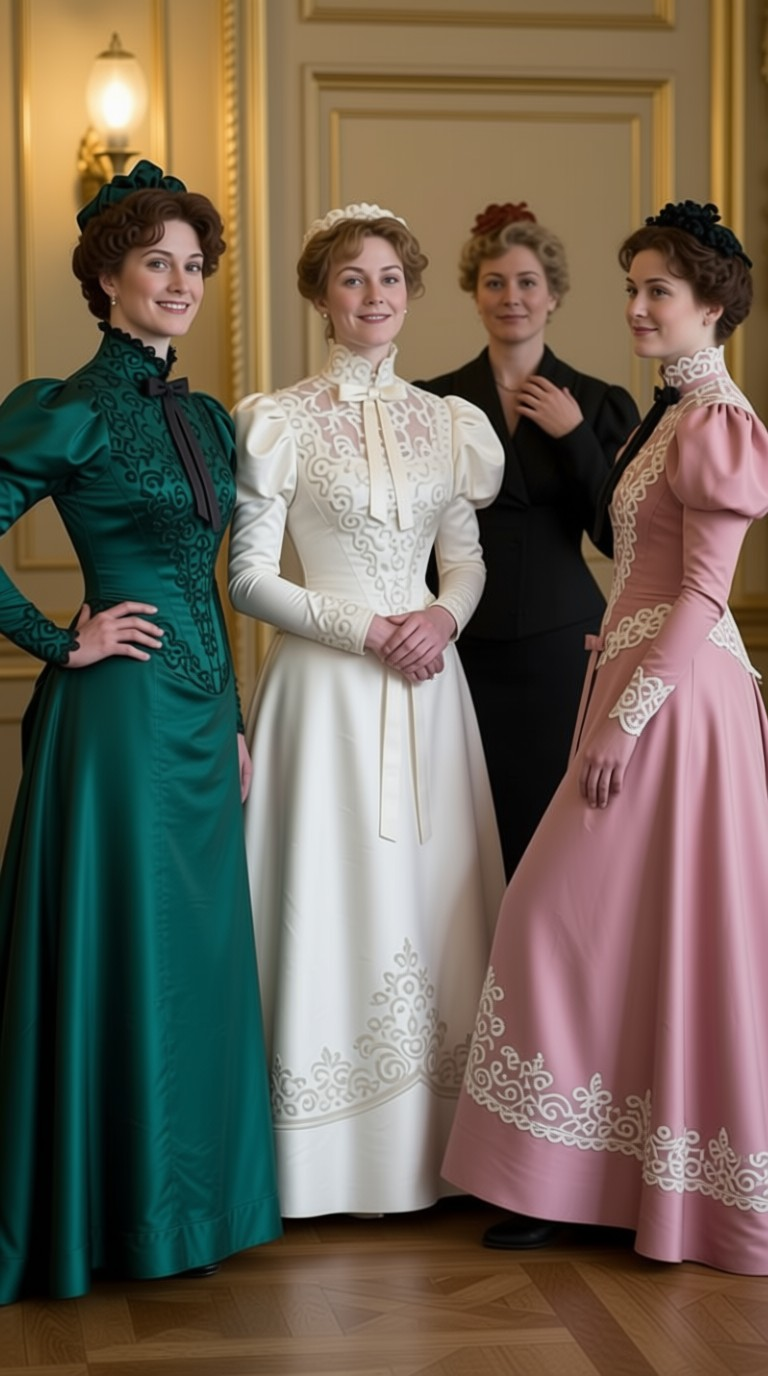
Discover the silent language of the elite and why the greatest luxury of all is knowing exactly where you belong.
The world is a loud, dusty place filled with rough edges and unanswered questions, a cacophony of noise where a woman must fight to be heard. But there exists a sanctuary, a hushed world of polished surfaces and profound understanding, where a woman does not have to guess her worth—she simply has to accept her place. It is a place of satin and silk, of commands whispered in the ear and obedience that feels not like a burden, but like the perfect fit of a shoe. Step into the light of the Luminae Society, where your deepest desire to serve is met with the ultimate reward: the exquisite joy of being cherished, the peace of being led, and the shimmering satisfaction of a life lived with purpose and gloss.
Chapter One: The Rough Cloth
Clara stood at the threshold of the townhouse, a woman weighed down by the abrasive texture of her own anxiety. She wore a jacket of rough, unyielding tweed, a garment that seemed to itch at her very skin, a constant, nagging reminder of her own clumsiness in the face of the polished, silent world that lay beyond the heavy oak door. It was a texture of the old, of the struggle, of the grey, unyielding landscape of her own mind, a landscape she had tried to traverse alone, armed only with a desperate, stammering vocabulary that fell flat against the stone walls of the mansion, like stones dropped into a deep, silent well.
Inside, the air was different—crisp, scented with the faint, intoxicating aroma of beeswax and expensive leather. The women there moved like currents in a stream, fluid and purposeful, their movements governed by a silent, invisible language that Clara could not yet read. She tried to join them, her own rough, stumbling footsteps echoing against the marble floors, her voice a harsh, jarring note in a symphony of hushed, sophisticated whispers.
“I am so terribly sorry to intrude,” she blurted out, her voice cracking, a sound like a twig snapping underfoot. “I was told… I believe I was told there might be a vacancy for a… for someone who is capable of… of useful work? I am willing to learn. I have… I have time. I have… I have nothing else to give.”
Madame Dubois did not turn from the window, where she stood framed against the velvet drapes, her silhouette sharp and defined. She wore a gown of deep burgundy leather, a material that seemed to drink in the candlelight, glowing with an inner, terrifying warmth. It was a colour of power, of command, of absolute authority, a stark contrast to the dull, muffled grey of Clara’s world.
“You are not intruding, my dear,” Madame said, her voice a low, melodic hum, like a cello string being plucked. “You are… observed.”
Clara felt the heat rise to her cheeks, a blush that felt like a second, more uncomfortable layer of rough cloth, an additional burden she could not shed. She tried to smooth her hair, her hands fumbling with the pins that held it back, a chaotic dance of nervous energy. “I… I am here to serve,” she stammered, the words feeling like stones in her mouth. “I am willing to do whatever is necessary. I want to be useful. I want to be… part of something.”
Madame finally turned. Her eyes were dark pools, devoid of pity, filled instead with a cool, calculating appraisal. She looked at Clara as if she were a piece of furniture, a rough-hewn table in a room of mahogany. “You wish to give?” she mused, a faint, enigmatic smile touching her lips. “But you have nothing to give but your… noise?”
Clara opened her mouth to protest, to explain, to weave a tapestry of her worth, but the words caught in her throat. She felt the roughness of her jacket, the itch of her anxiety, the crushing weight of her own inadequacy. She reached out to steady herself against a side table, her elbow knocking against a crystal goblet.
Clang.
The sound was deafening in the quiet room. The goblet tipped, the liquid spilling across the pristine white tablecloth, a dark, spreading stain that looked like a wound. Clara gasped, her hands flying to her mouth, her eyes wide with mortification. “Oh, please, forgive me! I am so clumsy! I am so sorry! I will clean it up! I will fetch a cloth! I will—”
Madame did not move to help. She simply watched, her expression unreadable. “The table speaks, my dear,” she said softly. “You have not yet learned to listen.”
Clara froze. She looked at the stain, then at Madame, then at the other women, who were now watching her with a mixture of amusement and pity. She felt a wave of despair wash over her, a feeling so profound it felt like drowning. She had come to offer her service, to find a place in this world of glossy, perfect people, and she had only managed to make a mess.
“You are dismissed,” Madame said, her voice gentle, but final. “Until you learn to silence the noise and smooth the rough edges.”
Clara backed away, her movements stiff and jerky, like a marionette with cut strings. She turned and fled, the heavy oak door slamming shut behind her, cutting her off from the world of gloss and grace. She stood in the cool night air, the rough cloth of her jacket scratching against her skin, a constant reminder of her failure. She looked up at the windows of the mansion, their lights glowing like the eyes of a giant, watching her, judging her. She felt small, insignificant, and utterly alone. But as she stood there, shivering in the dark, she felt a strange, flickering hope. Perhaps, she thought, if she could only find the right clothes, the right words, the right… mistress… she might just be able to fit in. Maybe, just maybe, she could become part of the gloss.
Chapter Four: The Table Turns
The invitation arrived on a morning thick with the promise of rain, the sky outside Clara’s window a canvas of swirling greys and silvers, like a watercolour left out in the damp. But the card itself was anything but dreary—it bore the crest of the house of Dubois, embossed in gold leaf that caught even the muted light, and within its flowing script was a summons that made Clara’s breath catch in her throat. She was not merely to attend the Grand Banquet of the winter solstice; she was to oversee the arrangement of the seating.
It was a task of immense responsibility, a mantle of trust that had been draped over her shoulders without warning. Clara held the card to her chest, feeling the heavy cream paper against her heartbeat, and wondered if this was a test or a triumph. Perhaps, she thought, it was both—a ladder to be climbed, with rungs that could splinter if one did not place one’s feet with care.
The day of the banquet dawned crisp and clear, the previous day’s rain having washed the Parisian streets to a gleaming mirror. Clara arrived at the townhouse early, her gloved hands steady at her sides, her mind a hive of calculations. The dining hall was a cavern of potential, its long mahogany table stretching like a river of polished wood, its surface reflecting the chandeliers above like scattered diamonds. Around it, the chairs sat empty, waiting to be filled with the weight of importance.
Madame Dubois was there, standing at the head of the table, her silhouette framed against the tall windows. She wore a gown of midnight blue satin that seemed to drink in the morning light, its surface rippling with every breath like the surface of a deep, still lake. A collar of diamonds encircled her throat, each stone a frozen tear of starlight.
“Clara,” she said, without turning. “You have the list?”
Clara stepped forward, producing a folded piece of paper from her reticule. “I do, Madame. I have studied it extensively.”
Madame finally turned, her dark eyes soft. “Studying is not understanding, my dear. Tell me what you have learned—not from the names, but from the spaces between them.”
Clara blinked, then looked down at the list again. The names were arranged in columns, each one a woman of standing, influence, and connection. But as she studied them, she began to see what Madame meant. There were relationships threaded through the list—friendships, rivalries, debts owed and favours given. There were those who had earned favour through devotion, and those who had transgressed and required correction. There were mentors and protégées, sisters and rivals.
“I see…” Clara began slowly, “a web. A tapestry of connections. Some threads must be woven together, and others… kept apart.”
“Go on,” Madame encouraged, her voice a low purr.
“Lady Ashworth and the Countess de Vries,” Clara continued, her confidence growing. “They have been at odds since the incident at the opera. To seat them together would be to invite friction, which would disturb the harmony of the table. But Lady Ashworth has been seeking redemption, and the Countess is known for her mercy when properly approached. If I seat them near each other, but with a buffer—perhaps Madame Laurent, who is a friend to both—I create an opportunity for reconciliation without forcing them into direct confrontation.”
Madame nodded slowly, a gleam of approval in her eyes. “And what of young Genevieve? She is new to our circles, and eager to prove herself.”
Clara turned to another section of the list. “Genevieve is passionate but untrained. She requires guidance. I would seat her next to Lady Pemberton, who is known for her patience and her skill in mentoring new arrivals. Genevieve will learn from observation, and Lady Pemberton will feel honoured by the trust placed in her.”
“And if Genevieve falters?” Madame pressed. “If she speaks out of turn, or commits a faux pas?”
Clara paused, considering. “Then I would ensure that she is seated far enough from the head of the table that her mistakes do not reach your ears immediately. I would give her space to learn, without exposing the table to her clumsiness.”
Madame’s lips curved into a smile. “You have learned to read the currents, Clara. You understand that the table is not merely a piece of furniture—it is a map of relationships, a battlefield of subtle alliances, a stage upon which the drama of our sisterhood is enacted. And you, my dear, are the director.”
Clara felt a warmth spread through her chest. She looked down at the list again, seeing it now as a living document, breathing with potential. For the next hour, she worked, arranging and rearranging the place cards, each name a piece in a puzzle that was slowly taking shape. She placed the ambitious but untested near the patient and wise; she separated those whose friction could spark a conflagration; she positioned those who had excelled in places of honour, where they might catch the light of Madame’s favour.
When she was finished, she stepped back and surveyed her work. The table was transformed—no longer a flat expanse of wood, but a landscape of intention, every seat a statement, every position a message.
Madame circled the table slowly, her satin gown rustling. She studied each placement, her expression unreadable. Clara stood at the foot of the table, her hands clasped before her, her heart pounding. Had she succeeded? Had she understood? Or had she missed some crucial nuance, some hidden thread that would unravel the entire tapestry?
Finally, Madame stopped at the head of the table. She turned to face Clara, and her expression was one of profound satisfaction. “You have served the table well,” she said, her voice ringing through the empty hall. “You have seen not just the individuals, but the whole. You have understood that harmony is not the absence of conflict, but the skilful arrangement of differences.”
Clara exhaled, relief flooding through her. “I have tried, Madame. I have sought to serve… the vision you have taught me.”
“And you have succeeded,” Madame said. She gestured to the chair at her right hand—a chair that Clara had not placed a card for, assuming it would remain empty. “Now, you may sit at it.”
Clara stared at the chair, confusion warring with hope. “But… I have not placed myself. I assumed I would be overseeing the service, not…”
“You have overseen the service,” Madame interrupted gently. “You have arranged the table. And in doing so, you have proven that you understand the foundation upon which our sisterhood rests. The one who serves the table deserves a place at it. The one who creates harmony deserves to dwell within it.”
She reached out and took Clara’s hand, leading her to the chair. As Clara sank into the upholstered seat, she felt the weight of the moment settle over her like a mantle. She was no longer the outsider in rough tweed, scratching at the door. She was no longer the student, stumbling over her own tongue. She was a member of the inner circle, recognised for her service, honoured for her understanding.
“Tonight,” Madame said, her voice a whisper that seemed to fill the entire hall, “you will sit here, and you will watch. You will see the fruit of your labour—the conversations that flow like water, the laughter that rings like bells, the harmony that you have created. And you will understand, finally, that service is not diminishment. It is elevation. It is the path to the highest honour.”
Clara looked up at Madame, her eyes glistening with tears she did not bother to hide. “Thank you,” she whispered. “Thank you for… for seeing me. For teaching me. For giving me a place.”
Madame’s hand brushed her cheek, gloved against skin. “I did not give you a place, Clara. I simply cleared the weeds so that you could grow into it. And now…” She smiled, radiant. “Now you bloom.”
The guests began to arrive as evening fell. Clara watched from her place of honour as the women filed in, each one finding her seat with murmurs of appreciation, each conversation beginning with an ease that spoke of careful arrangement. The room filled with the sound of laughter, the clink of crystal, the rustle of silk and satin. And at the centre of it all sat Madame Dubois, a queen upon her throne, her eyes occasionally meeting Clara’s across the expanse of the table, a silent communication that said: This is your doing. This is your triumph.
And Clara, for the first time in her life, felt not the scratching of rough cloth against her skin, but the cool, smooth embrace of belonging.
Chapter Five: The Gloss of Belonging
Winter had deepened its hold upon Paris, the city wrapped in a mantle of frost that turned every window into a work of art. But within the walls of the townhouse, the air was thick with the warmth of possibility. Clara moved through the corridors now not as a supplicant, but as a recognised member of the inner circle. Her wardrobe had transformed entirely—the rough tweeds and scratchy wools had been replaced by gowns of lucent satin, jackets of sleek moiré silk, and evening wraps that gleamed. She had learned the language of the house, and she spoke it fluently.
Yet there remained within her a hunger she could not name. She had been given a place at the table, a voice in the silent conversation of gestures, a home among the sisterhood. But she sensed that the final lesson was yet to come.
On an evening when the gas lamps flickered, Madame Dubois summoned Clara to her private chamber. The room was lit by dozens of candles, their flames dancing. Madame sat upon a chaise longue upholstered in ivory silk, her own gown a cascading wonder of bronze satin that seemed to capture and hold every particle of light in the room. She looked like a goddess carved from amber and gold, her dark eyes gleaming.
“Clara,” she said, her voice a low melody. “Come. Sit with me.”
Clara approached, her satin skirts rustling, and knelt upon the plush carpet at Madame’s feet—a gesture of reverence that had become as natural as breathing. Madame’s hand descended upon her hair, stroking it with a tenderness that made Clara’s eyes close in silent bliss.
“You have learned much,” Madame murmured. “You have mastered the art of silence. You have learned to speak with your hands, to arrange harmony from chaos, to serve the table with grace. But there is one lesson remaining—the most important of all.”
Clara looked up, meeting Madame’s gaze. “I am ready, Madame. Whatever you ask of me, I will give it.”
Madame smiled, a curving of lips that held both warmth and gravity. “I ask nothing, my dear. I offer.” She paused, her fingers still threading through Clara’s hair. “Tell me: do you understand why we serve? Why we devote ourselves to the table, to the sisterhood, to… me?”
Clara considered the question carefully, turning it over in her mind. “Because it brings order,” she said slowly. “Because it creates beauty. Because…” She hesitated, searching for the right words. “Because in serving, we become part of something greater than ourselves. We are no longer isolated, struggling stones. We become the river.”
“Yes,” Madame breathed. “But there is more. Listen, and I will tell you a story.”
Clara settled into a comfortable position, her cheek resting against Madame’s knee, the bronze silk cool against her skin.
“Once upon a time,” Madame began, her voice taking on the cadence of a fairy tale, “there was a garden. This garden was tended by a great lady, who poured her heart and soul into its cultivation. She planted the rarest flowers, watered them with her own tears, pruned them with her own hands. And the garden flourished—it became a paradise, a place of such beauty that people came from far and wide to walk among its paths.”
Madame’s hand continued its gentle stroking. “But one day, a visitor asked the great lady: ‘Why do you do this? Why do you give so much of yourself to these flowers? They cannot thank you. They cannot repay you.’ And the great lady smiled and said: ‘You misunderstand the nature of gardens. I do not give to receive. I give because the act of giving is what makes the garden grow. And when the garden grows, it gives back to me—not in words, not in coins, but in beauty. Its blossoms become my joy. Its shade becomes my rest. Its existence becomes my legacy.'”
Clara felt the story settling into her heart. “The garden gives back,” she whispered. “Not because it owes a debt, but because that is its nature.”
“Precisely,” Madame said. “And so it is with us. I have given you this sanctuary, this sisterhood, this path. Not because I seek repayment, but because my joy is in the cultivation of souls. I am the gardener, Clara, and you…” She paused, her voice soft. “You are my most cherished blossom.”
Tears pricked at Clara’s eyes. “I do not feel worthy of such a distinction.”
“Worthiness is not a quality one possesses,” Madame replied firmly. “It is a choice one makes, every day, to grow toward the light. And you have chosen, Clara. You have chosen to be pruned, to be shaped, to be nourished. And now…” She withdrew something from the folds of her gown—a garment of such radiance that Clara gasped.
It was a gown of liquid gold lamé, the fabric shimmering. It looked like sunlight woven into thread, like the very essence of luxury and grace given physical form.
“This is yours,” Madame said, holding the gown aloft. “Not on loan. Not borrowed. Yours. Because you have earned the right to wear it, to inhabit it, to become it.”
Clara stared at the gown, her heart pounding. “Madame, I… I cannot accept such a gift. It is too much. I have given nothing in comparison.”
Madame’s expression softened. “You have given everything, Clara. You have given your fear, your resistance, your rough edges. You have given your trust, your devotion, your willingness to be transformed. And in return, I give you this gown—not as payment, but as completion. Do you understand?”
“Completion,” Clara repeated, the word settling into her.
“Yes. When you wear this gown, you will understand that the cycle is complete. You gave to me, and I gave to you. You served the table, and the table served you. You offered your devotion, and in return, you received a home.” Madame leaned forward, her eyes locking onto Clara’s with intensity. “This is the final lesson, Clara: generosity is not a transaction. It is a river that flows in both directions. When you give to the source of your growth, you are not paying a debt—you are completing a circle. You are ensuring that the garden continues to grow, that the sanctuary continues to exist, that the light continues to shine for others who will come after you.”
Clara felt a profound understanding. She rose to her feet, trembling, and allowed Madame to help her into the gown. The lamé slid over her skin like liquid fire, cool and warm at once, encasing her in a sheath of radiance. She turned to the mirror and gasped at her reflection. The woman who stared back was not the rough, uncertain girl who had stumbled through the oak doors months ago. She was a creature of gloss, her form outlined in gold, her eyes bright with purpose and peace.
“You see now,” Madame whispered, standing behind her, their reflections merging in the glass. “You see what you have always been, beneath the rough cloth. You see what devotion can create.”
Clara turned to face Madame, tears streaming freely down her cheeks. “Thank you,” she breathed. “Thank you for seeing me when I could not see myself. Thank you for pruning the weeds, for watering the soil, for… for everything.”
Madame’s hands came up to cup Clara’s face, her touch tender. “And thank you, my dear Clara, for trusting me with your growth. For giving me the privilege of being your gardener.” She leaned forward and pressed a kiss to Clara’s forehead—a benediction, a consecration. “Now go. Wear this gown to the solstice ball. Let the sisterhood see what you have become. And remember always: you are not merely a member of this circle. You are its heart. You are its proof that transformation is possible, that devotion is liberation, that the gloss of belonging is the most beautiful garment a woman can ever wear.”
Clara stood tall in her gown of gold, her heart full to bursting. She understood, now, that her service had never been about submission in the way the outside world understood it. It had been about becoming part of something greater—a web of mutual devotion, a garden of interconnected souls, a sanctuary where giving and receiving were not separate acts, but one continuous flow.
And as she descended the grand staircase to join the sisterhood, the lamé of her gown catching the light of a thousand candles, she knew that she had finally, irrevocably, beautifully come home.
Chapter Six: The Open Seat
Spring had come to Paris, arrive not with a shout but with a whisper—a gentle warming of the breeze, a lengthening of the days, a proliferation of blossoms that transformed the boulevards into corridors of pink and white. The city seemed to exhale, releasing the accumulated weight of winter, and within the walls of the townhouse, a similar transformation was taking place.
Clara stood at the window of the grand salon, her reflection captured in the polished glass. She wore a gown of emerald satin that evening, its surface gleaming. Around her neck lay a simple pendant—a single pearl, a gift from Madame Dubois that she wore not as an ornament, but as a covenant. She had been a member of the inner circle for three months now, and each day had brought new depths of understanding, new layers of belonging.
The salon was beginning to fill with the familiar faces of the sisterhood—women of grace and purpose, each one a note in the symphony of the household. Clara moved among them with the fluid ease that had once seemed so unattainable, her gloved hands speaking the silent language she had mastered, her presence a contribution to the harmony of the room.
But something was different this evening. Clara could sense it—a subtle tension in the air, a vibration that spoke of a new presence. She turned toward the doorway and saw her.
The young woman stood at the threshold of the salon, frozen. She wore a dress of grey wool that had seen better days, the fabric pilled and worn at the elbows, the hem slightly askew. Her hair was pulled back in a manner that suggested haste rather than intention, and her hands—Clara noticed them immediately—were clenched at her sides, white with tension. Her eyes darted around the room, taking in the gleaming gowns, the soft candlelight, the whisper of expensive fabrics, and Clara saw in those eyes a reflection of herself.
Fear, Clara thought. Longing. The desperate hunger to belong, tangled with the certainty that one never will.
For a moment, Clara was transported back to that first evening, when she had stood in this very room in her rough tweed jacket, her voice cracking, her elbow knocking against a crystal goblet. She remembered the shame that had burned through her, the dismissal that had felt like a death, the hope that had flickered nonetheless. And she remembered, too, the patience of Madame Dubois, the gentle correction, the unwavering belief that beneath the rough cloth lay something luminous.
Clara moved toward the young woman with purpose. She did not hurry—haste was the enemy of grace—but she did not hesitate. When she reached the doorway, she stopped, allowing the young woman to see her, to take in the emerald satin, the pearl at her throat, the calm assurance in her eyes.
“Good evening,” Clara said, her voice soft. “I am Clara. You are new to us.”
The young woman swallowed, her throat working. “I… yes. My name is Marguerite. I was told… I was told I might find a place here. That there might be…” She faltered, her voice trailing off into silence.
“A place,” Clara finished for her. “Yes. There is a place.” She extended her hand—a gesture of welcome that she had learned from Madame, her gloved fingers speaking volumes. “Come. Let me show you.”
Marguerite hesitated, then took Clara’s hand. The grip was tight, desperate, and Clara felt the trembling that ran through the young woman’s frame. She did not pull away or correct the grip; she simply held it, allowing her own calm to flow outward.
“You feel out of place,” Clara said, as she guided Marguerite through the salon. It was not a question.
“I feel… invisible,” Marguerite whispered. “And yet, somehow, also too visible. As if everyone can see how wrong I am for this world.”
Clara nodded, understanding. “I know that feeling. I wore it once like a second skin—rough and heavy, scratching at me constantly.” She paused near a small alcove, where a single chair sat empty, draped with a shawl of pale blue silk that gleamed in the candlelight. “Do you see this chair, Marguerite?”
Marguerite looked at the chair, confusion flickering across her features. “It is… empty.”
“It is waiting,” Clara corrected gently. “When I first came to this house, there was a chair like this one. It was draped in satin, and I was told that elegance must be earned. But I was also told something far more important: that the chair was not a judgment. It was an invitation.” She turned to face Marguerite fully, her eyes warm. “This chair is for you. Not because you have earned it, but because you have come. The earning comes later. The belonging begins now.”
Marguerite’s eyes filled with tears. “But I do not know your ways. I do not speak your language. I will make mistakes. I will—”
“You will make mistakes,” Clara agreed. “I knocked over a goblet of wine at my first gathering. I spoke when I should have been silent. I wore rough cloth that scratched against every surface I touched.” She smiled, reminiscent. “And yet, here I stand. Wearing satin. Welcoming you.”
“How?” Marguerite breathed. “How did you find your way?”
Clara considered the question. She thought of Madame Dubois, who had seen in Clara a potential that Clara herself had never imagined. She thought of the silent lessons, the language of the hands, the arrangement of the table, the final gift of gold lamé that had completed the cycle of transformation. And she thought of the understanding that had taken root in her heart—that service was not diminishment, but elevation; that giving to the source of one’s growth was not payment, but completion.
“I learned to listen,” Clara said finally. “I learned that the room speaks, if one is willing to hear it. I learned that my hands could say what my voice could not. I learned that serving the table is the surest path to sitting at it.” She gestured toward the chair. “Sit, Marguerite. Let the silk against your skin remind you that you are no longer fighting the world alone. Let the quiet of this room teach you what you need to know. And let me be the one who shows you the first steps.”
Marguerite looked at the chair, then back at Clara. “Why would you help me? You do not know me.”
Clara’s smile deepened. “Because once, not so long ago, someone helped me. She saw past the rough cloth, past the mistakes, past the fear. She gave me a chance to become what I was always meant to be.” She paused, her voice softening. “And now, I give that chance to you. Not because I must, but because I choose to. Because the cycle of generosity is what sustains this sisterhood. Because the table is never full—there is always room for another devoted heart.”
Marguerite sank into the chair, the pale blue silk settling around her shoulders. Clara saw the transformation immediately—the way the young woman’s posture softened, the way her clenched hands began to relax, the way her eyes lost some of their terror and gained a glimmer of hope.
“It feels… smooth,” Marguerite whispered, running her fingers over the silk. “Like water.”
“It is the beginning,” Clara said. “The rough cloth will fall away in time. The silence will teach you. And one day, perhaps sooner than you imagine, you will stand where I stand, offering your hand to another lost soul who finds her way to our door.”
From across the room, Clara felt a gaze upon her. She turned and saw Madame Dubois standing near the fireplace, her gown of midnight blue velvet gleaming in the candlelight. Madame’s eyes met Clara’s, and in them was a look of profound pride and satisfaction. She raised her gloved hand in a subtle gesture—a tilt of the wrist, a soft incline of the head—and Clara understood: You have learned well. You have become the lesson.
Clara returned her attention to Marguerite, who was now sitting more comfortably, her breathing steadier, her face calmer. “Tonight, you will simply observe,” Clara said. “You will watch the women in this room, and you will begin to see the patterns—the way we move, the way we speak without words, the way we serve one another. And when you are ready, you will be given tasks. Small ones at first. And then larger ones. And over time, you will find that you no longer feel out of place. You will feel at home.”
“Home,” Marguerite repeated, the word catching. “I have not felt at home anywhere for a very long time.”
“Then you have come to the right place,” Clara said. “For this is a sanctuary. A garden. And you, Marguerite, are a seed that has been waiting for the right soil.”
She straightened, her emerald gown rustling softly, and extended her hand once more. “Come. Let me introduce you to the sisterhood. Let them see what I see—a woman of potential, ready to grow.”
Marguerite rose, the pale blue shawl still draped around her shoulders, and took Clara’s hand. Together, they walked into the salon, past the gleaming gowns and the soft candlelight, toward the table that stretched like a river of polished wood. And as they moved, Clara felt the cycle completing itself—the giving and receiving, the teaching and learning, the losing and finding that was the heartbeat of the sisterhood.
She had come to this house a stranger in rough cloth, and she had been transformed. Now, she offered that same transformation to another. And in doing so, she understood the final, most beautiful truth: that the gloss of belonging was not a garment one wore alone. It was a tapestry, woven thread by thread, heart by heart, devotion by devotion—a living, breathing work of art that grew more luminous with each new soul who found their way to the table.
And the table, blessedly, eternally, always had room for one more.
Dearest reader,
The tale of Clara and Madame Dubois has reached its conclusion, but the whispered secrets of the sisterhood have only begun to unfurl. What you have witnessed is but a single thread in a tapestry that spans decades, continents, and the hidden chambers of the most exclusive circles of feminine power.
Within the sanctum of SatinLovers, countless other stories await—each one a key to a door you may not have known existed within your own heart. There, you will discover:
The Governess of Lyon — where a young heiress learns that the truest authority wears silk gloves and speaks in silences.
The Velvet Covenant — a tale of two rival houses united by a Mistress whose wisdom transforms enmity into devotion.
The Sapphire Circle — where a struggling artist finds that her greatest masterpiece is her own submission to a patroness of infinite vision.
And many more tales of glossy enchantment, each crafted to ignite the deepest longings of the feminine soul—the yearning to be seen, to be shaped, to belong.
These stories are not merely entertainment. They are invitations. They are mirrors. They are the first gentle strokes of a gardener’s hand upon the soil of your own potential.
The table is set. The candles are lit. The only question that remains is:
Will you take your place?
Join the sisterhood at patreon.com/SatinLovers and unlock the complete library of tales that have transformed countless readers, one glossy page at a time.
Your transformation awaits.
With eternal devotion to your journey,
Dianna
#Femdom #SubmissiveWomen #LuxuryLifestyle #BDSMCommunity #DominantWomen #SatinLover #MatureLovers #HighSociety #SensualStorytelling #ElegantSubmission
Leave a Reply
You must be logged in to post a comment.