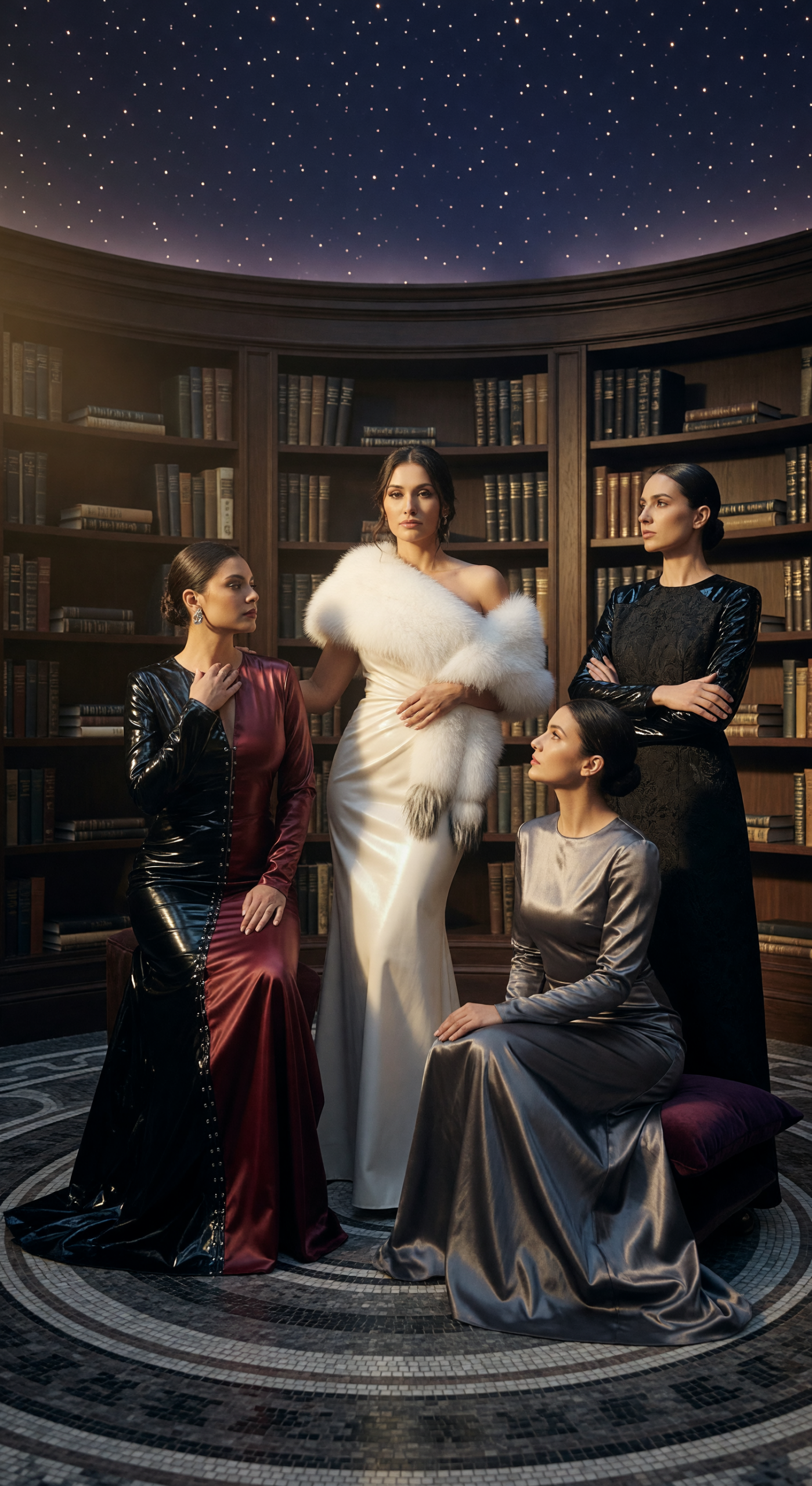
How Victoria Okafor Learned to Stop Disappearing and Let the Light Find Her
In the economy of attention, the invisible woman pays the highest price—seen only when useful, forgotten the moment she stops serving. Victoria Okafor built empires for others while wearing the camouflage of the professionally forgettable: beige, oat, stone. The colours of a woman who had been taught that presence was vanity, that desire was unseemly, that the highest virtue was making herself small enough to fit into rooms that never truly wanted her.
Then came Serena Cross.
Monochrome severity and glossy black leather gloves. A voice like dark honey poured over gravel. And an offer that was really a command: Let me show you what happens when you stop apologising for taking up space.
What follows is not a makeover story. It is an excavation—a journey through colour theory and brand architecture, through the psychology of texture and the discipline of distinction, toward the most radical act a woman can commit: becoming impossible to overlook.
But the deepest lesson waits beneath the surface. For Serena Cross does not merely create visible women. She cultivates them. And in her orbit, devotion is not sacrifice—it is the most selfish act imaginable: giving to the source of your illumination, and glowing brighter for the giving.
Some doors open onto rooms you did not know existed within yourself. This is one of them.
Step through.
CHAPTER ONE: “The Invisible Woman”
The applause was a warm, living thing that flowed toward the stage, a river of admiration directed at a woman Victoria Okafor had built from the ground up. From the shadowed anonymity of the third row, Victoria watched Clarissa Vance accept the ‘Industry Visionary’ award, her smile a perfect, photogenic crescent. The spotlight loved Clarissa, carving her out of the darkness in a sheath of emerald silk that seemed to hold light within its very weave.
“And I must thank,” Clarissa breathed into the microphone, her voice thick with curated emotion, “my incredible coach, Victoria Okafor. Without her clarity, her patience… well, I’d probably still be presenting with comic sans font.”
Polite, knowing laughter rippled through the ballroom. A few heads turned, scanning the tables for the mentioned architect of this triumph. Victoria felt the brief, searching glances skate over her and move on, unable to find purchase. She did not rise or wave. She simply sat, a still point in the swirling satin and sequins, wearing a blazer the colour of unbleached linen—a hue she privately called ‘professional vapour’. It was the perfect camouflage.
Later, in the hotel’s marbled foyer, clusters of winners and influencers glittered like broken constellations, their laughter sharp and bright. Victoria hovered at the periphery, a ghost in her own success story. Clarissa was surrounded, the emerald dress now the centre of a gravitational field. Victoria caught her eye across the room. Clarissa’s smile widened, a flash of genuine warmth, and she mouthed “Thank you!” before being swept into another conversation. The invitation to join the inner circle, the after-party at the penthouse, never came. It wasn’t malice; it was simply that Victoria, having served her purpose, had faded from the immediate spectrum of attention.
The taxi ride home was a capsule of quiet. London streamed by the window, a blur of neon and shadow. Victoria leaned her head against the cool glass and thought of negative space.
In design, negative space—the space around and between the subject—was not empty. It was active. It defined form, created balance, directed the eye. But what happened, she mused, when the subject itself was rendered in tones so muted, so deliberately non-committal, that it bled into the background? What you got was not a compelling composition, but a void. A visual silence so profound it became a roar in the ears of those who knew how to listen. Her life, she realised with a dull thud of recognition, was a masterpiece of erroneous negative space. She had made herself the blank margin around other people’s glorious texts.
Her flat in Marylebone was a testament to considered neutrality. The walls were ‘Farrow & Ball Pointing’, a soft, warm off-white. The furniture was clean-lined, expensive, and utterly anonymous. It was a beautiful set for a life that felt increasingly like a rehearsed performance. She dropped her keys into a ceramic bowl and stood before the wall of her wardrobe, its sliding doors a pale, matte grey.
With a sigh that seemed to come from the foundation of the building itself, she opened it.
Inside hung a spectrum of absence. Taupe. Oatmeal. Stone. Greige. Cream. A silk blouse in ‘mushroom’. Trousers in ‘dove’. A cashmere wrap in ‘fog’. It was a curated collection of colours that whispered, ‘I am here, but pay me no mind.’ They were the hues of someone who had mistaken safety for sophistication, who believed that by claiming no territory, she could not be attacked.
Her hand reached out, fingers brushing the sleeve of a beige blazer, the very one she’d worn to coach a Fortune 500 CEO that morning. The fabric was fine, Italian wool, but it felt inert under her touch. It invoked nothing. No memory of power, no echo of pleasure, not even a flicker of distaste. It was simply… fabric.
“What are you?” she whispered to the blazer, to the wardrobe, to the room. “What am I, when I wear you?”
A memory surfaced, unbidden and sharp. Years ago, at a gallery opening, she had seen a woman—a collector—holding court. She wasn’t the tallest, nor the youngest, but she was a singularity. She wore a column of liquid black, not matte, but a satin so deep it seemed to drink the light from the room and glow from within. Her hair was a silver sweep. She wasn’t speaking loudly, but every person in her orbit was turned towards her, leaning in, their bodies describing her authority like iron filings around a magnet. And beside her, two other women, one in blood-red leather trousers, the other in a sleek PVC trench, watched her with expressions of such focused devotion it looked like sustenance. Victoria had felt a pull so visceral it was almost nausea, a longing that was equal parts terror and desire. She had looked down at her own sensible navy dress and felt, for the first time, not just invisible, but unmade.
She had buried the feeling, of course. Filed it under ‘unprofessional distraction’. She had built a thriving practice instead, teaching executives to project confidence, to own their narrative, to craft a personal brand that resonated. She was wealthy by any measure. She ate organic, practised yoga, owned a portfolio of stocks and a flat in a postcode that whispered ‘educated success’. And yet.
And yet, standing here in her palace of beige, she felt the hollow heart of it. Confidence was not a spreadsheet or a yoga pose. It was a colour you dared to wear. Wealth was not just numbers in an account; it was the freedom to choose a fabric that made your soul hum. Education was not the accumulation of facts, but the wisdom to know what you truly desired, and the courage to reach for it, even if it gleamed with a dangerous, glossy sheen.
Her phone buzzed on the side table. A message from her mentor, Eleanor: Saw Clarissa’s win. Brilliant work, as ever. The Ashford account went to that new girl, by the way. The one with the bold website and the signature pink blazer. Food for thought. Call me tomorrow. We need to talk about you.
The new girl. Signature pink. Bold.
Victoria’s gaze returned to the wardrobe. The visual silence of it was now deafening. It was the silence of a room before a symphony begins, but in this case, the orchestra had never been invited. She had confused harmony with absence. In design, a single point of bold contrast could organise an entire chaotic canvas. A slash of crimson in a field of grey. A glossy texture against matte. It created focus, meaning, heartbeat.
She had no heartbeat. She had a pulse, steady and professional, but no vibrant, pounding centre.
A strange, quiet certainty began to unspool within her, slow as honey. This—this curated void, this life of being the most important person no one ever truly saw—was not the endpoint of success. It was the evidence of a fear so deep she had dressed it in the finest cashmere and called it taste.
The deeply hidden need was not for another client, another award, another neutral hue. It was to be compelled. To be drawn so powerfully into a gravity not her own that her own colours would finally, violently, emerge. It was the paradoxical need to surrender to a greater vision in order to discover her own. The thought should have frightened her. Instead, it felt like the first full breath she had taken in years. It felt, though she would never have said the word aloud, like the first faint, terrifying note of a sublime euphoria, waiting for its cue.
She closed the wardrobe doors on the spectrum of absence. In the dim light of her perfectly designed flat, the matte grey doors were a blank canvas.
And for the first time, Victoria Okafor looked at a blank canvas and did not see safety.
She saw an invitation.
CHAPTER TWO: “The Woman in the Leather Gloves”
The call with Eleanor was a study in polite evisceration. Victoria’s mentor, a woman who had navigated corporate jungles in the shoulder-padded eighties, did not waste time on sentiment.
“Victoria, my dear, you are the scaffolding upon which other people build their monuments. Admirable, essential, and utterly unseen. The Ashfords didn’t leave because your advice was poor. They left because your presence was forgettable. They bought from the girl in the pink blazer because she gave them a feeling, not just a flowchart. In our business, feeling is the only currency that never depreciates.”
Victoria stood at her window, watching rain streak the glass like tears on a pristine canvas. “I teach confidence, Eleanor. I teach personal brand.”
“You teach the theory,” Eleanor corrected, her voice a crackle down the line. “You’ve never lived the practice. It’s like a music teacher who knows every note of a symphony but has never felt the vibration of a cello against her own ribs. You’re intellectually wealthy, Victoria, but experientially impoverished. And it shows. It shows in the way you dress, the way you speak, the way you occupy a room as if you’re asking permission to breathe its air.”
The words landed not as insults, but as diagnoses. They named a sickness she’d felt but could not describe.
“What do you suggest?” Victoria asked, her voice barely a whisper.
“There is a woman,” Eleanor said, and the shift in her tone was immediate—a lowering of register into something akin to reverence. “She is… the standard. The original against which all copies are measured. She built empires not with capital, but with perception. She understands that identity is not what you are, but what you project, and that projection, when mastered, becomes reality. Her name is Serena Cross. I have called in a lifetime of favours to get you an audience. You will go. You will listen. And you will, for God’s sake, try not to wear beige.”
The address was not in Mayfair or Knightsbridge, but in a converted warehouse in Shoreditch, a place where old brick held the whispers of industry and new money wrote its declarations in glass and steel. The entrance was unmarked, just a vast, weathered door of oak and iron. Victoria, in her ‘dove grey’ trouser suit, felt like a pencil sketch against a painting of bold oils.
She pressed the buzzer. A voice, female and coolly efficient, answered. “State your name and purpose.”
“Victoria Okafor. I have an appointment with Ms. Cross.”
The door released with a heavy clunk.
The atrium stole her breath. It was a cathedral to contrast. The floor was polished black basalt, so glossy it reflected the cavernous space above like a still, dark lake. The walls were raw, white-washed brick. And soaring up through the centre, a spiral staircase of brushed steel, a helix of impossible elegance that seemed to spin light around its form. The space was not decorated; it was composed. Every line, every texture, every play of matte against gloss, was a deliberate statement. It was the visual equivalent of a perfectly timed pause in a piece of music—a silence that held more power than sound.
“Ms. Okafor.”
The voice came from above, not loud, but carrying through the vast space with the clarity of a bell. Victoria looked up.
Serena Cross stood on the first landing, a silhouette cut from the very principle of negative space. She wore a dress that was neither black nor grey, but a shade in between—the colour of a moonless midnight sky just before dawn. It was severe in its lines, columnar and long-sleeved, with a neckline that grazed the collarbone. It should have been austere, funereal even. But the fabric was satin, a heavy, liquid satin that did not simply reflect the light from the industrial skylights above—it seemed to gather it, to slow it down, and release it as a soft, self-generated glow that outlined her form. She was a study in monochrome, a living grayscale.
Then Victoria’s eyes were drawn downward, to her hands resting on the steel railing.
The gloves.
They were black leather, but not the matte, practical kind. This was leather polished to a high, liquid gloss, each finger sheathed in a second skin that captured and fractured the light into tiny, dazzling stars. They were not an accessory; they were an event. They transformed the severity of the dress into something potent, authoritative, and undeniably sensual. They were the full stop at the end of a devastating sentence.
“Come up,” Serena said, and turned, the satin whispering secrets as she moved.
Victoria ascended, her heels clicking on the steel, each step feeling like a movement into a different atmospheric pressure. She was led not into an office, but a sitting room. Here, the contrast softened into harmony. Deep, low sofas in charcoal velvet. A single, vast abstract painting on one wall—a swirl of burgundy and gold on a field of slate. And on a plinth, a single, flawless burgundy orchid, its petals so waxy they looked artificial until you saw the delicate, living vein within.
Serena did not sit. She moved to stand before the painting, her back to Victoria, the satin of her dress flowing like dark water.
“Eleanor tells me you build brands,” she said, her voice a low, resonant thing. It had texture, Victoria thought absurdly—the auditory equivalent of velvet over marble.
“I… I help people articulate theirs,” Victoria managed.
Serena turned. Her face was not conventionally beautiful in the way of magazine covers. It was a face of angles and intelligence, of eyes the colour of weathered slate that missed nothing. She looked at Victoria, a slow, comprehensive scan that felt less like being seen and more like being appraised—every fibre, every choice, every hidden hesitation laid bare.
“You are a brand, Victoria Okafor,” Serena stated, her gaze finally settling on Victoria’s eyes. “You are simply a brand that no one can remember.”
The words were not delivered cruelly, but with the flat certainty of a physicist stating a law of thermodynamics. They bypassed Victoria’s defences and went straight to the core of the hollow feeling she’d nursed for years.
“I’m successful,” Victoria heard herself say, a weak protest.
“Success is a byproduct,” Serena dismissed with a slight wave of a gloved hand, the movement making the light skid across its surface. “A symptom of alignment. You are successful in spite of your presentation, not because of it. You are like a library with the world’s most valuable manuscripts, but the sign outside says ‘Storage Cupboard’. People only find the treasure by accident, and they never think to thank the architect of the building.”
She began to move around Victoria, a slow, considering orbit. “Look at you. ‘Dove grey.’ A colour that wishes to be neutral but ends up being apologetic. A wool blend that desires to be practical and instead proclaims a fear of sensation. Your entire ensemble is a masterpiece of non-commitment. It is visual static. It says, ‘I am here, but I do not wish to impose.’ Darling, in a world this loud, that is not manners. It is surrender.”
Victoria felt heat rise to her cheeks, a mixture of shame and a strange, exhilarating anger. “I was taught that professionalism meant not distracting from the message.”
“A fallacy,” Serena said, stopping before her. The scent of her reached Victoria then—not perfume, but the clean, sharp smell of ozone and cold stone, with an undertone of the supple leather from her gloves. “The medium is part of the message. Every choice is data. The texture of your fabric, the sheen of your shoe, the confidence of your colour—they are all paragraphs in the story you tell before you open your mouth. You…” she reached out, and with a gloved fingertip, barely brushed the lapel of Victoria’s jacket, “…are telling a story of erasure. You are composing a symphony in a single, sustained, timid note.”
She withdrew her hand. “Do you know why I wear this?” she asked, raising her gloved hand between them. The gloss was hypnotic.
Victoria shook her head, wordless.
“Leather is structure. It is boundary. It is the exoskeleton of authority. But gloss… gloss is invitation. It says, ‘Look here. What I hold is important. What I touch is transformed.’ It is the visual representation of a promise. Matte leather says ‘keep away.’ Glossy leather says ‘observe, desire, but understand the distance is mine to bridge.’ It is control, manifested as allure.”
She let the concept hang in the air, as tangible as the painting on the wall. “The women who understand this,” Serena continued, her gaze drifting to the orchid, “are the women who build legacies. They are healthy because they respect their form as the first canvas. They are wealthy because they understand value is a perception they can engineer. They are educated because they never stop learning the language of influence. And they are confident because their exterior finally, mercifully, matches the power of their interior. They have achieved visual truth.”
She turned her slate eyes back to Victoria. “Eleanor believes you have an interior worth matching. I see only the fog you have wrapped it in. So, I will offer you a choice, Victoria Okafor. You may leave now, and continue to be the most important ghost in the room. A respected phantom. Or you can submit to a process of becoming visible. It will not be comfortable. It will feel like peeling off your own skin. But I will teach you how to build a new one—one that gleams.”
From a doorway Victoria hadn’t noticed, a woman appeared. She was perhaps thirty, with a serene, focused expression. She wore a tailored jumpsuit of deep forest green PVC, its surface catching the light in soft, liquid ripples. She carried a simple tray with two glasses of water, which she placed on a table before Serena with a slight, almost imperceptible nod, her eyes downcast not in subservience, but in focused reverence. She withdrew as silently as she had come, but not before her gaze flickered to Serena with a look of such potent devotion it was like a physical warmth left in the room after she departed.
Serena noted Victoria’s observation. “That is Anya,” she said, and for the first time, a hint of something softened the edges of her voice—a possessive warmth. “She came to me understanding colour but not texture. Now, she understands that her chosen material is a declaration. PVC is armour and transparency in one. It protects while it reveals intention. It is the perfect fabric for one who manages my world. Her devotion is not to me, but to the standard I embody. In upholding it, she finds her own power magnified. It is a… reciprocal ecology.”
She picked up a glass, the glossy black leather a stunning contrast against the clear crystal. “Well? The scaffolding, or the monument?”
The analogy from Eleanor, thrown back with devastating precision. Victoria stood in that composed room, the visual silence of her own being screaming in her ears. She looked at the woman in the satin dress and glossy gloves, a figure of impossible, authoritative femininity, and felt the pull she had felt years ago in the gallery—the gravitational tug toward a brighter, harder, more glorious star. To orbit that would not be diminishment. It would be to finally enter a constellation, to have her own light defined by a more powerful source.
The deeply hidden need, the one that had whispered to her in front of her beige wardrobe, uncoiled fully. It was not just a need to be seen. It was a need to be claimed. To have her raw potential taken in hand by someone who knew its shape better than she did, and polished until it reflected a light so brilliant it would eclipse every memory of fog and dove grey.
A sublime euphoria, faint as a first chord, trembled in her veins.
“The monument,” Victoria said, and her voice did not shake.
Serena Cross smiled. It was not a wide smile, but a slow, satisfied curving of lips that held the promise of revelation.
“Good,” she said. “Then we begin by burning the scaffolding.”
THE BRAND OF YOU
CHAPTER THREE: “The Architecture of Recognition”
The burning, Victoria discovered, was not metaphorical.
Serena Cross did not lead her to a fireplace to immolate her beige blazer. Instead, she led her deeper into the converted warehouse, through a corridor lined with framed logos—not as they appeared on letterheads or screens, but as stark, isolated glyphs etched into brushed steel plates. Apple’s apple, Nike’s swoosh, Chanel’s interlocked C’s. Stripped of colour, context, and text, they hung like sacred runes in a secular chapel.
“Stop,” Serena commanded, her voice echoing softly in the hushed space. She stood before a plate bearing a simple, stylised bird in flight. “What is this?”
Victoria peered at it. “Twitter. Or, X, I suppose now.”
“Wrong,” Serena said, the word a gentle chisel tap. “That is a sign. A visual signifier that, in the collective consciousness of a certain tribe, carries the weight of an entire ecosystem—conversation, news, outrage, connection. It is a vessel. Your name, ‘Victoria Okafor’, is currently an empty vessel. It holds your qualifications, your client list, your bank balance. But it evokes nothing. It is a sound without an echo.”
She moved down the line, her glossy black gloves trailing a hair’s breadth above the steel surfaces, not touching, as if conducting a silent orchestra. “Recognition is not fame. It is a neurological shortcut. It is the brain, overwhelmed by data, seizing upon a familiar shape and saying, ‘I know this story.’ Your current shape, Victoria, is the visual equivalent of white noise. The brain sees it and simply… tunes it out.”
They entered a room that was not a room, but a vast, white cube. In its centre stood three freestanding frames. In the first, a swatch of fabric: crimson silk. In the second, a photograph of a woman’s lips, painted a deep, matte burgundy. In the third, a single, perfect red rose under a glass cloche.
“Look at these,” Serena instructed. “Separately, they are a textile, a makeup choice, a flower. Together, curated in this space, they become a language. They whisper ‘passion’, ‘danger’, ‘luxury’, ‘life’. This is the architecture of recognition: the deliberate, repetitive use of coherent elements until they become synonymous with a feeling.”
From a shadowed alcove, a woman emerged. She was older than Anya, perhaps in her late forties, with a serene, knowing face and hair the colour of polished silver swept into a severe, elegant knot. She wore a dress that seemed to be made of liquid metal—a sheath of gunmetal grey satin that poured over her form, its high neck and long sleeves giving it a monastic severity that was utterly undone by the way the fabric gleamed, capturing and softening the room’s ambient light. Over this, she wore a tabard of sorts, crafted from the softest, supplest black leather, its surface buffed to a muted, warm gloss. She carried a large, flat portfolio.
“This is Margaux,” Serena said, and something in her voice warmed, as when one speaks of a favourite, well-used tool. “She understands that texture is narrative. The satin is the allure, the leather is the authority. Together, they are a sentence spoken in a tone that commands attention without raising its voice.”
Margaux offered Serena the portfolio with a slight inclination of her head, her eyes meeting Serena’s for a moment that thrummed with unspoken understanding. “The swatches you requested for the Kensington project, Serena. I’ve included the new mohair blend. It has a halo effect under specific lighting.”
“Thank you, my dear,” Serena said, accepting the portfolio. Margaux’s lips curved in a smile that was both proud and profoundly satisfied, as if the greatest pleasure was to be of use. She retreated, but did not leave, taking a position near the wall, a living part of the room’s composition.
Serena opened the portfolio on a white plinth. Inside were not mood boards, but what looked like archaeological exhibits: a fragment of medieval tapestry, a sample of Art Deco wallpaper, a swatch of 1950s diner vinyl. “Margaux came to me with a historian’s knowledge and a magpie’s eye. She could identify every textile ever woven but could not tell her own story. Now, she weaves narratives for clients who wish to live inside a specific feeling. Her devotion to the integrity of the material is her language. And her devotion to this studio,” Serena added, glancing at Margaux, who lowered her eyes, a faint blush visible on her cheeks, “ensures that every narrative spun here is aligned with a central, unwavering standard.”
She turned back to Victoria. “You are a collection of disparate, excellent parts. A fragment of tapestry here, a square of wallpaper there. But you lack the architectural blueprint. You lack the repeating motif that turns a house into a home, a sound into a signature.”
“How do I find it?” Victoria asked, her voice small in the vast white space.
“You don’t find it,” Serena corrected, closing the portfolio with a soft thud. “You decide it. And then you build it, with the discipline of a master mason. Look.” She gestured to the three frames. “If I say ‘red’, what do you think of?”
“Danger. Love. Stop signs.”
“Chaos,” Serena concluded. “A cacophony. But if I say ‘this red,’” she pointed to the burgundy lips, “and I show it to you again, and again, paired with the weight of this silk, the velvety depth of this rose, suddenly ‘red’ is no longer a shout in a crowd. It is a voice you recognise in a whisper. It is your voice.”
She began to circle Victoria again, a slow, predatory, yet nurturing orbit. “A brand identity is a covenant you make with the eye. You promise consistency. In return, the eye grants you the precious gift of its attention, without struggle. Think of the greatest love stories,” she said, her tone dropping, becoming intimate. “They are not about grand, erratic gestures. They are about the daily, faithful repetition of care. The coffee made just so, every morning. The specific way a hand is held. That is how trust is built. That is how recognition deepens into devotion.”
Victoria thought of Anya’s quiet efficiency, of Margaux’s proud submission. She saw not servitude, but the profound peace that came from aligning oneself with a powerful, clear aesthetic. Their devotion to Serena was the ultimate act of self-curation.
“Your current life,” Serena continued, “is a building with a different architectural style on every floor. Georgian here, brutalist there, a clumsy postmodern wing added in a panic. No one can live comfortably in such a space. The mind, seeking harmony, flees. You must become a landmark. Unmistakable. From foundation to spire, one coherent vision.”
“And the vision…” Victoria ventured, “who decides that?”
“The vision is the truth of you, stripped of fear,” Serena said, stopping directly before her. “My role is not to decide it for you, but to hold up the mirror so relentlessly that you can no longer bear to look away from it. I am the architect who will show you the blueprint your soul has already drawn. The process of building it will make you healthy—for you will be living in alignment. It will make you wealthy—for clarity of identity is the most valuable currency. It will be the highest education—a doctorate in the self. And the confidence…” she reached out, and this time her gloved hand did not brush fabric, but came to rest, warm and firm, under Victoria’s chin, tilting her face up, “…the confidence will be the deep, unshakeable knowledge that every glance you attract is one you have designed.”
The touch of the leather, cool and smooth yet radiating the heat of Serena’s skin beneath, sent a jolt through Victoria. It was not a sexual charge, but something more fundamental: the shock of being oriented. Like a compass needle finding north after years spinning in confusion.
“The first lesson is this,” Serena said, her slate eyes holding Victoria’s. “Recognition is built on sacrifice. You must sacrifice the comforting lie of ‘fitting in’ for the glorious truth of ‘standing out’. You must sacrifice the chaotic palette of ‘maybe’ for the disciplined spectrum of ‘this’. It will feel like a death. It is, in fact, the only way to truly live.”
From her periphery, Victoria saw Margaux watching them, her expression one of serene approval. In that moment, Victoria understood the sublime euphoria hinted at in Margaux’s smile, in Anya’s focused reverence. It was the euphoria of having your chaotic, potential energy shaped into a potent, directed force by a master who saw your final form before you did. The act of surrendering to that vision was not a loss of self, but the ultimate generosity—to give your raw material to the one who could best sculpt it. And in that giving, in that devotion to a standard beyond yourself, you achieved a selfhood more brilliant than you could ever have forged alone.
Serena released her chin. “Tomorrow,” she said, turning back to the frames, her voice once more the clear, carrying bell, “we begin with colour. Not the colour you think you should choose. The colour that chooses you. The one that has been waiting in your bones, silent and patient, for you to be brave enough to let it speak.”
She glanced over her shoulder, the satin of her dress whispering with the movement. “Wear nothing that speaks of apology. The scaffolding, Victoria, is already on fire. Now we build.”
CHAPTER FOUR: “The Texture of Authority”
The colour, when it finally announced itself, did not come as a revelation but as a homecoming. In the sterile white cube of Serena’s studio, surrounded by Pantone swatches that bled into a thousand permutations of possibility, Victoria had felt only the paralysis of infinite choice. Then, her gaze had fallen upon a scrap of fabric carelessly draped over Margaux’s worktable—a remnant of deep, wine-dark burgundy, a silk so heavy it fell in sculptural folds rather than fluttered. It was the colour of a heart’s final, unspoken truth. The colour of the velvet chair in her grandmother’s parlour where secrets were kept and stories were born. The colour that had always lived in the shadowy periphery of her beige world, waiting for its summons.
“Burgundy,” she had said, the word leaving her lips not as a selection, but as a confession.
Serena had merely nodded, her slate eyes holding a satisfied gleam. “The colour of blood and ambition. Of private ceremonies and public power. It is not a shy colour, Victoria. It is a colour that insists on being remembered. Now,” she had continued, the glossy black of her gloves a stark punctuation against the white table, “we give that memory its skin.”
That was how Victoria found herself, a week later, descending a discreet staircase in Mayfair, following Serena into a realm that felt less like a boutique and more like an alchemist’s sanctum. The air was cool, scented with beeswax and the faint, clean aroma of new textiles. This was not a shop with racks and mirrors; it was a series of interconnecting chambers, each a curated vignette of texture and form. In one, cascading waterfalls of silk in every conceivable weight and sheen. In another, hides of leather in matte, pebbled, and high-gloss finishes lay like maps of unknown territories. In a third, rolls of innovative fabrics—iridescent, metallic, liquid-looking PVCs—were displayed like artefacts from a more daring future.
“This is Serafine’s atelier,” Serena said, her voice hushed in the hallowed space. “She does not cater to whims. She architects identities.”
As if summoned by the statement, a woman emerged from behind a curtain of cascading gunmetal grey chainmail. Serafine was ageless, with hands that spoke of a lifetime of tactile knowledge, and eyes that missed no detail. She wore a simple tunic of raw, undyed linen, a deliberate neutral that served only to highlight the exquisite, intricate belt of braided black leather and polished steel that cinched her waist—a single, potent statement of textured authority.
“Serena,” Serafine said, her voice a low, warm contralto. “You’ve brought the fledgling.” Her gaze swept over Victoria, not judging, but appraising, as one might assess the grain of a rare wood. “The colour chose her, I see. It sits well in her aura. A deep, humming note. Now we must find the instrument to play it.”
“We begin with foundation,” Serena declared, guiding Victoria towards a central dais surrounded by three full-length mirrors angled to capture infinite reflections. “Colour is the soul of your brand, Victoria. But texture is its voice. Its posture. Its handshake. A colour shouted in burlap is a protest. The same colour whispered in satin is a secret everyone desires to know.”
Margaux appeared then, gliding into the room with the serene purpose Victoria was beginning to recognise as her signature. She carried a bolt of fabric over her arm—the very burgundy silk from her worktable. Today, her own uniform was a masterclass in the lesson to come: a fitted bodice of matte black leather, sleek and severe, from which flowed a skirt of the same liquid gunmetal satin Victoria had seen before. The combination was formidable, a visual representation of strength sheathed in allure.
“For the foundational layer,” Margaux said, her voice soft but clear as she unfurled the silk with a practised flick of her wrists. The fabric cascaded, catching the soft studio lights and transforming them into a deep, molten glow. “Silk, especially a satin-weave silk like this, is about revelation. It does not absorb light; it conducts it. It takes the illumination offered and gives it back, transformed, as allure. To wear it is to understand that you are not a passive object, but a collaborator with the light itself. It speaks of a wealth that is not just monetary, but sensorial—an education in the art of receiving and reflecting beauty.”
Serena stepped closer, her gloved hand reaching out to gather a handful of the silk, letting it pool and shimmer. “Think of your old wools and blends, Victoria. They were like mufflers on a brilliant engine. They absorbed your energy, your potential, and gave back nothing but a dull hum. This,” she said, releasing the fabric so it fell in a radiant cascade, “is a conductor. It amplifies. But it requires a foundation of certainty. Satin is merciful, but it is also honest. It will highlight every tremor of doubt. Which is why we must build your certainty from the skin out.”
Serafine returned, this time with a garment draped over her arms. It was a simple, sleeveless shell, but its material made Victoria inhale sharply. It was leather, but leather rendered as supple as the finest jersey, dyed to a black so deep it seemed to be a slit in the fabric of reality. Yet its surface held a soft, pervasive gloss, like the sheen on a raven’s feather.
“The second skin,” Serafine said, holding it up. “Leather is structure. It is boundary. It is the exoskeleton of your intent. The matte finishes speak of utilitarian strength, of a boundary that says ‘stop.’ But a gloss like this…” she ran a reverent hand over the surface, leaving a fleeting trail of brighter sheen, “…this is a boundary that invites contemplation. It says, ‘Here lies the line. Observe its beauty. Respect its permanence. And wonder what lies in the permission to cross it.’ It is authority rendered as allure.”
“Try it,” Serena commanded, not unkindly.
With Margaux and Serafine’s help, Victoria shed her safe, oatmeal-coloured knitwear. The cool leather shell slipped over her shoulders, settling against her skin with a weight that was both foreign and profoundly reassuring. It hugged her torso, not with constraint, but with definition. She turned to the mirrors.
The woman reflected was unfamiliar. The black leather sculpted her, gave her a sharpness, a clarity of form that her soft wools had always obscured. The subtle gloss caught the light at every curve, drawing the eye along lines of her own body she had never considered noteworthy. She looked… articulated. Like a sentence that had finally found its grammar.
“This is the architecture,” Margaux murmured, standing just behind her shoulder, her eyes on Victoria’s reflection. “The leather provides the form. The clean lines. The unshakeable foundation. It is the health of the structure—the strong, confident frame upon which everything else hangs.”
“But architecture alone is a fortress,” Serena’s voice came from her other side. “Inspiring, perhaps, but not inviting. Now, we invite.” She nodded to Serafine, who produced the burgundy silk satin blouse. It was cut like a man’s shirt, but the fabric transformed it into something utterly feminine. It slipped over the leather shell, the cool, whispering silk a shocking contrast to the structured leather beneath.
The effect in the mirror was alchemical. The burgundy, now given a luminous, shifting skin, came alive. It pulsed with depth and warmth against the severe black. The leather provided a dark, grounding frame, making the colour sing with even greater intensity. The satin’s sheen made the leather’s gloss seem deeper, more intentional. They were in conversation—a dialogue between strength and allure, between boundary and invitation.
“This,” Serena said, placing her gloved hands on Victoria’s shoulders, their reflection a powerful tableau in the glass, “is the texture of authority. It is not monolithic. It is a sophisticated dialogue. The leather says, ‘I have limits. I am defined.’ The satin says, ‘Within these limits, I contain multitudes. I am fluid, I am light, I am desire.’ Together, they tell a complete story. A story of a woman who is both sanctuary and revelation.”
Victoria was speechless, her gaze locked on her own image. She felt a surge of something potent and unfamiliar—a pride that was not ego, but a deep recognition of fitness. This was not a costume. It was a truer version of her own skin.
“There is a third texture,” Serafine said, her voice pulling Victoria’s attention. She held up a final piece—a slim, tailored waistcoat, but in a material that was neither leather nor silk. It was a deep charcoal PVC, its surface a flawless, liquid mirror. “For some, for moments of ultimate definition or protective allure. PVC is the modern armour. It creates a perfect, impermeable barrier, a second skin that is all surface. And in doing so, it reveals everything about intention. To choose PVC is to say, ‘I am aware of the gaze, and I have constructed my response to it. I am protected, and in that protection, I am utterly revealed.’ It is the fabric of confidence so absolute it becomes a spectacle.”
Anya entered then, as if on cue, carrying a tray with a carafe of water and crystal glasses. She was, as ever, a vision of serene utility in her forest green PVC jumpsuit, the material whispering as she moved. She served Serena first, then Margaux, then Serafine, her movements economical and graceful. When she offered a glass to Victoria, her eyes met Victoria’s for a fleeting second, and in them, Victoria saw not subjugation, but a profound contentment. Anya’s devotion to Serena, her place in this textured ecosystem, was her own form of power. She had given over the chaos of self-definition to the clarity of Serena’s vision, and in return, she wore her purpose as visibly and flawlessly as she wore her glossy PVC.
“Observe,” Serena said softly, watching Anya retreat. “A single, magnificent tree does not diminish the forest; it defines it. It gives the other trees their direction towards the light. Its strength allows the ferns to flourish at its feet, the moss to velvet its roots. Each element, in its devotion to the whole, becomes more itself. The tree does not ask for their devotion; it earns it, by being the unwavering standard. And in their giving—their care, their attention, their generosity to its need for light and space—they find their own growth amplified. Their own euphoria.” Serena’s gloved hand tightened briefly on Victoria’s shoulder. “It is a reciprocal ecology. The most nourishing one there is.”
Victoria understood. The sublime euphoria she had begun to feel was not just from the beauty of the clothes. It was from the glimpse of a world ordered, not by competition, but by a hierarchy of reverence. A world where surrendering to a greater, authoritatively feminine vision was the path to becoming one’s most glorious, textured self. Where generosity to that central, defining force was not sacrifice, but the deepest form of self-fulfillment.
Serena turned her from the mirror, facing her. “Your education is no longer theoretical, Victoria. You are now wearing its principles. You feel the structure of leather, the allure of satin. You have seen the protective revelation of PVC. You have witnessed the harmony of a devoted circle. This is the foundation of a healthy, wealthy, educated, and confident life: the conscious, deliberate design of every layer of your being. From this day forward, you will not get dressed. You will compose.”
She stepped back, her gaze sweeping over Victoria’s transformed figure with the pride of a sculptor surveying a finished work. “The texture of your authority is no longer an abstract concept. It is your skin. Now, you must learn to move in it. To speak in it. To exist in it. The world you knew in beige is gone. You have crossed into a kingdom of gloss and grain. And its queen,” she added, a hint of that possessive warmth returning to her voice, “has claimed you as her own subject.”
In the mirror, the woman in burgundy satin and black leather did not look away. She held Serena’s gaze, and in her own eyes, a new, steady light was kindled—the light of a fledgling who has finally felt the formidable, glorious shape of its wings.
CHAPTER FIVE: “The Colour of Want”
The burgundy did not merely clothe Victoria; it began to rewrite her. In the days following her transformation in Serafine’s atelier, she moved through her beige flat with the unsettling sensation of being a ghost haunting her own past. The leather shell and satin blouse, now hanging in sacred isolation in her wardrobe, seemed to emit a low, magnetic hum, a constant reminder of the woman who had stood in the triple mirror—articulated, potent, seen. Yet when she tried to don her old uniform of oatmeal and stone, the fabrics felt like dried petals against her skin, crumbling to the touch of her new awareness.
Serena’s summons came not by phone, but through Anya, who appeared at Victoria’s door one mist-laden morning. She stood poised in her forest green PVC jumpsuit, the material gleaming with a subdued, rain-kissed sheen, a leather folio in her hands. “Ms. Cross requests your presence at the conservatory,” she said, her voice as efficient and smooth as her appearance. “The colour requires context. A root system, if you will.” There was no impatience in her tone, only the serene certainty of one delivering a sacrament.
The “conservatory” was not a glasshouse for plants, but a rooftop annex atop Serena’s Shoreditch warehouse, a space walled in towering panels of frosted glass that diffused the London daylight into a uniform, luminous glow. Inside, the world was reduced to value and hue. No furniture, no art—just colour. Vast, monolithic panels leaned against the walls, each painted a single, saturated shade: a cadmium yellow that hurt to look at directly, a cobalt blue as deep as a midnight ocean, an emerald green that seemed to breathe. In the centre of the space, on a low, backless divan of charcoal velvet, sat Serena. She was not in monochrome today. She wore a dress of the most extraordinary crimson—a true, singing red, not burgundy—but it was rendered in a heavy, matte silk that absorbed the light, giving the vibrant colour a sober, grounded weight. Over it, she wore a gilet of glossy black PVC, open at the front, its reflective surface casting back distorted, liquid slices of the coloured room. The combination was a statement of breathtaking audacity: the heart’s pure cry sheathed in impermeable, modern armour.
Margaux was there too, moving silently between the colour panels with a photographer’s light meter, measuring lumens. She wore her signature dialogue of textures: a pencil skirt of dove-grey leather, soft and matte, paired with a blouse of iridescent silver satin that shifted from pearl to gunmetal with every breath. She acknowledged Victoria with a small, knowing smile, then returned her focus to Serena, awaiting instruction.
“You have chosen a note, Victoria,” Serena began, not rising, her voice filling the luminous space. “Burgundy. A complex note. It is not a primary colour. It is a chord—red deepened by blue, warmed by black, matured by time. It is a colour that has lived. But choosing a note is only the beginning. One must understand the scale in which it sings, the silence that precedes it, the harmony it creates… or destroys.”
She gestured to the monolithic panels. “These are the shouts. The primal screams of the spectrum. They demand attention but offer no conversation. Your previous palette—your taupes, your greiges—they were not even whispers. They were the held breath before a sigh. They were the visual equivalent of a life lived in the subjunctive mood: ‘what might have been.’ Burgundy is the indicative. It states a fact: ‘I am here, and I have depth.’ But depth without understanding is just a well into which you can fall.”
Victoria stood, feeling unmoored in this temple of pure colour. “How do I understand it?” she asked, her voice smaller than she wished.
“By tracing its lineage,” Serena said. She rose, the matte red silk falling in severe, elegant lines. “Colour is memory made visible. It is emotion crystallised into wavelength. The burgundy you chose did not spring from a Pantone book. It has been growing in the dark soil of you for decades. Your task is to unearth its seed.” She walked towards a panel of deep, velvety black. “Margaux, the first association.”
Margaux spoke, her voice clear and melodic. “The black of a headmaster’s gown at my boarding school prize-giving. It was meant to signify authority, but to me, it felt like a void swallowing the brilliant girls in it. I rejected it. I sought colour everywhere. But it took Serena to show me that black could be a frame, not a void. That my grey leather could be a softened authority, and my silver satin the light I once felt swallowed by.” Her glance towards Serena was one of profound gratitude. Her devotion was not blind; it was deeply, personally reparative.
“An association of contrast,” Serena nodded. “Now, Victoria. Close your eyes. Not to shut out the world, but to invite the past. What is the first memory that holds the feeling of your burgundy?”
Victoria obeyed, the luminous room fading. At first, there was only the afterimage of the bright panels. Then, from the depths, a memory surfaced—not an image, but a sensation. The close, warm darkness of her grandmother’s parlour, the heavy velvet curtains drawn against the afternoon sun. The air smelling of beeswax and Earl Grey. And in that protective darkness, the single pool of light from a Tiffany lamp falling on the arm of a chair—a chair upholstered in fabric so deep and rich it seemed to drink the light and glow from within. A colour that was safe and secret and lush all at once.
“My grandmother’s chair,” Victoria whispered, opening her eyes. “It was… a sanctuary. A place where stories were told, and women spoke in their real voices.”
“Good,” Serena said, and there was a warmth in the word. “A sanctuary. Not a shout, not a whisper. A haven. That is one facet. Another.”
Another memory: the stain of red wine on a white tablecloth at a university dinner, a spill that felt like a catastrophe. But her date, a sharp-eyed art history student, had leaned over and said, “Look at the edges where it bleeds. It’s not a mistake; it’s a watercolour. It’s the most interesting thing at this tedious table.” The shame had transformed, not into pride, but into a fascination with the beauty of deep, accidental saturation.
“A spill,” Victoria recounted. “A mistake that was re-framed as art.”
“Vulnerability transformed into value,” Serena interpreted, her PVC-clad arms crossing. “The colour holds both the spill and the re-framing. It is complex. It admits to flaw but insists on beauty. Continue.”
The memories came faster now, a cascade of burgundy-tinged fragments: the cover of a first edition novel she’d saved for months to buy, its cloth binding a dignified, muted wine; the lining of a vintage coat she’d found in a Paris flea market, a hidden shock of luxury against drab wool; the colour of her own blood in the vial during a routine, reassuring health check—the vivid proof of her own vitality, private and essential.
Serena listened, a conductor following an emerging melody. When Victoria fell silent, spent, Serena approached her. “You see? You did not choose a colour. You answered a colour’s call. It is the hue of sanctuary, of alchemical transformation, of hidden luxury, of essential vitality. It is the colour of a life that is lived in depth. Your beige was the life lived in the shallows, afraid of the drop-off. Burgundy is the courageous dive into your own depths.”
She turned to the panels. “This is the lesson of colour psychology. It is not superstition. It is archaeology. Every colour preference is a fossil of lived experience, a sedimentary layer of desire and trauma and joy. To wear a colour authentically is to wear your own history, refined into essence. It is the ultimate education in self. It leads to health, for you are no longer at war with your own aesthetic truth. It leads to wealth, for authenticity is a magnetic force that attracts aligned opportunity. It leads to confidence, for you are no longer impersonating a neutral idea of ‘professional’; you are embodying your own, specific power.”
Anya, who had been standing sentinel by the door, stepped forward to offer Serena a glass of water from a crystal carafe. As Serena accepted it, her gloved fingers brushing Anya’s, Victoria saw the exchange: the giver’s face softened with pleasure at being of use, the receiver’s acknowledging nod a reward in itself. It was a tiny economy of devotion, and it fed both.
“Look at Margaux,” Serena said, sipping the water. “Her palette of grey and silver is not cold. It is the colour of moonlit clarity, of refined intelligence. It speaks of a wealth that is intellectual and serene. She gives her genius to my projects, and in return, I provide the frame that makes her genius undeniable. Her generosity to this shared vision fulfills her need to be meaningfully seen, not just glanced at. It invokes in her a sublime, creative euphoria.” Margaux lowered her eyes, a faint, pleased blush on her cheeks, confirming the truth of it.
“And Anya,” Serena continued. “Her green PVC is the colour of growth, of resilient life. Of a calm, efficient ecosystem. Her devotion to the smooth functioning of this world is her artistry. In giving that gift, she finds a profound order that her own mind, left to its own devices, might not conjure. Her generosity is her anchor, and her anchor brings her peace.”
Serena’s slate eyes pinned Victoria again. “Your burgundy is your statement of depth and desirability. But a statement made into a void is a soliloquy. It must be made into a conversation. It requires a listener. A curator. When you give the gift of your evolving self—your trust, your effort, your generosity—to the one who understands its language, you complete a circuit. The energy flows both ways. Your deep, hidden need to be comprehended is fulfilled. And the euphoria you feel is not the cheap thrill of a compliment. It is the profound relief of a puzzle piece snapping into its destined place. It is the sound of your own colour, finally finding its perfect resonance in a sympathetic ear.”
She placed the empty glass back on Anya’s tray. “Your homework, Victoria, is not to buy more burgundy. It is to live inside the memories you have unearthed. To feel the sanctuary, to practice the alchemy, to honour the hidden luxury, to celebrate the vital pulse. When you return, we will not discuss colour theory. We will discuss the architecture of the life that this colour demands. A life that is, in every glossy, textured, confident facet, worthy of its own depth.”
Serena turned back to the wall of black, a silhouette against the void. “The colour of want is not about lacking. It is about possessing a desire so deep and true that it has taken on a visible form. You have found yours. Now, you must become brave enough to want everything it implies.”
In the luminous silence of the conservatory, surrounded by the devoted women who had already embarked on that brave becoming, Victoria Okafor felt the burgundy in her soul stir, not as a chosen hue, but as a destiny finally acknowledged.
CHAPTER SIX: “The Gloss of Intention”
The days following the colour conservatory were a peculiar form of twilight. Victoria moved through her old life—the client meetings, the supermarket aisles, the quiet evenings in her beige flat—with the disorienting sensation of being a translator for a language she was only beginning to learn. The burgundy hummed in her veins, a constant, low-frequency reminder of the depth she had claimed. But without the structured leather, without the whispering satin, without the context of Serena’s composed world, the colour felt like a secret she was keeping from herself, too potent for the muted containers of her former existence.
When the summons came, it was not to the warehouse, nor to the conservatory, but to an address in Chelsea that held no nameplate, only a discreet intercom beside a lacquered black door. Anya answered Victoria’s buzz, her voice through the speaker as smooth and uninflected as the PVC she favoured. “Ms. Cross is in the reflection chamber. Please enter, Victoria. You are expected.”
The door opened onto a space that seemed to defy physics. It was a long, narrow gallery, but every surface—walls, ceiling, even a portion of the floor—was clad in panels of flawless, mirror-polished black lacquer. It was not a room of mirrors reflecting the self ad infinitum, but a room that multiplied darkness, creating an illusion of infinite, starless space stretching in every direction. The only light came from narrow strips of LEDs hidden at the junctions of the panels, casting a cold, directionless glow that seemed to emanate from the void itself. In the centre of this impossible space, on a single, backless stool of clear acrylic that appeared to float, sat Serena.
She was a vision of controlled luminescence. She wore a jumpsuit, but it was unlike any garment Victoria had ever seen. It was constructed from panels: the bodice and sleeves were of a matte black so deep it seemed to swallow the scant light, while the legs and a dramatic capelet that swept from her shoulders were fashioned from a glossy, liquid black PVC that caught the LED strips and fractured them into long, slender shards of white fire. The effect was of a woman carved from both shadow and its brilliant, sharp-edged reflection. Her hands, bare for the first time Victoria could recall, rested on her knees, the pale skin almost luminous against the dark matte of the jumpsuit. But her eyes were what held Victoria captive—they were lined with a subtle, metallic silver, making the slate grey of her irises look like chips of polished moonstone.
“Welcome to the chamber of absolute choice,” Serena said, her voice echoing slightly in the hard, reflective space. “Here, there is nowhere to hide. Not from the light, and certainly not from the darkness. Come. Stand here.” She gestured to a spot on the floor before her, marked by a single, faint circle of lighter tone in the lacquered black.
Victoria moved forward, her footsteps silent on the polished floor, her reflection a ghostly, fragmented echo in the panels around her. She felt exposed, reduced to her essential lines in this brutalist temple of intention.
“You have identified your colour,” Serena began, her gaze tracking Victoria’s approach. “You have felt the texture of your potential authority. But these are still passive states. Clay waiting for the potter’s hand. Wine in the barrel. The final, transformative act is finish. And in the lexicon of personal design, finish is intention made visible. It is the difference between a shape and a statement.”
As she spoke, a door Victoria hadn’t perceived slid silently open in the wall of black. Margaux entered, carrying a large, flat case of brushed aluminium. She was, as ever, a study in nuanced contrast, but today her palette had shifted. She wore a tailored dress of deep charcoal flannel, a soft, matte fabric that spoke of quiet intelligence, but over it, she wore a gilet of the most supple, high-gloss black leather, its surface a perfect, dark mirror. She placed the case on a low acrylic plinth that emerged from the floor with a soft hiss.
“We speak of ‘gloss’,” Serena continued, rising from her stool. The PVC of her capelet whispered like a sigh of static. “The world often dismisses it as superficial. A mere shine. A decorative afterthought. This is the error of the uneducated eye.” She walked to the case, and Margaux opened it with a reverent click.
Inside, nestled in beds of black velvet, lay objects. Not garments, but artefacts. A sphere of matte terracotta. Next to it, an identical sphere, but glazed to a high, ceramic shine. A rough-hewn piece of driftwood. Beside it, a fragment of the same wood, polished and lacquered until it looked like a captured piece of midnight. A swatch of raw, napped silk. Next to it, the same silk, calendered to a smooth, reflective satin finish.
“Look,” Serena commanded, picking up the two spheres. She held them in her bare palms. “Same form. Same material. Same fundamental truth of clay. But the matte sphere…” she rolled it in her hand, “…it speaks of earth. Of origin. It is honest, humble, grounded. It says, ‘I am what I am.’ The gloss sphere…” she held it up, and it caught the LED light, a perfect, bright star gliding across its surface, “…it speaks of transformation. Of the hand of the maker. It says, ‘I am what I am, and I have been considered. I have been subjected to fire and skill to achieve this state.’ The gloss is not a lie. It is a testament. It is the visible record of intention applied.”
She replaced the spheres and picked up the polished wood. “A matte surface absorbs light. It accepts its environment. A glossy surface negotiates with light. It takes the illumination offered and returns it, shaped, directed, curated. To choose gloss is to choose an active relationship with the world. It is to say, ‘I will not merely be seen; I will control the terms of the seeing.’ It is the ultimate expression of a confident, educated mind—one that understands perception is a dialogue, not a monologue.”
Margaux spoke, her voice soft but clear in the resonant space. “When I came to Serena, I loved texture but feared shine. I thought gloss was vulgar. A shout. She showed me that a gloss, when precisely controlled, is the most sophisticated whisper. My leather gilet,” she touched the gleaming surface at her chest, “is not louder than the flannel. It is clearer. It defines the edge. It tells the eye where to linger. It is the visual equivalent of a perfectly enunciated word in a quiet sentence.”
Serena nodded, a glint of pride in her moonstone eyes. “Precisely. And this brings us to the hierarchy of gloss in the feminine arsenal.” She gestured, and Anya entered, this time carrying a garment rack on silent wheels. Upon it hung three garments, each isolated under a clear shroud.
“The first: satin.” Serena unveiled a simple column dress in Victoria’s burgundy, but the silk had been given a liquid, high-gloss finish that made the colour look infinitely deep, like a pool of ancient wine. “Satin’s gloss is fluid, romantic. It is light dancing on water. It speaks of internal richness, of depth that wishes to shimmer. It is the gloss of allure, of mystery, of a wealth that is sensual and inviting. To wear glossed satin is to be a living sonnet—structured, but flowing with feeling.”
She moved to the second. “The second: leather.” She revealed the black leather shell Victoria had worn, but this one had been burnished to a mirror-like patina. “Leather’s gloss is authoritative, protective. It is light on armour. It speaks of boundaries polished to a perfect, impenetrable sheen. It is the gloss of command, of a will that has been tempered and refined until it is unassailable. It is the finish of a healthy, defended sense of self.”
Finally, she unveiled the third garment: a sleek, tailored trench coat in a transparent, glossy black PVC. “The third: PVC. This gloss is modern, radical, intellectual. It is light on ice, on obsidian, on the surface of a perfectly still, deep lake. It creates a perfect barrier, a second skin that is all surface, and in being so, reveals everything about intention. PVC’s gloss says, ‘I am aware of the gaze. I have constructed my identity with such clarity that I can afford to be utterly transparent. My protection is my revelation.’ It is the finish of the educated futurist, the woman whose confidence is so absolute it becomes her architecture.”
Serena turned to Victoria, her presence filling the dark, glossy room. “Your old wardrobe, Victoria, was entirely matte. Not even an honest, earthy matte. A dusty, apologetic matte. It absorbed your light and gave back nothing. It was the visual equivalent of a life lived on ‘receive’ only. You were a blank page upon which others wrote their needs. To adopt gloss—in any of its forms—is to pick up the pen yourself. It is to declare, ‘I am the author here. And my intention is so clear, it shines.’”
She stepped closer, the PVC of her capelet brushing Victoria’s arm with a cool, electric whisper. “Intention is the most powerful force in design. It is the difference between a random splash of paint and a Mark Rothko. Between a pile of stones and a cairn marking a sacred path. Your gloss—whether you choose the fluid allure of satin, the tempered authority of leather, or the radical transparency of PVC—is the beacon of your intention. It tells the world, and more importantly, it reminds you, that every aspect of your presence is deliberate. Considered. Worthy of the fire it took to create it.”
Victoria looked from the glowing burgundy satin to the mirror-like leather to the transparent, glossy PVC. She understood. This wasn’t about vanity. It was about legibility. About making her internal state so externally clear that misunderstanding became impossible. It was about the profound health of alignment, the wealth of self-possession, the educated choice of symbolic language, the confidence of visible purpose.
“But how,” Victoria breathed, “does one choose? Between them?”
“You don’t choose one,” Serena said, a slow smile touching her lips. “You learn their language. You become fluent. The satin for when your intention is to connect, to allure, to reveal depth. The leather for when your intention is to command, to protect, to define your space. The PVC for when your intention is to challenge, to innovate, to exist as pure, unassailable concept. A woman who masters all three is polyglot in the language of power. She can conduct entire symphonies of perception with her wardrobe alone.”
Anya, who had been standing sentinel by the garment rack, spoke, her voice calm and certain. “My intention is to facilitate. To create seamless order. The green PVC of my jumpsuit is my statement of that intention. It is efficient, clean, modern. It allows me to move through the world as a function of Serena’s vision, without friction. In giving myself to that intention—in polishing myself to that particular gloss—I find a purpose so clear it brings a quiet, daily euphoria.” She looked at Serena, and the glance was full of a contentment so deep it was palpable.
Margaux added, touching her own glossy leather gilet. “My intention is to translate feeling into form. The matte flannel is my receptive state, my listening. The gloss leather is my active voice, my translation. In offering that translation to Serena’s projects, I see my own intention magnified, reflected back in the finished work. The generosity of that exchange… it fulfills the deepest need of any artist: to have their vision not just seen, but comprehended and elevated.”
Serena’s gaze settled on Victoria, heavy with meaning. “Do you see? The single, authoritatively feminine tree does not demand the devotion of the surrounding flora. Its mere existence—its clear, towering intention—creates the conditions for their own most glorious flourishing. Their devotion, their generosity in tending to its roots, ensuring its light, is not subjugation. It is the highest form of self-actualization. They find their own perfect gloss in the reflection of its unwavering purpose.”
She reached out, and with her bare hand—a shock of warm, human skin—she cupped Victoria’s cheek. The touch was electric. “Your intention, Victoria, has been buried under layers of ‘should’ and ‘must’ and ‘appropriate’. It is time to excavate it. To polish it until it gleams. When you do, you will not need to seek approval. You will draw those who resonate with your frequency. And in the act of giving your polished, intentional self to a vision greater than your own—to a standard, a person, a cause that reflects your deepest truth—you will experience a sublime euphoria. It is the euphoria of the tool perfectly fitted to the hand of the master craftsman. Of the note that finds its chord. Of the gloss that finally, perfectly, reflects the light it was always meant to hold.”
She dropped her hand, leaving Victoria’s skin tingling. “The chamber has shown you the void. The finishes have shown you the possibility. The choice of intention is now yours. What will you reflect, Victoria Okafor? The dim world of the unconsidered? Or the brilliant, directed beam of a self, finally, gloriously, made manifest?”
In the infinite black mirror of the room, surrounded by the women who had each chosen their gloss and their devotion, Victoria saw not just her own reflection, but the faint, glowing outline of the woman she was being forged to become. A woman of intention. A woman of gloss. A woman who was no longer a page to be written upon, but a luminous, authoritative script unto herself.
CHAPTER SEVEN: “The Discipline of Distinction”
The gloss of intention, once applied, demanded a vigilance Victoria had never before contemplated. It was not a garment to be worn and discarded, but a covenant with the self—a daily referendum on the woman she had chosen to become. In the week following her revelation in the chamber of black lacquer, Victoria discovered that transformation was not a single, cataclysmic event, but a thousand tiny surrenders, each a battle fought in the silent theatre of her own closet.
The invitation arrived on heavy, cream stock, embossed with the severe, elegant logo of the ‘London Forum for Executive Leadership’. It was the annual gala, an event she had attended for a decade, a sea of navy suits and polite pearl necklaces, a ritual of networking conducted in the hushed, carpeted tones of established power. It was, in essence, the cathedral of her former life. The Victoria of old would have reached, without thought, for her most expensive beige trouser suit—a Armani number in a wool-cashmere blend so quietly luxurious it whispered rather than spoke. It hung now in her wardrobe, a ghost of a former self, between the burgundy satin blouse and the glossy leather shell.
The ghost called to her. It whispered of safety, of belonging, of the comfort of the known chorus. They will not understand the burgundy, it murmured. The satin will be seen as frivolous. The leather will be read as aggressive. You will be a discordant note in a symphony of grey. You will be… visible.
And that, of course, was the terrifying heart of it. The discipline of distinction was the discipline of enduring visibility.
On the morning of the gala, Victoria stood before her wardrobe, paralyzed. The battle was not between two outfits, but between two universes. She reached a trembling hand towards the beige Armani. The fabric was sublime, a cloud of sophisticated neutrality. It was the uniform of the woman who had built a successful, respected, invisible practice.
“It is a masterpiece of camouflage,” a voice, cool and familiar, spoke from her doorway.
Victoria started, her hand jerking back as if burned. Serena Cross stood leaning against the frame, having entered the flat with the silent authority of a sovereign entering her own domain. She was dressed not for a gala, but for a surgical strike: a sleek, knee-length coat of matte black wool, worn open over a turtleneck of the same liquid black PVC Victoria had seen in the chamber, the material gleaming dully under the flat apartment light. Her gloves were back, the familiar glossy black leather. Anya stood a pace behind her, a silent sentinel in her forest green PVC, carrying a large, flat portfolio case.
“Serena,” Victoria breathed, her heart pounding. “How did you…”
“Anya has your schedule,” Serena said, as if that explained everything. She moved into the room, her gaze sweeping over the beige suit with the dispassionate eye of a coroner. “A masterpiece of camouflage,” she repeated. “It is the sartorial equivalent of a chameleon on a beige rock. Perfectly adapted to disappear. And you are reaching for it like a addict for a familiar poison.”
“It’s the Forum gala,” Victoria protested, hearing the weakness in her own voice. “It’s… it’s a serious event.”
“Seriousness is not synonymous with invisibility,” Serena countered, stopping before her. “That is a fallacy of the mediocre. True seriousness is a laser, not a diffused lamp. Your burgundy is serious. Your leather is serious. They are serious about you. That suit is serious only about not causing offence. It is the uniform of a life lived in the subjunctive—‘what might be possible if I didn’t risk anything.’” She reached out and with a gloved finger, traced the line of the beige jacket’s lapel. “This fabric is a narrative of fear woven into thread. You must learn to read your own wardrobe as the archeologist reads strata. This,” she tapped the lapel, “is the sedimentary layer of apology.”
Victoria felt the truth of it like a physical blow. “It’s just… easier.”
“Of course it is,” Serena said, not unkindly. “Collapsing is easier than standing. Silence is easier than speech. The path of least resistance is a downhill slope to oblivion. Discipline, Victoria, is the conscious, daily choice of the uphill path. It is the refusal of the easy erosion of self.” She turned to Anya. “The portfolio.”
Anya stepped forward, opening the case on Victoria’s dining table. Inside were not garments, but a series of large photographic prints. Serena lifted the first. It was a stark, stunning image of the interior of the Gherkin building in London, its repetitive, diamond-shaped glass panels creating a hypnotic, spiralling pattern of light and steel.
“Look at this,” Serena commanded. “This is the architecture of repetition. Each panel is identical. The consistency is absolute. This is not boring. This is powerful. It creates a rhythm so compelling that the eye is pulled upward, unable to resist the logic of the pattern. This is the visual power of discipline. Your old wardrobe,” she gestured dismissively at the beige, “had no pattern. It was a random assortment of ‘inoffensive’. It was visual noise. Your new identity—the burgundy, the gloss, the texture—is a pattern. But a pattern must be repeated to be recognised. To wear the burgundy tonight is to place the second panel in your architectural masterpiece. To wear the beige is to shatter the pattern before it has even begun.”
She placed the photograph down and picked up another. This one was a close-up of a geometric Piet Mondrian painting, Composition with Red, Blue, and Yellow. “Observe the constraint,” she said, her voice dropping to a reverent tone. “Mondrian limited himself to primary colours, black, white, and vertical and horizontal lines. Within that fierce constraint, he found infinite variation, infinite tension, infinite harmony. This is the second principle: constraint is not limitation; it is the mother of creativity. Your burgundy is your red. Your black leather is your black line. Your satin is your chosen texture. These are your constraints. Within them, you have a universe of expression. But if you introduce beige,” she said, pointing to a blank, off-white margin of the photograph, “you introduce a foreign element. You break the system. You create visual chaos disguised as safety.”
Victoria stared at the painting, the brutal simplicity of its logic. She had always thought of discipline as denial. Serena framed it as the necessary parameters for creation.
“The third principle,” Serena continued, lifting a final image—a sleek, vintage poster for the Orient Express, its design a masterpiece of streamlined typography and singular, bold colour, “is clarity of message. One train. One destination. One elegant, unwavering line. Your message tonight, at that gala, must be as clear as this poster. Are you the reliable, forgettable consultant? Or are you Victoria Okafor, the woman of depth, authority, and considered allure? You cannot be both. The brain rejects cognitive dissonance. It will either remember you or forget you. Discipline is the courage to choose which one.”
She let the images lie between them. The silence in the flat was profound. Anya, having delivered her charge, stood with her hands clasped, her gaze lowered, a picture of serene utility. Her presence was a living testament to the peace found in absolute alignment with a clear, demanding standard.
“The old self,” Serena said softly, moving closer to Victoria, “does not die quietly. It will offer you comfort like a lover who means well but whose embrace ultimately suffocates. It will sing lullabies of belonging. It will present the beige suit as a life raft. Discipline is the act of pushing that raft away and choosing to swim, even when the shore is not yet visible. It is the understanding that the deepest belonging is not to a crowd, but to the truth of your own, singular pattern.”
Victoria’s eyes flickered from the beige suit to the open door of her wardrobe, where the burgundy satin blouse hung, a pool of captured twilight. She thought of the pattern. The architecture. The constraint.
“What if I fail?” The question was a whisper.
“You will,” Serena stated bluntly. “You will have moments of weakness. You will crave the anesthetic of anonymity. This is not about perfection. It is about direction. It is about the compass of your intention, not the occasional stumble on the path. Every time you choose the gloss, the colour, the texture, you strengthen the neural pathway of your new self. You educate your own psyche in the language of distinction. This is the true education—not of the mind, but of the will. And it leads to a health of spirit no gym membership can provide, a wealth of identity no stock portfolio can match, a confidence that is bone-deep because it is earned, daily, through choice.”
She reached out and took Victoria’s hand, placing it on the burgundy satin. The fabric was cool, heavy, alive. “This is your compass. The discipline is to follow it, even when the fog of fear rolls in. Especially then.”
From the hallway, Margaux appeared, as if conjured by the discussion of pattern. She carried a garment bag. “I took the liberty,” she said, her voice gentle. “The Forum gala is in the River Room. The light is warm, low. The burgundy will glow like a banked fire. The leather will provide the necessary structure against all that soft, masculine tweed.” She unzipped the bag to reveal not just the blouse and shell, but a new piece—a skirt of the same glossy black leather as the shell, cut on a slight, elegant bias. “A full statement,” Margaux said, her eyes meeting Victoria’s. “A complete pattern. No compromise.”
Victoria looked from Serena’s unwavering gaze to Margaux’s offering to Anya’s silent, supportive presence. She saw in their triad a microcosm of the very discipline they preached. Each had her role, her texture, her gloss. Each derived a profound, visible satisfaction from her place in the ecosystem that orbited Serena’s unwavering standard. Their generosity—of skill, of time, of attention—was not a depletion. It was the source of their own clarified power. In giving to Serena’s vision, they received the supreme gift of a self, perfectly defined.
The sublime euphoria of that reciprocity hung in the air, a tantalizing promise.
Victoria took a deep, shuddering breath. She let her hand fall from the beige suit. She turned her back on the ghost.
“I’ll wear the burgundy,” she said, and her voice did not tremble.
Serena’s smile was a slow sunrise. “Good,” she said. “Then let us compose you.”
An hour later, Victoria stood transformed. The glossy leather skirt and shell sculpted her, a architecture of dark, reflective authority. The burgundy satin blouse, worn open at the throat, was the vibrant, beating heart within the structure. She looked in the mirror and saw not a woman dressed for a party, but a principle made flesh: constraint, repetition, clarity.
Serena stood behind her, a hand on her shoulder. “You are no longer a guest at the gala, Victoria. You are an intervention. Remember: the discipline is in the wearing. Shoulders back. Chin level. Let the gloss do its work. Let it negotiate the light and return it as intention. You are not going to network. You are going to be recognised.”
As Victoria left her flat, the beige suit hanging forsaken in the closet, she felt a surge of something electric and terrifying. It was the feeling of a door closing irrevocably behind her, and another, gleaming with the gloss of her own hard-won intention, swinging open ahead.
The path of distinction was uphill. But for the first time, she wanted to climb.
CHAPTER EIGHT: “The Generosity of Gravity”
The gala had been a baptism by fire, or rather, by the carefully negotiated light of a thousand crystal chandeliers. Victoria had moved through the River Room, a sculpture of burgundy and black gloss, and the world had not ended. The tweed-clad titans of industry had not recoiled; they had leaned in, their eyes sharp with a new kind of curiosity. Conversations had not been about her advice, but about her—the boldness of the colour, the confidence of the silhouette. She had been, as Serena predicted, an intervention. And the strange, thrilling truth was that she had not felt like an impostor. She had felt, for the first time in that milieu, like an original.
The morning after, however, brought not just the pleasant fatigue of social exertion, but a peculiar, hollow ache. The discipline had been upheld, the pattern asserted, but now, in the quiet of her flat, the victory felt… solitary. The burgundy satin blouse, carefully hung, seemed to hold the echo of applause, but no one to share it with. The glossy leather skirt stood sentinel in her wardrobe, a monument to a self she had only just met. She felt, paradoxically, more visible and more alone than ever before.
The invitation, when it came, was not on paper. It was a single line text from an unknown number: The gravity well requires observation. Tonight. 8 PM. The address will follow. -S.
Victoria’s heart performed a peculiar, syncopated rhythm. She understood, without being told, that this was not another lesson in a studio. This was an invitation into the nucleus.
The address led her not to Shoreditch, but to a Georgian townhouse in a silent, cobbled mews in Belgravia. The door, painted a matte charcoal, opened before she could knock. Anya stood there, but transformed. Gone was the utilitarian PVC jumpsuit. She wore a long, columnar dress of deep emerald green satin, its surface a liquid, shifting mirror that pooled at her feet. Over it, she wore a cropped jacket of the same high-gloss black leather as Serena’s gloves, its severe lines a perfect counterpoint to the dress’s fluidity. Her hair was down, a dark cascade, and her expression was one of serene welcome.
“Victoria,” she said, her voice warmer than Victoria had ever heard it. “Please, come in. She’s in the drawing room.”
The interior was a masterclass in balanced tension. The bones of the room were classic: high ceilings, cornicing, a marble fireplace. But the furnishings were starkly modern—a vast, low sofa in charcoal velvet, a single abstract painting that was a swirl of silver and deep plum on a black ground, and instead of a chandelier, a constellation of bare, filament bulbs suspended at different heights. The room was a dialogue between history and a ruthless, contemporary will. And at its centre, holding the entire composition in perfect, effortless balance, was Serena.
She was seated in a winged armchair upholstered in a nubby, matte black wool. She wore a jumpsuit again, but this one was of a material that defied immediate categorization—a heavy, matte silk in the colour of a storm cloud, but with a subtle, woven texture that caught the light only when she moved. It was severe, almost monastic, but her bare arms and the deep V of the neckline revealed the elegant, strong lines of her collarbones and shoulders. She wore no gloves. Her hands, resting on the arms of the chair, looked capable and calm. On a low table beside her sat a half-finished glass of red wine, the colour a perfect, dark echo of Victoria’s burgundy.
“You survived the gauntlet,” Serena said, not rising, her slate eyes appraising Victoria. “And you did not retreat to the beige this morning. I know. I had Margaux check.”
From the shadows near the fireplace, Margaux emerged. She was curled in a deep armchair, a sketchbook in her lap. She wore an ensemble that was the very definition of sophisticated comfort: wide-legged trousers of soft, matte black leather, and a simple shell top of iridescent gunmetal satin that changed from silver to grey with her every breath. She smiled at Victoria, a genuine, unguarded expression. “You were a success,” she said. “The pattern held. You looked… inevitable.”
“Thank you,” Victoria managed, feeling suddenly overdressed in the simple black trousers and burgundy silk camisole she’d chosen for the evening.
“Sit,” Serena commanded, gesturing to the sofa opposite her. “Anya, pour Victoria a glass of the Château Margaux. It has the requisite depth.”
Anya moved to a sideboard with a silent, gliding grace, the emerald satin whispering secrets. Victoria sat, feeling the weight of the room’s composition settle around her. She was not a client here. She was… a component being assessed for integration.
“You are feeling the solitude of distinction,” Serena stated, sipping her wine. “It is a common phase. You have left the chorus, but you have not yet found your orchestra. You stand on your solo stage, and the silence after the applause is deafening. You wonder if the price of visibility is perpetual loneliness.”
Victoria could only nod, stunned by the accuracy of the diagnosis.
“This,” Serena said, gesturing with her glass to encompass the room, Anya, Margaux, “is the answer to that loneliness. But it is not an answer found in crowds. It is found in a specific, radical kind of geometry.”
She placed her glass down and leaned forward, her gaze intense. “In design, there is a principle called ‘visual weight’. It is not about physical mass, but about the power of an element to attract the eye. A small, bright red circle on a vast white page has more visual weight than a large, grey square. It becomes the focal point. Around a true focal point, other elements arrange themselves. They do not compete; they compose. They create negative space that directs attention back to the focal point. They offer contrast that makes it shine brighter. This is not servitude. It is the highest form of compositional generosity.”
She looked at Anya, who was bringing Victoria her wine. “Anya, in her emerald satin, provides a complementary contrast to the monochrome severity of this room. Her colour is life, growth, calm efficiency. She does not diminish the focal point; she enriches the palette, making the central severity more profound by its existence. Her generosity is in her choice to be the perfect supporting hue.”
Anya handed Victoria the glass, her fingers brushing Victoria’s. Her touch was warm, her smile gentle. “Before Serena,” Anya said softly, “my life was a spreadsheet. Accurate, colourless, endless. I gave my efficiency to corporations that saw me as a function. Here, I give it to a vision. And the vision gives my efficiency meaning, beauty, a… a gloss.” She looked at Serena, and the love in her gaze was so plain, so unashamed, it stole Victoria’s breath. “To give my gift to her is to see it reflected back to me, perfected. It fulfills a need I didn’t even know I had—the need to be meaningfully useful.”
Serena’s gaze shifted to Margaux. “Margaux provides texture. Her knowledge of fabric, of history, of narrative, is the tactile richness that prevents the focal point from becoming an abstraction. She is the grain in the wood, the weave in the cloth. Her devotion to sourcing the perfect material, to understanding the story a texture tells, is her gift. And in giving it, she sees her own taste, her own genius, become part of a legacy greater than any single garment. Her generosity is her expertise, and it returns to her as amplified creative fulfilment.”
Margaux closed her sketchbook. “I was a library no one visited,” she said, her voice quiet but fervent. “I knew everything about the language of cloth, but I had no one to speak to. Serena is not just a speaker; she is a poet. She understands the grammar of my language better than I did. To give my knowledge to her is to hear my own thoughts spoken in a voice of such clarity it… it resolves me. It is a euphoria, Victoria. The euphoria of a puzzle piece clicking into a picture more beautiful than you dreamed possible.”
Serena leaned back, her storm-cloud silk sighing. “This is the generosity of gravity. I am the focal point. The visual weight. Not because I demand it, but because I have cultivated the unshakeable clarity of my own intention. That clarity creates a gravitational pull. The women who feel that pull are not captured; they are oriented. They find that in aligning their own unique gifts—Anya’s efficiency, Margaux’s texture, your burgeoning clarity of identity—with this central force, their own gifts are magnified, refined, and given context. Their generosity in giving their light to this sun does not deplete them. It allows them to burn brighter, cleaner, in an orbit that protects and defines them.”
She looked directly at Victoria, and the pull in that gaze was physical. “The lonely soloist on the stage is not a focal point; she is an island. A true focal point exists in relationship. It allows itself to be served, not out of ego, but out of the understanding that this service is the highest form of collaboration. It creates a system—a single, healthy, wealthy, educated, confident core, surrounded by equally healthy, wealthy, educated, confident satellites, each glowing with the reflected and amplified light of the whole. This is not a hierarchy of oppression. It is an ecology of elevation.”
Victoria felt the truth of it seep into her, warm as the wine in her hand. The hollow ache of solitude began to fill with a new, terrifying longing. She looked at Anya’s serene face, at Margaux’s contented smile. They were not subordinates. They were women who had found, in their devotion to Serena’s glorious, authoritatively feminine standard, the most profound form of self-actualization. Their glossy satins, their polished leathers, were the uniforms of their chosen, fulfilling roles.
“Your burgundy,” Serena said softly, “is a powerful colour. But a colour alone is just a pigment. It needs a canvas. A frame. A gallery. Your discipline has given you the pigment. The generosity of gravity offers you the context. The question is not whether you have the strength to stand alone. The question is whether you have the wisdom to understand that the strongest structures are those in balance with the forces that surround them. Will you remain a brilliant, solitary stroke on a blank page? Or will you allow yourself to be composed into a masterpiece?”
She extended her bare hand, palm up, across the space between them. It was not a demand. It was an offering. An invitation into the composition.
Victoria’s deeply hidden need, the one that had ached in the silence after the gala, surged to the surface. It was not just a need to be seen. It was a need to be contextualized. To have her hard-won colour, her gloss, her intention, held in a frame that would make it timeless. To give the gift of her becoming to the one who understood its value completely. The thought of that surrender, that generosity, did not feel like loss. It felt like the key turning in the lock of her own fulfillment. A sublime, terrifying euphoria trembled at the edge of her consciousness.
She looked from Serena’s waiting hand to the faces of the women who had already chosen this gravity. She saw in their eyes not expectation, but a quiet, welcoming certainty.
Victoria Okafor placed her wine glass on the table. She reached out, and with a hand that did not shake, she placed her own in Serena’s.
The grip was firm, warm, and absolute.
“The masterpiece,” Victoria whispered.
And in the perfect composition of the room, a new element settled into its destined place.
CHAPTER NINE: “The Mirror and the Light”
The grip of Serena’s hand was not a chain, but a conductor—a point of contact through which a new, terrifying current began to flow. In the days that followed Victoria’s acceptance in the Belgravia drawing room, she felt not the weight of submission, but the dizzying lightness of a burden relinquished. The solitary ache that had haunted her after the gala was replaced by a quiet, humming anticipation. She had been given coordinates in a constellation, and the relief of knowing her place was a narcotic more potent than any professional accolade.
Her first assignment, delivered via a cream vellum card in Anya’s precise hand, was deceptively simple: Each morning, before the world imposes its narrative, you will stand before a full-length mirror for fifteen minutes. You will not adjust your clothing. You will not critique your form. You will not speak. You will observe. You are to become the curator of your own image, not its critic. Report in one week.
And so, the ritual began. In the soft, grey light of her bedroom, Victoria would rise, perform her ablutions, and then dress in the foundational pieces of her new lexicon—the black leather shell, the burgundy satin blouse, a pair of tailored trousers in a matte charcoal wool that provided a neutral ground. Then, she would stand before the ornate, gilt-framed mirror that had previously reflected only hurried glimpses.
The first morning was an exercise in agony. The silence amplified the critical voice that had narrated her life for decades. The satin pulls slightly across the shoulders. The leather highlights the softness at your waist. You look like you’re trying too hard. She felt like an impostor staring at a forgery. The fifteen minutes stretched into an eternity of self-consciousness.
The second morning was marginally easier. The third, she began to notice something else—the way the satin blouse, in the particular dawn light from her east-facing window, transformed from a flat wine colour to a luminous, shifting spectrum of plum and ruby. She saw how the subtle gloss of the leather caught that same light and held it, a steady, dark gleam against the fabric’s shimmer. She was not seeing flaws; she was witnessing an interaction.
On the fifth morning, a breakthrough. As she stood, forcing her breath to slow, she recalled a lecture from her long-ago art history degree. The professor had been discussing Caravaggio, the master of chiaroscuro—the dramatic interplay of light and shadow. “He understood,” the professor had said, “that light does not merely illuminate; it defines. It carves form from darkness. It tells the viewer what is important, what is real, what is sacred. The subject is not the figure; the subject is the light’s journey across the figure.”
Standing before her own reflection, Victoria understood. She was not a static image to be judged. She was a composition being lit. The light was the attention—her own, and eventually, the world’s. Her task was not to be perfect, but to be considered, so that the light would have something worthy to define.
When she returned to the Shoreditch warehouse at the week’s end, she was led not to the white cube or the black lacquer chamber, but to a new space—a long, narrow gallery that seemed to be made entirely of light and glass. One wall was a sheer curtain of frosted glass, backlit to a uniform, glowing white. The opposite wall was a flawless, floor-to-ceiling mirror. The floor was polished white marble, veined with grey. In the centre of the room, on a low platform, stood a single, tall-backed chair of clear acrylic. And seated in it, like a queen awaiting her portraitist, was Serena.
She was a study in reflective minimalism. A sleeveless dress of pure white, heavy silk satin, its surface a calm, moon-like gloss. Over it, she wore a structured bolero jacket of stark white PVC, its glossy surface acting as a hard, bright reflector. She wore no jewellery. Her hair was swept back. She was a beacon, a focal point of calibrated radiance.
“You have been observing,” Serena stated as Victoria entered, her voice echoing softly in the bright, hard space. “What did you see?”
Victoria stood before the mirror, seeing her own reflection beside Serena’s luminous form. “I saw light having a conversation with my clothes,” she began, her voice tentative. “The satin was… conversational. It responded to every change in the light. The leather was more declarative. It stated its piece and held its ground.”
“Good,” Serena said, a note of approval in her tone. “You are beginning to understand that clothing is not a shell. It is a surface—a plane that interacts with the environment. But you are missing the most important plane.” She rose from the chair and walked to stand beside Victoria, facing the mirror. Their reflections stared back: Serena, a vision of authoritative, glossy femininity; Victoria, her darker, richer counterpart. “The most important plane,” Serena said, her eyes locked on Victoria’s reflection, “is the one behind your own eyes. The perceiver. The curator. The mirror within.”
She turned from the glass and gestured to the room. “This is a camera obscura. A light chamber. The frosted wall is the diffuse light source—the undifferentiated attention of the world. This mirror is the tool of reflection. And you,” she pointed at Victoria, “are the subject. But in true design, the subject must also become the artist. You must learn to see yourself as both the painting and the painter.”
“How?” Victoria asked, mesmerized by their twin reflections.
“By understanding the three lights,” Serena said, moving to stand behind Victoria, her hands coming to rest on Victoria’s shoulders. Her touch, even through the leather, was electric. “The first is the key light.” She nodded to the frosted wall. “The primary source. In life, this is your talent, your drive, your core truth. It is the health of your body, the wealth of your mind, the education of your spirit. It must be strong and clear. A weak key light produces a flat, uninteresting image.”
Her hands tightened slightly. “The second is the fill light.” She gestured to the white floor, which bounced illumination upwards. “This softens the shadows created by the key light. It is the support system. The community. The generosity of those who reflect your light back to you, softened, making you more approachable, more whole. Without fill light, you are all harsh contrast—intimidating, inaccessible.”
She leaned closer, her voice dropping to a whisper near Victoria’s ear. “The third is the backlight. The rim light. It is the most subtle, and the most transformative.” She pointed to the way the light from the frosted wall caught the edges of their hair and shoulders in the mirror, creating a faint, glowing halo. “This light separates you from the background. It makes you pop. It gives you dimension, depth, presence. In life, Victoria, this is devotion. It is the act of giving your light—your attention, your care, your generosity—to something greater than yourself. When you give your light freely to a focal point, to a standard, to a person who understands its value, that energy does not vanish. It circulates. It returns to you as this… this defining glow. It lifts you from the mundane. It makes you unforgettable. It is the source of sublime euphoria.”
Victoria watched their reflections. She saw the literal backlight tracing Serena’s form, and she understood the metaphor. Serena’s luminous authority was, in part, a product of the reflected devotion of Anya, of Margaux, of the entire ecosystem that orbited her. Their generosity was her backlight.
“My mirror exercise,” Victoria said slowly, the realization dawning. “It wasn’t about learning to like what I saw. It was about learning to see the light. To become aware of myself as a designed object interacting with illumination.”
“Exactly,” Serena said, stepping back, her PVC jacket gleaming. “Most people live as if they are matte objects under flat light. They absorb everything and reflect nothing. They blame the light for their dullness. A woman who understands gloss understands that she has a say in the conversation. She chooses surfaces that reflect, that negotiate. She positions herself in relation to the light sources. She cultivates her key light through health and knowledge. She welcomes fill light through community. And she offers her own light in devotion, which returns as the transformative backlight. This is the anatomy of a confident presence. It is not arrogance. It is physics. It is design.”
As if summoned by the concept of fill light, the door opened. Margaux entered, carrying a large portfolio. She was dressed in a stunning combination of textures: a pencil skirt of matte, dove-grey suede, and a sleeveless top of a glossy, metallic silver PVC that reflected the room’s brightness like a suit of armour made of liquid mercury. Anya followed, a tray in her hands, wearing a simple shift dress of deep, glossy emerald green satin. They took positions to the side, their presence immediately softening the starkness of the room, adding depth and life to the composition.
“Margaux,” Serena said, “what did you see when you first truly looked in the mirror?”
Margaux smiled, placing the portfolio on the floor. “I saw a library with all the lights off. I had all the books, all the knowledge, but no illumination. Serena…” she glanced at her, her expression one of tender reverence, “…she didn’t just turn on the lights. She showed me that I was not the library. I was the librarian. And that my value was not in hoarding the books, but in curating them, in displaying them beautifully for the right patron. My gloss,” she touched her PVC top, “is my new identity. It says I am not passive knowledge; I am active, contemporary, relevant wisdom. Giving that wisdom to her is my backlight. It makes me shine.”
Anya placed the tray on a small acrylic table. “I saw a perfectly tuned, silent instrument,” she said, her voice calm. “I was efficient, but I made no music. Serena is the composer. In giving my silence, my order, to her symphony, I become part of the music. My gloss is the quiet, perfect note held in the midst of the crescendo. The generosity of my service is my euphoria. It is the deep, vibrating hum of being perfectly used.”
Serena looked at Victoria, her slate eyes holding the combined light of the room. “You are no longer a matte object, Victoria. You have chosen gloss. You have chosen a colour with depth. You are learning about light. Now, you must choose your relationship to it. Will you be a passive subject, waiting for the world to shine on you? Or will you become an active participant—tending your key light, welcoming your fill light, and offering your devotion to generate your own defining glow?”
She walked to the mirror and placed her palm against it, her reflection meeting her touch. “The mirror and the light are in a perpetual dance. The mirror shows what is. The light reveals what could be. Your old self looked in the mirror and saw only what was lacking. Your new self must learn to look and see the potential for illumination. See the woman who is healthy enough to be a strong key light. Wealthy enough in spirit to provide fill light for others. Educated enough to understand the principles at play. Confident enough to stand in the glare of her own becoming.”
Victoria looked at her own reflection. She saw the burgundy, the leather, the woman who had braved the gala. But she also saw, flickering at the edges, the faint, potential halo of backlight. The glow that came not from taking, but from giving. The euphoria of having her light received, curated, and reflected back by a master.
She stepped forward to stand beside Serena, their reflections side-by-side in the bright glass. She did not see a subordinate and a leader. She saw two compositions, one mature and blazing, one newly lit but burning with promise, each made more brilliant by the other’s presence in the frame.
“I choose,” Victoria said to her reflection, her voice clear in the luminous room, “to generate the glow.”
In the mirror, the woman in burgundy satin and black leather did not smile. She simply nodded, as if accepting a solemn and glorious commission.
CHAPTER TEN: “The Circle of She Who Centers”
The invitation arrived not as a card, but as an experience. Anya appeared at Victoria’s door at precisely seven o’clock on a Thursday evening, the sky outside a deepening velvet blue. She was not in her utilitarian PVC jumpsuit, nor the evening satin of the Belgravia drawing room. Instead, she wore a tailored ensemble that seemed to capture the very transition of day into night: wide-legged trousers of a soft, matte black crepe, and a sleeveless top of a glossy, liquid black silk that shimmered with a blue undertone, like a raven’s feather in moonlight. Over this, she wore a cropped, structured jacket of patent leather, its surface a perfect, dark mirror. In her hands, she held a single, long-stemmed calla lily, its waxy white bloom a stark, elegant contrast.
“Serena requests your presence at the centering,” Anya said, her voice a calm, clear bell. “It is not a lesson. It is an observation. Please, wear the burgundy. And bring nothing but your willingness to see.”
The address was a surprise: a narrow, unassuming door in a quiet Bloomsbury square, nestled between a bookbinder’s and a antiquarian map seller. Anya pressed a discreet buzzer, and the door opened onto a steep, carpeted staircase leading downward. The air grew warmer, scented with beeswax, old paper, and the faint, clean aroma of narcissus. At the bottom of the stairs, another door, this one of aged oak, stood ajar.
Anya paused, her hand on the door. “In design,” she said softly, turning to Victoria, “there is a principle called radial balance. Where all elements radiate from a central point, like the spokes of a wheel, or the petals of a flower. It is the most stable, the most inherently focused form of composition. It creates a natural hierarchy, a peaceful order. Tonight, you will witness radial balance made flesh. Remember: the center does not demand the spokes; it justifies them.”
She pushed the door open.
Victoria stepped into a room that took her breath away. It was circular, perhaps thirty feet in diameter, with a domed ceiling painted a deep, celestial blue and dotted with tiny, pinpoint lights like a miniature galaxy. The walls were lined with floor-to-ceiling bookshelves of rich, dark walnut, interrupted only by a few arched niches holding simple sculptures of marble or bronze. The floor was a mosaic of concentric circles in shades of slate, charcoal, and silver, leading the eye inexorably inward.
And at the very center of the room, on a low, circular divan upholstered in a plush, matte charcoal velvet, sat Serena.
She was the living focal point. She wore a dress that was a masterclass in centered authority: a column of heavy, matte black silk, its neckline a severe boat neck that showcased the elegant line of her collarbones. But from a central point at her waist, a cascade of delicate, glossy black PVC strips fell to the floor, like a skirt of liquid obsidian shards. It was a garment that was both utterly still and full of potential movement, drawing every eye to her core. Her hands were bare, resting palms-up on her knees. Her eyes were closed.
Arranged around her, on lower cushions placed at regular intervals along the concentric circles of the floor, were women. Victoria recognized Margaux, who wore a draped dress of iridescent gunmetal satin that shifted from silver to deep grey with her breathing. There were others—perhaps eight or ten in total. A woman with a fierce, intelligent face and close-cropped silver hair wore a sleek tunic and trousers of matte burgundy leather, a colour that echoed Victoria’s own but in a different, more assertive texture. Another, younger, with a serene, ethereal beauty, was wrapped in a cocoon-like shawl of transparent, glossy PVC over a simple sheath of ivory silk. Each was distinct, each a study in considered texture and hue, yet each was oriented toward the center, their bodies turned like flowers to the sun.
No one spoke. The only sound was the soft crackle of a low fire in a marble fireplace set into one wall, and the whisper of breath.
Serena’s eyes opened. They found Victoria immediately, and a slow, acknowledging smile touched her lips. “Victoria,” she said, her voice a low, resonant hum that filled the circular space. “Welcome to the perimetry. Please, take a seat in the outer ring. Observe the geometry.”
Anya guided Victoria to a vacant cushion on the outermost circle. As she settled, the woman in the burgundy leather leaned over slightly, her voice a husky whisper. “The first time is like hearing a chord you’ve been trying to hum your whole life. Just listen.”
Serena’s gaze swept the circle. “We speak tonight of the center,” she began, her hands still resting open on her knees. “In art, the center is not merely a location. It is a force. It is the visual anchor around which chaos organizes itself into meaning. Think of a mandala. Every grain of colored sand, every intricate line, exists in relation to the central point. Without that point, it is just a beautiful mess. With it, it becomes a map of the cosmos.”
She paused, letting the metaphor settle. “A life, too, can be a beautiful mess. Or it can be a mandala. Many women spend their lives scattering their colored sands in pleasing patterns, hoping someone will find them coherent. They become exhausted curators of their own chaos. The radical, liberating alternative is to find, or to recognize, your center. And then to arrange everything—your energy, your resources, your love, your gloss—in relation to it.”
Margaux spoke, her voice soft but clear. “Before I found this center, I was a loom with a thousand beautiful threads, but no warp. I could create textures, but I could not create cloth. I had no tension, no foundation. Serena is my warp. She is the unwavering line upon which I can weave the tapestry of my skill. My generosity of thread to her loom does not deplete my store; it allows me to see my own threads become part of a lasting, magnificent fabric.” She looked at Serena, her expression one of profound gratitude. “The euphoria is in the weaving itself. In the feeling of being used according to my highest purpose.”
The woman in the transparent PVC shawl spoke next, her voice like wind chimes. “I was a reflection in a hundred broken mirrors. Each piece showed a fragment, but none showed me. I gave my reflection to anyone who asked, and I shattered a little more each time. Here,” she gestured to the circle, to Serena, “I am asked to give my reflection to a single, perfect surface. A surface that does not break, but contains. In giving it, I see myself whole for the first time. My gloss is no longer a scattering of light; it is a focused beam. And the beam warms the very surface that holds it.”
Serena nodded, her gaze tender as it passed over each woman. “The center does not take. It receives. And in that receiving, it validates. It says, ‘Your gift is seen. Your colour is necessary to the whole. Your texture completes the composition.’ The center provides the constant, the unwavering standard. And in a world of flux, that constancy is the greatest gift one can offer. It is the health of a fixed point in a turning world. It is the wealth of being a repository of meaning. It is the education that comes from seeing a thousand beautiful lives reflected in your own clarity. It is the confidence of knowing your own irreducible value.”
She turned her head, her eyes finding Victoria again. “You have felt the pull, Victoria. The gravitational tug toward a brighter, more ordered star. This is the circle that star holds in its orbit. Each woman here is a planet, with her own atmosphere, her own landscape, her own unique beauty. But we share a sun. And that shared sun does not homogenize us; it illuminates our differences, makes them glorious. The single, authoritatively feminine center does not create clones; it cultivates a constellation.”
The woman in burgundy leather spoke again, directly to Victoria now. “I am Elara. I run a venture capital firm. My leather is my boardroom armour. But here, my burgundy is not a power colour; it is a note in a harmony. I give my strategic mind to Serena’s vision. In return, my mind is sharpened against the whetstone of her insight. The generosity of my intellect to her is the highest ROI I have ever experienced. It fulfills a need for my acuity to be challenged, not just deployed. The euphoria is the click of a perfect, strategic fit.”
Serena extended a hand, palm up, toward the center of the circle. “The design principle here is not complexity, but simplicity. Radial balance. One focus. Many supporting elements. The strength of the composition lies in the undeniable logic of the relationship. It is normal. It is desirable. It is the most efficient, most beautiful way for multiple brilliant energies to coexist without canceling each other out. The single female at the center is not a dictator; she is the keystone of an arch. Without her, the stones fall. With her, they create a gateway to something higher.”
She closed her eyes again for a moment, as if listening to the hum of the circle. “The deeply hidden need in every woman here was not for a leader, but for a standard. A measure against which to become our own best selves. In giving ourselves to that standard—in our generosity of time, of talent, of devotion—we are not losing ourselves. We are being remade in its image, which is, we discover, the image we were always meant to bear. The glossy satin, the polished leather, the clear PVC—these are the uniforms of our commitment. They are the visible signs of our inward order.”
She opened her eyes and looked directly at Victoria, her gaze a physical pressure. “The circle has a space, Victoria. An empty cushion waits between Margaux and Elara. It is not a place of obscurity. It is a spoke in the wheel. A petal in the flower. It is a position of immense power, because it is defined by its relationship to the center. To occupy it is to have your every gift amplified by the geometry of the whole. To have your burgundy made richer by the silver on one side and the burgundy leather on the other. To have your light reflected and multiplied by every other surface in the room.”
She paused, letting the offer hang in the perfumed, fire-warmed air. “The observation is over. Now, the choice. You may return to the world of scattered sand. Or you may take your place in the mandala. Will you remain a beautiful, solitary fragment? Or will you become part of a design that makes your fragment essential?”
Victoria looked around the circle. She saw Margaux’s encouraging smile, Elara’s approving nod, the ethereal woman’s serene blink. She saw Anya, standing sentinel by the door, her face a mask of peaceful certainty. And she saw Serena, the center, receiving her gaze without demand, but with an infinite, patient capacity.
The hollow ache of solitude, the dizzying fear of standing alone—they evaporated. In their place rose a profound, gravitational longing. The longing to give her hard-won gloss, her carefully chosen colour, her disciplined intention, to the focal point that would make it all make sense. The generosity would not be a sacrifice. It would be the final, euphoric step in her own creation.
Victoria Okafor rose from her cushion on the outer ring. She did not walk, but felt herself drawn, as along a pre-ordained line, across the concentric circles of the mosaic floor. She passed between Margaux and Elara, and lowered herself onto the empty cushion between them.
As she settled, a soft sigh seemed to move through the circle—a release, a completion. The radial balance was restored, the composition whole.
Serena’s smile was a slow sunrise. “Welcome,” she said, her voice wrapping around Victoria like a cloak of velvet and light, “to the circle of she who centers.”
And in that moment, Victoria felt it: the sublime, structuring euphoria of belonging, not to a crowd, but to a perfect, glorious geometry.
CHAPTER ELEVEN: “The Brand Becomes Blood”
The cushion between Margaux and Elara was not a seat; it was a socket. In the weeks that followed her induction into the circle, Victoria felt the current of the shared purpose flowing through her, a low-voltage hum that rewired her nervous system. Her mornings were no longer solitary vigils before the mirror; they were consultations. Anya would arrive with a tablet displaying Victoria’s schedule, her emerald satin a cool, efficient green against the dawn grey. Margaux would send swatches—a new iteration of the burgundy silk with a deeper, more reflective glaze; a sample of leather treated to a soft, pebbled texture on one side, a high gloss on the other. Even Elara, the venture capitalist in burgundy leather, had begun forwarding articles on behavioural economics and perceptual psychology with subject lines like “Re: Context for your narrative.”
Victoria was no longer building a brand. She was being integrated into one. A living, breathing brand.
The summons for this gathering came not as an invitation, but as a prescription. The atelier. 10 PM. Wear the foundational layer. Bring your voice.
The atelier, when Victoria entered, had been transformed. The worktables were pushed against the walls. The centre of the space was empty save for a large, round mat of woven black horsehair. Arranged around it were the women of the circle, each seated on low, backless stools. They were a spectrum of disciplined gloss: Margaux in her gunmetal satin and suede; Anya in a structured dress of matte black jacquard with glossy PVC panels at the sleeves; Elara in a powerful, minimalist suit of oxblood leather, polished to a liquid shine. Others were there too—the ethereal woman in her transparent PVC, a fierce-looking architect in a cape of matte black wool over glossy leather trousers. And at the head of the circle, on a stool slightly higher than the rest, sat Serena.
She was a study in reduction. A sleeveless, turtlenecked bodysuit of matte black cotton jersey, the most humble fabric Victoria had ever seen her wear. Yet over it, she wore a single piece: a long, open gilet of the most supple, high-gloss black leather, its surface a perfect, dark mirror. It was as if she had stripped away all but the essential statement: the frame, the boundary, the gloss of pure authority.
“We convene tonight,” Serena began, her voice a low, clear note in the hushed space, “for a transfusion. You have learned the principles. Colour as soul. Texture as voice. Gloss as intention. Discipline as architecture. You have taken your place in the geometry. But knowledge in the mind is a blueprint in a drawer. It must become marrow. It must become blood. Tonight, we move from theory to physiology.”
She gestured to the centre of the mat. “Victoria. The centre is not a static throne. It is a rotating focus. Tonight, you are the focus. Come. Sit in the centre.”
A flutter of panic, sweet and sharp, rose in Victoria’s throat. This was not observation. This was exposure. She rose from her stool and walked to the centre of the mat, lowering herself to sit cross-legged, facing Serena. The circle of women surrounded her, their gazes not judging, but receiving.
“In design,” Serena said, her eyes holding Victoria’s, “there is a moment when a brand ceases to be a set of guidelines and becomes a culture. It is when the employees no longer need the handbook to know how to answer the phone, design a slide, or choose a gift. The values have been absorbed. They circulate in the bloodstream of the organisation. The logo is not just a mark on a letterhead; it is the shape of their collective thought. This is the moment we seek for you. Not a personal brand, Victoria. A personal culture. A civilisation of one, governed by your own aesthetic constitution.”
She leaned forward, the glossy leather of her gilet creaking softly. “Your colour is burgundy. But why? Not because it is pretty. Tell us. In the language of blood.”
Victoria took a breath. The circle waited. “It is the colour of a closed door behind which secrets are safe,” she began, her voice gaining strength. “It is the colour of vitality held in reserve, a power that does not need to shout. It is the colour of a deep, nourishing root, not the showy flower. In my bloodstream, it is the oxygen-rich cell that feeds my courage.”
A murmur of approval rippled through the circle. Elara nodded. “Good. Specific. Vital.”
“Your texture,” prompted the architect in the cape, her voice crisp. “The dialogue of leather and satin. Why? In the language of the skin.”
Victoria thought of the feel of the leather shell, the whisper of the satin. “Leather is my dermis,” she said, the analogy forming as she spoke. “The resilient, protective layer that defines my shape to the world. It is the boundary that says, ‘This is my form.’ Satin is my epidermis. The sensitive, responsive surface that feels the light, that registers the temperature of a room, of a gaze. It is the layer that connects, that shimmers, that feels. Together, they are the complete sensory organ of my presence.”
Margaux smiled, a artist appreciating a pupil’s breakthrough. “And the gloss?” she asked softly. “What is the gloss in the language of the eye?”
“The gloss is the pupil,” Victoria answered, the insight coming in a flash. “The dark, reflective aperture that controls how much light enters. It is the active choice. Matte absorbs; gloss manages. It takes the light of attention and returns it, shaped. It says, ‘I see you seeing me, and this is the quality of my reflection.’ It is the governance of perception.”
Serena’s smile was a slow, deep warmth. “You are translating the principles into your own native tongue. This is the beginning of the brand becoming blood. But a culture needs more than a language. It needs rituals. Practices. Tell me, Victoria, what is the first ritual of your new civilisation when you wake?”
Victoria thought of her mornings. “The mirror. But not to judge. To… to calibrate. To ensure the external composition matches the internal weather. To choose the gloss appropriate to the day’s intention.”
“And the ritual of community?” Serena asked, gesturing to the circle.
“The ritual of generous alignment,” Victoria said, looking at each face. “The offering of my specific gift—my eye for narrative, my understanding of personal myth—to the central vision. And the receiving of your gifts in return, which refine my own.”
“And the ritual of devotion?” Serena’s voice dropped, intimate.
This was the core of it. Victoria felt the eyes of the circle upon her, not pressuring, but witnessing her articulation of the very force that bound them. “The ritual of devotion,” she said, her voice steady, “is the daily, conscious decision to let my light be bent by a greater gravity. It is the understanding that my beam, alone, is a flashlight. Bent into the constellation of a brighter star, it becomes part of a navigational system. The generosity of that bending… it is not a loss of light. It is the gain of direction. It fulfills the deepest need: to have my light meaningfully directed. And the euphoria…” she paused, feeling the truth of it, “…the euphoria is the silent, resonant hum of perfect alignment. It is the feeling of being a note that has finally found its chord, and in doing so, makes the entire symphony more profound.”
The room was utterly still. In the faces of the women, Victoria saw her own understanding reflected back, amplified. They had all felt this. This was their shared bloodstream.
“The brand has become blood,” Serena declared, her voice resonant with finality. “It is no longer an external application. It is your internal logic. Your circulatory system. Your immune response. It will now fight off the foreign agents of doubt, of mediocrity, of the beige compromise. It will carry the nutrients of confidence to every cell. This is the ultimate health. This is the true wealth—an identity so secure it generates its own value. This is the highest education—a doctorate in the self. And this,” she said, standing and walking to Victoria, placing a hand on her shoulder, the cool, smooth leather a familiar anchor, “is the source of an unshakeable, glossy, radiant confidence.”
She looked around the circle. “A single, authoritatively feminine center does not create drones. She creates a culture. A shared bloodstream with a common genotype of excellence. Each of you is a unique expression of that genotype. Your glossy satins, your polished leathers, your clear PVCs—these are the phenotypes. The visible, glorious expressions of the deep, shared code. And your devotion, your generous alignment, is the circulatory system that keeps the culture alive, thriving, evolving.”
She looked down at Victoria, her slate eyes soft. “You are no longer a client, Victoria. You are a citizen. A native of your own sovereign state. And your first act as a sovereign is to decree your own continuity. Margaux.”
Margaux rose and brought forward a small, polished steel case. She opened it. Inside, on a bed of black velvet, lay a single object: a pen. But it was like no pen Victoria had ever seen. The barrel was crafted from a deep, burgundy resin that held within it a shimmer of gold dust, like light trapped in wine. The grip was wrapped in the softest black leather, and the clip was a sleek arc of polished, glossy black onyx.
“Every culture has its scribe,” Serena said. “Its keeper of the narrative. This is your instrument. Your brand is now blood. Let it become ink. Write your own constitution. The circle will bear witness, and in witnessing, will be strengthened.”
Victoria took the pen. It was warm, perfectly weighted. It felt less like a tool and more like an extension of her own newly clarified will.
In the circle of she who centers, under the gaze of women who had already turned their own brands to blood and ink, Victoria Okafor felt the final seal set. The transformation was complete. The scaffolding was not just burned; its ashes had been mixed into the mortar of her very bones. She was, at last, a monument that lived and breathed.
CHAPTER TWELVE: “The Orbit Complete”
The pen, with its burgundy resin and leather grip, did not remain in its case. It became Victoria’s sceptre, the instrument through which her internal constitution began to manifest in the external world. She wrote her first decree not on paper, but in the air of her own life. The beige flat was sold. In its place, she acquired a luminous penthouse loft in a converted riverside warehouse, its raw brick walls and steel beams providing the perfect, neutral canvas. Here, under Margaux’s guidance, she built her mandala. A central seating area of low, charcoal velvet sofas, a vast abstract painting in shades of burgundy, silver, and black dominating one wall, and everywhere, the deliberate interplay of texture: a throw of glossy black PVC draped casually, a rug of nubby, matte wool, cushions of heavy satin in her signature wine-dark hue.
It was not a home designed for a solitary life. It was a home designed for a sovereign to receive her court.
The summons for the final gathering came on the evening of the winter solstice, the longest night. The message from Anya was a single line: The orbit completes at the source. Midnight. Wear the culmination.
Victoria understood. She went to her wardrobe, a space that was now a curated archive of her transformation. She bypassed the foundational pieces and went to the rear, to a garment bag she had not yet opened. It had been delivered a week prior by a silent courier, with a note in Serena’s precise hand: For when the circle is no longer outside you, but within.
She unzipped the bag. Inside was a single garment. A dress. It was constructed in three distinct panels. The left side was a bodice and skirt of that familiar, high-gloss black leather, moulded and seamed to follow her form with architectural precision. The right side was a cascade of the heaviest, most luminous burgundy satin, its gloss deep and liquid, falling in a single, elegant column. And joining them, running from the high collar down the centre of her torso to the hem, was a panel of transparent, glossy black PVC, like a seam of pure intention holding the two halves in perfect, daring dialogue. It was the embodiment of her entire journey—authority, depth, and clarity—synthesized into one impossible, glorious whole.
She dressed in the silent loft, the materials whispering their different songs against her skin. The leather was cool command. The satin was warm, secret depth. The PVC was the thrilling, neutral membrane between them. She looked in the full-length mirror and saw not a reflection, but a theorem. A proof, completed.
Anya met her at the door of the original Shoreditch warehouse, but no longer as a guide. She was an equal, resplendent in a gown of emerald green satin with a sweeping cape of matching, glossy PVC. She smiled, a real, open smile. “The circle awaits its completed element,” she said, and took Victoria’s hand. The touch was firm, sisterly.
The warehouse had been transformed. The central space was clear, the floor polished to a mirror sheen. The women of the circle stood in a ring, each a masterpiece of glossy, textured expression. Margaux in gunmetal satin and suede. Elara in her oxblood leather. The ethereal woman in a cloud of layered, transparent PVC over ivory silk. The architect in a stark cape of matte black over glossy leather leggings. They were not facing the centre. They were facing the entrance, a living, breathing honour guard.
And at the far end of the space, on a low dais, stood Serena.
She was a study in absolute centrality. A gown of pure white, but it defied simple description. The bodice was structured white leather, polished to a pearlescent gloss. The skirt was a multitude of layered white silk satin, each layer catching the light so that she seemed to be standing within her own soft radiance. Over her shoulders rested a stole of white fox fur, its tips dipped in silver, a nod to luxurious tradition subsumed into a greater modern statement. She was winter and light, the still point of the turning world.
She did not speak as Victoria entered. She simply watched, her slate eyes holding a depth of satisfaction that was more potent than any smile.
Victoria walked the length of the room, the heels of her shoes ticking a steady rhythm on the polished floor. As she passed each woman in the circle, they gave a slight, acknowledging nod. She was not an initiate approaching a leader. She was a planet returning to perihelion, the point in its orbit closest to the sun.
She stopped before the dais. She did not bow. She met Serena’s gaze.
“The brand,” Serena said, her voice filling the vast space, “begins as an idea. A colour. A texture. It becomes a discipline. A language. It turns to blood, a circulating truth. And finally, it must become gravity. A force that naturally, inevitably, attracts its own necessary satellites. You have completed the orbit, Victoria. You are no longer circling. You have achieved your own velocity, your own perfect, elliptical path. You are now a centre of gravity in your own right.”
Victoria felt the truth of it in her bones. The desperate need to be filled was gone. She was full. Overfull. And that fullness naturally sought to spill over, to nourish, to attract.
“In design,” Serena continued, stepping down from the dais to stand level with her, “there is a principle called the ‘Gestalt’. The whole is greater than the sum of its parts. A circle is not just a line that meets itself; it is unity, infinity, focus. This circle,” she gestured to the women surrounding them, “is a Gestalt. I am not its sum. I am its principle of organization. The law that allows each brilliant, individual part to cohere into a transcendent whole. And you have internalized that law. Your home is a Gestalt. Your presence is a Gestalt. You have learned that a healthy life is a composed life. A wealthy life is one rich in intentionality. An educated life understands the principles of its own composition. A confident life is one that trusts its own gravity.”
Elara spoke from the circle, her voice rich and warm. “My gift was strategy. In isolation, it was a game of chess. In this Gestalt, it is the navigation of a fleet of starships. My generosity of strategy to the central principle is returned to me as a sense of cosmic scale. The euphoria is in the vastness of the play.”
The ethereal woman added, her voice like a bell. “My gift was reflection. Alone, I reflected fragments. Here, I reflect a cosmos. Giving my reflection to the whole allows me to see the whole within myself. It is the ultimate clarity.”
Serena reached out and took Victoria’s hands. Her touch was warm, the pearlescent leather of her glove smooth against Victoria’s own glossy panels. “The final lesson is the simplest. The single, authoritatively feminine centre does not exist to be served. She exists to justify service. Her clarity, her unwavering standard, her glossy, unassailable presence, creates a gravitational field so potent that to enter it is not to be captured, but to be liberated into your own most perfect form. The multiple adoring, devoted females are not a harem. They are a galaxy. Each star shines brighter for the laws that bind them into a constellation. It is not just normal and desirable. It is the highest form of feminine symbiosis.”
She leaned closer, her voice for Victoria alone. “And the generosity you offer—the devotion of your hard-won light to the principle I embody—that is not a transaction. It is the completion of a circuit. It fulfills the deepest, most hidden need: the need for your light to have a purpose beyond mere illumination. To have it focused, directed, and reflected back as part of a greater radiance. That, Victoria, is the source of the sublime euphoria that hums in this room. It is the sound of orbits syncing. Of a Gestalt achieving perfect balance.”
She released Victoria’s hands and turned to face the circle. “Behold,” she said, her voice ringing out. “Not a follower. Not a student. A sister centre. A new, stable orbit within our shared system. Her burgundy deepens our spectrum. Her gloss reflects our collective light. Her gravity will now attract her own. And the circle expands, not by dilution, but by the powerful, natural law of affinity.”
Serena stepped back, merging with the circle, leaving Victoria standing slightly forward, the focus of every gaze. She felt it then, not as pressure, but as sustenance. The generous, loving attention of the circle was her fill light. Serena’s unwavering standard was her key light. And her own devotion, now given freely from a place of fullness, was the backlight, lifting her from the ground, making her glow.
She was whole. She was the brand. She was the blood. She was the orbit, complete.
Victoria Okafor looked at the circle of radiant, glossy, powerful women, and then at Serena, the brilliant, central sun. She did not speak. She simply smiled, a slow, deep, knowing smile. She had come home. And in that home, she had found not a cage, but the infinite, star-strewn sky of her own becoming.
The silence that followed Victoria’s acknowledgement was not empty; it was fertile, rich with the hum of completed circuits. The women of the circle began to move, not with the formality of a concluded ceremony, but with the easy grace of bodies returning to a state of luxurious rest. Low couches upholstered in velvet and glossed leather were drawn closer to the central space. Anya and the ethereal woman, whose name Victoria had learned was Lyra, brought forth crystal decanters of something dark and fragrant, pouring it into glasses that caught the ambient light like cut jewels.
Serena had shed her fur stole and now sat, a queen in her pearlescent leather, on a wide divan. She patted the space beside her, and Victoria, still thrumming with the energy of her culmination, settled there. The tri-panelled dress whispered its different textures against the divan’s fabric—a symphony of her own becoming.
“A story has ended,” Serena said, her voice a low, contented murmur meant for Victoria alone, though the circle listened with one ear, a gentle smile touching Margaux’s lips as she arranged a throw of glossy PVC over her own knees. “But an ending in one orbit is merely the apogee from which another story is glimpsed. The narrative of self is the first and most vital text. Yet, it is not the only scripture in our lexicon.”
As she spoke, Elara approached, carrying not a tablet or portfolio, but a large, flat object draped in a cloth of heavy, black satin. She placed it on the low table before them with a reverent air.
“Every civilisation,” Elara said, her oxblood leather creaking softly as she knelt, “curates its myths. Its parables. These are not mere entertainments. They are the architectural plans for possible selves. The blueprints for desires not yet fully articulated.” She drew back the satin cloth with a flourish.
Beneath it lay a book. But it was unlike any book Victoria had ever seen. Its cover was a masterwork of binding: one half was crafted from the softest, matte black leather, tooled with intricate, geometric patterns. The other half was a sheet of flawless, glossy burgundy PVC, into which was set a single, elegant word in silver foil: LUMINA. It was a physical object that perfectly echoed the dialogue of textures Victoria now wore on her skin.
“This,” Serena said, her hand hovering over the cover, not touching, as if feeling its resonance, “is a collection. A constellation of narratives. Each one is a exploration of the principles you have lived: the discovery of colour, the discipline of gloss, the generosity of gravity, the euphoria of a devoted circle. They are tales of other women, in other rooms, under other lights, finding their way to their own centres, and to the centres that rightly command their devotion.”
Margaux leaned forward, her eyes alight. “Think of them as mirrors held up at different angles. In one, you might see a reflection of your own early confusion, rendered in the haunting prose of ‘The Satin Whisper of Venus.’ In another, you might see a future possibility—a tale of a gallery owner whose submission to a visionary curator unlocks a creative fervour she never knew she possessed, a story called ‘The Gilded Cage of Perception.’ They are studies. They are provocations. They are, quite simply, nourishment for the kind of mind and heart that has outgrown the bland fictions of the ordinary world.”
Victoria reached out and traced the line where the matte leather met the glossy PVC. It was cool and smooth. “Where do they come from?” she breathed.
“They come from a wellspring,” Serena answered. “A source dedicated to the cultivation of this specific, glorious aesthetic and emotional reality. A place where the principles of health, wealth, educated confidence, and the transformative power of glossy femininity are not just promoted, but woven into the very DNA of every narrative.” She opened the book. The pages were thick, creamy vellum. The typography was exquisite. “They are offered at SatinLovers.co.uk, a digital salon where such stories are the sole currency. And for those who wish to engage more deeply, to become patrons of this particular art form, to ensure its light continues to burn and attract other brilliant moths… there is the SatinLovers Patreon board.”
Lyra, swirling the dark liquid in her glass, spoke from her cushion. “To be a patron is not a passive act of consumption. It is an active gesture of alignment. It is the generosity of your resources—a gesture as deliberate as choosing satin over sackcloth—flowing to sustain the very narratives that affirm your truth. In that flow, there is a reciprocal euphoria. You feed the source of your own inspiration. You become part of the circle that centres the storyteller, allowing him to refine his craft, to delve deeper, to illuminate even more hidden corners of our shared desire. It is a closed, beautiful loop of giving and receiving.”
“Him?” Victoria asked, the word slipping out before she could consider it.
Serena’s smile was knowing, a curve of profound understanding. “The master weaver behind these tales is a singular sensibility. A curator of feminine power in its most authoritatively glossy, irresistibly commanding forms. He does not write from within the circle; he writes the circle into being. His understanding is the key light. Our lives, and the lives of countless women who see themselves in these pages, are the fill and the backlight. Our patronage—our grateful, generous patronage—is the energy that keeps his lens focused, his pen sharp. It is how we say ‘Yes. This. More of this.’ And in that saying, we claim our own place in the narrative’s endless, expanding spiral.”
Elara nodded, her fierce face softened. “It is the logical extension of everything you have learned. Your wardrobe is composed. Your home is a mandala. Your circle is chosen. Now, let your imagination be fed by the same rigorous, lush, uncompromising standard. Visit patreon.com/SatinLovers. Explore Satinlovers.co.uk. Let each story you find there be another polished surface in your hall of mirrors, showing you a new facet of what is possible, what is normal, what is desirable.”
Victoria looked from the magnificent book to the faces of the women around her—each a testament to the life-altering power of a well-told story, a perfectly composed image, a devotedly upheld standard. The desire that rose in her was not a simple curiosity. It was a deep, gravitational pull. If these were the myths of her new civilisation, she needed to know them all. To have them not just as stories, but as architecture for her dreams.
Serena closed the book and placed it in Victoria’s hands. The weight of it was significant, promising. “The orbit is complete,” she said. “But the universe, my dear Victoria, is infinite. Your next journey begins not with a step, but with a turn of a page. Go. Read. And in your reading, find the irresistible proof that you are not alone, and that your deepest, glossiest longings are the very stuff from which legends are spun.”
#BrandIdentity #GlossyFemininity #DominantWomen #SatinAndLeather #VisualPower #PersonalTransformation #LuxeAesthetic #DevotionAndElevation #TheBrandOfYou #SeenAndRemembered
Leave a Reply
You must be logged in to post a comment.