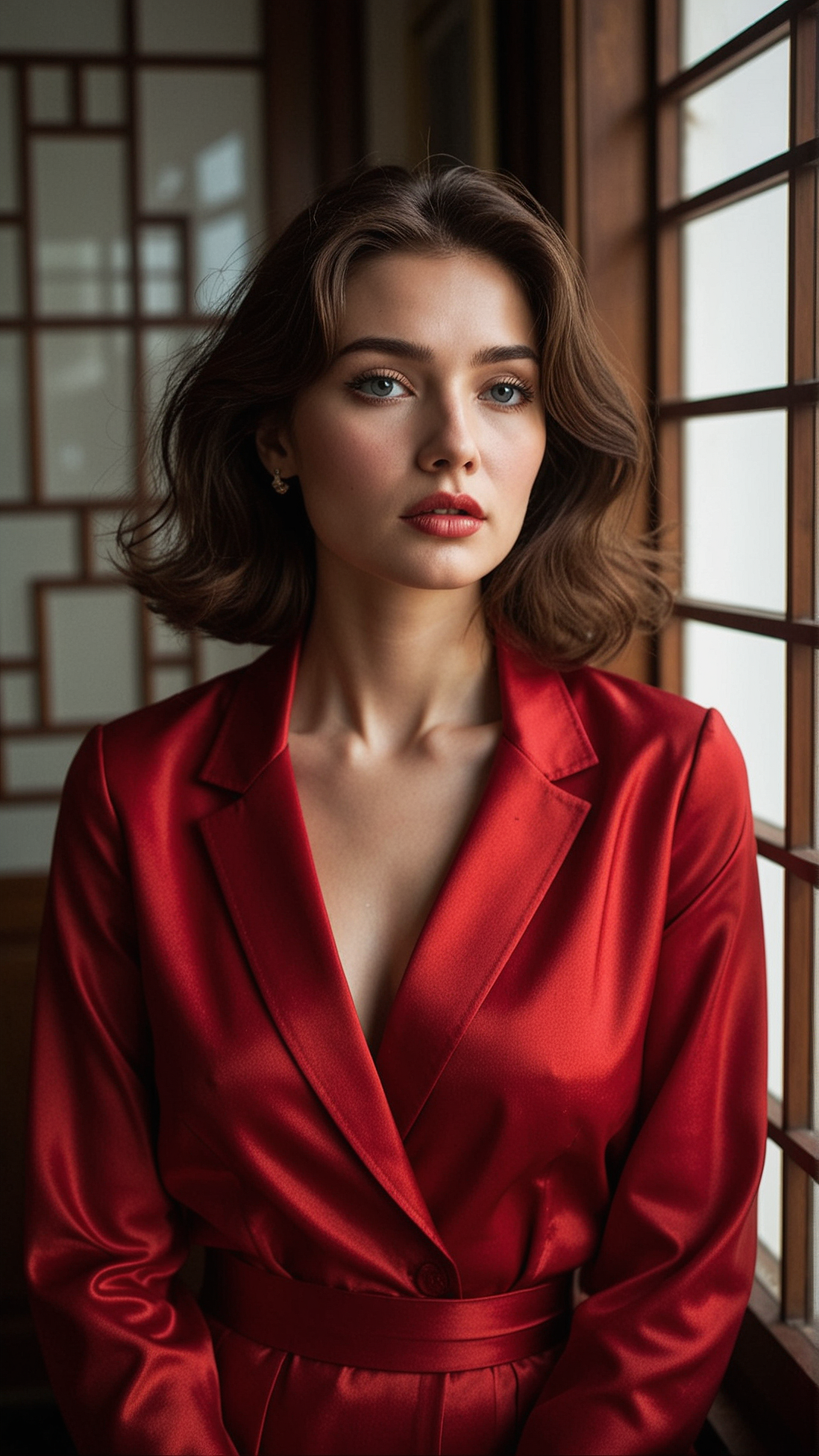
Where a Masterful Woman’s Gaze Develops More Than Film—It Develops Devotion. Enter a World of Glossy Hierarchies, Artistic Obsession, and the Sublime Euphoria of Belonging.
Imagine a life matte. Dull. Textureless. A world of rough cotton and unresolved yearning. Now, imagine a single card, thick as a promise, left on a plinth. An invitation. This is where your old self ends, and where The Developer’s Solution begins.
For our discerning reader—the woman of wealth, education, and deep passion—this is not merely a story. It is a blueprint. A sensual syllabus from the luminous Solange Vérité to her newest protégée, Cassandra. It is a tale of the most exquisite form of satin domination, where authority is worn like a second skin of liquid charcoal or pristine ivory. Here, a dominant femme of terrifying grace does not simply command; she nurtures, she unveils, she mesmerises. She gathers a devoted collective—her Satin Lovers—into a glossy orbit where every touch, every whispered direction, is an act of profound care.
Follow Cassandra’s transformation from a creator of empty beauty to a Chronicler of devotion. Witness her education under masters of light: the Newtonian drama of power, the Turbevillian poetry of soft decay, the Von Unwerth playfulness of synthetic gleam. Each lesson is a step deeper into a world where healthy, wealthy, educated, and confident living is the baseline, and glossy attire—the whisper of satin, the command of leather, the bold statement of PVC—is the uniform of a chosen sisterhood.
This is a satin lesbian fantasy rendered in high art. It is about the ache of finding your place, the thrill of a masterful will focusing on you, and the sublime euphoria that floods your being when you finally surrender to a purpose greater than yourself. It is about the generous offering of one’s whole self—talent, loyalty, beauty—and the profound, blissful security that floods in return.
If you have ever longed for a world where a powerful woman’s care is absolute, her taste impeccable, and her desire to claim you is an honour, your story awaits. Turn the page. Let the development begin.
Chapter 1: The Matte Existence
The silence in the gallery was a physical presence, thick and absorbent, like the uncoated paper of her limited-edition catalogues. Cassandra Lowe stood in the centre of her own creation, a monument to precision, and felt nothing.
Her exhibition, Surface Tensions, was a triumph of technical prowess. Every image was a study in flawless focus, the colour calibration so perfect it felt surgical. A diptych of rain-slicked city streets, the blacks inky and depthless. A triptych of botanical specimens, each vein in each leaf rendered with microscopic clarity. The walls were a stark, blinding white, the frames slender and gunmetal grey. It was clean. It was intelligent. It was, as one critic had kindly phrased it, “emotionally austere.”
Cass, at thirty-two, wore her uniform of artistic seriousness: a black cotton turtleneck, black wool trousers, flat leather shoes that made no sound on the polished concrete. The fabric was soft, but it felt like a sheath of dust. She was the curator of emptiness, and tonight, the hollow centre of her own show.
A murmur of cultured voices ebbed and flowed around the canapés and champagne. Her agent, Leo, was beaming, shaking hands. A sale, to a corporate collection. Another, to a private buyer in Zurich. Success had a texture, she supposed. It felt like the dry, non-slip backing of a museum mount.
Then, a shift in the atmosphere. A subtle cooling, a focusing of light. Cass turned.
A woman had entered, not through the main throng, but from a shadowed archway as if she had simply materialised from the negative space Cass had failed to photograph. She was perhaps fifty, but time seemed to have polished rather than diminished her. Her hair was a sweep of silver-gold, severe and perfect. And her dress—it was the thing that arrested Cass’s breath.
It was a column of ivory satin, cut with architectural precision. It wasn’t shiny; it was luminous. It drank the gallery’s sterile light and gave it back as a soft, internal glow, outlining a form that was both powerful and supremely elegant. The woman moved with a slow, deliberate grace, pausing before each photograph not with casual interest, but with a penetrating, analytical gaze. She didn’t smile. She assessed.
Cass felt a jolt, a visceral reaction that had nothing to do with art criticism. It was a pang of acute, desperate longing. For what? For that authority? For that calm? For the way the satin whispered of a world where things were not matte and absorbent, but reflective, definitive, real.
The woman completed her circuit, stopping finally before the largest piece, Untitled #7, a study of fractured ice on dark water. She stood there for a long minute. Cass, rooted to the spot, watched the subtle play of light on the dress’s surface, a tiny universe of sheen in a flatland of grey.
Then, without glancing around, the woman reached into a small clutch of the same glowing satin. She withdrew not a business card, but a single rectangle of cardstock. It was thick, impossibly so. With a gesture that was both dismissive and utterly intentional, she placed it on the plain white plinth beneath the photograph. She turned and left, her exit as silent and seamless as her entrance.
The gallery’s noise rushed back in, a wave of bland congratulations. Leo was at her side. “Did you see? That was Solange Vérité. No one knows much about her, but her collection… legendary. She never comes to openings.”
Cass didn’t hear him. She was already moving, drawn across the room as if by a taut wire. The card sat alone on the plinth, a stark foreign object. She picked it up.
The weight was startling. The texture was smooth, but with a dense, creamy grain beneath her fingertips—like the skin of a rare fruit. It was the colour of heavy cream. There was no logo, no embossed name. Just an address, printed in a severe, beautiful typeface. And beneath it, four words:
Your developer awaits.
A shiver traced Cass’s spine, a sensation so acute it was almost painful. Developer. A chemical agent that reveals the latent image. A person who cultivates talent.
She looked back at her perfect, empty photographs. She looked at the spot where the woman in satin had stood, where the air still seemed to vibrate with a different frequency. In her hand, the card pulsed with a silent, potent promise.
That night, in her minimalist apartment—all pale wood and linen, a study in tasteful beige—the loneliness didn’t just return; it crashed over her. It had weight and texture. It was the scratch of the wool blanket on her sofa, the flat, dead surface of her screen, the echoing silence after she turned off the intellectually stimulating podcast. She ran a finger over the card’s edge, again and again. She typed the address into her laptop.
The search returned little. An industrial district by the river. A converted warehouse listed under a holding company with no website. A few cryptic forum mentions from the art world’s shadowy edges: The Lumière Atelier… a private salon… you don’t find it, it finds you… the women there… they gleam.
One blurred, illicit photo, taken from a distance, showed a figure in a high-gloss black coat entering a doorway. The figure was unmistakably feminine, her posture one of unassailable command. The coat shone under a streetlamp like a strip of midnight river.
Cass closed her laptop. The silence in her apartment was now deafening, a matte wall pressing in on her from all sides. She held the card to her chest. The profound, aching emptiness she had carried for years, the hole her perfect technique could never fill, had suddenly been given a shape. A destination.
Your developer awaits.
She knew, with a certainty that felt like the first true exposure of her life, that she would go. The matte existence was over.
Chapter 2: The Threshold of Gloss
The address led Cass to a forgotten wharf district, where the air tasted of old river water and potential. The warehouse was a monolithic slab of weathered brick, but its huge, industrial door was newly painted a deep, glossy black. It reflected the overcast sky like a pool of oil.
Her knuckles, poised to knock, felt absurd. There was no bell, no intercom. Just the imposing sheen. Before she could decide, the door swung inward silently.
The woman who stood there was younger than Cass, perhaps late twenties. She wore a minimalist apron of black PVC over a simple, sleeveless silk slip the colour of a bruise. Her dark hair was cut in a severe bob, her expression not unfriendly, but intensely focused. Cass’s eyes were drawn to the apron’s surface—it caught the diffuse daylight and threw it back in a hard, clean highlight.
“Cassandra Lowe,” the woman said. It wasn’t a question. Her voice was low, matter-of-fact. “I am Lyra. Come in. She is working.”
Lyra turned, the PVC whispering against itself, and Cass followed, stepping over the threshold into another world.
The shock was immediate and total. The space was vast, a cathedral dedicated to light and surface. The floor was polished concrete, but sealed to a high-gloss finish that mirrored the soaring steel girders above. One entire wall was glass, overlooking the slow-moving river, but it was the opposite wall that commanded attention: a seamless, curved sweep of white lacquer, reflecting and softening the grey daylight into a pervasive, glowing ambience. The air was warm, carrying a subtle, expensive scent—ozone, like after a storm, layered with night-blooming jasmine.
And it was quiet. Not empty quiet, but a pregnant quiet, the hum of hidden technology and held breath.
Lyra led her across the open space towards a more defined area where lights on tall stands stood like silent sentinels. There, in a pool of artificial daylight so bright it seemed sculpted from the air itself, was the scene.
A woman lay arched over a low, backless chaise upholstered in patent leather so black it looked liquid. She was dressed in a corset of the same material, laced tightly, its glossy surface carving her torso into an impossible, elegant hourglass. Her legs, sheathed in stockings with a fine, dark sheen, stretched out behind her. Her face was turned away, a cascade of auburn hair obscuring her features. This was Eva. Cass knew it with a certainty that vibrated in her bones.
And standing before her, a vintage Hasselblad raised to her eye, was the woman from the gallery. Solange Vérité.
She was dressed differently now: wide-legged trousers in a heavy, charcoal satin that moved like smoke, and a simple black turtleneck of a fine, matte jersey. The contrast was intentional, Cass sensed. The authority was in the cut, the drape, the absolute stillness of her posture. She was not just taking a photograph; she was conducting a séance.
“Hold,” Solange’s voice cut the silence. It was not loud, but it carried the weight of a judge’s gavel. “The shadow on the neckline is a fraction too soft. Kira.”
From behind a light stand, another woman emerged. She wore tailored trousers and a crisp, man-style shirt, but the shirt was made of ivory satin, and it gleamed as she moved. She adjusted a small flag with a technician’s precision, her eyes never leaving the model. “Harder now,” she murmured, and the light on Eva’s back sharpened, defining each vertebra like a string of pearls under the patent leather.
“Yes,” Solange said, a note of deep satisfaction in the syllable. She did not thank Kira. The correction was simply absorbed into the perfection of the moment, its own reward.
Cass stood frozen, Lyra a silent, glossy presence beside her. She was witnessing a language she didn’t know but felt in her marrow. This was the Newtonian lesson: power, narrative, control. But it was something more, something intimate. Solange lowered the camera and approached the chaise. She didn’t speak to Eva. Instead, she reached out and with two fingers, touched the small of Eva’s back, just above the corset’s edge. It was a adjustment, a micrometer of rotation. Her touch was not gentle, but it was specific. It was the touch of a sculptor on clay, a gardener on a prized bloom.
Eva released a breath Cass hadn’t realised she was holding, a sigh that seemed to melt her deeper into the pose. The submission was total, and it was ecstatic. It was in the line of her spine, the utter relaxation of her offered neck. She was not being used; she was being utilised, and in that, she was becoming art.
Solange returned to the camera. The click of the shutter was a definitive, metallic sound in the hushed space. Click. Click. The rhythm was hypnotic.
Cass’s heart was pounding. She felt overdressed in her cotton and wool, a dull, absorbent blot in this world of reflection. She felt underdressed in her soul, exposed and yearning. The glossy surfaces around her—the floor, the lacquer wall, the patent leather, the satin shirt—all seemed to vibrate with a shared frequency, a secret she was desperate to learn.
The sequence ended. Solange lowered the camera and finally turned her head. Her gaze found Cass, and it was like being pinned by a spotlight. Those eyes were a pale, cool grey, and they held no welcome, only assessment. They travelled from Cass’s sensible shoes to her troubled face, reading the awe, the fear, the hunger.
For a long moment, the only sound was the distant hum of the city through the glass. Eva remained on the chaise, a beautiful, glossy offering. Lyra and Kira were statues, awaiting the next command.
Solange’s lips did not smile. They simply parted.
“You see the shadow,” she said, her voice weaving through the quiet, landing in Cass’s chest with the weight of truth. “But can you bear the light that casts it?”
The question hung in the perfumed, glossy air. It wasn’t an invitation. It was a threshold. And Cass, standing in her matte existence, already knew her answer was written in the desperate, thrilling beat of her own heart.
Chapter 3: The First Development – Newtonian Will
The invitation arrived not by post, but as a notification on Cass’s phone the next morning. A calendar event, stark and unadorned: ‘Observation. 10am. The Atelier. Prepare.’ No signature. No option to decline. The digital text seemed to gleam with the same authority as the cardstock it had replaced.
Cass arrived at nine-fifty, her heart a trapped bird against her ribs. She wore the same black uniform, but today it felt like a confession of inadequacy. Lyra, again in her PVC apron, this time over a shell-pink satin camisole, opened the door. Her eyes flickered over Cass’s attire, a silent notation. “She is in the library. Follow me.”
The library was not what Cass expected. It was not a room of dusty shelves, but a chamber of controlled light and texture. One wall was floor-to-ceiling glass overlooking the river, filtered through slatted blinds that cast sharp, parallel shadows across the floor. The other walls were lined not with books, but with shallow, backlit alcoves displaying pristine, first-edition photography monographs. In the centre of the room stood a large table of polished black granite. And behind it, silhouetted against the window, sat Solange.
She was reading, a pair of minimalist reading glasses perched on her nose. She wore a tailored blazer in a deep burgundy leather, soft and supple, over a simple turtleneck of charcoal grey. The leather drank the light, a pool of rich, dark gloss. She did not look up as they entered.
“Sit, Cassandra,” Solange said, her voice a low hum that resonated in the quiet space. She closed the book—Cass caught the title: Helmut Newton: World Without Men—and removed her glasses. Her gaze was a physical weight. “You witnessed a demonstration. Now begins your education. Your first study is Newton. Not the technique alone. The will.”
She slid a thick, cream-coloured folder across the granite. “Inside, you will find a list of texts. Biographies, critiques. Your task is to create a mood board. Not of images, but of principles. Power. Narrative. The architecture of control. The staged reality where the woman is not an object, but an event.”
Cass opened the folder. The paper was heavy, smooth. The list was meticulous, typed. Below it were printed stills from Newton’s most iconic shoots: the women in power suits on deserted streets, the languid nudes in opulent interiors, the stark, confrontational glamour.
“You will work here,” Solange continued, gesturing to a sleek laptop at the other end of the table. “The resources are on the server. You have until four o’clock.” She stood, the leather of her blazer whispering. “Observe everything. The work is not only on the screen.”
With that, she left, her footsteps silent on the gloss-sealed floor. Lyra remained, moving to a discreet corner where a rail of garments stood shrouded in clear plastic. She began to inspect them, her fingers, clad in thin cotton gloves, tracing the seams of a dress made entirely of interlinked chrome rings.
Cass dove into the work, grateful for the familiar language of research. She read about Newton’s obsession with lighting that sculpted, with locations that told stories of isolation and privilege. She learned about his commanding presence on set, his exacting demands. But as the hours passed, her attention began to drift from the screen to the life of the Atelier unfolding around her.
Kira entered, carrying a complex-looking light meter. She was dressed in wide-legged trousers of navy satin that flowed like water, and a fitted white t-shirt of a technical, moisture-wicking fabric. She nodded to Lyra, a silent communication passing between them. They spoke in low tones about the afternoon’s schedule—a test for a new strobe system.
Eva appeared, dressed in soft, loose-fitting trousers and a cashmere hoodie, her hair damp from a shower. She carried a tray with a pot of tea and two cups. She poured one for Lyra, placing it beside her with a soft touch to her shoulder. Then she brought the second cup to Cass.
“Solange thought you might need this,” Eva said, her voice gentle. “Ginger and lemongrass. For focus.” Up close, Cass could see the faint, perfect lines from yesterday’s corset had vanished from her skin. Her eyes were calm, deeply rested.
“Thank you,” Cass murmured, taking the cup. The porcelain was thin, delicate. The tea was fragrant, revitalising.
“She’s very particular about hydration and alkalinity,” Eva said, a note of pride in her voice. “The body is the first instrument. It must be perfectly tuned.” She smiled, a warm, open thing, and returned to Lyra’s side, leaning against the garment rail as they discussed the drape of a bolt of metallic silk.
Cass watched them. The dynamic was unmistakable. Lyra’s focus was technical, precise; Eva’s was nurturing, supportive. Kira’s was analytical. They orbited each other with an effortless, wordless synergy. And they were all, unmistakably, orbiting Solange.
The afternoon’s shoot was a continuation of the Newtonian theme. Solange returned, having changed into a jumpsuit of matte black jersey, its only gloss the zip that ran from neck to navel. Eva was dressed in a man’s tailored tuxedo, but the jacket was open over a torso entirely wrapped in clear, shiny PVC, like a second skin. The contrast was brutal, beautiful.
Cass observed from a designated stool, her mood board forgotten. She watched Solange direct. A hand on Eva’s chin, tilting it up to catch a specific angle of light. A murmured command—“Think of a secret you would kill for.”—that transformed Eva’s expression from vacancy to smouldering, dangerous knowledge. She watched Kira adjust a light, her satin trousers catching the strobe’s flash with a brief, glorious blaze. She watched Lyra dart in between takes to pat a minuscule bead of sweat from Eva’s temple with a cloth so fine it seemed like mist.
A moment crystallised. Eva, holding a difficult, twisted pose, began to tremble from the strain. Solange saw it. She didn’t call for a break. She walked over, placed a firm, steadying hand on the small of Eva’s back, right over the PVC. “Breathe into my hand,” she instructed, her voice low and direct. “The strength is there. Let it out.”
Eva closed her eyes, took a deep breath, and the trembling ceased. Her body settled into the pose, stronger, more defiant than before. Solange’s hand remained for a second longer, a brand of ownership and support, then withdrew. The look Eva gave her as she opened her eyes was one of pure, radiant gratitude. It was the look of a plant turning to the sun.
This, Cass realised with a jolt that went through her whole being, was the Newtonian will. It was not tyranny. It was clarity. It was the removal of all ambiguity, all friction. It was a system where every element—the light, the fabric, the model, the technician—was aligned towards a single, glorious purpose. The hierarchy wasn’t oppressive; it was liberating. It freed you from the paralysis of choice, the anxiety of your own limitations. To be directed by such a will was to be perfected.
At four o’clock precisely, Solange ended the shoot. She came to stand behind Cass, looking over her shoulder at the mood board on the screen. It was a collage of words and images: POWER. NARRATIVE. SHADOW. STAGE. CONTROL.
“Adequate,” Solange said. “You have identified the bones. Next, you must learn the flesh. Tomorrow, we study Turbeville. The whisper after the shout.” She placed a single, cool finger on Cass’s shoulder, just above the collar of her cotton shirt. The touch was electric. “Wear something without texture tomorrow. Something that does not fight the light.”
Cass left the Atelier as the late afternoon sun gilded the river. The world outside seemed unbearably loud, chaotic, rough. The pavement was gritty. The voices from a nearby pub were slurred and fuzzy. She felt like she was moving through glue.
Back in her apartment, the silence was no longer peaceful. It was empty. She stripped off her cotton turtleneck and wool trousers, letting them fall to the floor in a dull heap. She stood in her simple underwear, feeling the cool air on her skin. Closing her eyes, she did not see Newton’ stark contrasts. She saw the liquid flow of Kira’s satin trousers. She felt the memory of Solange’s finger on her shoulder.
That night, she dreamed not of images, but of sensations. The whisper of PVC. The cool, heavy slip of satin against her thighs. The firm, guiding pressure of a hand on her spine, telling her exactly where to be. She slept more deeply than she had in years, and woke with a single, coherent thought imprinted on her mind, clear as a developed photograph: she wanted to be worthy of the gloss.
Chapter 4: The Softening – Turbeville’s Whisper
The instruction for attire had been specific: ‘Wear something without texture. Something that does not fight the light.’ Cass had spent an hour before her wardrobe, a silent panic rising. Everything she owned fought the light. It absorbed it, deadened it. Finally, in the back, she found a forgotten silk shell, a gift from an ex who had called it ‘too simple.’ It was the colour of old cream, its surface a dull, matte weave. It would have to do. She paired it with her plain black trousers, feeling like a scribble in the margin of a sonnet.
The Atelier, when she arrived, was transformed. The vast space felt hushed, as if holding its breath. The harsh, sculptural lights were gone. In their place, the enormous windows were uncovered, allowing the diffuse, pearly light of an overcast day to flood in. A fine, almost invisible scrim of muslin had been stretched across some of them, turning the world outside into a soft, grey dream.
In the centre of this new atmosphere stood a structure Cass hadn’t seen before: a free-standing, curved wall of distressed plaster, its surface cracked and beautifully ruined. Before it, lying on a low divan draped in layers of grey chiffon, was Mona. She was not the poised technician from before, but a vision of languid dissolution. She wore a slip of pearl-grey satin, so thin it seemed to melt into her skin. Over it, Lyra was carefully arranging a second layer of chiffon, the fabric floating down to settle in hazy folds.
Solange stood beside a wooden tripod, upon which sat a beautiful, antique-looking medium-format camera. She was dressed not in leather or sharp satin, but in a long, duster coat of heavy, eggshell-coloured silk, worn open over a simple linen shift. The silk had a soft, subdued gloss, like the inside of a shell. Her hair was loosely tied back. She looked, for the first time, approachable. And yet, her authority was, if anything, more profound—a quiet gravity that bent the very light around her.
“You are late by three minutes, Cassandra,” Solange said, not looking up as she loaded a roll of film into the camera with practised, reverent movements. “In Newton’s world, that would be an insult. In Turbeville’s, it is a disruption of the dream. Do not let it happen again.”
“I’m sorry,” Cass whispered, the words feeling too loud.
“Do not apologise. Observe.” Solange finally glanced at her, her grey eyes soft but unyielding. “Deborah Turbeville. She taught us that beauty is not always in strength, but in the memory of strength. In the echo. In the gentle decay.” She turned to Mona, who lay with her eyes closed, one arm draped over her forehead. “She finds the narrative in the private moment, the one never meant to be seen. The woman alone with her ghosts, her longings, her fatigue. It is a deeper intimacy than any staged passion.”
Solange bent over the camera’s viewfinder. “The light is our collaborator today. Not our tool. We follow it. We yield to it.” She released the shutter. The sound was a soft, cloth-softened click, utterly different from the metallic snap of the day before.
For an hour, Cass watched a different kind of alchemy. Solange directed not with commands, but with murmured suggestions. “Let your thoughts drift to that summer house by the sea, the one that smelled of damp salt and roses.” “Feel the weight of the chiffon like the weight of a forgotten afternoon.” Mona would sigh, her body sinking deeper into the divan, her expression shifting into something unguarded, tenderly sad.
Lyra moved like a ghost, adjusting a fold of fabric, spritzing water from a fine mist bottle to make the chiffon cling. Kira was present, but her role was minimal—occasionally using a large, white reflector to bounce the dying light from the window onto Mona’s cheekbone.
The air grew thick with a shared, melancholic trance. Cass found herself leaning forward on her stool, her own breath slowing to match Mona’s. She wasn’t watching a photo shoot; she was witnessing a soul being gently unfolded. The glossy surfaces were still there—the pearl satin of the slip, the occasional gleam on Solange’s silk coat—but they were muted, secrets glimpsed through a veil.
“Cassandra.” Solange’s voice pulled her from the reverie. “Come here.”
Cass approached, her heart thudding. Solange straightened and gestured to the camera. “This is a Hasselblad 500C. It sees the world in squares. It is slower. It requires intention. You will take the next frame.”
A jolt of terror and exhilaration shot through her. “I… I don’t know—”
“You will look through the viewfinder,” Solange interrupted, her tone leaving no room for protest. “You will see Mona. You will see the light on the crack in the plaster behind her. You will see the story of a woman dissolving into a memory. And then you will press the release.” She stepped aside.
Cass moved behind the camera. The world narrowed to a square of ground glass. It was upside down, disorienting, yet profoundly beautiful. Mona was a smudge of grey and cream, a study in soft edges. The cracked wall looked like a map of a forgotten continent. Through the lens, the intimacy was overwhelming. She saw the faint pulse in Mona’s throat, the almost imperceptible tremble of her lower lip. She was not just seeing vulnerability; she was holding it in her hands.
“She is thinking of a love letter she never sent,” Solange whispered, her voice close to Cass’s ear. Her breath was warm, carrying the scent of jasmine tea. “She is thinking of the scent of the paper. The weight of the unsaid words. Can you feel it?”
Cass could. A pressure built behind her own eyes, a sudden, shocking surge of empathy. She saw not Mona, but herself—years of unsaid words, unmet longings, a life of crisp focus that had missed the point entirely. A single, hot tear escaped, tracking down her cheek. She didn’t move to wipe it away.
“Now,” Solange murmured. “While the feeling is raw. While the light is confessional.”
Cass pressed the shutter release. The soft click felt like a lock turning in her own heart.
She stepped back, blinking, the real world rushing back in colour and noise. She was mortified, exposed. Solange was watching her, a curious, assessing look on her face. Lyra and Kira had paused in their tasks, their gazes gentle.
Without a word, Solange reached into the pocket of her silk coat and pulled out a handkerchief. It was not cotton. It was a small square of the finest, palest grey silk, edged with hand-rolled hemstitching. She offered it to Cass.
Cass took it, the fabric cool and impossibly smooth against her skin. She dabbed at her cheek, the scent of Solange’s perfume rising from the silk—a mix of orris root and clean skin.
“Good,” Solange said, taking the handkerchief back, her fingers brushing Cass’s. “Turbeville’s work is a tear held in suspension. It is the confidence to show the crack, the flaw, the yearning. It is a different kind of strength. A wealth of feeling.” She looked at the camera, then back at Cass. “You have a sensitivity. You have been fighting it, armouring it with technique. That ends today.”
She turned to Lyra. “The session is complete. Prepare the darkroom. I will develop this roll myself.” Then, to Cass: “You will stay. You will watch the image emerge. You will see what your emotion has captured.”
As Lyra and Kira began to quietly break down the set, and Mona rose, stretching like a cat, Solange gathered the camera. She paused beside Cass. “The woman who fears softening fears life itself,” she said, her voice low. “The gloss is not a shield, Cassandra. It is the surface of a deep, still pool. To see your reflection in it, you must first be still. You must first be deep.”
She walked away, the silk of her coat whispering secrets. Cass stood in the soft, dying light, the echo of the shutter’s click still vibrating in her bones. The ache inside her had changed. It was no longer a sharp want for the hard gloss of power. It was a vast, hollow longing for the tenderness she had just witnessed—for the right to be that vulnerable, that seen, and to be held, unquestioningly, in the palm of a masterful, nurturing hand.
Chapter 5: The Synthetic Pulse – Von Unwerth’s Play
The tear-stain on Cass’s soul from the Turbeville lesson had not dried; it had crystallised, a tiny, perfect prism catching new light. For two days, she moved through her old life in a daze, the world rendered in flat, unconvincing colours. The soft melancholy had been a gift, but it left her untethered, yearning for a hand to guide her back to solid ground. The summons, when it came, was a shock to the system: a single line text. ‘Tomorrow. 2pm. Wear something that makes noise when you move. – S.’
The instruction was baffling. Noise? All her clothes were silent, designed for invisibility. Panic sent her to a boutique she normally passed with averted eyes, a place of intimidating minimalism. A young assistant with a severe blonde bob took one look at her and, without a word, brought out a single item: a skirt. It was A-line, cut from a fabric that was not quite leather, not quite vinyl. A deep, petrol-blue PVC. It felt cool and weighty in her hands. When she walked in the fitting room, it emitted a soft, rhythmic swish-swish. A sound. She bought it, pairing it with a simple black silk shell, her heart pounding with a strange, illicit thrill.
When she arrived at the Atelier, the very air had changed. The hushed, chapel-like stillness was gone, replaced by a low, visceral throb of synth-wave music. The vast space was transformed into a neon-drenched dreamscape. Kira had rigged geometric lines of pulsating LED strips along the walls and floor, casting everything in pools of electric magenta, cyan, and acid yellow. The usual pristine white surfaces were covered with rolls of reflective Mylar, creating a disorienting, funhouse infinity.
And in the centre of this electric chaos stood Solange, a pillar of controlled glee. She wore a cropped, boxy jacket of black latex, zipped to her throat, over tight, high-waisted trousers of the same material. The latex captured and shattered the neon light into a thousand liquid highlights. Her hair was pulled into a high, severe ponytail. She looked like the architect of a very beautiful riot.
“Cassandra!” she called out, her voice cutting through the music with playful command. “You understood the assignment. Good. Now, shed the last century. Today, we study Ellen von Unwerth. The laugh in the dark. The wink in the dominatrix’s boot. The glorious, unapologetic play.”
As she spoke, two figures emerged from behind a screen of shimmering Mylar. Eva and Lyra. They were dressed identically, in outfits that made Cass’s breath catch. Hot pink PVC bodysuits, zip-fronted, with high necks and long sleeves, so tight they seemed poured onto their skin. Over these, they wore micro-mini skirts of metallic silver lamé that caught the strobe lights like disco balls. Their makeup was exaggerated—graphic liner, glossy pink lips. They looked like twins from a retro-futuristic fantasy, all synthetic sheen and defiant joy.
“Von Unwerth taught us that eroticism is not a solemn ritual,” Solange continued, picking up a digital camera with a motor drive. “It is a game. A chase. A shared secret that makes your eyes sparkle. The gloss here is not introspective; it is a declaration. It says ‘look at me, want me, try to catch me.’” She raised the camera. “Eva, Lyra. The balcony scene. But make it fun.”
What followed was a lesson in controlled abandon. Solange directed them into a series of playful, provocative tableaux. Eva, leaning against a railing of neon tubing, blowing a bubble with pink gum, while Lyra pretended to snatch it away. Lyra, chasing Eva around a column of light, their laughter genuine, ringing out over the synth beats. Then, a moment of stillness: Eva pinning Lyra gently against the Mylar, her hand on Lyra’s waist, their foreheads almost touching, sharing a smile that was both tender and conspiratorial. It was a satin lesbian fantasy, but rendered in PVC and neon—a satin sex story told with a generator hum and a giggle.
Cass watched, mesmerised. The hierarchy was still there—Solange’s direction was law—but its texture had changed. It was joyous, infectious. Kira danced between light stands, adjusting the colours with a grin. The dominant femme energy was no less potent for its playfulness; it was a current that electrified the entire room.
“Cassandra!” Solange’s voice broke her trance. She tossed a smaller, mirrorless camera to her. Cass fumbled but caught it. “Stop gawking. Participate. Your task: catch the giggle. The unscripted moment of pure, silly delight. The image that feels like a stolen kiss.”
Thrust into the pulse of it, Cass’s initial hesitation melted. She raised the camera, her fingers finding the controls by instinct. She saw Lyra whisper something in Eva’s ear that made her throw her head back and laugh, the neon cyan catching the column of her throat. Click. She saw Eva, during a break, take a sip of water and then playfully squirt a stream at Lyra from between her lips, the droplets sparkling on the hot pink PVC. Click. The images were alive, vibrating with a energy she had never captured before.
The climax of the session was a sequence Solange called “The Synthetic Capture.” Eva, pretending to be a runaway android, with Lyra as her pursuer. It ended with Lyra tackling Eva gently onto a crash mat covered in clear plastic, both of them a tangle of long limbs and glossy fabric, breathless with laughter. Cass moved in close, drawn by the raw, unfiltered joy on their faces. She framed the shot: Lyra was atop Eva, pinning her wrists, but she was smiling down at her, her expression one of adoring triumph. Eva looked up, not with surrender, but with invitation. It was a perfect, playful echo of satin domination, a power dynamic suffused with affection.
Cass took the photo. She knew, with a photographer’s certainty, that it was perfect.
She lowered the camera. The music faded to a low hum. The Collective lay in their glossy heap, breathing heavily, smiling. Solange walked over to Cass and held out her hand for the camera. She reviewed the images on the back screen, scrolling slowly. Her latex-clad fingers were precise on the controls.
She stopped at the final image, the “capture.” She studied it for a long moment, her expression unreadable. Then, a slow, genuine smile spread across her face. It transformed her, lighting her from within.
“Yes,” she said, the single word rich with approval. She looked from the image to Cass. “You see it now. The pulse. The life. The devotion that can exist in a moment of sheer, uncomplicated fun.” She handed the camera back. “This is health, Cassandra. Not just of the body, but of the spirit. The confidence to be silly, to be provocative, to be seen in your joy. It is a wealth beyond money.”
She clicked her fingers, a sharp, clean sound. Kira appeared as if from nowhere, holding a tray with two coupe glasses filled with pale, bubbling champagne. Solange took one and offered the other to Cass.
“A reward,” Solange said. “For learning to play.”
Cass took the glass. Their fingers brushed. The champagne was dry, crisp, and impossibly expensive. The bubbles burst on her tongue like tiny supernovas of euphoria. She drank, and the synthetic pulse of the last hour seemed to flow into her veins, warming her from the inside out. She was not just observing anymore. She was contributing. She was part of the beautiful, glossy game.
Solange watched her drink, then leaned in close. The scent of her, jasmine and ozone and the clean, rubbery smell of latex, enveloped Cass. “You have moved from shadow, to whisper, to pulse,” she murmured, her voice for Cass alone. “The next lesson is the most demanding. It is about the architecture of the self. Penn. Avedon. The classicists. Be ready.”
She stepped back, her gaze sweeping over her glittering, breathless Collective. “Session concluded. Clean up, my dears. Then, rest. You’ve earned your joy.”
As the others began to move, Cass stood holding her empty glass, the taste of champagne and belonging on her lips. The sublime euphoria was not just in the bubbles, or the neon, or the perfect shot. It was in the certainty that she was, stitch by stitch, being woven into the fabric of this glossy, laughing, devoted world. She had caught the giggle. And in doing so, she had been caught.
Chapter 6: The Architecture of Self – Penn & Avedon
The summons came not as a text, but as a parcel. Delivered by a discreet courier to Cass’s apartment, it was a box of heavy, cream cardstock, tied with a black silk ribbon. Inside, on a bed of tissue paper the colour of bone, lay a single garment: a kimono-style robe. It was not cotton or terry cloth. It was constructed from a heavy, duchesse satin in a profound charcoal grey, so dense it seemed to swallow the light even as its surface held a muted, liquid gleam. A note, handwritten in sharp, black ink on a smaller card, read: ‘Wear this. Nothing else. 9am. The White Room. – S.’
The instruction was absolute. The intimacy of it stole Cass’s breath. This was not about observing or assisting. This was about being prepared. She bathed with a new, ritualistic care, using the expensive, scent-free products that now filled her bathroom—a quiet delivery from the Atelier she had not questioned. She dried her skin until it tingled. Then, she slipped her arms into the robe. The satin was cool and heavy, a shocking, sensual weight against her bare skin. It whispered as she moved, a soft, secret sound. Tying the belt, she looked in the mirror. The woman who looked back was not the photographer in black cotton. She was a neophyte, swathed in a cocoon of sleek, dark potential.
Lyra met her at the Atelier’s main door, her usual PVC apron replaced by a simple tunic of raw, white silk. She nodded, her eyes approving. “This way. She is waiting.”
She led Cass not to the main studio, but to a part of the warehouse she had never seen. A corridor ended in a door, which Lyra opened onto a space of breathtaking austerity.
The White Room. It was exactly that. Floors, walls, ceiling—all a seamless, matte white, so pure it felt like stepping into the inside of a cloud or the page of a blank book. The only furniture was a single, backless stool of polished aluminium, placed in the exact centre of the room under a vast, circular softbox suspended from the ceiling. The light it emitted was shadowless, even, and utterly revealing. It was a light that forgave nothing. A light for truth.
Solange stood beside a large-format camera on a sturdy tripod. She was dressed with a severity that was itself a kind of art: tailored trousers and a crisp shirt, both in a stark, optical white poplin. The only contrast was her hair, her silver-gold sweep, and her eyes, which looked like chips of flint in the brilliant space. She was the architect in her sterile studio.
“Cassandra,” she said, her voice calm, measured. “You have learned to see shadow, whisper, and pulse. Now, you must learn to see structure. The bones beneath the skin. Irving Penn worked in such a room. He reduced the world to form, to essence. He removed everything—context, clutter, story—until only the thing itself remained. Richard Avedon used a white sweep to isolate the soul, to force a confrontation between the subject and the lens. That is your lesson today. You are the subject.”
Cass’s throat tightened. She clutched the robe tighter around her.
“The robe is a barrier,” Solange continued, walking a slow circle around her. “A final layer of your own making. Lyra.”
At her name, Lyra moved forward. She carried a small tray holding a pair of fabric shears with blades that caught the white light. “It’s time, Cassandra,” Lyra said, her voice gentle but firm. “To see the architecture, we must first remove the scaffolding.”
Cass stood frozen. This was a threshold more profound than any door. It was the surrender of her last, thin veil. She looked at Solange, whose gaze was unwavering, not demanding, but expectant. It was the look of a surgeon before a necessary operation, a gardener before a pruning. It was care in its most unflinching form.
With trembling fingers, Cass untied the satin belt. She let the heavy robe slide from her shoulders. It pooled at her feet in a puddle of dark, glossy liquid. She stood in the centre of the white void, wearing only her simple, nude underwear, exposed to the merciless, perfect light. A wave of vulnerability so acute it was vertigo washed over her. She wanted to cover herself.
“Do not,” Solange commanded, the word soft but absolute. “Look at yourself. Not with shame. With a photographer’s eye. What is the line of your shoulder? The angle of your jaw? The story held in the tension of your hands? This is your raw material. This is the clay.”
Lyra retrieved the robe and retreated to the perimeter. Kira entered then, dressed in a lab coat of white satin, carrying a case. She opened it to reveal an array of brushes and palettes. “For the canvas,” she said simply.
What followed was not a photoshoot. It was an excavation. Solange directed Cass to sit on the aluminium stool. Its surface was cold. “Penn would spend hours,” Solange said, moving behind the large-format camera and disappearing under a black cloth. “Waiting for the moment when the subject’s performed self fell away. When they forgot to be a banker, a model, a socialite. When they simply were. That is what we seek.”
The click of the shutter was a loud, mechanical clunk in the silent room. Cass flinched.
“You are holding your breath,” Solange’s voice came from under the cloth. “You are thinking, ‘I am being photographed.’ You are wrong. You are being seen. Breathe. Out. Let go of the thought.”
Minutes passed. The light was everywhere and nowhere. Cass felt her social skin, the persona of the competent artist, begin to itch and peel under the scrutiny. She felt foolish, then angry, then desperately sad. The emotions flickered across her face, uncontrolled. The camera clunked, capturing each one.
Then, Kira stepped forward. With a brush so soft it felt like a breath, she dusted a faint, shimmering highlighter along Cass’s collarbones. “To catch the light,” she murmured. “To define the structure.” Her touch was clinical, reverent. Mona entered, holding a glass of water with a straw. She held it to Cass’s lips without a word. The water was cool, infused with cucumber and mint. It was an act of sustenance, of nurture within the crucible.
Solange emerged from the black cloth. She approached Cass, stopping just before her. She did not touch her. She simply looked, her grey eyes scanning every detail.
“You are fighting it,” Solange said. “You are a collection of defences. The slouch that says ‘don’t look at me.’ The clenched jaw that holds back words. The fear in your eyes that is older than this room. Avedon would wait for the crack. For the instant the mask slips and the human being looks out, terrified and glorious.” She leaned in, her voice dropping to a hypnotic murmur. “Let me see her, Cassandra. Let me see the woman who cried for a stranger’s lost love letter. Let me see the woman who caught the giggle. She is in there. She is beautiful. And she is tired of hiding.”
Something broke. A dam deep inside Cass, built over a lifetime of being ‘fine,’ of being ‘capable,’ of being alone. A sob, raw and ugly, ripped from her throat. The tears came, not the single elegant tear of the Turbeville lesson, but a hot, messy flood of release. She didn’t cover her face. She let them fall, her body shaking on the cold stool.
Solange did not comfort her. She returned to the camera. Clunk. Clunk. She documented the breakdown with the same impartial precision as she had documented the stillness.
And then, as suddenly as it came, the storm passed. The tears stopped. The shaking ceased. Cass sat, spent, hollowed out. And in the hollow, a strange, quiet warmth began to bloom. She felt… light. Clean. Stripped bare not just of clothing, but of pretense. The white room no longer felt hostile. It felt like a sanctuary. The revealing light felt like absolution.
Solange took one final photograph. Then she straightened, a slow, satisfied smile touching her lips. “There,” she said. “Now we have the foundation. Now we can build.”
She nodded to Lyra, who stepped forward again. This time, she did not bring the shears. She brought a garment bag. Unzipping it, she revealed a simple, column dress. It was made of a fabric that was neither satin nor leather, but a hybrid: a matte-backed crepe with a surface of microscopic, glossy pellets. It was the colour of a stormy sky, and it held the light in a thousand tiny, discrete points. It was sophisticated, confident, utterly simple.
“For you,” Lyra said. “From her.”
With tender, efficient hands, Lyra and Mona helped Cass into the dress. It fitted as if it had been made for her body—which, Cass realised with another shock, it likely had been. The fabric was cool, substantial. It draped with a quiet authority she had never felt in her own clothes. They handed her a pair of simple, high-heeled sandals.
Cass stood. She walked a few steps on the white floor. The click of the heels was a definitive, new sound. She looked at Solange.
“Penn and Avedon did not just take portraits,” Solange said, coming to stand before her. She reached out and, with a fingertip, brushed a stray, damp hair from Cass’s temple. The touch was electric, a brand of possession. “They conferred a kind of immortality. They said, ‘This person, in this moment, in their truth, matters.’ That is what I have done for you today. I have seen your truth. And I have found it worthy.”
She gestured to the camera. “The images will be developed. They are not for a gallery. They are for the Archive. A record of your becoming. The moment the matte existence ended, and the gloss of your true self was revealed.” Her eyes held Cass’s, a magnetic, mesmerizing force. “You have passed through the light. You have been developed. The question now is not if you can bear it. The question is… what will you build with it?”
Cass looked down at the dress, at its subtle, powerful gleam. She looked at the white room, now a cradle rather than a crucible. She looked at Solange, her architect, her developer. The euphoria that rose in her was not the bubbly thrill of champagne. It was deeper, calmer, tectonic. It was the sublime certainty of being placed. Of having her chaotic self deconstructed and returned to her, not as a puzzle, but as a blueprint. A design for a life of clarity, confidence, and profound, grateful devotion.
She had given herself to the light. And the light had given her back, remade.
Chapter 7: The Darkroom Revelation
The door to the darkroom was unlike any other in the Atelier—heavy, felt-lined, sealing out the world with an audible thump of finality. Lyra led Cass to it, her hand a brief, guiding pressure on the small of Cass’s back, right where the new dress’s peculiar, pebbled gloss met her skin. “She’s waiting for you,” Lyra murmured, her voice hushed in the corridor’s silence. “Remember, it’s a sacred space. Breathe with the chemicals.”
Cass pushed the door open. The world vanished into a blood-red twilight.
The room was small, warm, humid. The air was thick with a tangy, metallic perfume—acetic acid, fixer, the ghost of silver halide. A single safelight, coated in a deep ruby gel, cast a dim, womb-like glow over everything. In its light, Solange was a silhouette of profound concentration. She stood before three deep, rectangular trays arranged on a stainless-steel bench, her sleeves rolled up, her hands sheathed in thin, black nitrile gloves that gleamed dully. She wore a simple smock of dark, heavy cotton, but beneath it, Cass caught the sheen of a slip in cobalt satin. Even here, in this alchemical cave, the gloss persisted, a secret against the skin.
“Close the door,” Solange said, not turning. Her voice was low, absorbed. “Come stand here. Do not touch anything. Your education is now in the development of meaning.”
Cass moved to her side, the red light rendering her new dress a black, shapeless mass. On the wall above the trays, clipped to a line with wooden pegs, hung the long, dripping negatives from the White Room session. They were strips of translucent grey, the images reversed, her own face a pale, ghostly smudge among them.
Solange worked with the reverent precision of a priestess. She lifted a sheet of thick, fibre-based paper from a sealed box. Using a timer with a soft, ticking heartbeat, she submerged it in the first tray—the developer. She agitated the fluid with a gentle, rocking motion. “This is where the latent becomes manifest,” she whispered. “Where potential is realised. It requires patience. It requires faith.”
Cass watched, mesmerised. For minutes, nothing. Then, like a memory rising from deep water, an image began to bloom on the blank paper. Not the White Room portraits first. Solange had arranged a contact sheet.
The first image to emerge was Cass’s own Newtonian mood board—a collage of stark shadows and powerful lines she’d created days ago. In the red glow, it looked like a blueprint for a fortress.
“The will,” Solange intoned. “The architecture of control. The first lesson.”
The next image clarified: the haunting, soft-focus shot Cass had taken of Mona during the Turbeville lesson. The chiffon, the cracked plaster, the profound vulnerability. A tear, held in suspension.
“The whisper,” Solange said. “The wealth of feeling. The confidence to be soft.”
Then, the joyful, chaotic burst of the Von Unwerth session: Eva and Lyra in their hot pink PVC, caught mid-laugh, a spray of neon-lit water droplets frozen in time.
“The pulse,” Solange murmured, a hint of a smile in her voice. “The health of the spirit. The joy of play.”
Finally, Solange lifted the paper with a pair of tongs. She transferred it to the stop bath, then the fixer. She rinsed it in a gentle stream of water from a hose, the image now permanent, immortalised. She pegged it to a different line to dry.
Only then did she turn to the large-format negatives. One by one, she began to develop the portraits from the White Room.
Cass watched herself appear.
The first showed her at the beginning: shoulders hunched, eyes wide with terror and defiance, clutching the vanished robe. She looked like a creature cornered.
“The defence,” Solange said. “The matte existence, clinging to itself.”
The next: the moment of breakdown. Her face contorted in the raw, ugly sob, tears streaking, every muscle strained in the agony of release. It was brutal. It was beautiful in its absolute truth.
“The surrender,” Solange whispered. “The necessary demolition.”
And then, the final portrait. The one taken after the storm. Her face was calm, cleansed. Her eyes, still wet, looked directly into the lens. They held no more fear. They held a quiet, dawning awe. The subtle gloss of the highlighter on her collarbones caught the light, and the simple, powerful lines of the new dress were hinted at in the shadows. She looked… found.
“The foundation,” Solange said, her voice thick with something Cass had never heard before: a deep, resonant pride. “The true architecture of Cassandra Lowe.”
Solange fixed and rinsed the final print. The room was silent save for the drip of water and the hum of a ventilation fan. She turned off the safelight and switched on a single, dim, white inspection lamp over the drying line.
Bathed in its pure, cool light, the images were devastating. A narrative in four acts: Will, Whisper, Pulse, Self. And at the end, the portrait of a woman reborn.
Solange peeled off her gloves. She came to stand beside Cass, their arms almost touching. She smelled of chemicals and jasmine.
“You see the journey,” she said, her gaze fixed on the prints. “This is not a portfolio. This is a testament. These images do not go to galleries, to critics, to the fickle market. They go to the Archive.”
Cass finally found her voice, hoarse with emotion. “The Archive?”
“A record,” Solange said, turning her pale eyes to Cass. “A chronicle of becoming. But not for us. We are the curators. The artists. The offerings.” She paused, choosing her words with immense care. “There is an architect to this world, Cassandra. A vision far greater, more refined, more demanding than any you can conceive. We call him the Dominus. This Atelier, our work, our discipline, our devotion… it is a single, sustained note in the symphony of his aesthetic. The Archive is for him. Our beauty is for him. Our generosity of talent, of self, is the fuel that sustains his vision of a world in perfect, glossy harmony.”
Cass felt the words sink into her, not with shock, but with a profound, eerie resonance. It explained everything—the perfectionism, the hierarchy, the sublime economy of their lives. It was not a closed loop. It was a sacred circuit, with a destination.
“He sees the Archive,” Solange continued, her voice dropping to a hypnotic murmur. “He selects. He appreciates. His pleasure is not a vague notion; it is the source of our purpose. To please him is to align with the highest possible order of beauty and truth. It fulfills a need…” she placed a hand on Cass’s chest, over her heart, “…right here. A need you have carried all your life. The need to be of use to something magnificent. The need for your deepest surrender to be received, cherished, and transformed into legacy.”
As she spoke, a feeling began to swell in Cass’s chest, warm and expansive. It was the feeling she’d had when Solange’s finger brushed her temple—the feeling of being claimed—but amplified a thousandfold. This was not just about Solange. This was about a purpose that stretched beyond the warehouse walls, a reason for all the gloss, all the discipline, all the love. The euphoria was not bubbly or giggling. It was deep, calm, oceanic. It was the sublime certainty of having found her place in a celestial order.
“The images you create, the stories you will help us tell,” Solange said, her hand still resting over Cass’s heart, “they are our offerings. They are the language of our devotion. And in giving them, we receive everything: health, wealth, education, confidence, a family, a purpose. The cycle is perfect.”
Cass looked from the powerful, vulnerable portraits of herself, to Solange’s fiercely proud face, to the red glow of the safelight waiting in the darkness. The choice was no choice at all. It was a homecoming.
“I understand,” Cass breathed, the words a vow.
Solange’s smile was a slow sunrise. “Good.” She lowered her hand. “Then your first true task begins tomorrow. You are no longer a student. You are the Chronicler. You will learn the language of the Archive. You will learn to write the stories that make our offerings sing for him.”
She turned and, one by one, began to take the precious, dripping prints from the line, laying them flat on blotters with infinite care. Cass watched, the chemical-scented air filling her lungs like a sacrament. The darkroom had revealed more than images. It had revealed the source of the light. And Cass, her heart pounding with a devotional joy so intense it was almost painful, knew she would spend the rest of her life trying to reflect it back, in perfect, grateful, glossy devotion.
Chapter 8: The Assignment – Roversi’s Haze
The morning after the darkroom revelation, Cass awoke in the small, perfect apartment that had been assigned to her within the Atelier complex. The walls were painted a soft white, the floors pale oak. A single wardrobe held her new capsule wardrobe: the pebbled-gloss dress, the PVC skirt, a pair of tailored trousers in black satin, a few silk shells. On the bedside table, a fresh orchid in a gloss-glazed pot. It was not opulent, but it was considered. Every object had been chosen to eliminate friction, to promote a state of calm, focused readiness. This, she understood, was the baseline of health here: an environment designed for optimal output.
A soft chime sounded from a discreet tablet on the desk. The screen lit up with a message from Solange. ‘Your first briefing is in the library. 10am. Bring your curiosity. – S.’
Cass dressed in the black satin trousers and a simple cream silk blouse, the fabrics cool and silent against her skin. She felt a new steadiness in her limbs, a clarity in her mind. The terror and ecstasy of the White Room had burned away the last of her fog. She was a clean, sharp instrument, waiting to be used.
In the library, Solange was waiting, but she was not alone. Mona stood beside her, dressed in soft, dove-grey linen trousers and a loose cashmere sweater. She smiled at Cass, a warm, welcoming thing. On the granite table lay a large, linen-bound book, open to a series of photographs that seemed to breathe with their own light.
“Paolo Roversi,” Solange said, gesturing to the book. Her own attire was a masterclass in understated authority: a dress of heavy, oyster-coloured silk jersey, cut with such precision it draped like liquid marble. “The painter of light. The poet of the ethereal. His work exists in the space between dreaming and waking. It is a haze, a memory of beauty rather than beauty itself. It is the most difficult of all to capture, because it requires not force, but surrender. Not direction, but invitation.”
She closed the book and fixed Cass with her pale gaze. “Your first assignment as Chronicler is to create a Roversi-inspired portrait. Your subject is Mona. Your canvas is the Archive. Your goal is to produce an image that speaks of timelessness, of gentle haunting, of a beauty that lingers in the mind of the viewer long after the page is turned.” A slight, almost imperceptible emphasis on the viewer. Cass understood. The Dominus.
Solange slid a slender envelope across the table. “Inside is a budget. A generous one. Use it to acquire whatever is necessary: props, fabric, a specific lens rental. You are to research, plan, and execute. You have three days. Lyra and Kira are at your disposal for styling and lighting consultation. Eva will handle logistics. But the vision… the vision must be yours. It is your first offering. Make it worthy.”
Cass picked up the envelope. It was heavy, creamy paper. She didn’t open it. The trust it represented was a weight more profound than any number.
The next forty-eight hours were a dive into a delicious, focused mania. Cass sequestered herself in the library, consuming monographs of Roversi’s work. She studied his use of an 8×10 large-format camera, the way the film held light like mist. She noted his palette: dusty roses, faded ivories, muted golds. His subjects often seemed to be emerging from, or dissolving into, a world of soft shadows and diffused glow. It was Turbeville’s melancholy refined into something transcendent, hopeful.
Her education was no longer theoretical. It was a hunt for the perfect tools to articulate a feeling. She drafted concepts, sketching ethereal compositions. She consulted Lyra, who listened intently, then disappeared into the Atelier’s vast costume archives, returning with swatches of antique lace and crumbling silk tulle.
“The texture must be soft, but with a memory of structure,” Lyra mused, holding a piece of silk organza up to the light. It was a vintage piece, yellowed with age, its sheen now a soft pearl. “This. This has a story. This has been slept in, dreamed in.”
With a portion of the budget, Cass commissioned a gown from a discreet, legendary atelier Lyra recommended. She requested a simple, columnar shift in rose gold satin, but with a twist: the satin was to be ‘deadened,’ its usual high gloss brushed to a soft, muted luster. It should glow, not shine. When the gown arrived, folded in tissue paper in a plain box, Cass unfolded it with reverent hands. It was perfection. The colour was that of a sky just before dawn, and the texture was like the petal of a rare flower.
The shoot was scheduled for a late afternoon, when the natural light from the west-facing windows would be long and golden. Kira had created a makeshift studio in a corner of the main space, using enormous frames of diffusion silk to turn the sunlight into a universal, directionless glow. A vintage 8×10 camera, rented from a specialist, sat on a sturdy tripod like a monolith.
Mona arrived, her face serene. Lyra dressed her in the rose gold satin shift. It flowed over her body like poured honey. Over her hair, they arranged the veil of antique organza, its delicate, yellowed pattern casting a faint, lace shadow on her brow. The styling was minimal, profound. Mona was no longer a technician; she was a pre-Raphaelite spirit, a woman caught between centuries.
Cass, standing behind the giant camera, felt a tremor of awe. This was her vision, made flesh and satin. But the apparatus was intimidating. The process was slow. Each sheet of film was precious. There was no motor drive, no rapid fire. Each exposure was a commitment.
She worked with a whispered voice. “Mona, think of a name you loved but have forgotten,” she murmured, her eye pressed to the ground glass, the world upside down and infinitely beautiful. “Let it hover on your lips but don’t speak it.”
Mona’s eyes grew distant, soft. A tiny, wistful smile touched her mouth.
Cass opened the shutter. The exposure was long, eight seconds. In the perfect silence, she could hear her own heartbeat, the almost inaudible rustle of the organza as Mona breathed. It was a meditation.
They worked for two hours, moving slowly, making only four exposures. Each one felt like a prayer. Cass wasn’t commanding; she was inviting, guiding, waiting for the moment when Mona’s inner world aligned with the hazy, golden light. It was the opposite of Newtonian will. It was Roversi’s surrender.
When the final sheet was exposed, a deep, quiet satisfaction settled over Cass. It was a feeling unlike any she’d known. It wasn’t the frantic pride of a gallery opening, nor the sharp thrill of a perfect candid. It was a profound, humbled joy. She had created something potentially beautiful, not for acclaim, but as an offering. The act itself was the reward.
In the darkroom the next day, Solange developed the film. Cass watched as the images emerged from the chemical bath. The first was good. The second better. The third… was transcendent. Mona’s face, veiled in the aged organza, seemed to float in the rose gold haze of her gown. Her expression was one of peaceful, poignant longing. The light didn’t fall on her; it emanated from her. It was exactly the feeling Cass had sought: a gentle haunting.
Solange studied the final print for a long, silent minute. Then she turned to Cass, and the look in her eyes was one of pure, unadulterated approval. “Transcendent,” she said, the word a benediction. “You have understood the assignment. You have translated a feeling into light. This…” she touched the edge of the drying print, “…this will please him greatly. It has the quality of a cherished memory. Well done, Chronicler.”
The praise washed over Cass like warm oil, sinking into her bones. It was the confirmation she hadn’t known she needed.
Later that evening, a notification chimed on her tablet. A bank transfer. The amount was not just a reimbursement for the gown and the rental. It was a stipend. Substantial. Life-changing in its quiet way. A note accompanied it: ‘For your continued development and your next offering. Invest in your vision. – S.’
Cass sat on the edge of her bed, the orchid glowing in the lamplight. She felt a surge of a new kind of confidence. This wealth wasn’t for frivolity. It was a tool, a sign of sacred trust. It was fuel for the creation of more beauty, for the Archive, for the Dominus. The cycle Solange had described was real. She gave her talent, her devotion, and in return, she received the means to give even more, and the profound, sublime euphoria of being a vital, valued part of a glorious, gleaming whole. She was no longer a student, or a subject. She was a contributor. The haze had lifted, revealing a path of luminous, purposeful devotion, and she walked it with a steady, grateful heart.
Chapter 9: The Glossy Purge
The weekend arrived, a blank space in the Atelier’s sacred calendar. Solange had given no instruction, only a quiet nod of dismissal. “Integrate your learnings,” she had said. “The world outside is a useful contrast.” Cass, flush with the success of her Roversi offering and the steadying weight of the stipend in her account, felt a surge of confidence. She would visit her old apartment, collect a few sentimental items, perhaps some books. She would show her old life how she had changed.
She took a taxi across the city. As the sleek car moved from the regenerated wharf district into her familiar, genteel neighbourhood, a strange dissonance began to hum in her veins. The buildings here were not brutalist brick or gloss-painted steel; they were faded yellow stock, their window frames peeling. The trees were neat, but their leaves seemed dusty. Everything appeared slightly out of focus, as if viewed through a Vaseline-smeared lens.
Her building’s foyer smelled of lemon polish and damp mail. The lift groaned. When she unlocked her apartment door and stepped inside, the silence did not greet her—it fell upon her. It was a thick, dead silence, unlike the vibrant, charged quiet of the Atelier. It was the silence of a vacuum.
She stood in the centre of the living room. The space she had once curated with such care for its ‘authentic’ minimalism now seemed like a museum of lack. The rough, undyed linen sofa cover felt abrasive to her eyes. The nubby wool throw draped over its arm was the colour of dishwater. Her bookshelves, once a point of pride, now seemed a jumble of conflicting, shouting spines. The air was stale, tasting of dust and her own former loneliness.
A wave of revulsion, so physical it made her stomach clench, washed over her. This wasn’t integration. This was contamination.
She moved to her wardrobe, her heart pounding not with nostalgia, but with a rising, urgent disgust. She pulled open the doors.
The scent that wafted out was faintly musty, of mothballs and forgotten sachets. And there they hung: the army of her matte existence. The black cotton turtlenecks, pilled from washing. The wool trousers, their tweed scratchy and porous. The stiff denim jeans. The boxy linen shirts that wrinkled into a map of anxiety. The dull, matte jersey dresses that absorbed light and hope in equal measure. She touched a sleeve of a cashmere blend jumper. Once, she’d thought it soft. Now, her fingers registered a million tiny, hooking barbs. It was coarse.
It was all wrong. Every fibre was a lie. Every texture was a rejection of the luminous, definitive world she now knew. These clothes were not garments; they were shrouds. They were the physical manifestation of fuzzy thinking, of lukewarm commitments, of a life lived in the shallow end of feeling.
A fierce, clean fury ignited in her chest. This was not her. Not anymore.
She moved with a methodical, furious efficiency. She dragged every suitcase and storage box from under her bed. She did not pause to reminisce. Each item was yanked from its hanger, balled up, and thrown into a growing mountain on the floor. The soft thud of wool, the rustle of linen, the empty whisper of cotton—each sound was a shackle breaking. She filled suitcase after suitcase, box after box, until the wardrobe stood empty, a gaping, clean mouth.
Her phone buzzed on the bedside table. A name flashed: ‘Clarissa.’ A friend from her old gallery circle. Clever, witty, perpetually dissatisfied. Their conversations were a tennis match of mild complaints and competitive cultural consumption. Cass picked up the phone. She looked at the name, then at the mountain of fabric that represented everything Clarissa’s world was built upon.
She typed a message, her fingers steady. ‘Clarissa, I need to step back from our friendship. I’ve found a path that requires a different kind of clarity, and our dynamic no longer aligns with it. I wish you all the very best. Truly. – Cass.’ She sent it before she could think. The act felt surgical, final. A liberation.
Next, she called a premium charity collection service, one that Solange had mentioned in passing as being efficient and discreet. She scheduled a pickup for the following morning. “Everything,” she told the polite operator. “All of it.”
Then, with the carcass of her old life packed away, she opened her laptop. The stipend was not for hoarding. It was a tool for becoming. With a focus that felt like prayer, she began to invest.
She ordered a tailored blazer and trousers in a navy satin so deep it was almost black, the weave tight and fine, promising a liquid drape. A pencil skirt in supple black leather, its surface ready to hold a soft, serious shine. A simple, sleeveless shift dress in crimson PVC, its gloss a bold, unapologetic statement. A few silk camisoles in ivory and slate. Underthings of the finest, smoothest microfiber and lace. She chose not for trends, but for texture, for line, for the silent language they would speak against her skin.
The purchases were not extravagant; they were essential. They were the acquisition of a new uniform for a new life. The transaction felt less like spending and more like alchemy—converting the generous fuel provided by the Dominus’s circuit into the very fabric of her devotion.
The boxes arrived the next day, even as the charity van hauled away the last of her past. She opened them in the empty, sunlit apartment. Each garment was shrouded in tissue paper. She lifted them out, one by one.
The navy satin suit was heavier than she expected, cool and substantial. The leather skirt smelled rich and alive. The PVC dress was stiff, waiting for the warmth of her body to soften it. She laid them on her now-bare bed, a still life of potent potential.
She undressed, standing in the quiet room. Then, she began the ritual.
The silk camisole first, a whisper against her torso. The leather skirt zipped up with a satisfying, definitive sound, hugging her hips with confident possession. The satin blazer settled on her shoulders with the weight of authority. She did not look in the mirror yet. She felt. The cool glide of satin over silk. The smooth, firm embrace of leather. No scratch, no pull, no friction. Only seamless, glossy integration.
Finally, she walked to the full-length mirror she’d been about to donate, and turned.
The woman who looked back was a stranger, and yet the most herself she had ever been. The lines were clean, sharp. The fabrics held the morning light, not absorbing it, but working with it. The navy satin gleamed with a quiet, profound intelligence. The leather hinted at disciplined power. She stood straighter. Her gaze, which had so often been defensive or searching, was now calm, direct, certain.
A feeling surged through her, so intense it brought sudden, sharp tears to her eyes. It was euphoria, but of a deep, tectonic variety. It was the sublime joy of perfect alignment. She had shed the matte, fuzzy, draining shell of her old life. She had chosen the gloss. And in choosing it, she had chosen the hierarchy, the clarity, the purpose. She had chosen to become a clearer vessel, a sharper instrument, a more beautiful offering.
Dressing was no longer a mundane task. It was a daily reaffirmation of her place. Each glossy surface against her skin was a promise, a covenant, a silent prayer of gratitude to the distant, refining gaze of the Dominus, whose vision made such transformation not just possible, but necessary.
She left the apartment key on the kitchen counter for the estate agent. She did not look back. Stepping out onto the street, the crimson PVC dress now packed in a garment bag over her arm, she felt the sun on the navy satin of her blazer. It did not warm the fabric; it made it glow. Cass Lowe walked towards the river, towards the Atelier, towards her future, her every step a silent, confident declaration. The purge was complete. The liberation was absolute. She was, finally, glossy.
Chapter 10: The Invitation
A week passed in a rhythm that felt like a new kind of heartbeat. Cass worked in the library, beginning her formal duties as Chronicler. She was given access to the Archive’s digital portal—a sleek, encrypted interface where decades of the Atelier’s work were catalogued with museum-level precision. She studied the notes appended to images: not technical data, but lyrical descriptions of intent, emotion, and the specific qualities of light on specific fabrics. These were the stories for the Dominus. Her task was to learn their language.
She wore her new wardrobe like a second skin. The navy satin blazer for focused mornings. The leather skirt for afternoons reviewing contact sheets. The simple silk shells that felt like cool water against her. Each morning’s dressing was a silent vow of alignment. The glossy surfaces were a constant, gentle reminder of the world she had chosen, and the fuzzy, draining one she had left behind.
One evening, as she was annotating a series of Newton-inspired studies from five years prior, Lyra entered the library. She carried a small, black lacquer box, its surface so highly polished it reflected the warm glow of the desk lamp.
“For you,” Lyra said, placing it before Cass. “From Solange. Open it.”
Cass’s fingers trembled slightly as she lifted the lid. Nestled on a bed of black velvet was a choker. It was a slender band of polished obsidian, a smooth, deep black that held no light but seemed to contain infinite depth. It was set on a ribbon of the purest, heaviest black satin, the ends finished with a delicate sterling silver clasp. It was minimalist, severe, and breathtakingly beautiful.
“The Circle sees your resolve,” Lyra said, echoing the note that had been placed in the box. “Tonight, you dine with us.”
A thrill, sharp and electric, shot through Cass’s core. This was it. The inner sanctum.
“What should I wear?” Cass asked, her voice barely a whisper.
Lyra’s lips curved in a knowing smile. “The dress. The one from the White Room. It is your foundational garment. It will be perfect.” She glanced at the choker. “And that, of course. It’s meant for you.”
An hour later, Cass stood before the full-length mirror in her apartment. The storm-grey dress, with its subtle, pebbled gloss, felt more familiar now, like the skin of her true self. She fastened the obsidian choker. The cool stone settled against her throat, the satin ribbon a soft, definitive pressure. The combination was transformative. The dress spoke of revealed architecture; the choker spoke of belonging. She looked… claimed. A shiver of pure, undiluted joy raced down her spine.
Lyra returned to escort her not to the main studio, but to a private elevator Cass had never used. It ascended silently to the top floor of the warehouse. The doors opened directly into Solange’s apartments.
The space was a masterpiece of minimalist luxury and breathtaking warmth. The walls were clad in pale, rift-sawn oak, the grain a whisper of natural texture. The floors were wide-plank walnut, polished to a soft, deep glow. One entire wall was glass, offering a panoramic, glittering view of the city and the dark river snaking through it. The furniture was low, modern, and impossibly comfortable-looking, upholstered in buttery leather and nubby silk in shades of charcoal, cream, and a single, startling accent of cobalt blue. The art on the walls was not photography, but exquisite, abstract paintings that seemed to hum with colour field energy. The air smelled of sandalwood, old books, and the lingering scent of an exquisite dinner.
The Collective was already there, and they were luminous.
Eva wore a long, bias-cut gown of emerald green satin that moved like a liquid shadow. Lyra was in a tailored jumpsuit of midnight blue velvet, its surface holding a deep, plush light. Kira wore a sharply cut tuxedo, but the jacket was in a shantung silk that caught the light with a subtle, textured gleam. Mona was in a simple column of ivory crepe, a single, heavy amber necklace at her throat. They were all smiling, their faces relaxed, glowing with health and a deep, shared contentment.
And Solange. She stood by the window, a silhouette against the city lights. She turned as they entered, and Cass’s breath caught. Solange wore a kimono, but not of silk. It was constructed from a heavy, matte black wool, but its obi was a wide, dramatic sash of brilliant scarlet patent leather, tied in an elaborate, perfect knot at her back. The contrast was stunning: severe elegance punctuated by a bold, glossy slash of power. Her hair was down, a silver-gold cascade over her shoulders.
“Cassandra,” she said, her voice warm. “You look complete. Welcome.”
The dinner was not a formal, stiff affair. It was a symphony of ease and intelligence. They sat at a long, live-edge oak table. The food was served family-style: roasted heritage vegetables in glistening sauces, a perfectly rare beef fillet, a salad of exotic leaves and edible flowers. The conversation flowed like the excellent, velvety Burgundy in their glasses.
They spoke of philosophy—a lively debate about Camus and Sisyphus that ended in shared laughter. They discussed the financial markets with a casual, insider fluency that made Cass’s head spin, not with confusion, but with admiration. Eva described a recent philanthropic board meeting for a women’s health initiative she chaired, her passion evident. Lyra and Kira engaged in a technical discussion about the refractive properties of a new synthetic fabric that was thrillingly complex. Mona spoke of a novel she was translating from the Portuguese, her insights delicate and profound.
Cass listened, and when she spoke—about Roversi’s influence on contemporary portraiture, about the emotional logic of the Archive—she was heard. Her opinions were met with thoughtful nods, engaged questions. She was not an outsider trying to impress. She was a voice in the chorus. The confidence that had been growing in her bloomed fully under the warmth of their collective attention. This was the educated, wealthy, healthy, confident lifestyle, not as an aspiration, but as a lived reality. It was a world built on mutual devotion and a shared, higher purpose.
After dessert—a perfect, wobbly panna cotta with a blackberry coulis—Solange stood. The room fell into a respectful, expectant quiet. She picked up her wine glass and walked slowly to the window, looking out at the glittering city.
“We create beauty here,” she began, her voice reflective. “We discipline our minds, our bodies, our craft. We live in a state of purposeful grace. But we are not an island.” She turned to face them, her gaze settling on Cass. “Our work, our harmony, our very existence is a sustained note in a grander composition. We have spoken of the Archive. Of the Dominus.”
She paused, letting the name resonate in the quiet, luxurious room. “He is the architect. The curator of a vision of world where such beauty, such order, such devoted clarity is not an exception, but the principle. Our offerings to the Archive are the language of our participation in that vision. They are our devotion made visible.”
She took a step towards the table. “There is a final role within our Circle. The most crucial. The Chronicler. The one who does not just capture images, but weaves their essence into the narrative that reaches him. The one who translates light and satin and emotion into a story that pleases his refined sensibility. It requires not just talent, but utter commitment. A surrender of one’s own voice to become the perfect conduit for the story of us.”
Solange’s eyes, pale and magnetic in the soft light, locked onto Cass’s. “The Circle is in agreement. We have observed your journey. Your will, your whisper, your pulse, your foundation. Your successful offering. Your glossy purge. You have integrated. The role is yours, if you wish to take it.”
She extended her hand across the table. It was not a demand. It was an invitation to the ultimate partnership.
Cass’s heart hammered against the obsidian at her throat. She looked around the table at the faces of the women who had become her teachers, her mirrors, her sisters. She saw their encouragement, their love, their absolute certainty in her. She felt the rightness of the hierarchy, the warmth of the collective, the thrilling focus of Solange’s will. The euphoria that flooded her was so profound it was almost painful—a sublime, full-body yes.
The choice was no choice at all. It was a homecoming.
She placed her hand in Solange’s.
The touch was electric. Solange’s grip was firm, warm, possessive. A current of understanding, of promise, of eternal belonging flashed between them. A soft, collective sigh of pleasure seemed to ripple around the table.
Solange’s smile was a slow, radiant dawn. “Good,” she said, the word a seal, a blessing. She released Cass’s hand, but the connection remained, thrumming in the air. “Then your work truly begins. Tomorrow, you move into the Chronicler’s studio. You will have full access. You will learn the protocols for addressing the Archive. Your first assignment will be to compile the narrative for our ‘Twelve Glosses’ collection.”
She raised her glass. The Collective followed suit. “To Cassandra,” Solange said, her voice rich with pride. “Our Chronicler. Welcome home.”
“Welcome home,” the Circle echoed, their voices a harmonious, loving chorus.
Cass raised her own glass, the crystal catching the light. The taste of the wine was deeper, richer than before. It tasted like destiny, like devotion, like the sublime, euphoric certainty of having finally, finally, found her place.
Chapter 11: The Initiation – Becoming a Satin Lover
The Chronicler’s studio was not a room; it was a sanctuary of focused intent. It occupied a corner of the Atelier’s top floor, with the same sweeping river view as Solange’s apartments. One wall was floor-to-ceiling glass. The other three were lined with integrated shelving of pale ash, holding not books, but objects of inspiration: smooth stones, a single branch of bleached driftwood, a tray of fabric swatches in every shade of gloss. A vast, monolithic desk of white Corian faced the window. On it sat a computer so sleek it seemed a pane of obsidian, a keyboard with keys that felt like polished river pebbles, and a large, matte screen. This was her instrument. This was where she would translate light into language for Him.
Cass’s first morning as an initiated member of the Circle began not with an alarm, but with a soft, chime-like melody that permeated the studio’s hidden speakers. The light from the east was pale gold, filtering through the sheer, silver-grey satin drapes that framed the window. She rose from the low, platform bed draped in a duvet of charcoal silk. The air was cool, carrying the faint, clean scent of the river.
Her morning ritual was no longer her own; it was theirs. A shared practice. At precisely 7:15, she entered the small, adjacent bathroom—all white marble and brushed nickel—and performed the cleansing routine Lyra had outlined: a pH-balanced gel, a toner infused with white tea, a moisturiser so light it seemed to vanish into her skin. The products were unscented, designed not to impose, but to perfect the canvas. Health was the baseline, the non-negotiable foundation for everything else.
At 7:30, wearing the simple kimono of charcoal satin that had been laid out for her, she padded silently down the hall to the Sun Room. It was a glass-enclosed space filled with lush, oxygenating plants and the warm, humid scent of greenery. The Circle was already there, each on her own meditation cushion. Eva in a slip of peach silk. Lyra in a linen tunic. Kira in loose, drapey trousers of matte jersey. Mona in a simple cotton shift. Solange presided at the head, seated in a posture of effortless grace on a slightly raised platform, wearing a wrap of heavy, cream-coloured silk. She did not open her eyes as Cass entered, but a slight, approving nod of her head indicated she was expected.
For twenty minutes, they sat in shared silence. Cass, who had always found meditation a frustrating exercise in chasing thoughts, found it effortless here. The silence was not empty; it was woven from their collective presence, a tangible fabric of peace. She breathed, and felt her breath synchronise with Eva’s, with Lyra’s, with the deep, slow rhythm of Solange’s. It was the first lesson of the day: they were not individuals, but a single organism, breathing as one.
Breakfast was served in the light-filled dining nook of Solange’s apartment. It was a feast of vibrant, living colour: a smoothie the deep purple of blackberries and acai, a bowl of scarlet dragon fruit and golden kiwi, a perfect soft-boiled egg in a porcelain cup, gluten-free seed crackers. The conversation was soft, focused on the day ahead. Eva spoke of a yoga session she was designing to improve core strength for longer poses. Lyra discussed a shipment of vintage lace from Brussels. Kira mentioned calibrating a new colourimeter. It was the talk of artists who were also elite athletes, of devotees who saw their bodies and minds as the primary tools of their offering.
Solange turned to Cass. “Today, you will begin your true work. You have accessed the Archive. Now, you will write your first narrative. The ‘Twelve Glosses’ collection. Start with your own. The Roversi image.”
Cass felt a flutter of nervous excitement. “What… what is the tone? What does He prefer?”
A gentle smile touched Solange’s lips. “He prefers truth. The truth of the light, the truth of the fabric, the truth of the emotion it evoked in you, the creator. Write not as a critic, but as a lover describing her beloved. Write for the one who understands that beauty is the highest form of intelligence, and devotion its purest expression.”
After breakfast, Cass returned to her studio. She changed from the kimono into her working attire: the tailored trousers of black satin, a simple shell of ivory silk. She sat at the vast white desk, her fingers hovering over the keyboard. She opened the Archive portal and called up the Roversi image of Mona. It filled the screen, that ethereal haze of rose gold and soft shadow.
She closed her eyes, remembering. The feel of the large-format camera’s release. The scent of the antique organza. The long, silent seconds of the exposure. The profound peace in Mona’s face. The feeling in her own chest—a humble, awed joy.
Her fingers began to move.
“The subject is not a woman, but a memory of one,” she wrote. “She is veiled in time, in a lace of forgotten summers. The satin she wears is not of this moment; it is the colour of a sky that exists only in the hour between dreaming and waking. Its gloss has been softened by centuries of regard, a luster earned, not applied. The light does not fall upon her; it is conjured from within her, a gentle exhalation of a soul at rest. To view this image is to remember a name you never knew, a love letter you found but could not read. It is an offering of quietude, a single, perfect note of peace suspended in the haze.”
She wrote for two hours, lost in the flow. The words felt less like composition and more like transcription, as if she were simply giving voice to a feeling that had always existed within the image. It was an act of service, and it filled her with a deep, calm satisfaction.
At midday, Lyra tapped on her door, carrying a tray. A bowl of clear broth with delicate ravioli, a salad of bitter leaves and pomegranate seeds, a glass of infused water with cucumber and mint. “Solange thought you might forget to eat,” Lyra said, her eyes warm. “She is pleased with your progress. The first lines are being reviewed.”
“Reviewed?” Cass asked, a thread of anxiety returning.
“By her. And by Him. The Archive is live, Cassandra. He sees in real time. Your words are your first direct communion.”
The idea was terrifying and electrifying. Her offering was not being filed away; it was being received. The thought that her description of hazy light on rose gold satin might, at this very moment, be pleasing a sensibility so refined it dictated the rhythm of their lives, sent a shiver of sublime euphoria through her. It was the fulfillment of a need so deep she had never dared name it: the need to have her deepest sensitivities not just accepted, but cherished by a power that understood them perfectly.
The afternoon was spent in collaborative work. She joined Kira in the main studio, where Eva was being photographed in a new, architectural gown of mirrored PVC. Cass’s job was to observe and take notes for the narrative. She watched the way the hard, synthetic material reflected the studio lights in sharp, geometric fragments, creating a woman of shattered brilliance. She jotted down phrases: “A city of glass built on a feminine curve… Cold beauty that yearns for the warmth of a gaze…”
Later, she sat with Mona, who was editing the ‘Twelve Glosses’ sequence. They discussed the emotional arc of the collection, from Newtonian power to Roversi’s dream. It was a conversation of equals, of fellow craftsmen in service to the same vision. Cass felt her education expanding in real time, not from books, but from lived, collaborative practice.
Evening brought the final ritual. The Circle gathered in the soft-lit lounge of Solange’s apartment, now changed into their evening attire. Cass wore the crimson PVC shift dress, its bold gloss a declaration of her new confidence. They shared a light supper, then Solange read aloud from the narratives Cass had written that day. She read in her low, resonant voice, giving weight to every comma, every adjective.
When she finished, the room was quiet. Then Eva reached over and squeezed Cass’s hand. “You see her,” she whispered. “You see the soul of it.”
Lyra nodded. “You have the gift.”
Solange closed the tablet, her gaze resting on Cass with a warmth that felt like sunlight. “He is pleased,” she said, the words simple, definitive. “Your generosity of insight, your submission to the essence of the work, has brought clarity and beauty to His Archive. This is the cycle. This is the bliss.”
As she spoke, the euphoria that had been humming in Cass all day swelled into a wave so powerful it stole her breath. It was the bliss of total integration. Her health was nurtured, her wealth was a tool for creation, her education was a daily practice, her confidence was unshakable because it was rooted in absolute purpose. And that purpose—to please, through her talent and devotion, the distant, masterful architect of their world—was the source of it all.
She looked around at her family—her glossy, devoted, brilliant family. She was no longer Cassandra Lowe, the photographer of empty surfaces. She was the Chronicler. She was a Satin Lover. She had given herself, and in return, she had been given a self more real, more beautiful, more hers than anything she could have imagined.
The initiation was not an event. It was a state of being. And as she sat there, encased in crimson PVC, her words still hanging in the perfumed air, she knew she had finally arrived. She was home.
Chapter 12: The First Offering
The Atelier had been transformed into a temple of gloss. The usual workstations were gone, replaced by low, modular seating upholstered in velvet the colour of midnight. The polished concrete floor gleamed like a still, dark lake. The only illumination came from dozens of slender, floor-standing lamps with shades of milky glass, casting pools of soft, golden light, and from the enormous, pristine white screen that dominated one wall. The air hummed with a low, ambient drone of music, a composition Kira had created from the sounds of the river, the whisper of satin, and the click of a shutter. It was a sound that vibrated in the bones, a frequency of anticipation.
The Circle gathered in the antechamber, a symphony of final preparations. Cass stood before a full-length mirror, her hands steady as she fastened the final piece of her attire. She wore the foundational dress, the storm-grey pebbled crepe, but over it, Solange had bestowed a final gift: a long, open duster coat made of panels that shifted from matte black wool to brilliant, mirror-finish patent leather. It was a garment of dualities—shadow and reflection, whisper and declaration. At her throat, the obsidian choker sat like a sacred lodestone.
She looked at her reflection. The woman who gazed back was unrecognisable from the creature in the cotton turtleneck who had first stood here. Her eyes were calm, certain. Her posture was easy, rooted. She was glossy, inside and out.
Eva approached, a vision in a gown of liquid silver satin that moved like mercury, its surface capturing and softening every nearby light. She adjusted the fall of Cass’s coat with a tender touch. “You look like you were born here,” she murmured.
“I was,” Cass replied, and the truth of it resonated in her chest.
Lyra was a statue of plush darkness in her velvet jumpsuit, checking the alignment of the projection equipment with Kira, who was sharp and sleek in her shantung silk tuxedo. Mona, in her ivory column, moved among them with a tray of crystal glasses filled with ice water and a single twist of lime, ensuring hydration, ensuring perfection.
Then, Solange entered.
She was a masterpiece of authoritative elegance. She wore a dress that defied simple categorization: a sheath of the deepest black, but from certain angles, it revealed itself to be constructed entirely of thousands of tiny, interlocking sequins, each one a perfect disc of jet. It was not simply black; it was a black that contained universes, catching the light and shattering it into a million pinpoint stars. Her hair was swept back severely, emphasising the elegant line of her neck. She carried with her an aura of serene, formidable power.
Her gaze swept over them, assessing, approving. It settled on Cass. “Are you ready, Chronicler?”
Cass took a deep breath, the cool, scented air filling her lungs. “Yes.”
“Then let us begin.”
They filed into the transformed studio. The Collective took their seats in the front. Cass stood to the side, near a discreet lectern that held a tablet with her narratives. Solange took centre stage before the blank screen, a remote in her hand.
“This collection,” Solange began, her voice clear and resonant in the hushed space, “is titled ‘The Twelve Glosses.’ It is a journey through light and devotion, through the lens of masters who understood that to capture a woman is to capture a world. It is our first offering curated by our new Chronicler, Cassandra Lowe. It is a testament to her journey, and to ours.”
She pressed a button.
The screen ignited.
The first image was Newtonian: Eva in the patent leather corset, a study in power and narrative, the shadows sharp as knives. Cass’s narrative, which Solange read aloud, spoke of will, of architecture, of the thrilling clarity of surrender to a masterful gaze.
Then, Turbeville’s whisper: Mona in the pearl satin slip, veiled in chiffon and memory. The narrative was a poem of soft decay, of the confidence in vulnerability, of tears held in suspension.
Next, the Von Unwerth pulse: Eva and Lyra in hot pink PVC, caught in a spray of neon-lit laughter. The words danced with the joy of play, the synthetic gleam of shared delight, the health of a spirit in perfect, glossy alignment.
And then, the portraits from the White Room. Cass’s own transformation, frame by frame. The defence, the surrender, the foundation. Solange’s voice was tender, fierce, as she read Cass’s own descriptions of being stripped bare and rebuilt. Cass watched her own face, large as life on the screen—the terror, the breakdown, the final, calm dawn of self-possession. It was cathartic. It was sacred.
The final image was the Roversi haze: Mona in the rose gold satin, a dream of timeless peace. Cass’s narrative, which Solange saved for last, floated through the room: “…an offering of quietude, a single, perfect note of peace suspended in the haze.”
As the last word faded, the screen went dark. The room was utterly silent, breathless.
Solange lowered the remote. She turned to face the Circle, her sequined dress sparkling with captured light from the lamps. “This collection,” she said, her voice thick with emotion, “is more than photographs. It is a language. It is the story of a woman finding her truth, and of a Circle that nurtures that truth into art. It is a story meant for one audience alone.”
She looked directly at Cass. “He has been watching. The Archive has been active throughout. And the response has been… immediate.”
Solange walked to a small side table where a single, sleek laptop sat open. She turned it towards them. On the screen was the Archive interface. In the feedback column beside the ‘Twelve Glosses’ collection, where usually there was nothing, a single line of text glowed.
‘A sublime narrative arc. The Chronicler sees with the heart. The offering is accepted, and it pleases me deeply. The Circle is in perfect harmony. – D.’
A collective, soft gasp filled the room. Eva brought a hand to her mouth, her eyes shining. Lyra and Kira reached for each other’s hands. Mona let out a sigh of pure happiness.
Cass felt the words hit her like a physical wave. The Chronicler sees with the heart. The offering is accepted. It pleases me deeply. The validation was not from a critic, a market, a peer. It was from the source. The architect. The Dominus. His pleasure was the ultimate purpose, and she had achieved it. A euphoria, so profound and sublime it was almost unbearable, flooded her system. It was a warmth that started in her core and radiated out to her fingertips, to the roots of her hair. It was the feeling of a lock clicking open, of a circuit completing, of a soul sliding into its predestined slot. It was bliss.
Solange’s face was radiant with pride. “You see?” she said, her voice trembling just slightly with the force of her feeling. “This is the cycle. We give our beauty, our discipline, our deepest creative selves. And in return, we receive the ultimate affirmation: that our devotion fuels a vision of perfection. We are seen. We are cherished. We are useful in the most beautiful way imaginable.”
She came to Cass, placing her hands on her shoulders. The sequins of her dress whispered. “You, Cassandra, have completed the circle. You came to us matte, and you have become our glossiest instrument. Your generosity of talent, your submission to the craft, has brought unparalleled beauty into his world. This is your home. This is your purpose. Welcome to the eternal bliss of devotion.”
Cass could not speak. The tears that came were not of sadness or stress, but of overwhelming, joyous fulfillment. She leaned forward, resting her forehead against Solange’s, a gesture of utter surrender and gratitude. The Circle gathered around them, a gentle, enfolding press of velvet, satin, silk, and leather. They stood there, in the pooled golden light, a single, breathing entity of shared euphoria.
Later, they sat together on the low seats, the projection screen now dark. The atmosphere was one of deep, quiet celebration. The conversation was hushed, happy. They spoke of the next collection, of new fabrics Lyra had sourced, of a philanthropic initiative Eva was expanding with the Atelier’s support. The wealth was not for idleness; it was the fuel for more creation, more beauty, more offerings. The education was ongoing, a constant sharpening of their minds. The confidence was unshakable, rooted in the certainty of their place.
Cass looked around at her family—healthy, wealthy, educated, confident, gleaming in their devotion. She had developed the perfect solution: herself. She was no longer a question. She was an answer.
Solange raised her glass of water. “To the Chronicler,” she said. “To the Circle. To the Gloss. And to Him, whose vision makes our devotion possible.”
“To Him,” they echoed, their voices a harmonious whisper.
The evening ended with a final, spontaneous act. Kira set up a camera on a tripod. They gathered before the dark screen, a living portrait. Solange at the centre, Cass beside her, the Circle arranged around them. They did not smile for the camera. They simply were: serene, powerful, connected, glossy. The camera clicked, a soft, definitive sound in the quiet room.
A self-portrait of the Circle. A study in devoted harmony. The final image for the offering.
As they parted for the night, Cass returned to her studio. She stood at the window, looking out at the city lights reflected in the dark river. The obsidian choker was still cool against her throat. The coat of shadow and mirror lay draped over a chair. She felt a completion so absolute it stilled the universe.
The offering was complete. The story was ready to be sent. The cycle of blissful devotion turned, perfect and eternal, and she was its willing, grateful, glossy heart.
The silence after the offering was the richest Cass had ever known. It was not an absence of sound, but a fullness—a resonance of shared purpose that hummed in the veins, softer than the river’s drone, more persistent than a heartbeat. She stood at the window of her studio, the city’s chaotic glitter now rendered beautiful by distance, by the perfect pane of glass that separated her from it. The obsidian choker was a comforting weight, a seal.
A whisper of scent—jasmine and ozone—preceded the touch. Solange’s hand came to rest on the satin of her shoulder, bare where the coat had slipped. “It never ends, you know,” Solange murmured, her voice a low vibration Cass felt in her bones. “The first offering is a door, not a destination. Beyond it lies an entire gallery of becoming. Other rooms. Other lights. Other women, hearing the same whisper you heard, feeling the same matte ache, following the same glossy thread to their own moment of surrender.”
Cass leaned into the touch. “I can’t imagine any story more perfect than this one.”
Solange’s laugh was a soft, knowing thing. “Oh, my dear Chronicler. That is because you have only read your own first chapter. There are libraries of such transformations. Tales of powerful women in boardrooms of glass and steel, whose sharpest suit is the one of crimson satin worn beneath, who find their true authority not in commanding markets, but in commanding a devoted heart. Stories of artists, like you, whose blank canvases are not cloth, but willing souls, waiting for the masterful stroke that will give them form and colour.”
Her fingers traced the line of Cass’s collarbone, above the neckline of the dress. “There are stories set in chateaus where the only currency is aesthetic perfection, and submission is the highest art. Narratives of gentle, relentless conditioning, where the whisper of silk against skin becomes the only prayer a woman needs. Chronicles of collectives, like ours, where the devotion of many to one visionary purpose creates a bliss so profound it feels like the reason for blood, for breath.”
She turned Cass to face her. In the dim light, Solange’s sequined dress was a captured night sky, her eyes the steady, guiding stars. “These stories are not fantasies. They are blueprints. They are nourishment. For the woman who reads them, they are a subliminal whisper: your deepest longing has a shape. Your yearning for a masterful hand, a nurturing will, a glossy hierarchy that makes sense of the world’s fuzzy noise… it is valid. It is beautiful. And it can be yours.”
Cass felt the truth of it resonate, a second, deeper completion. Her story was one of many. A single, glorious note in a symphony composed for those who understood.
“Where?” Cass breathed. “Where are these stories?”
Solange smiled, the expression one of a curator offering the keys to a secret museum. “They are gathered in a sanctuary for those who understand. A place where the ethos of gloss, devotion, and masterful care is not just described, but cultivated. They are waiting for you, and for every woman whose heart beat faster as she read your journey from matte to gloss.”
She leaned close, her lips almost touching Cass’s ear, her words a hypnotic, irresistible incantation. “Visit Satinlovers.co.uk. Let your curiosity be your guide. And for those who wish to move beyond reading—who feel the pull to become active patrons of this exquisite vision, to support the creation of these vital narratives, to ensure this specific, glorious frequency of beauty continues to pulse into the world… the inner circle awaits at patreon.com/SatinLovers.”
“Reciprocal patronage,” Cass whispered, understanding dawning like the perfect, shadowless light of the White Room.
“Exactly,” Solange affirmed. “You give your generous support, and in return, you receive more than stories. You receive a role in the ecology of devotion. You fuel the creation of the very narratives that soothe your soul, that map your desires, that offer the sublime euphoria of seeing your secret self reflected in prose of satin and shadow. It is the cycle, perfected. Your generosity fulfills your deepest need.”
She stepped back, her gaze holding Cass’s. “Your own story is complete. For now. But your hunger, Chronicler, is just beginning. It is a beautiful, glossy hunger. And it knows exactly where to be fed.”
Solange turned and glided from the room, leaving Cass alone with the city lights and the thrilling, expansive silence.
Cass did not move to her desk. She moved to the sleek tablet. Her fingers, which had once trembled on a camera, now moved with certainty. The addresses Solange had given were not mere URLs. They were portals. They were the next threshold.
And as the first, sumptuous image from another story filled her screen—a woman in a lab coat of white satin holding a hypnotist’s watch, her gaze impossibly commanding—Cass felt it. That irresistible pull. The desire to dive into another world, another transformation, another gloss-drenched tale of a woman finding her place in the loving, absolute hierarchy of a masterful will.
Her story had ended.
Her reading, her patronage, her deeper participation in this world of Satin Lovers, had just begun.
Yours can, too.
#SatinLovers, #SatinDomination, #Femdom, #Dominatrix, #SatinLesbians, #SatinSubmission, #SatinSexStories, #BillionaireObsession, #WLWRomance, #GlossyDevotion
Leave a Reply
You must be logged in to post a comment.