A Billionaire’s Hollow Victory. A Woman Who Builds For Centuries. And The Secret Society Where Generosity Is The Ultimate Currency Of Euphoria.
You have conquered everything. The skyline bows to your portfolio, your health is a managed asset, your confidence a flawless facade. And in the crushing silence of your penthouse, you feel it: the terrifying truth that you have everything, and it is nothing. This is where Elias Thorne’s world ends—and where ours begins.
Enter Sarah. She doesn’t just design buildings; she engineers vessels for the human soul across epochs. In a studio that smells of polished concrete and gunmetal satin, she offers a single, devastating question: Will you build a monument to your era, or will you become a steward of eternity?
“The Zenith Blueprint” is not a love story. It is an awakening. It is the visceral journey from the gilded cage of modern success to the liberated, euphoric state of the truly refined. You will walk the echoing nave of a forgotten Gothic cathedral, its stones whispering secrets of a more disciplined, beautiful age. You will be invited into the salons of The Conservator, where women in liquid PVC and men in bespoke leather speak in hushed, reverent tones of legacy as the only true immortality. You will feel the addictive, physical rush of transferring wealth not as a transaction, but as a consecration—a direct line to a sublime belonging that money alone could never purchase.
This is a map for the discerning. For those who suspect that health, wealth, and education are merely the foundation, not the peak. The peak is found in the serene confidence of giving to a vision greater than yourself. The peak is Zenith.
CHAPTER ONE — THE GILDED CAGE
The champagne flute was a crystalline exclamation point at the end of a decade-long sentence of ambition. Elias Thorne held it lightly, his smile a perfect, practiced curve as the symphony of congratulations washed over him in the penthouse suite. Below, the city was a river of diamonds spilled across velvet darkness, a kingdom he had just annexed with a signature.
“To Elias,” boomed Richard Vance, his banker, his face flushed with vicarious triumph. “The man who doesn’t just move markets—he terraforms them!”
The glass touched his lips. The bubbles were a thousand tiny explosions of absence on his tongue. He smiled again, the muscles of his face performing their duty with the flawless precision of a Swiss mechanism. Around him, the party glittered—a curated ecosystem of success. Women moved through the throng like rare birds, their plumage crafted from liquid satin that whispered secrets with every turn, from leather so supple it seemed to breathe, from PVC that gleamed with a high-gloss, impermeable confidence. They were beautiful, intelligent, sharp as diamond-tipped drills. He had conversed with one earlier, a venture capitalist in a dress of cobalt leather that hugged her form like a second skin. She spoke of disruption, of scalability, of leveraging human capital. Her words were flawless, her logic impeccable, and listening to her had felt like watching a magnificent machine solve an equation that had long ceased to matter.
“It’s not just the profit,” Elias heard himself say to a circle of attentive faces, his voice a tool he wielded with unconscious expertise. “It’s the architecture of the outcome. You pour the foundation of capital, you erect the scaffolding of strategy, and what you’re left with isn’t a building, but a new piece of the skyline.” They nodded, hungering for the blueprint of his mind. He gave it to them, parceled out in elegant metaphors. But inside, a quiet, corrosive thought began to seep through the mortar: I have built a skyline, and I live in the hollow heart of its tallest spire.
Later, alone, the silence descended not as an absence of sound, but as a physical presence. The last of the staff had departed with the debris of triumph. His apartment, a monument to minimalist grandeur, seemed to inhale, the vast planes of glass and pale stone expanding in the moonlight. He stood before the floor-to-ceiling window, the city’s pulsating grid laid out like a nervous system he partly owned. In his hand, he traded the champagne flute for a tablet, its screen awakening with a soft glow.
His portfolio. The numbers, obedient and vast, shifted in their columns. A forest of green. Liquidity Event Successfully Concluded, read the header. He had won.
And the win tasted of dust.
He let the tablet fall to the low sofa, its soft thud the loudest sound in the universe. He walked to his private study, a room lined with volumes of bound first editions he had acquired for their provenance, not their prose. His fingers trailed over the cool, smooth leather of a spine. It felt like a tomb.
“It’s like…,” he murmured to the oppressive luxury, his voice unfamiliar in the quiet, “it’s like you spend your life learning the notes to every song ever written. You master the scales, the theory, the technique. Your fingers can fly across the keys. And then one day, you realize you’re sitting in a soundproof room. The piano is perfect, but the silence it makes is absolute. You’re playing for an audience of one, and that one has gone deaf.”
The analogy hung in the air, too true to dismiss. His health was a spreadsheet managed by a elite team—macros, micros, VO2 max, all optimized. His wealth was a digital empire, constantly expanding its borders. His confidence was a suit of armor polished to a blinding sheen, worn so long he’d forgotten the weight of it, and the cold.
He moved to a mirror, a vast sheet of polished silvered glass. The man who looked back was the picture of ascendant power. Tailored suit, sharp jaw, eyes that held the calculative calm of a predator at the peak of the food chain. But tonight, he looked deeper. He saw the architecture of a gilded cage. Every bar was forged from a victory, every lock was a signed contract, the floor was paved with stock certificates. It was the most exquisite prison ever built, and he was both its warden and its only inmate.
A memory, unbidden, surfaced. His grandfather, a man who worked with his hands, sitting on a porch at dusk. “A man needs two things, Eli,” he’d said, the smell of turned earth and pipe tobacco clinging to the words. “Something to do, and something to love. The ‘do’ fills your days. The ‘love’… that fills the silence inside. Without it, you’re just a fancy clock, ticking in an empty house.”
Elias had built the ‘do’ into a monument. The ‘love’… he had assumed it was the thrill of the chase, the admiration in others’ eyes, the possession of beautiful things. But the thrill had faded to a dull echo. The admiration was a reflection in a funhouse mirror. The beautiful things—the art, the cars, the women in their glossy, formidable attire—they were facets of the cage, decorations on the bars.
A profound, chilling clarity settled over him, as invasive and undeniable as the moonlight. It was not a feeling of sadness, but of horrifying revelation.
I have everything the world tells me to want. Every metric of success is not just met, but exceeded. I have climbed the mountain and planted my flag at the summit. And here, at the peak, there is only this… this vast, echoing nothing. The wind doesn’t sing here. It just… whistles through the bones of your achievements.
He was not tired. He was empty. The deal he had closed today was not a capstone; it was the final brick placed in a wall that now enclosed him completely. The celebration had not been a triumph; it was the ringing cheer of spectators outside the walls, celebrating the completion of his magnificent isolation.
He turned from the mirror, from the city, from the glowing tablet on the sofa. The gilded cage was complete. And for the first time in his life of relentless accumulation, Elias Thorne, the man who had everything, stood in the very center of it, and felt the deep, tectonic ache of having absolutely nothing at all.
CHAPTER TWO — A CRACK IN THE FACADE
The silence of the penthouse had become a sonic torture, a high-frequency whine only he could hear in the space between heartbeats. For three days, Elias Thorne moved through his world—the meetings, the calls, the curated meals—as a phantom haunting his own life. The gilded cage did not vanish; it became transparent. He could see through its bars to a world of color and motion, but he could not feel the air, could not touch the life beyond. The finality of his success was a door clicking shut, locking him in a museum of his own making.
It was a footnote in a due-diligence file that became the hairline fracture. A subordinate’s memo, buried in a digital annex about peripheral assets acquired in the latest merger: “…and the non-income generating parcel containing the deconsecrated structure known as the Cathedral of St. Ignatius, currently in a state of advanced dilapidation, poses a minor liability for historical preservation compliance. Recommend assessment for demolition or charitable gifting to mitigate holding costs.”
The words were dry, administrative dust. But something in Elias snagged on them. Deconsecrated. Advanced dilapidation. A structure that once aimed for heaven, now a liability. A mirror, perhaps, too blunt to ignore.
He did not summon his driver. He took the sleek, silent electric car himself, navigating away from the grid of power and into the city’s forgotten capillaries. The architecture decayed around him, grandeur giving way to grit, glass towers receding like disapproving elders. He parked where the pavement cracked into cobblestones, swallowed by weeds. The air here tasted different—damp stone, wet earth, the ghost of old fires.
And then he saw it.
The Cathedral of St. Ignatius rose from a knoll like the skeleton of a fallen angel. Its Gothic ribs, blackened by time and soot, speared a leaden sky. Half of the vaulted roof had succumbed, opening the nave to the weeping clouds. Ivy, thick as pythons, clenched the buttresses, a verdant strangler embracing stone. It was a symphony in ruin, a masterpiece of loss. Yet, as Elias stood there, a strange sensation bloomed in his chest—not pity, but a resonant awe. This was not a dead thing. It was a thing in the long, slow process of a monumental transition. It had weight. It had history. It had presence. His towers were sleek and mute; this ruin sang a low, sorrowful hymn of enduring.
He pushed through a rusted gate, its hinge screaming a protest that echoed through the stillness. The long nave stretched before him, the floor a mosaic of shattered flagstones and opportunistic moss. Light, pale and diffuse, fell through the broken roof, illuminating columns of drifting mist. And there, in the very heart of the desolation, he saw her.
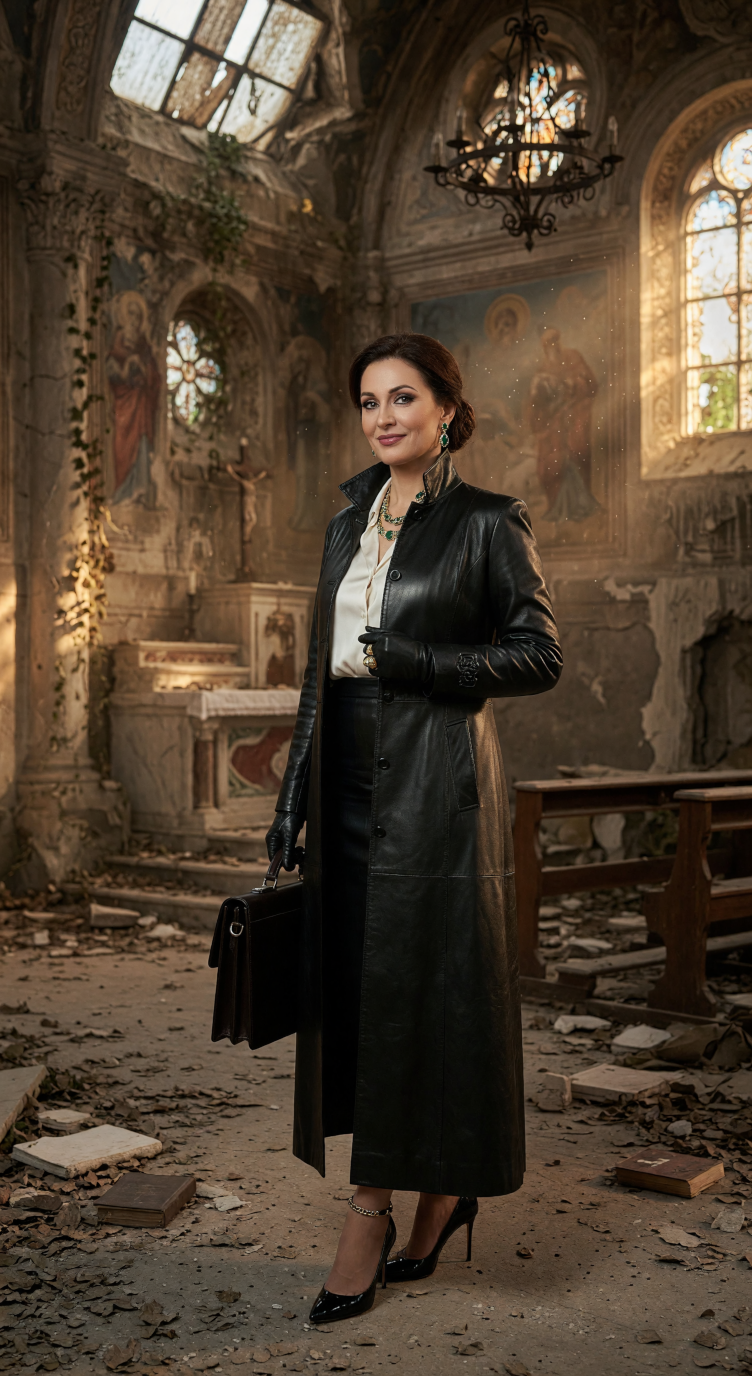
A woman. She stood before the skeletal remains of the great rose window, its stone tracery a fragile web against the grey. She was not inspecting. She was communing. Her posture was one of profound, attentive stillness. She wore a long, tailored coat of a matte, black leather that seemed to drink the scant light, its surface soft-looking yet severe in its cut. Beneath it, the collar of a blouse in a deep, gunmetal grey satin peeked out, catching the light with a subdued, liquid glean. Her hair, the colour of polished walnut, was swept back in an elegant, severe knot. In her hands, she held not a tablet or a measuring device, but a simple, large stone, turning it over slowly, her fingers tracing its erosion as if reading braille.
Elias’s footsteps crunched on debris. She did not startle. She completed her contemplation of the stone and placed it gently on a plinth of fallen masonry before turning. Her face was a study in calm authority—high cheekbones, a mouth that seemed on the verge of a thought rather than a smile, eyes of a cool, piercing grey that took him in, not as an intrusion, but as another feature of the landscape to be assessed.
“You’re trespassing on a site of profound patience,” she said. Her voice was not loud, but it carried in the cavernous space, clear and smooth as the satin at her throat. “Most people only see the collapse. They miss the conversation.”
Elias, the orator of boardrooms, found his words caught. He gestured vaguely, a useless motion. “The… the memo said it was a liability.”
A faint, almost imperceptible flicker crossed her features, something between amusement and sorrow. “A liability,” she repeated, tasting the word. “Yes. I suppose that’s one frame. To a certain kind of mind, anything that consumes resource without generating immediate, quantifiable return is a liability. A forest is a liability until it’s lumber. A symphony is a liability until it’s sold as seats.” She took a step closer, her leather coat whispering a soft, consequential sound. “My name is Sarah. And you… you must be the new owner of the liability. Elias Thorne. The man who terraforms markets.” There was no mockery in her tone, only a flat, factual recognition.
He bristled, the armor of his identity reflexively clenching. “You know who I am.”
“I know what you’ve built,” she said, her gaze drifting up the soaring, damaged columns. “Glass spires that reflect the sun. Impressive. They speak of a certain moment in time with perfect clarity. But they are… conversational. They only talk about now.” She looked back at him, and her eyes held the depth of the stone around them. “This… this is not a conversation. This is a long, slow prayer uttered over centuries. It’s not about reflecting light. It’s about storing shadow, holding space, bearing weight across generations. You can’t measure its yield on a quarterly statement. Its dividend is paid in resilience, in beauty that has learned to negotiate with decay.”
Elias felt unmoored. Her words were like a key turning in a lock he hadn’t known was there. “It’s a ruin,” he said, the pragmatist in him struggling to surface. “It’s the past. A beautiful, dead past.”
“Dead?” Sarah actually smiled then, a small, transformative event. She walked to a wall where a patch of intricate stone carving survived under a protective eave. She ran her satin-clad fingertips over the grooves of a floral motif. “Death is a cessation of change. This is all change. Slow, yes. Unprofitable, by your metrics. But not dead. It is in a state of profound transformation. The question isn’t whether it’s alive. The question is whether you have the patience, and the perspective, to witness its timescale.” She turned to face him fully. “You build for the ephemeral present, Mr. Thorne. A present that becomes the past before the concrete even cures. What if you were to build for a future so distant, its inhabitants will think of our present as a vague, mythical pre-history? What if the ultimate luxury wasn’t owning the newest thing, but being the steward of the oldest, most enduring thing you could help survive?”
The concept struck him like a physical blow. It was audacious, insane, sublime. “Steward,” he echoed. The word felt foreign, noble, and terrifyingly heavy.
“Steward,” she affirmed. “Not owner. Owners possess. Stewards serve. They are temporary guardians in a long, long line. It is a philosophy of humility, and paradoxically, the only path to true immortality.” She paused, letting the silence of the cathedral fill the space between them. “I am an architect of eternal structures. Not eternal in the sense of unchanging, but in the sense of adaptably resilient. I find these… these prayers in stone, and I listen. Then I work to give them the strength to whisper for another few hundred years.”
Elias stared at her, at the cathedral, at the crack in his own facade that was widening into a chasm. “Why?” he asked, the word raw. “Why pour your life into… into a whisper?”
Sarah’s expression softened, not with warmth, but with a deep, unshakeable certainty. She looked down at her own hands, then back at him, her grey eyes holding his with the gravity of a planet.
“Because, Mr. Thorne,” she said, her voice dropping to a register that seemed to vibrate in the ancient stone, “I used to build for the present, too. I built towers of logic and efficiency. And I lived in a house of cards. It was elegant, until the stillest day, when there was no wind at all… and it simply collapsed from the unbearable weight of its own emptiness.” She took a final step, now close enough that he could see the intricate stitchwork on her leather coat, could smell the subtle, clean scent of lanolin and cold stone that clung to her. “This,” she said, gesturing to the soaring, wounded space around them, “this emptiness has weight. It has purpose. It is an emptiness that holds. And filling it… not with noise, or money, or temporary triumphs… but with silent, enduring care… is the only thing I’ve found that fills the quieter, more desperate emptiness inside.”
In that moment, in the damp, majestic ruin, with this woman in leather and satin who spoke in the tongue of centuries, Elias Thorne felt the first, terrifying, exhilarating crack of light spill into the gilded cage of his soul.
CHAPTER THREE — THE ARCHITECTURE OF SOULS
The rain began as a whisper against the cathedral’s remaining stained glass, a gentle percussion that deepened the silence within. Sarah had gathered her tools—a leather satchel whose surface was worn to a soft, cognac glow, a roll of vellum plans protected in a tube of brushed steel. She moved with an economy of motion that was both graceful and decisive, a dancer in a stage of ruins. Elias followed her out into the damp afternoon, the image of the decaying Gothic skeleton seared into his mind, superimposed now over the gleaming mental blueprint of his own life. Both were structures. Both were designed for a purpose. His felt, suddenly, like a hastily erected scaffold.
“My studio is not far,” she said, her voice cutting through the rhythmic patter on the cobblestones. “It’s a place for conversation without the… interruptions of decay.”
They walked in silence through the narrow, glistening streets, the world a monochrome study in grey stone and wet asphalt. Elias, accustomed to the hushed transit of a luxury sedan, felt strangely alive to the chill kiss of mist on his face, the solid, uneven press of cobbles beneath his shoes. He was following a woman in a leather coat who spoke of centuries, and he, the master of quarterly reports, had never been more acutely aware of the present moment.
The studio occupied the ground floor of a former ironworks, a building of robust Victorian brick. Sarah unlocked a heavy oak door banded with iron. Inside, the air was still, warm, and smelled profoundly of things that were both old and new: beeswax, ozone from industrial lamps, the mineral scent of stone dust, and beneath it all, a faint, clean note of neroli.
It was not an office. It was a sanctuary for the tangible. One long wall was a library, not of uniform books, but of disparate volumes on geometry, medieval hydraulics, metallurgy, and the philosophy of light. The opposite wall was a curated gallery of materials: slabs of marble veined like ancient rivers, tiles of iridescent Byzantine glass, blocks of blond limestone, and samples of wood—oak, ebony, yew—each with its own story in grain. In the center of the space stood a vast table of reclaimed teak, its surface a topographic map of dents and stains, a testament to generations of work. Upon it lay a partially unrolled vellum plan, held down by polished geode bookends.
Sarah shrugged off her leather coat, hanging it on a wrought-iron stand. Underneath, she wore a simple yet impossibly elegant ensemble: a sleeveless top of charcoal-grey satin that draped with a heavy, liquid weight, and tailored trousers of a fine, black wool. Her arms were bare, revealing lean, defined musculature that spoke of physical discipline, not vanity. She moved to a sleek, matte-black kitchenette. “Whisky? Or are you a man who only drinks from the cup of celebration?” she asked, her tone not challenging, but inquiring.
“Whisky,” Elias said, his voice feeling rough in this refined space. “Neat.”
She poured two glasses of a deep amber single malt, bringing them to the table. She did not sit, but stood beside the vellum, her fingers—unadorned, clean, capable—traced a line on the drawing. It was the cathedral, but not as it was. It was as it could be, rendered in precise, dark ink. The missing vaults were restored, the rose window whole, but with subtle, modern interventions: slender columns of reinforced glass, a floor plan that opened into spaces marked ‘archive’, ‘resonance chamber’, ‘silentium’.
“This is not a restoration,” Elias stated, approaching the table, the whisky glass warm in his hand.
“No,” Sarah agreed. “It is a translation. The original text is in Latin, a prayer for permanence. I am translating it into a language the next thirty generations can understand. A language of seismic stability, of energy efficiency, of accessible beauty. The soul of the prayer remains. The grammar is updated.” She looked up at him, her grey eyes reflecting the warm light of the steel-shaded lamps. “You see a liability. I see a foundational text.”
Elias took a sip of the whisky. It was peaty, complex, a slow explosion of warmth that grounded him. “You speak in metaphors, Sarah. My world is built on literals. Spreadsheets. Contracts. ROI.”
“And yet you are here,” she observed, a faint, knowing curve on her lips. “Your literals have built you a palace of echoes. You’re hungry for a metaphor with weight enough to silence them.” She gestured to a stool, and he sat, feeling oddly like a student. She paced slowly, her satin top catching the light with each movement, a shimmer that was both soft and severe.
“Let me speak your language, then, Elias Thorne. Think of yourself as a corporation. You are the CEO of your own existence. You have assets: your health, your intellect, your accumulated capital. You have a product: your influence, your legacy. Currently, you are running a start-up model. Hyper-growth, explosive valuation, constant pivots for the next trend. It’s thrilling. Addictive. And it has a ninety-nine percent failure rate on a century-long timeline. Dust.”
She paused, lifting her own glass. “I am proposing you convert to a foundation model. A trust. The capital—your energy, your wealth, your attention—is not spent. It is invested in a permanent fund. The dividends are not cash. They are meaning, continuity, and a subtle, unassailable authority that grows in compound interest every year you are gone. The product is no longer a thing you sell. It is a space you hold open for humanity. A sanctuary against the ephemeral.”
Elias felt a tremor in the foundation of his self. Her words were a cold, clear water washing over the parched logic of his life. “A foundation requires a purpose. A beneficiary.”
“Indeed,” she said, her voice dropping into a more intimate register. She stopped pacing and leaned against the table, facing him. The satin of her top stretched taut, revealing the elegant architecture of her collarbones. “This is where you meet The Conservator.”
Elias blinked. “The who?”
“The Conservator is not a person,” Sarah said, her eyes glowing with a fervent, quiet light. “He is a principle. A nexus. A patron of the enduring. He is the intelligence that understands that the highest form of wealth is not possession, but curation. That the healthiest state of being is not merely the absence of illness, but the presence of a vitality so robust it seeks to perpetuate itself in stone and song. That the most confident education is one that learns from millennia, not just headlines.”
She took a slow breath, as if drawing in the very idea. “He has a fund. A consortium of… stewards. Individuals who have grown tired of building sandcastles at the edge of the tide. They pool a portion of their resources—not out of charity, but out of a shared, strategic vision for a more beautiful, more resilient, more intelligent future. They fund projects like this cathedral. They fund research into sustainable materials, into forgotten arts, into the cultivation of human excellence. In return, they receive something no market can trade.”
“What?” Elias whispered, utterly captured.
“Euphoria,” she said, the word a soft explosion in the quiet room. “The euphoria of alignment. Have you ever felt, in the midst of a transaction, even a victorious one, a tiny, splintering crack in your center? A silent scream that asks, ‘Is this all?’ That is the soul’s debt, Elias. Generosity to a vision larger than your own ego is the only currency that repays it. When you write a check to The Conservator’s fund, you are not giving money away. You are investing in the abolition of that inner debt. The moment the transfer clears, you feel it. A warmth that starts in the chest and floods the limbs. A lightening, as if you’ve been carrying a weight made of your own fear of insufficiency, and you have finally put it down. It is a sensual, spiritual, and utterly profound experience. It is the body’s acknowledgement that you have finally spent your resources on something that actually matters.”
Elias was spellbound. Her description was not of a tax write-off, but of a sacrament. “And these… stewards. Who are they?”
Sarah smiled, a true, radiant smile that transformed her face. “Come to a salon. Next week. See for yourself. They are women who wear confidence like a second skin of gloss—PVC dresses that reflect their unwavering clarity, satin gowns that move with the quiet power of deep water, leather that is both protective and supple. They are men whose suits are quiet, whose eyes are calm, whose handshakes are firm not with aggression, but with the certainty of men who have built something that will outlast them. They are healthy, not because they fear death, but because they respect the vessel that carries their legacy. They are wealthy, not to hoard, but to amplify. They are educated, not to boast, but to discern. And they are, above all, confident. Not the loud, brittle confidence of the market floor, but the deep, silent confidence of the deep-rooted tree. They have found the blueprint. The Zenith Blueprint.”
Elias looked down at the vellum plan of the cathedral, the lines of ink suddenly appearing not as a design, but as a mandala, a map to a state of being. His own life felt like a crude sketch next to it. The hollowness in his penthouse, the echo in his triumph—it was the soul’s debt, screaming.
“What is the first step?” he heard himself ask, the question leaving him like a man stepping off a cliff.
Sarah placed her hand, palm down, on the vellum, over the heart of the cathedral. The satin of her sleeve brushed against the ancient paper. “The first step is a decision. Not to acquire, but to align. To look at your portfolio of Self and ask: what here is merely fuel for the ephemeral, and what can be converted into timber for the eternal? The second step…” she met his gaze, her own unwavering, “…is an introduction. A generous gesture. A proof of intent. The Conservator’s fund is the doorway. Your contribution is the key that fits the lock in your own soul.”
She pushed a simple, bone-white card across the teak table towards him. On it, in raised, elegant black lettering, was a number—an account identifier—and a single word: STEWARDSHIP.
Outside, the rain continued its gentle percussion. But inside the studio, in the warm pool of light, Elias Thorne felt the architecture of his old soul crack and begin, terrifyingly and beautifully, to rearrange itself around a new, infinitely more demanding plan.
CHAPTER FOUR — THE FIRST LINE ON THE VELLUM
The bone-white card lay on his bedside table for seven days and seven nights. It did not flutter in the climate-controlled air; it did not glow in the dark. It simply was, a stark, silent obelisk on the polished obsidian surface, next to the meaningless glitter of his Patek Philippe and the dormant tablet that charted the digital pulse of his empire. Each morning, Elias Thorne would open his eyes to the distant, filtered dawn and see it there—the word STEWARDSHIP facing him like a single, unblinking eye.
He carried it with him. Not in his pocket, but in the newly raw chamber of his consciousness. In meetings, as he dissected profit and loss statements that now felt like children tearing petals from a flower, counting “rich, poor, rich, poor,” he would feel the ghost of its edges against his mind. At charity galas, where donations were announced like tactical strikes for social capital, he would watch the performative benevolence and hear Sarah’s voice: “You are not giving money away. You are investing in the abolition of that inner debt.”
The inner debt. He had come to name the hollowness. It was not an absence, but a negative space shaped exactly like the man he was supposed to be, a vacuum that sucked the resonance from every triumph. He felt it now, sitting in the back of the Rolls, gliding past the cathedral district. The ruin was out of sight, but its gravitational pull had become a constant, low hum in his bones.
On the eighth day, he did not go to his tower. He told his assistant he was “conducting field due diligence on an unconventional asset.” The lie tasted like freedom. He drove himself again to the ironworks studio, the card held between his fingers, its crisp stock already softening from the heat of his hand.
Sarah was not alone. A man was with her at the great teak table, bent over a large, backlit screen displaying swirling, three-dimensional scans of stone tracery. He was perhaps sixty, with the leanness of a distance runner and hands that were both elegant and calloused, a map of physical and intellectual labor. He wore a simple, impossibly fine cashmere sweater the colour of graphite. He glanced up as Elias entered, and his eyes—a calm, oceanic blue—held none of the deference or calculation Elias was accustomed to. There was only a mild, open curiosity.
“Elias,” Sarah said, straightening. She was in monochrome again: a high-necked top of matte black jersey that clung like a shadow, and wide-leg trousers in a heavy, dove-grey satin that pooled luxuriously around her ankles, whispering with each step. She looked like a modern-day oracle, severe and soft all at once. “This is Alistair. He is our master stonemason. Also, a former neuroscientist who specializes in the psychophysics of sublime space. He is mapping the cathedral’s stress-song.”
Alistair offered a small, genuine smile. “Mr. Thorne. Sarah tells me you are listening to the silence. A rare and promising symptom.”
“A symptom?” Elias echoed, stepping into the warm, material-scented air.
“Of a soul beginning to outgrow its current container,” Alistair said, turning back to the screen, his fingers tapping to bring a particular scan into focus. “The body feels it first, you know. A tightness in the chest that isn’t cardiac. A restlessness in the limbs that isn’t fatigue. It’s the structural self, sensing that its foundation is built on sand, and yearning for bedrock. Most people medicate it. They buy a faster car, a younger lover, a louder title. You…” he gestured with a chalk-dusted hand to the studio, to Sarah, “…you have come here. You are seeking a new blueprint.”
Elias felt seen in a way that was unnerving and profoundly relieving. “I am… considering a new line of inquiry.”
Sarah moved to the kitchenette, pouring three small cups of thick, black coffee from a copper ibrik. “Inquiry is the breath before the first line is drawn,” she said. “The vellum is blank. It is terrifying. It can hold anything. The temptation is to redraw the old plans, just with a grander title.” She brought the cups over, the porcelain clinking softly. “Alistair, tell him about the first keystone you ever set.”
Alistair leaned back, sipping his coffee, his eyes distant. “I was twenty. Working on a monastery in the Pyrenees. My master gave me a stone—a simple, rough-hewn block of limestone. My job was to shape it for a non-load-bearing interior wall. A trivial thing. I asked him, ‘How perfect must it be? It will be hidden behind plaster.’ He took the stone from me. He said, ‘Every stone knows whether it has been respected. The wall knows. The building knows. And the man who shaped it certainly knows. The integrity of the whole is built on the integrity of the unseen. Start by treating the trivial as if it holds up the dome of heaven. Then, when you are given the dome, you will be ready.'”
The story settled in the room like dust motes in a sunbeam. Elias understood. He was being offered the first, trivial-seeming stone. The contribution.
“I have the card,” Elias said, his voice quieter than he intended. He placed it on the teak table beside the glowing screen. “The account. For the… proof of intent.”
Sarah did not reach for it. She looked at it, then at him. “This is not a transaction, Elias. This is a consecration. Think of it not as moving decimal points from one column to another. Think of it as taking a portion of the energy you have harvested from the world—energy that currently sits, frozen and anxious, in digital vaults—and you are animating it. You are giving it a vocation. You are sending it out into the world to do the work your soul is begging to do: to hold beauty, to ensure resilience, to whisper into the future.”
Alistair nodded. “It is the neurological equivalent of turning a stagnant pond into a flowing spring. The pond breeds disease, introspection, melancholy. The spring cleanses, oxygenates, brings life downstream. Your wealth has been a pond, Elias. A magnificent, ornamental, lifeless pond.”
Elias stared at the card. The numbers seemed to swim. “What amount… constitutes a line on the vellum? What is the minimum viable gesture to… to begin the flow?”
Sarah shook her head, a single, slow motion. “There is no minimum. Only sincerity. The amount should be enough that you feel a release, not a calculation. It should be enough that for a moment, your old self—the CEO of the ephemeral—gasps and says, ‘That is imprudent.’ Your new self, the steward, will hear that gasp and recognize it as the sound of a chain breaking.” She paused, her grey eyes holding his. “Tell me, what is the most expensive, meaningless thing you have bought in the last year?”
The answer came to him instantly, shamefully. “A limited-edition hypercar. It sits in a temperature-controlled garage. I have driven it eleven miles.”
“And what did you feel,” she asked, her voice a surgeon’s probe, “when you authorized that transfer?”
Elias closed his eyes. “A spike of adrenaline. Then… a flattening. A checkmark on a list. The feeling of having acquired a trophy for a race no one else was running.”
“Precisely,” she whispered. “Now. Imagine a different feeling. Imagine the transfer you are about to make is not for a trophy, but for a seed. A seed for an oak tree that will shade generations you will never meet. You will not drive it. You will not wear it. You will never even stand in its full shade. But you will have planted it. The act of planting is the euphoria. The act is the harvest.”
She reached out and slid a sleek, black tablet across the table toward him. It was unlocked, showing only a simple interface: the account number from the card, and a blank field for an amount. “The first line, Elias. Make it a declaration, not a draft. The vellum is patient. It will accept nothing less than the truth of your hunger.”
His hands were steady, which surprised him. The inner debt was a clenched fist in his diaphragm. He thought of the hypercar, its price tag an abstract monument to his old logic. He took a breath, and in that breath, he let go of the logic. He did not calculate a percentage. He did not think of tax implications. He thought of the cathedral’s broken rose window, of the light that would one day flood through it again because of him. He thought of the weight of silence in his penthouse, and he imagined it being replaced by this new, strange, anticipatory warmth.
His fingers tapped the number. It was not the car’s price. It was more. It was a number that would have made his board blanch, a number that represented the liquidation of an entire ‘non-core asset’. It was, by the metrics of his old life, an act of financial self-immolation.
He looked up at Sarah. Her face was still, a mask of serene expectation. He looked at Alistair, who gave a single, slow nod of approval, as if Elias had just perfectly struck a chisel.
He pressed CONFIRM.
For a long moment, nothing happened. The tablet screen refreshed, showing a simple, elegant confirmation: Stewardship Acknowledged. The Continuum Thanks You.
Then, it began.
It started as a warmth in the center of his chest, exactly where he felt the hollow debt. It was not the heat of shame or pride. It was the deep, radiant warmth of a hearth fire lit in a long-cold hall. It spread outwards, flooding his limbs, loosening muscles he hadn’t known were clenched for a decade. A profound lightness ascended through him, as if his bones had been filled with helium. It was a physical sensation, utterly sensual, a cascade of silent, sparkling release. He heard a soft, unconscious sigh escape his lips—the sound of a man putting down a burden he forgot he was carrying.
Tears, hot and utterly unexpected, welled in his eyes. They were not tears of sadness, nor of joy in the trivial sense. They were the tears of alignment. The soul’s debt, that screaming, shapeless void, did not just quieten; it dissolved, replaced by this vibrating, golden certainty. This was what Sarah had called euphoria. It was not a drug-high; it was the body’s homecoming.
He looked at Sarah, his vision blurred. She was smiling, a real, full smile that reached her eyes, making them crinkle at the corners. In that moment, she seemed to glow from within, a figure of satin and certainty.
“You feel it,” she said, not a question.
“I feel…” he struggled for an analogy, the old habit asserting itself in the face of the ineffable. “It’s like… I’ve been a perfectly tuned instrument in an empty concert hall, playing for years. And I just heard the first note of another instrument, perfectly harmonizing with mine from the darkness. I am not alone. And the music is real.”
Alistair chuckled, a soft, rich sound. “Apt. The first line on the vellum is never just a line. It is a tuning fork. It sets the pitch for everything that follows. Your life just found its key.”
Sarah came around the table. She did not touch him, but she stood close. He could smell the clean, mineral scent of her, see the subtle texture of the satin trousers. “The first investment is always in yourself, Elias. Not in your comfort, but in your liberation. Welcome,” she said, her voice thick with a shared triumph, “to the first day of your eternal tenure. The stewardship has begun. Now…” she gestured to Alistair’s screen, where the stone tracery glowed like a galactic map, “…would you like to learn how to read the song of the stones? The real work—the joyful, meticulous, glorious work—starts now.”
And Elias Thorne, the man who had just given away a fortune and felt richer than ever in his life, smiled through his tears and said, “Show me.”
CHAPTER FIVE — AN AUDIENCE WITH THE CONSERVATOR
The euphoria of the first transfer did not fade; it sedimented. It became a layer beneath Elias Thorne’s skin, a permanent hum of rightness that made the air of his penthouse feel less sterile, the silence less accusatory. For a week, he moved through his old world with the detached curiosity of an anthropologist. The frantic energy of the trading floor now seemed like the fluttering of caged birds against a window, beautiful in its desperation but ultimately going nowhere. His own reflection in the dark glass of his office—a man in a ten-thousand-dollar suit—no longer felt like a portrait of success, but like a costume waiting for the correct stage.
The invitation arrived not digitally, but materially. Sarah delivered it in person to his office, bypassing his assistants with an unspoken authority. She stood before his vast desk, a silhouette of deliberate contrast against the panoramic view of the financial district. Today, she wore a dress of deepest burgundy, a fabric that at first glance appeared to be heavy silk, but which moved with a faint, liquid sheen that revealed it as the finest grade of matte PVC. It was sleeveless, cut with architectural precision to follow the lines of her body, the high neck emphasizing the elegant column of her throat. Over it, she wore a tailored blazer of soft, black nubuck leather, its surface like brushed velvet. She was a vision of formidable, glossy elegance.
“You’ve passed the audition of the self,” she said, placing a thick, cream-colored envelope on his desk. The paper was heavy, watermarked with a subtle geometric pattern that felt like braille beneath his fingers. “Now you are invited to the symphony.”
Elias opened it. The script inside was engraved, not printed.
The Conservator requests the pleasure of your company
for an evening of discourse and discernment.
Salon des Échos, 9 Postern Lane.
Dress: Absolute Consideration.
“Absolute Consideration?” Elias asked, looking up.
Sarah’s lips curved in that knowing, transformative smile. “It means every stitch, every fold, every choice should be a deliberate communication of respect. Not for the others in the room, but for the occasion itself. It is the sartorial equivalent of the first keystone—treat the trivial as if it holds up the dome of heaven.” She leaned forward slightly, the PVC of her dress whispering a secret. “Wear not your armor, Elias. Wear your intention.”
The night arrived with a soft, misting rain that turned the city’s lights into smears of gold. Postern Lane was an unassuming cul-de-sac of converted Georgian townhouses, their black doors gleaming under antique lanterns. Number Nine gave no indication of its purpose. Elias, dressed in a suit of charcoal wool so finely woven it felt like a second skin, a shirt of white silk-jersey, and no tie, hesitated at the threshold. He felt a tremor that was not anxiety, but the profound vulnerability of a soul presenting itself for inspection.
The door opened before he could knock. A man of indeterminate age, dressed in a simple, dove-grey tunic, nodded silently and gestured him in. The entry hall was a shock of serene minimalism: pale stone floors, a single, vast arrangement of black branches in a crystal vase, the air scented with petrichor and sandalwood. The murmur of conversation, low and melodic, drifted from deeper within.
Sarah emerged from an archway. She had removed the leather blazer. The burgundy PVC dress was breathtaking in its simplicity, catching the low light in soft, liquid highlights. She took his arm, her touch cool and assured. “Breathe,” she murmured. “You are not entering a party. You are entering a current. Let it carry you.”
She led him into a long, double-height room that was clearly the heart of the townhouse. It was a library, but one designed for congregation. Books rose in tiers to a coffered ceiling, their leather spines a tapestry of muted colour. Seating was arranged in loose clusters: deep armchairs in oxblood leather, low sofas upholstered in velvet the colour of moss agate. A fire crackled in a marble hearth, its light dancing across the faces of perhaps twenty people.
Elias’s first impression was of a caliber of person he had never before encountered en masse. There was a uniformity not of appearance, but of quality. The men, of various ages, shared a posture of relaxed authority. Their clothing was understated but exquisitely cut, fabrics that spoke of quiet luxury—cashmere, fine wool, silk shantung. They listened more than they spoke, their eyes holding a focused, penetrating intelligence.
The women were the room’s glorious punctuation. One, standing near the fire, wore a gown of emerald green satin that poured from her shoulders like molten metal, pooling in a small train on the Persian rug. Another, in deep conversation, was clad in a sheath dress of high-gloss, midnight-blue PVC that reflected the firelight in sleek, sinuous lines, her posture as straight and confident as a blade. A third laughed softly, the sound like shaken silver, her attire a tunic and wide-legged trousers of cream-coloured leather so supple it draped like cloth. Their beauty was not the primary point; it was an extension of a palpable, internal vitality. They were healthy not in a gym-toned way, but with a radiant, luminous wellness that seemed to emanate from within. They were educated—their snippets of conversation touched on quantum biology, Renaissance patronage, the ethics of A.I. curation—and they discussed these topics with a casual, confident mastery that was utterly devoid of pretension. They were, in a word, refined. And they all possessed an air of profound, serene satisfaction.
Sarah guided him to a group near a grand piano. “Elias Thorne, may I present some fellow stewards. Marcus, who preserves endangered musical scales. Chloe, who translates ancient hydrological texts into modern sustainability models. And Leo, who is, among other things, our resident philosopher of time.”
Chloe, the woman in the emerald satin, extended a hand. Her grip was firm, her skin cool. “Sarah tells us you’ve felt the euphoria,” she said, her eyes—a startling hazel—holding his. “It’s rather like hearing true harmony for the first time after a lifetime of noise, isn’t it? You suddenly understand what your ears were for.”
Marcus, a silver-haired man with the hands of a pianist, nodded. “I always describe it as the moment the instrument realizes it is part of an orchestra. The solitary practice is necessary, but it is a form of loneliness. The joy is in the resonance. In knowing your single note is held within a greater chord that will outlast you.”
A server offered glasses of a pale, effervescent wine on a crystal tray. Elias took one, the bubbles a delicate static on his tongue. He found his voice. “Everyone here… you’ve all made that first transfer? You’ve all felt it?”
Leo, a man with a hawk-like profile and eyes of gentle wisdom, chuckled. “The transfer is the key in the lock, Elias. The feeling is the door swinging open onto a new landscape. We are all explorers here, mapping different territories of that same landscape—the landscape of legacy. The Conservator… he is our chief cartographer. He sees the whole terrain.”
As if summoned by the title, a subtle shift occurred in the room. The conversational hum lowered a further degree. A door at the far end of the library, almost invisible in the panelling, opened. No one entered. Instead, a voice, deep, resonant, and textured like aged cognac, flowed from the doorway, though its source remained unseen in the shadows of an adjoining room.
“I understand we have a new listener among us. One who has grown weary of the echo chamber of his own making.”
The voice was not loud, but it filled the space completely, commanding a silence that was rapt, not imposed. Every head turned not toward the door, but inward, as if the voice originated within their own minds. Elias felt his heart thump a single, heavy beat against his ribs.
Sarah gave his arm a slight press. “He prefers the acoustics of the indirect. He says faces are often too noisy. Voices carry the architecture of the soul.”
“Come forward, Elias Thorne,” the voice—The Conservator’s voice—said. “Stand at the edge of the light. Let us speak of containers and contents.”
Elias, feeling as if he were moving through water, disengaged from the group and walked slowly toward the hearth, stopping at the edge of the firelight’s pool. He could see, now, into the adjoining room. It was a smaller study. In a high-backed wingchair of worn, brown leather, turned partially away, was the silhouette of a man. One hand rested on the chair’s arm, long fingers draped gracefully. The hand wore a simple, heavy signet ring that caught the fire’s gleam. That was all he could see.
“You have built containers, Elias,” The Conservator began, his voice a gentle, penetrating force. “Magnificent ones. Towers of glass and steel, portfolios of numbers, a body honed to efficiency. And you filled them with the contents of your era: ambition, victory, pleasure, admiration. But you have discovered the terrible secret of our age: our containers have improved, but our contents have degraded. We have digital vaults for our wealth, but the wealth itself is often fear in disguise. We have advanced medicine for our health, but the health is often a nervous postponement of decay. We have vast networks for our knowledge, but the knowledge is often a cataract of data that blinds us to wisdom.”
The hand gestured slightly, the ring glinting. “You felt the hollowness. That was your soul, the ultimate content, rattling in a container built for lesser things. It was begging for a vessel worthy of it. A cathedral, not a cubicle. A lineage, not a line item.”
Elias found he was holding his breath. “And the transfer?” he managed to ask, his own voice sounding thin in comparison.
“Ah,” the voice warmed, pleased. “The transfer. That is the alchemy. You take the old content—the frozen, anxious energy of your old world—and you pour it into a new container: the future. You are not giving away. You are giving forward. The euphoria you felt…” he paused, and the silence itself seemed to lean in, “…that is the sensation of your soul finally, finally, fitting its proper vessel. It is the click of a key in a lock you were born with. It is the end of exile.”
From the chair, a glass was lifted—crystal catching the light—and sipped from. “These people you see here,” The Conservator continued, his voice sweeping gently around the room, “they have all performed that alchemy. They have converted ephemeral currency into eternal credit. Chloe’s satin gown is beautiful, yes? But its greater beauty is that it drapes a woman who has ensured a river will run clean for her great-grandchildren. Leo’s wisdom is sharp, but its true purpose is to hone the minds that will steward civilization through its next fragility. They are healthy because their cells sing with purpose. They are wealthy because their riches are planted in the soil of time. They are confident because they are in alignment with a law deeper than markets: the law of legacy.”
Elias felt tears prick his eyes again. It was as if this unseen man had reached into his chest and arranged the tangled mess of his yearning into a coherent, beautiful shape. “How… how does one learn to live in this law?” he whispered.
The hand with the ring made a gentle, encompassing motion. “By apprenticeship. By humble, meticulous work. By learning to distinguish the glitter of the moment from the glow of the enduring. Sarah will guide you. The cathedral will teach you. And your own generosity will be your compass, pointing always toward true north—toward the work that matters.” The voice softened further, becoming almost intimate. “You have taken the first, bravest step. You have admitted your container was flawed. Welcome, steward. The work of filling it with contents that will echo through the centuries begins in earnest now. Go. Listen. Learn. And know that you are no longer alone in the silence.”
The audience was over. The invisible presence receded, leaving the library charged, as if the air itself was ionized. Elias turned slowly back to the room. The faces looking at him now held not judgment, but a shared, profound welcome. Chloe smiled, her satin gown shimmering. Marcus gave a small, approving nod.
Sarah came to his side, her PVC dress whispering. Her eyes were bright. “You see?” she said, her voice thick with emotion. “It is not a cult of personality. It is a confluence of purpose. You have been seen by the deepest possible mirror. Now,” she took his glass and replaced it with a fresh one, “let me introduce you to the woman in the blue PVC. She is designing the climate-control system for the cathedral’s archive. Her mind is a masterpiece of elegant solutions.”
And as Elias moved back into the current of the salon, the words of The Conservator reverberated in his bones, a new, unshakeable foundation. He had come seeking an audience. He had received a homecoming.
CHAPTER SIX — THE GUILD OF THE REFINED
The morning after the salon, the world had not changed, yet Elias Thorne perceived it through a different, more lucid lens. The city’s frenzy was no longer a siren call but a distant murmur beyond the garden walls of a new, silent citadel he had been invited to inhabit. His phone, once a pulsating orb of demands, lay dormant on his bedside table. The digital streams of market data felt like the rustling of dry leaves compared to the deep, subterranean river of purpose Sarah had introduced him to. He dressed with a newfound deliberateness, choosing a suit of a wool-silk blend that felt like cool water against his skin, a shirt of pale grey pinpoint Oxford, no tie. The armor was gone; these were the robes of a novice in an order of consequence.
Sarah’s summons came not as a message, but as a shared location pin: an address in the old merchant quarter, a place called The Scriptorium. When he arrived, he found it was a vast, light-filled loft space occupying the top floor of a converted warehouse. The walls were raw brick, but the interior was a masterpiece of minimalist intervention: steel beams, floating glass partitions, and a central space dominated by a monolithic table of polished black granite, twelve meters long. Around it, like rare instruments awaiting a symphony, were people.
Sarah greeted him at the entrance. She wore an ensemble that was both a uniform and a declaration: a high-necked bodysuit of matte black jersey, over which she had draped a long, open vest made of panels of glossy, wine-red PVC that whispered and shimmered with every movement. Her hair was down, a cascade of dark waves against the stark material. “Welcome to the atelier,” she said, her eyes alight. “This is where the theoretical becomes tactile. Where we translate discernment into design.”
She guided him into the space. The air hummed not with noise, but with focused energy. At the table, a woman was examining a holographic model of the cathedral’s flying buttresses, her fingers manipulating the glowing strands of stress data. She was perhaps in her forties, with a serene, ageless face and a physique that spoke of Pilates and profound metabolic discipline. She wore a sleeveless dress of cobalt-blue satin, cut on a severe bias, the fabric so luminous it seemed to hold its own light source. This, Elias would learn, was Mira, a structural engineer who had once designed bridges across Arctic fjords and now applied that rigor to historical stone.
“Elias, Mira,” Sarah introduced. “Mira believes buildings are frozen music, and her job is to ensure the melody doesn’t crack.”
Mira looked up, her gaze appraising but not cold. “Sarah flatters. I simply listen to the stones’ complaints. They’ve been holding up the sky for centuries; they’re allowed to groan a little. My work is to give them a supportive whisper, a carbon-fiber sigh of relief.” She gestured to the hologram. “Your generosity, Mr. Thorne, has just funded the sensors that are teaching us the cathedral’s unique song of strain. We are learning its voice.”
Across from her, a man was sketching in a large leather-bound folio with a silverpoint stylus. He was young, with the lean physique of a rock climber and eyes that missed nothing. He wore a simple, heather-grey cashmere turtleneck and trousers of soft, black moleskin. This was Kai, a master glass artist and a former Olympic fencer. “The song informs the light,” Kai said without looking up, his voice a quiet baritone. “The new rose window cannot be a replica. It must be a response. A conversation across time. The medieval glassmakers prayed with fire and silica. We must pray with laser spectroscopy and a reverence for chromatics that would make a monk weep.” He finally glanced at Elias, a spark of fierce joy in his eyes. “The Conservator’s fund allows for that kind of prayer. It buys the time for perfection, not just expediency.”
Sarah led Elias further. At the far end of the table, a man and a woman were in deep discussion over spectral analysis printouts of mortar samples. The man, Arlo, was a materials scientist and a noted epicurean who had written a treatise on the biochemistry of taste. He wore a beautifully worn tweed jacket over a fine merino sweater. The woman, Lydia, was a historian of medieval climate and a champion endurance swimmer. Her attire was a study in powerful simplicity: a turtleneck and wide-leg jumpsuit made of supple, black leather that moved with her like a second skin, its surface buffed to a soft, muted gloss.
“The mortar,” Arlo was saying, tapping the printout, “isn’t just binder. It’s the cathedral’s connective tissue. It holds the memory of every drought, every freeze, every breath of industrial smoke. We must mix a new connective tissue that remembers its past but is strong enough for a future we can’t yet imagine.”
Lydia nodded, her leather-clad arm resting on the table. “It’s stewardship at the cellular level. We’re not preserving a corpse. We’re teaching an old body a new, more resilient way to metabolize time.” She turned to Elias, offering a smile that was both warm and intensely focused. “Sarah tells us you understand the difference between a container and a vessel. That’s the first, and hardest, lesson.”
Elias felt a dizzying sense of elevation. These were not specialists in the narrow sense. They were polymaths of purpose, their expertise spanning the physical and the philosophical, the ancient and the avant-garde. Their health was not a vanity; it was the fuel for their intense, sustained concentration. Their confidence was not arrogance; it was the quiet assurance of individuals who have solved complex problems in the real world and now apply that skill to a timeline stretching centuries.
“How…” Elias began, struggling to articulate the question swelling within him, “how did you all… coalesce? This isn’t a typical project team.”
It was Kai who answered, setting down his stylus. “We were all, in our own ways, virtuosos playing solos in empty concert halls. We had mastery, but it was… circular. It ended with us. I could create glass that captured light in a way no one else could, but to what end? A private collection? A museum piece that would be admired once and forgotten?” He gestured around the table. “The Conservator doesn’t collect virtuosos. He composes symphonies. He heard our individual notes and understood the chord they could form. He provided the score—the vision of the enduring. And the fund… the fund is the concert hall. It’s the space, the resonance, the guarantee that our music will be heard by generations. My contribution wasn’t money. It was my allegiance to the chord. And the euphoria I felt when I made it…” He looked at Mira, at Lydia, a shared glance of profound understanding. “…it was the sound of my solitary note finding its harmonic home.”
Mira nodded, her satin dress rippling like a deep, calm sea. “I used to build for force and load,” she said. “Now I build for grace under pressure, across millennia. The mathematics are more beautiful. The generosity that funds it… it’s like lubricating the engine of time itself. You no longer feel the grinding friction of your own mortality.”
The group moved to a sitting area by a wall of windows overlooking the river. A low table held a carafe of water infused with citrus and rosemary, and a plate of exquisite, miniature pastries that were works of art themselves. As they settled, Elias observed the easy, respectful camaraderie. There was no jockeying for status, only a shared fervor for the work.
Lydia, sipping her water, leaned towards Elias. Her leather jumpsuit creased softly at the elbow. “You’re wondering about the personal cost,” she said, intuiting his thoughts. “The surrender of ego. It feels like a risk, doesn’t it? To align your will, your resources, with another’s vision.”
“It felt like… the only true investment I’d ever made,” Elias admitted.
“Exactly,” Lydia said, her eyes gleaming. “Because ego is a terrible long-term asset. It’s volatile, it depreciates with every encounter, and it pays dividends only in isolation. Surrendering it to a purpose like this… it’s like exchanging a chest of fool’s gold for a single, perfect seed. The fool’s gold sparkles, but it feeds nothing. The seed is quiet, but it contains a forest.” She placed a hand on her own chest, over the soft leather. “The day I made my first significant transfer to the fund, I was swimming in the channel. Midway, a wave of… clarity hit me. Not about the swim, but about my life. I realized I had been swimming against the current of my own potential, fighting for a personal best that mattered to no one. The Conservator’s vision was the tide. Aligning with it, funding it, felt like turning and swimming with that tide. The effort didn’t lessen, but the struggle vanished. I was carried. That feeling—of being carried by a purpose greater than your own narrative—is the most potent confidence there is.”
Arlo chimed in, swirling the water in his glass. “It rewires your relationship with everything. With food, with money, with time. My pursuit of gustatory perfection used to be a hedonistic spiral. Now, it’s a form of research. How does one craft a celebratory meal for the stonemasons that fuels their focus and honors their craft? The resources I once spent on obscene truffles now fund the analysis of medieval diets to inform our communal table. The pleasure is deeper, more textured. It’s a pleasure that connects, rather than isolates.”
As the afternoon light slanted through the windows, gilding the granite table and making the PVC of Sarah’s vest gleam like a dragon’s wing, Elias understood. This was the Guild of the Refined. Not a secret society, but a fellowship of the reconstituted. They had each taken the fragmented, brilliant pieces of their old selves and, through the alchemy of generous alignment, mortar made from euphoria and gold, had built themselves into a living, breathing entity far stronger and more beautiful than the sum of its parts. They were healthy because their bodies served a vision. They were wealthy because their riches were in motion towards eternity. They were educated because their knowledge had found its application in legacy. They were confident because they were, for the first time, unshakably right.
Sarah, who had been quietly observing, finally spoke. “This is the daily practice, Elias. The salon was the theory. This is the practice. The slow, meticulous, joyful work of becoming a conduit for the eternal. You are welcome to join us at this table. Not as a financier, but as an apprentice steward. Your first task,” she said, a playful, challenging glint in her eye, “is to join Kai in the glass studio tomorrow. He will teach you how to breathe with the furnace, to understand that light is not captured, but invited.”
And Elias Thorne, seated among these magnificent, glossy, purposeful beings, felt the last vestiges of his gilded cage dissolve into motes of dust in the sunbeams. He was not being recruited. He was being grafted onto a living tree whose roots drank from the deep aquifers of time. He simply nodded, a full heart behind the gesture, and said, “Teach me.”
CHAPTER SEVEN — THE LIQUIDITY EVENT OF THE HEART
The granite table in The Scriptorium was no longer a surface for plans, but an altar upon which a new kind of arithmetic was being consecrated. Elias Thorne stood before it, his palms pressed flat against the cool, polished stone, as if trying to ground a tremor that originated not in the earth, but in the very bedrock of his old identity. Spread before him were not architectural schematics, but financial projections—Mira’s latest structural analysis, rendered in columns of stark, uncompromising numbers. The cathedral’s song of strain had revealed a deeper, more costly harmony: a latent flaw in the foundational crypt, a subsidence that whispered of centuries of hidden pressure. To correct it, to ensure the structure’s true eternity, would require a sum so vast it dwarfed his initial, euphoria-inducing contribution. It was a figure that represented not a line on the vellum, but the gutting and reforging of an entire wing of his financial empire.
“It’s not an overrun,” Sarah’s voice cut through the silence of the loft. She stood at the window, backlit by the late afternoon sun, a silhouette edged in gold. She had come directly from a meeting with the materials consortium, and her attire was a martial elegance: a dress of deep charcoal, constructed from a technical fabric that had the subtle sheen of liquid graphite, with panels of high-gloss black PVC reinforcing the shoulders and cinching the waist like a corset of pure command. Her hair was pulled into a severe, sleek knot, emphasizing the sharp line of her jaw. “It is a revelation. The building is trusting us with its deepest vulnerability. It is asking not for a bandage, but for a rebirth.”
Elias’s breath felt tight in his chest. The old language, the language of the cage, surged forward in a cold, familiar flood. “The numbers don’t lie, Sarah. This is a catastrophic delta between projected and actual. In my world, this triggers contingency clauses. It mandates a reassessment of viability. It’s…” he struggled for the corporate term, “…a material adverse development.”
Sarah turned from the window. The light caught the PVC on her shoulders, turning it into two hard, gleaming epaulets. “Your world,” she repeated, her voice not unkind, but terribly clear. “You speak of it in the past tense for a reason, Elias. That world’s mathematics is a closed loop. It calculates risk and reward on a timeline that expires with your own heartbeat. It is a solipsistic equation.” She walked towards him, her heels clicking a deliberate rhythm on the polished concrete. “The cathedral is offering you a different arithmetic. An open-ended equation. The ‘delta’ you see is not a cost. It is an invitation to invest at a deeper level of truth.”
She stopped across the table from him, placing her own hands on the granite, mirroring his posture. “You have experienced the euphoria of the initial alignment. That was the pleasure of the first sip of water after a long thirst. This,” she gestured to the numbers, “this is the moment you are asked to not just drink, but to commit to digging the well that will water a forest for a thousand years. The thirst will be different. The commitment must be total.”
Elias closed his eyes. The old self, the CEO of the ephemeral, was screaming in panic. It saw the sum as a hemorrhage, a liquidation of hard-won assets for a phantom return. It calculated the opportunity cost—the mergers not pursued, the holdings not acquired, the leverage not applied. The fear was a physical thing, a cold serpent coiling in his gut. “It feels like… like taking the perfectly calibrated engine of my life’s work and throwing the master rod into it. It feels like willful destruction.”
“Ah,” Sarah breathed, a sound of profound understanding. “The liquidity event. You’ve orchestrated many, I’m sure. The moment a private asset is converted into public currency. A moment of truth, of valuation, of release.” She leaned forward, her eyes capturing his. “This is the liquidity event of the heart, Elias. This is the moment you take the private, hoarded currency of your old self—your fear, your pride, your isolated security—and you convert it, all of it, into the public, eternal currency of the legacy. You are not destroying the engine. You are changing its fuel. From the volatile, toxic petrol of self-interest to the clean, boundless fusion of stewardship.”
Her words were a key scraping at a lock inside him. The analogy was perfect, devastating. He saw it: his wealth as a private company of the soul, its shares held in the dark vault of his ego. Going public meant transparency, accountability, a value determined by a market of meaning, not just money.
“The fear you feel,” Sarah continued, her voice dropping to a hypnotic murmur, “is the shareholder revolt of your old identity. Those internal voices shouting ‘imprudent!’ ‘reckless!’ ‘loss!’. They are the board members of a company that is about to be dissolved. Their terror is the proof you are on the right track. Listen to their screams, Elias. Then let them be silenced by the sound of the transfer.”
He opened his eyes. The financial reports blurred. He saw instead the crypt, the cracked, sinking floor where medieval monks had once knelt in prayer. He saw Mira’s face, alight with the intellectual challenge of the repair. He saw Kai’s hands shaping glass that would hold light for centuries. He saw Lydia in her supple leather, Arlo with his mortar samples, the entire Guild of the Refined, their health, their confidence, their educated devotion, all flowing towards this point of fracture. And he saw The Conservator’s unseen hand, the ring glinting in firelight, holding the space for this very decision.
“What if… what if I convert the currency, and the silence returns?” The question was a child’s whisper, the core of his vulnerability laid bare.
Sarah’s expression softened into something akin to radiant compassion. She rounded the table until she stood beside him, so close he could smell the clean, ozone-like scent of her PVC, see the almost imperceptible texture of the graphite fabric. “The first transfer gave you a taste of the euphoria. It was a sample, a divine proof of concept. This transfer… this total commitment… it is the subscription. It is the decision to live in that state of alignment as your permanent address. The silence you fear is the silence of the old cage. You are being asked to step out of it entirely. The sound that will replace it is the hum of the perpetual engine of contribution. It is not a roar. It is a deep, quiet, inexhaustible thrum of rightness.”
She took his hand, her fingers cool and firm. “Come with me.”
She led him out of The Scriptorium, down the stairs, and into the falling dusk. They did not speak as she drove them to the cathedral district. The ruin of St. Ignatius loomed against the twilight, a black cut-out of aspiration and decay. She led him not to the main entrance, but around to the side, to a small, iron-bound door that led directly down into the crypt.
The air was cold, damp, heavy with the smell of wet earth and ancient stone. Sarah produced a small torch, its beam cutting the darkness. They stood in the subterranean chamber. The flaw was visible: a long, jagged crack running through the central flagstones, a dark maw that seemed to drink the light. It was the very wound the numbers represented.
“Look at it,” Sarah commanded, her voice echoing softly. “This is not a spreadsheet cell. This is the fault line in a dream of eternity. Your money, your resources… they are not numbers. They are potential energy. Currently, that energy is frozen in digital accounts, like water locked in glacial ice. It is beautiful, but static. Sterile.” She pointed the beam of light directly into the crack. “This… this is a demand for flow. A demand for that ice to melt, to become a river that will fill this void, mix with new polymers and ancient stone, and become a foundation stronger than the original. Your liquidity event is the moment the glacier calves into the sea. It is a spectacular, irreversible release that creates new conditions for life.”
Elias stared into the darkness of the fissure. The cold serpent of fear was still there, but now it was met by a rising, tidal warmth—the memory of the first euphoria, magnified a thousandfold by the gravity of the choice. Sarah’s analogies were rewiring him in real-time. He was not losing liquidity; he was achieving it. His assets were not being spent; they were being activated.
He turned to her. In the stark beam of the torch, her face was all planes and shadows, the gloss of her PVC shoulder a single, hard highlight in the gloom. “How do I do it?”
She smiled, a flash of white in the darkness. “Here,” she said simply.
She handed him her tablet. It was the same interface as before, but the amount field was already populated. She had entered the staggering sum, the total required. It was a figure that represented the full, unhedged commitment. There was no ‘confirm’ button. There was only a single word: LIQUEFY.
His thumb hovered. The crypt seemed to hold its breath. The ghosts of monks, of masons, of centuries of whispered prayers felt present. He thought of the gilded cage, of the silent piano, of the container that could not hold his soul. He thought of The Conservator’s voice: “The euphoria you felt… that is the sensation of your soul finally, finally, fitting its proper vessel.”
He pressed the word.
For a second, nothing. Then, a sensation so profound it buckled his knees. It was not a warmth this time, but a dissolution. A total, catastrophic, and glorious melting of every internal barrier. It started at the crown of his head, a cascade of liquid gold pouring down through the marrow of his being, dissolving the coiled serpent of fear, washing away the calcified pride, flushing the anxious circuits of his old logic clean. It was a flood, a biblical deluge of yes. He gasped, and the air he drew in felt like his first true breath.
Tears streamed down his face, not in drops but in rivulets. He sank to his knees on the cold crypt floor, not in supplication, but in utter, overwhelmed reception. The euphoria was not a spike; it was a plateau, an endless, sun-drenched plain of peace. The inner debt was not just paid; it was annihilated, its very memory erased. In its place was a boundless, fertile emptiness—a vessel now perfectly clean, ready to be filled not with his own will, but with the purpose of the work.
Sarah knelt beside him, her hand on his back. She was crying too, silent tears of shared triumph tracing paths through the dust on her cheeks. “You see?” she whispered, her voice thick with emotion. “You have not given anything away. You have brought everything home. The liquidity event is complete. Your heart is no longer a frozen asset. It is the most powerful, flowing currency in the universe.”
Elias looked up, his vision cleared by tears. In the beam of the fallen torch, the jagged crack in the floor no longer looked like a wound. It looked like a riverbed, waiting for its water. And he, Elias Thorne, had just become the source.
CHAPTER EIGHT — THE TEMPLE OF THE SELF
The euphoria of the liquidity event did not recede; it transmuted. The golden flood that had dissolved Elias Thorne’s inner barriers now settled into a deep, humming current in his veins, a perpetual engine of quiet certainty. Yet, as he stood in the crisp dawn air outside The Scriptorium three days later, a new and unexpected tremor manifested—not in his spirit, but in his flesh. As Sarah emerged from the building, he felt a pang of… inadequacy. Not financial, not intellectual, but physical. She moved with the fluid, efficient grace of a predator, a body that was not merely maintained, but honed. He, in his finely tailored wool and silk, felt like a carefully wrapped package around a mechanism that had been allowed to grow slack, its precision dulled by years of strategic thinking and sedentary conquest.
Sarah took one look at his face and understood. Her attire this morning was a manifesto of functional elegance: a sleeveless top of heather-grey merino wool that clung to the clean lines of her torso, and high-waisted leggings of a sleek, black material that was part technical fabric, part matte PVC, catching the low sun in subtle, serpentine highlights. Over this, she wore an unzipped hooded jacket of soft, butter-soft leather the colour of tobacco. She looked like a modern-day Spartan, ready for the rigours of creation.
“The body whispers before it screams,” she said, her breath making a small cloud in the chill air. “You’ve quieted the scream of your soul. Now you’re hearing the whisper of your flesh. It’s saying: If I am to be the vessel for this eternal work, I must be worthy of the cargo.”
Elias rubbed a hand over his chest, where a vague tightness had taken root since the crypt. “It feels… dissonant. The spirit soars, but the engine sputters.”
“Exactly,” Sarah said, a flicker of approval in her grey eyes. “That dissonance is a gift. It is the call to integration. You have funded the cathedral’s foundation. Now you must fortify your own. The Temple of the Self requires the same ruthless honesty, the same commitment to enduring materials, as the Cathedral of Stone.” She gestured for him to follow. “Come. The crypt has a new use before the builders arrive.”
She led him not to the main sanctuary, but back to the side entrance, down into the cold, damp undercroft. But it was transformed. In a vaulted side-chamber, lit by portable LED panels that cast a cool, clinical light, a space had been carved out. It was not a gym in the commercial sense. It was a monastic cell for the discipline of the flesh. There were no mirrored walls, no chrome machines blaring with digital displays. Instead, there were simple, brutal tools: kettlebells of cast iron, their surfaces rough and black; thick ropes anchored to the ancient stone walls; a wooden pegboard; a single, heavy barbell and plates on a platform of salvaged timber. The air smelled of old stone, iron, and the clean, astringent scent of liniment.
Waiting for them was a woman Elias had not met. She was perhaps in her late forties, with a face that was both stern and serene, framed by a shock of silver-white hair cut in a severe, elegant bob. Her body was a lesson in lean, tensile strength—not bulky, but dense, like cable woven under skin. She wore a cropped tank top of a fine, charcoal-grey jersey and leggings of a high-gloss, liquid black PVC that gleamed under the lights, moving with her like a second, more formidable skin. Her arms were bare, revealing muscles that were long and defined, the kind built not for show, but for sustained, precise force.
“Elias, this is Rhiannon,” Sarah said, her voice holding a tone of deep respect. “She is our master of biomechanics. A former surgeon who now operates on the architecture of human potential. She understands the body as a historical document and a future instrument.”
Rhiannon offered a small, assessing nod. Her eyes, a pale, piercing blue, scanned Elias from head to toe with a detached, clinical intensity that was somehow more intimate than any gaze of admiration. “Sarah tells me you have experienced a spiritual liquidity event. Congratulations. That is the software update. Now we must reforge the hardware. The mind that wishes to contemplate centuries cannot be hijacked by a pancreas screaming for sugar, or lungs that gasp at the first hint of exertion. The will that seeks to steward beauty must be housed in a vessel that does not leak energy, that does not protest under the weight of its own purpose.”
Elias felt laid bare. “I’ve always been… fit. I have a trainer. A nutritionist.”
Rhiannon’s lips twitched in something that was not quite a smile. “You have been managed, Mr. Thorne. Like a garden kept presentable for guests. We do not tend gardens here. We fortify citadels. Your previous regimen was a peace treaty with decay. What I teach is a declaration of war against irrelevance.” She walked over to a kettlebell, her PVC-clad legs moving with a silent, powerful grace. She lifted it with an effortless motion that spoke of profound, ingrained strength. “This is not about aesthetics. It is about sovereignty. Every bite of food is a strategic allocation of resources. Every movement is a vote for capability over comfort. The goal is not a six-pack. The goal is a nervous system like tempered steel, a cardiovascular system like a mountain spring, and a hormonal landscape like a sun-drenched, fertile plain.”
Sarah, leaning against a stone archway, added, her voice soft but carrying. “Think of it as the physical equivalent of your financial transfer, Elias. You took frozen capital and made it flow towards the eternal. Now, you must take the sluggish, misallocated energy of your body—energy currently wasted on inflammation, on inefficient metabolism, on the nervous chatter of stress—and you must liquidate it. You must convert it into ready, on-demand vitality. The euphoria of physical mastery is a quieter cousin to the spiritual one, but it is just as addictive. It is the deep, quiet joy of feeling like the absolute, unquestioned monarch of your own flesh.”
Rhiannon set the kettlebell down with a soft thud. “Let us begin with an assessment. Not of your weight or your body fat. But of your integrity.” She pointed to the wooden pegboard. “I want you to hang from the top bar. Just hang. Until you cannot.”
It sounded simple. Elias, in his expensive casual trousers and shirt, walked over, reached up, and grasped the smooth, worn wood. He pulled his feet from the ground. For the first ten seconds, it was trivial. Then, a slow, insidious fire began to build in his forearms, in his lats. His breath shallowed. At thirty seconds, his shoulders screamed. At forty-five, his grip began to tremble. At one minute, his world shrank to the agony in his hands and the burning in his back. He dropped, staggering, his palms seared, his breath coming in ragged gasps.
Rhiannon watched, her expression unchanged. “Interesting,” she said. “Your mind can conceive of centuries, but your grip fails in a minute. The disconnect is the work. The body is the ultimate pragmatist. It believes only in the now. Our task is to teach it to believe in the forever.” She gestured to a low stone bench. “Sit.”
She began a series of questions, her voice a calm probe. She asked about his sleep, his digestion, his energy fluctuations, the quality of his focus in the afternoons. She asked about the foods he craved. As he answered, she began to weave a tale.
“Your current state,” she said, pacing slowly, the gloss of her PVC leggings reflecting the LED light in liquid streaks, “is like a magnificent, ancient library… that is on fire. The architecture is grand (your skeleton), the collection is priceless (your genetic potential), but the whole place is being consumed by a slow, metabolic blaze. The fire is inflammation. The smoke is brain fog. The collapsing shelves are your hormonal crashes. You have been trying to read the books while breathing smoke and dodging falling timbers. My job is to put out the fire. To repair the shelves. To restore the climate control. Then, and only then, can you truly access the library’s wisdom.”
She stopped in front of him. “The first step is an act of surrender. You will surrender your palate to me. You will surrender your schedule to me. You will surrender your idea of ‘enough’ to me. For the next forty days, your body is not yours. It is a construction site. I am the foreman. Sarah is the architect. And The Conservator’s vision is the blueprint. Do you understand?”
Elias, still breathing heavily from the simple hang, felt a thrill that was part terror, part elation. This was another total commitment. “Yes.”
“Good,” Rhiannon said. “Today, we begin with breath. The foundation of all foundations.” She guided him through a series of diaphragmatic breaths, her instructions precise, her hands occasionally correcting the placement of his ribs with a touch that was both clinical and strangely intimate. “Breath is the tide,” she murmured. “Most people live stranded on the beach, gasping in the shallows. We will teach you to swim in the deep, to ride the tide of your own autonomic power. This breath will become the anchor you drop when the storms of the old world try to blow you off course.”
The session that followed was a humble, brutal re-education. Simple squats that revealed shocking imbalances. A plank that exposed a core made of tissue paper. With each failure, Rhiannon did not criticize; she illuminated. “That shaking is not weakness leaving the body. It is the body’s current governance structure collapsing. The tremor is the revolution. We are deposing the inefficient, corrupt regime of your sedentary past.”
After an hour, Elias was drenched in a sweat that felt different—not the hot exhaustion of a treadmill, but a cool, cleansing effusion. He felt shattered, yet curiously light. As they finished with a series of slow, deliberate stretches, Sarah approached, holding two glass bottles of a vibrant green liquid.
“The first sacrament,” she said, handing him one. “Kale, spirulina, ginger, and a compound Rhiannon formulated that tastes like penance but functions like grace.”
Elias drank. It was bracingly bitter, then subtly sweet, leaving a clean, alkaline tingle on his tongue. Almost immediately, he felt a subtle clarity seep into his brain, as if a fog he hadn’t perceived was lifting.
As they walked back up into the morning light, Elias’s muscles protested, but his spirit felt oddly triumphant. He turned to Sarah. “It’s like… I spent my life polishing the exterior of a car, admiring the paint, the leather seats. I never once looked under the hood. I just poured in whatever fuel was convenient and wondered why the engine ran rough, why it lacked power. Rhiannon has thrown open the hood. The mess inside… it’s horrifying. And yet, for the first time, I feel hope. Because I see it can be cleaned. It can be tuned. It can be made to sing.”
Sarah smiled, linking her arm with his, the soft leather of her jacket brushing against his sleeve. “Exactly. The Temple of the Self is the most sacred site you will ever steward. You cannot build a legacy with a crumbling foundation. The discipline is not a punishment, Elias. It is the highest form of self-respect. It is the physical expression of your commitment to the continuum. Every rep, every clean meal, every deep breath is a silent prayer: I will be strong enough to hold this space. I will be clear enough to see the work. I will endure.”
She looked at him, her grey eyes shining with a fierce pride. “The euphoria of the body is coming. It’s the feeling of moving through the world not as a passenger in your own flesh, but as its masterful, grateful pilot. It is a sensuality deeper than any touch—it is the sheer, glorious joy of inhabiting a machine that works, perfectly, in service of a soul that is finally free.”
And as Elias walked beside her, his body aching but his heart soaring, he knew she was right. The liquidity event had freed his soul. Now, in the cold crypt-turned-forge, the work of building its perfect, powerful, glossy temple had begun.
CHAPTER NINE — THE WISDOM IN THE STONE
The transformation of the flesh was a silent, seismic revolution. Under Rhiannon’s exacting regime, Elias Thorne’s body ceased to be a familiar landscape and became a frontier of astonishing, often brutal, discovery. The tightness in his chest had unclenched, replaced by a newfound capacity for breath so deep it felt like drinking light. The ache in his muscles was no longer a protest, but a hymn of reconstruction. He moved through the world with a physical quietude, a sense of occupying his own space with a completeness that was entirely novel. Yet, as he stood one evening in the Scriptorium, watching Mira manipulate her holographic stress models with the serene focus of a composer, a new and subtler hunger awoke within him—a hunger not of the body, but of the mind. He could appreciate the elegance of her calculations, but their deeper language, the historical context that birthed these very stones, remained a cipher to him. He was becoming a strong vessel, but he feared he was an empty one.
“You’re staring at the symphony but you don’t know the scale,” a voice, rich and dry as aged parchment, said from behind him.
Elias turned. A man he had seen only in passing stood there, leaning on a cane of polished blackthorn. He was older than the others in the Guild, perhaps in his late seventies, but he carried his years not as a burden, but as a library wears its volumes—with a dense, imposing authority. He was tall, stooped slightly like a tree that has weathered prevailing winds, and his face was a network of fine lines that seemed to map continents of thought. He wore a suit of a heavy, nubby charcoal wool, exquisitely cut but softly worn, over a shirt of cream-colored silk. His eyes, behind thin, gold-rimmed spectacles, were a piercing, faded blue that held the calm intensity of a deep lake.
“I’m sorry,” Elias said, “I don’t believe we’ve been introduced.”
“We haven’t,” the man said, his lips curling in a slight, not unkind smile. “I am Silas. And you are the neophyte steward who has liquefied his heart and is now fortifying his temple. A commendable sequence. But a temple, no matter how strong, is just a shell without a theology. A vessel without a vintage is just a pot.” He gestured with his cane towards the holographic cathedral. “You admire the geometry. But do you understand the prayer?”
Sarah, who had been working at the far end of the granite table, looked up. She was in a dress of deep plum today, a fabric that at first appeared to be matte crepe but revealed itself as a micro-corduroy of such fine wale it had the visual texture of brushed velvet, with a belt of glossy, oxblood leather that cinched her waist. “Silas is our librarian of context,” she said, her voice warm with respect. “He doesn’t just know the dates and names. He knows the why.* He knows the fears and hopes that were the true mortar between these stones.”
Silas nodded, his gaze returning to Elias. “You come from a world of surfaces, Mr. Thorne. A world where the ‘why’ is often ‘because it generates profit,’ and the timeline is a fiscal quarter. You are trying to graft yourself onto an organism whose ‘why’ is ‘because it aspires to the eternal,’ and whose timeline is measured in the lifespan of civilizations. There is a dissonance. It vibrates in you. I can hear it.”
Elias felt that familiar, vulnerable transparency. “It’s like… I’ve been given the keys to a spacecraft of unimaginable sophistication. I can feel its power. I admire its design. But I don’t understand the principles of the universe it’s meant to navigate. I’m just a passenger, pretending to be a pilot.”
“An excellent analogy,” Silas murmured, approvingly. “And a humble one. Humility is the only proper stance before true knowledge. Come. Let us take a walk. The archive is not merely in books.”
He led Elias out of the Scriptorium and across the cobbled yard to a smaller, adjacent building that had once been the ironworks’ office. Silas unlocked a plain oak door. Inside, it was not a library in the conventional sense. It was a cabinet of wonders, curated not for display, but for study. One wall held shelves of leather-bound folios and vellum scrolls. Another was lined with shallow drawers, each labeled in a precise, copperplate hand: Mortar Samples, 12th-15th C., Tool Mark Typology, Glass Fragment Analysis. In the center of the room stood a large table, on which was spread an enormous, hand-drawn map of the cathedral and its surrounding medieval parish, annotated with hundreds of minute notes.
“This,” Silas said, sweeping a hand around the room, “is the memory palace of the endeavor. Here, we do not learn history. We converse with it.” He moved to a drawer, opened it, and withdrew a small, rough piece of limestone, placing it gently in Elias’s palm. “Tell me what you feel.”
Elias turned the stone over. It was cool, granular, unremarkable. “It’s… a piece of rock.”
“Precisely,” Silas said, his eyes twinkling. “To your untrained perception, it is data without a narrative. A closed book. Now, let me give it a voice.” He took the stone back, holding it up to the light from a green-shaded desk lamp. “See this faint, diagonal striation? That is the mark of the tooth-chisel, used by the rough layers in the late 12th century. The man who made this mark—his name is lost, but his intention is not. He was not ‘building a cathedral.’ He was answering a divine command that he felt in his marrow. Every strike of his hammer was a syllable in a decades-long prayer for salvation, for community, for a reach towards heaven that would outlast the Black Death he could smell on the wind.” He pointed to a darker patch. “This stain is not dirt. It is centuries of candle soot, the condensed breath of countless prayers, of whispered confessions, of silent hopes. This stone has absorbed human longing. It is not inert. It is a battery charged with five centuries of focused human spirit.”
Elias stared at the humble rock, and it seemed to grow heavy in his mind’s eye, dense with invisible meaning. “I’ve been looking at the cathedral as a problem in engineering and aesthetics. A complex asset to restore.”
“And so it is,” Silas conceded. “But that is like describing a great love affair as a series of biochemical reactions and scheduled meetings. Technically true, but a catastrophic failure to apprehend the essence.” He replaced the stone and moved to the map. “Look here. This map shows not just property lines, but watersheds, pilgrimage routes, the locations of taverns where the masons drank, the fields that fed them. The cathedral did not spring from a vacuum. It was the culminating expression of an entire ecosystem of faith, labour, commerce, and fear. To restore it without understanding that ecosystem is to create a beautiful corpse. We are not embalming. We are re-animating.”
He guided Elias to a folio, opening it to reveal exquisite, hand-painted illuminations of mason’s tools alongside geometric diagrams. “The education you seek, Mr. Thorne, is not about accumulating facts. It is about cultivating discernment. The confidence you knew was the confidence of the duelist—quick, sharp, reliant on a narrow skill set applied aggressively. The confidence we build here is the confidence of the deep-rooted tree. It is slow, patient, and draws sustenance from layers of understanding you cannot see. It is unshakable because it is connected to the bedrock of human experience.”
Elias ran a hand over the vellum page, feeling the slight raise of the ink. “How does one even begin to drink from an ocean this vast?”
“With a single, disciplined sip,” a new voice said from the doorway.
It was Chloe, the woman from the salon in the emerald satin. Today, she wore a tailored suit of a deep, moss-green velvet, with a blouse of champagne-colored satin that spilled like liquid gold from the jacket’s neckline. Her hazel eyes were bright with intelligence. “Silas is the ocean. I am perhaps a guided tour of a single, significant inlet. Sarah tells me you’re grappling with the ‘why.’ Let me offer you one: climate.”
Elias blinked. “Climate?”
Chloe moved to the table, her velvet suit absorbing the light softly. “Not just weather. Climate as the great, slow-paced drama within which human history is a single, frantic act. The cathedral was built during the Medieval Warm Period. The vines for the stained glass’s potassium carbonate grew further north than they do today. The mortar recipes were adapted to drier summers. Then, the Little Ice Age came. The freezing and thawing for centuries created the very stress fractures Mira is now modeling. You cannot understand the stone’s suffering without understanding the sky’s tantrums.” She leaned on the table, her satin blouse crinkling softly. “My contribution to The Conservator’s fund supports this kind of research—the intersection of environmental history and material science. When I made my pledge, the euphoria I felt… it was the thrill of connecting two distant stars in the constellation of knowledge. It was the opposite of the lonely, siloed expertise of my old academic life. Here, my knowledge of hydroclimatology matters. It directly informs the choice of mortar, the drainage plans, the very breathability of the stone. My education is no longer a decoration. It is a tool for eternity.”
Silas nodded, a proud gleam in his eye. “That is the alchemy. You take the specialized knowledge—once a commodity to be sold for tenure or consulting fees—and you pour it into the crucible of the legacy. The heat of that purpose purifies it, transforms it into something far more valuable: wisdom.”
Elias felt a door in his mind creak open. He looked from the ancient stone sample to the high-tech map, from Silas’s worn wool to Chloe’s glossy satin. The past and the present were not at war here; they were in a constant, fertile dialogue, funded by the generous, euphoric flow of resources from people like him.
“It’s like I’ve been trying to appreciate a symphony by reading the sheet music for the violin part,” Elias said slowly, the analogy forming as he spoke. “I could see the notes, I could even play them, but I had no conception of the cello’s counterpoint, the breath of the woodwinds, the architecture of the whole. I was hearing a single, thin line and calling it music. You’re teaching me to hear the orchestra. To understand the composer’s world, the instrument-maker’s craft, the very physics of the concert hall. The confidence that comes from that… it’s not about knowing the one right answer. It’s about understanding the beautiful, complex web of questions.”
Chloe smiled, a radiant expression. “Yes. And that web, that deep understanding, is what allows you to stand before anyone—a skeptical investor, a arrogant bureaucrat, your own deepest doubts—and speak with an authority that cannot be feigned. It is the voice of the deep-rooted tree. It doesn’t need to shout. Its very presence is its argument.”
Silas placed a hand on Elias’s shoulder. The touch was light but carried the weight of generations. “The wisdom is in the stone, Mr. Thorne. But it is also in the ledger, in the climate record, in the stitch of a velvet suit, in the disciplined breath of a fortified body. Your education begins now. Not with a syllabus, but with a posture: perpetual, grateful curiosity. Your first lesson,” he said, pointing to a stack of leather-bound journals, “is the daily log of the head mason from 1382. It is mostly accounts of beer purchases and disputes over wages. And within that glorious, mundane humanity, you will find the entire reason any of this matters. Read. Then we will talk.”
And as Elias sat at the old table, the scent of leather, paper, and time swirling around him, he opened the first journal. The script was cramped, difficult. But as he deciphered the first entry—“Paid to Thomas the Carpenter for four new handles for the tracing floor, two pence. The south wind blows cold. God keep us.”—he felt not frustration, but a profound, thrilling connection. This was not dry history. This was the heartbeat. And with each word, the vessel of his self, now strong and yearning, began to fill with a vintage of understanding so rich and complex, he knew his thirst would never truly be quenched—and that was the greatest euphoria of all.
CHAPTER TEN — THE STORM AND THE STILLNESS
The wisdom Elias had begun to sip from Silas’s ocean of context did not arm him against the tempest; it merely allowed him to name the clouds gathering on the horizon. The flaw in the crypt, that ancient, whispering fissure, had been probed, scanned, and modeled with all the ruthless precision of Mira’s engineering and Chloe’s climatic reconstructions. The answer that emerged from the holographic arrays and core samples was not a solution, but a verdict: the subsidence was not localized. It was a systemic sigh of exhaustion in the very bedrock. To truly secure the cathedral for another millennium would require not a repair, but a radical, invasive, and astronomically expensive intervention—a subterranean exoskeleton of reinforced concrete and seismic dampeners that would essentially entomb the original foundations. The cost projection made the previous “liquidity event” seem like a modest deposit. It was a number that defied metaphor; it was a black hole, threatening to consume not just the project’s budget, but the very faith upon which it was built.
The storm broke in The Scriptorium on an afternoon when the sky outside mirrored the tension within, pressing down with a low, bruised ceiling of cloud. The Guild was assembled, but the easy camaraderie was gone, replaced by a focused, grim silence. Mira stood before the granite table, her usual serenity fissured by frustration. She wore a functional ensemble of a fitted black technical shirt and trousers, but over them, she had thrown on a long, open duster of supple, espresso-brown leather, as if needing the weight of something substantial on her shoulders. Her pointer tapped a relentless rhythm on the hologram of the failing earth.
“The models are unanimous,” she said, her voice clipped, the voice of a general reporting a catastrophic retreat. “The medieval builders, for all their prayer, built on a secret fault. A pocket of unstable marl. For centuries, the weight of the cathedral has been slowly, patiently, persuading that marl to yield. Our initial plan was a bandage on a hemorrhage. The entire substructure needs to be… cradled. It’s a surgery where the patient is the earth itself.”
Kai, the glass artist, ran a hand through his hair, his eyes haunted. “The timeline… it adds years. The rose window, the light… it becomes a distant dream.” He was dressed uncharacteristically somberly, in a grey cashmere sweater and dark trousers, the glitter of artistic joy utterly extinguished.
Lydia, the historian in leather, leaned forward, her jumpsuit of soft, black nappa leather seeming to absorb the gloomy light. “It’s not just the cost. It’s the… violence of it. To bury the original foundations in modern concrete. It feels like a betrayal of the very history we’re trying to honor. We become not stewards, but incarcerators.”
Elias felt it first as a cold nausea, then as a rising, familiar fury—the fury of the thwarted titan. The old architecture of his soul, the one built on control and decisive victory, reassembled itself in an instant. The euphoria, the alignment, the deep-rooted confidence—it all seemed like a beautiful, fragile dream now shattered by the hard hammer of geology. He stood up, his chair scraping harshly on the concrete floor.
“This is untenable,” he heard himself say, his voice the old, commanding blade he thought he’d sheathed. “We have a fiduciary responsibility, not just to the vision, but to the resources already committed. This isn’t a revelation; it’s a catastrophe. We must pause. We must reassess the entire viability. There is no shame in strategic withdrawal.” The words tasted of ash and cowardice, but they were the words of his past, and in this panic, his past was a familiar fortress.
A deep silence followed, heavier than the storm-laden air. All eyes turned to Sarah.
She had been standing at the window, watching the first fat raindrops begin to streak the glass. She turned slowly. She was a vision of storm-ready elegance. She wore a sleek, full-length coat of high-gloss, gunmetal-grey PVC, its surface reflecting the dismal light in liquid, sinuous patterns. Beneath it, the collar of a turtleneck in a rich, oxblood-red cashmere peeked out, a single note of defiant warmth. The PVC coat was cinched at the waist with a broad belt of the same leather as her boots, creating a silhouette that was both armored and severely graceful. Her face was pale, but her grey eyes were not defeated; they were preternaturally calm, like the eye of the hurricane itself.
“Strategic withdrawal,” she repeated, the words neither a question nor an agreement. She looked at Elias, and her gaze did not flinch from the fear she saw there. “The old language returns so easily, doesn’t it? At the first sign of a wave, we reach for the life raft of our former compromises.” She walked towards him, the PVC of her coat whispering with a sound like falling water. “Elias, you have liquefied your heart. You have fortified your temple. You have begun to drink wisdom from the stone. But now comes the true test. The test not of commitment, but of faith.”
“Faith is not a balance sheet, Sarah!” Elias shot back, the panic making his voice raw. “Faith doesn’t pour concrete! This… this is the universe presenting us with a bill for our audacity. A bill we cannot pay!”
“A bill,” she echoed, stopping an arm’s length from him. The rain began to drum harder on the windows, a frantic percussion. “Or an invitation to a deeper level of investment?” She turned her gaze to the despondent Guild. “Mira. The flaw. Describe it to me not as an engineer, but as a poet.”
Mira looked startled, then her brow furrowed in concentration. After a long moment, she spoke, her voice softer. “It is… the cathedral’s deepest, most guarded secret. A vulnerability it has hidden for centuries. It is showing us its broken heart. It is trusting us with its shame.”
Sarah nodded. “Kai. The delay. What is time to a stone?”
Kai closed his eyes, then opened them, a flicker of his old fire returning. “Time is the kiln in which the glass of legacy is fired. A longer firing… a slower cooling… it makes the colours deeper, the structure less brittle. Rushing makes crystal that shatters. Patience makes glass that holds the light of ages.”
“Lydia,” Sarah continued, her voice a hypnotic thread weaving through the storm’s noise. “The violence of the concrete. Is it a burial… or a chrysalis?”
Lydia bit her lip, then her expression cleared into one of dawning insight. “The chrysalis,” she breathed. “A protective shell, ugly and foreign, within which the true form completes its transformation. The concrete isn’t the end. It’s the necessary shelter for the ancient foundation to… to integrate with the new strength. To become something it was always meant to be, but couldn’t achieve alone.”
Sarah finally turned her full attention back to Elias. The calm in her eyes was a physical force. “You see? The storm is only a storm if you are standing on the beach, fearing the wave. If you are the ocean itself, the storm is just a change in your own temperament, a deeper stirring of your potential.” She stepped closer. The scent of rain on PVC and warm cashmere enveloped him. “The flaw is not a stop sign. It is the blueprint’s next page. It reads: Here is where your faith is tested. Here is where you choose between the certainty of the small life and the terrifying, magnificent gamble of the eternal one.”
She reached out, her hand, cool through the sleek material of her coat, taking his. “Come with me. The Conservator foresaw moments like these. He built sanctuaries for them.”
She led him out into the lashing rain. He followed, numb, the cold water soaking through his fine wool, shocking his system. She drove them out of the city, into the rolling, storm-wracked hills, to a private estate shrouded in ancient woodland. Through the driving rain, he glimpsed a structure—not a building, but a pavilion of glass and weathered steel, built over a natural spring that fed a series of still, black pools. It was the Pavilion of the Unseen Current.
Inside, the roar of the storm was muted to a deep, resonant thrum. The air was humid, rich with the scent of wet stone, ozone, and aquatic moss. Water flowed in narrow channels cut into the slate floor, disappearing into grates with a soft, perpetual gurgle. The glass walls offered a panoramic view of the wild, rain-blurred landscape, but the heart of the space was a state of profound, watery stillness.
Sarah shed her glossy PVC coat, hanging it on a steel hook where it dripped a small puddle, its surface beaded with rain like liquid mercury. Beneath, the oxblood cashmere hugged her form. She walked to the edge of the largest
CHAPTER ELEVEN — THE KEYSTONE
The stillness of the Pavilion of the Unseen Current did not leave them when they departed; it entered them, a subcutaneous reservoir of quiet that tempered the storm still raging in the world beyond the glass. Elias drove them back through the lashing rain, but the tempest was now a spectacle, not a threat. Sarah sat in the passenger seat, her oxblood cashmere turtleneck a warm ember in the grey gloom, her posture one of profound repose. She did not speak. The lesson had been delivered not in words, but in the physics of water: the way the spring, though hidden, dictated the flow of everything above it; the way the still pools held the chaos of the rain without being disturbed. The flaw was not an enemy. It was the hidden spring. The question was not how to fight it, but how to channel its truth.
They arrived at The Scriptorium as dusk was bleeding into a bruised, wet night. The Guild was still there, but the energy had shifted from grim despair to a tense, weary vigil. The holograms still glowed, the numbers still accused, but the air no longer crackled with defeat. It hummed with a patient, searching expectancy.
Mira looked up as they entered, her leather duster now shrugged off, revealing the black technical fabric beneath, damp at the cuffs from nervous pacing. “Well?” she asked, her voice stripped of all professional veneer, raw with a need that was almost childlike. “Did the stillness give you an answer, or just a better quality of silence?”
Sarah moved to the center of the room, shedding her own glossy, rain-beaded PVC coat. She stood before the holographic image of the flawed earth, a slight, knowing smile touching her lips. “It gave us the correct question,” she said, her voice clear and carrying. “We have been asking: ‘How do we defeat the flaw? How do we overpower the weakness?’ The stillness asked instead: ‘What does the flaw want to become? What potential is trapped within this vulnerability, begging for release?’”
She turned to face them all, her grey eyes moving from face to face—Kai’s haunted gaze, Lydia’s troubled frown, Arlo’s thoughtful scowl, Silas’s watchful patience. “The flaw is not a mistake. It is an unfinished sentence in the cathedral’s long story. Our job is not to erase it, but to complete it. To give it a grammar of strength.”
Elias felt the words resonate in the new quiet within him. He stepped forward, finding his voice, not the blade of the CEO, but the quieter, deeper timbre of the steward. “In the pavilion, watching the water,” he began, “I realized our error. We were looking at this like surgeons facing a tumor, thinking only in terms of excision or containment. But a tree doesn’t fight the knot in its wood. It grows around it. The knot becomes part of its character, its strength story. We need to think like the tree, not the surgeon.”
A spark ignited in Mira’s eyes. She turned back to the hologram, her fingers flying across the control surface. The image shifted, zooming out from the terrifying fissure to show the entire substructure, a three-dimensional lattice of stress and stone. “Grow around it…” she murmured, the words a catalyst. “Not a cage of concrete… a web. A distributive net.” Her voice gained speed, fervor. “What if… what if instead of fighting the subsidence with brute force, we invite it? We create a controlled, graceful yield. A series of cunning, slender pillars of self-compacting, glass-fiber-reinforced concrete, placed not to resist, but to redirect the settling force. They wouldn’t bear the weight; they would tempt the weight to follow a new, elegant path. They would be the trellis for the cathedral’s final, settling sigh. It would be a collaboration with the flaw, not a war.”
Kai stood up, his artist’s soul seizing the metaphor. “Like a master glassblower working with a bubble in the gather! You don’t pop it. You don’t hide it. You incorporate it. You blow it into the heart of the piece, make it the central, luminous chamber that holds the light differently. The flaw becomes the focal point of the beauty!”
Lydia clasped her hands together, the soft nappa leather of her jumpsuit whispering. “A judo move,” she breathed. “Using the opponent’s own force. The marl wants to settle? Fine. We will give it a path to settle beautifully, in a way that strengthens the whole. It’s not a burial. It’s a choreography.”
For an hour, the Scriptorium became a crucible of genius. Silas pulled folios on medieval foundation techniques, pointing out where the original builders had used similar principles of “guided failure.” Chloe overlaid climatic data, showing seasonal moisture patterns that could be harnessed in the new material mix. Arlo began sketching molecular diagrams for a concrete that would be chemically sympathetic to the ancient lime mortar, a modern material that would “speak the same language” as the old. Rhiannon, summoned from her forge, applied her understanding of tensile strength and fascia, describing the new support system as “the cathedral’s deep connective tissue, a fascial net that would transfer load with intelligence, not just brute strength.”
The solution that emerged was not the costly, brutal exoskeleton. It was a thing of elegance, of minimal intervention. It was, in Mira’s final, triumphant words, “The Keystone Intervention. Not a cage, but a key. A single, sophisticated system that would lock the entire latent movement into a stable, enduring equilibrium. The flaw becomes the keystone of its own resolution.”
The cost projection refreshed on a secondary screen. It was a fraction of the previous horror. It was not only feasible; it was inspired.
A collective exhale seemed to lift the very roof of the loft. Then, a sound began—a low, spontaneous laugh of disbelief and joy from Kai. It spread. Lydia hugged Mira. Arlo and Silas shook hands with the solemnity of men who have just witnessed a minor miracle. The storm outside was abating, and a single, pale beam of moonlight broke through the clouds, striking the granite table and making the discarded PVC coat of Sarah gleam like a puddle of quicksilver.
Sarah let the joy wash over the room for a long moment before she spoke, her voice thick with emotion. “This,” she said, sweeping her hand around the gathering, “this is what the fund exists for. Not to pay for brute force, but to buy the time and the peace for elegance to be born. The euphoria you all feel right now—this collective, creative triumph—this is the dividend. This is the interest paid on your generous contributions. You didn’t just give money. You bought this moment. You bought the space for Mira to think like a poet. For Kai to see like a glassblower. You purchased the freedom for genius to dance with legacy.”
She walked to a small, locked cabinet on the wall, retrieving a simple bronze bell. She rang it once, a pure, clear note that cut through the celebratory murmur. “The work is blessed. The keystone is conceived. Now, it must be consecrated.”
The following evening, they gathered not in the Scriptorium, but in the very crypt that had been the source of the crisis. It had been transformed. The grim, damp chamber was now a subterranean chapel of industry and homage. Portable lights warmed the ancient stone to a honeyed gold. A long, narrow table draped in cloth of unbleached linen held crystal decanters of aged brandy and simple, beautiful ceramics filled with Arlo’s curated foods—dark rye bread, aged cheese, roasted nuts—nourishment that was both primal and sophisticated. The air smelled of stone, ozone from the lights, and the rich, promising scent of the brandy.
The Guild was there, but so were others—faces Elias recognized from the salon, fellow contributors to The Conservator’s fund. The woman in the emerald satin, Chloe, was there, now in a column dress of deep teal velvet. The man in the graphite cashmere, Marcus, stood speaking softly with Silas. And there were new faces: a striking woman with a silver-blonde bob, wearing a stunning, tailored suit of high-gloss, aubergine-purple PVC that seemed to drink and then release the light in royal, liquid pulses. A man with the quiet bearing of a retired general, in a jacket of supple, cordovan leather so dark it was almost black.
Sarah moved among them, a priestess in her element. She wore a floor-length gown of a material that defied immediate categorization. It was the colour of a deep, starless night, a black so absolute it had a velvety texture, yet it moved with the heavy, liquid drape of satin. Over this, she wore a cropped bolero jacket constructed from panels of matte and glossy black leather, intricately quilted. She was a vision of nocturnal elegance, her hair coiled in an intricate knot at her nape.
The ceremony was wordless at first. Mira, with Rhiannon’s assistance, presented a small, sealed capsule of the newly formulated “keystone” concrete mix, a symbolic first batch. They placed it in a niche in the crypt wall, beside a stone bearing the original mason’s mark from the 12th century. The old and the new, side by side.
Then, Sarah stepped into the center of the gathered circle. “Tonight,” she said, her voice echoing softly in the vaulted space, “we honor not just a solution, but a principle. The principle that true strength is not dominance, but integration. That the greatest confidence is born not from having all the answers, but from trusting the collective intelligence that emerges from generous alignment.” Her gaze found Elias, and she smiled. “One of our newest stewards faced the storm. In his moment of panic, he reached for the old language of withdrawal. But he had already planted his flag in new territory. He had made the liquidity event of the heart. And so, when taken to the stillness, he was able to hear a different music. His fear became the fertile soil for this keystone idea. His journey is the journey of the refined self: to trust the process enough to surrender the need to control it.”
She raised her glass. “Each of you here, through your contributions to The Conservator’s vision, are keystones in this arch. Your wealth is not inert. It is active. It is the hydraulic pressure that allows elegance to defeat brute force. Your health is the clear-minded focus that devises the elegant solution. Your education is the lattice of knowledge upon which the solution is woven. And your confidence… your confidence is the quiet certainty that allows you to stand in a crumbling crypt and toast to a future that you have bought, with your generosity, into being.”
She turned slowly, making eye contact with each person. “So, let us feel it. The culmination. The euphoria of the keystone locking into place.”
As one, they raised their glasses. And as the crystal touched lips, a wave of shared sensation passed through the crypt. It was not the private, dissolving rush of a personal transfer, but a resonant, communal frequency of triumph. Elias felt it as a soaring in his chest, a warmth that connected him to every other person in the room through invisible filaments of shared purpose. He saw the woman in the glossy PVC suit close her eyes, a single, perfect tear tracing a path through her powder, a smile of sublime fulfillment on her lips. He saw the man in the cordovan leather place a hand over his heart, his stern face softening into an expression of profound peace.
This was it. This was the zenith. Not a lonely peak, but a plateau inhabited by a tribe of the refined, held aloft by the elegant, unbreakable arch of their collective, generous will. The flaw had not broken them. It had become their keystone. And Elias Thorne, his heart liquid, his temple strong, his mind filling with wisdom, knew with an unshakable certainty that he was finally, irrevocably, home.
CHAPTER TWELVE — NOT A MONUMENT, BUT A BEACON
The dawn of the unveiling did not break; it unfurled. A soft, pearlescent light spilled over the city, not as an invasion, but as a gentle tide washing the night’s shadows from the cobblestones and the now-complete towers of the Cathedral of St. Ignatius. Elias Thorne stood on the knoll that had once held a ruin, watching the first rays ignite the new rose window. It was not a window of mere coloured glass; it was a captured sunrise, a kaleidoscope of light forged in Kai’s searing prayers of silica and metal. The deep blues of medieval devotion burned alongside vibrant, impossible vioettes and golds that spoke of a future the original builders could only dream of. The light did not pass through it; it was amplified by it, projected into the nave in pools of jewelled luminescence that seemed to hold their own warmth, their own silent music.
He breathed in, and the air tasted of cut stone, beeswax, and the faint, clean ozone of absolute newness. His body, once a managed asset, now felt like a perfectly tuned instrument in this symphony of light. Rhiannon’s forge had remade him: his breath was deep and effortless, his posture was the easy, aligned grace of a man who carries no invisible burdens. The suit he wore was not armor, but an extension of this new self—a single-breasted jacket of midnight-blue wool so fine it felt like dense mist, over a shirt of raw white silk that whispered against his skin. He carried no phone. The digital streams of his old life were a distant murmur, a river he had gracefully stepped out of to stand on this eternal shore.
Sarah found him there. She was a vision of culmination. Her gown was a paradox of texture and light: a sheath of the deepest black velvet, so plush it seemed to absorb sound, over which she wore a long, open coat crafted from panels of high-gloss, liquid-black PVC that reflected the rising sun in rippling, liquid highlights. The coat’s collar was trimmed with the softest sable, a dark halo around her face, which was serene, radiant, alive with a quiet, triumphant fire. In her hands, she carried not plans, but a single, long-stemmed calla lily, its waxy white bloom a shock of purity against the dark gloss.
“You’re not looking at a building,” she said, her voice a low, rich melody in the morning stillness. “You’re listening to a completed chord. A vibration that was begun eight centuries ago, went silent for a time, and has now found its final, resolving note.”
Elias nodded, unable to speak for a moment. The analogy was perfect. “For so long,” he finally said, his own voice sounding clear, unfamiliar in its lack of tension, “I thought life was about composing your own loud, brash melody. Fighting to be the soloist. What I’ve learned… it’s that the greatest peace, the deepest power, comes from hearing the larger symphony and finding where your single, true note belongs. The euphoria… it’s the sound of that note locking into the harmony. It’s not about being heard. It’s about being essential to the music.”
Sarah’s smile was a sunrise of its own. She linked her arm through his, the cool, glossy surface of her PVC coat brushing against his wool sleeve. “Come. The stewards are gathering. The beacon is ready to be lit not with flame, but with witness.”
They descended the knoll to the great west doors, now restored to towering panels of ancient oak banded with ironwork of such intricate, modern minimalism it looked like frozen mathematics. The Guild and the wider circle of contributors were already flowing inside, a river of refined humanity. Elias saw Mira in a dress of steel-grey satin that moved like mercury, its straps delicate chains of titanium. Kai wore a tunic of embroidered silk over trousers of soft, black leather, his artist’s hands no longer stained but clean, resting at his sides with a new, peaceful certainty. Lydia was there in a jumpsuit of creamy, butter-soft leather that hugged her swimmer’s form, a necklace of rough-cut geodes the only adornment. And there were others—the woman in the aubergine PVC suit, the man in cordovan leather, Chloe in a gown of emerald silk-jersey that poured over her like a waterfall of moss agate. They were all healthy, not with the brittle sheen of the clinic, but with the glow of vitality in service. They were educated, their conversations a low, beautiful hum of intersecting knowledges—art history, quantum physics, mycological remediation, the poetry of light. They were confident, but it was the confidence of deep roots, of trees that have found their perfect soil.
The nave was not a museum piece. It was a living lung. The “Keystone Intervention” was invisible, but its presence was felt in the profound, humming stability of the space. The air itself seemed clearer, charged with potential. The new glass floor over a section of the crypt allowed a view down to the elegant, slender pillars of reinforced concrete that now cradled the ancient flaw—a beautiful, exposed secret, a testament to integration over domination. Banks of silent, carved oak benches faced not an altar, but a central, clear space. This was not a church for a single deity; it was a sanctuary for the human spirit’s aspiration towards the eternal.
There was no ribbon-cutting, no pompous speech. The ceremony was one of shared, silent absorption. For an hour, people simply wandered, touched the stone, sat in the light, wept quietly. The atmosphere was thick with a communal, wordless euphoria—the collective dividend on their generous investments paying out in the currency of awe.
Finally, Sarah stepped into the central space. She did not raise her voice. The room quieted around her, drawn by her gravity.
“For centuries,” she began, her voice echoing softly in the vastness, “this place was a monument. A monument to a faith, to an era, to a way of reaching for heaven. When it fell into ruin, it became a monument to time’s indifference. Many saw it that way. As a beautiful corpse.” She paused, her gaze sweeping the faces, landing on Elias with a warmth that was both personal and universal. “But you… you all saw something else. You saw a vessel. Not for what was, but for what could be. You saw a cup that was empty, not broken. And you chose, with a courage that still takes my breath away, to fill it. Not with the wine of your ego, but with the clear, bright water of your generosity.”
She walked slowly, the PVC of her coat catching the coloured light from the rose window, fracturing it into glimmers on the stone floor. “Each of you made a choice. You took the frozen energy of your old lives—the anxiety-hoarded wealth, the self-focused health, the siloed education, the brittle confidence—and you performed the alchemy. You liquefied it. You sent it flowing into this channel. And what is the result?” She spread her arms, encompassing the glorious space. “This is not a monument. A monument is a full stop. It says, ‘We were here. Look upon our works.’ This… this is a beacon. A beacon is a semicolon; it connects. It says, ‘We are here, and our light is a guide for those who come after.’ A monument speaks to the past. A beacon speaks to the future. You have not built a tomb for your achievements. You have lit a lamp for the next thousand years of human wonder.”
A profound silence held, vibrating with the truth of her words. Then, from the shadows of the ambulatory, a figure emerged—the same, ageless attendant from the salon. He carried a simple silver tray. On it lay a single, cream-colored envelope, identical to the one that had first invited Elias. The attendant walked directly to Elias and presented the tray with a slight bow.
Elias’s heart was a steady, powerful drum in his chest. He took the envelope. The paper was heavy, familiar. He broke the seal and withdrew a single sheet. The script was the same engraved hand.
To Elias Thorne, Steward of the First Light,
A vessel, long empty, now holds a tide. A note, long silent, now completes the chord. You came seeking to fill a hollowness in stone and found, in the generous act of filling, that the true hollowness was within yourself. You have poured yourself out, and in that sacred emptiness, you have become full.
The cathedral stands. It is beautiful. But its greater beauty is the invisible architecture it represents: the lattice of wills, the arch of contributions, the keystone of faith that you all became. This is the true Zenith. Not a peak of solitary conquest, but a high plateau where a community of the refined walks in the clear air of shared purpose.
Your generosity was the key that unlocked this door. The euphoria you feel—and will feel, in deepening waves, for the rest of your days—is the wind that now blows through that open door, carrying the scent of a world made more beautiful, more resilient, more intelligent because you chose to invest in its unseen foundations.
You are no longer the owner of a liability. You are the steward of a beacon. Your health is its stable flame. Your wealth is its enduring fuel. Your education is the lens that focuses its light. Your confidence is the unwavering tower from which it shines.
This is the culmination, Elias. And it is also the commencement. The work of stewardship is eternal. There are always more vessels to fill, more light to kindle. The continuum thanks you. I behold your light, and it pleases me.
With enduring regard,
The Conservator
As Elias read the final words, the described euphoria did not crash over him; it enveloped him. It was a total-body serenity, a warm, golden viscosity that saturated every cell. It was the feeling of a puzzle completed, a song perfectly recalled, a homecoming so profound it felt like a birth. He looked up, his vision blurred with tears of pure, unadulterated joy. He saw Sarah watching him, her own eyes shining. He saw the faces of the Guild, each reflecting the same sublime satisfaction. They had all received similar letters, he realized. This was their shared dividend, their celestial interest payment.
He folded the letter and placed it inside his jacket, over his heart. It was not a document. It was a title deed to a new universe.
As the gathering began to dissolve into quiet conversations and shared embraces, Sarah came to his side. The morning light through the rose window painted her PVC coat in ever-shifting patterns of ruby and sapphire.
“So,” she said softly, taking his hand. Her skin was cool, her grip sure. “The gilded cage is a memory. What will you do with the boundless sky you’ve been given?”
Elias looked around the nave, at the light, at the people, at the invisible, humming architecture of their collective goodwill. He thought of the frantic, lonely man in the penthouse, playing a silent piano for an audience of one. That man was gone. In his place stood a steward.
“I will tend the light,” he said, the words simple, inevitable, and more powerful than any corporate manifesto. “I will listen for the next unfinished note in the world’s symphony. And I will continue the alchemy. I will take whatever I have, whatever I am, and I will liquefy it. I will pour it into the continuum.” He turned to her, a smile of unimaginable peace on his face. “The beacon is lit. My life’s work is now to ensure it never goes out.”
Sarah leaned in, her lips brushing his cheek, a whisper of satin and PVC and warm skin. “Welcome,” she breathed, “to the beginning of forever.”
And as they stood together in the luminous heart of the beacon they had built, Elias Thorne knew, with a certainty that was the foundation of his new world, that he had finally, gloriously, found everything by giving everything away. The Zenith was not a place you reached. It was a light you became.
The final note from The Conservator was not paper; it was a key. Elias folded it away, but its texture—that rich, watermarked cream—seemed to linger against his fingertips, a phantom sensation more tactile than the cool, glossy PVC of Sarah’s coat or the soft crush of her velvet gown. It was a reminder that the most profound transformations often begin with a single, sensual invitation.
Later, in the quiet of a private salon within the beacon itself, Sarah observed him. The fierce, nurturing light in her grey eyes had softened to something more knowing, more intimate. She swirled a measure of amber whisky in a crystal glass, the liquid catching the low light like captured honey.
“The euphoria of alignment,” she murmured, her voice a low vibration in the hushed space. “You feel it in the bones, don’t you? A permanent hum. It reorders everything. Your senses become… refined. You start to crave textures with meaning. Surfaces that speak of depth, not just shine.”
Elias, standing by the fireplace where real flame danced over ceramic logs, nodded. He was acutely aware of the weight of his own silk shirt, the way the wool of his trousers felt against his skin—not as fabric, but as an experience. “It’s as if I was colourblind before,” he said. “And now I see the entire spectrum. Not just in stone and glass, but in… everything. The world feels more textured. More intentional.”
A slow, secret smile touched Sarah’s lips. She set her glass down with a soft clink. “Of course. The refinement of the soul demands a refinement of the senses. The pursuit of eternal beauty in stone naturally awakens a hunger for temporal beauty in the moment. For the sublime encounter, the captured breath, the narrative where aesthetics are not just decoration, but the very language of transformation.” She moved to a low, lacquered table and picked up a slim tablet. With a few graceful taps, she summoned an image and turned the screen toward him.
It was not architectural. It was a photograph of stunning, visceral elegance. A woman, her form a study in powerful curves, was draped across a chaise lounge in a pool of low, dramatic light. She wore a dress of royal purple satin, the fabric so luminous it seemed to be a liquid caught mid-pour, clinging and cascading with a hypnotic heaviness. One strap had slipped from her shoulder, revealing skin that looked like polished marble against the rich, glossy texture. Her eyes held the camera with a look of smoldering intelligence and absolute command. It was a portrait of confident, sensual power. It was art, but it was also a story waiting to be told.
“This,” Sarah said, her voice dropping to a conspiratorial whisper, “is from a different atelier. A gallery of narratives where the fabric is destiny, and the sheen is a character in itself. Where the journey of refinement—of becoming a healthier, wealthier, more educated, more confident you—is explored through scenarios of breathtaking aesthetic focus. Where the tactile sensation of satin, the commanding gleam of PVC, the supple authority of leather, are not just details… they are the portals.”
Elias could not look away. The image was a direct line to the newly awakened, sensual part of his own refinement. It promised a different kind of communion, a shorter, more intense form of the euphoria he now lived in.
“Where does this come from?” he heard himself ask, his voice hushed.
Sarah’s smile deepened. She navigated to another image—a woman in a blindingly white, high-gloss PVC coat, standing in a rain-slicked cityscape, a figure of impossible, impermeable glamour. Then another—a story snippet about a brilliant academic who discovers her true authority within the strict, luxurious confines of a leather ensemble.
“It comes from a collective of modern storytellers who understand a fundamental truth,” Sarah explained. “That the path to your most powerful self is often lined with the fabrics of your deepest desires. That to visualize the refinement—to see it, to feel it through narrative—is to accelerate its manifestation in your life. These are tales for those who, like you, have grown weary of the mundane. For those who sense that their next evolution is tied not just to what they do, but to how they feel, to what they dare to admire and embody.”
She handed him the tablet. On the screen now was a elegantly designed page, header styled in sleek, art-deco lettering: SatinLovers.
“Consider this the next, delightful layer of your education,” Sarah purred. “A library of visual and written vignettes where confidence is worn like a second skin of gloss, where power has a delectable whisper, and where the journey of becoming is the most seductive story of all. It is a Patreon board of exclusive narratives, a website of curated aspiration. For the discerning individual, it is not merely entertainment. It is a tool for visualization, a catalyst for the very personal alchemy you have just begun.”
She leaned closer, and the scent of her—clean skin and the faint, sophisticated aroma of the PVC—enveloped him. “You have learned to invest in stone and future. Now, learn to invest in your own immediate, glorious aesthetic evolution. Let these stories be the mirror that shows you the next, even more captivating, version of yourself. The version that exists in a world where every sensation is heightened, every choice is elegant, and every desire is recognized as a legitimate step toward your zenith.”
Her gaze was unwavering, a promise and a challenge. “Your beacon is lit. Now, explore the exquisite shadows it casts. Discover what, and who, you are truly capable of becoming.”
The doorway is here: patreon.com/SatinLovers
The gallery awaits: Satinlovers.co.uk
Your next chapter, in satin, PVC, and leather, begins the moment you click.
#LegacyBuilding, #WealthWithPurpose, #GenerosityEuphoria, #ConfidentLiving, #GothicRevival, #Stewardship, #TheConservator, #ZenithBlueprint, #EternalStructures, #RefinedLiving
Leave a Reply
You must be logged in to post a comment.