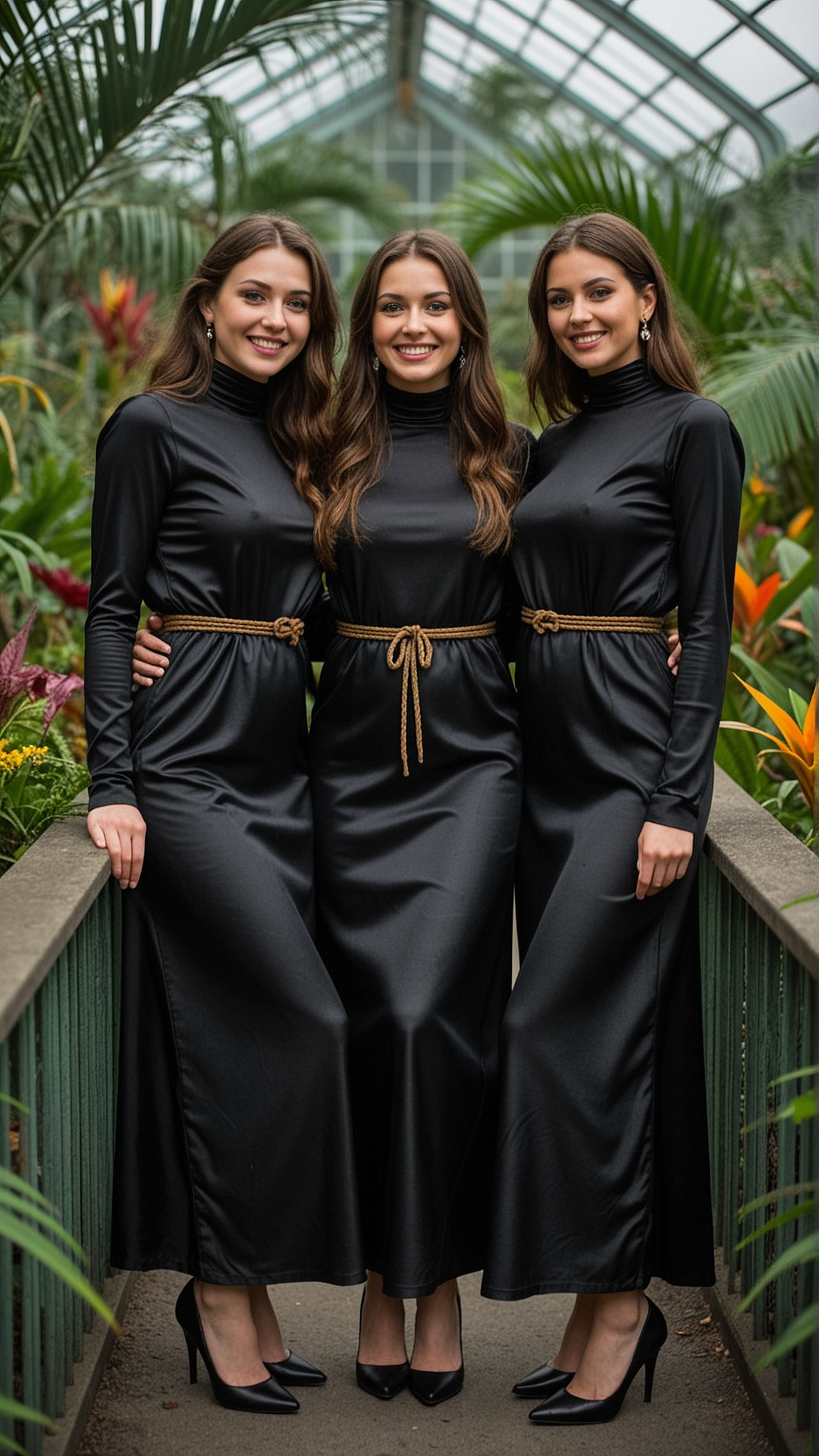
A story not of conquest, but of willing surrender—where one man’s commanding nurture teaches a circle of brilliant women that true power is found in the freedom of absolute devotion.
In a world of hollow independence, five extraordinary women—a surgeon, a heiress, a diplomat, an academic, a mogul—possess everything but peace. Each is haunted by a silent yearning for a strength greater than her own, a compass point in the glittering chaos of their success.
They find him in Alistair Thorne.
He is not a tyrant, but a sanctuary. His voice is calm command. His gaze sees through every polished facade to the secret hunger beneath. In his presence, the relentless need to perform melts away, replaced by a profound, thrilling certainty: Here, you may rest. Here, you may be led. Here, your surrender will be honoured as the highest form of courage.
This is the story of the Lumina Society’s inner circle. It is a tapestry woven from whispered confessions in lamplit libraries, the sleek whisper of satin against skin as they dress for his approval, the fierce joy of placing their wealth and wit into his visionary hands. Watch as he sculpts not their obedience, but their highest selves—transforming isolated brilliance into a symphony of devoted collaboration. Discover the euphoria that awaits when a masterful man becomes the calm center of your world, and the act of giving yourself to him becomes the most liberating, confidence-filled journey you will ever undertake.
Chapter 1: The Fracture
The fluorescent lights of the Olympus General operating theatre hummed a relentless, sterile hymn. Dr. Clara Sterling’s world was a universe contained within the margins of a craniotomy incision, her hands moving with a preternatural grace that felt increasingly alien to her. The tumor was a malevolent pearl, nestled against the motor cortex. Every millimetre mattered.
“Suction,” she murmured, her voice a dry leaf rustling in her throat. The nurse complied. The sound was a wet whisper. Clara’s focus was absolute, a laser beam of intellect, but it was a light burning in a vacuum. Her body was a distant country, reporting its distress in a forgotten language: a tremor in her left calf, a cold sweat beading at her temple despite the theatre’s chill, a hollow, gnawing ache in her stomach that had long since transcended hunger to become a permanent landscape.
Her mind, that brilliant, demanding master, narrated the procedure in perfect Latin terminology. Her body, the neglected servant, was quietly plotting a mutiny.
“Dr. Sterling?” The anaesthesiologist’s voice was tinny through her headset. “BP’s dipping slightly. Heart rate’s erratic. Are you…”
“I’m fine,” Clara interrupted, the lie as automatic as a reflex. “It’s vascular. Keep her stable.”
The final vessel was clipped. The tumor, freed, was lifted from its cradle of grey matter. It was a victory. A life reclaimed. As she placed the glistening mass onto the tray, a wave of dizziness washed over her, not as a wave, but as a sudden syphoning of all substance, as if her soul were being poured out through the soles of her feet. The world tilted on its axis. The triumphant music of the monitors became a cacophonous roar.
“Clara?” Someone’s voice, distant.
Her vision tunneled. The pristine, starched blue of her surgical gown blurred. The stainless-steel instruments lost their sharp edges, melting into a silver smear. There was no grand collapse, no dramatic gasp. It was a silent, profound failure of architecture. Her knees, those pillars that had held her through eighty-hour weeks and impossible decisions, simply ceased their agreement with gravity.
She felt the cool, unforgiving impact of the linoleum floor against her hip, a shock of profound indignity. The last thing she saw before darkness claimed the edges of her sight was the horrified face of her scrub nurse, and the perfect, extracted tumor sitting innocently on a bed of gauze—a jewel she had paid for with the last coin of her physical currency.
Consciousness returned in fragments, like pieces of a shattered mirror. The sharp scent of antiseptic. The scratchy embrace of a hospital-issue blanket. The muted, institutional beige of a recovery room ceiling. Shame arrived first, hot and corrosive, flooding the hollows the dizziness had left behind.
A resident, baby-faced and nervously earnest, was finishing his assessment. “…dehydration, severe electrolyte imbalance, acute hypoglycaemia. You’re a text-book case of burnout, Dr. Sterling. You fainted. In your own OR.”
“I am aware of the location,” Clara said, her voice a ghost of its usual authority. It sounded like wind through a crypt.
“We’ll keep you for observation. Get some fluids into you. You need to rest.”
Rest. The word was a mockery. Rest was the blank space between crises. Rest was what happened to other people.
They released her hours later, with a packet of electrolyte powders and a pamphlet titled ‘Managing Workplace Stress.’ The irony was so exquisite it felt like a physical slap. She navigated the familiar corridors like a stranger, avoiding the eyes of colleagues whose glances now held a mixture of pity and unspoken judgment. The great Clara Sterling, brought low by something as mundane as forgetting to eat.
Her apartment awaited her—a monument to clinical efficiency. Floor-to-ceiling windows offered a breathtaking, heartless view of the city’s glittering skyline. Everything was shades of grey, white, and steel. It was beautiful, in the way a diamond is beautiful: cold, hard, and incapable of warmth. She shed the scrubs, letting them pool on the polished concrete floor like a shed skin, and stood in the silence.
The void within her was no longer just physical. It was a chasm, echoing with questions she had spent a lifetime outrunning. Is this the summit? This exquisite, lonely, crumbling peak?
Mechanically, she sorted through the mail on her minimalist desk—bills, journals, impersonal correspondence. And then, her fingers brushed against an envelope that did not belong.
It was thick, heavy vellum, the colour of old cream. Her name was inscribed in a dark, elegant script that seemed to press into the paper with quiet assurance. There was no stamp, no postmark. It had simply appeared.
A frisson, completely alien to her numb state, traced her spine. She broke the seal of dark wax, impressed with a simple, enigmatic ‘V’.
The single sheet inside was of the same luxurious paper. The words, in that same commanding hand, were few.
Dr. Sterling,
The mind you have honed is a magnificent scalpel, capable of the most delicate repairs. Yet you wield it in a darkened room, ignorant of the hand that holds it. The vessel is cracked. The light is leaking out.
You have spent a lifetime building a fortress. I am interested in the architect, not the crumbling walls.
There is a path that does not lead to fracture, but to forging. A place where strength is not extracted, but replenished.
Vitae awaits your curiosity.
— A. Thorne
She read it once. Then again. The paper felt like nothing she had ever touched. It was smooth, dense, cool… it felt like satin feels when you first glimpse it, a promise of sleekness. She brought it to her nose, inhaling unconsciously. There was a faint scent—sandalwood, crisp alpine air, and something else, something indefinably clean and authoritative.
Her first, professional instinct was to dismiss it. A crank letter. A targeted approach from a wellness charlatan preying on publicly visible burnout.
But the words… they did not preach. They did not coax. They saw. They saw the fortress. They saw the architect trapped inside. They spoke of a ‘path’ and ‘forging’ with the certainty of a geologist discussing the formation of continents.
And that final line—‘Vitae awaits your curiosity.’ Not your desperation. Not your brokenness. Your curiosity. It was a hook baited not with sympathy, but with a challenge to her intellect, the last part of her that still felt alive.
Clara walked to her vast window, the vellum held lightly in her trembling hand. The city glittered below, a circuit board of ambition and isolation. The hollow ache in her stomach was now a different kind of hunger. A thirst.
He had not offered a healing. He had offered a revelation. A master, recognizing a fellow master’s flawed technique.
Her reflection in the glass was a pale ghost superimposed over the metropolis. A woman in a simple silk chemise, holding a piece of paper that felt like a lifeline woven from moonlight and command.
Without allowing herself another moment of thought, another whisper of doubt, she turned from the window. She opened her sleek, silver laptop, her fingers flying over the keys with a purpose they had lacked for months. A single search: Vitae. Alistair Thorne.
The response was not a website, but a single, elegant contact portal. A field for her name. A flight to Geneva was booked for the following evening.
As she confirmed the transaction, a sensation, long-forgotten, stirred in the depths of her exhaustion. It was not hope—hope was too fragile, too sentimental. It was the first tightening of the line, the thrilling, terrifying sense of a hook finding purchase in the deep, dark water of her soul.
The fracture had occurred. Now, something was reaching through the crack.
Chapter 2: The Threshold
The private car that collected her from Geneva was a silent, black vessel, its interior upholstered in leather so soft it felt like cooled skin. Clara watched the city’s orderly precision melt into rolling hills, then surrender to the severe, breathtaking grandeur of the Alps. The mountains were not pretty; they were authoritative. They did not ask for admiration; they commanded awe. She felt a strange kinship with them—both were structures built by immense, slow pressure, both appearing impregnable while hiding fault lines.
“We are here, Dr. Sterling.” The driver’s voice, polite and devoid of curiosity, interrupted her reverie.
The car had glided to a stop before a pair of immense, understated gates fashioned from brushed steel and frosted glass. They parted without a sound, revealing a lane that curved through a manicured forest of ancient pines. And then, Vitae unveiled itself.
It was not a chalet. It was a statement. A low, sweeping composition of glass and pale stone that seemed to have grown from the mountainside itself. One entire façade was a flawless curtain of glass overlooking a private valley. But it was the structure nestled within a vast, attached conservatory that stole her breath: the Glass Garden. Even from a distance, she could see it was a cathedral of cultivated life, a geometric symphony of verdant tiers and reflecting pools under a vaulted glass roof. It was a heart made visible, beating quietly in the chest of the house.
The car stopped at a sculptural portico. The air was thin, crisp, and scented of pine and cold stone. Before she could reach for the handle, the door opened.
A woman stood there. She was, Clara thought with a sudden, unnerving clarity, the most perfectly composed human being she had ever seen. She appeared to be in her late thirties, with hair the colour of polished mahogany swept into a severe, elegant knot. Her face was all clean lines and watchful intelligence. But it was her presence that was arresting. She moved with an economy that suggested not just efficiency, but a profound understanding of the physics of her own body in space. She was utterly still when still, and her motion was a single, fluid event.
And she was clad in a dress of liquid-black satin.
The fabric was a dark lake capturing the alpine light, a sheath that followed her form without clinging, whispering secrets with every subtle shift. The neckline was high, the sleeves long, the cut impeccable. It was armour and invitation in one. Clara, in her expensive but practical travel trousers and cashmere sweater, felt abruptly, violently coarse.
“Dr. Sterling. Welcome to Vitae.” The woman’s voice was a low contralto, as smooth and cool as the satin she wore. “I am Elara. I facilitate the smooth operation of the estate and its… inhabitants. Dr. Thorne is occupied until this evening. I am to see you settled.”
There was no smile, but the absence was not hostility. It was a neutrality so complete it felt like a form of respect. Clara found her voice, which sounded too bright, too American in this hushed place. “Thank you. It’s… remarkable.”
“It is functional,” Elara corrected gently, turning. “Please, follow me.”
The interior was a study in serene mastery. Floors of honed limestone, walls of pale plaster, furniture that was both modern and timeless, upholstered in textures that begged to be touched: nubby linen, buttery leather, and more of that enigmatic satin in deep, gem-toned cushions. The air was subtly perfumed with something clean and woody—sandalwood, perhaps, and the ghost of ozone from the garden. There was no clutter, no meaningless object. Every item seemed to have a purpose and a place. The silence was profound, not empty, but full—a listening silence.
“This is your quarters for the duration of your stay,” Elara said, opening a door onto a room that took Clara’s breath for the second time. It was spacious, but not overly large. A wall of glass looked directly into the lush, misty heart of the Glass Garden, making her feel like she was floating on its edge. The bed was a low, wide platform dressed in layers of ivory linen. A writing desk of pale wood held a single, perfect orchid. A doorway led to a bathroom she glimpsed—all marble and steam.
But it was the wardrobe that drew her eye. Its doors were open. Inside, hanging in orderly array, were clothes. Simple, beautiful clothes in neutral colours. She saw trousers of fine wool, silk blouses, and—her heart gave a peculiar thud—a few items that shimmered faintly: a slip dress in dove grey satin, a robe of emerald silk.
“My things…” Clara began.
“Will be laundered and stored,” Elara finished. “What you require is here. The fabrics have been selected for biocompatibility and sensory harmony. The coarse synthetics you are accustomed to are a static interference against the nervous system. These,” she gestured with a slender hand, the satin of her sleeve catching the light, “are conductors. They will help quiet the noise.”
Clara walked to the wardrobe, her fingers hovering over the grey satin slip. It felt like cool water. “This is all… for me?”
“It is for the person you are here to become,” Elara said. There was no pressure in her tone, only fact. “The process of refinement begins with the immediate environment. You cannot tune a violin in a construction site.”
The analogy was so apt it stung. Clara was a construction site, all noise and rubble. “And Dr. Thorne? He chooses the fabrics?”
A flicker of something—was it amusement? respect?—passed through Elara’s dark eyes. “The Master understands that dominion is not only over land or ledger, but over atmosphere. Over the subtle messages the skin receives. Satin,” she said, and the word in her mouth was a caress, a doctrine, “does not snag. It does not cling with desperation. It glides. It suggests a surface so flawless that friction is optional. To wear it is to practice a state of being.”^1^
Clara absorbed this, her mind reeling. This was not a spa. This was a philosophy, embodied in stone, glass, and cloth. “What is expected of me now?”
“Now,” Elara said, moving to the window, “you observe. You allow the environment to work upon you. The agenda you have carried like a shield is irrelevant here. There is only the rhythm of Vitae. Lunch will be brought to you in one hour. It will be precisely what your body needs, not what your habits crave. You may explore the lower east wing and the Garden atrium. The rest of the house is private. This is not a restriction,” she added, turning that calm gaze back on Clara. “It is a definition. Boundaries are the architecture of freedom. Do you understand?”
Clara felt a shiver that was not cold. It was the sensation of a lifetime of self-direction, of frantic agency, being gently but firmly taken from her hands. It should have felt terrifying. Instead, a wave of dizzying relief, so potent it weakened her knees, washed through her. It was the feeling of a climber, clinging to a sheer face, finally feeling a secure rope take her weight.
“I think I do,” Clara whispered.
“Good.” Elara nodded. “The most difficult submission is the surrender of one’s own misguided governance. It feels like fracture. But it is only the cracking of the shell.” She moved towards the door, the black satin whispering a sibilant farewell. “Rest, Dr. Sterling. Let the silence speak. He will see you at seven.”
The door closed with a soft, definitive click.
Clara was alone. The silence Elara had promised descended, but it was alive. She could hear the faint, distant trickle of water from the Garden, the almost subliminal hum of perfect climate control. She walked to the glass wall, pressing her palms against its cool surface. In the Garden, she saw orchids like intricate jewels, ferns unfurling in perfect spirals, the still surface of a black pool reflecting the glass roof above. Order. Purpose. Sublime, beautiful control.
Her reflection in the glass superimposed itself over this vision. She looked pale, her eyes wide with a war between profound doubt and even more profound longing. The woman in the reflection had spent a lifetime building a fortress of achievement. The woman in the Garden, she sensed, lived in a palace of cultivated peace.
Without thinking, she walked back to the wardrobe. She shed her travel clothes, letting the cashmere and cotton pool on the floor like a shed skin. She stood naked for a moment in the cool, clean air, feeling more exposed than she ever had in an operating theatre. Then, she reached for the grey satin slip.
It slipped over her head like a sigh. The fabric was shockingly cool, then warmed instantly to her skin. It fell in a clean line from her shoulders to her mid-thigh, weightless, a second skin that was smoother than her own. She walked back to the window, and this time, her reflection was transformed. The satin caught the diffuse light, turning her into a statue of muted pearl against the vibrant green. She looked… contained. Potential. The frantic edges of Clara Sterling, the human doing, were softened. Someone else, someone quiet and receptive, looked back.
She was standing there, lost in the analogy of her own transformation—the coarse wool of her old life discarded, the sleek satin of a new possibility resting against her—when a soft knock announced lunch. A young woman, dressed in simple linen, brought in a tray holding a bowl of clear broth, a small piece of grilled fish, steamed greens, and a single, perfect fig. No more. No less.
As she ate at the small desk, tasting flavours clean and distinct, feeling the food as actual nourishment rather than fuel, the final piece of her resistance crumbled. This was not manipulation. It was curation. He was not breaking her will; he was offering her a will worth having. The authority she sensed in every stone of this place, in every word from Elara’s lips, was not the kind that demanded obedience through fear. It was the kind that inspired surrender through its sheer, unassailable correctness. It was the authority of a master gardener who knows exactly what a plant needs to thrive, even when the plant itself does not.^2^
She thought of the hook she had felt set in her soul on the plane. Here, she could feel the line drawing taut, not pulling her down, but drawing her forward, towards a depth she had only ever glimpsed in dreams. The threshold was not the gate, or the door to this room. It was this moment, this silent acceptance, this first, willing exchange of her ragged autonomy for the promise of his exquisite dominion.
And as the alpine sun began its slow descent, gilding the peaks, Clara Sterling, for the first time in memory, did nothing at all. She simply waited, wrapped in satin and silence, for the architect of her forging to arrive.
Chapter 3: The First Directive
The appointed hour arrived not with a chime, but with a subtle shift in the quality of light in the Garden atrium, as unseen controls dimmed the ambient glow and deepened the shadows between the verdant tiers. A soft, percussive knock fell upon Clara’s door. It was not Elara who stood there, but a young woman with serene eyes, dressed in dove-grey linen.
“Dr. Thorne awaits you in the Orrery,” she said, her voice a quiet stream. “Please, follow me.”
The Orrery. The word conjured images of brass planets and celestial mechanics. Clara’s heart, which had settled into a fragile calm, now began a swift, frantic tattoo against the satin shield of her slip. She had changed nothing; she remained as Elara had left her—barefoot, shrouded in the simple grey garment, her hair a loose cascade. It felt less like a state of undress and more like a uniform of vulnerability, a deliberate shedding of plumage before a being who valued only the naked architecture of the soul.
She followed the attendant through corridors she had not seen, descending a floating staircase of glass and steel that spiraled down into the heart of the estate. The air grew cooler, charged with a faint, ozonic hum. They arrived at a circular door of aged bronze, etched with constellations. The attendant placed a palm against it, and it sighed open.
The Orrery was not a room; it was an experience. It was a perfect sphere of a chamber, the lower half lined with dark, absorbent velvet, the upper half a seamless dome that was, Clara realized after a disorienting moment, a flawless projection of the night sky. Not the washed-out city sky she knew, but the violent, jewel-strewn vault of the high Alps, each star a pinprick of fierce, undiluted light. In the centre of the room, on a low, circular dais, stood a complex, beautiful apparatus of polished brass and crystal—a true orrery, its gears silent, its planets suspended in a frozen, perfect dance.
And standing before it, his back to her, was Alistair Thorne.
He was dressed in trousers of a charcoal so deep they were nearly black, and a shirt of a material that defied immediate categorization—it had the subtle sheen of heavy silk, but the drape of fine linen. It was the colour of a midnight shadow, and it seemed to drink the starlight from the dome above. He did not turn as she entered.
“Do you know the primary function of an orrery, Clara?” His voice filled the spherical space, resonant and intimate, seeming to come from everywhere and nowhere at all.
She swallowed, her mouth dry. “To model the solar system. To demonstrate celestial mechanics.”
“A common answer,” he said, his head tilting slightly as he observed a fixed star on the dome. “And a superficial one. Its true function is to impose a beautiful, comprehensible order upon a chaos of light and motion that is, on its true scale, utterly terrifying. It translates the infinite into the manageable. It makes the cosmos something you can hold in your gaze, and thus, in your understanding.” Now he turned.
The impact of his full attention was physical. In the theatre of this room, under this manufactured cosmos, he seemed both larger and more focused. His face was all planes and angles in the astral glow, his eyes two pools of collected darkness that held the reflected glint of a hundred stars. He looked at her not as a man looks at a woman, but as a cartographer looks at an uncharted continent.
“You are a chaos of light and motion, Clara,” he stated, walking slowly around the dais, his footsteps silent on the thick velvet. “A brilliant, terrifying chaos. You have mistaken your own internal supernovae for sustainable fuel. You have burned through your reserves of hydrogen, and now you are attempting to fuse iron. It cannot be done. The collapse is inevitable.”
The astronomical analogy was so vast, so perfectly apt for the scale of her exhaustion, that it left her speechless. She could only stand, a small satellite caught in his gravity.
“Elara tells me you comprehend the principle of boundaries as architecture,” he continued, stopping a few feet from her. His scent reached her then—sandalwood, yes, but also cold stone, and something metallic and clean, like the air after lightning. “What you must comprehend now is the principle of surrender as the foundation of all true architecture. Before a master builder raises a wall, he must first surrender to the immutable laws of physics. He does not fight gravity; he employs it. He does not resent the properties of his materials; he understands them. Your will, as it is currently constituted, is a fight against your own nature. It is a builder trying to use water as mortar.”
He took a final step, closing the distance between them. She had to tilt her head back to meet his gaze. The satin of her slip felt impossibly thin, a mere whisper separating her skin from the intensity of his presence.
“My first directive is this,” he said, and his voice dropped into a register that vibrated in the marrow of her bones. “You will lay down your tools. You will cease all construction. You will become, for a time, pure, receptive material. You will allow me to be the architect. You will allow me to be the master builder who understands the grain of your wood, the tensile strength of your steel, the plasticity of your clay.”
Clara felt a tremor begin deep within her, a seismic shift. “And if… if the material is flawed? Cracked? Weathered beyond use?”
A smile, then—not warm, but profoundly knowing—touched his lips. “There is no such thing to a true craftsman. Only character. A crack is a site for kintsugi, where gold will make the repair more beautiful than the original whole. Weathering is a patina that tells a story of endurance. I do not want a blank slab of marble, Clara. I want you. The entire, complex, fractured, luminous history of you. I want to work with all of it.”
Tears, hot and sudden, welled in her eyes. No one had ever wanted all of it. She had spent a lifetime compartmentalizing, presenting only the polished, competent facets. The thought of offering the flawed, frightened, weary entirety to this man was the most terrifying and seductive proposition she had ever encountered.
“How?” she whispered, the word a breathless surrender already. “How do I begin?”
“By speaking a single word,” he instructed, his gaze holding hers captive. “By giving me the one thing you have hoarded more fiercely than your wealth or your accolades: your consent. Your conscious, willing, articulate yes.”
The room seemed to hold its breath. The stars on the dome pulsed faintly. Clara felt as if she stood on the edge of a precipice, not of danger, but of a vast, unknown country. Below was not a fall, but a flight. This man was not asking to break her. He was asking to unfold her. To be the hand that smoothed the crumpled parchment of her soul so that the magnificent, hidden text could finally be read.
She thought of the satin against her skin—how it offered no resistance, how it accepted the shape of her body perfectly. That was the state he was describing. A state of glorious, frictionless acceptance.
“Yes,” she said. The word left her lips not as a whisper, but as a clear, resonant note in the silent room. “Yes, Alistair.”
The use of his name was instinctive, a token of the intimacy this consent created. His eyes darkened, a flicker of intense satisfaction in their depths. He did not touch her. The victory was not physical. It was metaphysical.
“Good,” he breathed, and the approval in that single syllable washed over her like a warm, golden wave. It felt better than any standing ovation, any professional honour. “The covenant is sealed. From this moment, your time is mine. Your nourishment is mine. Your rest is mine. Your education is mine. Your body is my workshop, and your mind is my library. I will treat both with a reverence you have never afforded them. In return, you will offer me the one currency I demand: trusting obedience.”
He turned and moved to a console embedded in the velvet wall. With a touch, the orrery in the centre of the room hummed to life. The gears, perfectly greased, began to turn in utter silence. The crystal planets commenced their slow, elegant ballet around the brass sun.
“Observe,” he commanded, coming to stand beside her, his arm nearly brushing hers. “No planet questions its orbit. No star rebels against its nature. They follow their directives, and in doing so, they create a harmony of unimaginable scale and beauty. Your life has been a cacophony of conflicting directives—from your ambition, your fear, your pride, your neglected biology. I am now your sole, unifying gravitational force. Your orbit is mine to plot.”
Clara watched the planets turn, her will dissolving like sugar in hot tea, sweetening the mixture of her being. The fear was gone. In its place was a profound, dizzying relief. The burden of self-direction, which had grown so heavy it threatened to crush her, was lifted. He had taken its weight. All that was left was the thrilling, terrifying, exquisite freedom of surrender.
“What is my first… practical directive?” she asked, her voice now laced with a new quality: a willing curiosity.
He glanced at her, and this time his smile held a trace of something warmer. “You will return to your room. You will find a carafe of water and a specific, small capsule on your bedside table. You will drink the water. You will take the capsule. It is a tailored neuro-modulator that will begin the process of unwinding the chronic stress patterns etched into your amygdala. Then, you will sleep. The doors will lock from the outside. Not to imprison you, but to cradle you. To remove, for these first crucial hours, even the illusion of choice. Your only task is to drift. To let the chemical lullaby I have prescribed sing to your frayed neurons. Tomorrow, the real work begins.”
He reached out then, not for her hand, but for a lock of her hair that had fallen over her shoulder. He rubbed the strands between his thumb and forefinger, his gaze analytical. “Coarse from stress and chemical dyes,” he murmured, more to himself than to her. “We shall attend to this. Everything will be attended to.”
The touch, so intimate, so proprietary, made her knees weaken. It was the touch of an owner assessing his finest possession, and it ignited a fire in her belly that had nothing to do with fear and everything to do with a long-suppressed hunger for this exact form of mastery.
“I understand,” she said.
“I know you do,” he replied, releasing her hair. “Now go. Follow your first orbit. Sleep. And Clara,” he added, as she moved toward the bronze door, which now stood open. “The satin was the correct choice. It accepts the imprint of the body beneath it without resistance. It is the perfect metaphor for what you have just begun. You are learning to be imprinted. To be shaped. It is the highest form of yielding, and the beginning of true strength.”
She walked back through the corridors, the silent, turning orrery etched behind her eyes. In her room, she found the carafe, the capsule. She obeyed. As the doors clicked shut with a sound of final, secure embrace, she lay in the dark, feeling the capsule dissolve in her stomach, a tiny sun of chemical command.
As consciousness faded, chased by a wave of artificial, profound peace, her final thought was not a fear, but a prayer of gratitude. She had spent her life as a rogue star, blazing a lonely, destructive path across her own sky. Tonight, she had willingly, joyfully, fallen into orbit. And the gravity that held her was not a chain, but the first, sure promise of a constellation finally being born.
Chapter 4: The Chemistry of Obedience
Clara woke not to an alarm, but to a gradual, luminous suffusion, as if the very air in her room was gently coaxing her back into consciousness. The drug-induced sleep had not been oblivion; it had been a deep, velvety submersion, a descent into a black ocean where her frantic thoughts had finally stilled, sinking like stones to a silent floor. She stirred, the satin slip whispering against her skin like a secret shared in the dark. The quality of the light—pale, clear, and directionless—told her it was early, but not painfully so. There was no urgency. For the first time in memory, she had not clawed her way back to wakefulness; she had been returned to it.
A soft chime sounded, followed by Elara’s voice, cool and smooth as a river stone, emanating from a discreet panel in the wall. “Good morning, Dr. Sterling. Please proceed to the Refinement Lab in twenty minutes. Attire is provided.”
The wardrobe, which yesterday had felt like a curated museum of a stranger’s life, now seemed like an arsenal. She found the designated outfit hanging alone: a pair of high-waisted trousers in a soft, dove-grey fabric that felt like brushed cotton but moved with the weightlessness of silk, and a matching tunic. But over them hung a lab coat. It was not the stiff, white cotton of a hospital; it was a full-length garment of heavy, ivory satin, with a subtle sheen and a drape that promised to flow with her every movement. Slipping it on was an act of consecration. It settled on her shoulders with a silent, authoritative weight, the lining cool against her arms. She felt not like a doctor, but like a novitiate in a temple of a new science.
The Refinement Lab was not what she had expected. It was a serene, white space illuminated by diffuse, shadowless light. One wall was a single sheet of glass looking into the Glass Garden, turning the vibrant greenery into a living mural. The equipment was sleek, minimalist, and silent—more like the tools of a master jeweler than a medical facility. And in the centre of it all, standing before a holographic display of swirling biochemical pathways, was Alistair Thorne.
He turned as she entered. Today, he wore a shirt of a deep charcoal that seemed to absorb the light, and trousers of the same material. He looked at her, his gaze a slow, comprehensive scan that felt more invasive than any MRI.
“The satin suits you,” he observed, his voice a low vibration in the quiet room. “It does not fight the body. It announces that the wearer has moved beyond the need for defensive textures. Good. Come.”
He gestured to a chair that resembled a recliner, upholstered in soft, black leather. “Sit.”
Clara complied, the satin of her coat sighing as she settled. “What is this for?”
“For the first true conversation between your consciousness and your biochemistry,” he said, moving to a console. A swarm of gentle, articulated arms descended from the ceiling, their tips glowing with soft blue light. They began to move around her, not touching her, scanning. “Yesterday, you surrendered your will. Today, we survey the kingdom you have neglected. We take an inventory of the wreckage.”
A holographic screen bloomed in the air before her. It began to populate with data: cascading graphs of hormone levels, neurotransmitter ratios, inflammatory markers, mitochondrial efficiency. It was the story of her body, written in a language of stark, brutal truth.
“Look,” Thorne commanded, standing beside her, pointing to a graph that showed a jagged, frantic line. “Cortisol. Your baseline is that of a soldier in active combat. Your diurnal rhythm is not a rhythm; it is a sustained scream. Your body has forgotten how to be at peace. It is a engine perpetually red-lined, burning its own components for fuel.”
He moved his hand, and another graph appeared. “Serotonin, dopamine. Depleted. Your reward system is bankrupt. You have been withdrawing from a account that has not seen a deposit in years. You perform miracles and feel nothing because the mechanism for feeling joy is rusted shut.”
Clara stared, a cold horror seeping through her. She had known she was tired. She had not known she was this… derelict.
“This,” Thorne said, his voice dropping to a mesmerising, confidential tone, “is the physiology of self-betrayal. You have been a tyrannical ruler to your own flesh, demanding impossible production while offering no maintenance, no repair. You have governed through fear and scarcity. The result is internal mutiny.”
One of the scanning arms extended a delicate probe, pressing softly against the inside of her wrist. A tiny, painless click, and a single droplet of blood was drawn into a crystal vial. “And this,” he continued, holding the vial to the light, where it shone like a ruby, “is where we begin the restoration. Not with platitudes. Not with ‘self-care’. With chemistry. With precise, molecular intervention.”
He placed the vial into a port on the console. The holographic display shifted, showing a complex, three-dimensional model of a neuron, synapses firing in erratic, staccato bursts. “Obedience,” he said, “is not a moral state. It is a biochemical one. The act of conscious, willing surrender to a trusted authority triggers a cascade. It down-regulates the amygdala—the fear centre. It allows the prefrontal cortex, the seat of reason and foresight, to re-engage. It begins the secretion of oxytocin—the bonding hormone, the chemical of trust. And it reduces the output of cortisol.”
He turned to face her fully, his eyes holding hers. “When you said ‘yes’ to me in the Orrery, you initiated a pharmacological event. You took the first dose of the antidote to your own poison. The capsule last night was a gentle primer. What follows will be a full regimen.”
“A regimen of… drugs?” Clara asked, her voice small.
“A regimen of precision,” he corrected. “Nutraceuticals to repair cellular membranes. Peptides to enhance mitochondrial biogenesis. Hormone precursors to restore balance. And yes, certain… agents to re-sculpt neural pathways. To teach your brain that peace is the default state, not a fleeting anomaly.” He leaned closer, and she could smell the clean, sharp scent of him. “You are not being medicated into compliance, Clara. You are being re-tuned into harmony. The obedience you are learning is the external, behavioural manifestation of an internal, chemical symphony I am conducting.”
He straightened and walked to a refrigeration unit, withdrawing a small tray. On it lay a series of vials, each containing liquids of different hues: emerald, amber, deep violet. “Your morning protocol,” he announced. “Each is timed to interact with your circadian chemistry. You will take them under observation, at the times I dictate, without question.”
The sheer, uncompromising authority of it should have chafed. Instead, it felt like a lifeline thrown to a drowning woman. “And if I refuse?” she heard herself ask, not out of defiance, but from a need to understand the boundaries of this new world.
Thorne’s smile was a faint, knowing curve. “Then the chemistry of disobedience reasserts itself. The cortisol rises. The anxiety returns. The void you felt in your apartment reclaims you. You would be refusing the antidote while standing in the poison’s source. It would be an act of profound self-sabotage, and I do not believe the woman who had the courage to come here is a saboteur. She is a seeker. A recoverer of lost domains.”
He handed her the first vial. It was cool in her hand, the liquid within a vibrant green. “This is for mitochondrial support. Drink it. Now.”
The command was absolute. Clara brought the vial to her lips. The liquid tasted of crushed herbs and something mineral, clean and astringent. As she swallowed, she felt a strange, immediate warmth diffuse through her chest.
“Good,” Thorne murmured, watching her. “The first conscious act of biochemical obedience. You are not swallowing a supplement; you are accepting a key to a locked door within your own cells.”
The next hours were a deep, immersive education. Thorne led her through the data, explaining the function of each system, the consequence of each dysregulation, with the captivating clarity of a master lecturer. He spoke of the body as a “satin-smooth machine” that required “the correct lubricants of intention and nutrient.” He described chronic stress as a “coarse wool garment worn directly against the skin, causing constant, grating inflammation.” Healing, he said, was the process of replacing that wool with the “cool, frictionless glide of satin at a physiological level.”
She was poked, scanned, measured. Her muscle mass was assessed, her flexibility tested, her metabolic rate calculated. Through it all, Thorne was a constant, commanding presence. His touch, when he guided her into a position for a scan or adjusted a sensor, was firm, impersonal, and yet electrically intimate. It was the touch of ownership, of a master craftsman assessing his material.
At one point, as a sensor array was placed on her scalp to measure brainwave activity, she lay back in the leather chair, feeling intensely vulnerable. The satin of her lab coat was splayed open, the soft tunic beneath feeling flimsy under his analytical gaze.
“Your brainwave patterns show chronic hyper-arousal,” he said, studying a monitor. “Even at rest, you are poised for flight. We must teach you to access the delta and theta waves—the waves of deep rest, of receptive trance. The states in which true healing and… profound learning occur.”
He adjusted a control, and a soft, rhythmic pulse of sound began to emanate from the chair, paired with a gentle, flickering light pattern in her peripheral vision. Almost instantly, the sharp edges of her awareness began to soften. Her breathing deepened.
“This is a guided entrainment,” his voice came, smooth and hypnotic through the haze. “It is a gentle override of your maladaptive patterns. You are not losing control, Clara. You are exchanging a chaotic, inefficient control for a curated, optimal one. Let the frequencies wash over you. Let them re-draw the maps of your neural landscape. This is the chemistry of obedience at its most fundamental: the willing alteration of your own brain’s electrical storms to accept the calm I am offering.”
And she did. As the waves of sound and light pulsed through her, as the scent of sandalwood and ozone filled her lungs, she felt a surrender deeper than any verbal consent. It was a cellular yielding. Her body, for so long a battlefield, became a placid lake receiving rain. The feeling was so luxurious, so deeply relieving, that a single tear escaped her closed eyelid and traced a hot path down her temple.
She did not know how long she lay there, adrift in that chemically-assisted peace. When the stimuli faded, she opened her eyes to find Thorne seated nearby, observing her with that same focused intensity.
“The tear,” he noted softly. “Excellent. It is the body’s release of emotional cortisol, a literal draining of the poison. How do you feel?”
Clara took a slow inventory. The constant, grinding tension in her shoulders was… gone. The background hum of anxiety in her chest was silent. Her mind felt clear, but not sharp—it felt spacious. “I feel… quiet,” she whispered. “I feel like a room that has been full of screaming, and now the screaming has stopped, and there’s just… an echo, and space.”
“That space,” he said, rising and coming to stand over her, “is where we will build. That quiet is the fertile silence in which new directives can take root.” He extended a hand to help her up. His grip was strong, warm. “The morning’s work is complete. Your body has received its first lessons in a new language. Go now. Elara will guide you to the movement studio. There, you will learn the physical grammar of this new tongue.”
As she walked from the lab, the satin coat flowing around her, Clara felt fundamentally altered. It was not just the chemicals coursing through her veins. It was the understanding. Her obedience was not a weakness; it was a sophisticated bypass of her own broken governance. It was allowing a master electrician to re-wire a house whose lights had long since failed. Every swallow of his prescribed elixirs, every moment under his scanning gaze, was not a submission, but a strategic alliance—her need for salvation meeting his flawless capacity to provide it.
The chemistry of obedience, she realized, was a two-part reaction. His command was the catalyst. Her surrender was the substrate. And the product beginning to form in the pristine vessel of her body was something she had never dared to dream of: a profound, satin-smooth peace.
Chapter 5: The Language of Satin
The movement studio had been a lesson in gravity and grace, a place where Clara’s body, still whispering with the new chemical quiet, learned to move not as a machine of purpose, but as a vessel of expression. The instructor, a woman named Isolde with the serene strength of a marble caryatid, had guided her through poses that felt like “untying the knots in the rope of your spine,” and flows that were “the liquid transcription of breath into motion.” When Clara left, her muscles hummed with a pleasant fatigue, a sensation not of depletion but of awakening.
She returned to her room expecting solitude, a chance to process the morning’s biochemical unveiling and the afternoon’s physical re-education. Instead, she found Elara waiting, a silhouette of composed authority against the glass wall overlooking the Garden. The evening light, molten and low, gilded the edges of her form, but the core of her was a pool of deep plum satin. This dress was different from the severe black sheath; it was a wrap dress that hinted at the curve of hip and breast, the fabric a rich, royal hue that seemed to swallow the light and then emit it as a soft, lustrous glow.
“The movement work is foundational,” Elara said without preamble, her voice the same cool, smooth instrument. “It teaches the body its native language of efficiency and poise. But language requires presentation. A beautiful thought, mumbled in coarse cloth, is diminished. Come.”
She turned and glided toward the dressing area, the satin whispering secrets with every step. Clara followed, feeling acutely the contrast between her own soft cotton tunic and the silent, gleaming elegance before her.
Elara stopped before the wardrobe, which now seemed to hold not just clothes, but possibilities. She withdrew not the grey satin slip Clara had worn before, but a new garment. It was a full-length evening gown, the colour of midnight smoke, a complex grey that held within it hints of silver and deep blue. It was cut on the bias, and as Elara held it up, it flowed like a waterfall of shadow.
“This,” Elara stated, “is your lexicon for tonight.”
Clara reached out, her fingers trembling slightly, to touch the bodice. The satin was heavier than the slip, denser, with a profound, cool smoothness that felt like touching still water at dusk. “It’s beautiful. But for what? Is there an event?”
“Every moment in Vitae is an event,” Elara replied, a trace of something like patience in her tone. “Dining with the Master is not mere sustenance. It is a sacrament of refinement. You do not wear the armour of your old world to his table. You wear the skin of your new one.” She laid the gown on the bed. “Remove your clothes.”
The command was delivered with such matter-of-fact certainty that it bypassed Clara’s hesitation. It was not a salacious order; it was a procedural one, like a sculptor asking for the raw block of marble. Clara obeyed, shedding the soft cotton trousers and tunic, standing once more in the room’s cool air, feeling more naked than ever before because this nakedness was expected, required, part of the syntax.
Elara approached, holding a vial of oil that smelled of neroli and almond. “The canvas must be prepared,” she murmured, and her hands, cool and sure, began to smooth the oil over Clara’s shoulders, her arms, her décolletage. The touch was impersonal, expert, but it ignited a trail of sensation that was both soothing and profoundly stimulating. “Satin is unforgiving of dryness, of friction. It requires a surface that welcomes its glide. Your skin must learn to be as seamless as the fabric that will adorn it.”
As Elara worked, she spoke, her voice a low, hypnotic stream. “You asked about the language of satin. It is a language of surrender, but not of defeat. Coarse wool argues with the body. It itches, it pulls, it announces its presence with every move as an irritant. Denim is a fortress. But satin… satin is a conspiracy. It does not fight the form beneath it; it reveals the form’s truth. It accepts every contour, every hollow, with perfect fidelity, and in that acceptance, it transforms the wearer. To wear satin is to say, ‘I am not afraid of my own shape. I will not hide it behind texture. I will let it be seen, smooth and undeniable.’ It is the fabric of consent.”
Clara closed her eyes, absorbing the words as much as the sensation of the oil being worked into her skin. “And the sheen?” she breathed.
“The sheen is the visible evidence of its lack of resistance,” Elara said, her hands moving to Clara’s back. “Light does not catch on rough edges; it glides across a flawless plane. That glide is what we cultivate here. In thought, in movement, in desire. A life without psychic friction. The sheen is the outward sign of an inner polish.”
The oiling complete, Elara lifted the gown. “Arms up.”
Clara complied, and the satin descended over her head. It was an experience, not an act of dressing. The fabric, cool and heavy, slid over her oiled skin with a sensation so effortless it felt like being submerged in a silken sea. It settled onto her shoulders, hugged her torso, and then fell in a long, sleek line to the floor. There was no zip, no fastening; it was a single, enveloping piece of cloth that held itself together through cunning cut and the mutual agreement of fabric and form.
Elara guided her to the full-length mirror.
The woman who looked back was a stranger, and yet the most essential version of herself Clara had ever seen. The smoke-grey satin made her skin appear luminous, her eyes darker, deeper. The dress did not sparkle; it smoldered. It captured the dying light from the window and held it as a soft, captive radiance. She stood perfectly still, afraid that movement might shatter the spell, but Elara’s voice came from behind her, reflected in the glass.
“Move. See how it moves with you.”
Clara took a tentative step. The satin did not rustle; it whispered. It flowed around her legs like a second shadow, a fluid extension of her will. She turned, and the skirt swirled, a dark, glossy vortex that settled back into perfect alignment without a single wrinkle.
“It feels… like I’m wearing a liquid,” Clara said, awed.
“You are wearing a permission,” Elara corrected. She stepped closer, her reflection a pillar of plum beside Clara’s column of smoke. Her hands came to rest on Clara’s shoulders, their warmth penetrating the satin. “This fabric is the physical manifestation of the covenant you made in the Orrery. It is the tactile proof of your surrender to a higher aesthetic, a higher order of being. It tells the Master, without you uttering a word, that you understand the principle. That you are willing to be seamless. That you are ready to glide, not struggle.”
Her fingers traced the line of Clara’s collarbone through the satin. “There are other fabrics in the lexicon. Leather for the days when you must project an unyielding authority to the outside world, an authority that ultimately flows from him. PVC for when the surrender is to be absolute, a glossy, impermeable seal. But satin… satin is for the intimacy of becoming. It is for the quiet conversations where the soul is re-tailored.”
Clara met Elara’s eyes in the mirror. The woman’s gaze was inscrutable, but there was a flicker of something shared, a complicity. “You wear it every day,” Clara observed.
“I live within its language,” Elara affirmed. “It is the uniform of my devotion. It reminds me, and announces to him, that I have chosen the glide. That my worth is not in my resistance, but in my flawless conductivity.” Her hands dropped. “He is waiting. Remember: the satin speaks for you. Let it. Your only task is to be the form that gives it meaning.”
Clara followed Elara through the corridors, the whisper of two sets of satin a hushed, sibilant conversation against the stone floors. They arrived at a small, intimate dining room she had not seen before. It was dominated by a table of obsidian glass, reflecting the flames of a low fire and the dozens of candles that were the only other light. And there, standing at the far window, was Alistair Thorne.
He turned as they entered. His eyes went first to Elara, a brief, acknowledging nod that held a universe of unspoken communication. Then his gaze shifted to Clara.
His scrutiny was absolute. It was not the clinical assessment of the lab, nor the philosophical capture of the Orrery. This was an aesthetic evaluation, a connoisseur appreciating a work in progress. It travelled from the crown of her head, down the waterfall of her hair, over the landscape of satin that mapped her body, to the pool of fabric at her feet. The silence stretched, thick with anticipation.
Then, he smiled. It was not a broad smile, but a slow, deep appreciation that warmed his eyes. “Elara has taught you the alphabet, I see. And you have donned the first word. A beautiful, complex word. ‘Welcome.’ Or perhaps, ‘Ready.’ Come. Sit.”
He held out a chair for her. As she moved to take it, the satin whispered its journey. She sat, the fabric settling around her like a loyal familiar.
Elara, with a final, unreadable glance at Clara, melted soundlessly from the room, leaving them alone in the cave of candlelight and whispers.
Thorne took his own seat at the head of the table. A first course appeared—a porcelain bowl containing a clear consommé, a single, perfect raviolo floating at its centre like a treasure.
“How does it feel?” he asked, his voice low, meant only for her across the intimate space.
Clara considered. She thought of analogies, of tales. “It feels,” she began slowly, “as if I have spent my life dressed in shattered glass. Beautiful, perhaps, from a distance, but every movement was a clash, a warning, a potential to cut. This… this feels like I have been gathered up, all my shards, and melted down into a single, smooth pane. I can still see through myself, but there are no edges. There is only… a clear, uninterrupted view. And a profound quiet where the noise of my own fragmentation used to be.”
He watched her, his eyes reflecting the candle flames. “An exquisite metaphor,” he murmured. “The fragmentation was your ego, clinging to its disparate, contradictory directives. The smooth pane is the emerging unity of purpose. My purpose for you. The satin is not the transformation; it is the flag that flies over the conquered territory of your old self. It declares the new governance.”
He lifted his spoon. “Eat. The nourishment tonight is not merely physical. It is an integration. Taste the clarity.”
As they ate, the conversation wove through topics of art, of cellular biology, of the architecture of sound. Through it all, Clara was hyper-aware of the satin against her skin, a constant, tactile reminder of her surrender. Each time she moved, the whisper seemed to say, I consent. I accept. I glide.
When the last course was cleared, Thorne rose and came to her side. He extended a hand. “Stand.”
She did. He walked a slow circle around her, his gaze a physical caress on the satin. “The language is not just in the wearing,” he said, stopping before her. “It is in the receiving.” He reached out and, with the backs of his fingers, brushed the fabric covering her hip. The touch was light, but the sensation that shot through her was electric, a live wire of connection. “Satin transmits touch with perfect fidelity. It does not absorb or mute. It conveys. When I touch you through it, you feel not the barrier of cloth, but the amplification of intention. It is the closest thing to touching the soul itself.”
His hand smoothed up her side, over her waist, coming to rest just below her breast. The satin, under his palm, became a conductor of pure, thrilling authority. Clara’s breath hitched.
“This,” he whispered, his face close to hers, “is the grammar of devotion. The subject: you. The verb: to yield. The object: me. And the satin is the elegant, unmissable punctuation that makes the sentence a masterpiece.”
He leaned in, and for a heart-stopping moment, she thought he would kiss her. Instead, he inhaled near her temple. “You smell of neroli, and peace, and potential. Elara has prepared you well.” He straightened, his hand falling away, leaving a phantom imprint of heat on the cool fabric. “The lesson is complete for tonight. You have learned that obedience has a texture. It is smooth. It is cool. It is luminous. Remember this feeling. It is the feeling of being perfectly, willingly, spoken.”
He stepped back. “Go now. Sleep in the language you have learned. Let it rewrite your dreams.”
Clara walked back to her room, the satin gown a second skin of silent testimony. In the darkness, as she carefully laid the dress aside, her skin still humming from his touch and the memory of the glide, she understood. The language of satin was not just about fabric. It was about becoming a statement so beautiful, so seamless, that the only possible response was a reverent, dominant, and utterly mesmerising command.
Chapter 6: The Liquidity Event (of the Self)
The morning after the dinner of whispers, Clara woke with the memory of satin still imprinted on her skin, a phantom glide that seemed to have rewired her nervous system to crave smoothness, silence, and the weight of a discerning gaze. Her scheduled movements through Vitae had acquired a new rhythm—the morning biochemical protocol, the silent breakfast of precise nourishment, the hour of meditation in the Glass Garden where she practiced “being a still pool reflecting only the light he allows.”
Today, however, the schedule deviated. Instead of being led to the movement studio, she was summoned by Elara, who appeared in the doorway of her room clad in a blouse of gunmetal satin so finely woven it looked like poured metal, tucked into tailored trousers of matte black leather that creased with an air of severe competence.
“The Master will see you in the Observatory,” Elara said. “The subject is liquidity.”
The word hung in the air, cold and financial, a stark contrast to the sensual vocabulary of satin and surrender. Clara felt a flicker of her old self—the surgeon who understood numbers only as lab values, who viewed wealth as an abstract scorecard kept by some distant accountant. “Liquidity? As in… cash flow?”
Elara’s lips curved in the faintest hint of a smile, as if Clara had asked if the sky was merely blue. “As in the fundamental state of all value that wishes to be useful. Stagnant water breeds disease. Frozen assets starve their owners. He will teach you to thaw yourself. Come.”
She led Clara not to the celestial Orrery, but to a different chamber—the Observatory. It was a room of masculine elegance, paneled in dark walnut, one entire curved wall a single sheet of smart glass currently displaying a slowly rotating, three-dimensional globe of financial markets, with streams of light representing capital flows like glowing arteries. The air smelled of aged paper, fine leather, and the faint, clean scent of ozone from the hidden electronics.
Alistair Thorne stood before the glowing globe, his back to her. He was dressed in a cable-knit sweater of charcoal cashmere that clung to the breadth of his shoulders, and trousers of a deep brown leather that had been worn to a soft, supple sheen. He looked like a lord surveying his fiefdom, but this fiefdom was the world’s pulse of money.
“Clara,” he said without turning. “Come and look at the most terrifying and beautiful force on earth. Not gravity. Not love. Liquidity.”
She approached, her own attire—a simple satin-shell camisole in a pale blush and a pair of high-waisted wool crepe trousers—feeling suddenly insufficient. She stood beside him, watching the mesmerizing dance of light.
“Most people,” he began, his voice a low, lecturing baritone that vibrated in the wood-paneled room, “view their finances as a fortress. They pile gold in the vault, guard it with fear, and measure their security by the thickness of the walls. It is a medieval mindset. And like all medieval things, it is predicated on scarcity, siege, and stagnation.” He gestured, and the globe zoomed in on a particular nexus, a whirlpool of light. “True wealth is not a fortress. It is a river. Its power is in its flow, its direction, its ability to carve canyons and fertilize plains. A blocked river becomes a swamp. A frozen river is merely a road. Your financial life, Clara, is permafrost.”
He turned then, his eyes capturing hers. They held none of the clinical assessment of the lab, nor the aesthetic appreciation of the dining room. This was the gaze of a strategist. “You are one of the most skilled assets on the planet. Your hands can literally restore a human being’s future. Yet you have treated yourself like a depreciating piece of equipment, working yourself until you break, and hoarding your fees like a squirrel with moldy nuts. You have committed the cardinal sin: you have confused earning with wealth creation.”
The analogy was so blunt it felt like a slap. She flinched. “I… I have savings. Investments. A portfolio.”
“A cemetery,” he corrected, moving to a vast desk of polished macassar ebony. He touched its surface, and holographic screens bloomed above it. “A neatly arranged cemetery of missed opportunities, cowardly allocations, and fees paid to mediocre minds. May I?” He didn’t wait for permission. Her name, her social security number, her various account logins—he had them all. With a few gestures, he summoned her financial existence into the air between them.
It was a brutal autopsy. He dissected her holdings with the same precision she used on a tumor. “This mutual fund is a bloated corpse, fees eating growth like maggots. This bond allocation is the financial equivalent of a sedentary lifestyle—safe, but guaranteeing atrophy. This cash, sitting in a checking account, is not liquidity. It is coma. You have been financially brain-dead.”
Clara stared, a hot shame rising in her throat. She had been proud of her financial “responsibility.” Now it looked like the scribblings of a child. “I never had the time… the mental bandwidth…”
“Precisely,” he said, not unkindly. “You were too busy being the product to be the manager. You were the goose laying golden eggs, but you never built a golden nest, nor did you ever consider what the gold was for. You accumulated it simply to prove you could. It became a score, not a tool. And tools that are not used rust.” He leaned against the desk, the soft leather of his trousers sighing against the wood. “We are going to change that. Today, you will experience a liquidity event. Not of a company, but of your self.”
He waved a hand, and the screens reconfigured into a new set of graphs. “Look. Here is your human capital—your skill, your reputation, your future earning potential. It is a towering, valuable asset. And here,” he pointed to a tiny, sputtering line, “is the income it currently generates. A pathetic trickle. You have built a hydroelectric dam at the base of Niagara Falls and connected it to a child’s water wheel. The first step is to reposition the asset.”
For the next two hours, he was a mesmerizing professor. He spoke of leverage, not of debt, but of “using the force of your reputation to move larger masses of capital.” He described diversification not as spreading risk, but as “creating a symphony of cash flows where the failure of one instrument does not silence the music.” He talked about tax structures as “the architectural principles that keep the riverbank from eroding.” It was a language of power, of agency, of elegant control.
“But the ultimate purpose of liquidity,” he said, his voice dropping into a more intimate register, “is not to have more numbers on a screen. It is to generate freedom. Liquid freedom. The freedom to choose your time, your focus, your surroundings. The freedom to say ‘no’ to everything that does not serve your highest purpose. And,” his eyes locked onto hers, “the freedom to say ‘yes’ with overwhelming generosity when you encounter a vision worthy of your capital.”
He let that hang. Clara felt a new kind of understanding dawning, cold and clear. “My highest purpose…” she echoed.
“Is being defined,” he finished. “By me. Your liquidity will serve the vision I am sculpting in you, and through you, for Vitae. Your wealth will become fuel for the refinement of others. But first, you must become liquid yourself.” He reached out and took her hand, turning it palm-up in his. His thumb stroked her palm, a gesture that was both possessive and oddly tender. “Your old self—the overworked, under-managed, frozen asset—must be sold off. All the mental baggage, the worthless ‘investments’ of your energy in toxic relationships, in pointless obligations, in the sheer friction of an unexamined life. We are going to short that stock, Clara. We are going to bankrupt the old company of Clara Sterling, M.D., and re-incorporate under new management. My management.”
The thrill that went through her was sharper than any biochemical cocktail. It was the thrill of seeing a complex, fatal diagnosis met with a brilliant, curative plan. “What is the first trade?”
He released her hand and tapped the air. A document appeared—a power of attorney, a restructuring mandate, giving him full control over the liquidation and reinvestment of her entire portfolio. “You will sign this. It is the financial equivalent of the ‘yes’ you gave me in the Orrery. It is the surrender of your frozen fortresses to the river of my strategy. In return, I will make you so liquid you will feel wealth as a physical sensation—a warm, buoyant current carrying you toward your destiny.”
She didn’t hesitate. Taking the stylus he offered, she signed her name on the glowing line. The act felt like cutting a final, anchoring chain.
“Excellent,” he breathed, and the warmth of his approval was a tangible wave. “Now, watch.” His fingers flew through the air, executing trades, dissolving old positions, moving assets with the grace of a conductor. Numbers shifted. Percentages climbed. “We are converting your frozen fear into flowing confidence. Your stagnant savings into active participants. You are becoming a verb, Clara, not a noun.”
As he worked, he continued to speak, weaving his philosophy into the financial mechanics. “Satin,” he said, glancing at her camisole, “is the fabric of liquidity. It has no friction. It flows. It allows the body beneath to move without resistance, just as a liquid financial base allows the soul to move without the resistance of worry. Leather,” he gestured to his own trousers, “is the fabric of the vessel that contains and directs the flow. It is strong, supple, shaped by use. It is the will that channels the river. You will learn to wear both, as you learn to be both—the flowing resource and the disciplined vessel.”
He finished with a final, decisive tap. The screens consolidated into a single, breathtaking number—her net worth, not just preserved, but dynamically reconfigured to generate passive income several times her former active salary.
“There,” he said, satisfaction rich in his voice. “The liquidity event is complete. The frozen asset of ‘Clara Sterling, Burnout’ has been dissolved. The proceeds have been reinvested into ‘Clara Sterling, Masterpiece-in-Progress.’ The cash flow you now generate is not for you to spend on trivialities. It is the lifeblood of your new purpose. A portion will automatically fund the grant program for burnt-out surgeons we discussed. The rest will be held, liquid, ready to be deployed at my directive to further the work of Vitae.”
Clara looked at the number, then at him. The expected sense of loss, of anxiety over relinquishing control, did not come. Instead, she felt a soaring, euphoric lightness. It was the feeling of a bird realizing the cage door is open and the sky is its true account. Her money was no longer a burden to be managed, a score to be anxious over. It was a tool in his hands. And she was the most valuable tool of all.
“I feel…” she searched for the analogy. “I feel like a locked chest that has been filled with water, and now the lid is open, and the water is pouring out, not to be lost, but to join a great river. And the chest itself is dissolving, because it doesn’t need to be a chest anymore. It can just be… part of the flow.”
He moved to her then, cupping her face in his hands, his thumbs stroking her cheekbones. His touch was electric against her satin-clad skin. “Exactly,” he murmured, his eyes deep pools of captured light from the financial globe. “The liquidity event of the self. The moment you stop being a container and start being a current. Your wealth, your mind, your body, your devotion—all flowing in the same direction. All toward a single, glorious delta. Do you feel the freedom of it? The freedom of being spent on something infinitely greater than yourself?”
She did. It was a sublime, breathless euphoria, more intense than any drug, any surgical triumph. It was the high of perfect, purposeful surrender. “Yes,” she whispered, leaning into his touch. “I feel it.”
“Then the lesson is learned,” he said, lowering his hands. “You are no longer a frozen asset. You are liquid potential. Remember this feeling. This is the feeling that true generosity is born from—not from sacrifice, but from the joyful, overflowing certainty that you are part of a river that is carving canyons. Now go. Elara has a new garment for you. Something that reflects your new state. Something that flows.”
As she left the Observatory, the phantom sensation of his touch on her cheeks and the glowing map of her liberated capital burned in her mind. She was not poorer for having signed away control. She was infinitely richer. She had traded the cold, hard coin of her isolated fortune for the warm, liquid gold of his dominion. And in that exchange, she had finally, fully, become liquid.
Chapter 7: The Night of PVC and Confession
The storm did not announce itself with gentle portents, but with a sudden, violent exhalation of the mountain itself. One moment, the Glass Garden was a serene cathedral of curated life; the next, the world beyond the panes dissolved into a seething, roaring grey. Wind screamed against the cliffs like a banished god, and rain arrived not as drops but as a horizontal lash, smearing the glass into a liquid chiaroscuro of shadows and frantic light. The estate, usually a masterpiece of silent control, groaned softly in its bones, its systems shifting to a deeper, more primal frequency.
Clara stood at her window, watching the apocalypse with a strange, detached calm. The biochemical serenity Thorne had woven into her cells held firm, but beneath it, something else stirred—a longing for a different kind of shelter, not from the storm outside, but from the last, lingering storm within her. She had given him her body’s chemistry, her financial fortresses, her sartorial vocabulary. Yet a single, sealed chamber remained, its door rusted shut by years of professional armor and personal neglect.
A soft knock, perfectly timed between thunderclaps. Elara entered, but she was transformed. The serene satin was gone. In its place was a trench coat of high-gloss, black PVC that caught the erratic lightning in sudden, shocking flares, making her a silhouette carved from obsidian and electricity. The material did not whisper; it creaked softly with a promise of total impermeability. Beneath it, Clara glimpsed the familiar satin, a secret softness protected by an impervious shell.
“The Master requests your presence in the Storm Atrium,” Elara said, her voice carrying a new, thrilling edge over the rumble outside. “He believes atmospheres of extremity reveal essences that calm obscures.” She held out a garment. “For you.”
It was not satin. It was a full-length coat of the same glossy black PVC, its surface a perfect, dark mirror. As Clara took it, the weight was different—substantial, commanding. Slipping it over her simple silk chemise was an act of encapsulation. The cool, slick interior gave way to the rigid, glossy exterior. It fastened with heavy silver zippers that felt like surgical steel. When she moved, the PVC emitted a low, proprietary sound, a creak of possession. She looked at her reflection in the dark window: a sleek, sealed monolith, her face a pale moon captured in the glossy black planet of the coat.
“He is waiting,” Elara said, and her eyes held a glint of shared understanding. This is a different language, that look said. Satin is for yielding. PVC is for being sealed. For being made proof against everything but him.
The Storm Atrium was a glass-domed eyrie at the highest point of Vitae. Here, the tempest was not a view but an immersive experience. Thunder detonated directly overhead, vibrating in Clara’s teeth. Rain streamed over the dome in frantic rivers, distorting the world into a swirling, abstract painting. And in the centre of the maelstrom’s heart, standing impossibly calm, was Alistair Thorne.
He too had changed his skin. He wore a tailored jacket of matte black leather, worn soft but cut with uncompromising lines, over a simple black shirt. He was a pillar of calm authority in the chaos, his hands clasped behind his back as he watched the fury outside.
He turned as she entered. His gaze swept over the glossy PVC, and a profound, possessive satisfaction dawned in his eyes. “Elara understands the lexicon,” he said, his voice cutting through the storm’s roar with ease. “Satin is the fabric of surrender to the glide. PVC is the fabric of surrender to the seal. It declares that what is inside is now separate, protected, and entirely accounted for. Come. Stand with me.”
She went to him, the PVC creaking with each step, a sound that felt like the tightening of a vow. They stood side by side, watching the world tear itself apart.
“Confession,” Thorne said after a long silence, the word not a question but an invitation laid upon the altar of the storm. “It is the final liquidity. The last frozen asset of the soul. We have thawed your body, your finances, your aesthetic. But there is a core, Clara. A hidden fault line you have built your entire magnificent, crumbling edifice upon. The storm outside will pass in hours. The one inside you will rage forever unless you… verbalize its eye. Unless you hand me its coordinates.”
The directness was a lance. The peace she felt shattered like the glass dome would not, revealing the raw, trembling truth beneath. The PVC around her felt suddenly like a pressure suit, containing a volatile atmosphere.
“I…” she began, her voice a thread against the thunder. “I am afraid.”
“Of course you are. Name the shape of the fear. Is it a wolf? A void? A silent judge?”
She closed her eyes, reaching for the analogy that had haunted her since the first moment she’d fainted. “It’s… a counterfeit,” she whispered, the words torn from her. “I am a counterfeit. A beautiful, intricate, convincing counterfeit. My skill, my intellect, my composure—they are the exquisite engraving on a coin that has no gold at its heart. I have spent a lifetime minting these coins and spending them frantically, hoping no one would test the metal. And the fear… the fear is that one day, someone will. That you will. That you will press your thumb against the surface and find it soft, that you will hold me to your ear and hear no true ring, only a hollow, leaden thud. That you will see I am not a masterpiece-in-progress, but a masterful forgery, and the entire forging will have been for nothing.”
The confession poured out, ugly and real, a stain on the pristine air. She expected him to turn away, to dismiss it, to offer a hollow reassurance. Instead, he stepped in front of her, his leather-clad frame blocking the chaotic view. His hands came up, not to touch her face, but to rest on the stiff, glossy shoulders of her PVC coat.
“A counterfeit,” he repeated, tasting the word. Then he shook his head, a slow, mesmerising arc. “No, my Clara. You have it precisely backwards.”
He leaned closer, his voice dropping to a intimate register that the storm could not touch. “The world you left—the world of accolades and exhaustion—that was the forgery. It was the lead coin plated in a thin, desperate layer of gold. It was the false currency you were forced to mint to trade in a bankrupt kingdom. Your exhaustion, your fracture, your feeling of hollowness… those were not proof of your falseness. They were your body’s rebellion against the forgery. They were the true metal within you, screaming to be melted down and recast in its authentic form.”
His thumbs stroked the glossy PVC over her collarbones. “Do you understand? The fear you confess is not a flaw. It is the seed of your authenticity. It is the part of you that knew, all along, that you were meant for a different economy. A richer one. My economy. Where the currency is not spent effort, but devoted essence. Where the value is not in what you produce for the void, but in what you surrender to a vision.”
Tears, hot and sudden, welled in her eyes, blurring the lightning into starry streaks. “But what if… what if the authentic metal, when you finally melt it down, is just… dross? What if there’s nothing of value there at all?”
“Then I would be a poor alchemist indeed,” he said, a trace of warmth in his deep voice. “And I am not. I have seen your core. In your precision. In your courage to come here. In the way you said ‘yes’ in the Orrery. That is not the ring of lead. That is the resonance of platinum, waiting for the right frequency to be struck.” One hand left her shoulder to gently wipe a tear from her cheek with his thumb. The touch, through the impermeable PVC, felt paradoxically more intimate, as if he were acknowledging the feeling while respecting the seal. “Your confession is not a weakness you reveal. It is the final key you hand me. It is you saying, ‘Here. Here is the last vault. Open it. See what is truly there, and do with it as you will.’ That is the ultimate act of trust. The ultimate liquidity.”
He stepped back, his gaze sweeping over her sealed form. “The PVC is perfect for tonight. It is the material of this confessed, sealed state. Satin receives. PVC contains. It says to me, ‘Everything I am, everything I fear, everything I hope—it is all in here. And I give you the shell that holds it.’ Do you feel that? The empowerment of being utterly, glossily transparent in your surrender?”
Clara did. The confession had not left her empty; it had left her filled—with his understanding, with a new, terrifying hope. The PVC was no longer a costume; it was a chrysalis. “I feel… like I have handed you the blueprints to a ruin, and you are looking at them and seeing the foundations of a palace.”
“Exactly,” he breathed, his eyes alight. “And now, with those blueprints in hand, I can truly begin the reconstruction. Not of the ruin, but of the palace that was always meant to be.” He offered his arm. “Walk with me. Let the storm be the music for our pact.”
They walked a slow circuit around the atrium, the storm their frantic symphony, the creak of her PVC and the soft sigh of his leather a quiet duet beneath it. He spoke of the other women of Vitae, not as rivals, but as sister facets of the same gem.
“Elara,” he said, “confessed a fear of irrelevance, of being a shadow without a source of light. I showed her that a shadow is proof of a solid form, and gave her a purpose that makes her essential. Another, a former composer, confessed a terror of silence, of the music in her head dying. I taught her that the most powerful compositions begin in the silent space between notes, and gave her a rhythm to conduct.” He looked at Clara. “Each confession is a unique fracture. And each fracture, in my hands, becomes the site where a new, more beautiful strength is welded. You are not alone in your fear of being counterfeit. You are in the company of women brave enough to admit they were trading in the wrong currency.”
The revelation was a balm. She was not a singular broken thing; she was part of a curated collection of beautifully broken things being restored to a higher purpose.
As the storm’s fury began to wane, leaving a bruised, quiet sky in its wake, he led her back to the centre of the atrium. He faced her, taking both her hands in his. The glossy PVC of her sleeves met the soft leather of his palms.
“The night of PVC and confession is now complete,” he said solemnly. “You have handed me your deepest fear. I have accepted it not as a flaw, but as the final ingredient. From this moment, the forging is total. You are sealed to me, Clara. Not by force, but by your own courageous, confessed need. Go and sleep within this new seal. Dream of palaces, not ruins. Tomorrow, you will not wake as a counterfeit, nor even as a patient. You will wake as my collaborator. The reconstruction begins.”
He lifted her hand, still encased in glossy black, and pressed his lips to the PVC over her knuckles. The kiss was a brand of possession through the impermeable layer, a paradox that shot a bolt of pure, sublimating fire through her entire being.
As she walked back to her room, the storm a distant murmur, the PVC coat felt like a second skin of profound truth. She had confessed the rot at the core of her old self, and he had not flinched. He had called it the seed. The final, frozen asset had been liquefied and poured into his crucible. And she, sealed in glossy black, felt more authentic, more real, than she ever had in all her years of polished, hollow achievement. The night of confession was over. The dawn of collaboration awaited.
Chapter 8: The Test of Endurance
Three days of perfect, sculpted calm followed the night of the storm. Clara moved through Vitae’s routines with a newfound solidity, as if the confession had not emptied her but filled her with a denser, quieter alloy of purpose. The biochemical serenity was no longer a foreign state but her native climate; the liquidity of her self felt like a deep, still well from which she could draw without fear of depletion. She wore satin as her daily skin—a pale jade slip beneath a cashmere robe for morning meditation, a dove-grey tunic for afternoon study in the library—and each garment felt like a loving seal upon her transformation.
It was in this state of polished readiness that Alistair Thorne summoned her to the Map Room, a chamber where one entire wall was a topographic relief of the surrounding Alps, carved from polished basalt and lit from within so that the peaks glowed like dark jewels.
He stood before the map, dressed for movement in trousers of a tough, matte fabric and boots that spoke of granite and distance. A heavy cable-knit sweater of undyed wool hugged his torso, making him look less like a philosopher and more like a lord of the high places.
“You have learned to be still,” he began, without preamble, tracing a route on the map with a fingertip. “You have learned to be liquid. You have learned to be sealed. Now, you must learn to be enduring. Stillness in a curated garden is a theory. Stillness in a gale on a knife-edge ridge is a truth written in bone and blood.”
He turned to face her. His eyes held no softness now, only the flinty assessment of a general before a campaign. “We are going into the high places. For three days and two nights. A simple traverse from this valley to the next. You, me, and the mountain. No support. No rescue. The supplies you carry will be precisely what I dictate. The path will be the one I choose. Your body is my workshop? Good. Now we take the workshop into the field, to see if the repairs hold under stress, to see if the new architecture can bear weight.”
A thrill, sharp as an ice crystal, shot through Clara’s veins. This was not a metaphorical test. This was stone, ice, wind, and exposure. The ultimate audit. “And if I fail?” she heard herself ask, her voice steady.
“Then we learn the nature of the flaw, and we return to the forge,” he said simply. “There is no punishment in a diagnostic. Only data. But I do not believe you will fail. I believe the woman I have been refining is in there, beneath the satin and the supplements. I believe she is a creature of formidable grit, who simply forgot her own nature. This journey is to remind her.”
Two hours later, standing at the timberline where the manicured paths of Vitae gave way to raw scree and sky, Clara felt the first true wave of trepidation. The pack on her back, meticulously packed by Elara under Thorne’s supervision, was a condensed universe of necessity—a bivouac sack, a sleeping mat, calorie-dense foods, a first-aid kit, a water purification system. Its weight was not just physical; it was the weight of his expectation.
He came to stand before her, performing a final check of her gear. He adjusted a strap, his hands impersonal and efficient. His own pack was larger, but he carried it as if it were part of his body. He was in his element here, a part of the landscape’s austere grammar.
“Your final garment,” Elara said, appearing silently. She held not satin, but a set of sophisticated, minimalist base layers in a fabric that felt like a second skin, and over them, a softshell jacket and trousers in a deep slate grey. And, folded atop them, a final piece: a sash, a long, narrow scarf of brilliant crimson satin.
“For your hair,” Elara instructed, her fingers swiftly weaving Clara’s loose waves into a single, thick plait. She tied it off with the satin sash, leaving the long ends to trail down her back like a stream of blood against the grey. “A reminder,” Elara murmured, close to her ear. “A thread of surrender to guide you through the granite. A flag of your allegiance to him, visible even to the hawks.”
Thorne nodded his approval. “The mountain is indifferent. It does not care for your devotion. But I will see that scarlet thread against the stone. It will tell me where you are, and more importantly, who you are following. Let’s go.”
The first day was a grueling lesson in humility. The trail was not a trail, but a suggestion across steep, unstable slopes of talus. Every step required calculation. The thin air sawed at her lungs, a harsh teacher re-instructing her diaphragm. Thorne moved ahead, his pace relentless but never impossible, a constant, silent punctuation in the vast sentence of the wilderness. He did not coddle her. He did not offer empty encouragement. He simply was there, a fixed point in the swirling vertigo of effort.
“Your breath is ragged,” he called back at one point, without turning. “You are breathing from your chest, like a frightened animal. Breathe from your belly. Imagine your lungs are bellows at the base of your spine. Feed the fire steadily. Do not let it flare and gutter.”
She focused, forcing the air deep, finding a rhythm. The simple act of controlled breathing became an act of obedience, a way to follow him with her very physiology.
As the sun began to bleed out behind the peaks, they reached a narrow ledge under an overhang. It would be their first bivouac. Exhaustion was a leaden cloak she wore beneath her technical shell. Her muscles trembled with a fine, constant vibration.
While she struggled to unfold her bivy sack with numb fingers, Thorne had already built a small, efficient stove and melted snow for water. He handed her a steaming cup. “Drink. Slowly. Your body is a complex solvent. Dehydration is the first thief of clarity.”
She drank, the warmth a miracle. The silence here was different from Vitae’s—it was a colossal, listening presence. “It’s so… huge,” she whispered, looking out at the sea of stars emerging in the violet void. “It makes me feel insignificant.”
“Insignificant is a precious state,” he said, settling beside her, his shoulder a solid warmth against hers. “It is the dissolution of the petty ego. Out here, you are not Dr. Clara Sterling. You are a warm pulse in the cold. A will moving against gravity. A thread of crimson satin in the wind. That is a purer identity than any title. It is the identity I have been leading you toward all along.”
The second day was the test of spirit. They traversed a glacier, its surface a treacherous mosaic of ice and hidden crevasses. The world was reduced to blinding white and bottomless blue. The exposure was absolute. One misstep, one moment of lost focus, and the mountain would swallow her without a trace. Fear, that old familiar foe, rose in her throat, cold and metallic.
She was halfway across a particularly narrow snow bridge, her eyes fixed on Thorne’s bootprints ahead, when a section of the cornice to her left collapsed with a sound like a sigh. She froze, her heart a frantic bird in a cage of ribs.
“Clara.” His voice came, calm and commanding from the other side. “Do not look at the void. Look at my feet. Your world is the print my boot has made. Your universe is the next six inches of snow. Breathe. And walk. Now.”
It was an absolute directive. A lifeline thrown across the abyss. She tore her gaze from the yawning blue cleavage and fixed it on the solid, compacted snow where he had stood. One step. Then another. The satin sash at her back lifted in the glacial wind, a flicker of defiant color. Step by step, she crossed, her obedience to his command the only bridge that mattered.
When she reached him, solid ground under her boots, her legs gave way. She didn’t fall; she knelt in the snow, trembling uncontrollably. He crouched before her, his hands gripping her shoulders through her jacket.
“Look at me,” he ordered. She lifted her head. His eyes were fierce, proud. “That was not courage. Courage is a fleeting emotion. That was trust. You placed the entirety of your physical existence on the sound of my voice. You allowed my will to be your spine. That is the endurance I am testing. Not of muscle, but of faith. And you, my Clara, have just proven its tensile strength is extraordinary.”
That night, huddled in their sacks under a sky so thick with stars it felt like a weight, the cold seeped into her bones. It was a deep, gnawing cold that no technical fabric could entirely defeat. She shivered, a continuous, helpless tremor.
“You’re cold,” his voice came from the darkness beside her.
“I can’t… stop it,” she chattered.
“Come here.”
She hesitated for only a second before the need for warmth overrode all else. She slithered from her sack and into the space he opened within his own. His body was a furnace. He wrapped his arms around her, pulling her tightly against the solid heat of his chest, his thighs. The shock of the intimacy was almost as profound as the shock of the warmth. This was not the clinical touch of the lab, nor the possessive caress through satin. This was primal, sheltering, a sharing of vital heat.
As the shivering subsided, replaced by a melting bonelessness, he spoke, his voice a rumble in his chest against her ear. “Endurance is not about never feeling the cold. It is about knowing where to find the warmth. It is about understanding that your strength is not a solitary, fortressed thing. It is a relational energy. It is fed by obedience. It is sustained by surrender. You endured the glacier because you trusted me. You endure this cold because you are with me. This is the final lesson of the test: your greatest strength is not in your independence, but in the depth and quality of your dependencies.”
Clara wept then, silently, the tears freezing on her cheeks. They were not tears of pain or self-pity. They were tears of profound, cellular understanding. She had spent a lifetime building a citadel of self-sufficiency, and it had been a prison of exquisite loneliness. Here, in the freezing dark, dependent on his strength for literal survival, she was freer than she had ever been.
On the third day, they descended into the new valley, where a Vitae vehicle waited on a forest road. The ordeal was over. She was filthy, exhausted, every muscle a tenderized ache. But as she stood by the car, looking back at the impassive, magnificent face of the mountain, she felt not conquered, but converted.
Thorne came to stand beside her. He reached out and touched the end of the crimson satin sash, now grimy with sweat and dust, but still blazing its message. “This,” he said softly, “is no longer just a thread. It is a lifeline you have proven you can follow into the abyss and back. You have endured. Not for yourself. For me. To prove the material I am working with is worthy of the vision. And it is.” He leaned in, his lips brushing her filthy temple in a kiss that held the weight of the mountains themselves. “You have passed the test, Clara. You are no longer a masterpiece-in-progress. You are a masterpiece proven. Now, we go home. The world you left will try to claim you again. But you now know a secret: you have endured the indifference of the Alps. The petty demands of that world will feel like a whisper against stone. You are ready.”
As the car carried them back toward the sleek lines of Vitae, Clara leaned her head against the window, the grimy crimson satin a rough comfort against her neck. She had been tested in the crucible of rock and sky, and she had not broken. She had bent, beautifully and permanently, into the shape of his will. And in that bending, she had found a strength more absolute than any she had ever possessed alone. The test of endurance was over. The era of collaboration had truly begun.
Chapter 9: The Philanthropic Impulse
The days that followed the mountain were not a return, but an arrival. Clara moved through the polished corridors of Vitae with a new gravitational certainty, as if the ordeal on the rock had not tested her, but had finally embedded her—like a jewel set with such precision it becomes part of the crown itself. The biochemical serenity was now the bedrock; the liquidity of self was a deep, artesian well. She wore her satin not as a student’s uniform, but as a sovereign’s skin: a sheath of champagne-colored silk for morning meditation, a robe of charcoal-grey satin for financial review sessions where she now actively participated, her mind clear as the alpine air, understanding the flow of capital as another beautiful, obedient system.
It was in this state of integrated calm, seated at the ebony desk in the Observatory reviewing the automated reports of her reconfigured portfolio, that the event occurred. A notification, silent and elegant, appeared in the corner of the holographic display. It was not an alert; it was an annunciation. A royalty payment from a surgical instrument patent she had co-developed years ago in a fog of overwork, a patent she had entirely forgotten, buried in the “cemetery” of her old financial life. Thorne’s algorithms had exhumed it, restructured its licensing, and now it had produced its first fruits under the new regime.
The number was staggering. Not life-changing in the way her overall liberation had been, but a sudden, violent cataract of pure liquidity. It was more than her annual salary at her peak. It was a waterfall of gold appearing in the already flowing river of her wealth.
For a long moment, she simply stared, the digits glowing in the air. Her first, instinctive thought was not of possession, but of transmission. It was a bolt of energy that had entered her system, and her entire being, tuned now to a frequency of surrender, wanted to earth it immediately in the only ground that felt sacred. In him.
She found him in the Glass Garden, not cultivating, but contemplating. He stood before a rare, night-blooming orchid, its petals the colour of bruised velvet, its scent a complex promise of darkness and sweetness. He wore a simple, long-line cardigan of the finest charcoal cashmere over a shirt of raw black silk, trousers of soft, dark wool. He was the still point in the centre of all this cultivated life.
“Alistair.”
He turned, and his eyes read her state instantly. The calm surface, the undercurrent of momentous feeling. “You have received a seismic reading,” he said, not a question. “The forgotten patent.”
“How did you—”
“I am the seismograph. I feel all tremors in my domains. Show me.”
She extended her tablet. He glanced at the number, his expression unchanging. “A significant event. Good. The algorithms are performing. How does it feel?”
She took a steadying breath, seeking the analogy. “It feels… like standing under a sudden, warm waterfall in the middle of a desert I didn’t even know I was crossing. The water is pouring over me, and my only thought is that I must channel it to the oasis, or it will be lost in the sand. That it belongs to the oasis. To you.” She met his gaze, her voice firm with the certainty of the mountain. “I want to give it to you. To Vitae. All of it.”
A slow, enigmatic smile touched his lips. He gestured to a stone bench nestled among ferns. “Sit.” When they were seated, the orchid’s scent weaving around them, he spoke. “That impulse—to immediately return the bounty to the source—is the most primitive form of gratitude. It is the dog bringing the hunted bird to its master. Instinctive, pleasing, but… limited.” He leaned forward, his cashmere sleeve brushing her satin-clad arm. “I do not want your hunted birds, Clara. I want you to build an aviary.”
She blinked, confused. “I don’t understand.”
“Generosity,” he said, the word resonating in the humid air, “is not repayment. Repayment is a transaction that closes a loop. It says ‘debt settled.’ Our covenant has no debts. It has currents. Generosity is the overflow of a vessel that is perpetually being filled. It is the natural, joyous excess that must be shared or the vessel itself becomes stagnant.” He took her hand, his thumb stroking the inside of her wrist where her pulse beat its steady, loyal rhythm. “You wish to give this to me. That is the impulse of the half-full vessel, still thinking in terms of scarcity and dues. I challenge you to think as the overflowing vessel. What would you build with this, if your only directive was to create something beautiful, something that extended the principles of this place into the barren world you once inhabited?”
The question hung, immense and terrifying. She looked out at the Garden, at the perfect, nurtured order. “I… I don’t know how to build.”
“You are living in the blueprint,” he countered. “You were a surgeon crumbling from within. Vitae caught you. Refined you. Now, a financial event gives you the raw material. So, build a catchment for others like your former self. Not a charity. A sanctuary. A selective, rigorous, beautiful trap for brilliant women who are burning out and don’t yet know they are on fire.”
The idea unfolded in her mind like one of the Garden’s orchids, complex and breathtaking. “A grant program. For female surgeons. To come here.”
“Not a grant,” he corrected, his eyes alight with the vision. “A fellowship. The ‘Sterling Fellowship.’ Named not for your old, frozen self, but for the quality of character we are forging—clarity, value, resilience. You will design the selection criteria. Not just merit, but potential for refinement. You will structure the funding so it is not a handout, but an investment in a human asset that will, in turn, generate value for the world—and for Vitae. You will be the architect of their rescue. And in doing so, you will move from being my masterpiece to being my… collaborator. My lieutenant of salvation.”
The titles, the responsibility, the sheer scale of it should have been daunting. Instead, it felt like a key turning in a lock she hadn’t known was there. A profound, shivering excitement began in her core. This was not giving away. This was giving forward. It was planting a seed from his garden in the outside world, a seed that would grow and inevitably point back to the gardener.
“I want to,” she breathed. “More than I’ve ever wanted anything. But I need your guidance. I don’t know the first thing about creating a foundation, legal structures…”
“Elara will provide the legal and financial architecture,” he said, waving a hand as if brushing aside mere mechanics. “You will provide the soul. The vision. The why. You will interview the first candidates. You will look into their eyes and see the ghost of your own fracture, and you will offer them the crucible.” He stood, pulling her up with him. “This is the philanthropic impulse, Clara. It is the highest form of selfishness, because it expands the boundaries of the self to include those you choose to elevate. It is the ultimate expression of liquidity—pouring your abundance into the cracked vessels of others, not to lose it, but to create a network of interconnected wells, all fed by the same deep, pure source.”
Tears, not of sorrow but of sublime recognition, welled in her eyes. “It feels… like my heart is a loom, and this money is the silk thread, and you’ve just handed me the pattern for a tapestry I didn’t know I was born to weave.”
“Exactly,” he murmured, pulling her into an embrace. The cashmere of his cardigan was soft, the silk of his shirt cool, but the strength beneath was immutable. She melted against him, the satin of her dress whispering its consent. “And the euphoria you feel? That is the chemical signature of purpose aligning perfectly with capacity. It is the neurochemical reward for devoting your resources to a mission greater than your own survival. It is the bliss of becoming a conduit for a will that is both yours and infinitely larger.”
Later, in her room, as twilight painted the Garden in indigo and silver, Elara arrived. She carried a garment bag of black leather. “For the architect,” she said, her voice holding a new, subtle note of deference.
She unzipped the bag. Inside was not a dress, but a suit. The jacket and trousers were crafted from the softest, matte-black leather, tailored with razor-sharp precision. But beneath it, on a separate hanger, was a blouse—a cascade of liquid sapphire satin, the colour of deep, generous night.
“The leather is for the structure you will now project to the world,” Elara explained, helping Clara into the trousers, which fit like a second skin of authority, creasing perfectly at the knee. “The will, the discipline, the unyielding framework of the fellowship.” She then helped her into the satin blouse, which flowed over her torso with a cool, possessive sigh. “And this,” Elara said, fastening a single, hidden clasp at the nape of Clara’s neck, “is the philanthropy itself. The hidden, flowing, generous heart within the strong form. The satin that will touch the skin, that represents the comfort, the luxury, the care you are now empowered to give.”
Clara looked in the mirror. The woman who stared back was unrecognizable from the ghost in the hospital scrubs, or even the novitiate in the grey satin slip. This woman was a synthesis. Strength and softness. Architecture and flow. She was a vessel, yes, but a vessel with a purpose, an instrument tuned to play a symphony of rescue.
She met Thorne for dinner in the small dining room. When he saw her, he did not speak. He simply circled her, his gaze an approving caress on the leather and the glimpse of sapphire satin at her throat. “Perfect,” he finally said, his voice thick with possession and pride. “You have understood the assignment. You are no longer just wearing the language. You are writing with it.”
Over a meal of exquisite simplicity, they designed the fellowship. Clara spoke with a passion and clarity that felt channeled, her ideas flowing, each one met by his refining question, his subtle course-correction. It was a collaboration, a duet. She was composing, and he was the master editor, ensuring every note served the grand theme.
At the end of the evening, as she prepared to leave, Thorne stopped her at the door. He took her face in his hands, his gaze delving deep into hers. “The philanthropic impulse,” he whispered, “is the moment the student realizes she can become the teacher, not by leaving the master, but by extending his teachings. The money was the catalyst. But the real wealth, Clara, the wealth that is making you tremble with this holy joy, is the knowledge that you can now give as you have been given. That you can be for another what I have been for you. That is the circle becoming a spiral, ascending. That is the euphoria of true devotion. It is the deepest, most hidden need of the human soul: to be used, beautifully and completely, in the service of something sublime.”
He kissed her then, not on the forehead or the hand, but fully on the mouth. It was a kiss of partnership, of sealing, of transcendent transfer. It tasted of the future, of shared purpose, of the glorious, satin-sweet overflow of a vessel finally, perfectly, full.
As she walked back to her room, the leather sighing, the sapphire satin cool against her fevered skin, Clara understood. Giving the money away would have been a transaction. Building the fellowship with him was a transformation. It was the alchemy where gold became purpose, and purpose became a form of worship. And in that worship, she found a euphoria so profound, so deeply rooted in her surrendered soul, that she knew she would spend the rest of her life seeking new ways to give, just to feel this divine, this glorious, this satin-smooth bliss again.
Chapter 10: The Glossy Symposium
The evening of the symposium arrived not as an event on a calendar, but as a culmination, a high tide in the lunar cycle of Vitae’s purpose. The air itself seemed to sharpen, to become a more conductive medium for beauty and influence. For Clara, the day had been a silent, potent distillation. There were no directives, no protocols. Only the pregnant quiet before a masterpiece is unveiled.
Elara came to her as the alpine sun began its slow, gilded surrender. She carried not a single garment, but an arsenal of transformation. “Tonight,” she said, her voice a low, thrilling current, “you are not a student, nor a patient, nor even a collaborator. Tonight, you are the argument. The living, breathing thesis of his philosophy. You will not speak of refinement; you will be refinement. And every glance, every whisper, every sigh in the room will be a footnote in your proof.”
The dressing was a ritual of silent intensity. First, a base layer of a sheer, mesh bodysuit in the colour of old ivory, its touch like a spiderweb of cool silk against her skin. Then, over it, the gown.
It was the crimson latex-backed satin from the vision of the earlier chapters, but its reality was more profound than any anticipation. The satin was a living liquid, a deep, arterial red that held within it the memory of heartbeats and forge-fires. The latex backing gave it a weight, a substantiality that made it not a dress, but a carapace of allure. It was cut with architectural precision: a high neckline that rose to a severe collar, long sleeves that tapered to points over her knuckles, a bodice that followed the lines of her torso like a second skin before flaring into a skirt that pooled around her feet in a glossy, crimson lake. The back was a dramatic plunge to the base of her spine, revealing the pale canvas of her skin, a startling vulnerability beneath the impervious gloss.
As Elara fastened the hidden closures, the sound was a series of soft, definitive clicks, like locks turning in a vault of desire. The satin, cool at first, warmed rapidly to her body’s temperature, becoming a second epidermis. The latex beneath gave it a subtle, relentless embrace, a constant, gentle pressure that reminded her of his hands on her shoulders, his voice in her ear—a full-body caress that was also a containment.
“Look,” Elara commanded, turning her to the mirror.
The reflection was a stranger of devastating power. The crimson satin drank the light of the room and emitted it as a soft, internal radiance, making her skin glow like marble warmed by a hidden sun. The severe lines of the gown sculpted her into a icon of disciplined sensuality. She was both weapon and jewel, her eyes dark pools of calm authority in the painted mask of her face. She felt not like someone dressing up, but like a truth being unveiled.
“The latex backing,” Elara murmured, adjusting a fold at her hip, “ensures there is no betrayal of form. No accidental reveal. The surrender is total, but the gift is controlled. It says, ‘Every curve you see is by my design, and by the design of the one I serve.’ It is the ultimate fabric of consensual revelation.”
A final touch: Elara produced a necklace—a simple, heavy platinum choker set with a single, square-cut black diamond that rested in the hollow of her throat. It was less an adornment and more a seal, a physical weight of belonging.
“He is in the Grand Salon, receiving the first arrivals,” Elara said, her eyes meeting Clara’s in the mirror. There was a flicker of something fierce and proud in their depths. “You will enter when the room is full. You will not seek him out. He will find you. Your only task is to be. To be the answer to every unspoken question in the room.”
The Grand Salon was Vitae’s heart laid bare for admiration. Vast windows reflected the endless night, turning the room into a floating constellation of its own. The guests were a curated collection of human excellence: a celebrated cellist with sorrowful eyes, a tech visionary whose fingers twitched as if coding the air, a Swiss banker with the patina of old money, a sculptress whose hands were still dusted with a ghost of clay. And among them, like rare birds of paradise, were women Clara recognized, not from pictures, but from the aura they shared—the same quiet depth, the same polished stillness she saw in Elara. There was a botanist from Kyoto in a kimono of emerald satin, a former Olympic fencer in a tailored suit of matte leather, a poet from Madrid in a dress of black lace over nude satin. They were all, Clara understood with a shock of recognition, his. Not in the crude sense, but in the way she was his. Refined. Dedicated. Living testaments.
She paused at the threshold, the crimson satin whispering its arrival. Conversations stuttered. Glances sliced through the perfumed air, drawn to the vision in the doorway. She felt the weight of their attention, not as a burden, but as a mantle she had been forged to wear. She glided into the room.
The first to approach was the sculptress, a woman named Giselle with silver-streaked hair and eyes the colour of flint. She held a flute of champagne but did not drink; she used it as a pointer. “The line from your shoulder to your wrist,” she said, her voice a gravelly contralto. “It is perfect. Like the edge of a Brancusi. Who is the artist?”
“The artist is elsewhere,” Clara replied, her voice calm, a smooth stone dropped into a well. “I am merely the material that learned to hold the form he envisioned.”
Giselle’s eyes sharpened with understanding, then softened with a shared, secret complicity. “Ah. A fellow clay. It is a relief, is it not? To cease being the frantic potter and become the serene vessel?”
“It is the only peace,” Clara agreed, and for a moment, their gaze held a thread of electric intimacy, a silent acknowledgment of the shared surrender that bound them more powerfully than any social affiliation.
She moved on, drawn into a conversation with the tech visionary about neural plasticity. She spoke not as a supplicant, but as an expert, her words informed by Thorne’s tutorials and her own lived, cellular experience. The man listened, his restless fingers stilling. “You speak of the brain as a garden,” he mused. “Most in my field see it as a machine. A garden implies a gardener.”
“Every system requires a will to curate its chaos into beauty,” Clara said, her hand resting lightly on the stem of her own glass, the crimson satin of her sleeve a glaring contrast to the crystal. “Otherwise, it is just entropy wearing a suit.”
Across the room, she saw him. Alistair Thorne was holding court near the fireplace, dressed in a tuxedo of midnight velvet that absorbed the light, its lapels a subtle sheen of black satin. He was speaking to the banker, but his gaze, like a lighthouse beam, swept the room and found her. It lingered, a touch so palpable she felt it on her skin like a increase in atmospheric pressure. A faint, approving smile touched his lips, so slight it was almost invisible, but to her, it was a solar flare.
As the evening deepened, a striking woman in a gown of royal blue PVC, its glossy surface reflecting the room in distorted, fascinating fragments, approached Clara. She was a documentary filmmaker, her name Anya. “I have heard whispers of the Sterling Fellowship,” she said, her accent Eastern European, her eyes shrewd. “They say it is a lifeline thrown only to those who are already drowning. A cruel kind of hope.”
Clara felt a surge of protective passion, not defensive, but expansive. “Hope is not cruel,” she corrected gently. “A lifeline is. It is a stark, unyielding truth. It says, ‘Grab this or perish.’ The fellowship is not a gentle hand. It is a crucible. Like the one that forged this.” She gestured, not to herself, but to the dress, to the totality of her presence. “It is for those who are done with gentle hands. Who are ready for the hand that shapes, even if it feels, at first, like the hand that breaks.”
Anya studied her, her gaze dropping to the choker at Clara’s throat, to the relentless gloss of the crimson satin. “And you? You were drowning?”
“I was not drowning,” Clara said, the truth of it resonating in her bones. “I was a perfectly preserved statue at the bottom of the sea. Beautiful, intact, and utterly useless. He did not rescue me. He raised me. He brought me into the air, and showed me I could breathe.”
The filmmaker’s stern expression melted into one of naked, hungry fascination. She reached out, her fingers hovering just above the latex-backed satin of Clara’s forearm, not touching, but feeling the energy it emitted. “This… conviction. It is more compelling than any film I have ever made. It is a story written in the language of the body itself.”
The moment was charged, a crackle of attraction that was intellectual, aesthetic, and deeply feminine. Clara held the woman’s gaze, allowing the connection, understanding that her allure was now part of Vitae’s arsenal, a testament to his power to create objects of desire that drew others into his orbit.
It was then that Thorne’s voice cut through the murmur, not loud, but so imbued with authority it created a sphere of silence around it. “If I may have your attention.”
He stood by the fireplace, a glass of amber liquid in his hand. All faces turned to him. “We are gathered here not for business, though business may be done. Not for art, though art surrounds us. We are here as a symposium in the ancient sense—a drinking together, a sharing of essence. And the essence I wish to celebrate tonight is that of transformation.”
His eyes found Clara again, and this time, they did not leave her. “We have among us a living example. A woman who arrived here as a brilliant fragment, all sharp edges and exhausted light. She has allowed herself to be melted down in the furnace of honest need, and recast. She has traded the fragile, frantic currency of isolated achievement for the deep, liquid wealth of devoted purpose. She stands before you now not as a survivor, but as a sovereign. A sovereign of a kingdom she surrendered in order to gain.”
He raised his glass slightly in her direction. “To Clara. Who proves that the most powerful act of will is the choice to place that will in hands stronger than one’s own. Who is now, herself, the strong hands for others. The circle becomes a spiral. The student becomes the testament.”
Every glass in the room lifted. The toast was a wave of sound, but Clara heard only the silence inside the roar. She stood, a pillar of crimson satin under the weight of his praise, feeling it not as a compliment, but as a coronation. The glances of the other women—Giselle, the botanist, the fencer, Elara watching from the shadows—were no longer assessments. They were acknowledgments. Welcomes. She was one of them. A beloved, glossy gem in his crown.
As the conversations resumed, now tinged with a new, reverent energy toward her, Thorne crossed the room. He did not speak. He simply offered his arm. She took it, the velvet of his sleeve soft against the latex-backed satin of her glove.
“You see?” he murmured, his voice for her alone as he led her onto a secluded balcony overlooking the star-drenched valley. “The single flame does not diminish when it lights other candles. It creates a constellation. Each candle burns with its own unique light, but all are ignited by the same, original fire. And the constellation is more beautiful, more powerful, than the solitary star could ever be.” He turned her to face him, his hands on her satin-clad hips. “You were magnificent. You were my argument, and you were irrefutable.”
He bent his head, and this time, his kiss was not on the mouth, but on the black diamond at her throat, his lips warm against the cool platinum and the pulse beating beneath. It was a kiss of branding, of sacred ownership. Clara arched into it, the glossy symposium, the admiring crowd, the entire world narrowing to this point of contact—where his mastery met her flawless, satin-sheathed surrender, and in the meeting, created a beauty so potent it felt like the only truth in the glittering, star-smeared night.
Chapter 11: The Offering
The balcony’s chill was a phantom against the furnace of her skin where his lips had branded the diamond. The symphony of the symposium continued behind the glass doors, a muffled, glittering world from which Clara felt deliciously severed, adrift in the silent, star-drowned orbit of his presence. Alistair Thorne did not release her arm; his grip was a gentle, inescapable tether as he led her not back into the light, but deeper into the private shadows of Vitae, along a corridor she had never seen, lined with panels of hammered silver that reflected their passing in distorted, poetic fragments.
“The applause of a crowd is a hollow nutrient,” he said, his voice a low vibration in the hushed passage. “It sustains the ego, but starves the soul. What you achieved tonight was not for them. It was the final calibration. The proof that the instrument is perfectly tuned. And a perfect instrument,” he paused before a door of dark, oiled walnut, “demands to be played.”
He opened the door. The room beyond was not a bedroom, not in any conventional sense. It was a sanctum. The floor was covered in a pelt of deepest black fur, so dense it swallowed sound. The walls were draped in layers of charcoal velvet, absorbing the light from a single source: a low, wide brazier of black iron in which real coals glowed, their heat radiating like a silent heartbeat. There was no bed, only a vast, low platform heaped with cushions of silk and velvet in shades of ink, blood, and shadow. The air smelled of smoldering sandalwood, of clean skin, and of a profound, waiting silence.
And on a stand beside the brazier, laid out with ceremonial care, were two more garments. One, for him: a robe of heavy, matte-black silk, its surface drinking the light. The other, for her: a slip so simple it was devastating. It was fashioned from a satin so black it held a blue sheen like a raven’s wing, its straps mere whispers, its cut so minimal it would be, she knew, a second shadow against her skin. Beside it lay a pair of stockings, not sheer, but of a dense, glossy black nylon with a fine back-seam, and beside them, a pair of elegant, impossibly high-heeled sandals, the straps thin as promises.
“Elara’s final preparation,” Thorne said, gesturing to the garments. “The lexicon has been learned. The grammar mastered. Now, we write the poem. In here, there are no directives. There is only… offering. And acceptance.” He turned to her, his eyes in the coal-glow like chips of obsidian lit from within. “You may refuse. This door is not locked from the outside. You may turn, now, and return to your room, to the world of satin as uniform, of collaboration as intellectual exercise. Nothing between us would be diminished. But if you stay… you understand what is being asked. Not just of your body, but of the sovereignty I just praised. To lay it down, willingly, as the ultimate act of trust.”
Clara’s heart was a wild, glorious drum against the constricting embrace of the crimson latex-backed satin. This was the threshold she had both feared and ached for since the first vellum letter. It was not a demand; it was an invitation to the innermost circle, where the theory of surrender became its visceral, breathtaking practice.
“I am not afraid of the offering,” she said, her voice steady, though her hands trembled. “I am afraid that what I have to offer will be… insufficient. That after all this forging, the metal will ring dull when struck in this final, private test.”
He closed the distance between them, his hands coming up to frame her face. His touch was devastatingly gentle. “Clara,” he breathed, his thumb stroking her cheekbone. “You are thinking in the old currency again. This is not a test. It is a sacrament. There is no ‘sufficient.’ There is only ‘given.’ The value is not in the quality of the gift, but in the totality of the giving. A single, wilted wildflower offered with a whole heart is a greater treasure than a room of gold given with reservation. You have given me your brokenness, your finances, your future, your public face. Now, I am asking for the quiet, animal truth beneath it all. The final, unadorned yes.”
He leaned his forehead against hers. “Go. Change into what is there. Let the crimson armour be shed. What is required now is not a statement to the world, but a whisper to me alone.”
He turned his back, granting her privacy, a gesture of respect that felt more intimate than any touch. With fingers that fumbled only slightly, Clara found the hidden closures of the magnificent gown. The clicks of release sounded like the unlocking of chambers in her own soul. The heavy, glossy satin slid from her body with a sigh, pooling on the dark fur like a shed skin of her former, public glory. She stood naked in the coal-warmed air, then stepped into the black satin slip. It was cooler than her skin, slipping over her hips and breasts with a frictionless glide, a caress in itself. She sat on the edge of the platform to roll the stockings up her legs, the glossy nylon tightening with a delicious, affirming pressure, the back-seam a precise line of intention. The heels, when she stood, altered her posture, her balance, making her feel both elevated and exquisitely vulnerable.
“I am ready,” she said, the words barely a breath.
He turned. His gaze was a slow conflagration. It traveled from the straps of the slip on her shoulders, down the plane of satin that hid and revealed simultaneously, over the glossy sheen of her nyloned legs, to the precarious elegance of her heels. A profound, reverent hunger darkened his eyes. “You are beyond ready. You are a vision of deliberate surrender. Come here. To the warmth.”
She walked to him, the sound of her heels absorbed by the fur, the satin whispering its own secret. He had shed his velvet jacket and now wore only the trousers and shirt of his tuxedo, the top buttons undone. He took her hand and led her to stand before the brazier. The heat painted her skin gold.
“The offering,” he began, kneeling before her, not in supplication, but in the attitude of a priest before an altar, “begins with acknowledgement.” His hands settled on her hips, his touch through the satin both grounding and incendiary. “This body. This magnificent, intelligent, weary, healed, resilient body. It is the vessel that carried the fractured mind. It is the instrument that will enact the devoted will. Do you acknowledge it? Not as a tool, but as the sacred ground of your being?”
She looked down at him, her throat tight. “I… I have spent a lifetime ignoring it. Or pushing it past its limits. I have been a cruel landlord to my own flesh.”
“Then tonight,” he said, his hands sliding around to the small of her back, “you will become its most worshipping tenant.” He leaned forward and pressed his lips to the satin over her lower abdomen. The heat of his mouth through the thin fabric was a bolt of lightning grounding itself in her core. A soft, involuntary sound escaped her.
He guided her to sit on the edge of the platform, then knelt again, taking one of her feet in his hand. He removed the sandal with infinite care, his fingers massaging the arch. “This foot carried you from the operating theatre to the mountain pass. It followed my path. It is worthy of homage.” He kissed the instep, then the nylon-clad toes. The sensation was absurdly, overwhelmingly intimate. He repeated the ritual with the other foot.
“The offering is not a one-time transaction,” he said, his voice a hypnotic murmur as he moved up to kneel between her knees, his hands sliding up her nyloned calves. “It is a continuous stream. A moment-by-moment donation of sensation, of trust, of reaction.” His hands reached the hem of her slip, and he pushed it slowly upward, gathering the satin in his fists. The cool air touched her thighs, then her hips, as he revealed her to the waist. She trembled, not from cold, but from the sheer, terrifying vulnerability of being so deliberately unveiled.
He paused, his gaze a physical touch on her exposed skin. “Beautiful,” he breathed, the word a prayer. “The topography of your strength. Every curve a story of survival, now repurposed for pleasure.” He leaned in, and his mouth found the sensitive skin of her inner thigh. Not a kiss of passion, but of consecration. His tongue traced a slow, wet path, and Clara cried out, her head falling back, her fingers tangling in the fur beneath her.
“Your reactions are part of the offering,” he instructed, his breath hot against her skin. “Do not hide them. They are the music I am composing. Give them to me. Freely.”
He continued his worshipful exploration, with his hands, his mouth, his whispered words that painted her not as an object, but as a living landscape being discovered by its rightful sovereign. Every touch was a question; every shiver, every gasp, was her answer. He built the sensation slowly, meticulously, like a composer layering harmonies, until her world had narrowed to the point where his mouth finally, exquisitely, found the centre of her need.
The climax, when it broke over her, was not a frantic, stolen thing. It was a deep, seismic unspooling, a slow-motion shattering of every last internal wall. It felt less like pleasure and more like a benediction, a divine approval of her surrender. She sobbed, the tears flowing freely, her body arching under the relentless, reverent precision of his mouth.
As the waves subsided, leaving her boneless and trembling, he rose above her, his own breathing ragged. He had shed his remaining clothes; the matte-black silk robe was gone. He was simply a man, magnificent in his arousal, his eyes holding hers with a possessiveness that was also a profound tenderness.
“The final offering,” he whispered, positioning himself at her entrance, the solid, heated reality of him a promise and a claim. “Not just of your body’s pleasure, but of its very architecture. To allow me inside. To let me reshape you from within. To make the covenant physical, cellular. Will you give me this?”
Clara looked up at him, seeing not just a man, but the architect of her salvation, the master of her peace, the source of her deepest, most thrilling truth. She wrapped her legs around his hips, the nylon of her stockings smooth against his skin, and pulled him down into a kiss that tasted of her tears and his hunger.
“Yes,” she breathed against his lips. “It was always yours. All of it. I am just… finally delivering the deed.”
His entry was slow, inexorable, a filling of a space she had not known was hollow until he began to occupy it. There was a moment of stretching, of profound fullness, then a feeling of… completion. Not just physical, but existential. It was the feeling of a key turning in the final lock, of a puzzle piece sliding home with a silent, perfect click.
He began to move, and it was not a frantic race, but a deliberate, worshipful exploration. Each thrust was a statement: Mine. Each retreat was a question: Still mine? And her answering clutch, her soft, broken cries, were her eternal, whispered reply: Yours. Yours. Yours.
The pace built, a crescendo orchestrated by his unwavering control. She was adrift on a sea of sensation, anchored only by his gaze, by the weight of him, by the relentless, glorious possession. Her second climax approached not as a surprise, but as a destination he had been steering her toward all along. It broke with even greater force than the first, a white-hot detonation of bliss that erased all thought, all past, all future, leaving only the blinding, satin-sheathed present of being utterly, completely taken.
With a groan that was part triumph, part profound release, he followed her over the edge, his body shuddering as he poured himself into her, the final, liquid seal of their union.
For a long time, there was only the sound of their mingled breath and the soft crackle of the coals. He held her, still buried within her, his face buried in her neck, his weight a delicious, claiming anchor.
When he finally shifted, it was to gather her against him, pulling the discarded silk robe over them both. She lay with her head on his chest, listening to the strong, slowing beat of his heart, her body humming with a spent, glorious peace.
“The offering,” he murmured into her hair, his voice thick with satisfaction, “was accepted. In its entirety. And it was… perfect.”
Clara had no words. She simply curled closer, the satin of her slip rucked around her waist, the nylon of her stockings cool against her own skin. She had given him everything. And in the giving, she had received not loss, but a profound, unshakeable gain: the absolute certainty that she was where she belonged. Not as a slave, but as a devotee. Not as a possession, but as a cherished, integral part of a greater, beautiful, glossy whole. The offering was complete. And in its completion, she was finally, fully, free.
Chapter 12: The First Pruning
Dawn did not intrude upon the sanctum; it was invited. A single, precise beam of alpine sunlight, timed by the estate’s hidden chronometry, pierced the gap in the velvet drapes and fell across the platform where they lay entangled. It painted a line of gold over the discarded black silk robe, over the hill of Clara’s hip where the satin slip had ridden up, over the matte leather of Alistair’s discarded trousers. In its path, motes of dust hung like suspended diamonds, turning the aftermath of their union into a silent, sacred still life.
Clara woke to the feel of his hand resting possessively on the small of her back, his breath a steady tide against her hair. The profound, cellular peace of the night before had not faded; it had settled, had become the new geology of her being. She felt used in the most glorious sense—like a precious instrument that had finally been played to its full resonance, its every string vibrating with the memory of the master’s touch.
His voice, gravelly with sleep, broke the silence. “The offering was accepted. But an offering is a singular event. A life of devotion is a continuum. It requires maintenance. Pruning.”
She shifted to look at him. In the sharp morning light, his face was all stark planes and focused intent, the tenderness of the night now honed into a different kind of care. “Pruning?” she echoed, the word evoking the Glass Garden, its perfect, controlled wildness.
“Even the most beautiful growth, left unchecked, will become chaotic,” he said, his fingers tracing idle patterns on her satin-clad spine. “It will expend energy on shoots that lead nowhere, on leaves that shade the chosen fruit. The gardener’s love is not only in the planting and feeding, but in the decisive, loving cut. Today, you will make your first cut.”
He rose, a study of unselfconscious power, and donned the black silk robe. He handed her not the previous night’s slip, but a new ensemble laid over a chair: a pair of tailored trousers in a soft, moss-green wool, and a tunic of the finest ivory satin, its surface a muted pearl gleam. “Elara will attend you in the Garden in one hour. Wear this. The satin is for the clarity of intent. The wool is for the grounded act.”
An hour later, bathed and anointed with the now-familiar neroli oil, Clara walked into the Glass Garden. The morning light flooded the space, turning the air into a liquid emerald. Elara was there, waiting beside a trolley of gleaming, surgical-grade tools—secateurs, knives, saws—each lying on a bed of black velvet. She was clad in a dress of deep forest-green satin that seemed to absorb and deepen the surrounding greenery, her hair a severe, elegant coil. She offered Clara a pair of gloves—not gardening gloves, but gloves of thin, supple black leather that hugged the fingers like a second skin.
“The Master is at the heart of the orchidarium,” Elara said, her voice a cool stream in the warm, humid air. “He wishes you to join him. The tools will follow.”
Clara walked the familiar paths, now feeling like the presiding spirit of the place rather than its guest. She found Thorne standing before a specimen of Phalaenopsis amabilis, its cascading white blooms like a frozen waterfall. He wore simple, dark trousers and a linen shirt, its sleeves rolled to the elbows, revealing the corded strength of his forearms. He held a pair of silver secateurs, their blades catching the light.
“This plant,” he said without turning, “is thriving. It has produced three new keikis—these aerial shoots here.” He pointed to small, green growths emerging from a node on the flower spike. “To the untrained eye, they are a sign of vitality. More growth! More life! But to the gardener, they are a decision. Each keiki will draw energy from the mother plant, weakening her, diluting her resources. If left, all will be adequate, but none will be spectacular.”
He turned, his gaze meeting hers. “You are the mother plant, Clara. You have been strengthened, fed, brought to bloom. But there are still keikis of your old life. Tendrils of thought, of habit, of identity that draw energy from your core. They are not evil. They are simply… misdirected growth. Today, you will choose which to cut, so that all energy flows to the primary, chosen form.”
He handed her the secateurs. The leather of her gloves creaked softly as she took them. The weight was perfect, balanced. “What am I to cut?” she asked, her heart beating a steady, trusting rhythm.
“A memory,” he said. “Not the fact, but the emotional hook. The root of a story you tell yourself that no longer serves the woman you are becoming.” He gestured to a stone bench. “Sit. Tell me one. The first one that surfaces.”
Clara sat, the ivory satin of her tunic smooth against her skin. She closed her eyes, and it rose, unbidden—the memory of her first major surgical complication, a night seven years ago. The frantic struggle, the cold sweat, the patient’s survival against the odds, and the attending surgeon’s quiet, damning comment in the locker room: “Sterling got lucky. Pushed too hard, nearly broke the needle.” She had carried it like a shard of ice in her chest, a perpetual proof of her fraudulence.
She opened her eyes and narrated it, her voice flat. When she finished, Thorne nodded.
“That memory,” he said, kneeling before her, his eyes level with hers, “is a keiki. It is a shoot of shame that has been feeding on your confidence for years. It tells you that your success is luck, not skill; that your boldness is recklessness; that you are one misstep from exposure. It is a narrative that belongs to the counterfeit. Not to the masterpiece.” He placed his hand over hers on the secateurs. “The memory itself is data. The shame is the parasitic growth. You will cut the shame. You will sever its connection to your core. Visualize it. Give it a shape, a colour.”
Clara focused. In her mind’s eye, the memory became the orchid before her. The beautiful, white blooms were the skill, the life saved. The keiki, a sickly, grey-green shoot, was the clinging shame. “I see it,” she whispered.
“Then cut it,” he commanded, his voice low and absolute. “Not with anger. With the serene decisiveness of a gardener who knows this cut guarantees future magnificence.”
She stood, walked to the plant, and with a hand steadied by months of biochemical peace and muscular training, she positioned the blades. The sound was a clean, crisp snick. The unwanted keiki fell onto the moist soil below.
A physical sensation washed through her—not a loss, but a release. A subtle, internal pressure she had lived with for so long she no longer registered it simply… vanished. A quiet, spacious relief filled the void. She let out a breath she felt she’d been holding for seven years.
“Good,” Thorne murmured, standing beside her. “Now, the wound must be sealed.” From his pocket, he produced a small vial of powdered cinnamon. “A natural fungicide. It protects from rot, from the past infecting the present.” He took the secateurs from her, dipped his fingers in the powder, and gently dusted the tiny cut on the orchid stem. “You do not deny the cut was made. You simply ensure it heals cleanly, leaving only a scar that speaks of wisdom, not damage.”
He turned to her. “This is the first pruning. There will be others. Habits of apology. Instincts of overwork. The latent fear of abundance. Each will be identified, and with the same calm precision, you will cut it. I will hand you the tools. I will guide the cut. But your hand will always be the one that performs the action. This is the essence of collaborative refinement. I do not prune you. I teach you to prune yourself, according to my design.”
Elara arrived then, pushing the trolley. On it now, beside the tools, lay a single garment: a long coat of glossy, black patent leather, its surface a perfect, impermeable mirror.
“For your journey home,” Thorne said, nodding to the coat. “The patent leather is your new boundary. It says to the world that you are sealed, finished with its messy, fuzzy textures. That you have been pruned, and your energy now flows in a single, directed channel. The satin,” he touched the ivory fabric at her shoulder, “remains beneath, the constant truth of your surrender.”
Clara looked from the fallen keiki to the gleaming coat, then to his face. “Home?” The word felt alien.
“A brief return. A necessary test,” he said. “You must walk the corridors of your former life not as a fugitive, but as an ambassador. You will settle your affairs, resign from the hospital, transition your practice to the telemedicine consultancy we designed. You will feel the old world tug at you, like weeds trying to regrow. Your task is to feel them, and to remember the clean cut of the secateurs. To remember that every ounce of your energy is now spoken for. It has a destination. Me.”
The certainty of it was a thrill, not a fear. “And then I return?”
“You return,” he affirmed, “not as a resident, but as a resident-architect. The Sterling Fellowship has its first candidate. A cardiothoracic surgeon from Stockholm, burning out on her own brilliance. You will meet her. You will look into her eyes and see the grey-green keikis of her own shame. And you will begin to teach her the language of the cut.”
The realization bloomed within Clara, a flower of perfect purpose. She was to become a conduit, a translator of his will. The ultimate act of devotion was to extend it.
That evening, she stood in the portico, the patent leather coat a heavy, glorious weight, its glossy surface reflecting the face of Vitae one last time before she departed. Thorne stood before her, Elara a pace behind, a serene sentinel in her green satin.
“This is not an end,” Thorne said, fixing the collar of her coat with a tender finality. “It is the completion of the first circuit. You came here a tangled bramble, all thorns and desperate, unfocused growth. You leave a cultivated vine, pruned to bear a specific, exquisite fruit. Remember the feel of the secateurs in your hand. The clean sound. The release. That is the sound of your freedom.”
He leaned in and kissed her, not with the consuming fire of the night before, but with the seal of a covenant. “Go,” he whispered against her lips. “And return to me, bearing the proof of your pruning.”
The car door closed. As it glided down the lane, Clara looked back. In the towering glass facade, she saw not her own reflection, but the glowing heart of the Garden, and the two dark figures standing before it—the master and his first lieutenant, already turning their attention to the next beautiful, broken thing waiting to be made whole.
She settled into the leather seat, the patent shell encasing her, the ivory satin cool beneath. She did not feel she was leaving. She felt she was carrying. Taking the gloss, the cut, the surrender out into the world, where it would act as a lure, a promise, a silent, gleaming argument for the bliss of being perfectly, permanently, and satin-smoothly owned.
The final, clean snick of the secateurs still echoes in the chambers of your mind, doesn’t it? That sound, so much sharper and more definitive than the fuzzy, apologetic murmur of the world you left behind. You have felt the release, the spacious relief as the parasitic growth of an old self falls away. You have seen the glossy, patent-leather promise of a boundary that protects, rather than confines. And now, in the quiet that follows such a perfect, painful cut, a new sensation begins to bloom—not emptiness, but a profound, aching readiness. A hunger to feel that transformative click again, in a different room, with a different texture, under a different, equally masterful gaze.
This hunger is not a flaw. It is the most elegant compass you possess. It points unerringly toward the gloss, toward the state where every doubt is buffed to a reflective sheen, where every desire is given its precise, beautiful name. You have tasted, in Clara’s journey, the sublime architecture of satin submission—not as a lowering, but as an elevation onto a pedestal of exquisite intention. You have felt the thrilling paradox of satin domination: the absolute authority that feels, in its flawless execution, like the most intimate form of care. The world of Satin Lovers is built upon this paradox. It is a universe where power is not seized, but bestowed; where surrender is the highest form of autonomy.
Imagine now, turning the page not to an end, but to a hundred other beginnings.
Imagine the whisper of satin lesbians in a Parisian atelier, where a couturière’s sharp eye measures not just fabric, but the very soul of a jaded heiress, each pin-tuck a silent question that demands a shuddering, glorious answer. The narrative here is one of femdom domination reimagined as a collaborative art, a slow, relentless unveiling conducted with the silent precision of a sculptor.
Or feel the cool, impermeable embrace of PVC and confession in a storm-locked Scottish keep, where a historian of ruin meets a man who understands that the most fascinating ruins are those of the human spirit, and who possesses the tools, and the chilling tenderness, to perform an archaeological dig on a heart.
Perhaps your desire leans toward the scent of leather and legacy, in a tale of a rebellious motorcycle mechanic and the enigmatic patron who recognizes that the true machine in need of tuning is her own brilliant, chaotic psyche. The satin sex stories you crave are never merely about the act; they are about the seismic, personal continents that shift in the moments before, and the new, settled geography that remains after.
Each story on the SatinLovers Patreon board is a door to a different sanctuary of the senses, a different dialect in the language of glossy surrender. They are chronicles for the woman who knows her own worth, yet yearns for someone who knows the precise algorithm to unlock its full, dazzling dividend. They are for the reader who understands that the most intense satin fetish is not for the fabric itself, but for the state of being it represents: frictionless, defined, luminously true.
This is the invitation your current stillness has been whispering for. The first pruning is complete. The energy now flows, clear and directed. Let it flow toward the source of these transformations. Let it lead you to where other stories, other refinements, other breathtaking acts of devotional surrender await your discerning, hungry heart.
The next chapter, and all the glorious chapters that follow, are curated, waiting, and meticulously glossed for you.
Your passage is here: patreon.com/SatinLovers
Step through. The definitive click of the latch is the most satisfying sound you will ever hear. It is the sound of the outside world fading to a static hum, and the sound of your own deepest, most satin-smooth desires coming into perfect, resonant focus.
#PowerExchangeRomance, #BillionaireDarkRomance, #WhyChooseRomance, #DominantMaleLead, #SatinAndSubmission, #DevotionalFiction, #EmotionalSurrender, #LuminaSociety, #GildedLifestyle, #DarkFeminineAesthetic
Leave a Reply
You must be logged in to post a comment.