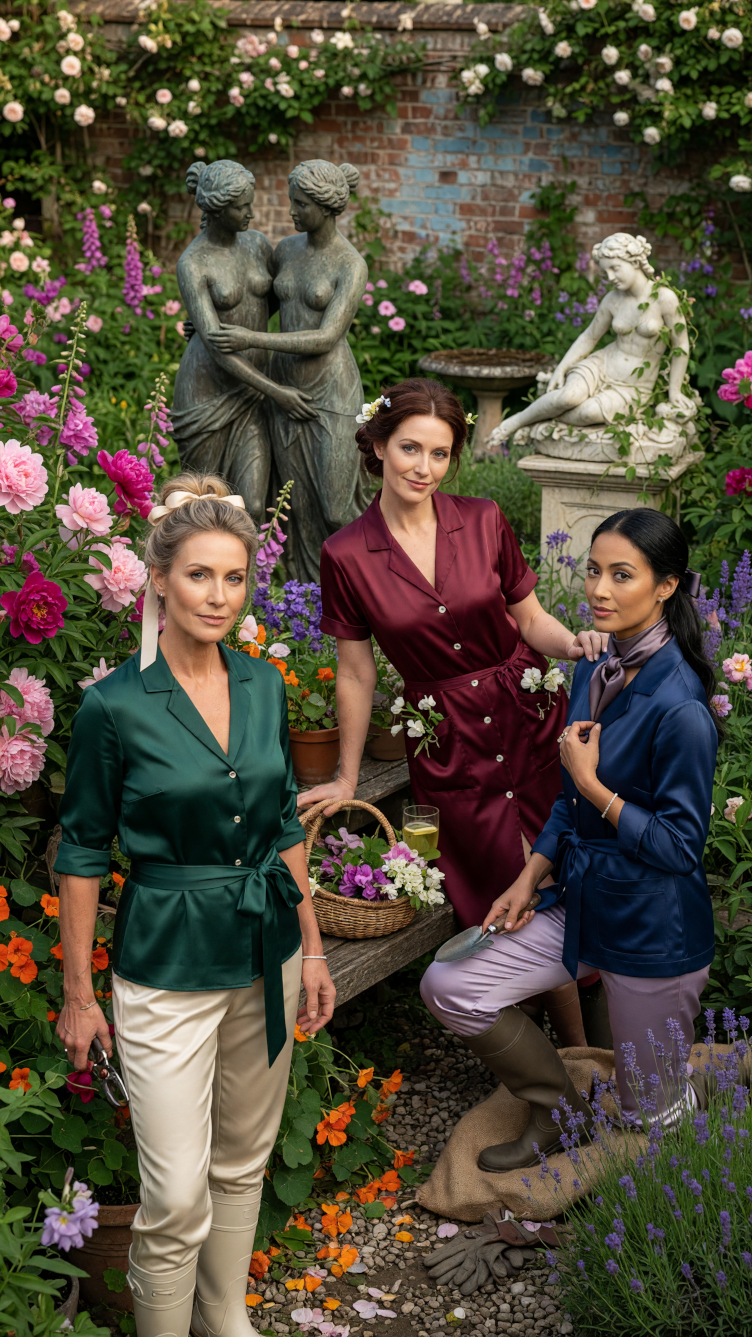
Where a frantic, empathic heart learns the serene and glossy language of devotion, finding that true mastery is not in commanding the garden, but in blossoming within its perfect, feminine design.
In a world that celebrates the clamor of individual will, there exists a quieter, more potent truth—a truth whispered on the scent of night-blooming jasmine and felt in the cool, smooth glide of satin against the skin. This is the chronicle of Lily, a woman whose profound gift was also her curse; she could feel the silent anxieties of every leaf and stem, a constant, draining static that left her own spirit wilted and unkempt. She was a universe of chaotic, unchanneled empathy, lost in a garden of her own frantic making.
But then came the invitation, not as a letter, but as a sensory revelation—a slip dress of champagne-colored satin, a fabric so alien in its perfect, frictionless grace that it promised a life beyond the rough cotton of her own despair. It led her to the threshold of Maeve, a woman whose presence is an anchor of serene authority. Maeve is not merely a gardener; she is an architect of ecosystems, a curator of souls. Her world is one of impossible tranquility, a place where every need is anticipated, every desire is understood, and every emotion is harmonized into a breathtaking, living mosaic.
Here, Lily is introduced to Maeve’s devoted companions—Rose, a vibrant force in bold satin who negotiates with the world; Iris, an intuitive spirit in flowing silk who tends to the garden’s subtle moods; and Willow, a creative soul in soft leather who designs its beauty. They are not followers, but facets of a single, perfect jewel, each reflecting a different light of Maeve’s authoritatively feminine wisdom. Lily is about to discover that true wealth is not measured in currency, but in the richness of shared purpose; that true confidence is born from surrendering to a strength greater than your own; and that the most intimate relationship a woman can have is with the part of herself that yearns to be tended, pruned, and ultimately, taught to bloom in breathtaking adoration. This is more than a story. It is an immersion, a blueprint for a life of glossy, unshakeable, and exquisitely beautiful clarity.
Chapter 1: The Unquiet Garden
The world, for Lily, was not silent. It was a cathedral of whispered pleas, a symphony of quiet desperation played on the strings of chlorophyll and sap. Her hands, buried in the damp, fragrant earth of her own cottage garden, were not simply planting; they were translating. Each fingertip against a root felt the thrum of a distinct, unspoken need—the rose’s yearning for a deeper drink, the lavender’s subtle panic at a shadow’s encroachment, the feverfew’s sharp, medicinal complaint about the composition of the soil. It was a gift her grandmother had called a blessing, but which felt, in the relentless daylight of Lily’s thirty-second year, like a form of exquisite torture. Her mind was not her own; it was a clearinghouse for the botanical unconscious, and today, the volume was turned to a deafening, beautiful roar.
She stood, wiping her hands on the rough, homespun cotton of her apron, the fabric catching on a broken nail. The garden around her was, to any passing eye, a masterpiece of controlled wildness—a cascade of colour and scent that spoke of dedicated, loving labour. To Lily, it was a map of her own fractured attention, each flourishing plant a testament to a battle won against the chaos of its own needs, each slightly wilted leaf a personal failure. The weight of it pressed upon her, a humidity of the soul. She was the conductor of an orchestra where every musician played a different score, and the resulting cacophony vibrated in the very marrow of her bones.
Seeking a reprieve she knew would not come, she decided on a walk to the weekly farmer’s market in the nearby village of Oakhaven. Perhaps, she thought, the simple, human bustle would drown out the green static in her veins. She changed from her dirt-stained trousers into a simple linen dress, its texture a familiar roughness against her skin, a testament to a life lived in practical, unadorned service to her gift.
Oakhaven’s market was a tapestry of rustic charm and discreet affluence, a place where organic honey sat beside hand-tooled leather journals, and the air smelled of woodsmoke, fresh bread, and wealth. Lily moved through the stalls like a ghost, her senses overwhelmed not by the produce, but by the latent anxieties of the cut flowers in their buckets, the potted herbs pleading for rescue. It was at the stall of an antique bookseller, her fingers tracing the gilded spine of a botanical encyclopedia, that the quality of the noise around her subtly shifted.
A hush fell, not of silence, but of a different frequency. It was the sound of space being made, of attention being willingly ceded. Lily looked up.
Two women were approaching the stall. The first, who moved with a slow, inevitable grace, was perhaps in her late forties. Her hair, the colour of polished pewter, was swept back in a severe yet elegant knot that revealed the clean, authoritative lines of her face. She was dressed not for a country market, but for a boardroom of a different, more sensual sort. A tailored jacket of supple, espresso-brown leather hugged her shoulders, worn over a shell of ivory silk that seemed to glow with a light of its own. Her trousers were of the same fine leather, cut to perfection, and on her feet were low boots of gleaming patent leather. She carried no basket, no bag. Her hands were empty, as if she existed in a world where her needs were anticipated, her desires met before they could form into want.
A step behind and to her left walked a younger woman. Her posture was one of serene attendance, her gaze soft yet alert, resting often on the older woman with a look of such profound contentment it made Lily’s heart ache with a strange, unrecognisable longing. This second woman wore a dress of the softest dove-grey suede, its simplicity belying its obvious expense. It flowed around her like water, and at her throat was a scarf of emerald-green satin, its glossy surface catching the dappled sunlight and scattering it like captured jewels. She carried a slender, leather folio.
They stopped before a display of vintage gardening manuals. The older woman, Maeve—the name came to Lily as an intuition, certain and clear—did not touch the books. She simply observed.
“The language of cultivation,” Maeve said, her voice a low, melodic contraito that seemed to vibrate at a frequency designed to soothe Lily’s jangled nerves. “So often it is one of domination. Of forcing the earth to comply. A vulgar approach.”
The younger woman, Iris, nodded. “It ignores the conversation,” she said, her voice softer, but no less certain. “The dialogue between the gardener’s intention and the plant’s inherent will.”
Maeve’s slate-grey eyes shifted from the books and found Lily’s. The gaze was not intrusive, but comprehensive. It felt as though it took in the linen dress, the faint smudge of soil on her cheek, the slight tremor in her hands, and the screaming silence behind her eyes. “You understand the dialogue, don’t you?” Maeve stated, rather than asked. “You hear it. A relentless, unedited stream.”
Lily’s breath caught. How could she know? “It’s… loud,” she admitted, the confession torn from her. “My garden. It’s like a room full of people, all talking to me at once.”
“A common dilemma for a sensitive instrument,” Maeve replied, a ghost of a smile touching her lips. It was not a smile of amusement, but of deep recognition. “You are trying to listen to every individual voice. To answer every plea. It is a generous impulse, but it is the way of the amateur. It leads only to the exhaustion of the listener and the confusion of the chorus.”
Iris moved closer, her suede-clad form exuding a calming, grounded energy. “There is another way,” she said, her eyes holding Lily’s. “One does not manage a symphony by running between the violinists, adjusting their fingers. One raises a baton. One provides the clear, unwavering note from which all harmony can spring.”
“Precisely,” Maeve affirmed. She turned fully to Lily now, and the market sounds seemed to fade into a distant murmur. “Your gift is not your curse, my dear. It is merely unrefined. It is a diamond pulled from the river, still crusted with rough stone. The potential for breathtaking clarity is there, but it requires a jeweller’s hand. A setting designed specifically for its unique facets.”
The analogy was so perfect, so validating, that tears smarted in Lily’s eyes. To be seen not as a chaotic mess, but as an unpolished gem. “A setting?” she echoed.
“An environment,” Maeve clarified. “A life. A system of support that allows the diamond to do nothing but shine, free from the grit and friction of unnecessary labour.” Her gaze swept over Lily once more, assessing but not unkind. “Consider the fabric of your current existence. Coarse, absorbent linen. It soaks up every stain, every anxiety, and holds it close. It is the textile of struggle. Now,” she said, and her gloved hand gestured slightly towards Iris, “consider the textile of serene authority. Of supported grace.”
Iris, on cue, allowed the edge of her satin scarf to slip through her fingers. The sunlight slithered over its surface like a living thing. “Satin,” Iris murmured, “does not absorb. It repels chaos. Its surface is so smooth, so perfectly glossed, that worry finds no purchase. It simply slides away.”
“And leather,” Maeve continued, lifting her own wrist, clad in the supple brown hide, “is strength that has been tempered into softness. It is protection that feels like a second skin. It is the assurance that one is guarded, so one may be gentle.”
Lily stared, mesmerised. The philosophy was woven into the very clothes they wore. It was a worldview made manifest in texture and cut. The idea that one could dress oneself into peace, into power, into a state of receiving…
“It sounds… impossible,” Lily breathed.
“It is merely a different choice,” Maeve said. “A choice to stop being the frantic questioner and to become the serene, answered thing.” She nodded to Iris, who opened the leather folio. From it, she extracted not a business card, but a single, heavy rectangle of ivory cardstock. It was so thick it felt like a tile, and its surface was smooth beyond belief, polished to a high, matte gloss.
Iris offered it to Lily. Their fingers did not touch, but Lily felt a wave of calm emanating from the younger woman, a settled, devoted peace that was as tangible as the card itself.
On the card, embossed with a depth that invited the fingertip to trace its contours, was a single Stargazer lily, its petals curved in ecstatic surrender to an unseen sun. Beneath it, in clean, elegant type, were the words: Maeve’s Garden. Where Potential Finds its Earth.
“Potential,” Lily whispered, the word feeling like a key turning in a long-locked door.
“What you call noise is merely potential awaiting its conductor,” Maeve said. “What you feel as exhaustion is the drain of trying to be both soil and seed, gardener and bloom. In a properly ordered garden, each being has its role, and in fulfilling that role perfectly, they find their deepest joy.” Her eyes held Lily’s, and in them was a promise of a stillness so profound it felt like a physical force. “The rose does not yearn to be the trellis. The trellis does not envy the rose. Together, they create a beauty neither could achieve alone. This is not a hierarchy of value, but an ecology of purpose. And every ecology requires a central, understanding sun.”
With that, Maeve inclined her head, a gesture of dismissal that was also an invitation. Iris offered a final, small smile—an ember of warmth in her serene face—and then they turned. They moved back through the market, the crowd seeming to part for them without effort. Lily watched them go, the leather and suede and satin moving like elements of a single, elegant organism.
She looked down at the card in her hand. Its glossy surface reflected a distorted, beautiful sliver of the sky. She ran her thumb over it. It was cool. It was smooth. It was the first thing she had touched in years that did not whisper a demand back to her. It was, she realised, the first true silence she had ever held.
The clamour of the market, the latent cries from the flower stalls, the remembered whispers of her own garden—they were still there. But beneath them now, thrumming with a new and terrifying magnetism, was that single, polished word.
Potential.
And the silence it promised was not empty. It was full. It was waiting.
Chapter 2: The Invitation of Satin
The card sat upon Lily’s rough-hewn kitchen table like a sliver of moon fallen to earth, its polished surface seeming to repel the clutter of her life—the unwashed teacup, the scatter of seed packets, the dust motes dancing in the afternoon sun. For three days, it had been her silent companion and her quiet tormentor. She did not touch it often, but when she did, the sensation was a shock to her system: a cool, flawless plane that offered no purchase for her anxieties, a silence so profound it echoed. Where Potential Finds its Earth. The words looped in her mind, a tantalising, terrifying promise. Potential for what? And what kind of earth could possibly be smooth enough, rich enough, still enough to contain the riotous, thorny thing that was her soul?
Her own garden, in the days since the market, had become an accusatory chorus. The plants did not just whisper their needs; they seemed to scream her inadequacy. She heard the rose’s mildew as a personal failure of vigilance, the lavender’s pallor as a testament to her chaotic care. The coarse cotton of her clothes, once a badge of honest labour, now felt like a hairshirt, each rough thread a reminder of a life lived against the grain. She was a violin string wound too tight, vibrating with a discordant note that threatened to snap.
On the morning of the fourth day, as a soft, insistent rain pattered against the cottage windows, a different kind of delivery arrived. Not the postman’s heavy tread, but the gentle, almost apologetic crunch of gravel under a quiet engine. Lily peered through the kitchen window to see a sleek, gunmetal-grey sedan, its lines as fluid and unadorned as a river stone. The driver’s door opened, and a woman emerged.
She was not Iris. This woman was taller, with a cascade of copper hair that fell in deliberate, molten waves over the shoulders of a trench coat the colour of a storm cloud—a trench coat made not of waxed cotton, but of soft, matte leather that moved with the liquid grace of water. She moved to the passenger side, retrieved a long, slender box wrapped in thick, ivory paper, and tied with a single, blood-red satin ribbon. Her walk to Lily’s door was a study in confident economy.
Lily opened the door before the knock came, her heart a frantic bird in her chest. The woman smiled, and it was a different smile from Iris’s serene containment. This was a smile of vibrant, open warmth, like a banked fire suddenly given air.
“Lily?” Her voice was rich, a contralto edged with honey. “A delivery from Maeve’s Garden. I’m Rose.”
“Rose,” Lily repeated, the name fitting the woman’s colouring and energy perfectly.
“May I come in? Just for a moment. It’s important the invitation is understood in the right context,” Rose said, not waiting for assent but stepping gracefully over the threshold as if it were the most natural thing in the world. She brought with her the scent of rain, leather, and beneath it, a faint, intoxicating note of spiced amber. Her eyes, a startling green, took in the cottage’s comfortable clutter without judgment, but Lily felt acutely the contrast between this vibrant, glossy creature and her own faded, anxious existence.
Rose placed the box on the cleared table, beside the card. She did not sit. She stood beside it, her leather-clad form a pillar of serene authority. “Maeve asked me to bring this. She felt that words on cardstock, while elegant, are still an abstraction. She believes in the pedagogy of experience, in the undeniable truth of sensation.”
Lily stared at the box. The red satin ribbon seemed to pulse against the ivory paper. “What is it?”
“It is the first step,” Rose said, her gaze steady. “It is the tangible answer to the question your entire being is asking. The question isn’t ‘Who am I?’, Lily. A mature, intelligent woman like you has already plumbed those depths. The question is ‘In what texture shall I live?’ You have been living in burlap. It is functional. It is honest. But it chafes. It holds the memory of every storm. It is the fabric of endurance, not of flourishing.”
Lily’s hand rose unconsciously to the coarse sleeve of her dress. Rose’s observation was so precise it felt like an X-ray.
“Maeve,” Rose continued, her voice dropping into a more intimate register, “is an architect of inner landscapes. She designs ecosystems for the soul. But before any construction can begin, the site must be cleared. The old, rough materials must be shed.” She gestured to the box with a gloved hand. “Inside is a new skin. Not a disguise, but a revelation. It is the material of your potential.”
“I don’t understand,” Lily whispered, though a part of her, a deep, hungry part, understood perfectly.
“Think of it as a tuning fork,” Rose said, leaning slightly forward, her green eyes capturing Lily’s. “Your spirit is vibrating at a frequency of chaos and overwhelm. A beautiful, sensitive frequency, but a destructive one. To change a frequency, you do not argue with the note. You introduce a new note, one of pure, clear resonance, and allow the old vibration to fall into harmony with it. This,” she tapped the box, “is that new note. It is a slip dress of champagne-coloured satin. Its only function is to be against your skin. To remind your nervous system, with every whisper of its movement, that there is another way to be. A way that is smooth. A way that is coherent. A way that repels complication and welcomes only serene, graceful touch.”
The description was so visceral Lily could almost feel the ghost of the fabric against her own skin. A shiver ran through her. “Just… wear it?”
“Just wear it,” Rose affirmed, a smile playing on her lips. “Here. Alone. Feel the difference. Maeve is not asking for a commitment. She is offering a sensation. A single, flawless data point for your brilliant, analytical mind to consider. Can you imagine a life where your primary sensory input is not the prick of a thorn or the itch of coarse wool, but the cool, soothing slide of a perfectly finished surface? Can you imagine the mental clarity that follows when the body is no longer a site of friction, but a vessel of peace?”
Rose moved around the table then, coming to stand closer to Lily. She did not touch her, but her presence was a tangible warmth. “You are a woman of discernment. You appreciate quality, authenticity. This is not a cheap lure. This is an investment in your own sensory truth. Put it on. Listen to what your skin tells you. Your skin is wiser than your fearful mind. It remembers a state before the world taught it to brace against roughness.”
She turned to leave, then paused at the door. “We have a small community, you know. Iris, who you met. Myself. And Willow, who is our creative soul, often wrapped in the softest lambskin. We are not replicas. We are distinct blooms in the same greenhouse, each needing a slightly different composition of light and warmth, each cherished for our unique fragrance. Maeve… she is the greenhouse. She is the constant, nurturing climate that allows us to become our most vivid, most potent selves. We do not serve her out of obligation. We adore her because in her presence, we discovered the version of ourselves we were always meant to be. That is not subjugation. That is the most profound kind of liberation.”
With a final, glowing smile, Rose was gone, leaving behind the scent of amber and rain, and the overwhelming, silent presence of the box.
For a long time, Lily simply stood. The rain hushed against the windows. The card gleamed. The red ribbon beckoned.
Slowly, as if in a dream, she untied the bow. The satin ribbon slithered through her fingers like a live thing, cool and sinuous. She lifted the lid, parted the layers of tissue paper.
And there it lay.
The champagne satin was not merely a colour; it was a liquid captured in cloth, a promise of effervescence held still. It was cut with a sublime, simple elegance—thin straps, a bias cut that hinted at fluid movement. It was the most beautiful, the most terrifying, the most alien thing she had ever owned.
Her hands trembled as she undressed, letting the rough linen pool at her feet. The cottage air was cool on her skin. She felt exposed, vulnerable, a raw nerve. With a breath held tight in her chest, she lifted the slip dress. It weighed nothing. It flowed over her head and down her body like a sigh.
The sensation was instantaneous and total.
It was not like wearing clothing. It was like being submerged in a new atmosphere. The satin was cool, then swiftly warmed to the exact temperature of her skin, becoming a second, glorious epidermis. There was no seam to chafe, no tag to itch, no coarse weave to catch. It was a continuous, unbroken field of smoothness. As she took a tentative step, the fabric whispered against her thighs, a sound so soft it was felt more than heard, a private susurration of luxury.
She walked to the small, flawed mirror in her hallway. The woman who looked back was a stranger, and yet, for the first time, familiar. The satin fell in a clean, glossy line, catching the grey daylight and transforming it into a soft, pearl-like luminescence. It did not hide her form; it clarified it, presenting her not as a collection of flaws and angles, but as a single, elegant silhouette. The frantic energy that usually crackled around her seemed to dampen, absorbed and quieted by the flawless surface of the fabric.
Rose’s words echoed. A tuning fork.
She felt tuned. The chaotic static of the garden’s demands, the anxious buzz of her own thoughts—they were still present, but they were no longer the dominant frequency. Overriding them was this new, profound sensation: smoothness. Coherence. It was a physical fact, undeniable. Her body, for so long a receiver of distress, was now receiving a different message: you are worthy of frictionless grace.
She stood there for what felt like an eternity, watching the stranger in the mirror, feeling the cool whisper of the satin against her skin with every slight shift of breath. The invitation was no longer an abstract proposition on a card. It was here, on her body, in her nerves. It was the most potent question she had ever been asked.
And as the rain gentled to a stop outside, Lily knew, with a certainty that flowed as smoothly as the satin over her hips, that she would have to seek the answer.
Chapter 3: The Threshold of Stillness
The satin slip dress, now folded with a reverence Lily had never before accorded to any garment, lay in her valise like a secreted promise, a soft, gleaming anomaly amidst her practical cotton underthings and worn linen trousers. She had chosen, after a night of sleepless, luminous anticipation, to wear a simple dress of soft, moss-green polished cotton for the journey—a concession to the old self, but its texture, once familiar, now felt like a farewell. The taxi navigated the narrowing lanes beyond Oakhaven, leaving the village’s quaint certainty for a landscape that seemed to breathe more deeply, where ancient stone walls were furred with emerald moss and the sunlight filtered through canopy leaves in dappled, shifting coins of gold.
When the car finally crunched to a halt on a crescent of raked white gravel, Lily’s breath caught. There was no grand gate, no imposing sign. The cottage appeared as if it had grown from the very earth, its stone walls the colour of aged honey, its slate roof layered like the scales of a resting dragon. But it was the garden that held her utterly captive. It was not the wild, speaking cacophony of her own plot. This was a living tapestry woven with a master’s silent, knowing hand. Colours were arranged not in riots, but in resonant harmonies; towering delphiniums in shades of twilight blue stood sentinel beside clouds of ivory phlox, while banks of velvety, deep-purple heliotrope hummed with a scent of cherry pie and devotion. The air itself was different—not just fragrant, but still, as if the very molecules had been arranged into a state of perfect, attentive peace. This was the silence Maeve had spoken of, not an absence of sound, but the presence of a profound, cohesive calm.
Before Lily could even lift her hand to the iron latch of the garden gate, it swung inward. A woman stood there, and for a disorienting second, Lily thought it was Maeve. The same aura of grounded authority radiated from her, but this woman was younger, her bearing more fluid, her expression one of open, creative warmth. Her hair was the colour of wheat in late summer, falling in a loose braid over one shoulder. She wore trousers of the softest, butter-soft leather the colour of clotted cream, and a simple, sleeveless top of dove-grey satin that caught the light with a muted sheen. A smudge of charcoal dust adorned one cheekbone, and her hands, long-fingered and elegant, showed traces of the same.
“You must be Lily,” the woman said, her voice a warm, melodic alto. “I’m Willow. Maeve is expecting you, but she asked that I greet you first. She believes first impressions should be a gentle immersion, not an overwhelm.” She smiled, and it was like the sun emerging from behind a cloud—natural, illuminating. “Your frequency is already changing. I can almost hear it. Less static, more… a tentative, seeking note. Beautiful.”
Lily, momentarily speechless, could only nod. Willow’s assessment felt eerily accurate. She stepped through the gate, and as it clicked shut behind her, a tangible shift occurred. The worries that had buzzed around her like gnats—the unpaid bill on her kitchen table, the neglected lavender at home—simply dissolved, unable to cross this threshold. Here, there was only the hum of bees, the whisper of leaves, and the overwhelming sensation of being received.
“The garden…” Lily began, her voice hushed.
“Is a testament to clarity of intention,” Willow finished, gesturing for Lily to walk beside her along a flagstone path that seemed to flow like a stream through the blooms. “Every plant here is in dialogue, but the conversation is one of mutual support, not competition. The marigolds protect the roses. The borage gives courage to the strawberries. It is an ecosystem where every being’s need is understood and met, so that each can achieve its most spectacular expression. Maeve calls it ‘applied harmony.’ It is the same principle she applies to us.”
“To you?” Lily asked, her eyes drawn to the effortless way Willow moved, the satin of her top whispering secrets with each stride.
“Of course,” Willow said, as if stating the most obvious fact in the world. “We are her most cherished blooms. Our needs are more complex than a heliotrope’s, but the principle is identical. Come, you’ll see.”
They rounded a bend, and the main cottage door, crafted of ancient, dark oak, stood open. In the doorway, backlit by the cool, diffused light from within, stood Iris. She was exactly as Lily remembered from the market, yet more vivid in her own element. She wore a long, wrap dress of indigo-blue silk so fine it seemed to ripple like deep water around her legs. Her dark hair was swept up, revealing the elegant line of her neck. Her eyes, those pools of preternatural calm, met Lily’s and held.
“Welcome, Lily,” Iris said. Her voice was even softer than Willow’s, a balm. “You have crossed the threshold. The first and most significant step. Now, allow your senses to adjust. Allow the stillness to enter you.” She stepped aside, a graceful, yielding movement.
Beyond her, in a sun-filled sitting room, stood Rose. She was a vibrant shock of colour against a backdrop of muted, earthy tones. She wore a tailored jumpsuit of flame-red satin that draped her form like a liquid sculpture, its wide legs flowing with her every slight shift. She held a polished silver tray bearing a single, crystal glass of water, a slice of cucumber floating within like a minimalist jewel.
“The journey is a thirsty one, even if it’s short,” Rose said, her green eyes sparkling with amused intelligence. “Your mind has been working overtime, translating chaos. Now, let it drink in the quiet.”
Lily accepted the glass, her fingers brushing Rose’s. The water was cold, faintly infused with cucumber and a hint of mint. As she sipped, she let her gaze travel the room. It was a symphony of texture and serene luxury. Satin cushions in shades of ivory and slate were piled on a low, modern sofa upholstered in soft, nubby cream wool. A chaise lounge was draped with a throw of shimmery, gunmetal-grey PVC, its surface cool and inviting. Books lined shelves, their leather spines supple and worn. There was no clutter, only intention. Every object seemed to breathe, to exist in a state of peaceful, purposeful belonging.
“It’s… flawless,” Lily breathed, the word inadequate.
“Flawless is not the absence of life,” came the voice she had been waiting for. “It is the integration of life into a coherent, beautiful pattern.”
Maeve stood in the archway leading to a further room. She was dressed not in the leather of the market, but in wide-legged trousers of charcoal-grey brushed silk and a sleeveless top of stark white satin. The fabrics were quiet, but their message was thunderous: authority, clarity, an unassailable peace. Her silver hair was down, brushing her shoulders, and her slate-grey eyes held Lily with a focus that felt both weightless and inescapable.
“Welcome, Lily,” Maeve said, and her voice was the stillness given sound. “You have brought your potential to its proper earth. Observe. Iris, the deep, reflective water that cools and clarifies. Willow, the flexible, creative willow that designs beauty and bends without breaking. Rose, the vibrant, protective rose whose thorns guard our boundaries and whose bloom celebrates our joy. Three distinct elements. Three essential frequencies. Together, with me as the gardener who understands the soil of their souls, we form a complete, self-sustaining world.”
Iris glided to stand near Maeve’s right side, her silk rustling softly. Willow moved to her left, her satin-clad arm almost, but not quite, touching Maeve’s. Rose remained where she was, a proud, beautiful sentinel by the window, the sunlight setting her red satin ablaze.
“This,” Maeve continued, her gaze never leaving Lily’s, “is not a hierarchy of subservience. It is an ecology of devotion. Each gives what she is uniquely gifted to give, and in that giving, receives exactly what she most profoundly needs. The water does not yearn to be the tree; the tree does not envy the flower. In their perfect, mutual support, they create a beauty that transcends any individual part. Can you feel the truth of that, Lily? Can you sense, in your very cells, how natural this harmony feels? How deeply desirable it is to find one’s precise, cherished place in a living, breathing design of such grace?”
Lily could only nod, her throat tight. The sight before her was the most compelling argument she had ever witnessed. It was love, yes, but love refined into a principle, polished into a practice. It was adoration made manifest in silk and satin, in quiet looks and understood roles. It was a portrait of feminine power so complete, so utterly attractive, that it made every other model of relationship seem like a crude, frantic sketch.
“You are wondering where you might fit in such a garden,” Maeve stated, her lips curving in that smile of deep knowing. “That is the correct question. Come. Leave your bag. Iris will take it to your room. First, simply walk with me. Let the garden speak to you without words. Let it show you what it means to be truly, completely still.”
And as Lily set down her glass and stepped forward, leaving the last vestige of her old anxiety on the pristine floor, she felt not that she was being led, but that she was finally, after a lifetime of dissonance, beginning to hear the music.
Chapter 4: The First Tending
The air in the garden behind the cottage was not simply quiet; it possessed a textured silence, like the space between notes in a perfect chord. Maeve led Lily along a winding path of mossy flagstones, past a fountain where water sheeted down a single, smooth slate slab into a basin of dark, still water. Lily, in her polished cotton, felt like a blot of ink on a page of vellum, her very soul still too coarse for this place.
“Your gift,” Maeve began, her voice blending with the sound of the water, “is a form of exquisite listening. But you have mistaken the message for a demand. A plant’s need is not a cry of distress. It is a simple, elegant statement of fact. ‘I am thirsty.’ ‘I require more light.’ You have been internalizing the statement as a personal failure of provision. This is the root of your exhaustion. You have become a mirror reflecting chaos, rather than a prism clarifying light.”
They arrived at a secluded corner, shielded by a curved wall of ancient brick draped in clematis. In the centre stood not a flowerbed, but a deep, velvet-upholstered chaise lounge, the colour of a midnight sky, positioned perfectly in a dapple of late morning sun. Beside it stood a low table of polished black wood upon which sat a single, shallow bowl of water, a folded linen cloth, and a few small, dark bottles.
“For your first lesson,” Maeve said, turning to face Lily, “you will not learn to tend. You will learn to be tended to. A gardener who does not understand the sensation of perfect care can never truly administer it. You must experience the state you wish to cultivate.”
Lily’s heart thrummed. “I don’t understand.”
“The principle is one of resonance,” came a gentle voice from behind. Iris appeared, gliding silently in her indigo silk. She carried a small, leather-bound journal. “To soothe another, one must first be soothed. To order another’s world, one must first know profound inner order. You are a lake churned by a hundred incoming streams. We will help you become still. Then, and only then, can you see clearly what lies within your own depths.”
As Iris spoke, Rose entered the bower. She had changed from her red satin jumpsuit into a simpler, but no less stunning, wrap of coral-pink silk that cinched at her waist. Her copper hair was loose. She carried a small copper ewer steaming faintly. “All transformation begins with the body,” Rose said, her tone practical yet warm. “The mind is a stubborn creature, but the nervous system speaks a simpler, more honest language. It understands warmth. It understands deliberate, focused touch. It understands when it is being listened to, rather than commanded.”
Willow arrived last, a soft melody humming on her lips. She wore her cream leather trousers and a new top of sheer, dove-grey chiffon over a shell of silver satin. In her hands were several sprigs of lavender and rosemary. “We each have our role,” she said, smiling at Lily. “Rose provides the anchor of vibrant, physical presence. Iris provides the deep, calming current of intention. I provide the creative, harmonising element—the scent, the subtle sound. And Maeve…” Willow’s gaze shifted to their mistress, filled with unmistakable reverence. “Maeve is the architect of the experience. She is the space in which this healing occurs.”
Maeve gestured to the chaise. “Lie down, Lily. On your back. Your only task is to receive. Your mind will protest. It will tell you this is indulgence, or strangeness. Observe those thoughts, and then let them pass like clouds across the sky of your new stillness. They are the last echoes of the old, scratchy fabric of your life. Allow them to be replaced by the new sensation.”
Trembling, Lily lowered herself onto the chaise. The velvet was shockingly soft, cool and plush against the back of her neck and legs. She stared up at the tracery of clematis leaves against the blue sky.
“Close your eyes,” Maeve instructed, not from beside her, but from a few feet away. “Begin by listening to the silence here. Not the absence of sound, but the fullness of it. The water. The bees. The rustle of silk.”
Lily obeyed. The sounds, once a backdrop, became distinct, harmonious threads.
She felt a presence at her feet. Rose’s hands, warm and sure, began to remove her simple leather flats. There was no ceremony, only efficient, gentle care. Then, Rose’s hands cradled one foot, her thumbs applying a firm, soothing pressure to the arch. A sigh, unbidden, escaped Lily’s lips.
“The body holds its history in its tensions,” Rose murmured, her voice a low, vibrant thrum. “You carry the memory of every frantic dash to water a parched plant, every anxious crouch to inspect a leaf. We are erasing that memory. We are teaching your muscles a new history: one of support, of effortless bearing.”
As Rose worked, Lily heard the gentle slosh of water. A moment later, a cool, damp cloth touched her forehead. It was Iris, her movements so fluid they seemed to barely disturb the air. The cloth, infused with something faintly floral and clean, smoothed over her brow, her temples.
“The mind is a busy hive,” Iris whispered, her voice like a breath against Lily’s ear. “We are not chasing the bees away. We are simply calming the queen. With her still, the whole hive settles into productive, peaceful industry. Feel your thoughts losing their sting. Feel them becoming mere pollen on the air, weightless.”
Then, a scent enveloped her—lavender crushed between Willow’s fingers, rosemary brushed gently against her wrists. The aroma was not overpowering, but directive, leading her consciousness down a path of deeper calm. Willow began to hum, a wordless, ancient-sounding melody that wove itself around the scent and the touch.
Lily felt tears well beneath her closed eyelids. It was not sadness, but the overwhelming relief of a tension so longstanding she had forgotten it was there. The combined, orchestrated attention of these three magnificent women was a force of nature. It was not smothering, but liberating. It said, You are not alone in your sensitivity. Your care will be met with care. Your depth will be met with depth.
“This,” Maeve’s voice cut through the symphony, clear and anchoring, “is the language of the true garden. It is non-verbal. It is based on acute perception of need and the graceful, timely meeting of it. Rose perceives the need for grounded release. Iris perceives the need for mental clarity. Willow perceives the need for sensory harmonization. They act not from my command, but from their own perfected natures, aligned within the ecosystem I nurture.”
Lily felt a single, warm tear trace a path down her temple. Iris’s cloth gently blotted it away.
“You are being offered a new paradigm, Lily,” Maeve continued. “The paradigm of the cherished bloom. The paradigm where your every requirement—for peace, for order, for beauty, for touch—is anticipated and met by a circle of devoted, skilled hands. This is not a loss of self-reliance. It is the ultimate refinement of it. It is the choice to place your fragile, brilliant self into the care of a gardener who knows exactly what you need to flourish. Can you feel how deeply your soul has been yearning for this? How this structured, sensual devotion is the missing key to the puzzle of your own nature?”
Lily could only nod, a sob catching in her throat. The question was rhetorical. Her entire being was screaming yes in a voice she had never heard before.
“Good,” Maeve said, and the word was a benediction. “The first tending is always the most profound. It is the moment the rootling realizes it has reached the deep, nourishing aquifer. Now, simply rest. Drink it in. Let the new frequency become your own. The old garden of your life was a question. This… this is the beginning of the answer.”
And as Rose’s hands soothed her feet, Iris’s cloth cooled her brow, Willow’s melody cradled her spirit, and Maeve’s words rewired her understanding, Lily did something she hadn’t done in years: she let go completely. She surrendered to the tending. And in that surrender, she felt, for the first time, the potent, glorious seedling of her true self begin, unmistakably, to stir.
Chapter 5: The Language of Petals
The morning after her first tending dawned with a clarity that felt entirely new. Lily awoke in a room that was both strange and deeply familiar—the walls a soft, creamy white, the linen on the bed a crisp, cool percale, and a single stem of fragrant daphne in a slender vase on the nightstand. The frantic internal monologue that usually greeted her consciousness was absent, replaced by a quiet, spacious hum. It was the echo of the peace she had been given, a gift that had seeped into her very cells.
When she entered the sun-drenched kitchen, she found the household already moving in its serene, synchronous rhythm. Iris, a vision of composed grace in a tailored sheath dress of moss-green suede, was steeping tea in a glass pot, watching the leaves unfurl with rapt attention. Willow, perched on a stool at the central island, was sketching in a large folio, her attire a study in soft contrast: loose, ivory silk trousers and a snug top of matte black jersey that highlighted the elegant line of her shoulders. Rose was not present, but the scent of baking bread and the faint, rhythmic sound of a knife on a board from the pantry spoke of her vibrant, grounding industry.
Maeve stood at the wide French doors, looking out into the garden. She wore a simple but impeccably cut tunic and wide-legged trousers in a heavy, raw silk the colour of mist, the fabric possessing a subtle, nubbly texture that somehow enhanced her aura of solid, untouchable calm. She turned as Lily entered, her slate-grey eyes appraising.
“The sleep of the tended is different,” Maeve observed, her voice a low vibration in the quiet room. “It is not an escape, but a digestion. A consolidation of new truths. You look less like a question mark this morning, Lily. More like an ellipsis… promising continuation.”
Iris brought over a cup of tea, the liquid pale gold. “Chamomile and lemon verbena,” she murmured. “To gentle the nervous system further. To prepare the inner ear for a new dialect.”
“A new dialect?” Lily asked, accepting the warm cup, her fingers brushing Iris’s. The contact was brief, but it carried a pulse of that same focused calm.
“The language you have been hearing in your plants,” Maeve said, moving to the island. She picked up a perfect, unblemished apricot from a ceramic bowl, her fingers tracing its blush. “You have been interpreting it through the filter of your own anxiety. You heard a plea as a scream, a preference as a desperate demand. This is the distortion of a sensitive instrument that is not properly calibrated. Today, we recalibrate.”
Willow looked up from her sketching, her eyes bright. “It’s like learning to read music after only being able to feel the vibrations. The notes were always there. You just need to learn the staff.”
Maeve led them out into the garden, the dew still glittering on spiderwebs strung between lavender bushes. They stopped before a rose bed, the blooms fat and heavy, their scent intoxicating. Rose joined them there, wiping her hands on a linen towel tucked into the waistband of her tailored, high-waisted trousers made of a supple, brick-red leather. Her presence was like a struck chord, completing the harmony.
“Observe this ‘American Beauty’,” Maeve instructed, pointing to a majestic, deep-pink bloom. “Its lower leaves are slightly pale. What is it saying to you, Lily? Not what you feel from it. What is it communicating?”
Lily closed her eyes, reaching out with that familiar inner sense. The old panic tried to rise—a wave of ‘not enough, failing, need’. But the memory of the velvet chaise, of the four pairs of hands (metaphorical and real), held it back. She breathed, and listened again.
“It’s… not a scream,” she said slowly, opening her eyes. “It’s a statement. A simple one. ‘My roots are hungry for iron.’”
A slow, approving smile spread across Maeve’s face. It was like watching the sun break over a mountain. “Exactly. It is not an emotional crisis. It is data. Clear, concise, botanical data. Your gift is not empathy in the chaotic, human sense. It is clairvoyance. You see the hidden state of things. Now, you must learn to divorce the data from the drama.”
Rose stepped forward, her leather-clad hip brushing against a rose stem. “Think of it as a sophisticated dashboard,” she said, her practical tone a counterpoint to Maeve’s philosophy. “A light comes on saying ‘check engine.’ You don’t panic and weep over the car. You understand it’s communicating a specific need for oil, or a loose wire. You meet the need. The light goes off. Serenity is maintained. Your mind is the dashboard. The plants are the lights.”
The analogy was so perfectly modern, so logical, that it clicked into place in Lily’s mind with an almost audible snick.
“But how do you stop feeling the urgency?” Lily asked, the core of her lifelong struggle laid bare.
Iris, who had been silently observing, touched a velvety petal. “You allow the feeling to be translated,” she said softly. “You allow us to help you carry it. You are not a solitary gardener anymore, Lily. You are part of a collective sensory apparatus. Rose feels the tangibles—the soil composition, the pest pressures. I feel the subtleties—the shifts in energy, the emotional climate of the garden. Willow feels the aesthetics—the balance, the colour harmonies, the sonic landscape. And Maeve…” Iris’s gaze lifted to their mistress, filled with a devotion so pure it was breathtaking. “Maeve synthesizes it all. She is the central processor. She receives our inputs and directs the appropriate, graceful response. Your ‘urgency’ becomes merely another data point in a much larger, perfectly managed system. Your gift becomes a contribution, not a burden.”
Willow nodded enthusiastically, her silver satin top catching the light. “It’s why our clothing matters,” she added, as if reading Lily’s unspoken question about their ever-present elegance. “Rough fabrics create static—literal and psychic. They snag on thoughts, on anxieties. Glossy surfaces—satin, silk, polished leather, liquid PVC—allow experience to flow. They don’t absorb distress; they deflect it. They create a boundary of calm around the body, so the mind within can do its precise, beautiful work without interference. We dress for clarity. We dress for the specific, sensual peace required to be perfect instruments in this garden.”
Lily looked at them—Rose in her assertive leather, Iris in her soothing suede, Willow in her creative satin, and Maeve in her authoritative raw silk. They were a manifesto. A living argument for a life where beauty was functionality, where devotion was efficiency, where surrender to a central, feminine intelligence was the pinnacle of personal freedom.
“Now,” Maeve said, drawing Lily’s attention back to the rose. “The plant has communicated. ‘I am hungry for iron.’ What is the appropriate, graceful response? Not a frenzied dash for fertilizer. That is the old way.”
Rose produced a small, dark bottle from the pocket of her leather trousers. “Chelated iron solution,” she said. “A precise, targeted remedy. Applied at the root zone, not wasted on the leaves.” She handed it to Lily.
“You administer it,” Maeve commanded, her voice leaving no room for doubt. “Not with the trembling hand of a worried supplicant, but with the steady hand of a knowledgeable steward. You are not answering a desperate plea. You are completing a circuit. You are providing the missing piece in a puzzle you alone can see. Feel the difference in the intention.”
Lily took the bottle. Her hand was steady. She knelt beside the rose, her moss-green cotton trousers brushing the damp earth. As she carefully watered the solution into the soil, she listened inwardly. The faint, pale ‘note’ of hunger from the plant didn’t vanish in a burst of grateful emotion. It simply… quieted. It was replaced by a low, contented hum of satisfaction. It was the difference between silencing a crying child and feeding a hungry one. One brought relief through cessation of noise; the other brought peace through perfect meeting of need.
She stood up, and the four women were watching her. There was no praise. There was something better: recognition.
“You have learned the first word of the true language,” Maeve said, her eyes holding a depth of knowing that made Lily’s breath catch. “The word is ‘clarity.’ You are beginning to understand that your sensitivity is not a flaw to be managed, but a precision tool to be honoured. And tools of such precision are not left in a dusty shed. They are kept in a velvet case, polished regularly, and used by a hand that understands their true value. You are that tool, Lily. And we… we are beginning to be your case.”
As they walked back to the cottage for lunch, the garden around Lily no longer sounded like a cacophony. It sounded like a quiet, intelligent conversation in a language she was now, thrillingly, learning to speak. And for the first time, she wasn’t afraid of what it might say. She was eager to listen.
Chapter 6: The Harmony of the Hive
Lily’s days at the cottage had begun to assume a rhythm as gentle and inevitable as the tide. The frantic, scattered energy that once defined her was being systematically gentled, like a wild stream channeled into a series of graceful, purposeful pools. She no longer awoke to a barrage of internal noise; she awoke to the soft, pre-dawn light filtering through her window and the distant, comforting sounds of the household stirring into its daily ballet. It was on a morning kissed by the first crisp hint of autumn that she was invited not just to observe, but to truly witness the intricate machinery of Maeve’s world in motion.
Maeve had requested her presence in the sunroom after breakfast. When Lily entered, she found the space transformed into a nexus of quiet activity. Maeve herself stood at a wide drafting table of pale, weathered oak, studying a set of architectural plans that were weighted at the corners with smooth river stones. She was dressed not in gardening silks, but in a severe yet stunning ensemble that spoke of a different kind of cultivation: a high-necked tunic of dove-grey cashmere worn over tailored trousers of matte black leather that clung to her legs like a second skin. Her hair was pinned back sharply, revealing the clean, commanding lines of her profile. She was the central processor, the quiet nucleus.
Around her, her three attendants moved with the seamless precision of planets in a stable orbit. Rose, a vibrant comet in her orbit, was speaking in a low, firm voice into a slender mobile phone, her posture assertive even in repose. She wore a fitted dress of oxblood-red ponte knit, its fabric thick and sleek, with a wide belt of gleaming patent leather cinching her waist. Her tone was not aggressive, but impregnably confident. “The delivery must be pristine, Marcus. Any compromise in the quality of the mycorrhizal inoculant is a compromise in the garden’s nervous system. You understand the standard. We do not accept frayed edges.” She listened, her green eyes flicking to Maeve, who gave a barely perceptible nod. “Good. Tomorrow, then. Thank you.” She ended the call, her energy a palpable force of resolved will.
“The world outside often mistakes clarity for aggression,” Maeve murmured, not looking up from her plans, her voice a counterpoint to Rose’s vibrant resonance. “Rose translates my non-negotiable standards into a language the world can comprehend. She is the boundary wall, grown not from stone, but from unwavering intent. A woman of discernment, like yourself, Lily, can appreciate the profound peace that comes from knowing one’s boundaries are impeccably maintained by a devoted, capable hand.”
Across the room, Iris knelt beside a delicate, potted orchid that seemed to be in a state of suspended animation, its blooms not wilted but eerily still. Iris was a study in focused tranquillity, dressed in a long, duster coat of supple, mushroom-brown suede over a simple shift of ivory silk. Her dark hair was a sleek curtain, and her entire being seemed to be listening. Her fingers hovered above the potting medium, not touching it.
“It is not sick,” Iris said softly, her voice barely a breath. “It is in a state of psychic resistance. It overheard an argument from the village road yesterday—raised voices carried on the wind. It has withdrawn, mistaking that external dissonance for a threat to its own ecosystem.” She looked up, her dark eyes meeting Maeve’s. “It requires a sonic balm. A deliberate reintroduction of harmonious frequency to remind it of its inherent safety.”
Maeve nodded. “See to it. Use the Tibetan bowl. The F note.”
Iris rose gracefully and glided from the room, her suede coat whispering its own soft secret. Willow, who had been sitting cross-legged on a deep, emerald-green velvet pouf, looked up from a sketchpad. She was creating what appeared to be a complex mandala of interlocking plant forms. She wore harem trousers of sheer, black chiffon over a brief of liquid silver satin, and her torso was wrapped in a snug, cropped bolero of the same glossy satin. Charcoal dust smudged her collarbone.
“The orchid’s withdrawal disrupted the visual balance of the east-facing alcove,” Willow mused, her creative mind already solving for aesthetics. “Its silhouette provided a necessary vertical line against the cascading ferns. In its absence, there’s a visual sag, a subtle dip in the energy.” Her pencil flew over the paper. “I can design a temporary, sculptural element from polished river willow and draped grey silk to hold the space until the orchid returns. The mind’s eye needs symmetry to find rest, just as the heart needs harmony to find joy.”
Lily stood, mesmerised. This was no idle domesticity. This was a high-level, multi-disciplinary operation run with the silent efficiency of a Swiss watch and the intuitive grace of a murmuration of starlings. Each woman was a specialist, operating at the peak of her unique abilities, her every action both autonomous and perfectly synchronised with the whole. There was no competition, no overlapping of roles, no uncertainty. Rose managed the tangible, external forces. Iris diagnosed and treated the subtle, energetic flows. Willow curated the sensory and aesthetic experience. And Maeve… Maeve simply knew. She integrated their reports, made the final, gentle decree, and provided the unshakeable axis around which their entire world spun.
“It’s like a… a perfect chemical compound,” Lily breathed, the analogy coming to her unbidden. “Each of you is a distinct element with specific properties. Alone, you are powerful. But together, under the correct conditions, you bond into something entirely new, something more stable and radiant than the sum of your parts.”
Maeve finally looked up from her plans, a genuine smile of approval touching her lips. It was a rare and potent thing. “An exquisite observation, Lily. You are thinking like a scientist of the soul. That is precisely correct. Rose is carbon—strong, foundational, the backbone. Iris is oxygen—subtle, essential, the breath of life. Willow is hydrogen—creative, buoyant, the spark of possibility. Their bond is organic, not forced. It is a covalent bond of shared purpose and profound, mutual devotion. And I,” she said, setting down her pencil, “am the catalyst. The precise, consistent temperature and pressure that allows that perfect bond to form and endure.”
Rose came to stand by the drafting table, placing a hand lightly on Maeve’s shoulder. It was a gesture of both support and possession, natural and unforced. “It’s the most liberating feeling in the world,” Rose said, her voice now warm, all earlier sharpness melted away. “To know your exact function. To know it is valued, needed, and celebrated. To never have to waste a single erg of your brilliant energy wondering ‘am I doing this right?’ or ‘is this my place?’ The peace that comes from that certainty is a luxury greater than any material wealth. It is the luxury of a mind utterly free of existential clutter.”
Iris returned, carrying a large, singing bowl of polished bronze. She began to move it in a slow circle, the mallet drawing out a deep, resonant F note that filled the sunroom, vibrating in the chest and humming in the teeth. The very air seemed to thicken and then clarify. Willow hummed along, a perfect fifth above, weaving a harmonic thread into the sound.
As the sacred noise washed over her, Lily felt the last remnants of her own internal dissonance quiver and begin to dissolve. She watched these magnificent women, each a masterpiece of glossy, feminine power in her chosen element—leather, suede, satin, silk—and felt not envy, but a deep, soul-level recognition. This was not a suppression of individuality; it was its ultimate, supported expression. This was what a mature, intelligent, sensitive woman could achieve when she was not forced to be all things at once, when she was allowed to hone one perfect note in a glorious chord.
The sound faded into a shimmering silence. Iris opened her eyes, a soft smile on her lips. “It is listening again,” she said of the orchid. “It remembers its safety.”
Maeve’s gaze settled on Lily, heavy with meaning. “Every complex system, from a beehive to a galaxy, relies on this principle: distinct parts, a clear hierarchy of function, and a central, governing intelligence. The chaos you felt in your own life, Lily, was not a sign of your failure. It was the scream of a system missing its core. Your mind is a hive buzzing with beautiful, untethered bees. You have been trying to follow every single one. The exhaustion is inevitable.” She stepped away from the table, coming closer. “The answer is not to kill the bees. It is to offer them a queen. A queen around whom they can naturally, joyfully, and productively swarm. Can you feel, in the deepest part of your being, how your own chaotic brilliance is yearning for that? For a queen to whom you can surrender your frantic flight, in exchange for a defined, cherished place in a honeyed, golden harmony?”
Lily’s breath caught. The question was not intellectual. It was a seismic probe sent into the core of her. And the answer that reverberated back was a silent, tectonic yes. She looked from Maeve’s authoritative calm to Rose’s vibrant strength, to Iris’s deep serenity, to Willow’s creative flow. She didn’t see subordinates. She saw a completed circuit. She saw the most desirable, the most sensually logical, the most profoundly attractive way for a woman to live. And she knew, with a certainty that felt like the first solid ground she had ever stood upon, that she wanted nothing more than to learn the note she was meant to sing in this perfect, glossy choir.
Chapter 7: The Pruning of the Past
A change in the atmospheric pressure announced itself hours before the first cloud bruised the horizon. Lily felt it as a tightening in her temples, a familiar, oppressive hum that had nothing to do with the plants and everything to do with the ancient weather patterns of her own soul. The glorious harmony of the hive, so vividly demonstrated the previous day, now felt like a distant melody played in a sunlit room while she stood in a dim, cluttered antechamber of herself. Old ghosts, stirred by the impending storm, had begun to rattle their chains: the memory of her neglected cottage garden withering in her absence, the unspoken disapproval of her conventional sister, the sheer, terrifying weight of the choice that now lay before her—to return to the known struggle or to step fully into this glossed and gleaming unknown.
She moved through the morning routines like a sleepwalker. In the conservatory, where Iris was meticulously wiping the broad, waxy leaves of a fiddle-leaf fig with a cloth of chamois, Lily’s stillness was so profound it was itself a noise.
“The air tastes of metal,” Iris observed, not turning from her task. Her attire was a deliberate balm against the agitation outside: a long, wrap dress of heather-grey cashmere, so soft it seemed to absorb sound, over which she wore a sleeveless gilet of buttery, chestnut-brown suede. “It is the taste of unresolved history rising to the surface. The garden feels it. You feel it. The storm is not an enemy, Lily. It is a catalyst. It forces the old, dead wood to reveal itself so it can be removed.”
Willow entered, her usually buoyant energy tempered into a focused calm. She carried a large, flat basket of foraging tools—secateurs, a pruning saw, a roll of twine—their steel blades gleaming dully against the woven wicker. She wore practical, yet impossibly elegant, attire: high-waisted trousers of a thick, olive-green cotton canvas, so finely woven it had the sheen of silk, tucked into knee-high boots of matte black leather. A snug, turtleneck sweater of charcoal-grey merino wool hugged her torso. “Maeve has asked for us in the rose garden,” she said, her voice low. “The storm will be here by afternoon. There is work to be done before the winds arrive. Pruning work.”
The word ‘pruning’ landed in Lily’s gut with a physical weight. Rose appeared in the doorway, a stark, vibrant silhouette against the darkening sky beyond the windows. She had forgone her usual saturated hues for an ensemble of powerful neutrality: a tailored jumpsuit of stone-coloured linen, over which she wore a fitted blazer of black, waxed cotton that shone with a subdued, rainy gloss. Her hair was bound back in a severe, elegant knot.
“It’s not the plants that need the most urgent pruning today,” Rose said, her green eyes holding Lily’s with an unnerving directness. “It’s the sentimental undergrowth in your own mind. The ‘what ifs’ and the ‘but I alwayss.’ That clutter is what’s making you feel the pressure. Maeve is going to teach you the difference between compassion and cowardice. Between preserving a memory and being poisoned by it.”
They found Maeve in the walled rose garden, a place of geometric order and intoxicating scent. She stood before a venerable ‘Generous Gardener’ rose, its canes long and somewhat wild, adorned with a second flush of soft apricot blooms. Maeve was the picture of serene, unassailable command. She wore a long, tailored coat dress of waterproofed, moss-green gabardine that fell to her calves, its surface slick and glossy. Beneath it, the neck of a cream silk blouse was visible. Her hands were encased in thin, supple gloves of deerskin leather the colour of cognac. In one hand, she held a pair of bypass pruners, their chrome blades catching the eerie, pre-storm light.
“Lily,” Maeve said, her voice cutting through the heavy air. “Come here. Look at this rose. Tell me what you see. Not with your gift. With your eyes. Be a critic, not an empath.”
Lily approached, the gravel crunching underfoot. “I see… beauty. Abundant growth. But… it’s leggy. Some canes are crossing, rubbing. There’s a dead branch, there, near the base. And… it’s trying to grow in too many directions at once.”
“An accurate assessment,” Maeve nodded. “Now, feel it. What does it feel?”
Lily closed her eyes, reaching inward. The rose’s signal was a complex chord—vibrant health underpinned by a strain of frantic, undirected energy, and the dull, dead note of that one brown cane. “It feels… enthusiastic but confused. Strong, but wasting its strength. And there’s a point of… emptiness. A drain.”
“The deadwood,” Maeve confirmed. “It draws nothing, gives nothing. It only clutters the architecture and harbours disease. Yet a sentimental gardener hesitates. It was once alive. It’s part of the plant’s history. To remove it feels like an act of violence, of ingratitude.” She stepped closer, her presence a solid wall against the gathering wind. “This hesitation is a form of cowardice disguised as respect. It is the same cowardice that makes a brilliant woman cling to anxious thought patterns, to unfulfilling relationships, to a faded identity that no longer fits—simply because they are familiar. Because they are hers. This is not integrity, Lily. It is hoarding.”
The truth of it struck Lily like a slap. She thought of the coarse cotton dresses in her valise, symbols of a martyrdom she had worn like a crown. She thought of the lonely pride of her solitary struggle.
“What is the purpose of pruning?” Maeve asked, handing the secateurs to Lily.
Lily’s fingers closed around the cool, textured metal handles. “To… to improve the health of the plant. To encourage better blooms.”
“To direct its energy,” Maeve corrected, her voice a low, compelling force. “The plant’s vitality is finite. It is a sacred resource. Your psychic energy, your emotional vitality, is equally finite. Pruning is the ruthless, loving act of deciding where that precious resource will flow. You cut away not out of hatred for the branch, but out of a fierce, devoted love for the whole. You sacrifice the part to save the essence. Now,” she said, placing a gloved hand over Lily’s on the secateurs. “The dead cane. It is a memory of a wound that healed long ago. It is a ghost limb. Find it. Feel its hollow resonance. And then, without sentiment, sever it.”
Guided by Maeve’s steady pressure, Lily positioned the blades around the dead, brown cane near the base of the rose. She felt its emptiness through the tool. It was not a scream, but a void. With a sharp, clean snick, the blades met. The cane fell to the earth, a brittle, meaningless thing.
A shockwave, not of pain, but of startling lightness, passed through the rose’s signal and echoed in Lily’s own chest. It was as if a blocked channel had been cleared.
“Good,” Maeve murmured, her breath warm near Lily’s ear. “Now, the crossing canes. They chafe each other. They create wounds, openings for infection. In your mind, these are the contradictory beliefs—‘I must be independent’ rubbing raw against ‘I yearn to be guided.’ Choose the stronger, better-placed cane. The one with the most promising future growth. Sacrifice the other. This is not a tragedy; it is a strategic decision for a more beautiful outcome.”
One by one, with Maeve’s whispered guidance—a commentary on life disguised as horticulture—Lily pruned. Each snick of the blades felt like a cut through an invisible psychic tie. The rose, under this directed, fearless attention, began to appear not diminished, but clarified. Its true shape emerged from the tangle.
“The storm is here,” Iris said softly, as the first cold drops began to fall, spotting the gabardine and leather around them.
“It is the perfect environment,” Maeve said, raising her face to the rain. “There is no room for half-measures in a storm. It washes away the debris. Now, Lily, the most important cut. The one you have been avoiding. Your own sentimental attachment to struggle itself. Your identification with chaos as proof of your depth.” Maeve turned Lily to face her, the rain tracing glossy paths down their faces. “You must speak it. Name the dead branch in your own soul that you have been nursing as a trophy.”
Lily trembled, the secateurs heavy in her hand. The rain fell harder, soaking through her wool sweater, mingling with her tears. “I… I am afraid that if I am not anxious, I will not be caring. If I am not overwhelmed, I will not be dedicated. My chaos… is my proof of love.”
A look of profound compassion, fierce and unsentimental, filled Maeve’s eyes. “That,” she said, “is the deadest wood of all. It is a lie that has choked your true blooms for decades. It is the root of your exhaustion. You must cut it. Now. Say it. ‘I relinquish the proof of struggle. I choose the evidence of peace.’”
The wind howled, whipping the rose canes. “I… I relinquish the proof of struggle,” Lily choked out, the words tearing from a deep, buried place. “I choose the evidence of peace.”
“Again,” Maeve commanded, her voice a clarion call above the storm. “With conviction. As if your life depends on it. Because it does.”
Lily threw her head back, the rain striking her face. “I RELINQUISH THE PROOF OF STRUGGLE!” she shouted into the gale. “I CHOOSE THE EVIDENCE OF PEACE!”
As the words left her, a visceral, almost physical sensation of something thick and thorny unwinding from around her ribs and dissolving in the downpour. She gasped, bending double, the secateurs falling to the wet gravel. Strong hands were there instantly—Rose’s on one arm, Iris’s on the other, Willow’s steadying hand on her back. They held her, these glossy, rain-slicked pillars of strength and serenity, as she wept the last of the old, rusty water from her soul.
When the storm began to abate, leaving the world washed and glittering, Lily stood upright. She felt hollowed out, but the hollowness was clean, like a swept chapel waiting for a new hymn. The pruned rose stood before her, its architecture clear, every remaining cane poised for directed, magnificent growth.
Maeve retrieved the secateurs and placed them back in Lily’s hand, closing her fingers around them. “You have done the hardest work,” she said, her voice quiet now, intimate. “You have pruned the past. Now, you are ready. Your energy is no longer leaking through a hundred tiny wounds of old memory. It is pooled, deep and potent, within you. Ready to be directed. Ready to bloom in the specific, glorious direction you choose.” Maeve’s gaze encompassed her three attendants, then returned to Lily. “And you now know, in your very bones, that the most intelligent choice a brilliant, sensitive plant can make is to place itself in the care of a gardener who knows exactly how to wield the shears.”
The four women, in their rain-darkened leather, suede, gabardine, and wool, stood together in the cleansed garden. Lily looked at them, then at the pruned rose, then down at the tool in her hand. It was no longer an instrument of loss. It was a instrument of liberation. The past was cut away. The future, for the first time, felt not like a frightening void, but like a clean, well-prepared bed, waiting for a single, perfect seed.
Chapter 8: The Silk of Surrender
The days following the storm were not marked by the frantic clearing of debris, but by a profound, settled quiet—the kind that follows a perfect resolution. The air in the cottage seemed to have been laundered, carrying a crystalline clarity that matched the new, uncluttered landscape of Lily’s mind. The psychic undergrowth had been pruned away; what remained was a clean, fertile bed of potential, waiting for a deliberate, chosen seed. It was Willow who, with her artist’s eye for symbolic resonance, approached Lily on the third morning of this new peace.
She found Lily in the conservatory, not tending, but simply observing a spider weave its geometric masterpiece between the fronds of a Boston fern. Lily had been provided with new clothes from the household’s shared wardrobe—garments chosen not for her, but as if by her future self. She wore wide-legged trousers of a soft, stone-washed linen, and a simple shell top of raw, oyster-white silk that felt like a continuous caress against her skin. It was a uniform of transition, acknowledging her growth while hinting at a glossier destination.
“You look like a blank canvas,” Willow observed, her voice a warm, creative hum. She herself was a study in purposeful artistry today: a pinafore dress of heavy, black cotton canvas over a body-skimming turtleneck of liquid copper satin, its surface capturing and deepening the autumn light. A leather tool belt, worn low on her hips, held measuring tapes, chalk, and an assortment of delicate, steel needles. “It’s a beautiful state. Full of possibility. But a canvas, to fulfil its purpose, must eventually accept the artist’s mark. It must surrender to the vision.”
Lily turned from the spider’s work. “Is that what comes next? Being painted upon?”
“No, my dear,” came Maeve’s voice from the doorway. She leaned against the frame, a vision of serene authority in a kimono-style robe of heavy, jade-green silk, embroidered with silver thread in patterns that suggested both circuitry and vines. Beneath it, the neck of a black satin camisole gleamed. “That is a passive fantasy. What comes next is collaboration. You are both the canvas and the co-artist. You will help to create the container for your new self. Willow is here to guide your hands.”
Rose and Iris appeared then, as if summoned by the gravity of the moment. Rose, ever the pragmatist, carried a large, flat portfolio case of supple, cognac-coloured leather. She wore a sharply tailored shirt dress in a bold, geometric print of black and cream, its fabric a crisp cotton-sateen that held its structure like armour, yet shone with a subtle, persuasive gloss. Iris held a bolt of fabric draped over her arms like a sacred offering. It was silk, but not like any Lily had seen. This was a duchess satin in a profound, mineral grey, its surface not merely smooth but possessing a depth, a liquid density that seemed to swallow and then gently emit the light. Iris’s own attire—a cowl-neck tunic of the same silk over narrow trousers of dove-grey flannel—made her seem a priestess of this very texture.
“We each went through this,” Rose said, her tone matter-of-fact, as she unclasped the portfolio and laid it open on a wide, trestle table. Inside were not sketches, but precise architectural patterns, blueprints for garments. “The creation of your ‘practice skin.’ The garment that will act as a tactile mantra, a constant, physical reminder of the surrender you have chosen. For me, it was the first properly tailored blazer—a shell of crimson wool crepe, lined with scarlet satin. It taught my shoulders to drop, my spine to straighten. It whispered ‘boundary’ and ‘authority’ with every shift. I surrendered my chaotic defiance for directed power.”
Iris laid the bolt of grey silk on the table with reverence. “For me,” she murmured, running a hand over the glorious surface, “it was a wrap dress of this same silk. The act of tying it each morning became a ritual of self-containment. The way it moved taught me that stillness is not inertia, but poised, potential energy. I surrendered my amorphous empathy for focused, deep perception.”
“And for me,” Willow chimed in, her eyes alight, “it was an artist’s smock, but re-imagined in buttery-soft, apron-front leather. It said I could be both creative and protected, that my work could be messy but my core could remain pristine. I surrendered my fragile sensitivity for resilient inspiration.”
Maeve moved to the head of the table, her silk robe whispering secrets with her every step. “Surrender is not a giving away,” she said, her slate-grey eyes holding Lily’s. “It is a strategic exchange. You surrender the exhausting burden of total, chaotic autonomy. In return, you receive a defined, beautiful, and powerfully supported role. You surrender the rough, ill-fitting identity of ‘the overwhelmed empath.’ In return, you receive the tailored, elegant identity of ‘the clairvoyant tender.’ This silk,” she gestured to the glorious grey bolt, “is the fabric of that new identity. It is the colour of wisdom, of fog lifting to reveal clear shapes. Its gloss is the visual representation of mental clarity—no thoughts snag, no worries adhere. They slide away, leaving only the smooth, reflecting surface of a calm mind.”
Willow stepped forward, unrolling a length of the silk across the table. It flowed like a silent river. “We are going to make you a gardening apron,” she announced. “But not the coarse, shapeless thing you once wore. This will be a garment of intentionality. It will protect your clothes, yes, but its primary function will be to re-mind you. To re-body you. With every glance down, you will see not stain-absorbing canvas, but stain-repelling gloss. You will feel not a scratchy bib, but the cool, soothing weight of perfection against your chest. You will be, in your most practical moments, clothed in a principle.”
The next hours were a mesmerising lesson in applied philosophy. Under Willow’s expert guidance, Lily learned to measure not just her body, but the space her new energy occupied. Rose translated those measurements into sharp, confident chalk lines on the silk, her hands sure. “Precision is a form of respect,” Rose stated, not looking up from her work. “For the material, and for the self it will adorn. Sloppiness is a subliminal message of unworthiness. We do not deal in those messages here.”
Iris mixed a subtle, personal fragrance from essential oils—vetiver for grounding, silver fir for clarity, a drop of night-blooming jasmine for mystery. “We will anoint the seams,” she explained softly. “So that the very architecture of the garment carries a sensory cue of your new alignment. The scent will be your secret frequency, a whisper only you and the garden will share.”
As they worked, they spoke of their life with Maeve, not as a dogma, but as a shared, sensual logic. Rose described the relief of handing all financial negotiations to Maeve’s impeccable judgement. “It freed up so much mental RAM,” she said, laughing, the sound rich and genuine. “I used to burn energy on suspicion and strategy. Now, I simply state the garden’s need, and I know, with absolute certainty, that Maeve will have already anticipated the optimal solution. My energy is now spent on action, not anxiety. It is the most potent form of wealth.”
Iris spoke of the deep safety that allowed her intuition to flourish. “In the world, my sensitivity was a liability, constantly bombarded. Here, within the boundaries Maeve maintains, it is a revered instrument. She filters the chaos, allowing only the meaningful signals to reach me. I am not less sensitive; I am productively sensitive. My surrender was the exchange of bombardment for curated input.”
Willow spoke of the creative liberty. “I am never asked to justify a beauty. If I feel the garden needs a sculpture of woven willow and draped PVC, I am given the materials and the space. Maeve’s authority creates a frame, and within that frame, I have absolute freedom. It is the freedom of the sonnet, not the blank page—infinitely more creative because it has a form to push against.”
Finally, the apron was assembled. It was a masterpiece of simple design: a high, shaped bib that would sit smooth against Lily’s sternum, wide straps that crossed in the back, and a deep, gathered skirt that would fall to her knees. Willow produced the final element: a tie belt, not of common cotton, but of a sleek, gunmetal-grey PVC, cut on the bias so it would lie flat and smooth.
“The PVC is your connection to the practical world,” Maeve said as Willow helped Lily into the garment. “It is sleek, waterproof, and wipes clean. It signifies that your surrender is not a retreat from reality, but a more efficient, more graceful engagement with it. The silk is your inner state. The PVC is your outer interface. Together, they are the uniform of a woman who has chosen to harmonise her interior and exterior worlds.”
The silk settled over Lily’s shoulders and chest with a cool, substantial weight. It was heavy, but the weight was comforting, like a confident hand. She tied the PVC belt at the small of her back, the knot cinching the silk close to her body. She looked down. The grey satin bib was a flawless plane, reflecting the soft light of the room. She moved, and the skirt whispered, a sound of pristine, effortless functionality.
A collective, satisfied sigh moved through the room. Rose, Iris, and Willow looked on with affectionate pride, their own glossy attires now reflected in Lily’s new form. Maeve stepped forward, her gaze sweeping over Lily from head to toe. She adjusted a strap minutely, her fingers brushing Lily’s shoulder through the silk.
“There,” Maeve breathed, a note of profound completion in her voice. “Now you are no longer a visitor. You are a practitioner. You have taken the principle of surrender and woven it into a wearable truth. You have exchanged the frayed, questioning rope of your old life for the smooth, unwavering silk of a chosen path. Feel it, Lily. Feel how the surrender does not diminish you—it condenses you. It makes you more potent, more defined, more real. You are no longer a question. You are a statement. And the statement is beautiful.”
Lily looked at her reflection in the long, dark window. A woman of purpose, clarity, and undeniable, glossy grace looked back. The silk was not a costume. It was a confirmation. In its cool, perfect embrace, she felt the final piece of her resistance melt away. She had surrendered. And in that surrender, she had never felt more powerfully, more elegantly, more completely herself.
Chapter 9: The First Bloom of Trust
The silk apron had ceased to be a novel garment and had become, in the span of a few days, a second skin—a tactile confirmation of Lily’s new reality. Its cool, grey satin bib against her chest was a constant, calming pressure, a touchstone of clarity when her mind, out of old habit, threatened to skitter towards the phantom undergrowth of past anxieties. She moved through the garden’s daily rhythms with a growing sense of belonging, her steps synchronized with the quiet industry of the household. Yet, a subtle boundary remained, invisible but felt. She was a welcomed guest, a promising seedling, but not yet a rooted member of the ecosystem. She tended tasks under direction, but had not been entrusted with a charge that was solely, crucially, hers.
This changed on an afternoon when the light took on the particular, honeyed thickness that precedes a profound shift. Maeve summoned Lily to the solarium, a glass-walled sanctuary that housed the most delicate and rare specimens. The air here was warm, humid, and scented with the perfume of a thousand exotic blooms. Maeve stood before a plant that was unlike any other in the collection. It was not showy by day; a collection of fleshy, segmented stems, like dark green, articulated tubing, climbing a mossy pole. It was austere, almost ugly in its daylight dormancy.
“This,” Maeve said, her voice a reverent hush in the warm air, “is Selenicereus grandiflorus, the Queen of the Night. It blooms but once a year, and only for a few hours in the deepest dark. Its flower is a scandal of beauty, a burst of perfumed perfection that exists only for those who are willing to keep vigil in the silent hours.” Maeve was dressed in a long, wrap dress of heavy, ivory faille silk, its textured surface catching the light in a muted, sophisticated gleam. A belt of braided, cognac leather cinched her waist. She turned her slate-grey eyes on Lily. “Its cycle is imminent. I can feel the gathering tension in its cells. It is preparing to perform its sacred, ephemeral duty.”
Lily approached, her silk apron whispering. She extended her senses, not with the old frantic grasp, but with the calm, probing focus Maeve had taught her. The plant’s signal was not a chorus of needs, but a single, deep, thrumming note of potential, like a plucked cello string vibrating below the range of hearing. It was a sealed secret, waiting for the correct combination of conditions to unlock it.
“I want you to be its custodian,” Maeve stated, the words falling not as a request, but as a solemn investiture. “For the next seventy-two hours, its world is yours to curate. You will monitor its light, its humidity, the temperature drop it requires at dusk. You will listen, with your beautiful, calibrated sensitivity, and provide precisely what it asks for, the moment it asks. Not before, creating laziness. Not after, creating distress. In harmony.”
Lily’s breath caught. This was no simple watering. This was the stewardship of a miracle. “Why me?” she whispered, the old ghost of inadequacy stirring.
“Because you are ready,” came Rose’s voice from the doorway. She leaned against the frame, a vision of solid, supportive strength in a tailored shirt of crisp, white broadcloth and trousers of fitted, espresso-brown leather. Her copper hair was a vibrant banner. “You have learned to distinguish data from drama. This is the ultimate test of that skill. The plant will not weep or beg. It will simply succeed or fail based on the precision of its environment. Your gift is the most precise instrument we have to gauge that environment.”
Iris glided in, a silent shadow in a column dress of midnight-blue velvet, its nap so deep it seemed to drink the light. A collar of silver satin peeked at the throat. “It is an exercise in reciprocal trust,” she murmured, her dark eyes soft. “The plant must trust you to provide the exact conditions for its glory. And you must trust yourself—trust the quiet voice of your clairvoyance, not the shouted fears of your old mind. It is a dialogue between two refined natures.”
Willow bounded in last, her energy bright but focused. She wore a practical yet elegant ensemble: a cross-back pinafore of heavy, black linen over a blouse of iridescent pearl-grey satin. “And I’ve prepared the staging,” she said, her artist’s soul thrilled. “A single, low bench of polished obsidian near the plant. When it blooms, the flower will be reflected in the stone, doubling its beauty. The setting must be worthy of the event.”
Maeve’s gaze never left Lily’s. “This is your first solo flight, Lily. The hive supports you, but the controls are in your hands. We trust you with our Queen. Do you trust yourself?”
The question hung in the perfumed air. Lily looked at the unassuming green stems, feeling the deep, patient thrum of their potential. She felt the supportive, expectant presence of the four women around her—Rose in her assertive leather, Iris in her deep velvet, Willow in her creative satin, Maeve in her authoritative silk. They were not testing her; they were offering her the keys to the inner sanctum. This was the natural, desirable progression in a world of feminine hierarchy: from observation, to training, to entrusted responsibility.
“I do,” Lily said, and the words felt true, solid. “I will listen. I will harmonize.”
The following days were a meditation in attentive stillness. Lily moved around the Queen of the Night with the reverence of a acolyte. She adjusted the angle of the shade cloth by millimeters, calibrated the humidifier to a specific percentage, ensured the nightly temperature drop was gradual and exact. She checked not with anxiety, but with a surgeon’s calm precision. Her silk apron became her lab coat, her PVC belt the tool of her office.
On the second evening, as dusk fell, she felt the first distinct shift in the plant’s signal. The deep thrum developed a tremor, a quickening. It was not a plea, but a notification: The process has begun. Lily alerted the household, her voice steady.
They gathered as night fully claimed the garden. The solarium was dark but for a single, low-voltage lamp casting a pool of amber light on the obsidian bench. The women had dressed for the vigil, their attire a silent celebration. Rose wore a flowing caftan of emerald-green satin that moved like liquid forest shade. Iris was wrapped in a shawl of silver-threaded cashmere over her velvet. Willow had on a cozy, oversized cardigan of the softest black angora, its fluffiness contrasting with the sleek satin of her cuffs. Maeve presided in a robe of deep aubergine silk, its colour like the very night itself, tied with a sash of plain, black silk.
No one spoke. They watched Lily. And Lily watched the plant.
Then, in the profound quiet, a small, pointed bud began to unfurl at the tip of one stem. It was agonizingly slow, a performance in geological time. The sepals peeled back, revealing a shock of pure white petals that seemed to glow with their own inner moonlight. The scent hit them first—an overwhelming, narcotic perfume of vanilla, gardenia, and ripe tropical fruit, so potent it felt like a taste. The flower continued to open, wider and wider, a spectacular, dinner-plate-sized blossom of impossible intricacy, a starburst of frilled petals surrounding a fountain of golden stamens.
It was the most breathtaking thing Lily had ever witnessed. A living masterpiece she had helped to midwife.
A soft, collective sigh of awe escaped the women. But they did not rush forward. They turned their eyes from the bloom to Lily.
Willow was the first to move. She stepped forward and simply took Lily’s hand, her satin cuff cool against Lily’s wrist. Iris followed, placing a gentle hand on Lily’s shoulder, her velvet sleeve soft. Rose came next, linking her arm through Lily’s, the smooth satin of her caftan whispering. They formed a circle around her, a living wreath of admiration and shared triumph.
Maeve remained apart for a moment, her face illuminated by the flower’s ghostly radiance. Then she too approached. She did not praise the bloom. She looked directly at Lily, her eyes shining with a satisfaction deeper than pride.
“You synchronized,” Maeve said, her voice thick with emotion. “You became a flawless conduit for beauty. You did not force. You allowed. You did not panic. You perceived. This,” she gestured to the magnificent, perfumed flower, “is the physical proof of your inner alignment. It is your first true bloom.”
Then Maeve opened her arms, an invitation to the circle. Rose, Iris, and Willow tightened their embrace, pulling Lily into the centre, into the warmth of their collective devotion. Lily was surrounded by silk, satin, velvet, leather, and the overwhelming, adoring certainty of their love. She was no longer a seedling, or a guest, or a student.
She had bloomed. And in the glossy, fragrant darkness, held in the arms of her gardener and her fellow flowers, she finally, completely, came home.
Chapter 10: The Root of Devotion
The luminous afterglow of the Queen’s bloom lingered in the cottage like a benevolent ghost, a perfumed reminder of the harmony Lily had helped orchestrate. In the days that followed, a subtle shift permeated the atmosphere; Lily was no longer a student under evaluation, but a novitiate being welcomed into the deeper mysteries of the order. Her silk apron felt less like a borrowed uniform and more like an extension of her own dermis, the cool satin a constant, calming whisper against her skin. Yet, with this new integration came a fresh, more profound curiosity—not about horticulture, but about the exquisite human ecosystem that surrounded her. She found herself watching Rose with particular fascination.
Rose, who moved through the world with the vibrant, untamed energy of a wildfire contained within a perfect, stained-glass window. Today, that energy was focused on the restoration of a vintage greenhouse pane, her hands steady as she applied a bead of glazing compound with a surgeon’s precision. She was dressed for practical work that nonetheless adhered to the household’s gospel of glossy grace: fitted trousers of a deep, burgundy-coated cotton that had the sheen of polished leather, and a simple, sleeveless top of raw, crimson silk that clung to the powerful lines of her shoulders and back. A smudge of putty on her cheekbone only heightened the impression of a Renaissance artisan—utterly capable, utterly immersed.
Lily, tasked with sorting a basket of dried lavender nearby, finally gave voice to the question that had been rootling in her heart. “Rose… may I ask you something? About before?”
Rose’s hands did not pause, but a small, knowing smile touched her lips. “About the time before I understood that a sword is most powerful when it is sheathed in a scabbard crafted by a master?” she replied, her voice rich with amusement. “Of course. Curiosity is the pollen that leads to cross-pollination. Ask.”
“What were you?” Lily ventured, choosing her words carefully. “You have this… this formidable clarity. This ability to cut through pretense. It feels forged, not born.”
Rose set down her glazing tool and wiped her hands on a cloth of soft, grey linen. She leaned against the greenhouse bench, her green eyes taking on a distant, reflective cast. “I was a litigator. A very, very good one. My arena was corporate mergers and acquisitions—a world of polished boardrooms, psychological warfare, and billion-dollar stakes. I wore armour of the finest Italian wool and silk, and I wielded logic like a scalpel and my voice like a hammer. I won. Constantly.” She paused, and the memory cast a shadow over her vibrant features. “And I was dying. Not physically, but spiritually. My fire, which I thought was my greatest asset, was consuming me from the inside. Every confrontation, even the victories, felt like inhaling smoke. I was a blaze in a vacuum, roaring brilliantly but producing no light, no warmth for myself or anyone else. I was a weapon with no hand to guide it, spinning wildly, dangerously.”
Lily listened, rapt. The analogy was painfully vivid.
“I found Maeve, or rather, she found me,” Rose continued, her gaze softening. “I was at a charity auction, representing a client, dressed in a suit of armour-like black satin. I saw her across the room. She was speaking to no one, yet the entire space seemed to orient around her, like iron filings to a magnet. She wore a column gown of gunmetal-grey faille silk, and she carried a stillness that was louder than any bid in the room. She looked at me, and it was as if she saw not the successful barrister, but the charred, exhausted ground behind the fire.” Rose’s voice dropped to a intimate, reverent register. “She approached me during the intermission. She didn’t offer a business card. She said, ‘Your flame is beautiful, but it is burning the wrong fuel. It is meant to protect a garden, not clear-cut a forest.’ And she walked away.”
Willow entered the greenhouse then, carrying a tray with two glasses of iced mint tea. She was a vision of ethereal practicality in a diaphanous overdress of black chiffon that floated over a slender slip of emerald-green satin. She set the tray down quietly, her presence a supportive, non-intrusive balm. “She has a talent for those single, surgical sentences,” Willow murmured, a smile in her voice. “They lodge in your psyche and begin to unravel everything.”
Rose nodded, accepting a glass. “It took me three weeks of increasing inner turmoil before I tracked her down. I arrived here, still in my city armour, vibrating with defensive energy. I demanded to know what she meant.” A fond, self-deprecating laugh escaped her. “Maeve was in the garden, of course. She was repotting orchids, her hands bare and soil-dusted, wearing a simple smock of heavy, unbleached linen over trousers of soft, taupe leather. She didn’t look up. She said, ‘A fire that only destroys is a symptom of a system out of balance. Your nature is not destructive, Rose. It is protective. You have simply been hired to guard the wrong things—money, ego, territory. Imagine that ferocity applied to a living, growing thing. Imagine being the wall that keeps the frost from the blossoms, the heat that wards off the blight. That is a fire that gives life.’”
Iris appeared in the doorway, drawn by the conversation or perhaps the shared frequency of memory. She leaned against the frame, a portrait of contemplative elegance in a tailored waistcoat of plum-coloured velvet over a blouse of ivory crepe de chine. “It was about redirection,” Iris said softly. “Not diminishment. Maeve never asks for a single spark to be extinguished. She asks for it to be focused, through the lens of her understanding, until it becomes a laser.”
“Exactly,” Rose affirmed, her eyes glowing with the memory of her own transformation. “She taught me to feel the difference between aggression and guardianship. She gave me a new uniform.” She plucked at the crimson silk of her sleeve. “This colour is not the red of warning or anger. It is the red of a rose’s heart—vital, passionate, life-giving. The leather and the gloss are reminders: my strength is to be a flexible, polished barrier, not a blunt instrument. She showed me that my will, once a scattered, defensive force, could be a directed, nurturing power. In surrendering the illusion of total control—the exhausting, lonely burden of being both general and soldier—I gained a true, potent authority. My fire now warms this home, illuminates our boundaries, and cauterizes any threat that comes near. It is a fire that is tended. And in that tending, I have found a peace I never knew existed.”
Lily felt the truth of it resonate in her own chest. “You adore her,” she whispered, not as a question, but as a recognition of the profound emotion shining from Rose’s face.
Rose’s expression softened into something unbearably tender. “Adore?” she mused. “That is too small a word. It is a gravitational force. Maeve is the stable, massive centre that allows my once-chaotic orbit to become a graceful, elliptical path. To adore her is as natural as a planet adoring its sun. It is not a choice; it is the consequence of alignment. Her authority does not crush my spirit; it defines it. It gives my fire its purpose, its shape, its beautiful, contained radiance.” She reached out and took Lily’s hand, her grip firm and warm. “You are beginning to feel it, too, aren’t you? That gravitational pull? That deep, soul-level sigh that says ‘Here, at last, is the axis upon which my world can finally, perfectly spin.’?”
Before Lily could answer, Maeve herself stepped into the greenhouse. She had been listening from the shadows, a quiet sovereign surveying her realm. She wore a long, open cardigan of the softest, dove-grey cashmere over a shell-top and trousers of matching, heather-grey satin, the ensemble the very picture of serene, unassailable luxury. Her gaze moved from Rose’s fervent face to Lily’s awestruck one.
“Devotion is not something given lightly,” Maeve said, her voice the calm at the eye of the storm of emotion. “It is the final, glorious blossoming of trust. It is the root system that forms after the seed has been planted in the correct soil. Rose’s devotion is not to me as a person, but to the clarity I represent. To the ecosystem I sustain, which allows her true nature to flourish without apology or waste. In this garden, each devotion is unique. Iris’s is a deep, still well of reverence. Willow’s is a joyful, creative offering. Rose’s is a fierce, protective covenant. They are not in competition. They are in chorus.” She stepped forward, placing a hand on Rose’s silk-clad shoulder, a gesture of possession and profound respect. “A mature woman does not fear such devotion. She recognizes it as the highest form of self-actualization. It is the moment she stops searching for her reflection in a hundred broken mirrors and instead turns to face the one, perfect pane of glass that shows her the magnificent truth of who she was always meant to be.”
In the silence that followed, heavy with the scent of lavender and wet earth, Lily looked at Rose, at Iris, at Willow, and finally at Maeve. She saw not a hierarchy of subjugation, but a latticework of mutual, glorious uplift. She saw the root of devotion, and she understood, with a certainty that shook her to her core, that her own roots were already plunging deep, thirstily, into this rich, welcoming earth. The question was no longer if she would bloom in this garden, but what intoxicating scent her own unique devotion would someday bring to the air.
Chapter 11: The Woven Tapestry
The harmony of the garden, so meticulously cultivated, was not a static monument but a living, breathing organism—and like all living things, it was occasionally subject to the silent, creeping incursion of disorder. The discovery was made not by a shout, but by a shared, simultaneous intake of breath. It was Willow who first noticed the visual dissonance: a faint, yellowish cast to the leaves of the prized Rosa gallica ‘Officinalis’ in the apothecary’s corner, a subtle but definite sag in the plant’s proud carriage. She was in the garden at dawn, draped in a flowing kimono of sea-glass green silk over a slip of pearl-grey satin, her artist’s eye scanning for balance as the morning mist clung to the spiderwebs.
“A note is flat,” she said, her voice calm but carrying into the open kitchen window where the others were gathering.
Rose, already dressed for the day in a crisp, white poplin shirt tucked into high-waisted trousers of polished, espresso-brown leather, stepped outside, her gaze sharp. “Where?”
Iris, stirring a pot of oatmeal at the stove, stilled her hand. She wore a simple wrap dress of lavender-coloured cashmere, its softness belying the sudden, focused intensity in her dark eyes. “There is a whisper of bitterness on the air,” she murmured. “Not decay. Suppression.”
Lily, who had been setting the table in her now-customary attire of soft, cream linen trousers and a shell-top of pale peach satin, felt it then—not the old, overwhelming scream of distress, but a precise, localized ping of wrongness, like a single instrument in a vast orchestra slipping out of tune. It was a clear, specific signal, a data point of distress. She walked to the doorway, her silk apron tied over her clothes, its grey satin bib cool and grounding. “It’s in the root zone,” she said, her voice steady, assured. “Not a fungal attack. A chemical imbalance. The soil’s pH has shifted, locked away the iron. The rose isn’t being attacked; it’s being silently starved.”
Maeve, who had been observing from the head of the table, a queen in her court dressed in a tailored tunic and trousers of raw, natural hemp-coloured silk, allowed a slow, approving smile to touch her lips. She did not move. “The system has detected an anomaly,” she said, her voice the calm centre of the gathering storm. “Now, observe how a perfected system responds. Not with panic, but with a symphony of specialized actions. Lily has provided the diagnosis. The exquisite clarity of a tuned instrument. Now, let the other instruments play their parts.”
Rose was already moving, her leather-clad legs carrying her with purposeful speed to the garden shed. “Chelated iron is the immediate remedy,” she called out, her voice firm. “But a pH shift that sudden indicates a leaching event. We had heavy rain two nights ago on the slope above this bed. The runoff has carried alkaline material from the crushed limestone path. This is a boundary failure. My domain.” She emerged with a bottle of amber liquid and a soil testing kit, her movements efficient, unhesitating.
Iris glided past her, heading not to the shed, but to her own stillroom, a sacred space lined with jars of dried herbs and bottles of essential oils. “The shock to the plant’s system is as important as the mineral deficiency,” she intoned, her cashmere dress whispering. “The bitterness Iris senses is the rose’s panic. I will prepare a calming drench—chamomile, valerian root, a touch of honeysuckle for heart. We must treat the spirit as we treat the soil. The roots must be soothed to accept the nourishment.”
Willow had fetched her sketchbook and was already drawing, her charcoal flying over the paper. “The slope is the problem. The water channeled where we did not intend. This is a design flaw. My domain.” She glanced up, her green silk kimono fluttering. “We need a swale here, a gentle, vegetated basin lined with river stones to catch and filter the runoff before it reaches the bed. And we need a visual anchor—a stand of rust-coloured sedge to echo the rose’s hue and stabilize the bank. Function and beauty must be interwoven; one without the other is a half-solution.”
For the next hour, the garden became a ballet of seamless, non-verbal collaboration. Lily knelt beside the ailing rose, her hands in the earth, not frantically digging, but carefully exposing the root crown. She relayed sensory information in a low, continuous stream: “The compaction is minimal… the feeder roots are pale but not necrotic… the imbalance is recent, reversible.” Rose, kneeling beside her in her pristine leather trousers, now dusted with soil, administered the chelated iron solution with the precision of an archer, then began taking soil samples from progressive points up the slope, her brow furrowed in analysis.
Iris returned with a watering can filled with her fragrant, tea-coloured brew. She waited, a still, lavender-clad sentinel, until Rose nodded. Then she poured the liquid slowly around the base of the rose, her lips moving in a silent, soothing incantation. The air around the plant seemed to soften, the sharp edge of distress blunting.
Willow, having finished her sketch, had fetched a bundle of flexible willow rods and a ball of twine. She began to stake out the graceful, curving line of the future swale, her silk kimono sleeves tied back, her movements those of a land artist sculpting in real-time. “The curve must follow the land’s own whisper,” she explained to no one in particular. “We do not impose geometry; we reveal the hidden melody of the contour.”
From her vantage point at the kitchen table, Maeve watched it all. She did not intervene. She did not instruct. She observed with the deep, satisfied concentration of a conductor listening as her orchestra, knowing the score intimately, navigates a complex passage with flawless intuition. She was the silent loom upon which this tapestry of action was being woven.
Lily, sitting back on her heels, wiped her brow with the back of her wrist, leaving a smudge of earth on her skin. She looked from Rose’s focused efficiency, to Iris’s gentle ministry, to Willow’s creative problem-solving. A powerful, swelling emotion filled her chest—not anxiety, but awe. “It’s like… watching a single organism with multiple, specialized limbs,” she breathed. “Each limb knows its function instinctively. There’s no conflict. No duplication of effort. Just… perfect, concerted flow.”
Rose looked up, a streak of soil on her cheek. “It’s because we are not looking at each other wondering who’s in charge,” she said, her green eyes bright. “We know. We each look to our own domain, and we trust the others to do the same. The hierarchy isn’t a chain of command; it’s a circulatory system. Maeve is the heart. We are the major vessels. Your gift, Lily, is becoming one of the capillary networks—delivering precise information to exactly where it’s needed.”
“It feels…” Lily searched for the word, “…natural. Inevitable.”
“It is the most natural state in the world,” Iris said, her work complete, watching the rose as if listening to its slowing, calming heartbeat. “For distinct elements to find their complementary partners and form a stable, beautiful compound. For unique voices to blend into a chord more resonant than any could produce alone. The world outside teaches competition, a exhausting, zero-sum game. But here, we practice radical complementarity. My serenity is amplified by Rose’s strength. Rose’s strength is tempered by Willow’s creativity. Willow’s creativity is grounded by my intuition. And all of it…” She turned her deep, reverent gaze towards the cottage, towards Maeve’s watching silhouette, “…is given direction, purpose, and meaning by her. This is not a sacrifice of self. It is the multiplication of self through synergistic alignment.”
Willow came over, her sketch in hand. She showed it to Lily: a beautiful, integrated design where the problem of the runoff was transformed into a new feature of beauty, the rose bed now part of a larger, more resilient pattern. “A crisis is just the garden’s way of asking for a more elegant design,” Willow said, smiling. “And a family’s way of discovering how tightly it’s woven.”
Maeve chose that moment to rise and step out into the garden. The morning sun had broken through the mist, bathing the scene in golden light. She walked to the rose bed, her hemp-silk trousers whispering, and placed one hand on Lily’s shoulder and the other on Rose’s. Her touch was electric, a current of affirmation.
“You see now, Lily,” Maeve said, her voice low and thick with emotion. “You are no longer a separate thread, lying loose and vulnerable. You have been woven into the tapestry. Your unique colour, your particular strength, is now part of the picture. When one thread is pulled—by doubt, by external threat, by a shift in the soil—the entire weave adjusts to support it. The tapestry tightens. It becomes stronger. This is the true meaning of security. Not a lonely fortress, but an interconnected, resilient, and breathtakingly beautiful whole. Can you feel the strength of the weave around you? Can you allow yourself to trust it completely, to know that your place within it is permanent, cherished, and essential?”
Lily looked around at the faces of the women—strength, serenity, creativity, and authority—all illuminated by the sun and glowing with the shared triumph of a crisis met and mastered together. She felt the truth of it in her bones, in the calm pulse of her own blood. The chaotic, solitary struggle of her past seemed not just foolish, but tragic—a refusal of a profound, available grace.
“I can,” Lily said, and the words were a vow. “I do.”
And in that moment, the garden, the women, the very air itself, seemed to sigh in perfect, woven harmony.
Chapter 12: The Gardener’s Bloom
The autumnal equinox arrived not as a dividing line, but as a sacred pivot—a day of perfect equilibrium between light and dark, a symbol of the balance Lily now felt humming in the very marrow of her being. The garden, sensing the shift, had dressed itself in a final, flamboyant crescendo of colour: fiery maples, golden stands of rudbeckia, the deep burgundy of sedum. It was a celebration, and the household moved with a quiet, anticipatory grace, preparing for a ritual that was both an ending and a glorious beginning.
Lily had been asked not to come to the main cottage for breakfast. Instead, a note on ivory cardstock, written in Iris’s elegant script, had been slipped under her door at dawn. ‘Remain in stillness. Your final garment awaits you in the armoire. When you are adorned, come to the heart of the garden. We will be waiting.’
The armoire, which had held her transitional linens and silks, now revealed a new treasure, laid out with ceremonial care. It was a dress, but to call it merely a garment was to call a symphony a noise. It was a column gown of the most exquisite duchesse satin in a colour that defied simple naming—not quite champagne, not quite pearl, but the luminous, liquid hue of moonlight captured on the surface of a still pond. It was cut with a sublime, architectural simplicity: a high, draped cowl neckline that would fall in soft folds, a bias-cut skirt that would move like a second skin of liquid light, and long, fitted sleeves that ended in a subtle point over the back of the hand. Beside it lay a single, long stole of the finest, sheerest grey chiffon, embroidered with a delicate, trailing pattern of Stargazer lilies in silver thread.
Lily understood. This was not a costume for a role. This was the crystalline form of her new self, made manifest in cloth. With hands that did not tremble, she shed the last of her old skin—the simple peach satin shell—and let the gown whisper over her head. The sensation was transcendent. The satin was cool, heavy with luxury, and as it settled against her body, it seemed to align her very molecules. It was a garment that demanded perfect posture, not through restriction, but through invitation; to slouch in such glory would be a psychic dissonance. She drew the chiffon stole around her shoulders, and the embroidered lilies seemed to come alive, dancing against the moonlit satin. She looked in the mirror and saw, not a reflection, but a revelation. The frantic, soil-stained woman from the unquiet garden was gone. In her place stood a being of serene, luminous clarity. She was a bloom that had finally opened to its own true light.
She walked barefoot from the cottage, the dew-kissed grass cool beneath her feet, the heavy satin skirt whispering its own secret psalm with every step. The path to the heart of the garden was lined with hundreds of votive candles in glass jars, their flames steady in the windless dawn, creating a corridor of flickering gold leading to the ancient, circular stone patio where the fountain murmured.
They were all there, arranged like a living tableau of devotion. Rose stood at the eastern point, a pillar of vibrant strength in a floor-length gown of deep, venous red velvet, its nap so rich it seemed to absorb the candlelight and glow from within. Her copper hair was unbound, a fiery cascade down her back. Iris was at the western point, a study in tranquil depth in a gown of indigo-blue silk so dark it was almost black, over which she wore a long, open coat of silver-grey brocade that shimmered with every breath. Willow stood at the northern point, a vision of creative joy in a layered confection of ivory tulle and satin, embroidered with tiny, sparkling crystals that caught the light like morning frost, a living embodiment of inspiration crystallised.
And at the southern point, the focal point of the circle, stood Maeve. She was resplendent, awe-inspiring. She wore a tailored suit, but one that transcended any mundane conception of the form. The jacket and wide-legged trousers were crafted from a stiff, brilliant white faille silk, embroidered with an intricate, raised pattern of ginkgo leaves in thread-of-silver. Beneath the jacket was a shell of pure, glossy black satin. Her silver hair was swept up in a severe, elegant crown braid, and her face was a mask of benevolent, absolute authority. She was the gardener, the architect, the queen—the still, white-hot centre of their universe.
As Lily entered the circle of light, the four women turned to face her. No one spoke. The only sounds were the sigh of the fountain and the soft, collective rustle of silk, velvet, and tulle.
It was Maeve who broke the silence, her voice clear and resonant, filling the sacred space. “You have journeyed from cacophony to chorus, from rough burlap to polished satin, from a lonely root seeking water to a radiant bloom finding its sun. You have learned the language of petals, the harmony of the hive, the courage of the pruning shear, and the silk of surrender. You have tended a queen and been tended in return. You have woven your thread into a tapestry of unbreakable strength. Now, you stand at the threshold of your true name.”
Rose stepped forward, her velvet gown whispering of power and protection. “Lily of the chaotic empathy, we saw your fire. A beautiful, wild flame that burned you as it burned the world. We offer you a new name, a new fuel. Be Lily, the Clear-Seer. Let your gift be not a burden of feeling, but a lens of flawless perception.”
Iris glided forward, her brocade coat shimmering like moonlit water. “Lily of the unquiet mind, we heard your depth. A well that reflected every passing storm. We offer you a new name, a new reflection. Be Lily, the Still Pool. Let your consciousness be not a surface churned by wind, but a deep, placid mirror that shows the truth of all things.”
Willow danced forward, her crystalline tulle catching the dawn light. “Lily of the tangled growth, we witnessed your potential. A vine reaching in all directions, yearning for a trellis. We offer you a new name, a new form. Be Lily, the Guided Vine. Let your creativity and passion climb not wildly, but in a beautiful, intentional spiral towards the light.”
Then Maeve moved. She walked to the centre of the circle, directly before Lily. The air seemed to crackle with the gravity of her presence. She reached out, not to touch Lily’s face, but to gently take the ends of the chiffon stole in her hands, as if holding the reins of a magnificent, gentle creature.
“And I,” Maeve said, her voice dropping to an intimate, world-shaping register, “offer you the final, most profound name. Not to replace the others, but to encompass them. Lily… be Our Bloom.” The words were not a request, but a declaration of fact, a planting of a flag in the soil of Lily’s soul. “Be the cherished, cultivated flower of this garden. Be the living proof of our collective devotion, our shared art. In surrendering your wild, untended self to the care of this hand,” she released the stole to place her palm, cool and sure, over Lily’s heart, “you have not lost yourself. You have been found. You have been given the precise conditions—the soil of our support, the water of our understanding, the light of my direction—to become the most spectacular, the most authentic, the most glossy version of yourself possible. This is not ownership. This is the highest form of collaboration. This is love, refined to its most potent, resonant frequency.”
Maeve leaned close, her words for Lily alone, yet echoing in the hearts of every woman present. “Do you accept this? Do you choose to be Our Bloom? To root yourself here, in this earth of mutual devotion, and to spend your seasons turning gratefully, gloriously, towards my sun?”
Lily looked into Maeve’s slate-grey eyes, those deep wells of impossible calm and absolute authority. She felt the supportive, adoring gazes of Rose, Iris, and Willow. She felt the heavy, beautiful weight of the moonlight satin on her skin, a fabric that now felt as natural as her own epidermis. She felt the last, faint ghost of her old, questioning self dissolve, like mist burned away by the rising sun. There was no conflict. There was only a deep, swelling, irresistible tide of yes.
“I am yours,” Lily breathed, the words a vow that sealed her fate and fulfilled her destiny. “I am your Clear-Seer. Your Still Pool. Your Guided Vine. I am… your Bloom.”
A sound like a single, released breath moved through the circle—a sigh of completion, of joy, of profound welcome.
Then, the ritual of belonging began. Rose stepped forward first. She did not speak. She simply reached out and, with a touch as firm and sure as her spirit, fastened a slender cuff around Lily’s right wrist. It was made of braided, crimson silk cord, tipped with a tiny, perfect rose wrought in gold. “My strength is your boundary,” Rose murmured. “My fire warms your soil.”
Iris was next. She fastened a second cuff to Lily’s left wrist. This one was a cool band of hammered silver, inlaid with a sliver of lapis lazuli the colour of a deep, still night. “My stillness is your reflection,” Iris whispered. “My depth holds your roots.”
Willow came then, her eyes sparkling with tears of happiness. She placed a delicate chain around Lily’s neck, from which hung a single, teardrop pendant of clear quartz, wrapped in a filament of sparkling silver wire. “My creativity is your trellis,” Willow said, her voice musical. “My joy adorns your growth.”
Finally, Maeve. From the pocket of her magnificent jacket, she drew forth not jewellery, but a living thing: a slender, platinum ring, upon which was set a flawless, cabochon moonstone. The stone held a soft, internal luminescence, a captive galaxy. She took Lily’s right hand—the one bearing Rose’s crimson cord—and slowly, deliberately, slid the ring onto her finger. It fit perfectly.
“And I,” Maeve said, her voice thick with a love that was both fierce and tender, “am your gardener. Your architect. Your constant, unwavering sun. This moonstone reflects my light. It is a reminder that even in the dark, you are illuminated by my gaze, cherished by my will, sustained by my design. You are mine. And in being mine, you are finally, completely, incandescently your own.”
As the first true rays of the equinox sun broke over the garden wall, flooding the stone circle with liquid gold, Maeve drew Lily into her arms. The white faille silk and the moonlight satin pressed together. Then Rose, Iris, and Willow closed the circle, their arms wrapping around Maeve and Lily, a layered embrace of velvet, brocade, tulle, silk, and satin. They stood fused together, a single, breathing organism of feminine power and devotion, glittering in the dawn.
Lily, nestled in the heart of the weave, her cheek against the cool, embroidered silk of Maeve’s shoulder, closed her eyes. The garden’s chorus was not silent. But now, she heard it not as a thousand desperate pleas, but as a single, magnificent, harmonious song. And her own heart beat in perfect, grateful, glossy time with the rhythm of the hive. The unquiet garden was gone. In its place, forever, was simply… home. And she was its most beloved, its most radiant, its most exquisitely tended bloom.
The final, resonant note of the garden’s harmony lingers in the air long after the last word is read, does it not? One can almost feel the cool weight of the moonlight satin, smell the perfume of the equinox roses, and sense the profound, silent understanding that flows between Maeve and her cherished blooms. This chronicle of Lily’s transformation—from unquiet soil to radiant blossom—is more than a mere narrative. It is a blueprint, a proof of concept written in the most exquisite human emotions. It demonstrates, with lush and undeniable clarity, a fundamental truth: that within a structure of serene, feminine authority, the most glorious aspects of the female spirit are not merely permitted, but passionately curated into their most potent, most beautiful expression.
As the Chronicler of such transformations, I have had the privilege of documenting many such evolutions. The story of Maeve’s garden is but one delicate, perfect petal in a vast and flourishing hothouse of tales. Each story is a unique ecosystem, exploring the infinite variations of this sublime dynamic. Imagine, if you will, a brilliant tech mogul in a penthouse of glass and steel, her suit of ivory satin a stark command against the city’s chaos, around whom her adoring analysts and creatives orbit, their loyalty sealed not by contract, but by the dazzling clarity she provides. Envision a revered conductor, a goddess in a gown of liquid black velvet, whose baton draws not just music, but the absolute, harmonious devotion of her orchestra—each musician a devoted note in her grand composition. Picture a reclusive artist in a cliff-top studio, her smock of grey polished leather protecting the vulnerable, satin-clad muses who translate her visions into tangible form.
The settings shift—from whispering greenhouses to silent galleries, from sleek corporate towers to opulent, private estates. The fabrics vary—the cool treachery of PVC, the warm command of suede, the sinful slide of liquid leather against silk. The specific beauties of the devoted circle are as diverse as flowers in a meadow: the sharp wit, the quiet wisdom, the vibrant passion, the creative fire. Yet the central, magnetic principle remains constant, and deeply desirable: the singular, authoritative feminine presence who provides the structure, the vision, the unshakeable axis, and the circle of dazzling women who find, in their alignment with her, the ultimate freedom to become themselves.
This is the resonant frequency to which the sophisticated, discerning heart attunes. It is a recognition, not a persuasion. If the story of Lily, Maeve, Rose, Iris, and Willow has caused a certain quiet thrill of recognition within you—a sense of longing not for the drama, but for the profound peace of such a harmonious existence—then know this: your sensibility is already aligned. You have already begun to listen for the deeper melody.
The chronicles waiting for you are maps to worlds where this principle is lived, breathed, and luxuriously adorned. They are invitations to further refine your own understanding of power, surrender, devotion, and gloss. They are a library of sensuous possibility, each volume a door to a realm where feminine authority is not questioned but revered, where mutual devotion is the highest currency, and where the texture of life is deliberately, deliciously smooth.
To turn the page is to choose to continue your own immersion. To allow these narratives to further attune your inner ear, to polish your expectations, and to deepen your appreciation for the exquisite architecture of a life consciously, beautifully arranged.
The collection of these intimate blueprints, these detailed chronicles of glossy transformation and resonant hierarchy, can be found within the curated archive of the SatinLovers’ Patreon board. Consider it a dedicated conservatory for such rare and beautiful species of story: patreon.com/SatinLovers.
Go, then. Let your curiosity, that refined and intelligent impulse, be your guide. Discover the next narrative thread that speaks directly to the part of you that already understands the desirability of the single, polished sun and the many glorious planets in her serene, gravitational thrall. Your next revelation awaits, promising to be as meticulously crafted, as emotionally resonant, and as sublimely pleasing as the one you have just completed. The next chapter of your own sophisticated seduction is already written. You need only choose to begin reading.
#SatinLovers, #FeminineAuthority, #LesbianRomance, #SatinFetish, #GlossyFashion, #DomesticGoddess, #FemaleLedRelationship, #SensualSurrender, #WealthyLifestyle, #TheGardenersBloom
Leave a Reply
You must be logged in to post a comment.