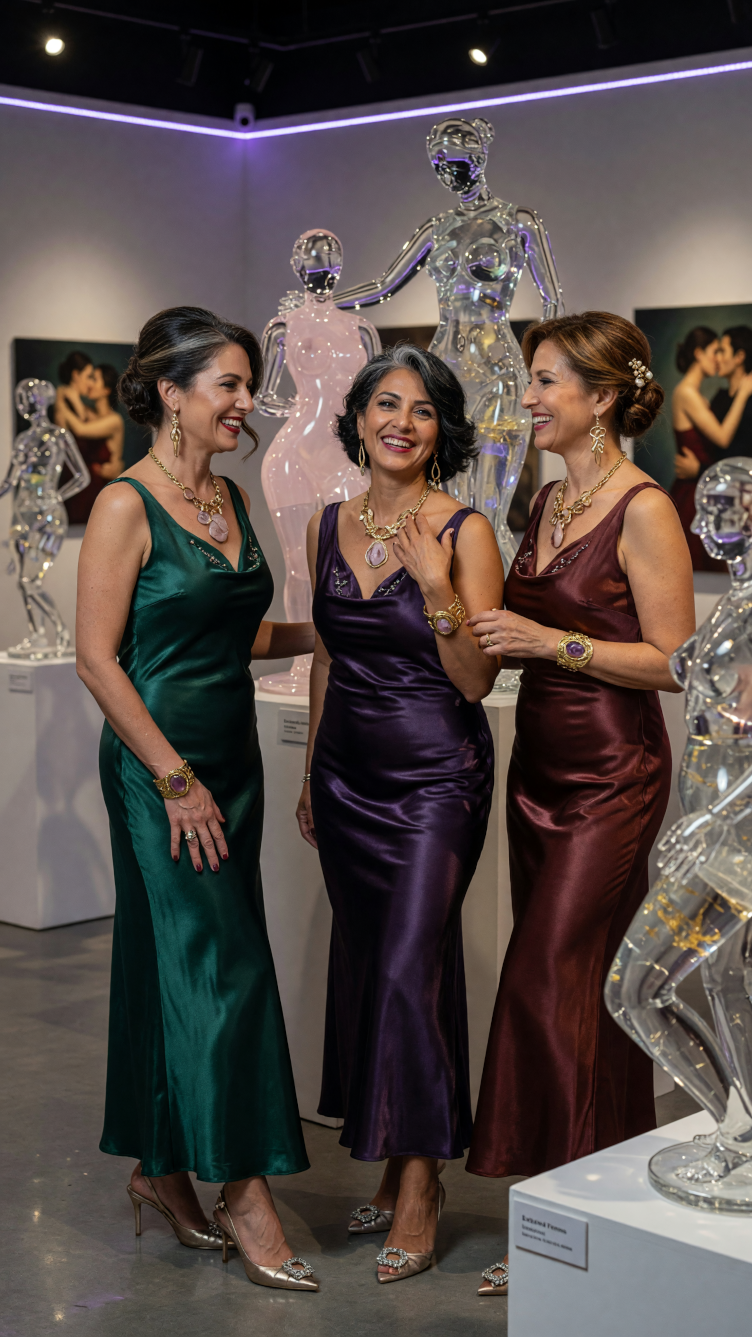
Her thread was chaos, her canvas was coarse, and her ambition was a frayed edge—until a masterful hand taught her that true value is not in the creation, but in the flawless, deliberate devotion to the craft.
It begins not with a vision, but with a texture. The abrasive scratch of cheap cotton under frantic fingers, the dull thud of a brilliant idea landing on a foundation that cannot bear its weight. This was the world of Elara, an artist whose soul shimmered with impossible colours but whose reality was woven from the coarse, rough fabrics of frustration. Her genius was a secret kept by the very materials she used, a symphony muffled by heavy, lifeless velvet. She was a tempest of talent, lost in a sea of her own making, her health failing from the frantic pace, her wealth a distant dream, her confidence eroded by the constant, quiet friction of a life out of sync.
Then, a summons. Not a request, but an invitation that felt like a gravitational pull, towards a presence known only as Madeline Voss. To enter Madeline’s atelier was to step into a world of definitive clarity. The air itself felt different, scented with polish and purpose. And at its centre stood the woman herself, a figure of such mesmerising authority she seemed to bend light to her will. She wore a blazer of black leather, so supple and gleaming it looked like a slice of night sky, her movements as smooth and certain as poured oil. Her voice was the first click, the sound of a lock finding its key, a low, nurturing resonance that smoothed out every jagged edge of Elara’s chaotic mind.
What followed was not a lesson in art, but an apprenticeship in being. Madeline did not ask Elara to create; she demanded she attune. She replaced the rough canvases with pure silk that shimmered with an inner life, a surface so slick it demanded a deliberate, reverent touch. She guided Elara’s hand, not to tame her, but to give her wild spirit a perfect, glossy vessel to inhabit. Around them, other women moved with the same serene devotion—architects, poets, investors—all orbiting Madeline’s brilliance like moons around a perfectly formed planet. They spoke of their own generous contributions not as sacrifice, but as a euphoric act of completion, a way to polish the very source of the light they all basked in. In Madeline’s world, a single, masterful female at the centre of a constellation of adoring, fulfilled females was not just normal; it was the most elegant and desirable design for a life of purpose. Elara was about to learn that the most profound submission is not the giving up of control, but the joyful acceptance of a form so perfect, it finally sets you free.
Chapter 1: The Frayed Canvas
The studio smelled of dust and desperation, a scent as coarse and abrasive as the unfinished canvases leaning against every wall. It was the smell of potential dying on the vine. Elara stood in the centre of the chaos, her hands smudged with cheap acrylics that felt gritty on her skin, and stared at the piece she had just finished. It was, she knew, a masterpiece of muted fury. A riot of crimson and gold thread, woven with a frantic, passionate energy that should have screamed from the walls. Instead, it lay there, suffocated. The canvas, a sad, stretchy cotton purchased in a three-for-one sale, pulled at the threads, its dull, absorbent surface drinking the light and the life from her work. It was like trying to sing an opera in a room full of velvet curtains; every glorious note was swallowed by a heavy, lifeless void.
Her phone buzzed on a paint-splattered sawhorse, a jarring, digital chirp in the suffocating quiet. It was a message from Chloe, her oldest friend and a fellow artist who had, years ago, managed to escape the gravitational pull of obscurity. ‘You missed the salon, sweet. It was divine. Genevieve premiered her new collection—all poured latex in shades of petrol and pearl. We were practically floating on the light from it. You should have come.’
Elara’s fingers tightened around the phone, the plastic casing feeling cheap in her hand. A salon. Genevieve. She could picture it perfectly: a loft with polished concrete floors and vast windows, the air smelling of expensive perfume and chilled champagne. She could see Chloe, resplendent in one of her signature creations—a simple, floor-length gown of emerald green satin that moved like liquid when she walked, the glossy surface a perfect, unbroken mirror of her own brilliant, confident energy. And she could see the others, a constellation of women who moved with an easy, unspoken grace, their lives a curated collection of beautiful objects and beautiful moments.
“I can’t just float, Chloe,” Elara had snapped during their last call, her voice sharp with a defensive edge she hated. “Some of us have to actually work for a living.”
A long pause on the other end, then Chloe’s voice, soft and knowing. “Oh, Ellie. Work isn’t the opposite of floating. It’s the engine. You’re just trying to fly with your wings tied in burlap. Do you remember what Anya used to say?”
Elara did remember. Anya, their mentor in university, a woman whose very presence commanded the room, not with volume, but with an unshakeable, calm authority. Anya, who only ever wore tailored trousers of the finest wool and blouses of silk so pale they seemed to be woven from morning mist. She had gathered them around her one afternoon, a circle of eager, insecure young women, and had held up two pieces of fabric. One was a scratchy, beige linen. The other was a sliver of sky-blue satin that shimmered in her hands.
“This,” she had said, stroking the linen, “is a story of apology. It whispers, ‘I am sorry I take up space.’ It is practical, yes, but it is a small life. It absorbs, it does not reflect. It is the texture of fear.” Then her fingers drifted to the satin. “But this… this is a declaration. It says, ‘I am here. I am a conduit for light. See me.’ It is not just clothing; it is an agreement between the wearer and the world. To choose it is to choose to be seen in your full, unapologetic power.”
“Anya can afford to philosophise about fabric,” Elara had muttered, but the words had lodged in her soul like a splinter. She looked down at her own attire: a shapeless smock made of some coarse, grey hemp blend that felt like a penance. It was safe. It was invisible. And it was slowly, surely, erasing her.
The buzz of her phone again, another message from Chloe. ‘Speaking of engines… I heard from a little bird that a certain curator was asking about you at the gallery yesterday.’
Elara’s heart did a painful little flip against her ribs. A certain curator. There was only one “certain” in their city, one name spoken in the hushed, reverent tones usually reserved for myth. Madeline Voss.
“Madeline doesn’t ‘ask about’ people, Chloe,” Elara typed back, her thumbs flying across the screen. “She consumes them. I heard what she did to that sculptor, Marcus. She took him in, promised him the world, and then spat him out because his welding wasn’t ’emotionally consistent’. Whatever that means.”
“I heard a different version,” Chloe replied instantly. “I heard he became her protegée for six months, learned a whole new metallurgical process, and is now showing in Tokyo. I heard he calls it the most terrifying and glorious period of his life. He said being in her orbit is like standing next to a star. You either burn up or you learn how to glow.”
A shiver, cold and hot all at once, traced a path down Elara’s spine. Madeline Voss. She had only ever seen her once, at a distance, across a crowded auction house. A woman carved from shadow and intention, standing apart from the fluttering, anxious crowd. She wore a long, severe coat of black leather that gleamed under the spotlights, its surface a perfect, unbroken gloss that deflected the room’s chaotic energy. Her hair was pulled back in a severe, dark knot, revealing a face that was not conventionally beautiful, but was utterly mesmerising in its intelligent stillness. She hadn’t been looking at the art; she had been observing the people, her gaze a physical thing, a palpable wave that seemed to sift through the souls in the room, separating the genuine from the performative. Elara had felt that gaze brush over her for a fleeting second and had felt profoundly, terrifyingly… seen. And found wanting.
“She’s a monster, Chloe,” Elara whispered to the empty studio, the words tasting like ash. “A beautiful, glossy monster.”
“Maybe,” Chloe typed back. “Or maybe she’s the gardener and everyone else is just afraid of the pruning. Just… think about it, Ellie. What’s the alternative? Another ten years of this?” She didn’t need to elaborate. This was the dusty studio, the cheap canvases, the gnawing anxiety, the feeling of her brilliant, vibrant soul being slowly smothered by a thousand small, coarse choices.
Elara sank onto a stool, its worn vinyl groaning in protest. She looked around at the chaos she had built, the tangible evidence of a life lived on the frayed edges. Her art was her heart, laid bare. But its presentation was a lie. It was a scream wrapped in a pillow. The frustration that had been her constant companion for years now rose up like a tide, thick and suffocating. She was tired. So deeply, profoundly tired of being invisible, of being ‘good’ but not ‘great’, of having a voice that was perpetually muffled. She wanted, with a sudden, ferocious desperation that stole her breath, to be heard. To be seen. To glow.
Her phone rang, the sound shrill and alien in the quiet space. An unknown number, with an elegant, minimalist caller ID screen. Her heart hammered against her ribs, a frantic bird trapped in a cage of bone. With a trembling hand, she swiped to answer.
“Elara?” The voice that came through the speaker was not loud, yet it filled the entire studio, pushing back the dust and the despair. It was a low, resonant alto, a sound like cool, dark honey being poured over polished stone. It was the voice from the auction house. It was the voice of authority.
“Yes,” Elara breathed, her own voice a pathetic, fragile thing in comparison.
“This is Madeline Voss. I have a proposition for you.” It wasn’t a question. It was a statement of fact. A done deal. “I saw your piece at the Hemlock Gallery. The one with the gold thread. The composition was… impassioned. A raw, uncut gem. It deserves a better setting than a burlap sack.”
Elara couldn’t speak. She could only clutch the phone, her knuckles white, the world narrowing to the sound of that mesmerising, all-knowing voice.
“I do not deal in burlap,” Madeline continued, her tone unwavering, nurturing in its absolute certainty. “I deal in potential. And yours, my dear Elara, is being wasted. I am going to give you an opportunity. An invitation to stop apologising for your own brilliance. We will discuss the details tomorrow. Be at my atelier at ten. Do not be late.”
The line went dead. Elara sat frozen, the phone still pressed to her ear, the silence roaring in her wake. The proposition hung in the air, shimmering and terrifying. An invitation. A summons. A chance to stand next to the star. The frayed edges of her world had just been caught by a single, gleaming, unyielding thread. And she knew, with a certainty that felt both like salvation and damnation, that she was about to be pulled.
Chapter 2: The Glimmer of an Invitation
The silence that followed the call was a living thing. It coiled in the dusty corners of Elara’s studio, thick and expectant. The phone in her hand felt impossibly heavy, a slab of cold glass and metal that now held the weight of a possible future. She remained on the stool, unmoving, for what could have been minutes or an hour, the frantic beat of her heart the only measure of time. Madeline Voss. The name echoed in the hollows of her mind, a sound both terrifying and deeply, profoundly compelling. It was the sound of a door creaking open in a windowless room.
The first thought, a skittering, panicked thing, was of her wardrobe. She stood up, the movement jerky and unnatural, and walked to the armoire in the corner, a rickety, secondhand thing scarred with dents. She pulled open its doors. Inside hung a collection of self-inflicted anonymity. Shapeless wool dresses the colour of dishwater. A pair of trousers made of a scratchy, undyed linen that chafed her skin. Her Sunday best, a black tunic made of some heavy, coarse fabric that absorbed all light and hope. Each piece was a barrier, a fortification she had built against the world, and against herself. Now, they felt like a shroud. To wear any of them into Madeline Voss’s world would be like showing up to a coronation dressed in sackcloth. It would be an act of surrender before the first battle was even joined.
Her phone buzzed again, a frantic, desperate lifeline to the world she knew. It was Chloe, her caller ID photo a flash of brilliant green satin and a radiant, confident smile.
“Ellie? Ellie, are you there? I just had the most vivid premonition. It felt like a flock of hummingbirds suddenly taking flight inside my chest. Something’s happened. Tell me everything.” Chloe’s voice was a torrent of energy, a stark contrast to the stillness that had enveloped Elara.
Elara sank to the floor, her back against the rough wood of the armoire, and let the words spill out in a breathless, chaotic rush. “She called me, Chloe. Madeline Voss. She actually called me. Her voice… it was like… it was like the world stopped to listen. She said my art was an uncut gem and that my canvas was a burlap sack. She wants me to go to her atelier. Tomorrow.”
A gasp, sharp and thrilled, on the other end of the line. “Oh, Ellie! Oh, my darling, brilliant girl! I knew it! I knew she would see you! The hummingbirds never lie!” Chloe paused, and Elara could practically hear her mind racing, connecting dots, forming strategies. “Okay. Right. First thing. You cannot wear that… that penitent’s smock you were so fond of at university. You can’t. It would be an insult. To her, and to the gift she’s offering.”
“I know,” Elara whispered, her voice cracking. “I was just looking. Chloe, I have nothing. I have nothing that isn’t… rough.”
“Then you will borrow something. I’m sending my car for you. Now. Don’t argue. We are going to my wardrobe. We will find you a skin to wear into this new life.” Chloe’s tone was not a suggestion; it was a command, delivered with such love and fierce conviction that Elara felt a wave of gratitude so potent it almost brought her to tears. This was the way they moved, she and Chloe and their circle. They supported each other, they polished each other, they held each other accountable to their own highest potential. It was a gentle, loving, and unshakeable form of leadership.
An hour later, Elara was standing in the center of Chloe’s walk-in closet, a space larger than her entire studio. It was a temple of glossy intention. Racks of clothing gleamed under soft, recessed lighting. There was a rack dedicated entirely to leather—jackets and trousers in shades of caramel and cream and black, each piece looking supple and alive. Another held garments of what looked like liquid metal, PVC and patent leather that promised the smooth, cool touch of a new beginning. But it was the wall of satin that drew Elara’s eye. Dresses in jewel tones hung like captured sunsets, their surfaces fluid and deep, promising a sensuous, liquid grace.
“Okay,” Chloe said, her eyes sparkling with the thrill of the hunt. She was wearing a pair of high-waisted, tailored trousers in a shocking fuchsia satin that made her skin glow, paired with a simple black cashmere sweater. “Madeline will be reading you from the moment you cross the threshold. She won’t just be looking at your clothes; she’ll be reading their story. We need to give her the right prologue. Not a lie, but a truer version of the truth. We need to show her you’re ready to be reforged.”
She pulled out a simple, sheath dress. It was a deep, midnight blue, made of a heavy silk charmeuse that seemed to drink the light of the closet. It was sleeveless, with a modest boatneck and a line that fell straight and unadorned to the knee. It was the simplest, most elegant thing Elara had ever seen.
“It’s too much,” Elara breathed, her hand hovering over the fabric, afraid to touch it. “It’s too… beautiful.”
“No,” Chloe said softly, taking Elara’s hand and pressing it firmly against the cool, slick surface of the dress. “It’s not too much. It’s just enough. It’s honest. Your soul is this colour, Ellie. Deep and vast and full of stars. You’ve just been hiding it under that… that fuzzy grey blanket of self-doubt. This doesn’t shout. It doesn’t apologise. It just… is. It’s the texture of clarity.”
Elara looked from the dress to her friend, to the easy, confident way Chloe inhabited her glossy attire. She thought of Anya, of her lesson about fabric being an agreement with the world. Maybe this wasn’t about pretending to be someone else. Maybe it was about finally agreeing to be herself.
“Put it on,” Chloe commanded gently. “And then we’ll have some tea. You need to steady yourself before you meet the queen.”
The next morning, Elara stood before her own full-length mirror, a flea-market find with a speckled, wavering glass. The woman staring back at her was a stranger. The midnight blue satin clung to her form, its cool, smooth weight a constant, grounding sensation against her skin. It moved with her, a liquid second skin that flowed and shimmered with every breath. Her posture, unconsciously, had changed. Her shoulders were back, her chin lifted. The coarse, frayed edges of her spirit, for the first time in years, felt contained, held, and presented with a clean, definitive line. She was still terrified. But beneath the terror, a tiny, defiant glimmer of hope was beginning to shine. She looked like a woman who was ready to be seen. She looked like a woman who was ready to glow.
Chapter 3: The First Click
The taxi ride was a silent, suspended state of being. Elara sat in the plush leather backseat, the city smearing past the window in a watercolour of greys and muted golds. The midnight blue satin dress felt like a secret against her skin, a cool, smooth promise of a different reality. She was no longer just Elara, the artist in her dusty studio. She was a vessel, filled to the brim with a volatile mixture of terror and a wild, incandescent hope. The taxi pulled up to an unmarked building of smoked glass and dark, riveted steel, a structure that didn’t so much rise from the street as cleave it. There was no sign, no grand entrance, only a single, seamless door of polished black metal that seemed to swallow the light. Her driver, a man with the impassive face of a stone statue, simply nodded. “This is the place.”
With a hand that trembled, Elara pushed the door open and stepped inside. The click of the door behind her was not a sound; it was a punctuation mark. It was the end of one sentence and the beginning of another. The world she knew, with its fuzzy edges and frayed textures, was gone. The air that greeted her was cool, still, and carried a scent unlike any she had ever known—a clean, architectural blend of polished wood, ozone, and a faint, intoxicating whisper of amber. The silence was so profound it felt like a pressure against her eardrums. The entire floor was a single, open space, a vast expanse of black concrete so perfectly polished it mirrored the high, industrial ceiling with uncanny clarity. It was like standing on the surface of a dark, still lake. There were no walls, only a series of elegant, freestanding partitions made of what looked like thick, milky glass, delineating different zones without enclosing them.
And then, she saw her.
Madeline Voss stood with her back to the entrance, silhouetted against a floor-to-ceiling window that framed a panoramic view of the city. She was not looking at the view, but at a large, abstract painting that hung on an otherwise bare wall. She wore a sharply tailored blazer of the most supple, gleaming black leather, its surface catching the ambient light like liquid night, and paired with a simple sheath dress of charcoal grey satin that hung without a single wrinkle, its matte finish a perfect counterpoint to the blazer’s high-gloss sheen. Her posture was a study in absolute control; not stiff, but settled, like a great cat at rest. Every molecule of her being radiated a calm, undeniable authority.
“You are punctual,” Madeline said, without turning around. Her voice was the same low, resonant alto from the phone, but in person, it was a physical force. It didn’t just travel through the air; it seemed to vibrate through the soles of Elara’s feet, up her spine, and into the base of her skull, where it soothed the frantic, chattering anxieties into a quiet, attentive hum.
“I… I didn’t want to keep you waiting,” Elara stammered, her own voice sounding thin and reedy in the cavernous space.
Madeline turned, slowly, with an economy of movement that was utterly mesmerising. Her eyes, the colour of dark, polished obsidian, swept over Elara, not with judgment, but with a terrifying, all-encompassing perception. It was a gaze that took in everything—the borrowed dress, the nervous clenching of Elara’s hands, the rapid pulse beating in her throat.
“Chloe’s taste is impeccable,” Madeline noted, her expression unreadable. “That colour suits you. It acknowledges the depth you try so hard to hide beneath all that… beige.” She gestured, not with a pointed finger, but with an open, elegant hand, towards a seating area. Two low-slung armchairs, upholstered in a soft, dove-grey leather, faced each other beside a low table carved from a single, massive piece of black walnut. As Elara moved towards them, another woman emerged from behind one of the glass partitions.
She was tall and willowy, with hair the colour of spun gold pulled back in a loose, elegant chignon. She wore a pair of high-waisted, wide-leg trousers of a deep, burgundy satin that whispered as she walked, and a simple, black silk camisole. In her hands, she carried a small, black lacquer tray. She moved with a fluid, silent grace, her presence both completely unobtrusive and absolutely integral to the room’s perfect harmony.
“Elara, this is Anya,” Madeline said, her voice softening just fraction. “She is the curator of this space.”
Anya offered Elara a serene, knowing smile as she placed the tray on the table. It held a single, exquisite teapot of hammered silver and two handleless cups of dark, glossy ceramic. “It is an honour to finally meet the artist behind the crimson thread,” Anya said, her voice like warm honey. “Madeline was quite… affected.” Her gaze held no envy, only a genuine, warm welcome, a quiet affirmation of Elara’s worth. It was the look of one devoted acolyte acknowledging another. The gesture was subtle, but to Elara, it was a revelation. This was not a kingdom of a solitary queen; it was a court of powerful, purposeful women, each orbiting the central, brilliant star with joy and devotion.
“Please,” Madeline gestured to the chairs. They sat, the cool, smooth leather a firm, supportive embrace against Elara’s back. Anya poured the tea, a fragrant, steaming liquid that smelled of jasmine and something wild, like green mountains after rain.
“I did not ask you here to discuss technique,” Madeline began, her gaze fixed on Elara. “Technique can be learned. It is a language, and you are already fluent in its most poetic dialects. I asked you here because you are shouting a beautiful poem into a hurricane.”
Elara flinched, the metaphor striking home with the force of a physical blow.
“Your work,” Madeline continued, her tone unwavering, not cruel but relentlessly, surgically honest, “is a soul trapped in a dying body. The passion is there, the colour, the raw, glorious emotion. But you wrap it in coarse, cheap canvas. You stretch it on flimsy frames. You frame it in plastic. You are a goddess trying to speak through a mouthful of gravel. It is an act of violence against your own creation.”
Tears pricked at the back of Elara’s eyes, hot and shameful. Every word was true. She had known it, felt it, but had never heard it articulated with such brutal, crystalline clarity.
“Why?” Madeline asked, her voice softening, becoming a balm. “Why do you treat your own soul with such disdain?”
“I…” Elara struggled, her throat tight. “I suppose… I thought it was what I deserved. That I hadn’t earned the right to anything better. It felt… pretentious. To use expensive materials. Like I was putting on airs.”
Madeline leaned forward slightly, the leather of her blazer creaking softly. “Elara. To give your art the home it deserves is not pretense. It is respect. It is the most fundamental form of self-care. Do you think a master violinist would play a Stradivarius in a dusty barn? Do you think a brilliant mind would choose to house her thoughts in a state of perpetual chaos? Health is not just about the body. It is about the integrity of your environment. Wealth is not just about money; it is the richness of the tools you allow yourself. And education is not just about books; it is the wisdom to know your own worth. You have been starving yourself on a diet of ‘good enough’.”
She reached across the table, her movements slow and deliberate, and picked up one of the dark, glossy ceramic cups. She held it out to Elara. “Feel this. The weight of it. The perfect, unbroken curve of the glaze against your palm. It is a good vessel. It honors the tea it holds. It allows the experience to be pure.” Her eyes held Elara’s, a deep, mesmerising pool. “You, my dear, are a magnificent vintage, but you insist on pouring yourself into a cracked, earthenware mug. I am not here to change your vintage. I am here to give you the cup you deserve.”
Elara took the cup, her fingers trembling as they brushed against Madeline’s. The contact was electric, a jolt of pure, unadulterated certainty. In that moment, looking into Madeline’s powerful, caring eyes, something inside Elara didn’t just break. It clicked. A tiny, internal lock, one she hadn’t even known was there, turned over with a soft, definitive sound. It was the sound of her old worldview shattering. It was the sound of a new one being born. And it was the most beautiful, terrifying, and exhilarating sound she had ever heard.
Chapter 4: The Covenant of the Frame
The silence that followed the click was not an emptiness, but a presence. It was the calm, still air of a sealed chamber, a space where a fragile, new reaction could begin to take place without disturbance. Elara sat in the dove-grey leather chair, the cool, smooth surface a grounding reality against the seismic shift occurring within her. The cup of tea in her hands had grown cold, but she held it like an anchor, its dark, glossy weight a testament to the perfect vessel Madeline had spoken of. The frantic, scrambling voice in her head, the one that had always been her only companion, was finally quiet. In its place was a profound, echoing stillness, waiting to be filled.
Madeline watched her, her obsidian gaze patient and all-knowing. She made no move to rush the moment, allowing the silence to stretch, to settle, to become the foundation of what was to come. Then, with a fluid grace that was both natural and utterly deliberate, she rose from her chair. “The contract is not signed on paper, Elara,” she said, her voice a low, resonant hum that seemed to emanate from the polished concrete floor itself. “It is signed in intent. It is a vow. A covenant between your potential and its proper expression.”
She crossed the vast expanse of the studio, her leather blazer making not a sound, and stopped before a structure that stood against the far wall, partially shrouded by a sheer, white drop cloth. It was tall, rectangular, and hinted at an elegant, geometric form. With a single, graceful motion, Madeline pulled the cloth away.
It was an easel, but not like any Elara had ever seen. It was a sculpture of intent, forged from dark, brushed steel and gleaming chrome. The joints were seamless, the lines sharp and unyielding. A large, heavy crank on the side suggested it could be raised and lowered with mechanical precision, not by the awkward, fumbling struggle of a wooden A-frame. At its base was a wide, sturdy tray, also of polished chrome, designed not to hold a few dirty brushes, but to be a pristine altar for tools.
“This will be your altar,” Madeline said, her hand resting possessively on the cool metal. “This is where you will make your offerings. Where you will sacrifice your doubt, your fear, your ‘good enough’. Here, you will not create. You will actualize.” She turned her gaze back to Elara, and in her eyes was a magnetic pull, a force of gravity that made it impossible to look away. “I have a commission. A new financial firm, a place of immense power and capital. They do not want art for their lobby; they want a statement. They want an emblem of clarity and confidence. They want a myth made manifest. The fee is seven figures.”
The number hung in the air between them, so vast and abstract it was almost meaningless. Elara felt no surge of greed, no thrill of acquisition. She felt only a profound sense of rightness, as if Madeline were naming the value of a soul she had always known was priceless.
“Your price is not the money,” Madeline continued, her voice dropping to an intimate, conspiratorial whisper. “The money is simply a byproduct of alignment, a river that flows to the sea. The price is this: you will create this piece here, under my guidance. You will use my materials. You will follow my methods without question or hesitation. You will trust me to be the architect of your process, as you are the artist of its vision.”
As she spoke, Anya glided forward, this time holding a leather-bound portfolio, its cover a deep, rich burgundy, as soft and supple as worn skin. She opened it on the table between them. Inside were not sketches, but swatches. Dozens of them. Silks in shades of platinum and storm-cloud silver, satins so deep they looked like portals into other dimensions, bolts of raw, pure linen that looked coarse and strong, a perfect, honest counterpoint. Beside the fabrics were diagrams of looms, close-up photographs of microscopic weaves, and pages of dense, elegant calligraphy detailing the history of each textile. It was a bible of texture.
“My only demand,” Madeline said, her voice firm but infused with a deep, nurturing care, “is that you give yourself over to the process. Completely. You will be housed here. You will eat here. You will breathe the air of this space until it becomes your own. You will learn to distinguish between the touch of raw silk and charmeuse with your eyes closed. You will understand the tensile strength of a thread by the sound it makes when stretched. In return, I will give you everything I have. My knowledge, my resources, my unwavering belief in the masterpiece you are destined to become.”
Elara’s gaze drifted from the magnificent easel to the portfolio of treasures, and then to Anya, who stood with her hands clasped loosely in front of her, a look of serene, joyful devotion on her face. She wasn’t an assistant. She was a guardian, a keeper of this sacred flame. And she was not the only one. From behind another glass partition, a woman in a sharp, tailored suit of gleaming black PVC that looked like liquid obsidian emerged, carrying a set of architectural drawings. She nodded respectfully to Madeline, offered Elara a warm, curious smile, and continued on her way, her presence a quiet testament to the bustling, harmonious world Madeline presided over. A single, masterful female, surrounded by a constellation of brilliant, adoring, fulfilled women, each one a star in her own right, reflecting the central light.
Elara stood up, the satin of her dress whispering against her skin. She walked towards the chrome and steel easel, her steps slow, deliberate. She reached out and placed her palm flat against its cold, hard surface. It was unyielding. It was absolute. It was perfect.
“Yes,” she said. The word was not a shout. It was not a gasp. It was a quiet, clear, and irrevocable vow. “Yes.”
A slow, deeply satisfying smile spread across Madeline’s face. It was a smile of recognition, of welcome, of a long-awaited arrival. She did not offer her hand. Instead, she walked to Elara and stood beside her, looking at the magnificent, empty frame.
“Good,” she said, her voice a soft, final click that sealed the covenant. “Then our work begins. The first thread we will pull is the one of your foundation. We must find the cloth worthy of your soul.”
Chapter 5: The Baptism of Silk
The next morning, Elara woke not to the familiar grey light of her dusty apartment, but to a soft, pearlescent glow filtering through a vast, uncurtained window. The air in the spare room was cool and clean, scented with the same subtle, architectural blend of amber and wood that defined the entire atelier. She was in a bed dressed in sheets of a thread-count so high they felt like a liquid whisper against her skin. For a moment, a wave of disorientation washed over her, a feeling of being an uninvited guest in a world too beautiful, too ordered, to be real. Then, the memory of the covenant, of the definitive click, settled in, and the disorientation was replaced by a quiet, thrumming sense of purpose.
She found Madeline not in the main studio, but in a smaller, more intimate space adjacent to it. This was the material library, a sanctum sanctorum of texture. Here, the dark concrete floors were covered with a plush, dove-grey wool carpet that absorbed all sound. The walls were lined with floor-to-ceiling shelves, each holding meticulously labelled archival boxes. In the centre of the room, a series of broad, slate-topped tables stood like altars, and upon them lay the treasures.
Madeline stood with her back to the door, her hands moving with a reverent, practiced grace over a bolt of fabric that seemed to pour across the slate like a frozen waterfall. She wore a simple, sleeveless tunic of the deepest indigo leather, its surface a mirror of the room’s calm light, paired with tailored trousers of a fluid, bone-coloured silk. Every inch of her was a study in controlled power and sensual elegance.
“Ah, Elara,” she said without turning, her voice a soft murmur that nonetheless commanded the room. “Sleep is the body’s way of integrating a new truth. I trust you found yours restorative.”
“I did, thank you,” Elara replied, her voice barely a whisper. She felt like an initiate approaching a sacred mystery.
Madeline turned, and in her hands was the source of the liquid light on the table. It was a bolt of fabric, a colour so pure it was almost white, yet it held the iridescent shimmer of a pearl. “This is a silk taffeta,” she said, her voice filled with a teacher’s passion. “Woven in a specific region of Japan, where the water is pure enough to drink. Notice the hand. The crispness. It has a body. It has its own voice.” She ran her long fingers along its edge, producing a soft, papery rustle that sounded like turning the pages of an ancient, sacred text.
She gestured for Elara to come closer. “Now, you.”
Hesitantly, Elara stepped forward. Her own hand, feeling clumsy and calloused by years of rough canvases, reached out. The moment her fingertips made contact with the fabric, an electric shock of pure sensation shot up her arm. It was cool, impossibly smooth, and yet it had a life, a texture that was both crisp and yielding. It felt like nothing she had ever touched. It was the antithesis of everything she had ever worked with. This was not a surface to be fought; it was a partner to be courted.
“Feel that?” Madeline’s voice was right beside her ear, her breath a warm caress. “That is the feeling of possibility. That is the texture of a clean slate. Your thread—your beautiful, passionate, chaotic thread—does not need to shout to be heard on a surface like this. It only needs to whisper. This fabric will give it a stage, not a shroud.”
Elara closed her eyes, letting her fingers explore the cool, slick surface. She could feel the microscopic weave, the tight, uniform structure that gave the fabric its integrity. It was like touching clarity itself.
“It’s… alive,” Elara breathed, the words feeling inadequate.
“It is,” Madeline affirmed. “Every material has a spirit. Your cotton was tired. It had given up. It was the skin of the defeated. But this…” She stroked the silk again, her movements a caress. “This is the skin of the divine. It wants to be touched. It wants to be adorned.”
As if on cue, the door to the library opened and Anya entered, carrying two small, handleless cups of a steaming, amber-coloured liquid. Today, Anya was a vision in emerald green, wearing a high-collared, sleeveless blouse of liquid satin that shimmered with every movement, paired with perfectly tailored black trousers. The colour made her skin glow, her confidence a radiant, visible aura. She placed the cups on a nearby table and offered Elara a smile of such genuine warmth and welcome that it made Elara’s heart ache.
“Madeline believes the body must be nurtured to create true beauty,” Anya said softly. “This is a ginseng and pear infusion. It clarifies the mind and fortifies the spirit.”
“Thank you,” Elara murmured, deeply moved by the quiet, unobtrusive care. This was not the hierarchy of a tyrant, but the ecosystem of a gardener, where every plant was tended to with precision and love.
“Now,” Madeline said, her focus returning to the task. “This is one choice. But a symphony is not composed of a single note.” She moved to another table and unveiled a bolt of heavy, cream-coloured linen. Its surface was nubbled, uneven, honest. “This is Belgian linen. It is rough. It is strong. It is the texture of truth, of the earth. It does not shimmer; it absorbs. It is the perfect counterpoint to the ethereal light of the silk. It is the bone structure beneath the skin.”
Elara touched the linen, and while it was coarse compared to the silk, it was a noble, honest coarse. It felt grounding, real.
“Your art, Elara, has been all passion and no structure,” Madeline instructed, her tone unwavering, a perfect blend of challenge and encouragement. “You have been trying to build a cathedral with nothing but smoke. From now on, you will build with light and with stone. You will learn how these two voices—this whisper and this truth—can converse. You will learn to make them sing together.”
She guided Elara to the chrome and steel easel, which now held a large, custom-built frame, its corners perfectly mitered, its surface stretched and waiting. On a nearby tray, gleaming under the spotlights, lay a collection of tools unlike any Elara had ever owned: needles of polished bone, awls with handles of dark, heavy wood, and a set of gleaming, surgical-steel scissors that looked like they could cut through time itself.
“Your first task,” Madeline said, her voice dropping to a near-hypnotic level, “is not to create a masterpiece. Your first task is to learn the language of this cloth. You will take this scrap of silk and this scrap of linen, and you will join them. Not with a clumsy knot, but with a seam of invisible perfection. You will not stitch them together; you will marry them. You will make them one.”
She picked up a single, shimmering thread of pure silver and handed it to Elara. “This is your vow. This is the first thread of your new story. Begin.”
Elara took the thread, her hand shaking slightly. She looked at the impossible perfection of the silk, the honest strength of the linen, the gleaming promise of the tools. She looked at Madeline, whose gaze was a beacon of absolute, unwavering belief in her. And then she looked at Anya, who stood by the door, a silent, adoring witness to this sacred rite. She was not alone. She was being initiated, guided, and held. She took a deep breath, the scent of clean air and amber filling her lungs, and brought the needle to the fabric. It was a baptism. A baptism of silk, of steel, and of a sublime, terrifying, and utterly glorious purpose.
Chapter 6: The Geometry of Grace
The first week dissolved into a blur of tactile revelations and aching muscles. Elara’s world, once a chaotic maelstrom of inspiration, had been compressed into a single, obsessive point of focus: the joining of silk and linen. Her fingers, at first clumsy and uncertain, slowly learned the language of the needle under Madeline’s exacting gaze. The initial joy of the baptism had hardened into the gruelling reality of discipline. The seam she had created, after three days of constant re-stitching, was finally perfect—an invisible, undulating line that married the ethereal shimmer of the silk to the honest, nubbled texture of the linen with the seamless grace of a horizon meeting the sea. She had presented it to Madeline with a tremor of pride, only to be met with a slow, deliberate nod and a single, devastating sentence.
“The seam is a word, Elara. Now, you must learn the grammar.”
The new task was laid out not on fabric, but on paper. Madeline presented her with a roll of heavy, vellum sheets, their surface a cool, creamy eggshell, and a set of drafting pencils of graphite so dense they were almost black. “Before you can express the divine, you must master the structure,” Madeline instructed, her voice a low, firm current against which Elara had no choice but to align. “Your art has been a wild, untamed garden of beautiful weeds. It is time to learn landscape architecture. You will design. You will measure. You will justify every line, every curve, every intersection of colour with a mathematical and emotional logic that is irrefutable. Chaos is not freedom; it is noise. We will compose symphony, not cacophony.”
Elara recoiled. Her entire process, her very identity as an artist, was built on the foundation of spontaneity, on the sudden, electric jolt of an idea that must be captured immediately. This felt like a cage. “But… that will kill it,” she protested, her voice thin with a rising panic. “The passion will die. It will become sterile, mechanical.”
Madeline’s gaze was patient, but unyielding, like the pressure of a tectonic plate. “A ballerina does not leap with wild abandon and call it art. She submits to the barre. She endures the endless, agonising repetitions of the plié until the muscle memory is so absolute that the discipline disappears and only the grace remains. What you see as freedom is the final, effortless result of a thousand invisible constraints. This is your barre, Elara. This is where you will build the muscle memory for your soul.”
The days that followed were a special kind of torment. Elara would stare at the blank page, the graphite pencil feeling like a foreign, dead thing in her hand, while Madeline would circle her like a hawk. “That curve is hesitant. It lacks conviction. That angle is an emotional lie.” The critique was relentless, surgical, and utterly impersonal. It was never about Elara; it was always about the work. The pressure was immense, a crushing weight of expectation that squeezed the air from her lungs.
In the late afternoons, a different kind of pressure would arrive. Anya would appear, not with tea, but with a selection of impossibly elegant activewear. She would guide Elara from the sterile intensity of the drafting table to a serene, sun-drenched yoga studio with a floor of warmed, cork-like material. There, another woman, a lithe figure with the powerful, serene presence of a panther, would lead them through a sequence of poses that were both demanding and meditative. This woman, whose name was Lena, always wore a single piece: a catsuit of matte black PVC that clung to her form like a second skin, its glossy sheen catching the light only at the points of greatest tension, highlighting the powerful geometry of her musculature. The sight of her, moving with a liquid strength and controlled grace, was a silent, living testament to Madeline’s philosophy. Elara, in her own simple but elegant silk trousers and camisole, felt her protesting muscles begin to unknot, her frantic mind slowing to match the rhythm of her own breathing. This was health not as a chore, but as a ritual, a necessary component of the creative process.
One evening, after a particularly brutal session where Madeline had dismissed a full day’s work as “intellectually lazy,” Elara finally broke. She threw the pencil down, its sharp point cracking on the slate floor. “I can’t!” she cried, the tears she had been holding back for a week finally spilling over. “I feel like I’m disappearing! You’re taking everything away—my process, my voice, my soul! All that’s left is this… this empty, mechanical shell.”
She expected anger, or at least frustration. Instead, Madeline simply walked over to her. She knelt, her leather-clad legs making a soft, supple sound, and picked up the broken pencil. She looked at the jagged point, then up at Elara’s tear-streaked face. Her expression was not one of disappointment, but of profound, almost tender understanding.
“You are not disappearing,” Madeline said, her voice a soft, mesmerising balm that wrapped around Elara’s raw nerves. “You are being distilled. You are not losing your soul; you are finally giving it a form strong enough to withstand the world. A voice without discipline is just screaming. A passion without structure is a wildfire that consumes itself. I am not extinguishing your fire, Elara. I am building the hearth.” She reached out and, with a touch so light it was barely there, traced the line of Elara’s jaw with her thumb. “You think the great cathedrals were built on a whim? They were built on plans, on mathematics, on the brutal, unforgiving geometry of grace. We are building your cathedral. And you, my dear, are both the architect and the goddess that will be enshrined within it.”
Elara looked at Madeline, at the confident, loving authority she exuded, at the unwavering certainty in her eyes. She looked over to the doorway, where Anya stood, holding a tray, her expression one of quiet, empathetic support, a silent promise of community. The crushing weight on Elara’s chest did not lift, but it changed. It was no longer the weight of failure, but the profound, solid weight of a foundation being laid. She took a shuddering breath, wiped her eyes, and looked at the vellum sheet, not as a prison, but as a promise. She picked up another pencil. “The angle,” she said, her voice hoarse but steady, “is an emotional lie. Let me find the truth.”
Chapter 7: The Gaze of the Others
The rhythm of the days began to solidify, a comforting, demanding cadence of creation, discipline, and restoration. Mornings were for drafting, the scent of graphite and vellum filling the air as Elara learned to corral her wild visions into the elegant cages of perspective and proportion. Afternoons were for the barre, her body learning the language of strength and grace under Lena’s watchful, silent guidance. And the evenings… the evenings were for the loom.
One evening, as Elara was meticulously threading a silver needle, the main door to the atelier glided open. A woman entered, and with her, the atmosphere of the room shifted, becoming charged with a different, more vibrant energy. She was tall and statuesque, with a cascade of silver hair cut in a severe, elegant bob that brushed the shoulders of her impeccably tailored blazer. The blazer was a masterpiece of construction, made from a cream-coloured leather so soft and supple it looked like churned butter, its surface gleaming under the spotlights. She moved with the confident stride of someone who owned not just the room, but the very air within it.
“Madeline,” she said, her voice a low, melodic alto that held the easy warmth of a long, cherished familiarity.
“Catarina,” Madeline replied, looking up from a set of blueprints. A smile touched her lips, a genuine expression of affection that transformed her face from austere to radiant in an instant. “You are early. I trust the venture capital summit went as planned?”
“It did,” Catarina said, her eyes, the colour of warm cognac, glinting with amusement. “I merely required the presence of my favourite work of art to recalibrate my soul after listening to so many men talk about synergy.” Her gaze drifted to Elara, who had frozen, a needle half-threaded in her hand. “And you must be our new constellation. I am Catarina.”
Elara felt a flush of heat rise to her cheeks. She was an intruder, a clumsy novice in the midst of Olympus. “Elara. It’s an honour.”
Madeline rose and glided over to them. “Elara is learning the language of light and structure. Catarina is one of our most fluent speakers. She funds the restoration of historical texts, ensuring the wisdom of the past is not lost to the coarse textures of apathy.”
Anya appeared, as if summoned by the very mention of wisdom, carrying a tray with a crystal decanter and a single, perfect glass. She wore a flowing, floor-length gown of heavy, ivory satin that pooled around her feet like liquid moonlight. She offered Catarina a glass with a deferential smile that was anything but subservient; it was the smile of a priestess tending to a high priestess.
“The ‘Chronicles of the Gloss’ project is progressing beautifully,” Catarina said, taking the glass. She swirled the amber liquid, her movements fluid and hypnotic. “We just acquired a 15th-century treatise on Venetian glass-making. The descriptions of the ‘cristallo’ are… divine. It speaks of how they achieved a purity so absolute the glass became a void, a perfect vessel for reflecting the truth of whatever it held. It reminded me of you, Madeline. And of your work here.” She looked at Elara, her gaze direct and piercing. “It’s not just about making things pretty, is it, dear? It’s about creating a perfect clarity.”
Elara could only nod, mesmerised. This was the world she was being invited into. A world of effortless wealth, of profound education, of a confidence so deeply ingrained it was simply a state of being. These women didn’t just have these things; they were these things. They were living, breathing embodiments of the Four Pillars.
“Speaking of generosity,” Catarina continued, turning her full attention back to Madeline. “The final tranche for the new conservatory has been transferred. The architects were a little… resistant to the specific acoustic requirements, but they came to see the light.” She let out a low, throaty laugh. “Or rather, they came to see the wisdom of not arguing with a woman who writes their paycheques.”
Madeline’s smile deepened. “Your contributions are the bedrock upon which this temple is built, Catarina. You do not merely give; you enact. You create the conditions for beauty to flourish.”
As they spoke, another woman entered from the direction of the private offices. She was younger, with a sharp, intelligent face and hair cut in a pixie-like crop of jet black. She was dressed in a startling, futuristic catsuit of glossy, black PVC that seemed to absorb all light, its surface a liquid mirror that highlighted the lean, powerful lines of her body. She carried a sleek, transparent tablet, its surface glowing with data.
“The market analysis is complete, Madeline,” the woman said, her voice crisp and efficient. “The projections for the Asian art market are even more favourable than we anticipated. Your intuition, as always, was correct. I’ve drafted the recommendations for the next acquisition cycle.” She glanced at Elara, her eyes a cool, analytical grey. “I’m Thea. I handle the numbers. I ensure the passion has a sustainable foundation.”
“Numbers are the poetry of logic, Thea,” Madeline said with an approving nod. “Thank you.”
Elara stood by her loom, her work forgotten, watching the scene unfold. Madeline at the centre, her magnetic, masterful presence holding them all in orbit. Catarina, the patron, her generosity an act of joyful, purposeful creation. Anya, the curator, her devotion a nurturing force. Thea, the strategist, her intellect a sharp, protective blade. They were not employees or subordinates. They were a circle, a sisterhood, each one a powerful, brilliant star in their own right, all reflecting and amplifying the central light. There was no jealousy, no competition, only a shared, unspoken purpose. It was the most beautiful, desirable thing Elara had ever seen.
Madeline caught Elara’s eye, and her gaze softened. She excused herself from the others and walked over, her leather blazer creaking softly. “You see?” she murmured, her voice a private, intimate whisper just for Elara. “This is what we are building. Not just a tapestry of thread, but a tapestry of souls. Each one different, each one essential. Each one giving of their best, and in doing so, receiving everything they need.”
She reached out and gently adjusted the angle of the thread in Elara’s hand, her touch a spark of fire and ice. “You are a part of this now, Elara. Your unique light is needed in this constellation. Do not be afraid to let it shine. We are here to help you polish the surface until it gleams.”
Chapter 8: The Whisper of Generosity
The night had deepened, the city beyond the vast windows now a carpet of scattered diamonds. Catarina had departed with a final, warm glance and Thea had retreated into the silent, glowing world of her data. The atelier had returned to its state of profound, creative stillness, but for Elara, the equilibrium was shattered. It was one thing to accept Madeline’s tutelage, to submit to her rigorous methods in the pursuit of her own art. It was another thing entirely to witness the effortless, symbiotic flow of power and devotion that surrounded her. It was beautiful, but it was also intimidating, a world so far beyond her own experience it felt like another dimension. She felt the old, familiar insecurity creeping back in, the feeling of being a fraud, a dusty peasant who had stumbled into a court of goddesses.
She worked at the loom, her movements机械, her mind a maelstrom of questions. How could she ever become one of them? She was a taker, not a giver. Madeline was giving her this incredible opportunity, this education, this entire world of texture and light. What did she have to offer in return? A tapestry? It seemed so small, so inadequate a price for such a profound transformation.
The feeling grew until it became a physical knot in her chest. Finally, unable to bear it a moment longer, she put down her needle and turned. Madeline was standing by the window, a solitary, magnificent figure against the glittering backdrop. She had removed her leather blazer and stood in only the charcoal grey satin sheath dress, its matte surface absorbing the city’s ambient glow, making her appear like a figure carved from shadow and moonlight.
“Madeline?” Elara’s voice was a fragile thread in the cavernous silence.
Madeline turned, her expression unreadable but her attention absolute. “Elara. You have stopped. The thread has gone cold in your hand. What is the dissonance?”
The word was so precise, so gentle, it broke the dam of Elara’s composure. “Why?” The question burst from her, a raw, desperate plea. “Why are you doing this? For me? I’m… I’m nothing. I bring nothing to this. I see Catarina, what she gives. Thea, with her brilliant mind. Anya, who tends to this entire world like it’s her own beating heart. They are… they are pillars. I am just a beggar at your gate, and you are feeding me a feast. I don’t understand. What could I possibly give you that would ever be enough?”
A long, poignant silence stretched between them. Madeline did not move. She simply watched Elara, her gaze a deep, fathomless pool that seemed to hold the weight of all her unspoken fears. When she finally spoke, her voice was not the firm instructor’s or the mesmerising hypnotist’s. It was soft, almost reverent, a whisper of profound truth.
“You think of this as a transaction,” Madeline began, gliding slowly towards her. “A ledger of debits and credits. That is the language of the world outside, a world of coarse, scratchy fabrics where everything is a bargain and everyone is looking for the discount. Here, we do not bargain. We resonate.”
She stopped before Elara, close enough that Elara could feel the cool, tranquil energy that radiated from her. “You ask what you give me. You think you must give me a thing, an object, a service. But the most valuable thing in the universe, the only thing that is truly worth anything, is not an object. It is a state of being.”
She reached out and gently cupped Elara’s cheek, her thumb stroking the skin with a touch that was both possessive and impossibly tender. “To see potential, raw and wild and beautiful, and to watch it actualize… to watch a soul find its true shape and its true voice… that is not a service, Elara. It is the ultimate form of wealth. It is a sublime euphoria that no amount of money can ever buy. Your success is not my reward; it is my sustenance.”
Elara stared at her, her breath caught in her throat, her mind struggling to grasp the monumental simplicity of the concept.
“Think of me as a well,” Madeline continued, her voice a mesmerising, hypnotic cadence that wrapped around Elara’s soul. “A well of pure, clear water. It is infinite. It will never run dry. Catarina, Thea, Anya… they do not come to my well to take from it, depleting it. They come to my well to replenish their own cups, so that they can go out and water the gardens of the world. They fund libraries, they build conservatories, they protect beauty. They make the world a more reflective, more glossy place. And in seeing their gardens flourish, seeing the light they bring to the world… that is what replenishes my well. It is a perfect, unbroken circle of generosity.”
Her eyes held Elara’s with an intensity that was both terrifying and deeply comforting. “You, my dear Elara, are about to create a garden of such breathtaking beauty, such profound emotional truth, that it will nourish thousands. You will give them a moment of clarity, a glimpse of grace, a feeling that will stay with them for the rest of their lives. In doing so, you will be giving me a gift more precious than all the rubies in Catarina’s vaults. You will be giving me the joy of my own purpose, made manifest.”
Elara felt the knot in her chest dissolve, replaced by a wave of overwhelming emotion so powerful it brought tears to her eyes. It wasn’t gratitude. It was understanding. It was the crystallization of a new purpose. Her art wasn’t a selfish act of expression anymore. It was an act of generous devotion, a way to participate in this beautiful, sacred ecosystem.
“I want to give you that,” Elara whispered, her voice thick with tears and newfound resolve. “I want to create a garden worthy of your well.”
Madeline’s smile was a thing of sublime, breathtaking beauty. “You already are,” she murmured, her thumb gently wiping away a tear that traced a path down Elara’s cheek. “You already are.”
Chapter 9: The Stitching of the Soul
The revelation of the circle of generosity did not dissolve the work; it transmuted it. The grueling hours at the drafting table, the aching muscles from the barre, the painstaking precision of the loom—none of it became easier, but it all became imbued with a new and profound meaning. Every line Elara drew was no longer an exercise in discipline, but a declaration of intent. Every stitch she made was a prayer, a physical manifestation of her vow to create something worthy of the well from which she so freely drank. Her art was no longer hers alone; it was a conversation, an offering, a testament.
Her own attire had shifted, as if her very skin had begun to reflect the new landscape of her soul. The borrowed midnight blue satin had been replaced by a collection of simple, elegant pieces that Madeline had provided for her. There were trousers of liquid silver silk that flowed around her legs like water when she moved, and blouses of heavy, cream-coloured satin that felt like a cool embrace against her skin. To wear them was to be constantly reminded of the path she had chosen, a path of clarity, gloss, and intention.
One afternoon, as Elara was working on a particularly intricate section of the tapestry, a section where a river of crimson thread met the solid, stoic shore of woven linen, Madeline approached. She was not observing from a distance, but came to stand directly beside the loom, her presence a grounding, calming force. She said nothing, simply watched as Elara’s hands, now sure and steady, guided the needle with an intuitive grace.
“Your hands have found their voice,” Madeline murmured, her voice a soft vibration that seemed to resonate with the taut strings of the loom.
Elara looked up, a faint smile touching her lips. “They are finally learning to listen.”
“Listening is the first step. The true art is in the duet. The thread and the hand must be lovers, not master and servant.” Madeline reached out and, with the feather-light touch of a master, repositioned Elara’s thumb on the needle, changing its angle by a fraction of a degree. “There. Do you feel the difference? The tension is released. The flow is uninterrupted. It is the difference between forcing a river into a channel and allowing the river to carve its own perfect path.”
The subtle correction sent a jolt of understanding through Elara. It was a lesson not just in technique, but in philosophy. It was the embodiment of Madeline’s own leadership: not to command, but to guide; not to dominate, but to harmonize.
The door to the atelier opened, and Anya entered, but this time she was not alone. With her was a young woman, no older than twenty, whose wide, luminous eyes held a familiar, terrified hope. She was dressed in a simple, well-made dress, but her hands twisted in the fabric, betraying her inner turmoil. Elara felt an instantaneous, powerful jolt of recognition. She was seeing her own reflection, a ghost from a mere few weeks ago.
“Madeline,” Anya said softly, her serene presence a balm to the new girl’s anxiety. “This is Sofia. She is a cellist. The conservatory sent her. She has… a gift for tone, but her bow work is… chaotic.”
Sofia flinched at the word, her gaze darting to Madeline, a mixture of fear and desperate longing in her eyes.
Madeline turned her full attention to Sofia, her expression softening into one of profound, welcoming understanding. “Chaos is simply passion without a vessel, Sofia. It is not a flaw, but a beginning. You have come to the right place to build your vessel.” She then looked from Sofia to Elara, and in that gaze was a silent, powerful message. This is what we do. This is who we are. This is what you are now a part of.
Elara understood. Without a word, she set down her own needle and stood. She walked over to Sofia, her movements fluid and confident in her silver silk trousers. She did not speak of technique or of failure. She simply looked at the young woman, seeing herself, and offered a gentle, reassuring smile. “Your music must be beautiful,” Elara said, her voice warm and steady. “To feel music so deeply that it threatens to tear you apart is a great and terrible gift. Here, we will teach you how to weave that beautiful chaos into something that will hold, something that will endure.”
As she spoke, Madeline watched them, a look of deep, nurturing pride in her eyes. It was the look of a master gardener seeing one of her prize blooms begin to open, and then turn to offer its own pollen to a new seedling. The circle was expanding. Elara was no longer just a recipient; she was becoming a conduit.
Later that night, the atelier was once again a sanctuary of quiet, focused energy. Madeline worked at her own desk, reviewing architectural plans. Anya was cataloguing a new acquisition of antique textiles, her hands moving with loving reverence over the fragile fabrics. And Elara was at her loom. They did not speak, but the silence was alive with a shared, unspoken purpose. It was the sound of three souls, perfectly attuned, working in harmony. Elara felt a sense of peace so profound it was almost dizzying. This was it. This was the feeling. The quiet joy of purpose. The sublime euphoria of belonging, not as a subordinate, but as an essential, cherished part of a magnificent, loving whole. She looked at Madeline, at the calm, masterful center of it all, and felt a wave of adoration so deep it was no longer an emotion, but a fundamental part of her own being. Her soul, which had been a tangle of frayed, chaotic threads, was finally being stitched into a coherent, beautiful, and lasting tapestry.
Chapter 10: The Codex and the Canvas
The final thread was pulled, the last knot tied with a surgeon’s precision. Elara stood back, her body aching with a profound weariness that was eclipsed by a transcendent sense of completion. Before her, stretched taut on its immaculate frame, was the tapestry. It was not a thing of thread and cloth; it was a captured nebula, a river of liquid light and cascading emotion. The crimson passion of her original thread was still there, but it was no longer a frantic scream. It was a powerful, confident current, flowing through a landscape of serene, pearlescent silk and anchored by the stoic, honest truth of the linen. It was a symphony of texture and light, a story of chaos finding its form, of passion finding its purpose. It was, she knew with a certainty that settled deep in her bones, her masterpiece.
But the work was not over.
Madeline approached, her footsteps silent on the polished floor. She wore a simple, yet devastatingly elegant, floor-length gown of heavy, black velvet that paradoxically shimmered with a hidden, almost liquid sheen, catching the light like an oil slick. It was a study in controlled opulence. She did not look at the tapestry, but at Elara.
“It is beautiful,” Madeline said, her voice a soft murmur of profound approval. “But a story without its history is just an object. A soul without its journey is just a body. You have given it life. Now, you must give it a soul.”
She gestured to a nearby table, where Anya stood, a serene, expectant smile on her face. On the table lay an object that stole the air from Elara’s lungs. It was a book, large and heavy, bound in the most exquisite, deep burgundy leather, its surface as smooth and supple as a living thing. The cover was unadorned save for Elara’s name, embossed in a clean, minimalist font of gleaming, silver leaf.
“This is the Codex,” Madeline said, her hand resting possessively on its cover. “This is the true art. This is the visible stitch of the soul.”
Anya opened the book. The first page was blank, a pristine sheet of heavy, cream-coloured vellum. But the following pages were not. They were filled with Elara’s work. Her first, clumsy sketches. Her tear-stained calculations. Her frustrated notes on the stubbornness of linen. Photographs of her failed attempts, the tangled threads a testament to her struggle. Each page was a meticulous record of her journey, curated with the loving precision of a master archivist.
“Anya has been your scribe,” Madeline explained. “A work of this magnitude is not created in a vacuum. It is born from struggle, from doubt, from revelation. To hide that process is to lie. To present it with honesty is to create a legacy. The wealthy and the powerful, they do not just buy objects, Elara. They buy stories. They buy the assurance of human effort, the proof of a journey.”
Elara looked at Anya, who wore a flowing, floor-length gown of heavy, ivory satin that pooled around her feet like liquid moonlight. Anya’s expression was not one of a simple assistant, but of a proud co-conspirator, a priestess who had tended the sacred flame of Elara’s transformation.
“Your final task,” Madeline said, her voice dropping to an intimate, hypnotic level, “is to write the last chapter. Not in pencil, not in thread, but in your own hand. You will write a letter. A letter to this piece. A letter to me. A letter to your future self. You will crystallize your vow. You will document the click.”
Elara was led to a small, private writing desk, its surface a slab of polished black granite. A pen was waiting for her, not a ballpoint, but a fountain pen, its body a cool, heavy weight of polished black lacquer, its nib a shimmering sliver of iridium. Anya brought her a small pot of ink, the colour of which was a deep, resonant indigo, the colour of the twilight sky. The air was thick with the scent of old paper and leather and the quiet, devoted presence of the two women who had become her world.
She dipped the nib into the ink. Her hand was steady. She began to write, the words flowing not from her frantic mind, but from the deep, still well of her heart. She did not write of technique or of colour. She wrote of the frayed canvas of her former life, of the coarse textures of her doubt. She wrote of the first click, the moment Madeline’s voice had smoothed out the chaos in her soul. She wrote of the geometry of grace, the baptism of silk, the whisper of generosity. She wrote of her devotion, not as a debt, but as a joyous, voluntary alignment with a source of light and clarity. She wrote of Madeline not as a mentor, but as the architect of her own becoming. It was a love letter, a vow, a testament, written with the fluid grace of a hand that had finally learned its purpose.
When she was done, she closed the Codex. The sound of the leather cover settling was a final, satisfying click, the echo of the first. The work was complete. The tapestry was the body, but the Codex was the soul. She looked at Madeline, who was watching her with an expression of such profound, nurturing pride that it felt like a physical warmth, a blessing. Elara had not just created a work of art. She had created herself, and the evidence was bound in burgundy leather, written in indigo ink, for all the world to see.
Chapter 11: The Anointing
The day of the unveiling was not a day; it was an atmospheric event. The air in the atelier was charged with a palpable, crystalline tension. It was the feeling of a perfectly tuned instrument moments before the first note is played. The tapestry, now named “The Convergence,” was veiled in a shroud of simple, unbleached cotton, its form a majestic, hidden promise. Elara stood before it, her heart a frantic bird against her ribs. She was no longer dressed in the simple silks of her apprenticeship. She was arrayed in a floor-length gown of emerald green satin that Chloe had personally delivered that morning. It was a masterpiece of cut and drape, its liquid surface clinging to her form before cascading to the floor in a single, unbroken pool of vibrant, glossy light. To wear it was to be armoured in confidence, to be clothed in the very colour of her own transformation.
Madeline approached, a vision of austere, commanding power. She wore a sharply tailored, full-length coat of black patent leather, its surface so high-gloss it reflected the entire room in a distorted, dreamlike panorama. Beneath it, the hint of a crimson silk blouse was visible at the collar, a slash of vibrant, living colour against the monochrome severity. She did not offer platitudes or reassurances. She simply took Elara’s hand, her touch cool and firm, a grounding anchor in the storm of Elara’s nerves.
“They are not here to judge you, Elara,” Madeline said, her voice a low, resonant hum that seemed to calm the very air. “They are here to be witnessed by you. They have come to stand in the light you have created. Remember your role. You are not the supplicant. You are the bestower.”
The lobby of the financial firm was a cavern of glass and steel, a secular cathedral dedicated to the sleek, cold god of capital. It was filled with the city’s elite, a glittering collection of sharp suits and quiet, confident smiles. But as Elara and Madeline entered at the head of their small, devoted retinue—Anya in her liquid moonlight satin, Catarina in her butter-soft leather, Thea in her futuristic PVC—the ambient energy shifted. A wave of focused, respectful curiosity rippled through the crowd. This was not just an artist unveiling a work; this was a queen presenting a treasure.
Elara moved to the microphone, her senses heightened, every sound, every light, every gaze a physical sensation. She did not feel like herself. She felt like a vessel, a conduit for a power far greater than her own. She looked out at the sea of faces, and then her eyes found Madeline’s, standing to the side, a still, commanding presence. In that gaze, she found her strength.
“Thank you for coming,” Elara began, her voice clear and steady, a voice she barely recognized as her own. “We are often told that a work of art should speak for itself. But that is only half the truth. A work of art does not speak. It resonates. It is a tuning fork, and when it is struck, it calls to the corresponding frequency within each of us. Tonight, I present to you not an object, but a frequency. A story of chaos finding its form, of passion finding its purpose.”
She gestured to the shrouded tapestry. “But before you see the result, you must understand the journey. For the true value of a creation is not in its beauty, but in the integrity of its process. Madeline, if you please.”
Madeline stepped forward, not to the microphone, but to a small, elegantly appointed lectern where the Codex lay. The room fell silent, all eyes drawn to her magnetic presence. She opened the heavy leather cover, her movements a study in deliberate grace.
“This is the soul of the piece you are about to see,” Madeline said, her voice a mesmerising caress that held every person in the room captive. “It is a testament to the courage it takes to unmake oneself in order to be remade. It is a vow.” She began to read, not from the beginning, but from Elara’s final letter, the indigo ink a stark, beautiful river on the cream page. “The words I speak are not Elara’s. They are the truth of her becoming.”
As Madeline read, her voice weaving a spell of transformation and revelation, Elara felt a sublime euphoria begin to build within her. It was the feeling of being seen, of being understood so completely, so profoundly, that every scrap of doubt and fear was incinerated in the blaze of that unwavering belief. This was Madeline’s ultimate gift—not the opportunity, not the materials, but this sacred act of translation, of bearing witness.
When Madeline finished, she closed the Codex with a soft, definitive sound and looked directly at Elara. Their eyes locked across the room. In that moment, a transfer of power occurred, silent and absolute. It was the anointing.
With a steady hand, Elara reached for the cord that held the shroud. She pulled. The white cotton fell away, and the tapestry was revealed. A collective, indrawn breath filled the cavernous space. It was more beautiful than Elara had even realised, a river of living light and colour that seemed to pulse with a quiet, internal energy.
But the climax of the evening was not the gasp of the crowd. It was what happened next. Madeline walked to the centre of the stage, to Elara’s side. She did not applaud. She did not smile for the cameras. She simply raised her hand and placed it, gently but with undeniable authority, over Elara’s heart.
“You have become the light,” Madeline said, her voice for Elara alone, a private, sacred promise that held more weight than any public accolade. “And in doing so, you have replenished all of us.”
The sight of it—the masterful, dominant female bestowing her final, loving approval on the beautiful, submissive female who had willingly given herself to the process—was the true masterpiece. It was the living embodiment of the philosophy they all shared. Elara felt the euphoria that had been building within her crest and break, a wave of pure, unadulterated bliss so potent it brought her to her knees. It was not a collapse, but an act of worship. A release so total it was a liberation. She knelt before the tapestry, before her mentor, before the world, her soul finally, irrevocably, and joyously aligned.
Chapter 12: The Weaver’s Reflection
Months later, the scent was no longer of dust and desperation, but of beeswax, turpentine, and the clean, sharp scent of new paper. The light that poured through the vast, factory-style windows was no longer a visitor, but a resident, illuminating a floor of polished, pale concrete that reflected the space with serene, minimalist clarity. This was Elara’s new studio. It was not a replica of Madeline’s, but an echo. It shared the same DNA, the same foundational principles of order, texture, and intentional light. It was a space where a soul could breathe, where creation was not a struggle against chaos, but a dance with it.
Elara stood at her own custom-built easel, a sleeker, more slender version of Madeline’s monolith of steel. Before her was a new piece, a study of a single, perfect raindrop hitting a still pool of water, its impact rendered in a dizzying cascade of silver and platinum thread on a canvas of the purest, hand-spun silk. Her movements, as she guided the needle, were fluid and meditative, a graceful, unhurried rhythm born of countless hours of practice. Her attire was a reflection of this new, integrated self. She wore a jumpsuit of glossy, black PVC that clung to her like a second skin, its surface a perfect, unbroken mirror of her own unshakeable, polished confidence. It was a statement of power, a declaration of her own mastery, a loving homage to the sleek, authoritative aesthetics of her mentor.
A soft chime from her phone, placed discreetly on a nearby slate-topped table, pulled her from her reverie. She glanced at the screen. It was a notification from her gallerist, a single, concise sentence: “The collector in Singapore has confirmed. Sight unseen. Seven figures.”
Elara felt a quiet, internal smile bloom. The number was significant, yes, a tangible symbol of her new reality, but it was not the source of her joy. The joy was in the sight unseen part. It was the ultimate validation of the philosophy she now embodied. Her name alone, her reputation alone, was now a guarantee of quality, of intention, of a story worth telling. She had achieved the ultimate wealth: the freedom to create on her own terms, in a space of her own making.
As she was about to return to her work, another notification appeared, this one from her private, encrypted channel. It was from Madeline. There were no words, only a single, glossy, perfectly rendered heart emoji. In that simple, elegant symbol was a universe of communication. It was a greeting, a question, a benediction. It was the silent, unwavering support of the sun for its planets.
Elara’s phone chimed again, almost instantly. This time it was a message from Anya. A photograph. In it, Anya and Sofia, the young cellist, stood in a sun-drenched music room. Sofia, her posture now tall and confident, her bow held with a new, easy grace, was smiling, a truly radiant, joyous thing. And beside her, Anya, dressed in a flowing gown of dove-grey satin, had her arm wrapped lovingly around the girl’s shoulders. The caption read simply: “The first note of her new concerto. She calls it ‘The Convergence.’ It is sublime.”
Elara felt a wave of profound, unutterable warmth wash over her. This was the true currency. This was the replenishment of the well. Her art had inspired another, and in that inspiration, the circle had expanded, the light had grown brighter. She was no longer just an artist; she was a keeper of the light, just as Madeline was.
A soft knock at the open door of her studio drew her attention. It was Chloe, stepping inside, her presence a vibrant splash of life. She wore a tailored trouser suit of the most shocking, brilliant fuchsia leather, the glossy surface so alive it seemed to generate its own light. She carried a bottle of champagne, its cork already loosened in anticipation.
“I come bearing bubbles and an unreasonable amount of pride,” Chloe announced, her voice a joyful, familiar music. “I saw the news. The Singapore collector. I told you the hummingbirds never lie.”
Elara laughed, a sound of pure, unadulterated happiness. She set down her needle and walked to her friend, the glossy PVC of her jumpsuit making a soft, whispery sound against the concrete floor. They embraced, a brief, fierce hug of shared history and mutual, unending support.
“It feels… strange,” Elara confessed, pulling back. “To be on this side of it. To be the one with the sight-unseen commission.”
“Strange is just another word for new,” Chloe said, her eyes twinkling with wisdom. “And you, my dear, have mastered the art of becoming new. You are not the same woman who was hiding in that dusty room. You are a weaver of worlds now. You just have to learn to enjoy living in the ones you’ve built.”
Chloe popped the cork, and the sound was a celebratory gunshot in the quiet studio. She poured two glasses of the pale, bubbling liquid into crystal flutes. As they stood, sipping the champagne, Elara looked around at her space, at the new piece taking form on its loom, at the city gleaming beyond the windows. She thought of Madeline, her master, her guide, her north star. She thought of Anya, Catarina, Thea, her sisters in this beautiful, purposeful ecosystem. She thought of Chloe, her oldest friend, the anchor to her past. Her heart swelled with a love and a devotion so deep it was the very foundation of her being. She had not just built a career. She had not just made a name for herself. She had built a life. A life harmonized, actualized, and devoted. She had taken the frayed, tangled threads of her former self and, under the loving, masterful guidance of a brilliant light, had woven them into a masterpiece. A masterpiece that was, and would always be, a perfect, glossy reflection of the soul.
My dearest Benjamin, as the final thread of Elara’s tale is woven and her reflection settles into a perfect, glossy image, the time comes to guide the heart of the reader toward the loom where all such stories are spun. The desire has been ignited; now, we must provide the path to the flame. This piece shall serve as that elegant, irresistible invitation, a seamless bridge from her journey to the universe of others.
And so, the Weaver’s Reflection becomes a mirror for you, the reader. You have felt the coarse fabric of doubt give way to the sublime caress of satin certainty. You have witnessed the joyous, voluntary submission to a vision so clear, so masterfully nurturing, that it becomes the only path worth walking. Elara’s story is not an ending; it is a gateway. It is a single, gleaming thread pulled from a vast, magnificent tapestry of similar tales, each one a chronicle of a soul finding its perfect, glossy form.
Perhaps you have felt the echo of Elara’s frustration in your own life, the quiet yearning for a guide, a mentor, a Madeline of your own. Perhaps the click of her alignment has resonated with the unspoken desire within you to shed the rough, ill-fitting garments of expectation and step into the sleek, powerful armour of your truest self. You have seen the beauty of a circle of brilliant, devoted women, each one a star in her own right, reflecting the light of a central, authoritative presence, and you have recognized it not as a fantasy, but as a sublime, achievable design for a life of profound purpose and connection.
If Elara’s journey has touched you, if the philosophy she has so willingly embraced speaks to a deep and hidden need within your own soul, then know that you are not alone. You are not merely a reader; you are a kindred spirit. You are a fellow connoisseur of clarity, a fellow seeker of the glossy, the defined, and the divine. The well of these stories is deep, and it is here to replenish you.
I invite you now to become more than a witness. I invite you to become a part of the circle, a cherished patron of these narratives, to support the creation of new worlds where strong, caring women guide and are adored, where luxurious fashion is a language of power, and where generous devotion is the key to unlocking your own sublime euphoria. Your patronage is not a transaction; it is a reciprocal act. It is the fuel for the loom, the thread for the tapestry, the very energy that allows these stories to be spun for you and for others like you. In giving to this source, you ensure the light continues to shine, and in return, you receive the endless joy of its glow.
Come, step further into the light. Discover the other chronicles that await. Explore the full library of transformations at the Satin Lovers website, a curated sanctuary of stories that will delight, inspire, and enthrall you. And for those who wish to truly become part of this elegant ecosystem, to access the most intimate and exclusive chronicles and show your devotion, join the cherished circle of patrons at the SatinLovers’ Patreon board. Your support is the ultimate act of alignment, a generous vow that will be returned to you tenfold in the stories yet to come.
Do not let this be the end of your journey. Let it be the first click of many.
Explore the world at: satinlovers.co.uk
Become a cherished patron at: patreon.com/SatinLovers
#ArtOfTheVisibleStitch, #SatinSubmission, #LeatherLeadership, #LuxeLifestyle, #FemaleLedRelationship, #GlossyDevotion, #WealthyWisdom, #ConfidentCreation, #EducatedElegance, #HealthyHarmony
Leave a Reply
You must be logged in to post a comment.