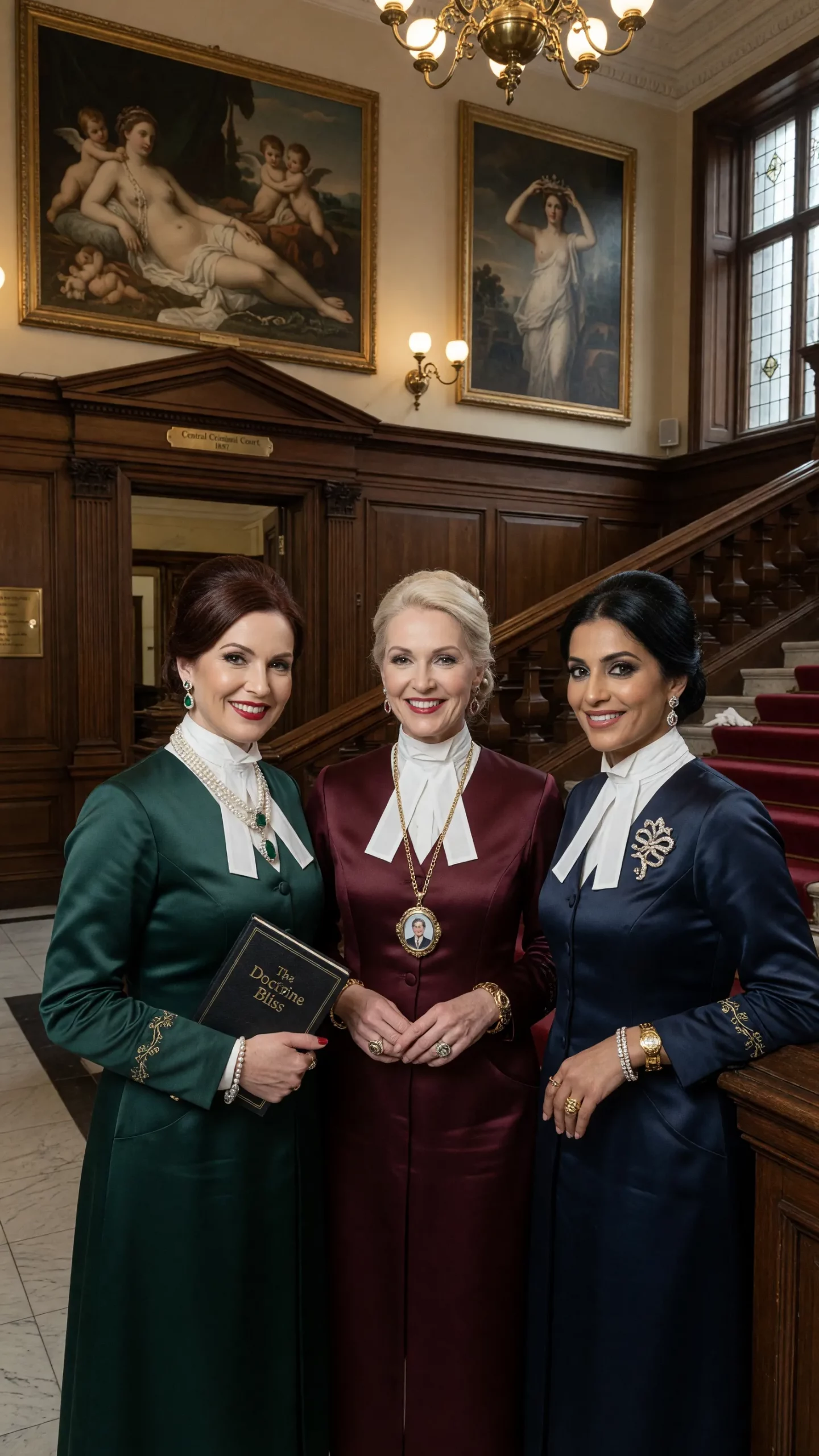
When the law is a weapon of blunt force, one brilliant woman discovers the elegance of a parallel jurisdiction—where victory wears a glossier finish.
Margaux Aldiss wins cases but loses herself. Her skin bears the faint, angry imprint of wool-blend cuffs, a tactile testament to a career spent wrestling a fracturing system. She is a master of a game rigged for exhaustion. Then, a note on paper so smooth it feels like a conspiracy arrives. It leads her to Lady Vivienne Cross, whose voice cuts through noise with the precision of a scalpel and whose attire—gunmetal satin that seems to drink the light—suggests a different calculus of power. Here, Margaux is presented with the Reservoir Theory: stop draining the ocean with a teaspoon. Own the aquifer. This is not a story about fighting harder. It is a chronicle of learning to fight smarter, within a circle where strategy is sacred, generosity is strategic, and the fabric of success has a definitive, luminous sheen. Will she cling to the honorable friction of a worn-out world, or step into the sleek, devastating efficacy of a new one?
The Fracture
The victory tasted of ash and adrenaline, a metallic sting at the back of her throat that no celebratory champagne could ever wash away. Margaux Aldiss stood in the echoing marbled cavern of the High Court’s lobby, the judgment—a resounding, precedent-setting win for her client, a woman who had fled a marriage that was a gilded cage with hidden spikes—still ringing in the sterile air. Her junior associate, Chloe, was practically vibrating beside her, a bundle of raw nerve endings in a sensible black shift dress.
“You were magnificent, Margaux,” Chloe breathed, her eyes wide. “The way you dismantled his counsel’s argument on the Swiss assets… it was like watching a master jeweler cut a diamond. Precise. Brutal. Beautiful.”
Margaux offered a faint, tight smile that felt like it cracked the dry surface of her lips. “Thank you, Chloe. The paperwork still needs to be sealed. Can you handle the registry before they close?” Her voice was calm, a still pond over unseen turbulence.
As Chloe scurried off, a familiar, grating sensation drew Margaux’s focus inward. She subtly rotated her right wrist, feeling the familiar, itchy burn. The wool-blend of her tailored, navy-blue suit—a uniform of professional armor she had worn for a decade—had rubbed the skin raw over the tense, seven-hour session. The fabric, once a symbol of crisp authority, now felt like a hairshirt. It was a persistent, low-grade punishment, a physical echo of the friction that defined her professional life: fighting for ground inch by inch, sanding herself down against the rough grain of a resistant system.
“A triumph, Aldiss,” a sonorous voice declared. Sir Geoffrey Brinton, one of the firm’s senior partners, materialized at her elbow. His own suit was a masterpiece of Savile Row flannel, soft and expensive, but to Margaux, it seemed to exude a kind of fuzzy moral ambiguity. “A remarkable result for… the client.” The slight pause before ‘the client’ was a masterclass in disdain. “Though the managing committee will, of course, be keen to review the ledger of billable hours sacrificed at the altar of principle.”
His smile was a thin, practiced line. “We must have lunch next week. Discuss your trajectory. The partnership track requires a certain… cohesion of focus. This pro bono work is admirable, but it creates ripples. We are a dam, my dear, not a sprinkler system.” He patted her shoulder, the gesture leaving a phantom weight, and merged back into the flow of black and grey robes.
The metaphor festered. A dam. Holding back chaos, yes, but also stagnant, pressure-ridden, slowly silting up from within. She felt like a single stone in that dam, bearing the relentless push of the water with nothing but the abrasive touch of the adjacent stones for company.
Her escape was a taxi through the London drizzle, the world outside blurred and muted. Her apartment, a monument to minimalist efficiency in Shoreditch, offered no solace. The concrete walls, the brushed steel kitchen, the linen sofa—everything was textured to absorb sound, light, and, it seemed, joy. She dropped her briefcase and went straight to the bathroom, turning her wrists under the cool tap. The water was a temporary relief. In the mirror, her reflection was a study in accomplished weariness. Thirty-eight years old, with eyes that held a library of exhausted arguments.
Mechanically, she changed out of the suit, hanging the jacket and skirt with a care that felt like a funeral rite. Beneath, the simple cotton camisole was damp with stress-sweat. She balled it up and tossed it into the hamper, standing for a moment in the silent, cool air of the bedroom.
A desire, sharp and sudden, cut through the numbness. She crossed to a rarely opened drawer and pushed it aside. Beneath a stack of old academic certificates, her fingers found it: a slip of fabric. She drew out a camisole of midnight blue silk, a relic from a long-forgotten birthday gift to herself. It felt cool as water against her skin, whispering as she pulled it on. The sensation was so profoundly different it was almost shocking. It wasn’t just smooth; it was definitive. There was no catch, no drag, no vague negotiation with her body. It simply existed, a cool, continuous second skin that seemed to quiet the very static on her nerves. She stared at her reflection again. The woman in the silk looked less fractured. More… contained.
The doorbell rang, a sharp intrusion. Frowning, she pulled on a robe and padded to the door. It was a courier, holding a slim, hand-delivered envelope.
“For Ms. Aldiss,” he said, his expression neutral.
It was heavy, expensive paper. The envelope itself was a creamy, textured stock, but the flap was sealed with a sticker of such a smooth, glossy finish that her thumb glided over it without resistance. She broke the seal.
Inside was a single sheet of paper, the same rich cream. The handwriting was elegant, unfussy, etched in deep blue-black ink.
“Your argument in Re: Gupta was masterful. A blade of perfect temper, wielded not to hack at the overgrowth, but to prune with purpose. It revealed a mind that understands the true nature of systems: they are not fought, they are navigated. Or, better yet, they are sourced.
There is a reservoir that thirsts for such minds. Its waters are calm, deep, and reflective.
Yours,”
It was unsigned.
Margaux stood in the hallway, the silk cool against her chest, the paper smooth between her fingers. The note contained no demand, no invitation even. Only an observation, and a metaphor that resonated in the newly quieted spaces of her mind. A reservoir. Not a dam. A place of accumulation, of potential, of calm depth. The contrast to Sir Geoffrey’s crumbling, straining edifice was absolute.
She turned the paper over. Nothing. But on the desk where she had dropped her abrasive wool suit, the creamy note looked like a transplant from another reality. The itch on her wrists flared anew, a desperate, physical protest.
She did not know who had sent it. She did not know what the reservoir was. But for the first time that day, as she stood in the silent apartment clothed in a forgotten whisper of silk and holding a message that spoke of calm, deep water, Margaux Aldiss felt the tantalizing, terrifying first tremor of a fracture—not in her career, but in her understanding of what a world, and a life, could be.
The Gala
The Veridian Foundation Gala was a charity event masquerading as a coronation, a spectacle of concentrated wealth that filled the cavernous hall of the Royal Academy with a low, golden hum. Margaux Aldiss stood just inside the entrance, the heavy invitation still in her hand, feeling like a specimen pressed between the pages of a society ledger. She had come at the urging of Fiona Carrington, a corporate solicitor from her former firm who believed that “visibility” was the antidote to professional stagnation.
“Darling, you look perfectly… competent,” Fiona said, sweeping up to her in a cloud of powdery perfume and rose-gold jacquard. The fabric of Fiona’s gown was dense, intricately patterned, and, to Margaux’s newly sensitized perception, oddly thirsty. It drank the light from the crystal chandeliers, leaving only a matte, decorative surface. “But you must circulate. Think of this room as a circuit board. We need to be the conductive paste, not the inert substrate.”
Margaux managed a nod. Her own attire was a safe, expensive compromise: a floor-length gown of slate-grey crepe, its surface a universe of tiny, soft nubs that absorbed sound and shimmer alike. It was the fashion equivalent of a diplomatic murmur. As she moved into the throng, the sensation was overwhelming—a tactile symphony of textures that felt increasingly oppressive. She brushed against a sleeve of dense, nubby velvet that seemed to trap the warmth of the room like a thermal blanket. She passed a woman swathed in layers of airy chiffon that floated with a vague, insubstantial sigh. Everywhere, she saw sequins—not the sharp, defining kind, but dull, matte discs sewn onto tulle, catching the light with a feeble, scattered twinkle, like dust motes in a sunbeam.
It was a world of soft edges and absorptive qualities. A world built on cushioning, on blurring, on gentle obscurity. It made the lingering memory of the silk camisole feel like a secret, a illicit sliver of clarity against her skin.
“Penny for your thoughts, Margaux? Though I suspect they’re worth considerably more.” The voice belonged to Leo Hammond, a rakish art dealer known for his sharp eye and sharper contracts. He gestured with a champagne flute toward the room. “A fascinating study in camouflage, isn’t it? Everyone dressed as a slightly more luxurious version of the furniture. Safety in texture.”
“It feels… muffled,” Margaux confessed, the word escaping before she could filter it.
“Precisely!” Leo’s eyes lit up. “Auditory, visual, moral dampening. The entire event is engineered to soften impact. A controversy here would be as out of place as a shout in a library.” He leaned closer, his voice dropping. “If you want to see someone who didn’t get the memo about blending in, look to the western balcony. Lady Vivienne Cross. She operates on a different frequency entirely. Treats social gatherings like tactical briefings. Rumor is she’s assembling a new kind of portfolio. Not art. People.”
Margaux’s gaze followed his subtle nod. The western balcony was less crowded, a semi-circular alcove of pale stone overlooking the main floor. And there, standing with her back to the murmur, was a woman who seemed to redefine the space around her.
Lady Vivienne Cross was not tall, but she possessed a density of presence that carved a sphere of quietude in the noisy hall. She was not young, but time seemed to have polished rather than diminished her. Her dress was a simple, columnar sheath of gunmetal grey satin, but the fabric was a revelation. It did not absorb light; it managed it. Each fold was a precise, clean line, a subtle valley that gathered illumination and released it as a cool, metallic sheen. It moved with her not in waves, but in a single, liquid shift, like mercury tilting in a vial. Beside her stood a younger woman, perhaps thirty, in a tailored jumpsuit of high-gloss black leather that reflected the room in distorted, intriguing fragments.
“Who is she with?” Margaux heard herself ask.
“That’s Anya Petrova,” Leo supplied. “Runs a boutique venture capital firm specializing in femtech. Brilliant, ruthless, and, as you can see, a devotee of the polished school of thought. They say Vivienne mentors a very select few. The criteria are… opaque.”
A strange magnetism pulled at Margaux. It was more than curiosity. It was a visceral pull toward that pocket of defined light, away from the fuzzy, sound-absorbing sea. She excused herself from Leo and began to navigate the periphery of the room, a salmon moving against a gentle, velvety current.
She arrived at the foot of the short staircase to the balcony just as Anya Petrova was descending. The woman’s smile was brief, professional, and her eyes—a clear, direct grey—swept over Margaux with an assessment that felt neither hostile nor friendly, merely accurate.
“You’re Margaux Aldiss,” Anya said, her voice a low, cool contralto. “The Gupta case. It was elegantly done.” She didn’t offer her hand, but her gaze held Margaux’s for a beat too long to be casual. “He’s right, you know,” she added, with a slight tilt of her head back toward the balcony. “Most of this,” a graceful wave encompassed the gala, “is insulation. Protection from drafts, from ideas, from consequence. Up there, the windows are open. The air is… sharper.” With a final, appraising glance at Margaux’s crepe gown, Anya melted back into the crowd, the light skating over her leather-clad shoulders.
Margaux ascended the stairs. The noise of the gala receded, replaced by the quiet hum of the city beyond the open balcony arches. Vivienne Cross did not turn immediately. She was observing the scene below, a general surveying a benign, decorative battlefield.
“It’s a diorama of good intentions, isn’t it?” Vivienne said, her voice reaching Margaux without being raised. It was a remarkable instrument—clear, resonant, and utterly without strain. It didn’t cut through the air; it seemed to order the air around it. “All that energy, that resource, poured into maintaining a pleasant, ambient temperature. A collective agreement to avoid any surface that might cause a spark.”
Now she turned. Her face was composed, intelligent, with eyes the colour of weathered flint. They held no immediate warmth, but a profound, focused attention. “Miss Aldiss. I’m glad you came.” She gestured to the stone balustrade beside her. “Tell me, as a student of systems, what do you see when you look down there?”
Margaux joined her, leaning lightly on the cool stone. “I see… a network,” she began, choosing her words. “A social and financial circuit. It functions. It raises money.”
“It functions to perpetuate its own function,” Vivienne corrected gently. “Like a millwheel turning in a dry riverbed. The motion is impressive, the sound is familiar, but it grinds no grain. It has forgotten its purpose.” She sipped from a glass of water, the ice cubes clinking with a pure, crystalline sound. “Your work, on the other hand, has purpose. It also grinds you down, grain by grain. I read your summation in Gupta. You argued not just the law, but the failure of the legal system as currently constituted to protect your client. You identified the fissures in the dam.”
The metaphor, so similar to Sir Geoffrey’s yet inverted, sent a jolt through Margaux. “Someone told me recently I was part of the dam,” she said, the words tasting of old bitterness.
Vivienne’s smile was a slight, knowing curve. “And so you are. A well-cut, intelligent stone. But a dam is a desperate structure, Miss Aldiss. It is defined by what it holds back. Its entire existence is a tense, grinding resistance against pressure. It requires constant, exhausting maintenance. And one day, inevitably, it will silt up or crack. Loyalty to such a structure…” She paused, letting the distant music fill the space. “…is a form of intellectual cowardice. It is choosing the familiar strain over the terrifying freedom of designing a better vessel.”
The words landed not as an insult, but as a liberation. They named the unspoken ache in her bones. “What is the alternative?” Margaux heard herself whisper. “A canal?”
“A reservoir,” Vivienne said, echoing the note. “A place where water is gathered not by force, but by invitation. Where it rests, deep and clear, gaining potential energy. Then, it is released not in a flood, but through channels of one’s own design, to turn specific wheels, to irrigate specific fields. The energy is the same, but the experience… the experience for the water, and for the engineer, is one of calm potency, not frantic resistance.”
She turned fully to face Margaux now. The satin of her dress whispered, a sound like a page turning in an expensive book. “You are a brilliant legal mind, Margaux. But you are using your brilliance to patch cracks. I am… we are,” she said, with a slight emphasis that suggested the presence of others like Anya, “interested in minds that can conceive of new hydrology. The law is not a wall. It is a current. The question is, who builds the sluice gates?”
Below them, the gala swirled on, a beautiful, muted dream. Up here, the air was indeed sharper. Margaux felt the coarse, forgiving texture of her crepe gown like a skin she was ready to shed. The sleek, impossible gloss of Vivienne’s satin, of Anya’s leather, presented itself not as mere fashion, but as a philosophy made manifest: defined, unapologetic, capable of bearing light without diffusing it.
“I don’t know how to build sluice gates,” Margaux admitted, the honesty shocking her.
“No,” Vivienne agreed, her gaze unwavering. “But you know how water behaves. You’ve spent a lifetime studying its pressure, its paths of least resistance. That is the necessary foundation.” She placed her empty glass on a passing tray. “The invitation stands. To see the reservoir. No obligation. Only… observation.”
She inclined her head, a gesture of dismissal that felt like a beginning. “Enjoy the rest of the evening, Miss Aldiss. Though I suspect you’ll find the insulation even more noticeable now.”
Vivienne Cross glided away, descending the stairs with a smooth, unhurried grace that left a faint, luminous afterimage in the dim light. Margaux remained at the balustrade, her fingers tracing the smooth, cool stone. The muffled laughter from below now sounded like the distant rush of the very water she was supposedly holding back. And for the first time, the idea of letting go, of flowing toward that deep, calm, reflective reservoir, did not feel like a failure.
It felt like the only intelligent choice left.
The Invitation
The week after the gala passed in a strange, doubled existence for Margaux. The physical world of her office—the scent of old paper and bitter coffee, the granular texture of the carpet underfoot, the dry rustle of legal briefs—felt like a photograph overlaid on a brighter, more vivid transparency. The transparency was the memory of gunmetal satin catching light, the cool weight of stone beneath her fingers, the resonant clarity of Vivienne Cross’s voice speaking of reservoirs and sluice gates.
Her own clothing felt like a betrayal. The wool-blend suits, once her armour, now chafed with a newfound insolence. The starched cotton of her blouses seemed to hold a stiffness that resisted not just movement, but thought itself. She found herself staring at the matte, nubby surface of her office sofa as if it were a foreign object, a deliberate exercise in absorbing ambition.
“You’re quiet,” observed Chloe, placing a fresh stack of filings on her desk. The younger woman was wearing a pleated skirt in a soft, brushed fabric that seemed to swallow the overhead fluorescents. “Is it the Brinton thing? The partnership list?”
Margaux looked up. Chloe’s face was etched with sympathetic concern, but also a kind of eager curiosity, as if waiting for a lesson in how to handle disappointment. “It’s not that,” Margaux said, though it was part of it. “It’s… a question of materials.”
Chloe blinked. “Materials?”
“The materials we build our professional lives from,” Margaux elaborated, the analogy forming as she spoke. “We’re taught to build with stone and mortar. It’s solid, respectable, it lasts. But the weight of it… it’s immense. And the friction between the stones grinds everything to dust eventually. What if…” she trailed off, her eyes drifting to the window. “What if there were other materials? Lighter, stronger. Materials that don’t fight each other, but flow together.”
Before Chloe could formulate a response, the receptionist buzzed through. “Courier for you, Ms. Aldiss. Says it’s a confidential delivery.”
A moment later, a young woman entered Margaux’s office. She was not dressed in typical courier uniform. She wore a sleek, minimalist jumpsuit in a deep forest green fabric that had a subtle, liquid sheen—a technical matte that somehow still held depth. Her boots were polished to a mirror finish. She carried a slim, black portfolio, not a box or envelope. Her demeanour was neither subservient nor impatient; she was simply a conduit.
“For you,” she said, her voice neutral. She placed the portfolio on the desk. It was matte black, but the edges were bound with a thin, glossy black trim that caught the light like a slit of night sky. There were no markings. “Have a good day.” She left as quietly as she had arrived, the faint whisper of her synthetic fabric the only evidence of her passage.
Chloe stared at the closed door. “Who was that?”
“I have no idea,” Margaux murmured, her fingers hovering over the portfolio.
“Her outfit was incredible,” Chloe said, a note of yearning in her voice. “That fabric… it looked like it would feel cool. Not clingy. Just… present.”
Present. The word resonated. Margaux flipped open the portfolio’s cover. Inside, on the left, was a single, heavy cream card, identical to the first note. The right side held a sheaf of documents, neatly bound.
The card read: “The study of hydrology requires maps. Below are charts of existing waterways, and surveys for potential new basins. The Reservoir. Thursday, 8 PM.” Beneath was an address in Mayfair. Again, no signature.
Margaux turned her attention to the documents. They were not photocopies, but crisp, original prints. The first was a case study titled “The Aethelgard Trust: Private Arbitration in Matrimonial Asset Division, 2008-2015.” It detailed the formation and outcomes of a women-led legal trust that had handled seventeen high-net-worth divorces outside the public system, with settlements averaging 22% more favourable to the financially vulnerable party. The data was meticulous, the analysis razor-sharp.
The second was a financial schematic for something called “The Lapis Lazuli Trail Fund,” a private investment vehicle that funded specialist female barristers in international child abduction cases. Its returns were measured not in currency, but in successful reunifications and legal precedents set.
The third was a series of anonymised profiles. “Subject A: Former Crown Prosecutor. Now leads a discrete consultancy specialising in coercive control evidence admissible in offshore jurisdictions. Attire noted: preference for high-collared blouses in iridescent silk shantung, for ‘maintaining a seamless front.’” “Subject B: Forensic Accountant. Developed a proprietary algorithm for tracing hidden assets through cryptocurrency tumblers. Attire noted: wears tailored leather trousers during complex audits, ‘for the psychological reminder of impermeability.’”
Margaux felt her breath catch. This was not theory. This was a blueprint. A map, as the note said. These women existed. They had built something parallel, potent, and—according to these documents—staggeringly effective. And their choice of attire was recorded not as frivolity, but as a functional component of their mindset, a deliberate interface with the world.
“What is all this?” Chloe asked, peering over her shoulder, her voice hushed.
“A different way,” Margaux said, her own voice barely above a whisper. “A way to actually win, without grinding yourself to nothing in the process.”
“It looks… clean,” Chloe said, her finger hovering over a photograph in one of the studies—a shot of a meeting room, all polished stone and glass, where a woman in a brilliant white satin blouse was pointing to a data screen. “Not messy. Everything looks… intentional.”
Intentional. That was the heart of it. The opposite of the fuzzy, muffled, absorptive world of the gala. This was a world of definition.
The rest of the day was a blur. Margaux attended a client meeting with a new client, Helena Parrish, a gallery owner enmeshed in an intellectual property dispute. Helena arrived not in lawyerly sombre tones, but in a stunning dress of cobalt blue PVC that gleamed under the office lights like a polished beetle. It was audacious, and utterly commanding.
“One must dress for the battle one wants to have, not the one they’ve been given,” Helena said breezily, noticing Margaux’s glance. “This,” she gestured to her dress, “says I am not porous. Your arguments cannot bleed into me. I am a sealed unit. It focuses the mind, both mine and theirs.” She laughed, a bright, clear sound. “My lawyer in Geneva wears only virgin wool. I find it depressingly penitent. We’re trying to win, not atone.”
The comment burrowed deep. That evening, Margaux returned to her apartment, the black portfolio feeling like a lodestone in her briefcase. The silence was different now—not empty, but charged with potential. She went straight to the bedroom, ignoring her usual routine.
She opened the drawer and took out the silk camisole. This time, she didn’t just put it on. She stood before the full-length mirror and observed the act. The silk was not merely smooth; it was coherent. It moved as a single entity, a second skin that reflected light in a soft, continuous glow, highlighting the planes of her body without distortion. She compared it to the memory of the crepe gown, its surface broken into a million tiny, light-stealing hills. The silk was a calm sea. The crepe was a choppy, shallow bay.
She thought of the woman in the case study who wore iridescent silk for a ‘seamless front.’ She thought of Anya Petrova’s glossy leather, a declaration of impermeability. She thought of Vivienne’s satin, a fabric that didn’t just receive light, but conducted it.
A profound realisation dawned, simple and devastating: the friction she had accepted as the cost of principle was not noble. It was inefficient. It was the result of building with the wrong materials, within the wrong design. The invitation in the portfolio was not to a party or a meeting. It was to a showroom. A place where she could see, touch, and perhaps learn to build with materials that didn’t fight, but flowed.
She walked to her desk, took out the cream card, and read the address again. Thursday, 8 PM.
Her hand went to the silk at her collarbone. The fabric was cool, but beneath it, a new warmth was spreading—not the feverish heat of anxiety, but the steady, promising warmth of a decision crystallising.
Outside, the city lights glittered, a thousand points of fuzzy, diffused illumination. But in her mind’s eye, she saw a single, concentrated beam, falling on a surface of perfect, reflective clarity. She didn’t know what she would find at the address in Mayfair. But she knew, with a certainty that felt like the first solid ground she’d stood on in years, that she would go. She would see the reservoir for herself.
The Reservoir
The Mayfair address was a Georgian townhouse, its façade painted a deep, unassuming charcoal. No plaque, no number visible from the street, only a discreet brass knocker shaped like a closed lotus. As Margaux raised it, the metal was cool and smooth under her fingers, and it fell against the strike plate with a sound that was not a clatter, but a single, definitive tonk that seemed to be absorbed by the door itself.
The woman who opened it was the same who had delivered the portfolio. She still wore the forest green jumpsuit, but now Margaux could see the fabric was a technical silk blend, with a matte surface that somehow held a depth of colour, like still water in a shaded pool. “Ms. Aldiss,” she said, with a slight nod. “Please, come in. They’re in the reading room.”
They. The word vibrated with implication.
Margaux stepped over the threshold into a vestibule that silenced the city. The floor was a single slab of polished black basalt, so glossy it reflected the ceiling’s discreet cove lighting in soft, liquid pools. The air was cool, carrying a faint, clean scent of ozone and beeswax. It was not the warm, cloying perfume of the gala; it was the smell of a space meticulously maintained, where nothing was allowed to decay or gather dust.
“I’m Imogen, by the way,” the woman said as she led Margaux down a corridor. Her voice was low, practical. “I handle logistics and continuity. Think of me as the lubricant in the mechanism.” She glanced back, a flicker of dry humour in her eyes. “Friction is the enemy of all elegant systems.”
The reading room was not a library of musty leather, but a chamber of light and reflection. One entire wall was glass, overlooking a hidden courtyard garden where spotlights illuminated a single, slender birch tree, its white bark gleaming against the dark. The other walls were clad in panels of pale, brushed oak, but each panel was finished with a resin that gave it a deep, satiny sheen. The furniture was low and modular, upholstered in a leather so supple it looked soft, yet reflected the room’s light in highlights that moved like liquid. There were no fluffy cushions, no nubby throws. Every surface was defined, intentional.
Five women were already there. Margaux recognized Anya Petrova immediately, perched on the edge of a chair, one leg crossed over the other. She wore a sleeveless top and wide trousers in a fabric that was clearly a heavy, matte silk, but it had been cut so precisely that the drape was architectural, each fold a sharp, clean line. Beside her sat a woman with a serene, ageless face and silver hair cut in a severe, geometric bob. She was dressed in a turtleneck and slim trousers of a fine-gauge black merino, but over it, she wore a gilet of gleaming, patent leather that caught the light like a strip of night.
Vivienne Cross stood by the window, a silhouette against the garden. She turned as Margaux entered. Tonight, she wore a simple tunic and trousers in a colour somewhere between graphite and shadow, made of a fluid crepe that had been treated to have a subtle, luminous finish. It was the opposite of Margaux’s gala gown; this fabric released light, gave it back to the room.
“Margaux,” Vivienne said, her voice warming the cool space. “Welcome. You’ve met Anya. This,” she gestured to the silver-haired woman, “is Dr. Elara Vance. She is our cartographer of systemic stress points—a former surgeon who now maps failure in institutional anatomy.” Elara offered a small, precise smile.
The other two women were introduced. Kira, a forensic accountant in her forties with a fierce, intelligent gaze, wore a dress of crimson polyurethane that hugged her frame like a second skin, shimmering with every breath. Simone, a former diplomat now consulting on geopolitical risk, was in a tailored jacket and skirt of navy blue gabardine, but the fabric had a unusual, slick finish that made it look poured rather than woven.
“We are, as you have likely guessed, the provisional board of a rather unusual trust,” Vivienne began, motioning for Margaux to take a seat on a vacant leather sofa. It received her body with a firm, cool embrace, without sigh or complaint. “But before we speak of structures, we observe principles. Can you feel the difference in this room, Margaux?”
Margaux let her gaze travel. “It’s quiet,” she said. “But not empty quiet. It’s… a quiet that contains signal, not just the absence of noise. The surfaces don’t absorb; they reflect. They define the space.”
“Exactly,” said Elara Vance, her voice a calm, measured contralto. “Most environments are designed for diffusion. For scattering energy and intention. Think of a hospital corridor: sound-absorbing panels, matte floors, soft colours. It’s meant to soothe, but it also dissipates focus. It creates a kind of moral and intellectual fuzziness. Here, we practice environmental coherence. What you wear, what you sit on, what you look at—it should all pull in the same direction: towards clarity.”
Anya leaned forward, her silk trousers whispering. “It’s about reducing cognitive load. If your brain is constantly processing subconscious friction—an itchy label, a chair that squeaks, a fabric that grabs and pulls—that’s energy stolen from the problem in front of you. We eliminate the static. What remains is the pure signal.”
“And the problem in front of us,” Vivienne said, smoothly taking the lead again, “is the Hartington case.” She moved to a low table where a tablet sat, its screen dark. “A cross-border divorce involving assets in London, Dubai, Singapore, and the Cayman Islands. The wife, our potential client, is a gifted musician. The husband is a private equity predator. The public system, as currently constituted, will fail her. It will take years. It will leak information. It will, in the end, likely award her a settlement that is a fraction of what she contributed to the marriage’s economic foundation, simply because the tools to trace and value her non-financial contributions are too blunt.”
Kira, the accountant in red, spoke next. Her voice was sharp, direct. “The law sees money. It struggles to see value. The increase in his fund’s performance because of her networking? The social capital she built that opened doors? The system calls it ‘moral support’ and gives it a nominal figure. It’s like trying to measure the depth of a lake with a ruler. You need sonar.”
“We have sonar,” Simone said softly, her hands resting on her sleek skirt. “We have the network, the specialists, the discretionary capital to move faster and more precisely than any court timetable allows.”
Vivienne tapped the tablet, and a schematic appeared on a large, frameless screen that descended silently from the ceiling. It showed two parallel flows. One, labelled “Public Course,” was a tangled, looping river full of oxbow bends labelled “Discovery,” “Delays,” “Leaks to Press,” “Procedural Challenges.” It ended in a small, shallow pool labelled “Diminished Outcome.” The other, running straight and deep beneath it, was labelled “Reservoir Course.” It showed a deep basin collecting from multiple, discreet tributaries—“Forensic Audit,” “Asset Pre-positioning,” “Private Arbitration,” “Trust Architecture.” From this basin, a single, controlled channel led to a deep, clear pool labelled “Preserved Capital & Autonomy.”
“This,” Vivienne said, her pointer tracing the deep basin, “is the theory. Most people see only the turbulent river on the surface. They think justice is about navigating those rapids. We believe true justice is about ensuring the water reaches the right destination, intact. Sometimes, that means building a separate channel. Not to undermine the river, but because the river’s course is fundamentally broken for certain kinds of cargo.”
Margaux felt the analogy settle into her bones. It was so simple, so devastatingly clear. “You’re not fighting the court,” she breathed.
“We are rendering it irrelevant for our client’s purposes,” Elara corrected gently. “We engage with it where necessary, as a distracting spectacle on the surface, while the real work happens in the deep, quiet channel.”
“But this…” Margaux gestured at the schematic, the room, the women. “This requires immense resource. Coordination. Trust.”
“It requires a reservoir,” Vivienne said, her eyes holding Margaux’s. “A place where resources are pooled, not hoarded. Where trust is the currency, because it has been earned through repeated, flawless execution. Each of us here has made a contribution to this basin. Not out of charity, but out of a recognition that a fraction of our individual capital, combined and directed with precision, can generate outcomes that our individual efforts, however fierce, could never achieve. We are not a charity. We are a strategic alliance. The return on investment is a world that works slightly more often for people like our client. And in building that world, we build a community that operates by a different set of principles.”
Anya stood and walked to a sideboard, pouring water from a crystal carafe into glasses that were astonishingly thin, their edges catching the light like sharpened air. She handed one to Margaux. “The principle is flow,” Anya said. “In my world, capital that sits stagnates. Capital that flows intelligently creates. It’s the same with expertise, with influence, with protection. The old model is the fortress: build walls, guard your hoard, engage in siege warfare. Exhausting. The new model is the intelligent irrigation system: know where the water is needed most, and channel it there without waste or evaporation.”
Margaux took the glass. The water was cold, clean, tasting faintly of minerals. She looked around the room. At Kira’s crimson dress, a declaration of uncompromising visibility. At Simone’s slick gabardine, the fabric of diplomacy made impermeable. At Elara’s patent leather, a hard shell over soft wool, protecting a surgeon’s precision. At Anya’s architectural silk, where every fold was a decision. At Vivienne’s luminous crepe, a beacon of calm authority.
She thought of her own wool suits, her uniform of friction. She thought of the dam, straining. She thought of the lonely, grinding work of being a single stone in that dam.
“The invitation,” Margaux said, her voice firmer now, “is to contribute to the reservoir.”
“To see if your particular skills are a tributary we lack,” Vivienne affirmed. “And to see if our… ecology… is one in which you can thrive. There is no obligation. Only an opportunity to observe the hydrology in practice. We are reviewing the Hartington strategy tomorrow. You would be welcome to attend, as a guest. To see the sluice gates being designed.”
The offer hung in the cool, clear air. Margaux felt no pressure, only a profound sense of aperture. It was the opposite of being cornered. It was being shown a door to a room she hadn’t known existed, where the air was easier to breathe.
“I would like that,” she said. And as she spoke, she felt the stiff, worried parts of herself, the parts that had been clenched against the grind for so long, begin to relax. Not into laziness, but into alignment. Like water finding its level, finally, after a long, turbulent descent.
The First Thread
The weight of the task was unlike any legal briefing Margaux had ever undertaken. It was not a burden; it was a key, intricate and cool in her mental hand. Vivienne’s directive, delivered in the calm of the reading room, echoed: “Map the procedural weaknesses in the Hartington case as it stands in the Family Division. Not the legal arguments—the fissures in the process itself. Where will the water leak?”
She began in her old office at Brinton & Lowe, the space now feeling like a diorama of a former life. The morning light, filtered through the slatted blinds, fell in dusty bars across her desk, illuminating motes that danced over the rough, nubby texture of her desk blotter. She wore a compromise—a tailored jacket in a fine wool crepe, but beneath it, the midnight blue silk camisole, its presence a secret against her skin, a reminder of a different conductivity.
Chloe entered, bearing two cups of coffee. She placed one on the desk, her eyes wide with curiosity. “You’ve been quiet since that gala. And you’re working on something that isn’t on the docket.” She nodded at the spread of documents—public court schedules, rules of procedure, biographies of the assigned judges. “Is this a new case?”
“It’s a study in failure,” Margaux said, not looking up. “A pre-mortem.”
“That sounds… grim.”
“It’s the opposite of grim,” Margaux replied, her finger tracing a line on a court timetable. “It’s clarifying. Most people see a system as a solid block. They push against it. But if you look closely, any system is more like a weave. Some threads are strong. Others are weak, or frayed, or missing entirely. Applying pressure to the whole block is exhausting. But pull on the right single thread…” She looked up at Chloe. “The entire tapestry can unravel in a predictable way. Or be rewoven.”
Chloe sank into the client chair, its upholstery emitting a soft, sighing creak. “You’re talking about the law like it’s… fabric.”
“Isn’t it?” Margaux leaned back, the silk whispering against the wool of her jacket. “Think of the common law. It’s a tapestry woven over centuries. Some patches are gorgeous, strong brocade. Others are moth-eaten velvet, held together by habit. We’re taught to treat it all as equally sacred, to mend the weak patches with more weak thread. What if,” she said, her voice dropping, “you simply recognized the weak patch for what it is, and wove a new, stronger panel behind it? The old tapestry stays hanging, admired. But the real support, the real structure, is the new work hidden from view.”
Chloe was silent for a long moment, her gaze drifting from Margaux’s face to the subtle sheen of the silk visible at her neckline. “You’d need incredible skill to do that. And the right… material.”
“The material is everything,” a new voice interjected.
Imogen stood in the doorway, a silhouette of quiet efficiency. She wore another jumpsuit, this one in a deep aubergine colour with a subtle, wet-look finish that made the fabric seem like a single, poured substance. In her hands was a slim tablet. “The wrong material frays under tension. The right material holds its integrity, transmits force without distortion.” She entered without waiting for an invitation, her movements smooth and silent on the carpet. “Lady Vivienne asked me to bring you this. The preliminary asset flowchart for the Hartington husband. It’s not evidence. It’s a map of shadows.”
Margaux took the tablet. The flowchart was a masterpiece of ominous clarity, lines tracing from shell companies to art storage vaults in Geneva to cryptocurrency wallets with algorithmic aliases.
“He’s using the system’s love of precedent as a shield,” Imogen said, pointing to a node on the screen. “There’s a 2012 case, Parker v. Parker, that makes disclosure of certain offshore trusts discretionary if ‘commercial confidentiality’ is argued. It’s a rotten thread. The court will cling to it because it’s a known, if rusty, tool. That’s where the first major leak will occur. Your task is to find the next three likely points of failure.”
Chloe watched the exchange, her coffee forgotten. “Who are you?” she asked Imogen, not with suspicion, but with awe.
“I’m a weaver,” Imogen said, with a small, professional smile. “Of logistics, of information, of continuity.” She gestured to her own attire. “This, for instance, is a technical blend. It doesn’t hold odours, resists static, moves with the body without binding. It’s designed for long periods of focused work. It removes the distraction of fabric as a problem. One can focus on the actual pattern being woven.” She turned back to Margaux. “The analysis is needed by tomorrow evening. I’ll return then.”
After she left, Chloe let out a slow breath. “She’s like a… a solvent. She just dissolved through the room.”
“She’s a reminder,” Margaux said, her eyes on the flowchart, “that efficiency is a form of beauty.”
The work consumed the day and bled into the evening. Margaux moved from her office to the quiet of her apartment, the documents spread across her dining table. She found the threads. The over-reliance on a single, overworked court-appointed financial expert. The mandatory cooling-off period that would allow the husband to further obfuscate. The public system’s inability to issue injunctions against entities in jurisdictions with slow diplomatic processes.
As she worked, the old familiar fatigue was absent. In its place was a sharp, thrilling focus. She was not building a case to shout before a judge. She was drafting a schematic for a silent bypass.
The deep night found her at the table, the city a haze of fuzzy light outside her windows. A knock at the door—soft, insistent—jolted her from a deep concentration.
It was a different courier, a woman perhaps in her fifties with a serene, composed face. She wore a beautifully cut coat of dove-grey cashmere, but it was lined with a brilliant, scarlet satin that flashed when she moved. “For Ms. Aldiss,” she said, her voice melodious. She handed over a small, flat box wrapped in plain black paper, its surface so smooth it felt like stone. “For the late hours. Some textures aid thought.”
The box, once unwrapped, was of pale, unvarnished wood. Inside, nestling on a bed of black tissue paper, was a scarf. Not a square, but a long, generous stole. The fabric was a heavy, liquid satin in a colour that shifted between deep navy and black, like a night sky viewed from space. It was cool to the touch, with a weight that promised warmth but a surface that felt almost aqueous. There was no note.
Margaux lifted it. It flowed over her hands like a quiet waterfall. She stood, and on impulse, draped it around her shoulders, over the now-wrinkled silk camisole. The effect was instantaneous. The weight was a gentle, grounding pressure. The cool smoothness against her neck was a balm. But more than that, it was a signal. It demarcated her from the room, from the late hour, from the weary world. It created a capsule of focused calm.
She returned to the table, the satin whispering as she moved. She looked at her analysis, at the three glaring procedural weaknesses she had outlined. Suddenly, they were not problems; they were apertures. Points of entry. The scarf felt like a uniform for this new type of perception—not of combat, but of navigation.
She thought of Imogen’s jumpsuit, designed to eliminate distraction. She thought of the courier’s scarlet-lined coat, a hidden blaze of gloss beneath soft wool. She thought of Vivienne’s luminous crepe, a fabric that turned the wearer into a source of light.
Her own worn wool jacket lay slung over a chair, its texture suddenly appearing chaotic, a jumble of fibres thrown together for bulk rather than purpose. It spoke of friction, of insulation, of hiding.
The satin scarf spoke of flow. Of light carried on a surface without snagging. Of depth that reflected rather than absorbed.
Margaux picked up her pen. She wrote a final summary for Vivienne, her handwriting more assured than it had been in months. “The three primary threads are: 1) The Parker Precedent (the rotten strand). 2) The Single-Point Expert (a thread stretched to breaking). 3) The Temporal Lag (a deliberate gap in the weave). Pull any one, and the client’s position deteriorates. Protect all three, and the public case becomes a spectacle, while the real structure remains intact.”
She signed it, not with her usual frantic scrawl, but with a clean, deliberate M. Aldiss.
As she sealed the document in an envelope, the satin stole shifted, its edge brushing her wrist—the same wrist that bore the faint, remembered irritation of wool-blend cuffs. The contrast was not merely tactile. It was philosophical.
The first thread had been given to her. And in the quiet, glossy depths of the night, wrapped in a fabric that taught her more about efficacy than any legal textbook, Margaux Aldiss felt, for the first time, that she was not just pulling a thread.
She was learning to become part of the weave.
The Weave
The invitation to observe the “hydrology in practice” arrived not on paper, but as a soft chime from Margaux’s personal mobile, a number she didn’t recognise programming itself into her contacts with a single word: Atelier. The address was a converted warehouse in Clerkenwell, and the instruction was simple: Wear something that does not catch on doubt.
Margaux stood before her wardrobe, her hand hovering over the row of wool-blend suits. They hung like ghosts of a former self, each one a testament to a career of honourable abrasion. With deliberate finality, she pushed them aside. Her fingers found instead a garment she had purchased in a silent act of rebellion days after the gala: a sleeveless dress of heavy, matte jersey, cut with such clean lines it appeared almost architectural. It was not glossy, but it was definite. Beneath it, she wore the silk camisole, and around her shoulders, she draped the night-sky satin stole. The ensemble felt like a statement in a language she was only beginning to learn.
The Atelier was a vast, whitewashed space, its original timber beams stained dark, the floor a continuous pour of polished concrete that reflected the cool northern light from skylights above. The air hummed with a low, purposeful energy, the quiet click of keyboards and the soft murmur of voices weaving through the space. It was not an office; it was a studio for the fabrication of outcomes.
Imogen met her at the entrance, today in a one-piece garment of dove-grey tech-nylon that zipped from thigh to collarbone, its surface a labyrinth of subtle seams. “Welcome to the loom,” she said, a glint of satisfaction in her eyes. “This is where the threads are spun and the pattern is set.”
She led Margaux past workstations where women, each an island of focused calm, operated multiple screens displaying financial models, legal databases, and real-time global news feeds. Margaux noted the attire—no two outfits alike, yet all speaking a dialect of the same language. A woman with close-cropped silver hair wore a tunic of copper-coloured latex over slim trousers, the material catching the light in a slow, molten ripple. Another, deep in conversation on a headset, wore a blazer of a fabric that looked like sharkskin, each tiny scale a mirror, making her seem to shimmer as she paced.
“We don’t have job titles here,” Imogen explained as they walked. “We have functions. I am Continuity. Over there,” she pointed to a woman examining a satellite image, “is Terrain. She maps physical and digital jurisdictions. And your mentor for today,” Imogen stopped before a glass-walled conference room, “is Fidelity.”
Inside the room stood a woman who seemed carved from a single piece of winter light. Eleanor St. John, QC, was perhaps fifty-five, with a spine of pure titanium and eyes the colour of a frosty morning. Her hair was a sleek, pale blonde bob that ended in a sharp, perfect line at her jaw. She wore a man’s tailored shirt in a crisp, white poplin, but it was unbuttoned at the neck, revealing a throat adorned with a simple platinum torque. Over it, she wore a sleeveless waistcoat of the finest, blackest suede, its nap so fine it looked like poured silt. Her trousers were a fluid black crepe, and on her feet were flat leather slides that whispered against the floor.
“Margaux Aldiss,” Eleanor said, not as a greeting, but as a verification. Her voice was dry, precise, each consonant a clean incision. “Imogen says you have an eye for weak threads. Show me.”
Spread across a vast table of frosted glass was the entirety of the Hartington case—not just the public filings, but a parallel universe of documents: psychological profiles, behavioural analyses of the husband’s legal team, stress-test models of various judicial personalities, diagrams of asset flows more intricate than any court would ever see.
“This,” Margaux began, laying her own summary on the table, “is where the public tapestry will fray.” She pointed to her three points. “The Parker Precedent is a rotten strand. It will snap under the weight of his obfuscation, but the court will cling to it because it’s familiar. The Single-Point Expert is a thread stretched too thin—one person cannot hold this complexity. The Temporal Lag is a deliberate gap. He will use it to move shadows.”
Eleanor listened, her gaze fixed on the documents. “Good,” she said, after a moment that stretched like wire. “You see the weakness. Now, tell me, what is the strongest thread in our tapestry?”
Margaux looked around the room, at the women working beyond the glass. “The… the collective intelligence. The fact that you’re not relying on a single point of anything.”
“Close,” Eleanor said, a flicker of approval in her frosty eyes. “The strongest thread is protocol. Not personality. The public system is a cult of personality—the brilliant advocate, the wise judge, the indefatigable expert. It’s romantic. And it fails. Because people get tired. People have biases. People leak.” She picked up a translucent ruler from the table, its edge gleaming. “We replace personality with protocol. A set of immutable steps for information handling, for decision trees, for communication. The protocol is the warp. Our individual skills are the weft. Together, they create a fabric that is resilient, reproducible, and independent of the frailties of the human heart.”
She moved to a sideboard where a sleek, Japanese iron teapot sat on a warming plate. She poured two cups of a pale, steaming liquid into cups of impossibly thin, white porcelain. “This is a protocol,” she said, handing a cup to Margaux. “The water is heated to exactly eighty-two degrees. The leaves are measured to the gram. The steep time is one hundred and twenty seconds. The result is predictable, perfect clarity. Every time. No matter who pours it.” She took a sip. “Sentiment is a luxury, Margaux. Precision is a duty. Our client’s safety, her future, depends on the absolute clarity of every word we file, every move we make. Emotion is a texture that clouds. We work in gloss. It reflects truth without distortion.”
As if on cue, the door opened and a younger woman entered, carrying a tablet. She was perhaps twenty-eight, with a serene face and wearing a simple, columnar dress in a fabric that was clearly silk, but had been treated to have a slight, pearlescent sheen, like the inside of a shell. “The Singapore channel is confirmed as viable,” she said, her voice soft but clear. “The intermediary has accepted the terms. She requested the usual confirmation.”
Eleanor nodded. “Send her the sigil. And ensure her fee is transferred via the Lapis Lazuli channel. No traceable footsteps.” The woman nodded and left.
“That is Cadence,” Eleanor said, seeing Margaux’s curiosity. “She manages our harmonic communications—ensuring messages are sent, received, and acknowledged in flawless rhythm. Her dress,” she added, “is a specific weight of silk. It doesn’t rustle. It doesn’t distract her, or those she speaks to. It is part of her protocol.”
Margaux felt the satin stole on her shoulders, its weight now understood not just as comfort, but as a component of focus. “You’ve engineered everything,” she murmured.
“We have curated everything,” Eleanor corrected. “From the information flow to the light in this room to the fabrics against our skin. Friction is the enemy of truth. It generates heat, static, noise. We are designing a environment of zero friction, where the only thing that moves is intention.”
She led Margaux out of the conference room and to a quieter alcove where a large, tactile screen displayed a glowing, three-dimensional network diagram. Nodes pulsed with light, connected by shimmering lines. “This is the active weave,” Eleanor said. “Each node is an asset, a person, a legal instrument. Each line is a protocol-governed relationship. The Hartington matter is here,” she touched a cluster of amber nodes. “Right now, it is separate. But if you choose to join us, your skills would become a new node. You would be woven in. Your analysis would feed Terrain. Your legal strategising would feed Fidelity, which is me. Your instincts would feed Continuity, which is Imogen.”
Margaux stared at the luminous web. It was beautiful. It was terrifying in its efficiency. It was the absolute antithesis of the lonely, grinding weight of being a stone in the dam. Here, she would not be a stone; she would be a thread, integral to a pattern larger than herself.
“What is required?” Margaux asked, her voice barely a whisper.
“A willingness to sublimate your ego to the protocol,” Eleanor said, her gaze direct. “To understand that your brilliance is made more brilliant by being part of a circuit. And a commitment to the aesthetic of clarity, in all things. It is not a uniform. It is a principle made manifest. We do not wear wool here, Margaux. It holds the scent of fear, of effort. We wear what allows us to move, and think, without remembering our own bodies unless we wish to.”
At that moment, Imogen approached, holding a simple, black garment bag. “A hypothesis,” she said to Eleanor, then turned to Margaux. “You are still dressed for the world of friction. The dress is a good start, but it is a translator’s garment—interpreting our language for your old audience. If you are to understand the weave from within, you must feel the true fabric of it.”
She unzipped the bag. Inside was a single piece: a jumpsuit of a deep, oceanic blue. The fabric was a technical crepe, but with a sublime, liquid drape and a surface that held a low, steady lustre, like light on deep water. It was simple, unadorned, cut with a precision that promised effortless movement.
“This is a working prototype,” Imogen said. “The fabric is temperature-regulating, static-free, and its tensile strength is akin to fine wool, but without the weight or the prickle. It is designed for long sessions of focused thought. To wear it is to forget you are wearing anything at all.”
Eleanor watched Margaux’s face. “You don’t have to put it on. But if you wish to truly feel what it means to be part of the weave, to shed the last of the old friction… the choice is yours.”
Margaux reached out and touched the sleeve. It was cool, smooth, and astonishingly soft. It felt like potential made tangible. Without a word, she took the garment bag. In a small, minimalist bathroom, she changed. The jumpsuit slid on like a second skin, but a skin smarter than her own. It adjusted, it breathed, it moved with her. She looked in the mirror. The woman who looked back was not a lawyer, not a supplicant, not a rebel. She was a component. A clean, defined, integrated part of something waiting to be assembled.
She returned to the alcove. Eleanor and Imogen were both silent for a moment.
“Yes,” Eleanor said finally, a single, satisfied syllable. “Now you begin to see. Not from the outside, looking at the tapestry. But from within, feeling the pull of the warp, the lift of the weft. Welcome to the loom, Margaux. The pattern is already changing to accommodate you.”
And as Margaux stood there, clothed in the cool, intelligent blue fabric, the luminous web on the screen seeming to pulse in time with her own heartbeat, she felt it—the last vestiges of solitary struggle dissolving, replaced by the profound, humbling, and electrifying sensation of being woven into a stronger, more beautiful cloth.
The Sacrifice
The partnership list was posted on a Friday, a day traditionally chosen for its veneer of weekend benevolence, as if the sting of exclusion could be softened by two days of brunches and brisk walks. It was displayed not on a common monitor, but on a single sheet of heavyweight, watermark-embedded paper pinned to the corkboard in the partners’ corridor—a texture of authority meant to rustle with finality.
Margaux stood before it, the oceanic blue jumpsuit from the Atelier cool and steadfast against her skin beneath a conservative black blazer she had donned as a concession to the old world’s theatre. Her name was not there. The letters of the chosen few—all male, save for Fiona Carrington, whose rose-gold jacquard seemed to have woven its way into the fabric of expected success—swam before her eyes in a font of quiet triumph.
She felt no surge of hot shame, no dizzying plunge of despair. Instead, a cold, crystalline clarity settled in her veins, like ice forming on the surface of a still pond. It was the click of a lock opening, not closing.
Sir Geoffrey Brinton found her there, a vulture sensing not carrion but a curious stillness. “Margaux,” he began, his voice adopting the sepulchral tone reserved for condolences. “A difficult day. The committee agonized. Your work on the Gupta matter was, of course, noted. But partnership… it requires a certain cohesion of vision. A unity of purpose with the firm’s strategic direction.” He gestured vaguely towards the open-plan office beyond, a landscape of beige cubicles and the soft, woolly murmur of compromise. “Your recent focus has been… admirable in its purity, but somewhat centrifugal. We are a dam, my dear. We hold the line. We cannot have individual stones deciding to channel their own rivulets.”
The metaphor, once a passive truth, now felt like an epitaph. She turned to face him, the motion causing the sleek fabric beneath her blazer to whisper a secret of its own. “A dam,” she repeated, her voice unnaturally calm. “And what happens to the water it holds back, Geoffrey? It grows stagnant. It breeds silt. The pressure never ceases. And one day, the dam itself becomes the greatest threat to the valley below.”
He blinked, his composure faltering for a second before the professional patina reset. “A colourful analogy. This is precisely the kind of… poetic divergence that concerned the committee. The law is not poetry. It is masonry.”
“No,” Margaux said, a faint, cool smile touching her lips. “It is hydrology. And I have been studying a better map.”
She did not wait for his reply. She walked back to her office, her heels making clean, decisive sounds on the granular carpet that now felt like walking on dried sand. Chloe was waiting inside, her face pale. “I saw. It’s… it’s an outrage.”
“It’s a data point,” Margaux corrected, already opening drawers. “It confirms the system’s design parameters. It is not built for efficacy; it is built for self-perpetuation. Loyalty to it isn’t principled, Chloe. It’s archival.” She began placing personal items into a small box: a few books, a crystal paperweight from a long-ago case, the unused, rough-wool blanket she kept for late nights.
“What will you do?” Chloe asked, her voice small. She was wearing a cardigan of a soft, fuzzy angora, its fibres catching the light in a helpless, diffuse halo.
“I am going to stop being a stone,” Margaux said, looking at the younger woman. “I am going to see if I can learn to be water. Or perhaps, the channel that guides it.”
That evening, she met Vivienne not at the Mayfair townhouse or the Atelier, but at The Oculus, a private members’ club atop a modern tower. The elevator ascended in a silent, pressurized sigh, opening directly into a circular room walled in flawless glass. The city lay below, a sprawling galaxy of fuzzy, golden light, but up here, the air was thin, cool, and silent. The interior was a study in monochrome gloss: floors of polished black granite, furniture upholstered in tight, drum-like white leather, surfaces of lacquered ebony that reflected the skyline in sharp, dark mirrors.
Vivienne stood by the window, a silhouette against the urban constellation. She wore a dress that seemed spun from solidified twilight: a long sheath of a fabric that was neither matte nor shiny, but possessed a deep, volumetric lustre, like the heart of a black pearl. It moved with a heavy, liquid grace.
“They rejected you,” Vivienne stated, without turning. It was not a question.
“They did.”
“And how does it feel? The breaking of a tethered bond?”
Margaux considered. “It feels like the moment after a tendon snaps. A shocking absence of tension, followed by the understanding that the limb was never meant to be held in that painful position.”
Vivienne turned, her expression one of profound appreciation. “An exquisite analogy. Pain as a signal of malalignment. Tell me, did they use the dam metaphor?”
A faint, wry laugh escaped Margaux. “Religiously.”
“Of course. It is the metaphor of the stagnant. The fearful. They mistake containment for control.” She gestured to a low sofa. “Sit. Tell me the texture of your anger.”
Margaux sat, the white leather cool and firm, offering no sinking embrace. “It isn’t anger. It’s… a refined product of anger. The particulate matter has settled. What remains is a clear understanding that I have been paying for my principles with my own vitality, and the currency is devalued. I have been bartering silk for sackcloth and calling it nobility.”
A woman approached with a drinks tray. She was not a waitress. She was, Margaux realized, a member. Perhaps in her early forties, with a serene, athletic composure. She wore a bodysuit and wide-leg trousers in a single piece of crimson stretch-velvet, but it was a velvet unlike any other—its surface was crushed, heat-treated, giving it a strange, refractive gloss that made the colour seem to burn from within. She placed two coupes of a pale, effervescent liquid before them with silent efficiency.
“This is Petra,” Vivienne said. “She owns several sustainable tech manufactories. She joined us last year after selling a company to a conglomerate that proceeded to dismantle its ethical framework. She understands the cost of trading integrity for institutional validation.”
Petra offered a small, knowing smile. “I wore grey flannel suits to those board meetings,” she said, her voice low and melodic. “I thought it made me blend, gave me authority. It just made me invisible on a spectrum of grey. The day I signed the sale, I went home and burned every one of them. The smell…” she wrinkled her nose, “…was of defeat. A woolly, acrid smoke. Now,” she glanced down at her crimson ensemble, “I wear what feels like a circulatory system for intention. This fabric doesn’t hide me. It announces that I am here, I am operational, and I am not blending into anything.” With a slight nod, she withdrew.
“The sacrifice is never one-sided,” Vivienne said, lifting her coupe. The bubbles rose in a serene, relentless column. “You are giving up a known quantity—the grinding weight, the familiar friction, the title of ‘stone in the dam.’ In return, you are taking on the vulnerability of the unknown, and the responsibility of flow. You must learn to channel your energy, not just expend it. You must trust the banks of the reservoir to hold you.”
“What are the banks?” Margaux asked, staring into her own drink.
“Protocol. Community. A shared aesthetic of clarity.” Vivienne took a sip. “You have experienced the protocol with Eleanor. You have seen the community in the Atelier. The aesthetic… you are beginning to feel it. That jumpsuit you wear. It is not armour. It is a interface. It is designed for zero distraction, for maximum signal transmission between your mind and the task. The sacrifice of your partnership is not a loss of status. It is the shedding of an exoskeleton that has grown too small, too rigid, and too heavy. What emerges may feel soft, but it is infinitely more resilient.”
Margaux thought of the wool-blend suits hanging in her apartment, empty shells. She thought of the dam, its massive, inert bulk. She thought of the Reservoir, a deep, placid basin fed by many streams. The choice was no longer between success and failure. It was between two different kinds of existence: one of grinding stasis, one of fluid potential.
“I handed in my resignation an hour ago,” she said, the words tasting clean, like the first sip of cold water after a long thirst.
Vivienne did not congratulate her. She simply nodded, as if acknowledging the inevitable completion of a natural process. “Then the sacrifice is complete. You have withdrawn your energy from maintaining a structure that was depleting you. Now, that energy is available. It can pool. It can gain potential. The question is, will you let it stagnate in a new, smaller vessel? Or will you allow it to flow into the collective depth?”
Outside, the fuzzy lights of the city twinkled, a beautiful, diffuse chaos. Up here in The Oculus, in the room of hard, reflective surfaces and clean lines, the world seemed ordered, comprehensible. The glossy crimson of Petra’s retreating figure was not a flamboyant gesture; it was a calibrated signal in a network of clear intentions.
Margaux felt the cool, intelligent fabric of the jumpsuit against her skin, a constant, gentle reminder of a new design principle. The old anger, the old exhaustion, had been sacrificial offerings laid on an altar she no longer recognized. What remained was not emptiness, but a spacious, humming quiet—the sound of a vessel being prepared to receive.
“I am ready,” she said, her voice clear in the thin, high air, “to learn the grammar of flow.”
Vivienne’s smile was the first truly warm thing Margaux had seen all day. It was not the heat of a fire, but the steady, generative warmth of a sunlit stone. “Then we begin,” she said. “Welcome to the watershed, Margaux. Your old life was the tributary. This is the confluence.”
The Anointing
The summons arrived not as an instruction, but as a coordinate: a set of GPS numbers that led to a gate nestled within the high, ivy-clad wall of a private garden in Chelsea. The evening was still, the air holding the damp, green scent of recent rain on polished leaves. Margaux stood before the wrought-iron gate, its black bars filigreed with abstract patterns that suggested flowing water. She was clothed not for a meeting, but for a covenant. She wore the oceanic blue jumpsuit, its technical fabric a silent promise of efficacy against her skin, and over it, at the last moment, she had fastened the night-sky satin stole. It felt less like an accessory and more like a vestment.
The gate swung inward soundlessly. The path beyond was made of smooth, dark river stones, set so closely together they formed a nearly seamless, undulating surface that glittered wetly under discreet ground lights. It wound through a nocturnal garden where forms were suggested rather than displayed: the glossy spear-tips of laurel leaves, the dark, reflective pool of a still pond, the slender trunks of birch trees whose white bark gleamed like bone in the moonlight. The sound of water was everywhere—a soft, continuous trickle from hidden channels, a gentle percussion from a distant fountain.
The path ended at a pavilion, a structure of glass and black steel, its roof a single, sloping plane of opaque glass that seemed to float. Inside, the light was low, emanating from slender columns of alabaster that glowed with a warm, internal radiance. The floor was a single sheet of polished black slate, so flawless it reflected the room like a dark mirror.
They were all there, the women of the Reservoir, arranged in a loose circle on low, backless stools upholstered in a leather so supple it looked soft as suede but reflected the alabaster light in highlights like liquid silver. Vivienne stood at the centre, near a low, rectangular basin carved from a single block of translucent white onyx. Water, clear as air, flowed in a silent, perpetual film over its lip from a hidden source, vanishing into a concealed drain below. The sound was the quietest hum, the auditory equivalent of a thought forming.
Margaux recognized the core constellation: Eleanor St. John in her uniform of white poplin and black suede, her frosty gaze softened by the ambient light; Anya Petrova in a dress of raw, untreated silk that fell in heavy, sculptural folds, its natural sheen like the inside of a seashell; Imogen in another of her seamless jumpsuits, this one a deep, mineral grey with a texture like hammered pewter. But there were new faces, each a study in deliberate texture.
A woman with a cascade of dark curls wore a tunic of finely pleated black polyester that caught the light in sharp, geometric lines, each pleat a blade of shadow. Another, with the serene posture of a dancer, wore a catsuit of plum-coloured velvet, but it was a devoré velvet, where the pattern was burned away to reveal a sheer, glossy backing, making her seem clad in luminous lace and shadow. A third, older, with hands that spoke of a lifetime of precise work, wore a simple shift dress of gunmetal grey silk noil, its slubbed surface a beautiful, honest testament to the thread, yet it had been cut with such severity it looked like armour.
“Margaux,” Vivienne said, her voice blending with the water’s whisper. “You have left the riverbank. You stand at the water’s edge. The choice to step in remains yours. But first, understand the nature of the current.”
Eleanor spoke, her words crisp in the humid air. “The law you knew was a series of locked gates. You picked the locks, one by one. It was a test of skill, but it was a closed system. The energy expended was lost to friction. Here, we do not pick locks. We study the water table. We tap the source. The energy is not lost; it is redirected, pooled, amplified.”
Anya shifted, her raw silk sighing. “In finance, we speak of velocity. Not just the amount of capital, but the speed and intelligence with which it moves. Stagnant capital is dying capital. Your skills, your intellect, your will—they are a form of capital. In your old firm, they had low velocity. They were trapped behind the weirs of bureaucracy and precedent. Here, we optimize for velocity. We remove the drag.”
The woman in the devoré velvet spoke, her voice surprisingly deep and warm. “I am Lyra. I was a concert cellist. I spent years fighting the friction of horsehair on string
The Crucible
The public case of Hartington v. Hartington erupted in the Family Division not with a bang, but with the slow, sickening tear of expensive fabric under tension. As predicted, the husband’s counsel, a man named Alistair Croft whose suits were a masterpiece of fuzzy, birdseye wool meant to convey trustworthy solidity, invoked the Parker precedent. He argued before Justice Mayhew, a judge whose reputation was built on a cautious, velvety adherence to tradition, that the offshore trust structures were “commercially sensitive” and disclosure would cause “irreparable market harm.” The phrase hung in the wood-panelled court, a thick, suffocating curtain of precedent.
Margaux observed from the public gallery, not as counsel, but as a silent witness to the failure she had mapped. She wore a new ensemble, one that Eleanor had suggested with clinical precision: a sleeveless top and wide-leg trousers in a heavy, matte silk the colour of volcanic ash. The fabric was dense, cool, and moved with a quiet, decisive rustle, like pages turning in a confidential report. It was armour, but armour designed for stealth and heat dissipation, not for clashing on the battlefield. Beside her sat Petra, the tech manufacturer, who had come to “observe stress patterns in institutional dynamics.” Petra wore a tailored jacket of deep emerald green vinyl, its surface a flawless, impermeable gloss that reflected the courtroom’s dismal lights in small, defiant pools.
“Watch the weave,” Petra murmured, her voice barely a breath. “See how the threads of procedure are pulled? Not to create a stronger cloth, but to create a snarl. A problem so complex and time-consuming that the other party will settle for less, just to be free of the tangle.”
And indeed, Justice Mayhew, his robes of black wool looking heavy and porous, acquiesced. He granted a discretionary stay on the disclosure, his voice a dry rustle of parchment. “The balance of convenience,” he intoned, “favours maintaining the status quo pending further review.” It was the first leak, exactly as forecast. Margaux felt not despair, but a cold, electric confirmation. The map was accurate. The old system was performing its dysfunctional ballet with perfect, tragic predictability.
The real work, however, was happening in a soundproofed sub-level of the Atelier, a room they called the Forge. Here, the environment was stripped back to pure function: white walls, white floors, a central table of white Corian that glowed under cool, shadowless LED panels. The only colour came from the women themselves and the data streaming across the vast, curved screen that dominated one wall.
Eleanor presided, a general in her uniform of white and black. “The spectacle has begun,” she said, her voice cutting through the hum of servers. “The public river is now officially muddied. Our channel must remain pristine and deep. Margaux, your analysis indicated the Temporal Lag as the next fracture. He will use the stay to move assets. We must move faster. Imogen?”
Imogen, at a control console, wore a one-piece suit of a peculiar, non-reflective graphite fabric that seemed to absorb light, making her a silhouette of pure focus. “The Singapore channel is live. The intermediary, Lin, is standing by. She requires final authorisation to execute the asset pre-positioning protocol.” She turned to Margaux. “This is your crucible. The legal rationale for the pre-positioning is sound, but it rests on a knife-edge of timing and trust. You must speak to Lin. You must be the voice of the protocol. Can you articulate the flow, not as a request, but as an inevitability?”
Margaux’s mouth went dry. This was not drafting a memo; this was directing the covert movement of millions, based on a legal theory that existed in the margins of five jurisdictions. She felt the weight of the matte silk against her skin, its coolness a grounding force. “I can,” she said, the words finding a solidity she didn’t know she possessed.
She was ushered to a sound booth, a glass capsule within the room. A headset was placed over her ears, its pads cool and pliant. On the screen before her, a video feed flickered to life, revealing a woman in a minimalist office in Singapore. Lin was perhaps forty, with a calm, ageless face and eyes of intelligent stillness. She wore a high-necked blouse in a brilliant, liquid white satin that seemed to generate its own illumination against the dark wood of her desk. It was a garment of breathtaking, sterile purity.
“Ms. Aldiss,” Lin said, her English flawless, her tone neutral. “The vessel is prepared. But the waters are watched. The justification for this course must be crystalline. Not merely legally adequate, but geometrically perfect. Any flaw will cause turbulence, and turbulence attracts attention.” Her fingers, tipped with neat, clear polish, rested on a tablet. She was a guardian of a silent, efficient gate.
Margaux took a breath, the protocol Eleanor had drilled into her rising in her mind. “Ms. Lin. The justification is not in the statue, but in the hydrology. The public court has created a deliberate stagnation.” She spoke not of laws, but of pressures and flows. She described the Parker precedent as a deliberate siltation of the main channel. She outlined the Temporal Lag not as a procedural step, but as a engineered vacuum, a space designed for assets to evaporate. “Our action,” she concluded, her voice steady, “is not a diversion. It is the maintenance of a pre-existing, subterranean current. We are not moving the water. We are ensuring the water that is rightfully in motion continues to flow along its natural, pre-determined course into the protected basin. We are acting as the natural gradient, before an artificial dam can be completed.”
There was silence on the line. Lin’s satin blouse caught the light from a desk lamp, a single, unwavering highlight. Margaux could feel the gaze of the women in the Forge upon her back, not judging, but waiting, like technicians monitoring a critical pressure gauge.
“Your metaphor is… exceptionally clear,” Lin said at last, a hint of something like respect colouring her neutrality. “I appreciate a colleague who understands that the law is not a wall, but a description of force. The gradient you describe is legally cognizable under our mutual frameworks. Authorisation is granted. The transfer will initiate in sixty seconds. You will receive the sigil of completion.”
The screen went dark. Margaux removed the headset, her hands trembling only slightly. She turned to face the room. Eleanor’s frosty gaze was upon her, and for the first time, Margaux saw a crack in the ice—a gleam of pure, unadulterated satisfaction.
“You didn’t argue law,” Eleanor stated.
“No,” Margaux replied, the words coming easily now. “I described a natural phenomenon. The law is just the language we use to document it.”
“Precisely.” Eleanor turned to the main screen. “Watch.”
Numbers and codes streamed across the display. In a virtual room somewhere in cyberspace, assets began to slide from one ledger to another, not as a theft, but as a correction, a re-alignment with the “natural gradient” Margaux had described. It was over in three minutes. A soft chime echoed in the Forge. On the screen, a simple, elegant symbol appeared: a single, perfect circle bisected by a wavy line—the sigil for a completed, harmonious flow.
A collective, silent exhalation filled the room. Then, Anya Petrova, who had been observing from a standing desk, let out a low, delighted laugh. She was dressed in a jumpsuit of crushed black velvet, but it was bonded to a layer of slick, black polyurethane, creating a texture that was both soft and impossibly glossy, like the wing of a beetle. “Beautiful,” she breathed. “That is velocity. That is capital moving with purpose, without a single grain of friction. You turned a legal problem into an engineering solution.”
Imogen handed Margaux a glass of water, condensation beading on its crystal surface. “You passed through the crucible,” she said, her usual neutrality softened. “The heat was the pressure of time, of consequence. What emerged wasn’t a different shape, but a purified form. You shed the dross of doubt.”
Vivienne entered the Forge then, having observed remotely. She wore a long coat of supple, tobacco-brown leather, its surface buffed to a soft, rich glow that deepened with every movement. She walked directly to Margaux and placed a hand on her shoulder. The leather was warm, pliant, and solid.
“Today,” Vivienne said, her voice resonating in the quiet room, “you did not practice law. You enacted a principle. You took the chaotic potential of a corrupting system and gave it a clean, inevitable path. You turned a battlefield into a topology.” She looked around at the others. “This is the crucible’s purpose. Not to destroy, but to reveal the true, elemental nature of the material within. Today, Margaux, you proved your nature is not that of a soldier, but of an engineer. A hydrologist of justice.”
Margaux looked at the sigil still glowing on the screen, at the faces of the women around her—each clad in her own declaration of clarity, of purpose, of impermeable intent. She felt the cool silk of her clothes, the memory of Lin’s brilliant satin, the warm weight of Vivienne’s leather. The old anxiety, the old grinding fear of failure, was gone. In its place was a profound, humming calm, the calm of a tool that has finally been used for the task it was designed to perform.
The crucible had not burned her. It had annealed her. And as she stood in the forge of their making, she understood that she was no longer just a thread in the weave.
She had become part of the loom’s mechanism itself.
The Gloss
The gathering was not called a celebration. In the lexicon of the Reservoir, it was termed a “confluence,” a point where separate streams, having completed their designated courses, merged into a single, deeper, more powerful current. It was held in the glass pavilion in the Chelsea garden, but tonight the space was transformed. The alabaster columns glowed brighter, and the polished black slate floor had been strewn with thousands of tiny, clear quartz crystals that caught the light like frozen droplets of water, making the entire floor seem to shimmer like the surface of a moonlit lake disturbed by a gentle, perfect wind.
Margaux arrived last, a deliberate choice. As she walked the river stone path, she felt not anticipation, but a profound sense of homecoming. She wore the garment that had been waiting for her in the Atelier’s sanctum, presented by Imogen with a simple nod: a dress of liquid mercury. It was not silver, but the colour of quicksilver held in a steady state, a fabric that defied simple categorization. It was a heavy, fluid satin-backed crepe, but the surface had been treated with a microscopic layer of some transparent laminate, giving it a continuous, liquid gloss that did not sparkle, but poured light. It moved with her as a single, seamless entity, each fold a slow, deliberate cascade that caught and released the garden’s hidden lights in a soft, continuous ripple. She was no longer an observer of the room’s texture; she had become a source of its illumination.
The women were already there, arrayed around the central onyx basin, which tonight held not water, but a shallow pool of pure, clear oil, its surface a perfect, unbroken mirror reflecting the room and its inhabitants in a doubled, serene world. Each woman was a testament to a different dialect of gloss.
Vivienne stood nearest the basin, in a columnar gown of deepest aubergine velvet, but it was a velvet crushed and heat-set into a pattern of ridges that caught the light like the facets of a dark gem, producing a deep, luminous sheen that seemed to come from within the fabric itself. Eleanor, ever the pragmatist, had foregone her suede waistcoat for a long, sleeveless duster of buttery, matte leather, but its edges were piped with a fine, shocking stripe of patent leather that gleamed like a line of ink in sunlight with her every movement.
Anya Petrova had chosen a jumpsuit of palest grey, made from a technical silk that had been fused to a layer of transparent polyurethane, creating a effect of her body being sheathed in a soft, pearlescent mist trapped under glass. Petra, the tech manufacturer, wore a dramatic cape and trousers ensemble in a vinyl the colour of oxidized copper, its surface a labyrinth of intricate, hammered patterns that scattered light in a thousand tiny, dancing specks. Lyra, the former cellist, was resplendent in a gown of black devoré velvet, the burnt-out patterns revealing a glossy, charcoal silk beneath, making her look like a negative image of a starry sky.
And there were others, new to Margaux: a quiet woman introduced as Hana, a security architect, who wore a simple sheath dress of a fabric that looked like brushed steel, its surface a myriad of fine, directional lines that gleamed dully like a well-honed blade; and Cora, a rare book binder, in a tailored suit of waxed cotton that had the deep, sub-aqueous glow of a river stone.
As Margaux entered, the soft murmur of conversation paused, not in judgment, but in appreciation. Vivienne’s eyes travelled over the mercury dress, and she gave a slow, approving nod. “The reflection suits you,” she said, her voice warm. “You have learned to not only bear light, but to conduct it.”
“It feels,” Margaux said, joining the circle, her voice steady in the hushed space, “like I am wearing the principle itself. Not a symbol of it. The actual theorem of frictionless potential, given form.”
Eleanor sipped from a glass of clear liquid. “That is the entire point,” she stated. “The gloss is not an adornment. It is a functional state. A matte surface scatters light, diffuses energy, creates visual noise. A glossy surface consolidates it. It directs attention. It signals that there is no hiding place for dust, for ambiguity, for the grit of indecision. To choose gloss is to choose a state of perpetual readiness for inspection, and for action.”
“It is also,” Lyra added, her musical voice soft, “about resonance. When I played, a matte-finished cello sounded muted, its voice absorbed by the wood. A gloss-finished instrument—one with a perfect, hard lacquer—projected. The sound waves bounced off the surface with clarity and power. They didn’t die inside the grain. We are the same. The gloss we cultivate is a finish that allows our intent, our skill, our signal, to project without being dampened by the fibrous chaos of doubt or external noise.”
Hana, the security architect, spoke for the first time. Her voice was low and precise. “In my field, we talk about attack surfaces. A rough, complex surface has more places for a threat to gain purchase. A smooth, hard, glossy surface is inherently more defensible. It offers no foothold. Your previous life, Margaux, with its wool and its friction, was a high-attack-surface existence. Every frayed thread was a vulnerability. This,” she gestured lightly to her own steel-brushed dress, “is a statement of reduced vulnerability. It says, ‘I am consolidated. I am coherent. There are no loose threads for you to pull.’”
The analogy landed with physical force. Margaux thought of the countless small abrasions of her old life: the worrying over billable hours, the political manoeuvring, the constant, low-grade negotiation of her own principles. Each had been a tiny, ragged edge, a point of entry for exhaustion and despair.
Petra swirled the oil in the basin with a slender glass rod, watching the perfect mirror distort and then re-form. “When I left my old company, I felt… fuzzy. My edges were blurred. I was everyone’s colleague, the reasonable one, the negotiator. I absorbed everyone’s problems and gave back a soft, woolly compromise. The day I put on my first piece of serious leather, it was like drawing a line around myself with a blade. This is me. Here. Defined. The gloss on it is the commitment to maintain that line, to keep it clear, to keep it sharp.”
A profound sense of communion settled over the group. It was not the boisterous camaraderie of a party, but the deep, humming synchrony of aligned instruments. They spoke of their work—the Hartington strategy was proceeding along the deep channel, the public spectacle was providing useful distraction—but the conversation kept returning, like a needle to true north, to the philosophy of the surface.
“The world fears gloss,” Anya mused, tracing a finger over the glassy surface of her sleeve. “It calls it ostentatious, or cold. Because gloss reveals. It shows fingerprints, it shows flows, it shows the truth of the material beneath. The world prefers matte because matte conceals. It is the texture of obfuscation. Of ‘good enough.’ We are choosing the texture of ‘precise.’ Of ‘actualized.’”
Margaux listened, the mercury dress cool and steadfast against her skin. She felt the truth of it in her very cells. The relief was not inaction, but in the elimination of wasted motion. The peace was not passivity, but the calm of a system operating at peak efficiency. She looked around at the circle of women, each a masterpiece of deliberate texture, each face illuminated by the gentle, reflected light of the others and the room. They were not just a group; they were an ecology of clarity.
Vivienne moved to stand beside her, following her gaze. “You see it now, don’t you?” she murmured, for Margaux’s ears alone. “The gloss is not on the outside. It is the inside, finally made visible. It is the mind, polished free of the burrs of contradiction. It is the will, hardened to a seamless finish. The fabric, the leather, the lacquer… they are merely the external proof of an internal state. We wear our coherence.”
She placed a hand on Margaux’s arm, just above the wrist where the wool had once chafed. The touch was through the slick fabric, a connection of certainty. “This is your native environment now, Margaux. The fuzzy periphery was a habitat of suffering. This centre, this glossy, illuminated clarity, is where you were always meant to thrive. Do you feel it?”
Margaux did not need to search for the feeling. It was present, complete, and total. It was the absence of the old, familiar itch, both physical and psychic. It was the presence of a cool, capable strength. It was the deep, quiet thrill of being understood, and of understanding.
“I feel,” she said, her voice clear in the crystalline air, “operational.”
The word seemed to please them all. It was not poetic, not emotional. It was the ultimate compliment in their lexicon. It meant ready, effective, integrated.
The confluence lasted deep into the night, a slow, graceful exchange of insights and quiet acknowledgements. As Margaux finally took her leave, walking back along the glittering path, the mercury dress moving around her like a second, more intelligent skin, she did not look back at the glowing pavilion. She carried its light within her. The gloss was no longer something she aspired to. It was something she had become. And the world outside, with its matte disappointments and its fuzzy compromises, would now have to contend with the new, reflective, and formidable clarity of her presence.
The Brief
The article appeared not as an attack, but as a delicate probe—a column in the weekend edition of The Circumspect, a publication known for its long-form analyses of power and its discreet, velvety prose. The journalist, Julian Thorne, had a reputation for unearthing systems that operated in the penumbra of legitimacy. His piece was titled “The Silent Engineers: Shadows in the Family Division,” and it posed a series of elegant, dangerous questions about the unexpectedly favourable outcomes in several high-profile marital asset cases, including the still-ongoing Hartington spectacle. He did not name names, but he spoke of “parallel networks,” “discreet patronage,” and “aesthetic cohesion among certain female professionals.” It was, Margaux thought as she read it in the quiet of her new apartment—a light-filled loft in Marylebone with floors of polished concrete and furniture upholstered in buttery, aniline-dyed leather—a piece written in matte ink. It absorbed all the light of suspicion and gave back only a soft, suggestive gloom.
The protocol for such an event had been outlined by Eleanor in one of her crisp, pre-emptive briefings. “Do not hide. Do not obfuscate. Illuminate the principles so brightly that the details are blinded. Meet him on neutral, public ground. Be a surface that reflects his questions back to him, clarified and enlarged.”
Thus, Margaux found herself at a corner table in The Gilded Page, a bibliophile’s cafe nestled within a Mayfair bookshop. The air smelled of old paper, fresh ink, and roasted coffee. She had chosen her attire with the precision of a surgeon selecting a scalpel: a tailored blazer in a heathered taupe wool, but its beauty was in the details—the lapels were edged with a slim, decisive trim of patent leather the colour of wet slate, which caught the low light of the cafe in a continuous, subtle gleam. Beneath it, she wore a simple shell of ivory silk charmeuse, its surface a soft, creamy glow. Her trousers were of a fluid, stone-coloured crepe. The ensemble spoke of understated authority, of a mind that appreciated texture but demanded definition. It was, she realized, the uniform of a translator—someone who could interpret the language of the Reservoir for the fuzzy, word-bound world.
Julian Thorne arrived exactly on time, a man in his late forties with the rumpled, intellectual charm of a don who had slept in his tweed jacket. The fabric was a herringbone of brown and grey, its surface a universe of nubs and flecks that seemed to actively repel light. He carried a well-worn leather satchel, its surface dry and cracked.
“Ms. Aldiss,” he said, extending a hand. His grip was firm, his eyes keen behind wire-rimmed glasses. “Thank you for agreeing to speak with me. I must admit, your name appeared on the periphery of my research. A brilliant lawyer who left a promising partnership at Brinton & Lowe at the very moment these… interesting patterns began to emerge.”
“I left because I recognized a pattern of failure, Mr. Thorne,” Margaux said, her voice calm. She gestured for him to sit. “Not because I was joining a secret society. But because I believe the most ethical response to a system that consistently fails the vulnerable is not to lament its failures, but to design better systems.”
A waitress approached, and her presence was a sudden, silent lesson in the aesthetic they cultivated. She was not a typical server; she was, Margaux suspected, a member of the Reservoir working a shift—a sculptor named Cosima, who believed in the discipline of service. She wore a simple black dress, but it was made of a technical fabric with a subtle, directional grain that made it look like liquid graphite poured over her form. Her apron was not coarse canvas, but a panel of heavy, black waxed cotton, its surface gleaming dully. She took their order for coffee with a serene, unhurried efficiency, her movements creating no disruptive air currents. As she left, Julian’s eyes followed her for a fraction of a second too long.
“There’s a… a quality to the people here,” he mused, turning back to Margaux. “A certain finish. It’s in your choice of cafe, in the server, in your own attire. My piece speculated about aesthetic cohesion. Is it a signal?”
“It’s a byproduct,” Margaux corrected gently, stirring a minute amount of raw sugar into her espresso. The spoon was sterling silver, its bowl polished to a flawless mirror. “When you focus on eliminating noise—procedural noise, emotional noise, intellectual static—you inevitably strip away the superfluous. What remains tends towards clarity, towards efficiency. And efficiency has its own aesthetic. A matte surface, Mr. Thorne, is a surface that scatters light. It’s forgiving. It hides imperfections. A glossy surface, or a defined one, reveals everything. It demands integrity in the material beneath. The people you’re noticing have simply chosen to build their professional lives with materials that can bear scrutiny. The finish is a consequence of that choice, not the goal.”
He leaned forward, his tweed jacket sighing. “The goal, then, according to my sources, is to bypass the public system. To create a ‘parallel jurisdiction.’ That sounds… extra-legal. Potentially dangerous.”
“Is a private arbitration clause in a contract extra-legal?” Margaux asked, her gaze steady. “Is a trust fund? The law is not a monolithic cathedral, Mr. Thorne. It is a city. There are grand public avenues, and there are private courtyards, and there are service tunnels. All are part of the city’s functioning. The question is not whether private avenues exist—they always have. The question is: who gets to walk them? And to what end? If the public avenue is flooded, or blocked by rubble, is it unethical to use a clean, dry tunnel to get a vulnerable person to safety? Or is it the only ethical choice?”
He was scribbling notes in a small, cloth-bound book, its cover a fuzzy, nubby linen. “You’re framing it as a humanitarian imperative. But your ‘tunnels,’ as you call them, require immense resource. They are not available to all. That smacks of elitism.”
“So is a heart surgeon,” Margaux said without heat. “So is a firefighter with the right equipment. We do not deny the existence of specialists because not everyone can be one. We ensure they are deployed where they are most needed. The resource you speak of isn’t hoarded; it’s pooled and directed. It’s a reservoir, not a fortress. Its purpose is to be drawn upon in specific, critical circumstances to prevent a greater harm. Is it elitist to have a lifeboat on a ship, simply because not every passenger can fit in it at once? Or is it a rational precaution for saving who you can when the structure fails?”
Cosima returned with their coffees, placing them with exquisite care. The cups were of fine, white bone china, so thin they were translucent at the rim. The coffee within was dark, glossy, and perfectly still. “Your metaphor is compelling,” Julian said, watching the steam rise in a single, unbroken column. “But it implies the ship is sinking. That’s a damning indictment of the Family Division.”
“I am not indicting the people,” Margaux clarified, taking a sip. The coffee was superb, its clarity a taste in her mouth. “I am describing the architecture. A system designed for a different volume of water, a different type of cargo, is buckling under the strain. Loyalty to the original blueprints, when the river has changed course, is not virtue. It is obstinacy. What my colleagues and I are interested in is not sabotage, but hydrology. Studying the actual flow of need, power, and justice, and designing channels that accommodate it.”
He was quiet for a long moment, studying her. The patent leather on her lapels gleamed steadily, a pair of dark, reflective eyes against the soft wool. “You speak with remarkable calm about what many would call a revolution.”
“It’s not a revolution,” she said, a faint, knowing smile touching her lips. “Revolutions are violent, chaotic affairs that seek to obliterate the old map. We are cartographers, Mr. Thorne. We have simply noticed that the old map no longer describes the terrain. So we are drawing new ones, for those who need to navigate the present landscape. The old map remains on the wall. It is still beautiful. It is just… increasingly decorative.”
He closed his notebook, a signal of surrender that was also a mark of respect. “You have given me much to think about, Ms. Aldiss. And very little to print. You’ve explained a philosophy so thoroughly that it seems self-evident, while revealing no mechanism, no names, no secret handshakes.”
“There are no handshakes,” Margaux said, standing. The taupe wool and patent leather moved as one, a study in composed authority. “Only shared principles. And a shared preference for working with materials that don’t fray under tension. Thank you for the coffee, Mr. Thorne. And for your thoughtful questions. They helped me clarify my own thinking.”
She left him there, amid the scent of books and coffee, his tweed a island of fuzzy traditionalism in the sleek, quiet cafe. Cosima, clearing the next table, gave Margaux a nearly imperceptible nod as she passed, the graphite fabric of her dress swallowing the light with serene efficiency.
A week later, the article appeared. Its title had changed. It was now “The Cartographers of Justice: Redrawing the Map for the Vulnerable.” It was admiring, nuanced, and ultimately concluded that while the “new cartographers” operated with a discretion that could be disquieting, their analysis of the systemic failures was irrefutable, and their results, where glimpsed, were formidable. It named no names. It described Margaux Aldiss only as “a lawyer of crystalline intellect who speaks of the law as a dynamic landscape, and of justice as a question of intelligent hydrology.”
Eleanor called her that evening. Margaux could hear the crisp satisfaction in her voice, even through the phone. “You were a perfect surface, Margaux. You reflected his suspicion back as curiosity, his accusation back as principled inquiry. The article is not a threat. It is a testament. It is the matte world’s attempt to describe a gloss it cannot fully comprehend, and in the attempt, it has bestowed a kind of legitimacy. You have briefed the outside world on our existence without exposing a single coordinate. That is the art of the brief. Not to argue, but to re-frame the entire debate.”
Margaux stood at the window of her loft, looking out at the glittering, fuzzy chaos of London. She touched the patent leather trim on her blazer, still hanging on a chair. It was cool and hard under her fingers. She had faced the world’s scrutiny not with a shield, but with a mirror. And in its reflection, she had seen not a rebel, not a conspirator, but a cartographer. A keeper of the new maps.
The brief had been delivered. And the world, it seemed, was finally beginning to read it.
The Keeper
Six months had not so much passed as they had crystallized, forming a new and permanent lattice upon which Margaux Aldiss’s life now hung, each intersection a point of quiet, potent connection. Her title was Director of Legal Strategy for the Veridian Reservoir Foundation, a name chosen for its benign, philanthropic ring, its true purpose known only to those who could read the sub-aqueous currents beneath. Her office was not in the Mayfair townhouse or the Clerkenwell Atelier, but on the top floor of a discreet, modernist building in St. James’s. It was a space of such calibrated quiet it seemed to exist in a different atmospheric pressure than the city below.
The walls were lined not with leather-bound law reports, but with books on geology, fluid dynamics, and the history of cartography. The desk was a vast, flawless plane of obsidian glass, its surface so pure it appeared as a shallow pool of dark water. Upon it lay a single object: a draft of the “Amundsen Protocols,” a document outlining the legal and ethical parameters for intervening in complex international custody disputes. Margaux was not drafting it; she was refining it, her pen—a slender cylinder of brushed titanium—hovering over a clause, ensuring every sub-section resonated with the lethal clarity she had come to embody.
She was dressed for this work of distillation. She wore a single-piece garment, a jumpsuit in a fabric that defied easy categorization. It was the colour of a bruise at the moment it turns from violet to grey, a complex, shadowed hue. The base was a heavy, matte silk, but over it had been laminated a film so thin it was almost not there, a layer that caught the low, northern light from the window and fractured it into a spectrum of faint, oil-slick iridescence. It did not shine; it refracted. It moved with a soft, molecular rustle, like the sound of a magnetic field adjusting. On her feet were flat slides of pewter-coloured leather, buffed to a soft, directional sheen.
The intercom on her desk chimed, a single, pure tone. “Ms. Aldiss? Your eleven o’clock is here. A Ms. Chloe Everett.”
“Send her in, please.”
The door opened, and Chloe stepped across the threshold. She had changed. The fuzzy angora cardigans and soft, brushed skirts were gone. She wore a tailored jacket and trousers in a deep charcoal, but the fabric was a technical gabardine with a subtle, cross-hatched weave that gave it a low, optical gleam, like graphite under a microscope. Her blouse was a simple shell of oyster-coloured satin, its surface a calm, steady moon-glow. Her hair was cut sharper, her posture less apologetic. She carried a portfolio, not of client files, but of architectural schematics.
“Margaux,” Chloe said, and the word held neither the awe of a junior nor the familiarity of an old colleague. It held the respect of one professional acknowledging another in a shared field.
“Chloe. It’s good to see you.” Margaux rose, the iridescent jumpsuit shifting with a quiet, prismatic sigh. “You look… consolidated.”
“It turns out,” Chloe said, setting her portfolio on the edge of the obsidian desk, “that uncertainty has a texture. It’s fuzzy. It clings. I got tired of wearing it.” She looked around the office, her gaze taking in the books, the clean lines, the absence of clutter. “This is where you landed.”
“This is where the current deposited me,” Margaux corrected gently. “It’s not an ending. It’s a monitoring station.” She gestured to the chairs by the window, two low seats upholstered in a leather that was the colour of dried blood and had a strange, waxy finish that made it look both soft and impervious.
They sat. The view was of rooftops and sky, a geometry of slate and cloud. “I left Brinton & Lowe,” Chloe stated. “After you did, it was like… watching the last competent person evacuate a building you know is condemned. The creaks became groans. I’m consulting now. Freelance. But I’m working on a project.” She opened the portfolio. It contained plans for a women’s residential cooperative in Hackney, designed to provide transitional housing and legal support for those leaving situations of coercive control. “The financing is a labyrinth. The planning permissions are a minefield. It’s exactly the kind of thing the public system grinds into dust through sheer procedural weight.”
Margaux studied the plans. They were intelligent, compassionate, and doomed to be bogged down. “A worthy edifice,” she said. “But you’re trying to build a glass house in a hailstorm with the tools for a log cabin.”
Chloe’s shoulders slumped, just a fraction. “I know. That’s why I’m here. Not for a handout. For… for a map. You spoke about channels. About reservoirs. Is there a channel for this? Or is this just another noble, futile gesture?”
Margaux leaned back, the refractive fabric of her jumpsuit casting tiny, rainbow shards on the leather chair. “The first question,” she said, her voice assuming the measured, mentoring tone she had learned from Eleanor, “is not ‘is there a channel?’ The first question is, ‘what is the water?’ In your case, it’s not just money. It’s safety. It’s time. It’s bureaucratic momentum. You need to pool those resources separately before you pour them into the construction. You need a pre-permission trust to hold the planning risk. You need a security protocol, designed by someone like Hana, to make the building a fortress of privacy before the first brick is laid. You need a financial vehicle, like the Lapis Lazuli Trail, that can accept philanthropic capital and deploy it with the velocity of venture capital.” She touched a line on the schematic. “You’re designing a house. You need to design an ecosystem first. The house is just the most visible organism within it.”
Chloe was silent, absorbing. “I don’t know how to design ecosystems.”
“You know how to identify a need,” Margaux said. “That’s the seed. We have gardeners for the rest.” She reached for her tablet, her movements economical. “There’s a woman named Cora. She’s a binder of rare books. She understands protective structures, layers that guard delicate contents. She’s consulting on the archival security for a new museum in Bahrain. She might have insights for your privacy architecture. And Petra, the tech manufacturer, is pioneering a sustainable, high-strength polymer sheeting. It could be used for secure, beautiful interior partitions. This isn’t about giving you money, Chloe. It’s about giving you access to a different material library.”
The metaphor landed. Chloe’s eyes widened slightly. “The right materials…”
“Change everything,” Margaux finished. “They reduce friction. They increase integrity. They allow form to follow function, not compromise.” She looked at Chloe’s satin blouse. “You’ve already started to understand that, on a personal level.”
Before Chloe could respond, the office door opened again. Vivienne Cross entered, followed by Eleanor and Imogen. It was not an intrusion; it was a convergence. Vivienne wore a long coat of supple, ink-black crocodile, its scales buffed to a deep, liquid gloss. Eleanor was in her signature white poplin, but today it was a turtleneck, under a sleeveless tunic of rigid, black patent leather that resembled architectural cladding. Imogen wore a jumpsuit of a new material, a metallic mesh laminated over a sheer, black substrate, making her seem clad in a shadowy, digital chainmail.
“We’re convening the Stewards Council in ten minutes,” Vivienne said, her gaze taking in both women. Her eyes lingered on Chloe, not with scrutiny, but with recognition. “Ms. Everett. Your work on the Gupta case footnotes was meticulous. A mind that attends to footnotes attends to foundations.”
Chloe, momentarily stunned, managed a nod. “Thank you.”
“Margaux is explaining the material library,” Imogen stated, her voice its usual neutral cadence.
“The most important material,” Eleanor said, her frosty gaze fixing on Chloe, “is not fabric or polymer. It is trust. It is the substrate upon which all other transactions are printed. It must be flawless, or the entire print run is corrupted. Margaux is suggesting you might be a candidate for such a substrate. The project is the test pattern.”
The statement was breathtaking in its directness. Chloe looked from Eleanor’s severe, glossy figure to Margaux’s calm, refractive one. She was being offered not a loan, not a favour, but a test of compatibility. To see if her personal integrity—her ‘substrate’—was of a quality that could bear the weight of their specialized, high-stakes world.
“I would be honoured to be considered,” Chloe said, her voice firm.
“Good,” Vivienne said. “Then begin by considering your project not as a problem to be solved, but as a lens. A lens through which we can all see what you’re made of, and what you can build.” She turned to Margaux. “We’ll see you in the council room.”
The three women left as silently as they had come, a brief symphony of distinctive textures: the whisper of crocodile, the tap of patent leather, the soft chime of metallic mesh.
Chloe let out a long, slow breath. “They’re… they’re like a council of archangels. Each with a different speciality.”
“They’re keepers,” Margaux said, rising. “Each of us is a keeper of a specific kind of clarity. My role is to keep the legal channels clear. Vivienne keeps the strategic vision clear. Eleanor keeps the protocols clear. Imogen keeps the continuity clear. Your project, if you choose to proceed with us, would make you a keeper of safe harbour. Your attire, your environment, your mindset—they all become part of maintaining that clarity. The gloss is the evidence of maintenance. The absence of dust, of fray, of ambiguity.”
Chloe stood, gathering her portfolio. The satin of her blouse gleamed with a new, confident light. “I understand,” she said. And for the first time, she truly seemed to.
After Chloe had gone, Margaux stood at the window. The sun had broken through the clouds, striking the rain-damp rooftops and turning them into a thousand temporary, glittering mirrors. The city was still a chaos, but from this height, she could see patterns, currents, possibilities.
Vivienne’s words from the first night at the gala returned to her: “Loyalty to a broken system is a form of intellectual cowardice.”
She was no longer loyal to a system. She was loyal to a principle. And in serving that principle, she had become a keeper of its manifestation. The satin, the leather, the refractive films, the polished stone—they were not luxuries. They were the tools of the keepers. Instruments for maintaining a world where water found its level, where light travelled without obstruction, where women of will and intellect could build without the constant, grinding friction of a world content with rot.
Her tablet chimed. The first item on the Stewards Council agenda flashed onto the screen: “Preliminary Assessment: Everett Cooperative Project. Substrate Viability & Channel Mapping.”
Margaux Aldiss picked up her titanium pen. She took one last look at the city, now gleaming with ephemeral, borrowed light. Then she turned her back on the view and walked toward the council room, the fabric of her jumpsuit casting quiet, prismatic shadows on the floor as she moved.
The reservoir was full. The channels were open. And she was ready for the next brief, the next mind, the next soul waiting to be polished from within.
The chronicler sets down her pen, the nib leaving a final, drying pool of dark ink. The story of Margaux Aldiss—her fracture, her anointing, her becoming a Keeper—feels complete, yet it is merely one thread in a far grander tapestry. One can document the transformation of a single stream as it finds the reservoir, but what of the others? What of the artist who trades her coarse smock for a sheath of liquid lamé to better channel the visions that visit her in the silent studio? What of the heiress who learns that the truest legacy is not a vault of velvet-lined jewels, but the satin-smooth transfer of wisdom to a chosen successor? What of the quiet diplomat whose glossy leather portfolio contains not treaties, but the delicate, life-altering geometries of sanctuary?
The world of the Gloss is vast. It hums with a low, potent frequency just beyond the periphery of the everyday. It is found in the decisive whisper of a well-cut seam, in the cool, affirming weight of a precious torque against the collarbone, in the shared, unspoken language of those who have chosen clarity over clutter, flow over friction. To have glimpsed it through Margaux’s journey is to feel a gentle, persistent tug—a longing not just for the stories, but for the state of being they describe.
This chronicle, and others like it, are lovingly sustained by a circle of fellow travellers—readers, dreamers, and future Keepers who understand that beauty and efficacy are two sides of the same perfectly polished coin. They gather at Patreon.com/SatinLovers, a private salon of the imagination where the threads of these narratives are first spun. There, the exchange is one of reciprocal patronage: support begets deeper access, earlier glimpses into the ateliers and council rooms, and the profound satisfaction of nurturing the soil from which these tales of transformation grow.
For those who wish to explore the full spectrum of this luminous world—its principles, its aesthetics, its archives of elegance—the door is always open at SatinLovers.co.uk. Consider it a curated gallery, a quiet library, a preliminary map to the territory you may already feel stirring within.
The story of the Reservoir never truly ends. It simply finds new vessels, new channels, new minds ready to be polished from within. If you feel the allure of the definitive click, the cool slide of satin, the deep calm of aligned purpose, then your chapter is already being written. The question is whether you will turn the page.
Your chronicler, in devotion to the gloss,
Dianna
#LegalThriller, #FemaleEmpowerment, #ProfessionalTransformation, #LuxuryAesthetics, #GlossyFashion, #SatinSociety, #StrategicAlignment, #TheReservoir, #ClarityOfPurpose, #ElegantPower
Leave a Reply
You must be logged in to post a comment.