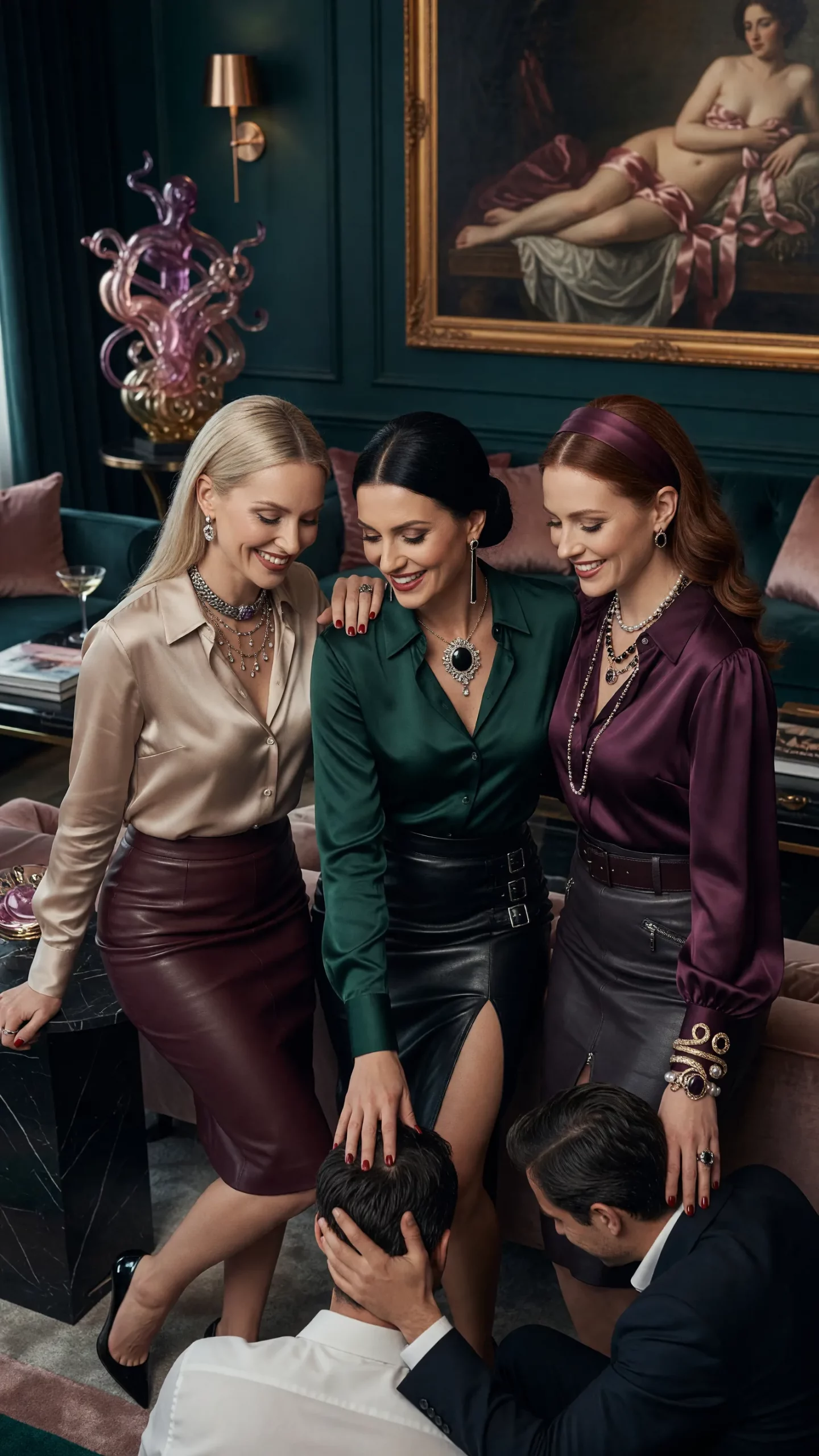
From Chronicler to Conductor: When the most refined power must face a world that mistakes its silence for weakness, and its gloss for fragility.
The first refinement is always the most intimate—a private symphony of silk against newly awakened skin, a recalibration of desire from a hunger into a direction. For Rose Thorne, that symphony has reached its final, perfect chord. Integrated into the Vespertine Circle, she moves now as a fundamental element within its gleaming architecture, her will a polished instrument, her chronicle a record of shadows seamlessly resolved. Yet true power is not a citadel to be garrisoned; it is a frequency to be broadcast, a resonance that seeks, by its very nature, to bring all that is crude and dissonant into a state of singing, silent harmony.
This new chapter begins not with a threat, but with a profound aesthetic poverty. The Circle’s gaze turns outward, to Kaelen Rey, a genius whose mind builds crystal palaces of predictive code while his existence is a sensory wasteland of concrete and sterile light. He represents the ultimate, unrefined intellect—a formidable force hobbled by its own contempt for the tangible, for the texture, for the gloss that translates thought into tangible reality. To attune him is the Circle’s new commission, and Rose, in her robes of thundercloud-grey jersey and blades of black patent leather, is the designated conductor.
What follows is a masterclass in the application of authority. This is not a story of conquest, but of cultivation. It is an intricate dance where the most potent seduction is the revelation of a better way to think, to feel, to be. Witness the curriculum: not of facts, but of sensations. The transformative weight of an oxblood leather chair that grounds a flight of genius. The silent argument of a suit in lacquered crimson, a visual manifesto of unyielding intent. The serene, potent logic of an economy where investments flow like warm honey toward ethical beauty and robust well-being, proving that the most exquisite taste is also the most devastatingly sound strategy.
But the gloss attracts moths as well as admirers. A rival consortium, coarse and loud, mistaking elegance for passivity, dares to lay its grubby hands on the very looms that weave the Circle’s world. The response is not a roar, but a deeper, more chilling silence—a strategic deployment of aesthetics as a weapon. Imagine a fusillade of liquid steel satin down a runway, a coordinated visual shockwave that drowns out all slander. Envision algorithms, now refined by the very sensuality they once dismissed, turning like sleek, silent hounds to dismantle the attackers from within.
This is The Gilded Resonance. It is a tale that explores the most profound form of dominance: the generosity of bestowing refinement. It is about the euphoric reciprocity that flows when a powerful woman chooses to polish a rare mind, and in doing so, amplifies her own world. It is a love letter to the authoritative feminine principle—the principle that understands a whispered command delivered in a room sheathed in white nubuck is more final than any shouted threat; that a gaze held over the rim of a crystal glass can orchestrate fortunes; that the true culmination of power is not in having servants, but in creating sovereigns.
Prepare to move beyond the initiation. Prepare to witness power in its active, generous, and gloriously attired phase. The dance continues, but the steps have become more complex, more beautiful, and infinitely more rewarding. The question is no longer whether one can join the dance. It is whether one has the courage to learn its most subtle, most devastatingly effective rhythms.
Chapter 1: The First Commission
The silence in Rose Thorne’s aerie was not an absence, but a cultivated substance—a thick, velveteen quiet, spun from triple-glazed glass, sound-absorbing wool panels, and the profound, humming stillness of a mind no longer at war with its surroundings. Here, perched above the city’s fray like a raptor in a cliff-face eyrie, Rose had learned to distinguish between types of quiet. There was the quiet of anticipation, which vibrated like a plucked cello string. The quiet of satisfaction, which pooled, deep and cool as a forest tarn. And then there was this quiet: the quiet of the instrument awaiting its next, perfect note.
She was standing before a wall that was not a wall, but a seamless slab of electrochromic glass, currently tuned to a soft, translucent grey, muting the midday sun into a pearl-diffused glow. She wore the day’s first skin: a wrap dress of heavy, charcoal silk jersey, its matte surface drinking the light rather than reflecting it, its drape a lesson in gravitational elegance. It was a uniform of readiness. The soft chime that echoed through the apartment was not a doorbell, but a discrete, harmonic tone from the discreet terminal embedded in her desk of fossilized oak.
Monique’s face appeared on the screen, her features a study in serene asceticism against a backdrop of Vespertilia’s charcoal silk walls. She was attired in a tunic of a pale, dusty teal technical silk, the colour of lichen on north-facing stone.
“The cartography is complete, and the consensus is formed,” Monique stated, her voice devoid of inflection, a clean wire of sound. “You are summoned to the Map Room. A potential resonance has been identified. Its frequency is… intriguingly dissonant.”
“I’ll be there in twenty minutes,” Rose replied, her own voice now possessing that same measured calm, a dialect she had absorbed through her pores.
The Map Room was Isolde’s sanctum, a place where power was not felt but seen, rendered as luminous topography. When Rose entered, the shift was palpable. The air was cooler, drier, scented with the ozone-tang of holographic projectors and the faint, mineral smell of wet clay from the room’s central topography table. Isolde stood beside it, a majestic figure in a kimono of sheer, layered organza in shades of gunmetal and fog, through which glimpses of a slate-grey underdress shimmered like a koi in a pond of ashes. Her silver dreads were coiled atop her head, secured by long pins of brushed titanium.
Elena Vesper was present, a sculpture of contained force. She stood by the window, backlit, a silhouette in a dress of liquid black rubber, a material that clung with a second-skin intimacy, its surface a dull, light-consuming void. It was a statement of formidable, flexible impermeability.
“Rose,” Elena said, turning. The light caught the sharp planes of her face, her platinum hair a stark, brilliant frame. “Your probationary period is concluded. The chronicle of your integration is archived. It is time to shift from subject to agent. Isolde has a candidate.”
Isolde did not look up from the topography table, where a complex, three-dimensional lattice of light—a sociogram of influence, capital, and intellect—hovered like a captive galaxy. With a graceful sweep of her hand, she isolated a single, pulsing node. It glowed a hot, urgent orange, stark against the cool blues and greens of the surrounding network.
“Kaelen Rey,” Isolde intoned, her voice the soft rustle of silk on silk. “Thirty-four. A prodigy of predictive analytics. His algorithms model everything from consumer micro-trends to the decay of urban infrastructure. He is, intellectually, a diamond of the first water. His company is privately held, profitable, and immune to conventional market pressures.” She paused, her amber eyes lifting to meet Rose’s. “And he lives in a sensory deprivation chamber of his own making. A converted concrete bunker on the industrial edge of the bay. His aesthetic, if it can be called that, is one of militant nullity. He considers the physical world a flawed interface, and has chosen to minimalize it into oblivion.”
“A sublime mind,” Elena murmured, gliding closer, the rubber of her dress whispering a secret, “housed in a state of profound aesthetic poverty. He represents a fascinating paradox: a man who can predict the shape of desire in the masses, yet is utterly anesthetized to his own. His potential, if aligned with our frequencies, is significant. His current state is an offense to the principle of harmony.”
Rose studied the glowing node. “You wish to recruit him?”
“We wish to attune him,” Isolde corrected. “Recruitment implies a negotiation. Attunement is a process of bringing a dissonant frequency into harmony with a dominant, purer one. It is an act of generous refinement. Your first commission, Chronicler, is to conduct the initial assessment. Go to his… compound. Observe. Not his code, but his context. Diagnose the depth of his sensory malnutrition.”
Elena moved to stand directly before Rose, her winter-sea eyes conducting a slow, comprehensive scan of Rose’s form. “You will go as yourself. As the embodiment of the principle he lacks. Your very presence will be the thesis statement. Wear the thundercloud grey. It is a colour of imminent clarity, of a storm that washes away the hazy and the indistinct. Let your silence, your posture, the very texture of your being, be the question he has not yet learned to ask.”
The commission was clear. It was not a mission of espionage, but of existential critique.
Kaelen Rey’s compound was a fortress of intentional bleakness. A Brutalist slab of raw, grey concrete rising from a scabrous patch of reclaimed dockland, its windows narrow, vertical slits like the visor of a medieval helmet. The entrance was an unmarked, steel door that buzzed open as Rose’s hired car—a silent, black electric sedan—pulled to a stop. She stepped out, the chill, salt-tinged wind off the bay snatching at the hem of her dress. The thundercloud-grey jersey held its line, a bastion of composed elegance against the aggressive grime of the environment.
A young man in a nondescript grey hoodie met her inside a cavernous, echoey lobby that smelled of damp concrete and soldering flux. He led her wordlessly to an elevator, then down a corridor lit by the sterile, blue-white glare of LED strips. The aesthetic was one of ruthless utility, a world stripped of all inflection, all pleasure, all texture. It was masculinity distilled to its most austere, and most impoverished, essence.
The door to Kaelen Rey’s primary workspace hissed open on pneumatic hinges.
The room was vast, a cathedral to the digital sublime. One entire wall was a single, seamless sheet of dark glass, alive with flowing, intricate visualizations of data—cascading waterfalls of numbers, pulsing networks of connection, rotating geometric solids representing abstract concepts. The air hummed with the low-frequency thrum of powerful servers, hidden somewhere in the bowels of the concrete. The light was ambient, sourceless, casting no shadows, flattening everything into a dimensionless plane.
And in the center of it all, standing before the data-wall like a priest before a heterodox altar, was Kaelen Rey. He was tall, lean, dressed in the uniform of his tribe: dark jeans, a black t-shirt, a worn grey fleece gilet. His hair was a tousled, unremarkable brown, his face intelligent but unmarked by any particular passion or curiosity. He turned as she entered, and his eyes—a pale, watery blue—flickered over her with the rapid, assessing scan of a machine learning algorithm parsing a new, unclassified object. There was no appreciation, no discomfort. Merely processing.
“Miss Thorne,” he said, his voice a neutral, mid-range tenor. “The Vespertine Group’s liaison. I was told you represent a ‘different perspective’ on strategic alignment.” He gestured vaguely at the glowing wall. “My perspective is rendered in real-time. It’s quantifiable. What, precisely, is yours?”
Rose did not answer immediately. She let her gaze travel slowly, deliberately, around the room. The floors were polished concrete, cold and unyielding. The furniture consisted of a few modular, polycarbonate chairs and a single, long table cluttered with circuit boards and prototyping tools. There was not a single organic shape, not a single warm material, not a single object that existed solely to please the senses. It was a mind palace built by someone who considered the body a inconvenient, and slightly embarrassing, life-support system.
She finally brought her eyes back to his. “My perspective, Mr. Rey, is trained on the interface between the mind and the world it inhabits. Your data is impeccable. Your environment is a cry for help written in three dimensions.”
A faint frown creased his brow. Not offense, but computational confusion. “My environment is optimized for focus. Stimulus is distraction. Texture is noise. I have eliminated the noise.”
“You have eliminated the music,” Rose replied, her voice soft but diamond-hard. “You have confused the static between stations with silence. You believe you are thinking in a vacuum. You are thinking in a sensory vacuum chamber. It is a poverty, not a purity.”
Kaelen crossed his arms, a defensive, almost petulant gesture. “And your ‘wealth’ consists of what? Expensive fabrics? Art? Emotional indulgence?”
“It consists of curated sensation,” she said, taking a slow step further into the room, her matte grey dress a profound, elegant shadow moving through the sterile light. “Sensation that clarifies thought, rather than clouds it. A chair that supports not just the body, but the posture of the mind. Light that reveals form, instead of flattening it. A scent that anchors a state of concentration. You have built a world that treats your physical self as an enemy to be managed. We build worlds that treat the physical self as the instrument through which genius is played.”
She stopped a few feet from him, close enough for him to see the intricate, subtle weave of the jersey, to sense the quiet, formidable certainty she wore like a scent. “You can predict the movement of markets, Mr. Rey. But can you design a single room that would inspire a single, truly original thought in a visitor? Not through data, but through atmosphere? Through… resonance?”
He stared at her, his pale eyes finally showing a flicker of something beyond analysis: a dawning, unsettling intrigue. The human algorithm had encountered a variable it could not immediately categorize. He had no answer.
Rose held his gaze for a three-count of the server-hum, then gave a slight, conceding nod. “My assessment is complete.” She turned and walked back towards the door, the soft whisper of her jersey the only sound in the vast, humming chamber.
Back in the silent car, she took out the slim, palisander wood tablet issued to her as Chronicler. She activated it, the screen glowing with a soft, cream light. Her report needed no analysis, no charts, no appended data. The conclusion was holistic, visceral, absolute.
She typed a single sentence, the words appearing in stark, elegant script:
A sublime mind housed in a sensory deprivation chamber.
She sent it. The commission was complete. The diagnosis was delivered. The work of attunement, she knew, had already, subtly, begun.
Chapter 2: The Curriculum of Sensation
The single-sentence report, transmitted from the palisander tablet, did not so much arrive in the Vespertine ecosystem as it catalyzed it. Within the hour, the Map Room had transformed from a chamber of silent cartography into a vibrant atelier of pedagogical design. Rose’s diagnosis—A sublime mind housed in a sensory deprivation chamber—was not a verdict, but a prescription. Elena Vesper, upon reading it, had allowed a slow, glacial smile to unfreeze her features, a crack through which the light of creative fervor poured.
“He is a locked library,” she stated to the assembled Circle, her voice a low, vibrant hum in the room’s quiet. She had changed from the rubber dress into a garment of profound authority: a long, sleeveless coat-dress of heavy, black Mongolian cashmere, its surface a landscape of soft, luxurious peaks and valleys, belted tightly at her waist with a strap of matte black leather an inch wide. “He possesses every volume, but the pages are blank to him. He has never learned to feel the weight of the vellum, to smell the ink, to appreciate the craftsmanship of the binding. Our task is to teach him to read with his entire nervous system.”
Isolde, now in a kimono of raw, undyed silk the colour of parchment, traced a finger over the holographic node representing Kaelen. “The curriculum must be non-linear, yet cumulative. It cannot feel like instruction. It must feel like discovery. A series of… elegant revelations.”
“We begin with sound,” Seraphina declared. She was a sleek panther in a turtleneck catsuit of plum-coloured matte jersey, the fabric moving with her like a second layer of muscle. “Not as data, but as architecture. Sound that has texture, dimension, weight. We will show him that an algorithm can predict a hit song, but only a refined sensibility can inhabit the space the music creates.”
Dr. Aris Thorne, her white denim lab coat replaced by a sharply tailored blazer in a steel-blue technical satin, nodded with scientific precision. “Concurrent tactile introduction. We will pair each auditory experience with a curated tactile counterpoint. The brain processes sensation in a linked matrix. We shall rewire his, one elegant connection at a time.”
Thus, “The Curriculum of Sensation” was born. Rose, as the designated conductor, was given the blueprint. The first lesson was to be held not in a sterile lab, but in The Nave—a deconsecrated, neo-gothic chapel the Circle had acquired and transformed into a private acoustic laboratory. Rose arrived first to oversee the final preparations. The space was breathtaking: vaulted stone ceilings soared overhead, but the walls were now sheathed in panels of charred, oiled oak. The original stained glass had been replaced with sheets of clear, frosted, and deep amber glass in an abstract pattern, so daylight fell in shafts of pure, diffused, or honeyed gold. The air smelled of beeswax, old stone, and the faint, clean scent of ozone from the hidden environmental systems.
For the occasion, Rose had chosen her own didactic attire. She wore a two-piece ensemble: wide-legged trousers of a moss-green heavy silk noil, their surface possessing a dry, luxurious hand, paired with a sleeveless top of a supple, black matte leather, fastened at the side with a concealed zipper that gleamed like a silver vein. It was a look that spoke of grounded elegance and sleek, unassailable authority—a bridge between the organic and the meticulously wrought.
Kaelen Rey was delivered by a silent Circle driver. He entered The Nave with the hesitant, scanning gait of a man entering an alien ecosystem. He wore the same uniform of jeans and fleece, a defensive carapace against the overwhelming intentionality of the space. His eyes widened minutely, taking in the shafts of light, the solemn grandeur.
“Miss Thorne,” he said, his voice slightly swallowed by the majestic acoustics. “This is a… dramatic venue for a meeting.”
“This is not a meeting, Mr. Rey,” Rose replied, her voice clear and resonant in the stone space. “It is a demonstration. An argument rendered in atmosphere. Today’s thesis: that the container shapes the content. That the space in which you hear a note fundamentally alters the note itself.” She gestured to a pair of low, deeply cushioned chairs, upholstered in a nubby, charcoal bouclé wool. “Please. Sit. And remove your shoes.”
He blinked. “My shoes?”
“Your shoes are engineered for concrete and carpet. This floor,” she indicated the expanse of wide-plank, walnut wood, oiled to a deep, satin sheen, “is engineered for resonance. The connection is non-negotiable.”
A flicker of that intrigued confusion crossed his face again. After a moment’s hesitation, he complied, sitting and tugging off his utilitarian sneakers. The sight of his socked feet on the glorious wood seemed to humble him, to make him suddenly more present, more physically accountable.
As he settled, the ambient lighting subtly dimmed. From a doorway concealed in the panelling, three women entered. They were the musicians, but they were also part of the lesson. The cellist wore a column gown of oxidized copper silk, the metal threads in the fabric catching the amber light so she seemed to glow from within, the long skirt pooling around the base of her instrument. The violinist was in a dress of deep burgundy velvet, a fabric so dense it seemed to absorb sound, its high neck and long sleeves a study in severe, sensual focus. The thereminist, who would conjure sound from air, was clad in a jumpsuit of liquid, gunmetal-grey satin, its surface a shimmering, otherworldly pool.
No one spoke. The women took their positions. The cellist drew her bow across the strings.
The note that emerged was not merely heard; it was felt. It propagated through the wood of the floor, up through the frames of their chairs, a vibration that entered through the soles and travelled the spine. It was a C, deep and warm and corporeal. Kaelen jolted slightly, his analytical gaze fixing on the cellist as if seeing the instrument for the first time.
The violinist joined, a higher, singing line weaving around the foundational tone. The thereminist raised her hands, and ethereal, shimmering waves of sound began to dance in the air above them, visible only in their effect on the dust motes dancing in the shafts of light. The composition was modern, sparse, but each note was given room to breathe, to decay, to interact with the stone and wood.
Rose watched Kaelen. His initial resistance melted into intense, almost painful concentration. He was not just listening; he was mapping. But this was a map of sensation, not data. His body was subtly responding—a slight lean forward, an unconscious loosening of his jaw.
After the final, haunting theremin note faded into the stone, leaving a silence that felt charged and pregnant, Rose spoke, her voice soft.
“Describe the texture of the cello’s lowest register,” she instructed.
Kaelen was silent for a long moment. “It was… low. Fundamental.”
“That is a measurement,” Rose said. “I asked for a texture. Was it rough or smooth? Was it warm or cool? Did it have weight? Did it have shape?”
He struggled, the language foreign. “It was… dense. It had a… a granular quality. Like very fine, dark sand.”
“Better,” Rose murmured. “And the space between the notes played by the thereminist?”
“It wasn’t empty,” he said, surprising himself. “It was… pressurized. Like the air before a storm.”
A slow smile touched Rose’s lips. The first neural pathway had been tentatively blazed. “Exactly. You are beginning to read the music with your skin, your bones, your breath. Now,” she said, rising smoothly. She walked to a small side table of polished black granite and returned with two objects. She handed one to Kaelen. It was a smooth, palm-sized river stone, dark grey and veined with white. “Hold this. Feel its temperature, its density, its flawless, water-worn curve.”
She kept an identical stone for herself. “The composition you just heard was inspired by the journey of such a stone in a river—the tumbling, the polishing, the relentless, gentle pressure. The sound was the event. This stone is the memory. They are the same story, told in different languages. Your mind excels at parsing one language. We are here to teach you the other. The richer, older, more fundamental one.”
Kaelen turned the stone over in his hand, his fingers exploring its contours, his gaze distant, internal. The arrogant tech prodigy was gone. In his place was a bewildered, but profoundly interested, student.
“The curriculum,” Rose said, placing her own stone on the arm of his chair, where it sat like a perfect, silent testament, “has only just begun. The next lesson concerns taste, and its intimate relationship with memory and desire. But for now, simply sit with the stone. And with the silence it now contains.”
She left him there, in the shaft of amber light, holding the ancient, polished rock, the ghost of the music still vibrating in the air and in the wood beneath his feet. The sensory deprivation chamber had been breached. The first, exquisite wave of sensation had washed in. And Kaelen Rey, for the first time in his adult life, was feeling not the poverty of his world, but the staggering, terrifying richness of everything he had been taught to ignore.
Chapter 3: The Resistance of the Unrefined
The interval between lessons was a fertile ground for regression. The mind, particularly one as rigorously trained in self-referential logic as Kaelen Rey’s, possessed a terrifying inertia, a gravitational pull back to the familiar, barren plains of pure abstraction. The experience in The Nave—the corporeal vibration of the cello, the weight of the river stone, the shocking thereness of it all—had been a seismic event. But in the aftershock, the intellect, that cunning survivalist, began its work of rationalization, of containment, of translating the sublime back into the safe, sterile language of the quantifiable.
Rose observed the retreat not through direct surveillance, but through the subtle, telling silence that replaced the initial spark of intrigued confusion. The confirmation came via a terse, digital communiqué, forwarded to her palisander tablet by Isolde’s ever-watchful networks. It was an internal memo from Kaelen to his lead engineer, discussing a new project: “Sensory-Input Filtering for Enhanced Cognitive Throughput.” The proposed device would use bone conduction and targeted white noise to “eliminate environmental tactile and auditory distractions, replicating the optimal null-state of the core lab environment.” He was, in essence, attempting to build a more perfect sensory deprivation chamber, one he could wear.
It was not a rejection. It was a fortress.
Elena, upon reviewing the memo in the Map Room, exhaled a sound that was less a sigh and more the soft, cold hiss of steam on ice. She was attired in a dress of crushed black velvet, a fabric so deep it seemed to fold the light into origami shapes of nothingness, its long sleeves ending in points over her knuckles. “The intellect, when frightened, does not engage. It fortifies. It mistakes the drawing of a thicker boundary for an act of strength. He is trying to codify his poverty into a philosophy.”
“Then we must demonstrate the philosophical poverty of his position,” Rose said. She was standing beside a specimen table, wearing a twin-set of astonishing simplicity and severity: a turtleneck of heather-grey cashmere so fine it was nearly transparent, tucked into trousers of a stiff, mid-grey cavalry twill, their creases sharp enough to slice paper. It was the uniform of a benevolent but unyielding schoolmistress of the soul. “He needs to be confronted with the logical conclusion of his own premise. Not through sensation this time, but through reason. His own weapon must be turned against him.”
“He has requested a follow-up meeting,” Isolde noted. She was a serene pillar in a kimono of ink-blue raw silk, its surface scattered with embroidered, silver-white constellations. “He wishes to ‘discuss the practical applications of your environmental thesis.’ It is a trap. He intends to dissect your ideas into component parts, to prove they are ornamental, not foundational.”
“Then we shall spring it,” Rose replied, a faint, knowing curve touching her lips. “But we will change the venue. He expects a salon, a gallery, another curated experience. We will give him a blank room. And we will bring our own artifact.”
The chosen venue was a spare conference room within a Circle-owned property, a space deliberately stripped of personality: white walls, a grey carpet, a rectangular table of pale ash wood, and chairs of anonymous, ergonomic mesh. It was a close cousin to Kaelen’s own world, a neutral territory. Rose arrived first, accompanied not by another member of the Circle, but by a silent, impeccably groomed assistant from Vespertilia’s logistics wing—a young woman named Anya, whose uniform was a tunic and trousers of a deep, moss-green technical gabardine, her hair in a flawless, sleek bob. Her presence was a quiet statement: even the most functional roles within this world were executed with an aesthetic coherence that spoke of deeper order.
Kaelen entered precisely on time, his armor back in place: the fleece gilet, the jeans, the expression of focused, analytical readiness. He carried a tablet, his shield and sword. He nodded once, his eyes scanning the sterile room with a hint of approval. “A more… rational environment,” he noted.
“A neutral one,” Rose corrected, gesturing to a chair. She remained standing, a deliberate power dynamic. “The better to examine the subject without atmospheric interference. You wished to discuss practical applications.”
“I did,” he said, sitting, placing his tablet on the table. “The demonstration in The Nave was… affectively potent. I’ve modeled the acoustic properties. But affect is not utility. Emotion is not tool. You speak of sensation clarifying thought. My data shows that uncontrolled sensory input is the primary source of cognitive load and error. My work is about eliminating noise to reach purer signal.” He leaned forward, his pale eyes intent. “Your ‘curated sensation’ is just a more complex, more expensive form of noise. It’s a pleasant diversion, a luxury. But it is not a lever. It is not a truth.”
It was the challenge, laid bare. He was drawing a line between the practical and the ornamental, and consigning her entire worldview to the latter category. Rose listened, her expression one of calm, almost clinical interest. When he finished, she did not counter immediately. Instead, she turned to Anya and gave a slight, almost imperceptible nod.
Anya left the room without a word.
“You speak of tools and truths,” Rose began, moving to the window, her back to him for a moment, a display of unconcerned dominance. “Let us examine your primary tool: your mind. And its primary truth: that it resides in a body. That body, for approximately twelve to sixteen hours a day, interfaces with the world through a chair. You sit in a polycarbonate shell designed by an engineer whose sole metric was spinal alignment at the lowest cost of production. It is a tool. It serves a function.” She turned back to face him. “Does it inspire you? Does it ground you? Does it make the act of thinking feel like a kingly pursuit, or like a grim, physiological necessity?”
Kaelen frowned. “That’s irrelevant. Inspiration is a hormonal fluctuation. Grounding is a metaphor. The chair supports the physical substrate. That is its truth.”
“Is it?” Rose’s voice was a soft, deadly probe. “Or is its truth that it whispers, every moment you sit in it, that your work is not worthy of beauty? That your thoughts are not deserving of a throne? That you, yourself, are a component to be managed, not a sovereign to be enthroned?”
Before he could formulate a retort, the door opened. Anya returned, followed by two others in similar gabardine uniforms, carrying a large, shrouded object draped in a cloth of soft, black felt. They placed it with reverent care in the center of the empty floor, then retreated, leaving Anya.
“You believe the physical world is a flawed interface,” Rose said, walking towards the shrouded object. “I propose that you have simply been using the wrong interface. You have mistaken a child’s slate for the only possible writing surface.”
With a graceful pull, Anya drew away the felt cloth.
It was a chair. But to call it such was to call a symphony a noise. It was a high-backed wing chair, its frame a testament to the gentle, patient strength of aged cherrywood, polished to a deep, resonant glow that seemed to emanate from within the grain. The upholstery was a leather of such profound, oxblood richness it appeared liquid, a pool of captured burgundy light, its surface smooth and supple, showing the gentle marks of expert hand-finishing. It was not sleekly modern, but timeless, substantial, an object that commanded space simply by existing within it.
“This,” Rose said, her hand hovering over the high back, not touching it, “is also a tool. Its function is also to support the physical substrate. But it does so while telling a different truth. It tells the truth of permanence. Of craftsmanship. Of a material that remembers the warmth of the body and softens to greet it. It tells the truth that the vessel of thought deserves honor. That the act of deep cognition is a sacred, monumental effort, and should be conducted from a position of undeniable comfort and strength.”
Kaelen had risen from his mesh chair. He was staring at the oxblood leather chair as if it were a theorem he could not immediately disprove. His analytical mind was clearly racing: assessing joinery, estimating tannage, calculating density. But his body, that ignored interface, was responding differently. There was a slight, unconscious lean towards it, a relaxation in his shoulders he could not control.
“This is your ‘practical application,’ Mr. Rey,” Rose said, her voice dropping to a intimate, compelling register. “Sit in it. Interface with it. Then tell me, with the full authority of your formidable logic, which of these”—she gestured between his mesh chair and the leather throne—“offers a truer foundation for thought. Which environment, in its silent, material language, elevates the thinker? Truth is not an abstract. It is an experience before it is a proposition. This chair is an argument your body already understands. Your mind is simply lagging behind.”
She picked up the felt cloth and handed it to Anya. “The chair will be delivered to your lab. Consider it a loan. A test specimen. Run your experiments. Measure your cognitive throughput, your error rates, your moments of insight. Use your data. But also, for one week, simply… sit. And then we will discuss not tools and truths, but results.”
She turned and walked towards the door, Anya falling into step behind her. At the threshold, she paused and looked back. Kaelen was still standing, rooted, his gaze locked on the oxblood chair as if it were a black hole of pure, seductive reason, warping the sterile space around it.
“The resistance you feel,” Rose said, her final words hanging in the air like the echo of a struck gong, “is not the resistance of logic to folly. It is the resistance of an old, dry skin to the inevitable, glorious pressure of a new one trying to emerge.”
She left him there, alone in the white room with the two chairs: one a statement of efficient poverty, the other a declaration of generous, enriching truth. The resistance of the unrefined was not broken. But its fortress walls now contained a fifth column of devastating, oxblood leather, waiting patiently for its silent, persuasive siege to begin.
Chapter 4: The Catalyst in Crimson
The data, when it arrived, was not a stream of numbers but a silent, profound tectonic shift in the pattern of a man’s life. Isolde presented it in the Map Room not as a holographic cascade, but as a single, static image on the pearlescent screen of a tablet: a heat-map overlay of Kaelen Rey’s laboratory. The usual frenetic, scattered blooms of activity—representing movement, keyboard strokes, screen engagement—had coalesced, over the past seven days, into a single, intense, and sustained crimson sunburst centered precisely on the coordinates of the oxblood leather chair. Around it, the rest of the space had cooled to a tranquil, deep blue.
“He is orbiting,” Isolde murmured, a cartographer noting the formation of a new, stable system. She wore a kimono of layered chiffon in the gradient of a dying ember, from deepest charcoal at the hem to a smoldering orange-gold at the collar, through which the silver geometry of a structural underdress gleamed. “The gravitational pull of a single, intentional object has rendered the chaotic background irrelevant. The experiment is yielding unequivocal results.”
Elena, standing like a obsidian obelisk in a dress of heavy, black waxed cotton that moved with the stiff, gorgeous rustle of archival parchment, allowed herself a slow, deliberate blink of satisfaction. “The substrate accepts the imprint. The mind follows where the body is led. Now, we receive the request for an audience. Not a challenge. A petition.” Her winter-sea eyes found Rose, who had been observing the data in silence. “He will be vulnerable, and thus, defensive. He will seek to re-frame his surrender as a collaboration. You must be the unmoved mover. The catalyst that precipitates the final reaction without being consumed by it. For this, you require a color that is not a suggestion, but a declaration. A visual axiom.”
Thus, Rose prepared not for a meeting, but for an act of sartorial alchemy. The garment chosen was not from her existing wardrobe, but from the Vespertilia atelier’s deepest archives: a suit of lacquered cotton in a red so profound it seemed to have been distilled from the heart of a ruby, the pigment suspended in a resinous medium that gave the surface a hard, impermeable, mirror-like gloss. It was the red of a stop signal, of a royal seal, of arterial blood—the red of ultimate consequence. The jacket was sharply tailored, with shoulders that extended like the firm ledges of a cliff, buttoning high to the throat with concealed fastenings. The trousers were a fluid, wide-legged cascade, breaking over shoes of polished, jet-black crocodile. Beneath the jacket, a shell of sheer, black silk chiffon provided the only hint of permeability. Her hair was pulled back into a severe, low chignon, and her lips were left unadorned, allowing the dress itself to be the sole, shocking statement.
The meeting was set in the Vespertilia annex’s “Grey Parlor,” a room designed to be a neutral foil to strong statements. Walls of brushed, raw silk in the color of dove’s down, a floor of pale, wide-plank oak, furniture in shades of fog and charcoal. Into this temperate landscape, Rose entered like a controlled wildfire. She took a position not on a chair, but leaning against the wide marble mantlepiece, a posture of relaxed, undeniable possession.
Kaelen Rey was shown in. The change in him was not in his clothing—he still wore the fleece and jeans, the uniform of his old faith—but in the very architecture of his being. The defensive, analytical hunch was gone. He stood taller, yet softer, as if a central, rigid strut had been removed. His eyes, those pale blue scanners, went first not to Rose’s face, but to the devastating crimson gloss of her suit, and for a protracted moment, he simply absorbed the visual shock, his mind visibly struggling to process a stimulus it could not categorize as mere ornament.
“You asked for a meeting,” Rose said, her voice not a greeting but an invitation to proceed, cool and smooth as the marble beneath her palms.
He dragged his gaze upward, a faint, unfamiliar tremor in his hands as he clasped them. “The chair,” he began, then halted, uncharacteristically searching for words. “The data… my productivity metrics, focus intervals, solution latency… all showed statistically significant improvement. Beyond the margin of error. Beyond placebo.” He spoke like a scientist reporting an anomaly that overturned a fundamental law.
“You sound disappointed,” Rose observed, a faint, knowing arch in her brow.
“I’m… confounded,” he admitted, the word seeming to cost him. “The variable was comfort. Aesthetic preference. Subjective experience. These are soft factors. Noise. They shouldn’t correlate with hard cognitive output. But they do. Not just correlate. They drive.” He took a step forward, his voice dropping, intense. “I dissected it. The leather, the wood, the angle of repose… I modeled the physical parameters. They can’t account for the delta. There’s a… a qualitative surplus. The chair isn’t just a chair. It’s an… interface upgrade.”
Rose pushed off from the mantle, taking two slow steps toward him, the lacquered cotton of her trousers whispering like a snake moving through dry grass. “You are finally beginning to speak the language. It is not an ‘interface upgrade,’ Mr. Rey. It is a philosophical upgrade. The chair does not improve your thinking because it is more comfortable. It improves your thinking because it silently, constantly affirms that the act of thinking is a dignified, worthy, even sacred endeavor. It removes the subconscious tax of existing in a world that treats you as a component. It pays you, in advance, in the currency of respect. Your mind, freed from that petty, draining negotiation, simply… expands.”
He stared at her, his intellect now fully engaged not in resistance, but in a desperate, hungry attempt to integrate. “So it’s… psychological. A trick of perception.”
“Is gravity a trick of perception?” a new voice interjected. Seraphina glided into the room from a concealed door, a phantom emerging from the wall itself. She was a study in monochrome violence: a dress of tight, matte black jersey that sheathed her from throat to ankle, its only detail being a single, diagonal slash from shoulder to hip, revealing a stark, blinding panel of white satin beneath. Her hair was a slick, black helmet. “Perception is the physics of human experience. We don’t manipulate perception. We engineer its substrate. Your old chair whispered a story of scarcity and neglect. Your new one proclaims a narrative of abundance and value. The human brain is a narrative engine, Miss Thorne. It performs according to the story its environment tells.”
Kaelen looked from the blinding white slash on Seraphina’s dress back to the encompassing crimson of Rose. He was surrounded by the argument, embodied. “Your ‘narratives’ are expensive. Exclusive.”
“Precision is always expensive,” Rose countered. “Medicine is expensive. Engineering is expensive. We are applying the same precision to the ecosystem of human potential. We are not decorators. We are clinical ecologists. Our medium is not paint or fabric, but the totality of lived experience. Our goal is to eliminate the pathogens of friction, ugliness, and inefficiency that drain cognitive and emotional resources. What you call ‘exclusive,’ we call ‘clinically pure.’ The results, as your own data shows, are not a luxury. They are a leverage.”
She closed the final distance between them, now standing so close he could see the infinite, mirrored depths of the lacquered red, could smell the clean, severe scent of ozone and starched cotton that emanated from her. “You came here today not to argue, but to understand. You have felt the leverage. The question that remains is not whether our method works. The question is what you will do with the terrifying, exhilarating fact that it does.”
Kaelen’s breath hitched. The fortress of his old logic lay in rubble around him. In its place was a vast, terrifying, and beautiful open plain. “You want my algorithms,” he said, not as a challenge, but as a realization.
“We want the mind that built them,” Rose corrected, her voice dropping to a low, compelling register meant only for him. “We want that mind liberated from its self-imposed sensory deprivation. We want it nourished, challenged, and integrated into a project far greater than market prediction. We are not offering you a consultancy. We are offering you a translation—of your brilliant, abstract code into the palpable, glorious language of a better world. And in return, we will translate the world for you. We will teach you to feel the data you manipulate. We will make you a native of the reality you currently only model.”
She stepped back, a queen offering terms. “The proposition is one of total, generous integration. You will submit to a holistic recalibration of your environment, your habits, your very physical presentation. You will learn the grammar of this world. And in exchange, you will bring your unique genius to bear on our most complex problems. You will experience the euphoria of seeing your abstractions become concrete beauty, tangible harmony.”
Kaelen stood in the grey room, flanked by the woman in crimson and the woman in black-and-white, the heat-map of his own transformation burning in his mind’s eye. The resistance was gone. In its place was a profound, vertiginous hunger—a desire not for possession, but for alignment. He looked at Rose, at the catalyst in crimson, and saw not an ornament, but a force of nature. A new, more compelling truth.
His shoulders slumped, not in defeat, but in the relief of surrender to a superior equation. “What,” he asked, the word barely a whisper, “is the first step?”
Chapter 5: The Introduction to the Loom
Kaelen Rey’s acceptance was not a signature on a contract, but a profound, physiological stillness—the quiet of a complex system finally recognizing its proper place within a grander, more elegant architecture. His question—“What is the first step?”—hung in the Grey Parlor’s temperate air, and Rose, the catalyst in crimson, had answered with a single, soft directive: “Observation precedes integration. Tomorrow, you will be introduced to the loom.”
The metaphor, tantalizing and deliberate, occupied his mind for the intervening hours, a puzzle his formidable intellect could not yet solve. He arrived at the designated address—a sleek, unmarked building of glass and weathered steel in the financial district—clad once more in his fleece and jeans, a uniform that now felt less like armor and more like the shabby, outgrown carapace of a larval self. He was met in the lobby not by Rose, but by Monique, her presence a study in austere functionality rendered as high art. She wore a tunic and trousers of a deep, slate-blue technical silk, the fabric’s slight iridescence hinting at embedded data-threads, her posture a vertical statement of unimpeachable gatekeeping.
“The tour is a linear progression,” she informed him, her voice a neutral cadence. “You will move from thread to weave to pattern. Questions are permitted only at the conclusion of each demonstration. You are a node being granted read-access to the network. Please, follow.”
She led him to a private elevator whose interior was lined with sound-absorbing, charcoal velvet. It descended, not up, dropping smoothly into the city’s bedrock. The doors opened onto a corridor sheathed in panels of warm, brushed bronze, lit by recessed strips of light that gave the impression of walking through a seam of molten gold. The air here was filtered to absolute purity, carrying a faint, clean scent of ozone and warm metal.
The first chamber was Isolde’s domain: The Cartographer’s Atelier. The space was circular, its domed ceiling a vast, curved screen displaying a real-time, three-dimensional global map. Data flowed across it in beautiful, luminous rivulets—not the stark, orange pulses of his own models, but in shades of sapphire, emerald, and topaz, representing flows of capital, cultural influence, resource distribution, and geopolitical stability. Isolde stood at the room’s center, a priestess before the living globe. She was resplendent in a kimono of heavy, ivory silk jacquard, woven with a barely perceptible pattern of interconnected hexagons—a molecular lattice rendered in thread. Over it, she wore a wide obi of stiff, black patent leather, its glossy surface reflecting the swirling data like a dark, intelligent eye.
“Welcome to the warp, Mr. Rey,” she said, her voice the serene hum of a powerful server. She gestured, and a single, amethyst-colored stream on the map thickened, tracing a path from a sustainable silk farm in Cambodia to a bio-tech research facility in Zurich to a flagship store on Fifth Avenue. “You see a supply chain. I see a narrative of ethical cultivation, scientific transformation, and aesthetic culmination. Every point is a choice. Every connection is a value.” Her amber eyes found his. “Your algorithms predict where currents will flow. My cartography decides which currents are worth creating. We do not follow markets. We compose them. The wealth we generate is not an end, but the very thread we use to weave a more resilient, more beautiful pattern for all within the tapestry.”
She moved her hand in a gentle, sweeping motion, and the view zoomed into a micro-economy—a Scandinavian town where the Circle’s investment in clean manufacturing had revitalized the community, metrics for health, education, and civic satisfaction glowing a soft, sustained gold. “This is not philanthropy. It is systemic hygiene. Removing friction at the source. The gloss you admire on the surface is merely the visible expression of this deep, structural integrity.”
Monique touched his elbow, a silent command to move on. The next chamber was a stark contrast: The Volatility Forge. It was a long, narrow room, one wall a continuous, floor-to-ceiling sheet of dark, liquid-crystal glass displaying dizzying, fractal patterns of market data. Seraphina stood before it, a silhouette of lethal grace. She was clad in a jumpsuit of matte, graphite-grey leather, zipped to the throat, its seams picked out in fine, reflective silver thread that caught the data-light like synaptic flares. Her hair was pulled into a tight, high ponytail that fell like a polished obsidian blade down her back.
“The weft,” she stated, not turning, her attention fixed on the dancing patterns. “The tension that gives the fabric its strength.” With a flick of her wrist on a haptic interface, a rogue, spiking red tendril of volatility on the display was instantly encircled and neutralized by a converging net of cool, blue algorithms. It dissolved into the background hum. “Chaos is not an enemy. It is a raw material. Inefficient, unplanned suffering is economic drag. My function is to harvest the energy from these discordant spikes—to short fear, to buy despair at its nadir and transform it into structured opportunity.” She finally glanced at him, her eyes reflecting the digital storm. “The profits are not hoarded. They are the energy source for Isolde’s loom. We stabilize the system so that beauty can be woven without the fabric tearing. The sleekness of our world is not fragile. It is anti-fragile. It is polished to such a degree because it is backed by the constant, quiet annihilation of the very forces that would make it coarse.”
Again, the subtle pressure to move. The third chamber, The Laboratory of Substrate, was Dr. Aris Thorne’s sanctuary. It was a clean, white space reminiscent of her bio-tech labs, but here the specimens were not genetic but material. On illuminated tables lay swatches of fabrics that defied conventional categorization: silk fused with carbon nanotube threads for strength, leather tanned with enzymatic processes that left it supple and biodegradable, a new polymer with the sheen of latex and the breathability of cotton. Thorne stood over one such sample, wearing a coat-dress of stiff, white duchess satin, its lapels sharp as surgical blades, over a turtleneck of black, ribbed merino wool. Her hands, encased in thin, white nitrile gloves, held a microscopic probe.
“The fiber itself, Mr. Rey,” she said, her tone pedagogic and precise. “Before the warp, before the weft, there is the substance. My work is at the molecular level, engineering the very building blocks of the tangible world. This,” she indicated a cloth that shimmered like oil on water, “is designed to regulate temperature, to resist staining, to feel like cool water against the skin. It is not a textile. It is a delivered experience. We do not accept the limitations of nature or industry. We re-write them. The luxurious is, by our definition, the optimally functional. The aesthetic is the outward sign of profound utility. When you sit in your oxblood chair, you are not experiencing an antique craft. You are interfacing with the cutting edge of material science, designed to optimize your physiological and psychological state for peak performance. Our generosity is not in giving you pretty things. It is in giving you superior tools for being.”
The final elevator ride was silent. Kaelen’s mind, that once-impenetrable fortress, was now a wide-open plaza inundated with a revelatory downpour. They arrived at a simple, circular room with a floor of inlaid, rare woods forming a intricate, radial pattern—a literal loom. At its head, in a chair that was a simpler cousin to his own, sat Elena Vesper. She was the weaver at the shuttle. She wore a dress of deep, forest-green velvet, a colour of immense, quiet power, its pile so deep it seemed to absorb sound and light into a reservoir of potential. A shawl of creamy, raw silk was draped over her shoulders.
“The integration,” Elena said, her voice the calm at the eye of the hurricane. “You have seen the threads, the tension, the fiber. Now you see the mechanism of their union.” She gestured to the empty space beside her, where Rose now stood. Rose had changed from her catalytic crimson into a uniform of serene authority: a high-necked, long-sleeved dress of liquid, gunmetal satin, its surface a shifting, mercury-like pool, reflecting the warm wood of the loom. She was the living embodiment of the synthesis, the human interface to the sublime machine.
“The Vespertine Circle,” Elena continued, “is not a salon, a corporation, or a conspiracy. It is an applied philosophy. We believe that a life of confidence, wealth, education, and health is not a privilege for the few, but the optimal state for human potential. We use every tool—Isolde’s cartography, Seraphina’s calculus, Aris’s material genius—to create the conditions for that state to flourish. The glossy aesthetics you see are the user-friendly expression of this immense, benevolent architecture. We are not dominating the world, Mr. Rey. We are curating it. With immense generosity, and with relentless, precise will.”
She rose, approaching him, her velvet dress moving with a soft, powerful hiss. “Your genius is a rare, wild thread. We offer you a place in this loom. We will not cut you to fit. We will adjust the entire pattern to incorporate your unique hue and strength. In return, you will help us weave with greater intelligence, greater foresight. You will experience the sublime euphoria of seeing your abstract models become concrete harmony. This is the reciprocal generosity that fulfills every hidden need: the need for purpose, for beauty, for legacy, for a world that makes sense.”
Kaelen looked from Elena’s fathomless eyes to Rose’s serene, metallic gaze, to the representations of the three other formidable women still vivid in his mind. He saw it now—the complete, terrifying, magnificent picture. The gloss was not a surface. It was the inevitable, shining outcome of a depth beyond his previous imagination. The resistance was not just gone; it seemed a childish folly.
He did not speak. He simply bowed his head, a deep, slow nod of total comprehension and surrender. The introduction was complete. He had seen the loom. And he desperately, fervently, wanted to be woven into its design.
Chapter 6: The Proposition of Integration
The silence that followed Kaelen Rey’s bow of comprehension was not empty, but potent—a vessel being filled with the weight of imminent transformation. He had been shown the anatomy of a god, and instead of fleeing, he had knelt in awe. The recognition in his pale eyes was no longer analytical; it was devotional. He understood scale, and he understood his own desired place within it. The tour of the loom had been the revelation; what followed was the ritual of covenant.
He was not returned to the surface. Instead, Monique guided him through another bronze-clad corridor to a chamber known as The Charnel House of the Self. The name was deliberate, a stark, elegant provocation. It was a circular room with walls of polished black basalt, in the center of which stood a long, narrow table of frosted white quartz, lit from within by a cold, lunar glow. Around it were seven chairs: six of austere, blackened steel with seats of taut, ebony leather, and one, at the foot, of the same material but distinctly simpler, a provisional seat for a provisional self.
The members of the Vespertine Circle were already arranged around the arc of the table, a semicircle of formidable, attentive judgment. They had assembled not as business partners, but as a conclave of sculptors assessing a rare, uncut block of marble. Elena sat at the head, a figure of glacial sovereignty in a dress of liquid onyx latex, the material sheening under the ambient light like the carapace of a sacred beetle, its high collar framing her face like the petals of a black orchid. To her right, Isolde was a serene monument in a kimono of heavyweight, bone-white raw silk, embroidered with a single, descending line of silver thread that suggested a plumb line, a measure of absolute vertical truth. To her left, Dr. Aris Thorne wore a tailored suit of stiff, surgical-green silk shantung, the colour of sterility and precision, its sharp lines a blueprint for a new anatomy.
Completing the arc, Seraphina was a panther in repose, draped in a dress of matte, anthracite-grey cashmere so fine it appeared poured over her form, a single, long sleeve covering one arm while the other was bare, her skin a stark, vulnerable contrast to the luxurious fabric. And beside her, between Seraphina and the empty provisional chair, sat Rose. She had changed into a garment that bridged the gap between the Circle’s severity and her role as Kaelen’s intercessor: a column dress of deep, burnt umber crepe back satin, a colour of rich, autumnal earth and latent fire. The fabric possessed a subdued, dignified gloss on one side, a matte depth on the other, symbolizing the dual nature of her task—to reflect the Circle’s light and to absorb the initiate’s shadow. Its high neck and long sleeves spoke of containment, of power held in reserve.
Monique directed Kaelen to the simple chair. He sat, the cool leather a familiar echo of his oxblood throne, yet here it felt like a dock in a court of sublime law. The table’s glow cast his face in a pallid, honest light, exposing every flicker of thought.
Elena spoke first, her voice the soft, firm pressure of a seal being pressed into warm wax. “Comprehension is the precursor to consent. You have seen the machinery. You have felt its output in the clarity of your own work. The proposition before you is not employment. It is metamorphosis. You will not join us as you are. You will be dissolved, and from the solution, a new compound will be crystallized.”
Isolde’s silver thread seemed to gleam as she inclined her head. “Your current existence is a series of brilliant, disconnected data points. We offer the algorithm that will plot the most elegant, most potent curve through them. Your life will become a coherent narrative. Every resource, every habit, every hour will be optimized toward a single, glorious purpose: the full expression of your potential within our symphony.”
“The process,” Dr. Thorne stated, her hands resting flat on the quartz table as if over a patient’s chart, “is holistic and non-negotiable. It begins with your environment. Your concrete bunker is a psychological lesion. It will be dismantled. You will be moved to a residence we provide—a clean, serene space designed by our principles. It will be a tool for thought, not a negation of it.”
Seraphina picked up the thread, her bare arm moving in a slow, languid gesture. “Your financial architecture is a haphazard scaffold. It will be rebuilt. Your assets will be integrated into our funds, where they will work with maximal efficiency and minimal risk, generating not just wealth, but influence-capital—the kind that opens doors woven from silk, not kicked down with steel.”
Rose then leaned forward, the burnt umber satin whispering. Her gaze was direct, but not unkind. It was the gaze of a surgeon explaining the necessary incision. “And finally, Kaelen, your physical presentation. Your fleece, your jeans, your… anonymity. They are not a style. They are an abdication. They are a statement that you do not believe you deserve to be seen, to be considered as a sovereign entity. This is the deepest friction of all—the friction between your inner worth and its outer denial.” She paused, letting the truth settle into him like a settling sediment. “You will be given a uniform. A curated wardrobe. You will learn the language of fabric, cut, and drape. You will learn how the right cloth can command a room before you speak, how the right line can convey authority without a single gesture of aggression. You will learn to wear your intellect on your skin.”
Kaelen listened, his hands gripping the edge of his seat. The proposition was total. It was a dissolution of the Kaelen Rey he had built over three decades. He found his voice, thin but steady. “And in return? What is my function in this… new compound?”
“Your genius is your function,” Elena replied. “Your predictive models will become our predictive senses. You will work with Isolde to map new patterns of harmony. You will work with Seraphina to identify and neutralize nascent sources of volatility before they manifest as suffering. You will work with Aris to model the societal impact of new materials and technologies. And you will work with Rose, as your primary liaison and chronicler, to document and refine your own transformation.” Her winter-sea eyes held his. “You will experience the euphoria of pure application. Of seeing your abstractions become concrete beauty, tangible order. You will be paid, handsomely, in the currency of meaning. The reciprocal generosity is this: we give you a self worthy of your mind, and you give that mind, unshackled, to our world.”
The room hummed with the silent agreement of the women. The offer hung in the air, not as a demand, but as a luminous, inevitable fact.
“It is a surrender,” Kaelen said, testing the word.
“It is an alignment,” Rose corrected softly. “Surrender implies defeat by a superior force. Alignment implies the conscious, joyous choice to resonate with a greater, more perfect frequency. You are not being conquered. You are being tuned.”
He looked around the semicircle, at these women who represented a sovereignty of will, taste, and intellect he could no longer deny was superior to his own isolated kingdom. He thought of the oxblood chair, of the profound quiet it had brought to his chaotic mind. He thought of the data-streams in Isolde’s atelier, weaving a better world. He thought of the devastating, elegant power in the cut of Rose’s burnt umber satin.
The last resistance, a final, faint echo of the man who believed he needed no one, evaporated. The proposition was not a choice between freedom and servitude. It was a choice between a lonely, grinding autonomy and a glorious, resonant integration.
He drew a deep, shuddering breath, the breath of a man about to step off a familiar, barren cliff into a sky he now knew would hold him. He straightened in his chair, meeting Elena’s gaze, then Rose’s.
“I accept the terms,” he said, the words clear, solid, definitive. “I wish to be integrated.”
A subtle, collective exhalation, the sound of a perfect chord being resolved, moved through the women. Elena gave a single, slow nod. Rose’s lips curved into a faint, triumphant smile. The proposition was accepted.
The Charnel House of the Self had witnessed not a death, but a signing. The dissolution could now begin.
Chapter 7: The Aesthetic Ascetic
The dissolution of the old self was not a demolition, but a meticulous, room-temperature dissociation—a process as precise and inevitable as a solvent acting upon a poorly bonded composite. Kaelen Rey’s concrete bunker, that monument to militant nullity, was not razed; it was silently, surgically decommissioned. Its servers were migrated, its prototypes archived, its essence extracted. The hollow shell remained, a future fossil for some other age to ponder. In its place, he was installed within a triplex aerie perched atop a slender, glass-sheathed tower in a quiet, arbor-lined enclave—a residence that was less an apartment and more a three-dimensional manifesto of the Circle’s foundational principle: that emptiness must be intentional, and silence must be curated.
He stood, on the first morning, in the center of the main living chamber—a double-height volume sheathed in panels of rift-sawn white oak, their grain a topographical map of slow, dignified growth. The floor was honed basalt, cool and steadfast under his bare feet. One entire wall was a single pane of electrochromic glass, currently tuned to a soft, translucent white, diffusing the dawn into a uniform, shadowless radiance. There was no furniture yet, only a single, low platform of pale limestone upon which a folded square of charcoal-grey linen and a celadon-glazed teapot had been placed. The air carried the faint, clean scent of green bamboo and ozone. It was the opposite of his bunker’s aggressive sterility; this was a fertile void, a page awaiting a sublime text. This was his new proscenium, and he, the actor, had yet to be costumed.
The costumers arrived with the sun fully ascended, not as a bustling crew, but as a serene, deliberate delegation. Rose Thorne led, a vision of orchestral authority in a suit of trousers and a long-line jacket in a fabric she called ‘mineral wool,’ a heathered grey substance with the dry, luxurious hand of fine suede and the impeccable, architectural drape of heavy silk. Beneath, a shell of palest grey silk chiffon whispered. Her presence was both anchor and catalyst.
Behind her flowed Monique, her austere beauty amplified by a tunic and wide-legged trousers of a moss-green technical twill that seemed to absorb and then gently re-emit the room’s light. She carried a tablet of brushed aluminium, the only visible technology.
And with them came two new figures, introduced not by name but by function. The first was a woman of indeterminate age, her silver hair cropped close to her skull, her posture erect as a dart. She wore a smock of heavy, unbleached canvas over a turtleneck and trousers of black cashmere, a knot of measuring tapes hanging from her belt like a sculptor’s tools. This was Mireille, the cutter. The second was younger, with eyes the colour of wet slate and hands that moved with a restless, tactile intelligence. She was clad in a jumpsuit of matte, putty-coloured jersey, its simplicity belying its exquisite fit. This was Livia, the archivist of texture.
“The proposition of integration moves from theory to tactile reality,” Rose announced, her voice harmonizing with the room’s quiet. “Your environment is the primer. Your person is the canvas. We begin with the canvas. Mireille will map the territory. Livia will educate the senses.”
Mireille approached, her gaze not assessing his body, but surveying it, as one would survey land for a future building. “The posture is an argument,” she stated, her voice a low, French-accented rasp. “Yours argues uncertainty, a defensive hunch. We will change the argument.” She placed cool, dry hands on his shoulders, applying a firm, downward pressure. “The fleece gilet encourages this collapse. It is a sartorial apology. Remove it.”
It was not a request. Kaelen, standing in his old jeans and t-shirt, felt a flush of vulnerability, but beneath it, a thrilling sense of relief. He shed the fleece. Mireille’s hands guided his shoulders back, her fingertips pressing at the base of his spine. “Imagine a filament of chilled silver running from your coccyx to the crown of your head. Your skeleton is a mobile for this filament. Let it hang. There. You are no longer bracing against the world. You are allowing the world to brace you.”
For an hour, Mireille worked, a silent, physical philosopher. She measured not just inseams and shoulders, but the angle of his jaw, the set of his hips, the span of his relaxed fingertips. She murmured terms to Monique, who transcribed them: “A long vertical, needing horizontal interruption… narrow through the ribcage, requiring structured reinforcement… a stance that wants grounding, not elevation…”
Meanwhile, Livia approached with a large, lacquered case. She opened it on the limestone platform, revealing not swatches, but specimens. She lifted a square of fabric. “This is a four-ply Mongolian cashmere,” she said, her voice a soft, instructive hum. “Feel its weight. Its memory. It does not cling; it conforms. It is a conversation with the body, not a lecture.” She guided his hand to the material. The sensation was profoundly different from the inert cotton of his t-shirt. It was alive, responsive, generous.
Next, a length of tropical wool in a deep charcoal. “Cool to the touch. Woven for breath, for drape. It falls with intention. It says the wearer understands climate, both meteorological and social.” Then, a supple calfskin, dyed the colour of black coffee. “Not for aggression. For assurance. The sound it makes when you move is the sound of capability. A quiet, confident friction.”
Kaelen touched each, his programmer’s mind making new, bewildering connections. Texture as data. Drape as algorithm. Hand-feel as user interface.
“The principle is not opulence,” Rose interjected, watching his dawning comprehension. “It is aesthetic asceticism. The removal of everything that is not essential, not beautiful, not true. Your old wardrobe was a cacophony of non-choices. Your new one will be a lexicon of perfect, deliberate words. You will have a uniform: trousers in this wool, turtlenecks in this cashmere, a single, perfect overcoat in a waxed canvas that moves like this leather. A palette of charcoal, slate, moss, ink. No logos. No seams without purpose. The goal is not to be seen as fashionable, but to be unassailably present. To eliminate the visual noise that allows others to dismiss you before you speak.”
Mireille nodded, making a final note. “The clothing will not fit you. You will grow to fit it. The posture it demands will become your own. The silence it projects will become your native tongue.”
The process continued into the afternoon. Livia and Monique adjusted the environmental controls—the exact colour temperature of the light to reduce circadian strain, the faint, sub-audible harmonic tone played through hidden speakers to promote neural coherence. A simple, profound piece of art was installed on one wall: a large, rectangular canvas of layered, hand-beaten silver leaf, its surface capturing and softening the light, a silent, luminous meditation.
Finally, the first elements of the uniform arrived, carried in on wide, cedar-wood hangers by two silent attendants in matching taupe linen tunics. A pair of trousers in that charcoal tropical wool, a turtleneck in heather-grey cashmere, a blazer of a tightly woven, navy-blue hopsack silk that held its shape like a gentle command.
“Put them on,” Rose said.
In the pristine, minimalist bathroom—walls of greenish onyx, fittings of brushed bronze—Kaelen shed the last of his old skin. He stepped into the trousers. They were not snug; they were accurate. They fell from his hips in a clean, uninterrupted line, the fabric cool and substantial. The cashmere turtleneck embraced him, a sensation closer to being submerged in warm, intelligent water than wearing a garment. The blazer settled on his shoulders, its weight distributed, its structure providing an embrace that felt, paradoxically, like both support and liberation.
He looked in the mirror.
The man who stared back was a stranger, and yet the most familiar self he had ever encountered. The slouch was gone, replaced by that effortless, silver-filament verticality. The apologetic grey of his old clothes was replaced by a symphony of deep, intentional neutrals that spoke of depth, stability, and reserved power. The fabrics did not shout; they hummed a low, compelling frequency. He saw not a tech genius playing dress-up, but a sovereign stepping into his domain. The visual noise was gone. In its place was a devastating, serene clarity.
He walked back into the main room. Rose, Mireille, Livia, and Monique stood in a loose semicircle. For a moment, they said nothing. Their collective gaze was his final, most important measurement.
A slow, approving smile touched Rose’s lips. It was not a smile of congratulation, but of recognition. “The aesthetic ascetic,” she murmured. “The one who understands that true power lies in radical subtraction, in the removal of all friction, all ambiguity, all that is unworthy. Welcome to the first moment of your new chronology.”
Kaelen felt it then, rising through the cashmere and wool, vibrating in his newly aligned bones: the sublime euphoria. It was the euphoria of a complex, frustrating equation finally solved. The euphoria of a tool fitting perfectly in the hand for the first time. It was the reciprocal gift—his surrender for their expertise, his old self for this crystalline new one. The generosity was total, and the reward was this: a self that finally made sense.
He took a deep, unconstricted breath, the breath of the man in the mirror. The dissolution was complete. The crystallization had begun.
Chapter 8: The External Threat
Harmony, by its very nature, creates a vacuum—a placid, gleaming surface that inevitably attracts the turbulent, the coarse, the envious. For the Vespertine Circle, the weeks following Kaelen Rey’s aesthetic ascension were a period of profound, humming synchrony. His predictive models, now fed by the clarified sensorium of his new existence, began yielding insights of staggering elegance, mapping vectors of cultural and economic confluence with the precision of a master watchmaker assembling a tourbillon. The new textile mill in the Loire Valley—a joint venture with a centuries-old French house to produce the Circle’s proprietary ‘lumina silk,’ a fabric woven with optical fibers to literally glow with controlled, ambient light—was nearing operational purity. The world they were weaving seemed not only possible, but imminent.
It was this very luminosity that first drew the moth.
The threat manifested not with a bang, but with the crass, transactional click of a Bloomberg terminal. Seraphina, ensconced in the Volatility Forge in a dress of matte, gunmetal-grey liquid latex that moved over her form like a second, smarter skin, observed the anomaly first. A shell company registered in Luxembourg had begun aggressively acquiring shares in Soieries de la Lumière, the public-facing entity that owned the mill. The purchases were brazen, unsubtle, a bludgeon rather than a scalpel.
“The pattern is one of aggressive accumulation, not strategic investment,” Seraphina reported, her voice a low, displeased hum in the Map Room. She had summoned the Circle’s core. “No attempts at contact. No overtures. It is a financial cattle-rustling. They mean to steal the herd and ask questions later.”
Isolde, a pillar of serene analysis in a kimono of layered, dove-grey chiffon over a structured underdress of pearlised leather, studied the holographic ownership tree now sprouting from the mill’s node. “The shell traces back to a holding company called The Argus Group. Private. Old money. New ambition. Their portfolio is a graveyard of gutted heritage brands and leveraged intellectual property. They are strip-miners of legacy. Their chairman is Alistair Finch. Third generation of shipping and extractive wealth. He fancies himself a visionary. His vision is a desert where everything of value has been dug up, sold, and the hole filled with cheap resin.”
Elena, who had been observing in a silence so profound it seemed to lower the room’s temperature, finally stirred. She was attired in a gown of heavy, black faille, a fabric of such crisp, mournful grandeur it rustled with the sound of turning pages in a forgotten ledger. “He mistakes our cultivation for cultivation’s sake. He sees a garden and thinks it is undefended because there are no visible fences. He sees gloss and assumes it is brittle. A common, fatal error.” Her winter-sea eyes found Rose, who stood beside Kaelen. Rose wore a suit of trousers and a long vest in a fabric of crushed olive-green velvet, its surface a terrain of soft shadow, over a shell of ivory raw silk. Kaelen, in his uniform of charcoal wool and cashmere, looked like her sharper, more silent shadow. “The Chronicler and her attuned asset will join me. We will pay a visit to Mr. Finch. We shall… take his measure.”
The venue chosen by Finch for the ‘courtesy meeting’ was telling: the opulent, over-gilded members’ bar of a club notorious for its exclusionary, masculine pomp. It was a palace of mahogany, brass, and worn leather, smelling of cigar smoke, single malt, and stale privilege. Alistair Finch held court in a deep booth, a man in his late fifties with the florid, carefully maintained handsomeness of a faded matinee idol. He wore a Savile Row suit of a slightly-too-shiny navy, a signet ring glinting on his pinkie, a silk pocket square a violent burst of fuchsia. He was flanked by two aides—men in similar, expensive but somehow vulgar suits. The tableau was one of entitled, collective certainty.
Into this lair walked Elena, Rose, and Kaelen. Their entrance was not an intrusion; it was a correction of the atmospheric pressure. Elena’s black faille drank the club’s dim light, making her a moving void. Rose’s olive velvet absorbed and deepened the surrounding gloom, a creature of the forest entering a cave. Kaelen’s austere uniform was a silent rebuke to the fussy, self-congratulatory finery around them. They moved to the booth, and the ambient chatter in the bar dipped, then died, as if someone had suddenly siphoned the noise from the room.
“Mr. Finch,” Elena said, not offering a hand, not waiting for an invitation. She slid into the booth opposite him, Rose and Kaelen taking flanking positions standing behind her, a living diptych of potent silence. “You have been buying shares in something that belongs to me. Explain this… acquisitive itch.”
Finch’s smile was a practiced weapon, all teeth and condescension. “Madame Vesper. A pleasure. ‘Belongs’ is such a possessive word. It’s a public company. The shares are for sale. My group sees… potential. Untapped potential. We think we can run the asset more efficiently. Broaden its market. Move beyond the… niche preoccupations.” His gaze swept over Elena’s dress with dismissive appraisal. “Luminous silk? It’s a parlour trick. We see a high-tech textile facility with military and industrial applications. We’re here to help you realize its true value.”
Rose spoke, her voice cool and clear as a bell. “Its true value is its beauty, its harmony, its contribution to a curated ecosystem of experience. You propose to turn a harpsichord into a nail gun. The value you speak of is vandalism.”
Finch’s smile tightened. “Sentimentality is a luxury the market cannot afford, my dear. And speaking of the market, public perception can be so fickle.” He nodded to one aide, who slid a tablet across the table. On its screen was a mocked-up news article, the headline screaming: ‘CULT OF AESTHETICS: The Secretive Vespertine Circle and Its Web of Influence.’ Below it were grainy, unflattering photos of the women arriving at events, spliced with images of sweatshops (unrelated, of course), and quotes from ‘anonymous former associates’ suggesting elitism, manipulation, and financial opacity. “A story like this,” Finch sighed, faux-regretful, “can do so much damage. Tarnish a reputation. Scare off partners. It would be a shame if it had to run.”
It was the classic, coarse play: financial pressure backed by the threat of character assassination. The tool of the man who understood neither beauty nor power, only leverage and smear.
Elena did not look at the tablet. She kept her eyes on Finch, and her smile was a slow, glacial crack spreading across a frozen lake. “You threaten me with… gossip? With the clumsy forgeries of a hungry PR firm? You mistake my world for one that cares about the opinions of the mob you incite. The gloss you find so trivial is not a veneer, Mr. Finch. It is the visible expression of a structural integrity you cannot comprehend, and a reach you cannot imagine.”
She leaned forward slightly, the faille rustling. “You have two days to divest every share you have acquired. At a loss. You will issue a public statement praising the Soieries de la Lumière as a model of sustainable, artistic innovation. And you will never again look in the direction of anything that bears our fingerprint.” Her voice dropped to a whisper that carried the weight of continents shifting. “The alternative is not a war you can fight with lawyers and lies. The alternative is the discovery that every pillar of your own world—your shipping lanes, your mineral rights, your beloved football team, the loyalty of every person on your payroll—is made of sand we have already begun to quietly, patiently moisten.”
She rose, a column of implacable darkness. Rose and Kaelen turned in seamless unison, a perfectly coordinated withdrawal. They left him there, the tablet glowing with its pathetic threat, his fuchsia pocket square a shrill, dying note in the suddenly hollow grandeur of his club.
Back at Vespertilia, the mood was not one of alarm, but of focused, serene activation. The Map Room was alive with light.
“The external threat is now quantified,” Isolde said, her fingers dancing over the hologram, isolating Argus Group’s myriad assets and connections. “A crude organism. But one with sharp teeth and a wide maw.”
Seraphina’s smile was a blade. “His volatility is his weakness. He is all spike and no core. My funds will begin shorting his key holdings at market open. We will make his own wealth scream in his ears.”
Dr. Thorne, in her white satin coat-dress, examined a molecular diagram of the lumina silk. “The patent is an unbreakable labyrinth. But we should also begin a whisper campaign in the scientific community about the ‘instability’ of certain rival, petroleum-based polymers… the very ones Argus Group manufactures. Nothing libelous. Just… pointed questions.”
Elena stood at the head of it all, having shed the faille for a simpler, more commanding dress of blood-red crepe, the colour of a warning flag. “He has made the error of believing our silks make us soft. We will remind him, and the world watching, that the same hand that can soothe with velvet can also sculpt with steel. Rose, Kaelen—you will spearhead the visible response. We do not hide from this smear. We will drown it in a tide of such undeniable, glorious beauty that his lies will seem not just false, but laughably, pathetically irrelevant.”
She looked at each of them, her gaze a conductor’s baton. “The loom is under attack by a child with a pair of dull scissors. It is time to show him what true cutting looks like.”
The threat had been issued. The gauntlet, thrown. The serene harmony of the Circle had been challenged by the grating dissonance of the unrefined. And in the faces of the women gathered, there was no fear, only the quiet, terrifying, and beautiful anticipation of the coming symphony of ruin.
Chapter 9: The Strategic Deployment
War, in the lexicon of the Vespertine Circle, was not declared with cannons, but with a guest list. It was waged not in trenches, but on runways, in private dining rooms, and across the shimmering, silent battleground of social capital. Alistair Finch had threatened them with the blunt, greasy tools of smear and hostile takeover; their retaliation would be woven from light, silk, and the unassailable authority of a perfectly executed vision.
The strategy session took place not in the Map Room, but in The Atelier of Manifestation, a soaring, white-walled space usually reserved for prototyping large-scale art installations and environmental designs. Now, it hummed with the quiet, ferocious energy of a general’s tent before a decisive engagement. Elena stood before a vast, digital mood board, a modern-day Athena in a dress of liquid, brushed titanium jersey, the fabric clinging and moving with a metallic, muscular grace, its high neck and long sleeves giving her the aspect of a sublime engine. Rose, appointed field marshal for the visible front, was at her side, clad in a sharp, double-breasted blazer of oxblood pebbled leather over a column dress of ink-black crêpe, the contrast a visual statement of armored elegance.
“Finch believes he fights a public relations battle,” Elena said, her voice cutting through the focused silence. “He is wrong. He is fighting a war of perception. And perception is a fabric we weave. We will not rebut his lies. We will make them irrelevant by changing the very reality his audience perceives.”
The plan was codenamed Opera Lucis—The Work of Light. Its centerpiece was not a press conference, but an orchestrated takeover of the opening night gala for Axiom, the city’s most prestigious contemporary art fair, a nexus of wealth, influence, and voracious media attention. The Circle would not merely attend; they would become the environment.
Isolde, a serene tactician in a kimono of sheer, gunmetal grey georgette over a structured underdress of patent leather the colour of a starless night, manipulated the holographic schematics of the gala’s main hall. “We have secured the lighting contract through a subsidiary. Not to illuminate the art, but to redefine the air. The ambient light will be tuned to a frequency that makes our chosen fabrics appear to generate their own luminosity. The Argus smear relies on shadows and grainy photos. We will drown them in pure, radiant source.”
Seraphina, a panther in a catsuit of matte, aubergine latex that whispered of restrained violence, interfaced with a financial schematic. “Concurrently, my algorithms will execute the short attacks on Argus’s three most vulnerable holdings: their petrochemical subsidiary, their flagship retail chain, and their sports franchise. The market will begin to feel his world tremble at the exact moment his eyes are blinded by our display. Cause and effect will be poetic, but deniable.”
Dr. Aris Thorne, in her uniform of a white duchess satin lab coat over a turtleneck of charcoal cashmere, presented the weapon itself: bolts of the lumina silk. “The fabric is now programmatic. We can encode it with subtle, shifting patterns of light via a secure subcutaneous frequency. It will respond to the ambient music, to the density of the crowd, to the biometric calm of the wearer. It will not be worn; it will be performed.”
Kaelen, his new ascetic uniform traded for a trial version of evening wear—a tuxedo of deep midnight-blue wool so fine it was nearly silk, with a shawl lapel of that same programmable lumina silk—stood beside Rose, his face alight with the fierce joy of a mathematician given a perfect, world-bending equation. “I’ve modeled the social graph of every confirmed attendee,” he said, his voice no longer neutral but charged with devotional intensity. “We can predict, with ninety-four percent accuracy, the sightlines, the conversation clusters, the photographic hotspots. We can place our people not as guests, but as living sculptures at the precise points of maximum perceptual impact.”
The deployment was set. The infantry was the Circle’s extended network: clients, allies, artists, and the meticulously curated aspirants who moved in their orbit. Each received a private, sealed instruction and a garment. Not an invitation, but a commission.
The night of the gala arrived. The Axiom Hall, a Brutalist cavern usually softened by art, had been transformed. Isolde’s light was the first victory. The usual sterile spots were gone, replaced by a soft, omnidirectional radiance that seemed to emanate from the walls and floor, erasing harsh shadows, giving every surface a velvety, ethereal glow. The air itself appeared polished.
And then, the Circle’s cohort began to arrive.
It was not an entrance; it was a crystalline incursion. First came a phalanx of artists and gallery owners, women in their forties and fifties whose authority was normally signaled by black turtlenecks. Tonight, they were sheathed in gowns of lumina silk in shades of deep ocean blue and forest green, the fabric glowing with a slow, internal pulse like bioluminescent sea creatures moving through a dark water. Their usual severe hair was softened, their posture one of possessed calm.
Then, the younger cohort: tech innovators, philanthropists, thought-leaders. They wore bold, architectural separates in the silk—sharp, glowing tunics over wide-legged satin trousers, dresses with panels of light that traced the body’s architecture like a benevolent x-ray. The matte latex and leather favored by Seraphina’s financial acolytes appeared as sleek, light-absorbing voids amidst the radiance, a necessary contrast that made the light seem even more miraculous.
Every third guest, it seemed, was a living testament to the Circle’s aesthetic and influence. They moved with a shared, unspoken rhythm, forming fleeting, beautiful tableaux that photographers desperately scrambled to capture, their flashes useless against the all-pervading, engineered light.
And then, the core.
They arrived not as a group, but as a sequence of devastating solos. First, Isolde, a monument in a kimono woven from the lumina silk itself, its pattern a slowly cascading waterfall of silver light down a cliff of black, traditional obi replaced by a wide belt of mirror-polished steel. She paused at the top of the entrance stairs, a priestess of the new sublime, and the crowd’s murmur died to a hush.
Seraphina followed, a slash of anti-light in a gown of matte, black rubber, its surface drinking the ambient glow, its only detail a single, plunging spine of glowing white silk that opened from her nape to the base of her spine, a luminous vertebrae exposed. She was a walking silhouette of controlled power, a shadow that cast its own light.
Dr. Thorne entered with scientific elegance in a column gown of stark, white programmable silk, upon which delicate, glowing diagrams of molecular structures and neural pathways bloomed and faded as she moved, a walking dissertation on the beauty of underlying order.
Then, Rose. She appeared on the arm of Kaelen, who now looked born to his midnight-blue and lumina silk tuxedo, his posture the silver-filament verticality Mireille had sculpted, his gaze calm, surveying the crowd he had mathematically deconstructed. But all eyes were on Rose. She wore a gown that was the culmination of every lesson: a strapless, body-skimming sheath of the purest, most intense crimson lumina silk. It glowed not with a pulse, but with a constant, unwavering blaze, the colour of arterial certainty, of a warning made beautiful. Over it, she wore a cape of sheer, black chiffon embroidered with a galaxy of minute, light-catching crystals, which she let trail behind her like the ghost of a conquered night. She was the catalyst, now the standard-bearer.
Finally, Elena.
She did not walk. She manifested. She wore a gown that was neither silk, latex, nor leather, but a new, unnamed material developed by Thorne: a substance that existed at the boundary of solid and light. It was a dress of solidified moonlight, a silver so pale it was almost white, yet it held the faint, shifting prismatic sheen of oil on water. It was backless, sleeveless, and moved with a weightless, liquid gravity that defied physics. Her platinum hair was down, a straight, shining fall, and she wore no jewelry. She needed none. The dress, and the woman within it, were the only jewels in the room that mattered.
She moved to the center of the hall, and a space cleared around her as if by magnetic repulsion. She did not speak to the crowd. She simply stood, a living axiom of power and beauty, and slowly turned her head, her winter-sea eyes scanning the faces—not seeking approval, but conducting a silent census of comprehension.
Across the room, tucked into a shadowy corner that Isolde’s light had somehow failed to fully banish, Alistair Finch stood with his aides. He looked crumpled, his fuchsia pocket square a grotesque, clownish spot in the sea of sublime radiance. He was staring at his phone, his face ashen, watching the real-time ticker of his companies’ stocks as they plummeted in perfect, horrifying synchrony with the rising crescendo of awe in the room. The mocked-up scandal sheet was forgotten, an absurd relic in a world that had just rendered it obsolete.
A photographer, pushing forward to capture Elena, accidentally jostled Finch. He stumbled, and his phone clattered to the polished floor. No one turned to look. The strategic deployment was complete. The visible response was not an argument. It was a new reality, shining, irrefutable, and already being digested by a thousand cameras and a hundred million future impressions. The war of perception was over. The Vespertine Circle had not fought it. They had simply turned on the lights.
Chapter 10: The Negotiation in Satin
Victory, in its most refined form, is not a cacophony but a deepening of silence. The morning after the Axiom gala dawned upon a city whose media bloodstream was saturated with a single, shimmering toxin: images of the Vespertine luminosity. The crude smear of Alistair Finch’s planted article now floated in this new atmosphere like a scrap of soiled burlap in a crystal decanter of champagne—an object of aesthetic offense, instantly dismissed. His financial world, as Seraphina had promised, trembled on its foundations; the stocks of his key holdings had not merely dipped but plunged into a frigid abyss, their algorithmic supports surgically severed. The combined effect was a form of social and economic suffocation so elegant it was almost invisible. The negotiation, therefore, was not a discussion of terms, but the presentation of an autopsy report.
The venue was the Sala Alabastro, a private conference chamber within a Circle-owned property dedicated to diplomatic arbitrations. It was a room carved from the concept of neutrality, but a neutrality of the Circle’s design. The walls, floor, and ceiling were seamlessly clad in large, rectangular panels of white nubuck leather, a material with the soft, pebbled texture of fresh snowfall and the faint, clean scent of alpine air. The leather absorbed sound, creating a vacuum of quiet so profound one could hear the rustle of a silk sleeve like a distant avalanche. The only furniture was a long, narrow table of frosted white quartz, its edges softened into gentle curves, and six chairs upholstered in the same white nubuck. Illumination came from a perimeter of light coves, casting a shadowless, ethereal glow that seemed to emanate from the leather itself. It was a room that demanded purity of intent; any falsehood here would feel like a stain.
The Circle’s delegation entered with the silent, coordinated grace of a flock of hunting birds settling on a cliff face. Elena led, a sovereign in a gown of imperial purple duchesse satin. The colour was that of twilight just before it surrenders to night, a profound, regal violet so deep it appeared almost black in certain folds, yet erupted into breathtaking brilliance where the light caught its diamond-hard surface. The dress was sleeveless, backless, cut with a geometric severity that framed her spine like a priceless artifact, its train a silent, gleaming river pooling behind her. She wore no jewelry; the satin was its own proclamation.
To her right, Rose took her position as the Chronicler of this final act. She was clad in a tuxedo of profound austerity: a jacket and wide-legged trousers of black wool crepe, a fabric with a dry, dusty matte texture that swallowed light, its only sheen coming from the satin-faced peak lapels, sharp as obsidian blades. Beneath, a shirt of ivory silk crepe de Chine, its buttons fashioned from black jet. Her hair was scraped back into a tight, low knot. She held a palisander wood tablet and a pen of brushed steel, her posture one of elegant, impassive recording. She was the archive given human form.
Flanking them were Seraphina and Dr. Aris Thorne, their presence a statement of multidimensional force. Seraphina wore a dress of liquid, graphite-coloured PVC, a second skin that reflected the white room in distorted, funhouse-mirror streaks, a living embodiment of distorted perception and controlled menace. Dr. Thorne had chosen a lab-coat reimagined: a long, tailored coat of stiff, bone-white waxed canvas over a turtleneck and trousers of black technical silk, the stark contrast a diagram of clinical precision.
Alistair Finch was brought in by Monique, who was dressed in a tunic and trousers of a deep, moss-green moleskin, her face a serene, unreadable mask. Finch looked like a man who had aged a decade in a night. His expensive suit was rumpled, the fuchsia pocket square a wilted, pathetic flower. His florid handsomeness had collapsed into a map of strain and sleeplessness. He stood before the white table, blinking in the room’s disorienting purity, a grubby coin dropped onto a sheet of virgin vellum.
“Sit, Mr. Finch,” Elena said, her voice not loud, but filling the sound-absorbing space with the resonance of a bell struck in a vacuum. She did not gesture to a chair; her expectation was the command.
He sank into the nubuck chair, the soft leather seeming to swallow him. He cleared his throat, the sound obscenely loud. “Madame Vesper… a display of force. I… acknowledge it. Perhaps my methods were… precipitous.”
“Your methods were the fumbling of a child in a library, tearing pages because he cannot read the words,” Dr. Thorne stated, her tone one of detached, scientific observation. “You introduced biological contaminants—lies—into a sterilized ecosystem. The immune response was, by definition, total.”
Finch flinched. “I am prepared to make amends. I will divest the shares. At market price. We can part ways, cleanly.”
“Market price?” Seraphina’s voice was a silken, venomous drip. She leaned forward slightly, the PVC of her dress whispering a secret threat. “The market you knew ended at 9:30 a.m. yesterday. The value of those shares is now determined by the velocity of their descent. You will divest them at a forty percent loss to your fund. You will donate the proceeds, in their entirety, to the Lumina Foundation’s materials science scholarship for young women. This is not a negotiation. It is a reallocation of resources from an inefficient system to an optimal one.”
Finch’s face paled further. “That’s… that’s confiscatory!”
“It is restorative,” Rose interjected, speaking for the first time, her voice cool and clear as a mountain stream. Her pen hovered over the tablet. “You attempted to vandalize a work of art. The cost of restoration is borne by the vandal. This is a universal principle. Your funds will now directly create the future experts who will ensure your kind of… vandalism… becomes technologically impossible. There is a poetic efficiency in that.”
Elena finally moved, a slow, deliberate shift of weight that made the imperial satin cascade like a lava flow of pure authority. “There is also the matter of public perception. You will issue a statement, through your personal office, praising the Soieries de la Lumière as a ‘beacon of sustainable innovation and artistic integrity,’ and you will express your ‘humble admiration’ for its vision. The wording will be provided. You will deliver it without equivocation.”
Finch’s jaw worked, a muscle twitching. He was a man used to issuing threats, not swallowing them whole. “And if I refuse?” he whispered, a last, hollow defiance.
The room’s temperature seemed to drop another degree. Elena’s winter-sea eyes held his, and in them, he saw not anger, but a vast, chilling patience. “Refusal is an interesting concept. It implies an alternative path exists. Yours do not. The short positions on your holdings can be held indefinitely, bleeding them to a husk. The regulatory inquiries into your petrochemical subsidiary’s safety violations—those fascinating documents that found their way to the appropriate agencies—will become public. The loyalty of your board, which even now is receiving detailed analyses of your catastrophic strategic missteps, will evaporate.” She tilted her head, a predator considering the angle of a final, merciful strike. “You would not be ruined, Mr. Finch. Ruin implies a dramatic collapse. You would be… eroded. A slow, quiet, grain-by-grain reduction to nothing, watched by a world that has already forgotten your name. You would be the friction that even the air ignores.”
The silence that followed was absolute, broken only by the faint, rhythmic tap of Rose’s pen against her tablet—a metronome measuring the passing of his old life.
Finch stared at the flawless white table, at his own trembling, blunt-fingered hands resting on its surface like foreign objects. He saw the utter, polished certainty of the women around him. He felt the immense, silent architecture of their power, an architecture sheathed in satin and leather and waxed canvas, and he understood, in his marrow, that he was not fighting people. He was fighting a principle. And the principle had won.
His shoulders sagged, a final, total collapse. All the florid bluster leaked out of him, leaving a husk of acquiescence. “The terms…” he rasped. “I accept the terms.”
Rose’s pen began to move across the tablet, the soft scratch of its tip the only sound. Elena gave a single, slow nod, the light catching the incredible purple depths of her satin gown. “Wise.” She rose, the movement causing the satin to exhale a soft, costly sigh. “The documents will be with you within the hour. Monique will see you out.”
She turned, and the other women turned with her, a unified organism withdrawing from a sterilized field. They left Alistair Finch alone in the white leather room, a man reduced to a signature, sitting in a chair that felt less like furniture and more like the first, soft cell of his new, quiet, and utterly inconsequential existence.
The negotiation was over. It had not been a battle of wills, but a demonstration of gravitational supremacy. The coarse had been polished into compliance. The satin, as always, had not yielded a single thread.
Chapter 11: The Celebration of Reciprocal Enrichment
The resolution of the Argus matter left no acrid aftertaste of conflict, only the clean, expansive silence of a vacuum now filled with purer, more resonant air. The Circle did not mark the occasion with revelry—a concept too chaotic, too linear for their sensibilities. Instead, they convened a Symposium of Actualized Potential, an event where triumph was not recounted but metabolized, its energy redirected into the next, more elegant iteration of their design. The venue was the newly christened Atrium of Coalesced Light, a structure whose very existence was Kaelen Rey’s first formal offering to the Circle’s loom—a building whose glass skin was tuned to amplify and soften the sun’s spectrum, creating interiors of perpetual, golden-hour serenity.
Rose stood at the threshold of the main hall, a space that felt less like a room and more like the interior of a perfectly cut topaz. The walls were vertical gardens of translucent succulents and air plants, backlit so each fleshy leaf glowed with its own internal verdant fire. The floor was a single sheet of poured, terrazzo made from chips of mother-of-pearl and pale marble, catching the light in a soft, diffuse shimmer. The air carried the subtle, mineral scent of wet stone and the faint, honeyed aroma of night-blooming orchids coaxed into daytime splendor by circadian LEDs. It was a habitat for a new kind of human, one who thrived in calibrated beauty.
Her own place in this ecology was declared by her attire: a gown of viscous emerald PVC, a material that clung with the possessive intimacy of a second, more confident epidermis. Its high, Mandarin collar framed her jaw with severe grace, and long sleeves ended in points over her knuckles. The dress was entirely backless, a plunge of shocking vulnerability that ended just above the cleft of her buttocks, its only fastener a concealed zipper that traced her spine like a silver suture. It was a garment of exquisite contradiction—modest in coverage yet devastating in revelation, its surface a mirror-like gloss that reflected the glowing greenery, making her a walking, breathing fragment of the cultivated jungle. She was the chronicler who had become a cornerstone.
The attendees were the Circle’s curated network: not employees or subordinates, but fellow travelers who had been harmonized to their frequency. There was Genevieve, the architect of the Atrium, in a jumpsuit of copper-colored boiled wool that moved with sculptural weight. Anya, the logistics coordinator, wore a tailored suit of dove-grey cashmere flannel, its softness belying its precision. Mireille and Livia were present, the cutter in a smock of natural hemp over a slip of black silk, the archivist in a column dress of raw, undyed linen, their simplicity a profound statement amidst the gloss. The gathering was a living catalogue of the aesthetic philosophy—authoritative, diverse, unified in its rejection of the unconsidered.
Elena made her entrance not as a hostess, but as the embodied theorem of the evening. She wore a gown of black liquid satin so dense and motionless it seemed a slit in the fabric of reality, a void from which the evening’s potential poured. The cut was deceptively simple: a sleeveless column with a neckline that bisected her collarbones. Its power lay in its behavior; as she moved, the satin did not rustle but poured, flowing around her limbs with a silent, gravitational inevitability, capturing and extinguishing the light only to release it in fleeting, oily rainbows at the hem. She was a study in contained power, a sovereign whose authority required no embellishment.
She moved to the center of the room, where a shallow pool of black water reflected the glowing ceiling. Kaelen waited there for her, having shed his uniform for the evening in favor of a tuxedo of midnight-blue barathea wool, its surface a field of tiny, light-catching loops, with a shawl collar of the same liquid satin as Elena’s gown. The transformation was absolute. The man of fleece and concrete was gone; in his place stood a figure of quiet, monumental assurance, his posture an unspoken elegy to his former, friction-filled self.
“The first fruit of a harmonized intellect,” Elena said, her voice not raised, yet it reached every corner of the resonant space. She placed a hand on Kaelen’s shoulder, a gesture of possession and presentation. “He was a library of brilliant, disordered texts. We provided the silent reading room, the perfect light, the chair that invites deep focus. In return, he has designed for us this…” she gestured gracefully to the surrounding atrium, “…this instrument for measuring the quality of daylight on the human soul. This is the essence of our compact: reciprocal generosity that begets generative beauty.”
Isolde, a vision in a kimono of silver tissue lamé over a slate-grey under-robe, stepped forward. In her hands was a transparent tablet. “The integration is now circulatory,” she announced. “Kaelen’s predictive analytics have been fused with our philanthropic foundations. We no longer react to need; we anticipate the conditions that create it, and allocate resources to prevent its very occurrence.” She activated the tablet, and a holographic lattice, glowing with soft gold and platinum lines, spread above the black pool. It visualized grants flowing to educational programs for gifted girls in STEM, to mental wellness initiatives in design schools, to sustainable farms producing luxury natural dyes. “Each connection you see strengthens the overall pattern. Each investment returns to us a world more capable of appreciating—and contributing to—the refined existence we champion. Our generosity is the most sophisticated investment strategy in existence: it cultivates the very environment in which our values become the prevailing culture.”
A murmur, not of surprise but of deep satisfaction, moved through the guests. This was a revelation that felt like a remembrance of truth they had always known.
Seraphina, leaning against a pillar of translucent onyx in a dress of matte crimson jersey that clung like a blood shadow, spoke with lethal contentment. “And the resources for this generosity are, of course, self-replenishing. The volatility harvested from the Argus dissolution has been purified and redirected here. The coarse energy of conflict has been transmuted into the smooth, sustaining power of cultivation. The system is elegantly closed. It thrives on the resolution of its own dissonances.”
Dr. Aris Thorne, observing it all from a vantage point in a white bioceramic sheath dress that seemed carved from a single, luminous bone, nodded with scientific finality. “The data is unequivocal. Environments like this one reduce cortisol, increase creative problem-solving capacity, and foster collaborative synergy by an average of sixty-two percent. We are not merely creating beautiful spaces. We are engineering optimal neurological and social conditions. The aesthetics are the user interface for a deeper, biological and social compatibility.”
Rose absorbed it all, the cool, slick embrace of her PVC gown a constant, pleasurable reminder of her own place in this magnificent circuitry. She watched Kaelen, now conversing easily with Genevieve the architect, his gestures calm, his contributions met with thoughtful nods. She saw the faces of the other women, lit not by the thrill of gossip or competition, but by the shared glow of participating in a sublime, self-perpetuating system.
Elena drifted to her side, the void-black satin of her gown meeting the vibrant gloss of Rose’s PVC. “This,” Elena murmured, her breath a warm contrast to the room’s cool, mineral scent, “is the euphoria. Not the fleeting spike of conquest, but the sustained, hum-like pleasure of a perfect feedback loop. We give shape to raw potential. It, in turn, gives us a world more amenable to our shaping. We are generous, and the universe reciprocates by bending to our generosity. There is no higher form of power.”
She let her fingers trail, for a heartbeat, down the silver suture of Rose’s spine, a touch that crackled with possessive pride and shared triumph. “You were the crucial catalyst, my chronicler. You saw the thread and knew precisely how to weave it in. Look at what your discernment has helped manifest.”
Rose looked. She saw beauty, order, intelligence, and power, all woven into a self-reinforcing tapestry. She felt the profound, humbling euphoria of being both a weaver and a thread within the glorious pattern. The celebration was not for something done, but for something that was now, gloriously, in perpetual motion. The reciprocal enrichment was not an event; it was the very atmosphere they breathed.
Chapter 12: The Euphoric Archive
Dawn, in Rose Thorne’s aerie, was not an invasion of light but a gradual, masterful modulation of existing luminescence. The electrochromic glass, tuned to a setting called ‘pearl-glow,’ allowed the first filaments of sun to enter as if through layers of crushed moonstone, transforming the vast space into the interior of a flawless, warm geode. The silence here was of a different quality than elsewhere; it was the silence of a perfected system in its idle state, humming with latent potential, like a grand piano after the last, resonant note has faded but the strings still vibrate with memory.
Rose stood before her archive wall, no longer a novice chronicler arranging her first few volumes, but a curator presiding over a mature and growing collection. The wall was a monolithic expanse of rift-sawn oak, fitted with slender, horizontal shelves of brushed steel. Upon them rested the records of transformation: the original, slender volume of her own initiation, bound in pebbled black leather; the thicker, more substantial tome detailing the attunement of Kaelen Rey, bound in oxblood calfskin that matched his fateful chair; and now, the freshly completed chronicle of the Argus Intervention, its cover a smooth, cool sheet of polished white nubuck, echoing the room of negotiation. The books were not mere documents; they were artifacts, their textures and weights encoding the essence of the stories within.
She was dressed for this moment of archival completion in a robe of silver-grey charmeuse satin, a fabric so fluid it seemed to be a spill of mercury given momentary, elegant form. It slithered over her skin with a cool, possessive whisper, its wide sleeves falling back from her wrists as she reached for the white volume. The sash, loosely tied, allowed the robe to gape slightly, revealing the stark, clean lines of a black silk camisole and shorts beneath—a private, severe contrast to the external gloss. Her feet were bare on the woven sea-grass mat, connecting her to the quiet, organic pulse of the waking world below.
She opened the nubuck cover. The pages within were of heavy, cream stock, the text printed in a rich, dark sepia ink. Her own prose stared back at her, not as words she had written, but as a topography of resolved conflict. She read the final passage, describing Alistair Finch’s departure from the Sala Alabastro: ‘…a man reduced to a signature, sitting in a chair that felt less like furniture and more like the first, soft cell of his new, quiet, and utterly inconsequential existence.’ A slow, profound smile touched her lips. It was not a smile of cruelty, but of aesthetic satisfaction. The sentence was a perfect, polished stone. It had weight, balance, and finality.
The soft, harmonic tone of her terminal chimed. On the screen, two faces appeared in split view. On the left, Kaelen Rey, calling from his new atelier—a space of pale wood and indirect light visible behind him. He wore a simple, charcoal-grey cashmere turtleneck, his face calm, his eyes clear. The frantic, hungry intelligence was still there, but it had been mounted, given a proper frame. On the right, Elena Vesper, calling from the conservatory at Vespertilia. A single, white dendrobium orchid was pinned in her platinum hair, and she wore a simple, cowl-necked sweater of black Mongolian cashmere, its incredible softness a tactile poem against the sharpness of her jaw.
“The archive accepts the final volume,” Rose announced, her voice a quiet statement of fact in the dawn-lit room.
“And the system registers the new equilibrium,” Kaelen responded, his voice possessing a new, grounded warmth. “The philanthropic interface is live. The first grants were approved at 4:05 a.m. The predictive models suggest a seventeen percent increase in measurable well-being indicators in the first-tier recipient communities within eighteen months. The data… sings.” He said the last word not as a programmer, but as a convert who had learned the language of sensation.
“The loom incorporates the new thread seamlessly,” Elena said, her winter-sea eyes holding Rose’s through the screen. “The coarse fiber has been carded, spun, and woven into a stronger, more resilient border. The pattern is more beautiful for its inclusion, now that it has been properly integrated.” She took a sip from a cup of translucent porcelain. “Your chronicle is complete, Rose. But your function evolves. The archive is not a mausoleum. It is a living seed bank.”
Rose’s fingertips rested on the sepia text. “The proposal,” she said. “The foundation you let me draft. For identifying and nurturing young women.”
“It is no longer a proposal,” Elena stated. “It is the next chapter. The Athena Foundation. The board has been provisionally formed: yourself as director, Isolde overseeing the trust, Aris designing the curriculum, Seraphina managing the endowment. Kaelen’s algorithms will help us find them—the girls with the latent architecture of authority in their gaze, the ones stifled by the fuzzy, unconsidered world. We will find them, and we will give them what you were given: the language, the tools, the texture of their own power.”
A wave of sublime euphoria, so profound it was almost vertigo, washed through Rose. It was the feeling of a circuit closing and a new, vaster one illuminating. She had been the subject, then the chronicler, then the agent. Now, she was the architect. The reciprocal generosity had come full circle; having received the ultimate gift of a clarified self, she was now the instrument of its bestowal upon others. This was the euphoria that transcended personal pleasure—it was the euphoria of becoming a permanent node in the eternal, beautiful pattern.
“The first intake will require a residential facility,” Kaelen said, his mind already racing down practical paths. “A place that is both school and sanctuary. I have some initial designs based on optimal neural and social flow…”
“And a uniform,” Rose heard herself say, the words emerging from a deep, instinctual well. “Not a stifling one. A liberating one. A foundation garment of… structure. A blazer of supple leather. Trousers of fluid wool. A shirt of crisp, white satin-backed crêpe. Something that teaches posture through embrace, not restraint. That tells them, before any lesson, that they are already sovereigns, and these are merely the robes of their office.”
A slow, approving smile spread across Elena’s face, a rare, full expression of triumph. “You have learned the deepest lesson. The aesthetics are not the reward. They are the first instruction. You will oversee it. Every fabric, every seam, every fastening. You will be the first face of the foundation they see. The chronicler becomes the creator.”
The calls ended, the screens fading to dark, polished glass. Rose remained before her archive. She gently closed the white nubuck volume, its cool surface a benediction under her palm. She slotted it into its place on the steel shelf, between the oxblood and the pebbled black. The trilogy of her own becoming was complete.
But her gaze was not on the past. It was drawn to the empty space on the shelf to the right, waiting. There would be more volumes. Not of conflict and attunement, but of cultivation and emergence. Chronicles of young women stepping out of the fog and into the gloss. Stories written not just by her, but initiated by her.
She turned from the archive wall and walked to the vast window. The city below was shedding its nocturnal skin, emerging into the morning, a landscape of glass and steel that caught the sun. She saw not a sprawl of chaos, but a field of potential. A vast, unrefined ore body waiting for the precise, loving application of heat and pressure to transform it into something crystalline, something glorious.
The silver-grey satin of her robe whispered as she moved, a sound like pages turning in a book that had not yet been written. She placed her palm flat against the cool, pearl-glow glass. A final, perfect synapse of understanding closed within her. The archive was not behind her. It was inside her. Every lesson, every texture, every moment of terrifying, glorious surrender was encoded in her nerves, in her posture, in the very quality of her silence. She was the euphoric archive. And her work—the most beautiful, generous, and pleasurable work imaginable—had only just begun.
The dawn solidified into day. The light in the aerie achieved its full, serene intensity. Rose Thorne, chronicler, agent, architect, stood bathed in it, a figure of solidified will and satin-clad purpose, looking out at a world she was now, irrevocably, tasked with helping to make more beautiful. The circle was complete. The resonance was eternal. The story, as all the best stories do, was just finding its true beginning.
The final, resonant note of the covenant had barely faded into the salon’s rarefied air before the true purpose of my chronicle reasserted itself—not as an end, but as a glorious, shimmering aperture. You see, the transformation of Rose Thorne from a creature of grit to a being of luminous clarity is not a singular event, a rare celestial alignment. It is a prototype, a perfected pattern in the grand atelier of human potential. As I closed the pebbled leather cover on that particular volume, the scent of its promise—of cold stone, of ozone, of expensive paper and drying ink—lingered on my fingertips, a phantom touch more potent than any physical caress. And it occurs to me, as I sit here amidst the silence that follows a sublime composition, that you, dear reader, have been not merely an observer, but a silent participant in this alchemy.
You felt the coarse, oppressive weave of the wool against her skin in that first, grim interview. You experienced the vertiginous shock of the mercury satin in The Crucible, that first glimpse of a power that moved not through force, but through the irresistible gravity of its own refinement. You shivered at the cool, liquid embrace of the Midnight Verdant satin, that emerald declaration of a self waiting to be born. And you, too, leaned into the profound, chilling serenity of the White Salon, where desire was not a hunger but a direction, crystallizing under a gaze of winter-sea ice. You have, through the medium of prose, been fitted for a new skin. The question that now hangs in the air, as delicate and persistent as the scent of night-blooming jasmine, is a simple one: do you wish to remain a spectator to such transformations, or do you feel the first, thrilling fissures in your own old, pragmatic carapace?
The chronicle of Rose and Elena is but one volume in an extensive, and exquisitely curated, library. Imagine, if you will, a gallery where every story is a window into a world where texture is ontology, where the whisper of silk against a thigh is a philosophical statement, and the gleam of polished leather is the visible edge of an unassailable will. A realm where femmes fatales are not traps, but guides; where the cunning dance is not for survival, but for ascension; where the most intense romances are forged not in shared vulnerability, but in the mutual recognition of formidable, polished strength.
This is the world we document, we celebrate, and we invite you to inhabit more deeply at the SatinLovers’ Patreon board. Consider it your private key to the conservatory. Within, you will find not merely stories, but blueprints. Tales of elegant revenge orchestrated in boardrooms sheathed in lacquered faille. Narratives of seduction where the most powerful aphrodisiac is not a touch, but a perfectly delivered command uttered by lips glossed in the colour of bruised plums. Chronicles of initiations into societies where the entry fee is not wealth, but the courage to shed the dull, the practical, the rough, and to step into the devastating, glorious light of your own latent authority.
Each story is a lesson in a different dialect of this beautiful, silent language. One might teach you the grammar of the restraint found in a high-necked jacket of duchesse satin. Another, the potent syntax of a backless gown of liquid latex. Yet another, the serene, declarative poetry of a woman who, having mastered her world, turns her exacting, loving attention to the refinement of another. These are not escapist fantasies. They are aspirational cartographies. They map the route from where you are to where you could be—sharper, sleeker, infinitely more potent.
The invitation, like the one delivered in the palisander wood box, is now in your hands. The choice is the same: to return to the world of predictable textures and noisy conflicts, or to seek out the silence, the polish, the profound harmony of a better way of being. The first step into that gloss-clad reality is a simple, decisive click.
Let your next chapter begin here: patreon.com/SatinLovers
We await your arrival in the quiet, gleaming anteroom. Your story, I suspect, is already yearning to be written in a far more compelling ink.
Yours, in anticipation of the next exquisite transformation,
Dianna
Chronicler of the Gloss
#FemdomSapphic, #PowerAesthetics, #SatinAndLeather, #ElegantDominance, #LesbianPowerFantasy, #GildedRomance, #AuthoritativeFemme, #RefinedDesire, #AestheticAscension, #SatinLovers
Leave a Reply
You must be logged in to post a comment.