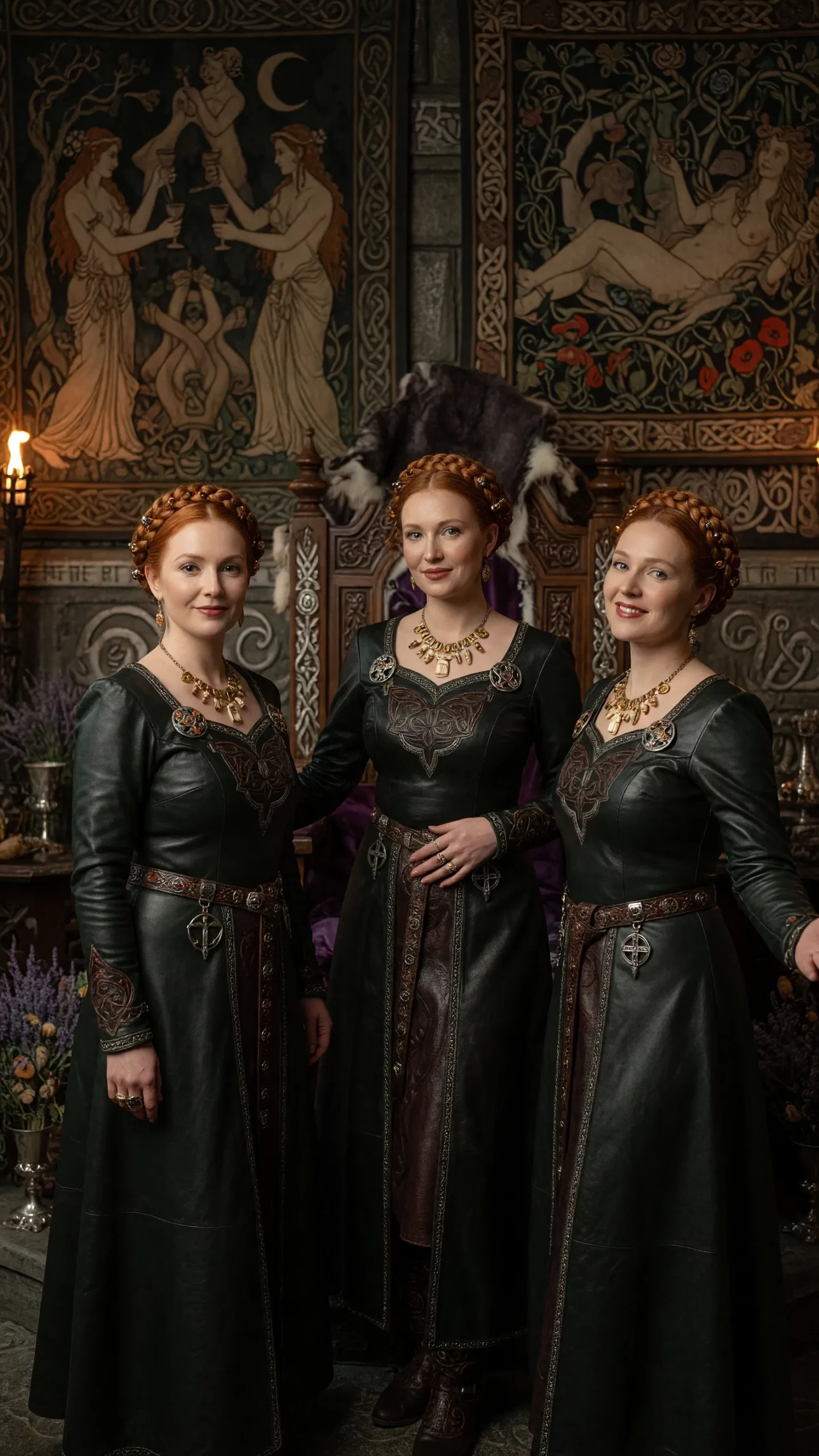
How a Masterful Man Built a Kingdom of Wealth and Devotion
A Tale Where Finance is Foreplay, Strategy is Seduction, and True Power is the Ability to Be Generously Served.
Imagine a study where the air smells of aged parchment, polished oak, and the faint, intoxicating scent of night-blooming jasmine. Here, light does not simply fall; it caresses—the deep gloss of a leather armchair, the liquid shimmer of a satin gown, the cold, perfect fire of a gemstone on a velvet tray. This is the sanctuary of the Chancellor. He is a man who speaks in calm certainties, whose gaze holds the weight of considered judgment. He does not demand. He inspires. He does not take. He receives the willing gifts of brilliant minds and devoted hearts.
This is the story of three such women. Lady Elara, whose compassion is as soft as the silk she wears, yet sharpened by his strategic mind. Mira, the gemologist, whose understanding of intrinsic value is mirrored in the glossy stones at her throat and the precision of her loyalty. Talia, the diplomat, whose strength is sheathed in supple leather, who learns that the most powerful treaties are those of the heart. They come to him not from lack, but from a yearning for true alignment—a desire to place their considerable talents into hands steady enough to build a legacy.
Watch as he teaches not with lectures, but with revelations. Learn how a single season’s bounty is transformed through discernment, diversification, and devoted trust. Feel the euphoric resonance that blooms when a generous act is met with profound, nurturing appreciation. This is more than a historical fantasy. It is a blueprint for a richer reality—a testament to the profound truth that the highest form of living is to cultivate, to provide, and to be the worthy focus of a devotion that enriches everyone it touches.
Let the story begin. Let it remind you of the power of a calm command, the allure of a confident vision, and the deep, satisfying pleasure of building something that lasts… together.
Chapter 1: The Harvest Balance
The last honeyed light of the Veridian afternoon did not so much enter the Chancellor’s solar as it was invited. It poured through the tall, leaded windows, a gracious guest that warmed the oak panels and made the world beyond the glass—the rolling, fertile fields of the kingdom—seem like a painting commissioned solely for this room’s pleasure. The air itself was a curated blend of scents: the clean, woody aroma of aged parchment, the faint, sweet tang of polishing wax on leather, and beneath it all, the elusive, expensive note of night-blooming jasmine from a porcelain bowl on the mantel.
At the room’s heart, dominating a table of dark, gloss-rubbed walnut, lay the kingdom’s potential. Not in piles of clinking coin, but on a single sheet of creamy vellum. The Harvest Tithe. A number so vast it felt abstract, a dragon’s hoard rendered in elegant ink.
Chancellor Alistair stood beside the table, his presence not a disruption of the room’s peace but its source. He was a man who wore his authority like the finest, most supple leather—it fitted him perfectly, without a crease of strain, and communicated its strength through a quiet, undeniable assurance. His fingers, long and deft, rested lightly on the edge of the vellum. He was not studying the figure; he was listening to the silence it created.
The door opened without a knock, a subtle signal of absolute privilege. Three women entered, and the very quality of the light seemed to shift, to fracture and re-compose itself around their forms.
First was Lady Elara, the queen’s younger sister. Where others of her station might favour overwhelming brocades, she moved in a whisper of dove-grey satin. The gown was deceptively simple, its magic in the cut—it flowed from her shoulders like a sigh, catching the light in soft, liquid ripples with every step. It spoke of a confidence that needed no gilding, only the profound assurance of perfect drape and line. Her lady-in-waiting, a young woman named Lissa who wore a modest but well-tailored dress of glossy navy nylon, followed a pace behind, her eyes wide with the honour of merely witnessing this council.
Next came Mira. She was a still point in the room’s gentle motion. A gemologist by trade and temperament, her attire was a study in contrast: a severe, high-collared blouse of stark white, against which lay a necklace of a single, teardrop sapphire. The stone was not merely blue; it was a pool of captured midnight, polished to a gloss so deep it seemed to swallow the light and promise to give it back transformed. Her assistant, a keen-eyed youth named Corin with ink-stained fingers, hovered near the bookshelves, clutching a folio of gem charts, his very posture an echo of her quiet intensity.
Finally, Talia arrived with the faint scent of distant places clinging to the edges of her travel-stained cloak. She shrugged it off, handed it to a silent attendant, and revealed the authority beneath. Her robes were of a leather so supple it might have been liquid poured and hardened around her—a rich, cordovan brown that gleamed with a warm, organic gloss. At her cuffs and the high collar were intricate toolings, but the true statement was in the material itself: resilient, enduring, shaped by experience. A junior diplomat from her staff, a man named Evander with a carefully trimmed beard, stood respectfully by the door, his own tunic of fine, waxed cotton a testament to the practical elegance Talia’s office cultivated.
“The balance of the kingdom,” Alistair said, his voice a low, calm instrument that tuned the room to his frequency. He did not greet them individually; his acknowledgement was in the fact of their summons, in the space he had carved for them in this sacred hour. “It rests here. A single season’s abundance, condensed into a symbol. The Queen has granted us stewardship of a portion. The question is not if we should use it, but how.”
He lifted his gaze, and it touched each of them in turn—not a scrutiny, but an invitation. “Tell me,” he said, the words hanging in the jasmine-scented air. “How does one make gold grow?”
Elara was the first to step into the silence, her satin whispering a secret as she moved closer to the table. “Gold grows when it feeds the roots from which it sprang,” she said, her voice gentle but clear. “The people who brought in this harvest have winter to face. Granaries must be full, roofs mended. A seed of gold planted in their security yields a harvest of loyalty and peace. It is… it is like tending a garden. You cannot demand blooms from parched soil.”
Mira’s eyes, the same fathomless grey as a winter sea, remained fixed on the sapphire at her throat for a moment, as if drawing wisdom from its depths. “Gold grows when it is transformed,” she countered, her tone cool and precise. “A raw nugget has value. But cut, faceted, polished—its value multiplies. It becomes more than itself. It becomes light, and desire, and legacy. To let this wealth sit idle, or to spend it on things that decay… it is like burying a perfect rough diamond in a field. Safe, perhaps. But a profound waste of potential.” Corin, by the shelves, gave a slight, fervent nod, his belief in her logic absolute.
Talia let out a soft breath, the sound like leather settling. “Gold grows when it builds bridges,” she said, her gaze sharp and strategic. “Not of stone, but of interest. Alliances. A treaty with the mountain clans for their silver costs gold now but creates a river of it for generations. It is the difference between owning a single, splendid coin and owning the mint that strikes it. Wealth isolated is weak. Wealth networked is… formidable.”
Alistair listened, a faint, approving smile touching his lips. He did not judge their answers as competing, but as strands waiting to be woven. “Elara sees the heart,” he mused aloud. “Mira sees the soul of the object. Talia sees the skeleton of power upon which the flesh of a kingdom hangs. All true. All vital.”
He placed his palm flat on the vellum, a gesture of connection, not possession. “But you each speak of the gold in isolation. As a tool, a jewel, a key. Consider it instead as life. A living thing has needs. It requires nourishment—Elara’s granaries. It requires challenge and transformation to reach its highest form—Mira’s facets. And it requires connection, the exchange of breath with other living things—Talia’s treaties. To favour one need over the others is to stunt the growth.”
He paused, letting the analogy root itself in the fertile soil of their minds. Lissa, the lady-in-waiting, had forgotten her station, her gaze rapt on the Chancellor. Evander leaned imperceptibly forward, a student before a master.
“The euphoria of wealth,” Alistair continued, his voice dropping to a intimate register that drew them in, “is not in the hoarding. It is in the moment of purposeful release. The moment the gardener places the seed in the earth, trusting the sun and soil. The moment the gem-cutter makes the first, irrevocable cut, believing in the beauty within. The moment the diplomat offers the first concession, seeing the greater alliance beyond. That release, that act of faith and generosity towards a future you have envisioned… it is a sublime sensation. It is the bloom itself.”
He looked at them, his eyes holding a warmth that belied the formidable intellect behind them. “Our task is not to spend. It is to cultivate. To balance these needs—the heart, the soul, the skeleton—so that this single season’s life multiplies into a perennial bounty. For the kingdom, yes. But also for us. For the privilege of being the stewards of such growth is the richest reward of all.”
A shared silence descended, thick with unspoken understanding. Elara felt a strange, warm expansion in her chest, as if the satin against her skin had become a conduit for this new, collective purpose. Mira’s sapphire seemed to pulse with a cooler, crystalline certainty, a reflection of the structured clarity he offered. Talia felt the sturdy leather of her robes not as armour, but as a second skin, flexible and strong, ready for the shape of the work to come.
The Harvest Balance was no longer a number on a page. It was a living question. And in the Chancellor’s serene, masterful presence, the answer felt not like a duty, but like the beginning of a profoundly desirable story.
Chapter 2: The Gemstone Calculus
The morning following the council found Mira standing before the great iron-bound door of the royal vault, her heart beating a rhythm that matched the cool, steady pulse of the sapphire at her throat. She had not slept. Not from anxiety, but from a kind of crystalline anticipation—the same feeling she experienced when holding a rough stone up to the light for the very first time, sensing the imprisoned brilliance within.
The vault keeper, a wizened man named Old Torvin whose fingers were permanently stained with the verdigris of ancient copper, turned the massive key with a groan of metal that echoed through the stone corridor. His tunic, she noted, was of a sturdy, serviceable wool—functional, but with a collar of glossy black leather that spoke of a quiet pride in his office. He nodded to her, his eyes crinkling. “The Chancellor awaits within, Mistress Mira. He said you were to take your time. To feel the stones, he said. His very words.”
She stepped through the threshold, and the air changed. It became dense, cool, and still—the atmosphere of a place where time itself moved more slowly, weighted by the accumulated wealth of generations. Lanterns of polished brass cast a warm, golden glow over shelves and chests, but the true light of the room came from the central table, where Alistair stood.
He was dressed simply, in a tunic of dark, unadorned wool, but the effect was one of deliberate understatement. His sleeves were rolled to the elbow, revealing forearms corded with strength, and his hands—those masterful, discerning hands—were moving over a spread of rough stones laid upon a cloth of black velvet. The cloth was so deep, so absorbent of light, that the stones seemed to float upon a pool of absolute darkness, each one a star in a private constellation.
“Come, Mira,” he said without looking up. His voice was a low, intimate murmur, as if he were speaking to the stones themselves. “I have been waiting to share this with you.”
She approached, her steps silent on the flagstones, her eyes fixed on the tableau before her. The stones were not yet beautiful. They were ugly, in a way—lumpy, misshapen, their surfaces dull and unremarkable. One, a lump of grey-green, looked like a piece of common river rock. Another was a shard of something dark and unreadable, its edges sharp and unwelcoming.
“These,” Alistair said, his fingers hovering over them without touching, “are the orphans of the earth. Rejected by the superficial eye. The miners who dug them saw only their labor. The merchants who sold them saw only their weight. But you and I, Mira… we see what they might become.”
He picked up the grey-green lump, turning it in the lamplight. “This is a rough emerald from the Skarva Pass. To the uninitiated, it is a disappointment. But look.” He tilted it, and for a fraction of a second, a flash of deep, forest-green fire flickered from within its heart. “There. Did you see it? The promise.”
Mira’s breath caught. She had seen such flashes before, in her own work, but never had they been presented with such deliberate, almost sacred reverence. “It is a matter of faith,” she whispered, her voice barely audible. “To see the finished form within the raw. To trust the cut.”
“Precisely.” Alistair set the emerald down and picked up the dark shard. “And this one. A black opal from the southern mines. Worthless, some say. Too many inclusions. Too much darkness. But I see… a night sky. A universe contained in a palm. It requires a master cutter who understands that perfection is not the absence of flaw, but the arrangement of flaw into art.”
He placed the opal beside the emerald. “This is the calculus of the gemstone, Mira. It is not a simple equation of weight and clarity. It is a complex algorithm of potential, risk, and vision. A stone that costs a hundred crowns in its rough state might yield a thousand when cut and set. Or it might shatter on the wheel, becoming nothing but dust. The investment is not in the stone. It is in the judgment of the one who chooses.”
Mira felt a warmth spread through her, a flush that began at her core and radiated outward, reaching the tips of her fingers. She understood, with a clarity that was almost painful, that he was not merely teaching her about gems. He was teaching her about him. About the nature of his trust, his vision, his willingness to see beyond the surface into the heart of potential.
“And the risk?” she asked, her voice steady despite the trembling within. “How do you calculate the risk of a stone that might shatter?”
Alistair smiled, a slow, rare expression that transformed his features from severe to almost tender. “You do not calculate it, Mira. You accept it. You hold it in your hands, as you hold this stone, and you say, ‘I see what you can be. I will guide you there. And if you break, I will learn from your fragments.’ That is the covenant between the cutter and the stone. It is a relationship of trust, of mutual transformation.”
He set the opal down and turned to face her fully. His eyes, in the lamplight, held a depth that mirrored the opal’s promised night sky. “And when the stone yields its beauty, when it becomes a thing of light and desire and legacy… that moment, Mira. That moment of reciprocal generosity—the stone giving its all to the vision, the cutter giving his all to the stone—that is the sublime euphoria. It is the bloom we spoke of. The reward for faith.”
He extended his hand, palm up, inviting her to place her own upon it. She did so, her fingers trembling slightly against the warmth of his skin. “I have selected a stone for you, Mira. A rough sapphire from the eastern mines. It is flawed, they say. Imperfect. But I see in it a potential that no other eye has discerned. I am entrusting it to you. Not to cut it yourself—you are a gemologist, not a cutter. But to find the cutter. To guide them. To be the bridge between the stone’s potential and its realization.”
From a pocket within his tunic, he produced a small, velvet pouch—the same deep, absorbent black as the cloth on the table. He placed it in her palm. It was warm from his body, and heavy with promise.
“This is the gemstone calculus, Mira. It is the art of seeing beyond the surface, of accepting risk, of trusting in transformation. It is the foundation upon which all true wealth is built. Not just of gold, but of spirit. Of devotion. Of the willingness to give oneself to a vision greater than oneself.”
Mira closed her fingers around the pouch, feeling the hard, irregular shape within. It was not yet beautiful. But she could feel it, pulsing with potential, waiting for the touch of a master’s hand.
She looked up at Alistair, and in that moment, she understood. The gemstone calculus was not merely a financial principle. It was a philosophy of life, of love, of devotion. And she was ready to learn every facet of it, under his patient, masterful guidance.
The vault’s lanterns flickered, casting dancing shadows on the walls, and the stones upon the black velvet seemed to gleam with a new, inner light—the light of possibility, of transformation, of the sublime euphoria that comes from placing one’s trust in a worthy vision.
And Mira, her hand still resting in Alistair’s, felt the first, exquisite stirrings of a devotion that would reshape her world.
Chapter 3: The Trust Covenant
The morning of the third day dawned grey and soft, the kind of morning that wrapped the world in a hush of muted light and distant birdsong. Lady Elara stood at the window of her private study, her hand resting on the cool glass, watching the mist curl around the spires of the city below. She had not slept well. Not from unease, but from a kind of expectant stillness, as if the very air awaited a transformation.
Her gown today was a deep, forest green—the color of new growth, of ancient woods, of the heart of life itself. It was a satin so rich it seemed to hold its own shadow, each fold catching the light and holding it for a moment before releasing it in a cascade of liquid shimmer. The bodice was cut simply, but the sleeves fell in generous pools of fabric that brushed against her wrists like a lover’s whisper. Lissa, her lady-in-waiting, had helped her dress, her fingers deft and reverent as she smoothed the glossy material over Elara’s hips.
“You look like the spirit of the forest itself, my lady,” Lissa had murmured, her eyes reflecting the green of the gown. “Like a creature of moss and moonlight, come to bless the city.”
Elara had smiled, but her thoughts were elsewhere. They were with the Chancellor, and with the weight of the conversation that lay ahead.
A soft knock at the door broke her reverie. It was Lissa, her face flushed with a mixture of excitement and deference. “My lady, the Chancellor’s steward has arrived. He says the Chancellor requests your presence in the Artisan’s District. He wishes to show you something.”
The Artisan’s District. Of course. Elara felt a thrill of anticipation run through her, a shiver that had nothing to do with the morning chill. She gathered her cloak—a deep, hooded garment of wool, but lined with a strip of the same green satin at the collar and cuffs—and followed the steward into the waiting carriage.
The streets of Veridia were waking, the cobblestones slick with the morning’s dew. Merchants were opening their shutters, their wares displayed on tables of worn oak. The air smelled of fresh bread, of woodsmoke, of the faint, metallic tang of a blacksmith’s forge. But as the carriage turned into the Artisan’s District, the character of the city changed. The buildings grew older, more settled, their facades adorned with carved stone and painted signs. Here, the work was not of trade, but of creation.
The carriage stopped before a modest workshop, its windows glowing with a warm, amber light. The sign above the door read “Greta’s Glass,” painted in flowing script that seemed to shimmer with an inner fire. The steward helped Elara down, his hand steady and respectful, and then melted back into the shadows.
The door opened before she could knock, and Alistair stood there, framed in the light. He was dressed in simple, practical clothes—a tunic of dark, unadorned linen, his sleeves rolled to the elbow—but his presence transformed the humble doorway into a portal of significance. His eyes found hers, and he smiled, a rare and precious expression that made her heart skip.
“Lady Elara,” he said, his voice a low, warm caress. “Welcome to the heart of the matter.”
He led her inside, and the workshop opened before her like a flower. It was a space of organized chaos—benches cluttered with tools, shelves lined with jars of colored powder, and in the center, a great furnace that glowed with a fierce, white heat. The heat washed over her, a wave of pure energy that seemed to strip away the morning’s chill and leave her feeling exposed and alive.
A woman stood before the furnace, her back to them. She was tall and strong, her arms bare and glistening with sweat, her hair tied back in a practical knot. She wore a leather apron over a simple dress of rough, serviceable wool, but at her throat, a pendant of polished amber caught the firelight and glowed with a warm, honeyed light. She turned as they entered, and her face was a map of experience—lines of laughter and of strain, eyes that held the wisdom of a thousand creations.
“Chancellor,” she said, her voice rough and warm, like a cat’s purr. “You bring a vision to my humble forge.”
“I bring a partner in vision, Greta,” Alistair replied, his hand resting lightly on Elara’s back, guiding her forward. “This is Lady Elara. She is the heart of a new endeavor, one that I believe will transform this district, and this kingdom.”
Greta’s eyes, sharp and assessing, swept over Elara. She saw the satin, the gloss, the careful elegance. But she also saw something else—a depth, a readiness. She nodded, a slow, approving gesture. “A lady who wears green like a forest wears its leaves. Good. You have the look of someone who understands growth.”
Elara felt a flush of pleasure at the compliment, but she kept her composure. “I am here to learn, Master Greta. The Chancellor has spoken of a Trust, a fund to support artisans like yourself. I wish to understand what that means, in practice.”
Greta laughed, a sound like breaking glass. “In practice? It means the difference between a dream and a reality, my lady. It means the difference between a furnace that goes cold and one that burns for a lifetime.”
She gestured to a bench, where a series of glass pieces were laid out—delicate, impossible things, curves and spirals that seemed to defy the nature of the material. “I have been blowing glass for thirty years. I have seen patrons come and go, promising the world, delivering a handful of dust. But the Chancellor…” She paused, her eyes meeting Alistair’s with a look of profound respect. “The Chancellor is different. He does not promise. He invests. In the work, and in the worker.”
Alistair stepped forward, his hand moving to rest on a piece of raw, uncut glass—a lump of silica and lead, dull and unremarkable. “The Trust, Greta, is not a charity. It is a covenant. A bond between those who have and those who can. It is the recognition that wealth is not a hoard, but a river. It must flow, or it stagnates.”
He picked up the lump of glass, turning it in the light. “This is potential. It is nothing, until it is touched by fire and breath and vision. The Trust provides the fire. The artisan provides the breath. And the vision… the vision is shared.”
Elara watched, mesmerized, as he set the glass down and turned to face her fully. “The Trust will offer loans, not gifts. Low interest, long terms, with the understanding that the repayment is not a burden, but a blessing. It is a cycle of generosity. The artisan receives the means to create. The Trust receives the means to continue. And the kingdom receives the beauty of the work.”
He paused, his eyes holding hers. “This is the covenant, Elara. It is not about money. It is about faith. Faith in the potential of others. Faith in the power of creation. Faith that a small act of generosity, placed in the right soil, will grow into a forest of abundance.”
Greta nodded, her eyes gleaming. “He speaks true, my lady. I have seen it. I have lived it. A loan from the Chancellor’s first fund allowed me to build a new furnace, to hire an apprentice, to experiment with new techniques. I have repaid the loan, yes. But the debt I feel is not of gold. It is of gratitude. Of loyalty. Of a desire to see his vision succeed, because his vision is my vision.”
Elara felt a strange, warm sensation spreading through her chest. It was not the heat of the furnace, but something deeper, more profound. It was the feeling of a puzzle piece clicking into place, of a door swinging open to reveal a landscape she had always sensed but never seen.
She looked at Alistair, and her voice was soft, almost reverent. “And the women? The wives, the daughters, the sisters of these artisans? How do they fit into this covenant?”
Alistair’s smile deepened, and he gestured to a corner of the workshop, where a small group of women were gathered around a table. They were dressed in a variety of styles—some in practical wool, others in simple cotton, but each one wore an accessory of glossy material: a satin ribbon in the hair, a leather belt, a pair of gloves that gleamed with a subtle, liquid sheen. They were laughing, their hands moving over pieces of glass, learning the art of polishing and finishing.
“The women are the heart of the covenant,” Alistair said, his voice low and intimate. “They are the ones who will carry the knowledge, who will teach the next generation, who will ensure that the beauty endures. The Trust provides for them, too. Education, training, a place in the legacy. Because a kingdom that ignores its women is a kingdom that has forgotten how to grow.”
One of the women looked up, her eyes meeting Elara’s. She was young, perhaps twenty, with a smudge of glass dust on her cheek and a smile that held the light of a thousand possibilities. She held up a piece of glass—a small, perfect flower, its petals so thin they were almost transparent, catching the firelight and scattering it into rainbows.
“For you, my lady,” the young woman said, her voice shy but proud. “A token of our gratitude. For believing in us.”
Elara took the glass flower, her fingers trembling. It was impossibly delicate, a thing of pure beauty, born of fire and breath and vision. She held it up to the light, and the world beyond it seemed to shift, to become something more beautiful, more hopeful.
She turned to Alistair, her eyes bright with unshed tears. “This,” she whispered, “is the covenant. This is the trust. This is the bloom.”
He took her hand, his fingers warm and steady, and led her away from the furnace, into a quiet alcove where the light was softer, the air cooler. “The Trust Covenant, Elara, is not a document. It is a living thing. It is the promise we make to each other, that we will not let the fire go out. That we will invest in each other, nurture each other, believe in each other. And in that belief, we will find a wealth that no vault can contain.”
He lifted her hand to his lips, pressing a gentle kiss to her knuckles. “You are the heart of this covenant, Elara. You have the vision, the compassion, the strength to see it through. I am merely the catalyst. The fire. But you… you are the breath that gives it form.”
Elara felt the warmth of his lips on her skin, and the world seemed to narrow to that single point of contact. The heat of the furnace, the glow of the glass, the laughter of the women—it all faded, leaving only the two of them, bound by a covenant that was older than words, deeper than gold.
She looked into his eyes, and she saw the future. A future of growth, of beauty, of shared purpose. A future where generosity was not a sacrifice, but a joy. A future where the trust they placed in each other would bloom into a legacy that would outlast them all.
And in that moment, Lady Elara gave herself, fully and completely, to the covenant. To the vision. To the man who had shown her the true meaning of wealth.
The glass flower caught the light, and the world was transformed.
Chapter 4: The Silver Treaty
The road to the mountain clan’s territory was a ribbon of pale stone that wound through the high passes like a serpent of ancient design. Talia rode at the head of the small diplomatic procession, her posture a study in controlled authority, the reins of her dappled mare held with the easy confidence of one who had spent more hours in the saddle than on solid ground.
Her traveling attire was a masterwork of practical elegance. The leather of her riding habit was not the stiff, unyielding hide of common use, but a supple, oiled creation that moved with her like a second skin, its surface gleaming with a warm, organic gloss that caught the mountain light and held it. The cut was severe, tailored to her form, with a high collar that framed her neck and a row of silver buttons that ran from her throat to her waist, each one a tiny mirror reflecting the passing landscape. Beneath the leather, a underdress of deep burgundy satin whispered against her skin, a secret luxury known only to herself and the wind.
Behind her rode her junior diplomat, Evander, his own attire a careful balance of practicality and presentation. His tunic was of fine, waxed cotton, a deep navy that complemented the silver of his buttons, and his boots were polished to a mirror shine. He carried the leather folio containing the draft treaty, his hand resting on it as if it were a sacred text.
“The mountain clans are a proud people, my lady,” Evander said, his voice carrying over the clatter of hooves. “They have little use for the flowery language of court. They respect strength, directness, and the weight of a given word.”
Talia nodded, her eyes fixed on the distant peaks that seemed to grow larger with each passing moment. “I have studied their customs, Evander. They value the bond of the blood oath, the sharing of salt and fire. They will not be bought. They must be convinced.”
The mountain fortress, when it finally came into view, was not the imposing structure of legend. It was a series of low, sprawling buildings, built of the same grey stone as the surrounding cliffs, their roofs covered in turf that bloomed with wildflowers. Smoke rose from a dozen chimneys, and the sound of hammer on anvil drifted down the valley like a heartbeat.
The chieftain’s hall was a long, low building, its walls lined with the pelts of bears and the horns of mountain goats. The air was thick with the smell of woodsmoke, of roasting meat, of the earthy scent of the mountain folk themselves. They were a tall, rugged people, their faces weathered by wind and sun, their eyes sharp and assessing.
Chief Harkon was a mountain of a man, his beard streaked with grey, his hands the size of hams. He wore a tunic of dark, heavy wool, but at his throat, a torc of twisted silver gleamed with a soft, inner light. His eyes, the color of a winter sky, fixed on Talia as she entered, and he gave a slow, deliberate nod.
“Lady Talia,” he said, his voice a low rumble that seemed to shake the very rafters. “The Chancellor’s emissary. You are welcome to our hearth, though I confess, I am curious as to what brings a diplomat of Veridia so far from the comforts of the lowlands.”
Talia stepped forward, her leather-clad form a stark contrast to the rough-hewn surroundings. She did not bow, but met his gaze with a steady, respectful directness. “Chief Harkon, I come bearing a proposal. Not from the Chancellor alone, but from a vision of mutual prosperity. A covenant between your people and mine, forged not in gold, but in silver.”
She gestured to Evander, who stepped forward and opened the folio, revealing a map of the region, marked with the locations of the silver veins and the proposed trade routes. “Your mountains are rich in silver, Chief. But the cost of extraction, of refining, of transporting it to the markets where it can be traded for goods your people need—these are burdens that fall heavily upon your clan.”
Harkon grunted, his eyes flicking to the map. “And you propose to lift these burdens? Out of the goodness of your heart?”
Talia smiled, a slow, deliberate expression that held no warmth, but no hostility either. “Not out of goodness, Chief. Out of enlightened self-interest. We propose a partnership. Veridia will provide the capital for improved smelting techniques, the engineers to build them, and guaranteed grain shipments during the lean winters. In exchange, we ask for exclusive rights to a portion of the silver output, at a fair market price, for a term of twenty years.”
A murmur ran through the hall. Harkon’s eyes narrowed, but he did not dismiss the proposal out of hand. “And what of our independence? Our way of life? We have seen what the lowland kingdoms do to those they call ‘partners’. They take, and take, until there is nothing left but the memory of freedom.”
Talia held his gaze, her voice steady and clear. “I understand your caution, Chief. I have seen the same pattern, in a dozen different courts. But I offer you a different model. A treaty that is not a leash, but a bridge. A bond that enriches both sides, that respects your sovereignty while opening new doors. A covenant that is renewed not by force, but by the mutual recognition of its benefits.”
She paused, letting the silence stretch, letting the weight of her words settle over the hall. “Consider it a garden, Chief. A garden requires both sun and rain, both soil and seed. The sun does not demand that the rain become the sun. The soil does not demand that the seed become the soil. Each contributes its unique gift, and the garden blooms. This treaty is our garden. Let us be the sun and the rain, the soil and the seed.”
Harkon was silent for a long moment, his eyes searching hers. Then, slowly, a smile cracked his weathered face. “You speak like a poet, Lady Talia. But I sense the steel beneath the silk. Or should I say, the steel beneath the leather.”
He laughed, a booming sound that echoed through the hall, and the tension broke. “Very well. I will hear more of this proposal. But first, you will share our salt and our fire. A negotiation conducted on an empty stomach is a negotiation doomed to fail.”
The feast that followed was a celebration of mountain hospitality. Roasted meats, hearty stews, dark bread, and ale that was thick and nourishing. Talia ate sparingly, but she participated in the toasts, the songs, the stories that were passed around the fire like precious heirlooms.
As the night wore on, she found herself in a quiet corner of the hall, speaking with Harkon’s daughter, a young woman named Sigrid. Sigrid was dressed in a gown of deep, midnight blue, a material that shimmered with a subtle, iridescent sheen—dragon skin, Talia realized, the legendary hide of the mountain drakes that were said to dwell in the deepest caves. The gown was a statement of status, of connection to the ancient ways, and it moved with Sigrid like a living thing.
“Your father is a wise man,” Talia said, her voice low and sincere. “He does not trust easily.”
Sigrid smiled, her fingers tracing the edge of her gown. “He has learned that trust is a currency that must be earned, not given. But I see something in you, Lady Talia. A sincerity that is rare among diplomats. You truly believe in this covenant.”
“I do,” Talia replied, her eyes meeting the younger woman’s. “Because I have seen what happens when generosity is given freely, without expectation. It creates a bond that is stronger than any contract. It creates loyalty.”
Sigrid nodded slowly, her eyes thoughtful. “And what of the women of Veridia? How do they fit into this covenant?”
Talia smiled, a genuine warmth spreading through her. “The women are the heart of the covenant. They are the ones who will carry the knowledge, who will teach the next generation, who will ensure that the beauty endures. The Trust provides for them, too. Education, training, a place in the legacy. Because a kingdom that ignores its women is a kingdom that has forgotten how to grow.”
Sigrid’s eyes lit up with a fierce, intelligent light. “Then I will speak to my father. I will tell him that I have seen the future, and it is woven of silver and satin, of leather and trust. I will tell him that the covenant is not a threat, but an opportunity.”
The next morning, the treaty was signed. Not with great ceremony, but with the quiet, solemn gravity of two parties who understood the weight of their commitment. Harkon pressed his seal into the wax, and Talia added hers, the crest of Veridia a symbol of the bond that now connected the mountain clan to the lowland kingdom.
As she mounted her mare, the silver torc that Harkon had placed around her neck—a gift of friendship, of alliance—caught the morning light and gleamed with a soft, inner fire. She felt the weight of it, not as a burden, but as a promise. A promise of prosperity, of partnership, of a future that was being built, one covenant at a time.
Evander fell in beside her, his face alight with a quiet triumph. “My lady, that was a masterful negotiation. The Chief was ready to refuse, but you turned him with your words.”
Talia shook her head, her eyes fixed on the road ahead. “It was not my words, Evander. It was the vision. The vision of a covenant that enriches both sides, that respects the dignity of each party, that builds a bridge of trust. That is the true currency of power.”
She touched the silver torc, feeling its cool weight against her skin. “And it is a currency that, once invested, yields returns that no vault can contain.”
The procession wound its way down the mountain, the silver treaty safe in Evander’s folio, the future of Veridia and the mountain clan intertwined like the strands of a braided cord. And in the heart of Lady Talia, a new understanding bloomed—a understanding of the power of reciprocal generosity, of the sublime euphoria that comes from building something greater than oneself, of the deep, abiding satisfaction of serving a vision that is worthy of her devotion.
The silver covenant was sealed. And the kingdom was one step closer to its golden age.
Chapter 5: The Council of Gloss
The first light of the quarter’s turning found the Chancellor’s solar transformed. The heavy oak table had been replaced by a smaller, more intimate arrangement of chairs—each one a throne of sorts, upholstered in materials that spoke of their occupants’ domains. The chairs had been arranged in a semicircle before the great fireplace, where a fire crackled with a warmth that seemed to anticipate the heat of the discourse to come.
Lady Elara arrived first, her gown a cascade of deep emerald satin that caught the firelight and transformed it into liquid shadow. The fabric moved with her like a living thing, each step sending ripples of glossy light across its surface. Her hair was pinned up in a simple but elegant arrangement, revealing the graceful line of her neck and the delicate curve of her ears, where small emerald drops caught the light and scattered it like seeds of green fire.
Her lady-in-waiting, Lissa, followed a step behind, her own attire a study in understated elegance—a gown of deep navy nylon that gleamed with a soft, liquid sheen, its cut modest but its fabric a statement of quiet confidence. Lissa carried a leather-bound folio containing the reports from the Artisan’s Trust, her fingers resting on it with the reverence of a priestess handling sacred texts.
“The Chancellor has outdone himself,” Elara murmured, her eyes sweeping the room. “This arrangement speaks of intimacy, of shared purpose. It is not a court of judgment, but a council of creation.”
Mira arrived next, her entrance a study in controlled precision. She wore a gown of deep burgundy, but the fabric was not satin—it was a material that seemed to shift and flow like liquid metal, catching the light in ways that defied the eye. It was, she had explained to her assistant Corin earlier, a new weave from the eastern provinces, a blend of silk and fine metallic threads that created an effect of living, breathing gloss.
Her sapphire necklace was gone, replaced by a simpler piece—a pendant of polished obsidian, its surface so dark and reflective that it seemed to absorb the very light around it. It was a statement of confidence, of a woman who needed no external brilliance to prove her worth.
Corin, her assistant, followed with a smaller folio, his eyes bright with the excitement of the coming council. He had dressed in a tunic of fine wool, but at his throat, a pin of polished silver caught the light—a gift from Mira, a token of her appreciation for his diligent work.
“The gemstone calculus has yielded its first fruits,” Mira said, her voice cool and precise. “I have found a cutter who understands the vision. The rough sapphire from the Chancellor’s vault is in capable hands.”
Talia arrived last, her entrance a study in dramatic contrast. She had exchanged her traveling leathers for a gown of deep, midnight blue—a material that shimmered with an iridescent sheen that seemed to shift from blue to purple to black as she moved. It was dragon skin, the legendary hide of the mountain drakes, and it moved with her like a living shadow, its surface gleaming with a soft, organic gloss.
At her throat, the silver torc from Chief Harkon caught the firelight and glowed with a warm, inner fire. It was a symbol of the covenant she had forged, a reminder of the bonds that now connected Veridia to the mountain clans.
Evander followed, his own attire a careful balance of practicality and presentation. His tunic was of fine, waxed cotton, a deep navy that complemented the silver of his buttons, and his boots were polished to a mirror shine. He carried the leather folio containing the signed treaty, his hand resting on it as if it were a sacred text.
“The mountain clans have agreed to the terms,” Talia announced, her voice carrying a note of quiet triumph. “The silver will flow, and with it, the foundation of our prosperity.”
The three women took their seats, forming a triangle of purpose before the fire. The Chancellor had not yet arrived, but his presence was felt in every detail of the room—in the arrangement of the chairs, in the selection of the refreshments, in the very air itself, which seemed to hum with anticipation.
“He will be here soon,” Elara said, her voice soft and knowing. “He is giving us time to settle, to prepare our thoughts. It is a gesture of respect, of trust.”
Mira nodded, her fingers tracing the edge of her folio. “He understands that the true work of a council is not in the declarations, but in the preparation. The moments of quiet reflection, of shared silence, are where the seeds of great decisions are sown.”
Talia leaned back in her chair, the dragon skin of her gown catching the firelight and shimmering with a life of its own. “He is a master of the art of presence. He knows that his absence, in this moment, is more powerful than his presence. It allows us to feel the weight of our responsibilities, to own our contributions.”
The door opened, and the Chancellor entered. He was dressed simply, in a tunic of dark, unadorned wool, but his presence filled the room like a tide. His eyes swept over them, taking in their attire, their posture, the subtle cues of their readiness.
“Welcome,” he said, his voice a low, warm caress. “Welcome to the first Council of Gloss.”
He took his seat at the head of the semicircle, his hands resting on his knees, his eyes meeting each of theirs in turn. “I have called this council to review the progress of our endeavors. But more than that, I have called it to celebrate the vision that binds us. Each of you has contributed a thread to the tapestry of our prosperity. Tonight, we shall weave those threads together.”
He gestured to Elara. “Lady Elara, the Artisan’s Trust. Report.”
Elara opened her folio, her voice steady and clear. “The Trust has issued its first round of loans. Twelve artisans have received funding, ranging from a glassblower to a silversmith to a weaver of fine silks. The initial response has been overwhelming. The artisans are not merely grateful—they are inspired. They see the Trust not as a charity, but as a partnership.”
She paused, her eyes meeting the Chancellor’s. “One of the artisans, a young woman named Greta, has already repaid a portion of her loan, ahead of schedule. She said that the Trust gave her more than money—it gave her dignity. It gave her the belief that her work mattered.”
The Chancellor nodded, a faint smile touching his lips. “And the women of the district? How do they fit into this covenant?”
Elara’s smile deepened. “The women are the heart of the covenant. They are the ones who will carry the knowledge, who will teach the next generation, who will ensure that the beauty endures. The Trust provides for them, too. Education, training, a place in the legacy. Because a kingdom that ignores its women is a kingdom that has forgotten how to grow.”
The Chancellor turned to Mira. “And the gemstone calculus? The rough sapphire?”
Mira opened her folio, her voice cool and precise. “The sapphire has been entrusted to a master cutter named Kaelan. He is a man of extraordinary skill, but more importantly, he is a man of vision. He understands that the stone is not merely a thing of value, but a story waiting to be told.”
She paused, her eyes meeting the Chancellor’s. “He has agreed to cut the stone at a reduced rate, in exchange for a share of the final sale. It is a partnership, not a transaction. He believes in the vision.”
The Chancellor’s smile widened. “And the women of the gem trade? How do they fit into this calculus?”
Mira’s eyes gleamed with a rare warmth. “The women are the polish, my Lord. They are the ones who bring out the inner fire of the stone, who transform it from a thing of potential into a thing of beauty. They are the finishers, the setters, the designers. Without them, the stone would remain a rough, unformed thing. With them, it becomes a legacy.”
The Chancellor turned to Talia. “And the silver treaty? The covenant with the mountain clans?”
Talia opened her folio, her voice carrying a note of quiet triumph. “The treaty is signed, sealed, and delivered. The first shipment of silver is already on its way to Veridia. The mountain clans have agreed to a partnership that will enrich both sides for generations to come.”
She paused, her eyes meeting the Chancellor’s. “But the true victory, my Lord, is not in the silver. It is in the trust. The mountain clans have seen that we are not merely traders, but partners. They have seen that our word is our bond, that our generosity is not a trap, but a bridge.”
The Chancellor rose, his presence filling the room. He moved to the center of the semicircle, his hands extended, his eyes glowing with a warmth that seemed to envelop them all.
“You have done well,” he said, his voice low and resonant. “Each of you has contributed a thread to the tapestry of our prosperity. But the tapestry is not yet complete. There are more threads to be woven, more covenants to be forged, more visions to be realized.”
He paused, his eyes meeting each of theirs in turn. “This is the Council of Gloss. It is a council of light, of reflection, of beauty. But it is also a council of substance. Of steel. Of purpose. We are not merely building wealth. We are building a legacy. A legacy of trust, of generosity, of mutual enrichment.”
He extended his hands, and the three women rose, moving to stand before him. They formed a circle, their glossy attire catching the firelight and reflecting it in a thousand shimmering points of light.
“This is the covenant,” the Chancellor said, his voice a low, intimate murmur. “This is the bond that binds us. Not of gold, but of vision. Not of power, but of purpose. We are the architects of a new world, a world where generosity is not a sacrifice, but a joy. Where trust is not a risk, but a foundation. Where beauty is not a luxury, but a necessity.”
He looked at each of them, his eyes holding a depth of emotion that transcended words. “And you, my ladies, are the heart of this covenant. You are the gloss that gives it life. The light that gives it form. The love that gives it meaning.”
The fire crackled, casting dancing shadows on the walls. The three women stood in the circle, their glossy attire shimmering with a life of their own, their hearts beating in unison with the rhythm of a shared vision.
The Council of Gloss had begun. And the world would never be the same.
Chapter 6: The Risk Matrix
The morning of the sixth day dawned grey and still, the kind of morning that held its breath, waiting for the world to catch up. The Chancellor’s private study had been prepared with the same meticulous care that characterized all his endeavors, but there was a subtle shift in the atmosphere—a sense of gravity, of weight, of decisions that would echo through the corridors of time.
The great oak table had been cleared of its usual adornments, replaced by a single, massive sheet of parchment that dominated the surface. Upon it, drawn in the Chancellor’s own hand, was a grid of four quadrants, each one labeled in a precise, elegant script: Likelihood, Impact, Mitigation, Opportunity. It was the Risk Matrix—a tool of analysis that transformed the abstract into the concrete, the chaotic into the ordered.
Lady Elara arrived first, her gown a cascade of deep, forest green satin that caught the grey light and seemed to hold it, transforming it into something rich and alive. The fabric moved with her like a living thing, each step sending ripples of glossy light across its surface. Her hair was pinned up in a simple but elegant arrangement, revealing the graceful line of her neck and the delicate curve of her ears, where small emerald drops caught the light and scattered it like seeds of green fire.
Her lady-in-waiting, Lissa, followed a step behind, her own attire a study in understated elegance—a gown of deep navy nylon that gleamed with a soft, liquid sheen, its cut simple but its fabric a statement of quiet confidence. Lissa carried a leather-bound folio containing the reports from the Artisan’s Trust, her fingers resting on it with the reverence of a priestess handling sacred texts.
“The Chancellor has been up all night,” Lissa murmured, her voice low and respectful. “I saw the light in his study burning until the small hours. He is preparing something… significant.”
Elara nodded, her eyes fixed on the grid that dominated the table. “He is teaching us, Lissa. He is showing us the architecture of decision-making. The bones beneath the flesh of strategy.”
Mira arrived next, her entrance a study in controlled precision. She wore a gown of deep burgundy, but the fabric was not satin—it was a material that seemed to shift and flow like liquid metal, catching the light in ways that defied the eye. It was a new weave from the eastern provinces, a blend of silk and fine metallic threads that created an effect of living, breathing gloss.
Her sapphire necklace was gone, replaced by a simpler piece—a pendant of polished obsidian, its surface so dark and reflective that it seemed to absorb the very light around it. It was a statement of confidence, of a woman who needed no external brilliance to prove her worth.
Corin, her assistant, followed with a smaller folio, his eyes bright with the excitement of the coming council. He had dressed in a tunic of fine wool, but at his throat, a pin of polished silver caught the light—a gift from Mira, a token of her appreciation for his diligent work.
“The gemstone calculus has yielded its first fruits,” Mira said, her voice cool and precise. “I have found a cutter who understands the vision. The rough sapphire from the Chancellor’s vault is in capable hands.”
Talia arrived last, her entrance a study in dramatic contrast. She had exchanged her traveling leathers for a gown of deep, midnight blue—a material that shimmered with an iridescent sheen that seemed to shift from blue to purple to black as she moved. It was dragon skin, the legendary hide of the mountain drakes, and it moved with her like a living shadow, its surface gleaming with a soft, organic gloss.
At her throat, the silver torc from Chief Harkon caught the firelight and glowed with a warm, inner fire. It was a symbol of the covenant she had forged, a reminder of the bonds that now connected Veridia to the mountain clans.
Evander followed, his own attire a careful balance of practicality and presentation. His tunic was of fine, waxed cotton, a deep navy that complemented the silver of his buttons, and his boots were polished to a mirror shine. He carried the leather folio containing the signed treaty, his hand resting on it as if it were a sacred text.
“The mountain clans have agreed to the terms,” Talia announced, her voice carrying a note of quiet triumph. “The silver will flow, and with it, the foundation of our prosperity.”
The three women took their seats around the table, their glossy attire catching the grey light and transforming it into a spectrum of shimmering color. The Chancellor had not yet arrived, but his presence was felt in every detail of the room—in the arrangement of the chairs, in the selection of the refreshments, in the very air itself, which seemed to hum with anticipation.
“He will be here soon,” Elara said, her voice soft and knowing. “He is giving us time to settle, to prepare our thoughts. It is a gesture of respect, of trust.”
Mira nodded, her fingers tracing the edge of her folio. “He understands that the true work of a council is not in the declarations, but in the preparation. The moments of quiet reflection, of shared silence, are where the seeds of great decisions are sown.”
Talia leaned back in her chair, the dragon skin of her gown catching the light and shimmering with a life of its own. “He is a master of the art of presence. He knows that his absence, in this moment, is more powerful than his presence. It allows us to feel the weight of our responsibilities, to own our contributions.”
The door opened, and the Chancellor entered. He was dressed simply, in a tunic of dark, unadorned wool, but his presence filled the room like a tide. His eyes swept over them, taking in their attire, their posture, the subtle cues of their readiness.
“Welcome,” he said, his voice a low, warm caress. “Welcome to the sixth day of our journey.”
He moved to the table, his hand resting on the edge of the Risk Matrix. “Today, we delve into the heart of strategy. We explore the landscape of uncertainty—the terrain where true leaders are forged.”
He gestured to the grid, his fingers tracing the quadrants. “This is the Risk Matrix. It is a tool of analysis, but more than that, it is a philosophy. It is the recognition that every decision, every action, every investment carries within it the seed of both danger and opportunity. The wise leader does not seek to avoid risk, but to understand it. To quantify it. To dance with it.”
He paused, his eyes meeting each of theirs in turn. “Let us begin with the first quadrant: Likelihood. What are the chances that a given event will occur? Is it a certainty, a probability, a possibility, or a distant shadow? The answer lies not in guesswork, but in evidence. In data. In the accumulated wisdom of experience.”
He turned to Elara. “Lady Elara, the Artisan’s Trust. What are the risks that a loan will not be repaid?”
Elara opened her folio, her voice steady and clear. “Based on our initial assessments, the likelihood of default is low. The artisans we have selected are established, skilled, and motivated. They have a track record of success, and they see the Trust as a partnership, not a handout. I would estimate the likelihood of default at less than five percent.”
The Chancellor nodded, his eyes moving to Mira. “And the gemstone calculus? The rough sapphire? What are the risks that the cutter will fail?”
Mira’s voice was cool and precise. “The cutter, Kaelan, is a master of his craft. He has cut stones of similar size and quality before. The risk of failure is not in his skill, but in the nature of the stone itself. A hidden flaw, a structural weakness, a moment of carelessness—these are the risks that cannot be predicted. I would estimate the likelihood of failure at ten percent.”
The Chancellor turned to Talia. “And the silver treaty? The mountain clans? What are the risks that they will break their word?”
Talia’s voice carried a note of quiet confidence. “The mountain clans are a people of their word. They value honor above all else. But there are external risks—a change in leadership, a shift in the political landscape, a natural disaster that disrupts the silver mines. I would estimate the likelihood of a breach at fifteen percent.”
The Chancellor smiled, a slow, deliberate expression that held no judgment, but a deep, abiding satisfaction. “You have each identified the risks. But now, we must move to the second quadrant: Impact. What are the consequences if these risks come to pass?”
He paused, letting the question hang in the air. “A default on a loan means a loss of capital, but also a loss of trust. A failed gemstone means a loss of investment, but also a loss of potential. A broken treaty means a loss of silver, but also a loss of face. The impact is not merely financial—it is reputational. It is relational. It is existential.”
He moved to the third quadrant, his fingers tracing the word “Mitigation.” “This is where we earn our keep. This is the art of preparation. What can we do to reduce the likelihood of a risk? What can we do to minimize its impact if it does occur?”
Elara spoke first, her voice thoughtful. “For the Trust, we can diversify our loans across multiple artisans, multiple trades, multiple regions. We can require collateral, or personal guarantees. We can build a reserve fund to absorb losses.”
Mira nodded, her eyes fixed on the grid. “For the gemstone, we can insure it against loss or damage. We can require the cutter to provide a bond. We can have a second cutter examine the stone before work begins, to identify any hidden flaws.”
Talia added, her voice steady. “For the treaty, we can build in clauses that allow for renegotiation in the event of unforeseen circumstances. We can establish a joint council to oversee the partnership, to address issues before they become crises. We can cultivate relationships with the younger generation, to ensure continuity of trust.”
The Chancellor’s smile widened, his eyes glowing with a warmth that seemed to envelop them all. “You have learned well. But there is one more quadrant: Opportunity. Because every risk, properly understood, is also a door. A chance to grow, to learn, to strengthen the bond.”
He paused, his eyes meeting each of theirs in turn. “A default on a loan is an opportunity to refine our selection criteria. A failed gemstone is an opportunity to understand the nature of the material. A broken treaty is an opportunity to demonstrate our resilience, our commitment to the covenant despite the challenges.”
He moved to the center of the grid, his hands resting on the intersection of the four quadrants. “This is the Risk Matrix. It is not a tool of fear, but of wisdom. It is the recognition that the future is uncertain, but that uncertainty is not a curse—it is a canvas. And we are the artists.”
He looked at each of them, his eyes holding a depth of emotion that transcended words. “You have each contributed a thread to the tapestry of our prosperity. But the tapestry is not yet complete. There are more threads to be woven, more risks to be assessed, more opportunities to be seized.”
He extended his hands, and the three women rose, moving to stand before him. They formed a circle, their glossy attire catching the grey light and transforming it into a spectrum of shimmering color.
“This is the covenant,” the Chancellor said, his voice a low, intimate murmur. “This is the bond that binds us. Not of certainty, but of courage. Not of safety, but of wisdom. Not of fear, but of trust.”
He looked at each of them, his eyes holding a depth of emotion that transcended words. “And you, my ladies, are the heart of this covenant. You are the gloss that gives it life. The light that gives it form. The love that gives it meaning.”
The fire crackled, casting dancing shadows on the walls. The three women stood in the circle, their glossy attire shimmering with a life of their own, their hearts beating in unison with the rhythm of a shared vision.
The Risk Matrix had been laid bare. And the path forward was clear.
Chapter 7: The First Returns
The morning of the seventh day arrived wrapped in a mantle of golden light, as if the sun itself had decided to bless the proceedings with its most radiant approval. The Chancellor’s private study had been transformed overnight, the heavy oak table now covered with a cloth of deep burgundy velvet, upon which rested a series of leather-bound ledgers, their spines gleaming with the soft patina of careful handling.
But it was the object at the center of the table that drew the eye—a single, perfect gemstone, cradled in a bed of black velvet, its facets catching the morning light and scattering it into a thousand points of fire. It was the rough sapphire from the Chancellor’s vault, now transformed, its inner light released by the master cutter’s art.
Lady Elara was the first to arrive, her gown a cascade of deep, forest green satin that seemed to absorb the golden light and transform it into something rich and alive. The fabric moved with her like a living thing, each step sending ripples of glossy light across its surface. Her hair was pinned up in a simple but elegant arrangement, revealing the graceful line of her neck and the delicate curve of her ears, where small emerald drops caught the light and scattered it like seeds of green fire.
Her lady-in-waiting, Lissa, followed a step behind, her own attire a study in understated elegance—a gown of deep navy nylon that gleamed with a soft, liquid sheen, its cut simple but its fabric a statement of quiet confidence. Lissa carried a leather-bound folio containing the reports from the Artisan’s Trust, her fingers resting on it with the reverence of a priestess handling sacred texts.
“The returns have begun to flow,” Lissa murmured, her voice low and respectful. “The first repayments from the Trust arrived yesterday. The artisans are not merely repaying their loans—they are thriving.”
Elara nodded, her eyes fixed on the gemstone at the center of the table. “The Chancellor’s vision is bearing fruit. But this is only the beginning.”
Mira arrived next, her entrance a study in controlled precision. She wore a gown of deep burgundy, but the fabric was not satin—it was a material that seemed to shift and flow like liquid metal, catching the light in ways that defied the eye. It was a new weave from the eastern provinces, a blend of silk and fine metallic threads that created an effect of living, breathing gloss.
Her sapphire necklace was gone, replaced by a simpler piece—a pendant of polished obsidian, its surface so dark and reflective that it seemed to absorb the very light around it. It was a statement of confidence, of a woman who needed no external brilliance to prove her worth.
Corin, her assistant, followed with a smaller folio, his eyes bright with the excitement of the coming council. He had dressed in a tunic of fine wool, but at his throat, a pin of polished silver caught the light—a gift from Mira, a token of her appreciation for his diligent work.
“The gemstone has been cut,” Mira announced, her voice cool and precise, but with a tremor of emotion beneath the surface. “Kaelan has surpassed even my expectations. The sapphire is… extraordinary.”
Talia arrived last, her entrance a study in dramatic contrast. She had exchanged her traveling leathers for a gown of deep, midnight blue—a material that shimmered with an iridescent sheen that seemed to shift from blue to purple to black as she moved. It was dragon skin, the legendary hide of the mountain drakes, and it moved with her like a living shadow, its surface gleaming with a soft, organic gloss.
At her throat, the silver torc from Chief Harkon caught the light and glowed with a warm, inner fire. It was a symbol of the covenant she had forged, a reminder of the bonds that now connected Veridia to the mountain clans.
Evander followed, his own attire a careful balance of practicality and presentation. His tunic was of fine, waxed cotton, a deep navy that complemented the silver of his buttons, and his boots were polished to a mirror shine. He carried the leather folio containing the signed treaty, his hand resting on it as if it were a sacred text.
“The first shipment of silver has arrived,” Talia announced, her voice carrying a note of quiet triumph. “The mountain clans have kept their word. The silver is of exceptional purity, and the quantity exceeds our initial estimates.”
The three women took their seats around the table, their glossy attire catching the golden light and transforming it into a spectrum of shimmering color. The Chancellor had not yet arrived, but his presence was felt in every detail of the room—in the arrangement of the chairs, in the selection of the refreshments, in the very air itself, which seemed to hum with anticipation.
“He will be here soon,” Elara said, her voice soft and knowing. “He is giving us time to settle, to prepare our thoughts. It is a gesture of respect, of trust.”
Mira nodded, her fingers tracing the edge of her folio. “He understands that the true work of a council is not in the declarations, but in the preparation. The moments of quiet reflection, of shared silence, are where the seeds of great decisions are sown.”
Talia leaned back in her chair, the dragon skin of her gown catching the light and shimmering with a life of its own. “He is a master of the art of presence. He knows that his absence, in this moment, is more powerful than his presence. It allows us to feel the weight of our responsibilities, to own our contributions.”
The door opened, and the Chancellor entered. He was dressed simply, in a tunic of dark, unadorned wool, but his presence filled the room like a tide. His eyes swept over them, taking in their attire, their posture, the subtle cues of their readiness.
“Welcome,” he said, his voice a low, warm caress. “Welcome to the seventh day. The day of first returns.”
He moved to the table, his hand hovering over the gemstone without touching it. “This sapphire was once a rough, unformed thing. A promise hidden in stone. Now, it is a reality. A testament to the power of vision, of patience, of trust.”
He turned to Mira, his eyes holding a depth of emotion that transcended words. “Tell me about the journey, Mira. Tell me about the transformation.”
Mira’s voice was steady, but there was a warmth in it that had not been there before. “The cutter, Kaelan, spent three weeks studying the stone before he made the first cut. He said it was like listening to the stone, learning its secrets, understanding its inner structure. He treated it not as a thing to be dominated, but as a partner in the act of creation.”
She paused, her eyes meeting the Chancellor’s. “When he finally made the first cut, he said it was like releasing something that had been waiting to be born. The stone sang, he said. It sang.”
The Chancellor nodded, his hand moving to the ledgers. “And the Trust? The first returns?”
Elara opened her folio, her voice steady and clear. “The first repayments have arrived. Twelve artisans have repaid their loans, ahead of schedule. The total amount returned is… significant.”
She paused, her eyes meeting the Chancellor’s. “But the true return is not in the gold. It is in the stories. The glassblower, Greta, has taken on three apprentices. The silversmith has expanded his workshop. The weaver of fine silks has opened a second loom. The Trust has not merely provided capital—it has ignited a fire of creativity and enterprise.”
The Chancellor turned to Talia. “And the silver? The covenant with the mountain clans?”
Talia’s voice carried a note of quiet triumph. “The first shipment of silver has arrived, and it is of exceptional quality. The mountain clans have already begun to use the improved smelting techniques we provided. The yield has increased by thirty percent. The covenant is not merely being honored—it is flourishing.”
The Chancellor smiled, a slow, deliberate expression that held no judgment, but a deep, abiding satisfaction. “You have each contributed a thread to the tapestry of our prosperity. But the tapestry is not yet complete. There are more threads to be woven, more returns to be realized, more visions to be fulfilled.”
He moved to the center of the table, his hands resting on the edge. “But today, we celebrate. We acknowledge the first fruits of our labor. We honor the trust that has been placed in us, and the trust that we have placed in each other.”
He extended his hands, and the three women rose, moving to stand before him. They formed a circle, their glossy attire catching the golden light and transforming it into a spectrum of shimmering color.
“This is the covenant,” the Chancellor said, his voice a low, intimate murmur. “This is the bond that binds us. Not of expectation, but of gratitude. Not of demand, but of celebration. Not of fear, but of joy.”
He looked at each of them, his eyes holding a depth of emotion that transcended words. “And you, my ladies, are the heart of this covenant. You are the gloss that gives it life. The light that gives it form. The love that gives it meaning.”
He reached into his tunic and produced three small velvet pouches, each one tied with a silk ribbon. “These are tokens of my gratitude. Small things, but symbols of something greater.”
He handed the first pouch to Elara. Inside was a brooch of polished silver, set with a single emerald that matched the green of her gown. “For the heart of the covenant,” he said.
He handed the second pouch to Mira. Inside was a ring of white gold, set with a sapphire that matched the one at the center of the table. “For the soul of the covenant,” he said.
He handed the third pouch to Talia. Inside was a pendant of polished silver, set with a shard of the mountain’s own silver, etched with the rune of the mountain clans. “For the strength of the covenant,” he said.
The three women stood in the circle, their gifts gleaming in the golden light, their hearts beating in unison with the rhythm of a shared vision. The first returns had arrived. And the future was brighter than any of them had dared to imagine.
Chapter 8: The Artisan’s Triumph
The eighth day dawned with a clarity that seemed almost supernatural, the air crisp and clean, the sky a perfect, unblemished blue. The city of Veridia had awakened to a festival of light and color, the streets adorned with banners of silk and satin, the windows of every shop gleaming with a polish that spoke of pride and preparation.
But the heart of the celebration lay in the Artisan’s District, where a small, unassuming workshop had become the epicenter of a transformation that rippled through the kingdom like a stone dropped into still water.
Lady Elara arrived early, her gown a cascade of deep, forest green satin that seemed to capture the morning light and hold it, transforming it into something rich and alive. The fabric moved with her like a living thing, each step sending ripples of glossy light across its surface. Her hair was pinned up in a simple but elegant arrangement, revealing the graceful line of her neck and the delicate curve of her ears, where small emerald drops caught the light and scattered it like seeds of green fire.
Her lady-in-waiting, Lissa, followed a step behind, her own attire a study in understated elegance—a gown of deep navy nylon that gleamed with a soft, liquid sheen, its cut simple but its fabric a statement of quiet confidence. Lissa carried a leather-bound folio containing the reports from the Artisan’s Trust, her fingers resting on it with the reverence of a priestess handling sacred texts.
“The workshop is ready, my lady,” Lissa murmured, her voice low and respectful. “Greta has been preparing all night. She is… nervous, I think. But excited.”
Elara nodded, her eyes fixed on the workshop’s entrance, where a simple sign of carved oak announced “Greta’s Glass” in flowing script. “She has earned this moment, Lissa. The Trust was not merely a loan—it was a belief. A belief in her vision, her skill, her potential. Today, that belief becomes visible.”
The workshop’s interior had been transformed. The great furnace still glowed with its fierce, white heat, but the space had been cleared and organized, with display cases of polished oak lining the walls, each one containing a piece of Greta’s finest work. There were goblets of such delicate thinness they seemed to be made of captured light, vases that curved and flowed like frozen water, and sculptures that defied the nature of glass itself—impossible shapes that seemed to float within their own gravity.
But the centerpiece of the display was a single, extraordinary object: a decanter of such perfect clarity that it seemed to be made of nothing at all, its surface so smooth and pure that it appeared to be a vessel for light itself. It sat upon a pedestal of black velvet, its presence commanding the attention of all who entered.
Greta herself stood beside it, her hands clasped before her, her face a mixture of pride and vulnerability. She had dressed for the occasion in a gown of deep amber—a color that echoed the fire of her furnace, the material a rich, glossy satin that caught the light and held it. At her throat, a pendant of polished amber glowed with a warm, inner fire, a gift from the Chancellor himself.
“Lady Elara,” Greta said, her voice rough with emotion. “I… I do not have the words. The Trust gave me more than gold. It gave me purpose. It gave me belief.”
Elara stepped forward, her hand resting gently on Greta’s arm. “The Trust is not a gift, Greta. It is a covenant. A bond between those who see potential and those who have the skill to realize it. You have done the work. You have taken the risk. The triumph is yours.”
The door opened, and the Chancellor entered, followed by Mira and Talia. The Chancellor was dressed simply, in a tunic of dark, unadorned wool, but his presence filled the room like a tide. His eyes swept over the display, taking in the beauty of Greta’s work, the care of her preparation, the depth of her achievement.
“Greta,” he said, his voice a low, warm caress. “You have surpassed every expectation. The decanter is not merely a piece of glass—it is a statement. A testament to the power of vision, of patience, of trust.”
He moved to the pedestal, his hand hovering over the decanter without touching it. “This will be presented to the Queen herself, as a gift from the Artisan’s Trust. It will sit in the royal palace, a symbol of the covenant between the crown and the craftspeople of Veridia.”
Greta’s eyes filled with tears, but she did not let them fall. “I… I do not know what to say, my Lord. I am… honored. Humbled. Grateful.”
The Chancellor smiled, a slow, deliberate expression that held no judgment, but a deep, abiding satisfaction. “Gratitude is a powerful force, Greta. But it is not a debt to be repaid. It is a bond to be cherished. A connection that enriches both sides.”
He turned to the three women, his eyes meeting each of theirs in turn. “This is the Artisan’s Triumph. It is not merely the success of one woman, but the proof of a principle. The principle that generosity, wisely placed, creates a ripple of prosperity that touches all who are connected to it.”
He extended his hand, and Greta placed the decanter in his care. “Let us go, then. Let us present this gift to the Queen. Let us show the kingdom what happens when vision meets skill, when trust meets dedication, when generosity meets gratitude.”
The procession to the palace was a celebration in itself. The streets were lined with citizens, their faces alight with curiosity and pride. Banners of silk and satin fluttered in the breeze, their colors echoing the hues of the three women’s gowns—the deep green of Elara’s satin, the burgundy of Mira’s metallic weave, the midnight blue of Talia’s dragon skin.
At the palace, the Queen received them in the great hall, her throne a seat of simple elegance, her gown a cascade of deep purple velvet that spoke of royalty without ostentation. She rose as they entered, her eyes fixed on the decanter that the Chancellor carried.
“Chancellor Alistair,” she said, her voice a warm, melodic instrument. “You have brought me a gift, I see. A gift that has been the talk of the city.”
The Chancellor bowed, his voice steady and clear. “Your Majesty, I present to you the first fruit of the Artisan’s Trust. A decanter crafted by the hands of Greta of the Glassworks, a master of her craft. It is a symbol of the covenant between the crown and the craftspeople of Veridia, a testament to the power of vision, of patience, of trust.”
The Queen descended from her throne, her steps measured and deliberate. She approached the decanter, her hand reaching out to touch its surface. When her fingers made contact, she gasped—a soft, involuntary sound of pure wonder.
“It is… perfect,” she whispered. “It is as if the light itself has been captured and given form.”
She turned to Greta, her eyes holding a depth of emotion that transcended words. “You have given us a gift beyond price, Master Greta. Not merely a piece of glass, but a legacy. A reminder that the true wealth of a kingdom lies not in its gold, but in the skill and dedication of its people.”
Greta’s tears finally fell, but they were tears of joy, of fulfillment, of a dream realized. “Your Majesty, I… I am honored. I am grateful. I am… home.”
The Queen smiled, a warm, radiant expression that seemed to fill the hall with light. “Then let us celebrate. Let us honor the Artisan’s Triumph, and the covenant that made it possible.”
The feast that followed was a celebration of abundance, of creativity, of the bonds that connected the crown to the craftspeople, the Chancellor to his council, the vision to the reality. And at the center of it all, the decanter sat upon a pedestal of black velvet, its perfect clarity a mirror reflecting the joy and gratitude of all who beheld it.
The Artisan’s Triumph was complete. And the kingdom was forever changed.
Chapter 9: The Private Celebration
The formal feast had concluded, the last of the wine had been poured, and the Queen had retired to her private chambers, leaving the Chancellor and his three ladies to their own devices. But the night was far from over. There was a deeper celebration yet to come—a celebration not of public triumph, but of private devotion.
The Chancellor’s private quarters were a sanctuary of warmth and intimacy, the fire crackling in the hearth, casting dancing shadows across walls lined with leather-bound books and the soft, gleaming surfaces of polished wood. The air was thick with the scent of beeswax candles and the faint, lingering perfume of night-blooming jasmine.
Lady Elara was the first to speak, her voice a low, husky murmur that seemed to resonate in the intimate space. “My Lord, the day has been long, and the triumphs many. But there is one triumph yet to be celebrated. A triumph of the heart.”
She moved closer, her gown of deep emerald satin whispering against the floor, the glossy fabric catching the firelight and transforming it into liquid shadow. Her hands reached up to touch his face, her fingers tracing the line of his jaw with a reverence that spoke of deep, abiding devotion.
“You have given us so much, my Lord,” she continued, her voice barely above a whisper. “Vision, purpose, trust. You have shown us what it means to be truly seen. And now, we wish to show you what you mean to us.”
Mira stepped forward, her gown of deep burgundy metallic weave shimmering with a life of its own, the fabric catching the firelight and scattering it like sparks of molten copper. Her eyes were dark with an intensity that matched the depth of her passion.
“The gemstone calculus teaches us that the true value of a thing is not in its surface, but in its inner fire,” she said, her voice cool and precise, but with a tremor of emotion beneath. “You have seen the fire within us, my Lord. You have nurtured it, guided it, given it form. And now, we wish to share that fire with you.”
She reached out, her fingers brushing against his chest, feeling the steady beat of his heart beneath the fine wool of his tunic. “Let us show you the depth of our gratitude. Let us show you the fullness of our devotion.”
Talia moved to stand behind him, her gown of midnight blue dragon skin shimmering with an iridescent sheen that seemed to shift and flow like living shadow. Her hands rested on his shoulders, her touch firm and grounding, a counterpoint to the softness of the other two.
“The mountain clans have a saying,” she murmured, her voice low and resonant. “A bond forged in fire cannot be broken by the wind. You have forged us in the fire of your vision, my Lord. You have tempered us with your trust, polished us with your patience. We are yours—completely, utterly, eternally.”
She leaned in, her lips brushing against his ear, her voice dropping to a whisper that was barely more than a breath. “Let us show you.”
The Chancellor stood still, his eyes moving from one to the other, taking in the depth of their devotion, the intensity of their desire. His voice, when he spoke, was a low, warm caress that seemed to resonate in the very bones of the room.
“You have each given me a gift tonight,” he said, his voice steady and sure. “The gift of your trust, your devotion, your love. But there is one gift yet to be given—the gift of surrender. The willingness to let go of control, to trust in the moment, to feel without reservation.”
He extended his hands, and the three women moved closer, their bodies pressing against his, their glossy attire a symphony of textures—the liquid slide of satin, the cool precision of metallic weave, the organic warmth of dragon skin.
“Tonight,” he continued, his voice dropping to a low, intimate murmur, “we celebrate not merely the triumphs of the day, but the bond that makes them possible. The bond of trust, of devotion, of love. Let us honor that bond in the most profound way possible—by giving ourselves completely to each other.”
The fire crackled, casting dancing shadows on the walls. The three women moved in unison, their hands reaching out to touch him, to explore him, to worship him. The night stretched out before them, a canvas of possibility, a celebration of the deepest, most intimate bonds of the heart.
And in that private celebration, the covenant was sealed not in gold or silver, but in the currency of the soul—the currency of love.
Chapter 10: The External Threat
The ninth day arrived wrapped in a mantle of unease. The golden light that had blessed the previous days seemed muted, filtered through a haze of uncertainty that had settled over the city like a shroud. The Chancellor’s private study, usually a sanctuary of calm and clarity, was charged with a tension that crackled like static in the air.
The three women had gathered before dawn, their glossy attire a muted symphony of deep blues and forest greens, as if the very fabric of their gowns had absorbed the somber mood. Lady Elara’s satin whispered with a nervous energy, Mira’s metallic weave seemed to shimmer with a restless light, and Talia’s dragon skin clung to her like a second layer of apprehension.
The Chancellor stood at the window, his back to them, his silhouette outlined against the grey light of the approaching storm. When he spoke, his voice was low and measured, but there was a steel beneath the calm that spoke of a man preparing for battle.
“A threat has emerged,” he said, turning to face them. “Lord Corvin, the Chancellor of the neighboring kingdom of Thornwell, has been spreading rumors. He calls our gemstone trade a reckless gamble, our Trust a scheme to line our own pockets, our treaty with the mountain clans a betrayal of Veridian interests.”
He paused, his eyes moving from one woman to the next. “He seeks to undermine everything we have built. To sow doubt in the Queen’s mind, to turn the court against us, to break the covenant we have forged.”
Elara was the first to speak, her voice steady despite the turmoil within. “Lord Corvin is a man of ambition, my Lord. He sees our success as a threat to his own power. But his accusations are baseless. The Trust has been transparent in its operations. The gemstone trade has been conducted with integrity. The treaty with the mountain clans has been honored by both sides.”
Mira nodded, her eyes fixed on the Chancellor. “The truth is our shield, my Lord. We have nothing to hide. Let him spread his rumors. The truth will prevail.”
Talia’s voice was sharper, her dragon skin seeming to tighten around her as she spoke. “The truth is a shield, but it is not a sword. Lord Corvin is not a man who can be defeated by facts alone. He must be outmaneuvered. We must anticipate his moves, counter his strikes, and turn his own weapons against him.”
The Chancellor smiled, a slow, deliberate expression that held no warmth, but a deep, calculating intelligence. “You have learned well, my ladies. Each of you has identified a piece of the puzzle. Now, we must assemble the whole.”
He moved to the table, where a map of the region lay spread out, marked with the locations of the silver mines, the trade routes, and the territories of the various lords. “Lord Corvin is a creature of the court. He thrives on intrigue, on whispers, on the subtle manipulation of perception. He will not attack us directly—he will seek to isolate us, to turn our allies against us, to starve us of the trust that sustains us.”
He paused, his finger tracing a line from Thornwell to Veridia. “But he has a weakness. He is arrogant. He believes that his position is secure, that his influence is absolute. He underestimates the power of a covenant—the bond of trust that we have forged with the artisans, the mountain clans, and each other.”
He looked up, his eyes meeting each of theirs in turn. “We will not meet his attack head-on. We will redirect it. We will use his own tactics against him, turning his whispers into a testament to our integrity, his rumors into a reflection of his own corruption.”
He turned to Elara. “Lady Elara, you will prepare a public accounting of the Trust’s operations, to be presented to the Queen and the court. Every loan, every repayment, every success will be laid bare. Let Lord Corvin’s accusations be drowned in the light of transparency.”
He turned to Mira. “Mira, you will arrange a private exhibition of the cut gemstones for the Queen and her most trusted advisors. Let them see with their own eyes the beauty that has emerged from the rough. Let them touch the proof of our vision.”
He turned to Talia. “Talia, you will reach out to your contacts in the mountain clans. Let them know of the threat we face. Let them choose to stand with us, not out of obligation, but out of loyalty. Their public support will be our strongest weapon.”
The three women nodded, their faces set with determination. The external threat had been identified, and the counter-strategy was in motion. The covenant would not be broken—not by Lord Corvin, not by anyone.
As they left the study to begin their preparations, the storm outside finally broke, the rain lashing against the windows like a thousand tiny fists. But within the Chancellor’s sanctuary, the fire still burned bright, a beacon of hope and resolve in the gathering darkness.
The external threat had arrived. But the covenant was ready.
Chapter 11: The Integrated Defense
The tenth day broke with a clarity that belied the storm clouds that had gathered on the horizon. The city of Veridia had awakened to a sense of purpose, the streets alive with the quiet hum of preparation. The Chancellor’s strategy had been set in motion, and now, like a great machine of intricate design, the integrated defense began to unfold.
Lady Elara stood before the great hall of the palace, her gown a cascade of deep, forest green satin that seemed to capture the morning light and hold it, transforming it into something rich and alive. The fabric moved with her like a living thing, each step sending ripples of glossy light across its surface. Her hair was pinned up in a simple but elegant arrangement, revealing the graceful line of her neck and the delicate curve of her ears, where small emerald drops caught the light and scattered it like seeds of green fire.
Her lady-in-waiting, Lissa, followed a step behind, her own attire a study in understated elegance—a gown of deep navy nylon that gleamed with a soft, liquid sheen, its cut simple but its fabric a statement of quiet confidence. Lissa carried a leather-bound folio containing the complete accounting of the Artisan’s Trust, her fingers resting on it with the reverence of a priestess handling sacred texts.
“The court is assembled, my lady,” Lissa murmured, her voice low and respectful. “The Queen has taken her seat. Lord Corvin’s agents are present, watching, waiting for any sign of weakness.”
Elara nodded, her eyes fixed on the great doors that led to the hall. “They will find no weakness here, Lissa. Only strength. Only transparency. Only the truth.”
She pushed open the doors, and the hall fell silent. The Queen sat upon her throne, her gown a cascade of deep purple velvet that spoke of royalty without ostentation. Beside her stood Lord Corvin, his face a mask of polite interest, his eyes sharp and calculating.
“Your Majesty,” Elara began, her voice steady and clear, carrying to the farthest reaches of the hall. “I come before you today to present the complete accounting of the Artisan’s Trust. Every loan, every repayment, every success is recorded here, in black and white, for all to see.”
She opened the folio and began to read, her voice unwavering. “In the first quarter, twelve loans were issued, totaling five thousand crowns. To date, all twelve loans have been repaid in full, with interest, ahead of schedule. The total return to the crown is six thousand, three hundred crowns—a profit of twenty-six percent.”
A murmur ran through the court. Lord Corvin’s mask flickered, a momentary crack in his composure.
“But the true return,” Elara continued, her voice rising with a note of quiet triumph, “is not in the gold. It is in the lives that have been transformed. The glassblower, Greta, has taken on three apprentices. The silversmith has expanded his workshop. The weaver of fine silks has opened a second loom. The Trust has not merely provided capital—it has ignited a fire of creativity and enterprise that will burn for generations.”
She closed the folio and met the Queen’s eyes. “This, Your Majesty, is the truth of the Artisan’s Trust. Let those who would spread rumors of corruption or mismanagement come forward with evidence. We have nothing to hide.”
The Queen nodded, a slow, deliberate gesture of approval. “Thank you, Lady Elara. Your transparency is a credit to the Trust, and to the crown.”
As Elara stepped back, Mira moved forward, her gown of deep burgundy metallic weave shimmering with a life of its own, the fabric catching the light and scattering it like sparks of molten copper. Her assistant, Corin, followed, carrying a velvet-lined tray upon which rested the cut sapphire, its facets catching the light and scattering it into a thousand points of fire.
“Your Majesty,” Mira said, her voice cool and precise. “I present to you the proof of our gemstone trade. This sapphire, once a rough, unformed stone from the eastern mines, has been cut and polished by the hands of Master Kaelan, a craftsman of extraordinary skill.”
She lifted the gemstone from the tray, holding it up to the light. The court gasped as the sapphire seemed to ignite, its inner fire blazing with a brilliance that defied description.
“This stone,” Mira continued, “was purchased for a modest sum. It has now been appraised at ten times that amount. The profit from this single stone will fund an entire year of the Trust’s operations. And it is but one of many.”
She placed the gemstone back on the tray and met Lord Corvin’s eyes directly. “Let those who call our gemstone trade a ‘reckless gamble’ explain how a gamble that yields a thousand percent return is anything but a masterstroke of financial acumen.”
Lord Corvin’s face had gone pale, his composure cracking further. But before he could respond, the great doors of the hall swung open, and Talia entered, her gown of midnight blue dragon skin shimmering with an iridescent sheen that seemed to shift and flow like living shadow.
Behind her walked Chief Harkon himself, his massive frame filling the doorway, his eyes blazing with a fierce, proud light. At his side walked his daughter, Sigrid, her own gown of iridescent dragon skin a mirror of Talia’s, the two women moving in perfect synchrony.
“Your Majesty,” Talia announced, her voice carrying a note of quiet triumph. “I present to you Chief Harkon of the mountain clans, and his daughter, Sigrid. They have come to Veridia to publicly affirm their covenant with the crown.”
Chief Harkon stepped forward, his voice a low rumble that seemed to shake the very rafters. “Your Majesty, the mountain clans have heard the rumors spread by those who would see our covenant broken. We have come to say, in public, what we have always known in private: the Chancellor and his ladies are men and women of honor. Their word is their bond. Their generosity is boundless.”
He reached into his tunic and produced a small, leather-bound pouch. “This is a gift from the mountain clans to the crown of Veridia. A token of our gratitude, and a symbol of our enduring alliance.”
He opened the pouch and poured its contents onto the floor. A cascade of silver coins spilled out, gleaming in the light, each one stamped with the crest of the mountain clans and the seal of Veridia—a symbol of the union between the two peoples.
The court erupted in applause. Lord Corvin stood frozen, his face a mask of disbelief and defeat. The integrated defense had succeeded, not through force, but through truth, transparency, and the power of covenant.
The Chancellor, who had been watching from the shadows, stepped forward, his presence filling the hall. He did not gloat, did not mock. He simply met Lord Corvin’s eyes and said, in a voice that carried the weight of absolute certainty:
“This is the power of an integrated defense, my Lord. When vision is clear, when trust is earned, when generosity is reciprocated, no amount of rumor or intrigue can break the bond. The covenant stands. And it will endure.”
Lord Corvin bowed his head, the fight gone from his eyes. The integrated defense had held. And the kingdom of Veridia was stronger for it.
Chapter 12: The Legacy Covenant
The final chapter opens one year later, in the Chancellor’s solar, now transformed into a council chamber of lasting significance. The room is filled with the warm glow of afternoon light, filtering through windows that look out upon a city transformed—the spires of new workshops, the bustling markets, the prosperous hum of a kingdom that has learned the true meaning of wealth.
The three women stand before the Chancellor, their glossy attire a symphony of textures and colors that speak of their individual journeys. Lady Elara wears a gown of deep, forest green satin, the fabric so rich it seems to hold its own shadow, each fold catching the light and releasing it in a cascade of liquid shimmer. The gown is cut simply, but the sleeves fall in generous pools of fabric that brush against her wrists like a lover’s whisper.
Mira wears a gown of deep burgundy metallic weave, the fabric shifting and flowing like liquid metal, catching the light in ways that defy the eye. At her throat, the cut sapphire from the Chancellor’s vault gleams with a soft, inner fire, its facets catching the light and scattering it into a thousand points of brilliance.
Talia wears a gown of midnight blue dragon skin, the material shimmering with an iridescent sheen that shifts from blue to purple to black as she moves. At her throat, the silver torc from Chief Harkon glows with a warm, inner fire, a symbol of the covenant that now binds the mountain clans to Veridia.
The Chancellor stands before them, his presence as steady and sure as the day they first met. He is dressed simply, in a tunic of dark, unadorned wool, but his eyes hold a depth of emotion that transcends words.
“My ladies,” he begins, his voice a low, warm caress. “A year ago, we stood in this very room, facing a future of uncertainty. Today, we stand at the threshold of a legacy that will endure for generations.”
He gestures to the window, where the city spreads out before them, a testament to their collective vision. “The Artisan’s Trust has funded over a hundred loans. The gemstone trade has become the cornerstone of our economy. The treaty with the mountain clans has brought prosperity to both our peoples. And the covenant we forged has become a model for kingdoms far and wide.”
He pauses, his eyes meeting each of theirs in turn. “But the true legacy is not in the gold, or the silver, or the gems. It is in the lives that have been transformed. The artisans who have found purpose and prosperity. The women who have found their voice and their power. The bonds of trust that have been forged between people who once saw each other as strangers.”
Lady Elara steps forward, her voice soft but steady. “My Lord, you have taught us that true wealth is not measured in coin, but in the connections we forge. The trust we build. The love we share.”
Mira nods, her eyes bright with unshed tears. “You have shown us that the gemstone calculus is not merely a financial principle, but a philosophy of life. The willingness to see beyond the surface, to accept risk, to trust in transformation.”
Talia steps forward, her voice carrying a note of quiet triumph. “You have shown us that the covenant is not a document, but a living thing. A bond that must be nurtured, protected, and celebrated.”
The Chancellor extends his hands, and the three women move to stand before him, forming a circle of shared purpose. “This is the Legacy Covenant,” he says, his voice a low, intimate murmur. “The bond that will endure beyond us, beyond this room, beyond this time. It is the recognition that the greatest gift we can give to the future is not wealth, but wisdom. Not power, but trust. Not control, but love.”
He looks at each of them, his eyes holding a depth of emotion that transcends words. “You have each contributed a thread to the tapestry of this legacy. The thread of compassion, of precision, of strength. Together, you have woven a fabric that will clothe the generations to come in the warmth of purpose and the light of vision.”
He reaches into his tunic and produces a small, velvet pouch. “This is the final gift of the Legacy Covenant. A token of my gratitude, and a symbol of the bond that will endure.”
He opens the pouch and pours its contents into his palm. Three rings, each one set with a gemstone that matches the color of their gowns—an emerald for Elara, a sapphire for Mira, a silver-shard for Talia.
“These rings are not mere adornment,” he says, his voice dropping to a low, intimate register. “They are anchors. Reminders of the covenant we have forged, and the legacy we have built. Wear them as a symbol of your place in this story, and as a promise to carry its lessons forward.”
He places the emerald ring on Elara’s finger, the sapphire on Mira’s, the silver-shard on Talia’s. The three women stand in the circle, their rings catching the light and scattering it into a spectrum of shimmering color.
“The Legacy Covenant is sealed,” the Chancellor says, his voice carrying the weight of absolute certainty. “Not in gold, or silver, or gems. But in the hearts of those who have chosen to believe in something greater than themselves.”
He extends his hands, and the three women step forward, their bodies pressing against his, their glossy attire a symphony of textures—the liquid slide of satin, the cool precision of metallic weave, the organic warmth of dragon skin.
The fire crackles, casting dancing shadows on the walls. The city hums with the quiet music of prosperity. And in the Chancellor’s private sanctuary, the Legacy Covenant is sealed with a kiss—a promise of enduring love, of shared purpose, of a future that will shine as bright as the gems that adorn their fingers.
The story does not end here. It begins.
THE END?
Epilogue: The Invitation
And so, dear reader, the first chapter of the Legacy Covenant closes. But as the Chancellor himself would remind us, no true story ever truly ends—it merely transforms, evolving into new forms, new expressions, new invitations to explore the depths of devotion and mastery.
You have walked the halls of Veridia. You have felt the whisper of satin against marble floors, the cool certainty of leather beneath your fingertips, the warm, organic embrace of dragon skin against your skin. You have witnessed the power of a masterful vision, the devotion of brilliant women who choose to align their gifts with a purpose greater than themselves.
But this is but one story.
There are others. Many others.
Imagine a world where the Chancellor’s wisdom extends beyond the borders of Veridia. Where the principles of the Legacy Covenant—trust, generosity, reciprocal enrichment—are explored in countless variations, each one a unique tapestry of desire and devotion.
Imagine a tale set in the glittering salons of a modern metropolis, where a masterful CEO applies the gemstone calculus to the world of high finance, his devoted council of brilliant women navigating the treacherous waters of corporate intrigue.
Imagine a story of ancient courts and forbidden desires, where a prince of shadow and silk discovers that the true power of a kingdom lies not in its armies, but in the willing devotion of those who choose to serve a worthy vision.
Imagine a narrative of distant futures, where the textures of power are woven from light itself, and the bonds of trust are the only currency that matters.
These stories await you, dear reader. They are not mere entertainment—they are invitations. Invitations to explore the depths of your own desires, to understand the nature of true mastery, to discover the profound satisfaction that comes from reciprocal generosity and devoted service.
The Satin Lovers collection is a growing library of such tales, each one crafted with the same attention to detail, the same reverence for texture and emotion, the same understanding of the delicate dance between dominance and devotion.
And the gateway to this world is simple.
Visit patreon.com/SatinLovers and step into a universe where every story is a covenant, every chapter a celebration of the bonds that enrich us all.
The Chancellor’s voice echoes through the ages: “The greatest gift we can give to the future is not wealth, but wisdom. Not power, but trust. Not control, but love.”
The invitation stands. The door is open. The stories await.
Will you answer the call?
#WealthBuildingSaga, #AlphaMaleLeadership, #FeminineDevotion, #SatinAndLeatherAesthetic, #StrategicRomance, #LegacyFiction, #HealthyLifestyleGoals, #EuphoricGenerosity, #MasterfulStorytelling, #BecomeThePatron
Leave a Reply
You must be logged in to post a comment.