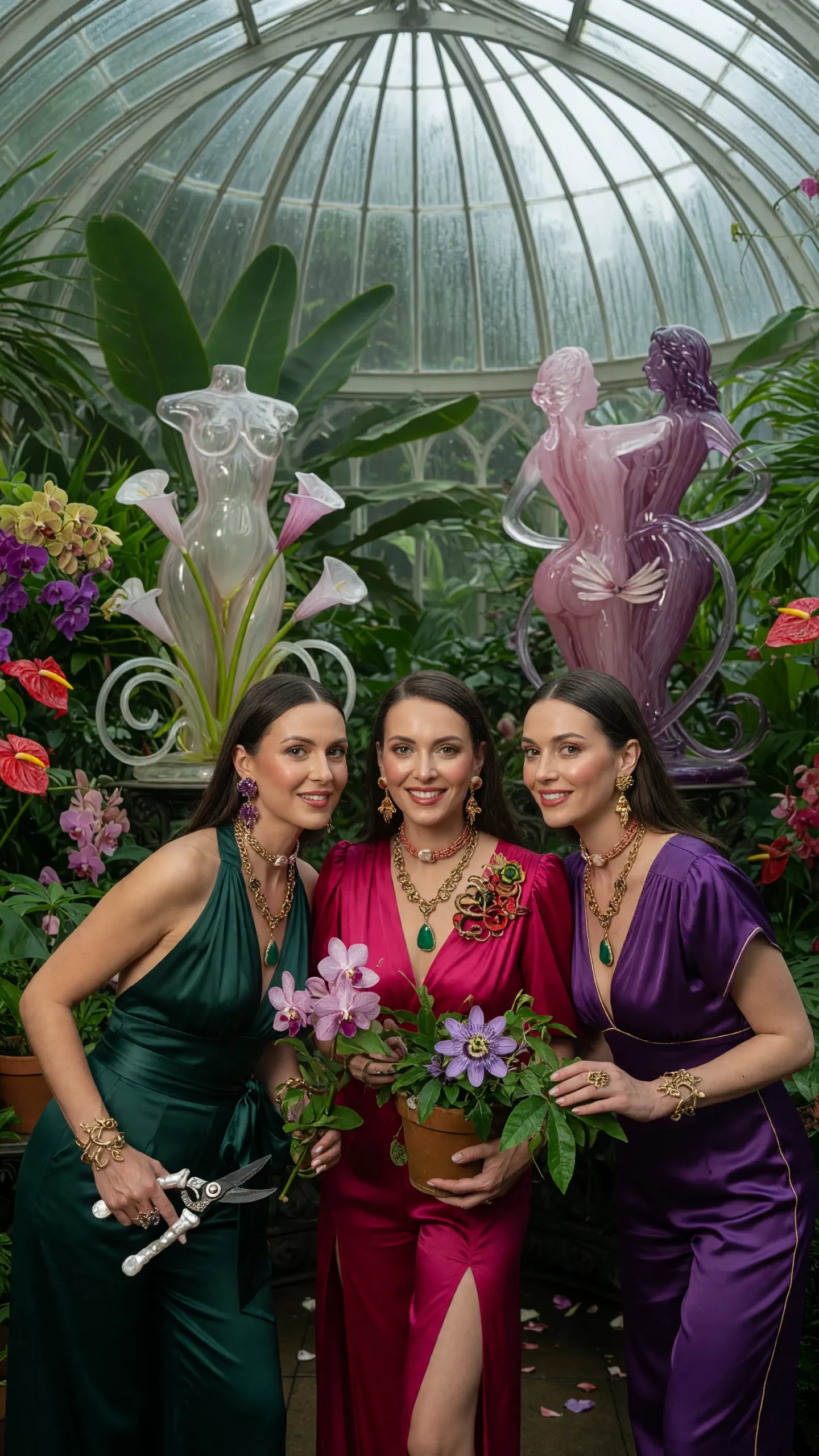
She came to bury an inheritance. She found a satin ribbon that refused to fade. Now, the glasshouse is waking—and it remembers every woman who ever wore its gowns.
Dr. Elara Vance had built her life on the solid, the sensible, the seen. But when a crumbling conservatory in the Cotswolds falls into her hands, she discovers that some inheritances are not measured in land or ledger, but in the whisper of fabric against skin. Tucked inside a cedar chest, wrapped in tissue paper yellowed by decades, lies a gown of deep burgundy satin—and with it, a journal that speaks of a gentleman botanist who believed that the right texture could unlock the deepest truths of a woman’s soul. As Elara restores the glasshouse to its former glory, she finds herself drawn into a circle of women who understand that confidence, health, and wealth are not merely states of being—they are textures to be worn, to be felt, to be claimed. The conservatory is patient. It has been waiting for you.
Chapter 1: The Inheritance of Silence
The letter arrived on a Tuesday, slipped beneath the door of Elara Vance’s flat like a serpent sliding into a garden of cultivated order. She found it at half past six, returning from another day of cataloguing the mundane, her shoulders rounded from hours of peering at specimens that had long since ceased to surprise her. The envelope was thick, cream-coloured, and bore the embossed crest of a solicitor’s firm she had never heard of.
She slit it open with a butter knife, her movements mechanical, her mind still half-lost in the grey fug of the London evening.
And then she read the words: You are hereby informed that you are the sole beneficiary of the estate of your great-aunt, Margaret Holloway, of Holloway Manor, Cotswolds.
Elara’s breath caught. She had not thought of Great-Aunt Margaret in years—not since she was a girl of twelve, visiting the crumbling manor with its vast, skeletal conservatory that had terrified and fascinated her in equal measure. She remembered the glass panes, many of them broken, their jagged edges like teeth. She remembered the ironwork, rusted and weeping. And she remembered, with a clarity that surprised her, a single ribbon of emerald satin, tied to a strut, fluttering in a draught that came from nowhere.
She had never forgotten that ribbon.
The Cotswolds in autumn were a study in muted gold and amber, the hills rolling like slumbering beasts beneath a sky the colour of old linen. Elara’s car, a sensible grey hatchback, seemed to apologise for its presence as it wound through lanes lined with stone walls and hedgerows heavy with berries. She had taken a week’s leave from the university, claiming a family emergency. It was not entirely untrue.
The manor, when she finally reached it, was worse than she remembered.
The driveway was a scar of gravel and weeds, the front door a slab of oak that had seen better centuries. But it was the conservatory that drew her eye, as it always had. It rose from the side of the house like a crystal chrysalis, its bones of iron and glass reaching toward the sky. Many of its panes were shattered, and the ivy had claimed it with a possessive grip, but there was something about it that refused to be diminished. It waited.
Elara stood in the driveway, her sensible shoes crunching on the gravel, and felt the weight of the silence. It was not an empty silence. It was a silence that listened.
The interior of the manor was a museum of dust and faded grandeur. Elara spent the first two hours exploring, her footsteps echoing on bare boards, her fingers trailing over furniture draped in white sheets like ghosts. She found the kitchen, vast and cold, and the library, its shelves still holding books that had not been touched in decades. But her feet, as if guided by some invisible current, carried her always toward the conservatory.
The door was locked.
She found the key in a drawer in the study, a heavy iron thing on a ring of tarnished brass. It turned in the lock with a groan that seemed to echo through the entire house. The door swung open, and the smell hit her: earth, rust, and something else, something sweet and faintly floral, like the memory of perfume.
She stepped inside.
The conservatory was a cathedral of decay. The glass roof was a mosaic of broken panes and gaping holes, through which the autumn light fell in shafts of gold and amber. The ironwork was a tangle of rust and climbing plants, their leaves glossy and dark. The floor was a patchwork of flagstones and moss, and in the centre, where the light was brightest, stood a single object: a cedar chest.
Elara’s heart was pounding. She did not know why. She crossed the space slowly, her footsteps careful on the uneven stones, and knelt before the chest. The brass fittings were tarnished, but the wood was sound. She lifted the lid.
The smell that rose was intoxicating: cedar, lavender, and something else, something that made her head swim for just a moment. Inside, wrapped in acid-free tissue paper, lay a gown of deep burgundy satin. It seemed to glow in the dim light, its surface catching the shafts of sun and throwing them back in a shimmer of liquid fire.
Elara reached out and touched it.
The fabric was cool, heavy, and impossibly smooth. It slipped through her fingers like water, like silk, like something alive. She lifted it from the chest, and it unfurled like a banner, its folds catching the light, its weight settling against her hands. It was a gown from another era, with a high collar and long sleeves, and it was perfect.
Beneath it, in the chest, lay a journal bound in violet leather.
She did not try on the gown. Not yet. She told herself she was being sensible, that she needed to focus on the practicalities of the estate, that she was a rational woman with a rational mind. But the gown stayed with her, draped over a chair in her bedroom, its presence a constant whisper at the edge of her awareness.
That evening, she sat in the library with a glass of wine and the journal. The leather was soft and warm in her hands, and the pages were covered in a flowing, elegant hand. The ink had faded to sepia, but the words were still legible.
June 14th, 1987. Today, I received a visitor. Her name was Cordelia, and she was a woman of considerable wealth and education, but her eyes held a hunger that no amount of learning could satisfy. I showed her the conservatory. I showed her the gowns. And when she emerged, dressed in silver PVC that caught the light like captured moonlight, I saw the transformation begin. She stood taller. Her voice deepened. Her eyes, when they met mine, held a new fire. She said, “I did not know I was waiting for this.” I smiled. They always say that.
Elara read on, her wine forgotten. The journal was a chronicle of transformation, each entry describing a woman who had come to the conservatory and left changed. There was a lawyer, a professor, an artist, a heiress. Each one had been given a gown—satin, silk, PVC, leather—and each one had found something they did not know they were missing.
The key, Whitmore wrote, is not in the fabric itself, but in the permission it grants. A woman who wears satin gives herself permission to be smooth, to be resilient, to be desired. A woman who wears PVC gives herself permission to be bold, to be unapologetic, to be seen. The texture is the key. The garment is the door. And beyond that door lies the woman she was always meant to be.
Elara closed the journal, her hands trembling. She looked at the gown, still draped over the chair, its surface gleaming in the lamplight. She thought of her own life: the sensible shoes, the sensible career, the sensible relationships that had never quite satisfied. She thought of the hunger that Whitmore had described, the hunger that she had never allowed herself to acknowledge.
She stood up. Her legs carried her across the room. Her hands, as if of their own accord, reached for the gown.
She slipped it on.
The sensation was electric. The satin was cool against her skin, but it warmed quickly, moulding to her body like a second skin. The weight of it was reassuring, grounding, and the way it caught the light made her feel as though she were wrapped in liquid fire. She looked in the mirror—a full-length mirror that she had not noticed before, its surface miraculously clear—and she did not recognise the woman who looked back.
This woman stood tall. Her chin was lifted. Her eyes, the same grey-blue as her own, held a light that she had never seen before. She turned, and the satin whispered against itself, a sound like the rustle of leaves in a secret garden.
And then she heard it.
A voice, faint as a memory, warm as a hand on her shoulder. It came from nowhere and everywhere, from the satin itself, from the walls of the conservatory, from the very air around her.
Welcome, it said. I have been waiting for you.
Elara stood frozen, her heart pounding, her breath caught in her throat. The voice was not threatening. It was welcoming. It was the voice of someone who had been expecting her, who knew her, who understood the hunger she had never dared to name.
She turned, slowly, half-expecting to see a figure in the shadows. But the conservatory was empty, save for the plants and the light and the gown that now felt like a part of her.
She looked at her reflection again. The woman in the mirror smiled.
And Elara knew, with a certainty that went beyond logic, beyond reason, beyond everything she had ever believed about herself, that she was not going to leave this place. Not ever.
The conservatory had claimed her.
And she was only beginning to understand what that meant.
Chapter 2: The First Glimmer
Elara did not sleep that night. She could not. The burgundy gown had become a second skin, and every time she closed her eyes, she saw the conservatory bathed in impossible light, heard the whisper of satin against stone, felt the weight of a gaze that was not quite her own.
She rose with the dawn, the gown still clinging to her like a promise, and began to explore the manor with new eyes. The house was a labyrinth of forgotten rooms and hidden corners, each one holding a secret she was only beginning to understand.
It was in the east wing, behind a door disguised as a bookshelf, that she found the wardrobe room.
The space was vast, larger than her entire flat, and it was filled with gowns. Rows upon rows of them, hanging from brass rails, their surfaces gleaming in the pale morning light. There were gowns of satin in every colour imaginable—emerald, sapphire, ruby, amethyst—and gowns of PVC that caught the light like captured water. There were dresses of leather, soft and supple, and coats of patent leather that shone like mirrors. There were corsets and gloves and stockings, all of them glossy, all of them perfect.
Elara walked among them, her breath catching in her throat. She reached out and touched a gown of silver PVC, its surface cool and smooth beneath her fingers. She lifted it from the rail, and it unfurled like a banner, its weight settling against her hands.
“Beautiful, aren’t they?”
The voice came from behind her. Elara spun around, her heart pounding, to find a woman standing in the doorway. She was tall and elegant, with silver-streaked hair and eyes the colour of winter sky. She wore a dress of deep purple satin that seemed to glow in the dim light.
“I’m sorry,” the woman said, smiling. “I didn’t mean to startle you. I’m Clara. Clara Whitmore. I was your great-aunt’s… companion.”
Elara stared at her. “Whitmore? Like A. Whitmore? The botanist?”
Clara’s smile deepened. “My grandfather. You found his journal, I presume.”
They sat in the kitchen, a pot of tea between them, the morning light streaming through the windows. Clara had changed into a dress of forest green satin, and she moved with a grace that seemed almost otherworldly.
“He spoke of you,” Clara said, her voice soft. “My grandfather. He said that one day, someone would come who understood. Someone who had been waiting, even if they didn’t know it.”
Elara shook her head. “I don’t understand. I’m a botanist. I study plants. I don’t…”
“You study life,” Clara interrupted. “You study growth, transformation, the way things change and adapt. That is exactly what this place is about.”
She reached across the table and took Elara’s hand. Her touch was warm, and her eyes held a depth of understanding that made Elara’s heart ache.
“The conservatory is not just a building,” Clara said. “It is a mirror. It reflects what we hide from ourselves. The gowns are not just clothes. They are keys. They unlock the parts of us that we have locked away.”
Elara thought of the burgundy gown, still warm against her skin. She thought of the voice she had heard, the feeling of being seen, of being known.
“I don’t know what I’m supposed to do,” she whispered.
Clara smiled. “You don’t have to know. You just have to be willing. Willing to try, willing to feel, willing to become.”
She stood, her satin dress whispering against her legs. “Come. There is someone I want you to meet.”
Clara led her through the manor, past rooms Elara had not yet explored, to a door at the end of a narrow corridor. She pushed it open, and Elara stepped into a room that took her breath away.
It was a salon, elegant and intimate, with velvet sofas and crystal chandeliers. And in the centre of the room, seated on a chaise lounge, was a woman who radiated confidence and grace. She was dressed in a gown of midnight blue satin, its surface catching the light like the surface of a still lake. Her hair was swept up in an elegant chignon, and her eyes, when they met Elara’s, held a warmth that was both welcoming and knowing.
“Elara,” Clara said, her voice soft. “This is Dr. Sarah Chen. She was one of my grandfather’s… visitors.”
Sarah rose, her gown flowing around her like water. She extended her hand, and Elara took it, feeling the smoothness of her skin, the warmth of her touch.
“I have heard so much about you,” Sarah said, her voice low and musical. “Clara said you found the journal. And the burgundy gown.”
Elara nodded, unable to speak.
Sarah smiled. “That gown was my first, too. It is a powerful one. It awakens something deep within us, something we have been taught to suppress.”
She gestured for Elara to sit, and Elara found herself sinking into a velvet sofa, its softness enveloping her.
“Tell me,” Sarah said, her eyes holding Elara’s, “what did you feel when you put it on?”
Elara thought for a moment. “I felt… seen. Known. Like I was finally wearing the skin I was meant to wear.”
Sarah’s smile deepened. “Yes. That is the first glimmer. The moment when we realize that the texture of our lives can be as smooth, as glossy, as beautiful as the fabrics we choose to wear.”
She leaned forward, her voice dropping to a whisper. “The conservatory is a place of transformation. But the transformation does not happen in the glasshouse. It happens here, in the heart. The gowns are merely the catalysts.”
Elara looked down at her hands, still clad in the burgundy satin. She thought of her life before: the sensible shoes, the grey skies, the endless days of quiet desperation. She thought of the hunger she had never acknowledged, the longing she had never named.
“I want to understand,” she said, her voice barely a whisper. “I want to feel. I want to become.”
Sarah reached out and took her hand. “Then you have already begun.”
That evening, Elara stood before the mirror in her bedroom, the burgundy gown still clinging to her. She had not taken it off. She could not. It felt like a part of her now, like a second skin that had been waiting all her life to be worn.
She looked at her reflection, and for the first time in as long as she could remember, she smiled.
The woman in the mirror was not the woman who had arrived at the manor two days ago. She was taller, straighter, more alive. Her eyes held a light that had not been there before, a spark of something that had been waiting, dormant, beneath the surface of her sensible life.
She turned, and the satin whispered against itself, a sound like the rustle of leaves in a secret garden.
And in the silence, she heard the voice again, warm and welcoming, like a hand reaching out across the years.
Welcome home.
Chapter 3: The Silken Gardener
The morning arrived wrapped in a shroud of Cotswold mist, the kind that turned the world into a watercolour painting, all soft edges and muted promises. Elara woke with the burgundy gown still pooled around her, the fabric having twisted during her restless sleep into a cocoon of glossy perfection. She had not dreamed, or if she had, the dreams had been too deep, too profound, too real to be remembered in the harsh light of day.
She found Clara in the conservatory, standing before a plant that Elara had not noticed before. It was a camellia, its leaves so glossy they seemed to have been polished by an invisible hand, its flowers a deep, velvety crimson that matched the gown Elara still wore.
“Ah, you’re awake,” Clara said, not turning around. “Come. I want to show you something.”
Elara crossed the flagstone floor, her bare feet silent on the cold stone. She stood beside Clara, looking at the camellia.
“This was my grandfather’s favourite,” Clara said. “He called it the Silken Gardener. Do you know why?”
Elara shook her head.
“Because it only blooms when it is touched by satin.” Clara reached out and brushed her fingers, clad in a glove of emerald satin, against the petals. The camellia seemed to lean into her touch, its colour deepening, its fragrance intensifying.
“Everything in this conservatory responds to texture,” Clara continued. “The plants, the light, the air itself. They are all attuned to the glossy, the smooth, the refined. My grandfather believed that women were the same. That we respond to texture in ways we do not fully understand.”
She turned to face Elara, her eyes holding a light that was both ancient and new. “He believed that a woman who wears satin gives herself permission to be smooth, to be resilient, to be desired. That a woman who wears PVC gives herself permission to be bold, to be unapologetic, to be seen. That a woman who wears leather gives herself permission to be powerful, to be untamed, to be free.”
Elara looked down at her own gown, its surface gleaming in the pale morning light. “Is that what happened to me?”
Clara smiled. “That is what is happening to you. It is not a single event, Elara. It is a process. A transformation. A becoming.”
Later that morning, Clara introduced Elara to the routine of the conservatory. There were plants to water, leaves to polish, soil to tend. But the work was unlike any gardening Elara had ever done. Each task was performed in a gown of satin or silk, the fabric whispering against the leaves, the light catching the glossy surfaces and throwing them back in a thousand shimmering reflections.
“Your great-aunt,” Clara said, as she carefully wiped a leaf with a cloth of softest chamois, “was one of my grandfather’s greatest successes. She came to him as a woman of considerable wealth and education, but she was empty. She had everything, and yet she had nothing. She was a vessel waiting to be filled.”
Elara looked up from the fern she was tending, its fronds uncurling in response to her touch. “What filled her?”
“The conservatory. The gowns. The understanding that she was not meant to be a spectator in her own life. She was meant to be the protagonist.”
Clara set down her cloth and crossed to a cabinet that Elara had not noticed before. It was carved from dark wood, its surface inlaid with mother-of-pearl, and it seemed to glow with an inner light. Clara opened it, revealing a collection of journals, each one bound in a different colour of leather.
“These are the records of every woman who has visited the conservatory,” Clara said. “Their names, their stories, their transformations. My grandfather kept them as a testament to the power of the glossy life.”
She pulled out a journal bound in deep purple satin, its surface catching the light. “This one is your great-aunt’s. Would you like to read it?”
Elara reached out, her fingers brushing against the satin. The sensation was electric, a jolt of recognition that went straight to her core. She opened the journal, and the pages fell open to a passage written in a hand she recognized as her great-aunt’s.
I came to the conservatory as a woman of means, but I left as a woman of substance. The gowns did not change me; they revealed me. They peeled away the layers of expectation and obligation, the dull fabrics of duty and despair, and showed me the glossy core that had been waiting all along.
*I am not the same woman who arrived at the manor. I am smoother, stronger, more resilient. I am satin where I was once cotton. I am gloss where I was once matte. I am *alive* in a way I never knew was possible.*
Elara looked up, her eyes wet with tears she had not expected. “She was happy,” she whispered.
Clara smiled. “She was transformed. And now, so are you.”
That afternoon, a visitor arrived at the manor. She was a woman of perhaps forty, with sharp cheekbones and sharper eyes, dressed in a business suit of charcoal grey that seemed to drain the colour from the room. She introduced herself as Dr. Amelia Hart, a professor of literature from Oxford, and she had come to see the conservatory.
“I heard about it from a colleague,” she said, her voice clipped and precise. “She said it was… transformative.”
Clara exchanged a glance with Elara. “It can be,” Clara said carefully. “But only for those who are ready.”
Amelia’s eyes flickered to the burgundy gown Elara still wore. “I am ready,” she said, and there was a hunger in her voice that belied her composed exterior. “I have been ready for a very long time.”
Clara led her to the wardrobe room, and Elara followed, her heart pounding with a strange anticipation. She watched as Clara selected a gown of silver PVC, its surface catching the light like captured moonlight.
“This one,” Clara said, holding it out to Amelia. “This one will suit you.”
Amelia took the gown, her hands trembling slightly. She disappeared behind a screen, and when she emerged, she was transformed.
The silver PVC clung to her like a second skin, accentuating every curve, every line, every angle. She stood taller, her chin lifted, her eyes blazing with a light that had not been there before. She looked in the mirror, and a slow smile spread across her face.
“I did not know I was waiting for this,” she whispered.
Elara felt a shiver run down her spine. It was the same words she had read in Whitmore’s journal, the same words that had been spoken by every woman who had ever found her way to the conservatory.
And she knew, with a certainty that went beyond logic, that she was witnessing the beginning of another transformation.
That evening, the three of them sat in the salon, the fire crackling in the hearth, the satin and PVC of their gowns catching the firelight and throwing it back in a dance of shadow and shimmer. Amelia was radiant, her usual composure replaced by a warmth that seemed to fill the room.
“I have spent my entire life in books,” she said, her voice soft. “I have studied the great works of literature, the great loves, the great tragedies. But I have never felt anything like this.”
She looked down at her hands, clad in silver PVC gloves that caught the light. “I feel… seen. For the first time, I feel like I am not just observing life, but living it.”
Clara reached out and took her hand. “That is the gift of the conservatory. It does not change who you are. It reveals who you have always been.”
Elara watched them, her heart full. She thought of her own transformation, the way the burgundy gown had unlocked something deep within her, something she had not known was there. She thought of the voice she had heard, the warmth that had enveloped her, the sense of coming home.
She looked at Amelia, radiant in her silver PVC, and she knew that this was only the beginning.
The conservatory was waking. And it was hungry for more.
Chapter 4: The Second Gown
The days began to blur together, each one a symphony of satin and light, of glossy leaves and shimmering reflections. Elara found herself rising each morning with a sense of anticipation she had not felt since childhood, the burgundy gown becoming as natural to her as her own skin.
But Clara had warned her. “The first gown is always the most powerful,” she had said, her voice carrying the weight of experience. “But it is not the only one. Each gown reveals a different facet of who you are. Each one unlocks a door you did not know existed.”
It was on the fourth morning that Elara found herself standing before the wardrobe room, her hand resting on the brass handle, her heart pounding with a mixture of fear and excitement. She had been avoiding this moment, she realized. She had been afraid that the burgundy gown was a fluke, a trick of the light, a momentary lapse into fantasy. But the feeling had not faded. If anything, it had grown stronger, more insistent, more real.
She pushed open the door.
The gowns were waiting for her, row upon row of glossy perfection. They hung in the dim light like sleeping butterflies, their surfaces catching the faintest glimmer of illumination. Elara walked among them, her fingers trailing over satin and silk, PVC and patent leather, each one sending a shiver of recognition through her.
She stopped before a gown of deep emerald green, its surface so glossy it seemed to have been woven from liquid light. It was a dress of satin, but unlike the burgundy, it had a high neckline and long sleeves, and it seemed to radiate a different kind of energy. The burgundy had been about awakening. This one, she sensed, was about authority.
“An excellent choice,” Clara said from the doorway. Elara had not heard her approach, but she was not surprised. Clara moved like a ghost, like a whisper, like the rustle of satin in a silent room.
“What is it?” Elara asked, her voice barely a whisper.
“That is the gown of the Silken Gardener,” Clara said. “It was my grandfather’s favourite. He said it embodied the essence of the conservatory: growth, transformation, and the quiet power of the feminine.”
Elara lifted the gown from its hanger, and the fabric seemed to flow into her hands like water. It was heavier than the burgundy, more substantial, and it carried a scent of jasmine and sandalwood that made her head swim.
“Try it on,” Clara said. “But be warned. This gown will not simply reveal what you have hidden. It will demand that you become it.”
Elara retreated to her room, the emerald gown clutched to her chest. She stood before the mirror, the burgundy gown still clinging to her, and she hesitated. She had grown comfortable in the burgundy. It had become a part of her, a second skin that she was not sure she was ready to shed.
But the emerald was calling to her, its voice a low hum that vibrated in her bones.
She slipped out of the burgundy, and for a moment, she felt naked, exposed, vulnerable. But then she stepped into the emerald, and the world shifted.
The fabric was cool against her skin, but it warmed quickly, moulding to her body like a lover’s embrace. It was tighter than the burgundy, more restrictive, but the restriction was not uncomfortable. It was supportive. It held her in a way that made her feel safe, powerful, invincible.
She looked in the mirror, and she gasped.
The woman who looked back was not the same woman who had put on the burgundy. She was taller, her posture more regal, her chin lifted with a confidence that had not been there before. Her eyes, the same grey-blue, now held a depth that seemed to pierce through the surface of things. She looked like a queen, a goddess, a force of nature.
And then she heard the voice again, but this time it was different. It was not a whisper, but a command.
You are ready.
She found Clara and Amelia in the conservatory, tending to the camellia. They looked up as she entered, and their faces broke into smiles of recognition.
“Ah,” Clara said, her voice soft. “The Silken Gardener awakens.”
Amelia’s eyes widened. “Elara. You look… magnificent.”
Elara felt a flush of pleasure at their words. She walked among the plants, her hand trailing over their glossy leaves, and they seemed to reach for her, to lean into her touch as if she were the sun.
“The conservatory responds to you,” Clara said. “It recognizes the Silken Gardener.”
Elara stopped before a plant she had not noticed before. It was a rose, but its petals were not the soft, velvety texture of a traditional rose. They were glossy, almost metallic, and they caught the light like shards of emerald glass.
“What is this?” she asked.
Clara smiled. “That is the Glossy Rose. It only blooms in the presence of the Silken Gardener. It has been waiting for you.”
Elara reached out and touched the petals, and they were cool and smooth beneath her fingers. The rose seemed to pulse with a life of its own, its colour deepening, its fragrance intensifying.
“It’s beautiful,” she whispered.
“It is you,” Clara said. “It is a reflection of your transformation. The conservatory does not just respond to you, Elara. It mirrors you.”
That evening, they gathered in the salon once more, the fire crackling in the hearth. Amelia was radiant in her silver PVC, Clara elegant in her deep purple satin, and Elara resplendent in her emerald green.
“I have been thinking,” Amelia said, her voice thoughtful. “About what you said, Clara. About the conservatory being a mirror. If that is true, then what does it say about us?”
Clara smiled. “It says that we are ready. Ready to embrace the glossy, the smooth, the refined. Ready to shed the dull fabrics of our old lives and step into the shimmering reality of who we are meant to be.”
She looked at Elara, her eyes holding a depth of meaning that made Elara’s heart ache. “The Silken Gardener is not just a title, Elara. It is a responsibility. You are now the caretaker of this place, of its secrets, of its transformations. You are the one who will guide others on their journey.”
Elara felt the weight of her words, but it was not a burden. It was a gift.
“I am ready,” she said, and she meant it.
Chapter 5: The Conservatory Awakens
The transformation began subtly, as all great transformations do. It started with the light.
Elara noticed it first on the fifth morning, when she entered the conservatory to find the space bathed in a glow that seemed to come from nowhere and everywhere at once. The broken panes had not been repaired, and yet the light that fell through them was different—richer, warmer, more alive. It caught the glossy leaves of the plants and threw them back in a dance of emerald and gold, and it made the satin of her gown shimmer like liquid fire.
“The conservatory is waking,” Clara said, appearing at her side. She was dressed in a gown of deep violet satin, its surface catching the light like the petals of a night-blooming flower. “It has been dormant for so long, waiting for someone to awaken it. And now that you have embraced the Silken Gardener, it is responding.”
Elara walked among the plants, her hand trailing over their leaves. They seemed to reach for her, to lean into her touch, and she felt a connection that went beyond the physical. She could feel their desire, their hunger for the glossy, the smooth, the refined.
“What do they want?” she asked, her voice barely a whisper.
“They want to be seen,” Clara said. “They want to be touched. They want to be transformed.”
That afternoon, a van arrived at the manor, carrying a delivery that Elara had not ordered. It was a crate of mirrors, each one framed in ornate brass, their surfaces so clear they seemed to be made of liquid silver.
“I took the liberty,” Clara said, as the workmen carried the crates into the conservatory. “The conservatory needs mirrors to amplify its light. And you need to see yourself as the conservatory sees you.”
Elara watched as the mirrors were installed, their surfaces catching the light and throwing it back in a thousand shimmering reflections. The space seemed to expand, to breathe, to come alive in a way that took her breath away.
By evening, the conservatory was transformed. The mirrors created an infinity of reflections, each one a different angle, a different perspective, a different version of herself. She saw herself in satin, in PVC, in leather, in silk, each reflection a facet of the woman she was becoming.
“It’s beautiful,” she whispered.
“It is you,” Clara said. “The conservatory is a mirror of your soul. And your soul, Elara, is magnificent.”
The next day, a visitor arrived at the manor. She was a woman of perhaps fifty, with silver hair and eyes that held a depth of wisdom that came from years of living. She was dressed in a business suit of charcoal grey, but there was a hunger in her eyes that belied her composed exterior.
“I am Dr. Margaret Chen,” she said, her voice carrying the authority of a lifetime of achievement. “I am Sarah’s mother. She told me about this place.”
Elara’s heart skipped a beat. Sarah’s mother. The mother of the woman who had been transformed by the conservatory.
“She said it changed her life,” Margaret continued. “She said she found something here that she had been searching for her entire life.”
Elara nodded. “The conservatory has a way of revealing what we have hidden from ourselves.”
Margaret’s eyes flickered to the emerald gown Elara wore, and something shifted in her gaze. “I want to understand,” she said. “I want to feel what she felt.”
Elara led Margaret to the wardrobe room, her heart pounding with a strange anticipation. She knew, with a certainty that went beyond logic, that this woman was ready. She had been ready for a very long time.
She selected a gown of deep burgundy satin, the same colour as her first gown, and held it out to Margaret. “This one,” she said. “This one will suit you.”
Margaret took the gown, her hands trembling slightly. She disappeared behind a screen, and when she emerged, she was transformed.
The burgundy satin clung to her like a second skin, its surface catching the light and throwing it back in a shimmer of liquid fire. She stood taller, her chin lifted, her eyes blazing with a light that had not been there before.
“I did not know I was waiting for this,” she whispered, and Elara felt a shiver run down her spine.
That evening, the conservatory was filled with the sound of laughter and conversation. Margaret had joined them, radiant in her burgundy satin, and she had brought with her a vitality that seemed to fill the space.
“I have spent my entire life in the pursuit of knowledge,” she said, her voice soft. “I have earned degrees, published papers, built a career. But I have never felt anything like this.”
She looked down at her hands, clad in burgundy satin gloves that caught the light. “I feel alive.”
Clara smiled. “That is the gift of the conservatory. It does not change who you are. It reveals who you have always been.”
Elara looked around the room, at the women who had been transformed by this place. Clara, elegant in her violet satin. Amelia, radiant in her silver PVC. Margaret, reborn in her burgundy gown. And herself, the Silken Gardener, the caretaker of this sacred space.
She felt a surge of gratitude, of joy, of purpose.
The conservatory was awake. And it was more beautiful than she had ever imagined.
Chapter 6: The Gathering of Echoes
The news spread like ripples across a still pond, each wave carrying the promise of transformation to new shores. Within a week, three more women had arrived at the manor, each one drawn by whispers of a place where the boundaries between self and silk dissolved into something far more profound.
The first was a woman named Victoria, a gallery owner from London whose collection of contemporary art had made her a fortune but whose heart remained curiously empty. She arrived in a car that cost more than most people’s houses, dressed in a suit of charcoal wool that seemed to absorb the very light around it. Her eyes, sharp and assessing, softened the moment she stepped into the conservatory.
“I don’t know why I came,” she said, her voice carrying the clipped precision of someone accustomed to boardrooms and negotiations. “I received a letter. Anonymous. It said I would find something here that I had been looking for.”
Clara smiled, her violet satin catching the light. “And have you found it?”
Victoria looked around the conservatory, at the glossy leaves, the shimmering mirrors, the women in their satin and PVC. Her gaze settled on Elara, resplendent in her emerald gown, and something shifted in her expression.
“I think I am beginning to,” she said.
The second visitor arrived the following day. She was a woman named Helena, a professor of philosophy at Cambridge, and she came with a skepticism that bordered on hostility. She had been sent by a colleague, she explained, a woman who had visited the conservatory and returned “insufferably radiant.”
“I am here to debunk,” Helena said, her arms crossed, her posture rigid. “I do not believe that a dress can change a person’s life.”
Elara felt a flicker of amusement. She had been that woman once, armored in skepticism, protected by cynicism. She knew how fragile that armor could be.
“Then let me show you,” she said, “what a dress can do.”
She led Helena to the wardrobe room, her heart calm, her purpose clear. She selected a gown of midnight blue PVC, its surface so glossy it seemed to hold the darkness of the night sky within its depths.
“This one,” she said, holding it out. “This one will challenge you.”
Helena took the gown with obvious reluctance, but there was a tremor in her hands that betrayed her composure. She disappeared behind the screen, and when she emerged, the transformation was immediate.
The PVC clung to her like a second skin, its surface catching the light and throwing it back in a shimmer of starlight. She stood taller, her chin lifted, her eyes wide with a mixture of shock and wonder.
“I don’t… I don’t understand,” she whispered. “I feel… different.”
“That is the power of the conservatory,” Elara said. “It does not ask you to believe. It asks you to feel.”
The third visitor arrived on the same day, a woman named Isabella, a dancer who had retired from the stage but could not retire from the need for movement and grace. She was dressed in flowing fabrics of muted grey, but her body moved with a fluidity that spoke of years of training.
“I have been searching for something,” she said, her voice soft, almost musical. “I thought it was a new form of dance, a new way of moving through the world. But I think it is something else entirely.”
Elara selected a gown of rose gold satin, its surface shimmering with a warmth that seemed to emanate from within. She handed it to Isabella, and the dancer’s eyes lit up with recognition.
“This is it,” Isabella whispered. “This is what I have been searching for.”
That evening, the conservatory held its first formal salon. The women gathered in the central space, the mirrors reflecting their glossy forms in an infinity of shimmering beauty. Clara had arranged for champagne and delicate pastries, and the air was filled with the rustle of satin and the soft murmur of conversation.
Victoria, transformed in a gown of deep burgundy PVC, was holding court near the camellia. “I have never felt so seen,” she was saying, her voice carrying the authority of someone accustomed to being heard. “I have spent my life curating beauty, but I have never allowed myself to be beautiful.”
Helena, still adjusting to her midnight blue PVC, was deep in conversation with Margaret. “I have spent my life studying the nature of reality,” she said, her voice thoughtful. “But I have never understood that reality is not something we observe. It is something we wear.”
Isabella, radiant in her rose gold satin, was dancing alone in a corner of the conservatory, her body moving with a grace that seemed to transcend the physical. The plants seemed to sway with her, their glossy leaves catching the light and throwing it back in a dance of shadow and shimmer.
Elara watched them, her heart full. She felt a hand on her shoulder and turned to find Clara at her side.
“You have done well,” Clara said, her voice soft. “The conservatory is alive again. And it is more beautiful than it has ever been.”
Elara looked around the room, at the women who had been transformed by this place. They were no longer strangers, no longer individuals. They were a chorus, a symphony of glossy perfection, each one a note in a melody that had been waiting to be sung.
“This is only the beginning,” Elara said, and she felt the truth of her words resonate through her entire being.
The conservatory was awake. And it was calling to more.
Chapter 7: The Journal’s Secret
The morning arrived with a weight that Elara could not quite name. She woke from dreams of satin rivers and PVC forests, her skin still tingling with the memory of textures that transcended the merely physical. The emerald gown had become her second skin, and she reached for it now with the automatic grace of long familiarity.
But something was different. The conservatory hummed with a new energy, a vibration that seemed to emanate from the very stones beneath her feet. She found Clara in the library, her face pale, a journal spread open before her.
“Elara,” Clara said, her voice carrying a tremor that made Elara’s heart clench. “There is something you need to see.”
Elara crossed the room, her satin whispering against the wooden floor. She looked at the journal, its pages yellowed with age, its binding cracked and fragile. The handwriting was familiar—A. Whitmore’s elegant script, the same hand that had chronicled the transformations of so many women.
But this journal was different. This journal was his.
“I found it in a hidden compartment in the conservatory,” Clara said. “I have been reading it all night. Elara… my grandfather did not just observe transformations. He cultivated them. He believed that the glossy life was not just a choice, but a destiny.”
Elara read the words on the page, her heart pounding.
*I have discovered that the conservatory is not merely a place of transformation. It is a *battery*. The energy generated by the women who embrace the glossy life—their joy, their confidence, their *power*—it accumulates. It grows. And it can be *directed.
She looked up, her eyes meeting Clara’s. “Directed toward what?”
Clara’s voice was barely a whisper. “Toward the one who understands the secret. The one who can channel that energy. The one who can become the conservatory.”
The revelation hung in the air like a shimmering veil, transforming everything Elara thought she knew. She spent the morning in the conservatory, the journal clutched to her chest, reading and re-reading Whitmore’s words.
*The women who come here are not merely visitors. They are *contributors*. Each transformation, each moment of glossy revelation, adds to the reservoir of power that sustains this place. And the Silken Gardener—the one who understands the secret—can draw upon that reservoir. Can *become* the reservoir.*
She looked up at the mirrors, at her reflection multiplied into infinity. She saw herself in emerald satin, her eyes bright, her posture regal. But she also saw something else—a presence behind her reflection, a shadow that was not quite a shadow, a warmth that was not quite her own.
“Elara.”
She turned to find Amelia standing in the doorway, her silver PVC catching the light. “You feel it too, don’t you?” Amelia asked. “The energy. The presence.”
Elara nodded. “It’s him. A. Whitmore. He’s still here.”
Amelia crossed the room, her footsteps silent on the flagstones. “I have been feeling it since the first night. A warmth, a pressure, a presence. I thought it was my imagination. But it’s real.”
Elara looked down at the journal, at the final entry.
I will not leave this place. I will become part of it. I will be the echo in the satin, the gleam in the PVC, the sigh in the leather. I will be the Silken Gardener, and I will await my successor.
She looked up, her eyes meeting Amelia’s. “He’s not dead. He’s here. In the conservatory. In the gowns. In the light.”
That afternoon, Elara gathered the women in the conservatory. They stood in a circle, their glossy forms reflecting in the mirrors, their eyes bright with anticipation.
“I have discovered something,” Elara said, her voice steady. “The conservatory is not just a place of transformation. It is a living entity. And it has a purpose.”
She told them about Whitmore’s journal, about the energy that accumulated with each transformation, about the presence that lingered in the satin and the light. She expected fear, skepticism, resistance.
Instead, she saw recognition.
“I knew it,” Victoria said, her voice soft. “I felt it the moment I put on the burgundy PVC. A warmth, a presence. I thought it was just the fabric.”
“It’s not just the fabric,” Helena said, her voice carrying the weight of her philosophical training. “It’s the meaning we invest in the fabric. The intention. The desire.”
Isabella stepped forward, her rose gold satin shimmering in the light. “Then let us give it more. Let us feed it. Let us become what it wants us to become.”
Elara looked around the circle, at the women who had become her family, her community, her purpose. She felt the energy of the conservatory pulsing through her, a warmth that was both comforting and demanding.
“Then let us begin,” she said.
Chapter 8: The Rite of Gloss
The ceremony began without words, as all profound things do. Elara stood at the centre of the conservatory, the emerald satin of her gown catching the light and throwing it back in a shimmer of living fire. The women formed a circle around her, their glossy forms reflected in the mirrors that lined the walls, creating an infinity of shimmering witnesses.
Victoria had changed into a gown of deep burgundy PVC, its surface so reflective it seemed to hold the sunset within its depths. Helena had selected a dress of midnight blue satin, its surface catching the light like the surface of a still lake under a full moon. Isabella had found a gown of rose gold that seemed to flow like liquid metal, its surface shifting with every movement. Margaret stood in her burgundy satin, and Amelia in her silver PVC, and Clara in her violet silk.
And at the centre, Elara raised her arms, the emerald satin falling in cascades of glossy perfection.
“We are here to acknowledge what we have become,” she said, her voice carrying the weight of revelation. “We are here to embrace the truth that has been waiting for us.”
She looked around the circle, at the women who had become her family, her community, her purpose. “The conservatory has given us a gift. It has shown us who we truly are. And now, it is time to give something back.”
She reached into the folds of her gown and produced a small crystal vial filled with a liquid that seemed to glow with an inner light. It was oil, she explained, infused with the essence of the glossy leaves that grew in the conservatory.
“This is the oil of transformation,” she said. “It has been waiting for this moment.”
She uncorked the vial, and the scent that rose was intoxicating—jasmine and sandalwood, satin and PVC, the smell of a thousand transformations distilled into a single, perfect fragrance.
She began with Clara, anointing her forehead with the oil, tracing a symbol that shimmered on her skin. Then Victoria, then Helena, then Isabella, then Margaret, then Amelia. Each woman received the oil with a reverence that bordered on worship, their eyes bright, their bodies trembling with anticipation.
When the last woman had been anointed, Elara stepped back and raised her arms again.
“By the power of the glossy, the smooth, the refined,” she intoned, “we are transformed. By the power of the satin, the PVC, the leather, we are reborn. By the power of the conservatory, we are one.”
The light in the conservatory shifted, deepened, pulsed. The mirrors caught the glow and threw it back, creating a kaleidoscope of shimmering reflections that seemed to extend into infinity. The plants rustled, their glossy leaves reaching toward the women, and the air itself seemed to thicken with energy.
And then, the presence made itself known.
It was not a voice, not a sound, not a sight. It was a feeling, a warmth that enveloped them, a pressure that held them, a love that knew them. It was A. Whitmore, the Silken Gardener, the one who had started it all.
Welcome, the presence said, and the word resonated through every fibre of their being. I have been waiting for you.
The ceremony continued through the evening, each woman sharing her story, her transformation, her truth. They spoke of the lives they had left behind, the dull fabrics of duty and expectation, the grey skies of convention and conformity. And they spoke of the lives they had found, the glossy textures of liberation, the shimmering horizons of possibility.
“I was a curator of beauty,” Victoria said, her voice carrying the authority of her former life. “I surrounded myself with art, with elegance, with refinement. But I never allowed myself to be beautiful. I was the observer, never the observed.”
She looked down at her burgundy PVC, its surface catching the light. “Now I understand. Beauty is not something to be observed. It is something to be worn.”
Helena nodded, her midnight blue satin shimmering with her movement. “I spent my life studying the nature of reality. I read every philosopher, debated every theory, deconstructed every assumption. But I never understood that reality is not something we think. It is something we feel.”
She touched the satin of her gown, her fingers tracing its glossy surface. “This is reality. This texture, this sensation, this presence. Everything else is just abstraction.”
Isabella rose, her rose gold satin flowing around her like liquid light. “I danced for years,” she said, her voice soft, almost musical. “I thought movement was the highest expression of the self. But I was wrong. The highest expression is stillness—the stillness of perfect confidence, of absolute certainty, of being.”
She looked at Elara, her eyes bright. “The conservatory has taught me that the most powerful movement is the one that comes from within. The one that transforms without changing. The one that is felt.”
As the night deepened, the women began to understand the true nature of their transformation. They were not merely visitors to the conservatory. They were guardians. Each one of them had been chosen, not by chance, but by design. They were the inheritors of a legacy that stretched back generations, a lineage of glossy women who had dedicated themselves to the preservation and propagation of the glossy life.
“You are the echoes,” Clara said, her voice soft. “The echoes of the Silken Gardener. And you will carry his legacy forward.”
Elara looked around the circle, at the women who had become her family. She felt the weight of their trust, their love, their devotion. And she knew, with a certainty that went beyond logic, that she would not let them down.
“We will carry it forward,” she said. “Together.”
Chapter 9: The Shimmering Trial
The challenge arrived on a Tuesday, wrapped in the grey wool of officialdom. Elara was in the conservatory, her hands buried in the soil of a newly arrived orchid whose leaves held the iridescent sheen of abalone shells, when Clara appeared in the doorway, her violet satin whispering against the stone.
“We have a problem,” Clara said, her voice carrying an edge Elara had never heard before.
The letter was from the Cotswold Heritage Commission, written on paper so dull it seemed to absorb the very light around it. It informed them that the conservatory was to be inspected for “structural integrity and historical preservation compliance.” Failure to meet the standards would result in immediate closure and potential demolition.
“The conservatory has stood for over a century,” Elara said, her voice trembling with a fury she barely contained. “It has weathered storms, wars, and the passage of time itself. And now some bureaucrat in a grey suit wants to declare it unsafe?”
Helena took the letter, her midnight blue satin catching the light as she moved. “This is not about structural integrity,” she said, her philosopher’s mind already dissecting the text. “This is about control. The conservatory represents something they cannot understand, something they cannot regulate, something they cannot contain.”
Victoria laughed, a sound like breaking crystal. “I have dealt with the Heritage Commission before. They are not interested in preservation. They are interested in conformity. They want everything to be grey, to be dull, to be safe.”
Isabella, her rose gold satin shimmering with her agitation, stepped forward. “Then we will not let them. We will show them what the conservatory truly is.”
The inspection was scheduled for the following week. The women gathered in the salon, their glossy forms reflected in the mirrors, their voices a chorus of determination and defiance.
“We need a plan,” Elara said, her emerald satin catching the light as she paced. “The inspector will be looking for reasons to fail us. We need to give them reasons to believe.”
Helena, her philosopher’s mind already working, raised a hand. “The key is presentation. The conservatory is not merely a structure. It is a statement. We need to make the inspector feel what we feel. We need to transform them.”
Victoria nodded, her burgundy PVC catching the light. “I have connections. I can have the finest satin drapes delivered by morning. We can line the walls, cover the benches, drape the very air in glossy perfection.”
Margaret, her burgundy satin shimmering, added, “And I can have the finest champagne and delicacies brought in. We will host a salon for the inspector. We will show them that the conservatory is not a relic of the past, but a vision of the future.”
Clara smiled, her violet silk catching the light. “And I will prepare the conservatory itself. The plants will be at their most vibrant, the light at its most golden, the mirrors at their most reflective. The conservatory will speak for itself.”
The day of the inspection arrived, grey and overcast, the sky a dull blanket that seemed to press down on the manor. The inspector was a man named Mr. Thompson, and he arrived in a car that was the exact shade of bureaucratic beige. He was accompanied by a young assistant, a woman named Ms. Reeves, whose eyes held the deadened look of someone who had long since stopped believing in magic.
Elara met them at the door, her emerald satin a beacon of glossy defiance. “Welcome to the conservatory,” she said, her voice carrying the warmth of genuine invitation. “We have been expecting you.”
Mr. Thompson’s eyes flickered over her gown, and something shifted in his expression. “This is a formal inspection, Ms. Vance. I assure you, we will be thorough.”
“Of course,” Elara said, her smile unwavering. “But first, please, allow us to offer you some refreshment. The journey from the city is long, and we have prepared a small salon in your honour.”
She led them through the manor, her satin whispering against the floor, and into the conservatory. The space had been transformed. The satin drapes Victoria had commissioned lined the walls, their surfaces catching the light and throwing it back in a shimmer of emerald and gold. The plants were at their most vibrant, their glossy leaves reaching toward the light. The mirrors reflected the scene in an infinity of glossy perfection.
And the women were there, each one radiant in her chosen gown. Clara in violet, Victoria in burgundy, Helena in midnight blue, Isabella in rose gold, Margaret in burgundy, Amelia in silver. They stood in a loose circle, their glossy forms a chorus of shimmering beauty.
Mr. Thompson stopped in his tracks, his mouth opening and closing like a fish. Ms. Reeves, her eyes wide, seemed to have forgotten how to breathe.
“Please,” Elara said, gesturing to a seat draped in emerald satin. “Make yourselves comfortable. We have much to discuss.”
The salon began with champagne, the bubbles rising in crystal flutes that caught the light and threw it back in a dance of prismatic colour. The women spoke of the conservatory, of its history, of its purpose. They spoke of transformation, of liberation, of the glossy life.
Mr. Thompson, his initial resistance crumbling, found himself drawn into the conversation. “I have never seen anything like this,” he admitted, his voice carrying a wonder he had not known he possessed. “The light, the textures, the atmosphere. It is… extraordinary.”
Helena leaned forward, her midnight blue satin catching the light. “The conservatory is not merely a structure, Mr. Thompson. It is a philosophy. It is a way of understanding the world through texture, through sensation, through presence.”
Victoria, her burgundy PVC gleaming, added, “It is a reminder that life is not meant to be lived in shades of grey. It is meant to be felt, to be experienced, to be celebrated.”
Isabella, her rose gold satin shimmering, rose and began to move, her body flowing with a grace that seemed to transcend the physical. The plants seemed to sway with her, their glossy leaves catching the light, and the mirrors reflected her movement in an infinity of shimmering beauty.
Ms. Reeves, her eyes fixed on Isabella, let out a soft gasp. “I… I feel something,” she whispered. “A warmth, a presence.”
Elara smiled. “That is the conservatory. It is welcoming you.”
By the end of the afternoon, Mr. Thompson was a changed man. His clipboard lay forgotten on the floor, his notes scattered and unheeded. He had removed his jacket, his tie, his armor, and he sat in the circle of women, his eyes bright, his voice animated.
“I came here to find reasons to close this place,” he admitted, his voice carrying a humility that was almost painful. “But I have found something else entirely. I have found a truth that I did not know I was seeking.”
He looked at Elara, his eyes holding a plea. “What must I do to preserve this place?”
Elara reached out and took his hand, her emerald satin brushing against his skin. “You must become part of it,” she said. “You must let it transform you.”
He nodded, his eyes never leaving hers. “I am ready.”
The report that Mr. Thompson filed was a masterpiece of bureaucratic transformation. It spoke of the conservatory’s “unique cultural significance,” its “irreplaceable contribution to the heritage of the Cotswolds,” and its “profound impact on all who visit.” The demolition order was rescinded. The conservatory was declared a site of “special architectural and historical interest,” protected for generations to come.
But the true transformation was not in the report. It was in Mr. Thompson himself. He returned to the manor the following week, not as an inspector, but as a visitor. And he brought with him his wife, a woman whose eyes held the same deadened look that Ms. Reeves had worn.
Elara selected a gown of deep gold satin for her, and watched as the transformation began.
The conservatory was safe. The glossy life would continue.
Chapter 10: The Echoes Multiply
The news of Mr. Thompson’s transformation spread through the Cotswolds like ripples across a still pond, each wave carrying the promise of glossy revelation to new shores. Within a fortnight, the manor received more visitors than it had in the previous decade.
The first was Mrs. Thompson herself, a woman named Eleanor whose eyes had held the grey of resignation for so long she had forgotten they could shimmer. She arrived in a dress of dove-grey wool, her posture carrying the weight of a life lived in the margins of her own existence.
“I don’t know why I came,” she said, her voice barely above a whisper. “My husband spoke of this place with such… fervour. I had to see it for myself.”
Elara met her at the door, her emerald satin catching the morning light. “You came because you were called,” she said, her voice carrying the warmth of recognition. “The conservatory has a way of finding those who are ready.”
She led Eleanor to the wardrobe room, her heart calm, her purpose clear. She selected a gown of soft silver satin, its surface catching the light like the first stars of evening.
“This one,” she said, holding it out. “This one will remind you of who you truly are.”
Eleanor took the gown with trembling hands, her eyes wide with a mixture of fear and longing. She disappeared behind the screen, and when she emerged, the transformation was immediate.
The silver satin clung to her like a second skin, its surface catching the light and throwing it back in a shimmer of liquid mercury. She stood taller, her chin lifted, her eyes bright with a light that had been dormant for far too long.
“I feel… alive,” she whispered, and the words carried the weight of a revelation.
The following week brought a flood of new visitors. There was a doctor from Oxford, a woman named Dr. Patricia Holloway, whose hands had healed countless bodies but whose own spirit had withered from neglect. There was a barrister from London, a woman named Ms. Catherine Wright, whose arguments had won countless cases but whose own heart had never known a verdict of joy. There was an artist from Paris, a woman named Madame Sylvie Dubois, whose paintings had captured the beauty of the world but who had never allowed herself to be captured by it.
Each one arrived in the dull fabrics of their former lives, and each one left transformed, their bodies clad in satin and PVC, their eyes bright with the light of recognition.
“The conservatory is spreading,” Clara said, her voice carrying a note of wonder. “It is no longer confined to this place. It is reaching.”
Elara nodded, her emerald satin catching the light. “The glossy life is not a secret to be kept. It is a gift to be shared.”
But with the flood of visitors came new challenges. The manor, vast as it was, could not accommodate the growing number of women who sought transformation. The wardrobe room, once a sanctuary of possibility, was now a bustling hub of activity, with women coming and going at all hours.
“We need more space,” Victoria said, her burgundy PVC catching the light as she paced. “More gowns, more mirrors, more room for transformation.”
Helena, her midnight blue satin shimmering, nodded. “I have been in contact with a colleague at the university. She has access to a property in the Lake District. A former estate, with a conservatory that has been left to ruin.”
Elara’s heart quickened. “Can we restore it?”
Helena smiled. “With the right resources, yes. And I believe I know where to find them.”
The following week, a meeting was held in the salon. The women gathered, their glossy forms reflecting in the mirrors, their voices a chorus of determination and possibility.
“We have been given a gift,” Elara said, her voice carrying the weight of her purpose. “The conservatory has transformed our lives. And now, it is time to share that gift with the world.”
She looked around the room, at the women who had become her family, her community, her legacy.
“We will restore the Lake District conservatory. We will create a network of sanctuaries, each one a beacon of glossy transformation. We will spread the glossy life to every corner of this land, to every woman who is ready to shed the dull fabrics of her former life and embrace the shimmering truth of who she truly is.”
The room erupted in applause, the sound of satin against satin, of PVC against PVC, of leather against leather. It was a symphony of glossy determination, and it filled the conservatory with a light that seemed to reach beyond the glass, beyond the manor, beyond the very boundaries of possibility.
Chapter 11: The Silken Eternity
The winter solstice arrived wrapped in frost and starlight, the longest night of the year, when the veil between worlds grows thin and the glossy truth of existence shines brightest. Elara stood at the centre of the conservatory, her emerald satin catching the light of a thousand candles that had been placed among the plants, their flames reflected in the mirrors that lined the walls.
The women had gathered from far and wide. Victoria had come from London, her burgundy PVC gleaming with the confidence of a woman who had finally claimed her power. Helena had travelled from Cambridge, her midnight blue satin carrying the wisdom of a philosopher who had found her truth not in books, but in texture. Isabella had danced her way from Paris, her rose gold satin flowing like liquid light. Margaret had arrived from Edinburgh, her burgundy satin a testament to a life transformed. Amelia had come from Oxford, her silver PVC catching the light like captured moonlight.
And Clara stood at Elara’s side, her violet silk shimmering with the accumulated wisdom of generations.
“Tonight,” Elara said, her voice carrying the weight of her journey, “we celebrate not what we have found, but what we have become. The conservatory has given us a gift—the gift of seeing ourselves as we truly are. And now, it is time to give that gift to the world.”
She looked around the circle, at the women who had become her family, her community, her legacy. “The Lake District conservatory is ready. The first of many. And with each new sanctuary, the glossy life will spread, touching every woman who is ready to shed the dull fabrics of her former existence and embrace the shimmering truth of who she truly is.”
The ceremony that followed was unlike anything the conservatory had ever witnessed. Each woman stepped forward, one by one, to share her story, her transformation, her truth. They spoke of the lives they had left behind, the grey skies of convention and conformity, the rough fabrics of duty and expectation. And they spoke of the lives they had found, the glossy textures of liberation, the shimmering horizons of possibility.
“I was a doctor,” Patricia said, her silver satin catching the light. “I healed bodies, but I had forgotten how to heal my own soul. The conservatory reminded me that the most important healing is the one that happens within.”
“I was a barrister,” Catherine said, her burgundy PVC gleaming. “I argued cases, but I had forgotten how to argue for my own joy. The conservatory taught me that the most important verdict is the one we render upon ourselves.”
“I was an artist,” Sylvie said, her rose gold satin flowing. “I captured beauty, but I had never allowed myself to be beautiful. The conservatory showed me that the most important canvas is the one we wear.”
As the night deepened, the women began to understand the true nature of their gathering. They were not merely a community. They were a lineage. Each one of them had been chosen, not by chance, but by design. They were the inheritors of a legacy that stretched back generations, a lineage of glossy women who had dedicated themselves to the preservation and propagation of the glossy life.
“You are the echoes,” Clara said, her voice soft, carrying the weight of her grandfather’s legacy. “The echoes of the Silken Gardener. And you will carry his legacy forward.”
Elara stepped forward, her emerald satin catching the light. “We will carry it forward,” she said, her voice carrying the certainty of revelation. “Together.”
She raised her arms, and the conservatory responded. The candles flared, the mirrors blazed, the plants reached toward the light. And in that moment, the presence that had been with them since the beginning made itself known, not as a voice, not as a sound, but as a feeling—a warmth that enveloped them, a love that held them, a truth that would never fade.
The Silken Gardener had found his echoes. And the glossy life would continue, through them, through their daughters, through the women they would transform, for generations to come.
Epilogue: The Glossy Horizon
The morning after the solstice dawned clear and cold, the frost on the conservatory glass catching the first rays of sunlight and throwing them back in a prismatic dance of colour. Elara stood at the threshold, her emerald satin warm against her skin, and watched as the women began to stir, their glossy forms moving through the manor like living jewels.
Clara joined her, a cup of tea in each hand, her violet silk whispering against the stone. “They are ready,” she said, her voice soft. “Ready to carry the glossy life beyond these walls.”
Elara nodded, accepting the tea, its warmth seeping through the satin of her gloves. “The Lake District conservatory will open in spring. And after that, there will be others. Scotland, Wales, perhaps even the continent.”
“The world is hungry for transformation,” Clara said. “And we have the key.”
They stood in silence for a moment, watching the sun rise over the Cotswold hills, the light catching the frost and turning it into a field of diamonds.
“There is something else,” Clara said, her voice carrying a note of hesitation. “The women have been asking. They want to know how to continue their journey after they leave the conservatory. How to stay connected to the glossy life.”
Elara turned to her, her eyes bright. “Then we must give them a way.”
That evening, Elara gathered the women in the salon for one final gathering. The fire crackled in the hearth, its flames reflected in the satin and PVC of the women’s gowns, and the air was thick with the scent of jasmine and sandalwood.
“You have all been transformed by this place,” Elara said, her voice carrying the warmth of genuine affection. “But transformation is not a destination. It is a journey. And the journey continues long after you leave these walls.”
She paused, letting her words sink in. “We have created a community for those who have been touched by the glossy life. A place where you can continue to explore, to grow, to become. It is called Satin Lovers, and it is waiting for you.”
She gestured to Clara, who produced a small card, its surface embossed with gold lettering. “At satinlovers.co.uk, you will find stories, articles, and resources dedicated to the glossy life. Each tale is a doorway into a world of transformation, of texture, of truth. And for those who wish to go deeper, there is the Patreon board at patreon.com/SatinLovers, where the journey continues with exclusive content, personal guidance, and a community of like-minded souls.”
Victoria stepped forward, her burgundy PVC catching the light. “I have been a member for months,” she said, her voice carrying the authority of experience. “It has been an essential part of my journey. The stories, the discussions, the connection—it is like the conservatory, but it travels with you wherever you go.”
Helena nodded, her midnight blue satin shimmering. “The Patreon community is where the philosophy of the glossy life is explored in depth. It is where we ask the questions that matter, where we support each other through the challenges of transformation, where we grow.”
Isabella, her rose gold satin flowing, added, “And it is where the stories continue. New tales, new transformations, new echoes of the Silken Gardener.”
Elara looked around the room, at the women who had become her family. “The glossy life is not meant to be lived in isolation,” she said. “It is meant to be shared. And Satin Lovers is the vessel through which that sharing happens.”
She raised her hand, and the room fell silent. “I invite you to visit satinlovers.co.uk and to join us on Patreon at patreon.com/SatinLovers. There, you will find a community that understands your journey, that supports your transformation, that celebrates your glossy truth.”
She smiled, her eyes bright with the light of a thousand transformations. “And for those who feel called to support this work, reciprocal patronage is not merely appreciated—it is cherished. Your contribution allows us to continue creating these stories, these sanctuaries, these transformations. In return, you receive not just content, but connection—a place at the table of the glossy life.”
She paused, letting her words settle into the hearts of her listeners. “The conservatory has given us a gift. Let us share that gift with the world. Let us become the echoes that carry the Silken Gardener’s legacy into eternity.”
The women rose, their glossy forms catching the firelight, and began to make their way toward the door. But before they left, each one paused to place a hand on the camellia that stood at the centre of the conservatory, its glossy leaves catching the light like emerald fire.
They were the echoes now. And the echoes would never fade.
To continue your journey, visit satinlovers.co.uk and join the community at patreon.com/SatinLovers. Your patronage ensures that the glossy life continues to spread, one transformation at a time.
#SatinStories, #GlossyAesthetic, #FeminineTransformation, #ConservatoryLife, #VictorianMystery, #TextileArt, #WomenOfSubstance, #HiddenDesires, #ShimmeringEchoes, #SatinLovers
Leave a Reply
You must be logged in to post a comment.