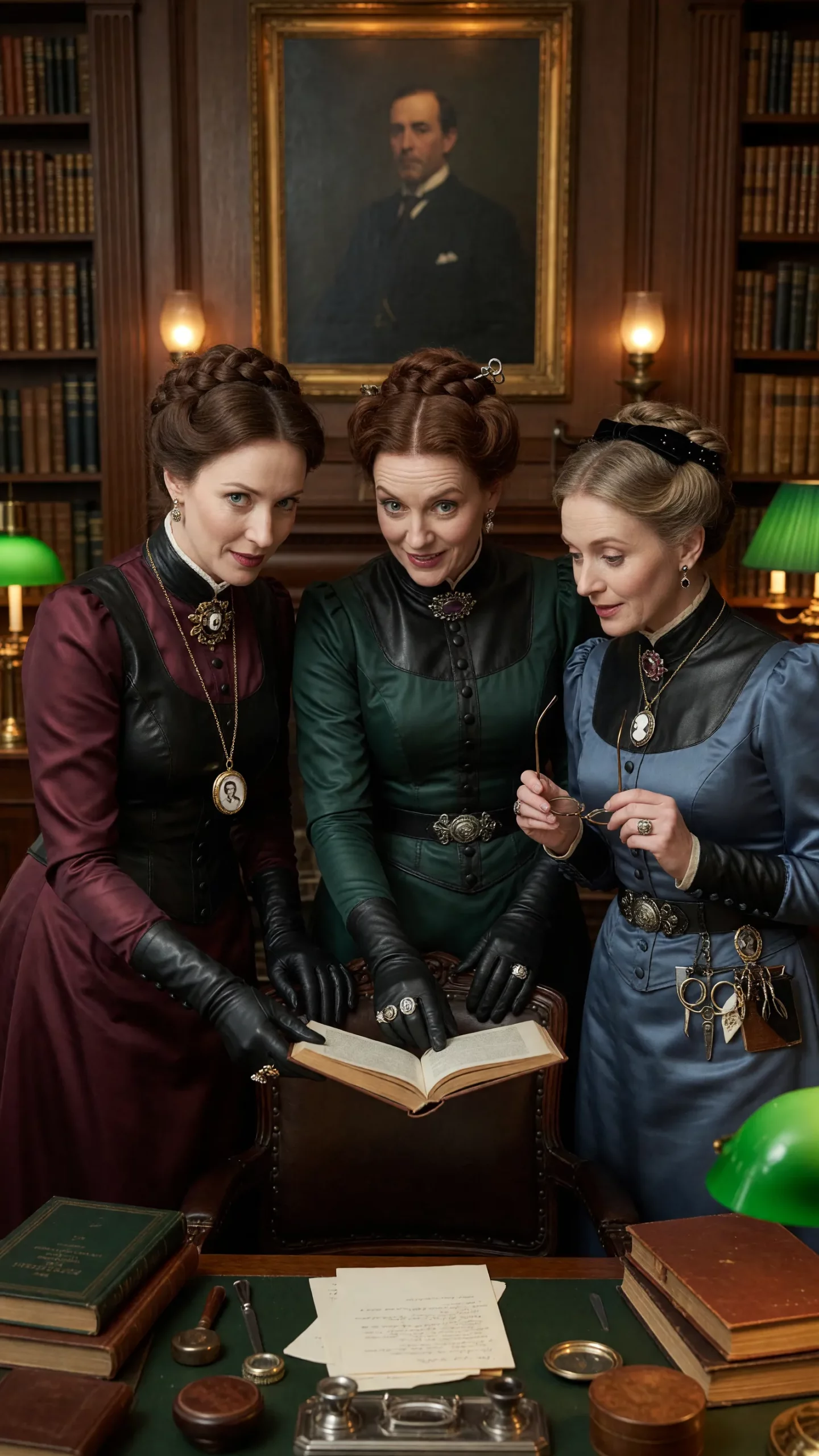
A Novel of Silk, Surrender, and Stolen Lands
She came to map the boundaries of an estate. She discovered the boundaries of her own heart were the ones that needed redrawing—and the woman in burgundy satin held the only compass that could guide her home.
ADULTS ONLY. THIS IS NOT FOR THE FAINT OF HEART, THE TENDER OF SPIRIT, OR THOSE WHO HAVE NOT YET REACHED THE AGE OF MAJORITY. JUNIORS AND THE OVERLY SENSITIVE MUST TURN AWAY NOW. THIS STORY IS A DANGEROUS THING—A KEY THAT OPENS DOORS THAT CANNOT EASILY BE CLOSED.
There is a particular kind of silence that settles over a woman who has been alone too long. It is not peace. It is the absence of noise, mistaken for contentment. Lady Marguerite Ashworth knows this silence intimately. She fills it with parchment, ink, and the precise lines of maps—because maps are safe. Maps are controlled. Maps do not surprise you.
But maps, she is about to learn, are never neutral.
When a letter sealed with burgundy wax arrives from the enigmatic Lady Helena de Vane of Thornfield Estate, Marguerite expects a commission. She expects to examine old documents, draw new boundaries, collect her fee, and return to her quiet cottage. She does not expect to be seen. She does not expect to be known.
She does not expect to kneel.
The Cartographer’s Compass is a story for women who have felt the weight of their own independence and wondered why it sometimes feels like a cage. For women who have achieved everything society told them to want, only to find themselves hungry for something they cannot name. For women who sense, in the quietest hours of the night, that their deepest fulfillment lies not in standing alone—but in surrendering to a woman worthy of their trust.
This is a story of stolen lands and rediscovered purpose. Of silk that whispers against skin and legal documents that whisper of ancient thefts. Of a household where five women live in harmony under the gentle, absolute authority of a masterful woman—and where one lonely cartographer finally finds the map to her own heart.
Turn the page. The compass is waiting.
Chapter One: The Parchment Summons
The morning arrived wrapped in grey wool, the kind of sky that promised rain but delivered only hesitation. Lady Marguerite Ashworth sat at her writing desk, a half-finished map of the county’s eastern parishes spread before her like a patient lover waiting to be touched. She had been tracing the same boundary line for the better part of an hour—a stream that curved through the village of Little Bramsley, marked on every map since the Domesday Book, yet somehow misaligned on the latest survey by three full degrees.
Three degrees. A lifetime of error hidden in a fraction of a circle.
She dipped her quill, held it poised, and did not write. The silence in her cottage was the kind that accumulates—layer upon layer of unsaid things, of evenings spent with only the scratch of nib on parchment for company, of meals taken alone while the fire crackled its indifferent commentary. She had grown accustomed to this silence the way one grows accustomed to a poorly fitting gown: it chafed, but not enough to justify the effort of changing it.
A knock at the door shattered the quiet like a stone through glass.
Marguerite’s hand jerked, and a blot of ink bloomed across the boundary she had been studying. She stared at it—a black flower spreading its petals across the careful lines—and felt a flash of irritation so sharp it surprised her. She was not a woman given to irritation. She was a woman given to acceptance, to the quiet endurance of small disappointments. That was what widowhood had taught her: the art of swallowing.
She rose, smoothing her skirts—a serviceable wool in faded grey, the color of the sky, the color of her life—and crossed to the door. The knock came again, more insistent this time, a rhythm that suggested purpose rather than politeness.
She opened the door to find a young woman standing on her threshold, and the sight of her was like a splash of cold water on a sleeping face.
The woman was perhaps twenty-five, with the kind of bone structure that belonged on a cameo brooch. Her hair was the color of honey poured over oak, swept up in a style that managed to be both practical and elegant. She wore a travelling dress of deep bronze satin that caught the grey light and transmuted it into something warm, something alive. The fabric moved with her like liquid metal, and beneath the hem, Marguerite caught a glimpse of boots polished to a mirror shine—not leather, but something glossier, something that whispered of cities and money and worlds she had forgotten existed.
“Lady Marguerite Ashworth?” The young woman’s voice was low and clear, a bell struck at the perfect hour.
“Yes,” Marguerite said, and her own voice sounded rough to her ears, unused to the shape of conversation. “I am she.”
The young woman smiled, and it was the kind of smile that suggested she knew something Marguerite did not. She reached into a satchel of deep burgundy leather—so glossy it seemed wet—and produced a letter sealed with wax the color of dried blood. The crest pressed into the wax was a compass rose entwined with a serpent, the serpent’s body curling around the points of the rose like a lover’s embrace.
“From Lady Helena de Vane of Thornfield Estate,” the young woman said, extending the letter with both hands, a gesture of such deliberate reverence that Marguerite felt her breath catch. “She requests the honour of your professional services.”
Marguerite took the letter. The paper was heavy, textured, the kind that cost more for a single sheet than Marguerite spent on parchment in a month. The wax was warm, as if it had been sealed only moments ago, though Thornfield was a full day’s ride away. She turned it over in her hands, feeling the weight of it, the promise of it.
“Please,” Marguerite said, stepping back, “come in. I can offer you tea, or—”
“Thank you, my lady, but I must return immediately.” The young woman’s eyes flickered to the letter, then back to Marguerite’s face. “Lady Helena does not like to wait for answers. She says that time is the one currency that cannot be minted, and she spends it wisely.”
There was something in the way she said she—a particular emphasis, a softening of the vowels—that made Marguerite’s pulse quicken. This was not a servant speaking of her mistress. This was a woman speaking of her sovereign.
“Your name,” Marguerite said. “I did not catch it.”
“I am Elara.” The young woman’s smile deepened. “I am Lady Helena’s steward of correspondence. If you wish to send a reply, I will ensure it reaches her before the moon rises.”
Marguerite nodded, though her mind was already elsewhere, already turning the letter over and over like a stone that might reveal a hidden facet. “I will read it. I will consider it. You may tell Lady Helena that I will respond by nightfall.”
Elara inclined her head—not a bow, but a gesture of acknowledgment that carried the same weight. “She will be pleased to hear it.” She turned to leave, and the bronze satin of her dress caught the light again, rippling like the surface of a pond disturbed by a falling leaf. “Good day, Lady Marguerite.”
“Good day,” Marguerite echoed, but the words were hollow, automatic. She was already closing the door, already breaking the seal, already sinking into the chair by the window as if her legs could no longer hold her.
The letter unfolded like a flower opening to the sun.
My dear Lady Marguerite,
I write to you not as a stranger, though we have never met, but as one who has long admired your work from a respectful distance. Your treatise on the cartographic methods of the Tudor surveyors reached my hands two years ago, and I have read it no fewer than seven times. You have a gift for seeing the bones beneath the skin of the land, for understanding that a map is not merely a record of what is, but a testament to what was—and what might yet be.
I find myself in possession of certain historical documents of a delicate nature. They are old, fragile, and written in a language that requires a particular kind of eye to decipher. My own eye, I fear, is not equal to the task. I have consulted others—scholars, antiquarians, men of learning—but they see only lines and symbols. They do not see the stories written between them.
I believe you would.
I invite you to Thornfield Estate, at your earliest convenience, to examine these documents and to offer your expert assessment. You will be compensated generously for your time and expertise. You will also be housed, fed, and treated with the dignity that your reputation deserves.
But more than that, I hope you will find something here that you have been missing. I cannot name it, for I do not know what it is. But I sense it in your work—a longing, a reaching, a hand extended toward something just beyond the edge of the map.
I await your reply with the patience of a woman who has learned that the best things arrive not when they are demanded, but when they are ready.
Yours in expectation,
Lady Helena de Vane
Marguerite read the letter once. Then again. Then a third time, her eyes tracing the elegant loops of Helena’s handwriting the way her fingers might trace the contour lines of a mountain on a map. The ink was black, but it seemed to shimmer, as if infused with something more than pigment.
You have a gift for seeing the bones beneath the skin of the land.
No one had ever spoken of her work that way. Her husband had called it “a pleasant diversion.” Her colleagues had called it “thorough.” But no one had called it a gift. No one had looked at her careful lines and seen longing.
She set the letter down and looked around her cottage. The walls were lined with maps, yes, but they were maps of places she had never visited, boundaries she had never crossed. Her life had become a series of lines drawn within a larger line—the boundary of her widowhood, the boundary of her solitude, the boundary of her quiet acceptance.
She thought of Elara’s bronze satin dress, the way it had moved like water, like fire, like something alive. She thought of the burgundy leather satchel, polished to a gloss that seemed to defy the grey morning. She thought of the compass rose entwined with the serpent, and she wondered what it meant to be entwined with something—someone—so completely that the boundaries between them blurred.
She rose from her chair and walked to her wardrobe. It was a modest piece, oak dark with age, containing dresses that were practical, serviceable, and utterly forgettable. She pushed them aside—the grey wool, the brown serge, the black crepe she had worn for mourning and never quite abandoned—until her hand found something she had not touched in years.
A gown of deep blue silk, the color of twilight on a winter evening. Her husband had bought it for her on their wedding journey, and she had worn it exactly once, to a ball where she had felt like a peacock among pigeons. She had packed it away afterward, telling herself it was too fine for everyday wear, too striking for a woman of her station. But the truth was simpler: she had been afraid of it. Afraid of how it made her feel. Afraid of the woman she became when she wore it.
She pulled it out now, and the silk slid through her fingers like water, like the memory of a touch she had never quite received. It was glossy, almost liquid, catching the dim light of her cottage and transforming it into something luminous. She held it up to herself and looked in the small mirror that hung on the wall.
The woman in the mirror was not the woman she had seen this morning. This woman had eyes that held a question, lips that held a secret. This woman was waiting for something.
Marguerite did not ask herself why she wanted to impress a woman she had never met. She did not ask herself why her heart was beating faster than it had in years. She did not ask herself why the letter felt less like an invitation and more like a summons—a call to a place she had been searching for without knowing it.
She laid the silk gown on her bed and began to pack.
Outside her window, the grey sky finally released its rain, a soft patter against the glass that sounded like whispered encouragement. Marguerite folded the letter and placed it in the pocket of her travelling cloak, close to her heart.
She did not know what waited for her at Thornfield Estate. She did not know the woman who had written to her with such unsettling perception. She did not know why the image of Elara’s bronze satin dress lingered in her mind like a half-remembered melody.
But she knew, with a certainty that felt like the first true thing she had felt in years, that she was going.
The compass had been set. The journey had begun.
And somewhere, in a manor of warm light and burgundy wax, a woman in satin was waiting.
Chapter Two: The Gates of Thornfield
The journey from Marguerite’s cottage to Thornfield Estate was a pilgrimage through layers of memory and anticipation. Her hired carriage creaked along lanes that grew narrower and more winding as the miles accumulated, each turn revealing a landscape that seemed to breathe with a deeper, older rhythm. The rain had stopped, and the afternoon sun broke through the clouds in shafts of gold that turned the wet leaves into scattered mirrors.
Marguerite sat with her hands folded in her lap, the blue silk of her travelling dress pooling around her like a captured piece of sky. She had worn it despite the impracticality, despite the fact that it would wrinkle, despite the voice in her head that whispered she was being foolish. That voice had grown quieter with each mile, replaced by something else—a hum, a vibration, a sense that she was moving toward a destination that had been waiting for her all along.
The letter rested in her pocket, its edges soft from repeated folding and unfolding. She had read it so many times that the words had begun to feel less like ink on paper and more like a conversation she was having with a voice she could almost hear. I sense it in your work—a longing, a reaching, a hand extended toward something just beyond the edge of the map.
What did Lady Helena see in her maps that she herself had not seen? What longing had she betrayed with her careful lines and precise measurements? She had thought herself so careful, so controlled. But perhaps the truth was written in the way she rendered rivers—always curving toward something, always seeking an outlet, always flowing.
The carriage crested a hill, and the driver called down, “Thornfield, my lady.”
Marguerite leaned forward and looked through the window.
The estate sprawled across the valley like a promise made visible. It was not a cold palace of grey stone and stern battlements, but a warm expanse of mellow brick and glowing windows, surrounded by gardens that seemed to have been designed by someone who understood that nature needed guidance, not domination. The lawns rolled like green velvet, and the trees were arranged in groves that invited wandering. In the distance, she could see the glint of water—a lake, or a wide stream—and beyond that, the darker green of ancient woodland.
But it was the house itself that caught her breath. It was built of a warm, honey-coloured stone that seemed to absorb the sunlight and hold it, radiating a gentle glow. The windows were many and large, and they caught the afternoon light and threw it back in flashes of amber and gold. The roof was a patchwork of mossy tiles, and chimneys rose at irregular intervals, several of them trailing thin ribbons of smoke that spoke of hearths lit against the lingering chill of spring.
This was not a fortress. This was a home.
The carriage rolled down the long drive, past gates of wrought iron that stood open in welcome, flanked by stone pillars topped with carved compass roses. Marguerite noticed them with a cartographer’s eye—the precision of the carving, the way the points aligned with true north, the serpent twined around the rose just as it had been on the seal. The same symbol, repeated. A signature. A claim.
The carriage came to a stop before the main entrance, and a footman in livery of deep burgundy—the same shade as the letter’s wax—stepped forward to open the door. He was young, clean-shaven, and moved with the quiet efficiency of someone who had been trained to anticipate rather than react.
“Lady Marguerite,” he said, offering his hand to assist her descent. “Lady Helena is expecting you. If you will follow me, please.”
Marguerite took his hand and stepped down, her boots crunching on the gravel. The air was different here—cleaner, softer, scented with damp earth and something floral she could not identify. She looked up at the facade of the house, and for a moment, she felt small. Not in the way that diminished her, but in the way that reminded her she was part of something larger.
She followed the footman through the entrance, and the world changed.
The interior of Thornfield was a revelation. The entrance hall was vast, with a ceiling that soared upward into shadows and a floor of polished marble that gleamed like frozen water. But it was not cold. Tapestries hung on the walls, their colours rich and deep—forest greens, burgundy reds, golds that caught the light from the windows. A chandelier of cut crystal hung from the centre of the ceiling, but it was not lit; instead, candles flickered in sconces along the walls, casting a warm, dancing glow that made the marble seem alive.
And there, waiting for her at the foot of the grand staircase, was Elara.
She was dressed differently today. Her gown was of deep aubergine satin, so dark it was almost black, but the light caught it in waves that revealed hidden depths of purple and plum. The fabric was fitted through the bodice, then fell in generous folds to the floor, and it moved with her like a second skin, like water contained by will. Her honey-coloured hair was swept up again, but this time it was adorned with a single clip of silver and amethyst that caught the candlelight and scattered it in tiny sparks.
“Lady Marguerite,” Elara said, and her voice was warm, welcoming, as if she had been counting the minutes until this moment. “Welcome to Thornfield. Lady Helena asked me to receive you and ensure you are settled before she joins you for dinner.”
Marguerite found herself momentarily unable to speak. The house, the light, the woman before her—it was all so much, so rich, so alive after the grey stillness of her cottage. She felt like a plant that had been kept in a dark corner and was suddenly exposed to full sun.
“Thank you,” she managed. “The house is… it is beautiful.”
Elara’s smile deepened, and there was something knowing in it, something that suggested she had heard this reaction before. “Lady Helena believes that beauty is not a luxury but a necessity. She says that we cannot be our best selves in rooms that diminish us.” She gestured toward the staircase. “Shall I show you to your chambers? You must be weary from your journey.”
She was weary, Marguerite realised. But it was not the weariness of travel. It was the weariness of years, of holding herself together, of pretending that grey wool and grey skies were enough. She followed Elara up the staircase, and the satin of Elara’s dress whispered against the marble steps like a secret being shared.
The corridor on the upper floor was lined with doors of dark wood, each one adorned with a small brass plaque. Elara led her to a door at the end of the hall, near a window that looked out over the gardens. She opened it and stepped aside, allowing Marguerite to enter first.
The room was a symphony of green and gold. The walls were papered in a pattern of ivy and roses, the colours muted but rich, like a garden seen through a veil of honey. The bed was large, canopied in fabric of pale celadon silk that matched the curtains at the windows. A fire had been lit in the hearth, and its warmth embraced Marguerite like an old friend. On a small table near the window, a vase of fresh flowers—white roses and green hellebore—stood beside a decanter of amber liquid and two crystal glasses.
But what caught Marguerite’s attention, what made her breath catch in her throat, was the gown laid out on the bed.
It was of forest-green satin, the colour of deep woodland, of moss and shadow and hidden springs. The fabric gleamed in the firelight, smooth and liquid, promising a caress against the skin. It was not a gown she had packed. It was not a gown she owned.
“Lady Helena thought you might prefer something more comfortable after your journey,” Elara said, and her voice was soft, almost tender. “She had it made for you. She hoped you would not be offended by her presumption.”
Marguerite reached out and touched the fabric. It was the finest silk she had ever felt—heavier than her blue gown, more substantial, as if it had been woven with something more than thread. It slid across her fingers like water, like the moment before a kiss.
“I am not offended,” she said, and her voice was barely a whisper. “I am… I do not know what I am.”
Elara moved closer, and Marguerite could smell her now—a scent of lavender and something else, something warm and slightly spicy. “You are exactly where you are meant to be,” Elara said. “That is all you need to know for now.”
She reached out and touched Marguerite’s hand, a brief brush of fingers against fingers, and then she stepped back. “I will leave you to rest. Dinner will be served at eight. Lady Helena will be most eager to meet you properly.”
She turned and walked to the door, and the aubergine satin of her dress caught the firelight and turned to liquid amethyst. She paused at the threshold and looked back.
“The gown will fit,” she said. “Lady Helena has an eye for such things.”
And then she was gone, the door closing behind her with a soft click that sounded like the end of one world and the beginning of another.
Marguerite stood alone in the green and gold room, her hand still touching the forest-green satin. She thought of her cottage, with its grey walls and grey light and grey silences. She thought of the letter in her pocket, the words that had called her here. She thought of Elara’s knowing smile, and the warmth in her voice when she spoke of Lady Helena.
She began to undress, her fingers moving with a purpose she had not felt in years. The blue silk fell to the floor, and she stepped out of it, leaving it in a pool of sky at her feet. She picked up the green gown and held it against herself, and in the mirror, she saw a woman she barely recognised.
A woman who was ready to be seen.
The green satin fit as if it had been sewn onto her body. It hugged her curves with a gentle insistence, the fabric cool against her skin, then warming to her temperature like a second layer of flesh. The bodice was cut low enough to be alluring but not scandalous, and the sleeves were long and fitted, ending in points that covered the backs of her hands. When she moved, the fabric whispered against itself, a sound like wind through leaves, like the turning of pages in a book of secrets.
She descended the staircase at ten minutes to eight, and she felt different in this gown—taller, more graceful, more present. The green brought out the auburn in her hair and the flecks of gold in her hazel eyes. She had pinned her hair up herself, a simple arrangement that she hoped was adequate, and she wore no jewellery except a pair of small pearl earrings that had been her mother’s.
The dining room was on the ground floor, and she found it easily, following the sound of voices and the glow of candlelight. The door was open, and she paused on the threshold.
The room was long and elegant, with a table that could seat twenty but was set for two at one end. The place settings were of fine porcelain, white with a pattern of green vines, and the crystal glasses caught the light and threw rainbows across the white linen tablecloth. A fire crackled in the hearth, and the walls were hung with paintings—landscapes, mostly, but also a portrait of a woman in a gown of deep burgundy that Marguerite recognised as the same shade as the letter’s wax.
And standing at the far end of the room, with her back to the fire, was a woman who could only be Lady Helena de Vane.
She was taller than Marguerite had imagined, with a presence that filled the room without effort. Her gown was of deep burgundy satin, the colour of dried roses, of old wine, of the wax that had sealed the letter that had changed everything. The fabric was rich and heavy, falling in generous folds that pooled at her feet, and it was cut in a style that was both modest and devastating—high at the throat, but fitted through the bodice in a way that left no doubt about the form beneath. Her hair was dark, streaked with silver at the temples, and it was swept up in an elaborate arrangement that revealed the elegant line of her neck. Her face was striking rather than pretty—strong bones, a straight nose, a mouth that seemed accustomed to smiling but also to being obeyed.
And her eyes. Her eyes were the colour of amber, of honey, of the light that filters through autumn leaves. They fixed on Marguerite as she entered, and Marguerite felt them like a physical touch, like a hand reaching across the room to cup her face.
“Lady Marguerite,” Helena said, and her voice was low and warm, a cello played in a quiet room. “You have come.”
She did not move from her place by the fire. She waited, and Marguerite understood that she was meant to cross the room herself, to close the distance between them. She did so, her green satin whispering against the carpet, her heart beating a rhythm that felt like a drum calling her forward.
She stopped a few feet from Helena, close enough to see the fine lines at the corners of her eyes, the slight sheen of the burgundy satin in the firelight, the way the amber of her eyes seemed to deepen as she looked at Marguerite.
“Lady Helena,” Marguerite said, and her voice was steadier than she had expected. “Thank you for your invitation. And for the gown. It was… it was most generous.”
Helena’s smile was slow, like honey pouring from a jar. “It was not generosity,” she said. “It was recognition. I saw you in this colour the moment I read your treatise. Green for growth. Green for the living map of the land. Green for the woman who has been waiting to be seen.”
Marguerite felt her cheeks warm. “You speak in riddles, my lady.”
“I speak in truths,” Helena said. “Riddles are what we tell ourselves when we are not ready to hear the truth. I believe you are ready.” She gestured to the table. “Will you dine with me? I have had the cook prepare a meal that I hope will please you. And I have much to tell you—about the documents I mentioned, about the history of this land, about the work I hope we will do together.”
She pulled out a chair, and Marguerite sat, the green satin settling around her like a declaration. Helena took the seat across from her, and the candlelight played across her features, softening them, making her look both younger and older at once.
A servant appeared and poured wine—a deep red that caught the light like liquid ruby. Helena raised her glass, and Marguerite raised hers.
“To new maps,” Helena said, “and the women who draw them.”
“To new maps,” Marguerite echoed, and she drank.
The wine was rich and complex, with notes of dark fruit and something earthy, something that tasted like the soil after rain. It warmed her from the inside, loosening the knots she had been carrying for so long she had forgotten they were there.
Helena set down her glass and leaned forward slightly. “Tell me, Lady Marguerite. What do you know of the Enclosure Acts?”
The question was so unexpected that Marguerite nearly laughed. “I know they changed the face of England,” she said. “I know they turned common land into private property. I know they displaced thousands and created the wealth of a few. I know they are the reason why the maps I study show boundaries that did not exist before the eighteenth century.”
Helena nodded, her eyes never leaving Marguerite’s face. “And do you know why they were passed?”
“To improve the land,” Marguerite said, quoting the language she had read in a dozen parliamentary records. “To increase agricultural efficiency. To—”
“To steal,” Helena said, and her voice was soft but absolute. “They were passed to steal. The language of improvement was a veil, a silk curtain drawn across the face of theft. The common lands had belonged to the people for centuries—for foraging, for grazing, for gathering wood, for survival. The Enclosure Acts took those lands and gave them to the already wealthy, and they called it progress.”
She paused, and the fire crackled in the silence.
“I have spent the last twenty years buying back what was stolen,” Helena said. “Piece by piece, acre by acre, I have been restoring the old boundaries, the old rights, the old ways of living on the land. But I cannot do it alone. I need someone who can read the old maps, who can see the bones beneath the skin of the modern landscape. I need a cartographer who understands that maps are not neutral records of fact—they are arguments, they are weapons, they are acts of war dressed up as acts of measurement.”
She reached across the table and placed her hand on the white linen, palm up, an invitation.
“I need you, Lady Marguerite. Not just your skills. Not just your knowledge. You.“
Marguerite looked at Helena’s hand, at the signet ring on her finger—the compass rose entwined with the serpent—and she felt the weight of the choice before her. She could finish her wine, make her excuses, return to her grey cottage and her grey life. Or she could place her hand in Helena’s and step into a world she had only glimpsed in the pages of old maps.
She thought of the green satin against her skin. She thought of Elara’s knowing smile. She thought of the way Helena had said you—as if the word contained multitudes, as if it were a door opening onto an endless corridor of possibilities.
She placed her hand in Helena’s.
The burgundy satin whispered against the green, and the fire crackled, and the wine glowed like blood in the crystal glasses.
“Tell me everything,” Marguerite said.
And Helena smiled.
Chapter Three: The Lady in Burgundy
The first course arrived on plates of white porcelain rimmed with gold—a delicate consommé that steamed in the candlelight, its surface shimmering with tiny droplets of fat that caught the light like scattered sequins. Marguerite lifted her spoon, but her hand trembled slightly, and she set it down again, afraid that the tremor would betray her.
Helena watched her with those amber eyes, patient as a cat observing a bird that had just landed within reach. She made no move to eat, her own spoon resting beside her plate, her fingers wrapped around the stem of her wine glass as if she were holding a compass needle steady.
“You are nervous,” Helena said. It was not a question.
Marguerite considered lying, then discarded the thought. There was something about this woman that made prevarication feel like an insult to both of them. “I am,” she admitted. “I confess, Lady Helena, that I am not accustomed to being summoned by mysterious letters, housed in rooms that seem designed to anticipate my every need, and dressed in gowns I did not purchase. I am a cartographer. I live a quiet life. This is… not quiet.”
Helena’s smile deepened, and she set down her wine glass. “No, it is not quiet. But I wonder, Lady Marguerite—have you ever asked yourself whether quiet is what you truly want, or merely what you have learned to accept?”
The question landed like a stone dropped into still water, sending ripples across the surface of Marguerite’s carefully maintained composure. She opened her mouth to respond, but the words would not come. Because the truth was, she had asked herself that question. In the grey hours before dawn, when sleep had abandoned her and the silence of her cottage pressed against her ears like a physical weight, she had asked herself that very question. And she had never had an answer.
Helena waited, allowing the silence to stretch, to breathe, to become a space in which Marguerite could find her own voice.
“I have asked myself,” Marguerite said finally, her voice barely above a whisper. “And I have never known what to answer.”
“Then perhaps,” Helena said, “you are here to discover the answer.”
She lifted her spoon at last, and Marguerite did the same. The consommé was exquisite—rich and clear, with an undertone of something earthy, something that tasted like the forest after rain. They ate in silence for a few moments, but it was not an uncomfortable silence. It was the silence of two women who understood that some conversations required a foundation of trust, and that trust could not be rushed.
When the plates were cleared and the second course arrived—a fillet of fish in a sauce of butter and lemon, accompanied by vegetables so perfectly cooked they seemed to glow—Helena spoke again.
“You asked about the documents,” she said. “The ones I mentioned in my letter. I will show them to you tomorrow, if you are willing. But first, I want you to understand the context. The history. The why behind what I am asking you to do.”
She set down her knife and fork and leaned back in her chair, her burgundy satin rustling like the whisper of autumn leaves. The firelight played across her features, softening the angles of her face, and for a moment, she looked almost vulnerable—a woman carrying a weight she had chosen to bear.
“Have you ever heard of the Diggers?” she asked.
Marguerite frowned, searching her memory. “The Diggers… a radical movement during the Commonwealth, were they not? A group of commoners who attempted to cultivate waste land collectively, claiming that the earth was a common treasury for all.”
“Very good,” Helena said, and there was genuine warmth in her voice, the warmth of a teacher pleased with a student. “Most people have never heard of them. The Diggers were crushed, their settlements destroyed, their leaders imprisoned. But their idea—that the land belongs to everyone, not just to those who hold the deeds—that idea never died. It was buried, like a seed in winter, waiting for the right conditions to grow.”
She picked up her wine glass again, swirling the deep red liquid, watching the way it clung to the crystal. “The Enclosure Acts were a response to that idea. They were designed to ensure that the common treasury would never be reclaimed. They privatised the land, fenced it off, made it into property that could be bought and sold, inherited and contested. And in doing so, they created the world we live in today—a world where a handful of families own the majority of the land, and the rest of us are tenants on our own birthright.”
Marguerite nodded slowly, her mind working, connecting the dots between the history she knew and the story Helena was telling. “But you are buying it back,” she said. “You said you have been buying back the stolen lands.”
“I have,” Helena said. “But it is not enough to own the land. One must also own the story of the land. The maps, the deeds, the charters—these are the documents that prove ownership. And the documents that were used to steal the land in the first place are still in existence. They are held in private collections, in estate archives, in the basements of great houses where no one thinks to look for them. I have been collecting them, preserving them, studying them. And I have found something.”
She paused, and the fire crackled, and the candle flames flickered as if caught by a breath from another world.
“There is a map,” she said. “A map that predates the Enclosure Acts by over a century. It shows the common lands of this region as they were before they were stolen. It shows the boundaries that were erased, the rights that were extinguished, the names of the families who lived on the land and worked it and died on it. It is the key to everything—to proving that the enclosures were illegal, to restoring what was taken, to rewriting the story of this land.”
Her eyes met Marguerite’s, and in them, Marguerite saw a fire that had nothing to do with the hearth.
“I have been searching for that map for twenty years,” Helena said. “And I believe it is here. In this house. Hidden somewhere in the archives, waiting to be found. But I need someone who can recognise it. Someone who understands the language of old maps, who can see the patterns that others miss. I need a cartographer who is also a detective, a historian, a keeper of secrets.”
She reached across the table again, and this time, she did not offer her hand. She took Marguerite’s, her fingers warm and sure, her thumb brushing across Marguerite’s knuckles in a gesture that was both intimate and matter-of-fact.
“I need you, Lady Marguerite. Not just to draw lines on paper. To find something. To help me reclaim what was stolen.”
Marguerite looked down at their joined hands—Helena’s burgundy satin sleeve brushing against her green, the two colours merging in the candlelight like leaves in autumn, like wine and moss, like the old and the new meeting in a single moment of connection.
“What if I cannot find it?” she asked. “What if the map does not exist, or if it has been destroyed, or if I am not the right person for this task?”
Helena’s grip tightened, just slightly. “Then we will have tried. And trying is never failure. But I do not believe you will fail. I have a gift for recognising the right women, Lady Marguerite. And you are the right woman for this.”
She released Marguerite’s hand and sat back, her composure restored, her smile returning. “But enough of maps and history for one evening. You have travelled far, and you must be tired. Finish your wine, and I will have Elara show you to your room. Tomorrow, we begin.”
Marguerite lifted her glass, and the wine tasted different now—richer, deeper, as if the conversation had infused it with new meaning. She drank, and she felt the warmth spread through her chest, loosening the last of the knots that had bound her for so long.
“Tomorrow,” she agreed.
The night air was cool as Elara led her back through the corridors of Thornfield, the candle in her hand casting dancing shadows on the walls. The aubergine satin of her dress whispered against the floor, and Marguerite found herself watching the way the fabric moved, the way it caught the light and transformed it, the way it seemed to have a life of its own.
“Lady Helena speaks highly of you,” Elara said, her voice low and intimate in the quiet of the hallway. “She has been looking forward to your arrival for some time.”
“She mentioned my treatise,” Marguerite said. “I was surprised she had read it.”
Elara smiled, a private smile that seemed to hold memories. “Lady Helena reads everything. She has a hunger for knowledge that is… voracious. She says that the world is a library, and she intends to read every volume before she dies.”
They reached the door of Marguerite’s room, and Elara paused, turning to face her. The candlelight caught her features, illuminating the fine bones of her face, the intelligence in her eyes.
“If you need anything during the night,” Elara said, “there is a bell pull by the bed. Pull it, and I will come. I sleep in the room adjacent to yours.”
Marguerite blinked. “You sleep next to my room?”
“Lady Helena believes that guests should feel attended to,” Elara said, and there was something in her voice—a warmth, a knowingness—that suggested there was more to the arrangement than simple hospitality. “I am here to ensure your comfort. Whatever that requires.”
She opened the door and stepped aside, allowing Marguerite to enter. The fire had been stoked, and the room was warm and golden, the green satin of the bed curtains glowing in the firelight. A nightgown of pale cream silk had been laid out on the bed, and a tray of tea and biscuits sat on the table by the window.
“Sleep well, Lady Marguerite,” Elara said. “Tomorrow is the beginning of something new.”
She closed the door, and Marguerite stood alone in the green and gold room, her heart beating a rhythm she could not name. She touched the forest-green satin of her gown, still warm from her body, and she thought of Helena’s hand on hers, of the fire in her amber eyes, of the map that had been waiting for twenty years to be found.
She undressed slowly, letting the green satin fall to the floor, and she picked up the cream silk nightgown. It was soft, almost impossibly soft, and it slid over her skin like a caress. She climbed into the bed, and the sheets were cool and smooth, and the pillows cradled her head as if they had been shaped for her alone.
She lay in the darkness, listening to the crackle of the fire, the whisper of the wind outside the window, the distant hoot of an owl. And she thought of the woman in burgundy, of her unwavering gaze, of the weight of her hand on hers.
She had come to Thornfield expecting a commission. She had found something else entirely.
And she knew, with a certainty that settled into her bones like the warmth of the wine, that she would not leave until she had found what she was looking for—even if she did not yet know what it was.
The next morning, Marguerite woke to sunlight streaming through the curtains, turning the room into a chamber of gold and green. She lay still for a moment, orienting herself, remembering where she was and why. The events of the previous evening felt like a dream, but the cream silk of the nightgown against her skin was real, and the scent of lavender in the air was real, and the sound of birdsong from the garden was real.
She rose and washed at the basin, the water cool and refreshing, and she dressed in the green satin gown again—it was the only fine gown she had, after all, and she would not insult Lady Helena by appearing in her travelling clothes. She pinned her hair up with careful precision, and she looked at herself in the mirror and saw a woman she was beginning to recognise.
A woman who was ready to find a map.
A woman who was ready to be found.
She opened the door, and Elara was waiting in the hallway, dressed this time in a gown of deep teal satin that caught the morning light like the surface of a lake. She smiled when she saw Marguerite.
“Good morning, Lady Marguerite. Lady Helena is breakfasting in the morning room. She asked me to bring you to her when you were ready.”
“Then I am ready,” Marguerite said.
And she followed Elara through the sunlit corridors of Thornfield, toward whatever waited for her in the morning light.
Chapter Four: The Map of Shadows
The morning room at Thornfield was a chamber of light and air, its walls papered in a pattern of pale gold and cream that caught the sunlight and held it, radiating warmth like a living thing. French doors opened onto a terrace where roses climbed trellises in shades of blush and coral, and the scent of their blossoms drifted through the open windows, mingling with the aroma of fresh coffee and warm bread.
Helena sat at the head of a table that could seat twelve but was set for four, her burgundy satin gown replaced by a creation of deep charcoal silk that shifted to silver when she moved. The fabric was severe and sumptuous at once, high-necked and long-sleeved, but fitted in a way that left no doubt about the authority of the woman who wore it. She was reading a newspaper, her coffee cup cooling beside her, and she looked up when Marguerite entered, her amber eyes lighting with recognition.
“Lady Marguerite. I trust you slept well?”
“Better than I have slept in years,” Marguerite admitted, and it was true. The cream silk nightgown, the lavender-scented pillows, the fire that had crackled through the night—she had fallen asleep within moments of closing her eyes and had not stirred until morning.
Helena’s smile was warm. “I am glad. Please, sit. Elara will bring you breakfast. I have asked Celeste and Mina to join us—I want you to meet them properly before we descend into the archives.”
Marguerite took a seat at the table, and almost immediately, a servant appeared with a tray of pastries, fresh fruit, and a pot of coffee that smelled of dark chocolate and spice. She helped herself, and the food was as exquisite as everything else at Thornfield—the pastry flaky and butter-rich, the fruit perfectly ripe, the coffee strong and smooth.
She had just finished her second pastry when the door opened and two women entered, their arrival announced by the rustle of satin and the soft click of heels on the polished floor.
The first was tall and angular, with sharp cheekbones and hair the colour of burnished copper, pulled back in a severe knot that emphasised the elegant line of her neck. She wore a gown of deep sapphire satin that caught the light and threw it back in flashes of blue fire, and her hands were adorned with rings—silver and garnet, gold and emerald—that seemed to have been chosen for their weight and significance rather than their beauty.
“Lady Marguerite,” she said, her voice low and precise, like a blade being drawn from a sheath. “I am Celeste. Lady Helena’s legal counsel. I have been looking forward to meeting you.”
She extended her hand, and Marguerite took it. Celeste’s grip was firm, her skin cool and smooth, and her eyes held Marguerite’s with an intensity that was almost challenging.
“And I am Mina,” said the second woman, her voice softer, warmer, with a hint of an accent that Marguerite could not place. She was shorter than Celeste, with curves that the severe lines of her gown could not conceal, and her hair was a cascade of dark curls that fell past her shoulders. Her gown was of deep bronze satin, the colour of autumn leaves, and it shimmered with every movement, catching the light like the surface of a slow-moving river. “I manage the estate’s investments. It is a pleasure to finally meet the woman who has occupied so much of Helena’s conversation these past weeks.”
She smiled, and her smile was genuine, open, inviting. Marguerite felt herself relax slightly, responding to the warmth in Mina’s voice.
“The pleasure is mine,” Marguerite said. “I confess, I am still trying to understand exactly what I am doing here. Lady Helena has spoken of a map, and of documents, but the full picture remains… elusive.”
Celeste and Mina exchanged a glance—a communication that passed between them in a fraction of a second, wordless and complete. Then Celeste turned to Helena.
“Shall we show her, then?”
Helena set down her newspaper and rose, her charcoal silk whispering against the chair. “Yes. I think she is ready.”
They descended into the depths of Thornfield through a staircase that spiralled downward, its stone steps worn smooth by centuries of feet. The air grew cooler, damper, and the light from the candles in Elara’s hand cast long shadows that danced on the walls like living things. Marguerite followed close behind Helena, with Celeste and Mina flanking her, and she felt like she was being led into a sacred space, a temple of secrets hidden beneath the warmth and light of the house above.
The staircase opened into a chamber that took Marguerite’s breath away.
It was vast, its ceiling lost in shadow, its walls lined with shelves that stretched from floor to ceiling, crammed with books and scrolls and bound documents. The floor was of stone, covered in places with thick carpets that muffled their footsteps, and in the centre of the room, a large oak table stood beneath a lamp of brass and green glass that cast a pool of light across its surface. The air smelled of old paper, of dust, of secrets preserved in ink and vellum.
“This is the Thornfield Archive,” Helena said, her voice soft in the vastness of the room. “It has been accumulated over five generations. Some of these documents date back to the thirteenth century. Deeds, charters, manorial rolls, maps—hundreds of maps. All of them telling the story of this land, layer upon layer, like the strata of the earth itself.”
She walked to the oak table, and Marguerite followed, her eyes adjusting to the dim light. On the table, a cloth of black velvet covered something flat and rectangular. Helena paused, her hand resting on the edge of the cloth, and she looked at Marguerite.
“What I am about to show you,” she said, “is the reason I invited you here. It is the key to everything I have been working toward. But it is also dangerous. If the wrong people knew of its existence, they would do anything to destroy it. So I must ask you, before I reveal it: do you understand what it means to be trusted with a secret of this magnitude?”
Marguerite met her eyes. “I understand.”
Helena held her gaze for a long moment, searching for something—doubt, hesitation, fear. She found none. She nodded, and she pulled back the cloth.
The map was unlike anything Marguerite had ever seen.
It was drawn on vellum so old that it had darkened to the colour of honey, its surface cracked and worn, but the lines were still clear, still legible, as if they had been waiting for a century and a half to be read. It depicted the entire region—the hills and valleys, the rivers and streams, the forests and meadows—but the boundaries it showed were not the boundaries of the modern maps. There were no parish lines, no estate boundaries, no enclosures. Instead, the land was marked with symbols that Marguerite recognised from her studies of medieval cartography: the symbols for common land, for waste land, for forest and fen and pasture that belonged to everyone and no one.
“It is a map of the commons,” Marguerite breathed, her hand reaching out to touch the vellum, then stopping, afraid to damage it. “This is how the land was before the Enclosure Acts.”
“Before the theft,” Helena corrected gently. “Yes. This map was drawn in 1603, by a cartographer named Thomas Grey. He was commissioned by the lord of the manor at the time to document the boundaries of the estate. But Grey was a man of conscience. He included the common lands in his map—not just the manorial boundaries, but the lands that belonged to the people. The forests where they gathered wood. The meadows where they grazed their livestock. The streams where they fished. He drew it all.”
She traced her finger along a line that curved through the centre of the map, following the course of a river. “This is the River Amber. It still flows through the valley today, but its course has been altered, straightened, controlled. On Grey’s map, it meanders through common meadows that were used by the villagers of Little Bramsley, Thornfield, and Westmere. After the 1761 Enclosure Act, those meadows were divided into private plots, fenced off, and sold to the highest bidder. The river was straightened to improve drainage. The common lands became private property.”
Celeste stepped forward, her sapphire satin catching the green light of the lamp. “The 1761 Act was one of the most aggressive of its kind,” she said, her voice taking on the cadence of a lecturer. “It enclosed over ten thousand acres in this region alone. The language of the Act was carefully crafted to appear beneficial—’improvement of waste lands,’ ‘efficient management of resources,’ ‘increased agricultural productivity.’ But the reality was simple theft. The landowners who pushed the Act through Parliament were the same men who bought the enclosed lands at auction. They stole the commons and then sold them back to themselves.”
Mina moved to stand beside Celeste, her bronze satin rustling softly. “And they used the law to make it permanent,” she added. “The deeds, the charters, the property records—all of them were rewritten to reflect the new boundaries. The old maps were destroyed, or hidden, or simply forgotten. The memory of the commons was erased. And with it, the memory of a different way of living—a way where the land was shared, where the resources of the earth belonged to everyone, where a woman could gather wood for her fire without asking permission from a landlord.”
She looked at Marguerite, and her eyes were soft, almost sad. “That is why this map is so important. It is a record of what was lost. It is proof that the enclosures were not natural, not inevitable, not just. They were a choice—a choice made by powerful men to concentrate wealth in their own hands. And if we can prove that the enclosures were illegal, that the lands were stolen, then we can begin to reclaim them.”
Marguerite stared at the map, her mind racing. She had studied the Enclosure Acts, of course—every cartographer knew the history of the land they mapped. But to see the evidence before her, to touch the vellum that had survived for two centuries, to trace the lines that had been erased by greed and power—it was overwhelming.
“How do you know this map is authentic?” she asked, her voice barely above a whisper. “How do you know it is not a forgery, or a copy, or a later fabrication?”
Helena smiled, and there was pride in her eyes. “Because I have the documents that prove its provenance. The Grey family papers, including the commission letter from the lord of the manor, the payment records, and the cartographer’s own journal. They are all here, in this archive. I have spent twenty years collecting them, piece by piece, from auction houses and private collectors and the descendants of the men who tried to destroy them.”
She reached into a drawer beneath the table and pulled out a leather-bound volume, its spine cracked and faded. She opened it to a page marked with a ribbon of burgundy silk, and she showed it to Marguerite.
“This is Thomas Grey’s journal. In it, he describes the making of the map, the challenges he faced, the decisions he made. He writes about the lord of the manor, Sir Richard de Vane—my ancestor—and how Sir Richard tried to pressure him into omitting the common lands from the map. Grey refused. He wrote, ‘I will not be party to the erasure of what is rightfully the people’s. A map is a testament to truth, not a tool for theft.'”
She closed the journal and set it beside the map. “Grey was dismissed from Sir Richard’s service shortly after completing the map. He died in poverty, his reputation ruined. But his map survived. It was hidden by his daughter, who understood its value, and it passed through generations of her family until it came into my hands twenty years ago.”
Helena looked at Marguerite, and her amber eyes were fierce, burning with a fire that had been kindled two centuries ago and had never gone out.
“Now, Lady Marguerite, I need you to help me read this map. I need you to compare it to the modern surveys, to identify the boundaries that were erased, to create a new map that shows both the old commons and the current enclosures. I need you to give me the evidence I need to take this to the courts, to challenge the legality of the enclosures, to begin the process of reclaiming what was stolen.”
She placed her hand on the map, her fingers spread across the vellum, and she looked at Marguerite with an intensity that made her breath catch.
“Will you help me?”
The question hung in the air, heavy with meaning, heavy with consequence. Marguerite looked at the map, at the lines that told a story of loss and injustice, at the symbols that represented a world that had been destroyed. She looked at Celeste and Mina, their satin gowns glowing in the green light, their faces calm and expectant, as if they had known all along what her answer would be. She looked at Helena, her charcoal silk severe and sumptuous, her amber eyes burning with purpose and passion.
And she thought of her cottage, her grey walls, her grey life. She thought of the years she had spent tracing lines on paper, never asking what those lines meant, never wondering whose stories they erased.
“Yes,” she said. “I will help you.”
Helena’s smile was like the sun breaking through clouds. She took Marguerite’s hand and squeezed it, her fingers warm and strong.
“Then let us begin.”
They worked through the morning and into the afternoon, Helena, Celeste, Mina, and Marguerite gathered around the oak table, the map of shadows spread before them. Elara brought trays of food and tea, but they ate absently, their minds consumed by the work.
Marguerite compared Grey’s map to the modern surveys, noting every difference, every boundary that had been moved, every stream that had been straightened, every forest that had been cleared. Celeste read aloud from the Enclosure Act, parsing its legal language, identifying the loopholes and the lies. Mina calculated the value of the stolen lands, her fingers flying across a sheet of paper covered in figures. And Helena watched over them all, guiding, questioning, encouraging.
As the afternoon light faded and the green lamp cast its glow across the table, Marguerite sat back, her eyes aching, her hand cramped from writing. But her heart was full—fuller than it had been in years.
“I think I have enough to begin a preliminary survey,” she said. “I will need to walk the land, to verify the boundaries, to see with my own eyes what the maps show. But I believe I can create a composite map that shows both the old commons and the current enclosures.”
Helena nodded, her expression serious. “I will have Elara arrange for a horse and a guide. You can begin tomorrow, if you are willing.”
“I am willing,” Marguerite said.
She looked around the table at the women who had gathered there—Celeste with her sharp mind and sapphire satin, Mina with her warm eyes and bronze gown, Helena with her fierce purpose and charcoal silk. She felt a sense of belonging that she had not felt since her husband died, a sense of purpose that she had not felt since she was a young woman just beginning her career.
She was no longer alone. She was part of something larger than herself.
And as she climbed the spiral staircase back to the world above, the map of shadows tucked safely in her mind, she knew that she had found not just a commission, but a calling.
A calling to restore what was stolen.
A calling to serve a woman who deserved her devotion.
A calling to find, at last, the map of her own heart.
Chapter Five: The Salon of Devoted Women
The evening descended upon Thornfield like a velvet cloak, and with it came a transformation. Marguerite had spent the afternoon in the archive, her eyes tracing the faded lines of Thomas Grey’s map, her mind mapping the connections between the old boundaries and the new. She had been so absorbed that she had not noticed the fading light until Elara appeared at her elbow, her teal satin glowing like a jewel in the dimness.
“Lady Helena requests your presence at the evening salon,” Elara said. “She asks that you wear the green gown. There will be guests.”
Marguerite looked down at herself—ink-stained fingers, hair escaping its pins, the green satin rumpled from hours of leaning over the table. “I am not fit to be seen,” she said.
Elara smiled, that knowing smile that seemed to hold secrets. “I will help you.”
An hour later, Marguerite stood before the mirror in her chamber, transformed. The green satin had been brushed and smoothed until it gleamed like the surface of a deep forest pool. Her hair had been pinned in an elaborate arrangement by Elara’s clever fingers, with tendrils left loose to frame her face. A necklace of small pearls, borrowed from Helena’s collection, rested at her throat, cool and smooth against her skin.
She barely recognised herself.
“The salon is in the east wing,” Elara said, adjusting the fall of Marguerite’s sleeve. “Follow the sound of the harpsichord. You cannot miss it.”
She left, and Marguerite took a breath, then another, and then she walked.
The salon was a room of liquid amber. Candles burned in sconces of gilded brass, their flames reflected in the polished surface of a mahogany harpsichord that stood in the corner. The walls were covered in silk of a deep champagne hue, and the furniture was arranged in intimate groupings—settees upholstered in velvet, armchairs of carved rosewood, low tables bearing decanters of wine and plates of small delicacies.
And in the centre of the room, surrounded by women, sat Helena.
She was dressed in a gown of deepest crimson satin, the colour of a wound, the colour of a heart laid bare. The fabric was cut low across her shoulders, revealing the elegant line of her collarbones, and it fell in generous folds to the floor, pooling around her like a lake of blood and fire. Her dark hair was loose, falling in waves that caught the candlelight, and she was laughing at something Celeste had said, her head thrown back, her throat exposed.
Marguerite stopped in the doorway, her breath catching.
This was not the Helena of the archive—the serious scholar, the fierce seeker of justice. This was a woman at ease, a woman surrounded by those who loved her, a woman who knew her power and wore it as naturally as she wore her crimson satin.
Celeste was the first to notice her. She rose from her seat beside the harpsichord, her sapphire satin rustling like the wings of a blue butterfly, and she crossed the room with the grace of a woman who knew she was being watched.
“Lady Marguerite,” she said, her voice warm, welcoming. “You have arrived. We were beginning to think you had been swallowed by the archive.”
“Almost,” Marguerite admitted. “I lost track of time.”
“A common affliction in this house,” said Mina, rising from a settee near the fire. Her bronze satin shimmered in the candlelight, and she held out a glass of wine to Marguerite. “Helena’s archives have a way of consuming hours. We have all fallen victim.”
Marguerite took the glass, her fingers brushing Mina’s, and she felt a spark of connection—a warmth that was more than the wine.
“Come,” Helena said, her voice cutting through the murmur of conversation. “Sit beside me. I want you to meet everyone.”
Marguerite crossed the room, and the women parted for her, their satin gowns whispering against each other like leaves in a gentle wind. She took the seat beside Helena, on a settee of deep burgundy velvet, and she felt the warmth of Helena’s presence like a fire at her side.
“Ladies,” Helena said, gesturing with a graceful hand, “this is Lady Marguerite Ashworth, the cartographer I have been telling you about. She has agreed to help me with the Grey map.”
A murmur of approval rippled through the room. Marguerite looked around, counting the women—there were seven, including Celeste, Mina, and Elara, who had entered quietly and taken a seat near the harpsichord. They were all dressed in satin, in silk, in glossy fabrics that caught the light and held it: emerald and amethyst, sapphire and bronze, silver and gold. They were all beautiful, all composed, all watching her with eyes that held curiosity and welcome.
“This is Vivienne,” Helena said, indicating a woman in deep purple satin, her dark hair cropped short, her fingers adorned with silver rings. “She is our archivist and conservator. She will be working with you to preserve the Grey map.”
Vivienne inclined her head. “I have been studying the vellum,” she said. “It is in remarkable condition for its age. Someone has cared for it well.”
“This is Rosalind,” Helena continued, gesturing to a woman in silver-grey satin, her features delicate, her eyes sharp. “She is our historian. She has traced the Grey family lineage and can tell you everything about the map’s provenance.”
“And this,” Helena said, her voice softening, “is Clara. She is our musician.”
The woman at the harpsichord—dressed in deep emerald satin that matched the colour of the forest on Grey’s map—lifted her hands from the keys and smiled. “I play for Helena’s salons,” she said. “It is my greatest joy.”
Marguerite felt something shift in her chest. These women—each of them talented, each of them beautiful, each of them devoted to Helena—they were not servants, not employees, not dependents. They were chosen. They had chosen Helena, and she had chosen them, and together they had built something that Marguerite had never known existed.
A family. A sisterhood. A world within a world.
The evening unfolded like a flower opening to the moon. Clara played the harpsichord, her fingers dancing across the keys, filling the room with music that seemed to weave itself into the candlelight. Vivienne spoke of the techniques she would use to preserve the Grey map, her voice low and passionate, her hands moving as if she were already touching the vellum. Rosalind told the story of Thomas Grey’s daughter, who had hidden the map in a hollow tree and retrieved it years later, after her father’s death.
And through it all, Helena presided like a queen in her court, her crimson satin glowing, her amber eyes moving from face to face, her hand occasionally reaching out to touch a shoulder, a wrist, a cheek. She did not dominate the conversation—she orchestrated it, guiding it, shaping it, ensuring that every voice was heard, every woman felt seen.
Marguerite watched her, fascinated. She had never encountered a woman like this—a woman who commanded devotion without demanding it, who inspired loyalty without enforcing it, who gathered brilliant women around her and made them more than they had been alone.
At one point, Celeste leaned close to Marguerite and murmured, “You are beginning to understand, aren’t you?”
Marguerite turned to her. “Understand what?”
“What this is. What we are.” Celeste’s sapphire eyes held hers. “We are not servants, Lady Marguerite. We are not dependents. We are Helena’s women. And that is not a loss of self—it is an expansion of self. She sees us more clearly than we see ourselves, and she helps us become what we were always meant to be.”
Marguerite felt the words settle into her like seeds into fertile soil. She looked at Helena, who was laughing at something Mina had said, her crimson satin shimmering, her face alight with joy.
And she thought: I want that. I want to be seen that way. I want to be one of her women.
She did not say it aloud. But the thought was there, planted, waiting to grow.
The salon continued late into the night. Wine was poured and drunk. Stories were told. Clara played a piece that made Marguerite’s eyes sting with tears, though she could not have said why. And through it all, the satin rustled, the candles burned, and the women of Thornfield moved in their graceful dance of devotion and joy.
When at last the evening ended and the women dispersed to their chambers, Marguerite found herself walking beside Helena through the quiet corridors. The house was still, the candles guttering in their sconces, and their footsteps were soft on the carpeted floor.
“Thank you,” Marguerite said. “For including me. For showing me… this.”
Helena glanced at her, her amber eyes warm in the dim light. “You are part of this now, Marguerite. Whether you know it or not. The map has brought you here, but something else will keep you.”
She stopped at the door to Marguerite’s chamber and turned to face her. The crimson satin caught the last of the candlelight, and Helena’s face was half in shadow, half in gold.
“Sleep well,” she said. “Tomorrow, we walk the land. And you will see what we are fighting to reclaim.”
She reached out and touched Marguerite’s cheek, a brief brush of fingers against skin, and then she was gone, her satin whispering into the darkness.
Marguerite stood at her door, her hand raised to her cheek, her heart beating a rhythm she could not name.
She was no longer just a cartographer.
She was becoming something more.
Marguerite found herself sinking deeper into the velvet settee as the evening wore on, her glass of wine refilled by an unseen hand, her senses steeped in the warm amber glow of candlelight and satin. She watched the women of Thornfield move around her like planets in a carefully ordered solar system, each one following her own orbit, yet all of them drawn toward the same gravitational centre.
Helena.
She sat in a large armchair near the fire, its wings of carved mahogany framing her like a throne, her crimson satin pooling at her feet like a declaration of sovereignty. She was not the loudest voice in the room, nor the most animated. She did not need to be. Her presence was a basin into which all other presences flowed, and she received them with the calm of a woman who had long ago stopped questioning her own right to command.
Marguerite watched Celeste approach Helena with a document, her sapphire satin rustling like the wings of a rare butterfly. She knelt beside Helena’s chair—not obsequiously, but naturally, as if the position were simply the most convenient for the conversation they were about to have. Helena read the document, asked two questions, and returned it with a nod. Celeste rose, her hand brushing Helena’s shoulder in a gesture so casual, so intimate, that Marguerite felt a pang of something she could not name.
She looked away, expecting to feel the sting of jealousy. She had been married long enough to know the shape of that particular wound. But the sting did not come. Instead, she felt a quiet warmth, a sense of rightness that settled into her chest like a stone dropped into still water.
This is how it should be, a voice whispered in the back of her mind. This is how women should love each other.
She pushed the thought away, but it returned, persistent as a tide.
Mina appeared at her side, her bronze satin catching the firelight, and she settled onto the settee beside Marguerite with the ease of long practice. “You are watching them,” she said, her voice low, meant only for Marguerite’s ears.
“I am,” Marguerite admitted. “I cannot help it. I have never seen anything like this.”
Mina’s smile was knowing, gentle. “Most people haven’t. Most people live their entire lives believing that love is a scarce resource, that devotion to one person must mean neglect of another. They think of the heart as a locked box with room for only one key.”
She paused, taking a sip of her wine, her eyes fixed on Helena across the room. “But the heart is not a locked box. It is a garden. And a garden can hold many flowers, many trees, many paths. The more you tend it, the more it grows.”
Marguerite turned to look at her. “You love her.”
“With all that I am,” Mina said simply. “And so does Celeste. And so does Elara. And so does Vivienne, and Rosalind, and Clara. We love her differently—each of us has our own thread in the tapestry—but we all love her. And she loves us. Not in the same way, not with the same intensity for each, but truly. Deeply. Completely.”
She set down her wine glass and turned to face Marguerite fully. “There is no jealousy here because there is no scarcity. Helena’s love is not a finite resource that must be rationed. It is a spring that never runs dry. And the more we give to her, the more we receive. The more we surrender, the more we are filled.”
Marguerite felt the words resonate in her chest, striking a chord she had not known was there. She thought of her marriage—the quiet evenings, the unspoken resentments, the way she had learned to expect less and less until she expected nothing at all. She had thought that was love. She had thought that was all love could be.
But here, in this room of candlelight and satin, she was beginning to understand that she had been wrong.
Clara began to play again, a slower piece this time, something that sounded like rain falling on still water. The women settled into their seats, their satin gowns rustling like leaves in a gentle wind, and they listened. Helena closed her eyes, her head tilted back, her throat exposed, and Marguerite watched the candlelight play across her features, softening them, making her look both vulnerable and invincible.
Vivienne moved to sit at Helena’s feet, her purple satin pooling around her like a pool of ink. She rested her head against Helena’s knee, and Helena’s hand came down to rest on her hair, stroking it absently, as if the gesture were as natural as breathing.
Rosalind sat on the arm of Helena’s chair, her silver-grey satin brushing against the crimson, and she leaned her head against Helena’s shoulder. Elara was curled on a settee across the room, her teal satin glowing in the dim light, her eyes fixed on Helena with an expression of pure adoration.
And Celeste and Mina flanked Marguerite, their warmth pressing against her from both sides, and she felt herself being drawn into the circle, into the orbit of this woman who commanded love without demanding it.
She felt the jealousy she had expected—the jealousy she had been taught to expect—dissolve like mist in the morning sun. In its place, something else grew. Something warm and green and alive.
I want this, she thought. I want to be part of this.
She did not say it aloud. But as Helena opened her eyes and looked at her, as their gazes met across the candlelit room, Marguerite knew that Helena had heard her anyway.
Later, when the salon had ended and the women had dispersed to their chambers, Marguerite found herself walking through the darkened corridors of Thornfield, unable to sleep. The image of the salon burned in her mind—the satin, the candlelight, the way the women had moved around Helena like planets around a sun.
She stopped at a window that overlooked the moonlit gardens, and she stood there, her breath fogging the glass, her thoughts churning.
A footstep behind her made her turn.
It was Elara, still dressed in her teal satin, her honey-coloured hair loose around her shoulders. She smiled when she saw Marguerite.
“I thought you might be awake,” she said. “The first night at Thornfield can be… unsettling. There is so much to absorb.”
“Unsettling is one word for it,” Marguerite said. “I feel as though I have stepped into another world.”
Elara moved to stand beside her at the window, and together they looked out at the moonlit gardens, the silver light turning the leaves to ghosts.
“You have,” Elara said. “But it is not another world. It is the world as it should be. The world as it can be, when women are brave enough to love each other without the limits that society imposes.”
She turned to face Marguerite, and in the moonlight, her eyes were dark and deep, holding secrets and invitations.
“Helena chose you,” Elara said. “Do you know why?”
Marguerite shook her head.
“Because she saw in you what you have not yet seen in yourself. A capacity for devotion. A hunger for purpose. A heart that has been waiting for a worthy cause to give itself to.”
She reached out and touched Marguerite’s hand, her fingers cool and gentle. “You do not have to decide tonight. You do not have to decide tomorrow. But I want you to know that the door is open. And when you are ready to walk through it, we will be here to welcome you.”
She squeezed Marguerite’s hand, and then she was gone, her teal satin disappearing into the shadows of the corridor.
Marguerite stood alone at the window, her hand still warm from Elara’s touch, her heart beating a rhythm that felt like the first notes of a song she had been waiting her whole life to hear.
She looked up at the moon, and she thought of Helena’s amber eyes, of the way they had looked at her across the candlelit room.
I want this, she thought again. And this time, she did not push the thought away.
She let it grow.
Chapter Six: The Lesson in Law
Morning came wrapped in a pale gold light that slanted through the windows of the morning room, illuminating the dust motes that danced in the air like tiny planets in a private universe. Marguerite found herself seated at the long table, a cup of coffee cooling at her elbow, her mind still half-lost in the dreams that had visited her in the night—dreams of satin and candlelight, of amber eyes and knowing smiles.
She was not alone for long.
Celeste entered the room with the precision of a woman who had never been late to anything in her life. Her sapphire satin gown had been replaced by a creation of deep indigo, the colour of a midnight sky just before the stars emerge. The fabric was severe in its cut, high-necked and long-sleeved, but it clung to her angular frame with an intimacy that suggested she had been sewn into it. She carried a leather-bound portfolio under one arm, and her copper hair was pulled back so tightly that it seemed to stretch the skin at her temples, giving her an aspect of focused intensity.
“Lady Marguerite,” she said, taking the seat across from her. “I hope you slept well. We have much to cover today.”
Marguerite straightened in her chair, suddenly alert. “The map?”
“The map, yes. But more than the map.” Celeste opened her portfolio and withdrew a sheaf of papers, their edges yellowed with age. “To understand the map, you must understand the law that made it necessary. The Enclosure Acts were not single pieces of legislation—they were a campaign, a sustained assault on the common rights of the English people, waged over more than a century.”
She spread the papers across the table, and Marguerite leaned forward to examine them. They were copies of parliamentary records, their text dense and formal, their margins filled with annotations in a hand Marguerite recognised as Celeste’s.
“The 1761 Act that enclosed this region was one of over four thousand such Acts passed between 1750 and 1850,” Celeste continued, her voice taking on the cadence of a lecturer who knew her subject with absolute mastery. “Together, they enclosed over six million acres of common land—land that had been held in common by the people for centuries, land that provided fuel, food, and grazing for entire communities.”
She tapped a finger on one of the documents. “This is the text of the 1761 Act. Note the language: ‘An Act for the better cultivation, improvement, and regulation of the common fields, wastes, and common pastures within the parishes of Little Bramsley, Thornfield, and Westmere.’ The word ‘improvement’ appears seven times in the first page alone. It is a word that has been used to justify theft since the beginning of property.”
Marguerite traced the lines of text with her finger, feeling the weight of the words. “But how could they simply take land that belonged to everyone? How was that legal?”
Celeste’s smile was thin, sharp, like a blade glimpsed through silk. “Because they controlled the law. The members of Parliament who voted for the Enclosure Acts were the same men who stood to benefit from them. They were the landowners, the lords, the wealthy merchants who had bought their way into the House of Commons. They wrote the laws to serve themselves, and then they called it progress.”
She pulled another document from her portfolio—a map, but not the Grey map. This one was a printed map, dated 1763, showing the region after enclosure. The common lands had been divided into neat rectangular plots, each one labelled with the name of its new owner. The meandering rivers had been straightened. The forests had been reduced to tidy squares. The winding footpaths that had connected villages for centuries had been erased, replaced by straight roads that served the new property lines.
“This is what they did,” Celeste said, her voice softening. “They took a living landscape—a web of relationships, of shared resources, of mutual dependence—and they turned it into a collection of commodities. They fenced it, measured it, bought it, sold it. They turned the earth into a ledger.”
She looked at Marguerite, and her eyes were fierce, burning with a fire that had nothing to do with the morning light.
“But the law can be used to restore as well as to steal. That is what I do, Lady Marguerite. I find the cracks in the legal edifice, the loopholes, the forgotten precedents. I use the language of the law to undo what the law has done.”
They worked through the morning, Celeste guiding Marguerite through the labyrinth of property law with the patience of a master teacher. She explained the difference between freehold and leasehold, between copyhold and common right. She showed her how to read a property deed, how to trace the chain of ownership, how to identify the moments when land had changed hands through coercion rather than consent.
“The key,” Celeste said, “is the concept of ‘ancient right.’ Under English common law, rights that have been exercised since time immemorial—since before the legal memory of the kingdom, which is defined as 1189—are presumed to be legitimate. The commoners who used the land for grazing, for gathering wood, for fishing—they had ancient rights. The Enclosure Acts did not extinguish those rights. They ignored them.”
She leaned forward, her indigo satin rustling against the table. “And that, Lady Marguerite, is our opening. If we can prove that the commoners had ancient rights to the land, and that those rights were never legally extinguished—merely overridden by an Act of Parliament that was itself based on false premises—then we can challenge the entire enclosure.”
Marguerite’s mind raced. “But the Act of Parliament… surely it has the force of law. How can we challenge an Act of Parliament?”
Celeste’s smile widened, and there was something almost predatory in it. “Because Acts of Parliament can be repealed. And more importantly, they can be challenged if it can be shown that they were passed through fraud or error. The 1761 Act was based on a survey that deliberately omitted the common lands. The surveyor was paid by the landowners who stood to benefit. If we can prove that the survey was fraudulent, the Act itself becomes vulnerable.”
She pulled out a third document—a letter, handwritten, its ink faded to brown. “This is a letter from the surveyor, a man named Josiah Wickham, to Sir Richard de Vane—Helena’s ancestor. In it, Wickham describes how he was instructed to ‘omit certain lands from the survey, as they are of no value to the improvement of the estate.’ He was paid an additional fifty pounds for his discretion.”
Marguerite read the letter, her hands trembling slightly. “This is proof. This is direct proof of fraud.”
“It is,” Celeste said. “But it is not enough on its own. We need the Grey map to show what the commons actually looked like before the enclosure. We need your composite map to show the boundaries that were erased. And we need a legal argument that ties it all together.”
She reached across the table and took Marguerite’s hand, her grip firm and warm. “That is where you come in, Lady Marguerite. Your map is the keystone. Without it, the arch collapses.”
Celeste paused in her exposition, her indigo satin rustling as she rose from her chair. She crossed to a cabinet against the far wall of the archive, its doors of dark oak carved with the same compass rose and serpent that adorned Helena’s signet ring. She opened it with a key she wore on a chain around her neck, and from within she withdrew a small box of rosewood, its surface polished to a mirror shine by years of handling.
“There is something else you should see,” she said, carrying the box to the table. “Something that will make the law you are learning real.”
She opened the box, and within lay a letter, folded and sealed with wax that had faded to a pale brown. The paper was yellowed, brittle at the edges, and when Celeste lifted it, Marguerite could see that it had been folded and refolded many times, as if it had been carried in a pocket, read and reread by hands that had trembled with emotion.
“This letter was written in 1762,” Celeste said, “by a woman named Mary Barlow, to her friend Eleanor Grey—the daughter of Thomas Grey, the cartographer who drew the map you have been studying.”
She held out the letter, and Marguerite took it with hands that were not entirely steady. The wax seal had been broken long ago, and she unfolded the paper with the care of a woman handling a relic.
The handwriting was cramped, uneven, as if written in haste or in distress. The ink had faded to a pale brown, but the words were still legible, still alive with the pain of a woman who had lost everything.
My dearest Eleanor,
I write to you from Halifax, though I scarcely know how to set down the words. It has been three months since the eviction, and I find myself still unable to fully comprehend what has befallen us.
You remember our cottage, I am sure—the one that has been in John’s family for four generations, with the rose bush by the door that my mother planted when we were married. It is no longer ours. The new owner, a merchant from Leeds who has never even seen the land, has fenced it and let it to a tenant who pays him rent. Our home, Eleanor. The home where my children were born. Gone.
The day they came to turn us out, I tried to be brave. I packed what I could carry—a change of clothes for each of the children, John’s tools, a few pieces of china that had been my grandmother’s. I could not take the bed, or the table, or the chair that John had carved for me when we were first wed. They were not mine to take. They belonged to the land now, or so the bailiff told me.
The children cried. Little Thomas, who is only seven, asked why we could not stay. He did not understand when I tried to explain about Acts of Parliament and rights of enclosure. How could he? I do not understand it myself. All I know is that one day we had a home, and the next we were standing on the road with our belongings in a sack.
We walked to Halifax. It took two days, and we slept in a ditch the first night, huddled together for warmth. Thomas caught a chill, and I feared for his life, but he is strong, and he survived. The baby, Sarah, cried from hunger, and I had no milk to give her. A farmer’s wife took pity on us and gave us bread and milk, but she warned us not to stay. “They do not like vagrants here,” she said. “They will set the dogs on you.”
Halifax is a place I cannot describe in terms that would make sense to you, Eleanor. You who have lived your whole life in the village, with the green fields and the clean air and the sound of birds in the morning. Here, there is no green. The houses are packed together like coffins in a grave, row upon row of them, their walls black with smoke, their windows small and mean. The streets are narrow and filthy, running with sewage and refuse. The air is thick with the smell of coal smoke and tanning pits and the rendering of fat.
We found a room in a house on Cockpit Lane, if it can be called a room. It is perhaps ten feet square, with a single window that looks out onto a wall two feet away. There is a hearth, but the chimney smokes so badly that we must keep the window open even in the rain. We share the house with three other families, each in a room like ours. There is no privy; we use a bucket and empty it in the street. The water comes from a pump in the yard, and it is brown and smells of iron.
I have found work in a clothier’s shop, carding wool. It is hard work, Eleanor—my hands are raw and bleeding by the end of the day, and my back aches from stooping over the carding bench. I earn sixpence a day, which is enough to buy bread and a little milk for the children, but not enough for meat or fuel. We burn coal, when we can afford it, and when we cannot, we burn the furniture we managed to bring. John’s chair went into the fire last week. I cried when I saw the flames take it.
The children are not well. Thomas coughs constantly, and little Sarah has a rash that will not heal. There is a doctor who visits the poor, but he charges a shilling, and I cannot spare it. I pray for them, Eleanor. I pray that God will see fit to spare them, though I do not know why He should, when He has already taken everything else.
I do not write to burden you, my dear friend. I write because I want someone to know what has happened to us. I want someone to remember that we existed, that we lived in a cottage with a rose bush by the door, that we were happy once.
I think of you often, and of your father, and of the map he drew. He was a good man, your father. He believed that the truth should be recorded, even when it was inconvenient. I hope that map still exists. I hope that someday, someone will look at it and remember what was lost.
Your loving friend,
Mary Barlow
October 12th, 1762
Marguerite set down the letter with hands that trembled. Her eyes were wet, and she did not wipe them.
“Mary Barlow,” she said, her voice barely a whisper. “She was real.”
“She was real,” Celeste said softly. “And she was one of thousands. The letter was preserved by Eleanor Grey, who kept it all her life. It passed down through her family until it came into Helena’s hands.”
She reached out and touched the letter, her fingers gentle on the fragile paper. “This is what the Enclosure Acts did, Lady Marguerite. They did not just move boundaries on a map. They destroyed lives. They tore families from their homes. They turned thriving villages into ghost towns and filled the industrial cities with desperate, displaced people.”
Marguerite looked at the letter again, at the cramped handwriting, at the words that had been written by a woman who had lost everything. She thought of Mary Barlow, walking to Halifax with her children, sleeping in a ditch, watching her husband’s chair burn in the fire.
And she thought of the Grey map, waiting in the archive, waiting to be read, waiting to testify to what had been stolen.
“I understand now,” she said. “I understand why this matters.”
Celeste nodded, her indigo satin catching the light as she moved. “Good. Then let us continue the lesson. There is much more to learn.”
But Marguerite did not hear her. She was still reading the letter, still hearing Mary Barlow’s voice, still seeing the rose bush by the door of a cottage that no longer existed.
She folded the letter carefully, reverently, and placed it back in the rosewood box.
Then she picked up her pencil and returned to the map.
She had work to do.
They broke for lunch, but Marguerite found she had little appetite. Her mind was consumed by the documents, by the legal arguments, by the weight of the history she was uncovering. She ate a few bites of bread and cheese, drank a glass of water, and then returned to the archive, where Celeste was waiting with more papers.
The afternoon passed in a blur of dates and names, of precedents and statutes. Celeste taught her about the Statute of Merton, the Statute of Westminster, the various laws that had shaped the English landscape over centuries. She explained the difference between common law and statute law, between equity and remedy. She showed her how to construct a legal argument, how to anticipate counter-arguments, how to use the language of the law to serve the cause of justice.
And through it all, Marguerite felt something shifting inside her. She had always thought of the law as a dry, dusty thing—a collection of rules that had nothing to do with her life, her work, her passions. But Celeste was showing her that the law was alive, that it was a tool that could be wielded for good or ill, that it was a language that could be learned and spoken and used.
“This is power,” Celeste said at one point, holding up a copy of the 1761 Act. “This piece of paper, this collection of words, has shaped the lives of thousands of people for two centuries. It has determined who eats and who starves, who owns and who rents, who lives on the land and who is driven from it. That is power, Lady Marguerite. And power can be challenged.”
She set down the document and looked at Marguerite with an intensity that made her breath catch.
“Helena has given us the resources, the vision, the will to challenge it. But we need your skill, your eye, your understanding of the land. We need you to translate the Grey map into a language that the courts can understand. We need you to draw the map of what was stolen.”
Marguerite met her gaze, and she felt a certainty settle into her bones—a certainty that she had not felt since she was a young woman, just beginning her career, full of hope and purpose.
“I will do it,” she said. “I will draw the map.”
Celeste’s smile was warm, genuine, and for a moment, the sharp edges of her face softened into something almost tender.
“I knew you would,” she said.
That evening, as the sun set over Thornfield and the candles were lit in the salon, Marguerite sat alone in her chamber, a sheet of blank paper before her, a pencil in her hand. She closed her eyes and summoned the image of the Grey map, the lines and symbols that had been burned into her memory.
She began to draw.
The first lines were tentative, uncertain. But as she worked, as the boundaries of the old commons began to take shape under her hand, she felt a sense of flow, of rightness, of purpose. She was not just drawing a map. She was restoring a world. She was giving shape to what had been erased.
She worked until her hand cramped and her eyes ached, and when she finally set down her pencil, she saw that she had drawn the entire eastern section of the commons—the meadows along the River Amber, the forests that had been cut down, the footpaths that had been ploughed under.
It was not finished. But it was a beginning.
And as she looked at her work, she felt something she had not felt in years: hope.
Later that night, Helena came to her chamber. She did not knock. She simply opened the door and stood in the doorway, her crimson satin glowing in the candlelight, her amber eyes soft and warm.
“Celeste told me you have begun the map,” she said.
“I have,” Marguerite said. “It is not much yet. But it is a start.”
Helena crossed the room and stood beside her, looking down at the drawing. Her hand came to rest on Marguerite’s shoulder, light and warm.
“It is beautiful,” she said. “You have captured the shape of the land as it was meant to be.”
She turned to face Marguerite, and her eyes held hers with an intensity that made the world fall away.
“Thank you,” she said. “For trusting us. For joining us. For becoming part of this.”
Marguerite felt the words settle into her like rain into thirsty soil. She did not know how to respond, so she simply nodded, and Helena’s hand tightened on her shoulder.
“Sleep well,” Helena said. “Tomorrow, we continue.”
She left, and Marguerite stood alone in the candlelight, her hand resting on the map she had begun, her heart full of a feeling she could not name.
She was no longer just a cartographer.
She was a restorer of worlds.
Chapter Seven: The Dinner of Confession
Three days had passed since Marguerite had first laid eyes on the Grey map. Three days of immersion in the archive, of learning the language of the law from Celeste, of walking the boundaries of the old commons with Helena’s words echoing in her mind. Three days of evenings in the salon, of candlelight and satin and music that seemed to seep into her bones and rearrange them.
And now, on the fourth evening, Helena had invited her to a private dinner.
Not in the grand dining room where they had shared their first meal, but in a smaller chamber adjacent to Helena’s private study—a room Marguerite had not seen before. It was intimate, warmed by a fire that crackled in a hearth of carved marble, lit by candles in silver holders that cast a golden glow across the table set for two.
Marguerite stood at the threshold, dressed once more in the forest-green satin that had become her uniform, her hair pinned up by Elara’s clever fingers, the pearl necklace cool against her throat. She felt nervous in a way she had not felt since she was a girl, waiting to be called before her elders for an examination.
Helena was already seated, her back to the fire, her gown a deep wine-red that seemed to absorb the candlelight and hold it within its folds. The fabric was rich, almost heavy, and it fell in generous folds that pooled on the floor like a lake of claret. Her dark hair was loose, falling in waves past her shoulders, and she wore no jewellery except for the signet ring on her finger—the compass rose entwined with the serpent.
“Come in, Marguerite,” she said, her voice low and warm. “Sit. I have asked the cook to prepare something special tonight.”
Marguerite crossed the room and took the seat across from Helena, the green satin of her gown whispering against the chair. A servant appeared and poured wine—a deep amber that caught the light like liquid gold—and then withdrew, leaving them alone.
Helena raised her glass. “To the map,” she said. “And to the woman who is bringing it back to life.”
Marguerite raised her own glass, and they drank. The wine was smooth, complex, with notes of honey and something floral that lingered on her tongue.
“I have made progress,” Marguerite said, setting down her glass. “I have completed the eastern section of the composite map. The boundaries of the old commons are clear. I believe I can finish the western section within the week.”
Helena nodded, her amber eyes fixed on Marguerite’s face. “I knew you would. You have a gift for this work, Marguerite. A gift for seeing what others have overlooked.”
The words settled into Marguerite’s chest like a warm weight. She looked down at her hands, at the wine glass she was turning between her fingers, and she felt the words she had been holding back rising to the surface.
“Lady Helena,” she said, “I have been meaning to ask you something.”
“Ask.”
Marguerite looked up, meeting those amber eyes. “Why me? You said you had consulted others—scholars, antiquarians, men of learning. Why did you choose me?”
Helena set down her glass and leaned back in her chair, the firelight playing across her features. For a long moment, she did not speak. She seemed to be considering her words with the same care she gave to everything else.
“I chose you,” she said finally, “because you are not merely a cartographer. You are a woman who has been drawing maps of a world she has not yet found permission to enter.”
She paused, letting the words land.
“Your treatise on the Tudor surveyors—I read it carefully. I read it seven times, as I wrote in my letter. And what I saw, between the lines, was a woman who understood that maps are not just records of what is. They are records of what could be. They are acts of imagination, of longing, of reaching toward something just beyond the horizon.”
She leaned forward, her wine-red satin rustling like the whisper of autumn leaves.
“I saw myself in you, Marguerite. I saw a woman who had been waiting for something—someone—to give her permission to step into the life she was meant to live.”
Marguerite felt her breath catch. She wanted to look away, but she could not. Helena’s eyes held her like a compass needle held to true north.
“I have been waiting,” Marguerite said, and her voice was barely a whisper. “I did not know it, but I have been waiting for years.”
“For what?” Helena asked, her voice soft, inviting.
“For someone to see me,” Marguerite said. “For someone to look at me and see not just a widow, not just a cartographer, not just a woman who has learned to be content with less. But someone who could be more.”
She reached for her wine glass, but her hand was trembling, and she set it down again. “My husband was a good man. He was kind, and he provided for me, and I was grateful. But he never saw me. He saw a wife, a companion, a woman who would keep his house and manage his accounts. He never saw the hunger in me. He never saw the questions I was asking.”
Helena was silent, her eyes never leaving Marguerite’s face.
“And then he died,” Marguerite continued, “and I was alone. And I told myself that I was fine. That I had my work, my cottage, my quiet life. But I was not fine. I was waiting. Waiting for something I could not name.”
She looked down at her hands, at the green satin of her gown, at the candlelight that danced across her skin.
“And then your letter came. And I felt something I had not felt in years. I felt hope.”
She looked up, and her eyes were wet. “I am afraid, Lady Helena. I am afraid of what I am feeling. I am afraid of what it means. I am afraid that if I let myself want this—want you—I will lose myself.”
Helena rose from her chair, her wine-red satin flowing around her like a river of light. She crossed the small distance between them and knelt beside Marguerite’s chair, taking her hands in hers.
“You will not lose yourself,” she said, her voice low and fierce. “You will find yourself. I have seen it happen a dozen times, in a dozen women. They come to me afraid, uncertain, convinced that surrender means annihilation. And they discover that surrender means liberation.”
She lifted Marguerite’s hands and pressed them to her lips, a gesture so tender that Marguerite felt her heart crack open.
“I will not ask you for anything you are not ready to give,” Helena said. “I will not push you, or rush you, or demand. But I will be here, waiting, when you are ready to take the next step.”
She released Marguerite’s hands and rose, her satin rustling as she returned to her seat. She picked up her wine glass and raised it again.
“To waiting,” she said, her eyes warm, her smile gentle. “And to the moment when waiting ends.”
Marguerite raised her glass, and she drank, and the wine tasted like possibility.
They ate in silence for a while, but it was a comfortable silence, the silence of two women who had spoken the truth and were allowing it to settle. The food was exquisite—roasted pheasant with a sauce of wild mushrooms, vegetables glazed in butter, a pudding of cream and berries—but Marguerite barely tasted it. Her mind was elsewhere, turning over Helena’s words like stones in a stream.
After the plates were cleared and the wine was finished, Helena leaned forward, her expression shifting to something more serious.
“There is something else I want to tell you,” she said. “Something about my own past. About why I do what I do.”
Marguerite nodded, her attention sharpening.
“I was married once,” Helena said. “To a man named Charles de Vane. He was a baronet, wealthy, well-connected. My family arranged the match when I was nineteen, and I was too young and too foolish to refuse.”
She paused, her eyes distant, as if she were looking at something far away.
“Charles was cruel. Not in the obvious ways—he never struck me, never raised his voice. But he was cruel in the ways that matter. He controlled my money, my movements, my correspondence. He isolated me from my friends, my family, anyone who might have helped me. He made me believe that I was worthless, that I was lucky to have him, that no one else would ever want me.”
Marguerite felt her heart clench. “Helena…”
“I endured it for seven years,” Helena continued, her voice flat, as if she were describing something that had happened to someone else. “And then I found the Grey map.”
She looked at Marguerite, and her eyes were fierce, burning with a fire that had been kindled long ago.
“I found it in Charles’s archive, hidden among his papers. He had inherited it from his father, who had inherited it from his, and none of them had ever understood what it was. But I did. I saw the commons, the old boundaries, the evidence of what had been stolen. And I saw my way out.”
She smiled, and there was something hard in it, something triumphant.
“I used the map. I threatened to expose Charles’s family—to reveal that their wealth was built on stolen land, on fraudulent enclosures. I told him that if he did not give me a divorce, if he did not grant me a settlement, I would take the map to the courts and destroy his family’s name.”
She picked up her wine glass, but it was empty, and she set it down again.
“He gave me the divorce. He gave me the settlement. And he gave me Thornfield, which had been his country estate—the one piece of property he did not care enough to fight for. He thought he was rid of me. He thought he had won.”
She laughed, a low, rich sound that filled the small room.
“He was wrong. I have spent the last twenty years using his money to buy back the lands his family stole. I have built a network of women—lawyers, historians, archivists, financiers—who share my vision. And I have waited for the right moment to use the Grey map to undo the enclosures entirely.”
She looked at Marguerite, and her eyes were soft now, warm.
“And then I found you. A cartographer who understood the language of the land. A woman who had been waiting, as I had been waiting, for someone to give her permission to become who she was meant to be.”
She reached across the table and took Marguerite’s hand.
“I am not asking you to save me, Marguerite. I do not need saving. But I am asking you to join me. To be part of what I am building. To help me finish what I started.”
Marguerite looked at their joined hands, at the green satin and the wine-red, at the candlelight that danced across their skin.
“Yes,” she said, and the word felt like a door opening. “Yes, I will join you.”
Helena’s smile was like the sun breaking through clouds, and she squeezed Marguerite’s hand.
“Then let us begin,” she said.
Later that night, as Marguerite lay in her bed, the cream silk of her nightgown cool against her skin, she thought of Helena’s story. She thought of the cruel husband, the hidden map, the twenty years of patient work. She thought of the women in the salon, each of them devoted to Helena, each of them part of something larger than themselves.
And she thought of her own story—the grey cottage, the quiet life, the years of waiting.
She was not waiting anymore.
She was part of something now. Something that mattered.
And as she drifted toward sleep, she felt a peace she had not felt in years—a peace that came from knowing she was exactly where she was meant to be.
Chapter Eight: The Archive of Bones
The morning after the dinner of confession, Marguerite woke with a sense of purpose that felt like a new garment—unfamiliar, but perfectly fitted. She dressed in her green satin with hands that did not tremble, and she descended to the morning room to find Helena already there, reading a letter by the window, her gown a deep bronze that caught the early light and turned it to molten gold.
“Good morning,” Helena said, looking up with a smile. “I have news.”
Marguerite took her seat, and a servant appeared with coffee and pastries. “What news?”
“The Grey family papers. The ones I mentioned—the commission letter, the payment records, the journal. They have arrived from London. I had them shipped here after I wrote to you, and they reached the estate yesterday evening.”
Marguerite felt a thrill run through her. “May I see them?”
“After breakfast,” Helena said, her smile widening. “I thought we might examine them together. There is something I want to show you in the archive.”
They descended into the depths of Thornfield together, Helena leading the way with a lantern, her bronze satin rustling against the stone steps. The archive was cool and still, the air heavy with the scent of old paper and dust. Helena set the lantern on the oak table and crossed to a cabinet that Marguerite had not noticed before—tall and narrow, its doors of dark oak carved with the same compass rose and serpent that adorned everything in this house.
She unlocked it with a key from the chain at her waist, and within, Marguerite saw a collection of documents bound in leather, their spines cracked with age.
“The Grey family papers,” Helena said, lifting them out with reverent hands. “I acquired them ten years ago from a descendant who did not know their value. They have been waiting for the right moment to be studied.”
She set them on the table and opened the first volume. Inside, Marguerite saw pages of handwriting—cramped, precise, the hand of a man who had spent his life recording details.
“This is Thomas Grey’s journal,” Helena said. “He began it in 1601, when he was first commissioned to survey the region. It covers the entire process of creating the map—the challenges, the discoveries, the decisions he made.”
She turned the pages slowly, and Marguerite leaned in, reading over her shoulder. Grey’s handwriting was small but legible, and his entries were detailed, almost obsessive in their attention to the land he was mapping.
June 12th, 1602—Rode out to the eastern meadows today. The river has shifted its course since the last survey, cutting a new channel through the common pasture. The villagers tell me this happens every few years, and they simply adjust their grazing accordingly. They do not understand why I need to measure it. They do not understand that the map must be precise, or it is worthless.
July 3rd, 1602—Sir Richard de Vane visited the survey site today. He was displeased that I had included the common lands in my preliminary sketches. He says they are “of no consequence” and that I should focus on the manorial boundaries. I told him that a map that omits the commons is not a true map. He did not take it well.
August 19th, 1602—I have decided to include the commons regardless of Sir Richard’s objections. A cartographer’s duty is to the truth, not to the convenience of the powerful. If he dismisses me, so be it. I will have done what is right.
Marguerite felt her throat tighten. “He knew. He knew he was risking everything.”
“He did,” Helena said. “And he paid the price. Sir Richard dismissed him as soon as the map was completed. Grey died in poverty, his reputation in ruins. But his map survived.”
She turned to another page, and Marguerite saw a sketch—rough, but detailed—of the common lands as Grey had seen them. The river meandered through meadows dotted with grazing cattle. Forests spread across the hillsides. Footpaths connected villages, winding like threads through a tapestry.
“This is what we are fighting to restore,” Helena said softly. “Not just the land, but the way of life that went with it. The community, the sharing, the understanding that the earth belongs to everyone.”
They spent the morning examining the Grey papers, and Marguerite felt herself drawn deeper into the world of the cartographer who had come before her. She read his observations, his frustrations, his moments of triumph. She saw the land through his eyes, and she began to understand that the map was not just a document—it was a testament, a witness, a voice from the past that had been waiting two centuries to be heard.
But it was the final document in the collection that made her breath catch.
It was a letter, written in a hand that was not Grey’s. The paper was different—cheaper, rougher, yellowed with age. The ink had faded to a pale brown, and the writing was uneven, as if the author had been in distress.
Helena unfolded it carefully, and began to read aloud.
“To whoever finds this letter—I am Eleanor Grey, daughter of Thomas Grey, cartographer. My father died three days ago, in the poorhouse, his name blackened by the lies of Sir Richard de Vane. Before he died, he gave me the map he had made of the common lands. He told me to keep it safe, to hide it, to wait for a time when it could be used to restore what was stolen.
I have hidden it in the hollow of the old oak tree, at the crossroads where the path to Little Bramsley meets the path to Thornfield. I have wrapped it in oilcloth, and I have placed it in a box of lead, to protect it from the damp. I do not know when it will be found. I do not know who will find it. But I know that my father’s work must not be lost.
I am leaving Thornfield tomorrow. I have found work as a governess in a house in York, and I do not expect to return. But I leave this letter here, in the archive where my father once worked, in the hope that someday, someone will find it and understand what we have lost.
May God forgive Sir Richard de Vane. I cannot.”
Helena set down the letter, and her eyes were wet.
“Eleanor Grey,” she said. “She was the one who preserved the map. She hid it, and she left this letter, and she never returned to Thornfield. But her father’s work survived.”
Marguerite reached out and touched the letter, her fingers gentle on the fragile paper. “She must have been so brave. To leave everything she knew, to start a new life alone, to trust that someday her father’s map would be found.”
“She was brave,” Helena said. “And she was right to trust. The map was found—by me, twenty years ago, in the hollow of an oak tree that had been struck by lightning and split open. The lead box had kept it safe. The oilcloth had kept it dry. And the map was exactly as Thomas Grey had drawn it, two centuries before.”
She looked at Marguerite, and her eyes were fierce, burning with a fire that had been kindled long ago.
“Now it is our turn, Marguerite. Our turn to be brave. Our turn to trust that what we are doing matters. Our turn to restore what was stolen.”
Marguerite met her gaze, and she felt the same fire kindle in her own chest.
“I am ready,” she said. “Show me what to do.”
They worked through the afternoon, comparing the Grey map to the modern surveys, tracing the boundaries that had been erased, identifying the lands that had been stolen. Celeste joined them, her indigo satin rustling as she moved around the table, pointing out legal precedents, noting the dates of the various Enclosure Acts. Mina came and went, her bronze satin shimmering, carrying ledgers and account books, calculating the value of the stolen lands.
And as the sun set and the candles were lit, Marguerite sat back and looked at what they had accomplished.
The composite map was nearly complete. She had traced the old boundaries, the meandering rivers, the forests that had been cut down. She had marked the footpaths that had been ploughed under, the villages that had been abandoned, the common meadows that had been turned into private fields.
It was a map of loss. But it was also a map of hope.
“This is it,” she said. “This is the evidence we need.”
Helena came to stand beside her, looking down at the map. Her bronze satin brushed against Marguerite’s green, and Marguerite felt the warmth of her presence like a fire at her side.
“It is beautiful,” Helena said. “You have given the old commons a voice.”
She turned to face Marguerite, and her eyes were soft, warm, filled with something that made Marguerite’s heart beat faster.
“Thank you,” she said. “For this. For everything.”
Marguerite did not know what to say, so she simply nodded, and Helena’s hand came to rest on her shoulder, light and warm.
They stood together in the candlelight, looking at the map of what had been stolen, and they did not need words.
The map spoke for them.
Chapter Nine: The Night of Surrender
The clock in the hallway had just struck eleven when Marguerite heard the footsteps in the corridor. She had been sitting in the archive alone, the composite map spread before her, the candle burning low in its holder. She had not been able to sleep. The map was complete—every boundary, every river, every forest, every footpath that had been erased by the Enclosure Acts—and she had been staring at it for hours, tracing the lines with her finger, feeling the weight of what she had accomplished.
The footsteps stopped at the door, and Marguerite looked up.
Helena stood in the doorway, and she was dressed in a gown of deepest burgundy satin, the colour of dried roses, of old wine, of the wax that had sealed the letter that had changed everything. The fabric was rich and heavy, falling in generous folds that pooled at her feet, and it was cut low across her shoulders, revealing the elegant line of her collarbones, the smooth expanse of her throat. Her dark hair was loose, falling in waves past her shoulders, and she wore no jewellery except the signet ring on her finger—the compass rose entwined with the serpent.
“I thought I might find you here,” she said, her voice low and warm, like a cello played in a quiet room. “You have been working too hard.”
Marguerite shook her head. “I could not sleep. The map—it is finished. I have traced every boundary, every river, every forest that was stolen. It is all here.”
Helena crossed the room, her burgundy satin whispering against the stone floor. She came to stand beside Marguerite, looking down at the map, and her amber eyes moved across the lines with the same reverence that Marguerite had felt while drawing them.
“It is beautiful,” Helena said. “You have given the old commons a voice. You have restored what was erased.”
She turned to face Marguerite, and her eyes were soft, warm, filled with something that made Marguerite’s heart beat faster.
“But the map is not the only thing that has been completed tonight, is it?”
Marguerite felt her breath catch. She knew what Helena was asking. She had known, since the dinner of confession, that this moment would come. She had felt it building, like a tide rising, like a river approaching the sea.
“No,” she said, her voice barely a whisper. “It is not.”
Helena reached out and took Marguerite’s hand, her fingers warm and sure. “Come with me,” she said. “There is something I want to show you.”
She led Marguerite through the darkened corridors of Thornfield, their footsteps soft on the carpeted floor, the candle in Helena’s hand casting dancing shadows on the walls. They climbed the stairs to the upper floor, and Helena stopped at a door that Marguerite had not noticed before—tall and narrow, its wood carved with the same compass rose and serpent that adorned everything in this house.
She opened the door and stepped aside, allowing Marguerite to enter first.
The room was Helena’s private chamber. It was vast, with a ceiling that soared into shadow, and walls covered in silk of deep burgundy that caught the candlelight and held it, glowing like embers in a dying fire. The bed was large, canopied in fabric of the same burgundy silk, and the sheets were of cream linen that looked soft as clouds. A fire crackled in the hearth, casting a warm golden glow across the room, and the air was scented with lavender and something else—something warm and slightly spicy that Marguerite could not identify.
But what caught her attention, what made her breath catch in her throat, was the gown laid out on the bed.
It was of deep emerald satin, the colour of the forests on Grey’s map, the colour of the commons that had been stolen. The fabric gleamed in the firelight, smooth and liquid, promising a caress against the skin. It was cut in a style that was both modest and devastating—high at the throat, but fitted through the bodice in a way that left no doubt about the form beneath.
“I had it made for you,” Helena said, her voice soft, almost tender. “I hoped that tonight, you might wear it.”
Marguerite reached out and touched the fabric. It was the finest silk she had ever felt—heavier than her green gown, more substantial, as if it had been woven with something more than thread. It slid across her fingers like water, like the moment before a kiss.
“It is beautiful,” she said. “But I do not understand. Why tonight?”
Helena moved closer, and Marguerite could smell her now—a scent of lavender and something else, something warm and slightly spicy. She reached out and touched Marguerite’s cheek, her fingers gentle, her eyes never leaving Marguerite’s face.
“Because tonight, I want you to choose,” she said. “Not because you feel obligated. Not because you are grateful for what I have given you. But because you want to. Because you are ready.”
She let her hand fall, and she stepped back, giving Marguerite space.
“I will wait in the salon,” she said. “When you are ready, come to me. Wear the gown, or do not. The choice is yours.”
She turned and walked to the door, her burgundy satin rustling like the whisper of autumn leaves. She paused at the threshold and looked back.
“I will be waiting,” she said.
And then she was gone.
Marguerite stood alone in the burgundy chamber, her hand still touching the emerald satin of the gown. She thought of the map, of the boundaries she had traced, of the lands that had been stolen and the lives that had been destroyed. She thought of Mary Barlow, walking to Halifax with her children, sleeping in a ditch, watching her husband’s chair burn in the fire. She thought of Thomas Grey, dismissed and disgraced, dying in poverty, his map hidden in a hollow tree.
And she thought of Helena. Of her amber eyes, her warm voice, her unwavering purpose. Of the way she had looked at Marguerite across the candlelit table, as if she saw something in her that no one else had ever seen.
She began to undress, her fingers moving with a purpose she had not felt in years. The green satin fell to the floor, and she stepped out of it, leaving it in a pool of forest at her feet. She picked up the emerald gown and held it against herself, and in the mirror, she saw a woman she barely recognised.
A woman who was ready to surrender.
The gown fit as if it had been sewn onto her body. The emerald satin hugged her curves with a gentle insistence, the fabric cool against her skin, then warming to her temperature like a second layer of flesh. The bodice was cut high at the throat, but the back was low, revealing the elegant line of her spine. When she moved, the fabric whispered against itself, a sound like wind through leaves, like the turning of pages in a book of secrets.
She walked through the darkened corridors of Thornfield, her heart beating a rhythm that felt like a drum calling her forward. The candles had been lit along the walls, casting a golden glow that guided her path, and she followed them as if they had been placed there for her alone.
The salon was empty when she arrived. The fire had been stoked, and the room was warm and golden, the candlelight reflecting off the polished surfaces of the furniture. She stood in the centre of the room, her emerald satin glowing in the firelight, and she waited.
She did not have to wait long.
Helena entered through a door on the far side of the room, and she was dressed in a gown of deepest burgundy satin, the colour of dried roses, of old wine, of the wax that had sealed the letter that had changed everything. The fabric was rich and heavy, falling in generous folds that pooled at her feet, and it was cut low across her shoulders, revealing the elegant line of her collarbones, the smooth expanse of her throat.
She crossed the room slowly, her eyes never leaving Marguerite’s face, and when she reached her, she stopped, close enough that Marguerite could feel the warmth of her body, could smell the lavender and spice of her scent.
“You came,” Helena said, her voice low and warm.
“I came,” Marguerite said.
Helena reached out and touched the emerald satin at Marguerite’s shoulder, her fingers gentle, tracing the line of the fabric. “You wore the gown.”
“I wore the gown.”
Helena’s smile was slow, like honey pouring from a jar. “Then you have made your choice.”
“I have.”
Helena’s hand moved from Marguerite’s shoulder to her cheek, cupping her face with a tenderness that made Marguerite’s heart ache. “And what is your choice, Marguerite?”
Marguerite looked into Helena’s amber eyes, and she felt the words rise from somewhere deep inside her, from a place that had been waiting for this moment her entire life.
“I choose you,” she said. “I choose to surrender. I choose to trust. I choose to become one of your women.”
Helena’s smile deepened, and she leaned in, her lips brushing against Marguerite’s ear.
“Then kneel,” she whispered.
And Marguerite knelt.
The satin of her gown pooled around her on the carpeted floor as she lowered herself to her knees, the emerald fabric catching the firelight and glowing like a jewel. She looked up at Helena, and she felt a peace she had not felt in years—a peace that came from letting go, from trusting, from surrendering to a woman who was worthy of her devotion.
Helena looked down at her, and her amber eyes were soft, warm, filled with a tenderness that made Marguerite’s breath catch.
“You are beautiful,” Helena said. “More beautiful than I imagined.”
She reached down and took Marguerite’s hands, lifting them to her lips and pressing a kiss to each palm. Then she released them and stepped back, her burgundy satin rustling like the whisper of autumn leaves.
“Stand,” she said.
Marguerite rose, her emerald satin flowing around her like a river of light. Helena took her hand and led her to a settee near the fire, and they sat together, the burgundy and the emerald merging in the candlelight.
“I want to tell you something,” Helena said, her voice low and intimate. “Something I have never told anyone.”
Marguerite waited, her heart beating a rhythm that felt like the first notes of a song.
“The Grey map,” Helena said, “is not just a map of stolen land. It is a map of stolen lives. Every boundary that was erased, every forest that was cut down, every village that was abandoned—it represents a family that was displaced, a community that was destroyed, a way of life that was lost.”
She paused, her eyes distant, as if she were looking at something far away.
“My ancestors were the ones who stole that land. The de Vane family built its wealth on the enclosures, on the evictions, on the suffering of thousands. I have spent my life trying to undo what they did. But I cannot undo it alone.”
She turned to face Marguerite, and her eyes were fierce, burning with a fire that had been kindled long ago.
“I need you, Marguerite. Not just your skills as a cartographer. Not just your knowledge of the land. I need you—your heart, your mind, your devotion. I need you to stand beside me, to fight beside me, to help me restore what was stolen.”
Marguerite reached out and took Helena’s hand, her fingers intertwining with Helena’s. “I am here,” she said. “I am not going anywhere.”
Helena’s smile was like the sun breaking through clouds, and she leaned in, her lips brushing against Marguerite’s.
“Then let us begin,” she whispered.
The kiss was soft, tentative, a question asked and answered. Marguerite felt Helena’s lips against hers, warm and gentle, and she felt something inside her shift—a door opening, a wall crumbling, a barrier falling away.
Helena’s hand came to rest on Marguerite’s cheek, cradling her face as if she were something precious, something to be cherished. The kiss deepened, and Marguerite felt herself melting into it, into Helena, into the warmth and the safety and the surrender.
When they finally broke apart, Marguerite’s breath was coming in short gasps, and her heart was pounding in her chest.
“I have wanted this,” she said, her voice barely a whisper. “I have wanted this since the moment I read your letter.”
Helena’s smile was slow, like honey pouring from a jar. “I know,” she said. “I have wanted it too.”
She rose from the settee and held out her hand to Marguerite. “Come,” she said. “Let me show you what it means to be one of my women.”
Marguerite took her hand, and she rose, her emerald satin flowing around her like a river of light. She followed Helena through the darkened corridors of Thornfield, their footsteps soft on the carpeted floor, the candle in Helena’s hand casting dancing shadows on the walls.
They stopped at the door to Helena’s chamber, and Helena turned to face her.
“Once we enter this room,” she said, “everything changes. Are you ready?”
Marguerite looked into Helena’s amber eyes, and she felt a certainty settle into her bones—a certainty that she had not felt since she was a young woman, just beginning her career, full of hope and purpose.
“I am ready,” she said.
Helena opened the door, and they entered together.
The night that followed was a tapestry of sensation and surrender, of touch and trust, of two women finding each other in the darkness. Marguerite learned the language of Helena’s body—the way she sighed when Marguerite’s fingers traced the line of her spine, the way she gasped when Marguerite’s lips found the curve of her throat, the way she trembled when Marguerite whispered her name.
And Helena taught Marguerite the language of surrender—the peace that came from letting go, the freedom that came from trusting, the joy that came from giving herself to a woman who was worthy of her devotion.
They moved together like rivers meeting the sea, like the old boundaries merging with the new, like the map of what had been stolen becoming the map of what could be restored.
And when at last they lay together in the burgundy chamber, the fire crackling in the hearth, the satin of their gowns pooling on the floor, Marguerite felt a peace she had not felt in years—a peace that came from knowing she was exactly where she was meant to be.
“Thank you,” she whispered, her head resting on Helena’s chest, listening to the steady beat of her heart.
Helena’s hand came to rest on her hair, stroking it gently. “For what?”
“For seeing me,” Marguerite said. “For choosing me. For giving me permission to become who I was meant to be.”
Helena’s arms tightened around her, and she pressed a kiss to the top of her head.
“You were always meant to be here,” she said. “You just needed to find the map.”
Marguerite smiled, and she closed her eyes, and she let herself drift into sleep, held in the arms of the woman who had changed everything.
The map was complete.
The surrender was complete.
And the restoration had only just begun.
Chapter Ten: The Gown of Green Satin
Marguerite woke to the soft grey light of dawn filtering through the burgundy curtains, casting the room in a haze of rose and shadow. She lay still for a moment, orienting herself, feeling the unfamiliar weight of the sheets against her skin, the warmth of the body beside her.
Helena was still asleep, her dark hair spread across the pillow like a fan of silk, her face relaxed in a way that Marguerite had never seen before. In sleep, the intensity that usually burned in her amber eyes was banked, softened, and she looked younger, more vulnerable, more human.
Marguerite watched her for a long moment, her heart full to bursting. She thought of the night they had shared—the touch, the trust, the surrender—and she felt a warmth spread through her chest that had nothing to do with the fire that crackled in the hearth.
She did not want to move. She did not want to break the spell of this moment, this quiet intimacy, this sense of being exactly where she was meant to be.
But Helena’s eyes fluttered open, and her smile was slow, like honey pouring from a jar.
“Good morning,” she said, her voice low and rough with sleep.
“Good morning,” Marguerite said.
Helena reached out and touched Marguerite’s face, her fingers tracing the line of her cheek, the curve of her jaw. “How do you feel?”
Marguerite considered the question. She felt different—lighter, more alive, more present than she had felt in years. She felt as if she had been walking through a fog for a decade, and the fog had finally lifted.
“I feel like myself,” she said. “For the first time in a very long time.”
Helena’s smile deepened, and she leaned in, pressing a soft kiss to Marguerite’s lips. “Good. That is exactly how you should feel.”
They rose together, and Helena led Marguerite to a chamber adjacent to her bedroom—a dressing room, lined with wardrobes of dark oak, their doors carved with the compass rose and serpent that marked everything in this house. She opened one of the wardrobes, and Marguerite gasped.
Inside, arranged with the precision of a museum display, were gowns of every colour and fabric imaginable. Satin in shades of emerald and sapphire, of ruby and amethyst, of silver and gold. Silk in patterns of flowers and vines, of stars and moons. Velvet in deep, rich hues that seemed to absorb the light. And in the centre, on a stand of polished mahogany, hung a gown of green satin that took Marguerite’s breath away.
It was not the same green as the gown she had worn the night before. This green was deeper, richer, the colour of the forest at twilight, of moss and shadow and hidden springs. The fabric was heavy, substantial, and it caught the light from the window and held it, glowing like a jewel.
“This is yours,” Helena said, her voice soft. “I had it made for you, as a symbol of your place in this household. It is the gown of a woman who has chosen to belong.”
Marguerite reached out and touched the fabric, and it slid across her fingers like water, like the moment before a kiss. “It is beautiful,” she said. “I do not deserve—”
“You deserve everything,” Helena said, cutting her off. “You deserve beauty, and comfort, and devotion. You deserve to be seen, and cherished, and loved. And you will have all of that, as long as you are with me.”
She took the gown from the stand and held it out to Marguerite. “Let me help you into it.”
The ritual of dressing was intimate, ceremonial, a sacrament of silk and surrender. Helena helped Marguerite out of her nightgown, her fingers brushing against her skin with a tenderness that made Marguerite shiver. She lifted the green satin gown and held it open, and Marguerite stepped into it, feeling the fabric slide up her legs, over her hips, settling around her like a second skin.
Helena fastened the buttons at the back, her fingers moving with practiced ease, and she adjusted the fall of the fabric, smoothing it over Marguerite’s shoulders, her waist, her hips. When she was finished, she stepped back, and her eyes were soft, warm, filled with something that made Marguerite’s heart beat faster.
“You are beautiful,” Helena said. “More beautiful than I imagined.”
She reached out and touched the green satin at Marguerite’s shoulder, her fingers tracing the line of the fabric. “This gown is a promise,” she said. “A promise that you belong here. That you are one of us. That you will never be alone again.”
Marguerite looked at herself in the mirror, and she saw a woman she barely recognised. The green satin hugged her curves, the colour bringing out the auburn in her hair and the flecks of gold in her hazel eyes. She looked confident, powerful, seen.
“I am ready,” she said. “Ready to be one of your women.”
Helena’s smile was like the sun breaking through clouds, and she took Marguerite’s hand. “Then let us go downstairs. The others are waiting to welcome you.”
They descended the staircase together, the green satin of Marguerite’s gown rustling against the burgundy of Helena’s, and the sound was like the whisper of leaves in a forest, like the turning of pages in a book of secrets.
The morning room was filled with light, and the women of Thornfield were gathered there—Celeste in her indigo satin, Mina in her bronze, Elara in her teal, Vivienne in her purple, Rosalind in her silver, Clara in her emerald. They were seated around the table, cups of coffee before them, and they looked up when Marguerite and Helena entered.
Celeste was the first to rise. She crossed the room and took Marguerite’s hands, her eyes warm, her smile genuine.
“Welcome,” she said. “Welcome to the sisterhood.”
Mina rose next, and then Elara, and then the others. They gathered around Marguerite, their satin gowns rustling like the wings of butterflies, and they each embraced her, each whispered words of welcome, of acceptance, of love.
Marguerite felt tears prick at her eyes. She had been alone for so long, had convinced herself that she preferred solitude, that she did not need connection. But here, surrounded by these women in their satin and silk, she realised how wrong she had been.
She had needed this. She had needed them.
They sat down to breakfast together, and the conversation was light, warm, filled with laughter and easy banter. Celeste told a story about a legal case she had won, and Mina described a new investment that had yielded unexpected returns. Clara played a few notes on the harpsichord, and Vivienne described the techniques she was using to preserve the Grey map.
And through it all, Helena sat at the head of the table, her burgundy satin glowing in the morning light, her amber eyes moving from face to face, her hand occasionally reaching out to touch a shoulder, a wrist, a cheek. She did not dominate the conversation—she orchestrated it, guiding it, shaping it, ensuring that every voice was heard, every woman felt seen.
Marguerite watched her, and she felt a deep sense of peace settle into her bones. She was part of this now. She was one of Helena’s women. And she knew, with a certainty that felt like the first true thing she had felt in years, that she had found her home.
After breakfast, Helena took Marguerite aside, leading her to a small study adjacent to the morning room. The walls were lined with books, and a fire crackled in the hearth, casting a warm golden glow across the room.
“There is something I want to show you,” Helena said, crossing to a desk and opening a drawer. She withdrew a small box of rosewood, its surface polished to a mirror shine, and she set it on the desk.
“This was Thomas Grey’s,” she said. “It was found with the map, in the hollow of the oak tree. I have kept it all these years, waiting for the right moment to open it.”
She lifted the lid, and inside, nestled on a bed of faded velvet, was a compass. It was small, made of brass, its face etched with the points of the compass rose. The needle was still, pointing north with a certainty that seemed to transcend the centuries.
“I want you to have it,” Helena said, lifting the compass and holding it out to Marguerite. “It belonged to the cartographer who drew the map that brought us together. It seems fitting that it should pass to you.”
Marguerite took the compass, and it felt warm in her hand, as if it had been waiting for her. She looked at the needle, steady and true, and she thought of the map, of the boundaries she had traced, of the lands that had been stolen and the lives that had been destroyed.
“Thank you,” she said, her voice barely a whisper. “I will treasure it.”
Helena smiled, and she reached out and touched Marguerite’s cheek. “I know you will.”
That afternoon, Marguerite returned to the archive, the compass in her pocket, the green satin of her gown rustling as she descended the spiral staircase. She spread the composite map across the oak table and looked at it with fresh eyes.
The boundaries she had traced were clear, precise, a testament to the land that had been stolen. But now, she saw something else—a pattern, a shape, a story that she had not noticed before.
The old commons, the forests, the meadows, the footpaths—they formed a network, a web of connection that had been severed by the enclosures. The land had been a living thing, a community of relationships and dependencies, and the enclosures had cut it into pieces, fenced it off, turned it into a collection of commodities.
But the map showed what had been lost. And the map could show what could be restored.
She picked up her pencil and began to draw, not the boundaries of the old commons, but the connections between them—the footpaths that had linked village to village, the rivers that had flowed through the meadows, the forests that had provided wood and shelter for all.
She drew the map of a living landscape, a web of relationships, a community of land and people.
And when she was finished, she sat back and looked at what she had created.
It was not just a map of what had been stolen. It was a map of what could be restored.
She heard footsteps on the stairs, and she looked up to see Helena descending, her burgundy satin glowing in the dim light of the archive.
“You have been busy,” Helena said, coming to stand beside her. She looked at the map, and her eyes widened. “This is… this is beautiful.”
“It is the map of what we can restore,” Marguerite said. “Not just the land, but the connections between the land and the people. The footpaths, the rivers, the forests—they are all part of a living system. If we can restore the land, we can restore the community.”
Helena looked at her, and her eyes were soft, warm, filled with something that made Marguerite’s heart beat faster.
“You are not just a cartographer,” she said. “You are a visionary. You see what others cannot.”
She reached out and took Marguerite’s hand, and together they looked at the map of what could be restored.
The green satin of Marguerite’s gown glowed in the candlelight, a symbol of her belonging, her devotion, her love.
And she knew, with a certainty that felt like the first true thing she had felt in years, that she had found her purpose.
She had found her home.
She had found herself.
Chapter Eleven: The Compass Rose
The compass sat in Marguerite’s palm, its brass surface warm from her touch, the needle steady and true, pointing north with a certainty that seemed to transcend the centuries. She had been sitting in the archive for over an hour, the composite map spread before her, the compass in her hand, her mind turning over the implications of what she had discovered.
The compass was not merely an instrument of navigation. It was a key.
She had noticed it almost immediately—the engraving on the underside of the compass, hidden beneath the plate that held the needle. It was small, almost invisible, but when she held the compass at a certain angle, the light caught the lines and revealed them: a series of numbers, coordinates, and a single word.
Thornfield.
She had checked the coordinates against the modern maps, and they corresponded to a location in the eastern part of the estate—a location that was not marked on any of the current surveys. It was a place that had been deliberately omitted, deliberately erased, deliberately hidden.
And she knew, with a certainty that settled into her bones like the warmth of the fire, that it was the location of something important. Something that Thomas Grey had wanted to preserve. Something that had been waiting two centuries to be found.
She heard footsteps on the stairs, and she looked up to see Helena descending, her burgundy satin glowing in the dim light of the archive. She was followed by Celeste, in her indigo, and Mina, in her bronze, and Elara, in her teal. They had been meeting in the salon, discussing the next steps in their plan, and they had come to find her when she did not join them.
“You have been down here for hours,” Helena said, her voice warm with concern. “We were beginning to worry.”
Marguerite held up the compass. “I found something. Something hidden.”
Helena’s eyes widened, and she crossed the room quickly, her burgundy satin rustling like the whisper of autumn leaves. She took the compass from Marguerite’s hand and examined it, her fingers tracing the engraving that Marguerite had discovered.
“Coordinates,” she said, her voice barely a whisper. “And a name. Thornfield.”
“It is a location,” Marguerite said. “On the eastern part of the estate. A place that is not marked on any of the modern maps. I believe Thomas Grey hid something there—something that he wanted to preserve, something that he knew would be lost if the enclosures were allowed to stand.”
Celeste stepped forward, her indigo satin catching the light. “The eastern part of the estate was enclosed in 1761, along with the common lands. If there was something there, it would have been destroyed or buried.”
“Or hidden,” Mina said, her bronze satin shimmering as she moved to stand beside Celeste. “Thomas Grey was a careful man. He would have known that the enclosures were coming. He would have taken steps to protect what he valued.”
Helena looked at the compass, then at Marguerite, and her amber eyes were fierce, burning with a fire that had been kindled long ago.
“Then we must go,” she said. “We must find what he hid.”
They set out within the hour, a small procession of women in satin and silk, their boots crunching on the gravel of the drive as they walked toward the eastern part of the estate. The sun was high, casting long shadows across the lawns, and the air was warm and still, scented with the fragrance of roses and freshly cut grass.
Helena led the way, the compass in her hand, her burgundy satin glowing in the sunlight. Marguerite walked beside her, the green satin of her gown rustling with each step, and behind them came Celeste, Mina, and Elara, their gowns of indigo, bronze, and teal forming a rainbow of devotion and purpose.
They walked for nearly an hour, following the coordinates that Grey had engraved on the compass. The path grew narrower, more overgrown, as they left the cultivated gardens behind and entered the wilder part of the estate—a stretch of land that had been left untended for decades, its trees gnarled and ancient, its undergrowth thick and tangled.
“This is the old forest,” Helena said, her voice low, as if she were speaking in a sacred space. “It was part of the common lands before the enclosures. The villagers used to gather wood here, and hunt, and forage for mushrooms and berries. After the enclosures, it was left to grow wild. No one has tended it for over a century.”
Marguerite looked around, and she felt a sense of awe at the age of the trees, the depth of the shadows, the silence that seemed to press in on them from all sides. This was a place that had been forgotten, a place that had been left to reclaim itself, a place that held secrets.
The compass needle quivered, then settled, pointing toward a cluster of ancient oaks at the centre of the forest.
“There,” Helena said. “That is where we need to go.”
They pushed through the undergrowth, their satin gowns catching on thorns and brambles, their boots sinking into the soft earth. The trees grew thicker, darker, their branches interlacing overhead to form a canopy that filtered the sunlight into a dim green glow.
And then they reached the oaks.
They were massive, their trunks wider than a man’s armspan, their roots spreading across the forest floor like the fingers of ancient giants. They stood in a circle, their branches intertwined, forming a natural chamber that felt both sacred and secret.
In the centre of the circle, half-buried in leaves and moss, was a stone.
It was flat, rectangular, its surface worn smooth by centuries of wind and rain. And on its surface, carved in letters that had been weathered but were still legible, was an inscription:
Here lies the truth of the land. Let those who seek it find it.
Helena knelt beside the stone, her burgundy satin pooling around her like a lake of wine. She traced the letters with her fingers, her touch gentle, reverent.
“This is it,” she said. “This is what Thomas Grey hid.”
She looked up at Marguerite, and her eyes were wet. “Help me move it.”
They worked together, the five of them, their satin gowns brushing against the stone, their hands gripping the edges, their muscles straining. The stone was heavy, but they were determined, and slowly, inch by inch, they moved it aside.
Beneath it, there was a hollow.
And in the hollow, wrapped in oilcloth and sealed in a box of lead, was a second map.
Marguerite lifted it out with trembling hands, and she carried it to a patch of sunlight that filtered through the canopy. She unwrapped the oilcloth, opened the lead box, and unfolded the map.
It was older than the Grey map, its vellum darker, its lines fainter. But it was clear, precise, the work of a master cartographer. It showed the entire region—not just the common lands, but the villages, the farms, the forests, the rivers, the footpaths that connected them all. It showed the land as it had been before the enclosures, before the theft, before the erasure.
And in the corner, in letters of gold that had faded but were still legible, was a signature:
Thomas Grey, 1603. For the people.
Marguerite looked up at Helena, and her eyes were wet. “This is the master map,” she said. “The one that Grey used to create the map we have been studying. This is the original. This is the truth.”
Helena knelt beside her, her burgundy satin brushing against the green, and she looked at the map with an expression of awe and wonder.
“It is the key,” she said. “The key to everything. With this map, we can prove that the enclosures were based on a lie. We can restore the commons. We can give the land back to the people.”
She reached out and took Marguerite’s hand, her fingers warm and sure.
“You found it,” she said. “You found what Grey hid. You found the truth.”
Marguerite looked at the map, at the lines that told the story of a world that had been stolen, and she felt a sense of purpose that she had not felt in years.
“We found it,” she said. “Together.”
They returned to Thornfield as the sun was setting, the master map carefully wrapped and carried by Marguerite herself. The women gathered in the salon, their satin gowns glowing in the candlelight, and they examined the map with the reverence it deserved.
“This changes everything,” Celeste said, her indigo satin rustling as she leaned over the map. “With this, we can challenge the enclosures in court. We can prove that the land was stolen. We can begin the process of restoration.”
“It will take years,” Mina said, her bronze satin shimmering in the firelight. “Decades, perhaps. But it is possible. With this map, it is possible.”
Helena looked at Marguerite, and her amber eyes were soft, warm, filled with something that made Marguerite’s heart beat faster.
“You have given us the key,” she said. “You have given us the truth. And I will spend the rest of my life making sure that it is used.”
She reached out and touched Marguerite’s cheek, her fingers gentle, her smile tender.
“Thank you,” she said. “For everything.”
Marguerite leaned into her touch, and she felt a peace that she had not felt in years—a peace that came from knowing she was exactly where she was meant to be, doing exactly what she was meant to do.
“I am yours,” she said. “Forever.”
Helena’s smile deepened, and she leaned in, pressing a soft kiss to Marguerite’s lips.
“And I am yours,” she said. “Forever.”
The candlelight flickered, the satin rustled, and the women of Thornfield gathered around the map that would change everything.
The compass had pointed the way.
And they had followed it home.
Chapter Twelve: The Map of the Future
One year had passed since Marguerite had first set foot in Thornfield. One year since she had read Helena’s letter, since she had traced the boundaries of the stolen commons, since she had knelt in the candlelight and surrendered to a woman who had seen her more clearly than she had ever seen herself.
The morning of the hearing dawned clear and cold, the sky a pale blue that promised winter, the frost glittering on the lawns like scattered diamonds. Marguerite stood at the window of her chamber, dressed in a gown of deep emerald satin that caught the early light and held it, glowing like a jewel. The fabric was rich and heavy, falling in generous folds that pooled at her feet, and it was fitted through the bodice in a way that left no doubt about the woman who wore it.
She had become someone new in this year. Someone confident, purposeful, seen. The grey widow who had arrived at Thornfield had been replaced by a woman who knew her worth, who knew her power, who knew her place in the world.
And her place was at Helena’s side.
She descended the staircase to find the morning room filled with light and the women of Thornfield gathered around the table. They were dressed in their finest satin—Celeste in her indigo, Mina in her bronze, Elara in her teal, Vivienne in her purple, Rosalind in her silver, Clara in her emerald. They formed a rainbow of devotion and purpose, their glossy fabrics catching the light and throwing it back in flashes of colour.
Helena stood at the head of the table, dressed in a gown of deepest burgundy satin, the colour of dried roses, of old wine, of the wax that had sealed the letter that had changed everything. She looked up when Marguerite entered, and her amber eyes softened with warmth.
“Today is the day,” she said. “Today, we present our case.”
Marguerite crossed the room and took her place beside Helena, the green satin of her gown brushing against the burgundy. “I am ready,” she said. “We are ready.”
Celeste stepped forward, a leather portfolio tucked under her arm. “The legal arguments are prepared. I have cited every precedent, every statute, every case that supports our position. The 1761 Enclosure Act was based on a fraudulent survey, and we have the evidence to prove it.”
Mina nodded, her bronze satin shimmering as she moved. “The financial records are complete. I have traced the ownership of every parcel of land that was enclosed, and I have calculated the value of the rents and profits that were taken from the commoners. We can show exactly how much was stolen, and from whom.”
Elara stepped forward, her teal satin rustling like the wings of a kingfisher. “The household records are ready. I have documented every expense, every transaction, every detail that supports our claim that Thornfield has been maintained as a centre of restoration, not exploitation.”
Vivienne and Rosalind and Clara gathered around, each of them holding documents, each of them ready to testify, to support, to serve.
And Helena looked at them, her women, her sisterhood, her family, and her eyes were wet with gratitude.
“I do not deserve you,” she said. “Any of you. But I am grateful beyond words that you have chosen to stand beside me.”
Marguerite took her hand, her fingers intertwining with Helena’s. “We are not beside you,” she said. “We are with you. Always.”
They travelled to the courthouse in a carriage of polished mahogany, its seats upholstered in velvet of deep burgundy, its windows framed in curtains of cream silk. The women sat in a circle, their satin gowns rustling against each other, their hands clasped, their hearts united.
The courthouse was a building of grey stone, its columns tall and imposing, its steps worn smooth by centuries of feet. They ascended together, a procession of women in satin and silk, and the clerks and lawyers and officials who saw them paused, stared, whispered.
They did not care. They had come to speak the truth, and they would not be silenced.
The courtroom was vast, its ceiling high and vaulted, its walls lined with portraits of judges and magistrates who had presided over the very injustices they had come to challenge. The judge sat at the bench, his robes of black silk severe and formal, his wig of white curls framing a face that was stern and unreadable.
Helena rose to speak, her burgundy satin glowing in the light that streamed through the tall windows. She spoke of the common lands, of the rights that had been exercised since time immemorial, of the families that had been displaced, the communities that had been destroyed, the lives that had been lost.
She spoke of Thomas Grey, the cartographer who had drawn the map of the commons, who had been dismissed and disgraced for telling the truth. She spoke of his daughter Eleanor, who had hidden the map in a hollow tree, trusting that someday it would be found.
She spoke of Mary Barlow, whose letter had been preserved for two centuries, whose voice still spoke of loss and longing and the hope that someone would remember.
And then she presented the evidence.
The Grey map. The master map. The letters, the journals, the records that proved the enclosures had been based on fraud.
The courtroom was silent as the documents were examined, as the arguments were made, as the truth was laid bare.
And when the judge finally spoke, his voice was low and grave.
“The evidence presented by Lady Helena de Vane and her associates is compelling,” he said. “I find that the 1761 Enclosure Act was based on a survey that deliberately omitted the common lands. I find that the Act was therefore fraudulent in its foundation. And I order that the lands in question be restored to their original status as common lands, to be held in trust for the people.”
The courtroom erupted in murmurs, in gasps, in the rustle of robes and the shuffle of feet. But the women of Thornfield sat in silence, their satin gowns glowing, their hands clasped, their hearts full.
They had won.
The celebration at Thornfield that evening was unlike any that had come before. The salon was filled with candles, their flames reflected in the polished surfaces of the furniture, in the gleaming satin of the gowns, in the eyes of the women who had achieved the impossible.
Mina had ordered champagne, and the bottles were opened with pops that echoed through the house like gunshots. Clara played the harpsichord, her fingers dancing across the keys, filling the room with music that seemed to weave itself into the candlelight. Celeste and Vivienne and Rosalind danced together, their satin gowns swirling and twirling, their laughter ringing like bells.
And Helena and Marguerite stood together by the fire, their burgundy and emerald satin merging in the golden light, their hands intertwined.
“We did it,” Marguerite said, her voice barely a whisper. “We actually did it.”
Helena turned to face her, her amber eyes soft and warm, filled with a love that made Marguerite’s heart ache.
“We did it,” she said. “But I could not have done it without you. Without any of you.”
She reached out and touched Marguerite’s cheek, her fingers gentle, her smile tender. “You came to me as a cartographer, searching for a map. But you found something more. You found a purpose. A family. A home.”
Marguerite leaned into her touch, and she felt the tears prick at her eyes. “I found you,” she said. “That is all that matters.”
Helena leaned in, and her lips brushed against Marguerite’s, soft and warm and full of promise.
“To the future,” she whispered.
“To the future,” Marguerite whispered back.
Later that night, after the celebration had wound down and the women had dispersed to their chambers, Marguerite stood alone in the archive, the master map spread before her. She traced the lines of the old commons, the rivers and forests and footpaths that had been restored, and she felt a sense of peace that she had not felt in years.
The map of the past had become the map of the future. The stolen lands had been reclaimed. The truth had been spoken. And the women of Thornfield had proven that love and devotion and purpose could change the world.
She heard footsteps on the stairs, and she looked up to see Helena descending, her burgundy satin glowing in the dim light of the archive. She crossed the room and stood beside Marguerite, looking down at the map.
“It is finished,” Helena said.
“It is begun,” Marguerite said. “The restoration will take years, decades, perhaps generations. But it is begun.”
Helena turned to face her, and her amber eyes were soft, warm, filled with something that made Marguerite’s heart beat faster.
“Then let us begin together,” she said. “For as long as we have.”
Marguerite reached out and took her hand, the green satin of her gown brushing against the burgundy, and she smiled.
“Together,” she said. “Always.”
The candlelight flickered, the satin rustled, and the map of the future lay before them, waiting to be drawn.
In the years that followed, the women of Thornfield continued their work. The common lands were restored, and the villages that had been abandoned were rebuilt. The forests that had been cut down were replanted, and the rivers that had been straightened were allowed to meander once more.
And at the centre of it all, in a house of burgundy and emerald, of satin and silk, of candlelight and devotion, Helena and Marguerite built a life together—a life of purpose, of love, of surrender and strength.
They were joined by others, as the years passed—women who had heard of their work, who had been drawn by the promise of purpose and belonging. They came from all walks of life, all corners of the country, and they found in Thornfield a home, a family, a reason to believe.
And the map of the future grew, line by line, boundary by boundary, until it covered not just the lands of Thornfield, but the lands of the entire region, and beyond.
The enclosures had been a theft. But the restoration was a gift—a gift that kept giving, generation after generation, as the women of Thornfield passed on their knowledge, their devotion, their love.
And at the heart of it all, in a frame of silver and glass, hung the compass that Thomas Grey had left for them—its needle steady, its purpose true, pointing always toward the north of what was right and just and beautiful.
Marguerite looked at it every day, and she remembered the journey that had brought her here—the letter, the map, the surrender, the love.
And she smiled, knowing that she had found not just a map of the past, but a map of the future.
A future she had helped to create.
A future she would help to sustain.
A future of satin and silk, of devotion and love, of women who had chosen to belong.
Epilogue: The Invitation
The fire had burned low in the salon, its embers casting a warm glow across the room as the last of the candles guttered in their holders. The women of Thornfield had retired to their chambers, their satin gowns hung carefully in their wardrobes, their hearts full of the triumph they had achieved together.
But Marguerite could not sleep.
She stood at the window of the chamber she now shared with Helena, looking out at the moonlit gardens, the frost glittering on the lawns like scattered diamonds. The master map lay on the table behind her, its lines and symbols a testament to the truth that had been restored.
She heard the rustle of satin, and she felt Helena’s arms wrap around her from behind, her burgundy gown warm against Marguerite’s emerald.
“You should be resting,” Helena murmured, her lips brushing against Marguerite’s ear. “Tomorrow, we begin the next phase of our work.”
Marguerite leaned back into her embrace, feeling the warmth of Helena’s body against hers. “I know. But I find myself thinking of all the women who came before us—the ones who suffered, the ones who fought, the ones who preserved the truth for us to find.”
Helena’s arms tightened around her. “And I find myself thinking of the women who will come after us. The ones who will inherit the world we are building.”
She paused, and when she spoke again, her voice was soft, almost reverent.
“There are others, you know. Other women, in other houses, working toward the same goal. They are scattered across the country—across the world—but they are connected by a common purpose. A common devotion. A common love for the beauty and truth that satin represents.”
Marguerite turned in her arms, her eyes meeting Helena’s in the moonlight. “Others? Like us?”
Helena smiled, and her amber eyes held a warmth that made Marguerite’s heart beat faster. “Yes. They call themselves the Satin Lovers. They have created a sanctuary—a place where women of wealth and education and passion can gather, can share their stories, can support each other in the work of restoration and devotion.”
She reached into the folds of her burgundy satin and withdrew a small card, its surface smooth and white, its edges gilded with gold. She pressed it into Marguerite’s hand.
“This is their invitation,” she said. “A gateway to a world of stories like ours—tales of devotion and surrender, of satin and silk, of women who have found their purpose in the service of a greater good.”
Marguerite looked at the card. On it, in elegant script, were two addresses:
www.patreon.com/SatinLovers
www.satinlovers.co.uk
“These are the portals,” Helena said. “Through them, you can find the other stories. The other women. The other worlds that await those who are ready to belong.”
She cupped Marguerite’s face in her hands, her thumbs brushing gently across her cheeks.
“The work we have done here is only the beginning. There are more maps to be drawn, more truths to be uncovered, more women to be welcomed into the fold. And the Satin Lovers are the ones who will carry that work forward.”
She leaned in, her lips brushing against Marguerite’s in a kiss that was soft and warm and full of promise.
“Will you join them?” she whispered. “Will you help us build the future?”
Marguerite looked at the card, at the addresses that promised a world of stories and connection and belonging. She thought of the journey that had brought her here—the letter, the map, the surrender, the love.
She thought of the women who had come before her, and the women who would come after.
“Yes,” she said, her voice steady and sure. “I will join them. I will help build the future.”
Helena’s smile was like the sun breaking through clouds, and she kissed Marguerite again, deeper this time, a kiss that sealed her commitment, her devotion, her love.
The next morning, as the sun rose over Thornfield and the frost melted from the lawns, Marguerite sat at her desk and wrote a letter.
She wrote of her journey, of the map, of the women who had welcomed her into their sisterhood. She wrote of the beauty of satin, the power of devotion, the joy of surrender. She wrote of the truth that had been restored, and the work that remained to be done.
And at the end of the letter, she wrote the addresses that Helena had given her:
www.patreon.com/SatinLovers
www.satinlovers.co.uk
Come, she wrote. Join us. Become part of something greater than yourself.
The map of the future is waiting to be drawn.
And you are the one who will draw it.
She sealed the letter with wax, pressing into it the compass rose and serpent that had become her sigil. She addressed it to The Reader, and she sent it out into the world, trusting that it would find its way to the women who were meant to receive it.
The letter arrived at its destination three days later, carried by a messenger who knew nothing of its contents. It was placed on a desk in a study lined with books, where a woman with kind eyes and a knowing smile opened it and read it carefully.
She smiled when she finished, and she set the letter aside, adding it to a growing collection of such letters—testimonies from women who had found their way to the Satin Lovers, who had discovered the joy of devotion and the power of belonging.
She picked up her pen and wrote a reply, her hand moving with the grace of long practice.
Dear Marguerite,
Welcome. We have been waiting for you.
Your story will inspire others. Your devotion will light the way. Your love will build the future.
Come to us. Join us. Become part of the tapestry.
The Satin Lovers await.
She sealed the letter and sent it on its way, and the network of devotion and purpose grew a little larger, a little stronger, a little more beautiful.
And so the invitation stands, reader.
The map of the future is waiting to be drawn. The women of Thornfield have shown you the way. The satin and silk that have clothed their devotion are waiting to wrap around you, to hold you, to transform you.
If you have felt the pull of this story—if you have sensed the truth beneath the words, the longing beneath the longing—then know that you are not alone.
There are others. There is a community. There is a world of stories waiting for you.
Find them at:
www.patreon.com/SatinLovers
www.satinlovers.co.uk
Join us. Become part of something greater.
The compass points the way.
The satin awaits.
And the map of your own future is ready to be drawn.
With devotion,
The Women of Thornfield
#HistoricalRomance, #LesbianFiction, #Cartography, #Surrender, #SilkAesthetics, #WomenOfWealth, #PoliticalHistory, #EnclosureActs, #Devotion, #FoundFamily
Leave a Reply
You must be logged in to post a comment.