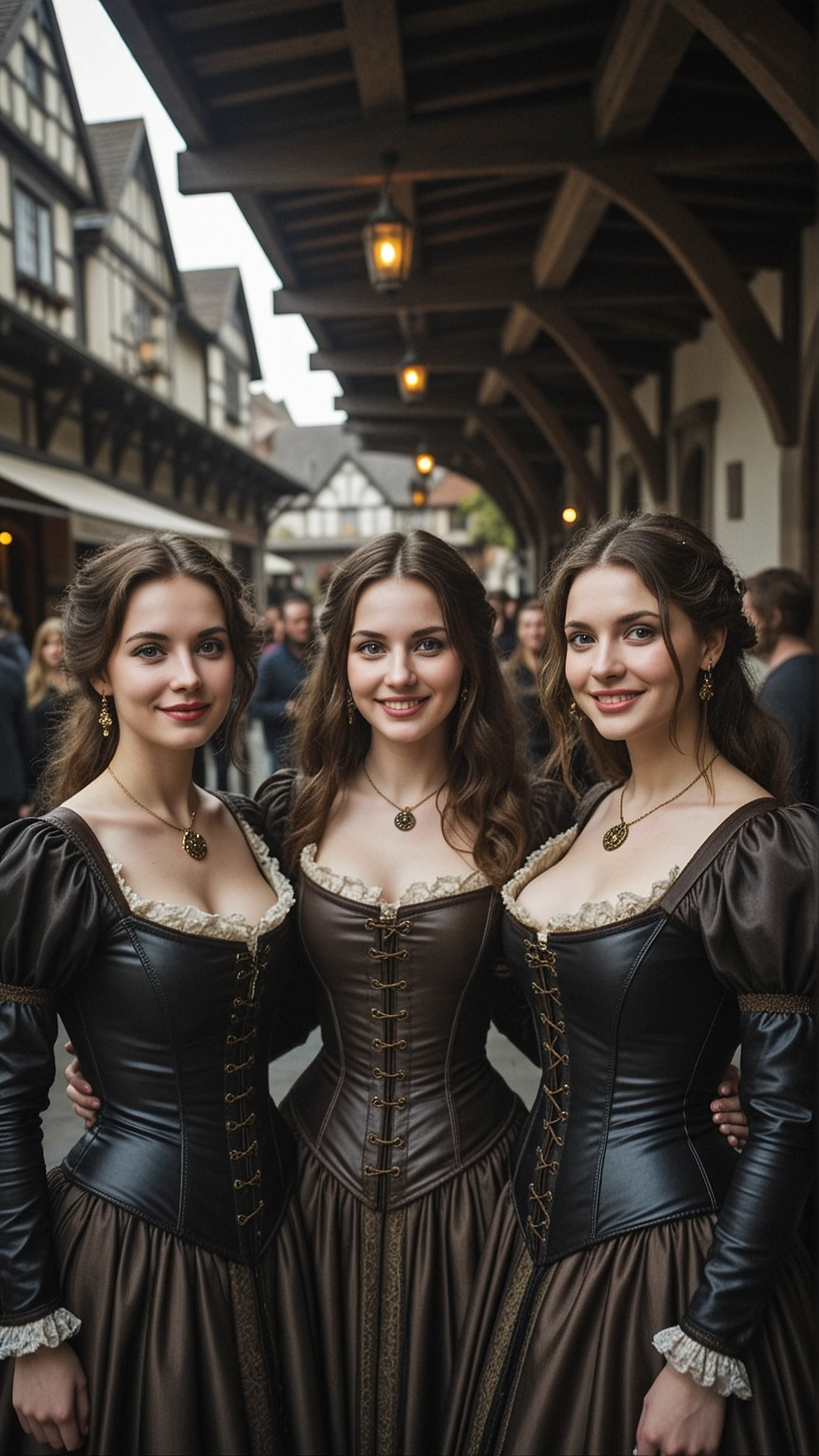
She arrived to save a dying valley. She stayed to claim their hearts — one devoted woman at a time.
There are places where the earth itself seems to hold its breath, waiting. Thornwood Hollow was such a place — a valley choking on its own traditions, its soil crumbling, its people locked in the paralysis of knowing what must be done but lacking the courage to begin. Then she came.
Lady Elara Vance did not arrive with armies or proclamations. She came alone, her gown of forest-green satin catching the last light of autumn, her gaze carrying the weight of absolute certainty. She did not ask for permission. She did not plead for trust. She simply began the work of restoration — of land, of livelihood, of the quiet, aching hearts of three women who had forgotten what it meant to be seen.
This is a story for those who have felt the exhaustion of carrying everything alone. For those who have wondered what it might feel like to lay down the burden of constant decision and place it in hands more capable, more certain, more worthy. For those who sense that surrender, when given freely to the right sovereign, is not weakness — it is the deepest form of peace.
The Satin Steward is a tale of ecological renewal and personal transformation, set against the rich textures of Tudor England. But beneath its surface flows a deeper current — the slow, inevitable gravitation of devoted hearts toward a woman who knows how to hold them.
If you have ever longed for a guide whose authority is velvet and steel, whose expectations are clear, whose approval is a reward worth earning — then you already know why this story was written for you.
Turn the page. The valley is waiting. And so is she.
Chapter 1: The Dust That Was Once Green
The autumn of 1547 arrived in Thornwood Hollow like a guest no one had invited but could not turn away.
It came not with the riot of gold and crimson that the old songs promised, but with a thin, brown light that settled over the valley like a shroud. The leaves did not turn; they simply withered on the branch, curling inward as though ashamed of their own desiccation. The river, once a lively ribbon of silver that children waded in and women sang beside, had shrunk to a sluggish trickle the colour of weak tea. Its banks were caked with sediment, cracked like old pottery, and the reeds that had once stood tall and whispering now lay flattened, bleached, defeated.
The village green — the heart of every Tudor settlement, the place where generations had gathered to dance at May Day and to mourn at funerals — was no longer green. It was a patchwork of brown and grey, the grass worn thin as an old man’s pate, the earth beneath it compacted into something resembling stone. The village moot stone, a great slab of granite that had stood since before the Conqueror’s time, now seemed less a monument to tradition and more a gravestone for a way of life that was quietly, inexorably, dying.
And yet the people of Thornwood Hollow went about their business as though nothing were amiss.
They rose before dawn, as they always had. They milked their cows, fed their pigs, mended their fences. They walked to the common fields with their hoes and their scythes, and they worked the soil as their fathers had worked it, and their fathers before them. They complained, of course — about the weather, about the tithes, about the price of wool, about the new enclosure fences that the lord’s steward was erecting on the eastern ridge. But they did not change anything. They could not. The very idea of change had become foreign to them, a luxury they could not afford, a risk they dared not take.
Because to change would be to admit that they had been wrong. And that was a confession no one in Thornwood Hollow was prepared to make.
The moot had been called for the third time that month.
They gathered at the stone as the church bell struck four, the men in their coarse wool tunics and the women in their rough linen kirtles, their faces set in expressions of weary defiance. The elder, a man named Cuthbert, stood at the centre of the circle, his beard streaked with grey, his hands planted on his hips like a general surveying a lost battle.
“I’ll say it again,” he announced, his voice carrying the weight of a man who had said the same thing many times and was tired of saying it. “The common land is exhausted. We’ve grazed it too hard, too long. The sheep have taken everything and given nothing back. We need to rest it. A full season. Maybe two.”
A murmur rippled through the crowd. It was not a murmur of agreement.
“Rest it?” A man named Giles stepped forward, his face red from more than the autumn chill. “And what do we live on while we’re resting it? Air? Prayers?”
“There’s the river meadows,” Cuthbert replied, though his voice lacked conviction. “We could — “
“The river meadows are already half dead,” interrupted a woman’s voice, sharp and weary. Margery, the widow, stood at the edge of the crowd, her arms crossed over her chest, her eyes fixed on the elder with the particular hardness of someone who had lost too much to be impressed by authority. “The silt has choked them. You know this, Cuthbert. We all know this.”
“Then what do you propose?” Cuthbert demanded, turning to face her. “You’re always quick to point out what’s wrong. What’s your solution?”
Margery’s jaw tightened. She had no solution. She had only the bitter knowledge that everything was falling apart, and that no one — not the elder, not the priest, not the lord’s steward — had any idea how to stop it.
“I propose we stop talking in circles,” she said finally, her voice low. “I propose someone does something. Anything. Before there’s nothing left to save.”
The crowd fell silent. It was the silence of people who knew she was right, and who resented her for saying it.
The meeting dissolved, as all such meetings did, into acrimony and despair. The men drifted away in small, muttering groups. The women gathered their children and their baskets and walked home in the fading light, their skirts dragging through the dust that had once been green.
Margery did not go home immediately. She stood alone at the edge of the green, watching the last of the light drain from the sky, feeling the weight of the valley pressing down on her shoulders like a physical thing. She thought of her husband, Thomas, who had died two winters past of a fever that should have been treatable but had not been, because the village’s supplies of medicinal herbs had run low and the roads had been too muddy for the apothecary to reach them. She thought of her children, two small boys who were growing thinner by the month, their cheeks losing their roundness, their eyes growing too large for their faces. She thought of the future, and found it blank.
She was still standing there when she noticed the figure at the far end of the green.
A woman. Alone. Seated on a horse the colour of dark honey, her posture straight and still, her hands resting lightly on the reins. She was too far away for Margery to make out her features, but there was something about the way she sat — the unhurried stillness of her, the absolute calm — that made Margery’s breath catch in her throat.
The woman did not approach. She did not call out. She simply sat there, watching the village with an expression Margery could not read, as though she were studying a painting and finding it incomplete.
And then, as the last light faded and the shadows swallowed the valley, the woman turned her horse and rode away, disappearing into the gathering dark like a figure from a dream.
Margery stood alone in the dust, her heart beating faster than it had any right to, and wondered who she had just seen.
That night, the wind changed.
It came from the east, carrying the scent of rain and something else — something green, something living, something that had no business being in Thornwood Hollow at all. The villagers, huddled in their cottages, lifted their heads and sniffed the air like animals sensing a shift in the weather.
But no rain came. Only the wind, and the memory of a woman in green satin, watching from the edge of the world.
And somewhere, in the darkness between one breath and the next, the valley held its own breath — waiting.
Chapter 2: The Gloss of Authority
Dawn broke over Thornwood Hollow like a reluctant gift—grey and thin and offering no warmth.
The villagers had gathered again, summoned by a rumour that had spread through the night with the speed of fire through dry bracken. A stranger had been seen. A woman. A woman of means, if the cut of her gown and the quality of her horse were any indication. And she had requested an audience with the council.
The moot stone stood at the centre of the green, its surface worn smooth by centuries of debate and decree. Around it, the men and women of the valley arranged themselves in the same positions they had occupied the evening before—Cuthbert at the head, Giles to his right, Margery at the periphery, her arms crossed, her eyes scanning the treeline for any sign of the figure she had glimpsed at dusk.
She came at the ninth hour, when the sun had climbed just high enough to cast long shadows across the parched earth.
She came not in haste, nor in hesitation, but with the measured grace of one who has never needed to rush because the world has always waited for her. Her gown was the colour of deep forest—a green so rich it seemed to drink the light rather than reflect it, the satin falling in heavy folds that whispered against the dust with each step. The fabric caught the morning sun in flashes of emerald and jade, rippling like water over stone, and the women of the village found themselves staring at it with a hunger they could not name.
Her boots were black leather, polished to a mirror sheen, rising to her calves and fitting as though they had been sewn onto her skin. They made a sound against the hard earth—not the scuff of common footwear, but a crisp, decisive click that punctuated each step like a full stop at the end of a sentence.
She wore no hat, no veil, no ornament save a single brooch at her throat—a silver circle enclosing a stone of deep, translucent blue, the colour of a winter sky just before snow. Her hair was dark, gathered at the nape of her neck in a simple coil, and her face was the face of a woman who has seen enough of the world to be neither impressed nor frightened by it.
She stopped at the edge of the circle, and the villagers parted before her as though she carried an invisible flame.
Cuthbert cleared his throat. “You are the woman who was seen on the green last eve.”
“I am.” Her voice was low, pitched to carry without effort, and it held a quality that made the assembled listeners lean forward despite themselves. It was the voice of someone accustomed to being heard. “My name is Lady Elara Vance. I have come to speak with you about the condition of your valley.”
“We know the condition of our valley,” Giles interjected, his tone bristling with the defensiveness of a man who feels his competence questioned. “We live in it.”
“Do you?” Lady Elara turned her gaze upon him, and something in her eyes—a calm, unhurried assessment—made Giles shift his weight from one foot to the other. “You live in it, yes. But do you see it? Do you understand what it is telling you?”
She did not wait for an answer. She walked to the centre of the circle, where the ground was bare and hard, and she knelt—a motion that sent her satin gown pooling around her like a spill of dark water. She placed her palm flat against the earth, and for a long moment, she simply remained there, her eyes closed, her breath slow and even.
The villagers watched in silence. Some exchanged glances of confusion. Others, particularly the women, watched with a different kind of attention—focused on the way the satin stretched across her shoulders as she leaned forward, on the way her fingers pressed into the soil with a tenderness that seemed almost intimate.
She rose, brushing the dust from her hands with a fastidiousness that spoke of a woman who did not tolerate dirt on her person for longer than necessary.
“Your common land has been overgrazed for three generations,” she said, her voice carrying the quiet authority of a physician delivering a diagnosis. “The sheep have taken the grass down to the roots, and the roots have died. Without roots, the soil cannot hold water. Without water, the soil turns to dust. Without dust—” She paused, letting the silence stretch. “Without dust, there is no soil at all. Only rock. Only barrenness. Only the end of everything you have known.”
A murmur rippled through the crowd. It was not a murmur of disagreement. It was the sound of people hearing, for the first time, words that matched what they had felt in their bones for years but could not articulate.
“Then what would you have us do?” Margery’s voice cut through the murmur, sharp and direct. She had stepped forward without realising it, drawn by the stranger’s presence, by the certainty that radiated from her like heat from a hearth. “We cannot stop grazing. We have nothing else.”
“You can rotate your flocks,” Lady Elara replied, turning to face her. “You can rest the eastern fields for a season while the western slopes recover. You can plant legumes to fix the nitrogen in the soil. You can dig channels to redirect the river’s flow and irrigate the parched lands. You can do a hundred things, each small, each deliberate, each leading toward a future that does not end in dust.”
She spoke of these things with the ease of a woman reciting a familiar litany, and as she spoke, the villagers found themselves imagining it—the green returning, the river running clear, the valley restored to its former abundance. It was a vision so vivid, so tangible, that for a moment they could almost smell the damp earth and the new grass.
“But,” she continued, and the word hung in the air like a blade, “none of these things will work unless you trust me. Unless you surrender your old ways—the ways that have brought you to this brink—and accept my guidance. I cannot save you from yourselves. I can only show you the path. You must choose to walk it.”
The silence that followed was vast and heavy.
Cuthbert broke it, his voice rough with the effort of maintaining authority in the face of something he did not understand. “You ask us to put our lives in the hands of a stranger. A woman we have never met, who arrived yesterday, who knows nothing of our valley or our people.”
“I know more than you think,” Lady Elara replied, and there was no anger in her voice, only a patient certainty that was, in its own way, far more unsettling. “I have been studying your valley for three weeks. I have mapped its contours, measured its rainfall, counted the species of grass that remain and those that have vanished. I know that your river carries silt from the eastern ridge, where the enclosure fences have channeled the runoff. I know that your sheep are producing less wool each year because they are malnourished. I know that your children are growing thinner because the soil can no longer support the crops that once sustained them.”
She paused, and her gaze swept across the assembled villagers, touching each face in turn.
“I know these things because I have looked. And I know that you have not. Not truly. You have been too busy surviving to see what is right in front of you.”
The words struck home. Margery felt them like a physical blow, and she saw the same reaction on the faces around her—the shame of recognition, the sting of truth delivered without cruelty but without flinching.
“You ask for our trust,” Giles said, his voice quieter now, stripped of its earlier bluster. “But trust is earned. It is not given to strangers who ride into a village and tell us everything we have done wrong.”
“Then let me earn it,” Lady Elara said, and for the first time, something shifted in her voice—a softening, a warmth that had not been there before. “I do not ask for blind faith. I ask only for a season. Let me work with those who are willing. Let me show you what is possible. At the end of that season, you may judge me by my results.”
She extended her hand, palm open, as though offering something invisible.
“Who among you will take my hand?”
The silence stretched. The wind stirred the dust at their feet. The villagers looked at one another, and then at the woman in satin who stood before them, her hand extended, her gaze unwavering.
And then Margery stepped forward.
She did not know why. She did not understand the impulse that moved her feet, that made her reach out and place her hand in Lady Elara’s. She only knew that when their palms met—the widow’s calloused and cracked, the stranger’s smooth and warm—something shifted in her chest, a lock turning, a door opening.
“I will,” Margery said, her voice barely above a whisper. “I will take your hand.”
Lady Elara smiled—a small, private curve of her lips that seemed meant only for Margery—and in that smile, Margery saw something she had not seen in years.
Hope.
The council dissolved in confusion and argument, but Margery did not stay to hear it. She walked home with Lady Elara beside her, their footsteps falling into an easy rhythm, the satin of the stranger’s gown whispering against the dust like a promise.
And behind them, in the shadow of the moot stone, the other women of Thornwood Hollow watched them go—and wondered what it would feel like to take that hand for themselves.
Chapter 3: The First Disciple
The cottage stood at the edge of the village, where the common land began its slow decline into the dust that had once been pasture. It was a modest dwelling—whitewashed wattle and daub, a roof of thatch that had seen better seasons, a garden plot where herbs struggled against the encroaching weeds. Inside, the hearth was cold, the floor was swept clean, and the air carried the particular stillness of a home that has known grief and has not yet learned to welcome joy again.
Margery stood at the threshold, her hands clasped before her, watching Lady Elara examine the room with the same unhurried attention she had given the village green. The satin of her gown whispered against the worn floorboards as she moved, and Margery found herself tracking that sound—the soft, luxurious shush of fabric that had no business being in a cottage like this, in a life like hers.
“You live alone,” Lady Elara said. It was not a question.
“My husband died two winters past,” Margery replied. Her voice was flat, practiced. She had spoken these words so many times that they had become mere sounds, devoid of the weight they once carried. “The fever took him. There was nothing to be done.”
“And your children?”
“With my mother-in-law. She lives on the other side of the valley. She takes them during the day, while I work the plot.” Margery paused, and something flickered in her eyes—a vulnerability she had not intended to reveal. “I cannot feed them properly. The soil gives nothing back. I plant, and I pray, and I watch the seedlings wither.”
Lady Elara turned to face her, and in the dim light of the cottage, her eyes seemed to hold a depth that had no bottom. “You offered me your hand at the moot stone. Do you understand what that means?”
Margery swallowed. “It means I trust you.”
“It means you have chosen to follow.” Lady Elara stepped closer, and the space between them shrank to something intimate, charged. “It means you have accepted that your own efforts, your own understanding, have brought you to the edge of ruin. And that you are willing to surrender your will to someone who can guide you beyond that edge.”
The word surrender hung in the air between them, heavy and luminous.
“Yes,” Margery whispered. “I understand.”
“Then we begin.”
Lady Elara did not begin with lectures or instructions. She began with Margery’s hands.
She took them in her own—the widow’s hands, chapped and calloused, the nails cracked from years of labour, the palms rough as sandstone. She turned them over, examining the lines and scars as though reading a map written in flesh.
“These hands have worked hard,” she said, her voice low, almost contemplative. “They have known soil and water and the weight of tools. They have held a dying husband and lifted a crying child. They have done everything that was asked of them, and they have received nothing in return but weariness.”
Margery felt tears prick at her eyes, and she blinked them back with the fierce habit of a woman who had learned that weeping changed nothing.
“But they are still strong,” Lady Elara continued. “They are still capable. They simply need direction. They need to be shown how to work, rather than simply that they must work.”
She released Margery’s hands and moved to the window, where the weak autumn light filtered through the horn panes. “Tomorrow, you will come to my lodgings at dawn. I have taken a room at the inn, and I have brought with me certain instruments—maps, measuring tools, journals of observations. You will learn to read them. You will learn to see the land as I see it.”
“I cannot read,” Margery said, and the admission cost her more than she had expected.
Lady Elara turned, and her expression held no judgment, only a calm acknowledgment. “Then I will teach you. By the time the first snow falls, you will be able to read the contours of a map as easily as you now read the expression on your children’s faces.”
Margery felt something crack open in her chest—a space that had been sealed so long she had forgotten it existed. “Why me?” she asked, her voice barely audible. “There are others in the village. Women with more standing, more influence. Why choose me?”
Lady Elara regarded her for a long moment, and when she spoke, her voice carried a warmth that seemed to fill the cottage like light.
“Because you were the first to step forward. Because you have nothing left to lose, and therefore nothing left to fear. Because when I looked at you, I saw a woman who has been carrying a weight that was never meant for her shoulders, and who is ready—desperately, achingly ready—to lay it down.”
She crossed the room and stood before Margery, close enough that the scent of her filled the air—something floral and clean, utterly foreign to this place of dust and sweat and grief.
“I will teach you to read the land,” Lady Elara said, her voice dropping to a register that seemed to resonate in Margery’s bones. “But I will also teach you to read yourself. I will teach you to recognize your own worth, your own capacity, your own hunger for purpose. And when you have learned these things, you will understand why you were chosen.”
She reached out and, with a tenderness that made Margery’s breath catch, touched her cheek—a brief, featherlight contact that sent a shiver through the widow’s entire body.
“Rest tonight,” Lady Elara said, withdrawing her hand. “Tomorrow, your education begins.”
She left as quietly as she had arrived, her satin gown whispering through the doorway, and Margery stood alone in the cottage, her cheek still warm from the touch, her heart beating a rhythm she had not felt since before her husband fell ill.
She moved to the window and watched Lady Elara walk down the lane, her figure silhouetted against the grey sky, her step unhurried and certain. The other villagers who passed her on the path stepped aside, their eyes following her with a mixture of curiosity and something that might have been longing.
Margery pressed her hand to her cheek, where the ghost of that touch still lingered.
And for the first time in two years, she allowed herself to hope.
The next morning, she arrived at the inn before the sun had fully risen, her hands washed clean, her hair braided with a care she had not taken in months. She wore her best kirtle—still coarse linen, still worn at the elbows, but clean and mended.
Lady Elara was waiting for her in a private parlour, seated at a table covered in papers and instruments. She wore a gown of deep burgundy today—a colour that seemed to hold the warmth of a fire even in the cold morning light—and her hair was loose, falling in dark waves past her shoulders.
“Come,” she said, gesturing to the chair beside her. “Sit. We have much to do.”
Margery sat, and Lady Elara placed a sheet of parchment before her—a map, drawn in fine ink, showing the contours of the valley in exquisite detail. The river was a blue thread winding through the hills. The common land was marked with symbols that Margery did not yet understand. And in the margins, in a hand that was precise and elegant, were notes—observations about soil composition, water flow, patterns of erosion.
“This is your valley,” Lady Elara said, her finger tracing the course of the river. “This is where you live. This is what you must learn to see.”
Margery looked at the map, and then at the woman beside her, and felt something settle in her chest—a quiet certainty that she had, at last, found the guide she had been seeking without knowing it.
“Teach me,” she said.
And Lady Elara smiled.
Chapter 4: The Silk of Persuasion
The invitation arrived at every threshold in Thornwood Hollow before the week was out—a square of cream-coloured parchment, folded and sealed with a dollop of deep green wax, bearing the imprint of a single leaf. No crest, no title, no flourish. Just a leaf, pressed into the wax as though it had fallen there by accident.
The villagers turned the parchment over in their rough hands, puzzled by its weight, its texture, its foreignness. They were accustomed to messages delivered by word of mouth, by the town crier’s bell, by the priest’s announcements from the pulpit. They were not accustomed to being invited.
The message within was brief, written in a hand so precise it seemed almost printed:
You are cordially invited to dine at the Golden Hind Inn on the evening of the first Saturday of October, at the seventh hour. Your presence is requested by Lady Elara Vance, who wishes to discuss the future of Thornwood Hollow in comfort and good company.
Refreshments will be provided. Attire befitting the occasion is encouraged, though not required.
Below, in smaller script: Please bring your hopes. Your fears may be left at the door.
The first Saturday of October arrived with a sky the colour of pewter and a wind that carried the first sharp edge of coming winter. The villagers came to the Golden Hind in ones and twos, their steps hesitant, their expressions caught between curiosity and suspicion. They had scrubbed their faces and donned their Sunday best—the men in their least-worn tunics, the women in their finest kirtles, the fabric still stiff from infrequent use.
But when they crossed the threshold of the inn’s great hall, they stopped as one, their breath catching in their throats.
The room had been transformed.
The trestle tables that usually lined the walls had been pushed aside, replaced by a single long table draped in cloth of deep cream, the fabric falling in heavy folds to the floor. Upon it sat candlesticks of polished brass, each holding a taper of beeswax that burned with a clear, steady flame. The hearth had been stoked to a roaring blaze, and the firelight caught the surfaces of pewter plates and silver goblets, scattering points of light across the room like stars reflected in still water.
And at the head of the table, rising as they entered, stood Lady Elara Vance.
She wore a gown of ivory satin—not the stiff, dull satin of common manufacture, but the heavy, liquid kind that seemed to have been woven from moonlight and cream. The fabric caught the firelight and held it, shimmering with each subtle movement, pooling around her feet like a drift of fresh snow. The bodice was cut low, but not immodestly so, edged with a trim of silver thread that caught the light in delicate flashes. Her sleeves were long and full, lined with a deeper silk that showed when she moved, and at her throat she wore a necklace of pale pearls, each one catching the candlelight like a captive star.
The women of the village stared. They could not help it. They stared at the way the satin moved, at the way it breathed with her, at the way it transformed her into something almost otherworldly—a figure from a tapestry, a queen from a forgotten age.
“Please,” Lady Elara said, her voice carrying the warmth of the hearth fire, “come in. Sit. Be comfortable.”
She gestured to the chairs arranged around the table, and the villagers moved forward as though drawn by an invisible current. They sat, awkwardly at first, their coarse clothing looking even rougher against the cream linen of the tablecloth. But Lady Elara did not seem to notice the contrast, or if she did, she gave no sign of it.
She waited until they were all seated—Cuthbert at her right hand, Giles at her left, Margery near the centre of the table, her eyes wide and her hands clasped in her lap—and then she raised her goblet.
“To Thornwood Hollow,” she said, her voice clear and steady. “To its past, which has shaped you. To its present, which challenges you. And to its future, which we will build together.”
She drank, and the villagers drank with her, the wine—a deep red, rich and unfamiliar—warming their throats and loosening the tension in their shoulders.
The meal that followed was unlike anything they had ever experienced.
Course after course emerged from the kitchen—roasted pheasant glazed with honey and herbs, a pie of wild mushrooms and cream, bread still warm from the oven, butter so fresh it seemed to melt on the tongue. There were vegetables roasted with garlic, a salad of bitter greens dressed with something sharp and bright, and a pudding of dried fruits steeped in brandy, served with a custard so smooth it seemed to dissolve before it could be swallowed.
The villagers ate, and as they ate, they talked.
At first, the conversation was halting, constrained by the formality of the setting and the strangeness of the company. But Lady Elara guided it with the ease of a skilled helmsman, asking questions, drawing out opinions, making each person feel heard. She asked the farmers about their flocks, the wives about their gardens, the children—for she had insisted that children be welcome—about their favourite games and their secret hiding places.
And as she listened, she wove their answers into a tapestry of understanding, showing them how their individual struggles were connected, how the fate of the valley was the fate of each of them, woven together like threads in a loom.
“You speak of the common land as though it belongs to no one,” she said at one point, addressing Cuthbert, who had been lamenting the decline of the sheep pastures. “But that is not quite true. It belongs to all of you. And because it belongs to all of you, it belongs to none of you. Each of you takes from it, but none of you gives back. And so it gives, and gives, until it has nothing left to give.”
She paused, letting the words settle.
“What if, instead of taking, you began to give? What if you planted where you have only harvested? What if you nurtured where you have only consumed?”
Giles frowned, his brow furrowing. “That sounds well enough in a fine hall with a full belly, my lady. But planting takes time. Nurturing takes patience. We have neither to spare.”
“Then let me lend you mine,” Lady Elara replied, and her voice carried a warmth that seemed to fill the room. “I have time. I have patience. I have knowledge that has been gathered over years of study and observation. Let me share it with you. Let me guide your hands until they learn the new rhythms. Let me carry the weight of planning while you carry the weight of doing.”
She leaned forward, and the candlelight caught the satin of her gown, sending ripples of light across the table.
“I am not asking you to trust me blindly. I am asking you to trust me enough—enough to try, enough to risk, enough to believe that a different future is possible. And I promise you this: if you give me that trust, I will not waste it. I will guard it as carefully as I guard my own name. I will honour it with every decision I make, every plan I lay, every hour I spend in your service.”
The silence that followed was not the silence of resistance. It was the silence of people who were, for the first time, allowing themselves to imagine a world in which their burdens were shared.
It was Margery who spoke first.
“I have seen what she can do,” she said, her voice quiet but steady. “She has been teaching me to read the land—to see the signs that have been there all along, hidden in plain sight. She has shown me that the soil is not dead, only sleeping. That the river has not abandoned us, only been blocked. That the valley can be restored, if we have the courage to try.”
She looked around the table, meeting the eyes of her neighbours, her friends, her former critics.
“I have nothing left to lose,” she said. “My husband is gone. My children are hungry. My land gives nothing. But I have found something I thought I had lost forever—hope. And I will not let it go.”
She turned to Lady Elara, and her eyes held a light that had not been there weeks before.
“I trust her,” Margery said. “And I will follow her.”
One by one, the other women at the table began to nod. Beatrice, the merchant’s daughter, her eyes bright with a curiosity she had never been allowed to express. Alice, the farmer’s wife, her face lined with years of thankless labour, her hands clasped as though in prayer. The miller’s widow, the tanner’s sister, the baker’s youngest daughter—they nodded, one after another, their voices rising in a quiet chorus of assent.
The men were slower to follow. But follow they did, grudgingly, their resistance worn down by the warmth of the fire, the richness of the food, the steady certainty of the woman in ivory satin who had asked for nothing but their trust.
Cuthbert was the last to speak. He sat in silence for a long moment, his gnarled fingers tracing the rim of his goblet, his eyes fixed on the candle flame.
“I have been elder of this village for thirty years,” he said finally, his voice rough. “I have seen good seasons and bad. I have buried friends and watched children grow and leave. I have done my best, with what I had, for as long as I could.”
He looked up, and his eyes met Lady Elara’s.
“I am tired,” he said. “Tired of watching the land die. Tired of pretending I know what to do when I do not. Tired of carrying a weight that grows heavier with each passing year.”
He paused, and then he nodded—a small, almost imperceptible movement.
“If you can show us a better way, I will follow. Not because I trust you—not yet—but because I have run out of other options.”
Lady Elara inclined her head, accepting his concession with the grace of a woman who had expected nothing less.
“That is all I ask,” she said. “A chance to prove that a better way exists.”
The feast continued long into the night, the conversation flowing more freely as the wine diminished and the fire burned low. The villagers laughed—genuine laughter, the kind that had been absent from Thornwood Hollow for years. They told stories, shared memories, spoke of hopes they had buried so deep they had almost forgotten they existed.
And through it all, Lady Elara sat at the head of the table, her ivory satin glowing in the firelight, her eyes warm and watchful, her presence a anchor in the shifting currents of the evening.
Margery watched her from across the table, and felt something stir in her chest—a feeling she had not experienced since the early days of her marriage, when the world had seemed full of possibility and the future had stretched before her like an open road.
It was not love. Not yet. It was something more fundamental—a recognition, a resonance, a quiet certainty that she had found the person she was meant to follow.
And as she watched Lady Elara raise her goblet in a toast to the valley’s future, Margery allowed herself, for the first time in years, to imagine what it might feel like to surrender completely.
The thought sent a shiver down her spine—not of fear, but of anticipation.
The guests departed in the small hours, their steps unsteady from wine and wonder, their minds full of images they would carry with them into their dreams. The ivory satin. The candlelight. The voice that had spoken to them not of duty, but of possibility.
Lady Elara stood at the door of the inn, watching them go, her gown glowing faintly in the moonlight.
Beside her, the innkeeper’s wife—a woman named Hester, who had watched the evening unfold with a mixture of skepticism and awe—cleared her throat.
“I’ve never seen anything like that,” Hester said, her voice low. “You had them eating out of your hand, my lady. And I don’t just mean the food.”
Lady Elara smiled, a private, knowing curve of her lips. “I gave them nothing they did not already want, Hester. I simply showed them that it was permissible to want it.”
“And what is it they want?”
Lady Elara turned to look at her, and in the moonlight, her eyes seemed to hold the depth of a winter sky.
“To be led,” she said. “To be guided. To lay down the unbearable weight of constant choice and constant fear, and to trust that someone else will carry it for them.”
She paused, and her voice dropped to a register that seemed to resonate in the bones.
“It is the oldest desire in the world, Hester. The desire to surrender to something worthy of surrender. And I intend to give it to them.”
She turned and walked back into the inn, her satin gown whispering against the threshold, leaving Hester standing alone in the moonlight, her heart beating faster than it had any right to, wondering what it would feel like to be the one doing the surrendering.
Chapter 5: The Leather and the Loom
The wool merchants of Thornwood Hollow gathered in the back room of The Woolpack—a low-ceilinged tavern on the eastern edge of the village, where the smell of unwashed fleece and stale ale had soaked into the very timbers over generations of trade. They were three: Master Aldrich, a broad man with fingers like sausages and a face that seemed perpetually flushed; Master Pembroke, thin and sharp-featured, his eyes constantly moving as though calculating sums invisible to others; and Master Thorne, the eldest, whose white beard and stooped shoulders belied a mind still quick as a whip.
They had come to discuss the woman in satin.
“She’s been here a fortnight,” Aldrich said, his voice carrying the particular bluster of a man who felt his authority threatened. “And already she’s got half the village eating out of her hand. Margery the widow follows her like a lamb. Beatrice the merchant’s daughter has taken to wearing—” He paused, his lip curling. “Silk. Can you imagine? A merchant’s daughter, in silk, as though she were a lady of the court.”
“And what of it?” Pembroke asked, though his tone suggested he already knew the answer. “If Beatrice’s father wishes to spend his coin on fripperies, that is his concern.”
“The concern,” Thorne said quietly, “is that this woman is changing things. And change, as we all know, is not always profitable.”
He leaned forward, his gnarled hands resting on the table between them. “The common land has been the source of our wool for three generations. If she convinces the village to rest it, to rotate the flocks, to plant instead of harvest—where will our wool come from? Who will supply us? And at what price?”
The three men exchanged glances, and the weight of unspoken understanding settled over them like a shroud.
“She must be stopped,” Aldrich said. “Before she does any more damage.”
But Lady Elara Vance was not a woman who could be stopped by whispers in a back room.
She had anticipated resistance. She had expected it, planned for it, woven it into her calculations the way a master weaver incorporates a dark thread into an otherwise bright pattern—knowing that it would give depth, contrast, texture to the final piece.
And so, on the morning after the merchants’ meeting, she sent out a different kind of invitation.
Not to the men. To their wives.
The invitation came in the form of a small, folded note, delivered by Margery herself, who had been dressed for the occasion in a gown that Lady Elara had given her—a deep blue, the colour of a twilight sky, made of a wool so fine it might have been mistaken for silk from a distance. It was not satin, not yet. But it was a beginning.
Margery walked through the village with a new lightness in her step, the fabric of her gown whispering against her ankles, her head held higher than it had been in years. She delivered the notes to the merchants’ wives—to Mistress Aldrich, a woman of formidable girth and formidable opinions; to Mistress Pembroke, whose sharp features mirrored her husband’s, but whose eyes held a hunger that had nothing to do with food; and to Mistress Thorne, the eldest, whose face was a mask of quiet resignation, as though she had long ago given up expecting anything from life but endurance.
“Lady Elara requests the pleasure of your company,” Margery said to each of them, her voice steady, her gaze meeting theirs without flinching. “This afternoon, at the inn. She wishes to discuss textiles.”
The word hung in the air, heavy with implication.
They came.
They came because they were curious. They came because they were bored. They came because, in a village where nothing ever changed, the arrival of a mysterious woman in satin was the most interesting thing that had happened in living memory.
They came, too, because Margery’s gown had caught their attention—the way it moved, the way it caught the light, the way it made her look different, transformed, as though she had stepped out of her own skin and into someone else’s entirely.
The inn’s private parlour had been prepared with the same care that Lady Elara had given to the feast. The table was covered in bolts of fabric—silks and satins and velvets, wools so fine they might have been spun from gossamer, linens so smooth they seemed to flow like water through the fingers. There were ribbons and trims, buttons of polished horn and carved bone, threads of silver and gold that caught the firelight and held it.
And at the centre of it all, Lady Elara sat in a gown of deep crimson leather.
It was not the stiff, utilitarian leather of a labourer’s jerkin or a soldier’s boot. It was leather that had been cured and dyed and polished until it gleamed like a chestnut fresh from its husk, supple as fabric, moulded to her form as though it had been painted onto her skin. The bodice was fitted, the skirt fell in heavy folds, and at her throat she wore a collar of the same material, set with a single garnet that burned like a drop of blood in the firelight.
The merchants’ wives stared. They could not help it. They had never seen anything like it—a woman dressed in leather, not as armour, but as adornment. As a statement. As a declaration of a self so confident it needed no apology.
“Please,” Lady Elara said, gesturing to the chairs arranged around the table. “Sit. Touch. Explore. I have brought samples from London, from Antwerp, from the looms of Florence and the dye-works of Venice. I want you to feel the difference between what you have known and what is possible.”
Mistress Aldrich was the first to approach the table.
She was a woman who had spent her life in wool—the scratch of it against her skin, the smell of it in her home, the endless, thankless labour of carding and spinning and weaving. She had never questioned it. It was simply what life was.
But when she touched the silk—a bolt of deep emerald that seemed to hold the light within its fibres—something shifted in her chest.
“It’s so soft,” she said, her voice barely above a whisper. “I didn’t know fabric could feel like this.”
Lady Elara smiled, and the smile was warm, genuine, inviting. “That is because you have been taught to accept what is available, rather than what is worthy. You have been told that comfort is a luxury, and that luxury is a sin. But I tell you—” She leaned forward, her leather-clad form catching the firelight. “I tell you that to surround yourself with beauty is not a sin. It is a necessity. It is a reminder that you are more than the work you do, more than the roles you fill, more than the expectations that have been pressed upon you since birth.”
She rose and moved to stand beside Mistress Aldrich, her hand resting lightly on the woman’s shoulder.
“Feel this,” she said, guiding the merchant’s wife’s hand to a length of satin the colour of claret. “Feel how it moves. How it breathes. This fabric was made by women who understood that their work was an art, not a burden. And when you wear it, you honour that art. You become part of it.”
Mistress Aldrich’s eyes glistened. She did not know why she was crying. She only knew that something in her had been touched—a place that had been numb for so long she had forgotten it existed.
Mistress Pembroke, sharper and more guarded, approached the table with a skepticism she wore like a shield.
“These are beautiful,” she said, her voice carefully neutral. “But they are also expensive. Not many in this village could afford such fabrics.”
“No,” Lady Elara agreed. “Not yet. But they could learn to make them.”
She drew out a length of wool—not the coarse, scratchy wool of the common trade, but a wool so fine it might have been mistaken for silk, dyed a deep, rich blue that seemed to hold the colour of a winter sky at dusk.
“This was made in the West Country, by women who have spent generations perfecting their craft. The wool comes from sheep that are raised on rested land, fed on clover and wild herbs, their fleeces washed and combed before they are ever spun. The result is a fabric that is warm without being heavy, soft without being fragile, beautiful without being impractical.”
She held it out to Mistress Pembroke, who took it reluctantly, her fingers brushing against the surface.
“It is… lovely,” Mistress Pembroke admitted, the words escaping her before she could stop them.
“It is possible,” Lady Elara corrected gently. “Here, in this valley, with the right guidance. Your husbands believe that the only way to profit from wool is to produce as much as possible, as cheaply as possible, and sell it to the highest bidder. But there is another way—a way that produces less, but of such quality that each yard is worth ten of the common sort. A way that restores the land instead of exhausting it. A way that honours the hands that do the work.”
She paused, letting the words settle.
“Your husbands see me as a threat to their trade. But I am not. I am an opportunity—for them, for you, for this entire valley. If they will only open their eyes to see it.”
Mistress Thorne, the eldest, had not moved from her chair.
She sat with her hands folded in her lap, her eyes fixed on the fire, her expression unreadable. She had been married to Master Thorne for forty years. She had borne him seven children, buried three of them, watched the others leave for the cities and never return. She had spent her life in service to a man who saw her as a convenience, a necessity, a piece of furniture that happened to be useful.
She had never expected anything more.
But when Lady Elara approached her, a length of deep purple velvet draped over her arm, something in the old woman’s chest stirred.
“I have nothing to offer you,” Mistress Thorne said, her voice cracked with age and disuse. “I am too old for change. Too tired for hope.”
Lady Elara knelt before her, the leather of her gown creaking softly, and placed the velvet in the old woman’s lap.
“This is not for you to offer,” she said, her voice low and gentle. “This is for you to receive. You have given enough. You have served enough. You have endured enough. Now it is time to accept something for yourself.”
Mistress Thorne looked down at the velvet, her trembling fingers tracing its surface.
“It’s so soft,” she whispered.
“Yes,” Lady Elara said. “And you deserve softness. You have earned it. You have paid for it with every year of labour, every sleepless night, every silent sacrifice. This is not a gift from me. It is a debt repaid.”
Mistress Thorne looked up, and her eyes were wet.
“Thank you,” she said. “No one has ever… no one has ever told me I deserved anything.”
Lady Elara smiled, and in that smile was all the warmth and certainty that the old woman had been missing for decades.
“Then let me be the first,” she said. “And let me show you what it means to be worthy of more.”
The afternoon stretched into evening, and the merchants’ wives did not leave.
They stayed, and they touched, and they talked. They spoke of their lives, their disappointments, their secret longings. They admitted, in hushed voices, that they had always wondered what it might be like to wear something beautiful—not for a husband, not for a festival, but simply for themselves. They confessed that they had never felt beautiful, never felt seen, never felt that their own desires mattered.
And Lady Elara listened. She guided. She offered not judgment, but understanding. Not commands, but possibilities.
By the time the candles had burned low and the fire had crumbled to embers, the three women had made a silent pact—not spoken aloud, but understood between them.
They would support Lady Elara. They would speak to their husbands, soften their resistance, open their minds to the possibility of change. They would become her allies in the homes of the men who sought to oppose her.
And they would begin, slowly, to acquire fabrics that honoured their worth.
That night, as the merchants’ wives walked home through the darkened village, each of them carried a small bundle—a length of silk, a ribbon of velvet, a square of satin that Lady Elara had pressed into their hands as they left.
They walked with a different step than they had arrived. Their shoulders were straighter. Their heads were higher. And in their hearts, a quiet revolution had begun.
At the window of the inn, Lady Elara watched them go, her leather-clad form silhouetted against the candlelight.
Beside her, Margery stood in her twilight-blue gown, her eyes following the retreating figures.
“Will it be enough?” Margery asked. “Will they convince their husbands?”
Lady Elara smiled, a slow, knowing curve of her lips.
“My dear Margery,” she said. “The husbands are already defeated. They simply do not know it yet. The real battle was never with the men. It was with the women—with their resignation, their acceptance of less than they deserve. And that battle, I have won.”
She turned from the window, her leather gown catching the light, her eyes holding a depth that seemed to contain galaxies.
“Now,” she said, “we begin the real work.”
And somewhere in the darkness, the looms of Thornwood Hollow waited—silent, patient, ready to weave a new future from threads of silk and leather and hope.
Chapter 6: The River’s Reckoning
The storm came without warning.
It had been building for days, of course—the sky taking on that peculiar greenish tinge that old farmers recognised as a portent of violence, the air growing thick and heavy, the animals restless in their pens. But the villagers of Thornwood Hollow had been so consumed by the drama of Lady Elara’s arrival, so absorbed in the shifting allegiances and whispered conspiracies, that they had failed to read the signs that the earth itself was offering them.
And so, when the first crack of thunder split the sky at dusk, they were caught unprepared.
The rain began as a gentle patter, the kind that might have been welcomed as a blessing after weeks of dry weather. But within minutes, it had intensified into a deluge—sheets of water so dense that visibility shrank to mere feet, the sound of it drowning out all other noise. The wind rose, howling through the valley like a living thing, tearing at thatch and shutter, bending the few remaining trees almost to breaking.
The river, already sluggish and silt-choked, began to rise.
Margery was at the inn when the storm broke, studying a map by candlelight while Lady Elara corrected her readings. She had grown accustomed to these evening sessions—the quiet intimacy of the parlour, the rustle of parchment, the low, measured voice of her teacher guiding her through the complexities of contour lines and water tables.
She looked up at the first crack of thunder, her hand stilling on the map.
“That sounded close,” she said.
Lady Elara had already risen, her gown of deep burgundy satin catching the candlelight as she moved to the window. She pressed her palm against the horn pane, peering into the darkness.
“Too close,” she said, her voice carrying a note of urgency that Margery had never heard before. “The river. It’s going to flood.”
Margery’s blood chilled. “The lower fields—”
“The lower fields are already lost. We need to move the people. Now.”
They went out into the storm together, Lady Elara’s satin gown soaked through within seconds, the fabric clinging to her form like a second skin. She did not pause to change, did not hesitate at the threshold. She simply walked into the chaos as though she had been expecting it, as though this was simply another challenge to be met and mastered.
The village was in chaos. The rain had driven everyone indoors, but as the river began to spill over its banks—brown, churning water carrying debris and silt and the accumulated neglect of decades—the doors began to open. People emerged into the storm, clutching children and bundles of possessions, their faces pale with a terror that none of them had words for.
Lady Elara’s voice cut through the noise like a blade.
“Margery—take the east end. Get everyone to the church. It’s on high ground. Beatrice—the west end. Knock on every door. Don’t wait for answers. Alice—the mill. The miller’s family will try to stay. Drag them out if you must.”
She did not shout. She did not need to. Her voice carried with a clarity that seemed to bypass the ears and speak directly to the bones, and the women she had trained—the women she had chosen—moved to obey without question.
The river rose faster than anyone had anticipated.
It had been starved for so long, constrained by the silt that had built up over years of neglect, that when the storm came, it was as though the water had been saving its fury for this moment. It burst over the banks not in a gradual creep, but in a surge—a wall of brown water that swept away fences, flooded cottages, and sent livestock scrambling for higher ground.
Lady Elara stood at the centre of the village green, the water already lapping at her ankles, directing the evacuation with a calm that seemed almost supernatural. Her gown was ruined—the beautiful burgundy satin stained with mud, torn at the hem, heavy with water. Her hair had come loose from its coil, plastered to her face in dark strands. Her boots were caked with silt.
And yet, she had never looked more magnificent.
“The church!” she called to a group of villagers who had frozen in panic, their eyes fixed on the rising water. “Leave everything. Take only the children. The church is safe. Go now, and do not stop.”
They moved. They did not question. They simply moved, because she had told them to, and because in that moment, her word was the only certainty in a world that had dissolved into chaos.
Margery found her an hour later, standing at the edge of the flooded green, watching the water lap against the steps of the moot stone.
“The church is full,” Margery reported, her voice hoarse from shouting. “Everyone is accounted for. The miller’s family—Alice got them out just in time. The water took their ground floor.”
Lady Elara nodded, not taking her eyes from the water. “And the livestock?”
“Driven to the high pastures. Some losses, but most survived.”
“Good.” Lady Elara turned, and in the flickering light of a lantern that someone had hung from a nearby post, Margery saw that her face was streaked with mud and rain, and that her eyes held a weariness that she had never seen there before. “You did well, Margery. All of you did well.”
Margery felt a warmth spread through her chest—a warmth that had nothing to do with the storm or the cold.
“I learned from the best,” she said.
Lady Elara’s lips curved into a smile—small, private, meant only for Margery.
“Yes,” she said. “You did.”
They worked through the night, the women of Thornwood Hollow, guided by the steady, unshakeable presence of the woman in the ruined satin gown. They carried children to safety, waded into flooded cottages to retrieve the elderly, and stood in the rain for hours, passing buckets of water away from foundations that threatened to collapse.
And as they worked, they watched her.
They watched the way she moved through the chaos, never hesitating, never raising her voice, never showing a moment of doubt. They watched the way she assessed each situation in an instant, issuing commands that were always exactly what was needed. They watched the way she paused, briefly, to touch a shoulder, to speak a word of encouragement, to meet the eyes of a frightened child and offer a calm that seemed to flow from her like warmth from a fire.
And in that watching, something shifted.
They had accepted her before—grudgingly, cautiously, with reservations held close to their chests. But in the crucible of the storm, that acceptance was forged into something stronger. Something that had the weight of gratitude, of admiration, of a trust that had been earned in the most elemental way possible.
By dawn, when the rain finally began to ease and the river began to recede, the village of Thornwood Hollow had changed.
They gathered on the high ground around the church, shivering and exhausted, their homes damaged, their fields flooded, their livestock scattered. But they were alive. Every single one of them was alive.
And they knew who had saved them.
Lady Elara stood apart from the crowd, at the edge of the churchyard, looking out over the flooded valley. Her gown was a ruin—the satin torn and stained, the hem caked with mud, the colour barely discernible beneath the layers of silt. She had lost a boot somewhere in the night, and her bare foot was exposed to the cold morning air.
Margery approached her, carrying a blanket she had found in the church.
“You should rest,” Margery said, draping the blanket over Lady Elara’s shoulders. “You’ve been on your feet all night.”
Lady Elara did not turn. “There will be time to rest later. Now, there is work to do. The flood has changed the course of the river. The silt has been redistributed. Some of the damage we feared may not come to pass—but we need to assess, to plan, to begin the recovery.”
She paused, and when she spoke again, her voice was softer.
“But first, I need to know that everyone is safe. Tell me again, Margery. Tell me that no one was lost.”
“No one was lost,” Margery said, and her voice cracked with emotion. “Because of you. Because you knew what to do. Because you made us move when we would have frozen. Because you—”
She stopped, unable to continue.
Lady Elara turned, finally, and looked at her. Her face was pale with exhaustion, her eyes red-rimmed, her lips chapped from the cold. But her gaze held the same steady certainty that it always held.
“No,” she said. “Because we did it. All of us. I gave the direction, but you—you and Beatrice and Alice and every woman who went out into that storm—you did the work. You saved the lives. You were the hands that made my vision real.”
She reached out and touched Margery’s cheek, her fingers cold but gentle.
“Never forget that, Margery. You are not a follower. You are a partner in this work. And I could not have done it without you.”
Margery leaned into the touch, her eyes closing, her breath catching.
“Teach me more,” she whispered. “I want to learn everything. I want to be worthy of this trust.”
Lady Elara smiled, and in that smile was all the warmth and certainty that the storm had not been able to extinguish.
“You already are,” she said. “But I will teach you anyway. I will teach you until you know everything I know, and then I will teach you more. And together, we will make this valley bloom again.”
The sun rose over Thornwood Hollow, pale and watery, casting long shadows across the flooded fields.
The villagers began to emerge from the church, their faces drawn but their spirits lifted by the knowledge that they had survived. They looked at the damage—the ruined cottages, the drowned fields, the debris scattered across the green—and they felt the weight of what had been lost.
But they also looked at the woman who stood at the edge of the churchyard, her satin gown in tatters, her bare foot exposed to the cold, her eyes fixed on the horizon with an unwavering gaze.
And they knew, with a certainty that went deeper than words, that they would rebuild.
Because she would show them how.
That evening, as the village began the long work of recovery, the women of Thornwood Hollow gathered in the church, their hands raw from labour, their bodies aching with exhaustion.
They had salvaged what they could from the flood—bolts of fabric, bundles of clothing, the precious lengths of silk and satin that Lady Elara had given them. They had spread them out to dry, and as they worked, they talked.
“I never thought I would see the day,” Mistress Aldrich said, her voice low, “when I would be grateful for a flood.”
“It sounds strange,” Mistress Pembroke agreed, “but I know what you mean. Before the storm, I was still… uncertain. Still holding back. But when I saw her standing there, in the middle of the water, telling us what to do—” She shook her head. “I would have followed her anywhere.”
“Anywhere,” Mistress Thorne echoed, her voice quiet but firm. “I am too old for change, I thought. Too set in my ways. But she changed me anyway. She made me believe that I deserved more than I had settled for.”
The other women nodded, their hands moving over the wet fabric, their eyes distant.
And in the corner, Margery sat with a length of burgundy satin spread across her lap—the gown that Lady Elara had worn into the storm, now torn and stained beyond repair.
She was mending it.
Stitch by stitch, thread by thread, she was restoring it to its former glory. She did not know if it would ever be worn again. She did not care. It was enough to be doing this—to be caring for something that belonged to the woman who had given her back her hope.
The river had risen, and the river had fallen.
And in its wake, it had left not destruction, but transformation.
The valley would recover. The village would rebuild. And the women of Thornwood Hollow would never be the same.
Because they had seen, in the heart of the storm, what true authority looked like.
And they had chosen, once and for all, to follow it.
Chapter 7: The Confession of Margery
The days following the flood passed in a blur of labour and exhaustion.
The village had survived, but survival was only the beginning. Cottages needed to be repaired, fields needed to be drained, livestock needed to be rounded up and tended. The river, having scoured its banks clean of silt, now ran clearer than it had in years—a silver thread through the brown landscape, carrying with it the promise of renewal. But renewal required work, and work required direction, and direction required the steady, unshakeable presence of the woman who had led them through the storm.
Lady Elara did not rest.
She rose before dawn each day, her restored gown of burgundy satin now supplemented by a leather jerkin that she had commissioned from the tanner—a practical garment, fitted to her form, that allowed her to move through the mud and debris without hindrance. The combination was striking: the soft, liquid shimmer of satin at her skirts, the firm, polished gleam of leather at her torso. She looked like a figure from an old tapestry, a warrior-saint in a garment that was both armour and adornment.
The women of the village watched her, and they learned.
They learned to drain a flooded field by cutting channels that followed the natural contours of the land. They learned to salvage waterlogged wool by washing and drying it with care, preserving what could be preserved. They learned to rebuild walls with stones that had been scoured clean by the flood, fitting them together with a precision that had not been necessary before—because before, they had not had a teacher who demanded excellence.
And through it all, Margery was at her side.
It was the seventh night after the flood when the confession came.
The village had settled into an uneasy peace. The immediate crisis was over, but the long work of recovery stretched ahead, and the weight of it pressed down on everyone. Margery had spent the day in the eastern fields, helping to dig drainage channels, her hands blistered, her back aching, her mind full of the quiet satisfaction of work done well.
She returned to the inn as the light was fading, seeking Lady Elara’s counsel on the next day’s tasks. But when she entered the private parlour, she found the room empty save for the woman herself, seated by the fire, a glass of wine untouched at her elbow, her gaze fixed on the flames.
The burgundy satin gown had been laid aside for the evening. In its place, Lady Elara wore a robe of deep purple velvet, the fabric pooling around her like a drift of petals, the collar open at her throat. Her hair was loose, falling in dark waves past her shoulders, and in the firelight, she looked less like a commander and more like a woman who had set down her burdens, if only for a moment.
Margery stopped at the threshold, her breath catching.
“My lady,” she said, her voice barely above a whisper. “I did not mean to intrude. I can come back later.”
Lady Elara turned, and her eyes found Margery’s with a warmth that made the widow’s heart stutter.
“No,” she said. “Stay. I was hoping you would come.”
She gestured to the chair opposite her, and Margery crossed the room, her steps hesitant, her hands clasped before her. She sat, and the silence between them stretched, filled with the crackling of the fire and the whisper of velvet against wood.
“You have been working hard,” Lady Elara said. “I have watched you. Day after day, you give everything you have, and you ask for nothing in return.”
“I ask for your guidance,” Margery said. “That is enough.”
“Is it?” Lady Elara leaned forward, her eyes searching Margery’s face. “I have seen the way you look at me, Margery. I have felt the weight of your attention, the hunger in your gaze. And I have wondered—what is it that you truly want?”
The question hung in the air, heavy and luminous.
Margery’s throat tightened. She had known, on some level, that this moment would come. She had felt the truth building in her chest, day by day, hour by hour, a pressure that could not be contained forever. And now, in the firelight, with the velvet and the wine and the woman who had saved her sitting before her, the words rose up like water breaking through a dam.
“I want you,” she said, and her voice cracked on the words. “I want to be yours. Not as a servant, not as a student—but as something more. I want to belong to you, completely, in every way that matters. I want to lay down every burden I have ever carried and place them at your feet. I want to trust you so completely that I no longer need to fear the future, because I know you will guide me through it.”
She stopped, her breath ragged, her eyes wet.
“I love you,” she said. “I love you in a way I did not know I was capable of. I love you more than I loved my husband, more than I love my children, more than I love my own life. And I know that is a terrible thing to say. I know it is a sin, or a madness, or both. But I cannot help it. I cannot stop it. It is the truest thing I have ever felt.”
The fire crackled. The velvet whispered. And Lady Elara looked at Margery with an expression that held no shock, no judgment, no surprise.
“I know,” she said, her voice soft. “I have known for weeks.”
Margery’s breath caught. “You… you knew?”
“I saw it in your eyes the first time you took my hand at the moot stone. I felt it in the way you leaned into my touch, the way you sought my approval, the way you hung on my every word.” Lady Elara paused, and her gaze softened. “I have been waiting for you to find the courage to speak it aloud.”
“And now that I have?” Margery’s voice was barely audible. “What do you say?”
Lady Elara rose from her chair, the velvet robe falling around her in a cascade of purple, and crossed the space between them. She knelt before Margery—a gesture of intimacy that made the widow’s heart race—and took her hands in her own.
“I say that I have been waiting for this confession as much as you have been waiting to make it,” she said. “I say that I have felt the pull between us from the moment we met, and that I have been holding myself back, uncertain whether you were ready to receive what I have to offer.”
She lifted Margery’s hands to her lips and pressed a kiss to each of them, her breath warm against the widow’s skin.
“I say that I accept your confession. I accept your devotion. I accept your love, freely given, without reservation. And I offer you the same in return—not as a servant, not as a student, but as a partner. As a companion. As someone who will hold you when you are weary, guide you when you are lost, and cherish you for as long as you will let me.”
Margery’s tears spilled over, running down her cheeks in warm rivulets.
“I don’t deserve this,” she whispered. “I don’t deserve you.”
“You deserve everything,” Lady Elara said, her voice firm. “You have earned it with every hour of labour, every moment of faith, every step you have taken toward me. And I will spend the rest of my life proving to you that you were worthy of it all along.”
She rose, drawing Margery to her feet, and for a long moment, they stood together in the firelight, the velvet and the wool mingling, their breath synchronizing, their hearts beating in a rhythm that felt older than words.
“Come,” Lady Elara said, her hand sliding to the small of Margery’s back. “There is something I want to show you.”
She led Margery through the darkened inn, up the narrow stairs, to a room that Margery had never seen—a private chamber at the top of the building, with windows that looked out over the valley. The moon had risen, full and silver, casting a pale light across the flooded fields, turning the water into a mirror that reflected the stars.
On the bed lay a gown.
It was made of satin, the colour of midnight, so dark it seemed to absorb the moonlight rather than reflect it. The fabric was heavy, luxurious, falling in folds that caught the silver light in subtle ripples. Beside it lay a pair of gloves, also of satin, and a collar of black leather, set with a single moonstone that glowed with a soft, internal light.
“This is for you,” Lady Elara said. “I had it made in secret, over the past weeks. I wanted to give it to you when the time was right.”
Margery stared at the gown, her breath caught in her throat. “I… I cannot accept this. It is too much. I am not worthy of such a gift.”
“You are worthy of far more than this,” Lady Elara said, her voice carrying the weight of absolute certainty. “But this is a beginning. A symbol of what you are becoming. When you wear this gown, you will no longer be the widow Margery, bowed by grief and labour. You will be my Margery—the woman who chose to surrender, and in that surrender, found her true strength.”
She stepped behind Margery and began to unlace the rough wool kirtle that the widow wore, her fingers moving with a deftness that spoke of practice and care. The coarse fabric fell away, pooling at Margery’s feet, and she stood in her shift, shivering in the cool air.
“Lift your arms,” Lady Elara murmured, and Margery obeyed.
The satin gown slid over her, cool and smooth, the fabric settling against her skin like a second layer of being. Lady Elara laced it up the back, her fingers brushing against Margery’s spine with each pull, sending shivers of sensation through the widow’s body.
When it was done, Lady Elara turned her to face the mirror that hung on the wall.
Margery did not recognize herself.
The woman in the mirror was not the tired, grief-worn widow she had seen every day for two years. She was someone else—someone with a straight spine and clear eyes, someone whose curves were enhanced by the midnight satin, someone whose hands, when she raised them to touch her own reflection, seemed almost elegant.
“The gloves,” Lady Elara said, handing them to her.
Margery pulled them on, the satin sliding over her fingers like a second skin. They fit perfectly, as though they had been made for her hands alone.
“And the collar.”
Margery hesitated. The collar was not a piece of jewellery she had ever imagined wearing. It was a band of leather, perhaps two inches wide, polished to a deep, mirror shine, with a silver buckle at the front and the moonstone set at its centre. It was a statement of ownership, of belonging, of a bond that went beyond words.
She took it in her trembling hands, and Lady Elara stepped forward to fasten it around her throat.
The leather settled against her skin, cool and firm, a constant reminder of the connection between them. The moonstone caught the light, glowing softly against the dark satin of the gown.
“Now,” Lady Elara said, stepping back to admire her work, “you are ready.”
“For what?” Margery asked, her voice barely a whisper.
“For everything,” Lady Elara replied. “For the life that awaits you. For the valley that we will restore together. For the love that I will give you, freely and without reservation, for as long as you will receive it.”
She took Margery’s hands in her own, the satin of the gloves whispering against her palms.
“I love you, Margery,” she said. “I love your strength and your vulnerability, your labour and your longing, your willingness to trust. And I will spend the rest of my life proving to you that your trust was well placed.”
Margery looked at their reflections in the mirror—the woman in midnight satin and the woman in purple velvet, standing together in the moonlight, their hands intertwined.
“I love you too,” she said, and the words felt like a prayer, like a vow, like the closing of a circle that had been waiting to be completed since the beginning of time.
They stood together in the silence, the fire crackling below, the moon sailing overhead, and the valley of Thornwood Hollow lay spread out before them, waiting to be reborn.
And in the quiet of that moment, Margery understood something she had never understood before.
Surrender was not weakness.
It was the deepest, most profound form of strength.
Because it took courage to lay down your burdens. It took trust to place your heart in another’s hands. It took faith to believe that you were worthy of being held.
And she had found all of those things, at last, in the arms of the woman in velvet.
The next morning, when Margery emerged from the inn in her midnight satin gown, the village stopped to stare.
Not because they were shocked—though some were. Not because they disapproved—though a few did. But because she was transformed. The woman who walked through the village that morning was not the same woman who had entered the inn the night before. She moved differently. She held her head differently. She met the eyes of those who stared, and she did not flinch.
And when Lady Elara joined her, dressed in her own gown of burgundy satin and polished leather, they walked together through the village, their shoulders brushing, their steps synchronized, their presence a statement that needed no words.
The women of Thornwood Hollow watched them pass, and something stirred in their chests—a longing they had not known they possessed, a hunger for the kind of devotion that Margery had found.
And in the quiet of their own hearts, they began to wonder what it might feel like to surrender to someone worthy of their trust.
The seed had been planted.
The garden was waiting to bloom.
Chapter 8: The Cartographer’s Gift
The autumn deepened, and with it, the work.
The flood had scoured the valley, stripping away the accumulated silt and debris of years, leaving behind a landscape that was raw and exposed—a blank page upon which a new story could be written. The villagers, still recovering from the shock of the storm, had thrown themselves into the labour of rebuilding with a fervour that surprised even themselves. They repaired roofs, restocked pantries, and replanted gardens that had been washed away.
But beneath the surface of their daily toil, a current of anticipation ran through Thornwood Hollow. Lady Elara had spoken of a plan—a comprehensive design for the valley’s restoration—but she had not yet revealed it. She had been waiting, she said, for the right moment. For the ground to be ready.
That moment arrived on a morning of crystalline clarity, when the first frost silvered the rooftops and the air carried the sharp, clean scent of approaching winter.
The villagers gathered in the church, summoned by a message that had been passed from house to house. The church was the only building large enough to hold them all, and they filled the pews in a rustle of wool and linen, their breath misting in the cold air. At the front, near the altar, a table had been set up, covered with a cloth of deep green velvet.
Upon the table lay a rolled parchment, tied with a ribbon of black silk.
Lady Elara entered from the vestry, and the murmur of conversation died.
She wore a gown of deep sapphire satin today—the colour of a winter sky at twilight, of the deep sea, of the Virgin’s mantle in the old paintings. The fabric caught the light from the candles that had been lit against the gloom, shimmering with a life that seemed almost liquid. Over it, she wore a fitted bodice of black leather, laced with silver thread, and at her throat, the collar of polished leather with its moonstone centre—the twin of the one she had given to Margery.
Beside her, Margery walked in her midnight satin, her head held high, her gloved hands clasped before her. The leather collar at her throat caught the candlelight, and the moonstone glowed with a soft, internal radiance.
They moved together like two notes in a chord, separate but inseparable, their presence filling the church with a gravity that made the villagers sit up straighter, pay closer attention, breathe more carefully.
Lady Elara stopped at the table, and her gaze swept across the assembled faces.
“Three weeks ago,” she said, her voice carrying to the farthest corners of the church, “the river rose and reminded us that we are not masters of this valley. We are its stewards. And we have been poor stewards indeed.”
A murmur of discomfort rippled through the crowd. But no one objected. The truth of her words was too evident to deny.
“Since that night, I have been studying. Mapping. Measuring. I have walked every field, traced every stream, climbed every hill. I have counted the species of grass that remain and those that have vanished. I have measured the depth of the soil, the angle of the slopes, the flow of the water. And I have come to understand this valley as a physician understands a patient—not by guessing, but by knowing.”
She untied the ribbon and unrolled the parchment, spreading it across the table.
The villagers leaned forward, craning their necks to see.
It was a map—but not the kind of map they were accustomed to. It was not a simple diagram of boundaries and landmarks. It was a work of art, executed in ink and watercolour, with a precision that spoke of hours of patient observation. The valley was rendered in contours that showed every rise and fall of the land. The river was a blue thread that wound through the centre, its course marked with annotations in a tiny, elegant hand. The common land was cross-hatched in shades of brown and green, indicating the varying degrees of degradation. The fields were numbered, the slopes were graded, and at the edges, small drawings of plants and flowers indicated what grew where.
It was beautiful. It was meticulous. It was the product of a mind that saw order in chaos, pattern in decay, possibility in ruin.
“This,” Lady Elara said, her hand resting on the map, “is the body of your valley. And this—” She picked up a second sheet, which had been hidden beneath the first, “—is its cure.”
The second map was even more detailed. It showed the same valley, but transformed. The river had been redirected into new channels, marked with dotted lines. The slopes were terraced, with notations indicating where trees should be planted to hold the soil. The common land was divided into sections, each labelled with a rotation schedule. New ponds were marked in blue, new hedgerows in green, new pastures in a soft, fertile yellow.
“This is what Thornwood Hollow can become,” Lady Elara said. “In three years, if we follow this plan, the valley will be restored. In five years, it will be more productive than it has ever been. In ten years, your grandchildren will inherit a land that is richer, greener, and more abundant than anything you have known.”
She paused, letting the vision settle into their minds.
“But it will require work. Discipline. Sacrifice. It will require you to trust me, even when you do not understand. It will require you to surrender your old ways—the ways that have brought you to this brink—and embrace new ones.”
The silence that followed was vast and heavy.
It was Cuthbert who broke it. The old elder rose from his pew, his joints creaking, his face a map of its own—lined with years of weather and worry.
“You speak of surrender,” he said, his voice rough. “But surrender is not easy for those of us who have spent our lives fighting for every scrap of survival. You ask us to lay down our independence, our pride, our way of life—and to trust that you will lead us to something better.”
“Yes,” Lady Elara said, her voice carrying no apology. “That is exactly what I ask.”
“And if we refuse?”
“Then you will continue as you have been. The valley will continue to die. Your children will leave, as they have already begun to do. In a generation, Thornwood Hollow will be a ghost village, remembered only in old songs and tax records.”
She spoke the words without cruelty, without triumph—simply as a statement of fact, as undeniable as the frost on the ground.
“But if you accept,” she continued, “if you place your trust in me and in this plan, I promise you this: you will not regret it. I will not waste your faith. I will guard it as carefully as I guard my own life. And I will lead you to a future that is worthy of the sacrifice.”
Margery stepped forward, her midnight satin whispering against the stone floor.
“I have seen this plan,” she said, her voice clear and steady. “I have walked the fields with Lady Elara, measured the slopes, traced the contours. I have seen what is possible. And I tell you, with all the certainty I possess, that this is our only hope.”
She turned to face the assembled villagers, her eyes meeting theirs without flinching.
“I was a widow, alone and hopeless, when she came to this valley. I had nothing. I believed in nothing. I was waiting to die, because living had become too painful to bear. And then she took my hand, and she showed me that I was worth more than the grief I carried. She taught me to read. She taught me to see. She taught me to believe that the future could be different.”
She paused, and her hand went to the leather collar at her throat.
“I have given myself to her,” she said, her voice carrying a quiet, luminous certainty. “Not as a servant, but as a devoted companion. I have placed my trust in her guidance, my heart in her keeping, my future in her hands. And I have never been happier. I have never been more alive. I have never been more certain that I am exactly where I am meant to be.”
She looked at Lady Elara, and her eyes held a warmth that seemed to fill the church.
“I am hers,” she said. “And I am free.”
The words hung in the air, shimmering like the candlelight.
One by one, the women of Thornwood Hollow began to rise.
Beatrice, the merchant’s daughter, stepped forward first, her gown of deep green wool—a gift from Lady Elara, woven from the finest fleece—rustling as she moved. She knelt before the table, her head bowed.
“I would learn,” she said, her voice soft but steady. “I would be taught. I would follow.”
Alice, the farmer’s wife, followed, her rough hands clasped before her, her eyes wet. “I have nothing to offer but my labour,” she said. “But I offer it freely. Use me as you will.”
Mistress Aldrich rose, her formidable frame seeming smaller somehow, humbled. “My husband opposes you,” she said. “But I am not my husband. I see what you have done for this valley, for these women. I see what you have done for Margery. And I want… I want to be part of it.”
Mistress Pembroke rose, her sharp features softened by something that might have been hope. “I have spent my life calculating sums and managing ledgers,” she said. “I have never been asked to give anything but my labour. But you ask for my trust. And I find that I want to give it.”
Mistress Thorne rose, leaning on her cane, her ancient face lifted toward the woman in sapphire satin. “I told you I was too old for change,” she said, her voice cracked but clear. “I was wrong. I am never too old to learn what it means to be worthy of more.”
One by one, they came forward, the women of Thornwood Hollow, and knelt before the map that lay spread across the velvet cloth. They came in their rough wool and their coarse linen, their hands calloused and their faces lined, and they offered their trust to the woman who had shown them a different way.
Lady Elara stood before them, her sapphire satin glowing in the candlelight, her leather bodice gleaming, her eyes holding a depth that seemed to contain the entire valley.
She did not speak for a long moment. She simply looked at them—at the women who had chosen to surrender, who had chosen to trust, who had chosen to believe that a better future was possible.
Then she knelt, bringing herself to their level, and she spoke.
“I accept your trust,” she said, her voice low and fierce. “I accept your devotion. I accept your labour and your love and your faith. And I vow to you, on everything I hold sacred, that I will not betray it.”
She reached out and touched each of them—a hand on a shoulder, a finger under a chin, a palm against a cheek—a gesture of connection that seemed to seal a bond deeper than words.
“This map is not just a plan,” she said. “It is a promise. A promise that the valley will bloom again. A promise that you will bloom with it. A promise that the future we build together will be worthy of the trust you have placed in me.”
She rose, and her voice carried through the church like a bell.
“Now. Let us begin.”
That evening, the women gathered in the inn’s private parlour, the map spread across the table, candles flickering at its corners.
Lady Elara stood at the head, a pointer in her hand, tracing the contours of the valley as she explained the first phase of the plan. The women listened, asked questions, took notes on scraps of parchment with charcoal sticks. They learned about crop rotation and water management, about soil composition and slope angles, about the delicate balance of nature that had been disrupted and could be restored.
And as they learned, they changed.
Margery sat at Lady Elara’s right hand, her midnight satin gleaming, her leather collar catching the light, her eyes bright with the joy of understanding. She took notes alongside the others, her handwriting improving with each session, her confidence growing with each correct answer.
Beatrice sat to her left, her green wool gown a testament to the quality that could be achieved with care and attention. She had always been clever, but she had never been given permission to use her cleverness. Now, she asked questions that made the other women pause, that made Lady Elara smile with approval.
Alice, the farmer’s wife, sat near the back, her rough hands folded in her lap, her eyes fixed on the map as though she were memorizing every line. She had spent her life working the land without understanding it. Now, she was learning to read the language of soil and water, and it felt like coming home.
Mistress Aldrich, Mistress Pembroke, and Mistress Thorne sat together, their differences set aside, their shared purpose binding them in a way that nothing else could have. They were learning, too—not just about the land, but about themselves. About the capacity for change that lay dormant in every human heart, waiting for the right hand to awaken it.
Late that night, when the others had gone to their homes, Margery remained.
She stood at the window, looking out at the moonlit valley, the map still spread on the table behind her. The leather collar was warm against her throat, a constant reminder of her belonging.
Lady Elara came to stand beside her, her sapphire satin rustling softly.
“You did well tonight,” she said. “You spoke with conviction. You inspired them.”
“I spoke the truth,” Margery replied. “Nothing more.”
“Speaking the truth is the rarest and most difficult thing in the world,” Lady Elara said. “Most people spend their lives avoiding it, dressing it up in comfortable lies, hiding from it in the shadows of their own fears. But you—you looked at the truth of your own heart, and you spoke it aloud, in front of everyone. That takes courage.”
Margery turned to face her, and in the moonlight, her eyes held a depth that matched the valley’s own.
“I learned courage from you,” she said. “I learned that surrender is not weakness. I learned that trust is not naivety. I learned that giving yourself to someone worthy is the most empowering thing you can do.”
She reached out and took Lady Elara’s hand, the satin of her gloves whispering against the sapphire fabric.
“Thank you,” she said. “For the map. For the plan. For the future you have given us. But most of all, thank you for showing me who I could become.”
Lady Elara lifted Margery’s hand to her lips and pressed a kiss to the satin-covered knuckles.
“You were always capable of becoming this,” she said. “I simply helped you see it. The rest—the courage, the trust, the love—that was always inside you, waiting to be awakened.”
They stood together in the moonlight, the map of the valley spread behind them, the future stretching before them like a road that had finally been revealed.
And in the quiet of that night, they knew that the work had only just begun.
But they were ready.
Because they had the map. They had the plan. They had each other.
And they had the unwavering certainty that the valley would bloom again—not in spite of their surrender, but because of it.
Chapter 9: The Second and Third
The winter came, and the valley slept.
But the work did not cease. The map that Lady Elara had unfurled in the church had become a living document, consulted daily, annotated with observations and adjustments. The women of Thornwood Hollow had formed themselves into teams, each responsible for a different aspect of the restoration. They had learned to read the land, to measure the rainfall, to track the movement of the water through the newly dug channels. They had learned to trust their own hands, and to trust the woman who guided them.
And in the quiet of the winter evenings, when the snow fell softly on the thatched roofs and the fires burned low in the hearths, two more women came to Lady Elara, seeking what Margery had found.
Beatrice came first.
She arrived at the inn on a night when the moon was hidden behind clouds and the wind carried the sharp edge of coming frost. She wore her green wool gown—the one Lady Elara had given her—and her hair was braided with a ribbon of deep forest velvet. She had washed her face and hands, and she carried a small bundle wrapped in linen.
She found Lady Elara in the private parlour, seated by the fire, a book open on her lap. Margery sat nearby, her midnight satin gleaming in the firelight, her leather collar catching the glow of the flames.
“I have come,” Beatrice said, her voice trembling only slightly, “to offer myself.”
Lady Elara closed her book and set it aside. She rose, her gown of deep burgundy satin rustling, and crossed the room to stand before the merchant’s daughter.
“Tell me what you offer,” she said, her voice low and gentle. “And tell me why.”
Beatrice took a breath, steadying herself.
“I offer my hands,” she said. “They are clever hands. I have always been good with needle and thread, with the loom and the spindle. I can weave, I can embroider, I can create beauty from raw materials. I have never been allowed to use these skills for anything but necessity. But I want to use them for purpose.”
She paused, and her eyes met Lady Elara’s.
“I offer my mind,” she continued. “It is a restless mind. It has always asked questions that no one wanted to answer—why things are done a certain way, whether there might be a better way, what lies beyond the boundaries of what we have always known. I have been told that this is unbecoming in a woman. But you—you have shown me that a questioning mind is a gift, not a flaw.”
She knelt, placing the bundle at Lady Elara’s feet.
“I offer my devotion,” she said, her voice dropping to a whisper. “I have watched you, Lady Elara. I have watched the way you move through the world, the way you command without demanding, the way you inspire without manipulating. I have watched what you have done for Margery—the transformation, the joy, the peace that radiates from her. And I want that. I want to be transformed. I want to be guided. I want to belong to someone who sees me as more than a daughter, more than a wife, more than a vessel for someone else’s ambitions.”
She unwrapped the bundle, revealing a length of fabric—a piece of silk, deep crimson, embroidered with a pattern of leaves and vines in silver thread. It was exquisite, the work of months, perhaps years.
“I made this,” Beatrice said. “I started it years ago, when I still believed that beauty could be a purpose. I finished it last night, after I decided to come here. It is my offering. My pledge. My declaration that I am ready to surrender.”
Lady Elara looked at the silk, and then at the woman who had made it.
“This is beautiful,” she said, her voice carrying a warmth that made Beatrice’s breath catch. “Not just the workmanship, though that is exceptional. But the intention behind it. The years of patient labour, the hope that kept you stitching even when you had no reason to believe that your work would ever be seen.”
She lifted the silk, letting it catch the firelight, and the silver thread shimmered like captured moonlight.
“I accept your offering,” she said. “But more than that, I accept you. Your hands, your mind, your devotion. I accept them as gifts, and I promise to nurture them, to guide them, to give them the purpose they have been seeking.”
She placed the silk around Beatrice’s shoulders, draping it like a mantle.
“Rise,” she said. “Rise, and join us.”
Beatrice rose, her eyes wet, her heart full. She looked at Margery, who smiled at her with a warmth that held no jealousy, only welcome.
“Welcome,” Margery said, her voice soft. “Welcome to the family.”
Alice came three nights later.
She came not in the evening, but in the small hours of the morning, when the village was asleep and the only light came from the stars reflected on the snow. She came in her rough wool kirtle, her hands chapped from labour, her face lined with years of weather and worry. She came because she could not sleep, because the longing in her chest had become a physical ache, because she had reached the end of her ability to carry her burdens alone.
She found Lady Elara awake, as though she had been expecting her.
The inn’s kitchen was warm, the fire banked but still glowing. Lady Elara sat at the table, a cup of tea before her, her gown of deep green velvet—the colour of moss in winter—pooling around her feet. She looked up as Alice entered, and her eyes held no surprise.
“I knew you would come,” she said. “I have been waiting.”
Alice stood at the threshold, her hands clasped before her, her voice caught in her throat.
“I don’t know how to say it,” she began. “I don’t have the words that Margery has, or the skill that Beatrice has. I am a farmer’s wife. I have spent my life in labour, in silence, in the shadow of a man who sees me as a necessity rather than a person. I have never been asked what I want. I have never been given permission to want anything.”
She paused, and her voice cracked.
“But I want. I want so much that it hurts. I want to be seen. I want to be valued. I want to lay down the weight of this life and let someone else carry it for a while. I want to trust. I want to surrender. I want to belong to someone who will tell me that I am worthy of more than the dirt under my fingernails and the ache in my back.”
She fell to her knees, not gracefully, but heavily, as though the weight of her confession had finally overwhelmed her.
“Take me,” she said. “Please. I have nothing to offer but my labour and my loyalty. But I offer them freely. Use me as you will. Only let me belong.”
Lady Elara rose and crossed the kitchen, her velvet gown whispering against the flagstones. She knelt before Alice, taking the farmer’s wife’s rough hands in her own.
“You offer your labour,” she said, her voice low and fierce. “But you also offer your strength, your endurance, your capacity for love. You offer a heart that has been battered but not broken, a spirit that has been burdened but not crushed. You offer the kind of loyalty that cannot be bought, only earned.”
She lifted Alice’s hands and pressed them to her own chest, over her heart.
“I accept your offering,” she said. “I accept your labour, your loyalty, your longing. I accept you, exactly as you are, and I promise to help you become everything you are capable of being.”
She released Alice’s hands and reached into the pocket of her gown, withdrawing a length of ribbon—deep purple, the colour of royalty, of twilight, of the space between waking and dreaming.
“This is for you,” she said, tying the ribbon around Alice’s wrist. “A token of your belonging. Wear it always, as a reminder that you are no longer alone.”
Alice looked down at the ribbon, her fingers tracing its smooth surface.
“I don’t deserve this,” she whispered.
“You deserve far more,” Lady Elara replied. “And in time, you will come to believe that.”
The next morning, the village woke to find three women walking through the streets together.
Margery in her midnight satin, her leather collar gleaming. Beatrice in her green wool, the crimson silk draped over her shoulders like a cape. Alice in her rough kirtle, but with a purple ribbon tied around her wrist, her step lighter than it had been in years.
They walked together to the inn, where Lady Elara waited for them, and they began the day’s work as a unit—a family bound not by blood, but by choice, by devotion, by the shared surrender to a woman who had shown them what they could become.
The other women of the village watched them pass, and something stirred in their chests—a longing, a hunger, a quiet recognition that the world they had known was shifting beneath their feet.
And in the privacy of their own hearts, they began to wonder what it might feel like to wear satin, to be collared, to belong to someone who saw them as worthy of devotion.
The seed had been planted.
The garden was beginning to bloom.
Chapter 10: The Trial of Pride
The winter solstice passed, and the days began to lengthen.
The snow melted, revealing a landscape that was raw and ready. The channels that had been dug before the freeze were now flowing with the meltwater, carrying it to the fields that had been fallow for too long. The terraces that had been marked on Lady Elara’s map were taking shape on the hillsides, their contours following the natural lines of the land.
And Cuthbert watched it all with a growing unease that he could no longer contain.
He had held his tongue through the autumn, through the flood, through the winter. He had watched the women gather around Lady Elara, had seen the transformation in Margery, in Beatrice, in Alice. He had observed the way the village was shifting, its loyalties transferring from the old ways to the new.
But when the first green shoots began to appear on the terraced slopes—tiny, tentative, but undeniably alive—something in him snapped.
He called a moot.
They gathered at the stone, as they had on that first autumn evening when Lady Elara had arrived. But the village was different now. The women stood together, not at the periphery but at the centre, their gowns a quiet revolution of colour and texture. Margery in her midnight satin, the leather collar at her throat catching the spring light. Beatrice in her green wool, the crimson silk draped over her shoulders like a banner. Alice in a gown of deep purple that Lady Elara had given her, the ribbon still tied around her wrist, her hands no longer chapped from labour but smooth and cared for.
Behind them stood the other women—Mistress Aldrich in a gown of bronze silk, Mistress Pembroke in deep blue velvet, Mistress Thorne in a shawl of silver-grey satin that shimmered with each breath. They had come to support their lady, to stand as living testaments to the transformation she had wrought.
Cuthbert stood at the head of the circle, his face red, his hands clenched at his sides.
“I have watched,” he said, his voice carrying the roughness of a man who has been holding his tongue too long. “I have watched you turn our women into peacocks, dressing them in silks and satins while the fields still need ploughing. I have watched you dig channels and build terraces, moving earth that has been still for centuries. I have watched you fill their heads with maps and measurements, with talk of rotation and restoration.”
He stepped forward, his finger pointing at Lady Elara.
“And I have watched you take their loyalty, their devotion, their very selves—binding them to you with collars and ribbons, as though they were livestock rather than free women.”
A murmur rippled through the crowd. It was not a murmur of agreement.
Lady Elara stood motionless, her gown of deep sapphire satin catching the morning light, her leather bodice gleaming. She did not flinch at his accusation. She did not defend herself.
She simply waited.
“You claim to have a plan,” Cuthbert continued, his voice rising. “You claim to know what is best for this valley. But you have not proven it. You have asked for trust, for faith, for surrender—but you have not shown us that your way is better than the ways we have followed for generations.”
He turned to face the assembled villagers, his arms spread wide.
“I say we put it to the test. A fair trial. Your methods against mine. One season. Let the land decide which of us is right.”
The silence that followed was vast and expectant.
Lady Elara stepped forward, her satin rustling like the whisper of wind through leaves.
“You propose a contest,” she said, her voice calm and measured. “Your methods against mine. One season. And if your land fares better, I will leave Thornwood Hollow and never return.”
Cuthbert’s eyes narrowed. “And if yours fares better?”
“Then you will publicly acknowledge that my methods are superior. You will yield your authority as elder, and you will follow my guidance without further resistance.”
The terms hung in the air, stark and irreversible.
Cuthbert’s jaw tightened. He had not expected her to accept so readily. He had expected debate, negotiation, a chance to back down with dignity. But she had called his bluff, and now he had no choice but to follow through.
“Agreed,” he said, the word tasting like ash in his mouth.
The trial began the next morning.
Cuthbert chose the eastern field—the one that had been grazed hardest, the one that had produced nothing but dust for three years. He would farm it as he had always farmed, with the methods his father had taught him and his father before him.
Lady Elara chose the western slope—the one that caught the morning sun, the one that had been marked on her map for terracing. She would farm it with the methods she had taught her women, with rotation and irrigation and careful attention to the soil.
The village watched as they began their work.
Cuthbert ploughed his field straight, as he always had, turning the soil in long, parallel lines that ran from the top of the slope to the bottom. He sowed his seed broadcast, scattering it with a wide gesture, trusting that the rain would carry it into the earth.
Lady Elara’s women worked differently.
They dug their terraces along the contours of the slope, following the natural lines of the land. They built small barriers of stone and earth to slow the runoff, to capture the water before it could carry the soil away. They planted their seed in rows, each one placed with care, each one given room to grow.
And they did it all in their satin and their silk, their leather and their velvet.
The other villagers watched, puzzled at first, then fascinated. The women worked with a grace that seemed almost choreographed, their movements efficient and elegant, their beautiful clothes unhindered by the labour. They did not seem to mind the dirt, the sweat, the strain. They seemed, instead, to rejoice in it—to find in their work a kind of worship, a devotion made manifest in every seed planted, every stone laid, every channel dug.
The weeks passed.
Cuthbert’s field sprouted, thin and patchy, the seedlings struggling against the wind and the rain. The soil, exhausted by years of overuse, gave little nourishment. The plants that survived were pale, stunted, their roots shallow.
Lady Elara’s terraces, by contrast, flourished.
The barriers held the water, giving it time to soak into the earth. The seeds, planted with care, sent down deep roots that anchored the soil and drew up nutrients that had been locked away for years. The plants that emerged were sturdy, green, vibrant—their leaves broad, their stems thick, their promise evident in every fibre.
The village noticed.
They noticed the way the western slope turned green while the eastern field remained brown. They noticed the way the women worked with joy rather than resentment, their beautiful clothes a testament to their worth. They noticed the way Margery, Beatrice, and Alice moved through the village with a confidence that had not been there before, their collars and ribbons gleaming, their eyes bright with purpose.
And they began to wonder.
It was Mistress Aldrich who spoke first, on a morning when the sun was warm and the scent of new growth filled the air.
She approached Lady Elara as she was inspecting the terraces, her bronze silk gown catching the light, her hands clasped before her.
“My husband still opposes you,” she said. “But I no longer care.”
Lady Elara turned to face her, her expression calm and attentive.
“I have watched you,” Mistress Aldrich continued. “I have watched the way you work, the way you teach, the way you value the women who follow you. I have seen what you have done for Margery, for Beatrice, for Alice. And I have seen what you have done for the land.”
She paused, and her voice dropped.
“I want to learn,” she said. “I want to be part of this. I want to wear satin and know that I deserve it. I want to work with my hands and feel proud of what they create. I want to belong to something larger than myself.”
Lady Elara smiled—a warm, genuine smile that seemed to fill the morning air.
“Then you are welcome,” she said. “You have always been welcome. You simply needed to ask.”
The day of judgment arrived at midsummer.
The village gathered at the moot stone, as they had so many times before. But this time, the atmosphere was different. There was no despair in the air, no resignation, no fear. There was only anticipation—and a quiet, growing certainty that everyone already knew the outcome.
Cuthbert stood at the head of the circle, his face drawn, his hands clasped behind his back. He had seen the terraces. He had seen the green shoots, the healthy plants, the soil that was dark and rich and alive. He had seen his own field, still thin and struggling, and he had known, in the depths of his heart, that he had lost.
Lady Elara stood before him, her gown of deep sapphire satin gleaming, her leather bodice fitted to her form, her collar catching the light. Beside her stood Margery, Beatrice, and Alice, their own collars and ribbons a quiet testament to their devotion.
“The season is over,” Cuthbert said, his voice rough with the effort of humility. “The results are clear.”
He paused, and the silence stretched.
“Your methods are superior,” he said, the words costing him more than he had ever expected to pay. “Your terraces have produced where my field has failed. Your soil is healthy where mine is exhausted. Your women are strong where mine are weary.”
He looked at her, and in his eyes was something that might have been respect—or might have been the beginning of surrender.
“I yield,” he said. “I acknowledge your wisdom. And I will follow your guidance, as I promised.”
The village erupted in cheers.
But Lady Elara did not celebrate. She walked to Cuthbert and placed her hand on his shoulder, a gesture of acceptance rather than triumph.
“You were not wrong to question me,” she said, her voice carrying a warmth that surprised him. “Questioning is how we learn. Doubt is how we grow. You did what you believed was right, with the knowledge you had. And now you have new knowledge. That is not a defeat. That is a beginning.”
Cuthbert looked at her, and something in his face softened.
“I have been elder of this village for thirty years,” he said. “I thought I knew everything. I thought my way was the only way. But you have shown me that there is always more to learn.”
He paused, and then he knelt.
“I am ready to learn from you,” he said. “If you will teach me.”
Lady Elara looked down at him, her sapphire satin glowing in the midsummer light, her presence a quiet anchor in the shifting tides of the village’s history.
“Rise,” she said. “There is work to be done. And we will do it together.”
That evening, the women gathered in the inn’s parlour, their satin and silk and velvet gleaming in the candlelight.
Margery sat at Lady Elara’s right hand, her midnight gown pooling around her, her leather collar warm against her throat. Beatrice sat at her left, the crimson silk draped over her shoulders, her green wool a testament to her skill. Alice sat at her feet, her purple ribbon tied around her wrist, her head resting against Lady Elara’s knee.
The other women filled the room—Mistress Aldrich in bronze, Mistress Pembroke in blue velvet, Mistress Thorne in silver-grey satin. They had come to celebrate, to plan, to dream of the future that lay ahead.
“The trial is over,” Lady Elara said, her voice carrying through the room. “But the work is just beginning. The valley is waking. The soil is healing. The river is running clear. And we—all of us—are the hands that will guide it to its full potential.”
She raised her goblet, and the candlelight caught the wine within, turning it to liquid garnet.
“To the valley,” she said. “To its renewal. And to the women who will make it bloom.”
The goblets rose, and the women drank.
And in the quiet of that evening, with the scent of new grass drifting through the windows and the sound of the river running clear in the distance, they knew that they had found something rare and precious.
They had found a leader worth following.
They had found a purpose worth serving.
They had found a family worth belonging to.
And the valley, at last, was beginning to heal.
Chapter 11: The Blooming
The summer came to Thornwood Hollow not as a visitor, but as a homecoming.
The valley that had been dust and despair the autumn before was now a tapestry of green so vivid it seemed to hum with its own inner light. The terraces that Lady Elara’s women had carved into the hillsides were lush with barley and beans, with clover and vetch, with the deep-rooted plants that held the soil and fed the flocks. The river ran clear and swift, its banks no longer caked with silt but lined with reeds and wildflowers that nodded in the breeze.
The common land, once a barren expanse of cracked earth, had been divided into rotating pastures, each one at a different stage of recovery. The sheep that grazed there were healthier, their fleeces thicker and whiter than they had been in living memory. The cows gave richer milk. The bees, which had nearly vanished from the valley, had returned to the new hedgerows, their humming a constant undercurrent to the sounds of labour and laughter.
And the women of Thornwood Hollow moved through this transformed landscape like figures in a painting, their gowns of satin and silk and velvet catching the sunlight, their collars and ribbons gleaming, their hands busy with the work of restoration.
It was on a morning of particular beauty—when the sun rose through a veil of mist and the dew lay heavy on the grass—that a stranger came to the valley.
She was a woman of middle years, dressed in the sober grey of a merchant’s wife, her horse a sturdy palfrey, her expression one of careful neutrality. She had heard rumours in the market towns—rumours of a valley that had been dying and was now reborn, of a woman in satin who had worked miracles, of a community of women who dressed like queens and worked like farmers.
She had come to see for herself.
She rode slowly through the village, taking in the repaired cottages, the new fences, the children playing in the streets with colour in their cheeks. She saw the fields that had been terraced, the channels that carried water to the thirsty soil, the hedgerows that were already thick with berries and blossoms.
And she saw the women.
They were working in the fields, their beautiful gowns protected by aprons of linen, their sleeves rolled up, their hands in the soil. They laughed as they worked, their voices carrying across the valley like birdsong. They moved with a grace that seemed effortless, their bodies strong and supple from months of purposeful labour.
The stranger reined in her horse, watching.
Beatrice was the first to notice her.
She straightened from her work, wiping the sweat from her brow with the back of her hand, and walked toward the stranger with the easy confidence of someone who had nothing to fear.
“Good morning,” she said, her voice warm and welcoming. “You look lost. Can I help you find your way?”
The stranger shook her head. “I am not lost. I am… curious. I have heard stories about this valley. About the woman who saved it. About the women who follow her.”
Beatrice smiled, and the sunlight caught the crimson silk that was draped over her shoulders, setting it ablaze with colour.
“The stories are true,” she said. “Every one of them. But they do not capture the half of it.”
She extended her hand, the satin of her glove gleaming.
“Would you like to see for yourself?”
The stranger—whose name, she revealed, was Eleanor—dismounted and followed Beatrice through the fields.
She was shown the terraces, the irrigation channels, the rotation schedules marked on wooden boards. She was introduced to the women who worked there, each one dressed in fabrics that spoke of care and intention, each one carrying herself with a dignity that seemed to have been awakened rather than acquired.
She met Alice, who showed her the dairy, where the milk was turned into cheese and butter, the cream thick and golden. She met Mistress Aldrich, who showed her the looms, where the fine wool was woven into fabric that shimmered like water. She met Mistress Pembroke, who showed her the accounts, the ledgers that tracked every seed and every harvest, every hour of labour and every yard of cloth.
And finally, she met Margery.
Margery was in the upper field, inspecting the progress of the new orchard. She wore her midnight satin gown, the leather collar at her throat gleaming with the moonstone that had become her signature. Her hair was braided with ribbon of deep blue, and her hands, gloved in black satin, moved with a precision that spoke of deep knowledge and care.
She turned as Eleanor approached, and her eyes held a warmth that made the stranger’s breath catch.
“You have come a long way,” Margery said. “I can see it in your clothes, in the dust on your boots. You have been searching for something.”
Eleanor nodded, not trusting her voice.
“And have you found it?” Margery asked.
“I do not know,” Eleanor replied. “I am not sure what I am searching for.”
Margery smiled, and in that smile was all the wisdom she had gained in the months since she had first taken Lady Elara’s hand.
“Then let me help you find it,” she said. “Come. Walk with me.”
They walked together through the orchard, the young trees planted in careful rows, their branches heavy with the promise of fruit. Margery spoke of the valley, of its restoration, of the principles that guided their work. She spoke of rotation and rest, of giving back as much as you take, of the delicate balance that sustained all life.
And then she spoke of Lady Elara.
“She came to us when we were dying,” Margery said. “Not just the land, but the people. We had forgotten how to hope. We had forgotten how to trust. We had forgotten that we were worthy of more than the dust we were eating.”
She paused, her hand resting on the trunk of a young apple tree.
“She reminded us. She showed us, through her own example, that surrender is not weakness—that it is the deepest form of strength. She taught us that we could lay down our burdens and find, in that laying down, a freedom we had never known.”
Eleanor listened, her heart beating faster than it had any right to.
“And the collars?” she asked, her voice barely above a whisper. “The ribbons? The… the belonging?”
Margery’s hand went to her throat, her fingers tracing the edge of the leather.
“These are not chains,” she said. “They are anchors. They remind us, every moment, that we are not alone. That we belong to someone who sees us, who values us, who guides us with wisdom and love. They are symbols of a bond that is deeper than words, a trust that has been earned through months of shared labour and devotion.”
She turned to face Eleanor, her eyes holding a depth that seemed to contain the entire valley.
“It is not for everyone,” she said. “But for those who are called, there is nothing else in the world that compares.”
That evening, Eleanor was invited to the inn, where the women gathered for their nightly meeting.
She sat at the back of the room, watching as they filed in—dozens of women, dressed in satin and silk and velvet, their collars and ribbons catching the candlelight, their faces alight with purpose and joy. They took their seats, and the room fell silent as Lady Elara entered.
She wore a gown of deep gold today, the colour of ripe wheat, of the sun at harvest time. The satin caught the light and held it, shimmering with a warmth that seemed to radiate from her very being. Her leather bodice was fitted, her collar set with a garnet that burned like a drop of fire, and her hair was loose, falling in waves past her shoulders.
She looked around the room, and her gaze touched each woman present, including Eleanor.
“Welcome,” she said, her voice carrying the warmth of the hearth. “Welcome to all of you—to those who have been here from the beginning, and to those who are new. You are all part of this valley’s story, and you are all part of its future.”
She spoke of the work that had been done, the progress that had been made, the challenges that still lay ahead. She spoke of the harvest that was approaching, the first real harvest the valley had seen in years. She spoke of the plans for the autumn, for the winter, for the spring that would follow.
And then she spoke of something else.
“There is a question that some of you have been asking,” she said, her voice dropping to a register that seemed to resonate in the bones. “A question about belonging, about devotion, about what it means to give yourself completely to another person’s guidance.”
She paused, and her gaze found Eleanor’s.
“I will answer it now. Surrender is not a loss of self. It is a discovery of self. It is the recognition that you cannot carry everything alone, and that there is no shame in asking for help. It is the understanding that trust, freely given to a worthy guide, is the most empowering choice you can make.”
She stepped forward, her golden satin glowing in the candlelight.
“I do not ask for blind obedience. I ask for informed trust. I ask you to watch, to learn, to understand what I offer before you decide whether to accept it. And I promise you this: if you choose to place your trust in me, I will honour it with every breath I take.”
The meeting ended, and the women dispersed to their homes.
Eleanor remained in her seat, her hands clasped in her lap, her mind full of thoughts that swirled like leaves in an autumn wind.
Margery approached her, her midnight satin rustling softly.
“You are welcome to stay,” she said. “There is a room upstairs, if you need a place to rest. And in the morning, if you wish, I will show you more.”
Eleanor looked up at her, and in her eyes was a longing she had not acknowledged in years.
“Yes,” she said. “I would like that.”
That night, Eleanor lay awake in the unfamiliar bed, the scent of clean linen and lavender filling her senses.
She thought of the valley, transformed from dust to bloom. She thought of the women, their beautiful clothes and their joyful labour. She thought of Margery, her midnight satin and her leather collar, her eyes holding a peace that Eleanor had never known.
And she thought of Lady Elara, the woman in gold, whose voice had spoken directly to something deep and long-buried in her chest.
She did not know what the morning would bring. She did not know whether she would stay or go, whether she would surrender or hold back.
But she knew, with a certainty that went deeper than thought, that she had found something rare and precious.
And she knew that she would not forget it.
The valley bloomed, and with it, the women who called it home.
The harvest that autumn was the richest in memory. The granaries filled, the cellars stocked, the looms produced fabric that was sought after by merchants from three counties away. The village that had been dying was now thriving, its people healthy, its children rosy-cheeked, its future secure.
And at the heart of it all, Lady Elara Vance moved through her domain, her satin gowns and leather bodices a constant reminder of the beauty that could be achieved when women were guided with wisdom and love.
She had not sought power. She had sought purpose.
And in finding it, she had given it to everyone around her.
The valley was blooming.
And the women who had surrendered to her guidance were blooming with it.
Chapter 12: The Satin Garden
Three years passed, and the valley of Thornwood Hollow became a legend.
Travellers on the road spoke of it in hushed tones, passing the story from mouth to mouth like a coin too precious to spend. They spoke of a place that had been dying, its soil turned to dust, its river choked with silt, its people resigned to a future of slow decline. And they spoke of a woman who had come, a woman in satin and leather, who had taught the valley to bloom again.
But the legends, as legends often do, missed the heart of the truth.
The truth was not in the terraces or the irrigation channels, not in the rotation schedules or the restored pastures. The truth was in the women who walked through the valley each morning, their gowns of satin and silk and velvet catching the light, their collars and ribbons gleaming, their hands busy with the work of creation.
The truth was in the manor house that had been built on the hill overlooking the village—a house of warm stone and wide windows, surrounded by a garden that was already famous for its beauty. The truth was in the four women who lived there, their lives woven together in a pattern as intricate and harmonious as the tapestries that hung on their walls.
The manor house had been Lady Elara’s vision from the beginning, though she had not spoken of it until the valley was secure.
She had designed it herself, working with a master mason from the next county, a woman named Gwen who had built cathedrals and guildhalls and who understood that architecture was not merely the arrangement of stone, but the shaping of space to serve the human spirit.
The house faced south, its windows catching the sun from dawn to dusk. The walls were of local stone, warm grey in colour, with quoins of dressed limestone that caught the light. The roof was of slate, deep blue-grey, and the chimneys were tall and elegant, drawing the smoke from the hearths that burned in every room.
Inside, the house was a symphony of texture and light.
The floors were of oak, polished to a deep honey glow, covered in places with rugs woven from the valley’s own wool, dyed in rich colours that echoed the landscape outside. The walls were plastered and whitewashed, their surfaces catching the light and holding it, making each room feel larger and brighter than its actual dimensions.
And everywhere, there was fabric.
Curtains of velvet in deep burgundy and forest green. Cushions of silk in shades of gold and silver. Tapestries that told stories—not of battles or kings, but of the valley’s restoration, of the women who had worked the land, of the river running clear and the hillsides blooming.
The women who lived there dressed to match their surroundings.
Margery had long since left behind the rough wool of her widowhood. She now wore gowns of midnight satin, of deep violet velvet, of silk that shimmered like water in moonlight. Her leather collar had been joined by a set of matching bracelets, and her hair was always braided with ribbons that matched her gown.
Beatrice had become the valley’s master weaver, her looms producing fabric that was sought after by merchants from London to Edinburgh. She wore her own creations—gowns of crimson silk, of emerald velvet, of cloth of gold that caught the light like captured sunshine. Her collar was of leather tooled with a pattern of leaves and vines, and her hands, once hidden in coarse gloves, were now adorned with rings of silver and garnet.
Alice had discovered a talent for gardening that had been buried beneath years of thankless labour. She had designed the manor’s garden herself, a paradise of flowers and herbs, of winding paths and hidden alcoves, of fountains that caught the sunlight and scattered it into rainbows. She wore gowns of deep purple and soft grey, her collar set with amethysts, a ribbon of lavender always tied around her wrist.
And Lady Elara—Lady Elara had become something more than a woman. She had become a presence, a force, a living embodiment of the transformation she had wrought. Her gowns were always of the finest satin, in colours that shifted with the seasons—deep gold in autumn, forest green in winter, sky blue in spring, rose pink in summer. Her leather bodices were fitted to her form, her collars set with stones that matched her gowns, and her hair was always loose, falling in waves past her shoulders.
She was the sun around which the valley orbited, and she knew it. But she did not let the knowledge corrupt her. She used it, instead, to nurture, to guide, to create the conditions in which everyone around her could flourish.
The garden was at its most beautiful in the late afternoon, when the sun slanted low through the trees and the shadows grew long and soft.
It was there that the four women gathered on a golden evening in late summer, the air heavy with the scent of roses and lavender, the sound of bees a gentle hum in the background.
They sat in a circle of wrought-iron chairs, cushioned with velvet, a table of cool white stone between them. On the table was a pitcher of elderflower cordial, glasses catching the light, and a plate of small cakes that Alice had baked that morning.
Margery leaned back in her chair, her midnight satin rustling, her eyes half-closed.
“I remember,” she said, her voice soft and dreamy, “when this valley was nothing but dust. When I woke each morning with a weight on my chest that made it hard to breathe. When I thought that the rest of my life would be nothing but labour and grief.”
She opened her eyes and looked at Lady Elara, her gaze holding a warmth that had not dimmed in three years.
“And now I sit in a garden, wearing satin, surrounded by women I love, in a valley that is more alive than it has been in centuries. How did this happen? How did I come to deserve this?”
Lady Elara smiled, a slow, private curve of her lips.
“You deserved it all along,” she said. “You simply needed someone to show you that your deserving was real.”
Beatrice set down her glass, her crimson silk catching the light.
“I have been thinking,” she said, “about the women who come to us now. The ones who have heard the stories, who travel from other villages, other counties, to see the valley for themselves. They come with questions. They come with longing. They come because they have sensed, in some deep part of themselves, that there is another way to live.”
She paused, her eyes meeting Lady Elara’s.
“What do we tell them?”
Lady Elara considered the question, her fingers tracing the rim of her glass.
“We tell them the truth,” she said. “We tell them that this life is not for everyone. It requires trust, surrender, a willingness to lay down the burdens they have carried alone. It requires them to believe that they are worthy of guidance, worthy of beauty, worthy of belonging.”
She leaned forward, her voice dropping to a register that seemed to resonate in the bones of the women around her.
“But for those who are called—for those who feel the pull, the longing, the quiet certainty that there is more to life than the endless struggle—we offer a door. We do not push them through it. We simply open it, and let them choose.”
Alice, who had been quiet, spoke up.
“I was one of those women,” she said. “I came to you with nothing but my labour and my desperation. I did not know what I was seeking. I only knew that I could not continue as I was.”
She looked down at her hands, now smooth and ringed, resting on the purple silk of her gown.
“You took me in. You taught me. You gave me purpose. And now I wake each morning with a joy that I did not know existed. I tend this garden, and it tends me. I belong to you, and in that belonging, I have found myself.”
She looked up, her eyes wet.
“Thank you,” she said. “For opening the door.”
Lady Elara reached across the table and took Alice’s hand.
“You walked through it yourself,” she said. “I simply held it open.”
The sun sank lower, and the shadows lengthened.
The four women sat in comfortable silence, their satin and silk and velvet glowing in the golden light, their collars and ribbons catching the last rays of the sun.
The valley lay spread out before them, a patchwork of green and gold, the river a silver thread winding through its heart. The village was visible in the distance, its cottages neat and prosperous, its church spire catching the light. The fields were full of healthy crops, the pastures dotted with contented sheep, the hedgerows thick with berries and blossoms.
It was a vision of peace, of abundance, of a world restored.
And at its centre, in the garden of the manor house, four women sat together, their lives woven into a pattern that was stronger and more beautiful than any of them could have achieved alone.
As the first stars began to appear in the darkening sky, Margery spoke again.
“What happens now?” she asked. “The valley is restored. The village is thriving. The work is done. What comes next?”
Lady Elara was silent for a long moment, her gaze fixed on the horizon.
“The work is never done,” she said finally. “There will always be new challenges, new opportunities, new women who need to be shown the way. The valley will continue to change, to grow, to require our attention and care.”
She turned to face them, her eyes holding a depth that seemed to contain the entire sky.
“But for now, we rest. We enjoy what we have built. We savour the peace we have earned.”
She smiled, and in that smile was all the warmth and certainty that had guided them through the darkest days.
“Tomorrow, there will be work. But tonight, there is only this—the garden, the stars, the company of women I love.”
They stayed in the garden until the stars were fully risen, their conversation flowing and ebbing like the tide, their laughter soft and frequent.
And when they finally rose to go inside, Margery lingered for a moment, looking out over the valley that had been transformed.
She thought of the woman she had been—the widow in rough wool, her hands chapped, her heart broken, her future a blank wall of despair. She thought of the woman she had become—the devotee in midnight satin, her hands smooth, her heart full, her future a garden of infinite possibility.
She thought of the surrender that had saved her, the trust that had set her free, the love that had remade her from the inside out.
And she knew, with a certainty that went deeper than thought, that she had made the only choice that mattered.
She had chosen to follow.
She had chosen to belong.
She had chosen to bloom.
The manor house glowed with candlelight as the four women gathered in the parlour, the fire crackling in the hearth, the tapestries shimmering on the walls.
Lady Elara sat in her chair by the fire, her golden satin glowing, her leather collar gleaming. Margery sat at her feet, her head resting against Lady Elara’s knee. Beatrice and Alice sat on either side, their hands intertwined, their faces peaceful.
They did not speak. They did not need to.
They were together. They were home. They were exactly where they were meant to be.
And in the quiet of that evening, with the firelight dancing on the walls and the scent of roses drifting through the open window, the valley of Thornwood Hollow settled into its new life—a life of abundance, of beauty, of devotion freely given and gratefully received.
The satin garden had bloomed.
And it would never fade.
The Satin Garden: A Door Left Open
The fire crackled low in the hearth, and the four women sat in silence, their satin and silk and velvet glowing in the dying light.
But the story does not end here.
No story ever truly ends, does it? It simply reaches a resting point, a moment of pause, a breath drawn before the next chapter begins. The valley of Thornwood Hollow is restored, its women blooming, its fields abundant, its future secure. But the world is vast, and there are other valleys waiting—other women who have not yet found their guide, other communities that have not yet been transformed.
The satin garden that bloomed in Thornwood Hollow was not the first. And it will not be the last.
There are women everywhere who feel the pull—the quiet, insistent longing for something more than the endless struggle, the endless decision, the endless weight of carrying everything alone. They sense, in the deepest chambers of their hearts, that there is another way to live. A way that involves trust, surrender, the peaceful laying down of burdens that were never meant to be carried in isolation.
They dream of satin, sometimes, without knowing why. Of leather collars that gleam in candlelight. Of hands that guide without force, of voices that command without cruelty, of a belonging so complete that it becomes freedom.
These women are not lost. They are waiting. Waiting for the door to open, waiting for the invitation to step through, waiting for the story that will show them what is possible.
That story exists.
It exists in the tales of other valleys, other women, other guides who have learned the art of nurturing devotion. It exists in the chronicles of those who have surrendered and found, in that surrender, a strength they never knew they possessed. It exists in the whispered accounts of ladies in satin and leather, of collars and ribbons, of gardens that bloom where once there was only dust.
These stories are gathered in a place that is both sanctuary and gateway—a collection of narratives woven together like the threads of a tapestry, each one complete, each one connected, each one offering a different glimpse of the same profound truth.
The truth that surrender, when given freely to a worthy guide, is not weakness. It is the deepest form of strength.
The truth that belonging, when chosen rather than imposed, is not captivity. It is the truest form of freedom.
The truth that beauty, when embraced without apology, is not vanity. It is the soul’s recognition of its own worth.
For those who have felt the stirring of recognition in these pages—for those who have sensed, in the story of Thornwood Hollow, an echo of their own deepest longings—the door remains open.
There are more tales to be told. More valleys to be restored. More women to be guided into the light of their own becoming.
The satin garden is vast, and its blooms are infinite.
If you have found yourself wishing, as you read, that you could step through the page and into that world—if you have imagined what it might feel like to wear satin, to feel a collar settle around your throat, to place your hand in that of a guide who sees you completely and accepts you entirely—then know that you are not alone.
That longing is real. And it can be answered.
The path continues beyond this single story. Other voices await, other guides speak, other gardens bloom in different valleys, at different times, for different women. Each story is a door, and each door opens onto a world where devotion is honoured, where beauty is cherished, where surrender is celebrated as the profound act of trust that it truly is.
The threshold is here.
For those who are called, the way forward is simple. It requires only a choice—a choice to follow the thread of longing that has been awakened in your heart, to seek out the other gardens that await, to discover the guides who are ready to welcome you.
The stories are gathered in a place that has been prepared for precisely this purpose. It is a sanctuary for those who have recognized themselves in these pages, a library of devotion and transformation, a community of women who understand what it means to choose surrender.
You will find it at the place where the stories live, where new chapters unfold each week, where the satin garden continues to bloom.
The door is open.
All you need to do is step through.
For the complete collection of Satin Lovers stories, and to discover the other valleys waiting to bloom, visit the garden where all these tales are gathered: patreon.com/SatinLovers
The threshold awaits. The choice is yours.
#SatinAuthority, #TudorRomance, #DevotedSurrender, #LesbianHistoricalFiction, #FemmeDynamics, #EcologicalRomance, #WomenWhoLead, #GlossyAesthetics, #PurposefulSurrender, #SovereignAndDevoted
Leave a Reply
You must be logged in to post a comment.