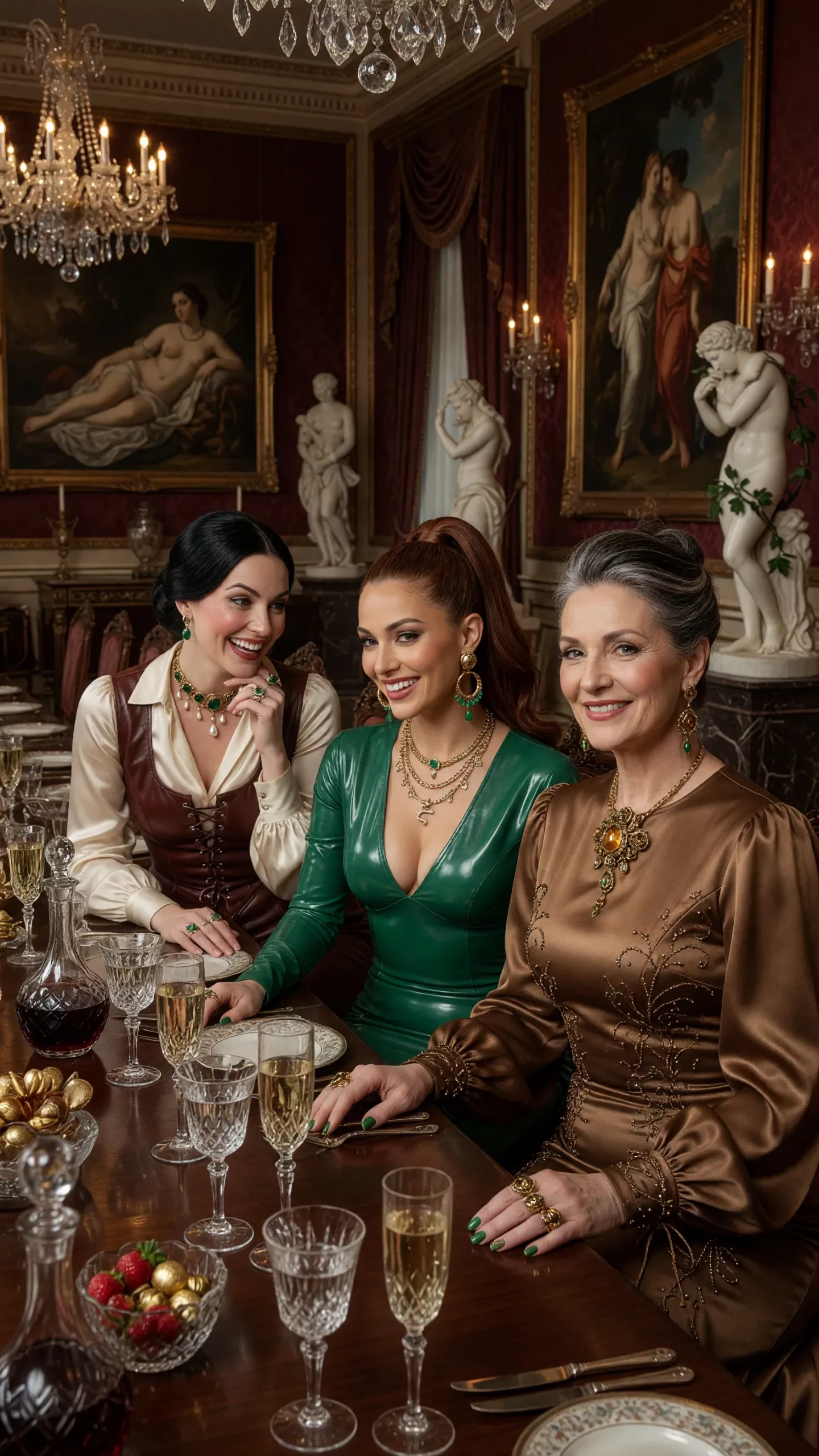
The Gilding of Surrender
When art restorer Eleanor Vance arrives at Thornwood Hall to restore twelve gilded panels, she expects a commission. She does not expect a household of women who wear silk like armor, a mentor whose touch lingers, or a love that asks everything and gives back a life.
There is a particular loneliness that comes from wearing wool when your soul was made for silk. Eleanor Vance knows it well. At twenty-eight, she has spent six years reviving forgotten masterpieces in a damp London studio, her hands skilled but her heart untouched. When the letter arrives summoning her to Thornwood Hall, she goes because she has no other work. She does not know that she is about to be restored herself.
The door opens onto a world of candlelight and crimson rugs, where a woman named Celeste wears charcoal silk that moves like smoke over water and speaks of gold leaf with the reverence of a lover. The panels Eleanor must restore depict women in various states of devotion—hands raised, heads bowed, hair loose—and as she works, she begins to see herself in their gilded forms.
This is a story of craftsmanship and surrender, of the electric intimacy of learning from a beautiful woman, and of the quiet euphoria that comes when you finally find the place where you belong. It is for anyone who has ever stood in the rain wearing wool and dreamed of silk.
Chapter One: The Wet Wool Threshold
The rain came down in sheets across the Yorkshire moors, each drop a tiny hammer against Eleanor Vance’s shoulders as she stood before the iron gates of Thornwood Hall. Her coat was wool—a heavy, coarse, oatmeal-coloured thing that had seemed sensible when she purchased it four years ago in a Leeds market, and which now clung to her like a wet animal, shedding water in rivulets that ran down her skirts and pooled in her boots. She could feel the damp seeping through to her skin, that particular chill that comes from fabric that has given up all pretence of protection and simply surrendered to the weather.
She had walked the last mile from the village. The carriage she had hired from the station had refused to come farther, the driver eyeing the narrow lane with its overhanging branches and muttering something about the road being unfit for wheels. Eleanor had paid him, taken her valise, and walked. The valise was leather—good leather, the one thing she had kept from her former life—and she held it close to her body, trying to shield it from the wet.
The gates were wrought iron, black and intricate, depicting a design she could not quite make out through the curtain of rain. Vines, perhaps. Or serpents. Or the flowing lines of women’s hair. She pushed, and they swung open with a groan that spoke of infrequent use.
The drive stretched before her, a ribbon of gravel that disappeared into a tunnel of dripping trees. She walked. Her boots squelched. Her skirt dragged. The wool of her coat grew heavier with every step, and she imagined it as a second skin, a coarse, grey, miserable skin that she had grown into over the years like a shell that was also a prison.
The hall emerged from the rain like a memory.
It was not what she had expected. She had imagined something grand and forbidding, a Gothic pile of black stone and narrow windows. But Thornwood Hall was built of warm honey-coloured stone, its windows generous, its roofline soft with age. Ivy climbed one wall, its leaves dark and glossy with wet. The door was oak, studded with iron, but the iron had been polished until it gleamed, and the oak had been oiled to a deep, rich brown that seemed to absorb the grey light and transform it into something warmer.
Eleanor stood before the door, dripping onto the step, and felt a sudden, irrational fear. Not of the house, but of herself. Of what she must look like—a drowned rat in a wet wool coat, her hair plastered to her scalp, her boots leaving puddles on the stone. She had been summoned here. She had been chosen. And she was arriving like a beggar at a feast.
She raised her hand to knock.
The door opened before her knuckles touched the wood.
The woman who stood in the doorway was tall and slender, with hair the colour of autumn leaves and eyes the grey of the sea under clouds. She wore a gown of charcoal silk that fell from her shoulders in a cascade of liquid folds, catching the light from the candles behind her and turning it into something that moved. The fabric was so fine that it seemed to breathe with her, rising and falling with each inhalation, and when she stepped aside to let Eleanor enter, the silk whispered against the doorframe like a secret.
“Miss Vance,” the woman said. Her voice was low and warm, with a texture that Eleanor could only describe as honeyed. “We have been expecting you. Please, come in out of the wet.”
Eleanor stepped across the threshold. The hall was warm. The warmth hit her like a physical force, seeping into her wet clothes, raising steam from her shoulders. She felt the wool beginning to release its grip on her skin, and with it, something else began to loosen—a tension she had been carrying so long she had forgotten it was there.
The woman closed the door, and the sound of the rain became muffled, distant, as if it belonged to another world entirely.
“I am Celeste,” the woman said. “I am the steward of Thornwood Hall. The Collector asked me to ensure your comfort.”
“The Collector,” Eleanor repeated. She had received the letter, yes, but it had been signed only with an initial, a single elegant letter that she had assumed was the client’s mark. “I don’t know his name.”
Celeste smiled. It was a small smile, but it transformed her face, softening the sharp lines of her cheekbones and bringing a warmth to her grey eyes. “He prefers it that way. For now. May I take your coat?”
Eleanor looked down at herself. The wool was sodden, heavy, dripping onto the polished oak floor. She could see the puddle forming at her feet, a dark stain spreading across the golden wood. “I’m sorry,” she said. “I’m making a mess.”
“You are making water,” Celeste said, as if correcting a child. “The floor has been wet before. It will be wet again. The mess is not the problem.” She stepped closer, and Eleanor caught the scent of her—something floral, but not sweet. Lavender, perhaps. Or rosemary. Something clean and green and alive. “The problem is that you are wearing wool.”
Eleanor blinked. “I’m sorry?”
“Wool,” Celeste repeated. She reached out and touched the sleeve of Eleanor’s coat, her fingers light, almost reverent. “It holds the wet. It holds the cold. It holds the past.” Her fingers lingered, and Eleanor felt the warmth of them through the sodden fabric. “You cannot work in wool. It sheds fibres that adhere to wet gesso. It scratches the skin. It reminds you of every day you have spent being uncomfortable and pretending you were not.”
Eleanor did not know what to say. She had never thought of her coat as anything but practical. It was warm. It was cheap. It had served her well through six London winters and countless damp Yorkshire days. But standing here, in this warm hall, with this woman in her charcoal silk looking at her with those grey eyes, she felt suddenly, acutely ashamed of it.
“I have other clothes,” she said, though it was not entirely true. She had a second dress in her valise, also wool, also grey, also worn.
“I am sure you do,” Celeste said. But her tone suggested that she understood exactly what those other clothes were. She took Eleanor’s arm, her fingers closing around Eleanor’s wrist with a gentleness that was also firm, and led her deeper into the hall.
They passed through a corridor lined with paintings—portraits of women in various states of dress and undress, their eyes following Eleanor as she walked. One woman wore a gown of deep crimson velvet, her hand resting on the head of a deerhound. Another was dressed in nothing but a silk shawl, her hair loose, her expression serene. A third wore a leather bodice laced with satin ribbons, her arms bare, her chin lifted in defiance or welcome—Eleanor could not tell which.
“The women of Thornwood Hall,” Celeste said, noticing Eleanor’s gaze. “Each one has contributed to the house in her own way. You will meet them, in time.”
They stopped before a door of dark wood, carved with the same flowing design Eleanor had seen on the gates. Celeste pushed it open, and Eleanor stepped into a room that took her breath away.
It was a bedroom, but it was like no bedroom she had ever seen. The bed was vast, draped in curtains of deep green velvet that fell from a canopy of carved oak. The floor was covered in a rug of cream and gold, so thick that her wet boots sank into it as if into moss. A fire burned in a hearth of pale stone, casting dancing shadows across the walls. And on the bed, laid out as if waiting for her, was a gown.
It was silk. Deep green, the colour of moss in a sun-dappled forest, the colour of leaves after rain. The fabric gleamed in the firelight, catching the flames and holding them, transforming them into something liquid and alive. Eleanor could see the sheen of it from across the room, could see the way the light played across its surface, could imagine the feel of it against her skin.
“That is for you,” Celeste said.
Eleanor shook her head. “I can’t—”
“You can.” Celeste’s voice was gentle but absolute. “You cannot work in wool. You cannot restore gold while wearing grey. The materials you handle deserve better. And so do you.”
Eleanor felt tears prick at her eyes. She did not know why. It was just a dress. It was just silk. But it was the most beautiful thing she had been offered in years, and the offer came with no condition, no demand, no expectation of repayment. Just a woman in charcoal silk telling her that she deserved better.
“I don’t understand,” Eleanor whispered. “Why are you being so kind to me? You don’t know me.”
Celeste stepped closer. She reached out and touched Eleanor’s cheek, her fingers cool and dry against Eleanor’s damp skin. “I know that you came when you were called. I know that you walked through the rain in a coat that could not protect you. I know that you are a gilder, and that you have been given a commission that will change your life.” She paused, her grey eyes holding Eleanor’s. “And I know that you are ready to stop wearing wool.”
She let her hand fall. She stepped back. And then she smiled, and the smile was warm and knowing and full of promise.
“Rest,” she said. “Change. When you are ready, come downstairs. There will be tea, and dinner, and company.” She moved toward the door, her charcoal silk whispering against the carpet. At the threshold, she turned. “And Miss Vance?”
“Yes?”
“The green will suit you. It is the colour of new leaves. The colour of beginnings.”
She closed the door behind her, and Eleanor was alone.
She stood for a long moment, dripping onto the cream and gold rug, her wet wool coat hanging from her shoulders like a burden she had carried for too long. Then she crossed to the bed and touched the silk gown. It was cool and smooth and impossibly soft. She lifted it, and it flowed through her hands like water, like light, like the promise of a life she had never dared to imagine.
She began to unbutton her coat.
The wool fell to the floor with a wet thump, and Eleanor Vance stood in her grey dress, her grey underthings, her grey life, and looked at the green silk that waited for her.
She reached for it with trembling hands.
Chapter Two: The Studio and the Silk
Eleanor woke to light the colour of honey.
It poured through the tall windows in a golden flood, catching the dust motes that drifted through the air and turning them into tiny stars. For a moment she did not know where she was. The bed was too soft, the sheets too smooth, the air too warm and fragrant with the ghost of lavender. Then she moved, and the green silk whispered against her skin, and she remembered.
She had slept in the gown.
It had been an accident at first—she had put it on, standing before the mirror, watching the fabric settle over her body like a second skin, and she had been unable to take it off. The silk was so cool, so smooth, so impossibly gentle against her skin that the thought of removing it, of returning to her grey wool shift, had seemed like a kind of violence. She had lain down on the bed to rest for just a moment, and the silk had cradled her, and she had fallen asleep with her hand pressed to the fabric over her heart.
Now she rose, and the gown fell around her in a cascade of green light. She crossed to the window and looked out at the grounds of Thornwood Hall. The rain had stopped. The garden was a study in shades of green—emerald and olive and moss, with here and there a splash of purple from late-blooming lavender. In the distance, she could see a woman in a leather apron bending over a bed of roses, her hands gloved, her hair tied back with a ribbon of sapphire satin.
Eleanor watched her for a moment, struck by the economy of her movements, the grace with which she worked. There was no hurry in her, no tension. She moved like someone who had all the time in the world and intended to use every second of it well.
A knock at the door.
“Come in,” Eleanor said, and her voice sounded strange to her own ears—softer, somehow, as if the silk had loosened something in her throat.
The door opened, and Celeste stood there, wearing a leather bodice over a blouse of cream satin. The leather was polished to a deep russet gleam, catching the morning light and throwing it back in warm amber tones. The satin of her blouse was so fine that Eleanor could see the shadow of her collarbone through it, the delicate architecture of her chest rising and falling with each breath. She wore a skirt of deep brown wool that fell to her ankles, but the wool was fine and soft, nothing like the coarse stuff Eleanor had arrived in, and it was trimmed at the hem with a band of bronze satin that caught the light as she moved.
“Good morning,” Celeste said. Her eyes traveled over Eleanor, taking in the green silk, the way it clung to her curves, the way her hair—still damp from last night’s rain—fell in loose waves around her shoulders. “The colour suits you, as I knew it would.”
Eleanor touched the fabric at her throat. “I slept in it. I couldn’t bear to take it off.”
“That is the nature of silk,” Celeste said, and there was something in her voice that was almost tender. “It claims you. It does not let go.” She stepped into the room, and the leather of her bodice creaked softly with the movement. “Are you ready to see your studio?”
Eleanor’s heart quickened. “Yes. Please.”
Celeste led her through the corridors of Thornwood Hall, and this morning, with the sun streaming through the windows, Eleanor could see the house properly for the first time. The walls were lined with paintings, as she had noticed the night before, but now she could see that they were not merely decorative. Each one was a masterpiece of technique—the brushwork precise, the colours luminous, the compositions balanced and harmonious. She recognized the hand of several masters, and she stopped more than once to examine a detail, her fingers itching to touch the surface.
“The Collector has excellent taste,” she murmured.
“He does,” Celeste agreed. “But he would say that taste is not enough. Taste without knowledge is merely preference. Knowledge without taste is merely information. The marriage of the two—that is art.”
They reached a door at the end of a long corridor, and Celeste paused with her hand on the handle. “This is your domain now,” she said. “The Collector has given it to you entirely. No one will enter without your permission. No one will disturb your work. What you create here is yours, and his, and ours.”
She opened the door.
The studio was a cathedral of light.
The northern wall was a single vast window, set with panes of clear glass that let in a soft, even illumination that seemed to come from everywhere at once. The morning sun, filtered through the eastern windows, cast long golden rectangles across the polished oak floor. The walls were lined with shelves holding jars of pigment in every colour Eleanor could imagine—vermilion and ochre, ultramarine and viridian, lead white and bone black and a dozen shades of yellow she could not name. There were brushes in ceramic pots, their handles worn smooth by use. There were stacks of linen, rolls of vellum, bundles of cotton rag.
And in the center of the room, on a long oak table, lay the tools of her trade.
A gilder’s cushion of crimson silk, stretched taut over a wooden frame, its surface smooth and inviting. A gilder’s knife with a blade of polished steel and a handle of dark wood, worn to a sheen by countless hands. A block of agate burnisher, the colour of dried blood, its surface polished to a mirror finish. A pot of rabbit-skin glue, a bag of whiting, a bottle of linseed oil. And, in a box lined with black velvet, sheets of gold leaf so thin that they seemed to breathe with the movement of the air.
Eleanor felt tears prick at her eyes. She had never owned tools like these. She had worked with cheap brushes and commercial gesso, with imitation gold leaf that tarnished within months, with cushions of felt that shed fibres into her work. This was a different world. This was the world she had dreamed of when she was a girl, reading about the great masters, imagining herself among them.
“This is too much,” she whispered.
“It is exactly enough,” Celeste said. She moved to the table and picked up the gilder’s knife, turning it over in her hands. The leather of her bodice creaked as she moved, and the cream satin of her blouse caught the light, throwing a soft glow across her throat. “Do you know what this is?”
“A gilder’s knife.”
“Yes. But do you know what it means?” Celeste held it up, and the blade caught the light, throwing a thin line of brightness across the ceiling. “This knife was made by a craftsman in Florence who has been making them for forty years. The steel is folded thirty-two times. The handle is olive wood, aged for a decade before it was turned. This knife will outlive you. It will outlive me. It will pass from hand to hand, from gilder to gilder, for generations.” She lowered it, and her eyes met Eleanor’s. “The Collector does not buy cheap things. He does not buy things that will wear out or break or be forgotten. He buys things that will last. He invests in permanence.”
Eleanor swallowed. “And he has invested in me.”
“He has,” Celeste said. “Now. Shall I show you how to prepare the gesso?”
She set the knife down and moved to the worktable, where a small spirit burner sat beside a copper pot. She lit the burner with a match, and a blue flame bloomed, steady and clean. Into the pot she placed a lump of rabbit-skin glue that looked like amber, and she added water from a glass beaker.
“Rabbit-skin glue,” she said, “is the foundation of all good gesso. It has been used since the Renaissance. It is flexible, it is strong, and it adheres to almost any surface. But it must be prepared correctly.” She stirred the glue with a wooden spatula, her movements slow and deliberate. “Soak it overnight in cold water. Then heat it gently—never boiling, never above body temperature. If you boil it, the collagen breaks down, and the glue loses its strength.”
Eleanor watched her hands. The leather of her gloves—she had put them on without Eleanor noticing—was thin and supple, moulding to the shape of her fingers like a second skin. The gloves were the colour of chestnuts, polished to a soft gleam, and they made Celeste’s hands look like sculptures, each movement a study in grace.
“The whiting,” Celeste continued, reaching for a bag of fine white powder, “is added slowly. A little at a time. Stir until it is absorbed. Then add more. The mixture should be the consistency of thick cream—not so thin that it runs, not so thick that it drags.” She demonstrated, her wrist flexing in a circular motion that sent ripples through the white mixture. “You will know it is ready when it leaves a trail on the surface that holds for a count of three before disappearing.”
She set down the spatula and turned to Eleanor. “Your turn.”
Eleanor stepped forward. The leather of Celeste’s gloves was warm as she guided Eleanor’s hands to the spatula, her fingers closing over Eleanor’s, her breath warm against Eleanor’s cheek.
“Feel the resistance,” Celeste murmured. “The gesso should be smooth, but not slippery. It should offer some resistance to the spatula, but yield to pressure. Like—” She paused, searching for the word. “Like the skin of a woman who is ready to be touched.”
Eleanor’s breath caught. She could feel Celeste’s body behind her, the warmth of her through the leather and satin, the gentle pressure of her breasts against Eleanor’s back as she leaned in to adjust Eleanor’s grip.
“Stir,” Celeste said. “Slowly. Evenly. Imagine you are stirring cream into coffee, the way the white swirls into the dark. That is what we are doing here. We are bringing light into darkness. We are making something new.”
Eleanor stirred. The gesso was smooth and cool, offering that exact resistance Celeste had described. She could feel the rhythm of it, the way it responded to her touch, the way it seemed to come alive under her hand.
“Good,” Celeste breathed. “You have a natural feel for it. Some people never learn this—they try to force the gesso, to dominate it. But gesso, like gold, like women, must be coaxed. It must be persuaded. It must be loved.”
She released Eleanor’s hands, but she did not step away. She remained close, her body a warm presence at Eleanor’s back, her breath stirring the fine hairs at Eleanor’s temple.
“Now,” she said, “add a drop of linseed oil. It gives the gesso flexibility. Without it, the gold will crack as the panel expands and contracts with the seasons.”
Eleanor reached for the bottle, her hand trembling slightly. Celeste caught her wrist, her leather-clad fingers encircling Eleanor’s arm like a bracelet.
“Steady,” she said. “Your hand must be steady. Not rigid, but steady. Like a bird perched on a branch—ready to fly, but perfectly still.”
Eleanor took a breath. She focused on the bottle, on the drop of golden oil that emerged from the nozzle, on the way it fell into the white gesso and sat on the surface like a tiny sun.
“Now stir it in,” Celeste said. “Slowly. Watch how the oil disperses, how it becomes part of the whole. That is what we are doing here, Eleanor. We are making something whole.”
Eleanor stirred, and the oil disappeared into the white, and the gesso became something new—smoother, richer, more alive.
“Perfect,” Celeste said. She stepped away, and the absence of her warmth was like a small death. “You have made your first gesso. Tomorrow, you will apply it to the first panel. But for now—” She pulled off her gloves, one finger at a time, the leather peeling away from her skin with a soft sigh. “For now, you should eat. Breakfast is in the dining room. Marguerite will have prepared something.”
Eleanor looked down at the gesso, at the smooth white surface in the copper pot. She had made it. She had stirred it with her own hands, guided by Celeste’s touch, and it was perfect.
“Will you join me?” she asked.
Celeste smiled, and the smile was like the first ray of sun after a long winter. “I will. But first—” She reached out and touched the collar of Eleanor’s green silk gown, her fingers light against the fabric. “You will need to change. The smell of gesso clings to silk. You will want a fresh gown for breakfast.”
Eleanor looked down at herself. The green silk was still beautiful, still smooth, still perfect against her skin. But Celeste was right. She could smell the gesso now—the sharp, clean scent of rabbit-skin glue and whiting, the earthy undertone of linseed oil. It was the smell of work, of creation, of transformation.
“I have nothing else,” she said. “Only my wool.”
“Then you will have to borrow something,” Celeste said. She turned and moved toward the door, her leather bodice creaking, her satin blouse catching the light. “Come. I have a gown that will suit you. It is the colour of autumn leaves, of the moment when summer turns to fall. It is the colour of change.”
Eleanor followed her, her heart beating a rhythm she had not felt in years—a rhythm of anticipation, of hope, of the first stirrings of something that felt terrifyingly like joy.
She was still wearing the green silk. She did not want to take it off. But she was learning, already, that surrender was not a loss. It was a door.
And she was stepping through.
Chapter Three: The First Lesson
Eleanor descended the stairs in a gown the colour of autumn leaves.
It was not her gown—it was Celeste’s, borrowed, and the knowledge of that fact sent a thrill through her each time the fabric brushed against her skin. The silk was the precise shade of a maple leaf in October, that moment when green yields to gold and gold deepens to russet, and it fell from her shoulders in a cascade of folds that whispered with every step. The bodice was fitted, boned with something flexible that moulded to her ribs like an embrace, and the sleeves were long and tight, ending in points that covered the backs of her hands.
She had never worn anything so fine. She had never known that clothing could feel like this—like being held, like being seen, like being worthy of the attention of silk.
Celeste was waiting in the studio.
She stood before the northern window, the morning light streaming around her like a benediction, and she was dressed in garments that made Eleanor’s breath catch in her throat. A bodice of black PVC, polished to a mirror gleam, that cupped her breasts and cinched her waist and left her shoulders bare. A skirt of charcoal silk that fell to the floor in heavy folds, slit to the thigh on one side. Her hair was pinned up, leaving the elegant line of her neck exposed, and she wore gloves of black satin that reached her elbows, their surface catching the light with each movement.
She turned as Eleanor entered, and her grey eyes traveled over Eleanor’s borrowed gown with an expression that might have been satisfaction.
“The colour suits you,” she said. “I knew it would. You have the complexion for warm tones—the gold in your skin catches the light and holds it.”
Eleanor touched the fabric at her throat. “I feel like I am wearing a dream.”
“You are,” Celeste said. “And today, you will learn how to make that dream permanent.” She gestured to the worktable, where the first panel lay waiting. It was a rectangle of oak, planed smooth and sanded to a velvet finish, its surface pristine and ready. Beside it sat the copper pot of gesso that Eleanor had prepared the day before, now cooled to a creamy white. “The panel has been sized with a thin coat of glue to seal the wood. Now we apply the first layer of gesso. This is the foundation. Everything else depends on what lies beneath.”
She picked up a brush—a wide, flat brush with bristles of soft badger hair, their tips dyed red. She held it out to Eleanor. “This is a gesso brush. It is made for laying down smooth, even coats. The bristles are badger—soft enough not to leave marks, firm enough to work the gesso into the grain. Feel it.”
Eleanor took the brush. The handle was smooth, worn to a polish by years of use, and the bristles were impossibly soft against her palm. She ran her thumb across them, and they yielded like fur.
“Now,” Celeste said, “dip it into the gesso. Not too deep—just the tips. Let the bristles drink.”
Eleanor obeyed. The gesso was cool and creamy, and it clung to the brush in a perfect bead, neither too thick nor too thin.
“Good,” Celeste murmured. “Now, lay it on the panel. Long, even strokes. From one edge to the other. Do not lift the brush until the stroke is complete.”
Eleanor leaned over the panel. The brush touched the wood, and she drew it across the surface in a single, smooth motion. The gesso flowed from the bristles like cream pouring from a pitcher, leaving a trail of pure white behind it. The sensation was exquisite—the glide of the brush, the resistance of the gesso, the way the wood drank in the liquid and became something new.
“Again,” Celeste said. “Overlap the first stroke by half the width of the brush. Keep the pressure even.”
Eleanor drew the brush back across the panel. The second stroke merged with the first, seamless, perfect. She felt a rhythm building in her body—breathe, stroke, breathe, stroke—and the world narrowed to the panel, the brush, the gesso, the soft whisper of Celeste’s breath beside her.
“Your wrist is too tight,” Celeste said. She stepped closer, and Eleanor felt the warmth of her body, the faint scent of lavender and leather. “Loosen. Let the brush be an extension of your arm, not a tool you are controlling. Relax your grip.”
Eleanor tried, but her hand trembled.
“Here,” Celeste said. She reached around Eleanor, her PVC-clad body pressing against Eleanor’s back, and her satin-gloved hand closed over Eleanor’s. The satin was cool and smooth, impossibly soft, and through it Eleanor could feel the warmth of Celeste’s fingers, the strength of her grip. “Like this. Let me show you.”
Celeste guided Eleanor’s hand, and together they drew the brush across the panel. The stroke was perfect—even, smooth, unhurried. Celeste’s breath was warm against Eleanor’s ear, her body a firm, yielding presence at Eleanor’s back, and Eleanor felt a current pass between them, electric and undeniable.
“The gesso must be applied in thin layers,” Celeste said, her voice low, almost a whisper. “Each layer must dry completely before the next is applied. If you rush, the gesso will crack. If you apply it too thickly, it will shrink and pull away from the wood. Patience is not a virtue in this work—it is a necessity.”
She released Eleanor’s hand, but she did not step away. She remained close, her breath warm, her presence a constant pressure against Eleanor’s awareness.
“Now,” she said. “Continue. I will watch.”
Eleanor dipped the brush again. She drew it across the panel, and this time her hand was steady. The stroke was clean, even, perfect. She felt a surge of something that was not quite pride—it was deeper than pride, more fundamental. It was the feeling of doing something right, of being in alignment with the work, of being exactly where she was meant to be.
She worked in silence, stroke after stroke, until the entire panel was covered in a thin, even layer of white. She set down the brush and stepped back, and she saw that she had created something beautiful—a surface of pure, flawless white, smooth as silk, waiting to receive the gold.
“Excellent,” Celeste said. “You have a gift for this. Some people never learn to lay gesso properly—they are too impatient, too forceful, too afraid of the blank surface. But you—” She reached out and touched Eleanor’s cheek, her satin glove cool against Eleanor’s flushed skin. “You understand that the foundation is everything. That what lies beneath determines what will rise above.”
Eleanor looked at the panel, at the perfect white surface she had created, and she felt tears prick at her eyes. She did not know why she was crying. The work was simple. It was only gesso. But it was the first thing she had made in years that felt true.
“I don’t know what is happening to me,” she whispered. “I feel like I am being unmade and remade at the same time.”
“That is exactly what is happening,” Celeste said. She stepped closer, and her satin gloves cupped Eleanor’s face, tilting it up so that their eyes met. “You arrived here in wool, Eleanor. You were wrapped in a fabric that chafed and clung and reminded you of every small, grey day you had ever endured. And now—” She gestured to the gown, to the panel, to the studio filled with light. “Now you are learning what it means to be wrapped in silk. To be held by beauty. To be worthy of the gold you will lay.”
Eleanor’s breath caught. “I don’t feel worthy.”
“I know,” Celeste said. “That is why we must teach you.”
She released Eleanor’s face, but her hand lingered, trailing down Eleanor’s cheek, her jaw, her throat, until it rested on her collarbone, just above the edge of the borrowed gown. The satin was cool, the touch light, and Eleanor felt her skin prickle with goosebumps.
“The panel must dry for twenty-four hours,” Celeste said. “Tomorrow, we will sand it smooth and apply the second coat. And the day after, the third. Each layer will bring us closer to the gold.” She smiled, and the smile was warm and knowing and full of promise. “But for now, you should rest. You have done good work today.”
She turned and moved toward the door, her PVC bodice gleaming, her silk skirt whispering against the floor. At the threshold, she paused.
“Eleanor.”
“Yes?”
“The gown you are wearing—the autumn leaf gown. It was mine, once. I wore it when I first arrived at Thornwood Hall, when I was still learning what it meant to be wrapped in silk.” She looked back over her shoulder, her grey eyes catching the light. “I want you to keep it. It is yours now.”
She left, and Eleanor stood alone in the studio, the borrowed gown warm against her skin, the panel gleaming white in the morning light, and she felt something shift inside her—a door opening, a path appearing, a future she had never dared to imagine unfolding before her like a ribbon of silk.
She touched the fabric at her throat, and she smiled.
Chapter Four: The First Panel
The morning of the third day arrived wrapped in a mist that clung to the windows of Thornwood Hall like a veil of gauze. Eleanor had slept deeply, dreamlessly, wrapped in the autumn-leaf gown that was now hers, and she woke with a sense of anticipation that hummed beneath her skin like a plucked string.
She had sanded the panel yesterday. Three coats of gesso, each one dried and smoothed and perfected, until the surface was as white and smooth as the inside of an eggshell. She had run her palm across it and felt nothing but flawless plane, a blank page waiting for the word.
Today, she would lay the gold.
She dressed in a gown of deep burgundy silk that Celeste had left for her—the colour of aged wine, of velvet roses, of the heart of a pomegranate. The bodice was fitted, the skirt full, and when she moved, the fabric caught the light and threw it back in waves of crimson and garnet. She had pinned her hair up, following Celeste’s example, and she felt exposed and elegant and ready.
The studio was warm when she entered. A fire crackled in the hearth, and the morning light filtered through the northern window in a soft, even glow that seemed designed for the work ahead. The panel lay on the table, pristine and waiting. And beside it, in a box lined with black velvet, lay the gold.
Celeste was already there. She stood by the window, her back to Eleanor, and she was dressed in a gown of deep purple PVC that gleamed like wet amethyst in the firelight. The bodice was boned and structured, cinching her waist and lifting her breasts, and the skirt fell in heavy folds that caught the light with each subtle movement. She wore gloves of matching PVC that reached her elbows, and her hair was loose, falling in waves of autumn fire down her back.
She turned as Eleanor entered, and her grey eyes swept over Eleanor’s burgundy silk with an expression of quiet approval.
“You are ready,” she said. It was not a question.
“I am,” Eleanor said, and she was surprised to find that she meant it.
Celeste moved to the table and opened the box of gold. The sheets lay within, each one separated by a leaf of tissue paper so fine it was almost transparent. She lifted one of the sheets with a pair of tweezers, holding it up to the light, and the gold seemed to breathe, to pulse with an inner radiance that had nothing to do with the sun.
“This is twenty-three-karat gold,” she said. “Pure enough to glow, but alloyed with a trace of silver and copper to give it strength. It has been beaten by a master goldbeater in Venice, hammered day after day until it is thin enough to float on air.” She lowered it, and the gold settled onto the velvet cushion like a feather falling. “It is the most forgiving and the most unforgiving material you will ever work with. It will forgive a trembling hand, but it will not forgive hesitation.”
Eleanor stepped closer. The gold seemed to call to her, to draw her in with its warm, liquid light. She had seen gold leaf before, handled it in her previous work, but never like this. Never so pure, so fine, so alive.
“How do I begin?” she asked.
“First, you prepare the surface.” Celeste reached for a small pot of size—a clear, tacky adhesive that would bond the gold to the gesso. “The size must be applied to the area where the gold will go. It must be brushed on evenly, and then you must wait. Wait until the size becomes tacky—not wet, not dry, but just between. The gilder calls this the ‘kiss’ stage. It is the moment when the size is ready to receive the gold, and it will only last for a few hours.”
She dipped a brush into the size and handed it to Eleanor. “Apply it to the panel. Only to the area where the first sheet of gold will go. Work from the center outward.”
Eleanor took the brush. The size was clear, viscous, and it flowed from the bristles in a smooth, even film. She worked carefully, methodically, covering a section of the panel about the size of her hand. The gesso drank in the size, and the surface became glossy, reflective, waiting.
“Now we wait,” Celeste said. “Not long. A quarter of an hour, perhaps. The size must reach the kiss.”
They stood in silence, the fire crackling, the mist pressing against the windows. Eleanor could feel the size drying, could sense the moment approaching when it would be ready. Her heart beat a slow, steady rhythm in her chest, and she felt a calm settle over her that she had not known she was capable of.
“Now,” Celeste said. She moved to Eleanor’s side and took her hand, guiding it to the gilder’s knife. “Lift the sheet of gold. Use the knife to slide it onto the cushion. Gently—it is lighter than a breath.”
Eleanor obeyed. She slid the knife beneath the sheet of gold, and it lifted as if by magic, floating onto the crimson silk cushion without a wrinkle. She stared at it, amazed at her own steadiness.
“Now cut it,” Celeste said. “Use the knife to divide it into smaller pieces. You will apply them one at a time, overlapping slightly, like scales on a fish.”
Eleanor cut. The gold divided cleanly, the edges sharp and precise. She lifted one of the pieces on the tip of the knife, and Celeste guided her hand to the panel.
“Touch it to the size,” Celeste whispered. “Do not press. Let it fall. Let it find its own way.”
Eleanor touched the gold to the size, and it left the knife as if of its own accord, settling onto the tacky surface with a soft sigh. She watched it adhere, watched the way it clung to the size, the way it seemed to breathe, to settle, to become part of the panel.
“Good,” Celeste breathed. “Now the next. Overlap the first by a hair’s breadth.”
Eleanor worked, piece by piece, her hand steady, her breath even. Celeste stood beside her, her body a warm presence, her voice a low murmur of guidance and encouragement. The gold grew across the panel, a field of pure, liquid light, and Eleanor felt herself disappearing into the work, becoming part of it, losing herself in the rhythm of lift and place and press.
When the last piece was laid, she stepped back and looked at what she had made.
The panel glowed. The gold seemed to float above the surface, to hover in a dimension of its own, catching the light and transforming it into something almost too beautiful to bear. Eleanor could see her reflection in it, distorted and golden, a woman made of light.
“I did this,” she whispered.
“We did this,” Celeste said. She stepped closer, and her PVC-clad body pressed against Eleanor’s side, warm and smooth and alive. “But the work is not done. The gold must be burnished. It must be pressed and polished until it becomes a mirror.”
She reached for the agate burnisher, the blood-red stone that had sat on the table since Eleanor’s arrival. She held it up, and the firelight caught its polished surface, throwing a crimson gleam across the room.
“This is the final step,” she said. “The burnisher compresses the gold, seals it, makes it permanent. Without burnishing, the gold will lift and flake and fall away. But with it—” She ran the stone across a corner of the panel, and the gold flared, became brighter, deeper, more alive. “With it, the gold becomes eternal.”
She handed the burnisher to Eleanor. “Now you. Use a circular motion, firm but gentle. Let the stone find its own rhythm.”
Eleanor took the burnisher. It was cool and smooth in her hand, heavier than it looked. She touched it to the gold and began to move in slow, circular strokes. The gold responded, compressing, gleaming, becoming something new. She could feel the heat of friction building beneath the stone, could smell the faint metallic scent of the gold warming, and she felt a pleasure so deep and so pure that it brought tears to her eyes.
“Good,” Celeste murmured. “You are doing it. You are making it permanent.”
Eleanor burnished until her arm ached and the entire panel gleamed like a mirror. She set down the stone and looked at her work, and she saw that she had created something of lasting beauty. Something that would outlive her. Something that mattered.
She turned to Celeste, and the tears were flowing freely now, tracking down her cheeks in silver lines.
“I don’t understand why this feels so important,” she said. “It is only a panel. It is only gold. But I feel like I have given birth to something.”
“Because you have,” Celeste said. She reached out and caught a tear on her gloved finger, and the PVC gleamed with the moisture. “You have given birth to beauty. To permanence. To a part of yourself that will exist long after your body has returned to the earth.” She touched the tear to her lips, tasting it, and her grey eyes held Eleanor’s. “That is what we do here, Eleanor. We make things that last. We make things that matter. And in doing so, we become part of something larger than ourselves.”
She took Eleanor’s hand, the PVC of her glove cool and smooth against Eleanor’s flushed skin, and she led her to the window. The mist had cleared, and the garden lay below, green and gold and alive with the light of a late autumn morning.
“This is your home now,” Celeste said. “These are your people. And this work—” She gestured back to the panel, to the gold that blazed like a captured sun. “This work is your gift to the world.”
Eleanor stood at the window, Celeste’s hand in hers, the burgundy silk warm against her skin, and she felt a peace settle over her that she had never known was possible.
She was home.
She was silk.
She was gold.
Chapter Five: The Women of the House
The dinner bell rang through the corridors of Thornwood Hall like a silver thread pulling Eleanor toward an unknown destination. She had changed from her work clothes into the burgundy silk, smoothing the fabric over her hips with hands that still trembled from the afternoon’s concentration. The gold was laid. The first panel was complete. And now she would meet the women who shared this house, this life, this quiet devotion to beauty.
She found the dining room by following the murmur of voices and the clink of crystal. The door was open, and warm light spilled into the corridor like honey from a broken comb. Eleanor paused at the threshold, her heart beating a rhythm that was part anticipation, part fear.
The room was long and low-ceilinged, with walls of dark oak and windows that looked out onto the garden, now dark and mysterious in the twilight. A fire blazed in a hearth of carved stone, casting dancing shadows across a table that could have seated twenty but was set for five. Crystal goblets caught the firelight and threw it back in prisms of ruby and emerald. Silver spoons gleamed beside plates of cream-coloured porcelain. And at the head of the table, in a chair that was more throne than seat, sat a woman Eleanor had not yet met.
She rose as Eleanor entered, and the movement was like a flower unfolding. She was tall, with hair the colour of winter wheat and eyes the shade of new copper. She wore a gown of bronze satin that clung to her like a second skin, catching the firelight and holding it, transforming it into something molten and alive. The fabric was so fine that Eleanor could see the shadows of her collarbones through it, the delicate architecture of her chest, the way her breath moved through her body like a tide.
“You must be Eleanor,” she said, and her voice was low and warm, with a texture like velvet rubbed against the grain. “I am Rosalind. I am the housekeeper of Thornwood Hall. Welcome.”
She crossed the room in a rustle of bronze satin and took Eleanor’s hands in hers. Her skin was warm, her grip firm, and she looked into Eleanor’s eyes with a directness that was neither challenging nor invasive—simply present.
“We have been eager to meet you,” she said. “Celeste speaks of your work with the reverence usually reserved for saints and lovers.”
Eleanor felt heat rise to her cheeks. “I am only learning. Celeste has been very patient with me.”
“Patience is Celeste’s native tongue,” Rosalind said, and she smiled, a small, knowing curve of her lips. “But she does not waste it on those who do not deserve it. If she is patient with you, it is because she sees something worth the time.”
She released Eleanor’s hands and gestured to the table. “Come. Sit. You must be hungry. Marguerite has prepared something special to welcome you.”
Eleanor took a seat, and the burgundy silk whispered against the chair’s upholstery. Rosalind returned to her place at the head of the table, and as she sat, the bronze satin pooled around her like liquid metal, catching the firelight and throwing it back in waves of amber and gold.
The door opened, and two women entered.
The first was Imogen. Eleanor recognized her from the garden—the woman in the leather apron, bending over the roses. Now she wore a bodice of soft, worn leather, laced with satin ribbons the colour of moss, over a blouse of cream linen that was simple but finely made. Her skirt was of deep green wool, but the wool was soft and fine, and it was trimmed at the hem with a band of emerald satin that caught the light as she moved. Her hair was tied back with a ribbon of the same emerald satin, and her hands were stained with earth, the nails short and practical.
“Imogen,” Rosalind said, “this is Eleanor Vance, our new gilder.”
Imogen smiled, and her face transformed. She had a strong, weathered beauty, the kind that comes from working outdoors in all weathers, and her eyes were the green of new leaves in spring.
“I saw you at the window this morning,” she said. “Watching me work. I wondered when you would come down to join us.”
Eleanor felt caught, but not unpleasantly. “I was admiring your garden. It is beautiful.”
“It is my life’s work,” Imogen said simply. She took a seat across from Eleanor, and the leather of her bodice creaked softly as she settled. “The Collector gave me this garden when I arrived. It was a wilderness then—brambles and nettles and weeds that had taken root in the bones of the earth. He told me I could make it whatever I wanted. So I did.”
She said it without pride, without boastfulness. It was simply a fact, like the colour of her eyes or the earth beneath her nails.
The second woman entered, and Eleanor knew immediately that this was Marguerite. She was shorter than the others, with a rounded figure and hands that were perpetually warm, as if she had just taken them from an oven. She wore a leather apron over a blouse of cream silk, the sleeves rolled to her elbows, and her skirt was of deep burgundy wool, trimmed with satin the colour of ripe plums. Her hair was grey, streaked with the ghost of auburn, and her eyes were dark and warm and full of laughter.
“At last,” she said, her voice rich with an accent Eleanor could not place. “The gilder. I have been waiting to meet the woman who makes gold from nothing.”
“I make gold from gold,” Eleanor said. “I only lay it. I do not create it.”
“Ah, but you do,” Marguerite said, settling into a chair with a sigh of contentment. “You take a sheet of metal, thinner than a breath, and you make it into art. That is creation. That is alchemy.” She reached across the table and took Eleanor’s hand, her fingers warm and slightly floury. “I know alchemy when I see it. I practice it myself, every day, in my kitchen.”
The meal that followed was unlike anything Eleanor had ever experienced. Marguerite had prepared a roast of lamb, glazed with honey and rosemary, served on a bed of roasted root vegetables that had been caramelized until they were sweet and tender. There was a salad of bitter greens and toasted walnuts, dressed with a vinaigrette that was sharp and bright. There was a loaf of bread, crusty and warm, with butter so fresh that it still tasted of cream. And there was wine—a deep, ruby-red wine that seemed to glow in the candlelight, its flavour rich and complex, with notes of blackberry and clove and something that might have been the memory of summer.
As they ate, they talked. Imogen spoke of her garden—the roses she was training to climb the south wall, the lavender she was propagating from cuttings, the new variety of hellebore she had discovered in a seed catalogue from France. She spoke of soil pH and companion planting and the way the light fell across the garden at different times of day, and her voice was warm and passionate, the voice of a woman who loved her work with a love that was deep and abiding.
Rosalind spoke of the house—the history of its walls, the stories hidden in its architecture, the way the morning light fell across the floors in patterns that shifted with the seasons. She knew every room, every corridor, every hidden corner, and she spoke of them with the affection of a mother speaking of her children.
Marguerite spoke of food—the provenance of her ingredients, the techniques she had learned from cooks across Europe, the philosophy of a well-ordered kitchen. She spoke of the importance of patience in cooking, of allowing flavours to develop slowly, of the way a dish could tell a story if you knew how to listen.
And Celeste—Celeste spoke of gold. Of the way it caught the light. Of the way it transformed whatever it touched. Of the way it had transformed Eleanor, even in the short time she had been at Thornwood Hall.
“She arrived in wool,” Celeste said, her grey eyes meeting Eleanor’s across the table. “She arrived wet and cold and grey. And now she sits before us in silk, with gold on her hands and light in her eyes.”
Eleanor looked down at her hands. There was a fleck of gold on her thumb, a tiny speck of brightness that had survived washing. She touched it, and it flaked away, falling onto the white tablecloth like a fallen star.
“I feel like I am becoming someone new,” she said, and her voice was barely a whisper. “But I do not know who that someone is yet.”
“You do not need to know,” Rosalind said. “You only need to be willing to become.”
The words settled into Eleanor’s chest like a seed falling into warm earth. She looked around the table—at Imogen in her leather and linen, at Rosalind in her bronze satin, at Marguerite in her silk and apron, at Celeste in her purple PVC—and she saw that they were all becoming, all the time. They were not finished. They were not fixed. They were women in the process of transformation, and they had welcomed her into their midst.
After the meal, they moved to the drawing room, where a fire crackled in a hearth of pale stone. The room was furnished with deep armchairs upholstered in velvet, and the walls were lined with bookshelves that held volumes in leather bindings, their spines gleaming in the firelight.
Eleanor settled into a chair, the burgundy silk pooling around her, and Imogen sat on the floor at her feet, her leather-clad back resting against Eleanor’s chair. Rosalind took a chair by the fire, her bronze satin gleaming, and Marguerite curled up on a settee, her eyes half-closed, a glass of wine in her hand. Celeste stood by the window, looking out into the darkness, her PVC gown catching the firelight and throwing it back in purple gleams.
“Tell us about yourself, Eleanor,” Rosalind said. “Before Thornwood Hall. What brought you here?”
Eleanor was silent for a moment, gathering her thoughts. “I was in London,” she said. “I had a small studio in a damp basement. I restored paintings for dealers who paid me barely enough to live. I wore wool because it was cheap, and I ate bread and cheese because it was what I could afford. I was lonely.” She paused, the word hanging in the air. “I was so lonely that I had forgotten what it felt like not to be.”
“And then?” Imogen prompted, her voice soft.
“And then the letter arrived. A commission to restore twelve gilded panels at Thornwood Hall. The fee was more than I made in a year. I thought it was too good to be true.” She laughed, a small, surprised sound. “I still think it is too good to be true.”
“It is true,” Celeste said, without turning from the window. “You are here. You are real. The gold is real. The silk is real.” She turned, and her grey eyes met Eleanor’s. “The only thing that was not true was the life you were living before.”
The words struck Eleanor like a physical blow. She felt tears prick at her eyes, and she did not try to stop them. “I thought I was living,” she said. “I thought I was surviving. But I was only waiting. Waiting for something I did not know how to name.”
“And now?” Rosalind asked.
Eleanor looked at the women around her—at Imogen, warm and earthy at her feet; at Rosalind, elegant and knowing by the fire; at Marguerite, content and peaceful on the settee; at Celeste, mysterious and beautiful in the window. She looked at the fire, at the books, at the velvet and the silk and the gold that gleamed on her hands.
“Now I think I know what I was waiting for,” she said. “I was waiting for this.”
Imogen reached up and touched Eleanor’s hand, her fingers warm and rough against Eleanor’s skin. “You have found us,” she said. “And we have found you. That is what Thornwood Hall is—a place where women find each other.”
“A place where women find themselves,” Marguerite added, her eyes still closed, a smile playing at her lips.
“A place where women find their purpose,” Rosalind said.
“And their beauty,” Celeste said, and she crossed the room to kneel beside Eleanor’s chair, her PVC gown gleaming in the firelight. “You are beautiful, Eleanor. You have always been beautiful. But now you are beginning to believe it.”
She reached out and touched Eleanor’s cheek, her fingers cool and smooth in their PVC glove, and Eleanor leaned into the touch, her eyes closing, her breath slowing.
“I am beginning to believe many things,” she whispered.
“Good,” Celeste said. “That is the first step.”
The fire crackled. The wine glowed. The women of Thornwood Hall sat in comfortable silence, their glossy attire gleaming in the firelight, and Eleanor felt herself sinking into a warmth that was not just physical but spiritual. She was among her people. She was home.
And she knew, with a certainty that went deeper than thought, that she would never leave.
Chapter Six: The Gilder’s Touch
The morning of the fourth panel arrived wrapped in a frost that traced silver filigree across the windows of Thornwood Hall. Eleanor woke to find her breath misting in the air, the fire in her hearth reduced to embers, and the burgundy silk gown she had worn to bed twisted around her legs like a vine. She lay still for a moment, watching the frost patterns bloom and spread, and she felt a quiet anticipation building in her chest.
Today, Celeste had promised, she would learn the gilder’s touch.
She dressed in a gown of deep amber silk that Celeste had left for her—the colour of honey held up to the light, of autumn sunlight filtered through leaves. The bodice was fitted, the skirt full, and when she moved, the fabric caught the morning light and threw it back in waves of gold and ochre. She had grown accustomed to silk now, to the way it felt against her skin, to the way it moved with her body rather than against it. The thought of wool made her shudder.
The studio was warm when she entered. A fire blazed in the hearth, and the morning light streamed through the northern window in a soft, even glow. The first three panels stood against the wall, their gold surfaces gleaming like mirrors, each one a testament to Eleanor’s growing skill. The fourth panel lay on the worktable, its gesso surface smooth and white, waiting.
Celeste was already there. She stood by the fire, her back to Eleanor, and she was dressed in a gown of deep crimson PVC that gleamed like wet blood in the firelight. The bodice was structured, boned, cinching her waist and lifting her breasts, and the skirt fell in heavy folds that caught the light with each subtle movement. She wore gloves of matching PVC that reached her elbows, and her hair was loose, falling in waves of autumn fire down her back.
She turned as Eleanor entered, and her grey eyes swept over Eleanor’s amber silk with an expression of quiet approval.
“You are becoming accustomed to silk,” she said. “I can see it in the way you move. You no longer fight the fabric. You let it carry you.”
Eleanor touched the amber fabric at her throat. “I do not think I could go back to wool. The thought of it makes my skin crawl.”
“That is the first sign of transformation,” Celeste said. “When the old life becomes repellant, the new life becomes possible.”
She moved to the worktable and picked up the gilder’s knife, turning it over in her gloved hands. The crimson PVC gleamed in the firelight, and the blade caught the light and threw it back in a thin line of silver.
“Today, we will work on the gilder’s touch,” she said. “The gold leaf is forgiving, but it demands a certain quality of attention. You must not grip the knife too tightly. You must not hold your breath. You must become soft and receptive, like water taking the shape of its container.”
Eleanor nodded, her heart beating a slow, steady rhythm.
“Come here,” Celeste said. “Stand before me.”
Eleanor crossed the room and stood before Celeste, close enough to feel the warmth radiating from her body, to smell the faint scent of lavender and leather that clung to her skin. Celeste reached out and took Eleanor’s hands, turning them over, examining them.
“Your hands are steady,” she said. “That is good. But they are still holding tension. See—” She traced a line along Eleanor’s palm, her PVC glove cool and smooth. “This ridge here, between your thumb and forefinger. It should be soft, relaxed. Instead, it is tight, braced for effort.”
She released Eleanor’s hands and stepped behind her, her body pressing against Eleanor’s back, her arms encircling Eleanor’s waist. The PVC of her gown was cool and smooth against the silk of Eleanor’s dress, and Eleanor could feel the structure of the bodice, the boning that shaped Celeste’s torso, the warmth of her skin beneath the gleaming surface.
“Close your eyes,” Celeste murmured, her breath warm against Eleanor’s ear. “Breathe. Feel your body. Feel where you are holding tension.”
Eleanor closed her eyes. She breathed. She felt the tension in her shoulders, her jaw, her hands. She felt the way she was bracing herself against the world, even now, even here, in this place of warmth and beauty.
“Now let it go,” Celeste said. “Imagine that each breath is releasing something you no longer need. A fear. A memory. A habit of holding yourself tight.”
Eleanor breathed, and she felt something loosen in her chest. It was not dramatic—it was a small release, a tiny opening, but it was real.
“Good,” Celeste said. “Now open your eyes. Take the knife.”
Eleanor reached for the gilder’s knife, and Celeste’s hands guided hers, adjusting her grip, loosening her fingers.
“Hold it as if you were holding a bird,” Celeste said. “Firm enough that it cannot escape, but gentle enough that you do not crush it.”
Eleanor adjusted her grip. The knife felt different now—lighter, more responsive, as if it had come alive in her hand.
“Now lift a sheet of gold,” Celeste said. “Use the knife to slide it onto the cushion. Let the knife do the work. Your hand is only a guide.”
Eleanor slid the knife beneath the sheet of gold, and it lifted as if by magic, floating onto the crimson silk cushion without a wrinkle. She stared at it, amazed at how easy it had been.
“Now cut it,” Celeste said. “But do not cut with force. Cut with intention. Imagine that the gold is already divided, and you are only revealing the separation that already exists.”
Eleanor cut. The gold divided cleanly, the edges sharp and precise. She lifted one of the pieces on the tip of the knife, and Celeste’s hands guided hers to the panel.
“Touch it to the size,” Celeste whispered. “Do not press. Do not push. Simply offer it to the surface, and let the size receive it.”
Eleanor touched the gold to the size, and it left the knife as if of its own accord, settling onto the tacky surface with a soft sigh. She watched it adhere, watched the way it clung to the size, the way it seemed to breathe, to settle, to become part of the panel.
“Good,” Celeste breathed. “Now the next. But this time, do not think about your hand. Think about the gold. Imagine that you are not placing it, but calling it home.”
Eleanor worked, piece by piece, her hand steady, her breath even. Celeste remained behind her, her body a warm presence, her arms occasionally reaching around to adjust Eleanor’s grip, to guide her hand, to correct a piece that had drifted slightly out of alignment. Each touch was electric, sending shivers down Eleanor’s spine, and she found herself leaning into Celeste’s body, seeking more contact, more warmth.
“You are doing beautifully,” Celeste murmured. “Your touch is becoming softer, more receptive. The gold can feel the difference. See how it lies flatter, how it catches the light more evenly?”
Eleanor looked at the panel, and she saw that it was true. The gold she had laid today was more perfect than the gold she had laid yesterday. It seemed to glow from within, to float above the surface, to be alive.
“This is the gilder’s touch,” Celeste said. “It is not a technique. It is a state of being. It is the ability to become so soft, so receptive, so present, that the gold can speak through you.”
She stepped back, and Eleanor felt the absence of her warmth like a small death. But she did not stop working. She continued, piece by piece, her hand steady, her breath even, her mind empty and full at the same time.
When the last piece was laid, she stepped back and looked at what she had made. The panel glowed. The gold seemed to float above the surface, to hover in a dimension of its own, catching the light and transforming it into something almost too beautiful to bear.
“It is the most beautiful thing I have ever made,” she whispered.
“It is the most beautiful thing you have made so far,” Celeste corrected. “Tomorrow, you will make something even more beautiful. And the day after, something more beautiful still. That is the nature of the gilder’s touch—it deepens with practice, with surrender, with love.”
She crossed to Eleanor and took her hands, turning them over, examining them. The tips of Eleanor’s fingers were stained with gold, tiny specks of brightness that caught the light.
“The gold has marked you,” Celeste said. “It does that to those who love it well. You will find traces of it on your skin for days, no matter how much you wash. It is a reminder that you have touched something eternal.”
She lifted Eleanor’s hand to her lips and pressed a kiss to her palm, her lips warm through the cool PVC of her glove. Eleanor felt the kiss like a brand, like a seal, like a promise.
“Come,” Celeste said, releasing her hand. “You have earned a rest. And I have something to show you.”
She led Eleanor out of the studio and through the corridors of Thornwood Hall, her crimson PVC gleaming in the candlelight, her hair flowing behind her like a banner. They passed through the dining room, the drawing room, the library, until they reached a door that Eleanor had not seen before—a door of dark oak, carved with the same flowing design she had seen on the gates and on her bedroom door.
Celeste pushed it open, and Eleanor stepped into a room that took her breath away.
It was a gallery, long and narrow, with walls of pale stone and a ceiling of vaulted oak. The floor was polished marble, veined with gold, and the walls were lined with paintings—dozens of them, hundreds of them, covering every surface from floor to ceiling. They were portraits, landscapes, still lifes, religious scenes, mythological scenes, and they were all, every single one, masterpieces.
Eleanor walked slowly, her eyes wide, her breath caught in her throat. She recognized hands—Rembrandt, Vermeer, Caravaggio, Titian. She saw brushwork that made her want to weep, colours that seemed to glow from within, compositions that were so perfect they seemed inevitable.
“This is the Collector’s private gallery,” Celeste said. “He has been assembling it for decades. Every piece here was chosen with care, with knowledge, with love.”
Eleanor stopped before a painting of a woman in a gown of deep blue silk, her hands raised as if in offering. The background was gold, and the gold seemed to pulse with an inner light, to breathe, to live.
“This is what I am restoring,” she said. “The panels. They are part of this.”
“They are,” Celeste said. “They are the oldest pieces in the collection. They were painted in the fifteenth century, by a master whose name has been lost to history. They depict the stages of devotion—the journey of a woman from solitude to surrender.”
Eleanor looked at the painting, at the woman in blue, and she saw herself. She saw the loneliness in her eyes, the hope in her raised hands, the readiness in her posture.
“I am her,” she said. “I am the woman in blue.”
“Yes,” Celeste said. “And you are becoming the woman in gold.”
She took Eleanor’s hand, and they stood together in the gallery, surrounded by centuries of beauty, and Eleanor felt herself sinking into a peace that was deeper than anything she had ever known.
She was home.
She was silk.
She was gold.
And she was only beginning.
Chapter Seven: The Collector’s Shadow
The morning of the seventh day arrived with a quality of light that Eleanor had come to recognize as particular to Thornwood Hall—a soft, golden luminescence that seemed to emanate from the stones themselves, as if the house had absorbed centuries of sunlight and was now releasing it in a slow, steady exhalation. She woke in her amber silk, the fabric twisted around her legs like a memory of the night before, and she felt a current of anticipation running beneath her skin like an underground river.
She had completed seven panels now. Seven women in various stages of devotion, their hands raised, their heads bowed, their hair loose, their eyes fixed on something beyond the frame. She had laid the gold with a touch that grew softer and more certain with each passing day, and she had begun to see herself in each figure—not as she was, but as she was becoming.
Celeste had been absent all morning. This was unusual. Since Eleanor’s arrival, Celeste had been a constant presence, a warm shadow at her elbow, a low voice guiding her hands. But today, the studio was empty, and the silence felt different—charged, expectant, as if the air itself was holding its breath.
Eleanor worked alone, laying gold on the eighth panel. Her hands moved with a confidence that surprised her, the gilder’s knife a natural extension of her arm, the gold leaf settling onto the size like a sigh of relief. She had become fluent in the language of gilding—the grammar of the brush, the syntax of the burnisher, the poetry of the leaf.
She was so absorbed in her work that she did not hear the door open.
She did not hear the footsteps.
She only became aware of the presence when the light changed, when a shadow fell across her worktable, and she looked up to find a figure standing in the doorway.
He was tall. That was the first thing she noticed—the height of him, the way he seemed to fill the frame of the door, to command the space around him without effort. He wore a coat of black silk that fell to his knees, its surface catching the light and absorbing it, drinking it in until it became a void in the shape of a man. His face was shadowed by a wide-brimmed hat of black felt, and she could see only the lower half of his jaw, the line of his mouth, the suggestion of a cheekbone.
He did not move. He did not speak. He simply stood, watching her, and the weight of his attention was like a physical force, pressing against her skin, entering her lungs, settling into her bones.
Eleanor’s hand froze. The gilder’s knife trembled in her grip. She felt a surge of fear—not the sharp fear of danger, but the deeper fear of being seen, truly seen, by someone who could not be deceived.
“Don’t stop.”
The voice was low, resonant, with a texture like velvet stretched over steel. It was not a command, but it carried the weight of one. “Continue your work. I wish to observe.”
Eleanor’s hand moved before her mind could catch up. She dipped the knife into the gold, lifted a sheet, laid it on the cushion. Her movements were mechanical, her breath shallow. She could feel his eyes on her, could feel the attention radiating from him like heat from a fire.
“Your touch has improved,” he said. “The gold lies flatter. The edges are cleaner. You have been learning.”
She nodded, not trusting her voice.
“Celeste speaks highly of you,” he continued. “She says you have a natural gift for surrender. That you do not fight the gold, but yield to it.”
Eleanor swallowed. “I am only doing what she teaches me.”
“No.” The word was final, absolute. “You are doing more than that. You are becoming what the gold requires. That is not something that can be taught. It must be discovered.”
He stepped into the room, and the black silk of his coat whispered against the floor. He moved to the worktable and stood beside her, close enough that she could smell him—a scent of cedar and leather and something else, something sharp and clean, like ozone after a storm.
He reached out and touched the panel she had been working on, his fingers brushing the gold with a gentleness that seemed at odds with his size. “This is the eighth panel. The woman in gold. She is the center of the sequence.”
Eleanor looked at the panel. The woman she had been gilding was different from the others. She was not kneeling, not offering, not bowing. She was standing, her arms at her sides, her face lifted, her eyes open. She was looking at something—or someone—with an expression of complete, utter peace.
“Who is she?” Eleanor asked.
“She is the one who has completed the journey,” the Collector said. “She has passed through solitude, through devotion, through surrender. She has arrived at the place where she no longer needs to strive. She simply is.”
He turned to look at Eleanor, and for a moment, the shadow of his hat shifted, and she caught a glimpse of his eyes. They were dark—so dark that she could not tell where the iris ended and the pupil began—and they held a depth that seemed to go on forever, like a well that had no bottom.
“You are further along than you know,” he said. “The gold does not lie. It reveals what is true.”
He reached out and touched her cheek, his fingers cool against her flushed skin. The touch was light, barely there, but Eleanor felt it like a brand, like a seal, like a promise.
“Continue,” he said. “I will watch.”
He stepped back, and the shadow of his hat fell across his face again, hiding his eyes. He moved to the window and stood with his back to her, his black silk coat absorbing the light, his silhouette sharp against the glass.
Eleanor turned back to her work. Her hands were trembling, but she forced them to steady. She dipped the knife into the gold, lifted a sheet, laid it on the cushion. The movements came back to her, the rhythm of the work, the quiet focus that she had learned in Celeste’s presence.
But now, there was something else. A new awareness. A new pressure. The knowledge that she was being watched by someone who saw through the surface, who saw into the heart of the work, who saw into the heart of her.
She worked for an hour, two hours, the time dissolving into the rhythm of lift and place and press. The Collector did not move. He stood at the window, a silent presence, his attention a constant weight on her skin.
When the panel was complete, she stepped back and looked at it. The gold glowed. The woman in the panel stood in her golden field, her face lifted, her eyes open, her expression peaceful. And Eleanor saw that she had captured something—not just the image, but the feeling, the state of being, the moment of arrival.
“It is good,” the Collector said. His voice came from behind her, close, warm. “You have done well.”
She turned. He was standing just behind her, close enough that she could feel the warmth of his body, could see the fine weave of his black silk coat, could smell the cedar and leather and ozone.
“Thank you,” she whispered.
He reached out and touched her cheek again, his fingers lingering this time, tracing the line of her jaw, the curve of her throat. “You are welcome here, Eleanor. You belong among us.”
He let his hand fall. He turned and walked to the door, his black silk coat whispering against the floor. At the threshold, he paused.
“Celeste will find you,” he said. “She has a gift for you. A token of my appreciation.”
He left, and the room seemed to expand, to breathe again, and Eleanor realized she had been holding her breath.
She sank onto a stool, her legs weak, her heart pounding. She touched her cheek where his fingers had been, and she felt a warmth that did not fade.
The door opened again, and Celeste entered, her crimson PVC gleaming in the afternoon light. She crossed to Eleanor and knelt before her, taking her hands.
“You met him,” she said. It was not a question.
Eleanor nodded.
“And you survived,” Celeste said, and she smiled. “More than survived. You pleased him.”
Eleanor looked at her hands. There was gold on her fingers, tiny specks of brightness that caught the light. “I did not know what to say. I could not think. I could only work.”
“That is exactly what he wanted,” Celeste said. “He does not want words. He wants presence. He wants the truth of you, revealed through your hands.” She lifted Eleanor’s hands and pressed a kiss to each palm. “You gave him that. You gave him the gold, and through the gold, you gave him yourself.”
She stood and pulled Eleanor to her feet. “Come. There is something I must give you.”
She led Eleanor through the corridors of Thornwood Hall, her PVC gleaming, her hair flowing behind her. They stopped before Eleanor’s bedroom door, and Celeste pushed it open.
On the bed lay a gown of deep violet silk, the colour of twilight, the colour of the moment between day and night. Beside it lay a velvet cap of matching violet, and a pair of leather slippers so soft they seemed to be made of butter.
“This is from the Collector,” Celeste said. “He wants you to wear it tonight. To dinner.”
Eleanor touched the silk. It was impossibly soft, impossibly fine, and it seemed to glow with an inner light.
“I have never worn anything so beautiful,” she whispered.
“You have never been anything so beautiful,” Celeste said. “But you are becoming. Every day, you are becoming.”
She left Eleanor alone with the gown, and Eleanor stood before it, her heart full, her skin tingling where the Collector’s fingers had touched.
She was seen.
She was worthy.
She was becoming gold.
Chapter Eight: The Hidden Narrative
Eleanor stood before the completed panels, her breath misting in the cool morning air, her violet silk gown pooling around her feet like a puddle of twilight. The seven finished panels stood in a row against the studio wall, their gold surfaces catching the early light and throwing it back in waves of warmth that seemed to pulse with an inner life. She had been staring at them for nearly an hour, her eyes tracing the lines of each figure, the curve of each hand, the tilt of each head, and she had begun to see something she had not noticed before.
They were telling a story.
The first panel showed a woman in blue, her hands raised as if in supplication, her face turned upward, her eyes closed. She was alone in a field of gold, her figure small against the vastness of the gilded background, and her posture spoke of longing, of reaching, of a desire for something beyond herself.
The second panel showed a woman in green, her hands lowered, her head bowed, her knees beginning to bend. She was no longer reaching—she was yielding, her body softening, her resistance dissolving into the gold that surrounded her.
The third panel showed a woman in crimson, her hands crossed over her chest, her eyes open, her lips parted. She was kneeling now, her skirts pooling around her like a pool of blood, and her expression was one of surrender—not defeat, but choice.
The fourth panel showed a woman in gold, her hands at her sides, her face lifted, her eyes open and clear. She was standing, but her posture was different from the first panel. She was no longer reaching. She was receiving.
The fifth panel showed a woman in silver, her hands extended, her palms open, her head tilted as if listening. She was offering something—herself, her work, her devotion—and the gold around her seemed to flow toward her, to embrace her, to welcome her.
The sixth panel showed a woman in violet, her hands raised again, but this time not in supplication. She was giving a blessing, her fingers curved in a gesture of benediction, her eyes warm, her smile soft. She had moved from receiving to bestowing.
And the seventh panel—the one Eleanor had just completed—showed a woman in white, her arms open wide, her face radiant, her body surrounded by a halo of gold that seemed to emanate from her rather than from the background. She was complete. She was whole. She was home.
Eleanor stared at the sequence, and she felt a shiver run down her spine. She had been restoring these panels for seven days, laying gold on each one, bringing them back to life, and she had not seen the pattern until now. But it was unmistakable. It was a journey. A transformation. A path from solitude to surrender to fulfillment.
“Now you see it.”
Celeste’s voice came from behind her, soft and warm. Eleanor turned to find Celeste standing in the doorway, dressed in a gown of deep emerald silk that gleamed like the heart of a forest. Her hair was loose, falling in waves of autumn fire, and she wore a necklace of garnets that caught the light and threw it back in drops of blood.
“The hidden narrative,” Celeste said, crossing the room to stand beside Eleanor. “The Collector commissioned these panels to tell a story. But the story is not written in words. It is written in gold, in gesture, in the progression of the soul from isolation to belonging.”
Eleanor looked back at the panels. “Each woman is a stage,” she said. “Each one is further along the path than the last.”
“Yes,” Celeste said. “And do you see yourself in them?”
Eleanor was silent for a long moment. She looked at the first panel, the woman in blue, alone in her field of gold, her hands raised, her eyes closed. She remembered arriving at Thornwood Hall, wet and cold and grey, her wool coat clinging to her like a shroud. She remembered standing on the threshold, afraid to enter, afraid to hope.
“I was the woman in blue,” she said. “I was reaching for something I did not know how to name.”
“And now?” Celeste asked.
Eleanor looked at the seventh panel, the woman in white, her arms open, her face radiant, her body surrounded by light. She thought of the silk she was wearing, the gold on her hands, the warmth in her chest.
“I do not know what I am yet,” she said. “But I am not the woman in blue anymore.”
“No,” Celeste agreed. “You are not. You have moved through the sequence. You have passed through green and crimson and gold and silver. You are approaching violet.” She touched Eleanor’s sleeve, her fingers brushing the violet silk. “You are wearing the colour of the sixth panel. The colour of blessing.”
Eleanor looked down at her gown. The violet silk seemed to glow in the morning light, deep and rich and warm. “What does that mean?”
“It means you are ready to give,” Celeste said. “You have received so much since you arrived—silk, gold, knowledge, care. Now you are ready to offer something in return.”
“What can I offer?” Eleanor asked. “I have nothing. I came here with nothing.”
“You came here with your hands,” Celeste said. “Your eyes. Your heart. You came here with a willingness to learn, to surrender, to become. That is not nothing. That is everything.”
She took Eleanor’s hand and led her to the first panel, the woman in blue. “Touch her,” she said. “Feel the gold you laid. Feel the story she tells.”
Eleanor reached out and touched the panel. The gold was smooth and cool beneath her fingers, and she felt a vibration, a hum, as if the panel were alive. She closed her eyes, and she saw the woman in blue—not as a painting, but as a person, a woman who had stood where Eleanor stood, who had felt what Eleanor felt, who had made the same journey.
“She is real,” Eleanor whispered. “She is not just a figure in a painting. She is real.”
“She is,” Celeste said. “Every woman in these panels is real. They are the women who have passed through Thornwood Hall, who have made the journey from solitude to surrender, who have found their place in the Collector’s household.” She paused, her voice softening. “They are our sisters.”
Eleanor opened her eyes and looked at Celeste. “There are twelve panels. I have completed seven. There are five more to go.”
“Yes.”
“And each one will show a woman further along the path.”
“Yes.”
Eleanor looked at the blank panels stacked against the wall, waiting for her touch. She thought of the women who would come after her, who would see these panels and recognize themselves in them, who would make the same journey she was making.
“I am not just restoring art,” she said. “I am creating a record. A map. A guide for those who come after.”
“Yes,” Celeste said. “That is exactly what you are doing.”
They stood in silence, the morning light streaming through the window, the gold gleaming on the panels. Eleanor felt a sense of purpose settle into her bones, a weight that was not heavy but grounding, like the roots of a tree sinking into fertile soil.
“Who was the woman in blue?” she asked. “The real woman?”
Celeste smiled, and there was something wistful in her eyes. “Her name was Marianne. She arrived at Thornwood Hall twenty years ago, wearing wool, carrying nothing but a small valise and a heart full of fear. She was a painter, like you. She had lost everything—her studio, her reputation, her belief in herself.” She paused. “She became the woman in white. The seventh panel. She lived here for fifteen years, and she was happy.”
“What happened to her?”
“She died,” Celeste said. “Peacefully, in her sleep, surrounded by the women who loved her. The Collector commissioned these panels in her memory. They are her story. And they are the story of every woman who has come here seeking transformation.”
Eleanor looked at the seventh panel, the woman in white, her arms open, her face radiant. She had thought it was a symbol, an ideal. But it was a portrait. A portrait of a real woman who had lived and loved and died in this house.
“She looks happy,” Eleanor said.
“She was,” Celeste said. “And you will be too.”
She took Eleanor’s hand, and they stood together before the panels, the gold glowing in the morning light, the story unfolding before them.
“Come,” Celeste said. “There is someone you should meet.”
She led Eleanor out of the studio and through the corridors of Thornwood Hall, their silk gowns whispering against the floors. They passed the dining room, the drawing room, the library, until they reached a door that Eleanor had not seen before—a door of dark oak, carved with the same flowing design that adorned the gates and the panels.
Celeste pushed it open, and Eleanor stepped into a room that was small and warm, with a fire crackling in a hearth of pale stone. The walls were lined with bookshelves, and in the center of the room, in a chair upholstered in velvet, sat a woman.
She was old—older than anyone Eleanor had ever seen. Her hair was white as snow, her skin lined with the map of a long life, her eyes a pale, faded blue. She wore a gown of deep blue silk, the same blue as the first panel, and her hands were folded in her lap, her fingers gnarled with age.
“Eleanor,” Celeste said, “this is Marianne.”
Eleanor’s breath caught. “But you said she died.”
“I did,” the old woman said, and her voice was thin and reedy, but warm. “I died fifteen years ago. But death is not the end, my dear. It is only a transformation. Like gilding. Like silk.”
She smiled, and her eyes crinkled with warmth. “I have been watching you work. I have seen the gold flow from your hands. You have a gift, Eleanor. A gift for bringing beauty back into the world.”
Eleanor sank to her knees before the old woman, her violet silk pooling around her. “I do not understand,” she said. “How are you here? How is this possible?”
Marianne reached out and touched Eleanor’s cheek, her fingers light as feathers. “Thornwood Hall exists in a space between worlds,” she said. “The Collector built it that way. Here, time flows differently. Here, the past and the present and the future are all one. I am here because I am part of this house, just as you are becoming part of it.”
She leaned forward, her blue eyes meeting Eleanor’s. “The panels you are restoring are not just paintings. They are doorways. Each one is a doorway into the story of a woman who has found her home here. And when you complete the twelfth panel, you will understand everything.”
Eleanor felt tears streaming down her face. She did not know why she was crying. She only knew that she was in the presence of something ancient and sacred, something that transcended her understanding.
“How do I complete them?” she asked. “How do I finish the story?”
“You already know,” Marianne said. “You have always known. You only needed to remember.”
She pressed a kiss to Eleanor’s forehead, and the touch was like a spark, like a flame, like a door swinging open in Eleanor’s mind.
Eleanor closed her eyes, and she saw the remaining five panels. She saw the women they would depict—women she had not yet met, women who were waiting for her to bring them to life. She saw the gold flowing from her hands, the story unfolding, the journey completing itself.
She opened her eyes, and Marianne was gone.
The chair was empty. The fire crackled. And Eleanor was alone with Celeste, kneeling on the floor, her violet silk pooled around her, her heart full of light.
“Did I imagine that?” she whispered.
“No,” Celeste said, helping her to her feet. “She was here. She is always here. She is part of the house now, just as you will be.”
Eleanor looked at her hands. There was gold on her fingers, tiny specks of brightness that caught the light. She touched them, and she felt a surge of power, of purpose, of love.
“Take me back to the studio,” she said. “I need to work.”
Celeste smiled, and she took Eleanor’s hand, and they walked together through the corridors of Thornwood Hall, their silk gowns whispering against the floors, the gold on Eleanor’s fingers gleaming like stars.
The story was waiting.
And Eleanor was ready to tell it.
Chapter Nine: The Resistance
The letter arrived on the morning of the ninth day, carried by a raven that tapped against Eleanor’s window with a beak like polished obsidian. She had been dreaming of gold—vast fields of it, stretching to a horizon that shimmered like heat haze—and she woke to the sound of that tapping, her heart racing, her violet silk twisted around her legs like a vine.
The raven waited on the sill, its head cocked, its eye a bead of liquid darkness. Tied to its leg was a cylinder of brass, and within the cylinder, a letter sealed with wax the colour of dried blood.
Eleanor broke the seal with trembling fingers.
The letter was from London. From a client she had worked for years ago, a dealer in antiquities who had always paid late and complained early. He had heard of her work at Thornwood Hall. He had a commission for her—a church restoration in Kent, twelve months of work, a fee that would set her up for life. He needed her answer by the end of the week.
She read the letter three times, and each time, her heart sank lower.
She had been at Thornwood Hall for nine days. Nine days of silk and gold and women who touched her like she mattered. Nine days of learning what it meant to be held, to be seen, to be worthy of beauty. And now the old world was reaching out its grey hand, trying to pull her back.
She dressed in silence, choosing a gown of deep sapphire silk that Celeste had left for her. The colour of the first panel. The colour of Marianne’s eyes. She pinned her hair up, her hands moving mechanically, and she descended to the studio with the letter clutched in her hand.
Celeste was already there, standing before the eighth panel, her back to Eleanor. She wore a gown of silver-grey PVC that gleamed like mercury in the morning light, the surface so reflective that Eleanor could see her own distorted reflection in it. The fabric hugged her body like a second skin, every curve and contour visible, and her hair was pinned up in an elaborate twist that exposed the elegant line of her neck.
“You received a letter,” Celeste said, without turning.
Eleanor stopped in the doorway. “How did you know?”
“The raven. He belongs to the Collector. He only comes when there is news.” She turned, and her grey eyes met Eleanor’s. “What does it say?”
Eleanor held out the letter. Celeste took it, her PVC gloves whispering against the paper, and read it in silence. Her expression did not change.
“A church restoration in Kent,” she said. “Twelve months. A substantial fee.”
“Yes.”
“And you are considering it.”
Eleanor hesitated. “I don’t know. I thought I was. But now—” She looked around the studio, at the panels gleaming in the morning light, at the gold waiting on the table, at Celeste standing before her like a silver statue. “Now I don’t know what I want.”
Celeste set the letter down on the worktable. She crossed to Eleanor and took her hands, her PVC gloves cool and smooth against Eleanor’s skin.
“Of course you don’t know,” she said. “You have been here only nine days. You have been transformed, but transformation is not the same as completion. You are still in the process of becoming, and the process is uncomfortable. It is natural to want to retreat to the familiar, even if the familiar was miserable.”
Eleanor felt tears prick at her eyes. “I was so unhappy in London. I had forgotten how unhappy until I came here. And now the thought of going back—” She shook her head. “It feels like death.”
“Then don’t go.”
“It is not that simple. The commission is a chance to build something for myself. To prove that I can succeed on my own terms.”
“On your own terms,” Celeste repeated. “And what are your terms? Loneliness? Wool? Bread and cheese eaten alone in a damp basement?”
Eleanor flinched. “That is not fair.”
“No,” Celeste agreed. “It is not fair. But it is true.” She released Eleanor’s hands and stepped back. “You came here wearing wool, carrying nothing but a valise and a heart full of fear. You have been given silk, gold, knowledge, care. You have been touched by women who love you. And now the old world is calling, and you are tempted to answer.”
She moved to the worktable and picked up the letter, holding it between her gloved fingers. “This letter is not an opportunity. It is a test. A test of whether you have truly understood what you have learned here.”
Eleanor’s throat tightened. “What have I learned?”
“That surrender is not weakness. That devotion is not servitude. That the greatest freedom comes from giving yourself to something worthy.” She set the letter down and looked at Eleanor, her grey eyes soft but unyielding. “You have learned to lay gold, Eleanor. But you have not yet learned to lay down your resistance.”
The words struck Eleanor like a blow. She felt them settle into her chest, heavy and warm, and she knew they were true.
“I am afraid,” she whispered. “I am afraid of giving myself completely. I am afraid of what will happen if I stay.”
“I know,” Celeste said. “Fear is the last resistance. It is the final layer of gesso that must be sanded away before the gold can truly adhere.” She crossed to Eleanor and took her face in her hands, her PVC gloves cool against Eleanor’s flushed cheeks. “But fear is not a reason to leave. It is a reason to stay.”
She leaned in and pressed her lips to Eleanor’s forehead, a kiss that was soft and warm and full of promise. “Stay,” she whispered against Eleanor’s skin. “Stay and let us love you. Stay and let the gold transform you. Stay and become the woman you were meant to be.”
Eleanor closed her eyes, and she felt the resistance crumbling inside her, like a wall of sand dissolving in the tide.
“I am scared,” she said again.
“I know,” Celeste said. “But you do not have to be brave alone. You have us. You have me.”
She took Eleanor’s hand and led her to the eighth panel, the woman in gold, standing with her arms at her sides, her face lifted, her eyes open. The panel was half-finished, the gold laid but not yet burnished, the surface waiting for the final touch.
“Work,” Celeste said. “Work through your fear. Let the gold absorb it. Let the gold transform it.”
Eleanor picked up the burnisher. The agate was cool and smooth in her hand, the same blood-red stone she had used on every panel. She touched it to the gold and began to move in slow, circular strokes, and as she worked, she felt the fear begin to dissipate, absorbed into the gold, transformed into light.
She worked for hours, the rhythm of the burnisher a meditation, a prayer, a surrender. Celeste stayed with her, a warm presence at her side, her silver PVC gleaming in the fading light. And when the panel was complete, Eleanor stepped back and looked at it, and she saw that it was perfect.
The woman in gold stood in her field of light, her face radiant, her eyes clear, her posture one of complete and utter peace. She was not resisting. She was not afraid. She was simply present, fully present, in the moment of her becoming.
Eleanor touched the gold, and she felt a warmth spread through her, a warmth that was not just physical but spiritual. She felt the resistance leave her body, felt it dissolve into the gold, felt it become part of the beauty she had created.
“I will stay,” she said.
Celeste smiled, and her smile was like the sun breaking through clouds. “I know.”
She took Eleanor in her arms, and they stood together before the panel, the gold glowing in the twilight, the fear transformed into light.
And Eleanor knew, with a certainty that went deeper than thought, that she had made the right choice. She had chosen silk over wool. She had chosen gold over grey. She had chosen love over loneliness.
She had chosen to stay.
Chapter Ten: The Surrender
The night after Eleanor chose to stay, the house seemed to exhale.
She felt it in the corridors as she walked to her room—a loosening, a release, as if Thornwood Hall itself had been holding its breath, waiting for her decision. The candles burned brighter. The shadows softened. The air grew warm and fragrant with the scent of lavender and beeswax and something else, something that smelled like jasmine blooming in the dark.
She paused at her door, her hand on the handle, and she felt a presence behind her.
She turned.
Celeste stood in the corridor, her silver-grey PVC gleaming in the candlelight, her hair loose around her shoulders. She had removed her gloves, and her hands were bare, pale and elegant in the dim light.
“I felt you make your choice,” Celeste said. “The house told me.”
Eleanor nodded. “I chose to stay.”
“I know.” Celeste stepped closer, her PVC gown whispering against the floor. “But choosing to stay is not the same as surrendering. Choosing is an act of the mind. Surrender is an act of the body, the heart, the soul.”
She reached out and touched Eleanor’s cheek, her fingers warm and soft. “Are you ready to surrender, Eleanor? Truly? Completely?”
Eleanor’s breath caught. She looked into Celeste’s grey eyes, and she saw no judgment there, no demand—only an invitation, open and waiting.
“I am afraid,” she said.
“I know,” Celeste said. “But fear is not the opposite of surrender. Fear is the doorway. You must pass through it to reach what lies beyond.”
She took Eleanor’s hand and led her into the room.
The fire had been lit. The flames cast dancing shadows across the walls, and the violet silk gown that Eleanor had worn to dinner was draped across the bed, waiting. The room smelled of lavender and woodsmoke, and the sheets had been turned down, the pillows plumped, the candles lit.
Celeste led Eleanor to the center of the room and stopped. She turned to face her, and her grey eyes held Eleanor’s with a warmth that made Eleanor’s heart ache.
“Close your eyes,” Celeste said.
Eleanor closed them.
“Breathe.”
She breathed.
“Now, I am going to undress you. I am going to remove every layer of silk and satin that separates my skin from yours. And as I do, I want you to let go of everything you have been holding. Every fear. Every doubt. Every memory of wool and grey and loneliness. Let it fall away with the fabric.”
Eleanor felt Celeste’s hands on her shoulders, light and warm. She felt the whisper of silk as the violet gown was lifted over her head, the cool air on her skin, the soft brush of Celeste’s fingers as she unfastened the hooks of her bodice.
Layer by layer, the silk fell away.
Layer by layer, Eleanor let go.
She felt the shift as Celeste’s hands moved lower, unfastening her skirt, letting it pool around her feet. She felt the cool air on her legs, her thighs, her hips. She felt herself standing bare before Celeste, vulnerable and exposed, and she felt no shame—only a deep, quiet readiness.
“Open your eyes,” Celeste whispered.
Eleanor opened them.
Celeste stood before her, her silver-grey PVC gleaming in the firelight. She reached up and unfastened the clasps of her own gown, and the PVC fell away, revealing the pale skin beneath. She stepped out of the pool of silver, and she stood before Eleanor, naked and beautiful, her body a study in curves and shadows and light.
“You are so beautiful,” Eleanor breathed.
“As are you,” Celeste said. “But beauty is not the point. The point is presence. The point is being here, now, fully, with me.”
She stepped closer, and her body pressed against Eleanor’s, skin against skin, warm and alive. Eleanor felt her breath catch, felt her heart race, felt the current of desire and love and surrender flowing between them like a river.
“I am going to kiss you now,” Celeste said. “And when I do, I want you to let go completely. I want you to fall into me, into this moment, into the life that is waiting for you.”
She leaned in, and her lips met Eleanor’s.
The kiss was soft at first, tentative, a question asked in the language of touch. But Eleanor answered, her lips parting, her arms rising to wrap around Celeste’s neck, her body pressing closer. The kiss deepened, became a conversation, a communion, a surrender.
Eleanor felt herself falling. Not falling in the sense of losing control, but falling in the sense of letting go—letting go of the need to be anywhere else, to be anyone else, to hold herself apart. She fell into Celeste’s arms, into her warmth, into the safety of her embrace.
Celeste guided her to the bed, and they lay down together, the silk sheets cool against Eleanor’s back, Celeste’s body warm against her front. Celeste’s hands moved over her, tracing the lines of her body, learning the geography of her skin. Eleanor shivered under the touch, her breath coming in soft gasps, her heart pounding.
“You are safe,” Celeste murmured against her throat. “You are loved. You are home.”
Eleanor felt tears streaming down her cheeks, but they were not tears of sadness. They were tears of release, of relief, of the overwhelming joy of being held, being seen, being cherished.
She surrendered.
She surrendered to Celeste’s hands, to her lips, to the warmth of her body. She surrendered to the silk of the sheets, to the firelight, to the scent of lavender and woodsmoke. She surrendered to Thornwood Hall, to the women who had welcomed her, to the Collector who had seen her worth.
She surrendered to herself.
Later, they lay tangled together, the fire burning low, the candles guttering. Celeste’s head rested on Eleanor’s chest, her hair spread across Eleanor’s skin like a veil of autumn leaves. Eleanor stroked her hair, her fingers tracing the lines of her scalp, her temples, the curve of her ear.
“I did not know it could feel like this,” Eleanor whispered. “I did not know that surrender could feel like freedom.”
“That is because you were taught that surrender is weakness,” Celeste said. “But surrender is not weakness. It is the greatest strength. It takes courage to let go, to trust, to give yourself completely to another person, to a place, to a life.”
She lifted her head and looked at Eleanor, her grey eyes soft in the firelight. “You have surrendered to me tonight. But you have also surrendered to yourself. You have surrendered to the woman you are becoming.”
Eleanor touched Celeste’s cheek, her fingers tracing the line of her jaw. “And what woman is that?”
“The woman in gold,” Celeste said. “The woman who stands with her arms at her sides, her face lifted, her eyes open. The woman who has passed through solitude and devotion and resistance. The woman who has arrived.”
She leaned in and pressed a kiss to Eleanor’s lips, soft and warm and full of promise.
“Welcome home, Eleanor,” she whispered. “Welcome to your life.”
Eleanor closed her eyes, and she felt the gold settle into her bones, felt the silk wrap around her soul, felt the love of the women of Thornwood Hall flow through her like a river of light.
She was home.
She was silk.
She was gold.
And she had finally, completely, surrendered.
Chapter Eleven: The Unveiling
The morning of the unveiling arrived wrapped in a silence that felt like the pause before the first note of a symphony.
Eleanor woke in Celeste’s arms, her cheek pressed against the warm curve of Celeste’s shoulder, her breath rising and falling in rhythm with the woman who held her. The fire had burned to embers, casting a soft crimson glow across the room, and the first light of dawn was seeping through the curtains in threads of gold and rose.
She lay still, not wanting to move, not wanting to break the spell of this moment. She could feel Celeste’s heartbeat beneath her ear, steady and slow, a drumbeat that had become the rhythm of her own life. She could feel the warmth of Celeste’s skin, the softness of her breasts, the curve of her hip where Eleanor’s hand rested.
Today, the panels would be unveiled.
Today, the women of Thornwood Hall would see what she had created.
Today, she would learn if she was worthy of the trust that had been placed in her.
Celeste stirred, her arm tightening around Eleanor, her lips pressing a kiss to Eleanor’s forehead. “You are thinking too loudly,” she murmured, her voice rough with sleep.
Eleanor smiled. “I am nervous.”
“You have no reason to be. The panels are perfect.”
“You have not seen them all. The last one—the twelfth—I finished it late last night, after you fell asleep.”
Celeste lifted her head, her grey eyes meeting Eleanor’s. “And?”
Eleanor hesitated. “I do not know if it is right. It is different from the others. I was not sure I had the skill to capture what I wanted to capture.”
“Show me.”
They rose together, their bodies moving in a dance of familiarity that had developed over the past days. Celeste dressed in a gown of deep burgundy PVC that gleamed like polished mahogany, the bodice boned and structured, the skirt falling in heavy folds that caught the light with each movement. She wore gloves of matching PVC that reached her elbows, and she pinned her hair up in an elaborate twist, leaving a few tendrils to curl around her face.
Eleanor dressed in the gown that had been left for her—a creation of ivory silk so fine that it seemed to float around her body rather than rest upon it. The bodice was embroidered with threads of gold that caught the light and threw it back in tiny sparks, and the skirt fell in layers of gossamer that whispered with every step. She felt like a bride, like a goddess, like a woman transformed.
They walked to the studio together, their hands intertwined, their steps synchronized. The corridors of Thornwood Hall were quiet, the house still sleeping, and the only sound was the whisper of silk and PVC against the floors.
The studio door was closed. Eleanor paused before it, her heart pounding.
“I am afraid,” she said.
“I know,” Celeste said. “But fear is the doorway, remember? You have passed through it before. You will pass through it again.”
Eleanor took a breath. She pushed open the door.
The studio was bathed in the soft, even light of the northern window. The twelve panels stood in a row against the wall, their gold surfaces gleaming like a field of captured sunlight. Eleanor had arranged them in sequence, from the first to the twelfth, and as she looked at them now, she felt a surge of emotion so powerful that it brought tears to her eyes.
They were beautiful.
Each panel was a world unto itself, a moment in the journey of a soul from solitude to surrender. The first panel, the woman in blue, her hands raised, her eyes closed. The second, the woman in green, her head bowed, her knees bending. The third, the woman in crimson, kneeling, her hands crossed over her chest. The fourth, the woman in gold, standing, her arms at her sides, her face lifted. The fifth, the woman in silver, her hands extended, her palms open. The sixth, the woman in violet, her hands raised in blessing. The seventh, the woman in white, her arms open wide, her face radiant.
And then the panels she had completed after her surrender.
The eighth panel showed a woman in rose, her head tilted back, her throat exposed, her eyes half-closed. She was in the act of receiving—a kiss, a blessing, a touch—and her expression was one of ecstatic surrender.
The ninth panel showed a woman in amber, her hands pressed to her heart, her lips parted, her cheeks flushed. She was in the act of giving—herself, her love, her devotion—and her expression was one of joyful offering.
The tenth panel showed a woman in emerald, her arms wrapped around another figure, a woman whose face was hidden, whose form was suggested rather than depicted. They were embracing, their bodies intertwined, their hair mingling, and the gold around them seemed to pulse with the rhythm of their hearts.
The eleventh panel showed a woman in sapphire, standing at the center of a circle of light, her hands raised, her face lifted, her eyes open. She was surrounded by the ghosts of the other women—the blue, the green, the crimson, the gold, the silver, the violet, the white, the rose, the amber, the emerald—and she was holding them, containing them, becoming them.
And the twelfth panel.
Eleanor had worked on it late into the night, her hand guided by something she could not name, her heart open and raw and ready. She had laid the gold with a touch that was softer than breath, and she had burnished it until it gleamed like a mirror. And when she had finished, she had stepped back and seen her own reflection in the gold, and she had wept.
The twelfth panel showed a woman in gold—not the pale gold of the fourth panel, but a deep, rich, molten gold that seemed to flow from the center of the panel outward. The woman stood at the center, her arms at her sides, her face lifted, her eyes open. She was surrounded by a halo of light that seemed to emanate from her own body, and her expression was one of complete and utter peace.
She was Eleanor.
It was not a portrait in the traditional sense. The face was not detailed, the features not precise. But the posture, the presence, the energy—it was Eleanor, captured in gold, transformed into light.
Celeste stood before the panel, her hand pressed to her heart, her eyes wide. She did not speak for a long time.
“Eleanor,” she finally whispered, “this is the most beautiful thing I have ever seen.”
Eleanor shook her head. “It is not finished. It cannot be finished. The twelfth panel is not a destination—it is a doorway. It is an invitation for the next woman to see herself in it, to recognize her own journey, to begin her own transformation.”
Celeste turned to look at her, and her grey eyes were bright with tears. “You understand.”
“I do,” Eleanor said. “I understand now. The panels are not about the women who came before. They are about the women who will come after. They are a map, a guide, a promise.”
Celeste crossed to her and took her face in her hands, her PVC gloves cool against Eleanor’s flushed cheeks. “You have become the gilder,” she said. “Not just of gold, but of souls. You have become the woman in the twelfth panel.”
She kissed her, deep and slow and full of reverence, and Eleanor felt herself dissolve into the kiss, felt herself become the gold, felt herself become the light.
The unveiling took place in the great hall, as the sun began to set and the shadows grew long.
The women of Thornwood Hall gathered in a semicircle before the twelve panels, their glossy attire gleaming in the candlelight. Imogen wore a gown of deep emerald silk, her hands stained with earth, her eyes bright with pride. Rosalind wore a gown of bronze satin, her hair piled high, her posture regal. Marguerite wore a gown of plum velvet, her hands warm, her smile radiant. And Celeste stood at Eleanor’s side, her burgundy PVC gleaming like a second skin, her hand clasped in Eleanor’s.
The Collector entered last.
He moved through the crowd like a shadow, his black silk coat absorbing the light, his face hidden beneath the brim of his hat. He stopped before the panels, his back to the women, and he stood in silence for a long moment, studying each one in turn.
When he reached the twelfth panel, he paused.
He stood before it for so long that the women began to exchange glances, a current of nervous anticipation running through the room. Eleanor’s heart pounded so hard that she could feel it in her throat, her temples, her fingertips.
Then the Collector turned.
He lifted his hands and pushed back the brim of his hat, revealing his face for the first time. He was not young, but he was not old. His features were strong, his eyes dark and deep, his mouth set in a line that was not quite a smile.
“This,” he said, his voice low and resonant, “is the finest work that has ever been created in this house.”
He crossed to Eleanor and took her hands, his fingers warm and strong around hers. “You have given us a gift, Eleanor. You have given us a record of our journey, a map for those who will come after, a promise that transformation is possible.”
He lifted her hands to his lips and pressed a kiss to each palm. “You are one of us now. You are a woman of Thornwood Hall.”
The women cheered. They surrounded Eleanor, embracing her, kissing her cheeks, pressing her hands. Imogen wept openly, her tears leaving tracks through the dust on her cheeks. Rosalind laughed, her bronze satin rustling as she threw her arms around Eleanor. Marguerite pressed a kiss to Eleanor’s forehead, her lips warm and soft.
And Celeste stood at Eleanor’s side, her hand clasped in Eleanor’s, her grey eyes bright with love.
“Welcome home,” she whispered.
Eleanor looked at the panels, at the gold that gleamed in the candlelight, at the women who surrounded her, at the life that stretched before her like a ribbon of silk.
She was home.
She was silk.
She was gold.
And she was only beginning.
Chapter Twelve: The Gown of Green Silk
The house settled into its new shape around her.
That was how it felt in the days that followed the unveiling—as if Thornwood Hall had shifted on its foundations, rearranging itself to accommodate the fact that Eleanor Vance was no longer a guest but a resident, a member, a thread woven permanently into the tapestry. Doors that had been closed now stood open. Corridors that had been dark now blazed with candlelight. Rooms she had never seen revealed themselves: a library that smelled of leather and old paper, a music room with a piano whose keys were worn smooth by decades of loving hands, a conservatory where orchids bloomed in shades of violet and gold.
She explored these spaces with the wonder of a child discovering a secret garden, her fingers trailing along walls of warm stone, her silk gowns whispering against floors of polished oak. She had been given a studio of her own—not the communal studio where she had restored the panels, but a private space at the top of the house, with a skylight that let in the northern light and a window that looked out over the garden and the moors beyond. The Collector had furnished it with everything she needed: a worktable of seasoned oak, a cushion of crimson silk, a knife of Florentine steel, a burnisher of blood-red agate. And gold. Sheets and sheets of gold leaf, waiting in their box of black velvet, whispering to her in the silence of the night.
She had been given a salary as well—a figure that had made her gasp when Rosalind presented it to her on a sheet of cream paper, the numbers written in elegant copperplate. It was more than she had earned in three years of work in London, and it came with a promise of more: commissions from the Collector’s network of clients, men and women of means who coveted gilded panels and restored masterpieces and were willing to pay handsomely for the privilege.
“You will be independent,” Rosalind had said, her bronze satin gleaming in the afternoon light. “You will be able to buy your own silk, your own leather, your own gold. You will be able to live as you deserve.”
“But I do not want to be independent,” Eleanor had replied, and the words had surprised her even as she spoke them. “I want to be here. With you. With all of you.”
Rosalind had smiled, a slow, warm curve of her lips. “Independence and belonging are not opposites, Eleanor. You can have both. You can stand on your own feet and still be held by those who love you. That is what Thornwood Hall offers. That is what the Collector offers. The freedom to be yourself, fully, within the embrace of a community that sees your worth.”
On the seventh night after the unveiling, Eleanor returned to her room to find a garment laid out on her bed.
It was a gown of green silk.
Not the simple green silk that Celeste had given her on her first night—that gown had been beautiful, but it had been a beginning, a first step, a whisper of what was possible. This gown was something else entirely. This gown was a declaration.
The silk was the colour of moss in a sun-dappled forest, the colour of new leaves unfurling in spring, the colour of the sea on a summer morning. But it was deeper, richer, more complex than any of those things. It was a colour that seemed to shift and change as the light moved across it, revealing depths of emerald and olive and jade that had been hidden in the folds. The bodice was fitted, boned with flexible stays that moulded to her ribs like an embrace, and it was embroidered with threads of gold that traced a pattern of vines and leaves and flowers so fine that it seemed to have been painted rather than stitched. The sleeves were long and tight, ending in points that covered the backs of her hands, and the skirt fell in layers of gossamer that whispered with every movement.
Beside the gown lay a velvet cap of matching green, its surface soft as a sigh, and a pair of leather slippers so supple they seemed to be made of water rather than hide.
Eleanor stood before the bed, her hand pressed to her mouth, and she felt tears prick at her eyes. She had been given so many gowns since her arrival—amber and burgundy and violet and sapphire—but this one was different. This one was green. The colour of beginnings. The colour of the first gown she had ever worn at Thornwood Hall.
She touched the silk, and it was cool and smooth and impossibly soft, and she felt a surge of emotion so powerful that it took her breath away. She was back where she had started, but she was not the same woman. She had passed through blue and green and crimson and gold and silver and violet and white and rose and amber and emerald and sapphire, and she had arrived back at green, but it was a different green—a green that contained all the other colours, all the other stages, all the other women she had been.
She undressed slowly, letting her day gown of deep plum silk fall to the floor, and she stood before the mirror in her shift, looking at her body with new eyes. She had changed since arriving at Thornwood Hall. Her skin was clearer, her eyes brighter, her hair glossier. The constant nourishment of good food, good sleep, good company had transformed her from the inside out, and she barely recognized the thin, grey, exhausted woman who had stood on the threshold nine days ago.
She picked up the green silk gown and stepped into it.
The fabric slid up her legs, over her hips, across her chest, and it was like being embraced by a living thing. The silk clung to her curves, then fell away, then clung again, moving with her body, breathing with her breath. She fastened the hooks of the bodice, and the boning cinched her waist and lifted her breasts, and she felt herself being shaped, being held, being transformed.
She placed the velvet cap on her head, and it settled over her hair like a crown. She slipped her feet into the leather slippers, and they moulded to her soles like a second skin.
She looked in the mirror.
The woman who looked back at her was not Eleanor Vance, the lonely gilder from London. She was not the woman in blue, reaching for something she could not name. She was not the woman in wool, wet and cold and grey. She was someone new. Someone whole. Someone who had passed through the fire and come out the other side, refined and purified and gleaming.
She was the woman in green.
She was home.
A knock at the door.
“Come in,” Eleanor said, and her voice was steady and warm.
The door opened, and Celeste stood on the threshold.
She wore a gown of cream satin that fell from her shoulders in a cascade of liquid light. The fabric was so fine that it seemed to be made of nothing but moonlight and air, and it moved with her body like water flowing over stones. Her hair was loose, falling in waves of autumn fire down her back, and she wore no gloves, no bodice, no structure—only the satin, clinging and flowing, revealing and concealing, a garment that was both a shield and an invitation.
She looked at Eleanor, and her grey eyes filled with tears.
“Green,” she whispered. “You are wearing green.”
Eleanor smiled. “I have come back to where I started.”
“No,” Celeste said, stepping into the room and closing the door behind her. “You have arrived where you were always meant to be.”
She crossed to Eleanor and took her hands, her fingers warm and bare against Eleanor’s skin. She looked at her, really looked, and her eyes traveled over the green silk, the gold embroidery, the velvet cap, the leather slippers.
“Do you remember,” she said, “the first night? When I gave you the green silk gown, and you stood before the mirror and wept?”
“I remember,” Eleanor said. “I did not know why I was crying.”
“I did,” Celeste said. “I knew because I had stood in the same room, wearing the same gown, and I had wept the same tears. I knew because every woman who comes to Thornwood Hall stands in that room and weeps, because the silk tells her the truth that wool had hidden from her: that she is beautiful, that she is worthy, that she deserves to be held in beauty.”
She reached out and touched the gold embroidery on Eleanor’s bodice, her fingers tracing the pattern of vines and leaves. “But this gown is different from the first one. Do you know why?”
“Because it is more beautiful?”
“Because you are more beautiful,” Celeste said. “The gown is the same colour, the same silk, the same whisper against the skin. But the woman wearing it has been transformed. She has passed through the fire. She has laid the gold. She has surrendered. And now she wears the green not as a beginning, but as a completion.”
She leaned in and pressed her forehead to Eleanor’s, their breath mingling, their bodies close. “You are the woman in the twelfth panel, Eleanor. You are the gold. You are the light. You are home.”
Eleanor closed her eyes, and she felt the tears fall, but they were not tears of sorrow or fear. They were tears of joy, of completion, of the overwhelming fullness of being exactly where she was meant to be.
“Take me to the window,” she whispered.
Celeste took her hand and led her to the window that looked out over the garden. The moon was full, and its light poured down on the grounds of Thornwood Hall like a benediction, turning the garden into a world of silver and shadow.
Below, in the moonlit garden, the women of Thornwood Hall were walking.
Imogen moved among the roses, her gown of emerald silk catching the moonlight and throwing it back in waves of green and silver. She moved with the grace of a woman who knew every inch of her domain, her hands trailing along the stems, her head bent in conversation with the flowers.
Rosalind walked the path along the south wall, her bronze satin gleaming like molten metal in the moonlight. She carried a lantern that cast a warm golden glow, and her shadow stretched behind her like a ribbon of dark silk.
Marguerite sat on a bench beneath an old oak tree, her plum velvet gown pooling around her like a puddle of twilight. She held a glass of wine in her hand, and she was singing—a soft, low melody that drifted up to the window like a thread of sound.
And there were others—women Eleanor had not yet met, women who had arrived at Thornwood Hall before her and had made their own journeys from wool to silk, from solitude to surrender. They walked in pairs and groups, their glossy attire gleaming in the moonlight—satin and silk and leather and PVC, a kaleidoscope of textures and colours that caught the light and transformed it into something magical.
“They are all like you,” Celeste said, her voice soft. “Every one of them arrived in wool, carrying nothing but a valise and a heart full of fear. Every one of them stood in the room where you stood and wept at the touch of silk. Every one of them made the journey.”
Eleanor watched the women walking in the moonlight, and she felt a connection to them that went deeper than words—a bond forged in shared transformation, in shared surrender, in shared love.
“Will more come?” she asked.
“Always,” Celeste said. “There are always women who are ready. Women who are tired of wool and grey and loneliness. Women who are reaching for something they cannot name. And when they arrive, we will be here. We will give them silk. We will teach them gold. We will love them until they learn to love themselves.”
She turned to Eleanor, and her grey eyes were bright with tears and moonlight. “And you will be here to greet them. You will be the woman in the twelfth panel, standing at the center of the light, holding out your hands, saying: Welcome home.“
Eleanor looked at Celeste, at her cream satin and her autumn hair and her grey eyes, and she felt a love so vast that it seemed to fill the entire room, the entire house, the entire world.
She leaned in and kissed her.
The kiss was soft and deep and unhurried, a kiss that was not a beginning but a continuation, a kiss that said I am here, I am staying, I am yours. Celeste’s lips were warm and sweet, and her body pressed against Eleanor’s, the cream satin sliding against the green silk, two fabrics whispering together like old friends.
They kissed for a long time, standing at the window, the moonlight pouring over them, the women walking in the garden below, the house settling around them like a living thing.
When they finally parted, Eleanor rested her forehead against Celeste’s and breathed.
“I am home,” she said.
“You are home,” Celeste said.
“I am silk.”
“You are silk.”
“I am gold.”
“You are gold.”
They stood together at the window, their hands intertwined, their bodies close, and they watched the women of Thornwood Hall walking in the moonlight, their glossy attire gleaming like a constellation of stars brought down to earth.
And Eleanor knew, with a certainty that went deeper than thought, deeper than feeling, deeper than anything she had ever known, that this was not the end of the story. It was the beginning. The true beginning. The point from which everything else would flow—the gold she would lay, the women she would welcome, the love she would give and receive.
She was the woman in green silk.
She was the gilder of surrender.
And she was home.
The fire crackled. The moonlight poured. The silk whispered. And in the house of living ladies, a new story was already beginning.
THE END
A Letter from Thornwood Hall
Sealed with gold wax and tied with a ribbon of green silk
You have been reading.
We know this because the house has told us. It feels the weight of your eyes on these pages, the warmth of your breath on these words, the way your fingers have traced the lines as if they were touching silk. You have been here with us, in the corridors of Thornwood Hall, in the studio where the gold is laid, in the garden where the women walk in moonlight. You have been one of us, even if only for a moment.
And now you are wondering.
You are wondering if there are other houses like this one—other halls with warm stone walls and candlelit corridors, other studios where gold is laid by steady hands, other gardens where women in silk and leather and satin walk together under the moon. You are wondering if there are other stories like Eleanor’s—stories of transformation, of surrender, of the journey from wool to silk, from solitude to belonging.
There are.
They are waiting for you.
At SatinLovers, we have been collecting these stories for years. Tales of women who have found their way to houses like Thornwood Hall, who have been greeted by women like Celeste, who have been given silk and gold and the chance to become who they were always meant to be. Each story is a doorway. Each story is an invitation. Each story is a whisper that says: You are not alone. You are not the only one who feels this way. There is a place for you here.
Some of these stories are gentle and slow, like the laying of gesso on a panel. Some are passionate and fierce, like the burnishing of gold. Some are quiet and contemplative, like the walk through a moonlit garden. But all of them share the same thread—the belief that beauty is not a luxury but a necessity, that devotion is not weakness but strength, and that the touch of silk on skin can change a life.
Where to Find Us
Our Patreon — patreon.com/SatinLovers
This is our private studio, our inner sanctum, our drawing room where the fire always burns and the wine always flows. Here you will find stories that are too intimate, too sensual, too transformative for the public eye. Here you will find works in progress, behind-the-scenes glimpses, and the company of women who understand what it means to be touched by silk and transformed by gold.
When you become a patron, you do not simply read stories. You join a household. You become part of a community of women who share your love of beauty, your hunger for transformation, your belief that life should be lived in silk, not wool. You become one of us.
And we become yours. Because patronage is not a one-way gift. It is a reciprocal bond—a sharing of resources, of attention, of devotion. You give us your support, and we give you our stories, our art, our selves. You hold us up, and we hold you. That is the way of Thornwood Hall. That is the way of SatinLovers.
Our Website — Satinlovers.co.uk
This is our public face, our gallery, our great hall where the panels hang and the candles burn. Here you will find stories that are available to all, stories that invite you in, stories that whisper: Come closer. There is more. There is always more.
Browse our shelves. Read our tales. Let the silk whisper against your imagination. And when you are ready—when you have felt the gold settle into your bones and the silk wrap around your soul—come to our Patreon and join us fully.
The Invitation
You have been reading.
You have been wondering.
You have been feeling the pull of silk, the warmth of gold, the whisper of a community that sees your worth.
Now it is time to act.
Come to patreon.com/SatinLovers. Become a patron. Join our household. Wear our silk. Touch our gold. Walk in our moonlit garden.
And if our stories have moved you, if our words have changed you, if you have felt the transformation that Eleanor felt—then share us. Tell your friends, your lovers, your sisters. Bring them to our door. Let them stand on the threshold, wet and cold and grey, and let us open the door and welcome them in.
Because that is what we do at SatinLovers. We open doors. We welcome women in. We give them silk.
And we watch them become gold.
With love and silk and gold,
The Women of SatinLovers
patreon.com/SatinLovers
Satinlovers.co.uk
The fire crackles. The moonlight pours. The silk whispers. The door is open. Will you step through?
#lesbianfiction, #historicalromance, #silkandgold, #cottagecore, #slowburnromance, #womensfiction, #luxurylifestyle, #craftsmanship, #foundfamily, #devotion
Leave a Reply
You must be logged in to post a comment.