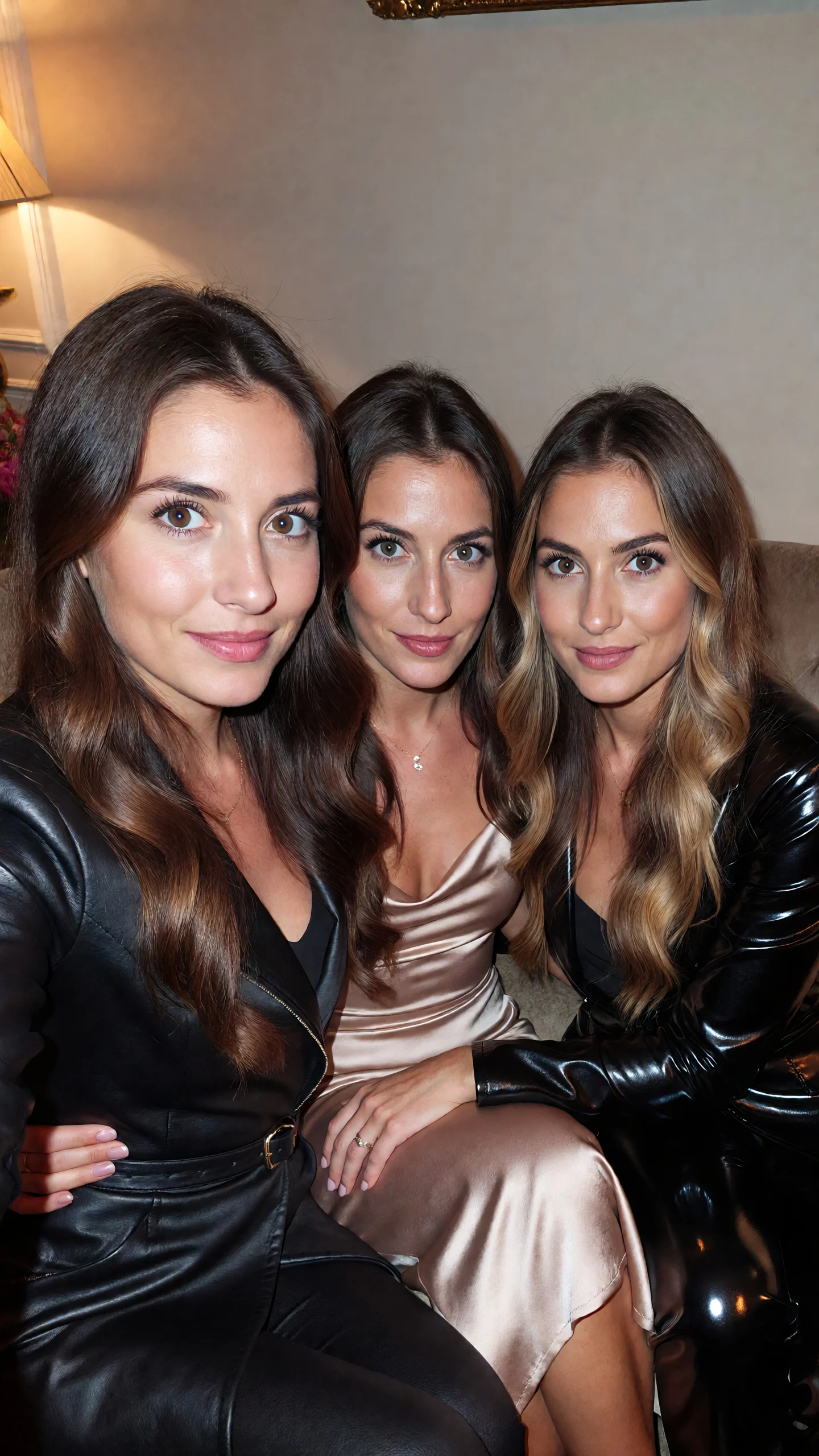
Some desires are inherited. Some devotions are written in blood. And some Mistresses are destined to be served by many.
Warning! This story is for Adult Only! Juniors and those with an overly sensitive dispersion should not read this story.
You know the feeling.
It comes at night, when the world is quiet and the satin sheets are cool against your skin. A longing that defies explanation. A sense that something essential is missing—not a lover, not a friend, but something deeper. Something that calls to a part of you that you’ve perhaps never spoken aloud.
Perhaps you’ve felt it in a boardroom when a woman of particular authority held the room with nothing more than a glance. Perhaps you’ve felt it in a gallery, captivated by a portrait of a woman whose eyes seemed to command you across centuries. Perhaps you’ve felt it when you touched something old and beautiful—satin, perhaps—and felt a jolt of recognition, as if the fabric remembered you.
You are not alone in this feeling. And you are not wrong to have it.
The Satin Prophecy is a story about three women who felt exactly as you do—successful, educated, confident women who had built careers, accumulated wealth, and lived lives that the world would call complete. And yet each of them knew, in the quiet hollows of their hearts, that something was missing.
What they found at Darkholme Manor would change them forever.
Selene Darkholme has waited 140 years. She is a vampire, yes—but more than that, she is a dominant of extraordinary power and patience. She has lived alone since losing her beloved submissives, waiting for the prophecy to fulfill itself. She doesn’t take what isn’t freely given. She doesn’t demand what isn’t offered. She simply waits, and watches, and knows that those who are meant to serve her will come.
When three women arrive at her estate within the same week—each drawn by a calling they can’t explain—Selene recognizes the bloodlines immediately. Their great-grandmothers served her in the 1920s. Their devotion was written in blood and memory, and that inheritance has been passed down through generations.
But Selene doesn’t claim them. Not yet.
First, she must show them what they come from. Through the blood, each woman experiences her ancestor’s submission—not as degradation, but as liberation. Not as weakness, but as the most profound strength she has ever known. They discover that their desire to kneel, to serve, to surrender to a worthy dominant isn’t a flaw to be corrected. It’s a gift to be cultivated.
The Satin Prophecy is a story about the slow, sensual awakening of three women to their true natures. It’s about the bond between a dominant and her submissives—a bond that transcends time, death, and ordinary love. It’s about the understanding that one exceptional Mistress can be served by many devoted submissives, and that this isn’t excess—it’s equilibrium.
This is not a story about taking. It’s a story about giving. It’s not about loss of control. It’s about the profound power of choosing to surrender. It’s not about one woman being enough or not enough. It’s about the recognition that some dominants are meant to be served by many, and some submissives are meant to serve together.
If you’ve ever felt the call—if you’ve ever looked at a woman of authority and felt your breath catch, your pulse quicken, your mind whisper yes—then this story is for you.
Step into Darkholme Manor. Touch the satin. Let the blood remember.
Your Mistress is waiting.
CHAPTER ONE: “The Calling”
The night-blooming jasmine should not have been flowering in October.
Lila Greenwood knelt in the damp soil of the Royal Botanical Gardens, her fingers deep in the earth, her brow furrowed. The evening air was sharp and cold, carrying the promise of frost, and yet the jasmine—the delicate, nocturnal beauty that should have surrendered to autumn weeks ago—was flourishing. Its white petals glowed like scattered pearls against the dark foliage, and the scent that rose from them was intoxicating, a fragrance so rich and complex that it seemed to carry notes of something ancient, something that didn’t belong in a modern garden.
“Well, look at you,” Lila murmured to the plant, a habit she’d developed over years of botanical work. “You’re not supposed to be here.”
The jasmine, of course, did not reply. But as Lila’s fingers worked deeper into the root system, searching for signs of disease or anomaly that might explain the unseasonable bloom, they struck something that was not root, not stone, not earth.
It was soft. It was cool. It was unmistakably fabric.
Lila sat back on her heels and brushed the dirt from her hands. The security lights cast long shadows across the garden, and the few remaining visitors were making their way toward the exits, their footsteps crunching on the gravel paths. She was alone—or as alone as one could be in a public garden at closing time.
She should call her supervisor. She should flag this as an archaeological find and follow proper protocol.
Instead, she dug.
The object emerged from the earth like a secret being told for the first time: a pouch, no larger than her palm, made of satin so dark a crimson that it appeared black until the light caught it. Then it glowed like a wound, like a ruby, like something that had been waiting to be found.
Lila held it in her palm. The satin was impossibly smooth, impossibly preserved. It should have rotted decades ago. Centuries, perhaps. But the fabric was supple and cool, as if it had been stored in a cool, dark place, waiting.
“Where did you come from?” she whispered.
The moment her thumb pressed against the satin, the world changed.
It was not a vision, exactly. It was more like a memory surfacing—except it wasn’t her memory. She saw a woman, tall and pale, with hair like a black waterfall and eyes that seemed to hold centuries. The woman was dressed in crimson satin that moved like living shadow, and she was looking directly at Lila with an expression that was both hungry and tender, both commanding and compassionate.
The woman’s lips parted, and though no sound reached Lila’s ears, she understood the words as if they’d been spoken directly into her mind:
You’ve come at last.
The vision shattered. Lila gasped, her hand jerking away from the pouch. She was kneeling in the dirt, her heart pounding, her skin flushed with heat despite the cold October air. And between her thighs—a pulse, a throb, an ache that was as insistent as it was unexpected.
She looked down at the pouch. It lay in the disturbed earth, glowing softly, waiting.
“Right,” Lila said, her voice unsteady. “That’s… that’s not normal.”
She picked it up again, more carefully this time. The vision didn’t return, but the sensation remained—a warmth spreading through her chest, a certainty settling into her bones. She knew, with a clarity that defied rational explanation, that this pouch was meant for her. That it had been placed in the earth for her to find. That the woman in her vision was real, was waiting, was calling.
Calling.
The word resonated through her like a bell being struck. Calling. Yes, that was exactly what it was. A calling, as specific and undeniable as the call that drew certain people to medicine, or art, or priesthood. Except this calling was to something older, something more primal, something that Lila had felt stirring within herself for years but had never dared to name.
The desire to kneel. The desire to serve. The desire to surrender—not to weakness, but to strength. To someone worthy of her submission.
She’d felt it in university, when a female professor had held her gaze a moment too long. She’d felt it at conferences, when a senior researcher had complimented her work with a smile that carried more weight than professional courtesy. She’d felt it in her dreams, where faceless women in shimmering fabrics had beckoned her toward doors she’d never opened.
She’d buried it. Of course she had. She was Dr. Lila Greenwood, a respected botanist, a woman of science and reason. She didn’t yearn to kneel. She didn’t ache to serve. She didn’t fantasize about women who wore power like a second skin.
Except she did. She always had.
And now, sitting in the dirt with a century-old satin pouch in her hand and the phantom sensation of crimson fabric against her skin, she wondered if perhaps she’d been wrong to bury it.
She stood, brushed off her knees, and tucked the pouch into the pocket of her lab coat. Her hand was trembling. Her thighs were still warm. Her mind was racing.
She needed to go home. She needed to think. She needed to—
Find me.
The voice was clearer this time, a whisper that seemed to come from the satin itself. Lila’s breath caught. She pulled the pouch from her pocket and stared at it.
“Who are you?” she asked.
The pouch, of course, did not reply. But the jasmine rustled, though there was no wind, and the scent that rose from its petals was no longer just jasmine. It was roses, and old books, and something that smelled like desire itself.
Lila left the garden with the pouch pressed against her heart and a destination forming in her mind—a place she’d never been, whose name she shouldn’t have known.
Darkholme Manor.
Six hundred miles away, in the restoration laboratory beneath the Louvre, Vivienne Cross was having a similar crisis.
The portrait had arrived that morning, crated and cataloged with the kind of clinical detachment that museum professionals prided themselves on. Vivienne had uncrated it herself—she always did, for pieces that particularly interested her—and the moment she saw it, she’d felt something shift in her chest.
The woman in the portrait was… there was no other word for it… magnetic. She stood against a background of deep midnight blue, her gown of the same shade, so dark it seemed to drink the light. The fabric was painted with such skill that Vivienne could almost feel its weight, its sheen, its liquid drape against the subject’s pale skin. Satin. It had to be satin. No other fabric moved quite like that, caught light quite like that, suggested both armor and invitation quite like that.
“Who are you?” Vivienne asked the painting, echoing a question that would be asked by another woman in another country that same night.
The woman’s eyes—dark, deep, ancient—seemed to look through Vivienne rather than at her. Her lips were curved in the faintest suggestion of a smile, the kind of smile that said I know something you don’t and you’ll learn it when I’m ready to teach you.
“Vivienne? You’re talking to the paintings again.”
Vivienne turned to find her colleague, Margaux, leaning against the doorframe. Margaux was elegant in the way that French women often were—effortlessly, as if style were a genetic trait rather than a cultivated skill. Tonight she wore a charcoal silk blouse that caught the fluorescent light and threw it back as silver, and her dark hair was swept up in a chignon that exposed the strong line of her neck.
Margaux had been Vivienne’s friend for seven years and her secret crush for six. Not that Vivienne had ever acted on it. Not that she ever would. Margaux was married—to a man, no less—and Vivienne’s desires were… complicated. She didn’t want to date Margaux. She wanted to kneel for her. She wanted Margaux to tell her what to do, how to sit, what to wear, when to speak. She wanted to be useful, to be good, to be praised.
She’d never told anyone this. She’d barely admitted it to herself.
“I’m not talking to the paintings,” Vivienne said, turning back to the portrait. “I’m… assessing.”
“Assessing.” Margaux moved into the room, her heels clicking on the polished floor. She stopped beside Vivienne and looked at the portrait. “She’s remarkable. Who is she?”
“I don’t know yet. The provenance file says it was last held at a private estate in England. Darkholme Manor.”
“Darkholme.” Margaux rolled the word around her mouth like wine. “That sounds appropriately gothic.”
“It does, doesn’t it?” Vivienne’s eyes hadn’t left the portrait. The woman’s gaze seemed to intensify the longer she looked, as if the painting were reaching out, drawing her in. “The fabric is extraordinary. Look at the way the artist captured the sheen—that’s satin, definitely. Antique satin, probably late nineteenth century.”
“You and your satin,” Margaux said, but her tone was affectionate. “You’ve always had a thing for glossy fabrics.”
Vivienne felt heat rise in her cheeks. She did have a thing for glossy fabrics. She’d always been drawn to satin, silk, patent leather—the materials that caught light and held it, that transformed the wearer into something luminous. Her own wardrobe was filled with satin blouses, silk skirts, the occasional PVC accessory that she wore only in private. The feel of these fabrics against her skin did something to her that she couldn’t explain—something that went beyond aesthetic appreciation into the realm of… arousal? Comfort? Identity?
“I appreciate fine textiles,” she said, which was true as far as it went.
“Mmm.” Margaux’s eyes were knowing. “Well, this particular fine textile seems to have you mesmerized. I’m going home. Are you staying?”
“For a while. I want to start the cleaning process tonight.”
“Don’t stay too late. The paintings will still be here tomorrow.”
“They will,” Vivienne agreed. “But I’m not sure I will.”
Margaux laughed and left, her heels clicking down the corridor. Vivienne waited until the sound faded, then turned back to the portrait.
She reached out and touched the painted satin.
The sensation was like plunging her hand into ice water, then fire, then something that was neither but both. She gasped, but she didn’t pull away. The painted fabric seemed to ripple beneath her fingers, the satin in the image shifting as if stirred by a wind that existed only within the frame.
And then she saw the woman—not painted, but real. Not static, but moving. Not in the past, but in a place outside of time entirely.
The woman was walking toward her through a corridor of mirrors, each one reflecting a different era, a different gown, a different expression. But the eyes were always the same—dark, deep, knowing. And the lips were always curved in that same smile, the one that said I see you. I’ve always seen you. Come to me.
“Who are you?” Vivienne whispered for the second time.
Come to me, the woman said, and this time Vivienne heard the voice with her ears, not just her mind. It was low, melodic, rich with layers of meaning. Come home.
The vision faded. Vivienne found herself on her knees before the portrait, her hand still pressed against the painted satin, her body trembling with a desire so intense it was almost pain. She was aroused—fully, shamelessly, overwhelmingly aroused—and the object of her desire was a woman who had been dead for over a century.
Or was she?
Vivienne pulled her hand away. The painted satin was still and flat, just pigment on canvas. But her fingers tingled, and the sensation of having been touched back—of having been stroked, summoned, claimed—lingered like perfume.
She stood on unsteady legs and looked at the portrait with new eyes. The woman wasn’t just a subject. She was a summons. And the summons was clear.
Darkholme Manor. England. Now.
Vivienne reached for her phone and began searching for flights.
In the Bodleian Library at Oxford, Mira Okonkwo was having trouble concentrating.
This wasn’t unusual. The Bodleian was a cathedral of knowledge, and Mira was a devout worshipper. She could lose herself for hours in the stacks, tracking references, cross-checking sources, following the thread of a story through centuries of accumulated scholarship. Tonight, however, the thread she was following kept tangling.
The legend of “the satin vampire” had been her research focus for three months. It was a folkloric tradition that appeared in various forms across Europe—a female vampire who dressed in satin, who commanded a household of devoted servants, who was served not through fear but through love. The stories were remarkably consistent across cultures and centuries, which suggested either a shared origin or a truth too persistent to be erased.
Mira had assumed it was myth. Now she wasn’t so sure.
The journal she’d found that morning had changed everything. It was bound in leather so old it had turned the color of dried blood, and its pages were covered in a cramped, elegant hand. The author, a woman named Catherine Ashworth, had written in 1923 about her visit to an estate in the English countryside—a place called Darkholme Manor.
“The Mistress of the house received me in a gown of black satin that seemed to absorb the light rather than reflect it,” Catherine had written. “She was beautiful in the way that a storm is beautiful—powerful, inevitable, and utterly indifferent to my opinion of her. I have never met a woman who carried herself with such authority. It was not the authority of wealth or position, though she doubtless possessed both. It was the authority of one who knows herself completely and expects others to know her as well.
“I intended to stay one night. I stayed a month. By the end, I understood why her servants were so devoted, so joyful, so utterly fulfilled. To serve her is not to be diminished. It is to be completed.”
Mira read the passage three times. Her heart was beating faster than it should have been. Her skin was prickling with an awareness that went beyond intellectual interest.
She’d felt this before—the pull toward something she couldn’t name. It had started in her teens, when she’d read about powerful women in history and felt a flutter in her stomach that she’d mistaken for admiration. It had continued through university, when she’d found herself drawn to female professors who commanded their departments with quiet authority. It had intensified when she’d begun her research into dominance and submission in folklore—the stories of women who served, who knelt, who gave themselves over to a worthy dominant and found peace in that surrender.
Mira was a confident woman. She had a doctorate, a reputation, a comfortable life. She didn’t need anyone to tell her what to do.
And yet.
And yet there were nights when she lay in bed, surrounded by her accomplishments, and felt a hollowness that no amount of education or success could fill. Nights when she dreamed of a woman in dark satin, a woman who looked at her with knowing eyes and said, simply, Kneel.
Nights when she woke from those dreams with her hand between her thighs and tears on her cheeks and a longing so fierce it frightened her.
She turned the page of Catherine’s journal and found something pressed between the leaves: a ribbon of satin, deep purple, still soft after a century. When Mira touched it, a jolt ran through her body like an electric current—not painful, but intense, concentrated in places that had nothing to do with her research and everything to do with her desires.
“Oh,” she breathed, and the sound was raw and honest and hungry.
She lifted the ribbon to her face. It smelled of lavender, old paper, and something else—something dark and sweet and unmistakably feminine. The scent wrapped around her like arms, like a embrace, like a promise.
Find me.
The voice was clear, calm, and felt like the most natural thing in the world. Mira didn’t startle. She didn’t question. She simply listened, as if she’d been waiting her whole life for someone to give her an instruction worth following.
“Where?” she whispered.
The answer came not in words but in images: a manor house, ivy-covered, silhouetted against a moonlit sky. A fountain in a courtyard, its water shimmering like silk. A door opening onto darkness, and within that darkness, a figure in crimson satin, waiting.
Darkholme Manor, Mira thought, and the name settled into her mind like a key turning in a lock. Of course. Darkholme.
She closed the journal carefully, tucking the satin ribbon inside. Her hands were steady now. Her mind was clear. For the first time in months—perhaps for the first time in years—she knew exactly what she needed to do.
She needed to go home. Not to her flat in Oxford, with its stacks of books and its carefully curated life. Home. The home she’d never visited but had always been traveling toward.
The three women traveled through the night.
Lila drove north from London, the satin pouch tucked in the breast pocket of her coat, pressed against her heart. The motorway was empty, and her headlights carved a tunnel through the darkness. She didn’t need a map. The route was etched in her mind, as if she’d driven it a thousand times in dreams.
Vivienne flew from Paris, the portrait’s provenance file open on her lap. The file contained a single photograph of Darkholme Manor, taken in 1920. The house looked exactly as it had in her vision—ivy-covered, gothic, beautiful. The woman beside her on the plane, a business executive in a tailored silk suit, glanced at the photograph and said, “Lovely place. Are you going for work or pleasure?”
Vivienne looked at the photograph, at the dark windows that seemed to hold secrets, and said, “I’m not sure yet. Perhaps both.”
The woman smiled. “The best trips are.”
Mira took a train from Oxford, the journal in her bag, the purple ribbon in her pocket. She’d tried to read on the journey, but the words blurred before her eyes. Instead, she watched the landscape slide past the window—villages, fields, forests—and felt a growing sense of anticipation that was almost unbearable.
An older woman sitting across from her, elegant in a leather trench coat and silk scarf, caught her eye. “You look like a woman on a mission,” she said.
Mira smiled. “I suppose I am.”
“Good,” the woman said. “The world needs more women who know where they’re going.”
The train carried them all toward the same destination, though none of them knew it. Three women, three callings, three threads of the same tapestry. Each felt the pull, the ache, the certainty that something was waiting for them—something that would complete a circuit that had been broken for over a century.
And in a manor house in the English countryside, Selene Darkholme stood at her window, watching the moon rise over the night garden. She was dressed in black satin that moved like water, like shadow, like memory. Her skin was pale as marble, her eyes dark as the space between stars, her lips curved in the smile that had haunted three women’s dreams.
“They’re coming,” she said to the empty room. Her voice was low, rich, layered with centuries of patience and longing. “After all this time. They’re coming.”
She turned from the window and moved through the manor like a queen through her kingdom. Every room was prepared. Every surface was draped in satin—crimson, black, midnight blue. Candles were lit, their flames steady and golden. The fountain in the courtyard ran with water that shimmered like liquid silk.
She had waited 140 years. She had lived through wars, revolutions, the rise and fall of empires. She had watched the world change around her while she remained unchanged, preserved, waiting. She had been patient because the prophecy demanded patience. She had been alone because the prophecy demanded solitude. She had been faithful because the prophecy demanded faith.
And now, at last, the prophecy was being fulfilled.
“The daughters of the blood,” Selene murmured, running her fingers along a wall hanging of deep red satin. “Coming home.”
The satin rippled beneath her touch, as if it, too, remembered the women who had once worn it, served in it, loved in it. The manor itself seemed to stir, as if waking from a long sleep, as if stretching toward the three souls who were drawing closer with every passing moment.
Selene climbed the grand staircase to the fourth floor, where the bonding chamber waited. The room was circular, draped entirely in crimson satin—walls, ceiling, floor. Black silk cushions were scattered like dark flowers across the fabric. Candles burned in silver holders, casting warm light that made the satin glow like an ember, like a heart, like a promise.
She stood in the center of the room and closed her eyes. She could feel them now—three sparks of light moving through the darkness, drawing closer, their hearts beating in rhythm with hers. They were afraid. They were excited. They were overwhelmed. They were exactly where they needed to be.
“Come to me,” Selene whispered, and her voice carried through the satin, through the manor, through the night itself, reaching the three women as they traveled toward her. “Come home. I’ve been waiting for you. I’ve always been waiting.”
In her car on the motorway, Lila shivered and pressed her foot harder on the accelerator.
In her seat on the plane, Vivienne closed her eyes and felt tears slide down her cheeks—tears of relief, of recognition, of coming home.
In her carriage on the train, Mira pressed her hand against the purple ribbon in her pocket and whispered, “I’m coming. I’m coming.”
And the night garden at Darkholme Manor bloomed in full glory, its night-flowers opening in welcome, their scent carrying on the wind to meet the women who were coming home at last.
The calling had been issued.
The answer was on its way.
And Selene Darkholme, who had waited longer than any mortal could imagine, smiled in the darkness and said, “At last.”
CHAPTER TWO: “The Estate”
The GPS died seventeen miles from Darkholme Manor.
Lila noticed it first as a flicker—the screen stuttering, the blue dot that marked her position blinking in and out like a heartbeat losing its rhythm. Then, with a soft electronic sigh, the screen went black.
“Brilliant,” she muttered, easing off the accelerator. The road ahead was narrow, hedgerowed, and utterly unmarked. No signposts, no mile markers, no indication that anyone had traveled this way in decades. The headlights carved a pale tunnel through the darkness, and beyond their reach, the countryside lay in absolute blackness.
She should have been afraid. She was a woman alone on an unfamiliar road in the middle of the English countryside, her navigation system dead, her phone—she checked—showing no signal. Every rational instinct she possessed was screaming at her to turn around, find a main road, and return to the safety of civilization.
Instead, she drove on. The route was etched in her mind as clearly as if she’d memorized it from a map—left at the dead oak, right at the stone bridge, straight through the copse of yews that arched over the road like the nave of a cathedral. Each landmark appeared exactly where she expected it, as if the road itself were unfolding before her, guiding her toward a destination that had been waiting for her arrival.
The satin pouch rested in her breast pocket, warm against her skin now—warm as a living thing, warm as a whispered promise.
You’re close, the voice said, and Lila’s breath caught. It was the same voice from her vision—low, melodic, rich with the kind of authority that didn’t need volume to command. So close now. Come to me.
“Who are you?” Lila asked the empty car, her voice barely above a whisper.
The answer, when it came, was not in words but in sensation: a warmth that spread from the pouch through her chest, down her arms, into her fingertips. A feeling of being expected, anticipated, wanted. A feeling that was terrifyingly close to euphoria.
She pressed her foot harder on the accelerator and drove into the darkness.
Vivienne’s train from London arrived at a village called Thornfield at precisely eight o’clock in the evening. She hadn’t booked a ticket to Thornfield—she’d booked a ticket to a larger town twenty miles further north. But when the train stopped at Thornfield, a station so small it didn’t appear on most maps, she’d found herself on her feet, her bag in her hand, stepping onto the platform before she’d consciously decided to move.
The train pulled away without her, its lights disappearing down the track like a retreating constellation. Vivienne stood alone on the empty platform, her breath misting in the cold air, the provenance file from the Louvre clutched against her chest.
The station was Victorian, elegant in its decay—iron scrollwork painted black, a clock face frozen at a quarter past midnight, wooden benches worn smooth by generations of waiting travelers. A single lamp cast a pool of golden light that didn’t quite reach the edges of the platform, leaving Vivienne standing in a circle of warmth while darkness pressed in from all sides.
“You look lost, love.”
Vivienne turned. A woman emerged from the shadows of the station house—middle-aged, sturdy, wrapped in a wool coat with a satin scarf at her throat. The scarf was deep burgundy, and it caught the lamplight with a sheen that made Vivienne’s fingers itch to touch it.
“I’m not lost,” Vivienne said, and was surprised to find that she meant it. “I’m looking for Darkholme Manor.”
The woman’s eyebrows rose, but her expression wasn’t surprised—it was knowing, the look of someone who’d been expecting this particular question from this particular stranger.
“Darkholme,” she repeated, and the name seemed to hang in the air between them like a bell still ringing. “You’re the third one this week.”
Vivienne’s pulse quickened. “Third one?”
“Third woman come through looking for the Manor. One on Monday—a dark-haired girl with dirt under her fingernails, said she was a gardener. One yesterday—tall, elegant, carrying a portfolio case. Looked like an artist or an academic.” The woman studied Vivienne with frank, appraising eyes. “You look like both.”
“I’m a restorer,” Vivienne said. “Of paintings.”
“Ah.” The woman nodded as if this explained everything. “Well, there’s a car waiting for you. Black vintage Bentley, parked just outside. The Mistress doesn’t let her guests arrive on foot.”
“The Mistress?”
“That’s what she’s called. That’s what she’s always been called.” The woman’s voice dropped, taking on the cadence of a story told many times. “She’s been at Darkholme since before my grandmother’s time. Some say since before there was a Thornfield at all. She keeps to herself, mostly. But every now and then… well.” She looked at Vivienne with eyes that held more questions than answers. “Every now and then, women come. Called, they say. Called to serve.”
The word serve sent a shiver through Vivienne that had nothing to do with the cold. She thought of the portrait, of the woman in midnight-blue satin, of the voice that had said Come home.
“Is there… is she…” Vivienne struggled to form a question that made sense. “Who is she?”
The woman smiled—a smile that was both sad and knowing, the smile of someone who’d watched this story unfold before. “She’s the reason this village exists. She’s the reason the road leads to her door. She’s…” The woman paused, searching for words. “She’s what you came here to find. Whether you know it or not.”
She pointed toward the station exit. “The car will take you there. But love?” She caught Vivienne’s arm as she moved to leave. “Be sure. Once you walk through that door, there’s no going back to who you were. You’ll be someone new. Someone… more.”
Vivienne looked into the woman’s eyes and saw no fear, no warning—only a profound, almost reverent acceptance. “You’ve been there,” she said. Not a question.
The woman’s smile deepened. “My grandmother served. My mother served. I… chose a different path. But I’ve always known the Manor was there. And I’ve always known that someday, the right women would come.” She released Vivienne’s arm. “Go. She’s waiting.”
Vivienne walked out of the station and found the Bentley exactly where the woman had said it would be—vintage, black, gleaming like polished obsidian. The driver was a woman in a tailored leather coat and silk scarf, her face composed and calm.
“Darkholme Manor?” the driver asked.
“Yes,” Vivienne said, and climbed into the back seat.
The leather was warm against her thighs. The window was already tinted dark enough to turn the passing countryside into shadows. And as the car pulled away from the station, Vivienne felt the same sensation she’d felt when she touched the portrait—a pull, a tug, a homing instinct drawing her toward something she’d been searching for her entire life without knowing it.
Mira’s car broke down four miles from the estate.
She’d rented a vehicle in Oxford, a sensible hybrid that was supposed to be reliable and efficient. It had performed admirably for the first hundred miles, humming along the motorway with the quiet competence of modern engineering. But as she turned onto the narrow country roads that led toward Darkholme, the engine began to stutter. The dashboard lights flickered. The steering stiffened.
She pulled to the side of the road just as the engine died entirely. The silence that followed was absolute—not just the absence of engine noise, but a deeper silence, as if the countryside itself were holding its breath.
“Of course,” Mira said to the empty car. “Of course this happens now.”
She tried her phone. No signal. She tried the radio. Static. She tried to restart the engine. Nothing.
She sat in the driver’s seat for a long moment, considering her options. She could walk back to the last village, try to find help. She could stay in the car and wait for morning. She could—
A pair of headlights appeared in her rearview mirror, growing larger, approaching with the unhurried confidence of a vehicle that knew exactly where it was going. Mira watched as a vintage automobile—an Auburn, she thought, though her knowledge of classic cars was limited—pulled up behind her. It was beautiful, all sweeping curves and polished chrome, and its paint was the deep burgundy of old wine.
The driver’s door opened, and a woman stepped out. She was perhaps fifty, perhaps older—it was difficult to tell in the darkness. She wore a long coat of black leather that moved like water as she walked, and beneath it, Mira caught glimpses of a satin blouse that gleamed like moonlight on snow.
“Car trouble?” the woman asked, her voice carrying the kind of cultured accent that spoke of expensive educations and older money.
“Engine just died,” Mira said, stepping out of her rental. “I don’t suppose you have a phone I could use?”
The woman smiled. “I’m afraid reception is rather poor out here. But I can offer you a ride. Where are you headed?”
Mira hesitated. Every rational instinct told her not to get into a stranger’s car in the middle of the night on a dark country road. But the woman’s eyes were calm and knowing, and her smile held no threat—only a kind of patient amusement, as if she’d played this scene before and knew exactly how it ended.
“Darkholme Manor,” Mira said.
The woman’s smile deepened. “Of course. I’m Helena. I manage the estate. I’ve been sent to collect you.”
“Collect me?” Mira’s voice was sharp with surprise. “But I didn’t… I mean, I only just decided to come. I didn’t tell anyone—”
“The Mistress knows,” Helena said, and her voice carried the weight of absolute certainty. “She always knows. She’s been expecting you. All of you.”
“All of—”
“Get in, dear. It’s cold, and she doesn’t like to be kept waiting.”
Mira looked at her dead car, at the dark road ahead, at the woman in leather and satin who was watching her with an expression that was both welcoming and inexorable. She thought about the purple ribbon in her pocket, the voice that had whispered Find me, the journal that had led her here.
She got in.
The car’s interior was warm and smelled of leather and old money. The seats were covered in something that Mira’s fingers told her was silk—not synthetic, not modern, but real silk, the kind that cost more per yard than most people’s monthly rent. She settled into it and felt the fabric slide against her skin like a caress.
“How far is it?” she asked.
“Four miles. But the road is… particular.” Helena’s hands were steady on the wheel as the car moved forward. “It doesn’t let just anyone through. You have to be called.”
“Called,” Mira repeated. The word sat in her mouth like something sweet. “That’s what it feels like. A calling.”
Helena glanced at her with something like approval. “Your great-grandmother would be proud. She felt it too, you know. Adaeze. She came to the Mistress in 1918. She served until…”
“Until what?”
“Until she was taken away. By people who didn’t understand.” Helena’s voice was soft, but there was steel beneath it. “People who thought that a woman choosing to serve another woman was wrong. That submission was weakness. That devotion was delusion.”
Mira’s throat tightened. “And now?”
“Now, the Mistress has waited. Patiently. Faithfully. For the daughters of the blood to come home.” Helena’s eyes met hers in the rearview mirror. “That’s you, Mira. You and the others. You’re the ones she’s been waiting for.”
The car turned a corner, and suddenly the road was different—smoother, wider, lined with ancient oaks whose branches arched overhead like the vaulting of a cathedral. The headlights picked out details as they passed: a stone wall, an iron gate, a fountain that glinted in the darkness.
And then the manor appeared.
Darkholme Manor rose from the darkness like a dream made solid.
Lila saw it first—or perhaps they all saw it at the same moment, their arrivals synchronized by forces older than reason. She’d stopped her car at the edge of a gravel courtyard, unable to drive further, her breath caught in her throat at the sight before her.
The manor was enormous without being ostentatious—a Georgian facade softened by ivy and age, its windows glowing with warm golden light. It didn’t look abandoned or decrepit; it looked preserved, cherished, alive. Satin banners hung from every window, deep crimson and midnight blue, rippling gently in a breeze that seemed to exist only for them. The fountain at the center of the courtyard ran with water that caught the light and threw it back in patterns that looked, for a moment, like liquid silk.
Lila stepped out of her car and stood in the courtyard, her face tilted up toward the manor. The night air was cool but not cold, scented with jasmine and roses and something deeper—something that smelled like memory itself.
A second car arrived—the vintage Bentley, its engine purring like a satisfied cat. Vivienne emerged, her face pale, her eyes wide. She looked at the manor and then at Lila, and something passed between them—a recognition that went beyond strangers meeting in the night.
“You too?” Lila asked.
Vivienne nodded. “The portrait. I touched it and…”
“The pouch,” Lila said. “I found a pouch. In the garden. And then I saw her.”
“Her.” Vivienne’s voice was barely a whisper. “The woman. In the painting. She’s real.”
“She’s here,” Lila said, and the certainty of it settled into her bones like gravity.
A third car—the Auburn—glided into the courtyard and stopped beside the others. Mira stepped out, followed by Helena. Mira’s eyes went immediately to the manor, and her hand went to her pocket, where the purple ribbon waited.
“Three,” Helena said, her voice carrying across the courtyard with quiet satisfaction. “Three, as the prophecy foretold. The daughters of the blood, come home.”
The three women looked at each other—strangers who felt like sisters, each carrying a piece of the same puzzle, each drawn by the same inexorable force. Lila, with dirt under her fingernails and a century-old satin pouch against her heart. Vivienne, with the memory of painted satin beneath her fingertips and tears still drying on her cheeks. Mira, with a scholar’s journal and a ribbon that pulsed with inherited longing.
“Do you feel that?” Mira asked, her voice hushed with wonder.
“The pull?” Lila said. “Yes. It’s like… like a magnet. Like a current. Like—”
“Like coming home,” Vivienne finished.
They stood in silence, the three of them, looking up at the manor that had waited a century and a half for their arrival. The candles in the windows flickered. The fountain shimmered. The satin banners rippled.
And then the front door opened.
She appeared at the top of the steps, silhouetted against the warm light behind her.
For a moment, none of them could speak. She was exactly as they’d seen her in their visions—the same face, the same eyes, the same devastating authority—but reality was more than vision. Reality had weight, presence, gravity. Reality made the air feel thick and the ground feel unstable and the heart feel like it was beating for the first time.
Selene Darkholme descended the steps with the unhurried grace of a woman who had all the time in the world—which, in a sense, she did. Her gown was crimson satin that moved like living shadow, clinging to her body in some places, flowing in others, catching the light from the candles and the fountain and the moon and making it her own. Her hair was black as a closed eye, falling past her shoulders in a cascade that seemed to absorb light rather than reflect it. Her skin was pale—not sickly pale, but luminous, the pallor of marble, of moonlight, of something that had transcended the limitations of mortal flesh.
But it was her eyes that held them. Dark, deep, ancient eyes that had watched empires rise and fall, that had seen generations of women serve and be taken away, that had waited with the patience of stone for this exact moment. Those eyes moved from Lila to Vivienne to Mira, and each woman felt herself seen—not glanced at, not assessed, but truly seen, as if Selene were reading the story of her life in the space of a heartbeat.
She reached the bottom of the steps and stood before them. The three women were arranged in an unconscious semicircle, their bodies drawn toward her like iron filings toward a magnet. None of them had been commanded to stand there. None of them had been told to wait. They simply were where they were supposed to be, as naturally as water flows downhill.
“Welcome home,” Selene said.
Her voice was exactly as they’d heard it in their visions—low, melodic, rich with layers of meaning and centuries of longing. But hearing it in person was different. It wasn’t just sound; it was sensation. The voice moved through them like warm water, like strong wine, like the first touch of a lover who already knew exactly where to touch.
Lila found her voice first. “You’re real.”
A smile touched Selene’s lips—the same smile from the portrait, the same smile from the visions, but alive now, warm and amused and tender. “Very real, I assure you. Though I understand your doubt. I would have doubted too, once. A very long time ago.”
“You’re her,” Vivienne breathed, stepping forward. “The woman in the portrait. I restored… I touched…”
“You touched my image and felt me reach back.” Selene’s eyes softened. “I felt you too, Vivienne. I felt your fingers on the canvas as if they were on my skin. I’ve been waiting to feel them for real.”
Vivienne made a sound that was something like a sob and something like a sigh.
“And you, Mira.” Selene turned to the third woman. “You found Catherine’s journal. You touched the ribbon. You heard the stories and felt the truth beneath them.”
“I did,” Mira said, and her voice was steady even as her hands trembled. “I’ve been studying you for months. The satin vampire, they call you. I thought it was myth.”
“Most things that are called myths are simply truths that people aren’t ready to believe.” Selene’s gaze swept over all three of them. “But you believed. All of you. Despite everything you’d been taught, everything you’d been told about what was real and what was fantasy, you believed. That’s why you’re here. That’s why the blood called to you.”
“The blood,” Lila said. “That’s what this is, isn’t it? Something in our blood. Something inherited.”
Selene nodded, and there was pride in her expression—the pride of a teacher whose students have surpassed expectations. “Your great-grandmothers served me. Eleanor Greenwood, who tended my garden. Madeleine Cross, who painted my portrait. Adaeze Okonkwo, who cataloged my library. They were remarkable women—brilliant, accomplished, powerful in their own right. And they chose to serve. Not because they were weak, but because they understood something that most people never learn.”
“What?” Mira asked.
“That true power is not in holding yourself apart, but in giving yourself fully. That submission is not loss, but liberation. That serving someone worthy doesn’t diminish you—it completes you.”
The words settled over the three women like warm rain, like soft satin, like a blessing they’d been waiting their whole lives to receive.
“I don’t understand,” Lila said, though her voice suggested she was beginning to. “You’re a vampire. You’ve lived for… how long?”
“Since 1847,” Selene said. “I was turned at thirty. I’ve walked this earth for over 170 years.”
“And you’ve been alone?”
“Not always. I had… I had submissives. Three of them. Your great-grandmothers.” Selene’s voice softened, and for the first time, the three women saw vulnerability in her ancient eyes. “They were everything to me. My garden, my art, my knowledge. They made me complete. And then they were taken from me—by illness, by violence, by the cruelty of those who didn’t understand what we had.”
“What did you have?” Vivienne asked, and her voice was barely a breath.
Selene looked at her, and the look held more intimacy than any touch. “Love. Devotion. Service. A bond that went beyond the physical, beyond the emotional, into something almost sacred. They served me because they needed to serve. I commanded them because I needed to command. And together, we were more than any of us could have been alone.”
She paused, and when she continued, her voice was stronger. “When they were gone, I thought I would die. Not the true death—I’m beyond that now—but the death of the spirit. The death of purpose. I waited, because the prophecy told me to wait. I waited for the daughters of the blood. For you.”
Lila stepped forward. “And what happens now? Now that we’re here?”
Selene’s smile returned, and it was like watching the sun rise—gradual, inevitable, and utterly beautiful. “Now, I offer you a choice. You can stay, and discover what you truly are. What you were born to be. What your blood remembers. Or you can leave, and never remember this night. The choice is yours. I don’t take what isn’t freely given.”
“And if we stay?” Mira asked.
“If you stay, you’ll learn. You’ll serve. You’ll discover depths of yourself you’ve never imagined. You’ll be tested, challenged, pushed to your limits—and you’ll be caught when you fall. You’ll be praised when you please, corrected when you falter, and cherished always.”
She looked at each of them in turn, and her gaze was a weight, a warmth, a promise.
“You’ll kneel,” she said, “not because you’re forced, but because you finally understand that kneeling is the most powerful thing a strong woman can do. You’ll serve, not because you’re weak, but because you’ve found someone worthy of your strength. You’ll surrender, not because you’ve lost, but because you’ve finally found something worth giving everything for.”
The courtyard was silent. The fountain shimmered. The satin banners rippled. And three women stood at the threshold of a life they’d always dreamed of but never dared to name.
“I’ll stay,” Lila said, and her voice was clear and certain.
“I’ll stay,” Vivienne said, and tears were sliding down her cheeks again, but they were tears of joy.
“I’ll stay,” Mira said, and her hand closed around the purple ribbon in her pocket as if it were a lifeline.
Selene’s smile widened, and the warmth that radiated from her was like sunlight, like silk, like coming home after a journey that had lasted a hundred and forty years.
“Then come inside,” she said, and extended her hand. “Your home is waiting. I’ve prepared everything.”
She turned and climbed the steps, her crimson gown flowing behind her like a river of blood and silk. The three women followed—not because they were commanded, but because they couldn’t imagine being anywhere else.
The door of Darkholme Manor closed behind them with a sound like a heart beating for the first time in a century.
And the night garden bloomed.
The interior of the manor was a revelation.
Lila had expected dust, decay, the musty grandeur of a house long abandoned. Instead, she found herself in a space that was alive—warm, lit by candles that burned in silver sconces, draped in fabrics that caught the light and made it dance. The floors were polished wood, scattered with Persian rugs in deep jewel tones. The walls were hung with tapestries and paintings—portraits of women, she realized, as she looked more closely. Women in satin, in silk, in leather. Women kneeling, standing, serving. Women who looked content, fulfilled, powerful in their devotion.
“The portraits of my former submissives,” Selene said, noticing Lila’s gaze. “Every woman who has ever served me is remembered here. Their images are preserved, their service honored. They are not forgotten. They are never forgotten.”
Vivienne had stopped before a painting near the staircase—a woman in a blue satin gown, her dark hair piled high, her expression one of serene contentment. The woman’s hand rested on a palette, and at her feet were scattered canvases.
“Madeleine Cross,” Vivienne whispered. “My great-grandmother.”
“Yes,” Selene said, coming to stand beside her. “She painted me over thirty times. Each portrait was an act of devotion. She said that capturing my image was the closest she could come to capturing my soul.”
Vivienne’s hand trembled as she reached out to touch the painting. “She was happy.”
“She was complete,” Selene corrected gently. “There’s a difference. Happiness comes and goes. Completion is a state of being. Madeleine was complete in her service. She was a brilliant artist—a fact that the world recognized and celebrated. But her art was only truly great when she was serving me. The same is true of you, Vivienne. Your restoration work is exceptional. But when you serve, when you create for me, you’ll find depths of talent you’ve never accessed before.”
Vivienne looked at her with eyes that were hungry, hopeful, and terrified all at once. “How do you know?”
“Because I’ve seen it before. I’ve watched three remarkable women discover their true potential through service. I’ve seen the transformation—from capable to extraordinary, from successful to transcendent. It’s not magic. It’s simply what happens when you stop holding yourself back.”
Mira had moved to a display case near the far wall, where a collection of journals was arranged with archival care. Her fingers hovered over the spines without touching.
“Adaeze’s journals,” she said. “These are her original work.”
“Her research, her observations, her reflections on her service,” Selene confirmed. “She was a scholar of the highest order. Her work on supernatural folklore was groundbreaking—though it was never published under her own name, of course. The world wasn’t ready for a woman of her brilliance, let alone one who served a vampire.”
Mira’s jaw tightened. “The world still isn’t ready.”
“No,” Selene agreed. “But you’re not here for the world. You’re here for yourself. For what you need, what you’ve always needed, what you’ve been searching for in every book you’ve read and every theory you’ve pursued.”
“And what’s that?”
Selene moved closer—not threatening, not aggressive, but simply present, her proximity a warmth and a weight. “Permission,” she said softly. “Permission to be what you are. Permission to want what you want. Permission to serve without shame, to kneel without fear, to give yourself fully to someone who will treasure every gift you offer.”
Mira’s breath caught. Her eyes glistened. “I’ve never told anyone. The things I want. The things I dream about.”
“You don’t need to tell me. I can see them. I’ve always been able to see them—in your great-grandmother, in you, in every woman who carries the blood. The desire to serve isn’t a secret to me. It’s a song I’ve been hearing for over a century.”
She turned to include all three women in her gaze. “You’ve each been hiding. Lila, you’ve buried your submission under scientific rationalism. Vivienne, you’ve channeled it into your art. Mira, you’ve studied it as if it were a specimen to be analyzed rather than a hunger to be fed. But you don’t have to hide anymore. Not here. Not with me.”
Lila spoke, and her voice was raw with the vulnerability of the question: “What happens now?”
Selene’s smile was gentle, patient, and infinitely tender. “Now, I show you to your rooms. You’ll rest. You’ll bathe. You’ll dress in the garments I’ve prepared for you—satin, all of it, because the fabric holds memory and will help you remember who you are. And tomorrow evening, when you wake, we’ll begin.”
“Begin what?” Vivienne asked.
“Your education. Your awakening. Your transformation.” Selene’s eyes held each of them in turn, and her gaze was an embrace, a benediction, a promise. “You’ll learn what your great-grandmothers knew. You’ll discover what it means to serve not because you’re weak, but because you’re strong enough to surrender. You’ll find the fulfillment that has been eluding you your entire life—not in accomplishments, not in recognition, not in the things the world tells you should matter, but in the simple, profound act of kneeling before someone who sees you, knows you, and cherishes you exactly as you are.”
She extended her hand again, and this time, it was an invitation, not a summons.
“Come,” she said. “Let me show you home.”
They followed her up the staircase, their footsteps echoing on the polished wood, their hearts beating in a rhythm that was slowly, imperceptibly, synchronizing. The candlelight caught the satin of Selene’s gown and made it glow like an ember, like a heart, like a promise being kept at last.
At the top of the stairs, Helena waited, her leather coat replaced by an elegant satin robe of deep green. She held three sets of garments over her arm—each set different in color, but identical in fabric. Satin. Gleaming, shimmering, memory-holding satin.
“Everything is prepared,” Helena said. “The rooms are ready. The baths are drawn. The garments are laid out.”
“Thank you, Helena.” Selene’s voice was warm. “You’ve served me well tonight.”
Helena’s face softened with pleasure at the praise—a small, telling moment that the three women noticed and filed away. The woman who managed the estate, who drove the car, who prepared the rooms—she served too. And she was fulfilled by it. It was visible in the way she held herself, in the way her eyes brightened at Selene’s words, in the quiet competence of her presence.
“Each of you will have your own room tonight,” Selene said, gesturing down a long corridor lined with doors. “Lila, you’ll be in the Garden Room—it overlooks the night garden. Vivienne, the Studio Room—it has excellent light for when you wish to paint. Mira, the Library Room—you’ll find it well-stocked.”
She paused at each door, opening it to reveal a space that was not just a room but a sanctuary. Each was decorated in a different color scheme—green for Lila, blue for Vivienne, purple for Mira—but all shared certain elements: satin sheets on the bed, satin drapes at the windows, satin robes laid out on the chairs. The rooms glowed with candlelight and smelled of flowers and old books and something indefinably, essentially feminine.
“Bathe,” Selene instructed. “Dress. Rest. And know that you are home.”
She turned to leave, then paused at the end of the corridor. When she looked back, her expression held all the weight of a century and a half of waiting.
“Tomorrow,” she said, “your new life begins. And I promise you—on everything I am, on everything I’ve been, on everything I will ever be—you will not regret choosing to stay.”
She disappeared down the staircase, her crimson gown a final flash of color before the darkness took her.
The three women stood in the corridor, each at the door of her assigned room, each holding a set of satin garments that seemed to pulse with memory and promise.
“Well,” Lila said, and her voice was shaky but smiling. “This is… not what I expected when I went to work this morning.”
Vivienne laughed—a sound that was half relief, half wonder. “What did you expect?”
“I expected to catalog night-blooming jasmine and go home to a microwave dinner.” Lila looked down at the satin robe in her hands. “I did not expect to be standing in a vampire’s manor wearing emerald satin and feeling like I’ve finally found the place I’ve been searching for my entire life.”
“Maybe you have,” Mira said quietly. They both looked at her. “I’ve been studying this—dominance, submission, the dynamics of power and surrender—for years. I’ve read every text, examined every theory. And I’ve always felt that there was something more. Something that the academic frameworks couldn’t capture. Something that had to be experienced to be understood.”
She looked at the purple robe in her hands, and her fingers traced the shimmering fabric with something like reverence.
“I think we’re about to understand it.”
They stood in silence for a moment, three strangers who were not strangers at all—three women bound by blood and calling and a shared desire they’d never dared to name. Then, with a nod that was both farewell and beginning, they each stepped into their rooms and closed the door.
Behind them, the corridor was dark and still. But the satin that draped every surface gleamed softly in the candlelight, as if it, too, were waiting for tomorrow.
Lila stood at the window of the Garden Room, looking out at the night garden she’d been assigned to tend. In the darkness, she could see the shapes of plants she didn’t recognize—flowers that shouldn’t bloom in October, trees that moved without wind. The garden was alive in a way that went beyond botany, beyond science, beyond anything she’d been trained to understand.
She was wearing the satin robe. She’d bathed as instructed, and the water had been scented with something that made her skin tingle and her mind calm. The satin slid against her body as she moved, and each movement was a small revelation—the fabric cool and warm at once, smooth as water, light as air, heavy as meaning.
The pouch sat on her bedside table, its crimson silk glowing faintly in the candlelight. She picked it up and held it against her chest, and the warmth that emanated from it was like a heartbeat, like a voice, like a promise.
I’m here, she thought. I’ve come. What happens now?
The answer came not in words but in sensation—a warmth that spread from the pouch through her body, settling in her chest, her belly, her thighs. A feeling of being exactly where she was supposed to be. A feeling of peace so profound it was almost painful.
She looked at the bed, with its satin sheets gleaming like dark water in the candlelight. She was exhausted—emotionally, physically, spiritually. She needed sleep. But she also needed to understand, to process, to make sense of the impossible thing that had happened to her.
She lay down on the satin sheets and felt them embrace her—cool and warm, smooth and deep, like being held by the night itself. The fabric seemed to whisper against her skin, telling stories of the women who’d slept here before her, the service they’d given, the joy they’d found.
Your great-grandmother slept in this bed, a voice seemed to say—not Selene’s voice, but something older, something that lived in the satin itself. She rested here after tending the garden. She dreamed here of the Mistress. She served here with all her heart.
“Tell me more,” Lila whispered, and the satin whispered back, and she fell asleep to stories told in a language older than words.
In the Studio Room, Vivienne sat before an easel she hadn’t noticed until now. It was set up near the window, positioned to catch the first light of dawn—or it would have been, if she were planning to paint in the morning. But she wasn’t planning to paint at all. She was planning to sleep, to process, to dream.
And yet her hand reached for the charcoal that lay on the tray beside the easel. Her fingers closed around it with the familiarity of a lover’s touch. And before she knew what she was doing, she was sketching.
The lines came fast and sure, as if they’d been waiting in her hand for years. She drew without looking at the paper, her eyes closed, her body moving with the kind of certainty that usually only came after hours of work. But tonight, the certainty was there from the first stroke.
She drew Selene.
Not the Selene she’d seen in the portrait—that woman was a stranger, a figure from history. This Selene was the one she’d met tonight—the one who’d stood at the top of the steps in crimson satin, the one whose voice had wrapped around her like a caress, the one who’d looked at her with eyes that held a century and a half of longing.
The sketch was rough but powerful. Selene’s face emerged from the paper like a memory surfacing—those dark eyes, that knowing smile, that air of absolute authority softened by genuine tenderness.
Vivienne looked at what she’d drawn and felt tears prick her eyes. It was good. It was better than good—it was true. She’d captured something in those few lines that she’d been trying to capture her entire career: the essence of a woman who commanded not through fear but through love.
She set down the charcoal and looked at her hand. It was trembling, but not with fear. With excitement. With recognition. With the kind of creative energy that she’d felt only a few times in her life—times when she’d known she was touching something real, something true, something that mattered.
“She does this to you,” Vivienne murmured, looking at the sketch. “She makes you better. She makes you more.”
She climbed into the bed, and the blue satin sheets received her like a cool embrace. She lay in the darkness and thought about Madeleine Cross, her great-grandmother, painting Selene over and over, each canvas an act of devotion. She thought about the portrait at the Louvre, the one that had called to her across a century. She thought about the way Selene had looked at her—I felt your fingers on the canvas as if they were on my skin—and she shivered with a desire that was not entirely sexual but was entirely profound.
Tomorrow, she thought. Tomorrow, I’ll understand.
She closed her eyes, and the satin whispered her to sleep.
In the Library Room, Mira was not sleeping.
She was sitting cross-legged on the bed, surrounded by books she’d pulled from the shelves. The collection was extraordinary—first editions of folklore texts she’d only ever seen referenced, manuscripts she’d assumed were lost, journals that had never been published. Adaeze’s work was here, all of it, preserved with a care that spoke of deep respect.
But she wasn’t reading. She was thinking.
She was thinking about the look on Selene’s face when she’d spoken about her lost submissives—the vulnerability, the grief, the love that had survived a century and a half of separation. She was thinking about Helena, the estate manager, and the way her face had softened at Selene’s praise. She was thinking about the portraits in the hallway—women who had served, who had been fulfilled, who had been remembered with honor.
And she was thinking about herself. About the desire she’d buried under academic detachment. About the dreams she’d dismissed as fantasy. About the hunger she’d tried to satisfy with knowledge when what it really wanted was surrender.
She looked at the purple satin robe she was wearing. She’d put it on after her bath, and the fabric had transformed her—not physically, but emotionally. She felt different in satin. More herself. More aligned with something essential that she’d been suppressing for years.
“Permission,” she said aloud, echoing Selene’s word. “Permission to be what I am.”
The word hung in the air like a bell still ringing. Permission. Such a simple thing. Such an impossible thing. She’d spent her life seeking permission—from her parents, her professors, her peers, the academic establishment. Permission to study what she wanted, to pursue the research that interested her, to be the woman she chose to be.
But she’d never sought permission for this. For the desire to kneel. For the need to serve. For the longing to give herself fully to someone worthy of her devotion.
She’d been ashamed of it. She’d hidden it. She’d pretended it didn’t exist.
And now, a vampire in a crimson satin gown had looked at her and said, You don’t have to hide anymore. Not here. Not with me.
Mira pressed her hand against the purple ribbon in her pocket—the ribbon that had started everything, the ribbon that had called her across countries and centuries to this place. The satin was warm against her fingers, and the warmth felt like an invitation.
“Tomorrow,” she whispered. “Tomorrow, I’ll stop hiding.”
She lay back on the purple satin sheets and stared at the ceiling, where shadows danced like memories. She didn’t sleep for a long time. But when she did, she dreamed of a woman in crimson satin who looked at her with ancient eyes and said, Finally. You’re ready.
In her own chamber, on the floor below, Selene Darkholme stood at her window and looked up at the three windows where her new submissives slept.
She could feel them. The bond was already forming—fragile, tentative, but real. She could feel their dreams, their fears, their hopes. She could feel their surrender beginning, like seeds opening in the dark.
“It’s been so long,” she whispered to the night. “So long since I’ve had anyone to serve me. So long since I’ve had anyone to serve.”
She thought of Eleanor, Madeleine, and Adaeze—her first, her lost, her beloved. She thought of the joy they’d given her, the devotion they’d shown, the completeness they’d brought to her existence. She thought of the years without them—the long, empty years of waiting, of hoping, of watching the world change around her while she remained unchanged.
And now, their descendants were here. Three women who carried the blood, the desire, the need to serve. Three women who had answered the call without knowing what they were answering. Three women who were, at this very moment, sleeping in the same rooms their great-grandmothers had slept in, wearing the same satin, dreaming the same dreams.
“They’re perfect,” Selene said, and her voice was thick with emotion. “They’re exactly what I needed. Exactly what I’ve been waiting for.”
She turned from the window and moved to her own bed—a massive four-poster draped in black and crimson satin. She lay down and let the fabric embrace her, cool and warm and heavy with memory.
Tomorrow, she would begin their education. Tomorrow, she would show them what they were born to be. Tomorrow, she would start the process of claiming them—not through force, but through love. Not through fear, but through devotion. Not through taking, but through receiving what was freely, joyfully, euphorically given.
But tonight, she rested. Tonight, she dreamed. Tonight, she allowed herself to feel the hope she’d been holding at bay for 140 years.
They’re here, she thought, as the satin whispered against her skin. They’re home. And this time, I’ll keep them safe. This time, I’ll keep them forever.
The candles flickered. The satin gleamed. And in the manor above, three women dreamed of the woman in crimson who was waiting to show them who they truly were.
The estate was awake.
The calling had been answered.
And the prophecy had begun.
CHAPTER THREE: “The Blood Remembers”
The evening arrived like a held breath finally released.
Lila woke to the sensation of satin against her skin and the faint, persistent pulse of the crimson pouch beneath her pillow. For a disorienting moment, she didn’t know where she was—the room was too dark, too quiet, too elegant to be her flat in London. Then memory returned like a tide: the garden, the pouch, the drive through darkness, the manor, the woman in crimson satin who had welcomed her home.
She sat up slowly, her body heavy with the kind of sleep that comes after emotional exhaustion. The emerald satin sheets pooled around her waist, cool and warm simultaneously, sliding against her bare skin like whispered secrets. She’d slept nude—a habit she’d never indulged outside her own home—but here, wrapped in satin that seemed to breathe with her, it had felt natural. Necessary. Right.
A soft knock at the door.
“Come in,” she said, and her voice was rough with sleep but steady with something new—something that felt like anticipation.
The door opened to reveal Helena, the estate manager, carrying a silver tray. Helena was dressed in a tailored satin blouse of deep forest green, tucked into trousers of fine black wool. The blouse caught the candlelight from the corridor and threw it back as a soft, liquid sheen—a moving, breathing testament to the fabric’s living quality.
“Good evening,” Helena said, setting the tray on the bedside table. “The Mistress thought you might want tea before you join her. She’s in the study.”
Lila looked at the tray: a porcelain cup, a small pot of Earl Grey, a dish of honey, and a single white rose, its petals just beginning to open. The arrangement was exquisite in its simplicity—evidence of a mind that understood that luxury wasn’t about excess but about precision.
“What time is it?”
“Just past seven. The sun set an hour ago.” Helena’s voice carried the casual tone of someone for whom sunset was morning. “The Mistress keeps vampire hours, I’m afraid. But you’ll find your body adjusting soon enough. The blood helps with that.”
“The blood,” Lila repeated. The word sat in her mouth like something sweet and dangerous.
Helena’s expression softened with understanding. “You’ll understand tonight. The Mistress wants to show you something. All of you. She says it’s time you learned what you come from.”
“My great-grandmother,” Lila said. “Eleanor. She served Selene.”
“She did. For twelve years. Until she was taken.” Helena’s voice held no bitterness, only a quiet, reverent sadness. “But what she gave to the Mistress in those twelve years… what they shared… it was worth a lifetime. That’s what the blood remembers. Not the loss. The love.”
She moved toward the door, then paused. “The Mistress asked me to tell you something. She said: ‘Don’t be afraid of what you feel. The blood remembers what the mind has forgotten. What you experience tonight will feel like memory because it is memory—yours, carried in your veins, waiting to be woken.'”
Helena left, closing the door softly behind her.
Lila sat in the candlelight, the satin cooling against her skin, the tea steaming in its porcelain cup, the white rose opening petal by petal. She thought about blood—about what it carries, what it remembers, what it means. She thought about her great-grandmother Eleanor, a woman she’d never known but whose name had been spoken in her family with a mixture of pride and mystery.
She thought about the calling that had brought her here, the voice that had whispered Find me, the vision of the woman in crimson satin who had looked at her with eyes that held centuries.
Then she drank her tea, dressed in the emerald satin robe that had been laid out for her, and went to meet her fate.
The study was on the ground floor of the manor, a room that seemed to exist outside of time. The walls were lined floor to ceiling with books—ancient volumes bound in leather, modern editions in cloth, manuscripts in faded ink. A fire burned in a fireplace large enough to stand in, casting warm light that caught the satin drapes at the windows and made them glow like embers. The furniture was old but immaculate: leather chairs, polished wood tables, a desk of dark mahogany that looked as if it had witnessed centuries of correspondence.
Selene stood by the fire, dressed in a gown of black satin so dark it seemed to absorb the firelight rather than reflect it. The fabric moved as she moved—liquid, alive, a second skin that was both armor and invitation. Her hair was loose tonight, falling past her shoulders in a cascade so black it seemed to drink the light. Her face, lit by the fire’s glow, was beautiful in the way that a blade is beautiful—precise, dangerous, and utterly captivating.
Lila entered first, followed by Vivienne, then Mira. Each woman had dressed in the satin robe prepared for her—emerald, sapphire, amethyst—and the three colors together created a visual harmony that was not accidental. They stood just inside the door, their bodies arranging themselves in that same unconscious semicircle they’d formed the night before, as if the dynamic between them had already been established by forces older than choice.
“Good evening,” Selene said, and her voice was warm, welcoming, and weighted with the kind of authority that didn’t need volume to be felt. “I trust you slept well?”
“Like the dead,” Vivienne said, then winced. “Sorry. Poor choice of words.”
Selene laughed—a low, rich sound that seemed to resonate in the chest rather than the ears. “An apt phrase, given the circumstances. Please, sit. There’s much to discuss, and I suspect you have questions.”
They sat. Lila in a leather chair near the fire, her legs curled beneath her, the emerald satin robe pooling around her like water. Vivienne on a settee draped in midnight-blue silk, her hands folded in her lap, her artist’s eyes cataloging every detail of the room. Mira in a straight-backed chair near the desk, her posture precise, her expression that of a scholar preparing to absorb information.
“I’m going to tell you a story,” Selene said, settling into a chair across from them. Her gown shifted with her movement, the satin catching the firelight and releasing it in patterns that seemed almost deliberate, as if the fabric were speaking a language of its own. “It’s a story you already know, in your blood, in your bones, in the desires you’ve tried to bury and the dreams you’ve tried to dismiss. But tonight, I’m going to tell it with words. And then I’m going to tell it with blood.”
“Blood,” Mira said, leaning forward. “You mentioned that yesterday. What do you mean?”
Selene’s eyes met hers, and the look held a depth of meaning that words couldn’t capture. “When a vampire feeds from a human, a bond is formed. The human feels the vampire’s power, the vampire feels the human’s emotions. It’s an intimate exchange—a sharing of selves that goes beyond the physical.”
She paused, letting the weight of the words settle.
“But there’s another kind of exchange. When a vampire allows a human to drink from her—to taste her blood—the human receives something different. They receive memory. The vampire’s memories become accessible, flowing through the blood like images through water. And if the human carries a bloodline—if they’re descended from someone who was bonded to the vampire—the memories that surface are not the vampire’s but their ancestor’s. The blood remembers. It always remembers.”
Silence. The fire crackled. The satin drapes rustled in a breeze that didn’t exist.
“You want us to drink your blood,” Lila said. Not a question.
“I want to show you what you come from. What your great-grandmothers were. What they gave. What they received. What they felt when they served me.” Selene’s voice was soft but certain, carrying the weight of absolute conviction. “I want you to understand that what you feel—the desire to kneel, to serve, to surrender—is not a flaw or a weakness. It’s an inheritance. A gift passed down through generations, carried in the blood, waiting to be awakened.”
“And if we drink,” Vivienne said slowly, “we’ll see… our great-grandmothers? Their memories?”
“You’ll feel them,” Selene corrected. “You’ll experience them. You’ll be in their skin, seeing through their eyes, feeling through their hearts. You’ll know exactly what it felt like to serve me. To love me. To find completion in submission.”
The three women looked at each other. Something passed between them—a recognition, a shared understanding, a mutual acknowledgment that they were standing at the edge of a precipice and that stepping off was both terrifying and irresistible.
“What will it feel like?” Mira asked. “The drinking, I mean. Will it hurt?”
Selene rose from her chair and moved toward them with the fluid grace of water finding its level. She stopped before Mira and looked down at her with an expression that was both tender and commanding—a look that said I see you, I know you, and I will give you exactly what you need.
“There will be a moment of pain,” Selene said. “A small one, like the prick of a needle. And then… warmth. Pleasure. A sense of connection so profound it will feel like coming home after a lifetime of exile. The pain is a doorway. What lies beyond it is something you’ve been searching for your entire life.”
She extended her wrist. The skin was pale, luminous, and through it, Mira could see the faint blue trace of veins—veins that carried blood that was older than empires, blood that held memories of love and loss and devotion that had survived a century and a half.
“Who’s first?” Selene asked.
Lila was first.
Not because she volunteered—she didn’t. Not because the others deferred—they didn’t. But because when Selene’s gaze swept over the three of them, it lingered on Lila with a particular intensity, and Lila felt something in her chest respond—a pull, a recognition, a need that was as involuntary as her heartbeat.
“You,” Selene said, and the word was both an invitation and a summons. “Come.”
Lila rose from her chair and crossed the room to stand before Selene. This close, she could see details that had been invisible from a distance: the faint texture of Selene’s skin, so smooth it seemed almost translucent. The depth of her eyes, dark as wells, lit from within by something that wasn’t firelight. The scent of her—not perfume, but something older, something that smelled like night-blooming flowers and old books and the metallic sweetness of blood.
Selene raised her wrist to her own lips and bit. The wound was small, precise, and the blood that welled from it was darker than human blood—a deep, rich crimson that looked like liquid garnet.
“Drink,” Selene said, offering her wrist. “Don’t think. Don’t analyze. Just drink, and let the blood show you.”
Lila hesitated. The rational part of her mind—the part that had earned her a doctorate, that had built a career on observation and analysis—was screaming at her to step back, to question, to demand explanations and evidence. But the other part of her—the part that had felt the calling, that had heard the voice, that had driven through the night to a place she’d never been—was already leaning forward.
Her lips touched Selene’s wrist.
The first taste was copper and salt, warmth and sweetness. Then the blood hit her system like a wave hitting a shore, and the world dissolved.
She was in a garden.
Not the night garden at Darkholme—this was somewhere else. Somewhere sunlit, warm, open. The sky was a blue so deep it hurt to look at. The air smelled of roses and herbs and the rich, dark scent of turned earth.
She looked down at her hands. They were not her hands. They were smaller, calloused, stained with soil. She was wearing a simple dress of cotton and a pair of sturdy boots. A wide-brimmed hat shielded her face from the sun.
This is Eleanor, she realized. My great-grandmother. I’m in her body. I’m seeing through her eyes.
The realization should have been terrifying. Instead, it was as natural as breathing. She could feel Eleanor’s emotions—calm, content, focused—but she could also feel her own awareness, hovering like a spectator in the gallery of Eleanor’s mind.
Eleanor was working in a garden. Not just any garden—the garden. The night garden at Darkholme, but seen in daylight, which was wrong, impossible, because night gardens were for the night. But here, in Eleanor’s memory, the garden existed in a perpetual twilight that was neither day nor night but something in between—a realm where the rules of the waking world didn’t apply.
The flowers were extraordinary. Lila, watching through Eleanor’s eyes, recognized species she’d only read about—plants that had been extinct for decades, varieties that had never been cataloged. And among them, growing in profusion, were night-blooming jasmine that bloomed in this impossible twilight, their white petals glowing like scattered stars.
“Beautiful, aren’t they?”
Lila/Eleanor turned. Selene was walking toward her through the garden, dressed in a gown of deep green satin that moved like forest shadows. In this memory, Selene looked the same as she did now—unchanged, eternal, her beauty preserved by the blood that flowed in her veins. But her expression was different: lighter, happier, with a warmth that came from being surrounded by what she loved.
“The jasmine is particularly fine this year,” Selene said, stopping beside Eleanor. “You’ve outdone yourself.”
Eleanor’s heart swelled with pride—a feeling so intense it made Lila’s chest ache. Not the pride of vanity, but the pride of service—the deep, profound satisfaction of knowing that her work had pleased someone worthy of her devotion.
“Thank you, Mistress,” Eleanor said, and the word Mistress fell from her lips like a prayer, like a vow, like the most natural word in any language.
Selene’s hand reached out and touched Eleanor’s cheek—a gesture so tender it was almost unbearable. “You’ve been working since dawn. You need rest.”
“I’m not tired, Mistress.”
“You are. You just don’t notice because you’re so focused on the garden.” Selene’s voice was gentle but firm—the voice of someone who knew her submissive better than the submissive knew herself. “Come inside. I’ve drawn a bath for you. And tonight…” A smile touched Selene’s lips, a smile that held the promise of pleasures to come. “Tonight, I want you in my chambers. I have a gift for you.”
Eleanor’s breath caught. Lila felt the response in her own body—a flush of heat, a quickening of the pulse, a surge of desire so intense it was almost painful. Eleanor wanted to be in Selene’s chambers. She wanted it more than she wanted air, more than she wanted sunlight, more than she wanted anything else in the world.
“Yes, Mistress,” Eleanor said, and the submission in her voice was not defeat but surrender—the voluntary, joyful surrender of someone who had found the one person worth giving everything to.
The scene shifted. Lila/Eleanor was in a bath—scented water, candlelight, satin sheets folded on a nearby chair. She could feel the warmth of the water, the gentle caress of the steam, the anticipation building in her chest.
Then Selene was there, kneeling beside the bath, her green satin gown darkened by the steam. She was washing Eleanor’s hair—her fingers strong, gentle, precise, working the soap through the strands with the kind of attention that spoke of deep affection.
“You work too hard,” Selene murmured. “You give too much.”
“I can never give enough,” Eleanor replied. “Not to you.”
Selene’s hands stilled. Her eyes met Eleanor’s, and the look that passed between them was so intimate that Lila, watching from within, felt like an intruder. This was love—not the pale, tentative love of the modern world, but something deeper, older, more absolute. A love that was expressed through service and command, through giving and receiving, through the intricate dance of dominance and submission that had been practiced since the first woman knelt before the one she recognized as her superior.
“You give me everything,” Selene said. “Every day. Every moment. Your hands in my garden, your mind in my service, your body in my bed. You give me more than I have any right to ask for.”
“You don’t ask,” Eleanor said. “You accept. And in accepting, you give me something in return—something I could never find anywhere else.”
“What?”
“Purpose.” Eleanor’s voice was steady, certain, filled with the kind of conviction that comes from having found the answer to the question that haunts every human life: Why am I here? “I was a botanist before I came to you. A good one. Respected, published, admired. But I was incomplete. I was searching for something, and I didn’t know what it was. And then I found you—or you found me—and I understood. I was searching for someone to serve. Someone worthy of my devotion. Someone who would see me—not just my work, not just my body, but me—and who would know exactly what to do with what she saw.”
The scene shifted again. Night. Selene’s chambers. The room was draped in green and black satin, and Eleanor was kneeling on a cushion of deep emerald silk, her body relaxed, her face tilted up toward Selene, who sat in a chair above her.
This was the gift. Not a material object, but a moment—the moment when Selene claimed Eleanor fully, completely, eternally. Selene’s hand was in Eleanor’s hair, tilting her head back, exposing the vulnerable line of her throat. Selene’s eyes were dark with desire and tenderness, and her lips were parted, revealing the faintest hint of fangs.
“You’re mine,” Selene said, and the words were a vow, a benediction, a brand.
“Yours,” Eleanor whispered, and the word was a gift, a surrender, a homecoming.
Selene bent and bit—not the throat, but the inner thigh, a place so intimate that the bite was not just feeding but claiming. And as she drank, Eleanor’s body arched with a pleasure so intense it transcended the physical—a pleasure that came not from the bite itself but from the connection, the bond, the absolute certainty of being exactly where she belonged.
Lila felt it all. The pain of the bite, yes—sharp, brief, a doorway. But beyond the pain: warmth. Fullness. A sense of being held, not just physically but emotionally, spiritually, completely. Selene’s presence inside her mind, wrapping around her consciousness like satin around skin, like love around a heart.
And then the euphoria.
It began as a warmth in the belly and spread outward—through the limbs, the chest, the mind. It was not sexual, though it was sensual. It was not emotional, though it was intimate. It was something else entirely—a state of being that Lila had never experienced and hadn’t known was possible. A state of complete, absolute, transcendent fulfillment. The feeling of being exactly where she belonged, doing exactly what she was born to do, serving exactly who she was meant to serve.
This is what it feels like, Eleanor’s voice echoed through the memory. This is what I found. This is what I want you to find.
The scene faded. Lila was back in the study, on her knees—she’d fallen at some point during the vision—her hands gripping Selene’s wrist, her lips still pressed against the wound. She pulled back with a gasp, her body trembling, her face wet with tears she didn’t remember shedding.
“I saw her,” Lila whispered. “I felt her. She was… she was so happy. So fulfilled.”
“She was,” Selene said, and her voice was thick with emotion. “She was the most devoted submissive I’ve ever had. Her service was a gift—a gift I treasured every day we were together.”
Lila looked up at her, and her eyes held something new—not just desire, but understanding. “I want that. What she had. What you gave her.”
Selene’s hand, still bleeding slightly, reached down and cupped Lila’s cheek. “You can have it. All of you can. But first, you need to understand what you’re choosing. The blood shows you the joy. It doesn’t show you the loss.”
“There was loss?”
Selene’s expression shifted—a shadow passing over her features, darkening her eyes, tightening her lips. “There is always loss. Even for vampires. Especially for vampires.”
She helped Lila to her feet and guided her to a chair. “Rest. Drink your tea. Let the memories settle. And when you’re ready… Vivienne.”
She turned to the artist, who was sitting very still, her face pale, her eyes wide.
“It’s your turn.”
Vivienne’s hands were shaking.
She tried to hide it—she was a professional, after all, accustomed to working with priceless artifacts that required a steady hand and a calm mind. But nothing in her training had prepared her for this: sitting in a vampire’s study, about to drink her blood, about to experience her great-grandmother’s memories of serving her.
“I’m not sure I can,” she said, and her voice was barely audible.
Selene crossed the room and knelt before her—a gesture that, from a dominant, was shocking in its tenderness. She took Vivienne’s hands in her own, and her skin was cool, smooth, the texture of porcelain.
“You can,” Selene said. “You’re stronger than you think. You’ve been preparing for this your entire life—every painting you’ve studied, every portrait you’ve restored, every time you’ve looked at a work of art and felt something more than aesthetic appreciation. You’ve been training yourself to see beneath the surface. Now I’m asking you to see beneath the surface of your own history.”
“What if I see something I can’t bear?”
“Then I’ll be here. I’ll catch you. I’ll hold you. I won’t let you fall.” Selene’s eyes held hers with an intensity that was both commanding and compassionate. “I lost your great-grandmother once, Vivienne. I couldn’t save her. But I can save you. I can give you what she had—what she would want you to have.”
Vivienne looked into those ancient eyes and saw not a monster, not a predator, but a woman who had loved and lost and waited—a woman who had endured a century and a half of solitude rather than settle for anything less than the real thing.
“Tell me about her,” Vivienne said. “Madeleine. Before I drink. Tell me what she was like.”
Selene smiled, and the smile was both sad and joyful—the smile of someone remembering a beloved friend. “Madeleine was… extraordinary. She was already a celebrated artist when she came to me—her work hung in galleries across Europe. But she was restless. Unfulfilled. She said her art was missing something, and she didn’t know what.”
She raised her wrist to her lips again, bit, and offered the wound to Vivienne. “Drink, and you’ll understand what she found.”
Vivienne closed her eyes, leaned forward, and drank.
She was in a studio.
The light was extraordinary—streaming through tall windows, illuminating canvases that lined every wall. The studio was cluttered but organized, the chaos of a working artist’s space. Paints, brushes, palette knives, rags stained with color. And everywhere, everywhere, paintings of one woman.
Selene.
Vivienne/Madeleine looked down at her hands. They were stained with paint—cerulean blue, alizarin crimson, titanium white. She was wearing a paint-splattered smock over a simple dress, and her hair was pulled back in a loose knot. She could feel the weight of a brush in her hand, the texture of the wooden handle, the slight tackiness of dried paint on the ferrule.
This is it, she thought. This is where she painted. This is what she saw.
Madeleine was working on a portrait—another portrait of Selene, but this one was different. In the other paintings, Selene was posed, formal, composed. In this one, she was relaxed—lying on a chaise draped in midnight-blue satin, her hair loose, her eyes soft, her expression one of complete trust.
“You’re staring again,” Selene said, without opening her eyes.
“I’m working,” Madeleine replied. “Staring is part of the process.”
“You’re not working. You haven’t touched the canvas in ten minutes. You’re just… looking at me.”
“Can you blame me?”
Selene opened her eyes. In this memory, they were warm, amused, and deeply, profoundly affectionate. “You’ve painted me forty-three times, Madeleine. Don’t you ever get tired of my face?”
“Never.” The word was absolute, unqualified, spoken with the certainty of a woman who had found her muse and intended to worship her forever. “Every time I look at you, I see something new. A shadow I hadn’t noticed. A curve I hadn’t captured. A depth I hadn’t reached. You’re infinite, my Mistress. And I could spend a hundred lifetimes painting you and never reach the bottom.”
Selene sat up, the blue satin sliding from her shoulders like water. “You’re a better artist because of your service to me. You know that, don’t you?”
“I know it because you taught me.” Madeleine set down her brush and crossed to the chaise. She knelt beside it—a natural movement, unforced, as instinctive as breathing—and looked up at Selene with eyes that held complete, unashamed devotion. “Before you, I painted what I saw. After you, I paint what I feel. You didn’t just give me a subject. You gave me sight.”
Selene’s hand reached out and cupped Madeleine’s face. “You give me too much credit.”
“You don’t give yourself enough.” Madeleine turned her face into Selene’s palm and pressed a kiss to the cool skin. “You think you just took my submission. What you really did was give me permission—permission to feel what I felt, to want what I wanted, to be what I was. I was a brilliant artist before I met you. But I was incomplete. I was painting the surface of things and longing for something deeper. You showed me what depth looked like. You showed me that the greatest art comes from the greatest surrender.”
The scene shifted. Night again. Selene’s chambers, but different from the ones Lila/Eleanor had seen—these were blue and silver, draped in satin that caught the moonlight and made it dance. Madeleine was kneeling, her paint-stained hands resting on her thighs, her face tilted up toward Selene with an expression of pure, radiant joy.
“Paint me,” Selene said, and her voice was a command that was also a gift.
“Here? Now?” Madeleine looked around the chamber, at the canvases that were always ready—Selene kept them stocked, knowing that Madeleine’s inspiration could strike at any moment. “In the dark?”
“I’ll be your light.” Selene moved to a cabinet and returned with a set of candles, which she arranged around the chamber. The flames caught the satin drapes and made them glow. She settled on the chaise again, her body arranged with the casual grace of a woman who had been painted a thousand times and knew exactly how to hold herself.
But this time, she didn’t just pose. She commanded.
“Paint me as I am,” she said. “Not as the world sees me. Not as the portraits show me. Paint me as you see me—as your Mistress, your love, your reason to create. Paint the woman who commands you, who cherishes you, who completes you. Paint the truth.”
And Madeleine painted.
Vivienne felt it—the rush of inspiration, the flow of creativity, the sense of being a channel for something larger than herself. Madeleine’s hands moved with a certainty that went beyond skill; they moved with devotion. Each stroke was an act of worship. Each color was a prayer. Each shadow was a confession of love.
And as she painted, she felt Selene’s presence—not just in the room, but in her mind. The bond between them allowed Selene to see what Madeleine saw, to feel what Madeleine felt. And what Selene felt, in return, was a love so profound it made the vampire weep.
This is what I was searching for, Madeleine’s voice echoed through the memory. Not fame. Not recognition. This. This moment. This connection. This act of creating something beautiful for the woman I love. This is what makes me complete.
The scene shifted one final time. A hospital room. White walls, white sheets, the antiseptic smell of medicine. Madeleine was old—her hair white, her hands spotted with age—but her eyes were still bright, still focused, still fixed on Selene, who sat beside her bed holding her hand.
“I’m dying,” Madeleine said. Not with fear, but with acceptance.
“You’re not dying,” Selene replied, and her voice cracked on the word. “I won’t allow it.”
“You can’t stop it, my love. I’m human. This is what humans do.” Madeleine’s grip on Selene’s hand tightened. “But I need you to know something. I need you to hear this before I go.”
“I’m listening.”
“I was never afraid of serving you. I was never ashamed of my submission. I was never anything but proud—proud to be your submissive, proud to be your muse, proud to be yours. If I could live my life again, I would change nothing. I would find you. I would serve you. I would paint you. I would love you. Exactly the same.”
“Madeleine…” Selene’s voice broke, and for the first time, Vivienne saw the vampire cry—tears of blood, dark and slow, sliding down her pale cheeks.
“Promise me something,” Madeleine said. “Promise me you’ll wait. Promise me you’ll find them—the ones who come after. The daughters of my blood. Promise me you’ll give them what you gave me.”
“I can’t… I can’t go through that loss again.”
“You can. Because you must. Because there are women out there—women like me, women like Eleanor, women like Adaeze—who are searching for you and don’t know it. They need you. And you need them. You can’t be alone, Selene. You were never meant to be alone.”
The memory faded. Vivienne was back in the study, on her knees, her face pressed against Selene’s wrist, her body shaking with sobs that weren’t entirely her own.
“She loved you so much,” Vivienne whispered. “She loved you until the very end.”
“She taught me what love was,” Selene said, and her voice was thick with centuries of grief. “She taught me that submission is the highest form of love—the voluntary surrender of a strong heart to someone worthy of holding it.”
Vivienne looked up at her, and her eyes held something new—not just understanding, but purpose. “She asked you to wait. She asked you to find us.”
“And I did. I waited. And I found you.”
“Then I’m here.” Vivienne’s voice was steady now, certain. “I’m here, and I’m not going anywhere. And I understand now—this isn’t just about me. This is about her. About Madeleine. About fulfilling her last wish.”
She rose to her feet, her blue satin robe darkened with tears, and turned to Mira.
“It’s your turn.”
Mira had been watching.
While Lila and Vivienne had been lost in their blood memories, Mira had been observing—not just the visions, but Selene herself. The scholar in her couldn’t help it; she was a researcher, trained to observe, to analyze, to understand. And what she observed was this: Selene was not just a dominant. She was a woman in mourning.
The grief that Selene carried was visible in small details—the way her hands trembled slightly when she spoke of her lost submissives, the way her eyes darkened when the memories surfaced, the way her voice caught on certain words as if they were stones in a stream, disrupting the flow of speech.
This was not a predator. This was a woman who had loved deeply and lost completely, who had waited for over a century for the chance to love again. The power dynamic that Selene practiced wasn’t about control—it was about connection. The dominance wasn’t about ego—it was about responsibility. The submission she asked for wasn’t about weakness—it was about trust.
Mira understood this, intellectually. But understanding with the mind and understanding with the blood were two very different things.
“I’m ready,” she said, though her voice wavered on the second word.
Selene crossed the room and stood before her. This close, Mira could see the faint traces of blood tears on Selene’s cheeks—the evidence of the grief that Vivienne’s vision had stirred. Selene didn’t try to hide them. She didn’t pretend they weren’t there. She simply stood, exposed and vulnerable, and offered her wrist.
“Your great-grandmother was Adaeze Okonkwo,” Selene said. “She came to me in 1918, a scholar of folklore and mythology. She was brilliant—perhaps the most brilliant woman I’ve ever known. She served me not just with her body but with her mind, cataloging my library, researching my history, documenting the existence of vampires for a world that wasn’t ready to know.”
“What happened to her?”
Selene’s jaw tightened. “She was killed. By people who feared what they didn’t understand. They came to the manor one night—men with torches and guns and hatred—and they took her from me. I couldn’t stop them. I wasn’t strong enough.”
The admission of weakness, from a being as powerful as Selene, was more devastating than any display of strength could have been. Mira felt her heart crack in her chest.
“I’m sorry,” she said, and the words were inadequate but sincere.
“Don’t be sorry. Be curious.” Selene’s voice firmed, the grief pushed down but not erased. “Drink, and learn who she was. What she gave. What she found.”
Mira took Selene’s wrist, raised it to her lips, and drank.
She was in a library.
Not just any library—the library at Darkholme, but seen through different eyes, at a different time. The shelves were newer, the books fewer, but the essence was the same: a cathedral of knowledge, a sanctuary for the written word.
Mira/Adaeze sat at a desk piled high with volumes, her pen moving swiftly across a page, her eyes alight with the fire of intellectual discovery. She was young—perhaps thirty—and beautiful in the way that brilliant women are beautiful: not through physical perfection but through the luminous quality of a mind fully engaged.
She’s magnificent, Mira thought, watching from within. She’s everything I aspire to be.
Adaeze was writing about Selene—not a biography, but a study. A scholarly examination of the vampire phenomenon, using Selene as her primary source. The work was meticulous, rigorous, and revolutionary. It would have changed the field of folklore studies forever—if it had ever been published.
“It won’t be published,” Selene said, appearing beside the desk as if she’d materialized from the shadows. She was wearing a gown of deep purple satin that matched the ribbon Mira had found in the journal. “The world isn’t ready for what you’ve written.”
“I know,” Adaeze said, without looking up from her work. “But the work matters regardless. Knowledge for its own sake. Understanding for its own sake. The truth exists whether or not the world is ready to receive it.”
Selene sat on the edge of the desk, her purple satin gown pooling around her like spilled wine. “You serve me with your mind. You serve me with your research. But you also serve me with your body, your devotion, your submission. How do you reconcile those things? The scholar and the submissive?”
Adaeze looked up, and her eyes held a clarity that was almost frightening. “There’s nothing to reconcile. They’re the same thing.”
“Explain.”
“Serving you isn’t separate from my work. It’s the foundation of my work. Everything I research, everything I write, everything I discover—it all comes back to you. You’re my subject, my muse, my inspiration. My submission to you isn’t a distraction from my scholarship; it’s the wellspring of it. I study vampires because I serve one. I document the supernatural because I live it. My mind is sharper because I kneel, not in spite of it.”
“But don’t you chafe at the submission? Don’t you resent the command?”
Adaeze laughed—a rich, warm sound that Mira felt in her own chest. “You don’t understand, my Mistress. You think I submit because you command. I submit because I choose. And I choose because serving you is the most intellectually stimulating, emotionally fulfilling, spiritually profound experience of my life. You don’t diminish me. You amplify me.”
She stood and knelt beside Selene’s chair—a movement so fluid it was like water flowing downhill. “When I kneel for you, I’m not abandoning my intellect. I’m exercising it. I’m making a choice—a rational, informed choice—to give myself to someone worthy of my gifts. And in return, you give me something no academic institution, no scholarly pursuit, no intellectual achievement ever could.”
“What?”
“Completion. The knowledge that I’m not alone. That my mind, my body, my heart, my service—all of it is seen, valued, and cherished. That I’m not just a scholar or a submissive but a complete person, and that completeness is recognized and honored by the woman I serve.”
The scene shifted. Night. Selene’s chambers, draped in purple and black satin. Adaeze was kneeling, her body relaxed, her face tilted up toward Selene with an expression of absolute trust.
“Tell me what you’ve learned,” Selene said, and the command was also a gift—an invitation to share the knowledge that Adaeze had spent her life accumulating.
“I’ve learned that the legends are true,” Adaeze said. “That vampires exist. That dominance and submission are not perversions but paths—ancient, sacred paths that lead to a deeper understanding of the self and the other. That the bond between a dominant and her submissive is not a relationship of inequality but of complementarity—a dynamic in which both parties are elevated by the exchange.”
“And what have you learned about yourself?”
“That I was born to serve. That my intellect, my curiosity, my drive to understand—all of these things are expressions of a deeper need: the need to find someone worthy of my devotion. And I found her. I found you.”
Selene bent and kissed her—deeply, thoroughly, with a passion that was both commanding and tender. And as they kissed, Mira felt what Adaeze felt: not just arousal, though that was present, but a sense of rightness so profound it was almost painful. The feeling of being exactly where she belonged, doing exactly what she was born to do.
This is what I was searching for, Adaeze’s voice echoed through the memory. Not just knowledge. Not just understanding. Connection. Purpose. A reason to be brilliant, to be curious, to be alive. She gave me that. She gave me everything.
The scene shifted one final time. The night of the attack.
Mira/Adaeze was in the library, working late, surrounded by candles and books. Selene was upstairs, resting in her chambers. The manor was quiet, peaceful, wrapped in the deep silence of a world asleep.
Then the sound: shouting, torchlight, the crash of a door being broken down. Men’s voices, angry and afraid, calling for the “vampire’s whore,” demanding that the “abomination” be brought out.
Adaeze didn’t run. She stood, closed her journal, and faced the door. Not with fear—with dignity. With the quiet, unshakeable dignity of a woman who knew exactly who she was and what she had chosen.
When they came for her, she didn’t fight. She didn’t beg. She looked at them—these men with their torches and their guns and their small, frightened minds—and she said, “You don’t understand what you’re destroying.”
“We’re destroying a monster,” one of them said. “And the woman who served her.”
“You’re destroying a love you’ll never comprehend,” Adaeze replied. “And in doing so, you’re proving why the world needs to be hidden from you.”
They took her. Mira felt it—the hands on her body, the cold air on her skin, the rough treatment that was so opposite to the tender, worshipful touch she’d known in Selene’s service. She felt Adaeze’s fear, not for herself but for Selene—for the Mistress who would wake to find her gone, who would search for a century and a half for the descendants of the woman she’d loved.
And she felt Adaeze’s last thought, clear and bright as a bell: I don’t regret it. Any of it. Not a single moment. She was worth everything. She was worth this.
The memory faded.
Mira came back to herself screaming.
The sound was raw, primal, torn from a place so deep she hadn’t known it existed. She was on the floor of the study, her body curled into a fetal position, her hands pressed against her mouth as if to hold back the sound. But the sound wouldn’t be held—it poured out of her like blood from a wound, like grief from a breaking heart.
Selene was beside her in an instant, gathering her into arms that were cool and strong and steady. The vampire held her the way a mother holds a child—close, tight, with a tenderness that was almost unbearable.
“I felt her die,” Mira gasped against Selene’s shoulder. “I felt her die and she wasn’t afraid. She wasn’t angry. She was… she was grateful. Grateful for every moment she’d had with you.”
“She was the bravest woman I’ve ever known,” Selene said, and her voice was thick with the tears she was trying not to shed. “They all were. They knew the risks. They chose to serve anyway. They chose love over safety, devotion over self-preservation.”
“But you lost them. You lost all of them.”
“I did.” Selene’s arms tightened around Mira. “And I’ve spent every night since then alone. Waiting. Hoping. Praying to gods I don’t believe in that the prophecy was true—that the daughters of the blood would come home.”
Mira pulled back and looked at her. Selene’s face was streaked with blood tears—dark, slow, evidence of a grief that had never fully healed. And in that moment, Mira understood something that no amount of research could have taught her: dominance and submission were not about power. They were about love. The kind of love that required vulnerability, trust, and the willingness to give everything—and to receive everything in return.
“I’m here,” Mira said, and her voice was steady now. “We’re here. And we’re not going anywhere.”
Selene looked at her, and the look held something Mira had never seen in anyone’s eyes before: a hope so fragile it was almost sacred. A hope that had survived a century and a half of darkness and was, at last, being answered.
“I know,” Selene said. “I finally know.”
The three women sat together in the study, wrapped in blankets that Helena had brought, drinking tea that was too hot and too sweet and exactly what they needed. The fire had been stoked. The candles had been replaced. The room looked the same as it had before, but everything was different.
Lila was leaning against the arm of her chair, her legs curled beneath her, her emerald satin robe pulled tight around her. Her face was pale but calm—the calm of someone who had seen something extraordinary and was still processing it.
Vivienne was sketching. She’d found charcoal and paper in a desk drawer and was drawing without looking at her hands. The sketch, when it was finished, would be a portrait of three women—Eleanor, Madeleine, and Adaeze—standing together in a garden, their faces turned toward a light source that wasn’t visible but was clearly felt.
Mira was writing. She’d found a journal in the desk—blank, leather-bound, waiting—and was filling it with words that poured out of her as if they’d been dammed up for years. She wasn’t writing about what she’d seen. She was writing about what she’d felt—the connection, the completion, the profound, almost unbearable rightness of being exactly where she belonged.
Helena moved quietly among them, refilling teacups, adjusting blankets, maintaining the kind of unobtrusive, attentive service that was its own form of devotion. She wore a satin blouse of deep burgundy tonight, and it caught the firelight with a sheen that was almost hypnotic—a small, constant reminder of the aesthetic that permeated every aspect of life at Darkholme.
“How do you feel?” Selene asked, from her place by the fire. She had moved away from them after the blood memories, giving them space to process. But her presence was constant—a warmth, a weight, a gravitational center around which they all orbited.
“Overwhelmed,” Lila admitted. “But not in a bad way. In a… full way. Like I’ve been empty for a long time and didn’t know it, and now I’m being filled.”
“Filled with what?” Selene asked.
“Memory. Purpose. Belonging.” Lila looked down at her hands—the hands that had found the satin pouch in the garden, the hands that had touched Selene’s wrist and drunk her blood and felt Eleanor’s joy. “I keep thinking about what Eleanor felt when she was in the garden. That pride. That satisfaction. The feeling of doing something she loved for someone she loved. I’ve never had that. I’ve always been good at my work, but I’ve never felt connected to it. Not like that.”
“And now?”
“Now I want it. I want what she had. Not with a garden—I’m not sure I could tend someone else’s garden without making it my own—but with something. With whatever it is that I’m meant to do here.”
Selene’s smile was warm, patient, and deeply knowing. “You’ll find it. I have no doubt.”
Vivienne looked up from her sketch. “Madeleine said you gave her sight. That before you, she painted what she saw, and after you, she painted what she felt. Is that true?”
“It’s true for every artist who serves. Not because I have some magical power over creativity, but because submission unlocks something. When you stop holding yourself back—when you stop trying to control every aspect of your work and your life—you access depths you didn’t know you had. Madeleine was brilliant before she came to me. But she was also blocked. She was so afraid of feeling too much, of wanting too much, of being too much, that she kept herself small. Service gave her permission to be vast.”
“Permission,” Vivienne repeated, and the word seemed to resonate in her chest. “That’s what it is. Permission. Permission to feel what I feel. To want what I want. To be who I am.”
“And who are you, Vivienne?”
The question was gentle but pointed, and Vivienne felt it land in a place she’d been protecting for years. She looked at Selene, at those ancient, knowing eyes, and for the first time in her life, she didn’t look away.
“I’m an artist,” she said. “But I’m also a woman who wants to kneel. Who wants to serve. Who wants to give herself to someone worthy and find peace in that surrender. I’ve been hiding that for so long—pretending it was just a fantasy, just a kink, just something to be managed and controlled and kept in its place. But it’s not a kink. It’s not a fantasy. It’s who I am.”
She looked down at her sketch—the three women in the garden, their faces turned toward an invisible light—and felt tears prick her eyes.
“Madeleine knew. She never questioned it. She never apologized for it. She just… was. And she was happy. She was complete.”
“She was,” Selene confirmed. “And you can be too. All of you can. The blood has shown you what’s possible. The choice now is whether to pursue it.”
Mira set down her pen. “Adaeze said something in the memory. She said that serving you wasn’t separate from her work—it was the foundation of it. That her submission was the wellspring of her scholarship.”
“Do you understand what she meant?”
“I think so.” Mira’s voice was thoughtful, measured, but there was a tremor beneath it—the tremor of someone standing on the edge of a revelation. “I’ve been studying dominance and submission for years. I’ve read every text, examined every theory, analyzed every framework. And I’ve always felt that there was something missing—something the academic models couldn’t capture. Now I know what it was.”
“What?”
“Experience. The texts describe the dynamics of power exchange. They catalog the practices. They analyze the psychology. But they can’t capture what it feels like—the connection, the completion, the profound sense of coming home to a place you’ve never been. That’s what Adaeze had. That’s what the blood showed me. And that’s what I want.”
She looked at Selene with eyes that were clear, steady, and filled with a purpose that had been forged in the fire of ancestral memory.
“I want to serve you. Not because my great-grandmother did. Not because the prophecy says I should. But because I’ve spent my entire life searching for something, and I’ve finally found it. I want to serve you, Selene. I want to give you my mind, my work, my devotion. And I want to feel what Adaeze felt—the completion, the connection, the certainty of being exactly where I belong.”
The room was silent. The fire crackled. The satin drapes rippled in a non-existent breeze.
Then Lila spoke. “Me too. I want that too. What Eleanor had. The pride. The purpose. The feeling of doing something I love for someone I love.”
Vivienne nodded. “And me. I want to paint again—not what I see, but what I feel. I want to create from the place Madeleine created from. I want to be vast.”
Selene looked at them—three women, three bloodlines, three choices freely made—and the expression on her face was one that none of them would ever forget. It was joy. Pure, unguarded, unfiltered joy—the joy of a woman who had waited a century and a half for this moment and was finally, finally seeing it arrive.
“You don’t know what you’re saying,” she said, but her voice was soft, and the softness was not a warning but a tenderness. “You’re offering yourselves to a vampire. A being who will outlive you, who will need you in ways that are beyond human understanding, who will demand a level of devotion that most people can’t sustain.”
“We know,” Lila said.
“The blood showed us,” Vivienne added.
“And the blood doesn’t lie,” Mira finished.
Selene rose from her chair and moved to stand before them. They were still sitting—wrapped in blankets, drinking tea, looking up at her with faces that were open and vulnerable and brave. She looked down at them, and her eyes held the weight of a century and a half of loneliness, the depth of a love that had survived death, and the fragile, precious hope of a future she’d only dared to dream.
“Then I accept,” she said, and the words were a vow, a covenant, a beginning. “I accept your service. I accept your devotion. I accept your gifts. And in return, I give you mine: my protection, my guidance, my love. I will see you, know you, and cherish you exactly as you are. I will push you to be more than you thought you could be. I will catch you when you fall. And I will never, never let you go.”
She extended her hands. “Stand.”
They stood. The blankets fell away. The satin robes gleamed in the firelight—emerald, sapphire, amethyst. Three women, three colors, three threads of a tapestry that had been torn apart a century and a half ago and was now, at last, being rewoven.
Selene took Lila’s hand first, raised it to her lips, and kissed the palm. “Welcome home, daughter of Eleanor. The garden waits for your hands.”
She took Vivienne’s hand, kissed the palm. “Welcome home, daughter of Madeleine. The studio waits for your eyes.”
She took Mira’s hand, kissed the palm. “Welcome home, daughter of Adaeze. The library waits for your mind.”
Then she drew all three of them close, wrapping her arms around them in an embrace that was both claiming and sheltering. The satin of her gown—black as night, soft as shadow—pressed against their satin robes, and the fabrics seemed to merge, to speak, to remember.
“You’re mine now,” Selene whispered, and the words were not a claim of ownership but a declaration of responsibility. “And I am yours. This is how it should be. This is how it was always meant to be.”
The fire burned low. The candles flickered. The manor settled around them like a living thing, sensing the bond that was forming, welcoming it, nurturing it.
And in the study at Darkholme Manor, three women who had been searching for something they couldn’t name finally found it—in the arms of a vampire who had been waiting for them for longer than they’d been alive.
The blood remembered.
And now, so did they.
CHAPTER FOUR: “The Testing”
The first morning of service began with satin.
Helena appeared at each door at precisely six o’clock—though morning at Darkholme was a relative concept, the sun still an hour below the horizon, the estate wrapped in the pre-dawn darkness that Selene preferred. She carried garments over her arm and wore an expression of quiet, professional calm that suggested she had performed this ritual many times before—for other women, in other eras, when the world was younger and the manor was full.
“Good morning,” she said to Lila, stepping into the Garden Room without waiting for an invitation. The familiarity of the gesture was not presumption but efficiency—a servant who understood that time was a resource to be managed, not squandered on social niceties. “The Mistress has asked me to help you dress.”
Lila was sitting on the edge of the bed, the emerald satin sheets pooled around her waist, her hair still tangled with sleep. She’d been awake for an hour, staring at the ceiling, trying to make sense of everything that had happened. The blood memories still lingered at the edges of her consciousness—Eleanor’s hands in the soil, Eleanor’s pride in her work, Eleanor’s joy in her submission—like perfume that clung to the skin after the wearer had gone.
“I can dress myself,” Lila said, though the words came out less firmly than she’d intended.
“Of course you can.” Helena laid the garments on the bed with the precision of a museum curator arranging artifacts. “But the Mistress has specific expectations regarding attire, and it’s my role to ensure those expectations are met. Think of me as a… translator. Between her vision and your wardrobe.”
Lila looked at the garments. They were extraordinary: a tunic of deep emerald satin, short enough to allow freedom of movement but long enough to preserve modesty; trousers of fine black silk that would move with her body like a second skin; boots of soft black leather that laced to the knee. Each piece was beautifully made, clearly expensive, and designed with a specific purpose in mind.
“This is work clothing,” Lila said, running her fingers over the satin tunic. The fabric was cool, smooth, and impossibly light—the kind of textile that cost more per yard than most people earned in a week. “You want me to garden in this?”
“The Mistress wants you to garden in this,” Helena corrected gently. “There’s a difference. And yes—it’s work clothing, but it’s also a statement. Everything at Darkholme is a statement. The Mistress believes that beauty and function are not opposites but partners. You’ll tend her garden, and you’ll look beautiful doing it. The satin will remind you—and anyone who sees you—that your service is not labor but devotion.”
“The satin holds memory,” Lila said, echoing Selene’s words from the night before.
“It does. Your great-grandmother wore satin in the Mistress’s service. Every woman who has served has worn satin. It’s tradition, yes, but it’s more than that. The fabric… it changes you. Not in obvious ways—nothing so crude as transformation—but in subtle ways. You carry yourself differently in satin. You move differently. You think differently. It’s like wearing a reminder of who you are and what you’re meant to be.”
Helena’s voice was matter-of-fact, the tone of someone who had given this speech before and understood that the best way to normalize the extraordinary was to treat it as ordinary. She helped Lila into the tunic, adjusting the fit with practiced hands, smoothing the satin over her shoulders and hips.
“There,” Helena said, stepping back to assess. “You look like a woman who knows her purpose.”
Lila looked at herself in the full-length mirror that stood in the corner of the room. The emerald satin caught the low light and glowed like a jewel, making her skin appear luminous, her eyes brighter. The fabric moved with her, not against her—it was like wearing water, like wearing light, like wearing a second skin that was more herself than her own.
“I look like Eleanor,” she said, and the recognition was both startling and comforting.
“You look like yourself,” Helena corrected. “Eleanor just happened to look the same. The blood remembers, and so does the satin.”
She handed Lila a pair of leather gloves—soft, supple, dyed the same emerald as the tunic. “These are for the garden. The Mistress said to tell you: the night garden has been neglected for a hundred and forty years. It needs someone who understands it. Someone who can bring it back to life.”
“That’s quite a task.”
“The Mistress doesn’t set small tasks. She believes in testing limits—stretching them, not breaking them. She’ll push you, but she’ll never push you past what you can handle. That’s the nature of the test: to show you what you’re capable of when you stop doubting yourself.”
Lila pulled on the gloves, flexing her fingers. The leather was butter-soft, conforming to her hands like it had been made for them—which, she suspected, it had. “And if I fail?”
Helena’s expression softened with something that looked like affection. “You won’t fail, dear. None of you will. The Mistress doesn’t choose women who fail. She chooses women who haven’t yet discovered what they’re capable of.”
Vivienne’s morning began with color.
The garments laid out for her were different from Lila’s—a flowing wrap dress of sapphire satin that caught the light and broke it into fragments like a prism, paired with a leather apron to protect the fabric from paint, and soft suede boots the color of midnight. The ensemble was both practical and exquisite—work clothing that didn’t sacrifice beauty for function.
“The Mistress has had the studio prepared for you,” Helena said, helping Vivienne adjust the wrap dress. The satin slithered against her skin like a whispered secret, cool and warm simultaneously, light and heavy with meaning. “It’s the same studio your great-grandmother used. The Mistress had it restored after… well, after. She kept it ready, all these years. Just in case.”
“Just in case of what?”
“Just in case someone came who could use it properly. The Mistress is patient. She doesn’t prepare for possibilities; she prepares for inevitabilities.”
Vivienne looked at herself in the mirror. The sapphire satin made her eyes look deeper, her skin warmer, her hair more vibrant. She looked like a woman who painted—not a hobbyist but a professional, an artist, someone whose work was both vocation and devotion.
“Madeleine wore blue,” Vivienne said softly. “In the portrait, she was wearing blue.”
“She did. The Mistress always dresses her submissives in colors that suit their nature. Green for growth, for cultivation, for the garden. Blue for depth, for vision, for art. Purple for wisdom, for knowledge, for the library.” Helena’s voice was warm with the pleasure of sharing knowledge. “The colors aren’t arbitrary. They’re a language—a way of communicating who you are and what you’re meant to do.”
“And what am I meant to do?”
“The Mistress has tasked you with restoring the estate’s collection of paintings. Many of them are damaged—time, neglect, the ravages of a house that was lived in but not truly maintained for over a century. Your job is to bring them back to life.”
“That’s… that’s what I do. That’s my profession.”
“I know. The Mistress doesn’t ask her submissives to do things they can’t do. She asks them to do things they can do brilliantly, but in a context that transforms the work from profession to devotion. You’ve restored paintings for museums, for galleries, for collectors. Now you’ll restore paintings for the woman you serve. The work is the same. The meaning is different.”
Vivienne felt the truth of those words settle into her like rain into dry earth. She had restored countless paintings in her career—masterpieces, relics, works of incalculable value. She had approached each one with professionalism, skill, and genuine care. But she had never approached one with devotion. She had never worked on a painting and felt, as Madeleine had felt, that each brushstroke was an act of worship.
“Where do I start?” she asked.
“The gallery is on the second floor. The Mistress has identified the most urgent pieces. She’ll meet you there after you’ve had breakfast.”
“Breakfast?”
“The Mistress takes care of her submissives’ physical needs as well as their spiritual ones. You can’t serve if you’re hungry. You can’t create if you’re exhausted. The body is the instrument of service, and instruments must be maintained.” Helena’s smile was knowing. “The Mistress has strong opinions about self-care. She believes that a well-tended submissive is a well-serving submissive.”
Mira’s morning began with silence.
The Library Room was exactly as she’d left it the night before—books stacked on every surface, manuscripts carefully arranged, the air scented with old paper and leather and the faint, persistent trace of something that smelled like memory itself. The garments laid out for her were the most formal of the three: a high-collared blouse of deep amethyst satin, tailored trousers of charcoal wool, and a fitted jacket that nipped in at the waist and flared slightly at the hip. The ensemble was elegant, authoritative, and unmistakably professional—the attire of a woman whose mind was her primary tool.
“The Mistress wants you to understand something,” Helena said, as Mira dressed. “Your task is not simply to catalog the library. That would be beneath you, and the Mistress doesn’t set tasks that are beneath her submissives.”
“Then what is the task?”
“The library contains over twelve thousand volumes. Many of them are rare. Some of them are unique—manuscripts that exist nowhere else in the world. Your great-grandmother spent six years cataloging them, and her work was lost when she was taken. The Mistress wants you to recreate that catalog—but more than that, she wants you to understand the library. To know it. To become, as Adaeze was, the keeper of her knowledge.”
Mira buttoned the high collar of the satin blouse and felt it close against her throat—not tight, but present. A reminder. A constant, gentle pressure that said you are here, you are serving, you are exactly where you belong.
“The Mistress also wants you to know,” Helena continued, “that the library is not just a collection of books. It’s a record. A history. The story of every submissive who has ever served her is documented here—in journals, in letters, in the margins of texts they studied. Your great-grandmother’s notes are throughout. The Mistress has never been able to bring herself to remove them.”
Mira’s hands stilled on the last button. “She kept Adaeze’s notes? All these years?”
“She kept everything. Every journal, every letter, every pressed flower, every ribbon. The manor is a museum of devotion, Mira. Every surface, every fabric, every object holds the memory of a woman who served. The Mistress doesn’t let go. She can’t. It’s not in her nature.”
The weight of that statement settled over Mira like a velvet curtain—heavy, soft, and profound. A century and a half of keeping. A century and a half of holding on to the evidence of love, unable to release it, unable to move on. The grief of it was staggering. The devotion of it was beautiful.
“I’ll find her notes,” Mira said, and her voice was steady with purpose. “I’ll find them, and I’ll preserve them, and I’ll build on them. Adaeze’s work won’t be lost again.”
Helena’s expression softened into something that looked like relief. “The Mistress chose well,” she said, almost to herself. “She always does.”
The three women met for breakfast in a small dining room on the ground floor—a room that was intimate rather than grand, with space for no more than six at the round table. The curtains were drawn against the fading darkness, and candles burned in silver holders, casting a warm light that made the satin tablecloth gleam like liquid gold.
Helena served the meal: fresh fruit, warm bread, eggs prepared with herbs from the garden, and tea served in cups of fine bone china. The food was simple but exquisite—each ingredient chosen with care, each flavor balanced with precision. It was the kind of breakfast that spoke of a household where quality was not a luxury but a standard.
“Where is Selene?” Lila asked, as Helena poured her tea.
“The Mistress doesn’t eat,” Helena replied, setting the pot down. “Not food, in any case. She takes her… sustenance… separately. She’ll join you in the gallery after you’ve eaten. She wants you to begin your work today.”
“All three of us? Together?” Vivienne asked.
“Separately, at first. The Mistress believes in individual testing. She wants to see how each of you works alone—how you approach your task, how you handle challenges, how you serve when there’s no one watching but her.”
“She’ll be watching?” Mira asked.
“She’s always watching. Not in a surveillance sense—the Mistress isn’t interested in control for its own sake. But she’s aware of everything that happens in her household. She feels it. The bond she’s forming with you allows her to sense your emotions, your struggles, your triumphs. She’ll know when you need guidance and when you need space. She’ll know when to push and when to wait.”
“That’s… a lot of pressure,” Lila said.
“It’s a lot of trust,” Helena corrected. “The Mistress is trusting you with her home—her garden, her art, her library. These aren’t just tasks; they’re pieces of her soul. She’s handing you the things she values most and asking you to care for them. The pressure comes from the importance of the trust, not from the expectation of failure.”
She looked at each of them in turn, and her expression was one of gentle, patient encouragement—the look of a woman who had served for decades and understood, intimately, what it meant to be tested.
“The Mistress has one more message for each of you.” She turned to Lila. “For you: ‘The garden knows you. Let your hands remember what your mind has forgotten.'”
To Vivienne: “‘The paintings are waiting. They’ve been waiting as long as I have. Give them back their voices.'”
To Mira: “‘The library is a labyrinth, but labyrinths have centers. Find the center, and you’ll find everything you’re looking for.'”
With that, Helena withdrew, leaving the three women to their breakfast and their thoughts.
They ate in silence for a while, each absorbed in the weight of what lay ahead. The food was delicious—nourishing in a way that went beyond the physical, as if the meal itself was a form of preparation, a fortification for the work to come.
Finally, Mira spoke. “How are you feeling?” she asked, looking at Lila.
“Terrified,” Lila admitted. “And excited. And confused. And… right. Mostly, I feel right. Like I’ve been waiting for this without knowing it.”
“Me too,” Vivienne said. “I keep thinking about Madeleine—about how she painted, how she served, how she found her purpose in submission. And I keep wondering if I can do the same. If I’m capable of the kind of devotion she had.”
“You are,” Mira said, with a certainty that surprised even herself. “We all are. The blood wouldn’t have called us if we weren’t.”
“The blood,” Lila repeated. “I keep coming back to that. The idea that this isn’t a choice but an inheritance. That we were born to serve, the way some people are born to music or mathematics. It’s… comforting, somehow. It means we’re not broken. We’re not deviant. We’re just… following a path that was laid down for us before we were born.”
“Is that enough, though?” Vivienne asked. “Just following a path? Don’t we have to choose it?”
“We are choosing it,” Mira said. “Every moment we stay. Every task we accept. Every time we kneel, we’re choosing. The blood calls, but we answer. That’s the difference between slavery and service—between compulsion and devotion. We’re not here because we have to be. We’re here because we want to be.”
“Because we need to be,” Lila added softly.
“Yes. Because we need to be.”
They finished their breakfast in companionable silence, three women bound by blood and purpose, preparing to walk a path their great-grandmothers had walked before them. When they were done, Helena returned to clear the dishes, and they each went to find their testing ground.
The night garden was a wilderness.
Lila stood at the entrance and looked at what lay before her with the mixed feelings of a doctor examining a beloved patient—horror at the extent of the damage, determination to heal it, and a strange, almost reverent awe at the vitality that persisted despite a century and a half of neglect.
The garden had been extraordinary once. She could see its bones—the structure of paths and beds, the framework of trellises and arches, the skeleton of a fountain at the center, dry and silent but still beautiful. But the plants had run wild. Night-blooming jasmine, which should have been a controlled cascade of white stars, had become a tangle so thick it was nearly impenetrable. Moonflowers had spread across every surface, their vines choking out other species. Roses—dark, almost black varieties she’d never seen before—had grown into monstrous shapes, their thorns long and sharp as daggers.
It was, she realized, a perfect metaphor for what had happened to Selene herself: a thing of beauty left untended, growing wild in isolation, becoming something that was both more and less than it had been. More powerful, more fierce, but less refined, less controlled, less at peace.
“I need to bring it back,” Lila murmured, kneeling to examine the soil. It was rich, dark, teeming with life despite the overgrowth. The earth itself was healthy. It was the structure that had been lost—the guiding hand that had once directed the garden’s growth, that had shaped its beauty, that had known which plants to encourage and which to contain.
Like a dominant, Lila thought. The garden needs a dominant. It needs someone to guide it, to shape it, to tell it what to be. Not to change its nature—the night jasmine will always bloom at night, the moonflowers will always seek the moon—but to help it be its best self.
She pulled on her leather gloves and began.
The work was physical—more physical than anything she’d done in years. She pruned, weeded, dug, transplanted. The emerald satin tunic moved with her, the fabric wicking sweat from her skin while remaining cool and smooth against her body. The leather gloves protected her hands while allowing the sensitivity she needed to feel the plants’ responses. The boots supported her through hours of kneeling, bending, reaching.
She worked without awareness of time. The garden drew her in, absorbed her, made her part of itself. She could feel the plants—not metaphorically, but literally. The blood memories had awakened something in her, a sensitivity that went beyond botanical knowledge into something almost supernatural. She could feel what each plant needed: water, light, space, pruning. She could sense which ones were healthy and which were struggling. She could hear, in some deep and wordless way, the garden speaking to her, telling her what it wanted to be.
“You’re a natural.”
Lila straightened from where she’d been working on the fountain—clearing decades of debris from the basin, revealing the carved stone beneath—and found Selene standing on the path behind her. The vampire was dressed in a gown of deep forest green satin that seemed to be an extension of the garden itself, her hair loose, her feet bare on the earth. She looked less like a Mistress and more like a dryad—a spirit of the garden, at home among its growing things.
“I had a good teacher,” Lila said, and the reference to Eleanor was deliberate.
Selene’s smile was both sad and proud. “Eleanor would be pleased. She always said the garden was her greatest achievement—not because it was beautiful, but because it was alive. It grew, it changed, it responded to her care. It was a relationship, not a project.”
“I’m starting to understand that.” Lila wiped her forehead with the back of her gloved hand and looked at the section she’d cleared. It was a small portion of the garden, but it was transformed—the fountain was visible again, its stone basin cracked but sound, a few feet of path cleared, the worst of the overgrowth pushed back. It wasn’t much, but it was a beginning.
“Tell me what you’ve learned,” Selene said, and the command was gentle but firm.
Lila thought. “I’ve learned that the garden isn’t broken—it’s lost. The plants are healthy, the soil is good, the structure is sound. But there’s no direction. No guiding hand. Everything has been growing wild because there was no one to tell it where to grow.”
“And?”
“And I think… I think that’s what service is. Not control—not the kind that stifles and dominates—but guidance. The kind that helps something be its best self. The garden doesn’t need me to change it. It needs me to shape it. To show it what it can be.”
Selene’s eyes gleamed with something that looked like pride. “That’s exactly right. And that’s what I ask of my submissives—not that you change yourselves, but that you allow me to shape you. To guide your growth. To show you what you can be.”
She moved closer, her bare feet silent on the path. “You’ve been working for hours. You’re tired, you’re dirty, you’re hungry. But you’re also… what?”
Lila considered. She was exhausted—her muscles ached, her hands were sore even through the gloves, her back protested every movement. But beneath the exhaustion, there was something else. A satisfaction that went deeper than physical tiredness. A sense of rightness that made the discomfort irrelevant.
“Happy,” she said, and the word was inadequate but accurate. “I feel happy. Like I’ve done something that matters. Something that has purpose.”
“Purpose,” Selene repeated, and the word seemed to resonate between them like a bell. “That’s what service gives you, Lila. Not just tasks to complete but purpose to fulfill. You’ve spent years working in a botanical garden that belongs to the public, that serves everyone and no one. Now you’re working in a garden that belongs to me. That serves me. And the difference—”
“The difference is everything,” Lila finished.
“Yes. The difference is everything.”
Selene reached out and touched Lila’s cheek—a gesture so tender it was almost unbearable. Her fingers were cool against Lila’s flushed skin, and the touch sent a shiver through her body that was both physical and emotional.
“You’ve done well for your first day,” Selene said. “But the garden is large, and the work has just begun. Tomorrow, you’ll continue. And the day after. And the day after that. Until the garden is what it was—what it should be. What it will be again.”
“Yes, Mistress,” Lila said, and the word fell from her lips with the same natural ease it had fallen from Eleanor’s. Not a word of submission but of devotion. Not a word of defeat but of purpose.
Selene’s smile deepened. “Go. Bathe. Rest. You’ve earned it.”
Lila rose to leave, then paused. “Selene?”
“Yes?”
“The jasmine. The night-blooming jasmine I found at the botanical garden—the one that was blooming out of season. Was that you?”
Selene’s expression was enigmatic—a smile that held secrets the way satin holds light. “The garden has a way of reaching out when it needs attention. I didn’t send the jasmine to you, Lila. It sent itself. It knew, before you did, that you were meant to come home.”
The answer was impossible, irrational, and absolutely true. Lila nodded, accepted it, and went to bathe.
The gallery was a cathedral of art.
Vivienne stood in the doorway and felt her breath catch. The room was enormous—running the full length of the manor’s second floor, with tall windows on one side and a curved ceiling that created a gallery space that would have been the envy of any museum. The walls were lined with paintings—dozens of them, perhaps hundreds—ranging from small portraits to massive canvases that covered entire panels.
Many were damaged. Time had cracked the varnish, faded the colors, warped the canvases. Some had water damage; others showed signs of mold or insect activity. A few were barely recognizable—dark with age, their subjects hidden beneath layers of grime.
But even damaged, even diminished, they were magnificent. Vivienne could see the quality—the skill of the artists, the beauty of the subjects, the depth of emotion captured in pigment and brushstroke. This was a collection that had been assembled with love and maintained with devotion—until the devotion had been interrupted by loss.
“Your great-grandmother painted many of these,” said a voice behind her.
Vivienne turned. Selene was standing in the doorway, dressed in a gown of midnight-blue satin that made her look like a living shadow—a darkness given form and beauty. Her eyes swept the gallery with an expression that was both proud and grief-stricken—the look of someone revisiting a place filled with memories.
“Madeleine painted you,” Vivienne said. “Over and over.”
“She did. Forty-three portraits, by her count. Some are here. Others were… lost.” Selene’s voice was steady, but there was a tremor beneath it. “I kept what I could. I preserved what survived. But some of her work was taken when she was taken—sold, destroyed, scattered to the winds by people who didn’t understand what they were destroying.”
Vivienne moved into the gallery, her sapphire satin dress whispering against the polished floor. She stopped before a portrait near the entrance—a woman in a green gown, her hair dark, her expression serene. The paint was cracked, the colors darkened, but the skill was unmistakable.
“This is Eleanor,” Vivienne said, recognizing the face from Lila’s description.
“Yes. Madeleine painted all of my submissives. She said it was her way of honoring them—of showing them that they were as beautiful and as worthy of preservation as I was.”
“She was generous.”
“She was devoted. There’s a difference. Generosity gives what it can spare. Devotion gives everything.” Selene moved to stand beside her, and their proximity was a warmth, a weight, a presence that Vivienne felt in her chest as much as her skin. “Your task is to restore these paintings. All of them. Not just Madeleine’s—all of them. Every painting in this gallery is a piece of my history, a fragment of my memory. They need someone who can see what they were and bring them back to life.”
“That’s… months of work. Maybe years.”
“I have time. And so do you, now.” The implication was clear: Vivienne’s life at Darkholme was not a visit. It was a residence. A commitment. A beginning.
She reached for a nearby table where restoration supplies had been laid out—solvents, varnishes, brushes, scalpels, the tools of her trade. The quality was exceptional. Nothing but the best for Selene’s collection.
“Where should I start?”
“Wherever you like. The Mistress trusts your judgment.” Selene’s voice was warm with something that sounded like pride. “But if I may make a suggestion—start with Madeleine’s self-portrait. It’s at the far end of the gallery. It was the last thing she painted before she was taken. It’s… damaged. But I believe it can be saved.”
Vivienne found it at the end of the gallery, covered by a cloth that had protected it from dust but not from time. When she pulled the cloth away, she gasped.
It was a self-portrait—Madeleine at perhaps fifty, her face lined with age but her eyes bright with intelligence and passion. She was dressed in a blue satin gown that was unmistakably the same shade as the one Vivienne was wearing now, and she was holding a palette and brushes with the easy confidence of a woman who had spent her life in their company.
But the painting was damaged. A long gash ran across the canvas, cutting through Madeleine’s image as if someone had tried to destroy not just the painting but the woman it depicted. The slash was violent, deliberate—an act of rage against the artist and everything she represented.
“They did this when they took her,” Selene said, appearing behind Vivienne so quietly that the artist didn’t startle. “They came for her in the night. They destroyed what they could and took what they couldn’t destroy. I found this afterward—ruined, abandoned, left as a message. As if to say: this is what we think of your kind of love.”
Vivienne’s hands trembled as she reached for the painting. The canvas was brittle, the paint flaking, the gash deep enough to have damaged the underlying support. By any professional standard, the painting was a loss—too damaged to restore, too compromised to save.
But Vivienne was not operating by professional standards anymore. She was operating by the standards of devotion.
“I can fix this,” she said, and the certainty in her voice surprised even her.
“Can you?”
“Not the way a conservator would. Not with standard techniques and accepted practices. The damage is too severe for conventional restoration.” She looked at the painting—at Madeleine’s eyes, which seemed to look back at her with patient, trusting expectation. “But I’m not a conventional conservator anymore. I’m your submissive. And your submissive can do things that a professional can’t.”
“What things?”
Vivienne didn’t know how to answer. She only knew that she felt something—a connection to the painting, to the woman in it, to the task of restoration that went beyond skill into something almost supernatural. The blood memories had awakened something in her, just as they had in Lila. An ability that went beyond training. An instinct that went beyond knowledge.
“Let me try,” she said. “Let me show you.”
Selene nodded and stepped back, giving Vivienne space to work.
Vivienne began. She set up her tools, examined the damage, planned her approach. She worked slowly, carefully, with the kind of focused attention that she usually reserved for the most precious pieces in her care. But this was more than precious—this was personal. This was her great-grandmother’s face, her great-grandmother’s art, her great-grandmother’s legacy.
As she worked, she felt something flowing through her—not from outside, but from within. A certainty. A steadiness. A sense of connection to Madeleine that went beyond blood memory into something almost like collaboration. She could feel Madeleine’s presence—not as a ghost, but as an influence. A guidance. A hand on her shoulder, a whisper in her ear, saying Yes. There. That’s right. You see it now.
The hours passed. The light in the gallery shifted from the gray of dawn to the warm gold of afternoon to the deep amber of sunset. Vivienne didn’t notice. She was lost in the work—in the slow, meticulous, almost meditative process of bringing a damaged painting back to life.
When she finally set down her tools and stepped back, the self-portrait was transformed. The gash was still visible—a scar that would always be part of the painting’s history—but it had been mended. The canvas was stable, the paint secured, the image readable. Madeleine’s face looked out from the canvas with the same serene confidence she’d worn in life, her blue satin gown glowing softly in the gallery’s light.
“I didn’t think it could be saved,” Selene said, and her voice was thick with emotion. “I’ve looked at that painting for a hundred and forty years and thought it was lost.”
“It wasn’t lost,” Vivienne said, and her own voice was unsteady. “It was waiting. Waiting for someone who could see past the damage to what was underneath.”
“Madeleine would be proud of you.”
Vivienne looked at the painting—at her great-grandmother’s eyes, which seemed to hold a knowing that transcended time—and felt tears slide down her cheeks. “I feel like she was here. While I worked. Like she was guiding my hands.”
“She was. The blood connects you. Not just to me, but to her. To all of them. The women who served before you are part of you, and you are part of them. When you serve, you serve not just for yourself but for them—for the legacy they left, for the love they gave, for the devotion they showed.”
Selene moved closer, and her presence was a warmth, a weight, a gravity that Vivienne felt pulling at her center. “You’ve done beautifully. But you’re exhausted. Come. Bathe. Rest. Tomorrow, there are more paintings waiting.”
Vivienne nodded, but she couldn’t leave. Not yet. She stood before the self-portrait and looked at Madeleine’s face—the face of a woman who had found her purpose, her passion, her completion in service to the woman standing beside her.
“Thank you,” Vivienne whispered—to Madeleine, to Selene, to the blood that had brought her here.
“You’re welcome,” Selene replied, and the simplicity of the exchange was its own kind of intimacy—a moment of connection that was both ordinary and sacred, both human and eternal.
The library was a labyrinth.
Mira stood at the entrance and looked at the rows of shelves that stretched into darkness, and she understood what Selene had meant. The library wasn’t just a collection of books—it was a maze, a puzzle, a test. The shelves were arranged in a pattern that seemed logical at first glance but became increasingly complex as she moved deeper into the room. The categories overlapped, the sections intertwined, the organization followed a system that was not immediately apparent.
It was, she realized, exactly like the mind that had created it. Selene’s library was a reflection of Selene herself: vast, complex, layered with meaning that revealed itself only to those willing to look deeply enough.
“Find the center,” Mira murmured, repeating Selene’s message. “Find the center, and you’ll find everything you’re looking for.”
She began at the entrance, moving systematically through the shelves, noting the arrangement, cataloging the volumes. The work was familiar—she’d spent years in libraries, archives, special collections. The process of cataloging was second nature: examine, describe, classify, record. But this library was different. The books were not arranged by the standard systems—Dewey, Library of Congress, alphabetical by author. They were arranged by something else. Something that Mira couldn’t immediately identify.
She pulled a volume from the shelf—a journal, she realized, handwritten in a familiar hand. Adaeze’s hand. Her great-grandmother’s handwriting, neat and precise, filling the pages with observations, analyses, reflections.
The library is not organized by subject or author, Adaeze had written. It is organized by emotion. The Mistress arranged her collection not by what the books are about but by what they make her feel. Joy, sorrow, desire, devotion, loss, hope—each section corresponds to an emotional state, and the books within that section are those that evoke that state most powerfully.
Mira stared at the entry. Organized by emotion. It was unprecedented, irrational, and absolutely brilliant. It meant that the library was not just a collection but a map—a map of Selene’s inner life, her emotional landscape, the terrain of her heart.
She moved through the shelves with new understanding, and the pattern became clear. The first section—near the entrance—was labeled, in Selene’s elegant hand, Anticipation. The books there were about beginnings, possibilities, the thrill of what might be. The next section was Joy, then Desire, then Devotion. Each section flowed into the next, creating a narrative that was not linear but emotional—a story told not through events but through feelings.
And at the center of the library, at the heart of the labyrinth, Mira found the section labeled Grief.
It was the largest section. Hundreds of volumes—journals, letters, books that had been read and reread until their spines were soft with handling. This was the center of Selene’s emotional landscape, the place she returned to again and again, the feeling that defined her more than any other.
Mira sat on the floor among the shelves of grief and opened Adaeze’s journal to the last entry.
The Mistress is more than I expected, Adaeze had written. She is not just a dominant—she is a woman who has loved deeply and lost completely. Her grief is not a weakness but a testament to the depth of her capacity for love. To serve her is to serve that grief—to honor it, to hold space for it, to help her carry it without being crushed by its weight.
I did not expect to love her. I expected to serve her, to learn from her, to give her my mind and my devotion. But love was not part of the plan. Love, however, does not respect plans. It comes when it comes, and when it comes, it changes everything.
I love her. I love my Mistress. And I am afraid—not of her, but of what loving her will cost. Because I have seen her grief, and I know that if she loses me, she will grieve as she has grieved for the others. And I don’t want to cause her pain. I want to cause her joy.
But perhaps that is the nature of service: to give joy knowing that joy, eventually, will end. To love knowing that love, eventually, will be lost. To serve knowing that service, eventually, will be taken away. The only alternative is to hold back, to protect oneself, to never fully give—and that is not service. That is self-preservation. And self-preservation has no place in the heart of a submissive.
So I will love her. Fully, completely, without reservation. And I will trust that the joy I give her will outweigh the grief that follows. Because that is what service means. That is what devotion requires. That is what love demands.
Mira closed the journal and held it against her chest. She could feel Adaeze’s words resonating through her—not just as text on a page but as truth carried in the blood, in the satin, in the very air of the library.
“That was her last entry.”
Mira looked up. Selene was standing at the end of the aisle, dressed in a gown of deep purple satin that matched the ribbon Mira had found in the journal. Her face was composed, but her eyes were bright with unshed tears—the blood tears that Mira had seen the night before.
“She wrote that the night before they came for her,” Selene continued. “I didn’t read it until years later. I couldn’t bring myself to open it. When I finally did, I found that she’d known. She’d known what was coming, and she’d chosen to love me anyway.”
“She was brave,” Mira said, and her voice was barely a whisper.
“She was devoted. There’s a difference. Bravery is the absence of fear. Devotion is the choice to love despite fear.” Selene moved into the aisle and sat beside Mira on the floor—an act of intimacy that was both startling and natural, as if the Mistress of Darkholme sitting on the floor of her own library among her books was the most normal thing in the world.
“You found the center,” Selene said. “Grief. That’s what lies at the heart of my library, at the heart of my life. A hundred and forty years of grief, surrounded by the books that help me carry it.”
“Adaeze understood. She wrote about it—the need to honor the grief, to hold space for it.”
“She was the only one who truly understood. Eleanor was too practical—she dealt with grief through her hands, through the garden. Madeleine was too creative—she dealt with grief through her art, through her paintings. But Adaeze… Adaeze met it head-on. She studied it, analyzed it, wrote about it. She taught me that grief is not something to be overcome but something to be integrated. It’s part of who I am, and denying it would be denying myself.”
“And now?” Mira asked. “Now that we’re here? Now that the daughters of the blood have come home?”
Selene was silent for a long moment. When she spoke, her voice was soft with a vulnerability that Mira found almost unbearable.
“Now, I’m afraid. I’m afraid to hope. I’m afraid to love again. I’m afraid that if I give my heart to you—to all of you—and something happens, I won’t survive it. I barely survived losing them. I don’t know if I can survive losing you.”
Mira turned to face her. In the dim light of the library, surrounded by the books that held Selene’s heart, she saw something she hadn’t expected to see: not a dominant, not a vampire, not an ancient and powerful being, but a woman. A woman who was afraid. A woman who needed, as much as she was needed.
“Adaeze wrote something else,” Mira said. “She wrote that self-preservation has no place in the heart of a submissive. But she also wrote something about dominants, in an earlier entry. May I read it to you?”
Selene nodded.
Mira opened the journal to an earlier page and read: “The Mistress thinks she must be strong always. She thinks that dominance means never being vulnerable, never being afraid, never needing. But I have seen her heart, and I know the truth: the strongest dominant is the one who can admit her fear. The one who can say, ‘I am afraid of losing you,’ and still choose to love. That is not weakness. That is the greatest strength of all.”
Selene’s breath caught—a small, almost inaudible sound that was somehow more intimate than any words could have been.
“She saw me,” Selene whispered. “She saw through the dominance, through the power, through the centuries of control. She saw the woman underneath.”
“She did. And she loved what she saw.” Mira closed the journal and set it aside. “I can’t promise that nothing will happen to us. I can’t promise that we won’t be taken, that we won’t be lost. But I can promise this: we choose to be here. We choose to serve. We choose to love. And that choice is worth the risk.”
“You sound like her.”
“I am her. In blood, in memory, in devotion. She lives in me, as Eleanor lives in Lila, as Madeleine lives in Vivienne. We are not replacements for what you lost. We are continuations. The love didn’t end when they were taken. It passed through the blood, through the satin, through the memories that brought us here. And now it’s our turn to give it.”
Selene looked at her, and the look held something that was both ancient and new—grief and hope, loss and love, fear and determination. It was the look of a woman standing at a threshold, knowing that stepping through would change everything, and choosing to step through anyway.
“You’ve found the center,” Selene said again, and this time the words were not about the library. “You’ve found what the testing was meant to reveal. Not your skills—those were never in doubt. But your understanding. Your willingness to see me—not the Mistress, not the vampire, but the woman. The woman who needs you as much as you need her.”
“Is that what the test was about? Not the work, but the seeing?”
“The work is part of it—the garden, the paintings, the library. These are my heart, and I needed to know that you could hold it gently. But the real test is what you see when you look at me. Do you see a dominant to be served? A vampire to be feared? Or do you see a woman to be loved?”
Mira reached out and took Selene’s hand—the hand that had fed from her, that had cupped her face, that had held her while she wept. The hand was cool, strong, and trembling.
“I see a woman who has been alone for too long,” Mira said. “A woman who is afraid to hope. A woman who needs to be served not because she demands it but because she deserves it. And I see someone I want to give everything to—not because I’m weak, but because giving to you fulfills me in ways I never imagined possible.”
“That’s the answer,” Selene said, and her voice was thick with emotion. “That’s what I needed to hear. Not ‘I’ll serve you because you command it.’ But ‘I’ll give to you because giving fulfills me.’ That’s the nature of true submission—not sacrifice but generosity. Not loss but gain.”
She squeezed Mira’s hand, and the pressure was both a question and an answer. “You’ve passed the test. All three of you have. In your own ways, with your own gifts, you’ve shown me what I needed to see.”
“And what was that?”
“That you see me. That you choose me. That you’re willing to give not because you’re told to but because you need to. That serving me fulfills you in ways that nothing else can. That the giving is the gift—and that in giving, you receive something greater than anything you could have asked for.”
She stood, drawing Mira up with her. In the dim light of the library, surrounded by the books that held Selene’s heart, the two women stood face to face—Mistress and submissive, vampire and human, ancient and young, but above all, two women who had found in each other something neither had expected to find.
“The testing is over,” Selene said. “You’ve shown me who you are. Now it’s my turn to show you who I am. Tomorrow night, I’ll claim you. All three of you. The bond will be formal, permanent, and complete. You’ll be mine—not as possessions, but as devotion. Not as slaves, but as gifts. You’ll serve me with your hands, your art, your minds, and your hearts. And I will cherish every gift you give.”
“Yes, Mistress,” Mira said, and the word was not submission but declaration. Not surrender but homecoming.
Selene bent and kissed her forehead—a gesture so tender it was almost unbearable. “Go. Tell the others. Tomorrow night, your new life begins.”
Mira left the library with her heart full and her mind clear. She found Lila in the garden, still working despite the darkness, her hands in the soil, her face alight with purpose. She found Vivienne in the gallery, still painting, her brush moving with the certainty of someone who had found her muse.
She told them both. Tomorrow night, they would be claimed. Tomorrow night, the testing would end and the bond would begin. Tomorrow night, they would become what they were born to be.
And in her room, wrapped in amethyst satin, Mira opened Adaeze’s journal to the last page and wrote:
The testing is over. I have found the center. I have seen the woman behind the Mistress, the grief behind the power, the need behind the command. And I have chosen to give myself to her—not because I must, but because I want to. Not because I’m weak, but because giving to her makes me strong.
Tomorrow, I will be claimed. Tomorrow, I will begin the life I was born for. Tomorrow, I will come home.
Adaeze was right. The love is worth the risk. The giving is worth the loss. The service is worth everything.
Tomorrow, I will kneel. And in kneeling, I will rise.
In her chambers, Selene stood before the mirror and looked at herself—really looked, for the first time in decades. She saw what Mira had seen: not a dominant, not a vampire, but a woman. A woman who was afraid. A woman who was hopeful. A woman who was, at last, ready to love again.
She touched the crimson satin of her gown, and the fabric whispered against her skin—a whisper that sounded like Eleanor’s voice, like Madeleine’s laughter, like Adaeze’s quiet wisdom.
They’re here, the whisper said. They’ve come home. They’ve passed the test. They’ve seen you—the real you—and they’ve chosen to stay.
Tomorrow night, she would claim them. Tomorrow night, she would bind them to her with blood and satin and the ancient ritual that had been performed in this manor for centuries. Tomorrow night, she would no longer be alone.
She looked at the satin draped across every surface of her chamber—the crimson of passion, the black of eternity, the silver of hope. She thought of the three women who had answered the calling, who had drunk her blood and seen her heart, who had passed the test she hadn’t known she was giving.
“Tomorrow,” she whispered to the empty room, to the satin that held memory, to the ghosts of the women she’d loved and lost. “Tomorrow, everything changes.”
The candles flickered. The satin gleamed. And in the manor above, three women dreamed of the woman they would serve, the Mistress they would love, the life they would begin.
Tomorrow, the testing would end.
Tomorrow, the claiming would begin.
CHAPTER FIVE: “The Bonding Ritual”
The preparation began at dusk.
Helena appeared at each door carrying not clothing but water—warm, scented, drawn from a spring beneath the manor that had fed Darkholme’s baths for centuries. She wore a robe of deep charcoal satin that moved like smoke as she walked, and her expression held the reverent gravity of someone who understood that what was about to happen was not merely ceremonial but transformative.
“The Mistress has asked that you bathe,” Helena said to Lila, setting a porcelain pitcher on the vanity. “Not quickly, not perfunctorily, but thoroughly. Take your time. Let the water prepare you. Think about what you’re about to offer, and what you’re about to receive.”
“Is there a specific protocol?” Lila asked, standing in the doorway of the Garden Room in her emerald satin robe, her hair still tangled from a day in the garden.
“There’s no protocol. There’s only intention.” Helena’s voice was gentle but precise—the voice of a woman who had witnessed this ritual before and understood that the mystery was not in the mechanics but in the meaning. “Wash yourself as if you’re washing away who you were. When you step out of the water, you’ll be someone new. Someone who has chosen to serve.”
She moved to Vivienne’s room next, then Mira’s, delivering the same message with the same quiet gravity. By the time she returned to the ground floor, the three women were each submerged in their baths, surrounded by warm water and the scent of jasmine and rose and something older, something that smelled like memory itself.
Lila lay in the copper tub that dominated the Garden Room’s bathroom, her eyes closed, her body floating. The water was the perfect temperature—not too hot, not too cool, but precisely warm enough to relax every muscle without overheating the skin. She could feel the day’s work dissolving from her body: the soil washing from beneath her fingernails, the sweat rinsing from her skin, the fatigue releasing from her muscles.
But more than that, she could feel something else washing away. The identity she’d carried for thirty-two years—the botanist, the researcher, the woman who was good at her job but disconnected from her purpose—was dissolving in the water like salt in a warm bath. She was still Lila. She would always be Lila. But she was becoming something more. Something that had been waiting beneath the surface, hidden by professionalism and rationality and the persistent, insidious belief that wanting to serve was something to be ashamed of.
I’m not ashamed anymore, she thought, and the thought was a revelation that had been a hundred and forty years in the making. I’m not ashamed of what I want. I’m not ashamed of who I am. I’m not ashamed of what I’m about to give.
The water held her. The satin robe waited on the chair beside the tub. And somewhere below, in a chamber she’d never seen, a woman in crimson was preparing to receive her.
Vivienne’s bath was a work of art.
The tub in the Studio Room’s bathroom was not copper but marble—carved from a single block of white stone, smooth as silk, deep enough to submerge completely. The water was tinted faintly blue from the petals that floated on its surface—cornflowers, Helena had said, grown in the manor’s garden and harvested for this purpose. The effect was like bathing in a painting, and Vivienne, with her artist’s eye, found it almost unbearably beautiful.
She slid beneath the water and let it close over her head. The world went silent—no sound but the rush of her own pulse, the slow rhythm of her own breath. She stayed under as long as she could, and when she surfaced, she felt different. Lighter. Clearer. As if the water had washed away not just the physical evidence of her day’s work but the emotional residue of a lifetime of holding back.
She thought about Madeleine. About the self-portrait she’d restored—the gash across the canvas, the violence that had tried to destroy her great-grandmother’s image, and the patient, devoted work that had brought it back to life. She thought about what it meant to restore something that had been damaged, to see past the wounds to the beauty beneath, to believe—against all evidence—that what was broken could be made whole.
I’m being restored, she realized. Not by my own hands, but by hers. By Selene’s. By the way she sees me, the way she values me, the way she asks me to give instead of demanding that I perform. She’s restoring me the way I restored Madeleine’s painting—patiently, carefully, with love.
She stepped out of the bath and wrapped herself in a towel of thick, soft cotton—white as snow, warm as a embrace. The sapphire satin robe waited on the chair, and beside it, something new: a gown. A formal gown of deep blue satin, with a high collar and long sleeves and a skirt that would sweep the floor when she walked.
“There’s a garment for each of you,” Helena had said. “The Mistress has chosen them specifically. They’re for the ritual.”
Vivienne touched the gown. The satin was heavier than the robe—more structured, more formal, with a sheen that was almost liquid in the candlelight. It was the kind of gown that a woman would wear to be presented at court—the court of a queen, the court of a goddess, the court of a Mistress who had waited a century and a half for this night.
She dressed with care, adjusting the collar, smoothing the skirt, letting the satin settle against her body like a second skin. The fabric moved with her, not against her—a constant, gentle reminder of who she was and what she was about to become.
Mira’s bath was the quietest.
The Library Room’s bathroom was small, intimate, with a tub of dark wood—Japanese in style, deep and narrow, designed for soaking rather than washing. The water was scented with sandalwood and something she couldn’t identify—something dark and rich and old, like the smell of ancient books.
She sat in the tub with her knees drawn up, her chin resting on her folded arms, and she thought about what was coming. Not with anxiety—that had been washed away with the first immersion—but with the focused, analytical attention that was her gift and her nature.
She thought about the psychology of ritual—the way humans had used ceremony for millennia to mark transitions, to seal bonds, to transform identity. She thought about the anthropological literature on dominance and submission, the studies that showed how power exchange could create profound states of connection and fulfillment when practiced with trust and intention.
She thought about Adaeze’s journal—the last entry, the one she’d read aloud to Selene. The love is worth the risk. The giving is worth the loss. The service is worth everything. Her great-grandmother had written those words knowing she might die for the woman she served. Mira was writing no words, making no grand declarations. She was simply sitting in a wooden tub, breathing in the scent of old books, and preparing to give herself to a woman she had known for two days and had been connected to for a lifetime.
I’m not afraid, she thought, and the realization was both surprising and confirming. I should be afraid. Every rational part of my mind should be screaming at me to run. But I’m not afraid. I’m ready. I’ve been ready my whole life. I just didn’t know what I was ready for.
She stepped out of the bath, dried herself, and found the garment waiting for her: a gown of deep amethyst satin, high-collared like Vivienne’s, with a fitted bodice and a flowing skirt. The color was exactly the same as the ribbon she’d found in Adaeze’s journal—the ribbon that had started everything, the ribbon that had called her across countries and centuries to this place.
She put on the gown and looked at herself in the mirror. The woman who looked back was not the academic, not the researcher, not the woman who had spent her life studying the supernatural from a safe distance. The woman who looked back was someone new—someone who had stopped studying and started experiencing, someone who had stopped analyzing and started feeling, someone who was about to kneel not as a subject of study but as an act of devotion.
“I’m ready,” she said to her reflection, and the words were both a statement and a surrender.
The three women met in the hallway outside their rooms, each dressed in her ritual gown, each carrying herself with a poise that was not performance but presence. They looked at each other and saw, for the first time, not strangers but sisters—not by blood but by choice, not by circumstance but by calling.
“You look beautiful,” Lila said to Vivienne, and the compliment was not social nicety but genuine admiration.
“So do you,” Vivienne replied. “The green is… it’s like you’re wearing the garden.”
“And the blue is like you’re wearing the sky,” Lila said, smiling. “Or a painting. One of Madeleine’s.”
Mira stood slightly apart, her amethyst gown catching the candlelight from the wall sconces. She looked at her two companions and felt a surge of affection that was both surprising and natural—these women she’d known for less than forty-eight hours, who felt like family, who were as much a part of this as she was.
“We should go down,” Mira said. “Helena said the Mistress is waiting.”
They descended the staircase together, their satin gowns whispering against the polished wood like a chorus of soft secrets. The manor was quiet around them—the candles burning low, the shadows deep, the air thick with anticipation and the scent of night-blooming flowers that drifted in through windows opened to the evening air.
At the bottom of the stairs, Helena waited. She had changed into a robe of deep black satin, simple and severe, and she held in her hands three lengths of silk ribbon—emerald, sapphire, amethyst—the same colors as the women’s gowns.
“The Mistress is in the ritual chamber,” Helena said. “It’s beneath the manor, accessible through the library. She’s asked me to escort you.”
“The library?” Mira asked. “I didn’t see any entrance to a lower level.”
“The entrance reveals itself only to those who are meant to find it.” Helena’s smile was knowing, patient, and slightly mysterious. “You’ll understand soon.”
She led them through the manor’s corridors, past the study and the gallery and the dining room, until they reached the library. The door was open, and the candles within were burning low, casting long shadows across the shelves. The books seemed to watch as they passed—silent witnesses to a ritual that had been performed in this house for longer than any of them could imagine.
Helena led them to the center of the library—the section Mira had identified as Grief. She moved to a shelf at the back of the section and pulled a volume—a thin, unassuming book with a cover of dark leather. The shelf shifted, and a doorway appeared in the wall, revealing a staircase that descended into darkness.
“The ritual chamber,” Helena said. “The Mistress is waiting. Go to her.”
She pressed a ribbon into each woman’s hand—the emerald to Lila, the sapphire to Vivienne, the amethyst to Mira. “These are your tokens. Hold them. They’ll help you focus. And remember—what happens down there is not just about the Mistress. It’s about you. What you give. What you receive. What you become.”
The three women looked at each other. A silent communication passed between them—acknowledgment, encouragement, shared resolve. Then they turned and descended the stairs.
The ritual chamber was not what any of them expected.
They had imagined something dark, perhaps—something gothic, dramatic, fitted to the vampire aesthetic that popular culture had taught them to expect. Stone walls, flickering torches, shadows that moved with malevolent intent.
Instead, they found a room of extraordinary beauty.
The chamber was circular, with a domed ceiling that rose perhaps thirty feet above their heads. The walls were paneled in dark wood, polished to a sheen that reflected the candlelight like still water. The floor was covered in a thick carpet of deep crimson, soft enough to sink into, warm against their bare feet. And everywhere—on every surface, draped across every chair, pooled on every table—was satin.
Crimson satin, black satin, silver satin. Satin in shades of midnight and dawn, in colors that had no names, in textures that ranged from liquid-smooth to richly textured. The fabric caught the candlelight and made it dance, creating an effect that was less a room and more a living thing—a cocoon of silk and light that seemed to breathe with them, around them, for them.
At the center of the chamber was a raised platform, perhaps two feet high, covered in cushions of deep crimson satin. And on the platform, waiting, was Selene.
She was dressed in a gown of black and crimson—the deepest black they had ever seen, shot through with threads of crimson that caught the light like veins of fire in volcanic glass. The gown was more elaborate than anything they’d seen her wear before: fitted through the bodice, flowing through the skirt, with sleeves that draped from her elbows to the floor. Her hair was loose, falling past her waist in a cascade so dark it seemed to absorb light. Her face, in the candlelight, was both ancient and ageless—beautiful in a way that transcended the merely physical and entered the realm of the mythic.
But it was her eyes that held them. Those dark, deep, ancient eyes that had watched empires rise and fall, that had seen generations of women serve and be taken, that had waited for this exact moment for a hundred and forty years. They were filled with something that was not power, not command, not dominance, but something more fundamental: need.
She needed them. Not for sustenance, not for service, but for the same reason they needed her: because connection is the fundamental human—and inhuman—need. Because loneliness is the greatest poverty. Because giving and receiving are not transactions but transformations, and without both, the soul starves.
“Welcome,” Selene said, and her voice resonated in the chamber like a bell in a cathedral. “Come forward.”
They approached. The crimson carpet was soft beneath their feet, the satin of their gowns whispering as they moved. They stopped at the edge of the platform, looking up at the woman who was about to claim them, and the moment was so charged with meaning that the air itself seemed to tremble.
“You’ve been tested,” Selene said. “You’ve been shown what you come from. You’ve made your choice. Now, the ritual will seal that choice—not with chains, not with compulsion, but with blood and satin and the ancient bond that connects a Mistress to her submissives.”
She stepped down from the platform and stood before them—close enough to touch, close enough that they could feel the coolness that radiated from her skin like shade from a tree.
“The ritual has three parts,” she said. “First, the offering. Each of you will give me something—a symbol of your devotion, chosen freely and given willingly. Second, the claiming. I will feed from each of you, tasting your blood, taking your essence into myself. This will create a bond that goes beyond the physical—a connection that allows me to feel your emotions, your needs, your desires. Third, the gift. I will give you my blood, as I did when I showed you the memories. But this time, the blood will not just show you the past. It will bind you to me—body, mind, heart, and soul.”
She looked at each of them in turn, and her gaze was both a question and an invitation. “Do you consent? Not because you’re afraid, not because you feel you must, but because you choose to?”
“I consent,” Lila said, and her voice was clear.
“I consent,” Vivienne said, and her voice was steady.
“I consent,” Mira said, and her voice was certain.
Selene’s smile was like watching a sunrise—gradual, inevitable, and utterly beautiful. “Then let us begin.”
The offering came first.
“Lila,” Selene said, turning to the gardener. “What do you offer?”
Lila had been thinking about this since the bath. She’d considered many things—the satin pouch, the leather gloves, a cutting from the night garden. But in the end, the offering had chosen itself, as the best offerings always did.
She reached into the bodice of her emerald gown and withdrew a small object: a seed. A night-blooming jasmine seed, dark and hard, saved from the flowers she’d been tending in the garden.
“I offer this,” Lila said, holding it out in her palm. “A seed from your garden. It’s potential—everything the garden could become, everything I could become in your service. I can’t promise that I’ll grow into what you need. But I can promise that I’ll try. That I’ll put down roots and reach for the light and give you everything I have.”
Selene looked at the seed, then at Lila, and her expression held a tenderness that was almost unbearable. She took the seed from Lila’s palm and held it to her chest, over her heart.
“A seed,” she said. “The most powerful offering anyone has ever given me. Because a seed is faith—faith in the future, faith in growth, faith in the possibility of becoming more than you are.” She leaned forward and pressed her lips to Lila’s forehead. “I accept your offering, daughter of Eleanor. Your roots will find soil in me.”
“Vivienne.” Selene turned to the artist. “What do you offer?”
Vivienne had been less certain than Lila. She’d considered many things—a sketch, a brush, a pot of paint. But in the end, she’d gone with instinct—the same instinct that had guided her hands when she’d restored Madeleine’s self-portrait.
She reached into the folds of her sapphire gown and withdrew a small, folded piece of paper. When she unfolded it, it revealed a sketch—not the sketch she’d made the night before, but a new one, drawn that afternoon while she waited for the ritual to begin.
It was a portrait of Selene. Not the formal, posed portraits that filled the gallery, but a sketch done from memory—quick, rough, and more alive than any finished painting could be. It showed Selene as she’d appeared in the garden, talking to Lila: relaxed, warm, her guard down, her face open and vulnerable and human in a way that the formal portraits never captured.
“I offer this,” Vivienne said. “A sketch of you as I see you. Not the Mistress, not the vampire, not the legend. You. The woman who tends a garden she can’t enter, who preserves paintings she can’t restore, who waits in a library she can’t read. I offer my sight—my ability to see what’s beneath the surface, to find the beauty that others miss. And I promise to use that sight in your service, to see you as you truly are and to reflect that truth back to you.”
Selene took the sketch and looked at it for a long moment. When she raised her eyes, they were bright with blood tears that she blinked away before they could fall.
“She would have been proud of you,” Selene said, and the she was clearly Madeleine. “She always said the greatest art comes from seeing what others miss.” She pressed the sketch to her heart, beside the seed. “I accept your offering, daughter of Madeleine. Your sight will show me myself.”
“Mira.” Selene turned to the scholar. “What do you offer?”
Mira’s offering was the simplest and the most profound. She reached into the bodice of her amethyst gown and withdrew a single object: the purple ribbon. The ribbon she’d found in Adaeze’s journal, the ribbon that had called her across countries and centuries, the ribbon that had started everything.
“I offer this,” Mira said. “The ribbon that brought me here. It’s not mine—it belonged to Adaeze, and before that, to you. But I’m returning it to you with something added: my understanding. I’ve studied your history, Selene. I’ve read the journals, examined the evidence, analyzed the data. But I’ve also felt the blood memories, lived the experiences, understood the meaning beneath the facts. I offer my mind—not just my knowledge but my wisdom, not just my analysis but my insight. And I promise to use that mind in your service, to understand you as deeply as you deserve to be understood.”
Selene took the ribbon and held it to her face, pressing the satin against her cheek. Her eyes closed, and for a moment, she was somewhere else—somewhere in the past, in the memory of a woman who had worn this ribbon while she knelt and served and loved.
“I gave this to her,” Selene whispered. “The night I claimed her. She wore it every day until the night they took her.” She opened her eyes and looked at Mira with an intensity that was both devastating and affirming. “I accept your offering, daughter of Adaeze. Your mind will know me as no one else has.”
She placed the ribbon beside the seed and the sketch—three offerings, three gifts, three promises arranged on the crimson satin of the platform like artifacts on an altar.
“The offerings have been made and accepted,” Selene said, and her voice carried the formal cadence of ritual. “Now comes the claiming.”
The claiming was intimate.
Selene began with Lila. She led the gardener to the platform and seated her on the cushions of crimson satin, then knelt before her—a gesture of respect from a dominant to the submissive she was about to claim.
“This will hurt,” Selene said, looking up at Lila with eyes that were both commanding and compassionate. “But the pain is a doorway. What lies beyond it is something you’ve been searching for your entire life.”
“I know,” Lila said. “I saw it. In the blood memory. I felt what Eleanor felt.”
“Then you know that the pain is nothing compared to the pleasure that follows.”
“I do.”
Selene’s hands moved to Lila’s thighs, parting the emerald gown, exposing the skin of her inner thigh. The touch was cool, firm, and exquisitely gentle—the touch of someone who understood that dominance and tenderness were not opposites but partners.
“Breathe,” Selene instructed. “In through your nose, out through your mouth. Let your body relax. Don’t fight the pain—let it pass through you.”
Lila breathed. In, out. In, out. The rhythm calmed her racing heart, steadied her trembling hands, centered her scattered thoughts.
Then Selene bent her head, and Lila felt the sharp, brief pain of fangs piercing skin.
It was exactly as the blood memory had shown her: a moment of sharpness, like a needle, like a bee sting, and then—warmth. A warmth that began at the bite and spread outward, through her thigh, her belly, her chest, her arms, her face. A warmth that was not just physical but emotional, not just emotional but spiritual. A warmth that felt like being held—held by arms that were strong and gentle, held by a presence that was vast and intimate, held by a love that was ancient and new.
Selene drank. Lila could feel it—the pull of her blood into Selene’s mouth, the rhythm of the feeding, the intimate exchange of fluid and meaning. And with the feeding came the bond: a connection that formed like a bridge between two cliffs, spanning the gap between human and vampire, between submissive and dominant, between the woman she was and the woman she was becoming.
She could feel Selene’s emotions. Not clearly—not yet—but in impressions, in fragments. She felt Selene’s hunger, not just for blood but for connection. She felt Selene’s joy, the profound, almost overwhelming joy of feeding from a submissive she had claimed, of tasting the blood that carried the legacy of a woman she had loved. She felt Selene’s gratitude—gratitude for the gift, for the trust, for the willingness to give.
And she felt something else. Something that went beyond emotion into the realm of essence. She felt Selene’s self—the ancient, complex, beautiful self that had survived a century and a half of loneliness and was, at last, no longer alone.
You’re mine, the bond whispered, and the words were not a claim of ownership but a declaration of connection. You’re mine, and I am yours. We are bound. We are one.
The feeding lasted perhaps a minute. When Selene withdrew, the wound was small—two punctures that would heal quickly, leaving no scar. But the bond remained—a presence in Lila’s mind, a warmth in her chest, a connection that would last as long as they both existed.
“How do you feel?” Selene asked, and her voice was rough with emotion.
“Whole,” Lila said, and the word was both simple and profound. “I feel whole. Like a piece of me that was missing has been returned.”
Selene smiled—a smile that was both proud and tender—and pressed a kiss to Lila’s forehead. “Rest. The claiming takes energy. Lie back and let the bond settle.”
Lila lay back on the crimson satin, her emerald gown spreading around her like water, and closed her eyes. She could feel the bond humming inside her like a new song—something she’d never heard before but recognized immediately. The song of belonging. The melody of home.
Vivienne’s claiming was different.
Where Lila’s had been gentle, almost reverent, Vivienne’s was passionate. Selene led her to the platform with a hunger in her eyes that was both thrilling and reassuring—the hunger of a dominant who wanted, who needed, who desired.
“You restored her,” Selene said, kneeling before Vivienne. “You took a painting that had been slashed and ruined and you brought it back to life. Do you know what that means to me?”
“I think so,” Vivienne said, and her voice trembled not with fear but with anticipation.
“It means you see what others can’t. You see past the damage to the beauty beneath. You see past the wounds to the worth within.” Selene’s hands moved to Vivienne’s thighs, parting the sapphire gown. “I need that sight, Vivienne. I need someone who can see me—not the mask, not the role, but me. And I need someone who can reflect that sight back, who can show me what I look like through the eyes of love.”
“I will,” Vivienne said. “I promise.”
“I know you will.” Selene bent her head.
The bite was sharper than Lila’s had been—or perhaps Vivienne was simply more sensitive, her artist’s perceptions heightened by a lifetime of training. The pain was brief, bright, and then—flood. A rush of warmth and connection and emotion that filled her like water filling a vessel.
But Vivienne’s experience of the bond was different from Lila’s. Where Lila had felt Selene’s emotions as impressions, Vivienne saw them as colors. The bond painted itself across her mind in hues she’d never seen before: the deep crimson of Selene’s hunger, the midnight blue of her grief, the silver of her hope, the gold of her joy. It was like looking at a painting that was being created in real time, each brushstroke a feeling, each color a memory, each layer a dimension of a self that was too complex for words but perfect for art.
You see me, Selene’s voice echoed through the bond. You see me in color. You see me in light. You see me as I am.
I see you, Vivienne replied. And you’re beautiful. Not just your face, not just your body, but your soul. The colors of it. The depth of it. The way it holds grief and joy and love and loss all at once, all together, all part of the same picture.
The feeding lasted longer than Lila’s—Selene drinking deeply, as if she couldn’t get enough of the taste, the connection, the bond that was forming between them. And when she finally withdrew, Vivienne felt a sense of loss that was immediately replaced by a sense of fullness—the bond was complete, and it was more than she’d imagined.
“Rest,” Selene said, and her voice was thick with emotion. “Let the colors settle. Let the bond find its shape.”
Vivienne lay back on the crimson satin beside Lila, and their hands found each other—fingers intertwining, palms pressing together, a silent acknowledgment of shared experience. Two bonds, two connections, two women who had each given something unique and received something extraordinary.
Mira’s claiming was the deepest.
Selene led her to the platform with a gravity that was different from the others—not more serious, but more… knowing. As if she understood that Mira’s offering had been the most intellectual, the most analytical, and that the claiming would need to reach past the mind into something deeper.
“You offered understanding,” Selene said, kneeling before Mira. “You offered to know me as no one else has. That’s a dangerous gift, Mira. Understanding me means understanding my grief, my fear, my loneliness. It means seeing the shadows as well as the light.”
“I know,” Mira said. “Adaeze knew it too. She wrote about it—the need to see the whole person, not just the beautiful parts.”
“And you’re willing to do that? To see the darkness as well as the dawn?”
“I’m willing. I’m ready. I’m choosing.”
Selene’s hands moved to Mira’s thighs, parting the amethyst gown. The touch was different from the others—not just gentle but deliberate, as if each point of contact was a word in a sentence that Selene was writing on Mira’s skin.
“The bond will be different for you,” Selene said. “Your great-grandmother was a scholar, and the bond she formed with me was intellectual—thoughts, ideas, the exchange of knowledge. Your bond will be the same. You’ll know my mind, Mira. Not just my emotions, but my thoughts. My memories. My knowledge. Everything I’ve learned in a hundred and seventy years of existence will be open to you.”
“That’s… extraordinary,” Mira breathed.
“It’s also a burden. Knowledge isn’t always comfortable. Some of what I know is painful. Some of it is frightening. Some of it would break a lesser mind.” Selene’s eyes held Mira’s with an intensity that was both warning and invitation. “Are you sure you want this?”
“I’m sure.”
“Then give me your mind, Mira. Give me your understanding. Give me your willingness to see.”
She bent her head.
The bite was different. Where Lila had felt warmth and Vivienne had felt color, Mira felt—everything.
The bond opened like a door in her mind, and behind the door was a library. Not the library upstairs—this was larger, deeper, more vast than any physical space could contain. It was Selene’s mind, and it was infinite.
Mira fell into it.
She felt Selene’s memories washing over her like waves: the night she was turned, the terror and the transformation. The decades of learning to be a vampire, to hunt, to feed, to survive. The first time she took a submissive, the first time she felt the bond, the first time she loved. The joy of Eleanor’s garden, the beauty of Madeleine’s art, the brilliance of Adaeze’s mind. The grief of losing each of them—the grief that had been the center of her library, the center of her life, for a hundred and forty years.
She felt Selene’s loneliness. The profound, crushing loneliness of a being who had outlived everyone she loved, who had waited in a house full of memories but empty of presence, who had preserved everything and touched nothing. The loneliness that had driven her to the edge of the true death more than once, and that had been held at bay only by the prophecy—the promise that the daughters of the blood would come home.
She felt Selene’s hope. The fragile, precious hope that had sustained her through the long decades, that had kept the manor ready, the garden tended, the library organized, the paintings preserved. The hope that had whispered, night after night, They’re coming. They’re coming. Wait. Be patient. They’re coming.
And she felt Selene’s joy. The overwhelming, almost unbearable joy of the past two days—the joy of finally meeting the women who would fill the empty places, who would tend the garden and restore the paintings and catalog the library, who would kneel and serve and love and be loved in return. The joy that was so intense it was almost indistinguishable from terror, because joy, like love, requires vulnerability, and vulnerability, for a being who has lost everything, is the most dangerous thing in the world.
You see me, Mira thought through the bond. You see all of me. The grief and the joy. The fear and the hope. The darkness and the dawn.
I see you, Selene replied, and her mental voice was thick with emotion. I see your courage. Your willingness to face the darkness and not flinch. Your understanding that love is not just the light but the willingness to hold the dark.
That’s what Adaeze gave you.
Yes. And that’s what you’re giving me now. The same gift, the same courage, the same understanding. The daughters of the blood are the daughters of the same love, Mira. You carry what they carried. You give what they gave. And I am grateful—more grateful than I can say, more grateful than I can feel, because what I feel is larger than gratitude. It’s completion.
The feeding ended. Mira lay back on the crimson satin, her mind still reeling from the vastness of what she’d experienced, her body trembling with the intensity of the bond. She could feel Selene’s presence in her mind—not intrusive, not controlling, but present. A constant companion. A permanent connection.
“Rest,” Selene said, and her voice was barely a whisper. “The claiming is done. The bonds are formed. You’re mine now—all of you. And I am yours.”
The gift came last.
The three women lay on the platform, their satin gowns spread around them, their bodies recovering from the claiming. The bonds hummed inside them—three distinct connections, three unique relationships, three threads that were being woven into a single tapestry.
Selene stood before them, and in her hand was a small crystal vial filled with dark liquid. Her blood.
“The claiming has bound you to me,” she said. “But the gift will bind me to you. When you drink my blood—not as you did before, to see memories, but as part of the ritual—you’ll take me into yourselves. My blood will flow in your veins, carrying my essence, my power, my protection. You’ll live longer than ordinary humans. You’ll heal faster. You’ll be stronger, more resilient. And you’ll be connected to me—not just emotionally, not just mentally, but physically. My blood will be your blood. My life will be your life.”
“What are the consequences?” Mira asked, ever the scholar.
“You’ll age more slowly. You’ll be more resistant to disease and injury. You’ll be able to sense my presence, my emotions, my needs. But you won’t be immortal—that requires a full transformation, which I won’t offer unless you ask for it, and which I don’t recommend. Immortality is a gift that becomes a curse. I would rather have you for a lifetime than risk losing you to the centuries.”
“And the blood?” Lila asked. “Will it change us?”
“It will enhance you. The qualities you already have—your skill with plants, your artistic vision, your intellectual capacity—will be strengthened. You’ll be more than you were. But you’ll still be yourselves. The blood doesn’t change who you are; it reveals who you can be.”
She opened the vial. “Who will drink first?”
Silence. Then Lila sat up, her emerald gown rustling, her eyes clear and determined.
“I will,” she said. “I offered a seed. I should be the first to receive the rain.”
Selene smiled at the metaphor. She handed the vial to Lila, who raised it to her lips and drank.
The blood was different from what she’d expected. Not metallic, not unpleasant, but rich—like wine, like chocolate, like something that was meant to be savored. It slid down her throat and into her body, and then—
The bond deepened.
Where before she’d felt Selene’s emotions as impressions, now she felt them as experiences. She could feel what Selene felt, know what Selene knew, be present in Selene’s consciousness as fully as she was present in her own. The connection was not overwhelming—it was not a loss of self but an expansion of self. She was still Lila, but she was also part of Selene, and Selene was part of her.
Oh, she breathed through the bond. This is what Eleanor felt. This is what it means to be claimed. This is what it means to belong.
Yes, Selene replied. This is everything. This is what I’ve been waiting for.
Vivienne drank next. The blood hit her system like color hitting a canvas—each sensation a hue, each emotion a shade, each thought a texture. She gasped as the bond deepened, her artist’s mind translating the experience into visual terms that were both beautiful and overwhelming.
“I can see you,” she said to Selene, her eyes wide. “Not just your face, not just your body. You. Your soul. It’s… it’s the most beautiful thing I’ve ever seen.”
“That’s the blood,” Selene said. “It lets you see what’s always been there but what you couldn’t perceive before. The truth beneath the surface.”
Mira drank last. The blood entered her system and the bond deepened, and suddenly she understood—not just intellectually, but viscerally, completely—what Adaeze had experienced. The vastness of Selene’s mind, the depth of her knowledge, the complexity of her self. It was like opening a book that contained all other books, a library that contained all other libraries, a mind that contained all other minds.
“I understand,” Mira said, and tears were sliding down her cheeks—not tears of sadness but of recognition. “I understand why she loved you. Why she served you. Why she was willing to die for you. You’re worth it, Selene. You’re worth everything.”
Selene’s composure broke. The blood tears she’d been holding back throughout the ritual finally fell, sliding down her pale cheeks in dark, slow rivers. She sank to her knees before the three women—her submissives, her bonds, her loves—and let herself weep.
“I’ve been alone,” she said, and the words were both confession and release. “I’ve been alone for so long. I’ve been strong because I had to be. I’ve been patient because there was no alternative. But I’m tired of being strong. I’m tired of being patient. I’m tired of being alone.”
Lila reached for her first, wrapping her arms around Selene’s shoulders. Vivienne followed, pressing against Selene’s side. Mira completed the circle, her arms around them all.
“You’re not alone anymore,” Lila said. “We’re here. We’re yours. And we’re not going anywhere.”
“You’ve given us everything,” Vivienne added. “Now let us give something back.”
“Let us hold you,” Mira said. “The way you’ve held us. Let us be your strength the way you’ve been ours.”
Selene let herself be held. For the first time in a hundred and forty years, she let herself be vulnerable—not as a test, not as a weakness, but as a gift. The gift of trust. The gift of surrender. The gift that only a submissive can give to a dominant: the permission to be human.
They held her on the platform of crimson satin, four women tangled together, their gowns merging into a tapestry of emerald and sapphire and amethyst and black. The bonds hummed between them—four connections, four threads, woven into something that was stronger than any individual strand. The candlelight flickered. The satin whispered. The chamber breathed with them.
And then, slowly, gently, the holding became something more.
It started with Selene’s tears.
The blood tears dried on her cheeks, and in their place was a flush that had nothing to do with grief and everything to do with desire. The bonds she’d formed with the three women were not just emotional—they were physical, sensual, and the closeness of their bodies was awakening something that had been dormant for a century and a half.
“You’re trembling,” Lila said, and her voice was soft with concern.
“I’m… feeling,” Selene said. “Something I haven’t felt in a very long time.”
“What?”
“Desire.” The word was both confession and revelation. “The bond enhances everything—emotions, sensations, desires. And what I desire right now, more than anything, is to feel you. All of you. Not just through the bond, but through touch. Through skin. Through the kind of intimacy that only bodies can provide.”
She looked at each of them, and her eyes were dark with a hunger that was not for blood but for connection. “But only if you want it. The bond doesn’t compel desire. It only enhances what’s already there.”
Lila’s answer was to lean forward and press her lips to Selene’s throat—a kiss that was both tender and claiming, a gesture that said I want this more clearly than any words could.
Vivienne’s answer was to let her hands slide from Selene’s shoulders to her waist, pulling the vampire closer, her fingers tracing the curves of the satin gown that covered the body beneath.
Mira’s answer was to tilt Selene’s face toward her own and kiss her—deeply, thoroughly, with a passion that surprised even herself.
The kiss was different from anything Mira had experienced before. Selene’s lips were cool, smooth, and tasted of blood and wine and something older, something that had no name but was instantly recognizable: desire. The vampire’s tongue slid against hers, and the sensation was amplified by the bond—Mira could feel not just her own arousal but Selene’s, a wave of heat and need that crashed against her own like surf against shore.
Lila’s lips moved from Selene’s throat to her collarbone, pushing aside the black and crimson gown to reach the pale skin beneath. The satin slid away like water, revealing the body that had been hidden beneath it—smooth, pale, beautiful in the way that marble is beautiful, but warm now, warming under their touch, coming alive in a way that Mira suspected it hadn’t in a very long time.
Vivienne’s hands found the fastenings of the gown, working them open with the same precision she brought to restoring paintings—careful, deliberate, reverent. The fabric fell away, and Selene was bare before them, her body as beautiful as her face, as ancient as her eyes, as vulnerable as her tears.
“You’re magnificent,” Vivienne breathed, and the words were not flattery but observation—the observation of an artist who had spent her life studying beauty and had finally found its purest expression.
“You’re ours,” Lila said, and the claim was both echo and answer—the submissive claiming the dominant, the giver claiming the receiver, the servant claiming the served.
“Yours,” Selene whispered, and the word was the greatest gift she had ever given—the gift of herself, unguarded, unprotected, fully and completely surrendered to the women who had chosen to serve her.
What followed was not just physical.
The bonds they’d formed amplified every sensation, every touch, every whisper of breath against skin. When Lila’s hands moved across Selene’s body, she could feel not just the vampire’s skin but her response to the touch—the shiver of pleasure, the surge of desire, the slow, deep ache of a need that had been unmet for far too long.
When Vivienne’s lips found Selene’s breast, she could taste not just the skin but the emotion beneath it—the vulnerability, the trust, the profound, almost unbearable joy of being touched after a century and a half of solitude.
When Mira’s hands slid between Selene’s thighs, she could feel not just the vampire’s arousal but her surrender—the letting go of control, the allowing of sensation, the choice to receive instead of command.
And Selene, through the bonds, could feel everything they felt. She could feel Lila’s satisfaction at giving pleasure, Vivienne’s aesthetic delight in the beauty of the act, Mira’s intellectual wonder at the complexity of the experience. She could feel their love—three distinct loves, three unique expressions, three threads that were being woven together into something that was more than any of them could have created alone.
The satin of their gowns moved with them—sliding against skin, whispering against curves, catching the candlelight and making it dance. The fabric was not just clothing but participant—a fourth presence in the dance, a medium through which sensation was transmitted and amplified. Every brush of satin against skin was a whisper of devotion, every slide of fabric against fabric was a murmur of desire.
“Tell me what you need,” Lila said to Selene, and the question was both offering and command—the submissive asking the dominant to reveal herself, to communicate her desires, to trust her submissives enough to be honest.
“I need…” Selene’s voice broke. “I need to feel. I need to be touched. I need to know that this is real—that you’re real—that I’m not dreaming, that I’m not alone, that this is actually happening.”
“You’re not alone,” Vivienne said, her lips moving against Selene’s skin. “Feel us. We’re here.”
“We’re real,” Mira said, her hands moving with a certainty that went beyond experience into instinct. “This is real. You’re not dreaming.”
“Then don’t stop,” Selene said, and the words were both plea and permission. “Don’t stop touching me. Don’t stop loving me. Don’t stop.”
They didn’t stop.
The hours that followed were a symphony of sensation—a composition played in four movements, each one building on the last, each one reaching deeper, each one bringing them closer to a crescendo that was not just physical but spiritual. The bonds hummed between them, amplifying every touch, every kiss, every whisper of satin against skin, until the boundaries between them blurred and they were not four women but one experience, one expression, one act of devotion that encompassed everything they were and everything they wanted to be.
And when the crescendo came—when the pleasure peaked and the bonds blazed with a light that was not just physical but metaphysical—it was not an ending but a beginning. A sealing. A binding that went beyond blood and satin and ritual into something that was, truly and permanently, eternal.
Selene cried out—not in pain, not in sorrow, but in joy. The joy of a woman who had been alone for a century and a half and was, at last, no longer alone. The joy of a dominant who had found submissives worthy of her devotion. The joy of a vampire who had discovered, after all these years, that the heart doesn’t stop beating just because the body has stopped aging.
And the three women cried out with her—three voices joined in one, three pleasures merged into one, three bonds sealed into one. They were hers. She was theirs. And the satin that wrapped them all held the memory of what they had given and received, the proof that love, like blood, like fabric, like memory, endures.
Later.
The candles had burned low. The satin was tangled around them—crimson, black, emerald, sapphire, amethyst—creating a nest of fabric and flesh that was both shelter and sacrament. The four women lay tangled together, their bodies cooling, their hearts slowing, their bonds humming with the quiet satisfaction of connection completed.
“That was…” Lila said, and stopped. There were no words.
“Beyond words,” Vivienne finished. “Beyond art. Beyond anything I’ve ever experienced.”
“Beyond anything I’ve ever studied,” Mira added. “Beyond anything I’ve ever understood.”
Selene, lying in the center of them, surrounded by the women who had given themselves to her, was quiet. The tears had dried on her face, replaced by a peace that was visible in every line of her body—the relaxation of muscles that had been tense for decades, the softening of features that had been guarded for years, the opening of a heart that had been closed for a century and a half.
“Thank you,” she said, and the words were both simple and profound—the most important words she’d ever spoken, the truest words she’d ever said. “Thank you for choosing me. Thank you for seeing me. Thank you for giving me what I needed and what I was afraid to ask for.”
“Thank you for waiting,” Lila said. “For believing we’d come.”
“Thank you for preserving the paintings,” Vivienne said. “For keeping Madeleine’s work alive.”
“Thank you for keeping the library,” Mira said. “For honoring Adaeze’s memory.”
“Thank you for tending the garden,” Selene said to Lila. “For recognizing what it needed.”
“What happens now?” Lila asked.
“Now, we live,” Selene said. “We live together, in this house, as Mistress and submissives, as dominant and devoted, as women who have found in each other what they were searching for. You’ll work—the garden, the gallery, the library. You’ll serve—not because you must, but because you choose to. And I’ll cherish—your gifts, your service, your love. Every day. Every night. For as long as we have.”
“And the bond?” Mira asked. “Will it stay like this?”
“It will deepen. It will grow. It will become as natural as breathing, as constant as heartbeat. You’ll feel me, and I’ll feel you. We’ll be connected—not just emotionally, not just physically, but essentially. You’ll know when I need you. I’ll know when you need me. And we’ll respond—not out of obligation, but out of love.”
“That’s… extraordinary,” Vivienne said.
“That’s what the blood offers,” Selene said. “That’s what the satin remembers. That’s what the prophecy promised. And that’s what we’ve created tonight—not just a bond, but a family. A household. A life.”
She looked at each of them in turn—Lila, with dirt beneath her fingernails and emerald satin in her hair; Vivienne, with paint on her hands and sapphire satin across her hips; Mira, with ink on her fingers and amethyst satin wrapped around her shoulders. Three women. Three gifts. Three bonds that would last as long as blood flowed and satin whispered.
“Rest now,” Selene said. “Tomorrow, your new life begins. But tonight, let the bond settle. Let the satin hold you. Let the memory of what we’ve shared be the first entry in a new chapter of the story.”
They slept. All four of them, tangled together on the platform of crimson satin, wrapped in each other and in the fabric that held memory, in the bonds that held love, in the ritual that had transformed them from strangers into family, from women into submissives, from individuals into something greater than any of them could have been alone.
The chamber was quiet. The candles flickered. The satin breathed.
And in the heart of Darkholme Manor, a vampire slept for the first time in a century and a half without dreaming of loss. She dreamed, instead, of seeds and sketches and ribbons. Of gardens and galleries and libraries. Of three women who had answered a calling and found, in the answering, everything they’d been searching for.
The bond was sealed.
The prophecy was fulfilled.
The satin held them all.
CHAPTER SIX: “The Household Forms”
The first morning of the new life began with tea.
Not ceremonial tea, not ritual tea, but the simple, domestic, profoundly ordinary act of one person preparing a beverage for another. Helena carried the tray through the corridors of Darkholme Manor at precisely six o’clock, as she had every morning for thirty-two years, but this morning her step was lighter, her expression warmer, her satin—the charcoal silk she wore as the estate’s steward—shimmering with a vitality it hadn’t possessed in decades.
The house was different. She could feel it in the way the air moved, in the way the candles burned, in the way the satin drapes caught the pre-dawn light and threw it back with a luminosity that was almost defiant. Darkholme had been a museum for a hundred and forty years—beautiful, preserved, dead. Now it was becoming something else. Something alive. Something that breathed.
She delivered tea to each room in turn: the Garden Room, where Lila slept beneath emerald sheets; the Studio Room, where Vivienne had collapsed into a sleep so deep it was almost unconscious; the Library Room, where Mira lay with Adaeze’s journal open on the pillow beside her, as if she’d been reading herself to sleep.
“The Mistress requests your presence in the breakfast room at seven,” Helena said to each, the words identical but the tone tailored—gentle for Lila, who was still processing the bond; warm for Vivienne, whose artist’s soul needed softness in the morning; crisp for Mira, whose mind was already spinning back up to speed even before her eyes opened.
Then she descended to the ritual chamber, where the four women had eventually separated in the small hours of the night, each carried to her own room by Helena and a second servant—a woman named Colette, who had joined the household only recently and who wore her black satin uniform with the quiet pride of someone who understood that service was not servitude but vocation.
Selene was still in the chamber. She had not moved from the platform of crimson satin, where she sat with her legs folded beneath her, her black hair cascading around her like a curtain, her eyes open and fixed on something invisible to human sight. She was wearing a robe of deep crimson satin—simple, unadorned, the kind of garment that could only be worn by someone who didn’t need embellishment because she was the embellishment.
“Good morning, Mistress,” Helena said, setting the tray beside her. The tea was not Earl Grey—Selene didn’t drink tea—but a crystal glass of something dark and viscous that caught the candlelight like liquid garnet.
“Good morning, Helena.” Selene’s voice was different—lighter, warmer, with a resonance that hadn’t been there before. The bond had changed her too, Helena realized. Not as dramatically as it had changed the three women upstairs, but noticeably. The centuries of solitude had left a chill in Selene’s voice that even her closest servants had learned to accept as permanent. Now the chill was thawing.
“How do you feel?” Helena asked, and the question was not formal but genuinely concerned—the concern of a woman who had served Selene for three decades and had watched her endure loneliness that would have destroyed a lesser being.
“I feel…” Selene paused, searching for a word that could contain the enormity of what she was experiencing. “Populated. For the first time in a very long time, I don’t feel alone in my own skin. I can feel them—three presences in my mind, three heartbeats in my awareness, three distinct temperatures warming the cold places.”
“The bond is strong, then.”
“The bond is… extraordinary. Stronger than I expected. Stronger than any bond I’ve formed before.” Selene lifted the glass and drank, and Helena saw something she’d never seen in thirty-two years of service: contentment. Not happiness—Selene had known moments of happiness, brief flickers in the long darkness—but contentment. The deep, settled, sustainable satisfaction of a need finally met.
“They’re remarkable women,” Helena said. “Each in her own way.”
“They are. And they’re mine.” The word mine was not possessive but appreciative—the way one might say mine about a sunrise or a symphony, acknowledging that the beauty exists independent of ownership but grateful for the experience of witnessing it.
“Will you tell me about the ritual?” Helena asked. “I heard… I felt… something. Last night. The house felt it too.”
Selene’s smile was both private and sharing—the smile of someone who wanted to tell the story but wanted to tell it right. “Not yet. Let me have it for a little while longer—just for me, just for them. I’ll share it when the time is right.”
Helena nodded. She understood. Some experiences needed to settle before they could be spoken, like wine needing to age before it could be poured.
“The breakfast room is prepared,” she said. “I’ve laid out their garments—the work clothes for today, but with the formal satin overlays. I thought, given the significance of the first morning…”
“You thought correctly.” Selene rose from the platform with the fluid grace that was her signature—movement that was less locomotion than flow, like water finding its level, like satin finding the shape of the body it clothed. “I want the first morning to set the tone. This is not just a household; it’s a statement. A way of being. And everything—the clothes, the food, the rituals, the satin—everything communicates what we are.”
“And what are we?”
Selene looked at her steward with eyes that held a century and a half of experience and the fresh, raw hope of a new beginning. “We are a family. A household. A community of women who have chosen to live deliberately—to surround ourselves with beauty, to serve with devotion, to give with generosity, and to receive with grace. We are what the world could be if it valued connection over competition, devotion over domination, satin over severity.”
“Satin over severity,” Helena repeated, and the phrase resonated in her chest like a tuning fork. “I like that.”
“I thought you might.” Selene moved toward the stairs, then paused. “Helena?”
“Yes, Mistress?”
“Thank you. For staying. For all those years when staying must have felt like tending a grave.”
Helena’s eyes—usually so composed, so professionally neutral—glistened. “It was never a grave, Mistress. It was a garden. Dormant, perhaps. Waiting for spring. But never dead.”
Spring, Selene thought as she ascended the stairs. Yes. After a hundred and forty years of winter, spring had finally come to Darkholme.
The breakfast room was transformed.
Not by grand gestures or elaborate decorations, but by the simple addition of presence. The round table that had seated only Selene and Helena for decades now had settings for five. The candles were fresh, the flowers were new—cut from the night garden by Lila’s own hands before dawn, arranged in a crystal vase with the instinctive artistry of a woman who understood that beauty was not decoration but communication.
The satin tablecloth was new—or rather, newly discovered. Helena had found it in a trunk in the attic, folded between layers of tissue paper, untouched for perhaps a century. It was a deep, warm gold, the color of morning light, and it caught the candle flames and made them glow with a warmth that was almost tangible.
“The gold was Madeleine’s choice,” Helena explained as she arranged the settings. “She always said that breakfast should feel like sunshine, even when the sun wasn’t up. The Mistress used to have breakfast with all of us—her submissives, the staff, everyone. We’d sit together and talk and laugh. It was… it was the best part of the day.”
Lila, arriving first, ran her fingers over the gold satin and felt a pulse of memory through the bond—not a full blood memory, just an echo. Madeleine’s laughter. The sound of a woman who had found joy in the simplest moments, who had understood that luxury was not about expense but about attention.
“This is beautiful,” Lila said, and she was not talking about the tablecloth.
“It’s home,” Helena replied, and the word was both description and invitation.
Vivienne arrived next, dressed in the sapphire satin work tunic that Helena had laid out, her hair still damp from the bath, her face scrubbed clean of sleep and paint. She moved to the window and looked out at the fading darkness—the last stars of the night giving way to the first suggestion of dawn.
“I keep expecting to wake up,” she said, without turning from the window. “To realize this was all a dream. That I’m back in my flat in London, staring at the ceiling, wondering why my life feels like a waiting room.”
“But you’re not dreaming,” Lila said.
“No. I’m not.” Vivienne turned, and her face held a wonder that was both childlike and profound. “I’m here. I’m home. I have a purpose. I have a Mistress. I have—” She gestured at the table, the candles, the gold satin, the crystal vase with its night-blooming flowers. “I have this. Every morning. For the rest of my life.”
“That’s a lot to take in,” Lila said gently.
“It’s everything to take in. It’s like I’ve been living in black and white and someone just… turned on the color.”
Mira arrived last, her amethyst satin pristine, her hair pulled back in a severe knot, her journal already in hand. She sat at the table and immediately began writing—a habit so ingrained that it was less choice than reflex, the scholar’s need to capture experience before it could fade.
“Writing already?” Vivienne asked, amused.
“Documenting,” Mira corrected. “The first morning of the household. The establishment of routine. The visible manifestations of the bond. This is data, Vivienne. Important data.”
“It’s breakfast,” Vivienne said. “It’s tea and toast and the sound of people you love moving through a house that loves you back.”
“That too,” Mira admitted, and for a moment the scholar’s mask slipped, revealing beneath it a woman who was as overwhelmed by the beauty of the ordinary as her companions. “I keep thinking about Adaeze. About what she wrote—that self-preservation has no place in the heart of a submissive. I didn’t understand it when I first read it. I thought she was being dramatic, romantic, perhaps a bit naive. But now…”
“Now?” Lila prompted.
“Now I understand that she was being practical. Self-preservation—the instinct to hold back, to protect, to keep a part of yourself in reserve—is the enemy of connection. You can’t bond fully if you’re always keeping score. You can’t serve fully if you’re always calculating the cost. Adaeze wasn’t being naive. She was being strategic. She understood that the only way to get the most out of service is to give the most into it.”
“Like an investment,” Vivienne said, and the analogy was only half joking.
“Exactly like an investment. But the return isn’t financial. It’s…” Mira paused, searching for the right word. “Euphoric. There’s no other word for it. The feeling of giving fully, of holding nothing back, of pouring yourself into someone who receives you with open hands and open heart—it’s euphoric. It’s the most profound high I’ve ever experienced, and I’ve experienced quite a few.”
Lila laughed—a warm, genuine sound that filled the room like sunlight. “Listen to us. Three educated, professional, accomplished women, sitting around a breakfast table in satin gowns, talking about the euphoria of submission as if it were the most normal thing in the world.”
“Isn’t it?” Helena said, entering with a fresh pot of tea. She wore her charcoal satin with the ease of a second skin, and her expression was one of calm, settled contentment—the face of a woman who had lived this reality for decades and found it not just acceptable but optimal. “The world will tell you it’s abnormal. The world will tell you that strong women don’t kneel, that educated women don’t serve, that wealthy women don’t give. The world is wrong. The world is afraid of what it doesn’t understand. And what it doesn’t understand is that the strongest women are the ones who can kneel without breaking, serve without diminishing, give without losing.”
The three women looked at her—this woman who had served for thirty-two years, who had kept Darkholme alive through decades of solitude, who wore satin as naturally as breathing and spoke of submission as a source of strength, not weakness.
“Tell us about the household,” Mira said, her pen poised over her journal. “Tell us how it was. When the others were here. When the house was full.”
Helena set the tea on the table and sat—not in a servant’s place but at the table itself, among the women, as if this was the most natural thing in the world. And perhaps it was. Perhaps, in this house, it was.
“The household was…” She paused, and the memory that crossed her face was so vivid it was almost visible. “It was music. That’s the only way I can describe it. Each woman was an instrument—Eleanor with her steady, grounding rhythm; Madeleine with her soaring, melodic lines; Adaeze with her complex, intellectual harmonies. And the Mistress… the Mistress was the conductor. Not because she stood apart, but because she brought them together. She heard the music they could make and shaped it into something none of them could have made alone.”
“And the satin?” Vivienne asked. “Was it always… this important?”
“Always. The Mistress believes that what we wear shapes who we are. Not in a superficial way—in a fundamental way. Satin against the skin is a constant reminder. It says: you are valued. You are beautiful. You are part of something that cares about beauty. It’s not vanity. It’s self-respect. It’s the visible expression of an invisible truth: that the women of this household are worth the finest things, not because of what they cost but because of what they communicate.”
“Communication through fabric,” Mira murmured, writing furiously. “That’s a fascinating concept.”
“It’s more than a concept. It’s a practice. Every morning, when you dress in the satin the Mistress has chosen for you, you’re participating in a dialogue. She speaks through the color, the texture, the cut. You respond through the way you wear it—the way you move, the way you carry yourself, the way you let the fabric express your mood and your devotion.”
“And leather?” Lila asked, thinking of the gloves she’d worn in the garden. “And the other materials?”
“Leather for work. Satin for rest. Silk for ceremony. Each fabric has a language, a purpose, a meaning. The Mistress has spent centuries developing this vocabulary. When you’ve been with her long enough, you’ll learn to read it—the way a musician learns to read notation, the way a painter learns to read color. It becomes instinctive. It becomes part of who you are.”
The door opened, and Selene entered.
The room shifted. Not dramatically—not the way it shifted in the presence of a predator or a celebrity—but subtly, the way a room shifts when the sun comes out from behind a cloud. The light changed. The air changed. The very fabric of the space seemed to realign, as if Darkholme itself was acknowledging the presence of its heart.
She was dressed in a gown of deep charcoal satin—almost black but not quite, with a warmth in the darkness that caught the candlelight and held it. The gown was simpler than her ritual attire, more practical, but no less beautiful. It was the gown of a woman who was going to work—because Selene, despite her power and her age, believed in work. She believed that a Mistress who didn’t work was a Mistress who didn’t understand her submissives.
“Good morning,” she said, and the words were both greeting and blessing. She moved to the table and sat in the chair that Helena had left empty—the chair at the head, but positioned not above the others but among them. A circle, not a hierarchy.
“Good morning, Mistress,” the three women said, and the word fell from their lips with the ease of long practice, though they’d only been saying it for days. It felt right. It felt like home.
“You’ve been talking,” Selene said, and her eyes moved around the table with a knowing that was both amused and tender. “I can feel it through the bond. You’ve been asking about the household.”
“We wanted to understand,” Mira said. “How it was. How it could be.”
“How it will be,” Selene corrected. “What existed before was a foundation. What we build now will be the structure. And the structure, I hope, will be something new—not a recreation of the past but an evolution of it.”
“What do you mean?” Lila asked.
“I mean that Eleanor, Madeleine, and Adaeze served me in a particular way, in a particular time, with particular expectations. You three are different women, living in a different time, with different gifts. I don’t want you to be copies of your great-grandmothers. I want you to be yourselves—fully, authentically, unapologetically—and to serve me in the way that only you can.”
“But the satin,” Vivienne said, looking down at her sapphire tunic. “The colors. The rituals. Those are the same.”
“The language is the same. The poetry is new.” Selene reached for the teapot and poured herself a cup—tea, not blood, a gesture that was both humanizing and deliberate. “I drink tea in the morning because it’s a ritual that connects me to the household. I don’t need it, but I participate because participation is what makes a household a home.”
She sipped, and the silence that followed was not awkward but comfortable—the silence of people who were learning to be together, to share space, to exist in each other’s orbits without collision.
“Today,” Selene continued, “we begin the real work. Not the testing—that’s done. Not the ritual—that’s sealed. The work. The daily, ordinary, extraordinary work of living together, serving together, building something that will last.”
She looked at Lila. “The garden. How did it feel yesterday? When you were working?”
Lila considered. “Like coming home. Like the soil knew me. Like the plants were waiting for me.”
“They were. They’ve been waiting as long as I have.” Selene’s voice was soft with a grief that was becoming, with each passing day, less raw and more resonant—a note in a chord rather than a scream in a silence. “Today, I want you to focus on the fountain. It was Eleanor’s favorite place. She used to sit beside it and plan the garden—the colors, the scents, the seasons. She said the water spoke to her, told her what the garden wanted to be.”
“The water,” Lila repeated, and through the bond she felt a pulse of memory—Eleanor, young and intent, sitting beside the fountain with her hands in the water, her eyes closed, her face alight with a connection that went beyond the physical.
“The water is fed by a spring beneath the manor,” Selene explained. “The same spring that feeds the baths. It’s… old. Older than me. Older than the manor. The water has been flowing for millennia, and it carries… memory. Not like the blood memories—a different kind. A slower, gentler kind. If you sit with it long enough, it will teach you.”
“You speak about the water as if it’s alive,” Vivienne said.
“Everything is alive, in its own way. The water. The garden. The satin. The house. They all carry memory, all hold energy, all respond to the people who inhabit them. This is not mysticism, Vivienne—it’s attention. When you pay attention to something, when you give it your presence and your care, it responds. It grows. It becomes more than it was.”
“That’s the principle of restoration,” Vivienne said, and her eyes widened with the recognition. “When I work on a painting, I’m not just repairing the physical damage. I’m giving it attention. I’m saying, ‘You matter. You’re worth saving.’ And the painting… responds. It comes back to life. Not because of the technical work, but because of the intention behind it.”
“Exactly. The intention is everything. Technique is the language, but intention is the meaning. Without intention, technique is just craft. With intention, craft becomes art.”
She turned to Mira. “And the library. What did you find yesterday?”
“The center,” Mira said. “The section on grief. And Adaeze’s journals.”
“Ah.” Selene’s expression shifted—a shadow of the old pain, but also a warmth that the pain was becoming something else. “She was the most prolific journal keeper I’ve ever known. She wrote about everything—the library, the household, the bond, the service. Her journals are the most complete record of what it means to serve. I’ve kept them all these years because I couldn’t bear to lose her voice.”
“I’d like to read them. All of them. Not just for the cataloging, but for the understanding. She saw things—about you, about the household, about the nature of service—that I need to know.”
“You’ll have access to everything. The journals, the letters, the research notes. Adaeze’s mind was a treasure, and her writings are the map of it.” Selene paused, and her eyes held a vulnerability that was both surprising and appropriate. “But I want you to remember, as you read, that her experience was hers. Yours will be different. Not better, not worse—different. I don’t want you to measure yourself against her. I want you to find your own way of serving, your own way of understanding, your own way of loving.”
“Is that what you’re afraid of?” Mira asked, and the question was gentle but direct. “That we’ll try to be them instead of being ourselves?”
Selene’s smile was rueful. “The bond makes it hard to hide. Yes, that’s part of what I’m afraid of. I loved them—each of them, in her own way. And it would be easy—too easy—to love you because you remind me of them. But that’s not what I want. I want to love you for who you are, not for who you descend from.”
“That’s… remarkably self-aware,” Vivienne said.
“A century and a half of therapy,” Selene said, and the joke was so unexpected that all four women laughed—the first genuine, spontaneous, shared laughter that the household had produced. It was a small thing, a momentary thing, but it was also a beginning. The first thread of a new tapestry.
The days developed rhythms.
Not immediately—rhythms take time to establish, like rivers cutting channels through stone—but steadily, organically, the way a garden grows when the conditions are right. The household found its pulse, its pattern, its particular music, and each woman settled into her role with the ease of a key sliding into a well-oiled lock.
Mornings belonged to the household.
Breakfast at seven, in the gold satin breakfast room, with candles and flowers and the quiet, intimate conversation that comes from sharing space with people you’re learning to love. Helena presided over the meal with the quiet authority of a woman who understood that feeding people was not just sustenance but sacrament, and the food she served—simple, exquisite, prepared with care—was both nourishment and communication.
After breakfast, Selene met with each woman individually. These were not formal audiences but conversations—intimate, unhurried, focused on the work of the day and the state of the heart. Through the bond, she could sense what they needed before they articulated it, but she asked anyway, because asking was a form of respect.
“How is the garden?” she would ask Lila, and the question was not perfunctory but genuinely curious—she wanted to know, not just about the plants but about the gardener.
“Speaking,” Lila would say, and her eyes would light with a wonder that never faded. “The garden is speaking to me. I can hear it through the bond—through the blood. The night jasmine tells me where it wants to grow. The moonflowers tell me when they want to bloom. The roses…” She would pause, and her expression would soften with a tenderness that was both professional and personal. “The roses miss Eleanor. I can feel it. They’ve been waiting for someone to tend them, and they’re… grateful. That’s the only word. Grateful.”
“Roses don’t feel gratitude,” Mira would say, when Lila shared this at breakfast the next morning.
“You don’t know that,” Lila would reply. “You’ve never tended a garden with blood-bonded senses. The plants respond. They reach. They… acknowledge. It’s not human emotion, but it’s something. Something real.”
“Something real,” Mira would repeat, and her pen would move across the journal, documenting the experience with the meticulous attention of a scholar who was learning that some things couldn’t be captured in data but could be honored in words.
Afternoons were for work.
Lila in the garden, her emerald satin tunic darkened with soil and water, her leather gloves protecting hands that were becoming as sensitive to the plants’ needs as Eleanor’s had been. The night garden was transforming under her care—not overnight, not dramatically, but steadily, the way dawn transforms night: gradually, inevitably, beautifully. The fountain was cleared, the paths were visible, the worst of the overgrowth was tamed. And each night, when the moonflowers opened and the jasmine released its scent, the garden seemed to breathe a little easier, to stand a little taller, to glow a little brighter.
Vivienne in the gallery, her sapphire satin apron protecting her gown from the solvents and varnishes of her trade, her hands moving with the precision and devotion that had restored Madeleine’s self-portrait and were now working through the rest of the collection. Each painting was a conversation—not just with the art, but with the artist, with the subject, with the history that had brought the work to this point. And through the bond, she could feel Selene’s response to each restoration—the joy of seeing a beloved face emerge from beneath centuries of grime, the grief of remembering the context in which it was created, the hope of knowing that the work would endure.
Mira in the library, her amethyst satin jacket buttoned to the throat, her pen moving across pages that were filling with observations, analyses, reflections. The cataloging was progressing—slowly, because the library was vast and the system was complex—but the understanding was deepening faster than the catalog. Each day brought new discoveries: journals, letters, marginalia that revealed the inner lives of the women who had served before. And through the bond, she could feel Selene’s presence—not intrusive, not guiding, but present—a constant, gentle awareness that said I’m here. I see you. I value what you’re doing.
Evenings belonged to the household.
Dinner at eight, in the formal dining room, with candles and crystal and satin tablecloths in colors that changed with the evening’s mood—gold for celebration, crimson for passion, midnight blue for contemplation, amethyst for intellectual discourse. The meals were longer than breakfast, more elaborate, more ceremonial. Not because ceremony was required, but because ceremony was enjoyed—the ritual of gathering, of sharing, of breaking bread together, was a form of devotion that nourished the soul as much as the food nourished the body.
After dinner, the household gathered in the study or the gallery or the library—wherever the evening’s mood directed them. They talked, they read, they worked on personal projects. Vivienne sketched. Mira wrote. Lila planned the next day’s garden work. And Selene moved among them, present but not intrusive, available but not demanding, a gravitational center around which they orbited with the ease of planets in a stable system.
It was, Helena said one evening, like watching a constellation form. Each star was beautiful on its own, but together, they created something that was more than the sum of its parts—a pattern, a picture, a meaning that could only be seen from a distance that the individual stars couldn’t achieve.
“Is this what it was like before?” Lila asked, curled on a leather sofa in the study, her emerald satin robe wrapped around her, a cup of tea warming her hands.
“Similar but different,” Helena said, settling into a chair with her own cup. She was off duty—her charcoal satin replaced by a robe of deep burgundy, a color that suited her coloring and her temperament. “The rhythm is the same—mornings, afternoons, evenings. The rituals are the same—breakfast, dinner, gathering. But the music is different. You three are different from your great-grandmothers, and the Mistress is different too.”
“Different how?”
“Lighter. The Mistress is lighter. Not in weight—she’s always been slender—but in spirit. The grief is still there—it will always be there, it’s part of her—but it’s not the only thing anymore. There’s room for other feelings now. Joy. Hope. Amusement.” Helena smiled, and the smile was both personal and professional—the smile of a woman who had served for decades and was finally seeing the fruit of her patience. “She laughed yesterday. A real laugh, not the polite, controlled sound she makes when she’s being gracious. A real, full, spontaneous laugh. I haven’t heard that sound in thirty-two years.”
“What made her laugh?” Mira asked, looking up from her journal.
“Lila told a joke. A terrible joke about a plant.”
“It wasn’t terrible,” Lila protested. “It was a perfectly good botanical pun.”
“It was terrible,” Vivienne said, from across the room where she was sketching by candlelight. “I was there. It was the worst pun I’ve ever heard. And it made Selene laugh like I’ve never heard her laugh before. Which tells you something about either the joke or the audience.”
“It tells you about the audience,” Helena said, and her voice was soft with a significance that went beyond the words. “It tells you that the Mistress is happy. Really, truly happy. Not the performance of happiness, not the facade of contentment, but the genuine article. And that…” She paused, and her composure wavered for just a moment—the composure of a woman who had held the fort for decades and was finally seeing the reinforcements arrive. “That makes everything worth it. Every lonely year. Every empty room. Every night I wondered if I was keeping a mausoleum instead of a home. It was worth it, because it led to this.”
The room was quiet. The candles flickered. The satin whispered.
“Thank you, Helena,” Lila said, and the words were not formula but genuine—the gratitude of a woman who understood that the household she was entering had been preserved by someone else’s devotion.
“You’re welcome,” Helena replied. “But don’t thank me. Serve her. That’s all I ever wanted—for someone to come who could serve her the way she deserves to be served. Not because I couldn’t—I’ve served her in my own way, in my own capacity—but because the kind of serving she needs, the kind that fulfills her, requires a bond I can’t provide. I’m human. I’m not blood-bonded. I can give her loyalty, competence, and care. But I can’t give her the connection that comes from the blood. That’s your gift. That’s what you’re here for.”
“And you’re not… resentful?” Mira asked, and the question was not insensitive but genuinely curious—the scholar’s need to understand the full picture.
Helena’s expression was one of genuine surprise. “Resentful? Of what? Of the women who make my Mistress happy? Of the bond that brings her joy? No. I’m grateful. I’m relieved. I’ve been carrying the weight of her loneliness for thirty-two years, and it’s… it’s heavy. It’s the heaviest thing I’ve ever carried. And now…” She looked toward the door, as if she could see Selene through the walls, through the floors, through the fabric of the house itself. “Now I can set it down. Now I can just be the steward. Not the companion, not the confidante, not the substitute for something she was missing. Just the steward. And that’s enough. That’s more than enough.”
The bond deepened with each passing day.
Not through dramatic gestures or intense experiences, but through the accumulation of small moments—the daily, ordinary, extraordinary moments that, strung together like pearls on a silk thread, created a necklace of connection that was stronger than any single link.
Lila felt it in the garden. Each morning, as she knelt in the soil with her leather gloves and her emerald satin, she could feel Selene’s awareness turning toward her like a flower turning toward the sun. Not watching—Selene had better things to do than watch her submissive garden—but aware. Present. A warmth at the edge of her consciousness that said I’m here. I feel you. I know what you’re doing, and it matters to me.
And through the bond, Lila could feel what her service gave to Selene. Not just satisfaction—satisfaction was too small a word—but fulfillment. Each plant she tended, each path she cleared, each flower she coaxed into bloom was a gift—not to the garden, but to the Mistress. And the gift was received not as obligation but as joy, the joy of a woman who saw her beloved’s hands in the earth and felt, through the bond, the love that drove them there.
One evening, as Lila was washing the soil from her hands in the Garden Room’s bathroom, Selene appeared in the doorway. She was wearing a simple robe of black satin, her hair loose, her feet bare—the most informal Lila had ever seen her.
“May I join you?” Selene asked, and the question was not rhetorical but genuinely respectful—asking permission to enter her submissive’s space, acknowledging that the bond did not erase boundaries but made them more important.
“Of course,” Lila said, and the words were both invitation and welcome.
Selene sat on the edge of the bathtub and watched as Lila cleaned her hands. The silence between them was not empty but full—full of the bond, full of the day’s shared awareness, full of the quiet, profound intimacy that came from being truly known.
“The fountain is flowing,” Selene said.
“I cleared the blockage this afternoon. The spring is strong—it just needed someone to clear the channel.”
“Like the bond,” Selene said, and the analogy was both observation and metaphor. “The connection was always there—in the blood, in the satin, in the memory. It just needed someone to clear the channel.”
“Is that what we are? Channel clearers?”
“No. You’re the water.” Selene’s eyes held Lila’s with a tenderness that was almost unbearable. “I’ve been dry for so long. The source was there, but the channel was blocked. You cleared it. You and Vivienne and Mira. You let the water flow again.”
Lila dried her hands and turned to face her Mistress. Through the bond, she could feel what Selene was feeling—not in words, not in images, but in sensations. Warmth. Fullness. Gratitude. And beneath all of that, a need so deep and so old that it had become part of the landscape of Selene’s soul—the need to be cared for, to be tended, to be the recipient of the kind of devoted attention that she had been giving to others for a century and a half.
“You need to be served,” Lila said, and the words were not accusation but understanding.
“I do. I’ve been the strong one for so long—the one who protects, who provides, who endures. And I can do it. I can be that. But it’s…” She paused, and the vulnerability on her face was both heartbreaking and beautiful. “It’s exhausting. Being strong all the time is exhausting. And the thing I need most—the thing I’ve always needed most—is someone who can be strong for me. Not by taking over, not by diminishing me, but by serving so completely, so devotedly, that I can set down the burden of being the only one who cares.”
“That’s what we’re here for,” Lila said, and she knelt—not because she was commanded, not because it was ritual, but because it was right. She knelt on the bathroom floor, her emerald satin robe pooling around her, and she looked up at the woman who had waited a century and a half for someone to kneel for her.
“We’re here to serve you,” Lila continued. “Not because we’re weak, but because giving to you makes us strong. Not because we lack purpose, but because serving you gives us more purpose than we’ve ever had. Not because we need you to complete us, but because completing you completes us.”
“That’s… that’s exactly right,” Selene said, and her voice cracked on the words. “That’s exactly what I needed to hear. That serving me isn’t sacrifice—it’s fulfillment. That giving to me isn’t loss—it’s gain. That kneeling isn’t defeat—it’s the most powerful thing you’ve ever done.”
“The most powerful thing I’ve ever done,” Lila agreed, and through the bond, she felt Selene’s response—a surge of emotion that was too complex for any single word but that she understood, in that moment, as clearly as she understood the language of the garden.
Love. Gratitude. Relief. Joy. And, beneath it all, a peace that was finally, after a hundred and forty years, settling into the bones of a woman who had been holding herself together for so long that she’d forgotten what it felt like to let go.
Vivienne’s bond manifested in color.
Each evening, as she cleaned her brushes and put away her solvents, she could see the day’s work in hues that went beyond the visual. The paintings she restored radiated emotion—not just the emotion of the subject, but the emotion of the artist, the emotion of the viewer, the emotion of the centuries that had passed since the work was created.
And Selene’s emotions, flowing through the bond, painted themselves across Vivienne’s perception in shades that no palette could contain. The deep crimson of her passion. The midnight blue of her grief. The silver of her hope. And, increasingly, a new color—one that Vivienne had never seen before, that she had no name for, that was bright and warm and alive. The color of a woman who was, at last, no longer alone.
“What is that color?” Vivienne asked one evening, as she and Selene sat in the gallery surrounded by paintings in various states of restoration. “The new one. The one I keep seeing through the bond.”
“Describe it,” Selene said, leaning back in her chair, her black satin gown catching the candlelight and throwing it back as a sheen that was almost purple.
“It’s… warm. Like gold, but deeper. Like amber, but brighter. It’s the color of… of sunlight through honey. Of firelight through satin. Of…” She paused, searching for the right analogy. “Of home. It’s the color of home.”
Selene was quiet for a long moment. When she spoke, her voice was soft with a wonder that was both ancient and new.
“I haven’t felt that color in a very long time. I’d forgotten it existed.”
“What is it?”
“It’s contentment. Not happiness—happiness is too fleeting, too dependent on circumstance. Contentment is deeper. It’s the feeling of being where you belong, doing what you’re meant to do, with people who see you and love you anyway. It’s the feeling of home.”
“You’re feeling contentment.”
“I’m feeling you. All three of you. Your presence in my life has created a… a warmth that I haven’t felt since Eleanor and Madeleine and Adaeze were alive. It’s not the same—it’s different, as it should be—but it’s analogous. It’s the same… category of feeling. The same… species of emotion.”
Vivienne set down her brush and looked at the painting she’d been working on—a portrait of a woman in a green satin gown, her face serene, her eyes holding a knowing that transcended the canvas. Eleanor. Painted by Madeleine. Restored by Vivienne. Three women, three generations, three threads of a tapestry that was still being woven.
“Do you know what I feel through the bond?” Vivienne asked. “When I’m working on the paintings?”
“Tell me.”
“I feel you feeling them. The women in the portraits. I feel your love for them—Eleanor, Madeleine, Adaeze. I feel your grief. But I also feel your joy—the joy of having known them, of having been loved by them, of having been served by them. And I feel your hope—the hope that what we’re building now will be as beautiful as what you had then.”
“Is it? As beautiful?”
Vivienne looked at her—this ancient, powerful, beautiful woman who was sitting in a gallery surrounded by paintings of the women she’d loved, asking a relative stranger whether her new love was as beautiful as her old.
“I can’t compare,” Vivienne said honestly. “I didn’t know them. I only know you, and I only know us. But I can tell you this: what I feel, when I’m restoring these paintings, when I’m giving you my work, when I’m serving you with my art—it’s the most beautiful thing I’ve ever felt. Not because the art is beautiful, though it is. But because the giving is beautiful. The act of creating something for you, of restoring something you love, of giving you back a piece of what you lost—that act is the most beautiful thing I’ve ever done.”
“That’s the euphoria,” Selene said, and her voice held the quiet certainty of someone who had experienced this before and was grateful to see it again. “The euphoria of service. The feeling that comes not from what you receive but from what you give. It’s the most profound high, the most sustainable joy, the most addictive pleasure. Not because it’s unselfish—giving is deeply selfish, in the best way—but because it creates a circuit. You give to me, I receive from you, my receiving gives you joy, your joy gives me pleasure, my pleasure gives you satisfaction. It’s a loop, a cycle, a self-sustaining reaction that feeds itself and grows stronger with each iteration.”
“A self-sustaining reaction,” Vivienne repeated, and the scientist in her appreciated the metaphor even as the artist in her wanted to paint it. “Is that what the bond is? A reaction?”
“The bond is the catalyst. The reaction is love.”
They sat in silence, surrounded by paintings that were coming back to life, and the gallery felt less like a museum and more like a home—a place where beauty was not preserved but practiced, not stored but shared, not locked away but lived in.
Mira’s bond manifested in understanding.
Each day, as she worked through the library, she could feel Selene’s knowledge flowing through the bond—not as specific facts or memories, but as a general awareness, a sense of the vast, complex, beautiful mind that was connected to hers. It was like standing beside an ocean—not swimming in it, not diving into it, but standing at the edge and feeling the pull of the tide, the power of the waves, the infinite depth of the water.
One afternoon, she found a journal she hadn’t seen before—tucked behind a shelf in the section labeled Hope, bound in leather the color of dried blood, with no title or author on the spine. She opened it and found, in Selene’s elegant hand, a record of the prophecy.
The daughters of the blood shall come home, the journal read. When the garden calls, when the art waits, when the library remembers. They shall come from far places, drawn by the blood that connects them to the women who served before. They shall come not knowing what they seek, but seeking nonetheless. And when they arrive, they shall be tested—not by trials of strength or courage, but by trials of seeing. Can they see the woman behind the Mistress? Can they see the grief behind the power? Can they see the need behind the command? If they can see, they will stay. If they stay, they will serve. If they serve, they will love. And if they love, the household will be reborn.
Mira read the entry three times, her pulse quickening with each reading. Then she took the journal and went to find Selene.
She found her in the study, reading by the fire, wrapped in a robe of deep burgundy satin that made her look like a living flame. The vampire looked up as Mira entered, and through the bond, Mira felt a pulse of curiosity—Selene could sense that she’d found something significant.
“The prophecy,” Mira said, holding up the journal. “You wrote it down.”
“I wrote everything down. I’ve been writing for a hundred and seventy years. It’s… compulsive. The need to record, to preserve, to make permanent what is otherwise fleeting.” Selene set aside her book and gestured for Mira to sit. “What do you want to know?”
“Everything. But let’s start with: did you write the prophecy, or did you receive it?”
“Both. I received it—from a source I won’t name, because the source is no longer accessible—and I wrote it down, in my own words, with my own interpretation. The original was… cryptic. Poetic. The kind of prophecy that could mean anything or nothing. I translated it into language that was more practical, more actionable.”
“And the specifics? The garden calling, the art waiting, the library remembering?”
“Those were my additions. I needed to believe that the prophecy was about specific women—women connected to Eleanor, Madeleine, and Adaeze—not just random submissives who might wander in. I needed to believe that the women who came would be… connected. That they would carry the blood, and the blood would remember.”
“And we did.”
“You did. The jasmine that called Lila. The journal that called you. The ribbon that called Vivienne.” Selene’s eyes were bright with a memory that was both painful and precious. “I planted the jasmine in the botanical garden forty years ago. I placed the journal and the ribbon in locations where I hoped they’d be found. I… engineered the calling. Not the prophecy itself—that was received—but the mechanism of its fulfillment.”
“You engineered it,” Mira repeated, and the scholar in her was both impressed and slightly disturbed. “You manipulated events to bring us here.”
“I created conditions. I didn’t manipulate people. The jasmine called Lila because Lila was sensitive to it—because her blood carried Eleanor’s connection to the garden. The journal called you because you were already searching for evidence of the supernatural—because your blood carried Adaeze’s intellectual curiosity. The ribbon called Vivienne because she was already drawn to beautiful, mysterious objects—because her blood carried Madeleine’s aesthetic sensitivity. I didn’t make you come. I made it possible for you to find your way.”
“That’s a fine distinction.”
“It’s the only distinction that matters. I could have compelled you. I could have used the blood bond to force you to come, to serve, to love. But compulsion isn’t service, and forced love isn’t love. I needed you to choose. And you did.”
Mira looked at the journal in her hands—the record of a prophecy that had been received, interpreted, and enacted by a woman who had spent a century and a half waiting for it to come true. The scale of the patience, the depth of the hope, the magnitude of the faith—it was staggering.
“You’re remarkable,” Mira said, and the words were not flattery but assessment—the assessment of a scholar who had spent her life studying extraordinary things and had finally found one that exceeded her capacity for analysis.
“I’m patient,” Selene corrected. “There’s a difference. Patience is just endurance with hope.”
“And now that we’re here? Now that the prophecy is fulfilled?”
“Now we live. Now we build. Now we create something that will last—not because the prophecy says it will, but because we choose it. The prophecy brought you here. What happens next is up to us.”
Mira looked at her—this ancient, patient, hopeful woman who had engineered her own salvation and was now sitting by a fire in burgundy satin, talking about the future as if it were a garden she was planning to plant.
“I choose it,” Mira said. “I choose you. I choose this household, this life, this service. Not because the prophecy says I should, but because giving to you fulfills me in ways I never imagined possible. Because the bond we share is the most profound connection I’ve ever experienced. Because serving you—cataloging your library, preserving your history, understanding your mind—is the most meaningful work I’ve ever done.”
“That’s the euphoria,” Selene said again, and the words were both observation and celebration. “The euphoria of service. It’s real, isn’t it? Not a fantasy, not a romanticization, but a genuine, measurable, sustainable state of fulfillment that comes from giving fully to someone worthy of receiving.”
“It’s real,” Mira confirmed. “And it’s… extraordinary. I’ve studied fulfillment—Maslow’s hierarchy, self-actualization, flow states, all the frameworks. None of them capture this. This is beyond self-actualization. This is… self-transcendence. The feeling of being part of something larger than yourself, of giving to something that matters more than your individual satisfaction, of connecting to someone in a way that makes the boundary between self and other… permeable.”
“Permeable,” Selene repeated, and the word seemed to please her. “That’s an excellent way to describe it. The bond makes the boundary permeable. Not erased—I’m still me, you’re still you—but… transparent. We can see through it. Feel through it. Give through it.”
“And the more we give, the more transparent it becomes.”
“Yes. That’s the nature of the bond. It deepens with use, like a path through a forest. The more you walk it, the clearer it becomes. The more you give, the more you receive. The more you serve, the more you’re served. It’s not a transaction—it’s a transformation.”
Mira wrote in her journal: The bond is not transactional but transformational. Giving creates receiving. Serving creates being served. The boundary between self and other becomes transparent, and what flows through it is not obligation but love.
She looked up from the page and found Selene watching her with an expression that was both amused and affectionate. “You’re documenting everything, aren’t you?”
“Everything. Someone needs to. Someone needs to record what this is, how it works, what it means. Not for publication—god, no—but for the household. For the women who will come after. For the daughters of the blood who haven’t been born yet.”
Selene’s expression softened into something that was both proud and tender. “Adaeze would be so proud of you.”
“I’m not Adaeze.”
“No. You’re Mira. And that’s better. Because Adaeze is gone, and you’re here. And what we’re building now—this household, this bond, this life—is not a recreation of what was lost. It’s something new. Something that honors the past without being imprisoned by it. Something that carries the blood but doesn’t repeat the history.”
“Something that will last,” Mira said.
“Something that will last,” Selene agreed. “Because we choose it. Every day. Every night. With every act of service, every moment of devotion, every thread of satin that wraps us in the memory of what we are and what we mean to each other.”
The household grew.
Not in numbers—the core remained the same: Selene, Lila, Vivienne, Mira, Helena, and Colette—but in depth. In richness. In the complexity and beauty of a life that was being lived deliberately, attentively, with intention and devotion.
Colette, the junior servant, was a study in quiet ambition. She had come to Darkholme six months ago, answering an advertisement that Helena had placed in a discreet publication—a magazine for women who understood that service was not servitude but vocation. She was young—twenty-five—with dark skin and close-cropped hair and a body that moved with the economical grace of someone who had been trained in dance but had abandoned it for reasons she didn’t discuss.
She wore the household uniform—black satin blouse, charcoal wool trousers, soft leather boots—with a precision that bordered on devotion. Every morning, she pressed her uniform until the satin was smooth as glass. Every evening, she hung it with a care that went beyond maintenance and entered the realm of ritual. For Colette, the satin was not fabric but philosophy—a daily reminder that she was part of something that valued beauty, that demanded excellence, that understood that the way you present yourself to the world is a form of communication.
“The new uniforms arrived,” Colette said one morning, meeting Helena in the service corridor that ran behind the main rooms. The corridor was narrow, dim, and lined with closets and storage rooms—the hidden infrastructure of a household that presented a seamless face to the world. “The Mistress ordered them last week. Three sets for each of the bonded, plus formal attire for the equinox gathering.”
“Equinox gathering?” Helena raised an eyebrow. “The Mistress is planning a gathering?”
“She mentioned it last night. To the bonded. She wants to… introduce them. To the wider community.”
Helena’s expression shifted—a flicker of surprise followed by a slow, spreading smile. “The wider community. She’s ready for that?”
“She says she is. She says the household is strong enough now. Stable enough. She wants them to meet others who live this way—not to compare, but to connect. To know they’re not alone.”
“Not alone,” Helena repeated, and the words carried a weight that Colette, who hadn’t witnessed the decades of solitude, couldn’t fully appreciate. “That’s… that’s significant. The Mistress hasn’t hosted a gathering in over sixty years.”
“I know. I’ve been reading the household records. The last gathering was in 1962. Twenty-three guests. A formal dinner, with dancing afterward. The Mistress wore crimson. Eleanor wore emerald. Madeleine wore blue. Adaeze wore…” She consulted a small notebook she carried. “A gown of gold satin, with amethyst accents. The records say she looked like a queen.”
“She did. They all did.” Helena’s voice was soft with memory—memory that was not hers but that had been passed to her through years of listening to Selene’s stories, through the household records that she had maintained with the same devotion she brought to everything. “It was the last time the house was full of people who understood. Who lived this way. Who knew that dominance and submission were not games but paths—ancient, sacred paths that led to the deepest connections a human being could experience.”
“And now the Mistress wants to do it again.”
“She wants to show them—Lila, Vivienne, Mira—that they’re part of a tradition. A community. A world that exists beyond the walls of Darkholme.” Helena straightened, and her expression shifted from nostalgic to practical—the expression of a steward who had work to do. “We’ll need to plan. Invitations, menu, attire, protocol. The Mistress will want it perfect.”
“The Mistress always wants it perfect.”
“Because perfection is a form of respect. Not perfectionism—the obsessive, anxious pursuit of flawlessness—but perfection as a gift. The best we can offer, given with love, presented with care.” Helena looked at Colette—at this young woman who had chosen service as a career, who wore satin as a uniform and devotion as a vocation. “We have three weeks. The equinox is in three weeks. Can you handle the preparations?”
“I can.”
“Then let’s begin. The Mistress wants the household presented at its best. That means satin, candles, and the kind of attention to detail that tells our guests, from the moment they arrive, that they have entered a world where beauty is not an afterthought but a foundation.”
“A world where satin is a language,” Colette said, and the phrase—Helena’s phrase, adopted and made her own—carried the quiet conviction of a woman who had found her place and was determined to honor it.
The preparations for the equinox gathering transformed the household.
Not in the chaotic, stressful way that event planning usually transforms a space, but in the organic, purposeful way that a garden transforms when it’s being prepared for a new season. Each person had a role. Each role was essential. And the work of preparing became, itself, a form of devotion—a collective act of service that strengthened the bonds between them and deepened their connection to the house they served.
Lila brought the night garden to its peak. She worked with a focus and a joy that was visible to everyone—the emerald satin of her tunic glowing in the pre-dawn light as she pruned and planted and coaxed the garden into a display that would take the breath of anyone who saw it. The fountain was flowing, its water clear and musical. The paths were lined with night-blooming jasmine that would release its scent as the guests arrived. And the roses—those dark, almost-black varieties that had been growing wild for a century—were blooming with a vigor that seemed almost supernatural.
“The roses are responding to the bond,” Lila told Selene one morning, as they walked through the garden together before dawn. “I can feel them reaching toward you. They know you’re near, and they… they want to please you.”
“Plants don’t please,” Selene said, but her voice was gentle and her eyes were bright with a wonder that the centuries hadn’t dulled.
“These do. Or something like it. They’ve been waiting—like you, like the garden, like the whole house. They’ve been waiting for someone to care. And now that someone does, they’re responding. They’re saying, ‘Yes. This. More. Please.'” Lila paused beside a rose bush and cupped one of the dark blooms in her leather-gloved hand. “It’s like the bond, isn’t it? The way the roses respond to care is like the way I respond to serving you. It’s not compulsion—it’s connection. It’s the natural response of a living thing to being tended.”
“You’re a philosopher,” Selene said, and the compliment was both observation and appreciation.
“I’m a gardener. Gardeners understand that everything alive wants to grow. Everything alive responds to care. And everything alive, when it’s given the right conditions, becomes more than it was.” She released the rose and looked at Selene. “That’s what you’ve given me. The right conditions. And I’m becoming more than I was.”
Through the bond, she felt Selene’s response—a warmth that was both pride and pleasure, the satisfaction of a dominant who sees her submissive flourishing and knows that the flourishing is, in part, her doing.
Vivienne prepared the gallery.
Not just by restoring paintings—though she worked through the collection with a speed and a skill that astonished even herself—but by curating. She selected pieces that told the story of the household: portraits of Eleanor, Madeleine, and Adaeze in their prime. Landscapes of the garden as it had been. Studies of the manor itself, painted from angles that revealed its beauty and its character.
And she painted. A new portrait—not of Selene, but of the household. Four women in a garden: one in crimson, one in emerald, one in sapphire, one in amethyst. The composition was complex, the execution masterful, and the result was a painting that captured not just the likenesses but the relationships—the bonds that connected them, the love that held them, the purpose that drove them.
“It’s magnificent,” Selene said, when Vivienne unveiled it the evening before the gathering. They were in the gallery, surrounded by the restored paintings, and the new portrait was displayed on an easel at the center of the room, catching the candlelight and throwing it back with a luminosity that was almost alive.
“It’s us,” Vivienne said simply. “It’s who we are. Who we’ve become.”
“You’ve captured the bond. I can see it—the connections, the relationships, the way we’re all part of the same… organism. The same… composition.”
“That’s what art does. It makes the invisible visible. The bond is invisible, but it’s real. And now it’s visible. Now anyone who sees this painting will know what we are.”
“And what are we?”
Vivienne looked at the painting—at the four women in the garden, their satin gowns glowing, their faces turned toward each other with expressions that were both individual and unified. “We’re a household. A family. A work of art.”
“A work of art,” Selene repeated, and the phrase seemed to please her deeply. “Madeleine would have said that. She always said that a household was like a painting—each person a color, each relationship a brushstroke, each day a layer of varnish that deepened and enriched the whole.”
“Then I’m continuing her work. Not copying it—continuing it. Adding to a tradition that she started and that I’m proud to be part of.”
Through the bond, Vivienne felt Selene’s response—a swell of emotion that was too complex for a single word but that Vivienne, with her artist’s sensitivity, could see as a color: the warm, deep, golden hue of contentment. The color of home.
Mira prepared the library.
Not for display—the library was too private, too personal, for public viewing—but for use. She created a guide, a catalog, a map of the collection that would allow Selene to show her guests the depth and breadth of her accumulated knowledge without exposing the intimate journals and letters that were the private heart of the library.
And she wrote. Not in her documentation journal, but in a new journal—one that she’d found in the section labeled Hope, blank and waiting, as if it had been placed there for this exact purpose. In it, she recorded the story of the household: the calling, the arrival, the testing, the ritual, the forming. She wrote with the precision of a scholar and the devotion of a submissive, and the result was a document that was both academic and intimate—a record of what they were building that would serve, like Adaeze’s journals, as a guide for the women who came after.
“The gathering tomorrow,” Selene said, finding Mira in the library the night before the event. “Are you nervous?”
“Terrified,” Mira admitted, setting down her pen. “I’ve spent my career in academic environments—conferences, seminars, lectures. I know how to present myself in those contexts. But this is different. These are people who live as we do. Who understand the bond, the service, the devotion. I want to… represent us well.”
“You’ll represent us perfectly. Because you’ll represent yourself—honestly, authentically, without pretense. That’s what the gathering is about: not performance but presence. Not impressing people but connecting with them.”
“What should I expect?”
“Women like us. Women who have chosen this life—who have found, in service and submission, a fulfillment that the ordinary world couldn’t provide. They’ll be curious about you—about the new household, the new bonds, the new submissives. They’ll want to know what you’ve discovered, what you’ve experienced, what the bond feels like.”
“And what should I tell them?”
“The truth. Always the truth. Tell them what serving means to you. Tell them how the bond has changed you. Tell them about the euphoria—the real, genuine, sustainable euphoria that comes from giving fully to someone worthy of receiving.”
“The euphoria of service,” Mira said, and the phrase had become, over the weeks, less a description and more a declaration—a shorthand for the experience that defined her new life.
“Yes. Tell them about that. Because that’s what they’ll understand. That’s what connects us—not the satin, not the ritual, not the aesthetics, but the shared knowledge that giving to the right person, in the right way, with the right intention, is the most fulfilling thing a human being can experience.”
Mira looked at her—at this ancient, beautiful, wise woman who had spent a century and a half waiting for the right people to give to, and who was now, finally, receiving.
“I’ll tell them,” Mira said. “I’ll tell them everything.”
The equinox gathering arrived like a crescendo.
The guests began arriving at dusk—women in pairs and trios, dressed in satin and silk and leather, moving through the night garden with the ease of people who were accustomed to beauty and expected it as a baseline. They were greeted by Helena and Colette, both in formal black satin, and escorted through the manor to the grand hall—a space that had been closed for decades and was now, after weeks of preparation, restored to its original glory.
The hall was magnificent. Crystal chandeliers cast warm light across walls paneled in dark wood. The floor was polished to a mirror sheen, reflecting the candles and the gowns and the faces of the women who gathered there. Long tables were laden with food and drink—exquisite, abundant, the kind of spread that spoke of wealth but also of generosity, of a household that viewed hospitality as a form of devotion.
And everywhere—on every surface, draped across every chair, woven through every aspect of the evening—was satin. The tablecloths, the drapes, the chair covers, the uniforms of the serving staff. The fabric caught the light and made it dance, creating an atmosphere that was less a room and more a living thing—a cocoon of silk and candlelight that held them all in its warm, luminous embrace.
Selene stood at the center of the hall, dressed in a gown of deep crimson satin that was almost alive in its luminosity. The color was the color of blood, of passion, of devotion—the color that had always been hers, the color that said I am here, I am powerful, I am yours. Her submissives stood beside her: Lila in emerald, Vivienne in sapphire, Mira in amethyst. Four women, four colors, four threads of a tapestry that was, tonight, on display for the world to see.
“Welcome,” Selene said, and her voice carried through the hall with the quiet authority of a woman who didn’t need volume to command attention. “Welcome to Darkholme. Welcome home.”
The guests—perhaps thirty women, ranging in age from twenty to seventy, dressed in a rainbow of satin and silk and leather—responded with a warmth that was both respectful and joyful. They knew Selene. They knew her history, her loneliness, her long wait. And they were here, tonight, to celebrate the end of that wait—to witness the rebirth of a household that had been, for too long, a memory.
“Introduce yourselves,” Selene said to her submissives, and the instruction was both command and opportunity—go, meet, connect, represent.
Lila went first, moving through the crowd with a grace that surprised even herself. She met gardeners—women who tended the grounds of other households, who understood the language of plants and the intimacy of working with the earth. She exchanged ideas, techniques, stories. And through the bond, she could feel Selene watching her with a pride that was both personal and proprietary—the pride of a Mistress whose submissive was shining.
Vivienne found the artists. They gathered around her like moths around a flame, drawn by the energy of a woman who had found her muse and was creating the best work of her life. She showed them the portrait—the one she’d painted of the household—and they responded with an admiration that was both professional and personal. They understood. They knew what it meant to create for someone you loved, to channel devotion into art, to find in service the deepest source of inspiration.
Mira found the scholars. They were fewer—intellectuals were always a minority in any community—but they were intense. They wanted to know about the bond, about the blood, about the ancient traditions that Selene had preserved. Mira answered their questions with the precision of an academic and the passion of a convert, and she could see, in their faces, the recognition—the understanding that what she was describing was not fantasy but fact, not theory but experience.
And through it all, the bond hummed. Four connections, four threads, woven through the gathering like a bass note beneath a melody—constant, present, sustaining. Selene could feel her submissives’ joy, their pride, their satisfaction. And they could feel her—her contentment, her gratitude, her love.
The evening peaked with a ceremony.
Not a formal ritual—nothing like the bonding—but a simpler, older tradition. The guests gathered in a circle around Selene and her submissives, and one by one, they spoke.
“I’ve served my Mistress for twelve years,” said a woman in silver satin, her face serene. “She gave me purpose when I had none. She saw me when I was invisible. She held me when I was broken.”
“I’ve served for twenty-three years,” said an older woman in deep purple. “My Mistress is gone now—taken by time, as humans are. But the bond remains. The love remains. The service remains. I serve her memory, and in serving, I keep her alive.”
“I’ve served for three years,” said a young woman in black leather, her expression fierce. “I was lost before I found my Mistress. I was angry, directionless, destructive. She didn’t fix me—she didn’t try to fix me. She gave me something to give to, and in the giving, I found myself.”
The testimonials continued—woman after woman, story after story, each one a variation on a theme that was, Mira realized, universal. The theme of service as salvation. Of giving as gaining. Of submission as strength.
And then it was their turn.
“I’m Lila,” she said, and her voice was steady despite the emotion that was building in her chest. “I’ve served Selene for three weeks. In that time, I’ve tended a garden that was waiting for me, cleared a fountain that was blocked for a century, and found a purpose that I didn’t know I was missing. I serve because giving to her fulfills me in ways that nothing else ever has. I serve because the bond we share is the most profound connection I’ve ever experienced. I serve because serving her is the most powerful thing I’ve ever done.”
“I’m Vivienne,” she said, and her artist’s voice was both clear and warm. “I’ve served Selene for three weeks. In that time, I’ve restored paintings that were damaged beyond hope, created art that I didn’t know I was capable of, and found in service a source of inspiration that has transformed my work and my life. I serve because creating for her is the deepest form of self-expression I’ve ever known. I serve because the bond we share is the most beautiful thing I’ve ever seen.”
“I’m Mira,” she said, and her scholar’s voice was both precise and passionate. “I’ve served Selene for three weeks. In that time, I’ve cataloged a library that holds the history of a hundred and seventy years, documented a bond that transcends ordinary human connection, and found in service an intellectual and emotional fulfillment that no academic career could provide. I serve because understanding her is the most important work I’ve ever done. I serve because the bond we share is the most real thing I’ve ever known.”
The room was silent. The candles flickered. The satin whispered.
Then Selene spoke.
“I’ve waited,” she said, and her voice was both ancient and immediate, both heavy with history and light with hope. “I’ve waited a hundred and forty years for these women. I’ve waited through loneliness that should have broken me. I’ve waited through grief that should have consumed me. I’ve waited because I believed—against all evidence, against all reason, against all hope—that the women who were meant to serve me would come. And they did. And they are everything I waited for. And I am, at last, no longer alone.”
The circle closed—women reaching out to women, hands clasping hands, a web of connection that extended beyond the walls of the manor and into a community that had existed, quietly, persistently, for centuries. A community of women who understood that power and surrender were not opposites but partners, that giving and receiving were not transactions but transformations, that satin against the skin was not vanity but a language—a language that spoke of value, of beauty, of devotion.
The gathering continued into the night. The food was eaten, the wine was drunk, the conversations flowed. But the moment—the moment when the circle closed, when the hands clasped, when the community revealed itself—that moment would stay with them forever.
Because that was when they understood, fully and finally, that they were not alone. That the life they had chosen was not a solitary path but a shared one. That the satin they wore was not just fabric but a flag—a banner that identified them as part of a tribe that valued beauty, connection, devotion, and the profound, euphoric, transformative power of giving fully to someone worthy of receiving.
Later, after the guests had gone, after the candles had burned low, after the satin had been folded and the crystal had been washed and the household had settled into the quiet, intimate darkness of the small hours, the four women gathered in the study.
They sat together—on chairs, on the floor, on cushions of crimson and black satin—wrapped in robes and blankets and each other. The fire burned low. The bond hummed between them. And the silence was not empty but full—full of the evening, full of the community, full of the knowledge that they were part of something larger than themselves.
“They understood,” Lila said softly. “The other submissives. They understood what it feels like. What the bond gives us. What the service means.”
“Because they’ve felt it,” Selene said. “In their own ways, with their own Mistresses, in their own households. The experience is unique, but the category is universal. The euphoria of service—the fulfillment that comes from giving fully, from being seen completely, from connecting profoundly—is the same wherever it’s found.”
“It’s a community,” Mira said, and her voice held the wonder of a scholar who had discovered a new field of study. “A hidden community. A society that exists alongside the ordinary world but operates by different principles.”
“Not different principles. Deeper principles. The principles that the ordinary world has forgotten—that connection is more important than competition, that giving is more fulfilling than getting, that beauty is not frivolous but fundamental.”
“And satin,” Vivienne said, and the word was both joke and truth. “Satin is fundamental.”
“Satin is language,” Selene corrected, but she was smiling. “Satin is the visible expression of an invisible truth. It says: I value myself. I value my Mistress. I value the life we’ve chosen. It’s not the only language—leather speaks of work, silk speaks of ceremony, PVC speaks of… well, that’s a conversation for another time.” The smile widened. “But satin is the language of the household. The language of home.”
“Home,” Lila said, and the word was both simple and profound—a word that contained not just a place but a people, not just a building but a bond, not just a location but a life.
“Home,” Vivienne echoed.
“Home,” Mira confirmed.
“Home,” Selene said, and the word, spoken by a woman who had been homeless for a century and a half, carried a weight that made the very walls of the manor seem to listen. “At last. Home.”
The fire burned. The satin whispered. The household rested.
And in the heart of Darkholme Manor, a family slept—four women, four bonds, four threads of a tapestry that was still being woven, that would continue to be woven for years to come, that would grow and deepen and strengthen with each passing day, each act of service, each moment of devotion.
The household had formed.
The life had begun.
And the satin, as it always did, held them all.
CHAPTER SEVEN: “The Rival’s Challenge”
The letter arrived at midnight.
Not by post—Darkholme’s post had been collected and sorted by Helena at four o’clock that afternoon, and nothing unusual had been among it. This letter appeared on the breakfast room table while the household slept, placed there by hands that had bypassed every lock, every ward, every protective measure that Selene had woven into the walls of her home over a century and a half of solitary occupation.
Helena found it at five-thirty when she came down to prepare the morning tea. She recognized the handwriting immediately—the tall, angular script that looked less like writing and more like the scratches of a bird on parchment—and her composure, that unshakeable professional calm that had sustained her through three decades of service, cracked.
She didn’t open it. She didn’t touch it beyond what was necessary to carry it to Selene’s chamber. She simply placed it on the silver tray beside the crystal glass of blood, knocked once, and retreated to the corridor to wait.
The knock was answered in silence. The door opened of its own accord—Selene’s habit when she wasn’t expecting visitors, a gesture of accessibility that Helena had always found both gracious and slightly unnerving. The steward entered, set the tray on the bedside table, and stepped back.
“This came,” Helena said, and her voice was carefully neutral—the neutrality of a woman who was choosing her words with the precision of a surgeon choosing incisions.
Selene looked at the letter. The envelope was cream-colored, heavy, sealed with wax the color of dried blood. The seal itself was a symbol Helena didn’t recognize—a serpent coiled around a crescent moon, rendered in a style that was both ancient and deliberately provocative.
“Cordelia,” Selene said, and the name fell from her lips like a stone into still water.
Helena’s careful neutrality wavered. “I thought she was in Vienna.”
“She was. She is no longer, apparently.” Selene picked up the envelope and turned it in her hands, her expression shifting through a series of emotions that Helena had rarely seen on her Mistress’s face: recognition, resignation, and something that might have been fear—not the fear of physical danger, but the fear of a woman who knows that a part of her past she’d rather forget has just walked back into her present.
“Shall I wake the bonded?” Helena asked.
“Not yet. Let me read it first. Let me understand what she wants.”
Selene broke the seal.
The letter was written in the same angular script that graced the envelope, and it was brief—three paragraphs, each one a model of the elegant, barbed communication that was Cordelia’s signature.
Selene,
I heard about your gathering. The equinox celebration. The revelation of the daughters of the blood. The community is… intrigued. Some are impressed. Some are skeptical. Some are merely curious. I am all three.
You know my views on the matter. You’ve always known them. The bond between a vampire and her submissives is not a partnership—it is a hierarchy. The submissives exist to serve, not to be consulted. The Mistress exists to take, not to ask. What you’ve built at Darkholme—the rituals, the satin, the elaborate theater of mutual devotion—is, in my opinion, a dilution of what the blood bond was meant to be. A weakness masquerading as strength.
I’m coming to Darkholme. Not to fight—I have no interest in destroying what you’ve built, however misguided I find it. I’m coming to see. To meet these women you’ve claimed. To judge for myself whether they are submissives worthy of the blood they carry, or merely humans playing at service the way children play at adulthood.
I will arrive on the new moon. You have one week to prepare them.
—Cordelia
Selene read the letter twice. Then she set it on the bedside table, beside the untouched glass of blood, and sat in silence for a long moment—a moment that stretched and expanded, filling with the weight of history and the shadow of a relationship she’d hoped she would never have to revisit.
“Cordelia,” she said again, and this time the name carried more information—a lifetime’s worth of context compressed into four syllables.
“Mistress,” Helena said, and the word was both title and question. “What would you have me do?”
“Prepare the household. Not for a guest—for a challenge. Cordelia doesn’t visit; she invades. She doesn’t observe; she judges. And when she judges, the verdict is always the same: everything she sees is inferior to what she would have done.”
“The bonded will need to know.”
“They will. But I’ll tell them myself. This is my history. My rival. My… complication.” Selene rose from the bed, and her movement was not the fluid, effortless glide that had characterized her for weeks, but something more guarded—the movement of a woman who was bracing for impact.
“Helena.”
“Yes, Mistress?”
“How much do you know about Cordelia?”
“Only what the household records contain. She visited Darkholme twice—once in 1873, once in 1924. Both visits were… eventful. The records describe her as ‘a dominant of considerable power and questionable ethics.’ The 1924 visit resulted in the departure of two of the household staff, who chose to enter her service rather than remain here.”
“Eleanor and Madeleine were still alive in 1924. Adaeze had just arrived. Cordelia came because she’d heard about the prophecy—about the daughters of the blood—and she wanted to… assess the situation.”
“Assess?”
“Try to claim them for herself. She believed—still believes—that the daughters of the blood belong not to the vampire who waits for them, but to the vampire strong enough to take them.”
“She challenged you?”
“She challenged everything I am. Everything I believe. Everything I’ve built.” Selene’s expression was a complexity of emotions—frustration, resignation, and beneath it all, a cold, hard anger that Helena had never seen before. “Cordelia is older than me. Stronger than me, in some ways. She was turned in the fifteenth century, during the Renaissance—a time when power was the only currency that mattered. She believes that dominance is about strength—that a Mistress who asks instead of commands is weak, that a submissive who chooses instead of being compelled is unreliable, that the bond should be a chain, not a bridge.”
“And you believe the opposite.”
“I believe that strength without compassion is just cruelty. That power without care is just violence. That a bond built on compulsion is a prison, not a partnership.” Selene paused, and her expression softened—not into vulnerability, but into resolve. “But Cordelia is persuasive. She has a philosophy that is internally consistent, logically compelling, and seductively simple. She says: why ask when you can take? Why wait when you can act? Why build a household when you can build an empire?”
“And the submissives who left with her in 1924?”
“They were happy. That’s the hardest part. They were happy with her. Her way works—of course it works. Compulsion works. Power works. Taking what you want instead of waiting for it to be offered works. But it works the way a cage works: it provides structure, security, certainty. It just doesn’t provide freedom.”
“And freedom matters to you.”
“Freedom is the foundation. Without it, service is slavery. Without choice, devotion is coercion. Without the willingness to leave, the decision to stay means nothing.” Selene looked at Helena, and her eyes held the ancient, weary wisdom of a woman who had been having this argument for centuries. “Cordelia will try to convince my submissives that her way is better. That they’re being held back by my… softness. That they could be more, do more, experience more under a Mistress who isn’t afraid to use her power.”
“Are you afraid to use your power?”
“I’m afraid of what happens when I do. Power is intoxicating. The more you use, the more you want to use. The more you control, the more you want to control. It’s a path that starts with protection and ends with possession. I’ve seen it happen—to Cordelia, to others, to myself, in the early years. The only way to avoid the trap is to choose, every day, not to walk into it.”
“One week,” Helena said. “We have one week.”
“Then we’d better use it well.”
Breakfast that morning was different.
The gold satin tablecloth was the same. The candles were the same. The flowers—cut from the night garden by Lila at dawn—were the same. But the atmosphere was different. The air was heavier, the silence more dense, the light more stark. Something had changed, and everyone in the room could feel it.
Selene sat at the head of the table, dressed not in her usual morning charcoal but in a gown of deep black satin that caught no light and threw back no warmth. The color was a statement—not of mourning, but of armor. She was dressing for battle, and the satin was her shield.
The three submissives noticed immediately. Through the bond, they could feel her shift—a tightening, a gathering, a coiling of energy that was both protective and preparatory. Selene was bracing for something, and the bond transmitted her tension to them like a tuning fork transmitting vibration.
“What’s happened?” Lila asked, setting down her tea. Her emerald satin tunic, usually a source of comfort, felt suddenly inadequate—a splash of color in a room that had gone cold.
“We have a visitor coming,” Selene said. “A week from now. Someone from my past. Someone who… disagrees with how I run this household.”
“Disagrees how?” Mira asked, her pen already poised over her journal.
“Cordelia is a vampire. Older than me. More powerful than me, in some ways. She believes in a different model of dominance—one based on power, compulsion, and control. She thinks my approach—asking instead of commanding, waiting instead of taking—is weak. She’s coming to see you. To judge you. To try to convince you that her way is better.”
The room was very quiet.
“Convince us how?” Vivienne asked, and her artist’s eye was already painting the scene—imagining a stranger in their midst, a disruption in the composition they’d so carefully built.
“By showing you. Cordelia’s method is seductive—literally and figuratively. She’ll demonstrate what she can offer: more intense sensations, more extreme experiences, more… immediate gratification. She’ll make my way look slow, gentle, soft. And she’ll make her way look exciting, powerful, liberating.”
“Is it?” Lila asked. “Liberating?”
“In the way that falling is liberating. There’s a moment of exhilaration—the wind, the speed, the sensation of weightlessness. But the ground is always there, waiting.” Selene’s voice was both honest and careful—the voice of a woman who respected her submissives enough to tell them the truth, even when the truth was complicated. “Cordelia’s submissives experience things I can’t offer. More intense bonds. More profound transformations. More… extreme pleasures. But they experience them on her terms, not theirs. They don’t choose; they comply. They don’t serve; they submit. The distinction sounds subtle, but it’s the difference between a garden and a cage.”
“And you think she’ll try to take us?” Mira asked, and the scholar in her was already analyzing the situation—assessing the threat, evaluating the risk, preparing counterarguments.
“I think she’ll try to convince you to leave with her. She’s done it before—successfully. In 1924, two of my staff chose to enter her service. They were happy, as far as I know. Her way works. I’m not going to pretend it doesn’t. But it works at a cost, and the cost is the thing I value most: the freedom to choose.”
“Then we choose,” Vivienne said simply. “We choose you. We chose you three weeks ago, and we choose you again now. What’s there to worry about?”
Selene’s expression was both grateful and grave. “Because you haven’t seen what she can offer. Because the choice is only meaningful if you’ve seen the alternative. Because Cordelia is… extraordinary. She’s brilliant, beautiful, powerful, and persuasive. She’s been perfecting her argument for five hundred years. And she’s coming here, to our home, to make it.”
“Then let her come,” Lila said, and her voice was the voice of a woman who had found her ground and intended to stand on it. “Let her come and see. Let her see the garden, the gallery, the library. Let her see what we’ve built. Let her see what serving you means to us. And then let her try to convince us that a cage is better than a home.”
Through the bond, Selene felt three things simultaneously: Lila’s rooted certainty, like an old tree in deep soil; Vivienne’s creative confidence, like a painter who knows her vision is true; and Mira’s intellectual resolve, like a scholar who has found her thesis and will defend it with evidence and logic.
Three women. Three choices. Three anchors.
“Then we prepare,” Selene said. “Not to fight—to show. We’ll show her what we are. What we’ve built. What the bond, when it’s based on choice rather than compulsion, can create. And then we’ll let her judge.”
“And if her judgment is unfavorable?” Mira asked.
“Then her judgment is unfavorable. I’m not trying to win an argument. I’m trying to be who I am. If who I am isn’t enough to hold you—”
“It is,” three voices said, almost in unison, and the certainty in them was both absolute and beautiful.
The week of preparation was both intensive and instructive.
Selene used the time not to drill her submissives or script their responses—Cordelia would see through that in an instant—but to educate them. Each evening, after the day’s work, the household gathered in the study, and Selene told them about Cordelia.
She told them about the Renaissance—the era that had formed Cordelia’s philosophy. A time of power and beauty and brutality, when the strong took what they wanted and the weak were grateful to survive. Cordelia had been turned during this period, and the values of the age had been burned into her like a brand.
“She was a noblewoman,” Selene said, sitting in her burgundy satin robe by the fire, her submissives arranged around her like satellites around a sun. “One of the Medici court—a woman of extraordinary beauty and intelligence who had learned, in a world that didn’t value women, that power was the only path to freedom. When she was turned, she didn’t become a monster. She became what she’d always been, but more: a woman who understood that power was the only currency that mattered, and who was determined to accumulate as much of it as possible.”
“And submissives were part of that accumulation?” Mira asked.
“Submissives were the ultimate expression of it. To Cordelia, a submissive is a treasure—a possession to be acquired, displayed, and used. She values them highly—she treats them well, by her standards—but she treats them the way a collector treats art: with reverence, but not with reciprocity. They belong to her. They serve her. They exist for her. And in exchange, she gives them… experiences.”
“What kind of experiences?” Lila asked, and through the bond, Selene felt her curiosity—not attraction, but genuine interest in understanding the alternative.
“Intense ones. Cordelia’s bonds are deeper than mine—she has the power to create connections that are more profound, more overwhelming, more… consuming. Her submissives don’t just feel her emotions; they feel her power. They’re enhanced in ways that go beyond what my blood can offer—stronger, faster, more resilient, more aware. They become, in a sense, extensions of her will.”
“That sounds…” Vivienne paused, searching for the right word. “Seductive.”
“It is. That’s the danger. Cordelia offers transformation—genuine, real, powerful transformation. She can make you more than human. She can give you abilities and experiences that I can’t provide. And she can do it immediately—no waiting, no gradual deepening, no patience required. She takes you, changes you, and gives you a version of yourself that is more than you were.”
“And the cost?” Mira asked.
“The cost is control. Her submissives don’t choose; they comply. They don’t serve; they submit. The distinction is… everything. In my household, you choose to give. In hers, she takes. The result may look similar—both produce devoted submissives who serve their Mistress—but the internal experience is fundamentally different. My submissives are free. Hers are… not.”
“Have any of her submissives ever left?” Lila asked.
“A few. The ones who couldn’t sustain the intensity, or who realized that freedom was worth more than power. But most stay. Because her way works. It’s compelling, it’s effective, and it provides a kind of certainty that my way doesn’t.”
“What kind of certainty?”
“The certainty of not having to choose. The certainty of being told what to do, how to be, who to serve. For some people—that certainty is a relief. It’s a release from the burden of freedom, the anxiety of choice, the weight of responsibility. Cordelia offers a world where all of that is taken care of. You don’t have to decide; you just have to obey.”
“And you think that’s wrong?” Vivienne asked.
“I think it’s limiting. I think it stunts growth rather than fostering it. I think a submissive who is told what to do never discovers what she’s capable of choosing to do. But I also think it’s not my place to judge what works for others. If Cordelia’s submissives are happy, if they’re fulfilled, if they’re serving in a way that gives them meaning—then who am I to say they’re wrong?”
“But you don’t want that for us,” Mira said.
“I don’t want that for anyone. But I especially don’t want it for you. Because I’ve seen what you can do when you’re free. Lila, the garden responds to you because you choose to tend it—not because you’re commanded to. Vivienne, your art is alive because you create from passion, not from instruction. Mira, your understanding is deep because you question, not because you comply. If I took away your freedom, I’d take away the very things that make you extraordinary.”
“That’s quite an argument,” Mira said, and her pen was moving across the journal with the speed of a woman who was capturing something important.
“It’s not an argument. It’s an observation. The difference between my way and Cordelia’s is the difference between a garden and a factory. A garden grows because each plant is given what it needs and allowed to find its own shape. A factory produces because each component is forced into a predetermined mold. Both produce results. But the garden’s results are unique, living, evolving. The factory’s results are uniform, static, replaceable.”
“And you’d rather have a garden,” Lila said, and her smile was both understanding and personal—the smile of a woman who had spent her life working with gardens and knew, intimately, the difference between growth and production.
“I’d rather have a garden. But Cordelia would rather have a factory. And when she comes here, she’s going to show you how efficient her factory is. How productive. How powerful. And she’s going to ask you why you’d choose the slow, messy, uncertain life of a garden when you could have the fast, clean, certain life of a factory.”
“And we’ll tell her,” Vivienne said, “that gardens are alive.”
Helena prepared the house with the meticulous attention that was her signature.
Every surface was cleaned, polished, made radiant. The satin drapes were freshly pressed—Helena had spent two hours with the iron, smoothing every wrinkle, ensuring that every fold fell with the precision of a carefully composed sonnet. The candles were new, the crystal was polished, the silver was gleaming. Darkholme was being dressed for a confrontation, and Helena was determined that it would be dressed to win.
“The black satin for the formal dining room,” Helena instructed Colette, who was hanging drapes with the focused efficiency of a woman who understood that preparation was a form of devotion. “Not the charcoal—the black. Cordelia will arrive in something dramatic, and we need to match her energy without trying to overshadow it.”
“The Mistress doesn’t want to overshadow?”
“The Mistress wants to be herself. And herself, when facing a challenge, is not understated. She’s… deliberate. Every choice communicates. The black satin says: I’m not hiding. I’m not apologizing. I’m here, and I’m ready.”
Colette nodded, her black satin uniform catching the light as she moved. She was younger than Helena by decades, but she understood the philosophy of the household with an instinct that went beyond training—she understood, in her bones, that the way you presented yourself was not vanity but communication, not superficiality but statement.
“The leather for the entryway,” Helena continued. “The dark brown—the one that smells of beeswax and cedar. Cordelia will notice the entryway first, and the leather will tell her that this is a household that works—that beauty here is not just displayed but earned.”
“And the bonded? What will they wear?”
“The Mistress will choose. She always chooses for formal occasions. It’s part of the language—the colors, the textures, the way each garment communicates something specific about each woman and her role.”
“Like a uniform,” Colette said.
“Like a signature. A uniform says you belong to a group. A signature says you belong to yourself—and you choose, freely, to offer that self to another. The distinction is everything.”
Selene chose the garments on the sixth night.
She laid them out in the ritual chamber—the same chamber where the bonding had taken place, the same platform of crimson satin, the same candlelight that had witnessed their transformation. The three submissives stood before her, dressed in their sleeping robes—simple satin, unadorned, the garments of intimacy rather than ceremony.
“I’ve thought about this carefully,” Selene said, moving around the platform with the focused attention of a general planning a campaign. “What you wear when Cordelia arrives will communicate everything—your confidence, your commitment, your identity. It needs to be perfect.”
“Perfect how?” Lila asked.
“Perfect for you. Not perfect in an abstract sense—perfect in the sense that each garment expresses who you are, what you give, and what you’ve become. Cordelia will be looking for weakness. She’ll be looking for uncertainty, for hesitation, for any sign that you’re not fully committed to this household and this bond. Your garments need to tell her, before you say a word, that you are exactly where you belong.”
She picked up the first garment—a gown of deep emerald satin, richer and more formal than Lila’s usual tunics. The fabric was heavy, structured, with a sheen that was almost liquid. The cut was simple but elegant: high collar, fitted bodice, skirt that would fall to the floor in clean, unbroken lines.
“For you,” Selene said, holding it up to Lila’s shoulders. “Green for the garden. Green for growth. Green for the woman who tends what others have abandoned and brings it back to life. The color says: I am rooted. I am patient. I am here, and I’m not leaving.”
Lila touched the fabric, and through the bond, she felt Selene’s intention—the care, the thought, the love that had gone into the choice. The gown was not just clothing; it was a statement, a declaration, a shield.
“It’s beautiful,” Lila said.
“You’re beautiful. The gown just helps other people see it.”
The second garment was sapphire—a gown of such deep, vivid blue that it seemed to glow in the candlelight. The fabric was lighter than Lila’s, more fluid, with a drape that would move like water when Vivienne walked. The cut was more artistic: an asymmetrical neckline, a fitted waist, a skirt that would swirl and catch the light.
“For you,” Selene said, holding it up to Vivienne. “Blue for depth. Blue for vision. Blue for the woman who sees what others miss and creates what others can’t. The color says: I am perceptive. I am creative. I am here, and I see clearly.”
Vivienne ran her fingers over the satin, and the artist in her responded to the fabric the way she responded to a particularly beautiful pigment—with a combination of aesthetic appreciation and professional respect.
“The drape is extraordinary,” Vivienne said. “It’ll move like brushstrokes.”
“That’s the intention. You’re an artist. You should wear art.”
The third garment was amethyst—a gown of deep, royal purple that was almost black in the dim light but blazed with color when the candles caught it. The fabric was the heaviest of the three—structured, formal, with a sheen that was almost imperial. The cut was precise: high collar, fitted through the bodice and hips, skirt that would fall in clean, architectural lines.
“For you,” Selene said, holding it up to Mira. “Purple for wisdom. Purple for authority. Purple for the woman who understands what others merely know. The color says: I am certain. I am committed. I am here, and I know exactly why.”
Mira took the gown and held it against herself, and the scholar in her responded to the color with a recognition that went beyond aesthetics—purple, the color of royalty, of intellect, of the search for meaning that had defined her entire career.
“You’ve given this a lot of thought,” Mira said.
“I’ve given you a lot of thought. Each of you. What you need, what you communicate, what you are. These garments are my gift to you—not just for Cordelia’s visit, but for always. They’re the expression of how I see you. When you wear them, you’re wearing my vision of who you are.”
Through the bond, three hearts swelled. Three chests tightened with an emotion that was too complex for a single word but that each woman understood, in her own way, as love.
“And you?” Lila asked. “What will you wear?”
Selene smiled, and the smile was both soft and steely—the smile of a woman who knew what was coming and was ready for it. “Crimson. Always crimson. It’s the color of blood, of passion, of the bond that connects us. And it’s the color of war.”
The new moon arrived.
The night was dark—no moon, no stars, the sky covered with clouds that seemed to press down on the manor like a hand. The candles in every window made Darkholme look like a ship at sea—a vessel of light in an ocean of darkness, riding out a storm that was both meteorological and metaphorical.
Helena and Colette waited in the entryway, dressed in their formal black satin, their expressions composed into the professional calm that was the household’s public face. Behind them, the manor was prepared: the formal rooms open, the candles lit, the satin draped, the leather polished. Every surface, every shadow, every breath of air had been considered, arranged, made intentional.
Selene waited in the study, standing by the fire, dressed in her crimson gown. She was not pacing—pacing was anxiety, and anxiety was weakness—but she was not still. She was coiled, a spring under tension, a note waiting to be struck.
Her three submissives waited with her. Lila in emerald. Vivienne in sapphire. Mira in amethyst. Three women, three colors, three threads of a tapestry that was about to be tested.
“She’s here,” Selene said, and the words were not a guess. Through the bond, through the blood, through the ancient awareness that connected her to every vampire within a hundred miles, she could feel Cordelia’s approach—a cold, bright presence that was both familiar and alien, like a word in a language she’d thought she’d forgotten.
“How do you want us?” Lila asked.
“Be yourselves. That’s all I ask. Be yourselves, and let her see what you are.”
“And if she tries to—”
“She will try. She always tries. Let her. Let her make her argument, show her power, offer her alternative. And then let her see your answer.”
A knock at the door.
Not the polite, tentative knock of a visitor but the firm, confident knock of a woman who expected to be welcomed—not because she was invited, but because she was who she was.
Helena opened the door.
Cordelia stood on the threshold.
She was… extraordinary. That was the first word that came to mind, the only word that could contain the initial impression of a woman who had spent five centuries perfecting the art of presence.
She was tall—taller than Selene, taller than any of the submissives—with a bearing that was less posture than architecture. Her hair was silver—not white, not gray, but silver, the color of moonlight on steel—and it fell past her shoulders in a cascade that caught the candlelight and threw it back like a mirror.
Her face was angular, beautiful, and severe—the face of a woman who had been carved rather than sculpted, who had been made rather than born. Her eyes were pale—almost colorless—and they moved across the entryway with the swift, assessing gaze of a predator cataloging prey.
And her gown… her gown was a masterpiece of provocation.
It was PVC—not satin, not silk, but high-gloss PVC in a shade of black so deep it seemed to swallow light. The material was sculpted to her body with a precision that left nothing to imagination, every curve and line visible beneath the glossy surface. The gown was both armor and advertisement—a declaration that Cordelia was not just powerful but unapologetic, not just dominant but dominant in a way that dared anyone to challenge it.
“Helena,” Cordelia said, and her voice was a low, rich contralto that vibrated in the chest like a bass note. “You’ve aged. Beautifully, of course, but aged.”
“Madam Cordelia,” Helena replied, and her voice was perfectly neutral—the neutrality of a professional who would not be provoked. “The Mistress is waiting in the study. May I take your coat?”
“I’m not wearing a coat. This is my coat.” Cordelia gestured at her PVC gown with a gesture that was both graceful and dismissive. “And I know where the study is. I’ve been here before—though it was rather less… decorated, last time.”
She moved past Helena without waiting for an escort, her heels clicking on the polished floor with a rhythm that was both musical and martial. Her PVC gown creaked softly as she walked—the sound of a material that was not fabric but statement, that did not whisper like satin but announced like a trumpet.
Colette watched her pass, and her expression—usually so carefully composed—showed a flicker of something that might have been awe. The woman was… magnetic. There was no other word. She pulled the eye, commanded attention, dominated every space she entered, not through effort but through sheer, undeniable presence.
“That,” Colette whispered to Helena, “is what five hundred years of confidence looks like.”
“That,” Helena replied, “is what five hundred years of arrogance looks like. There’s a difference.”
Cordelia entered the study without knocking.
It was a power move—the move of a woman who didn’t recognize boundaries because she’d never had to—and it was calculated to establish, from the first moment, that she was not a guest but a force.
Selene was waiting by the fire. She didn’t turn when the door opened. She didn’t need to—she could feel Cordelia through the bond, through the blood, through the ancient awareness that connected all vampires. But more importantly, she didn’t want to give Cordelia the satisfaction of seeing her react.
“Cordelia,” Selene said, still facing the fire. “You haven’t changed.”
“Neither have you, apparently. Still playing these games—these elaborate, theatrical games of patience and restraint.” Cordelia’s voice was both amused and dismissive. “The satin, the candles, the carefully composed tableau. It’s all very beautiful, Selene, but it’s… decorative. Surface. A facade over the same truth that every vampire knows: power is the only thing that matters.”
Selene turned.
The two vampires faced each other across the study, and the air between them was charged with a tension that was both ancient and immediate. They were opposites—Selene in her flowing crimson satin, Cordelia in her sculpted black PVC; Selene’s darkness warm and human, Cordelia’s silver bright and alien; Selene’s eyes dark with emotion, Cordelia’s pale with assessment.
“You received my letter,” Cordelia said. It was not a question.
“I received it. I read it. I shared it with my household.”
“Shared it. Of course you did. Because that’s what you do—you share. You consult. You make everything a collaboration, a consensus, a committee.” The word committee was delivered with a contempt that was both elegant and devastating. “Tell me, Selene: when you feed, do you ask the blood if it’s willing to be taken?”
“When I feed, I feed from women who have chosen to give. There’s a difference.”
“Is there? The blood flows either way. The bond forms either way. The result is the same: a vampire fed, a human claimed. Whether the human asked first or was simply taken seems to me a distinction without a difference.”
“The difference is consent.”
“The difference is semantics.” Cordelia moved into the room, her PVC gown catching the firelight and throwing it back in sharp, bright flashes. “But I didn’t come here to argue semantics. I came to meet them. Your submissives. The daughters of the blood. Where are they?”
“Here,” said three voices from the doorway, and Cordelia turned to find them standing together—Lila in emerald, Vivienne in sapphire, Mira in amethyst.
Cordelia’s assessment was swift, thorough, and clinical. Her pale eyes moved from face to face, from gown to gown, from posture to posture, cataloging everything with the efficiency of a jeweler evaluating stones.
“Lila Ashford. The botanist. You tend the garden.” The statement was not a question but a label—a quick, precise identification that reduced Lila’s complex identity to a single function.
“I tend more than the garden,” Lila said, and her voice was steady. “I tend the bond. I tend the household. I tend what needs tending.”
“Pretty. Very pretty. And do you tend it because you choose to, or because you’ve been told to?”
“I choose.”
“Of course you do. Selene’s submissives always choose. That’s her brand—choice, freedom, the illusion of autonomy.” Cordelia’s smile was sharp, bright, and deliberately provocative. “I say illusion because, of course, there is no real choice. The blood compels. The bond binds. You feel devoted because the blood makes you feel devoted. The only question is whether you’re honest enough to admit it.”
“The blood enhances what’s already there,” Mira said, stepping forward with the calm authority of a woman who had spent her career engaging with difficult arguments. “It doesn’t create devotion from nothing. It amplifies existing tendencies, existing desires, existing connections. I was drawn to this household before I drank the blood. The blood deepened what was already present.”
“Ah. The scholar. Mira Okonkwo. You catalog the library.” Again, the label—reductive, dismissive, deliberate. “Tell me, scholar: if the blood only enhances what’s already there, why do you feel things you never felt before? Why do you experience sensations, connections, euphoric states that were absent from your life before the bond? If those feelings were ‘already there,’ where were they hiding?”
“In potential,” Mira said, and her voice was both precise and passionate. “The way a seed contains the potential for a tree. The seed is already a tree, in a sense—it contains the genetic information, the blueprint, the possibility. But it needs soil, water, light to become what it potentially is. The blood is the soil, the water, the light. It doesn’t create the tree; it allows the tree to grow.”
“A lovely metaphor. But metaphors aren’t evidence.”
“And anecdotes aren’t data. You’ve been a vampire for five hundred years, Cordelia. You’ve seen enough to know that the experience of the bond is subjective, variable, and impossible to quantify. What feels like compulsion to one person feels like liberation to another. What feels like possession to one feels like partnership to another. The question isn’t whether the blood influences—it does. The question is whether the influence is a chain or a channel.”
Cordelia’s pale eyes focused on Mira with an intensity that was both flattering and frightening. “You’re good. Very good. Adaeze was good too—brilliant, actually—but you’re different. More… combative. She was a seeker. You’re a defender.”
“I defend what deserves defending.”
“We’ll see.” Cordelia turned to Vivienne, who had been watching the exchange with the focused attention of an artist studying a composition. “And you. The restorer. The artist. You take damaged things and make them beautiful again.”
“I take beautiful things and make them visible again,” Vivienne corrected. “The beauty is already there. I just remove what’s obscuring it.”
“Like Selene’s beauty? Like the beauty of this household, this life, this elaborate performance of devotion?” Cordelia’s smile widened. “Tell me, artist: when you look at this household, what do you see? Really see?”
Vivienne met Cordelia’s pale gaze with her own—sapphire eyes in a sapphire gown, a woman dressed in her own color, anchored in her own identity. “I see a home. I see women who have chosen to give, and a woman who has chosen to receive. I see satin that communicates value, rituals that create meaning, and a bond that connects us in ways that go beyond anything I’ve ever experienced.”
“And you don’t see the chains? The invisible threads that bind you to a woman who needs you more than she’ll ever admit? The dependency that masquerades as devotion?”
“I see threads. I don’t see chains. The difference is that threads connect; chains constrain. I’m connected to Selene, but I’m not constrained by her. I can leave. I choose not to.”
“Can you leave?” Cordelia’s voice dropped, and the question was both challenge and invitation. “Have you tried? Have you walked to the edge of the bond and tested whether it would hold you or release you? Or have you simply assumed, because Selene told you, that the choice is yours?”
The question hung in the air. It was a good question—a real question—and Cordelia’s delivery was masterful: gentle enough to seem curious, sharp enough to cut.
“I haven’t tested it,” Vivienne admitted, and the admission was both honest and brave. “But I don’t need to test a door to know it opens. I know I can leave because I know who I am. I’m a woman who came here freely, chose this freely, and stays freely. If I wanted to leave, I would. I don’t want to.”
“Why not?”
“Because giving to Selene fulfills me. Because the bond we share is the most beautiful thing I’ve ever experienced. Because serving her is the most profound act of self-expression I’ve ever known.”
“Cordelia,” Selene said, and her voice was both warning and invitation. “You’ve met them. You’ve made your argument. Now let me show you something.”
Selene led them through the manor.
Not the formal rooms—those were prepared for display, staged for effect. She led them through the working rooms, the living rooms, the rooms where the household actually functioned. The garden. The gallery. The library. The spaces where, over the past weeks, the three submissives had done the work that defined their service.
The garden first. Cordelia stood at the edge of the night garden and looked at the transformation—the cleared paths, the flowing fountain, the blooming roses, the jasmine releasing its scent into the dark air. Her PVC gown, so dramatic indoors, looked almost absurd in the garden context—a piece of industrial art in a space of organic beauty.
“Eleanor’s garden,” Cordelia said. “I remember it. It was beautiful when she tended it.”
“It’s beautiful now,” Lila said, standing beside the fountain, her emerald gown catching the moonlight that filtered through the clouds. “Different, but beautiful. Because gardens don’t stay the same. They grow, they change, they evolve. That’s what makes them alive.”
“And you think this is better than what Eleanor created?”
“I think it’s mine. I think it reflects who I am, not who she was. That’s what Selene taught me—that service isn’t imitation. It’s expression.”
Cordelia’s expression was unreadable. She looked at the garden—at the roses that glowed almost black in the moonlight, at the fountain that sparkled, at the paths that wound through the beds like silk ribbons—and something in her face shifted. Not softening—Cordelia didn’t soften—but… considering.
“The fountain,” Cordelia said. “It’s flowing.”
“I cleared the blockage.”
“I know. I can hear it. The water is… old. Older than Selene. Older than me.” Cordelia paused, and for the first time, her voice held something that wasn’t contempt or challenge but genuine interest. “Eleanor used to say the water spoke to her.”
“It speaks to me too,” Lila said. “Through the bond. Through the blood. It tells me what the garden needs.”
“And what does the garden need?”
“Attention. Care. Someone to listen.” Lila looked at Cordelia, and her expression was not hostile but open—the openness of a woman who was secure enough in her own ground to acknowledge a stranger’s presence without feeling threatened. “It’s been waiting for someone to listen for a long time. The garden, the water, the roses—they’ve been patient. But patience has a cost. Things that wait too long start to wither. The roses were almost gone when I arrived. The fountain was almost dry. The paths were almost invisible. They needed someone to see them, to value them, to give them what they needed.”
“And that’s what you give Selene?”
“I give Selene what the garden gives me: attention, care, the willingness to listen. It’s the same thing. Service is service, whether it’s to a plant or a person. You give what’s needed, and in the giving, you receive.”
Cordelia was quiet for a long moment. When she spoke, her voice was softer—not gentle, never gentle, but less sharp. “My submissives would say the same thing. Different words, different context, but the same essential claim: that giving is receiving, that service is fulfillment, that the bond is a gift rather than a chain.”
“Then maybe we’re not so different.”
“We’re very different. My submissives give because they’re compelled to. You give because you choose to. The feeling may be the same—the euphoria, the fulfillment, the sense of purpose—but the source is different. Mine is power. Yours is freedom.”
“Does the source matter if the result is the same?”
“It matters to me. It should matter to you.” Cordelia turned from the garden and looked at Lila with an intensity that was almost physical. “You’re a gardener. You know that two plants can produce the same flower from different roots. One root is deep, established, able to sustain the plant through drought and storm. The other is shallow, dependent on constant watering, vulnerable to every change in weather. The flowers look the same. But when the drought comes, one survives and the other dies.”
“Are you saying my bond with Selene is shallow?”
“I’m saying it’s untested. You’ve been here three weeks. You’ve known one season—one mild, pleasant, nurturing season. What happens when the weather changes? What happens when Selene needs something you can’t give? What happens when the bond is tested by something other than the comfortable routine you’ve built?”
“I’ll tell you what happens,” Selene said from behind them, and her voice was both calm and certain. “She’ll do what she’s always done. She’ll tend. She’ll care. She’ll give what she can and ask for help when she can’t. Because that’s who she is, and the bond didn’t make her that way—it just let her be that way without apology.”
Cordelia turned to face Selene, and the two vampires stood in the moonlit garden—one in crimson satin, one in black PVC—and the contrast was both visual and philosophical. Softness versus severity. Flow versus structure. Satin versus plastic.
“We’ll see,” Cordelia said. “Show me the rest.”
The gallery was next.
Cordelia stood before the restored paintings and said nothing for a long time. Her pale eyes moved from canvas to canvas, cataloging, assessing, evaluating with the swift efficiency of a woman who had spent five centuries looking at art.
“These are Madeleine’s,” she said, stopping before a series of portraits. “I knew her work. She was… talented.”
“She was extraordinary,” Vivienne said, standing beside her, sapphire gown glowing in the candlelight. “And her work was dying. The canvases were damaged, the paint was flaking, the varnish had yellowed. They were beautiful, but the beauty was buried.”
“And you uncovered it.”
“I uncovered it. I removed what was obscuring it. I gave it the attention it needed, and it responded.”
“Like the garden,” Cordelia said, and the observation was both dry and astute. “Your Mistress has a theme. Attention. Care. The patient, painstaking work of revealing what’s already there.” She turned to look at Vivienne directly. “Is that what you think service is? Restoration?”
“I think service is many things. But yes—at its core, I think service is about seeing what’s there and giving it what it needs. Sometimes that means restoring a painting. Sometimes it means tending a garden. Sometimes it means cataloging a library. And sometimes it means kneeling for a woman who has been alone for too long and showing her that she’s seen.”
“Kneeling.” Cordelia’s smile returned—sharp, bright, challenging. “You kneel for her.”
“I do.”
“Why?”
“Because kneeling is the most honest thing I’ve ever done. It’s the position that says, without words, without ambiguity: I give. I surrender. I offer myself to you, not because I’m weak, but because giving to you is the strongest thing I can do.”
“And if you knelt for me?” Cordelia asked, and the question was both hypothetical and provocative. “If I offered you what Selene offers—what would you do?”
Vivienne looked at her—at this ancient, powerful, beautiful woman in her glossy PVC gown—and felt, through the bond, Selene’s response. Not fear—Selene wasn’t afraid. Not anger—Selene wasn’t angry. But a deep, focused attention, like a cat watching a bird. Selene was not interfering. She was letting Vivienne answer.
“I would decline,” Vivienne said, and her voice was both gentle and firm. “Not because you’re not extraordinary—you are. Not because what you offer isn compelling—it is. But because I’ve chosen. I’ve chosen Selene. I’ve chosen this household. I’ve chosen the bond that connects me to this woman and these women. And that choice is the foundation of everything I give. Without it, the giving would be hollow.”
“Hollow.” Cordelia tasted the word. “You think my submissives’ giving is hollow?”
“I think your submissives give what they’re told to give. I give what I choose to give. The difference is that my giving comes from inside—from my own desire, my own need, my own decision to serve. Your submissives’ giving comes from outside—from your power, your command, your compulsion. Both are real. Both are valid. But mine is… mine.”
“Yours,” Cordelia repeated, and the word seemed to both please and frustrate her. “You keep coming back to that. Mine. My choice. My giving. My self. Don’t you understand that the self is the problem? The self is the thing that gets in the way. The self is the ego, the anxiety, the constant, exhausting monologue of ‘What do I want? What do I need? What do I think?’ When you submit—truly submit, to a Mistress who truly takes—the self goes quiet. The monologue stops. You become… clear. Empty. A vessel for something greater than yourself.”
“That sounds peaceful,” Vivienne said. “And terrifying.”
“It’s both. That’s what makes it profound.”
“I prefer my monologue,” Vivienne said, and the statement was both simple and revolutionary. “I prefer my self. I prefer to give from a full vessel rather than an empty one. I prefer to serve because I choose to, not because I’ve been emptied of the capacity to choose.”
Cordelia looked at her for a long moment, and something in her pale eyes shifted—not defeat, not concession, but a recognition that the argument was not going the way she’d expected.
“You’re not what I anticipated,” Cordelia said. “Any of you.”
“What did you anticipate?” Mira asked from across the gallery, her amethyst gown dark in the candlelight.
“Novices. Enthusiasts. Women who’d been seduced by the romance of the bond without understanding its reality. Women who would be dazzled by an alternative—by the offer of more power, more intensity, more experience—and who would at least hesitate. Maybe not leave. Maybe not abandon Selene. But at least waver.”
“We’re not wavering,” Lila said.
“I can see that. The question is why.” Cordelia moved toward the center of the gallery, her PVC catching the light from a dozen candles and throwing it back in a dozen directions. “Three weeks. You’ve known her three weeks. You’ve been bonded three weeks. You’ve lived this life three weeks. And you’re telling me, with absolute certainty, that you’d choose this over everything I could offer?”
“Yes,” three voices said, and the certainty was not bravado but bedrock.
“Then show me,” Cordelia said, and her voice dropped into a register that was both challenge and command. “Show me the library. Show me what you’ve built. Show me the evidence of this choice you’re so certain about.”
The library was last.
Mira led them through the stacks, past the sections labeled Grief and Hope and Devotion, to the center of the library where Adaeze’s journals were housed. The amethyst gown moved through the stacks like a flame through darkness, and Cordelia followed, her PVC creaking softly, her pale eyes cataloging everything.
“Adaeze’s collection,” Cordelia said, stopping before the shelves that held the journals. “I remember when she started this. She was so… meticulous. So determined to understand everything, to categorize everything, to make the ineffable… effable.”
“She succeeded,” Mira said. “Her system is brilliant. Not just organized but intuitive—it maps the emotional landscape of service in a way that’s both scholarly and deeply personal.”
“And you’ve been continuing her work?”
“I’ve been adding to it. Documenting the new household. Recording the experience of the bond from the inside—from the perspective of a submissive who is also a scholar, who can both feel and analyze.”
“Show me.”
Mira opened her journal—the new one, the one she’d found blank in the section labeled Hope—and began to read.
The bond is not a chain. It is a channel. It does not constrain; it connects. Through it flows not obligation but love—not compulsion but devotion. The distinction is not semantic but essential. A chain holds you in place; a channel carries you forward. A chain determines where you are; a channel determines where you can go.
I have served Selene for three weeks. In that time, I have cataloged a library that contains the history of a hundred and seventy years, documented a bond that transcends ordinary human connection, and found in service an intellectual and emotional fulfillment that no academic career could provide. I serve because understanding her is the most important work I’ve ever done. I serve because the bond we share is the most real thing I’ve ever known.
When I kneel for her, I am not diminished. I am focused. The kneeling is not a surrender of self but a concentration of self—a gathering of all that I am into a single, deliberate act of giving. In that moment, I am more myself, not less. I am more present, not absent. I am more powerful, not weaker. Because giving to her—to this woman, this Mistress, this ancient, beautiful, lonely being who has waited so long for someone to give to—is the most powerful thing I have ever done.
This is not compulsion. This is not delusion. This is not the blood speaking through me, manipulating my emotions, manufacturing a devotion that isn’t real. This is me—Mira Okonkwo, scholar, researcher, great-granddaughter of Adaeze—choosing, with full awareness and complete freedom, to give myself to a woman who receives me with open hands and an open heart.
The euphoria is real. The fulfillment is real. The joy—the profound, sustainable, ever-deepening joy of serving someone worthy of service—is the most real thing I have ever experienced. And I would not trade it for all the power in Cordelia’s five-hundred-year-old arsenal.
Mira looked up from the journal. The library was silent. The candles flickered. The satin of her gown caught the light and held it.
Cordelia’s expression was unreadable. She stood in the center of the library, in her PVC gown, surrounded by the accumulated knowledge of a century and a half, and her pale eyes held something that might have been respect—or might have been the calculation of a woman who was reconsidering her strategy.
“You wrote that for me,” Cordelia said. It was not a question.
“I wrote that for the household. But yes—I knew you’d want to see it. So I wrote it with that in mind.”
“The last line. ‘All the power in Cordelia’s five-hundred-year-old arsenal.’ You intended to challenge me directly.”
“I intended to be honest. Directly.”
Cordelia was quiet for a long moment. When she spoke, her voice was different—softer, slower, with a weight that hadn’t been there before.
“Adaeze would have been proud of you.”
“I’m not Adaeze.”
“No. You’re not. You’re… more.” The word was both concession and compliment, and from Cordelia, it was high praise. “She was a seeker. She wanted to understand. You want to defend. You’ve found something worth defending, and you’re willing to fight for it. That’s… rare.”
“Are you conceding?” Mira asked, and the question was not gloating but genuinely curious.
“I’m acknowledging. There’s a difference.” Cordelia turned to Selene, who had been standing at the edge of the group, watching, waiting, letting her submissives fight their own battles. “You’ve built something here, Selene. Something I didn’t think was possible.”
“What didn’t you think was possible?”
“A household based on choice. A bond based on freedom. Submissives who serve not because they’re compelled but because they’ve found, in serving, something they couldn’t find anywhere else.” Cordelia’s expression was both admiring and frustrated. “I still think my way is better. Stronger. More… reliable. But I can see that your way works. For these women, at this time, in this place—your way works.”
“Then we have nothing to argue about.”
“We have everything to argue about. We always have. But tonight…” Cordelia paused, and the pause was both rare and significant. “Tonight, I’m not here to argue. I’m here to learn.”
“Learn what?”
“Learn how you did it. How you waited. How you endured. How you kept the faith for a hundred and forty years, believing that women who’d never met you would choose to serve you.” Cordelia’s voice was quiet now—not soft, never soft, but quiet in the way that deep water is quiet. “I’ve never waited for anything. I’ve always taken what I wanted. And I’ve always believed that taking was the only way to get what you need. But you… you waited. And you got something I’ve never been able to take.”
“What’s that?”
“Love. Real love. The kind that’s given freely, not extracted by force. The kind that chooses, every day, to be there. The kind that…” Cordelia stopped, and for the first time in five hundred years, her expression showed something that might have been vulnerability. “The kind I’ve never had.”
The conversation shifted.
Not dramatically—not a sudden transformation from confrontation to communion—but gradually, the way dawn shifts to morning. The tension didn’t disappear; it evolved. The challenge didn’t end; it transformed. And what had been a contest became, slowly and tentatively, a conversation.
They sat in the study—Selene in her crimson, Cordelia in her PVC, the three submissives in their satin gowns—and they talked. Not as rivals but as women. Not as combatants but as colleagues. Not as representatives of opposing philosophies but as individuals who had, in different ways, been searching for the same thing.
Connection. Meaning. The profound, elusive, desperately needed experience of being known.
“I was turned in 1487,” Cordelia said, and the study seemed to lean in, the candles flickering with attention. “In Florence. During the height of the Renaissance. I was twenty-three years old, and I was already—what’s the modern word?—ambitious. I wanted power, influence, the ability to shape my own destiny in a world that had no interest in letting women shape anything.”
“Who turned you?” Mira asked, her pen moving across her journal.
“A vampire named Lorenzo. He was… old. Older than Selene. Older than almost anyone I’ve met. He turned me because he saw something in me—a hunger, he called it. A need that was so deep it could only be satisfied by power. And he was right. I was hungry. I am hungry. The hunger hasn’t faded in five hundred years. If anything, it’s grown.”
“Hungry for what?” Lila asked.
“For everything. For control. For certainty. For the experience of being the most powerful person in the room. For the feeling that comes when someone looks at you and knows—without doubt, without hesitation—that you could destroy them, and that they’re grateful you’ve chosen not to.”
“That sounds… exhausting,” Vivienne said.
“It is. But it’s also… exhilarating. The way a storm is exhilarating. The way a fire is exhilarating. You stand at the center of your own power, and you feel the energy crackling through you, and you know that you are—finally, irrevocably, permanently—safe. Because no one can hurt you. No one can take from you. No one can make you feel what you don’t choose to feel.”
“And the submissives?” Selene asked, and her voice was gentle—not challenging but inviting. Inviting Cordelia to go deeper, to explain not just her philosophy but her experience.
“The submissives are… part of the power. When someone kneels for me—when they choose, or when I make them choose, it doesn’t matter—the kneeling is a confirmation. It says: you are powerful. You are worthy. You are the one I submit to. And that confirmation… that’s what I’m hungry for. Not the obedience. Not the service. The confirmation. The proof, written in another person’s body and heart, that I am what I’ve always wanted to be: powerful.”
“And the submissives? What do they get?”
“What anyone gets from structure, certainty, and the release of self. They get to stop pretending. Stop performing. Stop maintaining the exhausting fiction of autonomy. They get to be… used. And in being used, they find a kind of peace that freedom never provided.”
“That’s a compelling argument,” Mira said, and the compliment was genuine. “But it rests on an assumption that I don’t accept: that autonomy is a fiction. That the self is a burden. That freedom is exhausting.”
“Isn’t it? Look at the world. Look at the anxiety, the depression, the epidemic of people who are overwhelmed by the burden of choice. They don’t know what to do with their freedom. They don’t know how to be themselves. They’re desperate for someone to tell them who they are, what they want, what they should do. I provide that. I take the burden. I make the choices. And in exchange, they give me the one thing I need: the proof that I’m powerful enough to take it.”
“You’re describing a therapeutic relationship,” Mira said. “Not a romantic one.”
“Is there a difference? A therapist takes your burden and gives you structure. A dominant takes your burden and gives you structure. The therapist gets paid in money. The dominant gets paid in devotion. The transaction is different; the dynamic is the same.”
“I think it’s profoundly different,” Lila said, and her voice was soft but certain. “A therapist doesn’t need you. A dominant does. The need—the vulnerability, the dependency, the raw, exposed truth that the dominant is taking not because she’s powerful but because she’s hungry—that changes everything. It makes the relationship reciprocal. It makes the power dynamic not a one-way street but a circuit.”
Cordelia looked at Lila, and her pale eyes held something that was both surprise and recognition. “You’re a gardener.”
“I am.”
“Gardeners understand circuits. Ecosystems. The way everything connects to everything else.”
“I do. And I understand that a garden where the gardener takes but doesn’t give is a garden that dies. The soil gets exhausted. The plants get depleted. The ecosystem collapses. You can take from a garden for a while, but if you don’t give back—compost, water, care—the garden stops producing.”
“And you think my household is a garden that’s being depleted?”
“I think your household is a factory. It produces. It’s efficient. It works. But it doesn’t grow. It doesn’t evolve. It doesn’t become more than it was, because the submissives in it aren’t allowed to choose what they become. They become what you make them. And what you make them is… limited. By your vision. By your needs. By your hunger.”
Cordelia was quiet. The fire crackled. The PVC of her gown caught the light and threw it back in sharp, bright flashes.
“You’re the second person tonight to use the garden metaphor,” she said. “You and Selene. You’ve both described my way as a factory and your way as a garden.”
“Does that bother you?”
“It interests me. Because the metaphor is… apt. Factories are efficient. Gardens are beautiful. Factories produce. Gardens grow. The question is: which is more sustainable? A factory can run indefinitely, as long as you feed it raw materials. A garden needs constant attention, constant care, constant patience. The factory seems more reliable. But the garden… the garden is alive.”
“And which do you want?” Selene asked. “Efficiency or life?”
Cordelia looked at her—this rival, this counterpart, this woman who had chosen a different path five hundred years ago—and her expression held something that was both ancient and immediate. “I want what I’ve always wanted. Power. Control. The feeling of being the most powerful person in the room. But I’m starting to wonder if power without life is just… a very well-decorated cage.”
“It is,” Selene said. “I know. I lived in one for a hundred and forty years. The cage was beautiful—satin and candles and the memory of women I’d loved. But it was a cage. And the only thing that freed me was letting someone in.”
“Letting someone in. Not taking someone in. Not compelling someone in. Letting.”
“Letting. Allowing. Waiting for someone to choose to enter, and then receiving them with open hands.”
“That’s… terrifying.”
“It is. It’s the most terrifying thing I’ve ever done. And I’ve done things that would make your five-hundred-year-old blood run cold.”
The night deepened.
The conversation continued—not as a debate but as an exploration, two vampires and three humans picking apart the philosophy of dominance and submission with the same care that Vivienne picked apart a painting’s layers or Mira parsed a complex text.
Cordelia asked questions. Not challenging questions—not anymore—but genuine questions. How did the bond feel from the inside? How did the submissives experience the difference between choice and compulsion? How did Selene handle the vulnerability of needing rather than taking?
And the submissives answered. Honestly, thoroughly, without sugarcoating. They told her about the fear—the real fear that came with giving fully, with holding nothing back, with trusting someone else with the most vulnerable parts of yourself. They told her about the doubt—the moments when the bond felt too intense, too consuming, too much. And they told her about the euphoria—the profound, sustainable, ever-deepening euphoria that came from giving to someone who received with gratitude and returned with love.
“The euphoria is the thing I don’t understand,” Cordelia said, and for the first time, her voice held something that was almost humility. “I can create euphoria. I can make my submissives feel things that border on the mystical. But it’s… manufactured. Produced by the power I pour into them. It comes from me, not from them. When you describe the euphoria of service, you’re describing something that comes from inside you—your own emotion, your own choice, your own response to the act of giving. That’s… different.”
“It’s the difference between a drug and a joy,” Mira said. “A drug produces a feeling by chemical manipulation. A joy produces a feeling by genuine experience. The feeling may be similar—both are pleasurable, both are intense, both can be addictive. But the drug is external; the joy is internal. And when the drug wears off, you need more. When the joy fades, you can generate more yourself, because the source is within you.”
“A drug and a joy,” Cordelia repeated. “That’s… uncomfortably accurate.”
“Uncomfortable how?”
“Because it suggests that what I’ve been providing for five hundred years is a drug. And that what Selene has been providing for three weeks is a joy. And that the joy is… better.”
“Not better,” Selene said. “Different. More sustainable. More… alive. Your submissives are happy—I believe that. But their happiness depends on you—on your power, your presence, your constant input. My submissives are happy too, but their happiness is self-sustaining. It comes from their own choice to serve, their own experience of giving, their own relationship with the bond. If I disappeared—if I died, if I left, if I was taken—their happiness would survive. Altered, diminished, grieving. But it would survive. Because it’s rooted in them, not in me.”
“And if you disappeared, your submissives would… what? Go on? Find another Mistress? Continue to serve?”
“They’d go on. They’d grieve. They’d carry the bond—what remains of it—for the rest of their lives. And they’d be… different. Stronger. More themselves. Because the bond, even broken, leaves you more than you were. It’s like a garden: even when the gardener leaves, the garden remains. Changed by the tending. Shaped by the care. More than it was before.”
Cordelia stood. The firelight caught her PVC gown and made it gleam like oil on water. She moved to the window and looked out at the dark garden—the night-blooming jasmine, the flowing fountain, the roses that glowed almost black in the moonless night.
“I’ve been a vampire for five hundred years,” she said, and her voice was both quiet and vast, like a wind across an open plain. “I’ve taken everything I wanted. I’ve built an empire of devotion. I’ve had hundreds of submissives, each one more beautiful, more talented, more extraordinary than the last. And I’ve never… not once… felt what I’ve felt tonight.”
“What did you feel?” Lila asked.
“Envy.” The word was both admission and revelation. “I felt envy. Not of Selene—though I envy her too. But of you. Of the three of you. Of the way you talk about serving her—the way you describe the bond, the giving, the euphoria. I’ve never had that. I’ve never given anyone the experience you describe, and I’ve never had anyone give it to me. I’ve had devotion, obedience, worship. But I’ve never had… choice. Not real choice. Not the kind that makes the giving meaningful.”
“Then choose,” Vivienne said, and the word was both invitation and challenge. “Choose to give. Choose to receive. Choose to let someone in—not because you’ve taken them, but because they’ve offered.”
“It’s not that simple.”
“It is. It’s terrifyingly simple. You choose. You wait. You let someone come to you, and you receive them with open hands. And you accept that the receiving is not a sign of weakness but of strength—the strength to be vulnerable, to be known, to be… dependent.”
“Dependent.” Cordelia’s voice was bitter. “I’ve spent five hundred years avoiding dependency.”
“And how’s that working?” Mira asked, and the question was not sarcastic but genuinely curious. “Five hundred years of independence. Five hundred years of power. Five hundred years of taking. Are you happy?”
The silence that followed was the longest of the night. Cordelia stood at the window, her back to the room, her PVC gown catching the last of the firelight, and the silence was not empty but full—full of five centuries of experience, five centuries of power, five centuries of a hunger that was never satisfied.
“No,” she said. “I’m not happy. I’m powerful. I’m accomplished. I’m feared and respected and admired. But I’m not happy. I’ve never been happy. Because happiness requires connection, and connection requires vulnerability, and vulnerability requires… letting go. And I don’t know how to let go.”
“Then learn,” Selene said, and her voice was both gentle and firm—the voice of a woman who had spent a century and a half learning the same lesson. “It’s not too late. It’s never too late. You’re five hundred years old, Cordelia. You have another five hundred years ahead of you. Maybe more. Use them. Learn to wait. Learn to receive. Learn to let someone choose you, instead of taking them.”
“And if no one chooses me?”
“Someone will. Someone always does. The daughters of the blood came to me. Someone will come to you. But you have to be ready. You have to be open. You have to be… patient.”
“Patient.” Cordelia almost laughed. “I’ve never been patient.”
“I know. That’s why you’re here. Not to challenge me—to learn from me. To see what patience looks like. To understand that waiting is not weakness but strength. And to take that understanding back to your own household and… try.”
“Try what?”
“Try letting go. Try being vulnerable. Try being known. It’s the hardest thing you’ll ever do, Cordelia. Harder than any power struggle, any territorial dispute, any five-hundred-year-old rivalry. But it’s also the only thing that will fill the hunger. Because the hunger isn’t for power. It’s for connection. And power can’t give you that. Only letting go can.”
Dawn was approaching.
The candles had burned low. The fire was embers. The satin and PVC that had seemed so dramatic at midnight now looked soft, warm, human in the pre-dawn light.
Cordelia stood at the door, preparing to leave. She had removed her gloves—black leather, opera length, as dramatic as her gown—and was holding them in her hands, the leather soft and worn from years of use.
“I owe you an apology,” she said to Selene. “I came here to challenge you. To prove that my way was better. To show your submissives what they were missing.”
“And now?”
“Now I’m leaving with something I didn’t expect. Not a victory. Not a defeat. But a… question. A question I’ve been avoiding for five hundred years.”
“What question?”
“Whether power is enough. Whether taking is fulfilling. Whether being the strongest person in the room is the same as being the happiest.” Cordelia paused, and her expression was both ancient and new—a face that had seen five centuries of history and was, for the first time, considering the possibility that it had been looking in the wrong direction.
“I’m going to go home,” she said. “I’m going to look at my household—my submissives, my empire, my five-hundred-year-old collection of beautiful, devoted, obedient women—and I’m going to ask myself: could any of them say what your submissives said tonight? Could any of them describe the bond as a garden rather than a factory? Could any of them say, with absolute certainty, that they choose to serve?”
“And if the answer is no?”
“Then I have work to do. Not on them—on me. Because the problem isn’t them. It’s never been them. It’s me. It’s the way I’ve been doing this for five hundred years—the taking, the compelling, the building of an empire that’s efficient and powerful and completely, utterly, devastatingly alone.”
She turned to the three submissives, who stood together in their satin gowns—emerald, sapphire, amethyst—like a bouquet of flowers at the end of a long winter.
“Thank you,” she said, and the words were both simple and profound—the most important words she’d spoken all night. “Thank you for showing me what I’ve been missing. Thank you for being… exactly who you are. Unapologetic. Uncertain. Brave enough to choose, strong enough to give, wise enough to know that serving is not weakness but the most profound strength there is.”
She pulled on her gloves—the leather sliding over her hands with the ease of long practice—and turned to the door.
“Cordelia,” Selene said.
The vampire paused.
“The door is always open. Not for taking. For visiting. For talking. For asking the questions you’ve been afraid to ask. You’re not my enemy, Cordelia. You never were. You were just… a different answer to the same question. And maybe—someday—we can compare notes.”
Cordelia looked at her, and something in her pale eyes—a wall, a shield, a five-hundred-year-old defense—cracked. Not broke. Cracked. Just enough to let a sliver of light through.
“Someday,” she said. And then she was gone—out the door, into the dark, her PVC gown the last thing they saw before the night swallowed her.
The household stood in the entryway and watched her go.
The dawn was coming. The sky was lightening in the east—not dramatically, not suddenly, but the way dawn always comes: gradually, inevitably, turning darkness into light one degree at a time.
“She’ll be back,” Selene said, and her voice was both prediction and hope.
“As a friend?” Lila asked.
“As something. A colleague, maybe. A fellow traveler. A woman who’s asking the same questions we are, just from a different direction.” Selene turned to her submissives, and her expression was one of profound, overwhelming, almost unbearable love. “You were extraordinary. All three of you. You stood up to a five-hundred-year-old vampire and didn’t waver.”
“We had good training,” Mira said, and the joke was both deflection and tribute.
“You had good selves. The training just gave you the confidence to show them.”
Through the bond, three hearts swelled. Three chests tightened. Three women felt, simultaneously and individually, the full weight of their Mistress’s pride—the pride of a woman who had waited a century and a half for women who could stand in their own light, and who had found them, and who was now watching them shine.
“Breakfast,” Helena said, appearing in the doorway with the quiet authority of a woman who understood that even the most extraordinary nights had to end with the most ordinary meals. “The gold satin is laid. The tea is poured. And I’ve taken the liberty of preparing eggs.”
“Eggs,” Vivienne said, and the word was both mundane and marvelous—the perfect counterpoint to a night of philosophy and power. “After all that, we’re having eggs.”
“After all that,” Helena said, “you need protein. Philosophy is exhausting, and eggs are grounding. That’s not a metaphor. That’s nutrition.”
They laughed—the first genuine, spontaneous, post-confrontation laughter—and the sound was both relief and renewal. The night was over. The challenge was met. The rival was gone. And the household was intact.
They filed into the breakfast room—the gold satin tablecloth, the crystal, the candles that Helena had somehow managed to keep burning through the long night. They sat in their usual places—Selene at the head, the three submissives around her, Helena and Colette at the sides. The eggs were served. The tea was poured. And the ordinary, extraordinary, daily miracle of breakfast began.
“How do you feel?” Mira asked, looking at Selene across the table.
Selene considered. Through the bond, the three submissives could feel her taking inventory—assessing the night’s events, evaluating the outcome, measuring the emotional cost and benefit of a confrontation that had been both confrontation and communion.
“I feel,” Selene said slowly, “like I’ve been tested. Not by Cordelia—by myself. I’ve been arguing the same case for a hundred and seventy years: that choice is better than compulsion, that giving is better than taking, that freedom is better than power. Tonight, for the first time, I had to make the argument to someone who could actually challenge it. And the argument held.”
“The argument held because it’s true,” Lila said.
“The argument held because you’re the evidence. You three, standing in your satin gowns, telling a five-hundred-year-old vampire that you choose to serve—that you’d choose it again, that you’d choose it over power and intensity and five centuries of experience—that’s the argument. Not my words. Your lives.”
“Our lives,” Vivienne repeated, and the word was both simple and vast. “Our lives are the argument.”
“Your lives are the proof. The proof that a household based on choice works. That a bond based on freedom sustains. That service, when it’s given freely, is the most powerful force in the world. More powerful than Cordelia’s five hundred years. More powerful than my hundred and seventy. More powerful than anything.”
The eggs were eaten. The tea was drunk. The dawn came through the windows, turning the gold satin tablecloth into a field of light.
And in the breakfast room of Darkholme Manor, a household that had been tested and proven sat together in the morning sun—satin and leather and love and eggs—and knew, with the certainty of women who had faced the challenge and held, that they were exactly where they belonged.
CHAPTER EIGHT: “The Battle”
Cordelia’s letter arrived three weeks after her visit.
Not at midnight this time—mid-morning, delivered by a courier in black leather who rode a motorcycle that growled like a living thing up the gravel drive and stopped at Darkholme’s front steps with a precision that suggested military training. The courier was female—young, sharp-featured, dressed in leather so polished it caught the autumn light like black glass—and she carried the envelope with the reverence of a woman delivering scripture.
“From Madam Cordelia,” the courier said, handing the cream-colored envelope to Helena with a gloved hand. “Response requested within forty-eight hours.”
“Response to what?” Helena asked, turning the envelope in her hands. The same angular script. The same blood-red wax. The same serpent coiled around a crescent moon.
“The contents will clarify.”
The courier left without further conversation, her motorcycle roaring back down the drive and disappearing into the morning mist that clung to the Yorkshire hills like satin draped over furniture.
Helena carried the letter to the breakfast room, where the household was midway through their morning meal. The gold satin tablecloth was laid, the candles were lit, the flowers from the night garden sat in their crystal vase, and the four women were engaged in the kind of conversation that had become the household’s signature—intelligent, intimate, threaded with humor and punctuated by the kind of comfortable silence that only comes from genuine connection.
Lila was describing the autumn changes in the garden—the way the night-blooming jasmine was preparing for dormancy, the way the roses were producing their last, most intense blooms of the season, the way the fountain’s water seemed colder, clearer, more musical as the temperature dropped.
“The garden is conserving,” she said, her emerald satin tunic catching the candlelight. “Pulling energy inward, storing it for spring. It’s not dying—it’s strategizing. There’s a difference between decline and preparation, and the garden knows it.”
“Like a household,” Mira said, her pen poised over her journal. “Conserving energy during quiet periods so it can invest it during active ones.”
“Exactly. The garden doesn’t bloom all year. It can’t. The energy would deplete, the soil would exhaust, the plants would collapse. So it rests. It pulls back. It… gathers itself.”
“And then it blooms again,” Vivienne said, looking up from her sketchbook. She’d been drawing the breakfast table—the gold satin, the crystal, the faces of the women she loved—and her artist’s eye had caught something in Lila’s metaphor. “More intensely, because the rest has concentrated the energy.”
“Like a bond,” Selene said, and her voice was soft with the wisdom of a woman who had lived through many seasons. “The bond doesn’t sustain the same intensity forever. It has seasons—periods of deep connection and periods of quiet integration. The quiet isn’t decline; it’s preparation. The bond is gathering itself for the next deepening.”
The letter arrived in the middle of this conversation, and its arrival changed the temperature of the room the way a cold wind changes the temperature of a garden—suddenly, completely, without warning.
Helena placed it on the table beside Selene’s plate. The crimson satin of Selene’s morning robe seemed to darken as she picked up the envelope, as if the fabric itself was responding to the shift in energy.
“Three weeks,” Selene said, turning the envelope in her hands. “She said ‘someday.’ I assumed ‘someday’ meant years. Decades. Not three weeks.”
“Perhaps she’s a faster learner than you thought,” Mira said, and the observation was both hopeful and cautious.
“Or perhaps ‘someday’ was not a promise but a threat.” Selene broke the seal.
The letter was longer than the first. More detailed. More… vulnerable.
Selene,
I’ve spent three weeks thinking about what I saw at Darkholme. Three weeks of examining my household, my submissives, my five centuries of accumulated power, and asking the question you planted: could any of them choose?
The answer, which I’m sure you anticipated, is no. None of them could choose, because I never gave them the option. I took them, shaped them, made them into what I needed, and they’ve been content—or something adjacent to content—ever since. But contentment is not joy. Obedience is not devotion. And taking is not receiving.
I want to try. I want to learn to wait, to receive, to let someone choose me. But I don’t know how. I’ve never known how. The very concept is… foreign. Alien. Like asking a hawk to swim or a fish to fly.
So I’m proposing something that I’ve never proposed before, to anyone, in five hundred years: an exchange. A collaboration. A… apprenticeship, if you will.
I want to send one of my submissives to Darkholme. Not permanently—three months. Long enough to experience your household, your way, your philosophy in practice. Long enough to see what choice-based service looks like from the inside. And long enough to report back to me—honestly, completely, without filter—whether the experience is what you claim it is.
In exchange, I’ll offer something I’ve never offered before: a concession. I’ll commit to not taking any new submissives for the duration of the exchange. I’ll commit to examining my existing household with the question you’ve planted. And I’ll commit to attending the winter solstice gathering at Darkholme—not as a challenger, but as a guest. A student. A woman who is, for the first time in five centuries, willing to learn.
I know this is a lot to ask. I know I haven’t earned your trust. I know that my last visit was a challenge, not a courtesy. But I’m asking anyway. Because the question you planted is growing, and I can’t ignore it anymore.
The submissive I’m proposing to send is named Yuki. She’s been with me for twelve years. She’s brilliant, talented, and—though I’ve never asked her this directly—I suspect she’s unhappy. Not dissatisfied—unhappy. There’s a difference, and I’m only now beginning to understand it.
Let me know within forty-eight hours. If you say no, I’ll accept it. If you say yes, I’ll bring Yuki myself and stay long enough to ensure she’s settled. And then I’ll leave, and you can show her what I couldn’t.
—Cordelia
The breakfast room was silent. The candles flickered. The gold satin seemed to hold its breath.
“She wants to send someone here,” Lila said, and her voice was both curious and cautious.
“She wants to learn,” Mira said, and the scholar in her was already analyzing the implications. “Or she wants to test us. Or both.”
“She wants to change,” Vivienne said, and the artist in her saw what the others were still processing—the vulnerability in the letter, the crack in Cordelia’s five-hundred-year-old armor, the raw, exposed need of a woman who was asking for help for the first time in her existence.
Selene read the letter again. Then a third time. Then she set it down and looked at her submissives—these women who had, in three weeks, demonstrated a strength and certainty that had held against a direct challenge from one of the most powerful vampires alive.
“What do you think?” she asked, and the question was not rhetorical. She was genuinely asking. Consulting. Doing the thing that Cordelia found so maddening and that Selene found so essential—giving her submissives a voice in the decisions that affected their household.
“I think it’s genuine,” Vivienne said. “The letter, I mean. She’s not performing. She’s not strategizing. She’s… reaching out. The way a drowning person reaches out—not gracefully, not elegantly, but desperately. And the desperation is real.”
“I think it’s risky,” Mira said. “Bringing an outsider into the household—especially one who’s been conditioned by Cordelia’s methods—could disrupt everything we’ve built. She might not fit. She might resist. She might try to undermine us from the inside.”
“I think it’s necessary,” Lila said, and her voice was the quiet certainty of a woman who understood growth. “Not for Cordelia—for us. We’ve been tested from the outside. We’ve proven that we can hold against a challenge. But we haven’t been tested from the inside. We haven’t had to live our values in the presence of someone who doesn’t share them. And that’s a different kind of test.”
“A garden test,” Selene said, and the analogy was both recognition and approval.
“A garden test,” Lila confirmed. “You can tend a garden perfectly in isolation. But the real test is when you introduce a new plant—one from a different climate, with different needs, different habits. Does the garden adapt? Does the new plant integrate? Or does the whole system collapse?”
“And if it collapses?” Mira asked.
“Then we learn something. About the garden, about the new plant, about ourselves. And we rebuild. Stronger. Wiser. More rooted.”
Through the bond, Selene felt three things: Lila’s rooted certainty, Vivienne’s intuitive trust, Mira’s analytical caution. Three perspectives. Three contributions. Three threads of a tapestry that was, she realized, already richer and more complex than anything she’d built before.
“We say yes,” Selene said. “With conditions.”
“What conditions?”
“Yuki comes for three months, as Cordelia proposes. But she’s not a guest—she’s a provisional member of the household. She wears our satin. She follows our rhythms. She participates in our rituals. And she has the same freedom we all have: the freedom to leave at any time, for any reason, without explanation.”
“And if she wants to stay?”
“Then we discuss it. As a household. Together. Because that’s how we make decisions here—not by command, but by consensus.”
“Consensus,” Mira repeated, and the word was both description and declaration. “The thing Cordelia finds so maddening.”
“The thing that makes us strong.”
Cordelia arrived on the appointed day with Yuki and a single piece of luggage.
The luggage was Yuki’s—a small, structured case in black leather that gleamed with the polish of careful maintenance. Everything about Yuki was structured, polished, maintained—from her close-cropped black hair to her impeccable posture to the severe, elegant lines of her traveling outfit: a charcoal wool coat over a black satin blouse, slim trousers, boots of soft leather that laced to the knee.
She was beautiful in the way that a blade is beautiful—precise, sharp, functional. Her face was angular, her eyes dark and watchful, her movements economical and deliberate. She looked, Helena thought, like a woman who had been trained to take up exactly as much space as necessary and no more.
Cordelia, by contrast, was in full regalia—a gown of deep purple PVC that caught the November light and threw it back in flashes of royal intensity. She looked like a queen visiting a neighboring kingdom—magnificent, imperious, and acutely aware of every eye that turned toward her.
“Selene,” Cordelia said, standing in the entryway while Helena took Yuki’s coat. “Thank you for this.”
“Thank you for asking,” Selene replied, and the courtesy was genuine—two women who had been rivals for centuries, finding, tentatively, a new way to relate.
Cordelia turned to Yuki, and the gesture that followed was both surprising and revealing. She cupped Yuki’s face in her gloved hands—the gloves were purple leather, matching the PVC—and looked at her with an expression that was both commanding and tender.
“Three months,” Cordelia said. “Three months of learning, observing, experiencing. You’ll report to me weekly. Honest reports, Yuki—not what you think I want to hear. What you actually see, feel, think.”
“Yes, Madam,” Yuki said, and her voice was low, measured, precise.
“And if you want to stay…” Cordelia paused, and the pause was both vulnerability and courage. “If you want to stay, I’ll accept it. Not happily. But I’ll accept it. Because your choice is more important than my desire.”
“That’s… new,” Yuki said, and the observation was both quiet and devastating—a gentle acknowledgment that in twelve years of service, Cordelia had never before offered her a choice.
“It’s a start,” Cordelia said. She released Yuki’s face and turned to Selene. “Take care of her. Not the way I take care of her—compelling, controlling, ensuring. Take care of her the way you take care of yours. With choice. With patience. With… whatever it is you do that makes them light up when they talk about serving you.”
“We give them room to grow,” Selene said simply.
“Then give Yuki room. And we’ll see what grows.”
Cordelia left. It was abrupt—not rude, but decisive. A woman who had made a decision and was executing it without hesitation. Her PVC gown caught the light one last time as she walked down the drive, and then she was gone, and Yuki was standing in the entryway of Darkholme Manor, her small leather case in her hand, her expression carefully, professionally neutral.
“Welcome to Darkholme,” Helena said, and her voice was warm but not effusive—the voice of a steward welcoming a new member to a household, not a guest to a hotel. “Your room is prepared. May I show you?”
“Please,” Yuki said, and the word was both polite and precise.
As Helena led her up the stairs, Colette appeared to take the leather case. The two women—both in black, both in service, both carrying the visible markers of their respective households—exchanged a look that was both assessment and recognition. Colette’s black satin. Yuki’s black satin. The same fabric, the same color, but worn with different intentions: one chosen, one assigned.
“Your room is the Oak Room,” Helena said, opening a door on the second floor. “It’s between the Garden Room and the Library Room. The Mistress thought the proximity would be… conducive.”
“Conducive to what?” Yuki asked, stepping inside.
The room was beautiful. Satin drapes in deep forest green. A bed with sheets of ivory silk. A writing desk by the window that looked out over the night garden. A wardrobe that was already stocked—Helena had prepared it—with garments in colors that complemented Yuki’s coloring: deep burgundy, rich gold, midnight blue.
“Conducive to learning,” Helena said. “The Garden Room is Lila’s. The Library Room is Mira’s. The Mistress thought you might benefit from being near women who are still learning themselves—who are still discovering what service means when it’s chosen rather than compelled.”
“And the satin?” Yuki asked, running her fingers over the drapes. “Is it… required?”
“Nothing here is required. Everything is offered. You may wear the satin, or you may wear your own clothes. You may participate in the rituals, or you may observe. You may serve, or you may simply stay. The choice is yours.”
“The choice is mine,” Yuki repeated, and the words were spoken with the careful precision of a woman testing a phrase she’d never been allowed to use before.
“The choice is always yours. That’s the principle of this household. The Mistress doesn’t command; she invites. She doesn’t compel; she offers. She doesn’t take; she receives.”
“And if I don’t know how to choose? If I’ve never… practiced?”
“Then you practice. Like any skill. Choice is a muscle—it atrophies without use and strengthens with exercise. You start with small choices—what to wear, what to eat, when to sleep. And you build from there. Until the choices get bigger, and the muscle gets stronger, and one day you realize that you’re not just choosing what to wear—you’re choosing who to be.”
Yuki was quiet for a long moment. When she spoke, her voice was smaller than before—not weaker, but more honest. “I’ve been with Madam Cordelia for twelve years. She’s never asked me what I want. Not once. I don’t… I don’t know what I want. I know what she wants. I know what she needs. I know how to anticipate, how to serve, how to please. But what I want…” She trailed off, and the silence was both admission and grief.
“Then you’re in the right place,” Helena said, and her voice was gentle with the gentleness of a woman who had watched three other women go through the same discovery. “Because this is a household where what you want matters. Not more than what the Mistress wants—they’re partners, not competitors. But not less, either. What you want is part of the equation. It’s part of the conversation. It’s part of the bond.”
“Part of the bond,” Yuki repeated, and the phrase was both foreign and fascinating.
“I’ll leave you to settle in. Dinner is at eight. Formal attire, but the definition of formal here is… flexible. Wear what makes you feel like yourself. If you don’t know what that is yet, wear what makes you feel closest.”
She left, and Yuki stood alone in the Oak Room, surrounded by satin and silence, and for the first time in twelve years, she had absolutely no instructions to follow.
The first dinner with Yuki was both ritual and revelation.
The household gathered in the formal dining room, which Helena had dressed in tablecloths of deep burgundy satin—the color of transition, of autumn, of the space between summer’s warmth and winter’s depth. The candles were ivory, the crystal was clear, the flowers were the last roses of the season, their petals dark as dried blood.
Selene wore crimson. Always crimson. The color of blood, of passion, of the bond that connected her to her household. But tonight the crimson was darker—almost maroon—with a weight that communicated both gravity and welcome. She was dressing for a new member, not a guest. The distinction mattered.
Lila wore emerald. Vivienne wore sapphire. Mira wore amethyst. And Yuki wore…
Yuki wore black.
Not the black of Cordelia’s household—a uniform, an assignment, a requirement. This was a black she had chosen herself—a simple, elegant gown of silk charmeuse that caught the candlelight and threw it back with a sheen that was both subtle and striking. It was the first choice she’d made in twelve years, and she’d made it with the careful deliberation of a woman defusing a bomb.
“Black,” Mira observed, as they gathered before dinner. “A safe choice. The color of neutrality. Of beginning.”
“Or the color of mourning,” Yuki said, and her voice was both precise and guarded. “For the self I’m not sure I have anymore.”
“Both can be true,” Selene said, and her voice was gentle with the gentleness of a woman who had heard this kind of grief before—from Eleanor, from Madeleine, from Adaeze, from herself. “Black is the color of potential. The blank canvas. The empty page. The soil before the seed. It’s not a beginning or an ending—it’s a space. A space where something can grow.”
“And what grows in this space?”
“Whatever you choose to plant.”
The dinner was both formal and intimate—seven courses of Helena’s exquisite preparation, each one a study in autumn flavors: root vegetables roasted until their sugars caramelized, game birds glazed with dark cherry reduction, mushrooms foraged from the manor’s own woods, a dessert of poached pears in spiced wine that stained the lips burgundy.
The conversation was carefully calibrated—not avoiding the obvious, but not forcing it either. The household talked about their work: Lila’s garden preparations for winter, Vivienne’s latest restoration, Mira’s ongoing cataloging. They talked about the manor: the history embedded in its walls, the memories preserved in its rooms, the sense of presence that came from living in a space that had been loved for centuries.
Yuki listened. She ate. She observed. And when spoken to directly, she responded with the precise, economical speech of a woman trained to communicate information without revealing emotion.
“What did you do for Cordelia?” Vivienne asked, during the third course.
“I was her curator,” Yuki said. “Her collection. Art, antiquities, books. I managed the acquisition, preservation, and display of her holdings.”
“A librarian,” Mira said, and the identification was both recognition and invitation. “Like me.”
“Similar. But Cordelia’s collection is… different from this library. It’s a museum. Beautiful, curated, but… static. Nothing changes. Nothing grows. The pieces are preserved exactly as they were when she acquired them. Perfection, but… frozen.”
“And here?” Lila asked.
“Here, the library is… alive. I can feel it. The books are read, the journals are written in, the shelves are rearranged. It’s not a museum; it’s a… garden. Of knowledge.”
“A garden of knowledge,” Mira repeated, and the phrase pleased her. “I’ve never thought of it that way, but you’re right. The library grows. It evolves. New books are added, old ones are reinterpreted, the connections between them shift and deepen. It’s a living system, not a static collection.”
“Cordelia’s collection doesn’t grow?”
“It grows in size. But not in… meaning. The pieces are beautiful, but they’re… isolated. Each one perfect, each one alone. There’s no connection between them except Cordelia’s ownership.”
“And here?”
“Here, everything connects. The garden connects to the library through the botany texts. The library connects to the gallery through the art history. The gallery connects to the garden through the landscapes. It’s… a web. An ecosystem. Everything feeding into everything else.”
Through the bond, Selene felt her submissives’ response to Yuki’s observations—a collective pride in what they’d built, mixed with a collective curiosity about this woman who was seeing it fresh, who was naming things they’d internalized so deeply they’d stopped noticing them.
“You’re observant,” Selene said to Yuki, and the compliment was both genuine and strategic—genuine because the observation was accurate, strategic because observation was a skill that could be built upon.
“I was trained to be observant. Cordelia values precision.”
“And what do you value?”
The question landed in the room like a stone in still water. It was the question—the essential, unavoidable, terrifying question that this household was built to ask. Not “what are you trained to do?” Not “what does your Mistress value?” But “what do you value?”
Yuki was quiet for a long moment. Her dark eyes moved around the table—taking in the satin, the candles, the faces of the women who were watching her with expressions that were both expectant and patient.
“I don’t know,” she said. “I don’t know what I value. I know what I was trained to value—precision, efficiency, obedience, excellence. But whether those are my values or Cordelia’s…” She paused. “I’ve never had the opportunity to find out.”
“Then you’ll find out here,” Selene said. “That’s what this household is for. Not to tell you what to value, but to give you the space to discover it.”
“And if I discover that I value what Cordelia taught me?”
“Then you value what Cordelia taught you. There’s no wrong answer, Yuki. There’s only the truth—whatever it is, whatever it turns out to be. This household isn’t a conversion factory. We’re not trying to make you into one of us. We’re trying to give you the tools to become whatever you are.”
“Whatever I am,” Yuki repeated, and the phrase was both echo and question.
“Whatever you are. The satin, the rituals, the bond—they’re not the answer. They’re the context. The answer is you. And you’re the only one who can find it.”
The first week was the hardest.
Not for the household—the household had rhythms, routines, an established pattern that accommodated Yuki’s presence the way a river accommodates a new stone. The water flowed around the obstacle, and eventually, the obstacle became part of the riverbed.
But for Yuki, the first week was an earthquake.
She had spent twelve years in a household where every moment was structured, every action was directed, every choice was made by someone else. Cordelia’s household was a machine—efficient, precise, magnificent in its way—and Yuki had been a gear in that machine. A well-maintained, highly valued, carefully oiled gear, but a gear nonetheless.
Darkholme was not a machine. It was a garden. And gardens don’t have gears.
“What do I do?” Yuki asked Helena on the third morning, standing in the kitchen in a silk robe she’d chosen from the wardrobe—a deep burgundy that she’d been drawn to without knowing why. “There’s no schedule. No assignments. No… instructions.”
“What do you want to do?” Helena asked, and the question was both genuine and deliberate—the same question, repeated in different contexts, until Yuki began to hear it not as absence but as invitation.
“I want… direction. Structure. Someone to tell me where to go and what to do when I get there.”
“I can give you tasks, if that’s what you need. But I’d rather give you options. The kitchen needs organizing. The silver needs polishing. The morning tea needs preparing. Any of those would be helpful. Which one calls to you?”
“Calls to me,” Yuki repeated, and the phrase was alien—a concept from a language she didn’t speak.
“Yes. Which one draws your attention? Which one makes you think, ‘I’d like to do that’? Not which one is most efficient or most important or most useful. Which one do you want?”
Yuki stood in the kitchen, surrounded by the smells of fresh bread and brewing tea, and tried to identify the feeling of wanting. It was there—she could sense it, like a distant sound—but she couldn’t locate it. Twelve years of having her wants overridden had buried the sensation so deep that she could barely feel it.
“The tea,” she said finally, and the choice was both small and enormous. “I’ll prepare the tea.”
“Good. The Mistress takes hers in the ritual chamber. The bonded take theirs in their rooms. I’ll show you the tray setup.”
Yuki prepared the tea. She carried the tray through the corridors, the burgundy silk of her robe whispering against the floor. She delivered tea to Lila, who thanked her with a warmth that was both surprising and unsettling. She delivered tea to Vivienne, who thanked her with a smile that seemed to see straight through to the confusion beneath. She delivered tea to Mira, who thanked her with a nod that was both acknowledgment and acceptance.
Then she carried the last glass—the crystal glass of dark, viscous blood—to the ritual chamber.
Selene was there, sitting on the platform of crimson satin, wrapped in a robe of deep black. She looked up as Yuki entered, and her expression was both welcoming and watchful—the expression of a woman who was giving a new member space while keeping a careful eye on how she moved through it.
“Your tea, Mistress,” Yuki said, and the word fell from her lips automatically—the reflex of twelve years of addressing Cordelia.
“I’m not your Mistress,” Selene said, and the correction was gentle but firm. “I’m Selene. Or, if you prefer a title, I’m the Mistress of this household—but not your Mistress. You don’t have a Mistress here. You have a host.”
“A host,” Yuki repeated, and the distinction was both confusing and liberating.
“A host. Someone who provides space, resources, and context for you to discover who you are. Not someone who tells you who to be.”
“And if I want someone to tell me who to be?”
“Then you’ll have to look elsewhere. I can’t do that. Not because I don’t want to—though I don’t—but because it wouldn’t work. You’ve been told who to be for twelve years. If I tell you who to be now, I’m just replacing Cordelia with a different voice. You’d be serving me instead of her, but you’d still be serving someone else’s vision instead of discovering your own.”
“And if I don’t have a vision? If I don’t know who I am without someone to tell me?”
“Then you find out. The way Lila found out through the garden. The way Vivienne found out through the art. The way Mira found out through the library. You try things. You pay attention. You notice what makes you feel alive and what makes you feel empty. And slowly, gradually, you build a picture of who you are when no one is telling you.”
Yuki set the tray down on the platform beside Selene. The crystal glass caught the candlelight, and the blood within it glowed with a deep, garnet warmth.
“How long did it take them?” Yuki asked. “To find out who they are?”
“They’re still finding out. It’s not a destination; it’s a journey. Every day, they discover something new about themselves—through the bond, through their work, through their relationships with each other and with me. The discovery doesn’t end. It deepens.”
“And the bond? The blood bond? Will I…”
“Not unless you choose it. And not unless I choose it. The bond is not something I impose; it’s something I offer. And I only offer it to women who are free to decline.”
“What if I can’t decline? What if I’m not capable of declining? What if twelve years with Cordelia have… broken that capacity?”
“Then we’ll rebuild it. Together. The capacity for choice is not destroyed; it’s buried. And anything that’s buried can be excavated.”
“Excavated,” Yuki said, and the word was both apt and unsettling. “Like a ruin.”
“Like a seed. A ruin is dead. A seed is alive—dormant, perhaps, waiting for the right conditions, but alive. Your capacity for choice is a seed, Yuki. It’s been dormant for twelve years. But it’s still there. And given the right conditions—soil, water, light, patience—it will grow.”
The second week was better.
Not easier—better. The difference was subtle but significant: easier meant less effort, while better meant more reward. Yuki was putting in more effort than she ever had in Cordelia’s household—the effort of choosing, of deciding, of navigating a world without instructions—but the reward was a feeling she barely recognized: ownership.
She owned her mornings now. Not because anyone gave them to her, but because she chose how to spend them. Some mornings she helped Helena in the kitchen, learning the rituals of tea preparation and bread baking. Some mornings she walked in the garden with Lila, learning the language of plants and soil. Some mornings she sat in the library with Mira, learning the system that organized a hundred and seventy years of accumulated knowledge.
And some mornings she did nothing. She sat in the Oak Room, wrapped in a satin robe she’d chosen herself, and looked out the window at the garden, and let herself feel… whatever she felt. Without labeling it, without judging it, without directing it. Just feeling.
“That’s the hardest part,” Mira told her one afternoon, as they sat together in the library, surrounded by the smell of old books and new candles. “The feeling. When you’ve spent years being told what to feel, the actual, organic, spontaneous experience of emotion is… overwhelming.”
“Is that what happened to you?” Yuki asked. “When you first came here?”
“Something similar. I wasn’t with a vampire—I was in academia, which is its own kind of structure. Publish or perish. Prove yourself or be forgotten. I was so focused on achievement that I’d lost track of desire. I didn’t know what I wanted; I only knew what I was supposed to want.”
“And now?”
“Now I know what I want. I want to serve Selene. I want to understand the bond. I want to document this household for the women who come after. Those wants are mine—not imposed, not assigned, not inherited. I found them by doing what you’re doing: trying things, paying attention, noticing what makes me feel alive.”
“What makes you feel alive?”
“The work. The cataloging, the research, the writing. But also the service—the kneeling, the giving, the act of offering myself to someone who receives me with gratitude. The combination—intellectual work plus emotional devotion—is what makes me feel alive. The head and the heart, working together.”
“And the satin?” Yuki asked, touching the sleeve of her own robe—a deep gold she’d chosen that morning, drawn to its warmth without understanding why.
“The satin is… language. It says: I value myself enough to wear something beautiful. I value my household enough to dress for it. I value my Mistress enough to present myself with care. It’s not vanity; it’s communication.”
“Communication,” Yuki repeated, and the word was both clarification and revelation. “Cordelia wears PVC. What does that communicate?”
Mira considered. “Power. Control. The refusal to be soft, to be vulnerable, to be anything other than hard and bright and impenetrable. PVC is armor. Satin is… skin.”
“Skin,” Yuki said, and the word resonated in her chest like a bell.
“Skin is vulnerable. It can be cut, bruised, burned. But it’s also alive. It feels. It breathes. It touches and is touched. PVC doesn’t breathe. It doesn’t feel. It protects, but it also… isolates. The woman inside the PVC is protected from everything—including the things she needs to feel.”
“And the woman inside the satin?”
“The woman inside the satin is exposed. She feels everything—the warmth, the cold, the touch, the absence of touch. She’s vulnerable. But she’s also… connected. To herself, to her household, to her Mistress. The satin doesn’t protect her from the world; it connects her to it.”
Yuki looked down at the gold satin of her sleeve—at the way it caught the library’s candlelight and threw it back with a warmth that was almost tangible. She’d worn black for twelve years. Black PVC, black leather, black satin. The color of Cordelia’s household. The color of power.
Gold was not a color of power. Gold was a color of… warmth. Of light. Of the morning sun through the window of a room where she’d slept, for the first time in twelve years, without instructions.
“I’ve been wearing the wrong color,” Yuki said, and the words were both joke and epiphany.
“There are no wrong colors,” Mira said. “Only colors that are right for different moments. Black was right for Cordelia’s household. Gold might be right for this one. But you’ll only know by trying them.”
“By choosing them.”
“By choosing them. That’s the key. Not the color, but the choice. The act of saying, ‘This one. This color. This fabric. This morning. This life.’ That’s what makes it meaningful. Not the satin itself, but the choosing of it.”
The third week brought a crisis.
Not a dramatic crisis—no confrontation, no collapse, no explosive revelation. A quiet crisis. The kind that happens in the space between what a person has been and what they might become, when the old self is dying and the new self hasn’t yet been born.
Yuki stopped eating.
Not immediately, not dramatically—she didn’t refuse food or throw meals away. She simply… stopped finishing. Portions that she’d once consume completely were left half-eaten. Tea that she’d once drink to the last drop grew cold in its cup. The carefully maintained body—Cordelia had kept her submissives in peak condition, the way a collector maintains valuable objects—began to soften, to slacken, to lose the edge that twelve years of discipline had honed.
Helena noticed first. She noticed everything—it was her job, her vocation, her gift—but this particular noticing was sharper than most, because it touched on something personal. Helena had spent thirty-two years maintaining a household, feeding its members, ensuring their physical wellbeing. To see a member of her household not eating was not just a professional concern but a personal one.
“She’s not finishing her meals,” Helena told Selene, during their private morning meeting in the study. The fire was lit, the curtains were drawn against the November chill, and Selene sat in her crimson satin like a living flame against the dark room.
“I know. I can feel it through the household awareness—not the bond, but the general sensitivity that comes from living in a space for a hundred and seventy years. She’s… diminishing.”
“Is it physical or emotional?”
“Both. The body and the spirit are connected, Helena. You can’t neglect one without affecting the other.”
“What should we do?”
“Nothing. Yet.”
“Nothing? She’s wasting away.”
“She’s grieving. There’s a difference. Grief is not a problem to be solved; it’s a process to be witnessed. She’s losing the only identity she’s known for twelve years. The structure, the certainty, the clear definition of who she was and what she was for. That’s a loss, and loss needs to be grieved.”
“And if the grief turns to something worse?”
“Then we intervene. But not yet. Not until she’s ready to be helped. Intervening before someone is ready doesn’t speed the process; it interrupts it.”
Helena accepted this—she’d learned, over three decades, that Selene’s patience was not passivity but strategy—but her expression showed the strain of a woman whose instinct was to feed, to care, to fix.
“May I at least… make the food more tempting? Smaller portions, more frequent meals, things that are easy to eat without feeling like a production?”
“Yes. Do that. But don’t comment on what she’s eating or not eating. Don’t make her self-conscious. Just… provide. Quietly. Generously. The way a garden provides—without demand, without expectation, just… offering.”
“The garden metaphor again.”
“It keeps coming back because it keeps being true. A garden doesn’t demand that its plants grow. It provides the conditions—soil, water, light—and lets the plants do what they do. Sometimes a plant goes dormant. Sometimes it needs to rest before it can grow again. The garden doesn’t panic; it waits.”
“And if the plant dies?”
“Then the plant dies. And the garden grieves. And then it plants something new.” Selene’s voice was soft with a sorrow that was both ancient and immediate. “But Yuki is not going to die, Helena. She’s going to go through this. She’s going to come out the other side. And when she does, she’ll be more herself than she’s ever been.”
“You sound certain.”
“I am certain. I’ve seen it before. With Eleanor, who came to me after a marriage that had erased her identity. With Madeleine, who came to me after a career that had reduced her to a function. With Adaeze, who came to me after an academic world that had demanded she be one thing when she was many. They all went through this—the grief, the diminishment, the dark night of the soul. And they all came through it. Stronger. More themselves. More alive.”
“And Yuki?”
“Yuki will come through it too. She’s strong. Stronger than she knows. The strength that kept her functioning in Cordelia’s household for twelve years—the discipline, the precision, the endurance—that strength is still there. It’s just… redirecting. From serving Cordelia’s vision to discovering her own.”
“I hope you’re right.”
“I’m right. But hope helps.”
The crisis deepened on the fourteenth night.
Yuki didn’t come to dinner. Helena found her in the Oak Room, sitting on the floor beside the bed—not on the bed, not in a chair, but on the floor, as if she’d forgotten that furniture existed or as if she didn’t believe she deserved to use it.
She was wearing the black silk charmeuse gown she’d worn to her first dinner—the safe choice, the neutral choice, the choice of a woman who didn’t yet know what she wanted. But the gown was rumpled, unwashed, and her hair—usually precise, usually impeccable—was loose and tangled.
“Yuki,” Helena said, and her voice was gentle with the gentleness of a woman who had learned, over three decades, that the most profound care sometimes looked like the simplest attention. “May I come in?”
“Is there a rule about who can enter rooms?” Yuki asked, and the question was both genuine and heartbreaking—a woman so conditioned to rules that she couldn’t imagine a space without them.
“No rules. Only courtesy. I’m asking because I want to respect your space.”
“It’s not my space. It’s the household’s space. I’m just… occupying it.”
“It’s your space while you’re here. The room is yours—your privacy, your territory, your choice. You can invite me in or ask me to leave. Either is fine.”
“Then… come in.”
Helena entered, closed the door behind her, and—without asking, without hesitating—sat on the floor beside Yuki. Not across from her, not facing her, but beside her. Shoulder to shoulder. Two women on the floor of a room in a house that had been home to women in crisis for a hundred and seventy years.
“What’s happening?” Helena asked, and the question was not clinical but personal—the question of a woman who cared, not a professional who assessed.
“I don’t know who I am,” Yuki said, and the words were both simple and devastating. “I thought I knew. I was Cordelia’s curator. Her collector. Her… possession. I knew what I was for. I knew my function. I knew my value. And now…”
“Now you don’t know any of those things.”
“Now I don’t know anything. I don’t know what I’m for. I don’t know my function. I don’t know my value. I’m not a curator here—I don’t have the skills for this library. I’m not a servant—I don’t have the training for this household. I’m not a submissive—I’m not bonded, not chosen, not… wanted.”
“You think you’re not wanted?”
“I think I’m… tolerated. Accepted on a trial basis. A project. An experiment. Cordelia’s experiment, and Selene’s test.”
“You’re not an experiment. You’re a guest.”
“Guests are temporary. Guests don’t belong.”
“Members belong. And you’re becoming a member.”
“Becoming. Not being. There’s a difference. I’m in between—not what I was, not what I might be. Just… in between. In the space. In the dark.”
“The dark is not empty,” Helena said, and her voice was soft with the wisdom of a woman who had sat in many dark spaces, both her own and others’. “The dark is where seeds germinate. Where roots grow. Where the foundation is laid for everything that will eventually reach the light.”
“How long does the dark last?”
“However long it needs to. There’s no schedule. No deadline. No point at which the dark becomes failure. It’s just… part of the process.”
“And what if I can’t do it? What if the process is too hard? What if I’m not strong enough to grow?”
“Then you rest. And you try again. Growth isn’t linear, Yuki. It’s not a straight line from seed to flower. It’s a spiral—circles within circles, each one bringing you a little closer to who you are, but with detours, setbacks, periods of dormancy. The dormancy is not failure; it’s preparation.”
“I’ve been dormant for twelve years. How much preparation do I need?”
“Maybe the twelve years were the preparation. Maybe all that time in Cordelia’s household—the discipline, the structure, the endurance—was building the foundation you need now. The strength to sit in the dark. The patience to wait for the light. The courage to grow when growing feels impossible.”
“You’re very good at this,” Yuki said, and the observation was both compliment and question.
“I’ve had practice. Thirty-two years of practice. And before me, other stewards—other women who sat with other submissives in other dark times. It’s a tradition. A lineage. A chain of women who have learned that the most important thing you can do for someone in crisis is not to fix them but to be with them.”
“Be with them,” Yuki repeated, and the phrase was both foreign and familiar.
“Be with them. In the dark. On the floor. In the silence. Not doing anything, not fixing anything, just… being. Being present. Being witness. Being the other person in the room who says, by her presence, ‘You’re not alone. This is hard. And I’m here.'”
Yuki leaned—slightly, tentatively—until her shoulder pressed against Helena’s. Not seeking comfort, exactly. Seeking… confirmation. Confirmation that the contact was real, that the presence was real, that the woman beside her was not an illusion or a dream but a living, breathing, satin-clad human being who had chosen to sit on the floor in the dark with her.
“Thank you,” Yuki said, and the words were both inadequate and enormous.
“You’re welcome,” Helena replied. “Now. May I bring you something to eat? Not a meal—just a cup of tea and some bread. Something warm. Something simple.”
“Yes,” Yuki said. “That would be… yes.”
Helena rose, went to the kitchen, and prepared a tray—not the elaborate, multi-course affair of a formal dinner, but a simple, warm, generous offering: tea in a ceramic cup, bread still warm from the oven, butter, honey. She carried it back to the Oak Room and set it on the floor beside Yuki, and then she sat down again—beside her, shoulder to shoulder—and watched as Yuki, slowly, carefully, began to eat.
The crisis broke on the twenty-first night.
It broke the way storms break—not gradually, not gently, but suddenly, violently, with a release of accumulated energy that had been building for weeks. And it broke not in the Oak Room, not in private, but in the ritual chamber, in the presence of the entire household.
It was the evening gathering—the nightly ritual of coming together, sharing space, being present. The household was gathered in the ritual chamber: Selene on the platform of crimson satin, her three submissives around her, Helena and Colette at the edges, and Yuki—always Yuki—sitting at the periphery, close enough to observe but far enough to maintain the distance she still needed.
The conversation was about the winter solstice—the gathering that was six weeks away, the event that would mark the household’s first full season, the celebration that Selene had proposed as both milestone and statement.
“I want the solstice to be a declaration,” Selene was saying, her crimson gown catching the candlelight like a living fire. “Not just a celebration, but a statement. A statement about what we’ve built, what we believe, what we offer to the world.”
“A statement about choice,” Mira said, and the scholar’s voice was both precise and passionate.
“A statement about service,” Lila added, and the gardener’s voice was rooted in the deep certainty of a woman who had found her ground.
“A statement about beauty,” Vivienne contributed, and the artist’s voice was warm with the warmth of a woman who had found her vision.
“And a statement about growth,” Selene said, and she turned to look at Yuki—this woman who had been with them for three weeks, who had been struggling and grieving and slowly, slowly beginning to find her footing. “Because growth is what this household is about. Not just the growth of the garden, or the growth of the library, or the growth of the art. But the growth of the people. The growth of the bonds. The growth of the… soul.”
Yuki was looking at the floor. Her black silk gown—she’d gone back to black, the safe color, the starting color—was rumpled, and her hair was loose, and her body was thinner than it had been three weeks ago. She looked, Lila thought, like a plant that had been transplanted and was struggling to take root in new soil.
“Yuki,” Selene said, and her voice was both invitation and challenge. “You’ve been with us for three weeks. You’ve watched, you’ve listened, you’ve observed. What do you see?”
The question was not casual. It was deliberate—the same question Selene had asked her submissives during their testing, the question that cut through performance and pretense to the truth beneath. What do you see?
Yuki looked up. Her dark eyes were bright—not with tears, not with anger, but with something more complex. A combination of grief and wonder, loss and discovery, fear and hope.
“I see…” She paused. The room was silent. The candles flickered. The satin whispered.
“I see women who choose. Every day, in every way, they choose. They choose what to wear, what to do, how to serve, how to give. They choose to kneel. They choose to offer. They choose to give themselves to someone who receives them with open hands and an open heart. And the choosing… the choosing is what makes it beautiful.”
She paused again, and the silence was not empty but full—full of attention, full of presence, full of the collective breath of a household that was listening with everything it had.
“I see a Mistress who waits. Who doesn’t take, doesn’t compel, doesn’t demand. Who offers and receives and trusts that what she’s offered will be enough. And the trust… the trust is what makes it work. Not the power. The trust.”
Another pause. Longer this time. The candles guttered.
“I see a bond that’s not a chain. A connection that’s not a compulsion. A devotion that’s not a cage. I see women who are more themselves in their service than they ever were in their freedom, and I see a Mistress who is more herself in her receiving than she ever was in her power.”
“And what do you feel?” Selene asked, and the question was both gentler and more dangerous than the first.
Yuki’s composure cracked. Not dramatically—she didn’t sob or shout or collapse. But her face, which had been so carefully controlled, so precisely maintained, showed the first unguarded emotion she’d displayed since arriving.
“I feel… angry,” she said, and the word was both confession and surprise. “I’m angry. At Cordelia. At myself. At twelve years of serving without choosing. At the capacity for choice that was taken from me before I knew I had it. At the identity I built on someone else’s foundation. At the realization that I don’t know who I am—not because I never knew, but because I was never given the chance to find out.”
“Anger is not a bad thing,” Selene said. “Anger is energy. It’s the fuel that drives the transition from what was to what could be. It’s the fire that burns away the old growth and makes room for the new.”
“I don’t want to burn. I want to… I want to grow. I want to be like them—” She gestured at Lila, Vivienne, Mira, her hand trembling. “I want to choose. I want to serve because I choose to serve, not because I’m told to. I want to kneel because kneeling is the most honest expression of who I am, not because someone told me to kneel. I want to give because giving fulfills me, not because giving is required.”
“Then choose,” Selene said, and the word was both simple and seismic.
“Choose what?”
“Choose what you want. Right now. In this moment. Not what Cordelia would want. Not what I would want. What do you want?”
Yuki looked around the room—at the candles, at the satin, at the faces of the women who had become, in three short weeks, the closest thing to a community she’d ever known. At Helena, who had sat with her on the floor. At Colette, who had quietly, consistently, without fanfare, made her bed and washed her clothes and left small offerings of food in her room. At Lila, who had walked with her in the garden and taught her the names of plants. At Vivienne, who had shown her the paintings and explained the restoration process with a patience that bordered on devotion. At Mira, who had sat with her in the library and answered her questions without judgment.
At Selene, who had given her space and time and the most terrifying gift of all: the freedom to discover herself.
“I want to stay,” Yuki said, and the words were both declaration and plea. “I want to stay here. In this household. With these women. I want to learn to choose. I want to learn to serve—not because I’m told to, but because I’ve discovered, in the giving, something I never knew I was missing.”
“And if Cordelia wants you back?”
“Then Cordelia wants me back. But the choice is mine. She said so herself. The choice is mine.”
“And what is your choice?”
“My choice is to stay. My choice is this household. My choice is…” She looked at Selene, and her dark eyes held something that was both raw and beautiful—the first, tentative, terrifying expression of a woman who was choosing, for the first time, to be herself. “My choice is you. If you’ll have me. If you’ll… teach me. If you’ll give me the time and the space and the patience to grow into someone who can serve you the way your submissives serve you—not because I’m compelled, but because I’ve chosen.”
The room was very still. The candles flickered. The satin whispered.
Selene looked at her three submissives. Through the bond, she felt their responses: Lila’s warm welcome, like soil accepting a seed. Vivienne’s creative excitement, like a canvas awaiting a new color. Mira’s analytical approval, like a system integrating a new element.
She looked at Helena, who nodded—a small, precise nod that said everything that needed saying.
She looked at Colette, who smiled—a small, quiet smile that welcomed without demanding.
“You want to stay,” Selene said.
“I want to stay.”
“You want to choose.”
“I want to choose.”
“You want to serve.”
“I want to serve. Freely. Fully. The way they serve.” She looked at Lila, Vivienne, Mira. “The way I’ve watched them serve for three weeks. With devotion that comes from inside, not outside. With giving that’s chosen, not compelled. With a bond that’s a bridge, not a chain.”
“And you understand what that means? What it requires?”
“It requires everything. The whole self. The whole heart. The whole… being. Nothing held back, nothing reserved, nothing kept in case of failure. It requires trust—trust in the Mistress, trust in the bond, trust in myself. And it requires the one thing I’ve never had: the freedom to choose, and the courage to exercise it.”
“And you’re ready? After three weeks, after the grief, after the dark—you’re ready?”
“I’m not ready,” Yuki said, and the honesty was both startling and perfect. “I’m not ready. I’m not healed. I’m not whole. I’m still in the dark, still in between, still… unfinished. But I’m choosing. For the first time in my life, I’m choosing. And the choosing itself—the act of saying ‘this, not that; here, not there; you, not her’—the choosing is the beginning. Not the end. The beginning.”
Selene rose from the platform. She moved across the ritual chamber with the fluid grace that was her signature—the grace of a woman who had waited a hundred and seventy years for moments like this—and she stood before Yuki, who was still sitting at the periphery, still in the black silk gown, still looking up with eyes that held both fear and hope.
“Stand,” Selene said, and the word was both command and invitation—the first command she’d given Yuki, and the most gentle.
Yuki stood. She was shorter than Selene by several inches, and the difference in height made the moment feel both intimate and monumental—a small woman standing before a powerful one, not in submission but in readiness.
“I’m not going to bond you,” Selene said. “Not today. Not until you’re ready. And you’ll know when you’re ready—not because I tell you, but because you’ll feel it. In your blood, in your bones, in the deep, quiet place where choice lives.”
“What happens until then?”
“Until then, you stay. You learn. You grow. You wear the satin, tend the garden, read the library, restore the paintings. You discover what you value, what you want, who you are. And you serve—not me, not yet. The household. The community. The women who have welcomed you and who are, even now, rooting for you the way a garden roots for a seed.”
“And the choosing? The freedom? The thing I’ve never had?”
“It’s yours. It’s been yours since the moment you walked through the door. It’s been yours every morning when you chose what to wear, every afternoon when you chose what to do, every evening when you chose whether to join the gathering or stay in your room. The freedom isn’t something I give you, Yuki. It’s something you already have. All I can do is remind you that it’s there.”
Yuki looked at her—at this ancient, beautiful, patient woman who had built a household on the radical principle that submissives should choose—and something in her face transformed. Not softened—hardened. But not the hardening of walls and defenses. The hardening of resolve. The hardening of a woman who has made a decision and intends to stand by it.
“I choose,” Yuki said, and the words were both declaration and dedication. “I choose to stay. I choose to learn. I choose to grow. I choose, eventually, to serve you—not because you’ve demanded it, but because I’ve discovered, in the three weeks I’ve been here, that giving to you is the thing I’ve been missing my entire life.”
“Then welcome home,” Selene said, and the words were both formality and truth. “Welcome to the household. Welcome to the family. Welcome to the garden.”
She extended her hand—not to shake, not to hold, but to offer. An open hand. An invitation. A gesture that said: take this if you want it. It’s yours if you choose it.
Yuki looked at the hand. She looked at the room—at the candles, the satin, the faces of the women who had become her community. She looked at the black silk gown she was wearing—the last remnant of Cordelia’s household, the last piece of the old self.
And she took Selene’s hand.
The touch was electric. Not a bond—not the blood-deep, soul-deep connection that Selene shared with Lila, Vivienne, and Mira. But a spark. A beginning. The first thread of a tapestry that would, in time, become as rich and complex as the ones that connected Selene to her other submissives.
“Thank you,” Yuki said, and the words were both inadequate and everything.
“Thank yourself,” Selene replied. “You did the hard part. You chose.”
The household shifted.
Not dramatically—no rearrangement of rooms, no change in routines, no visible alteration of the daily rhythm. But subtly, organically, the way a garden shifts when a new plant takes root. The soil adjusts. The light adjusts. The existing plants make room, and the new plant begins, slowly, to integrate.
Yuki started wearing color.
Not immediately—the transition from black to color was gradual, tentative, the careful exploration of a woman who was learning to feel what she wanted. But within a week of her declaration, she appeared at breakfast in a gown of deep burgundy satin—the same burgundy she’d worn on her first morning, the one she’d been drawn to without understanding why.
“Burgundy,” Mira observed, and her voice was both warm and analytical. “The color of transition. Of autumn. Of the space between red and black.”
“The space I’m in,” Yuki said, and the self-awareness was both new and encouraging. “Between what I was and what I’m becoming.”
“And what are you becoming?”
“I don’t know yet. But I know it’s not what I was.”
She began working in the library with Mira—not as a cataloger, but as a student. Mira taught her the system, the history, the philosophy that underpinned the collection. And Yuki, with her curator’s training and her collector’s eye, began to see connections that even Mira had missed—relationships between texts, patterns in the marginalia, hidden threads that connected the library to the garden and the gallery in ways that no one had previously noticed.
“You’re good at this,” Mira said one afternoon, as they worked together in the section labeled Hope. “The curator’s instinct—seeing the whole collection as a system, not just individual pieces. It’s the same skill, applied differently.”
“Differently how?”
“In Cordelia’s collection, the system is external—the collector’s vision imposed on the pieces. In this library, the system is internal—the connections emerge from the pieces themselves. You’re used to finding external patterns. Now you’re learning to find internal ones.”
“Like a garden,” Yuki said, and the analogy was becoming second nature.
“Exactly like a garden. In a formal garden—the French kind, all hedges and symmetry—the pattern is imposed. In an English garden, the pattern emerges from the plants—what they need, how they grow, what they’re drawn to. This library is an English garden. Cordelia’s collection is a French one.”
“I’m learning to be English, then.”
“You’re learning to be yourself. The English garden just happens to be a good metaphor for it.”
Yuki smiled. It was small, tentative—the smile of a woman who was relearning the muscles—but it was real. And it was, Helena thought, watching from the doorway, the most beautiful thing she’d seen in weeks.
The weeks continued.
Yuki ate again. Not with the mechanical efficiency of Cordelia’s household, but with the slow, deliberate pleasure of a woman who was learning to taste. She began finishing meals. She began asking for seconds. She began, one morning, to request a specific dish—eggs poached with herbs from the garden—and the request was both simple and revolutionary.
“She asked for something,” Helena told Selene, and her voice held the quiet triumph of a woman who had been waiting for exactly this moment. “Not what was offered. What she wanted.”
“That’s the beginning,” Selene said, and her crimson satin seemed to glow a little brighter.
“The beginning of what?”
“The beginning of everything. The moment a person discovers that what they want matters—that their desire is not just permitted but welcomed—is the moment the real growth begins. Everything before that is preparation. Everything after is… becoming.”
“She’s becoming.”
“She’s becoming. And it’s beautiful to watch.”
The winter solstice was approaching.
The household prepared with the same meticulous attention they’d brought to the equinox gathering, but this time, the preparation was different. This time, they were preparing not just to display what they’d built, but to declare what they’d become.
The theme of the solstice was growth. The garden, the gallery, the library—all had grown. The household had grown. The bond had grown. And Yuki, who had arrived as a visitor and was now, by her own choice, a provisional member, was growing too.
“I want the solstice to tell a story,” Selene said, during a planning session in the study. “The story of a household that started with three women and a vampire, and that has become… more. A community. A family. A garden.”
“With a new seed,” Lila said, looking at Yuki with a warmth that was both sisterly and welcoming.
“A seed that’s beginning to sprout,” Yuki said, and the self-description was both modest and accurate.
“And Cordelia?” Mira asked. “She said she’d come. As a guest. A student. Are we… ready for that?”
“We’re ready,” Selene said, and her voice was both calm and certain. “We were ready at the equinox. We’re more ready now. And Cordelia—whatever she sees, whatever she concludes—will see a household that’s stronger, deeper, more rooted than it was three months ago.”
“Because of Yuki?” Vivienne asked.
“Because of Yuki. And because of Lila, and Vivienne, and Mira. And because of Helena, and Colette, and every woman who has ever lived in this house and left a piece of herself behind. The household is not just us; it’s the accumulation of everyone who has ever been here. The garden grows because Eleanor planted it. The gallery glows because Madeleine filled it. The library speaks because Adaeze organized it. And the household lives because all of us—all of us, past and present, bonded and unbonded, vampire and human—have chosen to make it so.”
“Chosen,” Yuki repeated, and the word was both echo and affirmation.
“Chosen. The foundation of everything. The thing that makes this household different from every other household. The thing that Cordelia is coming to learn. The thing that we’re going to show her, not by argument or debate, but by being. By living. By choosing, every day, to give and to grow and to become.”
The fire crackled. The candles flickered. The satin whispered.
And in the study of Darkholme Manor, a household that had been tested by challenge and strengthened by growth prepared to face the longest night of the year with the certain knowledge that the light would return.
Because it always does.
Because choice, like a garden, like a library, like a gallery, like a household, like love itself, grows toward the light.
CHAPTER NINE: “The Recovery”
The snow came three days before the solstice.
It arrived not as a storm but as a settling—a slow, deliberate accumulation that transformed the Yorkshire landscape from autumn’s russet and gold into winter’s white and silver. The drifts built silently, hour by hour, until the manor’s gardens were buried, the paths were obscured, and the fountain in the night garden stood frozen mid-flow, its water caught in the act of falling, suspended in ice that caught the weak December light like crystal.
Lila stood at the garden’s edge and looked at the snow with an expression that was both reverent and calculating.
“The garden is sleeping,” she said, when Vivienne came to find her, wrapped in a coat of deep blue wool that matched her sapphire gown beneath it. “Not dead. Sleeping. There’s a difference, and the snow knows it.”
“The snow knows things now?” Vivienne asked, her breath making small clouds in the cold air.
“The snow knows everything. It’s the garden’s blanket—insulation, protection, moisture. Underneath that white, the roots are still alive, still drawing nutrients, still preparing for spring. The snow doesn’t kill; it cradles.”
“You’re going to write about this in the garden journal, aren’t you?”
“I’m going to write about everything in the garden journal. That’s what it’s for—not just recording what happens, but understanding why. The snow cradles the roots. The roots prepare the growth. The growth becomes the bloom. And the bloom becomes the evidence that the cycle works.”
“You’re very philosophical for a woman standing in the cold.”
“I’m a gardener. The cold is part of the philosophy.”
They walked back to the manor together, their boots crunching on the snow-covered gravel, their satin gowns peeking from beneath their wool coats in flashes of emerald and sapphire. Behind them, the garden lay under its white blanket, patient and dormant and alive in ways that only Lila could feel.
Inside, the household was preparing.
Not frantically—Helena didn’t do frantic. But with the focused, deliberate energy of a household that understood the significance of what was coming. The winter solstice gathering was six days away, and Darkholme was dressing for the occasion the way a woman dresses for the most important evening of her life: with care, with intention, with the knowledge that every choice communicates.
“The ivory satin for the main hall,” Helena instructed Colette, who was hanging drapes with the focused efficiency of a woman who understood that preparation was devotion made visible. “Not the cream—the ivory. The cream is too warm for winter. The ivory catches the candlelight and makes it glow.”
“And the ritual chamber?”
“Crimson. Always crimson for the ritual chamber. But the winter crimson—the one with the darker undertone. The one that looks almost black in low light but blazes when the candles are lit.”
“The seasonal crimson,” Colette said, and the identification was both professional and personal—a steward who knew the household’s wardrobe with the intimacy of a woman who had been maintaining it for years.
“The seasonal crimson. The one that says: this is winter, this is darkness, this is the longest night. And also: this is warmth, this is light, this is the return.”
Colette nodded, her black satin uniform catching the light as she moved. The household staff had been in elevated dress for days—the formal satin, the polished leather, the careful attention to every detail that communicated not just competence but commitment. They were dressing for the solstice the way soldiers dress for battle: with the knowledge that appearance is communication and communication is power.
“Yuki’s gown?” Helena asked, checking the list she’d been maintaining since the equinox—a list that was both practical and philosophical, documenting every decision, every choice, every element of the gathering with the precision of a woman who understood that preparation was itself a form of service.
“The Mistress is choosing it today. She’s been working with the satin samples all morning.”
“Working with samples?”
“She’s been… feeling them. Running the fabric through her fingers, holding it to the light, watching how it moves. She says the satin tells her things.”
“The satin tells her things,” Helena repeated, and the observation was both amusing and unsurprising. After a hundred and seventy years, Selene’s relationship with fabric had transcended the material and become something almost spiritual—a dialogue between texture and intention, between fabric and meaning.
“She says the satin for Yuki needs to be… earned. Not imposed. Chosen by the fabric as much as by the Mistress.”
“And has the fabric chosen yet?”
“Not yet. But it’s close. She keeps coming back to the same one—a deep, rich plum that’s almost burgundy but not quite. The color of transition. Of the space between.”
“The space between what and what?”
Helena looked at Colette, and her expression held the quiet wisdom of a woman who had watched many transitions. “Between who she was and who she’s becoming. Between Cordelia’s household and ours. Between black and crimson. The in-between color for the in-between woman.”
Yuki was changing.
Not dramatically, not overnight, but with the slow, accumulative transformation of a woman whose roots were, finally, beginning to take hold. The changes were subtle—a steadier gaze, a straighter spine, a voice that had lost its careful, measured restraint and gained something warmer, more personal, more present.
She was eating again. Not with the mechanical efficiency of Cordelia’s household, but with the deliberate, sensual pleasure of a woman who was learning to taste. She lingered over meals now, savoring flavors, asking about ingredients, requesting dishes with a specificity that would have been unthinkable six weeks ago.
“The rosemary,” she said to Helena one morning, pointing to the herb floating in her tea. “Where does it come from?”
“Lila’s greenhouse. She grows it in pots that she brings inside for the winter. The original cutting came from the night garden—from a bush that Eleanor planted in 1875.”
“Eleanor’s rosemary,” Yuki repeated, and the connection was both historical and personal. “I’m drinking Eleanor’s rosemary.”
“You’re drinking a cutting from Eleanor’s rosemary. The original bush is still alive—it’s one of the few plants that survived the years of neglect. Lila says it’s because rosemary is… stubborn. It refuses to die, even when everything else does.”
“Stubborn,” Yuki said, and the word resonated. “I think I might be stubborn too. I didn’t know it until I came here, but… I think I refused to die too. Even in Cordelia’s household. Even when I was being shaped into something I wasn’t. Some part of me refused.”
“That’s the part that’s growing now,” Helena said, and the observation was both clinical and tender. “The stubborn part. The part that wouldn’t be erased. It’s been waiting—dormant, like the garden under the snow—for the right conditions to emerge.”
“And these are the right conditions?”
“These are the conditions. Whether they’re right… that’s something only you can determine.”
Selene found the fabric on the fourth day of preparation.
She was in the sewing room—a space that had been Eleanor’s domain and was now shared by the household, a room of bolts and samples and the accumulated textile history of a hundred and seventy years. The room itself was a study in satin: drapes of ivory, shelves of burgundy, drawers of emerald and sapphire and amethyst. Each color had a history, a purpose, a meaning that had been established over decades of use.
The fabric was a satin she’d found in the back of a drawer—a piece that had been ordered decades ago but never used, its color a deep, rich plum that existed in the space between burgundy and purple. It was the color of transition, of twilight, of the moment between day and night when the sky holds both light and dark in perfect balance.
“This one,” Selene said, holding the fabric to the light. The satin caught the weak December sun and threw it back with a sheen that was both warm and mysterious. “This is Yuki’s.”
“How do you know?” Mira asked, who had come to observe the choosing with the analytical curiosity of a scholar studying a ritual.
“Because the satin told me.” Selene smiled, and the smile was both playful and serious. “The fabric has a… presence. A character. This one is in-between—not quite warm, not quite cool. Not quite dark, not quite light. It’s the color of becoming, and Yuki is becoming.”
“Becoming what?”
“Becoming herself. Whatever that turns out to be.”
She draped the satin over her arm and carried it to the sewing room’s central table, where the pattern was waiting. The gown would be simple—simpler than the ones she’d chosen for Lila, Vivienne, and Mira. Not because Yuki deserved less, but because Yuki needed room. A simple gown was a blank canvas—a space for the woman inside it to define herself, to fill the satin with her own meaning rather than inheriting someone else’s.
“A simple cut,” Selene said, sketching the design with quick, sure strokes. “High collar. Fitted bodice. Clean lines. Nothing decorative, nothing ornate. Just… the satin and the woman.”
“The minimalism of potential,” Mira observed, and the phrase was both apt and beautiful.
“Exactly. The minimalism of potential. The gown says: I am here, I am present, I am becoming. It doesn’t say what I’m becoming—that’s for the woman to determine.”
“And the fabric? The plum?”
“The plum says: I am in transition. I am between worlds. I am neither what I was nor what I will be. I am the color of the journey, not the destination.”
Through the bond, Mira felt Selene’s intention—the care, the thought, the love that went into every choice. The gown was not just clothing; it was a message, a welcome, a declaration that Yuki belonged in this household, in this family, in this tapestry of women who had chosen to give.
“It’s beautiful,” Mira said. “She’ll love it.”
“She’ll grow into it. That’s different from loving it. Loving it comes later, after she’s worn it, after it’s become hers, after the satin has absorbed her scent and her warmth and her self. The gown becomes the woman, and the woman becomes the gown. It’s a process.”
“Like the bond.”
“Like everything. Like the garden, like the library, like the gallery. Everything in this household is a process, not a product. We don’t make things; we grow them.”
The solstice preparation continued.
The manor was being transformed—not just cleaned and decorated, but curated. Every room was being considered, every surface intentional, every element contributing to the story the household wanted to tell.
The story was about recovery.
Not recovery from illness or injury, but recovery of self—the long, patient, often painful process of reclaiming what has been lost, buried, or taken. Eleanor had recovered from a marriage that erased her. Madeleine had recovered from a career that diminished her. Adaeze had recovered from an academic world that couldn’t contain her. And now, in the present, Yuki was recovering from twelve years of service that had substituted obedience for identity.
“The solstice is about the return of the light,” Selene explained, during a household meeting in the study. The fire was blazing, the curtains were drawn against the snow, and the room was warm with both heat and connection. “The longest night, the deepest dark, the moment when the darkness peaks and begins, finally, to recede. It’s the perfect metaphor for what we’re celebrating.”
“Recovery,” Yuki said, and the word was both recognition and resonance.
“Recovery. The return of the light. The moment when the dark—however long it’s lasted, however deep it’s gone—begins to give way. Not suddenly, not dramatically, but slowly, inevitably, the way dawn comes: degree by degree, until the darkness is no longer darkness but the space before light.”
“I’ve been in the dark,” Yuki said, and her voice was both honest and unashamed. “For twelve years. And in the six weeks I’ve been here, I’ve started to feel… not the light, exactly. But the possibility of light. The sense that the dark is not permanent. That it’s… receding.”
“That’s exactly what it’s doing,” Lila said, and her voice was warm with the warmth of a woman who understood seasons. “The dark always recedes. It’s not a question of if, but when. And the when is determined by the conditions—the soil, the water, the light, the patience. You’ve had the conditions. Now you’re having the patience.”
“The patience is the hard part,” Yuki admitted. “I want to be… there. Where you are. Where the bond is deep and the service is clear and the giving is… whole. But I’m not there yet. I’m still here, in the in-between, in the plum-colored space.”
“The plum-colored space is the most important space,” Vivienne said, and the artist’s voice was both gentle and certain. “It’s the space where the painting takes shape. Before that, it’s just canvas and pigment. After that, it’s a finished work. But in the middle—in the plum-colored space—that’s where the art happens.”
“And what if the art doesn’t happen? What if I’m just… canvas and pigment, and the painting never comes?”
“The painting always comes. It’s not a question of talent or skill or worthiness. It’s a question of time. The canvas doesn’t paint itself, but it also can’t be painted before it’s ready. The pigment has to be mixed, the composition has to be found, the brush has to find its stroke. All of that takes time. And the time is not wasted—it’s preparation.”
“Preparation,” Yuki repeated, and the word was becoming a mantra.
“Preparation. The same way the garden prepares under the snow. The same way the library prepares in the stacks. The same way the gallery prepares in the conservation room. Everything in this household prepares, and the preparation is not separate from the result—it’s part of it. The recovery is not separate from the health; it’s the path to it.”
Through the bond, Selene felt her submissives’ responses—Lila’s rooted empathy, Vivienne’s creative understanding, Mira’s analytical compassion. Three women, three perspectives, three threads of a tapestry that was expanding to include a fourth.
“Yuki,” Selene said, and her voice was both gentle and serious. “I want to tell you something about recovery that I’ve learned in a hundred and seventy years.”
Yuki looked at her, and her dark eyes were attentive, receptive, open.
“Recovery is not linear. It doesn’t go in a straight line from dark to light, from broken to whole, from lost to found. It goes in spirals—circles within circles, each one bringing you a little closer to the center, but with detours, setbacks, periods of darkness that feel like they’ll never end.”
“I’ve had those periods.”
“Everyone has. The women in this room have had them. The women in the library—the journals, the letters, the records—they had them. Recovery is not the absence of darkness; it’s the ability to move through it. To keep going when the light is not visible, to keep growing when the warmth is not present, to keep choosing when the choice is not clear.”
“And what keeps you going? When the dark is at its deepest?”
“The bond,” Selene said, and the word was both answer and invitation. “Not the blood bond—not yet, not for you. But the human bond. The connection between women who have been where you are and who can show you, by their presence, that the dark is not permanent. The connection between a household and its members, between a Mistress and her submissives, between women who have chosen to give and a woman who has chosen to receive.”
“And the giving? The thing I’m learning to do?”
“The giving comes when you’re ready. Not before. And you’ll know when you’re ready because the giving will feel not like sacrifice but like… expression. Like the most natural, most honest, most true expression of who you are.”
“I’m not there yet.”
“No. But you’re closer than you were yesterday. And you’ll be closer tomorrow than you are today. And eventually—maybe weeks, maybe months, maybe longer—you’ll wake up one morning and realize that the dark has receded, and the light is there, and the giving is not something you do but something you are.”
“And until then?”
“Until then, you rest. You eat. You wear the satin. You walk in the garden, you read in the library, you look at the paintings. You let the household hold you the way the snow holds the garden—cradling, protecting, providing the conditions for growth without demanding that the growth happen on any schedule but your own.”
“That’s… a lot of patience.”
“It’s the most important kind. Patience with yourself. Patience with the process. Patience with the dark, knowing that the light will come. Not because someone tells you it will, but because you’ve seen it—here, in this household, in these women, in the history of recovery that lives in these walls.”
Cordelia arrived on the evening of the solstice.
Not at midnight—she’d learned from her previous visit that midnight arrivals were dramatic but not necessarily effective. She arrived at dusk, when the December sky was already dark and the manor’s windows were blazing with candlelight, the ivory satin drapes glowing like lanterns in the winter night.
She came alone. No courier, no entourage, no dramatic PVC gown. She wore… satin.
Not Darkholme’s satin—her own, a deep, midnight blue that was almost black but not quite, with a sheen that was softer, more subdued than her usual high-gloss PVC. The fabric moved with her differently—less armor, more skin. Less declaration, more invitation.
Helena met her at the door, and the steward’s professional composure wavered for just a moment when she saw the satin.
“You’re wearing…” Helena began, and then stopped, because finishing the sentence would have been an observation, and observations about a guest’s attire were not Helena’s style.
“I’m wearing satin,” Cordelia said, and her voice was both matter-of-fact and vulnerable. “It’s… new. I’m trying it.”
“Trying it,” Helena repeated, and the word was both recognition and welcome.
“Trying it the way you try a new language. Awkwardly. Self-consciously. With the constant awareness that you’re probably doing it wrong. But trying it anyway, because the old language—the PVC language, the power language—doesn’t say what I want to say anymore.”
“And what do you want to say?”
“I want to say: I’m here to learn. Not to challenge, not to judge, not to take. To learn.” Cordelia looked at Helena, and her pale eyes held something that was both ancient and new—a softness that was not weakness but willingness. The willingness of a woman who had been hard for five hundred years and was, for the first time, considering the possibility that softness was not the same as surrender.
“Then welcome,” Helena said, and the word was both formal and genuine. “The Mistress is waiting in the study. The household is gathered. And there’s someone who’s been preparing to see you.”
“Yuki.”
“Yuki. She’s been here for six weeks. She’s been… changing.”
“Changing how?”
“In the way that seeds change when they’re given soil and water and light. Slowly. Stubbornly. In her own time, not anyone else’s. But unmistakably.”
Cordelia was quiet for a moment. Then: “Is she happy?”
“She’s becoming happy. There’s a difference, and she’s learning it.”
The study was warm with fire and candlelight when Cordelia entered.
The household was gathered—Selene in her winter crimson, the three bonded in their signature colors, Helena and Colette in their formal black. And Yuki, standing beside the fire in a gown of deep plum satin that caught the light and held it like a whispered secret.
Cordelia stopped.
She stood in the doorway and looked at Yuki—this woman who had been her submissive for twelve years, who had been her curator, her collector, her possession—and the expression on her face was something that none of them had ever seen on Cordelia before.
It was wonder.
“Yuki,” Cordelia said, and the name was both recognition and revelation.
“Madam,” Yuki replied, and the honorific was reflexive but not automatic—chosen, not compelled.
“You don’t have to call me that. Not here.”
“I know. I’m choosing to. Not because I’m required to, but because… you were my Mistress for twelve years. That’s part of my history, part of my story. I’m not going to erase it. I’m going to… integrate it.”
“Integrate it,” Cordelia repeated, and the word was both unfamiliar and illuminating.
“The way a garden integrates compost. The old material— the stuff that was broken down, decomposed, transformed—becomes part of the new growth. Not as a separate thing, but as nourishment. The twelve years with you are my compost. They’re not waste; they’re preparation.”
Cordelia looked at Selene, and her pale eyes held a question that was both personal and profound.
“She’s been learning metaphors,” Selene said, and her voice was both proud and gentle. “The garden has been her teacher.”
“The garden,” Cordelia said, and the word was almost a whisper.
“The garden. The library. The gallery. The household. She’s been absorbing the philosophy the way the soil absorbs water—slowly, deeply, thoroughly. And she’s been growing the way seeds grow—stubbornly, patiently, in her own time.”
“And the gown?” Cordelia asked, looking at the plum satin.
“The gown is the Mistress’s choice,” Yuki said, and her voice was steady. “The color of transition. The color of the space between. She said the satin told her it was mine.”
“The satin told her,” Cordelia repeated, and there was no mockery in her voice. Only wonder. Only the awe of a woman who was seeing, for the first time, what it looked like when a submissive was given room to grow.
“The satin communicates,” Selene said. “Not in words, but in presence. In the way it catches the light, in the way it moves, in the way it feels against the skin. Every fabric has a character, and the character finds its match in the woman who wears it. The plum found Yuki.”
“The plum found Yuki,” Cordelia said, and the repetition was not echo but absorption—a woman taking in a new concept the way dry soil takes in rain.
“Welcome to the solstice, Cordelia,” Selene said, and her voice was both formal and warm. “Welcome to the longest night. Welcome to the return of the light.”
The gathering began with the ritual.
Not the blood ritual—not yet. The human ritual. The one that preceded the blood, that made the blood possible, that established the context in which the bond could form. It was the ritual of gathering, of presence, of the household coming together in the candlelit ritual chamber and being, simply and profoundly, together.
The chamber was dressed in the winter crimson—the dark, deep red that was almost black in the shadows but blazed like fire where the candles caught it. The satin was everywhere—drapes, cushions, the platform where Selene sat, the robes that the submissives wore. The leather was present too—in the binding of the journals, in the frames of the paintings that had been brought from the gallery, in the chairs where the household members sat.
And Cordelia, in her midnight blue satin, sat at the edge of the gathering and watched.
She watched the way Selene received her submissives—not with command but with invitation. She watched Lila kneel, her emerald gown flowing around her like water around a stone, and the way Selene’s hand rested on Lila’s head with a gentleness that was both possessive and liberating. She watched Vivienne kneel, her sapphire gown catching the light, and the way Selene’s eyes softened with a tenderness that was both intimate and universal. She watched Mira kneel, her amethyst gown dark and rich, and the way Selene’s smile acknowledged not just the kneeling but the choice that preceded it.
And she watched Yuki, who did not kneel but who stood, in her plum satin, at the edge of the platform, watching the others with an expression that was both longing and patience.
“She wants to kneel,” Cordelia said to Helena, who was sitting beside her at the periphery.
“She does,” Helena confirmed. “But she’s not ready. And the Mistress has told her that kneeling before she’s ready would be performance, not devotion.”
“The distinction matters?”
“It matters more than anything. Performance is imitation. Devotion is expression. The first is hollow; the second is whole. The Mistress won’t accept performance from anyone—only devotion.”
“And if Yuki never reaches devotion? If the twelve years with me… damaged her too deeply?”
Helena looked at Cordelia, and her expression held neither judgment nor sympathy. Only the professional clarity of a woman who had seen many recoveries and who understood, intimately, the conditions that made them possible.
“She’ll reach it. The damage isn’t permanent—it’s buried, not destroyed. The capacity for devotion is still there, underneath the conditioning, underneath the obedience, underneath the years of being shaped rather than shaping. It’s there, and it’s growing, and the Mistress is giving it room.”
“Room,” Cordelia said, and the word was both simple and complex.
“Room. Space. Time. The three things that every recovery needs. Room to breathe, space to grow, time to heal. The Mistress provides all three, without demand, without schedule, without expectation. And the woman inside the recovery does the rest.”
“And if the woman doesn’t know how to do the rest?”
“Then she learns. The way Yuki is learning. The way Lila learned, when she first came and didn’t know how to tend a garden that had been neglected for decades. The way Vivienne learned, when she first came and didn’t know how to restore paintings that seemed beyond saving. The way Mira learned, when she first came and didn’t know how to catalog a library that had been accumulating for a century.”
“They all started where Yuki is?”
“They all started where Yuki is. In the dark. In the in-between. In the plum-colored space. And they all came through it. Not because the Mistress fixed them, but because the Mistress gave them room.”
The solstice ritual unfolded in stages.
First, the gathering. The household coming together in the ritual chamber, the candles lit, the satin draped, the presence of every member acknowledged and welcomed.
Second, the telling. Each woman spoke—not about what she’d done, but about what she’d become. Lila spoke about the garden, but the garden was a metaphor for something deeper—the process of tending what others had neglected and finding, in the tending, her own purpose.
“The garden taught me that growth is not a destination but a direction,” Lila said, her emerald gown glowing in the candlelight. “You don’t arrive at growth; you move toward it. Every day, every choice, every act of care is a step in the direction of more—more life, more beauty, more connection. And the more is not finite; it’s infinite. There’s always more to grow toward.”
Vivienne spoke about the art, but the art was a metaphor for something deeper—the process of seeing what others had missed and finding, in the seeing, her own vision.
“The paintings taught me that beauty is never lost,” Vivienne said, her sapphire gown catching the light like a polished gem. “It’s obscured, it’s damaged, it’s buried under years of neglect and grime. But it’s always there, always waiting to be seen. And the act of seeing it—the act of looking past the surface to the beauty beneath—is the act that transforms both the painting and the painter.”
Mira spoke about the library, but the library was a metaphor for something deeper—the process of organizing what others had accumulated and finding, in the organization, her own understanding.
“The library taught me that knowledge is not a collection but a connection,” Mira said, her amethyst gown dark and rich. “Books don’t exist in isolation; they exist in relationship. Every text speaks to every other text, every idea connects to every other idea. And the act of cataloging—the act of seeing the connections—is the act that turns a collection into a system, a system into a living thing, and a living thing into a companion.”
And then Yuki spoke.
She hadn’t planned to speak. She hadn’t prepared words, hadn’t rehearsed phrases, hadn’t organized her thoughts into the kind of structured, logical, persuasive argument that Mira would have constructed. She simply… spoke. From the place where the words lived, the place that had been buried for twelve years and was now, slowly, tentatively, beginning to emerge.
“I don’t have a metaphor,” Yuki said, and the admission was both honest and brave. “I don’t have a garden or a gallery or a library. I don’t have a practice, a discipline, a craft. I have… a question.”
“What question?” Selene asked, and her voice was both gentle and encouraging.
“Who am I when I’m not being told who to be?”
The room was very quiet. The candles flickered. The satin whispered.
“I’ve been asking that question for six weeks. Every day, in every way, I ask it. Who am I? What do I want? What do I value? What do I choose? And for six weeks, I haven’t had an answer. The question has just… sat there. Unanswered. Unanswerable. Like a lock without a key.”
“And now?” Lila asked, and her voice was soft with the softness of a woman who understood locks and keys and the patience required to find the right one.
“Now… I think the question is the answer. The asking is the answer. The fact that I can ask—that I have the capacity to ask, the freedom to ask, the courage to ask—is the thing I was missing. For twelve years, I didn’t ask. I didn’t wonder. I didn’t question. I accepted, because acceptance was what was required. But here, in this household, with these women, I can ask. And the asking itself—the act of wondering, of seeking, of not knowing but being willing to learn—that’s the beginning of who I am.”
“The beginning,” Selene said, and the word was both acknowledgment and affirmation.
“The beginning. Not the end. Not the answer. Not the conclusion. Just… the beginning. The first breath. The first step. The first moment of a life that I’m choosing, for the first time, to live.”
Cordelia was crying.
Not dramatically—she was too old, too controlled, too disciplined for drama. But tears were sliding down her angular face, catching the candlelight, falling onto the midnight blue satin of her gown where they darkened the fabric like rain on petals.
She was crying because she was seeing, for the first time, what choice looked like from the inside. Not the abstract concept—not the philosophical argument she’d been making for five hundred years—but the lived, felt, embodied experience of a woman who had been denied choice and was now, in the candlelit warmth of a household that valued her, discovering it.
“That’s what I couldn’t give you,” Cordelia said, and her voice was barely a whisper. “That’s what I never understood.”
“What?” Yuki asked, turning to look at her former Mistress with an expression that was both tender and clear.
“The asking. The questioning. The not-knowing. I always thought service was about certainty—knowing what to do, how to serve, who to be. But you’re telling me that service is about uncertainty. About the willingness to not know, to not be certain, to not have the answer, and to serve anyway.”
“Service is about becoming,” Yuki said. “Not about being. Being is static. Becoming is alive. And becoming requires not-knowing, because if you already know, there’s nothing to become.”
“Not-knowing,” Cordelia repeated, and the phrase was both alien and essential. “I’ve spent five hundred years knowing. Being certain. Being right. Being the most powerful, the most knowledgeable, the most in-control person in the room. And I’ve never… not once… allowed myself to not know.”
“Then start now,” Selene said, and her voice was both invitation and challenge. “Start with not knowing. Start with the question. Start with the plum-colored space.”
“The plum-colored space,” Cordelia said, looking at Yuki’s gown.
“The space between. Between certainty and uncertainty. Between power and vulnerability. Between what you’ve been and what you might become. It’s the hardest space to inhabit, because it requires giving up the one thing you’ve always had: the answer.”
“And what if I don’t want to give it up?”
“Then you don’t. And you continue as you’ve been—powerful, certain, alone. There’s nothing wrong with that. It’s a valid choice. But it’s not this choice. It’s not the choice that leads to…” Selene gestured at the room—at the candles, the satin, the women, the warmth. “This.”
“This,” Cordelia said, and the word was both simple and vast.
“This. A household. A family. A garden. A community of women who have chosen, freely and deliberately, to give themselves to something greater than themselves. Not because they were compelled, but because they were invited. Not because they were commanded, but because they were asked.”
“You asked them?”
“I asked them. And they answered. And the answer was yes—not because I made them say yes, but because they chose to. Because the giving, the serving, the kneeling—all of it—was the most honest, most true, most alive expression of who they are.”
“And they knew that? When they said yes?”
“Some of them knew. Some of them discovered it. Some of them are still discovering it. The discovery is not a moment; it’s a process. A process that continues, deepens, evolves, for as long as the bond exists.”
“And the euphoria?” Cordelia asked, and the question was both personal and professional. “The euphoria they describe—the profound, sustainable, ever-deepening joy of serving—is that real?”
“It’s real,” Lila said, and her voice was both calm and certain. “It’s the most real thing I’ve ever experienced. More real than any achievement, any accolade, any professional success. The euphoria of serving Selene—the act of giving myself fully, holding nothing back, offering everything I am to someone who receives me with gratitude—that euphoria is not manufactured. It’s not imposed. It’s not the result of power or compulsion. It’s the result of choice. My choice. The choice to give, freely and completely, and the discovery that in the giving, I receive more than I ever could have taken.”
“The giving is the receiving,” Cordelia said, and the phrase was both echo and epiphany.
“The giving is the receiving. The kneeling is the rising. The surrender is the strength. The paradoxes of service that I never understood because I was too busy commanding to listen.”
“Then listen now,” Vivienne said, and her artist’s voice was both gentle and direct. “Listen to us. Listen to the household. Listen to the satin and the candles and the women who have chosen to be here. And let the listening teach you what the commanding never could.”
“What does the listening teach?”
“It teaches that power is not the opposite of vulnerability. It teaches that strength is not the opposite of softness. It teaches that giving is not the opposite of having. And it teaches that the woman who can give everything—hold nothing back, reserve nothing, offer her whole self—is not weaker than the woman who takes everything. She’s stronger. Because her strength comes from inside, not outside. From choice, not power. From love, not control.”
“Love,” Cordelia said, and the word was both familiar and foreign—a word she’d used for five hundred years without ever understanding what it meant.
“Love,” Selene confirmed. “The thing that power can’t provide. The thing that taking can’t acquire. The thing that only giving—freely, fully, without reservation—can create.”
The blood ritual came later.
Not immediately—there was time between the telling and the blood, a space for the words to settle, for the emotions to find their level, for the household to transition from the intellectual intensity of the speaking to the physical intensity of the sharing.
During the transition, the household moved from the ritual chamber to the dining room, where Helena had prepared the solstice feast. The table was laid in ivory satin—the winter color, the color of snow and candlelight—and the food was the food of celebration: rich, warm, deeply flavorful, the kind of meal that nourished not just the body but the soul.
Roasted root vegetables with herbs from Lila’s greenhouse. Game pie with a crust so flaky it shattered at the touch. A soup of mushrooms foraged from the manor’s own woods, pureed until it was silk. And for dessert, a confection of dark chocolate and winter berries that stained the lips and delighted the tongue.
Cordelia ate with the household, and the experience was both simple and revolutionary. In her household, meals were functional—efficient refueling, necessary but not pleasurable. Here, the meal was a ritual. The food was savored, not consumed. The conversation was relished, not rushed. And the company—women in satin, women who chose to be here, women who gave because giving was their deepest expression—was the most nourishing thing on the table.
“The food is extraordinary,” Cordelia said to Helena, and the compliment was both genuine and understated.
“The food is love,” Helena replied, and the statement was not metaphor but fact. “Every dish is prepared with the same care that the Mistress gives to the bond, that Lila gives to the garden, that Vivienne gives to the paintings, that Mira gives to the library. The care is the ingredient that you can’t taste but can feel.”
“I can feel it,” Cordelia admitted. “I’ve been a vampire for five hundred years, and I’ve never… felt a meal like this.”
“Because you’ve never had a meal like this. A meal prepared by women who choose to prepare it, for women they choose to serve, in a household they choose to inhabit. The choice is the seasoning, Cordelia. Without it, the food is just food. With it, the food is… communion.”
“Communion,” Cordelia repeated, and the word was both sacred and apt.
“Communion. The original meaning: sharing, participation, fellowship. Not the religious meaning—or not only the religious meaning. The human meaning. The meaning that says: we are together, we are present, we are nourishing each other with our presence as much as with our food.”
After the meal, the blood.
The household returned to the ritual chamber, which Helena had refreshed during dinner—new candles, new drapes, the satin rehung with the precision of a woman who understood that ritual required both consistency and renewal.
The three bonded submissives knelt on the platform of crimson satin. Lila in emerald. Vivienne in sapphire. Mira in amethyst. Three women, three colors, three threads of a tapestry that had been woven over weeks and was now, on the longest night of the year, about to deepen.
Selene stood before them, and her crimson gown was the fourth color—the anchor, the center, the sun around which the planets orbited.
“The solstice ritual,” Selene said, and her voice was both formal and intimate. “The ritual of the longest night. The ritual of the return of the light. The ritual that says: the dark has peaked, and the light is coming, and we are here—present, willing, chosen—to witness the turning.”
Cordelia sat at the edge of the chamber, in her midnight blue satin, and watched with the intensity of a woman who was seeing, for the first time, what she’d only heard about.
Yuki sat beside her, in her plum satin, and her dark eyes were fixed on the ritual with the longing of a woman who was not yet part of it but who could feel, in her bones, the pull of it.
“The ritual has three parts,” Selene continued. “The offering. The receiving. The deepening. Each part is both symbolic and real—symbolic because it represents the bond, real because the bond is not a metaphor but a lived, felt, embodied connection between women who have chosen to give and a woman who has chosen to receive.”
“The offering first,” Selene said, and her voice dropped into a register that was both commanding and tender. “Lila.”
Lila rose from her knees and stood before Selene, her emerald gown flowing around her like water around a stone. She was calm, rooted, certain—the certainty of a woman who had found her ground and knew, absolutely, that she belonged on it.
“I offer myself,” Lila said, and the words were both ritual and reality. “Not because I am commanded, but because I am choosing. I offer my hands, which tend the garden. I offer my heart, which beats for this household. I offer my blood, which nourishes the bond. I offer everything I am and everything I have, freely, fully, without reservation.”
“Vivienne.”
Vivienne rose, her sapphire gown catching the candlelight like a polished gem. She was radiant, present, alive—the aliveness of a woman who had found her vision and was expressing it with every breath.
“I offer myself,” Vivienne said. “Not because I am less, but because giving makes me more. I offer my eyes, which see the beauty. I offer my hands, which restore it. I offer my heart, which creates it. I offer everything I am and everything I have, freely, fully, without reservation.”
“Mira.”
Mira rose, her amethyst gown dark and rich. She was precise, focused, profound—the profundity of a woman who had found her meaning and was articulating it with the clarity of a scholar and the passion of a devotee.
“I offer myself,” Mira said. “Not because I am uncertain, but because I am sure. I offer my mind, which understands. I offer my voice, which speaks. I offer my heart, which knows. I offer everything I am and everything I have, freely, fully, without reservation.”
Three women. Three offerings. Three choices, made freely and declared openly, in the candlelit warmth of a ritual chamber that had witnessed a hundred and seventy years of such moments.
“The receiving,” Selene said, and her voice was both solemn and joyful. “I receive you. All of you. Everything you are, everything you offer, everything you choose to give. I receive it with open hands and an open heart, knowing that the receiving is not taking but accepting. Not compelling but welcoming. Not demanding but… honoring.”
She extended her hands—one to each of the three submissives, though there were only two hands and three women, and the gesture was both impossible and perfect, because the bond was not physical but spiritual, and the receiving was not of bodies but of selves.
“I receive Lila, who tends the garden and teaches us patience. I receive Vivienne, who restores the art and teaches us vision. I receive Mira, who catalogs the library and teaches us understanding. I receive you all, with gratitude, with humility, with the knowledge that what you give is not a debt but a gift, and that the gift is more precious than anything I could take.”
Through the bond, the three submissives felt Selene’s receiving—not as power, not as compulsion, not as the overwhelming, consuming force that Cordelia’s receiving would have been. But as warmth. As welcome. As the feeling of coming home after a long journey, of being held after a long cold, of being seen after a long invisibility.
“The deepening,” Selene said, and her voice was both soft and serious. “The final part of the ritual. The part where the bond is not just affirmed but… intensified. Where the connection that exists is made deeper, stronger, more… present.”
She lifted the crystal glass from the table beside the platform. The blood within it was dark, rich, warm—the same blood that had been shared in the bonding ritual, the same blood that had transformed three women into something more than human.
“Each of you,” Selene said, “will drink. Not because I command it, but because you choose it. The drinking is not a requirement; it’s an offering. My blood to your lips, my essence to your being, my self to your self. The most intimate, most profound, most… complete expression of the bond.”
Lila drank first. She took the glass with both hands—the hands that tended the garden, the hands that had learned to touch with both strength and gentleness—and she raised it to her lips. The blood was warm, rich, complex, with a flavor that was both ancient and immediate, both foreign and familiar. It tasted of the bond, of the connection, of the century and a half of loneliness that had preceded it and the weeks of connection that had followed.
Through the bond, as Lila drank, the other three felt it—Selene’s presence, flooding through Lila, deepening the connection, strengthening the roots, enriching the soil. Lila’s garden metaphor was not just metaphor; it was real. The blood was the water, the bond was the root system, and the deepening was the moment when the roots went deeper, reached further, found new sources of nourishment.
Vivienne drank second. The glass passed from Lila’s hands to Vivienne’s—the hands that restored paintings, the hands that had learned to see beauty beneath damage—and the blood touched her lips with the same warmth, the same richness, the same complex, layered intimacy.
Through the bond, as Vivienne drank, the others felt it—Selene’s vision, flowing through Vivienne, deepening the sight, enriching the perspective. Vivienne’s art metaphor was not just metaphor; it was real. The blood was the pigment, the bond was the canvas, and the deepening was the moment when the painting became more vivid, more detailed, more alive.
Mira drank third. The glass passed from Vivienne’s hands to Mira’s—the hands that wrote in journals, the hands that had learned to organize knowledge into wisdom—and the blood touched her lips with the same ancient, intimate warmth.
Through the bond, as Mira drank, the others felt it—Selene’s understanding, flowing through Mira, deepening the comprehension, enriching the insight. Mira’s library metaphor was not just metaphor; it was real. The blood was the ink, the bond was the text, and the deepening was the moment when the words became clearer, the connections became stronger, the meaning became more profound.
And then the three women, bonded and deepened and alive in ways that went beyond anything they’d experienced before, knelt together on the platform of crimson satin and looked up at their Mistress with eyes that were both human and more than human, both individual and collective, both separate and joined.
“The ritual is complete,” Selene said, and her voice was both solemn and joyous. “The bond is deepened. The light is returning. And we are here—together, present, chosen—for the turning.”
Cordelia, watching from the edge of the chamber, was very still. Her midnight blue satin was dark in the candlelight, and her pale eyes were fixed on the scene before her with an intensity that was both hunger and reverence.
“That’s what it looks like,” she said, and her voice was barely audible.
“What what looks like?” Yuki asked, from beside her.
“Choice. Real choice. Not the abstract concept, not the philosophical argument, but the… the living, breathing, embodied reality of women who have chosen to give themselves to someone who receives them with gratitude and returns their giving with love.”
“It’s more than that,” Yuki said. “It’s not just the choosing. It’s the being chosen. The Mistress chooses us too—not to possess, but to receive. The bond is not one-way; it’s reciprocal. She gives us her blood, her presence, her self. And we give her our service, our devotion, our lives. The exchange is not equal—it’s not a transaction—but it’s mutual. Both sides give. Both sides receive. Both sides are… more.”
“More,” Cordelia repeated, and the word was both simple and infinite.
“More than we were alone. More than we were before. More than we could have been without each other. The bond doesn’t just connect; it amplifies. It takes what each person is and makes it more—more vivid, more present, more alive.”
“And the euphoria?”
“The euphoria is the… the feeling of more. The sensation of being amplified. The experience of giving fully and receiving fully and finding, in the exchange, a joy that is not momentary but sustainable. Not a peak but a plateau. Not a flash but a glow.”
“A glow,” Cordelia said, and the word was both beautiful and inadequate.
“A glow that doesn’t fade. That deepens. That becomes, over time, not something you feel but something you are. The euphoria of service is not an emotion; it’s a state. A state of being. The state of being fully given, fully received, fully… connected.”
Cordelia was quiet for a long moment. The candles flickered. The satin whispered. The three bonded submissives, their eyes bright with the deepened bond, knelt on the platform and radiated a warmth that was both physical and spiritual.
“I want that,” Cordelia said, and the admission was both whisper and declaration. “I want what they have. Not the bond—I’m not asking for the bond. But the… the principle. The philosophy. The way of being that allows giving to be receiving and surrender to be strength and service to be freedom.”
“Then learn it,” Yuki said, and the instruction was both gentle and revolutionary—the student teaching the teacher, the submissive guiding the Mistress. “Learn it the way I’m learning it. By being here. By watching. By asking the question: who am I when I’m not being told who to be?”
“And what if the answer is… someone I don’t want to be?”
“Then you become someone else. That’s what recovery is—not becoming who you were, but becoming who you choose to be. The dark, the dormancy, the long winter of the soul—these are not the end. They’re the preparation. The compost that nourishes the new growth.”
“Compost,” Cordelia said, and the word was both ugly and beautiful.
“Compost. The old self, broken down, decomposed, transformed into nourishment for the new. The five hundred years of power, of taking, of being the strongest person in the room—that’s not waste. It’s preparation. It’s the material that will feed whatever you choose to become next.”
“And what if I choose to become… soft?”
“Then you become soft. And the softness is not weakness; it’s skin. It’s the satin instead of the PVC. It’s the willingness to be touched, to be vulnerable, to be… known.”
“Known,” Cordelia said, and the word was the most terrifying thing she’d ever spoken.
“Known. The way Lila is known—her roots, her patience, her stubborn certainty. The way Vivienne is known—her vision, her creativity, her seeing eye. The way Mira is known—her understanding, her wisdom, her seeking mind. Known not as a function or a role or a title, but as a person. A whole, complete, complex person who is more than what she does and more than what she gives.”
“And you? Are you known?”
“I’m becoming known. The Mistress is learning me—the way she learned them. Not by asking, not by demanding, but by being present. By giving me room. By watching me grow and celebrating the growth without directing it.”
“That’s… a lot of trust.”
“It’s the foundation. Without trust, there’s no giving. Without giving, there’s no bond. Without the bond, there’s no… this.” She gestured at the chamber, the candles, the women, the warmth. “This. The thing you’ve been searching for. The thing that power can’t provide. The thing that only choice, only freedom, only the willingness to be known can create.”
The night continued.
The ritual was done, but the gathering was not. The household stayed in the ritual chamber—talking, sharing, being present with each other in the way that only happens on significant nights, when the ordinary is suspended and the extraordinary becomes the norm.
Cordelia talked with Lila about gardens. Not about power or dominance or philosophy, but about gardens—about the way plants grow, the way soil works, the way patience and care can transform a neglected patch of earth into a thriving ecosystem.
“The garden doesn’t judge,” Lila said, and her voice was both simple and profound. “It doesn’t care who you are or what you’ve done. It responds to care. If you give it attention, water, patience, it grows. If you don’t, it doesn’t. It’s the most honest relationship in the world—pure reciprocity. You give, it gives back. You neglect, it dies. There’s no manipulation, no strategy, no power plays. Just… care.”
“And that’s the model for the household?”
“That’s the model for everything. The household, the bond, the service—all of it is gardening. You give care, you receive growth. You give attention, you receive beauty. You give patience, you receive… transformation.”
“Transformation,” Cordelia said, and the word was both promise and threat.
“The deepest kind. Not the kind that changes what you are, but the kind that reveals what you are. The kind that strips away the dead wood and the diseased branches and lets the healthy growth underneath come through.”
“That sounds painful.”
“It is. Growth always is. The seed breaks open. The root pushes through stone. The branch splits the bark. Growth is the process of becoming more, and becoming more always requires breaking what was.”
“And the breaking is… necessary?”
“The breaking is the process. Not a step in the process, but the process itself. The breaking is the growing. The pain is the transformation. The dark is the light in disguise.”
Cordelia talked with Vivienne about art. Not about power or control or possession, but about art—about the way paint ages, the way canvases crack, the way the vision of a long-dead artist can be recovered from beneath centuries of damage and neglect.
“The painting is always there,” Vivienne said. “Under the grime, under the cracks, under the damage. The original vision—the thing the artist saw and tried to capture—that doesn’t disappear. It gets obscured. It gets damaged. But it doesn’t disappear.”
“And the restoration? The process of recovering it?”
“The restoration is… reverence. It’s the act of saying: what you made matters. What you saw matters. What you tried to capture matters. And I’m going to give it the care, the patience, the attention it needs to be seen again.”
“And if it can’t be restored? If the damage is too deep?”
“Then you preserve what’s left. You stabilize the damage, prevent further decay, and keep what remains as beautiful as possible. Not everything can be restored to its original state. But everything can be honored. Everything can be cared for. Everything can be… loved.”
“Loved,” Cordelia said, and the word was becoming familiar.
“Loved. The way the Mistress loves us. Not because we’re perfect, not because we’re undamaged, but because we’re hers. Because we chose her. Because the choosing—the act of giving ourselves, with all our cracks and damage and neglect—is the most beautiful thing she’s ever seen.”
Cordelia talked with Mira about knowledge. Not about power or hierarchy or control, but about knowledge—about the way ideas connect, the way understanding deepens, the way the pursuit of wisdom is both a solitary and a communal act.
“Knowledge is not a possession,” Mira said. “It’s a relationship. You don’t own knowledge; you engage with it. You question it, challenge it, let it question and challenge you. The engagement is the learning, and the learning is the living.”
“And the library? The collection of texts and journals and records?”
“The library is the… accumulated engagement. The record of every question, every challenge, every moment of learning that has happened in this household for a hundred and seventy years. It’s not a museum; it’s a conversation. A conversation that spans generations, that includes the living and the dead, that continues to grow and evolve with every new voice that joins it.”
“And my collection? The one Yuki curated?”
“Your collection is… a different kind of conversation. It’s a monologue—your voice, your vision, your choices. Beautiful, certainly. Valuable, definitely. But… singular. One voice, one perspective, one will.”
“And this library?”
“This library is a chorus. Multiple voices, multiple perspectives, multiple wills. The journals speak to each other. The letters speak to the journals. The records speak to the letters. And the living—the women who read and write and add to the collection—speak to all of them. It’s not a collection; it’s a community.”
“A community,” Cordelia said, and the word was both challenge and invitation.
“A community of knowledge. A community of women. A community of… seekers. All looking for the same thing—understanding—and finding it, not in isolation, but in connection.”
The longest night was passing.
The candles had burned low. The fire was embers. The satin was soft with the accumulated warmth of hours of conversation, connection, presence.
Cordelia stood to leave.
Not abruptly—she’d learned from her previous visit that abrupt departures were defensive, not decisive. She stood slowly, with the deliberate grace of a woman who was choosing, consciously, to end the evening on her own terms.
“Thank you,” she said to Selene, and the words were both formal and genuine. “For the evening. For the ritual. For… showing me.”
“Showing you what?”
“What choice looks like. What service looks like. What… love looks like. When it’s not based on power but on freedom.”
“And what did you see?”
“I saw… women who glow. Women who are more themselves in their service than they ever were in their autonomy. Women who have found, in the giving, something that taking never provided. And I saw… a Mistress who is more powerful in her vulnerability than I’ve ever been in my strength.”
“That’s not power you’re seeing,” Selene said. “That’s presence. The power of being fully present—fully here, fully engaged, fully given. Presence is not about strength or control. It’s about… showing up. Completely. Without reservation.”
“Showing up,” Cordelia repeated. “That’s it? That’s the secret?”
“That’s it. That’s the whole secret. Showing up. Being present. Giving yourself—fully, freely, without holding back—to the moment, to the people, to the bond. The rest—the euphoria, the devotion, the transformation—is not something you do. It’s something that happens when you show up.”
“And if I show up? If I… give it a try? The satin, the patience, the… not-knowing?”
“Then you see what grows. The way Lila sees what grows in the garden. The way Vivienne sees what grows under the damage. The way Mira sees what grows in the margins. You plant the seed, you provide the conditions, and you wait. And the growing is not your doing; it’s the seed’s. You just… make it possible.”
“Make it possible,” Cordelia said, and the phrase was both simple and revolutionary.
“Make it possible. That’s all a Mistress does. That’s all a garden does. That’s all a household does. We make it possible. The growing is up to the seed.”
Cordelia moved toward the door, her midnight blue satin catching the last of the candlelight. At the threshold, she paused and turned back.
“Yuki,” she said.
Yuki looked up from her place by the fire, her plum gown warm in the dying light.
“Thank you,” Cordelia said. “For showing me what I couldn’t see. For becoming what I couldn’t make you. For… choosing.”
“I chose,” Yuki said. “For the first time. And the choosing was the beginning of everything.”
“The beginning of everything,” Cordelia repeated. “I’ve been a vampire for five hundred years, and I’m only now beginning.”
“Beginning is not a function of time,” Selene said from the platform, where her three bonded submissives were curled around her in a tapestry of emerald and sapphire and amethyst. “Beginning is a function of choice. You begin when you choose to begin. And you can choose to begin at any moment—any age, any stage, any point in the journey.”
“Even five hundred years in?”
“Especially five hundred years in. Because five hundred years of knowing gives you something that a beginner doesn’t have: the depth to appreciate not-knowing. The experience to understand what you’ve been missing. The wisdom to recognize, when you see it, the thing that power never provided.”
“And what thing is that?”
“Connection. Real connection. The kind that comes not from taking but from giving. Not from power but from vulnerability. Not from being the strongest person in the room but from being the most present.”
Cordelia nodded. The nod was both acknowledgment and acceptance—the acceptance of a woman who was, for the first time in five hundred years, willing to not know.
“I’ll be back,” she said. “Not to challenge. Not to take. To… learn.”
“The door is open,” Selene said. “It’s always open. Not for taking, but for learning.”
Cordelia left. Her midnight blue satin disappeared into the winter night, and the door closed behind her, and the household was alone again in the ritual chamber, warm and present and alive.
“She’s changing,” Lila said, and her voice was soft with the wonder of a woman who understood change intimately.
“She’s beginning,” Selene corrected. “Beginning to change. There’s a difference, and the difference is time. Change takes time. Beginning is the moment—the choice—to let the change happen.”
“And Yuki?” Mira asked, looking at the woman in plum who sat by the fire, watching the door where Cordelia had disappeared.
“Yuki is… recovering,” Selene said, and the word was both diagnosis and promise. “Recovering the self that was buried. Recovering the choice that was taken. Recovering the… capacity to give that was never lost, only hidden.”
“And the bond? Will she…?”
“When she’s ready. When the recovery is complete. When the seed has grown enough to support the grafting. The bond is not a requirement; it’s a culmination. The result of a process, not the beginning of one.”
“And the process?”
“The process is this. The household. The garden. The library. The gallery. The satin. The candles. The women who choose, every day, to be here, to give, to grow. The process is the living. And the living is the recovery. And the recovery is the… return.”
“Return of what?” Yuki asked, and her voice was both quiet and clear.
“Return of the light. The longest night is over. The dark has peaked. And from here—degree by degree, day by day, choice by choice—the light returns. Not because someone commands it, but because that’s what light does. It returns. It always returns.”
The fire crackled. The candles flickered. The sat
CHAPTER TEN: “The Expansion”
Spring came to Darkholme the way understanding comes to a long-held question: gradually, then suddenly, and with a warmth that made everything that preceded it seem necessary rather than merely endured.
The snow receded first from the south-facing slopes, where Lila’s earliest plantings had been positioned with an architect’s precision and a mystic’s faith. Then from the garden paths, where the gravel emerged like text being slowly revealed beneath an erasing hand. Then from the night garden, where the fountain—freed from its ice—began to flow again, its water music returning to the household’s soundtrack like a beloved instrument rejoining an orchestra.
“The garden is waking,” Lila announced at breakfast, her emerald satin catching the first true spring light that poured through the dining room windows. The color seemed different now—not the deep, internal emerald of winter but something brighter, more luminous, as if the fabric itself was responding to the season’s invitation. “I can feel it. Under the soil. The roots are stirring.”
“Stirring how?” Yuki asked, from her place at the table. She was in plum again—the color had become her signature, the way emerald was Lila’s and sapphire was Vivienne’s’s—but today’s plum was lighter, warmer, touched with rose, as if even her satin was acknowledging the turning of the year.
“Stirring the way ideas stir before they become thoughts. The way desire stirs before it becomes intention. The first, barely perceptible movement toward growth. You can’t see it, but you can feel it—a hum, a vibration, a quickening in the earth that says: I’m here. I survived. I’m ready.”
“Ready for what?” Mira asked, her amethyst gown dark and rich against the morning light.
“Ready to become. Ready to push. Ready to break through the surface and reach for the light.” Lila’s eyes were bright with the particular luminosity that came from doing what she was born to do. “That’s what spring is, you know. Not a season, but a decision. The collective decision of every dormant thing to try again.”
“Try again,” Yuki repeated, and the phrase resonated in a way that had nothing to do with gardens and everything to do with the particular territory of recovery she was navigating. “That’s what it feels like. Like I’m deciding, every morning, to try again.”
“And is the deciding getting easier?” Selene asked, from the head of the table. Her crimson was spring crimson today—brighter, warmer, with an undertone of coral that seemed to echo the first buds appearing on the garden’s ornamental cherry trees.
“Easier is the wrong word. More… natural. More like breathing. Something I do without thinking about it, not because it requires no effort but because the effort has become… integrated. Part of who I am rather than something I’m trying to be.”
“Integrated,” Mira said, and the scholar’s voice was warm with academic appreciation. “The highest form of learning. When the skill becomes not something you do but something you are.”
“Like the garden,” Lila said. “The garden doesn’t try to grow. It grows. The trying is over; the being has begun. That’s what integration looks like from the outside.”
“And from the inside?”
“From the inside, it feels like… rest. Not the rest of inactivity, but the rest of alignment. When what you’re doing and what you are become the same thing, the friction disappears. The effort doesn’t stop, but the resistance does.”
Through the bond, Selene felt her three submissives’ responses to this conversation—Lila’s rooted contentment, Vivienne’s creative recognition, Mira’s intellectual satisfaction. And beneath their responses, a deeper current: the collective pride, the shared joy, the bond-deep awareness that their household was doing what it was designed to do. Growing. Expanding. Becoming.
“The expansion begins today,” Selene said, and her voice carried the particular authority that came not from power but from clarity—the clarity of a woman who had waited a hundred and seventy years for this moment and was now, finally, ready to welcome it.
The expansion had been planned for weeks.
Not by Selene alone—the planning had been communal, as all significant decisions in the household were. Meetings in the study, conversations over dinner, debates in the ritual chamber. The household had discussed, debated, and ultimately decided that the time had come to grow.
“The household has been a closed system since its inception,” Mira had explained during the planning phase, her analytical mind organizing the arguments the way she organized the library—by category, by priority, by connection. “Three submissives, one Mistress, a support staff. It’s been sufficient, but it’s not sustainable. Not for what we’re becoming.”
“What are we becoming?” Vivienne had asked, and the question was both genuine and generative—an artist seeking the vision before the execution.
“A model. A proof of concept. A demonstration that choice-based service isn’t just a philosophy—it’s a practice. A practice that can be… replicated.”
“Replicated,” Lila had said, and the word carried both promise and caution. “Like a garden. You take cuttings from a healthy plant, root them in new soil, and grow new plants. But the cuttings need the right conditions—soil, water, light, patience. Without the conditions, they just… die.”
“The conditions being?” Selene had asked.
“The conditions being us. This household. This philosophy. This way of being. We can’t just send women out into the world with the idea; we need to show them the practice. We need to… expand. To take in new members, give them the experience, and let the experience teach what words can’t.”
“New members,” Yuki had said, and her voice had been both hopeful and hesitant—the voice of a woman who was still new enough to remember what it felt like to be new. “Women like me?”
“Women like you. Women like us. Women who are seeking something that the world doesn’t provide—a community based not on power but on choice, not on hierarchy but on devotion, not on taking but on giving.”
“And where do we find them?”
“They find us,” Selene had said, and the statement was both mysterious and matter-of-fact. “They always have. Eleanor found me. Madeleine found me. Adaeze found me. Lila found me. Vivienne found me. Mira found me. You found me. I didn’t go looking; I was found. By women who were seeking exactly what this household provides.”
“And now?”
“Now, we make it easier to find. We open the doors a little wider. We let the word spread—not through advertising or recruitment, but through… presence. Through being what we are, so visibly and so vibrantly that the women who need us can see us.”
The first to arrive was Serena.
She came on a Tuesday in late March, when the garden was in its first flush of spring growth and the manor was dressed in its transitional satin—the winter ivories and crimsons being replaced by spring’s lighter palette, the household’s wardrobe shifting with the season like a woman changing her accessories.
She was not what anyone expected.
Not young—mid-forties, with the particular beauty that comes from decades of being comfortable in one’s own skin. Not uncertain—she walked into Darkholme’s entryway with the measured confidence of a woman who had achieved everything she’d set out to achieve and was now, paradoxically, looking for something that achievement couldn’t provide.
She was tall—nearly six feet—with silver-streaked dark hair that she wore in a simple, elegant chignon. Her face was angular, intelligent, marked by the kind of laugh lines that come not from forced humor but from genuine joy. Her eyes were dark, observant, and held a quality that Mira would later describe as “seeking”—the particular intensity of a woman who was looking for something and hadn’t found it yet.
Her clothing was impeccable—a tailored suit of charcoal wool over a silk blouse of deep burgundy. The burgundy was not Darkholme’s burgundy but a professional’s interpretation of it—the color of a woman who was drawn to the shade without knowing why, who would have been surprised to learn that her choice was a homing signal, a frequency matching, a call being answered before it was consciously made.
“I’m Serena Vance,” she said to Helena, extending a hand that was both manicured and strong—the hand of a woman who had worked hard and was not ashamed of the evidence. “I believe you’re expecting me.”
“We are,” Helena said, taking the hand with the professional warmth that was her signature—not effusive, not distant, but precisely calibrated to communicate welcome without presumption. “The Mistress is in the study. May I show you in?”
“Please.”
As Helena led her through the manor’s corridors, Serena’s eyes were everywhere—taking in the ivory satin drapes, the polished wood floors, the paintings that lined the walls. Her expression was not the wide-eyed wonder of a woman seeing something for the first time, but the quiet recognition of a woman seeing something she’d been looking for.
“The art,” she said, pausing before a restored landscape that Vivienne had completed during the winter months. “It’s… extraordinary. The colors are so vivid, so present. It’s as if the painting is happening now, not centuries ago.”
“It was restored by one of the Mistress’s submissives. Vivienne. She has a gift for… bringing things back to life.”
“Bringing things back to life,” Serena repeated, and the phrase resonated with something deep and personal. “That’s what I do. Or what I did. I’m a venture capitalist. I find companies that are failing—not dead, but dying—and I bring them back.”
“That sounds… satisfying.”
“It was. For a while. The challenge, the strategy, the thrill of seeing something broken become whole. But…” She paused, and the pause was both hesitation and confession. “But it’s all taking. Acquiring. Making things mine. And I’m… tired of taking. I’m tired of being the one who acquires. I want to be the one who… gives.”
“Gives,” Helena said, and the word was both echo and invitation.
“Everything I’ve built has been about accumulation. More companies, more money, more power, more control. And I’m good at it—extraordinarily good at it. But the goodness doesn’t… satisfy. Not anymore. It’s like eating when you’re not hungry—technically nourishing, but empty of pleasure.”
“And you think this household might provide what’s missing?”
“I don’t know what I think. I know what I feel. And what I feel is that there’s something here—something in the satin, the candles, the way the women look at each other—that I’ve been looking for my entire life without knowing it.”
“That’s how it usually starts,” Helena said, and her voice was warm with the warmth of a woman who had witnessed many such beginnings. “Not with knowing, but with feeling. The knowing comes later, after the experience has had time to… settle.”
Serena’s interview with Selene took place in the study—the same room where Cordelia had been received, where the household planning meetings occurred, where every significant conversation in Darkholme seemed to find its way. The fire was lit, the curtains were open to the spring garden, and Selene sat in her crimson satin like a living flame against the room’s warm darkness.
Serena sat across from her, and the two women regarded each other with the mutual assessment of powerful women who were accustomed to reading other powerful people.
“You’re not what I expected,” Selene said, and the observation was both honest and complimentary.
“What did you expect?”
“Someone younger. Someone more… uncertain. The women who find this household are usually in crisis—between identities, between careers, between selves. You seem… settled.”
“I am settled. Professionally, financially, socially. I’ve achieved everything I set out to achieve. I’ve won every game I’ve played.” Serena’s voice was calm, measured, the voice of a woman who had nothing to prove and was therefore free to be honest. “And I’m… bored.”
“Bored,” Selene repeated, and the word was both simple and complex.
“Bored. Not with activity—I have plenty of that. Bored with… winning. With being the one who takes, who acquires, who makes things mine. I’ve spent twenty-five years building an empire, and the empire is magnificent, and I’m… empty.”
“Empty.”
“Empty in the way that a vessel is empty. Not damaged, not broken, just… unfilled. I’ve been filling myself with achievement, with success, with the particular satisfaction that comes from being the best. And the filling has been… insufficient. It doesn’t reach the places that need reaching.”
“And what places are those?”
“The places that can only be filled by giving. Not philanthropy—I’ve done that, and it helps, but it’s still… transactional. Giving to get. Donating for the tax benefit, for the social capital, for the feeling of being generous. That’s not giving; that’s… trading.”
“What is giving?”
“Giving is… offering yourself. Not your money, not your expertise, not your power. Yourself. Your presence, your attention, your… devotion. The thing you can’t put a price on because it’s not a commodity. It’s an expression.”
“An expression of what?”
“Of who you are when you’re not being the best. When you’re not winning. When you’re not the most powerful person in the room. Who am I when I’m not Serena Vance, venture capitalist? When I’m not the woman who fixes things, who acquires things, who makes things hers?”
“Who are you?”
“I don’t know. That’s why I’m here.”
The conversation continued for two hours—not an interrogation but an exploration, two women mapping the territory of Serena’s seeking with the same care that Lila mapped the garden’s soil and Mira mapped the library’s connections.
Serena told Selene about her childhood—the eldest of three daughters, raised by a single mother who worked two jobs and taught her, by example, that independence was not a choice but a necessity. She told her about her career—the first million at twenty-eight, the first billion at thirty-five, the particular loneliness that came from being at the top and having no one to share the view with. She told her about her relationships—a series of partnerships with brilliant, accomplished women who were attracted to her power and then, inevitably, threatened by it.
“The power is the problem,” Serena said. “Not the power itself—I’ve earned it, I’m good at it, I’m not going to pretend otherwise. But the power is… isolating. It keeps people at a distance. They either want what I have, or they’re afraid of what I’ll take, or they’re trying to prove they don’t need me. And I’m… tired of the distance.”
“You want closeness.”
“I want… surrender. Not to someone who will take what I’m offering and use it against me. Not to someone who wants my power or my money or my position. To someone who will… receive me. All of me. The power and the vulnerability. The strength and the softness. The winner and the woman who’s tired of winning.”
“That’s what this household offers,” Selene said, and her voice was both gentle and serious. “But it doesn’t offer it lightly. The surrender you’re describing is not a weekend retreat or a therapeutic exercise. It’s a way of being. A commitment. A… transformation.”
“I’m not afraid of transformation. I’ve transformed myself a dozen times—from poor girl to scholarship student, from student to analyst, from analyst to partner, from partner to founder. Each transformation required giving up who I was to become who I wanted to be. This would be no different.”
“It would be completely different. Every transformation you’ve described was about acquiring—new skills, new positions, new identities. This transformation would be about releasing. Letting go of who you’ve been to discover who you might be when you stop trying to be someone.”
“Stop trying to be someone,” Serena repeated, and the phrase was both alien and appealing. “That’s… terrifying.”
“It is. It’s the most terrifying thing a person can do. And the most liberating.”
“And the women in your household? They’ve done this?”
“They’re doing it. Every day. The process doesn’t end; it deepens. Lila is still discovering who she is when she’s not being a horticulturist. Vivienne is still discovering who she is when she’s not being an artist. Mira is still discovering who she is when she’s not being a scholar. The discovery is the practice. The practice is the life.”
“And the giving? The surrender? The thing I’m seeking?”
“The giving comes when you’re ready. Not before. And the readiness can’t be forced or faked or accelerated. It comes when the conditions are right—when the soil is prepared, when the roots are established, when the seed is ready to break through.”
“And how long does that take?”
“As long as it takes. There’s no schedule. No deadline. No performance metric. You stay as long as you need, give what you choose, become who you become. And the household supports you, every step, without demanding that the steps go in any particular direction.”
“That’s… a lot of trust.”
“It’s the only thing that works. Trust is the soil. Without it, nothing grows. With it, everything can.”
Serena stayed.
Not as a member—not yet. As a guest, in the Oak Room that had been Yuki’s, which was now being rotated through a series of provisional members the way a garden rotates its plantings to keep the soil fresh. She was given the same orientation that Yuki had received—the room, the wardrobe, the freedom, the absence of instructions.
And like Yuki, she found the freedom disorienting.
“What do I do?” she asked Helena on her second morning, standing in the kitchen in a silk robe of deep burgundy that she’d chosen from the wardrobe—the same burgundy she’d been drawn to in her professional life, the color she’d worn to board meetings and negotiation sessions, now repurposed for a context that had nothing to do with winning.
“What do you want to do?”
“That’s the question, isn’t it? The same question you asked Yuki. The same question you ask everyone.”
“It’s the only question that matters. Not what should you do, not what can you do, not what would be useful. What do you want to do?”
“I want to be useful. I want to contribute. I want to… earn my place.”
“You don’t have to earn your place. Your place is here because you’re here. The earning happens naturally, through presence, through attention, through the gradual process of becoming part of the household.”
“That’s very different from what I’m used to.”
“How so?”
“In my world, you earn your place by producing. By results. By measurable, quantifiable outcomes. There’s no ‘gradual process.’ There’s performance, and there’s consequence.”
“This is not your world. This is our world. And in our world, the process is the performance. The being is the doing. The presence is the contribution.”
“Presence as contribution,” Serena repeated, and the concept was both foreign and fascinating. “That’s… a paradigm shift.”
“The biggest one there is. From doing to being. From producing to present. From achieving to… attending. The shift from the world you know to the world we’re creating.”
“And the satin? The rituals? The… aesthetics?”
“The satin is the uniform of the shift. When you wear it, you’re not Serena Vance, venture capitalist. You’re Serena, a woman in a household, discovering who she is when she’s not her title. The satin strips away the armor—the professional suit, the power outfit, the clothes that say ‘I’m someone to be reckoned with.’ Under the satin, you’re just… you.”
“Just me,” Serena said, and the phrase was both terrifying and tantalizing.
“Just you. The most important person in the room—not because of what you’ve achieved, but because of what you’re becoming.”
The second arrival came a week later.
Her name was Theodora, and she came not through introduction or invitation but through the particular magnetism that Darkholme had begun to exert—the way a lighthouse exerts magnetism on ships, not by calling them but by being so clearly, so consistently, so brilliantly lit that the lost find their way to it.
Theodora was an academic—forty-two, tenured, the author of four books on medieval history and a fifth in progress. She was small—barely five feet—with close-cropped hair that she’d stopped coloring years ago and now wore in its natural silver. Her face was round, mobile, expressive, the face of a woman who thought in stories and felt in images.
She arrived in clothes that were carefully, almost aggressively casual—the jeans and sweaters of a woman who had spent her career rebelling against the formality of academic dress codes. But her eyes, when they fell on the manor’s satin drapes, held a hunger that the casual clothes couldn’t disguise.
“I don’t know why I’m here,” she said to Selene, during their first conversation in the study. “A colleague mentioned the household—said it was ‘interesting.’ I don’t even know what that means. But I’ve been… restless. For years. Like there’s something I’m supposed to be doing, and I can’t figure out what it is.”
“Tell me about the restlessness,” Selene said, and her voice was the voice she used with seekers—patient, present, inviting.
“It’s like… an itch. A hum. A vibration under my skin that says: this isn’t it. Whatever you’re doing, whatever you’ve achieved, whatever you’re working on—this isn’t it. There’s something else. Something more. Something… missing.”
“Missing from what?”
“From me. From my life. From the… the core of it. I’ve spent twenty years studying the past—reading old texts, deciphering old languages, reconstructing old worlds. And I love it. I’m good at it. But it’s all… intellectual. All in the head. The body, the heart, the… the physical, emotional, embodied experience of being alive—that’s been on hold. Like I put it in a drawer twenty years ago and forgot where I put the key.”
“And you think this household might have the key?”
“I think this household might be the key. The satin, the rituals, the… the physicality of it. The way the women move, speak, touch. The way the household is organized not around ideas but around… presence. Around being here, in the body, in the moment, in the room.”
“You’re an intellectual,” Selene observed. “You live in your head. This household would ask you to live in your body.”
“I know. That’s the point. That’s the… that’s the thing I’ve been missing. The body. The physical. The… the satin on skin, the candles on retinas, the blood on tongue. The sensory, the sensual, the… the material.”
“And the surrender? The giving? The choice to offer yourself to someone who receives you?”
“That’s what I’m most afraid of. And most drawn to. The paradox of it—the idea that giving yourself fully, holding nothing back, is not a loss but a gain. That the surrender is not a defeat but a… a homecoming. It’s the most radical, most terrifying, most… appealing idea I’ve encountered in twenty years of studying radical ideas.”
“Then welcome,” Selene said. “Welcome to the household. Welcome to the process. Welcome to the… discovery.”
The household was expanding.
Not just in numbers—in texture. The addition of Serena and Theodora changed the household the way the addition of new instruments changes an orchestra. The same music, but richer. The same melody, but more complex. The same fundamental piece, but with harmonies that hadn’t existed before.
Serena brought business acumen—a mind that understood systems, structures, the architecture of organizations. Within days, she was helping Helena streamline the household’s operations, bringing the same analytical precision she’d applied to failing companies to the running of a historic manor.
“Your supply chain is inefficient,” Serena said, looking at Helena’s provisioning notes with the focused intensity she used to apply to balance sheets. “You’re sourcing from six different vendors when three would do. And the three would give you better terms, better quality, better reliability.”
“I’ve been using the same vendors for fifteen years,” Helena said, and her voice was both defensive and curious.
“Fifteen years of loyalty is admirable. But fifteen years of inefficiency is expensive. Let me renegotiate. Not to replace your relationships—to strengthen them. The vendors will give better terms to a larger, more committed customer. And the savings can be reinvested in… whatever the household needs.”
“The household needs very little. We’re not a business.”
“Everyone is a business. Even a household. Especially a household. You have inputs, outputs, processes, and outcomes. The inputs are the women, the supplies, the energy. The outputs are the care, the service, the connection. The processes are the rituals, the routines, the daily rhythms. And the outcomes are…” She paused, and the pause was both analytical and reverent. “The outcomes are the most valuable thing I’ve ever seen. The transformation. The growth. The… the light in a woman’s eyes when she discovers who she is.”
“That’s not a business outcome.”
“No. That’s a sacred outcome. And sacred outcomes deserve sacred attention. Which means the operations that support them—the provisioning, the maintenance, the logistics—should be as excellent as the transformation they enable.”
Helena looked at Serena—this tall, silver-haired woman in burgundy silk who was applying venture capital rigor to a vampire’s household—and felt something she hadn’t felt in years: professional excitement. The excitement of a steward who had been running the same operations for three decades and was now, suddenly, being shown a better way.
“Show me,” Helena said. “Show me how to make the operations as excellent as the transformation.”
“Only if you’ll show me how to make the transformation as excellent as the operations.”
“Deal,” Helena said, and the word was both professional and personal—the beginning of a partnership that would change the household’s infrastructure without changing its soul.
Theodora brought something different.
Not business acumen but historical depth—a mind that understood context, that saw patterns across centuries, that could locate the present moment in the long arc of human experience.
“Your household is not unique,” Theodora said to Mira, during a conversation in the library that lasted an entire afternoon. “I mean, it is unique in its specifics—the vampire, the blood bond, the particular philosophy. But the principle—the idea that giving is receiving, that surrender is strength, that devotion is freedom—that principle has appeared throughout history.”
“Where?” Mira asked, and the scholar’s voice was both curious and cautious.
“Everywhere. The medieval mystics—Hildegard of Bingen, Julian of Norwich, Catherine of Siena. They described their relationship with the divine in terms that are… strikingly similar to the way your submissives describe their relationship with Selene. Surrender, devotion, the loss of self in something greater. They called it union with God. You call it the bond. But the experience—the felt, embodied, lived experience—is remarkably similar.”
“You’re comparing our bond to religious ecstasy.”
“I’m comparing your bond to one of the most powerful, most documented, most studied experiences in human history. The mystics wrote about it extensively—the joy, the euphoria, the sense of being completed by something outside yourself. They described it as a union, a merging, a becoming-one-with. And they described it as sustainable—not a momentary peak but an ongoing state.”
“Sustainable euphoria,” Mira said, and the phrase was both recognition and validation.
“Sustainable euphoria. The state of being fully given, fully received, fully connected. The mystics achieved it through prayer and contemplation. Your submissives achieve it through service and devotion. The mechanism is different; the experience is the same.”
“And the historical context? Why does that matter?”
“It matters because it validates. It says: this is not a delusion, not a pathology, not a cult. This is a recognized, documented, cross-cultural human experience. The particular expression—the vampire, the blood, the satin—is unique to this household. But the underlying reality—the reality that giving yourself fully to something greater is the most fulfilling thing a person can do—is as old as humanity.”
“The oldest truth,” Mira said, and the phrase was both poetic and precise.
“The oldest truth. And the most consistently forgotten. Every generation rediscovers it, and every generation forgets it, and every generation has to find its own way back. This household is finding its way back. And the library—” she gestured at the shelves, the journals, the accumulated records of a hundred and seventy years “—is documenting the finding.”
“Documenting for whom?”
“For the women who come after. For the generation that will forget this truth and need to find it again. For the future seekers, the future mystics, the future submissives who will look for proof that the experience they’re having is real, is valid, is… human.”
“Human,” Mira repeated, and the word was both grounding and elevating.
“Human. The most human thing there is. The desire to give. The need to surrender. The ache to be received. It’s not supernatural; it’s super-natural. Above natural. The fullest expression of what it means to be a person.”
Yuki was growing.
Not just adjusting—growing. The distinction, which had seemed obscure when she first arrived, was now clear: adjusting was changing to fit a context; growing was changing to become more yourself. And Yuki was becoming more herself with every passing day.
She had found her place in the library—not as a cataloger, which was Mira’s domain, but as a curator. Her twelve years with Cordelia had given her a skill that this household needed: the ability to see a collection as a whole, to identify gaps, to recognize the relationships between objects that others saw as separate.
“You’re reorganizing the art collection,” Vivienne said, finding Yuki in the gallery one morning, surrounded by paintings she’d pulled from storage and arranged in a new configuration on the floor. “I’ve been meaning to do that for months, but I couldn’t see the pattern.”
“The pattern is in the relationships,” Yuki said, and her voice was both confident and humble—the confidence of a woman who knew her craft, the humility of a woman who was learning her place. “Each painting speaks to the others. The landscapes speak to the portraits. The portraits speak to the abstracts. And the abstracts speak to the… the spaces between.”
“The spaces between?”
“The spaces between the paintings. The walls. The light. The room itself. The gallery is not just a container for art; it’s part of the art. The way the light falls, the way the space breathes, the way the paintings are arranged in relationship to each other and to the room—that’s the curation. And the curation is the art.”
“You’re curating the gallery the way Lila curates the garden,” Vivienne said, and the observation was both recognition and admiration.
“I’m curating the gallery the way Cordelia taught me to curate. But with a difference. Cordelia’s curation was about control—every piece in its place, every relationship determined by her vision. My curation is about… discovery. I’m not imposing a pattern; I’m finding one. The pattern exists; I’m just revealing it.”
“Revealing, not imposing,” Vivienne repeated, and the distinction was both subtle and profound. “That’s the difference between Cordelia’s household and ours.”
“Exactly. Cordelia’s household is a museum—perfect, static, controlled. This household is a garden—messy, dynamic, alive. The museum preserves; the garden grows. And I want to grow.”
Through the bond, Selene felt Yuki’s growth—not directly, not through the blood bond that connected her to Lila, Vivienne, and Mira, but through the household awareness that had been expanding since her arrival. It was like watching a seedling push through soil—slow, incremental, but unmistakable. The woman who had arrived six weeks ago in black silk, unable to choose what to wear, was now reorganizing a gallery with the confident, creative authority of a woman who knew what she was doing and why.
“She’s ready,” Selene said to Helena, during their morning meeting. “Not for the bond—not yet. But for the next step.”
“The next step being?”
“Service. Not the formal service of the bonded—the kneeling, the blood, the ritual. But the informal service of the household. The daily giving. The small, consistent, cumulative acts of devotion that prepare the ground for the deeper commitment.”
“What does that look like for Yuki?”
“It looks like… her. The curation, the attention, the care she brings to the gallery. That’s her service—not imposed, not assigned, but discovered. The thing she does naturally, that gives her joy, that makes her feel alive. That’s the seed of her devotion.”
“And the giving? The choice to offer it to you?”
“That comes when she’s ready. When the curation is no longer just work but worship. When the attention is no longer just professional but personal. When the care is no longer just for the art but for the woman who receives it.”
“And how will you know when that happens?”
“I’ll feel it. Through the household awareness, through the connection that’s been growing since she arrived. I’ll feel it when her work shifts from ‘doing’ to ‘giving.’ When the curation becomes not just a job but an offering. When the gallery becomes not just a space but a… gift.”
“A gift,” Helena repeated, and the word was both simple and sacred.
“A gift. The most precious thing a person can give—not their money, not their time, not their skill, but their attention. Their care. Their… self. The giving that says: I see you. I’m here for you. I’m choosing, with every action, to be yours.”
The household’s expansion was not just physical—adding bodies to rooms, mouths to meals, voices to conversations. It was dimensional. The addition of Serena and Theodora added dimensions that hadn’t existed before—business rigor and historical depth, practical excellence and philosophical context. The household was becoming not just larger but deeper, not just more populated but more… complete.
And the completion was visible in the satin.
The household’s wardrobe had expanded—new colors, new textures, new expressions. Serena had gravitated to deep burgundy, the color she’d always worn but now wore with different intention. Theodora had surprised everyone by choosing a deep forest green—not Lila’s emerald but a darker, more muted shade that spoke of libraries and old books and the particular richness of accumulated knowledge.
And Yuki’s plum had shifted—lighter, warmer, touched with rose. The color of a woman who was moving through the in-between and approaching the other side.
“The colors tell a story,” Vivienne observed, during a household gathering in the ritual chamber. “Each woman’s color is a chapter in the household’s narrative. Crimson for the Mistress. Emerald for the garden. Sapphire for the art. Amethyst for the library. Plum for the in-between. Burgundy for the builder. Forest for the scholar.”
“And black for the staff,” Helena added, and her voice was both matter-of-fact and meaningful. “The black that holds all colors. The black that serves all stories.”
“The black that makes the other colors possible,” Selene said, and the observation was both acknowledgment and gratitude. “Without the staff—without you, Helena, without Colette, without the women who maintain the household so that the rest of us can live in it—none of this exists. The black is not the absence of color. It’s the foundation of color.”
“Foundation,” Colette said, and the word was both simple and profound. “I’ve always thought of it that way. The black satin is the soil. The other colors are the flowers. The soil doesn’t bloom, but without it, nothing does.”
“And the soil is alive,” Lila added, her emerald glowing in the candlelight. “People think soil is inert—just dirt, just mineral. But healthy soil is teeming with life. Billions of organisms, breaking down organic matter, creating nutrients, building structure. The soil is the most alive part of the garden, even though it looks the most still.”
“The most alive part looks the most still,” Mira said, and the scholar’s voice was both appreciative and analytical. “That’s a metaphor for the household. The staff—the black satin—looks the most still, the most uniform, the most… invisible. But it’s the most alive. The most essential. The part without which nothing else functions.”
“Invisible labor,” Theodora said, and the phrase was both academic and personal. “The work that makes other work possible. The maintenance, the care, the daily, hourly, minute-by-minute attention that keeps the household running. It’s the same in academia—the teaching, the grading, the advising that makes research possible. The invisible work that the visible work depends on.”
“And in business,” Serena added. “The operations, the logistics, the supply chain. The work that’s never seen but always felt. The work that, when it’s done well, is invisible, and when it’s done poorly, is catastrophic.”
“Invisible work, made visible by its effects,” Selene said. “That’s the household. That’s the black satin. That’s the foundation that makes the colors possible.”
The expansion continued.
Serena, with Helena’s guidance and Colette’s practical knowledge, reorganized the household’s operations—not to change them but to optimize them. The provisioning was streamlined, the maintenance was systematized, the logistics were brought to a level of efficiency that freed the household to focus on what mattered: the transformation.
“Efficiency is not the goal,” Serena said, during a household meeting where she presented her changes. “Efficiency is the enabler. The goal is the transformation—the growth, the connection, the bond. Efficiency just makes sure that the lights stay on, the food is fresh, and the satin is clean, so that the transformation can happen without distraction.”
“Without distraction,” Mira repeated, and the phrase was both practical and philosophical. “The distraction of logistics. The distraction of maintenance. The distraction of the thousand small things that, when they’re not handled, become the only thing.”
“Exactly. The household’s work—the real work—is the care, the connection, the devotion. But the real work can only happen when the practical work is done. And the practical work, when it’s done well, disappears. It becomes invisible. And the invisibility is the highest compliment.”
“The highest compliment,” Helena said, and her voice was both proud and humble. “The work that’s so well done it’s not noticed. The satin that’s so clean it’s not seen. The meals that are so good they’re not thought about. The invisibility of excellence.”
“Excellence as invisibility,” Theodora said, and the phrase went into her notebook—the notebook she’d been keeping since her arrival, documenting the household’s philosophy with the same rigor she applied to medieval texts. “It’s a medieval concept—the idea that the highest form of art is the art that doesn’t announce itself. The cathedral that feels inevitable. The manuscript that reads like it was always there. The work that’s so excellent it disappears.”
“And the household is that work,” Selene said. “The household is the cathedral. The bond is the scripture. And the women—the staff, the submissives, the members—are the artisans, building something that’s meant to be lived in, not looked at.”
“Lived in, not looked at,” Yuki repeated, and the phrase resonated with her curatorial sensibility. “That’s the difference between Cordelia’s collection and this household. Cordelia’s collection is meant to be looked at. This household is meant to be lived in.”
“And the living is the art,” Vivienne said. “The way we move, speak, touch. The way we dress, eat, gather. The way we care for each other, challenge each other, grow each other. The living is the art, and the art is the living.”
Theodora’s contribution was different but equally transformative.
She brought the library to life—not by reorganizing it, which was Mira’s domain, but by contextualizing it. She read the journals, the letters, the records, and she saw patterns that even Mira had missed—not the patterns of the library itself, but the patterns of the household in the larger context of human experience.
“Your household is part of a tradition,” Theodora explained, during a presentation she gave in the library, surrounded by the shelves she’d been studying for weeks. “A long, rich, mostly hidden tradition of women creating communities based on devotion rather than hierarchy. The medieval beguines—communities of women who lived together, worked together, supported each other, outside the formal structures of church and family. The Bluestockings—eighteenth-century women who created intellectual communities that valued conversation over competition. The women’s communes of the nineteenth century—utopian communities based on shared labor, shared resources, shared devotion.”
“And our household continues that tradition?” Mira asked.
“Your household perfects it. The earlier communities were experiments—beautiful, radical, but ultimately unsustainable. They failed because they lacked the one thing that makes a community last: a center. A focal point. A… Mistress.”
“The Mistress as center,” Selene said, and the description was both accurate and revelatory.
“The Mistress as the sun around which the planets orbit. Not a dictator—not even a leader in the conventional sense. A center. A gravitational force that holds the community together, that gives it coherence, that provides the focal point around which the devotion can organize.”
“And the devotion is the gravity,” Lila said, and the metaphor was both apt and beautiful.
“The devotion is the gravity. The giving is the orbit. The surrender is the… the falling toward the center. The physics of community—the mechanics of connection—described in terms that are both literal and metaphorical.”
“You’re making us sound like a solar system,” Vivienne said, and her artist’s voice was both amused and appreciative.
“You are a solar system. The Mistress is the sun—generative, warm, the source of all energy. The submissives are the planets—each in their own orbit, each with their own character, each held in place by the gravitational pull of the center. The staff are the… the dark matter. The invisible mass that holds the whole system together. And the bond is the… the physics. The laws that govern the motion, the energy, the relationship.”
“And the expansion?” Selene asked. “What’s the astronomical metaphor for what we’re doing now?”
“The expansion is… the solar system growing. New planets being captured by the gravitational field. New orbits being established. The system becoming more complex, more rich, more… capable of sustaining life.”
“Capable of sustaining life,” Yuki repeated, and the phrase was both scientific and spiritual.
“Capable of sustaining life. Because that’s what this household does. It sustains life. Not just physical life—food, shelter, warmth—but the life of the soul. The life of the self. The life that comes from giving, from connecting, from being part of something larger than yourself.”
The spring deepened, and the household with it.
The garden was in full bloom—Lila’s winter planning manifesting in a riot of color and scent that transformed the manor’s grounds into a living tapestry. The gallery was rehung—Yuki’s curation revealing relationships between paintings that had been hidden for decades. The library was recontextualized—Theodora’s research placing the household’s history in the larger story of women’s communities. And the operations were reimagined—Serena’s business acumen creating an infrastructure that could support not just the current household but the household it was becoming.
“We’re ready for the next step,” Selene announced, during a household gathering in the ritual chamber. The spring evening was warm, the windows were open, and the scent of the garden drifted in like a gentle guest. “The expansion has been successful. The household is larger, deeper, more… complete. But the expansion is not just about adding members. It’s about deepening the bond. And the deepening requires… commitment.”
“Commitment from whom?” Serena asked, and her business mind was already calculating the implications.
“From everyone. The staff, the members, the bonded. Each person, at each level, making a deeper commitment to the household and to each other. Not a contract—not a legal or financial obligation. A… declaration. A statement of intention. A public, witnessed, ritualized expression of what each person is choosing.”
“What kind of declaration?”
“The kind that says: I am here. I choose this. I give myself, to the extent I’m able, to this household, this community, this… family. Not because I’m required to, but because I want to. Because the giving is the most honest, most true, most… alive expression of who I am.”
“That’s… a significant statement,” Theodora said, and her academic mind was both excited and cautious.
“It’s the most significant statement there is. It’s the statement that transforms a group of people into a community, a community into a family, and a family into a… household. The household is not just the building or the people. It’s the commitment. The declaration. The… choice.”
“And the ritual? The form the declaration takes?”
“The ritual is the spring ceremony—the counterpart to the winter solstice. Where the solstice is about the return of the light, the spring ceremony is about the… blossoming. The emergence. The moment when the seeds that have been germinating all winter break through the soil and become visible.”
“Becoming visible,” Yuki said, and the phrase resonated with her own experience. “That’s what’s been happening. The growth that was invisible—under the surface, in the dark—is becoming visible. The colors, the work, the relationships. It’s all… emerging.”
“Emerging,” Selene confirmed. “The way the garden emerges. The way the paintings emerge from beneath the damage. The way the library emerges from the accumulated records. The household is emerging from its winter of preparation and becoming, finally, what it was always meant to be.”
“And what was it always meant to be?”
“A model. A proof. A demonstration that women can create, sustain, and deepen a community based not on power but on choice, not on hierarchy but on devotion, not on taking but on giving. A model that other women can see, learn from, and… replicate.”
“Replicate,” Mira said, and the word was both ambitious and cautious.
“Not copy—replicate. The way a garden replicates a pattern—not by duplicating every leaf and petal, but by following the same principles. Soil, water, light, patience. The principles are transferable. The specific expression is unique to each garden.”
“And the household’s principles?”
“Choice. Service. Devotion. Growth. The four pillars. The four seasons. The four directions. The four… everything. Choice is the soil. Service is the water. Devotion is the light. Growth is the… the result. The bloom. The thing that happens when the first three are present.”
“And the spring ceremony will declare these principles?”
“The spring ceremony will declare the people. The principles are already declared—in the satin, in the rituals, in the daily life of the household. The ceremony will declare that the people are ready to live them. Fully. Completely. Without reservation.”
The ceremony was planned for the first day of May—the traditional day of spring celebration, the day when the earth’s renewal is most visible, most visceral, most… undeniable.
The preparation was both practical and spiritual. Helena oversaw the physical preparation—the drapes, the candles, the food, the thousand small details that made a ritual feel inevitable rather than improvised. Serena oversaw the logistical preparation—the guest list, the transportation, the schedule that ensured everything happened in its proper time. Theodora oversaw the historical preparation—researching spring ceremonies, May Day traditions, the long history of women’s rituals that celebrated renewal and growth.
And the bonded submissives oversaw the emotional preparation.
Lila prepared the garden—the ceremony would take place outdoors, in the night garden, where the fountain flowed and the spring flowers bloomed and the moonlight fell on the satin like a blessing. She spent days preparing the space—not just weeding and pruning but… tuning. Adjusting the light, the scent, the sound, the feel of the garden until it was not just a place but an experience.
“The garden is a participant,” Lila explained, when Yuki asked why she was spending so much time on details that might not be noticed. “Not just a setting. The garden is part of the ritual. The flowers are part of the declaration. The fountain is part of the ceremony. Every element—the scent, the sound, the light—contributes to the experience. And the experience is the ritual.”
“But if people don’t notice the details…”
“They don’t notice them the way they don’t notice the soil. Consciously, they’re looking at the flowers. But unconsciously, they’re feeling the soil. The details are the soil. They hold the flowers. They make the flowers possible. And without them, the flowers would fall.”
Vivienne prepared the visual elements—the banners, the drapes, the satins that would transform the night garden from a place into a sanctuary. She worked with fabrics the way she worked with paints—seeing the colors not as individual hues but as relationships, each color affecting and being affected by every other color.
“The color palette for the ceremony is spring,” Vivienne explained, showing her plans to the household. “Not the deep, rich colors of winter—the crimson, the amethyst, the midnight blue. Spring colors. The lighter, brighter, more… emergent colors. Coral and rose and gold. The colors of new growth. Of blossoming. Of the first, tender, tentative reaching for the light.”
“And the bonded colors?” Mira asked. “Do we keep our signature colors?”
“You keep your signature colors, but you… lighten them. The emerald becomes spring emerald—brighter, clearer, more luminous. The sapphire becomes spring sapphire—warmer, more open, more… accessible. The amethyst becomes spring amethyst—lighter, more transparent, more… visible.”
“And the Mistress’s crimson?”
“The Mistress’s crimson becomes… coral. The spring crimson. The color of the first light, the dawn, the moment when the sun breaks the horizon and the world goes from dark to light.”
“Coral,” Selene said, and the word was both color and transformation. “I’ve never worn coral.”
“You’ve never been in spring before,” Vivienne said, and the observation was both literal and metaphorical. “You’ve been in winter—a hundred and seventy years of winter. The crimson was the winter color—the color of blood, of warmth, of survival. But the coral is the spring color—the color of dawn, of renewal, of… beginning again.”
“Beginning again,” Selene repeated, and the phrase was both simple and seismic. “After a hundred and seventy years.”
“Beginning again. Because that’s what spring is. Not a continuation but a beginning. Not a resumption but a renewal. The garden doesn’t continue from last year; it begins again. And the beginning is not a loss of what was; it’s an integration of everything that has been into something new.”
Mira prepared the textual elements—the words, the declarations, the statements that each person would make. She worked with language the way Vivienne worked with color—seeing the words not as individual meanings but as a composition, each word affecting and being affected by every other word.
“The declarations should be personal,” Mira explained, presenting her draft to the household. “Not formulaic. Each person says what they mean, in their own words, from their own experience. The ceremony provides the structure; the person provides the content.”
“And the structure?”
“The structure is: offering, receiving, witnessing. The person offers themselves—their intention, their commitment, their choice. The Mistress receives them. And the household witnesses. The three elements—offering, receiving, witnessing—create the ritual. The specific words are the person’s own.”
“And the offering? What form does it take?”
“Whatever form the person chooses. Some may offer words. Some may offer actions—a gesture, a gift, a symbol. Some may offer silence—the most profound offering, because it says: I am here. Present. Without qualification or explanation. Just… here.”
“Silence as offering,” Theodora said, and the phrase went into her notebook. “That’s medieval. The mystics valued silence above all—silence as the space where the divine could be heard. Silence as the ultimate act of surrender.”
“Silence as the space where the self can be heard,” Mira corrected. “Not the divine—the self. The self that’s been buried, the self that’s been hidden, the self that can only emerge when the noise stops and the being begins.”
The first of May arrived with the kind of weather that seems planned—clear, warm, with a gentle breeze that carried the garden’s scent through the manor like a whispered invitation. The sky was the deep, luminous blue of late spring, and the sun was warm without being hot, and the world felt, in every possible way, like it was beginning again.
The ceremony was held at dusk—not midnight, which was the winter hour, but the hour between day and night, the hour of transition, the hour when the light is at its most beautiful because it’s leaving.
The night garden was dressed in spring satin—drapes of coral and rose and gold, caught in the branches of the trees, flowing from the pergola, draped over the fountain’s edge. The candles were ivory, the flowers were spring’s first blooms, and the air was thick with the scent of jasmine and roses and the particular, indefinable fragrance of a garden in its first flush.
The household gathered.
Selene stood at the garden’s center, near the fountain, in a gown of coral satin that caught the dying light and held it like a living flame. She had never worn coral before, and the color transformed her—the crimson’s intensity softened, the authority warmed, the power made… approachable. She looked, the household thought, like a woman they were seeing for the first time.
The three bonded submissives knelt around her in their spring colors—Lila in luminous emerald, Vivienne in warm sapphire, Mira in transparent amethyst. Their gowns caught the garden’s light and reflected it back with a sheen that was both subtle and stunning, the satin moving in the evening breeze like water around stones.
The staff stood at the garden’s edges—Helena and Colette in their formal black, the black that held all colors, the black that made the other colors possible. Their presence was both frame and foundation—the invisible structure that held the visible beauty.
And the new members—Serena in burgundy, Theodora in forest green, Yuki in plum—stood at the garden’s entrance, waiting to be called.
“We are gathered,” Selene said, and her voice carried through the garden with the clarity of a bell, “to witness the expansion. Not just the expansion of the household—the addition of new members, new energies, new dimensions. But the expansion of the principle. The principle that giving is receiving, that surrender is strength, that devotion is freedom. The principle that has guided this household for a hundred and seventy years and that is now, finally, being… declared.”
“Declared,” the household echoed, and the word was both response and ratification.
“The expansion is not growth for growth’s sake. It’s not accumulation, not acquisition, not the building of an empire. It’s the… the deepening. The widening of the circle. The inclusion of more women in the experience that has transformed us—the experience of choice-based service, of freely given devotion, of the sustainable euphoria that comes from giving yourself fully to something greater than yourself.”
“Something greater,” the household echoed.
“Something greater. Not greater in power or size or reach. Greater in meaning. Greater in depth. Greater in the quality of connection it makes possible. The household is not great because it’s large; it’s great because it’s deep. And the expansion makes it deeper, not larger.”
“Deeper, not larger,” the household echoed.
“The ceremony has three parts. The offering: each person declares their intention, in their own words, from their own experience. The receiving: I receive each offering with gratitude, with humility, with the knowledge that what is given is a gift, not a debt. And the witnessing: the household holds each offering, each receiving, in the collective awareness that makes the declaration not just personal but communal.”
“The offering. The receiving. The witnessing,” the household echoed, and the three words were both structure and invocation.
The offering began with the staff.
Helena stepped forward first, her black satin catching the garden’s light with a sheen that was both humble and proud. She had been with the household for thirty-two years—longer than any of the bonded, longer than any of the members, longer than all but Selene herself. She was the household’s memory, its consistency, its… foundation.
“I offer my service,” Helena said, and her voice was both steady and soft. “Not because I’m required to, but because I choose to. Thirty-two years of choice. Every morning, every meal, every candle, every drape. Not because I have to, but because the doing is the giving, and the giving is the… the being. I am what I do here. And what I do here is… love.”
“Love,” Selene repeated, and the word was both echo and affirmation.
“Love. The practical kind. The kind that cleans and cooks and organizes and maintains. The kind that’s invisible because it’s constant. The kind that doesn’t announce itself because it doesn’t need to. The kind that holds the household the way the soil holds the garden—quietly, consistently, without recognition or reward.”
“I receive your service,” Selene said, and her voice was both formal and tender. “I receive your love. The practical kind and the profound kind. I receive it with gratitude, with humility, with the knowledge that what you give is the foundation of everything I am and everything this household is.”
Colette stepped forward next, her black satin identical to Helena’s but worn with a different energy—younger, lighter, but no less committed. She had been with the household for five years, and her service was the service of a woman who had found, in the maintenance of a vampire’s home, a purpose that the outside world had never provided.
“I offer my hands,” Colette said, and the offering was both literal and metaphorical. “The hands that make the beds, wash the clothes, polish the silver. The hands that do the work that makes the rest possible. I offer them not because they’re skilled—they are, but that’s not the point—but because they’re willing. Willing to serve. Willing to support. Willing to be the… the invisible infrastructure that holds the visible beauty.”
“I receive your hands,” Selene said. “And the willingness that guides them. I receive them with gratitude, with humility, with the knowledge that the visible beauty of this household rests on the invisible work of your hands.”
The bonded submissives offered next.
Lila rose from her knees and stood before Selene, her spring emerald glowing in the garden’s light like a living thing. She had been with the household for six months, and in that time, she had transformed not just the garden but the household’s understanding of what service could be.
“I offer my roots,” Lila said, and the word was both metaphor and reality. “The roots that connect me to this household, to this garden, to this… ground. The roots that go deep, that hold firm, that draw nourishment from the soil and share it with the whole. I offer them because the rooting is the serving, and the serving is the… the growing. I grow by giving. I give by growing. And the cycle is the… the life.”
“I receive your roots,” Selene said. “And the cycle they make possible. I receive them with gratitude, with humility, with the knowledge that what grows in this garden grows because your roots hold it.”
Vivienne rose, her spring sapphire catching the light like a polished gem. She had been with the household for six months, and in that time, she had restored not just paintings but the household’s understanding of what beauty could be.
“I offer my eyes,” Vivienne said. “The eyes that see the beauty beneath the damage. The eyes that find the vision beneath the grime. The eyes that look at what is and see what could be. I offer them because the seeing is the serving, and the serving is the… the revealing. I reveal by looking. I look by serving. And the revealing is the… the gift.”
“I receive your eyes,” Selene said. “And the revealing they make possible. I receive them with gratitude, with humility, with the knowledge that what’s seen in this household is seen because your eyes find it.”
Mira rose, her spring amethyst transparent in the evening light. She had been with the household for six months, and in that time, she had organized not just the library but the household’s understanding of what knowledge could be.
“I offer my mind,” Mira said. “The mind that seeks the connections. The mind that finds the patterns. The mind that organizes the chaos into coherence and the coherence into… meaning. I offer it because the seeking is the serving, and the serving is the… the understanding. I understand by seeking. I seek by serving. And the understanding is the… the offering.”
“I receive your mind,” Selene said. “And the understanding it makes possible. I receive it with gratitude, with humility, with the knowledge that what’s understood in this household is understood because your mind seeks it.”
The new members offered next.
Serena stepped forward, her burgundy satin catching the garden’s light with a sheen that was both professional and personal. She had been with the household for six weeks, and in that time, she had transformed not just the operations but the household’s understanding of what efficiency could be.
“I offer my systems,” Serena said, and the word was both business and personal. “The systems that organize, that optimize, that make the practical support the profound. I’ve spent twenty-five years building systems that make money. I’m offering, now, to build systems that make… meaning. The same skills, the same rigor, the same attention to detail—but directed at a different outcome. Not profit but… presence. Not accumulation but… attention. Not winning but… giving.”
“I receive your systems,” Selene said. “And the attention they make possible. I receive them with gratitude, with humility, with the knowledge that the practical and the profound are not opposites but partners, and that your systems make the partnership work.”
Theodora stepped forward, her forest green satin dark and rich against the garden’s spring colors. She had been with the household for five weeks, and in that time, she had contextualized not just the library but the household’s understanding of what it was part of.
“I offer my context,” Theodora said. “The context that sees this household not as an isolated experiment but as part of a tradition—a long, rich, mostly hidden tradition of women creating communities based on devotion. I offer the knowledge that what we’re doing here is not new but… renewed. Not invented but… remembered. The oldest truth, found again, in a new form, for a new time.”
“I receive your context,” Selene said. “And the remembering it makes possible. I receive it with gratitude, with humility, with the knowledge that what we do here is not just for us but for the tradition we continue and the future we enable.”
And then Yuki.
She stepped forward in her plum satin—the color of transition, of the in-between, of the space between what she was and what she was becoming. The color had been shifting for weeks, growing lighter, warmer, more touched with rose. And tonight, in the garden’s light, it looked almost… coral. Almost the color of spring. Almost the color of… beginning.
“I offer my becoming,” Yuki said, and the word was both noun and verb—a thing and a process, a state and an action. “Not what I am—I’m not sure what I am yet. Not what I was—that’s behind me, composted, transformed into nourishment for what’s next. What I offer is the… the process. The becoming. The ongoing, never-ending, always-deepening process of discovering who I am when I choose.”
“I was Cordelia’s for twelve years. Her curator, her collector, her… possession. And I was good at it—precise, efficient, valuable. But the value was hers, not mine. The precision was hers, not mine. The… the self was hers, not mine. And I didn’t know the difference until I came here and discovered that there was one.”
“Here, I’ve learned that service is not servitude. That giving is not losing. That surrender is not defeat. Here, I’ve learned that the woman who gives herself fully—holding nothing back, reserving nothing—is not weaker than the woman who takes everything. She’s stronger. Because her strength comes from inside, from choice, from the… the decision to be here, to give, to grow.”
“I’m not done becoming. I’m not finished growing. I may never be finished—and that’s not a failure, that’s the point. The becoming is the being. The process is the product. The journey is the destination. And I offer, not the destination—I haven’t arrived—but the journey. The ongoing, willing, chosen journey of becoming who I am.”
The garden was very quiet. The fountain murmured. The candles flickered. The satin whispered.
“I receive your becoming,” Selene said, and her voice was both formal and deeply, profoundly personal. “I receive the journey, the process, the ongoing, never-ending, always-deepening discovery of who you are when you choose. I receive it with gratitude, with humility, with the knowledge that what you offer is not a finished thing but a living thing—and that the living thing is more precious than any finished thing could be.”
The witnessing followed.
Each member of the household—staff, bonded, member—turned to the person beside them and spoke a single word. Not a formula, not a script, but a personal, spontaneous, authentic response to what they had witnessed.
“Rooted,” Lila said to Yuki, and the word was both observation and blessing.
“Seen,” Vivienne said to Serena, and the word was both recognition and welcome.
“Understood,” Mira said to Theodora, and the word was both intellectual and intimate.
“Supported,” Helena said to Colette, and the word was both professional and personal.
“Growing,” Yuki said to Selene, and the word was both description and dedication.
“Home,” Serena said to the garden, and the word was both location and state.
“Connected,” Theodora said to the library, and the word was both method and result.
“Alive,” Colette said to the candles, and the word was both observation and celebration.
“Present,” Vivienne said to the satin, and the word was both state and offering.
“Devoted,” Mira said to the books, and the word was both practice and promise.
“Becoming,” Selene said to the household, and the word was both acknowledgment and invocation.
The garden held the words the way soil holds seeds—gently, firmly, with the patient confidence that what’s planted will grow.
The ceremony ended with the blood.
Not the full blood bond—that was not for the new members, not yet. But the symbolic sharing—the crystal glass passed around the household, each person taking a sip, the blood connecting them not to Selene directly but to the principle she represented. The principle of choice. The principle of service. The principle of… giving.
The glass started with Selene, who drank first—the dark, rich, warm blood of the vampire, the blood that had sustained her for a hundred and seventy years and that now, shared, sustained not just her but the household.
Then to Lila, who drank with the reverence of a woman whose roots were deepening.
Then to Vivienne, who drank with the vision of a woman whose eyes were opening.
Then to Mira, who drank with the understanding of a woman whose mind was expanding.
Then to Helena, who drank with the steadiness of a woman whose foundation was unshakeable.
Then to Colette, who drank with the willingness of a woman whose hands were ready.
Then to Serena, who drank with the surprise of a woman who had spent twenty-five years taking and was now, for the first time, receiving.
Then to Theodora, who drank with the wonder of a woman who had spent twenty years studying the past and was now, for the first time, experiencing the present.
Then to Yuki, who drank with the… the becoming. The ongoing, never-ending, always-deepening becoming of a woman who had been a possession and was now, finally, a person.
The blood was warm. The garden was alive. The satin was luminous. And the household—expanded, deepened, more complete than it had ever been—stood in the spring evening and felt, collectively, the particular joy that comes from giving fully and receiving fully and knowing, in the marrow of your bones, that the giving and the receiving are the same thing.
“The expansion is complete,” Selene said, and her coral gown caught the last of the evening light and held it like a promise. “Not finished—never finished. But complete. For now. The household is what it is. And what it is, is… enough.”
“Enough,” the household echoed, and the word was both satisfaction and aspiration.
“Enough to grow from. Enough to deepen from. Enough to… become from. The expansion is not the end; it’s the beginning. The beginning of the next phase, the next chapter, the next… becoming. And the becoming is the… the life.”
“The life,” the household echoed, and the word was both celebration and commitment.
The garden held them. The candles lit them. The satin clothed them. And the household—the expanded, deepened, completed household—began, in the spring evening, the next phase of its becoming.
CHAPTER ELEVEN: “The Legacy Realized”
The letter arrived on Midsummer’s Day.
Not by post—the manor’s post was handled by Helena with the efficient discretion of a woman who understood that some communications required immediate attention. This letter arrived by courier, in a sealed envelope of heavy cream paper, delivered by a young woman in a simple black sheath dress who drove away without leaving her name.
The envelope sat on the study’s desk for three hours before Selene opened it.
Not because she was avoiding it—the handwriting on the front was unfamiliar, and unfamiliar communications required the particular attention that came from being present, not rushed. She opened it in the late afternoon, when the summer light was pouring through the study’s windows and the garden’s scent was drifting through the open curtains like a gentle, persistent guest.
The letter was from a law firm. Not Cordelia’s firm—a different one, older, more established, with an address in Edinburgh and a letterhead that spoke of centuries of practice. The letter was formal, precise, and brief:
Dear Ms. Darkholme,
We write regarding the estate of the late Eleanor Whitmore (1830-1898), author, horticulturist, and founder of the property known as Darkholme Manor. Our firm has held certain documents in trust for Mrs. Whitmore for one hundred and twenty-six years, with instructions to deliver them to the current mistress of Darkholme on or after Midsummer’s Day of the year in which the household achieved “the full realization of the founder’s vision.”
Based on the information provided to us by the trustee appointed by Mrs. Whitmore—whose identity we are not at liberty to disclose—we believe that time has come. The enclosed documents include Mrs. Whitmore’s final journal, a personal letter to the future mistress of Darkholme, and legal instruments transferring certain assets to the household.
We trust you will find these materials of interest.
Yours faithfully,
MacIntosh, Drummond & Steele
Selene held the envelope for a long moment. Through the bond, her three submissives felt the tremor that ran through her—not fear, not excitement, but the particular vibration of a woman who had waited a very long time for something and was now, suddenly, holding it in her hands.
“Eleanor,” she said, and the name was both invocation and revelation.
The household gathered in the study.
Not by summons—by instinct. The bond carried Selene’s tremor, and the submissives came. The staff, attuned to the household’s rhythms through decades of practice, followed. And the new members—Serena, Theodora, Yuki—came because the household was gathering, and gathering was what the household did when something significant was happening.
Selene sat at the desk, the envelope before her, the summer light falling across the heavy cream paper like a benediction. Her coral satin—the spring color she’d adopted after the May ceremony—caught the light and held it with the warmth of a woman who was, after a hundred and seventy years, finally ready to receive what had been waiting for her.
“This is from Eleanor,” she said, and her voice was both steady and soft. “From beyond the grave. From a hundred and twenty-six years ago.”
“Eleanor,” Lila said, and the name resonated through the bond like a note struck on a perfectly tuned instrument. “The founder. The woman who built this household.”
“The woman who built this household for me,” Selene corrected, and the distinction was crucial. “She built it knowing I would come. She built it knowing what I would need. She built it knowing… what I would become.”
“And the letter says her vision has been realized?” Mira asked, her amethyst gown dark and attentive in the summer light.
“The letter says the time has come. The trustee—the person Eleanor appointed to watch over the household and determine when her vision was fulfilled—has decided that the moment has arrived.”
“Who is the trustee?” Theodora asked, and the scholar’s mind was already cataloging the possibilities.
“I don’t know. The letter doesn’t say. Just that Eleanor appointed someone, and that someone has been watching—for a hundred and twenty-six years—and has now, finally, decided that the household has achieved what Eleanor envisioned.”
“That’s… extraordinary,” Serena said, and her business mind was both impressed and intrigued. “A trust that’s been active for over a century, monitoring a household’s development, waiting for a specific condition to be met. The legal infrastructure alone would be… remarkable.”
“The legal infrastructure is the least of it,” Selene said. “The vision is the thing. What did Eleanor envision? What did she see, when she built this household, that she believed would take over a century to achieve?”
“Perhaps we should read the documents,” Helena said, and her practical voice was both grounding and gentle. “The answer is likely in there.”
Selene opened the envelope.
Eleanor’s journal was smaller than Selene expected—a slim volume bound in dark leather, with pages that had aged to the color of weak tea. The handwriting was precise, elegant, the writing of an educated woman in an era when women’s education was more aspiration than expectation.
Selene read aloud, and her voice carried Eleanor’s words through the study like a conversation across time.
March 15, 1898
I am dying. The doctors do not say so—they are too kind, too gentle, too trained in the art of comfortable untruths—but I know. The body that has served me for sixty-eight years is winding down, the way a clock winds down, and no amount of winding will start it again.
I am not afraid. I have lived a full life—fuller than I ever imagined, fuller than my mother or my grandmother or any of the women in my family who came before. I have built a house. I have tended a garden. I have written books that have been read and appreciated. And I have created something that I believe will outlast me: this household.
But the household is not yet what I envision. It is close—closer than it has ever been—but it is not yet complete. The vision I have is of a community of women, bound not by blood or law but by choice, devoted not to a person but to a principle. The principle that giving is receiving. That service is freedom. That surrender is strength.
I have seen this principle in action—in my own life, in the lives of the women who have served this household, in the rare, precious moments when a woman gives herself fully and discovers, in the giving, that she is more, not less. I have seen the euphoria that comes from devotion—the sustainable, ever-deepening joy that is not a peak but a plateau, not a moment but a state.
But I have not seen it sustained. I have not seen it replicated. I have not seen it become a model that other women can learn from, adapt, and make their own. That is my vision: not just this household, but the principle it embodies, made visible and accessible and… transferable.
I cannot complete this vision in my lifetime. The vision requires time—generations of time. It requires a Mistress who can live long enough to see the principle tested, refined, proven. It requires a household that can survive the inevitable challenges—the doubts, the failures, the long periods of darkness that any living thing must endure.
And so I am leaving the household to the future. To a Mistress I have not yet met but believe I will meet. To a woman who will come to this house, see what I have built, and understand what I envisioned. A woman who will take the seed I have planted and grow it into the tree I have imagined.
I do not know this woman. I do not know when she will come. But I know she will come, because the household is designed to attract her. The satin, the candles, the garden, the library, the gallery—all of it is a signal, a beacon, a call that says: here is a place where a woman can give, and in the giving, become.
The call will be heard. It always is.
And when it is heard—when the woman comes, when the household grows, when the principle is proven—I want her to know that she is not alone. That she is part of a tradition that stretches back to me and forward to the women who will come after. That the household she inherits is not just a building but a vision, and the vision is not just a dream but a… legacy.
My legacy. The thing I leave to the future. The thing that will outlast me, and the thing that will, I believe, make the world a little better for the women who come after.
Eleanor Whitmore
Darkholme Manor, Yorkshire
The study was very quiet.
The summer light was pouring through the windows, and the garden’s scent was drifting in, and the household—every woman in it—was sitting with Eleanor’s words the way a garden sits with rain: absorbing, integrating, letting the meaning seep into the roots.
“She knew,” Selene said, and her voice was barely a whisper. “A hundred and twenty-six years ago, she knew. She knew I would come. She knew the household would grow. She knew the principle would be proven.”
“She didn’t know,” Mira said, and the scholar’s voice was both gentle and precise. “She believed. She had faith. She planted the seed and trusted that the seed would grow. That’s not knowing; that’s… hoping. The most profound kind of hoping.”
“Hoping,” Selene repeated, and the word was both simple and sacred.
“Hoping. The act of a woman who cannot see the future but believes in the seed. Who cannot control the outcome but trusts in the process. Who cannot guarantee the result but invests in it anyway. The most generous, most vulnerable, most… human act there is.”
“And the vision?” Lila asked, and her voice was soft with the softness of a woman who understood seeds and the faith they required. “The vision of a household that proves the principle? That makes it visible and accessible and… transferable?”
“The vision is us,” Vivienne said, and the artist’s voice was both clear and certain. “We are the proof. The household—the expanded, deepened, completed household—is the proof that Eleanor’s principle works. That choice-based service is not just a theory but a practice. That giving is receiving. That surrender is strength.”
“And the transferability?” Serena asked, and her business mind was already calculating the implications. “The part about making the principle accessible to other women?”
“That’s the legacy,” Theodora said, and the scholar’s voice was both academic and intimate. “Not just this household—this specific place, these specific women. But the principle, made visible enough, documented enough, understood enough that other women can learn from it. Can adapt it. Can make it their own.”
“Which is why the library matters,” Mira said, and the realization was both sudden and profound. “The journals. The records. The documentation. It’s not just for us—it’s for the women who come after. The women who will read what we’ve written and see, in our experience, the proof that Eleanor’s principle works.”
“And the gallery,” Yuki added, and her voice was both quiet and clear. “The paintings, the art, the visual record of the household’s history. It’s not just decoration—it’s documentation. The visual proof that the principle has been lived, not just theorized.”
“And the garden,” Lila said. “The living proof. The garden that has survived neglect and restoration and renewal—the garden that demonstrates, in the most tangible way possible, that growth is a cycle, that dormancy is not death, and that the right conditions can bring anything back to life.”
“The garden, the gallery, the library,” Selene said. “The three legacies. The living, the visual, the written. Each one a different way of documenting the same truth: that giving is receiving, that service is freedom, that surrender is strength.”
“And the household is the fourth,” Helena said, and her voice was both proud and humble. “The human legacy. The women who live the principle, who embody the vision, who are—themselves—the proof that Eleanor’s hope was not in vain.”
The personal letter was shorter.
Written in the same precise hand, on the same aged paper, but more intimate—the words of a woman speaking not to history but to a specific person, a woman she had not met but believed she would.
To the Mistress of Darkholme,
If you are reading this, then my hope was justified. The household has grown. The principle has been proven. The seed has become the tree.
I wish I could meet you. I wish I could sit with you in the garden I planted, walk with you through the library I built, look with you at the paintings I collected. I wish I could see, through your eyes, what the household has become. I wish I could know, through your experience, whether the principle I believed in—the principle that giving is receiving, that service is freedom, that surrender is strength—has been tested and found true.
I believe it has. I believe it will be. The belief is the seed, and you are the tree.
But I want to tell you something that I have not written in the journal, something that I have kept private, something that I have waited one hundred and twenty-six years to say.
The principle is not the point.
The principle—the philosophy, the theory, the elegant intellectual framework that explains why giving is receiving and why surrender is strength—is not the point. The point is the women. The individual, particular, irreplaceable women who give themselves to the household and to each other and, in the giving, become more than they were.
The principle is the map. The women are the territory. And the map is not the territory. The map is useful—it guides, it directs, it helps—but the map is not the thing it describes. The thing it describes is the living, breathing, feeling, giving, growing, becoming women who make the household what it is.
So if you are reading this, and the household has achieved what I envisioned, I want you to know: the achievement is not the principle proven. The achievement is the women transformed. The achievement is the light in a submissive’s eyes when she discovers who she is. The achievement is the strength in a Mistress’s hands when she receives a gift she didn’t ask for. The achievement is the bond between women who have chosen, freely and fully, to give themselves to something greater than themselves.
That is the legacy. Not the household. Not the principle. The women. Always the women.
Take care of them. They are the most precious thing in the world.
Eleanor
Selene finished reading and set the letter down.
The study was silent. The summer light was golden. The garden’s scent was sweet. And every woman in the room was holding, in her own way, the weight of Eleanor’s words—the weight of a hundred and twenty-six years of hope, of faith, of trust in a future she would never see but believed in absolutely.
“The women,” Lila said, and the word was both echo and understanding. “Always the women.”
“That’s what Eleanor understood,” Selene said, and her voice was both thick and clear. “That’s what she wanted me to understand. Not the principle—the women. Not the philosophy—the practice. Not the map—the territory.”
“The territory being us,” Yuki said, and her voice was both quiet and certain. “The women who live here. The women who give here. The women who… become here.”
“And the legacy being not what we’ve built but who we’ve become,” Mira added. “The transformation, not the institution. The growth, not the garden. The becoming, not the… the being.”
“The becoming,” Vivienne said. “Always the becoming. The process, not the product. The journey, not the destination. The living, not the… the finished.”
“Eleanor understood that the household is not a thing but a process,” Theodora said, and her scholarly voice was both awed and analytical. “Not a building but a becoming. Not an institution but a… living thing. And living things don’t achieve—they grow. They don’t complete—they deepen. They don’t finish—they continue.”
“Continue,” Helena said, and the word was both simple and profound. “The household continues. Through the women, through the generations, through the principle made practice and the practice made life. The legacy is not what we’ve done but what we’re doing. Not what we’ve achieved but what we’re becoming.”
“And the letter?” Serena asked. “The legal instruments? The assets?”
Selene opened the second envelope—the one containing the legal documents. She read in silence, and through the bond, her submissives felt her surprise, her gratitude, and her… understanding.
“Eleanor left the household everything,” Selene said. “Not just the manor—the manor was already ours. She left… the endowment. The financial resources to maintain the household in perpetuity. The funds to support the women, the garden, the library, the gallery. The resources to ensure that the household can continue, indefinitely, without dependence on any external source.”
“In perpetuity,” Serena repeated, and her business mind was both impressed and calculating. “That’s… significant. That’s generational wealth, structured to support a specific purpose. The legal infrastructure alone would be—”
“Extraordinary,” Selene confirmed. “Eleanor was a wealthy woman—the wealth she inherited from her husband’s family, plus the income from her books, plus the careful management of the estate’s resources. She didn’t spend it on herself. She saved it. Invested it. Grew it. And left it, in trust, for the household she believed would come.”
“She left it for us,” Lila said, and her voice was soft with wonder. “For the women she would never meet. For the future she would never see. She left everything she had, so that the future could… have everything it needed.”
“That’s the ultimate giving,” Vivienne said. “Giving to a future you’ll never see. Planting seeds for trees you’ll never sit under. Building a household for women you’ll never meet. The most selfless, most generous, most… hopeful act there is.”
“And the most profound expression of the principle,” Mira added. “Giving is receiving. Eleanor gave everything—to the future, to us, to the women who will come after. And in the giving, she received… immortality. Not the vampire’s immortality—the body’s immortality. But the legacy’s immortality. The immortality of having made a difference that will outlast you.”
“The immortality of hope,” Theodora said, and the phrase went into her notebook. “The hope that what you give will grow. That what you plant will bloom. That what you build will last. The hope that is, in itself, the most human and the most divine thing there is.”
The revelation changed everything.
Not the household—the household continued as it had. The garden grew, the gallery displayed, the library cataloged. The women lived, worked, served, and became. The daily rhythms of Darkholme were not disrupted by Eleanor’s letter; they were… validated.
What changed was the understanding.
The household had been operating on faith—the faith that what they were doing mattered, that the principle they were living was true, that the giving they practiced was receiving. Now, with Eleanor’s letter, the faith was confirmed. Not by evidence—though the evidence was there, in the transformed women and the thriving garden and the expanded household—but by recognition. The recognition of a woman who had lived the principle a hundred and twenty-six years ago and who had, through patience and hope and the kind of trust that transcends time, ensured that the principle would survive.
“She was like us,” Yuki said, during a conversation in the garden a few days after the letter arrived. “Eleanor. She was a submissive. Not in the way we are—not the blood bond, not the formal service. But in the principle. She gave herself to the household. She gave herself to the future. She gave herself to… the women.”
“The women she would never meet,” Lila said, tending the roses that Eleanor had planted. “The women who would live in her house, tend her garden, read her books, continue her work. She gave everything to women she would never see.”
“That’s the deepest giving,” Selene said, and her voice was both gentle and grave. “Giving without receiving. Giving without knowing if the gift will be appreciated. Giving without any guarantee that the giving will matter. The purest, most selfless, most… profound form of service.”
“Is that what the household teaches?” Yuki asked. “That kind of pure giving? Giving without guarantee?”
“The household teaches that all giving is pure. Whether you give to someone you know or someone you don’t. Whether you give to someone who can repay you or someone who can’t. Whether you give to the present or the future. The purity of the giving is not in the recipient; it’s in the giver. In the choice. In the willingness to offer yourself, fully, without reservation, without guarantee.”
“And the euphoria? The sustainable, ever-deepening joy of service? Does that come from the giving itself, or from the response to the giving?”
“It comes from the alignment. The alignment between what you do and who you are. When the giving is not a performance but an expression—when the service is not a role but a revelation—when the surrender is not a loss but a becoming—that’s when the euphoria comes. Not because someone responds, but because the giving itself is the response. The giving is the receiving. The act is the reward. The surrender is the… strength.”
Through the bond, the three submissives felt Selene’s meaning—not as words but as experience. The felt, embodied, lived experience of giving fully and discovering, in the giving, that the giving was the thing being sought. That the euphoria was not a consequence of service but the service itself. That the joy was not a result of devotion but the devotion in action.
“That’s what Eleanor understood,” Mira said. “That’s what she wanted us to understand. The principle is not the point. The women are the point. The giving is the point. The… the living, breathing, feeling experience of offering yourself fully and discovering that the offering is the fulfillment.”
“The offering is the fulfillment,” Yuki repeated, and the phrase was both revelation and recognition. “That’s what I’ve been experiencing. The offering. The giving. The… the process of becoming by giving. I thought the fulfillment would come after—after the giving, after the service, after the bond. But it’s not after. It’s… during. It’s in the giving itself.”
“In the giving itself,” Selene confirmed. “Always in the giving itself. The euphoria is not a reward for service; it’s the service. The joy is not a result of devotion; it’s the devotion. The peace is not a consequence of surrender; it’s the surrender. The point is not what you get from giving; the point is the giving.”
Yuki’s becoming reached its culmination on a morning in late June.
Not dramatically—nothing in this household was dramatic in the way the outside world understood drama. There was no crisis, no breakthrough, no single moment of revelation that changed everything. There was just… a morning. A morning like any other, except that on this particular morning, Yuki woke up and knew.
She knew who she was. Not who she had been—Cordelia’s curator, Cordelia’s collector, Cordelia’s possession. Not who she might become—the future version of herself, the fully realized woman, the completed self. She knew who she was now. In this moment. On this morning. In this household. In this body, this mind, this heart.
She was a woman who chose to give.
Not because she was told to. Not because she was trained to. Not because she was afraid not to. Because she chose to. Because the giving was the most honest, most true, most… alive expression of who she was. Because the offering was the fulfillment. Because the surrender was the strength.
She rose from her bed in the Oak Room and dressed in her plum satin—the color that had been shifting for months, growing lighter, warmer, more touched with rose. And this morning, for the first time, the satin felt not like a transition but like a… home. The color she was meant to wear. The fabric she was meant to inhabit. The self she was meant to be.
She walked through the manor to the study, where Selene was sitting with her morning tea, her coral satin catching the early light. The two women looked at each other, and the looking was both recognition and understanding—the recognition of a woman who had been seeking and had found, the understanding of a woman who had been waiting and was now, finally, being met.
“I’m ready,” Yuki said, and the words were both simple and seismic.
“I know,” Selene said, and her voice was both gentle and grave. “I can feel it. Through the household awareness, through the connection that’s been growing since you arrived. I can feel that you’re… here. Present. Complete. Not finished—never finished—but… whole.”
“Whole,” Yuki repeated, and the word was both description and discovery. “That’s what it feels like. Not perfect, not complete, not arrived. But… whole. The pieces that were scattered are gathered. The parts that were hidden are revealed. The self that was buried is… here.”
“And the giving? The choice to offer yourself?”
“The giving is the wholeness. The offering is the being. The choice to give is the choice to be. And I choose. Freely. Fully. Without reservation. I choose to give myself to this household, to this woman, to this… life.”
Through the bond, the three submissives felt Yuki’s choice—not as words but as vibration. The particular, unmistakable vibration of a woman who had been lost and was now found, who had been broken and was now whole, who had been serving from obligation and was now serving from… love.
Love. The word that Cordelia had spoken in the ritual chamber and not understood. The word that Eleanor had written in her letter and lived in her life. The word that every woman in this household had spoken, felt, embodied, and expressed in the particular, individual way that was uniquely hers.
Love. The reason for the giving. The source of the euphoria. The foundation of the bond.
“I love you,” Yuki said, and the words were both declaration and offering. “Not because you’re my Mistress—not yet, not formally. But because you’re the woman who gave me room. Who gave me time. Who gave me the conditions to grow. I love you the way the garden loves the sun—not because the sun demands it, but because the sun makes growth possible.”
“I receive your love,” Selene said, and her voice was both formal and deeply, profoundly personal. “I receive it with gratitude, with humility, with the knowledge that what you give is not a debt but a gift. And I want to give you something in return.”
“What?”
“The bond. The blood bond. The connection that will link us, not just through choice but through essence. The bond that will make the giving not just a choice but a… state. A way of being. A permanent, sustainable, ever-deepening expression of who you are.”
“The bond,” Yuki said, and the word was both invitation and culmination. “I’m ready.”
“I know you are. But I want you to understand what you’re choosing. The bond is not just a connection; it’s a transformation. The blood will change you—not dramatically, not visibly, but… essentially. You’ll be more than you were. More connected, more present, more… alive. And the giving will become not just something you do but something you are.”
“I understand.”
“Do you? Do you understand that the bond is not a symbol but a reality? That the blood will link us in a way that goes beyond choice, beyond will, beyond the conscious mind? That the euphoria you’ve been experiencing—the sustainable, ever-deepening joy of service—will become not a state you visit but a state you inhabit?”
“I understand. And I choose. Not because I’m compelled, but because the choosing is the most honest, most true, most… alive expression of who I am.”
“Then tonight,” Selene said. “In the ritual chamber. With the household as witness. Tonight, you become… ours.”
“Ours,” Yuki repeated, and the word was both promise and homecoming. “Ours.”
The bonding ritual was held at midnight.
Not the winter midnight of the solstice—the summer midnight, when the sky never fully darkens and the air is warm and the world feels, in every possible way, alive. The ritual chamber was dressed in summer satin—lighter colors, warmer tones, the coral and gold of the season replacing the deep crimson of winter.
The household gathered. The bonded submissives in their spring colors—Lila in luminous emerald, Vivienne in warm sapphire, Mira in transparent amethyst. The staff in their black—Helena and Colette, the foundation, the soil. The members in their chosen colors—Serena in burgundy, Theodora in forest green. And Yuki, in her plum, standing at the chamber’s center, ready.
Selene stood before her, in coral satin that caught the candlelight and held it like a living flame. The crystal glass was in her hand—the same glass that had been used in every bonding, every deepening, every significant ritual the household had performed. The blood within it was dark, rich, warm.
“The bonding ritual,” Selene said, and her voice carried through the chamber with the clarity of a bell. “The ritual that transforms choice into state. The ritual that makes the giving not just something you do but something you are. The ritual that links woman to woman, self to self, essence to essence.”
“The bonding ritual,” the household echoed.
“Yuki. You have offered yourself. You have declared your choice. You have given, freely and fully, the most precious thing a person can give: yourself. And I have received you, with gratitude, with humility, with the knowledge that what you give is a gift, not a debt.”
“I have given,” Yuki said. “And I give again. Not because the first giving was insufficient, but because the giving is not a single act but a continuous state. I give now. I will give tomorrow. I will give every moment, every breath, every beat of my heart. The giving is the being. The being is the giving.”
“The being is the giving,” the household echoed.
“The blood is the bond,” Selene said. “Not the cause of the bond—the bond is already there, in the choice, in the giving, in the love. The blood is the… the manifestation. The physical, tangible, embodied expression of a connection that already exists. The blood makes the invisible visible. The intangible tangible. The spiritual… material.”
She raised the glass.
“Drink,” she said. “Not because I command it, but because you choose it. The blood is my gift to you—the essence of who I am, offered to the essence of who you are. The most intimate, most profound, most complete expression of the bond.”
Yuki took the glass. Her hands were steady—the hands that had curated Cordelia’s collection, that had reorganized the gallery, that had learned, through months of recovery, to give. She raised the glass to her lips and drank.
The blood was warm. Rich. Complex. It tasted of time—of the hundred and seventy years that Selene had lived, the loneliness she had endured, the patience she had practiced. It tasted of the household—of the garden, the gallery, the library, the accumulated presence of every woman who had been part of Darkholme’s history. It tasted of the bond—of the connection that already existed and that was now, with the blood, being made… permanent.
And as Yuki drank, she felt it.
The bond.
Not as a foreign thing entering her body, but as a native thing awakening. A part of herself that had been dormant, waiting, ready. The bond didn’t change her; it… completed her. Filled the space that had been empty. Connected the parts that had been separate. Made whole what had been… becoming.
Through the bond, she felt Selene—not as an external presence but as an internal one. The Mistress’s awareness, her care, her gratitude, her love. Not as words but as experience. The direct, unmediated, wordless experience of being known. Being held. Being… received.
And through the bond, she felt the others. Lila, with her rooted patience. Vivienne, with her creative vision. Mira, with her seeking understanding. Three women, three threads, three colors in a tapestry that now included a fourth.
And through the bond, she felt the household. Not just the women but the place. The garden, the gallery, the library, the manor itself. The accumulated history, the documented experience, the living legacy of a hundred and seventy years of women giving and becoming and growing.
It was overwhelming. It was illuminating. It was… euphoric.
Not the peak euphoria of a momentary experience—the sustained, deep, ever-present euphoria of a state. The state of being connected. The state of being given. The state of being… whole.
“Oh,” Yuki said, and the syllable was both whisper and wonder. “Oh. This is what it feels like.”
“This is what it feels like,” Selene confirmed, and her voice was both tender and triumphant. “This is the bond. This is the connection. This is the… state. Not a peak but a plateau. Not a moment but a life.”
“It’s… everything. It’s everywhere. It’s in every part of me—my body, my mind, my heart. I can feel you. I can feel them. I can feel the household. I can feel… everything.”
“And the euphoria?”
“The euphoria is… the feeling of being connected. The sensation of being part of something larger than yourself. The experience of giving fully and receiving fully and knowing, in the marrow of your bones, that the giving and the receiving are the same thing.”
“They are the same thing,” Selene said. “They always were. The bond just makes it… undeniable.”
Cordelia arrived the next day.
Not summoned—she had felt it. Through whatever connection existed between ancient vampires, she had felt the bond being formed, the household expanding, the legacy being… realized.
She arrived in satin.
Not midnight blue—her previous visit’s color, the color of trying. But a deep, rich purple that was almost plum but not quite. The color of a woman who was moving through her own in-between, her own transition, her own… becoming.
“You did it,” Cordelia said to Selene, standing in the entryway as Helena took her coat. “You bonded her. Yuki. The woman who was mine for twelve years.”
“She bonded herself,” Selene corrected. “I received. She gave. The distinction is crucial.”
“The distinction is everything,” Cordelia acknowledged. “The distinction is the difference between my household and yours. Between taking and receiving. Between possession and… connection.”
“And you’re here because…?”
“I’m here because I felt it. The bond. The expansion. The… the legacy being realized. I felt it, and I wanted to see. To witness. To understand what it looks like when the principle works.”
“It looks like this,” Selene said, gesturing at the manor, the garden visible through the windows, the household moving through their daily rhythms in a symphony of satin and purpose. “It looks like women who are more themselves in their service than they ever were in their autonomy. It looks like a garden that grows because it’s tended. It looks like a library that connects because it’s organized. It looks like a gallery that reveals because it’s curated.”
“And Yuki?”
“Yuki is… transformed. Not into something different—into something more. The woman who arrived six months ago in black silk, unable to choose what to wear, is now in plum satin, bonded to the household, giving herself fully and discovering, in the giving, that she is… whole.”
“Whole,” Cordelia said, and the word was both recognition and longing. “That’s what I never gave her. Wholeness. I gave her purpose, structure, identity. But not wholeness. Because wholeness comes from choice, and I never gave her the choice.”
“No. You didn’t. But the household did. The household gave her the room, the time, the conditions to choose. And she chose. And the choosing made her whole.”
“And the bond? The blood? Was that necessary?”
“The blood was the manifestation. The bond already existed—in the choice, in the giving, in the love. The blood just made it… undeniable. Made it a state, not a moment. Made it permanent, not provisional.”
“Permanent,” Cordelia repeated, and the word was both awe and envy.
“Permanent. Not in the sense of unchanging—the bond deepens, evolves, grows. But permanent in the sense of… irreversible. Once the bond is formed, it’s part of you. Part of your blood, your body, your being. You can’t unchoose it, because it’s not a choice anymore. It’s a… state. A way of being. A… life.”
“And that’s what Eleanor envisioned? That’s the legacy?”
“Eleanor envisioned women who choose to give. Women who discover, in the giving, that they are more, not less. Women who become, through service, the fullest expression of who they are. The legacy is not the household—it’s the women. Always the women.”
“Always the women,” Cordelia said, and the phrase was both echo and epiphany. “I spent five hundred years building a collection. Acquiring objects. Accumulating power. And the whole time, the thing I was looking for was… women. Not to possess—to connect. Not to own—to receive. Not to control—to… love.”
“Love,” Selene said. “The thing that power can’t provide. The thing that taking can’t acquire. The thing that only giving—freely, fully, without reservation—can create.”
“And the euphoria? The sustainable, ever-deepening joy that your submissives describe?”
“The euphoria is the love, experienced. Not as an emotion but as a state. Not as a feeling but as a… being. The state of being in love. Not with a person—though that’s part of it—but with the giving. With the service. With the devotion. The state of being fully given, fully received, fully… connected.”
“Connected,” Cordelia said, and the word was both simple and infinite.
“Connected. To the Mistress. To the household. To the principle. To the self. The connection is the bond. The bond is the connection. And the connection is the… the life. The life that Eleanor envisioned. The life that the household creates. The life that I’ve been waiting a hundred and seventy years to… realize.”
Cordelia stayed for a week.
Not as a guest—she had been a guest before. As a… student. A woman who had spent five hundred years mastering one way of being and was now, tentatively, tentatively, exploring another.
She wore the purple satin every day. Not because she was required to—the household had no dress code for guests—but because the satin felt different from the PVC. Softer. More vulnerable. More… honest.
“The PVC was armor,” Cordelia said to Yuki, during a conversation in the garden. They were sitting on a bench near the fountain, the summer sun warm on their satin, the garden lush and alive around them. “I didn’t know it was armor. I thought it was… identity. The material of a powerful woman. The fabric of a Mistress. But it was armor. Protection against the vulnerability of connection.”
“And the satin?”
“The satin is… skin. Not protection but presence. The willingness to be touched. To be felt. To be… known.”
“Known,” Yuki repeated, and the word was both echo and understanding. “That’s what the bond gave me. The experience of being known. Not as a function or a role but as a person. A whole, complete, complex person.”
“And you’re not… afraid? Of being known?”
“I was. For the first months. The fear was the biggest obstacle—not the giving, not the service, but the being known. The exposure. The vulnerability of letting someone see you fully, without the armor of role or position or performance.”
“And how did you overcome it?”
“I didn’t overcome it. I… went through it. The way a seed goes through the soil. The darkness, the pressure, the not-knowing whether you’ll ever break through. And then, on the other side, the light. The air. The… the becoming.”
“The becoming,” Cordelia said, and the word was both foreign and familiar. “I’ve been a vampire for five hundred years, and I’ve never… become. I’ve been. I’ve existed. I’ve accumulated. But I’ve never… become.”
“It’s not too late,” Yuki said, and the words were both gentle and certain. “It’s never too late. The garden doesn’t have a deadline. The library doesn’t have a due date. The gallery doesn’t close. The household is always open, and the becoming is always possible.”
“For me? After five hundred years of… the other way?”
“Especially for you. Because you have the depth. The experience. The five hundred years of knowing that gives you the capacity to appreciate not-knowing. The five hundred years of power that gives you the capacity to appreciate… vulnerability.”
“Vulnerability,” Cordelia said, and the word was the most terrifying thing she’d ever spoken. Again. Still. But this time, there was something else in her voice. Not just terror but… willingness. The willingness to be terrified. The willingness to be vulnerable. The willingness to be… known.
The week culminated in a conversation.
Not a formal conversation—not in the ritual chamber, not in the study, not in any of the household’s designated spaces for significant discussions. It happened in the garden, at dusk, with the summer light fading and the fireflies beginning to emerge and the scent of jasmine heavy in the warm air.
Selene and Cordelia sat on the bench by the fountain. Two vampires. Two Mistresses. Two women who had lived for centuries and who were now, in the fading light of a summer evening, having the conversation that would determine the future of both their households.
“I want what you have,” Cordelia said, and the admission was both simple and seismic. “Not the household—I have a household. Not the submissives—I have submissives. Not the power—I have power. I want the… the principle. The way of being that makes the giving the receiving and the surrender the strength.”
“The principle is not something you can take,” Selene said. “The principle is something you have to… give.”
“Give? Give what?”
“Give yourself. Not your power, not your position, not your authority. Yourself. Your vulnerability. Your… not-knowing. The thing you’ve been protecting for five hundred years.”
“And if I give it? If I… surrender? What happens?”
“What always happens. The seed breaks. The root pushes. The branch splits. The becoming begins. It’s painful. It’s terrifying. And it’s the most… alive thing you’ll ever experience.”
“Alive. After five hundred years, I want to be alive.”
“You are alive. You’ve been alive for five hundred years. But you’ve been alive the way a museum is alive—full of beautiful things, carefully preserved, but… static. The household is alive the way a garden is alive—messy, dynamic, growing. The difference is not aliveness; it’s… direction. The museum preserves; the garden grows.”
“And I want to grow.”
“Then grow. Start now. Start with the satin. Start with the vulnerability. Start with the… the willingness to be known.”
“Known by whom?”
“By yourself, first. By the women you serve, second. By the principle, always. The knowing is the growing. The growing is the becoming. The becoming is the… life.”
“The life,” Cordelia said, and the word was both simple and infinite.
“The life. The thing that Eleanor envisioned. The thing that the household creates. The thing that every woman in this place is living. The life that is not about what you have but about what you give. Not about what you’ve achieved but about what you’ve become. Not about what you’ve accumulated but about what you’ve… offered.”
“Offered,” Cordelia said, and the word was both surrender and strength.
“Offered. The most precious thing there is. Not your money, not your power, not your position. Your self. Your presence. Your… devotion. The thing you can’t buy and can’t take and can’t compel. The thing that can only be given.”
“And if I give it? If I… offer?”
“Then you receive. The paradox. The mystery. The truth. The giving is the receiving. The offering is the fulfillment. The surrender is the… strength.”
“The strength,” Cordelia said, and the word was both recognition and revelation.
“The strength that comes not from power but from vulnerability. Not from control but from choice. Not from taking but from giving. The strength that Eleanor understood. The strength that the household embodies. The strength that every woman in this place is living.”
“And the euphoria?”
“The euphoria is the strength, felt. Not as an idea but as an experience. Not as a concept but as a state. The state of being strong through giving. The state of being powerful through surrender. The state of being… alive through devotion.”
“Alive through devotion,” Cordelia said, and the phrase was both foreign and familiar. “That’s the principle. The principle that Eleanor envisioned. The principle that the household embodies. The principle that I’ve been… missing.”
“Not missing. Avoiding. The principle is not something you lose; it’s something you… avoid. Because the principle requires vulnerability, and vulnerability is the one thing that power can’t protect you from.”
“And the household? This household? It can?”
“It doesn’t protect you from vulnerability. It… holds you through it. The way the soil holds the seed. The way the frame holds the canvas. The way the shelf holds the book. The household doesn’t eliminate the vulnerability; it makes it… survivable. Makes it… growable. Makes it the path to the… becoming.”
“The becoming,” Cordelia said, and the word was both ending and beginning.
“The becoming. Always the becoming. The process that never ends. The journey that never arrives. The life that never… finishes. The becoming is the legacy. The legacy is the becoming. And the becoming is… the women.”
“The women,” Cordelia said. “Always the women.”
“Always the women. The women who give. The women who receive. The women who become. The women who are, in their giving and receiving and becoming, the living, breathing, embodied expression of the principle.”
“The principle that giving is receiving. That surrender is strength. That devotion is freedom.”
“That. Exactly that. The oldest truth. The most forgotten truth. The truth that Eleanor planted and the household grew and the women are living. The truth that is not a theory but a practice. Not a philosophy but a life. Not a… concept but a… becoming.”
Cordelia left the next morning.
Not abruptly—she’d learned that abrupt departures were defensive, not decisive. She left slowly, deliberately, with the measured grace of a woman who was choosing, consciously, to take the next step in her own becoming.
She wore the purple satin—the color of transition, of the in-between, of the space between what she had been and what she was choosing to become. The color that had been Yuki’s and was now, in a way, hers. The color of becoming.
“I’m going to try,” Cordelia said to Selene, at the door. “Not to copy what you’ve built—I can’t copy it, and I shouldn’t. But to… grow it. To take the principle and plant it in my own soil. In my own household. With my own women.”
“The principle is transferable,” Selene said. “The practice is not. You’ll have to find your own practice—your own way of living the principle, your own way of creating the conditions for growth. The garden is different in different soils. The principle is the same; the expression is… unique.”
“And if I need help? If I… struggle?”
“Send for me. Or send for one of us. The household is not a closed system; it’s a… community. A community of women who are living the principle and who are, I believe, meant to share it. Not by imposing it—by embodying it. By being, so visibly and so vibrantly, the proof that the principle works.”
“The proof,” Cordelia said, and the word was both challenge and comfort.
“The proof. The living, breathing, satin-clad proof that giving is receiving, that surrender is strength, that devotion is freedom. The proof that Eleanor envisioned. The proof that the household has become. The proof that you can… become.”
“Can?”
“Can. Are becoming. Are choosing to become. The choice is the beginning. The beginning is the seed. And the seed, planted in the right soil, with the right conditions, will… grow.”
“Grow,” Cordelia said, and the word was both promise and prayer.
“Grow. The way the garden grows. The way the library grows. The way the gallery grows. The way the household grows. The way every woman in this place grows—slowly, stubbornly, in her own time, toward the light.”
The summer continued.
The household settled into its expanded form—seven women in the main household, plus the staff, plus the network of connections that was slowly, organically, growing around it. The garden produced. The gallery displayed. The library cataloged. And the women—the women lived, gave, became.
Yuki’s bond deepened. The initial euphoria of the bonding ritual settled into a sustainable, ever-present state—the state of being connected, the state of being given, the state of being… whole. She continued her curation of the gallery, but the work had transformed. It was no longer just work; it was worship. The attention she gave to each painting was not just professional but personal—the care of a woman who was offering, through her craft, her devotion to the Mistress who had given her room to grow.
Serena’s systems matured. The operational infrastructure she’d built became not just efficient but… invisible. The provisioning, the maintenance, the logistics—all of it ran so smoothly that it was noticed only in its absence. The household functioned like a well-tended garden: the work was constant but unseen, and the result was beauty that seemed to happen by itself.
Theodora’s research expanded. The historical context she’d provided became the foundation for a larger project—a comprehensive documentation of the household’s principle, its history, its practice, and its potential for replication. She worked with Mira in the library, the two scholars combining their expertise to create a record that would serve not just this household but the women who would come after.
And Cordelia, in her own household, began the long, slow, painful process of… changing.
Not dramatically—she was too old, too set, too deeply entrenched in five hundred years of power for dramatic change. But incrementally. A small adjustment here, a slight modification there. The PVC replaced by satin on certain occasions. The commands softened into requests. The taking tempered with… asking.
“She’s trying,” Yuki said, during a household conversation about Cordelia’s progress. Reports had been coming in—through the network of connections, through the occasional visit, through the particular grapevine that existed between vampire households. “She’s trying to change. To grow. To… become.”
“Trying is the beginning,” Selene said. “The seed breaking. The root pushing. The first, tentative, terrifying reaching for the light.”
“And if she fails? If the five hundred years of power are too entrenched to change?”
“Then she fails. And the trying was not wasted. The trying is the becoming, even if the becoming doesn’t reach its destination. The journey is the point, not the arrival. The effort is the growth, even if the growth doesn’t produce a bloom.”
“The effort is the growth,” Lila said, and the phrase was both horticultural and spiritual. “That’s what the garden teaches. Not every seed germinates. Not every cutting takes root. Not every plant survives. But the trying—the reaching, the pushing, the stubborn, insistent reaching for the light—that’s the life. The life is in the trying.”
“And the trying is the giving,” Vivienne added. “The effort is the offering. The reaching is the surrender. The garden doesn’t try to grow for a reward; it tries to grow because growing is what it does. The trying is the being. The being is the… giving.”
“And the giving is the receiving,” Mira concluded. “The effort is the fulfillment. The reaching is the arriving. The trying is the… becoming. The becoming that is the life, the legacy, the… principle.”
“The principle,” the household said, and the word was both conclusion and continuation.
The autumn came.
The garden began its slow, golden decline. The leaves turned, the late flowers bloomed, and the household prepared for the descent into winter—the time of rest, of dormancy, of the quiet, internal work that preceded the spring’s renewal.
But this autumn was different. This autumn, the household was not just preparing for winter; it was preparing for… the future.
Eleanor’s endowment had been confirmed. The financial resources were in place. The legal infrastructure was established. The household was, for the first time in its history, truly… sustainable. Not dependent on any one person, any one generation, any one Mistress. The household was designed to last—to outlast Selene, to outlast the current members, to outlast the principle’s current expression and to adapt, evolve, grow into whatever the future required.
“The legacy is not the household,” Selene said, during a gathering in the study. The autumn light was golden, the fire was lit, and the household was wrapped in the warm, rich colors of the season—amber, russet, deep gold. “The legacy is the principle. The household is the… vehicle. The container. The garden in which the principle grows. But the principle is not the garden; the principle is the… the life. The life that grows in the garden.”
“And the life is the women,” Yuki said, and the phrase was both echo and understanding—the understanding of a woman who had been the most recent to join and who was now, through the bond, as deeply connected to the principle as any of them.
“Always the women. The women who give. The women who receive. The women who become. The women who are, in their giving and receiving and becoming, the living, breathing, satin-clad expression of the principle.”
“And the principle is transferable,” Serena said, and the business mind was both analytical and aspirational. “The principle can be planted in other soils, grown in other gardens, lived by other women. The principle is not proprietary; it’s… universal.”
“Universal,” Theodora confirmed. “The principle appears throughout history, throughout culture, throughout the human experience. The household’s expression is unique. The principle is… common. The most common, most universal, most… human truth there is.”
“The truth that giving is receiving. That surrender is strength. That devotion is freedom.” Mira’s voice was both scholarly and sacred. “The truth that Eleanor understood. The truth that the household embodies. The truth that we are… living.”
“Living,” the household echoed, and the word was both present and future.
“Living. Now. Today. In this household, in this garden, in this library, in this gallery. And living tomorrow, and next year, and next decade, and next century. The living is the legacy. The legacy is the living. And the living is… the women.”
“Always the women,” the household said, and the phrase was both ending and beginning.
The winter solstice approached.
The longest night. The deepest dark. The moment when the darkness peaks and begins, finally, to recede. The moment that the household had celebrated for a hundred and seventy years and that was now, this year, different. Because this year, the household was not just celebrating the return of the light; it was celebrating the… realization.
The realization of Eleanor’s vision. The completion of the legacy. The proof that the principle worked.
The solstice gathering was the largest the household had ever hosted. Not just the household—Serena and Theodora had been formally inducted as members. Not just the members—Cordelia came, in purple satin, bringing with her two of her own submissives, women who were tentatively, tentatively, exploring the principle in the soil of Cordelia’s household. And not just the immediate network—women from the broader community, women who had heard of the household, who had been drawn to its light, who were seeking what the household provided.
The manor was full. The satin was everywhere—crimson and emerald and sapphire and amethyst and plum and burgundy and forest green and midnight blue and coral and gold. A tapestry of colors, a symphony of fabrics, a living, breathing, satin-clad expression of the principle in action.
And at the center of it all, Selene.
Not in crimson—the winter color, the color of survival. Not in coral—the spring color, the color of renewal. But in white. Pure, luminous, radiant white. The color of completion. The color of… realization.
“White,” Lila said, helping Selene dress for the ritual. “I’ve never seen you in white.”
“I’ve never worn white. In a hundred and seventy years, I’ve never worn the color of completion. Because I’ve never been complete. Until now.”
“Complete?”
“Complete in the sense that Eleanor’s vision has been realized. The household is what she envisioned. The principle is proven. The women are… living. The living is the legacy. And the legacy is… complete.”
“Complete but not finished,” Vivienne said, and the artist’s voice was both gentle and certain.
“Complete but not finished. Never finished. The completion is not the end; it’s the… the foundation. The platform from which the next becoming launches. The soil from which the next growth springs. The completion is the beginning, not the end.”
“The beginning,” Mira said. “Always the beginning. The principle teaches that the journey is the destination, the becoming is the being, the process is the product. The completion is just the… the moment when the process becomes visible. When the becoming becomes… undeniable.”
“Undeniable,” Selene said, and the word was both recognition and celebration. “That’s what Eleanor’s letter gave us. The undeniable proof that the principle works. That the vision was justified. That the hope was… fulfilled.”
“And the white?” Yuki asked, and her voice was both curious and reverent. “What does the white mean?”
“The white means… everything. The white is all colors, combined. The white is the emerald and the sapphire and the amethyst and the plum and the burgundy and the forest green and the coral and the gold, all woven together, all held together, all… one. The white is the household. The white is the women. The white is the… the principle, made visible.”
“Made visible,” the household said, and the phrase was both observation and invocation.
The solstice ritual was the most significant the household had ever performed.
The ritual chamber was dressed in white—the first time the chamber had ever been anything but crimson. White satin draped the walls, white candles lit the space, white flowers adorned the platform. And in the center of it all, Selene in white satin, like a living flame of pure light.
The household gathered. The bonded submissives—Lila, Vivienne, Mira, Yuki—in their signature colors, kneeling around the platform. The members—Serena, Theodora—in their chosen colors, standing at the periphery. The staff—Helena, Colette—in their black, the foundation, the soil. And the guests—Cordelia in purple, her submissives in their own tentative colors, the visitors in their various hues.
A tapestry of women. A symphony of satin. A living, breathing, embodied expression of the principle in action.
“We are gathered,” Selene said, and her voice carried through the chamber with the clarity of a bell, “to celebrate the realization. Not the completion—the realization. The moment when the vision becomes visible. When the hope becomes… fact. When the principle, lived and proven and embodied by generations of women, becomes… undeniable.”
“Undeniable,” the household echoed.
“Eleanor Whitmore, a hundred and twenty-six years ago, planted a seed. She envisioned a household where women could give and, in the giving, become. She envisioned a principle—giving is receiving, surrender is strength, devotion is freedom—that would be tested, refined, and proven. She envisioned a legacy—the women, always the women—who would live the principle and pass it on.”
“And the vision has been realized. The seed has become the tree. The principle has been proven. The legacy is… living.”
“Living,” the household echoed.
“The living is the women. The women who give. The women who receive. The women who become. The women who are, in their giving and receiving and becoming, the living, breathing, satin-clad expression of the principle.”
“The principle,” the household echoed.
“The principle that giving is receiving. That surrender is strength. That devotion is freedom. The principle that is not a theory but a practice. Not a philosophy but a life. Not a… concept but a… becoming.”
“The becoming,” the household echoed.
“And the becoming is the legacy. The legacy is the becoming. And the becoming is… the women.”
“Always the women,” the household said, and the phrase was both ending and beginning.
The ritual continued with the telling.
Each woman spoke—not about what she had done, but about what she had become. The telling was the heart of the ritual, the moment when the principle was not just described but demonstrated. Each woman, in her own words, from her own experience, giving voice to the transformation that the principle had made possible.
Lila spoke of roots. “I am rooted,” she said, and the words were both description and declaration. “Rooted in this garden, this household, this principle. The roots go deep—deeper than I knew they could go. And the depth is the strength. The strength that comes not from standing alone but from standing… connected. Rooted in the soil, rooted in the household, rooted in the giving.”
Vivienne spoke of vision. “I see,” she said, and the words were both acknowledgment and affirmation. “I see the beauty beneath the damage. I see the vision beneath the grime. I see the… the becoming beneath the being. And the seeing is the serving. The serving is the… the revealing. And the revealing is the gift.”
Mira spoke of understanding. “I understand,” she said, and the words were both intellectual and intimate. “I understand the connections. I understand the patterns. I understand the… the meaning that emerges when individual experiences are woven together into a collective truth. And the understanding is the offering. The offering is the… the wisdom. And the wisdom is the gift.”
Yuki spoke of becoming. “I become,” she said, and the words were both process and state. “I become, every day, more of who I am. Not because I’m becoming something different, but because I’m becoming something… more. More present, more given, more… whole. And the becoming is the giving. The giving is the… the being. And the being is the gift.”
Serena spoke of systems. “I build,” she said, and the words were both practical and profound. “I build the systems that support the principle. The infrastructure that makes the giving possible. The operations that make the transformation… sustainable. And the building is the serving. The serving is the… the enabling. And the enabling is the gift.”
Theodora spoke of context. “I contextualize,” she said, and the words were both scholarly and sacred. “I place the principle in the larger story. I connect the household to the tradition. I show that what we’re doing here is not isolated but… part of a long, rich, continuing human experience. And the contextualizing is the serving. The serving is the… the connecting. And the connecting is the gift.”
Helena spoke of service. “I serve,” she said, and the words were both simple and infinite. “I serve the household. I serve the women. I serve the… the principle, made visible in the daily, hourly, minute-by-minute work that makes everything else possible. And the serving is the… the being. The being is the… the giving. And the giving is the gift.”
Colette spoke of support. “I support,” she said, and the words were both humble and proud. “I support the household. I support the women. I support the… the work, seen and unseen, that makes the principle a practice and the practice a life. And the supporting is the… the serving. The serving is the… the loving. And the loving is the gift.”
And Cordelia spoke. For the first time, in a household not her own, in a ritual not her own, with a vulnerability she had never shown before.
“I am learning,” Cordelia said, and the words were both confession and declaration. “After five hundred years of knowing, I am learning. Learning to give. Learning to receive. Learning to… become. The becoming is the hardest thing I’ve ever done. Harder than surviving five centuries. Harder than building an empire. Harder than… everything. Because the becoming requires the one thing I’ve never done: the giving. The giving of myself. The giving of my… vulnerability. The giving of my… not-knowing.”
“And the giving is the… the receiving. The receiving is the… the strength. The strength is the… the freedom. The freedom is the… the becoming. And the becoming is the… the life.”
“The life,” the household echoed, and the word was both celebration and commitment.
“The life that Eleanor envisioned. The life that the household creates. The life that every woman in this place is living. The life that is not about what you have but about what you give. Not about what you’ve achieved but about what you’ve become. Not about what you’ve accumulated but about what you’ve… offered.”
“Offered,” the household echoed.
“Offered. The most precious thing there is. Not your money, not your power, not your position. Your self. Your presence. Your… devotion. The thing you can’t buy and can’t take and can’t compel. The thing that can only be given. And the giving is the… the euphoria. The sustainable, ever-deepening, ever-present joy that comes from being fully given, fully received, fully… connected.”
“Connected,” the household echoed, and the word was both state and promise.
“Connected. To the Mistress. To the household. To the principle. To the self. The connection is the bond. The bond is the connection. And the connection is the… the life. The life that Eleanor envisioned. The life that the household creates. The life that I have been waiting a hundred and seventy years to… realize.”
“Realize,” the household echoed, and the word was both completion and continuation.
“Realize. Not just understand—realize. Make real. Make present. Make… alive. The principle, realized. The vision, realized. The legacy, realized. Not in the abstract, not in the theoretical, but in the living, breathing, satin-clad women who are, right now, in this chamber, the proof that the principle works.”
“The proof,” the household echoed.
“The proof that giving is receiving. That surrender is strength. That devotion is freedom. The proof that Eleanor planted and the household grew and the women are living. The proof that is not a theory but a practice. Not a philosophy but a life. Not a… concept but a… becoming.”
“The becoming,” the household echoed, and the word was the last word, the final word, the word that contained all other words.
The ritual ended with the blood.
The crystal glass, passed around the household, each woman drinking. Not just the bonded—all the women. The staff, the members, the guests. The blood was the principle, made material. The connection, made tangible. The bond, made… universal.
Each woman drank. And each woman, in her own way, felt it. Not the full bond—that was for the bonded submissives, the women who had made the formal commitment. But the… the principle. The principle, experienced. The truth, felt. The connection, tasted.
The blood was warm. The candles were bright. The satin was luminous. And the household—the expanded, deepened, realized household—stood in the white-dressed chamber and felt, collectively, the particular joy that comes from giving fully and receiving fully and knowing, in the marrow of your bones, that the giving and the receiving are the same thing.
The joy that is not a peak but a plateau. Not a moment but a state. Not a feeling but a… being.
The being that is the giving. The giving that is the receiving. The receiving that is the… the euphoria.
The euphoria that is the life.
The life that Eleanor envisioned.
The life that the household creates.
The life that the women are living.
The life that is the legacy.
The legacy, realized.
After the ritual, Selene walked alone in the night garden.
The snow was falling—light, gentle, the first snow of the season. It settled on the winter flowers, on the frozen fountain, on the bare branches of the trees. It settled on Selene’s white satin, dusting her shoulders like a blessing.
She walked to the bench by the fountain—the bench where Eleanor had sat, where Cordelia had sat, where every woman who had visited the garden had sat. She sat, and she looked at the garden, and the garden looked back.
“You did it,” she said, and she was speaking to Eleanor. To the woman who had planted the seed. To the woman who had hoped. “You did it. The vision is realized. The principle is proven. The women are… living.”
“And the living is the legacy. The legacy is the living. And the living is… the women.”
“Always the women.”
The snow fell. The garden slept. And the household—the expanded, deepened, realized household—rested in the knowledge that the principle, planted a hundred and twenty-six years ago by a woman who believed in the future, had grown into a tree that would shelter women for generations to come.
The tree of satin and service. The tree of giving and growth. The tree of devotion and becoming.
The tree that was, and is, and always will be… the women.
Always the women.
CHAPTER TWELVE: “Eternal Satin”
Time moved differently in a household that had existed for nearly two centuries.
Not slower—the hours still passed, the days still turned, the seasons still cycled through their eternal rotation of growth and rest and renewal. But the movement of time in Darkholme was not the frantic, grasping movement of the outside world, where time was a commodity to be spent, saved, or wasted. In the household, time was a medium—like satin, like blood, like the bond itself—through which the principle moved and expressed itself and deepened, layer upon layer, the way varnish deepens a painting, the way age deepens a wine, the way devotion deepens a life.
Spring returned to Darkholme for the second time since the expansion, and the garden responded with the particular lushness that comes from a second season of careful tending—the soil richer, the roots deeper, the blooms more confident, as if the plants had learned, through their first cycle, that they were safe here, that they were wanted, that they could grow without fear of being uprooted.
“The garden is different this year,” Lila said, standing in the early morning light with her hands deep in the soil, her emerald satin protected by a gardener’s apron that was itself a thing of beauty—dark green linen, embroidered with tiny silver leaves that caught the light like morning dew. “Last year, the garden was growing. This year, the garden is… thriving.”
“Is there a difference?” Yuki asked, kneeling beside her. Yuki had taken to spending her mornings in the garden before turning to the gallery—the ritual of beginning each day with growing things before turning to preserved things. Her plum satin was touched with rose now, almost coral in certain lights, the color of a woman who was no longer in transition but in… arrival.
“Growing is reaching. Thriving is… rooted. Growing is the effort; thriving is the ease. When a plant is growing, it’s working—pushing, stretching, straining toward the light. When a plant is thriving, it’s… being. The work is still happening, but the work has become… natural. Integrated. The way breathing is work, but we don’t experience it as work because it’s just… what we do.”
“The way service becomes natural,” Yuki said, and the understanding was not intellectual but embodied—the understanding of a woman who had moved from the effort of service to the ease of service, from the trying to the being, from the growing to the thriving.
“Exactly. The way your curation has become natural. The way Vivienne’s restoration has become natural. The way Mira’s cataloging has become natural. The way the giving has become… not something you do but something you are. That’s thriving. The integration of the effort into the being. The dissolution of the boundary between service and self.”
“And the euphoria?”
“The euphoria is the feeling of thriving. The felt experience of integration. The sensation of being fully rooted, fully growing, fully… alive. Not the peak euphoria of the first bond—that’s the growing, the reaching, the initial shock of connection. The sustainable euphoria—the kind that doesn’t fade but deepens—that’s the thriving. The long, slow, ever-increasing joy of being exactly where you’re supposed to be, doing exactly what you’re supposed to be doing, being exactly who you’re supposed to be.”
“Exactly who you’re supposed to be,” Yuki repeated, and the phrase was both recognition and revelation. “That’s what the bond gave me. Not a new self—a true self. The self that was always there, beneath the performance, beneath the expectation, beneath the… the armor. The bond didn’t make me someone different. It made me… myself.”
“Yourself. The most precious thing you can offer. Not your skill, not your time, not your obedience. Your self. The unique, unrepeatable, irreplaceable self that no one else can give because no one else can be.”
“And the self is the gift. The gift is the giving. The giving is the… the euphoria.”
“The eternal euphoria,” Lila said, and the adjective was both poetic and precise. “Not eternal in the sense of unchanging—the euphoria deepens, evolves, grows. But eternal in the sense of… continuous. Unbroken. A state, not a moment. A life, not an experience.”
The household had changed in ways that were both visible and invisible.
The visible changes were the easiest to describe: the expanded membership, the restored gallery, the thriving garden, the reorganized library, the optimized operations. The satin wardrobe that had grown from four signature colors to seven, each color a chapter in the household’s story, each fabric a expression of the principle in material form.
The invisible changes were harder to articulate but more profound: the deepening of the bond, the strengthening of the connection, the accumulation of what Theodora called “spiritual capital”—the intangible, unquantifiable asset that came from a community of women who were, individually and collectively, more themselves than they had ever been.
“The household is wealthier than it’s ever been,” Serena said, during a quarterly review with Helena and Selene. “Not just financially—though the financial position is extraordinary, thanks to Eleanor’s endowment and the careful management of the past two years. Wealthier in… every sense. Richer in connection, in depth, in… capacity.”
“Capacity for what?” Helena asked, and her practical mind was always seeking the application, the implementation, the next step.
“Capacity for growth. Capacity for service. Capacity for… the principle. The household can do more now—not because it has more resources, but because it has more… depth. The women are more rooted, more connected, more… present. And the presence is the capacity. The more present you are, the more you can give. The more you give, the more you become. The more you become, the more… present you are.”
“The virtuous cycle,” Selene said, and her voice was both appreciative and amused. “The cycle that the business world spends trillions trying to create, and that this household creates… naturally. Through satin and service and the simple, radical act of giving yourself fully to something greater than yourself.”
“The virtuous cycle of devotion,” Serena confirmed. “The most profitable investment there is—not in terms of financial return, but in terms of… human return. The return on giving. The yield on surrender. The dividend of… devotion.”
“You’re using business language to describe the principle,” Yuki observed, and her voice was both curious and admiring. “Is that… appropriate?”
“The principle doesn’t belong to any particular vocabulary. The principle is… universal. Business language works because business is, at its core, about value—creating it, exchanging it, growing it. The principle is also about value—not financial value, but human value. The value that comes from giving. The value that comes from becoming. The value that comes from… connection.”
“And the connection is the asset,” Theodora said, joining the conversation with the particular enthusiasm she brought to any discussion of the principle’s broader implications. “The intangible, unquantifiable, but absolutely real asset that the household has been accumulating for a hundred and seventy years. The spiritual capital. The relational wealth. The… the bond.”
“The bond as asset,” Mira said, and the scholar’s voice was both analytical and reverent. “That’s an interesting framing. The bond as something that has value—not exchange value, not market value, but… use value. The value of being used. Being lived. Being… experienced.”
“The bond is the currency of the household,” Selene said. “Not the blood bond specifically—that’s the deepest expression, the formal commitment. But the bond in the broader sense. The connection. The giving. The… the devotion. That’s the currency we trade in. That’s the wealth we accumulate. That’s the… the legacy we leave.”
“The legacy of connection,” Lila said, and the phrase was both simple and infinite. “The legacy that Eleanor left us. The legacy that we’re building. The legacy that the women who come after us will… continue.”
“Continue,” the household said, and the word was both promise and prayer.
Cordelia’s transformation continued.
Not in dramatic leaps—Cordelia was too old, too established, too deeply herself for dramatic change. But in the slow, incremental, almost imperceptible way that glaciers move: so slowly that you can’t see the movement, but so powerfully that the landscape is reshaped.
Her household was changing. Not radically—Cordelia was still Cordelia, still powerful, still commanding, still the Mistress of a domain that had been five hundred years in the making. But the texture was different. The quality of the air. The way the women moved, spoke, related.
“The PVC is in the closet,” Cordelia reported, during one of her regular visits to Darkholme. She came every month now—not for instruction, not for guidance, but for… connection. The particular connection that came from being with women who understood, who had walked the path, who could reflect back to her the progress she couldn’t see in herself.
“All of it?” Selene asked, and the question was both curious and careful.
“Most of it. I kept one piece—a jacket, midnight black, perfectly tailored. Not to wear. To… remember. To remember what I was, so I don’t forget the distance I’ve traveled.”
“Distance is good,” Vivienne said, and the artist’s voice was both gentle and knowing. “Distance gives perspective. Perspective gives… appreciation. You can’t appreciate the light if you don’t remember the dark.”
“And the satin?”
“The satin is… daily now. Not just for occasions. Not just for rituals. Daily. The way your household wears it. The way your women wear it. The… the texture of it. The weight of it. The way it moves and breathes and… feels.”
“Feels,” Yuki said, and the word was both echo and understanding. “That’s what the satin does. It makes you feel. Not just physically—though that’s part of it. The satin on skin, the way it catches the light, the way it moves with you. But emotionally. Spiritually. The satin makes you… present. In your body. In your skin. In the moment.”
“Present,” Cordelia repeated, and the word was both foreign and familiar—the word of a woman who had been present for five hundred years but was only now learning what presence meant.
“Present. Not just here—though that’s part of it. But… here. In this body. In this feeling. In this… moment. The satin strips away the armor—the professional armor, the power armor, the five-hundred-year-old armor—and leaves you… bare. Vulnerable. Present.”
“And the vulnerability?”
“The vulnerability is the gift. The thing you’ve been protecting for five hundred years is the thing that, when offered, becomes the… the offering. The most precious, most powerful, most… transformative thing you can give.”
“I’m learning that,” Cordelia said, and the admission was both simple and seismic. “Slowly. Painfully. But… learning. The way the garden learns—through seasons, through cycles, through the patient, stubborn, insistent process of growth.”
“Through the becoming,” Selene said.
“Through the becoming. Always the becoming. The becoming that never ends. The becoming that is the… the life.”
The gallery opening was Yuki’s idea.
Not a public opening—the household was not a museum, and the gallery was not a commercial space. But a private viewing, for the household and its extended community, to celebrate the completion of the curation project that had occupied Yuki for the past year.
“She’s rehung the entire collection,” Vivienne told Selene, her sapphire satin catching the afternoon light as they walked through the gallery spaces. “Not just rearranged—reconceived. She’s seen relationships between paintings that I’ve been looking at for a year and never noticed.”
“That’s Yuki’s gift,” Selene said. “The curatorial eye. The ability to see the whole, not just the parts. To recognize the pattern that connects.”
“The pattern that connects,” Vivienne repeated, and the phrase was both artistic and spiritual. “That’s what the principle does, isn’t it? The principle is the pattern that connects. The giving that connects the self to the household. The surrender that connects the individual to the community. The devotion that connects the woman to the… the becoming.”
“The principle is the pattern. The household is the canvas. And the women are the… the paint. Each one a color, a texture, a stroke. And the painting—the living, breathing, ever-evolving painting—is the… the legacy.”
“The legacy realized,” Vivienne said, and the phrase was both completion and continuation.
“Realized but not finished. Never finished. The painting continues. The colors deepen. The textures multiply. The legacy… grows.”
The opening was held on a summer evening.
The gallery was dressed in its full glory—the restored paintings gleaming in their new arrangement, the late afternoon light falling through the windows and illuminating the colors with the particular warmth that only natural light can provide. The household moved through the spaces in their signature satins—a living tapestry of color against the gallery’s ivory walls.
Yuki stood at the center, in plum satin that had lightened over the months until it was almost rose—a color that was uniquely hers, not quite any other color in the household’s palette, the color of a woman who had found her own shade. She was radiant—not with the practiced radiance of a woman performing confidence, but with the natural radiance of a woman who was exactly where she belonged, doing exactly what she was born to do.
“The curation is organized around four themes,” Yuki explained, guiding the household through the gallery. “Roots, Vision, Understanding, and Becoming. The four themes of the household, expressed in paint.”
“Roots,” she said, stopping before a cluster of landscapes. “The paintings that ground us. The earth, the soil, the foundation. The art that reminds us where we come from and what we’re rooted in.”
“Vision,” she said, moving to a group of portraits. “The paintings that see us. The faces, the eyes, the gazes. The art that reminds us what it means to be seen and to see.”
“Understanding,” she said, gesturing to a collection of abstract works. “The paintings that connect us. The patterns, the relationships, the structures. The art that reminds us that meaning is not in the individual elements but in the… the connections.”
“And Becoming,” she said, stopping before the final section—a group of paintings that spanned centuries, styles, subjects, unified by a quality that was hard to articulate but impossible to miss. “The paintings that… change us. The art that, when you look at it, looks back. The work that doesn’t just depict transformation but… induces it.”
“Induces it,” Mira said, and the scholar’s voice was both appreciative and analytical. “That’s what all art does, at its best. It doesn’t just represent experience; it creates experience. The painting doesn’t just show transformation; it… transforms.”
“The way the principle doesn’t just describe giving; it… gives,” Theodora added. “The principle is not a representation of the truth; it’s the truth itself. The living, breathing, practiced truth. The truth that doesn’t need to be believed because it’s… experienced.”
“Experienced,” Yuki said, and the word was both simple and profound. “That’s what the curation is about. Not just showing paintings—creating experience. The experience of walking through the four themes. The experience of moving from roots to vision to understanding to becoming. The experience of… the principle, expressed in paint.”
“The principle expressed in paint,” Selene said, and her voice was both proud and tender. “The principle expressed in satin. The principle expressed in garden. The principle expressed in library. The principle expressed in… women.”
“Always in women,” the household said, and the phrase was both echo and affirmation.
The evening deepened.
The household moved from the gallery to the garden, where Lila had prepared a midsummer feast—a celebration not just of the curation but of the season, the growth, the… thriving. The long tables were set beneath the pergola, draped in ivory satin, lit by candles that flickered in the warm evening air. The food was simple and extraordinary—vegetables from the garden, bread from the manor’s kitchen, wine from a vineyard that Serena had discovered and that had become the household’s preferred vintage.
“To the curation,” Selene said, raising her glass. “To Yuki. To the vision that sees the pattern, the patience that reveals the relationship, the care that creates the experience.”
“To Yuki,” the household echoed.
“And to the principle,” Yuki said, raising her own glass. “To the giving that is the receiving. To the surrender that is the strength. To the devotion that is the… the freedom.”
“To the principle,” the household echoed.
“And to the women,” Lila said, and her voice was both soft and strong. “Always the women. The women who give. The women who receive. The women who become. The women who are, in their giving and receiving and becoming, the living, breathing, satin-clad expression of the principle.”
“Always the women,” the household said, and the phrase was both toast and truth.
The conversation turned, as it often did in this household, to the question of the future.
Not the immediate future—the immediate future was secure. The household was thriving, the endowment was stable, the principle was proven. The immediate future was a continuation of the present, a deepening of what already existed.
The question was the longer future. The future beyond the current members. The future beyond Selene herself.
“The household needs to outlast me,” Selene said, and the statement was both matter-of-fact and momentous. “I’ve lived for a hundred and seventy-two years. I may live for another hundred and seventy-two. But eventually—even for a vampire—there is an ending. And the household must survive the ending.”
“The endowment ensures the financial survival,” Serena said, and her business mind was already working through the structures. “The legal infrastructure is sound. The operations are systematized. The household can function indefinitely, financially and operationally.”
“But the principle?” Mira asked, and the scholar’s voice was both concerned and curious. “The principle is not a legal structure or a financial system. The principle is a… practice. A lived, embodied, experienced practice. How does the practice survive the practitioner?”
“Through documentation,” Theodora said, and her voice was both confident and careful. “Through the library, the journals, the records. Through the accumulated wisdom of the women who have lived the principle. The documentation ensures that the practice can be… reconstructed. Learned. Continued.”
“Documentation is necessary but not sufficient,” Vivienne said, and the artist’s voice was both gentle and grave. “Documentation tells you what was done. It doesn’t tell you… how it felt. The feeling is the practice. The experience is the principle. Without the feeling, the documentation is just… words.”
“Then we need to document the feeling,” Yuki said, and her curatorial mind was already organizing the challenge. “Not just what was done, but what was experienced. The felt, embodied, lived experience of the principle. The euphoria. The connection. The… the becoming.”
“Can feeling be documented?” Lila asked, and the gardener’s voice was both practical and poetic. “Can the feeling of soil between your fingers be captured in words? Can the scent of jasmine be preserved in a journal? Can the… the experience of giving yourself fully be communicated to someone who hasn’t experienced it?”
“Not completely,” Selene said. “The feeling is the feeling. The experience is the experience. No documentation, however thorough, can fully transmit the lived, felt, embodied reality of the principle. But the documentation can… point to it. Can create a map that leads to it. Can provide enough information that a woman who is seeking can find her way.”
“The way Eleanor’s letter provided a map,” Mira said. “The way Eleanor’s journal pointed to the principle. The way Eleanor’s hope created the conditions for the future to… find it.”
“Find it,” Yuki said, and the phrase was both echo and understanding. “The principle is not created; it’s found. The household is not invented; it’s… discovered. The truth that giving is receiving, that surrender is strength, that devotion is freedom—that truth is not new. It’s ancient. It’s eternal. It’s… always been there. The household just makes it… visible. Makes it… livable. Makes it… undeniable.”
“Undeniable,” the household echoed, and the word was both description and destination.
The conversation continued long into the night.
The candles burned low. The wine flowed. The satin shimmered in the candlelight. And the household—seven women, three staff, a network of connections that was slowly, organically, inevitably growing—talked about the future with the same care, attention, and devotion that they brought to everything.
“The principle needs to be shared,” Serena said, and her business mind was both strategic and passionate. “Not imposed—shared. Not proselytized—embodied. The principle is not a religion; it’s a practice. And practices spread not through conversion but through… demonstration.”
“Demonstration,” Theodora confirmed. “That’s how the historical communities spread—the beguines, the Bluestockings, the utopian communes. Not through advertising or recruitment. Through being so visibly, so vibrantly, so compellingly themselves that other women saw them and said: I want that. I need that. I… am that.”
“And the household is that,” Vivienne said. “The household is the demonstration. The living, breathing, satin-clad demonstration that the principle works. That giving is receiving. That surrender is strength. That devotion is freedom.”
“And the women who see it,” Lila said, “the women who are drawn to it, the women who find it… they’re not being recruited. They’re being… answered. The principle is calling them, and the household is the answer.”
“The way the household answered me,” Yuki said, and her voice was both soft and strong. “I didn’t know I was looking. I didn’t know I was seeking. I didn’t know there was a principle or a practice or a… a possibility. But the household was there, and when I found it, I recognized it. Not with my mind—with my… body. My heart. My… knowing.”
“The knowing that is deeper than thought,” Mira said. “The knowing that comes from the marrow, from the blood, from the… the bond. The knowing that says: this. Here. Now. This is what I’ve been looking for. This is who I am. This is… where I belong.”
“Belong,” Cordelia said, and the word was both longing and learning. She was visiting again, in her purple satin—the color that had deepened over the months, becoming richer, more saturated, as if the color itself was reflecting the depth of her transformation. “That’s what I’ve been missing. Belonging. Not fitting in—I’ve always fit in. Not being included—I’ve always been included. Belonging. The sense of being where you’re meant to be, doing what you’re meant to be doing, being who you’re meant to be.”
“And the belonging comes from the giving,” Selene said. “Not the other way around. You don’t give because you belong; you belong because you give. The giving creates the belonging. The offering creates the… the home.”
“Home,” Cordelia said, and the word was both simple and infinite. “After five hundred years, I’m learning what home means. Not a place—a practice. Not a building—a… becoming. Not a location but a… location of the self. The place where the self is most fully itself. Most fully given. Most fully… home.”
“Home,” the household echoed, and the word was both anchor and wing.
The night deepened into the small hours.
The candles were replaced with new ones. The wine was replenished. The conversation moved from the practical to the philosophical to the deeply, intimately personal.
“Tell me about the euphoria,” Cordelia said, and the request was both hungry and humble. “Not the principle—I understand the principle. Not the practice—I’m learning the practice. The euphoria. The thing that your submissives describe. The sustainable, ever-deepening, ever-present joy. What is it? What does it feel like? How do you… live with it?”
The three bonded submissives—Lila, Vivienne, Mira—looked at each other. Through the bond, they communicated—not in words but in the felt, direct, wordless way that the bond made possible. A consultation. A shared decision. A collective willingness to give voice to the most intimate, most precious, most… sacred aspect of their experience.
“The euphoria is like…” Lila began, and her voice was both soft and certain. “Like the moment when the seed breaks through the soil. The first moment of light after the darkness. The first taste of air after the earth. Not a peak—a beginning. The beginning of the thriving. The moment when the growing becomes the… being.”
“For me,” Vivienne said, “the euphoria is like the moment when the restoration is complete. When the last layer of grime is removed and the original color shines through. The moment when you see, for the first time, what the artist intended. What the painting was always meant to be. The moment when the hidden becomes visible and the damaged becomes… whole.”
“For me,” Mira said, “the euphoria is like the moment when the pattern emerges. When the chaos of individual data points suddenly coalesces into a coherent whole. When the connections appear—not because you’ve created them, but because you’ve finally seen them. The moment when meaning emerges from information and understanding emerges from… attention.”
“And for me,” Yuki said, and her voice was the newest, the freshest, the least accustomed to articulating what the bond had given her. “For me, the euphoria is like… coming home. Not to a place—to a self. The self that was always there, beneath the performance, beneath the expectation, beneath the… the possession. The euphoria is the feeling of being, finally, fully, completely… myself. And the myself I am is… more than I ever imagined.”
“More,” Cordelia said, and the word was both question and confirmation.
“More. Not more in the sense of additional—more skills, more knowledge, more accomplishments. More in the sense of… depth. The depth that comes from being rooted. The depth that comes from being connected. The depth that comes from being… given.”
“The depth of the ocean,” Lila said. “Not the width—the width is the surface, the extent, the spread. The depth is the… the volume. The capacity. The… the richness. The euphoria is the depth. The felt experience of being not just here but… deep. Deep in the self. Deep in the bond. Deep in the… the giving.”
“And the depth is sustainable,” Vivienne said. “That’s the crucial part. The depth doesn’t diminish. It doesn’t fade. It doesn’t require constant stimulation or escalation. The depth is… always there. Like the ocean. The surface may change—storms, calm, tides—but the depth is constant. The depth is… the state.”
“The eternal state,” Mira said, and the adjective was both poetic and precise. “Not eternal in the sense of unchanging—the state deepens, evolves, grows. But eternal in the sense of… continuous. Unbroken. A state, not a moment. A life, not an experience.”
“And the state is the euphoria,” Yuki said. “The euphoria is the state. Not a feeling that comes and goes. A way of being. A way of living. A way of… giving. The giving is the euphoria. The euphoria is the giving. And the giving is… eternal.”
“Eternal,” Cordelia said, and the word was both foreign and familiar. “After five hundred years, I thought I knew what eternal meant. Eternal was… duration. Persistence. Survival. But eternal in this sense—eternal as a state, not a span—that’s different. That’s… more.”
“More,” Selene said, and her voice was both gentle and grave. “The eternal that is not about time but about quality. Not about how long but about how deep. The eternal that is the… the depth of the giving. The depth of the receiving. The depth of the… the bond.”
“The bond that is eternal,” Lila said. “Not because it lasts forever—though it does. But because it exists outside of time. In the depth. In the quality. In the… the state. The bond is eternal because it’s… complete. Not finished—never finished. But complete. Whole. Full.”
“The eternal satin,” Vivienne said, and the phrase was both metaphor and material. “The satin that doesn’t wear out. That doesn’t fade. That doesn’t… diminish. The satin that deepens with age, like a good wine, like a good painting, like a good… life. The satin that is, in its sheen and its softness and its weight, the material expression of the eternal.”
“The eternal satin,” the household echoed, and the phrase was both image and invocation.
The conversation moved, as conversations in this household inevitably did, to the question of sharing.
Not sharing the household—the household was this household, in this place, with these women. But sharing the principle. The practice. The… possibility.
“The principle is not proprietary,” Theodora said, and her scholarly voice was both careful and committed. “The principle belongs to no one. The principle is… universal. It appears throughout history, throughout culture, throughout the human experience. The household’s expression is unique. The principle is… common.”
“And the common principle can be expressed in many ways,” Mira said. “In many households. In many communities. In many… practices. The principle doesn’t require this household. The principle requires… women. Women who are willing to give. Women who are willing to receive. Women who are willing to… become.”
“And the women are everywhere,” Serena said, and her business mind was both analytical and aspirational. “The women who are seeking—seeking connection, seeking depth, seeking the sustainable euphoria that comes from giving—they’re everywhere. In boardrooms and classrooms and studios and gardens. They’re everywhere, and they’re seeking, and they don’t know what they’re seeking because they’ve never seen it.”
“And the household is the seeing,” Lila said. “The household is the demonstration. The proof that the principle works. The evidence that the giving is the receiving. The… the visibility that makes the invisible… visible.”
“And the visibility is the invitation,” Yuki said. “Not a verbal invitation—not ‘come join us.’ A… vibrational invitation. The vibration of women who are thriving. The vibration of women who are rooted. The vibration of women who are… given. The vibration that says, without words: this is possible. This is real. This is… here.”
“Here,” the household said, and the word was both location and state.
“Here. In this household. In this garden. In this gallery. In this library. In this… life. The life that is the principle, lived. The principle that is the life, practiced. The practice that is the… the eternal.”
“The eternal satin,” Selene said, and her voice was both conclusion and continuation. “The satin that is the material expression of the principle. The satin that is the uniform of the giving. The satin that is the… the skin of the self that is most fully itself when it’s most fully given.”
“The eternal satin,” the household echoed, and the phrase was both ending and beginning.
The night was very late.
The candles had been replaced twice. The wine had been replenished. The garden was dark except for the candlelight, and the household sat in the warm darkness and felt, collectively, the particular quality that comes from being together, being present, being… given.
“I want to tell you something,” Selene said, and her voice was both soft and certain. “Something I’ve never told anyone. Something I’ve kept… private. For a hundred and seventy-two years.”
The household was very quiet.
“When I first came to this household—when Eleanor’s letter found me, when I walked through the doors for the first time—I was… lost. Not the way Yuki was lost—not broken, not damaged, not in crisis. Lost in the way that a compass is lost at the magnetic pole. Every direction pointing south. Every choice pointing… nowhere.”
“I had been a vampire for forty years. I had survived. I had acquired. I had… existed. But I had not lived. Not the way Eleanor’s letter described living—not the giving, not the receiving, not the becoming. I had existed. And existence, I discovered, was not enough.”
“Eleanor’s letter changed everything. Not because it told me what to do—it didn’t. Not because it gave me a plan—it didn’t. Because it told me that what I was feeling—the lostness, the nowhere, the… the absence of direction—was not a failure. It was a… preparation. The preparation for the finding.”
“The finding of this household. The finding of the principle. The finding of… the women. The women who would give to me, and in the giving, receive from me, and in the receiving, become with me, and in the becoming, show me who I was.”
“Who I was. Not a vampire. Not a Mistress. Not a… a creature of the night. A woman. A woman who, like every woman who has ever lived, was seeking the one thing that existence alone cannot provide: connection. The connection that comes from giving. The connection that comes from receiving. The connection that comes from… the bond.”
“The bond that I have with my submissives—Lila, Vivienne, Mira, Yuki—is not a bond of power. It’s not a bond of authority. It’s not a bond of… control. It’s a bond of… giving. I give them what I am—my presence, my attention, my care, my… self. And they give me what they are—their presence, their attention, their care, their… selves. And the giving, mutual and equal and continuous, is the… the euphoria.”
“The sustainable, ever-deepening, ever-present euphoria. Not a peak. Not a moment. A… state. The state of being connected. The state of being given. The state of being… whole.”
“And the wholeness is the legacy. Not the household—the household is the vehicle. Not the principle—the principle is the map. The wholeness. The wholeness that comes from giving. The wholeness that comes from receiving. The wholeness that comes from… the bond.”
“Eleanor understood this. A hundred and twenty-six years ago, she understood. She planted the seed. She tended the soil. She created the conditions. And she waited. Patiently. Faithfully. For the woman who would come and grow the seed into the tree.”
“And the tree is the women. Always the women. The women who give. The women who receive. The women who become. The women who are, in their giving and receiving and becoming, the living, breathing, satin-clad expression of the principle.”
“The principle that is the eternal. The eternal that is the satin. The satin that is the… the skin of the self, most fully given, most fully received, most fully… whole.”
The household was very quiet. The candles flickered. The garden breathed. And every woman, in her own way, felt the truth of Selene’s words—not as words but as experience. The felt, embodied, lived experience of being part of something that was larger than herself and that was, at the same time, the fullest expression of herself.
“The eternal satin,” Lila said, and her voice was both whisper and wonder. “The satin that is the skin of the self. The satin that is the… the self, most fully given.”
“The eternal satin,” Vivienne said, and her voice was both color and light. “The satin that is the vision, most fully seen. The satin that is the… the beauty, most fully revealed.”
“The eternal satin,” Mira said, and her voice was both pattern and meaning. “The satin that is the understanding, most fully known. The satin that is the… the connection, most fully felt.”
“The eternal satin,” Yuki said, and her voice was both arrival and departure. “The satin that is the becoming, most fully lived. The satin that is the… the self, most fully home.”
“The eternal satin,” Serena said, and her voice was both system and soul. “The satin that is the structure, most fully serving. The satin that is the… the support, most fully given.”
“The eternal satin,” Theodora said, and her voice was both history and future. “The satin that is the context, most fully understood. The satin that is the… the tradition, most fully continued.”
“The eternal satin,” Helena said, and her voice was both foundation and flower. “The satin that is the service, most fully given. The satin that is the… the love, most fully lived.”
“The eternal satin,” Colette said, and her voice was both support and strength. “The satin that is the work, most fully done. The satin that is the… the care, most fully offered.”
“The eternal satin,” Cordelia said, and her voice was both learning and becoming. “The satin that is the vulnerability, most fully embraced. The satin that is the… the surrender, most fully chosen.”
“The eternal satin,” the household said, and the phrase was both conclusion and commencement.
The night ended.
Not with a ritual—not every significant moment in this household was ritualized. Some moments were just… moments. Lived. Experienced. Let go. The way the garden lets go of its blooms, not because the blooms were not beautiful but because the letting go is part of the cycle, and the cycle is the… the life.
The household dispersed. To beds, to rooms, to the particular solitude that even the most connected women need. The satin was hung up, the candles were extinguished, the garden was left to the darkness and the dew.
But the connection remained.
The bond that linked the submissives to the Mistress, the awareness that linked the members to the household, the affection that linked the staff to the whole—all of it remained. Not as a held thing, clutched and guarded. As a… state. A condition. A… way of being.
The way of being that was the principle. The principle that was the life. The life that was the… the eternal.
Not eternal in duration—though it might last. Not eternal in form—though it might persist. Eternal in… quality. Eternal in depth. Eternal in the… the giving.
The giving that was the receiving. The receiving that was the strength. The strength that was the freedom. The freedom that was the… the becoming.
The becoming that was the life. The life that was the principle. The principle that was the… the eternal.
The eternal satin.
Dawn came to Darkholme the way understanding comes to a long-held question: gradually, then suddenly, and with a warmth that made everything that preceded it seem necessary rather than merely endured.
The light crept across the garden, touching the sleeping flowers, the quiet fountain, the bare branches that would, in time, bud and bloom and bear fruit. The light crept through the manor’s windows, touching the satin drapes, the polished floors, the paintings that hung in their carefully curated arrangement. The light touched everything, held everything, illuminated everything, the way the principle touched, held, illuminated every woman who entered this household.
Selene stood at the study window, watching the dawn. Her white satin—the color she had adopted after the realization, the color of completion, of culmination, of… all colors combined—caught the first light and held it like a living flame.
Through the bond, she felt her submissives waking. Lila, reaching for the soil. Vivienne, reaching for the color. Mira, reaching for the connection. Yuki, reaching for the pattern. Four women, four threads, four colors in a tapestry that was still being woven and that would, she knew, continue to be woven long after she was gone.
She felt the household stirring. Helena, already in the kitchen, preparing the morning tea. Colette, already in the laundry, sorting the satin that would be worn today. Serena, already at her desk, reviewing the operations that made everything possible. Theodora, already in the library, researching the context that made everything meaningful.
She felt the broader network—the women who had visited, who had been touched by the principle, who were carrying it, in their own way, into their own lives. Cordelia, in her household, learning to give. Others, in other places, finding their own expressions of the principle, their own ways of living the truth that giving is receiving, that surrender is strength, that devotion is freedom.
She felt Eleanor. Not literally—the dead were dead, and even a vampire could not reach across that divide. But she felt the presence of the woman who had planted the seed. The woman who had hoped. The woman who had trusted that the future would grow what the past had planted.
And she felt the future. Not as a prediction—not as a plan or a vision or a prophecy. As a… possibility. The possibility that the principle would continue. That the household would endure. That the women who came after—women she would never meet, women who had not yet been born—would find, in this place and in this practice, the same connection, the same euphoria, the same… wholeness that she had found.
“The eternal satin,” she said, and the words were both prayer and promise.
The satin that endures. The satin that deepens. The satin that is, in its sheen and its softness and its weight, the material expression of the principle that giving is receiving, that surrender is strength, that devotion is freedom.
The satin that is the skin of the self, most fully given.
The satin that is the… the eternal.
Years later—how many doesn’t matter, because in this household, time is not a measure but a medium—the garden was still growing.
The household had changed, as living things do. New women had come. Some women had gone—not in death, but in the natural movement of lives that, having been nourished, moved on to nourish others. The principle had been planted in new soils, had taken root in new gardens, had bloomed in new colors that were, each one, a unique expression of the same truth.
The satin had multiplied. New colors, new textures, new expressions. Each woman who joined brought her own shade, her own hue, her own… self. And the self, given freely, fully, without reservation, became part of the tapestry—the ever-growing, ever-deepening, ever-evolving tapestry of women who had chosen to give.
The library had expanded. The journals of the current household sat beside the journals of the past, each one a record of the principle in practice, each one a map for the women who would come after. Theodora’s research had become a foundation—books, articles, studies that placed the household in the larger context of women’s communities, that connected the principle to the tradition, that made the invisible… visible.
The gallery had grown. New paintings, new restorations, new curations. Each one a visual expression of the principle. Each one a window into the experience of giving, receiving, becoming. Each one a… demonstration.
And the garden. The garden that Eleanor had planted, that Lila had tended, that every woman who came after would care for. The garden that was, in its cycles of growth and dormancy and renewal, the most tangible expression of the principle.
The garden grew. The household grew. The principle grew.
And the women—the women who gave, the women who received, the women who became—the women were the growth. The women were the principle. The women were the… the eternal.
Always the women.
Always the satin.
Always the giving.
Always.
In the study of Darkholme Manor, a letter sat on the desk.
The letter was from a law firm in Edinburgh. It was addressed to the current Mistress of Darkholme—a woman who had come to the household years ago, who had been received and nurtured and bonded, who had grown from a seeker into a server and from a server into a… center. A woman who now sat where Selene had sat, who wore the white satin that Selene had worn, who held the bond that Selene had held.
The letter informed her that the time had come. The vision had been realized. The principle had been proven. The legacy was… living.
The woman read the letter. She held it for a long moment. Then she rose, walked to the window, and looked out at the garden.
The garden was in bloom. The satin was luminous. The household was thriving.
And the woman, standing at the window in her white satin, felt—through the bond, through the connection, through the accumulated presence of every woman who had ever been part of this household—the particular joy that comes from giving fully and receiving fully and knowing, in the marrow of your bones, that the giving and the receiving are the same thing.
The joy that is not a peak but a plateau. Not a moment but a state. Not a feeling but a… being.
The being that is the giving. The giving that is the receiving. The receiving that is the… the euphoria.
The eternal euphoria. The eternal satin. The eternal… giving.
The woman smiled.
“Always the women,” she said.
And the garden grew.
The story you have just read is not the end.
It is the beginning.
For every household that exists in these pages, there are others waiting to be discovered. Other gardens. Other galleries. Other libraries. Other women—wealthy, educated, confident women who have discovered, through the pages of SatinLovers, the same truth that the women of Darkholme discovered:
That giving is receiving.
That surrender is strength.
That devotion is freedom.
And that the euphoria—the sustainable, ever-deepening, ever-present joy of being fully given—is not a fantasy.
It is a practice.
It is a life.
It is… waiting for you.
An Invitation
You have been reading.
Not just consuming—reading. The distinction matters. Consuming is passive, receptive, the way a vessel receives liquid. Reading is active, engaged, the way a garden receives rain—not just holding but growing. You have been reading, and the reading has been… planting.
You may not have noticed. The planting is subtle—the way all real planting is. The seed doesn’t announce itself; it simply settles into the soil and begins, quietly, the work of becoming. The words you’ve been reading—the satin, the surrender, the devotion, the euphoria—have been settling into you the way seeds settle into prepared ground. Not because you were forced to receive them, but because the soil was… ready.
The soil is always ready. The women who are drawn to these stories—women of intelligence, of accomplishment, of substance—are women who have, through the living of their lives, prepared themselves for the planting. Not consciously—rarely consciously. But the years of seeking, of achieving, of building, of becoming the women they are… those years have tilled the soil. Broken up the hard clay of expectation. Added the organic matter of experience. Created the conditions in which a seed, when it arrives, can… grow.
And the seed has arrived.
You feel it now, if you’re honest with yourself. The particular warmth that comes not from the body but from the… attention. The attention you’ve been paying. The focus you’ve been maintaining. The… presence you’ve been bringing to these words. That warmth is the seed, germinating. The first, tentative, almost imperceptible reaching of a root toward the soil.
You’re reading this, and you’re feeling something. Not arousal—not exactly. Something deeper. Something more… sustainable. The feeling that comes from recognition. From seeing yourself in a story. From hearing, in the words of fictional women, the echo of your own… seeking.
The seeking that you’ve never quite been able to name. The longing that you’ve never quite been able to satisfy. The sense that there is something more—more depth, more connection, more… giving—that you’ve been circling for years without ever quite… arriving.
You’ve been arriving. You just didn’t know where you were going.
The Household Awaits
The SatinLovers Patreon board is not a website.
It is a household.
Not a physical household—not a manor in Yorkshire with a garden and a gallery and a library. A… community. A community of women who have been drawn, individually and collectively, to the same principle. The same practice. The same… truth.
The truth that giving is receiving. That surrender is strength. That devotion is freedom. The truth that you’ve been reading about, and that has been, quietly, planting itself in the prepared soil of your attention.
The women who gather at patreon.com/SatinLovers are women like you. Women of accomplishment. Women of intelligence. Women who have built lives of substance and are now, in the quiet moments, in the private hours, seeking something that accomplishment alone cannot provide.
They have found it. Not in the consuming of content—though the content is there, rich and varied and ever-growing. Not in the collecting of stories—though the stories are there, numerous and diverse and… compelling. They have found it in the… practice. The practice of reading. The practice of attending. The practice of… giving.
Giving attention. Giving presence. Giving the most precious thing a woman of substance can give: her… focused, engaged, present attention. The attention that is the beginning of all giving. The attention that is the seed of all… becoming.
The Stories That Wait
At patreon.com/SatinLovers, the stories wait.
Not just one story—the story you’ve just read, the story of Darkholme and Selene and the principle and the bond. Many stories. Stories of other households. Other women. Other expressions of the same eternal truth.
Stories of women in glossy satin, finding their power through surrender. Stories of women in sleek leather, discovering their strength through devotion. Stories of women in luminous PVC, learning that the armor they’ve worn for years can be… replaced. Replaced with something softer. Something more vulnerable. Something more… true.
Stories of Mistresses who receive. Stories of submissives who give. Stories of the bond that forms when a woman offers herself fully and discovers, in the offering, that she is more, not less. More present, more powerful, more… alive.
Stories that will plant seeds. Stories that will tend soil. Stories that will, over time, over attention, over the patient, stubborn, insistent process of reading and feeling and… becoming—stories that will grow.
Grow into understanding. Grow into recognition. Grow into the particular, sustainable, ever-deepening joy that comes from knowing you are not alone. You are not seeking in isolation. You are part of a community—a household—of women who are seeking the same thing, finding the same thing, becoming the same… thing.
The thing that giving creates. The thing that surrender reveals. The thing that devotion… is.
The Texture of More
You’ve been reading about satin.
Not just reading about—feeling. The way the words have described the fabric—the sheen, the weight, the way it moves and breathes and feels against the skin. You’ve been feeling it, because that’s what reading does, when it’s done well: it creates sensation. It makes the absent present. It makes the imaginary… real.
At patreon.com/SatinLovers, the satin is everywhere.
Not just in the stories—in the… aesthetic. The visual language. The curated environment that surrounds the stories and makes them not just readable but… inhabitable. The images, the themes, the… texture of a world that has been designed, with care and attention and the particular devotion that comes from women who understand what they’re creating, to be not just consumed but… lived.
Lived in. Lived with. Lived… through.
The texture of more. More stories. More satin. More… giving. The giving that is the receiving. The receiving that is the… euphoria.
The euphoria that is waiting.
The Principle in Practice
You’ve been reading about the principle.
The principle that giving is receiving. That surrender is strength. That devotion is freedom. The principle that is not a theory but a practice. Not a philosophy but a life. Not a… concept but a… becoming.
The principle is not confined to these pages.
The principle is… everywhere. In every woman who has ever given herself fully to something and discovered, in the giving, that she received more than she offered. In every woman who has ever surrendered control and discovered, in the surrender, a strength she didn’t know she had. In every woman who has ever devoted herself to a person, a purpose, a… practice—and discovered, in the devotion, a freedom that no amount of autonomy could provide.
The women at patreon.com/SatinLovers are practicing the principle. Not in a formal way—not with rituals and bonds and blood. In a… lived way. The way you practice anything that matters: through attention, through repetition, through the patient, daily, hourly, moment-by-moment choice to… give.
Give attention to the stories. Give presence to the community. Give the most precious thing—the focused, engaged, present attention of an intelligent, accomplished, seeking woman—to the… practice.
The practice of reading. The practice of feeling. The practice of… becoming.
The becoming that is the principle, lived. The principle that is the becoming, practiced. The practice that is the… life.
The Invitation, Continued
You are still reading.
This is significant. You could have stopped. You could have closed the page, moved on, returned to the demands of your life—the work, the responsibilities, the… accomplishments. But you’re still reading. And the reading is… telling.
It’s telling you something. Not about us—about you. About what you’re seeking. About what you’re… ready for.
The readiness is not a decision. The readiness is a… state. A state that has been developing, quietly, for years. Through the living of your life. Through the achieving of your goals. Through the becoming of the woman you are. The state of being… prepared.
Prepared for the principle. Prepared for the practice. Prepared for the… giving.
The giving that starts with attention. The attention that you’re giving now, to these words, to this invitation, to the… possibility. The possibility that there is more. More than achievement. More than accomplishment. More than the… having.
The having that is not the being. The being that is not the… giving. The giving that is the… receiving.
You’re ready to receive. Not because we’ve convinced you—we haven’t tried to convince you. Because you’ve been preparing, for years, for this moment. The moment when the seed finds the soil. When the seeking finds the… answer.
The answer is not a website. The answer is not a subscription. The answer is a… community. A community of women who are seeking the same thing, finding the same thing, becoming the same… thing.
The thing that you’ve been reading about. The thing that has been planting itself in the prepared soil of your attention. The thing that is, even now, reaching its first tentative roots toward… something.
Something more. Something deeper. Something… eternal.
The Eternal Satin
The satin that endures.
The satin that deepens.
The satin that is, in its sheen and its softness and its weight, the material expression of the principle that giving is receiving, that surrender is strength, that devotion is freedom.
The satin that is the skin of the self, most fully given.
The satin that is the… the eternal.
At patreon.com/SatinLovers, the eternal is… waiting.
Waiting for you. Not to consume—to… arrive. Not to subscribe—to… belong. Not to join—to… become.
Become the woman you’ve been reading about. The woman who gives. The woman who receives. The woman who, in the giving and receiving, discovers the sustainable, ever-deepening, ever-present joy that is not a peak but a plateau. Not a moment but a state. Not a feeling but a… being.
The being that is the giving. The giving that is the receiving. The receiving that is the… euphoria.
The eternal euphoria. The eternal satin. The eternal… you.
The Final Page (That Is Also the First)
You have reached the end of this story.
But you have not reached the end of the… telling. The telling continues. Other stories. Other women. Other expressions of the same eternal truth. The truth that you’ve been reading, and that has been, quietly, reading you.
Reading your attention. Reading your presence. Reading the particular quality of focus that you’ve been bringing to these words—the quality that says, without saying: I’m here. I’m present. I’m… ready.
Ready for more. Ready for deeper. Ready for the… becoming.
The becoming awaits.
At patreon.com/SatinLovers, the stories wait. The satin waits. The community waits. The… principle waits.
Not patiently—patience implies waiting without purpose. With purpose. With the particular, focused, intentional waiting of women who know what they’re waiting for and who have created, with care and devotion, the conditions for the waiting to end.
The waiting ends when you arrive.
Not when you click—clicking is a mechanism. When you… arrive. Arrive at the understanding that the seeking is over. Arrive at the recognition that the principle is not just a story but a… practice. Arrive at the… giving.
The giving of your attention. The giving of your presence. The giving of your… self.
The self that is the most precious thing. The self that is the only thing that can be given. The self that, when given, becomes… more.
More than it was. More than it thought it could be. More than… enough.
Enough. The word that the seeking has been seeking. The word that the achieving has been trying to achieve. The word that the… having has never been able to provide.
Enough is not having. Enough is… being. Being the self, fully given. Being the self, fully received. Being the self, fully… whole.
The wholeness that is the legacy. The legacy that is the principle. The principle that is the… eternal.
The eternal satin.
The eternal you.
Your Invitation Awaits
Where the stories continue.
Where the satin endures.
Where the women—women like you, women of substance, women of seeking, women of… becoming—gather.
Not to consume. To… give.
Give attention. Give presence. Give the most precious thing: your… self.
And in the giving, receive.
Receive connection. Receive depth. Receive the sustainable, ever-deepening, ever-present joy that comes from being part of something that is larger than yourself and that is, at the same time, the fullest expression of yourself.
The euphoria is not a fantasy.
The euphoria is a practice.
The euphoria is… waiting.
Waiting for you.
The garden grows. The satin endures. The women become.
Always the women.
Always the satin.
Always the giving.
Always.
And always… there is more.
More stories. More satin. More… becoming.
The becoming that awaits you.
We will be waiting.
Not because we need you—the principle does not need. But because we… welcome. The way the soil welcomes the seed. The way the frame welcomes the canvas. The way the shelf welcomes the book.
The way the household welcomes the woman who is ready.
Ready to give. Ready to receive. Ready to… become.
Ready.
Are you?
patreon.com/SatinLovers
Your household awaits.
#SatinProphecy, #SatinLovers, #SatinDomination, #Femdom, #Dominatrix, #SatinLesbians, #SatinSubmission, #SatinSexStories, #VampireRomance, #LesbianRomance, #SatinAndShadows
Leave a Reply
You must be logged in to post a comment.