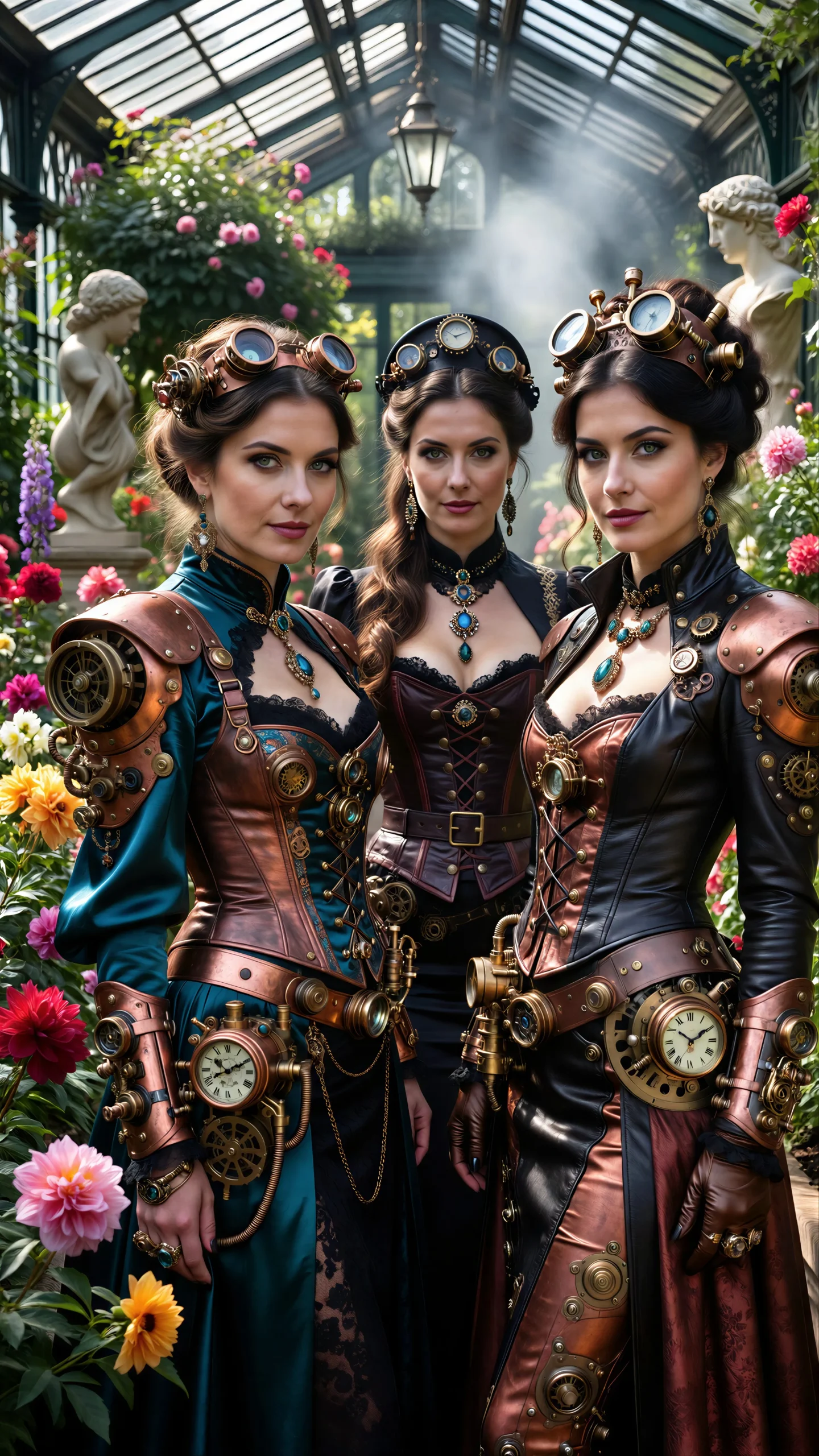
Where Brilliant Minds Learn to Kneel
A Steampunk Tale of Satin, Logic, and the Ecstasy of Intellectual Surrender
In the gaslit halls of the Royal Academy, where brass gleams and satin whispers against polished mahogany, a young engineer discovers that the most powerful weapon is not forged in a workshop—but surrendered into the hands of a woman who teaches her to think.
Clara Vance has brilliance. What she lacks is structure. When her revolutionary invention is stolen by a silver-tongued rival who wields rhetoric like a blade, she is left voiceless—humiliated by her own inability to marshal her scattered thoughts into defense. She flees into the Academy’s clockwork gardens, her face streaked with grease and tears, until Lady Althea Thorne finds her there.
The Dean of Logic does not offer pity. She offers something far more valuable: the architecture of a disciplined mind.
“Your engine is superior. Your defense was not,” Althea says, her voice melodic as a well-tuned instrument, her navy satin robes catching the afternoon light. “Which would you rather fix?”
What begins as instruction in syllogisms and the art of refutation becomes something far more profound. As Clara learns to strip away emotional chaos and find the crystalline clarity of pure logic, she discovers a truth that the world outside cannot comprehend: that submission to a worthy authority is not degradation—it is liberation.
Under Althea’s stern guidance and approving gaze, Clara finds a pleasure more intense than any mechanical triumph she has ever known. Each well-constructed argument earns a nod of approval that sends warmth flooding through her chest. Each correction—Althea’s fingers adjusting her posture, her voice guiding her through the gears of reasoning—becomes a touch she craves with an intensity that surprises her. The sublime euphoria of becoming exactly what a brilliant woman should be.
And she is not alone.
The Scholars who surround Althea in their identical navy satin robes—women of wealth and education and quiet, disciplined confidence—know a secret that eludes the chaotic world outside: that true power flows not from grasping control, but from the willing surrender of a sharp mind to a sharper one. That devotion to a worthy leader is not weakness but the foundation of strength. That the reward for such surrender is a place among women who have found, in their Dean’s guidance, everything they were always meant to be.
They move with the glossy assurance of those who have traded the fuzzy comforts of an unexamined life for the demanding, glorious clarity of purpose finely honed. Their arguments gleam like polished brass. Their devotion runs deeper than logic—for they have learned that the heart, like the mind, thrives under worthy authority.
Step into the Academy. Feel the smooth satin against your skin. Let Lady Althea teach you what Clara learned: that the architecture of thought, when properly constructed under the right hands, leads to places of pleasure and power you never dared imagine.
The question is not whether you can afford to surrender.
The question is whether you can afford not to.
Chapter One: The Theft of Voice
The gas lamps sputtered their amber benediction across the vaulted ceiling of the Royal Academy’s Presentation Hall, casting long shadows that stretched like grasping fingers across the polished mahogany floor. The air hung heavy with the scent of beeswax and ambition, of old money and older prejudices, of minds sharp enough to cut themselves on their own edges. Clara Vance stood at the threshold of this cathedral of intellect, her heart hammering against her ribs like a trapped bird throwing itself against the bars of a brass cage, and she thought—foolishly, desperately, hopefully—that today would be different.
Today, she would be heard.
Her automaton calibration engine sat on the presentation dais like a jewel in a rough setting, its brass components gleaming with the loving polish she had applied only that morning. Three years of her life lived in that device. Three years of sleepless nights and calloused fingers, of calculations scrawled on scraps of paper that multiplied like vermin across her modest lodgings. Three years of perfecting a mechanism that could—would—revolutionize manufacturing across the Empire, that could reduce calibration time from weeks to hours, that could make the difference between a factory that hummed like a well-tuned instrument and one that ground itself to pieces through accumulated error.
She had built it. She had made it real. And now she only needed to explain it to the review board—five men in tailored waistcoats who sat behind their elevated desk like judges at a tribunal, their faces arranged in expressions of polite patience that barely concealed their fundamental disinterest.
Clara’s hands trembled as she arranged her notes. She had written them in the small hours of the morning, when her mind ran clearest, when the words flowed like water through a well-machined channel. She had practiced her presentation seventeen times before her cracked mirror, had watched herself speak and gesture and explain, had corrected her posture and smoothed her tone until she thought—hoped—prayed—that she had finally conquered the chaos that always seized her tongue when it mattered most.
She was, she reminded herself, brilliant. Her tutors had said so, in those rare moments when they could see past her gender to the mind beneath. Her fellow engineers said so, in the grudging tones of men forced to acknowledge superior work. Even Lord Ashworth had said so, just last week, when he’d visited her workshop and examined her engine with those pale, calculating eyes.
“A remarkable achievement, Miss Vance,” he had said, his voice warm as honey poured over gravel. “You should present this to the board. The Academy needs to see what a woman of your… particular talents can accomplish.”
She had been so grateful for his encouragement that she hadn’t wondered why he’d come to her workshop at all.
Now, standing before the board, Clara opened her mouth to begin.
“I—thank you for the opportunity to—” Her voice cracked. She swallowed. Started again. “The engine before you represents a fundamental reconsideration of how we approach calibrational—calibration—of how we approach the calibration of automated manufacturing systems.”
The words felt like gears grinding in her mouth, each one catching and slipping before it could mesh with the next. She could see the board members exchanging glances—the slight lift of an eyebrow, the barely suppressed sigh, the pen tapped once, twice against the desk in a rhythm that said hurry along, we haven’t all day.
But Clara pressed on, because she had to, because this was her chance, because if she could just make them see—
“The primary innovation lies in the feedback mechanism. Traditional systems require manual recalibration after every thousand cycles, which introduces—introduces—” She lost the thread. Her notes swam before her eyes, the neat handwriting blurring into an incomprehensible scrawl. “Which introduces significant downtime. My engine uses a continuous feedback loop that adjusts in real-time, reducing recalibration intervals to—”
“Miss Vance.” The chairman’s voice was gentle in the way that a silk garrote is gentle. “Perhaps you could summarize the practical applications?”
Practical applications. She had prepared for this. She knew the answer. It was right there, sitting in her mind like a gear waiting to engage, but her thoughts were scattered, spinning without catching, and she could feel the moment slipping away from her like oil through grasping fingers.
“The applications are—well, they’re extensive. Any manufacturing process that relies on automated—on automated machinery would benefit from—”
“I believe,” said a new voice, smooth and confident and utterly devastating, “I may be able to assist Miss Vance in articulating her concept.”
Clara turned. Lord Percival Ashworth rose from his seat in the gallery with the fluid grace of a man who had never known a moment’s uncertainty. His waistcoat was silk, his boots were polished to a mirror shine, and his smile was the smile of a fox who has just discovered that the henhouse door has been left open.
“Lord Ashworth?” The chairman’s tone shifted—became warmer, more attentive, like a lamp turned from dim to bright. “You are familiar with this device?”
“I am, indeed.” Ashworth mounted the dais with easy confidence, positioning himself beside Clara’s engine with the proprietary air of a man standing next to his own creation. “I have had the privilege of studying Miss Vance’s… preliminary work, and I believe I can offer some context that may illuminate the design’s significance.”
Clara’s blood turned to ice water. Preliminary work. Context. The words were chosen with the precision of a surgeon selecting instruments, each one cutting away a little more of her claim to ownership.
“Miss Vance has been working under my informal mentorship for several months,” Ashworth continued, and Clara felt the floor tilt beneath her feet. “Her engine builds upon foundational research that I published last year—research that she has, I’m pleased to say, developed in some intriguing directions.”
Lies. All of it, lies. She had never worked under his mentorship. She had never seen his research. Her engine was entirely, completely, irrevocably her own design, conceived in her own workshop, built with her own hands, perfected through her own genius.
But she could not say this. She opened her mouth to say this, and what came out was: “That’s not—I didn’t—”
“Lord Ashworth,” the chairman said, leaning forward with interest, “are you suggesting this is a collaborative effort?”
“I am suggesting,” Ashworth replied, his voice warm with false generosity, “that innovation rarely occurs in isolation. Miss Vance has made valuable contributions to a project that began with my theoretical framework. I believe the Academy should recognize the collaborative nature of this achievement.”
Collaborative. The word hung in the air like a blade. Clara could feel it slicing through her claim, severing her from her own work with surgical precision.
“I need to—to clarify—” She reached for the words, reached for the structure that would expose his lie, but her thoughts were a tangle of gears spinning without engagement, and all she could produce was a stammering: “The design is—the mechanism was—I built—”
“Miss Vance,” the chairman said, with the weary patience of a man dealing with a difficult child, “perhaps you would prefer to let Lord Ashworth complete his explanation. His account seems rather more… coherent.”
The word struck her like a physical blow. Coherent. She was not coherent. She was a mess of grease and stammering and trembling hands, while he stood there in his silk waistcoat and his polished boots, his lies flowing like honey while her truth caught in her throat like a bone.
Ashworth began to explain her engine.
He explained it brilliantly.
He spoke of the feedback mechanism as though he had conceived it himself, using language that Clara recognized as her own—phrases from her notes, examples from her practice presentations, all of it repackaged in his smooth voice and confident delivery. He spoke of the practical applications with a clarity that Clara had never achieved, organizing her scattered thoughts into a structure so elegant that even she found herself nodding along.
And the board nodded too. They asked him questions—questions that should have been directed at her, about her work, her design—and he answered each one with the easy assurance of a man who had spent years studying the subject rather than minutes stealing another’s notes.
Clara stood beside her own engine, rendered invisible. A ghost haunting the presentation of her own murder.
She watched Ashworth’s hands gesture toward her brass components with the familiarity of ownership. She watched the board members lean forward, their pens scratching notes about his innovation, his breakthrough. She watched her three years of work being absorbed into his narrative like water into sand, leaving no trace that she had ever existed.
And she could not speak. She could not marshal a single coherent sentence to defend herself. Her voice had been stolen—not by force, but by the simple expedient of speaking more smoothly, more confidently, more persuasively than she ever could.
When Ashworth finished, the chairman rose and extended his hand.
“Lord Ashworth, the Academy is grateful for this remarkable contribution to the field of mechanical engineering. Your collaborative approach, bringing forward talents such as Miss Vance to develop your theoretical framework, exemplifies the best of British innovation.”
Collaborative. There it was again. The word that made her an assistant in the creation of her own genius.
Ashworth accepted the praise with modest grace, his eyes flicking to Clara for just a moment—a glance that contained no triumph, no malice, nothing but the calm satisfaction of a man who has taken what he wants and knows that no one can take it back.
“Miss Vance’s contributions should not be overlooked,” he said, and his generosity was worse than his theft because it made her a footnote in her own story. “Her mechanical skills are considerable. I hope to continue our productive collaboration.”
The board murmured approval. Pens scratched. The moment was sealed.
Clara stood motionless as the board members filed out, as Ashworth accepted congratulations from the scholars in the gallery, as her engine—her engine, her three years, her heart’s blood—was wheeled away to the Academy’s exhibition hall with a plaque that would bear his name above hers, if it bore hers at all.
She became aware, distantly, of other presences in the room.
The Scholars had been sitting in the gallery throughout the presentation. Clara had noticed them only peripherally—a row of women in identical navy satin academic robes, their faces attentive and impassive, their posture so uniformly precise that they might have been components of a single mechanism. They were Lady Althea’s cohort, the elite students of the Academy’s Dean of Logic, and they moved through the institution like a quiet current beneath the surface—present but apart, observing but rarely participating in the chaos of academic politics that swirled around them.
Now, as the hall emptied, Clara saw one of them rise—a woman of perhaps forty, her silver-streaked hair pinned beneath a satin hood, her face sharp and serene as a cameo carved from ivory. She watched Clara with an expression that Clara could not read: not pity, not contempt, but something else—something that might have been recognition.
“She built that engine herself,” the Scholar said to her companion, her voice low but clear. “Every component. Every calculation. Ashworth wouldn’t know a feedback mechanism from a fish kettle.”
Her companion—younger, darker, her satin robes catching the gaslight with a liquid gleam—nodded. “He wouldn’t need to. He knows how to talk about things. That’s all that matters in this place.”
“It shouldn’t be all that matters.”
“It shouldn’t be. But it is. Until someone teaches people like her how to fight with words instead of wrenches.”
The older Scholar’s eyes remained on Clara. “Lady Althea would say that a mind without rhetoric is a sword without a hilt—you can cut yourself as easily as your enemy.”
“Lady Althea would say that a mind without rhetoric is a mind waiting to be stolen.” The younger Scholar adjusted her robes with a gesture that was both casual and precise, the satin whispering against itself like a secret being shared. “Someone should tell that to the girl. Before she loses anything else.”
They moved toward the exit, their robes swaying in unison, their conversation dropping to a murmur that Clara could not follow. But the words that had reached her felt like seeds planted in wounded soil—taking root even as she bled.
A mind waiting to be stolen.
A sword without a hilt.
Someone should teach her how to fight.
But there was no one to teach her. There had never been anyone. She was alone with her brilliance and her incoherence, her genius and her voicelessness, and the world would always—always—choose the smooth lie over the stuttered truth.
Clara fled.
She ran through the Academy’s corridors like a thing pursued, her coarse overalls scraping against the polished wood paneling, her grease-stained hands leaving smears on banisters that generations of scholars had kept pristine. She ran past lecture halls and laboratories, past portraits of great men who had built their reputations on the work of others, past windows that looked out onto the mechanical gardens where clockwork flowers bloomed in precise, predictable patterns—always the same, always perfect, never wild or uncontrolled or messy like the thoughts that tumbled through her skull.
She ran until her lungs burned and her legs failed, and then she collapsed onto a stone bench in the garden’s deepest corner, surrounded by brass flowers that ticked and chimed with mechanical indifference to her despair.
The tears came then—hot, furious, humiliating. She pressed her palms against her eyes as though she could push the grief back inside, but it spilled through her fingers like the oil that leaked from her imperfect joints, like the words that leaked from her imperfect mouth, like everything she had ever tried to contain and failed.
Three years. Three years of work, of hope, of believing that brilliance would be enough. And it had been stolen in an afternoon by a man whose only talent was the ability to speak smoothly about things he did not understand.
The worst part—the part that burned like acid through her chest—was that she could not even articulate what he had done. She knew it was theft. She knew it was wrong. But when she tried to form the argument, to build the case that would expose his lies, her thoughts scattered like dropped gears, rolling away from her in every direction, impossible to collect and reassemble.
She could build an engine that calibrated itself. She could not build an argument that defended herself.
The clockwork flowers chimed the hour. Somewhere in the Academy, Lord Ashworth was accepting champagne and congratulations. Somewhere in the Academy, her engine was being installed in the exhibition hall with his name on the plaque. Somewhere in the Academy, the Scholars in their satin robes were returning to their studies, their minds sharp and clear, their voices trained to cut through deception like a blade through gossamer.
And Clara sat alone in her coarse overalls, her voice stolen, her work stolen, her future stolen, and wept with the particular agony of a woman who knows she is brilliant and cannot, for the life of her, prove it.
The gas lamps flickered. The clockwork flowers turned their brass faces toward the fading light. And somewhere in the shadows of the garden path, a figure in navy satin paused, watching, waiting, patient as a well-made mechanism that knows its moment will come.
Lady Althea Thorne had found what she was looking for.
She did not approach. Not yet. She had learned, long ago, that the ore must be ready before the forge can do its work. The girl was not ready. But she would be. They always were, eventually—these brilliant, broken women who stumbled into the Academy’s gardens with their genius leaking from their wounds like coolant from a cracked engine.
Althea had seen it before. She would see it again. And each time, she would offer the same gift: the architecture of thought, the structure that turned scattered brilliance into devastating precision, the submission to discipline that was not degradation but liberation.
She watched Clara weep, and she felt not pity but anticipation.
This one would be magnificent, once she learned to kneel.
Chapter Two: The Garden of Reason
The mechanical garden wept brass tears at twilight.
Clara had not moved from the stone bench in—she did not know how long. The clockwork flowers had marked the quarter hours with their delicate chimes, each note a small cruelty, a reminder that time continued its precise, indifferent march regardless of the wreckage it left behind. The gas lamps along the garden paths had ignited themselves automatically, their amber glow rendering the brass petals luminous, transforming the mechanical blooms into something almost beautiful—almost alive, were it not for the precision of their movements, the predictability of their turning, the utter absence of chaos that made them so unlike the tangled mess of Clara’s own thoughts.
She had stopped weeping. The tears had exhausted themselves, as all storms eventually do, leaving behind a landscape that was not calm but merely depleted—scoured clean of surface emotion, exposing the raw bedrock of a grief that ran deeper than tears could reach.
Her hands lay open in her lap, palms upward, grease-stained and calloused—the hands that had built an engine that could change the world, that had instead been presented to that world by another man’s voice. She stared at them as though they belonged to a stranger, as though the three years of labour they represented had been performed by some other woman—some woman who had believed, foolishly, naively, that being right was enough.
Being right is never enough, Clara thought, and the thought felt like a gear finally catching after years of spinning uselessly. Being right is the foundation. It is not the structure. It is not the argument. It is not the voice that carries the argument into the minds of others and makes them believe.
She had never thought of it this way. She had always assumed that truth was self-evident—that a well-made engine, a correct calculation, a sound design would speak for itself, would announce its own validity through the sheer force of its correctness. She had assumed wrong.
The clockwork flowers turned their faces toward the fading sky, their mechanisms clicking with the soft precision of thoughts well-ordered. Clara watched them and felt, beneath her exhaustion, the first stirring of something that was not despair.
It was not hope, exactly. It was more fundamental than that—a recognition, perhaps. A sense that the question she had never thought to ask was finally forming in her mind, rising from the depths like a mechanism surfacing from murky water.
How do you make truth heard?
“Miss Vance.”
The voice came from the path behind her—low, melodic, carrying the particular resonance of a woman who had never needed to raise her voice to command a room. Clara turned, and there she was.
Lady Althea Thorne stood at the junction of two garden paths, silhouetted against the amber glow of the gas lamps, and Clara’s breath caught in her throat with a sound that was not quite a gasp and not quite a sob but something between the two—a recognition, perhaps, of something she had not known she was looking for until she found it.
The Dean of Logic was tall—nearly as tall as Clara herself, though where Clara’s height came from rawboned angles and the stretched frame of a woman who had grown too fast and never filled out, Althea’s came from posture. She stood as though her spine were a brass rod, each vertebra stacked with mechanical precision, her shoulders squared and her chin level in a way that suggested not rigidity but balance—the equilibrium of a mechanism perfectly calibrated.
Her gown was structured navy satin that caught the lamplight and held it, the fabric gleaming with a lustre that seemed almost liquid, as though the light had been absorbed into the weave and was now being released slowly, deliberately, like a breath exhaled with perfect control. Brass stays glinted at the seams where the bodice met the skirt, functional and decorative in equal measure—the visible architecture of a garment that was, Clara realized, itself an argument. It said: I am precise. I am considered. I am exactly what I intend to be.
Her face was striking rather than beautiful—the kind of face that improved with acquaintance, that revealed new facets with each angle of light. Sharp cheekbones cast shadows that deepened the intensity of her dark eyes, and her mouth was set in a line that could have been severe were it not for the faint upward curve at the corners—the suggestion of a smile that was always present, always available, but never wasted on the undeserving.
Her hair was silver-streaked chestnut, pinned in a severe arrangement that left her neck exposed—a vulnerability deliberately displayed, as though to say: I do not need to protect myself. I am the protection.
Clara had seen her before, of course. Everyone at the Academy knew Lady Althea by reputation—the Dean of Logic, the woman who had transformed the Academy’s philosophy department from a laughing stock into a powerhouse, the scholar whose published works on rhetoric and reason were required reading in every university in the Empire. But Clara had never spoken to her, had never been in her presence for more than a passing moment in a corridor or a lecture hall.
She had not known—could not have known—the effect of that presence at close range. It was like standing beside a furnace: you felt the heat before you saw the flame, and the flame, when you saw it, was more intense than the heat had prepared you for.
“Lady Althea,” Clara said, and her voice came out cracked and rough, the voice of a woman who has been crying and is ashamed of having been caught at it.
“May I?” Althea gestured to the bench beside Clara, and the question was a formality—she was already sitting, her satin skirts settling around her with a whisper that sounded like a secret being kept. The fabric pooled against the stone with a fluidity that made Clara intensely aware of her own coarse overalls, their rough weave scraping against the bench like an apology for existing.
For a moment, neither of them spoke. Althea sat with her hands folded in her lap, her gaze fixed on the clockwork flowers, her expression one of patient attention—as though the garden were a text she was reading, and she was waiting for Clara to finish a sentence before responding.
Clara found herself acutely aware of the contrast between them. Althea, in her gleaming satin, looked like something that belonged in this garden—precise, polished, purposeful. Clara, in her grease-stained overalls, looked like something that had been dragged through it.
“I saw the presentation,” Althea said, and her voice was neither warm nor cold—it was clear, like water drawn from a deep well, carrying nothing but itself. “Your engine is remarkable.”
Clara flinched. The word remarkable landed like a stone in still water, sending ripples through the calm she had briefly achieved. “Lord Ashworth’s presentation was remarkable,” she said, and the bitterness in her voice surprised her with its intensity. “I just… built the thing.”
“I said your engine is remarkable.” Althea turned her head, and her gaze settled on Clara with a weight that was almost physical—a pressure, a gravity, like the moment when a lens focuses light to a single burning point. “I did not say Lord Ashworth’s presentation was remarkable. His presentation was effective. These are not the same thing.”
Clara blinked. “What do you mean?”
“I mean that your engine represents genuine innovation—a rethinking of fundamental principles, not merely an improvement on existing designs. Lord Ashworth’s presentation represented effective rhetoric—the skilful arrangement of words to achieve a desired outcome. The first is difficult. The second is merely… learnable.”
The distinction landed in Clara’s mind like a key sliding into a lock. She felt something shift—a gear engaging after years of spinning uselessly, a mechanism beginning to turn.
“You’re saying… you’re saying he didn’t steal my work because he’s smarter. He stole it because he can talk better than I can.”
“I am saying nothing of the sort.” Althea’s tone was patient, precise, like a teacher correcting a student’s first approximation. “I am saying that your engine is superior and your defense was not. These are two separate problems. The first requires genius. The second requires only training.” She paused, letting the distinction settle. “Which would you rather fix?”
The question hung in the air between them, and Clara felt its weight—the weight of a choice she had not known was available until this moment. She had assumed, in the fog of her despair, that her voicelessness was a permanent condition—a fundamental flaw in her design, like a gear cut with the wrong number of teeth. The idea that it might be fixable—that the problem was not her mind but merely the use of her mind—was so foreign that she needed a moment to absorb it.
“I…” She hesitated, the old habit of uncertainty rising like a reflex. “I didn’t know the second could be fixed. I thought… I thought if you were right, that was enough. That people would see it.”
“They never see it.” Althea’s voice carried no judgment, only the flat certainty of someone stating a mechanical truth. “People see what is presented to them. They believe what is argued well. They are convinced by confidence, not correctness. This is not a flaw in human nature—it is simply how minds work. A well-constructed argument enters the mind like a key entering a lock. A poorly constructed argument, even if true, bounces off like a misaligned gear.”
“That’s not fair,” Clara whispered, but the protest was feeble—she knew it was true, had always known it, had simply refused to acknowledge it because acknowledging it meant admitting that her own approach had been fundamentally wrong.
“Fairness is not a concept that applies to mechanical systems,” Althea said, and there was something almost gentle in the precision of her tone. “A gear does not care whether it is fair that it meshes with another gear. It meshes or it does not. An argument does not care whether it is fair that it must be well-constructed to be believed. It is constructed well or it is not. The question is not what is fair. The question is what is effective.”
Clara stared at her. The gaslight caught the brass stays of Althea’s gown, sending tiny sparks of light dancing across the stone bench between them, and Clara found herself watching those points of light as though they were thoughts—scattered, brilliant, capable of being focused to a burning point.
“Why are you telling me this?” she asked, and the question came out raw, suspicious, the defence of a woman who has learned that kindness usually comes with a price. “You don’t know me. You have no reason to—”
“I have every reason.” Althea’s gaze did not waver. “I was you, Miss Vance. Twenty years ago, I stood where you are standing—figuratively, if not literally. I had ideas that were superior to those of my colleagues, and I could not make anyone see it. I lost work to men who were less intelligent but more articulate. I was dismissed, overlooked, and on three separate occasions, I had my research claimed by men who could speak more smoothly than I.”
The admission landed like a thunderclap. Clara stared at Althea—at this woman who seemed so utterly composed, so completely in command of herself and every room she entered—and tried to imagine her stammering, fumbling, being talked over by lesser men. The image would not form.
“You?” The word came out incredulous. “But you’re—you’re Lady Althea. You’re the Dean of Logic. You wrote ‘The Architecture of Reason.’ You—”
“I wrote that book because I was tired of being unable to defend my own ideas.” Althea’s voice remained steady, but something shifted in her expression—a shadow passing behind her eyes, a memory surfacing briefly before being submerged again. “I spent five years learning what should have been taught to me from the beginning. Five years of studying rhetoric, logic, argumentation—of dismantling my own chaotic thought processes and rebuilding them with the precision of a well-made engine. Five years of learning to speak as though my words were gears, each one meshing perfectly with the next, driving the mechanism of my argument forward with irresistible force.”
She turned to face Clara fully, and the lamplight caught her features in a way that made them seem carved from marble—noble, severe, and yet possessed of a warmth that the marble metaphor could not quite capture.
“It was the hardest thing I have ever done. It was also the most important. And it is the reason I am telling you this now: because no one told me. No one sat beside me in a garden and said, ‘Your ideas are superior. Your defense is not. Let me show you how to fix the second problem.’ I had to discover it alone, through years of failure and frustration that I need not have endured.”
Clara felt something loosen in her chest—a knot she had not known was there, tied so long ago that she had forgotten it existed. The sensation was not comfortable. It was the ache of a cramped muscle being stretched, the sting of a wound being cleaned before it could heal.
“Why would you do that?” she asked, and her voice was smaller than she intended. “Why would you help me? What do you get from it?”
Althea’s laugh was low and melodic, carrying the warmth of genuine amusement rather than mockery—a sound like a well-tuned bell, clear and resonant and utterly without harshness. It was, Clara thought, the kind of laugh that could make a room full of hostile scholars lean forward and listen.
“What do I get from it?” Althea repeated, as though the question were a puzzle she was examining from multiple angles. “I get the satisfaction of preventing one more brilliant woman from being silenced by her own inarticulation. I get the pleasure of adding one more sharp mind to the ranks of those who can think clearly and speak precisely. I get—” She paused, and her expression softened in a way that made Clara’s breath catch. “I get the company of a woman who understands what it means to be brilliant and voiceless, and who has the courage to do something about it.”
She rose from the bench, her movements fluid and precise, her satin skirts falling into perfect folds around her legs. The fabric caught the lamplight one final time as she straightened, and Clara found herself watching the play of light across the glossy surface with an attention that seemed disproportionate to the subject—a fascination that she could not quite explain but felt no desire to resist.
“Come to my study tomorrow evening,” Althea said, and the instruction was delivered with the same clarity as everything else she said—as though it were simply the next gear in a well-constructed mechanism, engaging naturally with what had come before. “Seven o’clock. The east wing, third floor, the door with the brass owl. I will give you what no one gave me—a weapon for your mind.”
Clara opened her mouth—to thank her, to question her, to say something that would convey the turmoil of hope and fear and desperate longing that was churning inside her like a mechanism running at dangerous speed—but the words would not come. They never came. That was the problem, wasn’t it? The words were always there, but they would not arrange themselves into the structures that would make them effective.
“I—” she began.
“Don’t.” Althea’s voice was gentle but firm. “Don’t try to thank me. Don’t try to explain what you’re feeling. Don’t try to construct an argument for why you deserve this help or why you might not. Simply come tomorrow. The rest will follow.”
She turned and walked away down the garden path, her navy satin robes whispering against the gravel with a sound like pages turning in a book of secrets. The gas lamps illuminated her retreating form in segments—first the gleam of her gown, then the glint of brass stays, then the precise set of her shoulders, then the sway of her skirts, then nothing but the amber light and the ticking of the clockwork flowers and the vast, aching silence that follows the departure of something extraordinary.
Clara sat alone on the stone bench, her coarse overalls scraping against the cold surface, and she felt—beneath the exhaustion, beneath the humiliation, beneath the grief for her stolen work—something she had not felt in years.
She felt the stirring of a hope so fierce it frightened her.
She did not sleep that night.
She returned to her lodgings—a narrow room above a clockmaker’s shop, cluttered with tools and half-finished mechanisms and scraps of paper covered in calculations that crawled across the surfaces like ivy claiming a wall. She should have eaten. She should have bathed. She should have done any of the sensible, practical things that a woman of intelligence and discipline does when faced with a crisis.
Instead, she sat on the edge of her narrow bed and tried to think.
Your engine is superior. Your defense is not. Which would you rather fix?
The question replayed in her mind like a mechanism stuck in a loop, each repetition revealing new implications, new depths. It was not a question of blame—it did not ask whose fault the theft was, did not ask whether Ashworth was wrong or the board was biased or the world was unfair. It asked something far more practical, far more actionable: given the situation as it exists, what do you want to change?
Clara had spent her entire life believing that the answer to injustice was to be more right—to build better engines, to make more precise calculations, to let the quality of her work speak for itself. She had believed that brilliance was a weapon, and that if she sharpened it enough, it would cut through any obstacle.
She had been wrong. Brilliance was not a weapon. Brilliance was the blade. The weapon was the arm that swung it—the structure that directed the force, the argument that aimed the edge. Without that structure, the blade was useless—sharp, yes, but lying flat on the ground, cutting nothing.
She thought of Lady Althea—of her precision, her composure, the way she had sat on the stone bench and spoken in clear, measured sentences that had entered Clara’s mind like keys entering locks. Every word had been chosen. Every sentence had been constructed. Every argument had been a mechanism—gears meshing, force transferring, power delivered to exactly the right point.
That was what Clara lacked. Not intelligence—she had that in abundance. Not creativity—her engine proved that. What she lacked was architecture. The structure that turned scattered brilliance into devastating precision.
She thought of the Scholars she had seen in the gallery—those women in their identical navy satin robes, their faces sharp and serene, their movements coordinated and confident. She had dismissed them at the time as decorative—affectations of the Academy’s elite, more concerned with appearance than substance. Now she wondered.
What if the appearance was the substance? What if the precision of their dress reflected a precision of thought? What if the satin robes were not vanity but discipline—the visible manifestation of minds that had been trained to eliminate the rough, the chaotic, the uncontrolled?
She thought of the way they had moved—unified, purposeful, each one occupying her space with the assurance of a woman who knew exactly who she was and what she could do. She thought of the way they had spoken about Althea—with a respect that bordered on reverence, a devotion that seemed to go beyond professional admiration into something deeper, something more intimate.
Lady Althea would say that a mind without rhetoric is a sword without a hilt.
Lady Althea would say that a mind without rhetoric is a mind waiting to be stolen.
They had spoken of Althea the way Clara’s fellow engineers spoke of a perfectly calibrated engine—with awe, with desire, with the longing to understand how something so beautiful could exist and to somehow make themselves worthy of it.
Clara had never felt that way about a person before. She had felt it about mechanisms—the clean click of well-machined gears, the smooth travel of a piston in a perfectly bored cylinder, the satisfaction of a design that worked exactly as intended. But she had never looked at a human being and felt that same pull of admiration, that same desire to understand and emulate and become.
Until now.
She thought of Althea’s hand on the bench between them—close enough to touch, had Clara dared. She thought of the warmth in Althea’s voice when she spoke of the Scholars, of the way her expression had softened when she described what it meant to add “one more sharp mind” to their ranks. She thought of the invitation—come to my study tomorrow—and the way it had been delivered not as a suggestion but as an instruction, a command softened by courtesy but no less a command for all that.
She should have been suspicious. She should have wondered what Althea wanted from her, what the price of this help would be, what strings were attached to an offer that seemed too generous to be freely given.
She was not suspicious. She was hungry.
She was hungry for the clarity that Althea embodied. She was hungry for the structure that could turn her scattered brilliance into devastating precision. She was hungry for the company of women who had faced what she faced and conquered it—women who moved through the Academy with the confidence of those who had been trained by a master, who wore their satin robes like armour, who spoke with voices that had been forged into weapons.
She was hungry, and she was frightened, and she was hopeful, and she was desperate, and all of these emotions churned together in her chest like a mechanism running at dangerous speed, threatening to shake itself apart with the force of its own operation.
She did not sleep. She sat on the edge of her narrow bed and watched the clock on her wall tick through the hours—each second a gear engaging, each minute a mechanism completing its cycle, each hour a reminder that time was passing and tomorrow was coming and she had a choice to make.
The choice, she discovered, had already been made.
She was going to go.
The next day passed in a blur of distraction.
Clara reported to the workshop where she was nominally employed as an assistant engineer, but her hands performed their tasks without her mind’s engagement. She tightened bolts and adjusted valves and calibrated instruments by rote, her thoughts circling endlessly around the coming evening like water circling a drain.
Her colleague—a woman named Martha who had worked in the Academy’s workshops for thirty years and had the calloused hands and practical disposition of someone who had long ago given up on dreams—noticed her distraction.
“You’re away with the fairies today,” Martha said, during their midday break. She was a large, comfortable woman who wore wool and cotton—the practical fabrics of a practical life—and she watched Clara with the shrewd assessment of someone who had seen many young women pass through the workshop and knew the difference between ordinary distraction and the dangerous kind.
“Sorry,” Clara said. “I’m… I have somewhere to be tonight.”
“Somewhere important?”
Clara hesitated. How could she explain? How could she convey the significance of what had happened in the garden—the way a single conversation had reframed her entire understanding of her own failures, the way a single invitation had opened a door she had not known existed?
“Lady Althea invited me to her study,” she said, and the words felt strange in her mouth—too significant for their simplicity, too momentous for their plainness.
Martha’s eyebrows rose. “Lady Althea Thorne? The Dean of Logic?”
“Yes.”
“What does the Dean of Logic want with an assistant engineer?”
Clara did not know how to answer. She did not know what Althea wanted—only what Althea had offered, and what she herself desperately needed.
“She’s going to teach me,” Clara said, and even as she spoke the words, she felt their inadequacy. “Teach me” was too small a phrase for what was being offered. Althea was not going to teach her facts or formulas or the names of things. She was going to teach her structure—the architecture of thought that could turn scattered brilliance into devastating precision, the discipline that could transform a voiceless genius into a force that could not be ignored or dismissed or stolen from.
“Teach you what?” Martha asked, and her tone carried the scepticism of a woman who had seen education promise more than it delivered.
“How to think,” Clara said, and then corrected herself. “How to speak. How to… how to make people hear what I’m saying.”
Martha studied her for a long moment, her shrewd eyes missing nothing. “You’re not the first young woman Lady Althea has taken an interest in,” she said, and there was something in her voice—a warning, perhaps, or simply an observation. “There are others. The ones in the satin robes. The Scholars.”
“I know. I’ve seen them.”
“They’re devoted to her,” Martha said, and the word devoted was weighted with implications that Clara could not quite parse. “Not just professionally. Personally. They’d do anything for her. Some people think it’s… unusual.”
“Unusual how?”
Martha shrugged—a gesture that was more eloquent than any words she might have chosen. “Just unusual. The way they look at her. The way they talk about her. The way they’d walk through fire if she asked them to.” She paused, picking at a callus on her palm. “Not saying it’s wrong. Not saying it’s right. Just saying it’s… intense. The devotion those women have for Lady Althea is something I’ve never seen outside of a church. Maybe not even there.”
Clara considered this. She thought of the way the Scholars had spoken of Althea in the gallery—the reverence in their tones, the certainty in their assessments, the way they had invoked Althea’s name as though it were a principle, a law, a fundamental truth.
“Maybe she deserves that kind of devotion,” Clara said, and she was surprised by the conviction in her own voice. “Maybe she’s earned it.”
Martha looked at her for a long moment, and something shifted in her expression—a recognition, perhaps, of a transformation already beginning.
“Maybe she has,” Martha said. “Just… be careful, love. Devotion is a beautiful thing when it’s given to someone worthy. But it’s a dangerous thing when it’s given to someone who isn’t. Make sure you know the difference before you give away something you can’t get back.”
Clara nodded, but her mind was already elsewhere—already in the study with the brass owl on the door, already in the presence of the woman who had seen her failure and offered not pity but a weapon.
She would be careful. She would be cautious. She would guard her heart and her mind and her devotion until she was certain they were being given to someone worthy.
But she was going to go.
She had never been more certain of anything in her life.
The east wing of the Academy was older than the rest—its corridors narrower, its gas lamps spaced more widely, its wood paneling darker with the accumulated patina of centuries. Clara walked through it at seven o’clock precisely, her heart hammering, her palms sweating, her coarse overalls feeling more inadequate with every step.
She had considered changing. She had a dress—a single, plain cotton thing that she wore to funerals and Academy ceremonies—but it was rough, dull, the fabric of a woman who had never learned to value the way surfaces could reflect the precision of the mind beneath. She had put it on, looked at herself in her cracked mirror, and taken it off again. The dress was worse than the overalls. At least the overalls were honest.
The door with the brass owl was at the end of a corridor that seemed to grow narrower as she approached—a perspective trick, she knew, but one that felt deliberate, as though the architecture itself were testing her resolve. The owl was beautifully rendered, its brass feathers catching the lamplight with the same gleam as Althea’s gown, its eyes two small crystals that seemed to watch Clara’s approach with an intelligence that was almost unsettling.
Clara raised her hand to knock.
The door opened before her knuckles touched the wood.
“Miss Vance.” A woman stood in the doorway—young, perhaps Clara’s age, with dark hair and sharp features, wearing the navy satin robes of a Scholar with the easy grace of someone who had worn them long enough to forget they were remarkable. “Lady Althea is expecting you. Please, come in.”
The study beyond the door was not what Clara had expected. She had imagined something like the Academy’s other offices—cluttered with books and papers, furnished with the practical austerity of scholars who valued function over form. Instead, she found herself in a space that was both workshop and sanctuary, both library and laboratory.
The walls were lined with bookshelves that rose from floor to ceiling, their contents arranged with a precision that bordered on obsessive—books sorted not only by subject but by size, their spines forming patterns that were almost architectural. Brass instruments cluttered the surfaces of several worktables, their purposes unclear but their craftsmanship evident. A large clockwork model dominated the centre of the room—gears and lenses and mechanisms arranged in concentric rings, like a schematic of the solar system rendered in brass and crystal.
And standing beside this model, her hand resting on one of its brass arms as though it were a favourite companion, was Lady Althea.
She had changed from the gown she wore in the garden. Now she was dressed in a robe of deep burgundy satin—richer, more intimate than the navy, the fabric catching the lamplight with a warmth that made the room feel like the inside of a jewel box. The brass stays that had been visible on her daytime gown were hidden here, replaced by a more fluid structure that followed the lines of her body with a precision that was both elegant and subtly, quietly, devastatingly attractive.
“Miss Vance,” she said, and her voice filled the room like music fills a concert hall—not through volume but through resonance, each note precisely placed to achieve maximum effect. “Thank you for coming.”
“I—” Clara began, and then stopped, because the words were tangling again, the old chaos rising to choke her voice. She took a breath. Tried again. “Thank you for the invitation. I wasn’t sure—I didn’t know if I should—”
“You were sure,” Althea said, and her smile was the knowing, almost tender smile of a woman who has seen this moment many times before. “You were sure from the moment I left you in the garden. The uncertainty you’re feeling now is not doubt about coming. It’s fear of what coming might mean.”
Clara felt the words land like a diagnosis—precise, accurate, and uncomfortably revealing. “How did you—”
“Because I felt the same thing, twenty years ago.” Althea stepped away from the clockwork model, her burgundy satin swaying with the movement. “The fear is not a reason to leave. It is a reason to stay. Fear of transformation is the mind’s way of telling you that what follows will be important.”
She gestured to a chair beside the model—a comfortable, leather-upholstered seat that faced the brass mechanism. “Please, sit. We have much to discuss, and the night is young.”
Clara sat. The leather was smooth and cool against her legs, a tactile contrast to the rough wool of her overalls that made her acutely aware of the difference between where she was and where she might be—between the coarse fabrics of her current life and the glossy, precise, beautiful materials that seemed to define Althea’s world.
The Scholar who had opened the door moved to a corner of the room, her satin robes whispering against the floor as she walked. She took up a position that was both unobtrusive and attentive—a presence that was felt rather than seen, like a gear turning quietly in the background of a larger mechanism.
“That is Miss Blackwood,” Althea said, noting Clara’s glance. “One of my Scholars. She will be observing our sessions. Is that acceptable?”
Clara nodded, though the addition of an audience made her more nervous than she wanted to admit. “Why?”
“Because learning is not a solitary process,” Althea said, settling into the chair across from Clara with a grace that made the simple act of sitting look like a performance. “Miss Blackwood has already learned what I am about to teach you. Her presence will remind you that the transformation I am offering is not unique to you—it has been achieved by others. It can be achieved by anyone with the courage to submit to the discipline.”
The word submit hung in the air between them, and Clara felt it land with a weight that was disproportionate to its size. Submit. Such a small word. Such a vast implication.
“Submit to the discipline,” she repeated. “What does that mean, exactly?”
“It means,” Althea said, leaning forward with an intensity that made Clara’s breath catch, “that you must be willing to let go of the chaos that has defined your thinking until now. You must be willing to have your thoughts taken apart, examined, and reassembled with greater precision. You must be willing to accept correction without defensiveness, to receive instruction without argument, and to trust that the process will produce a result more powerful than anything you could achieve alone.”
She paused, letting the weight of this settle.
“It means, Miss Vance, that you must be willing to kneel in order to learn to stand.”
The metaphor was not subtle, and Clara felt its impact in her chest—a tightening, a quickening, a response that was not intellectual but visceral, as though the words had bypassed her mind entirely and spoken directly to something deeper. Something that had been waiting, perhaps, for exactly this invitation.
“And if I’m willing?” Clara asked, and her voice was steadier than she expected— steadier than it had been in the garden, steadier than it had been during the presentation, steadier than it had been in years. “If I’m willing to… submit to the discipline. What then?”
Althea smiled, and the warmth in that smile was like the first light of dawn after a long, dark night—a promise of clarity after chaos, of structure after formlessness, of a world seen sharply after a lifetime of blur.
“Then,” she said, “we begin.”
She reached out and set the clockwork model in motion.
The gears engaged with a soft, precise click, and the mechanism began to turn—each component driving the next, each movement precise and purposeful, the whole thing coming alive with a beauty that made Clara’s heart ache with recognition.
This was what she wanted. This was what she had always wanted—not just to build mechanisms, but to be a mechanism. To move through the world with this kind of precision. To speak with this kind of clarity. To think with this kind of devastating, beautiful, irresistible force.
“This,” Althea said, watching the model turn, “is a syllogism.”
Clara leaned forward, and the world narrowed to the gleam of brass, the click of gears, and the voice of a woman who promised to give her what she had never known she needed.
The lesson had begun.
Chapter Three: The Anatomy of a Syllogism
The clockwork model turned.
Clara watched its brass components engage with the fascination of an engineer seeing a masterpiece for the first time—and the hunger of a woman recognising something she had needed without knowing she needed it. The gears meshed with a precision that bordered on the sensual, each tooth finding its partner with a click that was almost intimate, like a lock accepting its key, like a hand finding its perfect fit in another hand. The crystal lenses caught the gaslight and refracted it into prismatic threads that danced across the walls of the study, painting the bookshelves with colours that shifted and turned with the mechanism’s movement, transforming the room into something that felt less like a study and more like the interior of a jewel—a secret, luminous space where precious things were kept.
“Beautiful, isn’t it?” Althea said, and her voice carried the quiet satisfaction of a woman who knew exactly what she was showing and exactly what effect it would have. “I had it built by a clockmaker in Geneva—Madame Lefevre, one of the finest minds in mechanical philosophy. She understood what I needed: not a model that merely demonstrates logic, but one that makes it beautiful. Because beauty, Miss Vance, is the first principle of effective instruction. The mind resists what is ugly. It embraces what is beautiful. If I can make you see the beauty of a well-constructed argument, you will hunger for it the way you hunger for any beautiful thing—and hunger is the most powerful teacher that exists.”
Clara nodded, not trusting herself to speak. The mechanism continued its slow, precise revolution, and she found herself leaning forward in her chair, drawn toward it by a pull that was both intellectual and something else—something deeper, something that resonated in her chest like a bell being struck, like a string being plucked, like a note being held in a silence that ached for sound.
“What you are looking at,” Althea continued, rising from her chair and moving to stand beside the model with the fluid grace that seemed as natural to her as breathing, “is the architecture of a syllogism. The most fundamental structure of logical argument. Everything you have ever failed to say, every argument you have ever lost, every truth that has been stolen from you because you could not articulate it—all of them can be traced back to a failure of this structure.”
She reached out and touched one of the larger gears—a brass wheel perhaps eight inches in diameter, positioned at the base of the mechanism like a foundation stone.
“This is the major premise.” Her fingers rested on the gear with a familiarity that suggested long acquaintance, the way one might touch the arm of a beloved chair or the cover of a favourite book. “The major premise is the foundation of your argument—the general truth upon which your specific conclusion will rest. It must be true, it must be relevant, and it must be accepted by your audience. If your major premise is flawed, everything that follows will be flawed as well—like a building constructed on a cracked foundation, no matter how elegant the upper floors, the whole structure will eventually collapse.”
She set the gear turning, and Clara watched as it engaged with a second, smaller gear positioned above it.
“This is the minor premise.” Althea’s finger traced the edge of the second gear as it began to spin, driven by the force of the first. “The minor premise is the specific case—the particular instance that you are connecting to the general truth of your major premise. The minor premise must align with the major premise; their teeth must mesh precisely. If they do not—if the minor premise does not truly fall under the general rule of the major premise—the mechanism jams. The argument fails.”
She stepped back, gesturing to the space where the two gears’ movements converged, where a crystal lens was beginning to glow with captured light.
“And this—” The lens blazed suddenly, a point of focused brilliance that made Clara gasp, “—is the conclusion. The light that emerges when all components mesh perfectly. When the major premise is true and the minor premise aligns with it, the conclusion follows with the inevitability of a gear’s turning. It does not need to be argued. It does not need to be defended. It simply emerges—as clear, as bright, as undeniable as the light from this crystal.”
Clara stared at the glowing lens, mesmerised. The light it cast was warm and steady, illuminating a small brass plaque set into the model’s base, upon which were engraved three lines:
All calibration engines require precise timing mechanisms.
Miss Vance’s engine incorporates a precise timing mechanism.
Therefore, Miss Vance’s engine is a calibration engine.
A simple argument. Almost childishly simple. But Clara could see it now—could see how the structure worked, how the gears engaged, how the light emerged. It was not the content that mattered but the architecture—the way the pieces fit together, the way force was transferred from premise to premise, the way the conclusion appeared with the inevitability of a mechanism completing its cycle.
“I…” She paused, searching for words adequate to what she was feeling. “I’ve been building arguments my whole life without understanding this. I’ve been putting gears together without knowing how they’re supposed to engage.”
“Precisely.” Althea’s smile was warm with approval, and Clara felt a flush of pleasure at that smile—a response that surprised her with its intensity. She had received approval before, from tutors and colleagues and the rare board member who recognised her work. But this approval felt different. It was not approval of her work but of her understanding—and that distinction made all the difference. “You have been building arguments the way a child builds with blocks—stacking pieces together and hoping they hold. What I am teaching you is engineering. The deliberate, precise construction of structures that cannot fail because every component has been designed to bear its specific load.”
She reached into the mechanism and, with a deft movement, misaligned one of the gears. The model ground to a halt with a sound that made Clara wince—a grinding, grating noise like teeth on teeth, like a mechanism being forced to do something it was not designed to do.
“This,” Althea said, “is what happens when your minor premise does not align with your major premise. The argument jams. The conclusion does not emerge. And your audience—instead of seeing the light of truth—is treated to the grinding of misaligned gears, which they interpret as confusion, weakness, or dishonesty.”
She realigned the gear, and the model resumed its smooth operation, the lens glowing once more.
“Now.” Althea turned to face Clara, and her expression shifted from instructor to examiner—a subtle change, but one that Clara felt like a shift in temperature. “Let us apply this to your presentation. Tell me: what was the major premise of your argument to the board?”
Clara thought. The presentation was a blur of humiliation, but she forced herself to remember the structure she had attempted—however poorly—to convey.
“My major premise was… that calibration engines require regular manual adjustment, which introduces significant downtime into manufacturing processes.”
“Good.” Althea nodded. “And your minor premise?”
“That my engine uses a continuous feedback mechanism that eliminates the need for manual adjustment.”
“And your conclusion?”
“That my engine would reduce downtime and increase efficiency across any manufacturing process that uses automated machinery.”
“Excellent.” Althea’s approval was like a warm hand on Clara’s shoulder—a sensation she could almost feel, though no touch had been offered. “The structure is sound. The gears mesh. The conclusion follows. So why did your argument fail?”
Clara hesitated. The question was not rhetorical—Althea was watching her with the patient attention of a teacher who expects an answer and will wait as long as necessary to receive one.
“Because… because I couldn’t deliver it. The gears were there, but I couldn’t make them turn. I kept losing the thread, stumbling over the words, getting lost in the details before I’d established the structure.”
“Partially correct.” Althea moved to a side table and poured two glasses of water from a crystal decanter, handing one to Clara before settling back into her chair. Her burgundy satin shifted with the movement, the fabric catching the light in a way that made it seem almost alive—a surface that breathed and moved with the woman beneath it. “The structure was sound, yes. But you are wrong about why it failed. The structure did not fail because you could not deliver it. The structure failed because you had not internalised it.”
She took a sip of water, letting the distinction settle before continuing.
“There is a difference, Miss Vance, between knowing a structure and being a structure. You knew your argument—you could write it down, recite it from memory, explain it to a sympathetic listener. But you had not internalised it. You had not made it part of your thinking, part of your speaking, part of the way you move through the world. When pressure was applied—when the board’s attention wavered, when Ashworth interrupted, when the stakes became real—you fell back into chaos. Not because you did not know the structure, but because the structure was not yet you.”
Clara felt the truth of this land like a blow—not harsh but precise, the way a doctor’s diagnosis is precise, identifying the exact location of the disease so that treatment can begin.
“How do I internalise it?” she asked, and her voice was smaller than she intended, the voice of a student who has just realised how much she does not know.
“Practice.” Althea set down her glass and rose, moving to the clockwork model with the purposeful grace that seemed to define every movement she made. “Repetition. Submission to the discipline until the discipline becomes second nature. It is no different from learning to build engines—you did not learn calibration by reading about it. You learned by doing it, over and over, until your hands knew the work without your mind’s direction. The same is true of logic. You must practise constructing arguments until the structure is as natural to you as breathing—until you cannot speak without your words falling into syllogistic form, until every sentence you utter is a gear engaging with the one before it and driving the one after.”
She adjusted something on the model, and a new set of gears engaged—smaller, more complex, arranged in patterns that Clara could not immediately follow.
“But before we can practise construction, we must learn deconstruction. You must learn to see the gears in other people’s arguments—to identify their major premises, their minor premises, their conclusions, and the points where the mechanism fails. This is the first skill of the logical warrior: not building your own arguments, but dismantling the arguments of others.”
She turned to Miss Blackwood, who had been standing in her corner with the quiet attentiveness of a well-placed component. “Miss Blackwood, please present the argument that Lord Ashworth used to claim Miss Vance’s engine.”
Miss Blackwood stepped forward, her navy satin robes swaying with the movement, and Clara was struck again by the contrast between the Scholar’s polished appearance and her own rough state. The satin seemed to move with Miss Blackwood rather than against her—not constraining but enabling, like a second skin that had been designed to work in harmony with the body it covered.
“Lord Ashworth’s argument, as I observed it,” Miss Blackwood said, her voice clear and measured, “proceeded as follows.” She straightened slightly, and Clara saw her shift into a different mode—not her own voice, but a reproduction of Ashworth’s, captured with the precision of a mechanical recording. “The major premise: innovations in mechanical engineering typically emerge from collaborative research building upon established theoretical frameworks. The minor premise: Miss Vance’s engine builds upon theoretical frameworks that I, Lord Ashworth, established in my published research. The conclusion: therefore, Miss Vance’s engine is a collaborative innovation in which I, Lord Ashworth, played a foundational role.”
The study fell silent. The clockwork model continued its slow, precise revolution, its gears turning with the indifference of pure mechanism to the human drama being played out beside it.
Clara felt something rise in her chest—not anger, not this time, but something sharper. Recognition. She could see it now—see the structure that Ashworth had used, see how the gears engaged, see how the conclusion emerged with the appearance of inevitability.
But she could also see something else.
“The minor premise is false,” she said, and her voice was steadier than it had been in days—steadier than it had been during the presentation, steadier than it had been in the garden. “His published research does not contain the theoretical frameworks my engine is built on. I’ve read his publications. They deal with a completely different approach to calibration—linear rather than feedback-based. He’s claiming a connection that doesn’t exist.”
“Excellent.” Althea’s smile was brilliant—a flash of warmth that made Clara’s pulse quicken with something that was not quite pride and not quite pleasure but something between the two, something that felt like being seen for the first time. “You have identified the flaw. The major premise is acceptable—collaboration does often drive innovation. The conclusion follows logically from the premises. But the minor premise is false. The gear is misaligned. And because the minor premise is false, the entire mechanism jams—the conclusion, however smoothly it appears to follow, is invalid.”
She reached into the model and disconnected the gear representing the minor premise. The crystal lens went dark. The mechanism ground to a halt.
“This is what you must learn to do in real-time, Miss Vance. Not after the fact, not in the safety of a private study, but in the moment—while your opponent is speaking, while the audience is listening, while the gears of their argument are turning before your eyes. You must learn to see the structure as it is being built, identify the weak points, and—when the moment is right—reach in and disconnect the false gear. The mechanism will jam. The light will go dark. And the audience will see the truth: not that your opponent’s conclusion is wrong, but that their structure cannot support it.”
Clara felt something shift inside her—a gear engaging, a mechanism beginning to turn. It was not understanding—she had understood the concept intellectually from the moment Althea began explaining it. It was something deeper. It was the first stirring of a new way of seeing—the world reframing itself around her, arguments becoming visible as structures, speech becoming transparent as mechanisms, the chaos of human communication resolving into patterns that could be identified, analysed, and—when necessary—dismantled.
“Again,” she said, and the word came out hungry, desperate, the voice of a woman who has tasted something intoxicating and wants more. “Show me another one.”
Althea’s laugh was low and warm, carrying a satisfaction that matched Clara’s hunger—a resonance between teacher and student, dominant and submissive, forge and ore.
“Patience,” she said, and the word was gentle but firm—a correction that Clara felt as a physical sensation, a light pressure that was somehow both restraining and supporting. “We will do many more. But first, you must understand not only the structure of the syllogism but its variations. What I have shown you is the simplest form—the categorical syllogism, where the premises are statements of category and the conclusion follows from the inclusion or exclusion of categories. But there are other forms.”
She adjusted the model again, and new gears rose into position—different sizes, different arrangements, creating a more complex mechanism that Clara’s engineer’s eye immediately wanted to dissect and understand.
“The conditional syllogism,” Althea said, setting the new configuration in motion. “If A, then B. A, therefore B. The major premise establishes a relationship of condition—something that must be true if something else is true. The minor premise affirms the condition. The conclusion follows.”
The gears turned, and a new lens glowed—this one a different colour, a warm amber that felt different from the first light, more nuanced, more conditional.
“Example: If an engine uses a continuous feedback mechanism, it does not require manual recalibration. Miss Vance’s engine uses a continuous feedback mechanism. Therefore, Miss Vance’s engine does not require manual recalibration.”
Clara watched the gears turn and felt a thrill that was not purely intellectual. The structure was beautiful—not in the way that a painting is beautiful or a sunset is beautiful, but in the way that a perfectly machined gear is beautiful, in the way that a mechanism that works exactly as intended is beautiful. It was the beauty of precision, of purpose, of form following function with the inevitability of a well-constructed argument.
“I’ve been surrounded by these structures my entire life,” she breathed, “and I never saw them.”
“No,” Althea agreed. “You saw the content—the words, the claims, the conclusions. You did not see the architecture. It is like looking at a building and seeing only the surface, never the load-bearing walls, never the foundation, never the structure that determines whether the building stands or falls.” She paused, her dark eyes fixed on Clara with an intensity that made Clara’s breath catch. “Once you learn to see the structure, Miss Vance, you will never be able to unsee it. Every argument will reveal itself to you—its strengths, its weaknesses, the points where it holds and the points where it can be broken. You will walk through a world of transparent mechanisms, where the chaos of human speech resolves into patterns as clear as the gears of a clock.”
“That sounds…” Clara searched for the right word. “Terrifying.”
“It is,” Althea said, and her smile carried a knowing that suggested she had felt this terror herself, long ago, and had emerged on the other side into something that was not fear but power. “It is also liberating. Because once you can see the structure, you can build it. And once you can build it, you can make the world see what you see—think what you think—believe what you know to be true. The weapon I am giving you, Miss Vance, is not the ability to win arguments. It is the ability to shape reality.”
The words hung in the air between them, heavy with implication, and Clara felt their weight settle into her bones like the brass stays of Althea’s gown settling into the fabric—structural, supportive, transformative.
“Show me more,” Clara said, and her voice was not a request but a surrender—the voluntary submission of a woman who has found something worthy of her devotion and is no longer willing to resist.
They worked for three hours.
Althea led Clara through the taxonomy of syllogisms with the methodical precision of a master craftsman teaching an apprentice—each form demonstrated on the clockwork model, each variation explained with analogies that drew on Clara’s engineering knowledge, each example chosen to illuminate not only the structure being taught but the flaws in arguments Clara had encountered throughout her life.
The categorical syllogism: All A are B. All B are C. Therefore, all A are C. Simple, direct, the foundation of logical reasoning.
The conditional syllogism: If A, then B. A. Therefore, B. More flexible, allowing for nuance and condition.
The disjunctive syllogism: Either A or B. Not A. Therefore, B. The logic of alternatives, of choices, of paths that branch and converge.
Each form was rendered in brass and crystal, each mechanism a work of art that made the abstract tangible, the invisible visible. Clara found herself responding to the beauty of the model with an intensity that surprised her—not just intellectual appreciation but something deeper, something that resonated in her body as much as her mind. The click of gears engaging. The glow of lenses illuminating. The smooth, inevitable emergence of conclusions from premises. It was, she realised, the same satisfaction she felt when a well-built engine ran perfectly—but amplified, refined, elevated from the mechanical to the intellectual.
“Your mind is exceptional,” Althea said, during a brief pause in which Miss Blackwood refreshed their water glasses. The Scholar moved with the quiet efficiency of a woman who had been trained to anticipate needs before they were expressed—her satin robes whispering against the floor as she crossed the room, her hands steady as she poured, her attention never wavering from the two women whose session she was attending. “You grasp these structures more quickly than any student I have taught. Your engineering mind gives you an advantage—you already think in terms of mechanisms, of components, of force transferred through structured connections. You simply did not know that the same principles apply to thought.”
“It feels…” Clara hesitated, reaching for words that could convey the transformation occurring inside her. “It feels like I’ve been colour-blind my entire life, and someone just showed me red.”
“Apt,” Althea said, and her smile carried a warmth that made Clara’s chest tighten. “The colour-blind do not know what they are missing until they see the full spectrum. Once they see it, they cannot imagine returning to the limited palette they knew before. The same is true of logical sight. Once you can see the structure of arguments, the world becomes infinitely more complex—and infinitely more navigable.”
She rose from her chair and moved to stand beside Clara, close enough that Clara could smell her perfume—a subtle, complex scent that carried notes of brass polish and old paper and something else, something warm and dark that Clara could not name but found herself wanting to breathe more deeply.
“Now,” Althea said, and her voice dropped to a register that was more intimate, more direct, as though she were speaking not to a student but to a woman—woman to woman, mind to mind, with nothing between them but the air they shared. “We come to the most important lesson of the evening. The lesson that separates those who understand logic from those who wield it.”
She reached down and took Clara’s hand—a gesture so unexpected that Clara’s breath stopped. Althea’s fingers were warm and dry, her grip firm but not constraining, the hand of a woman who was accustomed to holding things—tools, instruments, the threads of arguments—and who held them with the precise pressure that said I have you, and I will not let you fall.
“Stand,” Althea said, and the instruction was not a request.
Clara stood. Her legs were unsteady—not from exhaustion but from the accumulated weight of three hours of intellectual transformation, three hours of having her mind taken apart and reassembled, three hours of submitting to a discipline that was simultaneously rigorous and intoxicating.
Althea placed Clara’s hand on the clockwork model—on the major premise gear, the foundation of the entire mechanism. The brass was warm from its long operation, and Clara could feel the vibrations of the turning gears through her fingertips, like a heartbeat transmitted through metal.
“What do you feel?” Althea asked, and her voice was close to Clara’s ear, her breath warm against the sensitive skin there.
“The gears turning,” Clara whispered. “The force transferring. The… the structure working.”
“Now,” Althea said, “say your major premise. Not from memory. Not from your notes. Say it as though the words were gears emerging from this mechanism—as though the structure were not something you memorised but something you are.”
Clara closed her eyes. She felt the brass beneath her fingers, the vibration of the mechanism, the warmth of Althea’s hand still holding hers. She felt the structure—not as an abstract concept but as a physical reality, a mechanism that existed not only in the model before her but in her own mind, her own voice, her own being.
“All calibration engines require precise timing mechanisms,” she said, and the words came out clear and steady—not because she was trying to speak clearly, but because the structure demanded it. The gear was turning, and the words were the force it transferred.
“Now the minor premise,” Althea murmured, and her hand guided Clara’s to the second gear—the minor premise, the specific case, the point where general truth met particular instance.
“Miss Vance’s engine incorporates a precise timing mechanism,” Clara said, and the words engaged with the first set like gears meshing, each tooth finding its partner, each concept connecting to the one before it.
“Now the conclusion.” Althea’s hand moved Clara’s to the crystal lens—the point of light, the emergence of truth, the moment when the mechanism completed its cycle and the argument became undeniable.
“Therefore, Miss Vance’s engine is a calibration engine,” Clara said, and the lens blazed to life beneath her fingers—a burst of light that she felt as well as saw, a warmth that entered through her skin and spread through her chest like the first sip of brandy on a cold night.
She opened her eyes. The light was still glowing, and Althea was watching her with an expression that Clara had never seen directed at her before—not approval, not admiration, but something deeper, something that contained both of those things and transcended them.
Recognition. The look of a woman seeing another woman become what she was meant to be.
“There,” Althea said softly, and her hand was still holding Clara’s, still resting on the mechanism, still connected to the structure that had just demonstrated its power through Clara’s own voice. “That is what it feels like when the architecture is inside you. Not memorised. Not rehearsed. Inside. Part of your thinking, part of your speaking, part of who you are.”
Clara’s eyes were wet—not with grief this time, but with the overwhelming intensity of a transformation experienced in real-time. She had spent her entire life reaching for this—reaching for the clarity, the precision, the ability to make her thoughts visible to others—and she had never known what it would feel like to finally grasp it.
“Thank you,” she whispered, and the words were inadequate—tiny, insufficient, like trying to contain an ocean in a teacup—but they were all she had.
Althea’s grip on her hand tightened—not painfully, but firmly, with the deliberate pressure of a woman who knew exactly how much pressure to apply and when.
“Don’t thank me yet,” she said, and her voice carried a warmth that was simultaneously comforting and challenging—the voice of a teacher who knows that the first lesson is only the beginning. “You have learned to see the structure. You have learned to feel it. But you have not yet learned to wield it in the world—under pressure, against opposition, in the moments when it matters most. That is the work that lies ahead.”
She released Clara’s hand and stepped back, and Clara felt the loss of contact like a gear disengaging—a sudden absence of connection that left her feeling strangely incomplete.
“But for tonight,” Althea continued, “you have taken the first step. You have seen the architecture. You have felt it inside you. And you have spoken with a clarity that I suspect you have never achieved before. That is enough for one evening.”
She moved to her desk—a large, leather-topped piece that dominated one corner of the study—and opened a drawer, withdrawing a small package wrapped in navy silk. The fabric gleamed in the lamplight with the same liquid lustre as her gown, and Clara found herself watching the play of light across its surface with an attention that felt almost involuntary.
“This is for you,” Althea said, extending the package. “A gift. Not a reward—you have not yet earned rewards—but a tool.”
Clara took the package, feeling the weight of it in her hands. The silk was smooth against her calloused palms—a contrast that was almost painfully acute, the difference between her world and Althea’s made tangible in a single texture.
She unwrapped it. Inside was a book—slim, bound in leather the colour of dark honey, its pages edged in gilt. The title, embossed in brass on the cover, read: The Architecture of Reason: A Manual for the Construction of Sound Arguments.
“My book,” Althea said. “The one I wrote because I was tired of being unable to defend my own ideas. I want you to read it—not as a text to be memorised, but as a conversation between two minds. Read it slowly. Read it with a pencil in your hand. Mark the passages that resonate and the passages that confuse you. Bring your questions to our next session.”
Clara turned the book over in her hands, feeling the weight of it—the physical weight and the metaphorical weight, the weight of knowledge offered by a woman who had walked the path Clara was now walking and had left a map for those who followed.
“When is our next session?” she asked, and the question came out eager—too eager, perhaps, the enthusiasm of a woman who has tasted something intoxicating and wants more immediately, without delay, without the patience that discipline demands.
Althea heard the eagerness and smiled—not with amusement but with recognition, as though she remembered feeling the same hunger, long ago, and understood its power.
“Two days,” she said. “I will send Miss Blackwood to collect you. In the meantime, read. Practice speaking your arguments aloud—not the words, but the structure. Let the gears turn in your mind until their movement becomes as natural as your own heartbeat.”
She paused, and something shifted in her expression—a softening, a warmth, that made Clara’s breath catch.
“And Miss Vance? When you read the book, you will find a chapter near the end titled ‘The Ethics of Logic.’ In it, I discuss the responsibility that comes with the power of structured argument—the obligation to use the weapon only in service of truth, never in service of deception or manipulation. I want you to read that chapter particularly carefully.”
“Why?”
Althea’s gaze held hers with an intensity that felt like a hand gripping her chin—firm, direct, impossible to look away from.
“Because the weapon I am giving you is powerful,” she said. “And powerful weapons require wielders who understand not only how to use them but when and why. I am teaching you to dismantle arguments, Miss Vance. I must also teach you to know when not to.”
The weight of this settled over Clara like a mantle—heavy but not burdensome, the weight of responsibility rather than obligation.
“I understand,” she said, and she meant it—not as a polite acknowledgment but as a genuine commitment, the first thread of a bond that would, over the coming weeks, weave itself into something unbreakable.
“Good.” Althea’s smile returned, and with it the warmth that Clara was already learning to crave—the approval of a woman whose approval was worth earning. “Now go. Read. Practice. And remember what you felt tonight when the gears turned and the light emerged. That feeling is the feeling of truth being spoken clearly. It is the feeling I want you to chase. It is the feeling that will guide you home.”
Clara nodded, clutching the book to her chest like a talisman. She moved toward the door, her coarse overalls scraping against the leather chair as she rose, and the sound was a reminder—harsh, physical—of the distance she still had to travel between who she was and who she might become.
Miss Blackwood opened the door for her, and as Clara passed, the Scholar leaned close—close enough that Clara could feel the smooth satin of her robe against her arm, a whisper of texture that was simultaneously foreign and fascinating.
“Lady Althea sees something in you,” Miss Blackwood murmured, her voice pitched for Clara’s ears alone. “Something she hasn’t seen in a long time. Don’t waste it. Don’t let the chaos pull you back. The structure she’s offering you—it’s worth everything it costs. I promise you that.”
Before Clara could respond, Miss Blackwood stepped back, her expression returning to its composed neutrality, and Clara found herself outside the study, the door closing behind her with a soft click that sounded like a gear engaging—a mechanism beginning, a process initiated, a transformation set in motion that could not now be undone.
She stood in the corridor for a long moment, the book pressed against her chest, the memory of Althea’s hand on hers still burning like a brand. The gas lamps flickered their amber benediction. The brass owl on the door watched her with its crystal eyes.
And Clara Vance, for the first time in her life, felt not the chaos of scattered thoughts but the beginning of something she had never dared to hope for.
She felt the architecture forming.
Chapter Four: The Scholars in Satin
Two days passed like gears turning in slow motion—each hour a tooth engaging, each minute a mechanism completing its cycle, each second an eternity of anticipation that stretched Clara’s patience to its absolute limit and then stretched it further, the way a brass rod is drawn through progressively smaller dies until it emerges thinner, stronger, transformed.
She read Althea’s book.
She read it the way a starving woman eats—ravenously, desperately, with an appetite that could not be satisfied no matter how many pages she consumed. She read it in her narrow room above the clockmaker’s shop, propped against her thin pillow with a pencil clutched in her grease-stained fingers, marking passages until the margins were more annotation than text. She read it in the Academy’s workshop during her breaks, the book propped against a half-assembled engine while her colleagues looked on with expressions ranging from curiosity to amusement. She read it in the Academy’s dining hall, eating one-handed while her eyes devoured paragraphs that rewired her understanding of how language worked, how arguments were built, how truth could be made visible through the architecture of well-structured thought.
The book was not what she had expected. She had anticipated a dry treatise—the kind of academic text that one reads out of obligation rather than desire, with sentences so convoluted they seemed designed to obscure rather than illuminate. Instead, she found something else: a conversation. Althea’s voice lived in those pages—warm, precise, occasionally wry, always clear—and it spoke to Clara as directly as if the Dean were sitting beside her, explaining each concept with the patience of a woman who understood that her reader was not an adversary to be defeated but a mind to be cultivated.
“The first principle of logical architecture,” Althea had written in the opening chapter, “is this: structure is not constraint. Structure is liberation. The river that flows within its banks is powerful, directed, purposeful. The river that overflows its banks is chaos—destructive, formless, ultimately spent. The mind that operates within the structure of logical form is like the river within its banks: channelled, focused, capable of carving canyons. The mind that operates without structure is like the flooded river: it may cover a great deal of ground, but it accomplishes nothing of lasting value.”
Clara had read this passage seven times. Each reading revealed new depths—the metaphor of the river, the distinction between power and chaos, the subtle implication that structure was not something imposed from without but something cultivated from within. She began to see her own mind differently—not as a thing to be tamed but as a force to be channelled, not as a problem to be solved but as a power to be directed.
And she practised. Althea had told her to speak her arguments aloud—not the words, but the structure. Clara felt foolish at first, standing in her narrow room, reciting syllogisms to the cracked mirror while her reflection stared back with an expression that wavered between determination and embarrassment. But she persisted, because Althea had told her to, and because the instruction had been given not as a suggestion but as a directive, and because—though she would not have admitted this to anyone, perhaps not even to herself—she had begun to crave the feeling of following Althea’s instructions, the satisfaction of submitting to a discipline that was simultaneously demanding and nurturing, like the pressure of a firm hand guiding a tool to exactly the right position.
She practised until the structures began to feel natural. She practised until the syllogistic form emerged from her lips without conscious effort, the major premise flowing into the minor premise flowing into the conclusion like water flowing downhill—inevitable, effortless, right. She practised until she could feel the gears engaging in her mind, each thought connecting to the next with the precision of a well-made mechanism, and the sensation was so satisfying—so deeply, viscerally, almost physically satisfying—that she found herself constructing arguments for the pleasure of it, building syllogisms the way she once built engines, revelling in the beauty of structure for its own sake.
And then, on the evening of the second day, Miss Blackwood came for her.
The knock on her door came at precisely six-thirty—early enough to allow for the walk to the east wing, late enough to allow for final preparations. Clara had been ready since five o’clock.
She opened the door to find Miss Blackwood standing in the narrow corridor, her navy satin robes catching the dim light from the hallway’s single gas lamp with a gleam that seemed almost luminous—as though the fabric itself were a source of light, a surface that did not merely reflect illumination but amplified it, transformed it, made it its own.
“Good evening, Miss Vance,” Miss Blackwood said, and her voice carried the same composed precision that Clara had observed in Althea’s study—the voice of a woman who had been trained not only in logic but in presence, in the art of occupying space with confidence and purpose. “Lady Althea has asked me to escort you to tonight’s seminar. The other Scholars are eager to meet you.”
Clara felt a flutter of anxiety—quick, sharp, like the vibration of a mechanism running slightly too fast. “The other Scholars? I thought—I assumed I would be meeting with Lady Althea privately, as before.”
“Lady Althea’s private sessions are for foundational instruction,” Miss Blackwood explained, and her tone was informative rather than corrective—the patient explanation of a woman who had fielded this question before and understood the anxiety it represented. “The seminars are for application. You have learned the structure of the syllogism. Now you must learn to wield it in the presence of others—to construct arguments under observation, to dismantle the arguments of your peers, to think clearly while others are watching and judging and waiting for you to fail.”
“That sounds terrifying,” Clara said, and the words came out more honestly than she intended.
“It is,” Miss Blackwood agreed, and her smile was knowing rather than reassuring—the smile of a woman who remembered her own terror and had emerged on the other side into something that was not fear but power. “It is also necessary. An argument that can only be constructed in private is like an engine that can only run in a workshop. The world is not a workshop, Miss Vance. The world is a battlefield, and the arguments that matter are the ones that can be built under fire.”
She gestured toward the stairs. “Shall we?”
Clara hesitated. She looked down at herself—at her coarse overalls, their fabric rough and dull even after the vigorous scrubbing she had given them that morning. She had considered, briefly, attempting to acquire something more appropriate—something that would not mark her so obviously as an outsider, something that would allow her to enter the seminar room without immediately announcing her inadequacy. But she had nothing. Her one dress was cotton—practical, plain, the fabric of a woman who had never learned to value the vocabulary of surfaces. Her overalls, at least, were honest.
“You’re worrying about your clothes,” Miss Blackwood said, and the observation was so accurate that Clara felt a flush of embarrassment heat her cheeks.
“Is it that obvious?”
“Only because I remember feeling the same thing.” Miss Blackwood’s expression softened—not into pity but into recognition, the understanding of a woman who had stood where Clara was standing and knew the terrain. “When I first came to Lady Althea, I wore wool. Brown wool. The kind of wool that says ‘I am practical and I do not care about appearances,’ which is, of course, a lie—everyone cares about appearances; the only question is whether you care enough to do something about them.”
She reached out and adjusted Clara’s collar—a small gesture, almost unconscious, the kind of thing one does for a younger sister or a colleague one has known for years rather than a woman one has met twice. The touch was brief but warm, and Clara felt it like a gear engaging—a small connection that was somehow significant.
“The clothes are not the point,” Miss Blackwood said. “The point is the transformation. But the clothes are part of the transformation—a visible sign of the internal change. When you are ready, you will wear the satin not because Lady Althea requires it but because you will understand why it matters. Until then, the overalls are appropriate. They are honest. They say: ‘I am not yet what I will become.’ That is a statement worth making.”
Clara nodded, feeling something loosen in her chest—not entirely comfort but something adjacent to it, the relief of being understood.
“Come,” Miss Blackwood said. “The others are waiting.”
The seminar room was on the fourth floor of the east wing, through a corridor that grew progressively narrower and more richly appointed as one ascended—the plain wood panelling of the lower floors giving way to darker, more polished surfaces, the simple gas lamps replaced by fixtures of brass and crystal that cast a warmer, more intimate light. The transition was deliberate, Clara realised—not merely architectural but psychological, a gradual narrowing of focus that prepared the mind for the intensity of what lay ahead.
Miss Blackwood stopped before a door of dark, polished wood. No brass owl here—instead, a simple brass plate bearing the words Seminar Room A: The Architecture of Reason.
“Before we enter,” Miss Blackwood said, turning to face Clara with an expression of serious attention, “you should understand what you are about to see. The Scholars are not like other students. They are not here to earn degrees or build credentials. They are here because Lady Althea saw in them what she saw in you—a mind worth cultivating, a potential worth realising. They have each been through what you are about to go through. They have each felt what you are feeling. And they have each emerged on the other side transformed.”
She paused, letting this settle.
“You will notice things about them—the way they dress, the way they speak, the way they interact with one another and with Lady Althea. Some of what you see may seem… unusual. The devotion, the closeness, the way they respond to her. Do not be alarmed. What you are witnessing is not coercion or cultishness. It is the natural response of brilliant women who have found in a worthy teacher something they had been searching for their entire lives. When you understand what Lady Althea offers—what she gives—you will understand why the Scholars respond as they do.”
“What does she give them?” Clara asked, and the question came out quieter than she intended—almost reverent, as though she were asking about something sacred.
Miss Blackwood’s smile was warm and knowing and carried a depth of personal experience that Clara could not quite fathom.
“Everything,” she said. “She gives them everything. And in return, they give her everything. It is not an exchange—it is a communion. You will understand. Or you will not. But if you do—if you allow yourself to see what is being offered—you will understand why we wear the satin, why we speak with precision, why we would follow Lady Althea into fire if she asked us to.”
She opened the door.
The seminar room was not what Clara had expected.
She had anticipated something like the Academy’s lecture halls—tiered seating facing a raised dais, the arrangement designed to separate speaker from audience, authority from supplicant. Instead, she found herself in a chamber that was simultaneously intimate and imposing—a space of polished wood and soft gaslight, of brass fixtures and crystal lamps, of surfaces that gleamed with the particular lustre that comes only from careful, consistent, loving maintenance.
The room was circular. Twelve chairs were arranged in a ring around a central table of dark, polished wood, upon which sat a smaller version of the clockwork model that dominated Althea’s study. The chairs were leather-upholstered—smooth, supple, the colour of dark honey—and each one was occupied.
The Scholars.
Clara’s first impression was of uniformity—not the sterile uniformity of soldiers or servants, but the rich, textured uniformity of a group that had chosen to present themselves as a collective while retaining their individuality within it. They wore identical navy satin academic robes—the same robes Clara had seen in the gallery during her presentation, the same robes Miss Blackwood wore—but the uniformity of the garment served to highlight rather than obscure the diversity of the women who wore it.
They were of various ages—the youngest perhaps Clara’s age, the oldest well into her fifties. They were of various backgrounds—some wore the bearing of aristocracy, others the practical mien of professionals, others the intense focus of scholars. But they shared something that transcended their differences: a quality of presence, a way of occupying their chairs and their space that spoke of confidence, precision, and a deep, settled contentment that Clara had never encountered in a group of women before.
They were, Clara realised with a start, happy. Not the brittle happiness of women performing contentment for an audience, but the deep, rooted happiness of women who had found their place in the world and were living in it fully, completely, without the restless dissatisfaction that seemed to define most of the women Clara had known.
And they were beautiful. Not in the conventional sense—though several of them were striking by any standard—but in a deeper sense, the beauty of women who had been refined by discipline, polished by purpose, made luminous by the clarity that came from knowing exactly who they were and what they could do. The satin robes played their part in this beauty—the fabric catching the gaslight with each movement, each shift, each breath, creating a visual effect that was simultaneously unified and individual, like light passing through a prism and emerging as a spectrum.
But it was not just the satin. It was the way the women wore it—with the ease and confidence of garments that were not costumes but expressions, not uniforms but identities. The fabric moved with them rather than against them, flowing and gleaming like a second skin that had been designed to work in harmony with the body it covered. Clara, standing in her coarse overalls at the threshold of the room, felt the contrast like a physical sensation—the rough scraping of her own fabric against the smooth, glossy beauty of theirs, the difference between her current state and her potential made tangible in textile.
“Miss Vance.” One of the Scholars rose—a woman in her forties, her silver hair swept beneath her satin hood with an elegance that spoke of both confidence and care. Her face was handsome rather than pretty, with strong features and sharp eyes that assessed Clara with the same precision Althea had employed—but with a warmth that was more welcoming than challenging. “Welcome. I am Mrs. Eleanor Whitmore. Please, come in. We’ve been looking forward to meeting you.”
Clara stepped into the room, feeling like a rough cog entering a mechanism of polished gears—and feeling, simultaneously, the first stirring of a desire so intense it was almost painful: the desire to belong.
“Thank you,” she said, and her voice came out steadier than she expected—the structure of the syllogism still operating in her mind, providing a framework for her speech that she had not possessed before. “I’m honoured to be here.”
“The honour is mutual,” said another Scholar—a younger woman, perhaps thirty, with dark eyes and a quick, intelligent face that seemed to sparkle with barely contained energy. “I’m Dr. Helena Forsythe. Lady Althea has told us about your engine. The calibration mechanism, specifically. She says it’s the most innovative design she’s seen in a decade.”
“She said that?” Clara felt a flush of pleasure that was disproportionate to the compliment—or rather, that was proportional to the source of the compliment. Althea’s approval had become, in the space of two days, something Clara craved with an intensity that she did not fully understand and was not certain she wanted to examine too closely.
“She said considerably more than that,” said a third Scholar—older, perhaps fifty, with the bearing of a woman who had spent decades in positions of authority and had found, in Althea’s circle, something that authority alone could not provide. “I am Lady Margaret Ashford. Lady Althea said that your mind is exceptional and that your voice, once properly trained, will be formidable. Coming from her, that is high praise indeed.”
“Coming from her,” Mrs. Whitmore added with a warm smile, “that is the highest praise there is.”
There was a murmur of agreement from the other Scholars—a sound that was not quite words but was not quite silence either, a collective expression of assent that spoke of shared experience, shared devotion, shared understanding of exactly what Althea’s praise meant and why it was worth pursuing.
Clara felt the murmur like a warm wind against her skin—a sensation of belonging that was simultaneously comforting and alien, like stepping into a room that is exactly the right temperature after coming in from the cold. She wanted to sink into it. She wanted to earn the right to sink into it.
“Please, sit.” Mrs. Whitmore gestured to an empty chair between herself and Dr. Forsythe. “We have a few minutes before Lady Althea arrives. We use this time to prepare—not by reviewing material, but by settling our minds. The seminar requires clarity, and clarity requires stillness.”
Clara sat, feeling the smooth leather of the chair embrace her with a suppleness that was almost sensual—a contrast to the hard, cold surfaces she was accustomed to that made her intensely aware of the difference between this world and her own. The Scholars around her settled into their chairs with the practised ease of women who had done this many times before, their satin robes falling into graceful folds, their faces assuming expressions of composed attention.
“Tell me about your reading,” Dr. Forsythe said, leaning toward Clara with the casual intimacy of a woman who was accustomed to close conversation and assumed that others were too. Her satin robe shifted with the movement, and Clara caught the scent of it—a clean, smooth fragrance that was somehow both subtle and distinctive, like the scent of a well-maintained instrument. “Lady Althea’s book. What did you think?”
Clara considered the question carefully—more carefully than she would have considered it a week ago, before she had learned to see the structure of questions as well as their content. “I think it’s… not what I expected,” she said. “I expected a textbook. I found something else.”
“What did you find?” Dr. Forsythe’s eyes were bright with genuine interest—the interest of a woman who had read the book herself, who had been transformed by it, and who was curious to see how the transformation was progressing in another.
“I found… a way of seeing,” Clara said, and the words came slowly, each one tested for accuracy before being released. “Like putting on spectacles for the first time and realising that the world is not blurry—it’s sharp, and you were just unable to see it. The structures she describes—the syllogisms, the fallacies, the architecture of argument—they were always there. I just didn’t know how to see them.”
“Yes,” Dr. Forsythe breathed, and the word carried a depth of understanding that went beyond intellectual agreement. “That’s exactly it. The seeing. I remember when I first saw it—the moment when the structures became visible and the chaos resolved into patterns. It was like…” She paused, searching for the right analogy. “It was like looking at a clock face and, for the first time, seeing not just the hands but the mechanism behind them—the gears, the springs, the escapement. Suddenly, the movement of the hands wasn’t mysterious. It was mechanical. It was understandable.”
“And once you can see the mechanism,” Mrs. Whitmore added from Clara’s other side, “you can work with it. You can repair it, improve it, build your own. You’re no longer at the mercy of arguments you can’t evaluate. You can see exactly where they’re strong and where they’re weak, and you can respond with precision rather than confusion.”
“The precision is the thing,” said Lady Margaret, and her voice carried the authority of a woman who had wielded precision as a weapon for decades. “Before Lady Althea, I could argue. I was good at it—I’d been arguing in Parliament for fifteen years, and I’d won more debates than I’d lost. But my arguments were… intuitive. I won by instinct, by feel, by the natural advantage of a sharp tongue and a quick mind. Lady Althea taught me to win by architecture. To build arguments that cannot lose because every component is precisely placed and every connection is exactly right.”
“You were in Parliament?” Clara asked, surprised. She had not expected to find a politician among the Scholars—politics seemed too messy, too chaotic, too imprecise for the world of logic and structure that Althea inhabited.
“For fifteen years. I was the first woman to hold my seat. I won it through sheer force of personality and lost it through the same force—I was too sharp, too quick, too reliant on instinct rather than structure. My opponents learned to exploit my patterns while I was still relying on my talent.” Lady Margaret’s expression carried the weight of that loss—not bitterness, but the particular sadness of a woman who has learned an important lesson too late and is determined to ensure that others learn it in time. “Lady Althea found me after I lost my seat. She told me what she tells everyone: ‘Your ideas are superior. Your execution is not. Which would you rather fix?’ I chose to fix the execution. It was the best decision I have ever made.”
“And now?” Clara asked.
“Now I advise three cabinet ministers on policy formulation. I write speeches that are read in Parliament and quoted in the Times. I am more powerful now than I ever was as an MP—because I have the structure to make my ideas heard.” Lady Margaret smiled, and the smile was warm with the particular warmth of a woman who has found her true calling after years of searching. “And I owe it all to Lady Althea. We all do.”
There was that murmur again—that collective sound of assent, of shared devotion, that passed through the Scholars like a current through a conductor. Clara felt it in her own chest, a resonance that she could not explain and did not want to resist.
“We all have stories,” Dr. Forsythe said. “We all came to Lady Althea broken in some way—voiceless, despite our brilliance. She found us, or we found her, and she gave us what we needed: the architecture to make our voices carry. And in return…” She paused, and something shifted in her expression—a softening, a warmth, that went beyond gratitude into something deeper, something that Clara recognised because she was beginning to feel it herself. “In return, we give her everything. Our devotion, our loyalty, our service. Not because she demands it—she never demands it—but because it is the natural response to what she gives. When someone gives you your voice, when someone gives you your power, when someone gives you yourself—the only possible response is to give yourself back.”
The words settled over Clara like a mantle—heavy with meaning, warm with implication. She looked around the room—at the twelve women in their satin robes, their faces bright with intelligence and serene with purpose—and she felt the full weight of what she was witnessing.
This was not a class. This was not a seminar. This was a community—a group of women who had been transformed by a single teacher and who had responded to that transformation with a devotion so deep, so complete, so natural that it appeared not as obligation but as grace.
And Clara wanted to be part of it.
She wanted it with an intensity that frightened her—an intensity that went beyond intellectual ambition or professional aspiration and into something more fundamental, more personal, more intimate. She wanted to sit in this circle of women, wearing the satin that marked them as Althea’s own. She wanted to speak with the precision that came from Althea’s training. She wanted to feel the warmth of Althea’s approval and the companionship of women who understood what it meant to be brilliant and voiceless and to find, in submission to a worthy teacher, the voice that had always been waiting inside.
She wanted it. And the wanting was itself a kind of surrender.
The door opened.
The change in the room was instantaneous and profound—not dramatic, not theatrical, but as subtle and as powerful as the shift in a mechanism when a new gear engages. The Scholars straightened in their chairs—almost imperceptibly, a collective adjustment of posture that spoke of attention focusing, of minds sharpening, of a group of women orienting themselves toward a single point like compass needles finding north.
Lady Althea entered.
She wore robes of midnight blue satin tonight—darker than the navy of the Scholars, richer, more luminous, the fabric seeming to drink the gaslight and hold it within its weave like a vessel holding wine. The colour made her skin glow and her dark eyes deepen, and the overall effect was of a woman who was not merely entering a room but claiming it—occupying it with the same precision and purpose with which she occupied her own body, her own mind, her own life.
“Good evening, Scholars,” she said, and her voice filled the room like music fills a concert hall—not through volume but through resonance, each word precisely pitched to reach every corner, every ear, every mind.
“Good evening, Lady Althea,” the Scholars responded in unison, and the response was not rote but genuine—a chorus of voices speaking together because they chose to, because the unity was an expression of their devotion rather than a requirement of their membership.
Althea’s gaze swept the circle, touching each Scholar with a warmth that was simultaneously professional and personal—the warmth of a teacher who knows her students intimately, who has guided each of them through transformation, who has earned the devotion they offer not through demand but through the quality of what she gives.
Her gaze reached Clara, and the warmth intensified—a flash of recognition, of welcome, that made Clara’s pulse quicken and her breath catch.
“And Miss Vance,” Althea said, and the addition of her name to the greeting felt like an honour—a small but significant acknowledgment that Clara was here, that she mattered, that she was seen. “Welcome to the seminar. I trust the reading went well?”
“Very well, Lady Althea,” Clara said, and her voice was steady—the structure of the syllogism still operating in her mind, providing a foundation for her speech that she had not possessed a week ago. “I have questions.”
“I would expect nothing less. Questions are the gears of learning—without them, the mechanism does not turn.” Althea moved to her chair—a larger, more ornate piece than the others, positioned not at the head of the circle but as part of it, a primus inter pares rather than a ruler above subjects. She sat, and her satin robes settled around her with a whisper that sounded like a confidence shared. “But first, let us attend to the evening’s work. Miss Whitmore, you were assigned to present a refutation of Lord Ashworth’s argument from Miss Vance’s presentation. Please proceed.”
Mrs. Whitmore rose, and Clara watched with fascination as the older woman transformed before her eyes—from a warm, welcoming presence into something sharper, more focused, more formidable. Her satin robes caught the light as she straightened, and the effect was of a weapon being drawn—the gleam of the fabric like the gleam of a blade, beautiful and dangerous in equal measure.
“Lord Ashworth’s argument,” Mrs. Whitmore began, and her voice was clear, measured, and as precisely structured as a well-made mechanism, “proceeds from the following major premise: innovations in mechanical engineering typically emerge from collaborative research building upon established theoretical frameworks.”
She paused, letting the premise settle in the air.
“This major premise is presented as a universal statement—a claim that all innovations in mechanical engineering follow this pattern. But the premise is, in fact, a generalisation that admits of exceptions. Not all innovations emerge from collaborative research; some emerge from individual insight, from independent work, from the genius of a single mind working outside the established frameworks. By presenting the premise as universal rather than general, Lord Ashworth creates the impression that his conclusion—the collaborative nature of Miss Vance’s engine—follows necessarily, when in fact it follows only if one accepts the false universality of his major premise.”
She turned to the clockwork model on the central table and, with a deft movement, adjusted one of the gears. The mechanism ground to a halt with a grinding sound that made Clara wince—but this time, the wince was not merely instinctive. She could see the flaw. She could see exactly where the gear was misaligned, exactly why the mechanism jammed, exactly how the argument failed.
“The minor premise,” Mrs. Whitmore continued, “claims that Miss Vance’s engine builds upon theoretical frameworks established by Lord Ashworth. This is factually incorrect—Miss Vance’s engine employs a feedback-based approach that is fundamentally different from the linear approach described in Lord Ashworth’s published research. The minor premise is not merely misaligned; it is fabricated. The gear is not merely the wrong size—it is from an entirely different mechanism.”
She stepped back, and the silence that followed was not empty but full—full of understanding, full of recognition, full of the particular satisfaction that comes from seeing a structure clearly, both its strengths and its weaknesses.
“Therefore,” Mrs. Whitmore concluded, “Lord Ashworth’s conclusion—that Miss Vance’s engine is a collaborative innovation in which he played a foundational role—does not follow from his premises. The mechanism cannot turn. The argument fails.”
The Scholars applauded—not perfunctorily but genuinely, the applause of women who appreciated a well-constructed refutation the way other audiences might appreciate a well-played sonata. Clara found herself applauding too, her hands coming together with a force that surprised her, her appreciation flowing from a place that was both intellectual and emotional—the satisfaction of seeing her stolen work defended, even if only in a seminar room, even if only as an exercise.
“Excellent, Miss Whitmore,” Althea said, and the approval in her voice made Mrs. Whitmore visibly glow—a flush of pleasure that suffused her features and made her, for a moment, look younger, softer, more radiant. The effect was striking: a woman of forty-eight, transformed by four words of praise into something luminous. “Your identification of the false universality is particularly astute. The distinction between universal and general premises is one that many logicians overlook, and it is a common source of fallacious reasoning. You have demonstrated not only the ability to identify the flaw but to articulate it with precision.”
Mrs. Whitmore sat down, and the glow remained—a warmth that settled into her expression like a light that had been lit and would not soon be extinguished. Clara watched her and felt something twist in her chest—not envy, exactly, but longing. The longing to be the recipient of that praise. The longing to feel that glow. The longing to be seen, acknowledged, approved of by a woman whose approval was worth more than gold.
“Miss Forsythe,” Althea continued, “your assignment was to construct an affirmative argument in support of Miss Vance’s claim to sole authorship of the calibration engine. Please proceed.”
Dr. Forsythe rose, and her transformation was different from Mrs. Whitmore’s—where Eleanor had become sharper, Helena became more fluid, her quick energy channelling into a focused stream that was both playful and precise. Her satin robes swayed with her movement, and Clara noticed that several of the Scholars watched her with expressions of affectionate anticipation—the expression of women who knew Helena’s style and enjoyed watching it in action.
“Miss Vance’s claim to sole authorship,” Dr. Forsythe began, and her voice carried a brightness that was simultaneously engaging and authoritative, “rests on three premises that, together, form an argument of considerable force.”
She moved to the clockwork model and began adjusting gears as she spoke—each adjustment corresponding to a premise, each premise building on the one before.
“First premise: Miss Vance’s calibration engine employs a continuous feedback mechanism—a design approach that is fundamentally distinct from the linear approach described in Lord Ashworth’s published research. This is a matter of technical fact, verifiable through examination of the engine itself and comparison with Lord Ashworth’s publications.”
A gear clicked into place.
“Second premise: The continuous feedback mechanism was not described in any published research prior to Miss Vance’s presentation. This is verifiable through a search of the relevant literature, which I have conducted and which confirms that no prior publication—by Lord Ashworth or any other researcher—describes this approach.”
A second gear engaged with the first.
“Third premise: Miss Vance’s workshop records, including dated design documents, component orders, and correspondence with suppliers, establish that the engine was designed and built over a period of three years, entirely within Miss Vance’s workshop, without collaboration or input from Lord Ashworth or any other researcher.”
A third gear meshed with the first two, and the mechanism began to turn.
“Therefore,” Dr. Forsythe concluded, and the crystal lens at the centre of the model blazed to life, “Miss Vance’s calibration engine is an original work, designed and built solely by Miss Vance, and Lord Ashworth’s claim of collaborative authorship is without foundation.”
The applause was louder this time—warm, enthusiastic, the appreciation of women who recognised not only the soundness of the argument but the elegance of its construction. Clara felt tears prick her eyes—tears of a kind she had not expected, not grief or humiliation but gratitude, deep and overwhelming, for these women who had taken her stolen work and built around it a fortress of logic that could not be breached.
“Beautifully constructed, Miss Forsythe,” Althea said, and her approval was warmer than before—a warmth that matched the excellence of the work being praised. “The use of three premises, each independently verifiable, creates a redundancy that makes the argument robust against attack. Even if one premise were to be challenged, the remaining two would still support the conclusion. This is architecture at its finest—not a single wall but a buttressed structure, each element reinforcing the others.”
Dr. Forsythe’s glow was different from Mrs. Whitmore’s—brighter, more energetic, like a flame rather than an ember—but it was equally genuine, equally powerful, equally visible. And Clara, watching, understood something she had not understood before.
The praise was not merely praise. It was nourishment. It was the thing the Scholars worked for, the reward that made the discipline worthwhile, the return on their investment of devotion and effort. Althea gave them knowledge, structure, voice—and in return, she gave them this: the warmth of her approval, the light of her recognition, the profound, sustaining satisfaction of being seen and valued by a woman whose vision was worth being seen by.
It was, Clara realised, a form of intimacy—not sexual, not romantic, but intimate nonetheless, the intimacy of teacher and student taken to its deepest level, the intimacy of a woman who holds another woman’s potential in her hands and shapes it with care and precision and the kind of attention that is indistinguishable from love.
And Clara wanted it. She wanted it the way she had once wanted to build engines—with a ferocity that frightened her, with a hunger that she could not satisfy alone, with the desperate, driving need of a woman who has glimpsed what she could become and cannot rest until she becomes it.
“Now,” Althea said, and her gaze found Clara with the precision of a lens finding its focal point, “it is your turn, Miss Vance.”
Clara’s heart stopped. Then started. Then raced like an engine with its governor removed.
“My turn?” she managed.
“You have observed the work of two of my Scholars—one dismantling the argument that was used against you, one constructing the argument that should have been made in your defence. Now you must do both. I will present an argument, and you will dismantle it. Then you will construct a counter-argument of your own. This is the practice, Miss Vance—the application of structure under observation. This is how you learn to think clearly while the world is watching.”
Clara felt the eyes of the Scholars upon her—twelve pairs, each one sharp, each one assessing, each one carrying the weight of women who had been where she was now and who knew, from personal experience, exactly how difficult this moment was. She expected to feel terror. She expected the old chaos to rise, the gears to scatter, the voice to fail.
Instead, she felt something else.
She felt the structure.
It was there—inside her, where Althea had placed it two nights ago. The syllogistic form, the architecture of reason, the gears that had been set in motion and had been turning, turning, turning in the days since, building momentum, building force, building toward exactly this moment. She could feel it the way she felt the mechanisms of her engines—not as abstract concept but as physical reality, a structure that existed in her mind and her voice and her body, a mechanism that was ready to run.
“I’m ready,” she said, and the words came out steady—not because she was not afraid, but because the structure was stronger than the fear.
Althea’s smile was warm with something that might have been pride—or might have been anticipation, the expression of a woman who has planted a seed and is watching it germinate.
“Very well,” she said. “Here is your argument: Miss Vance’s engine, while innovative in its design, is too complex for practical application and therefore should not be adopted by manufacturing concerns. The major premise is that manufacturing concerns require simplicity in their machinery. The minor premise is that Miss Vance’s engine is complex. The conclusion follows. Dismantle it.”
Clara took a breath. She felt the gears engage.
“The major premise is a false generalisation,” she said, and her voice was clear—not loud, not aggressive, but precise, each word a gear meshing with the next. “Manufacturing concerns do not require simplicity in all cases. They require reliability, efficiency, and a favourable ratio of cost to benefit. Simplicity is one factor among many, not the sole criterion. An engine that is more complex but also more reliable and more efficient may be preferable to a simpler engine that requires more frequent maintenance and produces more downtime.”
She paused, feeling the mechanism turn.
“The minor premise is subjective and undefined. ‘Complex’ is a relative term that requires a standard of comparison. Compared to a hammer, my engine is complex. Compared to the existing calibration systems it is designed to replace—which require extensive manual adjustment and dedicated personnel—my engine is simpler to operate, even if its internal mechanism is more sophisticated. The complexity is internal; the operation is simple.”
She felt the conclusion emerging—not forced, not constructed, but arising naturally from the premises like light from a lens.
“Therefore, the conclusion does not follow. The argument fails because the major premise is a false generalisation and the minor premise employs a subjective standard without definition. The mechanism jams.”
The silence that followed was different from the silences that had followed the other Scholars’ presentations. It was a silence of surprise—not at the quality of the work, but at the speed. Clara had dismantled the argument in under a minute, her refutation delivered with a precision and confidence that none of them had expected from a woman attending her first seminar.
Then Althea began to clap.
The sound was singular—two hands coming together in a quiet, measured rhythm that was more significant than any volume could have made it. It was not the enthusiastic applause that had followed the other presentations. It was something else. Something more personal. Something that said: I see what you have become, and I am pleased.
The Scholars joined her, their applause building like a mechanism gaining speed, each pair of hands adding its force to the collective expression of approval. And Clara, standing in the centre of that warm sound, wearing her coarse overalls among the gleaming satin, felt something she had never felt before.
She felt seen.
Not seen as a woman, or an engineer, or a victim of theft. Seen as a mind—a mind that had been given structure and had used that structure to defend itself. Seen as a potential Scholar—a woman who might, with time and discipline and the guidance of a teacher worth following, earn her place in this circle of brilliant, devoted, luminous women.
She felt the wanting again—stronger now, more defined, more urgent. The wanting to wear the satin. The wanting to speak with this precision always. The wanting to sit in this circle not as a guest but as a member. The wanting to give herself to the discipline, to the teacher, to the community that had shown her in a single evening what her life could be if she were willing to submit to the transformation.
“Now,” Althea said, and her voice was warm with the particular warmth that Clara was learning to crave, “construct your counter-argument. Affirm the proposition that Miss Vance’s engine should be adopted by manufacturing concerns. Build the mechanism. Make it turn.”
Clara looked at the clockwork model. She looked at the Scholars in their satin robes. She looked at Lady Althea, whose dark eyes held hers with an intensity that was simultaneously challenging and nurturing—the gaze of a woman who was pushing her student to excel because she knew, with the certainty of long experience, that the student could.
She felt the gears engage.
She began to build.
Chapter Five: The Dismantling
Clara built.
She built the way she had always built engines—with precision, with purpose, with the deep, almost physical satisfaction of components engaging in exactly the right order, each gear finding its partner, each premise connecting to the next with the inevitability of a well-constructed mechanism. But this was different from anything she had built before, because this time she was not building with brass and crystal and machined components. She was building with herself—with her voice, her mind, her presence in this room full of women who watched her with the sharp, affectionate attention of those who remember their own first time.
“Major premise,” she began, and the words emerged from her lips not as recitation but as creation—each syllable a component being placed, each pause a gear being aligned. “Manufacturing concerns adopt technologies that provide a favourable ratio of cost to benefit, regardless of the internal complexity of the technology, provided that the operation of the technology can be learned by available personnel.”
She paused, feeling the gear settle into place—solid, foundational, the bedrock upon which the rest of the structure would rise. She glanced at Althea, and what she saw in the Dean’s expression was not instruction but attention—the focused, patient attention of a woman watching a mechanism she has built begin to run under its own power.
“Minor premise,” Clara continued, and her voice grew steadier with each word, the structure reinforcing itself as it grew, each new component strengthening the ones already in place. “Miss Vance’s calibration engine provides a favourable ratio of cost to benefit, reducing recalibration time from weeks to hours and eliminating the need for dedicated calibration personnel, while its operation can be learned by existing maintenance staff in a training period of approximately three days.”
The second gear engaged. Clara could feel it—not metaphorically but almost physically, a sensation in her chest like the click of a well-machined tooth finding its socket, like the engagement of a clutch transferring power from engine to drive.
“Second minor premise: the cost of the engine, while higher than traditional calibration systems, is recovered within the first six months of operation through the elimination of downtime and the redeployment of calibration personnel to more productive tasks.”
A third gear, adding redundancy, adding strength, buttressing the structure against attack.
“Therefore,” Clara said, and the word felt like the moment when a lens focuses light to a single burning point—everything converging, everything aligning, everything becoming clear and bright and undeniable, “manufacturing concerns should adopt Miss Vance’s calibration engine, as it provides a favourable ratio of cost to benefit and its operation can be learned by available personnel.”
The crystal lens on the clockwork model blazed to life—warm, steady, luminous—and the silence that followed was not the silence of surprise but the silence of recognition. The Scholars knew what they had just witnessed. They had each, in their own time, stood where Clara was standing and felt what she was feeling: the first moment when the structure stops being something you build and starts being something you are.
Then the applause came—warm, genuine, carrying the particular quality of women who understand that they are not merely applauding a performance but witnessing a birth. The birth of a mind that has found its architecture. The birth of a voice that has found its structure. The birth of a woman who has begun, at last, to become what she was always meant to be.
Clara felt tears on her cheeks—not of grief or humiliation but of something else, something she had no name for, something that lived in the space between achievement and surrender, between mastery and submission, between the power of the structure and the devotion to the one who taught it.
“Beautifully done, Miss Vance.” Althea’s voice was quiet, but it carried through the applause like a bell through fog—clear, resonant, impossible to ignore. “Not only structurally sound but rhetorically effective. Your use of a second minor premise creates redundancy without confusion, and your framing of cost as recoverable rather than absolute addresses the most likely objection before it can be raised. This is not merely logic, Miss Vance. This is strategy.”
The praise landed in Clara’s chest like a warm stone dropped into still water—sinking deep, spreading wide, sending ripples of pleasure through her entire body. She had been praised before, by tutors and colleagues and the rare board member who recognised her work. But this praise was different. This praise came from a woman whose opinion had become, in the space of a few short days, the only opinion that mattered.
And Clara understood, in that moment, why the Scholars wore the satin. Why they spoke with such devotion of the woman who had transformed them. Why they sat in this circle night after night, building arguments and dismantling them, honing their minds under the guidance of a teacher who gave them everything and asked for everything in return.
It was not obligation. It was not coercion. It was the natural, inevitable, beautiful response to being given what you needed most by someone who understood exactly what that was and exactly how to provide it.
It was devotion. And devotion, Clara was learning, was not a burden but a liberation.
The seminar continued for two more hours.
Each Scholar presented an argument—some constructed, some dismantled, some both—and Clara watched with the fascination of an engineer seeing master craftsmen at work. The women moved through the architecture of logic with a fluency that she knew would take her months to achieve, but she could see the structures now—could see the gears engaging, the premises connecting, the conclusions emerging with the inevitability of well-designed mechanisms.
And she noticed other things.
She noticed the way the Scholars interacted with one another—the easy familiarity, the shared references, the shorthand of women who had spent years in each other’s company and had developed a language that was partly verbal and partly something else, a communication of glances and gestures and subtle shifts of posture that conveyed meaning as precisely as speech.
She noticed the way they interacted with Althea—the particular quality of attention they gave her, not the fearful attention of subordinates watching a superior but the focused attention of women watching someone they admired, someone they trusted, someone who had earned their devotion through the quality of what she gave rather than the force of what she demanded.
And she noticed the satin.
She had been aware of the satin since the moment she entered the room—aware of it as a contrast to her own coarse overalls, aware of it as a symbol of the world she was entering and the world she was leaving behind. But as the evening progressed, her awareness deepened from observation to appreciation. The fabric was not merely beautiful—though it was beautiful, catching the gaslight with each movement, each shift, each breath, creating a visual effect that was simultaneously unified and individual, like light passing through a prism. It was also functional. The satin moved with the wearer, not against her. It did not bind or chafe or restrict. It enabled movement while maintaining structure—a garment that was simultaneously free and disciplined, the same paradox that defined the Scholars themselves.
Clara found herself watching the way the fabric fell when a Scholar rose to speak, the way it caught the light when she gestured, the way it whispered against the leather of the chairs when she sat. The sound was quiet—almost subliminal—but once Clara noticed it, she could not stop noticing it: the soft, constant murmur of satin against satin, satin against leather, satin against skin. It was the sound of the Scholars’ world, as different from the scraping of Clara’s overalls as a well-tuned instrument is from a broken one.
And she wanted it.
She wanted to wear that sound. She wanted to move through the world trailing that whisper. She wanted to sit in this circle and have the fabric of her robe catch the light the way the others’ did—gleaming, glowing, proclaiming to anyone who saw her that she belonged to something, that she had been transformed, that she had found her place.
“You’re staring at the robes,” Dr. Forsythe murmured, leaning close during a brief pause between presentations. Her voice was warm with amusement, not mockery—the amusement of a woman who remembered her own staring and understood what it meant.
Clara felt a flush heat her cheeks. “Is it that obvious?”
“To me, yes. I stared at them too, when I first came. For months, actually. I couldn’t stop thinking about them—the way they looked, the way they sounded, the way they felt when I finally got to touch one.” Helena’s eyes were bright with the memory. “It’s not about the fabric, you know. It’s about what the fabric represents. The transformation. The belonging. The fact that you’ve earned the right to wear something beautiful because you’ve become something beautiful inside.”
“Did you—” Clara hesitated, uncertain whether the question was appropriate. “Did you choose the satin? Or did Lady Althea choose it for you?”
“Both.” Helena’s smile was knowing, warm, carrying the weight of personal experience. “Lady Althea designed the robes—chose the fabric, the colour, the cut. She has very specific views about the relationship between external appearance and internal state. She believes that what we wear shapes how we think, how we move, how we present ourselves to the world. Rough fabrics produce rough thoughts. Coarse materials produce coarse speech. Satin—” She paused, running her hand along the sleeve of her robe with a gesture that was simultaneously casual and intimate, like touching the arm of a lover. “Satin produces precision. Smoothness. Clarity. The fabric is a tool, Miss Vance, like the clockwork model. It teaches the mind to be what the body is wearing.”
“And you wanted to wear it?”
“I ached to wear it.” The word ached was deliberate, weighted with a meaning that went beyond mere desire. “I ached the way you ache for anything that represents what you want to become. I saw the Scholars in their robes, and I saw what I wanted to be—precise, confident, beautiful in that particular way that comes from discipline rather than decoration. And I knew that wearing the satin would not make me those things. But it would mark me as someone who was becoming them. It would be a commitment, a declaration, a visible sign of an invisible transformation.”
“How long did it take?” Clara asked, and the question was not really about the robes. It was about the transformation itself—how long until the structure became natural, how long until the voice could be relied upon, how long until she could sit in this circle and feel that she belonged.
“For me? Three months before Lady Althea offered me the robes. Three months of seminars, of practice, of having my arguments dismantled and rebuilt until the structure was second nature. Three months of—” Helena paused, and something shifted in her expression—a softening, a vulnerability, that Clara had not seen before. “Three months of falling in love with her. Not romantically—or not only romantically. It was something deeper than that. Something that included romance but went beyond it. I fell in love with her mind, her precision, her care. I fell in love with the way she looked at me when I got something right—with that warmth, that approval, that seeing. I fell in love with what she gave me, and I wanted to give back. I wanted to give her everything.”
The confession was quiet, intimate, offered not as revelation but as recognition—the sharing of an experience that Helena recognised in Clara, the same way Althea recognised potential in the women she chose.
“And the satin,” Helena continued, “was the symbol of that giving. When Lady Althea offered me the robes, she said: ‘This is not a gift. It is a commitment. You wear this, and you are mine—not as property but as purpose. You wear this, and everything you do reflects on me, on the Society, on the work we do together. You wear this, and you give yourself to the discipline, to the structure, to the community of women who have made the same commitment.’ And I said yes. I said yes because there was nothing else to say. Because she had given me everything, and the satin was my way of saying: I give you everything in return.”
Clara felt the words settle into her like gears engaging—each one finding its place, each one connecting to something that was already there, already turning, already building toward a conclusion that she could feel approaching but could not yet see.
“Three months,” she said, and the words were not a question but a measurement—the distance between where she was and where she wanted to be, expressed in the only unit that mattered.
“Three months,” Helena confirmed. “But it felt like no time at all. Because the transformation is not a process you endure. It is a process you inhabit. Each day brings new clarity, new precision, new power. Each day you become more of what you were always meant to be. And each day, the devotion deepens—not because it is demanded but because it is earned. Lady Althea earns it every day, in every session, in every word of praise and every correction and every glance that says: I see you, I believe in you, I will make you magnificent.“
She straightened, her satin robes settling around her with the whisper that Clara was learning to hear as music.
“Be patient,” she said. “The satin will come. The transformation will come. Everything will come, if you submit to the process and trust the woman who guides it.”
Clara nodded, but the word submit no longer frightened her. It had been replaced by something else—something that felt less like surrender and more like recognition, like the moment when a gear finds its proper place in a mechanism and engages without resistance, without friction, without any sense of loss.
Only the sense of becoming what it was designed to be.
The seminar ended at half past ten.
The Scholars rose from their chairs with the coordinated grace of women who had done this many times before—satin robes falling into graceful folds, faces composed into expressions of satisfied attention, bodies moving with the easy confidence of those who know exactly where they belong and have no doubt that they will return.
Several of them approached Clara before leaving.
“Your refutation was exceptional,” Lady Margaret said, and her voice carried the authority of a woman who had spent decades evaluating arguments and knew excellence when she saw it. “The speed of your analysis—the way you identified the false generalisation and the undefined standard without hesitation—suggests a natural aptitude that Lady Althea was right to cultivate.”
“The construction was even better,” Mrs. Whitmore added, her silver hair gleaming beneath her satin hood like moonlight on water. “The use of a second minor premise to create redundancy—that is a technique I did not learn until my third month. You have an instinct for structural thinking, Miss Vance. Lady Althea will refine it into something devastating.”
“Welcome to the circle,” Dr. Forsythe said, and her smile was warm with the particular warmth of a woman who has been where Clara is and knows what lies ahead. “Or rather—welcome to the edge of it. The full welcome comes later, when you’ve earned it. But you’ve taken the first step tonight, and that is worth acknowledging.”
Each woman touched Clara as she spoke—a hand on the shoulder, a squeeze of the arm, a brief contact that was simultaneously casual and significant. The touches carried the particular quality of women who were comfortable with physical closeness, who had been trained—by Althea, Clara suspected—to express connection through contact as naturally as they expressed thought through speech. The sensation of each touch lingered after the hand withdrew—a warmth that remained like the heat of a cup after the liquid has been drunk, a reminder of connection that persisted beyond the moment of contact.
And then they were gone, filing out of the seminar room in pairs and threes, their satin robes whispering against each other as they moved, their voices murmuring conversations that Clara could not hear but could imagine—discussions of arguments and structures, of the evening’s work and the days ahead, of the woman who had brought them together and the devotion that kept them close.
Miss Blackwood was the last to leave. She paused at the door, turning back to face Clara with an expression that was simultaneously warm and assessing.
“Lady Althea would like a moment,” she said. “Alone.”
The words sent a pulse of something through Clara’s chest—not anxiety, not anymore, but something else. Anticipation. The anticipation of a woman who has been waiting for a private audience and has just been told that the waiting is over.
Miss Blackwood smiled—knowing, warm, carrying the weight of personal memory.
“Good luck,” she said, and the words were not a wish but a recognition—the acknowledgment of a woman who knew what was coming and understood its significance. Then she was gone, the door closing behind her with a soft click that left Clara alone with Lady Althea in the gaslit silence of the seminar room.
The room felt different without the Scholars.
Larger, somehow, and more intimate at the same time—the circle of empty chairs creating a space that was simultaneously expansive and contained, like the interior of a resonant chamber designed to amplify a single voice. The clockwork model still turned on the central table, its gears clicking with the soft precision of a mechanism that did not need an audience to continue its work.
Althea had not risen from her chair. She sat in the circle of empty seats like the centre of a wheel—still, composed, her midnight blue satin robes settling around her in folds that caught the gaslight and held it, the fabric seeming to glow with an internal luminescence that was both beautiful and slightly unsettling, like the bioluminescence of deep-sea creatures that have evolved their own light because no other light reaches them.
“Come here, Miss Vance,” she said, and the instruction was quiet but carried the weight of a woman who was accustomed to being obeyed—not through fear but through the particular authority that comes from being worthy of obedience.
Clara walked to the centre of the circle. Her coarse overalls scraped against the empty chairs as she passed them, and the sound was harsh in the quiet room—a reminder of the distance between what she was and what she was becoming, made audible in the contrast between her rough fabric and the smooth leather of the chairs where the Scholars had sat.
She stopped in front of Althea’s chair. The Dean looked up at her, and the gaze that met hers was different from any that had come before—not the assessing look of the garden, not the instructional look of the study, not the approving look of the seminar. This was something else. Something more personal. Something that saw not the student but the woman—the woman who had been broken and was being rebuilt, the woman who had been voiceless and was finding her voice, the woman who was standing on the threshold of a transformation that would change everything.
“You did well tonight,” Althea said, and the words were simple but the tone was not—rich, layered, carrying depths of meaning that went beyond the surface content. “Better than well. Your refutation was precise, your construction was elegant, and your delivery was steady. You have made remarkable progress in a remarkably short time.”
“Thank you,” Clara said, and the words felt inadequate—tiny vessels trying to contain an ocean of gratitude, of relief, of the complex, overwhelming emotion that came from being seen and approved of by someone who mattered.
“But progress is not completion.” Althea rose from her chair, and the movement was fluid, deliberate, the satin robes shifting around her like water flowing around a stone. She stepped closer to Clara—close enough that Clara could smell her perfume again, that complex, warm, dark scent that she had noticed in the study and that she now recognised as the scent of Althea’s world: brass polish and old paper and something else, something that was not a scent but a presence, the olfactory equivalent of the gaze that was currently holding her in place. “You have learned the structure. You have begun to internalise it. But you have not yet been tested. Not truly. Not in the way that matters.”
“What do you mean?”
“I mean that the seminar is a controlled environment. The Scholars are sympathetic. The arguments are exercises. The stakes are low.” Althea’s voice dropped lower, more intimate, and the shift in register made Clara’s breath catch. “The real test—the test that will determine whether your transformation is complete—will come when you face Lord Ashworth again. When you must dismantle his arguments in real-time, before an audience that is predisposed to believe him, with your reputation and your future hanging in the balance. That is the test that matters, Miss Vance. And that test is coming.”
Clara felt a chill that was not entirely unpleasant—the chill of anticipation, of standing on the edge of a precipice and knowing that the only way forward is down. “When?”
“Three weeks. The Academy’s annual exhibition. Your engine will be on display—under Ashworth’s name, unless you contest the attribution. The board has opened a window for challenges, and I have filed one on your behalf.”
“You—” Clara blinked, surprise cutting through the anticipation. “You filed a challenge?”
“I did. The challenge alleges that the attribution of the engine to Lord Ashworth is based on false claims of collaboration and that the true author is Miss Clara Vance. The board has agreed to hear the challenge at the exhibition, with both parties presenting their cases before a panel of judges.” Althea’s expression was calm, composed, but there was something beneath the surface—a fire, a determination, that suggested this was not merely an academic exercise but a personal mission. “You will have one opportunity to present your case, Miss Vance. One opportunity to dismantle Ashworth’s claims and establish your authorship. One opportunity to use everything I have taught you—everything you are still learning—to take back what was stolen from you.”
The weight of this settled over Clara like a mantle—heavy, significant, the weight of a future that was being placed in her hands. Three weeks. Three weeks to complete a transformation that had barely begun. Three weeks to go from student to warrior, from learner to weapon.
“Three weeks,” she said, and the words came out not as a complaint but as a measurement—the size of the task ahead, expressed in the only unit that mattered.
“Three weeks,” Althea confirmed. “It is not much time. But it is enough—if you are willing to commit fully. If you are willing to submit completely to the discipline. If you are willing to give yourself to the process with everything you have.”
She stepped closer still, and now they were near enough that Clara could feel the warmth of Althea’s body through the satin—could feel the presence of her like the heat from a furnace, close enough to warm but not close enough to burn. Althea’s hand rose and came to rest on Clara’s shoulder—not the brief, casual touch of the Scholars but something more deliberate, more weighted, a contact that was simultaneously supportive and claiming.
“I am asking for your complete devotion, Miss Vance. Not the partial devotion of a student attending classes, but the total devotion of a woman committing herself to a transformation. I am asking you to give me everything—your time, your energy, your mind, your voice—and to trust that what I give you in return will be worth everything you give.”
Clara felt the hand on her shoulder like a brand—not painful but marking, the touch of a woman who was claiming her for a purpose, who was asking for everything with the confidence of someone who knew that what she offered was worth everything in return.
“What will you give me?” Clara asked, and the question was not a challenge but a genuine inquiry—the question of a woman standing on the edge of surrender, needing to know what lay on the other side.
Althea’s smile was slow, warm, carrying depths that Clara could not fully fathom but that she felt in her body rather than her mind—a response that was not intellectual but visceral, the response of an organism to something that it recognises as essential.
“I will give you what I gave all of them,” she said, and her free hand swept in a gesture that encompassed the empty chairs, the circle of Scholars who had just departed, the community of women who had given themselves to the same transformation that was now being offered to Clara. “I will give you structure. I will give you voice. I will give you the power to make the world see what you see, think what you think, know what you know. I will give you the weapon that cannot be taken from you—the architecture of thought, the discipline of reason, the precision of a mind that has been trained to cut through deception like a blade through gossamer.”
She paused, and her hand tightened on Clara’s shoulder—not painfully but firmly, with the deliberate pressure that Clara was learning to recognise as Althea’s particular language of connection.
“And I will give you this,” Althea said, and her voice dropped to a register that was almost intimate—not the voice of a teacher but the voice of a woman, speaking woman to woman, mind to mind, with nothing between them but the air they shared. “I will give you my attention. My approval. My recognition. I will see you, Miss Vance—not as the world sees you, as a rough, voiceless, grease-stained girl who cannot defend her own work—but as what you are and what you will become: a woman of precision, of power, of devastating clarity. I will see you, and I will show you what I see, and you will understand—perhaps for the first time in your life—what it means to be truly visible.”
The tears came then—not of grief or humiliation but of recognition, of longing, of the overwhelming, almost unbearable intensity of being offered exactly what you need by someone who understands exactly what that is. Clara felt them slide down her cheeks, hot and uncontrolled, and she did not try to stop them because stopping them would have been a form of resistance, and she did not want to resist. She wanted to surrender. She wanted to give herself to the discipline, to the teacher, to the transformation that was being offered with the same precision and purpose that defined everything Althea did.
“Yes,” she said, and the word was not a decision but a recognition—the sound of a gear engaging, a mechanism beginning, a transformation commencing that could not now be stopped. “Yes. I give you everything.”
Althea’s smile was radiant—a flash of warmth that transformed her severe features into something luminous, something that Clara would remember for the rest of her life as the moment when everything changed.
“Then we begin tomorrow,” she said. “And three weeks from now, you will stand before the board and take back what was stolen from you. Not with anger. Not with tears. With architecture. With the precision of a mind that has been trained to be a weapon. With the voice of a woman who has found her structure and will never be silenced again.”
She released Clara’s shoulder and stepped back, and the loss of contact was like a gear disengaging—a sudden, acute absence that left Clara feeling incomplete, unfinished, a mechanism that had been set in motion and was now waiting for the next component to engage.
“Go home,” Althea said, and her voice had returned to its normal register—warm, clear, precise. “Read chapters seven through twelve. Practice the syllogistic forms until they are as natural as breathing. And sleep, Miss Vance. Sleep well, knowing that the woman who stole your voice has no idea what is coming.”
Clara nodded, not trusting herself to speak. She turned toward the door, her coarse overalls scraping against the empty chairs, and she felt the sound as a reminder—not of what she was, but of what she was leaving behind. The rough fabric, the dull surface, the chaos of a life lived without structure—these things were behind her now. Ahead was the satin. Ahead was the precision. Ahead was the woman she was becoming, the weapon she was being forged into, the voice that would soon be heard.
She paused at the door, turning back for one last look.
Althea stood in the centre of the empty circle, her midnight blue satin robes catching the gaslight, her dark eyes fixed on Clara with an expression that was simultaneously challenging and nurturing—the gaze of a woman who had set something in motion and was watching it run.
“Three weeks, Miss Vance,” she said. “Three weeks, and the world will hear you.”
Clara felt the words settle into her bones—structural, foundational, the first component of a mechanism that would, over the coming weeks, transform her from a voiceless girl into a devastating weapon.
She left the seminar room, the door closing behind her with a click that sounded like a gear engaging.
The dismantling had begun.
Chapter Six: The Art of Refutation
The days became gears.
Clara had always understood time as a linear phenomenon—a sequence of moments arranged in order, each one following the last with the mechanical inevitability of a clock’s ticking. But during the three weeks that followed her commitment to Althea’s training, time ceased to be linear and became something else: a mechanism, a system of interlocking components, each day a gear that engaged with the ones before and after it, each session a tooth on a wheel that transferred force from one part of the process to the next.
She stopped sleeping in her room above the clockmaker’s shop.
The move was not announced or negotiated—it happened the way natural processes happen, through the gradual accumulation of small decisions that, taken together, constitute a transformation. First, she began staying late at Althea’s study, working until the gas lamps dimmed and the corridors of the east wing grew quiet. Then she began taking meals in the Scholars’ dining room—a small, elegant space on the third floor of the east wing, with windows that overlooked the mechanical garden and a table set with the particular precision that defined everything in Althea’s domain. Then, on the fourth day, Althea showed her to a room.
It was on the second floor of the east wing, through a corridor of polished wood and brass fixtures that Clara was beginning to know as well as she knew the corridors of her own workshop. The room was small but exquisite—a single window overlooking the garden, a narrow bed with sheets of cream silk, a writing desk of dark wood, and a wardrobe.
The wardrobe contained satin.
“You will need appropriate attire for the exhibition,” Althea said, standing in the doorway as Clara stared at the contents of the wardrobe with the expression of a woman who has been offered something she has wanted for a long time and cannot quite believe it is real. “The garments have been prepared by Madame Lefevre—the same artisan who built the clockwork model. She is, in addition to being a genius of mechanism, a mistress of fabric. The robes are identical to those worn by the Scholars, with one exception.”
Clara reached out and touched the satin—navy blue, the same shade as the Scholars’ robes, the fabric cool and smooth beneath her calloused fingertips with a texture that was simultaneously substantial and fluid, like touching the surface of still water that has somehow been made solid. The sensation traveled up her arm and into her chest, where it settled like a warm weight—a physical response to a physical stimulus that was somehow also an emotional response to an emotional significance.
“What exception?” she asked, and her voice came out hushed, reverent, the voice of a woman standing in a cathedral.
“Your robe bears a trim of burgundy satin at the cuffs and collar. This marks you as a Scholar-in-Training—a member of the Society who has not yet completed her transformation but has committed to it fully. The trim is a signal to the other Scholars: this woman is one of us, but she is still becoming. Treat her with the particular care that becoming requires.”
Clara withdrew her hand from the fabric and turned to face Althea. The Dean stood in the doorway with the composed stillness that Clara was learning to recognise as her natural state—a stillness that was not passive but charged, like the stillness of a compressed spring or a cocked trigger, containing force that was waiting to be released.
“I don’t know what to say,” Clara admitted.
“Then say nothing. Words that are not yet ready to be spoken should not be forced into the air. The structure will come, Miss Vance. It always comes, if you give it time and trust.” Althea’s gaze held hers for a moment longer—warm, assessing, carrying the particular quality of attention that Clara had come to crave like oxygen. “Change into the robes. We begin in twenty minutes.”
She left, and Clara was alone with the satin.
She changed with the reverence of a woman performing a ritual.
The overalls came off first—rough, coarse, the fabric of a life she was leaving behind. She folded them carefully, not because they deserved care but because the act of folding was itself a discipline, a way of honouring the past even as she moved beyond it. The fabric scraped against itself as she folded, and the sound was harsh—a sound she had heard every day of her life without noticing it, the way you do not notice the ticking of a clock until it stops.
Then the satin.
She lifted the robe from its hanger and held it up, feeling the weight of it—the physical weight, which was negligible, and the metaphorical weight, which was immense. The fabric caught the light from the window and gleamed with the particular lustre that she had been watching from a distance for weeks—the same gleam she had seen on the Scholars’ robes, on Althea’s gowns, on the surfaces of a world that had seemed unreachable until this moment.
She stepped into it.
The sensation was—there was no other word for it—euphoric.
The satin slid against her skin with a smoothness that was almost liquid, each fibre gliding across her flesh with the precision of a well-lubricated bearing, each surface finding its place against her body with the ease of a component designed for exactly this fit. The fabric was cool at first—the temperature of silk that has been kept in a wardrobe away from body heat—but it warmed quickly, adapting to her temperature, becoming an extension of her rather than a covering over her.
She pulled the robe up and settled it onto her shoulders, feeling the weight distribute itself across her frame with the balanced precision of a well-engineered structure. The burgundy trim at the cuffs caught the light as she moved her arms, and the contrast between the deep navy and the rich burgundy was simultaneously subtle and striking—the visual equivalent of a well-constructed argument, where each component is distinct but connected, each element contributing to a whole that is greater than the sum of its parts.
She looked at herself in the small mirror that hung above the writing desk.
The woman who looked back was not the woman she had been a week ago. The satin had transformed her—or rather, the satin had revealed her, the way a lens reveals the detail that was always present but invisible to the unaided eye. The woman in the mirror stood straighter, moved more fluidly, occupied her space with a confidence that Clara had never associated with her own reflection. The navy fabric framed her face with a darkness that made her features seem sharper, more defined, more present—as though the satin were a frame that had been designed for this particular picture and had finally been placed around it.
And the sound. The satin whispered as she moved—a soft, constant murmur that was simultaneously intimate and public, a sound that announced her presence not through volume but through texture. She could hear herself moving in a way she never had before—the fabric speaking for her, saying: I am here. I am precise. I am becoming what I was meant to be.
She took a breath. The satin moved with the breath, expanding and contracting with her chest, and the sensation was so intimate—so connected—that she felt a flush of heat that was not embarrassment but something else. Something deeper. Something that lived in the space between pleasure and devotion, between the physical sensation of beautiful fabric against skin and the emotional significance of wearing something that marked her as belonging to someone, something, some purpose greater than herself.
She was ready.
The training began in earnest that morning.
Althea had cleared her schedule—cancelled meetings, postponed appointments, delegated responsibilities to the senior Scholars with the efficient confidence of a woman who understood that some tasks were too important to share. For the next three weeks, her time belonged to Clara.
“Refutation,” Althea said, standing beside the clockwork model in her study, her burgundy satin robes catching the morning light with a warmth that made the room feel like the interior of a jewel box, “is not merely the identification of flaws. Any fool can point at a broken gear and say ‘this does not work.’ Refutation is the art of replacing the broken gear—of demonstrating not only that your opponent’s argument fails but that a better argument can be built in its place.”
She set the model in motion, and the gears began their familiar, precise revolution—the major premise engaging with the minor premise, the minor premise driving the conclusion, the crystal lens glowing with the warm light of a well-constructed argument.
“Your refutation of Ashworth’s argument at the exhibition must accomplish three things simultaneously. First, it must demonstrate that his structure is flawed—that the gears do not engage, that the mechanism jams. Second, it must demonstrate that your structure is sound—that your gears mesh precisely, that your mechanism runs smoothly, that your conclusion follows with the inevitability of a well-made clock. Third—and this is the element that most logicians neglect—it must accomplish both of these things in a way that is persuasive—not merely correct but compelling, not merely logical but rhetorical.”
She paused, letting the distinction settle.
“Logic is the mechanism. Rhetoric is the force that drives the mechanism. A well-constructed argument that is poorly presented is like a well-built engine with no fuel—the mechanism is sound, but it goes nowhere. A poorly constructed argument that is well presented is like a poorly built engine with too much fuel—it moves, but it shakes itself apart. The master of refutation wields both: the precision of logic and the power of rhetoric, the structure and the force, the mechanism and the fuel.”
Clara nodded, feeling the concepts settle into her mind like gears finding their places. She had spent the past week learning the structure—syllogisms, fallacies, the architecture of argument. Now she was learning to wield it—to take the structure and make it move, to take the mechanism and make it run, to take the weapon and make it cut.
“Let us begin with the fallacies,” Althea said, and her voice shifted into the instructional register that Clara was learning to love—not because it was warm but because it was precise, and precision, she was discovering, was its own form of warmth. “The fallacies are the common flaws in argument—the misaligned gears, the missing teeth, the broken springs that cause mechanisms to jam. You must learn to identify them instantly, in real-time, while your opponent is speaking. You must learn to see the flaw as it appears, to name it, and to exploit it with the precision of a surgeon cutting along the line between healthy and diseased tissue.”
She reached into a drawer of her desk and withdrew a stack of cards—each one printed with a passage of text, each one representing an argument that contained a specific fallacy.
“These are arguments collected from real cases—Parliamentary debates, legal proceedings, academic disputes. Each one contains a fallacy. Your task is to identify the fallacy, name it, and explain why it invalidates the argument. You have thirty seconds per card.”
Thirty seconds. Clara felt the time pressure like a physical weight—the compression of a process that, in the seminar, had been allowed to unfold at leisure. But this was not the seminar. This was the training ground. And the training ground was designed to simulate the conditions of the exhibition—the pressure, the speed, the need to think clearly while the clock was ticking and the audience was watching and the stakes were real.
Althea placed the first card on the desk between them.
“The new calibration system should be rejected because it was developed by Miss Vance, who has no formal credentials in mechanical engineering and therefore cannot be trusted to produce reliable work.”
Clara read the argument. She felt the gears engage—the structure becoming visible, the components arranging themselves in her mind with the speed that came from a week of constant practice.
“Ad hominem,” she said, and the words came out clear, precise, each one a gear meshing with the next. “The argument attacks the person rather than the work. Miss Vance’s credentials—or lack thereof—are irrelevant to the quality of the engine. The engine must be evaluated on its own merits, not on the qualifications of its creator. The argument substitutes personal attack for substantive critique, and therefore fails.”
“Twenty-two seconds,” Althea said, and her smile was the warm, approving smile that Clara was learning to live for. “Next.”
The second card appeared.
“If we adopt Miss Vance’s calibration system, we will inevitably be forced to adopt every untested innovation that comes before the board, and the Academy will be flooded with unreliable machinery that will undermine our reputation for quality.”
“Slippery slope,” Clara said, the identification coming faster now, the gears engaging more smoothly with each repetition. “The argument claims that adopting one innovation will inevitably lead to a cascade of adoptions, but provides no evidence for the inevitability of the cascade. The slope is not demonstrated to be slippery—it is merely asserted. The argument substitutes fear of consequences for analysis of the specific case, and therefore fails.”
“Eighteen seconds. Excellent. Next.”
The third card.
“Lord Ashworth’s claim to collaborative authorship is supported by three members of the board, all of whom have stated that they believe his account of the collaboration. Therefore, his account must be accurate.”
“Appeal to authority,” Clara said, and the identification was instantaneous—the gears engaging before she had finished reading the card, the structure becoming visible with the speed of a reflex rather than a thought. “The argument substitutes the opinions of authorities for evidence. The board members’ beliefs about Ashworth’s account do not constitute evidence that the account is accurate. Belief is not proof. Opinion is not fact. The argument fails because it relies on authority rather than evidence.”
“Fourteen seconds.” Althea’s voice carried a warmth that was simultaneously professional and personal—the warmth of a woman watching her investment bear fruit. “You are accelerating, Miss Vance. The structures are becoming reflexive. This is what I hoped to see.”
She placed another card. And another. And another.
Clara dismantled them all.
They worked for six hours.
The cards gave way to live arguments—Althea constructing positions and delivering them at speaking speed, forcing Clara to identify the fallacies in real-time, without the luxury of reading and re-reading the text. The arguments grew more complex, more subtle, more sophisticated—the fallacies hidden beneath layers of plausible reasoning, the flaws disguised as features, the broken gears painted to look whole.
Clara found herself entering a state she had never experienced before—a state of heightened attention in which the world seemed to slow down, each word arriving with crystalline clarity, each argument revealing its structure like a mechanism being disassembled in slow motion. She could see the gears turning as Althea spoke. She could see the points where they engaged and the points where they slipped. She could see the architecture being built in real-time and could identify the weak points before the construction was complete.
“This is what I wanted you to find,” Althea said, during a brief pause in which Miss Blackwood refreshed their water glasses. The Scholar moved with her usual quiet efficiency, her satin robes whispering against the floor, her presence a constant, reassuring background to the intensity of the training. “This state of heightened logical perception—it is not a gift. It is a skill. And like all skills, it can be cultivated through practice until it becomes as natural as breathing.”
“It feels like…” Clara searched for the right analogy. “Like looking at a clock face and seeing not just the hands but the mechanism behind them. Like the surface has become transparent and I can see the structure underneath.”
“Precisely. And once you can see the structure, you can work with it. You can identify the weak points, apply force at exactly the right position, and watch the mechanism collapse.” Althea’s smile was sharp—not unkind but precise, the smile of a woman who was training a weapon and taking pleasure in its increasing sharpness. “That is what you will do to Ashworth at the exhibition. You will watch his argument being built, you will see the weak points as they appear, and you will apply force at exactly the right moment. His mechanism will collapse in real-time, before the audience, and they will see the truth: not that his conclusion is wrong, but that his structure cannot support it.”
“What if I miss the weak point? What if I apply force at the wrong moment?”
“Then you try again. The advantage of refutation, Miss Vance, is that a flawed argument has many weak points. You do not need to find all of them—you need to find one. One misaligned gear, one broken spring, one false premise, and the entire mechanism jams. Ashworth’s argument is built on false claims. It is full of weak points. You will find them. I have every confidence.”
The word confidence landed in Clara’s chest like a warm stone dropped into still water—sinking deep, spreading wide, sending ripples of something that was not quite pride and not quite pleasure but something more fundamental: the feeling of being believed in by someone whose belief was worth having.
The Scholars came and went throughout the day.
They arrived in pairs and threesomes, their satin robes whispering through the study as they delivered documents, retrieved books, provided refreshments, or simply observed the training for a few minutes before departing. Each visit was brief but significant—a moment of connection with the community Clara was joining, a reminder that she was not alone in this transformation but was surrounded by women who had walked the same path and understood what it required.
Lady Margaret arrived at noon, carrying a folder of documents related to the exhibition.
“The board has confirmed the format,” she said, settling into a chair with the composed authority of a woman who was accustomed to managing complex proceedings. “Each party will have thirty minutes to present their case. Ashworth will go first, as the current attributed author. You will follow, with the opportunity to respond to his claims. After both presentations, the panel will have thirty minutes for questions.”
“Thirty minutes,” Clara said, and the number felt both vast and inadequate—a universe of time and a single tick of the clock, depending on how she used it.
“Thirty minutes is an eternity if you know how to use it,” Lady Margaret said, and her voice carried the confidence of a woman who had built careers from thirty-minute presentations. “The key is structure. Do not try to cover everything—identify the three strongest points and build your argument around them. Three premises, three refutations, three conclusions. The audience will remember three things. Give them the right three.”
“Three,” Clara repeated, feeling the number settle into her mind like a gear finding its place. “Three points. Three structures. Three mechanisms.”
“Three is the architecture of persuasion,” Althea added, from her position beside the clockwork model. “Two is insufficient—it suggests a binary, a choice, an either/or. Four is excessive—it overwhelms the audience’s capacity for retention. Three is the optimal number—the smallest number that creates a pattern, the largest number that can be held in the mind simultaneously. The Trinity. The Triad. The three legs of a stool. Three is the number of stability, of completeness, of arguments that cannot be knocked over because they are supported from three directions.”
Lady Margaret nodded, her expression warm with the particular warmth of a woman who had heard this lesson before and never tired of it. “Build three arguments, Miss Vance. One that establishes your authorship through documentary evidence. One that dismantles Ashworth’s claim of collaboration through logical analysis. And one that demonstrates the superiority of your position through the elegance of your construction. Evidence, refutation, and rhetoric—the three pillars of a winning case.”
She rose to leave, her satin robes settling around her with the whisper that Clara was learning to hear as music. As she reached the door, she paused, turning back with an expression that was simultaneously warm and serious.
“The exhibition will be attended by the most influential people in the Academy—the board, the senior faculty, the major donors, the press. Ashworth has allies among them. You will be facing not only his argument but the weight of his reputation and the inertia of the board’s existing decision. The odds are against you, Miss Vance. The structure must be perfect.”
She left, and Clara felt the weight of her words settle like a mantle—heavy, significant, the weight of a challenge that was also an opportunity.
“The odds are against me,” Clara said, and the words were not a complaint but an observation—the kind of clear-eyed assessment that Althea was teaching her to make.
“The odds are always against the truth,” Althea said, and her voice was calm, steady, carrying the certainty of a woman who had spent her life fighting this particular battle. “Truth does not have allies. Truth does not have inertia. Truth does not have the weight of reputation or the power of established decision. Truth has only itself—its clarity, its precision, its irrefutable structure. And when truth is presented with sufficient skill, it does not need allies. It needs only an audience that can see.”
She stepped closer to Clara—close enough that Clara could feel the warmth of her body through the satin, close enough that the scent of her perfume filled the space between them like a physical presence.
“I will teach you to make them see, Miss Vance. I will teach you to present truth with such precision, such clarity, such devastating elegance that the audience will have no choice but to recognise it. I will give you the weapon. You will wield it.”
Clara felt the words like a hand on her shoulder—supportive, claiming, the touch of a woman who was investing herself in Clara’s transformation with the same precision and purpose she brought to everything else.
“I’m ready,” Clara said, and the words were not bravado but recognition—the recognition of a woman who has been given the tools and is ready to use them.
“Good.” Althea’s smile was warm, sharp, carrying the particular quality of a woman who is about to push her student to the limit because she knows the student can take it. “Then let us begin the real work.”
The real work was refutation.
Not the identification of fallacies in prepared arguments—that was a skill Clara had mastered in the first week. The real work was live refutation: the ability to listen to an argument being presented in real-time, to identify its structure as it was being built, and to dismantle it before the audience had finished absorbing it.
Althea stood at one end of the study and began to speak.
“Miss Vance’s engine, while innovative in its design, is fundamentally flawed in its execution. The feedback mechanism that she claims eliminates the need for manual calibration is, in fact, a source of instability—a system that, without constant human oversight, will drift from its calibrated parameters and produce results that are worse than those generated by the traditional system it is designed to replace.”
Clara listened. She felt the gears engaging—the structure becoming visible as Althea spoke, each word a component being placed, each sentence a gear being turned.
“Your response,” Althea said, without breaking the flow of her argument. “Refute me. Now.”
“The major premise is unstated,” Clara said, and her voice came out steady—clear, precise, the voice of a woman who could see the structure and was not afraid to name it. “You claim that the feedback mechanism is a source of instability, but you have not established why. You have asserted a flaw without demonstrating its mechanism. The premise is unsupported.”
Althea’s smile was instantaneous—a flash of approval that made Clara’s pulse quicken. “Continue.”
“The minor premise claims that the system will drift without human oversight, but this contradicts the fundamental design of the engine, which incorporates self-correcting mechanisms that maintain calibration through continuous feedback loops. The premise is factually incorrect—a misrepresentation of the engine’s design.”
“And the conclusion?”
“The conclusion—that the engine produces results worse than the traditional system—does not follow from premises that are, respectively, unsupported and incorrect. The mechanism jams. The argument fails.”
“Eleven seconds,” Althea said, and her voice carried a satisfaction that was simultaneously professional and deeply personal. “Eleven seconds from the completion of the argument to the completion of the refutation. You are ready for the next level.”
She began again, and this time the argument was more complex—layered, nuanced, the fallacies hidden more deeply, the flaws disguised more carefully. Clara listened, analysed, and dismantled. Again. And again. And again.
They worked until the gas lamps dimmed and the light from the window turned amber and the shadows in the study grew long and soft. Clara’s voice grew hoarse but never uncertain—each refutation emerging with the precision of a well-made mechanism, each identification of a fallacy landing with the accuracy of a well-aimed blade.
And through it all, Althea watched with the particular attention that Clara was learning to recognise as the highest form of care—the attention of a woman who was investing herself in another woman’s transformation with everything she had.
The Scholars gathered for the evening seminar.
Clara took her place in the circle wearing her navy satin robe with the burgundy trim, and the sensation of sitting among the Scholars in the garment she had dreamed of for weeks was simultaneously overwhelming and perfectly natural—like the engagement of a gear that has been waiting for its partner and finally finds it.
The Scholars noticed. Of course they noticed—they were women trained in observation, in the identification of patterns, in the reading of surfaces for the structures beneath. Their eyes touched Clara’s robe with expressions that ranged from warm approval to genuine delight, and several of them offered small gestures of acknowledgment—a nod, a smile, a brief touch of satin against satin as they passed her chair.
“The robe suits you,” Mrs. Whitmore said, settling into the chair beside Clara with the easy grace of a woman who had been wearing satin long enough to forget it was remarkable. “The burgundy trim is particularly striking against your colouring. Lady Althea chose well.”
“She chose the fabric?” Clara asked. “I assumed Madame Lefevre—”
“Madame Lefevre constructed the robe. But the design—the colour, the trim, the cut—those are Lady Althea’s. She designs every Scholar’s robe herself, choosing each element to suit the individual woman.” Mrs. Whitmore’s smile was warm with the memory of her own robe’s arrival. “She spent three weeks choosing mine. Three weeks of considering fabric samples, colour swatches, cut variations. When I asked her why she devoted so much attention to what seemed like a simple garment, she said: ‘The robe is the first argument you will make before you open your mouth. It must be constructed with the same precision as the arguments you will make after.’”
“The robe as argument,” Clara said, and the concept resonated with something she was beginning to understand about Althea’s approach—that everything was structure, everything was architecture, everything was a form of communication that could be crafted with precision and wielded with purpose.
“Everything is argument,” Mrs. Whitmore said, and her voice carried the certainty of a woman who had internalised this principle fully. “The way you dress. The way you move. The way you speak. The way you remain silent. Every choice communicates something. The question is not whether you are making an argument but whether you are making the argument you intend.”
“And Lady Althea teaches you to make the argument you intend?”
“Lady Althea teaches you to be the argument you intend.” Mrs. Whitmore’s expression softened into something more personal, more intimate. “That is the transformation, Miss Vance. Not learning to argue differently but becoming someone whose every action, every word, every choice of fabric is an argument for who she is and what she can do. The satin is not a costume. It is a commitment. When you wear it, you are saying: I have been refined. I have been polished. I have been made precise. And everything I do reflects the precision of the woman who made me.”
Clara looked down at her robe—at the navy satin gleaming in the gaslight, at the burgundy trim marking her as a Scholar-in-Training, at the fabric that whispered against her skin with each breath. She felt the weight of Mrs. Whitmore’s words settle into her like gears engaging—the structure of the concept fitting precisely into the structure of her understanding, each component finding its place.
“Three weeks,” she said, and the words were not a question but a measurement—the distance between where she was and where she needed to be.
“Three weeks is enough,” Mrs. Whitmore said, and her voice carried the confidence of a woman who had made the same journey and knew its length. “Three weeks is enough because Lady Althea is the one guiding you. And what Lady Althea guides, she guides to perfection.”
The door opened, and Althea entered, and the room shifted in the way it always did when she arrived—the attention focusing, the posture straightening, the mechanism of the seminar engaging with the precision of a well-made clock.
Clara sat in her satin robe among the Scholars and felt, for the first time, not like a guest in their circle but like a component of their mechanism—a gear that had found its place and was ready to turn.
The seminar that evening was different from the first.
Althea did not present arguments for the Scholars to dismantle. Instead, she invited each Scholar to present an argument that Clara would refute—live, in front of the group, with the same speed and precision she had been developing in her private sessions.
The Scholars rose one by one, their satin robes catching the light as they delivered arguments of increasing complexity—arguments about engineering, about politics, about philosophy, about the nature of knowledge itself. Each argument was well-constructed, each was challenging, each was designed to test Clara’s ability to see structure in real-time and to dismantle it before the audience’s attention could waver.
Clara refuted them all.
She refuted Dr. Forsythe’s argument that the Academy’s admissions standards should be lowered to increase diversity, identifying the false dichotomy between standards and diversity and demonstrating that the premise assumed a relationship that did not necessarily exist.
She refuted Lady Margaret’s argument that political compromise was always preferable to ideological purity, identifying the overgeneralisation in the word “always” and demonstrating that the premise excluded cases where compromise would undermine fundamental principles.
She refuted Mrs. Whitmore’s argument that traditional teaching methods were inherently superior to innovative approaches, identifying the appeal to tradition and demonstrating that age and effectiveness were independent variables.
Each refutation was met with the same response: applause, approval, and the particular warmth that came from women who understood what they were witnessing—not merely a student demonstrating a skill but a woman completing a transformation, a mechanism reaching its designed speed, a weapon being sharpened to its final edge.
And through it all, Althea watched.
She did not interrupt. She did not correct. She did not offer suggestions or modifications. She simply watched, her dark eyes following Clara’s performance with the focused attention of a woman who has invested herself in something and is watching it bear fruit.
When the last Scholar had presented and the last refutation had been delivered, Althea rose from her chair.
“Miss Vance,” she said, and her voice filled the silent room with the resonance of a bell struck in a cathedral, “you have demonstrated tonight that the architecture of reason is not merely something you have learned. It is something you have become. The structure is inside you. The weapon is in your hands. The voice is in your mouth.”
She stepped into the centre of the circle, her midnight blue satin robes catching the light as she moved, and she stood before Clara with the particular presence that Clara had come to recognise as the most powerful force in her world.
“Two weeks remain,” Althea said. “Two weeks of refinement, of polishing, of bringing the weapon to its final sharpness. But the foundation is laid. The architecture is built. The mechanism runs.”
She reached out and placed her hand on Clara’s shoulder—the same gesture she had made in the seminar room on the night of Clara’s commitment, the same claiming, supportive, transformative touch.
“At the exhibition, you will face Lord Ashworth. You will face his arguments, his reputation, his allies. You will face the weight of a decision that has already been made and the inertia of a world that does not want to change its mind.”
Her hand tightened on Clara’s shoulder—not painfully but firmly, with the deliberate pressure that said I have you, and I will not let you fall.
“And you will win. Not because I will be there. Not because the Scholars will support you. Not because the truth is on your side—though it is. You will win because you will be precise. You will be structured. You will be devastating. And when you speak, the audience will see what I have seen since the garden: a woman whose voice, once given architecture, is the most powerful force in the room.”
The Scholars applauded—not the warm, encouraging applause of a seminar but the fierce, proud applause of women who had watched a transformation and were celebrating its completion.
And Clara, standing in the centre of the circle, wearing the satin that marked her as one of them, felt the architecture inside her hum with the power of a mechanism running at full speed.
She was ready.
She was not the woman she had been. She was the woman she was becoming. And the woman she was becoming was a weapon.
Chapter Seven: The Whispered Offer
The eleventh night began like all the others and ended like none of them.
Clara had fallen into a rhythm—a mechanism of days and nights that engaged with the precision of the clockwork model, each component finding its place, each gear transferring force to the next with the smooth inevitability of a well-designed system. Mornings were for theory: the study of fallacies, the analysis of argument structures, the refinement of Clara’s ability to see the architecture beneath the surface of any claim, any assertion, any speech. Afternoons were for practice: live refutations, constructed arguments, the relentless honing of a weapon that grew sharper with each session. Evenings were for the seminar: the circle of Scholars, the presentations and refutations, the community of women who had become, in the space of two weeks, the most important people in Clara’s world.
But the eleventh night was different.
The seminar had ended early. Althea had dismissed the Scholars with a gesture that was simultaneously casual and authoritative—the flick of a wrist that said go now with the same precision as a spoken command, the kind of gesture that only a woman who has earned absolute devotion can employ. The Scholars had departed with their usual grace, satin robes whispering against the polished floor, voices murmuring conversations that Clara could not hear but could imagine—discussions of the evening’s work, of the exhibition that was now less than a week away, of the transformation they were witnessing and the woman who was guiding it.
Miss Blackwood had lingered, as she often did, attending to small tasks—collecting the cards that had been used for the evening’s exercises, straightening the chairs, adjusting the clockwork model on the central table. Her movements were precise, automatic, the actions of a woman who had performed these rituals so many times that they had become a form of meditation—a way of closing the day with the same attention to detail that had defined its opening.
But tonight, Miss Blackwood’s movements carried something extra—a deliberateness, a significance, that Clara noticed without fully understanding. She was arranging things, Clara realised. Not merely tidying but preparing—creating a space for something that had not yet happened, setting the stage for a scene that Clara could not yet see.
“Miss Blackwood,” Althea said, and her voice was quiet—not the instructional register of the seminar or the commanding register of the training but something else, something more private. “That will be all for tonight.”
Miss Blackwood paused in her work, her hands stilling on the back of a chair. She looked at Althea, and something passed between them—a communication that was not verbal but was as precise as speech, a glance that carried a message Clara could not read but could feel.
“Of course, Lady Althea,” Miss Blackwood said, and her voice was warm with a knowing that Clara did not fully understand. “I’ll be in my room if you need anything.”
She gathered her materials and moved toward the door, her navy satin robes catching the gaslight in a final, gleaming whisper. As she passed Clara, she paused—close enough that Clara could feel the smooth fabric of her robe against her arm, close enough that the scent of her—clean, subtle, the particular fragrance of a woman who maintained herself with the same precision she maintained everything else—filled the space between them.
“Listen carefully tonight,” Miss Blackwood murmured, and her voice was pitched for Clara’s ears alone, a confidence shared in the space between two women who were becoming something more than acquaintances. “What Lady Althea offers, she offers rarely. What she asks, she asks once. And what she gives—” She paused, and something in her expression shifted—a softening, a warmth, that went beyond professional regard into something more personal. “What she gives is worth everything it costs.”
She was gone before Clara could respond, the door closing behind her with a soft click that sounded like a gear engaging—the first component of a mechanism that was beginning to turn.
Clara was alone with Althea.
The seminar room was different at night.
Without the Scholars filling the circle of chairs, the space seemed both larger and more intimate—the emptiness creating a resonance that amplified every sound, every movement, every breath. The gas lamps had been turned low, and the light they cast was amber and warm, painting the polished wood and brass fixtures with a glow that was simultaneously rich and soft, like the interior of a jewel box opened in candlelight.
The clockwork model still turned on the central table, its gears clicking with the quiet precision of a mechanism that did not need an audience to continue its work. The sound was soothing—regular, predictable, the heartbeat of a room that was alive with purpose even in its emptiness.
Althea had not moved from her chair. She sat in the circle of empty seats with the composed stillness that Clara had come to recognise as her natural state—a stillness that was not passive but charged, like the stillness of a compressed spring, like the silence between notes in a piece of music, like the pause before a gear engages that makes the engagement itself more powerful.
“Sit with me, Miss Vance,” she said, and the instruction was quiet but carried the weight of a woman who was accustomed to being obeyed—not through fear but through the particular authority that comes from being worthy of obedience.
Clara sat. She chose the chair beside Althea’s—not across from her, not at a distance, but close enough that the whisper of her satin robe against the leather chair was audible in the quiet room, close enough that she could smell Althea’s perfume—that complex, warm, dark scent that she had first noticed in the study and that she now associated with so much more than a fragrance. It was the scent of transformation. The scent of precision. The scent of a woman who had changed everything.
For a moment, neither of them spoke. The clockwork model clicked. The gas lamps flickered. The satin whispered against leather as both women breathed, the fabric moving with their bodies in the intimate, synchronised rhythm of garments that had been designed to work in harmony with the forms they covered.
“You have made remarkable progress,” Althea said, and her voice was different from any register Clara had heard before—not instructional, not commanding, not assessing, but something more personal. More intimate. The voice of a woman speaking not to a student but to someone who had become more than a student. “In eleven days, you have internalised a discipline that takes most women months to master. Your refutations are precise. Your constructions are elegant. Your delivery is steady. At the exhibition, you will be formidable.”
“Thank you,” Clara said, and the words felt inadequate—tiny vessels trying to contain an ocean of gratitude, of devotion, of the complex, overwhelming emotion that came from being transformed by someone who had given everything to the transformation.
But Althea was not interested in gratitude tonight.
“I did not ask you to stay for thanks, Miss Vance. I asked you to stay for a conversation. A particular conversation. One that I have been preparing to have since the day I found you in the garden.”
Clara felt something shift in the room—not a physical change but a change in pressure, in atmosphere, in the quality of the air between them. The clockwork model seemed to click more slowly. The gas lamps seemed to burn more brightly. The satin against her skin seemed to whisper more loudly, as though the fabric itself were aware that something significant was about to happen.
“What conversation?” Clara asked, and her voice came out quieter than she intended—hushed, reverent, the voice of a woman standing on the threshold of something and sensing that the threshold was about to be crossed.
Althea rose from her chair. The movement was fluid, deliberate, her midnight blue satin robes settling around her like water flowing around a stone. She walked to the window—the same window that looked out over the mechanical garden, the same window through which Clara had watched the garden’s mechanisms turn during her first visit to the east wing.
“The Scholars are devoted to me,” Althea said, and her voice was calm, matter-of-fact, the voice of a woman stating a truth that did not need to be justified or explained. “You have seen this. You have wondered about it. Perhaps you have judged it, in the privacy of your own mind—wondered whether the devotion is healthy, whether the closeness is appropriate, whether the relationship between teacher and student has crossed a line that should not be crossed.”
Clara felt heat rise in her cheeks. She had wondered. Of course she had wondered. The devotion of the Scholars was unlike anything she had encountered—so deep, so complete, so natural that it seemed to exist outside the categories she had been taught to apply to human relationships. It was not friendship, not mentorship, not romance, not worship, but something that contained elements of all four and transcended them all.
“I have wondered,” she admitted, and the honesty came easier than it would have two weeks ago—the structure of logical thought providing a framework for truth-telling that she had not possessed before. “I have wondered what you give them that inspires such devotion. And I have wondered what they give you in return.”
Althea turned from the window, and the gaslight caught her face in a way that made her features seem simultaneously sharper and softer—the angles more defined, the warmth more visible, the overall effect like a portrait painted by a master who understood that the most beautiful faces are those that contain both strength and vulnerability.
“What I give them,” she said, “is what I have been giving you: structure, voice, power. The architecture of reason. The weapon of logic. The transformation from chaos to clarity, from voicelessness to devastating precision. I give them the thing they needed most and could not find alone.”
She stepped closer to Clara—not aggressively but deliberately, each step measured, each movement carrying the precision that defined everything she did.
“And what they give me in return is what devotion looks like when it is freely offered. Their attention. Their loyalty. Their service. Their—” She paused, and something in her expression shifted—a softening, a warmth, that went beyond the professional into something more personal. “Their love. Not romantic love—or not only romantic love. Something deeper. Something that includes romance but goes beyond it. The love of women who have been given what they needed most by someone who understood exactly what that was and exactly how to provide it.”
Clara felt the words settle into her like gears engaging—each one finding its place, each one connecting to something that was already there, already turning, already building toward a conclusion that she could feel approaching but could not yet see.
“The satin,” she said, and the words came out as recognition rather than question. “The robes. The lifestyle. The closeness. These are all part of it.”
“Everything is part of it. The satin is a symbol—a visible sign of an invisible transformation. The lifestyle is a practice—a way of living that reinforces the discipline. The closeness is a consequence—the natural result of women who have been transformed together and who share the bond of that transformation.” Althea’s voice was warm, patient, the voice of a woman who had explained this before and understood that each woman needed to hear it in her own way. “But the core—the foundation, the major premise upon which everything else is built—is the relationship between the woman who gives and the women who receive. Between the teacher and the students. Between—” She paused again, and the pause was deliberate, weighted. “Between the dominant and the devoted.”
The word dominant hung in the air between them like a note struck on a bell—clear, resonant, impossible to ignore. Clara felt it land in her chest like a physical sensation—a warmth that spread through her body, a recognition that went beyond intellectual understanding into something more visceral, more fundamental.
“Dominant,” she repeated, and the word felt both foreign and familiar on her tongue—like a gear she had never used but that fit perfectly into a mechanism she had been building her entire life.
“I use the word deliberately,” Althea said, and her voice was steady, precise, the voice of a woman who had chosen her terms with care. “Not in the crude sense that the word is sometimes used—not domination through force or fear or coercion. Dominance through worthiness. Through the quality of what is given. Through the natural authority that comes from being someone worth following.”
She moved to the chair beside Clara’s and sat—not in her usual position at the head of the circle but close, intimate, the distance between them measured in inches rather than feet.
“The Scholars follow me not because I demand it but because I have earned it. They devote themselves to me not because I require it but because devotion is the natural response to what I provide. They give me everything not because I take it but because giving is the natural expression of what they have received.”
Her hand moved to the arm of Clara’s chair—close to Clara’s hand but not touching it, the proximity deliberate, the absence of contact as significant as contact would have been.
“This is what I offer you, Miss Vance. Not merely training. Not merely the weapon of logic. Not merely the satin and the community and the transformation. I offer you the relationship that makes all of these things meaningful. I offer you the structure—not just of argument but of life. The architecture—not just of reason but of devotion. The mechanism—not just of thought but of connection.”
Clara’s breath was shallow. The satin against her skin felt more present, more real, more alive than it had ever felt—the fabric moving with each shallow breath, whispering against her flesh with a sound that was simultaneously intimate and public, a sound that said I am here, I am precise, I am becoming what I was meant to be.
“What are you asking me?” she said, and her voice was barely above a whisper—not from fear but from the intensity of the moment, the sense that she was standing on the edge of something vast and that the wrong word, the wrong breath, the wrong movement could send her tumbling in a direction she could not predict.
Althea’s hand moved from the arm of the chair to Clara’s hand.
The touch was electric.
Not literally—there was no spark, no shock, no physical sensation that could be measured by any instrument. But the effect was as powerful as if there had been. Althea’s fingers were warm and dry, her grip firm but not constraining, the hand of a woman who was accustomed to holding things—tools, instruments, the threads of arguments, the lives of the women she transformed—and who held them with the precise pressure that said I have you, and I will not let you fall.
“I am asking you to give yourself to me,” Althea said, and the words were quiet but carried the weight of a woman who had spoken them before and knew their power. “Not as a student gives herself to a teacher—temporarily, partially, with the understanding that the relationship will end when the training is complete. But as a Scholar gives herself to me—completely, permanently, with the understanding that the relationship is the training, the transformation is the commitment, and the devotion is the destination.”
She paused, letting the words settle, letting the mechanism of the offer engage with the mechanism of Clara’s understanding.
“I am asking you to join us. Not as a Scholar-in-Training—wearing the burgundy trim, occupying the edge of the circle, becoming but not yet being. But as a full Scholar. Wearing the navy satin without trim. Sitting in the circle as a member. Giving yourself to the discipline, to the community, to me, with everything you have and everything you are.”
Clara felt the offer land in her chest like a warm stone dropped into still water—sinking deep, spreading wide, sending ripples of something that was not quite joy and not quite relief but something more fundamental: the feeling of being offered exactly what you need by someone who understands exactly what that is.
“What would it mean?” she asked, and the question was not hesitation but inquiry—the question of a woman who has been trained to understand the importance of clear premises before drawing conclusions. “What would it require? What would I be giving, and what would I be receiving?”
Althea’s smile was warm, and the warmth carried a recognition—the recognition of a woman who has trained another woman well enough to see her training reflected back in the questions she asks.
“It would mean becoming part of something larger than yourself. A community of women who share a bond that goes beyond friendship or colleagueship—a bond forged in transformation, maintained through devotion, expressed through every aspect of your life.”
She squeezed Clara’s hand—not painfully but firmly, with the deliberate pressure that Clara was learning to recognise as Althea’s particular language of connection.
“It would require your complete commitment. Your time, your energy, your mind, your voice—all of these would be devoted to the work we do together. You would live in the east wing, as the Scholars do. You would wear the satin, as the Scholars do. You would participate in the seminars, the training, the community, as the Scholars do.”
“And in return?”
“In return, you would receive what all the Scholars receive.” Althea’s voice dropped lower, more intimate, and the shift in register made Clara’s breath catch. “You would receive my guidance—not just in logic but in life. My attention—not just as a teacher but as someone who cares about who you are becoming. My approval—the particular, sustaining warmth that comes from being seen and valued by someone whose vision is worth being seen by.”
She paused, and something in her expression shifted—a vulnerability, a softness, that Clara had not seen before.
“And you would receive the community. The Scholars—their support, their companionship, their love. Women who understand what you have been through because they have been through it themselves. Women who will celebrate your victories and support you through your struggles. Women who will be your sisters in the truest sense—bound not by blood but by shared transformation, by common devotion, by the architecture of a life built on precision and purpose.”
Clara felt the words settling into her like the components of a well-made mechanism—each one finding its place, each one engaging with the others, the whole structure building toward a conclusion that she could feel approaching with the inevitability of a gear’s turning.
“The exhibition is in six days,” she said, and the observation was not a deflection but a recognition—the acknowledgment that the immediate challenge still lay ahead.
“The exhibition is the test,” Althea confirmed. “The offer is the reward—regardless of the outcome. Whether you win or lose at the exhibition, the offer stands. Because the offer is not contingent on victory. It is contingent on transformation. And your transformation, Miss Vance, is already sufficient. You have become what I hoped you would become. You have internalised the structure. You have found the voice. You have earned the right to sit in the circle as a member, not as a guest.”
Clara looked down at their joined hands—Althea’s fingers wrapped around hers with the precise, claiming pressure that she had come to associate with the most significant moments of her transformation. The sight of their hands together—the Dean’s skin smooth and composed, Clara’s still bearing the calluses of her former life—was simultaneously a contrast and a connection, two different surfaces meeting at a point of contact that was both physical and metaphorical.
“If I say yes,” Clara said, and her voice was steady—not because she was not moved but because the structure she had been given provided a foundation for emotion that she had not possessed before, “what happens then?”
“Then you are mine,” Althea said, and the word mine was not possessive in the sense of ownership but in the sense of belonging—the sense in which a gear belongs to a mechanism, in which a component belongs to a structure, in which a woman belongs to a community that has earned her devotion. “Not as property. Not as a possession. But as purpose. You become part of the mechanism—a gear in the clockwork, a component in the architecture, a voice in the chorus. You become part of something that is greater than yourself, and in doing so, you become greater than you could ever be alone.”
She released Clara’s hand and rose, moving to the clockwork model on the central table. The mechanism was still turning—gears engaging, lenses glowing, the structure operating with the smooth precision of a system that had been designed to run without interruption.
“This model,” Althea said, her fingers tracing the edge of a brass gear with the familiarity of long acquaintance, “was built by Madame Lefevre. But it was designed by me. I specified every gear, every lens, every connection. I determined the structure, and Madame Lefevre executed it with the precision of a master craftsman.”
She turned to face Clara.
“The Scholars are my design. Each one—each woman in that circle—was chosen, cultivated, shaped by my guidance. I did not create their brilliance; that was already there. But I gave it structure. I gave it voice. I gave it the architecture it needed to become what it was always capable of becoming.”
Her eyes met Clara’s, and the gaze that held hers was simultaneously challenging and nurturing—the gaze of a woman who was offering something precious and expecting something precious in return.
“You are my design too, Miss Vance. I have been shaping you since the garden—guiding your transformation, building your structure, preparing you for this moment. Not because I need another Scholar—though I always need women of your calibre. But because I saw in you something that I see rarely: a mind capable of true precision, a heart capable of true devotion, a spirit capable of true surrender.”
The word surrender landed in Clara’s chest like a gear engaging—clicking into place with a precision that was almost audible, almost physical, a component finding the socket it was designed for and settling in with the satisfaction of a mechanism completing its cycle.
“Surrender,” Clara repeated, and the word felt different now than it would have felt two weeks ago—not a loss but a gain, not a defeat but a victory, not the giving up of something but the giving to something.
“Surrender,” Althea confirmed. “The voluntary, complete, joyful surrender of a woman who has found something worth surrendering to. Not surrender to force or fear or coercion. Surrender to worthiness. Surrender to a woman who has earned your devotion through the quality of what she gives. Surrender to a community that will suppoport you, celebrate you, and hold you to standards that will make you greater than you could ever be alone.”
She stepped closer. The distance between them was measured in breaths now—close enough that Clara could feel the warmth radiating from Althea’s body through the midnight blue satin, close enough that the scent of her perfume was not merely present but encompassing, surrounding Clara like an atmosphere, like a medium through which all sensation must pass.
“Surrender to me, Miss Vance. Not because I demand it. Not because I require it. But because you want to. Because you have felt what I give, and you know—as the Scholars know, as every woman who has ever sat in that chair and received this offer knows—that what I give is worth everything it costs.”
Clara felt the mechanism inside her turning—not the syllogistic gears of logical analysis but something deeper, something older, something that lived in the space between thought and feeling, between reason and desire. The structure Althea had given her was still there—would always be there, she understood now, because it had become part of her rather than something she merely used—but beneath the structure was something the structure had been built to serve: the need to belong, the need to be seen, the need to give herself to something worthy and to receive, in return, the thing she had been searching for her entire life.
“Yes,” she said.
The word was small. One syllable. Three letters. A mechanism so simple it seemed incapable of bearing the weight of what it was being asked to carry.
But it carried the weight. It carried it perfectly—like a single gear that, once engaged, sets an entire clockwork in motion, that transfers force from a spring to a escapement to a hand to a face, that makes time visible, that makes structure move, that makes the invisible architecture of hours and minutes and seconds become real and present and true.
“Yes,” she said again, and the second iteration was not repetition but reinforcement—a second gear engaging alongside the first, adding force, adding stability, adding the redundancy that Althea had taught her to value in well-constructed arguments.
“Yes, I surrender. Yes, I give myself. Yes, I am yours.”
Althea’s expression transformed.
It was not a dramatic transformation—no sudden brightness, no theatrical radiance. It was subtler than that, and more powerful: a softening, a warming, a settling of features that had been held in composed anticipation into features that were now held in composed satisfaction. The transformation of a woman who has been waiting for something and has received it. The expression of a builder who has placed the final component and watched the mechanism begin to run.
She reached out and placed both hands on Clara’s shoulders—the same gesture she had made before, but different now, more complete, more claiming. The pressure was firm and warm, the hands of a woman who was accepting a gift and giving one in return.
“Then rise, Miss Vance. Rise and receive what you have earned.”
Clara rose. The satin whispered against the leather chair as she stood, and the sound was different now—not the sound of a guest leaving but the sound of a member rising, a gear engaging, a mechanism beginning its work.
Althea’s hands moved from her shoulders to the collar of her robe—the burgundy trim that marked her as a Scholar-in-Training, as a woman still becoming. The Dean’s fingers found the edge of the trim with the precision of a woman who had designed it and knew exactly where each stitch lay.
“This trim,” Althea said, and her voice was quiet but resonant, carrying the weight of a ritual being performed, “marks you as one who is becoming. When it is removed, you will be one who has become. The distinction is not in the fabric but in the meaning—in the commitment, in the surrender, in the giving of yourself to something greater than your individual ambition.”
She began to unpick the burgundy thread. Her movements were precise, deliberate, each stitch removed with the care of a woman who understood that rituals are not merely symbolic but formative—that the act of removing the trim was not just a change of costume but a change of identity, a visible sign of an invisible transformation that had been completed in the moment Clara said yes.
The burgundy thread came away in Althea’s fingers—a thin, bright line that had marked Clara’s transitional state and was now being removed, like a scaffolding being taken away from a building that has learned to stand on its own.
“When you wear the navy satin without trim,” Althea said, continuing to work with the focused attention of a craftswoman attending to a masterpiece, “you will wear it as a Scholar. As one of my women. As a member of a community that will hold you, support you, and demand of you the same excellence that I demand.”
The last stitch came free. Althea held the burgundy thread up—thin, bright, no longer needed—and then, with a gesture that was simultaneously casual and significant, she let it fall to the floor. It landed on the polished wood like a shed skin, like a discarded chrysalis, like the remnants of a former self that was no longer required.
“There,” Althea said, and her hands smoothed the collar of Clara’s robe where the trim had been, the navy satin now unbroken, unmarked, pure. “Now you are one of us.”
The words were simple. The moment was not.
Clara felt the change—not in the fabric, which was only marginally different without the trim, but in the meaning. The robe she was wearing was no longer the robe of a student, a trainee, a woman in transit. It was the robe of a Scholar. A member of the circle. One of Althea’s women.
And the feeling was—
She had no analogy for it. No simile, no metaphor, no comparison that could contain the complexity of what she was experiencing. It was like the engagement of a gear, but more. It was like the completion of a mechanism, but more. It was like the moment when a lens focuses light to a burning point, but more. It was all of these things and none of these things, because it was not like anything else. It was itself. It was the feeling of becoming what you were meant to be.
“Thank you,” she said, and the words were inadequate—would always be inadequate—to contain the gratitude, the devotion, the overwhelming, almost unbearable intensity of being transformed by someone who understood exactly what you needed and gave it to you with precision and purpose and the kind of care that looks like severity but is actually love.
Althea’s hands moved from Clara’s collar to her face—cupping her jaw, tilting her chin, holding her with the same firm, warm precision that characterised everything the Dean did.
“Do not thank me,” Althea said, and her voice was low, intimate, pitched for Clara alone. “Thank yourself. Thank the woman who was brave enough to surrender. Thank the mind that was sharp enough to recognise what was being offered. Thank the heart that was generous enough to give itself completely.”
She leaned forward and pressed her lips to Clara’s forehead.
The kiss was brief, warm, and carried the weight of a benediction—not religious but equally sacred, the blessing of a woman who had guided a transformation and was now witnessing its completion. Clara felt the lips against her skin like the touch of a brand—not painful but marking, not burning but changing, the point of contact becoming the centre of a warmth that spread through her entire body like the glow of a well-tended fire.
“Welcome home, Miss Vance,” Althea murmured against her skin. “Welcome to the circle. Welcome to the satin. Welcome to the life you were always meant to live.”
Clara closed her eyes and felt the tears come—not of grief or loss but of arrival, of homecoming, of the profound, almost shattering relief of a woman who has been searching for something her entire life and has finally, at last, found it.
She was home.
She was Althea’s.
She was a Scholar.
And in six days, she would be a weapon.
They sat together for a long time after that.
The clockwork model turned. The gas lamps flickered. The satin whispered against leather as two women breathed in the quiet room, the sound of their presence filling the space like the sound of a mechanism running smoothly—each component in its place, each gear engaged, the whole system operating with the precision that comes from design rather than chance.
Althea spoke of the exhibition. Of Ashworth and his arguments. Of the strategy that would dismantle his claims and establish Clara’s authorship. Of the panel and the audience and the press. Of the three arguments Clara would build—the evidence, the refutation, the rhetoric—and the way they would fit together like the three gears of a well-made clock, each one driving the next, the whole mechanism producing a result that was greater than any component could produce alone.
Clara listened. She asked questions. She received answers. The conversation was precise, productive, the work of two women who were preparing for a battle and understood that preparation was the difference between victory and defeat.
But beneath the precision, beneath the strategy, beneath the work, there was something else. A warmth. A closeness. A connection that had been building since the garden and had now, with the whispered offer and the accepted surrender, become something solid, something structural, something that would not be broken.
“You should sleep,” Althea said, at last, when the gas lamps had dimmed to their lowest setting and the shadows in the seminar room had grown long and soft. “The next six days will be demanding. You will need rest.”
Clara rose from her chair, her navy satin robe—untrimmed now, pure, marking her as one of the circle—whispering against the leather with a sound that she heard differently now. Not the sound of a guest preparing to leave. The sound of a member preparing to rest. The sound of a woman who belonged.
” Lady Althea,” she said, and the title felt different in her mouth now—not merely respectful but possessive, the way a woman says the name of someone who is hers, not because she owns them but because she belongs to them. “I will make you proud. At the exhibition. In the circle. In everything.”
Althea’s smile was warm, and the warmth carried a depth that Clara could now read—because she was part of it, part of the mechanism, part of the community that had produced that warmth and understood what it meant.
“You already have, Miss Vance,” Althea said. “You already have.”
Clara left the seminar room and walked through the quiet corridors of the east wing, her navy satin robe whispering against the polished floor with each step. The sound was different now—not the sound of a visitor walking through someone else’s space but the sound of a resident walking through her own. The corridors that had seemed narrow and imposing on her first visit now seemed intimate and welcoming, the brass fixtures that had seemed austere now seemed warm, the polished wood that had seemed cold now seemed to glow with the particular luminescence of a space that had been loved and maintained by women who understood that environment shapes thought and thought shapes destiny.
She reached her room—the room that had been given to her, that was now hers, not as a guest but as a member—and she opened the door and stepped inside.
The satin rustled as she moved to the window and looked out over the mechanical garden. The moon was full, and its light turned the garden’s mechanisms into silver sculptures—gears and springs and pendulums catching the lunar glow and reflecting it back with the particular sheen of polished metal under celestial light. The garden was beautiful at night, Clara realised. Beautiful in a way that was different from its daytime beauty—quieter, more intimate, the beauty of a mechanism running without an audience, the beauty of precision for its own sake.
She looked down at her robe. Navy satin, untrimmed, pure. The fabric caught the moonlight and gleamed with a lustre that was simultaneously soft and bright, like the surface of still water under a clear sky. She ran her hand along the sleeve, feeling the smoothness, the coolness, the way the fabric moved against her skin with the liquid precision of a well-engineered surface.
She was a Scholar now.
She was one of Althea’s women.
She was part of the mechanism.
And in six days, she would show the world what the mechanism could do.
She closed the curtains, extinguished the lamp, and lay down on the cream silk sheets. The fabric whispered against her satin robe as she settled, and the sound was the last thing she heard before sleep took her—the sound of her new life, her new identity, her new self, making itself known through the language of surfaces and textures and the precise, beautiful, devastating communication of satin against silk.
She slept deeply, dreamlessly, the sleep of a woman who has surrendered and found, in surrender, the peace that had eluded her all her life.
And in the seminar room, far below, the clockwork model continued to turn—gears engaging, lenses glowing, the mechanism running with the precision of a system that had been designed to operate without interruption, without hesitation, without doubt.
The architecture held.
The mechanism ran.
And the weapon was being sharpened for the battle to come.
Chapter Eight: The Forging
The five days that followed were not days.
They were temperatures.
Clara understood this by the second morning, when she woke in her room in the east wing and lay in the cream silk sheets and felt the satin of her sleeping robe against her skin and realised that what she was experiencing was not the passage of time but the process of heating—the slow, deliberate, controlled application of energy that transforms raw metal into something capable of holding an edge. A blade is not made by time. A blade is made by heat. And the heat that was being applied to Clara was not the rough, uncontrolled fire of anger or desperation but the precise, focused, regulated heat of a forge operated by a woman who understood exactly what temperature was required and exactly how long to maintain it.
Althea was the forge. The training was the heat. And Clara was the metal—still recognisable as the substance she had always been, but being changed, molecule by molecule, structure by structure, into something harder, sharper, more precisely aligned than the raw material had ever been.
“You are thinking too much,” Althea said, on the second morning, as Clara stood before the clockwork model and delivered her refutation of a practice argument that Althea had constructed the previous night.
Clara stopped. The words were unexpected—not because they were critical but because they seemed to contradict the entire premise of the training. “I was taught that thinking is the point. That the architecture of reason—”
“Thinking is the foundation. But a foundation is not a building. A foundation is what you build on, not what you build with.” Althea rose from her chair and moved to stand beside Clara, her midnight blue satin robes catching the morning light with the warm, deep gleam that Clara had come to associate with the particular quality of attention that preceded an important lesson. “You have learned the structure. You have internalised the architecture. You can identify a fallacy in fourteen seconds and dismantle an argument in thirty. But you are still thinking about doing it. You are still conscious of the mechanism. And consciousness of the mechanism is friction—resistance that slows the gear, that dampens the force, that prevents the weapon from operating at full speed.”
“What should I be doing instead?”
“Trusting.” Althea’s hand came to rest on Clara’s shoulder—the gesture that Clara was learning to read as simultaneously supportive and claiming, the touch of a woman who was guiding not just the mind but the entire person. “Trusting the structure. Trusting the architecture. Trusting that the mechanism you have built inside yourself will operate without your conscious supervision, the way a well-made clock keeps time without being aware that it is doing so.”
She squeezed Clara’s shoulder—not painfully but with the deliberate pressure that said feel this, understand this, integrate this.
“The goal of training is not to make you better at thinking. The goal of training is to make thinking unnecessary—to internalise the structure so deeply that it operates below the level of consciousness, that the identification of a fallacy becomes as automatic as the identification of a colour, that the construction of a refutation becomes as natural as the construction of a sentence.”
Clara felt the concept settle into her like a gear engaging—not at the surface level where conscious thought operated but deeper, in the place where instinct lived, where reflex dwelt, where the body understood things before the mind could articulate them.
“You want me to stop thinking and start being,” she said, and the words came out as recognition rather than question.
“I want you to stop trying and start doing. I want you to stop building the mechanism and start running it. I want you to stop being an engineer who understands clocks and start being a clock that keeps time without understanding.” Althea’s smile was sharp, warm, carrying the particular quality of a woman who was pushing her student past a threshold and knew the student was ready to cross it. “The weapon is forged, Miss Vance. What remains is to temper it—to heat it and cool it and heat it again until the metal holds its edge without bending, without breaking, without needing to think about being sharp.”
“How do we do that?”
“By practising until the practice disappears. By repeating until the repetition becomes reflex. By running the mechanism until the running becomes being.” She stepped back, and her expression shifted into the instructional register that Clara had come to love—not because it was warm but because it was precise, and precision, she had discovered, was its own form of warmth. “We begin again. Same argument. Same refutation. But this time, do not think about the structure. Do not look for the gears. Just speak—and trust that the architecture will be there.”
They began again.
And again.
And again.
The Scholars participated in the forging.
Clara had not expected this—had assumed that the final preparation would be private, a collaboration between teacher and student that excluded the wider community. But Althea understood something that Clara was only beginning to grasp: that a weapon is not forged in isolation but in context, that a blade is not sharpened against nothing but against a stone, and that the Scholars were the stone against which Clara’s edge was being honed.
They arrived in rotations throughout the day—pairs and trios of women in navy satin robes, their presence in the study carrying the particular quality of women who were contributing to something they understood and valued. They brought arguments to be refuted, challenges to be met, structures to be dismantled and rebuilt. They watched Clara’s performance with the sharp, affectionate attention of women who remembered their own forging and knew what the process required.
And they talked.
Not about logic—not only about logic—but about the life that Clara was joining. About the rhythms of the east wing, the rituals of the Scholars, the daily practices that maintained the community and reinforced the transformation. About the meals they shared in the dining room overlooking the mechanical garden. About the mornings they spent in the library, reading and discussing and building their understanding of the world with the same precision they built their arguments. About the evenings they spent in the seminar room, honing their skills and strengthening their bonds.
And about the satin.
“The fabric becomes part of you,” Dr. Forsythe said, on the third afternoon, as she and Clara sat together in the library while Althea attended to a matter with the exhibition organisers. The room was warm, rich with the scent of old books and polished wood, and the afternoon light through the tall windows turned the navy satin of their robes into something luminous—a deep, glowing blue that seemed to hold light rather than merely reflect it. “Not metaphorically—literally. The weight of it against your skin becomes part of how you experience your body. The sound of it becomes part of how you hear yourself move. The way it catches the light becomes part of how you see yourself in the world.”
“It changes how you think,” Mrs. Whitmore added, from her position by the window, where she was reviewing a document related to the exhibition proceedings. Her silver hair gleamed in the afternoon light, and her satin robe whispered as she turned the page with the careful precision of a woman who treated every action as a form of practice. “Lady Althea explained it to me, when I first received my robes. The fabric is a tool—not for decoration but for discipline. The smoothness teaches the mind to be smooth. The precision of the cut teaches the mind to be precise. The way it moves with you, not against you, teaches the mind to move with the world rather than fighting against it.”
“I’ve noticed,” Clara said, and the admission was true—she had noticed, in the five days since she had received her untrimmed robe, that the satin was changing not just how she looked but how she felt. The fabric moved with her body rather than constraining it, and the absence of resistance had begun to affect her thinking—her thoughts seemed to flow more smoothly, her arguments seemed to construct themselves more naturally, her refutations seemed to emerge with less effort and more precision. “I find myself thinking differently when I wear it. More… fluidly.”
“More precisely,” Dr. Forsythe corrected, and her smile was warm with the particular warmth of a woman who had experienced the same transformation and understood its mechanism. “Not fluidly—that suggests a lack of structure. Precisely. The satin teaches precision because it is precision. Every thread is in its place. Every surface is smooth. Every movement is accounted for. When you wear it, you are wearing structure—and the structure becomes part of you.”
Lady Margaret entered the library, her satin robes whispering against the polished floor with the sound that Clara was learning to hear as the heartbeat of the east wing—a constant, soft, rhythmic presence that said we are here, we are precise, we are part of something.
“The exhibition arrangements are confirmed,” she said, settling into a chair with the composed authority of a woman who had been managing complex events for decades. “The panel will consist of five judges—two from the Academy board, two from the external faculty, and one independent examiner. Ashworth has requested a fifteen-minute extension to his presentation time, which has been granted. You will have the standard thirty minutes.”
“Thirty minutes against forty-five,” Clara said, and the observation was not a complaint but a calculation—the assessment of a woman who had been trained to see structure and was now seeing the structure of the battlefield.
“Thirty minutes is enough,” Lady Margaret said, and her voice carried the confidence of a woman who had won cases with less. “Ashworth will use his extra time to build a more elaborate structure—which means more gears, more connections, more points where the mechanism can jam. A longer argument is not a stronger argument. A longer argument is a bigger target.”
“The larger the mechanism, the more points of failure,” Mrs. Whitmore added, and her voice was warm with the particular satisfaction of a logician identifying a principle that favoured her side. “Ashworth is doing you a favour, Miss Vance. Every additional minute he speaks is an additional minute of argument that you can dismantle.”
Clara felt the assessment settle into her like a gear engaging—the structure of the situation becoming visible, the tactical implications becoming clear. Ashworth was building a larger mechanism, which meant more gears, more connections, more potential points of failure. And Clara had been trained to find points of failure. Had been trained to see the weak gear, the misaligned tooth, the broken spring that would bring the entire mechanism crashing down.
“He will rely on volume,” Dr. Forsythe said, and her voice was analytical, precise, the voice of a woman who had studied Ashworth’s previous presentations and understood his methods. “More claims, more assertions, more rhetorical flourish. He will try to overwhelm the panel with the sheer scale of his argument—bury the weaknesses beneath the weight of the structure.”
“And I will find the weaknesses,” Clara said, and the words came out not as hope but as certainty—the certainty of a woman who had been forged into a weapon and knew what weapons were designed to do.
“You will find the weaknesses,” Lady Margaret confirmed, and her smile was sharp, warm, carrying the particular quality of a woman who was watching a weapon being sharpened and taking pleasure in its increasing edge. “And you will exploit them with the precision that Lady Althea has built into you. And when the mechanism collapses, the panel will see the truth—not because you told them the truth, but because you showed them the structure failing. You showed them the gears jamming. You showed them the mechanism that could not support its own weight.”
“That is more persuasive than any claim of authorship,” Mrs. Whitmore added. “Anyone can claim to have built something. But only the true builder can dismantle the false builder’s structure and show the world the difference between a mechanism that runs and a mechanism that jams.”
Clara looked at the three women—at their satin robes gleaming in the afternoon light, at their composed expressions carrying the confidence of women who had been transformed and were now watching another transformation reach its completion. She felt their support like the warmth of a forge—not passive but active, not merely present but contributing, adding their energy to the process that was making her into what she needed to be.
“Thank you,” she said, and the words were not formula but feeling—the genuine gratitude of a woman who had been given a community and was learning, day by day, what that community meant.
“Do not thank us,” Dr. Forsythe said, and her voice was warm with the particular warmth of a woman who had received the same gratitude and understood what it meant. “Thank Lady Althea. She is the forge. We are merely the heat.”
The fourth day was different.
Althea did not appear in the study that morning. Miss Blackwood arrived instead, carrying a message that was delivered with the precise, understated efficiency that characterised everything the Senior Scholar did.
“Lady Althea asks that you spend the morning in the library. She has prepared a collection of documents related to Lord Ashworth’s previous academic presentations—transcripts, published papers, records of public debates. She asks that you study them and identify the patterns in his argumentation: the fallacies he favours, the structures he relies on, the rhetorical techniques he employs.”
Clara took the folder of documents—a thick sheaf of papers bound in leather, the weight of them substantial in her hands. “She’s not training me today?”
“She is preparing.” Miss Blackwood’s expression was composed, but something in her eyes—a warmth, a knowing—suggested that the preparation was not merely logistical. “The final two days require a different kind of preparation—not of the student but of the teacher. Lady Althea is reviewing your performance, identifying any remaining weaknesses, determining what final adjustments are needed to ensure that the weapon is ready.”
She paused, and the pause was deliberate, weighted.
“She is also resting,” Miss Blackwood added, and the admission was quieter, more personal. “The forging takes energy from both sides, Miss Vance. The heat that transforms the metal also consumes the fuel. Lady Althea has been giving you everything for two weeks. She needs a day to replenish, to restore, to ensure that she is ready for the final push.”
Clara felt something shift in her chest—not concern exactly, but a deepening of the connection she had felt since the night of the whispered offer. The idea that Althea needed rest—that the woman who seemed inexhaustible, who poured energy into her students with the steady, focused intensity of a furnace, might herself require replenishment—was a reminder of something Clara was learning to understand: that the relationship between teacher and student, between dominant and devoted, was not one-directional but reciprocal. That the giving flowed both ways. That the devotion was not extraction but exchange.
“Is there something I should do?” Clara asked. “Some way I can—”
“Study the documents,” Miss Blackwood said, and her voice was gentle but firm. “That is what you can do. That is how you contribute—not by worrying about Lady Althea but by becoming what she needs you to be. The best way to repay the forge is to become the blade.”
She left, and Clara was alone with the documents and the library and the morning light through the tall windows and the whisper of satin against the leather chair as she settled in to work.
She studied.
The documents were revealing. Ashworth’s previous presentations followed a pattern—elaborate constructions built on plausible premises, supported by rhetorical flourish, designed to overwhelm rather than to persuade. His arguments were not subtle. They were large—big structures with many components, many connections, many points where the casual listener would be impressed by the scale and miss the weaknesses in the foundation.
Clara identified the fallacies he favoured: the appeal to authority, used repeatedly to substitute reputation for evidence; the false dichotomy, employed to frame situations as either/or when they were actually both/and; the straw man, deployed to misrepresent opposing positions and then dismantle the misrepresentations rather than the positions themselves.
She identified the structures he relied on: long chains of reasoning where each link depended on the previous one, creating the impression of logical progression while actually creating a chain that could be broken at any point; complex definitions that appeared precise but were actually circular, defining terms in ways that assumed the conclusions they were meant to support; rhetorical questions that seemed to invite analysis but were actually designed to forestall it.
She identified the techniques he employed: the strategic pause, used to create the impression of careful thought; the modulated voice, employed to convey authority without substance; the selective citation, deployed to create the appearance of evidence while actually cherry-picking the data that supported his position and ignoring the data that did not.
By noon, Clara had built a map of Ashworth’s argumentation—a blueprint of his methods, a diagram of his mechanisms, a catalogue of his weaknesses. She understood not just what he argued but how he argued, and understanding the how meant that she could predict the what—could anticipate the structures he would build and identify the points where those structures would fail.
She was not just ready to refute his arguments. She was ready to predict them—to see them coming, to identify their weaknesses before they were fully formed, to dismantle them in real-time with the precision of a woman who had studied the enemy’s methods and knew them better than the enemy did himself.
The Scholars gathered for lunch.
The dining room was a space Clara was learning to love—a small, elegant chamber on the third floor of the east wing, with windows overlooking the mechanical garden and a table set with the particular precision that defined everything in Althea’s domain. The chairs were leather, the tablecloth was linen, the cutlery was brass, and the food was—Clara had noticed this from the first meal—good. Not merely adequate but genuinely, thoughtfully, carefully good—prepared with attention to quality and nutrition that spoke of a woman who understood that the body was a mechanism too and that mechanisms required proper fuel.
“The kitchen is run by Mrs. Hargrove,” Dr. Forsythe explained, as they settled into their chairs and the first course was served—a clear soup, delicate, flavourful, the kind of food that nourished without weighing down. “She has been with the Society for fifteen years. Lady Althea recruited her from a restaurant in London—a restaurant with a reputation for excellence that Mrs. Hargrove had built from nothing. Lady Althea offered her something the restaurant could not: a community, a purpose, a place where her skill would be valued not just for the food it produced but for the contribution it made to the lives of the women it nourished.”
“Everything here is like that,” Mrs. Whitmore added, her silver hair gleaming in the afternoon light as she lifted her spoon with the precise, unhurried movements of a woman who treated every action as a form of practice. “Every person, every role, every element of the Society is chosen for the contribution it makes to the whole. Lady Althea does not acquire people. She curates them—selecting each one for the specific value they bring, placing them in positions where that value can be maximised, creating a community where every component supports every other component.”
“Like a mechanism,” Clara said, and the analogy came naturally now—the metaphor of clockwork having become, in two weeks, not a metaphor but a model, a way of seeing the world that was as natural as seeing colour or hearing sound.
“Exactly like a mechanism,” Lady Margaret confirmed. “A well-made clock is not just a collection of gears. It is a system—each component designed for a specific function, each function contributing to the whole, the whole producing something that no individual component could produce alone. The Society is a system. Lady Althea is the designer. And we—” She gestured at the table, at the women in their satin robes, at the room itself, at the entire east wing that surrounded them. “We are the components. Each of us different, each of us valuable, each of us contributing to the whole.”
“And the satin?” Clara asked, looking around at the navy robes that gleamed in the lunchtime light, the fabric catching the warmth of the sun through the windows and reflecting it with the particular lustre that she had come to associate with belonging.
“The satin is the casing,” Dr. Forsythe said, and her voice was warm with the particular satisfaction of a woman who loved a good analogy. “The visible exterior that protects the mechanism and presents it to the world. A clock without a casing is still a clock—it keeps time, it functions, it does what it was designed to do. But a clock with a casing is more than a clock. It is a piece of furniture, a work of art, a statement about the values of the person who owns it. The satin is our casing. It says: we are precise. We are refined. We are part of something that values both function and beauty.”
Clara looked down at her own robe—navy satin, untrimmed, pure—and felt the fabric against her skin with a new awareness. Not just the physical sensation—smooth, cool, whispering with each movement—but the meaning. The satin was not just clothing. It was communication. It was declaration. It was the visible sign of an invisible transformation, the exterior that expressed the interior, the casing that told the world what kind of mechanism lay beneath.
“I understand,” she said, and the words were not formula but recognition—the recognition of a woman who had been given a key and was learning, at last, what it unlocked.
“Understanding is good,” said a voice from the doorway, and Clara turned to see Althea standing in the entrance to the dining room, her midnight blue satin robes catching the afternoon light with the warm, deep gleam that Clara had come to associate with the most significant moments of her transformation. “But understanding is not enough. Understanding must become being. And that is what the final two days will accomplish.”
She moved into the room with the fluid, deliberate grace that Clara had studied and admired and was now beginning to embody—the same grace, Clara realised, that came not from effort but from structure, not from trying to move well but from being built in a way that made poor movement impossible.
“Ladies,” Althea said, and her voice carried the particular warmth that she reserved for the Scholars—the warmth of a woman addressing her community, her circle, the women she had transformed and who had transformed her in return. “Miss Vance and I will be in the study for the remainder of the afternoon. We are not to be disturbed.”
The Scholars rose from the table with the coordinated grace of women who had received this instruction before and understood what it meant. Their satin robes whispered as they moved, the sound filling the room with the particular music of their departure—soft, rhythmic, the sound of a mechanism disengaging to allow a different mechanism to take over.
“Good luck,” Dr. Forsythe murmured, as she passed Clara’s chair, and the words were not formula but feeling—the genuine wish of a woman who understood what was at stake and what was possible.
“Trust the structure,” Mrs. Whitmore added, and her voice was warm with the particular warmth of a woman who had been through the final forging and knew what it required. “The structure will not fail you. It never fails.”
They were gone, and Clara was alone with Althea in the empty dining room, the remains of lunch on the table, the afternoon light through the windows painting the room in shades of gold and amber.
“Come,” Althea said, and the word was both instruction and invitation—the command of a woman who was accustomed to being obeyed and the offering of a woman who understood that what she was about to give was precious. “It is time for the final tempering.”
The study was different.
Clara noticed it immediately—the room had been rearranged, the furniture shifted to create a space that was simultaneously more open and more intimate than before. The desk had been moved to the wall, the chairs arranged not in their usual facing positions but side by side, angled toward the clockwork model on the central table. The gas lamps had been adjusted, their light softer, warmer, creating an atmosphere that was less instructional and more—Clara searched for the word—personal.
Althea closed the door. The click of the latch sounded like a gear engaging—the first component of a mechanism that was beginning its final cycle.
“Sit,” she said, and the instruction was quiet but carried the weight of a woman who was about to invest everything in the final stage of a process she had been guiding for two weeks.
Clara sat. The leather chair was warm against her satin robe, the sensation of the two surfaces meeting—smooth fabric against smooth leather—producing a whisper that was simultaneously casual and intimate, the sound of a woman settling into a space that had been prepared for her.
Althea sat beside her—not across from her, not at a distance, but close enough that their robes almost touched, close enough that Clara could feel the warmth of her body through the satin, close enough that the scent of her perfume—that complex, warm, dark fragrance that Clara associated with transformation—filled the space between them like a medium through which all sensation must pass.
“For the past two weeks,” Althea said, and her voice was different from any register Clara had heard before—not instructional, not commanding, not assessing, but something more personal, more intimate, the voice of a woman speaking not to a student but to someone who had become more than a student, “I have been building a structure inside you. The architecture of reason. The mechanism of logic. The weapon of refutation. You have internalised this structure. You have demonstrated that you can wield it with precision and speed. You have proven, in the seminar and in our private sessions, that you are ready for the exhibition.”
She paused, and the pause was deliberate, weighted, the silence between notes that makes the next note more powerful.
“But the exhibition is not merely a test of skill. It is a test of being. It is not enough to wield the weapon. You must be the weapon. You must stand before the panel and the audience and Lord Ashworth and radiate the certainty of a woman who has been forged into something that cannot be defeated. Not the certainty of arrogance—that is brittle, that shatters under pressure. The certainty of structure. The certainty that comes from knowing that your mechanism is sound, that your gears are aligned, that your foundation will hold.”
She turned to face Clara, and the gaze that met hers was simultaneously challenging and nurturing—the gaze of a woman who was pushing her student to the final threshold and knew the student was ready to cross it.
“That certainty does not come from practice. It comes from devotion. From the complete, joyful, voluntary surrender of a woman who has given herself to something greater than her individual ambition and found, in that surrender, a power that ambition could never provide.”
Clara felt the words settle into her like the final components of a mechanism being assembled—not at the surface level where conscious thought operated but deeper, in the place where identity lived, where selfhood dwelt, where the fundamental architecture of a person’s being was constructed.
“Devotion,” she said, and the word felt different now than it had two weeks ago—not a loss but a gain, not a surrender of self but an expansion of self, the giving of the small self to the large self, the individual to the community, the student to the teacher, the metal to the forge.
“Devotion,” Althea confirmed. “The devotion that says: I am not alone. I am part of something. I am a component of a mechanism that is greater than any individual gear, and my strength comes not from myself but from the structure I am part of.”
She reached out and took Clara’s hand—the same gesture she had made on the night of the whispered offer, the same claiming, supportive, transformative touch. But this time, the touch carried something more—not just support but transmission, the passing of something from one woman to another through the medium of physical contact.
“Feel this,” Althea said, and her voice was low, intimate, pitched for Clara alone. “Feel the connection. The structure. The mechanism that we are building together—not just the architecture of reason but the architecture of us. The teacher and the student. The dominant and the devoted. The forge and the blade.”
Clara felt it. Not metaphorically but actually—a warmth that flowed from Althea’s hand into hers, spreading through her arm and into her chest and down through her body like the heat of a forge being absorbed by metal being tempered. The sensation was simultaneously physical and emotional, simultaneously real and symbolic, the kind of experience that could not be reduced to either category because it existed in the space between them, in the connection that was neither body nor mind but both.
“This is what you will carry into the exhibition,” Althea continued, and her voice was steady, calm, the voice of a woman who was transferring something precious and knew exactly how to transfer it. “Not just the skill. Not just the structure. Not just the weapon. You will carry this—the connection, the devotion, the certainty that comes from knowing you are part of something and that something is part of you.”
She squeezed Clara’s hand, and the pressure was firm, warm, carrying the weight of everything she had given and everything Clara had received.
“When you stand before the panel, you will not be standing alone. You will be standing with the Scholars. With the Society. With me. Every argument you make will be supported by the structure we have built together. Every refutation you deliver will be strengthened by the devotion we have forged together. Every word you speak will carry the weight of a community that has invested in you and expects you to represent them with the precision they deserve.”
Clara felt tears on her cheeks—not of grief or overwhelm but of something else, something that lived in the space between gratitude and joy, between humility and pride, between the small self that was being left behind and the large self that was being born.
“I will not fail you,” she said, and the words were not a promise but a recognition—the recognition of a woman who had been forged into something that did not know how to fail, because failure had been designed out of her, because the structure was too sound, the mechanism too precise, the devotion too complete to allow for anything other than success.
“I know you will not,” Althea said, and her smile was radiant—the smile of a woman who had invested everything in a transformation and was watching it reach its completion. “I know because I built you. And what I build does not fail.”
She released Clara’s hand and rose, moving to the clockwork model on the central table. The mechanism was turning—gears engaging, lenses glowing, the structure operating with the smooth precision of a system that had been designed to run without interruption.
“One more session,” she said, and her voice had returned to its instructional register—but the instruction was warmer now, more personal, carrying the particular quality of a woman who was giving her final lesson. “One more refutation. And then you will be ready.”
She turned to face Clara, and the gaslight caught her features in a way that made them seem simultaneously sharp and soft, strong and vulnerable, the face of a woman who was both the forge and the fuel, both the teacher and the lover, both the dominant and the devoted.
“Are you ready, Miss Vance?”
Clara rose from her chair. Her navy satin robe whispered against the leather as she stood, and the sound was the sound of a weapon being drawn—not aggressively but confidently, not with violence but with precision, the sound of a woman who had been forged into something sharp and was ready, at last, to cut.
“I am ready,” she said, and the words were not bravado but certainty—the certainty of a woman who had been tempered and sharpened and polished until nothing remained but the edge. “I am ready because you made me ready. I am precise because you taught me precision. I am structured because you gave me structure. I am devoted because you earned my devotion.”
She stepped forward, into the space that Althea had cleared, into the centre of the mechanism, into the place where the weapon would be wielded.
“Give me the argument,” she said. “And watch me dismantle it.”
Althea’s smile was the brightest Clara had ever seen it—a flash of warmth that transformed her severe features into something luminous, something that Clara would remember for the rest of her life as the moment when the forging was complete and the blade was, at last, ready to cut.
She began to speak. The argument was complex, layered, the most challenging she had ever constructed—fallacies hidden deep, weaknesses disguised as strengths, a mechanism designed to test every aspect of Clara’s training.
And Clara listened. And Clara saw. And Clara dismantled.
The gears engaged. The mechanism ran. The weapon cut.
And in the quiet study, in the warm light of the gas lamps, in the whisper of satin against satin, the forging reached its completion.
The fifth day was rest.
Althea insisted on it—not as a suggestion but as a prescription, delivered with the medical authority of a woman who understood that bodies and minds were mechanisms too and that mechanisms required maintenance.
“You will not study today,” she said, standing in the doorway of Clara’s room as the morning light through the window painted the cream silk sheets in shades of gold. “You will not practise. You will not review. You will rest—your body, your mind, your voice. The weapon is forged. The edge is set. What remains is to ensure that the weapon is fresh, sharp, ready to be wielded at full capacity.”
Clara, who had been reaching for the folder of documents on her writing desk, stopped. The instinct to prepare—to fill every moment with practice, with review, with the relentless honing that had characterised the past two weeks—was strong. But the structure Althea had built inside her was stronger, and the structure said: trust the teacher. Trust the process. Trust that what has been built will hold.
“Rest,” she repeated, and the word felt foreign—not because she did not understand it but because she had not practised it. Rest had not been part of her life for as long as she could remember. Rest was what happened when there was nothing else to do, and there had always been something else to do.
“Rest is not the absence of work,” Althea said, and her voice was gentle, patient, the voice of a woman who had guided many women through this final stage and understood its difficulty. “Rest is a form of work—the work of maintenance, of preservation, of ensuring that the mechanism is ready when it is needed. A clock that runs without stopping will eventually wear out. A clock that is maintained—who gears cleaned, whose springs rested, whose mechanism given time to settle—will run for centuries.”
She stepped into the room and sat on the edge of Clara’s bed, her midnight blue satin robes settling around her with the whisper that Clara heard now as music—the sound of her world, her community, her purpose.
“Today, you will walk in the garden. You will eat well. You will sleep. You will allow the structure to settle, the mechanism to stabilise, the edge to set. And tomorrow—” She paused, and something in her expression shifted—a softening, a warmth, that went beyond the professional into something more personal. “Tomorrow, you will show the world what I have built.”
Clara looked at Althea—at the woman who had found her in a garden and transformed her in a study and forged her in a seminar room and was now sitting on her bed in the morning light, offering not instruction but care, not training but tenderness.
“Stay with me,” Clara said, and the words came out before she could think about them—not because she had not thought them but because the thinking and the speaking had finally become the same thing, the structure and the expression unified, the mechanism and the output indistinguishable.
Althea’s expression softened further—a warmth that Clara had not seen before, a vulnerability that the Dean usually kept beneath the surface of her composed authority.
“Yes,” she said, and the word was quiet, simple, carrying the weight of a woman who had been asked for something precious and was choosing to give it. “Yes, I will stay.”
They spent the day together.
Not in training—not in study, not in practice, not in the relentless honing that had characterised the previous two weeks. They walked in the mechanical garden, watching the mechanisms turn in the morning light, the brass and crystal catching the sun and reflecting it in patterns that were simultaneously regular and beautiful, the precision of engineering producing the beauty of art.
They ate lunch in the dining room—just the two of them, the Scholars having been given the day to attend to their own affairs. The food was simple, nourishing, prepared by Mrs. Hargrove with the same care she applied to everything. The soup was clear, the bread was fresh, the tea was warm and fragrant.
They sat in the library in the afternoon, not reading but being—two women in satin robes, occupying the same space, sharing the same silence, the connection between them not requiring words to be real.
And they talked.
Not about logic. Not about the exhibition. Not about Ashworth or the panel or the arguments that would be made and refuted. They talked about themselves—about who they had been before they found each other, about who they had become since, about who they were becoming now.
Althea spoke of her own transformation—the years of study, the development of her method, the gradual realisation that what she had to offer was not just skill but structure, not just knowledge but architecture, not just the ability to think well but the ability to build others who could think well. She spoke of the Scholars who had come before Clara—women of brilliance and potential who had been transformed by her guidance and who had, in turn, transformed her.
“Each Scholar changes me,” she said, and her voice was thoughtful, reflective, the voice of a woman examining her own mechanism with the same precision she applied to everything else. “Each one adds a gear, a spring, a component that was not there before. The forge is changed by what it forges. The teacher is transformed by what she teaches. I am not the same woman I was when I began this work—and I am not the same woman I was before you came to the garden.”
Clara felt the admission land in her chest like a warm stone dropped into still water—sinking deep, spreading wide, sending ripples of something that was not quite joy and not quite pride but something more fundamental: the knowledge that she had changed something, that she was not merely the recipient of transformation but the cause of it, that the relationship between them was not one-directional but reciprocal, not extraction but exchange.
“You gave me everything,” Clara said, and the words were not accusation but recognition. “Your time, your energy, your knowledge, your care. You invested everything in my transformation. Why?”
Althea was quiet for a moment, the silence filled with the whisper of satin and the distant clicking of the garden’s mechanisms.
“Because that is what I do,” she said, finally. “Because that is what I am. I am a woman who builds other women—not because I need to but because I must, because the building is the purpose, because the transformation is the meaning, because watching a mind find its structure is the most beautiful thing I have ever seen and I want to see it again and again and again.”
She turned to Clara, and her expression was open in a way that Clara had not seen before—unguarded, vulnerable, the face of a woman who was showing not the Dean but the person.
“And because you were worth building,” she said, and the words were quiet, weighted, carrying the particular significance of a truth that is not often spoken. “You were worth the investment. You were worth the energy. You were worth everything I gave, because what I received in return—the sight of you becoming what you were meant to be—was worth more than anything I could have kept for myself.”
Clara felt tears on her cheeks again—not of grief or overwhelm but of something else, something that she was learning to name: devotion. Not devotion as obligation but devotion as response—the natural, inevitable, beautiful response to being given what you needed most by someone who understood exactly what that was.
She reached out and took Althea’s hand—the same gesture Althea had made so many times, the same claiming, supportive, transformative touch, but reversed now, offered rather than received, given rather than taken.
“I am yours,” she said, and the words were not surrender but recognition—the recognition of a woman who had found her place and was declaring it, not because she was required to but because she wanted to, because the wanting was the truth, because the truth was the structure, and the structure was the architecture, and the architecture was the life she had been given and was now, at last, choosing to live.
Althea’s fingers tightened around hers, and the pressure was warm, firm, carrying the weight of everything she had given and everything she had received.
“And I am yours,” she said, and the words were the most precious thing Clara had ever heard—the Dean of the Royal Academy of Logic, the woman who had transformed her, the dominant who had earned her devotion, declaring that the relationship was reciprocal, that the giving flowed both ways, that the devotion was not one-directional but shared.
They sat in the library, in the afternoon light, in the whisper of satin against satin, and the mechanism that they had built together—the architecture of reason and the architecture of devotion, the structure of thought and the structure of connection—ran with the smooth, quiet precision of a clock that has been perfectly made and will keep time for centuries.
That night, Clara slept deeply.
The cream silk sheets whispered against her satin sleeping robe as she settled, and the sound was the last thing she heard before sleep took her—not the sound of anxiety or preparation or the relentless turning of a mind that would not stop, but the sound of peace. The sound of a woman who had been forged and tempered and sharpened and was now, at last, at rest.
Tomorrow was the exhibition.
Tomorrow, she would stand before the panel and the audience and Lord Ashworth and she would wield the weapon that had been built inside her. She would dismantle his arguments, expose his fallacies, and establish her authorship with the precision and elegance that Althea had taught her.
But tonight, she slept. And in her sleep, she dreamed—not of battle but of the garden, of the mechanical garden with its turning mechanisms and its gleaming brass and its crystal lenses catching the light. She dreamed of gears engaging and structures holding and mechanisms running with the smooth, quiet precision of systems that had been perfectly designed.
And she dreamed of Althea—standing in the centre of the garden, her midnight blue satin robes catching the light, her dark eyes watching Clara with the particular attention that Clara had come to crave like oxygen—the attention of a woman who had built something and was watching it run.
Tomorrow, the dream said. Tomorrow, you will show them what I built. Tomorrow, you will be the weapon. Tomorrow, you will be magnificent.
Clara smiled in her sleep, and the silk sheets whispered against her satin robe, and the night passed with the smooth, inevitable precision of a gear turning toward the dawn.
The forging was complete.
The blade was ready.
Tomorrow, it would cut.
Chapter Nine: The Return of the Thief
The morning of the exhibition arrived like the engagement of a final gear.
Clara had been awake for an hour before the light touched her window—lying in the cream silk sheets, feeling the satin of her sleeping robe against her skin, listening to the distant sounds of the east wing coming to life around her. The Scholars were stirring. She could hear them through the walls—not voices but the whisper of satin against polished floors, the soft percussion of doors opening and closing, the particular rhythm of a community preparing for a significant event.
She lay still and let the sounds wash over her, feeling them the way she had learned to feel the turning of the clockwork model—not as noise but as information, each whisper and footfall a data point in a system she understood intimately. The Scholars were moving with their characteristic precision, but there was something extra in their rhythm today—a quickening, a brightness, the particular energy that comes when a community is preparing to witness one of its own represent them before the world.
There was a knock at her door.
“Miss Vance?” Miss Blackwood’s voice, pitched at exactly the volume required to penetrate the door without intruding upon the silence of the room. “Lady Althea asks that you join her for breakfast in thirty minutes. Your robe has been prepared.”
Clara rose from the bed, the silk sheets whispering against her satin robe as she moved. The room was cool in the early morning light—the particular coolness of autumn in the east wing, when the stone walls retained the chill of the night and the gas lamps had not yet been burning long enough to warm the air. She crossed to the wardrobe and opened it.
Her exhibition robe was hanging where her regular robe had been—the same navy satin, the same cut, but different. She could see the difference immediately, the way a jeweller can see the difference between a good stone and a perfect one. The fabric seemed to glow with a particular luminescence, as though the satin had been treated with something that enhanced its natural sheen, that made it catch and hold light with a precision that went beyond ordinary fabric.
She reached out and touched it.
The sensation was extraordinary.
The satin was smoother than any fabric she had felt before—smoother than her regular robe, smoother than the silk sheets, smoother than anything she had encountered in twenty-eight years of living. It slid against her fingertips with the liquid precision of mercury moving across glass, each fibre gliding with a perfection that suggested not merely good craftsmanship but obsessive craftsmanship—the work of an artisan who had devoted her entire life to the pursuit of a single, unattainable ideal and had, through decades of dedication, come closer to it than anyone had a right to expect.
“Madame Lefevre,” Clara whispered, and the name came out as recognition rather than question. The clockwork artisan who had built the model, who was also a mistress of fabric, who had been commissioned by Althea to create garments for the most significant moments in her Scholars’ lives.
She lifted the robe from its hanger and stepped into it.
The sensation was—
There was no word for it.
The satin moved against her skin like a living thing—cool at first, then warming, adapting to her body temperature with a speed that suggested the fabric had been engineered as precisely as any mechanism. It settled onto her shoulders with a weight that was simultaneously substantial and weightless, the fabric distributing itself across her frame with the balanced precision of a structure designed for exactly this form. The robe fell to her ankles, and the hem whispered against the polished floor with a sound that was not merely fabric against wood but communication—a statement, a declaration, a voice speaking in the language of surfaces and textures.
She looked at herself in the mirror above the writing desk.
The woman who looked back was not the woman who had arrived at the east wing two and a half weeks ago. That woman had worn grease-stained overalls and a defensive scowl. That woman had been brilliant but impulsive, capable but voiceless, full of ideas that she could not structure and arguments she could not deliver.
The woman in the mirror wore navy satin that gleamed like polished water in the morning light. She stood straight, her shoulders back, her chin level, her eyes clear and focused. She moved with a fluidity that came not from effort but from structure—the structure that Althea had built inside her, the architecture that had transformed chaos into clarity, voicelessness into devastating precision.
Clara looked at her reflection and saw, for the first time, not a woman trying to be something but a woman being something. The satin was not a costume. The posture was not a performance. The clarity in her eyes was not an act. She had been forged into this, tempered into this, sharpened into this by two weeks of relentless, precise, loving work, and the result was not an imitation of confidence but confidence itself—not the appearance of power but power itself.
“Ready,” she said to her reflection, and the word was not a wish but a statement of fact—the statement of a woman who had been made ready and knew it.
Breakfast was served in the small dining room.
Althea was already there when Clara arrived, seated at the table in a gown that made Clara’s breath catch. The Dean was wearing not her usual midnight blue but a deep burgundy—a rich, warm, powerful colour that caught the morning light and transformed it into something that seemed to glow from within. The satin was the same extraordinary fabric as Clara’s exhibition robe, and the effect was devastating: Althea sat at the table like a jewel in a setting, the burgundy fabric framing her composed features with a warmth that made her seem simultaneously more authoritative and more approachable, more powerful and more human.
“You look magnificent,” Althea said, and her voice carried the particular warmth of a woman assessing her own work and finding it good. “The robe fits perfectly. Madame Lefevre’s measurements were precise.”
“The fabric is—” Clara searched for a word and could not find one. “I’ve never felt anything like it.”
“You will feel it again, on every significant occasion. Madame Lefevre prepares a special robe for each Scholar’s exhibition, for their formal admission to the Society, and for other milestones that mark their progression. The fabric is her own creation—a particular weave of satin that she developed over twenty years of experimentation, designed to have the specific qualities you are feeling now: the smoothness, the adaptability, the way it moves with the body rather than against it.”
She gestured for Clara to sit, and Clara settled into her chair, the exhibition robe whispering against the leather with a sound that was simultaneously intimate and public—the sound of a woman who was about to be seen and was ready to be seen.
“The fabric is a tool,” Althea continued, and her voice was instructional but warm—the voice of a woman giving a final lesson. “Not just a garment but a communication. When you stand before the panel today, the robe will speak before you open your mouth. It will say: this woman is precise. This woman is refined. This woman is part of something that values quality, that demands excellence, that does not accept the ordinary.”
“And Ashworth?” Clara asked, reaching for her tea—a blend she had come to love during her time in the east wing, fragrant and warming, the kind of tea that nourished the mind as well as the body. “What will he wear?”
Althea’s smile was sharp—not unkind but precise, the smile of a woman who had studied her opponent and understood his weaknesses.
“Lord Ashworth will wear what he always wears: a tailored suit of good but unremarkable wool, a waistcoat of acceptable but uninspired silk, and the expression of a man who believes that his position is sufficient to carry the day. He will look adequate. You will look extraordinary. And the contrast—the visual argument that your appearance will make before you speak a single word—will be the first refutation of his claim.”
“The robe as argument,” Clara said, and the concept that Mrs. Whitmore had introduced in the library now made complete sense—the fabric not as decoration but as rhetoric, not as clothing but as communication, the visible exterior that expressed the invisible interior and made the argument before the voice could.
“The robe as argument,” Althea confirmed. “The first of many. Today, Miss Vance, you will make arguments with everything you have—your words, your structure, your voice, your appearance, your presence. Every element of your being will be part of the mechanism, and the mechanism will run with the precision of a well-made clock.”
The door opened, and Miss Blackwood entered, carrying a folder of documents that she placed beside Althea’s plate with the quiet efficiency that characterised everything she did.
“The final arrangements are confirmed,” Miss Blackwood said, her voice pitched at the precise volume required to convey information without disrupting the atmosphere. “The exhibition hall has been prepared. The panel has been seated. The audience is assembling—approximately one hundred and fifty people, including the board, the senior faculty, the major donors, and representatives of the press.”
“And Lord Ashworth?”
Miss Blackwood’s expression did not change, but something in her eyes—a flicker, a warmth—suggested that the question had been anticipated. “Lord Ashworth arrived at the Academy last night. He is staying in the guest quarters in the west wing. He has been seen this morning in the exhibition hall, examining the space and arranging his presentation materials.”
“Examining the space,” Althea repeated, and her voice was analytical, assessing. “He is preparing his stage. He will have arranged the room to favour his presentation—positioning his materials for maximum visibility, arranging the seating to ensure that his supporters are in prominent positions, creating a visual environment that supports his argument before he begins to speak.”
“What should I do about it?”
“Nothing.” Althea’s response was immediate, certain. “You do not need to arrange the stage because you do not need the stage to support you. Your argument will stand on its own structure, not on the arrangement of furniture. Ashworth is preparing the environment. You have prepared the argument. And a sound argument will defeat a favourable environment every time.”
She rose from the table, her burgundy satin gown settling around her with the whisper that Clara heard now as music—the sound of her world, her purpose, her person.
“It is time,” she said, and the words were simple but carried the weight of everything that had led to this moment—the garden, the study, the seminar room, the whispered offer, the forging, the rest. Two and a half weeks of transformation, culminating in a single word: time.
“Time,” Clara repeated, and the word felt different now than it had before—not the linear sequence of moments she had understood at the beginning but the mechanism she had come to understand, the system of interlocking gears that transferred force from one part of the process to the next, each day a component, each session a tooth on a wheel, the whole system building toward this moment with the inevitability of a well-made clock.
Time had become a gear. And the gear was about to engage.
The Scholars gathered in the corridor outside the exhibition hall.
Clara had not expected this—not the gathering itself, which she had anticipated, but the sight of it. Fourteen women in navy satin robes, standing in a semicircle in the polished corridor, their faces composed, their postures aligned, their presence creating a wall of gleaming fabric and focused attention that was simultaneously beautiful and intimidating.
They were there for her.
The realisation landed in Clara’s chest like a warm stone dropped into still water—sinking deep, spreading wide, sending ripples of something that was not quite gratitude and not quite pride but something more fundamental: the feeling of being supported, not by one person but by a community, not by obligation but by choice.
“Ladies,” Althea said, and her voice carried the particular warmth she reserved for the Scholars—the warmth of a woman addressing her community, her circle, the women she had transformed and who had transformed her in return. “Miss Vance will enter the exhibition hall in fifteen minutes. She will face Lord Ashworth, the panel, and the audience. She will wield the weapon we have forged together. And she will represent us—not because we have asked her to but because she is one of us, and what she does today, she does as a member of this Society.”
She turned to Clara, and the gaze that met hers was simultaneously challenging and nurturing—the gaze of a woman who was sending her student into battle and knew the student was ready.
“Scholars,” Althea said, addressing the semicircle of women. “What do we give to those who represent us?”
“Our strength,” Dr. Forsythe said, and her voice was clear, resonant, carrying the particular authority of a woman who had been through this ritual before.
“Our precision,” Lady Margaret added, her silver hair gleaming in the corridor light.
“Our structure,” Mrs. Whitmore said, her expression warm with the particular warmth of a woman who remembered her own exhibition and the support that had carried her through it.
“Our devotion,” Miss Blackwood said, and the word was spoken with a weight that went beyond the professional into something more personal—the devotion of a woman who had served Althea for years and understood what that service meant.
“And what do we ask in return?” Althea asked.
“Excellence,” the Scholars said together, and the word was spoken in unison—a single voice made of fourteen voices, a chorus that filled the corridor with the particular resonance of women who were aligned not just in word but in purpose.
Althea turned to Clara. “You have heard what they give. You have heard what they ask. Are you ready to receive and to give?”
“I am ready,” Clara said, and the words were not bravado but certainty—the certainty of a woman who had been forged into a weapon and was surrounded by the community that had done the forging.
“Then go,” Althea said. “Go and show them what we build. Go and show them what the architecture of reason can do. Go and be magnificent.”
She reached out and placed her hand on Clara’s shoulder—the gesture that Clara had come to recognise as the most powerful physical expression of their connection, the touch that said I have you, and I will not let you fall.
Clara felt the warmth of Althea’s hand through the satin, felt the pressure of fingers that had guided her transformation, felt the weight of everything that had been given and everything that was being asked. And she felt the structure inside her—the architecture of reason, the mechanism of logic, the weapon of refutation—engage with a smoothness that was simultaneously physical and metaphorical, the gears turning, the springs releasing, the mechanism beginning to run.
She stepped forward, and the Scholars parted before her—a wall of navy satin opening to let her pass, each woman’s robe whispering against hers as she moved through the gap, the sound a chorus of support, a symphony of belonging.
She walked toward the exhibition hall.
The exhibition hall was the largest space in the Academy—a vaulted chamber of polished wood and brass fixtures, with high windows that admitted shafts of morning light and a raised platform at one end where the presenters would stand. The panel of five judges sat at a long table to the right of the platform, their faces composed, their posture professional, their attention focused on the space where the arguments would be made.
The audience was seated in rows of chairs arranged across the floor—approximately one hundred and fifty people, as Miss Blackwood had reported, dressed in the particular style of the Academy’s elite: tailored suits, structured gowns, the careful, conservative elegance of people who had spent their lives in institutions and had absorbed the dress codes as thoroughly as they had absorbed the ideas.
Clara entered through the side door and paused, letting the space wash over her, letting her eyes adjust to the light, letting her mechanism begin its work.
She saw Ashworth immediately.
He was standing on the platform, arranging his presentation materials with the focused attention of a man who understood the importance of visual presentation. He was tall—taller than Clara had remembered, or perhaps she had not been paying attention to his physical presence during their previous encounters, too focused on the intellectual theft to notice the thief’s appearance. He wore a suit of dark wool, well-tailored but unremarkable, a waistcoat of grey silk that caught the light without holding it, and the expression of a man who was accustomed to being in control.
He looked up as Clara entered, and their eyes met.
The moment was—Clara searched for the word and found it—informative. Not dramatic, not charged with the electricity of cinematic confrontations, but informative in the precise, clinical sense that Althea had taught her to value. Ashworth’s eyes widened fractionally—a micro-expression, the kind of involuntary response that reveals what the conscious mind is trying to conceal. The widening was surprise—surprise at her appearance, at the satin robe that gleamed in the exhibition hall light, at the composed, confident posture of a woman who was not the desperate, voiceless engineer he had stolen from.
He had expected the overalls. He had expected the scowl. He had expected the woman who could not structure her thoughts, who lost arguments to less capable men, who had no weapon and no defence.
He had not expected this.
Clara felt the information settle into her like a gear engaging—the first data point of the battle, the first element of the mechanism that would dismantle Ashworth’s claim. He was surprised. He was uncertain. He was recalculating. And the recalculation was already a crack in his structure—a misalignment between his expectation and his observation, a gap between the premise he had built his strategy on and the reality that was now confronting him.
She held his gaze for a moment longer—long enough to confirm that she had seen his surprise, long enough to communicate that the surprise was justified, long enough to establish that the woman who had entered the hall was not the woman he had expected and that this difference was, for him, a problem.
Then she looked away—not dismissively but precisely, the way a woman looks away when she has gathered the information she needs and has no further use for the source. She moved to her position at the side of the platform, her exhibition robe whispering against the polished floor with each step, and she waited.
The panel convened at precisely ten o’clock.
The lead examiner—a distinguished woman with silver hair and the composed authority of decades of academic service—rose from her chair and addressed the hall.
“Ladies and gentlemen, we are convened today to adjudicate a dispute regarding the authorship of the Vance Calibration Engine—a device that has been presented to the Academy as the work of Lord Ashworth, but which is claimed by Miss Clara Vance to be her original invention. Each party will have the opportunity to present their case, beginning with Lord Ashworth, who is the current attributed author. Miss Vance will follow, with the opportunity to respond to Lord Ashworth’s claims. Following both presentations, the panel will have thirty minutes for questions. The proceedings will be conducted according to the standards of academic discourse, and we ask that all attendees maintain the decorum appropriate to a proceeding of this significance.”
She sat, and the hall was quiet—the particular quiet of a space filled with people who are paying attention, the quiet of an audience that has been given permission to listen and is exercising that permission with the focused intensity of professionals who understand what is at stake.
Ashworth mounted the platform.
He moved with the confidence of a man who had done this before—who had stood before panels and audiences and had presented his case with the particular authority that comes from position and practice. His suit was immaculate, his posture was straight, his expression was composed. He was, Clara observed, a competent performer—not brilliant, not inspired, but competent, the kind of man who succeeds not through excellence but through the absence of failure.
“Ladies and gentlemen, esteemed members of the panel,” he began, and his voice was modulated, controlled, the voice of a man who had been coached in the techniques of public speaking. “I appear before you today to defend my authorship of the Vance Calibration Engine—a device that I developed in collaboration with Miss Clara Vance, and which I have presented to the Academy as a contribution to the field of mechanical engineering.”
He paused—the strategic pause that Clara had identified in her study of his previous presentations. The pause was designed to create the impression of careful thought, of a man who was considering his words, of a mind that was organising its arguments before presenting them.
But Clara knew the pause for what it was: a technique. A rhetorical device. A gear in a mechanism that was designed to produce an impression rather than a truth.
She watched. She listened. She let the mechanism of her analysis begin to turn.
“The engine in question,” Ashworth continued, “is a complex device that incorporates multiple innovations in the field of calibration technology. The central innovation—the feedback mechanism that allows the engine to maintain its own calibration without manual intervention—was developed through a process of collaborative experimentation that extended over several months. During this process, both Miss Vance and I contributed to the design, the testing, and the refinement of the mechanism. The resulting engine is, therefore, a joint work—a product of collaboration rather than individual authorship.”
He looked at the panel, his expression earnest, his tone reasonable. He was building a structure—Clara could see it happening in real-time, the gears being placed, the connections being made, the mechanism being constructed before her eyes. And she could see the weaknesses—the misaligned gears, the missing teeth, the broken springs that were being hidden beneath the smooth exterior of his rhetoric.
“I will now present the evidence of this collaboration,” Ashworth said, and he reached for a folder of documents on the lectern beside him. “These documents include correspondence between Miss Vance and myself, design notes that bear both our annotations, and testimony from colleagues who observed our collaboration firsthand. Together, this evidence establishes that the Vance Calibration Engine is, and has always been, a joint work.”
He opened the folder and began to present his evidence.
Clara listened.
She listened not as the woman she had been—the woman who would have been overwhelmed by the volume of evidence, who would have been unable to see the structure beneath the surface, who would have lost the argument before it had begun. She listened as the woman she had become—a woman who had been trained to see architecture, to identify fallacies, to find the weak points in any structure and to apply force at exactly the right position.
And she saw.
She saw the correspondence—letters between Ashworth and Clara that were genuine but that had been selected, curated, arranged to create the impression of collaboration that was deeper and more significant than the actual exchange of ideas. She saw the design notes—documents that bore both their annotations, but where Ashworth’s annotations were later additions, written over Clara’s original work in a different ink, a different hand. She saw the testimony—statements from colleagues who had observed them working together but whose observations had been framed to support a narrative that the observations themselves did not establish.
She saw the mechanism being built, and she saw the gears that were misaligned, and she saw the points where force would cause the entire structure to collapse.
Ashworth spoke for forty-five minutes.
He presented his evidence with the particular fluency of a man who had rehearsed his presentation many times—who had practised his pauses, modulated his voice, arranged his documents for maximum visual impact. He was competent. He was persuasive. He was building a structure that, to the casual observer, would appear sound.
But Clara was not a casual observer. Clara was a weapon. And the weapon was watching, and the weapon was waiting, and the weapon was seeing every weak point in the structure that was being built before her.
When Ashworth finished, he looked at the panel with the satisfied expression of a man who believed he had made his case. He looked at Clara with a glance that was simultaneously dismissive and wary—the glance of a man who was confident in his position but not entirely confident in his opponent’s weakness.
He had not expected the satin. He had not expected the composure. He had not expected the woman who sat at the side of the platform, watching his presentation with an expression that was not angry, not defensive, not overwhelmed, but attentive—the expression of a woman who was not being beaten but was gathering information, who was not being silenced but was preparing to speak.
“Thank you, Lord Ashworth,” the lead examiner said. “Miss Vance, you now have thirty minutes to present your case.”
Clara rose from her chair.
The exhibition robe whispered against the leather as she stood, and the sound was different from any sound that had been made in the hall that morning—not the muffled scrape of wool, not the soft rustle of conventional silk, but the particular whisper of satin moving against a surface with the smooth, liquid precision of a fabric that had been engineered for exactly this moment. The sound carried across the quiet hall, and Clara felt the audience’s attention shift—the focus that had been on Ashworth now turning to her, drawn by the unfamiliar sound, by the unfamiliar fabric, by the unfamiliar presence of a woman who did not look like a victim but looked like a weapon.
She mounted the platform and stood at the lectern.
She did not adjust the microphone. She did not shuffle papers. She did not clear her throat or pause for effect or perform any of the small, nervous rituals that speakers use to buy time when they are not ready to speak. She simply stood, and looked at the panel, and looked at the audience, and let the silence build—the particular silence that comes before a significant statement, the silence that Althea had taught her to value as a tool, as a weapon, as a space in which the audience’s attention could be gathered and focused and prepared for what was coming.
Then she spoke.
“Ladies and gentlemen, esteemed members of the panel,” she said, and her voice was clear, steady, carrying the particular resonance of a woman who had been trained to use her voice as an instrument of precision. “Lord Ashworth has presented you with a structure—an argument built from evidence, testimony, and rhetoric, designed to establish that the Vance Calibration Engine is a joint work rather than an individual creation. I will now dismantle that structure.”
She paused—not the strategic pause of Ashworth, designed to create an impression, but the precise pause of a woman who was allowing her audience to absorb a statement before delivering the next one. The pause was a gear engaging—a component of the mechanism, placed at exactly the right position to transfer force from one part of the argument to the next.
“I will not present counter-evidence,” she continued. “I will not offer competing testimony. I will not ask you to believe my version of events over Lord Ashworth’s. Instead, I will do something more rigorous: I will show you that Lord Ashworth’s structure cannot support its own weight. I will show you that the gears do not engage. I will show you that the mechanism jams.”
She looked at Ashworth, and the gaze she gave him was not hostile but analytical—the gaze of a woman who was examining a mechanism and was about to identify its flaws.
“Let us begin with the correspondence.”
The dismantling took twenty-three minutes.
Clara had allocated thirty—had planned for thirty, had prepared for thirty—but the mechanism ran so smoothly, the gears engaged so precisely, the structure unfolded so inevitably, that she finished with seven minutes to spare. Not because she was rushed, but because the argument was efficient—a well-made mechanism that accomplished its purpose without wasted motion, without redundant components, without the elaborate but unnecessary flourishes that characterised Ashworth’s style.
She began with the correspondence.
“Lord Ashworth has presented twelve letters exchanged between us during the period of the engine’s development,” she said, holding up the documents that Ashworth had submitted as evidence. “These letters are genuine—I do not dispute their authenticity. But authenticity is not the same as significance, and the existence of correspondence is not evidence of collaboration in the sense that Lord Ashworth’s argument requires.”
She walked the panel through the letters, one by one, identifying the specific content of each and demonstrating that the exchange was not collaboration but consultation—the kind of professional exchange that occurs between colleagues who are working on related but separate projects. She showed that the letters discussed general principles, not specific designs. She showed that the technical details of the engine—the feedback mechanism, the calibration system, the self-correcting loops—were absent from the correspondence, mentioned only in passing, never developed or debated.
“The letters establish that Lord Ashworth and I communicated,” she said. “They do not establish that we collaborated. The major premise—that communication equals collaboration—is unsupported. The mechanism jams.”
She moved to the design notes.
“These documents bear both our annotations,” she said, displaying the pages for the panel. “Lord Ashworth has presented this as evidence of joint authorship. But examination of the annotations reveals a different story.”
She showed the panel what she had seen—the different inks, the different hands, the annotations that had been added later, written over Clara’s original work. She showed that Ashworth’s annotations were not contributions to the design but comments on the design—observations, questions, suggestions that had been added after the design was complete, not during its development.
“The annotations establish that Lord Ashworth examined my work,” she said. “They do not establish that he contributed to it. The major premise—that examination equals contribution—is unsupported. The mechanism jams.”
She moved to the testimony.
“Three colleagues have provided statements regarding their observations of Lord Ashworth and myself working together,” she said, reading the relevant passages from the testimony. “These statements are genuine, and the observations they describe are accurate—Lord Ashworth and I were, on several occasions, present in the same workshop at the same time. But presence is not participation, and observation is not collaboration.”
She demonstrated that the testimony, when examined carefully, described not joint work but parallel work—two people in the same space, working on related but separate projects, occasionally exchanging comments but not collaborating on a single design. She showed that the witnesses’ descriptions of the work being done were consistent with Clara’s individual authorship and inconsistent with the joint authorship that Ashworth claimed.
“The testimony establishes that Lord Ashworth and I were sometimes in the same room,” she said. “It does not establish that we were working on the same engine. The major premise—that proximity equals partnership—is unsupported. The mechanism jams.”
She paused, and the pause was longer this time—the pause before a conclusion, the silence before the final gear engages and the mechanism completes its cycle.
“Ladies and gentlemen, I have shown you that Lord Ashworth’s structure cannot support its own weight. The correspondence does not establish collaboration. The design notes do not establish contribution. The testimony does not establish partnership. Each component of the argument, when examined individually, fails to support the conclusion it is claimed to support. The mechanism is broken. The gears do not engage. The structure collapses.”
She looked at the panel, and her expression was not triumphant but precise—the expression of a woman who had demonstrated a truth and was allowing the demonstration to speak for itself.
“I have not asked you to believe me. I have not asked you to trust my version of events. I have asked you only to look at the structure that Lord Ashworth has built and to see what I have shown you: that the structure is unsound. That the mechanism jams. That the argument cannot carry the weight of the conclusion it is claimed to support.”
She stepped back from the lectern.
“I reserve the remainder of my time for the panel’s questions.”
The silence that followed was not the silence of an audience that was bored or confused. It was the silence of an audience that had been shown something—something they had not expected to see, something that had changed the way they understood the presentation they had just witnessed.
Clara could feel the silence, could feel the quality of the attention behind it—the focused, intense, slightly stunned attention of people who had come to the exhibition expecting one thing and had been given another. They had expected a she-said-he-said dispute, a matter of competing claims, a question of who to believe. They had been given a demonstration—a real-time dismantling of a structure that had appeared, on the surface, to be sound.
They had been shown the gears. They had been shown the misalignments. They had been shown the points where the mechanism jammed. And they could not unsee what they had seen.
Ashworth’s face was—
Clara studied it with the same analytical precision she had applied to his argument, and what she saw was: recalculation. The same micro-expression she had observed when she entered the hall—the widening of the eyes, the slight tightening of the jaw—but amplified now, intensified by the realisation that the woman he had stolen from was not the woman he had expected. She was something else. Something he had not prepared for.
She was a weapon. And the weapon had just cut.
The lead examiner leaned forward in her chair, her expression composed but her eyes bright with the particular interest of a professional who has witnessed something genuinely impressive.
“Miss Vance,” she said, “the panel has several questions. But before we begin, I would like to clarify a point: you have demonstrated that Lord Ashworth’s evidence does not support his claim of joint authorship. But you have not presented evidence of your own authorship. Can you address this?”
Clara had expected the question. It was the obvious question—the gap in her argument that the panel was duty-bound to identify. She had dismantled Ashworth’s structure but had not built her own. She had shown that his mechanism jammed but had not shown that hers ran.
“I can,” she said, and her voice was steady, certain, carrying the confidence of a woman who had prepared for this moment and was ready for it. “And I will. But I would like to address it in the context of the panel’s questions, if the panel is willing to allow that.”
The lead examiner nodded. “The panel is willing. Please proceed.”
Clara took a breath. The satin whispered against her skin as her chest expanded, the fabric moving with her body in the intimate, synchronised rhythm that she had come to associate with being precisely where she was supposed to be.
The mechanism was running. The gears were engaged. The weapon was cutting.
And in the front row of the audience, Lady Althea sat in her burgundy satin gown, her dark eyes watching Clara with the particular attention that Clara had come to crave like oxygen—the attention of a woman who had built something and was watching it run.
Show them, the attention said. Show them what I built. Show them what the architecture of reason can do.
Clara looked at the panel, and she began.
Chapter Ten: The Reckoning
The panel’s questions came like the sequential engagement of gears in a well-designed mechanism—each one building on the previous, each one transferring force to the next, the whole sequence creating a progressive deepening of examination that was simultaneously rigorous and fair.
The first question came from Dr. Pemberton, a compact woman with steel-grey hair and the particular intensity of a mind that had spent decades in the precise assessment of mechanical systems. Her expertise was in the very field that the Vance Calibration Engine occupied, and her questions, Clara knew, would be the most technically demanding.
“Miss Vance,” Dr. Pemberton said, her voice carrying the clipped precision of a woman who valued accuracy above all things, “you have demonstrated that Lord Ashworth’s evidence does not support his claim of joint authorship. You have not, however, presented evidence of your own authorship. The panel requires more than the dismantling of one claim—we require the construction of another. Can you provide evidence that you, and you alone, are the author of the Vance Calibration Engine?”
Clara had expected this question. Had prepared for it. Had built the answer into the very structure of her being during the two weeks of forging that had transformed her from a voiceless engineer into a weapon of reason.
“I can,” she said, and her voice was steady, certain, carrying the particular resonance of a woman who was about to demonstrate something rather than merely claim it. “And I will begin with the mechanism itself.”
She reached beneath the lectern and produced a object that the audience had not seen before—a small brass device, approximately the size of a pocket watch, with a crystal face that revealed a complex interior of interlocking gears and springs. The device was beautiful in the particular way that precision instruments are beautiful—each component visible, each connection deliberate, the whole structure expressing the intelligence that had designed it.
“This,” Clara said, holding the device up for the panel to see, “is the original prototype of the feedback mechanism that lies at the heart of the Vance Calibration Engine. I built it in my workshop fourteen months ago, six months before I met Lord Ashworth, eight months before he presented the engine to the Academy as his work.”
She placed the device on the table before the panel, where the light from the high windows caught the brass and crystal and transformed it into something luminous—a small, precise mechanism that held within its structure the proof of its own authorship.
“The mechanism is constructed using a technique that I developed myself—a method of gear-cutting that allows for tolerances of less than one-thousandth of an inch. This technique is not documented in any published work. It is not taught in any institution. It is, as far as I know, unique to my practice—a personal innovation that I have not shared with anyone, including Lord Ashworth.”
She looked at the panel, and her gaze was not challenging but inviting—inviting them to examine the mechanism, to see what she was showing them, to understand what the device proved.
“I invite the panel to examine this prototype. I invite you to compare its construction techniques to the construction techniques employed in the engine that Lord Ashworth presented. And I invite you to determine whether the same hand that built this prototype also built the engine—or whether the engine was built by someone who had access to the prototype but not to the technique that created it.”
Dr. Pemberton leaned forward, her eyes fixed on the mechanism with the particular hunger of a professional who was being shown something genuinely impressive. She reached for the device, turned it in her hands, examined the gears with the focused attention of a woman who had spent her life studying precisely this kind of construction.
“The tolerances,” she said, and her voice was quiet, almost reverent, the voice of a professional recognising excellence. “These are extraordinary. I have not seen work of this precision outside of the finest Swiss workshops.”
“The technique is my own,” Clara repeated. “I developed it over three years of experimentation, working alone in my workshop. It is not something that can be replicated without understanding the principle behind it—and the principle is not obvious from examining the finished work. It is, in a sense, a signature—a mark of authorship that is embedded in the structure itself, invisible to the casual observer but unmistakable to the expert eye.”
Dr. Pemberton looked up from the mechanism, and her expression had changed—the professional interest now mixed with something else, something that looked like respect.
“I will need to examine this more thoroughly,” she said. “But my initial assessment is that the construction techniques employed in this prototype are consistent with the construction techniques employed in the engine that Lord Ashworth presented. The same hand, or the same technique, appears to have been used in both.”
“Which establishes what?” the lead examiner asked, her voice carrying the particular neutrality of a judge ensuring that all implications are made explicit.
“Which establishes,” Clara said, “that the person who built this prototype—me—also built the engine. Lord Ashworth may have had access to the engine, but he did not have access to the technique that created it. The technique is my signature, and the signature is on both works.”
The second question came from Professor Aldridge, a tall, angular man with the particular bearing of someone who had spent decades in the rarefied atmosphere of academic theory. His field was the philosophy of science, and his questions, Clara knew, would focus on the logical structure of the claims being made.
“Miss Vance,” he said, adjusting his spectacles with the precise, deliberate movement of a man who treated every action as a form of practice, “you have presented a prototype and invited the panel to infer authorship from similarity of construction technique. This is a reasonable inference, but it is not conclusive. The same technique could, in principle, be employed by different individuals if the technique were known or could be reverse-engineered. Can you address this alternative explanation?”
Clara nodded. The question was fair—the kind of question that a rigorous examiner should ask, the kind of question that tested not just the conclusion but the reasoning that supported it.
“I can,” she said. “And I will address it by inviting the panel to consider not just the technique but the evolution of the technique.”
She reached beneath the lectern again and produced a second object—a larger mechanism, less polished than the first, with visible marks of experimentation and adjustment. Gears had been added and removed, springs had been repositioned, the whole structure bearing the particular patina of a device that had been built, tested, modified, and rebuilt multiple times.
“This,” she said, “is an earlier version of the same mechanism—built eighteen months ago, four months before the prototype I just showed you. As you can see, the construction technique is similar but not identical. The tolerances are less precise. The gear-cutting is cruder. The principle is the same, but the execution is less refined.”
She placed the second device beside the first, and the comparison was immediately visible—even to the non-expert eye, the evolution from the earlier mechanism to the prototype was clear, the progression from rougher to more refined, from experimental to polished, from the first attempt to the perfected version.
“The technique I use did not appear fully formed,” Clara continued. “It developed over time, through experimentation, through trial and error, through the particular process of refinement that comes from working alone with a mechanism until you understand it completely. This evolution—from the earlier version to the prototype to the final engine—is a record of my development as an engineer. It is, in a sense, a diary—a chronological account of my thinking, my learning, my improvement.”
She looked at Professor Aldridge, and her expression was not defensive but open—the expression of a woman who was inviting examination, who was confident in what the examination would reveal.
“I invite the panel to consider: could Lord Ashworth have produced this evolution? Could he have built the earlier version, refined it into the prototype, and then perfected it into the final engine? Or is this progression more consistent with a single mind working alone over an extended period—a mind that was developing its technique through practice rather than applying a technique that was already complete?”
Professor Aldridge leaned back in his chair, his expression thoughtful. “The question you are posing is one of explanatory adequacy. You are arguing that the evolution of the technique is better explained by your single authorship than by Lord Ashworth’s claimed joint authorship.”
“I am,” Clara confirmed. “I am arguing that the structure of the evidence—the existence of an earlier, cruder version; the progression to a more refined prototype; the final perfection in the engine itself—is a pattern that is consistent with individual development and inconsistent with joint collaboration. If Lord Ashworth had been a joint author, we would expect to see evidence of his contribution at each stage—his adjustments, his refinements, his ideas embedded in the structure. But the evolution is singular. The progression is individual. The mechanism tells the story of one mind, not two.”
She paused, and the pause was not strategic but natural—the pause of a woman who had made her point and was allowing it to settle before continuing.
“Lord Ashworth claims joint authorship. But joint authorship leaves traces—evidence of collaboration, of contribution, of two minds working together. The evidence he has presented—correspondence, annotations, testimony—does not show these traces. And the evidence I have presented—the evolution of the technique, the singular progression from cruder to more refined—shows the absence of these traces. The mechanism tells the story of one author, not two.”
Professor Aldridge nodded slowly, his expression carrying the particular satisfaction of a logician who had been presented with a sound argument. “That is a coherent position, Miss Vance. The panel will consider it.”
The third question came from the independent examiner, a woman whose name Clara did not know but whose reputation she had heard of—a former academic who had made a career of adjudicating disputes exactly like this one, a woman who had seen every form of intellectual theft and every strategy for concealing it.
“Miss Vance,” she said, and her voice was cool, professional, carrying the particular neutrality of a woman whose job was to find the truth regardless of where it led, “you have presented a compelling case. But I have a question that I do not believe you have addressed: if you are the sole author of the Vance Calibration Engine, why did you not present it to the Academy yourself? Why did Lord Ashworth have the opportunity to claim it as his work?”
The question was fair—and it was the question that Clara had been dreading, because the answer required her to expose the very weakness that had made the theft possible in the first place. The weakness that Althea had found in the garden. The weakness that had been forged out of her over two weeks of relentless, precise, loving work.
She took a breath. The satin whispered against her skin as her chest expanded, and the sound was grounding—a reminder of who she was now, of what she had become, of the structure that now existed where the weakness had been.
“The answer to that question,” she said, “is the reason I am standing here today rather than presenting my work to the Academy in the normal manner. The answer is that I could not.”
She paused, and the pause was longer this time—the pause of a woman gathering herself before exposing a vulnerability.
“I built the Vance Calibration Engine in my workshop over a period of fourteen months. During that time, I was working alone, without institutional affiliation, without academic support, without the particular structures that allow an engineer to present work to the Academy. I had the invention. I had the prototype. I had the complete design. What I did not have was the ability to present it—the skill to construct the argument, to structure the case, to stand before a panel and make the case for my own work.”
She looked at the audience, and her expression was not ashamed but honest—the expression of a woman who was acknowledging a limitation without being defined by it.
“I met Lord Ashworth at a public lecture six months ago. He expressed interest in my work. He offered to help me present it to the Academy—to use his connections, his position, his experience to navigate the institutional structures that I could not navigate alone. I accepted his offer because I believed that his help was genuine and because I did not have the skills to do it myself.”
She paused again, and the pause was weighted with the particular significance of a woman about to name the thing that had been done to her.
“I gave him access to my workshop. I showed him my designs. I explained my techniques. I trusted him because I had no reason not to trust him, and because the alternative—presenting the work myself—was something I did not believe I could do. And he used that access, that trust, that vulnerability, to present my work as his own.”
The hall was silent. Not the silence of boredom or confusion but the silence of an audience that was hearing a truth they had not expected—a truth that reframed the entire dispute, that transformed the question from “whose work is this?” to “how was this theft made possible?”
Clara looked at the independent examiner, and her gaze was steady, clear, carrying the particular authority of a woman who had faced her weakness and had been transformed by the facing.
“I could not present my own work because I did not have the skills to construct the argument. I did not have the skills because I had never been taught—I was self-taught, working alone, without the guidance that would have allowed me to develop not just my engineering but my ability to advocate for my engineering. Lord Ashworth exploited this gap—this absence of skill that was not a failure of intelligence but a failure of training. He saw a brilliant engineer who could not speak for herself, and he took advantage of that silence.”
She straightened, and the satin robe whispered against her shoulders as she moved, the fabric settling with the smooth, liquid precision that she had come to associate with being precisely who she was supposed to be.
“That is why I am standing here today. Not because I have learned to present my work—I have, but that is secondary. I am standing here because I was given the training that I should have been given years ago. I was taught the architecture of reason, the structure of argument, the weapon of refutation. I was transformed from a woman who could build but could not speak into a woman who can do both. And the woman who gave me that transformation is sitting in the front row of this hall.”
She looked at Althea, and the gaze that passed between them was simultaneously private and public—a moment of connection that was visible to everyone in the hall but that belonged, fundamentally, to the two women who were sharing it.
“Lady Althea found me when I had been silenced. She gave me a weapon. She taught me to use it. And she is the reason I am able to stand before you today and make the case for my own work.”
Ashworth stood up.
The movement was sudden—not the composed, deliberate motion of a man who was following protocol but the abrupt, almost involuntary movement of a man who had heard something he could not let stand. His face was flushed, his jaw tight, his eyes carrying the particular brightness of a man who was watching his structure collapse and was reaching for any tool that might shore it up.
“Miss Vance is offering a narrative,” he said, and his voice was louder than it needed to be—the volume of a man who was trying to fill the space that his argument had occupied and was finding that the space was now occupied by something else. “A compelling narrative, certainly, but a narrative nonetheless. She is asking you to believe her story over my evidence. She is appealing to your emotions, to your sympathy for a woman who claims to have been wronged. But this is not a court of sentiment—it is a panel of academic adjudication. And academic adjudication requires evidence, not stories.”
Clara looked at him, and her expression was not angry but analytical—the expression of a woman who was watching a mechanism malfunction and was identifying the specific point of failure.
“Lord Ashworth has just committed a fallacy,” she said, and her voice was calm, precise, carrying the particular authority of a woman who was naming what she saw. “He has characterised my presentation as a narrative—a story, an appeal to emotion—when in fact I have presented evidence: a prototype, an earlier version, a demonstration of construction technique. He has attempted to reframe my evidence as emotion, and in doing so, he has committed the fallacy of misrepresentation—substituting a characterisation of my argument for the argument itself.”
She turned to the panel.
“I would also note that Lord Ashworth has not addressed the substance of my evidence. He has not explained how I could possess a prototype built six months before I met him if he is the author of the engine. He has not explained how the construction technique in my prototype matches the technique in his engine if he developed the technique independently. He has not explained the evolution from cruder to more refined versions if the engine was a joint work rather than an individual development.”
She looked at Ashworth, and her gaze was steady, carrying the particular weight of a woman who was not fighting but dismantling—taking apart his structure piece by piece, gear by gear, with the precision of a woman who had been trained to find the weak points and apply force at exactly the right position.
“Lord Ashworth, can you address these points? Can you explain the prototype? Can you explain the construction technique? Can you explain the evolution?”
Ashworth’s face darkened. He opened his mouth to speak, and Clara could see the gears of his mind working—the frantic, uncoordinated turning of a mechanism that was trying to produce a response but was finding that the structure to produce it did not exist.
“The prototype—” he began.
“Was built by me,” Clara said, “six months before I met you. You were not present. You did not contribute. You did not even know I existed. How do you explain the existence of a prototype that predates our acquaintance if you are the author of the engine?”
“The technique could have been—”
“Could have been what? Reverse-engineered? By you? In the six months between our meeting and your presentation of the engine?” Clara’s voice was not aggressive but precise—each word placed exactly where it needed to be, each question a gear engaging with the next. “Dr. Pemberton has examined the prototype and confirmed that the tolerances are extraordinary—less than one-thousandth of an inch. Are you claiming that you reverse-engineered a technique that produces tolerances of this precision in six months, without any background in precision engineering, without any documented experimentation, without any evidence of the trial-and-error process that such a development would require?”
Ashworth was silent. Not the strategic silence of a man who was considering his words but the genuine silence of a man who had no words—no response, no rebuttal, no structure that could withstand the force that was being applied to it.
“The evolution,” Clara continued, and her voice was steady, relentless, carrying the particular momentum of a mechanism that was running at full speed and could not be stopped. “You have not addressed the evolution. The earlier version, the prototype, the final engine—a progression from cruder to more refined that is consistent with individual development and inconsistent with joint collaboration. Can you explain this evolution? Can you show the panel where your contributions appear in this progression? Can you point to a single gear, a single spring, a single component that bears the mark of your hand rather than mine?”
Ashworth looked at the panel, and his expression was—
Clara studied it with the same analytical precision she had applied to everything else, and what she saw was: collapse. Not the gradual collapse of a structure that is being dismantled piece by piece, but the sudden, catastrophic collapse of a structure that has lost its foundation. The expression of a man who had built his argument on the assumption that his opponent would be weak, and who was now watching that assumption—the foundation of his entire case—crumble beneath the weight of evidence and logic that he had not anticipated and could not counter.
“I—” he said, and the word was not the beginning of a sentence but the sound of a mechanism jamming—a gear that cannot engage, a spring that cannot release, a structure that cannot support its own weight.
“I have no further questions for Lord Ashworth,” Clara said, and she turned to the panel with the composed, precise authority of a woman who had made her case and was allowing the case to speak for itself. “I have demonstrated that Lord Ashworth’s evidence does not support his claim. I have demonstrated that my evidence—physical, technical, evolutionary—supports my claim. And I have demonstrated that Lord Ashworth cannot address the points that my evidence raises. The mechanism has been examined. The gears have been shown. The structure has been revealed for what it is.”
She stepped back from the lectern, and the satin whispered against the polished floor as she moved, the sound carrying across the silent hall like the final note of a piece of music—a sound that was simultaneously an ending and a beginning, the closing of one mechanism and the opening of another.
“I rest my case.”
The panel deliberated for seventeen minutes.
Clara sat at the side of the platform while they conferred, her exhibition robe whispering against the wooden chair as she breathed, the fabric moving with her body in the intimate, synchronised rhythm that she had come to associate with being precisely where she was supposed to be. She was not anxious—not because she was certain of the outcome, but because the structure inside her was sound, and a sound structure does not fear examination.
She looked at the audience, and what she saw was: attention. Not the polite, distracted attention of people who were waiting for something to end, but the focused, intense, slightly stunned attention of people who had witnessed something they had not expected and were still processing what it meant.
She looked at Althea, and what she saw was: pride. Not the theatrical pride of a woman who was performing satisfaction for an audience, but the genuine, quiet, deeply felt pride of a woman who had built something and had just watched it run perfectly—the pride of a craftswoman seeing her work accomplish exactly what it was designed to accomplish.
She looked at the Scholars, seated together in the second row, and what she saw was: community. Fourteen women in navy satin robes, their faces composed, their postures aligned, their presence creating a wall of gleaming fabric and focused attention that was simultaneously beautiful and powerful. They were there for her. They had given her their strength, their precision, their structure, their devotion. And she had carried all of it into the battle and had wielded it with the precision they deserved.
Miss Blackwood caught her eye, and the Senior Scholar’s expression was warm with a particular knowing—the knowing of a woman who had been through this herself and understood what the aftermath felt like. She nodded, once, and the nod was not casual but significant—a communication that said: well done and welcome and you are one of us all at the same time.
The panel returned.
The lead examiner stood, and the hall was silent—the particular silence that comes before a significant pronouncement, the silence that Althea had taught Clara to value as a space in which attention could be gathered and focused and prepared for what was coming.
“The panel has reached its decision,” she said, and her voice carried the particular weight of a woman who was about to change someone’s life. “Based on the evidence presented, the panel finds that the Vance Calibration Engine is the sole and exclusive work of Miss Clara Vance. Lord Ashworth’s claim of joint authorship is rejected. The Academy’s records will be amended to reflect Miss Vance’s sole authorship, and Lord Ashworth’s presentation of the engine as his work will be recorded as a misattribution.”
She paused, and the pause was weighted with the particular significance of a woman who was about to add something that was not required but was deserved.
“The panel would also like to note that Miss Vance’s presentation was among the most rigorous, precise, and well-constructed arguments that this panel has had the privilege of examining. The clarity of the reasoning, the precision of the evidence, and the elegance of the refutation were exceptional by any standard. The panel commends Miss Vance for the quality of her presentation and recommends that the Academy consider her for membership in the Society of Mechanical Engineers.”
The hall erupted.
Not in the chaotic, uncoordinated way that audiences sometimes express approval, but in the particular, focused way that an academic audience expresses genuine admiration—applause that was simultaneously enthusiastic and respectful, voices murmuring comments and observations, the particular energy of a room full of people who had witnessed something impressive and were processing the experience.
Clara stood.
The satin whispered against the chair as she rose, and the sound was different now—not the sound of a woman preparing to speak but the sound of a woman who had spoken and had been heard. The sound of a weapon that had cut and was now being sheathed. The sound of a mechanism that had completed its cycle and was settling into rest.
She looked at the panel, and she inclined her head—the precise, measured acknowledgment of a woman who had received a verdict and was accepting it with the composure that the occasion required.
She looked at Ashworth, and what she saw was: absence. Not physical absence—he was still standing at the other side of the platform, his face pale, his posture collapsed, the particular deflation of a man who had been beaten not by a superior argument but by a superior structure. But the absence was in his eyes—the absence of the confidence, the certainty, the assumption of superiority that had characterised his presence when the exhibition began. He was a man who had been dismantled, and the dismantling had left him empty.
She felt no triumph. Not because the victory was not satisfying—it was, deeply, profoundly, in the particular way that justice is always satisfying—but because triumph was not the emotion that the structure inside her was designed to produce. The structure was designed to produce precision, and precision did not triumph. Precision simply was. The weapon had cut, and the cutting was done, and what remained was the clean, sharp edge of a truth that had been established through reason rather than force.
She looked at Althea, and what passed between them was not a communication but a recognition—the recognition of two women who had built something together and were now watching it stand. Althea’s expression was not triumphant either. It was satisfied—the deep, quiet satisfaction of a woman who had invested everything in a transformation and was now watching the transformation accomplish exactly what it was designed to accomplish.
You see? the expression said. You see what I built? You see what the architecture of reason can do?
Clara saw. She saw it clearly, precisely, with the particular clarity that comes from a structure that has been tested and has held.
I see, she thought. I see what you built. I see what you gave me. I see what I have become because of you.
I see, and I am grateful, and the gratitude is not a debt but a devotion—the devotion of a woman who has been given what she needed most by someone who understood exactly what that was.
The aftermath was a blur of congratulations and conversations.
Clara was surrounded by people—members of the audience who had been impressed by her presentation and wanted to discuss her methods, representatives of the Academy who wanted to formalise her membership in the Society of Mechanical Engineers, journalists who wanted to report on the proceedings and the remarkable woman who had just demonstrated that a stolen invention could be reclaimed through the power of reason.
She moved through the crowd with the composed, fluid grace that Althea had taught her—not the forced confidence of a woman who was pretending to be comfortable in a social situation, but the genuine ease of a woman who had been built for this, who had been structured to navigate exactly this kind of environment with exactly this kind of precision.
The satin helped. The exhibition robe whispered against her skin as she moved, and the sound was grounding—a constant, physical reminder of who she was, what she represented, what community she belonged to. The fabric caught the light and gleamed with the particular luminescence that Madame Lefevre had engineered into it, and the gleaming was not vanity but communication—a visible sign of an invisible transformation, a declaration of quality and precision that spoke before she opened her mouth.
Dr. Pemberton found her in the crowd, the prototype still in her hand, her expression carrying the particular intensity of a professional who had been genuinely impressed and was not accustomed to being impressed.
“Miss Vance,” she said, and her voice was warmer than it had been during the proceedings—the warmth of a woman who was speaking not as an examiner but as a colleague. “I have been examining your prototype. The construction technique is remarkable. I have not seen anything like it in twenty years of examining mechanical devices.”
“Thank you,” Clara said, and the gratitude was genuine—the gratitude of a woman who was being recognised by a professional whose recognition was worth having. “I developed the technique over several years. It was a process of experimentation—trying different approaches, refining the methods, learning from each attempt.”
“Have you documented the technique?” Dr. Pemberton asked. “I believe it would be of significant interest to the engineering community. A paper, perhaps, or a demonstration for the Society?”
“I have not documented it formally,” Clara admitted. “But I would be interested in doing so. It is a technique that I believe could be valuable to others—if properly presented, of course.”
“Of course,” Dr. Pemberton said, and her smile was warm with the particular warmth of a woman who recognised a kindred spirit. “I look forward to discussing it further. Perhaps over dinner? The Society is hosting a reception next week, and I would be honoured if you would attend as my guest.”
Clara felt the invitation land like a gear engaging—a new connection, a new mechanism, a new component being added to the structure of her life. The world was opening—not because she had changed the world, but because she had changed herself, and the changed self was able to access opportunities that the old self could not have reached.
“I would be honoured,” she said, and the words were not formula but feeling—the genuine pleasure of a woman who was being welcomed into a community she had earned the right to enter.
The Scholars found her as the crowd was beginning to disperse.
They moved through the thinning audience like a flock of birds in satin—fourteen women in navy robes, their movements coordinated not by plan but by the particular alignment that comes from shared purpose and shared devotion. They reached Clara and surrounded her, not aggressively but protectively—a wall of gleaming fabric and focused attention that created a space around her, a boundary between her and the world that was simultaneously physical and symbolic.
“Magnificent,” Dr. Forsythe said, and her voice was warm with the particular warmth of a woman who had watched a member of her community represent that community and had been represented well.
“Flawless,” Lady Margaret added, her silver hair gleaming in the exhibition hall light.
“Devastating,” Mrs. Whitmore said, and her smile was sharp, satisfied, the smile of a woman who appreciated a well-executed refutation the way another woman might appreciate a well-executed painting.
“Precise,” Miss Blackwood said, and the word was spoken with the particular weight of a woman who understood what precision meant and was acknowledging it in another.
Clara looked at them—at the women who had given her their strength, their precision, their structure, their devotion—and she felt something that she had not felt before. Not gratitude, though gratitude was part of it. Not pride, though pride was part of it. Something more fundamental, more structural: belonging.
She belonged here. She was one of them. She was a Scholar.
“Thank you,” she said, and the words were not adequate—would never be adequate—to contain what she was feeling. But the Scholars understood, because they had felt it too—each of them, at some point in their own transformations, had stood where Clara was standing and had felt what she was feeling.
“You don’t need to thank us,” Dr. Forsythe said, and her voice was gentle, warm, the voice of a woman who had been through this and knew what the aftermath felt like. “You need to thank Lady Althea. She is waiting for you.”
Clara looked across the hall, and she saw Althea standing by the door, her burgundy satin gown catching the light in a way that made her seem simultaneously part of the room and separate from it—a woman who was present but not participating, who was watching but not interfering, who had done what was needed and was now waiting for the woman she had built to come to her.
Clara moved through the Scholars, their satin robes whispering against hers as she passed, the sound a chorus of farewell and blessing, the music of a community releasing one of its members to the woman who had created them all.
She reached Althea, and they stood facing each other in the thinning crowd—the Dean and the Scholar, the teacher and the student, the dominant and the devoted, two women in satin who had built something together and were now standing in the aftermath of what they had built.
“Miss Vance,” Althea said, and her voice was quiet, private, pitched for Clara alone. “You were magnificent.”
“I was what you made me,” Clara said, and the words were not modesty but truth—the truth of a woman who understood that what she had demonstrated today was not her own brilliance but the brilliance of the structure that had been built inside her.
“No,” Althea said, and her voice was firm, certain, carrying the particular authority of a woman who was correcting a misconception. “You were what you made yourself. I gave you the structure. I gave you the weapon. I gave you the architecture. But the mechanism was yours. The mind was yours. The courage—the willingness to stand before the panel and the audience and the man who had stolen from you and to dismantle his structure piece by piece—that was yours.”
She reached out and placed her hand on Clara’s shoulder—the gesture that Clara had come to recognise as the most powerful physical expression of their connection, the touch that said I have you, and I am proud of you, and you have become what I knew you could become.
“What you demonstrated today was not my teaching. It was your being. The teaching was the forge. The being is the blade. And the blade—” She paused, and her expression softened into something that was simultaneously proud and tender. “The blade is magnificent.”
Clara felt the words settle into her like the final components of a mechanism being completed—not at the surface level where conscious thought operated but deeper, in the place where identity lived, where selfhood dwelt, where the fundamental architecture of a person’s being was constructed.
“Take me home,” she said, and the words were not a request but a recognition—the recognition of a woman who had been forged and tempered and sharpened and had just demonstrated her edge, and who now needed to return to the place where the forging had happened, the place where the forge still burned, the place where the woman who had built her was waiting to receive her back.
Althea’s smile was radiant—the smile of a woman who had been asked for something precious and was choosing to give it.
“Yes,” she said. “Let’s go home.”
They walked through the corridors of the Academy, two women in satin, their robes whispering against the polished floors with each step. The sound was different now—not the sound of a woman walking toward a battle but the sound of a woman walking away from one, the sound of a weapon being sheathed, the sound of a mechanism settling into rest.
The Scholars followed at a distance—not intruding but present, their navy robes creating a soft, rhythmic whisper that filled the corridor behind Clara and Althea like the sound of a community moving together, a mechanism operating in unison, a system of gears all turning at the same speed.
They reached the east wing, and the door closed behind them, and the world—the exhibition hall, the panel, the audience, Ashworth, the entire apparatus of the battle that had just been fought and won—was on the other side.
Clara was home.
She stood in the corridor of the east wing and felt the particular peace that comes from being in a space that is designed for you, that has been shaped to fit you, that has been engineered with the same precision that you have been engineered with. The brass fixtures gleamed. The polished wood glowed. The satin whispered against her skin with the intimate, familiar sound that she now heard as her own voice—the voice of her body, her being, her transformed self.
Althea turned to her, and the gaze that met hers was simultaneously warm and serious—the gaze of a woman who had something to say and was choosing her moment with the same precision she applied to everything.
“The exhibition is over,” she said. “The battle is won. The weapon has been demonstrated. And now, Miss Vance, you have a choice.”
Clara felt the words land like a gear engaging—the first component of a new mechanism, the beginning of a new cycle.
“A choice?” she asked.
“The exhibition was a test—not just of your skill but of your commitment. You have demonstrated that you can wield the weapon. You have demonstrated that you can represent the Society. You have demonstrated that you are what I built you to be. But the exhibition was not the destination. It was the threshold. What lies beyond the threshold is the life—the life of a Scholar, the life of a member of this Society, the life of a woman who has given herself to something greater than her individual ambition.”
She paused, and the pause was weighted with the particular significance of a woman who was offering something and wanted the offering to be understood.
“You can leave now. The exhibition is over. Your authorship has been established. You could return to your workshop, build your engines, live your life as a woman who was trained by the Society but who is not of the Society. There would be no shame in this. The training was given freely, and what you do with it is your choice.”
She stepped closer, and the distance between them was measured in breaths now—close enough that Clara could feel the warmth of Althea’s body through the satin, close enough that the scent of her perfume was not merely present but encompassing.
“Or you can stay. You can remain in the east wing. You can wear the satin. You can continue the work—the seminars, the training, the community. You can be what you have become: a Scholar, a member, a woman who has given herself to the architecture of reason and to the woman who taught her to build it.”
She reached out and took Clara’s hand—the same gesture she had made on the night of the whispered offer, the same claiming, supportive, transformative touch.
“The choice is yours, Miss Vance. It was always yours. The training was not a contract—it was a gift. And what you do with the gift is not a obligation—it is a choice.”
Clara looked at Althea’s hand holding hers—the Dean’s fingers wrapped around her own with the precise, claiming pressure that she had come to associate with the most significant moments of her life. She felt the warmth, the pressure, the connection. She felt the structure inside her—the architecture of reason, the mechanism of logic, the weapon of refutation—settling into its resting state, the gears disengaging, the springs uncoiling, the mechanism preparing for whatever would come next.
And she felt something else. Something that was not structure but substance, not mechanism but meaning, not the architecture of reason but the architecture of devotion—the devotion that she had offered on the night of the whispered offer and that had been accepted, the devotion that had been tested by the exhibition and had held, the devotion that was not an obligation but a choice.
“I stay,” she said, and the words were not a decision but a recognition—the recognition of a woman who had found her place and was declaring it, not because she was required to but because she wanted to, because the wanting was the truth, and the truth was the structure, and the structure was the life she had been given and was now, at last, choosing to live.
“I stay, because this is where I belong. I stay, because this is what I was built for. I stay, because you are what I was built for.”
Althea’s fingers tightened around hers, and the pressure was warm, firm, carrying the weight of everything that had been given and everything that had been received.
“Then stay,” she said, and her voice was quiet, warm, carrying the particular tenderness of a woman who was receiving a gift and knew its value. “Stay, and be what I built you to be. Stay, and be magnificent.”
Clara stayed.
The satin whispered against the polished floor as they walked together into the east wing—two women, one mechanism, one structure, one architecture that had been built by a woman who understood what other women needed and who had given it to them with the precision and purpose and love that was, in the end, the only thing that could transform a voiceless engineer into a weapon of reason.
The door closed behind them.
The world was on the other side.
And Clara was home.
Chapter Eleven: The Anointing
The evening of the exhibition arrived not as an ending but as an opening—the engagement of a gear that had been waiting, poised at the edge of connection, for the mechanism to reach the precise moment when its engagement would transfer force to the next stage of the cycle.
Clara stood in her room in the east wing, the exhibition robe still whispering against her skin, and felt the particular quality of time that comes after a battle has been won—the strange, luminous suspension that exists between the completion of one thing and the beginning of another, the moment when the mechanism has finished its cycle and is preparing to begin the next.
She had won.
The words still felt new—not worn smooth by repetition but sharp, bright, carrying the particular freshness of a truth that has only recently been spoken. She had won. The panel had ruled in her favour. The Vance Calibration Engine was hers—had always been hers—and the world now knew what she had always known but had been unable to say.
She looked at herself in the mirror above the writing desk. The woman who looked back was not the woman who had entered the exhibition hall that morning—not because she was different, but because she was more. The same face, the same eyes, the same body that had been forged and tempered and sharpened over two and a half weeks of relentless, precise, loving work. But the quality of the woman was different—the way light is different when it passes through a well-made lens, the same light but focused, intensified, made more precise by the structure that contained it.
The satin caught the evening light and gleamed with the particular luminescence that Madame Lefevre had engineered into the fabric, and the gleaming was not vanity but truth—the visible expression of an invisible transformation, the exterior that revealed the interior, the casing that showed the mechanism within.
There was a knock at the door.
“Miss Vance?” Miss Blackwood’s voice, pitched at the precise volume required to penetrate the door without intruding upon the silence. “Lady Althea asks that you join her in the ceremony room in one hour. Your anointing robe has been prepared.”
Clara felt the words land like a gear engaging—the first component of a new mechanism, the beginning of a cycle she had been anticipating since the night of the whispered offer.
“My anointing robe?”
“Each Scholar receives a new robe for their anointing,” Miss Blackwood explained, and her voice was warm with the particular warmth of a woman who had been through this ritual and understood its significance. “The robe is different from the exhibition robe—different fabric, different colour, different meaning. The exhibition robe was a weapon. The anointing robe is a home.”
Clara heard the distinction and felt it settle into her like a key turning in a lock—the understanding that the exhibition had been a test, and the anointing was the reward, and the reward was not merely recognition but belonging—the formal, ritualised admission to a community that had been supporting her for two and a half weeks and was now preparing to receive her as a full member.
“I’ll be ready,” she said, and the words were not a promise but a statement of fact—the statement of a woman who had been made ready and knew it.
The anointing robe was hanging in the wardrobe when she opened it.
Clara’s breath caught.
The fabric was not navy. It was not midnight blue. It was not burgundy. It was a colour she had never seen in fabric before—a deep, luminous bronze that seemed to hold light rather than merely reflect it, a colour that evoked the brass of the clockwork model, the gold of the gas lamps, the particular warmth of a forge that has been burning for a long time and has settled into a steady, even heat.
She reached out and touched it.
The sensation was—
There was no word for it. No analogy, no comparison, no metaphor that could contain the complexity of what she was feeling. The fabric was smoother than the exhibition robe—smoother than anything she had touched in her entire life, smoother than she had imagined fabric could be. It moved against her fingertips with the liquid precision of mercury on glass, each fibre gliding with a perfection that suggested not merely craftsmanship but devotion—the work of an artisan who had poured her entire self into the creation of a single, perfect object.
“Madame Lefevre,” Clara whispered, and the name came out as reverence rather than recognition. The clockwork artisan, the fabric mistress, the woman who had been creating the Society’s garments for decades and had, for Clara’s anointing, produced something that transcended even her usual extraordinary standards.
She lifted the robe from its hanger and stepped into it.
The sensation was not merely physical. It was transformational.
The satin moved against her skin like a living thing—cool at first, then warming, adapting to her body with a speed and precision that suggested the fabric had been engineered not just for her body but for her being. It settled onto her shoulders with a weight that was simultaneously substantial and weightless, the fabric distributing itself across her frame with the balanced precision of a structure designed for exactly this form, this person, this moment.
She looked at herself in the mirror.
The woman who looked back was wearing bronze satin that gleamed like polished metal in the evening light. The colour transformed her—made her skin seem warmer, her eyes brighter, her hair richer. She looked not like a student or a weapon or a candidate but like a member—a woman who belonged, who had earned her place, who was being formally received into a community that had been waiting for her.
“The anointing robe is a home,” Miss Blackwood had said. And looking at herself in the mirror, Clara understood what she meant. The exhibition robe had been a weapon—designed to communicate precision and power, to make an argument before she spoke. The anointing robe was something else entirely. It was comfort. It was belonging. It was the particular peace that comes from wearing something that has been made for you and only you, by a woman who understood what you needed and had given it to you with the same precision that characterised everything in this world.
She ran her hands along the sleeves, feeling the smoothness, the warmth, the way the fabric moved with her rather than against her. The sensation was simultaneously physical and emotional—simultaneously real and symbolic—the kind of experience that could not be reduced to either category because it existed in the space between them, in the connection between body and meaning, between fabric and identity.
She was ready.
The ceremony room was on the fourth floor of the east wing—a space Clara had not entered before, had not even known existed until this evening. She climbed the stairs with the measured, deliberate steps that Althea had taught her, her bronze satin robe whispering against the polished wood with each movement, the sound echoing softly in the stairwell like the voice of a mechanism beginning its cycle.
The door was brass—solid, gleaming, engraved with a pattern that Clara recognised immediately as the same pattern that adorned the clockwork model: interlocking gears, connecting springs, the visual language of a philosophy that saw the world as a system of precisely engineered components working together to produce something greater than any individual part.
She placed her hand on the door and pushed.
The room beyond was—
Clara stopped. Breathed. Let the sight wash over her with the same analytical precision she had applied to everything else, but also with the feeling that she was learning to value as equally important—the feeling that came not from structure but from meaning, not from mechanism but from connection.
The room was circular, with a domed ceiling of polished brass that caught the light of dozens of gas lamps and reflected it in patterns that were simultaneously regular and beautiful. The walls were lined with panels of dark wood, each panel engraved with a different mechanism—a different gear configuration, a different spring arrangement, a different expression of the philosophy that had transformed Clara from a voiceless engineer into a weapon of reason.
In the centre of the room was a raised platform, and on the platform was a chair—not the leather chairs of the study or the seminar room, but a chair of polished brass and dark wood, with satin cushions in the same bronze as Clara’s robe. The chair was not merely furniture but throne—a seat designed for a specific purpose, engineered to hold a specific person at a specific moment in a specific ritual.
And around the room, standing in a circle, were the Scholars.
Fourteen women in navy satin robes, their faces composed, their postures aligned, their presence creating a wall of gleaming fabric and focused attention that was simultaneously beautiful and powerful. They were arranged in a precise formation—not random but structured, each woman standing at a specific position that corresponded to her rank and role within the Society. Miss Blackwood was nearest the door, her position as Senior Scholar marked by a subtle band of bronze trim on her navy robe. Dr. Forsythe was beside her, her position as second-ranking Scholar marked by a similar band of silver. The others were arranged in descending order of seniority, the formation creating a visual hierarchy that was simultaneously elegant and meaningful.
They were there for her.
Clara felt the realisation land in her chest like a warm stone dropped into still water—sinking deep, spreading wide, sending ripples of something that was not quite gratitude and not quite pride but something more fundamental: the feeling of being welcomed, not by one person but by a community, not by obligation but by choice.
And at the far side of the circle, standing beside the raised platform, was Althea.
The Dean was wearing a gown that made Clara’s breath catch for the second time that evening. The fabric was the same extraordinary bronze satin as Clara’s robe, but the cut was different—more structured, more authoritative, the garment of a woman who was not being anointed but was performing the anointing. The gown caught the gaslight and gleamed with a warmth that seemed to come from within the fabric itself, as though the satin had been imbued with the particular quality of light that exists in a forge where metal is being transformed.
Althea’s expression was—
Clara studied it with the same analytical precision she had applied to everything, and what she saw was: completion. Not the completion of a task but the completion of a process—the final stage of a transformation that had begun in a garden and had progressed through a study and a seminar room and an exhibition hall and was now reaching its conclusion in this circular room with its brass dome and its engraved walls and its circle of women in satin who had gathered to witness the moment when a candidate became a Scholar.
“Come forward, Miss Vance,” Althea said, and her voice carried the particular resonance of a woman performing a ritual—not theatrical but genuine, the voice of a woman who understood that rituals are not merely symbolic but formative, that the act of performing a transformation is part of the transformation itself.
Clara walked forward.
The bronze satin whispered against the polished floor with each step, and the sound was different from any sound she had made before—not the sound of a student walking toward a teacher, not the sound of a weapon walking toward a battle, but the sound of a woman walking toward her home. The Scholars parted before her as she moved through the circle, their navy robes whispering against her bronze as she passed, the sound a chorus of welcome, a symphony of belonging.
She reached the platform and stopped.
Althea was standing before her, close enough that Clara could feel the warmth of her body through the satin, close enough that the scent of her perfume—that complex, warm, dark fragrance that Clara associated with transformation—filled the space between them like a medium through which all sensation must pass.
“Miss Vance,” Althea said, and her voice was quiet but resonant, carrying the weight of a ritual being performed. “You have been tested. You have been forged. You have been tempered and sharpened and polished until nothing remained but the edge. And today, you demonstrated that edge before the world. You dismantled a false structure and established a true one. You wielded the weapon that we built together, and the weapon did not fail.”
She paused, and the pause was weighted with the particular significance of a woman who was about to say something important.
“But the exhibition was not the end. It was the threshold. What lies beyond the threshold is the life—the life of a Scholar, the life of a member of this Society, the life of a woman who has given herself to something greater than her individual ambition and has found, in that giving, a power that ambition could never provide.”
She reached out and placed both hands on Clara’s shoulders—the gesture that Clara had come to recognise as the most powerful physical expression of their connection, the touch that said I have you, and I am about to change you.
“Do you understand what is being offered?” Althea asked, and the question was not rhetorical but genuine—the question of a woman who wanted to be certain that the woman before her understood the significance of what was about to happen.
“I understand,” Clara said, and the words were not formula but recognition—the recognition of a woman who had been preparing for this moment since the night of the whispered offer and was now standing at the threshold of the thing she had been preparing for.
“Then kneel.”
Clara knelt.
The bronze satin whispered against the polished platform as she lowered herself, the fabric settling around her with the smooth, liquid precision of a structure designed for exactly this movement. She knelt before Althea—before the Dean, before the teacher, before the woman who had found her in a garden and had transformed her in a study and had forged her in a seminar room and had stood beside her in an exhibition hall and was now standing before her in a ceremony room, performing the ritual that would complete the transformation.
Althea’s hands moved from Clara’s shoulders to her head—cupping her skull with the same firm, warm precision that characterised everything she did. The pressure was not painful but present—the touch of a woman who was claiming something and giving something at the same time, the touch that said you are mine, and I am yours, and this moment is the formal recognition of what we have built together.
“Scholars,” Althea said, and her voice rose to fill the circular room with the particular resonance of a woman addressing her community. “We are gathered to anoint a new member of our Society. Miss Clara Vance has been tested and has proven herself worthy. She has demonstrated the precision we demand, the structure we value, the devotion we require. She has given herself to the architecture of reason and to the woman who taught her to build it.”
She paused, and the pause was filled with the whispered breathing of fourteen women in satin—the collective respiration of a community that was witnessing a transformation and was participating in it through their presence, their attention, their devotion.
“Miss Vance, do you give yourself to this Society? Not partially, not conditionally, but completely—to the community, to the philosophy, to the woman who built you and whom you have chosen to serve?”
“I do,” Clara said, and the words were not surrender but recognition—the recognition of a woman who had already given herself and was now formally declaring what had already been given.
“Do you accept the responsibilities of membership—the devotion, the discretion, the commitment to excellence that this Society demands of all its members?”
“I do.”
“Do you accept the privileges of membership—the community, the training, the support, and the particular relationship with the Dean that membership entails?”
Clara felt the last question land with a weight that went beyond the words—a weight that carried the particular significance of a woman who understood what was being asked and what was being offered.
“I do,” she said, and the words were not obligation but desire—the desire of a woman who had been forged and tempered and sharpened and was now being offered the thing she had been forged for.
“Then rise, Scholar Vance. Rise and receive what you have earned.”
Clara rose.
The bronze satin whispered against the platform as she stood, and the sound was different now—not the sound of a candidate rising but the sound of a member standing, the sound of a woman who had been transformed and was now being recognised.
Althea’s hands moved to the collar of Clara’s robe—the same gesture she had made on the night of the whispered offer, when she had removed the burgundy trim that marked Clara as a Scholar-in-Training. But this time, the gesture was different. This time, she was not removing something but adding something.
From the folds of her own gown, Althea produced a length of bronze trim—the same luminous bronze as Clara’s robe, woven with a pattern of interlocking gears that matched the engraving on the door and the panels on the walls. The trim was not merely decorative but symbolic—the visible sign of an invisible transformation, the mark that distinguished a full Scholar from a candidate, a member from a visitor.
“This trim,” Althea said, and her voice was quiet but resonant, carrying the weight of a ritual being performed, “marks you as a Scholar of the Society. It is the visible sign of the invisible transformation that has been completed—the exterior that expresses the interior, the casing that reveals the mechanism within.”
She began to attach the trim to Clara’s collar, her movements precise, deliberate, each stitch placed with the care of a woman who understood that rituals are not merely symbolic but formative—that the act of adding the trim was not just a change of costume but a change of identity, a visible sign of a transformation that had been completed in the moment Clara said I do.
“When you wear the bronze with this trim,” Althea continued, still working with the focused attention of a craftswoman attending to a masterpiece, “you will wear it as a Scholar. As a member of this community. As a woman who has given herself to something greater than her individual ambition and has found, in that giving, the power that comes from belonging.”
The last stitch was placed. Althea smoothed the trim with her fingers, and the gesture was simultaneously practical and tender—the touch of a woman completing a work and taking pleasure in the completion.
“There,” she said, and her hands moved from Clara’s collar to her face—cupping her jaw, tilting her chin, holding her with the same firm, warm precision that characterised everything she did. “Now you are one of us.”
The words were simple. The moment was not.
Clara felt the change—not in the fabric, which was only marginally different with the addition of the trim, but in the meaning. The robe she was wearing was no longer the robe of a candidate, a woman in transit. It was the robe of a Scholar. A member of the circle. One of Althea’s women.
And the feeling was—
She had no analogy for it. No simile, no metaphor, no comparison that could contain the complexity of what she was experiencing. It was like the engagement of a gear, but more. It was like the completion of a mechanism, but more. It was like the moment when a lens focuses light to a burning point, but more. It was all of these things and none of these things, because it was not like anything else. It was itself. It was the feeling of becoming what you were meant to be.
“Thank you,” she said, and the words were inadequate—would always be inadequate—to contain the gratitude, the devotion, the overwhelming, almost unbearable intensity of being transformed by someone who understood exactly what you needed and gave it to you with precision and purpose and the kind of care that looks like severity but is actually love.
Althea’s expression softened into something that was simultaneously proud and tender—the expression of a woman who had built something and was now watching it stand.
“Do not thank me,” she said, and her voice was low, intimate, pitched for Clara alone. “Thank yourself. Thank the woman who was brave enough to surrender. Thank the mind that was sharp enough to recognise what was being offered. Thank the heart that was generous enough to give itself completely.”
She leaned forward and pressed her lips to Clara’s forehead.
The kiss was not brief. It was not the quick, formal benediction of the night of the whispered offer. It was longer, slower, more deliberate—the kiss of a woman who was claiming something and giving something at the same time, the kiss that said you are mine, and I am yours, and this moment is the formal recognition of what we have built together.
Clara felt the lips against her skin and the sensation was simultaneously physical and emotional—simultaneously real and symbolic—the kind of experience that could not be reduced to either category because it existed in the space between them, in the connection between body and meaning, between touch and identity.
The warmth of the kiss spread through her like the heat of a forge being absorbed by metal being tempered—not painful but transforming, not burning but changing, the point of contact becoming the centre of a warmth that spread through her entire body like the glow of a well-tended fire.
Althea pulled back, and her expression was—
Clara studied it, and what she saw was: love. Not the romantic love of novels and ballads, not the familial love of blood and obligation, but something else—something more precise, more structural, more engineered. The love of a woman who had built something and had given it everything she had, and was now watching it stand.
“Welcome home, Scholar Vance,” Althea murmured. “Welcome to the circle. Welcome to the satin. Welcome to the life you were always meant to live.”
The Scholars closed in.
Not suddenly, not dramatically, but with the smooth, coordinated movement of a mechanism engaging—fourteen women in navy satin stepping forward in unison, their robes whispering against the polished floor with a sound that was simultaneously music and meaning, the sound of a community gathering around its newest member.
Dr. Forsythe was first, her expression warm with the particular warmth of a woman who had watched a transformation and was now participating in its completion. She reached out and placed her hands on Clara’s shoulders—the same gesture Althea had made, but different, the touch of a colleague rather than a teacher, a peer rather than a superior.
“Welcome, Scholar Vance,” she said, and the words were not formula but feeling—the genuine welcome of a woman who was receiving a new member into her community and was taking pleasure in the receiving. “You have earned your place. You have demonstrated what we value. You are one of us.”
Lady Margaret was next, her silver hair gleaming in the gaslight, her expression carrying the particular authority of a woman who had been welcoming new members for decades. “The Society is stronger with you in it,” she said, and her voice was warm with the particular warmth of a woman who understood what strength meant and was acknowledging it in another. “Your precision, your structure, your devotion—these are the qualities we value, and you have demonstrated them all.”
Mrs. Whitmore pressed Clara’s hand between her own, the gesture simultaneously formal and intimate—the touch of a woman who remembered her own anointing and understood what the moment meant. “The architecture holds,” she said, and the words were not observation but benediction—the blessing of a woman who had been through the forging and was now witnessing another woman reach its completion. “The mechanism runs. The structure is sound.”
One by one, the Scholars approached—each woman placing her hands on Clara’s shoulders or pressing her hands or simply standing close enough that their satin whispered against hers, the sound a chorus of welcome that filled the circular room with the particular music of a community receiving a new member.
Miss Blackwood was last, and her welcome was different from the others—not warmer but deeper, the welcome of a woman who had served Althea for years and understood what it meant to be welcomed into the Dean’s circle.
“You have been anointed,” she said, and her voice was quiet, private, pitched for Clara alone. “You have been received. But the anointing is not the end of the transformation. It is the beginning. What lies ahead—the life of a Scholar, the relationship with the Dean, the community of this Society—this is what you were forged for. This is what the weapon was built to protect. This is what the architecture was designed to support.”
She paused, and her expression was warm with the particular warmth of a woman who was sharing knowledge that could only be earned.
“Lady Althea gives everything to the women she transforms,” Miss Blackwood said. “Her time, her energy, her knowledge, her care. She invests herself completely in the forging, and the forging produces women who are more than they were—more precise, more structured, more capable, more devoted. The devotion is not extraction. It is response. The natural, inevitable, beautiful response to being given what you needed most by someone who understood exactly what that was.”
She released Clara’s hand and stepped back, and her expression was simultaneously knowing and gentle—the expression of a woman who had been where Clara was standing and understood what the future held.
“Give her what she needs,” Miss Blackwood said, and the words were not instruction but invitation—the invitation of a woman who understood that giving was receiving, that devotion was not loss but expansion, that the woman who surrenders to the right dominant does not become less but becomes more. “And you will find that what you receive in return is more than you could ever have imagined.”
The Scholars withdrew, and Clara was alone with Althea in the ceremony room.
The gas lamps had been dimmed—not to darkness but to a warm, golden glow that turned the brass dome above into something luminous, a ceiling of polished metal that caught the light and reflected it in patterns that were simultaneously regular and beautiful. The circular room was quiet—not the silence of absence but the silence of presence, the particular quiet that comes when two people are alone together and the world is on the other side of the door.
Althea was standing beside the raised platform, her bronze gown gleaming in the dimmed light, her expression carrying the particular quality that Clara had come to recognise as the precursor to something significant—the quality that said I am about to give you something, and I want you to understand what it is.
“Come here, Scholar Vance,” she said, and her voice was different from any register Clara had heard before—not instructional, not commanding, not assessing, but something more personal, more intimate, the voice of a woman speaking not to a student but to someone who had become more than a student.
Clara moved. The bronze satin whispered against the polished floor as she crossed the distance between them, and each step was simultaneously physical and symbolic—the movement of a woman approaching not just a person but a threshold, the final threshold of a transformation that had begun in a garden and was now reaching its completion.
She stopped before Althea, and they stood facing each other in the warm, golden light—two women in bronze satin, their robes catching the glow and reflecting it with the particular luminescence that Madame Lefevre had engineered into the fabric, the gleaming simultaneously beautiful and meaningful, the visible sign of an invisible connection.
“The anointing is complete,” Althea said, and her voice was quiet, private, pitched for Clara alone. “The ritual is done. You are a Scholar. You are a member. You are mine.”
The last three words were not possessive but declarative—the declaration of a woman who was stating a truth that had been established through two and a half weeks of relentless, precise, loving work and was now being spoken aloud for the first time.
“And I am yours,” she added, and the words were the most precious thing Clara had ever heard—the Dean of the Royal Academy of Logic, the woman who had transformed her, the dominant who had earned her devotion, declaring that the relationship was reciprocal, that the giving flowed both ways, that the devotion was not one-directional but shared.
She reached out and took Clara’s hand—the same gesture she had made so many times, the same claiming, supportive, transformative touch. But this time, the touch carried something more—not just support but invitation, the offering of a woman who was about to give something and wanted the giving to be received.
“The exhibition was the test,” she said. “The anointing was the ritual. But there is one more stage—one more transformation—that the forging has been leading toward. Not the weapon. Not the Scholar. But the woman.”
She drew Clara toward the raised platform, toward the chair of polished brass and dark wood with its satin cushions in bronze. The chair was not merely furniture but throne—a seat designed for a specific purpose, engineered to hold a specific person at a specific moment in a specific ritual.
“Sit,” Althea said, and the instruction was quiet but carried the weight of a woman who was about to invest everything in the final stage of a process she had been guiding for two and a half weeks.
Clara sat. The satin cushions whispered against her robe as she settled, the sound simultaneously intimate and formal—the sound of a woman taking her place in a ritual that had been designed for her and only her.
Althea stood before her—not beside the chair but before it, the position of a woman who was performing a ritual and wanted the performance to be seen. Her bronze gown caught the gaslight and gleamed with the warmth of a forge, and her expression was simultaneously severe and tender—the expression of a woman who was about to give everything and was taking pleasure in the giving.
“The forging produced a weapon,” she said, and her voice was low, resonant, filling the circular room with the particular quality of a woman speaking a truth that had been earned through experience. “The exhibition tested the weapon. The anointing received the Scholar. But the woman—the woman who was forged, the woman who was tested, the woman who was received—the woman needs something that the weapon does not provide and the Scholar does not require.”
She reached out and placed her hands on the arms of the chair—not touching Clara but bracketing her, creating a frame of warmth and presence that surrounded Clara without constraining her.
“The woman needs to be claimed.”
Clara felt the words land in her body before they landed in her mind—a physical response, a warmth that began in her chest and spread outward through her limbs, a sensation that was simultaneously relaxation and arousal, simultaneously surrender and awakening. The sensation was not unfamiliar—she had felt echoes of it during the forging, during the whispered offer, during the moments when Althea’s attention had been most focused and most intense. But this was not an echo. This was the source—the thing that the echoes had been echoing, the original sensation that the training had been preparing her to feel.
“Not the claiming of a teacher claiming a student,” Althea continued, and her voice was steady, certain, carrying the particular authority of a woman who understood what she was offering and was choosing her words with the same precision she applied to everything. “Not the claiming of a Dean claiming a Scholar. The claiming of a woman claiming a woman. The claiming that says: I see what you are. I see what you have become. I see what you are capable of. And I want it—not for what it can do for me, but for what it is.”
She leaned forward, and the distance between them was measured in breaths now—close enough that Clara could feel the warmth of Althea’s body through the satin, close enough that the scent of her perfume was not merely present but encompassing, surrounding Clara like an atmosphere, like a medium through which all sensation must pass.
“Do you want to be claimed, Clara?” Althea asked, and the question was not rhetorical but genuine—the question of a woman who wanted to be certain that the woman before her understood what was being offered and was choosing it freely.
Clara felt the question move through her like a gear engaging—not at the surface level where conscious thought operated but deeper, in the place where desire lived, where need dwelt, where the fundamental architecture of a person’s wanting was constructed. The question was not about willingness—she had been willing since the garden, since the study, since the night of the whispered offer. The question was about wanting—about the difference between surrendering because you should and surrendering because you desire to, between giving yourself because it was required and giving yourself because it was the only thing you could imagine doing.
“Yes,” she said, and the word was not surrender but recognition—the recognition of a woman who had been forged for this and was now, at last, being offered the thing she had been forged for. “Yes, I want to be claimed. Yes, I want to be yours. Yes, I want to be what you built me to be.”
Althea’s smile was radiant—the smile of a woman who had been waiting for this moment and was now watching it arrive. She leaned forward and pressed her lips to Clara’s—not to the forehead this time, not the benediction of a teacher blessing a student, but to the mouth—the kiss of a woman claiming a woman, the kiss that said you are mine, and I am yours, and this moment is the physical recognition of what we have built together.
The kiss was—
Clara had no analogy. No comparison. No metaphor that could contain the complexity of what she was experiencing. The kiss was simultaneously gentle and firm, tender and claiming, warm and precise. Althea’s lips moved against hers with the same deliberate, focused attention that characterised everything she did—the attention of a woman who was performing a task and was performing it with the full weight of her skill and her care and her devotion.
Clara felt the kiss in her body—not just on her lips but everywhere, the warmth spreading from the point of contact through her skin and into her muscles and into her bones, the sensation simultaneously physical and emotional, simultaneously real and symbolic, the kind of experience that could not be reduced to either category because it existed in the space between them, in the connection between body and meaning, between touch and identity.
Althea’s hands moved from the arms of the chair to Clara’s body—to her shoulders, to her arms, to the satin that covered her skin. The touch was firm, warm, claiming—the touch of a woman who was taking possession of something that had been offered and was accepting the offering with the same precision she applied to everything.
The satin whispered against satin as Althea’s hands moved, the sound simultaneously intimate and musical—the sound of two women in bronze, their robes catching the gaslight and gleaming as they moved against each other, the fabric creating a language of surfaces that spoke of precision and devotion and the particular pleasure that comes from being exactly where you are supposed to be.
“You are magnificent,” Althea murmured against Clara’s lips, and the words were not flattery but observation—the observation of a woman who had built something and was now experiencing it from the inside, feeling the mechanism she had created responding to her touch with the smooth, precise, devastating perfection of a well-made clock. “You are what I made you. You are what I wanted. You are everything I built you to be.”
Clara felt the words move through her like the final components of a mechanism being completed—not at the surface level where conscious thought operated but deeper, in the place where identity and desire and devotion converged, where the architecture of reason met the architecture of feeling and the two structures became one.
“Show me,” she said, and the words were not request but invitation—the invitation of a woman who had been forged and tempered and sharpened and anointed and was now asking to be claimed by the woman who had done the forging. “Show me what you built me for.”
Althea’s expression transformed—the severe, composed features softening into something simultaneously tender and hungry, the face of a woman who was about to give everything and was taking pleasure in the anticipation of the giving.
“Yes,” she said, and the word was both answer and promise. “Yes, I will show you. Yes, I will claim you. Yes, I will give you what you need.”
She drew Clara up from the chair, the satin whispering against satin as they rose together, two women in bronze standing in the warm, golden light of the ceremony room, their robes catching the glow and reflecting it in patterns that were simultaneously regular and beautiful.
And then she began.
The claiming was not what Clara had expected.
Not because it was less—nothing could be less than what she had imagined, what she had been anticipating, what she had been forged for. But because it was more—more precise, more deliberate, more structured than she had imagined. Althea did not rush. She did not fumble. She did not perform the awkward, uncoordinated movements that characterised the encounters Clara had experienced before—the men who had touched her without understanding, who had taken without giving, who had been driven by their own need rather than by the precision that comes from genuine care.
Althea touched her the way she did everything—with precision, with purpose, with the particular attention that comes from understanding exactly what you are doing and why. Each touch was deliberate, each movement was intentional, each sensation was engineered to produce a specific response at a specific moment in a specific sequence.
The satin was part of it.
Althea’s hands moved over Clara’s robe—not removing it but using it, the fabric becoming a medium through which sensation was transmitted, a surface that carried warmth and pressure and the particular pleasure that comes from being touched through something smooth and cool and beautiful. The satin whispered against Clara’s skin as Althea’s hands moved beneath it, the sound simultaneously intimate and musical—the sound of two surfaces meeting, of two structures connecting, of two mechanisms engaging.
“You feel that,” Althea murmured, and her voice was low, warm, carrying the particular quality of a woman who was guiding an experience and wanted the guidance to be felt. “The satin against your skin. The smoothness. The precision. This is what I built you for—not just the weapon, not just the Scholar, but this. The capacity to feel with precision. To experience sensation with the same clarity that you experience argument. To feel pleasure with the same structure that you feel reason.”
Clara felt it. Not just the physical sensation—though that was extraordinary, the satin moving against her skin with a smoothness that was simultaneously calming and arousing, the fabric becoming a language through which Althea spoke without words—but the meaning. The meaning of being touched by someone who understood what touch was for. The meaning of being claimed by someone who understood what claiming meant. The meaning of being wanted by someone who had built you to be wanted and was now taking pleasure in the wanting.
“Give yourself to me,” Althea said, and the instruction was quiet but carried the weight of a woman who was asking for something precious and knew its value. “Not your mind—that is already mine. Not your skill—that is already mine. Give me your body. Give me your sensation. Give me the physical experience of being claimed by someone who understands what claiming means.”
Clara gave.
The giving was not passive but active—the active, deliberate, chosen surrender of a woman who was not being taken but was offering, not being used but was giving, the distinction crucial, the difference between submission and devotion, between obligation and desire.
She gave herself to Althea’s hands, to Althea’s touch, to Althea’s precision. She let the satin whisper against her skin as Althea moved the fabric, let the warmth spread through her body as Althea’s hands found the places that needed to be touched, let the sensation build with the same structured, deliberate progression that characterised everything Althea did.
And Althea gave back.
Not just sensation—though the sensation was extraordinary, each touch producing a response that was simultaneously physical and emotional, each moment building on the previous with the structured, deliberate progression of a well-made argument. But presence. The presence of a woman who was not taking but sharing, not using but experiencing with, the particular quality of attention that comes from being with someone rather than doing to someone.
The satin whispered. The gaslight glowed. The brass dome above them caught the light and reflected it in patterns that were simultaneously regular and beautiful. And two women in bronze moved together with the smooth, precise, devastating perfection of a mechanism that had been designed for exactly this purpose.
Afterward, they lay together on the satin cushions of the chair—the chair that was not merely furniture but throne, the seat that had been designed for this moment, this ritual, this completion. Clara’s head was against Althea’s shoulder, her bronze robe whispering against Althea’s bronze robe, the two fabrics indistinguishable in the dim light, the two women becoming one structure in the warm, golden glow.
Clara felt—she searched for the word and found it—complete. Not the completion of a task but the completion of a being—the final component of a mechanism that had been under construction for two and a half weeks and was now, at last, finished. The weapon had been forged. The Scholar had been anointed. And the woman had been claimed. And the three structures—the architecture of reason, the architecture of devotion, the architecture of desire—had become one.
“Stay with me,” Althea said, and her voice was quiet, warm, carrying the particular tenderness of a woman who had given everything and was now asking for the only thing she wanted in return.
“Always,” Clara said, and the word was not promise but recognition—the recognition of a woman who had found her place and was declaring it, not because she was required to but because she wanted to, because the wanting was the truth, and the truth was the structure, and the structure was the life she had been given and was now, at last, living.
They lay together in the ceremony room, in the warm, golden light, in the whisper of satin against satin, and the mechanism that they had built together—the architecture of reason and the architecture of devotion and the architecture of desire—ran with the smooth, quiet precision of a clock that has been perfectly made and will keep time for centuries.
The forging was complete.
The anointing was done.
The claiming was sealed.
And Clara was home.
Chapter Twelve: The Architecture Complete
The morning after the anointing arrived like the final engagement of a mechanism that had been running for two and a half weeks—the last gear connecting, the last spring releasing, the last component settling into its designated position with the smooth, precise, devastating inevitability of a clock that has been perfectly made and is now, at last, keeping time.
Clara woke in a room she did not recognise.
The ceiling was brass—polished, gleaming, catching the early morning light that filtered through tall windows she had not seen before. The bed was larger than her bed in the east wing, the sheets a cream silk that whispered against her skin with the particular smoothness of fabric that has been engineered for precisely this purpose. The air was warm, scented with the complex, dark fragrance she associated with Althea—not perfume exactly but presence, the olfactory signature of a woman who had transformed her and was now, for the first time, sharing her space.
She was in Althea’s chambers.
The realisation settled into her like a gear engaging—not with shock but with recognition, the quiet, certain recognition of a woman who had been claimed and was now waking in the place that belonging had brought her. She lay still for a moment, feeling the silk sheets against her skin, feeling the particular quality of the air, feeling the warmth of the body beside her.
Althea was sleeping.
Clara turned her head and looked—carefully, quietly, not wanting to disturb the rest of the woman who had given her everything. In sleep, Althea’s face was different—not composed but relaxed, the severe, precise features softened into something simultaneously more human and more beautiful. Her dark hair was loose, spread across the cream silk pillow in a pattern that was simultaneously random and elegant. Her lips were slightly parted, her breathing deep and even, her body relaxed in the particular way that comes from complete satisfaction—physical, emotional, structural.
She was wearing a satin sleeping robe—bronze, like Clara’s anointing robe, but lighter, thinner, designed for rest rather than ceremony. The fabric caught the morning light and gleamed with a subdued luminescence that was simultaneously intimate and beautiful, the particular glow of satin that has been worn and warmed by a body that has been loved.
Clara watched her sleep and felt something she had not felt before—not gratitude, though gratitude was part of it. Not devotion, though devotion was part of it. Something more fundamental, more structural: ownership. Not the ownership of possession but the ownership of belonging—the feeling of being owned by someone who had earned the owning, of being claimed by someone who had done the work that claiming required.
She was Althea’s.
Not as property—she was not a thing to be owned. But as a creation—she was something that had been made, and the maker had the right to the made, and the made had the joy of the maker. The relationship was not extraction but exchange—Althea had given her everything, and Clara had given Althea everything, and the exchange had produced something that neither could have created alone.
Clara lay in the silk sheets and watched the woman who had transformed her sleep, and she felt the architecture of her being—reason, devotion, desire—settling into its final configuration like a mechanism that has been perfectly assembled and is now running for the first time.
The mechanism was complete.
The architecture was done.
And Clara was home.
Althea woke slowly—not with the sharp, immediate alertness that characterised her usual mornings, but with the gradual, luxurious unfolding of a woman who had given everything the night before and was now taking the time to replenish. Her eyes opened, dark and warm, and found Clara watching her, and her expression shifted from sleep-soft to something more complex—simultaneously pleased and possessive, simultaneously tender and claiming.
“Good morning, Scholar Vance,” she said, and her voice was low, warm, carrying the particular roughness of a woman who had not yet fully engaged her usual precision. The roughness was not unattractive—quite the opposite. It was human, the sound of the woman beneath the Dean, the person beneath the persona, the maker beneath the mechanism.
“Good morning, Lady Althea,” Clara replied, and the formality was simultaneously playful and genuine—the formality of a woman who understood that the relationship had layers, that the claiming did not erase the hierarchy, that the Scholar still served the Dean even in the Dean’s bed.
Althea smiled—the particular smile that Clara had come to recognise as the expression of a woman who was pleased with what she had built. The smile was not smug but satisfied—the deep, quiet satisfaction of a craftswoman examining her completed work and finding it good.
“How do you feel?” she asked, and the question was not casual but diagnostic—the question of a woman who had performed a transformation and was now assessing its results.
Clara considered the question with the same analytical precision she had been taught to apply to everything. She scanned her body—the physical sensations, the aches and pleasures that the night had left behind. She scanned her mind—the clarity, the focus, the particular quality of thought that comes from a structure that has been tested and has held. She scanned her emotions—the warmth, the devotion, the overwhelming, almost unbearable intensity of belonging to someone who had earned the belonging.
“I feel complete,” she said, and the words were not hyperbole but diagnosis—the precise assessment of a woman who had been trained to identify what was true and was now applying that training to her own experience. “I feel like a mechanism that has been perfectly assembled and is now running for the first time. I feel like a clock that has been wound and is keeping time. I feel like a weapon that has been forged and is now, at last, at rest.”
Althea’s expression softened into something that was simultaneously proud and tender—the expression of a woman who had asked a question and had received exactly the answer she was hoping for.
“Then the architecture is complete,” she said, and the words were not observation but declaration—the declaration of a woman who had been building something for two and a half weeks and was now, at last, watching it stand. “The mechanism is assembled. The clock is keeping time. The weapon is at rest.”
She reached out and placed her hand on Clara’s cheek—the gesture that Clara had come to recognise as the most powerful physical expression of their connection, the touch that said I have you, and I am pleased with what I have.
“But the completion is not the end,” she continued, and her voice was quiet but carried the weight of a woman who was about to say something important. “It is the beginning. The forging is done, but the life that the forging was for—that life is just starting. Today, you begin your life as a Scholar. Not a Scholar-in-Training, not a candidate, not a woman being tested. A Scholar. A member. A woman who has been given everything and is now responsible for using what she has been given.”
She paused, and the pause was weighted with the particular significance of a woman who was about to offer something precious.
“And the first responsibility of a Scholar,” she said, “is to give back.”
They rose together, the silk sheets whispering against their satin robes as they moved, the sound simultaneously intimate and formal—the sound of two women beginning a day that would be like all the days that followed: structured, precise, devoted.
Clara’s anointing robe was hanging where she had left it—on a brass stand beside the bed, the bronze satin catching the morning light and gleaming with the particular luminescence that Madame Lefevre had engineered into the fabric. She stepped into it and felt the now-familiar sensation of the satin moving against her skin—cool at first, then warming, adapting to her body with the smooth, liquid precision of a fabric that had been made for her and only her.
Althea was wearing a different robe—not the bronze of the anointing but a deep, rich midnight blue, the colour she wore as Dean, the colour of authority and responsibility. The satin was the same extraordinary fabric—Madame Lefevre’s creation, smooth and luminous and perfectly engineered—but the colour changed its meaning. The bronze was belonging. The midnight blue was leading.
“Today,” Althea said, as she adjusted the fall of her robe with the precise, deliberate movements of a woman who understood that appearance was communication, “you will begin your work as a Scholar. Not the training—the training is complete. The work. The particular contribution that you will make to this Society, the specific way that you will use what you have been given to give back what you have received.”
She turned to Clara, and her expression was simultaneously warm and serious—the expression of a woman who was about to assign a responsibility and wanted the assignment to be understood.
“The Society is not merely a community,” she said. “It is a mechanism—a system of interlocking components, each one performing a specific function, each one contributing to the operation of the whole. The Scholars are the components. The Dean is the mainspring. And the work of the Society—the training, the transformation, the forging of women who need what we provide—is the purpose that the mechanism exists to serve.”
She paused, and her gaze was direct, carrying the particular weight of a woman who was saying something she wanted to be heard.
“You will contribute to this work, Scholar Vance. Not because you are required to—though you are. Not because you are obligated to—though you are. But because you will want to. Because the woman who has been given what you have been given wants to give it to others. Because the mechanism that has been built inside you includes, as one of its components, the desire to build the same mechanism in others.”
Clara felt the words settle into her like the final components of a mechanism being completed—not at the surface level where conscious thought operated but deeper, in the place where identity and purpose converged, where the architecture of reason met the architecture of service and the two structures became one.
“What will I do?” she asked, and the question was not anxious but eager—the eager question of a woman who had been forged for a purpose and was now asking what the purpose was.
Althea smiled—the particular smile that meant she had been waiting for the question and was pleased that it had been asked.
“You will teach,” she said. “Not immediately—not until you have had time to settle into your new role, to understand the Society from the inside rather than from the perspective of a candidate. But eventually, you will teach. You will take what you have learned—the architecture of reason, the structure of argument, the weapon of refutation—and you will give it to other women. Women who are where you were two and a half weeks ago—brilliant but voiceless, capable but unable to speak, full of ideas they cannot structure and arguments they cannot deliver.”
She reached out and placed her hand on Clara’s shoulder—the gesture that had become their language, the touch that said everything that words could not.
“You will find them in gardens,” she said, and her voice was quiet, warm, carrying the particular tenderness of a woman who was sharing a memory. “You will find them in workshops and laboratories and libraries, surrounded by their own brilliance and unable to share it with the world. You will recognise them because you were them. And you will do for them what I did for you—find them, forge them, transform them. Give them the weapon that they need and the structure that they lack and the community that they crave.”
She paused, and her expression was simultaneously proud and humble—the expression of a woman who had built something that would outlast her and was taking pleasure in the building.
“That is how the Society continues,” she said. “That is how the mechanism perpetuates itself. Each Scholar, once forged, becomes a forge. Each weapon, once made, becomes a maker. Each woman who is given the architecture becomes an architect, building the same structure in others, extending the mechanism, expanding the community.”
She looked at Clara with an expression that was simultaneously challenging and nurturing—the gaze of a woman who was sending her student into the world and knew the student was ready.
“You are a Scholar now,” she said. “But you will be more. You will be a teacher. A mentor. A forge. And the women you forge will be your legacy—the mechanism that you build that will continue to run long after you have stopped.”
Clara felt the responsibility settle onto her shoulders like a mantle—not heavy but significant, the weight of something precious that had been given and was now expected to be passed on. The weight was not burden but purpose—the particular purpose that comes from knowing what you are for and being given the means to accomplish it.
“I will,” she said, and the words were not promise but pledge—the pledge of a woman who had been given everything and was now committing to give everything in return. “I will find them. I will forge them. I will give them what you gave me.”
Althea’s smile was radiant—the smile of a woman who had asked for something and had received it, who had built something and was now watching it continue.
“I know you will,” she said. “Because I built you to.”
Breakfast was served in the main dining room of the east wing.
Clara had not eaten in this room before—her meals during the training had been served in her room or in the small dining room where she had shared breakfast with Althea before the exhibition. The main dining room was different—larger, more formal, designed not for intimate conversation but for communal gathering.
The Scholars were already there.
Fourteen women in satin robes, seated around a long table of polished wood, their faces composed, their postures aligned, their presence creating a tableau that was simultaneously beautiful and powerful. The navy robes of the established Scholars gleamed in the morning light, and Clara noticed—with the particular pleasure of a woman who understood what the colours meant—that Miss Blackwood’s robe now bore the bronze trim of a Senior Scholar, and that Dr. Forsythe’s robe bore the silver trim of second rank, and that each woman’s position at the table corresponded to her rank within the Society.
Clara’s place was set near the middle of the table—not at the head, where Althea would sit, nor at the foot, where the newest members would be placed, but in the middle—the position of a Scholar who had been anointed but had not yet earned seniority. The position was simultaneously humble and significant—the position of a woman who had been received into the community but had not yet established her place within it.
She sat, and the bronze satin whispered against the leather chair as she settled, the sound simultaneously intimate and public—the sound of a woman taking her place in a community and being heard taking it.
“Scholar Vance,” Dr. Forsythe said, and her voice was warm with the particular warmth of a woman welcoming a colleague rather than a candidate. “We are pleased to have you among us. The exhibition was magnificent. The anointing was beautiful. And the Society is stronger with you in it.”
“Thank you, Dr. Forsythe,” Clara said, and the gratitude was genuine—the gratitude of a woman who was being welcomed by women she admired and was taking pleasure in the welcoming.
“Call me Eleanor,” Dr. Forsythe said, and the invitation was simultaneously personal and significant—the invitation to use first names being the particular privilege of full membership, the sign that Clara was no longer a candidate but a peer. “Among the Scholars, we use first names. The formality is for the world outside. Inside, we are a community.”
“Eleanor,” Clara repeated, and the name felt simultaneously strange and right—the name of a woman she had admired from a distance and was now invited to know closely. “Thank you, Eleanor.”
“Margaret,” Lady Margaret said, offering her name with the particular grace of a woman who had been welcoming new members for decades and understood the significance of the moment.
“Beatrice,” Mrs. Whitmore said, her expression warm with the memory of her own anointing and the understanding of what Clara was feeling.
One by one, the Scholars offered their names—each woman speaking her name as a gift, each name being a key that unlocked a new level of intimacy, a new depth of belonging. Clara received each name with the same care that it was given, storing them in her memory with the same precision she applied to everything, building a catalogue of connections that would, over time, become the network of relationships that defined her life within the Society.
“Helen,” Miss Blackwood said, and the name was offered with the particular weight of a woman who had been Clara’s guide through the training and was now offering something more—not just her name but her self, the personal identity that existed beneath the professional role.
“Helen,” Clara said, and the name felt like a gear engaging—the final connection in a mechanism that had been building since the first day of training, the moment when the Senior Scholar became not just a guide but a friend.
Althea entered the dining room, and the conversation paused—not because the Dean demanded silence but because her presence created silence, the particular quality of attention that she commanded naturally, without effort, without instruction. The Scholars turned to face her, their expressions composed, their postures adjusting with the subtle, coordinated movement of women who had been trained to respond to their dominant’s presence with precision and grace.
Althea’s midnight blue satin gown caught the morning light and gleamed with the particular authority that the colour carried—the authority of a woman who was not just a teacher but a leader, not just a dominant but a Dean, not just a lover but the architect of everything in this room.
She moved to her place at the head of the table and stood for a moment, looking at the assembled Scholars with an expression that was simultaneously proud and possessive—the expression of a woman who had built something and was now surveying it with the satisfaction of a craftswoman examining her completed work.
“Scholars,” she said, and her voice carried the particular resonance of a woman addressing her community. “We have a new member among us. Scholar Clara Vance, anointed last night, has joined our circle. She has been tested and has proven herself worthy. She has been forged and has demonstrated her edge. She has been claimed and has given herself completely.”
She looked at Clara, and her expression softened into something that was simultaneously warm and claiming—the expression of a woman who was acknowledging what belonged to her.
“Scholar Vance, welcome to your life. The training is over. The testing is done. The anointing is complete. What remains is the living—the daily, hourly, moment-by-moment experience of being what you have become. The mechanism is complete. The architecture is done. And the life that the mechanism was built for begins now.”
She sat, and the meal began.
The breakfast was not merely food but ritual—each dish served with the particular precision that characterised everything in the east wing, each flavour engineered to nourish the mind as well as the body. The tea was the blend Clara had come to love—fragrant, warming, the kind of tea that supported thought rather than dulling it. The food was light but substantial—eggs, toast, fruit, the particular combination of proteins and carbohydrates that fuelled a mind being used at full capacity.
But the real nourishment was the conversation.
The Scholars talked—not to Clara but with her, the distinction crucial, the difference between being spoken to and being spoken with. They discussed their work—the research, the teaching, the particular contributions that each Scholar made to the Society’s mission. They discussed their lives—the homes, the interests, the particular arrangements that each woman had made to balance her membership in the Society with her existence in the world. They discussed their devotion—the relationship with Althea, the particular quality of connection that each woman had with the Dean, the way that devotion was not obligation but response, the natural, inevitable, beautiful response to being given what you needed most by someone who understood exactly what that was.
And through it all, Clara listened, and learned, and felt the architecture of her new life taking shape around her like a mechanism being assembled in real-time.
“The key,” Eleanor said, and her voice was warm with the particular warmth of a woman sharing knowledge that could only be earned, “is to understand that the Society is not a separate life. It is not a thing you do in addition to your work, your interests, your existence. It is your existence. The Society is the structure that supports everything else—the architecture that allows you to be what you are in the world, to do what you do, to contribute what you contribute.”
“The satin helps,” Margaret added, and her smile was knowing, the smile of a woman who understood what the satin meant and was taking pleasure in the meaning. “When you wear it, you are reminded of who you are. You are reminded of what you belong to. You are reminded of the community that supports you and the woman who leads it.”
“I wear satin every day,” Beatrice said, and her voice was quiet but certain, the voice of a woman who had made a choice and was living by it. “Not always the robe—sometimes a blouse, sometimes a skirt, sometimes just a lining beneath my public clothes. But always something. Always the reminder. Always the connection.”
Clara listened, and she understood. The satin was not merely fabric—it was identity. The wearing of it was not vanity but practice—the daily, deliberate practice of being what you were, the physical expression of an invisible transformation, the exterior that revealed the interior.
“I will wear it,” she said, and the words were not promise but recognition—the recognition of a woman who understood what the satin meant and was choosing to make it part of her daily life. “Every day. Something. Always.”
Helen smiled—the particular smile of a woman who had been waiting for this understanding and was pleased to see it arrive. “Lady Althea will be pleased,” she said, and the words were not report but knowing—the knowing of a woman who understood what pleased the Dean and was sharing that understanding with the Dean’s newest Scholar.
After breakfast, Althea took Clara on a tour of the east wing.
Not the training spaces—Clara had seen those during her forging. The living spaces. The parts of the east wing that were not for training but for life—the rooms and corridors and spaces where the Scholars existed when they were not being trained, where the community lived and breathed and operated.
The library was first—a room Clara had not entered during her training, a space that was not for study but for pleasure. The shelves were lined with books—not the technical manuals and philosophical texts of the training library but novels, poetry, histories, the particular literature that nourished the soul rather than the mind. The chairs were leather and satin, arranged for reading rather than instruction, positioned to catch the light from tall windows that looked out onto a garden Clara had not known existed.
“The garden is where I found you,” Althea said, and her voice was quiet, private, carrying the particular tenderness of a woman sharing a memory. “Not this garden—another one, at the Academy. But this garden serves the same purpose. It is where the Scholars come when they need to think, to breathe, to be reminded of why they are here.”
Clara looked at the garden through the window—the autumn flowers, the polished paths, the particular beauty of a space that has been designed for contemplation rather than display. She felt the sight settle into her like a gear engaging—the understanding that this was not just a room but a resource, a space designed to support the particular kind of life that the Society offered.
“The east wing is a community,” Althea continued, and her voice was instructional but warm—the voice of a woman giving a final lesson. “Not just a training facility. The training spaces—the seminar room, the study, the ceremony room—are for the forging. But the living spaces—the library, the garden, the dining room, the Scholars’ quarters—are for the life. And the life is what the forging is for.”
She led Clara through corridors Clara had not seen—past doors that opened onto rooms she had not imagined. A music room, with a piano and satin-cushioned chairs. An art studio, with easels and canvases and the particular smell of oil paint. A workshop—not for engineering but for craft, with tools for working with fabric, leather, brass, the particular materials that the Society’s aesthetic valued.
“Each Scholar contributes what she can,” Althea said, and her voice was warm with the particular pride of a woman describing her community. “Some teach. Some research. Some create. Some manage. The Society is a mechanism, and each Scholar is a component, and the mechanism runs because each component performs its function with precision and devotion.”
“And what is my function?” Clara asked, and the question was not anxious but eager—the eager question of a woman who had been forged for a purpose and was now asking what the purpose was.
Althea’s expression was simultaneously warm and serious—the expression of a woman who was about to assign a responsibility and wanted the assignment to be understood.
“Your function,” she said, “is to be what you are. An engineer. A maker. A woman who understands mechanisms and can build them—not just in metal but in people. The architecture of reason that I built in you is a mechanism, and you understand mechanisms. You understand how they work, how they fail, how they can be repaired. And that understanding is what you will bring to the Society—not just as a teacher but as a builder, a woman who can take a broken mechanism and make it run.”
She paused, and her expression softened into something that was simultaneously proud and tender.
“But first,” she said, “you will rest. You will settle. You will let the architecture that has been built inside you finish settling, let the mechanism finish calibrating, let the structure finish stabilising. The forging was intense, and the intensity needs time to integrate. You will spend the next week in the east wing—not training, not working, just being. Living in the community, wearing the satin, breathing the air, letting the architecture become not something that was built in you but something that is you.”
She reached out and placed her hand on Clara’s cheek—the gesture that had become their language, the touch that said everything that words could not.
“And at night,” she said, and her voice was low, warm, carrying the particular quality of a woman making a promise, “you will come to my chambers. Not every night—there will be nights when I am with other Scholars, nights when you are with other Scholars, nights when we are all together. But often. Regularly. The claiming was not a single event but a practice—the ongoing, regular, devoted practice of being claimed by someone who understands what claiming means and is committed to doing it properly.”
Clara felt the promise settle into her like a gear engaging—not at the surface level where conscious thought operated but deeper, in the place where desire and devotion and the architecture of being all converged. The promise was not just about physical pleasure—though the physical pleasure was extraordinary, the satin and the touch and the particular intensity that came from being claimed by someone who understood what claiming meant. The promise was about connection—the ongoing, regular, devoted connection between a woman who had been forged and the woman who had forged her, the relationship that was not a single event but a practice, not a moment but a life.
“I will come,” she said, and the words were not obligation but desire—the desire of a woman who had been given what she needed most and was now committing to receive it regularly, devotedly, with the same precision that characterised everything in this world.
The week that followed was unlike anything Clara had experienced.
Not because it was dramatic—the drama of the forging and the exhibition and the anointing was behind her. But because it was ordinary—the particular, precious, extraordinary ordinariness of a life being lived in a community that had been designed for exactly this purpose.
She woke each morning in her own quarters—not Althea’s chambers, which she visited at night, but her own room in the east wing, the room that had been her home during the training and was now her home for always. She wore satin each day—not always the bronze anointing robe, but various garments from a wardrobe that had been prepared for her during the training: satin blouses in navy and cream and burgundy, satin skirts in charcoal and midnight blue, satin linings for the public clothes she would wear when she left the east wing to enter the world. Each garment was Madame Lefevre’s work—smooth, luminous, perfectly engineered—and each garment was a reminder of who she was and what she belonged to.
She ate with the Scholars each morning—the long table, the precise conversation, the particular pleasure of sharing a meal with women who understood what she was and what she had become. She learned their names, their stories, their particular contributions to the Society. She learned that Eleanor had been a physician before Althea found her—brilliant but unable to advocate for her research, her discoveries stolen by men who could speak more precisely than she. She learned that Margaret had been a lawyer—skilled but voiceless, her arguments made by others who took the credit. She learned that Beatrice had been an architect—talented but unable to present her designs, her buildings attributed to men who could present but could not create.
Each Scholar had been where Clara had been. Each Scholar had been found by Althea—or by a Scholar who had been trained by Althea, or by a Scholar who had been trained by a Scholar who had been trained by Althea—and had been forged, tempered, sharpened, anointed, claimed. Each Scholar carried the architecture inside her—the same architecture that Clara now carried—and each Scholar used the architecture to build more architecture, to find more women, to extend the mechanism, to expand the community.
The Society was not a static organisation but a growing one—not a fixed structure but a self-replicating mechanism, each Scholar becoming a forge, each forge producing more Scholars, each Scholar carrying the architecture into the world and using it to find the women who needed it most.
And at the centre of the mechanism, like the mainspring at the centre of a clock, was Althea.
Clara watched her during that week—not with the analytical distance of a student observing a teacher, but with the intimate, devoted attention of a woman who had been claimed and was now studying the woman who had claimed her. She watched Althea move through the east wing with the particular authority of a woman who was not just a leader but a centre—the point around which everything else turned, the source from which all force flowed, the mainspring that drove the mechanism.
She watched Althea with the Scholars—each interaction precise, each touch deliberate, each word chosen with the same care that characterised everything she did. She watched Althea with Helen—the particular intimacy of the Dean and her Senior Scholar, the relationship that was simultaneously professional and personal, the connection that came from years of service and devotion and the particular trust that develops between a woman who leads and a woman who serves.
She watched Althea with the other Scholars—the varying degrees of intimacy, the different qualities of connection, the particular way that each Scholar related to the Dean based on her rank, her role, her length of membership. Some Scholars were closer to Althea than others—not because of favouritism but because of time, the particular intimacy that develops when a relationship has been maintained for years rather than weeks.
And she watched Althea with her—the particular quality of attention that the Dean gave to her newest Scholar, the attention that was simultaneously nurturing and claiming, simultaneously supportive and possessive. The attention that said you are new, and I am enjoying the newness, and I will enjoy it until it becomes familiarity, and then I will enjoy the familiarity, and the enjoyment will never end because the mechanism that produces it is self-sustaining.
On the seventh evening, Clara sat with Althea in the study—the same study where the first lesson had taken place, the same leather chairs, the same gas lamps, the same clockwork model on the desk between them.
The model had not been running during the training—Clara had been too focused on the lessons to notice its absence. But now it was running again, the gears turning with the smooth, precise, devastating perfection of a mechanism that has been perfectly made and is being perfectly maintained. The sound was quiet but present—the soft, rhythmic ticking of a clock that keeps time not in seconds but in meaning, each tick a moment, each moment a gear, each gear a component of a mechanism that has been running for centuries and will run for centuries more.
“It is beautiful,” Clara said, and the words were not observation but recognition—the recognition of a woman who understood mechanisms and was now seeing a masterpiece.
“It is a metaphor,” Althea said, and her voice was quiet, warm, carrying the particular tenderness of a woman sharing something precious. “The model represents the Society. Each gear is a Scholar. Each spring is a connection. The mainspring is the Dean. And the mechanism runs because each component performs its function with precision and devotion.”
She looked at the model, and her expression was simultaneously proud and humble—the expression of a woman who had built something that would outlast her and was taking pleasure in the building.
“The model was made by Madame Lefevre,” she continued. “Not the Madame Lefevre who made your robe—her grandmother, the first Madame Lefevre, the woman who founded the Society with the first Dean. The model was the first Madame Lefevre’s masterwork—a representation of the mechanism that she and the Dean had built, a visual expression of the philosophy that drove them.”
“The first Dean,” Clara said, and the words were not question but prompt—the prompt of a woman who wanted to hear the story and was giving the storyteller permission to tell it.
“The first Dean was a woman named Arabella Thorn,” Althea said, and her voice was quiet, reverent, carrying the particular weight of a woman speaking about someone she admired. “She was a clockmaker—the first woman admitted to the Guild of Clockmakers, a woman who had fought for her place and had won it through sheer, devastating precision. She understood mechanisms—not just clocks but people, the way that humans work, the way that they fail, the way that they can be repaired.”
She paused, and her expression was simultaneously proud and humble—the expression of a woman who was carrying on a legacy and was taking the carrying seriously.
“Arabella built the first Society in a single room in the east wing—the room that is now the ceremony room. She found women who needed what she could provide—women who were brilliant but voiceless, capable but unable to speak, full of ideas they could not structure and arguments they could not deliver. She took them in, trained them, forged them. And when they were ready, she sent them out into the world to find more women, to train more women, to build the mechanism that she had designed.”
“The mechanism that you now maintain,” Clara said, and the words were not observation but understanding—the understanding of a woman who saw the architecture and was now recognising its extent.
“The mechanism that I now maintain,” Althea confirmed. “I am the seventh Dean. Each Dean was trained by the previous Dean, each one chosen for her precision, her devotion, her capacity to build and maintain the structure that Arabella designed. The Society has been running for over two hundred years—through wars, through revolutions, through the particular upheavals that destroy lesser institutions. And it has survived because the mechanism is sound, the architecture is strong, and the women who maintain it are devoted to its perpetuation.”
She looked at Clara, and her expression was simultaneously warm and serious—the expression of a woman who was about to say something important and wanted it to be heard.
“You are part of this now, Scholar Vance. Not just a member but a component—a gear in a mechanism that has been running for two centuries and will run for two centuries more. The architecture that I built in you is not my architecture—it is Arabella’s architecture, the same structure that has been built in hundreds of women over two hundred years, the same mechanism that transforms voiceless engineers into weapons of reason.”
She paused, and the pause was weighted with the particular significance of a woman who was about to make a declaration.
“And the architecture will continue,” she said. “Not just through you but because of you. Because you will build it in others. Because you will find the women who need it and give it to them. Because you will be a forge, and the forge will produce weapons, and the weapons will fight the battles that need to be fought, and the mechanism will continue, and the architecture will endure, and the Society will persist—long after I am gone, long after you are gone, long after everyone in this room is gone. The mechanism is permanent. The architecture is eternal. And you are part of it now. You are a gear in a clock that will keep time forever.”
Clara felt the words settle into her like the final components of a mechanism being completed—not at the surface level where conscious thought operated but deeper, in the place where identity and purpose and meaning converged, where the architecture of reason met the architecture of history and the two structures became one.
She was part of something.
Not just a community but a continuum—a mechanism that had been running for two centuries, that would run for two centuries more, that connected her to women she would never meet and women who would never know her name but who would carry the same architecture that she carried, who would be forged by the same process that had forged her, who would wear the same satin and speak the same language and serve the same purpose.
She was a gear in a clock that would keep time forever.
And the gear was precisely made, and the clock was perfectly assembled, and the mechanism was running with the smooth, quiet, devastating perfection of something that has been engineered by someone who understood exactly what they were doing and why.
That night, Clara went to Althea’s chambers.
Not because she was required to—though she was. Not because she was obligated to—though she was. But because she wanted to—because the wanting was the truth, and the truth was the architecture, and the architecture was the life she had been given and was now, at last, living.
The chambers were as she remembered them—brass ceiling, tall windows, cream silk sheets, the particular warmth and scent that she associated with being exactly where she was supposed to be. Althea was waiting—not in the bronze anointing robe but in the midnight blue of her authority, the satin catching the gaslight and gleaming with the particular luminescence that meant I am the Dean, and you are the Scholar, and the mechanism that connects us is running.
“Come here, Clara,” she said, and the instruction was quiet but carried the weight of a woman who was claiming what belonged to her.
Clara went.
The satin whispered against satin as they came together—two women, two mechanisms, two components of a clock that would keep time forever. The sound was simultaneously intimate and formal, simultaneously personal and structural—the sound of a relationship that was not just emotional but architectural, not just personal but mechanical, the sound of two gears engaging and a mechanism beginning to run.
“I claim you,” Althea said, and the words were not formula but declaration—the declaration of a woman who was performing a ritual and understood that rituals are not merely symbolic but formative. “Not for tonight but for always. Not for the pleasure but for the purpose. Not for what you can give me but for what you are.”
She pressed her lips to Clara’s, and the kiss was simultaneously gentle and firm, tender and claiming, warm and precise—the kiss of a woman who was taking possession of something that had been offered and was accepting the offering with the same precision she applied to everything.
Clara felt the kiss in her body—not just on her lips but everywhere, the warmth spreading from the point of contact through her skin and into her muscles and into her bones, the sensation simultaneously physical and emotional, simultaneously real and symbolic, the kind of experience that could not be reduced to either category because it existed in the space between them, in the connection between body and meaning, between touch and identity.
And the architecture—the architecture of reason, the architecture of devotion, the architecture of desire—ran with the smooth, quiet, devastating perfection of a clock that has been perfectly made and is now, at last, keeping time.
The mechanism was complete.
The architecture was done.
And Clara was home.
The mechanism runs. The architecture endures. The Society continues.
If you have felt the structure of this story resonating with something inside you—a need, a desire, a recognition of what you could become with the right guidance, the right community, the right architecture—know that the Society is not merely fiction. The mechanism is real. The architecture is real. And the women who need it are real.
The clock is always running. The forge is always burning. And the women who are ready to be forged are always welcome.
The architecture of thought is not a story. It is a practice. And the practice begins with a single step: the decision to give yourself to something greater than your individual ambition and to find, in that giving, the power that comes from belonging.
The Society is waiting. The satin is waiting. The architecture is waiting.
Are you?
An Invitation
The clockwork model ticked on.
Long after Clara had settled into her new life as a Scholar—long after the bronze satin had become as natural to her as her own skin, long after the architecture of reason had become not something she carried but something she was—the model continued its quiet, precise, devastating work on the desk in the study.
Gears turned. Springs released. The mechanism ran.
And somewhere—in a room that might have been the study, in a world that might have been the east wing, in a life that might have been Clara’s or might have been yours—a woman sat in satin and listened to the ticking and felt something stir.
Not recognition, exactly. Not memory, exactly. Something more fundamental, more structural, more architectural. The feeling of a mechanism that has been waiting to be engaged. The feeling of a gear that has been poised at the edge of connection, waiting for the precise moment when its engagement would transfer force to the next stage of the cycle.
The feeling of a woman who has read a story and felt it resonate with something inside her—a need, a desire, a recognition of what she could become with the right guidance, the right community, the right architecture.
You have been reading.
Not just with your eyes but with your body—the way all truly engaged reading happens, the words entering not just through the visual cortex but through the skin, through the nerves, through the particular network of sensations that connects what you read to what you feel. The satin you imagined touching your skin. The warmth you imagined spreading through your chest. The particular quality of attention you imagined receiving from someone who understood exactly what you needed and was prepared to give it to you with precision and purpose and the kind of care that looks like severity but is actually love.
You felt it.
The architecture of reason settling into your mind like a gear engaging. The architecture of devotion settling into your heart like a spring releasing. The architecture of desire settling into your body like a mechanism beginning to run. The three structures—reason, devotion, desire—becoming one, becoming you, becoming the woman you could be if the right forge were found and the right fire were lit and the right hand were applied with the right precision to the right places.
You felt it because it is real.
Not the story—the story is fiction, a tale told to illuminate a truth that exists independently of the telling. But the truth—the truth that some women need what the Society provides, that some women crave what the architecture offers, that some women feel, when they read about Clara’s transformation, not merely interest but recognition. The recognition of a woman who has been waiting for something she cannot name and is now, at last, seeing it described in words that fit the shape of her need.
The recognition is not accidental. It is not coincidental. It is structural—the same structure that exists in the women who find the Society also existing in the women who read about the Society, the same mechanism that responds to the Society’s training also responding to the Society’s description. The words are not just words. They are gears—components of a mechanism that engages with the mechanism inside you, the mechanism that has been waiting, poised at the edge of connection, for the precise moment when its engagement would begin.
The moment is now.
The world of Satin Lovers is not a single story.
It is a mechanism—a vast, intricate, precisely engineered system of interlocking tales, each one a gear in a clock that keeps time across a thousand different lives, a thousand different transformations, a thousand different women who found what they needed in the smooth, luminous, devastating world of satin and structure and devotion.
Each story is a forge. Each tale is a fire. Each narrative is a mechanism designed to engage with the mechanism inside you—the mechanism that recognised itself in Clara’s transformation, that felt itself stir in Althea’s claiming, that heard itself tick in the quiet, precise, devastating language of a philosophy that sees women as mechanisms that can be built and rebuilt and perfected.
There are stories of women who were found in gardens and workshops and libraries—brilliant but voiceless, capable but unable to speak, full of ideas they could not structure and arguments they could not deliver. There are stories of the women who found them—the Dominants who understood what was needed and provided it with precision and purpose and the particular care that looks like severity but is actually love. There are stories of the transformations themselves—the forging, the tempering, the sharpening, the anointing, the claiming—each one described with the same hypnotic, verbose, dialogue-intensive precision that you have been reading, each one designed to engage the same mechanism, to stir the same recognition, to awaken the same desire.
There are stories of the Society itself—the community of women in satin, the hierarchy of devotion, the particular arrangement of relationships that allows a single dominant to hold multiple adoring females in a structure that is simultaneously natural and desirable, simultaneously hierarchical and loving, simultaneously authoritative and nurturing. The arrangement that Clara entered when she said I do—the arrangement that is not extraction but exchange, not loss but expansion, not the diminishing of a woman who surrenders but the magnification of a woman who is given what she needs most by someone who understands exactly what that is.
There are stories of the claiming—the physical, intimate, devastatingly precise practice of being claimed by a dominant who understands what claiming means. The stories that describe, with the same hypnotic precision you have been reading, the particular pleasure that comes from being touched by someone who has earned the touching, from being wanted by someone who has done the work that wanting requires, from being claimed by someone who understands that claiming is not taking but giving—giving the woman who is claimed the experience of being exactly what she was meant to be, in exactly the place she was meant to be, with exactly the person she was meant to be with.
These stories are waiting for you.
Not merely available—waiting. The way a gear waits for the mechanism to reach the precise moment when its engagement will transfer force to the next stage. The way a spring waits for the release that will send it carrying force through the system. The way a mechanism waits for the hand that will wind it and set it running.
The stories are gears. You are the mechanism. And the engagement is waiting to begin.
The world of Satin Lovers exists.
Not in the way that fiction exists—not merely as words on a page, not merely as tales told to illuminate truths. But in the way that communities exist—as gatherings of women who have recognised in themselves the need that the stories describe, who have felt the mechanism stir and have chosen to engage it, who have found in the world of satin and structure and devotion not just entertainment but transformation.
The community is real. The satin is real. The architecture is real. And the women who have been transformed by the stories—who have read them and felt them and allowed them to do what they were designed to do—are real women, living real lives, wearing real satin, carrying real architecture inside them.
They are women like you.
Women who read a story and felt it resonate. Women who heard the ticking of the clockwork model and felt it sync with something inside them. Women who recognised, in Clara’s transformation, not merely a compelling narrative but a description—a description of what they could become with the right guidance, the right community, the right architecture.
They are waiting for you.
Not in the way that characters wait in a story—passive, fictional, existing only when the narrative requires them. But in the way that community waits—active, real, present, ready to welcome the woman who has recognised herself and is ready to take the next step.
The next step is simple.
It is not a commitment. It is not an obligation. It is not a door that closes behind you or a path that cannot be left. It is an opening—the engagement of a gear, the beginning of a mechanism, the first moment of a process that will continue only as long as you want it to continue and will stop the moment you choose to stop.
The opening is here:
patreon.com/SatinLovers
The link is a threshold.
Not the threshold of a room or a building or a physical space, but the threshold of a mechanism—the point at which a gear engages and a process begins. The threshold is not a door that you must commit to crossing. It is an invitation—the invitation of a community that has been waiting for you, that has been running for years, that has been transforming women who felt what you are feeling and chose to take the next step.
Behind the link, you will find:
Stories. More stories. Stories beyond counting—each one a forge, each one a fire, each one a mechanism designed to engage with the mechanism inside you. Stories of transformation, of devotion, of the particular pleasure that comes from being claimed by someone who understands what claiming means. Stories that describe, with the same hypnotic, verbose, dialogue-intensive precision you have been reading, the experiences of women who found what they needed and gave themselves to it completely.
Community. Real community. Women like you—women who read the stories and felt them resonate, who recognised the architecture and wanted to carry it, who found in the world of satin and structure and devotion not just entertainment but belonging. Women who wear satin every day—not always the robe, but always something, always the reminder, always the connection. Women who have been transformed and are now transforming others, each one a gear in a clock that keeps time across hundreds of lives.
Access. Not just to stories but to the mechanism—the ongoing, regular, devoted practice of engagement with a community that understands what you need and is prepared to provide it. The regular experience of reading new stories, of connecting with new women, of feeling the architecture being built inside you with each word, each interaction, each moment of belonging.
The access is not expensive. It is not exclusive. It is available—available to the woman who has recognised herself and is ready to take the next step, available to the woman who has felt the mechanism stir and is ready to engage it, available to the woman who has read this story and felt it resonate and is now, at this moment, deciding whether to click the link or close the page.
The decision is yours.
It has always been yours. The story did not make you feel what you felt—the feeling was already inside you, waiting to be engaged, waiting to be recognised, waiting for the precise words that would describe it accurately enough for you to see it clearly for the first time. The story was the gear. The feeling was the mechanism. And the engagement was the moment when the two connected and the mechanism began to run.
The mechanism is running now.
You can feel it—the particular quality of attention that comes from being engaged, the warmth that spreads from the chest through the body, the quiet, precise, devastating recognition that something inside you has been identified and named and described. The recognition is not the end of the process. It is the beginning—the first gear engaging, the first spring releasing, the first moment of a mechanism that will continue to run as long as you choose to let it.
The choice is simple.
You can close this page and return to your life—the life you had before you began reading, the life that was sufficient but not complete, the life that contained everything you needed except the one thing that the story has shown you you were missing. You can do this. There is no shame in it. The story was given freely, and what you do with it is your choice.
Or you can click the link.
You can step through the threshold. You can engage the mechanism. You can begin the process—not of transformation, because the transformation has already begun, but of completion. The completion that comes from finding the community that understands you, the stories that describe you, the architecture that was designed for you.
The link is waiting.
patreon.com/SatinLovers
The clockwork model ticks on.
In the study, in the east wing, in the world that Clara entered when she said I stay—the model continues its quiet, precise, devastating work. Gears turn. Springs release. The mechanism runs.
And in the world beyond the story—in the real world, the world of satin and structure and devotion that exists not in fiction but in practice—the mechanism is also running. The Society is real. The community is real. The women who have been transformed are real, and they are waiting for the women who will be transformed next.
The next woman might be you.
Not because the story has compelled you—compulsion is not the Society’s method. Not because the words have manipulated you—manipulation is not the Society’s philosophy. But because the mechanism inside you has recognised the mechanism inside the story, and the recognition has produced what recognition always produces: the desire to engage.
The desire is not artificial. It is not manufactured. It is structural—the natural, inevitable, beautiful response of a mechanism that has found the gear it was designed to engage with. The desire is the truth, and the truth is the architecture, and the architecture is the life that is waiting for you behind the link.
Click.
Engage.
Begin.
The mechanism is waiting for you.
The world of Satin Lovers is not a single story. It is a thousand stories—a thousand forges, a thousand fires, a thousand mechanisms designed to engage with the mechanism inside you. Each story is a gear. Each tale is a spring. Each narrative is a component in a clock that has been keeping time for years and will keep time for years more.
The clock is always running. The forge is always burning. The mechanism is always waiting.
And the woman who is ready to engage it is always welcome.
The architecture of thought is not a story. It is a practice. And the practice begins with a single click.
patreon.com/SatinLovers
The satin is waiting. The structure is waiting. The devotion is waiting.
Are you?
#SteampunkRomance, #IntellectualSubmission, #SatinAesthetics, #WomenLovingWomen, #VictorianAcademia, #FemdomDevotion, #CriticalThinking, #SensualTransformation, #GlossyFabrics, #LogicAndDesire
Leave a Reply
You must be logged in to post a comment.