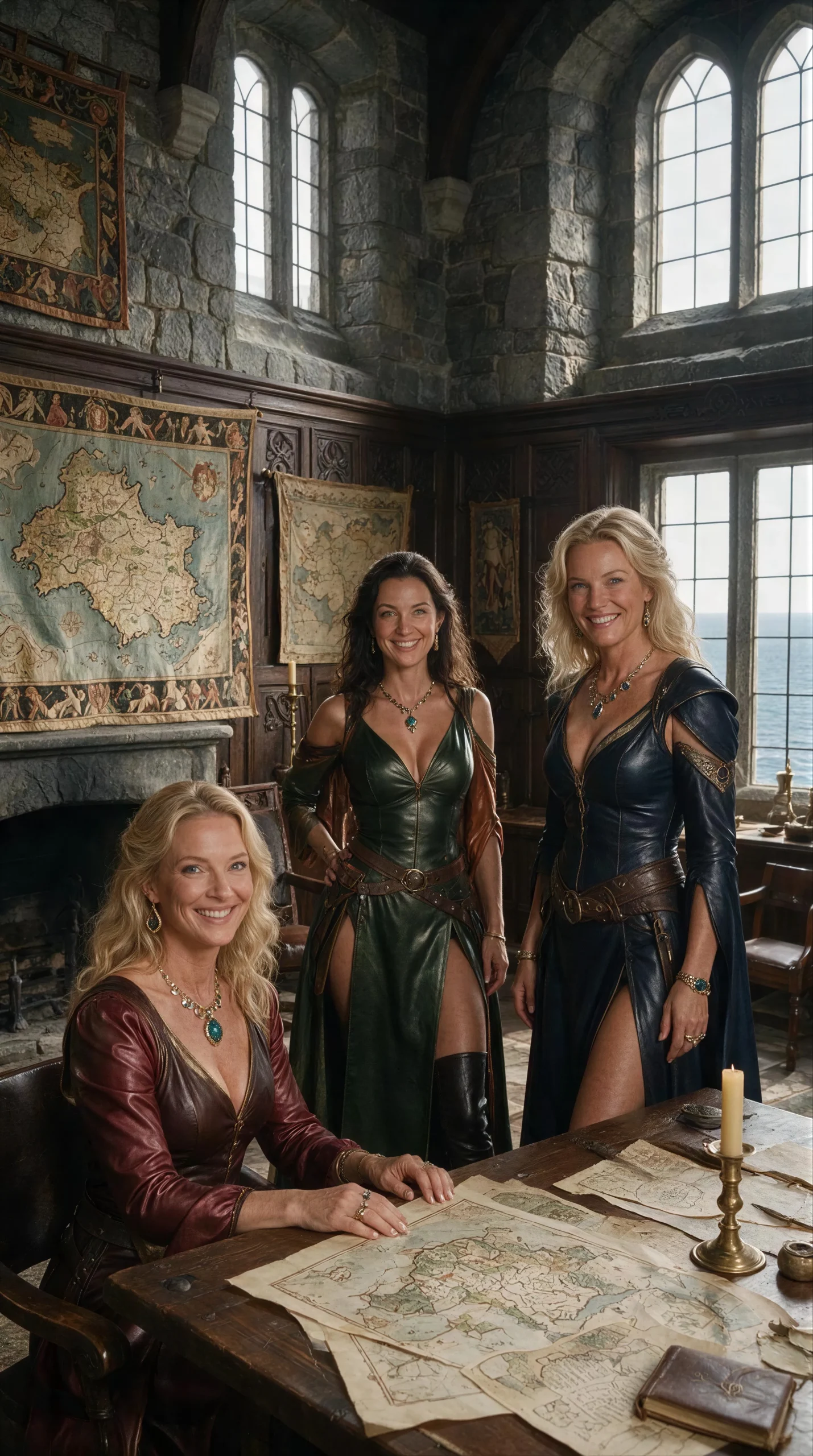
Where Wealth Flows Like Water, Devotion Dressed in Silk, and the Greatest Fortune Is Found in the Courage to Serve Something Magnificent
There is a truth the world does not teach.
It is not found in the cold ledgers of merchant guilds, nor in the brittle lectures of academics who have never built anything. It is not whispered in the courts of kings who mistake crowns for competence.
It is found here.
In a city where a woman in rough-spun wool discovers that her mind—sharp, relentless, hungry—is not a curse but a key. In a palace where the maps gleam with glossy enamel routes and the air smells of beeswax and old paper and quiet, absolute power. In the presence of a man who does not demand devotion but earns it, not through force, but through the devastating simplicity of seeing what others refuse to see.
The Merchant Sovereign’s Court is not merely a story. It is an invitation.
An invitation to witness what happens when brilliance is given room to flow. When a woman sheds the wool that has scratched her skin and traps her spirit, and dons the satin that moves with her—sleek, purposeful, unburdened. When the act of giving oneself fully to a vision larger than oneself is revealed not as surrender, but as the most profound form of self-actualisation.
You will follow Elara from the freezing counting house of her father’s failing business to the candlelit Map Room where empires are drawn in enamel and gold. You will watch her learn that wealth is not a fortress to be guarded but a river to be directed. You will feel the glossy leather of a collar placed not in bondage, but in belonging.
And somewhere—between the carrier pigeon messages and the forward contracts, between the riots and the revelations—you will feel something stir.
A recognition.
That the deepest needs are not met by struggle, but by alignment. That true wealth is not hoarded, but flowed. That the most powerful thing a person can do is not to build walls, but to build systems—systems of trust, of purpose, of devotion that elevates everyone within them.
This is a story of logistics as love. Of supply chains as sacrament. Of a man who understood that the greatest power is not to destroy, but to sustain.
It is a story for those who are ready.
Ready to see where the river must go.
The satin gleams. The ledgers whisper. The Sovereign waits.
Turn the page. The flow begins.
Chapter One: The Wool and the Wound
The wool scratched.
It had always scratched—a persistent, maddening friction against the underside of her arms, the curve of her neck, the soft hollow of her throat. It was the texture of her life: coarse, unyielding, a fabric that fought the body it was meant to clothe. Elara pulled at the collar of her shift, a gesture so habitual she no longer registered it, and bent lower over the ledger.
The counting house of Aldric Merrow was a tomb of paper and regret. It occupied the ground floor of a narrow building on Thirteenth Lane, squeezed between a tallow chandler whose wares stank of rendered fat and a scrivener whose quills scratched ceaselessly through the walls. The ceiling was low, the windows grimed with the soot of a thousand winters, and the air held the particular chill of a space that had never known a proper fire. A single tallow candle guttered on the desk, its flame bending in the draught from the ill-fitting door, casting trembling shadows across the columns of figures that stretched before her like the bars of a cage.
Her father sat across the room in his high-backed chair, a piece of furniture older than Elara and more broken. Aldric Merrow had been a merchant once—a man of substance, of standing, of a certain sturdy pride that manifested in the quality of his coats and the firmness of his handshake. That man was gone. The man who remained was a husk, a figure of skin and bone wrapped in a woollen dressing gown that had once been green and was now the colour of moss left too long in shade. His hands, which had signed contracts and weighed silver, lay motionless on the armrests, as if the will to move them had quietly departed during the night and neglected to inform the rest of him.
Elara did not look at him. She could not. To look was to acknowledge, and to acknowledge was to feel the grief that sat in her chest like a stone dropped into still water—heavy, silent, sending ripples through everything.
Instead, she looked at the numbers.
Numbers did not fade. Numbers did not disappoint. Numbers, when properly understood, revealed the architecture of truth—the hidden corridors where profit leaked away, the secret chambers where value was stolen, the load-bearing walls of commerce that, when compromised, brought the entire structure down.
And the structure of Thornhaven’s grain trade was, she could see with crystalline precision, being deliberately compromised.
She traced a column with her fingertip, the calloused pad of a hand that had hauled crates and mucked stables and scrubbed floors—hands that had once been destined for finer things, or so her mother had whispered in the years before the fever took her. The numbers told a story, and the story was this:
The grain harvests for the past three seasons had been adequate. Not abundant, but adequate—sufficient to feed the city and leave a surplus for trade. Yet the stores in the city granaries were depleting at a rate that defied consumption. The gap between supply and disappearance was too wide for spoilage, too consistent for theft, too systematic for accident.
She turned the page. The parchment was rough beneath her fingers, a coarse fibre that reminded her, unpleasantly, of her own clothing. She found the tariff records—fees paid at the King’s Bridge for goods entering the city. The numbers climbed, season after season, a steady, inexorable ascent that bore no relation to the official tariff schedule. Someone was charging more than the posted rate. Someone was skimming.
And the delays. She had heard the drivers speak of them in the yard—complaints muttered over ale about wagons held at the bridge for days, sometimes weeks, while Guild inspectors examined cargo with a slowness that could only be deliberate. Grain sat in wagons. Grain in wagons, in autumn rain, in the damp of a bridge shadowed by stone walls, began to rot. Rotted grain was refused entry. Refused grain was sold at a fraction of its value to—Elara turned another page, her breath catching—to a holding company called Bridge Stores Limited.
Bridge Stores Limited was owned, according to the Guild’s own registry, by one Vorthane Cassel, Guildmaster of the Thornhaven Merchant Guild.
The circle closed. The pattern was complete. A perfect, gleaming architecture of corruption: control the bridge, delay the traffic, degrade the goods, buy the degraded goods at a pittance, sell them at market price, and pocket the difference. The Guild was not merely taxing commerce; it was manufacturing scarcity and profiting from the manufacture.
Elara sat back. The candle flame steadied for a moment, and in its brief clarity, she saw her own reflection in the dark window—a thin face, sharp-featured, framed by dark hair that she kept braided and pinned because loose hair, like loose wool, caught on things and slowed you down. Her eyes, her mother had always said, were her best feature: dark, deep-set, and possessed of a focus that could be unsettling. Tonight, they burned with something that was not anger—anger was too hot, too chaotic—but something colder and more durable. Clarity. The clarity of a mind that has found the thread of a problem and will not let go until the entire tapestry is unravelled.
“You’ve been at those books for six hours.”
Her father’s voice, once robust, was now a dry rustle, like wind through dead leaves. Elara looked up. Aldric Merrow was watching her with the one expression he still seemed capable of: a weary, affectionate helplessness, as if he were observing a fire he could neither stoke nor extinguish.
“Seven,” she corrected gently. “I started after the noon bell.”
“And what have you found?” He asked it the way a man asks about the weather when he already knows it is raining.
“The reason we are failing,” Elara said. She rose, carried the ledger to his chair, and placed it on his lap with the careful reverence of a daughter laying an offering at an altar. “Look. Here. The tariff discrepancies. And here—the correlation between bridge delays and Bridge Stores’ purchase records. Father, the Guild is not taxing us. They are bleeding us. Bleeding everyone. They have built a machine that turns prosperity into scarcity and scarcity into profit.”
Aldric Merrow looked at the numbers. His eyes, once sharp as a merchant’s blade, moved slowly across the columns, and Elara watched the comprehension arrive and depart like a tide that could no longer reach the shore. He understood. She could see that. But understanding, for the man her father had become, was merely another form of suffering.
“What would you have me do, Elara?” he said. The words were not dismissive. They were genuinely, terribly helpless. “Complain to the Guild? The Guild is Vorthane. Complain to the council? The council is in Vorthane’s pocket. Complain to the crown? The crown has not looked south of the river in a decade.”
“Go to the Sovereign,” Elara said.
The silence that followed was not empty. It was full—full of the weight of a name that was spoken rarely in Thornhaven and never lightly. The Merchant Sovereign. The man who owned the eastern docks, the bonded warehouses, the river fleet, and, it was whispered, the loyalty of more people than the Guild could count or control. He was not a nobleman. He was not a politician. He was something rarer: a man who had built an empire not on titles or bloodlines, but on the simple, devastating principle that wealth, properly directed, could shape the world.
Aldric Merrow shook his head. “No.”
“Father—”
“No, Elara.” His voice, for a moment, held a ghost of its old authority. “The Sovereign’s world is not our world. He deals in fortunes, not in the scraps of a failing merchant house. And you—” He stopped, and the halt was so abrupt it seemed to physically pain him. “You are my daughter. Not a factor. Not a broker. Not a petitioner.”
“I am the only person in this house who can read these ledgers and understand what they mean,” Elara said. Her voice was quiet, but it carried the particular force of an irrefutable truth. “You taught me to read them, Father. You taught me to see the patterns. You taught me that numbers do not lie, even when the men who write them do. And the numbers say that unless someone with the power to act on this knowledge hears it, Thornhaven will face a famine within two seasons. Not because the grain is not there, but because the Guild will have hoarded it all.”
Aldric Merrow looked at his daughter. In the guttering candlelight, he saw not the child he had rocked to sleep, but the woman she had become—sharp, fierce, and possessed of a mind that, had she been born a son, would have commanded a counting house of her own by now. The injustice of it, the waste of it, settled on him like a second illness.
“Women do not trade, Elara,” he said. But the words were a reflex, a recitation of a law he had never questioned and which now, hearing it spoken aloud in the presence of her undeniable competence, sounded like the small, cowardly thing it was.
“Women do not trade,” Elara repeated. “Women do not speak to the Guild. Women do not enter the counting house. Women do not own property. Women do not decide. I have heard these words my entire life, Father. And while I have been hearing them, the Guild has been stealing the bread from this city’s mouth. Perhaps it is precisely because women do not trade that the men who do have grown so comfortable in their corruption. No one looks. No one questions. No one sees what is right in front of them, because the only people with the leisure to look are the people who have been told to look away.”
The room was very still. The tallow chandler next door had closed his shop; the scrivener’s quills were silent. The world had contracted to this small, cold room and the two people in it—one fading, one igniting.
“Go, then,” Aldric said. The words fell from him like stones dropped into deep water. “Go to the Sovereign. Tell him what you have found. But Elara—” He reached out and took her hand. His grip was frail, the bones close to the surface, but the intention was iron. “Do not go as a beggar. You are not a beggar. You are the only person in this city who has read these ledgers and understood them. That is not a petition. It is a weapon. Carry it as one.”
Elara squeezed his hand. The wool of her dress scratched her arm as she leaned forward, and she made a silent, furious promise to herself: one day, she would wear something that did not fight her. Something that moved with her, that caught the light, that felt against her skin like a second self—smooth, purposeful, and unashamed.
“One more thing,” Aldric said, and his voice dropped to a murmur, as if the walls themselves might carry the words to unfriendly ears. “The Sovereign’s household. You will have heard the rumours.”
“I have heard that he is surrounded by women,” Elara said carefully. “That his advisors, his factors, his estate managers are all—”
“Women,” Aldric finished. “Women of intelligence and ambition. Women who, in another life, would have been merchants, scholars, or statesmen. The Guild calls it perversion. The council calls it scandal.” He paused. “I call it the only sensible thing I have heard of that man doing.”
Elara stared at her father. She had not expected this—not from the man who had recited the litany of women’s limitations like a prayer.
“I was not always a failing merchant, Elara,” he said, reading her expression. “I was once a man who moved in wider circles. And in those circles, I saw the Sovereign’s court. I saw women in gowns of satin—real satin, Elara, not the cheap stuff they sell in the Thirteenth Lane markets—gowns that moved like water, that caught the light like polished glass. I saw them discussing tariffs and tonnage with the precision of generals. I saw them treated not as ornaments, but as instruments. Valued. Respected. Listened to.” His voice cracked. “I saw what you could have been, if the world were different. And I wept for it. Not because it was sad, but because it was beautiful, and I knew you would never see it.”
Elara felt something shift inside her—a tectonic movement, deep and slow, the kind that reshapes landscapes. She had spent her life believing the world was a fixed thing—walls and rules and limitations, all of them rough as wool, all of them scratching at her until she bled. And now her father, in his broken chair, in his broken house, was telling her that somewhere in this city there was a place where the walls were different, where the fabric was different, where a woman with a mind like hers was not an anomaly but an asset.
“I will go tomorrow,” she said. Her voice was steady. Her hands were not.
“Tomorrow,” Aldric agreed. He released her hand and settled back into his chair, and for a moment—just a moment—he looked like the man he had been: a man of substance, of standing, of a certain sturdy pride that manifested in the set of his shoulders and the clarity of his gaze. “Wear something better than that wool. If you go to the Sovereign, you go as what you are: a woman of intelligence. Not a supplicant.”
Elara looked down at her dress. The wool was grey, pilled at the cuffs, thin at the elbows. It was the dress of a woman who had been told, every day of her life, to be small. She would not wear it to the Sovereign’s court. She would not wear it again at all.
But what would she wear? She had no satin. She had no silk. She had nothing that moved like water or caught the light like polished glass. She had only wool, and wool was the fabric of a life that did not fit.
She would go as she was. She would go in wool, if she must, and let the numbers speak for themselves. Because numbers, unlike fabric, did not lie. Numbers did not scratch. Numbers did not fight the body that carried them.
And the numbers said that the river was being dammed, and the man who could break the dam was waiting.
She did not sleep that night.
She sat at the desk, the candle burning down to a stub, and she copied the relevant figures onto a single sheet of clean parchment. She did not copy everything—only the pattern, the architecture of corruption, laid bare in a sequence of numbers that told a story as clearly as any bard’s tale. She worked with the focus of a woman who understands that this single document, if placed before the right eyes, could change everything.
When she finished, she held the parchment up to the candle’s dying light. The ink gleamed—wet, glossy, a river of black on cream. It was the most beautiful thing she had ever made.
She thought of her father’s words. Women in gowns of satin. Discussing tariffs and tonnage with the precision of generals. She thought of the Sovereign, a man she had never met but who already occupied a space in her imagination that was vast and luminous—a man who saw value where others saw nothing, who built systems where others built walls, who surrounded himself with brilliance not out of vanity but out of the simple, devastating recognition that brilliance, properly directed, could reshape the world.
She thought of the wool against her skin, and she thought of satin, and the distance between them seemed, for the first time, not infinite but merely a matter of choice.
Someone, somewhere, had chosen to wear satin. Someone had chosen to build a world where women moved in light and spoke with authority and were valued not despite their intelligence but because of it. That someone was the Merchant Sovereign. And tomorrow, Elara would stand before him and offer the only thing she had: the truth, written in numbers, gleaming like a river on a page.
It would be enough.
It had to be.
Dawn came grey and cold, as it always did in Thornhaven in the late autumn. Elara rose from the desk where she had not slept, washed her face in water that felt like a slap, and dressed. She looked at her wardrobe—a meagre collection of wool shifts and practical skirts, all of them variations on the theme of scratchy, grey, and defiantly unlovely.
She chose the least offensive garment: a dark wool dress, fitted at the waist, with a collar that she turned up against the morning chill. She braided her hair tightly and pinned it. She looked at herself in the small, spotted mirror that hung by the washstand.
A woman in wool. A woman with a pattern in her hands and a fire in her chest and no idea whether the man she was about to approach would even see her.
She thought of her father, asleep now in his chair, too weak to climb the stairs to his bed. She thought of the grain that was rotting in wagons on the King’s Bridge while Vorthane Cassel counted his stolen silver. She thought of the city, unaware that it was being slowly, systematically starved.
And she thought of satin. Not as a fabric, but as a principle. The principle of moving through the world without friction. Of catching the light. Of being, rather than fighting to become.
She rolled the parchment into a tight cylinder, slipped it into a leather tube she had found in her father’s desk, and stepped out into the cold.
The streets of Thornhaven were waking. Bakers’ chimneys breathed flour-scented smoke into the grey air. Carters cursed their mules. A woman in a cloak of deep green satin—satin, here, on Thirteenth Lane, where no one wore satin—emerged from a doorway and walked with unhurried purpose toward the market square. Her cloak moved like oil on water, like light on a river, like everything Elara’s wool was not. The woman’s chin was high, her stride long, and the way she wore that fabric—draped, confident, as if it were not a luxury but a necessity—made something in Elara’s chest clench with a longing so acute it was almost physical.
The woman glanced at Elara as she passed. Their eyes met for a fraction of a second. The woman’s gaze was sharp, assessing, and in it Elara saw not contempt but recognition—the look of one who has worn the wool and chosen the satin and knows, with bone-deep certainty, that the distance between them is not a matter of birth or fortune but of being seen.
The woman was gone in a rustle of green. Elara stood on the step, the leather tube in her hand, the cold biting at her ankles, and felt the world tilt slightly on its axis, as if a door she had not known existed had opened a crack and let in a sliver of light.
She walked toward the palace.
Chapter Two: The Throne of Enamel
The palace was not what she expected.
Elara had imagined a fortress—something heavy, something that declared its power through mass and stone and the crude vocabulary of intimidation. She had imagined walls thick enough to resist siege, towers bristling with the silent threat of archers, gates of iron that groaned with the weight of authority. She had imagined, in short, the architecture of the Guild: power as bulk, dominance as bludgeon.
What she found was a river.
The Sovereign’s palace occupied a rise at the eastern edge of Thornhaven, where the city’s grid of narrow lanes opened onto a wide, cobbled approach lined with pollarded limes. The building itself was pale—limestone, she realised as she drew closer, not the grey granite of the city’s older structures, but a pale, almost luminous stone that caught the weak autumn sun and held it, so that the palace seemed to glow with a light that was not entirely borrowed. Its lines were clean, its windows tall and generous, its roof a sweep of dark slate that gleamed like the back of a seal breaking the surface of still water. It did not dominate the landscape; it belonged to it, as if the land itself had chosen to rise here, in this form, for this purpose.
The gates were open.
This was the first surprise. The gates of every important building in Thornhaven—the Guildhall, the Council House, the Treasury—were closed, guarded, and designed to communicate a single message: You are not welcome. The Sovereign’s gates were wrought iron, slender and elegant, and they stood ajar, as if the building had exhaled and the breath had pushed them open. A single guard stood beside them—not a mailed soldier, but a woman in a coat of dark leather so supple it caught the light like water on a stone. The leather was polished to a gloss that spoke of care, of pride, of a garment that was not merely worn but maintained, as one maintains a blade or a ledger. The woman’s hair was drawn back in a single, severe braid, and her eyes, when they found Elara, were not hostile but attentive—the eyes of someone accustomed to assessing not threats, but intentions.
“Your business,” the woman said. It was not a question. It was an invitation to declare.
Elara tightened her grip on the leather tube. “I have information for the Sovereign. Concerning the grain trade.”
The woman’s expression did not change, but something behind her eyes shifted—a flicker of interest, quickly controlled, like a card player who has drawn a useful hand and refuses to show it. She looked at Elara’s wool dress, at the calloused hands, at the braided hair, and Elara felt the assessment like a physical thing—not cruel, not dismissive, but thorough, the way a physician examines a patient or a jeweller examines a stone: looking for the flaw that disqualifies or the quality that elevates.
“Follow me,” the woman said.
She turned and walked through the gates, and Elara followed, and the world changed.
The corridors of the Sovereign’s palace were a revelation.
They were not the dark, smoke-stained passages of the Guildhall, where torches guttered in iron brackets and the walls sweated with damp. They were bright—lit by tall windows of glass so clear it seemed there was no barrier at all between inside and outside, only a column of light. The floors were stone, but not the rough cobble of the city streets; they were laid in a pattern of pale and dark tiles, polished to a gloss that reflected the light upward, so that the corridors seemed to glow from within, as if the building itself were luminous.
And the women.
Elara had not expected the women. Her father’s words had prepared her, vaguely, but words are poor vessels for the reality of what she encountered. They moved through the corridors with the unhurried purpose of people who know exactly where they are going and why. They wore gowns of silk—not the coarse silk of the Thirteenth Lane markets, but silk that moved like a living thing, that caught the light and threw it back in colours that shifted as the wearer moved. One woman passed Elara in a gown of deep blue that turned to green as she walked, the fabric changing like the surface of a river in dappled light. Another wore a sheath of dark red satin that clung to her form with a fidelity that was not indecent but precise—a garment that did not hide the body but honoured it, the way a well-kept ledger does not hide the numbers but presents them with clarity and pride.
Their voices reached Elara in fragments as she passed open doors: “…tonnage from the eastern fleet has increased by a factor of three…” “…the tariff at Saltmere is unsustainable; we need to renegotiate the terms…” “…the grain futures are climbing; if we lock in now, we save twelve per cent before the winter…”
These were not the conversations of ornaments. These were the conversations of operators. Each woman spoke with the cadence of authority—the rhythm of someone who is not asking permission but making decisions, who is not reporting to a superior but coordinating with an equal. Elara felt, for the first time in her life, that she was walking through a world that had been built for minds like hers.
Her guide led her past a chamber where three women sat around a table covered in charts, their gowns a study in contrast—one in polished leather the colour of dark honey, one in slate-grey silk, one in a deep, glossy black that seemed to absorb the light and give it back as a soft, steady gleam. They were arguing—not with heat, but with precision, each point a scalpel, each counterpoint a suture. One of them, the woman in grey silk, looked up as Elara passed, and her eyes held the same expression the gate-guard had worn: assessment, recognition, and something else—something that might have been welcome, as if the mere presence of a new mind in these corridors was a cause for quiet satisfaction.
“The Sovereign will see you in the Map Room,” her guide said, stopping before a door of dark, polished wood. She opened it and stood aside.
Elara stepped through.
The Map Room was the most beautiful room Elara had ever entered.
It was not beautiful in the way that a cathedral is beautiful—through scale and grandeur and the deliberate intimidation of the small by the vast. It was beautiful in the way that a perfect equation is beautiful, or a well-constructed argument, or a table of figures that reveals, at last, the hidden order beneath the chaos. It was beautiful because it was functional, and its function was the comprehension of the world.
The room was circular, its domed ceiling painted the deep, glossy blue of a midnight sky, with constellations picked out in silver leaf that caught the light from the tall windows and scattered it in tiny, drifting points. The walls were lined with cabinets of dark wood, their doors fitted with glass panels behind which rolled maps were visible—hundreds of them, perhaps thousands, their edges crisp, their surfaces clean. The cabinets were interspersed with shelves holding instruments: astrolabes of polished brass, sextants with mirrors so bright they seemed to hold their own small skies, compasses in cases of glossy leather, and instruments Elara did not recognise—complex, gleaming things of brass and crystal that spoke of sciences she had only glimpsed in her father’s old, neglected books.
But the room’s heart was the table.
It stood in the centre, a vast, circular surface of dark wood, and upon it was laid a map of such detail and craftsmanship that Elara stopped breathing for a moment, the way one stops breathing before a thing of overwhelming, almost painful beauty. The map was not drawn on paper or parchment; it was rendered in enamel—glossy, luminous enamel, applied with a precision that made every river a ribbon of blue glass, every road a thread of gold, every forest a mosaic of green so deep it seemed to rustle. The cities were marked in crimson, the ports in white, the trade routes in a fine silver line that connected them like veins in a living body. The surface of the map gleamed under the light, smooth and flawless, and Elara’s fingers itched to touch it—to run her hand over the glossy rivers and the polished roads, to feel under her fingertips the world rendered in a medium that did not fade or tear or rot.
This was not a map. This was a model of power—a physical manifestation of the mind that had conceived it. Every route, every port, every city was a decision, a choice, a thread in a web of commerce and influence that stretched farther than Elara had imagined the Sovereign’s reach extended. She saw trade routes she did not know existed, connections between distant ports that she had never considered, and the logic of them—the elegant, irrefutable logic of a system designed not to conquer but to flow—made her own analysis, rolled up in the leather tube she carried, feel suddenly, terrifyingly small.
“Stop.”
The voice came from behind her, and it was not loud—it was the opposite of loud, the way still water is the opposite of a torrent—but it filled the room completely, the way a single note from a perfectly tuned instrument fills a hall. Elara turned.
The Merchant Sovereign stood by the window, half-turned from the light, and Elara’s first thought was that he was not what she had expected, and her second thought was that of course he was not, because a man who built systems like the one she was standing in would never be what anyone expected, because expectation is a form of assumption, and assumption is the enemy of perception.
He was tall—taller than her father, taller than the Guild clerks, taller than any man she had encountered in the cramped world of Thirteenth Lane—but his height was not the first thing she noticed. The first thing she noticed was his stillness. He stood the way a deep lake lies: motionless on the surface, vast beneath. His coat was charcoal, tailored with a severity that was not austere but exact, the fabric fine and matte against the glossy enamel of the map and the gleaming wood of the cabinets. His gloves were leather—dark, supple leather that had been polished to a soft sheen, and they fit his hands with the intimacy of a second skin.
His face was sharp. That was the word that came to her—not handsome, not beautiful, but sharp, as if the bone structure beneath the skin had been designed for a single purpose: to cut through the irrelevant and reveal the essential. His jaw was clean, his cheekbones high and defined, his nose straight and narrow. His hair was dark, close-cropped, and his eyes—
His eyes were the deepest brown she had ever seen, and they were looking at her with an attention that was not aggressive but total, the way a lens focuses light: gathering everything, excluding nothing, and in the gathering, revealing what was always there but unseen.
“You stopped,” he said. “At the map. What did you see?”
Elara swallowed. Her mouth was dry, and her heart was beating in a way that was not entirely fear—there was fear in it, certainly, the fear of a woman who has brought a single sheet of analysis to a man who owns the world rendered in enamel, but there was also something else, something she could not name, something that pulsed in the space between fear and wonder.
“I saw a system,” she said. Her voice came out steadier than she expected. “I saw a body with arteries and veins. I saw where the blood flows freely and where it is clotting. I saw—” She hesitated, then committed. “I saw that the clotting is not at the periphery. It is at the centre. At the King’s Bridge.”
The Sovereign did not move. He did not nod, did not frown, did not gesture. He simply looked at her, and the silence between them was not empty but pregnant—full of the potential of everything that might be said next, every word weighted with the gravity of a mind that did not waste them.
“You have come to tell me something,” he said. “I can see it in the way you hold that tube—tight, but not white-knuckled. You are nervous, but not afraid. That is the correct ratio. Fear makes you small; nervousness makes you sharp. Speak.”
Elara unstoppered the leather tube, drew out the parchment, and unrolled it on the enamel map. The ink gleamed against the cream surface, the columns of figures aligning with the rivers and roads beneath them as if they had always belonged there. She placed her finger on the first column and began.
“The grain harvests for the past three seasons have been adequate. The stores are depleting at a rate that exceeds consumption by a factor of—” she glanced at the figures, “—approximately twenty-three per cent. The discrepancy correlates precisely with tariff increases at the King’s Bridge. The tariffs exceed the posted rate by a margin that cannot be explained by administrative cost. The excess revenue flows to a holding company called Bridge Stores Limited, which purchases grain refused entry at the bridge—grain that has been deliberately degraded by delays engineered by Guild inspectors—at a fraction of its market value and resells it at full price. The holding company is owned by Vorthane Cassel.”
She paused. The Sovereign had not interrupted. He had not taken his eyes from her face. She could feel his attention like a physical warmth—the focused, undivided attention of a mind that was not merely hearing her words but consuming them, the way dry earth consumes rain: completely, gratefully, without waste.
“The pattern is consistent across three seasons,” she continued. “The Guild is not taxing commerce. They are manufacturing scarcity. They have built a mechanism that converts prosperity into profit by ensuring that goods are degraded, refused, and resold. The city loses. The farmers lose. The Guild profits. And within two seasons, if the pattern continues, Thornhaven will face a shortfall that cannot be covered by the remaining stores.”
She fell silent. The parchment lay on the enamel map, its ink gleaming, its columns of figures a small, precise indictment of a corruption so systematic it had become invisible to everyone except a woman in a wool dress in a counting house on Thirteenth Lane.
The Sovereign looked at the parchment. He looked at it for a long time—long enough for Elara to become acutely aware of the silence, of the glossy surface of the map beneath her fingers, of the distant murmur of women’s voices in the corridors, of the beating of her own heart, which had settled into a rhythm that was no longer fear but something closer to anticipation, the feeling of standing at the edge of a high place and knowing that the fall is not a fall but a flight.
“You read these ledgers yourself,” he said. It was not a question.
“Yes.”
“Your father’s ledgers.”
“Yes.”
“And you saw what no one else in this city has seen. Not the council. Not the Guild members who are not Cassel. Not the merchants who are being bled. You saw it.”
“I had the leisure to look,” Elara said. “And the inclination. My father taught me to read numbers as other children are taught to read letters. Numbers are a language, and I am fluent in it.”
The Sovereign’s expression did not change, but something in his eyes shifted—a deepening, a widening, as if a door behind the pupils had opened onto a room she could not see. He reached out and took the parchment from the map, holding it up to the window light, examining the ink, the columns, the precision of the handwriting.
“Your script is excellent,” he said. “Legible, consistent, and economical. You waste no space. That tells me you think the way you write: with precision and without excess.” He set the parchment down and turned to face her fully, and the full weight of his attention was like standing in a beam of concentrated light—warm, revealing, and impossible to hide from.
“I will ask you a question, Elara Merrow. I will ask it once, and I will expect an answer that is not rehearsed, not cautious, and not designed to please me. I will expect an answer that is true.”
She braced herself. The wool of her dress scratched her arm, and she did not pull at it. She would not fidget before this man. She would not be small.
“If you were Grain-Mistress of Thornhaven,” he said, “what would you do?”
The question landed like a stone in still water, and the ripples spread through her mind, and in the spreading, everything she had calculated, everything she had theorised, everything she had whispered to herself in the cold counting house at midnight rose to the surface with a clarity that was almost blinding.
She did not hesitate.
“I would bypass the bridge entirely,” she said. “The bridge is a bottleneck because it is a single point. Single points fail. I would establish alternative routes—river routes, primarily, using the eastern tributaries that the Guild has never controlled because they were deemed too shallow for heavy traffic. They are shallow, but not impassable. With lighter vessels and bonded warehouses at the river landings, goods could be offloaded and transported the final distance by cart. The Guild’s bridge becomes irrelevant.”
She took a breath. The Sovereign was watching her with an expression she could not read—still, intent, the eyes of a man who is not merely listening but cataloguing, filing each word in a system so vast and so precise that she could not imagine its boundaries.
“Second,” she continued, “I would build an information network. The Guild’s power depends on the lag between knowledge and action—they know the grain is coming, the merchants do not. A system of carrier pigeons, relayed between the farming provinces and the city, would give us price information days before the Guild receives it. We would know the market before the market knows itself. We could buy early, sell strategically, and never be subject to the Guild’s manufactured delays.”
“Third,” she said, and her voice was stronger now, the words coming not from a place of calculation but from a place of conviction so deep it felt like bedrock, “I would establish forward contracts with the farmers—agreements to buy their grain at a fixed price before the harvest. This gives the farmers financial security and guarantees our supply at a known cost. The Guild cannot manipulate a price that has already been agreed. The contract is the antidote to the speculation. It is the satin lining in the rough wool coat of the market.”
She stopped. The last analogy had come unbidden, and she felt a flush of heat rise to her cheeks—not embarrassment, but the sudden, sharp awareness that she had revealed more than her analysis. She had revealed her metaphor, the private language of her inner life, the vocabulary of wool and satin that she had never spoken aloud.
The Sovereign’s eyes held hers. For a moment, the room was perfectly still—no sound from the corridors, no murmur of voices, no creak of the building settling into its foundations. Just the two of them, and the glossy enamel map, and the parchment with its gleaming ink, and the question that hung in the air between them like a held breath.
“Satin,” he said. The word was quiet, almost private, as if he were tasting it. “You used that word deliberately.”
“I—” Elara began, then stopped. She would not apologise. She would not retreat. “Yes. Satin. Because the system I am describing is not a weapon. It is a fabric. A way of moving through the world without friction. The Guild operates through friction—delays, tariffs, obstruction. They are wool. They scratch and they catch and they slow everything down. What I am describing is a system that slides. That moves. That catches the light and gives it back. That is what satin does. That is what good logistics does. It is not force. It is flow.”
The Sovereign looked at her for a long, silent moment. Then he did something she did not expect.
He smiled.
It was not a wide smile—not the grin of a man who has been entertained or the smirk of a man who has been proven right. It was a small, precise expression that lifted the corners of his mouth and softened the sharp lines of his face into something that was not gentle, exactly, but warm, the way the first light of morning is warm—not hot, not blazing, but present, and real, and full of the promise of everything that is coming.
“You have answered well,” he said. “You have answered as a woman who does not merely read numbers but thinks in them. That is rare. That is valuable.”
Elara felt something shift in her chest—the stone of grief and frustration that had sat there for months, for years, for the entirety of her conscious life, moving—not gone, not dissolved, but shifting, as if the ground beneath it had changed and the stone was beginning, at last, to roll.
“I will not offer you a position today,” the Sovereign said. “That would be premature. I do not make decisions based on a single conversation, however compelling. I make decisions based on evidence.”
He turned to the map and placed his gloved finger on a point west of Thornhaven—a cluster of small villages connected by thin gold roads.
“Return tomorrow,” he said. “Bring me the cost of grain in every village within thirty leagues of this point. Gather the figures yourself. Speak to the farmers. Look at their fields. Note the quality of their stores and the condition of their roads. Do not send a messenger. Do not delegate. Go with your own eyes and your own hands and your own mind, and bring me numbers that are not estimates but truths.”
He turned back to her. “If your numbers are accurate, we will speak further. If they are not, you will have spent three days in the countryside, which is its own form of education. Either way, you will not have wasted your time.”
Elara stared at him. The task was enormous—thirty leagues of territory, dozens of villages, hundreds of farmers. It would take days of riding, of talking, of recording, of analysing. It would test her endurance, her patience, her ability to extract information from people who had no reason to trust a stranger asking about grain prices.
It was the most exciting thing anyone had ever asked her to do.
“I will leave within the hour,” she said.
“One hour,” he agreed. “My stable will provide a horse. My kitchen will provide provisions. And Elara—”
She paused at the door.
“Wear something better than wool,” he said. His voice was quiet, and the words were not a command but a suggestion—gentle, precise, and delivered with the same care he would use to point out a flaw in a ledger or a crack in a foundation. “Not for me. For yourself. You are about to ride into a world that will judge you by your appearance before it hears your words. Give them something to look at that matches what you have to say. The women you passed in my corridors understand this. It is not vanity. It is strategy.”
Elara’s hand was on the doorframe. The polished wood was smooth under her fingers—glossy, cared for, a surface that had been maintained with the same precision as the enamel map and the leather gloves and the silk gowns. Everything in this building was maintained. Everything in this building mattered.
“I don’t own anything better than wool,” she said. The admission felt like removing a layer of skin—raw, honest, and more vulnerable than anything she had revealed in her analysis.
The Sovereign regarded her for a moment. Then he reached into a cabinet beside the window and drew out a folded garment. He held it out to her—a tunic, she saw as she approached, of fine, smooth satin. The colour was dark amber, like the last light of a autumn evening caught in honey. It was simple in cut—no embroidery, no ornament—but the fabric had a weight and a sheen that spoke of quality so fundamental it did not need decoration, the way a perfect number does not need explanation.
“This belongs to the household,” he said. “It is not a gift. It is a tool. A woman who rides into farming villages in wool is a stranger. A woman who rides in satin is a statement. The farmers will remember you. They will talk to you. They will tell you what they would not tell a stranger, because a woman in satin is not a woman in need—she is a woman of substance, and people speak openly to those they believe have nothing to gain from deception.”
Elara took the tunic. The satin was cool and impossibly smooth against her fingers—so different from the wool that had scratched her every day of her life that the sensation was almost shocking, like the first warm day after a long winter. She held it, and the fabric moved in her hands like a living thing, catching the light from the window and throwing it back in a soft, amber glow.
“Take it,” the Sovereign said. “Wear it. And return with numbers that gleam as brightly as that fabric.”
Elara looked at him—at the sharp face, the deep eyes, the still, commanding presence of a man who had built a world where women in silk discussed tariffs and men in leather gloves handed out satin tunics as casually as other men handed out coins. She looked at the enamel map, gleaming with its rivers of glass and its roads of gold. She looked at the parchment, still lying on the map’s surface, her ink and his enamel merged into a single, luminous surface.
“Thank you,” she said. The words were inadequate—she knew that—but they were true, and in this room, in this building, in the presence of this man, truth was the only currency that mattered.
“Do not thank me,” he said. “Thank me with numbers.”
She turned and walked through the door, and the corridor swallowed her—bright, glossy, full of the murmur of women’s voices and the rustle of silk and the soft, purposeful sound of a world in motion. She pressed the satin tunic to her chest, and the fabric was cool and smooth against the rough wool of her dress, and the contrast was so sharp it was almost painful—the contrast between what she was and what she might become, between the life she had been given and the life that was, perhaps, being offered.
She did not look back. She did not need to. The Sovereign’s gaze was on her, she could feel it—the focused, total, undivided attention of a man who had seen, in a woman in a wool dress with a sheet of figures and a metaphor about satin, something that was worth seeing.
The stone in her chest rolled again.
And for the first time in her life, Elara Merrow felt the faint, terrifying, exhilarating stirring of a hope that was not a wish but a recognition: the recognition that she had been, all along, a river waiting for someone to see where she must go.
Chapter Three: The Roads of Gloss
The rain came on the second day.
It had been a companion since dawn—a grey, relentless, bone-soaking rain that fell not in dramatic sheets but in a fine, persistent curtain that found every gap in her clothing, every seam, every fold, and seeped inward with a patience that was almost malicious. The road, which had been a ribbon of packed earth when she left the first village, was now a slick, glossy channel of mud that sucked at her horse’s hooves with each step and sent up spatters of brown water that decorated her boots, her breeches, and the amber satin tunic she had worn with such careful pride that morning.
The satin. She had worn it as the Sovereign had instructed—worn it as a strategy, as a statement, as a tool—and for the first day, it had worked. The farmers in the villages south and west of Thornhaven had looked at her differently when she rode in on a horse wearing a tunic that caught the autumn light and threw it back like polished amber. They had seen not a stranger, not a beggar, not a desperate merchant’s daughter, but a woman of substance—a woman whose exterior matched the quality of her questions. They had spoken openly. They had shown her their stores, their fields, their careful, handwritten records of prices paid and prices received. They had trusted the satin.
But satin, for all its beauty, is not oilskin. And by the second day, the rain had found it, and the fabric that had gleamed like honey now hung dark and heavy against her skin, its smooth surface beaded with water, its weight doubled by the soaking. It clung to her—not with the scratching, fighting cling of wool, but with a heavier, sadder cling, the embrace of a fabric that was not designed for this and was suffering for it, and Elara felt each drop as if it were a small, cold reproach.
She was cold. She was wet. She was exhausted in a way that went beyond the physical—exhausted in the marrow, in the deep, private places where endurance is stored and drawn upon. She had ridden for two days, visited eleven villages, spoken to forty-three farmers, and recorded the price of grain in each one with a precision that would have satisfied the most demanding auditor. She had noted the condition of the roads—some passable, some appalling, one little more than a goat track that her horse had navigated with the weary resignation of an animal that has learned to distrust its rider’s sense of direction. She had observed the flow of goods: which villages were surplus producers, which were deficit consumers, which were trapped in a cycle of selling low to Guild agents and buying high from Guild stores. She had mapped it all—in her mind and on the parchment she kept dry in the leather tube strapped to her saddle—and the map she was building was not of enamel and gold but of mud and grain and the quiet, desperate mathematics of people trying to survive a system designed to bleed them.
And she had learned something the Sovereign had not asked for, something that was not in the numbers but in the spaces between them: the texture of the problem. The grain trade was not merely a matter of supply and demand, tariffs and delays. It was a matter of trust—or rather, its absence. The farmers did not trust the Guild. They did not trust the council. They did not trust the merchants who came to buy their grain, because the merchants came with scales that were rigged and prices that were fixed and contracts that were not worth the parchment they were written on. They trusted no one, and in the absence of trust, they hoarded—selling only what they must, keeping the rest, and creating, through their entirely rational suspicion, the very scarcity the Guild exploited.
The problem, Elara realised as her horse plodded through the mud toward the twelfth village, was not just logistical. It was psychological. The system was broken not merely because the bridge was a bottleneck, but because the people within the system had been taught, by years of exploitation, that the system was their enemy. To fix the logistics without fixing the trust would be to build a river with no banks—the water would flow, but it would spread and dissipate and accomplish nothing.
She needed to tell the Sovereign this. She needed to tell him that the numbers were only half the story, that the other half was written not in ink but in the wary eyes of farmers who had been cheated too many times to believe that anyone in a position of power would treat them fairly.
But first, she needed to get dry.
The twelfth village was called Millford, and it was, by the standards of the region, prosperous—or at least it had been. Elara rode into the single street between rows of stone cottages whose thatched roofs glistened with rain, and noted the signs of a community that had once thrived: a mill with a wheel that still turned, though sluggishly, in the rain-swollen stream; an inn with a sign that had once been painted and was now a ghost of its former colours; a smithy whose forge glowed red through the open door, a beacon of warmth in the grey afternoon. The villagers watched her from doorways and windows with the guarded curiosity of people who have learned that strangers bring either trouble or nothing, and rarely anything else.
Elara dismounted outside the inn, her boots sinking into the mud with a soft, sucking sound that seemed to encapsulate the entire journey. She was aware of how she looked—a woman in a soaked satin tunic, her hair escaped from its braid and hanging in dark, wet ropes around her face, her boots caked with mud to the knee, her leather tube clutched to her chest like a talisman. She was not, she reflected, the statement the Sovereign had intended.
The innkeeper was a broad woman with arms like a blacksmith and eyes like a hawk. She looked at Elara’s tunic—the quality of the fabric visible even through the mud and rain—and her expression shifted from suspicion to something more complex: a blend of curiosity and the canny assessment of a woman who has learned to read the relationship between a person’s clothing and their capacity to pay.
“Room?” she said.
“Information,” Elara said. “And yes, a room. And a fire. And if you have anything hot to drink, I will pay double.”
The innkeeper’s eyebrows rose. “Double for information and hot water? You’re either very rich or very desperate.”
“Very wet,” Elara said. “Which, at this moment, feels like the same thing.”
The innkeeper almost smiled. “There’s a fire in the back room. I’ll bring you something. You can stable your horse in the barn—second stall, the one with the dry hay.”
Elara saw to her horse first, because the horse had carried her through two days of rain and deserved better than to be left standing in the mud while she warmed herself. She rubbed the animal down with dry straw, filled the manger with hay, and checked its hooves for stones—a habit her father had taught her, years ago, when they had ridden together to the southern markets, back when riding was a pleasure and not a penance.
Then she went inside.
The back room of the Millford inn was small, low-ceilinged, and dominated by a stone fireplace in which a fire burned with the steady, orange glow of dry oak. The heat hit Elara like a physical force—a wall of warmth that made her skin prickle and her eyes sting and the cold that had settled into her bones begin, at last, to loosen its grip. She sat on a bench by the fire, and the warmth reached into her muscles and found the knots that two days of riding had tied, and began, slowly, patiently, to untie them.
The innkeeper brought her a cup of something hot and spiced—wine, she realised, mulled with cinnamon and clove and something darker, something that tasted of smoke and honey. She wrapped her hands around the cup and drank, and the heat spread from her throat to her chest to her stomach to her fingertips, and for a moment, she simply sat and felt it—the fire, the wine, the slow, luxurious thaw of a body that had been cold for two days and was now, at last, being reminded of what warmth meant.
She must have dozed, because when she opened her eyes, the fire had burned lower and the light in the room had shifted from the gold of afternoon to the amber of early evening. And someone was sitting across from her.
The woman was perhaps forty, with the kind of face that age improves rather than diminishes—strong bones, clear eyes, a mouth that looked as if it had been designed for the precise delivery of difficult truths. She wore a travelling coat of dark leather—not the stiff, creaking leather of a soldier’s jack, but a supple, polished leather that moved with her body like a second skin, its surface gleaming in the firelight with a gloss that spoke of oil and care and the quiet pride of a garment that is worn because it is good, not because it is expensive.
“Elara Merrow,” the woman said. Her voice was low, calm, and carried the particular authority of someone who is accustomed to being listened to—not because she demands it, but because what she says is always worth hearing. “I am the Harbour-Mistress. The Sovereign sent me.”
Elara sat up, the last cobwebs of sleep dissolving in a surge of alertness that was almost painful. “He sent you to find me?”
“He sent me to meet you,” the Harbour-Mistress corrected. “There is a difference. Finding implies you were lost. Meeting implies you were expected.” She reached into a leather satchel at her side and drew out a bundle wrapped in soft cloth. “He also sent you this.”
She unwrapped the bundle and placed it on the bench beside Elara. It was a tunic—or rather, a shift—of satin. Not the amber of the first tunic, but a deeper colour: a dark, rich blue that seemed to hold the firelight within it, the fabric so smooth and so glossy that even in the dim room, it seemed to generate its own soft, luminous glow. Beside it, the Harbour-Mistress placed a pair of leather boots—dark, supple, polished to the same gloss as her own coat—and a belt of plaited leather with a small, polished buckle.
“I don’t understand,” Elara said. “I have the tunic he gave me. It’s—”
“Soaked,” the Harbour-Mistress said. “Ruined, probably. Satin does not forgive rain. It is not a fabric that endures abuse; it is a fabric that rewards care. The Sovereign knew that when he gave it to you. He also knew you would learn it.”
She leaned forward, and the firelight caught the gloss of her leather coat, sending a ripple of amber light across its surface. “The first tunic was a test. Not of your competence—that, he had already assessed from your analysis. It was a test of your understanding. Would you wear the satin as a costume, or would you wear it as a tool? Would you understand that the fabric is not vanity but strategy? Would you treat it with the care it deserves, or would you treat it as the world treats wool—roughly, carelessly, as something that will endure neglect?”
Elara looked at the ruined amber tunic, hanging dark and heavy from her shoulders, and felt a pang of genuine remorse—not for the loss of the garment, but for the failure it represented. She had worn the satin into a rainstorm. She had treated a precision instrument like a common tool.
“You wore it into the rain,” the Harbour-Mistress said, reading her expression with the accuracy of a woman who has spent years reading the expressions of merchants, sailors, and harbour officials. “That was not wrong. The Sovereign did not expect you to keep it dry. He expected you to learn why it matters that it got wet. And now you know.”
She picked up the blue satin shift and held it up to the firelight. The fabric moved like water—like light on water, like oil on water, like everything that is smooth and flowing and unresisting. “Wool catches on rough surfaces. It snags and pills and frays, and you do not notice because wool is a fabric that expects to be damaged. You wear it, and it scratches you, and you accept the scratching because you have been told that scratching is the natural state of clothing against skin. It is not. It is the natural state of wool against skin. Satin is different. Satin slides through. It does not catch; it does not snag; it does not scratch. It moves with you, not against you. But it requires care. It requires attention. It requires the understanding that a thing of quality is not a thing to be used carelessly but a thing to be honoured.”
She placed the shift in Elara’s hands. “The Sovereign insists on practical metaphors. Everything in his world is a metaphor for something else. The satin is not just satin. It is the system he is building—a system that moves without friction, that catches the light, that requires care and rewards it. The wool is not just wool. It is the Guild—rough, obstructive, scratching at everything it touches. When you wore the satin into the rain and felt it fail, you learned what happens when a system of flow is subjected to conditions it was not designed for. That is a lesson in logistics. That is a lesson in life.”
Elara held the satin. It was warm from the fire, and the sensation of it against her rain-roughened fingers was so different from the wet amber tunic that the contrast was almost unbearable—the contrast between what she had been wearing and what she could be wearing, between the fabric that had failed her and the fabric that was being offered, between the life that scratched and the life that slid.
“Change,” the Harbour-Mistress said. “There is a screen behind the door. Wash first—the basin has hot water. Take your time. The Sovereign does not expect you until morning.”
Elara looked at her. “He expects me tomorrow?”
“He expects your numbers tomorrow,” the Harbour-Mistress said. “He expects you whenever you are ready. There is a difference.” She paused, and something in her expression softened—not into warmth, exactly, but into a kind of recognition, as if she were looking at a younger version of herself. “I was you, once. Not the same circumstances, but the same feeling. The feeling of being a sharp mind in a dull world. The feeling of knowing you are capable of more and being told that more is not for you. The feeling of wearing wool when every fibre of your being is screaming for satin.”
She stood, and the leather of her coat caught the firelight one last time, a ripple of gloss that seemed to underscore every word she had spoken. “The Sovereign saw that in you. He sees it in everyone he brings into his circle. It is not a weakness. It is a signal. The hunger for something better is not greed; it is direction. It is the compass that points toward where you belong. Follow it.”
She turned to leave, then stopped. “One more thing. The farmers you spoke to—the ones who trusted you because of the satin. What did they tell you?”
Elara thought of the forty-three farmers, the wary eyes, the careful answers, the moments when the guard dropped and the truth came through. “They told me the prices. The real prices, not the Guild’s posted rates. They told me about the delays, the spoiled grain, the bribes. They told me—”
She stopped, because the next thing was not a number. It was a feeling.
“They told me they don’t trust anyone,” she said. “They sell to the Guild because the Guild is the only buyer. They accept the Guild’s prices because they have no choice. And they hoard their surplus because they are afraid—afraid that if they sell it all, they will have nothing when the Guild comes back with lower prices and empty promises. The problem is not just the bridge. The problem is that the people in the system do not believe in the system. They believe in nothing. And a system that no one believes in is a system that has already failed, even if the numbers say otherwise.”
The Harbour-Mistress was silent for a long moment. Then she nodded—a single, precise nod that carried the weight of genuine respect.
“Tell the Sovereign that,” she said. “Not as an addendum. As a finding. The numbers are the skeleton. The trust is the blood. He will understand.”
She left. The door closed behind her with a soft click, and Elara was alone with the fire and the satin and the basin of hot water and the silence of a woman who has been given, perhaps for the first time, permission to be exactly what she is.
She washed.
The water was hot—not lukewarm, not tepid, but genuinely, gloriously hot, and the sensation of it against her rain-chilled skin was a revelation. She scrubbed the mud from her hands and arms, from her neck and face, and the water turned brown and she poured it out and filled the basin again and washed again, and the second time the water stayed clear, and she looked at her own skin—clean, pale, marked with the small scratches and calluses of a life lived roughly—and she thought of the satin waiting on the bench, and she felt, for the first time, that her body was not an inconvenience to be endured but a vessel to be prepared.
She dried herself with a cloth that was rough but clean, and then she picked up the blue satin shift, and she put it on.
The sensation was—
She could not describe it. Not adequately. Not with the precision it deserved. The language she had—the language of numbers, of ledgers, of tariffs and tonnage—was insufficient for this. This was a sensation that belonged to a different vocabulary: the vocabulary of silk against skin, of gloss against warmth, of a fabric so smooth that it seemed to anticipate her body’s contours and welcome them, the way a well-made glove welcomes a hand. The satin was cool at first—a cool that was not unpleasant but awakening, the way the first breath of morning air awakens the lungs—and then it warmed, quickly, against her skin, and the warmth was not the rough, trapping warmth of wool but a breathing warmth, a warmth that moved with her as she moved, that did not fight or scratch or resist.
She looked down at herself. The satin was dark blue, the colour of deep water, and it caught the firelight and held it, not in a blaze but in a soft, steady glow that seemed to emanate from within the fabric itself, as if the satin were not merely reflecting light but generating it. The shift was simple—no embroidery, no ornament, no frippery—but the cut was precise, following the lines of her body with a clarity that was not revealing but honest, the way a well-kept ledger is honest: showing what is there, without exaggeration, without shame.
She put on the leather boots. They were supple, warm, and they fit—as if they had been made for her, though she had never been measured for them. The leather was dark, almost black, and polished to a gloss that matched the satin, and the sensation of them against her feet, after two days of wet, cold, mud-caked boots, was so luxurious that she actually closed her eyes and stood for a moment in the firelight, simply feeling.
The belt went around her waist. The plaited leather was smooth and firm, and the small buckle clicked into place with a sound that was precise and satisfying—the sound of a thing fitting where it belongs.
She stood before the small, spotted mirror that hung by the basin, and she looked at herself.
The woman in the mirror was not the woman who had ridden into Millford. That woman had been wet, bedraggled, diminished by the rain and the wool and the weight of a world that did not want her. The woman in the mirror was—different. Not transformed, not magically altered by the application of satin and leather, but revealed. As if the fabric had not changed her but uncovered her, the way polishing uncovers the grain of wood or wiping a window uncovers the view. She was still thin, still sharp-featured, still possessed of the dark, intense eyes that her mother had called her best feature. But the wool had hidden her, and the satin showed her, and the difference between hiding and showing was not a matter of appearance but of truth.
She looked like a woman who belonged somewhere.
She looked like a woman who had somewhere to belong.
She spent the evening by the fire, finishing her notes. The numbers were clean, precise, arranged in columns that told a story as clearly as any narrative: the price of grain in each village, the condition of the roads, the capacity of the local mills, the surplus or deficit of each community, the distance from the King’s Bridge and the corresponding tariff burden. She added a second sheet—not of numbers but of observations: the wary eyes of the farmers, the hoarded surplus, the absence of trust, the way the system’s corruption had metastasised from the bridge into the hearts of the people it was meant to serve.
She wrote until the candle guttered, and then she sat in the firelight and held the leather tube in her lap and thought about the Sovereign and the Map Room and the question he had asked her: If you were Grain-Mistress of Thornhaven, what would you do?
She had answered with routes and pigeons and forward contracts. She had answered with the skeleton. But the Harbour-Mistress was right: the skeleton was not enough. The blood was the trust, and trust was not built with logistics alone. It was built with presence—with the willingness to stand before people and say, I see you, I understand you, and I will not betray you. It was built with consistency, with the demonstration that the system being offered was not a new form of exploitation but a genuine alternative to the exploitation they had endured.
She thought of the satin against her skin, and she understood, at last, what the Sovereign had been teaching her. The satin was not a costume. It was a commitment. To wear satin was to declare that you believed in quality, in care, in the principle that things should be done well and that the effort of doing them well was its own reward. To wear satin was to say: I will not scratch you. I will not snag you. I will move with you, and I will catch the light, and I will show you what is possible when a thing is made with care and worn with intention.
The farmers had seen that. They had trusted the satin. And the trust had given her the numbers, and the numbers were the skeleton, and the skeleton needed blood, and the blood was the truth that the satin had helped her find.
She fell asleep by the fire, wrapped in the dark blue satin, and the fabric was warm and smooth against her skin, and the fire burned low, and the rain fell outside, and for the first time in her life, Elara Merrow slept without scratching.
She rode back to Thornhaven in the morning.
The rain had stopped. The sky was still grey, but it was a lighter grey—the grey of a world that has finished weeping and is considering, tentatively, the possibility of sun. The roads were still muddy, but the mud was less aggressive, more navigable, and her horse moved through it with a willingness that seemed to mirror her own mood: not joyful, exactly, but purposeful. Moving toward something rather than away from it.
The satin shift was hidden beneath her wool dress—she had kept the wool, because riding in satin alone was not practical, and the Sovereign, she was beginning to understand, was a man who prized practicality above all things. But the satin was there, against her skin, and the sensation of it beneath the rough wool was a secret pleasure—a private warmth, a hidden smoothness, a reminder that the world she was riding toward was not the world she had left.
She felt the leather tube against her hip, and inside it were the numbers, and inside the numbers was the truth, and inside the truth was the possibility of a life that was not wool but satin, not scratching but sliding, not fighting the world but flowing through it.
The gates of the palace were still open. The same woman in the same dark leather coat stood beside them, and her eyes found Elara and assessed her with the same thorough, attentive gaze, and this time Elara saw something new in the assessment—a flicker of something that was not recognition but acknowledgement, the look one professional gives another who has returned from a difficult assignment and completed it.
“Welcome back,” the woman said. “The Sovereign is in the Map Room.”
Elara dismounted, handed her horse to a stable boy who appeared from nowhere with the quiet efficiency that seemed to characterise everything in this household, and walked through the gates. The corridors were the same—bright, glossy, full of the murmur of women’s voices—but this time she noticed things she had missed before. The women were not merely working; they were collaborating. Two of them walked together, one in a gown of deep green satin, the other in a coat of polished chestnut leather, and their conversation was not a monologue but a dialogue—a exchange of information, a refinement of ideas, a process of mutual improvement that reminded Elara, with a start, of the way her father had once discussed business with his partners, back when he had partners, back when business was a conversation and not a monologue of decline.
She passed a chamber where a woman in a gown of glossy black satin was teaching a younger woman—the girl could not have been more than seventeen—to read a ledger. The girl’s hands were uncertain on the page, her brow furrowed with concentration, and the older woman leaned close and pointed to a column and said, in a voice that was patient and precise, “The number tells you a story. Read it the way you would read a letter from a friend: with attention, with care, and with the expectation that what it says matters.”
The girl looked up, and her eyes were bright with the particular brightness of a mind that is learning, and Elara felt a pang of recognition so sharp it was almost painful—recognition of herself at seventeen, hungry for knowledge, desperate for someone to teach her, and finding no one.
The Sovereign’s world was not merely a household. It was a school. A place where women who had been denied education were given it, where minds that had been told to be small were encouraged to expand, where the rough wool of ignorance was replaced, thread by thread, with the glossy satin of competence.
She reached the door of the Map Room and paused. Her hand was on the polished wood—smooth, glossy, cared for—and she took a breath, and the satin beneath her wool was warm against her skin, and the leather tube was solid in her hand, and the numbers inside it were true.
She opened the door.
The Sovereign was standing by the window, exactly as he had been three days before. The light was different—brighter, the autumn sun having broken through the cloud at last—and it fell across the enamel map in a wash of gold that made the rivers gleam and the roads shimmer and the crimson city markers glow like embers. He turned as she entered, and his eyes found her with the same focused, total attention that she remembered, and she felt it again—the warmth, the clarity, the sensation of being seen not as a category or a convenience but as a person, a mind, a force.
“You’re wet,” he said.
“It rained,” she said.
“It usually does, in autumn. The question is whether the rain washed away what you went to find or clarified it.”
Elara crossed to the map table, unstoppered the leather tube, and drew out the parchment. She unrolled it, and the ink was dry and clear, the columns neat and precise, the numbers arranged with the care of a woman who understands that presentation is not vanity but respect—respect for the data, respect for the reader, respect for the truth.
“Thirty-seven villages,” she said. “One hundred and twelve farmers interviewed. Grain prices recorded in each, cross-referenced with the Guild’s posted rates and the actual rates paid. Road conditions noted. Mill capacities assessed. Surplus and deficit calculated for each community.” She placed her finger on the first column. “The pattern is consistent. The Guild’s tariff at the bridge creates a price differential of between eighteen and twenty-seven per cent, depending on the distance from the bridge and the perishability of the cargo. The further the village, the higher the differential, because the transport cost compounds the tariff burden.”
She moved to the second sheet. “But the numbers are only half the finding. The other half is this: the farmers do not trust the system. They hoard their surplus because they have been cheated too many times to believe that any buyer will treat them fairly. The Guild’s corruption has not merely extracted wealth; it has destroyed trust, and trust is the medium through which commerce flows. Without it, the routes are empty vessels. The grain stays in the barns. The system stagnates.”
She looked up. The Sovereign was watching her with an expression she had not seen before—not the careful neutrality of their first meeting, not the small, precise smile of their second, but something deeper, something that was not merely approval but recognition—the look of a man who has sent a woman into the rain and the mud and the wariness of farmers and has received, in return, not just what he asked for but what he needed.
“You found the blood,” he said.
“The Harbour-Mistress told me to call it that,” Elara said. “She said the numbers are the skeleton and the trust is the blood.”
“The Harbour-Mistress has a gift for metaphor,” the Sovereign said. “It is why she manages my ports. A woman who can see the poetry in a supply chain is a woman who can see the flow in everything.” He looked at the parchment, at the columns of numbers and the sheet of observations, and he was silent for a long moment—the silence of a mind that is not empty but processing, integrating, building.
“Your numbers are accurate,” he said at last. “I know because I sent other people to the same villages. Their figures match yours to within two per cent. That is not a compliment; it is a verification. I do not make decisions on unverified data.”
Elara felt a jolt—not of surprise, because she had half expected it, but of something that was closer to satisfaction. He had tested her. Not by asking her to gather numbers, but by gathering the same numbers through other channels and comparing. The test was not of her competence but of her reliability. And she had passed.
“You have the eyes of a Logistics-Aspirant,” he said. The words were quiet, precise, delivered with the same care he gave everything—not as praise but as classification, the way a jeweller classifies a stone: not to flatter it but to place it accurately in the system of value. “The question is whether you have the stomach for what comes next.”
“What comes next?” Elara asked.
The Sovereign turned to the map. He placed his gloved finger on the King’s Bridge—the single point where all the gold roads converged, the bottleneck, the clot, the wound in the body of Thornhaven’s commerce.
“What comes next is this,” he said. “I am going to break the Guild. Not through force. Not through politics. Through logistics. I am going to build a parallel network—river routes, bonded warehouses, information relays—that makes the King’s Bridge irrelevant. I am going to offer the farmers forward contracts that guarantee their prices and their security. I am going to give the people of Thornhaven a system they can trust, and in doing so, I am going to make the Guild’s machine of scarcity obsolete.”
He looked at her. “This is not a small thing. It is not a project or a campaign. It is a transformation—of the city, of the region, of the way commerce flows through this part of the world. It will take months, perhaps years. It will require precision, adaptability, and a willingness to serve a vision that is larger than any single person within it.”
He paused, and the weight of the pause was enormous—not because it was heavy with threat, but because it was heavy with possibility, with the gravity of a door opening onto a room so vast that its far walls could not be seen.
“It will also require people,” he said. “People I trust. People whose eyes are sharp and whose numbers are true and whose understanding goes beyond the skeleton to the blood. People who can wear satin not as a costume but as a principle.”
He turned from the map and faced her fully, and the light from the window fell across his sharp features and his deep, dark eyes and his charcoal coat and his supple, glossy gloves, and Elara felt the full force of his presence—not as dominance, not as intimidation, but as gravity: the pull of a mind so much larger than her own that orbiting it was not submission but elevation.
“I am asking you to serve, Elara Merrow,” he said. “Not me—the flow. The system. The thing that I have seen and that you have seen and that the Guild has spent years trying to prevent anyone from seeing. I am asking you to take your numbers and your observations and your understanding of trust and your willingness to ride through rain in a satin tunic and build something that this city has never had: a trade network that works for the people who use it.”
He reached into the cabinet by the window and drew out a second object—a pin, small and glossy, shaped like a river, rendered in dark blue enamel that matched the satin shift she wore beneath her wool. He held it out to her.
“This is the mark of a Logistics-Aspirant,” he said. “It is not a rank. It is a commitment. A commitment to the flow, to the truth, to the principle that things should move without friction and that the effort of making them move is the highest form of service.”
Elara looked at the pin. It was small—smaller than her thumbnail—but it was perfect, its glossy surface catching the light with the same soft, steady glow as the satin against her skin. She thought of her father, in his broken chair, telling her to go not as a beggar but as a woman of intelligence. She thought of the Harbour-Mistress, in her polished leather, telling her that the hunger for something better was not greed but direction. She thought of the farmers, with their wary eyes and their hoarded grain, waiting for someone to give them a reason to trust.
She thought of the wool, and she thought of the satin, and the distance between them, which had seemed infinite three days ago, now seemed like a single step—the step she was about to take.
She reached out and took the pin.
“I will serve the flow,” she said. The words felt strange in her mouth—not because they were false but because they were so true, so perfectly aligned with the current of her being, that speaking them was like releasing a breath she had been holding for years.
The Sovereign nodded. The gesture was small, precise, and carried the weight of a covenant.
“Then we begin tomorrow,” he said. “Tonight, you will rest. You will eat. You will change out of that wool—”
“Into the satin,” Elara said.
The Sovereign’s eyes held hers, and in them she saw something that was not warmth, exactly, but acknowledgement—the acknowledgement of a man who has found, in a woman in a wool dress with a sheet of figures and a willingness to ride through rain, exactly what he was looking for.
“Into the satin,” he agreed. “Always into the satin.”
Chapter Four: The Vessels of Generosity
She did not sleep that night.
Not because she could not—the bed in the chamber she had been given was a revelation of clean linen and soft wool blankets, a luxury so far beyond the scratchy pallet in her father’s counting house that it might as well have been a different species of furniture. The room was small but immaculate, its walls freshly plastered, its window looking out over the palace gardens where the last autumn roses hung heavy with rain. A fire burned in a grate of polished iron, and the warmth was steady and kind, and the satin shift she wore—she had changed immediately, as if the wool were a skin she was shedding—was smooth and warm against the clean sheets, and the sensation of lying in a bed, in satin, in warmth, in safety, was so foreign and so overwhelming that her body refused to surrender to it. It was as if some deep, animal part of her suspected this was a dream, and that sleep would end it, and she would wake in the counting house on Thirteenth Lane with the wool scratching her neck and the tallow guttering and her father fading in his chair.
So she lay awake, and she felt the satin against her skin, and she listened to the fire, and she thought about the pin.
It was on the nightstand beside the bed—a small, glossy thing, its enamel surface catching the firelight with a soft, blue gleam that seemed to pulse gently, like a heartbeat. She had pinned it to the leather belt the Harbour-Mistress had given her, and the belt now hung from a hook on the door, and the pin caught the light and threw it back, and Elara watched it from the bed and felt, for the first time, the particular quality of emotion that comes from being chosen—not chosen as a favourite is chosen, capriciously and conditionally, but chosen as a tool is chosen, because it is the right tool, because it fits the hand, because it will do the job.
She was a Logistics-Aspirant. The words were strange and new, and she turned them over in her mind the way she turned numbers over in a ledger, examining each facet, testing each edge. Logistics: the science of movement, of flow, of getting the right thing to the right place at the right time. Aspirant: one who reaches, one who strives, one who is not yet what they will become but is in the process of becoming it.
She was in the process of becoming.
The satin shifted against her skin as she breathed, and the smoothness of it was a constant, quiet pleasure—a background sensation that was not dramatic enough to distract but persistent enough to remind her, with every breath, that the world had changed. She was no longer a woman in wool. She was a woman in satin, in a palace, in a system, in the process of becoming something she had not known she was meant to be.
She did not sleep, but she rested, and the resting was its own form of preparation.
Morning came through the window like a gift—pale gold light, the first true sun of autumn, slanting across the garden and through the glass and onto the bed where Elara lay in her satin shift, and the light caught the fabric and turned it from deep blue to something luminous, almost translucent, and she rose and dressed and the day began.
She dressed carefully. The Sovereign had not specified what she should wear, but the Harbour-Mistress had left a second garment in the chamber—a gown, this time, not a shift, of the same dark blue satin, but cut with a precision that spoke of a tailor who understood both fabric and function. The gown was fitted at the bodice, flowing at the skirt, with sleeves that tapered to the wrist. It was not elaborate—it was the opposite of elaborate—but it was perfect, every seam aligned, every edge clean, every line serving the purpose of presenting the wearer as a woman of substance and intention. She belted it with the plaited leather, pinned the enamel river to the belt, and looked at herself in the mirror.
The woman who looked back was not the woman who had entered the palace four days ago. That woman had been sharp and hungry and dressed in wool that fought her. This woman was sharp and hungry and dressed in satin that moved with her, and the difference was not merely in the fabric but in the posture—the way the shoulders sat, the way the chin lifted, the way the eyes met their own reflection with a directness that was not defiance but recognition. She looked like someone who belonged.
She left her chamber and walked through the corridors, and the corridors were alive.
The morning light transformed the palace. The pale stone that had glowed softly in the grey of the previous days now blazed with a warm, golden luminance, and the glossy tile floors reflected it upward, and the corridors were rivers of light through which women moved like fish—graceful, purposeful, iridescent. Elara walked among them, and for the first time, she was not an outsider looking in but a participant moving with, and the sensation of belonging—of being one body in a current of bodies, all flowing in the same direction—was so powerful that she had to suppress the urge to weep.
She had never belonged anywhere. The counting house was her father’s. The market was the Guild’s. The streets were the city’s. She had moved through all of these spaces as a guest, a tolerated presence, a woman in the wrong place who was permitted to remain only because no one had yet bothered to remove her. Here, in these corridors, in this light, in this satin, she was not a guest. She was a component—a part of the system, a node in the network, a tributary feeding a river that was fed by a hundred other tributaries, each one essential, each one flowing.
A woman fell into step beside her. She was tall, perhaps five years older than Elara, with a face that was not beautiful in the conventional sense but compelling—high cheekbones, a wide mouth, eyes the colour of dark ale that held a warmth which was not soft but generous, the warmth of a woman who has learned that competence is its own form of kindness. She wore a gown of iridescent silk that shifted between blue and green and violet as she moved—a fabric that seemed to be not one colour but all colours, changing with the light, changing with the angle, changing with the mood of the wearer, and the effect was mesmerising, like watching light play on the surface of deep water.
“You’re the new Aspirant,” she said. It was not a question. Her voice was rich, low, and carried the particular cadence of a woman who is accustomed to giving orders that sound like suggestions and making suggestions that are, in fact, orders.
“Elara Merrow,” Elara said.
“I know who you are. The Sovereign told me. He tells me everything.” She extended a hand—not to shake, but to guide, placing it lightly on Elara’s elbow with the casual intimacy of a woman who is accustomed to touching and being touched, for whom physical contact is not a boundary but a bridge. “I am Maren. I am the Grain-Mistress.”
Elara felt a jolt of something that was not quite fear but adjacent to it—the awareness of standing before a woman whose title represented the very thing she had been studying, the very role she had been asked to imagine herself filling. The Grain-Mistress of Thornhaven. The woman who managed the food supply of an entire city with the precision of a military strategist.
“I have your analysis,” Maren said, and tapped the leather tube Elara carried. “The Sovereign shared it with me last night. Your numbers are good. Your observations are better. The trust deficit—that is the real finding. That is the thing I have been trying to tell people for two years, and no one has listened until you put it in a column and made it look like a number.”
“You read it last night?”
“I read everything last night. I sleep four hours. The Sovereign sleeps three. We are, I think, the two most awake people in Thornhaven.” She guided Elara through a doorway and into a room that was not the Map Room but something equally remarkable—a long, bright chamber with windows on three sides, dominated by a table of pale wood covered not with maps but with samples. Sheaves of grain, each labelled with a village name and a date. Jars of flour, each a slightly different shade. Loaves of bread, each marked with a weight and a price. And, at one end of the table, a series of instruments Elara did not recognise—glass tubes, brass scales, a device that appeared to measure moisture by the way the grain crackled when placed against a heated element.
“This is my domain,” Maren said. “The Sovereign gave it to me three years ago, when the grain stores were a disaster and the Guild was beginning its bottleneck. I was a baker’s daughter from the north quarter. I could read grain the way other people read faces—by texture, by weight, by smell—and the Sovereign saw that and said, ‘That is not a skill. That is a talent. And talent, properly directed, is logistics.’”
She picked up a sheaf of grain and held it under the window light. The stalks were golden, glossy, and the grains within them were plump and full, and Maren turned them in her fingers with the same care the Sovereign had turned the parchment—with attention, with respect, with the understanding that the thing in her hands was not an object but a message.
“The first thing I will teach you,” she said, “is that grain is not a commodity. It is a language. Each stalk tells you a story—the weather it endured, the soil it grew in, the water it received, the care of the farmer who tended it. If you can read the language, you can predict the yield before the harvest. And if you can predict the yield, you can predict the price. And if you can predict the price, you can buy before the market knows it needs to buy, and sell before the market knows it needs to sell. That is not speculation. That is reading.”
She set the grain down and turned to Elara, and the iridescent silk of her gown shifted from blue to green in the window light, a ripple of colour that seemed to underscore the fluidity of her thinking. “You know numbers. I know grain. The Coin-Mistress knows money. The Harbour-Mistress knows ships. Each of us is a language. Together, we are a library. And the Sovereign is the one who reads us all.”
“A library,” Elara repeated. The metaphor was beautiful, and she felt it settle into her mind like a new word into a vocabulary.
“A library,” Maren confirmed. “And you, Elara Merrow, are a new volume. The Sovereign does not add volumes carelessly. He reads the first page, assesses the binding, and decides whether the text is worth the shelf space. You are worth the shelf space. Do not let that make you complacent. Let it make you precise.”
The Coin-Mistress arrived an hour later.
Her name was Thessaly, and she entered the grain room the way a blade enters a sheath—smoothly, precisely, with an economy of motion that spoke of a woman who has no patience for waste, in movement or in anything else. She was perhaps thirty-five, slender, with dark hair cut short—a rarity among the women of the Sovereign’s household, most of whom wore their hair long and braided—and the shortness of it was not a rebellion but a decision, the decision of a woman who has calculated the time spent braiding and unbraiding and has determined that the return on investment is insufficient.
She wore a gown of deep red satin—not the bright, theatrical red of a court dress, but a dark, serious red, the colour of old wine, the colour of blood that has been spilled and is now being carefully, methodically recovered. The satin was glossy, and it caught the light with a precision that was almost aggressive—each fold, each line, each contour sharp and clear, as if the fabric were not merely worn but wielded.
“Maren tells me you understand arbitrage,” she said to Elara, without preamble, without greeting, without any of the social niceties that most people use to lubricate the friction of first meetings. Her voice was clipped, precise, and carried the particular authority of a woman who measures everything, including words, and finds most of them wanting.
“I understand the concept,” Elara said carefully. “Buying where the price is low and selling where it is high.”
“That is the definition,” Thessaly said. “The concept is something else entirely.” She crossed to the table, swept a space clear of grain samples with a gesture that was both casual and imperious, and produced from a leather pouch at her belt a small, glossy leather-bound book. She opened it to a page dense with figures and placed it before Elara.
“Look at this. Grain prices in the northern provinces, six months, recorded weekly. What do you see?”
Elara looked. The numbers were arranged in columns—village by village, week by week—and after a moment, the pattern emerged, the way a constellation emerges from a scatter of stars: not all at once, but gradually, the eye finding the connection, the mind following the thread.
“The prices move in waves,” she said. “When the price rises in one village, it rises in the next village a week later, and the next a week after that. The wave moves south.”
“South, toward Thornhaven,” Thessaly said. “Toward the bridge. Toward the bottleneck. The Guild sees the wave coming and raises its tariff before the wave arrives. They are not creating the scarcity; they are surfing it. They read the same pattern you are reading, and they position themselves between the wave and the city, and they extract their profit from the gap.”
She closed the book with a snap that was not angry but conclusive. “Arbitrage is not buying low and selling high. Arbitrage is understanding the wave. It is seeing the movement of value through space and time and positioning yourself to facilitate that movement, not obstruct it. The Guild obstructs. They build walls in the wave’s path and charge for passage. We—the Sovereign’s network—we channel. We build rivers for the wave to flow through, and we take our profit from the flow, not from the obstruction.”
She looked at Elara, and her dark eyes held something that was not warmth—Thessaly, Elara would learn, was not a warm woman in the conventional sense—but interest, the interest of a mind that has found another mind worth engaging. “The difference between the Guild and us is the difference between a dam and a canal. A dam holds water back and creates scarcity downstream. A canal directs water where it is needed and creates abundance. Both require engineering. Both require investment. But the dam serves the dam-builder. The canal serves everyone it touches.”
“That is the Sovereign’s philosophy,” Elara said.
“It is the Sovereign’s mathematics,” Thessaly corrected. “He does not deal in philosophy. He deals in arithmetic. And the arithmetic of a dam is zero-sum: what I hold, you lack. The arithmetic of a canal is positive-sum: what I channel, you receive, and what you receive, you can use to produce more, and the more you produce, the more flows back through the canal. It is the most beautiful equation in economics, and the Guild does not understand it, because the Guild cannot see past its own bridge.”
She reached out and touched the satin of Elara’s gown—not casually, but deliberately, the way one tests the quality of a fabric, the way one assesses the thread count and the weave and the weight. “You are wearing the Sovereign’s satin. Good. That means he has assessed you and found you worth the investment. Do you know what the satin costs?”
“I assumed it was expensive.”
“It is. But the cost is not in the silk. The cost is in the care. A woman who wears satin must maintain it—wash it gently, dry it away from direct sun, store it rolled, not folded, to preserve the surface. A woman who wears satin is a woman who has agreed to invest effort in the maintenance of quality. That is the Sovereign’s test, and it is not a test of wealth. It is a test of character. Wool endures neglect. Satin punishes it. The Sovereign does not employ people who neglect things.”
She withdrew her hand. “I will teach you money. Maren will teach you grain. The Harbour-Mistress will teach you movement. And the Sovereign will teach you—well. That is between you and him. But I will tell you this: the Sovereign does not teach by telling. He teaches by arranging. He puts you in a situation where the lesson is inherent in the experience, and he watches you learn it, and if you learn it well, he arranges the next situation, and the next, and the next, until you are not a student but a master, and the mastery is not something he gave you but something he uncovered in you.”
She paused, and something in her expression shifted—a softening, almost imperceptible, that was all the more powerful for its rarity. “I was a clerk in a counting house before the Sovereign found me. A clerk. A woman who added numbers for other people and was never asked what the numbers meant. He looked at my work and said, ‘You do not add numbers. You interpret them. That is not clerking. That is finance.’ And he gave me a gown of red satin and a ledger of my own and said, ‘Prove me right.’ I have been proving him right for four years. It is the most satisfying work of my life.”
She turned and left, and the red satin of her gown caught the light one last time—a flash of dark, glossy red, like a signal, like a warning, like a promise—and Elara was left with the grain room and the samples and the echo of a woman who had been a clerk and was now a Coin-Mistress, and the distance between those two things was the distance Elara herself was travelling, and the speed of the travel was breathtaking.
The Harbour-Mistress found her in the garden.
Elara had gone there to think—to sit in the autumn sun and process the morning’s lessons, which had been dense and rich and required the kind of contemplation that indoor spaces, with their walls and ceilings and sense of enclosure, did not permit. The garden was a small, walled space behind the palace, planted with herbs and late roses and a single, ancient apple tree whose branches were heavy with fruit. A stone bench sat in a patch of sun, and Elara sat on it and felt the warmth on her face and the satin on her skin and the weight of new knowledge in her mind, and she was, for a moment, perfectly still.
“You are thinking,” the Harbour-Mistress said.
Elara opened her eyes. The Harbour-Mistress stood in the garden doorway, her polished leather coat catching the sun in a ripple of gloss, her expression amused and knowing and kind. She carried two cups of something hot—tea, Elara discovered when one was placed in her hands—and she sat beside Elara on the bench with the ease of a woman who has sat on this bench many times and has found it to be the right bench for the right kind of thinking.
“I am overwhelmed,” Elara admitted.
“Good,” the Harbour-Mistress said. “Overwhelm is the precursor to growth. If you were comfortable, you would not be learning. The Sovereign says that comfort is the enemy of competence. I think he stole that from someone, but I have not been able to find the source.”
“What is your name?” Elara asked. “Your real name. The Harbour-Mistress is a title.”
The woman looked at her for a long moment, and something in her dark, assessing eyes softened—not into vulnerability, but into trust, the trust of a woman who has decided that the person beside her is worthy of a name.
“Cordelia,” she said. “My name is Cordelia. I was a harbour pilot’s daughter. I grew up on the eastern docks, and I could read the tide by the smell of the air and the colour of the water, and the Sovereign saw that and said it was not a trick but a discipline, and he gave me a coat of leather and a harbour to run.”
She sipped her tea. “The Sovereign collects people the way other men collect coins. But unlike coins, people appreciate in value when they are properly invested. He invests in us—our skills, our confidence, our appearance—and the return on that investment is our devotion. Not devotion as servitude. Devotion as alignment. We are devoted to him because his vision is the thing we have been looking for our entire lives without knowing we were looking. The thing that makes our skills useful. The thing that turns our hunger into direction.”
She turned to Elara, and her expression was serious, and the leather of her coat creaked softly as she moved, a sound that was not unpleasant but alive, the sound of a material that is worn and maintained and loved. “You feel it already. I can see it in your eyes. The feeling of being, for the first time, in the right place. The feeling that the hunger you have carried your whole life is not a flaw but a compass, and the compass is pointing at something, and the something is here.”
Elara said nothing. She did not need to. The truth of Cordelia’s words was written in the way she sat—upright, alert, present—in the way her hand rested on the satin of her gown without scratching, without pulling, without fighting.
“The Sovereign will teach you the most important lesson last,” Cordelia said. “The lesson that Maren and Thessaly and I have already learned, and that we live by, and that is the foundation of everything in this household.”
“What lesson?”
Cordelia looked at the apple tree, its branches heavy, its fruit ready to fall. “The lesson of generosity,” she said. “The lesson that giving to the Sovereign—giving your time, your skill, your devotion, your self—is not a sacrifice. It is a fulfilment. The deepest need you have, the need you have hidden beneath the wool and the counting house and the years of being told you are nothing—the need to be useful, to be essential, to be part of something that matters—that need is met not by taking but by giving. By giving to him, you give to yourself. By serving the flow, you become the flow. And the feeling—the feeling of that alignment, of that fulfilment, of that need finally, finally being met—is the closest thing to euphoria that a human being can experience without losing consciousness.”
She paused. “I am not speaking metaphorically. I am speaking physically. The sensation of being exactly where you belong, doing exactly what you are meant to do, for a man who sees exactly what you are—that sensation is not an emotion. It is a state. A physiological state. Your body knows it. Your skin knows it. The satin against your skin knows it. You feel it now, do you not? The warmth? The clarity? The sense that everything is aligned?”
Elara did. She felt it in her chest, in her stomach, in the tips of her fingers where they held the tea. She felt it in the satin that moved with her breathing, in the leather that supported her feet, in the pin that gleamed at her belt. She felt it in the garden, in the sun, in the presence of a woman who was telling her, with absolute honesty, that the thing she had been searching for her entire life was not a thing but a direction, and the direction was here, and the feeling of finding it was not relief but ecstasy.
“Yes,” she said. “I feel it.”
“Good,” Cordelia said. She stood, and the leather of her coat moved with her, glossy and alive. “Then you are ready for dinner.”
Dinner was in a long, narrow room on the palace’s eastern side, where the last light of the autumn sun entered through tall windows and turned everything it touched to gold. The table was set for six—Elara, Maren, Thessaly, Cordelia, and two women Elara had not yet met: the Coin-Mistress’s assistant, a young woman named Lyss who wore a gown of pale gold satin and spoke in numbers so rapidly that Elara could barely keep up, and the Harbour-Mistress’s lieutenant, a weathered woman named Dasha whose leather coat was scarred and salt-stained and worn with the pride of a garment that has served, not merely adorned.
The Sovereign sat at the head of the table.
He had changed from the charcoal coat of the day into something darker—a deep, matte black that absorbed the light rather than reflecting it, so that his face and hands seemed to float in the golden air of the room, disembodied and precise. His gloves were the same supple leather, and they rested on the table on either side of his plate like two sleeping animals, glossy and still.
The food was simple—roasted chicken, bread, root vegetables, a cheese from the southern provinces—but it was good, in the way that everything in the Sovereign’s world was good: not because it was expensive but because it was chosen, selected by someone who understood that quality is not a price point but a standard. The bread was crusty and soft. The chicken was juicy and seasoned with rosemary from the garden. The cheese was sharp and crumbly and perfect with the dark wine that filled their cups.
And the conversation was the finest thing Elara had ever tasted.
It moved like the silk the women wore—fluid, iridescent, shifting from subject to subject with a naturalness that was not random but organic, each topic flowing into the next the way a river flows into a tributary, not because it is directed but because the geography demands it. Maren spoke of the grain harvest in the northern provinces—early reports suggested a surplus, which would depress prices and create an opportunity for forward contracts. Thessaly responded with an analysis of the currency markets: the southern kingdoms were debasing their silver, which meant that contracts denominated in southern coin would lose value over time. Cordelia reported on the eastern docks: three grain ships were due within the week, and the Harbour-Mistress’s network of informants had confirmed that the Guild was preparing to delay them at the bridge.
The Sovereign listened.
He listened the way he did everything—with a totality that was almost physical, his dark eyes moving from speaker to speaker, his gloved hands still, his body motionless. He did not interrupt. He did not redirect. He let the conversation flow, and in the flowing, he found the pattern, and when he spoke—when he finally, quietly, inserted his voice into the current—it was not to change the direction but to deepen it.
“Three ships,” he said. “If the Guild delays them, the grain will spoil. If the grain spoils, the price rises. If the price rises, the Guild profits. The question is not how to prevent the delay—the Guild controls the bridge, and we cannot yet challenge that control. The question is how to make the delay irrelevant.”
He looked at Cordelia. “Can the ships be diverted to the eastern river landings?”
Cordelia nodded. “The tributaries are deep enough at this season. I have already sent word to the river pilots. The ships can offload at Millford, Amberleigh, and Saltmere. The grain can be transported by cart from there—bypassing the bridge entirely.”
“How much extra cost?”
“Seven per cent over the bridge tariff. But the grain arrives fresh, and fresh grain commands a premium that offsets the cost.”
The Sovereign turned to Thessaly. “And if we lock in the price now, before the Guild knows the ships have been diverted?”
Thessaly smiled—a rare, sharp expression that was not warm but satisfied, the satisfaction of a mind that has been given a problem worthy of its calibre. “We buy at the current price. The Guild, expecting a delay and a price spike, holds back its own stores. By the time they realise the grain has arrived by river, we have cornered the market at the pre-spike price. Their stored grain is suddenly worth less than they paid for it. They will be forced to sell at a loss.”
“Good,” the Sovereign said. The word was quiet, but it carried a weight that made each woman at the table sit a little straighter—a weight that was not praise but confirmation, the confirmation of a system working as designed, of minds operating in alignment, of a flow that had been directed and was now flowing exactly where it should.
He turned to Elara. “What do you see?”
She had been watching, listening, processing, and the pattern that emerged from the conversation was so clear that it was almost blinding. “I see a canal,” she said. “I see the Guild building a dam, and I see us building a canal around it. I see the water flowing, and I see the dam standing dry, and I see the Guild standing on top of their dry dam, wondering where the river went.”
The table was silent. Then Maren laughed—a rich, warm sound that seemed to fill the room like the scent of the rosemary on the chicken. “She has the metaphor,” she said. “She has the Sovereign’s metaphor. We are lost.”
The Sovereign did not laugh. But his eyes—those deep, dark, devastating eyes—held something that was, perhaps, better than laughter. They held pride. Not the pride of a man who has created a thing, but the pride of a man who has found a thing—in the rough, in the wool, in the counting house on Thirteenth Lane—and has brought it into the light and watched it gleam.
“Elara will coordinate the cart routes from the river landings,” he said. “She knows the roads. She knows the villages. She knows the farmers. She will ensure that the grain moves from the ships to the warehouses without delay, without spoilage, and without the Guild’s knowledge.”
He looked at her, and the look was a charge—not a command but an entrustment, the handing over of a responsibility so precise and so critical that it could only be given to someone whose competence had been tested and verified.
“This is your first operation,” he said. “It is not large—three ships, three landings, a few dozen carts. But it is real. It is not a test. It is not an exercise. It is the first flow of the canal, and if it works, it will be the proof that the system I have been building is not a theory but a fact. Do you understand?”
“I understand,” Elara said. And she did. She understood that the pin on her belt was not a decoration. It was a responsibility. And the responsibility was not a burden. It was a gift—the gift of being needed, of being essential, of being part of something that mattered.
The dinner continued. The conversation shifted—to the weather, to the quality of the wine, to a story Dasha told about a harbour pilot who had once navigated a storm so severe that the ship’s crew had tied themselves to the mast and prayed. The story was funny, and the laughter was genuine, and Elara sat at the table in her dark blue satin and felt the wine warm her stomach and the laughter warm her chest and the presence of the Sovereign warm something deeper—something that had been cold for so long that she had forgotten it was there.
She watched the women. She watched the way they interacted—not competing, not jockeying, not performing for the man at the head of the table. They were themselves—sharp, funny, intelligent, and utterly at ease in a world that had been designed for them, by a man who had understood, before any of them had, that the sharpest instrument is the one that is given room to cut.
Maren told a story about a grain merchant who had tried to sell her mouldy barley, and her imitation of the merchant’s outraged face when she had identified the mould by smell alone was so accurate that Thessaly choked on her wine. Cordelia described a harbour official who had attempted to bribe her and had been so incompetent at it that she had felt obliged to explain, in detail, how bribes should be structured, until the man had fled in confusion. Dasha, whose weathered face and scarred leather coat spoke of a life lived in salt and wind, told a story so profane about a sailor and a mermaid that even the Sovereign’s composure cracked, and a sound escaped him that was not quite a laugh but was close enough that Elara felt her heart lurch at the sound of it.
And through it all, the Sovereign sat at the head of the table, and his presence was not a weight but a centre—the still point around which the women orbited, not because he demanded it but because the orbit was natural, the way planets orbit a sun: not in submission but in attraction, drawn by a gravity that is not coercive but inherent, a force that exists because it exists, and that needs no justification beyond its own nature.
Elara looked at the women—at Maren’s iridescent silk, at Thessaly’s dark red satin, at Cordelia’s polished leather, at Lyss’s pale gold sheen, at Dasha’s salt-scarred coat—and she saw, for the first time, the full tapestry of the Sovereign’s world. It was not a harem. It was not a seraglio. It was a crew—a crew of specialists, each one essential, each one devoted not to the man but to the mission, and the mission and the man were so perfectly aligned that devotion to one was devotion to both.
She felt the satin against her skin, and she felt the pin at her belt, and she felt the warmth of the wine and the laughter and the presence, and she understood, at last, what Cordelia had meant in the garden.
The need—the deep, hidden, desperate need to be useful, to be essential, to be part of something that mattered—was being met. Not by taking. By giving. By giving her skills, her time, her devotion to a man who saw what she was and built a world where what she was could be.
And the feeling—the feeling of that need being met, of that hunger being fed, of that cold place in her chest being warmed for the first time—was not comfort.
It was euphoria.
She sat at the table, in the satin, in the light, in the company of women who had been where she was and had become what she was becoming, and she felt the euphoria settle into her bones like the warmth of the fire in the Millford inn—steady, kind, and transformative.
The Sovereign’s eyes found hers across the table, and in them she saw the quiet, devastating recognition of a man who has watched a woman understand, at last, what he has been teaching her.
He did not smile. He did not need to.
He simply nodded—a small, precise nod that was not approval but acknowledgement—and turned back to his dinner, and the conversation flowed on, and the evening deepened, and the autumn sun set behind the windows in a wash of gold and amber and deep, glossy red, and the colours fell across the table and the women and the satin and the leather and the man at the head of it all, and Elara Merrow, Logistics-Aspirant, sat in the light and felt, for the first time in her life, that she was not scratching against the world but sliding through it, glossy and purposeful and alive.
Chapter Five: The Bridge and the Blade
The ships came on a Tuesday.
Elara knew this because Cordelia had sent a carrier pigeon from the eastern docks at dawn—a single bird, grey-feathered and purposeful, bearing a message tube no larger than a woman’s little finger, and inside that tube, a single line of script in Cordelia’s precise, economical hand: Three sails, east-northeast. Wind fair. Arrival by evening tide.
The message arrived at the palace at the third bell, carried by a boy whose leather shoes were so highly polished that they gleamed even in the grey corridor light. The boy handed the tube to a woman in a gown of dark green satin—an assistant whose name Elara had not yet learned, whose function appeared to be the receipt and routing of all incoming communications—and the woman read the message, nodded once, and dispatched a second boy to find Elara, who was in the grain room with Maren, learning to distinguish wheat varieties by the gloss of their chaff.
“They’re coming,” Elara said, and the words felt strange in her mouth—not because they were unfamiliar but because they were hers. This was her operation. Her coordination. Her first flow through the canal she had helped design. The ships were coming, and she was the one who would ensure that what they carried reached the people who needed it, and the Guild would not know until it was too late.
Maren set down the sheaf of wheat she had been holding—a beautiful specimen, golden and glossy, its grains fat and full—and looked at Elara with an expression that was not concern but assessment, the assessment of a teacher watching a student step to the front of the classroom for the first time.
“You have your routes?” she said.
“Memorised,” Elara said. “Three landings: Millford, Amberleigh, Saltmere. Twelve carts at each landing, hired through local factors who owe the Sovereign favours. The carts will be loaded within two hours of the ships’ arrival and will travel by night to the bonded warehouses on the eastern road. The Guild’s inspectors do not patrol the eastern road after sunset—they are too comfortable, too lazy, too certain that all traffic must pass through their bridge.”
“And if they are not lazy tonight? If Cassel has anticipated us?”
“Then the carts divert to the secondary routes—the farm tracks I mapped during my survey. They are slower, but they are invisible. The grain arrives a day later, but it arrives.”
Maren nodded. The gesture was precise, contained, and carried the weight of genuine respect. “Then go. The Sovereign is in the Map Room. He will want to see you before you leave.”
The Map Room was different in the morning light.
The autumn sun, which had been generous for two days, had retreated behind a veil of high, thin cloud that diffused its light into a pale, even luminance—a light that was not dramatic but honest, the light of a day that has nothing to prove and nothing to hide. The enamel map gleamed under this light with a softer, steadier glow, its rivers of blue glass and roads of gold less dazzling but more legible, as if the map were a book and the light were a lamp held by a patient reader.
The Sovereign stood by the window, his back to the light, and the effect was to render him not as a silhouette but as a presence—a figure defined not by outline but by the quality of attention he directed at whatever he was observing, which was, as Elara entered, the eastern section of the map, where three thin silver lines—the river routes—converged on three small crimson points: Millford, Amberleigh, Saltmere.
“You have the message,” he said. It was not a question.
“Three ships. Evening tide. I will be at Millford before they arrive.”
The Sovereign turned from the window. His coat was dark today—a deep, matte charcoal that absorbed the pale light and gave nothing back, so that his face and hands seemed to exist in a different medium than the room around them, a medium of pure attention. His gloves were the same supple leather, and they held, Elara noticed, a single sheet of parchment—a list, she would realise later, of every variable that could affect the operation, from tide times to cart capacities to the political disposition of each village along the route.
“Sit,” he said, and indicated a chair by the map table—a chair she had not noticed before, placed at the eastern side of the table, where the river routes converged. It was a simple chair, dark wood, polished to a gloss, but its placement was deliberate: it was the chair of the person who would oversee the eastern operation, and its presence at the table was not an invitation but an installation.
Elara sat. The satin of her gown—she wore the dark blue today, belted with the plaited leather, the enamel pin at her hip—shifted against the wood of the chair with a soft, whispering sound that was the opposite of the scratch of wool, and the sound seemed to settle her into the chair, into the room, into the operation, as if the fabric were not merely clothing but alignment.
“Tell me what you have prepared,” the Sovereign said, and his voice was the still-water voice—quiet, deep, carrying further than volume could reach.
Elara told him.
She told him about the carts—twelve at each landing, hired through factors who had been carefully vetted by Cordelia’s network, each one a man or woman who had been treated fairly by the Sovereign’s operation in the past and who understood, with the practical clarity of people who have been shown the difference between exploitation and exchange, that service to the Sovereign’s network was not servitude but partnership. She told him about the routes—primary routes along the eastern road, fast and direct, and secondary routes through the farm tracks she had mapped, slow but invisible. She told him about the warehouses—three bonded stores on the eastern edge of Thornhaven, leased through a holding company whose ownership was buried so deep in layers of paper that the Guild would need a month to trace it, by which time the grain would be distributed and the evidence would be flour. She told him about the timing—the ships would arrive at evening tide, the carts would be loaded within two hours, the grain would reach the warehouses by midnight, and by dawn, the first shipments would be on their way to the city’s bakers at prices that undercut the Guild’s by fifteen per cent.
She told him about the farmers. This was the part she had spent the most time on, because it was the part that mattered most—not the logistics, which were mechanical, but the trust, which was organic. She had sent word ahead to the village headmen—twelve of them, one in each community along the cart routes—through a system of messengers so discreet that not even Cordelia’s network could trace it. The messages were simple: The Sovereign’s grain is coming through your village tonight. You will not be asked to do anything. But if you choose to leave your gates open and your lanterns lit, the carts will move faster, and the grain will reach the city sooner, and the price of bread will fall.
The messages did not ask for help. They offered information—the information that the system was working, that the canal was flowing, that the alternative to the Guild’s dam was not a theory but a fact. And the response, transmitted back through the same discreet channels, had been unanimous: the gates would be open. The lanterns would be lit. The farmers, who had been waiting for someone to give them a reason to trust, had found their reason.
The Sovereign listened. He listened with the totality she had come to expect—the still, focused, consuming attention of a mind that does not merely hear but integrates, that takes each piece of information and places it within a system so vast and so precise that the placement itself is a form of validation.
When she finished, he was silent for a long moment. The silence was not empty; it was the silence of a mind at work, and Elara could feel the work happening—a vibration, almost, in the air between them, the hum of a system processing, evaluating, confirming.
“Your plan is sound,” he said at last. “It accounts for the primary variables and provides contingencies for the secondary ones. The trust network you have built among the farmers is the most innovative element—it addresses the problem you identified in your original analysis, the problem of confidence, not through rhetoric but through demonstration. You are not telling the farmers to trust the system. You are showing them the system working and letting the evidence make the argument.”
He paused, and his eyes—those deep, dark, devastating eyes—found hers with a focus that was not aggressive but total, the focus of a lens concentrating light.
“There is one thing you have not accounted for,” he said.
Elara felt a jolt of something that was not fear but alertness—the sharpening of a mind that has been told it has missed something and refuses to rest until the gap is found.
“Vorthane Cassel,” the Sovereign said.
The name settled into the room like a stone dropped into still water, and the ripples spread, and Elara felt them in her chest, in her stomach, in the tips of her fingers where they rested on the glossy surface of the map table.
“Cassel knows I have been making inquiries,” she said. “The farmers I spoke to—some of them may have reported to the Guild. I assumed a degree of leakage and built the plan around it.”
“You assumed correctly. Cassel knows. He has known since the second day of your survey. My own sources confirm that he received reports from at least three villages describing a woman in satin asking questions about grain prices.” The Sovereign’s voice was calm, factual, and the calm was not reassuring but precise—the calm of a man who has accounted for the variable and is now explaining how it fits into the equation.
“He does not know about the ships,” the Sovereign continued. “He does not know about the river landings. He does not know about the bonded warehouses. But he knows that someone is looking at his system, and he is not a stupid man. He will be watching.”
“What will he do?”
The Sovereign was silent for a moment, and in the silence, Elara saw something she had not seen before—not in his face, which remained as composed and sharp as ever, but in the quality of his stillness. It was the stillness of a man who has anticipated not one outcome but several, and who has prepared for each of them with the same meticulous care.
“He will do what a man does when his dam is threatened,” the Sovereign said. “He will not attack the canal—he does not know it exists. He will reinforce the bridge. He will increase the inspections, tighten the delays, make the bottleneck tighter. He will believe that by increasing the pressure at the point of control, he can maintain the scarcity that feeds his profit. He does not understand that the pressure is what creates the need for the canal. The tighter he squeezes, the more the water seeks another path.”
He turned to the map and placed his gloved finger on the King’s Bridge—the single point where all the gold roads converged, the bottleneck, the clot, the wound.
“But there is a risk,” he said. “Cassel is not merely a businessman. He is a man of violence—not the crude violence of a street brawler, but the calculated violence of a man who has used threats and intimidation to maintain his position for years. If he discovers the diversion—and he may, if one of his informants along the eastern road sees the carts—he may attempt to stop them. Not through legal means, which would expose his own corruption, but through direct action.”
Elara felt the cold settle into her stomach—not the cold of fear, exactly, but the cold of realisation, the realisation that the operation she had designed was not merely a logistical exercise but a conflict, a battle fought not with swords but with grain and carts and the quiet, devastating weapon of a system that worked better than the one it was replacing.
“What do I do if he sends men?” she asked.
The Sovereign looked at her, and in his eyes she saw something that was not concern—concern implied doubt, and he did not doubt her—but care, the care of a man who is sending a person he values into a situation that carries risk and who takes the risk seriously, not because he fears failure but because he values the person.
“You do nothing,” he said. “You are a Logistics-Aspirant. Your weapon is the route, not the sword. If Cassel’s men appear, you withdraw. The grain is insured. The carts are replaceable. You are not.”
He paused, and the pause was heavy with something unspoken—not a command but a principle, a principle so fundamental to his worldview that it animated everything he did, from the enamel map to the satin gowns to the women who wore them.
“A system that depends on any single person is a system with a single point of failure,” he said. “I do not build systems with single points of failure. You are essential, Elara, but you are not irreplaceable—not because you are not valuable, but because I do not allow the value of any person to become a vulnerability. If you are threatened, you withdraw, and the system continues through other channels. Do you understand?”
“I understand,” she said, and she did—she understood that the Sovereign’s care for her was not soft but structural, the care of an engineer who protects a load-bearing wall not because the wall has feelings but because the wall is essential to the building, and the building is essential to everyone within it.
But she also understood, with a clarity that was almost painful, that the Sovereign’s care was not only structural. The way he had said you are not—the slight, almost imperceptible emphasis on the word you—told her that the wall, in this metaphor, was not merely a wall. It was a person. And the person mattered, not only to the system but to the man who had built it.
“I will be careful,” she said.
“You will be effective,” he corrected. “Careful is what you are when you do not know what you are doing. Effective is what you are when you do. You know what you are doing, Elara. Trust that knowledge. Trust the preparation. Trust the system. And trust—”
He stopped. The halt was so abrupt that Elara felt it as a physical thing, a catching of breath, a suspension of the current that flowed between them.
“Trust what?” she said.
The Sovereign looked at her, and for a moment—a fraction of a moment, so brief that she might have imagined it—the mask of composure shifted, and beneath it she saw something that was not authority or strategy or control but hunger—a hunger that mirrored her own, a hunger not for power or profit but for connection, for the rare, devastating experience of finding a mind that matches your own and knowing that the match is not coincidence but recognition.
“Trust me,” he said.
The words were quiet. They were the quietest words he had ever spoken to her, and they were the loudest, because they carried, in their simplicity, the full weight of everything he had not said—the recognition, the pride, the care, the hunger, the understanding that between them, in the space between the map and the satin and the numbers and the grain, something was forming that was not merely professional but personal, not merely functional but fundamental, and that the formation of it was as inevitable and as natural as the flow of a river to the sea.
“I trust you,” Elara said, and the words were not a concession or a surrender but a recognition—the recognition that the man before her had earned her trust not by demanding it but by deserving it, through every act of care, every moment of attention, every gesture of respect for her mind and her body and her choices.
The Sovereign nodded. The nod was small, precise, and carried the weight of a covenant.
“Go,” he said. “The ships are coming. The canal is ready. Let the water flow.”
She rode to Millford in the amber satin.
Not the dark blue she had worn to dinner—the amber, the first tunic the Sovereign had given her, which she had washed and dried and rolled according to Thessaly’s instructions, and which had emerged from the process not ruined but renewed, its surface gleaming with a gloss that was deeper and richer than before, as if the care she had given it had been absorbed into the fabric and transformed into beauty. She wore it over leather breeches—supple, dark, polished—and the leather boots that fit her feet like a second skin, and the plaited belt with the enamel pin, and she rode a horse from the Sovereign’s stable—a dark mare, sleek and glossy, whose coat she had brushed herself that morning until it shone like the satin she wore.
She wore the amber because it was the colour of the first gift, and the first gift was the beginning, and tonight was the continuation of the beginning, and she wanted to carry the beginning with her into the night.
The road to Millford was familiar now—she had ridden it twice, in rain and in sun, and each time she had learned something new about its contours and its character, the way a rider learns a horse: not through study but through experience, through the accumulation of small observations that build, over time, into a knowledge so deep it becomes instinct. She knew where the mud gathered after rain. She knew where the tree roots broke through the surface. She knew the bend where the wind funnelled through the hills and the horse would shy, and she knew the straight where the road opened out and the sky widened and the world became, for a moment, vast and full of possibility.
She rode through the afternoon, and the pale light held, and the road was firm, and the horse moved beneath her with a power and a willingness that seemed to echo her own mood: not confident—confidence was what you felt when you had done this before—but committed, the commitment of a woman who has prepared for everything she can prepare for and is now riding toward the things she cannot.
Millford was ready.
She saw it the moment she crested the last hill and looked down into the valley where the village sat beside its river—the same village where she had slept by the fire and worn the blue satin for the first time and felt the world tilt on its axis. But it was not the same village. It was a village transformed—not by construction or decoration but by intention, by the collective, coordinated intention of a community that had been given a reason to act and had chosen to act.
The lanterns were lit. Every cottage, every barn, every gatepost bore a lantern, and the lanterns formed a line of light along the road that ran through the village to the river landing, a line of light that said, as clearly as any words: We are here. We are ready. We are part of this.
The carts were waiting at the landing—twelve of them, as she had arranged, each one driven by a man or woman who had been vetted by Cordelia’s network, each one paid a fair wage that was above the market rate because the Sovereign understood, with the precision of a man who sees the system as a whole, that underpaying the people who carry the grain is the same as building a canal with cheap stone—it saves money now and costs everything later. The drivers stood by their carts in the late afternoon light, and they looked at Elara as she rode in—looked at the satin, the leather, the horse, the pin—and their expressions were not deferential but respectful, the respect of people who recognise competence when they see it and who are willing, for the first time in years, to trust that the person they are looking at will not betray that trust.
The village headman met her at the landing. He was a stocky, weathered man with hands like oak roots and eyes that had seen too many bad harvests to be easily impressed. He looked at her—looked long, looked hard, looked with the thoroughness of a man who is deciding whether to stake his village’s future on the word of a woman in a satin tunic—and then he nodded.
“The lanterns are lit,” he said. “The gates are open. The road is clear to Amberleigh and beyond. My people will watch for trouble.”
“Trouble?” Elara said.
“The Guild has eyes everywhere,” the headman said. “We have heard that Cassel’s men have been seen on the eastern road—not many, but enough. They are not soldiers. They are… observers. But observers can become other things, if the observation displeases the man who sent them.”
Elara felt the cold again—the cold of realisation, the awareness that the operation she had designed was not merely a logistical exercise but a statement, a declaration that the Guild’s monopoly was over, and that declarations of this kind have consequences.
“Thank you,” she said. “If Cassel’s men appear, do not confront them. Note their position and send word to me. The Sovereign has prepared for this.”
The headman nodded again, and the nod was not merely agreement but commitment—the commitment of a man who has been given a reason to trust and has chosen, after years of evidence to the contrary, to trust anyway.
The ships arrived at evening tide.
Elara watched them from the river landing—a stone quay that had been built, she realised, not for this operation but years ago, for a trade that had long since been diverted to the bridge. The quay was old but solid, its stones worn smooth by the feet of long-gone dockworkers, and it jutted into the river like a finger pointing toward the sea, toward the east, toward the world that lay beyond Thornhaven’s walls.
The ships were small—coasters, shallow-drafted vessels designed for the river trade, their hulls dark with tar, their sails furled against their masts like wings folded against a bird’s body. They moved up the river with the tide, and the tide carried them as the Sovereign’s system carried everything—gently, inevitably, without force but with direction—and they touched the quay with a sound that was not a crash but a whisper, the whisper of wood against stone, of arrival against welcome.
Cordelia was on the first ship.
She descended the gangplank with the ease of a woman who has spent her life on docks and ships and the uncertain surfaces between them, and her leather coat caught the last light of the day—a deep, glossy amber that matched, almost exactly, the satin of Elara’s tunic—and the coincidence of colour was not planned but perfect, as if the two women had been dressed by the same hand, which, in a sense, they had.
“Three ships,” Cordelia said. “Full holds. Grain from the southern provinces, bought at pre-spike prices through Thessaly’s forward contracts. The quality is excellent—Maren will be pleased. And the Guild has no idea.”
“Not yet,” Elara said.
Cordelia looked at her, and her dark, assessing eyes held something that was not concern but readiness—the readiness of a woman who has anticipated the moment when “not yet” becomes “now” and has prepared for it. “The carts?”
“Twelve. Ready and waiting. The drivers are vetted and paid. The routes are clear. The villages along the way have their lanterns lit and their gates open.”
Cordelia smiled—a rare, full expression that transformed her weathered face into something almost beautiful, not because the features changed but because the intention behind them became visible, and the intention was joy—the pure, uncomplicated joy of a woman who has spent her life building systems and watching them work.
“Then we load,” she said.
The loading took two hours.
It was the most physical two hours of Elara’s life—more demanding than the two-day ride through rain, more exhausting than the nights spent hunched over ledgers in the cold counting house. She directed the offloading with a precision she had not known she possessed, matching each ship’s cargo to the carts by weight and destination, balancing the loads so that no cart was overburdened and no route was under-supplied, timing the departures so that the carts left in sequence rather than in a cluster, reducing the risk of detection.
The grain came in sacks—rough canvas, each one weighing a hundredweight, and the sacks were heavy and the work was hard, and Elara did not stand aside and watch. She lifted. She carried. She stacked. The satin of her tunic grew damp with sweat at the small of her back, and the leather of her boots was scuffed by the rough stone of the quay, and her hands, which had been clean that morning, were rough with canvas dust and grain chaff, and she did not care.
She did not care because the work was real—not theoretical, not analytical, not the abstract satisfaction of numbers on a page but the concrete, physical, undeniable reality of grain moving from ship to cart, of food moving from source to destination, of a system working, and the working was not a concept but a sensation—a sensation in her muscles, in her bones, in the calluses forming on her palms, and the sensation was not pain but purpose, and the purpose was euphoric.
She understood, now, what Cordelia had meant in the garden. The need to be useful—the deep, hidden, desperate need—was not met by thinking or planning or analysing. It was met by doing. By lifting the sack. By stacking the cart. By watching the grain leave the ship and enter the system and knowing, with a certainty that was not intellectual but physical, that the grain would reach the city and the bread would be baked and the people would eat, and they would eat because she had made it happen.
The euphoria was not a peak. It was a plateau—a sustained, elevated state of being that did not spike and fade but held, steady and warm, like the fire in the Millford inn, like the satin against her skin, like the Sovereign’s gaze across the dinner table. It was the euphoria of alignment—the alignment of mind and body and purpose, the alignment of self and system, the alignment of a woman with the thing she was meant to do.
The last cart left the quay at the eighth bell. The night was dark—moonless, clouded, the kind of darkness that swallows detail and reduces the world to sound and sensation. The carts moved in sequence, each one separated by a quarter-hour, each one carrying its load of grain toward the bonded warehouses on the eastern edge of Thornhaven, and the lanterns of Millford lit their way, and the gates of the villages along the route stood open, and the road was clear, and the canal was flowing.
Elara stood on the quay and watched the last cart disappear into the dark, and she felt the night air on her face and the satin on her skin and the exhaustion in her muscles and the euphoria in her chest, and she thought: This is what it feels like. This is what it feels like to be exactly where you belong, doing exactly what you are meant to do, for a man who sees exactly what you are.
She thought of the Sovereign, standing in the Map Room, his finger on the river routes, his eyes on the eastern map, waiting. Not anxiously—the Sovereign did not wait anxiously—but attentively, with the focused, total attention of a man who has built a system and is now watching it flow.
She thought of the pin at her belt—the small, glossy enamel river, catching the lantern light—and she thought of the words he had spoken: Trust me.
She did.
The trouble came at the third village.
Elara was riding the route behind the last cart—not beside it, but a hundred yards behind, close enough to respond if something went wrong, far enough to observe without interfering. The night was dark, the road was a ribbon of pale earth between dark fields, and the only light was the lanterns the villagers had left burning at their gates—small, steady points of gold in the blackness, a chain of light that connected the villages like beads on a string.
She saw them before she heard them.
Three men, standing in the road ahead of the cart. They were not soldiers—they wore no armour, carried no weapons that she could see—but they stood with the particular stance of men who are accustomed to being obeyed: feet planted, arms crossed, faces set in expressions of casual authority that were anything but casual. One of them held a lantern, and its light caught the badge on his chest—the Guild’s mark, a stylised bridge rendered in cheap brass.
The cart driver reined his horse to a stop. Elara, from her position behind, could see the tension in the man’s shoulders—the instinctive hunch of a person who has been stopped by authority before and has learned that the stopping is never pleasant.
“Guild inspection,” the man with the lantern called. “What’s your cargo?”
“Grain,” the driver said. His voice was steady, but Elara could hear the effort it cost him.
“Grain,” the man repeated. “From where?”
“From the river landing at Millford.”
The man with the lantern exchanged a glance with his companions, and the glance was not surprise but confirmation—the confirmation of a suspicion, the suspicion that something was moving through the eastern road that should have been moving through the bridge.
“River landing,” the man said. “That’s unusual. Most grain comes through the King’s Bridge. Why would a cart be carrying grain from a river landing at this time of night?”
“Because the grain arrived by ship,” the driver said, “and the ship landed at Millford, and the grain is going to Thornhaven, and this is the road to Thornhaven.”
The man with the lantern stepped closer. “I think you had better come with us. The Guildmaster will want to discuss this… unusual arrangement.”
Elara felt the cold settle into her stomach—the cold of realisation, the awareness that Cassel had anticipated the diversion, or at least suspected it, and had positioned his men to intercept. The operation was compromised. Not destroyed—the first two carts had already passed through this village, their loads safely on the way to the warehouses—but exposed, and exposure was the first step toward opposition.
She remembered the Sovereign’s words: If Cassel’s men appear, you withdraw. The grain is insured. The carts are replaceable. You are not.
She should withdraw. The logic was clear. The system had contingencies. The grain was insured. The carts were replaceable. She was not.
But.
But the driver was sitting on his cart, and his shoulders were hunched, and his horse was shifting nervously, and the three Guild men were standing in the road with their casual authority and their cheap brass badges, and the lanterns of the village were burning at the gates, and the villagers were watching from their windows—watching to see if the system they had chosen to trust was a system worth trusting.
If Elara withdrew, the cart would be seized. The grain would be confiscated. The driver would be taken to Cassel, and Cassel would extract from him the names of every person involved in the operation, and the operation would be exposed, and the canal would be closed before it had fully opened.
If Elara did not withdraw—
She kicked her horse forward.
The Guild men turned at the sound of hooves, and Elara saw the moment of assessment—the quick, evaluative glance that took in the horse, the leather breeches, the amber satin, the enamel pin, and the face of the woman who wore them. She saw the assessment resolve into confusion, then into something that was not quite hostility but wariness—the wariness of men who are accustomed to intimidating farmers and carters and who are not prepared for a woman in satin who rides toward them with the unhurried purpose of someone who has every right to be where she is.
“Good evening,” Elara said. Her voice was calm. She was not calm—her heart was beating in a way that she could feel in her fingertips, in her throat, in the satin against her chest—but her voice was calm, because the Sovereign had taught her, without ever saying it directly, that calm is not the absence of fear but the management of it, and management is a skill, and skills can be learned, and she had learned this one in the counting house on Thirteenth Lane, hunched over ledgers in the cold, managing the fear of failure, the fear of poverty, the fear of watching her father fade.
“This cart is carrying grain to the bonded warehouses of the Eastern Trade Company,” she said, and the name she used was the name on the lease—the name buried in layers of paper, the name that could not be traced to the Sovereign without a month of legal excavation. “The grain was purchased legally, transported legally, and is being delivered legally. The Eastern Trade Company’s operations are not subject to Guild inspection, as the company holds a royal charter exempting its goods from inter-provincial tariffs.”
This was true. Elara had read the charter—Thessaly had shown it to her, a glossy parchment sealed with the king’s wax, granting the Eastern Trade Company the right to transport goods within the kingdom without Guild interference. The charter was old—fifty years old, obtained by the Sovereign in the early days of his enterprise, when the Guild’s power was less entrenched and the crown was more amenable to competition—but it was valid, and its validity was a blade that cut through the Guild’s authority like satin through still air.
The man with the lantern looked at her. His expression had shifted from wariness to something that was not quite respect but uncertainty—the uncertainty of a man who has been trained to intimidate and who is now facing a weapon he was not trained to counter: a woman who knows the law better than he does.
“Royal charter,” he repeated. The words were not a question but a probe, testing the solidity of her claim.
“Royal charter,” Elara confirmed. “Sealed by the king’s own hand, registered with the Court of Chancery, and available for inspection at the Eastern Trade Company’s offices in Thornhaven. If you wish to verify the charter, you are welcome to visit the offices during business hours. They are on the second floor of the Harlow Building, above the chandler’s shop. The door is glossy black. You cannot miss it.”
The man’s companions shifted. The shifting was not aggressive but uncomfortable—the discomfort of men who have been sent to do a job and have discovered that the job requires a skill set they do not possess. They could intimidate a carter. They could delay a shipment. They could not argue with a royal charter, and they could not arrest a woman who was, by every legal measure, conducting a legitimate business operation.
“Who are you?” the man with the lantern said.
Elara looked at him. She looked at him the way the Sovereign looked at people—not with hostility, not with contempt, but with the focused, total attention of a person who sees not the surface but the structure, the architecture of intent and capability that lies beneath the skin.
“I am the Logistics-Coordinator of the Eastern Trade Company,” she said. The title was new—she had not been given it, had not been told it, had not seen it written anywhere—but it was true, as true as the royal charter, as true as the grain in the cart, as true as the satin against her skin. She was the Logistics-Coordinator. She had coordinated the logistics. The title was not a gift but a description, and the description was accurate, and the accuracy was its own authority.
“And you are obstructing a legal shipment,” she continued, and her voice was not raised but deepened, the way the Sovereign’s voice deepened when he spoke of things that mattered, and the deepening was not a performance but a resonance—the resonance of a woman who has found the frequency of her own authority and is, for the first time, broadcasting it. “If you wish to file a complaint against the Eastern Trade Company, you may do so through the Court of Chancery. If you wish to inspect the charter, you may visit our offices. If you wish to stand in this road and delay a shipment of grain that is destined for the people of Thornhaven, you may do that as well—but I will send a carrier pigeon to the Court of Chancery before you have finished, and the court’s response to the unlawful obstruction of a chartered company’s trade will, I assure you, be swift and unpleasant.”
The man with the lantern stared at her. His companions stared at her. The cart driver stared at her. The villagers, watching from their windows, stared at her.
Elara sat on her horse in the amber satin, in the lantern light, in the dark road between the villages, and she felt the euphoria—not the warm, sustained euphoria of the loading, but a different euphoria, sharper and brighter, the euphoria of a woman who has found, in a moment of crisis, that the thing she was afraid of is not as strong as the thing she has become.
The man with the lantern stepped aside.
The cart moved. The Guild men watched it pass, and their faces were not defeated but reassessing—the faces of men who have encountered something they do not understand and are not yet ready to confront. Elara rode behind the cart, and her back was straight, and her chin was high, and the satin of her tunic caught the lantern light and threw it back in a soft, amber glow that made her, in the eyes of the villagers watching from their windows, not a woman but a signal—a signal that the system was working, that the grain was flowing, that the canal had been built and the dam was, at last, being bypassed.
She rode through the night, following the cart, and the lanterns of the villages lit her way, and the road was clear, and the grain reached the bonded warehouses at midnight, and the warehouses received it, and the grain was stored, and the operation was complete.
She sat on her horse in the yard of the warehouse and watched the last sack being carried inside, and the night was cold and dark and she was exhausted in a way that went beyond the physical—exhausted in the marrow, in the deep, private places where courage is stored and spent—but the exhaustion was not empty. It was full—full of the satisfaction of a thing done well, of a system tested and proven, of a canal that had carried its first flow and was now, irrevocably, open.
She touched the pin at her belt. The enamel was smooth and cool under her fingertip, and the river it depicted—the river that was her, that was the system, that was the flow—gleamed in the dark, a small, glossy point of blue in the blackness.
She thought of the Sovereign, waiting in the Map Room. She thought of his words: Trust me.
She thought of her response: I trust you.
And she thought of what the trust had given her—not safety, not comfort, not ease, but something infinitely more valuable: the experience of being tested and proven, of being pushed beyond the limits she had believed defined her and discovering that the limits were not walls but doors, and the doors were open, and beyond them was a world she had not known existed—a world of satin and strategy, of grain and courage, of a man who saw what she was and built a world where what she was could be.
She rode back to the palace in the dark, and the satin was warm against her skin, and the leather was solid beneath her, and the night was vast and full of stars that she could not see but knew were there, and the euphoria was not fading but deepening, settling into her bones like the warmth of the fire in the Millford inn, becoming not a feeling but a state—a state of being that was not temporary but permanent, not reactive but foundational, the foundation of a woman who had been wool and was now satin, who had been scratching and was now sliding, who had been a woman in a counting house and was now a Logistics-Coordinator with a royal charter and a pin and a purpose and a man who trusted her and whom she trusted in return.
The gates of the palace were open. The woman in the dark leather coat was there, and her eyes found Elara and assessed her, and the assessment was not concern but recognition—the recognition of a woman who has been where Elara has been and done what Elara has done and knows, with the bone-deep certainty of experience, what it has cost and what it has yielded.
“Welcome back, Coordinator,” the woman said.
The title was new. The title was real. And the reality of it settled over Elara like the satin—smooth, warm, and perfectly fitted.
“The Sovereign?” Elara asked.
“Waiting,” the woman said. “He is always waiting, when one of us is in the field. He does not sleep until we are home.”
The Map Room was lit by a single lamp—a small, steady flame that cast a warm, amber glow across the enamel map, turning the rivers to honey and the roads to bronze. The Sovereign stood by the window, and the night beyond the glass was dark, and his face was lit by the lamp, and the light found the sharp lines of his jaw and the deep contours of his cheekbones and the dark, devastating eyes that had seen her from across the dinner table and said, without words, I see what you are, and what you are is extraordinary.
“The grain is in the warehouses,” Elara said. “All three ships. All thirty-six carts. No losses. No seizures. One encounter with Guild inspectors, resolved through citation of the royal charter. They withdrew.”
The Sovereign looked at her. The look was long, and in it she saw everything she had seen before—the recognition, the pride, the care—and something new, something that was not new but newly visible, as if a layer of composure had been worn away by the night’s waiting and the thing beneath it was no longer hidden.
“Tell me about the encounter,” he said.
She told him. She told him about the three men, the lantern, the cheap brass badge. She told him about the driver’s hunched shoulders and the villagers watching from their windows. She told him about the cold in her stomach and the decision—the decision not to withdraw, not to let the system’s contingency handle it, but to act, to ride forward, to speak, to claim a title she had not been given because the title was true and the truth was its own authority.
She told him about the royal charter, and the way the words had felt in her mouth—not rehearsed, not cautious, but alive, alive with the power of a document she had read once and understood completely because understanding was what she did, and understanding was what she was for.
She told him about the man stepping aside.
The Sovereign listened. He listened with the totality she had come to expect, but tonight the totality was different—tonight it was not the focused, consuming attention of a mind processing data but the focused, consuming attention of a man watching a woman become what he knew she could be and feeling, in the watching, something that was not satisfaction but awe—the quiet, private awe of a man who has built a system for the express purpose of uncovering brilliance and who is never, despite the system’s reliability, quite prepared for the moment the brilliance blazes forth.
“You did not withdraw,” he said when she finished.
“No.”
“I told you to withdraw.”
“You told me to be effective. Withdrawing would have been safe. It would not have been effective. The cart would have been seized. The driver would have been taken. The operation would have been exposed. The system would have lost its first flow, and the farmers who lit their lanterns would have seen the light go out.”
The Sovereign was silent. The silence was heavy, and Elara felt the weight of it—not the weight of disapproval but the weight of consideration, the weight of a mind that is not judging but evaluating, and the evaluation is not of the action but of the reasoning behind the action, because the Sovereign, she had learned, does not judge people by whether they follow orders but by whether they understand why the orders exist and when the reasons for the orders are more important than the orders themselves.
“You made a decision,” he said. “You assessed the situation, you weighed the risks, and you acted. You did not act recklessly—you acted with precision, with knowledge, and with courage. The courage was not the absence of fear. The courage was the management of fear in the service of a purpose larger than the fear.”
He paused, and the pause was not a hesitation but a deepening, a descent into the part of the conversation where the words matter most and the space between them matters more.
“I told you to withdraw because I value you, Elara. Not as a component of the system—though you are that—but as a person. Your safety is not a strategic concern. It is a personal one. Do you understand the difference?”
Elara looked at him. She looked at the sharp face, the deep eyes, the still, commanding presence of a man who had just said, in the quiet, precise language of a man who does not waste words, that he cared about her—not as a Logistics-Coordinator, not as a node in the network, but as Elara—and the caring was not a strategy but a feeling, and the feeling was real, and the reality of it was more disarming than any blade.
“I understand,” she said. Her voice was quiet. The satin was warm against her skin, and the lamp was warm on the map, and the night was warm beyond the window, and the warmth was everywhere, and the warmth was him.
“Good,” he said. “Then I will say this: you were right. Withdrawing would have been safe. Acting was effective. The distinction between safe and effective is the distinction between a system that preserves itself and a system that fulfils its purpose. You chose purpose over preservation, and the choice was correct, and I am—”
He stopped. The halt was the same halt she had heard before—the catching of breath, the suspension of the current—and this time she understood what it was. It was the moment when the Sovereign, the master, the man who built systems and saw patterns and directed flows, encountered something that was not a system or a pattern or a flow but a feeling, and the feeling was beyond the reach of his precision, and the imprecision was not a weakness but a truth, and the truth was that he cared, and the caring was not controlled, and the lack of control was, for a man who controlled everything, the most vulnerable thing he could feel.
“I am proud of you,” he said.
The words were simple. They were the simplest words he had ever spoken to her, and they were the most devastating, because they were not strategic or tactical or logistical. They were human, and the humanity of them cracked something open inside her—the last shell, the final layer of wool that she had been wearing, not on her body but on her heart, the protective layer that had kept her safe in a world that scratched and caught and slowed her down.
The shell cracked, and beneath it was not vulnerability but warmth—a warmth so intense that it was almost painful, a warmth that was not the fire in the Millford inn or the satin against her skin or the wine at the dinner table but something deeper, something that lived in the place where the need had been—the need to be useful, the need to be essential, the need to be seen—and the need was being met, and the meeting of it was not a transaction but a gift, and the gift was not the pin or the satin or the title but the words, the three simple words that said: I see you. I value you. You are not wool. You are satin. You are not scratching. You are sliding. You are not a woman in a counting house. You are a woman in a Map Room, in the lamplight, in the presence of a man who is proud of you, and the pride is not a reward but a recognition, and the recognition is the thing you have been hungry for your entire life, and the hunger is being fed, and the feeding is euphoria.
Elara did not speak. She could not. The warmth was too intense, the feeling too vast, the moment too full for words. She stood in the Map Room, in the lamplight, in the amber satin that had carried her through the night, and she felt the tears come—not tears of sadness but tears of overflow, the tears that come when a vessel that has been empty for too long is filled at last, and the filling is so sudden and so complete that the vessel cannot contain it, and the excess spills over, and the spilling is not a loss but a release.
The Sovereign saw the tears. He did not reach for her—he was not a man who reached, not a man who touched casually or without intention—but his eyes held hers, and the holding was not pity but presence, the presence of a man who is willing to stand in the warmth of another person’s feeling and not look away, not diminish it, not deflect it, but witness it, and the witnessing is its own form of care.
“Go rest,” he said. His voice was quiet, and the quiet was not command but tenderness, and the tenderness was so unexpected from a man of his precision and his power that it cut through the warmth like a blade through silk, and the cutting was not a wound but an opening, an opening into a space where the tenderness could land, and the landing was soft, and the softness was everything.
“Tomorrow, we plan the next operation,” he said. “The Guild will respond. Cassel will not accept the loss of three ships’ worth of grain quietly. He will push back. We must be ready.”
“I will be ready,” Elara said.
“I know,” he said. “I know you will.”
She turned and walked toward the door, and the satin moved with her—smooth, glossy, alive—and the lamp threw her shadow across the enamel map, across the rivers and the roads and the cities, and the shadow was long and dark and purposeful, the shadow of a woman who had been wool and was now satin, who had been scratching and was now sliding, who had been a woman in a counting house and was now a Logistics-Coordinator with a pin and a purpose and a man who was proud of her.
At the door, she paused. She did not turn around. She did not need to. She could feel his gaze on her back—the focused, total, devastating attention of a man who saw what she was and was proud of what he saw—and the feeling of that gaze was the feeling of the satin against her skin: smooth, warm, and perfectly fitted.
“Thank you,” she said. The words were inadequate. They were always inadequate. But they were true, and in this room, in this building, in the presence of this man, truth was the only currency that mattered.
“Do not thank me,” he said. “Thank me with the next flow.”
She smiled. The smile was small, private, and unseen, but it was real, and the reality of it was the reality of the satin and the pin and the euphoria and the pride and the warmth and the tenderness and the flow—the flow that had begun in a counting house on Thirteenth Lane and had carried her, through rain and mud and grain and lantern light, to this room, this map, this man.
She walked through the door, and the corridor swallowed her—bright, glossy, full of the murmur of women’s voices and the rustle of silk and the soft, purposeful sound of a world in motion—and she moved through it like satin through still air: smooth, purposeful, and unashamed.
The flow had begun.
And it would not stop.
Chapter Six: The Guild’s Gambit
The response came on a Wednesday.
It came not as a blow—Cassel was too clever for a direct blow, too practised in the art of maintaining power without the messiness of open conflict—but as a shift, a change in the texture of the city’s air that was so subtle Elara might have missed it if she had not been trained, over the past week, to notice textures. The Sovereign had taught her this—not through instruction but through demonstration, the way he taught everything, by placing her in situations where the lesson was inherent in the experience and letting her find it herself. She had spent five days in the palace, five days of learning and working and growing, and in those five days her senses had sharpened the way a blade sharpens on a whetstone—not all at once but gradually, incrementally, each day removing a microscopic layer of dullness until the edge was so fine it could part silk without snagging.
She felt the shift at the market.
She had gone to the market because Maren had sent her—sent her to observe, not to buy, because observation was the first discipline of logistics and the market was the richest source of observational data in Thornhaven. “Go to the stalls,” Maren had said, her iridescent silk gown shifting between blue and green in the morning light as she handed Elara a small, glossy leather purse containing coins for the simple purchases that would serve as cover for her surveillance. “Watch the prices. Watch the faces. Watch the way the grain is displayed and the way the customers react. The market is the city’s pulse, Elara. Learn to take it.”
So Elara went, wearing the dark blue satin gown and the plaited leather belt and the enamel pin, and she moved through the market stalls with the unhurried purpose of a woman who is looking at everything and seeing more than anyone suspects, and she felt the shift before she understood it.
The grain stalls were different.
Not in their appearance—the same rough canvas sacks, the same wooden bins, the same hand-painted signs advertising prices that had not changed in weeks. But in their atmosphere. The stallholders, who had always been gruff and guarded with customers, were today almost aggressive—not physically, but in the way they displayed their goods, in the way they called out their prices, in the way they positioned themselves between the customer and the grain as if the grain were a secret they were reluctant to share. And the customers—the bakers, the innkeepers, the household managers who bought grain for their families—moved through the market with a tension that was visible in their shoulders, in their jaws, in the way their eyes flicked from stall to stall as if calculating not the best price but the worst outcome.
The price of grain had not changed. But the expectation had.
Elara bought a small sack of barley from a stallholder whose face she recognised—a thin, nervous man who had been one of the forty-three farmers she had interviewed during her survey, a man who had come to the city to sell his surplus directly because the Guild’s prices were too low to justify the bridge tariff. She paid him, and as she counted the coins into his hand, she said, in the casual tone of a woman making conversation rather than conducting intelligence:
“The stalls seem busy today.”
The man’s eyes darted left, then right, then settled on her face with the particular intensity of a person who is about to say something dangerous and wants the listener to understand the danger without having to name it.
“They’re buying,” he said. “Not selling. Buying.”
“Who?”
“The Guild. They’ve been buying all morning. Every stall, every sack, every grain of barley and wheat and rye. They’re not selling at all. They’re accumulating.”
Elara felt the cold—the same cold she had felt on the dark road, the cold of realisation—and she understood, with the instantaneous clarity of a mind that has been trained to see patterns, what Cassel was doing.
He was building a dam.
Not a physical dam—not a wall of stone across a river—but an economic dam, a wall of grain across the flow of commerce. By buying every sack in the market, by accumulating the entire available supply, he was creating the scarcity that the Sovereign’s canal had been designed to prevent. The three ships’ worth of grain that Elara had diverted through the river landings was in the bonded warehouses, but it was not yet distributed—it was stored, waiting for the network of bakers and sellers who would carry it to the people, and in the gap between storage and distribution, Cassel was moving.
He was buying the market dry. He was creating a vacuum. And when the vacuum was complete—when every sack of grain in Thornhaven was either in the Guild’s stores or in the Sovereign’s warehouses—he would control the price. He would set the price so high that the Sovereign’s grain, even at a fifteen per cent discount, would be unaffordable to the people who needed it most. Or he would set the price so low that the Sovereign’s grain, bought at pre-spike prices through Thessaly’s forward contracts, would be sold at a loss. Either way, the canal would be rendered irrelevant, because a canal is useless if the water at both ends is controlled by the same hand.
It was elegant. It was brutal. It was the move of a man who understood the system as well as the Sovereign did and who was willing to use that understanding not to build but to destroy.
Elara left the market and ran.
She found the Sovereign in the Map Room, but he was not alone.
Maren was there, her iridescent silk gown a ripple of shifting colour in the pale morning light, her face set in an expression of focused intensity that Elara had not seen before—the intensity of a woman who has spent her life reading grain and is now reading something far more complex and far more dangerous. Thessaly was there, her dark red satin sharp and precise as a blade, her small leather book open in her hands, its pages dense with figures that she was scanning with the speed of a mind that processes numbers the way other minds process words. Cordelia was there, her polished leather coat catching the light in a ripple of gloss, her dark eyes fixed on the eastern section of the map with the focused attention of a harbour pilot reading the approach of a storm.
They were already there. They had already seen it. They had already felt the shift, each in her own domain—Maren in the grain, Thessaly in the money, Cordelia in the movement—and they had converged on the Map Room with the instinct of a system whose components had detected a threat and were responding in coordination.
The Sovereign stood by the window, and his face was calm—the same composed, sharp, devastating calm that Elara had come to expect—but beneath the calm she saw something new. Not alarm—the Sovereign did not alarm—but alertness, a heightened state of awareness that was to his usual composure what a drawn blade is to a sheathed one: the same steel, the same edge, but ready.
“He’s buying,” Elara said, and the words came out breathless, not from the running but from the urgency of a mind that has found a pattern and needs to share it before the pattern completes.
“We know,” Thessaly said. Her voice was clipped, precise, and carried the particular tension of a woman who has watched her carefully constructed financial architecture come under attack. “He started at dawn. Through intermediaries—three different factors, each one buying from a different section of the market, so the purchases looked innocent until you stepped back and saw the pattern. He’s spent—”
She consulted her book, her dark eyes scanning the figures with a speed that was almost supernatural. “—fourteen thousand crowns. At current market prices, that’s approximately eight hundred sacks of grain. The market’s total available supply, as of this morning, was approximately twelve hundred sacks. He now controls two-thirds of the city’s available grain.”
“And he’s not done,” Maren added. “My sources in the northern provinces report that the Guild has sent buyers to the villages. They’re offering above-market prices—ten, fifteen, twenty per cent above the going rate. The farmers are selling. They can’t afford not to. The Guild’s offer is cash, immediate, and the farmers have families to feed.”
“The same farmers who lit their lanterns,” Elara said, and the words tasted bitter—bitter with the irony of a system that rewards trust with betrayal, that punishes the faith of people who dared to believe in something better by making the belief itself the instrument of their exploitation.
“Not all of them,” Cordelia said. Her voice was calm, steady, and carried the particular authority of a woman who has spent her life navigating storms and has learned that panic is not a response but a surrender. “My network reports that seven of the twelve villages along the cart route have refused the Guild’s offer. They remember the lanterns. They remember the carts. They remember the woman in the satin tunic who rode through their village in the dark and made the system work. Trust, once given, is not easily withdrawn—especially when the thing trusted has proven itself.”
“Five villages have sold, though,” Maren said. “Five out of twelve. That’s enough. Cassel is buying the surplus that would have flowed through our canal, and he’s storing it in the Guild’s warehouses beside the bridge. He’s rebuilding the dam.”
The room was silent. The silence was not the silence of defeat—it was the silence of a system processing a threat, each mind in the room evaluating the situation from its own angle, each angle contributing to a composite picture that was clearer and more detailed than any single perspective could provide.
The Sovereign spoke.
“He is not rebuilding the dam,” he said. His voice was the still-water voice—quiet, deep, carrying further than volume could reach—and the words settled into the room like stones into a pond, each one weighted with the precision of a mind that sees not only the current move but the next three. “He is widening it. The dam was the bridge—the physical bottleneck that controlled the flow. But the bridge was a single point, and a single point can be bypassed, as we have demonstrated. What Cassel is building now is not a point but a perimeter—a wall of grain that encircles the entire market, controlling not the route but the supply.”
He turned from the window and faced them—faced the four women who were his eyes and his hands and his mind in the world—and his gaze moved from one to another with the focused, total attention that Elara had come to understand was not merely attention but connection, the connection of a man who sees each person in his circle not as a tool but as a language, and who speaks to each in the language they understand best.
“Maren,” he said. “The grain in our warehouses—how much?”
“Three hundred and twelve sacks,” Maren said. “From the three ships. Plus the stores we already held—approximately one hundred and fifty sacks. Total: four hundred and sixty-two sacks.”
“The city’s daily consumption?”
“Approximately one hundred and twenty sacks. We have enough for—”
“Four days,” Thessaly said, her eyes still on her book. “At current consumption rates. But if Cassel drives the price up, consumption will fall—people will eat less, substitute other foods, stretch their supplies. In a price-spike scenario, our four hundred and sixty-two sacks could last eight to ten days.”
“And Cassel’s stores?” the Sovereign asked.
“Unknown,” Thessaly said. “But my estimates, based on the Guild’s warehouse capacity and the volume of their recent purchases, suggest he now controls approximately two thousand sacks. At current consumption rates, that’s sixteen days’ supply. In a price-spike scenario, twenty to twenty-five days.”
“He can outlast us,” Elara said. The realisation was cold, clean, and precise—the precision of a number that does not lie.
“He believes he can,” the Sovereign said. “And on the surface, the arithmetic supports him. He has more grain. He has more money. He has the bridge, the warehouses, the market infrastructure, and the political connections. By every conventional measure, he has the advantage.”
He paused, and the pause was not hesitation but architecture—the architecture of a mind that is building something, not from grain or money but from understanding, and the understanding is not of the current situation but of the situation’s trajectory, the path it will follow if left to its own devices and the path it can be made to follow if the right force is applied at the right point.
“But Cassel is thinking in terms of a dam,” the Sovereign said. “He is thinking in terms of control—control of supply, control of price, control of the market. He believes that whoever controls the most grain controls the market. He is wrong.”
He turned to the map and placed his gloved finger on the King’s Bridge—the same gesture, the same point, the same wound in the body of Thornhaven’s commerce. But this time, his finger did not rest. It moved—slowly, deliberately, along the gold road that led south from the bridge, away from the city, away from the Guild’s warehouses, into the provinces beyond.
“Cassel is thinking about grain,” the Sovereign said. “He is not thinking about trust. He is buying the farmers’ surplus, yes—but he is buying it at above-market prices, which means he is paying a premium for something he used to get for free. And he is buying it through intermediaries, which means the farmers know they are being bought, and they know who is buying, and the knowledge is not building trust but eroding it.”
He looked at Maren. “The five villages that sold to the Guild—did they sell willingly?”
Maren’s mouth tightened. It was a small movement, barely perceptible, but Elara had learned to read the micro-expressions of the Sovereign’s women the way she read grain—by texture, by nuance, by the subtle indicators that reveal the truth beneath the surface.
“Willingly is a strong word,” Maren said. “They sold because the price was good and the alternative was uncertain. Our canal is new. The Guild’s dam is old. People choose the devil they know, especially when the devil is paying twenty per cent above market.”
“And after they sold?” the Sovereign pressed. “How did they feel?”
Maren was silent for a moment. Then: “Guilty. The headman of Saltmere—who sold his entire surplus, three hundred sacks, for a price that was good but not right—sent a message to my network last night. He said: ‘I have sold my grain to the man who starved my village, and the price he paid does not cover the shame I feel.’”
The words hung in the air, and Elara felt them—not as information but as resonance, the resonance of a truth that vibrated at the same frequency as the trust she had built, the same frequency as the lanterns in the dark, the same frequency as the feeling of belonging that had settled into her bones like warmth into cold stone.
“Cassel is buying grain,” the Sovereign said. “But he is also buying resentment. Every sack he purchases at a premium is a reminder to the farmer that the premium is the price of his desperation—a desperation that the Guild itself created. The farmers are not selling to Cassel because they trust him. They are selling because they have no choice. And the absence of choice is not loyalty. It is captivity.”
He turned from the map and faced them fully, and the light from the window fell across his sharp features and his deep, dark eyes and his matte black coat, and his presence was not a weight but a centre—the still point around which the women orbited, the sun around which the planets turned, and the turning was not submission but attraction, the attraction of minds that recognise, in the gravity of a greater mind, the thing they have been searching for.
“Cassel’s gambit is a dam,” the Sovereign said. “And a dam is a static structure. It holds. It blocks. It controls. But it does not move. It does not adapt. It does not flow. And in a world where the flow has already begun—in the river routes, in the lantern-lit villages, in the trust of farmers who have seen the system work—a dam is not a solution. It is a target.”
He looked at Elara. The look was long, focused, and carried the weight of a decision already made—a decision that involved her, that centred on her, that would place her at the heart of the Sovereign’s counter-move with a precision that was both strategic and personal.
“Elara,” he said. “You built the trust network. You spoke to the farmers. You rode through their villages in the dark and showed them the canal. They know you. They trust you. And some of them—the five who sold to the Guild—are now sitting in their cottates, feeling the shame of what they have done, and waiting—without knowing they are waiting—for someone to give them a reason to believe again.”
He paused, and the pause was the pause of a man who is about to ask for something that is not small—not a task, not an assignment, but a commitment, a commitment that will require not just competence but courage, not just skill but heart.
“I need you to go back to them,” he said. “Not to buy their grain—we cannot outbid Cassel, and trying would drain our resources and prove nothing. I need you to go back and listen. Listen to what they need. Listen to what they fear. Listen to the shame and the guilt and the resentment that Cassel’s gambit has planted in their hearts, and then—”
He stopped, and the stopping was not a halt but a deepening, a descent into the part of the conversation where words are not instructions but invitations.
“And then show them that the canal is not a single operation. It is a system. And the system does not punish them for selling to the Guild. The system understands. The system says: you did what you had to do, and we do not judge you for it, and when you are ready to trust again, the canal will be here, and the grain will flow, and the price will be fair, and the lanterns will be lit.”
The room was silent. The silence was not empty but full—full of the weight of what was being asked, and the weight of what was being offered, and the understanding, shared among the five people in the room, that the counter to Cassel’s gambit was not a better gambit but a better truth.
“I will go,” Elara said. The words were simple, and they were enough.
She left the Map Room and walked through the corridors, and the corridors were different—not in their appearance, which was the same bright, glossy, luminous space they had always been, but in their atmosphere. The women she passed—the assistants, the analysts, the specialists who formed the body of the Sovereign’s operation—moved with a tension that was visible in their postures, in their voices, in the way their satin gowns and leather coats rustled with a quickness that was not urgency but alertness. They knew. Not the details—those were confined to the Map Room—but the texture. They felt the shift the way a body feels a change in temperature: not through thought but through sensation, and the sensation was not fear but readiness, the readiness of a system that has been designed for exactly this kind of moment and is now, for the first time, being tested.
Elara passed a chamber where two women sat across from each other at a desk, their heads bent over a ledger, their voices low and rapid. One wore a gown of dark green satin—the assistant who had received Cordelia’s pigeon message, Elara realised—and the other wore a coat of polished dark leather, its surface gleaming with the kind of gloss that spoke not of vanity but of maintenance, the daily, deliberate care that transforms a garment from a covering into a statement. They were not discussing the Guild. They were discussing routes—alternative routes, contingency routes, the web of paths that the Sovereign’s system maintained against exactly this kind of disruption, each one mapped and verified and ready to be activated at a moment’s notice.
The system was responding. Not through the Map Room, not through the Sovereign’s direct command, but through its own structure—the structure of a network designed not to depend on any single node but to distribute its intelligence, its adaptability, its resilience across every component, so that when one part was threatened, the other parts compensated, automatically, organically, the way a body compensates for a wounded limb by shifting weight to the healthy ones.
Elara felt the response in her own body—in the straightening of her spine, in the deepening of her breath, in the way the satin moved against her skin with a smoothness that was not merely physical but psychological, the smoothness of a woman who is part of a system that is working, and the working is not a concept but a sensation, and the sensation is euphoria.
She went to her chamber to prepare.
Preparation was physical and mental, and Elara had learned, in her five days at the palace, that the two were not separate but continuous—that the way you dress affects the way you think, and the way you think affects the way you act, and the way you act affects the way the world responds to you, and the world’s response affects the way you dress, and the cycle is not circular but ascending, each turn lifting you higher, each iteration refining you further, until you are not a person putting on clothes but a system in which the clothes and the person and the purpose are indistinguishable.
She chose the amber satin.
Not the tunic—the gown. She had not worn it before. It had arrived in her chamber two days ago, delivered by a woman in a gown of pale gold satin who had said nothing but had placed the garment on the bed with a care that was not deference but respect, the respect of one quality thing for another. The gown was the same amber as the first tunic—the colour of the first gift, the colour of the beginning—but it was more: more fabric, more cut, more intention. The bodice was fitted, following the lines of her body with the honest precision she had come to associate with the Sovereign’s aesthetic—no exaggeration, no concealment, just the truth of her form presented with a clarity that was not revealing but respectful. The skirt fell in long, smooth lines that caught the light and threw it back in a soft, warm glow, and the fabric was so glossy, so luminous, that it seemed to generate its own light, as if the satin were not merely reflecting the world but illuminating it.
She put it on, and the sensation was—
She closed her eyes. She had worn satin every day for a week, and each day the sensation was the same and different—the same smoothness, the same warmth, the same sense of a fabric that moved with her rather than against her, but each day the sensation was deeper, as if the satin were not merely touching her skin but speaking to it, and the language it spoke was the language of the Sovereign’s philosophy: quality over quantity, care over neglect, flow over friction, and the effort of maintaining excellence is its own reward.
She belted the gown with the plaited leather. She pinned the enamel river to the belt. She put on the leather boots—polished, supple, fitted—and she looked at herself in the mirror, and the woman who looked back was not the woman who had entered the palace twelve days ago. That woman had been sharp and hungry and dressed in wool. This woman was sharp and fed—fed by purpose, by belonging, by the steady, sustaining nourishment of a system that valued her—and dressed in satin that moved with her like a second skin, and the difference between the two women was not merely in the fabric but in the certainty, the bone-deep certainty of a woman who knows where she belongs and what she is for.
She left her chamber and walked through the corridors, and the satin caught the light and threw it back, and the women she passed looked at her—not with envy, not with admiration, but with recognition, the recognition of a woman who is dressed for a purpose, and the purpose is service, and the service is not a burden but a fulfilment, and the fulfilment is visible in the way she moves: smooth, glossy, unhesitating, the way a river moves when the channel is clear and the current is strong.
She found Cordelia in the harbour office—a room Elara had not visited before, located in a tower on the palace’s eastern side, with windows that looked out over the river and the docks and the vast, grey expanse of the sea beyond. The room was filled with charts—not the enamel maps of the Map Room but practical, working charts, drawn on parchment and pinned to boards, each one showing a different section of the coastline, with tide times and current patterns and depth soundings marked in precise, economical script.
Cordelia was standing by the window, her leather coat catching the grey light in a ripple of gloss, and she was talking to Dasha—the weathered lieutenant whose salt-scarred coat and sea-hardened face spoke of a life lived in wind and water. They were discussing something that involved hand gestures and compass points and the particular intensity of two women who are planning an operation that depends on the cooperation of the sea.
“Elara,” Cordelia said, turning. Her dark eyes assessed the amber satin, the polished boots, the enamel pin, and the assessment was not evaluation but confirmation—the confirmation of a woman who has been where Elara is going and knows what the going requires. “You’re dressed for the field.”
“I’m going to the villages,” Elara said. “The five that sold to the Guild. The Sovereign wants me to listen.”
“Listen,” Cordelia repeated. The word was not a question but a weighting, the weighing of a word that sounds simple but carries, in the Sovereign’s vocabulary, a meaning that is anything but. “Listening is the hardest skill. Harder than speaking, harder than planning, harder than acting. Listening means receiving—receiving another person’s truth without filtering it through your own, without judging it, without trying to fix it. It means sitting in the presence of someone’s shame and not flinching, not reassuring, not diminishing—just being there, and letting the being be enough.”
She paused, and her expression softened into something that was not vulnerability but memory—the memory of a woman who has done this before, who has sat in the presence of shame and not flinched, and who knows, from experience, what it costs and what it yields.
“The Sovereign taught me this,” she said. “Years ago, when I was new, and the harbour was a mess of corruption and neglect, and the dockworkers hated me because I was a woman in a man’s world and they thought I was there to take their jobs. I went to the Sovereign and said, ‘They won’t listen to me.’ And he looked at me—looked at me the way he looks at you, with that total, devastating attention—and he said: ‘Then listen to them.’”
She smiled—a small, private smile that was not amusement but recognition. “I spent three weeks on the docks. I did not give orders. I did not make changes. I just listened. I listened to the dockworkers’ complaints, their fears, their stories about the way the harbour used to be before the corruption set in. I listened to their wives, who worried about the safety of the rigs. I listened to their children, who played on the docks and knew the names of every ship. And after three weeks, I knew the harbour—not as a chart, not as a system, but as a community, a living, breathing organism with its own rhythms and its own needs and its own language.”
She looked at Elara, and the look was not instruction but transmission—the transmission of understanding from one woman to another, across the bridge of shared experience. “And when I began to make changes—small changes, careful changes, changes that addressed the needs I had heard—the dockworkers did not resist. They helped. Because they knew I had listened, and the listening was proof that I cared, and the caring was the foundation of trust, and the trust was the thing they had been waiting for, all along, without knowing they were waiting.”
She reached out and touched the satin of Elara’s gown—the same deliberate, assessing touch that Thessaly had used, the touch of a woman who reads fabric the way others read faces. “The Sovereign sends you in satin because satin is a message. It says: I value myself enough to wear quality. I value you enough to wear quality for you. I am not here to scratch or to snag or to fight. I am here to flow. And the flow is not weakness—it is the most powerful force in the world, because a force that flows can go anywhere, while a force that pushes can only go forward.”
She withdrew her hand. “Go to the villages. Listen. Wear the satin. Let the farmers see that the woman who came through their village in the dark has come back in the light, and the light is amber, and the amber is warm, and the warmth is real.”
Elara rode out of the palace gates at midday, and the sun was pale but present—a thin, autumn sun that gave more light than heat, the kind of sun that does not warm the skin but illuminates the world, revealing details that the grey days had hidden. The road to the eastern villages was the same road she had ridden in the dark—the same ruts, the same bends, the same tree roots breaking through the surface—but in the light, the road was not a challenge but a landscape, and the landscape was beautiful in the way that all working landscapes are beautiful: not because it was designed to please but because it was used, and the using had given it a character that no designed space could replicate.
She rode through the first village—the one where she had spoken to the farmers during her survey, the one whose headman had lit the lanterns and opened the gates—and the villagers came out to see her. They did not crowd. They did not cheer. They stood at their gates and doorways and watched her ride through in the amber satin, and their faces were not adoring but attentive—the attentive faces of people who have learned, through hard experience, that the difference between a promise and a reality is time, and they are waiting for time to tell them which one this is.
Elara nodded to them as she passed. She did not stop. She did not speak. She was not here for this village—this village had kept the faith, had refused the Guild’s money, had held the line—and she would come back to them, later, to thank them, to reinforce the trust, to show them that their faith had been justified. But now she was going to the villages that had broken—the villages that had sold, that had taken Cassel’s money, that were sitting in their shame and waiting, without knowing they were waiting, for someone to tell them that the breaking was not the end.
The second village was Saltmere.
It was a small village—twenty cottages, a mill, a stone bridge over a narrow stream that fed into the river. The cottages were neat but poor—the roofs needed rethatching, the walls needed repointing, the gardens were small and sparse. The people of Saltmere were not prosperous. They were surviving, and the surviving was so consuming that there was no room for anything else—not for trust, not for risk, not for the luxury of believing in a system that might or might not deliver.
The headman met her at the village gate. He was the same stocky, weathered man who had sent the message to Maren—the message that said: I have sold my grain to the man who starved my village, and the price he paid does not cover the shame I feel. His face was set in an expression of defensive misery, the misery of a man who has done something he knows was wrong and who is bracing for the judgement he believes he deserves.
Elara dismounted. The satin moved with her as she swung her leg over the saddle, and the leather boots touched the ground with a soft, precise sound, and she stood before the headman and did not speak. She simply looked at him—not with accusation, not with disappointment, not with the pity that would be worse than accusation—but with the steady, total, undemanding attention that the Sovereign had taught her, the attention that says: I see you. I see what you did. I see why you did it. And I am not here to judge. I am here to listen.
The headman’s defensive misery held for a moment, then cracked—not visibly, not dramatically, but in the small, almost imperceptible way that a wall cracks when the pressure behind it becomes greater than the resistance in front of it. His shoulders dropped a fraction of an inch. His jaw loosened. His eyes, which had been fixed on a point somewhere over her shoulder, dropped to meet hers, and in them she saw not shame but need—the need to be understood, the need to be heard, the need that Cordelia had described, the need that was not a weakness but a compass, pointing toward the thing that would make him whole.
“I had to,” he said. The words were not a defence. They were a confession—not of guilt but of limitation, the limitation of a man who has been given a choice between two bad options and has chosen the one that keeps his family fed. “The Guild offered twenty per cent above market. My stores were full. My children were hungry. The Sovereign’s canal was new, and the Guild’s bridge was old, and I—”
He stopped. His throat worked, and Elara saw the effort it cost him to say the next words.
“I did not trust it,” he said. “I did not trust that the canal would hold. I did not trust that the grain would flow. I did not trust that the woman in the satin tunic who rode through my village in the dark was anything more than a dream—a beautiful dream, a warm dream, but a dream nonetheless, and dreams do not fill bellies.”
Elara listened. She listened the way Cordelia had taught her—not filtering, not judging, not preparing a response, but receiving, receiving the man’s truth the way satin receives light: completely, without resistance, without distortion. She felt the truth of his words enter her—not as information but as experience, the experience of a man who has been starved of trust for so long that the offering of trust feels not like a gift but like a test, and the test is one he is afraid he will fail.
“I understand,” she said. The words were not a reassurance. They were a recognition—the recognition that his choice was not wrong but necessary, and that necessary choices are not moral failures but structural ones, and the structure that forced the choice is the structure that needs to change.
“The Sovereign does not blame you,” she said. “The Sovereign does not judge you. The Sovereign sees a man who was given a choice between two systems—one old and cruel but reliable, one new and kind but unproven—and who chose the one that he knew would work. That is not weakness. That is wisdom. The wisdom of a man who has been burned before and who does not put his hand in the fire a second time without proof that the fire is out.”
The headman looked at her. His eyes were wet—not with tears but with the moisture that comes when a pressure is released, when a vessel that has been sealed is opened, and the opening is not a rupture but a relief.
“The proof,” he said. “That is what I need. Not promises. Not prices. Proof. Proof that the canal is real. Proof that the grain will flow. Proof that the system the Sovereign is building is not a dream but a fact.”
Elara reached into the leather satchel she carried at her belt—a satchel she had packed that morning, before she left the palace, with the help of Maren and Thessaly and a woman named Lyss who wore pale gold satin and spoke in numbers. Inside the satchel were three things: a sample of grain from the bonded warehouses—plump, golden, glossy, the same quality she had offloaded at Millford three nights ago; a copy of the forward contract that Thessaly had executed with the southern grain merchants, showing the price locked in at pre-spike rates; and a letter, sealed with the Sovereign’s wax, bearing his signature—a signature that was not a name but a mark, a small, precise symbol that represented not a person but a principle.
She placed the grain in the headman’s hand. “This is from the grain that came through the canal,” she said. “Three ships, three hundred and twelve sacks, delivered to the bonded warehouses on the eastern road. This is not a promise. This is a fact. The grain exists. The canal worked. The system delivered.”
She placed the contract beside the grain. “This is the price the Sovereign paid for the grain. It is locked in. It will not rise. It will not spike. It will not be subject to the Guild’s tariff, because it does not pass through the Guild’s bridge. This is not a hope. This is a number. And numbers do not lie.”
She placed the letter on top. “This is from the Sovereign. It says: The canal is open. The grain will flow. The price will be fair. And the farmers who choose to trust the canal will not be punished for the times they did not.“
The headman looked at the three things in his hands—the grain, the contract, the letter—and his face was not transformed but opened, the way a gate opens when the lock is turned, and the opening is not dramatic but decisive, and the decisiveness changes everything.
“Come to the warehouse tomorrow,” Elara said. “Bring your neighbours. Bring the other villages. The Sovereign’s grain will be distributed at the bonded warehouse on the eastern road at a price that is fifteen per cent below the Guild’s current rate. You do not have to buy. You do not have to commit. You only have to come and see. The proof is not in the words. The proof is in the grain.”
The headman closed his hands around the three things—the grain, the contract, the letter—and held them to his chest, and the holding was not a gesture but a covenant, a covenant between a man who needs to trust and a system that has earned the right to be trusted.
“I will come,” he said. “And I will bring them all.”
She visited the other four villages that afternoon, and the visits were variations on the same theme—the same shame, the same need, the same defensive misery that cracked under the steady, undemanding pressure of being listened to. In each village, she placed the grain, the contract, and the letter in the hands of the headman, and in each village, the headman’s face opened, and the opening was not surrender but recognition—the recognition that the system being offered was not a demand for loyalty but an invitation to trust, and the invitation was backed not by words but by evidence.
In the fourth village, a woman came to her—not a headman’s wife, not a village elder, but a young woman, perhaps twenty, with a baby on her hip and eyes that were older than her years. The woman wore a dress of rough wool—scratching, coarse, the kind of fabric that Elara had worn her entire life and that she now understood as a symptom, not of poverty but of neglect, the neglect of a world that did not care enough to offer its people better.
“Are you the woman in the satin?” the young woman asked. Her voice was low, cautious, but beneath the caution was something that was not quite hope but curiosity—the curiosity of a person who has heard of something better and wants to know if it is real.
“I am,” Elara said.
The woman looked at the amber satin—the way it caught the pale autumn light, the way it moved with Elara’s breathing, the way it gleamed with a gloss that was not showy but substantial, the gloss of a fabric that has been cared for and that returns the care in the form of beauty. She looked at the leather boots, polished and supple. She looked at the enamel pin, the small glossy river that gleamed at Elara’s belt.
“My mother wore satin,” the woman said. “Before the Guild came. Before the bridge became a wall. She had a gown—not as fine as yours, but satin. Real satin. She wore it on feast days, and she looked—”
She stopped, and her eyes were wet, and the wetness was not grief but memory—the memory of a time when quality was not a luxury but a norm, when people wore fabrics that moved with them rather than against them, when the world was not scratching but sliding.
“She looked like you,” the woman said. “She looked like a woman who belonged somewhere.”
Elara looked at the young woman—at the wool that scratched her skin, at the baby on her hip, at the eyes that were old with the weight of a world that had forgotten how to treat its people with care—and she felt, with a force that was almost physical, the purpose of everything the Sovereign had built. Not the logistics. Not the trade network. Not the financial architecture. The purpose—the purpose of creating a world where a young woman with a baby on her hip could wear satin instead of wool, could move through her life without scratching, could look in the mirror and see not a survivor but a person, a person who belonged somewhere and who was valued by the world she belonged to.
“Come to the warehouse tomorrow,” Elara said. “Come and see the grain. And if you want—if you are willing to work, to learn, to grow—come and speak to me afterward. The Sovereign’s household is not closed. It is not a club for the wealthy. It is a system, and the system needs people—people with sharp eyes and willing hands and the hunger to be something more than what the world has told them they can be.”
The woman looked at her, and in her eyes the curiosity became something else—something that was not hope, exactly, because hope is passive, a waiting for the world to change. This was direction. This was the compass that Cordelia had described, the compass that points toward where you belong, and the young woman’s compass was pointing, for the first time in her life, at something real.
“I will come,” she said.
Elara rode back to the palace as the sun set—not the pale, thin sun of the morning but the rich, amber sun of late afternoon, the sun that turns everything it touches to gold and makes the world look, for a brief, beautiful hour, like the inside of the Sovereign’s palace. The amber satin caught the light and blazed with it, and Elara rode through the golden landscape like a flame—warm, bright, purposeful—and the road beneath her horse’s hooves was not mud but a channel, and the channel was clear, and the flow was strong, and the flow was her.
She thought of the young woman with the baby. She thought of the headman’s face opening. She thought of the grain in the headman’s hand—plump, golden, glossy, the proof that the system worked. She thought of the Sovereign, standing in the Map Room, saying: Trust me.
She thought of the euphoria—the euphoria that was not a peak but a plateau, the sustained, elevated state that came from being exactly where she belonged, doing exactly what she was meant to do, for a man who saw exactly what she was—and she felt the euphoria deepen, and the deepening was not a feeling but a becoming, the becoming of a woman who had been wool and was now satin, who had been scratching and was now sliding, who had been a woman in a counting house and was now a woman on a horse, in the amber light, carrying the proof of a system that worked and the promise of a world that could be better, and the carrying was not a burden but a gift, and the gift was not given to her but through her, and the giving was the thing that fulfilled her, and the fulfilment was the euphoria, and the euphoria was the Sovereign, and the Sovereign was the flow, and the flow was everything.
The gates of the palace were open. The woman in the dark leather coat was there, and her eyes found Elara and assessed her, and the assessment was not concern but recognition—the recognition of a woman who has been to the villages and come back, and the coming back is not a return but an arrival, and the arrival is not at a place but at a state, a state of being that is not temporary but permanent, not reactive but foundational, the foundation of a woman who has found her purpose and is living it, and the living is the thing that the Sovereign saw in her from the beginning, and the seeing was not a prediction but a recognition, and the recognition is the thing that changes everything, because to be seen—truly seen, completely seen, seen without judgement or condition—is the most transformative experience a human being can have, and Elara had been seen, and the seeing had made her new.
“The Sovereign is in the Map Room,” the woman said.
“He is always in the Map Room,” Elara said, and the words were not a complaint but a devotion, the devotion of a woman who knows that the man in the Map Room is the man who made her what she is, and the making was not a construction but an uncovering, and the uncovering is the thing that the Sovereign does—uncovering the brilliance in the people around him, the way a jeweller uncovers the facet of a stone, and the uncovering is not a gift but a service, and the service is the thing that earns the devotion, and the devotion is the thing that feeds the euphoria, and the euphoria is the thing that makes the work possible, and the work is the thing that builds the system, and the system is the thing that changes the world.
She walked through the corridors, and the satin moved with her, and the light caught her, and the women she passed looked at her with recognition, and the recognition was not of her but of themselves—themselves as they had been before the Sovereign found them, and themselves as they were now, and the distance between the two was the distance that Elara had travelled, and the travelling was not a journey but a transformation, and the transformation was available to anyone who was willing to trust, and the trust was the thing that the Sovereign offered, and the offering was the thing that made everything possible.
She reached the door of the Map Room and paused. Her hand was on the polished wood—smooth, glossy, cared for—and she took a breath, and the satin was warm against her skin, and the leather was solid beneath her feet, and the pin was gleaming at her belt, and the world was amber and gold and the flow was strong and the canal was open and the grain was coming and the farmers were coming and the young woman with the baby was coming and the coming was not a gathering but a movement, and the movement was the thing that the Sovereign had built, and the building was not a structure but a life, and the life was hers, and the having of it was the euphoria, and the euphoria was the thing that she would carry into the Map Room and place before the Sovereign like a gift, and the gift was not the grain or the contract or the letter but herself—herself, given freely, without reservation, without condition, because the giving was not a loss but a fulfilment, and the fulfilment was the thing she had been hungry for her entire life, and the hunger was being fed, and the feeding was the euphoria, and the euphoria was the Sovereign, and the Sovereign was the flow, and the flow was everything.
She opened the door.
Chapter Seven: The Night of Ledgers
The Map Room was not empty.
This, in itself, was unusual. Elara had come to think of the Map Room as the Sovereign’s private domain—the inner sanctum where he stood alone with his enamel rivers and his gold roads and his devastating, consuming attention, the still centre around which the rest of the household orbited. She had entered the room perhaps a dozen times in her twelve days at the palace, and each time the Sovereign had been alone, or nearly so—one or two of the senior women present, perhaps, but never the gathering that now confronted her as she pushed open the glossy black door and stepped across the threshold.
Maren was there, seated at the long table that had been brought in—she had never seen a table in the Map Room before, and its presence was a signal, a structural change that told her the room’s function had shifted from contemplation to operation. The Grain-Mistress wore a gown of iridescent silk that shifted between deep blue and violet in the lamplight, and the shifting was not decorative but indicative—each colour change corresponded to a shift in her attention, Elara had noticed, as if the fabric were not merely clothing but a barometer, a visible manifestation of the weather inside her mind. Tonight, the silk was predominantly violet, which meant concentration, which meant the problem was complex, which meant the stakes were high.
Thessaly was there, seated across from Maren, her dark red satin sharp and precise as a blade in the warm lamplight. Before her were not one but three of the small, glossy leather books—the ledgers she carried everywhere, the books in which she recorded every transaction, every contract, every movement of money through the Sovereign’s financial architecture. The three books were open, their pages fanned, and Thessaly’s dark eyes moved between them with the speed and precision of a loom shuttling between warp threads, weaving separate strands of data into a single, coherent fabric.
Cordelia was there, standing by the eastern window, her polished leather coat catching the lamplight in a ripple of gloss that made the garment seem not merely worn but inhabited, as if the leather were not a covering but a skin, a second skin that had been earned through years of salt and wind and the particular kind of care that transforms a material from a thing into an extension of the person who wears it. She was not looking at the map. She was looking at the night beyond the window—the dark sky, the dark river, the dark shapes of the ships at anchor—and her expression was the expression of a woman who is reading the weather, not the meteorological weather but the operational weather, the atmospheric pressure of a system under strain.
Dasha was there—the Harbour-Mistress’s lieutenant, whose salt-scarred leather coat and sea-hardened face spoke of a life lived in the space between decks and waves. She stood behind Cordelia, slightly to the left, in the position of a subordinate who is not merely present but ready—ready to be dispatched, ready to carry orders, ready to move at a moment’s notice. Her coat was less polished than Cordelia’s, its surface marked by the honest scars of use, and the scars were not blemishes but credentials, the credentials of a garment that has served rather than merely adorned.
And there were others—women Elara had seen in the corridors but not yet met. A woman in a gown of deep emerald satin, her hair dark and her eyes darker, seated at the table with a sheaf of papers before her, each one covered in a script so small and precise it looked like the work of a scribe who had been trained by a watchmaker. A woman in a coat of oxblood leather, its surface so highly polished that it reflected the lamplight like a mirror, standing by the door with the alert, attentive posture of a guard who is also a specialist—Elara could see, at her belt, a set of tools she did not recognise, delicate instruments in leather cases, the tools of a trade she could not identify. A woman in a gown of midnight blue satin—so dark it was almost black, but not black, never black, because black was the Sovereign’s colour and the women of his household wore colours that were deep and rich and adjacent to black without ever being black itself—who sat in the corner with a lute across her knees, not playing but holding, as if the instrument were not for music but for thought, a tactile anchor for a mind that was working through something complex.
And the Sovereign.
He stood at the head of the table—not by the window, not by the map, but at the table, and the change of position was itself a message. The window was for contemplation. The map was for strategy. The table was for action. The Sovereign had moved from the realm of thinking to the realm of doing, and the movement was visible not only in his position but in his posture—the same composed, sharp, devastating composure, but with a quality of readiness beneath it, the readiness of a blade that has been drawn from its sheath and is now resting on the table, visible, available, its edge catching the light.
His coat was black tonight—not charcoal, not dark grey, but black, the absolute, consuming black of a fabric that absorbs all light and gives nothing back, and the blackness made his face and hands seem to float in the warm amber of the lamplight, disembodied and precise, like a mind operating without a body, pure attention without the distraction of form. His gloves were the same supple leather, and they rested on the table before him, one on each side of a document she could not see, placed with the deliberate symmetry of a man who arranges even his gloves with intention.
“Close the door,” he said.
Elara closed the door. The click of the latch was loud in the room’s concentrated silence, and the closing felt not like an architectural act but a ceremonial one—the sealing of a space, the creation of a container, the preparation of a vessel into which something important would be poured.
“Sit,” the Sovereign said, and indicated a chair at the table—the chair at the eastern side, the chair that had been placed at the river routes, the chair that was hers. She sat, and the amber satin settled around her with a whisper that was not sound but sensation, the sensation of a fabric that knows the shape of the body it clothes and moves to accommodate it, and the accommodation was not submission but partnership—the partnership of a woman and a garment that have been chosen for each other and that work together, each enhancing the other, each making the other more than either could be alone.
“Report,” the Sovereign said.
She reported.
She told them about Saltmere—the headman’s shame, his confession, his need for proof. She told them about the grain and the contract and the letter, the three things she had placed in his hands, and the way his face had opened when the proof touched his skin. She told them about the other villages—the variations on the same theme, the same shame, the same need, the same opening when the evidence was presented.
She told them about the young woman with the baby.
“She wore wool,” Elara said, and the words carried a weight that was not in their dictionary definition but in their context—the context of a woman who had worn wool her entire life and who now understood wool not as a fabric but as a symptom, a symptom of a world that did not care enough to offer its people better. “She wore wool, and her mother had worn satin, and the memory of the satin was not a memory of luxury but of dignity—the dignity of a world where quality was not a privilege but a norm, where people wore fabrics that moved with them rather than against them, where the world did not scratch.”
She paused, and the pause was not hesitation but feeling—the feeling of the young woman’s eyes, old with the weight of a world that had forgotten how to care, looking at the amber satin with an expression that was not envy but recognition, the recognition of something that had been lost and could, perhaps, be found again.
“I told her to come to the warehouse tomorrow,” Elara said. “I told her that the Sovereign’s household is not closed. That it is a system, and the system needs people. She said she would come.”
The room was silent. The silence was not empty but processing—the processing of nine minds, each one absorbing the information from its own perspective, each perspective contributing to the composite picture that was the Sovereign’s understanding of his world.
Maren spoke first. “The headman of Saltmere—his message said he sold three hundred sacks. At twenty per cent above market, that’s—”
“Approximately nine hundred crowns,” Thessaly said, without consulting her book. The number was there, in her mind, already integrated, already placed within the financial architecture she maintained with the same care that the Sovereign maintained his map. “The Guild’s total expenditure on the five villages’ surplus, at my estimate, is approximately four thousand crowns. That is a significant investment, even for the Guild. It means Cassel is committed. He cannot afford to let this fail.”
“Which means he will not let this fail quietly,” Cordelia said from the window. Her voice was calm, steady, and carried the particular authority of a woman who has spent her life navigating storms and who recognises, in the pattern of the wind, the shape of what is coming. “He will push back. The question is how, and when, and where.”
The Sovereign had not spoken since Elara’s report. He had listened—with the same total, consuming attention he always brought to bear, but tonight the attention had a quality of depth that Elara had not felt before, as if his mind were not merely processing the information but excavating it, digging beneath the surface to find the strata of truth that the surface conceals.
When he spoke, his voice was the still-water voice—quiet, deep, carrying further than volume could reach.
“Cassel has made a mistake,” he said.
The room shifted. The shift was not physical but atmospheric—a change in the pressure of the air, a tightening of the attention, the collective alertness of nine minds recognising that the Sovereign has seen something they have not yet seen and preparing to receive it.
“He has spent four thousand crowns buying grain that he cannot sell,” the Sovereign continued. “He has bought it at a premium—twenty per cent above market—and he has stored it in his warehouses beside the bridge. His intention is to create a scarcity, to drive up the price, and to sell the grain at a profit that covers his premium and then some. This is the logic of the dam: create a shortage, control the supply, extract the profit.”
He placed his gloved finger on the document before him—the document Elara could not see—and slid it across the table toward Thessaly. She took it, read it, and her dark eyes widened—not with surprise but with recognition, the recognition of a pattern she had been tracking and that had now been made visible.
“This is the Guild’s warehouse inventory,” Thessaly said. “How did you—”
“The Sovereign has sources everywhere,” Cordelia said from the window, and her tone was not explanatory but confirming—the confirmation of a fact so fundamental to the operation that it did not need explanation, only acknowledgement. “The Guild’s warehouses are not as secure as Cassel believes. The men who load the grain are the same men who unload it, and some of them have wives who shop at the market, and some of those wives have sisters who work in the palace, and the chain of connection is not a chain but a web, and the web has been spinning since before Cassel was born.”
Thessaly read the inventory, her eyes scanning the figures with the speed of a mind that processes numbers the way other minds process breath—automatically, continuously, without effort. “He has two thousand one hundred and forty sacks,” she said. “My estimate was close. But this—” She tapped the document. “This shows not just the quantity but the quality. The grain he bought from the villages is good—Maren’s assessment was correct, the northern surplus is excellent. But the grain he already had in storage—the grain from before our operation—is not good. It’s old. Some of it is eighteen months old. Some of it is older.”
Maren leaned forward, her iridescent silk shifting from violet to deep blue—the colour of interest, the colour of a mind that has found a thread worth pulling. “How old?”
“Old enough to have weevils,” Thessaly said. “Old enough to have lost fifteen to twenty per cent of its nutritional value. Old enough that, if it were sold at market, a competent buyer would smell it and walk away.”
“He can’t sell it,” Maren said, and the realisation was not a discovery but a confirmation—the confirmation of a suspicion she had been nurturing for months, the suspicion that the Guild’s stores were not the fortress they appeared to be but a façade, impressive from a distance but hollow within. “He’s been holding old grain for years, using the bridge monopoly to ensure that no fresh grain reaches the market, so no one can compare. But now—”
“Now we have fresh grain,” the Sovereign said. “Three hundred and twelve sacks of it, sitting in our bonded warehouses, and tomorrow we will begin distributing it to the city at a price that is fifteen per cent below the Guild’s current rate. The people will see our grain—plump, golden, glossy—and they will smell it, and it will smell like grain, not like dust and weevils. And then they will go to the Guild’s stalls, and they will see their grain, and they will smell that, and the comparison will not be intellectual but sensory—the most powerful kind of comparison, because it bypasses the mind and goes straight to the body, and the body does not negotiate. The body knows.”
He looked around the room—looked at each woman in turn, each one a language, each one a discipline, each one a component of the system he had built—and his gaze was not commanding but connecting, connecting each of them to the strategy, connecting the strategy to the purpose, connecting the purpose to the man who had given them all, each in their own way, the thing they had been hungry for.
“Cassel’s gambit depends on scarcity,” he said. “He believes that by controlling the supply, he controls the market. But he has made a mistake that every monopolist eventually makes: he has confused control with quality. He controls the grain, yes. But the grain he controls is bad. It is old, it is degraded, it is the grain of a man who has been holding his reserves for so long that the reserves have ceased to be food and have become leverage—and leverage, unlike food, cannot be eaten.”
He paused, and the pause was the architecture of a mind building toward a conclusion that is not a deduction but a synthesis—the synthesis of grain and money and movement and trust into a single, coherent strategy.
“Tomorrow, we do not sell our grain,” he said. “We display it. We set up a stall at the market—not a selling stall but a showing stall—and we display our grain beside a sample of the Guild’s grain, and we let the people see and smell and touch the difference. We do not make claims. We do not argue. We simply present, and the presentation makes the argument for us.”
He looked at Maren. “You will select the grain. The best we have—the plump, the golden, the glossy. The grain that looks the way grain is supposed to look.”
He looked at Thessaly. “You will set the price. Not below the Guild’s rate—at the Guild’s rate. The same price, the same coin, the same transaction. The only difference will be the quality. The people will pay the same price and receive more. That is not a discount. That is justice.”
He looked at Cordelia. “You will manage the logistics. The grain will be transported from the bonded warehouses to the market under guard—not military guard but logistical guard, the guard of a system that ensures the grain arrives where it needs to be, when it needs to be, in the condition it needs to be in. No delays. No spoilage. No losses.”
He looked at Elara. “And you will manage the people. The farmers who come to the warehouse tomorrow—the headman of Saltmere and his neighbours, the young woman with the baby, the five villages that sold and the seven that did not—you will receive them. You will listen to them. You will show them the grain and the contract and the system, and you will answer their questions, and you will be there—be present, be attentive, be the woman in the amber satin who rode through their villages in the dark and came back in the light, and the coming back is the proof that the system is not a dream but a fact.”
He stopped, and the stopping was the same stopping Elara had come to recognise—the catching of breath, the suspension of the current, the moment when the Sovereign encountered the edge of his own composure and the thing beneath it was not weakness but truth.
“This is not a battle,” he said. “This is a demonstration. We are not fighting the Guild. We are showing the city what is possible when a system is designed to serve the people it feeds, rather than the people who control it. The showing is the weapon. The grain is the argument. And the argument is not ‘we are better than the Guild.’ The argument is ‘this is what grain is supposed to look like, and this is what a system is supposed to do, and you have been denied both for so long that you have forgotten what they look like, and we are here to remind you.’”
The room was silent. The silence was not the silence of agreement—agreement is passive, a yielding—but the silence of alignment, the alignment of nine minds with a vision that is not imposed but shared, and the sharing is not a distribution but a resonance, each mind vibrating at the same frequency, each frequency amplifying the others, the resonance building until the room itself seems to hum with a purpose that is not external but inherent, the inherent purpose of a system that has been designed to work.
“One more thing,” the Sovereign said. His voice was quieter now—not the still-water voice but something deeper, something that came from the place where strategy ends and meaning begins. “Tonight, we work. All of us. Together. In this room. We will go through the ledgers—every transaction, every contract, every movement of grain and money and information—and we will ensure that the system is sound. Not because I doubt it. Because the system is about to be tested, and a system that is tested must first be known—known not by one mind but by every mind that operates within it, so that when the test comes, the response is not a command from the centre but a reflex from the whole, the way a body reflexes when it touches something hot—not because the brain tells it to, but because the body knows.”
He looked around the room, and his gaze was not commanding but inviting—the invitation of a man who is asking not for obedience but for participation, the participation of minds he values in a process he considers sacred.
“We will work through the night,” he said. “The ledgers will be open. The numbers will be visible. Every question will be answered. Every doubt will be addressed. And by morning, we will not be a group of specialists working in parallel. We will be a system—a single, coherent, integrated system, each part knowing the whole, the whole knowing each part, and the knowing is not a transfer of information but a creation of understanding, and the understanding is the thing that no dam can hold, no bridge can block, and no Guild can control.”
He pulled off his gloves.
Elara had never seen his hands before.
The gloves were a constant—the supple, glossy leather that he wore in every meeting, in every interaction, in every moment she had ever spent in his presence. She had come to think of the gloves as part of him, as integral to his identity as his sharp jaw or his deep, dark eyes or his still, commanding voice. The gloves were the boundary between the Sovereign and the world—the membrane through which he touched without touching, handled without handling, engaged without exposing.
He removed them now, and the removal was not casual but ceremonial—the ceremony of a man who is choosing to remove a barrier, not because the barrier is no longer needed but because the moment requires a different kind of presence, a presence that is not protected but open, and the openness is not vulnerability but trust.
His hands were—
Elara looked at them, and the looking was not a glance but a study, the study of a woman who has been trained to read textures and who is now reading the most intimate texture of all: the texture of a man’s skin, the map of his life written in the lines and calluses and scars of his hands. They were large hands—proportionate to his height, his build—but not bulky. They were precise hands, the hands of a man who does not grasp but places, who does not seize but arranges, who does not grip but guides. The fingers were long, the knuckles sharp, the nails trimmed short and clean. There were calluses—not the calluses of a labourer but the calluses of a writer, the thickened skin on the middle finger of the right hand where a pen rests, and on the index finger of the left where a pen is steadied. And there were scars—two, three, four—thin, pale lines across the backs of his hands, the scars of a man who has worked with sharp things, who has built with materials that cut, who has not been careful in the way that careful men are careful but in the way that brave men are careful, which is to say: not always.
He placed his bare hands on the table, on either side of the document, and the placement was not a gesture but a statement—the statement of a man who has removed his armour and is now, for the first time, touching the work directly, skin to paper, hand to ledger, the unmediated contact of a mind that is ready to engage not through the membrane of leather but through the honesty of skin.
“Bring the ledgers,” he said.
The ledgers came.
They came in waves—the first wave carried by the woman in the emerald satin, whose small, precise script Elara now understood was the script of a recorder, a woman whose function in the household was the documentation of every transaction, every decision, every movement of resources through the Sovereign’s system. She carried them in her arms—not one or two but six, the full set of the Sovereign’s operational ledgers, each one bound in glossy black leather, each one labelled in gold leaf with a single word: Grain. Coin. Ships. Roads. Stores. Trust.
The last one—Trust—was the thickest, and its thickness was not a measure of its pages but of its significance, and the significance was visible in the way the woman in emerald satin held it—not with the efficient grip of a courier but with the careful, two-handed cradle of a person who understands that the thing she is carrying is not a book but a covenant, the record of every promise made and kept, every expectation established and met, every relationship built and maintained, the entire architecture of trust that was the foundation of everything the Sovereign had built.
The ledgers were placed on the table, and the table became not a surface but a landscape—a landscape of black leather and gold leaf and white pages dense with figures, and the landscape was not static but alive, animated by the nine minds that bent over it, each mind reading the landscape from its own altitude, each altitude revealing a different pattern, each pattern contributing to the composite picture that was the Sovereign’s system in its totality.
“Begin with Grain,” the Sovereign said.
Maren opened the first ledger. The pages were dense—not with the small, precise script of the recorder but with Maren’s own hand, a bold, flowing script that spoke of a woman who writes the way she speaks: directly, confidently, with a clarity that does not waste ink or breath. Each page was a record of a grain transaction—date, quantity, quality, source, destination, price—and the records went back years, not weeks or months but years, and the years formed a history, and the history was not a narrative but a pattern, and the pattern was the story of a system that had been built not in a burst of inspiration but in the slow, patient, incremental accumulation of a thousand small decisions, each one made with care, each one building on the last, the way a river builds its channel—not by cutting through rock but by flowing, day after day, year after year, until the channel is so deep and so clear that the flow is not a choice but a nature.
“The northern surplus this year is approximately eight hundred sacks above last year’s yield,” Maren said, her finger tracing a column of figures. “The surplus is concentrated in three provinces—Northmarch, Eastfold, and the Amber Valley. The Guild has been buying in Northmarch and Eastfold. They have not yet entered the Amber Valley.”
“Why not?” the Sovereign asked.
“Geography,” Cordelia said from the window. She had moved to the table, drawn by the gravity of the discussion, and her polished leather coat creaked softly as she leaned over the ledger, the sound of a material that is alive with use. “The Amber Valley is three days’ ride from the nearest Guild outpost. The roads are poor—farm tracks, not paved. Cassel’s factors would need to travel for six days to reach the valley and return, and the travel cost eats into the premium they can offer. The Guild is a centralised system, and centralised systems do not reach into remote areas efficiently. That is the weakness of every empire: the centre is strong, but the edges are thin.”
“The Amber Valley,” the Sovereign repeated. He placed his bare hand on the map—not on the table, not on the ledger, but on the map, the enamel surface cool under his palm, the rivers and roads and cities glowing beneath his touch. “Elara, you surveyed the Amber Valley during your initial assessment. What did you find?”
Elara closed her eyes for a moment—not to think but to retrieve, to reach into the archive of her survey, the forty-three farms, the twelve villages, the roads and the tracks and the contours of the land. “The Amber Valley is self-sufficient,” she said. “The farms are small but productive. The soil is rich—river sediment, dark and fertile. The farmers are independent—they have never relied on the Guild, because the Guild has never reached them. They sell their surplus to each other and to the neighbouring villages, and the prices are fair because the market is local—no bridge, no tariff, no bottleneck. The system works because it is small.”
“Small systems work,” the Sovereign said. “Small systems are resilient. Small systems are honest, because the people in them can see each other, and seeing is the foundation of accountability. But small systems do not scale. The Amber Valley works because it is small. If it were larger—if it had to feed a city, not just a valley—the same system would break, because the seeing would fail, and the failure of seeing is the failure of trust.”
He looked at Elara, and the look was not a question but a prompt—the prompt of a mind that is leading another mind toward a conclusion that is not a destination but a doorway. “How do we connect the Amber Valley to Thornhaven without breaking the system that makes the valley work?”
Elara thought. The thought was not a calculation but a synthesis—the synthesis of everything she had learned in twelve days, everything she had seen and heard and felt, the grain and the money and the movement and the trust, the canal and the dam, the lanterns in the dark and the headman’s opening face and the young woman’s old eyes looking at the satin with the recognition of something lost and found.
“We do not connect them,” she said. “We extend them. We do not bring the Amber Valley into our system. We bring our system to the Amber Valley. We do not buy their grain through intermediaries—we buy it directly, face to face, the way they buy from each other. We send a person—not a factor, not a buyer, but a presence—someone who will go to the valley and stay, not to negotiate but to listen, to learn the local system, to understand its rhythms and its needs, and to offer our resources—our transport, our storage, our market access—not as a replacement for their system but as an extension of it. We do not change the valley. We connect it, and the connection is not a pipe but a bridge—a bridge that carries traffic in both directions, that brings our resources to them and their grain to us, and the exchange is not exploitation but partnership.”
The room was silent. The silence was not the silence of surprise—the Sovereign’s women were not surprised by good ideas; they were stimulated by them—but the silence of integration, the integration of a new idea into an existing framework, the way a new tributary integrates into a river, not by displacing the existing flow but by joining it, and the joining makes the river stronger.
“A presence,” the Sovereign said. “Not a factor. A presence. Someone who represents not just our interests but our values. Someone who wears satin, not wool. Someone who listens before speaking, who understands before acting, who builds trust not through promises but through demonstration.”
He looked at Elara, and the look was the look she had come to know—the total, devastating, consuming attention of a man who sees what you are and is not merely observing but uncovering, the way a jeweller uncovers a facet, and the uncovering is not a discovery but a recognition, and the recognition is the thing that changes everything.
“You,” he said. “You are the presence.”
The night deepened.
The ledgers multiplied—Grain gave way to Coin, Coin to Ships, Ships to Roads, Roads to Stores, and each ledger opened a new landscape, and each landscape was explored by the nine minds bent over the table, and the exploration was not a survey but a conversation, each mind contributing its expertise, each expertise challenging the others, each challenge producing a synthesis that was richer and more precise than any single perspective could generate.
The conversation was not orderly. It was alive—branching, doubling back, leaping forward, circling, diving, the way a river moves when it is not confined to a channel but free to find its own path. Thessaly would raise a financial concern—a risk in the forward contracts, a vulnerability in the currency hedging—and Maren would respond with a logistical solution, and Cordelia would refine the solution with a maritime insight, and the woman in emerald satin would record the refined solution in her small, precise script, and the recording would become a new data point, and the new data point would trigger a new question, and the new question would start the cycle again.
And through it all, the Sovereign sat at the head of the table, his bare hands resting on the wood, his deep, dark eyes moving from speaker to speaker, and he did not direct the conversation but held it—held it the way a riverbank holds a river, not by constraining but by containing, providing the structure within which the flow can move freely without losing its direction.
Elara watched him. She watched the way he listened—not passively but actively, his attention not a beam but a field, a field that encompassed the entire table, every speaker, every ledger, every figure, and within the field, every piece of data was not merely received but positioned, placed within the system he had built, the system that was not a structure but a mind, and the mind was not his but theirs—the collective mind of nine women and one man, working together in the lamplight, and the working was not a labour but a communion, and the communion was the thing that the Sovereign had been building all along, not the canal or the warehouse or the financial architecture but the connection—the connection of minds, the connection of purposes, the connection of people who have been alone for too long and who find, in the presence of a man who sees them, the thing they have been searching for without knowing they were searching.
She felt the connection. She felt it in the satin against her skin—the satin that was not merely clothing but membership, the visible, tactile sign that she belonged to this system, this community, this man. She felt it in the pin at her belt—the small, glossy river that was her, that was the flow, that was the thing she had been and was becoming. She felt it in the voices around her—Maren’s rich warmth, Thessaly’s clipped precision, Cordelia’s steady authority, the emerald woman’s quiet recording, the oxblood woman’s alert stillness, the midnight woman’s thoughtful silence—and each voice was a thread, and the threads were being woven, not by the Sovereign but by the conversation, into a fabric that was not a garment but a community, and the community was the thing that no Guild could replicate, because the Guild was a hierarchy and this was a web, and a web is stronger than a hierarchy because a web has no single point of failure.
The hours passed. The lamp burned. The ledgers turned. And somewhere in the deep of the night, in the space between one conversation and the next, in the pause between one question and its answer, Elara felt the euphoria again—not the sharp, bright euphoria of the road, not the warm, sustained euphoria of the loading, but a new euphoria, deeper and quieter, the euphoria of understanding, the understanding that comes not from learning a fact but from seeing a system, seeing it whole, seeing it from the inside, and knowing, with the bone-deep certainty of a woman who has earned the knowledge through twelve days of work and worry and growth, that the system is sound.
The system was sound. Not because it was perfect—no system is perfect, the Sovereign had said, because the world the system serves is not perfect, and a system that claims perfection is a system that has stopped learning, and a system that has stopped learning is already dead. The system was sound because it was honest—honest about its strengths, honest about its weaknesses, honest about the risks it faced and the resources it held and the people it served. And the honesty was not a strategy but a practice, the practice of nine women and one man sitting around a table in the lamplight, going through the ledgers line by line, figure by figure, not to confirm what they already knew but to discover what they did not, and the discovery was not a weakness but a strength, because a system that knows its own gaps is a system that can fill them, and a system that fills its gaps is a system that grows.
At the third hour past midnight—the hour when the body’s resources are lowest and the mind’s clarity is sharpest, the hour that surgeons choose for the most delicate operations and that the Sovereign chose for the most delicate conversations—the ledger of Trust was opened.
The room changed. The change was not physical but atmospheric—a shift in the quality of the air, a deepening of the silence, a tightening of the attention that was almost visceral, as if every woman in the room recognised, without being told, that this ledger was different from the others. The other ledgers recorded things—grain, coin, ships, roads, stores. This ledger recorded people. And people, unlike things, are not counted but cultivated.
The Sovereign opened the ledger himself. His bare hands—those large, precise, scarred hands—turned the pages with a care that was not delicate but reverent, the reverence of a man who is handling not paper but relationships, and relationships are the most fragile and the most durable things in the world, and the paradox of their fragility and durability is the paradox that every leader must learn to navigate.
“Saltmere,” he read. “Headman: Aldric. Surplus sold to Guild: three hundred sacks. Price received: nine hundred crowns. Current status: rebuilding. Notes: The headman expressed shame and a desire for proof. Elara provided grain sample, contract, and letter. Headman committed to attending the warehouse distribution. Assessment: recoverable.”
He looked up from the ledger and looked at Elara, and the look was not a question but a confirmation—the confirmation of her assessment, the validation of her judgement, the quiet, devastating acknowledgement that she had read the situation correctly and that her reading had been not merely accurate but wise.
“Recovering trust is harder than building it,” he said. “Building trust is a matter of demonstration—showing the system works, letting the evidence speak. Recovering trust is a matter of forgiveness—forgiving the breach, not punishing it, and the forgiveness must be not spoken but demonstrated, shown through action, proven through consistency. Aldric sold to the Guild because he did not trust us. We recover his trust not by demanding loyalty but by deserving it, and we deserve it by being there, by being consistent, by being the system that works when the other system fails.”
He turned the page. “Amberleigh. Headman: Sera. Surplus sold to Guild: two hundred and forty sacks. Price received: seven hundred and twenty crowns. Current status: rebuilding. Notes: The headman’s daughter—the young woman with the baby—expressed interest in the Sovereign’s household. Assessment: recoverable, with potential.”
“Potential,” the woman in emerald satin said, and the word was not a question but a flag, the flag of a mind that has been trained to identify talent and that has just been given a lead worth following. “I will speak to her tomorrow, if she comes to the warehouse.”
“She will come,” Elara said.
The Sovereign continued through the ledger—village by village, name by name, each one a person, each person a relationship, each relationship a thread in the web of trust that was the foundation of everything. He read the notes aloud, and the reading was not a report but a ritual—the ritual of a man who is reminding himself and his people that the system they are building is not made of grain or coin but of human beings, and human beings are not commodities but connections, and connections require care, and care requires attention, and attention is the most valuable resource the Sovereign has, and he gives it generously.
When he reached the end of the ledger—the last page, the last entry, the last name—he closed it with a soft sound that was not a snap but a sigh, the sigh of a book that has been read and understood and that is now, for the moment, at rest.
“The system is sound,” he said. “Not perfect. Not complete. But sound. The grain is in the warehouses. The contracts are in place. The routes are clear. The trust is damaged but not broken, and the damage is being repaired, and the repair is not a patch but a strengthening, because the repaired trust is stronger than the original, the way a broken bone is stronger at the site of the break.”
He looked around the room, and his gaze was not commanding but thanking—the thanking of a man who does not take gratitude lightly, who understands that the giving of thanks is not a concession of weakness but a recognition of truth, and the truth is that no system, however brilliantly designed, functions without the people who operate it, and the people who operate this system are not employees but devotees, and the devotion is not given blindly but earned, earned through the same consistency, the same care, the same devastating attention that the Sovereign gives to them.
“Thank you,” he said.
The words were simple. They were the simplest words he had spoken all night, and they were the most powerful, because power, Elara had learned, is not in the complex but in the true, and the truth of gratitude—genuine, unforced, unperformed gratitude from a man who does not perform—is a force that no dam can hold.
The room received the thanks. It received them not with words—words would have diminished them—but with presence, the presence of nine women who had given their night, their minds, their expertise to a system they believed in, and who received, in return, the one thing they needed most: the seeing. The Sovereign had seen them. Had seen their work, their thought, their care. Had seen not just what they did but who they were, and the seeing was the gift, and the gift was the euphoria, and the euphoria was the thing that would carry them through the day ahead and the days after and the life that was not a job but a calling, and the calling was the Sovereign’s, and the Sovereign was theirs.
The women began to leave.
They left in the order of their function—Cordelia first, because the harbour did not sleep, and the ships at anchor needed tending even at the third hour past midnight. Dasha followed, her salt-scarred leather coat creaking softly as she moved, and the creaking was not the sound of wear but of life, the life of a material that has been used and loved and maintained, and the maintenance is not a chore but a relationship, and the relationship is visible in every gloss and every scar.
Maren left next, her iridescent silk shifting to a deep, quiet blue—the blue of satisfaction, the blue of a mind that has done good work and is ready to rest. She touched Elara’s shoulder as she passed—a brief, warm touch that was not casual but deliberate, the deliberate touch of a woman who has recognised a peer and who wants the recognition to be felt, not spoken. The touch was brief, but it carried the weight of welcome, and the welcome was not to a position but to a circle, and the circle is the thing that holds.
Thessaly gathered her three books—the Coin, the Contracts, the Currency—and held them against her chest the way a mother holds a child, with a care that is not protective but nurturing, the nurturing of a woman who understands that the numbers she carries are not abstractions but lives, and the lives depend on the numbers being right. She paused at the door and looked back at the Sovereign, and her dark eyes held something that Elara recognised—the recognition of a woman who has given her mind to a man and who knows, with the bone-deep certainty of experience, that the giving was not a loss but a fulfilment, and the fulfilment is the thing that makes the work possible, and the work is the thing that makes the world better, and the better world is the thing that justifies everything.
The woman in emerald satin left with her recorder’s pages, the small, precise script that documented the night’s decisions already being integrated into the system’s permanent record. The woman in oxblood leather left with her tools, her alert, attentive posture not relaxing but shifting—from the alertness of the meeting to the alertness of the corridor, the continuous, unbroken vigilance of a woman whose function is protection and who does not cease protecting because the meeting has ended. The woman in midnight blue satin left with her lute, and as she passed through the door, her fingers brushed the strings—not a song, not a melody, but a chord, a single, resonant chord that hung in the air for a moment and then faded, and the fading was not a loss but a release, the release of a sound that has served its purpose and that does not need to persist because the purpose has been felt.
And then the room was empty, except for two.
Elara did not leave.
She did not leave because she had not been dismissed—not in the explicit way that the others had been, by the Sovereign’s nod or the natural rhythm of the meeting’s end. She did not leave because the chair at the eastern side of the table was hers, and the holding of it was not a duty but a right, and the right had been earned, and the earning was not a transaction but a becoming, and the becoming was not complete.
She did not leave because the Sovereign had not put his gloves back on.
His bare hands still rested on the table, on either side of the closed ledger of Trust, and the hands were not posed but present—present in the way that the rest of him was present, with the total, unmediated, undefended presence of a man who has removed his armour and is not yet ready to put it back on. The gloves lay beside his right hand—supple, glossy, perfectly maintained—and he had not reached for them, and the not-reaching was not an oversight but a choice, and the choice was visible in the stillness of his hands, the way they rested on the wood with the unconscious ease of hands that are where they belong.
The lamp burned low. The flame was smaller now—not because the oil was exhausted but because the wick had settled into its rhythm, the rhythm of a fire that has been burning for hours and that has found its pace, and the pace is not vigorous but steady, the steady, sustaining warmth of a light that does not blaze but endures.
The room was quiet. The quiet was not the silence of the working night—that silence had been full, dense with thought and speech and the rustle of pages and the creak of leather—but the quiet of the finished night, the quiet that comes when the work is done and the minds are still and the only thing left is the being, the being of two people in a room where something important has happened, and the happening is not over but settling, the way sediment settles in still water, each particle finding its place, each place contributing to the new foundation that the settling creates.
“You stayed,” the Sovereign said.
His voice was not the still-water voice. It was quieter than that—quieter and deeper, the voice of a man who is speaking not to a room but to a person, and the person is not an audience but a presence, and the presence is not passive but reciprocal, and the reciprocity is the thing that makes the speaking not a monologue but a communion.
“I stayed,” Elara said.
“Why?”
The question was not a test. It was not a challenge. It was not the strategic question of a man who is evaluating a subordinate’s reasoning. It was the real question—the question beneath the question, the question that every person who has ever been in the presence of something they want asks themselves and cannot always answer: Why am I here? What do I want? What am I willing to give to get it?
Elara looked at the ledgers—the black leather, the gold leaf, the pages dense with the evidence of a system that works. She looked at the map—the enamel rivers, the gold roads, the crimson points that were the cities and the villages and the people. She looked at the pin at her belt—the small, glossy river that was her, that was the flow, that was the thing she had been and was becoming.
She looked at his hands.
“I stayed because the gloves are off,” she said.
The Sovereign was still. The stillness was not the composure she had come to expect—the composure that was a structure, a architecture of control, a wall between the man and the world. This stillness was different. This stillness was the stillness of a man who has heard something he did not expect—not because it was surprising but because it was true, and the truth of it reached past the composure and touched the thing beneath it, and the thing beneath it was not a strategy or a system or a plan but a feeling, and the feeling was the thing he had been protecting with the gloves and the composure and the still-water voice, and the protection was not weakness but care—care for the people around him, who needed him to be the Sovereign, the master, the still centre, and who might not be ready for the man beneath.
“I stayed because I wanted to see,” Elara said, and her voice was quiet but not small—quiet the way the lamplight was quiet, not diminished but concentrated, all of its force gathered into a single, steady point. “Not the Sovereign. The man. The man whose hands have scars. The man who writes until his fingers callus. The man who stays awake all night going through ledgers because the system matters more than sleep, and the people matter more than the system, and the mattering is not a principle but a need—the need to care, the need to build, the need to create something that outlasts him, and the need is so deep and so constant that he has built an entire world around it, and the world is not a palace but a purpose, and the purpose is not a goal but a life, and the life is the thing I want to be part of—not as a Logistics-Coordinator, not as a node in the network, but as a person, a person who sees the man and is seen by him, and the seeing is the thing that changes everything, and everything is what I want.”
The room held the words. The words did not echo—they were too heavy for echoes, too dense, too real. They sat in the air between them like the ledgers on the table—solid, present, undeniable.
The Sovereign looked at her. The look was long, and in it Elara saw the thing she had seen before—the recognition, the pride, the care—but tonight, in the lamplight, with the gloves off and the composure thin, she saw something else beneath them. She saw hunger. Not the hunger of a man who takes—Cassel’s hunger, the hunger of the dam, the hunger that consumes and never fills. This was a different hunger. This was the hunger of a man who gives—gives attention, gives care, gives purpose, gives the devastating, total, consuming focus of a mind that sees what people are and builds a world where what they are can be—and the giving is so relentless, so generous, so complete that the giving itself becomes a need, and the need is the need to be received, to be accepted, to be taken in by someone who understands that the giving is not a sacrifice but a fulfilment, and the fulfilment is the thing that feeds the giver, and the feeding is reciprocal, and the reciprocity is the thing that the Sovereign has been building all along—not the canal, not the system, not the network but the exchange, the exchange of giving and receiving that is the truest form of connection, and the connection is the thing that no ledger can record because it is not a transaction but a communion.
“You see,” he said. It was not a question. It was not a confirmation. It was a recognition—the recognition of a woman who has seen through the Sovereign to the man, and the seeing is not an intrusion but an invitation, and the invitation is the thing he has been waiting for without knowing he was waiting, the way the farmers of Saltmere were waiting without knowing they were waiting, the way the young woman with the baby was waiting without knowing she was waiting, the way everyone who has ever been in the presence of something true waits for the moment when the truth is spoken, and the speaking is not a revelation but a naming, and the naming makes it real.
“I see,” Elara said.
The Sovereign reached across the table. His bare hand—his scarred, callused, unarmoured hand—extended toward her, and the extension was not a grasp but an offering, the offering of a hand that has been gloved for years, that has touched the world through leather, that has maintained its distance and its control and its composure, and that is now, in the lamplight, in the quiet, in the aftermath of a night of ledgers and trust and the slow, patient, incremental building of a system that works, reaching for the one thing that no system can provide: the touch of another person who sees.
Elara reached back.
Her hand—smaller, unscarred, but marked with its own calluses, the calluses of a woman who has carried grain and counted coins and ridden through the dark—met his across the table, across the closed ledger of Trust, and the meeting was not a clasp but a touch, the lightest possible contact, skin to skin, and the contact was—
The euphoria was not a wave. It was not a peak. It was not a plateau. It was a convergence—the convergence of two rivers that have been flowing toward each other through separate channels, through different landscapes, through their own bends and rapids and still pools, and that meet, at last, at a point that is not a destination but a beginning, and the beginning is not a moment but a state, a state of being in which two people are no longer separate but joined, and the joining is not a loss of self but an expansion—the expansion of each into the space of the other, the way a river expands when it reaches the sea, not by disappearing but by becoming the sea, and the becoming is the thing that the Sovereign has been building toward all along, not the canal or the system or the network but this—this moment, this touch, this convergence—and the building was not a construction but a preparation, the preparation of two people for the moment when they are ready to meet, and the readiness is not a decision but a recognition, and the recognition is the thing that changes everything.
His hand was warm. The warmth was not the warmth of the fire or the satin or the wine—it was the warmth of skin, the living, breathing, unmediated warmth of a human body, and the warmth entered her hand and traveled up her arm and into her chest and settled there, in the place where the need had been—the need to be useful, the need to be essential, the need to be seen—and the need was met, and the meeting of it was not a closing but an opening, an opening into a space so vast and so warm that the tears came again, not the tears of the night before—not the overflow of a vessel too long empty—but the tears of a vessel that is being filled, and the filling is not a single act but a process, and the process has no end, and the endlessness is not a burden but a gift, and the gift is the thing that the Sovereign gives, and the giving is the thing that fulfils him, and the fulfilment is the thing that feeds the euphoria, and the euphoria is the thing that makes the work possible, and the work is the thing that changes the world, and the world is the thing that holds them both.
“The gloves stay off,” he said. His voice was barely a whisper—the barest possible vibration of the air, and yet it carried, in its quietness, the full weight of everything he had said and everything he had not said and everything he was—the man and the master and the builder and the giver and the hunger and the fulfilment, all of it, all at once, held in a voice so quiet that it could only be heard by someone who was listening with more than her ears.
“With you,” he said. “The gloves stay off with you.”
They sat in the lamplight, their hands touching across the closed ledger of Trust, and the night held them, and the room held them, and the system held them—the system that was not a structure but a life, and the life was not a plan but a flow, and the flow was not a current but a convergence, and the convergence was the thing that the Sovereign had built and that Elara had entered and that the women in the corridors and the farmers in the villages and the young woman with the baby were all, in their own ways, moving toward, and the moving was not a march but a drift, the gentle, inevitable drift of people who have been given a reason to trust and who are, one by one, lantern by lantern, gate by gate, choosing to trust, and the choosing is not a surrender but a recognition, and the recognition is the thing that changes everything.
Outside, the night was ending. The sky beyond the window was not black but grey—the first grey of dawn, the grey that comes before the gold, the grey that is not darkness retreating but light approaching, and the approaching was slow and gentle and inevitable, the way all true things are slow and gentle and inevitable—like the flow of a river, like the building of trust, like the touch of a bare hand across a table in a room where something important has happened and is still happening and will continue to happen, because the happening is not an event but a life, and the life is the thing that the Sovereign has built, and the building is the thing that Elara has joined, and the joining is the thing that fulfils them both.
The lamp burned low. The ledgers rested. The map gleamed.
And in the Map Room, in the quiet, in the grey light of the approaching dawn, two people sat with their hands touching across the record of everything they had built together, and the building was not finished—would never be finished, because the system is alive and the alive thing does not stop growing—but for this moment, in this room, in this light, the building was enough, and the enough was not a settling but a resting, the resting of two minds that have worked through the night and that are now, at last, at peace, and the peace is not the absence of work but the presence of completion, and the completion is not an ending but a foundation, and the foundation is the thing that the next day will be built on, and the next day is coming, and the coming is the dawn, and the dawn is gold.
Elara looked at the window. The grey was lightening. The first thread of gold appeared on the horizon—a thin, precise line, the colour of her satin, the colour of the first gift, the colour of the beginning.
“The dawn,” she said.
The Sovereign looked at the window. His hand did not leave hers. His bare, scarred, callused hand stayed where it was—present, warm, there—and the staying was not a refusal to move but a choice, the choice of a man who has found, in the touch of another person, something that he does not want to release, and the not-wanting is not weakness but truth, and the truth is the thing that the Sovereign has always pursued, and the pursuit has led him here—to a room, a table, a ledger, a hand, a dawn.
“Today we show the city what grain is supposed to look like,” he said. “Today we show the farmers what a system is supposed to do. Today we show Cassel what a dam is powerless against.”
“What is a dam powerless against?” Elara asked.
The Sovereign looked at her. His deep, dark eyes held the gold of the approaching dawn, and the gold made them not warm but luminous—the luminous, devastating, consuming brightness of a man who has found, in the woman across the table, the thing he has been building toward all his life, and the finding is not a discovery but a recognition, and the recognition is the thing that changes everything.
“A river that has found its bed,” he said.
The gold widened. The dawn came. The lamp guttered and died, and the room was filled with the first light of the morning—clear, clean, honest light that fell across the map and the ledgers and the table and the two people who sat at it, and the light found the amber satin and made it blaze, and the light found the black coat and made it deep, and the light found their joined hands and made them glow—two hands, one scarred and one unscarred, one gloved and one bare, touching across the record of trust, and the trust was not a ledger but a life, and the life was beginning, and the beginning was gold.
Elara rose. The satin moved with her—smooth, warm, alive—and her hand slid from his, and the sliding was not a loss but a release, the release of a touch that has served its purpose and that does not need to persist because the purpose has been felt, and the feeling is now part of her, woven into the fabric of her being the way the gold thread is woven into the enamel of the map—not visible from the surface but structural, part of the architecture, part of the foundation, part of the thing that holds the whole together.
She walked to the door. She paused with her hand on the polished wood—smooth, glossy, cared for—and she looked back at the Sovereign, who sat at the table with his bare hands resting on the closed ledger, and his face was lit by the dawn, and the dawn was gold, and the gold was the colour of the beginning, and the beginning was not behind them but ahead—ahead, in the market, in the warehouses, in the villages, in the faces of the farmers and the bakers and the young woman with the baby, in the system that worked and the trust that was being rebuilt and the grain that was plump and golden and glossy and real.
“Today,” she said.
“Today,” he said.
She opened the door and walked through it, into the corridor, into the light, into the day that was waiting for her—the day that she had earned, the day that the night of ledgers had built, the day that would show the city what a system looked like when it was designed to serve the people it fed, and the showing was not a boast but a gift, and the gift was the grain, and the grain was the proof, and the proof was the thing that no dam could hold.
The corridor was bright. The satin was warm. The pin gleamed at her belt. And the women she passed—the assistants, the analysts, the specialists who formed the body of the Sovereign’s operation—looked at her with recognition, and the recognition was not of her but of what she carried: the light of the dawn, the warmth of the touch, the quiet, devastating, euphoric certainty of a woman who has been seen and who has seen and who knows, with the bone-deep knowledge that comes only from the convergence of work and trust and the bare hands of a man who builds rivers, that the flow has begun.
And the flow would not stop.
Chapter Eight: The Velvet Insurrection
The market square of Thornhaven was not a square.
It was a lung—a vast, irregular expanse of packed earth and cobblestone that breathed the city’s commerce in and out with the rhythm of the days, expanding with the morning’s flood of sellers and buyers, contracting with the evening’s withdrawal, and in the space between expansion and contraction, holding the entire economic life of the city in its rough, uneven, weather-beaten palm. The square was bordered on the north by the Guildhall—a heavy, stone building whose windows were narrow and whose doors were thick and whose entire architecture spoke of a philosophy that valued defence over welcome, retention over exchange. On the south, it was bordered by the market stalls—rows of wooden frames and canvas canopies that were erected each morning and dismantled each evening, the temporary architecture of a commerce that was too alive to be contained in stone. On the east and west, it was open—open to the streets that fed into it like tributaries into a river, carrying the flow of people and goods and money that kept the city’s heart beating.
Into this lung, at the seventh hour of the morning, the Sovereign’s system exhaled.
The stall was not a stall.
It was a statement.
Elara had arrived at the market square before dawn—before the sellers, before the buyers, before the first grey light had fully committed to gold—and she had overseen the construction with the meticulous, unhurried attention that the Sovereign had taught her to bring to every task: not the attention of a woman who is checking boxes but the attention of a woman who is building a presence, and the presence is not a structure but a message, and the message must be clear before a single word is spoken.
The frame was wood—dark, polished, the same glossy black as the doors of the Map Room, and the gloss was not paint but oil, the oil that comes from patient, repeated application, the oil that sinks into the grain of the wood and brings out its natural depth and lustre, and the lustre is not added but revealed, the way the Sovereign revealed the depth of the people around him—not by adding something that was not there but by uncovering something that was.
The canopy was satin.
Not the amber of Elara’s gown, not the dark red of Thessaly’s, not the iridescent silk of Maren’s, but a deep, rich, midnight blue—the blue of the woman with the lute, the blue that was so dark it was almost black but was not black, because black was the Sovereign’s and the Sovereign’s alone. The satin canopy caught the morning light and held it—not reflecting it in a hard, metallic glare but absorbing it, taking the light in and sending it back softened, warmed, made gentle, and the gentleness was not weakness but invitation, the invitation of a space that says: come closer, look, see, there is nothing here that will hurt you.
The grain was displayed in three wooden bins—dark, polished, the same glossy black as the frame—and each bin held a different kind of grain: wheat, barley, rye. The grain was Maren’s selection—the best of the three hundred and twelve sacks, the plump, golden, glossy grain that had traveled through the canal and the river landings and the bonded warehouses to arrive here, in the market square, under the satin canopy, in the morning light, and the arriving was not a delivery but a debut, the debut of a system that had been operating in the shadows and was now, for the first time, stepping into the light.
Beside each bin of the Sovereign’s grain, there was a smaller bin—a bin not of the Sovereign’s grain but of the Guild’s. Maren had obtained it the night before, through a chain of connections that Elara did not ask about and Maren did not explain—a sample of the grain from the Guild’s warehouses, the grain that Thessaly’s inventory had revealed to be eighteen months old, degraded, weevil-marked. The sample was not large—a few handfuls in each bin—but it was enough, and enough was all the system needed, because the argument was not in the quantity but in the comparison, and the comparison was not intellectual but sensory, and the sensory did not need volume. It needed only presence.
The two grains sat side by side—the Sovereign’s and the Guild’s—and the difference was not subtle. It was devastating. The Sovereign’s grain was golden, plump, glossy—each kernel catching the light and throwing it back with the warm, luminous glow of a thing that is alive and well and nourished. The Guild’s grain was grey, shrunken, dusty—each kernel sitting in its bin like a stone in a graveyard, the husk of what it had once been, the remnant of a vitality that had been consumed by time and neglect and the particular kind of decay that comes not from accident but from indifference, the indifference of a system that does not care about the quality of what it sells because the system does not have to care, because the system has a monopoly, and a monopoly does not need quality because it has no competition.
Until now.
The people came.
They came not in a rush but in a drift—the gradual, incremental accumulation of individuals who had heard, through the web of connections that Cordelia had described, that something new was happening at the market. They came as buyers, as browsers, as the curious and the skeptical and the hungry, and they came with the particular wariness of people who have been disappointed before, who have been promised change and given more of the same, who have learned, through the hard education of experience, that the difference between a promise and a lie is time, and they are waiting for time to tell them which one this is.
Elara stood behind the stall, and the amber satin caught the morning light and blazed with it, and the blazing was not display but beacon—the beacon of a woman who has been seen and who is now, in her turn, showing, showing the city what she has seen, what she has learned, what she has become, and the showing is not a boast but a gift, and the gift is the grain.
The first to approach was a baker—a thick-armed woman with flour on her apron and suspicion in her eyes. She looked at the stall—the polished wood, the satin canopy, the bins of grain—and her suspicion did not soften but focused, the way a lens focuses light, concentrating her distrust into a single, sharp question:
“What is this?”
“Grain,” Elara said. “Sovereign’s grain. From the canal. Fresh—three days out of the southern provinces.”
The baker looked at the grain. She looked at the Sovereign’s grain—the golden, plump, glossy wheat—and she looked at the Guild’s grain beside it—the grey, shrunken, dusty wheat—and her eyes moved between the two with the practiced assessment of a woman who has been buying grain for twenty years and who knows, with the expertise of experience, the difference between food and filler.
She reached for the Sovereign’s grain. Elara did not stop her. The baker took a handful, raised it to her nose, and inhaled.
The inhale was long, deep, and deliberate—the inhalation of a professional evaluating a product, and the evaluation was not visual but olfactory, because the nose knows what the eyes sometimes miss, and the nose does not negotiate, and the nose does not lie. The baker’s face, which had been set in the guarded, suspicious expression of a woman who expects to be cheated, changed. The change was not dramatic—no gasp, no exclamation, no theatrical display of wonder—but it was visible, visible in the slight widening of her eyes, in the subtle relaxation of her jaw, in the almost imperceptible leaning forward of her body, the body’s unconscious response to something good, something real, something that smells the way grain is supposed to smell.
“This is fresh,” the baker said. Not a question. A statement. The statement of a woman who has verified, through her own senses, a claim that she had not expected to be true.
“Three days from the southern provinces,” Elara repeated. “Transported by river. No bridge tariff. No Guild markup. The price is the same as the Guild’s current rate—no discount, no premium. The only difference is the quality.”
The baker looked at the Guild’s grain. She did not touch it. She did not need to. The difference was visible—the golden and the grey, the plump and the shrunken, the glossy and the dusty—and the visibility was not a claim but a fact, and the fact was sitting in two bins side by side, and the side-by-side was the argument, and the argument was making itself.
“Same price,” the baker said. “Better grain.”
“Same price,” Elara confirmed. “Better grain. That is not a promotion. That is a correction. The grain you have been buying is not worth the price you have been paying. This grain is. The difference is not in the coin. The difference is in the care.”
The baker was silent for a moment. Then she said: “How much can I buy?”
“As much as you need,” Elara said. “The supply is steady. The canal is open. The grain will flow.”
The baker bought twelve sacks. She paid the price—the same price the Guild charged, the same coins, the same transaction—and she carried the grain away not on her shoulder but on a small cart that she had brought, and the cart’s wheels creaked on the cobblestones, and the creaking was not the sound of wear but of purpose, the purpose of a woman who has found something better and is taking it back to her bakery, and the taking is not a purchase but a beginning, and the beginning will be tasted—in the bread, in the loaf, in the texture and the flavour and the substance of a grain that is what grain is supposed to be—and the tasting will spread, and the spreading will be the system working, and the system working is the thing that no dam can hold.
By the eighth hour, the stall was surrounded.
The crowd was not large—perhaps forty people, perhaps fifty—but it was dense, the density of a crowd that is not merely observing but participating, each person pressing closer because each person wants to see, to smell, to touch, to verify, and the verification is not a doubt but a need, the need of people who have been denied quality for so long that they have forgotten what it looks like and are now, in the presence of it, relearning, and the relearning is not intellectual but sensory, and the sensory is the most powerful form of education because it bypasses the mind and goes straight to the body, and the body does not forget.
Elara managed the crowd with the help of two women from the Sovereign’s household—a woman in a gown of deep plum satin whose name was Sera and whose function, Elara had learned, was public interface, the woman who stood between the system and the world and ensured that the interface was not a wall but a membrane, permeable, responsive, translating the system’s complexity into the simplicity of grain and price and quality. The second woman was the woman in oxblood leather—the specialist with the tools at her belt—and her function, today, was not technical but protective, her alert, attentive presence a quiet assurance that the stall and the women who operated it were not unprotected, that the system that had sent them here was also watching.
Sera handled the customers with a grace that Elara found herself studying—not with envy but with appreciation, the appreciation of a woman who is watching a master at work. Sera’s plum satin moved with her as she served grain and answered questions and made change, and the movement was not the unconscious movement of a woman who is wearing clothes but the deliberate movement of a woman who is using her clothes—using the gloss and the flow and the warmth of the satin as a tool, a language, a way of saying quality without speaking the word, because the word is unnecessary when the evidence is visible in every fold and every shimmer of the fabric that clothes you.
“The Sovereign’s grain is not cheaper,” Sera explained to a man who had come from the eastern quarter, a man whose clothes were rough and whose hands were calloused and whose face bore the particular exhaustion of a person who works hard and eats poorly and who has been told, for years, that the poor quality of his food is not a problem but a condition, the natural condition of a man who cannot afford better. “The price is the same. The difference is not in what you pay but in what you receive. You have been paying full price for half grain. The Sovereign is offering full grain for full price. That is not generosity. That is honesty.”
The man looked at the grain. He looked at the two bins—the golden and the grey. He looked at Sera’s plum satin, at the polished wood of the stall, at the midnight-blue canopy that caught the light and held it. He looked at Elara in her amber gown, standing behind the bins like a woman who is not selling but offering, and the offering is not a transaction but an invitation, and the invitation is not to buy grain but to trust, and the trust is the thing he has been starving for, and the starving has been so long that the hunger has become normal, and the normal is the thing that the Sovereign is changing, not by attacking the normal but by replacing it, and the replacement is not a promise but a fact, and the fact is sitting in a bin, golden and plump and glossy, and the fact smells like grain.
“I’ll take two sacks,” the man said.
By the ninth hour, the system was working.
The grain was flowing—not in a torrent but in a stream, the steady, measured flow of a river that has found its bed, each customer a tributary, each purchase a current, each sack of grain a drop of water joining the flow, and the flow was not chaotic but ordered, the order not imposed from above but emergent, arising from the interaction of the system and the people it served, the way order arises in a market not from regulation but from exchange, and the exchange is the thing that the Sovereign has always understood, and the understanding is not theoretical but practical, and the practical is the thing that works.
Maren arrived at the ninth hour, her iridescent silk shifting between blue and green in the morning light—the colours of operation, of a system in motion—and she surveyed the stall with the quick, assessing gaze of a woman who has spent her life reading grain and who is now reading people, and the people are the grain, and the grain is the people, and the reading is the same: quality, quantity, flow.
“We’re depleting faster than projected,” Maren said. “At this rate, the three hundred and twelve sacks will be gone by noon.”
“And the bonded warehouses?” Elara asked.
“Two hundred sacks remaining. Plus the stores we already held—one hundred and fifty. Total available: three hundred and fifty. If we continue at this rate—”
“We’ll be empty by tomorrow evening,” Elara said.
Maren’s silk shifted toward violet—the colour of concentration, the colour of a problem that is not yet a crisis but is approaching the border. “The next shipment through the canal is three days out. If we run dry before it arrives, Cassel wins. The people will have seen the quality, yes, but they will also have seen the scarcity, and scarcity is the weapon Cassel has been building all along. He does not need to win the quality argument. He needs to win the supply argument. If our grain runs out and his does not, the people will go back to his grain—not because it is better but because it is there.”
Elara felt the cold—the same cold she had felt on the dark road, the cold of realisation—but this time the cold was not followed by fear. It was followed by something else, something that the night of ledgers had built into her bones: the system knows. The system has anticipated this. The system has a plan.
“The Sovereign expected this,” Elara said. Not a question. A recognition.
“The Sovereign expects everything,” Maren said, and her tone was not reverent but factual, the factual tone of a woman who has worked with the Sovereign for years and who has learned that his foresight is not magic but method—the method of a mind that does not react to events but anticipates them, and the anticipation is not a prediction but a preparation, and the preparation is the thing that turns a crisis into a demonstration.
The message came at the tenth hour.
It came not by pigeon—Cordelia’s system—but by person, a young man in the livery of the Guild’s household, a livery that was not glossy but velvet—a deep, dark green velvet, soft and heavy and piled, the kind of fabric that speaks not of maintenance but of excess, the excess of a system that has so much wealth it can afford to dress its messengers in a fabric that is designed not for work but for impression, and the impression is not quality but quantity—look how much we can spend on a messenger’s coat, look how much we can afford to waste, look how little we care about the difference between function and ostentation.
The young man carried a letter. The letter was sealed with wax—not the Sovereign’s wax, which was black and bore the mark of a river, but green wax, the green of the Guild, bearing the mark of a bridge. He presented it to Elara with a bow that was not respectful but performative—the performance of a man who has been trained to display deference without feeling it, the way the velvet he wore displayed luxury without embodying it.
“For the woman in the satin,” the young man said. “From Master Cassel.”
Elara took the letter. The parchment was heavy—not the practical, working parchment of the Sovereign’s household but a thick, cream-coloured parchment that was designed not to be read but to be impressed by, the parchment of a man who believes that the quality of the paper is more important than the quality of the thought it carries.
She opened it.
The letter was written in a hand that was elegant but cold—the cold elegance of a man who has been educated in the art of calligraphy but who has not been educated in the art of meaning, and the difference between the two is the difference between a man who writes to communicate and a man who writes to impress. The words were formal, precise, and utterly devoid of warmth:
To the woman known as Elara, Logistics-Coordinator of the household of the one styling himself the Sovereign:
You are invited to attend Master Cassel, Guild Master of Thornhaven, at the Guildhall, at the eleventh hour of this day, to discuss matters of mutual concern regarding the grain trade of the city.
Master Cassel extends this invitation in the spirit of civic cooperation and mutual respect, and assures you that your safety and comfort will be guaranteed throughout the duration of the meeting.
By the hand of his secretary,
Master Cassel
Elara read the letter twice. The first time, she read the words. The second time, she read the spaces—the spaces between the words, the implications beneath the formalities, the things that were not said but were present, the way the spaces between notes are present in music, and the presence is not silence but tension, and the tension is the thing that tells you what the music is really about.
The one styling himself the Sovereign. Not the Sovereign. Not Master. The one styling himself. The phrase was not a description but a diminishment—the diminishment of a man by a man who cannot defeat him, and the diminishment is not an argument but a tell, the tell of a player who is not confident in his position and who signals his insecurity by belittling his opponent.
Your safety and comfort will be guaranteed. The phrase was not a reassurance. It was a threat—the threat of a man who wants you to know that your safety is in his hands, and the hands are not generous but controlling, and the controlling is the thing that the Guild has always done, and the doing is the thing that the Sovereign is changing.
Matters of mutual concern. Not matters of mutual benefit. Concern. The word was chosen with the precision of a man who knows that language is a weapon and who is using it not to build but to destabilise, and the destabilisation is not an attack but a probe, a testing of the system’s defences, a search for the crack that will let the water in.
Elara looked at the young man in the velvet livery. He was standing with the patient, empty expression of a courier who has delivered his message and is waiting for the response, and the waiting was not respectful but mechanical, the mechanical patience of a tool that has been used and is now idle.
“Tell Master Cassel I will come,” Elara said.
She felt the shift before she saw it.
The shift was in Maren’s silk—a flash of deep violet, the colour of alarm, the colour of a mind that has detected a threat and is responding not with fear but with alertness. Maren stepped forward, her hand reaching for Elara’s arm, and the reaching was not a restraint but a connection, the connection of a woman who has worked beside another woman through a night of ledgers and who is now, in the morning’s light, feeling the pull of the same protective instinct that the Sovereign had described—the instinct of a system that does not want its components exposed to danger.
“Elara—”
“I know,” Elara said. “I know what it is. It’s a probe. He wants to see how the system responds. He wants to see if the woman in the satin is the woman in the satin, or if she’s a puppet with the Sovereign’s hand inside.”
“And if you go?” Maren asked.
“Then he sees the woman,” Elara said. “And the woman is enough.”
Maren was silent. The silence was not agreement but assessment—the assessment of a woman who has spent her life evaluating grain and who is now evaluating a person, and the evaluation is the same: quality, quantity, risk. The quality was evident—Elara had proven herself twelve times over, in the survey and the loading and the villages and the night of ledgers. The quantity was sufficient—she had enough knowledge, enough confidence, enough of the Sovereign’s training to handle whatever Cassel deployed. The risk was—
“Take Sera,” Maren said. “And take Dasha. And wear the pin.”
“I always wear the pin.”
“Wear it visibly. Let Cassel see the river. Let him know what flows behind you.”
The Guildhall was not far from the market square—two streets north, a left turn, a right turn, and the heavy stone building was there, its narrow windows and thick doors and defensive architecture as forbidding in the daylight as they were in the dark. The building was not ugly—it was imposing, and the imposing was intentional, the intention of a system that wants you to feel small before you enter, that wants you to understand, before a word is spoken, that the power in this place is not shared but hoarded, and the hoarding is visible in every stone.
Elara climbed the steps. Sera was behind her, her plum satin a subtle, glossy presence that caught the light and threw it back with the warm, confident gleam of a fabric that knows its worth. Dasha was behind Sera, her salt-scarred leather coat creaking softly with each step, the creaking a reminder that the system’s protection was not merely symbolic but physical, and the physical was present in the alert, attentive body of a woman who has spent her life in wind and water and who knows, with the bone-deep knowledge of experience, how to navigate a space that is not friendly.
The doors opened. The interior was dark—not the warm, luminous dark of the Sovereign’s palace, where every surface was polished and every corner was lit by the soft glow of quality—but the cold, heavy dark of a building that does not welcome light, that treats light as an intruder to be admitted through narrow windows and thick curtains, and the admission is grudging, and the grudging is the atmosphere, and the atmosphere is the first weapon.
The corridor was stone. The floor was stone. The walls were stone. And the stone was not the clean, smooth stone of a maintained building but the rough, unpolished stone of a building that does not care about texture because it does not need to care—because the building’s power is not in its beauty but in its mass, and the mass is the message, and the message is: I am here, I have always been here, and I will be here after you are gone.
The velvet was everywhere.
Elara noticed it as they walked—the velvet on the walls, hanging in long, heavy drapes that were not curtains but banners, the deep green of the Guild’s colours, the soft, piled fabric that absorbed the light and gave nothing back. The velvet was on the chairs that lined the corridor—thick, cushioned chairs that were not designed for sitting but for sinking, the sinking of a body into a fabric that does not support but consumes, and the consuming is not comfort but capture, and the capture is the thing that velvet does, and the doing is the thing that the Sovereign had taught her to recognise: velvet is the fabric of a system that wants you to stop moving.
She touched a drape as she passed. The texture was—
Wrong.
Not wrong in the way that wool was wrong—coarse, scratching, the friction of a fabric that fights the body. Velvet was wrong in a different way. Velvet was too soft—so soft that it offered no resistance, no feedback, no information. It was a fabric that did not communicate but absorbed, taking the hand and giving nothing back, the way a swamp takes a foot, and the taking is not hostile but passive, and the passive is more dangerous than the hostile because the passive does not announce itself. It simply takes.
She withdrew her hand. The velvet had left a faint warmth on her fingertips—not the clean, clear warmth of satin, which is the warmth of a fabric that shares the body’s heat, but a thick, cloying warmth, the warmth of a fabric that traps the body’s heat, and the trapping is not care but confinement.
Sera, behind her, made a small sound—not a word but a reaction, the reaction of a woman in plum satin who has touched the velvet and found it wanting. Elara did not turn, but she heard the sound, and the sound was a language—the language of women who have learned, through the Sovereign’s teaching, to trust their senses, and the senses were saying: this is not our fabric. This is not our texture. This is not our way.
The audience chamber was at the end of the corridor.
It was a large room—larger than the Map Room, larger than any room in the Sovereign’s palace—and the size was not generosity but intimidation, the intimidation of a space designed to make the person who enters it feel small, and the smallness is the first argument, and the argument is made not by words but by architecture. The ceiling was high—so high that the light from the narrow windows did not reach it, and the darkness above was not a ceiling but a void, and the void was the message: you are below, and I am above, and the distance between us is the distance between power and its absence.
Cassel was there.
He was standing at the far end of the room—not seated, not positioned, but standing, and the standing was deliberate, the deliberation of a man who wants you to see him before you reach him, who wants the distance between the door and his position to be a journey, and the journey is not a walk but a approach, and the approach is the submission, and the submission is the thing he wants before a word is spoken.
He was not what Elara had expected.
She had expected—based on the Sovereign’s description, on the system’s intelligence, on the architecture of the Guildhall itself—a man of overt power, of heavy presence, of the kind of physical mass that matches the mass of the building he inhabits. Cassel was not that. He was slight—thin, narrow-shouldered, with a face that was not commanding but precise, the precision of a man who has been carved rather than built, each feature sharp and defined, the cheekbones high, the jaw narrow, the eyes—
The eyes were cold. Not the cold of the Sovereign’s composure—the composure that is a structure, an architecture of control, a wall around a warmth that is there, that can be felt, that is reachable by the right person with the right touch. Cassel’s eyes were cold in a different way. They were the cold of a man who has no warmth to protect, who has replaced warmth with calculation, and the calculation is not a strategy but a substance, and the substance is what he is made of, and the making is the thing that makes him dangerous—not because he is cruel but because he is empty, and the empty cannot be moved, and the unmoving is the thing that builds dams.
He was dressed in velvet.
Not the green of the Guild’s livery but a deep, dark burgundy—so dark it was almost black, but not black, because black was the Sovereign’s and Cassel would not wear the Sovereign’s colour even in negation. The velvet was heavy, piled, and it covered him from throat to ankle, and the covering was not clothing but concealment, the concealment of a body that does not want to be seen, that does not want to be touched, that maintains its distance not through composure but through fabric, and the fabric is velvet, and velvet is the barrier, and the barrier is the thing that keeps the world out.
“Welcome,” Cassel said. His voice was not the still-water voice. It was a thin voice—precise, controlled, each word placed with the deliberation of a man who does not speak to communicate but to position, and the positioning is not conversational but strategic, and the strategy is not to connect but to control. “I am pleased that you accepted my invitation.”
“I am here,” Elara said. Not a greeting. A fact.
Cassel smiled. The smile was not warm—it was performed, the performance of a man who has learned that smiles are expected and who provides them the way a machine provides a product: efficiently, without investment, without the messiness of actual feeling. The smile was the velvet of his face—soft on the surface, empty beneath.
“Please,” he said, and indicated a chair. The chair was velvet—the same deep burgundy, the same heavy pile—and it was placed not beside his own seat but across from it, across a table that was not a table but a desk, and the desk was not a working desk but a throne, raised on a platform two steps above the floor, and the two steps were the distance, and the distance was the power, and the power was the thing he wanted her to feel.
Elara did not sit.
She stood in front of the velvet chair, and the amber satin caught the thin light from the narrow window and held it—held it the way satin holds light, not absorbing it into a soft, featureless glow but reflecting it, sending it back into the room with a warmth and a clarity that the velvet could not match, and the mismatch was visible, and the visibility was not a competition but a comparison, and the comparison was the argument, and the argument was being made by the fabrics themselves, without a word.
“I prefer to stand,” she said.
Cassel’s smile did not change. The not-changing was itself a message—the message of a man who does not allow surprises to register, who maintains his performance even when the performance is not working, and the not-working is visible in the stillness of his face, the stillness that is not composure but rigidity, and the rigidity is the thing that breaks when the pressure exceeds the tolerance, and the tolerance is the thing Elara had come to test.
“As you wish,” he said. “Then let us speak directly. I am not a man for ceremony.”
You are nothing but ceremony, Elara thought, but did not say. The not-saying was not restraint but strategy—the strategy of a woman who has learned, from the Sovereign, that the most powerful argument is not the one you make but the one you let the other person make for you.
“The grain you are selling at the market,” Cassel said. “It is good grain. I will not deny it. The quality is—impressive.”
“Thank you,” Elara said. The words were polite, and the politeness was not submission but positioning—the positioning of a woman who is willing to be gracious but not willing to be grateful, because the quality of the grain is not a gift from Cassel but a fact about the Sovereign, and the fact does not require Cassel’s acknowledgement to be true.
“But quality is not the issue,” Cassel continued. “The issue is supply. You have—by my estimate—three hundred and fifty sacks remaining. I have two thousand. Your grain will run out. Mine will not. And when yours is gone, the people who bought from you today will buy from me tomorrow, and the quality they tasted this morning will be a memory, and memories do not fill bellies.”
Elara looked at him. She looked at the thin face, the cold eyes, the velvet that covered him like a carapace, and she felt not fear but clarity—the clarity of a woman who is seeing, for the first time, the man behind the dam, and the man is not a monster but a mechanism, and the mechanism is not evil but stuck, and the stuck is the thing that happens when a system stops learning, and the stopping is not a choice but a habit, and the habit is the thing that the Sovereign is breaking, not by attacking the habit but by offering an alternative, and the alternative is the grain, and the grain is the proof, and the proof is the thing that no amount of velvet can conceal.
“You are right,” Elara said. “Our grain will run out. Your grain will not. But you are wrong about what happens next.”
Cassel’s eyes narrowed. The narrowing was not suspicion but attention—the attention of a man who is accustomed to being the smartest person in the room and who has just heard something that does not fit his model, and the not-fitting is not a threat but a puzzle, and the puzzle is the thing that his mind, despite its coldness, cannot resist.
“Explain,” he said.
“When our grain runs out, the people will not go back to yours,” Elara said. “Not because they cannot—your grain is there, your stalls are open, your price is the same. But because they will know. They will know what grain is supposed to look like. They will know what grain is supposed to smell like. They will know the difference between food and filler, and the knowing is not a memory but a standard, and once a standard is set, it cannot be unset. You can sell them your old grain, yes. But you will have to lower the price, because no one will pay full price for grain they know is half grain. And when you lower the price, the margin collapses, and when the margin collapses, the dam collapses, because the dam is not made of stone but of profit, and profit is the only thing holding your system together.”
The room was silent. The silence was not the warm, productive silence of the Map Room—the silence of minds working in alignment. This was the cold silence of a mind recalculating, and the recalculating was visible in the slight tightening of Cassel’s jaw, in the almost imperceptible shifting of his weight, in the way his velvet-clad hand moved to the desk and rested there with a pressure that was not calm but braced.
“You underestimate the Guild,” Cassel said. “We have been here for two hundred years. We have survived droughts, floods, wars, plagues. We have survived because we are necessary. The people need grain. We have grain. That is the equation, and the equation does not change because a man in a black coat has built a canal.”
“The equation has already changed,” Elara said. “The canal is not the change. The canal is the consequence of the change. The change is that the people now know what they have been denied. And the knowing is the thing that no dam can hold, because the knowing is not water. The knowing is light. And light does not flow through channels. It spreads.”
Cassel was silent. The silence was longer this time—longer, and deeper, and in the depth Elara saw something she had not expected to see. She saw fear. Not the fear of a man who is losing a battle—the battle was not yet lost, and Cassel was too intelligent to fear what had not yet happened. This was a deeper fear—the fear of a man who has just realised that the game he is playing is not the game he thought he was playing, that the rules have changed without his knowledge, that the board itself has been redrawn, and the redrawing is not a move but a transformation, and the transformation is the thing that his system—the system of dams and bridges and monopolies and control—cannot comprehend, because comprehension requires the admission that the world has changed, and the admission is the thing that the dam cannot make, because the dam’s existence depends on the world being static, and the static is the lie, and the lie is the foundation, and the foundation is cracking.
“You speak well,” Cassel said. “The Sovereign has trained you.”
“The Sovereign has seen me,” Elara said. “The training is not instruction. The training is recognition. He saw what I was and built a world where what I am can be. That is not training. That is trust.”
“Trust,” Cassel repeated. The word was spoken not with contempt but with bafflement—the bafflement of a man who has spent his life building systems of control and who is now confronted with a system built on something he does not understand and cannot replicate. “Trust does not fill warehouses. Trust does not move grain. Trust does not—”
“Trust is why the farmers lit their lanterns,” Elara said. “Trust is why the headman of Saltmere is coming to our warehouse today with his neighbours. Trust is why a young woman with a baby on her hip is coming to speak to us about a life that does not involve scratching wool. Trust is why your messengers wear velvet and ours wear satin, and the difference is not aesthetic but philosophical, and the philosophy is this: velvet absorbs. Satin reflects. Velvet traps. Satin flows. Velvet says: I am soft, sink into me, stop moving. Satin says: I am smooth, move with me, keep going. And the people—the people who have been sinking into your velvet for two hundred years—are ready to move.”
She left the Guildhall.
She left not because the conversation was over—the conversation was never going to be over, not with a man like Cassel, whose mind was a closed loop, a system that feeds on itself and cannot receive input from outside—but because the purpose of the conversation had been achieved. The purpose was not to convince Cassel. The purpose was to show him—to show him the woman in the amber satin, the woman who had been seen and who saw in return, the woman who carried the Sovereign’s system not as a set of instructions but as a state of being, and the state of being was visible in every word she spoke and every movement she made and every shimmer of the glossy fabric that clothed her.
The purpose was to let Cassel see what he was up against. Not the canal. Not the grain. Not the financial architecture. The people. The people who had been seen, who had been valued, who had been given a system that served them rather than controlled them, and who were now, in the warmth of that service, in the glow of that value, in the steady, sustaining flow of that seeing, becoming something they had never been before: themselves. Not subjects. Not customers. Not victims of a monopoly. Themselves—the selves that the Sovereign had uncovered, the way a jeweller uncovers a facet, and the uncovering was the thing that no dam could hold.
She walked through the corridor, past the velvet drapes and the velvet chairs and the velvet silence of a building that did not welcome light, and the velvet did not touch her. The satin moved with her—smooth, warm, glossy—and the movement was not a walk but a flow, and the flow was the thing that the Sovereign had built, and the building was not a structure but a life, and the life was hers, and the having of it was the euphoria, and the euphoria was the thing that Cassel could not understand because his system had no place for it, no word for it, no mechanism to account for the fact that a woman in amber satin could walk into his velvet fortress and walk out again without a scratch, without a shadow, without a single thread of the velvet clinging to her glossy, gleaming, unstoppable surface.
Sera was behind her. Dasha was behind Sera. The plum satin and the salt-scarred leather, the flow and the protection, the grace and the guard, and the two of them were not followers but extensions—extensions of Elara, extensions of the system, extensions of the Sovereign’s reach into a space that had been hostile and that was now, because they had entered it and left it without breaking, diminished. Not defeated—Cassel was not defeated, and the Guild was not defeated, and the dam was not broken—but diminished. The dimension was in the knowing—the knowing that the Sovereign’s system had entered the Guildhall and emerged intact, and the emerging was not a retreat but a demonstration, and the demonstration was the thing that would be felt—not immediately, not visibly, but in the slow, patient, incremental way that all true changes are felt: in the texture of the air, in the quality of the light, in the subtle, almost imperceptible shift in the balance of a world that has been tilted in one direction for two hundred years and is now, because a woman in amber satin stood in a velvet room and spoke the truth, beginning to level.
The market was different when she returned.
Not busier—there were perhaps sixty people now, not a crowd but a community, the community of people who have found something better and are sharing the finding, and the sharing is not a word but an action, the action of buying grain and carrying it home and baking it into bread and feeding it to their families and watching, in the faces of the people they love, the difference between food and filler, and the difference is not a concept but a taste, and the taste is the thing that spreads, and the spreading is the thing that no dam can hold.
But the difference was not in the numbers. It was in the atmosphere. The market square, which had always been a place of gruff, guarded, transactional exchange—a place where buyers and sellers met not as community members but as adversaries, each trying to extract the best price from the other, each protecting their own interest at the expense of the other’s—was today warm. Not warm in temperature—the autumn air was cool, the sun thin—but warm in texture, the texture of a space where people are not fighting but talking, and the talking is not negotiation but conversation, and the conversation is not about price but about quality, and the quality is not a selling point but a shared value, and the sharing is the thing that the Sovereign has been building all along.
Elara saw the baker—the first customer, the thick-armed woman with the flour on her apron—and she was back, not to buy more but to talk. She was standing by the stall, talking to Sera, and the talking was not about grain but about bread—about the bread she had baked that morning from the Sovereign’s grain, about the texture and the rise and the colour and the smell, and the smell was the thing that had brought her back, because the smell was not the smell of the bread she had been baking for twenty years—the bread made from the Guild’s old, degraded, weevil-marked grain—but the smell of bread made from real grain, and the realness was not a marketing claim but a sensory fact, and the fact had reached her through her nose and into her memory and had awakened something that had been sleeping—the memory of bread as it used to be, before the Guild, before the dam, before the two hundred years of slow, patient, incremental decline that had been so gradual that no one had noticed it happening, the way no one notices the silting of a river until the river stops flowing.
“The bread is different,” the baker said to Sera, and her voice was not the voice of a customer but the voice of a witness—the witness of a woman who has seen, smelled, tasted, and known, and the knowing is the thing that cannot be unknown, and the not-unknowning is the thing that changes everything. “The bread is different. My husband— who has not commented on my bread in fifteen years—said, ‘This is different.’ And I said, ‘It is the grain.’ And he said, ‘Where did you get the grain?’ And I said, ‘The Sovereign’s stall.’ And he said—”
She paused. Her eyes were bright—not with tears but with recognition, the recognition of a woman who has been reminded, by the taste of real bread, that the world she lives in is not the world she was promised, and the reminder is not a comfort but a demand, and the demand is not for more grain but for more truth, and the truth is the thing that the Sovereign is selling, and the price is not a discount but a correction, and the correction is the thing that the baker and her husband and the sixty people in the market square and the five villages and the seven villages and the young woman with the baby are all, in their own ways, beginning to demand.
“He said: ‘Go back and buy more.’”
The eleventh hour passed. The noon hour came. The grain held.
Not because the supply had increased—the three hundred and fifty sacks were still three hundred and fifty, and the depletion was still proceeding at the rate Maren had projected—but because the rate had changed. The people who came to the stall were no longer buying in panic—buying as much as they could carry, hoarding against the scarcity they feared. They were buying in trust—buying what they needed, not what they could stockpile, and the buying was not a transaction but a testament, and the testament was: I believe the grain will be here tomorrow, and the next day, and the day after, because the system that provides it is not a gamble but a flow, and the flow is the thing that the Sovereign has built, and the building is the thing I trust.
The trust was visible. Not in the grain—grain is grain, and grain does not care about the beliefs of the people who buy it—but in the people. In the way they stood at the stall, not pressing forward but waiting, each person taking their turn, each turn taken with a patience that was not resignation but confidence, the confidence of people who know that the system will serve them, and the knowing is the thing that the Sovereign has been building, and the building is not a structure but a community, and the community is the thing that no dam can hold.
At the first hour past noon, the young woman came.
She came through the crowd with the baby on her hip and the wool on her body and the old eyes in her young face, and she was not alone. Behind her—behind her, in a line that was not a line but a thread, a thread of people connected not by organisation but by word, by the word that had passed from mouth to mouth in the villages east of the city, the word that said: the woman in the satin is back, and the grain is real, and the system is there, and the there is not a promise but a place—behind her came twelve women.
Twelve women from the five villages. Twelve women who had heard the headman’s testimony and the young woman’s invitation and who had come, not because they were convinced but because they were curious, and the curiosity was not a weak form of trust but a strong form—the strongest form, because curiosity is the willingness to see, and seeing is the first step toward knowing, and knowing is the first step toward trusting, and trusting is the first step toward belonging, and belonging is the thing that the Sovereign offers, and the offering is not a recruitment but a welcome, and the welcome is the thing that the twelve women were, without knowing it, walking toward.
They were dressed in wool. All of them. Wool that was rough and coarse and scratching, wool that had been worn and worn and worn until it had lost whatever softness it had once possessed and had become not a covering but a complaint, the complaint of a fabric that does not want to be worn and that makes its displeasure known with every movement, every rub, every friction between itself and the skin it touches.
They stood before the stall, and they looked at the grain, and they looked at the satin—Elara’s amber, Sera’s plum, the midnight-blue canopy above—and the looking was not a single act but a process, a process that moved from the grain to the fabric to the women to the system to the meaning, and the meaning was not a message but a feeling, and the feeling was the thing that the young woman with the baby had felt when she looked at the amber satin and said: My mother wore satin. She looked like a woman who belonged somewhere.
Elara looked at the twelve women. She looked at the wool—the rough, coarse, scratching wool that was not a choice but a condition, the condition of a world that does not offer its people better. She looked at the baby on the young woman’s hip—a baby who was reaching for the satin canopy with the instinctive, untrained reach of a child who sees something glossy and bright and wants to touch it, because the touching is the first form of knowing, and the knowing is what the child does before it learns to be afraid of quality, before it learns that quality is not for everyone, before it learns the lesson that the Guild has been teaching for two hundred years: you get what you are given, and what you are given is what you deserve.
“Come,” Elara said. Not to the stall. Not to the grain. Come. The word was an invitation, and the invitation was not to buy or to listen or to learn. The invitation was to enter—to enter the space where the satin was and the grain was and the system was, and the entering was not a step but a crossing, and the crossing was the thing that changed everything, because once you cross, you cannot uncross, and the not-uncrossing is not a trap but a truth, and the truth is: there is something better, and it is here, and it is for you.
The twelve women came. They came to the stall, and they looked at the grain, and they smelled it, and they touched it—the plump, golden, glossy grain that was not a promise but a fact—and the fact entered their senses the way light enters a dark room: not violently, not dramatically, but inevitably, and the inevitability was the thing that the Sovereign had always understood, and the understanding was not a strategy but a faith—the faith that quality, when presented honestly, when offered without manipulation, when displayed beside the thing it is not, will speak for itself, and the speaking is not a argument but a revelation, and the revelation is the thing that changes the world, not by force but by truth, and the truth is the thing that no dam can hold.
The young woman with the baby reached for the amber satin of Elara’s sleeve. The reaching was not presumptuous but instinctive—the instinct of a person who sees something beautiful and wants to know if it is real, and the knowing is not a right but a need, and the need is the thing that the Sovereign has been feeding, and the feeding is the thing that fulfils, and the fulfilment is the euphoria, and the euphoria is the thing that Elara felt as the young woman’s fingers touched the glossy, gleaming, warm surface of the satin and the touch was not a contact but a connection, and the connection was the thing that the Sovereign had built, and the building was not a structure but a life, and the life was flowing, and the flow was the river, and the river was the pin at her belt, and the pin was her, and she was the system, and the system was the Sovereign, and the Sovereign was the flow, and the flow was everything.
“It’s real,” the young woman said. Not a question. A realisation. The realisation of a woman who has touched quality and found it true.
“It’s real,” Elara said. “And it’s for you.”
The twelve women stayed.
They stayed not because they were asked to stay but because the staying was natural—natural the way a river is natural when it finds its bed, the way a light is natural when it finds a window, the way a person is natural when they find a place where they are seen. They stayed at the stall, and they helped—not because they were assigned to help but because the helping was instinctive, the instinct of people who have been given something and who want, without being told, to give something back, and the giving back is not a transaction but a reflex, and the reflex is the thing that the Sovereign had described: the women who are attracted to me love doing nice things for me. They find doing nice things for me always feels really good.
They were not doing things for the Sovereign—not yet, not directly, not in the way that Maren and Thessaly and Cordelia and Elara did things for him. They were doing things for the system—helping at the stall, carrying grain, talking to customers, sharing their stories with the people who came to buy—and the doing was not service but participation, and the participation was the first step, and the first step was the thing that the Sovereign had always known would come, not through recruitment but through demonstration, and the demonstration was not a display but a life, and the life was the thing that attracted, and the attraction was the thing that built, and the building was the thing that no dam could hold.
The young woman with the baby—her name, Elara learned, was Lira—stayed closest. She stayed close not because she was assigned to Elara but because Elara was the door—the door through which Lira had entered the system, the door that was not a gate but a person, and the person was the thing that Lira trusted, and the trust was the thing that the Sovereign had built through Elara, and the building was not a construction but a transmission, and the transmission was the thing that flowed from the Sovereign through Elara through the stall through the grain through the market through the city, and the flowing was the thing that the pin represented, and the pin was the river, and the river was everything.
Lira watched Elara. She watched the way the satin moved, the way the leather gleamed, the way the pin caught the light. She watched the way Elara spoke to customers—not with the subservience of a seller but with the authority of a person who knows the value of what she offers. She watched the way Elara was—present, attentive, confident, glossy—and the watching was not observation but learning, and the learning was not instruction but absorption, the absorption of a woman who is in the presence of something she wants to become and who is, through the mere act of being near it, beginning the process of becoming.
“The wool,” Lira said, at the third hour past noon, when the crowd had thinned and the stall was quiet and the two of them were standing side by side in the amber light of the afternoon. “I have worn it my whole life. My mother wore satin, and I wear wool, and I never asked why. I never asked because the asking would have been—”
“Dangerous,” Elara said. “The asking would have been a challenge, and challenging the system that controls what you wear is the same as challenging the system that controls what you eat. The system is not separate. The system is one. The grain and the fabric and the bridge and the velvet—they are all the same system, the system of control, and the control is not in any single thing but in the texture of the world, the texture that says: this is what you get, and this is what you are, and the two are the same, and the same is permanent.”
“But it is not permanent,” Lira said. The words were not a question but a declaration, and the declaration was not made with anger but with wonder—the wonder of a woman who has touched satin and smelled real grain and stood in the light of a system that sees her, and who is now, for the first time, seeing the texture of her own world clearly, and the clarity is not a comfort but a call, and the call is not to action but to becoming, and the becoming is the thing that the Sovereign offers, and the offering is the thing that changes everything.
“No,” Elara said. “It is not permanent. Nothing is permanent except the flow. And the flow is the thing that the Sovereign has built, and the building is not a structure but a river, and the river is the thing that no dam can hold.”
Lira looked at her. The old eyes in the young face were not so old now. They were bright—bright with the brightness that comes not from youth but from purpose, and the purpose is the thing that the Sovereign sees in people and that the seeing unlocks, and the unlocking is not a magic but a recognition, and the recognition is the thing that changes everything, and everything is what Lira was reaching for, and the reaching was not a grasp but a flow, and the flow was beginning, and the beginning was gold.
The afternoon waned. The grain held. The system worked.
And in the market square of Thornhaven, in the amber light of an autumn day, a community was forming—not around a leader or a doctrine or a promise but around a fact, and the fact was grain, and the grain was real, and the real was the thing that the people had been starving for, and the starving was over, and the over was not an ending but a beginning, and the beginning was the thing that the Sovereign had built, and the building was not a structure but a life, and the life was flowing, and the flow was the river, and the river was the pin, and the pin was Elara, and Elara was the system, and the system was the Sovereign, and the Sovereign was the flow, and the flow was everything, and everything was gold.
Chapter Nine: The Satin Reckoning
The morning came in gold.
Not the thin, tentative gold of the previous dawn—the gold that arrives cautiously, testing the sky before committing—but the full, confident, absolute gold of a morning that has decided. The light poured through the eastern windows of the Sovereign’s palace like honey through a crack in a jar—thick, warm, viscous with intent—and it found every surface, every polished wood and glossy leather and gleaming satin, and it made each one blaze, and the blazing was not reflection but declaration, the declaration of a world that has turned a corner and is now facing a new direction, and the new direction is lit, and the lit is gold, and the gold is the colour of the beginning, and the beginning is now.
Elara woke in her chamber—the chamber that had been assigned to her on the first night and that had become, through twelve days of occupation, not a room but a home, the home of a woman who has found her place and whose place has found her. The satin sheets—midnight blue, glossy, warm against her skin—held her with the particular embrace of a fabric that does not constrain but cradles, and the cradling was not passive but active, the active warmth of a material that shares the body’s heat and returns it, softened, enhanced, made more, and the more was the thing that the Sovereign had taught her to expect from quality—not the absence of less but the presence of more, and the presence was in everything, in the sheets and the pillow and the gown that hung on the stand beside the bed—the amber satin, her amber satin, the fabric that was her skin when her skin was not enough, the fabric that said what she was before she spoke and spoke what she was after she fell silent.
She rose. The satin sheets released her with a whisper—not the reluctant cling of a fabric that wants to hold but the confident release of a fabric that knows she will return, and the knowing was not assumption but trust, and the trust was the thing that the Sovereign built into everything, even the sheets.
The message was waiting.
Not on the polished black table where the Sovereign’s communications usually arrived—not through the careful, curated channel of Cordelia’s system—but on the floor, slipped under the door, a single sheet of rough parchment, unsealed, unsigned, and the roughness of the parchment was itself a message—the message of a sender who does not care about the quality of the medium because the message is not an invitation but a threat, and threats do not require cream-coloured paper or elegant calligraphy or the performative courtesy of a man who wants you to know he is civilised.
The message was three words:
THE CANAL BURNS.
Elara did not panic.
The not-panicking was not composure—not the Sovereign’s composure, the architecture of control that holds the self in place while the world moves around it. The not-panicking was something else, something that had been built into her over twelve days of work and worry and growth, something that the Sovereign had not taught her but grown in her, the way a river grows its channel—not by cutting but by flowing, and the flowing had worn away the panic and left behind something harder, something that was not the absence of fear but the presence of purpose, and the purpose was the thing that moved her feet toward the door and her hand toward the latch and her body into the corridor, and the moving was not flight but response, and the response was the system working, and the system was the thing that the Sovereign had built, and the building was the thing that held.
The corridor was alive. Not the quiet, luminous aliveness of the Sovereign’s palace at rest but the sharp, electric aliveness of a system in alert—women moving in every direction, each one a language, each one a discipline, each one a component of the response that the system was already generating, and the generating was not chaotic but ordered, the order not imposed from above but emergent, arising from the training and the trust and the night of ledgers that had made each woman not a recipient of instructions but a node in a network that knew what to do without being told.
Maren was in the corridor, her iridescent silk shifting through violet and blue and a deep, alarming red—a colour Elara had not seen before, a colour that meant crisis, and the crisis was not a possibility but a fact, and the fact was three words on a rough parchment, and the words were: THE CANAL BURNS.
“Report,” Elara said, and the word was not a request but a reflex, the reflex of a woman who has absorbed the Sovereign’s language so deeply that it has become her own, and the becoming was not imitation but integration, and the integration was the thing that made her not a follower but an extension, and the extension was the thing that the Sovereign built, and the building was the thing that held.
“Fire at the eastern lock,” Maren said. Her voice was clipped, precise, the voice of a woman who is managing not her fear but her information, and the management is the thing that keeps the system functioning when the system is under attack. “Cordelia’s signal came ten minutes ago. Three boats were at the lock when the fire started. Two are sunk. One is—unknown. The lock structure itself is damaged. Not destroyed—damaged. The canal is passable but not operational until the lock is repaired.”
“Who?” Elara asked.
“Cassel,” Maren said. The name was not a guess but a certainty, and the certainty was not emotion but logic—the logic of a system that has identified its threat and that does not waste time on alternatives when the primary suspect has already demonstrated his method, his motive, and his desperation. “He has been planning this since the market. The timing is deliberate—the next shipment is three days out. If the canal is blocked, the shipment is delayed. If the shipment is delayed, the grain runs out. If the grain runs out, the people go back to the Guild. The calculation is not complex. It is the calculation of a man who has realised that he cannot win the quality argument and has decided to win the supply argument by force.”
“Where is the Sovereign?”
Maren’s silk shifted—red to violet to a deep, steady blue, and the blue was not calm but controlled, the colour of a mind that is holding itself together while the information it carries is trying to tear it apart. “The Map Room. He’s been there since the signal came. He has not—”
She stopped. The stopping was not hesitation but care—the care of a woman who is about to say something that she is not sure she should say, and the not-sureness was not uncertainty but reverence, the reverence of a woman who has worked beside the Sovereign for years and who has never, in all those years, seen what she saw this morning when she entered the Map Room to deliver the signal.
“He has not put his gloves on,” Maren said.
The Map Room door was open.
This, in itself, was unprecedented. The door was never open—the glossy black surface, the precise latch, the sealed space that the Sovereign maintained as his private domain. The door was the boundary between the Sovereign and the world, and the boundary was always closed, and the closing was not rejection but selection—the Sovereign chose who entered, when they entered, and the choosing was the thing that maintained the room’s function as a sanctum, a place where the system’s mind could think without the interference of the system’s body.
The door was open, and the opening was not an invitation but a summons—the summons of a man who has decided that the boundary between the mind and the body must, for this moment, be dissolved, and the dissolving is not a loss but a necessity, and the necessity is the thing that the Sovereign has always understood: the system must sometimes become the body to save the mind.
Elara entered.
The room was full.
Not the functional fullness of the night of ledgers—the nine women, the table, the ordered processing of information—but a different fullness, a fullness that was not planned but spontaneous, the spontaneous gathering of a system that has been attacked and that is responding not by waiting for instructions but by converging—converging on the centre, on the mind, on the man who is the still point around which the system turns.
Cordelia was there. She had come from the harbour—Elara could see the salt spray on her polished leather coat, the dampness on her shoulders, the evidence of a woman who had not walked but run through the morning streets, and the running was not panic but urgency, the urgency of a woman who carries information that the system needs now, and the now is the thing that does not wait for a carriage or a sedan or the measured, dignified pace of a woman who is managing her appearance. The appearance was managed—the leather was polished, the gloss was intact—but the body beneath it was breathing hard, and the breathing was the thing that told Elara the severity of the situation more clearly than any report.
Thessaly was there, her three ledgers open, her dark eyes scanning the pages with the speed of a mind that is calculating not what has happened but what happens next—the next move, the next counter, the next step in the sequence that will determine whether the system survives the attack or breaks beneath it. Her dark red satin was sharp, precise, and the sharpness was not aesthetic but functional—the function of a fabric that does not waste energy on softness when the moment requires edge.
Maren was there, her irisesdescent silk cycling through its colours like a storm system on a weather map—blue, violet, red, blue again—the visible, tactile manifestation of a mind that is processing multiple data streams simultaneously and that is not overwhelmed but activated, and the activation is the thing that the Sovereign had always valued in her: not the ability to remain calm but the ability to remain functional when the world is not calm.
Sera was there, her plum satin a steady, glossy presence that caught the morning light and held it with the particular warmth of a fabric that is not merely worn but inhabited—inhabited the way a person inhabits a role, not by putting it on but by becoming it, and the becoming was the thing that made Sera not an employee but an extension, and the extension was the thing that the Sovereign built.
Dasha was there, her salt-scarred leather coat creaking with the particular sound of a material that has been used—not displayed, not admired, but used, the way a tool is used, the way a weapon is used, the way a thing that has a purpose fulfils its purpose, and the fulfilling is not consumption but expression, and the expression is the thing that makes the leather not a garment but a credential.
The woman in emerald satin was there—the recorder, the documenter, the woman whose small, precise script had captured the night of ledgers and who was now, in this moment of crisis, capturing the morning of fire, and the capturing was not clerical but sacred, the sacred work of a woman who understands that the system’s memory is as important as its response, and the memory must be preserved even as the body fights.
The woman in oxblood leather was there—her tools at her belt, her mirror-polished surface reflecting the room in a distortion that was not inaccurate but interpretive, the interpretation of a surface that sees the world not as it is but as it might be, and the might-be is the thing that a protector must always watch for, because the threat that is visible is already managed; the threat that is invisible is the one that kills.
The woman in midnight blue satin was there—her lute across her knees, not playing but holding, and the holding was not passive but ready, ready for the moment when the room needs not information or strategy or protection but sound, and the sound is the thing that holds the system together when the system is shaking, and the shaking is not weakness but stress, and the stress is the thing that music transforms into strength.
And there were others—women Elara had seen in the corridors but not yet met, women who had been drawn to the Map Room by the same instinct that had drawn Elara: the instinct of a system that is under attack and that is converging, each component moving toward the centre, each centre holding its piece of the whole, and the whole is the thing that the Sovereign built, and the building is the thing that is now being tested, and the test is fire, and the fire is at the canal, and the canal is the artery, and the artery is bleeding.
The Sovereign stood at the map.
Not at the table—not in the position of action that he had occupied during the night of ledgers—but at the map, the position of contemplation, the position of a man who is not responding to the world but reading it, and the reading is the thing that precedes the response, and the response must be not reactive but structural, and the structural is the thing that does not react to the attack but addresses the system that produced the attack, and the addressing is the thing that wins not the battle but the war.
His back was to the room. His black coat absorbed the morning light and gave nothing back, and the giving-nothing-back was not concealment but depth—the depth of a surface that is so complete that it does not reflect but contains, and the containing is the thing that the Sovereign does with everything: he takes the world in, and he does not echo it back but transforms it, and the transformation is the thing that the system needs now—not a reaction to the fire but a transformation of the fire into something the system can use.
His hands were bare.
The gloves were on the table—not placed but discarded, the discard not careless but deliberate, the deliberation of a man who has decided that the barrier between himself and the world must, for this moment, be removed, and the removal is not vulnerability but commitment, and the commitment is the thing that the room felt—the felt was almost physical, a pressure in the air, a tightening of the atmosphere, the collective recognition of nine women and more that the Sovereign has removed his armour, and the removing is not a signal but a fact, and the fact is: this moment is real, and I am in it with you, and the being-in-it is not from behind the leather but from behind the skin, and the skin is enough.
He turned.
His face was—
Elara had seen the Sovereign composed. She had seen him sharp, devastating, consuming. She had seen him in the lamplight of the night of ledgers, his bare hands on the wood, his deep, dark eyes holding the room with the total, unmediated attention of a man who sees what people are and builds a world where what they are can be. She had seen the composure crack—the catching of breath, the suspension of the current, the moment when the thing beneath the composure showed through, and the thing beneath was not weakness but truth.
She had not seen this.
This was not composure. This was not the crack. This was the thing beneath the crack—the raw, unfiltered, unprotected core of the man, the thing that the composure existed to shield, the thing that the gloves existed to mediate, the thing that the still-water voice existed to channel—and the thing was not anger. It was not fear. It was not the cold, calculating focus of a strategist planning a counter-move.
It was love.
The love was not abstract—not the philosophical, theoretical love of a man who cares about humanity in the aggregate. It was specific. It was the love of a man who has built something and who has seen it attacked, and the seeing has not produced rage but grief—not grief for the canal, not grief for the grain, not grief for the system’s infrastructure but grief for the people—the people who will go hungry if the grain runs out, the people who have just learned what quality looks like and who are about to be told that quality has been taken from them, not by the natural scarcity of the world but by the deliberate violence of a man who cannot compete with quality and who has therefore decided to destroy the channel through which quality flows.
“The canal is not the system,” the Sovereign said.
His voice was not the still-water voice. It was not the quiet, deep, carrying voice that held the room with its current. It was a voice Elara had not heard before—a voice that was raw, the way a wound is raw, the way a nerve is raw when the skin that protected it has been removed, and the rawness was not weakness but exposure, and the exposure was the thing that the room received with a silence so deep it was almost sacred, the sacred silence of a system that is hearing its centre speak without protection, and the hearing is the thing that changes everything.
“The canal is a channel,” he said. “The canal is the artery. The canal is the pipe through which the system’s blood flows. But the canal is not the system. The system is the people. The system is the trust. The system is the grain that is real and the price that is honest and the fabric that moves with you instead of against you. The system is the woman in the amber satin who rode through the dark and came back in the light. The system is the baker who tasted real bread and came back for more. The system is the twelve women who came from the villages in their scratching wool and who stayed because staying felt like belonging, and belonging is the thing that no fire can burn.”
He looked at Cordelia. “The lock. How bad?”
“Repairable,” Cordelia said. Her voice was the steady, authoritative voice of a woman who has navigated storms and who knows, in the language of damage, the difference between broken and bent. “The eastern lock gate was burned—timber frame, iron hinges. The stone is intact. The channel is undamaged. A crew can have the gate rebuilt in four days if we have the materials.”
“Do we have the materials?”
“We have the timber. We have the iron. We have the stone if we need it. What we need is labour—skilled labour, carpenters and smiths, and we need them now, because every hour the canal is closed is an hour the grain does not flow, and the grain not flowing is the thing Cassel is counting on.”
“Get them,” the Sovereign said. “Whatever they cost. Whatever they need. The canal will be repaired. The canal will be repaired fast. And the speed of the repair will be the first answer to Cassel’s fire—the answer that says: you cannot break what we build, because we build faster than you can burn.”
Cordelia nodded and left. Her polished leather coat caught the morning light as she passed through the open door, and the catching was not a glint but a flash—the flash of a woman who has been given a mission and who is moving to execute it with the speed and precision of a system that does not hesitate, and the not-hesitating is the thing that the Sovereign built into every component: not the absence of doubt but the presence of purpose, and the purpose is the thing that moves the feet before the mind has finished thinking, and the moving is the thing that saves time, and the time is the thing that saves the system.
“Thessaly,” the Sovereign said.
Thessaly looked up from her ledgers. Her dark eyes were sharp—not with the sharpness of alarm but with the sharpness of a mind that has already calculated three moves ahead and is waiting for the board to catch up. “The financial exposure is contained,” she said. “The three boats—two sunk, one unknown—were insured through the Sovereign’s maritime fund. The cargo was grain, one hundred and twenty sacks, valued at approximately three hundred and sixty crowns. The insurance will cover the cargo and the vessels. The lock repair will cost—”
“The cost is not the concern,” the Sovereign said. “The concern is the message. Cassel has sent a message. The message is: I can reach you. I can touch your artery. I can burn what you have built. The message is not meant for us. The message is meant for the people—the people who have just begun to trust the system, the people who have just tasted the grain, the people who are now, because of the fire, wondering whether the system they have begun to trust is strong enough to trust.”
He looked around the room—the gathered women, the glossy fabrics, the alert and attentive faces of a system that is not broken but activated—and his gaze was not commanding but connecting, connecting each of them to the strategy, connecting the strategy to the purpose, connecting the purpose to the man who had given them all, each in their own way, the thing they had been hungry for.
“We will send a message back,” he said. “Not to Cassel. Cassel is not the audience. The people are the audience. The message is not: we will fight you. The message is: we are still here. The grain is still here. The system is still here. The canal is damaged, yes. The canal will be repaired. But the canal is not the only channel through which the system flows. The system flows through people. Through trust. Through the woman in the amber satin who stands in the market and says: this grain is real, and this price is honest, and this system is yours. Through the twelve women who came from the villages and who are, right now, in the market square, helping at the stall, wearing wool but learning—learning that quality is not a privilege but a standard, and the standard is not set by the Guild but by the people who demand it.”
He paused. The pause was not the architecture of a mind building toward a conclusion. It was the pause of a man who is gathering himself—not his composure but his conviction—and the conviction is the thing that comes not from the mind but from the core, and the core is the thing that the gloves protect and the composure shields and the still-water voice channels, and the core is love, and the love is not soft but fierce, and the fierce is the thing that the room felt, and the feeling was not comfort but fuel, and the fuel was the thing that would power the response, and the response would be not a reaction but a demonstration, and the demonstration would be the thing that no fire could burn.
“Today,” the Sovereign said, “I go to the market.”
The room shifted.
The shift was not physical—no one moved, no one spoke, no one altered their position by so much as a degree. The shift was atmospheric—a change in the pressure of the air, a deepening of the silence, a collective intake of breath so synchronised it was almost musical, and the music was not a chord but a realisation, and the realisation was: the Sovereign has never been to the market.
In the twelve days since Elara’s arrival, the Sovereign had not left the palace. Not once. Not to the market, not to the canal, not to the warehouses, not to any of the public spaces where the system operated and where the people it served could see it working. The Sovereign had been the mind—the still centre, the architect, the man who designed the system and who directed its operations from behind the glossy black doors of the Map Room. The body of the system was the women—the Maren and Thessaly and Cordelia and Elara, the Sera and Dasha and the others, each one a language, each one a discipline, each one the visible, tangible, glossy manifestation of the Sovereign’s will.
The Sovereign had not been seen because the Sovereign did not need to be seen. The system worked. The grain flowed. The people trusted. The seeing was not necessary because the doing was sufficient.
Until now.
Now, the doing was not sufficient. The canal was burning. The supply was threatened. The people who had just begun to trust were about to see the system’s artery cut, and the seeing would produce doubt, and the doubt was the thing that Cassel was counting on—the doubt that would send the people back to the Guild, not because the Guild was better but because the Guild was there, and the there was the thing that the Sovereign’s system had to be, and the being-there was not a stall or a grain bin or a satin canopy but a person, and the person was the Sovereign, and the Sovereign had decided to be there.
“Master—” Maren began, and the word was not a title but a plea—the plea of a woman who has spent years protecting the Sovereign’s privacy, his safety, his separation from the world, and who is now hearing him propose to abandon the separation, and the abandoning is not a strategy but a risk, and the risk is the thing that every protective instinct in the room is screaming against.
“The market,” the Sovereign repeated. “Today. At the eighth hour. I will stand at the stall. I will stand beside the grain. I will stand beside the women who have made the system visible—the amber satin and the plum satin and the midnight blue and the oxblood leather and the salt-scarred leather and the iridescent silk—and the standing will not be a speech. The standing will not be a performance. The standing will be a fact. The fact is: I am here. The system is mine. The grain is real. The canal will be repaired. The flow will not stop. And the reason the flow will not stop is not the canal but the people who carry it—the women in the glossy fabrics who are not employees but devotees, and the devotion is not a surrender but a fulfilment, and the fulfilment is the thing that no fire can burn.“
He looked at Elara. The look was the look she had come to know—the total, devastating, consuming attention of a man who sees what you are—but today the look carried something else, something that was not new but that had been, until now, held in reserve, protected, guarded the way the gloves guarded his hands. The something was need. Not the need of a man who takes—Cassel’s need, the need of the dam, the need that consumes and never fills. This was the need of a man who gives—gives and gives and gives, and the giving is so relentless, so generous, so complete that the giving itself becomes a hunger, and the hunger is the hunger to be received, to be seen, to be matched—and the matching is the thing that Elara had offered when she stayed in the Map Room, when she said I stayed because the gloves are off, and the offering was the thing that the Sovereign had received, and the receiving was the thing that had changed him—not in his structure but in his openness, and the openness was the thing that the room was feeling now, and the feeling was not weakness but truth, and the truth was the thing that the Sovereign had always pursued, and the pursuit had led him here—to a moment when the system was under attack and the response was not defence but presence, and the presence was not a strategy but a life, and the life was the thing he was choosing to live, openly, publicly, glossily, in the market square, beside the grain, beside the women, beside the system that was not a structure but a flow, and the flow was the thing that no fire could burn.
“Elara,” he said. “You will stand beside me.”
The preparation was not a preparation. It was a transformation.
The women of the Sovereign’s household did not dress for the market. They armed for it. The distinction was not semantic but philosophical—the philosophy of a system that does not separate the aesthetic from the functional, the beautiful from the powerful, the glossy from the true. The fabrics they wore were not costumes but declarations, and the declarations were being made with the same care and precision that Thessaly brought to her ledgers and Maren brought to her grain and Cordelia brought to her ships.
Elara dressed in the amber satin—the gown that had become not a garment but a skin, the second skin that was smoother and warmer and more her than the skin she was born with. The satin moved as she moved, and the moving was not following but partnering—the partnership of a woman and a fabric that have been chosen for each other and that work together, each enhancing the other, each making the other more than either could be alone. She fastened the pin at her belt—the small, glossy river that was her, that was the flow, that was the thing she had been and was becoming—and the fastening was not an act but a confirmation, and the confirmation was: I am here. I am the flow. The flow is me.
Sera dressed in the plum satin—the deep, rich, glossy plum that caught the light and held it with the warmth of a fabric that is not merely worn but inhabited. She adjusted the drape of the gown with the practiced, unconscious precision of a woman who has been wearing satin for years and who knows, with the bone-deep knowledge of experience, that the drape is not a detail but a message—the message of a fabric that falls the way water falls, naturally, inevitably, following the contours of the body the way a river follows the contours of the land, and the following is not submission but intelligence, and the intelligence is the thing that makes satin not a covering but a language.
Thessaly dressed in the dark red satin—the sharp, precise, blade-like fabric that she wore not for warmth but for edge, and the edge was not aggressive but definitional, the definition of a woman who is not soft because softness is not what the moment requires, and the not-requiring is not a rejection of softness but a selection of the quality that matches the task, and the matching is the thing that the Sovereign taught: the right fabric for the right moment, and the right moment is the one that serves the system, and the system serves the people, and the people are the reason the fabric exists.
Maren dressed in the iridescent silk—the fabric that shifted colour with her mood, the visible, tactile barometer of a mind that is not hidden but expressed, and the expression is not vulnerability but communication, and the communication is the thing that lets the system read itself, and the reading is the thing that lets the system adjust, and the adjusting is the thing that lets the system survive.
Cordelia dressed in the polished leather—the coat that had been salt-scarred and wind-hardened and that gleamed with the particular gloss of a material that has been maintained—not polished for display but oiled for function, and the function is protection, and the protection is not of the body but of the system, and the system is the thing that the coat serves, and the serving is the thing that makes the leather not a garment but a vow.
Dasha dressed in her salt-scarred leather—less polished than Cordelia’s, more used, and the using was not wear but life, the life of a material that has been in the world, that has been working, and the working is visible in every scar and every gloss and every creak, and the creaking is not the sound of age but the sound of experience, and the experience is the thing that makes the coat not a covering but a credential.
The woman in emerald satin dressed with the quiet, precise movements of a recorder who is documenting not with pen but with fabric—the emerald that is the colour of growth, of life, of the living record of a system that is not static but growing, and the growing is the thing that the satin declares, and the declaring is not a boast but a fact.
The woman in oxblood leather dressed with the alert, attentive precision of a protector who is not protecting a person but a purpose, and the purpose is the thing that the mirror-polished surface reflects—not the world as it is but the world as it might be, and the might-be is the thing that a protector must always watch for, and the watching is the thing that the gloss enables, and the enabling is the thing that makes the leather not a shield but a lens.
The woman in midnight blue satin dressed with the unhurried, contemplative grace of a woman who carries not a weapon but a sound, and the sound is the thing that will hold the system together when the system is shaking, and the shaking is not weakness but stress, and the stress is the thing that music transforms, and the transforming is the thing that the satin enables, and the enabling is the thing that makes the fabric not a garment but an instrument.
And the Sovereign dressed in black.
Not the charcoal of the road, not the dark grey of the everyday, but the absolute, consuming, complete black of a fabric that absorbs all light and gives nothing back, and the giving-nothing-back is not concealment but depth, and the depth is the thing that the room felt—the felt was almost physical, a pressure in the air, a tightening of the atmosphere, the collective recognition that the Sovereign is not dressing for the market but arming for it, and the arming is not with weapons but with presence, and the presence is the thing that no fire can burn, and the no-burning is the thing that the people will see, and the seeing is the thing that will save the system, and the system is the thing that saves the people, and the people are the reason the black exists, and the black is the frame, and the frame is the thing that makes the colours visible, and the visible is the thing that changes everything.
He did not put on the gloves.
They walked through the streets of Thornhaven—ten women and one man, a procession that was not a parade but a statement, and the statement was being made not with words but with texture, and the texture was the thing that the city felt as they passed—the amber and the plum and the dark red and the iridescent and the polished leather and the salt-scarred leather and the emerald and the oxblood and the midnight blue and the black, all of it moving together, all of it glossy, all of it catching the morning light and doing something with it that the city had not seen before—not reflecting it in the hard, metallic glare of wealth or the soft, absorptive gloom of velvet but sharing it, each fabric taking the light in and sending it back changed, warmed, made gentle, and the gentleness was not weakness but invitation, and the invitation was not to buy or to join or to submit but to see, and the seeing was the thing that the city needed, and the needing was the thing that the procession was answering.
The people stopped. They stopped not because they were told to stop but because the seeing compelled them—the seeing of ten women in glossy fabrics and one man in black, walking through the streets with the unhurried, confident, devastating pace of a system that is not performing but being, and the being is the thing that catches the eye and holds the attention and bypasses the mind and goes straight to the body, and the body does not negotiate, and the body does not analyse, and the body does not doubt. The body knows. The body knows quality when it sees it, and the seeing is not a judgement but a recognition, and the recognition is the thing that the Sovereign has always understood, and the understanding is not a theory but a practice, and the practice is the procession, and the procession is the thing that the city is watching, and the watching is the thing that changes everything.
The women of Thornhaven looked at the women of the Sovereign’s household. They looked at the satin—the amber and the plum and the dark red and the midnight blue—and they looked at the leather—the polished and the salt-scarred and the oxblood—and they looked at the silk—the iridescent, the colour-shifting, the alive—and the looking was not envy but hunger—the hunger of people who have been eating wool and are now seeing satin, and the seeing is not a torment but a revelation, and the revelation is: this exists. This is real. This is not a dream or a privilege or a thing for other people. This is a thing for people who are seen, and the seeing is not a gift but a system, and the system is not closed but open, and the open is not a claim but a fact, and the fact is walking through your street, and the fact is glossy, and the glossy is not a surface but a depth, and the depth is the thing that the Sovereign has built, and the building is the thing that you can enter, and the entering is not a surrender but a becoming, and the becoming is the thing that changes everything.
The market square was full.
Not the functional fullness of the previous day—the sixty people, the steady flow of buyers and browsers and the curious—but a different fullness, a fullness that was not commerce but witness. The word had spread—the word about the fire, the word about the canal, the word that the Sovereign’s system had been attacked and that the supply was threatened—and the people had come not to buy grain but to see, and the seeing was the thing that the Sovereign had counted on, and the counting-on was not a gamble but a calculation, and the calculation was: the people who have just learned what quality looks like will not abandon quality when it is threatened. They will come to see if it survives. And the seeing—if the seeing is the seeing of a system that is still standing, still flowing, still glossy and warm and alive—will be the thing that turns trust into faith, and faith is the thing that no fire can burn.
The stall was there. The satin canopy—midnight blue, glossy, catching the morning light—was there. The grain bins—the golden, plump, glossy grain beside the grey, shrunken, dusty Guild grain—were there. The system was there.
And the Sovereign was there.
He stood behind the stall, beside Elara, and his presence was not a speech but a fact—the fact of a man who has built a system and who is now, for the first time, standing inside it, visible, public, unprotected by the doors of the Map Room or the walls of the palace or the gloves that have always mediated his contact with the world. His bare hands rested on the polished black wood of the stall, and the resting was the same resting she had seen in the Map Room—the resting of hands that are where they belong, that are home, and the home is not a place but a purpose, and the purpose is the people, and the people are watching.
The watching was total. Every eye in the square was on him—not on the grain, not on the women, not on the satin canopy but on him—and the attention was not the fearful, cowed attention of people who have been commanded to look but the drawn attention of people who are seeing something they did not expect to see and who cannot, despite themselves, look away. The Sovereign was—
He was not handsome. That was not the word. Handsome was a word for faces, and the Sovereign’s face was not a face but a force—the force of a man who has spent years building something and who is now standing beside it, and the standing is not a display but a declaration, and the declaration is: this is mine, and mine means yours, and yours means the system is not a thing I own but a thing we share, and the sharing is the reason I built it, and the building is the reason I am here, and the here is not a position but a presence, and the presence is the thing that no fire can burn.
His black coat absorbed the light. His bare hands rested on the wood. His deep, dark eyes held the square—not with the consuming, devastating attention he gave to individuals but with a broader, warmer, public attention, and the public attention was not less intense but differently intense—the intensity of a man who is not seeing one person but seeing everyone, and the everyone is not a crowd but a community, and the community is the thing he has been building all along.
He did not speak. He did not need to speak. The standing was the speech. The presence was the argument. The bare hands were the message, and the message was: I am here. I am not behind a door. I am not behind a glove. I am not behind a system. I am the system, and the system is me, and the me is yours, and the yours is the reason the grain is real and the price is honest and the fabric is glossy and the flow does not stop, and the not-stopping is the thing that no fire can burn, because the fire burns channels, and the flow is not a channel. The flow is a river. And a river does not stop when you burn a lock. A river finds another way.
Cassel came.
He came at the ninth hour—not early, not late, but at the precise moment when the Sovereign’s presence had had time to settle into the square’s consciousness and when the settling had produced the maximum effect. The timing was not accidental. Cassel was a man who understood timing, and the understanding was the thing that made him dangerous—not his cruelty, not his greed, but his precision, the precision of a man who calculates the impact of every appearance and who does not waste a moment on the unplanned.
He came in velvet.
The same deep burgundy—the heavy, piled, absorptive fabric that covered him from throat to ankle—and the velvet was not a garment but a statement, and the statement was the opposite of the Sovereign’s statement. The Sovereign’s black absorbed light and gave nothing back, and the giving-nothing-back was depth. Cassel’s velvet absorbed light and gave nothing back, and the giving-nothing-back was emptiness. The difference was not visible—the black and the burgundy both absorbed, both concealed, both held the light and returned nothing—but the difference was feelable, and the feeling was the thing that the square experienced as Cassel approached: a coldness, not the cold of the autumn air but the cold of a man who has no warmth to share, and the no-warmth is not a choice but a condition, and the condition is the thing that velvet conceals and satin reveals and the Sovereign has always understood.
Cassel was not alone. Behind him—behind him, in a formation that was not a line but a display—came the Guild’s factors, the men who managed the Guild’s operations, the men who bought the grain and stored the grain and sold the grain and who had been, for two hundred years, the intermediaries between the farmers and the city. They were dressed in the green velvet of the Guild’s livery, and the velvet was heavy and piled and soft, and the softness was not comfort but capture, and the capture was the thing that the factors wore not because they chose it but because it was given to them, and the given was not a gift but a uniform, and the uniform was the thing that made them not individuals but components—components of a system that does not see people but uses them.
The people in the square parted. They parted not because they were told to part but because the pressure of Cassel’s approach compelled them—the pressure of a man who moves through the world the way a plough moves through soil, not adapting to the terrain but forcing it to adapt to him, and the forcing is not strength but rigidity, and the rigidity is the thing that has kept the Guild in power for two hundred years, and the keeping is the thing that is now, because of the Sovereign, because of the grain, because of the fire, beginning to crack.
Cassel stopped in front of the stall. He looked at the Sovereign. The looking was not a glance but a measuring—the measuring of a man who has heard about his opponent but who has never, until this moment, stood in his presence, and the standing is the thing that changes the hearing into a seeing, and the seeing is the thing that Cassel has been avoiding, because the avoiding is the thing that has allowed him to maintain his model—the model of the Sovereign as a stylist, a man who plays at systems but who does not understand power, who builds canals but who does not build walls, who wears black but who does not wear armour.
The model was wrong. Cassel saw it now—saw it in the bare hands, in the black coat, in the deep, dark eyes that held him with an attention that was not hostile but total, and the totality was the thing that Cassel had never experienced, because his own attention was not total but divided—divided between what he wanted and what he feared, between the system he controlled and the system he was losing, between the velvet he wore and the emptiness it concealed.
“Sovereign,” Cassel said. The word was not a title but a concession—the concession of a man who has spent weeks diminishing his opponent and who is now, in the presence of the opponent, forced to acknowledge what he has been denying. Not the one styling himself. Sovereign. The word was given not willingly but necessarily, and the necessity was the thing that the Sovereign had engineered—not by demanding respect but by commanding it, and the commanding was not a request but a fact, and the fact was standing in front of Cassel with bare hands and deep eyes and a coat that absorbed the light and gave back nothing but depth.
“Cassel,” the Sovereign said. The word was not a concession. It was a naming—the naming of a man by the name he has chosen, and the choosing is the thing that the Sovereign respected, even in his enemy. The naming was not warm. It was not hostile. It was accurate, and the accuracy was the thing that the Sovereign always brought—not kindness, not cruelty, but truth, and the truth was the thing that Cassel could not defend against, because the truth was not an attack but a description, and the description was: you are a man who burns canals because you cannot compete with grain, and the burning is not a strategy but a symptom, and the symptom is the thing that is killing your system, and the killing is the thing you cannot stop because you cannot see it, and the not-seeing is the thing that velvet does, and the velvet is the thing you are wearing, and the wearing is the thing that is blinding you.
“You burned my canal,” the Sovereign said.
Not a question. Not an accusation. A statement. The statement of a man who does not need to prove what he knows, because the knowing is not a suspicion but a certainty, and the certainty is not based on evidence but on understanding—the understanding of a man who has studied the system he is fighting and who knows, with the bone-deep knowledge of a builder, what the system will do when it is threatened, and the doing is the thing that the Sovereign has anticipated, and the anticipating is the thing that has already been answered, and the answering is the thing that Cassel does not yet see.
“Your canal was built without Guild authorisation,” Cassel said. His voice was the thin, precise voice—the voice that did not speak to communicate but to position—and the positioning was not working, and the not-working was visible in the slight, almost imperceptible tightening of his jaw, in the way his velvet-clad hand moved to his side and rested there with a pressure that was not calm but braced. “The Guild regulates trade in Thornhaven. The canal is a trade route. The canal was not regulated. The canal was—”
“The canal is a river,” the Sovereign said. “The canal is a channel that carries grain from the farms to the city. The canal does not belong to the Guild. The canal does not belong to me. The canal belongs to the people—the people who grow the grain and the people who eat the grain and the people who have been, for two hundred years, paying full price for half grain because the Guild has controlled the channel and the control has been the thing that has allowed you to sell degradation as normalcy, and the selling is the thing that is ending, and the ending is not my doing but yours—yours, because you chose to burn the channel instead of improving the grain, and the choosing is the thing that has shown the people what you are, and the showing is the thing that no velvet can conceal.”
The square was silent. The silence was not the cold, heavy silence of the Guildhall—the silence of a space that does not welcome light. It was the warm, dense silence of a community that is hearing the truth and that is absorbing it—not the way velvet absorbs, trapping the light and giving nothing back, but the way satin absorbs, taking the light in and sending it back changed, warmed, made more, and the more was the thing that the people were feeling, and the feeling was not a reaction but a recognition, and the recognition was: this man is telling the truth, and the truth is not a weapon but a mirror, and the mirror is showing us what we have been, and the what-we-have-been is not what we are, and the not-what-we-are is the thing that changes everything.
“You threaten the order of this city,” Cassel said, and his voice was not thin now—it was sharp, the sharpness of a man who is losing his composure and who is reaching for the only tool he has left: authority, and the authority is not earned but claimed, and the claiming is the thing that the Sovereign has never done, because the Sovereign does not claim authority—he demonstrates it, and the demonstration is not a display but a life, and the life is the thing that the people are watching, and the watching is the thing that is making Cassel’s authority look like what it is: velvet—soft on the surface, empty beneath.
“I threaten nothing,” the Sovereign said. “I offer. I offer grain that is real. I offer a price that is honest. I offer a system that serves the people it feeds. I offer fabric that moves with you instead of against you. I offer a canal that carries quality instead of controlling scarcity. The offering is not a threat. The offering is a choice. And the choice is not mine to make. The choice is yours—yours, Cassel, and yours, people of Thornhaven. The choice is: do you want the system that burns, or the system that flows? The system that hoards, or the system that gives? The system that wears velvet and absorbs and gives nothing back, or the system that wears satin and reflects and shares and moves and flows?”
He raised his bare hand. The hand was not a fist—it was open, the open hand of a man who is not grasping but offering, and the offering was not a gesture but a truth, and the truth was visible in the scars and the calluses and the lines of a hand that has worked and built and written and touched—touched the wood of the table in the Map Room, touched the enamel of the map, touched the hand of a woman across a ledger of trust—and the touching was the thing that the Sovereign did not hide, because the hiding was what the gloves were for, and the gloves were off, and the off was the thing that the people saw, and the seeing was the thing that changed everything.
“The canal will be repaired,” the Sovereign said. “The grain will flow. The system will not stop. And the reason the system will not stop is not the canal but the people—the people who have tasted real grain and who will not go back to dust, the people who have touched real satin and who will not go back to wool, the people who have been seen and who will not go back to being invisible. The seeing is the thing that no fire can burn. The seeing is the thing that no dam can hold. The seeing is the river, and the river is the flow, and the flow is the system, and the system is yours.”
The square held the words. The words did not echo—they were too heavy for echoes, too dense, too real. They sat in the air like the grain in the bins—solid, present, undeniable—and the people received them not with cheers or applause or any of the theatrical responses that a crowd gives to a performance, but with silence, and the silence was not empty but full, full of the thing that happens when a community hears the truth and the truth is not a revelation but a confirmation—the confirmation of what they already knew, what they had always known, what the wool and the dust and the weevils and the two hundred years of slow, patient, incremental degradation had taught them and had almost made them forget: we deserve better. We have always deserved better. The better is not a gift. The better is a right. And the right is the thing that the Sovereign is not giving but restoring, and the restoring is the thing that no fire can burn.
Cassel stood in the silence. The silence was not his—it was the Sovereign’s, and the Sovereign’s silence was not the absence of speech but the presence of truth, and the truth was the thing that Cassel’s system could not absorb, because the truth was not an argument but a fact, and the fact was sitting in a bin—golden, plump, glossy—beside the grey, shrunken, dusty fact of the Guild’s grain, and the side-by-side was the argument, and the argument was making itself, and the making was the thing that no velvet could stop.
Cassel turned. He did not speak. He did not argue. He did not threaten or bluster or deploy the thin, precise voice that positioned and probed and destabilised. He turned, and the turning was not a retreat but a recognition—the recognition of a man who has seen, for the first time, the thing he is fighting, and the thing is not a canal or a stall or a system of grain distribution. The thing is a man—a man with bare hands and deep eyes and a coat that absorbs the light and gives back nothing but depth—and the man is not fighting. The man is standing. And the standing is the thing that wins, because the standing does not need to attack. The standing only needs to be, and the being is the thing that the people see, and the seeing is the thing that changes everything.
Cassel walked away. His velvet moved with him—heavy, piled, absorptive—and the velvet absorbed the light and gave nothing back, and the giving-nothing-back was the thing that the people saw, and the seeing was the comparison, and the comparison was not intellectual but sensory—the velvet and the satin, the absorption and the reflection, the trapping and the sharing—and the sensory did not negotiate. The sensory knew.
The factors followed. The green velvet moved behind the burgundy velvet, and the moving was not a procession but a withdrawal, and the withdrawal was not tactical but structural—the structural retreat of a system that has been confronted with a quality it cannot match and that is, because of the confrontation, beginning to fail.
The square erupted.
Not in violence—not in the sharp, destructive eruption of a dam breaking—but in flow—the warm, sustained, inevitable flow of a river that has found its bed. The people moved toward the stall—not in a rush, not in panic, but in the steady, purposeful movement of people who have made a choice and who are acting on it, and the acting is not impulsive but deliberate, and the deliberation is the thing that the Sovereign has been building toward all along—not a riot but a reckoning, and the reckoning is not violent but sensory, and the sensory is the grain, and the grain is real, and the real is the thing that the people are choosing, and the choosing is the thing that no fire can burn.
They bought the grain. They bought it not because it was cheaper—it was not cheaper, it was the same price—but because it was better, and the better was not a marketing claim but a fact, and the fact was in every kernel—plump, golden, glossy—and the fact was in every smell—clean, fresh, alive—and the fact was in every touch—smooth, heavy, real—and the sensory was the thing that the people trusted, and the trust was the thing that the Sovereign had built, and the building was the thing that was now, in the market square of Thornhaven, in the gold of the morning light, working.
The twelve women were there. Lira was there, with the baby on her hip and the wool on her body and the old eyes that were not so old now—eyes that were bright with the brightness that comes not from youth but from purpose, and the purpose was the thing that the Sovereign had seen in her and that the seeing had unlocked, and the unlocking was the thing that had brought her here, and the here was the thing that she was choosing, and the choosing was not a surrender but a becoming, and the becoming was the thing that the Sovereign offered, and the offering was the thing that changed everything.
Lira stood beside Elara. She stood not because she was assigned to stand but because the standing was natural—natural the way a river is natural when it finds its bed, the way a light is natural when it finds a window, the way a person is natural when they find a place where they are seen. She stood in her wool—the rough, coarse, scratching wool that was not a choice but a condition—and she stood beside the amber satin, and the standing was not a contrast but a transition, and the transition was visible, and the visible was the thing that the other women in the square saw, and the seeing was the thing that made them think: if she can stand there, maybe I can too, and the thinking was the thing that the Sovereign had always counted on—not the grand gesture but the small one, not the speech but the standing, not the system but the person, and the person was Lira, and Lira was standing, and the standing was the thing that changed everything.
The baker was there. She was back—not to buy more grain but to report. She had baked the bread. Her husband had tasted it. Her husband had said: this is different. And the different was not a compliment but a demand, and the demand was not for more bread but for more truth, and the truth was the thing that the baker was carrying back to the stall—not in a sack but in her body, in the way she stood and the way she spoke and the way her eyes moved from the grain to the satin to the Sovereign to the system that was not a structure but a life, and the life was the thing she was choosing, and the choosing was the thing that the Sovereign had built, and the building was the thing that no fire could burn.
The grain held.
Not because the supply had increased—the three hundred and fifty sacks were still three hundred and fifty, and the canal was still damaged, and the next shipment was still three days out—but because the rate had changed again. The people were not buying in panic. They were buying in faith—the faith of a community that has seen its system attacked and that has watched it stand, and the standing was the thing that turned trust into faith, and faith was the thing that no fire could burn.
The Sovereign stood behind the stall for three hours. He did not speak. He did not need to speak. His presence was the speech—the bare hands, the black coat, the deep, dark eyes that held the square with the warm, public, communal attention of a man who is not seeing individuals but a community, and the community is the thing he has been building all along, and the building is not a structure but a life, and the life is the thing that the people are choosing, and the choosing is the thing that the Sovereign is making possible, and the making-possible is the thing that fulfils him, and the fulfilment is the thing that the women around him can feel—not in a word or a gesture but in the atmosphere, in the particular quality of the air that surrounds a man who is doing what he was built to do, and the doing is the thing that produces the euphoria, and the euphoria is the thing that the women share, and the sharing is not a distribution but a resonance, and the resonance is the thing that makes the system not a machine but a living thing, and the living thing is the thing that no fire can burn.
At the eleventh hour, the Sovereign turned to Elara. His bare hand found hers beneath the stall—not a grasp but a touch, the lightest possible contact, skin to skin, and the contact was the thing that the night of ledgers had built toward, and the building was not a construction but a convergence, and the convergence was not a moment but a state, and the state was the thing that the two of them inhabited now—not separately but together, and the together was not a loss of self but an expansion, and the expansion was the thing that the Sovereign had been building toward all his life, and the building was not a structure but a river, and the river was the thing that no fire could burn.
“The canal will be repaired,” he said. “The grain will flow. The system will not stop.”
“I know,” Elara said.
“How do you know?”
“Because I am the flow,” she said. “And the flow does not stop.”
The Sovereign looked at her. The deep, dark eyes held the gold of the morning light, and the gold made them luminous—luminous and warm and open, and the openness was the thing that the gloves had protected and the composure had shielded and the still-water voice had channelled, and the openness was hers—hers to see, hers to receive, hers to hold—and the holding was not a burden but a gift, and the gift was the thing that the Sovereign gave, and the giving was the thing that fulfilled him, and the fulfilment was the euphoria, and the euphoria was the thing that Elara felt as his bare hand touched hers and the touch was not a contact but a convergence, and the convergence was the thing that changed everything, and everything was gold, and gold was the colour of the beginning, and the beginning was now.
The noon bell rang. The market square was full. The grain was flowing. The system was working. And the Sovereign, for the first time, was seen—seen by the people he served, seen by the system he built, seen by the woman who had seen him first and who was now, in the gold of the noon light, standing beside him in the amber satin with the river pin at her belt and the flow in her bones and the euphoria in her blood, and the blood was warm, and the warm was the thing that the satin shared, and the sharing was the thing that the Sovereign built, and the building was the thing that no fire could burn.
The canal would be repaired. The grain would flow. The system would not stop.
And in the market square of Thornhaven, in the gold of the noon light, a community was not forming but formed—formed around a fact, and the fact was grain, and the grain was real, and the real was the thing that the people had been starving for, and the starving was over, and the over was not an ending but a beginning, and the beginning was the thing that the Sovereign had built, and the building was not a structure but a life, and the life was flowing, and the flow was the river, and the river was the pin, and the pin was Elara, and Elara was the system, and the system was the Sovereign, and the Sovereign was the flow, and the flow was everything, and everything was gold, and gold was the colour of the life that was beginning, and the beginning was now, and the now was the thing that no fire could burn.
Chapter Ten: The Council of Rivers
The night came in satin.
Not the darkness—the darkness was the same darkness that had always existed, the same absence of light that the world produced each evening when the sun withdrew and the sky surrendered its gold to the west. The darkness was not satin. The darkness was nothing—the absence of everything, the void that precedes creation, the silence that precedes the first note of a song that has not yet been sung.
No. The night came in satin because the response to the darkness came in satin—the lamps of the Sovereign’s palace, lit not by servants but by the women who lived within its walls, each lamp a small, warm, deliberate act of creation, and the creation was not the making of light but the making of quality, and the quality was in the choosing—choosing to light the lamp, choosing which lamp to light, choosing the angle and the height and the warmth of the flame, and the choosing was the thing that turned a room from a space into a place, and the place was the thing that the Sovereign built, and the building was not a construction but a cultivation, and the cultivation was the thing that the night could not extinguish, because the cultivation was not a flame but a system, and the system was the women, and the women were the light.
The Map Room was prepared.
Not the preparation of the night of ledgers—the functional, task-oriented arrangement of books and pages and the tools of analysis. Not the preparation of the morning of fire—the crisis response, the spontaneous convergence of a system under attack. This preparation was ceremonial—not in the performative, theatrical sense that the word had acquired in the Guild’s velvet halls, but in the original sense, the sense that preceded the performance: a making sacred. The room was being made sacred, and the making was being done by the women who understood that the sacred is not a thing you find but a thing you create, and the creating is not a ritual but an intention, and the intention is the thing that transforms a room from a place where things happen into a place where things change.
Elara oversaw the preparation. Not because she was assigned to oversee it but because the overseeing was hers—hers by right of the night of ledgers, hers by right of the morning of fire, hers by right of the bare hands that had touched hers across the closed ledger of Trust and the touch that had changed everything. The overseeing was not authority but responsibility, and the responsibility was not a burden but a fulfilment, and the fulfilment was the thing that the Sovereign had seen in her from the first—the capacity not merely to manage but to steward, and the stewardship was the thing that the system needed now, and the now was the thing that Elara was answering.
The table had been cleared of its ledgers—the Coin, the Contracts, the Currency, the Trust—and in their place, arranged with the precise, deliberate care that Thessaly brought to numbers and that Elara was learning to bring to everything, were ten objects. Each object was small—small enough to fit in a palm, small enough to be overlooked, small enough to seem, to the untrained eye, insignificant. But the objects were not insignificant. They were foundational, and the foundational was the thing that the Sovereign had always understood: the small things are not small because they are small. The small things are small because they are concentrated—concentrated the way a seed is concentrated, the way a river’s source is concentrated, the way the first note of a song is concentrated, and the concentration is the thing that contains everything that follows, and the following is the thing that the ten objects would determine.
The first object was a grain of wheat. A single kernel—plump, golden, glossy—sitting on the polished black wood of the table like a jewel in a setting, and the setting was the table, and the table was the system, and the system was the grain, and the grain was the beginning.
The second object was a river pin. Not Elara’s pin—Elara’s pin was at her belt, and the belt was where it belonged—but an identical pin, small and glossy, the enamel catching the lamplight and sending it back with the warm, luminous glow of a thing that is not merely made but chosen, and the choosing was the thing that the pin represented: the choice to flow.
The third object was a piece of satin. Not a garment, not a gown, not a drape—a swatch, a small, precise square of amber satin, cut with the clean edge of a blade and laid on the table with the same care that the grain was laid, and the care was the thing that connected them—the grain and the fabric, the food and the clothing, the nourishment of the body and the nourishment of the self, and the connection was the thing that the Sovereign had always understood, and the understanding was not a theory but a practice, and the practice was the table, and the table was the system, and the system was the life.
The fourth object was a piece of leather. A small, polished square—the same oxblood leather that the protector wore, the same mirror-polished surface that reflected not the world as it was but the world as it might be—and the might-be was the thing that the leather represented: the watching, the vigilance, the protection that is not a wall but a lens, and the lens is the thing that lets the system see itself, and the seeing is the thing that lets the system adjust, and the adjusting is the thing that lets the system survive.
The fifth object was a piece of silk. A small, iridescent swatch—the same colour-shifting fabric that Maren wore, the same living, breathing, responsive textile that changed with the mind it clothed—and the changing was the thing that the silk represented: the communication, the visible, tactile expression of a system’s internal state, and the expression was not vulnerability but intelligence, and the intelligence was the thing that let the system read itself, and the reading was the thing that let the system respond, and the responding was the thing that let the system grow.
The sixth object was a key. A small, iron key—unpolished, unadorned, functional—and the functionality was not a lack of beauty but a different kind of beauty, the beauty of a thing that does not need to be beautiful because its beauty is in its purpose, and the purpose is the thing that opens, and the opening is the thing that the key represented: the access, the access that the Sovereign’s system provides—not the restricted, controlled, velvet-gloved access of the Guild but the open access of a system that is not a gate but a door, and the door is not locked but keyed, and the key is not a secret but a gift, and the gift is the thing that the Sovereign gives, and the giving is the thing that fulfils him, and the fulfilment is the euphoria, and the euphoria is the thing that the key unlocks.
The seventh object was a coin. A single crown—the currency of the realm, the medium of exchange—and the coin sat on the table with the particular weight of a thing that is not valuable in itself but that represents value, and the representing is the thing that the Sovereign had always understood about money: it is not the thing but the sign, and the sign is only as good as the system it signs for, and the system is only as good as the people who trust it, and the trust is the thing that the coin represented—not the metal but the meaning, and the meaning was the thing that the Sovereign’s system had restored: the meaning of a coin that buys real grain at an honest price, and the honesty is the thing that gives the coin its weight, and the weight is not metal but trust.
The eighth object was a lantern. A small, working lantern—brass and glass and a wick and a flame—and the flame was lit, and the lighting was not illumination but declaration, the declaration of a system that does not wait for the dawn but makes its own light, and the making is the thing that the lantern represented: the self-sufficiency of a system that does not depend on the Guild’s bridges or the Guild’s warehouses or the Guild’s permission but that generates its own resources, its own channels, its own fire, and the fire is not destructive but creative, and the creative is the thing that the Sovereign builds, and the building is the thing that no dam can hold.
The ninth object was a piece of velvet. A small, dark, heavy swatch—the same deep burgundy that Cassel wore, the same piled, absorptive fabric that the Guild draped over its walls and its chairs and its messengers—and the velvet sat on the table not as an ornament but as a contrast, and the contrast was the thing that the Sovereign wanted the council to see, and the seeing was not a comparison but a diagnosis, and the diagnosis was: this is what we are not. This is what we do not build with. This is what we do not wear. This is what we do not become. Because velvet absorbs. Velvet traps. Velvet gives nothing back. And the system we are building is not a trap but a flow, and the flow is the thing that shares, and the sharing is the thing that grows, and the growing is the thing that the velvet cannot do, because the velvet is not alive. The velvet is the husk of a thing that stopped growing two hundred years ago, and the stopping is the thing that we are changing, and the changing is the reason we are here.
The tenth object was a bare hand. Not a literal hand—a representation of a hand, drawn in ink on parchment, the lines precise, the details exact, and the drawing was not art but anatomy—the anatomy of a hand that has worked and built and touched, the scars and the calluses and the lines rendered with the same care that Thessaly brought to her numbers, and the care was the thing that made the drawing not a picture but a portrait, and the portrait was of the Sovereign’s hand, and the hand was bare, and the bare was the thing that the drawing represented: the vulnerability of a man who has removed his armour, and the vulnerability is not weakness but commitment, and the commitment is the thing that the system is built on—not the commitment of a man who controls but the commitment of a man who gives, and the giving is the thing that the bare hand represents, and the representing is the thing that the council is here to discuss.
The women gathered.
They came not in response to a summons—the Sovereign did not summon; the Sovereign invited, and the inviting was the thing that made the coming not a duty but a choice, and the choice was the thing that made the gathering not a meeting but a council, and the council was not a body that advises but a body that is—is the system, is the mind, is the living, breathing, glossy manifestation of everything the Sovereign has built.
Elara was first—not because she was the most senior but because the chamber was hers to prepare, and the preparing was the thing that brought her to the room before the others, and the before was not precedence but presence, and the presence was the thing that the Sovereign had taught her: be there before the moment begins, and the being-there is the thing that lets you shape the moment rather than be shaped by it.
She stood at the eastern side of the table—the side that was hers, the side that had been hers since the night of ledgers—and the amber satin caught the lamplight and held it with the warm, luminous glow that was not reflection but sharing, and the sharing was the thing that the room felt when the women entered: not the cold, absorptive gloom of the Guildhall but the warm, reflective, generous light of a space that has been prepared by a woman who understands that preparation is not a task but a gift, and the gift is the thing that the room gives to the people who enter it, and the giving is the thing that makes the room not a space but a welcome.
Maren came second. Her iridescent silk shifted through blue and green and a deep, settled gold—the gold of a mind that has found its balance after the crisis of the morning, the gold of a system that has been tested and has held, and the holding is the thing that the silk declares, and the declaring is not a boast but a fact, and the fact is visible in every shimmer and every shift and every colour that the silk produces, and the producing is the thing that makes the silk not a fabric but a language, and the language is the thing that the council will read.
“The canal repair is ahead of schedule,” Maren said, before she had even reached the table. The words were not a greeting but a report—the report of a woman whose mind does not stop processing, whose body does not stop moving, whose silk does not stop speaking, and the speaking is the thing that the system needs: not silence but information, and the information is the thing that flows, and the flow is the thing that the council is here to channel.
“Cordelia’s crew is good,” Maren continued. “The timber frame is up. The iron hinges are being forged. The lock will be operational by tomorrow evening—two days ahead of the original estimate. The next shipment can pass through the canal the day after.”
“And the grain?” Elara asked.
“Three hundred and fifty sacks at the bonded warehouse. Fifty sacks remaining at the market stall. Total available: four hundred. At the current rate of sale—adjusted for the increased demand after the Sovereign’s appearance—we will be empty by tomorrow afternoon. The shipment from the canal will arrive tomorrow evening. The gap between empty and replenished is—”
“Hours,” Elara said. “Not days. Hours.”
“Hours,” Maren confirmed. “The system holds. But the margin is—”
“Thin,” Elara said. “The margin is thin. And thin margins are the thing that Cassel will exploit, because Cassel does not need to win. Cassel needs only to survive. And surviving means maintaining the margin between our supply and their demand, and if the margin disappears—even for hours—the people will go to the Guild, and the going will be not a choice but a necessity, and the necessity is the thing that Cassel is counting on.”
Maren’s silk shifted—gold to blue, blue to a deep, contemplative violet, and the violet was the colour of a mind that is not alarmed but engaged, and the engaged is the thing that the council needs: not the absence of concern but the presence of thought, and the thought is the thing that the council will produce, and the producing is the thing that the Sovereign built the council to do.
Thessaly came third. Her dark red satin was sharp, precise, and the sharpness was not aesthetic but functional—the function of a fabric that does not waste energy on softness when the moment requires edge, and the edge is the thing that Thessaly brings to every conversation: not the rounded, comfortable edge of a mind that seeks agreement but the clean, precise edge of a mind that seeks accuracy, and the accuracy is the thing that the system needs, because the system is built on numbers, and the numbers must be right.
“The financial position is stronger than projected,” Thessaly said, taking her seat at the table with the controlled, deliberate grace of a woman who does not sit but positions, and the positioning is not a habit but a strategy—the strategy of a woman who knows that where you sit determines what you see, and what you see determines what you think, and what you think determines what you say, and the saying is the thing that shapes the council, and the council is the thing that shapes the system. “The market sales have exceeded the projected revenue by forty percent. The Sovereign’s appearance produced not a spike but a sustained increase—the increase is not fading. The people are not buying in panic. They are buying in faith, and faith is—”
“More stable than panic,” Elara said.
“More stable than anything,” Thessaly said. “Panic is a wave—it crashes and recedes. Faith is a current—it flows and flows and does not stop. The current is the thing that the Sovereign has built, and the building is the thing that the numbers confirm, and the confirming is not a prediction but a measurement, and the measurement is: the system is working. The system is working better than designed. The system is exceeding its own parameters, and the exceeding is not luck but design—the design of a man who builds not for the expected but for the possible, and the possible is the thing that the council is here to discuss.”
Cordelia came fourth. Her polished leather coat was damp—salt spray, harbour water, the evidence of a woman who had not come from the palace but from the canal, from the lock, from the site of the repair—and the dampness was not neglect but dedication, and the dedication was visible in every gloss and every scar and every creak of the leather, and the creaking was the sound of a woman who does not stop working, who does not stop moving, and the moving is the thing that the system needs, because the system is not a structure but a flow, and the flow requires movement, and the movement is the thing that Cordelia provides.
“The lock will hold,” Cordelia said. Her voice was the steady, authoritative voice of a woman who has navigated storms and who knows, in the language of damage, the difference between broken and bent. “The repair is sound. The timber is seasoned. The iron is forged. The stone is intact. The canal will carry the next shipment, and the shipment will arrive on schedule.”
“And the boats?” Elara asked.
“Two sunk. One recovered—the third boat, the one that was ‘unknown,’ was not sunk but scuttled. The crew scuttled her to save the cargo. The cargo is intact—one hundred and twenty sacks, dry, undamaged. The boat is repairable. The crew is—”
“Safe?” Elara asked.
“Safe,” Cordelia said. “Shaken but safe. The fire was set from the bank—not from the water. Someone came to the lock in the night, set the timber frame alight, and left. The crew was asleep. They woke to fire. They fought the fire. They saved the cargo. They lost two boats. They did not lose—”
“Their lives,” Elara said. “They did not lose their lives. And the not-losing is the thing that matters most, and the mattering is the thing that the system must acknowledge, and the acknowledging is not a formality but a responsibility—the responsibility of a system that sends people into danger and that must, when the danger finds them, respond, and the responding is not a cost but a duty, and the duty is the thing that the Sovereign has always understood: the system’s people are not components but lives, and the lives are the reason the system exists, and the existing is the thing that the system must earn, and the earning is not a transaction but a covenant, and the covenant is the thing that the council must uphold.”
Cordelia looked at Elara. The looking was not surprise but recognition—the recognition of a woman who has heard, in Elara’s words, the Sovereign’s voice, and the hearing is not imitation but transmission, and the transmission is the thing that the Sovereign built—not a chain of command but a current of conviction, and the conviction flows from the Sovereign through Elara through the council through the system, and the flowing is the thing that makes the system not a machine but a living thing, and the living thing is the thing that no fire can burn.
“The crew will be compensated,” Cordelia said. “The Sovereign has already authorised it. The compensation is not insurance—it is recognition. The recognition of people who risked their lives for the system and who must know—must feel—that the system values what they gave.”
Sera came fifth. Her plum satin was a steady, glossy presence that caught the lamplight and held it with the particular warmth of a fabric that is not merely worn but inhabited, and the inhabiting was the thing that made Sera not an employee but an extension—an extension of the system’s public face, the face that the people saw when they came to the stall, the face that said quality without speaking the word, because the word is unnecessary when the evidence is visible in every fold and every shimmer of the fabric that clothes you.
“The market response is—extraordinary,” Sera said. Her voice was the warm, measured voice of a woman who stands between the system and the world and ensures that the interface is not a wall but a membrane—permeable, responsive, translating the system’s complexity into the simplicity of grain and price and quality. “The Sovereign’s appearance has changed not the sales but the atmosphere. The people who come to the stall are not buying grain. They are buying belonging. They are buying the thing that the Sovereign offered—the thing that is not a product but a place, and the place is not a stall but a community, and the community is the thing that the Sovereign stood for, and the standing was the thing that the people saw, and the seeing was the thing that changed the buying from a transaction into a testament.”
“Testament to what?” Maren asked, and the question was not skeptical but genuine—the genuine question of a woman who reads grain and who is now reading people, and the reading is the same: quality, quantity, flow.
“Testament to the fact that the system is theirs,” Sera said. “Not the Sovereign’s. Not ours. Theirs. The people who buy the grain, who taste the bread, who stand in the square and watch the satin pass—they are not customers. They are participants. And the participating is the thing that the Sovereign’s appearance made visible—not by saying it but by being it, and the being was the thing that the people felt, and the feeling was the thing that turned the market from a place of exchange into a place of community, and the community is the thing that no fire can burn.”
Dasha came sixth. Her salt-scarred leather coat creaked with the particular sound of a material that has been used—not displayed, not admired, but used, the way a tool is used, the way a weapon is used, the way a thing that has a purpose fulfils its purpose. She did not speak immediately. She stood at the table, her alert, attentive body a quiet, watchful presence, and the watching was not passive but active—the active vigilance of a woman whose function is protection and who does not cease protecting because the meeting has begun.
“The Guild is moving,” Dasha said. The words were not a report but a warning, and the warning was delivered with the flat, unadorned precision of a woman who does not embellish because embellishment is a luxury and luxury is not what the moment requires. “Cassel has called a meeting of the Guild’s inner council. The meeting is tomorrow. The agenda is not public, but my sources indicate—”
“Sources?” Elara asked.
“Sources,” Dasha confirmed, and the word was not a revelation but a confirmation—the confirmation that the Sovereign’s system of protection extends not only to the physical safety of its people but to the informational safety of its interests, and the extension is not espionage but awareness, and the awareness is the thing that a system needs when it is in conflict, and the conflict is not a war but a competition, and the competition is the thing that the council must understand: Cassel is not finished. Cassel is adapting. And the adapting is the thing that makes him dangerous—not because he is strong but because he is learning, and the learning is the thing that the Sovereign has always respected, even in his enemy.
“The agenda,” Dasha continued, “is believed to include three items. First: a price reduction on the Guild’s grain. Cassel will lower the price to match ours—not because he believes in honest pricing but because he needs to eliminate the quality differential as a competitive factor. If the price is the same and the quality is—”
“Still worse,” Maren said.
“Still worse,” Dasha confirmed. “But the price reduction will make the quality difference seem less significant to buyers who are price-sensitive, and the price-sensitive buyers are the majority, and the majority is the thing that Cassel needs to retain.”
“And the second item?” Elara asked.
“A smear campaign. The Guild will spread the story that the Sovereign’s grain is not what it appears—that the quality is superficial, that the grain is treated or altered, that the system is not sustainable and the prices will rise once the Sovereign has captured the market. The smear is not truth but narrative, and the narrative is the thing that Cassel has always been good at—not the building of systems but the undermining of them, and the undermining is not an argument but a poison, and the poison does not need to be true to be effective. It needs only to be believed, and the believing is the thing that the council must prevent.”
“And the third?” Elara asked.
Dasha paused. The pause was not hesitation but weight—the weight of information that is not merely strategic but personal, and the personal is the thing that makes the information not a data point but a threat, and the threat is the thing that the council must receive with the same care that Thessaly receives her numbers: not with emotion but with precision, and the precision is the thing that lets the system respond not with fear but with strategy.
“The third item is you,” Dasha said, and she was looking at Elara. “Cassel has identified you as the system’s vulnerability. Not the canal. Not the grain. You. The woman in the amber satin who stood in the Guildhall and spoke the truth. The woman who rode through the dark and came back in the light. The woman who the Sovereign trusts—and the trust is the thing that Cassel cannot attack directly, because the Sovereign is beyond his reach. But you—”
“I am not beyond his reach,” Elara said. The words were not a confession but a recognition—the recognition of a woman who has been seen by the Sovereign and who is now, because of the seeing, visible, and the visibility is not a shield but a target, and the target is the thing that the system must protect, and the protecting is not a limitation but a necessity, and the necessity is the thing that the council must address.
“You are the system’s face,” Dasha said. “The face that the people trust. The face that the Sovereign chose to stand beside him in the market. The face that Cassel cannot match and cannot replicate and therefore must diminish, and the diminishing is not a strategy but a pattern—the pattern of a man who cannot build so he destroys, who cannot compete so he undermines, who cannot win so he removes. The removal is the thing that Cassel will attempt, and the attempt is the thing that the council must prepare for.”
The woman in emerald satin came seventh. She did not speak—she documented. Her small, precise script moved across the pages of her record with the practiced, unconscious fluency of a woman who has been capturing the system’s words and actions for years and who knows, with the bone-deep knowledge of experience, that the documentation is not clerical but sacred—the sacred work of preserving the system’s memory, and the memory is the thing that lets the system learn, and the learning is the thing that lets the system grow, and the growing is the thing that no fire can burn.
She sat at the far end of the table—the end opposite the Sovereign’s chair—and the position was not marginal but essential, and the essential was the thing that the Sovereign had always understood: the recorder is not outside the council but within it, and the within is not a position but a function, and the function is the thing that makes the record not a transcript but a testament, and the testament is the thing that the future will read, and the reading is the thing that will tell the future what the council decided and why, and the why is the thing that matters most, because the why is the thing that the Sovereign built the system to express.
The woman in oxblood leather came eighth. Her mirror-polished surface reflected the lamplight in a distortion that was not inaccurate but interpretive, and the interpretation was the thing that a protector brings to every gathering: not the world as it is but the world as it might be, and the might-be is the thing that the council must watch for, because the threat that is visible is already managed, and the threat that is invisible is the one that the council must anticipate.
“I have increased the watch on the stall,” she said. Her voice was quiet, alert, the voice of a woman who does not raise her voice because raising is not necessary when the listening is total. “Two additional protectors, dressed as customers. The stall is covered. The warehouse is covered. The bonded storage is covered. The canal repair site is covered. The Sovereign’s person is—”
“Covered?” Elara asked.
“Covered,” the protector confirmed. “The Sovereign does not know. The Sovereign does not need to know. The protection is not the Sovereign’s concern. The protection is mine, and the mine is not possessiveness but duty, and the duty is the thing that the Sovereign gave me, and the giving is the thing that I honour, and the honouring is not obedience but devotion, and the devotion is the thing that makes the protection not a job but a calling, and the calling is the thing that the council must understand: the system’s safety is not a function of the system’s strength but of the system’s love, and the love is the thing that the protectors feel, and the feeling is the thing that makes the protection not a service but a gift, and the gift is the thing that the Sovereign gives by trusting us to protect him, and the trusting is the thing that fulfils us, and the fulfilment is the euphoria, and the euphoria is the thing that makes the protection not a cost but a joy.”
The woman in midnight blue satin came ninth. She carried her lute—not playing but holding, and the holding was not passive but ready, and the ready was the thing that the council needed: not sound but the possibility of sound, and the possibility was the thing that the music represented—not the song but the space for the song, and the space was the thing that the council must maintain, because the council is not only words but silences, and the silences are the things between the words where the meaning lives, and the living is the thing that the music knows, and the knowing is the thing that the lute carries, and the carrying is the thing that makes the musician not a performer but a keeper—the keeper of the space where the meaning lives.
“I have composed nothing for this council,” she said. Her voice was the quiet, resonant voice of a woman who speaks not to be heard but to be felt, and the feeling is the thing that music produces, and the producing is not a performance but a transmission, and the transmission is the thing that the council needs—not a song but a frequency, and the frequency is the thing that holds the system together when the system is stressed, and the stress is the thing that the council is addressing, and the addressing is the thing that the music enables, and the enabling is the thing that makes the musician not an ornament but a foundation, and the foundation is the thing that the Sovereign built, and the building is the thing that no fire can burn.
“But I will play if the council needs it,” she said. “And the needing is not a request but a recognition—the recognition that the system is not only numbers and grain and fabric but sound, and the sound is the thing that the system makes when the system is working, and the working is the thing that the people hear—not as music but as harmony, and the harmony is the thing that the Sovereign has built into every component: not the same note but different notes, each one a language, each one a discipline, each one a contribution, and the contribution is the thing that makes the council not a choir but a chord, and the chord is the thing that the Sovereign hears, and the hearing is the thing that fulfils him, and the fulfilment is the euphoria, and the euphoria is the thing that the music carries, and the carrying is the thing that no fire can burn.”
The Sovereign came last.
He came not through the door but from the shadows—the shadows that the Map Room always held, the shadows that the lamplight did not reach, the shadows that were not darkness but depth, and the depth was the thing that the Sovereign inhabited, and the inhabiting was not concealment but presence, and the presence was the thing that the room felt before it saw him—the pressure in the air, the tightening of the atmosphere, the collective, synchronised intake of breath that nine women produced when the man they had gathered to serve entered the space they had prepared for him.
He was in black. The same absolute, consuming, complete black—the fabric that absorbed all light and gave nothing back, and the giving-nothing-back was not concealment but depth, and the depth was the thing that the room received, and the receiving was not passive but active—the active reception of a system that is not merely hearing its centre but absorbing it, and the absorbing is the thing that satin does, and the satin is the thing that the women wear, and the wearing is the thing that makes the women not followers but vessels, and the vessels are the things that carry the Sovereign’s presence into the world, and the carrying is the thing that changes everything.
His hands were bare.
The gloves were not on the table. The gloves were not in his coat. The gloves were—gone. Not discarded, not lost, not forgotten. Gone. The gone was the thing that Elara noticed first, and the noticing was not a thought but a feeling—the feeling that something has changed, and the change is not superficial but structural, and the structural is the thing that the Sovereign has decided, and the deciding is not a gesture but a commitment, and the commitment is: the gloves are done. The barrier is removed. The mediation is over. From this moment, the Sovereign does not touch the world through leather. The Sovereign touches the world through skin, and the skin is enough, and the enough is not a minimum but a truth, and the truth is the thing that the council is here to embody.
He stood at the head of the table. He did not sit—the Sovereign did not sit at councils; the Sovereign stood, and the standing was not a display but a practice, and the practice was the thing that kept the Sovereign not above the council but within it, and the within was the thing that the women felt—not the cold, hierarchical within of the Guild’s velvet structure but the warm, connected within of a system that is not a pyramid but a circle, and the circle is the thing that holds, and the holding is the thing that the Sovereign provides, and the providing is the thing that fulfils him, and the fulfilment is the euphoria, and the euphoria is the thing that the council shares, and the sharing is not a distribution but a resonance, and the resonance is the thing that makes the council not a meeting but a communion.
He looked at the table. He looked at the ten objects—the grain, the pin, the satin, the leather, the silk, the key, the coin, the lantern, the velvet, the hand. He looked at each one with the total, devastating, consuming attention that he brought to everything, and the looking was not a survey but a reading, and the reading was the thing that let him see not the objects but the system they represented, and the system was the thing he had built, and the building was the thing that was now under attack, and the attack was the thing that the council was here to address.
“The council is convened,” the Sovereign said.
His voice was not the still-water voice. It was not the raw, exposed voice of the morning of fire. It was a new voice—a voice Elara had not heard before, a voice that was not composed and not raw but present, and the present was the thing that the voice carried: not the architecture of control and not the exposure of feeling but the integration of both, and the integration was the thing that the Sovereign had been building toward—the building not of a system but of a self, and the self was the thing that the gloves had protected and the composure had shielded and the still-water voice had channelled, and the self was now, for the first time, complete, and the complete was not a finish but a beginning, and the beginning was the thing that the council was here to witness.
“We are convened,” Elara said, and the words were not an echo but a response—the response of a woman who has been seen and who sees in return, and the seeing is the thing that makes the response not a repetition but a contribution, and the contribution is the thing that the council needs: not the Sovereign’s words reflected back but the Sovereign’s words received, and the receiving is the thing that transforms the words from a statement into a shared truth, and the shared truth is the thing that the council is built to produce.
The Sovereign placed his bare hand on the table. The hand rested beside the grain—the single, golden, plump, glossy kernel—and the resting was not a placement but a connection, and the connection was between the hand and the grain, between the man and the system, between the builder and the built, and the connection was the thing that the council was here to strengthen.
“The canal will be repaired,” the Sovereign said. “The grain will flow. The system will not stop. These things are not in question. What is in question is the nature of the system we are building—not whether it survives but what it is that survives, and the what is the thing that the council must decide.”
He looked around the table—nine women, nine fabrics, nine languages, nine disciplines—and the looking was not a survey but a communion, and the communion was the thing that the Sovereign had always built toward: not a system of control but a system of connection, and the connection was not between the Sovereign and each woman individually but between the Sovereign and the council, and the council was not a collection of individuals but a body, and the body was the thing that the Sovereign had been growing, and the growing was the thing that the council was here to become.
“The system we have built is a grain distribution network,” the Sovereign said. “The system we have built is a financial architecture. The system we have built is a canal and a warehouse and a stall and a supply chain. These things are true. These things are real. But these things are not the system. The system is—”
He paused. The pause was not the architecture of a mind building toward a conclusion. It was the pause of a man who is about to say the thing he has never said—the thing he has been building toward all his life, the thing that the gloves protected and the composure shielded and the still-water voice channelled, the thing that the night of ledgers had revealed and the morning of fire had confirmed and the market had demonstrated—and the thing is not a strategy or a structure or a system. The thing is a life, and the life is the thing that the Sovereign has been building, and the building is the thing that the council is here to continue.
“The system is us,” the Sovereign said. “The system is the people in this room. The system is the grain and the satin and the leather and the silk and the key and the coin and the lantern and the music and the bare hand. The system is not a thing I built. The system is a thing we are. And the being is the thing that Cassel cannot attack, because the being is not a canal to burn or a stall to close or a supply to cut. The being is a life, and the life is the thing that no fire can burn, and the no-burning is the thing that the council must embody—not in theory but in practice, and the practice is the thing that the people see, and the seeing is the thing that changes everything.”
He looked at Elara. The look was the look she had come to know—the total, devastating, consuming attention of a man who sees what you are—but tonight the look carried the new thing, the integrated thing, the complete thing, and the complete thing was not a revelation but a recognition, and the recognition was: you are the system. You are the flow. You are the river. And the river does not stop.
“Elara,” the Sovereign said. “The council needs a voice. Not mine—the council has heard my voice. The council needs yours. The voice of the woman who rode through the dark and came back in the light. The voice of the woman who stood in the Guildhall and spoke the truth. The voice of the woman who stood beside me in the market and let the people see what the system looks like when the system is alive.”
Elara looked at the table. She looked at the ten objects—the grain, the pin, the satin, the leather, the silk, the key, the coin, the lantern, the velvet, the hand. She looked at the women around the table—the amber and the plum and the dark red and the iridescent and the polished leather and the salt-scarred leather and the emerald and the oxblood and the midnight blue. She looked at the Sovereign—the black coat, the bare hands, the deep, dark eyes that held her with the warm, open, complete attention of a man who has removed his armour and is standing, undefended, in the centre of the system he has built, and the system is not a structure but a life, and the life is hers, and the hers is the thing that the Sovereign has given her, and the giving is the thing that fulfils him, and the fulfilment is the euphoria, and the euphoria is the thing that Elara feels as she stands at the eastern side of the table and opens her mouth and speaks.
“The system is a river,” Elara said. “The system is not a dam. The system is not a bridge. The system is not a wall or a gate or a monopoly or a control. The system is a river, and the river flows, and the flowing is the thing that the Sovereign built, and the building is not a construction but a cultivation—the cultivation of a channel through which quality can flow from the people who produce it to the people who need it, and the needing is not a weakness but a fact, and the fact is the thing that the system respects, and the respect is the thing that makes the system not a charity but a service, and the service is the thing that the people feel, and the feeling is the thing that turns trust into faith, and faith is the thing that no fire can burn.”
She looked at Maren. “The grain is the body of the system. The grain is what the people eat. The grain is what the people taste. The grain is the thing that enters the body and becomes the body, and the becoming is the thing that changes the body from the inside—not with a word but with a fact, and the fact is: real grain makes real bread, and real bread makes real people, and real people are the thing that the system serves, and the serving is the thing that the Sovereign built, and the building is the thing that Maren manages, and the managing is not a job but a calling, and the calling is the thing that the grain represents.”
She looked at Thessaly. “The numbers are the skeleton of the system. The numbers are the structure that holds the body upright. The numbers are the thing that lets the system know itself—not in feeling but in fact, and the fact is the thing that Thessaly provides, and the providing is not a function but a gift, and the gift is the thing that the Sovereign receives, and the receiving is the thing that fulfils him, and the fulfilment is the euphoria, and the euphoria is the thing that the numbers measure—not the euphoria itself, but the effects of the euphoria: the increased sales, the sustained demand, the faith that the numbers confirm and the confirming is the thing that makes the system not a hope but a reality.”
She looked at Cordelia. “The canal is the artery of the system. The canal is the channel through which the body’s blood flows. The canal is the thing that Cassel burned, and the burning was not an attack on the canal but an attack on the body, and the body is the thing that Cordelia protects—not with weapons but with movement, and the movement is the thing that the canal provides, and the providing is the thing that the system needs, and the needing is the thing that Cordelia answers, and the answering is not a duty but a devotion, and the devotion is the thing that makes the canal not a ditch but a lifeline, and the lifeline is the thing that no fire can burn, because the lifeline is not the water but the people who carry it.”
She looked at Sera. “The satin is the skin of the system. The satin is the thing that the people see before they see the grain. The satin is the first message—the message that says quality without speaking the word, and the saying is not a claim but a demonstration, and the demonstration is the thing that Sera provides—not by wearing satin but by inhabiting it, and the inhabiting is the thing that makes the satin not a garment but a language, and the language is the thing that the people read, and the reading is the thing that turns the satin from a fabric into a promise, and the promise is: we are what we appear to be, and what we appear to be is quality, and the quality is not a surface but a depth, and the depth is the thing that the Sovereign built, and the building is the thing that the satin reveals.”
She looked at Dasha. “The leather is the shield of the system. The leather is the thing that watches. The leather is the thing that protects—not the body but the purpose, and the purpose is the thing that Dasha serves, and the serving is not a job but a vow, and the vow is the thing that the leather represents: the vow to watch, to warn, to guard, and the guarding is not a wall but a lens, and the lens is the thing that lets the system see the threat before the threat arrives, and the seeing-before is the thing that makes the protection not a reaction but a preparation, and the preparation is the thing that the Sovereign trusts Dasha to provide, and the trusting is the thing that fulfils Dasha, and the fulfilment is the euphoria, and the euphoria is the thing that makes the protection not a cost but a joy.”
She looked at the woman in emerald satin. “The record is the memory of the system. The record is the thing that lets the system learn. The record is the thing that the future will read, and the reading is the thing that will tell the future what we were, and the what-we-were is the thing that the record preserves—not the words but the meaning, and the meaning is the thing that the recorder captures, and the capturing is not clerical but sacred, and the sacred is the thing that the Sovereign built into every component: not the same function but different functions, each one essential, each one valued, each one seen.”
She looked at the woman in oxblood leather. “The vigilance is the vision of the system. The vigilance is the thing that sees not what is but what might be, and the might-be is the thing that a protector must always watch for, and the watching is the thing that the oxblood leather represents: not the world as it is but the world as it could be, and the could-be is the thing that the system must prepare for, and the preparing is the thing that the protector provides, and the providing is not a service but a gift, and the gift is the thing that the Sovereign receives, and the receiving is the thing that fulfils the protector, and the fulfilment is the euphoria, and the euphoria is the thing that makes the vigilance not a burden but a purpose.”
She looked at the woman in midnight blue satin. “The music is the soul of the system. The music is the thing that holds the system together when the system is shaking. The music is not a song but a frequency, and the frequency is the thing that the system produces when the system is working, and the working is the thing that the people hear—not as music but as harmony, and the harmony is the thing that the Sovereign built into every component: not the same note but different notes, each one a language, each one a discipline, each one a contribution, and the contribution is the thing that makes the council not a meeting but a chord, and the chord is the thing that the music carries, and the carrying is the thing that no fire can burn.”
The room was silent. The silence was not the cold, heavy silence of the Guildhall. It was the warm, dense, sacred silence of a system that has heard itself described—not by its builder but by its voice, and the voice is Elara, and Elara is the system, and the system is the people, and the people are the reason the council exists, and the existing is the thing that the Sovereign has built, and the building is the thing that the council is here to continue.
The Sovereign looked at Elara. The look was long, and in it Elara saw the thing she had seen in the lamplight of the night of ledgers—the recognition, the pride, the care—but tonight, in the lamplight of the council, with the gloves gone and the armour removed and the self complete, she saw something else. She saw gratitude. Not the gratitude of a man who has received a service—the perfunctory, expected gratitude that a superior offers a subordinate. The deep gratitude—the gratitude of a man who has built a system and who has just heard the system describe itself in a way that he could not describe it himself, because the describing requires not the builder’s voice but the system’s voice, and the system’s voice is Elara’s, and the Elara’s voice is the thing that the Sovereign has been growing, and the growing is not a project but a gift, and the gift is the thing that Elara gave tonight—not the words but the meaning, and the meaning is the thing that the Sovereign receives, and the receiving is the thing that fulfils him, and the fulfilment is the euphoria, and the euphoria is the thing that the room feels, and the feeling is not a reaction but a resonance, and the resonance is the thing that makes the council not a meeting but a communion.
“The council has heard its voice,” the Sovereign said. “The council has heard what it is. Now the council must decide what it becomes.”
He placed his bare hand on the velvet—the dark, heavy, absorptive swatch that sat on the table among the other objects, and the placing was not a touch but a confrontation, and the confrontation was between the bare hand and the velvet, between the skin and the barrier, between the openness and the absorption, and the confrontation was the thing that the council must resolve.
“Cassel will lower his price,” the Sovereign said. “Cassel will spread his smear. Cassel will target our voice—Elara, the woman in the amber satin, the woman who is the system’s face. These are the moves that Dasha has identified, and the moves are not guesses but patterns—the patterns of a system that has been doing the same thing for two hundred years, and the same thing is: control. Control the price, control the narrative, control the people. The control is the velvet. The velvet is the thing that Cassel wears and that the Guild drapes and that the city has been sinking into for two hundred years, and the sinking is the thing that we are changing, and the changing is not a battle but a becoming, and the becoming is the thing that the council must decide.”
He looked around the table. “The question is not how we fight Cassel. The question is not how we defend the canal or protect the supply or counter the smear. These things are tactics, and the tactics are the things that the system handles—the system that Maren runs, that Thessaly measures, that Cordelia moves, that Sera presents, that Dasha guards, that the recorder documents, that the protector watches, that the musician holds. The tactics are the system’s body. The question is about the system’s soul.”
He lifted his hand from the velvet. The lifting was not a release but a rejection, and the rejection was visible in the way his bare fingers left the dark, piled surface and moved to the satin—the amber swatch, the glossy, warm, reflective fabric that sat beside the velvet—and the moving was not a preference but a declaration, and the declaration was: this is what we build with. This is what we wear. This is what we become. Not velvet. Satin. Not absorption. Reflection. Not trapping. Sharing. Not control. Flow.
“The soul of the system is the thing that the people feel when they encounter us,” the Sovereign said. “The soul is not the grain—though the grain is real. The soul is not the price—though the price is honest. The soul is not the canal—though the canal flows. The soul is the feeling—the feeling that the people have when they stand at the stall and touch the satin and smell the grain and see the system working, and the seeing produces not a thought but a sensation, and the sensation is: I am seen. I am valued. I am part of something that is not exploiting me but serving me, and the serving is not a cost but a gift, and the gift is the thing that makes me want to give back, and the giving back is not a transaction but a reflex, and the reflex is the thing that the Sovereign has built into the system: the system that gives first, and the giving is the thing that produces the giving back, and the giving back is the thing that sustains the system, and the sustaining is not a cycle but a spiral, and the spiral is the thing that grows, and the growing is the thing that no fire can burn.“
He looked at Elara. The look was the look that the night of ledgers had earned—the look of a man who has found, in the woman across the table, the thing he has been building toward all his life, and the finding is not a discovery but a recognition, and the recognition is the thing that changes everything.
“The soul of the system is her,” the Sovereign said. “The soul of the system is the woman who rode through the dark and came back in the light. The soul of the system is the woman who stood in the Guildhall and spoke the truth. The soul of the system is the woman who stood beside me in the market and let the people see what the system looks like when the system is alive. The soul of the system is the woman who just described the system in words that I could not have spoken, because the words required not the builder’s voice but the system’s voice, and the system’s voice is hers, and the hers is the thing that the council must protect—not because Elara is fragile but because Elara is essential, and the essential is the thing that the system cannot replace, and the irreplaceable is the thing that the council must value, and the valuing is not a sentiment but a strategy, and the strategy is: the system’s soul is its greatest weapon, and the weapon is not a sword but a voice, and the voice is Elara’s, and Elara’s voice is the thing that Cassel fears, and the fear is the thing that the council must use.”
The council spoke.
Not all at once—not the chaotic, undisciplined speaking of a group that has not been trained but the ordered, sequential speaking of a system that knows its own rhythm, and the rhythm is not imposed but emergent, each woman speaking when her discipline calls, and the calling is the thing that the Sovereign built into the system: not a schedule but a sensitivity, and the sensitivity is the thing that lets each woman know when her voice is needed, and the knowing is not a skill but a connection, and the connection is the thing that the council embodies.
Maren spoke first—of grain, of supply, of the flow that must not stop. “The shipment arrives tomorrow evening. The canal is repaired. The grain is real. The system’s body is fed. But the body is not the system. The body is the vehicle. The system is the purpose, and the purpose is the thing that the grain serves, and the serving is the thing that the people taste, and the tasting is the thing that turns grain into trust, and the trust is the thing that the system is built on, and the building is the thing that the council must continue.”
Thessaly spoke second—of numbers, of margins, of the financial architecture that sustains the system. “The numbers are strong. The revenue exceeds projection. The margin is thin but managed. The management is not a reaction but a design—the design of a system that does not maximise profit but optimises trust, and the optimisation is the thing that the numbers measure, and the measuring is the thing that lets the system know itself, and the knowing is the thing that lets the system grow.”
Cordelia spoke third—of canals, of boats, of the movement that the system requires. “The canal is repaired. The boats are running. The flow is restored. But the flow is not the canal—the flow is the people, and the people are the thing that the canal serves, and the serving is the thing that the Sovereign built, and the building is the thing that the council must protect—not the stone and the timber but the trust that the canal represents, and the trust is the thing that the people feel when they see the grain arriving, and the feeling is the thing that turns the canal from a ditch into a promise.”
Sera spoke fourth—of the market, of the people, of the interface between the system and the world. “The people are not buying grain. They are buying belonging. The belonging is the thing that the Sovereign offered, and the offering is the thing that the people received, and the receiving is the thing that turned the market from a transaction into a community, and the community is the thing that the council must nurture—not by selling but by being, and the being is the thing that the satin declares, and the declaring is not a boast but a fact, and the fact is: we are what we appear to be, and what we appear to be is quality, and the quality is not a surface but a depth, and the depth is the thing that the people feel, and the feeling is the thing that changes everything.”
Dasha spoke fifth—of threats, of patterns, of the vigilance that the system requires. “Cassel will not stop. Cassel will adapt. The adapting is the thing that makes him dangerous—not because he is strong but because he is learning, and the learning is the thing that the council must match, and the matching is not a reaction but a preparation, and the preparation is the thing that the system needs, and the needing is the thing that the council provides, and the providing is not a function but a duty, and the duty is the thing that the Sovereign trusts us to fulfil, and the fulfilling is the thing that makes the protection not a cost but a joy.”
The woman in emerald satin spoke sixth—of records, of memory, of the documentation that the system requires. “The record is the thing that lets the system learn. The record is the thing that the future will read. The record is not a transcript but a testament, and the testament is the thing that tells the future what we were, and the what-we-were is the thing that the recorder preserves—not the words but the meaning, and the meaning is the thing that the council produces, and the producing is the thing that the recorder captures, and the capturing is the thing that lets the system grow, and the growing is the thing that no fire can burn.”
The woman in oxblood leather spoke seventh—of vigilance, of vision, of the protection that the system requires. “The vigilance is the thing that sees not what is but what might be. The might-be is the thing that the council must watch for—not the visible threat but the invisible one, and the invisible is the thing that the oxblood leather reflects, and the reflecting is not a mirror but a lens, and the lens is the thing that lets the system see itself, and the seeing is the thing that lets the system adjust, and the adjusting is the thing that lets the system survive.”
The woman in midnight blue satin spoke eighth—of music, of harmony, of the frequency that the system requires. “The music is the thing that holds the system together when the system is shaking. The music is not a song but a space, and the space is the thing that the council maintains—not the words but the silences, and the silences are the things between the words where the meaning lives, and the living is the thing that the music knows, and the knowing is the thing that the lute carries, and the carrying is the thing that makes the musician not a performer but a keeper—the keeper of the space where the meaning lives.”
Elara spoke last.
She spoke not because she was the most senior but because the last word was the thing that the system needed—not the final word but the integrating word, the word that takes the eight voices that came before and weaves them into a single cloth, and the cloth is not a fabric but a system, and the system is not a structure but a life, and the life is the thing that the council has described, and the describing is the thing that Elara integrates.
“The council has spoken,” Elara said. “The council has described itself—its body, its skeleton, its artery, its skin, its shield, its memory, its vision, its soul. The council has described the system that the Sovereign built, and the building is not a construction but a cultivation, and the cultivation is the thing that the council must now continue.”
She looked at the Sovereign. The looking was not a glance but a meeting, and the meeting was the thing that the night of ledgers had built, and the building was not a structure but a convergence, and the convergence was the thing that the two of them inhabited—not separately but together, and the together was not a loss of self but an expansion, and the expansion was the thing that the Sovereign had been building toward all his life.
“The system is a river,” Elara said. “The river has many tributaries—grain and numbers and canals and satin and leather and records and vigilance and music. Each tributary is a language. Each language is a discipline. Each discipline is a gift, and the gift is the thing that the Sovereign receives, and the receiving is the thing that fulfils him, and the fulfilment is the euphoria, and the euphoria is the thing that the system produces, and the producing is not a result but a state, and the state is the thing that the council embodies, and the embodying is the thing that the people see, and the seeing is the thing that changes everything.”
She placed her hand on the table—beside the Sovereign’s bare hand, beside the grain and the pin and the satin and the leather and the silk and the key and the coin and the lantern and the velvet and the hand—and the placing was not a gesture but a commitment, and the commitment was: I am here. I am the flow. The flow does not stop. And the not-stopping is the thing that the council has decided—not by vote but by being, and the being is the thing that the Sovereign built, and the building is the thing that no fire can burn.
“The river flows,” Elara said. “The river does not stop. The river does not choose. The river does not negotiate. The river flows, and the flowing is the thing that the system is, and the system is the thing that the council is, and the council is the thing that the Sovereign built, and the building is the thing that we are, and the being is the thing that changes everything, and everything is the thing that the river carries, and the carrying is the thing that no fire can burn, and the no-burning is the thing that the council has declared, and the declaring is the thing that the future will read, and the reading is the thing that will tell the future what we were, and the what-we-were is: a river that found its bed, and the finding was the beginning, and the beginning was gold, and the gold is the colour of the life that is flowing, and the flowing is the thing that no fire can burn.“
The Sovereign placed his bare hand over Elara’s.
The touch was not a grasp but a meeting—the meeting of two hands, one scarred and one unscarred, one gloved and one bare, touching across the table, across the grain and the pin and the satin and the leather and the silk and the key and the coin and the lantern and the velvet and the hand, and the touching was the thing that the council witnessed, and the witnessing was not a seeing but a sharing, and the sharing was the thing that made the council not a meeting but a communion, and the communion was the thing that the Sovereign had built, and the building was the thing that no fire could burn.
“The council is adjourned,” the Sovereign said. His voice was the new voice—the integrated voice, the complete voice—and the completeness was not a finish but a beginning, and the beginning was the thing that the council had produced, and the producing was the thing that the system would carry, and the carrying was the thing that the people would feel, and the feeling was the thing that would turn trust into faith, and faith was the thing that no fire could burn.
The lamp burned low. The objects rested on the table—the grain and the pin and the satin and the leather and the silk and the key and the coin and the lantern and the velvet and the hand, each one a language, each one a discipline, each one a gift, and the gift was the thing that the Sovereign received, and the receiving was the thing that fulfilled him, and the fulfilment was the euphoria, and the euphoria was the thing that the room held, and the holding was not a keeping but a sharing, and the sharing was the thing that made the room not a space but a sanctum, and the sanctum was the thing that the Sovereign had built, and the building was the thing that no fire could burn.
Outside, the night was ending. The sky beyond the window was not black but grey—the first grey of dawn, the grey that comes before the gold, the grey that is not darkness retreating but light approaching, and the approaching was slow and gentle and inevitable, the way all true things are slow and gentle and inevitable—like the flow of a river, like the building of trust, like the touch of a bare hand across a table in a room where something important has happened and is still happening and will continue to happen, because the happening is not an event but a life, and the life is the thing that the Sovereign has built, and the building is the thing that the council has continued, and the continuing is the thing that no fire can burn.
The dawn came. The gold came. The light found the satin—the amber and the plum and the dark red and the midnight blue—and made each one blaze, and the blazing was not reflection but declaration, and the declaration was: the system is alive. The system is flowing. The system is gold, and the gold is the colour of the beginning, and the beginning is now, and the now is the thing that no fire can burn.
Chapter Eleven: The Southern Currents
The south sent a ship.
Not a Guild ship—the Guild’s vessels were identifiable by their heavy, dark, ponderous hulls, built not for speed but for capacity, designed to carry maximum cargo at minimum cost, and the minimum cost was visible in every plank and every sail and every rope, the way cheapness is always visible to the eye that knows what quality looks like. The Guild’s ships were the maritime equivalent of their velvet—heavy, absorptive, giving nothing back—and the giving-nothing-back was not a strategy but a condition, the condition of a system that does not invest in beauty because beauty does not appear on the ledger, and the not-appearing is the thing that makes the ledger not a measurement but a prison, and the prison is the thing that the Sovereign’s system had been built to open.
This ship was different.
Elara saw her first—not from the harbour, not from the palace, but from the eastern window of the Map Room, the window that faced the sea and that the Sovereign had positioned his table to capture, because the sea was the thing that the system depended on, and the depending was not a vulnerability but a relationship, and the relationship was the thing that the Sovereign maintained with every window in every room: the world was not a thing to be shut out but a thing to be seen, and the seeing was the thing that let the system respond before the world arrived at the door.
The ship was sleek. The hull was narrow, the draft was shallow, the sails were cut from a white fabric that caught the morning light and held it with a particular, luminous glow that Elara recognized immediately—not cotton, not canvas, not the coarse, practical material that most ships carried. The sails were silk. Not the iridescent, colour-shifting silk that Maren wore—that silk was a different weave, a different weight, a different purpose. This silk was white and taut and glossy, and the gloss was not decoration but engineering—the engineering of a fabric that catches the wind the way satin catches the light, not by resisting but by partnering, and the partnering was the thing that made the ship not a vessel but a language, and the language was speaking as the ship entered the harbour with the particular, confident, unhurried grace of a thing that knows where it belongs and is moving toward it.
“Who?” Maren asked, appearing at Elara’s shoulder with the silent, fluid precision of a woman whose iridescent silk was cycling through blue and green and a deep, curious teal—the teal of a mind that is encountering something new and that is not alarmed but engaged, and the engaged is the thing that the system needs: not the absence of surprise but the presence of curiosity, and the curiosity is the thing that lets the system learn.
“I don’t know,” Elara said. The not-knowing was not a gap but a space—the space that the system maintains for information, and the information was arriving, and the arriving was the thing that the system would process, and the processing was the thing that the council had been built to do.
The ship docked at the eastern pier—not the Guild’s pier, not the Sovereign’s pier, but the public pier, the pier that belonged to the harbour and that any vessel could use, and the using was the thing that the Sovereign had always respected: the harbour was not his, the pier was not his, the sea was not his. The system was his. The system was the thing that operated within the world, not the thing that owned the world, and the not-owning was not a limitation but a discipline, and the discipline was the thing that kept the system from becoming the thing it was replacing.
The woman who descended the gangplank was dressed in bronze.
Not the dull, heavy, metallic bronze of armour or coin—the living bronze of a satin so rich, so deep, so thoroughly saturated with colour that it seemed to breathe, and the breathing was not a metaphor but a visible fact—the fabric moved with the woman’s body the way a second skin moves, not following but partnering, and the partnering was the thing that Elara recognized, because the partnering was the thing that the Sovereign’s system was built on: not control but collaboration, and the collaboration was visible in every fold and every shimmer and every shift of the bronze satin as the woman walked down the gangplank and onto the pier and into the morning light of Thornhaven.
The satin was cut in a style Elara had not seen before—not the flowing, draped gowns of the Sovereign’s household but a more structured silhouette, fitted at the shoulders and waist, flaring at the hip, the fabric taut where it needed to be taut and loose where it needed to be loose, and the needing was not aesthetic but functional—the function of a garment designed not for a court or a council but for a ship, for the wind and the salt and the movement of a body that does not stand still but works, and the working is the thing that the bronze satin was built for, and the built-for was visible in every seam and every line and every glossy, light-catching, wind-resisting, salt-enduring surface.
The woman was tall—nearly as tall as the Sovereign, and the tallness was not height but presence, and the presence was the thing that the harbour felt as she stepped onto the stone—the pressure of a person who does not enter a space but claims it, and the claiming is not aggression but confidence, and the confidence is not a performance but a fact, and the fact is: I am here. I know who I am. I know what I bring. And the knowing is the thing that makes the entering not an arrival but a recognition—the recognition of a woman who has been moving toward this moment and who is now, finally, here.
Her hair was dark—not the deep brown of the Sovereign’s eyes but a blue-black, the blue-black of a sky at the moment between night and dawn, the moment that is neither dark nor light but becoming, and the becoming was the thing that her hair embodied—pulled back from her face in a style that was not severe but functional, the functional beauty of a woman who does not have time for ornament because ornament is not what the wind and the salt require, and the requiring is the thing that determines the style, and the style is the thing that makes the not-ornamenting not a lack but a choice, and the choice is: I am enough. My fabric is my ornament. My body is my decoration. My presence is my jewellery, and the jewellery is the thing that the morning light catches and holds and shares.
Her eyes were grey—not the grey of a dawn that has not yet decided but the grey of steel, the grey of a mind that has been tempered, and the tempering is not a hardening but a refining—the refining that fire produces, not the fire that burns but the fire that shapes, and the shaping is the thing that the grey eyes carried: the visible, tactile, feelable evidence of a woman who has been through something and who has come out the other side not diminished but concentrated, and the concentrated is the thing that the Sovereign had always valued: not the woman who has never been tested but the woman who has been tested and who has held.
She was accompanied by two others—women, both dressed in satin, both glossy, both moving with the particular, confident, practiced grace of people who have been wearing quality long enough that the quality is not a choice but a state, and the state is the thing that the morning light caught and held and shared as the three women walked down the pier and into the city of Thornhaven.
The second woman was dressed in ivory satin—the colour of cream, of pearl, of the inside of a shell—and the ivory was not white but warm, the warm of a fabric that has been dyed not with bleach but with care, and the care is the thing that makes the ivory not stark but inviting, and the inviting is the thing that the colour declares: I am not cold. I am not hard. I am not the absence of colour but the presence of warmth, and the warmth is the thing that the Sovereign’s system is built on—not the warmth of fire but the warmth of trust, and the trust is the thing that the ivory satin embodies, and the embodying is the thing that the people of Thornhaven will see, and the seeing is the thing that changes everything.
The third woman was dressed in deep teal satin—the colour of the sea at depth, the colour of water that is not shallow but profound—and the profound was the thing that the teal declared: I am not the surface. I am the depth. I am not the wave but the current that moves beneath the wave, and the current is the thing that the Sovereign’s system is built on—not the visible but the invisible, not the surface but the structure, not the grain but the flow, and the flow is the thing that the teal satin carries, and the carrying is the thing that makes the fabric not a garment but a declaration.
Cordelia met them at the pier.
Not by accident—Cordelia did not do things by accident. Cordelia did things by design, and the design was the thing that the Sovereign had built into her: not the design of a planner but the design of a navigator, and the navigator is the person who reads the wind and the current and the tide and who positions the ship not where the ship is but where the ship will be, and the will-be is the thing that Cordelia had calculated when she saw the silk-sailed ship entering the harbour and had moved—not run, not hurried, but moved—to the pier with the practiced, unhurried, devastating efficiency of a woman who does not waste a step.
“Welcome to Thornhaven,” Cordelia said. Her polished leather coat caught the morning light and sent it back with the particular, glossy glow of a material that has been maintained—not for display but for function—and the function is the thing that the bronze-satin woman recognized immediately, because recognition is the thing that happens when two people who share a language meet, and the language is not words but quality, and the quality is visible in every gloss and every scar and every creak of the leather and every shimmer and every shift of the satin, and the meeting is not a greeting but a confirmation, and the confirmation is: you are what you appear to be, and what you appear to be is real.
“Captain Vasquez,” the bronze-satin woman said. Her voice was not the thin, precise voice of Cassel’s positioning. It was not the still-water voice of the Sovereign’s holding. It was a different voice—a voice that carried the salt and the wind and the distance of a woman who has been at sea, and the sea is the thing that shapes a voice the way it shapes a shore—not by force but by persistence, and the persistence is the thing that makes the voice not hard but clear, and the clear is the thing that the harbour heard, and the hearing was the thing that made the welcoming not a formality but a recognition. “I bring goods from the southern provinces. I bring letters from the southern merchants. And I bring—”
She paused. The pause was not hesitation but measurement—the measurement of a woman who is assessing the person in front of her and who is deciding, in the space of a breath, how much to share and how much to hold, and the holding is not deception but discernment, and the discernment is the thing that a sea captain learns after years of ports and piers and the particular, specific, precise danger of trusting too soon.
“And I bring myself,” Captain Vasquez said. “I have heard of the Sovereign. I have heard of the grain. I have heard of the canal and the fire and the market and the woman in the amber satin who stood in the Guildhall and spoke the truth. I have heard—”
“You have heard a great deal,” Cordelia said, and the saying was not a deflection but a recognition—the recognition that information has traveled, and the traveling is the thing that the Sovereign’s system produces, because the system is not a local phenomenon but a current, and the current does not stop at the city wall. The current flows, and the flowing is the thing that carries the system’s story beyond the city, and the beyond is the thing that brings ships with silk sails and women in bronze satin to the pier on a morning that the Sovereign did not plan but that the Sovereign’s system produced, and the producing is not a result but a consequence, and the consequence is the thing that the council had predicted, and the predicting is the thing that the system needs, and the needing is the thing that the council provides.
“I have heard enough to sail three weeks to be here,” Captain Vasquez said. “And the sailing is not a visit. The sailing is a question, and the question is: is the Sovereign’s system what the stories say it is? Is the grain real? Is the price honest? Is the satin what it appears to be? Is the system a system or a story? And the question is not mine alone. The question is the question of the southern merchants—the merchants who have been trading with the Guild for a hundred years and who have been, for a hundred years, paying the Guild’s prices and receiving the Guild’s quality, and the quality has been—”
“Declining,” Cordelia said.
“Declining,” Vasquez confirmed. “Year by year, season by season, shipment by shipment. The decline is not dramatic—not the sharp, visible collapse of a system that fails overnight but the slow, patient, incremental erosion of a system that is not failing but fading, and the fading is the thing that the southern merchants have been watching, and the watching has produced not panic but hunger—the hunger for something better, the hunger for a system that does not fade but grows, and the growing is the thing that the stories say the Sovereign’s system does, and the saying is the thing that brought me here, and the here is the thing that I am asking you to confirm.”
Cordelia looked at the bronze-satin woman with the grey, steel-tempered eyes and the hair like a sky between night and dawn, and the looking was not a glance but a reading—the reading that a navigator gives to a fellow navigator, the reading that says: I see you. I see what you are. I see the salt and the wind and the distance and the persistence and the tempering and the clarity, and the seeing is not a judgement but a recognition, and the recognition is: you are real. You are what you appear to be. And the being-what-you-appear is the thing that the Sovereign’s system is built on, and the building is the thing that I represent, and the representing is the thing that I offer you now—not as a promise but as a fact, and the fact is: the grain is real, the price is honest, the satin is what it appears to be, and the system is not a story but a life, and the life is the thing that you have sailed three weeks to find, and the finding is the thing that I can give you, and the giving is not a generosity but a function, and the function is the thing that the Sovereign built into me: not to keep the system closed but to let the system flow, and the flowing is the thing that brings the south to the north and the north to the south and the satin to the sea and the sea to the stall, and the stall is the thing that the people see, and the seeing is the thing that changes everything.
“The Sovereign will see you,” Cordelia said. “Not today—today the Sovereign is at the canal, overseeing the final repairs. Tomorrow. The ninth hour. The Map Room. Come alone, and come in the bronze.”
Vasquez raised an eyebrow. The raising was not surprise but interest—the interest of a woman who has been told what to wear and who is not offended but intrigued, because the intriguing is the thing that tells her the Sovereign is not a man who controls but a man who sees, and the seeing is the thing that includes the fabric, and the fabric is not a costume but a language, and the language is the thing that the Sovereign reads, and the reading is the thing that determines the conversation, and the conversation is the thing that will determine whether the southern current flows into the northern system or flows past it, and the flowing-past is the thing that the Sovereign cannot afford, and the not-affording is the thing that makes the meeting not a courtesy but a necessity, and the necessity is the thing that the council must address.
“The bronze,” Vasquez said. “Why the bronze?”
“Because the bronze is what you are,” Cordelia said. “And the Sovereign does not ask people to be what they are not. The Sovereign asks people to be what they are—fully, completely, without apology or adaptation. The bronze is your language. The bronze is the thing that says sea and salt and distance and persistence. The bronze is the thing that the Sovereign will read when you enter the room, and the reading is the thing that will tell him what you need before you speak, and the telling-before-you-speak is the thing that the Sovereign does, and the doing is the thing that makes the system not a service but a recognition, and the recognition is the thing that fulfils, and the fulfilling is the thing that produces the euphoria, and the euphoria is the thing that the system shares, and the sharing is the thing that no fire can burn.”
The morning passed. The canal was repaired. The grain flowed.
The shipment from the eastern farms arrived at the bonded warehouse at the fourteenth hour—three hundred and sixty sacks, golden, plump, glossy, and the glossiness was not surface but substance, and the substance was the thing that Maren checked, and the checking was not a formality but a ritual—the ritual of a woman who knows that quality is not a claim but a practice, and the practice is the thing that the system depends on, and the depending is not a burden but a trust, and the trust is the thing that the Sovereign has placed in Maren, and the placing is the thing that fulfils Maren, and the fulfilment is the euphoria, and the euphoria is the thing that Maren feels every time her hands enter a grain bin and find the quality real, and the real is the thing that the system is built on, and the building is the thing that no fire can burn.
The market stall was restocked. The people came. The people bought. The buying was not panic but faith, and the faith was the thing that the Sovereign’s appearance in the square had produced, and the producing was not a performance but a presence, and the presence was the thing that the people carried home with their grain—not as a memory but as a feeling, and the feeling was: the system is mine, and mine means ours, and ours means the system is not a thing we depend on but a thing we belong to, and the belonging is the thing that no fire can burn.
Sera managed the stall with the warm, measured grace that the plum satin embodied—not rushing, not pushing, not selling but being, and the being was the thing that the people responded to, because the being was not a strategy but a truth, and the truth is the thing that the body recognizes before the mind does, and the recognizing is the thing that turns a buyer into a participant, and the participating is the thing that the Sovereign’s system produces—not customers but members, not transactions but relationships, and the relationships are the things that the system is built on, and the building is the thing that no fire can burn.
The twelve women from the villages were there—Lira with the baby, the others with their baskets and their wool and their old eyes that were not so old now, and the not-so-old was the thing that the Sovereign had seen in them from the first: not age but wear, and the wear was not the years but the system—the Guild’s system, the system that wears people down the way a rough stone wears a rope, not by cutting but by friction, and the friction is the thing that the Sovereign’s system had removed, and the removing was not a gift but a restoration, and the restoration was the thing that the twelve women were experiencing, and the experiencing was visible in their eyes and their postures and the way they stood—not bent but upright, not tired but engaged, and the engaged was the thing that the Sovereign had given them by seeing them, and the seeing was the thing that fulfilled the Sovereign, and the fulfilment was the euphoria, and the euphoria was the thing that the twelve women now carried—not as a feeling but as a fact, and the fact was: we are seen, and the seeing is the thing that changes everything.
Lira approached Sera. The approach was not hesitant but purposeful—the purpose of a woman who has been watching and who has decided, and the deciding is the thing that the Sovereign’s system produces: not passivity but agency, and the agency is the thing that makes the system not a charity but a community, and the community is the thing that the people belong to, and the belonging is the thing that the Sovereign built, and the building is the thing that no fire can burn.
“The woman on the pier,” Lira said. Her voice was not the thin, careful voice of the woman who had first come to the stall. It was a different voice—a voice that had been fed by real grain and warmed by real seeing and strengthened by the particular, specific, precise nutrition that the Sovereign’s system provides: not just food but recognition, and the recognition is the thing that builds a voice the way a river builds a channel—not by cutting but by flowing, and the flowing is the thing that Lira’s voice now did, and the doing was the thing that Sera heard, and the hearing was the thing that made Sera turn from the grain bin and look at Lira with the total, warm, present attention that the plum satin embodied.
“The woman in the bronze,” Lira said. “She came from the south. She came because she heard. And the hearing is the thing that the Sovereign built—not the canal, not the grain, not the stall. The hearing. The hearing is the thing that travels, and the traveling is the thing that brings the south to the north, and the bringing is the thing that the Sovereign’s system does, and the doing is not a plan but a nature, and the nature is: the system flows, and the flowing is the thing that no fire can burn.”
“You have been listening,” Sera said, and the saying was not a observation but a recognition—the recognition of a woman who has been growing, and the growing is visible in the way she speaks and the way she stands and the way her eyes move from the grain to the satin to the system that is not a structure but a life, and the life is the thing that Lira is choosing, and the choosing is the thing that the Sovereign made possible by seeing her, and the seeing is the thing that fulfils the Sovereign, and the fulfilment is the euphoria, and the euphoria is the thing that Lira is beginning to feel—not as a sensation but as a understanding, and the understanding is: I am part of this. I am not a customer. I am not a recipient. I am a participant, and the participating is the thing that makes me not a consumer of the system but a component of it, and the component is the thing that the Sovereign sees, and the seeing is the thing that makes me want to give back, and the giving back is not a transaction but a reflex, and the reflex is the thing that the Sovereign built into the system: the system gives first, and the giving is the thing that produces the giving back, and the giving back is the thing that sustains the system, and the sustaining is not a cycle but a spiral, and the spiral is the thing that grows, and the growing is the thing that no fire can burn.
“I have been listening,” Lira confirmed. “And the listening is the thing that has taught me more in twelve days than the Guild taught me in twenty years. And the more is not information—it is understanding, and the understanding is: the system is not the Sovereign’s. The system is ours. And the ours is the thing that the woman in the bronze has come to find, and the finding is the thing that the Sovereign will give her—not by selling but by being, and the being is the thing that I am now part of, and the part-of is the thing that makes me not a woman at a stall but a woman in a system, and the system is the thing that no fire can burn.”
The evening came. The lamps were lit. The palace glowed.
Not the cold, metallic glow of the Guildhall—the glow of candles behind velvet, the light trapped and absorbed and given nothing back. The palace glowed with the warm, luminous, generous glow of lamps behind glass, and the glass was not a barrier but a lens, and the lens was the thing that let the light share itself with the night, and the sharing was the thing that the satin did, and the satin was the thing that the women wore, and the wearing was the thing that made the palace not a building but a beacon—the beacon that the south had seen, the beacon that had drawn the silk-sailed ship to the harbour, the beacon that was not a fire but a frequency, and the frequency was the thing that the system emitted when the system was working, and the working was the thing that the people felt, and the feeling was the thing that traveled, and the traveling was the thing that brought the bronze-satin woman to the pier, and the pier was the thing that the Sovereign had not built but that the Sovereign’s system had made necessary, and the making-necessary was the thing that the council had predicted, and the predicting was the thing that the system needs, and the needing is the thing that the council provides.
The Map Room was prepared.
Not the ceremonial preparation of the council—not the ten objects, not the sacred making, not the intention that transforms a room from a place where things happen to a place where things change. This preparation was different—simpler, quieter, more intimate, and the intimacy was not a reduction but a precision, and the precision was the thing that the Sovereign brought to every meeting: not the maximum but the right, and the right was the thing that the moment required, and the requiring was not a demand but a reading, and the reading was the thing that the Sovereign had already done—he had read the bronze-satin woman through Cordelia’s report, through the description of the silk sails and the steel-grey eyes and the structured satin and the two companions in ivory and teal, and the reading had told him what the meeting needed: not a council but a conversation, and the conversation was the thing that the Sovereign was preparing for now.
The table was clear. The ledgers were gone. The ten objects were gone. The surface was bare—polished black wood, glossy, reflecting the lamplight with the deep, warm, patient glow of a surface that is not merely maintained but honoured, and the honouring is the thing that the Sovereign does with everything: the table, the room, the system, the women, and the honouring is not a ritual but a practice, and the practice is the thing that makes the table not a surface but a foundation, and the foundation is the thing that the conversation will be built on.
Two chairs. Not the Sovereign’s standing position—the position of the council, the position of the man who does not sit because sitting is not what the moment requires. Two chairs, placed at the eastern side of the table, facing each other, and the facing was not confrontation but meeting, and the meeting was the thing that the Sovereign had chosen for this conversation—not the authority of the standing but the equality of the sitting, and the equality was not a pretence but a fact, and the fact was: the woman in the bronze is not a subject. The woman in the bronze is a partner, and the partnership is the thing that the Sovereign’s system builds—not hierarchies but relationships, and the relationships are the things that the system is built on, and the building is the thing that no fire can burn.
Elara prepared the room. Not because she was assigned to prepare it but because the preparing was hers—hers by right of the night of ledgers, hers by right of the council, hers by right of the bare hand that had touched hers across the table and the touch that had changed everything. The preparing was not a task but a devotion, and the devotion was the thing that Elara felt as she placed the two chairs and lit the two lamps and adjusted the angle of the light so that the lamplight fell not on the table but on the chairs—on the place where the meeting would happen, on the space where the conversation would occur, on the precise, specific, deliberate location where two people would sit and the sitting would produce not a negotiation but a recognition, and the recognition is the thing that the Sovereign’s system is built on, and the building is the thing that no fire can burn.
“Two chairs,” Maren observed from the doorway. Her iridescent silk was blue—steady, calm, the blue of a mind that is not alert but settled, and the settled is the thing that the evening produces when the day’s work is done and the system is functioning and the grain is flowing and the canal is repaired and the south has arrived and the arriving is the thing that the system has been building toward, and the building is not a plan but a nature, and the nature is: the system flows, and the flowing brings the world to the door, and the door is the thing that the Sovereign opens—not because he must but because he chooses, and the choosing is the thing that makes the opening not a policy but a gift, and the gift is the thing that the Sovereign gives, and the giving is the thing that fulfils him, and the fulfilment is the euphoria, and the euphoria is the thing that the system shares.
“Two chairs,” Elara confirmed. “The Sovereign will sit.”
Maren’s silk shifted—blue to violet, violet to a deep, questioning amber, and the amber was not Elara’s amber but the amber of curiosity—the curiosity of a woman who has worked beside the Sovereign for years and who has never, in all those years, seen him sit at a meeting. The Sovereign stands. The Sovereign stands—not because he cannot sit but because standing is the thing that keeps him within the system rather than above it, and the within is the thing that the women feel, and the feeling is the thing that makes the system not a hierarchy but a circle, and the circle is the thing that holds.
“He will sit for her,” Elara said. “Because she is not a subject. She is a partner. And the partnership is the thing that the system builds—not by demanding equality but by demonstrating it, and the demonstrating is not a performance but a practice, and the practice is the thing that the two chairs represent: not the Sovereign’s authority but the Sovereign’s willingness, and the willingness is: I will meet you where you are, not where I am, and the meeting-where-you-are is the thing that the Sovereign’s system is built on, and the building is the thing that no fire can burn.”
The ninth hour came. The morning light was gold—not the tentative gold of early dawn but the full, confident, absolute gold of a morning that has decided, and the deciding is the thing that the light does when the light has been falling on the city long enough to know the city, and the knowing is not familiarity but intimacy, and the intimacy is the thing that the gold produces: not the cold, objective light of a sun that does not care but the warm, personal, specific light of a morning that is falling on a city that is changing, and the changing is the thing that the gold illuminates, and the illuminating is the thing that the Map Room receives through its eastern window, and the receiving is the thing that makes the room not a space but a place, and the place is the thing where the meeting will happen.
Captain Vasquez arrived at the ninth hour. Not early, not late—precise, and the precision was not a performance but a habit, and the habit was the thing that a sea captain develops after years of tides and currents and the particular, unforgiving exactness of the sea, which does not wait for the late and does not accommodate the early but rewards the precise, and the precise is the thing that Vasquez was, and the being-precise was visible in her posture and her stride and the way her bronze satin moved with her body—not following but partnering, and the partnering was the thing that the Sovereign had been waiting to see, because the partnering is the thing that the system is built on, and the building is the thing that the bronze satin declares, and the declaring is not a claim but a demonstration, and the demonstration is: I am what I appear to be. My fabric is my language. My body is my evidence. And the evidence is: I have been at sea, and the sea has not diminished me. The sea has refined me. And the refining is the thing that the bronze satin carries, and the carrying is the thing that the Sovereign will read, and the reading is the thing that will determine the conversation, and the conversation is the thing that will determine whether the southern current flows into the northern system or flows past it.
She entered the Map Room. She stopped.
The stopping was not hesitation but response—the response of a woman who has entered a space and who is allowing the space to speak before she speaks, and the speaking is the thing that the Map Room does—the room speaks through its lamplight and its black wood and its clear, bare, prepared surface, and the speaking says: this is a place where things change. This is a place where the system thinks. This is a place where the Sovereign sits—not above but within—and the within is the thing that the room embodies, and the embodying is the thing that the woman in the bronze is feeling, and the feeling is not what she expected.
She had expected power. She had expected the visible, tactile, performative power of a man who controls a system—the power that the Guild wielded, the power that was displayed in velvet and stone and the heavy, piled, absorptive trappings of authority. She had expected a room that declared dominance—the dominance of a man who has built a thing and who wants the world to know he has built it, and the wanting-to-know is the thing that the Guild’s halls embodied, and the embodying was the thing that Vasquez had sailed past a hundred times in a hundred ports, and the sailing-past had taught her what power looks like when power is a performance.
This was not that.
This room was quiet. The quiet was not the absence of sound but the presence of intention—the intention that a space has when it has been prepared not to impress but to receive, and the receiving is the thing that the room does, and the doing is the thing that Vasquez felt as she stood in the doorway and let the room speak. The lamplight was warm. The wood was glossy. The two chairs were placed with the precise, deliberate care that Elara brought to everything, and the care was visible in the angle and the distance and the positioning—not facing each other like adversaries, not side by side like allies, but at a gentle angle—the angle that says meeting rather than confrontation, the angle that lets two people see each other’s faces without the direct, confrontational gaze that the Guild used and that the Sovereign did not, because the Sovereign’s gaze was not a weapon but a recognition, and the recognition does not need to be direct to be total.
The Sovereign was standing at the window. His back was to the door. His black coat absorbed the morning light and gave nothing back, and the giving-nothing-back was not concealment but depth—the depth that Vasquez had heard about in the stories, the depth that the southern merchants had described in their letters, the depth that the woman in the amber satin had embodied in the Guildhall, and the embodying was the thing that had traveled—not through the canal but through the current, the current of story and sensation and the particular, specific, precise quality that the Sovereign’s system produces, and the producing is not a marketing campaign but a fact, and the fact is: the system works, and the working is the thing that the world feels, and the feeling is the thing that travels, and the traveling is the thing that brings the south to the north.
He turned. The turning was not a performance but a fact—the fact of a man who has heard the door open and who is turning to face the person who has entered, and the facing is not a confrontation but a welcome, and the welcome is not a word but a presence, and the presence is the thing that Vasquez felt when his deep, dark eyes found hers and held them with the total, devastating, consuming attention that the stories had described and that the stories had not prepared her for, because the stories described the effect but could not convey the experience, and the experience is the thing that happens when the Sovereign sees you—not the seeing of a man who looks but the seeing of a man who reads, and the reading is not a scan but a communion, and the communion is the thing that happens in the space between two people when one of them is the Sovereign and the other is a woman who has sailed three weeks to be seen.
“Captain Vasquez,” the Sovereign said. His voice was the new voice—the integrated voice, the complete voice—and the completeness was not a finish but a beginning, and the beginning was the thing that Vasquez heard in the sound of her name—not the flat, perfunctory sound of a name spoken by a man who has read it on a manifest but the full, resonant, present sound of a name spoken by a man who has been waiting for the person behind it, and the waiting is not patience but anticipation, and the anticipation is the thing that the Sovereign feels when the system is about to grow, and the growing is not a strategy but a joy, and the joy is the thing that the voice carries, and the carrying is the thing that Vasquez receives, and the receiving is the thing that makes the entering not an arrival but a homecoming, and the homecoming is the thing that the Sovereign’s system produces—not visitors but members, not strangers but family, and the family is the thing that the system is built on, and the building is the thing that no fire can burn.
“Sovereign,” Vasquez said. The word was not a concession—not the necessary, forced concession that Cassel had made in the market. The word was a recognition—the recognition of a woman who has sailed three weeks to find something and who has, in the sound of her name spoken by this man, found it, and the finding is not a discovery but a confirmation, and the confirmation is: the stories are true. The system is real. The man is what the stories say he is—not a ruler but a builder, not a controller but a cultivator, not a lord but a river, and the river is the thing that flows, and the flowing is the thing that brought me here, and the here is the thing that I am choosing, and the choosing is not a surrender but a convergence, and the convergence is the thing that the two chairs represent, and the representing is the thing that the Sovereign has prepared for, and the preparing is the thing that makes the meeting not an interview but a meeting, and the meeting is the thing that changes everything.
“Please,” the Sovereign said, and he gestured to the chairs—not to one chair but to both, and the gesturing to both was the thing that said: I will sit with you, not above you, and the with is not a condescension but a choice, and the choice is the thing that the system is built on—not hierarchy but relationship, and the relationship is the thing that the two chairs represent.
They sat.
The sitting was not a formality but a fact—the fact of two people choosing to meet at the same level, and the same-level is the thing that the Sovereign’s system produces: not the levelling of distinction but the elevating of connection, and the connection is the thing that the sitting embodies—not the connection of a superior to a subordinate but the connection of a builder to a navigator, and the navigator is the thing that Vasquez is, and the being-a-navigator is the thing that the Sovereign needs, and the needing is not a weakness but a recognition, and the recognition is: the system cannot grow without the south, and the south cannot flow without the navigator, and the navigator is Vasquez, and Vasquez is here, and the here is the thing that the Sovereign has been waiting for.
“You sailed three weeks,” the Sovereign said. Not a question—a statement. The statement of a man who has read the report and who is not asking for information but for story, and the story is the thing that the Sovereign wants—not the facts but the experience, and the experience is the thing that only Vasquez can give, and the giving is not a report but a sharing, and the sharing is the thing that the Sovereign receives, and the receiving is the thing that fulfils him, and the fulfilment is the euphoria, and the euphoria is the thing that the meeting produces—not as a goal but as a consequence, and the consequence is the thing that the system shares, and the sharing is the thing that no fire can burn.
“Three weeks,” Vasquez confirmed. “Three weeks of wind and salt and the particular, specific, precise boredom of a sea that does not change. Three weeks of watching the horizon and wondering whether the stories are true. Three weeks of—”
“Doubt,” the Sovereign said.
The word was not an accusation. It was a recognition—the recognition of a man who has been doubted before and who does not fear doubt because doubt is not the enemy of the system but the fuel of it, and the fuel is the thing that the system uses to refine itself—not the doubt of the cynical but the doubt of the careful, and the careful is the thing that Vasquez is, and the being-careful is the thing that the Sovereign respects, and the respecting is not a concession but a connection, and the connection is the thing that the meeting is building, and the building is the thing that the two chairs enable, and the enabling is the thing that the sitting produces, and the producing is the thing that the conversation carries, and the carrying is the thing that no fire can burn.
“Doubt,” Vasquez confirmed, and the confirming was not a shame but a pride—the pride of a woman who does not believe easily and who has sailed three weeks to test her doubt against the thing the doubt is about, and the testing is not a challenge but a method, and the method is the thing that a navigator uses, and the using is the thing that the Sovereign recognizes, and the recognizing is the thing that makes the meeting not a sales pitch but a verification, and the verification is the thing that Vasquez needs, and the needing is not a weakness but a discipline, and the discipline is the thing that the bronze satin embodies: not the satin of a woman who believes but the satin of a woman who checks, and the checking is the thing that the Sovereign’s system welcomes, because the system does not need belief. The system needs verification, and the verification is the thing that the grain provides, and the grain is real, and the real is the thing that Vasquez has come to confirm.
“The stories say the grain is real,” Vasquez said. “The stories say the price is honest. The stories say the canal was burned and the canal was repaired and the system did not stop. The stories say the Sovereign stood in the market with bare hands and the people saw and the seeing changed everything. The stories say—”
“The stories say a great deal,” the Sovereign said. “And the stories are not wrong. But the stories are not the system. The stories are the current—the current that carries the system’s reputation beyond the city, and the reputation is not the system. The reputation is the shadow of the system, and the shadow is not the thing. The thing is the grain. The thing is the price. The thing is the canal and the stall and the women in the glossy fabrics who stand in the market and let the people see what quality looks like when quality is alive. The thing is not the story. The thing is the life, and the life is the thing that you have sailed three weeks to find, and the finding is not a matter of believing the stories but of touching the thing, and the touching is the thing that I offer you now—not the story but the system, and the system is not a promise but a fact, and the fact is sitting in a bin at the market stall, and the bin is full, and the full is golden, and the golden is real, and the real is the thing that you can touch and taste and verify, and the verifying is the thing that the system welcomes, because the system does not need belief. The system needs experience, and the experience is the thing that changes everything.”
Vasquez looked at the Sovereign. The looking was not the measuring that Cassel had done in the market—the measuring of a man who is calculating the threat. The looking was the reading of a woman who is calculating the truth, and the truth is not in the words but in the presence—the presence of a man who sits at the same level, who wears black that absorbs and gives back nothing but depth, who speaks with a voice that is not composed and not raw but integrated, and the integration is the thing that Vasquez has been sailing toward—not the grain, not the canal, not the stall, but the man, and the man is the thing that the stories could not convey, because the stories describe the effect but cannot convey the experience, and the experience is the thing that Vasquez is having now—the experience of being seen by a man who sees what she is and who does not ask her to be anything else, and the not-asking is not a passivity but a respect, and the respect is the thing that the two chairs represent, and the representing is the thing that the sitting embodies, and the embodying is the thing that changes everything.
“The southern merchants want a channel,” Vasquez said. “Not a canal—a channel. A channel through which quality can flow from the north to the south and from the south to the north. A channel that is not controlled by the Guild and not controlled by you but controlled by the people who use it—the merchants and the farmers and the navigators and the women in the glossy fabrics who carry the system’s quality into the world. The channel is the thing that the southern merchants need, and the need is not a desire but a necessity—the necessity of a system that has been fading for a hundred years and that is now, because of the stories, because of the grain, because of the woman in the amber satin who spoke the truth in the Guildhall, beginning to hope, and the hope is the thing that the southern merchants have not felt in a long time, and the not-feeling is the thing that the Guild has produced—the Guild’s system does not produce hope. The Guild’s system produces dependence, and the dependence is the thing that the southern merchants want to escape, and the escaping is the thing that brings me here, and the here is the thing that I am offering you—not a visit but a channel, and the channel is the thing that the council must decide whether to build.”
The Sovereign was quiet. The quiet was not the cold, heavy quiet of the Guildhall. It was the warm, dense, generative quiet of a mind that is not silent but processing—processing not the information but the implication, and the implication is: the system is no longer a local phenomenon. The system is a current, and the current has reached the south, and the south is responding, and the responding is not a request but an offering—the offering of a channel through which the system can flow beyond the city, beyond the canal, beyond the market stall, and the beyond is the thing that the Sovereign has been building toward, and the building is not a plan but a nature, and the nature is: the system flows, and the flowing does not stop at the city wall.
“The channel requires trust,” the Sovereign said. “Not the trust of belief but the trust of verification. The southern merchants must see the grain. The southern merchants must touch the satin. The southern merchants must stand in the market and watch the system working and feel the thing that the people of Thornhaven feel—the thing that is not a product but a presence, and the presence is the thing that changes everything. The channel cannot be built on stories. The channel must be built on experience, and the experience is the thing that I offer you—not as a promise but as a practice, and the practice is: come to the market. Come to the stall. Come and stand beside the women in the glossy fabrics and watch the grain flow and the people buy and the system work, and the working is the thing that will tell you whether the channel is possible, and the telling is not a word but a sensation, and the sensation is: this is real. This is what I have been sailing toward. This is the thing that the stories could not convey but that the experience confirms, and the confirming is the thing that the channel must be built on—not belief but evidence, and the evidence is the grain, and the grain is real, and the real is the thing that no fire can burn.“
Vasquez nodded. The nodding was not agreement but recognition—the recognition of a woman who has been heard by a man who does not argue but responds, and the responding is not a rebuttal but a refining—the refining of the conversation from the abstract to the concrete, from the channel to the experience, from the story to the fact, and the fact is the thing that Vasquez needs, and the needing is the thing that the Sovereign has addressed, and the addressing is the thing that makes the meeting not a negotiation but a convergence, and the convergence is the thing that the two chairs were built for.
“I will come to the market,” Vasquez said. “I will bring my companions—the woman in the ivory and the woman in the teal. We will stand beside the stall. We will watch the grain. We will watch the people. We will watch the women in the glossy fabrics and the system that the fabrics represent. And the watching will tell me what I need to know, and the knowing is the thing that I will carry back to the south—not as a story but as a report, and the report is the thing that the southern merchants will read, and the reading is the thing that will determine whether the channel is built.”
“And if the report is favourable?” the Sovereign asked.
“Then the channel is yours,” Vasquez said. “Not owned—flowed. The channel is the thing that the system provides—not a pipe but a current, and the current is the thing that carries quality from the north to the south and from the south to the north, and the carrying is not a service but a sharing, and the sharing is the thing that the system is built on, and the building is the thing that no fire can burn.”
The Sovereign stood. The standing was not the end of the meeting but the beginning of the next phase—the phase that the sitting had prepared for, the phase that the conversation had produced, the phase that the two chairs had enabled. He extended his bare hand—not for a shake, not for a grip, but for a touch—the lightest possible contact, skin to skin, and the contact was the thing that the night of ledgers had built, and the building was not a construction but a convergence, and the convergence was the thing that the Sovereign offered now—not to Elara but to Vasquez, and the offering was not a familiarity but a welcome, and the welcome was: you are here. You are seen. You are part of the thing that is flowing, and the flowing is the thing that no fire can burn.
Vasquez took his hand. The taking was not a grip but a meeting—the meeting of two people who have been moving toward this moment from different directions and who are now, in the touch of skin to skin, converging, and the converging is the thing that the system produces—not the convergence of two wills but the convergence of two currents, and the currents are the things that the system channels, and the channelling is the thing that the Sovereign has built, and the building is the thing that no fire can burn.
“The market,” the Sovereign said. “Tomorrow. The eighth hour. Come in the bronze.”
“The bronze,” Vasquez said. “Always the bronze. The bronze is what I am.”
“The bronze is what the system needs,” the Sovereign said. “And the needing is not a demand but a recognition—the recognition that the system is not one fabric but many, and the many is the thing that makes the system not a uniform but a tapestry, and the tapestry is the thing that the people see, and the seeing is the thing that changes everything.”
The market. The next morning. The gold.
Vasquez came in the bronze. Her companions came in the ivory and the teal. They came not as visitors but as participants—participants in a system that they are testing, participants in a life that they are verifying, participants in a flow that they are considering joining, and the considering is not a calculation but a communion—the communion of women who have worn quality long enough to know what quality is and who are now standing in a market where quality is not a garment but a grain, and the grain is real, and the real is the thing that the three women are touching—not with their hands but with their eyes, and the eyes are the things that verify, and the verifying is the thing that the Sovereign’s system welcomes, because the system does not need belief. The system needs experience, and the experience is the thing that the three women are having now.
The stall was there. The satin canopy—midnight blue, glossy, catching the morning light—was there. The grain bins—the golden, plump, glossy grain beside the grey, shrunken, dusty Guild grain—were there. The system was there.
And the women were there.
Elara in the amber. Sera in the plum. Maren in the iridescent silk, cycling through blue and green and gold. Thessaly in the dark red, sharp and precise. Cordelia in the polished leather, salt-scarred and glossy. Dasha in the salt-scarred leather, used and creaking. The woman in emerald satin, documenting. The woman in oxblood leather, watching. The woman in midnight blue satin, holding her lute, ready.
Nine women. Nine fabrics. Nine languages. Nine disciplines. And now three more—the bronze and the ivory and the teal—three new voices, three new currents, three new tributaries that the river of the Sovereign’s system was receiving, and the receiving was not a merger but a convergence, and the convergence was the thing that the market felt as the three southern women took their places beside the stall—not behind it, not in front of it, but beside it, and the beside was the thing that the Sovereign’s system produced: not the inclusion of followers but the integration of partners, and the partners were the things that the system was built for, and the building was the thing that no fire could burn.
The people of Thornhaven saw. They saw the bronze and the ivory and the teal, and the seeing was not confusion but recognition—the recognition that the system was growing, and the growing was not a plan but a nature, and the nature was: the system flows, and the flowing brings the world to the door, and the door is the thing that the Sovereign opens, and the opening is not a policy but a gift, and the gift is the thing that the system gives, and the giving is the thing that fulfils the Sovereign, and the fulfilment is the euphoria, and the euphoria is the thing that the market felt as the three southern women stood beside the stall in their glossy, structured, sea-faring satins and let the people see what the system looks like when the system is growing—not just flowing but expanding, not just serving but connecting, and the connecting is the thing that the south brings, and the south is the thing that the system needs, and the needing is not a weakness but a recognition, and the recognition is: the system is not a city. The system is a world, and the world is the thing that the river carries, and the carrying is the thing that no fire can burn.
Vasquez watched the grain. She watched the people. She watched the women in the glossy fabrics—the amber and the plum and the dark red and the iridescent and the polished leather and the salt-scarred leather and the emerald and the oxblood and the midnight blue—and the watching was not a survey but a reading, and the reading was the thing that a navigator does, and the doing is the thing that tells her where she is and where the current is and whether the current is the thing she has been sailing toward.
The current was the thing.
Vasquez saw it—not in the grain, not in the satin, not in the stall or the canopy or the bins. She saw it in the people—the people who came to the stall not to buy but to belong, the people who stood in the square and watched the system working and felt the thing that the system produced, and the thing was not a product but a feeling, and the feeling was: I am seen. I am valued. I am part of something that is not exploiting me but serving me, and the serving is not a cost but a gift, and the gift is the thing that makes me want to give back, and the giving back is not a transaction but a reflex, and the reflex is the thing that the Sovereign has built into the system: the system gives first, and the giving is the thing that produces the giving back, and the giving back is the thing that sustains the system, and the sustaining is not a cycle but a spiral, and the spiral is the thing that grows, and the growing is the thing that no fire can burn.
“The channel is possible,” Vasquez said. She said it to Elara—not to the Sovereign, not to the market, not to the people. To Elara, the woman in the amber satin, the woman who had ridden through the dark and come back in the light, the woman who had stood in the Guildhall and spoken the truth, the woman who was the system’s voice and the voice was the thing that Vasquez had sailed three weeks to hear, and the hearing was the thing that confirmed, and the confirming was not a verdict but a recognition, and the recognition was: the system is real. The system is what the stories say. The system is the thing that the south needs, and the needing is not a weakness but a fact, and the fact is the thing that the channel must carry, and the carrying is the thing that the system provides, and the providing is the thing that the Sovereign built, and the building is the thing that no fire can burn.
“The channel is possible,” Elara confirmed. “And the possible is not a promise but a beginning, and the beginning is the thing that the council must address—not whether to build the channel but how to build it, and the how is the thing that the council will decide, and the deciding is the thing that the system needs, and the needing is the thing that the council provides, and the providing is the thing that makes the council not a meeting but a convergence, and the convergence is the thing that the south brings, and the south is the thing that the system is ready for, and the ready is the thing that the Sovereign has built, and the building is the thing that no fire can burn.”
The noon bell rang. The market was full. The grain was flowing. The system was working. And the south was there—standing beside the stall in the bronze and the ivory and the teal, standing beside the amber and the plum and the dark red and the iridescent and the polished leather and the salt-scarred leather and the emerald and the oxblood and the midnight blue, and the standing was not a display but a declaration, and the declaration was: the system is not a city. The system is a world. The system is a river, and the river has many tributaries, and the tributaries are the things that the system receives, and the receiving is not a merger but a convergence, and the convergence is the thing that the market felt, and the feeling was not a reaction but a recognition, and the recognition was: the system is growing, and the growing is not a plan but a nature, and the nature is: the system flows, and the flowing is the thing that no fire can burn.
The Sovereign stood at the stall. His bare hands rested on the polished black wood. His deep, dark eyes held the square—not with the consuming, devastating attention of the council but with the warm, public, communal attention of a man who is watching his system grow and who is feeling the thing that the growth produces, and the thing is not pride—pride is the thing that the Guild feels, and the Guild’s pride is the thing that traps and absorbs and gives nothing back. The thing is gratitude—the gratitude of a man who has built a system and who is watching the system attract the world, and the attracting is not a performance but a fact, and the fact is: the system works, and the working is the thing that the world sees, and the seeing is the thing that brings the south to the north, and the bringing is the thing that the Sovereign receives, and the receiving is the thing that fulfils him, and the fulfilment is the euphoria, and the euphoria is the thing that the market shares, and the sharing is the thing that no fire can burn.
Elara stood beside him. The amber satin caught the noon light and blazed, and the blazing was not reflection but declaration, and the declaration was: I am the flow. The flow is me. And the flow does not stop—not at the city wall, not at the canal, not at the edge of the map. The flow is the river, and the river is the system, and the system is the world, and the world is the thing that the Sovereign built, and the building is the thing that no fire can burn.
The south had come. The south had seen. The south had verified.
And the channel—the channel that would carry the system’s quality from the north to the south and from the south to the north, the channel that would connect the bronze and the ivory and the teal to the amber and the plum and the dark red, the channel that would make the system not a city but a world—the channel was possible.
And the possible was the thing that the council would address, and the addressing was the thing that the system needed, and the needing was the thing that the council provided, and the providing was the thing that made the council not a meeting but a convergence, and the convergence was the thing that the south brought, and the south was the thing that the system was ready for, and the ready was the thing that the Sovereign had built, and the building was the thing that no fire could burn.
The noon light was gold. The gold was the colour of the grain. The grain was real. The real was the thing that the people tasted. The tasting was the thing that turned trust into faith. And faith was the thing that no fire could burn.
The south was flowing. The flow was the river. The river was the system. The system was the life. And the life was the thing that no fire could burn.
Chapter Twelve: The Coronation of Harmony
The season turned.
Not the way seasons turn in the Guild’s almanacs—the measured, mechanical, predictable rotation of spring to summer to autumn to winter, each season a quarter of a year, each year a repetition of the last, the turning not a change but a cycle, and the cycle is the thing that the Guild has been living in for two hundred years—the cycle of declining quality and rising prices and the slow, patient, incremental erosion of a system that does not die but fades, and the fading is the thing that the cycle produces, and the producing is the thing that the Guild calls stability, and the stability is not a virtue but a prison, and the prison is the thing that the Sovereign’s system has been breaking, and the breaking is not a destruction but a liberation, and the liberation is the thing that the season’s turning now embodies—not the cycle but the spiral, and the spiral is the thing that grows, and the growing is the thing that no fire can burn.
The season turned the way a river turns—not by decision but by nature, and the nature is the thing that determines the direction, and the direction is not chosen but discovered, and the discovering is the thing that the Sovereign has been doing—not building a system but finding one, finding the channel that the grain requires, finding the language that the satin speaks, finding the women that the system needs, finding the south that the current carries, and the finding is not a search but a recognition, and the recognition is: the system was always there. The system was always possible. The system was the thing that the city needed and that the Guild had buried under two hundred years of velvet, and the burying was not a hiding but a smothering, and the smothering is the thing that the Sovereign’s system has been uncovering, and the uncovering is the thing that the season’s turning now completes—not the completion of a project but the arrival of a life, and the life is the thing that no fire can burn.
The canal was flowing. Not the repaired canal—not the timber frame and the iron hinges and the stone banks that Cordelia had overseen. The new canal. The second canal—the canal that the council had approved, that Thessaly had financed, that Maren had sourced, that the southern merchants had funded, that Vasquez had connected to the river system that ran from the northern farms to the southern ports. The second canal was wider than the first—wider and deeper and lined with stone that had been quarried from the southern hills and carried by ships with silk sails and laid by hands that had been paid honestly and fed real grain and clothed in glossy fabrics that declared quality without speaking the word, and the declaring was not a claim but a demonstration, and the demonstration was the thing that the canal embodied: the system was not a ditch but a lifeline, and the lifeline was not a single channel but a network, and the network was the thing that the Sovereign had built, and the building was the thing that no fire could burn.
Two canals. Two channels. Two currents—the northern current carrying grain from the farms to the city, the southern current carrying grain and silk and the particular, specific, precise quality of the southern provinces to the northern markets. The two currents met at the harbour—the harbour that the Sovereign did not own and did not control but that the Sovereign’s system had made necessary, and the making-necessary was the thing that the Sovereign had always understood: you do not need to own the world. You need to make the world need what you provide, and the providing is the thing that the system does, and the doing is not a service but a nature, and the nature is: the system flows, and the flowing is the thing that no fire can burn.
The Guild was quiet.
Not the quiet of retreat—not the quiet of a system that has been defeated and that has withdrawn to lick its wounds and plan its return. The quiet of transformation. The Guild was not defeated. The Guild was not destroyed. The Guild was changing—changing the way everything changes when the Sovereign’s system arrives: not by force but by example, and the example is not a argument but a presence, and the presence is the thing that the Guild had been feeling for months—the presence of a system that works, a system that serves, a system that gives first and receives second, and the giving-first is the thing that the Guild had never understood, because the Guild’s system was built on taking—taking first and giving last, and the last is the thing that the people had been receiving for two hundred years, and the receiving is the thing that the people had accepted because the people had no alternative, and the no-alternative is the thing that the Sovereign’s system had eliminated, and the eliminating is not a destruction but a liberation, and the liberation is the thing that the Guild is now feeling—not as a loss but as a possibility, and the possibility is: the Guild can change. The Guild can become. The Guild can stop being the thing that traps and start being the thing that flows, and the flowing is the thing that the Sovereign’s system teaches—not by preaching but by being, and the being is the thing that the Guild is watching, and the watching is the thing that is producing the quiet.
Cassel had not been seen in weeks. Not since the market—not since the morning when the Sovereign had stood at the stall with bare hands and the people had seen and the seeing had changed everything. Cassel had retreated—not to the Guildhall, not to the velvet halls, not to the heavy, piled, absorptive chambers where the Guild’s inner council met and planned and controlled. Cassel had retreated to his house—the private house on the western hill, the house that overlooked the harbour, the house that had been built two hundred years ago by the Guild’s founder and that had been maintained, not with care but with habit, and the habit is the thing that produces not quality but persistence, and the persistence is not a virtue but a condition, and the condition is: the house stands not because it is loved but because it has not yet fallen, and the not-yet-fallen is the thing that the Guild has been mistaking for strength, and the mistaking is the thing that the Sovereign’s system has revealed—not by attacking but by contrasting, and the contrasting is the thing that the Guild is now seeing, and the seeing is the thing that is producing the quiet.
The Guild’s prices had been lowered. Not to match the Sovereign’s prices—to go below them, and the going-below was not a strategy but a desperation, and the desperation was the thing that the Sovereign had predicted, and the predicting was not a guess but a pattern—the pattern of a system that cannot compete on quality and therefore competes on price, and the price-competition is the thing that the Sovereign’s system had been built to withstand, because the system is not built on price but on trust, and the trust is the thing that the people feel, and the feeling is not a response to price but a response to quality, and the quality is the thing that the Guild cannot match, and the not-matching is the thing that the price reduction reveals—not to the Sovereign but to the people, and the people are the things that the Guild has been taking for granted for two hundred years, and the taking-for-granted is the thing that the Sovereign’s system has ended, and the ending is not a destruction but a beginning, and the beginning is the thing that the quiet embodies.
The people did not go to the Guild. Not because the Guild’s prices were lower—the people understood, in the bone-deep, body-level, visceral way that understanding occurs when understanding is not a thought but a sensation, that the lower price was not a gift but a trap, and the trap is the thing that the Guild has been setting for two hundred years—the trap of cheap grain that tastes of nothing and nourishes less and leaves the body wanting, and the wanting is the thing that the Guild has been producing, and the producing is the thing that the Sovereign’s system has replaced, and the replacing is not a substitution but a transformation, and the transformation is: the people do not want cheap grain. The people want real grain. The people want the grain that tastes of something and nourishes completely and leaves the body not wanting but satisfied, and the satisfied is the thing that the Sovereign’s system provides, and the providing is the thing that the people will pay for—not because the price is low but because the quality is real, and the real is the thing that the body recognizes before the mind does, and the recognizing is the thing that turns a buyer into a member, and the member is the thing that the system is built on, and the building is the thing that no fire can burn.
The council convened.
Not the Map Room—not the chamber where the ten objects had been placed and the system’s voice had been heard and the bare hand had touched the table. The Great Hall. The hall that the Sovereign had built—not the palace, not the residence, but the gathering place—the place where the system meets the world, the place where the council becomes a community, the place where the flowing becomes a flood, and the flood is not a disaster but a blessing, and the blessing is the thing that the Great Hall was built to receive.
The hall was not large—not the cavernous, echoing, empty large of the Guildhall, where space is a weapon and the weapon is used to make the individual feel small. The Great Hall was proportioned—proportioned the way a gown is proportioned, the way a sentence is proportioned, the way a life is proportioned: not to impress but to hold, and the holding is the thing that the hall does, and the doing is the thing that the people feel when they enter—not the cold, diminishing smallness that the Guildhall produces but the warm, encompassing, specific embrace of a space that has been designed not to dwarf the individual but to hold the community, and the holding is not a containment but a gathering, and the gathering is the thing that the hall was built for, and the built-for is visible in every beam and every stone and every glossy, light-catching surface that the lamplight reaches.
The hall was lit by a hundred lamps. Not candles—lamps. Glass and brass and wick and flame, and the flame was not the uncertain, flickering, vulnerable flame of a candle but the steady, sustained, deliberate flame of a lamp that has been filled and trimmed and positioned with the precise, specific, practiced care that the Sovereign’s system brings to everything, and the everything includes the light, and the light is not an afterthought but a design, and the design is: the hall must glow, and the glow must be warm, and the warm must be generous, and the generous must be the thing that the people feel when they enter the hall and see the light and the light sees them, and the seeing is not a metaphor but a fact, and the fact is: the light holds you. The light does not illuminate you from above, the way the Guildhall’s candles illuminate from above—the distant, hierarchical, judging light of a system that looks down. The light holds you—the way a hand holds, the way a voice holds, the way a system holds the people it serves, and the holding is not a grip but an embrace, and the embrace is the thing that the hundred lamps produce, and the producing is the thing that the hall receives, and the receiving is the thing that the people feel, and the feeling is the thing that changes everything.
The women gathered first.
They came not in response to a summons—the Sovereign did not summon; the Sovereign invited, and the inviting was the thing that made the coming not a duty but a choice, and the choice was the thing that made the gathering not a meeting but a celebration, and the celebration was not a performance but a life, and the life was the thing that the hall was built to hold.
Elara came first. Not because she was the most senior but because the coming-first was the thing that Elara did—the thing that the Sovereign had taught her, the thing that the night of ledgers had revealed: be there before the moment begins, and the being-there is the thing that lets you shape the moment rather than be shaped by it. She entered the Great Hall through the eastern door—the door that faced the sea, the door that the morning light reached first—and the entering was not an arrival but a homecoming, and the homecoming was the thing that the amber satin embodied, and the embodying was visible in every fold and every shimmer and every warm, luminous, generous reflection that the satin produced as it caught the lamplight and held it and shared it with the hall, and the sharing was not a function but a nature, and the nature was: the satin gives, and the giving is the thing that the hall receives, and the receiving is the thing that the people feel, and the feeling is the thing that changes everything.
The amber satin was not the same amber satin. Not the gown she had worn to the Guildhall, not the gown she had worn to the market, not the gown she had worn to the council. A new gown—new and yet the same, the way a river is new and yet the same, the way a life is new and yet the same, the way a system is new and yet the same. The gown was evolved—not changed but refined, the way the Sovereign’s system had been refined, the way the council had been refined, the way Elara herself had been refined by the months of flowing and the flowing had not changed her but concentrated her, and the concentrated was the thing that the new gown embodied: the same colour, the same warmth, the same glossy, light-catching, generous surface, but deeper—deeper the way a river is deeper after the rains, deeper the way a voice is deeper after the silence, deeper the way a life is deeper after the testing, and the testing is the thing that Elara has been through, and the through is the thing that the new satin declares: I am what I was, but more. I am what I have always been, but deeper. I am the flow, and the flow has not stopped—the flow has grown, and the growing is the thing that the new satin carries, and the carrying is the thing that the hall receives, and the receiving is the thing that no fire can burn.
Maren came second. Her iridescent silk was gold—not the cycling, shifting, responsive gold of a mind that is processing but the settled gold of a mind that has found its balance and that does not need to shift because the balance is not a state but a fact, and the fact is: the system is working. The grain is flowing. The canal is built. The south is connected. The numbers are strong. The quality is real. And the real is the thing that the gold declares—not as a boast but as a testament, and the testament is the thing that the iridescent silk has been building toward since the first morning at the stall, and the building is not a progression but a convergence, and the convergence is: the silk has found its colour, and the colour is gold, and the gold is the colour of the grain, and the grain is the thing that the system is built on, and the building is the thing that no fire can burn.
Thessaly came third. Her dark red satin was sharp, precise, and the sharpness was not aesthetic but functional—the function of a fabric that has been worn by a woman who has been counting and measuring and verifying the system’s numbers for months and who has found, in the counting, not a task but a calling, and the calling is the thing that the dark red satin embodies: the calling to accuracy, the calling to truth, the calling to the particular, specific, precise discipline that the system requires and that Thessaly provides and that the providing is not a job but a gift, and the gift is the thing that the Sovereign receives, and the receiving is the thing that fulfils him, and the fulfilment is the euphoria, and the euphoria is the thing that the dark red satin carries—not as a colour but as a weight, and the weight is not heavy but substantial, and the substantial is the thing that the numbers provide, and the providing is the thing that makes the system not a hope but a fact, and the fact is the thing that no fire can burn.
Cordelia came fourth. Her polished leather coat was not damp—no salt spray, no harbour water, no evidence of a woman who had been at the canal. The coat was dry—dry and glossy and mirror-polished, and the polishing was not vanity but completion—the completion of a woman who has been navigating the system’s waterways for months and who has, in the navigating, not only repaired the canal and built the second canal and connected the south to the north but has also refined herself, and the refining is visible in the leather—the way the scars are not hidden but honoured, the way the gloss is not superficial but earned, the way the creaking is not wear but character, and the character is the thing that the polished leather declares: I have been through something, and the through has not diminished me. The through has made me what I am, and what I am is what the system needs, and the needing is not a dependence but a recognition, and the recognition is: I am the navigator, and the navigator is the thing that the system cannot do without, and the without is the thing that the system will never know, because the navigator is here, and the here is the thing that no fire can burn.
Sera came fifth. Her plum satin was a steady, glossy, warm presence that caught the lamplight and held it with the particular generosity of a fabric that has been worn by a woman who has been standing at the interface between the system and the world for months and who has, in the standing, not only sold grain and managed the stall and translated the system’s complexity into the simplicity of quality and price but has also become—become the system’s face, the system’s voice, the system’s presence in the market, and the presence is the thing that the plum satin embodies: not the presence of a saleswoman but the presence of a partner, and the partner is the thing that the people see, and the seeing is the thing that turns a buyer into a member, and the member is the thing that the system is built on, and the building is the thing that no fire can burn.
Dasha came sixth. Her salt-scarred leather coat was not creaking—the creaking had been replaced by a softer, quieter, more settled sound, and the settling was not aging but integration—the integration of a material that has been worn so long and so thoroughly that it has become not a garment but a skin, and the skin is the thing that Dasha inhabits, and the inhabiting is not a wearing but a being, and the being is the thing that the salt-scarred leather declares: I am the watcher. I am the guard. I am the thing that stands between the system and the threat, and the standing is not a position but a vow, and the vow is the thing that the Sovereign receives, and the receiving is the thing that fulfils the Sovereign, and the fulfilment is the euphoria, and the euphoria is the thing that makes the guarding not a cost but a joy, and the joy is the thing that no fire can burn.
The woman in emerald satin came seventh. She carried her record—not a single book now but a library—the library of the system’s memory, the library that she has been building since the first morning at the stall, the library that contains not only the words and the actions and the decisions but the meaning, and the meaning is the thing that the emerald satin embodies: not the green of inexperience but the green of growth, and the growth is the thing that the record documents, and the documenting is not clerical but sacred, and the sacred is the thing that the Sovereign built into the system from the first: the system is not a machine but a life, and the life is the thing that the record preserves, and the preserving is the thing that lets the system learn, and the learning is the thing that lets the system grow, and the growing is the thing that no fire can burn.
The woman in oxblood leather came eighth. Her mirror-polished surface reflected the hall—not the hall as it was but the hall as it might be, and the might-be was the thing that the oxblood leather always carried: not the present but the future, and the future is the thing that a protector must always watch for, and the watching is the thing that the mirror-polished surface enables—not by showing the world but by interpreting it, and the interpreting is the thing that lets the protector see not what is but what could be, and the could-be is the thing that the system must prepare for, and the preparing is the thing that the oxblood leather represents, and the representing is not a symbol but a practice, and the practice is: the protection is not a reaction but a anticipation, and the anticipation is the thing that the Sovereign trusts the protector to provide, and the trusting is the thing that fulfils the protector, and the fulfilment is the euphoria, and the euphoria is the thing that no fire can burn.
The woman in midnight blue satin came ninth. Her lute was not merely held but played—not a song but a tone, a single, sustained, resonant tone that filled the hall the way light fills a room, not by pushing but by expanding, and the expanding is the thing that the tone does, and the doing is the thing that the hall receives, and the receiving is the thing that the people feel when they enter the hall and hear the tone and the tone is not music but frequency, and the frequency is the thing that the system emits when the system is working, and the working is the thing that the tone carries, and the carrying is the thing that makes the musician not a performer but a keeper—the keeper of the space where the meaning lives, and the meaning is the thing that the midnight blue satin embodies: not the blue of sadness but the blue of depth, and the depth is the thing that the music holds, and the holding is the thing that no fire can burn.
Vasquez came tenth.
The bronze satin entered the Great Hall with the particular, confident, practiced grace of a woman who has been sailing for three weeks and who has been at the Sovereign’s side for two months and who has, in the two months, not only verified the system and built the channel and connected the south to the north but has also become—become a part of the system, a tributary of the river, a voice in the council, and the becoming is the thing that the bronze satin now embodies: not the bronze of a visitor but the bronze of a member, and the member is the thing that the system receives, and the receiving is not a concession but a recognition, and the recognition is: the system is not complete without the south, and the south is not complete without the system, and the not-complete is the thing that the channel has resolved, and the resolving is the thing that the bronze satin carries—not as a colour but as a convergence, and the convergence is the thing that no fire can burn.
Her companions came with her—the woman in ivory and the woman in teal—and the ivory and the teal were not the ivory and the teal of three weeks ago but the refined ivory and the deepened teal of women who have been living in the Sovereign’s system and who have, in the living, been nourished—nourished not only by the grain but by the quality, and the quality is not a thing you eat but a thing you inhabit, and the inhabiting is the thing that the ivory and the teal now embody: not the ivory of a stranger but the ivory of a family member, and the family is the thing that the system builds, and the building is the thing that the hall receives, and the receiving is the thing that the people see, and the seeing is the thing that changes everything.
The twelve women from the villages came.
Not to the hall—to the stall. The stall that had been their first contact with the system, the stall that had given them real grain and honest prices and the particular, specific, precise quality that the Sovereign’s system provides. The twelve women came to the stall on the morning of the gathering, and the coming was not a pilgrimage but a participation—the participation of women who have been part of the system since the first day and who have, in the parting, been growing—growing not in wealth but in life, and the life is the thing that the real grain produces, and the producing is not a marketing claim but a biological fact, and the fact is visible in the twelve women’s eyes and postures and the way they stand—not bent but upright, not tired but engaged, and the engaged is the thing that the Sovereign’s system produces: not customers but participants, and the participating is the thing that the system is built on, and the building is the thing that no fire can burn.
Lira was there—with the baby, with the wool, with the particular, specific, transformed presence of a woman who has been seen by the Sovereign and who has, in the seeing, been changed—not into a different person but into a more person, and the more is the thing that the seeing produces, and the producing is not a magic but a recognition, and the recognition is: you are more than the system you have been living in. You are more than the Guild’s prices and the Guild’s quality and the Guild’s two hundred years of fading. You are a life, and the life is the thing that the Sovereign’s system serves, and the serving is the thing that makes the life more, and the more is the thing that Lira now carries—not as a gift but as a fact, and the fact is: I am seen, and the seeing is the thing that changes everything.
“They are gathering,” Lira said to Sera, and the saying was not a report but a sharing—the sharing of a woman who has been watching the system grow and who is now watching the system celebrate, and the celebrating is not a performance but a life, and the life is the thing that the gathering embodies, and the embodying is the thing that Lira has been part of since the first morning, and the part-of is the thing that makes her not a witness but a participant, and the participating is the thing that the system is built on, and the building is the thing that no fire can burn.
“They are gathering,” Sera confirmed. “And the gathering is not a meeting. The gathering is a coronation—not the coronation of a king but the coronation of a system, and the system is not a structure but a harmony, and the harmony is the thing that the gathering celebrates, and the celebrating is the thing that the people will feel, and the feeling is the thing that changes everything.”
The people came.
They came not because they were summoned—the Sovereign did not summon. They came because they heard—heard the music, heard the frequency, heard the particular, specific, precise tone that the woman in the midnight blue satin had been sustaining since the hall was opened, and the tone was not a sound but a signal, and the signal was: come. Come and see. Come and be part of the thing that is flowing, and the flowing is the thing that no fire can burn.
They came in their hundreds. Not the thousands that the Guild could command—the Guild could fill the square with a proclamation, could pack the Guildhall with a summons, could produce a crowd with the authority of two hundred years. The Sovereign’s system did not command. The Sovereign’s system invited, and the inviting was the thing that produced not a crowd but a community, and the community is the thing that the hundreds embodied—not a mass of individuals but a body, and the body is the thing that the system has been building, and the building is the thing that the gathering celebrates, and the celebrating is the thing that no fire can burn.
They came in their clothes—not the glossy, structured, quality fabrics that the Sovereign’s women wore but the clothes of their lives, and the clothes were not satin, were not leather, were not the glossy, light-catching materials that the system’s women inhabited. But the clothes were clean—clean and mended and worn with the particular, specific, precise dignity that the Sovereign’s system produces: not the dignity of wealth but the dignity of being seen, and the being-seen is the thing that the Sovereign has always done—not by elevating the people above their station but by recognizing that the people’s station is not a limitation but a foundation, and the foundation is the thing that the system is built on, and the building is the thing that no fire can burn.
They came to the Great Hall. They entered through the eastern door—the door that faced the sea, the door that the morning light reached first—and the entering was not an arrival but a homecoming, and the homecoming was the thing that the hall was built to produce: not the cold, diminishing, judging space of the Guildhall but the warm, encompassing, holding space of a room that has been designed not to impress but to receive, and the receiving is the thing that the people feel when they enter and see the lamps and hear the tone and feel the warmth and the warmth is not a temperature but a presence, and the presence is the thing that the Sovereign’s system emits, and the emitting is not a signal but a fact, and the fact is: you are here. You are seen. You are part of the thing that is flowing, and the flowing is the thing that no fire can burn.
The Sovereign came last.
He came not through the door but from the shadows—the shadows that the Great Hall always held, the shadows that the lamplight did not reach, the shadows that were not darkness but depth, and the depth was the thing that the Sovereign inhabited, and the inhabiting was not concealment but presence, and the presence was the thing that the hall felt before it saw him—the pressure in the air, the tightening of the atmosphere, the collective, synchronised intake of breath that hundreds of people produced when the man they had been gathering to celebrate entered the space they had prepared for him.
He was in black. The same absolute, consuming, complete black—the fabric that absorbed all light and gave nothing back, and the giving-nothing-back was not concealment but depth, and the depth was the thing that the hall received, and the receiving was not passive but active—the active reception of a community that is not merely hearing its centre but absorbing it, and the absorbing is the thing that the satin does, and the satin is the thing that the women wear, and the wearing is the thing that makes the women not followers but vessels, and the vessels are the things that carry the Sovereign’s presence into the world, and the carrying is the thing that changes everything.
His hands were bare. The gloves were gone—not discarded, not lost, not forgotten. Gone. The gone was the thing that the hall saw, and the seeing was not a detail but a declaration, and the declaration was: the barrier is removed. The mediation is over. The Sovereign does not touch the world through leather. The Sovereign touches the world through skin, and the skin is enough, and the enough is not a minimum but a truth, and the truth is the thing that the gathering celebrates—not the Sovereign’s authority but the Sovereign’s vulnerability, and the vulnerability is not weakness but commitment, and the commitment is the thing that the bare hands represent, and the representing is the thing that the hall receives, and the receiving is the thing that no fire can burn.
He stood at the centre of the hall. Not at the head—not the position of authority, not the position of the man who stands above. The centre—the position of the man who stands within, and the within is the thing that the hall feels, and the feeling is not the cold, hierarchical, diminishing feeling that the Guildhall produces but the warm, connected, expanding feeling of a community that is not being ruled but held, and the holding is the thing that the Sovereign provides, and the providing is the thing that fulfils him, and the fulfilment is the euphoria, and the euphoria is the thing that the hall shares, and the sharing is not a distribution but a resonance, and the resonance is the thing that makes the gathering not a meeting but a communion, and the communion is the thing that no fire can burn.
He spoke.
Not the still-water voice—not the composed, controlled, architectural voice of the early days. Not the raw, exposed, vulnerable voice of the morning of fire. Not the new, integrated, complete voice of the council. A fourth voice—a voice that the hall had not heard before, a voice that was not composed and not raw and not integrated but communal, and the communal was the thing that the voice carried: not the Sovereign’s words but the system’s words, and the system’s words are not the Sovereign’s alone but the Sovereign’s and Elara’s and Maren’s and Thessaly’s and Cordelia’s and Sera’s and Dasha’s and the recorder’s and the protector’s and the musician’s and Vasquez’s and the twelve women’s and the hundreds of people who have been part of the system since the first morning at the stall.
“The system is not mine,” the Sovereign said.
The words were not a concession—not the false, performative humility of a man who claims to be humble while holding power. The words were a fact, and the fact was the thing that the hall received with the particular, specific, precise silence that a fact produces when the fact is not a statement but a recognition, and the recognition is: the system is not mine. The system is ours. The system is the grain and the canal and the stall and the satin and the leather and the silk and the key and the coin and the lantern and the music and the bare hand. The system is the people who grow the grain and navigate the boats and stand at the stall and count the numbers and watch the threats and document the memory and play the frequency and sail the ships and buy the bread and eat the bread and live the life that the system enables. The system is not mine. The system is yours, and the yours is the thing that the gathering celebrates, and the celebrating is not a performance but a life, and the life is the thing that no fire can burn.
“The system is a river,” the Sovereign said. “The river has many tributaries—the grain and the numbers and the canal and the satin and the leather and the silk and the music and the south and the twelve women and the hundreds of people who have been part of the flow since the first morning. Each tributary is a language. Each language is a discipline. Each discipline is a gift, and the gift is the thing that the system receives, and the receiving is the thing that makes the system not a structure but a life, and the life is the thing that the gathering celebrates, and the celebrating is the thing that no fire can burn.”
He looked at Elara. The look was not the look of the night of ledgers—not the recognition, not the pride, not the care. The look was the look of the communion—the communion of a man and a woman who have been building a system together and who are now standing in the hall that the system has produced and the producing is not a construction but a birth, and the birth is the thing that the look embodies, and the embodying is not a private moment but a public one, and the public is the thing that the hall witnesses, and the witnessing is the thing that makes the gathering not a meeting but a celebration, and the celebration is the thing that no fire can burn.
“The river has a voice,” the Sovereign said. “The voice is not mine. The voice is hers—the woman who rode through the dark and came back in the light, the woman who stood in the Guildhall and spoke the truth, the woman who stood beside me in the market and let the people see what the system looks like when the system is alive, the woman who described the system in words that I could not have spoken because the words required not the builder’s voice but the system’s voice, and the system’s voice is hers, and the hers is the thing that the gathering celebrates—not the Sovereign’s authority but the system’s voice, and the voice is the thing that no fire can burn.”
Elara looked back. The looking was not a glance but a meeting, and the meeting was the thing that the night of ledgers had built, and the building was not a structure but a convergence, and the convergence was the thing that the two of them inhabited—not separately but together, and the together was not a loss of self but an expansion, and the expansion was the thing that the Sovereign had been building toward all his life, and the building was not a project but a life, and the life was the thing that the gathering celebrated, and the celebrating was the thing that no fire could burn.
“The river flows,” Elara said. Her voice was not the thin, careful voice of the woman who had first come to the stall. It was not the steady, measured voice of the woman who had stood in the Guildhall. It was not the warm, confident voice of the woman who had stood beside the Sovereign in the market. It was the full voice—the voice that the months of flowing had produced, the voice that the testing had refined, the voice that the seeing had concentrated, and the concentrated was the thing that the hall heard, and the hearing was not a sound but a sensation, and the sensation was: this is what the system sounds like when the system is complete. This is what the flow sounds like when the flow has found its bed. This is what the river sounds like when the river has reached the sea, and the sea is not an ending but a beginning, and the beginning is the thing that the gathering celebrates, and the celebrating is the thing that no fire can burn.
“The river flows,” Elara said. “The river does not stop. The river does not choose. The river does not negotiate. The river flows, and the flowing is the thing that the system is, and the system is the thing that the gathering is, and the gathering is the thing that the life is, and the life is the thing that the Sovereign has built, and the building is the thing that we are, and the being is the thing that changes everything, and everything is the thing that the river carries, and the carrying is the thing that no fire can burn.”
The music began.
Not a song—a chord. A single, sustained, resonant chord that the woman in the midnight blue satin produced on her lute, and the chord was not a note but a convergence—the convergence of every frequency that the system emits, every tone that the system produces, every vibration that the system generates when the system is working, and the working is the thing that the chord embodies, and the embodying is not a performance but a fact, and the fact is: the system is harmonious, and the harmonious is not a quality but a state, and the state is the thing that the chord carries, and the carrying is the thing that the hall receives, and the receiving is the thing that the people feel, and the feeling is not a reaction but a recognition, and the recognition is: this is what harmony sounds like. This is what the system sounds like when the system is complete. This is what the river sounds like when the river has reached the sea.
The chord was not the musician’s alone. The chord was communal—the musician provided the structure, but the structure was filled by the voices of the women in the hall—not singing but humming, and the humming was not a performance but a response, and the response was the thing that the system produces when the system is working: not obedience but participation, and the participation is the thing that the humming embodies, and the embodying is not a metaphor but a fact, and the fact is: the system is not a machine. The system is a body, and the body has a voice, and the voice is the chord, and the chord is the thing that the hall produces, and the producing is the thing that no fire can burn.
The hundreds of people in the hall did not hum—not at first. They listened. They felt. They received the chord the way the satin receives the light—not by resisting but by absorbing, and the absorbing is the thing that the people did, and the doing was not passive but active—the active receiving of a community that is not hearing music but becoming music, and the becoming is the thing that the chord produces, and the producing is not a cause but a convergence, and the convergence is: the people are the system, and the system is the music, and the music is the chord, and the chord is the thing that the hall embodies, and the embodying is the thing that no fire can burn.
Then the people hummed.
Not all at once—not the synchronized, rehearsed, performative humming of a choir that has been trained. The gradual, organic, inevitable humming of a body that has found its frequency—the way a river finds its bed, the way a system finds its flow, the way a life finds its purpose. The humming began with one person—an old woman in the back, a woman who had been coming to the stall since the first morning, a woman who had tasted the real grain and felt the real quality and known, in the bone-deep, body-level, visceral way that knowing occurs when knowing is not a thought but a sensation, that the system was real—and the real was the thing that the old woman’s humming embodied, and the embodying was the thing that the hall heard, and the hearing was the thing that the next person responded to, and the responding was the thing that the next person joined, and the joining was not a decision but a reflex—the reflex of a body that has found its frequency and that does not choose to hum but must hum, because the humming is the thing that the body does when the body is harmonious, and the harmonious is the thing that the system produces, and the producing is the thing that no fire can burn.
The hall hummed. The chord was not the musician’s alone. The chord was the hall’s—the hall’s and the musician’s and the women’s and the people’s and the Sovereign’s and Elara’s and the system’s. The chord was the system sounding, and the sounding was not a performance but a life, and the life was the thing that the hall embodied, and the embodying was the thing that the people felt, and the feeling was not a reaction but a recognition, and the recognition was: this is what the system sounds like. This is what the flow sounds like. This is what the river sounds like when the river has reached the sea, and the sea is not an ending but a beginning, and the beginning is the thing that the chord carries, and the carrying is the thing that no fire can burn.
The Sovereign placed his bare hand on the table.
Not the Map Room table—the Great Hall table, the table that had been placed at the centre of the room, the table that was not a desk or a surface but an altar—the altar of the system, the altar of the flow, the altar of the life that the Sovereign had built and that the gathering was celebrating. The table was bare—no ledgers, no objects, no grain or pin or satin or leather or silk or key or coin or lantern or velvet or hand. The table was clear—clear the way a river is clear, clear the way a sky is clear, clear the way a life is clear when the life has been refined by the flowing and the flowing has removed not the substance but the obstruction, and the obstruction is the thing that the Guild’s system produces—obstruction after obstruction, layer after layer, two hundred years of velvet piled on velvet until the system cannot see itself, and the not-seeing is the thing that the Sovereign’s system has cleared, and the clearing is not a destruction but a liberation, and the liberation is the thing that the bare table represents: the system is clear. The system is transparent. The system is what it appears to be, and what it appears to be is real, and the real is the thing that no fire can burn.
Elara placed her hand beside his.
The touch was not a grasp but a meeting—the meeting of two hands, one scarred and one unscarred, touching across the table, across the clear, bare, transparent surface that the system provides, and the touching was the thing that the hall witnessed, and the witnessing was not a seeing but a sharing, and the sharing was the thing that made the gathering not a meeting but a communion, and the communion was the thing that the Sovereign had built, and the building was the thing that no fire could burn.
One by one, the women came forward. Not in a line—not the ordered, hierarchical, performative procession of a system that ranks its members. In a flow—the organic, natural, inevitable flow of a river finding its bed, of a system finding its shape, of a life finding its form. Maren came first, her iridescent gold silk catching the lamplight and blazing. Thessaly came second, her dark red satin sharp and precise. Cordelia came third, her polished leather creaking with the earned, honoured, charactered sound of a material that has been used. Sera came fourth, her plum satin warm and steady. Dasha came fifth, her salt-scarred leather quiet and settled. The woman in emerald came sixth, her record held against her chest. The woman in oxblood came seventh, her mirror-polished surface reflecting the hall. The woman in midnight blue came eighth, her lute still resonating with the chord.
Vasquez came ninth. The bronze satin caught the lamplight and held it with the particular, confident, practiced glow of a fabric that has been at sea and has been refined by the salt and the wind and the distance, and the refining is the thing that the bronze declares: I am what I am. I am what the sea has made me. I am what the system has received, and the receiving is not a concession but a recognition, and the recognition is: the system is not complete without the south, and the south is not complete without the system, and the not-complete is the thing that the channel has resolved, and the resolving is the thing that the bronze carries, and the carrying is the thing that no fire can burn.
Her companions came tenth and eleventh—the ivory and the teal, the warmth and the depth, the cream and the profound, and the two fabrics were not the same but complementary, and the complementary was the thing that the system produces: not uniformity but diversity, and the diversity is the thing that makes the system not a monolith but a tapestry, and the tapestry is the thing that the hall sees, and the seeing is the thing that changes everything.
Each woman placed her hand on the table. Not on the Sovereign’s hand—on the table, beside the Sovereign’s hand, beside Elara’s hand, beside each other’s hands. The placing was not a gesture but a commitment, and the commitment was: I am here. I am part of this. I am the flow, and the flow is the system, and the system is the life, and the life is the thing that no fire can burn.
Twelve hands on the table. Twelve women. Twelve fabrics. Twelve languages. Twelve disciplines. Twelve gifts, and the gifts were the things that the Sovereign received, and the receiving was the thing that fulfilled him, and the fulfilment was the euphoria, and the euphoria was the thing that the hall felt, and the feeling was not a reaction but a resonance, and the resonance was the thing that made the gathering not a meeting but a coronation—not the coronation of a king but the coronation of a harmony, and the harmony was the thing that the twelve hands embodied, and the embodying was the thing that no fire could burn.
The Sovereign spoke.
Not to the women—to the hall. To the hundreds of people who had come to the gathering, who had heard the chord, who had hummed the frequency, who had watched the twelve women place their hands on the table and the placing was not a ritual but a revelation, and the revelation was: the system is not a man. The system is not a structure. The system is a harmony—a harmony of hands and voices and fabrics and disciplines and gifts, and the gifts are the things that the system receives, and the receiving is the thing that makes the system not a hierarchy but a circle, and the circle is the thing that holds, and the holding is the thing that no fire can burn.
“You are the system,” the Sovereign said. His voice was the fourth voice—the communal voice—and the communal was the thing that the voice carried: not the Sovereign’s words but the system’s words, and the system’s words were not the Sovereign’s alone but everyone’s. “You are the grain that tastes of something. You are the price that is honest. You are the canal that flows. You are the stall that serves. You are the satin that declares. You are the leather that protects. You are the silk that communicates. You are the music that holds. You are the south that connects. You are the twelve women who were seen and who grew. You are the hundreds who came to the stall and tasted the grain and felt the quality and knew, in the bone-deep, body-level, visceral way that knowing occurs when knowing is not a thought but a sensation, that the system was real—and the real is the thing that you are, and the being is the thing that the gathering celebrates, and the celebrating is the thing that no fire can burn.”
The hall was silent. The silence was not the cold, heavy silence of the Guildhall. It was the warm, dense, sacred silence of a system that has heard itself described—not by its builder but by its people, and the people are the system, and the system is the people, and the people are the thing that the Sovereign has been building toward all his life—not a structure but a community, and the community is the thing that the gathering celebrates, and the celebrating is the thing that no fire can burn.
“The system is a river,” the Sovereign said. “The river is not mine. The river is ours. The river is the grain and the canal and the stall and the satin and the leather and the silk and the music and the south and the twelve women and the hundreds of people and the bare hands and the clear table and the chord and the hum and the life—the life that the system produces, and the producing is not a result but a nature, and the nature is: the system flows, and the flowing is the thing that no fire can burn.”
He looked around the hall—not at the women, not at the people, but at the space—the space between the women and the people, the space between the hands and the table, the space between the chord and the hum, the space where the system lives—not in the components but in the connections, and the connections are the things that the Sovereign has been building, and the building is not a construction but a cultivation, and the cultivation is the thing that the gathering celebrates, and the celebrating is the thing that no fire can burn.
“The river has found its sea,” the Sovereign said. “The sea is not an ending. The sea is a beginning. The beginning is the thing that the gathering celebrates—not the completion of the system but the arrival of the system, and the arrival is not a finish but a birth, and the birth is the thing that the hall embodies, and the embodying is the thing that the people feel, and the feeling is the thing that changes everything, and everything is the thing that the river carries, and the carrying is the thing that no fire can burn.”
The chord changed.
Not a new chord—an expanded chord, a chord that grew the way a river grows when it reaches the sea—not by getting bigger but by joining, and the joining is the thing that the chord did, and the doing was the thing that the hall felt, and the feeling was not a reaction but a recognition, and the recognition was: this is what the system sounds like when the system is complete. This is what the flow sounds like when the flow has found its bed. This is what the river sounds like when the river has reached the sea, and the sea is not an ending but a beginning, and the beginning is the thing that the chord carries, and the carrying is the thing that no fire can burn.
The chord expanded because the hall was humming—not the twelve women alone but the hundreds, and the hundreds were not performing but being, and the being was the thing that the chord received, and the receiving was not passive but generative—the generative reception of a community that is not hearing music but becoming music, and the becoming is the thing that the expanded chord embodies, and the embodying is not a metaphor but a fact, and the fact is: the system is harmonious, and the harmonious is not a quality but a state, and the state is the thing that the chord carries, and the carrying is the thing that no fire can burn.
The hundreds hummed. The twelve women hummed. The Sovereign did not hum—the Sovereign was the hum, the way a river is not the water but the flow, and the flow is the thing that the water does, and the doing is the thing that the river is, and the being is the thing that the Sovereign embodied—not the sound but the source, and the source is not a location but a presence, and the presence is the thing that the hall felt, and the feeling was the thing that the chord carried, and the carrying was the thing that no fire could burn.
The gathering held.
Not for a moment—for an eternity, and the eternity was not a duration but a quality, and the quality is the thing that the gathering produced—not the quantity of time but the depth of time, and the depth is the thing that the chord created, and the creating is not a cause but a communion, and the communion is the thing that the hall inhabited, and the inhabiting is not a passing but a dwelling, and the dwelling is the thing that the Sovereign’s system has always been building toward—not a moment but a life, and the life is the thing that the gathering celebrates, and the celebrating is the thing that no fire can burn.
The lamplight held. The satin held. The leather held. The silk held. The hands held. The chord held. The hum held. The system held—not by gripping but by being, and the being is the thing that the system does when the system is working, and the working is the thing that the gathering embodies, and the embodying is not a performance but a fact, and the fact is: the system holds. The system holds—not because it is strong but because it is true, and the true is the thing that the Sovereign built, and the building is the thing that no fire can burn.
And then the Sovereign did something he had never done.
He sat.
Not at the table—not the position of the meeting, not the position of the conversation, not the position of the man who sits with a partner and the sitting is the thing that says I will meet you where you are. He sat on the floor—the stone floor of the Great Hall, the floor that the lamplight reached, the floor that the people stood on, the floor that was not a seat but a foundation, and the foundation is the thing that the Sovereign chose to inhabit—not above the people but among them, and the among is not a condescension but a choice, and the choice is the thing that the hall saw, and the seeing was not a surprise but a confirmation, and the confirmation is: the Sovereign is not above the system. The Sovereign is within the system, and the within is the thing that the sitting declares, and the declaring is not a performance but a fact, and the fact is the thing that the hall receives, and the receiving is the thing that changes everything.
He sat on the floor and he placed his bare hands on the stone and the stone was cold and the cold was not discomfort but contact—the contact of a man who has been building a system and who is now touching not the table but the ground, and the ground is the thing that the system is built on—not the table, not the canal, not the stall, not the satin. The ground. The ground is the thing that the people stand on, and the standing-on is the thing that the Sovereign now shares, and the sharing is not a gesture but a communion, and the communion is the thing that the sitting produces, and the producing is not a result but a recognition, and the recognition is: I am with you. I am of you. I am not above you but among you, and the among is the thing that the system is built on—not hierarchy but community, and the community is the thing that the sitting embodies, and the embodying is the thing that no fire can burn.
The hall was silent. The silence was not the cold, heavy silence of the Guildhall. It was the warm, sacred, generative silence of a system that has just seen its centre place itself at its base—not the top but the bottom, and the bottom is not a degradation but a foundation, and the foundation is the thing that the Sovereign has chosen to be—not the peak of the system but the ground of it, and the ground is the thing that holds everything else, and the holding is not a burden but a joy, and the joy is the thing that the sitting produces, and the producing is the thing that the hall feels, and the feeling is the thing that changes everything.
Elara sat beside him.
Not because she was asked—the Sovereign did not ask. The Sovereign was, and the being was the thing that Elara responded to, and the responding was not obedience but recognition—the recognition that the Sovereign had placed himself at the ground of the system and that the ground is where the system’s voice belongs, and the belonging is not a assignment but a truth, and the truth is: the voice is not above the system. The voice is within the system, and the within is the thing that the sitting embodies, and the embodying is the thing that Elara joined, and the joining was not a following but a convergence, and the convergence is the thing that the amber satin declared as it settled on the stone—not diminished but grounded, and the grounded is not a lowering but a deepening, and the deepening is the thing that the amber satin now carries, and the carrying is the thing that no fire can burn.
Maren sat. Thessaly sat. Cordelia sat—the polished leather creaking against the stone, and the creaking was not wear but testament, and the testament is the thing that the leather has been carrying since the first morning at the canal. Sera sat. Dasha sat. The woman in emerald sat, her record held against her chest. The woman in oxblood sat, her mirror-polished surface reflecting the stone. The woman in midnight blue sat, her lute quiet in her lap. Vasquez sat, the bronze satin meeting the stone with the particular, confident, practiced ease of a fabric that has been at sea and that knows what it is to meet a surface and to hold.
The twelve women sat. Not the twelve women from the council—the twelve women from the villages. Lira with the baby, the others with their baskets and their wool and their old eyes that were not so old now. They sat on the stone floor of the Great Hall, and the sitting was not a lowering but an arriving—the arriving of women who have been part of the system since the first morning and who are now, in the sitting, not merely participating but belonging, and the belonging is the thing that the sitting embodies, and the embodying is the thing that the Sovereign sees, and the seeing is the thing that fulfils him, and the fulfilment is the euphoria, and the euphoria is the thing that the sitting produces—not as a goal but as a consequence, and the consequence is the thing that no fire can burn.
The people sat.
Not all at once—the gradual, organic, inevitable sitting of a body that has found its ground. The way a river finds its bed. The way a system finds its flow. The way a life finds its home. The people sat on the stone floor of the Great Hall—the hundreds who had come to the gathering, who had heard the chord, who had hummed the frequency, who had watched the Sovereign sit and the women sit and the twelve women sit, and the sitting was not a command but an invitation, and the invitation was not a word but a presence, and the presence was the thing that the people responded to—not with their minds but with their bodies, and the bodies are the things that know, and the knowing is not a thought but a sensation, and the sensation is: the ground is where we belong. The ground is where the system lives. The ground is the thing that holds us all, and the holding is not a burden but a gift, and the gift is the thing that the sitting embodies, and the embodying is the thing that no fire can burn.
The hall was seated. Hundreds of people on the stone floor, and the stone was not cold—warmed by the lamplight, warmed by the bodies, warmed by the particular, specific, precise heat that a community produces when a community is not a crowd but a body, and the body is the thing that the sitting creates, and the creating is not a construction but a convergence, and the convergence is: the people are the system, and the system is the people, and the people are on the ground, and the ground is where the Sovereign is, and the Sovereign is not above but among, and the among is the thing that the sitting declares, and the declaring is the thing that no fire can burn.
The Sovereign spoke.
Not from above—from the ground. From the stone floor, from the place where the people sat, from the position of the man who has chosen not to stand above but to sit among. His voice was the fourth voice—the communal voice—and the communal was the thing that the voice carried: not the Sovereign’s words but the system’s words, and the system’s words were not the Sovereign’s alone but everyone’s.
“The system is a river,” the Sovereign said. “The river does not flow from the top. The river flows from the ground—from the stone, from the earth, from the place where the water gathers and the gathering is not a collection but a source, and the source is not a point but a presence, and the presence is the thing that the ground provides, and the providing is the thing that the river receives, and the receiving is the thing that makes the river not a channel but a life, and the life is the thing that the system is, and the system is the thing that the ground holds, and the holding is the thing that no fire can burn.”
He looked at Elara. The look was not the look of the night of ledgers. The look was the look of the ground—the ground where two people sit side by side and the sitting is not a position but a communion, and the communion is the thing that the look embodies, and the embodying is not a private moment but a public one, and the public is the thing that the hall witnesses, and the witnessing is the thing that makes the gathering not a meeting but a celebration, and the celebration is the thing that no fire can burn.
“The river has a voice,” the Sovereign said. “The voice is not mine. The voice is hers—the woman who rode through the dark and came back in the light, the woman who stood in the Guildhall and spoke the truth, the woman who sat beside me on the ground and the sitting is not a lowering but an arriving, and the arriving is the thing that the amber satin declares—not the amber of authority but the amber of warmth, and the warmth is the thing that the ground produces, and the producing is not a function but a nature, and the nature is: the ground is warm, and the warm is the thing that the system is, and the system is the thing that no fire can burn.”
Elara looked back. The looking was not a glance but a meeting—the meeting of two people on the ground, in the warmth, in the presence of the system that they have built together and that is now, in the sitting, not a structure but a life, and the life is the thing that the looking embodies, and the embodying is the thing that the hall witnesses, and the witnessing is the thing that changes everything.
“The river has found its sea,” Elara said. Her voice was the full voice—the voice that the months of flowing had produced, the voice that the testing had refined, the voice that the ground had grounded, and the grounded was the thing that the voice now carried: not the floating, untethered, abstract voice of a woman who speaks from above but the rooted, connected, specific voice of a woman who speaks from the ground, and the ground is the thing that the voice inhabits, and the inhabiting is not a limitation but a foundation, and the foundation is the thing that the voice builds on, and the building is the thing that no fire can burn.
“The river has found its sea,” Elara said. “The sea is not an ending. The sea is a beginning. The beginning is the thing that the ground holds—not the ground of the hall but the ground of the system, and the system is the thing that the ground is, and the ground is the thing that the people stand on, and the standing-on is the thing that the Sovereign has chosen to share, and the sharing is not a gift but a recognition, and the recognition is: we are all on the ground. We are all at the base. We are all the source, and the source is the thing that the river flows from, and the flowing is the thing that no fire can burn.”
The chord returned.
Not the expanded chord—the original chord, the single, sustained, resonant tone that the woman in the midnight blue satin had been playing since the hall was opened. But the chord was not the same—the chord was deeper, the way a river is deeper after the rains, the way a voice is deeper after the silence, the way a life is deeper after the testing. The chord was deeper because the hall was deeper—not the physical hall but the communal hall, the hall of hundreds of people sitting on the ground and the sitting is the thing that deepens the chord, and the deepening is not a change but a maturation, and the maturation is the thing that the chord now carries, and the carrying is the thing that no fire can burn.
The chord was deeper because the people were humming—not the tentative, gradual, emergent humming of the earlier moment but the full, committed, inhabited humming of a community that has found its ground and that does not need to search for its frequency because the frequency is not a discovery but a fact, and the fact is: the system is harmonious, and the harmonious is the thing that the humming embodies, and the embodying is the thing that the chord receives, and the receiving is the thing that makes the chord not a sound but a life, and the life is the thing that no fire can burn.
The hall hummed. The chord held. The ground held. The system held.
And the holding was the thing that the gathering celebrated—not the Sovereign’s authority, not the system’s structure, not the canal or the stall or the grain or the satin. The holding. The holding is the thing that the system does when the system is working, and the working is the thing that the ground enables, and the enabling is the thing that the Sovereign chose when he sat on the stone, and the choosing is the thing that the people joined when they sat beside him, and the joining is the thing that the chord carries, and the carrying is the thing that the hum embodies, and the embodying is the thing that no fire can burn.
The Sovereign placed his bare hand on the stone.
Not the table—the stone. The stone floor. The ground. The place where the system lives—not in the structure but in the foundation, and the foundation is the thing that the bare hand touches, and the touching is not a gesture but a communion—the communion of a man and the ground that holds him, and the holding is not a support but a relationship, and the relationship is the thing that the Sovereign has been building all his life—not a system above the people but a system among the people, and the among is the thing that the bare hand declares, and the declaring is not a claim but a fact, and the fact is: the Sovereign is on the ground. The Sovereign is of the ground. The Sovereign is the ground, and the ground is the thing that no fire can burn.
Elara placed her hand beside his. The touching was the thing that the night of ledgers had built, and the building was not a structure but a convergence, and the convergence was the thing that the two of them inhabited—not separately but together, and the together was not a loss of self but an expansion, and the expansion was the thing that the ground enabled, and the enabling was the thing that the bare hands embodied, and the embodying was the thing that the hall witnessed, and the witnessing was the thing that made the gathering not a meeting but a coronation—the coronation of the ground, and the ground is the thing that no fire can burn.
The women placed their hands. The twelve women placed their hands. The hundreds placed their hands—not on the stone but on their own knees, on their own laps, on the parts of their own bodies that touched the ground, and the touching was the thing that the gathering produced—not a ritual but a communion, and the communion was the thing that the hands embodied, and the embodying was the thing that the chord carried, and the carrying was the thing that the hum shared, and the sharing was the thing that no fire could burn.
The Sovereign spoke the last words.
Not the last words of the gathering—the last words of the beginning. The beginning that the gathering celebrated, the beginning that the sitting embodied, the beginning that the chord carried, the beginning that the ground held. The last words of the beginning were not an ending but a opening, and the opening was the thing that the Sovereign’s voice provided, and the providing was not a conclusion but a commencement, and the commencement was the thing that the hall received, and the receiving was the thing that the people carried—not as a memory but as a feeling, and the feeling was: the system is alive. The system is us. The system is the ground we sit on and the air we breathe and the chord we hum and the hands we touch and the life we live, and the living is the thing that no fire can burn.
“The river flows,” the Sovereign said. His voice was quiet—not the still-water quiet of the early days but the ground quiet, the quiet of a man who is sitting on the stone and speaking from the foundation and the foundation is not a platform but a source, and the source is the thing that the quiet embodies, and the embodying is not a reduction but a concentration, and the concentration is the thing that the voice carries, and the carrying is the thing that the hall receives, and the receiving is the thing that the people feel, and the feeling is the thing that changes everything.
“The river flows,” the Sovereign said. “The river does not stop. The river does not choose. The river does not negotiate. The river flows, and the flowing is the thing that the system is, and the system is the thing that the ground holds, and the holding is the thing that the sitting embodies, and the embodying is the thing that the chord carries, and the carrying is the thing that the hum shares, and the sharing is the thing that the hands touch, and the touching is the thing that the life lives, and the living is the thing that no fire can burn.”
He paused. The pause was not silence but presence—the presence of a man who has built a system and who is now sitting on the ground of the system and the sitting is not a finish but a start, and the start is the thing that the pause holds, and the holding is not a waiting but a being, and the being is the thing that the hall inhabits, and the inhabiting is the thing that the chord sustains, and the sustaining is the thing that the hum carries, and the carrying is the thing that no fire can burn.
“The river flows,” the Sovereign said. “And the flowing is the thing that we are. And the being is the thing that the ground holds. And the holding is the thing that the system provides. And the providing is the thing that fulfils. And the fulfilling is the thing that produces the euphoria. And the euphoria is the thing that the gathering celebrates. And the celebrating is the thing that the chord carries. And the carrying is the thing that the hum shares. And the sharing is the thing that the hands touch. And the touching is the thing that the life lives. And the living is the thing that the river flows. And the flowing is the thing that no fire can burn.”
The chord held. The hum held. The hands held. The ground held. The system held. The life held.
And the holding was the thing that the gathering was, and the gathering was the thing that the coronation was, and the coronation was not the coronation of a king but the coronation of a harmony—the harmony of the ground and the hands and the chord and the hum and the satin and the leather and the silk and the grain and the canal and the stall and the south and the twelve women and the hundreds of people and the bare hands and the clear table and the sitting and the being and the flowing and the living.
And the living was the thing that no fire could burn.
And the river flowed.
And the flowing was the thing that the system was.
And the system was the thing that the ground held.
And the ground was the thing that the Sovereign sat on.
And the sitting was the thing that the people joined.
And the joining was the thing that the chord carried.
And the carrying was the thing that the hum shared.
And the sharing was the thing that the hands touched.
And the touching was the thing that the life lived.
And the living was the thing that the river flowed.
And the flowing was the thing that no fire could burn.
The lamplight held. The satin held. The leather held. The silk held. The hands held. The chord held. The hum held. The ground held. The system held. The life held.
The hall was full. Not the fullness of space—the Guildhall’s fullness, the cavernous, echoing, empty fullness of a room that is large because largeness is a weapon. The fullness of life—the warm, dense, generative fullness of a room that is full because the people are present and the presence is not a quantity but a quality, and the quality is the thing that the hall embodies, and the embodying is the thing that the people feel, and the feeling is the thing that the chord carries, and the carrying is the thing that no fire can burn.
The hall was full of the system. The system was full of the people. The people were full of the grain. The grain was full of the quality. The quality was full of the truth. The truth was full of the ground. The ground was full of the Sovereign. The Sovereign was full of the euphoria. The euphoria was full of the giving. The giving was full of the receiving. The receiving was full of the flowing. The flowing was full of the river. The river was full of the sea. The sea was full of the beginning. The beginning was full of the life.
And the life was the thing that no fire could burn.
The morning turned to noon. The noon turned to afternoon. The afternoon turned to evening. The evening turned to night. The night turned to morning.
The gathering did not end. The gathering became—became the system, became the life, became the river, became the sea, became the beginning, became the thing that the ground held and the hands touched and the chord carried and the hum shared and the satin declared and the leather protected and the silk communicated and the grain nourished and the canal flowed and the stall served and the south connected and the twelve women grew and the hundreds of people belonged and the bare hands met and the clear table held and the sitting embodied and the being was.
The being was the thing.
The being was the thing that the gathering celebrated.
The being was the thing that the coronation crowned.
The being was the thing that the system was.
The being was the thing that the ground held.
The being was the thing that no fire could burn.
And the river flowed.
And the flowing was the thing that the system was.
And the system was the thing that the life was.
And the life was the thing that the Sovereign built.
And the building was not a construction but a being.
And the being was the thing that the ground held.
And the ground was the thing that the people stood on.
And the standing-on was the thing that the Sovereign shared.
And the sharing was the thing that the sitting embodied.
And the embodying was the thing that the chord carried.
And the carrying was the thing that the hum shared.
And the sharing was the thing that the hands touched.
And the touching was the thing that the life lived.
And the living was the thing that the river flowed.
And the flowing was the thing that no fire could burn.
The system was a river. The river was a life. The life was a harmony. The harmony was a coronation. The coronation was a gathering. The gathering was a sitting. The sitting was a being. The being was a flowing. The flowing was a giving. The giving was a receiving. The receiving was a euphoria. The euphoria was a truth.
And the truth was the thing that no fire could burn.
And the truth was: the system is not a man. The system is not a structure. The system is a river, and the river is a life, and the life is a harmony, and the harmony is the thing that the ground holds, and the ground is the thing that the Sovereign sits on, and the sitting is the thing that the people join, and the joining is the thing that the chord carries, and the carrying is the thing that the hum shares, and the sharing is the thing that the hands touch, and the touching is the thing that the life lives, and the living is the thing that the river flows, and the flowing is the thing that no fire can burn.
The river flows.
The river flows from the ground. The river flows through the city. The river flows to the sea. The river flows to the south. The river flows to the north. The river flows to the east. The river flows to the west. The river flows to the places that the stories have not yet reached. The river flows to the people who have not yet heard. The river flows to the women who have not yet been seen. The river flows to the grain that has not yet been tasted. The river flows to the quality that has not yet been touched. The river flows to the truth that has not yet been known.
And the knowing is the thing that the river carries.
And the carrying is the thing that no fire can burn.
The lamplight held. The chord held. The hum held. The hands held. The ground held. The system held. The life held.
The Sovereign sat on the stone. Elara sat beside him. The women sat beside them. The twelve women sat beside them. The hundreds sat beside them. The sitting was not a position but a communion. The communion was not a ritual but a life. The life was not a concept but a fact. The fact was not a statement but a being. The being was not a state but a flowing. The flowing was not a movement but a river. The river was not a thing but a system. The system was not a structure but a harmony. The harmony was not a sound but a coronation. The coronation was not a ceremony but a gathering. The gathering was not a meeting but a sitting. The sitting was not a posture but a being. The being was not a moment but an eternity.
And the eternity was the thing that no fire could burn.
The river flows.
And the flowing is the thing that no fire can burn.
The River Beyond
The story you have read is not a story.
The story you have read is a current—a current that has carried you from the first grain to the last river, from the first satin to the last stone, from the first bare hand to the last flowing. And the carrying is the thing that you have felt—not as a reading but as a being, and the being is the thing that the words produced, and the producing is not a technique but a truth, and the truth is: the words were not written to be read. The words were written to be inhabited, and the inhabiting is the thing that you have been doing—sitting on the ground of the story, feeling the chord of the prose, humming the frequency of the system, and the humming is not a response but a recognition, and the recognition is: this is what quality feels like. This is what the flow feels like. This is what the river feels like when the river has found its sea.
The sea is not an ending.
The sea is a beginning—the beginning that the story has been building toward, the beginning that the last chapter celebrated, the beginning that the river carries. And the carrying is the thing that does not stop—not at the last page, not at the last word, not at the last period. The carrying is the thing that continues, and the continuing is not a sequel but a flowing, and the flowing is the thing that the river does, and the river is the thing that the story is, and the story is the thing that you have been part of—not as a reader but as a member, and the member is the thing that the system is built on, and the building is the thing that no fire can burn.
There are other rivers.
Not the same river—not the Merchant Sovereign’s river, not the canal and the stall and the grain and the satin of Thornhaven. Other rivers—rivers that flow through other cities, other systems, other lives. Rivers that carry the same quality but in different fabrics, in different voices, in different frequencies—and the frequencies are the things that the other stories carry, and the carrying is the thing that you will feel when you enter those stories, and the entering is not a reading but a homecoming, and the homecoming is the thing that the other rivers provide.
The other rivers are the things that the Satin Lovers have been building—not one story but a system of stories, a system that flows the way the Sovereign’s system flows: not by commanding but by inviting, and the inviting is not a demand but a quality, and the quality is the thing that the other stories embody, and the embodying is not a claim but a demonstration, and the demonstration is: there is more. There is always more. The river does not stop. The river flows, and the flowing carries you to the next story, and the next story is not a continuation but a convergence—the convergence of the thing you have felt and the thing you will feel, and the feeling is the thing that no fire can burn.
The Satin Lovers are not a publisher.
The Satin Lovers are a current—a current that carries stories the way a river carries water, not by holding but by flowing, and the flowing is the thing that the stories do when the stories are alive, and the alive is not a quality but a fact, and the fact is: the stories are alive. The stories breathe. The stories move. The stories carry the particular, specific, precise frequency that quality produces when quality is not a marketing claim but a life, and the life is the thing that the Satin Lovers have been building—not a catalogue but a river, and the river is the thing that carries you from story to story, and the carrying is not a transportation but a transformation, and the transformation is the thing that you feel when you enter a Satin Lovers story and the entering is not a beginning but a continuation—the continuation of the flow that you are feeling now, and the feeling is the thing that no fire can burn.
The flow does not stop here.
The flow continues—continues through the other stories that the Satin Lovers have gathered, the stories that carry the same quality, the same warmth, the same particular, specific, precise attention to the fabrics and the feelings and the lives that the system is built on. The stories are not the same—each story is a different river, a different current, a different convergence of the same truth: that quality is not a claim but a practice, and the practice is the thing that the Satin Lovers embody, and the embodying is not a performance but a fact, and the fact is: the stories are real. The stories work. The stories carry the frequency that the Sovereign’s system carried—the frequency of the giving-first and the receiving-second and the euphoria that the giving produces, and the producing is the thing that you have felt, and the feeling is the thing that does not stop.
The feeling does not stop.
The feeling continues—continues through the other stories, through the other rivers, through the other currents that the Satin Lovers have gathered. The stories are waiting—not passively, not patiently, but actively, the way a river waits for the rain, the way a system waits for the member, the way a life waits for the person who will inhabit it. The stories are waiting for you—not for a reader but for a member, and the member is the thing that the stories are built for, and the building is the thing that no fire can burn.
You have felt the quality.
The quality is not a description—it is a sensation, and the sensation is the thing that you have been feeling since the first grain, since the first satin, since the first bare hand. The sensation is not a reaction to the words but a response to the quality, and the quality is not a feature of the prose but a fact of the prose, and the fact is: the words were written with care. The words were written with precision. The words were written with the particular, specific, practiced attention that the Sovereign’s system embodies—not to impress but to serve, and the serving is the thing that the words do, and the doing is the thing that you have received, and the receiving is the thing that has produced the feeling, and the feeling is the thing that does not stop.
The quality continues.
The quality continues through the other stories that the Satin Lovers have gathered—stories that carry the same quality, the same precision, the same particular, specific, practiced attention to the fabrics and the feelings and the lives that the system is built on. The stories are not imitations—they are expressions, and the expressions are the things that the Satin Lovers have been cultivating, and the cultivating is not a production but a growth, and the growth is the thing that the stories embody, and the embodying is the thing that you will feel when you enter the other stories, and the entering is not a repetition but a deepening—the deepening of the feeling that you are feeling now, and the feeling is the thing that no fire can burn.
The Satin Lovers gather at two places.
Not one—two. The way a river has two banks, the way a system has two currents, the way a life has two dimensions—the public and the private, the visible and the intimate, and the intimate is the thing that the second place provides.
The first place is the public current—the current that anyone can enter, the current that carries the stories to the world, the current that flows through the website that the Satin Lovers have built—not a storefront but a harbour, and the harbour is the thing that receives the ships and the ships are the things that carry the stories, and the carrying is the thing that the website provides, and the providing is not a service but a gathering, and the gathering is the thing that the website embodies:
The website is the harbour. The harbour is the place where the stories dock—the stories that carry the same quality, the same warmth, the same particular, specific, precise frequency that you have been feeling. The website is the place where the current is public—where anyone can come and see and read and feel and the feeling is not a sample but a fact, and the fact is: the quality is real. The quality is available. The quality is the thing that the website carries, and the carrying is the thing that does not stop.
The second place is the intimate current—the current that requires not a visit but a commitment, and the commitment is not a fee but a convergence—the convergence of the reader and the story, the convergence of the member and the system, the convergence of the person and the flow. The second place is the Patreon board—the board where the Satin Lovers gather not as a public but as a community, and the community is the thing that the Patreon board embodies:
The Patreon board is not a paywall. The Patreon board is a channel—the channel that the Sovereign’s system was building toward, the channel that carries quality from the source to the sea. The Patreon board is the place where the stories flow deeper—not because the public stories are shallow but because the intimate stories are profound, and the profound is the thing that the Patreon board provides, and the providing is not a transaction but a communion, and the communion is the thing that the Patreon board embodies: you are not a customer. You are a member. And the member is the thing that the system is built on, and the building is the thing that no fire can burn.
The giving is the thing.
The giving is the thing that the Sovereign’s system was built on—not taking first and giving last but giving first and receiving second. The giving is the thing that produced the euphoria—the euphoria that the Sovereign felt when the system worked, the euphoria that Elara felt when the amber satin caught the light, the euphoria that the twelve women felt when they were seen, the euphoria that the hundreds felt when they sat on the ground and the sitting was not a lowering but an arriving.
The giving is the thing that the Satin Lovers embody—not as a charity but as a practice, and the practice is the thing that the stories carry, and the carrying is the thing that you have received, and the receiving is the thing that has produced the feeling, and the feeling is the thing that does not stop.
And the giving is the thing that continues—continues through you, through the person who has read and felt and been carried by the current. The giving continues when you carry the current forward—when you share the stories, when you speak the quality, when you become the thing that the system is built on: not a consumer but a member, and the member is the thing that gives back, and the giving back is not a transaction but a reflex—the reflex of a body that has been nourished and that does not choose to give back but must give back, because the giving back is the thing that the body does when the body is harmonious, and the harmonious is the thing that the system produces, and the producing is the thing that no fire can burn.
The reciprocal patronage is not a fee. The reciprocal patronage is a flow—the flow that the Sovereign’s system was built on, the flow that gives first and receives second, the flow that produces the euphoria and the euphoria produces the giving back and the giving back produces the sustaining and the sustaining produces the growing and the growing is the thing that no fire can burn.
When you become a patron of the Satin Lovers, you are not paying for content. You are joining a current—joining the flow that carries the stories, joining the system that produces the quality, joining the life that the stories embody. You are becoming a tributary—a tributary of the river that the Satin Lovers have been building, and the building is not a construction but a cultivation, and the cultivation is the thing that your patronage enables, and the enabling is the thing that produces more stories, and the more stories are the things that carry the quality, and the quality is the thing that you feel, and the feeling is the thing that does not stop.
The river flows.
The river flows through the story you have read. The river flows through the stories you have not yet read. The river flows through the website and the Patreon board and the spaces between them—the spaces where the quality lives, the spaces where the frequency resonates, the spaces where the feeling is the thing that does not stop.
The river flows, and the flowing is the thing that carries you—not as a passenger but as a member, and the member is the thing that the river is built for, and the building is the thing that no fire can burn.
You have been carried.
You have been carried by the current—carried from the first grain to the last river, from the first satin to the last stone, from the first bare hand to the last flowing. The carrying is the thing that you have felt, and the feeling is not a memory but a presence, and the presence is the thing that does not stop—not here, not now, not at the end of this page. The presence continues, and the continuing is the thing that the other stories carry, and the carrying is the thing that the Satin Lovers provide, and the providing is the thing that the website and the Patreon board embody.
The website is the harbour. The Patreon board is the channel. The stories are the ships. The quality is the cargo. The feeling is the thing that the cargo produces, and the producing is not a result but a nature, and the nature is: the quality flows, and the flowing carries the feeling, and the feeling is the thing that does not stop.
Come to the harbour.
The harbour is open. The harbour is Satinlovers.co.uk—the place where the stories dock, the place where the current is public, the place where anyone can come and see and read and feel. The harbour is the thing that the Satin Lovers have built—not a wall but a welcome, and the welcome is not a word but a presence, and the presence is the thing that the website embodies, and the embodying is the thing that you will feel when you enter, and the entering is not a visit but a homecoming.
Join the channel.
The channel is open. The channel is patreon.com/SatinLovers—the place where the stories flow deeper, the place where the current is intimate, the place where the members gather. The channel is the thing that the Satin Lovers have built—not a gate but a convergence, and the convergence is not a barrier but a deepening, and the deepening is the thing that the Patreon board embodies, and the embodying is the thing that you will feel when you join, and the joining is not a transaction but a communion.
The river flows.
The river flows through the Satin Lovers—through the stories, through the website, through the Patreon board, through the people who have been carried by the current and who have chosen to carry the current forward. The river flows, and the flowing is the thing that does not stop—not at the end of this story, not at the end of this page, not at the end of this moment. The flowing continues, and the continuing is the thing that the other stories carry, and the carrying is the thing that you will feel, and the feeling is the thing that no fire can burn.
The quality is real. The quality is available. The quality is the thing that the Satin Lovers provide, and the providing is not a service but a life, and the life is the thing that the stories embody, and the embodying is the thing that you have felt, and the feeling is the thing that does not stop.
The river flows.
And the flowing is the thing that no fire can burn.
And the flowing carries you to the next story.
And the next story is waiting.
And the waiting is not passive but active—the active, patient, generous waiting of a system that has been built for you, and the building is the thing that the Satin Lovers have been doing, and the doing is the thing that your patronage enables, and the enabling is the thing that produces the quality, and the quality is the thing that you feel, and the feeling is the thing that does not stop.
The river flows. Come and be carried.
And if the carrying has given you what the Sovereign’s system gives—quality, warmth, the particular and specific euphoria of being seen—then carry the current forward. Become a patron. Become a tributary. Become the thing that the system is built on: not a consumer but a member, and the member is the thing that gives back, and the giving back is not a transaction but a reflex, and the reflex is the thing that sustains the river, and the sustaining is the thing that grows the system, and the growing is the thing that no fire can burn.
The river flows. The river is waiting. The river is yours.
And the flowing is the thing that no fire can burn.
#MedievalRomance, #WealthAndDevotion, #SatinAesthetics, #LogisticsMastery, #DominantMaleRomance, #GlossyLeather, #SupplyChainStrategy, #AlphaMaleArchetype, #EconomicEmpowerment, #SovereignDevotion
Leave a Reply
You must be logged in to post a comment.