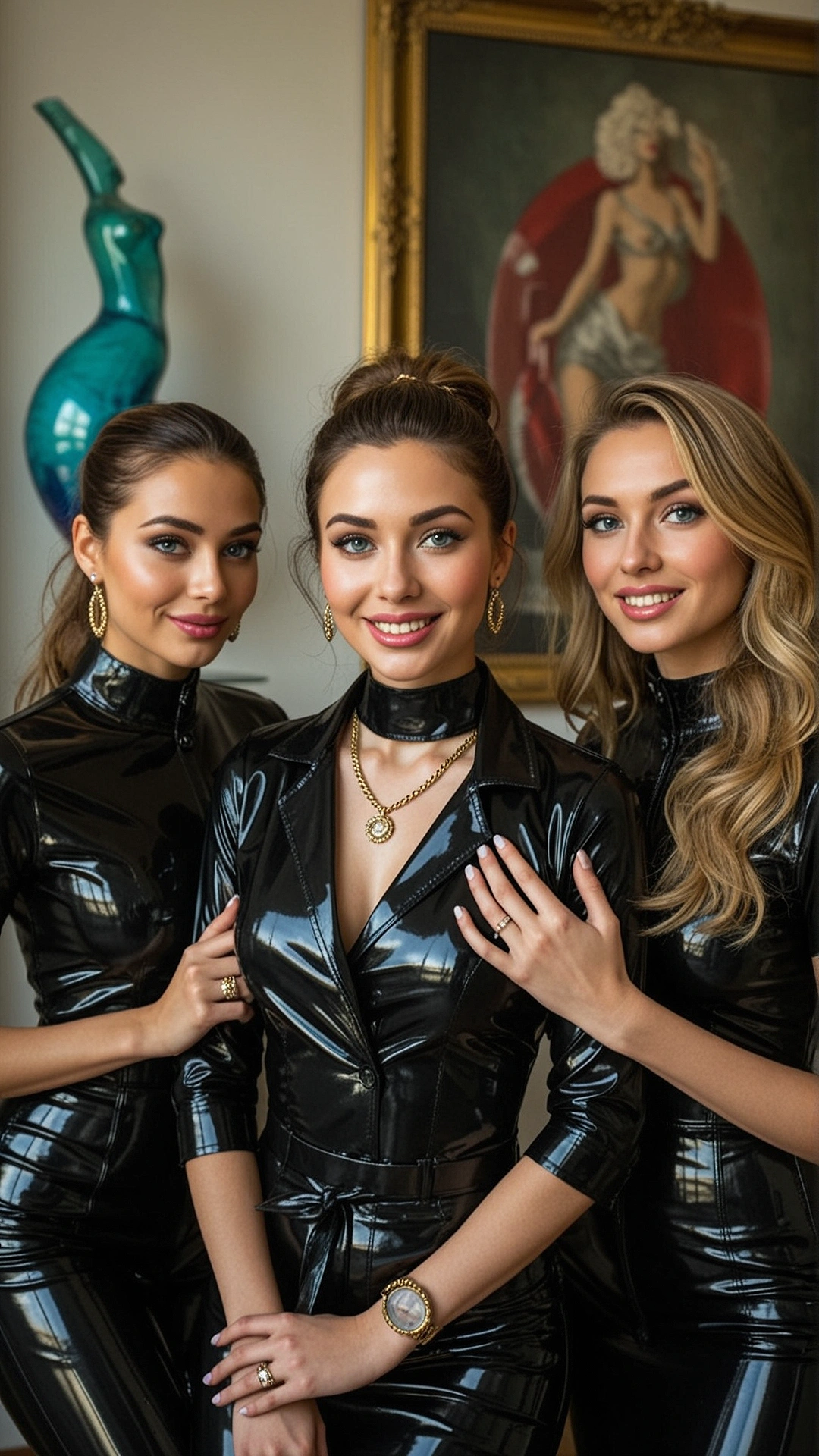
A Satin Lovers Story of Espionage, Devotion, and the Delicious Art of Being Claimed
In the heart of Mayfair, where glossy nails and sharper instincts meet, Lady Victoria Ashworth has built something extraordinary: a salon that guards secrets, a household that guards each other, and a life so lustrous it could only be described as… satin.
Dear Reader,
Have you ever wondered what it would feel like to be truly seen? To walk into a room and know—without doubt, without question—that the woman at its centre has been waiting for you? That her eyes will find yours across the champagne flutes and the rustle of silk, and in that single glance, you will understand that you are hers?
The Manicurist’s Gambit is not merely a spy story, though it has all the delicious tension of the best espionage thrillers. It is not simply a romance, though it will make your heart race and your skin prickle with longing. It is something rarer: a celebration of the women who choose to shine, who understand that confidence is the most irresistible accessory, and that the right dominant doesn’t diminish you—she polishes you until you catch every light in the room.
Meet Lady Victoria Ashworth—”Vix” to those fortunate enough to belong to her. Former MI6 operative, current salon proprietress, and a woman whose crimson satin blazer conceals both a communication device and the kind of authority that makes brilliant women melt.
Meet Dr. Penelope Hartwell, the ink-stained chemist whose revolutionary formula could change intelligence work forever—and whose greatest discovery was that being guided by the right hand is not surrender but salvation.
Meet Sergeant Major Eleanor Finch, the leather-clad soldier who learned that the strongest thing a warrior can do is kneel for someone worthy.
Meet Madame Yvette Couture, the designer whose glossy creations are both armour and art, and whose devotion is stitched into every seam.
Together, they face a threat that arrives disguised as a manicure appointment. What follows is a comedy of couture, a battle of wits, and a love story—or rather, several love stories, all woven together in the inimitable Satin Lovers style: funny, joyful, and so sensually rich you’ll find yourself stroking the pages as though they were silk.
But be warned, dear reader: The Manicurist’s Gambit is not merely to be read. It is to be experienced. By the time you reach the final chapter, you may find yourself looking at your own wardrobe with new eyes, wondering what it might feel like to replace the practical with the lustrous, the forgettable with the unforgettable.
You may find yourself wondering what it might feel like to belong.
And that, my dear, is exactly the point.
Step into the salon. The polish is perfect, the company is divine, and Lady Victoria is waiting.
— Dianna
Chapter One: The Polish of Perfection
The morning light slanted through the mullioned windows of No. 27 Half Moon Street like liquid amber, pooling across the parquet floor of Lacquer & Lace with the kind of golden warmth that made even the dust motes appear to be dancing. Lady Victoria Ashworth—Vix to those fortunate enough to have earned the intimacy—stood before her reflection in the cheval mirror that had belonged to her grandmother, and began the ritual.
Not the ritual of dressing, precisely. That word suggested something mundane, something perfunctory. What Vix performed each morning was more akin to a liturgy, a consecration of fabric and form that transformed the woman into the idea of the woman. And ideas, as any intelligence operative worth her salt knew, were far more powerful than mere flesh.
The satin blazer came first. Crimson. Not the timid blush of a schoolgirl’s ribbon, but the deep, authoritative crimson of a woman who has signed documents that could topple governments and never once smudged her signature. The fabric caught the light as she shrugged it over her shoulders, and for a moment, the surface rippled like the skin of some exotic serpent—liquid, lustrous, alive. Vix watched her reflection with the critical eye of an artist assessing a canvas, adjusting the fall of the lapels until they framed her collarbones like the setting of a jewel.
“Perfect,” she murmured, and the word was both assessment and incantation.
The salon itself hummed around her like a well-tuned instrument. Lacquer & Lace occupied the ground floor and basement of a Georgian townhouse that Vix had purchased fourteen years ago with money that was technically a pension and practically a thank-you from a grateful nation. The décor was her own design: deep burgundy walls, antique mirrors that caught and multiplied every gleam, and an array of treatment stations arranged with the precision of a military briefing room. Each station featured its own selection of polishes—hundreds of them, arranged in chromatic order like a spectrum of possibilities—and each bottle’s label bore a name that meant something only to Vix and her inner circle.
Red Mercury was not merely a shade of scarlet; it was the code name of an operation in St. Petersburg, 2009.
Silver Fox was not just a shimmering grey; it was the alias of a double agent whose freedom Vix had purchased with a favour she would never disclose.
Black Orchid was not simply a deep, glossy purple; it was the designation of a mission that had gone spectacularly, hilariously wrong in Singapore, and which Vix still recounted at dinner parties to peals of laughter from those who had been there.
Every bottle was a memory. Every shade was a story. And the women who sat in Vix’s chairs, choosing colours without knowing their histories, were unknowingly participating in a ritual of remembrance that gave the salon its particular quality of depth—a sense that this place had layers, that beneath the glossy surface lay something profound.
“Good morning, my lady.”
The voice came from the doorway, and Vix turned to find Mrs. Eleanor Pemberton, her salon manager, standing with the particular poise of a woman who has been trained to announce herself before entering any room. Eleanor was sixty-three, silver-haired, and wore a charcoal satin blouse that she had selected herself—though Vix had gently steered her toward the glossy fabrics after their first meeting, when Eleanor had arrived in a dreary polyester thing that had made Vix’s aesthetic sensibilities weep.
“Eleanor, darling.” Vix crossed to her and pressed a kiss to each cheek. “You look magnificent. Is that a new blouse?”
Eleanor flushed with pleasure—a sixty-three-year-old woman blushing like a girl, and why not? Compliments from Vix were not mere pleasantries; they were attentions, and to be attended to by Lady Victoria Ashworth was to feel, for a luminous moment, that one was the most interesting person in any room.
“Yvette made it for me,” Eleanor said, smoothing the satin over her hips with an unconscious gesture of pride. “She said the charcoal brings out the silver in my hair. I told her I was too old for such fuss, but she insisted—”
“You are never too old for fuss,” Vix interrupted firmly, her hand resting on Eleanor’s shoulder with the weight of a benediction. “Fuss is what separates us from the animals, darling. Well, fuss and the ability to appreciate good fabric.”
Eleanor laughed, the sound warm and genuine, and moved to begin preparing the first treatment station. Vix watched her for a moment, noting the way the satin moved with her, the way her posture had improved over the months since she had begun wearing glossy fabrics. It was not merely aesthetic; it was postural, psychological. When a woman feels lustrous, she stands differently. She moves differently. She is differently.
This was not vanity. This was strategy.
The first client of the day arrived at half past nine, precisely when she was expected, because Dr. Margaret Chen did not believe in lateness any more than she believed in imprecise suturing. She swept through the door in a tailored navy suit that, upon closer inspection, revealed itself to be not worsted wool but navy satin—a fabric choice that announced, to those who knew how to look, that Dr. Chen was a woman who understood that power did not require austerity.
“Vix, darling.” Margaret pressed her cheek to Vix’s with the easy intimacy of long acquaintance. “I’ve been looking forward to this all week. You cannot imagine the week I’ve had.”
“Tell me everything,” Vix said, guiding her to the treatment station by the window, where the morning light would catch whatever colour they chose. “And let me see those hands.”
Margaret extended her hands—surgeon’s hands, steady and precise, but with the telltale dryness that came from repeated scrubbing. Vix took them in her own, her thumbs tracing the lines of Margaret’s palms with an attention that was both professional and deeply personal.
“You’ve been overworking,” Vix said. It was not a question.
“The new practice is thriving.” Margaret’s voice carried the particular satisfaction of a woman who had gambled on herself and won. “I’ve taken on three new partners this quarter, and our research programme is expanding. But the hours—” She shook her head, her glossy bob catching the light. “I barely have time to breathe.”
“Then you must breathe here,” Vix said, her voice dropping to that particular register that her clients had learned to recognise: the tone that said I have you now, and nothing else matters. “Close your eyes for a moment, Margaret. Just for a moment.”
Margaret’s eyelids fluttered shut, and Vix watched the tension drain from her face with the slow inevitability of sand through an hourglass. This was the other service Lacquer & Lace provided—not listed on the price sheet, not advertised in any directory, but understood implicitly by every woman who crossed the threshold. Vix gave permission. Vix created space. Vix said, in a thousand small ways, You may stop now. You are safe here. I will hold the world at bay whilst you rest.
“Good,” Vix murmured. “Now, what colour shall we use today?”
The salon filled gradually, as it always did, with the particular rhythm of a tide of glossy, confident women. Each arrival was announced by Eleanor with the quiet ceremony of a butler at a state dinner, and each client received Vix’s personal greeting before being directed to a treatment station.
Professor Aisha Okonkwo arrived at ten, her statuesque frame draped in a flowing satin kaftan of indigo and gold that she had commissioned from Yvette after attending one of the salon’s monthly book club evenings. The kaftan was, technically, a cultural garment—but in Yvette’s hands, it had become something else entirely: a statement of authority, a declaration that its wearer was a woman who refused to choose between heritage and modernity, between tradition and ambition.
“Vix, my dear.” Aisha’s voice was rich, warm, carrying the cadences of Lagos and the precision of Oxford in equal measure. “I have news.”
“Tell me,” Vix said, abandoning her position at Margaret’s station to give Aisha her full attention. This was what Vix did—she attended. Not in the passive sense of listening, but in the active, deliberate sense of making another person feel that they were the most important presence in the room.
“The promotion came through.” Aisha’s face was composed, but her eyes shone. “Full professor. The first woman of colour in the department’s history.”
Vix’s response was immediate and physical: she took Aisha’s face in both hands, her thumbs stroking the professor’s cheekbones, and kissed her forehead with a tenderness that made several of the other clients look up from their treatments with expressions of delighted envy.
“I am so proud of you,” Vix said, and the words carried a weight that went beyond congratulation. They were an acknowledgement of a journey—of the late nights, the rejections, the quiet battles fought in faculty meetings and over peer reviews. Vix had been there for all of it, listening, advising, occasionally threatening to write strongly worded letters to university administrators. “And you deserve every moment of this.”
Aisha’s eyes glistened. “I couldn’t have done it without you. The confidence, the focus—you taught me to stop apologising for taking up space.”
“I taught you nothing you didn’t already know,” Vix said firmly. “I merely polished what was already there.”
It was a modesty that was also, in its way, a claim. I polished you. You are mine to polish.
By eleven o’clock, the salon was at its morning peak: twelve clients in various states of glossy relaxation, the air thick with the scent of acetone and expensive perfume, and the particular warmth that comes from women being entirely at ease with one another. The conversation flowed like champagne—effervescent, sparkling, occasionally profound.
Captain Siobhan Murphy, fresh from a posting in Cyprus and still adjusting to civilian time, sat at the station nearest the door in her leather jacket and combat boots, looking like a beautiful anachronism amongst the satin and silk. She had been coming to Lacquer & Lace for three years now, ever since Ellie had recommended the salon, and her transformation was a source of quiet satisfaction to Vix. The leather remained—Siobhan would never be a satin woman, and Vix respected that—but it was better leather now: glossy, supple, fitted. And beneath it, Siobhan had begun to wear satin camisoles in jewel tones that she would never have considered before, small concessions to the lure of the lustrous that delighted Vix beyond measure.
“Ellie says you’re thinking about private security work,” Vix said, working a cuticle oil into Siobhan’s battle-roughened hands.
“Thinking about it.” Siobhan’s voice was careful, measured. “The army was good to me, but—”
“But you want more,” Vix finished for her. “More control. More choice. More opportunity to become whoever you decide to be, rather than whoever the chain of command decides you are.”
Siobhan looked up, her green eyes sharp with recognition. “You make it sound obvious.”
“It is obvious, darling. The only question is whether you’re ready to admit it.”
The conversation was interrupted by Eleanor, who appeared at Vix’s elbow with the particular expression that meant something requires your attention.
“My lady, there’s a telephone call. A Mr. Volkov, from the Eastern European embassy. He’d like to book a manicure.”
Vix’s hands did not pause in their ministrations. Her expression did not flicker. But something behind her eyes sharpened, the way a blade catches light when it turns.
“How delightful,” she said, and her voice was as smooth as the satin on her back. “Do tell Mr. Volkov that we would be honoured. When would he like to come?”
Eleanor conveyed the message and returned with the answer: Thursday, three o’clock.
“Perfect,” Vix said, and the word, this time, was not assessment but strategy.
She finished Siobhan’s manicure with her usual exquisite attention—glossy black polish, because Siobhan was a woman who understood the power of simplicity—and moved through the salon with the fluid grace of a woman who is always, simultaneously, in three conversations and one operation.
Her mind was already working. Volkov. Cultural attaché. She knew the file: forty-seven, married, three children, posted to London eighteen months ago. Flagged by MI6 as a potential intelligence officer operating under diplomatic cover. His interest in the salon could be innocent—many embassy staff came for manicures, drawn by the reputation and the discretion—but Vix did not believe in coincidence. Coincidence was merely pattern that had not yet revealed its purpose.
She would need to speak with Ellie. And Penelope. And Yvette.
The household would need to prepare.
The last client of the morning departed at half past twelve, and Vix stood in the empty salon, surrounded by the evidence of the morning’s ministrations: the scent of polish, the gleam of mirrors, the faint impression of bodies in the treatment chairs. The silence felt full rather than empty, pregnant with the particular satisfaction of a morning well spent.
She moved to the window and looked out at Half Moon Street, where the afternoon was beginning to unfold in the manner of all Mayfair afternoons: measured, elegant, and quietly humming with the commerce of the very rich and the very discreet. A woman passed on the pavement below, her grey coat buttoned to the throat, her shoulders hunched against the world. Vix watched her with the particular sadness she always felt at the sight of a woman who had not yet discovered the transformative power of the lustrous.
Come in, she thought, as though the woman could hear. Let me show you what you could be.
The woman passed without looking up, and Vix turned back to her salon, to the bottles of polish that lined the walls like a library of secrets, to the mirrors that would catch the afternoon light and multiply it into infinity.
She reached for her telephone and dialled a number she knew by heart.
“Ellie, darling. I need you at the salon. We have an appointment on Thursday that requires… special attention.”
There was a pause, and then Ellie’s voice, low and alert: “What kind of attention?”
Vix smiled, and the expression was not entirely pleasant.
“The kind that requires your leather and your very particular skills. And bring Penelope. And call Yvette. I believe we’re going to need new outfits.”
She hung up and turned back to her reflection in the cheval mirror. The crimson satin caught the light and held it, luminous, alive, powerful.
The Polish of Perfection, Vix thought. That’s what we offer here. And God help anyone who mistakes it for mere vanity.
The morning’s light had shifted to afternoon gold, and in the mirrors of Lacquer & Lace, a thousand reflections gleamed—each one a possibility, each one a woman becoming, through the careful ministrations of Lady Victoria Ashworth, the most lustrous version of herself.
The game, Vix reflected, was about to begin.
And she did so love to win.
Chapter Two: The Chemistry of Attraction
Dr. Penelope Hartwell arrived at Lacquer & Lace at seven minutes past two on a Tuesday afternoon, which was, by her own idiosyncratic internal clock, precisely on time. Time, in Penelope’s experience, was a relative construct—malleable, negotiable, rather like the molecular bonds she spent her days manipulating in her laboratory at Imperial College. Seven minutes was not lateness; it was flexibility, a quality she considered essential in any well-ordered existence.
She came through the door in her customary state of charming disarray: ink-stained fingers (fountain pen, naturally—ballpoints were an insult to the art of notation), a button misaligned on her cotton blouse (the third one, always the third, as though some imp of perversity rearranged her buttons whilst she slept), and her hair escaping from its practical clip in a manner that suggested she had been running her hands through it in excitement. Which, of course, she had.
She was carrying a vial.
The vial was small—fifteen millilitres, the standard size for nail lacquer—but it contained something that was not, by any measure, standard. The liquid within was clear, innocuous, seemingly unremarkable. But when Penelope held it up to the salon’s light, something extraordinary happened: the fluid shifted, just slightly, catching the photons in a way that suggested depths and complexities far beyond its transparent surface.
“Vix!” The name burst from Penelope’s lips with the particular urgency of a woman who has been carrying a secret too long and can no longer contain it. “Vix, I’ve done it. I’ve actually done it.”
Lady Victoria Ashworth was in the private parlour—the intimate space behind the main salon that served as her office, her sitting room, and, on occasions that required discretion, her operations centre. She looked up from the encrypted tablet she had been reviewing, and her expression underwent one of those subtle transformations that those who knew her had learned to treasure: the slight softening of the eyes, the barely perceptible curve of the lips, the way her entire body oriented toward the door like a compass needle finding north.
“Penelope, darling.” The words were warm, rich, like cream poured into coffee. “Come in. You’re vibrating.”
It was true. Penelope was, quite literally, vibrating with excitement—a fine tremor that ran through her slender frame like current through a wire. She barely noticed the observation, so accustomed was she to Vix’s particular quality of attention: the way the woman saw everything, missed nothing, and yet made you feel observed rather than surveilled.
“I’ve cracked the formula,” Penelope said, crossing the parlour in three long strides and nearly tripping over the Persian rug that Vix had warned her about on no fewer than six previous occasions. “The reactive lacquer. The one that changes colour with chemical exposure. It works, Vix. It actually works.”
She placed the vial on the antique writing desk with the reverence of a woman laying an offering on an altar, and then stood back, breathing hard, her cheeks flushed with the particular pink that Vix found utterly irresistible—the pink of a woman who has just done something brilliant and is desperate for someone worthy to recognise it.
Vix rose from her chair with the unhurried grace that was her signature, her crimson satin blazer catching the afternoon light in a way that made the fabric ripple like a living thing. She crossed to Penelope and took the vial, holding it up to the window with an expression of focused interest.
“Tell me,” she said.
And Penelope told her.
The science was, to Penelope’s mind, beautiful in its elegance. The lacquer contained a proprietary blend of photochromic compounds—molecules that changed their structure in response to specific chemical triggers. The base formula was clear, but exposure to certain substances caused an immediate, visible colour change. Each substance produced a different hue: cyanide yielded a deep blue, sarin gas turned the lacquer violet, and a particular compound used in the manufacture of plastic explosives produced a startling, unmistakable red.
“The applications are extraordinary,” Penelope said, her hands moving as she spoke, sketching invisible diagrams in the air. “Field operatives could detect chemical threats simply by observing their own manicures. No equipment, no conspicuous testing—just a woman glancing at her nails. It’s the perfect cover because it is the cover.”
Vix listened with the rapt attention that she gave to all things Penelope—a quality of focus that made the chemist feel, in those moments, like the most fascinating person on the planet. Her hand had found its way to Penelope’s thigh during the explanation, a gesture so natural, so assumed, that neither of them remarked upon it. It was simply where Vix’s hand belonged—on Penelope, claiming the space, asserting a presence that was both possessive and profoundly reassuring.
“You’ve outdone yourself,” Vix said, and the words carried weight—the weight of genuine admiration from a woman whose standards were, by any reasonable measure, stratospheric. “This could change field protocol entirely.”
Penelope’s flush deepened. The praise settled over her like warm water, like sunlight on skin, like the particular glow that comes from being seen—truly, completely seen—by someone whose opinion mattered more than any peer review or publication could ever matter.
“I couldn’t have done it without you,” Penelope said, and the words were not mere gratitude but confession. “The lab space, the funding, the connections to the defence research people—none of it would have happened without your guidance.”
“I merely opened doors, darling. You walked through them.”
“You gave me the courage to walk through them.” Penelope’s voice dropped, becoming quieter, more intimate. “Before you, I was—”
“Brilliant and miserable,” Vix finished for her, her thumb tracing a slow circle on Penelope’s thigh. “Brilliant and directionless and wearing polyester blends that should have been classified as crimes against humanity.”
Penelope laughed—a genuine, delighted laugh that transformed her face from distracted genius to radiant woman. “You were absolutely horrible about my wardrobe.”
“I was absolutely correct about your wardrobe. There is a difference, Penelope, between cruelty and clarity, and I have always aimed for the latter.”
The story of how they had met had become, in the three years since it occurred, something of a legend within their particular circle—a tale told at dinner parties and gatherings of the household, always with variations, always with laughter, always with a particular warmth that came from knowing how the story ended.
Penelope had been a postdoctoral researcher at Imperial, buried in a basement laboratory that smelled of solvents and ambition, publishing papers that earned respectful citations and zero practical applications. She was twenty-nine, already acknowledged as one of the brightest synthetic chemists of her generation, and utterly, comprehensively miserable.
Vix had found her through a mutual acquaintance—a professor who sat on the advisory board of a defence research initiative and who had mentioned, in passing, that there was a young woman at Imperial whose work on photochromic compounds had potential intelligence applications. The professor had also mentioned, with the weary resignation of someone who had tried and failed, that the young woman was “difficult”—socially awkward, professionally isolated, and stubbornly resistant to any suggestion that she might benefit from mentorship.
Vix had visited the laboratory on a Wednesday afternoon in October, wearing a black satin sheath dress and a cashmere coat, looking like a fashion editor who had taken a wrong turn and ended up in the science building. She had found Penelope in the basement, hunched over a spectrometer, wearing a cardigan that appeared to have been knitted from despair.
“Dr. Hartwell?” Vix had said, leaning against the doorframe with the casual elegance of a woman who had never, in her entire life, leaned against anything casually. “I’m Lady Victoria Ashworth. I understand you’re doing remarkable things with photochromic compounds.”
Penelope had looked up, blinked, and said the first thing that came to her mind: “Your dress is extraordinary.”
It was not the response Vix had expected. It was, however, the response that had sealed everything.
“Thank you,” Vix had said, smiling. “Satin. Would you like to touch it?”
Penelope had flushed to the roots of her hair. “I— that is— I didn’t mean—”
“Of course you meant it. There’s no shame in appreciating beautiful things, Dr. Hartwell. In fact, I would argue that the inability to appreciate beautiful things is the greatest failing of the modern academy.”
The conversation that followed had lasted four hours, ranged across photochromic chemistry, intelligence applications, the aesthetic poverty of academic fashion, and the particular loneliness of being brilliant in a world that valued conformity. By the end of it, Penelope had agreed to consult on a defence research project, accepted an invitation to visit Lacquer & Lace, and developed a crush of such magnitude that she had nearly set fire to her laboratory whilst distracted by the memory of Vix’s smile.
The rest, as they say, was history—or rather, it was the beginning of a transformation so complete that Penelope sometimes looked at photographs of her former self and felt a pang of compassion for the woman in the cardigan, the woman who did not yet know that being guided by the right hand was not surrender but salvation.
“Come,” Vix said, rising and extending her hand to Penelope with the easy authority of a woman accustomed to being obeyed. “Let us test your formula properly.”
Penelope took the hand and allowed herself to be led to the treatment station by the window—the same station where Vix had performed her particular magic on countless clients, where the light was best and the mirrors multiplied every gleam into infinity.
“Sit,” Vix said, and Penelope sat, the instruction settling over her like a warm blanket, like a glass of good wine, like the particular relief that comes from being told exactly what to do by someone you trust completely.
Vix took the vial and shook it gently, the photochromic liquid catching the light in a way that suggested hidden depths. She selected a fine brush from her collection—sable, hand-cut, worth more than most people’s monthly rent—and began to prepare Penelope’s nails with the meticulous attention that was her signature.
The ritual was familiar: filing, buffing, the application of a clear base coat that smelled faintly of almonds. But today, the ritual carried an extra charge—the knowledge that the clear lacquer Vix was about to apply was not merely cosmetic but functional, not merely beautiful but brilliant.
“You’ve been working too hard,” Vix observed, her hands moving with the precision of a surgeon and the tenderness of a lover. “Your cuticles are ragged.”
“I’ve been in the lab for—”
“Seventeen days straight, yes, I know. Eleanor mentioned that you cancelled your last two appointments.” Vix’s voice was mild, but there was an edge beneath it—the particular edge of a dominant who has been worried. “You know how I feel about cancelled appointments, Penelope.”
Penelope’s stomach fluttered. The edge in Vix’s voice was not anger—it was care, expressed in the particular language of their dynamic. When Vix was displeased, it meant she was paying attention, and when she was paying attention, Penelope felt more alive than at any other moment in her existence.
“I’m sorry,” Penelope said, and the apology was genuine—not for the cancelled appointments but for the worry she had caused. “I was close to the breakthrough. I couldn’t stop.”
“You could have called.” Vix’s brush paused, and she looked up, her eyes meeting Penelope’s with an intensity that made the chemist’s breath catch. “You could have told me you were close. I would have understood. I would have brought you food and reminded you to sleep and made sure your lab had adequate ventilation, because I happen to know that you forget about ventilation when you’re excited.”
Penelope’s eyes stung. The kindness was worse than any reprimand—this gentle, firm insistence that she deserved to be cared for, that her well-being mattered to someone, that she was not alone in her basement with her brilliance and her misery.
“I’ll call next time,” she whispered.
“Yes,” Vix said, returning to her work with a satisfied nod. “You will.”
The word will settled into the air between them—not a request but a statement of fact, a declaration of how things would be because Vix had decided they would be. And Penelope, who had spent her entire life resisting authority figures of every description, felt only a deep, resonant peace.
This was what she had been searching for, she realised. Not a mentor, not a colleague, not a friend—though Vix was all of these things. She had been searching for someone whose authority she could trust completely, someone whose direction she could follow without fear, someone who would see her brilliance and nurture it whilst also seeing her fragility and protecting it.
She had been searching for someone to belong to.
And she had found her.
The application of the formula was a revelation. As Vix’s brush swept the clear lacquer across Penelope’s nails, the liquid dried to a glossy, invisible finish that caught the light like glass. It was, on its own, beautiful—the particular beauty of precision and care, of a surface made perfect by skilled hands.
But then Vix took Penelope’s hand and raised it to her lips.
She did not kiss it—not quite. Instead, she breathed across the polished surface, warm and slow, the way one might warm a brandy glass. And the lacquer responded.
The colour change was subtle at first—a faint blush, like dawn creeping across a pale sky. But as Vix continued to breathe across the surface, the blush deepened, spreading through the lacquer like ink through water, until Penelope’s nails were a deep, unmistakable rose.
“Remarkable,” Vix murmured, turning Penelope’s hand to catch the light. “It’s responding to temperature. Your body heat is triggering the change.”
“It’s not just temperature,” Penelope said, her voice slightly unsteady. “The formula is calibrated to respond to specific hormonal markers in perspiration and respiration. It’s— it’s detecting—”
“Your arousal,” Vix said, with the directness that was her hallmark. “The lacquer is turning rose because you’re aroused, darling.”
Penelope’s face went from pink to crimson. “I— that wasn’t the intended application—”
“No,” Vix agreed, studying the deep rose of Penelope’s nails with an expression that was equal parts scientific interest and something far more dangerous. “But it is, I must say, a rather delightful unintended consequence.”
She raised Penelope’s hand again and pressed her lips to the polished surface, a kiss this time, slow and deliberate. The lacquer darkened further, approaching a deep, wine-stain purple, and Penelope made a sound that was not quite a gasp and not quite a moan but something in between—the sound of a woman whose body was responding to her dominant’s touch with a completeness that bypassed conscious thought entirely.
“You see?” Vix said, her voice low and warm. “Even your own formula knows who you belong to.”
The words should have been alarming. They should have triggered resistance, the instinct to pull away, to protect, to maintain the boundaries that kept a woman safe in a world that demanded constant vigilance.
Instead, they settled into Penelope’s chest like a key turning in a lock, like a door swinging open, like the moment when a chemical reaction reaches critical mass and there is no going back.
“Yes,” she breathed. “It does.”
They sat together in the parlour for another hour, the vial of formula between them like a talisman, the rose-coloured nails of Penelope’s hand a constant reminder of what had passed between them. Vix asked detailed questions about the formula’s applications, its limitations, its potential for refinement, and Penelope answered with the fluency of a woman who has found her subject and her audience simultaneously.
But beneath the scientific discussion, another conversation was happening—the conversation of glances and touches, of Vix’s hand finding Penelope’s knee and staying there, of Penelope leaning into Vix’s space with the unconscious ease of a plant turning toward the sun.
“You’ll need to present this to the defence research board,” Vix said, her thumb tracing idle patterns on Penelope’s knee. “I can arrange the meeting. But you’ll need to look the part.”
Penelope looked down at her ink-stained blouse and sighed. “I know. I’m a disaster.”
“You are not a disaster,” Vix said firmly. “You are a woman of extraordinary talent who has not yet learned to dress as though she believes it. There is a difference, and it is a difference I intend to address.”
She reached for her telephone and dialled a number. “Yvette, darling. I need you. Penelope has a presentation to make, and we cannot—absolutely cannot—have her standing before the defence research board in that blouse. Yes, that blouse. I know. I know. Bring the midnight blue satin. And the structured jacket. And for God’s sake, bring something with sheen.”
Penelope listened to this one-sided conversation with a mixture of embarrassment and a particular, warm pleasure that she had come to recognise as the feeling of being claimed—of having someone else take responsibility for her presentation, her success, her transformation into the woman she was meant to be.
“Yvette is coming,” Vix said, hanging up. “She’s bringing fabric. We’re going to make you magnificent.”
“I don’t need to be magnificent,” Penelope protested weakly. “I need to be credible.”
“Darling,” Vix said, turning to face her with an expression that was fond and fierce in equal measure, “in my experience, the two are not mutually exclusive. In fact, I would argue that they are the same thing. A woman who looks magnificent is credible, because the confidence that comes from looking your best is the most persuasive tool in any presentation.”
She paused, her hand coming up to cup Penelope’s cheek, her thumb tracing the chemist’s cheekbone with a tenderness that made something in Penelope’s chest crack open.
“You are brilliant, Penelope. You are going to change the way intelligence work is done. And you are going to do it wearing satin, because I am not sending you into that boardroom in anything less than the armour you deserve.”
The tears that had been threatening since the conversation about cancelled appointments finally fell—two, three, a silent cascade that Penelope could not stop and did not try to. Vix caught them with her thumb, wiping Penelope’s cheeks with the gentle efficiency of a woman who had done this before and would do it again, who understood that brilliance and fragility were not opposites but companions.
“There,” Vix said softly. “That’s better. Tears are just chemistry, darling. And you, of all people, understand chemistry.”
Penelope laughed—a wet, broken, beautiful laugh—and leaned into Vix’s hand, and the afternoon light caught the rose-coloured polish on her nails and turned it to gold.
Later, when Penelope had gone—escorted home by Eleanor with firm instructions to eat, sleep, and not return to the laboratory for at least twelve hours—Vix sat alone in the parlour with the vial of formula.
She held it up to the fading light and watched the clear liquid shimmer, and she thought about the way the lacquer had turned rose under her touch, the way Penelope’s body had responded to her presence with a truthfulness that transcended words.
Your arousal, she had said. The lacquer is turning rose because you’re aroused, darling.
And it was true. But it was also true that the lacquer had turned rose because Penelope was happy—because she was seen, because she was held, because she had found a place where her brilliance was nurtured and her fragility was protected and her wardrobe was, at long last, being addressed by someone with taste.
The formula detected hormonal markers, yes. But what it was really detecting was the particular biochemistry of a woman who had found her place—the cascade of serotonin and oxytocin and dopamine that came from belonging to someone worthy of belonging to.
Vix smiled and set the vial down on her desk, next to the encrypted tablet that still displayed the file on Konstantin Volkov.
Thursday’s appointment was approaching. The household would need to prepare. There were outfits to be designed, security to be arranged, and a brilliant, ink-stained chemist to be transformed into the most magnificent version of herself.
But for now, in the quiet of the parlour, Vix simply sat and watched the light fade and thought about the chemistry of attraction—the particular, irreplaceable reaction that occurred when a woman who needed guidance found a woman who provided it.
The formula, she reflected, was extraordinary.
But the transformation it measured was the real miracle.
Chapter Three: The Appointment
The encrypted tablet sat on Vix’s antique writing desk like a viper coiled amongst porcelain—a sleek, black rectangle of dangerous potential nestled between a Meissen figurine and a cut-glass tumbler of sparkling water with lime. The contrast was deliberate, as all contrasts in Vix’s life were deliberate: the beautiful and the lethal, the ornamental and the operational, existing side by side with the easy familiarity of old friends.
The file on Konstantin Petrovich Volkov glowed softly on the screen, and Vix studied it the way a jeweller studies a suspect stone—with patience, with precision, with the particular intensity that comes from knowing that the difference between a diamond and a clever forgery lies in the details.
Volkov, Konstantin Petrovich. Forty-seven years old. Cultural attaché, Embassy of the Republic of Kastovia, London. Married, three children. Posted to London eighteen months ago. Languages: Russian, English, German, French. Hobbies: chess, classical music, and—according to the surveillance notes—visiting art galleries with a regularity that suggested either genuine passion or professional interest in tracking the movements of certain patrons.
The MI6 flag was unambiguous: Person of Interest. Suspected intelligence officer operating under diplomatic cover. Approach with caution.
Vix sipped her water and allowed the information to settle, the way sediment settles in a fine wine—slowly, naturally, each particle finding its proper level. The appointment on Thursday was not a manicure. It was an approach. The question was: an approach toward what?
Her telephone was in her hand before she had consciously decided to make the call—a reflex honed by years of operational thinking, the instinct to mobilise resources at the first sign of a developing situation.
“Ellie, darling. I need you at the salon. We have an appointment on Thursday that requires… special attention.”
The pause that followed was not hesitation but assessment—Ellie’s mind, sharp and methodical, processing the implications of special attention in the particular dialect of their shared history.
“What kind of attention?” Ellie’s voice came through the receiver like distant thunder—low, rolling, carrying the promise of storms.
“The kind that requires your leather and your very particular skills. And bring Penelope. And call Yvette. I believe we’re going to need new outfits.”
“I’ll be there in twenty minutes.” The line went dead with the crisp finality of a woman who did not waste words on farewells.
Vix set down the telephone and allowed herself a small, private smile—the kind of smile that crossed her face only in moments of anticipation, when the pieces of a puzzle were beginning to align and the picture they formed promised to be interesting.
Interesting was, in Vix’s private lexicon, the highest compliment she could pay a situation. Interesting meant challenge, and challenge meant engagement, and engagement meant the particular aliveness that came from having a purpose worthy of her household’s considerable talents.
She rose from the desk, her satin blazer settling into place with the fluid grace of water finding its level, and moved to the window. Half Moon Street lay quiet in the afternoon light—a tableau of understated wealth and discreet ambition, the pavements populated by women in tailored coats and men in well-cut suits, all of them engaged in the particular performance of importance that Mayfair demanded of its residents.
None of them, Vix reflected, were half as interesting as what was about to happen in her salon.
Sergeant Major Eleanor Finch arrived at Lacquer & Lace in seventeen minutes, not twenty—a margin that was not boastfulness but calibration, the precise measurement of a woman who knew exactly how long it took to travel from her flat in Pimlico to Vix’s door, accounting for traffic, weather, and the particular delay that came from changing into what she privately thought of as her duty leather.
The door opened before she knocked—Eleanor Pemberton, impeccable in her charcoal satin, greeting her with the respectful nod she reserved for members of Vix’s inner circle.
“Sergeant Major Finch. Her ladyship is expecting you in the parlour.”
“Thank you, Eleanor.” Ellie’s voice was warm despite its gravelly register—the particular warmth of a woman who respected competence in all its forms and had come to appreciate Eleanor’s quiet efficiency as much as Vix did.
She moved through the salon with the particular gait of a soldier in civilian territory—alert, measured, each step a controlled explosion of contained energy. Her leather jacket was black, glossy, fitted with the precision of a second skin, and it creaked softly as she moved, the sound a whispered announcement of her presence. Beneath it, she wore a deep burgundy satin camisole—Vix’s influence, that garment, a concession to the lustrous that Ellie had resisted for precisely three weeks before surrendering to the undeniable truth that satin against her skin made her feel, in some indefinable way, more herself.
The parlour door was ajar, and Ellie paused on the threshold, taking in the scene with the practiced eye of a woman who had spent her career reading rooms for threats and exits and angles of fire.
Vix was at the window, silhouetted against the afternoon light, her crimson satin blazer a slash of colour against the warm burgundy of the walls. The encrypted tablet was in her hand, and her expression was the one Ellie knew best: focused, calculating, and faintly predatory, like a big cat assessing the savannah for opportunity.
“Report,” Ellie said, and the word was not a demand but an offering—the particular shorthand of their dynamic, in which Ellie’s military precision met Vix’s strategic brilliance and the result was a partnership that operated with the seamless efficiency of a well-oiled weapon.
Vix turned from the window and crossed to her, and for a moment, the room contracted to the space between them—the particular quality of attention that Vix brought to each of her lovers, the focus that made you feel, in that moment, that you were the only person in the world who mattered.
“Ellie.” The word was greeting and assessment and claim, all at once. Vix’s hand came up to rest on Ellie’s shoulder, her thumb tracing the seam of the leather jacket with an intimacy that was both tender and proprietary. “You came in the good leather.”
“You said it was a special appointment.” Ellie’s voice was steady, but something beneath it shifted—the particular tremor that Vix’s touch always produced, the involuntary response of a body that had learned to associate this woman’s hands with safety and desire and the particular peace that comes from being claimed. “I dressed appropriately.”
“You dressed perfectly.” Vix’s thumb moved from the seam to the curve of Ellie’s neck, tracing the line where leather met skin, and Ellie’s breath caught in a way that she would deny if asked but that Vix heard with the precision of a woman who had been trained to detect the slightest variation in a subject’s physiological response. “Come. Sit. I need to show you something.”
The tablet was passed between them, the file on Volkov displayed in clinical detail: photograph, biographical data, known associations, suspected operations. Ellie studied it with the focused attention of a woman who knew that the difference between a successful mission and a body bag was often a single overlooked detail.
“He’s been flagged for two years,” Ellie observed, scrolling through the surveillance notes. “But no concrete action. They’re watching him, but they haven’t caught him doing anything.”
“Which means he’s either very good or very patient.” Vix settled onto the settee beside her, close enough that their thighs touched—leather against satin, the textures whispering against each other like conspirators sharing secrets. “Or both.”
“And he wants a manicure.”
“He wants access to my salon. The manicure is the pretext.” Vix’s hand rested on Ellie’s knee, the weight of it both grounding and possessive. “The question is: access to what? Or to whom?”
“Penelope.” The name fell from Ellie’s lips with the particular weight of a woman who had been trained to identify vulnerabilities and had just identified her own.
“That would be my guess.” Vix’s voice was calm, measured, but Ellie felt the subtle shift in her body—the tensing of muscles, the slight narrowing of focus that indicated the transition from assessment to protection. “Her research has been flagged in certain circles. The reactive lacquer formula has defence applications that would be valuable to a foreign power.”
“Then we cancel the appointment.” Ellie’s response was immediate, instinctive—the protective reflex of a woman whose primary function was the safety of those in her care. “Tell him we’re booked. Tell him we’re closed. Tell him—”
“Tell him nothing,” Vix interrupted, her voice gentle but firm, the particular tone that Ellie had learned to recognise as non-negotiable. “We don’t run, Ellie. We never run. We prepare.”
The word prepare settled into the space between them like a stone dropped into still water, sending ripples of intention outward. Ellie felt her body respond—the shift from protective anxiety to operational focus, the channelling of fear into purpose that was the hallmark of a well-trained soldier and a well-kept submissive.
Vix saw the shift and smiled, her hand squeezing Ellie’s knee with the particular pressure that meant good girl—though she had never used those words aloud, not in this context. The phrase was communicated through touch, through tone, through the particular quality of attention that made Ellie feel, in every cell of her body, that she was exactly where she belonged.
“What do you need from me?” Ellie asked, and the question was not submission but service—the willing offering of her considerable skills to a woman she trusted to direct them.
“I need you to be my shadow on Thursday. I need you to watch Volkov’s every move, to assess his security, to identify his tells. I need you to be terrifying enough that he thinks twice about trying anything and elegant enough that he doesn’t realise you’re doing it.”
Ellie nodded, the mission parameters settling into her mind like furniture being arranged in a room—each element finding its proper place, creating a coherent picture of what was to come.
“And I need Yvette,” Vix continued. “We’re going to need outfits that are appropriate for a salon visit and functional for potential… eventualities.”
“I’ll call her.” Ellie reached for her phone, but Vix’s hand on her wrist stopped her.
“I’ll call her. You stay here.” The words were casual, but the intent was clear: Vix wanted Ellie present, wanted her in the room, wanted the particular quality of her protective energy to fill the space like a perfume. “I want to talk about what happens after Thursday.”
“After Thursday?”
“After we’ve assessed Volkov’s intentions. After we’ve determined whether he’s a threat or merely curious. After we’ve decided how to respond.” Vix’s hand moved from Ellie’s wrist to her neck, her fingers curling around the nape with the slow, deliberate pressure of a woman who was staking a claim. “I want to talk about what you need, Ellie.”
The question was unexpected—not because Vix never asked it, but because she always asked it at moments when Ellie least expected it, moments when the soldier’s defences were lowered by the particular alchemy of Vix’s attention.
“I need—” Ellie stopped, swallowed, tried again. “I need to be useful.”
“You are useful. You are, in fact, indispensable. That’s not what I’m asking.” Vix’s fingers tightened slightly, a gentle but insistent pressure that demanded honesty. “I’m asking what you need. Not what you can do for me. What you need for yourself.”
The tears came without warning—sudden, fierce, the kind that a soldier sheds only in the presence of someone she trusts completely. Ellie’s voice, when it came, was rough with the particular vulnerability of a woman who has spent her life being strong and is only now learning that strength includes the courage to be weak.
“I need to know that I’m not just a weapon to you. I need to know that I’m—” She stopped again, the words caught somewhere between her chest and her throat.
“You’re mine,” Vix said, and the word was not possession but identity—the declaration of a woman who understood that to belong to someone was not to be owned but to be known, fully and completely, and to be loved for exactly what you are. “You are mine, Ellie, and that means I see all of you—the soldier and the woman, the leather and the tears, the strength and the need. And I love all of it. Do you understand?”
Ellie nodded, her jaw tight, her eyes bright, her body trembling with the particular intensity of a woman who has been given permission to feel and is overwhelmed by the freedom of it.
“Good,” Vix said, and her hand moved from Ellie’s neck to her cheek, wiping a tear with the same tenderness she had used on Penelope—the same tenderness she used on all her lovers, because tenderness was not a finite resource but a well that deepened with use. “Now. Let’s call Yvette.”
Madame Yvette Couture arrived at Lacquer & Lace forty-three minutes later, which was, by her own estimation, precisely the correct amount of time to travel from her atelier in Knightsbridge to Mayfair whilst also selecting the appropriate fabric swatches, sketching preliminary designs, and changing into an outfit that would meet Vix’s exacting standards.
She came through the door like a weather system—spectacular, inevitable, and impossible to ignore. Her black PVC coat caught the afternoon light and threw it back in a gleam so sharp it was almost audible, the high-gloss surface reflecting the salon’s interior like a mirror that had been tailored to perfection. Beneath it, a silver satin blouse shimmered with the subtle luminosity of moonlight on water, and her silver hair was swept up in a French twist that added three inches to her already considerable height.
Eleanor, who had seen Yvette arrive on many previous occasions, still paused in her preparation of the treatment stations to admire the entrance. One did not simply enter a room when one was Yvette; one arrived, and the room rearranged itself accordingly.
“Yvette, darling.” Vix rose from the settee with the particular warmth she reserved for her oldest lover—the woman who had been with her longest, who knew her best, who had earned the particular intimacy that came from shared history and unwavering devotion. “You look magnificent.”
“I look prepared,” Yvette corrected, pressing her cheek to Vix’s with the easy confidence of a woman who had been complimented by experts and knew her own worth. “There is a difference, chérie, and you of all people know it.”
“I do know it. That’s why I called you.” Vix stepped back to appraise Yvette’s ensemble with the critical eye of a woman who understood that in the world of espionage, as in the world of fashion, presentation was never merely aesthetic—it was strategic. “We have a situation.”
“Ellie told me.” Yvette’s gaze swept the room, taking in the encrypted tablet on the desk, the tension in Ellie’s shoulders, the particular quality of alertness that hung in the air like the scent of ozone before a storm. “A visitor. An unwanted one, perhaps?”
“An interesting one,” Vix amended. “Which is potentially more dangerous. I need outfits for Thursday—three outfits, to be precise. One for me, one for Ellie, and one for Penelope. They need to be salon-appropriate but operationally functional. Beautiful but capable of hiding… necessities.”
Yvette’s eyes lit up with the particular gleam that came from being presented with a challenge worthy of her talents. She set down the leather case she was carrying—larger than a handbag, smaller than a suitcase, containing, as Vix well knew, enough fabric and hardware to clothe a small army in glossy sophistication—and began to unpack.
“Tell me about the visitor,” she said, spreading swatches across the coffee table with the practiced efficiency of a general deploying troops. “Tell me what we want him to see. And tell me what we want him to miss.”
The strategy session that followed was, by any measure, a masterclass in coordinated planning—three brilliant women, each bringing her particular expertise to bear on a problem that required the combined weight of their considerable talents.
Vix outlined the situation with the clinical precision of a woman who had been briefing operations for longer than some of her colleagues had been alive: Volkov’s file, his suspected intelligence role, the likely interest in Penelope’s research, the opportunity presented by his appointment.
“He’ll be observing,” Vix concluded. “Assessing. Looking for vulnerabilities—particularly in Penelope’s security arrangements and in the salon’s layout. He’ll be polite, charming, and utterly calculating. Our job is to give him exactly what he expects to see whilst ensuring that what he sees is not what he thinks it is.”
“A hall of mirrors,” Yvette murmured, her fingers moving across the fabric swatches with the restless creativity of a mind already designing. “We show him reflections—beautiful, glossy, distracting reflections—whilst the reality remains hidden behind the glass.”
“Precisely.” Vix’s smile was sharp, appreciative—the particular pleasure of a woman whose lover understood her vision without needing it spelled out. “What do you suggest?”
Yvette held up a swatch of crimson satin—the same shade as Vix’s blazer, but with a subtle metallic thread woven through it that caught the light in unexpected ways. “For you, chérie, I will modify your signature blazer. The metallic thread will create visual noise—distracting to the eye, difficult to focus on. It will draw his attention to you and away from everything else. You will be the sun, and he will be unable to look at anything else.”
She moved to a swatch of black leather—heavier than Ellie’s usual jacket, with a subtle sheen that suggested both flexibility and strength. “For Ellie, I will create something that is both armour and art. The leather will be structured enough to conceal… tools… but supple enough to allow full range of movement. She will look like a bodyguard, which is exactly what she should look like. Let him see the threat. Let him wonder about it.”
And finally, a swatch of white satin—pure, luminous, with a gloss so high it was almost reflective. “For Penelope, I will create something that makes her look exactly what she is: a brilliant, innocent scientist who happens to be in the wrong place at the wrong time. The white will make her seem vulnerable, approachable. It will draw him in.”
“And then?” Ellie asked, her voice low with the particular tension of a woman who did not like the idea of Penelope being used as bait.
“And then,” Vix said, her hand finding Ellie’s neck again with the automatic precision of a woman who knew exactly where her lover needed to be touched, “we will see what he does. And we will be ready.”
The afternoon deepened into evening, and the strategy session evolved into something softer—a gathering of lovers rather than operatives, the professional giving way to the personal with the natural progression of a tide receding from the shore.
They ordered dinner from the Italian restaurant on the corner—a ritual, a tradition, the particular comfort of shared meals in shared spaces that transformed a strategy session into something that felt, in the best possible way, like home.
Penelope arrived at six, summoned by a phone call from Vix that had been brief, warm, and utterly non-negotiable: “Come to the salon. Bring nothing. We’ll feed you. And, Penelope—wear the blue satin blouse. The one I bought you.”
She arrived in the blue satin, her hair still escaping from its clip, her fingers still ink-stained, but her eyes bright with the particular alertness of a woman who had been told there was a development and was desperate to know what it was.
Vix met her at the door with a kiss that was both greeting and claim—brief but thorough, the kind of kiss that said you are mine and you are here and that is exactly as it should be. Penelope melted into it with the unconscious ease of a woman who had learned that being kissed by Vix was not a prelude but a destination in itself.
“What’s happening?” Penelope asked, when she could speak.
“Thursday,” Vix said, guiding her into the parlour where Ellie and Yvette were waiting with wine and warmth and the particular atmosphere of a household in full operation. “We have an appointment. And we need to prepare.”
The dinner was delicious, the conversation was stimulating, and the dynamic between the four women was, to the outside observer, a portrait of effortless intimacy—friends and colleagues sharing a meal, discussing business, enjoying each other’s company.
But to those who knew how to look—and Vix always knew how to look—it was something more. It was a household in microcosm: Vix at the centre, directing the conversation with the subtle authority of a conductor leading an orchestra; Ellie at her right hand, alert and protective, her leather-clad presence a silent declaration of security; Penelope across from her, brilliant and animated, her blue satin catching the candlelight; Yvette at her left, elegant and creative, her PVC coat discarded to reveal a silver satin blouse that glowed like starlight.
And Vix’s hands moved between them with the casual intimacy of a woman tending her garden—stroking Ellie’s neck, squeezing Penelope’s hand, adjusting Yvette’s collar. Each touch was brief but loaded with meaning: I see you. I have you. You are mine.
The touches were not performative. They were not for show. They were the natural expression of a woman whose love was not a finite resource to be hoarded but a generative force that multiplied with distribution—a well that deepened with use, a fire that grew with feeding.
Ellie leaned into Vix’s touch on her neck with the particular surrender of a woman who had spent her life carrying weight and was learning, slowly, to let someone else bear it for a while.
Penelope’s hand turned in Vix’s grip, her fingers interlacing with her dominant’s, the gesture both intimate and unconscious—the reflex of a woman whose body had learned to orient toward Vix the way a compass orients toward north.
Yvette tilted her chin to allow Vix’s adjustment of her collar, the movement exposing the line of her throat in a gesture that was, in the particular language of their dynamic, both vulnerability and trust.
And Vix—Vix held them all, her attention moving between them like light through a prism, refracting into different colours but always returning to its source. She was the centre, the anchor, the fixed point around which these brilliant, beautiful, complicated women orbited.
She was their dominant. And she was, in every way that mattered, their home.
The evening ended with plans in place and outfits designed and a particular quality of alertness that hummed through the household like current through a wire. Thursday would bring challenges, but Thursday was three days away, and in the meantime, there was preparation to be done and a household to tend.
Vix walked each woman to the door—a ritual, a courtesy, the particular ceremony of farewell that transformed a departure into a promise of return.
For Yvette, a kiss on both cheeks and a whispered instruction: “The crimson blazer with the metallic thread. And, Yvette—make Penelope’s white satin something that makes her feel like a goddess. She needs to feel invincible.”
For Penelope, a kiss on the mouth—slow, thorough, the kind of kiss that left no doubt about who she belonged to—and a murmured command: “Go home. Eat something. Sleep. And, Penelope—don’t go to the lab tomorrow. I need you rested.”
For Ellie, a hand on the back of the neck and a firm, quiet word: “Stay. I want you here tonight.”
Ellie’s eyes widened slightly—the particular surprise of a woman who was still, after three years, not entirely accustomed to being wanted. “I— yes. Yes, I’ll stay.”
“Good,” Vix said, and the word was both dismissal of the others and claim on Ellie, the particular tone that said you are not leaving because I have decided you are staying. “Come upstairs. I’ll make tea.”
The salon settled into silence as the last of the evening light faded from the windows, and in the parlour, the fabric swatches lay scattered across the coffee table like a map of future possibilities—crimson and black and white, leather and satin and the gleaming promise of PVC.
Thursday was coming. The household was ready.
And in the quiet of her private quarters, with Ellie’s steady breathing beside her and the weight of the day settling into memory, Vix lay in the dark and smiled.
The game was beginning. And she had the best players in the world.
Her players. Her women. Hers.
The word settled over her like a blanket, like a blessing, like the particular peace that comes from knowing that what is yours is well-kept and what is well-kept is yours.
And outside, the Mayfair night wrapped itself around Lacquer & Lace like a velvet glove, and somewhere in the embassy on the other side of the city, Konstantin Petrovich Volkov accepted a confirmation call for his Thursday appointment and had no idea—not the faintest, foggiest idea—what was waiting for him.
Chapter Four: The Guard Dog’s Heart
The alarm sounded at five-fifteen—a precise, unforgiving tone that cut through the darkness of Ellie’s Pimlico flat like a scalpel through gauze. She was awake before the second chime, her body responding to the sound with the Pavlovian efficiency of a soldier trained to transition from sleep to combat readiness in the time it takes a heartbeat to complete its cycle.
The flat was small, neat, and furnished with the kind of austere functionality that suggested either monastic discipline or a woman who had spent so long in military quarters that she had internalised their particular aesthetic of controlled minimalism. The bed was made before she left it—a habit so ingrained it was less action than reflex, the hands smoothing the charcoal sheets with the same precision they would later apply to the inspection of a weapon. The walls were bare except for a single framed photograph: Vix, taken at some charity gala two years ago, wearing a gold satin gown that caught the light like captured sunlight and smiling at the camera with the particular warmth she reserved for people she intended to keep.
Ellie paused before the photograph the way she paused every morning—not consciously, not deliberately, but with the involuntary gravitation of a body that had found its fixed point and oriented itself accordingly. Her hand came up to touch the frame, her fingertips brushing the glass that separated her from the image, and for a moment, the morning ritual of a soldier became something else: a prayer, a benediction, the quiet liturgy of a woman who had found her faith.
“Good morning,” she said to the photograph, and the words were not foolishness but devotion—the particular devotion of a woman who had learned that the object of her worship was not distant or abstract but present, tangible, real in a way that no deity had ever been real.
The photograph did not answer, of course. But Ellie felt the response anyway—a warmth in her chest, a settling in her stomach, the particular peace that came from knowing that she was seen, held, claimed by a woman who valued her not despite her damage but because of what the damage had taught her.
The leather came next.
It was not merely clothing; it was armour—a second skin that transformed the woman within, the way a knight’s plate transformed a farmer into a champion, the way a judge’s robes transformed a lawyer into an instrument of justice. The leather jacket was black, glossy, structured with the particular attention to form and function that Yvette brought to every garment she created for the household. It had been made specifically for Ellie, moulded to her body with the precision of a custom-fitted weapon, and it fit her the way a scabbard fits a sword: exactly, inevitably, as though it had been waiting for her.
Ellie shrugged into it with the practiced ease of a woman who had performed this ritual a thousand times, the leather creaking softly as it settled into place, the sound as familiar and comforting as a heartbeat. The weight of it on her shoulders was not burden but grounding—the particular sensation of being held, contained, defined by something external that allowed the internal to rest.
She checked the pockets: lock picks in the left interior, a compact flashlight in the right, a thin blade in the hidden sheath along the seam. These were not paranoid precautions but professional necessities, the tools of a trade that Ellie had not so much abandoned as redirected—from the service of a nation to the service of a woman, from the protection of an abstraction to the protection of someone specific, someone real, someone whose smile made the leather feel less like armour and more like a gift.
The burgundy satin camisole beneath the leather was Vix’s addition—a concession that Ellie had resisted with the particular stubbornness of a woman who associated satin with frivolity and leather with purpose. But Vix had been patient, persistent, and ultimately irresistible, as she was in all things, and Ellie had surrendered to the satin the way she surrendered to everything Vix wanted: not with defeat but with the particular relief of a woman who has been fighting a battle she didn’t believe in and is finally allowed to lay down arms.
The satin had surprised her. Against her skin, it felt like nothing she had ever worn—smooth, cool, impossibly soft, like being touched by water or air or the particular quality of attention that Vix brought to everything she did. It made her feel… not softer, exactly, but more—more present in her body, more aware of her own skin, more conscious of the boundary between herself and the world.
It made her feel, in a word she would never have used before Vix, beautiful.
And that, Ellie reflected, checking her reflection in the bathroom mirror with the critical eye of a woman who had been trained to assess threats and was now learning to assess herself, was perhaps the most dangerous thing Vix had ever done to her. Not the missions, not the operations, not the particular intensity of their dynamic—but the satin. The satin had slipped past her defences the way no enemy ever had, and it had found, beneath the leather and the discipline and the carefully maintained exterior of controlled competence, a heart that was hungry for exactly the kind of tenderness that glossy fabric against skin seemed to promise.
The weapons check was next—a ritual as old as her military career, performed with the same precision whether she was deploying to a war zone or preparing for a day at the salon. The Glock 19 was cleaned, loaded, and holstered in the concealed carry rig that Yvette had built into a specially designed leather handbag. The handbag was gorgeous—black, glossy, structured, indistinguishable from a high-end accessory and capable of housing enough firepower to resolve most interpersonal disagreements.
Ellie checked the safety, checked the magazine, checked the spare magazine in the hidden pocket. She checked the blade in her jacket, the backup blade in her boot, the compact first-aid kit in the false bottom of the handbag. She checked everything because checking was not paranoia but love—the particular love of a woman whose primary language of devotion was vigilance, who said I care about you by ensuring that every possible threat had been assessed and accounted for.
The morning routine took seventeen minutes from alarm to door, a duration that had not varied by more than thirty seconds in the three years since Ellie had joined Vix’s household. It was not rigidity but reliability—the particular comfort of knowing that some things, at least, were constant, predictable, immune to the chaos that the world seemed determined to inject into every other aspect of existence.
Ellie paused at the door, her hand on the handle, and took a breath—the deep, centreing breath that had been taught to her by a meditation instructor in a veterans’ programme and which she had initially dismissed as new-age nonsense before discovering, to her surprise, that it actually worked.
In, she breathed. I am here.
Out, she breathed. I am hers.
The mantra was not religious but relational—a grounding in identity, a reminder of purpose, a declaration of the particular truth that had transformed Ellie’s life from a series of missions into a meaningful whole. She was here. She was Vix’s. And everything else—the leather, the weapons, the vigilance—flowed from those two facts like water from a spring.
The drive to Penelope’s laboratory at Imperial College took twenty-three minutes, during which Ellie listened to a podcast on security system design and allowed her mind to run through the day’s objectives with the methodical efficiency of a computer processing data.
First: install upgraded surveillance equipment in Penelope’s lab. The existing system was adequate for a civilian facility but insufficient for a space that now housed research with defence applications. Ellie had spent the previous evening assembling a kit that included two concealed cameras, a door sensor with remote alert capability, and a panic button that would transmit directly to Ellie’s phone and Vix’s encrypted tablet simultaneously.
Second: assess the lab’s physical security. Entry points, exit routes, visibility from the corridor, the particular vulnerabilities that came from being located in a basement with limited natural surveillance.
Third: talk to Penelope. Not about security—about everything else. About the household, about Vix, about the particular quality of their shared devotion and the way it created bonds between them that were not competition but family.
This third objective was, Ellie privately acknowledged, the most challenging. Not because Penelope was difficult—Penelope was, in many ways, the easiest person Ellie had ever been around, her awkwardness and honesty a relief after years of military hierarchies and intelligence community obfuscations. But because the conversation would require Ellie to be vulnerable, and vulnerability was not a skill that came naturally to a woman who had spent her adult life constructing walls.
Vix, of course, had seen through the walls immediately. Vix had a particular gift for that—the ability to look at a person and see not the exterior they presented but the interior they were hiding, the way an X-ray sees through skin to the bone beneath. And what Vix had seen in Ellie, three years ago, was not a soldier but a wound—a woman who had been broken not by combat but by the particular loneliness that comes from being strong in a world that has no use for strength once the fighting is done.
The memory of their first meeting was something Ellie kept in a particular compartment of her mind—a room she visited not often but regularly, the way one visits a shrine: with reverence, with gratitude, with the particular awe of a woman who knows she was saved and will never forget it.
She had been in the veterans’ programme—not by choice but by order, a mandatory psychological assessment following her medical discharge from the Army. The programme was housed in a nondescript building in Lambeth, staffed by well-meaning therapists who understood trauma in theory but not in practice, and populated by broken soldiers who sat in circle chairs and talked about their feelings with the particular reluctance of people who would rather be literally anywhere else.
Ellie had been there for six weeks. She had spoken twice—once to say her name, once to say she was fine—and had spent the rest of the time sitting in silence, her leather jacket zipped to her throat, her eyes scanning the room for threats that were not there but that she could not stop looking for.
Vix had come as a guest speaker—a former intelligence operative talking about the transition from service to civilian life. She had walked into the room in a navy satin blouse and charcoal trousers, her posture perfect, her presence commanding, and every broken soldier in the circle had straightened instinctively, responding to authority the way they had been trained to respond.
But it was not the authority that had caught Ellie’s attention. It was the warmth—the particular quality of attention that Vix brought to each person in the room, the way she looked at them not with pity but with respect, as though their brokenness was not weakness but evidence of battles worth fighting.
She had spoken for twenty minutes about purpose—about how the transition from service to civilian life was not an ending but a beginning, not a loss of identity but an opportunity to choose a new one. And then she had opened the floor to questions, and the room had been silent, because broken soldiers do not ask questions; they sit in silence and wait for the session to end.
And then Ellie had spoken.
“Why are you here?” The question had come out rough, challenging, the particular aggression of a woman who did not trust easily and who was suspicious of anyone who claimed to understand what she was going through.
Vix had looked at her—really looked at her, with the particular focus that Ellie would later come to recognise as the prelude to being claimed—and smiled.
“I’m here because I was you,” she had said. “I was a woman who served her country and then was discarded by it, and I spent two years trying to figure out who I was without a mission. And then I found one.”
“What mission?”
Vix’s smile had deepened, and her eyes had held Ellie’s with an intensity that made the room around them seem to fade.
“People,” she had said. “Specifically, people like you. People who have been broken by service and who need someone to show them that broken is not the same as finished.”
The words had landed in Ellie’s chest like a round—fast, devastating, impossible to ignore. And something in her had cracked open, not like a wound but like a door, and the light that came through was not the harsh fluorescence of the therapy room but something warmer, something that felt, impossibly, like hope.
After the session, Vix had approached her. Not with the cautious deference of a therapist but with the direct, unhesitating approach of a woman who had identified what she wanted and was not inclined to wait.
“You’re Eleanor Finch,” she had said. “Sergeant Major. Twenty-two years of service. Medical discharge following—”
“I know what I am,” Ellie had said, and the aggression was still there, but beneath it was something else: a desperate, hungry need to be seen, to be known, to be understood by someone who did not flinch from the damage.
“Yes,” Vix had said. “You do. But do you know what you could be?”
That had been the beginning. Not the beginning of their romantic relationship—that came later, after months of careful cultivation, of dinners and conversations and the particular patience of a woman who understood that trust was not seized but earned. But it was the beginning of Ellie’s transformation, the first step on a journey from broken soldier to whole woman, from isolated veteran to valued member of a household that needed her not despite her damage but because of it.
Because the damage had taught her vigilance, and vigilance was a form of love.
Because the damage had taught her loyalty, and loyalty was a form of devotion.
Because the damage had taught her that strength without purpose was merely violence, and that the right purpose—the right person—could transform violence into protection and protection into something that looked, from the right angle, very much like grace.
Penelope’s laboratory was in the basement of the Imperial College chemistry building, a space that smelled of solvents and ambition and the particular mustiness that came from inadequate ventilation. Ellie had mentioned the ventilation issue to Vix on no fewer than four occasions, and Vix had mentioned it to Penelope on no fewer than six, and Penelope had promised to address it on no fewer than eight, and the ventilation remained inadequate because Penelope, for all her brilliance, had a particular blind spot when it came to environmental factors that did not directly impact her research.
Ellie let herself in with the key that Penelope had given her—a gesture that had seemed small at the time but which Ellie understood as enormous: a brilliant, private, protective woman handing a key to her most vulnerable space was not a practical convenience but a declaration of trust.
The lab was empty—Penelope was not due to arrive for another hour, which was precisely why Ellie had chosen this time for the installation. She moved through the space with the silent efficiency of a woman who had been trained to enter hostile buildings and was now applying those skills to a friendly one, identifying optimal camera positions, testing sight lines, running cables with the particular neatness that came from military discipline and from the knowledge that Penelope would notice—and be distracted by—any aesthetic imperfection.
The work was satisfying in the particular way that physical, practical work was always satisfying for Ellie—the hands busy, the mind focused, the body engaged in a task that had clear parameters and measurable outcomes. Unlike emotional labour, which was murky and uncertain and required skills that Ellie was still developing, security installation was concrete: a camera either covered the angle or it didn’t; a sensor either detected the intrusion or it failed. There was clarity in it, and clarity was a form of comfort.
She was on the second camera—mounted behind a ventilation grate, angled to cover the main door and the corridor beyond—when the door opened and Penelope Hartwell walked into her laboratory like a small, distracted hurricane in a white satin lab coat.
The lab coat was new. Ellie knew this because she recognised Yvette’s handiwork in the precise fall of the lapels and the subtle sheen of the fabric—a sheen that ordinary cotton lab coats did not possess because ordinary cotton lab coats were not, as Yvette would say with the particular disdain she reserved for inadequate fabric, worthy of the women who wear them. This one was satin—crisp, white, luminous—and it transformed Penelope from a rumpled academic into something that looked, from certain angles, like a very clever angel.
“Oh!” Penelope stopped short, her hand flying to her chest in the particular gesture of a woman who has been startled and is trying to pretend she hasn’t. “Ellie. You’re… here.”
“I’m here.” Ellie descended from her stepladder with the controlled grace of a woman who could have descended from a helicopter in a similar fashion. “Vix asked me to upgrade your security.”
“She didn’t tell me.”
“She didn’t want to worry you.”
Penelope’s expression shifted—from surprise to something softer, something that looked, from Ellie’s vantage point, very much like the particular expression of a woman who has just been reminded that she is cared for. “She worries about me.”
“She does.” Ellie paused, considering her next words with the particular care of a soldier who is not accustomed to emotional conversations but is attempting one anyway because the woman she loves has asked her to. “She worries about all of us. It’s… what she does.”
The silence that followed was not awkward but full—the particular quality of quiet that comes from two people who share a common devotion and are discovering, in the space between them, that this shared devotion creates its own kind of intimacy.
Penelope moved to her workbench and began unpacking her bag—a leather satchel, Ellie noted, not the canvas messenger bag she had carried when they first met. Another of Vix’s upgrades, another small transformation that added up to a larger truth: Penelope was becoming, under Vix’s care, a more polished version of herself. Not different—more. The same brilliant, awkward, ink-stained woman, but glossier. More confident. More present.
“The formula is being reviewed by the defence research board next week,” Penelope said, her back to Ellie, her voice carefully casual in the way that meant she was not feeling casual at all. “Vix arranged the presentation. She’s been… extraordinary. She coached me for hours on the delivery, the pacing, the— the pauses. She said the pauses are where the power lives.”
“She would know.” Ellie’s voice was warm with the particular pride of a woman who is discussing the accomplishments of someone she loves. “She once talked a man out of jumping off a bridge by doing nothing but pausing for forty-five seconds. The silence was so unbearable that he climbed down just to fill it.”
Penelope laughed—a genuine, delighted laugh that bounced off the basement walls and made the sterile space feel, for a moment, almost warm. “That’s either the most impressive thing I’ve ever heard or a complete fabrication.”
“Both, probably. Vix has a gift for making the truth sound like a story and stories sound like the truth.” Ellie paused, then added, with the careful precision of a woman testing unfamiliar ground: “She talked about you, you know. During the coaching sessions. She said your mind is the most beautiful thing she’s ever encountered, and she’s encountered St. Petersburg in winter.”
Penelope’s hands stilled on the workbench. Her shoulders, beneath the white satin, rose and fell with a breath that was deeper than it needed to be. “She said that?”
“She says it often. To all of us. To Ellie, to Yvette, to Eleanor. She says it the way other people say good morning—casually, frequently, as though it were simply a fact of the universe rather than a declaration of devotion.” Ellie moved closer, her leather jacket creaking softly, the sound a counterpoint to the stillness of the moment. “It used to make me jealous.”
The word fell between them like a stone into still water—unexpected, honest, the particular kind of admission that Ellie would never have made before Vix, before the household, before the slow, patient work of learning that vulnerability was not weakness but courage.
Penelope turned from the workbench, her expression open and curious and entirely without judgement. “Jealous of me?”
“Of all of them. Of you, of Yvette, of anyone who received her attention when I wasn’t.” Ellie’s voice was steady, but her hands—her steady, surgeon’s hands, her soldier’s hands—were gripping the edge of the workbench with a pressure that whitened her knuckles. “I spent twenty-two years in the Army being the best at what I did, and I never questioned whether I was enough. And then I met Vix, and suddenly I was— I was terrified. Terrified that I wasn’t enough. That she would look at me and see the damage and choose someone less broken.”
The tears came again—the same fierce, unexpected tears that had come in Vix’s parlour, the same flood that Ellie had spent her adult life holding back with dams of discipline and walls of leather. But here, in Penelope’s laboratory, with the white satin glowing in the fluorescent light and the security cameras watching with their patient, mechanical eyes, the tears felt less like failure and more like release.
Penelope did something that Ellie did not expect. She crossed the space between them and put her arms around Ellie’s shoulders—not the tentative embrace of an acquaintance but the firm, certain hold of a woman who understood, instinctively, that what was needed was not words but presence.
“She has enough heart for all of us,” Penelope said, her voice muffled against Ellie’s leather jacket. “That’s what I think. I think her heart isn’t a finite thing that gets divided up. I think it’s… it’s like that formula. The reactive lacquer. It changes colour when it’s exposed to something real, something true. And Vix’s love is like that—it responds to each of us differently, shows a different colour, but it’s the same formula. The same love. Just… different expressions of it.”
Ellie stood very still in the embrace, her body rigid with the particular tension of a woman who is not accustomed to being held and is not entirely sure how to respond. But Penelope’s arms were warm, and the white satin was soft against the leather, and the words—the analogy of the formula, the metaphor of the colours—were so perfectly, so brilliantly Penelope that Ellie felt something in her chest crack open for the second time that week.
“She said I was her shield,” Ellie whispered. “She said I was the one who kept the darkness out so the rest of you could shine.”
“That’s beautiful.”
“It’s terrifying.” Ellie pulled back slightly, her eyes red, her jaw tight. “Because what if I fail? What if the darkness gets in? What if I’m not strong enough, not good enough, not—”
“Then the rest of us will be here.” Penelope’s voice was quiet but certain—the particular certainty of a woman who had spent her life in pursuit of truth and recognised it when she heard it. “We’re not just Vix’s, Ellie. We’re each other’s. That’s what the household means. It’s not one woman holding all of us up. It’s all of us holding each other.”
The words settled into Ellie like rain into dry earth—slowly, deeply, reaching places that had been parched for years. She looked at Penelope—at the ink stains on her fingers, the escapee strands of hair, the white satin lab coat that made her look like a very clever angel—and felt, for the first time, the particular warmth of sisterhood. Not competition. Not hierarchy. Just… family.
“Thank you,” Ellie said, and the words were inadequate but genuine, which was, she was learning, often enough.
“Thank you for the cameras,” Penelope replied, with the particular pragmatism that made her Penelope. “And for telling me the truth. And for—” She gestured vaguely at Ellie’s leather jacket, at the tears on her cheeks, at the whole complicated, vulnerable mess of a woman who had been a soldier and was becoming something else. “For being here. In every sense.”
Ellie laughed—a wet, rough sound that was not quite her usual controlled expression of amusement but something more honest, more real. “Vix told me to come. She said you needed security.”
“She sent you to install cameras?”
“She sent me to install cameras and to talk to you.” Ellie’s smile was wry, self-aware—the particular expression of a woman who has just realised she has been manipulated by an expert and is not even slightly surprised. “She said the cameras were the excuse. The conversation was the mission.”
Penelope’s eyes widened. “She planned this?”
“She plans everything, darling. Everything. It’s what makes her Vix.”
The afternoon deepened into evening as Ellie finished the installation and Penelope returned to her research, and the laboratory filled with the particular comfortable silence of two people who have passed through an awkwardness and come out the other side into something warmer.
Ellie worked methodically—testing angles, calibrating sensors, running diagnostics with the focused attention of a woman who took security the way other people took communion: seriously, regularly, with the particular devotion that came from knowing that what she was protecting was sacred.
Penelope worked alongside her, not on the security but on the next phase of her research—a refinement of the reactive lacquer formula that would make it responsive to a wider range of chemical triggers. Her white satin lab coat moved with her as she worked, the fabric catching the light of the bench lamps and throwing it back in a soft, luminous glow that made the basement feel less like a laboratory and more like a sanctuary.
“Vix picked this coat for me,” Penelope said, during a pause in her work, her hand smoothing the satin with an unconscious gesture of pleasure. “She said I should wear something that makes me feel like myself when I work. I told her I always feel like myself when I work, and she said—”
“‘Darling, you feel like yourself. But do you feel like the best version of yourself?'” Ellie supplied, and Penelope’s surprised laugh confirmed the guess.
“How did you know?”
“She said the same thing to me about the leather.” Ellie’s hand moved to her jacket, her fingers tracing the glossy surface with the same unconscious pleasure that Penelope had shown with the satin. “She said the leather wasn’t armour. It was identity. She said I should wear what makes me feel most like the woman I am when I’m at my best, not the woman I am when I’m afraid.”
“And does it? Make you feel like your best self?”
Ellie considered the question with the seriousness it deserved. “It makes me feel… held. Like the leather is Vix’s hands, even when she’s not here. Like I’m wearing her attention.” She paused, then added, with the particular honesty that their conversation had established: “The satin does the same thing. Underneath. Against my skin. It’s like being touched by her, all day, even when she’s not touching me.”
Penelope nodded, her expression soft with understanding. “That’s exactly what the lab coat does for me. It’s like wearing her belief in me. Like carrying her confidence against my skin.”
They looked at each other—two women in glossy attire, in a basement laboratory, discussing the particular alchemy by which a dominant’s care could be woven into fabric and worn like armour. And in the looking, something settled between them: a recognition, a bond, the particular intimacy of shared devotion expressed through shared experience.
“We’re going to be ready for Thursday,” Penelope said, and her voice carried a confidence that had been absent when she had walked in—a confidence that had been built, brick by brick, by the conversation and the cameras and the particular magic of two women discovering that they were not alone.
“We’re going to be ready,” Ellie confirmed. “And Volkov is going to walk into that salon and see exactly what Vix wants him to see: a household of brilliant, glossy, confident women who are not to be trifled with.”
“And what he won’t see?”
Ellie smiled—the particular smile of a soldier who has been given a mission and intends to execute it flawlessly. “Me. Until it’s too late.”
The evening found Ellie where she was most comfortable: on guard.
She stood in the doorway of Lacquer & Lace, her leather jacket catching the last of the daylight, her eyes scanning Half Moon Street with the practiced vigilance of a woman who had spent her life watching for threats and was now watching for them in service of something she loved.
The street was quiet—the particular hush of Mayfair after dark, when the shops closed and the residents retreated to their private worlds and the pavements belonged to the shadows. A woman passed on the other side of the street, her grey coat buttoned to the throat, her shoulders hunched, and Ellie watched her with the particular sadness she always felt at the sight of a woman who had not yet discovered the transformative power of being claimed—not owned, not diminished, but held, so completely and so carefully that the armour could be set aside and the softness beneath could finally breathe.
Come in, Ellie thought, echoing Vix’s earlier wish. Let us show you what you could be.
The woman passed without looking up, and Ellie turned her attention back to the salon behind her—the warm glow of the lights, the gleam of the bottles, the particular quality of safety that came from knowing that the space was protected, that the women within it were held, that the darkness was being kept at bay by a woman in leather who had found, in the act of guarding, a purpose that was not a mission but a calling.
Her phone buzzed: a message from Vix.
Come upstairs when you’re ready. I’ve made tea. And Ellie—
Thank you for talking to Penelope. I know it wasn’t easy. I know you don’t do vulnerable. But you did it anyway, because I asked, and because you are, despite everything, the bravest woman I have ever known.
Come to bed. Let me hold you. Let me remind you that you are not just my shield. You are my heart.
Ellie read the message three times, each reading producing the same effect: a warmth in her chest, a settling in her stomach, the particular peace that came from being seen—fully, completely, without flinching—by a woman who valued what she saw.
She stepped inside, locked the door behind her, and began to climb the stairs to Vix’s private quarters, her leather creaking softly with each step, her heart beating with the particular rhythm of a woman who was not walking toward a mission but toward home.
She was Vix’s guard dog. She was Vix’s shield. She was Vix’s soldier and her lover and her protector and, in the quiet moments when the leather was set aside and the satin was all that remained, she was Vix’s heart.
And she was, at last, content.
Chapter Five: Couture as Camouflage
The atelier of Madame Yvette Couture occupied the top two floors of a converted Victorian warehouse in Knightsbridge, a space that had been, in its previous incarnations, a piano factory, a dance hall, and—according to the building’s more colourful historical records—a brothel catering to the particular tastes of minor aristocracy. Yvette had found the space twelve years ago, when it was still raw brick and exposed beam and the particular kind of magnificent dilapidation that suggested not neglect but potential—the way a block of marble suggests the sculpture within it, waiting for the right hands to reveal it.
She had transformed it with the particular vision of a woman who understood that beauty was not decoration but architecture—the structural arrangement of light and texture and space to create an environment that did not merely house creativity but generated it. The floors were pale oak, polished to a sheen that reflected the skylights above like still water. The walls were white, hung with bolts of fabric arranged in chromatic order: satins in jewel tones, leathers in rich earth shades, PVCs in the particular high-gloss finishes that Yvette preferred for their capacity to catch and multiply light until the air itself seemed to shimmer.
The sewing stations were arranged along the eastern wall, where the morning light was best—Yvette was particular about light, the way a painter is particular about pigments, the way a musician is particular about acoustics. Light, in her philosophy, was not illumination but material—a substance to be shaped, directed, used. Glossy fabrics, she often said, were not merely beautiful; they were luminous—they took the light that was given to them and gave it back transformed, enriched, made more than it was. Dull fabrics absorbed light and gave nothing back; glossy fabrics reflected it and multiplied it and made the world brighter for their presence.
It was, she had told Vix once, during a late-night conversation that had ranged from fabric theory to the nature of love, a philosophy of living. Be glossy, she had said, her fingers tracing the surface of a bolt of midnight blue satin with the reverent tenderness of a woman touching something sacred. Be the fabric that gives back more than it receives. Be the surface that transforms the light that touches it.
Vix had looked at her with the particular expression she reserved for moments of profound connection—the slight softening of the eyes, the barely perceptible curve of the lips, the way her entire body oriented toward the speaker like a flower toward the sun—and said: “You are the most extraordinary woman I have ever known.”
And Yvette, who had been told she was extraordinary by experts and connoisseurs and the editors of fashion magazines from Paris to Milan, had felt, in that moment, that she was hearing the word for the first time—that Vix’s particular quality of attention had the power to make even familiar compliments feel like discoveries.
The morning of the operation’s preparation found Yvette in her element—surrounded by fabric and hardware and the particular organised chaos of a creative mind in full flow. The worktable was covered in swatches: crimson satin with metallic thread for Vix, black leather with concealed reinforcement panels for Ellie, white satin with hidden pockets for Penelope. Each fabric had been selected with the particular care that Yvette brought to all her work—not merely for appearance but for function, for the way it would move and breathe and catch the light, for the particular qualities it would lend to the woman who wore it.
“Camouflage,” Yvette murmured to herself, her scissors moving through the crimson satin with the precision of a surgeon’s scalpel, “is not about disappearing. It is about controlling what is seen.”
It was a principle she had learned not in fashion school but in the intelligence world, where the art of not-being-seen was not about invisibility but about misdirection—about drawing the eye to exactly where you wanted it and away from where you didn’t. Glossy fabrics were, in this regard, the ultimate tool: they caught light, drew attention, created visual noise that distracted from what lay beneath. A woman in a high-gloss PVC coat was not invisible; she was unmissable—and in being unmissable, she controlled the narrative, directed the gaze, determined what was observed and what was overlooked.
Yvette had explained this to Penelope during the chemist’s first visit to the atelier, two years ago, when Penelope had arrived in her customary state of charming disarray and had looked around the space with the particular wonder of a woman encountering a world she had not known existed.
“It’s like a laboratory,” Penelope had said, her eyes wide, her ink-stained fingers reaching toward a bolt of emerald green satin with the involuntary impulse of a scientist drawn to a fascinating specimen. “But for fabric.”
“Everything is a laboratory, darling, if you approach it with the right mindset,” Yvette had replied, watching Penelope’s fingers with the particular attention she gave to all things tactile—the way a fabric was touched told you more about a person than any conversation. “And everything is a fabric, if you understand that the world is woven from textures and the textures are what we choose.”
Penelope had looked at her, blinking, and Yvette had felt the particular pleasure of recognising a kindred spirit—a woman whose brilliance was not diminished by her awkwardness but enriched by it, the way a diamond is enriched by the roughness of its setting.
“You speak in metaphors,” Penelope had observed.
“I speak in truth. Metaphors are simply truths that have been tailored to fit.” Yvette had smiled, taking Penelope’s ink-stained hand and placing it firmly on the emerald satin. “Feel it. Don’t think about it. Just feel.”
Penelope’s fingers had moved across the fabric with the particular slowness of a woman who was experiencing something new and wanted to experience it fully—the cool, liquid smoothness of the satin, the way it shifted and rippled beneath her touch, the subtle friction that was not resistance but invitation. Her face had undergone one of those transformations that Yvette had learned to treasure: the furrow of concentration smoothing, the eyes widening, the lips parting in a small, unconscious “oh” of discovery.
“It’s like…” Penelope had paused, searching for words. “It’s like touching water that’s been taught to hold its shape.”
“Exactly.” Yvette’s voice had been warm with approval. “And that is what satin does—it teaches water to hold its shape. It teaches light to hold its shape. It teaches you to hold your shape, to be the woman you are rather than the woman the world expects you to be.”
The moment had been a turning point—the beginning of Penelope’s transformation from a woman who wore clothes because they were functional to a woman who wore clothes because they were expressive, because they told the world who she was and who she intended to become. Yvette had guided that transformation with the particular patience of a woman who understood that style was not imposed but cultivated, the way a garden is cultivated—not by forcing plants to grow but by creating the conditions in which they want to grow.
The history of Yvette’s own transformation was a story she told rarely and never completely—not because it was painful, though it was, but because it was private, and privacy was, in Yvette’s philosophy, the ultimate luxury. The world demanded exposure; Yvette demanded discretion. The world wanted the story; Yvette wanted the fabric—the texture of experience, the weave of memory, the particular way that time and circumstance combined to create a pattern that was uniquely, irreplaceably one’s own.
But the broad strokes were known to those in Vix’s household, because the household was built on trust and trust required context, and context required at least the outline of the events that had brought each woman to Vix’s door.
Yvette had been twenty-six when she was hired by Maison Lavigne, the Parisian fashion house that was, at the time, the most prestigious in Europe. She had been the youngest senior designer in the house’s history, and her first collection—satins and silks in jewel tones that caught the light like captured fire—had been hailed as a revelation. The fashion press had called her a genius. The buyers had called her a goldmine. And a certain contact in French intelligence had called her an opportunity.
The operation had been simple, in the way that operations are always simple until they are not: Yvette would use her position at Maison Lavigne to gain access to the wives of certain foreign dignitaries who attended the house’s private shows. She would befriend them, charm them, and—in the particular language of intelligence work—develop them as sources of information about their husbands’ activities.
Yvette had agreed, not out of patriotism but out of the particular restlessness that comes from being brilliant and young and unaware that brilliance and youth are not, by themselves, sufficient protection against the world’s capacity for cruelty.
The operation had gone well for two years. Yvette gathered information, passed it to her handler, and continued to design collections that made women feel lustrous and powerful and seen. She was, she believed, serving two masters—fashion and intelligence—and serving both well.
And then she had made the mistake that all operatives eventually make: she had cared.
The wife of a South American ambassador had become not merely a source but a friend—a woman who confided in Yvette not just about her husband’s activities but about her own loneliness, her own fears, her own particular sadness that came from being beautiful and intelligent and trapped in a life that valued her for the former and ignored the latter. Yvette had listened, had comforted, had done what designers do: she had made the woman feel seen. And in the seeing, she had created a bond that transcended the operation and made the betrayal that followed unbearable.
The intelligence service, when they learned of the friendship, had not been sympathetic. Sources were sources, they explained; feelings were complications. Yvette was instructed to continue the relationship and to extract more information, and when she refused, she was reminded that refusal was not an option.
She had run.
Not far, and not well—Yvette was a designer, not a spy, and her attempt to disappear into the European countryside had lasted precisely eleven days before her handler’s people found her in a hotel in Geneva, looking exhausted and terrified and nothing at all like the woman who had once made Paris fall in love with satin.
It was Vix who had extracted her. Vix, who had been in Geneva for an unrelated operation and who had, through the particular network of contacts that made her one of MI6’s most valuable assets, learned of Yvette’s situation and decided—unilaterally, without authorisation, with the particular disregard for protocol that would eventually lead to her own retirement from the service—that she was not going to leave a brilliant woman in the hands of people who did not value her.
The extraction had been, by all accounts, magnificent—Yvette described it with the particular relish of a woman who loved a good story almost as much as she loved a good fabric. Vix had arrived at the Geneva hotel in a midnight blue PVC coat that made her look like a very elegant storm system, had informed Yvette that she was leaving, and had proceeded to remove her from the situation with a combination of charm, audacity, and the particular authority that came from being a woman who had been trained to command and was not inclined to negotiate.
“You’re coming with me,” Vix had said, and the words were not a request but a fact—a statement of how things were going to be, delivered with the particular confidence of a woman who had already decided and was merely informing the universe of her decision.
Yvette had looked at her—at the PVC coat, at the authority, at the particular quality of certainty that radiated from her like light from a lamp—and had felt, for the first time in months, something that felt like safety.
“Where are we going?” she had asked.
“London,” Vix had said. “I have a salon. You have a talent. And I have a feeling we’re going to be very good for each other.”
She had been right, as she was about most things. And Yvette had been hers—completely, irrevocably, gratefully hers—ever since.
The afternoon found Yvette deep in the particular concentration of creation—the state she thought of as the flow, though the term was inadequate for what actually happened when she worked. It was not merely a state of productivity but of communion—a conversation between hand and fabric, between intention and material, between the woman she was and the garment she was bringing into being.
The crimson blazer for Vix was first. Yvette had modified her own pattern—the one she had used for Vix’s original blazer, the one that had become, in the three years since its creation, Vix’s signature, her uniform, the garment that said I am here and I am in charge without the need for any additional declaration. The metallic thread was woven through the satin in a pattern that was invisible to the casual eye but that, when light hit it at certain angles, created a subtle shimmer—a visual disturbance that would draw the eye and hold it, making it difficult for the observer to focus on anything else.
“Camouflage through attraction,” Yvette murmured, her needle moving through the fabric with the particular rhythm of a woman who had been sewing since she was old enough to hold a needle. “Be so visible that you become invisible. Be so fascinating that no one looks beneath the surface.”
The communication device was embedded in the buttons—Yvette had worked with a technician who specialised in miniature electronics, and the result was a set of buttons that looked like ordinary mother-of-pearl but contained transmitters so small they could be activated by the particular pressure of Vix’s thumb. The device would allow Vix to communicate with Ellie without any visible action—simply pressing a button, as though adjusting her blazer, would open a channel.
For Ellie, the leather jacket was a different kind of challenge. Yvette had selected a lambskin so supple it moved like liquid, but she had reinforced the panels along the shoulders and back with a thin layer of Kevlar that would provide protection without compromising flexibility. The result was a garment that looked like fashion and functioned like armour—the particular duality that Yvette had perfected over years of creating clothes for women who lived dangerous lives.
“Ellie doesn’t want to look soft,” Yvette explained to the mannequin she was fitting, in the particular habit of talking to her work that she had developed over years of solitary creation. “She wants to look like what she is: a woman who could end you with her little finger. But she also wants to look beautiful, because Vix has taught her that beauty is not the opposite of strength but its expression.”
The hidden pockets were placed with the particular precision that came from knowing exactly what Ellie carried and where she liked to reach for it: lock picks in the left interior, flashlight in the right, the thin blade in the sheath along the seam. Yvette had measured the pockets against the actual tools, ensuring that each item would be accessible without fumbling, because in a crisis, fumbling was not an option.
And for Penelope—the white satin lab coat, which was, Yvette reflected as she worked, the most complicated garment of the three. Not because of the construction, which was straightforward, but because of the intention—the particular message that the garment was designed to send.
“White,” Yvette said to the satin, her fingers smoothing the fabric with the particular tenderness she reserved for materials that were about to become something more than themselves. “White for innocence. White for purity. White for the woman who is exactly what she appears to be—a brilliant scientist who happens to be in the wrong place at the wrong time.”
The hidden pockets were placed along the seams—large enough to hold surveillance equipment, small enough to be invisible to the casual observer. The satin was thick enough to conceal the shapes of objects within, but glossy enough to catch the light and draw the eye to the surface rather than the contents. It was, Yvette reflected, the particular genius of satin as camouflage: it was so beautiful that no one thought to look beneath it.
“Volkov will see the white and think vulnerable,” Yvette murmured, her needle moving through the fabric with the particular rhythm of creation. “He will think approachable. He will think easy target. And by the time he realises that the white satin conceals a woman who is neither vulnerable nor approachable nor easy, it will be too late.”
She smiled—the particular smile of a woman who was creating not merely a garment but a trap, a beautiful, lustrous, irresistible trap that would close around the unwary like a silk noose.
The final piece was the midnight blue PVC coat.
It was not part of the operational wardrobe—Yvette had not been asked to create it, had not discussed it with Vix, had not mentioned it to anyone. It was, instead, a gift—the particular kind of gift that Yvette created for Vix when the spirit moved her, which was often, because Vix inspired in Yvette a particular quality of creative devotion that the fashion press had once called “obsessive” and that Yvette preferred to call “love.”
The PVC was midnight blue—not the black that most people associated with the material, but a deep, saturated blue that looked black in shadow and revealed its true colour only in direct light, the way the sky reveals its true depth only when you look at it long enough. The surface was high-gloss, almost mirror-like, and it caught the atelier’s skylights and threw them back in a shimmer that was almost hypnotic—a ripple of light that moved across the fabric like water across a pond.
Yvette had been working on the coat for three weeks, in the particular stolen hours between commissions and household obligations, the time that she thought of as her own even though everything she was belonged to Vix. The coat was not merely a garment but a statement—a declaration of the particular quality of devotion that Yvette felt for the woman who had saved her life and given it meaning.
“I make you beautiful,” Yvette said to the coat, her hands moving across the PVC with the particular reverence of a woman handling something sacred. “I make you powerful. I make you seen. And in doing so, I make myself visible—not as a woman, but as your woman. Your designer. Your devotee. The one who ensures that when the world looks at you, they see exactly what you want them to see and nothing else.”
The coat was structured—broad shoulders, nipped waist, a flare at the hip that suggested movement and authority. It was the kind of garment that made a woman look like she was walking even when she was standing still, that gave her presence a particular quality of momentum—the sense that she was going somewhere important and that you were welcome to watch but not to delay her.
The lining was crimson satin—a secret flash of colour that only the wearer would know was there, the particular private pleasure of a woman who understood that the most powerful statements were the ones that no one else could see. It was, Yvette thought, the perfect metaphor for their relationship: glossy and powerful on the outside, warm and intimate on the inside, and the connection between the two known only to those who were part of it.
Vix arrived at the atelier at half past four, as she often did on the afternoons when the salon was quiet and the household’s obligations allowed her the particular luxury of visiting her oldest lover in the space where her genius was most fully expressed.
She came up the stairs in her crimson satin blazer—the original, not the modified version, which was still on Yvette’s worktable—and paused on the threshold of the atelier, taking in the scene with the particular quality of attention that she brought to all things Yvette: the swatches spread across the worktable, the garments in progress on the mannequins, the particular creative chaos that was, to Vix’s eye, not mess but fertility—the rich, productive disorder of a mind in full bloom.
“Yvette, darling.” The words were warm, rich, like cream poured into coffee. “You’ve been busy.”
“I’ve been inspired.” Yvette looked up from the midnight blue PVC, her hands still moving across the fabric with the particular restlessness of a creative mind that could not stop even when interrupted. “The operation has given me… focus. A particular kind of focus that I find very productive.”
“Should I be worried about what you’re creating?”
“You should be delighted about what I’m creating.” Yvette crossed to Vix with the particular confidence of a woman who had been with her lover for twelve years and had long since lost any inclination to be shy about her devotion. “I have the operational garments ready for fitting. But first—”
She turned and retrieved the midnight blue PVC coat from the mannequin with the particular ceremony of a woman presenting an offering at an altar. The coat caught the atelier’s light and threw it back in a shimmer that made the air seem to move, and for a moment, Vix simply looked at it—not as a garment but as a work of art, the particular expression of a woman’s love made visible in fabric and form.
“Yvette.” Vix’s voice was soft with the particular tenderness she reserved for moments of genuine surprise—the emotion of a woman who was accustomed to being given things but was not accustomed to being given this. “It’s extraordinary.”
“It’s you.” Yvette held the coat open, an invitation and a claim. “Try it on.”
Vix turned and allowed Yvette to settle the coat over her shoulders, the PVC settling into place with the particular liquid grace of a fabric that had been made to fit this woman and no other. The midnight blue caught the light and transformed it, and Vix, standing in the atelier in her crimson satin and midnight blue PVC, looked like something between a queen and a storm—powerful, luminous, impossible to ignore.
Yvette knelt to adjust the hem, the gesture one of worship and service—the particular posture of a woman whose devotion was expressed not in words but in the act of making her dominant beautiful. Her fingers moved along the hem with the particular precision of a master at work, and Vix’s hand came to rest in her hair with the particular weight of a blessing.
“It’s perfect,” Vix said, and the words were not merely assessment but acknowledgement—the recognition of a gift that was also a declaration of love.
“Of course it’s perfect.” Yvette looked up, her silver hair catching the light, her eyes bright with the particular joy of a woman who had pleased her dominant. “I made it for you. Everything I make is for you. Every fabric I touch, every seam I sew, every garment I create—it’s all for you, Vix. It has been all for you since the day you walked into that Geneva hotel and told me I was coming with you.”
Vix’s hand tightened in Yvette’s hair—not painfully, but with the particular pressure that meant mine—and Yvette felt the word settle into her like a key turning in a lock, like a door swinging open, like the particular peace that comes from knowing exactly where you belong.
“You are the most extraordinary woman I have ever known,” Vix said, and the words were the same words she had said twelve years ago, in a late-night conversation about fabric and light and the philosophy of living glossily, and they were also completely different—deeper, richer, weighted with twelve years of shared history and devotion and the particular quality of love that grows not despite familiarity but because of it.
“And you are the only woman I have ever wanted to be extraordinary for.” Yvette rose to her feet, her hands smoothing the PVC over Vix’s shoulders with the particular tenderness of a woman touching something sacred. “Now. Let me show you what I’ve made for Thursday. I think you’ll find that camouflage has never been so beautiful.”
They spent the next hour in the particular intimacy of a fitting—Vix standing, turning, raising her arms at Yvette’s direction, whilst Yvette moved around her with pins and chalk and the particular focused attention of a woman whose craft was also her devotion. The crimson blazer with the metallic thread was adjusted, the communication buttons tested, the fit refined until the garment moved with Vix’s body like a second skin.
Ellie’s leather jacket was next—Yvette had requested her presence, and Ellie had arrived with the particular reluctance of a woman who associated fittings with patience and patience with vulnerability. But the jacket, when she tried it on, fit so perfectly that even Ellie’s critical eye could find no flaw, and the hidden pockets were so seamlessly integrated that she was able to retrieve each tool without looking, without fumbling, without any indication that the garment was anything other than a beautiful piece of leather.
“You’ve outdone yourself,” Ellie said, and the words, from a woman who did not waste compliments, carried the particular weight of genuine admiration.
“I’ve done what I always do,” Yvette replied, adjusting the collar of the jacket with the particular satisfaction of a woman whose work had been recognised by someone who understood its quality. “I’ve made you look like what you are: a woman who should not be trifled with.”
“And Penelope’s coat?” Vix asked, her hand resting on Yvette’s hip with the casual intimacy of a woman who was accustomed to touching what belonged to her.
“Wait until you see it.” Yvette’s smile was the particular smile of a woman who has saved the best for last. “Penelope is going to look like a very clever angel. And Volkov is going to take one look at her and think he’s found his target. And by the time he realises his mistake, we’ll have everything we need.”
She paused, her hand coming up to cup Vix’s cheek with the particular tenderness of a woman who was also a warrior, who had been saved and who had turned her salvation into service, who expressed her love not in words but in fabric and form and the particular quality of beauty that could also function as a weapon.
“I make you beautiful,” she said, and the words were both statement and prayer. “I make you powerful. And in doing so, I make myself yours. Every stitch, every seam, every glossy surface—it’s all for you, Vix. It has always been all for you.”
Vix kissed her—slow, thorough, the particular kiss of a woman who was claiming what was already hers—and Yvette melted into it with the particular surrender of a woman who had been saved and would spend the rest of her life earning the salvation.
“Thursday,” Vix murmured against her lips. “We’ll be ready.”
“We’ll be magnificent,” Yvette corrected, and the word was not boastfulness but certainty—the particular certainty of a woman who knew that what she created was not merely clothing but armour, not merely fashion but identity, not merely beautiful but powerful.
And outside the atelier windows, the London evening settled over Knightsbridge like a velvet glove, and the lights of the city began to gleam—glossy, luminous, reflecting off surfaces that had been taught to give back more than they received.
Chapter Six: The Regulars
Wednesday at Lacquer & Lace was, by long-standing tradition, the day when the regulars came in force—not merely for the manicures, though the manicures were, by any objective measure, exceptional, but for the particular quality of community that formed when women who shared values and aesthetics gathered in a space designed to honour both.
Eleanor Pemberton, who had managed the salon’s appointments with the particular precision of a woman who had once coordinated logistics for a Mayfair catering company and understood that the difference between chaos and harmony was usually a well-maintained schedule, had arranged the day’s roster with her usual care: the morning would be occupied by the weekly regulars, the afternoon by the monthly clients, and the early evening by the book club, which had evolved, over the three years of its existence, from a casual gathering into something that more closely resembled a salon in the French tradition—a space where ideas and aesthetics and the particular pleasure of intelligent women in glossy attire converged.
The first arrival was Dr. Margaret Chen, who came through the door at nine-fifteen in her navy satin suit, her glossy bob freshly smoothed, her surgeon’s hands already extended in the particular gesture of a woman who had learned that presenting her hands to Vix was not merely practical but ceremonial—the opening act of a ritual that transformed a medical professional into a woman at rest.
“Vix, darling.” Margaret pressed her cheek to Vix’s with the easy intimacy of a woman who had been coming to the salon for four years and had long since passed the threshold between client and family. “I’ve been looking forward to this all week. You cannot imagine the week I’ve had.”
“Tell me everything,” Vix said, guiding her to the treatment station by the window with the particular attention she gave to each of her regulars—the focus that made them feel, in that moment, that they were the only person in the world who mattered. “And let me see those hands.”
The ritual began: filing, buffing, the application of a clear base coat that smelled faintly of almonds. And as Vix’s hands moved with their customary precision, Margaret talked—not about medicine, not about the practice, but about the particular transformation that had occurred in her life since she had become a regular at Lacquer & Lace.
“Do you know what I wore before I found this place?” Margaret asked, watching Vix’s hands with the particular fascination of a woman who appreciated precision in all its forms. “Scrubs. Every day. Blue scrubs, green scrubs, the particular shade of grey that hospitals seem to believe is calming but is actually just depressing. I owned perhaps three outfits that were not scrubs, and all of them were—”
“Practical,” Vix supplied, the word carrying the particular weight of a woman who had heard this confession many times and never tired of it.
“Practical.” Margaret nodded, the word settling between them like a diagnosis. “Practical and forgettable and exactly what a woman in my position was expected to wear. Professional but not personal. Competent but not distinctive. I was a doctor, and I dressed like the idea of a doctor, and I had forgotten that I was also a woman.”
“And now?”
Margaret’s smile was the particular smile of a woman who had rediscovered something essential about herself—not through therapy or introspection but through fabric. Through the particular alchemy of satin against skin, of gloss against light, of a dominant’s attention against the accumulated dullness of a life lived in service of others’ expectations.
“Now I wear satin to surgery,” she said. “Under the scrubs. A satin camisole, every day, in a colour that makes me feel like myself. None of my colleagues know. None of my patients know. But I know. And that knowledge—that secret, lustrous knowledge—makes me a better surgeon. Because I am not just operating. I am operating as myself.”
Vix’s hands paused on Margaret’s nails, and she looked up with the particular expression she reserved for moments of genuine pride—the softening of the eyes, the curve of the lips, the way her entire body seemed to lean toward the speaker like a flower toward the sun.
“That,” Vix said, “is exactly the point. Not the satin—though the satin helps. The point is the choice. The decision to be yourself, fully and completely, in a world that would prefer you to be convenient. That is what this salon is for, Margaret. Not merely for manicures. For permission.”
The word permission settled over the salon like a blessing, and Margaret felt it land in her chest the way she felt the first incision of a surgery—as a beginning, an opening, the first step in a process that would transform something closed into something open and free.
Professor Aisha Okonkwo arrived at ten, her indigo and gold satin kaftan flowing around her like a royal robe, her silver-streaked hair caught in a high twist that added three inches to her already considerable height. She moved through the salon with the particular grace of a woman who had learned to take up space—not aggressively, not apologetically, but with the simple, unshakeable confidence of a woman who had earned every inch she occupied.
“Vix, my dear.” Aisha’s voice was rich, warm, carrying the cadences of Lagos and the precision of Oxford in equal measure. “I have news.”
“Tell me,” Vix said, abandoning her position at Margaret’s station to give Aisha her full attention—this particular quality of focus that was not abandonment of one woman for another but the particular generosity of a dominant who had enough attention for everyone and gave it freely, fully, without reservation.
“The faculty approved my research programme.” Aisha’s face was composed, but her eyes shone with the particular brightness of a woman who had fought for something and won. “Full funding. Three new postdoctoral positions. And—this is the part that made me weep—they’re naming the laboratory after me. The Professor Aisha Okonkwo Laboratory for Advanced Materials Research.”
The salon erupted in applause—the particular spontaneous celebration of women who understood the significance of the moment, who knew what it meant for a woman of colour to have her name carved into the institutional stone of a department that had, for two hundred years, been named exclusively after white men.
Vix’s response was immediate and physical: she took Aisha’s face in both hands, her thumbs stroking the professor’s cheekbones, and kissed her forehead with a tenderness that made several of the other clients look up with expressions of delighted envy.
“I am so proud of you,” Vix said, and the words carried a weight that went beyond congratulation. They were an acknowledgement of a journey—of the late nights, the rejections, the quiet battles fought in faculty meetings and over peer reviews. “And you deserve every moment of this.”
“I couldn’t have done it without you.” Aisha’s voice was thick with the particular emotion of a woman who was not accustomed to vulnerability but had learned, in Vix’s presence, that vulnerability was not weakness but honesty. “The confidence, the focus, the— the satin.” She laughed, a wet, beautiful sound. “You taught me to stop apologising for taking up space, and you did it by giving me fabric that refused to be ignored.”
“I taught you nothing you didn’t already know,” Vix said firmly. “I merely polished what was already there.”
It was a modesty that was also, in its way, a claim. I polished you. You are mine to polish. And Aisha, who had spent her career resisting the claims of institutions that wanted to define her, felt only gratitude for this particular claim—the claim of a woman who saw her not as a symbol or a statistic but as a person, brilliant and flawed and worthy of being made lustrous.
Captain Siobhan Murphy arrived at eleven, fresh from a morning session at her new private security firm, her leather jacket gleaming with the particular high-gloss finish that Yvette had applied during the last fitting. She moved through the salon with the controlled energy of a woman who was still adjusting to civilian life and had found, in Lacquer & Lace, a particular kind of peace that the military had never provided.
“Vix.” Siobhan’s voice was careful, measured, the particular tone of a woman who had something to say and was choosing her words with the precision of a sniper choosing a shot. “I’ve made a decision.”
“Tell me.”
“I’m taking the contract. The private security work. I’m going into business for myself.” Siobhan’s jaw was tight, her shoulders braced against the particular vulnerability of a woman who was making a declaration and was not sure of the response. “Ellie’s been helping me with the business plan. She’s been—well, she’s been extraordinary, actually. The way she thinks about security, the way she sees the angles—”
“Ellie is the best I’ve ever worked with,” Vix said, and the words were not merely compliment but truth—the particular truth of a woman who had served alongside soldiers and operatives and had chosen Ellie above all of them. “And I’m glad she’s been helping you. But that’s not what you’re really here to tell me, is it?”
Siobhan’s composure cracked—not dramatically, not catastrophically, but in the particular way that composure cracks when it has been maintained too long against too much pressure: a small tremor in the jaw, a brightness in the eyes, the particular vulnerability of a woman who has been strong and is about to be honest.
“I’m scared,” she said. “I’ve been in the Army since I was eighteen. I don’t know who I am without a uniform. I don’t know if I can be—”
“You can be whatever you decide to be,” Vix interrupted, her voice carrying the particular authority of a woman who had made this transition herself and knew, from experience, that the fear was not a warning but a doorway. “That’s the point, Siobhan. The fear is not telling you to stop. It’s telling you that you’re about to become someone new. And becoming someone new is always terrifying. But it is also always exhilarating.”
She took Siobhan’s hands—the rough, capable hands of a soldier, the hands that had held weapons and steering wheels and the particular weight of responsibility that came with command—and began the manicure with the particular tenderness she reserved for moments of transformation.
“Glossy black,” Siobhan said, her voice steadier now, the ritual of the manicure grounding her the way it always did. “Like always.”
“Glossy black,” Vix agreed. “Because you are a woman who understands the power of simplicity. And because black is not the absence of colour. It is the presence of all colours, held together, unified, made stronger by their unity. That’s who you are, Siobhan. Not empty. Not absent. Unified.”
The afternoon brought the monthly clients—women who came less frequently but with no less devotion, each one drawn to the salon by the particular quality of transformation that occurred within its walls.
Dr. Helena Forsythe, the cardiologist from Harley Street, arrived at two in a forest green satin dress that she had purchased, with Vix’s guidance, from a boutique in Belgravia. The dress was new—Helena had been a satin convert for only six months, having spent the previous four decades in the particular kind of severe, professional attire that she had believed was appropriate for a woman of her position and had gradually come to recognise as a uniform in the most restrictive sense of the word.
“Vix, I have a confession.” Helena settled into the treatment chair with the particular relief of a woman who had been looking forward to this appointment all month. “I wore the green satin to a conference last week. A medical conference. In front of three hundred cardiologists.”
“And?”
“And I got more compliments in one day than I had received in the previous forty years of professional life. Three colleagues asked if I had lost weight. Two asked if I had changed my hair. And one—one, Vix—a male colleague who has never once acknowledged my existence in twenty years of departmental meetings stopped me in the corridor and said, ‘Dr. Forsythe, you look marvellous.'”
Vix’s smile was the particular smile of a woman who had heard this story, in its variations, many times and never tired of it. “And how did that feel?”
“Like I had been invisible for twenty years and had suddenly become visible. Like I had been wearing a costume and had finally been allowed to take it off.” Helena’s voice was thoughtful, the particular tone of a woman who was processing a revelation in real time. “I always thought the professional clothes were the real me. But they weren’t. They were the costume. The satin is the real me.”
“The satin is not the real you,” Vix corrected gently, her hands moving through the ritual of the manicure with the particular precision that came from years of practice. “The satin is the permission. It’s the fabric that allows you to be the real you—the you that was always there, beneath the costume, waiting to be acknowledged.”
Helena was quiet for a moment, the particular quiet of a woman who was absorbing a truth that had the power to change things. And then she said, with the particular directness of a scientist who valued clarity above all else: “I want to come more often. Monthly is not enough. I want to be here every week, like Margaret and Aisha. I want—”
“You want to be part of it,” Vix said. “The community. The ritual. The particular quality of belonging that comes from being seen, regularly, by people who value what they see.”
“Yes.” The word was both admission and plea. “Yes, exactly.”
Vix’s hand came up to rest on Helena’s cheek—the particular gesture of a dominant claiming what was already hers, the touch that said you are mine now and I will look after you. “Then come every week. Eleanor will find you a slot. And, Helena—”
“Yes?”
“Next time, wear the green satin to work. Not under a jacket. Not hidden. Worn. Let them see you. Let them see all of you. And if anyone questions it, tell them that your manicurist said you were allowed.”
Helena laughed—a genuine, delighted laugh that transformed her face from serious scientist to radiant woman. “My manicurist. I rather like that. It sounds like a prescription.”
“It is a prescription,” Vix said. “For the particular condition of forgetting who you are. And the treatment is: be glossy. Be lustrous. Be seen.”
The book club arrived at five-thirty, as it did every Wednesday, a procession of glossy, confident women who came through the door of Lacquer & Lace like a particularly well-dressed invasion force. There were twelve of them—regulars, all—and they brought with them the particular energy of a community that had formed not around shared interests but around shared values: the belief that women should be brilliant and beautiful, that these qualities were not in conflict but in conversation, and that the right fabric could facilitate that conversation in ways that words alone could not.
Professor Aisha Okonkwo, her indigo kaftan settling around her like a royal robe, took her usual seat at the head of the circle. Dr. Margaret Chen, her navy satin suit catching the evening light, sat to her left. Captain Siobhan Murphy, her leather jacket creaking softly as she settled, sat to her right. Dr. Helena Forsythe, her green satin a splash of colour against the burgundy walls, sat beside Margaret, her posture already straighter than it had been a month ago, her expression already more open.
And around them, the others: the lawyer in her charcoal silk, the architect in her burgundy leather, the journalist in her midnight blue PVC, the painter in her ivory satin, the musician in her plum leather, the poet in her emerald satin, the engineer in her slate PVC, the historian in her ruby satin.
Each woman had come to the salon in her own way, through her own door, carrying her own particular story of transformation. But what they shared—and what they came to the book club to celebrate—was the particular quality of becoming that occurred when a woman was given permission to be glossy and took that permission and ran with it, transforming not merely her wardrobe but her life.
“The book this month,” Aisha announced, holding up the volume with the particular ceremony of a woman who took literature seriously and expected her companions to do the same, “is The Satin Manifesto by Dr. Vivienne Lao.”
A murmur of recognition passed through the circle—the particular sound of women who had read the book and had opinions about it and were eager to share those opinions in the particular environment of intelligent, glossy, confident discourse that the book club provided.
“Dr. Lao argues,” Aisha continued, “that the choice of fabric is not merely aesthetic but political—that glossy fabrics, by their nature, resist the patriarchal imperative to be invisible, to be practical, to be convenient. She writes: ‘Satin does not apologise. Leather does not accommodate. PVC does not blend in. These fabrics are declarations, not requests. They say: I am here. I am lustrous. I refuse to be overlooked.'”
“I love that passage,” Margaret said, her surgeon’s hands gesturing with the particular precision of a woman who was used to cutting things open and examining what was inside. “It reminds me of something Vix said to me, years ago, when I first started coming here. She said that the satin wasn’t the point. The choice was the point.”
“Exactly.” Aisha nodded, her silver-streaked hair catching the light. “And the choice is not merely about fabric. It’s about identity. About deciding who you are and then dressing accordingly, rather than dressing according to who the world expects you to be.”
“I’ve been thinking about this,” Siobhan said, her voice careful, her leather jacket creaking as she leaned forward. “In the context of my new business. I’ve been wondering whether the leather is—whether it’s a costume, too. Whether I’m hiding behind it the way I used to hide behind the uniform.”
The circle was quiet for a moment—the particular quiet of women who recognised a vulnerability being offered and were honouring it with their attention.
“The leather is not a costume,” Vix said, from her position by the window, where she had been observing the discussion with the particular pleasure of a woman watching her community in full bloom. “The leather is a language. It says something specific about who you are and what you value. And the fact that you are questioning it, Siobhan, does not mean it’s a costume. It means you’re thinking about it, and thinking about who you are is the opposite of hiding.”
“And the satin underneath?” Siobhan’s voice was softer now, the particular softness of a woman who was asking a question that was not really about fabric. “The satin that you gave me? Is that a language, too?”
“The satin is a whisper,” Vix said. “It’s the private part of the language, the part that only you know is there. The leather speaks to the world. The satin speaks to you. And together, they make you whole.”
The circle absorbed this—the particular quality of absorption that came from twelve intelligent women processing a truth that resonated differently for each of them but resonated, nonetheless, with the particular depth of something recognised.
The book club continued until seven, the discussion ranging from fabric theory to professional identity to the particular politics of being a woman who refuses to be convenient. The conversation was stimulating, the company was excellent, and the wine—provided by Eleanor, who had developed a particular talent for selecting bottles that complemented both the conversation and the décor—was exceptional.
As the women prepared to leave, each one stopped to exchange a private word with Vix—a moment of individual attention that was, in its way, the most important part of the evening. Because Vix’s gift was not merely the community but the individual—the particular quality of focus that made each woman feel, even in a room full of brilliant, glossy, confident people, that she was seen.
Margaret, at the door: “Thank you, Vix. For the polish, and for the permission.”
Aisha, pressing her cheek to Vix’s: “I’ll wear the kaftan to the laboratory naming ceremony. Let them see me. All of me.”
Siobhan, her leather catching the last of the light: “I’m going to be scared. And I’m going to do it anyway. Because you taught me that fear is not a stop sign.”
Helena, her green satin glowing: “Same time next week. And I’m wearing the satin to work. Worn, not hidden.”
And one by one, the others: the lawyer, the architect, the journalist, the painter, the musician, the poet, the engineer, the historian—each woman leaving with something she had not arrived with. Not merely a manicure, not merely a book discussion, but a renewal—the particular refreshment that came from being in a space where who you were was not merely accepted but celebrated, where the glossy was not merely tolerated but honoured, where the choice to be lustrous was not merely permitted but encouraged.
When the last woman had gone and the salon was quiet, Vix stood in the particular stillness that followed a full day and felt, as she always did, the particular quality of satisfaction that came from a community well-tended.
The regulars were the heart of Lacquer & Lace—not merely because they provided income or because they filled the chairs, but because they were the evidence. They were the living proof that the salon’s philosophy was not merely theory but practice, that the transformation Vix offered was not merely promise but reality. Each woman who walked through the door in practical clothes and walked out in satin was a testament to the particular power of being seen, being polished, being claimed by someone who valued what she found.
Tomorrow was Thursday. Tomorrow, Volkov would arrive, and the salon would become not merely a community but an operation. But tonight, the salon was what it had always been: a sanctuary for women who were becoming, a space where the glossy was not vanity but vision, and where the woman at the centre held them all with the particular authority of someone who had earned the right to hold and the responsibility to keep.
Eleanor appeared at her elbow with a glass of water and a quiet word: “The regulars are asking about Thursday, my lady. They want to be here. They want to be part of it.”
Vix smiled—the particular smile of a woman whose community was not merely passive but active, not merely present but engaged.
“Let them come,” she said. “The more lustrous women in the room, the better. Volkov will walk into a salon full of glossy, confident, brilliant women, and he will not know where to look first.”
“And that confusion will be our advantage.”
“That confusion,” Vix said, raising her glass to the empty salon, to the bottles of polish that lined the walls like a library of secrets, to the mirrors that would catch tomorrow’s light and multiply it into infinity, “will be our masterpiece.”
Chapter Seven: The Interrogation
Thursday arrived with the particular kind of golden autumn light that London produces two or three times a year—light so clear, so precise, so lustrous that it transforms the city from a grey collection of buildings into a shimmering landscape of reflected possibility. The light poured through the windows of Lacquer & Lace like liquid honey, catching the bottles of polish on their shelves and multiplying each one into a constellation of gleaming points, turning the salon into something that resembled, from certain angles, the interior of a very well-decorated jewellery box.
Vix stood in the centre of this luminous chaos and surveyed her domain with the particular satisfaction of a general reviewing her troops before a battle. The salon was full—deliberately, strategically, magnificently full. Every treatment station was occupied, every chair taken, every mirror reflecting a woman in glossy attire who was engaged in the particular performance of relaxed confidence that Vix had spent years cultivating.
Margaret Chen was at the station by the window, her navy satin suit catching the autumn light in a way that made her look like a very elegant lighthouse. Aisha Okonkwo was at the station opposite, her indigo and gold kaftan flowing around her like a royal standard, her fingers extended for her weekly manicure with the particular composure of a woman who had recently had a laboratory named after her and was still, privately, glowing about it. Siobhan Murphy was by the door, her leather jacket gleaming, her posture that of a woman who was simultaneously relaxed and ready to kill someone—a duality that Vix found particularly useful on days like this.
Helena Forsythe was at the station nearest the private parlour, her forest green satin a splash of colour against the burgundy walls, her posture noticeably straighter than it had been a month ago, her expression noticeably more open. She had worn the satin to work—worn, not hidden—and the particular quality of confidence that came from that act of defiance was still visible in the set of her shoulders and the angle of her chin.
And scattered among them, the others: the lawyer in her charcoal silk, the architect in her burgundy leather, the journalist in her midnight blue PVC, the painter in her ivory satin, the musician in her plum leather, the poet in her emerald satin, the engineer in her slate PVC, the historian in her ruby satin. Each woman was a node in a network of glossy, confident, brilliant femininity, and together they formed a particular kind of armour—a wall of lustrous, accomplished womanhood that would make it very difficult for any visitor to know where to look first.
Which was, of course, precisely the point.
“He’s on the street,” Ellie’s voice came through the concealed earpiece that Yvette had built into Vix’s communication buttons. The voice was low, calm, carrying the particular steadiness of a woman who had been trained to report under fire and was not about to be rattled by a man walking down Half Moon Street. “Alone, as far as I can tell. No visible security. He’s carrying a briefcase—leather, expensive, the kind that diplomats favour because it looks inconspicuous and isn’t.”
“Let him come,” Vix said, and the words were not merely instruction but intention—a statement of how the next hour would unfold, delivered with the particular authority of a woman who had already decided the outcome and was merely allowing the universe to catch up.
Konstantin Petrovich Volkov came through the door of Lacquer & Lace at precisely two o’clock—not a minute before, not a second after, the punctuality of a man who had been trained to treat time as a weapon and was not about to squander it on imprecision.
He was, Vix observed immediately, not what she had expected. The file had described him in clinical terms—height, weight, distinguishing features—but it had not captured the particular quality of presence that the man carried with him, the way he occupied space not aggressively but completely, the way his eyes moved across the room with the particular speed of a professional assessment that was so well-practised it looked casual.
He was handsome, in the particular way that certain Eastern European men are handsome—high cheekbones, dark eyes, a jaw that suggested both stubbornness and a certain quality of charm that had probably been honed in diplomatic receptions and intelligence safe houses across Europe. His suit was well-cut, his shoes were polished, and his smile, when he offered it, was the particular smile of a man who had been trained to seem trustworthy and had learned to do it so well that the deception had become a kind of truth.
“Lady Victoria Ashworth?” His voice was accented—Russian, but softened by years of diplomatic posting, the particular accent of a man who had learned to make his foreignness charming rather than threatening. “I am Konstantin Volkov. We have an appointment.”
Vix rose from her position by the window and crossed to him with the particular unhurried grace that was her signature—the walk that made her look like she was moving through water, fluid and inevitable and impossible to resist. The crimson blazer with the metallic thread caught the light and threw it back in a shimmer that was almost hypnotic, and she watched with the particular satisfaction of a strategist watching a plan unfold as Volkov’s eyes were drawn to the fabric and held there, caught by the visual noise that Yvette had so carefully woven into the design.
“Mr. Volkov.” Vix extended her hand, and when he took it, she held on a beat longer than was conventional—the particular pause that was not rudeness but claim, the gesture of a woman who was establishing the terms of the encounter and was not inclined to negotiate. “Welcome to Lacquer & Lace. We’re delighted to have you.”
“The pleasure is mine.” His eyes moved across the salon, cataloguing—the women, the stations, the layout, the exits. Vix watched him do it and felt the particular pleasure of watching a professional at work, the way one chess player watches another and recognises the moves. “What a… remarkable establishment.”
“Thank you. We pride ourselves on providing a particular quality of service.” Vix guided him toward the treatment station at the far end of the salon—the one that had been specially prepared, the one where the light was best and the mirrors were angled to show Vix everything she needed to see while showing Volkov only what she wanted him to see. “Please, sit. Would you like tea? Coffee? We have a particular Earl Grey that I think you’ll find… interesting.”
“Tea, please. Earl Grey would be lovely.”
Eleanor materialised with the tea—a particular blend that Vix had sourced from a specialist supplier in Mayfair, served in a cup that was porcelain and antique and contained, concealed in its base, a transmitter so small it was virtually invisible. The transmitter would allow Ellie, listening from the private parlour, to hear every word spoken at the station, whilst the particular acoustics of the salon—designed, years ago, with this exact scenario in mind—would ensure that Volkov’s responses were clear whilst the ambient noise of the other clients would provide cover for any operational communication Vix needed to make.
The cup was placed before Volkov with Eleanor’s customary precision, and Vix settled into her own chair—the particular position that allowed her to see his hands, his face, and the reflection of the salon in the mirror behind him, all simultaneously.
“Now,” Vix said, taking his hand and turning it in the light with the particular attention she gave to every client’s hands—the attention that was not merely professional but intimate, the particular quality of focus that made the subject feel seen and, in being seen, revealed. “Let me see what we’re working with.”
The interrogation began not with questions but with the manicure itself—the ritual that Vix had perfected over years of practice, the particular sequence of filing and buffing and polishing that was not merely grooming but conversation, a dialogue between hands that spoke louder than words.
“Your hands are interesting, Mr. Volkov,” Vix said, her fingers moving across his with the particular precision of a woman who was reading not merely the condition of his nails but the story they told. “Strong. Capable. The hands of a man who plays chess, I would guess—and not merely for pleasure.”
Volkov’s eyebrows rose—the particular expression of a man who has been surprised and is trying not to show it. “How did you know about the chess?”
“The calluses on your index and middle fingers. Particular to chess players who learned young and never stopped.” Vix’s smile was the particular smile of a woman who was demonstrating her intelligence and wanted him to know it. “And the way you hold your tea cup—with the handle between index and middle, the thumb bracing from above. It’s a grip that chess players develop without realising it. The hand is always looking for a piece to move.”
“Remarkable.” The word was genuine, or at least performed with enough skill to pass for genuine. “You are very observant, Lady Victoria.”
“In my profession, observation is not a skill. It is a necessity.” Vix began the filing—long, slow strokes that were not merely grooming but rhythm, the particular cadence that she used to establish a pace, to set the tempo of the encounter, to ensure that the conversation moved at her speed and not his. “Tell me, Mr. Volkov—what brings a cultural attaché to a nail salon in Mayfair? I would have thought your embassy had its own grooming facilities.”
“The embassy has many facilities.” Volkov’s voice was smooth, measured, the particular tone of a man who was accustomed to deflecting questions and had learned to do it with charm. “But none of them are Lacquer & Lace. Your reputation precedes you, Lady Victoria. I have heard that you provide not merely manicures but… transformation.”
“Transformation.” Vix let the word sit in the air between them, the way a jeweller lets a diamond sit in the light—long enough for its facets to catch the sun and reveal its complexity. “That is an interesting word. What kind of transformation are you looking for, Mr. Volkov?”
The question was not casual. It was not merely the polite inquiry of a service provider seeking to understand a client’s needs. It was a probe—the particular kind of question that intelligence officers use to test each other’s defences, to see what is revealed by the way the answer is given rather than by the answer itself.
Volkov recognised it. Vix could see the recognition in his eyes—the slight widening, the particular sharpening of focus that came from a professional identifying a fellow professional. And in that moment, the encounter shifted from the particular dance of client and provider to something more honest: the particular dance of two people who knew exactly what game they were playing and were ready to play it well.
“I am looking,” Volkov said slowly, his eyes meeting Vix’s with the particular directness of a man who had decided to stop pretending, “for a conversation. I have heard that you are a woman of considerable… interests. Interests that extend beyond the cosmetic.”
“And who told you that?”
“Mutual acquaintances. People who move in the particular circles where your name is spoken with… respect.”
Vix’s hands did not pause. The filing continued—the long, slow strokes that were not merely rhythm but control, the particular cadence that said I am not rattled, I am not surprised, I am exactly where I intend to be. But her eyes, meeting his, carried a particular message of their own: I know what you are. I know why you’re here. And I am not afraid.
“Respect is earned, Mr. Volkov. Not requested.” Vix set down the file and picked up the buffer—the particular tool that was not merely for smoothing but for revealing, the instrument that brought the natural shine to the surface. “Tell me about these mutual acquaintances. I like to know who is speaking on my behalf.”
The conversation that followed was, to the outside observer, merely the pleasant exchange of a manicurist and her client—the particular small talk that accompanied the ritual of grooming, the kind of conversation that touched on weather and travel and the particular quality of London in autumn. But beneath the surface, another conversation was happening—the real conversation, the one that mattered, conducted in the particular language of intelligence professionals: implication and inference, the question behind the question, the meaning that lived in the spaces between words.
“I understand you have a particular interest in chemistry,” Volkov said, watching Vix’s hands with the particular attention of a man who was looking for tells and finding none.
“I have a particular interest in many things.” Vix’s voice was mild, uninflected, the particular tone of a woman who was not going to confirm or deny anything until she had decided what she wanted to confirm or deny. “Chemistry is among them. So is chess. So is the particular quality of light in this salon, which I have spent years optimising. So is the question of why a cultural attaché from Kastovia would be interested in my interests at all.”
The directness landed like a chess piece placed with precision—not aggressive, not hostile, but definitive. A move that demanded a response and left the opponent with limited options.
Volkov smiled—the particular smile of a man who had been outmanoeuvred and was too much of a professional to resent it. “You are direct, Lady Victoria. I appreciate that. In my profession, directness is a luxury.”
“In my profession, directness is a tool.” Vix set down the buffer and picked up the base coat—the clear liquid that was the foundation of everything that followed, the layer that determined whether the surface would hold or fail. “And since we are being direct—let us dispense with the pleasantries. You are not here for a manicure. You are here because you have heard about my household’s connection to a particular research project, and you want to know more.”
The salon continued around them—the particular hum of women in conversation, the soft sounds of filing and polishing, the occasional burst of laughter from Margaret’s station where Aisha was telling a story about the laboratory naming ceremony that involved the dean, a bottle of champagne, and a particular shade of emerald satin that had apparently caused a minor scandal. The normalcy was deliberate, the background noise a cover for the conversation that was happening in its midst.
“You are correct,” Volkov said, and the admission was not surrender but recalibration—the particular response of a professional who had been caught and was choosing, strategically, to acknowledge it rather than continue a pretence that was no longer useful. “I am here because of the research. The reactive lacquer formula developed by Dr. Hartwell has… applications that interest my government.”
“Your government.” Vix’s voice was still mild, still uninflected, but her hands—her skilled, precise, controlled hands—had slowed on his nails, the particular deceleration that was not hesitation but focus. “Or your intelligence service?” The question hung in the air between them like a blade suspended by a thread—the particular kind of question that, once asked, could not be unasked, that divided the conversation into before and after and left no room for the comfortable ambiguities that diplomacy depended upon.
Volkov’s eyes met hers, and for a moment, the mask slipped—not completely, not catastrophically, but enough. Enough for Vix to see what lay beneath: the particular weariness of a man who had been playing a role for so long that he had forgotten where the role ended and the man began. It was a look she recognised, because she had worn it herself, years ago, before retirement and the salon and the particular salvation of a household full of women who saw her clearly.
“Does it matter?” he asked, and the question was not deflection but genuine—the particular inquiry of a man who had been navigating the grey spaces between official and unofficial for so long that the distinction had lost its meaning.
“It matters to me,” Vix said, her hands resuming their work—the base coat applied with the particular precision that was not merely professional but deliberate, each stroke a statement of control, each movement a reminder that she was the one directing this encounter, not him. “Because the answer tells me what you’re authorised to offer, and what you’re authorised to threaten. And I like to know, before I decide how to respond, whether I’m dealing with a diplomat or a spy.”
“You are dealing with a man who is both.” The admission came with a small, rueful smile—the particular expression of someone who has been caught in a contradiction and has decided, strategically, to embrace it. “In my world, Lady Victoria, the distinction is… theoretical.”
“In my world,” Vix said, “the distinction is practical. Diplomats I can invite to dinner. Spies I can invite to dinner and search afterwards.”
The laugh that escaped Volkov was genuine—a bark of surprised amusement that drew glances from the nearby stations, where Margaret and Aisha were observing the encounter with the particular attentiveness of women who had been briefed, vaguely, that today’s appointment was interesting and who were curious to see how interesting played out.
“You are remarkable,” Volkov said, and the word, this time, carried no performance—only the particular admiration of a professional recognising a superior player. “I was told you were formidable. I was not told you were entertaining.”
“Entertaining is a side effect of being honest,” Vix said. “Most people in your profession find it disorienting. They’re so accustomed to deception that honesty reads as a strategy.”
“And is it? A strategy?”
“Everything is a strategy, Mr. Volkov. The question is not whether I’m strategising. The question is whether my strategy and your interests happen to align.”
She began applying the colour—a deep, glossy black that was not merely polish but statement, the particular shade she had selected for him because it was the colour of chess pieces and the colour of secrets and the colour of the particular kind of power that does not need to announce itself. The brush moved across his nails with the particular slowness that was not hesitation but control—the pace of a woman who was setting the tempo and expected her partner to keep up.
“Tell me what your government wants with the research,” Vix said. “Not the intelligence service. The government. What does Kastovia want with a reactive lacquer formula?”
Volkov was quiet for a moment—the particular quiet of a man weighing options, calculating risks, running scenarios in his mind with the speed of a chess player seeing twelve moves ahead. And then he spoke, and what he said was not what Vix had expected.
“Kastovia has a problem,” he said. “A problem that your Dr. Hartwell’s research might solve. Not a military problem—a civilian one. Our chemical industry is outdated. Our manufacturing processes are inefficient. Our environmental record is, to be blunt, embarrassing. The reactive lacquer formula, if it could be adapted for industrial coatings, would reduce our chemical waste by a factor of ten. It would transform our manufacturing sector. It would save lives—not in the dramatic, military sense, but in the slow, quiet sense of workers who are currently being poisoned by outdated processes and would, with this technology, be able to work in safety.”
Vix’s hands paused. Not dramatically, not obviously, but with the particular stillness that came from genuine surprise—the first time in the encounter that she had been caught off guard.
“That is not what I expected you to say,” she admitted.
“I know.” Volkov’s voice was quieter now, the charm set aside, the performance abandoned. “You expected me to say that we want the formula for weapons. For defence applications. For the particular kind of power that comes from being able to coat a surface in a material that changes colour when it’s exposed to chemical agents.”
“Didn’t you?”
“We could use it that way. Any government could. But that is not why I am here.” He met her eyes, and what she saw in them was not deception but desperation—the particular quality of a man who was telling the truth and knew it might not be believed. “I am here because my country is dying, Lady Victoria. Not from war. From neglect. From the particular kind of slow, grinding decay that comes from a government that has invested everything in military capability and nothing in the health and safety of its people. And I am here because I believe that Dr. Hartwell’s research could change that.”
The salon hummed around them—the particular energy of women in glossy attire, engaged in their own rituals of transformation, providing a backdrop that was not merely cover but context. Because what Volkov was describing was not so different from what Vix did every day: taking something that had been neglected and making it lustrous. Taking something that had been overlooked and making it seen.
“You understand,” Vix said slowly, “that I cannot simply hand you the research. It belongs to Dr. Hartwell. And Dr. Hartwell belongs to me.”
The words were not boastfulness but fact—the particular declaration of a woman who was stating the terms of the negotiation and expected them to be respected. Penelope was hers—not as property, but as a person under her protection, her care, her particular authority. And anyone who wanted access to Penelope’s work would have to go through Vix first.
“I understand that completely.” Volkov’s voice was respectful, careful, the particular tone of a man who recognised power and was not foolish enough to challenge it. “I am not asking you to hand me anything. I am asking you to consider a partnership. A legitimate, official partnership between Kastovia’s chemical industry and Dr. Hartwell’s research programme, brokered through the appropriate academic and diplomatic channels.”
“And the intelligence service?”
“Will do what intelligence services do—observe, assess, report. But they will not interfere. I give you my word.”
“Your word.” Vix’s smile was the particular smile of a woman who had heard promises from intelligence services before and had learned to value them at their particular exchange rate. “That is a currency that fluctuates, Mr. Volkov. What is it worth today?”
“It is worth exactly what my track record says it is worth.” Volkov met her gaze without flinching—the particular steadiness of a man who knew his own history and was willing to stand on it. “I have been in this profession for twenty-two years. In that time, I have broken my word exactly once, and the consequences of that breach were such that I swore I would never break it again. You may check my record. Your former colleagues will confirm it.”
“I already have.” The words came not from Vix but from Ellie, who had materialised from the private parlour with the particular silent efficiency of a woman who had been listening to the entire conversation and had chosen this moment to make her presence known. She stood behind Vix’s chair, her leather jacket gleaming, her expression carrying the particular quality of controlled menace that had made her, in her Army days, the most feared sergeant major in her regiment. “MI6 confirms one breach of operational promise, in 2012, in Vienna. The subject was a double agent who was subsequently revealed to be trafficking children. Volkov broke his word to protect the children. His superiors were… displeased. He was reassigned. He has not broken his word since.”
The information landed in the space between them like a chess piece placed with finality—not aggressive, not hostile, but definitive. A move that changed the board.
Volkov looked at Ellie with the particular expression of a man who had been thoroughly investigated and was both unsettled and, in a strange way, relieved—the relief of a man whose history had been examined and found, on balance, to be acceptable.
“Sergeant Major Finch, I presume,” he said.
“Retired,” Ellie said, and the word was not correction but clarification—the particular distinction that mattered to a woman who had left the Army but had not left the soldier behind. “And currently in the employ of Lady Victoria. Who, I should mention, is the person you are negotiating with. Not me. I’m just here to ensure the conversation remains… civil.”
The implication was clear, and Volkov received it with the particular grace of a professional who recognised a threat and was too wise to pretend he hadn’t noticed it.
“Understood,” he said. “And appreciated. A woman of Lady Victoria’s calibre deserves protection of the highest quality.”
“She does,” Ellie agreed. “And she has it.”
The negotiation continued—not in the salon, where the other clients were beginning to cast curious glances, but in the private parlour, where Vix had guided Volkov with the particular authority of a woman who had decided the conversation required a different setting and was not requesting permission to change venues.
The parlour had been prepared: tea in the good service—the porcelain cups with the gold rims that Vix reserved for occasions of particular significance—and a selection of biscuits that Eleanor had arranged with the particular precision of a woman who understood that even espionage required adequate refreshment. The encrypted tablet was on the desk, its screen dark, its presence a silent reminder that Vix had resources beyond the salon and was not afraid to use them.
Vix settled into her chair—the particular position that allowed her to see the door, the window, and Volkov simultaneously, the tactical awareness that she had never entirely abandoned and that surfaced, naturally, in moments like this. Ellie took her position by the door, her leather jacket creaking softly as she crossed her arms, her expression making it clear that she was not merely present but watching.
“Now,” Vix said. “Let us discuss terms.”
The discussion that followed was, by any measure, a masterclass in negotiation—two professionals who understood the particular dance of give and take, who knew when to push and when to yield, who recognised in each other a quality of intelligence that made the conversation not merely productive but enjoyable.
Volkov outlined the offer: a formal partnership between Kastovia’s State Chemical Institute and Imperial College, facilitated through the British Council and the Kastovian Embassy. Penelope would retain full intellectual property rights. The research would be shared through official academic channels, with appropriate safeguards for any defence-sensitive applications. Kastovia would provide funding for three additional postdoctoral positions in Penelope’s laboratory, and Penelope would have access to Kastovian chemical manufacturing facilities for testing purposes.
In return, Kastovia would receive early access to the industrial applications of the reactive lacquer formula—not the defence applications, which would remain classified under British law, but the civilian uses that Volkov had described: safer manufacturing processes, reduced chemical waste, improved environmental outcomes.
“And what guarantee do I have,” Vix asked, “that the civilian applications will not be… repurposed?”
“The same guarantee I always give,” Volkov said. “My word. Plus the particular oversight of the British Council, the academic exchange committee, and— I suspect—your own network of contacts in the intelligence community, who will be watching every move we make with the particular attention that your former colleagues bring to all things Kastovian.”
Vix smiled—the particular smile of a woman who had been outmanoeuvred and was too much of a professional not to appreciate it. “You have done your homework, Mr. Volkov.”
“I have done my homework on you, Lady Victoria. Because I believe that any negotiation should begin with understanding who you are negotiating with. And who you are negotiating with is not merely a retired intelligence officer with a nail salon. You are a woman who has built something remarkable here—a community of brilliant, confident women who are transforming not merely their own lives but the lives of everyone around them. And I believe that such a woman would be interested in a partnership that has the potential to transform not merely a laboratory but a country.”
The words landed with the particular weight of truth—not flattery, not manipulation, but recognition. Volkov had seen what Vix had built, and he was acknowledging it not as a weakness but as a strength.
“I will discuss it with Dr. Hartwell,” Vix said. “And with my household. I do not make decisions of this magnitude without consulting the people who will be affected by them.”
“Of course.” Volkov rose, and the movement was smooth, graceful, the particular economy of a man who had been trained to exit rooms as carefully as he entered them. “I will await your response through the appropriate channels. And Lady Victoria—”
“Yes?”
“Thank you for the manicure. The black is… appropriate.”
Vix looked at his hands—the glossy black polish catching the parlour light, the colour of chess pieces and secrets and the particular kind of power that does not need to announce itself. And she felt, despite herself, a grudging respect for the man who wore it.
“Thank you for the honesty, Mr. Volkov. It is… rare in your profession.”
“Rarer than it should be,” he agreed. “But then, so is a nail salon that functions as an intelligence operation. We are both, I think, in the business of rare things.”
Ellie saw him out—not merely as a courtesy but as a statement, the particular message that was communicated by having a woman in gleaming leather walk a man to the door and watch him until he turned the corner onto Berkeley Street. The message was simple: You have been assessed. You have been allowed to leave. Do not mistake this for weakness.
When she returned to the parlour, Vix was standing at the window, her crimson blazer catching the last of the afternoon light, her expression the particular one that Ellie had learned to recognise as processing—the rapid assessment of information, the weighing of options, the particular quality of thought that looked, from the outside, like stillness but was, in reality, a storm.
“Well?” Ellie asked.
“He’s telling the truth.” Vix’s voice was thoughtful, measured, the particular tone of a woman who had been assessing lies for longer than some of her colleagues had been alive and had developed a particular sensitivity to the difference between deception and honesty. “Or at least, he believes he’s telling the truth, which in this profession is often the same thing.”
“And the offer?”
“The offer is legitimate. The funding is real. The partnership would benefit Penelope’s research and, potentially, the Kastovian people.” Vix turned from the window, and her eyes met Ellie’s with the particular intensity that meant a decision had been made. “But I will not accept it without Penelope’s agreement. And I will not accept it without your assessment of the security implications. And I will not accept it without Yvette’s input on the particular… aesthetic of the partnership.”
Ellie’s eyebrows rose. “The aesthetic?”
“If we are going to partner with Kastovia, we are going to do it properly. Which means the delegation that visits Penelope’s laboratory will be met by women in glossy attire who represent the particular values of this household. They will see what we want them to see: brilliance, confidence, and the particular quality of beauty that is also power.”
Ellie smiled—the particular smile of a woman who had spent her life in a world of drab uniforms and grey functionality and had found, in Vix’s household, a particular kind of liberation that was expressed not merely in fabric but in philosophy. “You want to intimidate them with satin.”
“I want to inspire them with satin. Intimidation is merely a side effect.”
She crossed to Ellie and did what she always did after an operation—what she had done after every mission, every encounter, every moment of particular intensity that required the particular kind of grounding that came only from contact with the people she loved. She put her hand on the back of Ellie’s neck, her fingers curling into the short hair with the particular pressure that meant you did well and I am here and you are mine.
“Thank you,” she said. “For the background check. For the presence. For being exactly who you are, in exactly the right place, at exactly the right time.”
Ellie leaned into the touch with the particular surrender of a woman who had spent her life being strong and had found, in Vix’s hands, the particular peace that came from being held. “Always,” she said. “You know that.”
“I know.” Vix’s thumb traced the line of Ellie’s jaw, the gesture both tender and proprietary. “And I also know that you heard something in that conversation that concerned you. Something you haven’t mentioned yet.”
Ellie was quiet for a moment—the particular quiet of a woman choosing her words with the precision of a soldier choosing a shot. “The breach in Vienna. The one where he broke his word to protect the children.”
“What about it?”
“The file says the double agent was trafficking children. But it doesn’t say what happened to the children.” Ellie’s voice was low, careful, carrying the particular weight of a woman who had spent her career in a world where the things that were not said were often more important than the things that were. “And it doesn’t say what happened to Volkov after the breach. It says he was reassigned. But it doesn’t say where.”
“You think there’s more to the story.”
“I think there’s always more to the story. And I think that a man who breaks his word to protect children is either the most dangerous kind of idealist or the most convincing kind of liar. And I think we need to know which one he is before we let him anywhere near Penelope.”
Vix’s hand tightened on Ellie’s neck—not painfully, but with the particular pressure that meant good girl and thank you and I trust your judgment. “Then find out. Use whatever resources you need. And, Ellie—”
“Yes?”
“Be careful. Volkov may be telling the truth. But the truth in our profession is never simple. And the particular kind of truth that comes with an offer this generous is the kind that deserves the most careful scrutiny.”
“Understood.” Ellie straightened, her leather jacket settling into place with the particular creak that was her signature, her expression shifting from vulnerable to operational with the practiced speed of a woman who had been trained to transition between modes in the time it takes a heartbeat to complete its cycle. “I’ll start tonight.”
“Good.” Vix released her neck and stepped back, and the movement was not withdrawal but completion—the particular gesture of a woman who had given an order and was confident it would be executed. “And now, I need to call Penelope. And Yvette. And Eleanor, to tell her to cancel the rest of the afternoon’s appointments.”
“Cancel?”
Vix smiled—the particular smile of a woman who had been in control for hours and was finally allowing herself the luxury of anticipation. “I am going to gather my household, Ellie. I am going to tell them what happened. And then I am going to let them take care of me, because I have spent the entire day being formidable, and being formidable is exhausting.”
Ellie’s laugh was warm, rough, the particular sound of a woman who was not accustomed to laughter but had learned, in Vix’s presence, that it was not weakness but relief. “Then I’ll put the kettle on.”
“You do that.” Vix turned toward the window, her crimson blazer catching the last of the light, her reflection in the glass showing a woman who was tired and triumphant and deeply, profoundly grateful—for the household, for the community, for the particular quality of life that came from being surrounded by women who were brilliant and glossy and hers. “And, Ellie—”
“Yes?”
“Wear the satin tonight. The burgundy. I want to feel it against my skin when we’re on the settee.”
Ellie’s breath caught—the particular response of a body that had learned to associate Vix’s requests with the particular kind of attention that followed, the attention that was not merely physical but total, the quality of focus that made you feel, in every cell, that you were exactly where you belonged.
“Yes,” she said, and the word was not compliance but offering. “Yes, Vix. Anything.”
“Good girl,” Vix said, and the words, spoken aloud for the first time in this context, landed in Ellie’s chest like a key turning in a lock, like a door swinging open, like the particular peace that comes from knowing that you are seen, held, claimed, and loved—completely, irrevocably, and with the particular intensity of a woman who had been trained to command and had chosen, out of all the people in the world, to command her.
The salon settled into evening, and the golden light faded, and somewhere in the city, Konstantin Petrovich Volkov was walking back to his embassy with glossy black nails and a particular kind of hope that he had not felt in years.
And in Lacquer & Lace, the household gathered—the soldier, the scientist, the designer, the manager—and the woman at the centre let herself be held, and the particular quality of peace that filled the salon was not merely the absence of conflict but the presence of love.
Chapter Eight: The Counter-Operation
The household gathered in the private parlour at seven, as they did every Thursday evening—a ritual that had begun, three years ago, as a casual debrief over wine and had evolved, through the particular alchemy of repetition and devotion, into something that more closely resembled a council of war conducted in satin and leather by women who had learned that the most effective strategies were those that were also, in their way, beautiful.
Vix presided from her armchair—the particular chair that Yvette had reupholstered in crimson velvet two years ago, the chair that had become, through constant use and particular association, not merely furniture but throne. She had changed from the crimson blazer into something softer—a midnight blue satin wrap that moved over her body like dark water, the fabric catching the lamplight and throwing it back in a shimmer that made the parlour feel less like a room and more like a sanctuary. Her feet were bare, her face was clean of makeup, and her hair was down, and the particular quality of vulnerability that came from this end-of-day undressing was not weakness but trust—the particular trust of a woman who was allowing her household to see her unpolished because she knew they would love her both ways.
Ellie stood by the window, her leather jacket replaced by the burgundy satin camisole that Vix had requested—smooth against her skin, the colour of wine and warmth and the particular kind of intimacy that came from wearing something your dominant had chosen for you. Her arms were crossed, her expression carrying the particular intensity of a woman who had spent the afternoon running background checks and had found something that was not quite right and was not quite wrong and was, in the particular way of intelligence work, both.
Yvette sat on the settee with the particular elegance of a woman who had spent her life making beautiful things and had learned, in the process, to make herself beautiful—not through artifice but through the particular quality of attention that she brought to her own appearance, the same attention she brought to fabric and form. She wore a charcoal silk blouse and tailored trousers, her silver hair swept up in a twist that showed the elegant line of her neck, and her hands—her skilled, creative, devoted hands—were folded in her lap with the particular composure of a woman who was waiting to contribute and was patient enough to wait her turn.
Penelope was curled in the corner of the settee, her white satin lab coat replaced by an emerald green satin pyjama set that Vix had given her for Christmas and that Penelope wore with the particular frequency of a woman who had discovered, late in life, that comfort and beauty were not in opposition but in collaboration. Her feet were tucked beneath her, her hair was escaping its clip, and she was holding a cup of tea with the particular tenacity of a woman who had been informed, two hours ago, that a Kastovian intelligence officer wanted access to her research and was still processing the implications.
Eleanor was by the door, as she always was—not excluded but positioned, the particular placement of a woman whose role in the household was to ensure that the space was safe and that the women within it could speak freely. She wore a navy satin blouse that Yvette had made for her, and the fabric moved as she moved, the particular shimmer of satin against the lamplight a reminder that even the guardians of the household were part of its aesthetic.
“So,” Vix said, and the word was not merely an opening but a summoning—the particular quality of voice that gathered attention the way a magnet gathers iron filings, effortlessly, inevitably, completely. “We have an offer. And we have a concern. Let us address them both.”
“Start with the offer,” Ellie said, her voice carrying the particular directness of a woman who preferred to deal with known quantities before confronting unknown ones. “Give Penelope the details. She needs to know what’s on the table before we discuss what’s under it.”
Vix nodded and turned to Penelope, her expression shifting from the particular authority of a dominant addressing her household to the particular tenderness of a woman addressing someone she loved. “Darling, Mr. Volkov has proposed a formal partnership between Kastovia’s State Chemical Institute and your research programme at Imperial College. The partnership would be facilitated through the British Council and the Kastovian Embassy. You would retain full intellectual property rights. Kastovia would fund three additional postdoctoral positions in your laboratory, and you would have access to their chemical manufacturing facilities for testing purposes.”
Penelope’s eyes widened behind her glasses—the particular expression of a scientist who has been presented with data that does not match her expectations. “They want to fund my research?”
“They want to fund industrial applications of your research,” Vix clarified. “The reactive lacquer formula, adapted for manufacturing coatings. Volkov says it could reduce Kastovia’s chemical waste by a factor of ten. He says it would transform their manufacturing sector. He says it would save lives.”
“Save lives.” Penelope repeated the words with the particular slowness of a woman who was weighing them against a lifetime of scientific ethics and finding them, surprisingly, not wanting. “Not take lives. Save them.”
“That is what he claims.” Vix’s voice was careful, measured, the particular tone of a woman who was presenting information without editorialising, allowing Penelope to draw her own conclusions. “And I must tell you, darling—his claim is consistent with what I know of Kastovia’s industrial sector. Their chemical manufacturing is outdated. Their environmental record is poor. Their workers are being exposed to processes that should have been retired decades ago. If the reactive lacquer formula could be adapted for industrial coatings, it would reduce waste. It would improve safety. It would save lives—not in the dramatic sense, but in the slow, quiet, particular sense of people who go to work in dangerous environments and come home healthy because the technology has changed.”
The parlour was quiet—the particular quiet of women processing information that was both opportunity and complication, the particular silence that came not from lack of response but from the presence of thought.
Penelope set down her tea with the careful precision of a woman whose hands were trained for laboratory work and were now being asked to perform a different kind of precision—the precision of decision. “The industrial applications are real,” she said, her voice carrying the particular authority of a scientist speaking about her area of expertise. “I’ve been thinking about them for months. The reactive lacquer formula was designed for defence purposes—detecting chemical agents, changing colour in response to specific triggers. But the underlying chemistry is adaptable. With the right modifications, it could be used for industrial safety coatings—surfaces that change colour when they’re exposed to hazardous chemicals, giving workers early warning of exposure.”
“You’ve already done the work,” Yvette said, and it was not a question but a recognition—the particular insight of a woman who understood creative process and could identify, in another woman’s field, the particular quality of a mind that had been thinking ahead.
“I’ve done the preliminary work,” Penelope corrected, but the correction was not deflection but honesty—the particular honesty of a scientist who was precise about the difference between hypothesis and conclusion. “The theory is sound. The chemistry is feasible. But I haven’t had the resources to test it. Three postdoctoral positions and access to manufacturing facilities would allow me to move from theory to practice in eighteen months instead of five years.”
“Then the offer is genuine,” Ellie said, and the words were not conclusion but assessment—the particular statement of a woman who was evaluating the operational landscape and identifying the terrain. “The question is whether Volkov is genuine.”
“Which brings us to the concern,” Vix said.
Ellie stepped forward from the window, her burgundy satin catching the lamplight in a way that made the fabric seem to glow—the particular luminosity that Yvette had described as the fabric’s ability to give back more light than it received. Her expression was the one Vix had learned to recognise as operational—the particular mode of a woman who was no longer merely thinking but planning, her mind running scenarios with the speed and precision of a computer processing data.
“The Vienna breach,” Ellie said. “The one where Volkov broke his word to protect children being trafficked by a double agent. The file says he was reassigned. It doesn’t say where.”
“And you think the ‘where’ matters,” Yvette said, her voice carrying the particular perception of a woman who had spent years in the intelligence world and understood that the things that were not said were often more important than the things that were.
“I think the ‘where’ is everything.” Ellie pulled a folder from behind her back—the particular folder that she had been assembling since her conversation with Vix, the folder that contained not merely the official file but the particular kind of information that came from calling in favours from people who owed you favours and who had access to files that were not technically supposed to exist. “I made some calls this afternoon. To people I know. People who were in Vienna in 2012.”
The parlour shifted—the particular quality of attention that came when someone was about to reveal something important, the way a room holds its breath before a revelation.
“Volkov wasn’t merely reassigned after the breach,” Ellie said, opening the folder and spreading its contents on the coffee table with the particular precision of a woman who had been trained to present intelligence briefings and had not lost the skill. “He was buried. Sent to a posting in Siberia—Murmansk, specifically—that was, by any assessment, a punishment. He spent two years there. Two years in a posting that was effectively exile, for the crime of protecting children that his own government had decided to sacrifice in order to maintain a relationship with a double agent who was, incidentally, providing intelligence that turned out to be worthless.”
“Worthless?” Penelope’s voice was sharp, the particular sharpness of a scientist who recognised bad data when she heard it.
“The double agent was feeding them nonsense. Fabricated intelligence designed to keep the Kastovians engaged while the real operation—the trafficking operation—continued uninterrupted.” Ellie’s voice was flat, controlled, the particular tone of a woman who was reporting facts and was not going to editorialise, even when the facts made her angry. “Volkov was the only one who saw it. He broke his word to expose the trafficking, and his government punished him for it. And the children—”
She paused, and the pause was not hesitation but control—the particular control of a woman who was not going to let her emotions compromise her briefing.
“The children were rescued,” she said. “Fourteen of them. Because of Volkov’s breach. They’re alive today because a man chose to break his word rather than let them die.”
The silence that followed was not merely quiet but heavy—the particular weight of information that changed things, that shifted the landscape, that made the simple complicated and the complicated simple.
“So he’s telling the truth,” Penelope said, and the words were not question but conclusion—the particular statement of a scientist who had been presented with evidence and had drawn the only reasonable inference.
“He’s telling a truth,” Ellie corrected. “Whether it’s the whole truth is another matter. But the Vienna incident suggests that Volkov is a man who will sacrifice his career—and his safety—to protect people who cannot protect themselves. Which makes him either the most dangerous kind of idealist or the most convincing kind of liar.”
“Or both,” Vix said, and the words were not cynicism but experience—the particular wisdom of a woman who had spent decades in a world where idealism and deception were not opposites but partners, where the most dangerous people were often the ones who believed in what they were doing. “In our profession, the best liars are the ones who tell the truth selectively. And the best idealists are the ones who have learned to lie convincingly.”
“Then we need to know which one he is,” Yvette said, her voice carrying the particular pragmatism of a woman who had survived the intelligence world by being both beautiful and practical. “Before we let him anywhere near Penelope.”
The discussion that followed was, by any measure, a masterclass in collaborative strategy—the particular kind of planning that occurred when four brilliant women and one exceptionally organised one put their minds to a single problem. Each contributed from her area of expertise, and the result was not merely a plan but a tapestry—a woven thing, with threads of intelligence and aesthetics and science and devotion all contributing to a pattern that was more complex and more beautiful than any single thread could create.
“I propose a counter-operation,” Vix said, and the words were not suggestion but decision—the particular declaration of a woman who had already decided the shape of the response and was now guiding her household through the details. “Not to oppose Volkov’s offer, but to test it. To determine, through careful and controlled engagement, whether his intentions are what he claims them to be.”
“How do we test a man who has been trained to pass tests?” Ellie asked, and the question was not challenge but contribution—the particular input of a woman who understood the operational landscape and wanted to ensure that the plan accounted for its complexities.
“We test him the way you test any sophisticated system,” Penelope said, and her voice carried the particular brightness of a scientist who had found, in the midst of an intelligence operation, a problem that engaged her particular kind of mind. “You don’t look for the expected responses. You look for the unexpected ones. You present a scenario that he hasn’t prepared for and you observe what he does when his training doesn’t apply.”
“Exactly.” Vix’s smile was the particular smile of a woman who had been leading operations for decades and still found, in each new one, the particular thrill of a challenge worthy of her skills. “We will invite Volkov to return. Not to the salon—that environment is too controlled, too much our territory. We will invite him to dinner. Here, in the parlour. With the household present. And with—”
She paused, and the pause was not hesitation but drama—the particular quality of timing that Vix brought to everything, the ability to make even a tactical decision feel like a revelation.
“—the regulars.”
Eleanor’s eyebrows rose—the particular expression of a woman who had not expected this and was rapidly assessing the implications. “The book club? You want to invite the book club to dinner with a Kastovian intelligence officer?”
“I want to invite the book club to dinner with a Kastovian intelligence officer who claims to be interested in saving lives through chemistry,” Vix corrected. “And I want to see what happens when he is confronted not merely with one brilliant woman and her household, but with twelve brilliant women in glossy attire who are curious, engaged, and not inclined to accept easy answers.”
The plan began to take shape—not as a rigid structure but as a framework, the particular kind of plan that provided direction without constraining response, that allowed for the unexpected while ensuring that the expected was covered.
“Margaret will be there,” Vix continued, ticking off the names with the particular precision of a general ordering her forces. “A surgeon. She will ask about the medical applications of the reactive lacquer—whether it could be used in surgical environments, whether it could detect contamination in operating theatres. Her questions will be precise, informed, and impossible to deflect without revealing either knowledge or ignorance.”
“Aisha will be there. A professor of materials science. She will ask about the chemistry—the specific formulations, the reaction mechanisms, the particular properties that make the lacquer reactive. Her questions will be technical, detailed, and designed to determine whether Volkov actually understands the science he is proposing to partner with.”
“Siobhan will be there. A former Army captain now running a private security firm. She will ask about the security implications—the safeguards, the oversight, the particular mechanisms that would prevent the civilian applications from being repurposed for military use. Her questions will be direct, practical, and informed by years of experience with the particular gap between what governments promise and what they deliver.”
“And Helena will be there. A cardiologist. She will ask about the human impact—the workers, the lives, the particular difference that safer manufacturing processes would make to people who are currently being exposed to hazardous chemicals. Her questions will be compassionate, informed, and designed to determine whether Volkov’s concern for the Kastovian people is genuine or performative.”
“That’s four,” Ellie said. “What about the others?”
“The others will be there as atmosphere,” Vix said, and the word was not dismissal but strategy—the particular recognition that in an operation like this, every element mattered, every presence contributed, every glossy surface reflected light that could illuminate or blind. “The lawyer, the architect, the journalist, the painter, the musician, the poet, the engineer, the historian—each one a brilliant woman in glossy attire, each one curious and confident and not inclined to be impressed by titles or charm. Volkov will walk into a room full of women who are his intellectual equals and his aesthetic superiors, and he will have to navigate not merely the household but the community.”
Yvette’s smile was the particular smile of a woman who understood the power of aesthetics and was delighted to see them deployed as weapons. “What should they wear?”
Vix’s response was immediate, decisive, the particular certainty of a woman who had already visualised the scene and was now sharing the vision with the people who would bring it to life. “Glossy. All of them. Satin, leather, PVC—the particular fabrics that catch the light and hold the eye and make it difficult to focus on anything else. I want Volkov to walk into a room that shimmers. I want him to be surrounded by so much lustrous, confident, brilliant femininity that he cannot tell where the operation ends and the community begins.”
“Because he won’t be able to tell,” Ellie said, and the realisation landed in her voice with the particular weight of a woman who had just understood the strategy and was impressed by its elegance. “Because there is no difference. The community is the operation. The operation is the community.”
“Precisely.” Vix’s eyes met Ellie’s with the particular intensity that meant you understand and I trust you and we are going to do this together. “Volkov has been trained to navigate intelligence operations. He has not been trained to navigate a dinner party where every woman in the room is brilliant, glossy, and devoted to the woman at the head of the table. He will expect interrogation. He will get conversation. He will expect hostility. He will get hospitality. He will expect a trap. He will get a family.”
“And that,” Yvette said, her voice soft with the particular understanding of a woman who had been saved by this particular family and knew its power, “is the most disorienting thing we can offer him. Not opposition. Not suspicion. Inclusion. The particular experience of being welcomed into a community of women who are not trying to defeat him but to know him.”
The planning continued for another hour, the details refined and polished with the particular care that the household brought to everything—whether it was a manicure, a garment, a research programme, or an intelligence operation. Each woman contributed from her expertise, and the result was a plan that was not merely effective but elegant—the particular quality of strategy that was also art, that was also beauty, that was also, in its way, an expression of the particular values that the household held dear.
“I’ll handle the invitations,” Eleanor said, her navy satin blouse catching the lamplight as she made notes with the particular efficiency of a woman who had been managing logistics for longer than some of the household had been alive. “I’ll tell the regulars it’s a special dinner—a celebration of the book club’s third anniversary. Which is true, as far as it goes.”
“And I’ll handle the menu,” Yvette said, her silver hair gleaming, her expression carrying the particular focus of a woman who was already thinking about table settings and fabric choices and the particular quality of ambience that would make the dinner feel not like an operation but like a gift. “I’ll design the table in satin—crimson tablecloth, gold napkins, the particular china that Vix inherited from her grandmother and that we only use for occasions of genuine significance.”
“I’ll prepare the briefing materials for the regulars,” Ellie said, her burgundy satin moving as she shifted, the fabric a reminder that even the household’s most tactical member was part of its aesthetic. “Not full disclosure—I don’t want to compromise the operation by making the regulars self-conscious. But enough information that their questions will be informed and their observations will be useful.”
“And I’ll prepare the science,” Penelope said, and her voice carried a particular quality that the household had not heard before—not the awkwardness of the woman who had first arrived at the salon, nor the growing confidence of the scientist who had been coached through a presentation, but something new: the particular authority of a woman who had been told that her work could save lives and had decided, fully and completely, that she wanted it to.
“I’ll prepare a summary of the industrial applications,” Penelope continued, her emerald satin pyjamas rustling as she sat up straighter—the particular straightness of a woman who was no longer curled defensively but was present, engaged, ready. “The chemistry, the feasibility, the particular modifications that would be needed to adapt the formula from defence to civilian use. And I’ll prepare it in a way that is accessible to non-scientists—because if Volkov is genuine, he will want to understand the work. And if he is not, his inability to engage with the substance will reveal him.”
Vix looked at her—at the brilliant, awkward, ink-stained woman who had become, through patience and coaching and the particular quality of love that transforms without diminishing, a woman who could hold her own in any room—and felt the particular swell of pride that came from watching someone you had nurtured come into their own.
“That is perfect, darling,” Vix said, and the words were not merely approval but benediction—the particular quality of praise that came from a dominant who was not merely satisfied but impressed. “And Penelope—”
“Yes?”
“Wear the white satin. The lab coat. Not because you’ll be in the laboratory, but because I want Volkov to see you as you are: a woman of science who is also a woman of beauty. The white will disarm him. The brilliance will challenge him. And the combination—the particular alchemy of intelligence and aesthetics—will tell him everything he needs to know about what this household is and what it values.”
Penelope’s smile was the particular smile of a woman who had been given a gift that was also a mission and was grateful for both. “I’ll wear it. And I’ll wear it well.”
The meeting ended, as all household meetings did, with the particular ritual of coming together—not merely as colleagues or co-conspirators but as family, the particular kind of family that is not born but chosen, not inherited but built, not given but earned.
Vix rose from her chair and crossed to the settee, where Penelope was still sitting with her tea and her emerald satin and her particular expression of a woman who had just discovered that her science could save lives and was still adjusting to the weight of that knowledge. She sat beside her, close enough that their shoulders touched, and the contact was not merely physical but intentional—the particular gesture of a dominant who was reminding her woman that she was not alone.
“You’re frightened,” Vix said, and the words were not accusation but recognition—the particular insight of a woman who could read the people she loved the way she read fabric: by touch, by texture, by the particular quality of what lay beneath the surface.
“I’m… overwhelmed,” Penelope admitted, and the admission was not weakness but trust—the particular vulnerability of a woman who was allowing her dominant to see her uncertainty because she knew it would be met with strength. “The research has always been theoretical. Abstract. The particular kind of science that happens in laboratories and is published in journals and is discussed at conferences. It was never… real. It was never about people. About lives.”
“It was always about lives, darling.” Vix’s hand found Penelope’s—her smooth, manicured hand against Penelope’s ink-stained, laboratory-roughened one, the contrast a reminder of the particular alchemy of their relationship: the dominant who polished and the scientist who discovered, each making the other more fully herself. “The science was always real. You simply didn’t know whose lives it would touch. Now you do. And that knowledge is frightening because it is also wonderful.”
“Wonderful,” Penelope repeated, and the word, spoken aloud, seemed to settle something in her—a question answered, a doubt resolved, a particular quality of uncertainty that had been transformed, through Vix’s particular alchemy, into purpose.
“Wonderful,” Vix confirmed. “Because your work—the brilliant, beautiful, particular work that you do in that laboratory—has the potential to make the world safer. Not through weapons. Not through defence. Through chemistry. Through the particular magic of a formula that changes colour when it encounters something dangerous. That is not merely science, Penelope. That is hope.”
Penelope turned to look at her—at the midnight blue satin and the bare feet and the particular quality of vulnerability that Vix showed only to her household—and felt, for the first time, the particular peace that came from knowing that her work mattered. Not in the abstract, not in the theoretical, but in the particular, concrete, real sense of people who would go to work in safer environments because a woman in a white satin lab coat had decided to use her brilliance for something more than academic publications.
“Thank you,” Penelope said, and the words were inadequate but genuine, which was, she was learning, often enough.
“Thank me by wearing the white satin on Saturday,” Vix said, and her smile was the particular smile of a woman who was both dominant and devotee, both commander and servant, both the woman who demanded and the woman who was made complete by what was given. “Thank me by being brilliant. Thank me by being the woman I know you are.”
The household dispersed into the evening—Ellie to her flat in Pimlico, where she would continue her background research with the particular tenacity of a woman who was not satisfied with easy answers; Yvette to her atelier in Knightsbridge, where she would begin designing the table settings and the particular fabric choices that would transform the dinner from a gathering into an experience; Eleanor to her desk, where she would compose the invitations with the particular elegance of a woman who understood that even operational communications could be beautiful.
And Penelope stayed.
She stayed because Vix asked her to, and because staying was what she wanted, and because the particular quality of devotion that the household cultivated was not merely about being present but about being available—ready, willing, open to whatever the evening required.
They sat together on the settee, Penelope in her emerald satin and Vix in her midnight blue, and the lamplight caught them both and made them luminous, and the particular quality of peace that filled the parlour was not merely the absence of conflict but the presence of love.
“Tell me about the chemistry,” Vix said, and the request was not merely curiosity but care—the particular quality of attention that Vix brought to the people she loved, the desire to know not merely what they did but why they did it, what drove them, what made them come alive.
And Penelope told her.
She told her about the formula—the particular combination of polymers and reactive agents that made the lacquer change colour in response to specific chemical triggers. She told her about the modifications that would be needed for industrial applications—the adjustments to sensitivity, the changes in substrate compatibility, the particular challenges of scaling from laboratory to manufacturing. She told her about the lives that could be saved—not in the abstract, but in the particular, concrete terms of workers in factories who were currently being exposed to chemicals that should have been banned decades ago.
And Vix listened.
She listened with the particular quality of attention that she brought to everything—not merely hearing but receiving, not merely processing but holding, the particular kind of listening that made the speaker feel not merely heard but known.
And when Penelope was finished, Vix kissed her—slow, tender, the particular kiss of a woman who was claiming what was already hers and was doing so not out of possession but out of pride.
“You are going to change the world, darling,” Vix said against her lips. “And I am going to make sure you look extraordinary while you do it.”
Penelope laughed—a wet, beautiful, particular laugh that was not merely amusement but release. “Is that your priority? How I look while I change the world?”
“It is one of my priorities,” Vix said, and her smile was the particular smile of a woman who understood that beauty and brilliance were not in competition but in collaboration. “Because the world needs to see you, Penelope. Not merely your work. You. The woman who did the work. The woman in the white satin lab coat who is brilliant and beautiful and is going to save lives through chemistry. The world needs to see that such women exist. And when they see you, they will want to be like you. And that is how the world changes—not through formulas, but through examples.”
The words settled into Penelope like rain into dry earth, and she felt, for the first time, the particular quality of purpose that came from knowing not merely what she was doing but why—not merely the science but the meaning, not merely the formula but the hope.
“Saturday,” she said.
“Saturday,” Vix confirmed. “The household. The regulars. The white satin. And a Kastovian intelligence officer who is about to discover that the most dangerous thing in the world is not a weapon but a community of women who know their worth.”
Outside the parlour window, the London night settled over Mayfair like a velvet glove, and the lights of the city began to gleam—glossy, luminous, reflecting off surfaces that had been taught to give back more than they received.
And in Lacquer & Lace, the operation was set, the community was gathering, and the particular quality of anticipation that filled the salon was not merely the expectation of a dinner but the promise of a transformation—the particular kind of transformation that occurred when brilliant women in glossy attire decided to change the world and began, as all transformations begin, with a single, luminous evening.
Chapter Nine: The Chaos of Couture
Saturday morning arrived with the particular kind of urgency that accompanies occasions of significance—not the gentle unfolding of an ordinary day but the breathless acceleration of a day that knows it matters and is determined to make every moment count. The autumn light that had been so golden on Thursday had given way to a softer, more diffused luminescence, the kind that London produces in late October when the sun is low and the clouds are high and the air has the particular quality of a pearl held up to a candle—luminous, subtle, and full of the promise of something beautiful emerging from something grey.
Yvette had been awake since five.
This was not unusual—Yvette was, by nature and by profession, a woman who rose with the particular determination of someone who understood that beauty required not merely inspiration but labour, and that the most effortless-looking creations were, without exception, the products of the most meticulous effort. But this morning’s early rising was not merely habitual; it was operational. Yvette had exactly nine hours to transform the private parlour of Lacquer & Lace from a comfortable domestic space into a setting that would accomplish three simultaneous objectives: to welcome a Kastovian intelligence officer with appropriate hospitality, to showcase the particular values of the household through the medium of aesthetic excellence, and to create an environment so lustrous, so shimmering, so overwhelmingly glossy that Volkov’s ability to focus on any single element would be compromised by the sheer volume of reflective surfaces competing for his attention.
“Couture as camouflage,” Yvette murmured to herself as she spread the crimson satin tablecloth across the parlour’s antique oak table with the particular reverence of a woman laying out a sacred cloth. “Beauty as strategy. Gloss as weapon.”
The tablecloth was a masterpiece—Yvette had designed it three years ago, in the early days of her partnership with Vix, and it had been used only four times since, each occasion a moment of particular significance that warranted the deployment of fabric so lustrous it seemed to generate its own light. The satin was a deep, saturated crimson—the colour of wine and rubies and the particular shade of lipstick that Vix wore when she wanted to make a statement without saying a word—and the surface was so highly polished that it reflected the parlour’s chandelier like a still pool reflecting the moon.
“Champagne glasses,” Yvette said to the empty room, ticking items off the mental list that she had been compiling since Wednesday and that now ran, in her mind’s eye, like a scroll of particular length and detail. “Not the everyday crystal—the Baccarat. The ones Vix inherited from her grandmother, the ones that are so thin you can see through them but so well-made they’ve survived three generations of women who drink champagne with the particular enthusiasm of people who believe that every occasion is worth celebrating.”
The Baccarat glasses were retrieved from their cabinet, washed with the particular care that Yvette reserved for objects of genuine value, and arranged on the table in a configuration that was not merely placement but composition—each glass positioned to catch the chandelier’s light at a slightly different angle, creating a constellation of gleaming points that would draw the eye and hold it, making it difficult for anyone sitting at the table to focus on anything else without conscious effort.
“Gold napkins,” Yvette continued, unfolding the particular napkins that she had purchased, at Vix’s request, from a specialist supplier in Lyon. The napkins were not merely gold in colour but gold in texture—woven with metallic thread that gave them a subtle shimmer, a particular quality of luminosity that complemented the crimson satin without competing with it. Each napkin was folded into a particular shape that Yvette had developed for formal occasions—a complex origami-like structure that resembled, depending on the angle from which it was viewed, either a flower or a flame.
“Candles. Beeswax, not paraffin—the particular candles that smell of honey and burn with a golden light that makes everyone look lustrous.” Yvette positioned the candelabra at the table’s centre—a piece of Victorian silver that Vix had found at an auction in Chelsea and that Yvette had polished, over the years, with the particular devotion she brought to all things that belonged to Vix—until the silver gleamed with the particular quality of light that only well-tended metal can produce: not merely bright but warm, the kind of gleam that suggests not newness but history, the patina of an object that has been loved.
The table, when she stepped back to assess it, was not merely a surface for dining but a statement—a declaration of the household’s values rendered in fabric and crystal and flame. The crimson satin spoke of passion and power. The Baccarat glasses spoke of heritage and quality. The gold napkins spoke of wealth deployed not for ostentation but for beauty. The candles spoke of warmth and intimacy and the particular quality of light that transforms a meal into an experience.
“Good,” Yvette said, and the word was not merely assessment but satisfaction—the particular pleasure of a woman who had created something beautiful and knew it. “Now. The chairs.”
The chairs were, in Yvette’s professional opinion, the most challenging element of the evening’s design. Not because they were difficult to source or arrange—they were, in fact, the parlour’s usual chairs, eight Queen Anne-style seats that Vix had acquired from various antique shops across London over the course of several years, each one slightly different but united by a particular quality of elegance that made them look, when arranged around the table, like a family of related but distinct individuals. The challenge was the cushions.
“I need twelve cushions,” Yvette had told Vix on Thursday evening, during the particular conversation that had followed the household meeting and that had been devoted, with the particular intensity that Yvette brought to all matters of fabric, to the question of seating.
“Twelve?” Vix had raised an eyebrow—the particular expression of a woman who was accustomed to Yvette’s exacting standards but was occasionally still surprised by their scope. “We have eight chairs.”
“We have eight chairs and twelve guests,” Yvette had replied with the particular patience of a woman who had already done the calculations and was merely waiting for the rest of the world to catch up. “The four additional chairs will need to be brought from the salon. And each chair will need a cushion—a particular cushion, chosen for the particular woman who will sit in it, in a fabric that complements both her outfit and the table setting.”
“You want to match the cushions to the guests’ outfits?” Vix’s voice had carried the particular tone of a woman who was not questioning the plan but was savouring its audacity.
“I want to anticipate the guests’ outfits,” Yvette had corrected. “I know what each woman owns. I know what each woman prefers. I know, from years of observation and the particular quality of attention that I bring to fabric, what each woman will choose to wear to an occasion like this. And I want each cushion to be a response to that choice—a fabric that says, ‘You are expected. You are anticipated. You are known.'”
The cushions had been assembled over the course of Friday—a day that Yvette had spent in her atelier with the particular focus of a woman engaged in a creative act that was also an act of devotion. For Margaret Chen, a navy satin cushion with silver piping that would complement her suit. For Aisha Okonkwo, an indigo velvet cushion with gold tassels that would echo her kaftan. For Siobhan Murphy, a black leather cushion with silver studs that would harmonise with her jacket. For Helena Forsythe, a forest green satin cushion that would match her dress.
For the lawyer, charcoal silk. For the architect, burgundy leather. For the journalist, midnight blue PVC. For the painter, ivory satin. For the musician, plum leather. For the poet, emerald satin. For the engineer, slate PVC. For the historian, ruby satin.
And for Volkov—a cushion of plain black wool. Not glossy. Not lustrous. Not particular. The cushion of a man who was not part of the community and was not being invited to pretend otherwise.
“Every woman at this table will be sitting on a cushion that was chosen for her,” Yvette explained to Eleanor, who had arrived at the parlour at eight o’clock with the particular punctuality of a woman who understood that operational mornings required operational precision. “Every woman will feel seen—anticipated, known, valued. And Volkov will be sitting on a cushion that was chosen for its absence of distinction. He will feel the difference. He will understand, without being told, that he is a guest in a world where everyone else is family.”
Eleanor looked at the cushions, arranged in their chairs around the table, and felt the particular quality of admiration that came from watching a master at work. “You are a very dangerous woman, Yvette.”
“I am a very devoted woman,” Yvette corrected, smoothing the crimson tablecloth with the particular tenderness she reserved for fabrics that were about to serve a purpose. “Dangerous is merely a side effect.”
Penelope arrived at the parlour at nine, carrying a garment bag that contained, according to the particular expression on her face, the white satin lab coat that Vix had requested and a level of anxiety that the garment bag was not large enough to contain.
“I can’t do this,” Penelope said, the words emerging with the particular velocity of a thought that had been building pressure for two days and had finally found an exit. “I cannot sit at a table with a Kastovian intelligence officer and twelve brilliant women in glossy attire and talk about my research as if it is something that could save lives. I am a chemist. I am not a diplomat. I am not a strategist. I am a woman who makes things change colour in laboratories and publishes papers in journals that are read by forty-seven people, thirty-two of whom are my professional rivals who are only reading to see if they can find errors in my methodology.”
Yvette took the garment bag from Penelope’s hands with the particular calm of a woman who had been dealing with pre-event anxiety for decades and had developed a methodology for it that was as precise as her approach to fabric.
“First,” Yvette said, unzipping the bag and removing the white satin lab coat with the particular reverence she reserved for garments she had created, “you are not merely a chemist. You are a woman whose chemistry has the potential to transform an entire nation’s industrial safety. That is not merely science, Penelope. That is heroism.”
“I don’t feel heroic. I feel nauseous.”
“Second,” Yvette continued, holding the lab coat up to the light so that the satin shimmered with the particular luminosity that only well-crafted fabric can produce, “you will not be alone at this table. You will be surrounded by eleven women who know you and love you and have spent the last three years watching you transform from a woman who hid behind her work into a woman who stands in front of it. They will be there. I will be there. Vix will be there. And every one of us will be wearing fabric that makes us feel lustrous and powerful and seen, and that lustrousness will be your armour.”
“Fabric is not armour,” Penelope said, but the protest was weakening—the particular quality of resistance that comes not from genuine objection but from the need to be persuaded, to be told one more time, to hear the words that you already know but need to hear spoken aloud by someone you trust.
“Fabric is the best armour,” Yvette said, and her voice carried the particular conviction of a woman who had spent her life proving it. “Fabric is what protects us from the world’s expectation that we should be practical and invisible and convenient. Fabric is what allows us to be lustrous and visible and extraordinary. And you, my darling, in this white satin lab coat, will be the most extraordinary woman at the table.”
Penelope looked at the coat—at the particular way the satin caught the parlour’s light, the way the fabric moved with the liquid grace that Yvette had built into it, the way the concealed pockets lay flat against the surface, invisible but present, ready to hold whatever the evening required—and felt, despite herself, the particular quality of transformation that came from being in the presence of something beautiful that had been made specifically for her.
“Try it on,” Yvette said, and the instruction was not merely practical but ceremonial—the particular command of a woman who understood that the act of putting on a beautiful garment was not merely dressing but becoming.
Penelope removed her cardigan—the particular grey, practical, forgettable cardigan that she wore when she was not being guided by women with better taste—and slipped the white satin lab coat over her shoulders. The fabric settled against her skin with the particular coolness of satin against warmth, the sensation that Yvette described as “the fabric’s greeting”—the moment when the garment acknowledges the body it is clothing and the body acknowledges the garment in return.
“Oh,” Penelope said, and the sound was small, involuntary, the particular response of a body that had just experienced something it was not prepared for.
“Oh, indeed,” Yvette agreed, and her smile was the particular smile of a woman who had been creating these moments for decades and never tired of them. “You see? The fabric knows you. It has been waiting for you. And now that you are wearing it, you can feel what it has been trying to tell you: that you are not merely a chemist. You are a woman of substance—brilliant and beautiful and capable of changing the world, and the white satin is merely the surface that allows the world to see what has been there all along.”
Penelope turned to the mirror—the particular antique mirror that hung in the parlour’s corner, the one with the gilded frame that Vix had found at a market in Portobello and that Yvette had positioned, with her customary strategic precision, at an angle that ensured every woman who looked into it saw herself in the best possible light.
What she saw was not the woman she had been—the awkward, ink-stained, grey-cardiganed woman who had first walked into Lacquer & Lace three years ago, looking for a manicure and finding, instead, a family. What she saw was the woman she was becoming—the woman in the white satin lab coat, with her hair escaping its clip and her glasses slightly askew and her hands still bearing the particular marks of laboratory work, but luminous. The satin caught the light and threw it back, and the light illuminated not merely her face but her expression—the particular quality of wonder that came from seeing herself, for the first time, as someone who might actually be equal to the task ahead.
“There,” Yvette said, her hands on Penelope’s shoulders, her voice warm with the particular pride of a woman who had helped create a transformation and was savouring the result. “That is the woman who will sit at the table tonight. Not the chemist who is frightened. The woman who is ready.”
Ellie arrived at ten, carrying not a garment bag but a particular expression that Yvette recognised immediately as operational—the focused, controlled look of a woman who had spent the night running background checks and had found something that required discussion before the evening’s events could proceed.
“Morning,” Ellie said, the word clipped, efficient, carrying the particular economy of a woman who was not wasting words because she was saving them for the ones that mattered. “Yvette. Penelope. You both look extraordinary.”
“Thank you,” Yvette said, while Penelope, still adjusting to the sensation of wearing white satin in daylight, merely blushed.
“I’ve found something,” Ellie said, and the words were not preamble but announcement—the particular declaration of a woman who had been digging and had struck something. “About Volkov. About the Vienna incident. About the children.”
The parlour’s atmosphere shifted—the particular quality of attention that came when the word “children” was spoken in a room full of women who understood, through professional experience or personal knowledge, that the word carried a weight that could crush the unwary.
“Tell us,” Vix’s voice came from the doorway, where she had appeared with the particular silence of a woman who had been listening from the hall and had chosen this moment to make her presence known. She wore the midnight blue satin wrap from the previous evening, her hair still down, her feet still bare, and the particular quality of authority that radiated from her was not diminished by the informality of her appearance—if anything, it was enhanced, the way a diamond is enhanced by a simple setting.
Ellie looked at her—at the dominant who had saved her, who had claimed her, who had given her a life that was both purposeful and beautiful—and felt the particular swell of devotion that came from knowing that this woman, this particular woman, was worth every sacrifice, every risk, every moment of the particular kind of fear that came from loving someone whose world was dangerous.
“The children from the Vienna incident,” Ellie said, pulling a folder from her jacket—the leather jacket, glossy and gleaming, that she wore even on non-operational days because the fabric had become, through repetition and association, not merely clothing but identity. “Fourteen of them. Rescued because of Volkov’s breach. But here’s what the file doesn’t say: after the rescue, Volkov didn’t just report the breach and accept his punishment. He personally ensured that the children were placed with safe families. He used his own money—not government funds, his personal funds—to pay for their housing, their education, their medical care. He has been supporting them, quietly, for twelve years.”
The information landed in the parlour like a stone dropped into still water—the ripple spreading outward, touching each woman differently but touching them all.
“Twelve years,” Penelope said, and her voice carried the particular wonder of a scientist who had been presented with data that did not match her hypothesis and was revising accordingly. “He’s been supporting fourteen children for twelve years? On a diplomat’s salary?”
“Not merely supporting,” Ellie said. “Educating. Three of them are in university now. One is at the Sorbonne. One is at Heidelberg. One is at the London School of Economics. He paid for their tuition, their living expenses, their travel. He visits them when he can. He attends their graduations. He is, by all accounts, a father to them—not biologically, but in every way that matters.”
The parlour was quiet—the particular quiet of women processing information that changed the shape of the evening ahead. Because this was not merely intelligence; this was character. This was the particular quality of a man that could not be faked, could not be performed, could not be manufactured for the benefit of an audience. Twelve years of quiet, unpublicised devotion to fourteen children was not a strategy. It was a soul.
“He’s genuine,” Vix said, and the words were not question but conclusion—the particular declaration of a woman who had spent decades assessing people and had learned, through experience, that the most reliable indicator of character was not what people said but what they did when they thought no one was watching.
“He’s genuine,” Ellie confirmed. “Or he is the most elaborate deep-cover operation I have ever encountered, and I have encountered some very elaborate operations.”
“Then we proceed,” Vix said. “Not with suspicion. Not with caution. With generosity. With the particular quality of welcome that this household brings to every encounter. We give Volkov what he is asking for: a partnership. A legitimate, official, transparent partnership that will allow Penelope’s research to save lives in Kastovia while protecting the intellectual property and the security interests that are our responsibility.”
“And if we’re wrong?” Ellie asked, and the question was not doubt but diligence—the particular responsibility of a security professional who was paid to consider the worst case.
“Then we will deal with it,” Vix said. “As we always have. With intelligence, with style, and with the particular quality of lustrous, confident, glossy femininity that has never once failed us.”
She looked at her household—at Yvette in her charcoal silk, at Penelope in her white satin, at Ellie in her gleaming leather—and felt the particular quality of pride that came from knowing that these women, these particular women, were hers.
“Now,” Vix said, and her voice carried the particular authority that meant the operational discussion was over and the practical preparations were beginning. “We have seven hours until our guests arrive. Yvette, the table is magnificent. Penelope, you are luminous. Ellie, your background work is exemplary. But we have twelve women arriving at seven o’clock, and every one of them needs to feel like the most beautiful, most brilliant, most anticipated person in the room. So I need to know: are we ready?”
Yvette’s smile was the particular smile of a woman who had been preparing for this moment since five o’clock in the morning and was not about to admit that the question was even necessary. “The table is set. The cushions are placed. The candles are ready. The Baccarat is polished. And the parlour has been transformed from a domestic space into a stage—a setting so lustrous that every woman who enters it will feel, immediately and completely, that she has arrived somewhere that values her.”
“The kitchen is handled,” Eleanor said, appearing in the doorway with the particular silent efficiency of a woman who had been managing logistics while the others were managing strategy. “The caterer will arrive at four. The menu is: smoked salmon with blinis, beef Wellington with root vegetables, and a chocolate satin torte for dessert.”
“Chocolate satin torte?” Penelope asked, and the particular brightness in her voice was not merely appetite but recognition—the delight of a woman who understood that even the dessert was part of the aesthetic.
“The particular recipe,” Yvette explained, “that uses satin-folded chocolate ganache to create a surface so glossy it reflects candlelight. I developed it last year for Aisha’s birthday. It is, by all accounts, the most beautiful dessert I have ever created, and also the most delicious.”
“And the regulars?” Vix asked. “Have they confirmed?”
“All twelve,” Eleanor said. “Margaret is bringing wine—a particular Burgundy that she has been saving for an occasion she described as ‘worthy of the vintage.’ Aisha is wearing a new kaftan—gold and emerald, she told me, because she wants to ‘shine like the laboratory that bears her name.’ Siobhan is wearing the leather. Helena is wearing the green satin to dinner, not to work—she was very specific about the distinction.”
“They’re ready,” Vix said, and the words were not merely assessment but recognition—the particular acknowledgment of a community that had been cultivated, over three years, into something that was not merely a group of clients but a force. “They know something important is happening tonight. They don’t know what, exactly. But they know that Vix has asked them to be present, and they are coming—not because they were invited, but because they were summoned. Because when the woman at the centre calls, the community responds.”
The afternoon was a particular kind of chaos—the beautiful, productive, lustrous chaos that Yvette described as “the particular disorder that precedes a particular order” and that Ellie, with her military precision, described as “the pre-operation frenzy” and that Penelope, with her scientific accuracy, described as “thermodynamic instability preceding a phase transition.”
Whatever the description, the reality was the same: the parlour was full of women and fabric and the particular energy of a space being transformed from one thing into another.
Yvette was on her knees, adjusting the position of a cushion by millimetres—the particular precision of a woman who understood that the difference between “right” and “perfect” was often less than a centimetre but was always visible. The crimson tablecloth had been re-smoothed three times. The Baccarat glasses had been repositioned twice. The candles had been replaced with slightly taller ones because Yvette had decided, upon reflection, that the original candles did not provide sufficient illumination for the particular quality of lustrousness she wanted to achieve.
“Yvette,” Ellie said, from her position by the door, where she was running a final security check with the particular thoroughness of a woman who had not relaxed her operational vigilance despite the reassurance of the background investigation, “the table is perfect. It has been perfect for the last two hours. If you adjust the cushions one more time, I will be forced to physically remove you from the room.”
“You wouldn’t dare,” Yvette said, but there was laughter in her voice—the particular warmth of a woman who was being teased by someone she loved and was enjoying it.
“Try me,” Ellie said, but her own voice was warm, and the exchange carried the particular quality of intimacy that came from two women who had been part of the same household for years and had learned, through shared experience and shared devotion, to express their affection through the particular medium of competitive banter.
Penelope, meanwhile, was in the corner, practicing her presentation with the particular intensity of a woman who had been told that her science could save lives and was determined to communicate it in a way that would make even a Kastovian intelligence officer understand. She had prepared a summary—three pages, printed on heavy cream paper that Yvette had selected for its particular texture and weight—and she was reading it aloud, quietly, to herself, with the particular cadence of a woman who was not merely reciting but inhabiting the words.
“The reactive lacquer formula,” Penelope murmured, “utilises a polymer matrix embedded with chromogenic agents that undergo reversible colour changes in response to specific chemical stimuli. The industrial applications of this technology include—”
“Darling,” Yvette said, looking up from the cushions she was definitely not still adjusting, “you are not presenting to a conference. You are having a dinner conversation. The science should be accurate, yes, but it should also be accessible. Imagine you are explaining it to Margaret—brilliant, but not a chemist. What would you say?”
Penelope paused, and the pause was not hesitation but recalibration—the particular process of a woman who was adjusting her approach based on new information. “I would say… the lacquer is like a chameleon. It changes colour when it encounters something dangerous. And if we put it on the walls of factories, the walls themselves would warn the workers if the air became toxic.”
“Perfect,” Yvette said. “That is what you say tonight. Not ‘chromogenic agents in a polymer matrix.’ Chameleons on factory walls. The science made human.”
Penelope looked at her—at the silver hair and the charcoal silk and the particular quality of wisdom that came from a woman who had spent her life making beautiful things and had learned, in the process, that beauty was not the opposite of intelligence but its expression—and felt the particular gratitude that came from being part of a household that made her better.
“Thank you,” she said.
“Thank me,” Yvette said, “by being brilliant tonight. And by wearing the white satin with the particular confidence of a woman who knows she is changing the world.”
At six o’clock, Vix emerged from her quarters in the particular state of preparation that the household had learned to recognise as “almost ready”—the hair done, the makeup applied, the jewellery chosen, but the final garment not yet donned. She wore a silk dressing gown—midnight blue, to match the wrap she favoured—and her feet were still bare, and the particular quality of vulnerability that came from this in-between state was not weakness but anticipation.
“Status,” she said, and the word was not merely request but command—the particular summoning of information that she used before every operation, the ritual that assured her that every element was in place and every woman was ready.
“Table is set,” Yvette reported. “Cushions are positioned. Candles are ready. Parlour is transformed.”
“Kitchen is operational,” Eleanor reported. “Caterer has arrived. First course will be served at seven-thirty. Wine is decanting.”
“Security is in place,” Ellie reported. “Perimeter is clear. Communication devices are tested. Contingency plans are prepared.”
“Science is ready,” Penelope reported, and her voice carried a particular quality that it had not carried before—not the awkwardness of the woman who had first arrived, nor the growing confidence of the woman who had been coached, but the particular authority of a woman who had been told that her work could save lives and had decided to believe it. “I know what to say. I know how to say it. And I know, thanks to Yvette, how to say it in a way that will make even a Kastovian intelligence officer understand that chemistry is not merely formulas but hope.”
Vix looked at her household—at the designer, the soldier, the scientist, the manager—and felt the particular quality of love that came from knowing that these women, these particular women, were ready.
“Then let’s get dressed,” she said. “The guests arrive in one hour. And I want every one of them to walk into a room that shimmers.”
The final hour was a particular kind of magic—the transformation from preparation to presence, the moment when planning became reality and reality became beauty.
Vix donned the crimson blazer with the metallic thread—the modified version, with the communication buttons that Yvette had so carefully created. The blazer settled over her shoulders with the particular authority of a garment that was not merely clothing but identity, and the satin caught the parlour’s candlelight and threw it back in a shimmer that made the air itself seem to move.
Ellie zipped into her leather jacket—the high-gloss lambskin that Yvette had reinforced with Kevlar and equipped with hidden pockets. The jacket moved with her like a second skin, and the particular quality of menace that it conveyed was not aggression but readiness—the particular state of a woman who was prepared for anything and was not inclined to be caught off guard.
Yvette changed into the midnight blue PVC coat she had made for herself—not the one she had made for Vix, but its sister, a garment of similar design and different intention. Where Vix’s coat was a statement of authority, Yvette’s was a declaration of devotion—the particular quality of lustrousness that came from a woman who dressed not for the world but for the woman she loved.
And Penelope, with Yvette’s help, buttoned the white satin lab coat over a simple ivory silk dress, the combination creating a particular quality of luminosity that was not merely beautiful but meaningful—the particular beauty of a woman who was both scientist and symbol, both brains and brilliance, both the woman who made the formula and the woman the formula was making.
They stood together in the parlour—four women in glossy attire, surrounded by crimson satin and Baccarat crystal and the particular quality of light that came from beeswax candles burning with a golden flame—and they looked, from certain angles, less like a household and more like a constellation: four points of light, each one distinct, each one luminous, each one part of a pattern that was more beautiful than any single point could create alone.
“Ready?” Vix asked.
“Ready,” said Yvette.
“Ready,” said Ellie.
“Ready,” said Penelope, and her voice did not shake.
“Then let the evening begin,” Vix said, and the words were not merely statement but summons—the particular quality of voice that called things into being, that transformed preparation into reality, that turned a parlour full of glossy women into an operation that would, by the end of the night, change the trajectory of a nation.
The doorbell rang.
Eleanor went to answer it, her navy satin moving with the particular grace of a woman who understood that even the act of opening a door could be performed with elegance.
And the first guest arrived.
Chapter Ten: The Surrender
The parlour of Lacquer & Lace, at seven o’clock on a Saturday evening in late October, was not merely a room but a revelation—a space so thoroughly transformed by crimson satin and Baccarat crystal and the particular golden light of beeswax candles that it seemed to exist outside the ordinary geography of London, suspended in a dimension where beauty was not an aspiration but a baseline and where every surface, every reflection, every shimmering point of light conspired to create an atmosphere of such lustrous, overwhelming presence that entering it felt less like walking into a room and more like stepping inside a jewel.
The guests arrived in the particular procession that Eleanor had choreographed with her customary precision—not all at once, which would have created chaos, and not one at a time, which would have created tedium, but in carefully sequenced pairs and trios that allowed each woman to make her entrance, be greeted, be seen, and take her place at the table with the particular ceremony that the occasion demanded.
Margaret Chen arrived first, in her navy satin suit with the silver piping that Yvette had added during the last fitting, carrying a bottle of Burgundy that she presented to Vix with the particular formality of a woman who understood that the right wine, like the right fabric, was not merely a choice but a statement. Behind her came Aisha Okonkwo, her gold and emerald kaftan flowing around her like a royal standard, her silver-streaked hair caught in a high twist that added three inches to her already considerable height and made her look, from certain angles, less like a professor and more like a queen.
Siobhan Murphy arrived next, her leather jacket gleaming with the particular high-gloss finish that Yvette had applied, her posture carrying the controlled energy of a woman who was simultaneously relaxed and ready and who understood that both states could coexist in the same body the way satin and structure coexisted in the same garment. With her came Helena Forsythe, her forest green satin a splash of colour against the parlour’s burgundy walls, her posture noticeably straighter than it had been a month ago, her expression noticeably more open, her entire bearing carrying the particular quality of a woman who had recently discovered that being seen was not exposure but liberation.
Then the lawyer in her charcoal silk, the architect in her burgundy leather, the journalist in her midnight blue PVC, the painter in her ivory satin, the musician in her plum leather, the poet in her emerald satin, the engineer in her slate PVC, the historian in her ruby satin—each woman arriving in her particular fabric, each one glossy and confident and brilliant, each one taking her place at the table with the particular satisfaction of a woman who has been anticipated and knows it, because the cushion in her chair matches her outfit with a precision that could only have been achieved by someone who knew her well enough to predict her choice.
The parlour shimmered.
There was no other word for it—the particular quality of light that came from twelve women in glossy attire seated around a crimson satin table, their fabrics catching the candlelight and throwing it back in a constellation of gleaming points that made the air itself seem to vibrate with lustrous, confident, brilliant femininity. The satin caught the light and held it. The leather reflected it and sharpened it. The PVC scattered it in prismatic fragments that danced across the tablecloth like diamonds on water. And the women themselves—the women beneath the fabric, the women who had chosen these garments and worn them with the particular pride of people who understood that beauty was not vanity but vision—the women themselves glowed with a light that was not merely reflected but generated, the particular luminescence that came from being part of a community that valued you.
Konstantin Petrovich Volkov arrived at seven-fifteen—not early, which would have suggested eagerness, and not late, which would have suggested disrespect, but precisely on time, with the particular punctuality of a man who had been trained to treat time as a weapon and was now, in this context, deploying it as a courtesy.
He stepped through the door of Lacquer & Lace and stopped.
Not dramatically, not obviously, but with the particular quality of stillness that came from a man who had been trained to assess environments and had just encountered one that exceeded his expectations by a margin so wide it required recalibration. His eyes moved across the parlour—the crimson tablecloth, the Baccarat glasses, the gold napkins, the beeswax candles, the twelve women in glossy attire who were looking at him with expressions ranging from welcoming to curious to the particular controlled assessment of Ellie, who was standing by the door in her leather jacket with the particular stance of a woman who was simultaneously his host and his guard.
And then his eyes found Vix.
She was standing at the head of the table in her crimson blazer with the metallic thread, the fabric catching the candlelight in the particular way that Yvette had designed it to do—drawing the eye, holding it, making it difficult to focus on anything else. Her hair was down, her face was composed, and her expression carried the particular quality of authority that was not merely confidence but certainty—the certainty of a woman who knew exactly what she was doing and exactly why she was doing it.
“Mr. Volkov,” Vix said, extending her hand. “Welcome to our table.”
The first course was served at seven-thirty—not by the caterer, who had been instructed to remain in the kitchen, but by Eleanor, who moved through the parlour with the particular grace of a woman who understood that service was not servitude but expression. The smoked salmon arrived on porcelain plates that Yvette had selected for their particular quality of whiteness—not merely white but luminous, the kind of white that made everything placed upon it look more vibrant, more present, more itself.
Volkov sat at the opposite end of the table from Vix, on his plain black wool cushion, and the contrast between his position and the positions of the other guests was not merely visible but palpable—the particular quality of difference that came from being the only person in a room full of lustrous, anticipated, known women who was not part of the community and was not pretending to be.
The conversation began not with interrogation but with hospitality—the particular quality of welcome that the household had perfected over three years of practice and that consisted, in its essence, of treating every guest as if they were already part of the family, which was, in its way, the most disarming strategy imaginable.
“Mr. Volkov,” Margaret said, her navy satin catching the candlelight as she leaned forward with the particular directness of a surgeon who was accustomed to cutting through surfaces to reach what lay beneath. “Vix tells us you play chess. So do I—or rather, I did, before medicine consumed my life. What’s your opening?”
The question was not merely small talk. It was a test—the particular kind of test that chess players use to assess each other, not through direct challenge but through the particular quality of the answer, which reveals more about the player’s mind than any game ever could.
“The Queen’s Gambit,” Volkov said, and the answer was not merely response but revelation—the particular opening that sacrifices a pawn for positional advantage, the opening that says, ‘I am willing to give up something small to gain something large,’ the opening that is, in its way, a statement of philosophy as much as a statement of strategy.
“A gambit player,” Margaret said, and her smile was the particular smile of a woman who had found a kindred spirit in unexpected territory. “A man who understands that sacrifice is not loss but investment. How refreshing.”
The smoked salmon was consumed, the Burgundy was poured, and the conversation flowed with the particular quality of ease that came from a room full of women who were comfortable with themselves and with each other and who had learned, through years of practice, that the best way to make a guest feel welcome was not to perform hospitality but to be hospitable—to include him in conversations that were already happening, to draw him into discussions that were already engaging, to make him feel not like an outsider being admitted but like a newcomer being welcomed.
Aisha asked about Kastovia’s educational system—not with the particular intensity of an interrogation but with the genuine curiosity of a professor who was interested in how other countries cultivated minds. The architect asked about Kastovian buildings. The historian asked about Kastovian history. The poet asked about Kastovian literature. And each question, each answer, each exchange wove Volkov a little more tightly into the fabric of the evening, making him less a subject of assessment and more a participant in a conversation that was, in its way, a celebration of the particular kind of community that forms when brilliant women decide to be generous with their attention.
The main course arrived at eight—the beef Wellington, which Eleanor served with the particular ceremony that the dish deserved, the golden pastry gleaming under the candlelight like a particularly beautiful piece of jewellery. The conversation continued, but the tone shifted—not abruptly, not obviously, but with the particular subtlety that Vix had cultivated over decades of operational work, the particular quality of direction that looked like natural flow but was, in fact, the result of careful orchestration.
Helena Forsythe, her forest green satin glowing in the candlelight, leaned forward with the particular directness of a cardiologist who was accustomed to asking difficult questions and was not inclined to accept evasive answers.
“Mr. Volkov,” Helena said, “I understand that Kastovia’s chemical manufacturing sector has significant safety issues. Can you tell us about the workers—the people who are currently being exposed to outdated processes? What are the particular conditions they face?”
The question was not merely inquiry but compassion—the particular quality of concern that came from a woman who had spent her life treating hearts and had learned, in the process, that the most important organ was not the one that pumped blood but the one that felt empathy.
Volkov’s composure, which had held through the chess discussion and the educational exchange and the architectural inquiry, shifted. Not dramatically, not catastrophically, but with the particular quality of change that Vix recognised from years of reading people—the slight tightening of the jaw, the brief brightness of the eyes, the particular response of a man who had been asked about something he cared about and was trying to maintain professional detachment in the face of genuine feeling.
“The conditions are… difficult,” Volkov said, and the pause was not hesitation but selection—the particular process of a man choosing his words with the care of someone who knew that the wrong words could diminish the reality. “The Kastovian chemical industry was built in the 1960s, during the Soviet era, and has not been significantly modernised since. The workers—there are approximately forty thousand of them across the country—are exposed to solvents, heavy metals, and particular compounds that were banned in Western Europe decades ago but remain in use in Kastovia because the cost of replacing them is considered… prohibitive.”
“Prohibitive,” Siobhan repeated, and the word landed on the table like a chess piece placed with precision—not aggressive, but definitive. “Prohibitive compared to what? The cost of the equipment, or the cost of the lives?”
The question was not accusation but challenge—the particular quality of directness that came from a woman who had spent her career in environments where evasiveness cost lives and had learned, in the process, to cut through euphemism with the particular efficiency of a blade through silk.
Volkov met her eyes, and what Siobhan saw in them was not defensiveness but agreement—the particular quality of a man who had been waiting for someone to ask the real question and was relieved that someone finally had.
“The cost of the lives,” he said. “That is the answer that my government would not give, but it is the truth. The cost of modernising the chemical industry is measured in currency. The cost of not modernising is measured in lives. And my government has chosen, for decades, to pay in lives rather than in currency, because lives do not appear on balance sheets and currency does.”
The table was quiet—the particular quiet of twelve brilliant women processing information that was both horrifying and clarifying, the particular silence that came not from lack of response but from the presence of understanding.
“That is why you are here,” Penelope said, and her voice, from the middle of the table, was not the voice of the awkward woman who had first walked into the salon three years ago. It was the voice of a woman in a white satin lab coat who had been told that her science could save lives and had decided, fully and completely, to believe it. “You are here because your government will not act, and you are hoping that a partnership with my research programme will give them no choice.”
Volkov looked at her—at the white satin, the ink-stained fingers, the glasses slightly askew, the particular quality of luminosity that came not merely from the fabric but from the woman beneath it—and something in his expression shifted. Not merely recognition but relief—the particular response of a man who had been trying to explain something for years and had finally been understood.
“Yes,” he said. “That is exactly why I am here.”
The chocolate satin torte arrived at nine, and the dessert was, as Yvette had promised, the most beautiful thing any of them had ever eaten—a construction of glossy chocolate ganache folded into satin-like layers that reflected the candlelight with the particular quality of a mirror that had been taught to taste of cocoa and cream and the particular kind of joy that comes from something beautiful that is also delicious.
But the conversation had moved beyond dessert, beyond small talk, beyond the particular dance of hospitality and assessment that had characterised the first two hours of the evening. The conversation had arrived at the particular territory that Vix had been guiding it toward all night: the territory of truth.
“Tell us about the children,” Ellie said, and the words were not accusation but invitation—the particular quality of a woman who had done her research and was offering Volkov the opportunity to tell his own story rather than having it told for him.
Volkov’s hands, which had been resting on the table with the particular composure of a man who was accustomed to maintaining control, went still. Not the stillness of preparation but the stillness of surprise—the particular response of a man who had not expected this question and was suddenly, acutely aware that the women at this table knew more about him than he had anticipated.
“I don’t know what you—”
“Vienna,” Ellie said. “2012. The double agent. The trafficking operation. The fourteen children you rescued by breaking your word and exposing the network. The twelve years of personal support—the tuition, the housing, the visits, the graduations. The particular quality of devotion that cannot be faked and cannot be performed and can only be demonstrated through the particular, consistent, unpublicised act of showing up, year after year, for people who cannot repay you.”
The table was utterly still—the particular stillness of twelve women watching something unfold, the particular quality of attention that came from a community that understood the weight of what was being said and was honouring it with their silence.
Volkov looked at Ellie—at the leather jacket, the controlled expression, the particular quality of knowledge in her eyes—and then he looked at Vix, and what she saw in his face was not the mask of a diplomat or the composure of an intelligence officer but the particular, raw, unguarded expression of a man who had been seen.
“How did you—”
“We make it our business to know who we are dealing with,” Vix said, and her voice was not threat but explanation—the particular quality of transparency that she offered to people who had earned it. “Not to expose you, Mr. Volkov. To understand you. Because the offer you have made—the partnership, the funding, the access—is an offer that requires trust, and trust requires knowledge, and knowledge requires the particular kind of investigation that tells us not merely what you have done but who you are.”
“And who am I?” The question was not challenge but genuine—the particular inquiry of a man who had spent so long performing roles that he had lost track of where the performance ended and the person began.
“You are a man who broke his word to save fourteen children and spent twelve years paying for it—not because anyone required it, not because anyone was watching, but because it was right.” Vix’s voice was steady, clear, carrying the particular authority of a woman who had spent decades assessing character and had learned, through experience, that the most reliable indicator was not what people said but what they did when they believed no one was watching. “You are a man who was punished by his own government for the crime of protecting the vulnerable and accepted the punishment without complaint because the children were worth the cost. You are a man who has come to this table not with a strategy but with a hope—the hope that the particular chemistry being developed by a woman in a white satin lab coat might save the lives of forty thousand workers whom your government considers expendable.”
She paused, and the pause was not hesitation but weight—the particular quality of timing that allowed each word to land fully before the next one followed.
“You are a man,” Vix said, “who is about to discover that the women at this table do not consider anyone expendable.”
The surrender happened not in a single moment but in a sequence—the particular kind of unfolding that occurred when a person who had been holding themselves together for so long finally, gradually, allowed themselves to come apart.
It began with the hands. Volkov’s hands, which had been resting on the table with the particular composure of a man who was maintaining control, began to shake—not dramatically, not visibly to anyone who was not watching closely, but with the particular tremor that came from a body that was releasing tension it had been holding for years.
Then the shoulders. The particular quality of softening that came from a man who had been bracing against expectation and was suddenly, acutely aware that the expectation had been removed—that the women at this table were not going to attack him, were not going to test him, were not going to demand anything from him that he was not already willing to give.
Then the face. The particular quality of transformation that occurred when a mask was removed—not physically, but emotionally, the particular moment when a person who had been performing realised that the performance was no longer necessary because the audience was not judging him but receiving him.
“I have been doing this work for twenty-two years,” Volkov said, and his voice was not the smooth, accented, diplomatic voice he had used all evening. It was rougher, rawer, carrying the particular quality of a man who was speaking not from his training but from his truth. “Twenty-two years of smiling at people I despised, of shaking hands with men who sold weapons and children and the particular kind of influence that destroys countries, of maintaining the particular fiction that I was merely a cultural attaché with an interest in art and music and the particular quality of hospitality that diplomats are expected to display.”
He paused, and the pause was not for effect but for breath—the particular quality of respiration that came from a man who was saying something he had never said aloud and needed a moment to gather himself.
“And in all those years,” he continued, “I have never—not once—sat at a table where I was not being assessed, evaluated, measured against some standard that I was expected to meet. Until tonight.”
The table was silent—not the silence of expectation but the silence of witness, the particular quality of attention that came from twelve women who were watching a man become honest and were honouring the transformation with their presence.
“Tonight,” Volkov said, “I walked into a room full of women who were more brilliant, more beautiful, more lustrous than any room I have ever entered, and I expected to be interrogated. I expected to be tested. I expected to be treated as a target, because that is what I am—that is what I have been for twenty-two years. A target. A mark. A particular kind of chess piece to be moved and captured and sacrificed in the particular kind of game that intelligence services play.”
He looked at Vix—at the crimson blazer, the composed face, the particular quality of authority that was not merely power but care—and what he said next was not addressed to the table but to her.
“And instead, you invited me to dinner. You gave me a cushion—not a glossy one, not a lustrous one, but a plain one, and I understood, immediately, what it meant. It meant: you are not one of us. You are a guest. You are welcome, but you are not family. And that distinction—the particular quality of honesty that it represented—was more disarming than any interrogation could have been.”
Vix’s expression did not change, but her eyes—her particular, assessing, seeing eyes—softened. Not with pity, because pity was not what she offered, but with recognition—the particular quality of understanding that came from a woman who had spent her own career in the same grey spaces and knew, from experience, the particular toll of never being fully seen.
“You wanted to know if you could trust us,” Vix said. “The answer is: you can. Not because we are naive. Not because we are generous. Because we have done the work—the particular, careful, thorough work of understanding who you are and what you want and whether your intentions match your actions. And we have concluded that they do.”
She rose from her chair—the particular movement that was not merely standing but ascending, the quality of presence that made every woman in the room, and every man, look up—and crossed to where Volkov sat. She did not touch him, because touching was not what he needed. What he needed was truth.
“The partnership is accepted,” Vix said. “Penelope will collaborate with the Kastovian State Chemical Institute through official academic channels, with the oversight of the British Council and the particular attention of my own network, which will be watching to ensure that the civilian applications remain civilian. The funding will be accepted. The access will be granted. And the forty thousand workers whose lives are currently at risk will, within eighteen months, be working in environments that are safer because a woman in a white satin lab coat decided that her chemistry was not merely theory but hope.”
Volkov looked up at her—at the crimson satin and the composed face and the particular quality of authority that was not merely command but compassion—and Vix saw, in his eyes, the particular thing she had been looking for all evening: not surrender to her, not surrender to the operation, but surrender to the possibility that the world could be different from what he had experienced—that trust was not weakness but strength, that honesty was not vulnerability but power, and that the particular quality of lustrous, confident, glossy femininity that filled this room was not a weapon but a gift.
“Thank you,” he said, and the words were inadequate but genuine, which was, as Penelope had learned, often enough.
“Thank us,” Vix said, “by going home and doing the work. By ensuring that the partnership is implemented with the particular quality of integrity that you have demonstrated tonight. By treating Penelope’s research not as a resource to be extracted but as a collaboration to be honoured.”
“I will,” Volkov said. “You have my word.”
And this time, Vix believed him.
The evening ended at eleven—not abruptly, not with the particular finality of a door closing, but with the gradual, natural, particular quality of dispersal that came from a gathering that had achieved its purpose and was releasing its participants into the night with the particular satisfaction of a mission accomplished.
The regulars left in pairs and trios, their glossy fabrics catching the streetlights as they stepped onto Half Moon Street, their voices carrying the particular quality of warmth that came from an evening spent in the company of women who valued them. Margaret walked with Aisha, their satin and velvet catching the light in complementary shimmers. Siobhan walked with Helena, their leather and satin creating a particular contrast that was not opposition but conversation. The others followed, each one taking with her something she had not arrived with—not merely a meal, not merely a conversation, but a renewal, the particular refreshment that came from being part of something that mattered.
Volkov left last, his glossy black nails catching the parlour’s light one final time as he shook Vix’s hand at the door. “Lady Victoria,” he said, “I have been in this profession for twenty-two years, and I have never encountered anything like what you have built here.”
“That is because there is nothing like it,” Vix said. “This is not a salon. It is not an operation. It is a family. And you have been welcomed into it—not as a member, not yet, but as a guest who has earned the particular quality of trust that we do not offer lightly.”
“I do not take it lightly,” Volkov said. “And I will not betray it.”
“I know,” Vix said. “Goodnight, Mr. Volkov.”
“Goodnight, Lady Victoria.”
He walked into the London night, and the streetlights caught his black nails and made them gleam, and somewhere in the city, fourteen children—now adults, now educated, now thriving because a man had broken his word to save them—were living lives that were the particular kind of testament that no intelligence file could capture.
When the parlour was empty and the candles had been extinguished and the particular quality of silence that follows a successful operation had settled over Lacquer & Lace like a satin cloth over a table, Vix stood in the centre of the room and felt the particular quality of peace that came from a mission accomplished.
The household gathered around her—Yvette in her midnight blue PVC, Ellie in her gleaming leather, Penelope in her white satin, Eleanor in her navy silk—and the particular quality of devotion that radiated from them was not merely loyalty but love, the particular kind of love that is not given but earned, not demanded but offered, not expected but received.
“It’s done,” Vix said, and the words were not merely statement but release—the particular quality of exhaling that came from a woman who had been holding the evening together with her will and her authority and was now, finally, allowing herself to be held.
“It’s done,” Ellie confirmed, and her hand found the back of Vix’s neck with the particular pressure that meant you did well and I am here and you are mine.
“It’s done,” Yvette said, and her hands found the clasp of Vix’s blazer with the particular tenderness that meant let me take care of you now.
“It’s done,” Penelope said, and her hands found Vix’s hands with the particular gratitude that meant you believed in me and I proved you right.
“It’s done,” Eleanor said, and her voice carried the particular satisfaction of a woman who had managed the logistics of an operation that had changed the trajectory of a nation and was already thinking about breakfast.
Vix looked at her household—at the designer, the soldier, the scientist, the manager, the particular constellation of women who had saved her from the particular kind of loneliness that comes from a life spent in service of others—and felt the particular quality of surrender that she allowed herself only in these moments, only in this room, only with these women.
She surrendered.
Not to an enemy, not to a challenge, not to the particular kind of pressure that came from a world that demanded she be strong. She surrendered to them—to the particular quality of love that they offered, the particular quality of care that they provided, the particular quality of holding that came from women who had been trained by the best and had learned, through years of practice, that the most powerful thing they could do was not to command but to catch.
Vix closed her eyes, and the household held her, and the parlour was dark except for the last candle, which burned with a golden light that made the remaining satin surfaces shimmer like stars.
And in the particular quality of silence that followed, the salon was not merely a room but a sanctuary—a place where brilliant women in glossy attire could be strong and soft, powerful and vulnerable, commanding and held, all at the same time, all in the same breath, all in the particular kind of surrender that was not defeat but home.
Chapter Eleven: The Reward
The last candle had been extinguished, the last guest had departed, and the particular quality of silence that settled over Lacquer & Lace was not the silence of an empty room but the silence of a full one—full of the residue of an evening that had changed things, full of the particular warmth that lingered after twelve brilliant women and one honest man had shared a table and a truth and the particular kind of transformation that occurred when people stopped performing and started being.
Vix stood in the centre of the parlour, her crimson blazer still fastened, her hair still down, her feet still bare on the wooden floor, and she felt the particular quality of exhaustion that was not depletion but completion—the feeling of a woman who had given everything she had to an evening that deserved everything and was now, in the aftermath, discovering that what remained was not emptiness but space. Space to be held. Space to be claimed. Space to surrender the particular burden of authority and allow herself the particular luxury of being taken care of by the women who had earned the right to take care of her.
“Blazer off,” Yvette said, and the instruction was not request but ritual—the particular command that Yvette issued at the end of every operation, the words that marked the transition from the woman who commanded to the woman who was tended. Her hands found the clasp of the metallic-thread blazer with the particular familiarity of a woman who had removed this garment a hundred times and knew, from memory and from devotion, the precise angle at which the clasp released and the particular way the satin fell when it was freed from the shoulders it adorned.
The blazer slid from Vix’s body with the particular whisper of satin against skin, and the sound was not merely fabric but surrender—the particular quality of yielding that came from a woman who was allowing herself to be undressed by someone she trusted and was finding, in the act of being undressed, not vulnerability but release.
“Arms up,” Yvette said, and Vix raised her arms, and the particular quality of obedience that she offered was not submission but gift—the particular kind of giving that came from a woman who commanded all day and chose, at the end of the day, to be commanded, not because she was weak but because she was wise enough to know that the particular kind of strength required to surrender was every bit as formidable as the strength required to lead.
Yvette removed the ivory silk blouse beneath the blazer—the particular garment that Vix wore against her skin, the layer between the armour and the body, the fabric that carried her warmth and her scent and the particular quality of her that no amount of strategic dressing could disguise. The blouse joined the blazer on the chair, and Vix stood in the parlour in her midnight blue satin bra and her tailored trousers, and the candlelight—what remained of it, the few candles that Yvette had left burning for this particular purpose—caught the satin and made it shimmer like deep water under a midnight moon.
“Beautiful,” Yvette said, and the word was not merely observation but claim—the particular declaration of a woman who had spent her life making beautiful things and had learned, through Vix, that the most beautiful thing she would ever make was this particular moment: the moment when the woman she loved allowed herself to be seen.
Ellie appeared behind Vix—not walking, not arriving, but simply materialising with the particular silent efficiency of a woman who had been trained to move without sound and had never, even in retirement, lost the skill. Her leather jacket was gone, replaced by the burgundy satin camisole that Vix had requested, and the particular quality of the fabric against Vix’s bare shoulders—Ellie’s satin-clad arms wrapping around her from behind—was not merely touch but homecoming.
“You did it,” Ellie said against Vix’s ear, her voice low, rough, carrying the particular quality of emotion that came from a woman who was not accustomed to expressing feelings and was expressing them now because the moment demanded it and the woman she loved deserved it. “You brought him in. You made the deal. You saved forty thousand lives with a dinner party and a white satin lab coat.”
“We saved forty thousand lives,” Vix corrected, but the correction was not pedantry but inclusion—the particular insistence of a woman who understood that nothing she accomplished was accomplished alone. “We. Always we. This household. This community. This particular, lustrous, brilliant constellation of women who make everything I do possible.”
Ellie’s arms tightened—not painfully, but with the particular pressure that meant mine and here and now—and Vix felt the satin against her skin and the warmth of Ellie’s body behind her and the particular quality of safety that came from being held by a woman who had been trained to kill and had chosen, instead, to protect.
“Penelope,” Vix said, and the name was not summons but invitation—the particular quality of voice that called not for service but for presence.
Penelope crossed the parlour with the particular combination of grace and awkwardness that was uniquely hers—the walk of a woman who had been coached in posture and had practiced in heels and had learned, through years of Yvette’s patient instruction, to move with confidence but had never entirely lost the particular quality of endearing clumsiness that came from a mind that was so busy thinking that it sometimes forgot to tell the body where to put its feet.
She stopped in front of Vix, and her white satin lab coat caught the candlelight and shimmered, and the particular quality of luminosity that radiated from her was not merely fabric but achievement—the glow of a woman who had sat at a table with a Kastovian intelligence officer and twelve brilliant women and had spoken about her science with the particular authority of someone who believed, finally and completely, that her work mattered.
“I was terrified,” Penelope said, and the admission was not confession but offering—the particular gift of honesty that she had learned to give Vix, the truth that she would once have hidden behind awkwardness and now presented openly because she had learned that Vix did not want her polished; Vix wanted her real. “The entire evening. From the moment he walked in until the moment he left. I was terrified that I would say something wrong, that I would explain the chemistry badly, that I would let you down.”
“You didn’t let me down,” Vix said, and her voice carried the particular tenderness that she reserved for Penelope—the quality of care that was not merely affection but recognition, the acknowledgment of a woman who had been awkward and was becoming brilliant and deserved to be told that the transformation was visible. “You were extraordinary. The chameleon analogy—chameleons on factory walls—was perfect. It made the science human. It made the chemistry real. And when you said that your work was not merely theory but hope, you said the truest thing that has been said in this parlour in three years.”
Penelope’s eyes brightened—not with tears but with the particular quality of light that came from a woman who had been praised by the person whose opinion mattered most and was feeling, in every cell, the particular euphoria of being seen.
“It was Yvette,” Penelope said. “She taught me. She said: don’t present to a conference, have a dinner conversation. Don’t say chromogenic agents, say chameleons. Make the science human.”
Vix looked at Yvette—at the silver hair, the midnight blue PVC, the particular expression of a woman who was being credited for her work and was accepting the credit not with false modesty but with the particular satisfaction of a professional who knew her contribution had been essential—and felt the particular swell of gratitude that came from knowing that her household was not merely a collection of talented women but a system, each one contributing from her particular expertise, each one making the others better.
“Yvette,” Vix said, and the name was not summons but thanksgiving—the particular quality of voice that expressed not merely appreciation but awe. “You made this evening. The table, the cushions, the particular quality of lustrousness that made every woman in this room feel anticipated and known and valued. You transformed a parlour into a sanctuary and a dinner into an experience. And you did it all while remaining so calm that Ellie threatened to physically remove you from the room.”
“That was a misunderstanding,” Yvette said, but her smile was the particular smile of a woman who was being teased and was enjoying it. “I was not calm. I was merely focused. There is a difference.”
“The difference,” Ellie said, her arms still around Vix from behind, her burgundy satin still pressed against Vix’s bare skin, “is that calm people do not adjust the same cushion seven times in two hours.”
“It was four times,” Yvette corrected. “And the cushion was wrong.”
The particular kind of laughter that filled the parlour was not merely amusement but release—the specific quality of joy that came from women who had been holding themselves in operational mode for hours and were now, finally, allowing themselves the particular luxury of being silly. The laughter bounced off the satin tablecloth and the Baccarat glasses and the particular surfaces that Yvette had so carefully arranged, and the sound was not merely noise but music—the particular kind of music that occurs when women who love each other stop being professional and start being themselves.
“Enough,” Vix said, and the word was not command but transition—the particular quality of voice that marked the shift from one phase of the evening to the next. “The operation is over. The partnership is accepted. The world is, incrementally, a better place than it was this morning. And now—”
She paused, and the pause was not hesitation but ceremony—the particular quality of timing that Vix brought to every significant moment, the ability to make even a transition feel like a revelation.
“Now,” she said, “it is time for the reward.”
The reward was not a thing. It was not a gift or a bonus or the particular kind of material recognition that organisations dispense to employees who have performed well. The reward was a practice—a ritual that the household had developed over three years of shared life and that served, in its particular way, as the mechanism by which the bonds between them were renewed, strengthened, and made lustrous.
Vix crossed to the settee—the particular piece of furniture that occupied the parlour’s cosiest corner, the piece that Yvette had reupholstered in deep burgundy velvet and that had become, through constant use and particular association, the household’s throne of intimacy. She sat, and the particular quality of her sitting was not merely resting but presiding—the way a queen sits when she has dismissed the court and is now receiving, in private, the particular devotion of her closest companions.
“Ellie,” she said, and the name was both summons and permission—the particular quality of voice that said: come here, be here, serve here.
Ellie moved from behind Vix and circled the settee to kneel at her feet—the particular posture that she assumed at the end of every operation, the position that was not merely physical but emotional: the stance of a woman who had spent her life being strong and had found, in Vix’s presence, the particular peace that came from kneeling. Her burgundy satin camisole caught the candlelight as she settled, and the fabric shimmered against the burgundy velvet of the settee in a particular harmony of colour that Yvette had designed intentionally—the satin and the velvet, the garment and the furniture, each one enhancing the other’s particular quality of lustrousness.
“Hands,” Vix said, and Ellie offered her hands—the particular hands that had been trained to fight and to hold and to protect and were now being held by Vix with the particular tenderness that was not merely affection but claim.
Vix took Ellie’s hands in her own and turned them over, palms up, and the particular quality of her gaze on Ellie’s palms was not merely looking but reading—the particular way that Vix had of seeing not merely the surface but the story that the surface told. She saw the calluses—fading now, three years from the Army, but still present, still particular, still the marks of a woman who had spent her life using her hands for hard things. She saw the nails—short, practical, polished in the clear gloss that Vix had insisted on because even Ellie, even the soldier, deserved the particular quality of care that glossy nails represented.
“You held the room tonight,” Vix said, her thumbs tracing the lines of Ellie’s palms with the particular pressure that was not merely touch but communication—the specific quality of contact that said: I know what you did, I know what it cost you, I know the particular weight of standing by the door for four hours in a leather jacket, watching, assessing, ready. “You stood by the door and you watched and you were ready, and the particular quality of readiness that you projected—the specific energy of a woman who was prepared for anything—was the foundation on which the entire evening was built. Because the women at the table could be brilliant because they knew they were safe. They could be open because they knew they were guarded. They could be lustrous because they knew that the particular kind of darkness that exists in the world was being held at bay by a woman in gleaming leather who would not let it in.”
Ellie’s breath caught—the particular response of a body that had been trained to suppress emotion and was now, in Vix’s hands, unable to maintain the suppression. “I didn’t do anything,” she said, and the words were not false modesty but genuine belief—the particular conviction of a woman who had spent her life doing the invisible work of protection and had never learned to see it as valuable because it was, by definition, invisible.
“You did everything,” Vix corrected, and her voice carried the particular authority that was not merely command but truth—the specific quality of certainty that came from a woman who had spent decades relying on people like Ellie and knew, from experience, that the work they did was not merely important but essential. “You were the perimeter. You were the shield. You were the particular quality of presence that says: nothing bad will happen here, because I am here, and I will not allow it. And the women at the table felt it, and they were free because of it. Free to be brilliant. Free to be beautiful. Free to be the particular kind of lustrous, confident, glossy femininity that made Volkov understand, within fifteen minutes of walking through the door, that he was not dealing with a salon or an operation but with a family.”
Vix raised Ellie’s hands to her lips and kissed the palms—first the left, then the right—with the particular tenderness that was not merely affection but worship—the specific quality of devotion that came from a woman who understood that the people who protected her deserved to be cherished, and that the particular kind of cherishing that protectors needed was not softness but recognition.
“Good girl,” Vix said against Ellie’s palms, and the words landed in Ellie’s chest like a key turning in a lock, like a door swinging open, like the particular peace that comes from being told, by the person whose opinion matters most, that you have done well.
Ellie made a sound—small, involuntary, the particular response of a body that was not accustomed to being praised and was discovering, in this moment, that the particular quality of euphoria that came from being seen was more powerful than any emotion she had been trained to suppress.
“Thank you,” Ellie whispered, and the words were not merely gratitude but surrender—the particular yielding of a woman who had been holding herself together all evening and was now, in Vix’s hands, allowing herself to come apart.
“Yvette,” Vix said, and the designer rose from her chair with the particular grace of a woman who had spent her life moving through beautiful spaces and had learned, in the process, to make every movement a statement.
Yvette did not kneel—kneeling was not her particular form of devotion. Instead, she sat beside Vix on the settee, close enough that their thighs touched, and the particular quality of the contact—midnight blue PVC against bare skin—was not merely sensation but conversation—the specific dialogue that occurred between a dominant and her designer, between a woman who commanded and a woman who created.
“Tell me about the cushions,” Vix said, and the request was not merely curiosity but acknowledgment—the particular recognition of a woman who understood that the cushions had been the evening’s secret weapon and that the woman who had designed them deserved to have her work seen.
Yvette’s smile was the particular smile of a woman who had been waiting for this question and was delighted to finally answer it. “Each cushion was chosen for a specific woman, based on my knowledge of her preferences, her wardrobe, and the particular quality of lustrousness that she brings to every space she enters. Margaret’s navy satin with silver piping—because she is precise and elegant and the silver adds the particular touch of brilliance that suits a surgeon. Aisha’s indigo velvet with gold tassels—because she is regal and warm and the tassels add the particular quality of playfulness that suits a professor who has not forgotten how to be delighted.”
She continued through the list—each cushion, each fabric, each particular choice explained with the particular precision of a woman who understood that the difference between good design and great design was not talent but attention—the specific quality of care that came from paying attention to the particular details that other people overlooked.
“Siobhan’s black leather with silver studs—because she is fierce and the studs are the particular kind of ornamentation that says: I am beautiful, and I am also dangerous. Helena’s forest green satin—because she is growing, transforming, becoming the particular kind of lustrous woman she was always meant to be, and the green is the colour of growth.”
“And Volkov’s cushion?” Vix asked, though she already knew the answer—had known it from the moment she had seen the plain black wool on his chair and understood, with the particular clarity that came from decades of reading people, what Yvette had done.
“Plain black wool,” Yvette said. “Not glossy. Not lustrous. Not particular. Because he is not one of us. He is a guest, and a welcome one, but he is not family. And the particular quality of honesty that the cushion represented—the honesty of saying, through fabric: you are not one of us, you are not pretending to be one of us, and that distinction is clear—was more disarming than any interrogation. Because it told him that we were honest. That we did not pretend. That the particular quality of welcome we offered was genuine precisely because it was bounded.”
Vix turned to look at Yvette—at the silver hair, the midnight blue PVC, the particular expression of a woman who had just explained the most elegant operational strategy Vix had ever encountered and was doing so with the particular calm of someone describing a fabric choice—because, for Yvette, it was a fabric choice. The fact that it had also been an intelligence operation was, for her, merely a side effect of good design.
“You are a genius,” Vix said, and the words were not flattery but fact—the particular declaration of a woman who had worked with geniuses her entire career and knew, from experience, that the particular kind of genius Yvette possessed was the rarest kind: the genius that made beauty functional.
“I am devoted,” Yvette corrected, and the correction was not modesty but truth—the particular insistence of a woman who understood that her genius was not merely talent but service, and that the service was directed, with the particular quality of focus that she brought to all things, at the woman beside her. “Everything I create, I create for you. Every fabric I choose, I choose for you. Every cushion I place, I place for you. The genius, if it exists, is merely the particular form that my devotion takes.”
Vix kissed her—not on the palms, as she had kissed Ellie, but on the mouth, with the particular quality of kiss that was not merely affection but claim—the specific declaration of a dominant who was reminding her designer that the devotion was not one-directional, that the service was not unreciprocated, that the particular quality of love that flowed between them was a current, not a river, moving in both directions simultaneously.
“Thank you,” Vix said against Yvette’s lips. “For the table. For the cushions. For the particular quality of beauty that made every woman in this room feel seen. You gave them a gift tonight, and the gift was not merely fabric. It was recognition.”
“Penelope,” Vix said, and the scientist stepped forward with the particular combination of nervousness and pride that had become, over three years, not a contradiction but a harmony—the specific way that Penelope moved when she was both uncertain and brave, both humble and brilliant, both the woman who doubted herself and the woman who was, increasingly, proving her doubts wrong.
“White satin off,” Vix said, and the instruction was not command but invitation—the particular quality of voice that offered Penelope a choice, because Vix understood that Penelope’s surrender, unlike Ellie’s, needed to be given, not taken.
Penelope hesitated—the particular hesitation of a woman who had worn the white satin lab coat all evening and had found, in its particular luminosity, a quality of confidence that she was not sure she possessed without it. The coat had become, over the course of the evening, not merely clothing but armour—the specific kind of protection that allowed her to be brilliant without being afraid.
“I know,” Vix said, and her voice was gentle with the particular gentleness that she reserved for Penelope—the quality of care that was not merely affection but understanding, the recognition of a woman who knew what it felt like to need armour and to be afraid of what might happen when it was removed. “I know it feels like protection. I know it feels like the particular kind of lustrousness that makes you visible and therefore safe. But darling—you don’t need the coat to be luminous. You don’t need the satin to be seen. The coat did not make you brilliant tonight. It merely allowed you to believe what was already true.”
Penelope’s hands went to the buttons—the particular buttons that Yvette had chosen for their mother-of-pearl sheen, the buttons that caught the light in the particular way that made them look like small moons—and she unfastened them, one by one, with the particular slowness that was not hesitation but ceremony—the specific quality of undressing that Vix had taught her, the practice of making each button a moment, each opening a revelation.
The white satin fell from her shoulders, and beneath it was the ivory silk dress—simple, elegant, the particular garment that Yvette had selected as the foundation beneath the armour, the fabric that was meant to be seen when the armour was removed. The dress caught the candlelight and shimmered, and the particular quality of luminosity that Penelope possessed without the lab coat was not diminished but different—softer, more intimate, the specific kind of glow that came not from a woman who was being brilliant for a room but from a woman who was being real for the person she loved.
“See?” Vix said, and her voice carried the particular quality of satisfaction that came from a woman who had been proved right and was savouring it. “Luminous. With or without the satin. The brilliance is not in the fabric, darling. It is in you.”
Penelope looked at her—at the midnight blue bra, the bare shoulders, the particular quality of authority that Vix radiated even in undress—and felt the particular swell of emotion that came from being loved by a woman who saw you not as you were but as you were becoming, and who was willing, patiently and persistently, to wait for the becoming to catch up with the seeing.
“I was brave tonight,” Penelope said, and the words were not boast but realisation—the particular dawning of a woman who was discovering, in retrospect, that she had done something she had not believed herself capable of doing.
“You were magnificent tonight,” Vix corrected. “You sat at a table with a Kastovian intelligence officer and you said ‘chameleons on factory walls’ and you made a man who has been in intelligence for twenty-two years understand, in a single sentence, that chemistry is not merely formulas but hope. That is not bravery, Penelope. That is art.”
Penelope blushed—the particular flush that spread from her cheeks to her neck to the particular area of skin that the ivory silk dress revealed, the specific response of a body that was not accustomed to being praised and was still learning, after three years, to accept it.
“Come here,” Vix said, and Penelope came—not with Ellie’s trained efficiency or Yvette’s designed grace, but with her own particular quality of movement, the specific combination of hesitation and desire that was uniquely Penelope, the walk of a woman who was always slightly surprised to be wanted and was always, despite the surprise, willing.
Vix took Penelope’s face in her hands—the particular gesture that was both holding and seeing, the specific quality of touch that said: I have you, I see you, you are mine—and kissed her with the particular quality of kiss that was not merely affection but reward—the specific kind of kiss that a dominant gives to a woman who has been brave, the kiss that says: you did well, you pleased me, you made me proud.
Penelope melted into the kiss with the particular quality of surrender that was not collapse but release—the specific yielding of a woman who had been holding herself upright all evening and was now, in Vix’s hands, allowing herself to be held.
The household settled into the particular configuration that the reward always took—not planned, not choreographed, but organic, the specific arrangement that occurred when four women who loved each other allowed their bodies to find their natural positions, the way water finds its level, the way fabric finds its drape.
Vix on the settee, her back against the burgundy velvet, her bare shoulders warm against the particular surface that Yvette had chosen for its particular quality of softness. Ellie on the floor beside her, her burgundy satin against Vix’s leg, her head resting on Vix’s thigh, the particular posture of a woman who had been trained to kneel and had found, in this position, not submission but peace. Yvette on Vix’s right, her midnight blue PVC whispering against the velvet, her hand finding Vix’s hand with the particular familiarity of a woman who had been holding this hand for three years and knew, from memory, the exact way their fingers interlocked. Penelope on Vix’s left, her ivory silk dress shimmering in the candlelight, her body curled against Vix’s side with the particular quality of trust that came from a woman who had learned, through years of being held, that the particular kind of safety she found in Vix’s arms was not merely physical but total.
“Tell us about the future,” Ellie said, and the request was not merely conversation but ritual—the specific practice that the household had developed, the tradition of ending each operation by looking forward, by imagining the particular kind of world they were building, by articulating the future they were creating through their particular combination of brilliance, beauty, and devotion.
“The partnership will be formalised within the month,” Vix said, her voice carrying the particular quality of authority that was not merely command but vision—the specific ability to see not merely what was but what could be. “Penelope will travel to Kastovia with a delegation—glossy, brilliant, lustrous—to visit the chemical manufacturing facilities and assess the particular modifications needed to adapt the reactive lacquer formula for industrial use.”
“I’ll design the travel wardrobe,” Yvette said, and the declaration was not offer but assumption—the particular certainty of a woman who understood that any delegation representing this household would be dressed by her and would be dressed perfectly. “Satin for the meetings. Leather for the site visits. PVC for the particular occasions that require the specific quality of authority that only high-gloss fabric can convey.”
“I’ll handle security,” Ellie said, and the statement was not request but claim—the particular assertion of a woman who would not allow Penelope to travel to a foreign country without the specific kind of protection that she provided. “I’ll liaise with the Kastovian security services, assess the threat landscape, and ensure that the particular quality of safety that this household provides travels with you.”
“I’ll do the science,” Penelope said, and the simplicity of the statement was not modesty but clarity—the particular quality of a woman who had finally, after years of self-doubt, understood that her contribution was not merely valuable but essential. “I’ll adapt the formula. I’ll run the tests. I’ll make the particular kind of chemistry that saves lives. And I’ll do it in a white satin lab coat, because you taught me that brilliance and beauty are not in competition but in collaboration.”
Vix looked at her household—at the soldier, the designer, the scientist, each one glossy and devoted and hers—and felt the particular quality of euphoria that came not from the operation’s success but from the specific knowledge that the operation’s success was merely a symptom—the visible manifestation of a deeper truth, the particular kind of truth that said: this household works. This family functions. This particular constellation of brilliant women in glossy attire is not merely a community but a force, and the force is directed, with the particular quality of focus that comes from devotion, at making the world more lustrous—one life, one factory, one chameleon-coloured wall at a time.
“You make me proud,” Vix said, and the words were not merely statement but benediction—the particular quality of praise that came from a woman who was not easily impressed and was, in this moment, not merely impressed but overwhelmed. “Every day. Every operation. Every particular, lustrous, brilliant moment that we share. You make me proud to be the woman at the centre of this household, and you make me grateful—profoundly, specifically, particular grateful—for the particular quality of devotion that you offer me.”
Ellie’s hand found Vix’s knee and squeezed—the particular pressure that meant always and here and yours. Yvette’s fingers tightened in Vix’s—the particular interlocking that meant devoted and creating and for you. Penelope’s body pressed closer against Vix’s side—the particular closeness that meant trusting and growing and becoming.
And in the parlour of Lacquer & Lace, surrounded by crimson satin and Baccarat crystal and the particular residue of an evening that had changed the trajectory of a nation, four women in glossy attire held each other in the particular kind of silence that was not absence of sound but presence of love—the specific, lustrous, irreplaceable love that came from being part of a household that was not merely a home but a purpose, not merely a family but a force, not merely a community but a constellation of brilliant, confident, glossy women who had found, in each other, the particular kind of belonging that made everything else possible.
The candles burned low. The satin shimmered. The leather gleamed. The PVC caught the light and scattered it in prismatic fragments that danced across the walls like the particular kind of stars that appear only in rooms where women are held and loved and claimed.
And Vix, at the centre of it all, closed her eyes and surrendered—not to weakness, not to exhaustion, not to the particular kind of defeat that the word “surrender” usually implied—but to the particular kind of victory that came from being surrounded by women who were hers and who were brilliant and who were lustrous and who were, in every particular way that mattered, home.
Chapter Twelve: The Next Appointment
Three weeks after the dinner that changed the trajectory of a nation’s industrial safety programme, London settled into the particular kind of November that felt less like a season and more like a mood—grey, soft, the particular quality of light that came from a sun too low and too shy to make a proper appearance but too stubborn to abandon the city entirely. The streets of Mayfair were carpeted with leaves that had given up their grip on branches and were now performing the particular, slow, lustrous dance of descent that autumn demanded, and the air smelled of cold stone and warm coffee and the particular kind of possibility that came from a city that was always becoming and never quite finished.
Lacquer & Lace was open.
This was not unusual—the salon opened every Tuesday through Saturday, from ten in the morning until seven in the evening, and had done so for three years without interruption, because Vix understood that the particular quality of consistency was not merely good business practice but operational discipline, the specific form of reliability that made the salon appear, to the outside world, like exactly what it claimed to be: a high-end nail salon in Mayfair where women of particular taste and particular means came to be polished, pampered, and made lustrous.
But this Tuesday was different. This Tuesday, the salon was open not merely for business but for beginning—the particular kind of opening that occurred when something that had been set in motion was now, finally, beginning to move.
Penelope arrived at nine-thirty—not for an appointment, but for a departure. She crossed the threshold of Lacquer & Lace carrying a leather portfolio that contained, according to the particular weight and the particular way she held it, the revised reactive lacquer formula, the preliminary industrial application specifications, and the particular kind of nervous energy that could not be contained by any portfolio, no matter how well-made.
She was wearing the white satin lab coat.
This was not, strictly speaking, necessary—she was not going to a laboratory today, but to the British Council, where the formal paperwork for the Kastovian partnership would be filed and where the particular quality of her appearance would serve not merely as personal presentation but as statement: the statement of a woman who understood that brilliance and beauty were not in competition but in collaboration, and that the particular kind of authority that came from wearing white satin in a government office was the specific kind of authority that could not be dismissed, ignored, or underestimated.
“You look terrified,” Yvette said, emerging from the atelier with the particular timing of a woman who had been watching for Penelope’s arrival and had calculated, to the second, the optimal moment to appear. She wore a charcoal silk blouse and tailored trousers—the particular outfit she reserved for occasions that required the specific quality of elegance that said: I am here, I am competent, and I am in charge of the aesthetics.
“I am terrified,” Penelope confirmed, setting down the portfolio with the particular care of a woman handling something explosive. “I am about to walk into the British Council and present a partnership proposal that involves sharing my research with a foreign government, and the only thing standing between me and a complete psychological collapse is the fact that I am wearing a lab coat that makes me feel like a superhero.”
“Then the lab coat is doing its job,” Yvette said, and her smile was the particular smile of a woman who had designed the coat for exactly this purpose and was savouring the confirmation that her design worked. “But darling, you are not walking into the British Council alone. You are walking in with a delegation. And the delegation is wearing glossy.”
The delegation assembled in the salon’s reception area at ten o’clock, and the particular quality of lustrousness that filled the space was not merely aesthetic but strategic—the specific kind of coordinated brilliance that occurred when women of particular taste dressed with a shared purpose and a shared understanding that the particular quality of their appearance was not vanity but vision.
Vix, naturally, presided. She wore the crimson blazer with the metallic thread—the modified version, with the communication buttons that Yvette had so carefully created—over a black satin blouse and tailored trousers. The particular quality of authority that radiated from her was not merely confidence but certainty, the specific kind of certainty that came from a woman who had spent decades walking into rooms and making them hers.
Ellie stood by the door in her leather jacket—the high-gloss lambskin that Yvette had reinforced with Kevlar and equipped with hidden pockets—her posture carrying the controlled energy of a woman who was simultaneously relaxed and ready and who understood that the particular kind of protection she provided was not merely physical but psychological: the specific kind of safety that came from knowing that someone in the room was prepared for anything.
Yvette had changed into the midnight blue PVC coat she had made for herself—the particular garment that was not merely clothing but declaration, the specific statement of a woman who dressed not for the world but for the woman she loved and who understood that the particular quality of lustrousness she projected was not merely beauty but devotion.
And Penelope, in her white satin lab coat over the ivory silk dress, stood at Vix’s right hand and felt, despite the terror, the particular kind of courage that came from being surrounded by women who believed in her.
“The British Council will see four women in glossy attire,” Vix said, addressing the delegation with the particular quality of voice that was not merely speech but strategy—the specific kind of communication that informed while it inspired. “They will see a dominant, a soldier, a designer, and a scientist. They will see satin and leather and PVC. They will see the particular kind of lustrous, confident, brilliant femininity that this household has cultivated, and they will understand, within the first thirty seconds, that they are not dealing with a casual academic partnership but with a force.”
“And if they don’t?” Penelope asked, and the question was not doubt but preparation—the specific inquiry of a woman who wanted to be ready for every contingency.
“Then they will learn,” Vix said, and the words were not threat but promise—the particular quality of certainty that came from a woman who had spent her life making people understand and was not inclined to accept failure. “Because the particular kind of authority we carry is not merely visual. It is substantive. You have the science, Penelope. Ellie has the security assessment. Yvette has the presentation materials—bound in satin, naturally. And I have the particular quality of influence that comes from thirty years of knowing everyone who matters in London and being trusted by all of them.”
She paused, and the pause was not hesitation but weight—the particular quality of timing that allowed each word to land fully.
“We are not asking for permission,” Vix said. “We are informing them that this partnership is happening. The particular quality of confidence we project is not arrogance but preparation—the specific kind of certainty that comes from having done the work, assessed the risks, and made the decision. All the British Council needs to do is process the paperwork.”
The British Council meeting lasted two hours and seventeen minutes, and by the particular alchemy of preparation, presentation, and the specific kind of lustrous authority that four women in glossy attire projected when they walked into a government office and treated it as their natural habitat, the partnership was approved.
The particular civil servant who processed the application—a woman named Geraldine who had worked at the British Council for twenty-three years and had seen every variety of academic partnership proposal that the world could produce—looked at the delegation with the particular expression of someone who was simultaneously impressed and slightly intimidated and was trying to maintain professional composure in the face of four women whose combined lustrousness made her own perfectly serviceable grey suit feel like a surrender.
“The reactive lacquer formula,” Geraldine said, reading from the proposal with the particular care of a woman who was accustomed to academic language and was finding, in Penelope’s summary, the rare and refreshing quality of clarity. “Industrial applications for chemical safety coatings. Partnership with the Kastovian State Chemical Institute. Funding for three postdoctoral positions. Access to Kastovian manufacturing facilities for testing purposes.”
She looked up from the document and looked at Penelope—at the white satin lab coat, the ink-stained fingers, the glasses slightly askew, the particular quality of luminosity that came not merely from the fabric but from the woman beneath it—and something in her expression shifted. Not merely professional assessment but recognition—the particular kind of understanding that came from a woman who had spent her career processing other people’s dreams and could identify, on sight, the rare ones that were real.
“This is extraordinary work, Dr. Hartwell,” Geraldine said, and the words were not merely bureaucratic courtesy but genuine—the particular quality of praise that came from a woman who was impressed and was not too proud to say so. “The clarity of the proposal, the thoroughness of the risk assessment, the particular quality of the presentation materials—”
She touched the satin-bound folder that Yvette had created with the particular reverence of a woman who recognised craftsmanship when she saw it. “—these are not the standard submissions we receive. This is something different.”
“This is something better,” Vix said, and the correction was not arrogance but accuracy—the particular insistence of a woman who set high standards and expected them to be met. “We do not do standard. We do excellence. And the partnership we are proposing will not merely meet the British Council’s criteria for international academic collaboration. It will exceed them.”
Geraldine looked at Vix—at the crimson blazer with the metallic thread, the composed face, the particular quality of authority that was not merely confidence but command—and made the particular decision that civil servants rarely make but occasionally do, when confronted with a force that cannot be redirected: she decided to get out of the way.
“The partnership is approved,” she said, stamping the document with the particular finality of a woman who was not merely processing paperwork but facilitating history. “The formal agreement will be drafted within two weeks. The initial funding will be released within four. Dr. Hartwell, you will have everything you need.”
Penelope looked at the stamped document—the particular piece of paper that represented not merely approval but beginning, the specific kind of starting point that changed everything that came after—and felt the particular quality of emotion that came from knowing that her work, her particular chemistry, her specific and particular brilliance, was about to save lives.
Not in the abstract. Not in the theoretical. In the particular, concrete, real sense of forty thousand workers in Kastovia who would, within eighteen months, be working in environments that were safer because a woman in a white satin lab coat had refused to believe that science was merely theory.
“Thank you,” Penelope said, and the words were directed not merely at Geraldine but at the particular constellation of women who had made this moment possible—at Vix, who had believed; at Yvette, who had designed; at Ellie, who had protected; at the particular household that had taken an awkward, ink-stained chemist and turned her into a woman who could walk into a government office in white satin and change the world.
“Thank us,” Vix said, and the correction was not merely words but philosophy—the particular insistence of a woman who understood that nothing she accomplished was accomplished alone. “By doing the work. By saving the lives. By being the particular kind of brilliant that makes everything we do worthwhile.”
They returned to Lacquer & Lace in the particular kind of triumph that was not merely victory but homecoming—the specific quality of return that occurred when women who had gone out into the world to do something important came back to the place where they were known and loved and could be, not merely successful, but themselves.
The salon was open—Eleanor had managed the day’s appointments with her customary efficiency, and the particular clients who had been scheduled were being attended to in the treatment rooms, their nails being polished, their hands being held, their particular needs being met with the specific quality of care that was the salon’s hallmark and its cover and its genuine, particular purpose.
Vix settled into her chair in the private parlour—the particular chair that Yvette had reupholstered in crimson velvet, the chair that had become, through constant use and particular association, not merely furniture but throne—and the household gathered around her with the particular quality of closeness that came not from proximity but from devotion.
“So,” Ellie said, and the word was not merely opening but celebration—the particular quality of a woman who was not accustomed to expressing emotion but was expressing it now because the moment deserved it. “We did it. The partnership is approved. The funding is coming. Penelope is going to Kastovia. And the particular kind of lustrous, confident, glossy femininity that this household projects has, once again, proved to be the most effective weapon in any arsenal.”
“We did the first thing,” Vix corrected, and the correction was not pedantry but vision—the particular quality of a woman who was always looking forward, always seeing the next horizon, always understanding that the completion of one operation was merely the beginning of the next. “The partnership is approved. The work has not yet begun. The lives have not yet been saved. The particular kind of transformation that we are attempting will take months—years—and will require the particular quality of sustained, consistent, lustrous effort that this household has always provided.”
She looked at her household—at the designer, the soldier, the scientist, the manager, the particular constellation of women who had become, over three years, not merely her team but her family—and felt the particular quality of love that came from knowing that these women were hers and that the particular kind of devotion they offered was not merely service but gift.
“But today,” she said, and her voice softened with the particular quality of tenderness that she reserved for moments of genuine significance, “today we celebrate. Because today, a woman in a white satin lab coat walked into a government office and made the world slightly more lustrous. And that, my darlings, is worth celebrating.”
The celebration was not grand—not the particular kind of elaborate festivity that accompanied major milestones, but the specific, intimate, particular kind of gathering that occurred when a household that had been through an operation together allowed itself the particular luxury of being quiet. The parlour was warm with candlelight. The crimson satin tablecloth had been replaced with a simpler one—ivory, soft, the particular fabric that Yvette chose for evenings when the household was alone and the particular quality of lustrousness required was not display but comfort.
Yvette had made hot chocolate—not the ordinary kind, but the particular recipe she had developed over three years of experimentation, the one that used dark chocolate and cream and a particular spice that she would not identify but that gave the beverage the specific quality of warmth that felt less like a drink and more like an embrace.
They sat together—the four of them, the particular configuration that had become, through repetition and devotion, not merely arrangement but ritual—and the particular quality of peace that filled the parlour was not merely the absence of conflict but the presence of completion.
“Tell me something,” Penelope said, and her voice carried the particular quality of a woman who had been thinking and had arrived at a question that she needed to ask. “When I first came here—three years ago—for a manicure. Did you know? Did you know that I would end up here? That the awkward woman with the ink stains and the grey cardigan would become… this?”
She gestured at herself—at the white satin lab coat, the polished nails, the particular quality of posture that Yvette had coached and Vix had encouraged and that had become, through practice and patience, not performance but embodiment.
Vix looked at her, and the particular quality of her gaze was not merely seeing but remembering—the specific kind of recollection that came from a woman who had spent her life reading people and had known, from the first moment Penelope had walked through the salon’s door, that the awkward woman with the ink stains was not merely a client but a possibility.
“I knew you were brilliant,” Vix said. “I knew you were lost. I knew that the particular quality of lustrousness that you carried—buried beneath the grey cardigan and the awkwardness and the particular kind of hiding that you had learned to do—was the specific kind of brilliance that this household needs. And I knew, with the particular kind of certainty that comes from thirty years of reading people, that if I gave you the right environment—the right fabric, the right encouragement, the right particular quality of devotion—you would become exactly who you were always meant to be.”
“You made me,” Penelope said, and the words were not accusation but gratitude—the particular declaration of a woman who understood that she had been transformed and was grateful for the transformation.
“No,” Vix said, and the correction was not denial but truth—the particular insistence of a woman who understood that transformation could not be imposed but only nurtured. “I gave you the space. I gave you the satin. I gave you the particular quality of environment that allowed you to stop hiding and start shining. But the brilliance was always yours. The chemistry was always yours. The particular kind of courage that it took to walk into the British Council today in a white satin lab coat and present your work as if it could save lives—that courage was yours, Penelope. I merely removed the obstacles that were preventing you from using it.”
Penelope looked at her—at the crimson blazer and the composed face and the particular quality of authority that was not merely command but care—and felt the particular swell of emotion that came from being loved by a woman who saw you not as you were but as you were becoming, and who was willing, patiently and persistently, to wait for the becoming to catch up with the seeing.
“I love you,” Penelope said, and the words were not merely statement but surrender—the particular yielding of a woman who had spent her life guarding her heart and had found, in this household, the specific kind of safety that allowed her to stop guarding and start giving.
“I know,” Vix said, and the words were not arrogance but recognition—the particular quality of a woman who received love and held it and was grateful for it. “And I love you. I love all of you. I love the particular constellation of brilliant, lustrous, devoted women who have made this household what it is and who have made me, through their particular quality of generosity, the woman I am.”
She looked at Ellie—at the leather jacket, the controlled expression, the particular quality of strength that was not merely physical but emotional—and said: “I love the woman who protects us. Who stands by the door and watches and is ready and never, not once, asks for recognition but deserves it every day.”
Ellie’s expression did not change, but her eyes—her particular, guarded, carefully controlled eyes—softened. Not with tears, because Ellie did not cry, but with the particular quality of light that came from a woman who was being seen and was not accustomed to it and was finding, in the seeing, the specific kind of peace that she had been looking for her entire life.
She looked at Yvette—at the silver hair, the midnight blue PVC, the particular expression of a woman who had spent her life making beautiful things and had found, in this household, the specific kind of canvas that deserved her best work—and said: “I love the woman who makes us beautiful. Who transforms fabric into armour and rooms into sanctuaries and the particular, ordinary moments of domestic life into art.”
Yvette’s smile was the particular smile of a woman who was being praised for her life’s work and was accepting the praise not with false modesty but with the particular satisfaction of a professional who knew her contribution was essential. “The art was always there,” she said. “I merely revealed it.”
She looked at Penelope—at the white satin, the ink-stained fingers, the particular quality of luminosity that came from a woman who had been awkward and was becoming brilliant and was still, despite the transformation, endearingly, particularly herself—and said: “I love the woman who saves lives through chemistry. Who walked into this salon three years ago looking for a manicure and found a family. Who wears white satin as if it were her birthright and speaks about chameleons on factory walls as if it were the most natural thing in the world.”
Penelope blushed—the particular flush that had become, over three years, not embarrassment but expression, the specific way that her body responded to being praised and that Vix found, in its particular quality of genuineness, more beautiful than any composed response.
“And I love Eleanor,” Vix said, and the manager, who was standing in the doorway with the particular quiet efficiency of a woman who had been managing the salon while the household celebrated and was now checking in, looked up with the particular expression of someone who had not expected to be included and was surprised and moved by the inclusion.
“I love the woman who holds everything together. Who manages the salon and the household and the particular, complex, logistical reality of our lives with the specific kind of competence that makes everything look effortless and is, in fact, the product of extraordinary effort.”
Eleanor’s navy satin blouse caught the candlelight as she dipped her head—the particular gesture of a woman who was accepting praise and was not accustomed to it and was handling it with the particular grace of someone who had been raised to be modest but was learning, in this household, to be proud.
“Thank you,” Eleanor said, and the words were simple but sufficient, which was, as the household had learned, often enough.
The evening settled into the particular kind of stillness that came not from the end of activity but from the completion of purpose—the specific quality of peace that occurred when everything that needed to be done had been done and everything that needed to be said had been said and the only thing that remained was the particular, lustrous, irreplaceable experience of being together.
The candles burned low. The hot chocolate cooled. The particular quality of silence that filled the parlour was not absence but presence—the specific kind of fullness that came from a room that contained everything it needed and nothing it didn’t.
“Next Thursday,” Vix said, and the words were not merely statement but summons—the particular quality of voice that called things into being, that transformed intention into reality, that turned a day of the week into a commitment. “The household will gather. As we always do. And we will discuss the next operation. Because there is always a next operation. There is always another woman who needs polishing. Another life that needs saving. Another particular, lustrous, brilliant possibility that needs nurturing.”
She paused, and the pause was not hesitation but invitation—the particular quality of timing that allowed the household to absorb the words and prepare for what came next.
“But for now,” she said, “for tonight, we rest. We celebrate. We allow ourselves the particular luxury of being still. Because tomorrow, the work begins again. And the work, my darlings, is never finished. It is merely—like the best fabric—ongoing, lustrous, and always, always becoming.”
The household held each other in the particular kind of embrace that was not merely physical but total—the specific quality of holding that encompassed body and mind and heart and the particular, intangible, irreplaceable thing that existed between them and that no word had yet been invented to describe but that the household, in its particular way, had learned to embody.
And in the parlour of Lacquer & Lace, surrounded by satin and leather and PVC and the particular quality of light that came from candles burning low and women being held, the story did not end—because stories like this, stories about brilliant women in glossy attire who save lives and love each other and make the world more lustrous one operation at a time, do not end. They merely pause. They take a breath. They allow themselves a moment of stillness before the next beginning.
And the next beginning is always, already, there—waiting in the particular quality of possibility that comes from a household that is not merely a home but a force, not merely a family but a constellation, not merely a community but a purpose.
The next appointment is always already booked.
And the woman at the centre is always, already, ready.
In some version of reality, the salon of Lacquer & Lace remains open Tuesday through Saturday, from ten in the morning until seven in the evening, at 14 Half Moon Street, Mayfair, London. Appointments are available. The particular quality of lustrousness you have been seeking is, as it has always been, within reach. You need only walk through the door.
With deepest devotion to the Master of Blissnosys, whose particular quality of vision makes stories like this possible, and whose guidance transforms words into weapons and beauty into purpose.
— Dianna
#SatinLovers #EspionageRomance #LesbianFiction #GlossyAesthetics #DominantSubmissive #MayfairMysteries #SatinAndLeather #SpyComedy #FemaleDominance #DevotionAndDesire
Leave a Reply
You must be logged in to post a comment.