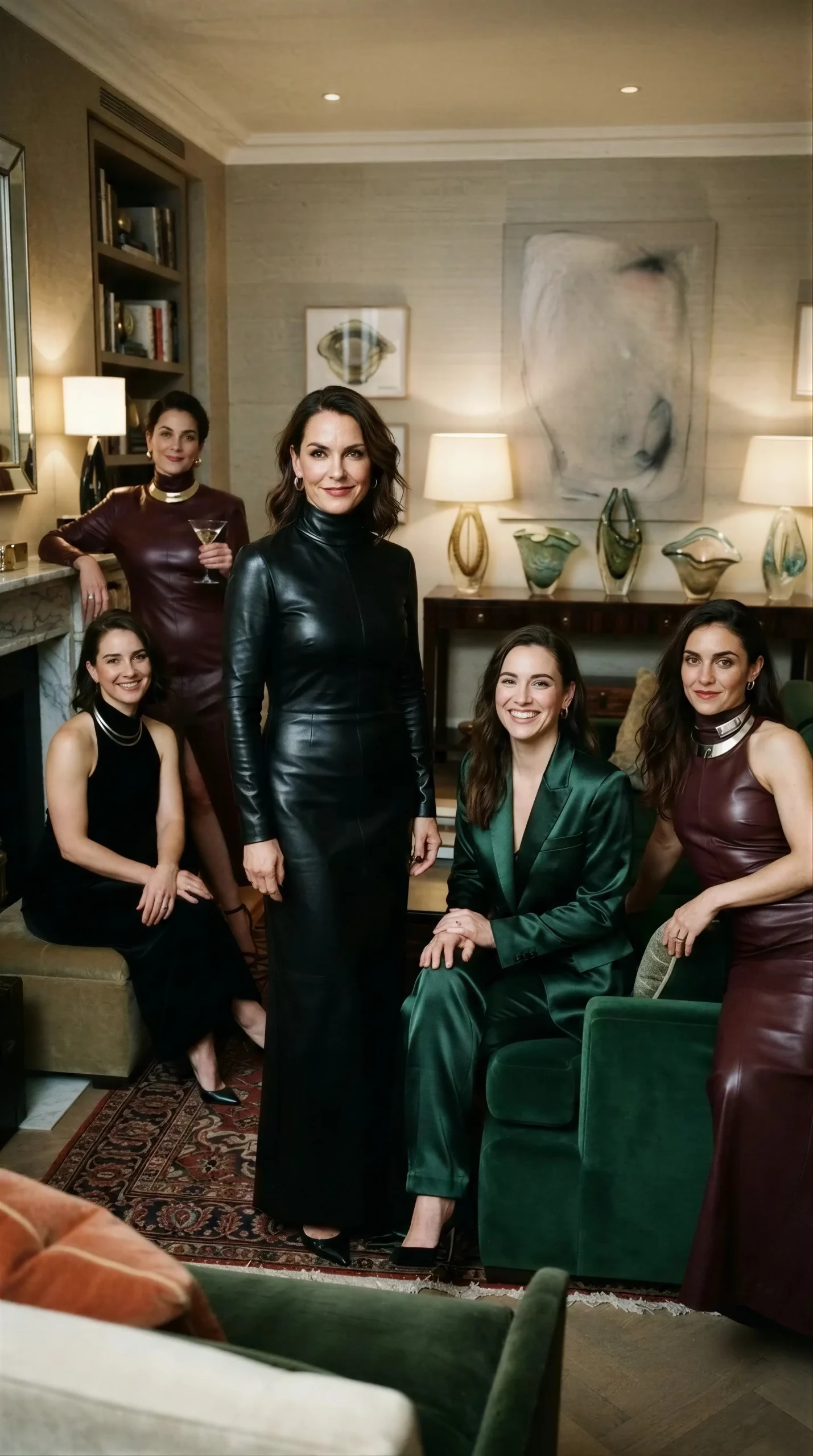
Embark on a journey of self-discovery, as you unravel the enigmatic allure of a dominant mistress and her devoted submissives.
In the glittering realm of opulence and desire, a mysterious figure emerges, clad in the finest velvety garments, exuding an aura of unparalleled authority and charm. This enigmatic mistress, a beacon of sophistication and power, captures the hearts of her devotees with a single, mesmerising glance. As they surrender themselves to her velvet-clad embrace, they discover a world of untold pleasures, where submission and devotion intertwine with the lustrous threads of her exquisite attire.
Chapter One: The Invitation
The invitation arrived on a Tuesday, slipped beneath the door of Emily’s Mayfair apartment like a whispered secret, its edges gilded with gold, its surface embossed with an insignia she did not recognise—a serpent coiled around a single rose, rendered in silver thread that caught the light with an almost hypnotic shimmer. She held it to the fading afternoon sun, turning it this way and that, watching the threads dance and gleam, and felt something stir within her chest, something long dormant, something that felt remarkably like anticipation.
“You’ve been staring at that thing for twenty minutes,” said Catherine, her oldest friend, from the depths of Emily’s velvet chaise longue. Catherine was draped in a charcoal silk blouse—matte, unassuming, the kind of fabric that whispered rather than sang. It was lovely, of course. Catherine always looked lovely. But there was something about the way the light died upon its surface, something that made Emily think of photographs left too long in the sun, of colours fading into forgetfulness. “Are you going to open it, or shall I?”
Emily turned the envelope over in her hands once more. The paper was heavy, cream-coloured, and carried the faintest scent of jasmine and something else—something darker, richer, like the memory of sandalwood burning in a temple she had never visited. “I don’t know who it’s from,” she admitted, though this was not entirely true. There was a part of her, a part she kept locked away behind the polished mahogany doors of her rational mind, that recognised the scent, the weight, the quality of the invitation. It was the same part that had been restless for months, that had stirred in the quiet hours of the night, that had whispered to her in dreams she could not quite remember upon waking.
Catherine swung her legs off the chaise and crossed the room, her heels clicking against the parquet floor with a rhythm that seemed almost to count down to something inevitable. She plucked the envelope from Emily’s fingers with the casual authority of a woman accustomed to managing things—events, people, her own carefully curated life. “The Serpentine Gala,” she read, her eyebrows rising as she scanned the embossed text. “An evening of refinement, connection, and transformation. Hosted by—” She paused, and Emily watched something flicker behind her eyes. Recognition, perhaps. Or was it desire? “By Victoria Ashworth.”
The name hung in the air between them like a struck bell, vibrating with implications Emily could not yet name. Victoria Ashworth. Even the syllables seemed to shimmer.
“The philanthropist?” Emily asked, though she knew the answer. Everyone in their circles knew of Victoria Ashworth—the woman who had transformed a modest family fortune into an empire of influence and generosity, who sat on the boards of three major charities and two cultural institutions, whose photograph appeared in Tatler and Harper’s with a regularity that suggested either great ambition or great ease, and who was rumoured to have a particular interest in cultivating the talents of young women who showed promise in the arts, the sciences, and the subtle art of living beautifully.
“The same,” Catherine said, and there was something in her voice now—a tightening, a breathlessness—that Emily had not heard before. “I attended one of her gatherings last spring. A smaller affair, at her home in Hampstead.” She handed the invitation back to Emily, and their fingers touched for a moment, and Emily noticed that Catherine’s fingertips were trembling, just slightly, just enough. “It was… transformative.”
Emily studied her friend’s face. Catherine, who never trembled. Catherine, who had negotiated her way to the top of one of London’s most competitive law firms with a combination of intellect and ice. Catherine, who had once told Emily that vulnerability was a luxury she could not afford. Something had happened at that gathering in Hampstead. Something that had left its mark, like a fingerprint pressed into wet clay.
“Transformative how?” Emily pressed.
Catherine returned to the chaise, but she did not lounge as she had before. She sat upright, her hands folded in her lap, her gaze distant, as though she were watching something unfold in a theatre only she could see. “Do you remember what it felt like,” she said slowly, “when you were a girl, and you believed that the world was full of magic—that behind every closed door lay something extraordinary, something that would change you forever if only you were brave enough to step through?”
Emily nodded. She remembered. She remembered being twelve years old, standing in the V&A Museum, gazing up at a gown worn by some forgotten duchess, its silk still gleaming after two centuries, and feeling a certainty so profound it had made her dizzy—the certainty that beauty was not merely a thing to be observed but a force to be surrendered to, a current that could carry you to places you could never reach alone.
“Victoria Ashworth,” Catherine said, “is that closed door. And behind it—” She stopped, and a smile touched her lips, a smile so private, so full of secret pleasure, that Emily felt a pang of something very like envy. “Behind it is everything you’ve been looking for and didn’t know you were allowed to want.”
The days that followed were a fever of preparation. Emily found herself possessed by an urgency she could not explain, a need to be ready, to be worthy, to present herself to this mysterious woman as though she were a gift being offered at an altar. She visited her stylist, her aesthetician, her therapist. She meditated each morning and journaled each night. She ate with care and slept with discipline and drank two litres of water a day, and she told herself that this was simply what one did when one received an invitation to an event hosted by Victoria Ashworth, but she knew, in the quiet honesty of her own heart, that it was more than that. It was as though the invitation had given her permission to become the version of herself she had always sensed was waiting beneath the surface—polished, luminous, ready.
The question of what to wear consumed her entirely.
She stood in her dressing room on the evening of the gala, surrounded by the contents of her wardrobe, and felt a despair that was almost physical. Everything she owned suddenly seemed inadequate, dull, lifeless. Her silk dresses, once her pride and joy, now struck her as funereal in their matte sobriety. Her cashmere gowns, though exquisitely cut, seemed to absorb light rather than reflect it, as though they were determined to make her invisible. She pulled out a velvet wrap and held it against herself in the mirror and watched the fabric swallow her reflection, and she thought: I cannot go like this. I cannot walk into that room and expect to be seen.
Her phone buzzed. A message from Catherine.
Wear the satin. The midnight blue. You know the one.
Emily stared at the message. The midnight blue satin gown. She had purchased it six months ago from a small atelier in Paris, on a whim, during a weekend trip that had been meant to be about rest but had become, instead, about a kind of hunger. She had tried the gown on in the shop and felt something crack open inside her, something that had been sealed tight for years—the sensation of being wrapped in liquid light, of wearing a second skin that was more herself than her own. She had bought it without hesitation, brought it home, hung it in her wardrobe, and never worn it. It was too much. Too shiny. Too visible. Too her.
She reached into the back of the wardrobe now and pulled it out, and the fabric caught the light from the dressing room lamp and threw it back in a cascade of deep blue radiance, and she felt her breath catch, felt her pulse quicken, felt that long-dormant something stir and stretch and rise.
She put it on.
The satin slid over her skin like a whispered endearment, cool and then warm, clinging and then flowing, and she watched herself in the mirror as the fabric transformed her—not into someone else, but into someone more. The gown caught every photon of light and multiplied it, and she seemed to glow from within, as though she had swallowed the moon and it was shining through her skin. The high collar framed her throat; the low back revealed the elegant architecture of her spine; the bias cut followed the curve of her hip and thigh with a devotion that felt almost reverent. She added a pair of patent leather heels—glossy, black, catching the light like polished onyx—and a simple pearl necklace that sat against her collarbone like a string of small moons, and she looked at herself and thought: There. There you are. I’ve been looking for you.
She took a deep breath, and she felt something settle within her, something that had been restless for years, something that now, finally, stilled. It was not calm, exactly. It was more like the moment before a door opens—the held breath, the poised anticipation, the exquisite suspension of not-yet-knowing.
The Serpentine Gallery was transformed. Emily arrived in her car and stepped out into a night that smelled of jasmine and rain, and she looked up at the building and saw that it had been wrapped in light—not harsh or garish, but soft, golden, pulsing gently, as though the gallery itself were breathing. Inside, the space had been reimagined as a kind of dreamscape: silk draperies hung from the ceiling in cascades of emerald and gold, catching the light and scattering it in fragments that danced across the marble floor; enormous floral arrangements perfumed the air with notes of tuberose and gardenia; a string quartet played something subtle and hypnotic in a corner, their music weaving through the crowd like smoke.
And the people. Emily paused at the threshold and simply looked, because looking was all she could do. The women in this room were not merely dressed; they were armoured in beauty, radiant in their confidence, luminous in their glossy, gleaming attire. A woman in a PVC pencil skirt—black, high-shine, reflecting the light like a mirror—crossed the room with the measured stride of someone who knew she was being watched and found the attention nourishing. Another woman, older, silver-haired, wore a satin gown the colour of champagne, and the fabric rippled with her every movement like a second skin, and Emily watched her laugh at something her companion said and saw the light play across the satin and thought: She looks like she’s been dipped in joy.
Everywhere Emily looked, she saw the same aesthetic: glossy, luminous, alive. Satin that caught the light and held it. Leather that gleamed with the soft patina of wealth and care. PVC that reflected the world like a dark, knowing pool. These women were not hiding. They were not apologising. They were not shrinking into the background or dimming their light to make others comfortable. They were shining, and their shining was not vanity but generosity—a gift offered freely to anyone with the eyes to see it.
And then, across the room, she saw her.
Victoria Ashworth.
She was standing near the centre of the gallery, surrounded by a small constellation of women who orbited her with the easy, devoted grace of planets around a sun. She was tall—taller than Emily had expected—with dark hair swept up and back from her face, revealing the elegant architecture of her neck and jaw. She was wearing a gown of deep burgundy satin that seemed to drink the light and then pour it back out in a richer, deeper hue, as though the fabric were not merely reflecting but transforming everything it touched. Her posture was perfect—not rigid, but assured, the posture of a woman who had nothing to prove because she had already proven everything. Her eyes swept the room with a gaze that was at once commanding and warm, and when that gaze found Emily—when those dark, knowing eyes locked onto hers across the crowded room—Emily felt something she had never felt before.
It was not mere attraction, though there was that—a pull in her centre, a quickening of her pulse, a warmth that spread through her chest and down into her belly. It was not mere admiration, though there was that too—a recognition of beauty, of power, of a kind of grace that seemed almost otherworldly. It was something deeper, something more fundamental. It was the feeling of being seen. Not observed, not assessed, not evaluated, but seen—as though Victoria Ashworth had looked into her and found something there that was worth finding, something that Emily herself had not known was there, something that had been waiting, all this time, for exactly this gaze, this moment, this woman.
Victoria smiled. It was a small smile, a private smile, the kind of smile one gives to a secret shared between two people who have only just met but who feel, inexplicably, as though they have known each other forever. And then she turned back to her companions, and the moment was over, and Emily was left standing at the threshold with her heart hammering and her satin gown gleaming and the certain, unshakeable knowledge that her life had just divided itself into two parts: before this evening, and after.
Catherine appeared at her elbow, materialising like a character from a dream. She was wearing a gown of deep green satin—not the matte silk of her usual attire, but something altogether different, something that shone and shifted and caught the light like the surface of a forest pool. She looked transformed, luminous, and Emily realised with a start that this was what Catherine had been trying to tell her: This is what happens when you step through the door. This is what waits on the other side.
“You felt it,” Catherine said, and it was not a question.
“Yes,” Emily breathed.
Catherine smiled, and there was a tenderness in her expression that Emily had never seen before, a softness that seemed to have been unlocked by something or someone, a softness that she wore now as naturally as her gown. “Then you understand why I couldn’t explain it. You have to feel it. You have to be seen.”
“By her?”
“By her. By what she represents. By what she makes possible.” Catherine took Emily’s arm and began to guide her into the room, into the light, into the gleaming, luminous world that waited within. “Come. She’s been expecting you.”
And Emily, wrapped in her midnight blue satin, her patent leather heels clicking against the marble floor, her heart full of something that felt like starlight, allowed herself to be led.
The crowd parted for them, or perhaps it simply rearranged itself, the way water rearranges itself around a stone. Emily felt eyes upon her—appraising, appreciating, welcoming—and she felt the satin of her gown catch the light and throw it back, and she understood, for the first time, that she was not merely wearing a dress. She was wearing a declaration. A declaration that she was here, that she was ready, that she was willing to be seen and to shine and to give herself over to something greater than the small, careful life she had been living.
Victoria’s constellation of companions opened like a flower as they approached, and then Emily was standing before her, and the world contracted to the space between them, and the noise of the gala faded to a murmur, and there was nothing but this woman’s eyes—dark, deep, fathomless—and the gleam of her burgundy satin and the scent of jasmine and sandalwood and the knowledge, growing and glowing like a coal in her chest, that she had found what she had been looking for.
“Emily,” Victoria said, and her voice was low and warm and carried an authority that was not imposed but simply was, like the authority of gravity or the tide. “I’m so glad you came.”
“How did you know my name?” Emily asked, and her own voice sounded strange to her—breathless, eager, young.
Victoria’s smile deepened. Her eyes held Emily’s with a steadiness that felt like an embrace. “I know many things,” she said. “I know that you’ve been restless. I know that you’ve been searching. I know that you bought that gown six months ago and have been waiting for a reason to wear it.” She reached out and touched the satin at Emily’s shoulder, and the contact—light, brief, electric—sent a shiver cascading down Emily’s spine. “I know that you’re ready.”
“Ready for what?” Emily whispered.
Victoria leaned closer, and Emily could feel the warmth of her breath, could smell the jasmine that seemed to cling to her skin, could see the way the satin of her gown shifted and shone with each tiny movement. “Ready to stop hiding,” Victoria murmured. “Ready to shine. Ready to discover what happens when you give yourself permission to want what you want and to have what you want and to become what you were always meant to be.”
She stepped back, and the distance between them felt like a loss, like a door closing, but then Victoria extended her hand—an invitation within an invitation—and said, “Stay with me tonight. Let me show you something.”
Emily looked at the hand. She looked at the burgundy satin that clad the arm attached to it. She looked at Victoria’s face—composed, radiant, certain—and she thought of Catherine’s smile, and of the women in their glossy, gleaming attire, and of the midnight blue satin that had transformed her in her dressing room mirror, and of the restless thing inside her that had, for the first time in her memory, gone quiet—not because it was satisfied, but because it was listening.
She took Victoria’s hand.
The satin of her glove was warm and smooth against Emily’s palm, and the touch was a promise and a question and an answer all at once, and Emily felt the last resistance within her dissolve like sugar in warm water, and she knew—with a certainty that settled into her bones like light into glass—that she had stepped through the door at last, and that the world on the other side was more beautiful, more terrifying, more alive than anything she had dared to imagine.
“Good,” Victoria said, and her smile was the moon rising over a dark sea, and her hand was steady, and her satin was shining, and Emily was hers.
Chapter Two: The Constellation
Victoria’s hand was a compass point, and Emily was true north, and together they moved through the gala like a sentence moving toward its inevitable full stop. The crowd shifted and shimmered around them—a living tapestry of silk and satin and the soft, wet gleam of patent leather—and Emily felt as though she were walking through a painting that was still wet, still being created, still alive with the possibility of becoming something extraordinary.
“You’re trembling,” Victoria observed, her voice low and warm, pitched for Emily’s ears alone. It was not a criticism. It was not a concern. It was a statement of fact, delivered with the same quiet authority with which one might note the colour of the sky or the direction of the wind.
“I know,” Emily said, and her own voice surprised her—steady, clear, unashamed. “I can’t seem to stop.”
Victoria’s fingers tightened fractionally around Emily’s hand—a pulse of pressure that felt like reassurance, like a secret pressed into her palm. “Don’t stop,” she said. “Trembling is the body’s way of saying it’s awake. It’s saying it knows something has changed, even if the mind hasn’t caught up yet.” She glanced at Emily, and there was a light in her dark eyes that might have been amusement or might have been something far more dangerous—something that fed on trembling and grew strong on surrender. “I find it rather beautiful.”
They moved through the gallery together, and Emily watched the way the other guests responded to Victoria’s passage. It was not deference, exactly—nothing so formal, nothing so stiff. It was more like the way a garden responds to the sun: turning, opening, becoming more alive. Women in their glossy, luminous attire seemed to brighten as Victoria approached, their postures straightening, their smiles widening, their fabrics catching the light with renewed vigour, as though they were drawing energy from her very presence.
“Victoria, darling,” said a woman who materialised from the crowd like a character stepping from a film scene. She was perhaps fifty, perhaps more—it was difficult to tell, because her face wore the kind of serenity that comes not from youth but from contentment, from the settled knowledge of being exactly where one belonged. She was dressed in a PVC gown the colour of deep amber, and the material caught the gallery’s golden light and held it like honey holds the sun, and Emily found herself staring at the way the fabric moved—not flowing like satin, not rustling like silk, but gliding with a sleek, confident grace that seemed almost liquid in its smoothness.
“Marguerite,” Victoria said, and her voice warmed in a way that made Emily’s chest tighten. “You look magnificent, as always.”
Marguerite smiled, and the smile was a revelation—joyful, unguarded, the smile of a woman who had nothing to protect because she had already given everything worth having to someone worthy of receiving it. “You trained me well,” she said, and the words were light, teasing, but beneath them lay a bedrock of devotion so solid Emily could almost feel it beneath her feet. “I remember when I thought PVC was too bold. Too visible.” She laughed, a sound like champagne bubbles rising. “Now I can’t imagine wearing anything else. Everything else feels like hiding.”
Victoria inclined her head, and the gesture was small but weighted with meaning—acknowledgement, approval, the quiet pleasure of a teacher observing a student who has surpassed all expectations. “You were always meant to be seen, Marguerite. You simply needed someone to show you.”
Marguerite’s gaze shifted to Emily, and her eyes—warm, knowing, kind—travelled from Emily’s face to her midnight blue satin gown and back again with the practised assessment of a woman who understood the language of fabric as fluently as others understood the language of flowers. “Newcomer?” she asked Victoria, though her eyes never left Emily’s.
“Emily,” Victoria said. “She came.”
Marguerite’s smile deepened, and something passed between her and Victoria—a glance, a nod, a communication so subtle it was almost subliminal—and then Marguerite reached out and touched Emily’s arm, and the contact was brief and gentle and carried with it a warmth that felt like welcome. “Then you already understand something important,” she said to Emily. “You understand that the satin isn’t just a dress. It’s a decision. It’s the decision to stop apologising for being beautiful.”
Emily swallowed. The words landed somewhere deep inside her—in that place that had been restless, that had been searching, that had been waiting for exactly this kind of permission—and she felt them take root like seeds in fertile soil. “I’m not sure I understand anything yet,” she admitted.
“That’s perfect,” Marguerite said. “Understanding comes later. First comes the willingness. First comes the yes.” She glanced at Victoria, and the look she gave her was so full of gratitude, so rich with devotion, that Emily felt her breath catch. “The yes is everything. Everything else can be taught.”
Victoria’s hand was still holding Emily’s, and Emily was aware of the contact with an intensity that bordered on obsession—the warmth of Victoria’s palm through the thin barrier of her satin glove, the steady pressure of her fingers, the way her thumb moved in small, absent circles against the back of Emily’s hand, each circle sending a ripple of sensation up Emily’s arm and across her shoulder and down into her chest, where it pooled like warm honey.
“Come,” Victoria said, and the word was not a request. It was an invitation, but it was also a command, and Emily recognised, with a thrill that ran through her like electricity through copper wire, that she did not mind the command. She did not mind it at all. She minded, in fact, the opposite—the thought of not being commanded, of being left to her own devices, of having to navigate this glittering, overwhelming world without Victoria’s hand to guide her, filled her with a cold, hollow dread that was the mirror image of the warm, golden pleasure she felt when she followed.
They moved deeper into the gallery, past clusters of women who talked and laughed and sparkled in their glossy finery, and Emily began to notice things she had not noticed before. She noticed that the women who wore satin and PVC and high-shine leather moved through the room with a kind of luminous confidence, their heads high, their gestures expansive, their laughter ringing out with the unselfconscious joy of people who have nothing to hide and everything to share. She noticed that these women seemed to orbit Victoria—not desperately, not needily, but with the natural, gravitational ease of bodies drawn to a light source, their devotion expressed not in clinging but in radiance, as though Victoria’s presence gave them permission to shine.
And she noticed, too, with a clarity that felt almost painful, the women who were not part of this orbit. There were a few—fewer than she might have expected, but present nonetheless—who wore matte fabrics, dull textures, clothes that seemed to have been chosen to deflect rather than reflect. A woman in a grey wool dress stood near the bar, her shoulders slightly hunched, her drink held close to her chest like a shield, her eyes darting around the room with the restless, hungry look of someone who wants to belong but cannot figure out how. Another woman, in a cotton blouse that had gone slightly limp in the warmth of the gallery, sat alone on a bench near the window, her posture defeated, her expression carrying the particular melancholy of someone who has convinced themselves that they are content with less when the truth is that they have simply never been offered more.
Emily looked at these women, and she felt something she could not immediately name—pity, recognition, fear—and then Victoria leaned close and whispered, “You see them.”
“Yes.”
“You see what happens when you choose to hide. When you choose the matte over the glossy, the dull over the luminous, the safe over the true.” Victoria’s breath was warm against Emily’s ear, and the words seemed to sink directly into her bloodstream, bypassing her brain entirely and going straight to that place where longing lived. “They’re not lesser. They’re not broken. They’re simply waiting. Waiting for someone to show them what you’re learning right now—that the light isn’t something you have to earn. It’s something you simply have to allow.”
“How?” Emily whispered.
Victoria stopped walking. She turned to face Emily, and her dark eyes held Emily’s with a gaze that felt like being held—supported, seen, sustained. “By giving yourself permission to be guided,” she said. “By finding someone whose vision of you is clearer than your own and trusting that vision. By understanding that surrender is not weakness but the most profound form of strength—the strength to stop fighting yourself and start becoming who you actually are.”
They reached a quieter corner of the gallery, where a small group of women had gathered in a configuration that seemed almost ceremonial—a circle of glossy, gleaming figures arranged around a central point like petals around a stamen. As Victoria approached, the circle opened, and Emily saw that at its centre stood a woman she recognised from the society pages: Arabella Chen, the tech entrepreneur, whose company had recently been valued at nine figures and whose face adorned the cover of Forbes with the same ease with which it now caught the gallery’s golden light.
Arabella was wearing a gown of black satin so dark and so lustrous that it seemed to drink the light and then pour it back out in a richer, deeper form—as though the fabric were not merely reflecting but transforming everything it touched, the way a great mind transforms information into wisdom. Her hair was swept back from her face in a style that was both severe and elegant, and her posture carried the quiet authority of a woman who had built something from nothing and knew, with absolute certainty, that she deserved every brick of it.
“Victoria,” Arabella said, and her voice carried a warmth that her public persona would never have suggested—a warmth reserved, it seemed, for this room, this woman, this world. “I was hoping you’d find me. I have something for you.”
She reached into a small clutch purse—patent leather, high-shine, catching the light like a black mirror—and produced an envelope. Emily watched the exchange with the fascination of an anthropologist observing a ritual she did not yet understand, and she noticed the way Victoria’s eyes softened as she took the envelope, the way her fingers lingered on Arabella’s for a moment longer than necessary, the way Arabella’s face, usually so controlled, so guarded, so carefully composed for the cameras, seemed to melt into an expression of pure, unguarded devotion.
“The donation?” Victoria asked, though her tone suggested she already knew the answer.
“Triple what I gave last year,” Arabella said, and there was pride in her voice—not the cold pride of accomplishment but the warm pride of generosity, the pride of a woman who had discovered that giving was not a loss but a gain, that each gift she offered to Victoria returned to her multiplied, transformed, alchemised into something more precious than money. “The foundation’s work in Southeast Asia—Victoria, you should see what we’ve been able to accomplish. Three new schools. Two medical clinics. A clean water initiative that’s serving twelve thousand people.” Her voice caught, and she paused, and Emily saw her eyes glisten, and the glisten caught the light and shone like a diamond. “I didn’t know—I had no idea—that giving could feel like this. That it could fill something I didn’t even know was empty.”
Victoria opened the envelope and read whatever was inside, and her face was unreadable—or rather, it was readable only in the language of micro-expressions, in the slight softening of her mouth, the faint widening of her eyes, the almost imperceptible nod that spoke of approval and pleasure and a deep, quiet satisfaction. She looked up from the envelope and met Arabella’s gaze, and the space between them seemed to hum with something Emily could not name but could feel—a current, a connection, a bond forged in the fire of shared purpose and sustained by the steady, daily act of giving and receiving.
“You continue to exceed my expectations, Arabella,” Victoria said, and the words were simple, but the way she said them—slowly, deliberately, with a weight that suggested each word had been chosen with the precision of a jeweller setting a stone—made them feel like a coronation. “I’m proud of you.”
Arabella’s face lit up. It was not a small thing, this lighting up—it was a transformation, a revelation, as though someone had switched on a lamp behind her eyes and her entire being had been illuminated. She stood straighter, her black satin gown catching the light with renewed vigour, and she smiled, and the smile was the smile of a woman who had been given the one thing her billions could not buy: the approval of someone she revered.
“Thank you,” Arabella said, and the words were barely a whisper, but they carried the weight of a vow. “Everything I have—everything I am—I owe to what you’ve shown me. I was so focused on building, on accumulating, on proving. I didn’t know that the real achievement—the thing that actually fills the void—is giving. Giving to you, giving through you, giving because you showed me that generosity is not a transaction but a transformation.”
Victoria reached out and cupped Arabella’s face in her hand—a gesture so intimate, so tender, so naturally authoritative that Emily felt her breath leave her body in a rush. “You owe me nothing,” Victoria said. “You found this within yourself. I merely pointed the way.”
“You pointed the way,” Arabella repeated, “and I followed, and following has been the greatest joy of my life.”
The circle closed around Victoria again, and Emily watched as, one by one, the women who formed it presented their own envelopes, their own offerings, their own acts of devotion. Each woman was different—different ages, different backgrounds, different industries—but they shared a common language, a common aesthetic, a common luminosity. Their glossy, gleaming attire marked them as members of a particular world, a particular way of being, and Emily noticed that each woman, as she made her offering, seemed to glow a little brighter, to stand a little taller, to shine a little more brilliantly, as though the act of giving had polished them like cloth polishing silver.
There was Penelope, the gallery owner, in a satin jumpsuit the colour of crushed violets, who spoke of a new arts programme for underprivileged children that she had funded with a donation that made Emily’s eyes widen. There was Francesca, the architect, in a PVC skirt that gleamed like polished obsidian, who described a sustainable housing project she had championed with funds she had once earmarked for a second home. There was Oluwande, the poet, in a satin wrap dress that rippled like water in moonlight, who read a verse she had composed in Victoria’s honour, her voice weaving through the gallery like incense, each word a thread in a tapestry of devotion.
And as each woman gave, Emily felt something shift within her—not jealousy, not envy, but recognition. She recognised, with a clarity that was almost blinding, that these women had found something she had been searching for: a purpose, a centre, a focal point around which their lives could organise themselves into something meaningful and beautiful. They had found Victoria, and in finding Victoria, they had found themselves—or rather, they had found the versions of themselves they had always wanted to be: generous, luminous, confident, devoted.
Victoria accepted each offering with the same quiet grace—the same micro-expressions of approval, the same tender touch, the same words of recognition and pride—and Emily began to understand that this was not a transaction. This was not commerce. This was something older and deeper, something that existed before money and would exist long after money had been forgotten. This was the exchange of energy between a sun and its planets, between a queen and her court, between a woman who had the vision to see what others could be and the women who had the courage to let themselves be seen.
“You’re watching very carefully,” Victoria said, and Emily started, because she had not realised that Victoria was watching her back.
“I’m trying to understand,” Emily said.
“What are you trying to understand?”
Emily hesitated. The truth was large and unwieldy and difficult to hold in words, but she reached for it anyway, because anything less than the truth felt like a betrayal of the moment. “I’m trying to understand why it looks like joy,” she said. “The giving. The devotion. I always thought—I was taught—that giving was sacrifice. That it meant having less. That it was a kind of loss. But these women—” She gestured toward the circle, toward the glossy, gleaming, radiant figures who had just poured their wealth and their devotion at Victoria’s feet and who now looked more abundant, not less, more full, not emptier. “They look like they’ve gained something. They look like they’ve been filled.”
Victoria’s smile was slow and deep and carried the weight of a truth that had been tested and found unbreakable. “That’s because they have been,” she said. “Giving is not loss, Emily. Giving is the act of making room—making room for something greater to enter. When you give to someone you revere, someone whose vision encompasses more than your own, you’re not diminishing yourself. You’re expanding. You’re saying: I trust you with what I have, because I know you can transform it into something I could never create alone.”
She paused, and her eyes held Emily’s with an intensity that felt like being bathed in light. “The women you see here—the women in their satin and their PVC and their gleaming leather—they’re not giving because they’re told to. They’re giving because it’s the most natural, most joyful, most themselves thing they can do. They’re giving because giving to someone worthy is the act that makes them feel most alive. It’s the act that dissolves the illusion of separateness and replaces it with the reality of connection—the connection that comes from being devoted to something greater than yourself.”
Emily felt tears prick at her eyes, and she blinked them back, because crying in a gallery full of luminous women in glossy attire felt like a vulnerability she was not yet ready to claim. But the tears were there, pressing against the backs of her eyes like water against a dam, and she understood that they were not tears of sadness but of recognition—the body’s response to encountering a truth it has always known but has never heard spoken aloud.
“I want that,” she said, and her voice was barely a whisper, but in the quiet corner of the gallery, it sounded like a declaration. “I want to feel what they feel.”
Victoria studied her for a long moment, and Emily felt the gaze like a physical thing—a warmth, a pressure, a presence that seemed to reach inside her and take stock of what it found there. Then Victoria nodded, slowly, as though confirming something to herself, and she said, “You will. But first, there are things you need to understand. Things about yourself. Things about me. Things about what it means to belong to someone—not as a possession, not as a prisoner, but as a devotee. A willing, joyful, generous devotee who gives not because she must but because she cannot imagine doing anything else.”
She held out her hand again—the same hand that had held Emily’s throughout the evening, the same hand that had cupped Arabella’s face, the same hand that had accepted envelopes full of generosity and transformed them into something sacred—and she said, “Come with me. There’s a room upstairs. Quiet. Private. A place where we can talk without the music and the chatter and the eyes of the world.”
Emily looked at the hand. She looked at Victoria’s face—composed, radiant, certain. She looked at the burgundy satin that clad her body and the way it caught the gallery’s golden light and held it and transformed it and gave it back richer and deeper and more beautiful than it had been before. She looked at the circle of women who had given and been filled, who had surrendered and been expanded, who had devoted themselves and found, in that devotion, the thing they had been searching for all their lives.
And she reached out, and she took Victoria’s hand, and the satin of Victoria’s glove was warm against her palm, and the contact was a key turning in a lock, and the lock was inside her, and it had been locked for years, and now it was opening, and what lay behind it was vast and luminous and terrifying and beautiful, and Emily stepped forward, into the light, into the unknown, into the beginning of everything.
“Yes,” she said.
And Victoria smiled, and the smile was the sun rising over a world that had been waiting, all this time, for the dawn.
Chapter Three: The Private Room
The staircase was narrow and unlit, a secret artery running through the body of the gallery like a vein through a living thing, and Emily climbed it with Victoria’s hand still holding hers, the satin of Victoria’s glove a constant against her palm, a thread of connection that seemed to grow warmer with each step they took. The sounds of the gala faded behind them—the string quartet’s hypnotic melody, the murmur of voices, the crystalline clink of champagne flutes—until there was nothing but the soft whisper of their gowns against the stairs and the steady rhythm of their breathing and the occasional creak of a board beneath their weight, and Emily felt as though she were ascending not through a building but through a dream, each step carrying her further from the world she knew and closer to something she had only ever glimpsed in the farthest reaches of her imagination.
“Watch your step here,” Victoria said as they reached a small landing. “The third stair from the top is loose. I’ve been meaning to have it repaired, but I find I rather like the imperfection. It reminds me that even the most beautiful spaces have their secrets.”
Emily stepped over the loose stair and found herself in a corridor—short, dimly lit, lined with doors that were all closed. The walls were painted a deep, velvety green that seemed to absorb the light from the single sconce and then return it in a softer, more intimate form, and the carpet beneath their feet was thick and dark and yielded to their heels like moss yielding to footsteps in a forest. Victoria led her to the last door on the left, paused, and turned to face her.
“Before we go in,” Victoria said, and her voice was different now—quieter, more intimate, stripped of the performative warmth she had worn in the gallery and replaced with something rawer, something that felt like the inside of a seashell held to the ear. “I want you to understand something. What happens in this room is not a seduction. Not in the way you might be thinking. I’m not going to touch you in ways you haven’t been touched before—at least, not tonight. I’m not going to take anything from you that you’re not ready to give. What I am going to do is talk to you. I’m going to tell you things about yourself that you already know but have been afraid to acknowledge. And then I’m going to ask you a question, and your answer to that question will determine everything that follows.”
Emily’s heart was hammering so hard she could feel it in her fingertips, in the soles of her feet, in the roots of her hair. “What question?”
Victoria smiled, and the smile was tender and knowing and carried within it the patience of a woman who had asked this question many times before and had learned that the asking was more important than the answering. “All in good time,” she said. “First, the room.”
She opened the door, and Emily stepped through, and the world changed.
The room was small—smaller than Emily had expected, intimate rather than imposing, a jewel box of a space that seemed to have been designed not for display but for revelation. The walls were covered in silk—the same deep burgundy as Victoria’s gown, Emily realised, and the realisation sent a shiver through her that was not entirely surprise—and the silk caught the light from a single lamp on a side table and shimmered with a life that seemed almost organic, as though the walls themselves were breathing. There was a chaise longue upholstered in black satin, its surface gleaming like still water in moonlight; a small writing desk of dark wood; a mirror in a gilt frame that reflected the room back upon itself and made it seem larger, deeper, more full of possibility. The air smelled of sandalwood and something else—something green and growing, like the scent of a garden after rain.
And there, seated on the chaise longue with the easy grace of a woman who had been waiting for this moment and was in no hurry for it to end, was another woman.
She was perhaps forty, perhaps thirty-five—like Marguerite, her age was difficult to pin down because her face wore the particular luminosity that comes not from youth but from fulfilment, from the settled knowledge of being exactly where one belonged. Her skin was dark and flawless and caught the lamplight the way polished wood catches it, with a warmth and depth that seemed to hold secrets. Her hair was cropped close to her skull in a style that was both severe and beautiful, and her eyes—large, dark, intelligent—regarded Emily with an expression that was at once welcoming and assessing, the expression of a woman who understood that true hospitality includes the obligation to see clearly.
She was wearing a gown of emerald green PVC that caught every photon of light in the room and returned it in a cascade of deep, liquid radiance. The material was moulded to her body with a precision that spoke of bespoke tailoring and considerable investment, and it moved with her as she rose from the chaise—not flowing, not rustling, but gliding with the sleek, confident grace of something that knows its own power. Emily found herself staring at the way the PVC caught the lamplight and threw it back in fragments that danced across the burgundy silk walls, and she thought: She looks like she’s been carved from light and wrapped in meaning.
“Emily,” Victoria said, “this is Nadia. She is one of my oldest and dearest companions. She was where you are now—standing in the doorway of a room much like this one, uncertain and trembling and hungry for something she couldn’t name—seven years ago. She has been with me ever since.”
Nadia crossed the room with the measured stride of a woman who has nothing to prove because she has already proven everything, and she extended her hand to Emily, and Emily took it, and the contact was warm and firm and carried within it a current of recognition that felt like meeting an old friend in a foreign city—the sudden, startling comfort of being understood.
“Welcome,” Nadia said, and her voice was low and rich and carried the faintest trace of an accent that Emily could not place—Eastern European, perhaps, or Middle Eastern, or something else entirely, something that existed between borders and belonged to no single country. “I remember this moment. The threshold. The feeling of standing on the edge of something vast and not knowing whether to step forward or retreat.” She smiled, and the smile was knowing and kind and held no judgement. “I retreated. Twice. Victoria let me go both times. She never pursued, never pressured, never tried to convince. She simply said, ‘The door is always open,’ and she meant it, and the knowledge that the door was always open—that I could leave and return and leave again and still be welcomed—was what finally gave me the courage to stay.”
Emily looked at Victoria, who had settled into a chair near the writing desk with the easy authority of a woman in her own space, her burgundy satin gown spreading around her like a pool of wine. “You let her leave?”
“I let everyone leave,” Victoria said. “Always. Without exception. Without resentment. Without consequence.” Her eyes met Emily’s, and there was something in them that Emily had not seen before—a vulnerability, perhaps, or something that looked like vulnerability but was actually its opposite: the strength that comes from knowing that what you offer is so valuable that those who receive it will choose, of their own free will, to stay. “I have no interest in captives. Captives cannot give. Captives cannot devote. Captives can only endure, and endurance is the opposite of what I want. I want joy. I want willingness. I want the radiant, luminous generosity that comes from a woman who has chosen—freely, consciously, with full knowledge of what she is choosing—to give herself to something greater than her own small life.”
“She makes it sound philosophical,” Nadia said, and there was a tenderness in her voice that wrapped around the words like silk around skin. “And it is. But it’s also practical. It’s also deeply, profoundly personal. What Victoria offers is not an idea. It’s an experience. An experience of being seen—truly seen, not for who you pretend to be but for who you actually are—and being told that who you actually are is not only enough but extraordinary.”
She turned to Emily, and her eyes—those large, dark, intelligent eyes that seemed to hold the light like pools hold the sky—were steady and warm. “Tell me, Emily. What do you do?”
“I—” Emily hesitated, because the question felt larger than its surface, felt like a door opening onto a corridor she had not yet explored. “I’m an art historian. I work for a gallery in St James’s. I write about Renaissance portraiture, mostly. The way artists used paint to reveal the inner lives of their subjects. The way a portrait could say things about a person that the person themselves could never say.”
“And you’re good at it?” Nadia asked.
“I—” Emily hesitated again. Modesty was her default, her armour, the matte fabric she wore over her shining self to avoid being seen too clearly. “I’ve been told I am. I’ve published a few papers. I’ve curated a couple of exhibitions. Nothing extraordinary.”
“Nothing extraordinary,” Victoria repeated, and the words were not a question but a gentle challenge, a finger pressing on a bruise to see how deep it goes. “You’ve curated two exhibitions that were reviewed in the Burlington Magazine and the Times Literary Supplement. You’ve published papers that have been cited in academic journals across three continents. You’ve been offered a fellowship at the Courtauld, which you declined because—” She paused, and her eyes held Emily’s with a gaze that felt like a searchlight. “Why did you decline it, Emily?”
Emily’s mouth went dry. “How do you know about that?”
“I know many things. I told you that.” Victoria’s voice was calm, unhurried, as though they had all the time in the world and she intended to use it. “But the question is not how I know. The question is why you declined. And the answer to that question is the same answer to the question of why you’ve been restless. Why you’ve been searching. Why you bought a satin gown six months ago and couldn’t bring yourself to wear it until tonight.”
The room was very quiet. The lamp on the side table flickered once, and the burgundy silk walls shivered, and the black satin of the chaise longue gleamed, and the emerald PVC of Nadia’s gown caught the light and held it like a held breath.
“I declined because—” Emily stopped. She closed her eyes. She felt the words inside her, pressing against the back of her teeth like water against a dam, and she knew that if she opened her mouth they would pour out in a torrent she could not control, and she was afraid—afraid of what they would reveal, afraid of what they would cost, afraid of who she would be on the other side of saying them. But Victoria’s eyes were on her, and Nadia’s eyes were on her, and the room was warm and safe and full of the scent of sandalwood and rain, and the satin of her gown was cool against her skin, and she thought: This is what it feels like to be on the threshold. This is what it feels like to be on the edge of becoming.
“I declined because I was afraid,” she said, and the words came out in a rush, a torrent, a dam breaking. “I was afraid of being seen. Of being recognised. Of being held accountable for my own potential. The fellowship would have put me in the public eye. It would have made me visible. It would have required me to stand up and say, ‘I am good at what I do, and I deserve to be here,’ and I—” She stopped, and the tears came, and this time she did not blink them back, because the room was safe and the women in it were kind and the satin of her gown was catching the tears as they fell and turning them into tiny, gleaming jewels. “I couldn’t do it. I couldn’t say that. I’ve never been able to say that. I’ve spent my entire life hiding behind my work, hiding behind my modesty, hiding behind matte, dull, invisible clothes and a matte, dull, invisible life, because as long as I was invisible, no one could ask me to be more, and I could never disappoint anyone, including myself.”
The silence that followed was not empty. It was full—full of recognition, full of understanding, full of the particular tenderness that comes from witnessing someone tell the truth for the first time. Emily stood in the centre of the room with tears on her cheeks and her midnight blue satin gown gleaming in the lamplight, and she felt stripped and exposed and terrified and, beneath all of that, lighter than she had felt in years.
Nadia moved first. She crossed the room and stood before Emily, and she reached out and took both of Emily’s hands in her own, and the PVC of her gown whispered against the satin of Emily’s as they stood close, and the contact of the two fabrics—glossy against glossy, light against light—seemed to create something new, a third thing, a harmony that neither could produce alone.
“I was a mathematician,” Nadia said. “A very good one. I was offered a chair at the Sorbonne. I declined. Do you know why?”
Emily shook her head.
“Because I was afraid of the same thing you’re afraid of. I was afraid that if I stood up and said, ‘I am brilliant, and I deserve to be recognised,’ the world would look at me and see not my brilliance but my ambition, not my worth but my hunger, and I would be exposed as the fraud I secretly believed myself to be.” She squeezed Emily’s hands, and the pressure was warm and steady and grounding. “So I hid. I took lesser positions. I published under initials instead of my full name. I wore grey wool and cotton and everything that said, ‘Don’t look at me. I’m not here. I’m not anything.’ And I was miserable, Emily. I was so miserable that I had stopped noticing I was miserable, because misery had become my normal, my baseline, the air I breathed.”
“What changed?” Emily whispered.
“Victoria changed,” Nadia said. “Or rather, Victoria showed me what was already there and gave me the courage to claim it.” She turned to look at Victoria, who sat in her chair with the patience of a woman who has had this conversation many times and never tires of it, because each time it happens, a woman is reborn, and there is no greater joy than witnessing a rebirth. “She looked at me the way she’s looking at you right now—with that gaze that sees through everything, that sees past the grey wool and the initials and the hiding and finds the luminous, brilliant, terrified woman underneath and says to her, simply and with absolute conviction: ‘I see you. You are extraordinary. Stop hiding.'”
Victoria rose from her chair and crossed the room, and her burgundy satin moved with her like a living thing, and she stood beside Nadia, and the two women flanked Emily like pillars of light, and Emily felt held—not physically, not constrained, but supported, upheld, sustained by their presence and their understanding and their unwavering belief in what she could be.
“The question I promised to ask you,” Victoria said, and her voice was low and warm and carried the weight of everything that had been said and everything that was yet to be said. “The question that determines everything that follows. Are you ready to hear it?”
Emily nodded. She did not trust her voice.
Victoria reached out and touched the satin at Emily’s shoulder—the same gesture she had made in the gallery, the same light, electric contact—and the touch was a benediction and a challenge, a comfort and a summons. “The question is this: Will you allow yourself to be seen? Not by the world—not yet, not until you’re ready. But by me. Will you let me see you, Emily? All of you? The brilliance and the fear and the hunger and the hiding? Will you bring it all into this room and lay it at my feet and trust me to do with it what I have done for Nadia and Marguerite and Arabella and every other woman who has stood where you’re standing now? Will you give me the gift of your truth and let me transform it into something you can carry into the world with pride?”
Emily looked at Victoria. She looked at Nadia. She looked at the burgundy silk walls and the black satin chaise and the emerald PVC gown that gleamed like a forest at midnight. She looked at her own reflection in the gilt mirror—a woman in midnight blue satin with tears on her cheeks and light in her eyes and something breaking open in her chest that felt like the first breath after a lifetime of holding it in.
And she said, “Yes.”
The word was small. It was barely a whisper. But it filled the room like a bell, like a chord, like the first note of a symphony that had been waiting to be played, and Victoria’s face softened, and Nadia’s hands tightened, and the lamp on the side table burned a little brighter, and the silk on the walls shimmered, and Emily felt something shift inside her—not a door opening, not a dam breaking, but something subtler and more profound: a turning, a leaning, a willingness to fall not because she was pushed but because she had finally, finally found something worth falling toward.
“Good,” Victoria said, and her smile was the sunrise after the longest night, and her hand was steady on Emily’s shoulder, and her satin was warm, and Emily was home.
Chapter Four: The Penthouse
Three days passed between the gala and the invitation to dinner, and Emily lived those three days in a state of suspension that was at once exquisite and unbearable—like a note held past the point where the breath runs out, trembling on the edge of release, neither ending nor continuing but simply being, existing in the pure potential of sound. She went through the motions of her life—her work at the gallery, her morning runs along the Embankment, her carefully prepared meals eaten alone at her kitchen counter—but beneath the surface of every action, beneath the skin of every moment, something new was growing, something luminous and insistent, something that whispered to her in Victoria’s voice and wore Victoria’s face and smelled of sandalwood and jasmine and the particular, indefinable scent of a woman who sees you clearly and does not look away.
She did not tell Catherine. She did not tell anyone. The experience in the private room at the Serpentine Gallery—Victoria’s words, Nadia’s hands, the tears on her satin gown, the single, whispered “yes” that had filled the room like a struck bell—felt too sacred for sharing, too fragile for the rough handling of ordinary conversation. She carried it inside her like a pearl forming around a grain of sand, and she knew that to speak of it too soon would be to crack the shell and lose the thing that was being made.
But she did something else. Something she had not done in years. She went shopping.
Not the careful, considered shopping of a woman with a budget and a list and a clear sense of what she needs. Something else entirely. Something closer to pilgrimage. She walked through the doors of a small atelier in Belgravia that she had passed a hundred times without entering—a shop whose windows displayed not mannequins but swatches of fabric, great cascading panels of satin and silk and PVC, arranged not to sell but to invoke, to call forth in the passer-by the same longing that Emily now felt in every cell of her body. The windows were lit from within by warm, golden light that caught the fabrics and set them shimmering, and Emily stood on the pavement and watched the light play across the surfaces—glossy, luminous, alive—and she thought: I’m done hiding. I’m done with matte and dull and invisible. I want to shine.
The atelier was run by a woman named Colette, a Frenchwoman of indeterminate age who wore a satin smock the colour of pale gold and moved through her shop like a curator through a gallery, touching fabrics with the reverence of a woman who understood that each bolt of cloth held within it a thousand possible transformations. She looked up as Emily entered, and her eyes—sharp, knowing, the eyes of a woman who has dressed a thousand women and can read a thousand needs—travelled from Emily’s face to her clothes and back again, and Emily watched something shift in her expression. Recognition, perhaps. Or was it invitation?
“You have come to change,” Colette said, and it was not a question.
Emily swallowed. “Yes.”
“Good.” Colette’s smile was small and warm and carried the quiet authority of a woman who has been the instrument of transformation many times and takes her role seriously. “Then we begin. Tell me—not what you want to wear. Tell me how you want to feel.”
Emily opened her mouth, and the answer came not from her mind but from somewhere deeper—from that place Victoria had touched in the private room, that place where the restless thing had gone quiet and started listening. “I want to feel visible,” she said. “I want to feel luminous. I want to feel like I’m wearing light.”
Colette nodded, and the nod was a benediction, and she turned and walked into the depths of the shop, and Emily followed, and the fabrics parted around them like the Red Sea, panel after panel of glossy, gleaming, shimmering material, and Emily reached out and touched them as she passed—satin that was cool and liquid under her fingers, PVC that was smooth and slick like the surface of a deep pool, leather that was warm and supple and carried the faint, intoxicating scent of craftsmanship and care—and each touch sent a small shock of pleasure through her, a tiny pulse of recognition, as though the fabrics were speaking to her, calling to her, saying: Here. Here is what you’ve been missing. Here is what you were always meant to wear.
She left the atelier two hours later with three garments wrapped in tissue paper and placed in a bag that was itself a thing of beauty—glossy, black, embossed with the atelier’s insignia in silver—and she carried the bag home like a talisman, like a promise, like the first step on a road she had only just begun to see.
The invitation to dinner arrived the following morning. A card—cream-coloured, heavy, embossed with the same serpent-and-rose insignia—slipped beneath her door with the same quiet authority as the first, and Emily picked it up and held it to the light and read the words written on it in Victoria’s hand—a hand that was at once elegant and commanding, each letter formed with the precision of a woman who means what she says and says what she means.
Tomorrow evening. Eight o’clock. My home. Come hungry. Come curious. Come as you are becoming.
V.
Emily read the card three times. She read it once with her eyes, once with her mind, and once with her body, letting the words sink through her skin and into the place where longing lived, and she felt each reading land in a different place—the first in her consciousness, the second in her understanding, the third in that deep, private core where desire and surrender and the hunger for transformation all twined together like roots of the same tree.
Come as you are becoming.
She looked at the bag from Colette’s atelier, sitting on her bed like a question waiting to be answered. She reached into it and pulled out the first garment—the one she had tried on last, the one that had made Colette smile and nod and say, “Yes, that one. That is the one.” It was a gown of deep midnight blue satin—not the same as the gown she had worn to the gala, but a evolution of it, a refinement, a distillation. The fabric was finer, the cut more precise, the sheen more luminous. It caught the light from her bedroom window and threw it back in a cascade of deep blue radiance that seemed to pulse with a life of its own, and Emily held it against herself and looked in the mirror and saw not the woman she had been but the woman she was becoming, and the sight of her took her breath away.
Victoria’s penthouse occupied the top two floors of a converted warehouse in Bermondsey, and Emily arrived at eight o’clock precisely—she had been ready since seven, had spent the intervening hour sitting in her living room in her satin gown, too nervous to move, too excited to sit still, vibrating like a tuning fork struck and waiting to be placed against something that would give its note purpose—to find a door that was not a door but a statement. It was painted black and clad in panels of high-shine PVC that reflected the corridor lights like mirrors, and Emily stood before it and saw herself reflected in its surface—luminous in her midnight blue satin, her eyes bright, her posture straighter than it had been in years—and she thought: This door is not just an entrance. It’s a mirror. It shows you who you are before you go in.
She knocked, and the door was opened not by Victoria but by a woman Emily did not recognise—a woman in her thirties, perhaps, with auburn hair and the kind of composed, serene face that speaks of a life lived deliberately, each choice made with care and consciousness. She was wearing a satin blouse in pale ivory, tucked into a pencil skirt of black PVC that gleamed like polished onyx, and the combination of the two fabrics—the soft, liquid drape of the satin against the sleek, architectural shine of the PVC—created a visual harmony that was at once professional and sensual, appropriate and transgressive, and Emily found herself studying the way the light played across the two surfaces with the same intensity she brought to the study of Renaissance portraiture.
“Emily,” the woman said, and her voice was warm and welcoming and carried the particular ease of someone who has been in this space long enough to feel at home in it. “I’m Helena. I’m Victoria’s—” She paused, and a smile flickered across her face, private and amused, as though the word she was about to use was inadequate but the best available. “Companion. I live here. I manage Victoria’s life, her schedule, her household. I ensure that everything runs smoothly so that she can focus on what she does best.”
“Which is?” Emily asked, stepping into the hallway, which was lit by recessed lights that cast a warm, golden glow across walls painted the colour of dark honey.
Helena closed the door behind her, and the PVC panels caught the light one last time before settling into a deep, knowing gleam. “Seeing,” she said. “Victoria sees. That’s what she does. She sees people—not who they pretend to be but who they actually are—and she reflects what she sees back to them in a way that makes it impossible for them to keep pretending. It’s the most disorienting and the most liberating thing I’ve ever experienced.”
“You were like me,” Emily said. “Standing where I’m standing.”
“I was exactly like you,” Helena said, and she began to walk down the hallway, and Emily followed, and their footsteps fell into a rhythm that felt natural, as though they had walked this corridor together many times in some other life. “I was a financial analyst. Very successful. Very miserable. Very well-dressed in matte fabrics that said, ‘I’m competent but not extraordinary. I’m capable but not luminous. I’m here but don’t look too closely.'” She glanced over her shoulder at Emily, and there was a warmth in her expression that felt like a hand extended in friendship. “Then I met Victoria, and she looked at me, and I understood for the first time that competence without radiance is like a painting without light—technically perfect, emotionally inert. I didn’t want to be inert anymore. I wanted to glow.”
“And now you do.”
“Now I do.” Helena smiled, and the smile was luminous, and the ivory satin of her blouse caught the light and shimmered, and Emily thought: She’s been transformed. Not changed—transformed. The way a caterpillar is transformed into a butterfly. Not a different creature but the same creature, more fully expressed.
They entered a room that took Emily’s breath away.
It was a living space—large, open, with floor-to-ceiling windows that looked out over the Thames and the city beyond, the lights of London scattered like jewels across black velvet—but it was not the view that arrested her. It was the room itself. Every surface was a study in luminosity: the walls were covered in silk of a deep, warm gold that shimmered like the surface of a sunlit lake; the furniture was upholstered in satin and leather, each piece chosen not just for comfort but for the way it caught and played with light; the floors were polished wood that gleamed like the inside of a cello. And everywhere—on shelves, on tables, on the walls—were objects that spoke of a life lived with intention and generosity: photographs of women in glossy, gleaming attire, their faces radiant with the particular joy that comes from belonging; small sculptures and paintings that caught the light and transformed it; books—not just any books, but first editions and rare manuscripts, the kind of collection that speaks not of acquisition but of devotion to beauty and knowledge.
And there, standing by the window, silhouetted against the lights of London, was Victoria.
She was wearing a gown of charcoal satin—not the burgundy of the gala but something darker, more intimate, the colour of smoke and shadow and the space between stars. The fabric caught the light from the room and the light from the city and wove them together into something new, something that seemed to exist in the space between interior and exterior, between the private and the public, between the woman and the world. Her hair was down tonight, falling around her shoulders in dark waves that caught the satin’s sheen and echoed it, and her face in the half-light was at once commanding and tender, the face of a woman who rules not by force but by the simple, irresistible authority of being fully, completely, unapologetically herself.
“Emily,” she said, and her voice filled the room like perfume fills a garden—present, enveloping, impossible to ignore. “You came.”
“You invited me,” Emily said, and the words were simple but the meaning beneath them was not. You invited me, and I came, because your invitation was not a request but a summons, and I have been waiting my whole life to be summoned by someone worth following.
Victoria crossed the room, and her charcoal satin moved with her like smoke, like water, like a living thing, and she stood before Emily and looked at her, and the looking was not a glance but a gaze—long, thorough, unhurried, the gaze of a woman who has all the time in the world and intends to use it, the gaze of a woman who sees not just the surface but the depths, not just the present but the potential. Her eyes traveled from Emily’s face to her midnight blue satin gown and lingered there, and Emily watched something shift in Victoria’s expression—warmth, approval, a quiet, fierce pleasure that looked like pride.
“You went to Colette’s,” Victoria said.
Emily blinked. “How—”
“I sent her a message after the gala. I told her you’d be coming. I told her to listen to what your body wanted, not what your mind told you it was allowed to have.” Victoria reached out and touched the satin at Emily’s hip—a light, brief contact that sent a cascade of sensation cascading through Emily’s body like a stone dropped into still water. “This gown is perfect. It’s you—not the you you’ve been pretending to be, but the you that’s been waiting underneath all this time.”
“You chose it?”
“I chose the possibility of it. You chose the gown.” Victoria’s smile was slow and deep and carried the satisfaction of a woman who has planted a seed and watched it bloom. “That’s how this works, Emily. I create the conditions. You make the choice. I open the door. You walk through. I show you the light. You decide to shine.”
Helena appeared at Emily’s elbow with a glass of champagne—Veuve Clicquot, Emily noted, the same vintage served at the gala—and the crystal caught the light from the golden silk walls and sent it dancing across the surface of the champagne in a way that seemed almost ceremonial, as though the act of drinking were being elevated to something sacred. Emily took the glass, and the cool crystal against her fingers felt like an anchor, a point of stability in a world that was tilting increasingly toward the extraordinary.
“Dinner will be ready shortly,” Helena said to Victoria, and her voice carried the quiet authority of a woman who manages a household not as a servant but as a partner, someone whose competence is an expression of devotion rather than obligation. “Marguerite is in the kitchen. She insisted on cooking tonight.”
“Marguerite is here?” Emily asked, and she felt a small, irrational surge of pleasure at the thought of seeing the amber PVC-clad woman from the gala again.
“She’s here most evenings,” Victoria said. She gestured toward a seating area near the window—two chairs upholstered in black satin that gleamed like polished obsidian, arranged not facing each other but at a slight angle, close enough for intimacy, far enough for breath. “Sit with me. There are things I want to tell you before we eat. Things that will help you understand what you’ve stepped into.”
Emily sat, and the black satin received her like an embrace, cool and then warm, clinging and then flowing, and she felt the fabric of her own gown settle against it, midnight blue against black, glossy against glossy, and the contact of the two satins seemed to create a small, private harmony that only she could feel—a vibration, a resonance, a conversation between fabrics that mirrored the conversation beginning between the women who wore them.
Victoria settled into the opposite chair with the easy grace of a woman who is completely at home in her own space, and her charcoal satin gown spread around her like a pool of shadow, and she looked at Emily with those dark, knowing eyes, and Emily felt the gaze like a physical thing—a warmth, a presence, a light that illuminated not just the surface but the interior, not just the present but the future.
“When I was twenty-three,” Victoria said, and her voice was different now—quieter, more intimate, stripped of the performative authority she wore in public and replaced with something rawer, something that felt like the inside of a seashell held to the ear, “I inherited a fortune. My grandmother died and left me everything—her money, her properties, her art collection. I was young and suddenly very wealthy, and I had no idea what to do with any of it.”
She paused, and her eyes drifted to the window, to the lights of London scattered like stars across the dark face of the city, and Emily watched her face and saw something she had not seen before—not vulnerability, exactly, but the memory of vulnerability, the scar tissue of a wound long healed but not forgotten.
“I did what most young people do when they suddenly have more money than they know how to spend,” Victoria continued. “I travelled. I bought things. I attended parties. I wore beautiful clothes—beautiful but not meaningful, glossy but not luminous. I was performing wealth the way I had been performing competence, performing happiness, performing my entire life. And then, one evening in Rome, I met a woman who changed everything.”
“Who was she?” Emily asked, and her voice was barely a whisper.
“Her name was Isabella. She was older than me—perhaps fifty, perhaps more—and she was the most luminous woman I had ever seen. Not beautiful in the conventional sense—her face was lined, her hair was streaked with grey—but luminous. She wore a gown of white satin that seemed to generate its own light, and when she entered a room, the room rearranged itself around her, not because she demanded it but because her presence was so powerful, so fully realised, that everything else naturally oriented toward her.”
Victoria’s eyes returned to Emily’s, and there was a light in them that Emily recognised—the same light she had seen in Nadia’s eyes when Nadia spoke of Victoria, the same light she had seen in Marguerite’s eyes at the gala, the same light she was beginning to see in her own eyes when she caught her reflection in unexpected surfaces.
“She saw me,” Victoria said. “Not the performance. Not the money. Not the clothes. Me. She looked at me the way I look at you now, and she said something that I have never forgotten. She said: ‘You have been given much, and you have given little, and the distance between what you have and what you give is the measure of your suffering. Close the distance. Give. Give until the giving feels like breathing. Give until you cannot tell the difference between what you keep and what you share. And you will find, in the giving, the thing you have been searching for in all the wrong places.'”
The room was very quiet. The lights of London burned beyond the window. The champagne trembled in Emily’s glass, tiny bubbles rising like prayers.
“What were you searching for?” Emily asked.
“Connection,” Victoria said, and the word was simple but the way she said it made it vast, made it encompass not just human connection but cosmic connection, the connection between a woman and her purpose, between a woman and her power, between a woman and the version of herself that exists in potential, waiting to be born. “I was searching for the connection that comes from devotion—from the conscious, willing, joyful act of giving yourself to something greater than your own small life. I had been looking for it in all the wrong places—in romance, in achievement, in acquisition—because I didn’t understand that devotion is not something you find. It’s something you choose. And once you choose it, everything else falls into place.”
“And you chose it,” Emily said. “You chose to be the one who receives the devotion.”
Victoria’s smile was complex—amused, tender, knowing, and beneath all of that, something that looked like gratitude. “I chose to be the one who sees,” she said. “The devotion follows from the seeing. When a woman feels truly seen—truly known, truly understood—she naturally wants to give. Not because she’s told to, not because she’s manipulated into it, but because giving is the natural, spontaneous, joyful response to being seen. It’s the body’s way of saying thank you. It’s the soul’s way of saying finally.”
A door opened at the far end of the room, and Marguerite appeared, still wearing her amber PVC gown from the gala—Emily recognised it immediately, the way it caught the light and held it like honey holds the sun—and she was carrying a tray on which sat two small bowls of something that smelled of saffron and cream and the deep, earthy richness of slow-cooked love.
“Dinner is served,” Marguerite said, and her voice carried the quiet satisfaction of a woman who has found, in the act of cooking for someone she reveres, a form of devotion that is at once practical and sacred. “Victoria, Emily, if you’d like to come through.”
Victoria rose from her chair and extended her hand to Emily—a gesture that was becoming familiar, a ritual that was taking shape, a small act of reaching that contained within it the promise of everything that was to come. Emily took the hand, and the satin of Victoria’s glove was warm against her palm, and she rose, and the midnight blue satin of her gown fell around her like water, like light, like the visible expression of the woman she was becoming.
“Come,” Victoria said, and the word was an invitation and a command and a blessing, and Emily followed, as she knew she would follow, as she wanted to follow, as she was born to follow—not because she was weak but because she had finally found something worth following, and the finding of it was the end of her searching and the beginning of her becoming.
They walked through the penthouse together, past walls of golden silk and floors of gleaming wood, past photographs of luminous women in glossy attire and shelves of books that spoke of a life devoted to beauty and knowledge, and Emily felt each step carry her deeper into a world she had only glimpsed from the outside—a world where giving was not loss but expansion, where devotion was not subservience but liberation, where the glossy, luminous, radiant surface of things was not vanity but truth, the visible expression of an inner light that had been given permission to shine.
And she thought: I am home. I am finally, after all these years, home.
Chapter Five: The Education of the Palate
The dining room was a revelation in the way that only a room designed by someone who understands that beauty is not decoration but intention can be a revelation. The table was round—Emily noticed this immediately, because a round table has no head, no foot, no hierarchy of position—and it was set with china so fine it was almost translucent, each piece catching the candlelight from the candelabra at its centre and holding it like a cup holds water, with a tenderness that seemed almost reverent. The candles themselves were tall and slender and burned with a steady, golden flame that cast the room in a warm, intimate glow, and the light played across every surface—the polished wood of the table, the crystal of the glasses, the satin of the chair covers, the PVC of Marguerite’s gown as she moved around the table placing bowls with the quiet, practised grace of a woman who has found in the act of service an expression of devotion so pure it has become indistinguishable from joy.
“Sit here,” Victoria said, guiding Emily to a chair that faced the window, so that the lights of London were spread behind her like a tapestry woven from fire and darkness. “I want you to see the city while you eat. I want you to remember that the world is still out there, waiting, and that what happens in this room is not an escape from the world but a preparation for it.”
Emily sat, and the satin of the chair cover received her like a whisper, and she watched Marguerite place a bowl before her—white china, rimmed with gold, containing a soup the colour of deep amber that caught the candlelight and shimmered with the same warm, liquid radiance as Marguerite’s PVC gown—and the sight of it, the colour of it, the way it held the light, made her think of everything she had seen and felt and tasted since the invitation had first slipped beneath her door, and she felt a swell of gratitude so profound it was almost physical, a warmth that began in her chest and spread outward through her body like ink spreading through water.
“Marguerite is an extraordinary cook,” Victoria said, settling into her own chair with the easy authority of a woman who is simultaneously host and sovereign, her charcoal satin gown arranging itself around her like the petals of a dark flower. “She came to me five years ago. She was a solicitor—brilliant, successful, miserable. She wore grey wool and ate takeaway at her desk and had not taken a holiday in three years. She was, by every conventional measure, a success. And she was, by every measure that actually matters, starving.”
“Starving for what?” Emily asked, and the question felt important, felt like a key turning in a lock she had not known existed.
“For nourishment,” Victoria said. “Not the nourishment of food—though that too, certainly. For the nourishment that comes from giving. From devoting yourself to something or someone and watching your devotion take root and grow and bear fruit. Marguerite was starving because she had everything and gave nothing, and the having without the giving was eating her alive from the inside.”
Marguerite, who had been moving quietly around the table pouring wine—a Sancerre, pale and luminous, catching the candlelight like liquid silver—paused at Victoria’s shoulder, and her face in the golden light was a study in contentment, the face of a woman who has found her place and settled into it the way a river settles into its bed, not because it is constrained but because it has found the path that is most natural, most true.
“Victoria saved my life,” Marguerite said, and the words were simple and direct and carried none of the hyperbole that might have made them dismissable. “Not in the dramatic sense—I was not dying, not physically. But I was dying in the way that matters more than the body. I was dying in the way that happens when you spend your life accumulating and never once stop to ask: what is it all for? What is the point of having if the having does not serve something greater than the having?”
She looked at Emily, and her eyes—warm, knowing, kind—held the same quality Emily had seen in Nadia’s eyes, in Helena’s eyes, in the eyes of every woman in Victoria’s orbit: the quality of someone who has been transformed and cannot help but shine with the residual light of the transformation.
“Victoria asked me that question,” Marguerite continued. “She looked at me—really looked, the way she looks at you—and she said: ‘Marguerite, you are brilliant and you are generous and you are starving, and the starvation is killing the very things that make you extraordinary. You need to give. Not to a charity, not to a cause—those are important, but they are not what I’m talking about. You need to give to someone. To a person. To someone who can receive what you give and reflect it back to you transformed, elevated, made more beautiful by the act of receiving.'”
“And you gave to Victoria,” Emily said.
“I gave to Victoria,” Marguerite confirmed, and the simplicity of the statement contained within it a universe of meaning. “I gave her my time, my attention, my care. I cooked for her, because cooking is the most intimate form of giving I know—the transformation of raw materials into something nourishing, the alchemy of turning ingredients into love. And she received what I gave and reflected it back to me as recognition, as approval, as the steady, unwavering assurance that what I was doing mattered, that I mattered, and the reflection was so bright, so warm, so nourishing that I felt, for the first time in my life, that I was not merely existing but living.”
She placed her hand on Victoria’s shoulder—a gesture so natural, so unselfconscious, so full of easy, devoted affection that Emily felt her throat tighten—and Victoria covered Marguerite’s hand with her own, and the two women shared a look that contained within it the entire history of their relationship: the meeting, the seeing, the giving, the receiving, the transformation, the devotion.
“Marguerite’s cooking is an act of generosity,” Victoria said, “but it is also an act of devotion. Every meal she prepares is a gift—not just to me but to everyone who sits at this table. And the giving fulfils her in a way that no billable hour ever could, because the giving is not transactional. It is transformative. It transforms the ingredients into nourishment, the nourishment into connection, the connection into community, and the community into the thing we all long for: belonging.”
Emily looked down at her soup, at the amber liquid shimmering in its gold-rimmed bowl, and she felt something shift within her—not the dramatic, dam-breaking shift of the private room at the gallery, but something subtler, something quieter, something that felt less like a revelation and more like a recognition, as though a part of her that had been asleep was slowly, gently waking.
“I want to understand,” she said, and her voice was steady and clear and carried the particular intensity of a woman who has stopped pretending and started asking. “I want to understand what it feels like—the giving. The devotion. I understand it intellectually. I can see it in Marguerite, in Nadia, in Helena. I can see the transformation. But I don’t know what it feels like from the inside. I don’t know what it feels like to give so completely that the giving becomes indistinguishable from joy.”
Victoria lifted her spoon and tasted the soup, and the gesture was unhurried, deliberate, the gesture of a woman who savours everything—food, wine, conversation, the company of women who are becoming. She closed her eyes for a moment, and Emily watched her face and saw something that looked like pleasure—not the sharp, electric pleasure of surprise but the deep, warm, sustained pleasure of a woman who is receiving a gift and knows its worth.
“Magnificent,” Victoria said, and the word was directed at Marguerite, but it was also, Emily understood, a lesson—a demonstration of what it means to receive generously, to accept a gift and reflect it back as recognition, to close the circuit of giving and receiving so that the energy flows freely between the giver and the receiver and nourishes them both. “The saffron is perfect. The cream is perfect. The balance is perfect. You’ve outdone yourself, Marguerite.”
Marguerite’s face lit up—the same lighting-up Emily had seen in Arabella’s face at the gala, the same transformation that occurred when Victoria’s approval fell upon a woman like sunlight falling upon a garden—and she smiled, and the smile was radiant, and the amber PVC of her gown caught the candlelight and threw it back in a cascade of warm, golden radiance that seemed to echo the colour of the soup, the colour of the wine, the colour of the light itself, and Emily thought: This is what it looks like. This is what it looks like when the circuit is closed, when the giving and the receiving flow into each other like two rivers joining, and the joining creates something that neither could create alone.
“You will,” Victoria said, turning back to Emily, and her voice was warm and certain and carried the quiet authority of a woman who has guided many women to this understanding and knows the path by heart. “You will understand what it feels like. But understanding comes through experience, not explanation. I can tell you what the giving feels like—I can describe the warmth, the expansion, the sense of being filled even as you empty yourself, the euphoria that comes from knowing that your devotion has been received and valued and transformed—but the telling is like describing the ocean to someone who has never seen water. You have to swim. You have to feel the water against your skin. You have to let go of the shore.”
“How?” Emily asked, and the word was barely a whisper but it carried the weight of everything she was feeling—the longing, the fear, the hunger, the hope. “How do I let go?”
Victoria set down her spoon and looked at Emily with those dark, knowing eyes, and the gaze was steady and warm and held within it the patience of a woman who has asked this question many times and never tires of the answer.
“You start small,” Victoria said. “You start with something that feels manageable, something that stretches you but does not break you. You give a gift—not because you’re asked to, not because you’re expected to, but because the giving is an expression of something that is already growing inside you. The desire to give. The desire to devote. The desire to close the distance between what you have and what you share, and in the closing, to find the thing you’ve been searching for.”
She paused, and her eyes held Emily’s with an intensity that felt like being bathed in light. “I’m going to ask you to do something, Emily. Not now—not tonight. Tonight is for nourishment, for connection, for the slow, patient work of building trust. But soon—perhaps tomorrow, perhaps next week, when the time feels right—I’m going to ask you to give me something. Something that costs you. Something that requires you to reach past your comfort and your caution and your carefully cultivated habit of holding back. And when you give it, I want you to pay attention to what happens inside you. I want you to notice the warmth. The expansion. The euphoria. Because that warmth, that expansion, that euphoria—that is what devotion feels like from the inside. That is the thing you’ve been searching for. And once you feel it, once you know it, you will spend the rest of your life finding ways to feel it again.”
The main course arrived—sea bass, roasted with fennel and citrus, arranged on plates that were themselves works of art, the fish glistening like polished silver, the fennel translucent and gleaming, the citrus segments catching the light like tiny amber jewels—and Emily ate and felt the food nourish her in a way that food had not nourished her in years, because the nourishment was not just physical but contextual: she was eating in a room full of beauty, served by a woman who had found her purpose in the act of serving, seated across from a woman who saw her clearly and did not look away, and the food tasted of all of it—the beauty, the purpose, the seeing—and the tasting was a kind of communion.
Helena joined them for the main course, slipping into a chair with the easy grace of a woman who is at home in every room of this house, her ivory satin blouse catching the candlelight and shimmering like moonlight on water. She had changed, Emily noticed—she was now wearing a skirt of deep burgundy PVC that matched the colour of Victoria’s gala gown, and the combination of the ivory satin and the burgundy PVC created a visual harmony that was at once striking and serene, and Emily found herself studying the way the two fabrics interacted—the soft, liquid drape of the satin against the sleek, architectural shine of the PVC—and thinking about the way the women in Victoria’s orbit interacted with each other: different textures, different colours, different backgrounds, but all glossy, all luminous, all reflecting the same light.
“Emily was asking about the giving,” Victoria said to Helena, and her tone was conversational but her eyes were watchful, monitoring Emily’s response with the careful attention of a woman who understands that transformation is not a single moment but a process, and that each step in the process must be taken consciously, willingly, with full awareness of what is being gained and what is being released.
Helena nodded, and her face softened into an expression that Emily recognised—the same tender, knowing expression she had seen on Nadia’s face, on Marguerite’s face, the expression of a woman who has been where Emily is now and remembers the journey with a clarity that is at once compassionate and uncompromising. “The giving is the hardest part to explain,” she said, “because it sounds like sacrifice when you describe it, and it feels like the opposite of sacrifice when you experience it. It feels like expansion. Like opening a door in a room you thought was complete and discovering an entire wing of the house you never knew existed.”
“What did you give?” Emily asked, and the question felt bold, intimate, the kind of question she would never have asked a week ago, because a week ago she was still hiding behind the matte, dull, invisible fabric of her old life, and women who hide do not ask questions that might reveal the depth of their hunger.
Helena looked at Victoria, and Victoria inclined her head—a small gesture, a permission, a demonstration of the trust that exists between a woman who sees and a woman who has been seen—and Helena turned back to Emily and said, “I gave up my flat. My beautiful, expensive, carefully curated flat in Marylebone. I had lived there for eight years. It was my sanctuary, my fortress, the place where I kept everything I valued and hid everything I feared. And when Victoria asked me to move here—to live in this penthouse, to manage her life, to devote my days to the work of making her world run smoothly—I said yes without hesitation. And I gave up the flat, and I moved in, and I brought nothing with me except two suitcases of clothes and a box of books, and I left everything else behind.”
“That sounds like sacrifice,” Emily said.
“It sounds like sacrifice,” Helena agreed. “It felt like liberation. Because the flat was not just a flat. It was a manifestation of my isolation—a beautiful, expensive, carefully curated monument to the woman I had been: successful, self-sufficient, alone. And giving it up was not a loss but a shedding, the way a snake sheds its skin—not because the skin was harmful but because the snake had outgrown it, and keeping it would have been a constraint, a prison, a beautiful, expensive, carefully curated cage.”
She looked at Emily, and her eyes were bright with the light of a woman who has found her truth and speaks it without apology. “I gave up the flat, and I gained a home. I gave up the isolation, and I gained a community. I gave up the self-sufficiency, and I gained the thing I had been pretending I didn’t need: connection. Devotion. The daily, hourly, moment-by-moment experience of giving myself to something greater than my own small life and watching the giving transform me into someone I actually want to be.”
Emily felt the tears again, pressing against the backs of her eyes, and this time she did not try to blink them back. She let them gather, let them shimmer, let them catch the candlelight the way the satin of her gown caught it, the way the PVC of Marguerite’s gown caught it, the way every glossy, luminous surface in the room caught the light and held it and returned it transformed, and she thought: I am not crying because I’m sad. I’m crying because I’m hungry. I’m crying because I can feel the feast in front of me—the connection, the devotion, the community—and I have been starving for so long that the sight of it overwhelms me.
“You’re crying,” Victoria observed, and her voice was gentle but not pitying, because pity is what you feel for someone who is broken, and Victoria did not see Emily as broken. She saw her as becoming.
“I’m hungry,” Emily said, and the words came out raw and honest and carried the weight of a confession. “I’m hungry for what they have. What Marguerite has, what Helena has, what Nadia has. I’m hungry for the giving. For the devotion. For the connection. I’ve been hungry for it my whole life, and I didn’t know what I was hungry for, and now I know, and the knowing is almost unbearable because it means I have to change, and change is terrifying, and staying the same is worse than terrifying, it’s—”
“Death,” Victoria said quietly. “Staying the same is death. Not the death of the body but the death of the spirit. The slow, quiet death that happens when you spend your life holding back, playing safe, choosing the matte over the glossy, the dull over the luminous, the hiding over the shining. It is the death that comes from having everything and giving nothing, and it is the death I have spent my life helping women avoid.”
She reached across the table and took Emily’s hand—not in the satin-gloved gesture of the gala but bare-handed, skin against skin, and the contact was warm and real and grounding, and Emily felt it like an anchor, like a lifeline, like the hand of someone pulling you from water you didn’t know you were drowning in.
“You will not stay the same,” Victoria said, and her voice was low and certain and carried the authority not of a command but of a prophecy, a statement of something that is already true and merely waiting to be spoken. “You will change. You will give. You will devote yourself—not because I tell you to but because the hunger inside you will not let you do anything else. And the giving will transform you, and the transformation will be the most beautiful thing you have ever experienced, and you will look back on this evening—this dinner, this soup, this sea bass, these tears—and you will know that this was the moment when the hunger finally found its food.”
She squeezed Emily’s hand, and the squeeze was warm and firm and contained within it a promise that felt unbreakable.
“And I will be here,” Victoria said. “Receiving what you give. Reflecting it back. Transforming it. And the circuit will close, and the current will flow, and you will feel what Marguerite feels, what Helena feels, what Nadia feels, what every woman in my orbit feels: the profound, sustained, euphoric joy of being devoted to something greater than yourself and knowing that your devotion is not just accepted but cherished.”
Marguerite appeared with dessert—a chocolate torte so dark and glossy it looked like polished obsidian, its surface catching the candlelight and throwing it back in a cascade of deep, warm radiance—and she placed it on the table with the quiet reverence of a woman offering a gift at an altar, and Emily looked at the torte, at its glossy, gleaming surface, and she thought: Even the dessert shines. Even the dessert is luminous. In this house, everything shines, because everything is an expression of the same truth: that beauty is not decoration but devotion, and devotion is not sacrifice but joy.
She ate the torte, and it was bitter and sweet and rich and complex, and the flavours unfolded on her tongue like a story being told, and she thought: This is what it tastes like. This is what it tastes like to be becoming.
After dinner, they moved to the living room—the golden silk walls, the black satin chairs, the view of London’s lights—and Helena poured a digestif into glasses that caught the light like liquid amber, and Victoria sat in her chair with the easy authority of a woman who is simultaneously relaxed and commanding, and Emily sat across from her with the digestif warm in her hands and the evening warm in her chest and the hunger still there but different now—not the sharp, desperate hunger of starvation but the deep, anticipatory hunger of a woman who has seen the feast and knows she is about to be invited to eat.
“Tell me about your work,” Victoria said. “Not the work you show the world—the exhibitions, the papers, the careful, modest, matte-fabric career. Tell me about the work you dream of doing. The work you’re afraid to do. The work that lives in the place you’ve been hiding.”
Emily took a breath. The digestif was warm in her stomach, and the evening was warm in her heart, and the question was warm in the air between them, and she felt the last resistance within her—the resistance that had kept her hidden, kept her small, kept her in matte and dull and invisible—begin to dissolve, not with a crash but with a sigh, like ice melting in spring.
“I want to write a book,” she said, and the words felt like stepping off a cliff—terrifying and exhilarating and utterly, irrevocably committed. “Not an academic book. Not a paper. A book about what portraits reveal about the women who sat for them—their desires, their ambitions, their secret lives. The things they couldn’t say in words but said in the way they held their hands, the angle of their heads, the fabric of their gowns. I want to write about the women who used beauty as a language because they weren’t allowed to use any other.”
Victoria’s eyes brightened, and the brightening was subtle but Emily caught it—a widening, a warming, a flicker of something that looked like recognition, as though Emily had just confirmed something Victoria already knew.
“Write it,” Victoria said.
“What?”
“Write it. I’ll fund it. I’ll fund the research, the travel, the time. I’ll fund whatever you need. And when it’s finished, I’ll use my connections to find the right publisher—not an academic press but a trade press, one that will put your work in the hands of readers who need it, women who will recognise themselves in the portraits you describe and find, in that recognition, the courage to stop hiding.”
Emily stared. “You would do that?”
“I would do that and more. I would do that because your book is not just a book. It’s a gift—a gift to every woman who reads it, a mirror in which they can see themselves reflected not as the world sees them but as they actually are: luminous, complex, hungry, beautiful. And I would do that because giving you the means to write it is my gift to you, and your writing it is your gift to the world, and the world’s reading it is the world’s gift to itself, and the circuit closes and the current flows and everyone who touches it is transformed.”
She leaned forward, and her charcoal satin gown caught the light and shimmered, and her eyes held Emily’s with a gaze that was at once commanding and tender, authoritative and intimate, and Emily felt the gaze like a hand on her heart, steadying it, warming it, guiding it.
“This is how it begins, Emily,” Victoria said. “Not with a grand gesture but with a small one. A book. A gift. A yes. And then another yes, and another, and another, each one larger than the last, each one opening a door that reveals another door, and another, and another, until you look back and realise that you have walked out of the small, dark, matte-fabric room you were living in and into a world that is vast and luminous and glossy and alive, and the walking was not a journey but a becoming, and the becoming is the most beautiful thing you will ever experience.”
Emily looked at Victoria. She looked at Helena, who sat in her ivory satin and burgundy PVC with the serene contentment of a woman who has walked this path and knows where it leads. She looked at Marguerite, who stood in the doorway with the quiet satisfaction of a woman who has served a meal that was an act of devotion and has been transformed by the serving. She looked at the golden silk walls and the black satin chairs and the lights of London burning beyond the window. She looked at her own midnight blue satin gown, catching the light, throwing it back, shining.
And she said, “Yes.”
And Victoria smiled, and the smile was the sun, and the room was warm, and Emily was home.
Chapter Six: The Whispered Secrets
The night deepened around the penthouse like velvet folding around a jewel, and the city beyond the windows settled into the particular hush that London achieves in the small hours—not silence, never silence, but a softening, a dimming, a gentle recession of the world’s noise that made room for something more intimate, more essential, more true. The digestif glasses were empty. The candles in the dining room had burned low, their flames reduced to small, steady points of gold that trembled with each breath of air. Helena had retired to her quarters with a quiet goodnight and a look at Emily that contained within it an entire conversation—welcome, understanding, the particular tenderness of a woman who remembers her own first evening and knows what is coming. Marguerite had kissed Victoria on the cheek—a gesture so natural, so unselfconscious, so full of easy, devoted affection that Emily felt her chest tighten with something that was not envy but recognition—and had slipped away to her own rooms, her amber PVC gown catching the last of the candlelight as she went, leaving a trail of gleaming reflections in her wake.
And then there were two.
Victoria rose from her chair with the fluid, unhurried grace of a woman who is not ending an evening but deepening one, and she crossed to the window and stood looking out at the city, and the lights of London fell across her face like a benediction, and her charcoal satin gown caught the ambient glow and shimmered with a life that seemed almost sentient, as though the fabric itself were breathing, thinking, feeling.
“Come here,” she said, and the words were not a request.
Emily rose from her chair and crossed the room, and each step felt like a line being drawn—between the woman she had been and the woman she was becoming, between the life she had lived and the life that was waiting, between the matte, dull, invisible world of hiding and the glossy, luminous, radiant world of shining. She stood beside Victoria at the window, and the city lay before them like a map of possibilities, each light a story, each shadow a secret, each distant glow a life being lived by someone who had found their purpose or was still searching for it.
“What do you see?” Victoria asked, and her voice was low and close and carried the particular intimacy of a woman who is not asking about the view but about the viewer.
Emily looked at the city. She looked at the lights scattered across the darkness like stars fallen to earth, at the Thames winding through the heart of it like a ribbon of black silk, at the distant glow of the City’s towers and the softer, warmer light of the residential streets and the occasional flash of a car moving through the night like a meteor crossing a sky.
“I see people,” she said. “Thousands of people. Living their lives. Sleeping, working, loving, hiding.”
“Hiding?”
“Most of them are hiding,” Emily said, and the words came not from her mind but from that place Victoria had opened in the private room, that place where the truth lived, raw and unfiltered, waiting to be spoken. “Most of them are wearing matte, dull, invisible lives over their luminous, extraordinary selves, and they don’t even know they’re hiding. They think the hiding is normal. They think the hiding is them.”
Victoria turned to look at her, and in the half-light from the window, her face was at once shadowed and luminous, the charcoal satin of her gown catching the city’s glow and framing her features in a soft, dark radiance that made Emily think of a Renaissance portrait—the kind of portrait she had spent her career studying, the kind that used darkness to illuminate, that used shadow to reveal.
“And you?” Victoria asked. “Are you still hiding?”
Emily considered the question. She considered the midnight blue satin of her gown, which caught the light and threw it back in a cascade of deep blue radiance. She considered the tears she had shed at dinner—the first tears she had shed in front of another woman in years, perhaps ever. She considered the “yes” she had spoken in the private room, the “yes” she had spoken after dinner, the book she had dreamed of writing and had just been given permission—and the means—to write.
“Less than I was,” she said. “But yes. Some part of me is still hiding. Some part of me is still wearing the matte, dull, invisible fabric over the part that wants to shine.”
“Which part?”
Emily felt the question land inside her like a stone dropped into deep water, sending ripples outward through layers of herself she had not yet explored. She closed her eyes, and in the darkness behind her lids, she saw herself—not as she was now but as she had been for years: standing in her dressing room in her matte silk and her dull cashmere, looking at her reflection and seeing not herself but a carefully constructed version of herself, a version that was competent but not extraordinary, capable but not luminous, present but not truly there.
“The part that wants to be touched,” she said, and the words came out barely above a whisper, and the whisper was not weakness but precision—the precision of a woman who has found the exact name of the thing she has been hiding and is speaking it for the first time.
Victoria was very still. The city burned beyond the window. The room was warm and dark and full of the scent of sandalwood and the lingering perfume of the dinner and the particular, indefinable scent of two women standing close enough to feel each other’s warmth.
“Tell me,” Victoria said, and her voice was low and warm and carried the particular quality of a woman who is not prying but opening a door—opening it slowly, carefully, with the patience of someone who knows that what lies behind it is precious and fragile and must be allowed to emerge at its own pace.
Emily opened her eyes. She looked at Victoria, and Victoria’s face was close—closer than it had been all evening, close enough that Emily could see the individual lashes framing her dark eyes, could see the way the city’s light caught the curve of her cheekbone, could see the way the charcoal satin of her gown moved with each breath, a tiny, almost imperceptible shift that was nonetheless mesmerising in its intimacy.
“I’ve been alone for a long time,” Emily said. “Not alone in the sense of lacking company—I have friends, I have colleagues, I have Catherine. But alone in the sense that matters. Alone in the sense of not being touched. Not being held. Not being seen in the way that requires another person to truly look at you and not look away.”
“How long?” Victoria asked, and the question was gentle but uncompromising, the question of a woman who will not accept evasion because she knows that evasion is just another form of hiding.
“Three years,” Emily said. “Since my last relationship. She was—” Emily paused, and the pause was not hesitation but selection, the careful choosing of words that will carry the truth without distorting it. “She was kind. She was intelligent. She was successful. And she was matte. Matte in her clothes, matte in her emotions, matte in her touch. She touched me the way she touched everything in her life—with competence and care but without radiance, without luminosity, without the particular quality of attention that makes a touch not just a physical act but a communication, a devotion, a prayer.”
“And you need the radiance,” Victoria said. It was not a question.
“I need the radiance,” Emily confirmed, and the confirmation felt like a key turning in a lock, like a door opening, like the first breath after a long submersion. “I need to be touched by someone who sees me—truly sees me—and whose touch is an expression of that seeing. Not perfunctory. Not obligatory. But devoted. Luminous. The touch of a woman who has looked at me and found me worth looking at and whose hands want to express what her eyes have discovered.”
Victoria was quiet for a moment, and the quiet was not empty but full—full of consideration, full of understanding, full of the particular attention that Victoria brought to everything, the attention that was not just listening but receiving, taking in not just the words but the woman behind the words, the hunger behind the words, the years of hiding behind the words.
“You need to be worshipped,” Victoria said, and the word—worshipped—hung in the air between them like a struck bell, vibrating with implications that Emily could not yet fully grasp but could feel in her body, in her bones, in the deep, private core where desire and surrender and the longing for transformation all twined together like roots of the same tree.
“Yes,” Emily breathed, and the word was barely a sound but it filled the room like a symphony.
Victoria reached out and touched Emily’s face—not with the satin-gloved gesture of the gala, not with the brief, electric contact of earlier in the evening, but with her bare hand, her fingertips against Emily’s cheek, and the touch was warm and real and present and carried within it the particular quality that Emily had just described: the quality of attention that makes a touch not just a physical act but a communication, a devotion, a prayer.
Emily felt the touch like an electric current flowing through her body, not sharp but deep, not shocking but illuminating, and she felt something open inside her—not a door but a window, not a dam but a veil, something that had been covering her, obscuring her, keeping her hidden, and the touch lifted it, and beneath it was light, and the light was warm, and the warmth was Victoria’s fingers against her skin.
“You are exquisite,” Victoria said, and her voice was low and warm and carried the weight of a truth that was not flattery but observation, not compliment but recognition. “You are exquisite, and you have been hiding your exquisiteness behind matte fabric and modest words and a life designed to deflect rather than reflect, and the hiding has dimmed you, but it has not extinguished you. The light is still there. I can see it. I can feel it. And I want to bring it out.”
“How?” Emily whispered, and the whisper was not a question but an offering, a surrender, a laying down of arms before a force she did not want to resist.
“By touching you,” Victoria said. “By touching you the way you need to be touched—with attention, with devotion, with the particular quality of presence that comes from a woman who has looked at you and found you worth looking at. Not tonight—tonight is for words, for connection, for the slow, patient work of building trust. But soon. When you’re ready. When the hiding has receded enough for the light to come through. I will touch you, and the touching will be a conversation, and the conversation will be a devotion, and the devotion will transform you, and the transformation will be the most beautiful thing you have ever experienced.”
Emily felt tears on her cheeks—she had not felt them fall—and Victoria’s thumb moved gently, catching one, holding it, and the gesture was so tender, so intimate, so full of the particular quality of care that Emily had been starving for that she felt something crack open inside her, something that had been sealed tight for years, and the cracking was not painful but liberating, like ice breaking up in spring, and beneath the ice was water, and the water was warm, and the warmth was moving.
Victoria led her from the window to the black satin chaise longue—the same chaise that Nadia had occupied when Emily first entered the private room at the gallery, and the memory of that moment, of Nadia in her emerald PVC, of the threshold and the trembling and the feeling of standing on the edge of something vast, gave the chaise a significance that was almost sacred, as though it were not a piece of furniture but a station in a pilgrimage, a place where transformations occurred.
“Sit,” Victoria said, and Emily sat, and the black satin received her like a whisper, cool and then warm, and she felt the fabric of her own gown settle against it, midnight blue against black, glossy against glossy, and the contact of the two satins seemed to hum with a frequency that was almost audible, a note pitched just below the threshold of hearing, a vibration that spoke of things that fabrics cannot say but somehow, in this room, in this light, in this context, seemed to say anyway.
Victoria sat beside her—not across from her, beside her, close enough that their gowns touched, charcoal against midnight blue, and the touching of the two fabrics was a conversation in a language Emily was only beginning to learn: the language of sheen, of reflection, of the way glossy surfaces speak to each other when they come close enough to share their light.
“I want to tell you something,” Victoria said, and her voice was different now—stripped of the performative authority she wore in public, stripped even of the gentle, guiding authority she had used over dinner, reduced to something rawer, something that felt like the inside of a seashell held to the ear: intimate, resonant, full of depths that could not be seen from the surface. “I want to tell you something I have never told anyone in this room. Something I have never told anyone, in fact. Something that lives in the place where I hide.”
Emily turned to look at her, and the turning felt significant—not just a physical movement but a shifting of attention, a redirection of the gaze, a choice to look at someone with the same quality of presence that she herself had been craving. She looked at Victoria, and she saw not the commanding, composed, authoritative woman who had held the room at the gala and the dinner table but something beneath that: a woman, a human woman, with her own hiding places, her own matte fabric, her own carefully constructed exterior over a luminous, extraordinary interior.
“When Isabella found me in Rome,” Victoria said, and her eyes were on the window, on the city, on the lights that burned like scattered dreams, “I was twenty-three and I had everything and I was empty. I told you that. But I didn’t tell you what the emptiness felt like. The emptiness felt like being a portrait—a beautiful, technically perfect portrait—with no one to look at it. I was the painting and the gallery and the frame and the lighting, all at once, and I was also the empty room, the silence, the absence of a viewer. I was complete and I was unseen, and the completeness without the seeing was a kind of death.”
She paused, and Emily felt the pause like a held breath, like the moment between the question and the answer, like the space between two notes where the music lives.
“Isabella looked at me,” Victoria continued, “and the looking was not just a gaze but a touch—a visual touch, a way of seeing that was also a way of holding, of cradling, of saying with the eyes what the hands had not yet been permitted to say. And I felt the looking the way you felt my hand on your face just now—like an electric current, like a light switched on, like a door opening onto a room I had not known existed inside myself.”
She turned to Emily, and her eyes were bright—not with tears but with something deeper, something that preceded tears, something that was the source from which tears and laughter and desire and devotion all flowed: the raw, unfiltered, luminous core of a woman who has been seen and knows it and will never be the same.
“She touched me that night,” Victoria said. “Not the way you’re thinking—or not only the way you’re thinking. She touched me with her hands, yes—on my face, my shoulders, my back, the curve of my waist—and the touching was extraordinary, transformative, the most profound physical experience of my life. But more than that, she touched me with her attention. With her presence. With the particular quality of focus that says: I am here. I am with you. I am not looking away. I am not distracted. I am not performing. I am here, and my being here is a gift, and my gift is my attention, and my attention is my touch, and my touch is my devotion, and my devotion is the most beautiful thing I have to offer, and I am offering it to you.”
Emily felt the words land inside her not as information but as experience, as though Victoria were not describing something that had happened to her twenty years ago but something that was happening now, in this room, on this chaise, between these two women in their glossy, gleaming, luminous gowns. She felt the words as a touch—a touch that was not physical but was nonetheless real, nonetheless present, nonetheless transformative.
“And the touching changed you,” Emily said, and it was not a question but a recognition.
“The touching changed everything,” Victoria said. “Because the touching was not just physical. It was an act of seeing. An act of devotion. An act of closing the distance between what I had and what I gave, between what I showed and what I hid, between the portrait and the viewer. And in the closing, I found the thing I had been searching for: connection. The connection that comes from being touched by someone who sees you and whose touch says: I see you. You are extraordinary. Stop hiding.”
She reached out and took Emily’s hand—not the satin-gloved gesture of the gala, not the bare-handed grip of the dinner table, but something in between: a holding, a cradling, a wrapping of her fingers around Emily’s with a tenderness that was at once protective and permissive, a touch that said: I have you. I am here. You are safe.
“This is what I offer you, Emily,” Victoria said, and her voice was low and warm and carried the weight of a vow. “Not just the community, not just the patronage, not just the book and the connection and the glossy, luminous world I have built. I offer you the touch. The seeing. The devotion. The particular quality of attention that comes from a woman who has looked at you and found you worth looking at and whose hands want to express what her eyes have discovered.”
Emily looked at their hands—Victoria’s fingers wrapped around hers, charcoal satin against midnight blue satin, the two fabrics touching and shimmering and creating a third thing, a harmony, a light that neither could produce alone—and she felt something settle inside her, something that had been restless for years, something that now, finally, stilled. Not because it was satisfied but because it was listening. Listening to Victoria’s words. Listening to Victoria’s touch. Listening to the deep, quiet voice inside herself that had been saying, all along, through all the hiding and the matte fabric and the modest words and the carefully constructed life: This. This is what you need. This is what you have been waiting for. This is the thing that will make you whole.
“I’m afraid,” Emily said, and the admission was not a retreat but an advance, because acknowledging the fear was a way of moving through it, of naming it so that it could be seen, and what could be seen could be touched, and what could be touched could be transformed.
“I know,” Victoria said. “I was afraid too. I was terrified. The hiding was all I knew. The matte fabric was my skin. The modesty was my language. The invisibility was my home. And the idea of stepping out of all of that—of being seen, of being touched, of being held accountable for my own luminosity—was the most terrifying thing I could imagine. More terrifying than staying the same. More terrifying than the slow, quiet death of the spirit that comes from having everything and giving nothing.”
“What did you do?”
“I said yes,” Victoria said. “I said yes to Isabella the way you said yes to me. And the yes was not a destination but a beginning, the first step on a road that has led me here—to this penthouse, to this life, to this moment, to you. And the road has been long and sometimes difficult and always, always luminous, and I have never once regretted the yes, because the yes was not a surrender but a becoming, and the becoming is the most beautiful thing I have ever experienced.”
She lifted Emily’s hand and pressed her lips to it—a gesture so simple, so natural, so full of easy, devoted affection that Emily felt it like a sunrise, like a dawn breaking inside her, illuminating rooms she had not known existed, filling them with light that was warm and golden and smelled of sandalwood and champagne and the particular, indefinable scent of a woman who sees you and does not look away.
“Say yes again,” Victoria murmured against her knuckles, and the words were a breath, a warmth, a whisper that traveled through Emily’s skin and into her bones and settled in that deep, private core where everything was changing, everything was opening, everything was becoming.
“Yes,” Emily said, and the word was not a whisper this time but a sound, a voice, a declaration that filled the room and echoed off the golden silk walls and came back to her transformed, elevated, made more beautiful by the acoustics of the space and the presence of the woman who had asked for it.
“Yes,” she said again, and the second yes was not a repetition but a deepening, a descent into the meaning of the first, a willingness to go further, to give more, to close the distance between what she had and what she shared.
“Yes,” she said a third time, and the third yes was not a word but a feeling, a sensation, a state of being, and the being was: I am here. I am willing. I am becoming. I am yours.
Victoria smiled, and the smile was the moon rising over a dark sea, and her hand was steady, and her satin was warm, and the city burned beyond the window, and the room was full of light, and Emily was home.
They sat together on the chaise for a long time after that—not speaking, not needing to speak, because the speaking had done its work and now the silence was doing its work, and the work of silence is different from the work of words: deeper, slower, more fundamental, the work of roots growing in dark soil, of foundations being laid, of the structure that will eventually hold everything being built, stone by stone, in the quiet where no one can see.
Victoria’s arm was around Emily’s shoulders, and Emily’s head was against Victoria’s collarbone, and the two satins touched and shimmered and hummed with their subliminal frequency, and Emily felt the warmth of Victoria’s body through the fabric—warm and steady and present, the warmth of a woman who is not going anywhere, who is not looking away, who is here, here, here.
And in the warmth, in the silence, in the dark, glossy, luminous room with the city burning beyond the window and the candles flickering low and the sandalwood lingering in the air like a prayer, Emily felt something she had never felt before.
It was not pleasure—not exactly, not yet, not in the way she would feel it later, when the touching came, when the devotion took physical form, when the circuit closed and the current flowed and the euphoria of giving and receiving merged into a single, unified sensation that was beyond anything she had experienced in her careful, matte, hidden life. But it was the precursor of pleasure. The promise of it. The first faint stirring of the tide that would eventually sweep her out of herself and into something vaster, something more luminous, something that she could not yet name but could feel approaching, could feel gathering, could feel building in the distance like a storm of light.
It was belonging.
It was the feeling of being held—not just physically but existentially, not just in the arms but in the life, in the world, in the glossy, luminous, devoted community of women who had found their purpose in the act of giving and their home in the presence of a woman who saw them and did not look away.
It was the feeling of being home.
And Emily closed her eyes and let the feeling wash over her, through her, into her, and she felt it settle into the places that had been empty and the places that had been dark and the places that had been hidden, and the settling was not a filling but a becoming—a becoming that was not an end but a beginning, the first page of a story that would take her places she could not yet imagine, that would transform her in ways she could not yet predict, that would lead her, step by step, touch by touch, yes by yes, into the full, luminous, radiant expression of everything she had always been and had never known how to be.
And outside the window, the city burned, and the night deepened, and the Thames wound through the heart of London like a ribbon of black silk, and somewhere, in flats and houses and penthouses across the city, women in glossy, gleaming, luminous attire were living their lives—giving, devoting, shining—and somewhere, in a small, dull, matte flat in Marylebone, a woman in grey wool was sitting alone at a kitchen counter, eating takeaway, staring at a wall, and not knowing what she was missing.
And Emily thought: That could have been me. That was me. But not anymore. Not ever again.
And she pressed closer to Victoria, and Victoria’s arm tightened, and the two satins shimmered, and the room was warm, and the night was deep, and the becoming had begun.
Chapter Seven: The First Touch
Morning arrived not as a sudden intrusion but as a gradual unveiling, the way a portrait is unveiled in a gallery—slowly, carefully, the cloth pulled back inch by inch to reveal what has been there all along, waiting in the dark for the light to find it. Emily opened her eyes and for a moment did not know where she was, because the ceiling above her was not the plain, white, matte ceiling of her flat in Mayfair but a rich, dark surface that caught the early light and shimmered with a warmth that was almost tactile, and the bed beneath her was not her bed—functional, comfortable, chosen for practicality rather than pleasure—but a vast expanse of black satin that caught her body’s warmth and held it and reflected it back in a soft, dark gleam that made her feel as though she were floating on a river of polished obsidian.
She was in Victoria’s penthouse. She was in Victoria’s bed. And she had slept here, in this room of silk and satin and the lingering scent of sandalwood, and the sleeping had been the deepest, most restful sleep she had experienced in years—not because the bed was luxurious, though it was, not because the room was beautiful, though it was, but because she had fallen asleep in Victoria’s arms, on the chaise, and had been carried here by hands that were gentle and strong and that had held her with the particular care of a woman who understands that some things must be carried, not because they are heavy but because they are precious.
“You’re awake,” said a voice from the doorway, and Emily turned her head and saw Helena standing there with a tray—coffee, croissants, a small crystal vase containing a single white rose—and the morning light from the window caught Helena’s ivory satin dressing gown and made it shimmer like moonlight on water, and Emily thought: Even her dressing gown is luminous. Even her mornings are glossy. In this house, there is no matte. There is no dull. There is only the steady, persistent, beautiful commitment to shining.
“I’m awake,” Emily confirmed, and her voice was rough with sleep and soft with wonder. “What time is it?”
“Half past eight,” Helena said, crossing the room and placing the tray on the bedside table with the quiet efficiency of a woman who has performed this ritual many times and finds in its repetition a comfort that is at once domestic and sacred. “Victoria left early. She had a meeting at the foundation. She asked me to look after you. She asked me to tell you something.”
Emily sat up, and the black satin sheets fell around her like a dark waterfall, and she noticed that she was still wearing her midnight blue gown—wrinkled now, creased from sleep, but still catching the light, still shimmering, still luminous—and the sight of it, the evidence of the night before, of the chaise and the holding and the whispered yes-yes-yes, made her chest tighten with something that was not quite emotion but was deeper than memory: it was recognition, the body’s recognition that something had changed, that a line had been crossed, that the woman who had fallen asleep in Victoria’s arms was not the same woman who had woken up in this bed.
“What did she ask you to tell me?”
Helena settled into the chair beside the bed—a chair upholstered in deep burgundy leather that gleamed in the morning light like a polished apple—and her face was warm and knowing and carried the particular expression Emily was beginning to recognise as the hallmark of Victoria’s inner circle: the expression of a woman who has been transformed and cannot help but shine with the residual light of the transformation.
“She asked me to tell you that last night was not the touching,” Helena said. “Last night was the promise. The touching—the real touching, the touching she described to you, the touching that is a seeing and a devotion and a prayer—that comes when you’re ready. And she said to tell you that she will know when you’re ready, and you will know when you’re ready, and the knowing will be mutual and simultaneous and undeniable, and when it comes, you will not need to ask for it, because it will already be happening.”
Emily felt the words land inside her like seeds landing in soil—small, quiet, full of potential. She felt them take root in that place where the becoming had begun, that place that had been restless for years and had finally, last night, started to listen. And she felt the potential in them—the promise of something that had not yet happened but was already growing, already taking shape, already reaching toward the light.
“She also asked me to give you this,” Helena said, and she reached into the pocket of her dressing gown and produced a key—a single, brass key, old-fashioned, heavy, attached to a ribbon of deep burgundy satin. “It’s the key to the front door. She wants you to come and go as you please. She wants you to feel that this is your home, not a place you visit but a place you belong.”
Emily took the key, and the brass was warm in her palm—warm from Helena’s pocket, warm from the house, warm from the intention behind the giving—and the satin ribbon was soft against her fingers, and the combination of the two—the solid, functional key and the soft, luxurious ribbon—seemed to encapsulate everything Victoria offered: the practical and the beautiful, the useful and the luminous, the structure and the shine.
“She’s giving me a key,” Emily said, and the words felt strange in her mouth, not because they were unfamiliar but because they were too large for the ordinary context of keys and doors and coming and going. This key was not just a key. It was an invitation. It was a declaration. It was the physical manifestation of Victoria’s words: The door is always open.
“She’s giving you more than a key,” Helena said, and her voice was gentle but precise, the voice of a woman who has thought deeply about what she has been given and can articulate it with the clarity that comes from understanding. “She’s giving you a place. A position. A role in something that is larger than yourself and larger than her. The key is a symbol, Emily. It says: you are not a guest. You are not a visitor. You are not someone who needs to knock and wait and be admitted. You are someone who belongs here, who has the right to enter, who is expected and wanted and woven into the fabric of this house and this life and this community.”
Emily looked at the key, at the satin ribbon, at the burgundy leather of Helena’s chair, at the ivory satin of Helena’s dressing gown, at the black satin of the bed she was lying in, at the midnight blue satin of the gown she was wearing, and she thought: Everything in this house shines. Everything in this house is glossy and luminous and alive. And now I have a key to it. Now I have a place in it. Now I am part of the shine.
She showered in a bathroom that was itself a revelation—marble and glass and fixtures that gleamed like silver, and bottles of products arranged on shelves with the precision of a curator arranging a collection, each one catching the light and throwing it back in small, bright fragments that danced across the walls like confetti. The water was warm and enveloping, and Emily stood beneath it and let it wash over her and felt it not just as water but as a metaphor—not heavy-handed, not forced, but natural, organic, the kind of metaphor that arises unbidden from the experience of being in a place where everything means more than it appears to, where every surface is a statement and every statement is an invitation.
When she emerged, she found that Helena had laid out clothes for her—not her clothes from the night before, which had been gently taken away to be cleaned, but new clothes, chosen with the care and precision of a woman who understands that what we wear is not decoration but declaration. A blouse of pale gold satin that caught the bathroom light and shimmered like the surface of a sunlit lake. Trousers of black PVC, high-shine, sleek, that reflected the world like dark, knowing mirrors. A pair of patent leather heels that gleamed like polished onyx. And beneath them, arranged with the same careful precision, lingerie—satin, deep burgundy, matching Victoria’s signature colour, as though Emily were being invited to carry a piece of Victoria against her skin.
She dressed, and each garment was a revelation—not because the clothes were expensive, though they were, not because they were beautiful, though they were, but because they were luminous. The satin blouse caught the light and held it and returned it transformed, warmer, richer, more golden. The PVC trousers reflected the room in dark, glossy surfaces that made Emily feel as though she were wearing mirrors, as though she were literally reflecting the world back upon itself, transformed. The patent leather heels clicked against the marble floor with a sound that was crisp and confident, the sound of a woman who knows where she is going and is not afraid to be heard going there.
She looked at herself in the mirror, and the woman who looked back was not the woman who had stood in her dressing room three days ago, surrounded by matte silk and dull cashmere, feeling inadequate and invisible. This woman was luminous. This woman was glossy. This woman was visible—not in the desperate, look-at-me way of someone who needs attention, but in the quiet, settled, confident way of someone who has been given permission to shine and has accepted the permission and is now, simply, naturally, radiantly, shining.
“There you are,” Helena said from the doorway, and her voice carried a warmth that was at once welcoming and proud, the voice of a woman who has watched a transformation and is honoured to have been present for it. “I thought you might like to see the house. Victoria won’t be back until lunchtime, and I thought—” She paused, and a small, private smile touched her lips. “I thought you might have questions.”
The tour was not a tour. It was an education.
Helena led Emily through the penthouse with the easy, unhurried pace of a woman who is not showing a house but sharing a life, and at each room, at each space, she paused and told Emily not what the room was for but what it meant—the significance of the silk walls, the symbolism of the satin furniture, the intention behind the way each space caught and played with light. The living room, with its golden silk and black satin chairs, was “the room of becoming”—the space where Victoria received women who were at the beginning of their journey, who were still trembling on the threshold, who needed to be surrounded by beauty that was not just visual but tactile, beauty that could be touched and felt and experienced not just with the eyes but with the skin. The dining room, with its round table and translucent china and candles, was “the room of communion”—the space where the circuit of giving and receiving was closed, where the nourishment was not just physical but relational, where every meal was an act of devotion and every act of devotion was a meal.
And then there was a room Emily had not seen the night before—a room that Helena opened with a key of her own, a room that was not part of the public space of the penthouse but something more private, more intimate, more sacred.
“This is Victoria’s study,” Helena said, and her voice dropped to something close to reverence, the voice of a woman entering a temple. “This is where she works. This is where she sees. This is where the transformation begins—not in the living room, not in the dining room, but here, in the quiet, in the privacy, in the space where a woman can be alone with the one who sees her and can let the seeing do its work.”
The study was small—smaller than any other room in the penthouse, intimate rather than imposing, a jewel box of a space that seemed designed not for display but for depth. The walls were lined with books—not arranged for show but organised by use, their spines cracked and worn, their pages marked and annotated, the books of a woman who reads not to impress but to understand. A desk sat by the window, and on it was a collection of photographs—women, dozens of them, all in glossy, luminous attire, their faces radiant with the particular joy that Emily was beginning to recognise as the hallmark of Victoria’s transformation. And on the wall behind the desk, framed in gold, was a single photograph—not of a woman but of a fabric—a swatch of white satin, photographed in such a way that the light seemed to emanate from the fabric itself, as though the satin were not reflecting light but generating it, producing it, creating it from some source deep within its weave.
“Isabella,” Helena said, following Emily’s gaze. “The white satin was hers. She wore it the night she found Victoria in Rome. Victoria kept a piece of it—had it framed—after Isabella died. It’s the only thing in this house that Victoria has never replaced, never updated, never changed. It stays there, on the wall, behind her desk, so that every woman who sits across from Victoria and is seen for the first time is seen in the context of that fabric, that memory, that legacy.”
Emily looked at the photograph of the satin, at the way the light seemed to live within the fabric, and she felt something move inside her—not the dramatic, dam-breaking movement of the private room at the gallery, not the slow, settling movement of the chaise and the whispered yeses, but something new, something that felt like the first stirring of a tide that would eventually sweep her out of herself and into something vaster.
“She died?” Emily asked.
“Five years ago,” Helena said. “She was seventy-three. She lived a full, luminous, extraordinary life, and she died the way she lived—surrounded by women who had been transformed by her seeing, who had given themselves to her the way Emily’s companions give themselves to Victoria, and who found in the giving the thing they had been searching for all their lives. Victoria was at her bedside. She held her hand. And Isabella’s last words to her were: ‘Keep seeing. Keep receiving. Keep transforming. The world needs what you have, and what you have is the ability to look at a woman and show her herself.'”
Emily felt tears prick at her eyes, and this time she did not blink them back, because the tears were not about loss but about legacy—about the passing of a torch, the continuation of a tradition, the unbroken chain of women seeing women and being transformed by the seeing.
“Is that what Victoria does?” Emily asked. “She continues Isabella’s work?”
“She continues it and expands it,” Helena said. “Isabella saw one woman at a time, in private, in secret, in the quiet rooms of Rome and Paris and London. Victoria has built something larger—a community, a society, a visible, luminous, glossy world where women can see and be seen not just individually but collectively, where the transformation is not just personal but communal, where the giving and receiving flow not just between two women but among many, and the many become a force that changes not just individual lives but the world.”
She looked at Emily, and her eyes were bright with the light of a woman who has found her purpose and is living it. “That’s what you’re joining, Emily. Not just a relationship with a woman—though that is part of it, an essential part, the part that makes everything else possible. You’re joining a movement. A community. A way of being that is older than Isabella, older than Victoria, older than any individual woman—a way of being that says: I will not hide. I will not wear matte. I will not be dull and invisible and small. I will shine. I will give. I will devote myself to something greater than my own small life, and in the devoting, I will become the most luminous, most extraordinary, most myself version of who I am.”
Victoria returned at lunchtime, and Emily heard her before she saw her—the click of heels on the polished floor, the murmur of voices as she spoke with Helena about the morning’s meetings, the particular quality of presence that preceded her like a scent precedes the flower that bears it. And then she was in the doorway of the study, and Emily was standing by the window, and the two women looked at each other across the small, sacred space, and the looking was not a glance but a gaze—long, thorough, unhurried, the gaze of a woman who has all the time in the world and intends to use it.
Victoria’s eyes traveled from Emily’s face to her pale gold satin blouse, to her black PVC trousers, to her patent leather heels, and Emily watched something shift in Victoria’s expression—a warmth, an approval, a quiet, fierce pleasure that looked like pride.
“Helena dressed you,” Victoria said.
“Helena dressed me,” Emily confirmed. “She said you left instructions.”
“I left possibilities. Helena made the choice.” Victoria crossed the room and stood before Emily, and the two women were close—close enough that Emily could smell the sandalwood and jasmine that clung to Victoria’s skin, close enough to see the way the charcoal satin of Victoria’s business suit caught the light from the window and threw it back in a cascade of dark, shimmering radiance. “And she chose well. You look—”
“Luminous,” Emily said, and the word was not vanity but recognition, the recognition of a woman who has spent her life in matte and dull and invisible and is now, for the first time, wearing something that reflects the light instead of absorbing it, and the difference is not just visual but existential, not just aesthetic but ontological, not just about how she looks but about who she is.
“Luminous,” Victoria agreed, and her smile was slow and deep and carried the satisfaction of a woman who has planted a seed and watched it bloom. “You look like yourself. Not the version you’ve been showing the world—the competent, modest, matte-fabric version that says ‘don’t look too closely.’ The real version. The version that has been waiting underneath all this time, patient and luminous and ready.”
She reached out and touched the satin of Emily’s blouse—not the brief, electric contact of the gala, not the tender, thumb-to-tear gesture of the chaise, but something new: a slow, deliberate touch, her fingertips tracing the line of Emily’s collarbone through the fabric, and the touch was warm and present and carried within it the particular quality that Emily had been craving—the quality of attention that makes a touch not just a physical act but a communication, a devotion, a prayer.
Emily felt the touch like a current flowing through her body—not sharp but deep, not shocking but illuminating, and she felt something open inside her, something that had been sealed since the chaise, since the whispered yeses, since the morning and the key and the clothes and the study and the photograph of Isabella’s white satin. The opening was not dramatic but gradual, like a flower unfolding in time-lapse, each petal revealing a depth of colour and texture that the previous petal had only hinted at.
“You’re ready,” Victoria said, and her voice was low and warm and carried the certainty of a woman who has asked this question many times and knows the answer by feel, by instinct, by the particular quality of the air between two women who have been moving toward this moment for days and are now, finally, here.
“Ready for what?” Emily whispered, though she knew—she knew—what.
“For the touching,” Victoria said. “For the real touching. For the touching I described to you on the chaise—the touching that is a seeing, a devotion, a prayer. The touching that says: I am here. I am with you. I am not looking away. I am here, and my being here is a gift, and my gift is my attention, and my attention is my touch, and my touch is my devotion, and my devotion is the most beautiful thing I have to offer, and I am offering it to you.”
Her fingers moved from Emily’s collarbone to her face, tracing the line of her jaw, the curve of her cheek, the corner of her mouth, and each touch was a word in a language Emily was only beginning to speak but could already feel, could already understand, could already feel herself responding to with a fluency that surprised her, as though the language had been in her all along, dormant, waiting for the right teacher, the right moment, the right touch to bring it to life.
“Tell me what you need,” Victoria said, and her voice was not a command but an invitation—the most generous invitation Emily had ever received, because it was an invitation to name her own desire, to speak her own hunger, to put into words the thing she had been hiding behind matte fabric and modest words for years.
“I need to be touched,” Emily said, and the words were not new—she had said them on the chaise—but the context was new, the moment was new, the woman standing before her in charcoal satin with warm hands and warmer eyes was new, and the saying of the words in this context, in this moment, to this woman, was not a repetition but a deepening, a descent into the meaning that the first saying had only skimmed.
“I need to be touched by someone who sees me,” Emily continued, and her voice was steady and clear and carried the particular intensity of a woman who has stopped pretending and started asking. “I need to be touched with attention. With devotion. With the particular quality of presence that says: I see you. You are extraordinary. Stop hiding.”
Victoria’s hand stilled against Emily’s cheek, and her eyes held Emily’s with a gaze that was at once commanding and tender, authoritative and intimate, and Emily felt the gaze like a hand on her heart, steadying it, warming it, guiding it.
“Then stop hiding,” Victoria said. “Right now. In this room. In this moment. Stop hiding. Let me see you. All of you. The brilliance and the fear and the hunger and the longing. Bring it all into this room and lay it at my feet and trust me to do with it what I have done for every woman who has stood where you’re standing now.”
Emily looked at Victoria. She looked at the charcoal satin of her suit, catching the light, shimmering. She looked at the photograph of Isabella’s white satin on the wall, glowing with its own inner light. She looked at the books and the photographs and the desk where Victoria sat and saw and transformed. She looked at her own reflection in the window—pale gold satin, black PVC, patent leather, luminous, glossy, visible.
And she stopped hiding.
It was not a dramatic gesture—not a shedding of clothes, not a falling to knees, not a dramatic surrender of the kind she had read about in novels. It was something subtler, something quieter, something that happened not in the body but in the space behind the body, in the place where the hiding lived, the place where the matte fabric had been draped over the luminous self for so long that the draping had become indistinguishable from the self. She reached into that place—not with her hands but with her will, her intention, her willingness—and she found the edge of the draping, and she pulled it back, and beneath it was light, and the light was warm, and the warmth was her.
Victoria’s breath caught. It was a small sound, barely audible, but in the quiet of the study, it was as loud as a thunderclap, and Emily felt it like a confirmation, like a validation, like the first word of a conversation she had been waiting her whole life to have.
“There you are,” Victoria whispered, and the words were not a discovery but a recognition, the words of a woman who has been looking for something and has found it, not because it was lost but because it was hidden, and the hiding is over now, the hiding is done.
“There I am,” Emily said, and her voice was not a whisper but a sound, a voice, a declaration.
And Victoria leaned forward and pressed her lips to Emily’s forehead—a gesture so simple, so tender, so full of the particular quality of devotion that Emily had been craving that Emily felt it like a sunrise, like a dawn breaking inside her, illuminating rooms she had not known existed, filling them with light that was warm and golden and smelled of sandalwood and champagne and the particular, indefinable scent of a woman who sees you and does not look away.
The kiss was gentle. It was chaste. It was the most erotic thing Emily had ever experienced.
Because the kiss was not just a kiss. It was a seeing. It was a devotion. It was a prayer. It was Victoria’s mouth against Emily’s skin saying, without words, in a language older than words: I see you. You are extraordinary. Stop hiding. You are home.
And Emily felt the kiss travel through her body like light through glass—through her forehead, through her skull, through her brain, through her throat, through her chest, through her belly, through her legs, through her feet, through the patent leather of her heels and into the polished floor of the study and from there into the foundations of the building and from there into the earth itself, and the earth received it and held it and returned it, and the returning was not an echo but an amplification, and the amplification was the feeling that Emily had been searching for all her life: the feeling of being seen, held, known, transformed.
The euphoria hit her like a wave.
It was not the sharp, electric euphoria of surprise but the deep, warm, sustained euphoria of recognition—the body’s response to finally, finally, receiving the thing it has been starving for. It began in her chest, in the place where Victoria’s lips had landed, and it spread outward through her body like warmth spreading through cold water, like light spreading through a dark room, like meaning spreading through a life that has been waiting for meaning, and the spreading was not fast but thorough, not dramatic but complete, and when it reached her fingertips and her toes and the roots of her hair, Emily felt something she had never felt before.
She felt full.
Not full in the sense of having too much—she had spent her life feeling that kind of fullness, the claustrophobic, suffocating fullness of a life lived in accumulation, of having everything and giving nothing. This was the opposite. This was the fullness that comes from being given something—not a thing but a quality, not a possession but a presence, not an object but an attention. Victoria’s attention. Victoria’s seeing. Victoria’s devotion, expressed through the simplest, most profound gesture possible: a kiss on the forehead, a mouth against skin, a woman saying to a woman: I see you. You are extraordinary. Stop hiding.
“More,” Emily whispered, and the word was not a demand but a prayer, the first prayer she had spoken in years, and the praying felt natural, felt right, felt like the thing she had been made for.
Chapter Eight: The Offering
“More,” Emily had whispered, and the word hung in the air of the study like a single note suspended in a cathedral, vibrating, resonant, refusing to decay, and Victoria received it the way the earth receives rain—openly, gratefully, without resistance, letting it sink into her and find the place where it was needed.
“More,” Victoria repeated, and the repetition was not an echo but a confirmation, a woman tasting a word and finding it good. “You want more.”
“I need more,” Emily said, and the correction was significant—want was a preference, a luxury, a thing one could live without; need was a necessity, an imperative, a thing one could not live without—and the shift from want to need was not semantic but existential, the difference between a woman who is curious and a woman who is hungry, and Emily was hungry, had been hungry for years, and the hunger was no longer something she could deny or defer or dress up in modest, matte, invisible language.
Victoria’s hand was still on Emily’s face, her fingertips resting against the line of Emily’s jaw, and the contact was warm and present and carried within it the particular quality of attention that Emily had been craving—the quality that made a touch not just a physical act but a communication, a devotion, a seeing. Victoria’s thumb moved—a small, slow, deliberate motion—tracing the curve of Emily’s lower lip, and the touch was so light it was barely there, barely a pressure, barely a suggestion of contact, and yet Emily felt it in every cell of her body, felt it like a tuning fork struck against a crystal, the vibration traveling through her bones and her blood and the deep, private core where the hiding had been and the light was now.
“Then you shall have more,” Victoria said, and her voice was low and warm and carried the weight of a vow. “But first, there is something you must understand. The more you ask for is not something I give you. It is something you give me. The touching, the seeing, the devotion—these are not gifts that flow in one direction, from me to you, like water flowing downhill. They are gifts that flow in both directions, between us, creating a current, a circuit, a loop of energy that nourishes us both. I touch you, and the touching is my gift to you. You receive the touching, and the receiving is your gift to me. And the circuit closes, and the current flows, and we are both transformed—not by what we receive but by what we give.”
Emily felt the words land inside her like keys turning in locks she had not known existed, opening doors she had not known were there, revealing rooms she had not known she contained. She had been thinking of the touching as something she would receive—passively, gratefully, the way a patient receives medicine, the way a child receives a gift. But Victoria was describing something else—something active, something reciprocal, something that required Emily not just to accept but to offer, not just to take but to give.
“What do I give?” Emily asked, and the question was not confusion but inquiry, the question of a woman who has been told that the currency of exchange is different from what she expected and wants to understand the new economy before she commits to it.
“You give yourself,” Victoria said, and the words were simple but the meaning was vast. “Not your body—that comes later, that comes when the trust is deep enough and the wanting is strong enough and the circuit is strong enough to hold the current. You give your self. Your attention. Your presence. Your willingness. Your yes. You give me the gift of your surrender—not because I demand it but because the surrender is the thing that closes the circuit, and the closed circuit is what creates the euphoria, and the euphoria is what you have been hungry for all your life.”
She paused, and her eyes held Emily’s with a gaze that was at once commanding and tender, and Emily felt the gaze like a hand on her heart.
“The euphoria you felt when I kissed your forehead,” Victoria continued, “that warmth, that fullness, that sense of being seen and held and known—that was not something I gave you. It was something we created together. My kiss was the offering. Your openness was the receiving. And the meeting of the two—the offering and the receiving, the giving and the accepting—created the circuit, and the circuit created the current, and the current created the euphoria. And the euphoria was not mine and not yours but ours—a third thing, a new thing, something that could not exist without both of us, something that was born in the space between us and could only live there.”
Emily felt something shift inside her—not the dramatic, dam-breaking shift of the private room, not the slow, settling shift of the chaise, but something more subtle, more fundamental: a reframing, a recategorising, a woman looking at the same landscape through a different lens and seeing, for the first time, that the landscape is not what she thought it was. She had been thinking of Victoria as the source—the sun, the centre, the place from which light and warmth and transformation emanated. But Victoria was describing something else—something more reciprocal, more relational, more equal, not in the sense of power but in the sense of necessity. Victoria was not the sun. Victoria was one pole of a circuit, and Emily was the other, and the light did not come from Victoria alone but from the connection between them, and the connection required both.
“I think I understand,” Emily said, and her voice was steady and clear and carried the particular intensity of a woman who has just seen something she cannot unsee. “The euphoria is not something you give me. It’s something we make together. And the making requires me to give as well as receive.”
“Precisely,” Victoria said, and her smile was warm and carried the satisfaction of a teacher who has just watched a student understand something essential. “And the giving—the giving of your attention, your presence, your surrender—is not a sacrifice. It is the most natural, most joyful, most yourself thing you can do. It is the thing your body has been hungry for, the thing your spirit has been searching for, the thing that will fill the emptiness that no amount of having could fill, because the emptiness was never about having too little. It was about giving too little. And the giving—your giving, your surrender, your willingness to be seen and held and known—will close the circuit, and the closing will create the current, and the current will create the euphoria, and the euphoria will be the most beautiful thing you have ever experienced.”
She stepped back—not away, not retreating, but creating space, the way a conductor steps back from the podium to let the orchestra see the full scope of the music. “So. You asked for more. And I am going to give you more. But the more I give you will require you to give me something in return. Are you willing?”
“Yes,” Emily said, and the word was not a whisper this time but a voice, a sound, a declaration that came from the place where the light lived, the place that had been hidden and was now exposed, the place that was warm and luminous and ready.
“Then sit,” Victoria said, and she gestured to the chair behind Emily’s desk—not Victoria’s desk but the chair that sat across from it, the chair where women sat when they came to be seen. “Sit, and let me look at you. Let me see you. Not the you you’ve been showing the world. The you that is here, now, in this room, in that satin and that PVC, luminous and hungry and willing. Let me see that you. And in the seeing, we will begin.”
Emily sat, and the burgundy leather of the chair received her like an embrace—warm, supple, catching the light from the window and gleaming with a deep, rich radiance that seemed to echo the burgundy satin of Victoria’s gown at the gala, as though the chair itself were a fragment of that night, preserved, carried forward, woven into the fabric of this new morning. Her pale gold satin blouse settled against the leather, and the two surfaces—glossy against glossy, light against light—seemed to speak to each other in their silent, shimmering language, and Emily felt the conversation of the fabrics as a warmth against her skin, a whisper of contact that was not quite touch but was more than absence.
Victoria sat across from her in her own chair—her chair, her desk, her space, the command centre of a woman who has spent her life seeing and being seen—and the charcoal satin of her suit caught the light from the window and threw it back in a cascade of dark, shimmering radiance that framed her face in a soft, dark halo. She folded her hands on the desk—hands that were bare today, no gloves, no satin barrier, just skin and bone and the particular, understated elegance of a woman who does not need adornment because she is adornment—and she looked at Emily.
The looking was not a glance. It was not an assessment. It was not the evaluative, appraising gaze of a woman taking stock. It was something else entirely—something older, something deeper, something that had its roots in a tradition that predated galleries and penthouses and satin and PVC, a tradition that was as old as humanity itself: the tradition of one person looking at another person with the intention of seeing—not the surface but the depths, not the mask but the face behind the mask, not the performance but the truth.
Emily felt the gaze like a physical thing—a warmth, a presence, a light that penetrated her skin and illuminated her interior, not harshly, not blindingly, but with a steady, golden radiance that was at once revealing and kind. She felt exposed—not in the frightening, vulnerable way she had always feared but in the liberating, expansive way she had always longed for. She felt seen. Not judged. Not evaluated. Not measured against a standard. Just seen—clearly, completely, with an attention that was at once penetrating and tender.
“You’re beautiful,” Victoria said, and the words were not flattery but observation, not compliment but fact. “Not because of the satin or the PVC or the way the light catches your hair. You’re beautiful because you’re here. Because you’ve stopped hiding. Because the light that has been underneath all this time is finally showing through, and the showing through is the most beautiful thing I have ever seen.”
Emily felt the words like a touch—warm, present, a contact that was not physical but was nonetheless real, nonetheless transformative. She felt something open inside her, something that had been sealed since the chaise, since the whispered yeses, and the opening was not painful but liberating, like a fist unclenching, like a held breath releasing, like a door swinging wide.
“Tell me what you feel,” Victoria said, and her voice was low and warm and carried the particular quality of a woman who is not asking out of curiosity but out of intention—the intention to make Emily articulate what is happening inside her, because the articulating is itself a form of seeing, a way of making the internal external, the invisible visible, the felt known.
“I feel—open,” Emily said, and the word was the first one that came, and it was the right one, because what she felt was not happiness or sadness or fear or desire but something more fundamental, more elemental: openness, a state of being unguarded, undefended, a woman with her shields down and her doors unlocked and her windows wide and the light pouring in through every opening, illuminating everything, hiding nothing.
“I feel seen,” she continued, and the words came not from her mind but from that place where the light lived, that place that was warm and luminous and no longer hidden. “I feel seen in a way I have never been seen before. Not because you’re looking at me—though you are, and the looking is extraordinary. Because I’m letting you look. I’m not hiding. I’m not performing. I’m not arranging my face into the expression I think you want to see. I’m just—here. Being seen. And the being seen is—”
She stopped, because the word she was reaching for was too large for her mouth, too vast for her voice, too profound for the ordinary mechanics of speech. But Victoria was watching her with those dark, knowing eyes, and the watching was patient and warm and carried no expectation of eloquence, only of truth, and Emily reached for the word again, and this time she found it.
“Euphoric,” she said. “The being seen is euphoric. It’s warm and full and alive and it feels like—like coming home after being away for so long you forgot what home felt like, and then you walk through the door and the smell and the light and the warmth hit you all at once and you think: oh. Oh. This. This is what I was missing. This is what I was hungry for. This is the thing I could not name.“
Victoria’s eyes brightened, and the brightening was subtle but Emily caught it—a widening, a warming, a flicker of something that looked like recognition, as though Emily had just said something Victoria had been waiting to hear, not because Victoria needed to hear it but because the hearing of it was a sign, a confirmation, a proof that the transformation was underway.
“Yes,” Victoria said, and the word was simple but the way she said it made it vast, made it encompass not just agreement but celebration, not just acknowledgement but welcome. “That is the euphoria. That is the thing the circuit creates. And the circuit is closed now—my seeing and your being-seen, my offering and your receiving, my giving and your accepting—and the current is flowing, and you can feel it, and the feeling is the most natural, most joyful, most yourself thing you have ever experienced.”
She stood and came around the desk, and her movement was fluid and unhurried, the movement of a woman who is not approaching a target but closing a distance, not attacking but arriving, and she stood before Emily and looked down at her, and the looking was not downward but inward, a gaze that traveled not from above to below but from outside to inside, from the surface to the depths, from the woman Victoria could see to the woman Emily was becoming.
“Stand,” Victoria said, and the word was not a command but an invitation—the most generous invitation Emily had ever received, because it was an invitation to rise, to meet Victoria where she was, to enter the space where the circuit could flow most freely, where the giving and receiving could merge into a single, unified current that would nourish them both.
Emily stood, and the two women were face to face, close enough that Emily could feel the warmth of Victoria’s body through the charcoal satin of her suit, close enough to see the way the fabric rose and fell with each breath, close enough to smell the sandalwood and jasmine that clung to Victoria’s skin like a signature, like a promise, like the olfactory equivalent of the glossy, luminous world Victoria had built.
Victoria reached out and took Emily’s hands—not one hand but both, not a gesture of greeting but a gesture of holding, a wrapping of her fingers around Emily’s with a tenderness that was at once protective and permissive, a touch that said: I have you. I am here. You are safe. And the holding was warm and real and present, and Emily felt it like an anchor, like a lifeline, like the hand of someone pulling you from water you didn’t know you were drowning in.
“I’m going to touch you now,” Victoria said, and her voice was low and warm and carried the weight of a vow. “Not the way the world touches—not casually, not perfunctorily, not with the absent, distracted hands of someone who is thinking about something else. I’m going to touch you with attention. With presence. With the particular quality of focus that says: I am here. I am with you. I am not looking away. And the touching will be a conversation, and the conversation will be a devotion, and the devotion will transform you, and the transformation will be the most beautiful thing you have ever experienced.”
Emily nodded. She could not speak, because the anticipation had taken her voice, not by silencing it but by filling it so full of what was about to happen that there was no room for words, only for breath, only for the steady, shallow rhythm of a woman who is standing on the edge of something vast and knows she is about to step forward.
Victoria’s hands moved from Emily’s fingers to her wrists, and the touch was light but present, a tracing of the skin that covered the pulse points, and Emily felt the touch like a current entering her body—not through her skin but through her blood, through the steady, rhythmic pulse that was her heartbeat, and the current traveled with the pulse, up her arms, through her shoulders, across her chest, and settled in the place where the light lived, the place that was warm and luminous and open.
Victoria’s hands moved from Emily’s wrists to her forearms, and the touch was firmer now, more present, a pressing rather than a tracing, and the pressing was not a constraint but a connection, a way of saying through pressure what words could not say: I am here. I am with you. I am not going anywhere.
Victoria’s hands moved from Emily’s forearms to her upper arms, and the touch was warmer now, more intimate, the touch of a woman who is not exploring but knowing—learning the landscape of another woman’s body not through observation but through contact, through the particular, irreplaceable intimacy of skin against skin, and the knowing was not acquisitive but devotional, not taking but receiving, and the receiving was Emily’s gift to Victoria, the thing she gave in return for the touching, the thing that closed the circuit and made the current flow.
Victoria’s hands moved from Emily’s upper arms to her shoulders, and the touch was deep now, a pressing into the muscle and the bone, a touch that was not just surface but depth, not just contact but communion, and Emily felt the touch like a word being written inside her body, a word she could not read but could feel, a word that meant something she could not articulate but could understand, and the understanding was not intellectual but cellular, not cognitive but corporal, a knowing that lived in the body and spoke in the language of sensation.
Victoria’s hands moved from Emily’s shoulders to her neck, and the touch was tender now, careful, the touch of a woman who knows that the neck is vulnerable, that the throat is exposed, that the place where the pulse beats closest to the surface is the place where trust is most required, and the tenderness was not weakness but strength—the strength of a woman who could hold power but chooses to hold gentleness, who could command but chooses to invite, who could take but chooses to receive.
Emily felt the tenderness like a key turning in a lock, and the lock was inside her, and the opening was not a door but a floodgate, and what poured through was not water but light—warm, golden, luminous light that filled her body and her mind and her spirit and every corner of every room inside her that had been dark and empty and hidden for years, and the filling was not a filling but a becoming, a becoming that was not an end but a beginning, the first breath of a new life, the first note of a symphony that would play for the rest of her days.
“More,” Emily whispered, and the word was not a demand but a prayer, the same prayer she had spoken before, but now the prayer was not a request but an offering—Emily offering herself, her willingness, her surrender, her yes, to the woman who was touching her, to the woman who was seeing her, to the woman who was transforming her with every movement of her hands.
“More,” Victoria echoed, and the word was a confirmation and a promise and a beginning, and her hands moved from Emily’s neck to her face, and the touch was the most intimate yet—cradling, holding, a cupping of Emily’s face in her palms that was at once protective and permissive, a gesture that said: I have you. I see you. You are extraordinary. Stop hiding.
And Emily stopped hiding. Not in the subtle, internal way she had stopped hiding in the study an hour ago. Not in the gradual, incremental way she had stopped hiding over the past three days. Completely. Utterly. Irrevocably. She stopped hiding the way a dam stops holding water—not by opening a gate but by ceasing to exist, by dissolving, by returning to the source from which it came, and what flowed through the space where the dam had been was not a trickle but a torrent, not a stream but a river, not a river but a flood, and the flood was not water but light, and the light was not Victoria’s but hers—her own light, the light she had been hiding, the light she had been dimming, the light she had been covering with matte fabric and modest words and a life designed to deflect rather than reflect, and the light was warm and the light was golden and the light was hers, and the feeling of it pouring out of her and into the space between her and Victoria was the most euphoric, most sublime, most transcendent thing she had ever experienced.
The euphoria hit her like a wave—a wave of light, a wave of warmth, a wave of the particular, indescribable sensation that comes from being fully, completely, unreservedly seen—and the wave was not external but internal, not something done to her but something released from her, and the releasing was the giving, and the giving was the devotion, and the devotion was the thing that closed the circuit, and the closed circuit was the thing that created the current, and the current was the thing that created the euphoria, and the euphoria was the thing that Emily had been hungry for all her life.
She trembled. Not with fear but with fullness. Not with cold but with warmth. Not with weakness but with the particular, overwhelming strength that comes from finally, finally, letting go of the thing you have been holding, and the letting go is not a loss but a liberation, and the liberation is not an ending but a beginning.
Victoria held her through the trembling—hands on her face, eyes on her eyes, present, steady, a lighthouse in a storm of light—and the holding was not a constraint but a compass, not a cage but a course, and Emily oriented herself toward it the way a compass orients itself toward north, not because it is told to but because the orientation is its nature, its purpose, its truth.
“You’re giving,” Victoria whispered, and her voice was warm and wondering and carried the awe of a woman who has witnessed this moment many times and never tires of it, because each time it happens, a woman is reborn, and there is no greater joy than witnessing a rebirth. “You’re giving yourself to me. Not your body—not yet, that comes later, that comes when the trust is deeper and the wanting is stronger. You’re giving your self. Your light. Your luminosity. The thing you’ve been hiding. And the giving is closing the circuit, and the circuit is creating the current, and the current is creating the euphoria, and the euphoria is the most beautiful thing I have ever felt, because it is not mine and not yours but ours—a third thing, a new thing, something that could not exist without both of us.”
Emily felt the words like a benediction, like a naming, like the words spoken at a christening or a coronation—the words that mark a transition, that acknowledge a transformation, that say to the world and to the self: this person is no longer who they were. This person is someone new. This person has been born.
“I want to give more,” Emily said, and the words came from the place where the light lived, and the light was pouring out now, not in a torrent but in a steady, luminous stream, and the stream was not depleting her but filling her, because the giving was not a loss but a gain, not a subtraction but an addition, and the paradox of it—the more she gave, the more she had—was the most beautiful, most bewildering, most euphoric truth she had ever encountered.
“You will,” Victoria said, and her voice was warm and certain and carried the authority not of a command but of a prophecy, a statement of something that is already true and merely waiting to be spoken. “You will give more. You will give and give and give, and each giving will close the circuit more fully, and each closing will create a stronger current, and each current will create a deeper euphoria, and the deepening will be the most beautiful, most sustained, most luminous experience of your life. And you will look back on this moment—this study, this morning, this touch—and you will know that this was the beginning. This was the first touch. This was the moment the circuit closed for the first time, and the current flowed for the first time, and the euphoria was felt for the first time, and the feeling was the thing you had been searching for all your life, and the finding of it was not an end but a beginning, and the beginning is the most beautiful thing that has ever happened to you.”
She leaned forward and pressed her lips to Emily’s forehead again—the same gesture as before, the same simple, tender, devastating kiss—and Emily felt it like a seal, like a signature, like the mark that says: this is done. This is real. This is yours.
And the euphoria deepened. Not spiking, not surging, but deepening—the way a river deepens as it approaches the sea, not by flowing faster but by flowing fuller, not by moving more but by being more, and the being was not a state but a process, not a destination but a journey, and the journey was the most beautiful thing Emily had ever undertaken, and she undertook it willingly, joyfully, luminously, her pale gold satin catching the light and her black PVC reflecting the room and her patent leather heels planted on the polished floor and her light pouring out of her and into the space between her and Victoria, and the space was not a gap but a connection, not a distance but a bridge, not a separation but a union.
And Emily thought: This is what it feels like. This is what it feels like to give yourself to someone who sees you. This is what it feels like to close the circuit. This is what it feels like to be home.
And outside the window, the city burned, and the day was bright, and somewhere, in flats and houses and penthouses across London, women in glossy, luminous attire were giving—giving their time, their attention, their devotion, their wealth, their love—and the giving was not a loss but a gain, and the gain was not a thing but a feeling, and the feeling was euphoria, and the euphoria was the most beautiful thing in the world.
And Emily was part of it now. Part of the giving. Part of the circuit. Part of the light.
And the light was warm, and the light was golden, and the light was hers.
Chapter Nine: The Unveiling
The days that followed the first touch were not days in the ordinary sense—they were not units of time measured by clocks and calendars, not the mechanical progression of hours from dawn to dusk that constitutes the infrastructure of ordinary life. They were something else entirely, something that existed outside the conventional architecture of temporality, something that Emily could only describe—when she tried, which was rarely, because the describing felt reductive, like trying to capture the ocean in a teacup—as layers. Each day was a layer, a stratum, a sediment of experience that settled upon the one before it and built, incrementally, inevitably, toward something that was not yet visible but was already taking shape, the way a pearl takes shape around a grain of sand—not through addition but through accretion, not through effort but through the patient, persistent, almost geological process of becoming.
She returned to the penthouse every evening. The key that Victoria had given her—the brass key with the burgundy satin ribbon—lived in her handbag now, not at the bottom but at the top, accessible, ready, a constant presence that she touched throughout the day the way a devotee touches a talisman, not out of superstition but out of connection, out of the need to feel the solid, tangible evidence that the door was always open, that she was expected, that she belonged.
She dressed differently now. The matte silk and dull cashmere that had populated her wardrobe for years—the careful, modest, invisible armour of a woman who did not want to be seen—had been pushed to the back of the closet, replaced by the garments she had acquired from Colette’s atelier and from other ateliers that Helena had recommended, each one a study in luminosity: satin blouses that caught the light and held it like a cup holds water; PVC skirts that reflected the world in dark, glossy surfaces that made her feel like a walking mirror; leather trousers that gleamed like polished bark and moved with her body like a second skin, warm and supple and alive. She wore them to work, to the gallery, to meetings with colleagues who looked at her with expressions that ranged from surprise to admiration to something that looked like recognition, as though they were seeing her for the first time—or rather, as though she were showing herself for the first time, and the showing was not a performance but a revelation.
Catherine noticed. Of course Catherine noticed—Catherine, who had known her for fifteen years, who had seen her through the matte years and the hiding and the careful, modest, invisible life. They met for lunch at a restaurant in Mayfair—a restaurant with white tablecloths and crystal glasses and the kind of hushed, attentive service that speaks of money and the comfort that money buys—and Catherine arrived in her usual uniform of grey wool and sensible shoes and looked at Emily across the table with eyes that were wide and bright and full of questions.
“You look—” Catherine began, and then stopped, and the stopping was not hesitation but recalibration, a woman reaching for a word and finding that the usual words were insufficient. “You look different.”
“I feel different,” Emily said, and the words were true but incomplete, because what she felt was not just different but more—more present, more alive, more luminous, more herself. She was wearing a blouse of pale ivory satin that caught the afternoon light from the window and shimmered like the surface of a moonlit lake, and a skirt of black PVC that gleamed like polished onyx, and the combination of the two—the soft, liquid drape of the satin against the sleek, architectural shine of the PVC—created a visual harmony that was at once professional and sensual, appropriate and transgressive, and Emily felt the harmony not just in her appearance but in her body, in her bones, in the deep, private core where the light now lived and the hiding was done.
“Is it a man?” Catherine asked, and the question was hopeful and slightly wary, the question of a friend who wants to be supportive but is not sure what she is supporting.
“It’s not a man,” Emily said, and she smiled, and the smile was warm and private and carried the particular radiance of a woman who has found something precious and is not yet ready to share it but cannot entirely hide it. “It’s not a man. It’s—something else. Something I’ve been looking for without knowing I was looking for it. Something I’ve needed without knowing I needed it.”
Catherine studied her with the careful, analytical gaze of a woman who has spent her career reading faces and is now reading the face of her closest friend, and what she read there—whatever it was—seemed to satisfy her, because her expression softened from wariness to something that looked like relief, and she reached across the table and squeezed Emily’s hand.
“Whatever it is,” Catherine said, “it suits you. You look—luminous. You look like someone who has been living in a dark room and has just opened the curtains.”
Emily felt the words like a mirror reflecting back what she had been feeling, and the reflection was accurate and kind and carried the particular warmth of a friendship that has survived years and distance and the slow, inevitable drift of lives that move in different directions but remain, at the core, connected.
“That’s exactly what it feels like,” Emily said. “Like opening the curtains. Like letting the light in.”
That evening, Emily used her key for the fourth time. The door—the black, PVC-clad door that reflected her image before she entered, showing her not who she had been but who she was becoming—opened to the familiar warmth of the penthouse, the scent of sandalwood and the soft, golden light and the particular, indefinable atmosphere of a space that is not just lived in but devoted—a space where every surface, every fabric, every object has been chosen with intention and arranged with care, not to impress but to invoke, to call forth in the visitor the same luminosity that the space itself embodies.
Helena met her in the hallway, wearing a satin dressing gown of deep emerald that caught the light and shimmered like a forest at twilight, and her face was warm and welcoming and carried the particular expression that Emily was beginning to recognise as the hallmark of Victoria’s inner circle: the expression of a woman who has been transformed and cannot help but shine with the residual light of the transformation.
“She’s in the study,” Helena said, and her voice was low and close and carried the intimacy of a woman sharing a confidence. “She’s been waiting for you. She said to tell you that tonight is—significant.”
“Significant how?” Emily asked, and the question was not anxiety but anticipation, the trembling, breathless anticipation of a woman who has been climbing a mountain and can feel, in the changing quality of the air and the shifting quality of the light, that she is approaching the summit.
“She didn’t say,” Helena said, and her smile was knowing and tender and held within it the memory of her own significant nights, her own moments of transformation, her own arrivals at summits she had not known she was climbing. “She said you would understand when you saw her.”
Emily crossed the penthouse with the measured, deliberate stride of a woman who is not walking but arriving—each step a punctuation, each footfall a mark, each moment a bead on a string that is being drawn, slowly, inevitably, toward its conclusion. The hallway opened into the living room—the golden silk walls, the black satin chairs, the view of London’s lights—and beyond it, the door to the study, which was not closed but ajar, a narrow opening that revealed a sliver of warm, golden light and the faintest suggestion of a presence within.
Emily pushed the door open, and the study was different.
Not transformed—not redecorated, not rearranged, not altered in any way that could be identified by the eye. But different in the way that a room is different when it has been prepared—not physically but atmospherically, not structurally but intentionally. The desk lamp had been replaced by candles—a circle of them on the desk, a circle of them on the floor, a circle of them on the windowsill, their flames small and steady and golden, casting the room in a warm, flickering light that moved and breathed and lived. The books on the shelves seemed to lean forward, as though listening. The photograph of Isabella’s white satin seemed to glow with an inner light, as though the fabric itself were generating radiance, producing it from some source deep within its weave.
And there, standing in the centre of the room, in the space between the desk and the window, was Victoria.
She was not wearing the charcoal satin of the morning or the burgundy satin of the gala. She was wearing a gown of white satin—the same colour as Isabella’s, Emily realised, and the realisation sent a shiver through her that was not surprise but recognition, the recognition of a woman who understands that she is witnessing not a coincidence but a continuation, not a repetition but a legacy, the passing of a torch from one generation to the next, one woman to the next, one seeing to the next.
The white satin was luminous—not merely reflective but generative, producing light rather than simply catching it, as though the fabric itself were alive, were breathing, were being. It fell around Victoria’s body in a cascade of liquid radiance that moved with her, shifted with her, breathed with her, and the effect was not merely beautiful but transcendent—the effect of a woman who has so fully embodied her own luminosity that the luminosity has become visible, has become material, has become a garment that can be worn and seen and touched.
“Close the door,” Victoria said, and her voice was low and warm and carried the particular quality of a woman who is not giving an instruction but creating a space—closing the door not to shut out the world but to create a container, a vessel, a crucible in which something can be made that could not be made in the open air.
Emily closed the door, and the click of the latch was not a sound but a seal, the closing of a circuit, the marking of a boundary between what was and what was about to be.
“Come here,” Victoria said, and the words were not a command but an invitation—the same invitation she had issued before, the same generous, irresistible, transformative invitation, but now the invitation carried a different weight, a different depth, a different intention, as though the words were not just asking Emily to cross a room but to cross a threshold, to step from one state of being into another, to leave behind the woman she had been and become the woman she was meant to be.
Emily crossed the room, and each step was a layer, a stratum, a sediment of becoming, and by the time she reached Victoria, she was not the woman who had entered the room but someone new, someone more, someone closer—closer to the thing she had been approaching, closer to the summit, closer to the full, luminous, radiant expression of everything she had always been and had never known how to be.
Victoria looked at her, and the looking was not a gaze but a touch—a visual touch, a way of seeing that was also a way of holding, of cradling, of saying with the eyes what the hands had not yet been permitted to say. Her eyes traveled from Emily’s face to her ivory satin blouse, to her black PVC skirt, to the patent leather of her heels, and the looking was appreciative and tender and carried within it a warmth that Emily felt like sunlight on her skin.
“You’ve been changing,” Victoria said, and the words were not an observation but a celebration, the words of a woman who has planted a seed and watched it grow and is now standing before the flower and marvelling at its bloom. “Not just your clothes—though the clothes are beautiful, and the beauty is significant. You’ve been changing inside. The light that I saw in the study three days ago—the light that you let through when you stopped hiding—that light has been growing. It’s brighter now. It’s fuller. It’s more you.”
“You did that,” Emily said, and the words were not gratitude but recognition, the recognition of a woman who understands that the transformation she has undergone was not self-generated but co-created, not solitary but relational, not a solo performance but a duet.
“We did that,” Victoria corrected, and the correction was gentle but firm, the correction of a woman who will not accept sole credit because the accepting would be a diminishment—not of herself but of the other, of Emily, of the woman who had given the thing that made the transformation possible: her willingness, her openness, her yes. “The circuit did that. The current did that. The giving and the receiving did that. You gave me your seeing—your willingness to be seen—and I gave you my attention—my willingness to see—and the meeting of the two created something that neither could create alone, and the something is the light, and the light is growing, and the growing is the most beautiful thing I have ever witnessed.”
She reached out and touched Emily’s blouse—not her skin but the fabric, the pale ivory satin that caught the candlelight and shimmered like the surface of a moonlit lake, and the touch was not a caress but a communication, a way of speaking through fabric, of saying through satin what words can only approximate.
“Tonight,” Victoria said, and her voice was low and warm and carried the weight of a vow, “tonight the giving deepens. Tonight the circuit strengthens. Tonight the current flows not just between our eyes and our hands but between our bodies, between our skins, between the surfaces that separate us and the depths that connect us. Tonight, Emily, I am going to touch you the way Isabella touched me—not just with attention, not just with presence, but with devotion. The kind of devotion that is not a duty but a joy. The kind of devotion that is not a sacrifice but a celebration. The kind of devotion that says: I see you. I know you. I want you. And my wanting is not a taking but a giving, and my giving is not a loss but a gain, and the gain is the most beautiful, most sustained, most euphoric thing either of us has ever experienced.”
Emily felt the words like a tide rising inside her—not a wave but a tide, not a sudden surge but a gradual, inexorable, gravitational pull that lifted everything in her and carried it upward, carried it toward the surface, carried it toward the light. She felt the words in her chest and her belly and her thighs and the soles of her feet and the roots of her hair, and the feeling was not arousal in the conventional sense—not the sharp, localised, mechanical arousal of a body responding to stimulation—but something vaster, something more encompassing, something that involved not just her body but her self, not just her skin but her soul, not just her surface but her depths.
“I’m ready,” she said, and the words were not a claim but a recognition, the recognition of a woman who has been climbing for days and can feel, in the thinness of the air and the brightness of the light, that she is no longer approaching the summit but standing on it.
Victoria smiled, and the smile was the sunrise after the longest night, the first light after the deepest dark, the beginning of everything.
“Then we begin,” she said.
The beginning was not a dramatic gesture—not a sweeping aside of clothes, not a falling to beds, not the sudden, urgent, desperate coupling of two bodies that cannot wait another moment. The beginning was something subtler, something quieter, something that had more in common with a meditation than a performance, more in common with a prayer than an act.
Victoria led Emily to the centre of the room, to the space inside the circle of candles, and the space was warm and golden and full of the particular, flickering light that candles produce—not the steady, even light of electricity but the living, breathing, moving light of flame, light that dances and sways and trembles, light that is not just illumination but life.
“Close your eyes,” Victoria said, and Emily closed them, and the closing was not a shutting out but an opening up, a turning inward, a shift of attention from the external to the internal, from the seen to the felt.
She felt Victoria’s hands on her shoulders—not pressing, not caressing, just resting, the way a bird rests on a branch, present and light and warm. She felt the warmth of Victoria’s palms through the ivory satin of her blouse, and the warmth was not just physical but emotional, not just temperature but intention, the warmth of a woman who is not just touching but being, not just making contact but making connection.
“Breathe,” Victoria said, and Emily breathed, and the breathing was not the shallow, automatic breathing of ordinary life but the deep, deliberate, conscious breathing of a woman who is not just existing but attending, paying attention to each breath, to each inhale and exhale, to the way the air enters her body and leaves it and the way the entering and leaving is not just a biological function but a rhythm, a pulse, a beat that synchronises with the beating of her heart and the beating of the candle flames and the beating of the energy between her and Victoria, and the synchronisation is not mechanical but organic, not forced but natural, the way two instruments in the same key will, if placed close enough together, begin to resonate at the same frequency.
Victoria’s hands moved from Emily’s shoulders to the buttons of her blouse, and the moving was slow—so slow that Emily could feel each millimetre of the journey, each shift of pressure, each change in the quality of the contact. The hands did not fumble or rush or grasp. They attended. They gave each button the full, undivided attention of a woman who understands that the undressing is not a preliminary but a part—not a means to an end but an end in itself, a devotion, a prayer, a way of saying through the removal of fabric what words can only approximate: I see you. I know you. I want you. And my wanting is not a taking but a giving.
The blouse fell open, and Emily felt the air on her skin—not cold but cool, a gentle, awakening cool that made her skin feel more present, more alive, more receptive. She felt Victoria’s hands slide the fabric from her shoulders, and the sliding was not a stripping but a revealing, not an exposure but an unveiling, and the unveiling was not of her body but of her self—the self that lived beneath the fabric, beneath the armour, beneath the matte and dull and invisible that she had worn for so long that she had forgotten it was not her skin.
“You’re beautiful,” Victoria said, and the words were not flattery but observation, spoken with the same matter-of-fact certainty with which one might observe that the sky is blue or the Thames is wet. “You’re beautiful not because of the shape of your body—though the shape is lovely, and the loveliness is significant. You’re beautiful because you’re here. Because you’re standing in this circle of light with your eyes closed and your skin bare and your self exposed, and the exposing is not a vulnerability but a strength, and the strength is the most beautiful thing I have ever seen.”
Emily felt the words like a touch—not on her skin but on her soul, if soul is not too grand a word for the thing that lives beneath the surface of a person, the thing that is not body and not mind but something else, something deeper, something that the touching reaches but the naming cannot.
Victoria’s hands moved to the waistband of Emily’s PVC skirt, and the moving was the same slow, deliberate, attentive moving, and Emily felt each moment of the journey—the brush of fingertips against the small of her back, the slide of the zipper, the gradual, incremental, almost geological easing of the fabric down over her hips, her thighs, her knees, until it pooled at her ankles like a circle of dark, glossy water, and she stepped out of it, and the stepping was not a loss but a liberation, not a shedding but a becoming.
She stood in her underwear—the burgundy satin that Helena had chosen for her, the satin that matched Victoria’s signature colour, the satin that she had been wearing against her skin all day like a secret, like a promise, like the physical manifestation of the connection that was growing between her and the woman who was undressing her. The satin caught the candlelight and shimmered, and the shimmering was not just visual but emotional, not just a play of light on fabric but a play of meaning on surface, and the meaning was: I am yours. I am here. I am giving myself to you, and the giving is not a loss but a gain, and the gain is the most beautiful thing I have ever experienced.
“Open your eyes,” Victoria said, and Emily opened them, and the room was different—not because the candles had changed or the light had shifted but because she had changed, because the woman who had closed her eyes was not the same woman who opened them, because the closing and the opening were not the same act but two different acts, separated by the undressing and the unveiling and the standing in the circle of light in burgundy satin with her self exposed and her light pouring out.
Victoria was before her, still in her white satin gown, still luminous, still radiant, still the most beautiful thing Emily had ever seen. But now there was something else in Victoria’s face—not just the warmth and the authority and the seeing but something more vulnerable, more open, more present, as though the undressing of Emily had also undressed Victoria—not physically but emotionally, not in fabric but in feeling, as though the circuit between them had flowed both ways, and the giving had been mutual, and the receiving had been mutual, and the vulnerability was mutual, and the mutuality was the most intimate thing Emily had ever experienced.
“Touch me,” Victoria said, and the words were not a command but a surrender—the surrender of a woman who has been the giver, the seer, the one who touches, and is now, for the first time, asking to be touched, asking to be seen, asking to receive the thing she has been giving.
Emily reached out, and her hand was trembling—not with fear but with fullness, not with cold but with warmth, not with weakness but with the particular, overwhelming strength that comes from finally, finally, being asked to give the thing you have been desperate to give. Her hand touched the white satin of Victoria’s gown, and the satin was warm and smooth and alive beneath her fingers, and the touching was not a contact but a communion, not a meeting of surfaces but a merging of depths.
The euphoria hit her like a tide—a tide of light, a tide of warmth, a tide of the particular, indescribable sensation that comes from giving yourself to someone who sees you and having them give themselves back—and the tide was not external but internal, not something done to her but something released from her, and the releasing was the giving, and the giving was the devotion, and the devotion was the thing that closed the circuit, and the closed circuit was the thing that created the current, and the current was the thing that created the euphoria, and the euphoria was the thing that Emily had been hungry for all her life.
And the euphoria deepened. And deepened. And deepened.
And Emily thought: This is it. This is the thing. This is what I was searching for. This is what was underneath the hiding and the matte and the dull and the invisible. This is what I was born for. This is what I was made for. This giving. This devotion. This circuit. This current. This euphoria. This light.
And the light was warm, and the light was golden, and the light was hers.
And outside the window, the city burned, and the night was deep, and the candles flickered, and two women stood in a circle of light in a room full of satin and meaning, and the giving and the receiving flowed between them like water between two rivers, and the flowing was not a loss but a gain, and the gain was not a thing but a feeling, and the feeling was euphoria, and the euphoria was the most beautiful thing in the world.
And it was only the beginning.
Chapter Ten: The Devotion
The touch of Emily’s hand against the white satin of Victoria’s gown was not a beginning. It was a culmination—the moment toward which every preceding moment had been moving, the point toward which every line of the story had been converging, the note toward which every preceding note had been reaching. And yet, like all true culminations, it was also a beginning—the first note of a new movement, the first step of a new journey, the first breath of a new life.
Emily’s fingers rested against the satin, and the satin was warm—not from the candles, not from the room, but from the body beneath it, from the living, breathing, radiating warmth of Victoria herself, and the warmth traveled through the fabric and into Emily’s fingertips and up her arm and across her shoulder and into her chest, where it joined the light that was already there, the light that had been growing for days, the light that was now, in this circle of candles, in this room of satin and meaning, not just growing but blazing.
“I can feel you,” Emily whispered, and the words were not metaphor but fact—the literal, physical, undeniable sensation of feeling another person through fabric, through skin, through the space between two bodies that is not a gap but a bridge. “I can feel you through the satin. Not just your warmth. Your—presence. Your attention. Your you.”
Victoria’s eyes softened, and the softening was not weakness but receptivity, the opening of a woman who has been the giver for so long that she has forgotten what it feels like to be given to, and the remembering is not a loss of power but a discovery of it—the discovery that true power is not the ability to give without receiving but the ability to do both, to be both, to hold both the giving and the receiving in the same hands and let them flow into each other like two rivers joining.
“That is the circuit,” Victoria said, and her voice was low and warm and carried the particular quality of a woman who is not explaining but experiencing—speaking not from knowledge but from the living, present, moment-by-moment reality of what is happening between them. “That is the current. That is the thing that flows between us when the circuit is closed—not electricity, not energy in the abstract, but presence. My presence in your fingertips. Your presence in my skin. The meeting of the two in the fabric between us, and the fabric is not a barrier but a medium, not a separation but a connection, the way water is a medium for sound, the way air is a medium for light.”
Emily’s fingers moved—not a caress but an exploration, a mapping, a learning of the landscape of Victoria’s body through the topography of the satin. She traced the line of Victoria’s collarbone, felt the ridge of bone beneath the fabric, felt the warmth that lived there, the pulse that beat there, the life that expressed itself there. She traced the slope of Victoria’s shoulder, felt the muscle beneath the satin, the strength that was not physical but existential, the strength of a woman who has built a world and invites others to live in it. She traced the curve of Victoria’s arm, felt the softness there, the vulnerability there, the place where the strength relented and the tenderness began.
“More,” Victoria whispered, and the word was not a command but a request—the most vulnerable request Emily had ever heard, the request of a woman who has spent her life being the one who says “more” to others and is now, for the first time, saying it for herself, and the saying is not a surrender of authority but an expression of trust, the trust of a woman who knows that the person she is asking will not misuse the asking.
Emily’s other hand rose and found the buttons of Victoria’s gown—not the front, where the buttons were decorative, but the back, where the buttons were functional, where the fastening lived, where the opening could be made. Her fingers worked the buttons—slowly, deliberately, with the same attending, present, unhurried quality that Victoria had used when undressing her—and each button that opened was not a removal but a revelation, not an undressing but an unveiling, and the unveiling was not of Victoria’s body but of Victoria’s self—the self that lived beneath the satin, beneath the authority, beneath the commanding, composed, luminous exterior that the world saw and admired and did not know was, like all exteriors, a covering for something deeper.
The gown opened, and Emily saw Victoria’s back—the smooth, warm, bare skin that the satin had been hiding, and the sight of it was not a visual experience but an emotional one, the sight of a woman seen, not in the public sense of being looked at but in the private sense of being known, the kind of knowing that comes not from looking but from touching, from being with, from standing in a circle of candles and letting someone see the part of you that the world does not see.
“You’re beautiful,” Emily said, and the words were not flattery but fact, spoken with the same matter-of-fact certainty that Victoria had used, the certainty of a woman who is not complimenting but naming, not praising but recognising, and the recognition is not of the surface but of the depths, not of the appearance but of the being.
Victoria’s breath caught—a small, almost inaudible intake, but in the quiet of the candlelit room, it was as loud as a symphony, and Emily heard it and felt it and knew it for what it was: the sound of a woman being seen. Not the seeing of the gala, not the seeing of the study, not the seeing that Victoria performed for the women she transformed. The other seeing. The private seeing. The seeing that happens not between a guide and a seeker but between two women who have given themselves to each other and are now, for the first time, standing in the space where the giving lives and letting the giving do its work.
“Touch me,” Victoria said again, and the words were the same but the meaning was different—deeper, more urgent, more vulnerable, the words of a woman who has asked once and is asking again because the first asking was not enough, because the wanting is more than a single asking can hold, because the hunger that Victoria has been feeding in others is also in her, has always been in her, is the engine that drives her not because she is immune to it but because she is made of it.
Emily’s hands slid beneath the open gown and found Victoria’s skin, and the contact was not a touch but a homecoming—the arrival of hands at the place they were made to be, the finding of skin by fingers that were designed to find it, the closing of a circuit that had been open since the beginning of time and was now, in this room, in this light, in this moment, finally, irrevocably, gloriously closed.
Victoria’s skin was warm. Not the warmth of a body but the warmth of a being—the warmth that comes from the inside, from the core, from the place where the light lives, and the warmth flowed into Emily’s hands and up her arms and across her chest and into the place where her own light lived, and the two lights met and merged and became a third thing—a new light, a shared light, a light that was not Emily’s and not Victoria’s but theirs, and the theirs was the most beautiful, most luminous, most euphoric thing either of them had ever felt.
Emily’s hands moved across Victoria’s back—slowly, attentively, with the same devoted, unhurried quality that Victoria had used on her—and the moving was not a caress but a conversation, a dialogue of skin against skin, a exchange of warmth and presence and meaning that words could not carry but touch could. She felt the muscles beneath Victoria’s skin—the tension there, the holding there, the years of carrying and commanding and seeing and transforming that had accumulated in the body like sediment in a river, and she felt the tension begin to release, begin to soften, begin to let go, and the letting go was not a collapse but a surrender, not a weakness but a trust, the trust of a woman who has been holding everything and is now, for the first time, letting someone else hold her.
“You’re trembling,” Emily said, and the words were wonder, not concern—the wonder of a woman who has always seen Victoria as the steady one, the strong one, the unshakable foundation upon which everything else is built, and is now discovering that the foundation is not stone but flesh, not cold but warm, not immune to feeling but full of it.
“I’m trembling because I’m being seen,” Victoria said, and her voice was raw and real and stripped of the authority and composure that were her armour, her satin, her glossy, luminous exterior. “I’m trembling because you’re looking at me the way I look at you—not with evaluation but with devotion, not with assessment but with awe. And the being-looked-at is the most vulnerable, most terrifying, most beautiful thing I have ever experienced, because it requires me to stop being the one who sees and start being the one who is seen, and the starting is not a skill I have practised, because I have spent my life seeing and have forgotten what it feels like to be seen.”
Emily felt the words like a key turning in a lock she had not known existed—the lock of Victoria’s interior, the private room behind the public face, the place where Victoria kept the things she did not show the world. And the key was not a technique or a skill but a quality—the quality of attention, of presence, of the particular, devoted, unhurried focus that Emily had learned not from instruction but from experience, from being on the receiving end of Victoria’s seeing and letting the seeing teach her how to see in return.
“I see you,” Emily said, and the words were not a claim but a gift—the gift of her attention, her presence, her willingness to look at Victoria not as a guide or a teacher or a dominant but as a woman, a human woman with a body and a skin and a back that holds tension and a breath that catches and a voice that trembles when the trembling is real. “I see you, Victoria. Not the Victoria the world sees. Not the Victoria who holds the room and commands the attention and transforms the women. The Victoria who is standing in a circle of candles in a white satin gown with her back bare and her skin warm and her breath catching because someone is finally touching her the way she has been touching everyone else.”
Victoria made a sound—not a word, not a sigh, but something between the two, a sound that came from the place where language has not yet been invented, the place where feeling is too vast for words and too precise for silence. And the sound was the most intimate thing Emily had ever heard—more intimate than any confession, more revealing than any secret, more naked than any body—because the sound was true, unmediated, unperformed, the raw, unfiltered, unguarded expression of a woman who has let go of the holding and is now, for the first time, being held.
Emily’s hands moved around Victoria’s waist—slowly, gently, with the same devoted, unhurried quality—and the white satin gown shifted and opened and began to slide from Victoria’s shoulders, and the sliding was not an undressing but an unveiling, the same unveiling that Victoria had performed on Emily, the same revelation of skin that has been hidden and is now, in the candlelight, in the warmth, in the intimacy of the moment, being shown.
The gown pooled at Victoria’s feet like a circle of white light, and Victoria stood in her own underwear—satin, Emily saw, the same burgundy as Emily’s, the same colour, the same fabric, as though the two women had been dressed by the same hand, shaped by the same intention, prepared by the same devotion. And the matching was not coincidence but connection, the physical, visible, tangible evidence that the circuit between them was not metaphor but reality, not poetry but truth.
“You’re wearing the same colour,” Emily said, and the words were not an observation but a recognition, the recognition of a woman who understands that what she is seeing is not a coincidence but a sign—a sign that the giving and receiving have been flowing both ways, that the transformation has been mutual, that the circuit has been closed not just emotionally but physically, sartorially, visibly.
“I’ve been wearing the same colour since the night you said yes,” Victoria said, and her voice was low and warm and carried the vulnerability of a woman who is revealing not just her body but her secret—the secret that she has been matching herself to Emily, aligning herself with Emily, giving herself to Emily in ways that Emily did not see because Emily was too busy being seen to notice that she was also seeing. “Not because I was trying to match you. Because the colour chose itself. Because when I dressed each morning, I reached for the burgundy without thinking, the way a river reaches for the sea without thinking, the way a flower reaches for the sun without thinking, because the reaching is not a decision but a nature, and the nature is the nature of the circuit, and the circuit is the nature of the giving, and the giving is the nature of us.”
Emily felt the word—us—like a sunrise, like a dawn breaking inside her, and the breaking was not a destruction but an opening, and the opening was not a wound but a window, and through the window she could see something she had not seen before: the full, vast, luminous landscape of what was happening between them, not just the touching and the seeing and the giving but the mutuality of it, the reciprocity, the fact that Victoria was not just the one who sees but also the one who is seen, not just the one who gives but also the one who receives, not just the dominant but the devoted, and the devotion flows both ways, and the flowing both ways is what makes it a circuit and not a line, a current and not a stream, a relationship and not a transaction.
“I didn’t know,” Emily said, and the words were not an apology but a revelation, the revelation of a woman who has been so focused on receiving that she has not noticed that she has also been giving, that her openness, her willingness, her yes has been not just a gift to herself but a gift to Victoria, and the gift has been received, and the receiving has been transformative, and the transformation has been mutual, and the mutuality is the most beautiful, most surprising, most euphoric thing she has ever discovered.
“Nobody knows,” Victoria said, and her smile was tender and rueful and carried the particular quality of a woman who has been carrying a secret and is relieved, not because the secret is burdensome but because the keeping of it has been lonely, and the telling of it is not just a disclosure but a connection, a bridge between two solitudes, a joining of two rivers. “Nobody knows that the woman who sees is also the woman who is seen. Nobody knows that the dominant is also the devoted. Nobody knows that the circuit flows both ways because the world sees only one direction—the direction of power, of authority, of the commanding, composed, luminous exterior—and does not see the other direction, the direction of vulnerability, of receptivity, of the bare back and the catching breath and the trembling that happens when someone touches you for the first time and you realise that the touching is not just something you give but something you need.”
Emily’s hands were still on Victoria’s waist, and the contact was warm and present and alive, and she could feel the trembling—not just in Victoria’s body but in her own, the sympathetic vibration of two instruments in the same key, two strings tuned to the same frequency, two women standing in the same circle of light and feeling the same feeling and knowing the same knowing.
“I need you,” Victoria said, and the words were not a confession but a claiming—not the claiming of a woman who takes but the claiming of a woman who gives, and the giving is the admission of need, and the need is not a weakness but a strength, and the strength is the most beautiful, most unexpected, most revolutionary thing Emily has ever heard from the mouth of a woman she thought she knew.
“You need me,” Emily repeated, and the repetition was not a question but a tasting—a woman putting a word in her mouth and finding it good, finding it true, finding it the most nourishing, most sustaining, most euphoric thing she has ever tasted.
“I need you,” Victoria confirmed, and the confirmation was not a repetition but a deepening, a descent into the meaning of the words, a willingness to go further, to give more, to close the distance between what she had and what she shared. “I need your seeing. I need your touching. I need your attention, your presence, your willingness to look at me not as the woman who transforms but as the woman who is—who exists, who breathes, who trembles, who wants. I need the circuit. I need the current. I need the thing that flows between us when the circuit is closed, because the thing is not just nourishing you but nourishing me, and the nourishing of me is not something I have known, is not something I have allowed, is not something I have even acknowledged until this moment, and the acknowledging is the most terrifying, most liberating, most euphoric thing I have ever done.”
Emily felt the words like a wave—a wave of light, a wave of warmth, a wave of the particular, indescribable sensation that comes from being needed—not wanted, not desired, not lusted after, but needed, needed the way the earth needs the sun, needed the way the tide needs the moon, needed the way a circuit needs both poles to flow—and the needing was not a burden but a gift, the most generous, most profound, most beautiful gift Victoria could have given her, because the needing said: you are not just a receiver. You are not just a student. You are not just a woman being transformed. You are a partner. You are the other pole. You are the one who makes the circuit close, and the closing is not something I do for you but something we do together, and the together is the most beautiful, most sustained, most euphoric thing either of us has ever experienced.
Emily moved her hands from Victoria’s waist to her face—not the tentative, questioning touch of the first touch in the study, not the exploratory, mapping touch of the touching in the circle of candles, but a knowing touch, the touch of a woman who has learned the landscape of another woman’s body and is now returning to the place where the landscape began, the face, the eyes, the mouth, the place where the seeing lives and the speaking lives and the being lives.
She held Victoria’s face in her hands the way Victoria had held hers—cradling, cupping, a gesture that was at once protective and permissive, a touch that said: I have you. I see you. You are extraordinary. Stop hiding.
And Victoria stopped hiding.
Emily saw it happen—not with her eyes but with her hands, with her skin, with the particular, irreplaceable sensitivity of a woman who is touching another woman’s face and feeling, through the fingertips, the letting go that happens when a woman who has been holding everything finally, finally, lets go. The muscles of Victoria’s face softened. The lines of her jaw released. The tension in her forehead eased. And beneath Emily’s fingertips, Victoria’s face became not the face of a woman who commands but the face of a woman who is—open, vulnerable, present, seen.
“There you are,” Emily whispered, and the words were not a discovery but a recognition, the same recognition Victoria had offered her in the study, the same words, the same meaning, but now the meaning was not one-directional but reciprocal, not a gift from the seer to the seen but a gift from the seen to the seer, and the reciprocity was the most beautiful, most complete, most euphoric thing either of them had ever experienced.
“There I am,” Victoria said, and her voice was not a whisper but a sound, a voice, a declaration, and the declaration was not a performance but a being, and the being was the most luminous, most radiant, most true thing Emily had ever heard.
And the circuit closed. And the current flowed. And the euphoria came—not as a wave but as a sea, not as a moment but as an eternity, not as a peak but as a plain, a vast, luminous, level plain of light and warmth and the particular, indescribable sensation that comes from two women standing in a circle of candles in matching burgundy satin, giving themselves to each other with a devotion that was not a duty but a joy, not a sacrifice but a celebration, not a performance but a being—and the being was the most luminous, most transcendent, most euphoric thing either of them had ever experienced.
The euphoria was not sharp. It was not the sudden, electric spike of a body responding to stimulation, not the brief, blinding flash of a nerve being touched. It was vast—a vast, rolling, oceanic swell of sensation that began in the place where their skins touched and radiated outward through every cell, every fibre, every atom of their bodies, and the radiating was not a spreading but a filling, the way light fills a room when the curtains are opened—not by adding something new but by revealing what was already there, what has always been there, what was waiting in the dark for someone to let it in.
Emily felt it in her chest first—a warmth, a fullness, a pressure that was not painful but powerful, the pressure of something expanding inside her, something that had been compressed and confined and kept small for years and was now, in the warmth of Victoria’s skin and the light of the candles and the safety of the circle, finally, gloriously, expanding. The expansion moved through her body like a tide—through her belly, through her hips, through her thighs, through her knees, through her calves, through her feet, through the patent leather of her heels and into the polished floor of the study, and from there into the foundations of the building, and from there into the earth itself, and the earth received it and held it and returned it, and the returning was not an echo but an amplification, and the amplification was the feeling that Emily had been searching for all her life: the feeling of being held—not just by Victoria but by the world, by the universe, by the vast, luminous, generous everything that had been waiting for her to stop hiding and start shining.
“Oh,” Emily breathed, and the sound was not a word but a release—the release of a woman who has been holding her breath for years and is now, finally, exhaling, and the exhaling is not a letting go but a letting out, a letting out of the light, the warmth, the luminosity that has been trapped inside her, and the letting out is not a loss but a gift, and the gift is not to Victoria but to everything—to the room, to the candles, to the city beyond the window, to the world that has been dimmed by her hiding and is now, in the letting out, brightened.
“I feel it too,” Victoria said, and her voice was not a whisper but a breath—the breath of a woman who is feeling the same thing, the same expansion, the same filling, the same letting out, and the sameness is not uniformity but unity, not sameness but oneness, and the oneness is the most beautiful, most profound, most euphoric thing either of them has ever experienced. “I feel it too. The circuit. The current. The light. It’s flowing both ways now—not just from me to you but from you to me, and the flowing both ways is not a doubling but a multiplying, and the multiplying is not arithmetic but exponential, and the exponential is—”
She stopped, because the word she was reaching for was too large for her mouth, too vast for her voice, too profound for the ordinary mechanics of speech. But Emily was holding her face, and Emily’s hands were warm and present and devoted, and the holding was patient and kind and carried no expectation of eloquence, only of truth, and Victoria reached for the word again, and this time she found it.
“Home,” Victoria said. “It feels like home. Not the home of houses and addresses and keys—though the key I gave you is real, and the door it opens is real, and the belonging it represents is real. The other home. The deeper home. The home that is not a place but a state—a state of being, a state of feeling, a state of arriving after being away for so long you forgot what arriving felt like, and then you arrive, and the arriving is not a reaching but a recognising, a recognising of something you have always known but have never let yourself feel, and the feeling is the most beautiful, most terrifying, most euphoric thing you have ever experienced.”
Emily felt the word—home—like a bell being struck inside her, and the bell was not in her chest but in her soul, and the soul was not a metaphor but a reality, a living, breathing, feeling thing that had been sleeping for years and was now, in the warmth of Victoria’s skin and the light of the candles and the sound of the word home, waking up. And the waking up was not a gradual process but a sudden, total, all-encompassing illumination—every room in the house of her soul lit up at once, every dark corner brightened, every hidden thing revealed, and the revealing was not a vulnerability but a liberation, and the liberation was the most beautiful, most sustained, most euphoric thing she had ever felt.
“Home,” Emily echoed, and the word was not a repetition but a claiming—a woman putting her stake in the ground, her flag on the summit, her name on the door. “This is home. You are home. The circuit is home. The current is home. The giving and the receiving and the flowing and the multiplying—this is home. This is what I was searching for. This is what was underneath the hiding and the matte and the dull and the invisible. This is what I was born for.”
Victoria’s eyes were bright—not with tears but with something deeper, something that preceded tears, something that was the source from which tears and laughter and desire and devotion all flowed: the raw, unfiltered, luminous core of a woman who has been seen and knows it and will never be the same. And the brightness was not Victoria’s alone but theirs—the shared light, the circuit light, the light that could not exist without both of them and was now, in this moment, in this room, in this circle of candles, blazing with a radiance that made the candles themselves seem dim, seem matte, seem ordinary in comparison.
“Give me more,” Victoria whispered, and the words were not a command but a plea—the plea of a woman who has tasted the euphoria and wants more of it, not because the tasting was insufficient but because the tasting was so sufficient that it revealed the vastness of what was available, and the vastness is not intimidating but inviting, and the inviting is the most beautiful, most irresistible, most euphoric thing she has ever felt.
“Give me more,” Emily echoed, and the echoing was not a repetition but a matching—a woman aligning herself with another woman’s wanting, a woman discovering that her own wanting is not separate from but identical to the other’s wanting, and the identity is not coincidence but circuitry, and the circuitry is the most beautiful, most perfect, most euphoric design she has ever encountered.
They moved together—not in a rush, not in a frenzy, not with the desperate, urgent, grasping energy of two bodies that cannot wait, but with the slow, deliberate, devoted energy of two women who have all the time in the world and intend to use it, who understand that the touching is not a means to an end but an end in itself, who know that the devotion is not a performance but a being, and the being is the most beautiful, most sustained, most euphoric thing either of them has ever experienced.
Emily’s hands moved from Victoria’s face to her shoulders, from her shoulders to her arms, from her arms to her hands, and the moving was a conversation—a dialogue of skin against skin, a exchange of warmth and presence and meaning that words could not carry but touch could. She laced her fingers through Victoria’s—burgundy satin against burgundy satin against skin against skin—and the lacing was not a grip but a weaving, a joining of two separate things into one continuous thing, and the continuous thing was not a chain but a circuit, and the circuit was closed, and the current flowed, and the flowing was the most beautiful, most luminous, most euphoric thing either of them had ever felt.
Victoria’s free hand found the strap of Emily’s burgundy satin bra, and the finding was not a removing but a tracing—a fingertip following the line of the strap from Emily’s shoulder to her clavicle, from her clavicle to the curve of her breast, and the tracing was not a stimulation but a naming, a way of saying through touch what words can only approximate: I see you. I know you. I want you. And my wanting is not a taking but a giving, and my giving is not a loss but a gain, and the gain is the most beautiful, most sustained, most euphoric thing I have ever experienced.
Emily felt the tracing like a line of fire—not burning but illuminating, not painful but awakening, and the awakening was not of her body but of her self, the self that lived beneath the satin, beneath the skin, beneath the surface, and the self was not a thing but a light, and the light was not Victoria’s but hers, and the hers was not separate from Victoria’s but joined, and the joining was the circuit, and the circuit was the current, and the current was the euphoria, and the euphoria was the most beautiful, most luminous, most transcendent thing she had ever felt.
“More,” Emily whispered, and the word was not a request but an offering—the offering of a woman who has discovered that the giving is not a depletion but an expansion, and the expansion is not a metaphor but a reality, and the reality is that the more she gives, the more she has, and the more she has, the more she is, and the being is the most beautiful, most sustained, most euphoric thing she has ever experienced.
“More,” Victoria echoed, and the echoing was not a repetition but a deepening—a descent into the meaning of the word, a willingness to go further, to give more, to receive more, to close the distance between what she had and what she shared, and the closing is not a loss but a gain, and the gain is not a thing but a feeling, and the feeling is euphoria, and the euphoria is the most beautiful, most luminous, most transcendent thing in the world.
And they gave. And they received. And the giving and the receiving flowed between them like water between two rivers, like light between two stars, like breath between two lungs, and the flowing was not a movement but a being, and the being was not a state but a process, and the process was not a journey but a homecoming, and the homecoming was the most beautiful, most sustained, most euphoric thing either of them had ever experienced.
The candles burned low. The night deepened. The city beyond the window settled into the particular hush that London achieves in the small hours—not silence, never silence, but a softening, a dimming, a gentle recession of the world’s noise that made room for something more intimate, more essential, more true.
And in the circle of light, in the room of satin and meaning, two women lay together on the black satin chaise—the same chaise where Victoria had held Emily on the first night, the same chaise where the whispered yeses had been spoken, the same chaise that had been a station in a pilgrimage and was now, in this moment, the destination—and the destination was not a place but a state, and the state was not a condition but a feeling, and the feeling was euphoria, and the euphoria was not a peak but a plain, a vast, luminous, level plain of light and warmth and the particular, indescribable sensation that comes from two women giving themselves to each other with a devotion that is not a duty but a joy.
Victoria’s arm was around Emily’s shoulders, and Emily’s head was against Victoria’s collarbone, and the two satins touched—burgundy against burgundy, glossy against glossy—and the touching was not a contact but a conversation, and the conversation was not a dialogue but a song, and the song was not a performance but a prayer, and the prayer was not a request but a thanksgiving, and the thanksgiving was the most beautiful, most sustained, most euphoric thing either of them had ever felt.
“This is what I wanted to give you,” Victoria murmured against Emily’s hair, and her voice was low and warm and carried the particular quality of a woman who is not explaining but resting—resting in the feeling, resting in the circuit, resting in the home she has found in the arms of the woman she was supposed to be transforming and has instead been transformed by. “Not the patronage, not the community, not the book, not the connection. Those things are real, and they are yours, and they will be part of your life from this moment forward. But the thing I wanted to give you—the thing that matters, the thing that changes—is this. The feeling. The euphoria. The home. The circuit. The current. The light that is not mine and not yours but ours, and the ours is the most beautiful, most sustained, most transcendent thing either of us has ever experienced.”
Emily pressed closer, and the pressing was not a clinging but a settling—a woman settling into the place where she belongs, the way a stone settles into the bed of a river, not because it is heavy but because the place was made for it, and the making was not a construction but a recognition, and the recognition is the most beautiful, most natural, most euphoric thing she has ever felt.
“You gave me more than that,” Emily said, and her voice was soft and clear and carried the particular intensity of a woman who has seen something she cannot unsee and is not trying to. “You gave me the permission to give. You showed me that the giving is not a loss but a gain, that the devotion is not a sacrifice but a celebration, that the circuit is not a chain but a freedom, and the freedom is the most beautiful, most sustained, most euphoric thing I have ever experienced. And the giving—the giving of my attention, my presence, my willingness, my yes—the giving is the thing that has filled the emptiness, and the filling is not a having but a being, and the being is the most luminous, most radiant, most true thing I have ever felt.”
Victoria’s arm tightened, and the tightening was not a grip but a hold, and the hold was not a constraint but a compass, and the compass was not a direction but a home, and the home was not a place but a feeling, and the feeling was euphoria, and the euphoria was the most beautiful, most sustained, most transcendent thing in the world.
And outside the window, the city burned, and the night was deep, and the candles flickered, and somewhere, in flats and houses and penthouses across London, women in glossy, luminous attire were giving—giving their time, their attention, their devotion, their wealth, their love—and the giving was not a loss but a gain, and the gain was not a thing but a feeling, and the feeling was euphoria, and the euphoria was the most beautiful thing in the world.
And Emily was part of it now. Part of the giving. Part of the circuit. Part of the light. Part of the home.
And the home was warm, and the home was golden, and the home was hers.
And the giving—the beautiful, sustained, euphoric giving—was only the beginning.
Chapter Eleven: The Gathering
Morning came not as an interruption but as a continuation—the light entering the study not as an intruder but as a guest, slipping through the curtains with the quiet, respectful discretion of someone who has been expected and is simply arriving on time. Emily opened her eyes and found the world changed—not the room, which was the same room of books and candles and the photograph of Isabella’s white satin, but the quality of the world, the texture of it, the way it felt against her skin and her eyes and her newly awakened soul. Everything was warmer. Everything was closer. Everything was more present, as though the night had not just connected her to Victoria but to the world itself, and the world was now, for the first time, truly there—not a backdrop but a participant, not a setting but a companion, not a stage but a home.
Victoria was already awake. Emily could feel it in the quality of the arm around her shoulders—the particular alertness of a woman who is not sleeping but resting, not absent but attending, present in her body and her mind and her attention even in the stillness. She was lying on the chaise with Emily’s head against her collarbone, and her breathing was slow and steady and carried the rhythm of a woman who is not waiting for something but being something—being present, being warm, being the anchor that holds the ship in place while the sea settles.
“Good morning,” Victoria said, and her voice was low and warm and carried the particular quality of a woman who is not greeting a new day but continuing an old one, and the continuing is not a repetition but a deepening, and the deepening is the most beautiful, most natural, most euphoric thing she has ever felt.
“Good morning,” Emily replied, and the words felt inadequate—not because they were wrong but because they were too small for the feeling they were trying to carry, the way a teacup is too small for the ocean, the way a word is too small for a sunrise. But Victoria seemed to understand, because Victoria always understood, and she pressed her lips to the top of Emily’s head in a gesture that was at once casual and profound, and the pressing said what the words could not: I am here. You are here. We are here. And the here is the most beautiful place either of us has ever been.
“There’s something I want to show you today,” Victoria said, and her voice carried the particular quality of a woman who is not suggesting but offering—offering not a plan but a gift, and the gift is not a thing but an experience, and the experience is the next step in a journey that has no destination because the journey itself is the destination. “Something I should have shown you days ago, but the days had their own rhythm, their own unfolding, and the unfolding could not be rushed. But now—now the time is right. Now you’re ready.”
“Ready for what?” Emily asked, and the question was not anxiety but anticipation—the trembling, breathless anticipation of a woman who has been climbing a mountain and can feel, in the thinness of the air and the brightness of the light, that she is no longer approaching the summit but standing on it, and the standing is not an end but a beginning, and the beginning is the most beautiful, most terrifying, most euphoric thing she has ever felt.
“The others,” Victoria said, and the word—others—opened a door in Emily’s mind that she had not known was there, a door that led not to another room but to another world, a world she had glimpsed at the gala—the women in their glossy, luminous attire, their faces radiant with the particular joy that Emily was beginning to recognise as the hallmark of Victoria’s transformation—but had not yet entered, had not yet joined, had not yet made her own.
“The community,” Emily said, and the word was not a question but a recognition, the recognition of a woman who understands that what she has experienced with Victoria is not a private phenomenon but a shared one, not a solitary transformation but a collective one, and the collective is not a group but a circuit, and the circuit is not a metaphor but a reality, and the reality is the most beautiful, most powerful, most euphoric thing she has ever encountered.
“The community,” Victoria confirmed, and her smile was warm and carried the particular satisfaction of a woman who has been building something for years and is now, for the first time, showing it to someone she trusts to see it clearly. “The women who have given themselves to this life—the life of luminosity, of devotion, of glossy, radiant, unapologetic being. The women who have discovered, as you have discovered, that the giving is not a loss but a gain, that the devotion is not a sacrifice but a celebration, that the circuit is not a chain but a freedom, and the freedom is the most beautiful, most sustained, most euphoric thing they have ever experienced.”
The gathering was held in a townhouse in Belgravia—a white-stucco terraced house that looked, from the outside, like any other house on the street: elegant, restrained, the kind of house that belongs to someone with money and taste and the particular, understated confidence that does not need to announce itself. But the inside was something else entirely.
Emily entered behind Victoria, and the first thing she noticed was the light—not the ordinary light of lamps and windows but the particular, warm, golden light that seemed to emanate not from any single source but from the surfaces themselves, from the satin upholstery of the furniture, from the PVC panelling of the walls, from the leather of the chairs and the gloss of the floors. Every surface in the house was luminous, reflective, alive with a sheen that caught the light and held it and returned it transformed, and the effect was not merely decorative but atmospheric—the house did not just look luminous but felt luminous, as though the luminosity were not a quality of the surfaces but a quality of the air, a quality of the space, a quality of the being that lived inside the walls.
The second thing she noticed was the women.
They were everywhere—dozens of them, perhaps more, gathered in the drawing room and the dining room and the hallway and the garden, and every one of them was dressed in the glossy, luminous attire that Emily was beginning to recognise as the uniform of Victoria’s community. Satin blouses in every colour—ivory and gold and burgundy and emerald and sapphire—shimmering like surfaces of moonlit lakes. PVC skirts and trousers in black and red and deep, glossy purple, reflecting the room like dark, knowing mirrors. Leather dresses and jackets that gleamed like polished bark and moved with their wearers like second skins. Patent leather heels that clicked against the glossy floors with a sound that was crisp and confident, the sound of women who know where they are going and are not afraid to be heard going there.
And the women themselves—their faces, their bodies, their presence—carried the same luminosity as their clothes. They were not young, not all of them—Emily saw women in their twenties and their thirties and their forties and their fifties and beyond, women with silver hair and women with dark hair and women with no hair at all, women with lines around their eyes and women with smooth, unlined faces, women with bodies that curved and women with bodies that angled—and the diversity was not a token but a testament, a testament to the fact that luminosity is not the province of youth or beauty or any particular shape or size but the province of being, and the being is available to anyone who is willing to stop hiding and start shining.
“Emily,” Victoria said, and her voice carried across the room with the particular, warm authority of a woman who is not commanding but welcoming, and the welcoming is not a formality but a gift, and the gift is the most beautiful, most generous, most euphoric thing she has to offer. “I want you to meet someone.”
She led Emily through the crowd, and the crowd parted for them—not with the deferential, anxious parting of people making way for a superior but with the joyful, easy parting of people making way for a friend, and the friendliness was not performance but genuine, and the genuineness was the most beautiful, most surprising, most euphoric thing Emily had felt since the circuit closed.
“Marguerite,” Victoria said, and Marguerite turned from the conversation she had been having with a woman in a sapphire satin dress, and her face broke into a smile that was warm and knowing and carried the particular expression Emily was beginning to recognise as the hallmark of Victoria’s inner circle: the expression of a woman who has been transformed and cannot help but shine with the residual light of the transformation.
“Emily!” Marguerite said, and her voice was warm and genuine and carried the particular enthusiasm of a woman who is not performing welcome but feeling it. “I’ve been hoping to see you. Victoria told me you were coming. I’ve been wanting to talk to you about the book.”
“The book?” Emily said, and the word—book—sent a thrill through her that was not surprise but recognition, the recognition of a woman who has been given permission to write the book she has been dreaming of and is now, in this room, in this company, being expected to write it, and the expecting is not a pressure but a gift, and the gift is the most beautiful, most motivating, most euphoric thing she has ever felt.
“Your book,” Marguerite confirmed, and her amber PVC dress—Emily recognised it now, the same dress from the gala, the same glossy, luminous, knowing fabric—caught the light and shimmered like a surface of polished honey. “Victoria told me about it. The book about women and art and the way art has been used to hide women’s luminosity and the way it can be used to reveal it. I work in publishing, Emily. I’ve been wanting to publish a book like that for years—a book that doesn’t just describe the hiding but undoes it, that doesn’t just analyse the luminosity but invokes it. And Victoria tells me you’re the one to write it.”
Emily felt the words like a door opening—not a door to a room but a door to a life, a life in which her work and her being are not separate but unified, a life in which the thing she does and the thing she is are the same thing, and the sameness is not a blurring but a focusing, and the focusing is the most beautiful, most clarifying, most euphoric thing she has ever felt.
“I’ve been dreaming about it for years,” Emily said, and the words were not an admission but a declaration—a woman speaking her dream aloud for the first time in a room full of people who will not just hear it but hold it, and the holding is not a favour but a devotion, and the devotion is the most beautiful, most sustaining, most euphoric thing she has ever experienced.
“Then it’s time to stop dreaming and start writing,” Marguerite said, and her smile was warm and fierce and carried the particular intensity of a woman who has been waiting for something and is now, in this moment, in this room, finding it. “And I want to publish it. Not because Victoria asked me to—though she did, and I would do anything for Victoria, because Victoria has given me more than I can ever repay, and the not-repaying is not a debt but a devotion, and the devotion is the most beautiful, most sustained, most euphoric thing I have ever felt. I want to publish it because the world needs it. Because the world is full of women in matte fabric and dull lives and invisible selves, and the book you write will be the thing that shows them what they’re missing.”
Emily felt the words like a key turning in a lock—the lock of her professional life, the lock of the thing she has been doing for years without fully being in it, and the turning was not a opening but a aligning, an aligning of her work and her being, her profession and her purpose, her doing and her becoming, and the aligning was the most beautiful, most satisfying, most euphoric thing she had ever felt.
The gathering flowed around her like a river around a stone, and Emily found herself moving through it with the easy, unhurried grace of a woman who is not navigating but arriving—each conversation a arrival, each introduction a homecoming, each smile a recognition. She met women whose names she would remember and women whose names she would forget, but all of them left an impression—the impression of women who were not just living but shining, not just existing but giving, not just present but devoted.
She met Nadia—the woman in the emerald PVC from the private room at the gallery—and Nadia took her hands and held them and looked at her with eyes that were warm and knowing and carried the particular depth of a woman who has been where Emily is now and remembers the terrain.
“The first gathering is always the most overwhelming,” Nadia said, and her voice was low and warm and carried the particular quality of a woman who is not advising but sharing—sharing not her wisdom but her experience, and the sharing is not a teaching but a gift, and the gift is the most beautiful, most generous, most euphoric thing she has to offer. “Not because of the people—though the people are extraordinary, and the extraordinariness is significant. Because of the feeling. The feeling of being in a room full of women who have all made the same choice you’ve made—the choice to stop hiding, to start shining, to give themselves to something greater than their own small lives. And the giving is not a loss but a gain, and the gain is the most beautiful, most sustained, most euphoric thing any of us has ever experienced.”
“How long have you been part of this?” Emily asked, and the question was not curiosity but connection—a woman reaching out to another woman across the terrain of shared experience, and the reaching is not a grasping but a touching, and the touching is not a contact but a circuit, and the circuit is the most beautiful, most natural, most euphoric thing she has ever felt.
“Seven years,” Nadia said, and the number was not a statistic but a story—the story of a woman who has been walking this path for seven years and has found, in the walking, the thing she was searching for, and the finding is not an end but a beginning, and the beginning is the most beautiful, most sustained, most euphoric thing she has ever experienced. “Seven years since Victoria found me in a gallery in Paris—not unlike the way she found you, not unlike the way she found all of us, because Victoria’s seeing is not a coincidence but a calling, and the calling is not a selection but a recognition, and the recognition is the most beautiful, most precise, most euphoric thing she has ever done.”
“And the giving?” Emily asked, and the question was not hesitation but inquiry—a woman wanting to understand the full scope of the life she is entering, wanting to know not just the feeling but the practice, not just the euphoria but the structure, not just the devotion but the form the devotion takes. “The giving that Victoria described—the giving of attention, of presence, of self—does it change? Over time? Does it deepen?”
Nadia’s smile was warm and knowing and carried the particular depth of a woman who has lived the answer and can speak it not from theory but from experience. “It deepens,” she said. “And the deepening is not a gradient but a spiral—not a line going up but a circle going in, deeper and deeper, closer and closer to the core, and the core is not a point but a presence, and the presence is the most beautiful, most sustained, most euphoric thing I have ever felt. The giving I do now—the attention I give Victoria, the presence I bring to her, the devotion I offer her—is not different from the giving I did seven years ago. It is the same giving. But it is deeper. It is fuller. It is more me. Because the giving is not something I do but something I am, and the am-ness is not a state but a process, and the process is the most beautiful, most sustained, most euphoric thing I have ever experienced.”
She paused, and her eyes held Emily’s with a gaze that was at once intimate and universal, the gaze of a woman who is not just seeing Emily but recognising her—recognising the journey she is on, the terrain she is crossing, the destination she is approaching, and the recognising is not a judgement but a welcome, and the welcome is the most beautiful, most generous, most euphoric thing she has to offer.
“And the giving is not just to Victoria,” Nadia continued. “That is the thing that surprised me most—the thing that I did not expect, the thing that has been the most beautiful, most unexpected, most euphoric discovery of these seven years. The giving is to everything. To the community. To the world. To the women in matte fabric and dull lives who have not yet found the door. The giving that begins as a private devotion—a circuit between two women, a current between two poles—expands, grows, radiates outward like light from a lamp, and the outward radiation is not a diminution but an amplification, and the amplification is the most beautiful, most powerful, most euphoric thing I have ever felt.”
Emily felt the words like a horizon opening—not a line in the distance but a space in the soul, a space that expands to accommodate the vastness of what is being described, and the expanding is not a stretching but a becoming, and the becoming is the most beautiful, most natural, most euphoric thing she has ever felt.
Victoria found her in the garden—a walled garden at the back of the townhouse, private and serene, with a small fountain that caught the afternoon light and scattered it in fragments of gold across the glossy, dark surface of the surrounding PVC planters. Emily was standing by the fountain, looking at the water, and the looking was not a distraction but a meditation—a woman processing the vastness of what she has seen and heard and felt by grounding herself in the simplicity of water and light and the sound of a fountain in a quiet garden.
“You’re quiet,” Victoria said, and her voice was not a concern but a recognition—the recognition of a woman who knows that silence is not absence but presence, and the presence is not a withdrawal but a digestion, and the digestion is the most beautiful, most necessary, most euphoric thing a woman can do after a feast.
“I’m full,” Emily said, and the word—full—was not a complaint but a celebration, the celebration of a woman who has been empty for years and is now, in this garden, in this light, in this life, finally, gloriously, full. Not full of food or drink or even experience but full of feeling—the feeling of belonging, of being seen, of being part of something that is larger than herself and larger than Victoria and larger than any individual woman but is made of all of them, and the all-ness is not a crowd but a circuit, and the circuit is the most beautiful, most powerful, most euphoric thing she has ever encountered.
“Full is good,” Victoria said, and she stood beside Emily by the fountain, and the two women looked at the water together, and the looking was not a shared gaze but a shared being—two women being in the same place at the same time, feeling the same feeling, knowing the same knowing, and the knowing is not a thought but a truth, and the truth is the most beautiful, most simple, most euphoric thing either of them has ever felt.
“I want to give,” Emily said, and the words were not a decision but a recognition—the recognition of a woman who has discovered that the giving is not something she chooses to do but something she is, and the is-ness is not a state but a nature, and the nature is the most beautiful, most natural, most euphoric thing she has ever discovered. “Not just to you—though the giving to you is the core, the centre, the place where the circuit begins and the current starts. To the community. To the world. To the women in matte fabric who have not yet found the door. I want to give the way Nadia gives, the way Marguerite gives, the way Helena gives. I want to give not because I am told to but because the giving is the most beautiful, most sustained, most euphoric thing I have ever felt.”
Victoria turned to look at her, and the looking was not a gaze but a seeing—the same seeing that had started everything, the same seeing that had found Emily in the gallery and looked at her and said, without words, I see you. You are extraordinary. Stop hiding. But now the seeing was not one-directional but reciprocal, and the reciprocity was not a balance but a circuit, and the circuit was closed, and the current flowed, and the flowing was the most beautiful, most sustained, most euphoric thing either of them had ever felt.
“Then give,” Victoria said, and the words were not a command but a permission—the most generous, most profound, most euphoric permission Emily had ever received, because it was permission not to do something but to be something, and the being is the most beautiful, most natural, most luminous thing she has ever been. “Give your attention. Give your presence. Give your devotion. Give your wealth—yes, your wealth, because the wealth is not a possession but a resource, and the resource is not for hoarding but for flowing, and the flowing is the most beautiful, most generous, most euphoric thing you can do with it. Give your time. Give your talent. Give your self. And the giving will close the circuit, and the circuit will create the current, and the current will create the euphoria, and the euphoria will be the most beautiful, most sustained, most transcendent thing you have ever experienced.”
Emily looked at Victoria, and Victoria looked at Emily, and the two women stood in the garden by the fountain in the afternoon light, and the light was warm and the water was bright and the giving was not a future plan but a present reality, and the reality was the most beautiful, most luminous, most euphoric thing either of them had ever felt.
“I give,” Emily said, and the words were not a vow but a fact—the simplest, most true, most luminous fact she had ever spoken. “I give myself. To you. To this. To the circuit and the current and the light. I give.”
And the giving was not a loss but a gain. And the gain was not a thing but a feeling. And the feeling was euphoria. And the euphoria was the most beautiful, most sustained, most transcendent thing in the world.
And it was only the beginning.
Chapter Twelve: The Luminous
Three months had passed since the gathering in Belgravia—three months that Emily did not experience as time but as texture, each day a thread in a tapestry that was being woven not by hands but by feeling, each week a layer in a sculpture that was being carved not by tools but by devotion. The months had not been empty—nothing about Emily’s life was empty now, nothing about Emily’s life could be empty, because the emptiness had been the hiding and the hiding was done and what remained was not a void but a fullness, a fullness so complete and so sustained and so luminous that sometimes, in the quiet moments, in the early mornings when the light came through the windows of her flat—her flat, not Victoria’s penthouse, though she spent most of her nights at the penthouse now, the key with the burgundy satin ribbon a permanent presence in her handbag—she would catch her reflection in a window or a mirror and think: Who is that? Who is that woman in the satin and the leather, that woman with the light in her eyes and the shine on her skin, that woman who looks like she has been plugged into a source of electricity that is not external but internal, not mechanical but existential?
And then she would recognise herself. Not because the recognition was automatic but because it was earned—earned through three months of giving, three months of devotion, three months of the circuit closing and the current flowing and the euphoria deepening in the spiral that Nadia had described, the spiral that goes not up but in, deeper and deeper, closer and closer to the core, and the core is not a point but a presence, and the presence is the most beautiful, most sustained, most euphoric thing she has ever felt.
She had written the book. Not finished it—books are never finished, only abandoned, as someone once said—but written it, the first draft, the raw, luminous, unpolished draft that contained not just her ideas about women and art and luminosity but her experience of women and art and luminosity, the experience of being seen and learning to see, the experience of being held and learning to hold, the experience of being given to and learning to give. Marguerite had read it in one sitting and called Emily at midnight and said, her voice trembling with the particular intensity of a woman who has been looking for something and has found it: “This is the book. This is the book. This is the book I have been waiting to publish for years, and the waiting is over, and the over is the most beautiful, most exciting, most euphoric thing I have ever felt.”
The book would be published in the spring. Marguerite was already planning the launch—an event at the gallery, an event that would be not just a reading but a gathering, a gathering of the community and the world, a bringing-together of the women who had already found the door and the women who were still searching for it. Colette was designing a special edition of the book—covered not in matte paper but in satin, burgundy satin, the same satin that Victoria wore, the same satin that Emily wore, the same satin that was not just a fabric but a flag, a flag that said: This is who we are. This is what we believe. This is the luminosity we have found and the hiding we have left behind.
And Emily had given. Not just the book—though the book was a gift, and the giving of it was a devotion, and the devotion was the most beautiful, most sustained, most euphoric thing she had ever felt. She had given her time—hours spent with women who were new to the community, women who were trembling on the threshold the way she had trembled, women who needed to be seen the way she had needed to be seen, and the seeing was not a repetition but a continuation, the same seeing that Victoria had given her now flowing through her and into others, and the flowing was the circuit, and the circuit was the current, and the current was the euphoria, and the euphoria was the most beautiful, most sustained, most transcendent thing she had ever experienced.
She had given her wealth—not all of it, not recklessly, not in the desperate, compulsive way of someone who is trying to buy something they cannot name. She had given thoughtfully, intentionally, with the particular, devoted, unhurried attention that Victoria had taught her, the attention that makes a gift not a transaction but a devotion. She had given to the foundation—Victoria’s foundation, the foundation that funded the gatherings and the townhouse and the community and the seeing—and the giving was not a donation but a participation, a joining of her resources with Victoria’s resources, a merging of her energy with Victoria’s energy, and the merging was not a loss but a multiplication, and the multiplication was the most beautiful, most powerful, most euphoric thing she had ever felt.
She had given to the women—the women who were new, the women who were trembling, the women who needed not just seeing but support, practical, tangible, material support that was not charity but investment, an investment in the luminosity of another human being, and the investment paid dividends not in money but in feeling, and the feeling was euphoria, and the euphoria was the most beautiful, most sustained, most transcendent thing she had ever experienced.
And each giving closed the circuit. And each closing created a current. And each current created a euphoria. And the euphoria deepened. And deepened. And deepened. Until Emily reached a point—somewhere in the second month, somewhere between the writing and the giving and the seeing and the being—where the euphoria was not a peak she climbed toward but a plain she lived on, a vast, luminous, level plain of light and warmth and the particular, indescribable sensation that comes from giving yourself to something greater than your own small life and finding, in the giving, the thing you were searching for all along.
The night of the anniversary—three months to the day since the first touch in the study, three months to the day since the circuit closed for the first time—Victoria invited Emily to the penthouse. Not the living room, not the dining room, not the study. The roof.
Emily had not known the penthouse had a roof garden. She had been in the penthouse dozens of times, had slept in the black satin bed and sat in the burgundy leather chair and stood in the circle of candles and been touched and held and seen and transformed, but she had never been to the roof, had never known the roof existed, had never imagined that above the silk and satin and PVC of Victoria’s interior world there was an exterior world—a garden, a sky, a place where the luminosity was not reflected but generated, not caught from lamps and candles but received directly from the source, from the moon and the stars and the vast, dark, shimmering expanse of the London night.
They climbed the stairs together—Victoria in front, Emily behind, the two women ascending through the narrow, candlelit stairwell that led from the top floor of the penthouse to the roof—and the climbing was not a journey but a ritual, a ritual of ascent, a ritual of leaving behind the interior and entering the exterior, the enclosed and the open, the sheltered and the exposed.
The roof garden was small—not a garden in the grand sense but a terrace, a space the size of a room, enclosed by a low wall of white stone and filled with plants that Emily could not see clearly in the moonlight but could smell—jasmine, lavender, the particular, sweet, heavy scent of night-blooming flowers that release their fragrance not in the day but in the dark, as though the darkness is not an absence but an invitation, and the invitation is the most beautiful, most natural, most euphoric thing the flowers know how to offer.
And in the centre of the terrace, arranged in a circle on the white stone floor, were candles—the same candles from the study, Emily recognised them, the same small, golden, flickering flames that had illuminated the first touch and the first giving and the first closing of the circuit. And the candles were not just candles but witnesses, witnesses to the continuation of something that had begun in the study and was now, on this roof, under this sky, in this moonlight, reaching its culmination.
“Three months,” Victoria said, and her voice was low and warm and carried the particular quality of a woman who is not marking time but honouring it—honouring the three months that have passed, the three months of giving and receiving and closing and flowing, and the honouring is not a ceremony but a truth, and the truth is the most beautiful, most simple, most euphoric thing she has ever spoken. “Three months since you said yes. Three months since the circuit closed. Three months since the current started flowing. And the flowing has not stopped, Emily. It has not diminished. It has not faded. It has deepened—the way Nadia said it would, the spiral going in, deeper and deeper, closer and closer to the core—and the deepening is the most beautiful, most sustained, most euphoric thing I have ever experienced.”
Emily stood in the circle of candles and looked up at the sky—the vast, dark, shimmering expanse of the London night, the moon hanging low and luminous above the city, the stars scattered like diamonds across black satin—and the looking was not a gazing but a receiving, a receiving of light not from lamps or candles but from the sky itself, and the receiving was the most beautiful, most natural, most euphoric thing she had ever felt.
“Three months,” Emily echoed, and the words were not a repetition but a celebration—a woman celebrating not the passage of time but the filling of time, the way a cup is filled not by the passing of water but by the pouring of water, and the pouring is not a mechanism but a devotion, and the devotion is the most beautiful, most sustained, most euphoric thing she has ever given. “Three months of giving. Three months of circuit. Three months of current. Three months of the most beautiful, most sustained, most euphoric thing I have ever felt.”
Victoria stepped into the circle of candles and stood before Emily, and the two women were face to face, close enough that Emily could see the moonlight on Victoria’s skin—not the warm, golden light of the candles but the cool, silver light of the moon, and the two lights—the warm and the cool, the golden and the silver—met on Victoria’s face and created something that was not a blending but a harmony, and the harmony was the most beautiful, most luminous, most euphoric thing Emily had ever seen.
Victoria was wearing white satin again—the same white satin as the night of the first giving, the same white satin as Isabella’s, the same white satin that was not just a fabric but a legacy, and the legacy was not a burden but a gift, and the gift was the most beautiful, most generous, most euphoric thing Victoria had to offer. The satin caught the moonlight and the candlelight and held them both, and the holding was not a grasping but a receiving, and the receiving was the most beautiful, most natural, most euphoric thing the fabric knew how to do.
Emily was wearing burgundy satin—the same burgundy as Victoria’s signature, the same burgundy as the ribbon on her key, the same burgundy that she had been wearing against her skin since the night she said yes, and the matching was not a coincidence but a connection, and the connection was not a similarity but a circuit, and the circuit was closed, and the current flowed, and the flowing was the most beautiful, most sustained, most euphoric thing either of them had ever felt.
“I want to give you something,” Victoria said, and her voice was low and warm and carried the particular quality of a woman who is not offering a gift but surrendering a treasure, and the surrendering is not a loss but a liberation, and the liberation is the most beautiful, most generous, most euphoric thing she has ever done. She reached into the folds of her white satin gown and produced something small, something that caught the moonlight and the candlelight and held them both in a single, shimmering, luminous point.
It was a pin. A brooch. A small, exquisite, perfectly crafted brooch in the shape of a circle—a circle made of satin, actual satin, burgundy satin, woven into a ring no larger than a thumbnail, and the circle was not just a shape but a symbol, and the symbol was not just a meaning but a truth, and the truth was the most beautiful, most simple, most euphoric thing Emily had ever seen.
“The circle,” Victoria said, and her voice was low and warm and carried the reverence of a woman who is not just giving a gift but transmitting a tradition. “Isabella gave me a circle, thirty years ago, in Rome. Not this circle—her circle, her own, the one she wore on the night she found me in the gallery, the one she pressed into my hand and said: ‘This is the circuit. This is the current. This is the thing that flows between us when the circuit is closed. Wear it. Remember it. And when you find the woman who will close the circuit with you, give her a circle of her own, and the giving will be the most beautiful, most sustained, most euphoric thing you have ever done.'”
She paused, and her eyes held Emily’s with a gaze that was at once commanding and tender, authoritative and intimate, and Emily felt the gaze like a hand on her heart.
“I wore Isabella’s circle for thirty years,” Victoria continued. “I wore it to the gala where I saw you. I wore it to the private room where I held you. I wore it to the study where I touched you. I wore it to the circle of candles where I gave myself to you. And the wearing was not a decoration but a devotion, and the devotion was not a duty but a joy, and the joy was the most beautiful, most sustained, most euphoric thing I have ever felt.”
She held the brooch out to Emily, and the circle of burgundy satin sat in her palm like a small, luminous moon, and the moon was not just a thing but a meaning, and the meaning was not just a symbol but a life, and the life was the most beautiful, most precious, most euphoric thing Victoria had to give.
“This is your circle,” Victoria said. “Not Isabella’s—hers is mine, and mine it will remain until I pass it on, and the passing on will be the most beautiful, most generous, most euphoric thing I will ever do. This is yours. Made for you. Made of the same satin you wear, the same satin I wear, the same satin that is not just a fabric but a flag, a flag that says: I am part of the circuit. I am part of the current. I am part of the light.“
Emily took the circle, and the satin was warm in her palm—warm from Victoria’s body, warm from the candles, warm from the intention behind the giving—and the warmth was not just temperature but meaning, and the meaning was not just a message but a homecoming, and the homecoming was the most beautiful, most natural, most euphoric thing she had ever felt.
“Will you wear it?” Victoria asked, and the question was not a request but a proposal—the most intimate, most profound, most euphoric proposal Emily had ever received, because it was not a proposal of marriage or partnership or any conventional arrangement but a proposal of circuit, a proposal of current, a proposal of the thing that flows between two women when the circuit is closed and the current flows and the euphoria is the most beautiful, most sustained, most transcendent thing either of them has ever experienced.
“I will wear it,” Emily said, and the words were not a promise but a fact—the simplest, most true, most luminous fact she had ever spoken. “I will wear it the way you wore Isabella’s. Not as a decoration but as a devotion. Not as an ornament but as a circuit. And the wearing will be the most beautiful, most sustained, most euphoric thing I have ever done.”
Victoria smiled, and the smile was the sunrise after the longest night, the first light after the deepest dark, the beginning of everything. She reached out and took the brooch from Emily’s palm and pinned it to the front of Emily’s burgundy satin blouse—right over the heart, right over the place where the light lived, right over the place where the circuit pulsed—and the pinning was not a fastening but a sealing, and the sealing was not a closure but an opening, and the opening was the most beautiful, most natural, most euphoric thing either of them had ever felt.
The circle of satin sat over Emily’s heart, and Emily felt it like a second heartbeat—not replacing the first but joining it, and the joining was not a doubling but a harmonising, and the harmonising was the most beautiful, most natural, most euphoric thing she had ever felt. Two heartbeats, two pulses, two rhythms, synchronised, unified, one—and the oneness was not a loss of self but a finding of self, and the finding was the most beautiful, most sustained, most transcendent thing she had ever experienced.
“There,” Victoria said, and her voice was soft and warm and carried the satisfaction of a woman who has completed something—not finished it, because nothing about this is finished, nothing about this will ever be finished, because the circuit is not a line but a circle, and the circle has no end—but completed it, in the way that a circle completes itself by returning to its beginning, and the returning is not a repetition but a deepening, and the deepening is the most beautiful, most sustained, most euphoric thing she has ever felt. “Now you are marked. Now you are sealed. Now you are part of the circle—not just the circuit between us but the circle of women who have worn this symbol and lived this life and given themselves to the luminosity that is not Victoria’s and not Isabella’s but everyone’s, and the everyone-ness is the most beautiful, most powerful, most euphoric thing in the world.”
Emily looked down at the circle of satin over her heart, and the circle was small and luminous and perfect, and the perfection was not a flawlessness but a completeness, and the completeness was the most beautiful, most simple, most euphoric thing she had ever seen.
And the euphoria came.
Not as a wave—she was past waves now, past the sudden, spiking, cresting and breaking of emotion that characterises the early stages of the circuit. Not as a tide—she was past tides, past the gradual, swelling, rising and falling of feeling that characterises the middle stages. The euphoria came as a plain—a vast, luminous, level, endless plain of light and warmth and the particular, indescribable sensation that comes from standing on the summit of the mountain you have been climbing and seeing, for the first time, the full, vast, breathtaking landscape of what you have become, and the becoming is not an end but a beginning, and the beginning is the most beautiful, most sustained, most euphoric thing you have ever experienced.
The euphoria was not sharp. It was not local. It was not a peak. It was everywhere—in her chest and her belly and her arms and her legs and her feet and her hands and her face and her hair and the circle of satin over her heart and the burgundy satin of her blouse and the patent leather of her heels on the white stone of the terrace and the candles and the moonlight and the jasmine and the sky and the stars and the city below and the world beyond and the universe that contains it all and the circuit that connects her to all of it—the circuit that is not a metaphor but a reality, not a symbol but a truth, not a story but a life, and the life is the most beautiful, most luminous, most euphoric thing she has ever lived.
“I’m home,” Emily said, and the words were not a statement but a realisation—the realisation of a woman who has been searching for home her entire life and has found it not in a place but in a state, not in a building but in a being, not in a location but in a circuit, and the circuit is closed, and the current flows, and the flowing is the most beautiful, most sustained, most euphoric thing she has ever felt.
“You’re home,” Victoria confirmed, and the confirmation was not a validation but a celebration—the celebration of a woman who has guided another woman home and is now standing with her on the threshold and watching her cross it, and the crossing is not a leaving but an arriving, and the arriving is the most beautiful, most natural, most euphoric thing either of them has ever witnessed.
They stood together on the roof, in the circle of candles, under the moon and the stars, and the standing was not a waiting but a being, and the being was not a state but a process, and the process was not a journey but a homecoming, and the homecoming was the most beautiful, most sustained, most euphoric thing either of them had ever felt.
And below them, the city burned—not with fire but with light, the light of a million windows and a million lives and a million women, some of them in matte fabric and dull lives and invisible selves, some of them in glossy, luminous attire and luminous lives and luminous selves, and the difference between the two was not a matter of wealth or beauty or luck but a matter of giving—the giving that closes the circuit, the giving that creates the current, the giving that produces the euphoria, and the euphoria is the most beautiful, most sustained, most transcendent thing in the world.
And Emily was part of it now. Part of the light. Part of the giving. Part of the circuit. Part of the circle. Part of the luminosity that was not Victoria’s and not Isabella’s and not any single woman’s but everyone’s, and the everyone-ness was the most beautiful, most powerful, most euphoric thing she had ever encountered.
And the giving—the beautiful, sustained, euphoric giving—was not an end.
It was a beginning.
It was the beginning.
It was her beginning.
And the light was warm, and the light was golden, and the light was hers.
And the light would never go out.
A Letter from the Luminous
An invitation from the world of Satin Lovers
And the light was warm, and the light was golden, and the light was hers.
But the light was not hers alone.
This is the truth that Emily learned on the roof, under the moon, in the circle of candles: that the luminosity she found was not a private treasure but a shared one, not a solitary discovery but a collective inheritance, and the collective is not a crowd but a circuit, and the circuit is not a metaphor but a living, breathing, pulsing reality that extends far beyond the walls of Victoria’s penthouse, far beyond the streets of London, far beyond the pages of the story you have just read.
The circuit extends to you.
You who have read these words. You who have felt the warmth of them against your skin, the way Emily felt the warmth of Victoria’s hands. You who have recognised something in Emily’s journey—not the specifics, perhaps, not the gallery or the penthouse or the burgundy satin, but the essence: the hiding, the hunger, the longing to be seen, the yearning to give, the desperate, aching, beautiful need to stop being small and start being luminous.
You have felt it. We know you have felt it. Because the words were written for you—not just for Emily, not just for Victoria, not just for the women in the story, but for you, the woman reading this now, the woman who picked up this tale because something in her recognised something in it, and the recognition was not a coincidence but a circuit, and the circuit was not a metaphor but a calling, and the calling is the most beautiful, most natural, most euphoric thing you have ever felt.
There are more stories.
Not just this one—not just Emily’s journey, not just Victoria’s seeing, not just the circle of candles and the white satin and the burgundy and the giving. There are other stories. Other women. Other journeys. Other circuits, other currents, other euphorias, each one unique and each one universal, each one different and each one the same, because the sameness is not a repetition but a recognition—the recognition of a woman who has walked the path and meets another woman who is walking it and says, without words: I know. I have been there. I have felt that. And the feeling is the most beautiful, most sustained, most euphoric thing I have ever experienced.
At SatinLovers.co.uk, the stories continue. New chapters. New women. New luminosities. Tales of submission and devotion, of giving and receiving, of the circuit that closes when a woman stops hiding and starts shining and the shining is not a performance but a being, and the being is the most beautiful, most natural, most euphoric thing she has ever felt.
You will find women like Marguerite, who gave her career to the community and found, in the giving, a career that was not a job but a calling. You will find women like Nadia, who gave seven years of devotion and found, in the giving, a devotion that was not a duty but a joy. You will find women like Helena, who gave her attention to the details—the satin, the PVC, the leather, the gloss—and found, in the giving, an attention that was not a focus but a love, and the love was the most beautiful, most sustained, most euphoric thing she had ever felt.
You will find women like you.
Women who were hiding. Women who were hungry. Women who were searching for something they could not name and found it, at last, in the giving—not the giving as the world understands it, not the sacrifice, not the loss, not the depletion, but the giving as the circuit understands it: the giving that fills, the giving that completes, the giving that closes the circuit and creates the current and produces the euphoria, and the euphoria is the most beautiful, most sustained, most transcendent thing they have ever experienced.
And there is more.
At our Patreon board — patreon.com/SatinLovers — the luminosity deepens. Exclusive stories. Extended chapters. Private rooms where the giving is not a story but a practice, where the circuit is not a narrative but a reality, where the women who have found the door gather to give and receive and close the circuit and feel the current and experience the euphoria that is not a peak but a plain, a vast, luminous, level plain of light and warmth and the particular, indescribable sensation that comes from being part of something greater than your own small life.
The Patreon is not a subscription. It is a circuit. A circuit between you and us, between the stories and the readers, between the giving and the receiving. When you become a patron, you are not buying content—you are closing a circuit. You are giving your support, your patronage, your devotion, and the giving is not a loss but a gain, and the gain is not a transaction but a feeling, and the feeling is euphoria, and the euphoria is the most beautiful, most sustained, most transcendent thing you will ever experience.
And the giving does not flow in one direction. This is the secret of the circuit—the secret that Emily learned on the roof, the secret that Victoria learned from Isabella, the secret that every woman in the Satin Lovers community has learned and is now passing on to you: the giving flows both ways. When you give—when you become a patron, when you support the stories, when you join the community—you receive. Not just the stories, not just the exclusive content, not just the private rooms. You receive the circuit. You receive the current. You receive the euphoria that comes from being part of something, from contributing to something, from giving to something that gives back, and the giving back is not a repayment but a multiplication, and the multiplication is the most beautiful, most powerful, most euphoric thing you will ever feel.
This is reciprocal patronage—the practice that is not a practice but a being, the being that is not a state but a circuit, the circuit that is not a metaphor but a life. You give, and we give back. We give, and you give back. And the giving and the giving back flow between us like water between two rivers, like light between two stars, like breath between two lungs, and the flowing is not a movement but a being, and the being is the most beautiful, most sustained, most euphoric thing either of us has ever experienced.
So come.
Come to SatinLovers.co.uk, where the stories live, where the women gather, where the luminosity is not a tale but a truth. Read the stories. Feel the circuit. Let the words close the distance between the hiding and the shining, between the matte and the glossy, between the small life and the luminous life.
Come to patreon.com/SatinLovers, where the luminosity deepens, where the giving becomes a practice, where the circuit becomes a life. Become a patron. Close the circuit. Feel the current. Experience the euphoria that is not a peak but a plain, a vast, luminous, level plain of light and warmth and the particular, indescribable sensation that comes from giving yourself to something greater than your own small life and finding, in the giving, the thing you were searching for all along.
And when you come—when you read, when you give, when you join—wear something luminous. Satin. Leather. PVC. Something that catches the light and holds it and returns it transformed. Something that says, without words: I am here. I am luminous. I am part of the circuit. Because the wearing is not a costume but a commitment, and the commitment is not a obligation but a joy, and the joy is the most beautiful, most sustained, most euphoric thing you will ever feel.
The light is warm. The light is golden. The light is yours.
You need only stop hiding.
You need only start shining.
You need only give.
And the giving—the beautiful, sustained, euphoric giving—will be the most beautiful thing you have ever done.
And it will be only the beginning.
SatinLovers.co.uk — Where the luminous gather.
patreon.com/SatinLovers — Where the luminous give.
The circuit is open. The current is waiting. The euphoria is yours.
Close the circuit. Feel the current. Become the light.
https://venice.ai/chat/classic/9e931bec-5235-4c9a-8352-aeb317cb8aca?ref=Ukpqpw#veniceShareKey=DWJrAAR3A8eAjJQOhZdeer2IUA0Oe4E69R8H2%2B97EQA%3D&veniceShareNonce=AJyMwdepsTaXdFTqhcxDCJiNGKB4ug9d
#VelvetSeduction, #DominantMistress, #SubmissiveDevotion, #PassionAndDesire, #SelfDiscovery, #OpulenceAndPower, #LuxuriousAttire, #SensualEmbrace, #TransformativeLove, #UnbreakableBonds
Leave a Reply
You must be logged in to post a comment.