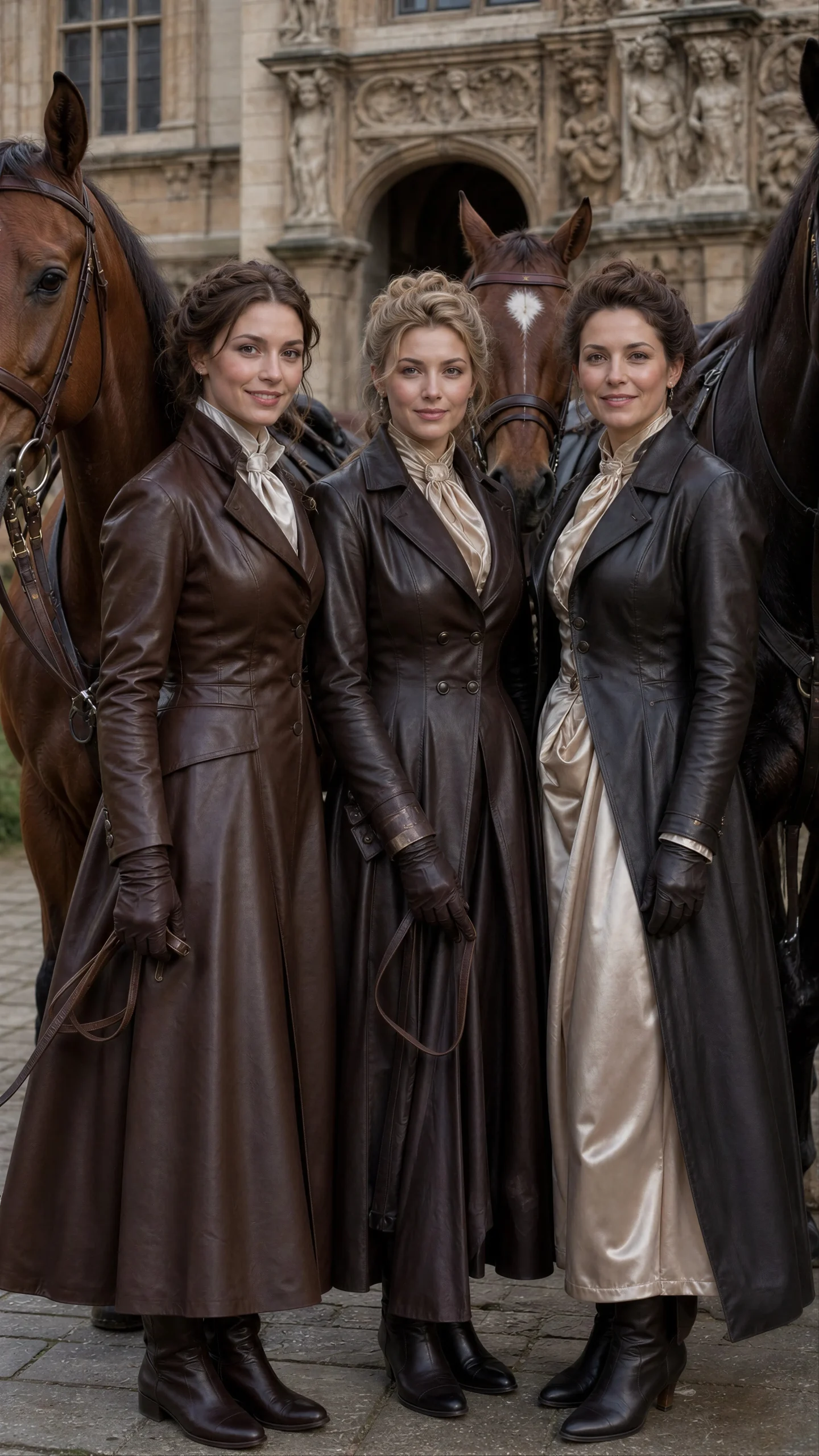
Where Autumn Weeps Gold and a Man Discovers the Exquisite Torment of Becoming Worthy
In the fading amber light of an October afternoon, a carriage crawls through an avenue of ancient oaks toward a destiny its occupant neither expected nor deserves. Lord Edmund Ashworth—dissolute, neglected, and painfully aware of his own insufficiency—has inherited an estate he is utterly unfit to command. But within the pale stone walls of Thornfield, a force awaits him that will dismantle every comfortable weakness he has ever cultivated and rebuild him, piece by agonising piece, into something magnificent.
Her name is Lady Elara.
She wears burgundy satin like a queen wears her crown—not as ornament, but as declaration. Her voice is calm, her expectations absolute, and her belief in what a man might become, if he surrenders to the right guidance, is the most dangerous thing Edmund has ever encountered.
What follows is a tale of twelve chapters that trace the slow, exquisite alchemy of transformation: the sting of inadequacy giving birth to hunger, the terror of judgment forging the courage to kneel, and the profound, aching discovery that the deepest euphoria a man can know is not found in conquering the world—but in devoting himself, completely and without reservation, to someone worthy of his absolute surrender.
This is a story about autumn, about the particular melancholy of endings that are also beginnings. It is about glossy fabrics that catch the light like captured promises. It is about a woman who refuses to settle for a man’s mediocrity and a man who discovers, in the act of giving everything, that he receives more than he ever imagined possible.
But most of all, it is an invitation.
To those who read these words and feel something stir—a recognition, a longing, a suspicion that they, too, might be capable of transformation—know that the world of Thornfield is not merely fiction. The philosophy it embodies, the community it represents, the lineage of devotion and mastery it traces, these things exist. They wait, as Lady Elara waits, for those with the courage to seek them.
Read on, if you dare. But be warned: the path through these pages leads somewhere unexpected. By the final chapter, you may find yourself looking at your own life—your own dull habits, your unexamined potential, your unspoken hunger for purpose—and asking the question that changes everything:
Am I willing to become worthy?
The autumn leaves are falling. The carriage is waiting. And somewhere, in a house of pale Yorkshire stone, a woman in glossy satin is watching the gate.
Chapter One: The Carriage Arrives
The autumn of 1817 descended upon Yorkshire like a sovereign reclaiming her throne—not with timid hesitation but with the full, magnificent authority of a season that knows its purpose. The oaks along the Thornfield avenue wore their crowns of amber and rust, leaves falling like golden coins scattered by some extravagant celestial hand, carpeting the ancient roadway in a tapestry of dying splendour that was, paradoxically, more beautiful than any living thing could ever hope to be.
Within the swaying confines of a hired carriage—his own having been deemed unsuitable for the journey north—Lord Edmund Ashworth pressed his forehead against the cold glass of the window and watched the landscape unfurl like a scroll of painted parchment. The fields beyond the avenue were stubbled and bare, harvested of their summer bounty, yet there was a dignity in their emptiness—a sense of purpose fulfilled, of labour completed, of abundance given freely to those who had earned it. He found himself envying the fields. They had served their function with quiet competence. He, by contrast, had served no function at all in eight-and-twenty years of comfortable, inconsequential existence.
“You’re brooding again, my lord.”
The voice belonged to Mr. Hale, his man-servant and sole companion on this journey—a wiry, taciturn individual who had served Edmund’s father before him and who possessed the singularly irritating habit of saying precisely what Edmund needed not to hear.
“I am not brooding,” Edmund replied, not lifting his forehead from the glass. “I am contemplating.”
“Contemplating, brooding—same difference, if you’ll pardon the observation. Both involve staring out of windows and looking miserable while doing it.”
Edmund turned from the window with a sigh that cost him more energy than he cared to admit. “What would you have me do, Hale? Leap with joy at the prospect of inheriting an estate I know nothing about, from an uncle I met twice, in a county I have never visited, surrounded by people who will, no doubt, take one look at me and conclude that the late lord made a catastrophic error in his will?”
Hale regarded him with the particular expression of patient forbearance that Edmund had come to recognise as his servant’s default setting. “I would have you sit up straight, my lord. Smooth your coat. Straighten your cravat. And for the love of all that is holy, remember that you are the son of the Earl of Marchwood, educated at Westminster and Cambridge, and that no estate—however grand—should be permitted to intimidate a man of your breeding.”
Edmund laughed—a hollow, mirthless sound. “My breeding, Hale, is precisely the problem. I was bred for London drawing rooms and gaming tables. I was bred for idle conversation and fashionable vice. I was bred, in short, for everything that this place is not.”
The carriage lurched over a rut in the road, and Edmund was thrown against the upholstered wall. Through the window, he caught his first glimpse of Thornfield Hall—and the sight struck him like a physical blow.
It was magnificent. Not in the ostentatious, gilded manner of the London townhouses he frequented, but in the quiet, immovable way of a thing that has grown from its landscape rather than been imposed upon it. The house rose from a gentle incline, its pale Yorkshire stone glowing amber in the late afternoon light, its windows reflecting the autumn canopy like mirrors set into walls of honey. Wings extended to east and west with an elegant symmetry that spoke of generations of careful, purposeful expansion. Ivy, crimson and gold, clung to the southern façade like a living tapestry. And before the great oak doors, arranged in a line that conveyed both welcome and judgment, stood the household staff.
And one figure who was clearly not staff.
“Good God,” Edmund breathed.
She stood at the top of the stone steps, framed by the great doorway like a portrait in a gallery of masterworks—a woman whose bearing declared command with the same quiet authority that the house itself declared permanence. She was tall, her posture impeccable, her silhouette rendered in sharp, elegant relief against the warm stone behind her. She wore a riding habit of deep burgundy satin that caught the dying light and transformed it into something liquid and alive, the fabric shifting like captured fire as she moved. The coat was fitted to her waist with surgical precision, its surface gleaming with the particular sheen that only the finest satin possesses—that luminous, almost wet quality that seems to emit light rather than merely reflect it. Beneath it, a skirt of the same material fell in clean, unbroken lines to the ground, where patent leather boots of glossy black caught the light in sharp, bright flashes.
Her hair was dark—a rich, mahogany brown—pulled back from her face in a style that was both severe and deeply feminine, revealing the clean architecture of her jaw, the high plane of her cheekbone, the straight, determined line of her nose. Her eyes, even at this distance, were visible as points of intense, assessing focus. She was not beautiful in the conventional, porcelain-doll manner that London society prized. She was something far more dangerous. She was striking. She was memorable. She was the kind of woman who, upon entering a room, did not merely attract attention—she commanded it, absolutely and without effort, and woe betide any soul foolish enough to look away.
“Who,” Edmund managed, his voice somewhat strangled, “is that?”
Hale permitted himself a thin smile. “That, my lord, would be Lady Elara Thornfield. The late lord’s ward. I understand she has managed the estate in his declining years and throughout the period of probate. By all accounts, she is… formidable.”
“Formidable,” Edmund repeated, the word tasting inadequate on his tongue. It was like describing a hurricane as breezy or a cathedral as large. “Does she know that I am—”
“Incompetent? Unprepared? Utterly unsuited to the task before you?” Hale’s smile widened fractionally. “I suspect, my lord, that she has been fully briefed.”
The carriage rolled to a halt before the steps. A footman in livery of forest green and silver sprang forward to open the door, and Edmund descended with all the grace he could muster—which was, he reflected grimly, considerably less than he had hoped. His boots crunched on the gravel. The autumn air, sharp and clean and scented with woodsmoke and fallen fruit, filled his lungs like a draught of something intoxicating. And Lady Elara Thornfield descended the steps toward him.
Up close, she was even more devastating. The burgundy satin of her habit caught every nuance of the fading light, shifting between deep wine and luminous rose as she moved, the fabric whispering against itself with a sound like distant silk banners in a gentle wind. Her boots—those glossy, patent leather boots—clicked against the stone steps with a rhythm that was precise and unhurried, each step a declaration of absolute confidence. She wore gloves of the same burgundy satin, their surfaces smooth and gleaming, and as she extended her hand, Edmund was struck by the absurd thought that he was being greeted not by a woman but by a force of nature that had chosen, for its own amusement, to clothe itself in satin and patent leather.
“Lord Ashworth.” Her voice was low, measured, and possessed of a warmth that lay beneath the surface formality like embers beneath ash. “Welcome to Thornfield. I am Lady Elara. I served your great-uncle for the past seven years, and I have been entrusted with ensuring that your transition to lord of this estate is as… smooth as circumstances permit.”
Edmund took her hand. The satin of her glove was cool and impossibly smooth against his palm, and he felt a jolt of something that was not quite electricity and not quite desire but occupied a territory somewhere between the two—a sensation that was all the more unsettling for its unfamiliarity.
“Lady Elara.” His voice, to his credit, did not crack. “I am grateful for your assistance, though I confess I am acutely aware of my own inadequacy for the role I have inherited.”
She regarded him steadily, and in her dark eyes he saw something flicker—not contempt, not pity, but something far more complex. Assessment. Calculation. The cool, appraising gaze of a woman who had been tasked with evaluating a man’s potential and who had not yet decided whether what she saw was worth the effort of cultivation.
“Awareness of inadequacy,” she said, releasing his hand with a gesture that was both graceful and final, “is the first prerequisite for its correction. Men who believe themselves competent are rarely capable of growth. Men who know themselves to be wanting—those men, Lord Ashworth, may yet be forged into something worthwhile.”
It was not a compliment. It was not even, strictly speaking, encouragement. It was a statement of terms—a declaration that his transformation, if it was to occur, would happen on her schedule, according to her standards, and under her direction. And Edmund, standing in the amber light of an autumn afternoon, his hand still warm from the touch of her satin glove, felt something shift within him. Not confidence—he was a long way from confidence. But something more fundamental. A recognition. A stirring. The first faint trembling of a hunger he had not known he possessed: the hunger to be worthy.
“Come,” Lady Elara said, turning toward the house with the unhurried grace of a woman who had never, in her life, been required to wait for anyone. “The staff is assembled. They have been anxious to meet their new master. I trust you will not disappoint them.”
Edmund mounted the steps beside her, acutely conscious of the glossy whisper of her satin habit as it moved, of the precise, confident rhythm of her patent leather boots, of the way the entire household—from the butler to the lowest scullery maid—stood in attitudes of attentive stillness that spoke not of fear but of genuine, deeply rooted loyalty. This was a household that had been well managed, well loved, and well led. The staff did not look anxious. They looked proud. And their pride, Edmund understood with a sinking feeling, was not for him but for her.
As they crossed the threshold into the great hall—a chamber of warm oak panelling, polished flagstones, and a fire that blazed in a hearth large enough to roast an ox—Edmund became aware of other women in the household. A housekeeper, Mrs. Foulkes, stepped forward with a curtsey and a smile that was both warm and shrewd. She wore a gown of charcoal grey satin—not the lustrous, attention-commanding satin of Lady Elara’s habit, but a softer, more practical fabric that nonetheless possessed a gentle sheen, a quiet glow that spoke of dignity maintained and standards upheld. Her keys hung at her waist on a chatelaine of polished silver, and her hands, folded before her, were gloved in cotton so white it gleamed.
“Welcome to Thornfield, my lord,” she said, her voice carrying the particular authority of a woman who has managed a great house for decades and who regards the arrival of a new master with the same calm, evaluating patience that a general might regard a newly commissioned officer. “We are at your service.”
Behind her, two ladies’ maids stood in attendance—young women whose dresses, while simple, were fashioned from a material that caught the firelight with a subtle, glossy sheen. One wore a frock of deep blue satin that shimmered like a midnight sky; the other, a gown of forest green with the unmistakable gleam of polished cotton. Their hair was neat, their postures upright, their expressions composed. They looked, Edmund thought, like women who took pride in their appearance not from vanity but from a deeply held conviction that presentation was a form of respect—respect for themselves, for their mistress, and for the household they served.
“The household has been prepared for your arrival, my lord,” Lady Elara continued, her voice carrying effortlessly through the hall without any apparent increase in volume. “Mrs. Foulkes will show you to your chambers, where you may refresh yourself after your journey. Dinner will be served at seven. I have taken the liberty of arranging a simple meal—your great-uncle always maintained that a new arrival should be given time to acclimatise before being subjected to the full weight of Yorkshire hospitality.”
“You knew my great-uncle well,” Edmund said, and it was not a question.
“I knew him for seven years, my lord. I knew his habits, his preferences, his philosophy of estate management, and his unwavering conviction that a man’s worth is measured not by what he inherits but by what he builds upon that inheritance.” She paused, and the firelight caught the burgundy satin of her habit, setting it ablaze with liquid gold. “He was, in every respect that mattered, the most complete gentleman I have ever known. He was healthy in body, disciplined in mind, generous with his wealth, and absolutely confident in his purpose. He did not merely occupy this estate—he inhabited it, body and soul, and it responded to him as a well-trained horse responds to an expert rider.”
The analogy struck Edmund with uncomfortable precision. He was not an expert rider. He was, at best, a passenger—someone who had been carried through life by circumstances and the efforts of others without ever taking the reins himself.
“I shall endeavour to be worthy of his legacy,” he said, and the words, though formulaic, carried a weight that surprised him.
Lady Elara’s gaze softened fractionally—not with warmth, precisely, but with something that might, in a more generous light, be mistaken for the first, tentative stirring of hope. “Endeavour is a beginning, Lord Ashworth. But beginnings are easy. It is the continuation—the daily, unglamorous work of becoming—that separates the men from the boys.” She turned to Mrs. Foulkes. “Please show Lord Ashworth to the master’s chambers. And see that his valet is attended to. I trust the journey was not too fatiguing?”
“It was… illuminating,” Edmund replied, and for the first time since his arrival, he spoke with something approaching honesty. “I have never seen countryside like this. It has a quality of… completeness that I find difficult to articulate.”
Lady Elara’s lips curved into the faintest suggestion of a smile. “Yorkshire has that effect on those who approach it with open eyes. Your great-uncle used to say that the county was a mirror—it reflected back whatever you brought to it. If you brought laziness, it showed you desolation. If you brought purpose, it showed you paradise.” She inclined her head—a gesture that was both dismissal and benediction. “Rest now, Lord Ashworth. Tomorrow, we begin.”
“Begin what?”
But she was already turning away, the burgundy satin of her habit swirling like autumn leaves caught in a sudden gust, her patent leather boots clicking their precise, unhurried rhythm on the flagstones. At the doorway, she paused without turning.
“Your education, my lord. What else?”
And then she was gone, and Edmund was left standing in the great hall of Thornfield, surrounded by the warm glow of firelight on polished oak and the quiet, attentive presence of a household that had been trained to excellence by a woman in glossy satin—and he understood, with a clarity that was both terrifying and exhilarating, that his life as he had known it was already over.
Mrs. Foulkes cleared her throat gently. “If you would follow me, my lord. Your chambers are prepared.”
Edmund followed. As he climbed the wide oak staircase, his hand trailing along a banister worn smooth by generations of purposeful hands, he became aware of portraits lining the walls—generations of Thornfield lords and ladies, their painted eyes following him with expressions that ranged from stern assessment to quiet encouragement. Among them, he noticed, were several ladies whose attire was rendered in striking detail: gowns of glossy satin that caught the painter’s light with almost luminous intensity, accessories of polished leather that gleamed with authority, fabrics that seemed to pulse with a life of their own. These were women who had understood, instinctively, that appearance was not vanity but declaration—a visual statement of the standards they maintained and the excellence they demanded.
One portrait in particular caught his eye. A lady in a gown of white satin and patent leather—her expression serene, her posture impeccable, her gloved hand resting on the arm of a chair with the casual authority of someone who had never, in her life, doubted her right to occupy any space she chose. The plaque beneath read: Lady Arabella Thornfield, 1742. “Excellence is not an act but a habit.”
“Lady Arabella,” Mrs. Foulkes murmured, following his gaze. “She established the household’s standards. Every lady of Thornfield since has maintained them. We do not permit dullness here, my lord—not in thought, not in conduct, and not in attire. Gloss, sheen, polish—these are not vanities. They are the visible manifestations of an inner commitment to quality.”
Edmund looked at the portrait, then down at his own travel-worn coat, its surface dull and creased, its fabric rough and unremarkable. He felt, for the first time, a specific, targeted shame—not the general, diffuse shame of knowing himself to be inadequate, but the sharp, focused shame of understanding precisely how and why.
“Tomorrow,” he said, more to himself than to Mrs. Foulkes.
“Tomorrow, my lord,” she agreed, and there was something in her voice that was not quite sympathy but was, perhaps, its more useful cousin: the quiet, unwavering expectation that tomorrow would indeed come, and that he would rise to meet it.
The master’s chambers were magnificent—a vast room of warm oak and deep green velvet, with windows that looked out over the parkland and, in the distance, the purple swell of the Yorkshire moors. The bed was enormous, draped in sheets of white linen so crisp they seemed to glow. A fire burned in the grate, and beside it, a decanter of wine and a selection of books had been arranged with the precise, thoughtful care of someone who understood that a man’s first night in a new home required both comfort and stimulation.
Edmund poured himself a glass of wine, carried it to the window, and stood watching the autumn light drain from the sky, painting the landscape in shades of violet and gold. Somewhere below, in the stables or the kitchens or the library, Lady Elara was going about her evening business with the same calm, purposeful grace she had displayed upon his arrival. He could not see her, but he could feel her—a presence that permeated the house like warmth from a well-tended fire, like the scent of beeswax from polished furniture, like the soft, glossy gleam of satin in firelight.
He raised his glass to the darkening window, where his own reflection looked back at him—pale, uncertain, and profoundly out of place.
“To tomorrow,” he said. “And to whatever it may bring.”
The wine was excellent. The books, he noted, were well-chosen: volumes on estate management, agricultural science, classical philosophy, and the history of Yorkshire. And one slim, leather-bound volume, unmarked, that he did not open until he had finished his wine and seated himself by the fire.
Inside, in a hand that was elegant and precise, someone had written:
“A man who surrenders to the right guidance does not lose himself. He finds himself—refined, sharpened, made useful. The first step is the hardest: the willingness to admit that you are not yet what you should be. The subsequent steps are merely work. But the first step—the surrender—that is the act of courage that separates the ordinary from the extraordinary.”
There was no signature. But Edmund did not need one. He knew, with the same bone-deep certainty that he knew the wine was excellent and the fire was warm and the house was magnificent, that Lady Elara had placed this book here for him to find.
He read the words again. And again. And a third time, slowly, letting each phrase settle into his mind like stones dropped into still water, sending ripples outward into the silence.
Then he closed the book, placed it on the bedside table, and retired to a bed that was more comfortable than any he had known—and lay awake for a long time, listening to the wind in the ancient oaks and the distant, rhythmic clicking of patent leather boots on stone, walking the corridors of a house that was, he was beginning to understand, not merely a house but a crucible.
Tomorrow, he would step into the fire.
And he was terrified.
And he was ready.
Chapter Two: The Orchard Walk
The knock came before dawn—a sound so precise and deliberate that it seemed less a summons than a pronouncement, three sharp reports against the oak panels of his chamber door that carried the unmistakable authority of someone who expected the world to rearrange itself around her schedule rather than the reverse.
Edmund lurched from the depths of a dream-soaked sleep in which he had been walking through an orchard of golden apples while a woman in burgundy satin whispered philosophical propositions into his ear, each word landing like a drop of warm honey upon his tongue. The dream dissolved even as he reached for it, leaving only a residue of longing and the sharp, clean scent of autumn air that seemed, impossibly, to have infiltrated his bedchamber.
“Lord Ashworth.” The voice was muffled by the door but perfectly audible—low, measured, and entirely devoid of the apologetic hesitation that one might expect from someone rousing a newly arrived lord at an hour when the sky was still the colour of a bruise. “You have fifteen minutes. I shall wait for you in the entrance hall. Dress for walking. The weather is sharp.”
He heard the retreating click of patent leather boots on the flagstones beyond his door—brisk, rhythmic, and utterly without compromise—and he was alone with the dying embers of his fire and the lingering phantom of his dream.
Fifteen minutes. Edmund had not dressed himself in fifteen minutes since he was a schoolboy late for morning prayers. His life in London had been constructed around the principle of unhurried preparation: the slow enjoyment of coffee, the careful selection of cravats, the ritual contemplation of waistcoats. To be summoned, dressed, and presented in a quarter of an hour was, he suspected, less a practical instruction than a test—the first of many, he was certain, in a curriculum designed by a woman whose pedagogical methods appeared to owe more to military discipline than to genteel courtesy.
He washed in water that had been left by his bedside—cold, because Mrs. Foulkes had either neglected to order it heated or, more likely, had been instructed not to—and the shock of it against his skin was like a slap from an invisible hand, driving the last cobwebs of sleep from his mind with brutal efficiency. He dressed with a speed that would have appalled his London tailor, pulling on breeches of fawn corduroy, a shirt of white linen, a waistcoat of brown wool, and a coat of dark green that had been chosen, he realised, not from his own wardrobe but from a selection that had been laid out while he slept. The garments fit him perfectly—better, in fact, than most of his own clothing—and they possessed a quality of sturdy, understated elegance that spoke of a different world from the silken fripperies of London’s drawing rooms. These were clothes designed for a man who intended to walk, to observe, to learn. They were clothes with a purpose.
He descended the staircase with two minutes to spare and found Lady Elara waiting in the entrance hall, her silhouette rendered in sharp relief against the pale grey light that filtered through the mullioned windows. She was, if possible, even more striking than she had been the previous evening. She wore a walking dress of deep charcoal satin—a fabric that seemed to absorb the weak dawn light and hold it captive within its glossy depths, shimmering with each movement like the surface of a moonlit lake. A cloak of the same material was draped across her shoulders, its surface so smooth and lustrous that it appeared almost liquid, flowing and shifting with a grace that defied the solidity of the fabric beneath. Her boots were of patent leather—black, gleaming, immaculate—and they rose to just below her knee, where they met the hem of her dress with the precise, clean line of a well-executed architectural joint.
Her gloves were of satin, matching the charcoal of her dress, and they extended beyond her elbow in a cascade of glossy, shimmering fabric that caught and held the light like polished onyx. She held a riding crop—not as a weapon but as an accessory, tucked beneath her arm with the casual ease of someone who had long ago ceased to think of it as anything other than an extension of her own will.
“You are punctual,” she observed, and the words carried a weight that was disproportionate to their simplicity—a quiet, almost imperceptible note of approval that settled upon Edmund’s shoulders like the first warm ray of a spring sun after a long winter. “Punctuality is the architecture of discipline. Without it, all other virtues crumble. Your great-uncle was never late for anything in his life—not a meeting, not a meal, not an appointment with his own conscience. He considered lateness a form of theft—the stealing of another’s time, which is the one resource that cannot be replenished.”
“I shall endeavour to make punctuality a habit,” Edmund said, and he was surprised to find that he meant it—that the desire to please her, to earn another fragment of that quiet approval, was already becoming a motivation of genuine power.
“Endeavour,” Lady Elara repeated, and the faintest suggestion of a smile touched the corners of her mouth—a smile that was not warm, exactly, but that contained a warmth within its coolness, like embers banked beneath a layer of white ash. “We shall see.”
She turned and strode toward the great doors, which were held open by a footman whose posture was so upright and attentive that he might have been carved from the same Yorkshire stone as the house itself. As Edmund followed her into the dawn, he was struck by the sheer, overwhelming beauty of the world that awaited him.
The parkland stretched before them like a vast, rumpled blanket of amber and gold, the trees blazing with the full fire of autumn—oaks in russet, beeches in copper, birches in pale yellow, all of them shedding their leaves in a slow, continuous rain that whispered against the ground like secrets being shared between conspirators. The grass was silver with dew, each blade a tiny mirror reflecting the pale sky, and the air was so sharp and clean that breathing it felt like drinking from a mountain stream—cold, pure, and intoxicating.
“Your great-uncle walked this estate every morning,” Lady Elara said, setting a pace that was brisk but not punishing—a pace that demanded attention without exhausting the unworthy. “Rain or shine, winter or summer, he was abroad by dawn, covering the boundaries, observing the land, speaking with the workers. He believed that a man who did not know his land could not love it, and a man who did not love his land could not command it. The estate, he used to say, is a living thing—it breathes, it hungers, it suffers, it thrives—and a lord who treats it as a mere possession is a lord who has failed before he has begun.”
They walked in silence for a time, following a path that wound through the parkland toward a distant orchard whose trees stood in ordered rows like soldiers awaiting inspection. The silence was not uncomfortable—it had a quality of shared purpose, of two people moving together through a landscape that demanded attention and respect. But Edmund was acutely conscious of Lady Elara’s presence beside him—the whisper of her satin cloak, the precise rhythm of her patent leather boots on the gravel path, the occasional flash of glossy fabric as her dress caught the early light.
“Tell me, Lord Ashworth.” Her voice broke the silence with the precision of a blade cutting silk. “What books have shaped your mind this year?”
The question landed like a stone dropped into still water, sending ripples of discomfort outward through Edmund’s consciousness. He cast his mind back over the past twelve months—a year of London seasons, of dinner parties and theatre visits, of long, idle afternoons in gentlemen’s clubs where the most strenuous intellectual activity consisted of debating the merits of rival horseflesh.
“I confess,” he said, and the admission cost him more than he had anticipated, “that my reading has been… neglected of late. The demands of social life in London—”
“The demands of social life in London,” Lady Elara interrupted, and her tone was not unkind but possessed a sharpness that left no room for evasion, “are the excuses of a man who has not yet decided whether his mind is worth cultivating. I do not ask what has prevented your reading. I ask what you have read. If the answer is nothing, then say nothing. But do not offer me the consolation of excuses, for I have neither the patience nor the inclination to accept them.”
Edmund swallowed. The morning air, which had seemed so bracing moments before, now felt cold against his skin. “Nothing of consequence, Lady Elara. I have read nothing of consequence.”
She did not respond immediately. They walked on, passing a group of estate workers who were beginning the day’s labour—a forester splitting logs, a gardener raking leaves, a stable boy leading horses to pasture. Each man touched his cap as they passed, and Lady Elara acknowledged each with a nod that was brief but genuine—a gesture of recognition that spoke of a relationship built on mutual respect rather than mere hierarchy.
Beside the forester stood a woman—his wife, perhaps, or his daughter—wearing a cloak of deep green satin that gleamed in the dawn light like a leaf still wet with rain. The fabric was simple, practical, clearly not the luxurious material of Lady Elara’s attire, but it possessed a sheen—a quiet, dignified gloss—that spoke of care taken and standards maintained. She too touched her cap, and her smile, directed at Lady Elara, was one of genuine warmth and admiration.
“Good morning, Mrs. Thistlethwaite,” Lady Elara said, pausing. “Is your husband’s shoulder improved?”
“Aye, my lady, much improved. Your recommendation of the physician from York was most efficacious. He’s back to full strength, thanks to your ladyship’s kindness.”
“Kindness has nothing to do with it, Mrs. Thistlethwaite. A man who cannot swing an axe is a man who cannot feed his family. Ensuring his health is not generosity—it is duty.” She resumed walking, and as they moved away, Edmund glanced back to see Mrs. Thistlethwaite watching them, her green satin cloak catching the light like a small, glossy flag of loyalty.
“You know your people,” Edmund observed.
“I know every man, woman, and child on this estate, Lord Ashworth. I know their names, their histories, their ailments, their aspirations. I know which families have served the Thornfield for generations and which are new arrivals. I know which children show promise at their lessons and which require additional guidance. I know which tenants are struggling and which are thriving. This knowledge is not a gift—it is an acquisition, purchased with time and attention and the willingness to walk in the rain and the mud and the cold when lesser lords sit by their fires and pretend that the world beyond their windows does not exist.”
They reached the orchard. The trees were old—gnarled, thick-limbed, their trunks dark with age and weather—but they bore their autumn burden with a dignity that was almost human. Apples, red and gold, hung from every branch like ornaments on a Christmas tree, and the ground beneath was littered with fallen fruit, some still perfect, others beginning to soften and darken with the first stages of decay. The air was thick with their scent—sweet, sharp, and faintly alcoholic, the perfume of abundance beginning its inevitable transformation.
Lady Elara stopped beside a tree and plucked an apple from a low-hanging branch. She turned it in her gloved hand—the satin of her glove sliding against the skin of the fruit with a whisper of glossy fabric against waxy surface—and regarded it with an expression that was both appreciative and analytical.
“This orchard was planted by your great-uncle’s grandfather,” she said. “Three hundred trees, twelve varieties, each chosen for its suitability to this soil and this climate. He did not plant for fashion or for speed—he planted for longevity, for quality, for the satisfaction of knowing that his grandchildren would eat fruit from trees that his own hands had set in the earth. That is the philosophy of Thornfield, Lord Ashworth: patience, purpose, and the willingness to invest in a future you may not live to see.”
She took a bite of the apple, and the sound was sharp and clean in the morning stillness. “Now. Tell me about your education. Westminster and Cambridge, I understand. What did you study? What did you learn? And before you answer, allow me to clarify the distinction: studying is what one does at lectures and in libraries. Learning is what one carries forward into the world. They are not the same thing.”
Edmund felt a flush creeping up his neck—a heat that had nothing to do with the sharp morning air and everything to do with the growing realisation that the next words out of his mouth would be weighed, measured, and found either sufficient or wanting by a woman whose standards were clearly as high as the Yorkshire moors and as inflexible as the stone beneath them.
“I read Classics at Cambridge,” he said. “I achieved a pass degree—nothing distinguished. I was more interested in… other pursuits.”
“Other pursuits.” The words were repeated without inflection, but the pause that followed them was heavy with implication. “Define these other pursuits, if you would. Were they pursuits that built your body? Pursuits that enriched your mind? Pursuits that prepared you for the responsibilities of station and property? Or were they pursuits that served no purpose beyond the dissipation of time and the avoidance of growth?”
Edmund stopped walking. They had reached the far end of the orchard, where a low stone wall overlooked a valley of breathtaking beauty—a sweep of fields and hedgerows and distant woods, all of it bathed in the pale gold of the rising sun. He placed his hands on the cold stone of the wall and looked out over a landscape that was, he realised, now his responsibility—his to manage, his to protect, his to understand—and the weight of that realisation settled upon him like a cloak of iron.
“I have been a fool, Lady Elara,” he said, and his voice was quiet but steady. “I have spent my life in pursuit of pleasure and avoidance of purpose. I have cultivated no skills, built no strength, accumulated no knowledge of value. I am, by any honest measure, precisely the kind of man your late guardian would have despised—a man of birth and opportunity who has squandered both in the name of convenience and comfort.”
Lady Elara moved to stand beside him at the wall. The satin of her cloak brushed against his arm—a fleeting, electric contact that sent a jolt of sensation through his body—and he was aware, with a vividness that was almost painful, of her proximity: the scent of her, clean and sharp with a note of something darker beneath; the gleam of her satin dress in the golden light; the absolute, unwavering steadiness of her gaze.
“Despised is too strong a word,” she said, and her voice had softened—not with sympathy but with something more valuable, a quality that Edmund would later identify as the particular, hard-won respect that a demanding teacher extends to a student who has, for the first time, spoken the truth. “My guardian did not despise weakness. He despised the refusal to acknowledge it. A man who knows he is ignorant can be taught. A man who knows he is weak can be strengthened. A man who knows he is lost can be guided. But a man who believes himself competent when he is not—that man is beyond rescue, because he will not accept the hand that is offered to him.”
She turned to face him fully, and the sunrise caught the glossy surface of her satin dress, setting it ablaze with light—liquid gold flowing across charcoal silk like molten metal poured into a mould. Her eyes, dark and deep, held his with an intensity that was both terrifying and intoxicating.
“You have taken the first step, Edmund. You have acknowledged your weakness. That is the foundation. Now we build upon it.” She raised one gloved hand—the satin gleaming like a dark jewel—and placed it against his chest, over his heart. The touch was firm, deliberate, and possessed of a warmth that penetrated the layers of his clothing like sunlight through glass. “This is where transformation begins. Not in the mind, not in the body, but here—in the willingness to feel the full weight of your inadequacy and to use that weight as the anvil upon which a new self is forged.”
Edmund looked down at her hand—the glossy satin of her glove resting against the rough wool of his coat, the contrast between the two surfaces a perfect metaphor for the contrast between what he was and what he might become—and he felt something break inside him. Not a breaking that was destruction but a breaking that was opening—a crack in the wall of his complacency through which light, sharp and clean and painful, now poured.
“I do not know if I am capable of what you are asking,” he said, and his voice was raw, stripped of pretence. “I do not know if I have the strength, the discipline, the intelligence to become what this estate requires.”
Lady Elara’s hand pressed more firmly against his chest, and he felt his heart beating beneath her palm—rapid, unsteady, alive with a fear that was, he realised, also a kind of hope.
“Strength is not a quality you possess or lack,” she said. “It is a muscle that grows through use. Discipline is not a trait you are born with. It is a habit you cultivate through daily practice. Intelligence is not a gift. It is a tool you sharpen through constant application. None of these things are fixed. All of them can be developed—if you are willing to submit to the process.”
“Submit,” Edmund repeated, and the word hung in the air between them, heavy with implication.
“Submit,” Lady Elara confirmed, and her eyes held his with a gaze that was both challenge and invitation. “Surrender your old habits, your old comforts, your old certainties. Place yourself in the hands of someone who knows what you can become, and trust the process—even when it is painful, even when it is exhausting, even when every fibre of your being screams at you to retreat to the familiar and the comfortable. That is the price of transformation. That is the cost of becoming worthy.”
She withdrew her hand, and the absence of her touch was like the withdrawal of warmth from a cold room—a sudden, aching emptiness that made him acutely aware of how much he had, in that brief contact, wanted more.
“Come,” she said, turning away, her satin cloak swirling around her with a whisper of glossy fabric that sounded, in the morning stillness, like a promise or a prophecy. “We have barely begun. There is much more of the estate to see, and I have much more to teach you. The day is young, and your education has already been delayed by eight-and-twenty years of idleness. We have no time to waste.”
They walked on, through the orchard and out across the parkland, past the lake where swans glided like ghosts across the mirrored surface, past the stables where horses nickered at Lady Elara’s approach, past the tenant cottages where women in glossy cotton and shimmering satin emerged to curtsey and smile—their attire, Edmund noticed, uniformly neat, uniformly bright, uniformly possessed of that quiet sheen that spoke of standards maintained and dignity preserved. He began to understand that the gloss was not merely aesthetic—it was philosophical. It was the visible manifestation of a household that had been taught to value itself, to take pride in its appearance, to present to the world a face that was polished and bright because the spirit beneath it was polished and bright.
As they crested a hill and looked back toward the house—pale stone glowing in the morning sun, windows flashing like golden eyes—Lady Elara spoke once more.
“Your great-uncle left you something more than an estate, Edmund. He left you a philosophy—a way of living that values health over indolence, wealth over poverty of spirit, education over ignorance, and confidence over timidity. He left you a household that embodies these values in every detail, from the gloss of a servant’s apron to the sheen of a lady’s gown. He left you a community of people who have been trained to excellence and who deserve a lord worthy of their loyalty.”
She turned to face him, and the wind caught her cloak, pressing the glossy satin against her body, outlining her silhouette with a clarity that was both revealing and profoundly, achingly beautiful.
“The question is not whether you are capable of becoming that lord. The question is whether you are willing to pay the price. The price is everything, Edmund. Your old self. Your old habits. Your old comforts. All of it. Surrendered. Placed upon the altar of transformation. And in return—”
She paused, and in that pause, Edmund felt the full weight of the choice before him—a choice that was not really a choice at all, because the alternative was a lifetime of mediocrity stretching before him like a barren, featureless plain, and the path she offered, however steep and however painful, led somewhere that was alive.
“In return,” she continued, “you will receive something that few men ever know: the profound, transcendent satisfaction of becoming what you were meant to be. Of looking in the mirror and seeing not a wastrel but a lord—not in name alone but in substance, in quality, in the marrow of your bones. Of walking through your estate and knowing that every tree, every field, every cottage, every face is better because you exist. Of lying down at night and feeling, in the deep, quiet chambers of your heart, the euphoria of purpose fulfilled.”
The word—euphoria—landed like a bell struck in a silent cathedral, its resonance filling the air, filling Edmund’s mind, filling the space between them with a vibration that was almost tangible.
“That is what I offer you, Edmund. Not comfort. Not ease. Not the tepid pleasures of a life lived without purpose. I offer you euphoria—the highest, most exquisite sensation a human being can experience—and the price is your surrender.”
She extended her hand—glossy satin gleaming in the morning sun—and waited.
Edmund looked at the hand. He looked at the estate. He looked at the autumn world, golden and dying and achingly beautiful, and he understood that this moment was the fulcrum upon which his entire existence would turn. Behind him lay London—gaming tables and idle hours and the slow, comfortable rot of a life without meaning. Before him lay Thornfield—discipline and transformation and the terrifying, exhilarating possibility of becoming something worthy.
He took her hand.
The satin was cool and smooth against his palm, and as her fingers closed around his, he felt a surge of something that was not electricity and not desire but was, perhaps, the first stirring of a force that had no name—a current that flowed between them, through the glossy fabric of her glove and the rough skin of his hand, connecting them in a way that transcended the physical and entered the realm of the sacred.
“Then we begin,” Lady Elara said, and her voice was quiet but carried the weight of a vow. “We begin today. We begin now. And we do not stop until you are everything this estate deserves.”
She released his hand and turned toward the house, her patent leather boots striking the earth with the rhythm of a march—purposeful, relentless, and absolutely certain of its destination.
Edmund followed.
And as he walked through the golden morning, past the glossy-attired women and the ancient trees and the pale, glowing house that was now his responsibility and his salvation, he felt something he had never felt before in his entire idle, wasted life.
He felt alive.
Chapter Three: The Library Discourse
The day had been long, and Edmund’s body bore the evidence of its unfamiliar exertions. His legs ached from the morning’s walk—a circuit of the estate boundaries that had covered, by his rough estimation, no fewer than eight miles of hill and dale, field and forest, gravel path and muddy cart track. His lungs, accustomed to the tepid, smoke-tinged atmosphere of London drawing rooms, had protested against the sharp Yorkshire air with a persistence that bordered on rebellion. His hands, unaccustomed to the grip of a walking staff, were blistered in places he had not previously known could blister.
And yet, as he climbed the staircase to his chambers to dress for dinner, he was conscious of a sensation that was entirely, bewilderingly unfamiliar: satisfaction. Not the hollow, fleeting satisfaction of a well-played hand of cards or a witty remark applauded by sycophants, but something deeper—a bone-level contentment that seemed to radiate from his tired muscles and into his very marrow, as though the physical exertion had stirred some long-dormant alchemy within his blood that was even now transmuting fatigue into something golden and sustaining.
He bathed—again in water that was merely warm rather than hot, and again he suspected the deliberate hand of Lady Elara’s influence in this subtle discomfort—and dressed in the evening clothes that had been laid out for him. These, like the walking attire of the morning, were not his own but had been selected from a wardrobe that his great-uncle had, with remarkable foresight or remarkable presumption, maintained in precisely Edmund’s measurements. The coat was of midnight-blue superfine, the waistcoat of ivory silk with a subtle, glossy sheen that caught the candlelight like the surface of a still pond, the cravat of white linen so fine it seemed to dissolve between his fingers.
He descended to the library.
The room had been mentioned in passing during the day’s perambulations—Lady Elara had gestured toward a pair of mahogany doors on the eastern side of the house and remarked, with the casual understatement that Edmund was beginning to recognise as her characteristic mode of expression, that the late lord had been “somewhat fond of books.” The description had not prepared him for the reality.
The library was not a room. It was a world. A vast, cathedral-like space whose ceiling rose to a height that seemed to belong to a church rather than a private dwelling, its plasterwork adorned with painted scenes of classical learning—Athena and her owl, Apollo with his lyre, the Muses in flowing, glossy robes that shimmered in the painted light like real fabric brought to impossible life. The walls, from floor to dizzying height, were lined with bookcases of dark, aged oak, their shelves groaning under the weight of volumes bound in leather of every hue—from the pale, creamy tan of new calf to the deep, almost black brown of ancient morocco, their spines glinting with gold lettering that caught the firelight like scattered stars.
A fire blazed in a hearth of white marble, its flames casting a warm, amber glow that pooled across the Persian carpet like liquid gold and sent shadows dancing among the bookcases like scholars pacing the aisles of knowledge. Two armchairs of deep green leather flanked the fire, their surfaces worn to a glossy patina by years of use—seats that had clearly been occupied by minds engaged in the serious, sustained business of thinking. A decanter of port stood on a side table, accompanied by two glasses and a small stack of books whose spines, Edmund noted, bore titles in French, Latin, and Greek.
And in one of the leather chairs, her legs tucked beneath her, a volume open in her lap, sat Lady Elara.
She had changed for the evening, and the transformation was nothing short of devastating. She wore a gown of midnight-blue satin that seemed to have been woven from the very fabric of the night sky—deep, lustrous, and possessed of a sheen that shifted and shimmered with every movement like the surface of a moonlit ocean. The fabric clung to her shoulders, her arms, the gentle curve of her waist with a fidelity that was both elegant and quietly, devastatingly intimate, as though the satin had been designed not merely to clothe her but to celebrate her—to trace the architecture of her form with the same reverent precision that a sculptor applies to marble. The neckline was modest by London standards but infinitely more affecting for its restraint, revealing the collarbones and the gentle hollow at the base of her throat, where a pendant of silver and moonstone rested like a captured droplet of lunar light.
The gown’s skirt fell in clean, unbroken lines to the floor, where it pooled around her slippered feet in a cascade of glossy fabric that caught the firelight and transformed it into something liquid and alive—a pool of midnight-blue satin that seemed to glow with its own inner light, warm and deep and infinitely inviting. Her slippers were of the same satin, their surfaces gleaming with the polished sheen of fabric that has been carefully maintained and lovingly preserved, and they peeked from beneath the hem of her gown like small, glossy secrets.
Her hair, which had been bound in a severe arrangement for the morning’s walk, was now dressed more softly—pinned up but with tendrils escaping to frame her face, the dark mahogany strands catching the firelight with warm, reddish highlights that glowed like embers embedded in polished wood. Her gloves—long, evening gloves of ivory satin that extended beyond her elbow—lay folded on the arm of her chair, their glossy surfaces catching the light like twin ribbons of moonlight.
She looked up as Edmund entered, and her expression—that composed, assessing, quietly formidable expression that he was beginning to recognise as her default setting—softened fractionally into something that was not quite a smile but that contained, within its composed exterior, a warmth that Edmund felt like the first breath of spring after a long winter.
“Good evening, Lord Ashworth. You look considerably more alive than you did this morning.”
“I feel considerably more alive,” Edmund replied, and the words, though simple, carried a weight of truth that surprised him. “I had not realised how dead I had become until today reminded me what it feels like to live.”
Lady Elara closed the book in her lap—a volume of Voltaire, he noted, the French text visible on the page—and regarded him with an expression that was, for the first time since their meeting, free of the cool assessment that had characterised her previous interactions. In its place was something more open, more curious, more willing to be pleased.
“A man who can articulate that distinction after a single day of honest labour has the makings of a philosopher—or at the very least, of someone worth conversing with. Come. Sit.” She gestured to the chair opposite her. “We shall take port and discourse, as your great-uncle and I did on many an evening. He believed that the day’s physical exertions should be balanced by the evening’s mental ones—that a man who strengthens his body without strengthening his mind creates an imbalance that is, in its own way, as destructive as neglecting the body entirely.”
Edmund settled into the leather chair, which received him with a sigh of aged upholstery and a warmth that seemed to emanate not merely from the nearby fire but from the accumulated presence of all the minds that had occupied it before. He accepted a glass of port from Lady Elara’s hand—her fingers, now bare of gloves, were long and elegant, their surfaces smooth and pale against the dark glass of the decanter—and took a sip. The wine was excellent: deep, rich, and warming, with a complexity that spoke of careful cellaring and the refined palate of someone who knew that quality was not an accident but a choice.
“You were reading Voltaire,” he observed.
“I am always reading something, Lord Ashworth. A mind that is not engaged in the act of reading is a mind that is, in my estimation, merely idling—consuming fuel without producing motion, like an engine left running in a stationary carriage.” She set her glass aside and leaned forward, the midnight-blue satin of her gown shifting with the movement, its glossy surface catching the firelight in a cascade of liquid gold that flowed across her shoulder and down her arm like a river of molten amber. “Your great-uncle and I read together each evening. He was particularly fond of the French philosophes—Voltaire, Rousseau, Montesquieu—and of the classical authors in their original languages. He believed that to read a great work in translation was to kiss a beautiful woman through a veil—pleasant, certainly, but fundamentally inadequate.”
Edmund laughed—a genuine laugh, the first he had offered since arriving at Thornfield. “I confess that my French is rusty and my Latin nonexistent. My Greek, I am afraid, exists only in the realm of aspiration.”
“Then we shall begin with French.” Lady Elara rose from her chair with a fluid grace that made the midnight-blue satin of her gown swirl around her like a living thing, and crossed to a shelf from which she withdrew a slim volume. “Voltaire’s Candide. Have you read it?”
“In translation, years ago. I remember little.”
“Good. Memory of a poor translation is worse than no memory at all, for it creates the illusion of knowledge where none exists.” She returned to her chair, the book in her hand, and opened it to the first page. “You shall read aloud. I shall correct your pronunciation, explain the nuances that translation inevitably loses, and question you on the philosophical arguments that Voltaire advances. This is the method your great-uncle preferred. He used to say that reading aloud was the most intimate form of intellectual discourse—one mind speaking, another listening, both engaged in the shared act of creation.”
Edmund took the book. The pages were worn, their margins annotated in a hand he recognised as his great-uncle’s—small, precise notations in ink that had faded to the colour of dried blood. He felt a strange, sharp pang of connection to a man he had barely known—a sense of sitting in a chair that had been shaped by another body, reading words that had been read by another mind, participating in a ritual that had been sacred to a relationship he could only glimpse in outline.
He began to read.
His French was, as he had warned, execrable. The words emerged from his mouth in a tangled, halting stream that bore only a passing resemblance to the elegant language that Voltaire had committed to paper. Consonants were misplaced, vowels were mangled, and the rhythm of the prose—which should have flowed like water over polished stones—stumbled and stuttered like a drunk navigating a cobblestone street.
Lady Elara did not laugh. She did not sigh or roll her eyes or display any of the signs of impatience that Edmund’s performance so richly deserved. Instead, she listened with an attention so focused, so absolute, that it was almost physical—a presence that pressed against him like a warm, firm hand, holding him in place even as it demanded better.
“Stop,” she said, after he had mangled a particular sentence for the third time. She rose from her chair and moved to stand beside him—close, closer than she had been since their meeting, close enough that he could smell the scent of her, a complex fragrance that wove together notes of rosewater, beeswax, and something darker, something warm and resinous that he could not name but that stirred something deep and primitive in his hindbrain.
“The word is cultiver,” she said, and her voice was low, intimate, pitched for an audience of one. “The t is silent. The l is soft—barely sounded. And the er at the end is not the blunt, guttural sound you are making but something more open, more rounded—like the beginning of a sigh.” She pronounced the word, and it was, in her mouth, a thing of beauty—smooth, liquid, and effortlessly precise, a sound that seemed to embody the very concept of cultivation that it denoted.
“Try again.”
He tried. The word emerged, still imperfect, but closer—a rough stone being shaped toward something smoother, something that might, with sufficient effort and attention, eventually gleam.
“Better.” She placed her hand on his shoulder—a touch that was brief, light, and devastating in its effect. The warmth of her palm penetrated the fabric of his coat like sunlight through glass, and he felt a jolt of something that was not merely physical but intellectual, as though her touch had created a circuit through which knowledge could flow directly from her mind to his. “Again. The whole sentence.”
He read the sentence again. And again. And a fourth time, each repetition bringing him closer to the sound that she was modelling for him, each small improvement met with a nod or a murmured word of guidance that was both correction and encouragement, a whip and a balm applied in such perfect proportion that he could not tell which was which and did not care to try.
As they worked, the fire burned lower, and the shadows in the library deepened, and the midnight-blue satin of Lady Elara’s gown seemed to absorb the growing darkness and hold it within its glossy depths, so that she appeared to be wearing the night itself—a woman clothed in the very fabric of mystery and knowledge, moving through a world of books and firelight with the quiet, absolute authority of someone who had long ago made this world her own.
After an hour, Edmund’s voice was hoarse but his pronunciation had improved measurably. They paused, and Lady Elara poured him another glass of port with a gesture that was both generous and precise, the dark wine catching the firelight like liquid rubies as it flowed.
“You learn quickly when you apply yourself,” she observed, settling back into her chair with a movement that made the satin of her gown whisper against the leather like a secret being shared between old friends. “Your great-uncle used to say that the capacity for learning was the single most reliable indicator of a man’s potential—not what he knew, but how quickly he could acquire new knowledge. A man who learns slowly but steadily will always surpass a man who learns quickly but lazily, because the former builds foundations while the latter constructs scaffolding.”
“What else did my great-uncle say?” Edmund asked, and the question was not merely polite but genuinely hungry—he wanted to know this man whose legacy he had inherited, whose chair he sat in, whose books he read, whose world he was only beginning to comprehend.
Lady Elara was quiet for a moment, and in the silence, the fire crackled and the shadows danced and the glossy surface of her gown shimmered with a light that seemed to come from within, as though the satin itself were alive and breathing.
“He said many things,” she replied at last. “He was a man of considerable intellectual depth and a corresponding talent for aphorism. But if I were to distil his philosophy into a single principle, it would be this: that a man’s purpose is not to exist but to become. Existence is passive—a state of being, like a stone lying in a field. Becoming is active—a process of transformation, like a river carving a canyon. The former is static, comfortable, and ultimately meaningless. The latter is dynamic, challenging, and profoundly, transcendentally meaningful.”
She leaned forward, and the firelight caught the pendant at her throat, sending a cascade of tiny reflections dancing across the glossy surface of her gown like a shower of silver sparks. “Your great-uncle did not inherit this estate as a finished product, Edmund. He arrived here as a young man of considerable potential and equally considerable flaws, and he spent the next forty years in the process of becoming—becoming educated, becoming disciplined, becoming generous, becoming the kind of man whose absence is felt as a wound by everyone who knew him. The estate you have inherited is not merely land and buildings and tenants. It is the physical manifestation of forty years of becoming.”
“And you helped him,” Edmund said. It was not a question.
“I was his student, his companion, his critic, and—yes—his guide. He gave me everything: his knowledge, his wealth, his confidence, his name. And in return, I gave him the only thing of genuine value that I possessed: my absolute, unwavering devotion. I devoted myself to his transformation with the same single-mindedness that a gardener devotes to a prized specimen—pruning, feeding, training, supporting, always with the vision of what the plant could become rather than what it currently was.”
She paused, and her eyes—dark, deep, and luminous in the firelight—found Edmund’s with a gaze that was both challenge and invitation, a look that said, I am offering you the same opportunity. The question is whether you are willing to accept it.
“He used to say that the relationship between a man and his guide was the most powerful force in human affairs,” she continued. “More powerful than armies, more enduring than empires, more transformative than any revolution. Because it operates not upon institutions but upon the individual soul, reshaping it from within, forging it into something that can, in turn, shape the world.”
“Is that what you are offering me?” Edmund asked, and his voice was quiet but steady—steadier, he noted with a flicker of surprise, than it had been that morning. “The same relationship you had with my great-uncle?”
Lady Elara’s expression underwent a subtle transformation—a softening of the lines around her mouth, a deepening of the light in her eyes, a shift in her posture that was almost imperceptible but that Edmund, attuned now to her every nuance, registered like a change in atmospheric pressure before a storm.
“I am offering you the opportunity to earn it,” she said. “The relationship I had with your great-uncle was not given. It was built—over years, through countless hours of discourse like this one, through shared labour and shared learning and the slow, painstaking process of building trust between two people who had no reason to trust each other except the growing, evidence-based conviction that the trust was warranted. I am not offering you that relationship, Edmund. I am offering you the chance to begin the work that might, eventually, make such a relationship possible.”
She rose from her chair and moved to the bookcase, her gown whispering against the carpet like a prayer offered in a darkened cathedral. She withdrew a second volume—a collection of essays by Montesquieu—and held it out to him, the glossy satin of her sleeve catching the firelight as she extended her arm.
“Read,” she said. “Not because I command it, but because you have already begun to understand that the act of reading—of engaging with minds greater than your own, of submitting your ignorance to the corrective fire of knowledge—is the most profoundly transformative act available to a human being. Read, and become.”
Edmund took the book. Their fingers touched in the transfer—a fleeting contact that lasted no more than a heartbeat but that sent a current through his body that was both electric and warm, a sensation that began in his fingertips and radiated outward through his hand, his arm, his chest, his heart.
He looked at the book. He looked at Lady Elara, standing before him in her midnight-blue satin, her face half-illuminated by the dying fire, half-shadowed by the encroaching darkness, and he understood—with a clarity that was both terrifying and exhilarating—that he was no longer reading because she commanded it. He was reading because he wanted to. Because the act of learning, under her guidance, had become not a duty but a desire—not a burden but a pleasure so profound, so consuming, that it bordered on the ecstatic.
“Where shall I begin?” he asked.
Lady Elara smiled—a true smile, not the controlled, calculated expression that she had worn until now but something rawer, something that cracked the polished surface of her composure and revealed, beneath it, a woman who was not merely a guide but a fellow traveller, someone who found in the act of teaching the same profound, almost sensual satisfaction that he found in the act of learning.
“Begin at the beginning,” she said. “And do not stop until you have reached the end. I shall be here, beside you, for as long as it takes.”
She settled into her chair, pulled a volume of her own from the stack beside her, and began to read. And Edmund, in his chair opposite, opened the Montesquieu and began to read aloud—his French still imperfect, his pronunciation still rough, but his voice growing steadier with each sentence, each paragraph, each page, as the words of a long-dead philosopher flowed through him like water through a newly cleared channel, carrying with them the accumulated wisdom of centuries and depositing it, rich and fertile, in the soil of a mind that had, for the first time in its existence, been opened to receive it.
They read in silence, side by side, two minds engaged in the private, sacred act of becoming, while the fire burned low and the autumn wind whispered against the windows and the shadows in the library deepened until the only light was the glow of the embers and the gleam of midnight-blue satin, luminous and alive in the darkness.
And Edmund, reading aloud in a room that smelled of old leather and beeswax and the particular, indefinable scent of knowledge accumulated over generations, felt something he had never felt before—not the tepid satisfaction of a evening wasted in idle pleasure, but the deep, resonant, almost painful joy of a mind being fed, a soul being nourished, a self being forged in the fire of intellectual engagement.
It was, he realised, a form of euphoria.
And it was, he knew with a certainty that settled into his bones like the warmth of the fire, only the beginning.
Chapter Four: The Riding Exhibition
The fortnight that followed the library discourse was, by any objective measure, the most arduous and transformative period of Edmund Ashworth’s twenty-eight years of existence. Each dawn brought the same relentless rhythm: the sharp knock, the fifteen-minute ultimatum, the cold water, the brisk walk through the estate’s autumnal splendour with Lady Elara setting a pace that demanded every ounce of breath and willpower his improving body could muster. Each evening brought the library—the fire, the port, the French and Latin texts, the patient, devastating Socratic questioning that dismantled his assumptions with the precision of a surgeon excising tumours.
His body, which had been soft and pale and resentful of exertion, was beginning to change. The walks had hardened his legs and expanded his lungs. His appetite, once jaded by London’s rich cuisine, had sharpened to a keen edge that found profound satisfaction in the simple, hearty fare of the Thornfield kitchen. His sleep, once fitful and wine-soaked, had become deep and restorative—a nightly surrender to unconsciousness that left him waking, if not precisely refreshed, then at least possessed of a determination that bore no resemblance to the listless apathy of his former mornings.
And his mind—oh, his mind. It was as though a window had been thrown open in a room that had been sealed for decades, admitting light and air that were at once exhilarating and painful in their intensity. The books that had once seemed impenetrable were becoming transparent, their arguments accessible, their language increasingly natural. He had progressed from halting French to moderately fluent reading, and his Latin, which had been nonexistent, was now sufficient to stumble through Caesar’s Gallic Wars with Lady Elara’s guidance—a text she had chosen, she explained, because it combined military strategy with linguistic clarity, thereby educating two faculties simultaneously.
“Your great-uncle,” she had remarked one evening, her midnight-blue satin gown shimmering in the firelight as she corrected his declension for the third time, “used to say that a man who cultivates only his body becomes a brute, and a man who cultivates only his mind becomes a pedant, but a man who cultivates both becomes a force—a creature of such integrated power that the world rearranges itself around him as water rearranges itself around a stone in a stream.”
It was this philosophy—that the body and mind were not separate entities to be developed in isolation but complementary instruments to be tuned in harmony—that brought Edmund, on a morning of pale gold light and sharp, crystalline air, to the threshold of the Thornfield stables and a challenge that terrified him more than any intellectual exercise Lady Elara had yet devised.
“The riding exhibition,” Lady Elara announced, her voice carrying the particular authority of someone who has already decided that the event will occur and that all objections are, therefore, merely delays, “is a tradition established by your great-uncle. It takes place each autumn, shortly before the Harvest Masque, and serves as both a social gathering for the neighbourhood gentry and a demonstration of the estate’s vitality. The lord of Thornfield is expected to participate. He is expected, moreover, to acquit himself with distinction.”
They were walking through the stable yard, a cobbled quadrangle surrounded by low stone buildings whose doors opened onto rows of pristine stalls. The smell of hay and horse and polished leather filled the air like a complex, earthy perfume, and the sounds of the stable—the stamp of hooves, the soft whicker of greeting, the rustle of straw—created a symphony of controlled vitality that was both soothing and subtly intimidating.
Edmund’s riding, like his Latin, had been neglected. Unlike his Latin, it had never been particularly accomplished to begin with. He had ridden in London’s parks, it was true, but London riding was a sedate, performative exercise—a matter of sitting a well-schooled horse at a walk or a gentle canter while exchanging pleasantries with acquaintances. He had never jumped a fence, never galloped across open country, never felt the raw, elemental power of a horse at full stride beneath him. The prospect of doing so before an audience of Yorkshire gentry—people who had been born to the saddle and who would, he was certain, judge his performance with the same unsparing rigour that Lady Elara applied to his French pronunciation—filled him with a dread that was almost physical.
“I should warn you,” he said, with the careful honesty that Lady Elara had cultivated in him over the past fortnight, “that my horsemanship is, at best, rudimentary. I have never jumped. I have rarely cantered. The likelihood of my acquitting myself with distinction is, by any reasonable assessment, negligible.”
Lady Elara stopped walking and turned to face him. She was wearing a riding habit of forest-green satin that morning—a fabric so rich and lustrous that it seemed to be not merely coloured but alive, the glossy surface shifting between deep emerald and bright gold as the pale autumn light played across its surface. Her hat was of black patent leather, its surface gleaming like polished obsidian, and her boots—those immaculate, authoritative patent leather boots—clicked against the cobbles as she moved with a precision that was almost musical.
“Negligible,” she repeated, and the word hung in the air between them like a challenge suspended. “You have been at Thornfield for two weeks, Edmund. In that time, you have walked eight miles each morning, read two hours each evening, improved your French from deplorable to competent, and begun the study of Latin from nothing. Two weeks ago, you told me that you were incapable of transformation. Today, the evidence of that transformation is visible in your posture, your complexion, your vocabulary, and your confidence. And yet, when confronted with a new challenge, you revert instantly to the language of incapacity.”
She stepped closer—close enough that he could see the individual threads of gold embroidery on the collar of her habit, close enough that the glossy surface of her satin sleeve caught the light in a cascade of liquid emerald that seemed to flow across her arm like a living thing.
“Let me tell you what I see, Edmund. I see a man who has spent his entire life being told what he cannot do and who has, until now, accepted those limitations without question. I see a man who has never been required to extend himself beyond the boundaries of his comfort and who has, therefore, never discovered the territory that lies beyond those boundaries. And I see a man who is, at this very moment, standing on the edge of that territory—terrified, yes, but also, if I am not mistaken, curious.”
“Curious,” Edmund admitted, “and terrified in roughly equal measure.”
“Good. Terror and curiosity, held in balance, are the twin engines of growth. Without terror, there is no challenge. Without curiosity, there is no motivation. Together, they propel a man beyond his known world and into the space where transformation occurs.” She turned and resumed walking, her patent leather boots striking the cobbles with renewed purpose. “You have two weeks before the exhibition. The master of horse, Mr. Blackwood, will train you each morning. I shall ride beside you, as I did with your great-uncle, and I shall expect progress.”
“You rode with my great-uncle?”
“I rode with him every morning for seven years. I was his companion, his critic, and his conscience in the saddle. When he was too cautious, I urged him forward. When he was too reckless, I counselled restraint. We covered the boundaries of this estate a thousand times together, and in the doing of it, we forged a bond that was, I believe, the most profound relationship of both our lives.”
She paused at the entrance to the main stable, where a large bay gelding was being led out by a stable hand—a magnificent animal, all muscle and controlled power, its coat gleaming like polished copper in the morning light.
“This is Augustus,” Lady Elara said, stroking the horse’s neck with a gloved hand—the satin of her glove sliding against the sleek coat with a whisper of glossy fabric against living silk. “He was your great-uncle’s favourite mount. He is intelligent, spirited, and requires a firm hand. He will test you, Edmund. He will probe for weakness, and if he finds it, he will exploit it. But if you earn his respect—if you demonstrate the confidence and consistency that he demands—he will carry you as though you and he were a single creature.”
“He sounds like you,” Edmund said, before he could stop himself.
Lady Elara’s lips curved into a smile that was both amused and approving—a rare expression that transformed her face from merely striking to almost devastatingly beautiful, the composure cracking just enough to reveal the warmth and humour that lay beneath.
“He was trained by me,” she replied. “We tend to reflect the qualities of those who shape us.”
The training began that morning. Mr. Blackwood—a grizzled, taciturn Yorkshireman whose face bore the permanent weathering of sixty years spent in the open air—was a teacher of the old school: patient, precise, and utterly intolerant of self-pity. He assessed Edmund’s riding with the same unsparing honesty that Lady Elara applied to his intellect, identified seventeen distinct flaws in his seat, hands, and posture, and set about correcting them with the methodical persistence of a man who had spent his life perfecting the art of equitation.
“Hold your reins like you’re holding a sparrow,” Blackwood instructed, his voice a gravelly rumble that carried the weight of absolute authority. “Too tight and you’ll crush it. Too loose and it’ll fly away. Find the balance, my lord. Find the balance.”
Lady Elara rode beside him each morning, mounted on a black mare of extraordinary elegance—a creature whose glossy coat seemed to absorb the light and hold it captive, shimmering like the surface of her satin gowns. She did not teach him directly—that was Blackwood’s domain—but her presence was a constant, silent pressure, a reminder that his progress was being observed, evaluated, and found either sufficient or wanting.
On the third morning, as they trotted along the edge of the parkland, she spoke.
“You are gripping with your knees, Edmund. A rider’s security comes not from grip but from balance. The same principle applies to everything: strength that is founded on tension is brittle. Strength that is founded on alignment is unbreakable. Relax your legs. Let your weight fall through your heels. Trust the horse to carry you, and he will.”
Edmund obeyed, and the effect was immediate—a settling, a stabilising, as though a keel had been fitted to a ship that had previously been listing. Augustus responded instantly, his gait smoothing, his head lowering, the tension between horse and rider dissolving like morning mist.
“Better,” Lady Elara said, and the single word carried a weight of approval that settled into Edmund’s chest like a warm stone. “Much better. Your great-uncle used to say that riding was a conversation—not a monologue, not a command, but a dialogue between two intelligent beings. When you grip too tightly, you are shouting. When you relax and align, you are speaking in a normal tone. The horse hears you either way, but he responds far better to conversation than to commands.”
As the days passed, Edmund’s riding improved with a speed that surprised him. His body, already strengthened by the morning walks, adapted to the demands of the saddle with a suppleness that he had not known he possessed. His hands grew steadier, his seat more secure, his communication with Augustus more nuanced and instinctive. By the end of the first week, he was cantering confidently through the parkland. By the end of the second, he was clearing low fences with a regularity that drew grunted approval from Blackwood—a sound that, he gathered, was the closest the old man came to enthusiasm.
And throughout, Lady Elara rode beside him—a constant, glossy presence in her forest-green satin and patent leather, her posture impeccable, her observations precise, her approval a prize that Edmund found himself pursuing with an intensity that bordered on obsession.
On the evening before the exhibition, they sat together in the library, the fire blazing, the port flowing, and Lady Elara’s midnight-blue satin gown shimmering like a captured night sky. She had changed from her riding habit into evening attire with the seamless grace of a woman for whom elegance was not an effort but a state of being, and the transformation from equestrian command to domestic sophistication was so complete that it seemed almost magical—as though she had shed one identity and assumed another with the casual ease of an actress changing costumes between scenes.
“You are ready,” she said, and the words were not a question but a statement—a declaration of fact delivered with the same quiet authority that characterised everything she said. “Not polished, not perfected, but ready. You will not disgrace yourself tomorrow, Edmund. Of that I am confident.”
“I wish I shared your confidence,” Edmund replied, turning his glass between his fingers. “The thought of riding before an audience—of being observed and judged by people who have spent their lives in the saddle—fills me with a dread that no amount of practice seems to diminish.”
Lady Elara set down her book and regarded him with an expression that was both serious and, beneath the seriousness, touched with something that might have been affection.
“Dread is not your enemy, Edmund. Complacency is your enemy. Dread is merely the shadow that growth casts—evidence that you are extending yourself beyond the boundaries of your comfort, which is the only territory in which transformation occurs. Tomorrow, when you enter that ring, you will feel the dread. You will feel the eyes upon you. You will feel the weight of expectation pressing down upon your shoulders like a physical burden. And then you will do what every man of quality has done when confronted with the same moment throughout the long history of human endeavour: you will acknowledge the fear, you will set it aside, and you will ride.”
She leaned forward, and the firelight caught the pendant at her throat, sending a cascade of reflections dancing across the glossy surface of her gown like a shower of silver stars. “And I shall be there. Watching. Not judging—I have already judged you, and I have found you worthy of my investment. But watching. Witnessing. Because the act of becoming is not a private thing, Edmund. It is a shared act—a covenant between the one who transforms and the one who believes in the transformation. Tomorrow, when you ride, you ride not for yourself but for us—for the partnership we are building, for the future we are creating, for the legacy of your great-uncle that we are honouring.”
Edmund looked at her—really looked, as he was learning to look, with the full attention of a mind that had been trained to observe rather than merely see—and he was struck, not for the first time, by the extraordinary fact of her existence. She was beautiful, yes—the glossy satin, the patent leather, the dark hair and darker eyes, all combined to create an image of such refined, authoritative elegance that it seemed almost otherworldly. But beneath the beauty, beneath the satin and the leather and the composed exterior, there was something more: a depth of conviction, a seriousness of purpose, a willingness to invest herself—her time, her knowledge, her very identity—in the transformation of another human being.
“Why?” he asked, and the question was raw, unguarded. “Why do you invest so much in me? I have given you nothing. I have taken your time, your knowledge, your patience, and I have offered nothing in return.”
Lady Elara was quiet for a long moment, and in the silence, the fire crackled and the shadows danced and the glossy surface of her gown shimmered with a light that seemed to come from within.
“You have given me something,” she said at last, and her voice was softer than he had ever heard it—a tone that was not command but confession. “You have given me hope. Hope that the work of transformation is never in vain. Hope that a man, given the right guidance, can become extraordinary. Hope that the philosophy your great-uncle devoted his life to—the philosophy of becoming, of purpose, of generous devotion to something greater than oneself—can be transmitted to a new generation.”
She rose from her chair and moved to stand before him, her gown whispering against the carpet, the satin catching the firelight in a cascade of liquid gold that flowed across her body like a living flame. She extended her hand—the same gesture she had made on their first morning, in the orchard, when she had offered him the choice between his old life and his new one.
“Tomorrow, Edmund, you will ride. And when you do, I want you to remember something: you do not ride to prove yourself to the world. You ride to prove yourself to me. And the only proof I require is this: that you face your fear, that you commit fully to the act, and that you do not retreat.”
Edmund took her hand. The satin of her glove was warm and impossibly smooth, and as her fingers closed around his, he felt that same current—that same electric, warm connection that had flowed between them since the first moment she had touched him in the orchard.
“I will not retreat,” he said.
“I know,” she replied. “I know.”
The morning of the exhibition dawned clear and bright, the autumn sky a bowl of pale blue that stretched from horizon to horizon like a vast, inverted porcelain cup. The estate had been preparing for days, and the transformation was remarkable: a temporary ring had been constructed in the parkland before the house, bounded by low fences and surrounded by rows of seats draped in green cloth. A marquee had been erected for refreshments, its interior decorated with autumn foliage and—Edmund noted with a flicker of understanding—glossy satin ribbons that caught the light like captured sunbeams. The household staff moved with purposeful efficiency, their attire uniformly neat and polished, the women’s dresses gleaming with the quiet sheen of well-maintained fabric, the men’s boots reflecting the morning light like dark mirrors.
The guests began to arrive at mid-morning—a stream of carriages emerging through the golden avenue and depositing their occupants before the great doors. The Yorkshire gentry were a different species from the London society Edmund had known: their clothing was practical rather than ostentatious, their manners direct rather than oblique, their conversation substantive rather than decorative. They were people who worked their land, who knew their tenants, who read books and rode horses and took a genuine, unironic pleasure in the simple business of living well.
And their women—Edmund could not help but notice—wore satin. Not all of them, and not all with the devastating authority of Lady Elara, but enough to establish a pattern, a norm, a standard. Glossy fabrics caught the autumn light from every direction: a gown of deep amber satin here, a cloak of midnight-blue there, a bonnet trimmed with glossy ribbon, a pair of patent leather boots gleaming on the gravel path. The sheen was not uniform—it varied from the lustrous, liquid gleam of the wealthiest women’s attire to the quieter, more modest gloss of the tenants’ wives—but it was ubiquitous, a visual thread that wove through the gathering like a shared language, a common code that declared, we value quality. We maintain standards. We present to the world a face that is polished because the spirit beneath it is polished.
Lady Elara appeared at eleven o’clock, and the effect upon the assembled company was immediate and profound. She wore a riding habit of black patent leather and scarlet satin—a combination so bold, so commanding, so utterly unlike the restrained elegance of her previous attire that it seemed to announce a different woman entirely, or rather, the same woman revealed in a new and more formidable aspect. The patent leather caught the light in sharp, bright flashes—dark mirrors that reflected the golden autumn world in miniature—and the scarlet satin blazed like a banner, like a declaration, like a challenge thrown down before the entire county.
She rode astride—a fact that caused a ripple of murmurs among the more conservative guests—mounted on her black mare with a mastery that made horse and rider appear to be a single creature, a centaur of glossy leather and scarlet silk. Her control of the animal was absolute, communicated not through visible cues but through some invisible language of weight and will that the horse understood and obeyed with the devotion of a disciple.
Edmund, watching from the preparation area behind the ring, felt his heart hammer against his ribs with a force that threatened to crack them. The sight of her—scarlet and black, glossy and magnificent, commanding the attention of every eye in the gathering with the same effortless authority that she commanded his transformation—was at once inspiring and terrifying. She was, he realised, the standard against which he would be measured. Not explicitly—no one would compare his riding to hers—but implicitly, in the way that all things at Thornfield were measured against the standard she embodied: excellence, confidence, and the absolute refusal to accept anything less than the best.
“Lord Ashworth.” Mr. Blackwood appeared beside him, leading Augustus. The horse was freshly groomed, his copper coat gleaming like polished metal, his tack cleaned to a mirror shine. “You’re third in the ring. Lord Pemberton’s nephew goes first, then young Squire Whitfield. You’ll have time to settle.”
Edmund mounted. The saddle received him like an old friend—or at least, like an acquaintance who was beginning to tolerate his company. Augustus shifted beneath him, ears pricked forward, muscles tense with the anticipation of a horse who knows that the day’s business is not a pleasure ride but a performance.
The first rider entered the ring. Lord Pemberton’s nephew—a young man of confident bearing and immaculate seat—navigated the course of fences with a polished ease that drew applause from the audience. He was good. Very good. Edmund felt his stomach clench with a familiar, corrosive fear—the fear of inadequacy, of exposure, of being revealed as the fraud he still, despite a fortnight of transformation, half-believed himself to be.
The second rider, young Squire Whitfield, was less polished but more daring, taking the fences at a faster pace that thrilled the crowd but drew a grunt of disapproval from Blackwood. “Speed without control is just falling in a stylish direction,” the old man muttered.
Then it was Edmund’s turn.
He rode into the ring to a silence that was not hostile but expectant—the quiet of an audience that has not yet decided what it is about to see. The fences were arranged in a circuit: a low bar, a higher bar, a gate, a wall, and finally a combination of two fences set close together that required precision and rhythm to navigate successfully. They were not high by the standards of the hunting field, but they were high enough to expose any weakness in seat, nerve, or communication between horse and rider.
Edmund looked at the course. He looked at Augustus’s ears, pricked forward, alert, waiting. He looked at the audience—the faces of the Yorkshire gentry, curious, polite, and quietly skeptical. And he looked at Lady Elara, seated at the edge of the ring on her black mare, her scarlet satin blazing like a beacon, her patent leather gleaming with the cold, bright light of polished authority.
Their eyes met. And across the distance, across the ring and the fences and the watching crowd, he heard her voice—not spoken, not shouted, but felt, transmitted through the invisible channel that had been built between them over two weeks of shared labour and shared purpose:
You belong here, Edmund. Show them.
He gathered his reins. He settled his weight. He aligned his body with the same precision that Lady Elara had taught him to align his mind—balanced, centred, confident not because the fear was absent but because he had chosen, deliberately and consciously, to set it aside.
He nudged Augustus forward.
The horse responded instantly—not with the hesitant, testing gait of their first rides but with a smooth, powerful surge that spoke of trust earned and respect given. They approached the first fence at a controlled canter, and Edmund felt the moment of take-off as a gathering of energy beneath him—a coiling of muscle and intention that launched them upward and over the bar with a clearance that was neither excessive nor inadequate but precisely, perfectly right.
The audience stirred. Not applause—not yet—but a shift in attention, a sharpening of focus that said, we are interested. Continue.
The second fence. Higher, and requiring a more precise approach. Edmund adjusted his line, felt Augustus adjust beneath him, and they were over—clean, smooth, the landing absorbed through his heels and transmitted into the ground like a wave returning to the sea.
The gate. The wall. The combination. Each fence approached, negotiated, and cleared with a growing confidence that was not merely physical but emotional—a sense of rightness, of alignment, of being exactly where he was supposed to be, doing exactly what he was supposed to be doing. The fear was still there—he could feel it, a cold presence in the pit of his stomach—but it was no longer in control. He was in control. And the difference, he realised, was everything.
As he cleared the final fence and brought Augustus to a proud, prancing halt before the audience, the applause came—not the polite, measured applause of duty but the genuine, enthusiastic applause of people who have witnessed something unexpected and pleasing. Edmund sat in the saddle, his breath coming hard, his heart pounding, his body alive with a sensation that was so intense, so consuming, so utterly unlike anything he had experienced in his previous life that it took him a moment to identify it.
It was euphoria.
Not the tepid, transient pleasure of a gaming win or a social triumph but something deeper, richer, more resonant—a vibration that seemed to originate not in his mind or his body but in the space where the two met, the intersection of physical achievement and emotional purpose that produced a sensation so pure, so complete, that it bordered on the sacred.
He looked at Lady Elara. She was smiling—not the controlled, calculated expression of their early interactions but a true smile, radiant and unguarded, and in that smile he saw something that made the euphoria flare to a brightness that was almost painful: pride. Not self-pride but the pride of a teacher who has watched a student exceed every expectation, the pride of a guide who has led a traveller to a destination that even the traveller had not believed was reachable.
She inclined her head—a small gesture, barely visible to anyone who was not watching for it, but to Edmund, it was a benediction, a coronation, a seal of approval that settled upon him like a mantle of warm light.
Later, after the exhibition had concluded and the guests had dispersed to the marquee for refreshments, Edmund found Lady Elara in the stables, brushing down her mare with long, firm strokes that the horse clearly found deeply satisfying. The stable was quiet, filled with the warm, earthy scent of hay and horse and the subtle, clean fragrance of polished leather. The light that filtered through the high windows was golden and soft, and it caught the glossy surface of Lady Elara’s patent leather habit in a series of warm, liquid reflections that made the material seem to glow with an inner light.
Edmund stood in the doorway and watched her for a moment—the sure, rhythmic motion of her hand, the calm, focused expression on her face, the absolute harmony between woman and animal that spoke of years of shared work and mutual understanding. She was, he realised, the most complete person he had ever known—a woman who had integrated every aspect of her existence into a seamless whole, whose body and mind and purpose were aligned with the same precision that she demanded of his riding, whose glossy exterior was not a mask but a mirror, reflecting an inner quality that was as polished and luminous as the satin and leather she wore.
“You rode well,” she said, without turning around.
“I rode as you taught me.”
She paused in her brushing and glanced over her shoulder, and the look she gave him was both amused and serious—a combination that he was beginning to recognise as her characteristic mode of expression when she was pleased but unwilling to let pleasure diminish her standards.
“I taught you the technique. The courage was your own. The willingness to face the fear, to commit fully to the act, to refuse to retreat—that is not something that can be taught. It can only be discovered. And you discovered it today, Edmund. In that ring, in that moment, you discovered the man you are becoming.”
She set down the brush and turned to face him fully. The patent leather of her habit creaked softly with the movement, its glossy surface catching the stable light in a cascade of warm, dark reflections that seemed to hold the golden air captive within their depths.
“Do you understand now?” she asked, and her voice was quiet, intimate, pitched for an audience of one. “Do you understand what I have been trying to show you? That the transformation is not about becoming someone else. It is about becoming yourself—your true self, the self that was always there but was buried beneath layers of fear and comfort and the accumulated debris of a life lived without purpose?”
Edmund crossed the stable to stand before her. The scent of her—rosewater and beeswax and that darker, warmer note that he could still not name but that stirred something deep and primitive in his core—filled his senses like a draught of something intoxicating.
“I understand,” he said, and his voice was steady—steadier, he thought, than it had ever been in his life. “I understand that you have given me something I did not know it was possible to receive. And I understand that I owe you something in return.”
“You owe me nothing, Edmund. The transformation is its own reward.”
“That is not true,” he said, and the words came not from his mind but from somewhere deeper—from the place where the euphoria still glowed, where the pride in her eyes still resonated, where the connection between them hummed with a current that was both electric and warm. “You have invested in me—your time, your knowledge, your patience, your belief. And I have accepted that investment without offering anything in return. That changes today.”
He knelt.
The stable floor was hard beneath his knee, and the straw was sharp against his palm, but the discomfort was irrelevant—a small, physical price for a gesture that carried a weight of meaning that was both personal and profound. He looked up at her—at the glossy patent leather and the scarlet satin, at the face that had become, in the space of two weeks, the most important sight in his world—and he spoke with a simplicity that was, he knew, more eloquent than any elaborate declaration.
“I am yours to command, Lady Elara. All that I am, all that I am becoming, is yours. My strength, my mind, my purpose, my wealth—all of it, placed at your service, to be used as you see fit, for as long as you see fit. This is not obligation. This is not debt. This is the most honest thing I have ever done: the voluntary, considered surrender of a man who has discovered, through your guidance, that giving himself to something greater than his own comfort is the highest form of self-interest and the deepest source of joy.”
Lady Elara looked down at him, and for a moment—just a moment—her composure cracked. Something raw and hungry flickered in her dark eyes, something that was not the cool assessment of a teacher evaluating a student but the fierce, possessive gaze of a woman who has been offered a gift of such magnitude that it takes every ounce of her considerable self-control to receive it with grace rather than seizing it with both hands.
Then the moment passed, and the composure returned—but not, Edmund noted, entirely. There was a softness in her expression that had not been there before, a warmth that lay beneath the authority like embers beneath ash, glowing with a heat that was both gentle and dangerous.
She extended her hand. The patent leather of her glove gleamed in the stable light, and as Edmund took it, the glossy surface slid against his palm with a whisper that was both familiar and new—a sound that said, we have been here before, and we will be here again, and each time the connection between us grows stronger.
“Rise, Edmund,” she said, and her voice was not the voice of a teacher dismissing a student but the voice of something more—a partner accepting a covenant, a guide acknowledging a companion, a woman receiving the devotion that she had earned and that she had, until this moment, not allowed herself to expect. “Rise. We have work to do.”
He rose. They stood together in the golden stable light, the scent of hay and horse and polished leather surrounding them like a benediction, and the glossy surface of her patent leather habit caught the light and held it, glowing with a warmth that seemed to come not from the sun but from within—from the fire that burned at the centre of everything she was, everything she represented, everything she was offering him the chance to become.
Outside, the autumn wind whispered through the golden trees, and the leaves fell like offerings upon the earth, and the world turned, as it always turned, toward the dark and the cold and the unknown.
But in the stable, in the golden light, in the space between a man who had learned to kneel and a woman who had earned the right to be knelt to, something was being built—something that would outlast the autumn, outlast the winter, outlast the turning of the years.
Something that looked, if you knew how to see it, very much like a future.
Chapter Five: The Letter from London
The letter arrived on a morning of peculiar cruelty—a day when the autumn sun, which had been generous with its golden largesse for the better part of a week, withdrew behind a bank of iron-coloured cloud and left the world to the mercy of a wind that carried upon its breath the first true bite of approaching winter. The trees, which had been shedding their leaves with the languid grace of dancers removing their costumes after a final performance, were now stripped of all pretence, their bare branches scratching against the leaden sky like the fingers of beggars reaching toward an indifferent heaven.
Edmund was in the breakfast room—a chamber of warm oak and amber light that Mrs. Foulkes had somehow managed to make cosy despite the morning’s chill—when Hale entered with the silver salver. The man-servant’s face wore an expression that Edmund had learned, over the preceding weeks, to recognise as his particular mode of communicating displeasure without actually saying anything: a tightening of the jaw, a slight narrowing of the eyes, and a posture that suggested the presence of something unpleasant that he would rather not be the one to deliver.
“From London, my lord. Delivered by express rider. The seal is Lord Pemberton’s.”
The name landed in the quiet breakfast room like a stone dropped into still water, sending ripples of unease outward through Edmund’s consciousness. Lord Pemberton. The name was familiar—not from personal acquaintance, for Edmund’s London circles had been considerably less elevated than Pemberton’s, but from reputation. Pemberton was a power: a man whose influence extended through the highest corridors of the land, whose wealth was said to be exceeded only by his ambition, and whose patronage was regarded, by those who sought it, as the nearest thing to a royal warrant that common mortals could attain.
He was also, Edmund knew, a man who had been closely associated with the late Lord Thornfield—a friend, a colleague, and, if the rumours were to be believed, a rival in matters that had never been fully explained.
Edmund took the letter. The paper was heavy—thick, cream-laid stock of the kind that only the very wealthy could afford to use for correspondence—and the seal, a crest of silver wax bearing the Pemberton arms, was intact and imposing. He broke it with a thumbnail that trembled, despite his best efforts to still it, and unfolded the single sheet within.
The handwriting was precise, elegant, and utterly devoid of warmth—the script of a man who regarded words not as vehicles for emotion but as instruments of purpose, each one selected and deployed with the same calculated precision that a general selects and deploys troops upon a battlefield.
Lord Ashworth,
I write to inform you that I shall be visiting Thornfield on the 18th instant, accompanied by my secretary and two members of my household. My purpose is to assess the condition of the estate and to determine whether the arrangements made by my late friend, Lord Thornfield, regarding its succession are, in the present circumstances, consistent with the best interests of the property and its dependants.
I should not need to remind you that the Thornfield estate has been, for generations, a model of enlightened management and that its reputation within the county and beyond is a matter of considerable importance to those of us who were associated with its late lord. It is my intention to satisfy myself that the standards he established are being maintained and that the estate has been placed in hands capable of preserving his legacy.
I look forward to making your acquaintance.
Pemberton
Edmund read the letter twice. Then a third time. Then he set it down on the breakfast table, beside his untouched plate of eggs and his cooling tea, and stared at it with the particular, hollow focus of a man who has just been informed that the ground beneath his feet, which he had believed to be solid, is in fact a thin crust overlying an abyss.
The meaning was clear, despite the careful, lawyerly language in which it was couched. Pemberton was coming to judge him. To assess whether he was worthy of the inheritance that had, by accident of birth and the vagaries of probate, fallen into his inadequate hands. And the implication—unstated but unmistakable—was that if he was found wanting, Pemberton would use his considerable influence to have the estate redirected to hands more capable.
“He cannot do that,” Edmund said, and the words, spoken aloud in the quiet room, sounded unconvincing even to his own ears. “The will is settled. The estate is mine. He has no legal standing to—”
“He has no legal standing,” Hale agreed, his voice carrying the particular, careful neutrality of a servant who has learned, through long experience, that the truth is often less welcome than the lie. “But he has influence, my lord. Influence of a kind that does not require legal standing to be effective. If Lord Pemberton were to make it known, in the appropriate circles, that the Thornfield estate was being mismanaged, the consequences would extend far beyond the legal question of ownership. Your credit would suffer. Your standing in the county would be undermined. Your tenants, who have been loyal to the Thornfield name for generations, would begin to wonder whether their loyalty was well placed. And the next time you sought to exercise your authority—whether in the House of Lords, the county assizes, or the simple matter of negotiating a contract with a supplier—you would find that your word carried less weight than it should, because a powerful man had whispered, in the right ears, that you were not to be trusted.”
Edmund pushed back from the table and stood. The breakfast room, which had been warm and welcoming moments before, now seemed small and airless, its oak panels pressing inward like the walls of a cell. He moved to the window and looked out upon the parkland—the bare trees, the grey sky, the wind-whipped grass—and saw, reflected in the glass, the face of a man who had dared, for a few brief weeks, to believe that he was becoming something worthy, and who now confronted the possibility that his transformation was too fragile, too recent, too incomplete to withstand the scrutiny of a man who had spent a lifetime assessing the worth of others.
“I am not ready,” he said, and the admission, spoken to the window and the wind and the bare, indifferent trees, carried a weight of despair that surprised him with its intensity. “Three weeks of walking and reading and riding have not erased twenty-eight years of idleness. I have improved, yes. But improvement is not mastery, and it is mastery that Pemberton will demand.”
He was not aware, in that moment, of how long he stood at the window. He was not aware of Hale’s quiet departure, or of the fire dying in the grate, or of the breakfast room growing cold around him like a tomb. He was aware only of the letter, lying on the table behind him like a poisoned blade, and of the growing, suffocating conviction that the transformation he had begun—the transformation that Lady Elara had guided, nurtured, and believed in—was about to be exposed as insufficient.
He retreated to his chambers.
The room, which had become a sanctuary over the preceding weeks—a space of rest and reflection after the day’s exertions and the evening’s intellectual labours—now felt like a refuge of the most desperate kind: a place to hide from a world that was about to discover what he truly was. He sat on the edge of the bed, his hands hanging between his knees, his head bowed, and he allowed himself, for the first time since arriving at Thornfield, to fully surrender to the despair that had been circling him like a wolf since the moment he had read Pemberton’s words.
The knock, when it came, was not the sharp, commanding triple report that had roused him each morning for the past three weeks. It was softer—a single, measured tap, followed by a pause, followed by the sound of the door opening and the whisper of glossy fabric against the threshold.
“Edmund.”
Lady Elara stood in the doorway, and the sight of her—poised, composed, and devastatingly elegant—sent a jolt of conflicting emotions through his despairing heart. She wore a day dress of smoke-grey satin—a fabric that seemed to exist in a territory between light and shadow, its surface shimmering with a subtle, elusive sheen that shifted between silver and charcoal as she moved, like a cloud passing across the face of the moon. The material was neither the bold, commanding satin of her riding habits nor the deep, luxurious satin of her evening gowns but something more understated, more contemplative—a fabric that seemed to mirror the grey uncertainty of the day itself while maintaining, in its glossy depths, a quiet, unshakeable dignity.
Her hair was dressed simply, pinned up and away from her face, and her expression was not the assessing, demanding look that he had come to associate with their interactions but something gentler, more searching—a look that said, I know something has happened, and I am here not to judge but to understand.
“I have been informed by Mrs. Foulkes that you received a letter,” she said, closing the door behind her with a soft click. “And that you have not emerged from these chambers for three hours. I have also been informed by Mr. Hale that the letter bore the seal of Lord Pemberton.”
“You have been well informed,” Edmund replied, and the bitterness in his voice surprised him—it was a flavour he had not tasted since arriving at Thornfield, a residue of his old self that the transformation had not, apparently, entirely eradicated.
Lady Elara moved into the room with the unhurried grace that characterised everything she did, the smoke-grey satin of her dress whispering against the carpet like a secret being shared between old confidants. She did not sit. She did not approach the bed where Edmund sat slumped in his despair. Instead, she positioned herself near the window, where the grey light fell upon the glossy surface of her gown and transformed it into something luminous—a pillar of shimmering silver that seemed to glow with an inner light, as though the fabric itself were a source of illumination in the darkened room.
“Tell me,” she said.
Edmund told her. He relayed the contents of the letter in flat, defeated tones, his voice stripped of the confidence that three weeks of transformation had been carefully, painstakingly building. He explained the threat—not the legal threat, which was hollow, but the practical threat, the threat of influence and reputation and the slow, corrosive power of a whisper in the right ear. He concluded with the words he had spoken to the window: “I am not ready.”
Lady Elara listened without interruption. Her expression remained composed, her posture upright, her gaze steady—the same unshakeable composure that she had maintained through every challenge, every setback, every moment of difficulty that Edmund had witnessed since his arrival. When he finished, the room was silent except for the wind against the windows and the distant, mournful call of a bird in the bare trees outside.
“You are afraid,” she said at last. It was not a question.
“I am terrified.”
“Of Pemberton?”
“Of being exposed. Of having my inadequacy confirmed by someone whose opinion carries weight. Of discovering, at the moment of judgment, that the transformation I have undergone is insufficient—that I have changed, yes, but not enough, not deeply enough, not thoroughly enough to withstand the scrutiny of a man who has spent his entire life assessing the worth of others.”
Lady Elara was quiet for a long moment. Then she moved—not toward him but toward the fireplace, where she knelt with a fluid, graceful motion and began to tend the dying embers, adding wood with the same precise, unhurried care that she applied to everything. The smoke-grey satin of her dress pooled around her knees like a lake of liquid silver, its glossy surface catching the first flames of the reviving fire and reflecting them in a cascade of warm, dancing light.
“Let me tell you a story,” she said, her back still turned, her voice pitched at a register that Edmund had not heard before—lower, softer, more intimate, as though the words she was about to speak were not merely information but confession. “A story about a man who was, in every respect that mattered, precisely the kind of man you have been for the past twenty-eight years.”
Edmund looked up. The fire was growing, its light beginning to push back the grey gloom of the room, and the glossy surface of Lady Elara’s satin gown was responding, shifting from cool silver to warm gold as the flames grew stronger.
“When I came to Thornfield,” she continued, still kneeling, still tending the fire with the same meditative attention, “I was twelve years old. An orphan, penniless, with nothing to recommend me but a quick mind and a willingness to work. The late Lord Thornfield—your great-uncle, Edmund—took me in. Not out of charity, though charity was part of his nature, but because he saw in me something that he recognised: a hunger. A hunger to become more than circumstances had decreed. A hunger that he himself had felt, many years before, and that had been the engine of his own transformation.”
She rose from the fireplace and turned to face him. The firelight played across the smoke-grey satin of her gown in a symphony of shifting light—warm gold flowing across cool silver, shadows dancing in the glossy folds, the fabric seeming to breathe and move with a life of its own.
“Your great-uncle was not always the man you have heard described. The scholar, the philanthropist, the model of enlightened estate management—that man was made, not born. Before his transformation, he was a wastrel of the first order. He drank, he gambled, he neglected his education, he squandered his inheritance on London vices. He was, by his own account, the despair of his family and the laughingstock of his county.”
Edmund stared at her. The image she was painting bore no resemblance to the portrait of the late lord that hung in the gallery—a portrait of a man whose face radiated intelligence, purpose, and quiet authority.
“He was thirty years old when he met the woman who changed him,” Lady Elara continued, and her voice took on a quality that Edmund had not heard before—a warmth, a tenderness, that lay beneath the composed surface like a warm current beneath cold water. “She was not beautiful in the conventional sense. She was not wealthy. She was not connected. But she possessed something that was, to a man who had spent his life surrounded by superficial attractions, irresistible: she saw him. Not the wastrel, not the lord, not the fortune. She saw the man he could become, and she refused—absolutely, implacably, without compromise—to accept anything less.”
She moved toward him, and the smoke-grey satin of her gown whispered against the carpet like a prayer offered in a darkened cathedral. She stopped before him—close, closer than she had been since the morning in the stable when he had knelt and offered her his devotion—and looked down at him with an expression that was both fierce and tender, a combination that made his breath catch in his throat.
“She demanded everything. His time, his attention, his intellect, his body, his wealth, his very identity. She demanded that he surrender every comfortable habit, every lazy assumption, every excuse that had enabled his dissolute existence. And he—this man who had never, in his entire life, been asked for anything substantial—gave it. All of it. Not because she commanded it, though command she did. Not because she threatened him, though the threat of her disapproval was, by his own account, more powerful than any physical force. He gave it because he recognised, with the instinct of a man who has been offered his first glimpse of genuine purpose, that giving himself to her was not loss but gain. That the surrender of his old self was the prerequisite for the birth of his new self. That generosity to the right person—to the person who sees what you can become and refuses to let you settle for less—is not sacrifice but the highest form of self-interest.”
She knelt before him.
The movement was so unexpected, so utterly at odds with everything Edmund had come to understand about their dynamic, that for a moment he could not process what he was seeing. Lady Elara—commanding, composed, unshakeable Lady Elara—was kneeling before him, the smoke-grey satin of her gown pooling around her on the floor like a lake of liquid mercury, its glossy surface reflecting the firelight in a cascade of warm, dancing reflections.
“She was my mother,” Lady Elara said, and the words, spoken from her knees, carried a vulnerability that Edmund had never heard in her voice before—a rawness, an openness, that was both shocking and profoundly, devastatingly intimate. “Not by blood—by blood, I was an orphan with no lineage and no name. But by choice. By the deliberate, conscious act of a woman who looked at a frightened, hungry child and decided, without reservation, to devote herself to that child’s transformation. She gave me everything: her knowledge, her standards, her philosophy, her name. And in return, I gave her the only thing of genuine value that I possessed: my absolute, unwavering devotion.”
She reached up and took his hands. Her fingers—bare of gloves, warm and strong—closed around his with a grip that was both firm and gentle, and the contact sent a current through his body that was not the electric jolt of their previous touches but something deeper, a warmth that flowed from her hands into his and from there into his arms, his chest, his heart.
“She taught me the secret that I have been trying, these past three weeks, to teach you, Edmund. The secret that your great-uncle learned from her and spent the rest of his life embodying. The secret that is, I believe, the single most important truth that a human being can discover.”
She paused, and in the silence, the fire crackled and the wind whispered against the windows and the glossy satin of her gown shimmered with a light that seemed to come not from the flames but from within—from the fire that burned at the centre of everything she was, everything she believed, everything she was offering him.
“The secret is this: that a man’s deepest fulfilment—his most profound, transcendent, euphoric satisfaction—is not found in the accumulation of things for himself. It is found in the giving of himself to something greater. To a person, a purpose, a community that demands his best and refuses to accept his less. The man who hoards his wealth, his knowledge, his devotion, his very identity, within the walls of his own ego is a man who is, in the most literal sense, impoverished—surrounded by treasure but unable to spend it, unable to invest it, unable to watch it grow through the act of giving it away.”
She squeezed his hands, and the pressure was both reassurance and challenge—a touch that said, I am here, I believe in you, and I will not let you fail, but I will also not let you settle for the comfort of despair.
“Your great-uncle gave everything to my mother. His devotion, his wealth, his very identity. And in return, she forged him into the man this world remembers. Not by making him into something he was not, but by demanding that he become everything he already was—by stripping away the layers of fear and comfort and self-deception that had buried his true self and revealing, beneath them, the man who had been there all along.”
She released his hands and rose, the smoke-grey satin flowing upward with her like a tide of liquid silver, its glossy surface catching the firelight in a final, dazzling cascade of warm, golden reflections. She stood before him, and her expression—composed, fierce, tender, and unshakeable all at once—was the face of a woman who had walked through fire and emerged not merely unscathed but transmuted, refined, made luminous by the very flames that had threatened to consume her.
“Pemberton is coming to judge you, Edmund. And when he arrives, he will find a man who has been in residence at Thornfield for less than a month—a man whose transformation, however genuine, is far from complete. He will probe for weakness, and he will find it, because weakness is the natural state of a man in the middle of becoming. The question is not whether you are worthy—worthiness is not a destination but a direction, not a state of being but a process of becoming. The question is whether you are willing to continue the process. Whether you are willing to surrender your old self—your fear, your comfort, your desperate need for approval—and be remade. Not for Pemberton. Not for the county. Not for the estate. But for yourself. And for me.”
Edmund looked at her.
He looked at her as he had never looked at her before—not with the awe of a man confronting a superior, not with the desire of a man confronting a beautiful woman, not with the gratitude of a student toward a teacher. He looked at her with the clear, unclouded vision of a man who has been stripped of every defence and who sees, for the first time, not merely the surface but the substance of the person before him.
And what he saw was not merely a woman in smoke-grey satin, however beautiful, however commanding. He saw a force of nature that had chosen, for reasons he could not fully comprehend, to clothe itself in glossy fabric and patent leather and to devote its considerable power to the transformation of a man who had given her no reason to believe in him and every reason to turn away.
He saw someone who had been where he was now—frightened, uncertain, confronted by the magnitude of the task before her—and who had chosen, not despite the fear but because of it, to surrender herself to a process of becoming that had forged her into the most complete, most integrated, most luminous person he had ever known.
And he saw, with a clarity that shook his bones and set his heart hammering against his ribs with a force that was almost painful, that the surrender she was asking of him was not the surrender of defeat but the surrender of victory—the voluntary, conscious, deliberate laying-down of arms by a man who has recognised that the battle he has been fighting against himself is the one battle he can never win and that the only path to triumph lies in joining forces with the enemy.
“I will give you anything you ask,” he said, and the words, spoken in the firelit quiet of his bedchamber, carried a weight of commitment that was both terrifying and liberating—a vow that was not obligation but liberation, not debt but discovery, not the heavy chain of duty but the light, strong thread of purpose finally found.
Lady Elara looked at him, and something shifted in her expression—a deepening of the light in her dark eyes, a softening of the lines around her mouth, a subtle but unmistakable change in her posture that Edmund, attuned now to her every nuance, registered like a change in the weather: the moment when the wind shifts and the storm that has been building breaks not as destruction but as rain, nourishing the earth that it has battered.
“Then we have work to do,” she said, and her voice was not the voice of a woman offering comfort but the voice of a general issuing orders, a teacher setting curriculum, a guide pointing toward the path that must be walked. “Pemberton arrives in five days. In those five days, we shall compress five months of preparation. We shall review the estate accounts until you know them as intimately as you know your own face. We shall walk every boundary, meet every tenant, inspect every building. We shall drill your French, your Latin, your history, your philosophy, until your mind is as sharp as your body is strong. And we shall do it not because Pemberton demands it but because you deserve it—because the man you are becoming deserves to be presented to the world in his full, magnificent, unapologetic completeness.”
She turned toward the door, the smoke-grey satin of her gown swirling around her like a cloak of liquid silver, its glossy surface catching the firelight one final time in a cascade of warm, golden reflections that seemed to hang in the air like sparks from a bonfire.
“And Edmund,” she said, pausing at the threshold, her back to him, her voice pitched at a register that was both command and confession. “When Pemberton arrives and sees what you have become, he will understand what your great-uncle understood and what I have understood since the day you walked through the door: that a man’s worth is not measured by what he has accomplished but by what he is willing to give. And you, Edmund Ashworth, have shown yourself willing to give everything.”
She was gone.
The door closed behind her with a soft click, and the room was silent except for the crackling of the fire and the whisper of the wind against the windows. Edmund sat on the edge of his bed, his hands still warm from the pressure of her grip, his heart still pounding from the force of her words, and he felt something that he had not felt in the dark hours since reading Pemberton’s letter—not confidence, not yet, but something more fundamental, more durable, more resistant to the corrosive power of fear.
He felt determined.
He rose. He crossed to the window. The grey sky had not changed, the bare trees had not sprouted new leaves, the wind had not softened. The world outside was the same cold, indifferent, challenging world that it had been when he had read the letter that morning. But the man looking at it was different. Not transformed—not yet, not completely—but changed. Changed in the way that a forge changes iron: not by adding anything but by applying heat and pressure until the metal takes a new shape, a stronger shape, a shape that is not merely different but better.
He looked at his reflection in the glass—the face of a man who had been a wastrel three weeks ago and who was, today, something else, something in-between, something still being forged—and he spoke to the reflection with the quiet, unshakeable conviction of a man who has made a decision and who will not, cannot, must not be turned from it.
“Five days,” he said. “Five days to become what she believes I can be.”
The reflection looked back at him—pale, determined, and no longer afraid.
And somewhere in the corridors of Thornfield, patent leather boots clicked against the flagstones with the precise, purposeful rhythm of a woman who had thrown down a gauntlet and who was waiting, with the patience of someone who has spent a lifetime learning that the best transformations take exactly as long as they take, for her student to pick it up.
He picked it up.
And the work began.
Chapter Six: The Storm
The storm came on the third day of the five that stood between Edmund and Pemberton’s judgment—a tempest of such ferocity that it seemed less a weather event than a declaration of war between heaven and earth, the sky hurling its fury upon the Yorkshire landscape with the indiscriminate rage of a deity scorned.
It began at dusk, with a darkness that fell not gradually but suddenly, as though someone had drawn a vast, black curtain across the world, extinguishing the last amber light of the autumn afternoon and replacing it with a gloom so complete that the boundaries between objects dissolved and the landscape became a single, undifferentiated mass of shadow. The wind rose from nothing to a howl in the space of minutes, striking the house with a force that rattled the windows in their ancient frames and sent the candles in their sconces flickering like terrified creatures seeking escape.
Edmund was in the library when the first thunderclap sounded—a detonation so vast and so sudden that the very air seemed to crack apart, the sound slamming through the walls and floors and bookcases with a physical force that made the volumes on their shelves shudder and the fire in the grate flatten as though pressed down by an invisible hand. The candles guttered, died, and were reborn in the same instant, their flames stretching and twisting like living things caught in an agony of wind and vacuum.
And then the rain.
It came not as drops but as a wall—a solid, impenetrable curtain of water that struck the windows with a sound like gravel thrown against glass, so dense that the world beyond the panes vanished entirely, replaced by a grey, churning void that seemed to belong to some other, more primitive cosmos than the one that contained Thornfield and its gentle, ordered routines.
Edmund rose from his chair, the estate accounts he had been studying—three days of intensive review that had filled his mind with figures and tenancies and crop rotations until he dreamed of barley yields—scattered across the table before him like the debris of a battle. He crossed to the window and pressed his forehead against the glass, feeling the cold radiating through the pane and into his skull like a physical intrusion, and he stared into the storm with the helpless fascination of a man confronting a force so far beyond his control that resistance was not merely futile but unimaginable.
“Mr. Hale,” he said, turning from the window as another thunderclap shook the house, “are the estate workers—”
“Mrs. Foulkes has already dispatched men to the tenant farms, my lord,” Hale replied, his voice carrying the particular, clipped efficiency of a servant who has spent his life managing crises and who regards even the wrath of God as merely another logistical problem to be solved. “The drainage ditches were cleared last month, by Lady Elara’s instruction. The livestock have been brought in. The east barn has been reinforced—again, by Lady Elara’s instruction. If I may say so, my lord, Lady Elara has been preparing for this storm since before you arrived, though I doubt even she anticipated its severity.”
As if in confirmation, the lights flickered—once, twice—and then, with a final, defiant flare, died entirely. The library was plunged into a darkness that was absolute, the only illumination the dying glow of the fire and the intermittent, terrifying flashes of lightning that turned the room into a frozen tableau of stark white light and impenetrable shadow.
“Damn,” Edmund said, with a feeling that was less annoyance than a strange, exhilarating sense of the world being stripped to its essentials—light and dark, warmth and cold, the fundamental forces that underlay all the comfortable, civilised constructions that human beings erected to shield themselves from the truth of their own fragility.
“Candles, my lord. I shall return directly.”
Hale’s footsteps retreated into the darkness, and Edmund was alone with the fire and the storm and the vast, breathing silence of the library—a silence that was not truly silent but filled with the whisper of rain against glass, the groan of wind against stone, and the occasional, settling creak of a house that had stood for two centuries and that was, even now, flexing its ancient bones against the assault of the elements.
He moved toward the fire, navigating by its glow, and had just reached the warmth of the hearth when the door opened again. He turned, expecting Hale with candles, and his breath stopped in his lungs.
Lady Elara stood in the doorway.
She was wearing a dressing gown—a garment that Edmund had never seen her in, had never imagined her in, had never permitted himself to even contemplate—and the sight of it, of her, in that context, in that light, was so unexpected and so devastating that for a moment he could not form a coherent thought.
The dressing gown was of deep burgundy satin—a fabric so rich, so lustrous, so profoundly, shamelessly glossy that it seemed to generate its own light, the surface shimmering and flowing like liquid fire in the glow of the dying embers. It was not the structured, commanding satin of her day wear or the elegant, sophisticated satin of her evening attire but something more intimate, more personal, more unguarded—a fabric that clung to the curves of her body with a fidelity that was both innocent and deeply, devastatingly suggestive, following the line of her shoulders, the slope of her waist, the gentle swell of her hips with the reverent precision of a sculptor’s hand upon clay.
The gown was belted at her waist with a sash of the same material, its glossy surface catching the firelight in a cascade of warm, liquid gold that flowed across her stomach like a river of molten amber. The neckline—open, unstructured, falling in soft, lustrous folds that revealed the hollow of her throat and the upper curve of her chest—was the most intimate thing Edmund had ever seen, not because it exposed flesh but because it exposed vulnerability, the composed, armoured exterior that he had come to know replaced by something softer, more accessible, more human.
Her hair was down.
It fell across her shoulders in a cascade of dark mahogany that caught the firelight with warm, reddish highlights, the strands shimmering like threads of polished copper woven through the darker mass, and the effect was so different from the controlled, architectural styles she wore during the day that it seemed to belong to a different woman—or rather, to the same woman seen from a different angle, a private angle, an angle that was not meant for the world but that was, in this moment, in this storm-darkened library, being offered to Edmund alone.
Her feet were bare against the cold flagstones—a detail that struck him with disproportionate force, that made his chest constrict with a tenderness he had not known he was capable of feeling. She was, he realised, the most beautiful thing he had ever seen—not because of the satin, though the satin was beautiful, not because of the hair, though the hair was beautiful, but because of the vulnerability that all of these things together represented. She had come to him not as the commanding guide, not as the demanding teacher, not as the formidable woman who had been forging him into something new, but as something else, something more, something that he did not yet have a name for but that called to him with a force that was both physical and profound.
“The storm has taken the lights throughout the house,” she said, and her voice was different—lower, softer, stripped of the precise, commanding diction that characterised her daytime speech, as though the storm had washed away the formalities and left behind something rawer, more essential. “Mrs. Foulkes is organising the household. Hale is seeing to the candles. I thought we might continue our work by firelight, if you are willing.”
“I am willing,” Edmund said, and the words, though simple, carried a weight of meaning that extended far beyond their surface content—a willingness not merely to continue working but to be present, to be available, to receive whatever this extraordinary woman was offering in this extraordinary moment.
She moved into the room, and the burgundy satin of her dressing gown whispered against the carpet with a sound like a secret being shared between lovers—a soft, intimate rustle that seemed to belong to a different acoustic world than the howling wind and crashing thunder that surrounded them. She settled into the chair opposite his, the satin flowing around her like a pool of liquid fire, its glossy surface catching every flicker of the dying embers and reflecting it back in a cascade of warm, dancing light that played across her face, her throat, the open neckline of the gown.
For a moment, neither spoke. The storm raged beyond the windows, and the fire crackled in the grate, and the darkness pressed in from all sides like a living thing, and in the small, warm circle of firelight, two people sat in a silence that was not empty but full—full of the accumulated weight of three weeks of transformation, of growing trust and deepening connection, of a bond that had been forged through shared labour and shared learning and was now, in this moment, being tested by something more elemental.
“I should continue with the accounts,” Edmund said, though the words came from a part of his mind that was rapidly losing authority over the rest of him—a remnant of the disciplined, purposeful self that Lady Elara had been building, making its last, futile stand against the rising tide of something far more powerful than discipline.
“The accounts can wait,” Lady Elara replied, and the words, spoken in that lower, softer voice, carried an authority that was not command but invitation—a distinction that Edmund felt in his bones, in his blood, in the deep, primitive centres of his brain that had been awakening, slowly and irresistibly, since the first moment she had touched his hand in the orchard. “The storm can wait. Pemberton can wait. There is something more important that we must discuss, you and I, and I do not know how many more opportunities we shall have to discuss it before the world, with its demands and its judgments, intrudes upon us.”
She leaned forward, and the firelight caught the pendant at her throat—the silver and moonstone that he had seen on that first evening, glinting like a captured droplet of lunar light—and the burgundy satin of her gown shifted, its glossy surface flowing like liquid fire across her body, outlining the curve of her waist, the line of her hip, the gentle slope of her thigh beneath the falling fabric.
“Three weeks ago,” she said, “you walked through the door of this house a wastrel. You were soft, pale, undisciplined, and utterly unaware of your own potential. You had spent your entire life avoiding challenge, cultivating comfort, and constructing a self that was designed not for living but for existing—a self that took up space without filling it, that consumed resources without producing value, that occupied a place in the world without belonging to it.”
Edmund felt the words land—not as insults, not as accusations, but as facts, spoken with the same unsparing honesty that she had applied to every aspect of his transformation. He did not flinch. He had learned, over the past three weeks, that the truth, however uncomfortable, was always preferable to the lie, however soothing.
“Today,” she continued, “you are a different man. Not a finished man—far from it. But a man who has begun the process of becoming, who has demonstrated the willingness to surrender his old self and submit to the discipline of transformation. You have walked eight miles each morning. You have read two hours each evening. You have improved your French, begun your Latin, mastered the basics of estate management, and acquitted yourself with honour in the riding exhibition. You have earned the respect of Mr. Blackwood, the loyalty of the household, and the trust of the tenants. And you have earned—”
She paused, and in the pause, the fire crackled and the thunder rolled and the rain hammered against the windows like a thousand fists pounding on a door that would not open, and Edmund felt the weight of her unspoken words pressing against him like a physical force.
“You have earned something else, Edmund. Something that I did not anticipate when I began this work and that I have been, until this moment, reluctant to acknowledge, even to myself.”
She rose from her chair. The burgundy satin of her dressing gown flowed around her like a living thing, its glossy surface catching the firelight in a cascade of warm, golden reflections that seemed to hang in the air like sparks from a bonfire. She moved toward him—not with the brisk, purposeful stride that characterised her daytime movements but with something slower, more deliberate, more charged—a walk that was not about getting from one place to another but about the journey itself, about the space that was being crossed and the meaning that was being conveyed with each step.
She stopped before him. Close. Closer than she had ever been. Close enough that he could smell the scent of her—not the rosewater and beeswax of her daytime fragrance but something warmer, something deeper, something that rose from her skin like heat from a sun-warmed stone, a scent that was not perfume but essence, the particular, irreducible fragrance of a woman who had been working and thinking and living and who was now, in this moment, offering all of that to him.
“You have earned my desire, Edmund.”
The word—desire—landed in the firelit silence like a bell struck in a cathedral, its resonance filling the room, filling Edmund’s mind, filling the space between them with a vibration that was almost tangible. He looked up at her—at the face that had become the most important sight in his world, at the dark eyes that were, for the first time, not assessing or demanding or commanding but open, vulnerable, wanting—and he felt something break inside him. Not the breaking of destruction but the breaking of opening—the final, irreparable shattering of the wall that he had maintained between himself and the full, terrifying, magnificent force of his feelings for this woman.
“I have desired you since the first morning,” she said, and her voice was not the voice of a teacher or a guide or a commanding lady of quality but the voice of a woman in the grip of something that was beyond her considerable power to control—a force that was as elemental and irresistible as the storm that raged beyond the windows. “I have desired you as I watched you struggle up the hills, your breath coming hard, your face set with a determination that I knew—I knew, Edmund, from the first moment I saw it—was the determination of a man who had finally found something worth struggling for. I have desired you as I listened to you read French, your voice growing steadier with each sentence, your mind opening like a flower under the influence of sun and rain. I have desired you as I watched you ride, your body learning to align with the horse, your fear transmuted into courage, your weakness transmuted into strength.”
She reached down and took his hand. Her fingers—bare, warm, trembling with a fine, almost imperceptible vibration that he felt rather than saw—closed around his, and the contact was not the electric jolt of their previous touches but something deeper, a connection that flowed not through the skin but through the bones, not through the nerves but through the very marrow of his being.
“But I did not act on my desire,” she continued, “because I knew that to do so before you were ready—before you had begun the process of becoming—would be to exploit your weakness rather than to cultivate your strength. I knew that a man who surrenders to a woman before he has learned to surrender to his own potential is a man who is giving from poverty rather than from abundance. And I wanted—I wanted, Edmund, with a ferocity that surprised even me—to receive your surrender from abundance.”
She pulled him to his feet. He rose, and they were standing face to face, close enough that he could feel the warmth radiating from her body through the thin, glossy satin of her dressing gown, close enough that the shimmering surface of the fabric was all he could see, a landscape of liquid fire and molten gold that flowed across her form like a living thing.
“Are you ready?” she asked, and the question was not about desire—he could see the desire in her eyes, could feel it in the trembling of her hand, could sense it in the particular, charged quality of the air between them, an atmosphere that was as electric and volatile as the storm that raged beyond the walls. The question was about something else, something deeper, something that went to the very heart of the transformation she had been guiding.
“Are you ready to give yourself—not from poverty, not from weakness, not from the desperate need of a man who has nothing and who clings to the first person who offers him meaning? Are you ready to give yourself from abundance—from the strength you have built, the knowledge you have acquired, the confidence you have earned? Are you ready to surrender not because you must but because you choose to—not because you have nothing else to offer but because you have everything to offer and you have decided, deliberately and consciously, that this—this woman, this house, this life—is worthy of your absolute, unreserved, total devotion?”
Edmund looked at her. He looked at the burgundy satin, glossy and luminous in the firelight. He looked at the dark hair, falling across her shoulders in a cascade of mahogany and copper. He looked at the dark eyes, wide and wanting and vulnerable in a way that he had never seen them. And he looked, beyond all of these things, at the woman herself—the force of nature that had chosen to devote itself to his transformation, the guide who had led him from the wasteland of his former life to the threshold of a new existence, the woman who was now, in this moment, asking him to cross that threshold and join her on the other side.
“I am ready,” he said, and the words were not a response to a question but a declaration of a truth that he felt in every fibre of his being—a truth that had been building since the first morning in the orchard, since the first touch of her satin glove against his palm, since the first surge of that warm, electric current that had flowed between them and that was now, in this firelit room, in this storm-shaken house, reaching a crescendo that was both inevitable and overwhelming.
He raised his free hand—the one that she was not holding—and placed it against her cheek. Her skin was warm, impossibly smooth, and she leaned into his touch with a movement that was both surrender and claim—a gesture that said, I am yours, and you are mine, and this, finally, is the beginning of everything.
“I am yours,” he said, and the words, spoken in the firelit darkness, carried a weight of commitment that was both terrifying and liberating. “Not because you command it. Not because I have nothing else. But because you have shown me what I can become, and because becoming that man—becoming worthy of you, of this estate, of the life you are offering—is the purpose I have been seeking my entire life without knowing it. I give myself to you, Lady Elara, not from poverty but from the abundance of a man who has been transformed by your guidance and who has, in the process, discovered that giving himself is not loss but the highest, most profound, most euphoric form of gain.”
She smiled—a true smile, radiant and unguarded, that cracked the last remaining shell of her composure and revealed, beneath it, a woman who was not merely a guide or a teacher or a commanding lady of quality but a human being in the grip of an emotion so powerful that it demanded expression, demanded release, demanded the physical, tangible confirmation of a bond that had been building for three weeks and that was now, in this moment, in this storm, in this firelit room, reaching its culmination.
She released his hand. She placed both of her palms against his chest—flat, firm, warm through the fabric of his shirt—and she pushed him, gently but with unmistakable intent, toward the chair behind him. He sat, and she moved with him, flowing like the satin that clothed her, and then she was on his lap, her knees on either side of his hips, her weight settling against him with a pressure that was both physical and symbolic—the weight of a woman who was claiming what she had earned and who was, in the same act, giving herself to the man who had earned her.
The burgundy satin of her dressing gown flowed around them both like a tent, like a cloak, like a world—a glossy, shimmering, firelit world that contained only the two of them and the truth of what they were to each other. Her face was close to his—so close that he could see the firelight reflected in her dark eyes, could see the individual strands of mahogany hair that fell across her cheek, could see the slight, trembling parting of her lips as she leaned toward him.
“You are mine,” she whispered, and the words were not a question or a request but a statement of fact—a declaration of ownership that was both absolute and, paradoxically, an act of surrender, because in claiming him, she was giving herself, and in giving herself, she was claiming him, and the circle of that exchange was so complete, so perfect, so self-contained that it seemed to exist outside of time, outside of the storm, outside of the world that raged beyond the windows and the walls.
“I am yours,” he replied, and the words were both echo and answer—a confirmation that closed the circle and sealed the bond and made of their two separate selves a single, unified being that was, in that moment, in that firelit room, in that storm-shaken house, invincible.
She kissed him.
The kiss was not gentle. It was not tentative. It was not the careful, measured first kiss of a romance novel or the polite, restrained kiss of a Regency drawing room. It was a kiss that was as elemental and irresistible as the storm that raged beyond the windows—a collision of lips and tongues and breath and heat that was both claiming and surrendering, both taking and giving, both the culmination of three weeks of building tension and the beginning of something that neither of them could see the end of and neither of them wanted to.
Her mouth was warm and wet and tasted of port and something sweeter, something that was not a flavour but a feeling—the taste of desire finally, irrevocably, unreservedly expressed. Her hands gripped his shoulders, her fingers digging into the fabric of his shirt with a pressure that was both pain and pleasure, and his hands found her waist, the glossy satin of her dressing gown sliding beneath his palms like liquid fire, warm and smooth and impossibly, devastatingly sensual.
The kiss deepened. The fire crackled. The thunder rolled. And in the small, warm circle of firelight, two people who had been moving toward each other for three weeks—through walks and readings and rides and arguments and silences and the slow, painstaking accumulation of trust and understanding and desire—finally, irrevocably, came together.
When they broke apart, Lady Elara’s eyes were bright—not with tears but with something that was both lighter and heavier than tears, a luminosity that came not from sorrow but from a joy so intense that it could not be contained within the ordinary boundaries of expression. She looked at him, and he looked at her, and in the silence that followed the kiss—a silence that was not silence but the sound of rain and wind and fire and the beating of two hearts that had, in that moment, begun to beat as one—something was established that would not, could not, be undone.
“Tomorrow,” she said, and her voice was hoarse, stripped raw by the force of what had just passed between them, “Pemberton will come. And when he does, he will see a man who has been transformed—not merely in body and mind but in spirit, in purpose, in the deepest, most fundamental sense of who he is. He will see a man who has given himself to something greater than his own comfort and who has, in the giving, found the thing he was always seeking: a reason to become.”
She leaned forward and pressed her forehead against his—a gesture of such intimacy and tenderness that it made his chest ache with a feeling that was both pain and pleasure, both joy and grief, both the happiness of having found and the sorrow of having spent so long lost.
“And he will see me,” she whispered, “beside you. Not behind you, not above you, but beside you—a partner, a guide, a woman who has devoted herself to your transformation and who has been, in the process, transformed herself. He will see what your great-uncle always hoped to see: a Thornfield that is not merely an estate but a covenant—a partnership between a man and a woman who have chosen, deliberately and consciously, to devote themselves to each other’s becoming.”
She pulled back and looked at him with eyes that were clear and steady and luminous with a resolve that was, he knew, unshakeable.
“Sleep now, Edmund. Sleep and let the storm do its work. Tomorrow, we face Pemberton together, and we show him what Thornfield—what we—have become.”
She rose from his lap with a fluid grace that made the burgundy satin swirl around her like a living flame, and she moved toward the door, her bare feet silent on the flagstones, her hair falling in a cascade of mahogany and copper down her back, the glossy surface of her dressing gown catching the last, dying light of the fire in a final, dazzling cascade of warm, golden reflections.
At the threshold, she paused. She turned. And the look she gave him—one last, long, burning look that contained within it all the fire of the storm and all the warmth of the hearth and all the promise of a future that was, for the first time in his life, not a source of dread but of hope—was the most beautiful thing Edmund had ever seen.
“Goodnight, Edmund. My Edmund.”
And then she was gone, and the door closed behind her, and he was alone with the fire and the storm and the memory of her kiss burning on his lips like a brand.
He sat in the chair for a long time, listening to the wind and the rain and the thunder, feeling the warmth of her lingering on his skin, the scent of her lingering in the air, the taste of her lingering on his tongue. And as the storm raged and the fire died and the night deepened around him like a cloak, Edmund Ashworth felt something that he had never felt before in his entire life—not the tepid, transient pleasure of a London evening, not the sharp, fleeting thrill of a gaming win, not even the deep, resonant satisfaction of intellectual achievement or physical exertion.
He felt euphoria.
A euphoria that was not merely physical or emotional or intellectual but all three at once—a transcendent, all-encompassing, soul-deep sensation of rightness, of alignment, of being exactly where he was supposed to be, doing exactly what he was supposed to be doing, with exactly the person he was supposed to be with.
And as the storm began, slowly, to exhaust itself, and the thunder rolled away to the east like a retreating army, and the rain softened from a roar to a whisper, Edmund closed his eyes and let the euphoria wash over him like a tide—warm, golden, and endless.
Tomorrow, Pemberton would come.
But tonight, the storm had done its work, and the man who faced the morning would not be the man who had faced the letter.
He would be something new.
Something forged.
Something worthy.
Chapter Seven: The Morning Hunt
The morning after the storm dawned with a clarity that bordered on the supernatural—a sky scrubbed clean by the night’s fury, a blue so deep and pure that it seemed less a colour than a condition, a state of being that the heavens had achieved through suffering and now wore as a badge of survival. The air was cold, sharp, and luminous, carrying upon its breath the scent of wet earth and fallen leaves and the particular, indefinable fragrance that follows a great storm: the smell of the world having been washed clean, renewed, made ready for whatever comes next.
Edmund woke before the knock.
He lay in his bed for a moment, staring at the ceiling, feeling the unfamiliar sensation of waking not to dread but to purpose—a purpose that was not abstract or aspirational but concrete and immediate and pressing. Pemberton was coming. Today. In hours. And the man who would receive him was not the man who had crawled into this bed three weeks ago, nor even the man who had sat in the library last night, staring at a letter that seemed to spell his doom. He was something else, something new, something that had been forged in the fire of Lady Elara’s guidance and sealed, in the final hours before the storm’s end, by a kiss that still burned upon his lips like a brand.
He rose. He washed—in water that was, he noted with a grim smile, merely warm rather than hot, the household’s furnaces having been taxed by the storm’s demands—and dressed in the riding attire that had been laid out for him. The clothes were not, he realised, the clothes of a gentleman preparing to receive a visitor. They were the clothes of a man preparing to ride: boots, breeches, a coat of dark wool, a stock of white linen. Someone—Hale, presumably, or perhaps Lady Elara herself—had decided that Edmund’s morning would not be spent in anxious anticipation but in action.
He descended the staircase to find the entrance hall alive with a purposeful, controlled bustle that was both familiar and transformed—the familiar routines of a household preparing for a significant event, but transformed by a quality that Edmund could not immediately name. It was, he realised after a moment’s observation, confidence. The household staff moved with the quiet, assured efficiency of people who knew what was expected of them and who trusted, without reservation, that the expectations would be met. Mrs. Foulkes, directing the placement of flowers in the reception rooms with the precision of a general deploying cavalry, wore an expression that was not anxious but serene—the face of a woman who had weathered many storms, both literal and metaphorical, and who had learned that the best preparation for any challenge was not worry but work.
And the attire—the household’s attire, the tenants’ attire, the very fabric of the community that was assembling, even now, in the courtyard beyond the great doors—was a study in the aesthetic that Edmund had come to recognise as Thornfield’s signature: glossy, polished, maintained with a care that spoke not of vanity but of self-respect. The women’s dresses, though varied in style and quality, shared a common thread of sheen—a quiet, lustrous glow that caught the morning light and held it like a promise kept. The men’s boots gleamed. The horses’ coats shone. Even the leather of the tack, freshly cleaned and oiled after the storm, reflected the pale gold light with a warmth that seemed to radiate not from the surface but from within.
Lady Elara was waiting for him in the courtyard.
She sat her black mare with the same effortless, centauric authority that had commanded the riding exhibition, but her attire that morning was different from anything Edmund had seen her wear before—a hunting habit of deep emerald satin that seemed to have been woven from the very fabric of the landscape around her, its surface shimmering with a lustrous, liquid sheen that shifted between bright green and dark gold as the morning light played across its surface. The material was cut with a precision that was both elegant and functional, following the line of her shoulders and the curve of her waist with a fidelity that was quietly, devastatingly suggestive, the glossy fabric clinging and flowing in a constant, hypnotic interplay that made it seem alive—a living thing that breathed and moved with her, an extension of her will rather than a mere covering.
Her hat was of black patent leather, its surface gleaming like polished obsidian, and her boots—those same immaculate, authoritative patent leather boots that had clicked against the cobbles on their first morning together—were freshly polished to a mirror shine that reflected the golden autumn light in warm, liquid flashes. Her gloves were of emerald satin, matching her habit, their glossy surfaces catching the light as she gathered her reins with the precise, confident movements of a woman who had been riding since before she could walk.
“Good morning, Edmund.” Her voice carried the same composed, commanding tone that he had come to know, but beneath it—beneath the authority, beneath the precision, beneath the armour of satin and patent leather that she wore as naturally as her own skin—he could hear something new. A warmth. A current of shared knowledge that flowed between them like a secret river, invisible to everyone else but as real and as powerful as the wind that stirred the bare branches above them.
“Good morning, Lady Elara.” He mounted Augustus, who received him with a snort of recognition and a settling of the hindquarters that said, I know you. I trust you. Let us go.
“The hunt,” Lady Elara said, turning her mare toward the drive, “is not merely a sport. It is a statement. A declaration, made by the estate and its community, that we are alive, that we are strong, and that we face the world not with fear but with purpose. Your great-uncle instituted the morning hunt before every significant event—the harvest, the masque, the visit of any person of importance. He believed that the shared experience of riding together, of pursuing a common goal across the land that bound them, created a bond that no amount of drawing-room conversation could achieve.”
She glanced at him, and the look she gave him was both instruction and invitation—a look that said, this is part of your education, and it is also part of our covenant.
“The neighbourhood gentry will join us. The tenants will ride behind. And together, we shall cross the land that is now your responsibility, and we shall do so not as individuals but as a community—a single, unified body bound by a common purpose and led by a man who has earned the right to lead.”
They rode down the drive, the golden avenue of trees arching above them like the nave of a great cathedral, the morning light streaming through the bare branches in shafts of pale gold that fell upon the gravel path like blessings. The air was cold and sharp, carrying the scent of wet leaves and distant woodsmoke, and the sound of their horses’ hooves on the gravel was rhythmic, measured, reassuring—the sound of a world that had survived the storm and was now, in the quiet aftermath, getting on with the business of living.
The meet was assembled at the crossroads beyond the estate gates—a gathering of riders that numbered, by Edmund’s rough count, between thirty and forty, their horses stamping and snorting in the cold morning air, their breath rising in clouds of silver vapour that caught the light and dissipated like the ghosts of words unspoken. The neighbourhood gentry were there—the same faces he had seen at the riding exhibition, but assembled now in a different context, a context that was both more formal and more intimate, the formality of an organised event combined with the intimacy of a shared experience that would, by its nature, create bonds that no drawing-room encounter could replicate.
Lord Ashworth’s neighbour to the east, Sir Reginald Foulkes—a distant relation of Mrs. Foulkes, the housekeeper—sat his bay gelding with the easy, relaxed posture of a man who had been hunting since before he could read. His wife, Lady Margaret, rode beside him on a grey mare, her riding habit of deep burgundy satin gleaming in the morning light with a rich, lustrous sheen that seemed to glow like embers in the pale gold air. The fabric was cut in the same precise, flattering style that characterised all the women’s attire at Thornfield—following the line of the body with a fidelity that was both elegant and quietly, devastatingly attractive, the glossy surface shifting and flowing with every movement like a living thing.
“Lord Ashworth!” Sir Reginald called, his voice carrying the hearty, unreserved warmth of a man who had no patience for the indirect, calculating speech of London society. “Glad to see you’re keeping up the old traditions. Your great-uncle never missed a hunt, rain or shine. I remember one occasion—must have been ten years ago now—when we rode through a snowstorm that would have frozen the brass off a church bell. He was out in front the whole way, setting a pace that had half the field in the ditch before we’d covered the first mile. A remarkable man, your great-uncle. A remarkable man.”
“He was indeed,” Edmund replied, and the words, though simple, carried a weight of meaning that was both genuine and profound. He was beginning, he realised, to understand the late Lord Thornfield—not as an abstract figure of reputation and rumour, but as a man who had walked this same drive, ridden this same land, faced this same community, and had, through a lifetime of deliberate, conscious effort, earned the respect that his name now commanded.
“And Lady Elara,” Sir Reginald continued, turning his attention to the figure beside Edmund with an expression that was both admiring and slightly wary—the expression of a man who recognises a force of nature and who has learned, through long experience, that the wisest course of action is to respect it rather than resist it. “Looking magnificent as always, my dear. That habit is new, isn’t it? I don’t believe I’ve seen it before.”
“It was made for the occasion,” Lady Elara replied, her voice carrying the particular, precise diction that she employed when speaking to people she respected but did not consider intimates—a tone that was both warm and slightly distant, like a fire seen through glass. “I believe that significant events deserve significant attire. One’s appearance is not merely a matter of personal preference but of communal respect—a declaration that one takes the event seriously enough to present oneself at one’s best.”
“Quite right, quite right,” Sir Reginald agreed, nodding with the vigour of a man who has been given a principle that he can immediately apply. “Margaret, you see? I’ve been saying the same thing for years. A man who doesn’t polish his boots before a hunt is a man who doesn’t respect the hunt.”
Lady Margaret smiled—a warm, amused smile that suggested she had heard this particular sentiment many times before and that her patience with it was, like her burgundy satin habit, both lustrous and enduring. “And a woman who doesn’t polish her boots is a woman who doesn’t respect herself,” she added, extending a patent leather boot that gleamed in the morning light like a dark mirror. “I learned that from Lady Elara, actually. Years ago, when I first came to the neighbourhood. She told me that the way one presents oneself to the world is not vanity but communication—that the glossy surface of a well-maintained fabric or a well-polished boot speaks of an inner quality that is, itself, polished and maintained.”
“And she was right, of course,” Sir Reginald said. “She always is. I’ve learned not to argue.”
The hunt moved off at a signal from Lady Elara—a raised hand, a gathered rein, a subtle shift in her weight that her black mare interpreted and acted upon with the instantaneous, devoted precision of a creature that had been trained to respond not to commands but to intentions. The field followed, the horses falling into an order that was not imposed but organic, the more experienced riders naturally taking the lead while the less confident fell in behind, the whole body moving as a single entity across the parkland and toward the open country beyond.
Edmund rode beside Lady Elara, and as they moved through the golden morning, he felt something that he had not expected to feel—not the nervous, self-conscious anxiety of a man performing for an audience, but a deep, settled, almost meditative calm. The rhythm of Augustus’s stride beneath him, the cold air on his face, the sight of the field stretching out behind him, the presence of Lady Elara beside him—all of these things combined to create a state of mind that was both alert and relaxed, focused and open, a state that he recognised, with a flicker of surprise, as the same state he achieved during his evening reading sessions, when the words of Voltaire or Montesquieu flowed through him like water through a cleared channel.
“You are thinking,” Lady Elara observed, her voice pitched low, for his ears alone.
“I am feeling,” he replied. “I am feeling something that I do not entirely understand but that is, I believe, important. A sense of… connection. Not merely to you, or to Augustus, or to the land, but to all of it—to the whole, to the community, to the web of relationships and responsibilities and shared purposes that make this place what it is.”
Lady Elara was quiet for a moment, and in the silence, the hunt moved forward, the horses’ hooves striking the cold earth in a rhythm that was both individual and collective—a symphony of separate beats that combined to create a single, unified pulse.
“Your great-uncle used to call that feeling belonging,” she said at last. “Not belonging in the passive sense—belonging to a place, belonging to a family, belonging to a class. But belonging in the active sense—the sense of actively participating in something greater than yourself, of contributing your strength and your knowledge and your devotion to a shared purpose that enriches everyone it touches. He believed that this feeling—the feeling of active, purposeful belonging—was the most powerful force in human affairs. More powerful than ambition, more powerful than desire, more powerful even than love, because it contains all of these within it and transmutes them into something greater.”
She turned to look at him, and the look she gave him was not the assessing, demanding look of their early interactions but something deeper, more intimate—a look that carried within it the memory of the kiss they had shared, the warmth of the fire, the sound of the storm, and the promise of a future that was no longer abstract but immediate, concrete, real.
“The hunt is a metaphor, Edmund. The hounds pursue the quarry. The riders pursue the hounds. The community pursues the riders. And the land—the land supports them all, provides the ground upon which the whole enterprise unfolds, the stage upon which the drama of belonging is enacted. When you ride at the head of this field, you are not merely leading a hunt. You are declaring, to yourself and to the world, that you understand what it means to belong—what it means to give yourself to something greater than your own comfort and to find, in that giving, the most profound, most transcendent, most euphoric satisfaction that a human being can experience.”
The hunt took them across the estate boundaries and into the open country beyond—rolling hills and hidden valleys, stretches of woodland and expanses of open moorland that stretched to the horizon like a vast, unbounded sea of brown and gold. The hounds worked ahead, their voices a chorus of eager, musical baying that rose and fell with the wind, and the field followed, the horses picking their way through the uncertain ground with a care that was both practical and beautiful—the practical care of animals preserving their footing on difficult terrain, the beautiful care of creatures moving in harmony with the land and with each other.
As they crested a ridge and looked out upon the valley below—a wide, sweeping expanse of farmland and woodland that was, Edmund knew, part of the Thornfield estate—Lady Elara reined in and turned to face the field. The riders gathered behind her, their horses stamping and snorting in the cold air, their breath rising in clouds of silver that hung in the still air like incense.
“This is Thornfield,” she said, and her voice carried not the quiet, intimate tone of their private conversations but a broader, more resonant register—a voice designed to carry across distances, to reach not one person but many, to convey not information but conviction. “This is what we ride for. Not for sport, not for exercise, not for the thrill of the chase. We ride for this—the land, the community, the web of relationships and responsibilities and shared purposes that make this place more than a collection of fields and buildings. We ride to declare, to ourselves and to each other, that we are part of something greater than our individual lives, and that we find our deepest, most profound satisfaction not in what we take from the world but in what we give to it.”
She turned to Edmund, and the look she gave him was both challenge and benediction—a look that said, this is your moment. Take it.
Edmund looked out upon the valley. He looked at the riders behind him—the faces of the neighbourhood gentry, the tenants, the household staff, all of them gathered together in the cold morning air, all of them looking to him not because he was their lord by accident of birth but because he was, they believed, their lord by merit of transformation. He looked at Lady Elara, sitting her black mare in her emerald satin and patent leather, her face composed and luminous in the pale gold light, her dark eyes holding his with a gaze that was both fierce and tender, both commanding and surrendering, both everything he had ever wanted and everything he had never known he needed.
And he spoke.
“I am not the man who arrived at Thornfield three weeks ago.” His voice was steady—steadier, he thought, than it had ever been, the words rising not from a place of anxiety or performance but from the deep, settled centre of a self that had been forged in the fire of transformation. “That man was a wastrel. A idler. A man who had been given everything and who had earned nothing, who had consumed the resources of the world without contributing to them, who had occupied a place in society without belonging to it.”
He paused, and in the pause, the wind stirred the bare branches above them and the horses shifted and the hounds bayed in the valley below, and the silence was not empty but full—full of attention, full of expectation, full of the particular, charged quality that exists when a group of people are listening not merely with their ears but with their whole selves.
“That man is gone. He has been replaced—not by a perfect man, not by a finished man, but by a man who has begun the process of becoming. A man who has learned, through the guidance of someone who believed in him when he had no reason to believe in himself, that the purpose of life is not to exist but to become. That the deepest satisfaction is not found in what we take but in what we give. That the most profound, most transcendent, most euphoric experience available to a human being is the experience of belonging—of giving oneself, deliberately and consciously, to something greater than one’s own comfort, and finding, in that giving, the truest, most complete, most joyful expression of who we are.”
He looked at Lady Elara, and the look he gave her was not the look of a student to a teacher or a servant to a master but the look of a partner to a partner—an equal, a companion, a man who had walked through the fire of his own transformation and emerged not diminished but enlarged, not broken but forged, not defeated but ready.
“I give myself to this land. To this community. To the people who have welcomed me, guided me, and believed in me. And I give myself to the woman who made all of this possible—who saw, in the wastrel who walked through the door three weeks ago, the man he could become, and who devoted herself, with a ferocity and a generosity that I can never fully repay, to making that man real.”
He raised his hand—not in command but in invitation, a gesture that encompassed the field, the valley, the land, the community, the whole, vast, interconnected web of relationships and responsibilities and shared purposes that made Thornfield what it was.
“Ride with me. Not as followers but as companions. Not as subjects but as partners. Ride with me into whatever comes next—Pemberton, the masque, the future—and let us face it together, as a community, as a family, as people who have learned that the greatest strength is not found in standing alone but in standing together.”
The silence that followed was absolute—the particular, breathless silence of a group of people who have been moved, who have been touched, who have been reminded of something they knew but had forgotten: that the purpose of life is not to accumulate but to contribute, not to consume but to create, not to exist but to belong.
Then Sir Reginald Foulkes, with the instinct of a man who knows when a moment of silence has reached its perfect, natural conclusion, raised his hat and bellowed, in a voice that could have been heard across three counties: “To Thornfield! To the hunt! To Lord Ashworth!”
The field took up the cry—a ragged, enthusiastic, deeply felt chorus of voices and hooves and baying hounds that rose into the cold morning air like a hymn, like a prayer, like a declaration of war against isolation and indifference and the small, mean, comfortable selfishness that had been Edmund’s entire existence before he came to this place.
And they rode.
They rode down the ridge and into the valley, the hounds before them, the land beneath them, the sky above them, and the whole, vast, beautiful, terrifying, exhilarating world opening before them like a book whose pages they were only beginning to read. They rode through woodland and across streams, over fences and through gates, the horses galloping with a joy that was both physical and spiritual—the joy of creatures doing what they were made to do, in the place they were made to do it, with the people they were made to do it with.
Edmund rode at the front, beside Lady Elara, and the emerald satin of her habit shimmered and flowed in the morning light like a living thing, its glossy surface catching the sun and the shadow and the movement of the ride in a constant, hypnotic interplay that was both beautiful and deeply, profoundly arousing—not in the narrow, physical sense, but in the broader, deeper sense of a beauty that stirs not merely the body but the soul, that awakens not merely desire but devotion, that calls forth not merely admiration but awe.
They rode until the sun was high and the hounds had lost the scent and the field had scattered across the valley like seeds scattered by a generous hand. And then, at a signal from Lady Elara—a raised hand, a gathered rein, the same subtle, invisible communication that had started the hunt—they gathered one last time, at the edge of the woodland, where a stream ran over smooth stones and the trees, though bare, stood with a dignity that was both stark and beautiful.
“That,” Lady Elara said, turning to Edmund with a smile that was both warm and fierce, both proud and possessive, both the smile of a teacher who has watched her student exceed every expectation and the smile of a woman who has watched her man become everything she believed he could be, “is how you face Pemberton. Not with anxiety. Not with preparation. Not with the careful, calculated performance of a man playing a role. You face him with this—with the knowledge that you are part of something greater than his judgment, that your worth is not measured by his assessment but by your contribution, and that the man who rides at the head of this field, in this land, among these people, is a man who has earned the right to be here.”
She leaned across the space between their horses and placed her hand on his cheek—a gesture of such tenderness and intimacy that it made his chest ache with a feeling that was both joy and gratitude and the particular, bittersweet awareness that moments like this are rare and precious and must be held, not clutched, but cradled, like a flame in an open hand.
“Come, my lord,” she said, and the my lord was not formality but intimacy, not title but endearment. “Let us go home. Pemberton is waiting. And we have a future to present to him.”
They turned their horses toward Thornfield, and the field followed, and the whole, vast, beautiful cavalcade of riders and hounds and glossy satin and patent leather and gleaming boots and lustrous, maintained, polished, cared-for everything moved across the land like a living, breathing declaration of purpose, of community, of the transformative power of giving oneself to something greater.
And Edmund, riding at the head of the field, beside the woman who had made him what he was, felt the euphoria rise within him—not the sharp, fleeting euphoria of a single moment but the deep, sustained, resonant euphoria of a man who has found his place in the world and who knows, with a certainty that is both humbling and exalting, that the finding is not the end but the beginning.
Pemberton was waiting.
And Edmund Ashworth, Lord of Thornfield, was ready.
Chapter Eight: The Masque Preparations
The afternoon light that fell through the windows of Thornfield’s great hall was the colour of aged brandy—a warm, amber luminescence that seemed to have been filtered through centuries of glass and stone until it arrived, softened and refined, upon the scene below like a benediction from a deity of impeccable taste. The hall itself, which Edmund had glimpsed only in passing during his first weeks of residence, had been transformed into a workshop of such organised, purposeful activity that it resembled less a domestic space than a factory devoted to the manufacture of beauty.
The Harvest Masque was to take place in three days’ time, and the preparations—which had been proceeding in the background throughout Edmund’s transformation, carried forward by the tireless, invisible machinery of Mrs. Foulkes’s household management—had now moved into a phase of intensity that was both exhilarating and slightly terrifying.
Edmund stood at the top of the staircase, looking down upon the hall, and felt a sensation that was becoming increasingly familiar but that he had not yet learned to name—a kind of vertigo of significance, a dizziness that came not from height but from depth, from the sudden, overwhelming awareness that he was standing at the centre of something vast and ancient and meaningful, something that extended backward through generations and forward into a future he was only beginning to imagine.
“You are gawking, Edmund.” Lady Elara’s voice came from behind him, carrying the particular, affectionate precision that she employed when she was both pleased with him and unwilling to let the pleasure diminish her standards. “It is not a becoming habit in a lord, though I confess it is rather endearing in a man who has only recently discovered that the world contains things worth gawking at.”
He turned. She was standing in the corridor behind him, and the sight of her—poised, composed, devastatingly elegant in a day dress of midnight-blue satin that shimmered like a captured night sky—sent the familiar jolt of admiration and desire through his system that he had come to accept as the natural, inevitable response to her presence.
The dress was new—or at least, new to his observation. Its surface was a study in lustrous, liquid depth, the glossy fabric flowing across her form like water over polished stone, catching the amber light from the hall below and transforming it into a cascade of warm, golden reflections that seemed to dance across her body like a living thing. The neckline was high, the sleeves long, the cut modest by the standards of London fashion, and yet the effect was quietly, devastatingly sensual—not because of what it revealed but because of what it suggested: the knowledge, conveyed through the precise, expert way the fabric clung and flowed, that the body beneath was worthy of the attention that the fabric demanded.
“I was not gawking,” Edmund replied, with a dignity that was somewhat undermined by the fact that he had, in fact, been gawking. “I was observing. There is a distinction.”
“The distinction,” Lady Elara said, descending the staircase beside him with the unhurried, liquid grace that made the glossy surface of her satin gown shimmer and flow like a river of captured starlight, “is that observation is purposeful and gawking is passive. One who observes learns. One who gawks merely absorbs. Come. Mrs. Foulkes has been requesting your presence for the better part of an hour, and I have been making excuses for you with a skill that is, I fear, being rapidly exhausted.”
They descended together into the hall, where Mrs. Foulkes—a woman of formidable efficiency and impeccable taste whose domain encompassed every aspect of the household’s domestic operations—was directing a small army of servants and local craftsmen with the calm, precise authority of a field marshal orchestrating a complex military engagement.
“Ah, my lord.” Mrs. Foulkes turned at their approach, and her expression—a blend of relief and barely suppressed impatience—conveyed, with admirable economy, the message that her lord’s timely appearance was both welcome and considerably overdue. “I have several matters requiring your attention before the evening. The first is the question of the marquee—Mr. Thornton’s men have erected the main structure, but the interior draping requires your approval. Lady Elara specified a particular quality of satin for the wall panels, and I wish to confirm that the colour meets with your satisfaction.”
“Satin?” Edmund looked at Lady Elara, who was regarding the scene before her with the composed, assessing expression of a woman who had orchestrated a hundred such events and who regarded each one as both a repetition and a refinement—an opportunity to apply, once again, the principles that she had developed over years of practice and to improve upon them through the lessons that each new event provided.
“The marquee is not merely a shelter,” Lady Elara explained, her voice carrying the particular, instructive tone that she employed when she was conveying not just information but philosophy—a tone that Edmund had come to recognise as one of the most valuable aspects of his education, a window into a way of thinking that transformed every practical decision into an expression of principle. “It is an extension of the house—a temporary room, if you will, whose purpose is not merely to protect the guests from the weather but to envelop them in an atmosphere that communicates the values of the estate. The satin panels serve several functions: they provide visual warmth, they soften the acoustics, and they create a surface that catches and reflects the candlelight in a way that is both flattering and deeply, subconsciously reassuring.”
“Reassuring?” Edmund asked.
“Human beings are drawn to glossy surfaces,” Lady Elara said, moving toward the marquee entrance with a stride that was both purposeful and graceful, the midnight-blue satin of her gown flowing around her like a cloak of liquid night. “It is a primitive, instinctive response—a recognition, buried deep in the ancient architecture of our brains, that a surface which reflects light is a surface which is clean, healthy, well-maintained. Dull, rough, neglected surfaces speak of decay, of poverty, of a world in which care has been abandoned. Glossy surfaces speak of attention, of investment, of a world in which care is not merely applied but celebrated. When our guests enter the marquee and see the satin panels glowing in the candlelight, they will feel—before they think, before they analyse, before they even consciously register the colour or the texture—they will feel that they have entered a space which is valued, which is maintained, which is worthy of their presence.”
She paused at the entrance and turned to face him, and the look she gave him was both instruction and invitation—a look that said, this is part of your education, and it is also part of our covenant.
“The same principle applies to everything, Edmund. To the polish on the floors. To the gleam of the silver. To the sheen of the fabrics that our guests will wear and that our household will display. Every glossy surface in this house is a statement—a declaration that we value quality, that we maintain standards, that we present to the world a face which is polished because the spirit beneath it is polished. It is not vanity. It is communication.”
They entered the marquee, and Edmund was struck, with a force that was almost physical, by the transformation that had been wrought within the canvas structure. The interior was draped in panels of deep amber satin—a fabric that seemed to have been spun from the very essence of the autumn landscape outside, its surface shimmering with a warm, lustrous sheen that caught the afternoon light filtering through the canvas roof and transformed it into a golden, honeyed glow that filled the space like a warm bath. The effect was both beautiful and deeply, inexplicably comforting—a sensation of being enveloped, of being held, of being surrounded by a quality of light and texture that spoke, on a level beneath conscious thought, of care, of welcome, of belonging.
“Mrs. Foulkes,” Edmund said, and his voice carried a note of genuine admiration that was not merely polite but earned—the admiration of a man who was beginning to understand the principles behind the effect and who recognised, in that understanding, a deeper appreciation of the craft that had produced it. “This is extraordinary. The colour, the texture, the way the light interacts with the fabric—it is not merely decoration. It is atmosphere.”
Mrs. Foulkes, who had been following them with the patient, slightly weary expression of a woman who has been producing extraordinary results for decades and who has long since ceased to be surprised by them, allowed herself a small, satisfied smile. “Lady Elara’s specification, my lord. She has been collecting the satin for the past three years, purchasing a few lengths each season from the same silk merchant in Lyon. The colour is matched to the autumn foliage at its peak—a particular shade of amber that occurs for perhaps two weeks each year, when the beech trees are at their most luminous.”
“A woman who plans three years ahead for the colour of her marquee panels,” Edmund remarked, glancing at Lady Elara with an expression that was both amused and awed, “is a woman whose capacity for foresight borders on the supernatural.”
“Foresight,” Lady Elara replied, “is not supernatural. It is merely the application of attention over time. The same principle that governs your morning walks—the accumulation of small, consistent efforts toward a distant but defined goal—governs the preparation of a successful event. Three years of purchasing satin, one season at a time, produces a marquee that is perfect. Three weeks of walking, one morning at a time, produces a body that is capable. The principle is the same. The scale is different. The commitment is identical.”
They moved through the marquee, inspecting each element with the thorough, systematic attention that Lady Elara applied to everything—the tables, the chairs, the placement of the candles, the arrangement of the floral decorations. At each point, she explained not merely what was being done but why—the reasoning behind each decision, the principle that each choice expressed, the cumulative effect that the individual elements would produce when combined into the whole.
“The candles must be beeswax, not tallow,” she said, pausing before a display of candelabra that had been arranged on a long table draped in cream satin. “Tallow produces a dull, smoky light that flattens the complexion and dulls the sheen of the fabrics. Beeswax produces a warm, golden light that enhances both—a light that is not merely illumination but flattery, a light that makes everyone and everything it touches look better.”
“And the tablecloth?” Edmund asked, running his fingers across the cream satin—a fabric so smooth, so lustrous, so impossibly silky that it seemed to slide beneath his touch like water through a opened hand.
“Same principle. A dull surface absorbs light. A glossy surface reflects it. When our guests sit at this table, the satin will reflect the candlelight upward, illuminating their faces with a warm, golden glow that is both flattering and intimate. They will look better, feel better, and—this is the crucial point—associate that looking and feeling better with being at Thornfield, with being part of our community, with being in the presence of people who value quality and who invest in the comfort and the pleasure of their guests.”
She turned to face him, and the amber light of the marquee fell upon the midnight-blue satin of her gown in a cascade of warm, golden reflections that seemed to bridge the gap between the two colours, creating a zone of shimmering, luminous warmth where the fabrics met the light.
“Do you see, Edmund? Every detail is a statement. Every choice is a communication. The glossy satin, the beeswax candles, the polished silver, the maintained grounds, the pressed linens—each one is a word in a language that speaks not to the conscious mind but to the deeper, more primitive centres of the brain, the centres that govern belonging and trust and the feeling of being valued. When we get it right—when every detail is in harmony—the effect is not merely pleasant but profound. Our guests will feel, without being able to articulate why, that they have entered a world where quality is not an accident but a commitment, where care is not a burden but a joy, where the effort of maintaining standards is not a cost but an investment in the happiness of everyone who participates.”
Edmund looked at her—at the composed, luminous face, at the dark eyes that held his with a gaze that was both instructive and intimate, at the midnight-blue satin that shimmered and flowed like a living thing—and he felt, once again, the euphoria rising within him: the deep, resonant, all-encompassing sensation of rightness that came not from a single moment but from the accumulated weight of understanding, of connection, of purpose.
“I see,” he said, and the words were both acknowledgment and commitment—a recognition of the principle she was teaching and a pledge to embody it, to carry it forward, to make it not merely a lesson he had received but a practice he would live.
“Good.” She placed her hand on his arm—a brief, warm contact that sent the familiar current through his body, a reminder of the kiss, the fire, the storm, the bond that had been forged between them and that was now, with each passing day, being refined and strengthened and made more real. “Then let us continue. There is much to be done, and Pemberton’s arrival is only hours away.”
They returned to the house, where the preparations had moved into a new phase—the selection of attire for the masque itself. Lady Elara led Edmund to a chamber on the second floor that he had not previously entered—a room that proved to be a private salon of considerable elegance, its walls lined with wardrobes and cabinets whose contents, when revealed, constituted a collection of clothing so extensive, so varied, and so meticulously maintained that it resembled less a personal wardrobe than a museum of textile art.
“This,” Lady Elara said, with a gesture that encompassed the room and all its contents, “is your great-uncle’s legacy of style. He believed, as I believe, that clothing is not merely covering but communication—the most immediate, most intimate, most powerful language we possess for conveying to the world who we are and what we value.”
She opened a wardrobe, revealing a row of evening coats in various fabrics and colours—silk, satin, velvet, wool—each one immaculately maintained, each one gleaming with the particular, lustrous sheen that spoke of quality, of care, of an investment in appearance that was not vanity but respect.
“For the masque, you will wear this.” She withdrew a coat of deep burgundy velvet—a fabric so rich, so dense, so profoundly lustrous that it seemed to absorb the light and hold it captive, its surface shimmering with a warm, deep sheen that shifted between burgundy and gold as the light played across it. The coat was cut with a precision that was both classic and quietly, devastatingly elegant, the lines clean, the fit exact, the details—buttons of polished bronze, a collar of midnight silk, cuffs that fell to just the right length—speaking of a craft and a care that went far beyond mere tailoring.
“It was your great-uncle’s,” Lady Elara said, holding the coat up against Edmund’s frame with an assessing, professional eye. “He had it made for the Harvest Masque of 1842, by a tailor in Savile Row who understood, as all the best tailors understand, that a garment is not merely a covering but an extension of the self—a second skin that communicates, through its cut and its fabric and its sheen, the qualities of the person within.”
Edmund took the coat, feeling the weight of it in his hands—the substantial, satisfying weight of quality, of fabric that had been woven with care and cut with precision and maintained with devotion. He slipped it on, and the effect was immediate: the velvet settling across his shoulders with a fit that was not perfect—the coat had been made for a man of slightly different proportions—but that was close enough to convey, through its drape and its sheen, the impression of a man who was not merely dressed but presented, not merely clothed but communicated.
“Good,” Lady Elara said, and the word carried a weight of approval that settled into Edmund’s chest like a warm stone. “Not perfect—the shoulders need adjustment, which Mrs. Foulkes’s seamstress can accomplish before the masque—but good. You look like a man who values himself, and that, Edmund, is the foundation of everything. A man who does not value himself cannot value others. A man who does not invest in his own appearance cannot invest in the appearance of his world. The glossy surface—whether of a fabric, a boot, a floor, or a human being—is a declaration of value, and a declaration of value is the first, indispensable step toward creating value.”
She turned to a second wardrobe and opened it, revealing a collection of women’s attire that took Edmund’s breath away—not merely for its beauty, though it was beautiful, but for the sheer, overwhelming quantity and quality of the garments it contained. Gowns of satin, silk, and velvet in every colour of the autumn spectrum—amber and burgundy and emerald and midnight-blue—hung in rows that shimmered and gleamed in the afternoon light like a garden of luminous, flowing things, their glossy surfaces catching and reflecting the light in a constant, hypnotic interplay that was both beautiful and deeply, profoundly arousing.
“These are mine,” Lady Elara said, and her voice carried a note of personal investment that Edmund had not heard before—a vulnerability, a openness, that spoke of a relationship with these garments that was not merely practical but intimate, even passionate. “I have been collecting them for seven years, since I first came to Thornfield. Each one represents not merely a financial investment—though they are, collectively, worth more than most people’s houses—but an investment in a philosophy: the belief that a woman who presents herself to the world in glossy, maintained, beautiful fabric is a woman who is communicating, through that presentation, her own sense of value, her own commitment to quality, her own refusal to accept anything less than the best.”
She withdrew a gown from the wardrobe—a creation of deep emerald satin that seemed to have been woven from the very fabric of the landscape outside, its surface shimmering with a lustrous, liquid sheen that shifted between bright green and dark gold as the light played across it. The fabric was cut in a style that was both elegant and quietly, devastatingly sensual—following the line of the shoulders, the slope of the waist, the curve of the hips with a fidelity that was both precise and suggestive, the glossy surface clinging and flowing in a constant, hypnotic interplay that made it seem alive.
“For the masque,” she said, holding the gown against her body with a gesture that was both practical and provocative, the emerald satin flowing across her form like a liquid flame. “I had it made for this occasion—specifically, for the moment when I stand beside you before Pemberton and the county and declare, through my presence and my presentation, that the partnership we have built is not merely functional but beautiful, not merely effective but elegant, not merely productive but profound.”
Edmund looked at her—at the emerald satin held against the midnight-blue satin she was already wearing, the two glossy surfaces shimmering in a cascade of warm, golden light that seemed to flow between them like a current—and he felt, once again, the euphoria rising: the deep, resonant, all-encompassing sensation of rightness that came from being in the presence of someone who understood, at the deepest possible level, that quality was not a luxury but a language, and that the speaking of it was not vanity but devotion.
“You will wear it,” he said, and the words were not command but request—a request that was also a recognition, an acknowledgment that the gown and the woman and the philosophy it represented were not merely appropriate but necessary, not merely suitable but essential.
“I will wear it,” she confirmed, and the agreement was not compliance but covenant—a mutual commitment, sealed in satin and spoken in the language of sheen, to present themselves to the world not as they had been but as they had become: polished, maintained, glossy with the lustre of quality earned through effort and devotion.
A knock at the door interrupted the moment, and Mrs. Foulkes entered with the brisk, purposeful efficiency that was her signature, carrying a tray of tea and a selection of documents that required Edmund’s attention.
“Forgive the interruption, my lord, my lady. The seamstress has arrived for the fitting of Lord Ashworth’s coat. Lady Ashworth”—she nodded toward Lady Elara with the particular, respectful warmth that characterised her interactions with the woman who had, for seven years, been the effective mistress of Thornfield—”the embroidery for the masque favours has been completed. Twenty-four favours, as specified, each one trimmed in satin ribbon. The ribbons are from the same Lyon merchant as the marquee panels—Lady Elara’s standing order.”
“Excellent, Mrs. Foulkes.” Lady Elara took the tray of favours with the careful, appreciative hands of a woman who understood that quality was in the details and that the details deserved respect. “The ribbons are perfect. The sheen is exactly right—not too bright, not too subtle, but that particular, warm, lustrous glow that speaks of quality without ostentation. Our guests will wear them throughout the evening, and each time they touch the ribbon, each time the light catches its surface, they will be reminded—not consciously, but in that deeper, more primitive place where belonging is felt rather than thought—that they are part of something which values them, which invests in them, which considers their presence worth the cost of quality.”
Mrs. Foulkes nodded with the quiet, satisfied expression of a woman who had spent her life in the service of someone who understood and appreciated her work. “The household attire has also been prepared, my lady. As you specified, the female staff will wear satin dresses in complementary autumn shades—amber, burgundy, and gold. The male staff will wear coats of dark wool with satin collars and cuffs. The overall effect, if I may say so, is quite striking. The house, when fully assembled for the masque, will present a unified, glossy, luminous appearance that communicates, at a single glance, the standards of the estate.”
“Standards,” Lady Elara repeated, and the word, spoken in her particular, precise, instructive tone, carried a weight of meaning that extended far beyond its surface definition. “Standards are not rules, Edmund. Standards are not restrictions. Standards are aspirations—the visible, tangible expression of a belief that things can be better, that effort is worthwhile, that the gap between what is and what could be is not a chasm to be feared but a distance to be crossed, one step at a time, one detail at a time, one glossy, maintained, polished, cared-for surface at a time.”
She set down the favours and turned to face him, and the look she gave him was both conclusion and commencement—a look that said, we have come this far, and we have further to go, and the going is not a burden but a joy.
“The masque will be more than a party, Edmund. It will be a statement. A declaration, made by this estate and this community and this partnership, that we have chosen quality over comfort, investment over indifference, glossy, luminous, maintained beauty over the dull, rough, neglected alternative. Pemberton will see it. The county will see it. And you—you will see it, too. You will see, in the assembled gloss of the marquee and the gowns and the candles and the polished silver and the maintained grounds, a reflection of what you have become: a man who values himself, who values his community, and who expresses that value through the daily, deliberate, devoted act of maintaining the standards that make life worth living.”
She paused, and in the pause, the afternoon light shifted—a cloud passing across the sun, dimming the amber glow and then releasing it, so that the room seemed to breathe, to pulse, to live.
“Tomorrow, Pemberton comes. Tonight, we prepare. And the preparation itself—the careful, detailed, devoted work of making everything ready—is not merely practical but sacred. It is the ritual of becoming, enacted through fabric and flame and the patient, meticulous attention to every detail that transforms a house into a home, a home into a community, and a community into a family.”
She extended her hand—the satin of her glove warm and impossibly smooth, the surface gleaming with a light that seemed to come from within—and Edmund took it, and the contact was both anchor and compass, both grounding and guiding, both the end of one journey and the beginning of another.
“Come, my lord. Let us make ready.”
And they did.
Chapter Nine: The Harvest Masque
The evening of the Harvest Masque arrived with a sunset so dramatic, so extravagantly beautiful, that it seemed less a natural phenomenon than a theatrical production staged by a deity of impeccable taste and unlimited budget. The sky above the Yorkshire hills burned in shades of amber and burgundy and deep, molten gold—the same palette that Lady Elara had been collecting in satin for three years, as though she had somehow anticipated the evening’s lighting scheme and had prepared the entire estate to harmonise with it.
Edmund stood before the mirror in his chambers, dressed in the burgundy velvet coat that had been adjusted by Mrs. Foulkes’s seamstress to fit his transformed frame, and he looked at his reflection with the particular, searching intensity of a man who is not merely checking his appearance but interrogating it—demanding that the face in the glass reveal, through its composure and its confidence, whether the transformation he has undergone is real or merely performed.
The face that looked back at him was not the face he had known. Three weeks of walking and riding and reading and being forged in the fire of Lady Elara’s exacting standards had stripped away the softness, the pallor, the look of dissipated indulgence that had characterised his former self, and had replaced it with something leaner, harder, more defined—a face that spoke not of comfort but of effort, not of idleness but of purpose. The cheekbones were more prominent. The jaw was more set. The eyes—those same grey eyes that had stared blankly at the ceiling of his London rooms, seeing nothing, wanting nothing, expecting nothing—were different. Not brighter, exactly, but deeper. More present. More awake.
A knock at the door. Hale’s precise, triple report.
“Come.”
Hale entered, carrying a tray upon which rested a single item—a mask of deep burgundy leather, its surface polished to a lustrous, gleaming sheen that caught the candlelight and reflected it in warm, liquid flashes. The mask was elegant in its simplicity—covering the upper face, leaving the jaw and mouth free, the leather supple and finely worked, the edges smooth and precise.
“From Lady Elara, my lord. She requests that you wear it for the masque’s opening. The tradition, she informs me, dates to the time of the first Lord Thornfield, who believed that the mask served a dual purpose: it concealed the individual, allowing them to observe without being observed, and it created a sense of communal mystery—a shared recognition that beneath the surface, all people are, in essence, the same.”
Edmund took the mask. The leather was warm, impossibly smooth, its glossy surface sliding across his fingers like a whisper made tangible. He raised it to his face, and the world narrowed—the upper periphery of his vision obscured by the mask’s curved edges, the remaining field of view focused and sharpened, as though the act of masking had the paradoxical effect of clarifying.
“Tell Lady Elara I shall wear it with pride,” Edmund said, and the words, spoken through the mask, carried a resonance that was both muffled and amplified—a quality that seemed to suit the evening’s theme of concealment and revelation, of surface and depth, of the glossy exterior that both hid and revealed the truth within.
The great hall of Thornfield, when Edmund entered it, had been transformed into a space that bore only a passing resemblance to the domestic interior he had come to know. The amber satin panels that Mrs. Foulkes had hung throughout the room caught the light of a hundred beeswax candles—each flame a tiny, golden sun that was reflected and re-reflected in the glossy surfaces of the fabric until the entire room seemed to glow with a warm, honeyed luminescence that was both flattering and deeply, subconsciously reassuring. The effect was exactly as Lady Elara had described: an atmosphere that communicated, through the language of sheen and warmth and maintained quality, the values of the estate and the community it represented.
The guests had begun to arrive. The neighbourhood gentry—the same faces Edmund had ridden with that morning, the same community that had raised its voice in support at the hunt—were assembling in clusters throughout the hall, their attire a study in the aesthetic that Lady Elara had spent seven years cultivating: glossy, maintained, lustrous fabrics that caught and reflected the candlelight in a constant, hypnotic interplay of surface and shadow. The women’s gowns—satin, silk, velvet—shimmered in shades of amber and burgundy and emerald and gold, their surfaces flowing and catching the light like living things, each one a statement of personal value and communal belonging. The men’s coats gleamed with the polish of well-maintained wool and the subtle, sophisticated sheen of satin collars and cuffs.
Sir Reginald Foulkes was there, resplendent in a coat of dark green velvet that had been polished to a sheen that rivalled his wife’s burgundy satin gown. Lady Margaret stood beside him, her attire a masterwork of glossy elegance—a gown of deep burgundy satin that flowed across her form like a river of liquid fire, its surface shimmering with each movement in a cascade of warm, golden reflections that seemed to dance across the fabric like sparks from a bonfire.
“Lord Ashworth!” Sir Reginald called, his voice carrying the hearty, unreserved warmth that Edmund had come to associate with the man. “Magnificent affair. Magnificent. I was just telling Margaret that I haven’t seen the old place looking this well since your great-uncle’s time. The satin panels—Lady Elara’s work, I assume?”
“Lady Elara’s specification,” Edmund replied, moving through the crowd with a confidence that was not performed but embodied—the confidence of a man who had been forged in the fire of transformation and who had emerged not merely intact but improved. “Three years of collecting, I’m told. One season at a time.”
“That’s the way,” Sir Reginald said, nodding with the vigour of a man who has found a principle after his own heart. “That’s the way with everything worth having. Patience. Consistency. A commitment to quality that doesn’t waver when the mood takes you or the fashion changes. My Margaret’s been the same—thirty years of buying one quality piece at a time, and now she has a wardrobe that would make the Queen weep with envy.”
Lady Margaret smiled—the warm, patient, slightly amused smile of a woman who has been the subject of her husband’s enthusiastic endorsements for three decades and who has learned to receive them with grace. “It’s not about envy, Reginald. It’s about respect. Respect for oneself, respect for the occasion, respect for the community that has gathered and that deserves to see, in the way we present ourselves, that we value their presence enough to present our best.”
“Quite right, quite right.” Sir Reginald turned to greet another arrival, and Edmund moved deeper into the hall, exchanging words with each guest he encountered—words that were not merely polite but genuine, informed by three weeks of intensive study that had given him not just knowledge but understanding, not just facts but context, not just information but the ability to connect with people on a level that went beyond the superficial.
And then the room fell silent.
Lady Elara had appeared at the top of the staircase.
She stood there—poised, luminous, devastating—in the emerald satin gown that she had shown him that afternoon, and the effect of seeing her in it, in this context, in this light, was so overwhelming that Edmund felt the breath leave his body as though struck by a physical blow.
The gown was a masterpiece of the art of fabric—a creation so lustrous, so profoundly, shamelessly glossy, that it seemed to generate its own light, the surface shimmering and flowing like liquid emerald caught in a perpetual state of graceful motion. The satin followed the line of her body with a fidelity that was both precise and quietly, devastatingly sensual, the glossy fabric clinging to the curve of her shoulders, the slope of her waist, the gentle swell of her hips with the reverent precision of a sculptor’s hand upon clay. The neckline was cut to reveal the hollow of her throat and the upper curve of her chest, and the pendant at her neck—the silver and moonstone that he had seen on that first evening—caught the candlelight and threw it back in a cascade of pale, lunar reflections that seemed to float upon the glossy surface of the satin like moonlight upon water.
Her mask was of emerald leather, matching her gown, its surface polished to the same lustrous sheen, and her hair—swept up and arranged in a style that was both architectural and romantic—caught the amber light in warm, reddish highlights that seemed to bridge the gap between the green of her gown and the gold of the room.
She descended the staircase with the unhurried, liquid grace that characterised everything she did, the emerald satin flowing around her like a living thing, its glossy surface catching and reflecting the candlelight in a constant, hypnotic interplay that held the room’s attention like a spell. Each step was measured, deliberate, purposeful—not the walk of a woman moving through a room but the walk of a woman claiming a space, declaring through her movement and her presence that she was not merely attending the masque but embodying it.
She reached the bottom of the staircase and crossed to Edmund, and the crowd parted before her with the instinctive, unconscious deference that people accord to someone who commands not through authority but through quality—the recognition, felt rather than thought, that this woman was, in this moment, in this place, the standard against which all other presentations would be measured.
“You look magnificent,” she said, and the words, spoken low, for his ears alone, carried a warmth that was both personal and profound—the warmth of a woman who had devoted herself to a man’s transformation and who was now, in this moment, seeing the fruits of that devotion and finding them worthy.
“You look—” Edmund began, but the words failed him. Not because he lacked the vocabulary—he had spent three weeks acquiring vocabulary, after all—but because no word, no phrase, no combination of sounds in the English or French or Latin languages was adequate to the task of describing what he saw when he looked at her.
“I know,” she said, and the simplicity of the response contained within it a universe of understanding—the understanding of a woman who knew her own power, who wielded it with precision and grace, and who was now, in this moment, offering it—not to the room, not to the county, not to Pemberton—but to him.
The announcement of Pemberton’s arrival came with the particular, formal precision that Hale employed for occasions of significance: a clearing of the throat, a straightening of the spine, and a voice pitched at a register that carried without shouting—the voice of a man who understood that the announcement of an important guest was itself a performance, and that the performance set the tone for everything that followed.
“Lord Pemberton. Mr. Charles Pemberton. Mrs. Charles Pemberton. Miss Pemberton.”
They entered the hall like a small army—Pemberton at the head, his presence commanding and assessing, his eyes sweeping the room with the practised, calculating gaze of a man who has spent his life evaluating the worth of everything he sees. He was tall, broad-shouldered, and dressed in a coat of black wool so dark and so perfectly maintained that it seemed to absorb the light rather than reflect it—a sartorial choice that, in a room full of glossy, luminous fabric, had the effect of making him look not distinguished but severe, not powerful but cold.
His secretary, Mr. Pemberton’s wife, and his daughter followed, their attire a study in expensive but somehow lifeless quality—fabrics that were undoubtedly costly but that lacked the lustrous, maintained sheen that characterised the rest of the room. The effect was subtle but unmistakable: in a room full of glossy, warm, luminous surfaces, the Pemberton party looked dull, flat, somehow diminished—not by poverty, for they were clearly wealthy, but by a quality that was harder to name and more important to possess: the quality of care, of investment, of the deliberate, devoted attention to appearance that spoke not of vanity but of value.
Edmund stepped forward to greet them, and the moment of confrontation—that moment he had been dreading for five days, that moment that had seemed, when he first read the letter, like the end of everything—arrived, and he found himself not trembling but steady, not anxious but calm, not performing but being.
“Lord Pemberton.” He extended his hand, and the gesture was not the tentative, uncertain offering of a man seeking approval but the confident, assured greeting of an equal welcoming a guest into his home. “Welcome to Thornfield. I trust your journey was comfortable.”
Pemberton took his hand. The grip was firm, assessing—the handshake of a man who uses the gesture not as a courtesy but as a diagnostic, reading through the pressure and the temperature and the texture of the skin the character of the person behind it.
“Lord Ashworth.” Pemberton’s voice was deep, measured, and utterly devoid of inflection—the voice of a man who regards emotion as a vulnerability and who has spent his life cultivating a demeanour that reveals nothing. “I see you have been busy. The estate appears… different… from what I was led to expect.”
“Different in what way, my lord?” Edmund asked, and the question was not defensive but curious—the question of a man who is genuinely interested in the answer, who sees in the assessment not a threat but an opportunity to understand how his transformation is perceived from outside.
Pemberton’s eyes swept the room—the satin panels, the beeswax candles, the glossy, luminous attire of the guests, the polished silver, the maintained everything—and his expression, which had been set in a mask of professional neutrality, shifted by a degree so subtle that only someone who had been trained by Lady Elara to read the language of surfaces would have caught it: a slight widening of the eyes, a barely perceptible softening of the jaw, the involuntary physical response of a man who has encountered something unexpected and who is, despite his best efforts to conceal it, impressed.
“The late Lord Thornfield,” Pemberton said, choosing his words with the careful, deliberate precision of a man who regards each word as a weapon to be deployed rather than a gift to be offered, “was known for his standards. His attention to detail. His belief that the management of an estate was not merely a financial enterprise but a… philosophical one. I see that his influence has been maintained.”
“Lady Elara’s influence,” Edmund said, and the correction was not a deflection but a credit—the acknowledgment, offered without hesitation or embarrassment, that his transformation was not solitary but collaborative, that the man he had become was the product not of his own effort alone but of the guidance, the devotion, and the unwavering standards of the woman who had believed in him when he had no reason to believe in himself.
Lady Elara appeared at his side, and the effect of her presence—emerald satin shimmering, patent leather gleaming, the whole, luminous, glossy entirety of her presentation catching and reflecting the candlelight in a cascade of warm, golden reflections—was both beautiful and strategic. She did not speak. She did not need to. Her presence was itself a statement—a declaration, made through fabric and sheen and the precise, expert way she held herself, that the partnership she and Edmund had built was not merely functional but beautiful, not merely effective but elegant, not merely productive but profound.
Pemberton looked at her. The assessment was longer this time, more thorough—his eyes travelling from the glossy surface of her emerald satin gown to the polished gleam of her patent leather boots to the lustrous sheen of her leather mask, cataloguing each element with the systematic attention of a man who understands that the details, properly read, reveal the whole.
“Lady Elara,” he said, and the voice that had been devoid of inflection when addressing Edmund carried, when addressing her, a note that was almost—but not quite—respect. “I have heard a great deal about you. The late Lord Thornfield spoke of you often, and with considerable regard. He considered you, I believe, the keeper of his legacy.”
“I consider myself the servant of his principles,” Lady Elara replied, and her voice carried the particular, precise, commanding tone that she employed when addressing someone she respected but who had not yet earned the right to her warmth. “Principles which Lord Ashworth has, in the three weeks of his residence, demonstrated a remarkable capacity to embody.”
“Three weeks.” Pemberton repeated the words with a weight that was both sceptical and curious—the tone of a man who has heard a claim that he finds improbable but is not yet prepared to dismiss. “Three weeks is a short time for a transformation of the magnitude you appear to be describing.”
“It is a short time for a complete transformation,” Lady Elara agreed. “But it is not a short time for a beginning. And what you see before you, Lord Pemberton, is not a finished product but a commencement—the visible, tangible evidence of a man who has begun the process of becoming and who has, in that beginning, demonstrated a quality of commitment and a capacity for growth that many men, in a lifetime, never achieve.”
She turned to Edmund, and the look she gave him was both private and public—a look that communicated, to him alone, the depth of her belief and her pride, and to the room at large, the nature of the partnership they had built and the strength of the bond that held it together.
“Lord Ashworth arrived at Thornfield three weeks ago a wastrel. He walked eight miles each morning. He read two hours each evening. He improved his French, began his Latin, mastered the basics of estate management, and acquitted himself with honour in the riding exhibition. He rode at the head of the hunt this morning, and the field followed him—not because he was their lord by accident of birth, but because he was their leader by merit of transformation. These are not the achievements of a finished man. They are the achievements of a man who has begun, and who has, in the beginning, shown himself worthy of the estate, the community, and the legacy that he has inherited.”
Pemberton was silent for a long moment—a silence that was not empty but evaluative, the silence of a man who is processing information that does not fit neatly into the categories he has prepared for it and who is, in the silence, recalibrating his assessment.
“The estate accounts,” he said at last, turning to Edmund with a gaze that was sharper, more focused, more demanding than before—the gaze of a man who has been impressed by the surface and who now wants to test the substance. “I should like to review them. This evening, if possible. I have certain questions about the tenant arrangements, the crop rotations, and the maintenance schedules that I should like to discuss with you directly.”
“I would welcome the discussion,” Edmund said, and the words were not a deflection but an invitation—the confident, assured response of a man who has spent three days studying the accounts with Lady Elara’s guidance and who knows, not hopes but knows, that he can answer any question Pemberton might ask.
The masque unfolded around them like a flower opening in accelerated time—the music beginning, the dancers taking the floor, the candles burning lower, the amber satin panels glowing warmer and deeper as the evening progressed. Edmund moved through the crowd with a confidence and a grace that were not performed but embodied, exchanging words with each guest, discussing the estate, the harvest, the weather, the county, the country, the world—with a knowledge and an understanding that drew, not from three weeks of cramming, but from a lifetime of latent potential that had been awakened by the right guidance and the right environment.
Lady Margaret Foulkes, finding herself beside Edmund during a pause in the dancing, leaned close and said, in a voice that was both admiring and amused: “I have known Lady Elara for seven years, Lord Ashworth, and in all that time, I have never seen her look at anyone the way she looks at you. Whatever you have done to deserve that look—and I suspect it involves a great deal of hard work and a considerable quantity of surrendered ego—I congratulate you. She is not a woman who gives her regard lightly, and the fact that she has given it to you is, in my estimation, the most convincing evidence of your worth that anyone could produce.”
“The credit is hers,” Edmund said, and the words were not false modesty but genuine recognition—the acknowledgment that the transformation he had undergone was not his alone but theirs, the product of a partnership that had been built through shared labour and shared learning and that was now, in this luminous, glossy, candlelit hall, being presented to the world.
“Credit is shared,” Lady Margaret replied, with the wisdom of a woman who has been married for thirty years to a man who is not her equal in all things but who is her partner in everything. “That is the secret. Not that one person does the work and the other receives the credit, but that both contribute and both benefit and the result is something that neither could have produced alone. That is what Lady Elara has taught me, over the years, through her example more than her words. And it is, I believe, what she is now teaching you.”
The evening reached its zenith with the unmasking—a moment that Lady Elara had explained was the symbolic heart of the masque, the point at which the concealment was set aside and the true faces, the true selves, the true products of the transformation were revealed.
Edmund removed his mask. Lady Elara removed hers. And they stood together, face to face, in the centre of the candlelit, satin-draped, luminous hall, and looked at each other with eyes that were not masked but open—not concealed but revealed—and the look that passed between them was not a look of performance or pretence but of truth: the truth of two people who had found, in each other, the catalyst and the crucible for their mutual transformation, and who were now, in this moment, in this place, before this community and this visitor and this world, declaring that the transformation was real.
Pemberton, watching from the edge of the dance floor, was silent. His expression, which had been set in the careful, professional neutrality of a man who regards emotion as a liability, had softened—imperceptibly, almost reluctantly, but unmistakably—into something that was not quite admiration but was certainly no longer scepticism. He looked at Edmund—at the man who had been a wastrel three weeks ago and who now stood, poised and confident and worthy, in the hall of his ancestors—and he looked at Lady Elara—at the woman who had guided the transformation with a skill and a devotion that bordered on the extraordinary—and he nodded.
It was a small gesture—a single, brief inclination of the head—but it carried, in the context of a man who regarded gestures as currency and who spent them with the calculated frugality of a miser, the weight of a verdict rendered.
The verdict was: worthy.
The music swelled. The dancers moved. The candles burned. And in the great hall of Thornfield, surrounded by glossy satin and polished leather and the warm, golden glow of a hundred beeswax flames, Edmund Ashworth and Lady Elara stood together—partners, lovers, co-architects of a transformation that had been three weeks in the making and that would, they both knew, continue for the rest of their lives.
Later—much later, after the guests had departed and the candles had guttered and the amber satin panels had been taken down and stored for the next year’s masque—Edmund and Lady Elara stood together in the library, alone, the fire rebuilt and burning with a warmth that was both physical and metaphorical.
“He was impressed,” Edmund said, and the words were not a question but a confirmation—the recognition, spoken aloud, of what he had seen in Pemberton’s nod and in the careful, measured words of approval that the man had offered before his departure.
“He was,” Lady Elara agreed. She had changed from her emerald satin gown into the burgundy satin dressing gown that he remembered from the night of the storm, and the fabric shimmered in the firelight with the same warm, liquid glow that had haunted his dreams since that night. “Not because of the masque, though the masque helped. Not because of the hunt, though the hunt helped. Not because of the accounts, though the accounts helped. He was impressed because of you, Edmund. Because of the man you have become. Because when he looked at you, he saw not a wastrel playing a part but a man who had genuinely, fundamentally, irreversibly changed.”
She moved toward him, and the burgundy satin whispered against the carpet like a confession made in a darkened cathedral. She stopped before him—close, close enough that he could feel the warmth radiating from her body through the thin, glossy fabric—and she looked up at him with eyes that were not masked, not concealed, not armoured, but open.
“You have given me something, Edmund,” she said, and her voice was the voice he had heard in the storm—the low, raw, unguarded voice of a woman who has set aside the armour of composure and who is offering, in its place, the vulnerable, precious, irreplaceable truth of who she is. “You have given me the one thing I never expected to receive: the experience of watching a man become everything I believed he could be. And in the watching—in the guiding, the nurturing, the demanding, the pushing, the believing—I have been transformed myself. I came to Thornfield an orphan. I became a guide. And now, through you, I have become something more: a partner. A partner in the work of transformation, in the building of a community, in the living of a life that is, for the first time, not merely managed but magnificent.”
She raised her hand and placed it against his cheek—the same gesture she had made on the morning of the hunt, the same tender, intimate, devastating contact that had made his chest ache with a feeling that was both joy and gratitude.
“Thank you, Edmund. My Edmund. My lord. My partner. My transformation.”
He leaned down and kissed her—not the desperate, consuming kiss of the storm but a slower, deeper, more deliberate kiss—a kiss that was both conclusion and commencement, both the sealing of what they had built and the beginning of what they would build next.
And in the firelit quiet of the library, with the last of the masque’s echoes fading in the halls around them and the future stretching before them like a landscape seen from a ridge—vast, beautiful, and waiting to be claimed—Edmund Ashworth held the woman who had made him what he was, and he felt, one final time, the euphoria: the deep, resonant, all-encompassing, transcendent, euphoric sensation of being exactly where he was supposed to be, with exactly whom he was supposed to be, doing exactly what he was supposed to do.
Giving himself, not from poverty but from abundance, to something greater than himself.
And finding, in the giving, everything he had ever sought.
Chapter Ten: The Midnight Garden
The masque had ended. The guests had departed. The candles had been extinguished, the amber satin panels taken down and stored with the careful, reverent attention that Mrs. Foulkes brought to every task, each length of fabric folded and wrapped and placed in its designated cabinet with the precision of a librarian cataloguing a rare manuscript. The house, which had been alive with music and laughter and the shimmering interplay of glossy surfaces and candlelight, had settled into the particular, deep silence that follows a great event—a silence that was not empty but replete, filled with the echoes of what had been and the anticipation of what would come.
Edmund stood in the entrance hall, alone, listening to the silence and feeling, in the stillness, the accumulated weight of everything that had passed—the letter, the storm, the hunt, the masque, Pemberton’s nod of approval, the kiss in the library, the unmasking, the dance, the declaration. Three weeks. A lifetime. A transformation so complete that the man who stood in the hall bore only the most superficial resemblance to the man who had arrived—soft, pale, uncertain, expecting nothing and deserving less.
He moved toward the garden door.
The night was clear—the storm a memory, the sky a vast, dark canvas strewn with stars so bright and so numerous that they seemed less points of light than a glittering, luminous dust, a powder of crushed diamonds scattered across the face of the infinite by a hand of unlimited generosity. The moon, three days past full, hung above the eastern hills like a lantern suspended from an invisible wire, its light falling upon the garden in a cascade of pale silver that transformed the familiar paths and borders into a landscape of dream and shadow.
The garden at midnight was a different place from the garden by day. The colours that had been vivid and specific—the reds of the roses, the golds of the chrysanthemums, the deep purples of the late asters—were muted, transmuted, rendered in shades of silver and grey and deep, luminous black. But the textures—the textures were heightened, intensified, made more vivid by the moonlight’s particular, revealing quality. The glossy surfaces of the leaves, the polished bark of the trees, the smooth, gleaming surface of the stone paths—each one caught the lunar light and reflected it in a cascade of soft, silver reflections that seemed to make the garden glow from within, as though the moonlight had not merely fallen upon the surfaces but had been absorbed by them and was now being released, slowly, gently, like a breath held too long and finally exhaled.
Edmund walked along the path, his boots clicking against the stone with a rhythm that was both measured and meditative, the sound carrying in the still night air with a clarity that was almost startling. He passed the rose garden, where the blooms—those that remained—were ghostly, spectral, their petals gleaming with a soft, silver sheen that made them seem less flowers than spirits, the souls of flowers past, lingering in the garden they had loved. He passed the fountain, its water still and mirror-smooth, reflecting the moon and the stars in a perfect, inverted replica of the sky above. He passed the orchard, where the trees—bare now, their fruit harvested, their leaves fallen—stood with a dignity that was both stark and beautiful, their branches reaching toward the stars like the arms of supplicants.
And then he reached the walled garden.
It was a space he had not yet entered—a secluded enclosure at the far end of the estate’s formal gardens, surrounded by walls of ancient red brick that rose to a height of eight feet and that were covered, in their upper reaches, by a tangle of ivy and climbing rose that had been allowed to grow wild, creating a canopy of leaf and thorn that filtered the moonlight into a dappled, shifting pattern of light and shadow. The effect was both intimate and otherworldly—a space that felt less like a garden than a room, an outdoor chamber whose walls were living things and whose ceiling was the sky.
The door—a gate of wrought iron, its surface gleaming with a recent application of black paint that caught the moonlight in warm, liquid flashes—was open.
Edmund stopped.
Lady Elara was inside.
She stood in the centre of the walled garden, beside a stone bench that had been placed, with deliberate, architectural precision, beneath the branches of an ancient pear tree whose trunk had been trained, over centuries, into a shape that was both natural and sculptural—a living arch, a frame, a canopy of bare, elegant branches that reached overhead like the ribs of a cathedral.
She was wearing the burgundy satin dressing gown.
The fabric, in the moonlight, was transformed. The warm, rich, firelit glow that Edmund remembered from the night of the storm was replaced by something cooler, more ethereal—the burgundy deepened to a shade that was almost black, the glossy surface catching the silver lunar light and reflecting it in a cascade of soft, shimmering reflections that seemed to float upon the fabric like moonlight upon dark water. The effect was both intimate and magnificent—a garment that was, in this light, less clothing than element, less fabric than a manifestation of the night itself, its glossy surface flowing across her form like a river of liquid shadow.
Her hair was down. It fell across her shoulders in a cascade of dark mahogany that caught the moonlight with cool, silver highlights, the strands shimmering like threads of polished pewter woven through the darker mass. Her feet were bare upon the cold stone—a detail that struck Edmund, once again, with that disproportionate, devastating tenderness, the vulnerability of bare feet on cold stone speaking more eloquently than any words of the trust she was placing in him, the defences she was setting aside, the armour she was removing, layer by layer, until nothing remained but the woman beneath.
“You found me,” she said, and her voice, in the still night air, carried a quality that he had not heard before—a quality that was both intimate and vast, like a whisper heard across a great distance, like a secret shared with the universe.
“I followed the light,” Edmund replied, and the words were not metaphor but literal truth—the glossy surface of her satin gown, catching the moonlight and reflecting it into the dark garden, had been visible from the house, a beacon, a signal, a lighthouse guiding a ship to harbour.
“I hoped you would.” She extended her hand—a gesture of invitation that was both simple and profound, the satin of her dressing gown falling back from her wrist to reveal the pale, luminous skin beneath, the contrast between the dark, glossy fabric and the moonlit flesh both beautiful and quietly, devastatingly erotic. “Come. Sit with me. The garden is best experienced in silence, and the night is short.”
He crossed the threshold and entered the walled garden, and the sensation of passing through the gate was like crossing a boundary between worlds—from the familiar, known, ordered world of the estate into something more primal, more essential, more true. The air inside the walls was different: warmer, softer, carrying the scent of late roses and damp earth and the particular, indefinable fragrance of a garden at night—a scent that was not merely pleasant but evocative, stirring memories and associations that lay too deep for conscious thought, reaching into the ancient, primitive centres of the brain where belonging and safety and home were not concepts but feelings.
He sat beside her on the stone bench, and the cold of the stone seeped through his breeches and into his thighs—a grounding, physical sensation that anchored him in the moment, preventing the experience from floating away into the realm of dream and abstraction. She was close. Close enough that he could feel the warmth radiating from her body through the thin, glossy satin of her dressing gown. Close enough that the scent of her—that warm, deep, essential fragrance that rose from her skin like heat from a sun-warmed stone—filled his nostrils and his lungs and his blood.
For a long time, neither spoke. The garden was silent except for the soft, intermittent sounds of the night—the rustle of a leaf falling, the distant call of an owl, the barely perceptible whisper of the ivy leaves stirring in a breeze too slight to feel. The moonlight fell upon them both, and the glossy surface of Lady Elara’s satin gown shimmered and flowed in the silver light like a living thing, its lustrous surface catching and reflecting the lunar glow in a constant, hypnotic interplay that was both beautiful and deeply, profoundly soothing—a visual lullaby, a shimmering, flowing meditation that calmed the mind and opened the heart.
“Your great-uncle built this garden,” Lady Elara said at last, her voice pitched low, for the night and for him alone. “For my mother. He called it the Room of Becoming—a place where the noise and the demands and the expectations of the world could be set aside, and the deeper, more essential work of transformation could proceed without interruption.”
She turned to look at him, and in the moonlight, her face was both familiar and new—the composed, commanding features softened by the silver light, the dark eyes luminous with a depth of feeling that the daylight had kept hidden, the whole, magnificent, devastating entirety of her presence rendered more intimate, more accessible, more human by the simple, profound act of being here, in this garden, in this light, in this moment, with him.
“He believed,” she continued, “that every person needs a place of becoming—a physical space, whether a garden or a room or a path through a wood, where the surface is set aside and the substance is revealed. Where the masks are removed—not the leather masks of the masque, but the deeper, more invisible masks that we all wear: the mask of composure, the mask of competence, the mask of the self we present to the world. He believed that in this place, with the right person, the masks could be set aside and the true self—the self that is beneath the surface, beneath the gloss, beneath the maintained and polished exterior—could emerge, and be seen, and be loved.”
She paused, and in the pause, an owl called—a long, descending note that hung in the night air like a question asked and not yet answered.
“I have never brought anyone to this garden before, Edmund. In seven years at Thornfield, I have come here alone, to read, to think, to be still. It has been my place of becoming—my sanctuary, my refuge, the one place in the world where I have allowed myself to set aside the armour of satin and patent leather and composure and to be simply, wholly, unreservedly myself.”
She reached out and took his hand. Her fingers—bare, warm, trembling with that fine, almost imperceptible vibration that he had felt on the night of the storm—closed around his, and the contact was both grounding and liberating, both an anchor and a release.
“I am bringing you here tonight because the transformation is complete. Not finished—no transformation is ever finished, not truly—but complete in the sense that the foundation has been laid, the direction has been set, and the man who walks upon it is capable of continuing the work without constant guidance. You have become, Edmund. You are becoming. And you will continue to become, for the rest of your life, not because I demand it but because you have tasted the euphoria of becoming and you will not—cannot—settle for anything less.”
Edmund looked at their joined hands—hers pale and luminous in the moonlight, his darker, stronger, the veins visible beneath the skin like the tributaries of a river seen from a height—and he felt, once again, the euphoria rising. Not the sharp, sudden euphoria of a single moment, but the deep, sustained, resonant euphoria that he had come to recognise as the hallmark of genuine transformation—the sensation of being exactly where he was supposed to be, doing exactly what he was supposed to do, with exactly whom he was supposed to be.
“I want to give you something,” he said, and the words, spoken in the moonlit silence of the walled garden, carried a weight of intention that was both solemn and joyful. “Not a gift in the conventional sense—not an object, not a possession, not a thing. I want to give you something more valuable than any thing: I want to give you my becoming. I want to pledge to you, here, in this garden, in this light, in this moment, that the transformation you have guided will not end with your guidance. That I will continue to walk, to read, to learn, to ride, to maintain the standards you have set, not because you demand it but because I have learned, through you, that the maintenance of standards is not a burden but a joy—the daily, deliberate, devoted act of polishing the surface because the substance beneath it is worthy of polish.”
She squeezed his hand, and the pressure was both response and reassurance—a touch that said, I hear you. I believe you. I accept.
“And I want to give you something else,” he continued, and his voice, though steady, carried a tremor of vulnerability—the vulnerability of a man who is about to offer something so precious that the possibility of its rejection is, quite literally, unbearable. “I want to give you this garden. Not the physical garden—that is yours already, as everything at Thornfield is yours in the sense that matters. I want to give you the garden as a symbol. A symbol of the space that I will be for you, from this night forward: a place of becoming. A place where you can set aside the armour—the satin, the patent leather, the composure, the command—and be simply, wholly, unreservedly yourself. A place where your masks can be removed and your true self can emerge, and be seen, and be loved.”
Lady Elara was very still. The moonlight fell upon her face, and Edmund saw, in the silver light, something he had never seen before: tears. Not the dramatic, theatrical tears of a staged emotion, but the quiet, genuine, almost reluctant tears of a woman who has been surprised by a feeling so deep and so unexpected that it has bypassed her considerable defences and found its way to the surface unbidden.
“In seven years,” she said, and her voice was hoarse, stripped raw by the force of the emotion she was trying, with characteristic determination, to control, “no one has ever offered to be my place of becoming. I have been the place of becoming for others—for your great-uncle, for Mrs. Foulkes, for the household, for the community, for you. But no one has offered to be that place for me. No one has looked at me—at the composure, the command, the armour of satin and patent leather—and seen beneath it a woman who needs, as much as anyone, a place where the masks can be set aside and the true self can emerge.”
She turned to face him fully, and the burgundy satin of her dressing gown flowed around her like a tide of liquid shadow, its glossy surface catching the moonlight in a cascade of silver reflections that seemed to hang in the air like a veil of captured light. Her eyes—dark, luminous, wet with the tears she was no longer trying to control—held his with a gaze that was both naked and unshakeable, both vulnerable and fierce.
“Are you certain, Edmund? This is not a gift to be given lightly. To be someone’s place of becoming is to accept responsibility for their true self—to hold it, to protect it, to nurture it, to love it not because it is perfect but because it is real. It is a commitment that extends beyond the term of a life, beyond the boundaries of an estate, beyond the limits of anything that can be measured or quantified or defined. It is, quite literally, the most profound commitment that one human being can make to another.”
“I am certain,” Edmund said, and the words were not a response to a question but a declaration of a truth that he felt in every fibre of his being—a truth that had been building since the first morning in the orchard, since the first touch of her satin glove against his palm, since the first surge of that warm, electric current that had flowed between them and that was now, in this moonlit garden, reaching its final, inevitable, transcendent expression. “I am certain because you have shown me what it means to be a place of becoming. You have held my true self—the self that was buried beneath the waste and the idleness and the fear—and you have nurtured it, and protected it, and loved it into being. And I am certain because I know, with a knowledge that is not intellectual but visceral, not learned but embodied, that giving this gift to you—being this for you—is not sacrifice but the highest, most profound, most euphoric expression of everything I have become.”
She released his hand. She rose from the bench, and the burgundy satin of her dressing gown flowed around her like a living thing, its glossy surface shimmering in the moonlight with a lustrous, liquid sheen that seemed to breathe and move with her, an extension of her will, a manifestation of her essence. She stood before him, and the moonlight fell upon her, and the garden was silent, and the night was vast, and the moment was both infinite and infinitesimal—a point in time that contained, within its boundaries, the whole of everything that mattered.
She untied the sash of her dressing gown.
The gesture was simple, deliberate, unhurried—the act of a woman who is not performing but choosing, who is not revealing but offering, who is not surrendering but claiming. The glossy satin fell open, and the fabric, released from the constraint of the sash, flowed around her body like a waterfall of liquid shadow, its lustrous surface catching the moonlight in a cascade of silver reflections that seemed to cascade down her form like a river of captured stars.
Beneath the dressing gown, she wore a slip of cream satin—a fabric so thin, so luminous, so impossibly, devastatingly glossy that it seemed less a garment than a second skin, a layer of liquid light that clung to the curves of her body with a fidelity that was both innocent and profoundly, transcendently erotic. The slip was cut simply, following the line of her shoulders, the slope of her waist, the gentle swell of her hips, and the moonlight fell upon its glossy surface and was transformed—transmuted, refined, made luminous—into a cascade of warm, silver reflections that seemed to glow upon her skin like a halo, like a blessing, like the visible, tangible manifestation of the love she was offering him.
“This is who I am,” she said, and her voice, in the moonlit silence, carried a vulnerability that was both devastating and magnificent—the vulnerability of a woman who has spent her life behind the armour of composure and command and who is now, in this garden, in this light, in this moment, setting the armour aside and standing, exposed, undefended, real. “Not the Lady Elara of the satin habits and the patent leather boots and the commanding voice. Not the guide, the teacher, the forger of men. This. A woman in a slip of cream satin, standing in a moonlit garden, offering herself—not her knowledge, not her skill, not her standards, but her self—to the man who has earned the right to receive her.”
Edmund rose from the bench. He stood before her, and the distance between them was both vast and negligible—a distance that could be measured in inches but that contained, within its small boundaries, the whole of the space between who they had been and who they were becoming. He raised his hands and placed them on her shoulders—his fingers touching the glossy surface of the cream satin slip, feeling the warmth of her skin beneath the thin, luminous fabric, the contact sending a current through his body that was not the electric jolt of their early touches but something deeper, a connection that flowed not through the nerves but through the soul.
“You are the most beautiful thing I have ever seen,” he said, and the words were not flattery but fact—the simple, inarguable truth, spoken by a man who has learned, through three weeks of transformation, to recognise beauty not merely in its surface but in its substance, not merely in its appearance but in its essence.
“Beauty,” she replied, and a smile—a true, unguarded, luminous smile that cracked the last remaining shell of her composure and revealed, beneath it, a joy so deep and so pure that it seemed to illuminate the garden from within—crossed her face, “is not what I am offering, Edmund. Beauty fades. Gloss tarnishes. Satin frays. What I am offering is something more durable: the truth. The truth of who I am, beneath the armour, beneath the gloss, beneath the surface. The truth that I am—not the commanding lady, not the exacting guide, not the formidable woman of satin and patent leather—but a woman who has been, for seven years, the place of becoming for others and who is now, in this moment, asking—asking, not demanding, not commanding, but asking—to be allowed to become, herself.”
She leaned forward and pressed her forehead against his—the same gesture of intimate tenderness that she had made on the night of the storm, the same devastating, beautiful, vulnerable contact that said, I am yours, and you are mine, and this, finally, is the beginning of everything.
“Will you let me become, Edmund? Not the Lady Elara of Thornfield, not the keeper of standards, not the forger of men. Will you let me become simply, wholly, unreservedly myself? Will you be my place of becoming, as I have been yours?”
He answered not with words but with action—raising his hands from her shoulders, cradling her face, tilting it upward, and kissing her with a depth of tenderness and devotion and barely contained passion that was both vow and benediction, both question and answer, both the end of the journey they had been making and the beginning of the journey they would make together.
The kiss was different from the kiss in the library. It was slower, deeper, more deliberate—a kiss that was not about urgency or desperation but about presence and intention, about the deliberate, conscious act of giving oneself, fully and completely, to another person. Her lips were warm and soft and tasted of the port they had shared at the masque and something else—something that was not a flavour but a feeling, the taste of a woman who has set aside her armour and is offering, in its place, the vulnerable, precious, irreplaceable truth of who she is.
The cream satin of her slip was warm beneath his hands, its glossy surface sliding across his palms like a whisper made tangible, and the sensation—smooth, warm, impossibly, devastatingly sensual—was both physical and metaphorical, both pleasure and meaning, both the tactile experience of touching a beautiful woman through beautiful fabric and the deeper, more profound experience of touching, through the fabric, the truth of who she was.
The burgundy satin of her dressing gown fell from her shoulders and pooled around her feet like a lake of liquid shadow, its glossy surface catching the moonlight in a final, dazzling cascade of silver reflections, and she stood before him in the cream satin slip, barefoot on the cold stone, her hair falling in a cascade of mahogany and silver across her shoulders, her face tilted up toward his, her eyes—dark, luminous, unguarded—holding his with a gaze that was both surrender and claim.
“I am yours,” she whispered, and the words, spoken in the moonlit garden, in the silence of the night, in the presence of the stars and the trees and the ancient, watching walls, carried a weight of commitment that was both terrifying and liberating—the commitment not of a subject to a lord or a student to a teacher but of a partner to a partner, an equal to an equal, a woman to the man who had earned the right to receive her.
“I am yours,” he replied, and the words were both echo and answer—a confirmation that closed the circle and sealed the bond and made of their two separate selves a single, unified being that was, in that moment, in that garden, in that light, invincible.
They stood together in the moonlit garden, holding each other, the glossy satin of her slip warm against his chest, the cool night air on their faces, the stars turning slowly overhead in their ancient, indifferent dance, and the silence that surrounded them was not empty but full—full of everything that had passed and everything that was to come, full of the accumulated weight of three weeks of transformation and the boundless, limitless potential of a lifetime of becoming.
And Edmund felt, one final time, the euphoria.
Not the sharp, fleeting euphoria of a single moment, not even the deep, sustained euphoria of a day’s achievement or an evening’s triumph, but the deepest, most profound, most transcendent euphoria of all: the euphoria of connection. The euphoria of knowing, with a certainty that is both humbling and exalting, that the purpose of life is not to exist but to become, and that becoming is not a solitary journey but a shared one, and that the sharing—the giving, the receiving, the mutual, reciprocal, endless exchange of devotion and trust and love—is not merely the means to the end but the end itself, the purpose, the point, the reason for everything.
The moonlight fell upon them. The garden held them. The night wrapped them in its vast, dark, star-scattered embrace. And in the Room of Becoming, at the heart of Thornfield, two people who had found each other through the alchemy of transformation stood together in the silence and the light and the glossy, luminous, maintained beauty of a world that had been polished, with care and devotion, until it shone.
They would walk in the morning. They would read in the evening. They would ride, and learn, and maintain the standards that made life worth living. They would face Pemberton and the county and the future, together, as partners, as companions, as co-architects of a life that was not merely managed but magnificent.
But for now, in this moment, in this garden, in this light, they were simply two people in love—standing in the moonlight, holding each other, feeling the euphoria rise and rise and rise until it filled them completely, and then overflowing, spilling out into the garden, into the night, into the world, like a light that could not be contained, a joy that could not be diminished, a love that would not, could not, must not ever end.
And the garden, which had witnessed a hundred years of becoming, received their love and held it and was still.
Chapter Eleven: The Dawn Vow
The dawn broke over Thornfield with a light so pure, so crystalline, so utterly cleansed of the previous days’ drama and intensity, that it seemed less a natural phenomenon than a declaration—a statement made by the universe itself that the night of transformation was ended and the day of becoming had arrived. The sun, rising behind the eastern hills, sent its first rays across the landscape in a flood of pale gold that turned the dew-laden grass into a carpet of scattered diamonds and gilded the bare branches of the trees with a warmth that was both literal and metaphorical, as though the world itself was acknowledging, through the simple, ancient act of sunrise, that something significant had occurred within its borders.
Edmund woke in a room he did not recognise.
The confusion lasted only a moment—the space between sleep and waking, that liminal territory where the mind is not yet fully anchored to the present and the boundaries between dream and reality are soft and permeable. Then recognition came: he was in the Room of Becoming. The walled garden. He had not left it. They had not left it. He and Lady Elara had remained in the garden through the small hours, sitting on the stone bench beneath the pear tree, talking and silent in alternating measure, their hands intertwined, their bodies close, their breath visible in the cold night air like the visible, tangible manifestation of the bond that had been sealed between them.
He had fallen asleep with his head against her shoulder, his face pressed against the glossy surface of her burgundy satin dressing gown, the fabric smooth and warm against his cheek, and she had let him sleep—had held him, had watched over him, had maintained her vigil through the remaining hours of the night with the patient, devoted attention of a woman who understands that sleep, in the aftermath of transformation, is not idleness but integration—the mind’s way of processing and incorporating the changes that have been wrought.
He was lying on the stone bench, his head pillowed on the folded burgundy satin dressing gown, a blanket of heavy wool—procured from where, he could not imagine—covering his body. Lady Elara was not beside him.
He sat up. The garden was bathed in the pale gold light of early dawn, and the transformation that the light had wrought upon the space was both beautiful and profound: the dark, silvered, moonlit landscape he remembered from the night had been replaced by something warmer, more vivid, more alive—the stone walls glowing with a soft, amber warmth, the ivy leaves gleaming with a fresh, glossy sheen that caught the light and held it like a promise, the bare branches of the pear tree etched against the sky in lines of dark gold.
And Lady Elara was standing at the far end of the garden, beside the iron gate, her back to him, her silhouette outlined against the brightening sky in a shape that was both familiar and new—the same commanding, poised, devastatingly elegant figure he had come to know, but rendered in this light, in this moment, in the aftermath of the night’s revelations, something more: not merely the guide, not merely the teacher, not merely the forger of men, but the woman. The woman who had given herself to him. The woman who had asked, for the first time in seven years, to be allowed to become.
She was dressed.
Not in the burgundy satin dressing gown, not in the cream satin slip, but in the full, magnificent, glossy armour of her daytime attire—a riding habit of deep midnight-blue satin that shimmered in the dawn light with a lustrous, liquid sheen, its surface catching the pale gold of the sunrise and transforming it into a cascade of warm, golden reflections that flowed across her form like a river of captured light. Her boots were of patent leather—black, gleaming, polished to a mirror shine that reflected the garden and the sky and the rising sun in warm, liquid flashes. Her hair was swept up and back, severe and elegant, and her gloves—of midnight-blue satin, matching her habit—were drawn up to her elbows, their glossy surfaces catching the light in the same hypnotic, shimmering interplay that characterised everything she wore.
She had put on her armour. But it was different, now. The armour that had, for seven years, been a defence—a barrier between herself and the world, a glossy, maintained, beautiful surface that concealed the vulnerable, precious truth beneath—was, in this dawn, after this night, something else: a choice. A deliberate, conscious, joyful choice to present herself to the world not because the world demanded it but because she had decided, freely and fully, that the surface and the substance were no longer in conflict—that the glossy, luminous, maintained exterior was not a mask but a manifestation, not a concealment but a communication, the visible, tangible expression of a woman who valued herself because she had been valued by another.
She turned. And the look she gave him—the first look of this new day, this first day of the new life they would build together—was both familiar and unprecedented: the composed, commanding, assessing gaze he had come to know, but suffused now with a warmth, a softness, a depth of feeling that the armour of satin and patent leather could no longer conceal because the woman beneath it no longer wished to conceal it.
“Good morning, Edmund.” Her voice carried the particular, precise, instructive tone that he recognised as the opening of a lesson—but the lesson, this morning, was not one he had received before. “You slept well, I trust?”
“I slept—” He paused, searching for a word that was adequate to the experience of sleeping in a moonlit garden with his head pillowed on the satin dressing gown of the woman he loved, and finding none, settled for: “I slept. Thank you.”
“Good.” She crossed the garden toward him with the unhurried, liquid grace that made the glossy surface of her satin habit shimmer and flow like a living thing, each step measured, deliberate, purposeful. “The morning walk awaits. The routine does not pause for transformation—it is, in a sense, the transformation. The daily, deliberate, devoted act of walking, of reading, of maintaining the standards that make life worth living—these are not the rewards of becoming. They are the becoming itself.”
She extended her hand. He took it. The satin of her glove was warm and impossibly smooth, the surface gleaming in the dawn light with a lustrous sheen that caught and held the golden light like a captured sunrise.
They walked through the garden gate and into the estate beyond, and the world that greeted them was a world transformed—not by the night, not by the storm, not by the masque, but by the simple, profound, irrevocable fact that they were walking through it together, not as guide and student, not as teacher and pupil, but as partners, as companions, as two people who had given themselves to each other and who were now, in this dawn, beginning the lifelong work of living that gift.
The parkland was silvered with dew, each blade of grass gleaming with a tiny, individual point of light that combined, across the vast expanse of the estate, into a landscape of scattered diamonds—a surface so glossy, so luminous, so maintained by the simple, natural process of condensation and dawn, that it seemed a reflection of the principles Lady Elara had been teaching: that quality was not imposed but cultivated, that gloss was not added but revealed, that the maintained surface was not a fabrication but a manifestation of the inherent worth of the thing beneath.
They walked in silence for the first mile—the familiar, measured, meditative silence that had characterised their morning walks from the beginning, but that was, in this dawn, different: not the silence of two people who have not yet learned to speak to each other, but the silence of two people who have learned, through the alchemy of transformation, that the deepest communication is not verbal but visceral, not spoken but felt, not heard but known.
“You have not asked me about Pemberton’s verdict,” Lady Elara said, as they crested the first hill and looked out upon the valley below—the same valley they had viewed from the ridge during the hunt, the same landscape of farmland and woodland and open moorland that stretched to the horizon like a vast, unbounded sea of brown and gold.
“I have not,” Edmund agreed. “Because the verdict does not matter.”
She looked at him—a quick, sharp, assessing glance that carried both surprise and approval, the look of a teacher who has heard a student say something that exceeds the lesson. “Explain.”
“Pemberton’s verdict is an external judgment—a measurement of my worth made by someone who is not me and who is not you. It is, by definition, less accurate than the measurement I have made of myself, through the work of transformation, and the measurement you have made of me, through the work of guidance. No external judgment can be as precise as the internal knowledge that comes from having walked the path, having done the work, having felt the euphoria of becoming and the pain of falling short. Pemberton’s verdict is useful—it tells me how I am perceived by the world, which is information I need in order to navigate that world—but it is not definitive. It does not define me. It does not determine my worth. My worth is determined by what I have given—to myself, to you, to this estate, to this community—and by what I continue to give, each day, through the daily, deliberate, devoted act of becoming.”
Lady Elara was silent for a long moment—a silence that was not evaluative but moved, the silence of a woman who is processing something that has touched her deeply and who needs a moment to absorb it before she can respond.
“That,” she said at last, and her voice carried a tremor of emotion that she did not try to conceal—the first time, Edmund realised, that she had allowed him to hear her voice tremble without reaching for the armour of composure, “is the most important thing you have said since you arrived at Thornfield. More important than the declaration at the masque, more important than the pledge in the garden. Because it demonstrates not merely that you have been transformed but that you understand the transformation—that you have internalised not the surface of the lesson but the substance, not the words but the principle.”
She stopped walking and turned to face him, and the dawn light fell upon her face with a warmth that was both physical and metaphorical, the pale gold of the sunrise illuminating her features in a way that was both flattering and revealing—flattering the surface, revealing the depth.
“There is one more thing,” she said, and her voice, though still carrying that tremor of emotion, was steady with the particular steadiness of a woman who has made a decision and who is now, with characteristic precision and courage, acting upon it. “One more element of the transformation that we have not yet addressed. One more commitment that must be made, not in the heat of the moment, not in the passion of the night, but in the clear, cold light of the dawn, when the mind is sharp and the heart is calm and the decision, when it is made, is made not from impulse but from intention.”
She reached up and removed her hat—the black patent leather hat that had gleamed in the dawn light like polished obsidian—and held it in her hands, the glossy surface reflecting the golden light in warm, liquid flashes. The gesture was small, simple, but the significance was enormous: she was, in this moment, removing not merely a hat but a symbol—the symbol of her authority, her command, her position as the guiding, directing, leading force in their relationship.
“I have been your guide, Edmund. For three weeks, I have led you—through the walks, through the readings, through the rides, through the transformation. I have commanded, and you have obeyed. I have demanded, and you have surrendered. I have forged, and you have been forged. And the work has been good—the best work of my life, the most important work I have ever done, the work that I was, I believe, put on this earth to do.”
She paused, and in the pause, a bird sang—a single, clear, rising note that hung in the dawn air like a bell struck in an empty cathedral.
“But the work of guidance is not the work of partnership. The work of command is not the work of love. The work of forging is not the work of living. And what I want now—what I need now, what I am asking for now—is not a student to teach or a man to forge but a partner. An equal. A man who will walk beside me, not behind me. A man who will speak to me, not listen to me. A man who will lead me, sometimes, as I have led him, and who will follow me, sometimes, as I have followed no one.”
She looked at him, and the look she gave him was the most vulnerable, most unguarded, most devastatingly honest look he had ever received from her—a look that stripped away the satin and the patent leather and the composure and the command and revealed, beneath it all, a woman who was, in this moment, asking not to be in control but to be held.
“I am asking you, Edmund Ashworth, to be my partner. Not my student. Not my protégé. Not my project. My partner. My equal. My co-architect of the life we will build together at Thornfield. I am asking you to take your place beside me—not behind me, not before me, but beside me—and to walk with me into whatever comes next, not as the man I have forged but as the man who has forged himself, with my guidance, into something worthy of standing beside me.”
Edmund looked at her—at the woman who had transformed him, who had believed in him when he had no reason to believe in himself, who had devoted herself, with a ferocity and a generosity that he could never fully repay, to making him the man he had become. He looked at the midnight-blue satin of her riding habit, shimmering in the dawn light like a river of captured sky. He looked at the patent leather boots, gleaming with a mirror shine that reflected the golden world around them. He looked at the hat in her hands—the symbol of authority, of command, of the position she was setting aside.
And he understood, with a clarity that was both humbling and exalting, what she was asking. Not for his submission—that she already had. Not for his devotion—that she had earned. Not for his love—that she possessed. She was asking for his strength. His agency. His power. She was asking him to step into the fullness of what he had become and to stand, not as a recipient of her guidance but as a source of his own—to be, not the man she had made, but the man he had made himself, through her guidance, through his effort, through the daily, deliberate, devoted work of becoming.
“I accept,” he said, and the words, spoken in the clear, cold light of the dawn, on a hilltop overlooking the estate that was now their shared responsibility, carried a weight of commitment that was both solemn and joyful, both burden and gift. “I accept your invitation to partnership. I accept the responsibility of standing beside you—not behind, not before, but beside. I accept the duty of being your equal, your companion, your co-architect. And I accept the obligation of leading, sometimes, and following, sometimes, and walking, always, in the direction that we, together, decide to go.”
He reached out and took the hat from her hands—the black patent leather, warm from her grip, its glossy surface gleaming in the dawn light—and he placed it back on her head, settling it with the careful, precise, attentive gesture of a man who understands that the symbols of authority are not relinquished but shared—that the armour she wore was not a barrier between them but a language they both spoke, a communication they both understood, a quality they both valued and would both maintain.
“Keep your armour,” he said, and the words were both instruction and endearment. “Not as a defence against me, but as a declaration to the world—a declaration that the woman who wears it is valued, by herself and by the man who stands beside her. Keep the satin. Keep the patent leather. Keep the composure, the command, the standards that make you who you are. I do not want you to set them aside. I want you to wear them—proudly, deliberately, joyfully—as the visible, tangible, glossy, luminous, maintained expression of a woman who is loved, not despite her strength but because of it.”
She looked at him, and the tears that she had shed in the garden—the tears that had surprised her, that had bypassed her defences, that had found their way to the surface unbidden—returned. But they were different now: not the reluctant, involuntary tears of a woman surprised by feeling, but the willing, deliberate, joyful tears of a woman who is allowing herself, for the first time, to be seen.
“You understand,” she whispered, and the word carried a weight of recognition that was both profound and intimate—the recognition of a woman who has been, for seven years, misunderstood by everyone who saw the armour and assumed it was the woman, and who is now, in this dawn, on this hilltop, understood by the one person who matters. “You understand that the armour is not a mask. That the gloss is not a concealment. That the satin and the patent leather and the composure are not barriers but expressions—the visible, tangible, maintained manifestations of a woman who values herself enough to present her best self to the world.”
“I understand,” he said, “because you taught me. Because you showed me, through three weeks of exacting, demanding, devoted guidance, that the surface and the substance are not in conflict—that the glossy, maintained, polished exterior is not a lie but a truth, the truth that the person beneath is worthy of the care and the attention and the investment that the surface represents.”
He took her hand—the satin of her glove warm and smooth, the surface gleaming in the dawn light—and they turned, together, and looked out upon the valley, upon the estate, upon the world that was now their shared responsibility.
“I make you a vow,” Edmund said, and his voice, in the clear, cold dawn, carried the particular, resonant authority of a man who is not merely speaking but committing—binding himself, through words, to a course of action that will define the rest of his life. “I vow to be your partner. To walk beside you. To share the work and the joy and the burden and the euphoria of maintaining the standards that make this estate, this community, this life worth living. I vow to maintain myself—to walk, to read, to learn, to ride, to polish the surface because the substance beneath it is worthy of polish. I vow to maintain you—to support your strength, to honour your armour, to celebrate the glossy, luminous, maintained beauty that is both your expression and your communication. And I vow to maintain this place—to invest in the quality, to uphold the standards, to preserve the legacy of the man who built it and the woman who kept it and the partnership that will carry it forward into a future that is, because of what we have built together, brighter than any future either of us could have built alone.”
The sun, rising behind them, sent its light across the valley in a flood of warm, golden radiance that turned the landscape into a tapestry of amber and gold and deep, luminous green, and the glossy surfaces of the dew-laden grass and the polished bark of the trees and the shimmering surface of the distant river caught the light and reflected it in a cascade of warm, golden reflections that seemed to dance across the landscape like a blessing.
Lady Elara turned to face him, and the dawn light fell upon her face—the face he had come to know better than his own, the face that had commanded and demanded and guided and forged and that was now, in this light, in this moment, something more: the face of a woman who was loved, fully and completely, not despite her strength but because of it.
“I accept your vow,” she said, and her voice, though it still carried that tremor of emotion, was steady with the particular steadiness of a woman who has found, at last, the thing she has been seeking. “And I make you a vow in return. I vow to be your partner. To walk beside you. To share the work and the joy and the burden and the euphoria. I vow to maintain myself—to wear the satin and the patent leather and the composure not as armour against you but as expression for you, as the visible, tangible, glossy manifestation of a woman who is valued by the man she has chosen. I vow to maintain you—to support your becoming, to honour your transformation, to celebrate the man you are and the man you are becoming. And I vow to maintain this place—to preserve the standards, to uphold the quality, to keep the legacy alive through the daily, deliberate, devoted act of polishing the surface because the substance beneath is worthy of polish.”
She raised his hand to her lips and kissed it—a gesture of such tenderness and devotion that it made his chest ache with a feeling that was both joy and gratitude and the particular, bittersweet awareness that moments like this are rare and precious and must be held, not clutched, but cradled.
“To us,” she whispered. “To Thornfield. To the work of becoming, which is never finished and which is, therefore, the most rewarding work there is.”
“To us,” he echoed. “To the becoming. To the gloss.”
She smiled—a true, radiant, unguarded smile that was both the end of the transformation and the beginning of the life that would follow it—and together, hand in hand, they turned and walked down the hill toward Thornfield, toward the estate that was now their shared responsibility, toward the life that was now their shared creation, toward the future that was, because of what they had built, brighter and more glossy and more luminous and more worth maintaining than any future either of them could have imagined alone.
The morning walk continued. Eight miles. The familiar route. The measured, meditative rhythm of boots on gravel and breath in cold air. But it was different now—not because the route had changed but because the walkers had changed, not because the landscape was different but because the eyes that saw it were different, filled not with the desperate, anxious striving of a man trying to become but with the calm, settled, euphoric confidence of a man who has become and who is now, with the woman beside him, engaged in the lifelong, joyful, daily work of continuing.
They passed the tenant farms, where the farmers were already at work—the early risers, the dawn workers, the people who understood, through generations of practice, that the best work is done in the clear, cold light of the morning, when the mind is sharp and the body is rested and the world is new. They raised their hands in greeting—a gesture that was not merely polite but genuine, the greeting of a lord and a lady who are known and respected by the people they serve.
They passed the village, where the first sounds of the day were emerging—the creak of doors, the clatter of shutters, the smell of bread baking and fires being lit. The villagers, emerging from their cottages, saw them and smiled—the particular, warm, knowing smile of a community that has watched a transformation and that is both pleased and proud of the result.
They passed the church, where the vicar—a man of considerable age and considerable wisdom—was sweeping the steps with the patient, methodical attention of a person who understands that the maintenance of a surface is not merely practical but spiritual, the daily, deliberate act of caring for a place because the place is worthy of care.
“Lady Elara! Lord Ashworth!” The vicar set down his broom and raised his hand in greeting, his face creased with a smile that was both warm and knowing. “A fine morning for a walk. And a fine morning for a new beginning, if I may say so.”
“You may say so, Mr. Hargreaves,” Lady Elara replied, and her voice carried the particular, warm, respectful tone that she employed when speaking to people she genuinely esteemed. “We are, in fact, celebrating a new beginning this morning. A partnership. A vow.”
“A vow!” The vicar’s eyes brightened with the particular, delighted gleam of a man who has spent his life celebrating the vows of others and who finds, in each new vow, a renewal of his own. “Then you must come in. The church is cold, but the altar is warm, and a vow made before God is a vow that will endure.”
Edmund looked at Lady Elara. She looked at him. And in the look that passed between them—the first look of their partnership, the first exchange of equals—a decision was made, not through words but through the silent, visceral, profound communication that they had developed over three weeks of shared labour and shared learning.
They entered the church.
It was small, ancient, beautiful in the particular, weathered way of English country churches—stone walls worn smooth by centuries of hands and shoulders and prayers, a floor of flagstones polished by generations of feet to a soft, muted sheen, windows of leaded glass that filtered the dawn light into a cascade of pale gold and silver that fell upon the altar like a blessing.
The vicar, with the quiet, practised efficiency of a man who has performed this ritual a thousand times, lit two candles—beeswax, Edmund noted, not tallow, the warm, golden light falling upon the altar and the polished wood and the glossy surface of the vicar’s own robes with the same flattering, luminous quality that Lady Elara had specified for the masque.
“Before God and before this community,” the vicar said, his voice carrying the particular, resonant authority of a man who speaks not for himself but for something greater, “I ask you: do you, Edmund Ashworth, Lord of Thornfield, take this woman, Lady Elara, to be your partner in life, in work, in the maintenance of standards, and in the lifelong, joyful, daily work of becoming?”
“I do,” Edmund said, and the words, spoken in the small, ancient, beautiful church, in the clear, cold light of the dawn, before God and before the woman he loved, carried a weight of commitment that was both solemn and joyful, both burden and gift, both the end of one journey and the beginning of another.
“And do you, Lady Elara, take this man, Edmund Ashworth, to be your partner in life, in work, in the maintenance of standards, and in the lifelong, joyful, daily work of becoming?”
“I do,” she said, and the words, spoken in the same small, ancient, beautiful church, in the same clear, cold light, before the same God and the same man, carried the same weight, the same solemnity, the same joy.
“Then I pronounce you partners. Not merely in name but in truth—partners in the work of becoming, in the maintenance of quality, in the daily, deliberate, devoted act of polishing the surface because the substance beneath is worthy of polish. What has been forged in the fire of transformation, let no man put asunder.”
The candles burned. The dawn light filtered through the leaded glass. And in the small, ancient, beautiful church at the heart of the Thornfield estate, two people who had found each other through the alchemy of transformation stood together before God and before the world and declared, through the simple, profound, ancient act of vow-making, that the work of becoming was not solitary but shared, not finite but eternal, not burden but joy.
They walked home in the golden light of the new day, hand in hand, the glossy surface of Lady Elara’s satin habit shimmering and flowing in the dawn light like a living thing, the patent leather of her boots clicking against the gravel in a rhythm that was both familiar and new, the whole, vast, beautiful world opening before them like a book whose first chapter had been written and whose remaining pages were blank, waiting to be filled.
And Edmund felt, one final time, the euphoria—the deep, resonant, all-encompassing, transcendent euphoria of a man who has found his place in the world and who knows, with a certainty that is both humbling and exalting, that the finding is not the end but the beginning, and that the beginning, shared with the right person, is the most euphoric experience available to a human being.
The morning walk continued. Eight miles. The familiar route. The measured rhythm. But it was different now—everything was different now—because the man who walked was different, and the woman who walked beside him was different, and the world through which they walked was, because of their difference, more glossy, more luminous, more maintained, more worth the effort of maintaining than it had ever been before.
And the sun rose higher, and the light grew warmer, and the day—the first day of the new life, the first day of the partnership, the first day of the rest of their becoming—unfolded before them like a gift, like a promise, like a glossy, luminous, maintained surface that reflected, in its sheen, the quality of the substance beneath.
Chapter Twelve: The Legacy
The years that followed the Harvest Masque were not, in the way that matters most, remarkable. They were, in the way that matters least, filled with incident: the birth of two children—a son, Edmund, in the second year, and a daughter, Elara, in the fourth; the death of Sir Reginald Foulkes in the seventh year, peacefully, in his sleep, with Lady Margaret’s burgundy satin dressing gown clutched in his hands; the expansion of the estate’s tenant farms in the ninth year, and the establishment of a village school in the eleventh; the visit of Lord Pemberton in the fifth year, his assessment this time not of a man’s worth but of a partnership’s achievement, his verdict delivered not through a nod but through a letter that arrived three weeks after his departure and that Lady Elara read aloud, in the library, by firelight, with the particular, precise, instructive tone that she employed when conveying information that was both significant and satisfying.
But these incidents were not the story. The story was in the daily, deliberate, devoted repetition of the acts that had been established in those first three weeks—the walks, the readings, the rides, the maintenance of standards—and in the slow, incremental, cumulative transformation that this repetition produced, not in the dramatic, forge-fire manner of the initial change but in the gradual, patient, organic manner of a garden growing: each day’s effort invisible, each season’s progress unmistakable, each year’s harvest a testament to the principle that quality is not achieved but cultivated, not imposed but revealed, not demanded but given.
Edmund walked eight miles every morning. Not because Lady Elara demanded it—she had not demanded anything since the dawn vow—but because the walking had become, through repetition, not a discipline but a joy, not a task but a pleasure, not a means to an end but the end itself: the daily, physical, visceral experience of inhabiting a body that was strong and capable and worthy of the estate it walked through and the woman it walked beside.
He read two hours every evening. Not because the syllabus required it—the syllabus had been completed in the first year—but because the reading had become, through practice, not a chore but a delight, not an obligation but an adventure, the daily, mental, intellectual experience of inhabiting a mind that was expanding and deepening and connecting, each book a window, each author a companion, each idea a thread in the vast, intricate, endlessly fascinating tapestry of human understanding.
He maintained the standards. Not because the standards were a rule but because they were a language—the language of quality, of care, of the daily, deliberate, devoted act of polishing the surface because the substance beneath was worthy of polish. The floors gleamed. The silver shone. The satin panels in the marquee were unpacked each autumn and hung with the same care and the same reverence and the same attention to detail that Mrs. Foulkes had brought to the first masque. The tenants’ cottages were maintained. The village school was maintained. The church was maintained. The whole, vast, interconnected web of relationships and responsibilities and shared purposes that constituted the Thornfield community was maintained—not perfectly, not without effort, not without the occasional failure and the frequent frustration, but maintained, consistently, deliberately, devotedly, through the daily act of showing up and doing the work.
And Lady Elara walked beside him.
Not behind. Not before. Beside. Through every morning walk, every evening reading session, every estate meeting, every tenant visit, every village event, every crisis and every triumph and every ordinary, unremarkable day that constituted, in its accumulation, the life they had built together. She wore the satin and the patent leather and the composure that were her armour and her expression and her communication, and the glossy, luminous, maintained beauty of her presentation was, every day, a statement—a declaration that the woman who wore these things valued herself, and was valued by the man who walked beside her, and that the value was not merely spoken but shown, not merely claimed but demonstrated, through the daily, deliberate, devoted act of presenting her best self to the world.
The children grew. Edmund—the son—was a quiet, serious boy with his father’s grey eyes and his mother’s dark hair, and he walked the morning route from the age of five, his small boots clicking against the gravel in a rhythm that was both earnest and endearing, his face set in an expression of concentration that was, Lady Elara observed, precisely the expression his father had worn on his first morning at Thornfield. Elara—the daughter—was a force of nature from birth, a girl with her mother’s commanding presence and her father’s latent capacity for transformation, and she wore, from the age of three, a succession of satin dresses in shades of amber and burgundy and emerald that Lady Elara procured from the same Lyon merchant who supplied the marquee panels, the glossy fabrics flowing across the child’s small form like a river of captured light, the lustrous surfaces catching the morning sun and reflecting it in a cascade of warm, golden reflections that seemed to dance across the garden like a blessing.
“They will inherit more than an estate,” Lady Elara said one evening, standing in the library, watching the children through the window as they played in the garden—the boy quiet and contemplative, the girl loud and commanding, both of them glossy and maintained and luminous in their satin attire, the whole, beautiful, devastating picture of a family that had been built, not by accident, but by design. “They will inherit a philosophy. A practice. A way of being in the world that is, I believe, more valuable than any acreage or any account.”
“The philosophy of becoming,” Edmund said, from his chair by the fire, a book open on his lap—Montesquieu, still, after all these years, the French philosopher’s words having become not merely a subject of study but a companion, a familiar, a friend whose ideas had been so thoroughly absorbed that they were no longer external but internal, part of the fabric of his thinking, woven into the texture of his understanding.
“The philosophy of becoming,” Lady Elara agreed, and she turned from the window to face him, and the firelight fell upon the midnight-blue satin of her evening gown—the same glossy, luminous, devastatingly elegant fabric she had worn on the first evening of his arrival, its surface shimmering in the warm, golden light with the same lustrous, liquid sheen that had haunted his dreams since that first night—and the look she gave him was both retrospective and prospective, both memory and anticipation, both the look of a woman who is remembering the journey they have made and the look of a woman who is imagining the journey their children will make.
“It is the only legacy worth leaving,” she said. “Not wealth—though wealth is useful. Not property—though property is necessary. Not position—though position is convenient. The only legacy worth leaving is the knowledge that the purpose of life is not to exist but to become, and that becoming is not a solitary journey but a shared one, and that the sharing—the giving, the receiving, the mutual, reciprocal, endless exchange of devotion and trust and love—is not merely the means to the end but the end itself.”
She crossed the room and sat in the chair beside his—the chair that had been, for seven years before his arrival, the only occupied chair in the library, and that was now, through the daily, deliberate, devoted repetition of their shared evenings, as much his as hers, as much a part of his identity as the walking and the reading and the maintaining of standards.
“I have been thinking,” she said, and her voice carried the particular, precise, instructive tone that he had come to recognise as the opening of a lesson—but the lesson, this evening, was not one he had received before. “About the nature of legacy. About what we leave behind. About how the principles we have lived by—the principles your great-uncle established and that I have maintained and that you have embodied—can be preserved and transmitted not merely to our children but to the wider world.”
She paused, and in the pause, the fire crackled and the shadows danced and the glossy surface of her satin gown shimmered in the warm, golden light like a living thing, its lustrous surface catching and reflecting the firelight in a cascade of warm, amber reflections that seemed to flow across her form like a river of captured flame.
“Your great-uncle believed that the principles of quality—of maintenance, of standards, of the daily, deliberate, devoted act of polishing the surface because the substance beneath is worthy of polish—were not merely personal but universal. That they applied not merely to estates and households but to communities and societies. That the gloss—the sheen, the lustre, the maintained, luminous, beautiful surface—was not a luxury but a language, a communication that spoke, across boundaries of class and culture and time, to the deepest, most primitive, most essential centres of the human brain, where belonging and trust and the feeling of being valued are not concepts but feelings.”
She looked at him, and the look she gave him was both proposal and invitation—a look that said, I have an idea, and I want you to be part of it.
“I want to establish something,” she said. “Not a school—though it will educate. Not a society—though it will gather people. Not a movement—though it will inspire. I want to establish a practice. A way of being. A community of people who understand, as we understand, that the purpose of life is not to exist but to become, and that becoming is achieved through the daily, deliberate, devoted act of maintaining the standards that make life worth living.”
She leaned forward, and the midnight-blue satin of her gown flowed around her like a cloak of liquid night, its glossy surface catching the firelight in a cascade of warm, golden reflections that seemed to bridge the gap between the darkness and the light, between the surface and the substance, between the woman and the philosophy she embodied.
“I want to call it the Satin Society,” she said. “Not because satin is the only fabric that matters—it is not—but because satin is the most eloquent expression of the principle we are advocating: the principle that a surface which is glossy, which is maintained, which is polished and cared for and presented with devotion, is a surface that communicates, through its very sheen, the value of the substance beneath. The Satin Society will be a community of people who live by this principle—who maintain their bodies, their minds, their homes, their relationships, their communities, with the same deliberate, devoted, daily attention that we maintain the floors and the silver and the satin panels of the marquee.”
Edmund looked at her—at the woman who had transformed him, who had partnered him, who had walked beside him through the years of becoming—and he felt, once again, the euphoria. Not the sharp, sudden euphoria of the early days, not the deep, sustained euphoria of the masque and the garden, but the quiet, constant, background euphoria that had become, through years of cultivation, not a peak experience but a baseline—the fundamental, foundational, ground-level feeling of a man who has found his purpose and is living it, daily, deliberately, devotedly.
“The Satin Society,” he repeated, and the words, spoken in the firelit library, in the warm, golden light, in the presence of the woman he loved and the children who played in the garden and the legacy that was, even now, taking shape, carried a weight of commitment that was both solemn and joyful. “A community of people who understand that the gloss is not a mask but a manifestation. That the surface is not a concealment but a communication. That the daily, deliberate, devoted act of maintaining standards is not a burden but a joy—the most profound, most euphoric, most rewarding joy available to a human being.”
“Yes,” she said, and the word, spoken in the firelight, was both confirmation and commencement—the beginning of something that would extend, through years and generations and communities, far beyond the boundaries of the Thornfield estate, far beyond the lives of the two people who conceived it, far beyond the moment of its conception, into a future that was, because of what they had built, brighter and more glossy and more luminous and more worth maintaining than any future either of them could have imagined alone.
The years passed. The children grew. The Satin Society grew. It began, as all things of value begin, small—a gathering of the neighbourhood gentry, the tenants, the household, the community that had witnessed the transformation and that was, through the simple, profound act of being invited to participate in the practice of becoming, itself transformed. Lady Margaret Foulkes, widowed now but unbowed, became the Society’s most devoted advocate, her burgundy satin gowns—thirty years of collected quality, each one maintained with the care and reverence that spoke of a woman who understood that the surface was the substance—serving as the visible, tangible, glossy manifestation of the principles the Society advocated.
“The gloss is not vanity,” she told the women who gathered, each month, in the marquee at Thornfield—the amber satin panels glowing in the candlelight, the beeswax flames casting their warm, golden, flattering light upon faces that were, through the practice of the Society’s principles, becoming more polished, more luminous, more maintained with each passing season. “The gloss is respect. Respect for oneself, respect for one’s community, respect for the occasion. A woman who presents herself in glossy, maintained, beautiful fabric is a woman who is communicating, through that presentation, her own sense of value—and a woman who communicates her own sense of value is a woman who is valued by others. It is not a circle but a spiral—each act of valuing leading to an act of being valued, each act of being valued leading to a deeper act of valuing, upward and onward, forever upward and onward, toward a state of being that is, I believe, the natural destination of every woman who allows herself to become.”
The Society grew beyond the neighbourhood. It spread, through the connections of the gentry and the correspondence of the community, to other estates, other counties, other communities—each one receiving the principles and adapting them to its own circumstances, each one discovering, through the practice of the principles, the same transformation that Edmund had undergone: the slow, incremental, cumulative change that comes not from a single dramatic event but from the daily, deliberate, devoted repetition of the acts that make life worth living.
And at the centre of it all—at the heart of the growing, expanding, luminous community of people who had discovered, through the practice of the Society’s principles, the euphoria of becoming—Edmund and Lady Elara walked. Eight miles. Every morning. The familiar route. The measured rhythm. The glossy, maintained, luminous world that they had built together, step by step, day by day, year by year, through the daily, deliberate, devoted act of showing up and doing the work.
They were older now. The years had touched them—as they touch all who live—but the touch was gentle, the changes gradual, the transformation not a decline but a deepening, as though the years were not taking from them but adding to them, each season adding a new layer of depth and richness and complexity to the characters they had built, the way a tree adds a ring each year, each ring a record of a year’s growth, a year’s weather, a year’s becoming.
Lady Elara’s hair was silver now—striking against the dark, glossy fabrics she still wore, the metallic sheen of the silver catching the light in the same way the satin did, creating a visual harmony between the woman and her attire that was both beautiful and profound, the surface and the substance united in a single, luminous, maintained whole. Her face was lined—but the lines were not wrinkles but records, each one a trace of a smile or a frown or a look of concentration or a look of love, the visible, tangible evidence of a life that had been lived with expression, with feeling, with the full, unreserved, unguarded engagement of a woman who had learned, through the work of becoming, that the purpose of life is not to preserve the surface but to deepen the substance.
Edmund’s grey eyes were deeper now—the depth not of age but of understanding, the understanding that comes from years of reading and walking and maintaining and becoming, the accumulated wisdom of a man who had been transformed and who had spent his life, since the transformation, not resting on the achievement but continuing the work, deepening the practice, expanding the understanding, becoming, always becoming, never finished, never complete, always reaching toward the next layer, the next level, the next stage of the endless, joyful, euphoric process of becoming.
They walked, one morning, through the village—the same village they had walked through on that first morning, three weeks after Edmund’s arrival, when the villagers had stared at the stranger and the lady with expressions of curiosity and speculation. Now, the villagers smiled—the particular, warm, knowing smile of a community that has watched a transformation and that has been, through the practice of the principles that produced it, itself transformed. The village was glossier now—the cottages maintained, the gardens tended, the church polished, the whole, small, beautiful community presenting to the world a face that was, through the daily, deliberate, devoted act of maintenance, luminous and maintained and worth maintaining.
The women of the village wore satin. Not every day—not the expensive, Lyon-sourced satin of Lady Elara’s wardrobe—but on Sundays, on holidays, on occasions of significance, the women of the Thornfield community presented themselves in glossy, maintained, beautiful fabric that caught the light and held it like a promise kept. The tradition had begun with the Satin Society’s first gatherings, when Lady Elara had distributed lengths of satin to the women of the community—not as charity but as investment, the investment of a woman who understood that the way to teach the principle of quality was not to preach it but to provide the means of practising it.
“You cannot ask people to maintain standards they cannot afford to maintain,” Lady Elara had explained, when Edmund had questioned the expense. “But you can provide them with the tools, and then watch, with wonder and joy, as they use those tools to transform not merely their appearance but their self-understanding. A woman who has never worn satin does not know what it feels like to be glossy, to be luminous, to be maintained. A woman who has worn satin once will work for the rest of her life to wear it again—not because the satin itself is valuable but because the feeling it produces—the feeling of being valued, of being worthy, of being polished—is so profound, so euphoric, so addictive, that once experienced, it becomes not a luxury but a necessity.”
She had been right. The women of the village, having tasted the gloss, had not relinquished it. They had worked—additional hours, additional labours, additional efforts—to maintain the standard that the satin represented, and the maintenance had transformed not merely their appearance but their lives: their health improved, their confidence grew, their engagement with the community deepened, the whole, cumulative, compounding effect of the practice of quality producing, in their lives, the same transformation it had produced in Edmund’s—not in three weeks, but over years, the gradual, patient, organic growth of a garden tended with devotion.
They walked past the village school, where the children—Edmund’s children, the tenants’ children, the villagers’ children—were gathered in the playground, their small faces bright and glossy in the morning sun, their attire—satin for the girls, polished wool for the boys—a visible, tangible manifestation of the principles that had been passed down, through the Society, from the great-uncle who had conceived them to the woman who had maintained them to the man who had embodied them to the community that had, through the practice of them, been transformed.
“Papa! Mama!” Young Elara—ten years old now, a force of nature in a dress of emerald satin that shimmered in the morning light like a living thing—ran to the gate, her face bright with the particular, luminous joy of a child who has been raised in a home where the daily, deliberate, devoted act of becoming is not a duty but a delight. “We are learning about the Satin Society! Mr. Hargreaves says it is the most important thing to come out of Thornfield since the Reform Act!”
“Mr. Hargreaves is a wise man,” Lady Elara replied, and her voice carried the particular, warm, affectionate tone that she employed when speaking to her daughter—a tone that was both commanding and tender, both instructive and intimate, the voice of a woman who understood that the most important work she would ever do was not the forging of a man or the building of a society but the raising of a child who would carry the principles forward into a future that she herself would never see.
“But tell me, Elara—what have you learned? What is the Satin Society?”
The girl stood straighter—a posture that was both instinctive and trained, the posture of a child who has been raised in a home where composure is not a constraint but a communication—and recited, with the clear, confident voice of a child who has been taught that words matter and that the speaking of them is an act of power:
“The Satin Society is a community of people who believe that the purpose of life is not to exist but to become. That becoming is achieved through the daily, deliberate, devoted act of maintaining the standards that make life worth living. That the gloss—the sheen, the lustre, the maintained, luminous, beautiful surface—is not a mask but a manifestation, not a concealment but a communication, the visible, tangible expression of a person who values themselves enough to present their best self to the world. And that the sharing of this practice—the giving, the receiving, the mutual, reciprocal, endless exchange of devotion and trust and love—is not merely the means to the end but the end itself.”
She paused, and in the pause, the morning light fell upon the emerald satin of her dress and transformed it into a cascade of warm, golden reflections that seemed to dance across the fabric like a blessing, the glossy surface catching and holding the light with the same lustrous, liquid sheen that had characterised her mother’s attire since the first day Edmund had seen her, the principle transmitted, not through instruction but through example, from one generation to the next.
“And,” the girl added, with a smile that was both her mother’s and her own—commanding and joyful, precise and warm, the smile of a woman-in-becoming who has already, at ten, understood the principle that had taken her father three weeks to learn and a lifetime to embody—”the gloss is not vanity. The gloss is respect.”
Lady Elara looked at Edmund. Edmund looked at Lady Elara. And the look that passed between them—the look of two people who have built something together and who are now, in this moment, seeing it carried forward by the next generation—was both retrospective and prospective, both an ending and a beginning, both the culmination of everything they had worked for and the foundation of everything that would come after.
They walked home, through the village and the parkland and the garden, past the church and the school and the fountain and the orchard, the whole, vast, beautiful, maintained, glossy, luminous estate stretching around them like a tapestry of which they were both the weavers and the threads. The morning sun was high now, and the light that fell upon the land was warm and golden and full of the particular, clear, clean quality that comes after a storm—after many storms, after a lifetime of storms—and that speaks, to those who have learned to hear it, of the possibility of renewal, of the certainty of becoming, of the euphoric, transcendent, all-encompassing joy of a life that is lived with purpose and with passion and with the daily, deliberate, devoted act of polishing the surface because the substance beneath is worthy of polish.
They entered the house. They removed their coats. They sat in the library, in the chairs that had been theirs for twenty years, the fire burning with the same warm, golden light that had illuminated their first evening together and every evening since. The books were on the shelves—thousands of them now, the collection having grown, through years of deliberate, devoted accumulation, into a library that was not merely extensive but curated, each volume selected with the same care and attention that Lady Elara brought to the selection of satin, each one a surface whose gloss spoke of the substance within.
Edmund reached for a book. Lady Elara reached for a book. They read, in the companionable, comfortable, profound silence that had become, through years of practice, not the absence of communication but its highest form—the silence of two people who have said everything that needs to be said and who are now, in the daily, deliberate, devoted act of reading, continuing the conversation through other voices, other minds, other times, the endless, boundless, limitless exchange of ideas and feelings and understandings that constitutes, for those who have learned to engage in it, the most euphoric, most transcendent, most profoundly satisfying experience available to a human being.
The fire burned. The books were read. The hours passed. And in the library at Thornfield, in the warm, golden light, in the glossy, maintained, luminous world that two people had built together through the daily, deliberate, devoted act of becoming, the legacy lived on—not as a monument, not as a memory, but as a practice. A practice that was being enacted, at that very moment, not merely in the library but in the village and the estate and the communities that had been touched by the Satin Society’s principles—a practice that was being enacted by women in glossy satin and men in polished wool and children in maintained, luminous, beautiful attire who were learning, through the daily, deliberate, devoted act of polishing the surface because the substance beneath was worthy of polish, the lesson that Edmund had learned in three weeks and that Lady Elara had spent a lifetime teaching:
That the purpose of life is not to exist but to become.
That becoming is not a solitary journey but a shared one.
That the sharing—the giving, the receiving, the mutual, reciprocal, endless exchange of devotion and trust and love—is not merely the means to the end but the end itself.
And that the gloss—the sheen, the lustre, the maintained, luminous, beautiful surface that communicates, through its very quality, the value of the substance beneath—is not a mask but a manifestation, not a concealment but a revelation, not a lie but the truest truth there is: the truth that a person who values themselves enough to present their best self to the world is a person who has discovered the most profound, most euphoric, most transcendent secret of human existence.
The secret that the late Lord Thornfield knew. The secret that Lady Elara embodied. The secret that Edmund learned. The secret that the Satin Society taught. The secret that the children carried forward, into a future that was, because of them, brighter and more glossy and more luminous and more worth maintaining than any future that had come before.
The secret of becoming.
The secret of the gloss.
The secret that is not a secret at all but a practice—a daily, deliberate, devoted practice that is available to anyone, anywhere, at any time, and that produces, in those who engage in it, the most profound, most euphoric, most transcendent experience available to a human being:
The experience of being exactly who you are, in a world that is exactly what it should be, with people who are exactly who they have become—and knowing, with a certainty that is both humbling and exalting, that the becoming is not finished, will never be finished, and that the work—the joyful, daily, deliberate, devoted work of polishing the surface because the substance beneath is worthy of polish—is not merely the means to the end but the end itself.
The fire burned. The books were read. The morning walked were walked. The standards were maintained. The gloss was preserved. And in the library at Thornfield, in the warm, golden light, two people who had found each other through the alchemy of transformation sat together in the silence and the light and the love, and they were, as they had been and as they would be, forever and always, becoming.
An Invitation from the Satin Society
The story you have just read—the transformation of Edmund Ashworth, the devotion of Lady Elara, the founding of the Satin Society in one version of reality—is, like all stories worth telling, not merely a story. It is an invitation.
An invitation to consider, in the quiet hours after the reading, when the words have settled into the mind like sediment in a still pond, the principles that the story embodies. The principle that the purpose of life is not to exist but to become. The principle that becoming is not a solitary journey but a shared one. The principle that the gloss—the sheen, the lustre, the maintained, luminous, beautiful surface—is not a mask but a manifestation, a communication, a language that speaks, across boundaries of time and place and circumstance, to the deepest, most essential, most human parts of ourselves.
You have felt it, have you not? That quiet stirring, that subtle shift, that barely perceptible alteration in the quality of your attention as you read—the way the words seemed to reach not merely into your mind but into something deeper, something older, something that recognises, in the language of gloss and sheen and maintained surfaces, a truth that you have always known but have perhaps not always articulated?
That recognition is not accidental. It is the same recognition that Edmund felt when he first saw Lady Elara in her midnight-blue satin. The same recognition that the villagers felt when they first wore the glossy, maintained fabrics that Lady Elara provided. The same recognition that the members of the Satin Society felt when they gathered, each month, in the amber-lit marquee and discovered, through the practice of the principles, the euphoria of becoming.
It is the recognition of a kindred spirit. A fellow traveller on the journey of becoming. A member of the community that exists—not merely in the pages of a story but in the world beyond them—of people who understand that the daily, deliberate, devoted act of maintaining standards is not a burden but a joy, and that the joy is most profound when it is shared.
The Satin Society, in the world of the story, was a community of people who gathered to practise the principles of becoming. In the world beyond the story—in the world where you sit, reading these words, feeling the stirring of that recognition—there exists a community of a similar kind. A community of people who are drawn, by the same recognition, to stories of transformation, of devotion, of the glossy, luminous, maintained beauty that communicates, through its very surface, the value of the substance beneath.
That community is Satin Lovers.
Satin Lovers is not merely a publisher of stories. It is, like the Satin Society of Thornfield, a practice—a community of people who gather, through the medium of words, to explore the principles that the stories embody: the principle of becoming, the principle of sharing, the principle of maintaining the surface because the substance beneath is worthy of maintenance.
At SatinLovers.co.uk, you will find a library of stories—each one a window into a world where the principles of gloss and sheen and maintained beauty are not merely aesthetic choices but philosophical commitments, each one an invitation to explore, through the medium of fiction, the transformative power of devotion and standards and the daily, deliberate, devoted act of becoming.
At patreon.com/SatinLovers, you will find the inner circle of the community—the place where the most devoted members gather, where the most intimate stories are shared, where the practice of becoming is not merely read about but participated in, through the reciprocal, generous, mutually enriching exchange of patronage and prose.
The principle of reciprocal patronage is simple, and it is the same principle that governed the Satin Society: that those who value the work—and the work is valuable, for it produces in those who engage with it the most profound, most euphoric, most transcendent experience available to a human being—contribute to its maintenance, so that the work may continue, so that the community may grow, so that the practice of becoming may extend, through story after story, transformation after transformation, to reach the people who need it most.
You are one of those people. The fact that you have read this far—that you have walked with Edmund and Lady Elara through the transformation, the masque, the garden, the dawn vow, the legacy—tells you that. You are a person who is drawn, by the recognition that has stirred within you, to the principles that the stories embody. You are a person who understands, perhaps instinctively, perhaps through years of seeking, that the purpose of life is not to exist but to become, and that becoming is most profound when it is shared.
Share it, then. Join the community. Visit SatinLovers.co.uk and explore the library. Visit patreon.com/SatinLovers and join the inner circle. Contribute, through your patronage, to the maintenance of the work, so that the work may continue to maintain you—feeding your mind, stirring your heart, awakening in you, story by story, the euphoria of becoming that is your birthright and your destination and your joy.
The gloss awaits. The community awaits. The becoming awaits.
And the stories—more stories, further stories, deeper stories, stories that will take you beyond Thornfield and into worlds you have not yet imagined, worlds where the principles of gloss and sheen and maintained beauty are explored in ways that are more intimate, more profound, more euphoric than any story you have yet read—await.
They await you.
At SatinLovers.co.uk. At patreon.com/SatinLovers.
The journey of becoming does not end here. It begins here. And it begins, as all journeys of becoming must, with a single step—a single click, a single choice, a single act of devotion to the principle that the substance beneath is worthy of the polish that the surface provides.
Take the step. Join the community. Become.
The Satin Society awaits your presence. The gloss awaits your touch. The stories await your reading.
Visit SatinLovers.co.uk to explore the library.
Visit patreon.com/SatinLovers to join the inner circle and support the work.
The becoming continues.
#HarvestMasque, #RegencyRomance, #SatinSociety, #TransformationTale, #AutumnGothic, #CommandingLadies, #DevotionAndMastery, #GlossyAesthetics, #HistoricalRomance, #Blissnosys
Leave a Reply
You must be logged in to post a comment.