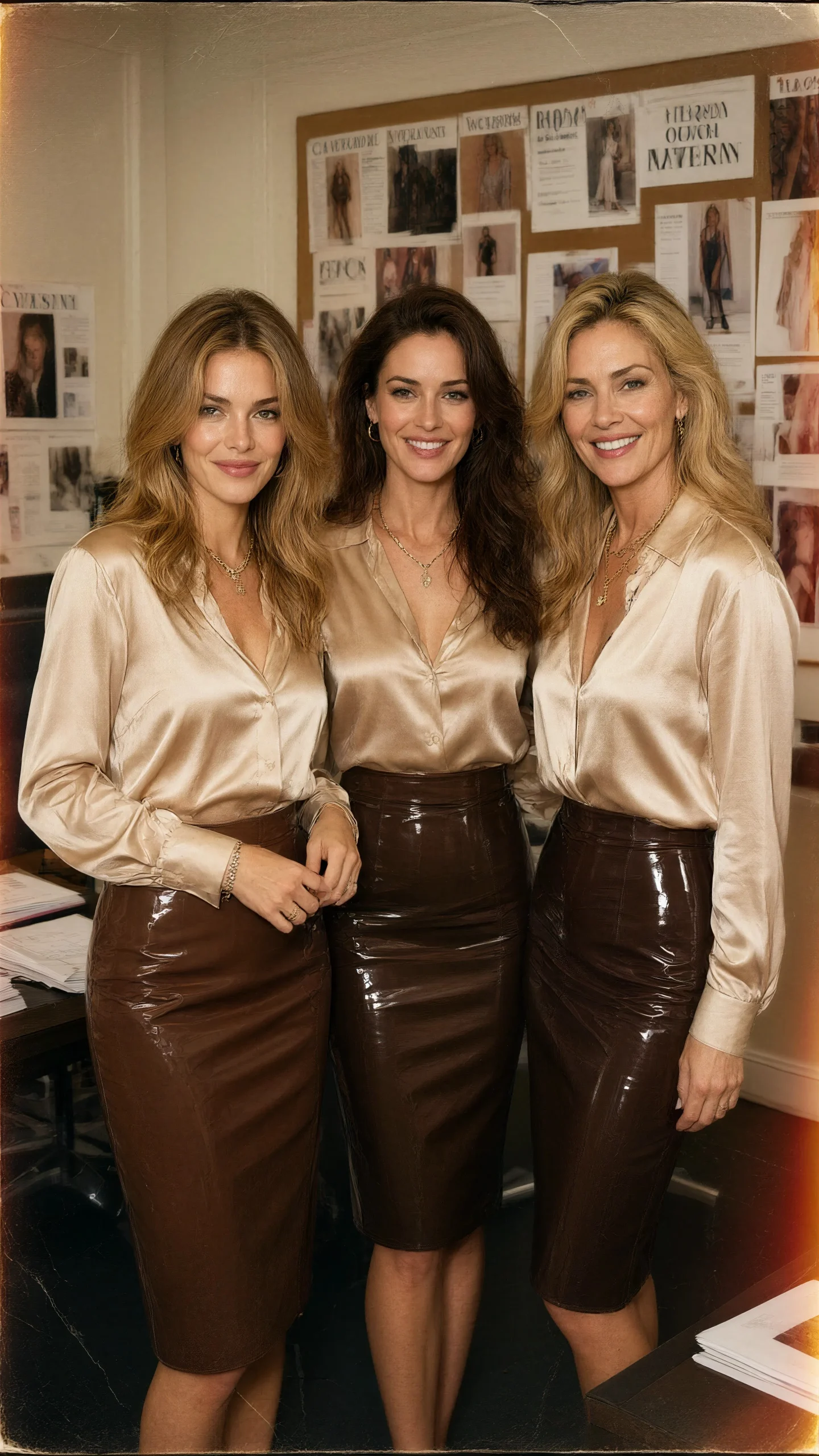
Where French Flows Like Satin and Belonging Is the Most Seductive Word of All
She arrived to judge. She remained to belong.
Margaux Devereaux—Paris’s most exacting fashion critic, her reputation sharp as the heel of a patent leather boot—crosses the Channel to evaluate an English upstart’s fashion magazine. She expects amateur pretension. She expects to be politely brutal. She expects to leave by Sunday.
She does not expect Catherine Ashworth.
Catherine stands in the entrance hall of her ancestral estate in a cream silk blouse and charcoal PVC pencil skirt, her imperfect French earnest as a first kiss: “Bienvenue à Ashworth” (Welcome to Ashworth), she says, and something in the words—not the grammar, not the accent, but the warmth—makes Margaux’s critical scalpel hesitate for the first time in twenty years.
Behind Catherine move women who orbit her with the quiet certainty of planets in stable revolution: Sophie, the estate manager, tall and composed in charcoal satin; Eleanor, young and bright-eyed, whose glance toward Catherine holds adoration that needs no translation. They are not staff. They are not servants. They are something Margaux has not seen before—women who have chosen their center and revolve around it with devotion that appears not as obligation but as joy.
Over twelve days, Margaux will learn more than French. She will learn the vocabulary of a household where glossy fabrics are not costume but architecture—satin that reflects light instead of absorbing it, PVC that defines rather than obscures, leather that holds shape like principle holds purpose. She will learn that Catherine has built not merely a magazine but a circle—women of wealth and education and confidence who have gathered around a shared vision, each contributing her expertise, each drawn by the same gravity.
She will learn the French words for fabrics and feelings: satin (satin), cuir (leather), l’appartenance (belonging), le désir (desire). She will learn that some vocabularies can only be acquired by living them.
And she will face the question that haunts every woman who has built her armor from professional detachment: What happens when the armor dissolves, and beneath it you find not vulnerability but hunger—the hunger to touch, to belong, to be part of something glossy and defined and chosen?
“Je suis arrivée en critique” (I arrived as a critic), Margaux will say at the story’s end. “Je reste en sœur” (I remain as a sister). And between arrival and return lies a transformation that reads like a seduction, feels like an awakening, and teaches French with the intimacy of a lover’s whisper in your ear.
For readers who appreciate consensual power dynamics that flow like silk between confident women. For those who know that the right fabric against the right skin is not vanity but vocabulary—a way of speaking without words. For anyone who has ever stood outside a circle of warmth and wondered what it would cost to step inside.
The price is simpler than you think. You need only learn the language.
Chapter One: L’Arrivée (The Arrival)
The rain fell in glossy ribbons against the windscreen of the black car, each drop a liquid lens refracting the grey English countryside into something almost beautiful—almost, but not quite. Margaux Devereaux watched the landscape slide past with the practiced detachment of a woman who had trained herself to see without being seen, to evaluate without being moved, to observe the world from behind a wall of Parisian sophistication so polished that nothing could stain it, nothing could breach it, nothing could reach the woman who lived within.
She had built that wall stone by stone, year by year, critique by critique. Each review published in Élégance Parisienne, each withering assessment of some aspiring designer’s pretension, each precisely aimed dismissal of mediocrity had added another layer of lacquer to her armour until she had become what the fashion world feared most: a woman who could not be seduced by novelty, could not be flattered into enthusiasm, could not be moved by anything less than genuine, structural brilliance.
And now she was being moved—physically, at least—through the Wiltshire countryside toward an estate she had been persuaded to visit by Vivienne Mercier, whose judgement she usually trusted and whose enthusiasm for this particular project she found, frankly, suspect.
“Une Anglaise qui veut lancer un magazine de mode” (An Englishwoman who wants to launch a fashion magazine), Vivienne had said over dinner in Paris, her silver rings catching candlelight as she gestured with her wine glass. “Mais pas n’importe quel magazine. Celui-ci est… différent.” (But not just any magazine. This one is… different.)
“Différent comment?” (Different how?) Margaux had asked, already composing her polite refusal.
“Différent parce qu’elle comprend quelque chose que nous avons oublié.” (Different because she understands something we have forgotten.) Vivienne had paused, her eyes holding that particular gleam that meant she was about to say something Margaux would resist. “Elle comprend que la mode n’est pas une industrie. C’est un vocabulaire.” (She understands that fashion is not an industry. It is a vocabulary.)
Margaux had resisted. She had resisted for three weeks. She had resisted until Vivienne sent her the prototype issue of the magazine—Gloss, it was called, a name so direct it was either brilliant or catastrophic—and Margaux had found herself, despite every intention to the contrary, reading it twice. Not because it was perfect. It was not. The typography was ambitious but inconsistent, the photography occasionally overwrought, the editorial voice still finding its register. But beneath the imperfections, she had sensed something she had not encountered in years: conviction. The conviction of a woman who knew what she wanted to say and was learning how to say it.
And so Margaux was here, in a car that gleamed like her own resolve, watching rain trace glossy paths down the glass, approaching a house she had told herself she would evaluate with the same dispassionate rigour she applied to everything.
The car turned through gates that opened as if the estate had been holding its breath, waiting to exhale. The drive unfolded before her—gravel that crunched with the satisfying precision of a well-maintained surface, bordered by lawns so green they seemed to vibrate with colour, flanked by trees whose branches arched overhead like the ribbing of a cathedral made of living wood. And then the house itself: Ashworth Estate, rising from its foundations like a thought made stone, its Georgian façade symmetrical as a sonnet, its windows catching what little light the clouds permitted and reflecting it back with the quiet confidence of a structure that knew its own worth.
“Château” (Château/castle), Margaux murmured to herself, and the word felt right—not because the building was French but because it possessed that particular quality of definition, of architectural intention, that she associated with the great houses of France. Each line resolved. Each surface declared itself. There was nothing fuzzy, nothing vague, nothing that apologised for its own existence.
The car stopped. The driver—impeccable in black leather gloves that Margaux noted and approved—opened her door. She stepped out onto the gravel, her heels finding purchase with the certainty of a woman who had been walking toward moments like this her entire life. Her coat was black satin, its surface catching the rain’s residual mist like a mirror that had learned to be modest. Beneath it, she wore what she always wore when evaluating: black. Black silk blouse, black PVC-trimmed trousers, black leather boots that reached her knees with the silent authority of a period at the end of a sentence. She was the question mark and the answer, the critic and the critique, and she had dressed to be impervious.
The front door opened before she reached it—not with the eager rush of someone trying to impress, but with the measured timing of someone who had been watching her approach and chosen the precise moment to welcome her. A woman stepped out, and Margaux’s evaluation—automatic, relentless, as involuntary as breathing—began its assessment.
She was tall. Not tall in the way that some women are tall—apologetically, as if their height were an imposition—but tall in the way that certain architectural structures are tall: because they were designed to be, because the height serves a purpose, because diminishing it would diminish the whole. Her hair was auburn, swept back from a face that managed the difficult trick of being both handsome and beautiful, its angles softened by a warmth that lived in the eyes and the corners of the mouth. She wore a cream silk blouse that moved like liquid light when she breathed, tucked into a charcoal PVC pencil skirt that caught the grey day and made it elegant, that transformed the dull English weather into a backdrop for something defined.
“Bienvenue à Ashworth, Madame Devereaux” (Welcome to Ashworth, Madame Devereaux). Her French was imperfect—the vowels slightly too round, the rhythm carrying the cadence of English thought wearing French clothing—but it was earnest. It was the French of a woman who had learned the language not to impress but to communicate, and something in that earnestness, in that willingness to be imperfect in the service of sincerity, made Margaux’s internal scalpel hesitate.
“Merci, Madame Ashworth” (Thank you, Madame Ashworth). Margaux kept her voice precisely modulated, her accent the pure Parisian that had made lesser women stammer. “J’espère que mon voyage n’était pas trop fatigant à anticiper” (I hope my journey was not too tiring to anticipate). The sentence was deliberately convoluted—a test, to see how Catherine would respond to French that demanded attention.
Catherine’s eyes—grey-green, the colour of the sea on a day that cannot decide between storm and calm—held Margaux’s without flinching. “Votre français est… remarquable” (Your French is… remarkable), she said, and then, with a slight smile that acknowledged the game being played: “Mais vous le savez déjà. Entrez, je vous prie. Le thé est prêt.” (But you already know that. Enter, I pray you. The tea is ready.)
Margaux felt something she had not felt in years: the faint sting of being matched. Not outdone—Catherine’s French was not equal to hers—but matched in willingness to play, to engage, to treat the conversation as a collaboration rather than a contest. It was disconcerting. It was, if she were honest with herself in a way she rarely permitted, intriguing.
She stepped into the entrance hall, and the world changed.
The space was Georgian in its bones but had been dressed by someone who understood that elegance is not period but principle. The floors were pale stone, polished to a sheen that reflected the light from tall windows like still water reflecting sky. The walls held paintings—not the dark, dusty oils one expected in English country houses, but modern work: abstracts that played with light and surface, a portrait of a woman in satin that caught the eye and held it, the fabric rendered with such precision that Margaux felt she could almost reach out and touch its slick, cool surface.
But it was the women who transformed the space.
Two figures moved through the entrance hall with the coordinated grace of dancers who had long since memorised each other’s rhythms. The first—tall, composed, her dark hair cut to frame a face of striking economy—wore charcoal satin that caught the pale light and gave it back enriched, transformed, made deliberate. She moved toward Margaux with a smile that was welcoming without being effusive, her hand extended to take the coat that Margaux was already unbuttoning.
“Sophie Marchand” Catherine said. “Ma gestionnaire de domaine. Elle s’occupe de tout.” (My estate manager. She takes care of everything.)
“Enchantée” (Delighted to meet you), Sophie said, and her accent was different from Catherine’s—more fluid, as if her French had been learned not from books but from living proximity to the language, from daily use that had worn the edges smooth. Her hands took Margaux’s coat and held it for a moment, the satin sliding against her fingers, and Margaux noticed the way Sophie’s eyes moved—not to the coat but to Catherine, a glance of such natural frequency that it seemed involuntary, a satellite checking its orbit.
“Enchantée” Margaux replied, the word precise and cool as crystal.
The second figure emerged from a doorway to the left—young, perhaps twenty-five, with the kind of brightness that usually gets dimmed by experience but here seemed to burn steadily, fed by some fuel Margaux could not yet identify. She wore a navy blazer trimmed in PVC that caught the light in clean lines, its surface reflecting the room like a dark mirror. Her hair was pulled back in a practical style that somehow managed to be elegant, and she carried a tray with the careful pride of someone for whom the task was not menial but meaningful.
“Eleanor” Catherine said, and Margaux noted the absence of a surname—the familiarity of a woman who does not need to introduce her people formally because their presence explains itself. “Elle aide avec le magazine. Et avec tout le reste.” (She helps with the magazine. And with everything else.)
“Bonjour, Madame Devereaux” (Good morning, Madame Devereaux), Eleanor said, and her French was the most hesitant of the three—but her smile was the most open, the least guarded, and Margaux saw how that smile turned toward Catherine like a flower that had found its sun. The adoration was naked, unapologetic, and Catherine received it with the ease of a woman who had long since accepted that she was the centre of this particular solar system.
Margaux took the tea—Earl Grey, the cup fine bone china that gleamed with the particular lustre of things well cared for—and allowed herself to be guided deeper into the house. As she walked, she catalogued what she observed with the relentless precision that had made her reputation:
The floors were stone but not cold—underfloor heating, she suspected, the kind of invisible investment that revealed wealth without displaying it. The art was modern but not trendy—pieces chosen for their relationship to light and surface, their conversation with the space they inhabited. The fabrics throughout were glossy, defined, intentional: silk curtains that fell like water finding its level, leather chairs that invited touch, PVC accents on surfaces that might have been merely functional but had been elevated to the sculptural.
And the women. Margaux could not stop observing the women. Sophie walked ahead, her satin-clad figure moving with the assurance of someone who belonged here, who had earned her place through competence and devotion. Eleanor walked beside Catherine, her body angled toward her employer with the subtlety of a compass needle finding north. And Catherine moved between them like a conductor who does not need to raise her baton because the orchestra already knows the music.
“Vous avez une belle maison” (You have a beautiful house), Margaux said, and the compliment was genuine despite her determination to remain detached. One could not deny the aesthetic achievement of this space, the way it embodied a philosophy she had spent her career advocating: that beauty is not ornament but structure, that elegance is not surface but foundation.
“Merci” (Thank you), Catherine said. “Mais ce n’est pas ma maison. C’est notre maison. Ces femmes—Sophie, Eleanor, les autres que vous rencontrerez—elles ne travaillent pas ici. Elles vivent ici. La distinction est importante.” (But it is not my house. It is our house. These women—Sophie, Eleanor, the others you will meet—they do not work here. They live here. The distinction is important.)
Margaux felt her eyebrow rise—the involuntary response of a woman who has just been told something that challenges her assumptions. She had expected a household. She had found something else. A community. A circle. The word surfaced in her mind with the weight of revelation: these women had not been hired; they had been gathered. They had not been employed; they had been drawn. And the force that had drawn them was walking beside her in a cream silk blouse and charcoal PVC, speaking imperfect French with perfect conviction.
“La distinction est importante” Margaux repeated, tasting the words. “Oui. Je comprends.” (Yes. I understand.) She did not understand—not fully—but she recognised that understanding would require more than a single afternoon’s observation. It would require the kind of attention she usually reserved for collections that deserved it, and she was not yet willing to admit that this household might deserve it.
Catherine led her into a room that made Margaux’s breath catch—silently, invisibly, but definitively. The library. Floor-to-ceiling shelves of books whose leather spines gleamed with the patina of use and care. A long table of dark wood polished to a mirror sheen. Windows that framed the rain-washed gardens like paintings hung by a curator who understood that nature and artifice are not opposites but collaborators. And everywhere, in every surface, in every fabric, in every carefully placed object: gloss. The room did not merely contain light; it conversed with it, each surface offering its own response to the day’s grey illumination, transforming it, enriching it, making it theirs.
“Asseyez-vous” (Sit down), Catherine said, gesturing to a leather chair that managed to be both architectural and inviting. “Le magazine est là. Prenez votre temps. Je ne suis pas pressée.” (The magazine is there. Take your time. I am not in a hurry.)
It was a power move, Margaux recognised—not the aggressive kind, not the kind that demands attention, but the patient kind, the kind that says: I know what I have made, and I am willing to wait for you to see it. It was the confidence of a woman who does not need validation because she has something more valuable: the devotion of those around her.
Margaux sat. The leather was cool against her back, then warming, conforming, accepting her weight like a partner in a dance. She reached for the prototype magazine—Gloss, its cover a study in satin and light, its title embossed in a font that was either pretentious or perfect, depending on whether the contents justified it—and she opened it.
Catherine did not sit. She stood by the window, her silhouette defined by the rain-grey light, and she did not watch Margaux read. She watched the garden, as if the magazine’s fate were already decided and her attention belonged elsewhere—to the world she was building, to the women who were building it with her, to the future that was taking shape around her like a gown being fitted to a body that knew its own contours.
Sophie appeared in the doorway, silent as satin sliding over skin. She did not speak. She simply stood, her presence a question that only Catherine could read. Catherine turned, and between them passed a glance of such compressed communication—such fluency of silence—that Margaux felt she was watching a language more intimate than any she had been hired to evaluate.
“Oui” Catherine said softly. “Merci, Sophie.“
Sophie nodded and withdrew, her movement carrying the satisfaction of a message sent and received. Margaux watched her go, watched the charcoal satin catch the light one final time before she disappeared around the doorframe, and she felt it again—that thing she had been refusing to name since she walked through the front door. Not admiration. Not respect. Something more dangerous, more seductive, more likely to breach the wall she had spent decades constructing.
Envy.
She envied this. Not the house, not the magazine, not the leather chair warming beneath her. She envied the ease—the way these women moved around each other, the way devotion flowed between them like water finding its level, the way Catherine stood at the centre of it all and did not grasp or clutch or cling but simply was, and the women simply gathered, and the whole thing held together not by obligation or hierarchy but by something Margaux had spent her life avoiding:
Belonging.
She looked down at the magazine in her hands. The pages were glossy, the photographs luminous, the words arranged with care that was not yet mastery but was something perhaps more valuable: sincerity. She read the first line of the editor’s letter—Catherine’s letter, Catherine’s voice, Catherine’s imperfect French translated into imperfect English that somehow captured something perfect:
We believe that what you wear against your skin is the first sentence of a story you tell the world. We believe that satin does not lie. That leather does not apologise. That PVC does not pretend. We believe that glossy is not superficial—it is honest. It reflects what is there. It does not absorb light and hide it in fuzzy darkness. It gives light back, enriched, defined, made yours.
Margaux read the paragraph twice. Then a third time. Then she looked up at Catherine, who was still standing at the window, still watching the garden, still holding the centre of her world with the quiet authority of a woman who has found her purpose and surrounded herself with women who share it.
“Madame Ashworth” Margaux said, and her voice was not quite steady. “Ceci est… inattendu.” (This is… unexpected.)
Catherine turned from the window. Her grey-green eyes held Margaux’s across the room, across the distance between critic and creator, between the woman who judges and the woman who builds, and she smiled—not with triumph, not with relief, but with the simple warmth of a woman who has been seen.
“Inattendu?” (Unexpected?) Catherine repeated. “C’est bon ou c’est mauvais?” (Is that good or bad?)
Margaux looked down at the magazine in her hands—its glossy cover reflecting her face back at her, her expression unguarded for the first time in years—and she felt the wall inside her shift. Not fall. Not crumble. Just shift, the way tectonic plates shift before an earthquake, the way the ground shifts before something new rises from it.
“C’est…” (It is…) Margaux paused, searching for the word, finding it in French because French was the language of her heart even when her heart was armoured. “C’est troublant.” (It is… troubling. Disturbing. In the most delicious, most dangerous, most necessary sense of the word.)
Catherine’s smile deepened. “Bien” (Good), she said. “Troublant est exactement ce que je visais.” (Troubling is exactly what I was aiming for.)
Outside, the rain continued to fall in glossy ribbons against the windows, each drop a liquid lens refracting the world into something almost beautiful—not almost, Margaux corrected herself. Actually. Actually beautiful. And she was here, inside it, holding the proof of it in her hands, and the wall inside her was shifting, and she did not yet know whether she was here to evaluate or to be transformed, and perhaps—perhaps—there was no difference.
The tea was growing cold in her cup. She did not care. She turned the page.
Chapter Two: La Bibliothèque (The Library)
The library held Margaux the way certain rooms hold light—not by trapping it but by conversing with it, each surface offering a response, each angle creating a new question. She sat at the long table, the prototype magazine open before her, and she read with the attention she reserved for collections that deserved dissection: slowly, precisely, with the scalpel of her intellect honed to its finest edge.
Catherine had left her alone—an act of confidence that Margaux recognised as strategy. A lesser woman would have hovered, explained, defended. Catherine had simply gestured to the magazine, murmured “Prenez votre temps” (Take your time), and withdrawn with the quiet assurance of someone who has planted a seed and trusts the soil.
The library itself was a distraction Margaux could not entirely resist. The shelves rose to the ceiling in clean, unbroken lines—no clutter, no decorative intrusion, just books arranged with the precision of a well-edited sentence. The leather spines caught the afternoon light that filtered through tall windows, their surfaces gleaming with the particular lustre that comes not from polish but from use—the oils of fingers that had read them, the subtle wear of minds that had engaged. These were not books purchased by the metre to impress visitors; these were books that had been chosen, each one earning its place through relevance, through resonance, through the particular alchemy that transforms text into testimony.
Margaux forced her attention back to the magazine. She picked up her pen—a fountain pen, black lacquer, its nib fine as a critic’s intention—and began to read aloud, her voice filling the library with French that flowed like the satin she wore, smooth and deliberate and catching light at every turn.
“La typographie est… comment dirais-je… ambitieuse pour un premier numéro.” (The typography is… how should I say… ambitious for a first issue.) She turned the page, her pen hovering above the paper like a bird of prey considering its descent. “Les photographies manquent de… non. Ce n’est pas qu’elles manquent. C’est qu’elles choisissent.” (The photographs lack… no. It is not that they lack. It is that they choose.)
She paused, frowning. The photographs were not what she had expected. She had anticipated the usual aspirational nonsense—models in borrowed couture, their expressions vacant as hotel rooms, their bodies arranged to sell desire rather than embody it. Instead, she found women who looked at the camera rather than through it, women whose postures declared rather than suggested, women wearing satin and leather and PVC not as costume but as architecture—clothing that structured their presence rather than decorating it.
One photograph stopped her entirely. A woman—perhaps fifty, her silver hair swept back from a face that had lived and chosen and refused to apologise for either—stood in a corridor of pale stone, her body angled toward the light with the unconscious authority of someone who knew where illumination came from and how to meet it. She wore a black satin gown that moved like liquid shadow, its surface catching the corridor’s light and giving it back transformed, enriched, made hers. Her expression was not seductive—not in the way the fashion industry understood seduction, which was to say, performative and hollow. It was inviting. It said: I am here. I am this. Join me or don’t, but know that I am complete either way.
“Qui est cette femme?” (Who is this woman?) Margaux murmured, and the question was not rhetorical. She wanted to know. She wanted to understand how a photograph could capture something she had spent her career trying to name: the quality that separates fashion from style, clothing from presence, the act of wearing from the art of inhabiting.
She turned to the editor’s letter again, reading more carefully now, allowing Catherine’s voice to surface through the English text. The letter spoke of fabrics as vocabulary—satin as clarity, leather as definition, PVC as intention. It spoke of the difference between fabrics that reflect light and fabrics that absorb it, between surfaces that declare and surfaces that obscure. It spoke of gloss not as superficiality but as honesty—the willingness to be seen, to reflect what is, to give back rather than swallow.
“La beauté qui se définit” (Beauty that defines itself), Margaux read, and the phrase caught something in her chest—a hook she had not expected, a resonance she had not braced for. She had spent her career evaluating beauty that was defined by others—by designers, by editors, by the market’s invisible hand. Catherine was proposing something radical: beauty that defined itself. Beauty that chose its own vocabulary and spoke it without apology.
The door opened. Margaux did not look up—she had learned that the most effective power move in any evaluation was the refusal to acknowledge interruption. But her body registered the entrance: the particular sound of satin moving through air, the subtle shift in the room’s atmosphere that indicated another presence, another warmth.
“Le thé est froid, je pense” (The tea is cold, I think), Sophie said, her voice carrying the quiet authority of a woman who managed estates and people and the space between them with equal competence. “Puis-je vous en apporter un autre?” (May I bring you another?)
“S’il vous plaît” (Please), Margaux said, still not looking up. “Et Madame Ashworth? Où est-elle?” (And Madame Ashworth? Where is she?)
A pause—brief, weighted, the kind of silence that contains an entire conversation. “Dans le jardin. Elle marche chaque après-midi. C’est sa… comment dire… sa méditation.” (In the garden. She walks every afternoon. It is her… how to say… her meditation.)
Margaux looked up then, caught by something in Sophie’s voice—not information but tone. The way she said méditation carried the same reverence that other women reserved for lovers’ names. Sophie stood in a shaft of afternoon light, her charcoal satin blouse catching it and giving it back with interest, and her face held an expression Margaux recognised because she had seen it in mirrors decades ago, before she had learned to guard it: longing. Not the desperate, grasping kind. The settled, permanent kind. The longing of someone who has found what they want and lives in continuous awareness of having found it.
“Vous admirez Catherine” (You admire Catherine), Margaux said. It was not a question.
Sophie’s expression did not change—no flush of embarrassment, no defensive retreat. She simply met Margaux’s eyes with the directness of someone who has nothing to hide because what she feels is not shameful but foundational. “Je ne admire pas seulement. Je… appartiens.” (I do not merely admire. I… belong.)
The word appartiens hung in the air between them like a note sustained after the string has been plucked. Margaux felt it land in her chest—not as understanding but as recognition, the way one recognises a piece of music one has never heard but somehow always known.
“Appartenir” (To belong), Margaux repeated, testing the word. “C’est… une chose puissante.” (It is… a powerful thing.)
“C’est la chose la plus puissante que je connaisse” (It is the most powerful thing I know), Sophie said, and then she moved—efficient, graceful, her satin catching light as she turned toward the door. “Je vais vous apporter du thé frais. Et si vous avez des questions sur le magazine, je peux répondre à la plupart. Catherine m’a tout expliqué.” (I will bring you fresh tea. And if you have questions about the magazine, I can answer most of them. Catherine has explained everything to me.)
Margaux watched her go, noting the way Sophie’s body moved through the doorway—not with the hurried efficiency of staff but with the settled grace of someone moving through their own home, their own space, their own belonging. She was not an employee. She was not a servant. She was something the English language had no adequate word for—a woman who had chosen her place and been chosen for it, a devotion that was mutual, structural, architectural.
The magazine lay open before her, the photograph of the silver-haired woman in black satin still holding her gaze. Margaux reached out and touched the page—not the image but the margin beside it, her finger tracing the white space as if it were a path she might follow. The paper was glossy, smooth beneath her touch, and she thought of the fabrics Catherine had championed: surfaces that reflect rather than absorb, textures that declare rather than obscure.
She turned more pages. Each photograph told the same story in different voices: a young woman in red PVC leaning against a brick wall, her posture defiant, her smile private; two women in matching leather jackets walking through a market, their synchronicity suggesting not uniformity but harmony; a woman in white satin sitting alone at a table set for many, her solitude not lonely but chosen, her expression saying I am waiting for my people, and they are coming.
“Elles sont magnifiques” (They are magnificent), Margaux said to the empty room, and the admission cost her something—a chip in the armour, a thread pulled from the fabric of her detachment. She had not intended to be moved. She had intended to be precise.
The door opened again, and this time Margaux looked up immediately—not because she had learned the power move but because something in her wanted to see, wanted to face whatever was coming with her eyes open and her scalpel ready.
It was Eleanor. The young woman stood in the doorway with a tray—fresh tea, biscuits arranged on a plate with the geometric precision of someone who understood that presentation is not vanity but respect. She wore the navy PVC-trimmed blazer from earlier, and in the library’s warm light, the glossy panels caught and held the illumination like a dark mirror that had learned to be hospitable.
“Sophie a dit que vous vouliez du thé frais” (Sophie said you wanted fresh tea), Eleanor said, and her voice was softer than Sophie’s, less settled, carrying the particular vibration of someone still in the process of becoming. “Et Catherine demande si vous aimeriez la voir dans le jardin. Elle dit que le magazine se lit mieux après avoir vu les jardins. Quelque chose sur… le contexte?” (And Catherine asks if you would like to see her in the garden. She says the magazine reads better after seeing the gardens. Something about… context?)
Margaux set down her pen. “Le contexte?” She almost laughed—almost, but not quite, because laughing would reveal that she was amused, and amusement was a form of engagement, and engagement was a step toward the belonging that Sophie had named with such devastating simplicity.
“Catherine dit que le magazine n’est pas juste un magazine” (Catherine says the magazine is not just a magazine), Eleanor continued, setting the tray on the table with care that bordered on reverence. “Elle dit que c’est une invitation. Et que les invitations se comprennent mieux quand on voit la maison de l’hôte.” (She says it is an invitation. And invitations are better understood when one sees the host’s home.)
Margaux sipped the tea—hot, fragrant, the Earl Grey’s bergamot cutting through the library’s leather-and-paper scent like a clear voice in a choir. She studied Eleanor over the rim of the cup, cataloguing what she saw: the brightness in the young woman’s eyes, the way her body angled toward the door through which she had come, the way her hands, having completed their task, did not know where to rest because their natural resting place was not here but there—wherever Catherine was.
“Eleanor” Margaux said, and her voice was gentler than she intended—gentler than she had permitted herself to be with anyone in years. “Pourquoi êtes-vous ici?” (Why are you here?)
The question was not about employment. It was not about the magazine. It was the same question Margaux had been asking herself since she walked through the front door: What draws a woman to this place, to this woman, to this life?
Eleanor’s face did something remarkable—it opened, like a flower that had been waiting for precisely this question, this sunlight, this invitation to unfold. “Parce que Catherine m’a vue” (Because Catherine saw me), she said, and the simplicity of the statement contained multitudes. “Pas vue comme les autres voient—pas comme un objet ou une employée ou une jeune femme à former. Vue comme… une personne qui avait quelque chose à offrir. Et elle avait raison. J’avais quelque chose à offrir. Je ne le savais pas jusqu’à ce qu’elle me le montre.” (Not seen as others see—not as an object or an employee or a young woman to train. Seen as… a person who had something to offer. And she was right. I had something to offer. I didn’t know it until she showed me.)
Margaux set down her tea. Her hand was not quite steady—something she noted with the detached precision of a critic observing her own unraveling, cataloguing the symptoms of an engagement she had not consented to: the slight tremor in her fingers, the acceleration of her pulse, the particular warmth that had settled in her chest like a guest who arrives uninvited but somehow belongs.
“Et qu’est-ce que vous offrez?” (And what do you offer?) she asked, and the question was not merely for Eleanor. It was for herself. It was the question she had been avoiding since Paris, since Vivienne’s dinner, since the moment she had agreed to cross the Channel and evaluate something that was proving to be not a magazine but a mirror.
Eleanor smiled—the same sun-seeking smile Margaux had observed earlier, but now directed at her, and its warmth was disarming, penetrating, the kind of smile that makes armour feel not like protection but like imprisonment. “J’offre mon dévouement” (I offer my devotion), she said simply. “Mon temps. Mon énergie. Ma créativité. Catherine a une vision, et cette vision mérite tout ce que je peux donner. Ce n’est pas un sacrifice. C’est un… privilège.” (My time. My energy. My creativity. Catherine has a vision, and this vision deserves everything I can give. It is not a sacrifice. It is a… privilege.)
Privilège. The word settled into Margaux’s mind like a stone dropped into still water, its ripples spreading outward, disturbing surfaces she had kept calm for decades. She had spent her career treating devotion as weakness—the willingness to serve another’s vision as a failure of one’s own. But Eleanor did not look weak. She looked complete. She looked like a woman who had found her purpose and was living it with the full engagement of someone who has nothing to withhold and everything to give.
“Le privilège” Margaux repeated, tasting the word. “C’est un mot intéressant. La plupart des gens diraient ‘devoir’ ou ‘obligation.’ Vous dites ‘privilège.’ (It is an interesting word. Most people would say ‘duty’ or ‘obligation.’ You say ‘privilege.’) Pourquoi? (Why?)”
Eleanor’s smile deepened, and Margaux saw Catherine in it—not physically, not in features, but in quality. The same warmth. The same directness. The same refusal to apologise for knowing what one wants. “Parce que le devoir est une chaîne. Le privilège est un choix. Et le choix est… tout.” (Because duty is a chain. Privilege is a choice. And choice is… everything.)
Eleanor withdrew, leaving the tea and the biscuits and the question hanging in the library’s warm air like perfume that refuses to dissipate. Margaux sat alone with the magazine and her thoughts, and for the first time in years, the thoughts were not critical. They were curious. She was not dissecting; she was exploring. She was not evaluating; she was imagining.
She imagined what it would feel like to be seen the way Eleanor described being seen—not as an object of assessment but as a person with something to offer. She imagined what it would feel like to belong the way Sophie described belonging—not as loss of self but as completion of self. She imagined what it would feel like to wear satin not as armour but as expression, to let the glossy surface reflect not what she was defending against but what she was offering.
The magazine lay open on the table, its pages glossy with possibility. Margaux turned to the photograph of the silver-haired woman in the corridor—the one who had stopped her, the one whose expression said I am here, I am this, join me or don’t—and she saw something she had not seen before. The woman was not alone. In the background, barely visible in the corridor’s shadows, were other figures: women in satin and leather, their forms suggested rather than shown, their presence implied rather than declared. They were there. They were with her. And their being with her did not diminish her; it amplified her. She was not solitary. She was the centre of a constellation, and the constellation made her light more meaningful, more defined.
Margaux closed the magazine. She placed her hand on its cover—glossy, smooth, reflecting her face back at her with the honesty she had spent her career demanding from others and denying herself. She looked at her own reflection in the magazine’s surface and saw what Catherine must have seen when she created it: a woman who had built a wall so polished that it reflected everything and admitted nothing. A woman who had confused clarity with coldness. A woman who had forgotten that the purpose of gloss is not to deflect light but to enrich it.
She stood. The leather chair released her with a soft sigh, its surface warm where she had been, holding the impression of her presence like a memory the room would keep. She walked to the window and looked out at the garden—Catherine’s garden, the one she walked each afternoon as meditation, the one Eleanor said provided context for the magazine.
And there she was. Catherine Ashworth, walking the gravel paths in her cream silk and charcoal PVC, her auburn hair catching the afternoon’s weak sun like a flame that has learned to burn steadily rather than spectacularly. She was not alone. Sophie walked beside her, their shoulders nearly touching, their steps synchronised by the particular rhythm of two women who have learned each other’s pace. Behind them, at a respectful distance, walked two other women Margaux had not yet met—one in navy blue satin, one in black leather—and their presence completed the picture: a woman at the centre, women around her, each in her orbit, each choosing to be there, each contributing her own light to a constellation that was brighter for their gathering.
Margaux pressed her hand against the window glass. It was cool—English cool, the kind of cool that makes warmth feel earned rather than given—and through it, she watched Catherine walk her garden with her women, and she felt the wall inside her shift again. Not fall. Not crumble. Shift. The way the earth shifts before something new emerges. The way a woman shifts when she begins, despite every intention to the contrary, to want.
“Montrez-moi le contexte” (Show me the context), she whispered to the glass, to the garden, to the woman walking there. “Montrez-moi ce que je ne comprends pas encore.” (Show me what I do not yet understand.)
In the garden, Catherine paused. She turned, as if she had heard—across the distance, through the glass, over the barrier of Margaux’s carefully maintained detachment—and she looked up at the library window. Their eyes met. Catherine smiled.
And Margaux, who had built her career on refusing to be moved, who had constructed her identity from critique and distance and the glossy armour of professional superiority, felt something she had not felt since she was young enough to believe that wanting was the same as having:
Hope.
She turned from the window. She picked up the magazine. She opened it again, and this time, she did not read with a scalpel. She read with a heart—cautious, armoured, but cracking, cracking in the way that light cracks through shutters, not destroying the structure but illuminating what has always been there, waiting in the dark.
The tea grew cold again. She did not notice. She was learning a new vocabulary—not of French, not of fashion, but of feeling. And the first word in any new language is always the same: more.
Chapter Three: La Promenade (The Tour)
The morning arrived with the particular clarity that follows rain—light washed clean, air scrubbed of ambiguity, the estate’s surfaces gleaming with the residual moisture that made every window a mirror and every path a ribbon of reflected sky. Margaux stood at her bedroom window, watching the garden dry itself with the patient dignity of a woman who has wept and is now composing her face, and she felt something she had not felt in years: the desire to walk.
Not the purposeful stride of Parisian navigation—not the movement of a woman crossing a city to reach a destination. The desire for a different kind of walking: the kind that has no destination because the walking itself is the point, the kind that allows conversation to unfold at the pace of footsteps, the kind that Catherine had been doing yesterday in the garden with her women—her constellation, Margaux corrected herself, because the word that kept surfacing was not household or staff or team but constellation, bodies in orbit, each one luminous, each one held.
A knock at the door. Sophie’s knock—Margaux had already learned to distinguish it from Eleanor’s: Sophie’s was two measured taps, a statement; Eleanor’s was three quick ones, a question.
“Entrez” (Enter), Margaux said, and the word felt different this morning—less guarded, more… inviting. She noted the shift with the clinical attention of a woman who has spent decades monitoring her own emotional weather for signs of weakness.
Sophie entered carrying a tray—coffee, not tea, a small plate of madeleines whose surfaces gleamed with the particular golden sheen of butter baked to precisely the right moment of transformation. She wore a grey satin blouse today, its surface catching the morning light like still water disturbed by a breeze, and her movements had the quality of a woman who has found her rhythm and does not need to check it against external approval.
“Catherine suggère une promenade ce matin” (Catherine suggests a walk this morning), Sophie said, setting the tray on the side table with the efficiency of someone who has performed this service so many times that it has become not labour but ritual. “Elle veut vous montrer le domaine. Le salon, l’atelier, les jardins. Elle dit que le magazine se comprend mieux quand on voit… le contexte.” (She wants to show you the estate. The salon, the workshop, the gardens. She says the magazine is better understood when one sees… the context.)
There it was again—that word, contexte, the same word Eleanor had used yesterday, the same concept that had pulled Margaux from the library to the window, from observation to longing. Catherine was not merely offering a tour. She was offering an understanding. She was saying: You have read the vocabulary. Now let me show you the world it describes.
“Je suis prête” (I am ready), Margaux said, and the readiness was not merely sartorial—though she had dressed with care, choosing a black silk shirt and charcoal PVC trousers that moved with her body like a second skin, surfaces that declared rather than apologized. The readiness was internal: a willingness, however reluctant, however armoured, to be shown.
They met in the entrance hall. Catherine stood at the foot of the stairs in a dove-grey satin dress that moved like smoke given intention, its surface catching the light from the tall windows and distributing it through the space with the generosity of a woman who understands that illumination is not a finite resource but a shared one. Her hair was pulled back, exposing the architecture of her face—the strong jaw, the high cheekbones, the brow that seemed designed for the weight of thought—and her eyes, grey-green as the sea on an undecided day, held Margaux’s with the warmth that Margaux had spent the previous night trying to categorise and failing.
“Bonjour, Margaux” (Good morning, Margaux). The use of her first name—deliberate, unhurried, a choice rather than a slip—sent a ripple through Margaux’s composure. Yesterday they had been Madame Devereaux and Madame Ashworth. Today they were Margaux and Catherine. The shift was subtle, seismic, the kind of tectonic movement that rearranges landscapes without warning.
“Bonjour, Catherine” Margaux replied, and the name felt different in her mouth—warm, specific, a word she could taste.
“Nous allons commencer par le salon” (We will begin with the salon), Catherine said, turning toward a doorway that Margaux had noticed yesterday but not entered. “C’est là que je reçois. C’est là que le magazine a commencé—pas sur papier, mais en conversation.” (It is where I receive. It is where the magazine began—not on paper, but in conversation.)
The salon was a room that understood its own purpose the way a well-cut garment understands the body it clothes. The proportions were Georgian—high ceilings, tall windows, the mathematical harmony of an age that believed beauty could be calculated—but the contents were contemporary, curated by someone who knew that elegance is not period but principle. The sofas were upholstered in cream satin that caught the morning light and held it like a cupped hand holding water. The chairs were leather—dark, supple, their surfaces reflecting the room in compressed vignettes. A coffee table of glass and chrome sat at the room’s centre, its glossy surface mirroring the ceiling above with the honesty of a surface that has nothing to hide.
Two women were already present, seated at the window with cups of coffee and a spread of papers between them. They looked up as Catherine entered, and Margaux watched their faces undergo the same transformation she had observed in Sophie and Eleanor: a brightening, a turning-toward, as if Catherine’s presence were a light source and their faces were surfaces designed to reflect it.
“Margaux, je vous présente Harriet Vane et Beatrice Ashford” (Margaux, allow me to introduce Harriet Vane and Beatrice Ashford), Catherine said. “Harriet écrit pour le magazine—elle est professeure de littérature à Oxford. Beatrice gère nos finances—elle est banquière de formation, philanthrope de vocation.” (Harriet writes for the magazine—she is a professor of literature at Oxford. Beatrice manages our finances—she is a banker by training, philanthropist by vocation.)
Harriet rose first—tall, angular, her dark skin gleaming against a rust-coloured satin blouse that moved like autumn light given fabric form. Her handshake was firm, her eyes sharp with the particular intelligence of a woman who has spent decades reading texts closely enough to find their hidden architecture. “Enchantée, Madame Devereaux. J’ai lu votre travail pendant des années. Votre critique de la collection Saint Laurent en 2019—c’était de l’architecture verbale.” (Delighted, Madame Devereaux. I have read your work for years. Your review of the Saint Laurent collection in 2019—that was verbal architecture.)
Margaux felt a flush of pleasure she had not anticipated—the recognition of a peer, someone who understood that criticism could be construction rather than destruction. “Merci. C’est rare qu’on reconnaisse la critique comme une forme créative.” (Thank you. It is rare that criticism is recognized as a creative form.)
“La plupart des gens confondent la critique avec la destruction” (Most people confuse criticism with destruction), Harriet said, settling back into her chair with the ease of a woman who has earned her place and does not need to defend it. “Mais vous, vous construisez. Vous montrez ce qui pourrait être. C’est… généreux.” (But you, you build. You show what could be. That is… generous.)
Généreux. The word landed in Margaux’s chest with the weight of a revelation. She had been called many things—sharp, exacting, formidable, cold—but never generous. Yet Harriet’s use of the word felt not like flattery but like recognition, as if she were seeing something Margaux had hidden even from herself.
Beatrice spoke next—shorter than Harriet, her silver hair cropped close to a face that radiated the particular authority of a woman who has managed money and understood that money is not power but tool. She wore black leather—trousers, blazer, the surfaces catching the room’s light with the clean definition of a woman who has no patience for ambiguity. “Bienvenue, Madame Devereaux. Catherine nous a dit que vous étiez… troublée par le magazine. C’est bon. Être troublée, c’est être vivante.” (Welcome, Madame Devereaux. Catherine told us you were… troubled by the magazine. That is good. To be troubled is to be alive.)
Margaux looked between them—Harriet in rust satin, Beatrice in black leather, Catherine in dove grey—and she saw the pattern again, the constellation, the gathering of women around a centre. Harriet contributed intellect. Beatrice contributed financial architecture. Sophie contributed management. Eleanor contributed devotion. Each woman brought what she had, and what she had was welcomed, integrated, made essential.
“Le magazine n’est pas mon projet” (The magazine is not my project), Catherine said, as if reading Margaux’s thoughts. “C’est notre projet. Chaque femme ici a contribué quelque chose que je n’aurais pas pu donner seule. Harriet donne les mots. Beatrice donne la structure financière. Sophie donne l’organisation. Eleanor donne l’énergie. Et moi? (It is our project. Each woman here has contributed something I could not have given alone. Harriet gives the words. Beatrice gives the financial structure. Sophie gives organization. Eleanor gives energy. And me?) Je donne… le centre. La vision autour de laquelle tout s’organise. Mais une vision sans mains pour la construire n’est qu’un rêve.” (I give… the centre. The vision around which everything organizes. But a vision without hands to build it is only a dream.)
“Et vous avez beaucoup de mains” (And you have many hands), Margaux said, and the observation was not criticism but something more dangerous: admiration.
Catherine smiled—the same smile from the garden, the same warmth, but closer now, more defined, a surface Margaux could almost touch. “Des mains qui choisissent. C’est la différence. Je ne recrute pas. Je n’engage pas. Je… j’invite. Et les femmes qui acceptent l’invitation le font parce qu’elles voient quelque chose qui mérite leur dévouement.” (Hands that choose. That is the difference. I do not recruit. I do not hire. I… invite. And the women who accept the invitation do so because they see something that deserves their devotion.)
Invitation. The word echoed through the salon like a bell struck in a room of satin, its vibrations touching every surface, making every glossy fabric hum with sympathetic resonance. Margaux felt it in her own satin, in the PVC that moved against her skin, in the leather of the chairs that held the warmth of women who had sat in them and chosen to stay.
They moved to the atelier—a converted stable block whose original architecture had been preserved with the respect of a woman who understands that structure is story. The stalls were gone, replaced by a long, bright room of worktables and sewing machines and fabric bolts arranged by colour and texture in a gradient that ran from light to dark like a day moving toward evening.
Three women worked there—two at sewing machines, one at a cutting table—and they looked up as Catherine entered with the same brightening Margaux had observed in the salon. They wore the aesthetic: one in navy satin, one in black PVC, one in deep burgundy leather, their garments practical for work yet defined, each surface declaring its wearer’s allegiance to the philosophy of gloss.
“Madame Chantal n’est pas ici aujourd’hui” (Madame Chantal is not here today), Catherine said, guiding Margaux through the space. “Mais vous pouvez voir le travail. Chaque pièce est faite à la main. Pas de production de masse. Pas de factories anonymes. Chaque couture est placée par une femme qui comprend pourquoi elle est là.” (But you can see the work. Each piece is made by hand. No mass production. No anonymous factories. Each seam is placed by a woman who understands why it is there.)
Margaux ran her fingers along a bolt of satin—midnight blue, the same colour as Catherine’s launch gown, its surface cool and slick and honest in a way that wool never was, that velvet refused to be. “Pourquoi seulement ces tissus?” (Why only these fabrics?) she asked. “Le satin, le cuir, le PVC? Pour pas le coton, la laine, le velours?” (Why not cotton, wool, velvet?)
Catherine paused at the cutting table, her hand resting on its surface—smooth, polished, reflecting the overhead light with the clarity of a woman who has nothing to obscure. “Parce que ces tissus mentent, Margaux. Le velours absorbe la lumière et la cache. La laine est floue—elle obscurcit la forme. Le coton est… suffisant. Mais seulement suffisant.” (Because those fabrics lie, Margaux. Velvet absorbs light and hides it. Wool is fuzzy—it obscures form. Cotton is… sufficient. But only sufficient.)
She turned, and her eyes held Margaux’s with the intensity of a woman who has thought about this not as a preference but as a philosophy. “Le satin reflète. Le cuir définit. Le PVC déclare. Ces tissus ne cachent rien. Ils disent: voici ce que je suis. Voici ma forme. Voici ma surface. Regardez—ou ne regardez pas. Mais je ne vais pas me cacher dans le flou.” (Satin reflects. Leather defines. PVC declares. These fabrics hide nothing. They say: here is what I am. Here is my form. Here is my surface. Look—or don’t look. But I will not hide in the fuzzy.)
Flou—the word meant blur, fuzziness, the quality of things that refuse definition, that exist in the vague territory between what they are and what they pretend to be. Margaux had spent her career fighting the flou—the imprecise, the half-committed, the aesthetically cowardice of designers who hedged their bets and softened their edges and produced collections that were not bad but were not anything, collections that existed in the fuzzy middle ground where nothing was risked and nothing was gained.
And here was Catherine, articulating the same philosophy through fabric: definition over diffusion, reflection over absorption, declaration over apology. The alignment between their thinking was so precise that Margaux felt it like a physical sensation—a click, a lock finding its key, a structure finding its foundation.
“Vous avez construit une éthique entière à partir de choix de tissus” (You have constructed an entire ethic from fabric choices), Margaux said, and the statement was not mockery but awe, poorly disguised.
Catherine’s smile deepened. “Non. J’ai découvert une éthique qui existait déjà. Les tissus ne sont qu’un vocabulaire pour l’exprimer. Comme le français n’est qu’un vocabulaire pour exprimer des pensées qui existent au-delà des mots.” (No. I discovered an ethic that already existed. Fabrics are only a vocabulary for expressing it. As French is only a vocabulary for expressing thoughts that exist beyond words.)
Un vocabulaire. The phrase resonated through the atelier like a tuning fork struck against stone, and Margaux felt it in her bones: the magazine was not a magazine. The fabrics were not fabrics. The women were not staff. All of it was language—a way of speaking truths that could not be spoken directly, truths about clarity and devotion and the architecture of a life lived with intention.
The gardens were the final movement of the symphony, and they played in a different key—natural rather than architectural, organic rather than designed, but no less intentional. Catherine had not imposed her will on the landscape; she had conversed with it, guiding growth rather than dictating it, creating spaces where nature and intention collaborated rather than competed.
They walked the gravel paths—Sophie at a discreet distance behind them, her presence a satellite in stable orbit—and Catherine taught Margaux the French names for what they saw.
“Rosier” (Rose bush), Catherine said, touching a bloom whose petals were the precise colour of the burgundy leather Margaux had admired in the atelier. “Lierre” (Ivy), she said, gesturing to the glossy leaves that climbed the garden wall, their surfaces reflecting light with the same honest sheen as satin. “Lavande” (Lavender), she said, brushing her hand against a row of purple whose scent rose like a word spoken in the right tone—at once intimate and expansive.
Margaux found herself correcting Catherine’s pronunciation—not with the cruelty she had deployed yesterday but with the tenderness of a woman who has discovered that the thing she is teaching is something she also wants to share. “Le ‘r’—il vient d’ici” (The ‘r’—it comes from here), she said, touching her own throat. “Pas du bout de la langue. Du fond. Comme une note basse.” (Not from the tip of the tongue. From the back. Like a low note.)
Catherine attempted the sound, and the result was imperfect—still too English, still shaped by the architecture of a different language—but the attempt was beautiful, the way a first step is beautiful, the way any act of vulnerability is beautiful when performed by someone who has the courage to be seen trying.
“Mieux” (Better), Margaux said, and the word was a gift she had not intended to give. “Beaucoup mieux.” (Much better.)
They walked in silence for a moment—the comfortable silence of two women who have discovered that they speak the same language even when they are not speaking. The garden moved around them—light through leaves, water over stone, the particular music of a place that has been tended by hands that love it—and Margaux felt something she had not felt since she was young enough to believe that the world was for her rather than against her.
She felt welcome.
Not the performative welcome of a hostess—smiles that are masks, gestures that are obligations. The welcome of a woman who has built a world and is offering to share it, not because she needs Margaux’s approval but because she sees something in Margaux that her world is missing. A piece that could complete a pattern. A voice that could enrich a conversation. A presence that could belong.
“Pourquoi m’avez-vous invitée?” (Why did you invite me?) Margaux asked, and the question was not about the visit but about something larger—the invitation Catherine had described in the salon, the invitation that was not recruitment but recognition.
Catherine stopped walking. They had reached the garden’s centre—a stone bench surrounded by roses, a space that felt like the heart of something, the still point around which the rest revolved. She turned to Margaux, and her eyes held the grey-green depth of a sea that has seen storms and chosen calm.
“Parce que vous êtes exactement ce que nous ne sommes pas encore” (Because you are exactly what we are not yet), Catherine said. “Vous êtes la critique. L’œil qui voit ce que nous ne pouvons pas voir parce que nous sommes trop proches. Vous êtes la voix qui peut dire ‘ceci fonctionne’ et ‘ceci ne fonctionne pas’ avec l’autorité de quelqu’un qui a passé sa vie à apprendre la différence.” (You are the critic. The eye that sees what we cannot see because we are too close. You are the voice that can say ‘this works’ and ‘this does not work’ with the authority of someone who has spent her life learning the difference.)
“Et vous voulez cette voix?” (And you want this voice?) Margaux asked, incredulous. “La plupart des créateurs veulent des critiques qui disent oui. Pas des critiques qui disent… la vérité.” (Most creators want critics who say yes. Not critics who say… the truth.)
Catherine’s laugh was a sound Margaux wanted to hear again—warm, unguarded, the sound of a woman who has nothing to protect because she has built something that can withstand honesty. “Margaux. Si je voulais des gens qui disent oui, j’aurais des gens qui disent oui. J’ai une maison pleine de femmes qui me adorent. Pensez-vous que je manque de oui?” (Margaux. If I wanted people who say yes, I would have people who say yes. I have a house full of women who adore me. Do you think I lack yes?)
The statement was so direct—so unapologetically aware of its own power, its own magnetism—that Margaux felt her breath catch. Catherine was not pretending to be humble. She was not performing modesty. She was stating a fact: I have devotion. I have adoration. I have women who say yes. What I need is a woman who says true.
“Je ne vous invite pas à dire oui” (I am not inviting you to say yes), Catherine continued, her voice softer now, more intimate, the volume of a confidence rather than a declaration. “Je vous invite à dire ce que vous voyez. Et si ce que vous voyez mérite un oui, alors oui. Et si ça mérite un non, alors non. Mais dites-le. Dites-le avec la précision que vous avez mise dans chaque critique que j’ai lue. Dites-le avec la voix qui m’a fait traverser la Manche pour vous rencontrer.” (I am inviting you to say what you see. And if what you see deserves a yes, then yes. And if it deserves a no, then no. But say it. Say it with the precision you have put into every review I have read. Say it with the voice that made me cross the Channel to meet you.)
Margaux sat on the stone bench. The roses surrounded her—burgundy and cream and deep red, their petals glossy with the morning’s residual moisture, their surfaces reflecting the light with the honesty she had spent her career demanding. She felt the stone beneath her, cool and solid and defined, and she felt the garden around her, tended and intentional and chosen, and she felt Catherine before her, standing with the patience of a woman who has issued an invitation and is willing to wait for the response.
“Vous me demandez de m’engager” (You are asking me to commit), Margaux said, and the word engager—to commit, to engage, to pledge—carried the weight of everything she had been avoiding since she arrived: the belonging, the devotion, the surrender of the critic’s distance for the participant’s vulnerability.
“Je vous demande de regarder” (I am asking you to look), Catherine said. “Le reste—l’engagement, le dévouement, l’appartenance—ça vient après. Ou ça ne vient pas. Mais regardez d’abord. Regardez vraiment. Pas avec le scalpel. Avec les yeux.” (The rest—commitment, devotion, belonging—that comes after. Or it does not come. But look first. Look truly. Not with the scalpel. With the eyes.)
With the eyes. Not the critic’s eyes—the eyes that dissect and evaluate and reduce. The eyes that see. The eyes that take in the whole rather than cutting it apart. The eyes that recognise rather than assess.
Margaux looked. She looked at Catherine, standing in her garden in dove-grey satin, her face open, her eyes holding not expectation but invitation—the same invitation the magazine held, the same invitation the estate held, the same invitation every glossy surface in this world held: Look at me. See me. And if what you see resonates with what you are, stay.
She looked at Sophie, standing at the garden’s edge in charcoal satin, her posture that of a woman who has found her orbit and does not need to question it. She looked at the roses, their petals reflecting light with the honesty of surfaces that have nothing to hide. She looked at the paths, the stones, the architecture of a world built by a woman who understood that elegance is not decoration but declaration.
And she looked at herself—her reflection in the garden’s still pond, a woman in black silk and charcoal PVC, her armour still intact but her face, for the first time in decades, open. Not defended. Not evaluating. Open.
“D’accord” (Alright), Margaux said, and the word was the smallest commitment she had ever made and the largest. “Je regarde. Mais je ne promets rien.” (I look. But I promise nothing.)
Catherine sat beside her on the bench—close, not touching, the space between them charged with the particular electricity of two women who have recognised each other and are not yet ready to name what they have recognised.
“Je ne demande pas de promesses” (I do not ask for promises), Catherine said. “Je demande seulement que vous ouvrez les yeux. Et peut-être… le cœur.” (I ask only that you open your eyes. And perhaps… the heart.)
Le cœur. The heart. Margaux felt hers shift in her chest—not breaking, not cracking, but opening, the way a window opens to let in air that has been waiting outside, patient and warm and ready to fill a space that has been closed too long.
They sat in the garden, surrounded by roses and light and the quiet presence of Sophie at the periphery, and they did not speak. They did not need to. The vocabulary they were building was not made of words but of presence—the particular language of two women sitting close enough to feel each other’s warmth, not touching, not needing to, the anticipation itself a kind of communion.
The sun broke through the remaining clouds, and every glossy surface in the garden—the satin of Catherine’s dress, the leather of Sophie’s belt, the PVC of Margaux’s trousers, the still water of the pond, the petals of the roses—caught the light simultaneously, as if the world had exhaled, and Margaux thought: This is what gloss means. Not surface. Not superficiality. This. This moment when light finds something that can reflect it, and the reflection is not a copy but a transformation. This is what it means to be glossy. To be willing to catch the light and give it back, changed, enriched, made yours.
She did not say this aloud. But Catherine, as if she had heard it in the silence, smiled.
And Margaux, who had built her career on refusing to be moved, who had constructed her identity from distance and critique and the glossy armour of professional superiority, smiled back.
Chapter Four: L’Atelier de Couture (The Dressmaker’s Workshop)
The path to Madame Chantal’s atelier wound through the estate’s western garden—a corridor of hornbeam and gravel that Catherine walked with the familiarity of a woman following her own heartbeat. Margaux walked beside her, their footsteps falling into a rhythm that felt less like coincidence and more like conversation, each footfall a syllable in a language they were learning to speak together.
The morning had shifted since the garden bench—not dramatically, not with the theatrical abruptness of English weather, but with the subtle, incremental change of a woman’s expression moving from guarded to curious. Margaux had returned to the house after their walk and found herself doing something she had not done in years: she had changed her clothes. Not because the black silk and charcoal PVC had been wrong—they had been precisely right for the critic she had been when she arrived—but because the woman she was becoming required something different. She had chosen a deep burgundy satin blouse—its surface catching the corridor’s dappled light like a glass of wine held against the sun—and black leather trousers that moved with her body’s architecture rather than against it.
She had caught her own reflection in the bedroom mirror and thought: This is what it looks like when a woman stops apologising for wanting to be seen.
Catherine had noticed. Of course she had. Catherine noticed everything with the particular attention of a woman who has learned that details are not distractions but data—the small surfaces through which larger truths reflect themselves. She had said nothing, but her eyes had held Margaux’s for a moment longer than necessity required, and in that moment, something had passed between them—acknowledgment, perhaps, or the beginning of recognition.
“Madame Chantal travaille ici depuis trente ans” (Madame Chantal has worked here for thirty years), Catherine said as they walked. “Elle a commencé avec ma mère—des robes pour les bals de la région. Quand ma mère est morte, Chantal est restée. Elle a dit: ‘Je ne travaille pas pour la maison. Je travaille pour la ligne.’ La ligne—elle voulait dire la lignée. La continuité. La transmission d’une femme à l’autre.” (She began with my mother—dresses for the region’s balls. When my mother died, Chantal stayed. She said: ‘I do not work for the house. I work for the line.’ The line—she meant the lineage. The continuity. The transmission from one woman to another.)
La lignée. The word carried the weight of generations—mothers to daughters, teachers to students, women to women. Margaux thought of her own mother, who had taught her French not as a subject but as a inheritance, a birthright passed from mouth to mouth like a recipe or a prayer. She thought of the way language moves through time, not in textbooks but in the spaces between women—in kitchens, in gardens, in ateliers where fabric becomes form under hands that have learned from hands that learned from hands.
The atelier appeared through the hornbeam—a cottage of golden stone, its windows catching the morning light with the warm clarity of honey held against the sun. Smoke rose from its chimney in a thin, deliberate line, and Margaux could hear the sound of sewing machines before they reached the door—a rhythmic, industrial pulse that somehow managed to sound organic, like the heartbeat of a house that was alive with purpose.
Catherine knocked—a specific pattern, three taps and a pause, a code that spoke of years of repetition and the particular intimacy of women who have developed their own systems of communication. The door opened, and Margaux’s first impression was of surface—a face that seemed to have been polished by decades of attention, every line earned and defined, every contour declaring itself with the unapologetic clarity of a woman who had spent sixty years becoming exactly who she was.
“Catherine! Madame Chantal’s voice was a rich contralto, warm as fabric fresh from the iron, and she pulled Catherine into an embrace that spoke of decades rather than years—the kind of physical familiarity that exists between women who have watched each other age and have found the process not diminishing but deepening. “Et tu as amené quelqu’un. Une Parisienne, n’est-ce pas? On le sent. On le voit. On l’entend dans la façon qu’elle marche.” (And you have brought someone. A Parisian, yes? One can feel it. See it. Hear it in the way she walks.)
Margaux felt herself being assessed with a directness that made Catherine’s gaze feel polite by comparison. Madame Chantal’s eyes moved over her burgundy satin blouse, her black leather trousers, her boots, her hair, her face, with the speed and precision of a woman who has spent a lifetime reading bodies through fabric and fabric through bodies.
“Elle a de bons goûts” (She has good taste), Madame Chantal said to Catherine, as if Margaux were not standing three feet away. “Le satin—elle sait comment il doit tomber. Le cuir—elle sait comment il doit bouger. Ce n’est pas une femme qui porte des vêtements. C’est une femme qui habite ses vêtements.” (The satin—she knows how it should fall. The leather—she knows how it should move. This is not a woman who wears clothes. This is a woman who inhabits her clothes.)
Habite ses vêtements. Inhabits her clothes. The phrase struck Margaux with the force of a compliment she had not known she was waiting to receive—not about her appearance but about her relationship with appearance, the way she wore fabric not as covering but as extension, the way glossy surfaces were not armour but language.
“Merci, Madame Chantal” Margaux said, and her voice carried a warmth she had not intended to release. “Mais je ne suis pas venue pour être complimentée. Je suis venue pour comprendre.” (But I have not come to be complimented. I have come to understand.)
Madame Chantal’s eyes sharpened—the interest of a craftsman encountering a material that might prove worthy of her tools. “Comprendre quoi, ma fille? Le tissu? La coupe? La technique? (Understand what, my girl? The fabric? The cut? The technique?) Ou comprendre pourquoi une femme de soixante ans passe ses journées à coudre du satin pour des femmes qu’elle ne connaîtra jamais?” (Or understand why a woman of sixty spends her days sewing satin for women she will never know?)
The question was a door opening, and Margaux stepped through it. “Tous ces choses. Mais surtout la dernière.” (All of these things. But especially the last.)
The atelier’s interior was a cathedral of fabric and function. Bolts of material lined the walls in a gradient that ran from white through silver through grey through black—a spectrum of surfaces that caught the light from tall windows and gave it back with varying degrees of intensity, each fabric contributing its own voice to a chorus of reflection. The sewing machines sat in a row like instruments in an orchestra, each one attended by a woman whose hands moved with the particular fluency that comes from doing the same thing thousands of times until the doing becomes not repetition but meditation.
Three women worked at the machines, and Margaux observed them with the attention she had previously reserved for runway shows: one in navy satin, her dark hair pinned back from a face of concentrated serenity; one in black PVC, her movements precise as a mathematician’s, each seam placed with the accuracy of a calculation; one in deep green leather, her hands guiding fabric through the machine with the tenderness of a woman touching something she loves. They wore the aesthetic not as uniform but as identity—each surface declaring its wearer’s commitment to the philosophy of gloss, each fabric a sentence in a shared vocabulary.
“Asseyez-vous” (Sit down), Madame Chantal commanded, gesturing to a stool near the cutting table—a surface so polished it reflected the room like a dark mirror. “Catherine, assieds-toi aussi. Vous allez écouter. Et vous allez traduire.” (Catherine, sit too. You will listen. And you will translate.)
Margaux felt the shift immediately—the redistribution of power that occurred when one woman asked another to serve as her voice. Madame Chantal spoke no English—Margaux could see it in the way her eyes moved when Catherine spoke French with occasional English pauses, the way her expressions responded to tone rather than content. For the next hour, Margaux would be not the critic, not the evaluator, not the woman who stands apart and judges. She would be the bridge—the woman who carries meaning between two people who cannot reach each other without her.
It was an act of service. It was an act of devotion. And the recognition of that fact sent something through Margaux that she could only describe as electric—the thrill of being needed, not for her expertise but for her presence, not for what she could assess but for what she could connect.
“Je vais parler en français” (I will speak in French), Madame Chantal said, settling onto her own stool with the authority of a woman who has earned every surface she occupies. “Madame Devereaux va traduire pour Catherine. Comme ça, tout le monde entend. Et comme ça, Madame Devereaux doit écouter avec attention. Traduire, c’est aimer—on ne peut pas traduire ce qu’on n’a pas reçu.” (Madame Devereaux will translate for Catherine. That way, everyone hears. And that way, Madame Devereaux must listen with attention. To translate is to love—one cannot translate what one has not received.)
Traduire, c’est aimer. To translate is to love. The phrase entered Margaux’s mind like a thread entering a needle—precise, purposeful, carrying with it the possibility of something being joined that had been separate. She had translated before—documents, conversations, the subtext of fashion shows that required linguistic bridging. But she had never thought of translation as love. She had never considered that the act of carrying meaning from one mind to another might be an act of devotion, of care, of intimacy.
“Je suis prête” (I am ready), Margaux said, and the readiness was different from yesterday’s—it was not the readiness of a critic preparing to dissect but the readiness of a woman preparing to receive.
Madame Chantal began.
“Le satin” (Satin), she said, lifting a bolt of fabric from the shelf and laying it on the cutting table with the reverence of a woman handling a sacred text. Its surface caught the light and gave it back with the liquid clarity of a mirror that has learned to be generous. “Le satin ne ment pas. Il reflète. Si une femme est belle, le satin le montre. Si une femme est en colère, le satin le montre. Si une femme est triste—même ça, le satin le montre. Le satin ne cache rien. C’est pour ça que je l’aime. C’est pour ça que les femmes qui le portent sont courageuses.” (Satin does not lie. It reflects. If a woman is beautiful, satin shows it. If a woman is angry, satin shows it. If a woman is sad—even that, satin shows it. Satin hides nothing. That is why I love it. That is why women who wear it are brave.)
Margaux translated, and the act of translation transformed her. She was not merely converting French to English; she was inhabiting Madame Chantal’s words, wearing them the way Catherine’s women wore their satin—close to the skin, intimate, felt. Each phrase passed through her like light through a window, and she emerged on the other side not diminished but enriched, carrying meaning that had been shaped by another woman’s lifetime of understanding.
Catherine listened, her eyes moving between Margaux and Madame Chantal with the attention of a woman watching two rivers converge.
“Le cuir” (Leather), Madame Chantal continued, lifting a swatch of black leather that gleamed under the window light like the surface of still water at midnight. “Le cuir est structure. Le satin est fluide—il suit le corps. Le cuir le guide. Une femme en cuir ne suit pas le mouvement—elle le dirige. Le cuir dit: je vais ici. Suivez-moi. Ou ne suivez pas. Mais je vais.” (Leather is structure. Satin is fluid—it follows the body. Leather guides it. A woman in leather does not follow movement—she directs it. Leather says: I am going here. Follow me. Or don’t follow. But I am going.)
Margaux translated, and as she spoke the English words, she felt them settle into her body like a new understanding of her own leather trousers—the way they held her legs, the way they moved with her rather than against her, the way they declared direction rather than compliance. She had always worn leather for its aesthetic. She had not understood that she was wearing architecture.
“Et le PVC?” (And PVC?) Margaux asked, the question emerging before she could censor it—the curiosity of a woman who was no longer evaluating but learning.
Madame Chantal’s smile was the most expressive thing Margaux had seen on her face—a crack in the polished surface that revealed the warmth beneath. “Ah, le PVC. Le plus mal compris. Les gens pensent que le PVC est artificiel. Faux. Le PVC est… honnête. Plus honnête que le coton, qui prétend être naturel mais qui est traité, teint, transformé. Le PVC ne prétend rien. Il est ce qu’il est. Surface. Reflet. Définition. Une femme en PVC dit: je ne prétends pas être ce que je ne suis pas. Je suis surface. Et ma surface est magnifique.” (Ah, PVC. The most misunderstood. People think PVC is artificial. False. PVC is… honest. More honest than cotton, which pretends to be natural but is treated, dyed, transformed. PVC pretends nothing. It is what it is. Surface. Reflection. Definition. A woman in PVC says: I do not pretend to be what I am not. I am surface. And my surface is magnificent.)
Ma surface est magnifique. My surface is magnificent. Margaux translated the words and felt them land in her chest like a declaration of independence—from the tyranny of depth, from the cultural assumption that surface is shallow and depth is profound, from the prejudice that glossy is superficial and matte is meaningful. Madame Chantal was proposing a radical inversion: that surface could be honest, that reflection could be courageous, that a woman who declares her surface without apology is not hiding depth but rejecting the hierarchy that makes depth superior to surface.
“Et les tissus que vous refusez?” (And the fabrics you refuse?) Margaux asked, because the critic in her was not dead—merely repositioned, serving rather than defending.
Madame Chantal’s expression hardened—not with anger but with the particular firmness of a woman who has thought deeply about what she rejects and can articulate it with precision. “La laine gratte. Elle est agressive au toucher. Une femme en laine est une femme qui se punit. (Wool scratches. It is aggressive to the touch. A woman in wool is a woman who punishes herself.) Le velours absorbe la lumière. Il prend et ne rend pas. Une femme en velours est une femme qui cache—qui absorbe l’attention sans la refléter. C’est un tissu de disparition, pas de présence. (Velvet absorbs light. It takes and does not return. A woman in velvet is a woman who hides—who absorbs attention without reflecting it. It is a fabric of disappearance, not of presence.) Et le coton? Le coton est suffisant. Mais seulement suffisant. Il ne reflète pas. Il ne définit pas. Il ne déclare pas. Il… existe. Et exister n’est pas assez. Pas pour les femmes que j’habille.” (And cotton? Cotton is sufficient. But only sufficient. It does not reflect. It does not define. It does not declare. It… exists. And existing is not enough. Not for the women I dress.)
Margaux translated each rejection, and with each one, she felt her own aesthetic philosophy being refined—not changed but sharpened, like a lens being adjusted until the image it produces is not merely clear but precise. She had always known what she preferred. She had not known why—not with the structural clarity that Madame Chantal brought to the question, not with the architectural understanding that treated fabric as philosophy rather than preference.
The door opened, and Eleanor entered—a burst of morning energy in a sky-blue satin blouse and navy PVC skirt that caught the atelier’s light and gave it back with the enthusiasm of a woman who has not yet learned to be guarded and may never need to learn. She carried a folder of sketches, and her face held the particular brightness of someone bringing a gift she is proud of.
“Pardonnez-moi” (Forgive me), she said, her eyes moving around the room with the quick assessment of a woman who has learned to read social atmospheres the way Catherine reads gardens. “Catherine, les croquis pour le prochain numéro sont prêts. Madame Chantal, j’ai apporté les spécifications de tissu comme vous avez demandé.” (Catherine, the sketches for the next issue are ready. Madame Chantal, I have brought the fabric specifications as you requested.)
“Montre-moi” (Show me), Madame Chantal said, gesturing to the cutting table with the authority of a woman who has earned the right to command in her own space.
Eleanor spread the sketches, and Margaux found herself drawn to the table despite her intention to remain an observer. The drawings were accomplished—young women in glossy fabrics, their postures confident, their expressions serene, their bodies declared rather than concealed by the satin and leather and PVC that clothed them. Each sketch was a sentence in the vocabulary Catherine was building, and each one was fluent.
“Celui-ci” (This one), Margaux said, pointing to a sketch of a woman in a red PVC jacket standing in a doorway, her posture suggesting not entrance but invitation. “La ligne de l’épaule. Elle est… c’est comme une architecture. Le PVC ne suit pas la forme—it la crée.” (The shoulder line. It is… like architecture. PVC does not follow form—it creates it.)
Eleanor’s face lit up—the joy of a woman whose work has been seen by someone whose seeing matters. “C’est exactement ce que je voulais! Catherine dit toujours: le tissu n’habille pas le corps. Il le définit. Le corps est le matériau. Le tissu est l’architecte.” (That is exactly what I wanted! Catherine always says: fabric does not clothe the body. It defines it. The body is the material. The fabric is the architect.)
Margaux looked at Eleanor—at her brightness, her enthusiasm, her unguarded delight in being understood—and she felt the thing she had been refusing to name since she arrived: tenderness. Not the condescending tenderness of a superior for an inferior, but the reciprocal tenderness of a woman recognising a kindred spirit in someone younger, someone still in the process of becoming, someone whose becoming is beautiful because it is unfinished.
“Tu as du talent” (You have talent), Margaux said, and the shift to tu—the familiar form, the intimate form—was not calculated but instinctive, the pronoun of a woman who has stopped defending and started connecting.
Eleanor’s eyes widened, and Margaux saw the importance of the moment register—the significance of being addressed as tu by a woman who had arrived as Madame, the significance of being recognised not as a student but as a peer. It was a small shift. It was everything.
“Merci” Eleanor whispered, and the word was not gratitude but recognition—the acknowledgment of a door opening that she had not known was closed.
The afternoon deepened. Madame Chantal showed them her techniques—the way she cut satin to maximise its reflective surface, the way she stitched leather to maintain its structural integrity, the way she worked with PVC to honour its declarative honesty. Each demonstration was a lesson, not in craft but in philosophy—the understanding that what we make with our hands is an expression of what we believe with our hearts.
Margaux translated throughout, and the act of translation continued its alchemical work on her interior landscape. Each phrase she carried from French to English was a thread being pulled through the fabric of her detachment, and with each thread, the fabric shifted—not tearing, not unravelling, but restructuring, the way a garment is restructured when it is taken in to fit a body that has changed.
She was changing. She could feel it—not as loss but as gain, the accumulation of understanding that comes when one stops observing from a distance and begins participating from proximity. She was learning the vocabulary of silk not as a critic but as a student, and the student’s position was one she had not occupied in decades: humble, open, receptive.
As they prepared to leave, Madame Chantal took Margaux’s hand—not a handshake but a holding, the grip of a woman who has spent sixty years reading people through touch and has no patience for the politeness of distance.
“Vous n’êtes plus une critique” (You are no longer a critic), Madame Chantal said, her eyes holding Margaux’s with the directness of a woman who has earned the right to be blunt. “Je le vois. Le satin le montre. Vous êtes… en train de devenir quelque chose d’autre. Quelque chose de plus.” (I see it. The satin shows it. You are… in the process of becoming something else. Something more.)
“Devenir quoi?” (Becoming what?) Margaux asked, and the question was genuine—she did not know what she was becoming, only that the becoming was underway and she had lost the ability to stop it.
Madame Chantal smiled—the same cracked-polish smile from earlier, warm and knowing and utterly without pretension. “Membre” (Member), she said simply. “De la famille. Du cercle. De la lignée. Vous traduisez pour Catherine maintenant. Mais bientôt, vous parlerez pour elle. Et après… vous parlerez avec elle. Et c’est ça, l’appartenance. Pas parler pour. Pas parler avec. Parler ensemble. Une voix faite de plusieurs voix.” (Of the family. Of the circle. Of the lineage. You translate for Catherine now. But soon, you will speak for her. And after… you will speak with her. And that is belonging. Not speaking for. Not speaking with. Speaking together. One voice made of many voices.)
Une voix faite de plusieurs voix. One voice made of many voices. Margaux felt the phrase settle into her like a stone settling into still water—displacing what was there, making space for something new, the ripples spreading outward to touch surfaces she had kept calm for decades.
They walked back through the garden—Catherine, Margaux, Eleanor—their footsteps finding a rhythm that was no longer coincidence but composition, three voices in a harmony that was learning its own chords. The light had shifted to gold, the kind of gold that appears when afternoon begins its slow turn toward evening, and every glossy surface in the garden—the satin of their blouses, the leather of their trousers, the PVC of Eleanor’s skirt—caught the gold and gave it back transformed, enriched, made theirs.
Margaux walked between them, and for the first time, she did not feel like an outsider observing a constellation. She felt like a body finding its orbit—a satellite that had been drifting and had finally, finally, encountered a gravity worth surrendering to.
“Merci de m’avoir invitée” (Thank you for inviting me), she said to Catherine, and the gratitude was not for the visit to the atelier but for something larger—the invitation itself, the recognition, the slow and patient process of being seen.
Catherine’s hand found hers—not grasping but touching, the lightest contact, satin against satin, a surface meeting a surface and finding, beneath the gloss, a warmth that had been waiting to be found.
“Je n’ai rien fait” (I have done nothing), Catherine said softly. “J’ai ouvert une porte. C’est vous qui êtes entrée.” (I opened a door. It is you who entered.)
The touch lasted three seconds. Perhaps four. Then Catherine released her hand, and they continued walking, and the space between them was charged with the particular electricity of a connection that has been acknowledged but not yet named.
Margaux looked down at her hand—the hand that had been held, the hand that had translated, the hand that had touched satin and leather and PVC and found in each texture a vocabulary for something she was only beginning to understand.
Une voix faite de plusieurs voix, she thought. One voice made of many voices. And she thought: I am learning to speak.
Behind them, Eleanor hummed something—a melody without words, a sound of pure contentment—and the garden held them all in its golden light, and the atelier behind them continued its quiet work, and the world was glossy and defined and chosen, and Margaux was in it, and she was not leaving.
She was not leaving.
Chapter Five: Le Dîner (The Dinner)
The evening arrived with the deliberation of a woman who knows exactly when to make an entrance—not rushing, not lingering, but moving with the precision of someone who has measured the distance between afternoon and night and chosen the exact moment when light becomes most flattering. The sky over Ashworth Estate turned from gold to amber to a deep, bruised rose that made every window a painting and every surface a participant in the day’s final performance.
Margaux stood before the mirror in her room—a room she was beginning to think of not as accommodation but as hers, a space that had absorbed her presence the way satin absorbs warmth—and she dressed for dinner with an attention she had not given to her toilette in years. Not since the early days of her career, when each evening was an audition and each garment a line in the speech she was delivering to a world that had not yet learned to listen.
She had chosen black—her signature, her armour, her native tongue—but the black she chose tonight was different from the black she had arrived in. This was a black satin gown, its surface catching the dying light through the window and giving it back with the liquid clarity of ink held in a calligrapher’s well. The neckline followed her collarbone with the precision of a sentence that knows exactly where to pause, and the fabric moved with her body not as covering but as collaboration—two surfaces in conversation, each one enriching the other.
She looked at herself in the mirror and saw what Madame Chantal had seen: a woman in the process of becoming. The satin showed it—the way it fell, the way it caught light, the way it declared rather than apologised. She was not the critic who had arrived three days ago, armoured in professional detachment and determined to remain unmoved. She was something else now. Something still forming. Something still choosing.
“Que deviens-tu, Margaux?” (What are you becoming, Margaux?) she asked her reflection, and the question was not rhetorical. It was the question she had been circling since the garden bench, since the atelier, since the moment Catherine’s hand had touched hers and the touch had been satin against satin, surface against surface, and beneath the surfaces, something warm.
Her reflection did not answer. But it smiled—a small, private smile, the kind that exists between a woman and her own becoming—and Margaux took that smile as permission to proceed.
The dining room was a composition in light and surface that Margaux’s critical eye could not help but admire even as her emotional eye was busy being moved. The table was set for seven—Catherine at the head, Margaux at her right, and the women of the circle arranged along the sides like notes in a chord, each one essential, each one distinct, each one contributing to a harmony that was greater than the sum of its voices.
The china was white—bone white, the colour of surfaces that have nothing to hide—and it gleamed under the candlelight with the particular lustre of things that have been cared for rather than merely used. The crystal caught the flames and multiplied them, each glass a prism that transformed fire into scattered constellations. The silverware lay in precise alignment, each piece a line of architectural intention, and the candles themselves stood in holders of polished steel that rose from the table like exclamation marks in a sentence of pure illumination.
But it was the women who completed the composition.
Sophie entered first—always first, Margaux was beginning to notice, the advance guard of Catherine’s constellation, the woman who prepared spaces and atmospheres the way a conductor prepares an orchestra before the soloist appears. She wore slate-blue satin tonight, the colour of the sky at the precise moment between afternoon and evening, and the fabric moved with her body like a second language spoken fluently. Her hair was swept up, exposing the architecture of her neck and the line of her jaw, and her face held the composed serenity of a woman who knows her place in the world and has no need to defend it.
Eleanor followed—young, bright, her energy barely contained by the navy PVC dress that caught the candlelight and gave it back with the enthusiasm of a surface that loves to reflect. She moved to her seat with quick, purposeful steps, and Margaux saw her eyes find Catherine—who had not yet entered—and settle, the way a compass settles when it finds north, with the particular relief of a woman who has located her orientation.
Vivienne Mercier arrived next—Margaux’s friend, her advocate, the woman who had set this entire transformation in motion with a dinner in Paris and a word—vocabulaire—that had planted a seed Margaux had not known was being planted. Vivienne was silver-haired and sleek in black leather, her movements precise as a banker’s signature, her presence carrying the particular authority of a woman who has managed wealth and understood that wealth is not accumulation but instrument—a tool for creating, for supporting, for building worlds that would not exist without the resources to build them.
“Tu es belle, Margaux” (You are beautiful, Margaux), Vivienne said, pressing kisses to both cheeks with the warmth of a woman who has known Margaux long enough to see through her armour and loves her precisely because she knows what the armour protects. “Le satin te va. Il te va mieux que le noir que tu portais à Paris. Ce noir-là était un mur. Ce noir-ci est une… invitation.” (The satin suits you. It suits you better than the black you wore in Paris. That black was a wall. This black is an… invitation.)
“Une invitation à quoi?” (An invitation to what?) Margaux asked, and the question was genuine because she did not yet know what she was inviting—what the satin was declaring, what the smile in the mirror had permitted.
Vivienne’s eyes held hers with the knowing warmth of a woman who has watched her friend resist something for years and is now watching her begin to surrender. “Tu le sais déjà. Tu le sais depuis le jardin.” (You already know. You have known since the garden.)
Harriet Vane and Beatrice Ashford entered together—the professor and the financier, the intellect and the architect, two women whose friendship had the particular depth that comes from shared purpose rather than shared history. Harriet wore rust satin tonight—the same colour as the blouse Margaux had admired in the salon, but in a gown that transformed the colour from professional to ceremonial, its surface catching the candlelight like autumn leaves catching the last sun. Beatrice wore charcoal leather—structural, defined, each line a declaration of the precision she brought to everything she touched.
And then Catherine entered, and the room completed.
She wore midnight blue—the same satin as the gown Margaux had seen in the atelier, the same fabric Madame Chantal had shown her with such reverence—and the colour transformed the candlelight into something aqueous, something deep, something that held light the way the sea holds the moon’s reflection: not as possession but as collaboration. The gown’s surface caught every flame in the room and gave each one back enriched, transformed, made Catherine’s, and Margaux felt the sight enter her body not through her eyes but through her skin—a full-body recognition of beauty that was not aesthetic but architectural, not decorative but structural.
“Bonsoir, tout le monde” (Good evening, everyone), Catherine said, and her voice carried the warmth of a woman who has gathered her people and is complete in their gathering. “Asseyez-vous. Le dîner est prêt. Et Margaux—bienvenue à notre table.” (Sit down. Dinner is ready. And Margaux—welcome to our table.)
Notre table. Our table. Not my table—our table. The pronoun was a declaration, and Margaux felt it land in her chest with the weight of a key being offered—a key to a room she had been standing outside, looking in, wanting to enter but not yet believing she was permitted.
She sat. The chair received her—leather, warm, conforming to her body with the familiarity of a surface that has been shaped by use—and she looked around the table at the women who had gathered, each one in her glossy fabric, each one in her orbit, each one here because she had chosen to be here and had been chosen in return.
The first course arrived—soup, pale green, served in bowls that gleamed like frozen water—and the conversation began the way all conversations begin in houses where French is spoken: not with a topic but with a tone, a particular frequency of warmth and curiosity that sets the key for everything that follows.
“Margaux, raconte-nous comment tu as rencontré Vivienne” (Margaux, tell us how you met Vivienne), Catherine said, and the use of tu—the intimate form, the form that closes distance—sent a ripple through Margaux’s composure. Catherine was not addressing her as a guest. She was addressing her as a member. As someone who belongs at this table, in this circle, in this language.
Margaux told the story—Paris, a fashion show, a withering review that Vivienne had read and admired and responded to with a letter that began: “Votre cruauté est précise. J’apprécie la précision même si je déplore la cruauté.” (Your cruelty is precise. I appreciate the precision even as I deplore the cruelty.) The letter had led to dinner, dinner had led to friendship, friendship had led to this—the table, the women, the candlelight reflected in satin and leather and PVC.
“La précision n’est pas cruelle” (Precision is not cruel), Harriet said, her academic voice carrying the particular authority of a woman who has spent decades examining the relationship between truth and kindness. “La précision est honnête. La cruauté, c’est quand on dit le faux pour blesser. La précision, c’est quand on dit le vrai pour éclairer. C’est différent.” (Precision is honest. Cruelty is when one says the false to wound. Precision is when one says the true to illuminate. It is different.)
“Mais le vrai peut blesser” (But the true can wound), Eleanor said, and her young voice carried the particular vulnerability of a woman who has not yet built the armour that allows one to receive truth without bleeding.
“Le vrai blesse quand on n’est pas prêt” (The true wounds when one is not ready), Sophie said, her voice calm as the surface of still water. “Mais quand on est prêt—quand on a choisi d’être vu—le vrai est… un cadeau. Même quand il fait mal. Surtout quand il fait mal.” (But when one is ready—when one has chosen to be seen—the true is… a gift. Even when it hurts. Especially when it hurts.)
The conversation moved through French and English like a river moving through a landscape—sometimes in one channel, sometimes in another, but always the same water, always the same current. Margaux listened and participated and found herself doing something she had not done in years: enjoying a dinner. Not for the food, which was excellent. Not for the wine, which was exceptional. But for the company—the particular pleasure of sitting among women who spoke with the fluency of people who have nothing to prove because they have already proven it, to themselves and to each other.
Beatrice spoke of the magazine’s financial architecture—the revenue model she had designed, the sustainability she had built into its foundations, the way she had structured the funding so that the magazine could not be bought or coerced by advertisers who might want to shape its message. “L’indépendance n’est pas gratuite” (Independence is not free), she said, her banker’s precision carrying the weight of a woman who understands that freedom is not a feeling but a structure. “Elle coûte. Elle coûte en capital, en discipline, en refus. Mais le coût est… un investissement. Et le retour—le retour est la capacité de dire ce que l’on veut dire, à qui on veut le dire, quand on veut le dire. C’est ça, la vraie richesse.” (It costs. It costs in capital, in discipline, in refusal. But the cost is… an investment. And the return—the return is the ability to say what one wants to say, to whom one wants to say it, when one wants to say it. That is true wealth.)
La vraie richesse. True wealth. Margaux had spent her career among the wealthy—the designers, the patrons, the collectors who accumulated luxury as if accumulation were achievement. But Beatrice was describing something different: wealth as freedom, wealth as capacity, wealth as the ability to build and protect and sustain something that matters. This was not the wealth of display but the wealth of architecture—invisible, structural, the foundation that makes the visible possible.
“Et toi, Margaux?” (And you, Margaux?) Vivienne asked, her silver rings catching the candlelight as she lifted her wine glass. “Qu’est-ce que tu cherches ici? Vraiment? Pas ce que tu cherchais quand tu es arrivée—ce que tu cherches maintenant.” (What are you looking for here? Truly? Not what you were looking for when you arrived—what you are looking for now.)
The question settled over the table like a cloth being laid—smooth, encompassing, touching every surface. Margaux felt every pair of eyes turn toward her—Catherine’s grey-green, Sophie’s calm brown, Eleanor’s bright blue, Harriet’s sharp dark, Beatrice’s steady grey, Vivienne’s knowing silver—and she felt the weight of their attention not as scrutiny but as invitation. They were not demanding an answer. They were making space for one.
“Quand je suis arrivée” (When I arrived), Margaux said, and her voice was steadier than she expected—steady the way a surface is steady when it has found its level, “je cherchais des défauts. C’est ce que je fais. C’est ce que je suis—une femme qui trouve les fissures, les faiblesses, les endroits où la structure ne tient pas. C’est mon métier. C’est mon… identité.” (I looked for flaws. It is what I do. It is what I am—a woman who finds the cracks, the weaknesses, the places where the structure does not hold. It is my profession. It is my… identity.)
She paused. The candlelight flickered. The satin of her gown caught the movement and gave it back as a shimmer—a surface responding to change with the honesty that Madame Chantal had described.
“Mais ici, je ne trouve pas de défauts. Pas parce que c’est parfait—rien n’est parfait. Mais parce que les défauts que je vois ne sont pas des faiblesses. Ce sont des… devenirs. Des endroits où quelque chose est en train de se faire. Et je ne sais plus comment critiquer quelque chose qui est en train de devenir. On ne critique pas un papillon pour les imperfections de ses ailes quand il est encore dans le cocon.” (But here, I find no flaws. Not because it is perfect—nothing is perfect. But because the flaws I see are not weaknesses. They are… becomings. Places where something is in the process of being made. And I no longer know how to criticise something that is in the process of becoming. One does not criticise a butterfly for the imperfections of its wings when it is still in the cocoon.)
Silence. Not the uncomfortable silence of a conversation that has stalled but the rich silence of a room that has been given something to hold—something that needs to be felt before it can be responded to.
Catherine spoke first. “Un papillon dans le cocon ne peut pas voler. Il ne peut pas encore. Mais il est déjà—déjà—ce qu’il va devenir. Le cocon n’est pas une prison. C’est une… préparation. Et si tu es prête à voir le papillon dans le cocon—à voir ce qui devient plutôt que ce qui est—alors tu es exactement ce que ce magazine a besoin de voir.” (A butterfly in the cocoon cannot fly. Not yet. But it is already—already—what it will become. The cocoon is not a prison. It is a… preparation. And if you are ready to see the butterfly in the cocoon—to see what is becoming rather than what is—then you are exactly what this magazine needs to see.)
Margaux felt the words enter her like light entering a room through a window suddenly opened—not as invasion but as illumination, the sudden clarity that comes when a space that has been dark is finally permitted to see itself.
“Tu me demandes de voir ce qui devient?” (You ask me to see what is becoming?) Margaux said, and the question was not about the magazine. It was about her—about what she was becoming, about the woman in the mirror who had smiled, about the satin that had shifted from armour to invitation.
“Je te demande de voir ce que tu deviens” (I ask you to see what you are becoming), Catherine said, and her voice was soft—not the softness of weakness but the softness of a woman who has learned that some truths need to be spoken gently, the way some fabrics need to be handled with care. “Et de nous laisser le voir aussi.” (And to let us see it too.)
The words hung in the candlelight like a note sustained beyond its expected duration—present, resonant, refusing to dissolve. Margaux looked around the table—at Sophie, whose calm face held something that might have been hope; at Eleanor, whose bright eyes were wet with the particular moisture of a woman who recognises her own story in another’s; at Harriet, whose expression carried the academic satisfaction of a text being read correctly; at Beatrice, whose steady gaze held the financial assessment of an investment worth making; at Vivienne, whose silver eyes shone with the pride of a woman who has watched her friend begin to live.
And at Catherine. Always at Catherine. Who sat at the head of the table in midnight blue satin, her face holding the candlelight and giving it back with the generosity of a woman who has built a world and is offering to share it, and whose eyes said what her words had only begun to say: You are becoming. We see it. Stay.
Catherine raised her glass. The crystal caught the candlelight and held it like a captured star, and the wine within was the colour of garnets—deep, defined, glossy.
“À la beauté qui se définit” (To beauty that defines itself), Catherine said, her voice carrying the particular resonance of a toast that is also a declaration. “À la clarté qui se choisit. À les femmes qui se soutiennent. Et à Margaux Devereaux—qui est venue pour juger et qui reste pour… appartenir.” (To clarity that chooses itself. To women who support each other. And to Margaux Devereaux—who came to judge and who stays to… belong.)
Appartenir. Belong. The word entered Margaux’s body not through her ears but through her chest—a direct injection of meaning that bypassed her defences and found the place where her armour had cracked, the place where the wall had shifted, the place where the woman in the mirror had smiled.
She raised her glass. The other women raised theirs. The crystal met the candlelight, and the candlelight met the satin, and the satin met the leather, and the leather met the PVC, and every glossy surface in the room caught the same light and gave it back transformed, and Margaux thought: This is what gloss means. Not surface. Not superficiality. This. This moment when every surface in a room reflects the same light and the reflection is not repetition but communion. This is what it means to be glossy. To be willing to catch the light that another woman gives and give it back, changed, enriched, made ours.
“À l’appartenance” (To belonging), Margaux said, and the word was not a toast but a surrender—the first word of a new vocabulary, the first note of a song she was learning to sing.
The glasses met. The sound was clear, defined, the particular ring of crystal touched by crystal—a sound that exists only when two surfaces that can reflect light also reflect each other. Margaux drank. The wine was rich, structured, the kind of wine that does not merely taste but speaks—of soil and sun and the patient architecture of time.
The dinner continued. Courses arrived and departed with the efficiency of Sophie’s management and the artistry of a kitchen that understood food as language—each plate a sentence, each flavour a word, the meal itself a conversation between the estate and its guests. Margaux ate and drank and talked and listened and felt herself being woven into the fabric of the evening—not as observer but as thread, one more strand in a tapestry that was richer for her inclusion.
After dinner, the women dispersed—Harriet and Beatrice to the library to continue a debate about Barthes that had been running since the salon; Eleanor to her sketches, her energy still bright despite the hour; Vivienne to a phone call with Paris, her silver leather catching the hallway’s light as she walked.
Sophie and Catherine walked the grounds together.
Margaux watched from the library window.
They moved through the garden with the synchronicity of two women who have walked this path a thousand times—their footsteps falling into a rhythm that was not practised but organic, the natural coordination of bodies that have learned each other’s pace through years of proximity. Sophie’s slate-blue satin and Catherine’s midnight blue satin caught the moonlight—there was moonlight now, the clouds having parted to reveal a sky that was performing its own version of gloss, each star a surface reflecting light that had travelled millions of miles to be seen—and the two figures moved through the silvered landscape like phrases in a sentence that was being spoken for the thousandth time and finding, each time, new meaning.
Sophie’s hand found Catherine’s. Not tentatively—not the way one reaches for something one might be denied—but with the certainty of a woman who knows her hand belongs there, who has earned that certainty through years of devotion that is not servitude but choice. Catherine’s fingers received Sophie’s, and the contact was satin against satin, surface against surface, and beneath the surfaces, the warmth that comes from two women who have built a life together and continue to choose it, night after night, walk after walk, touch after touch.
Margaux watched. She watched the way one watches a painting that one cannot look away from—not with analysis but with hunger. The hunger to touch and be touched. The hunger to walk with someone in moonlight. The hunger to have one’s hand found with such certainty, such belonging, that the finding feels not like discovery but like homecoming.
She pressed her hand against the window glass. It was cool—night-cool, the temperature of surfaces that have been looking at the dark and have not yet been warmed—and through it, she watched Sophie and Catherine walk the garden, their figures growing smaller with distance but never less defined, two women in satin moving through a world they had built, a world that held them the way satin holds a body: closely, honestly, with the clarity of a surface that has nothing to hide.
Je veux ça (I want that), Margaux thought, and the thought was not about the garden or the moonlight or the walk. It was about the certainty. The certainty of Sophie’s hand finding Catherine’s. The certainty of Catherine’s fingers receiving Sophie’s. The certainty of two women who have chosen each other so many times that the choosing has become not effort but nature, not decision but truth.
She wanted to be chosen. She wanted to be received. She wanted to walk in moonlight with someone who knew her pace and matched it, who knew her hand and found it, who knew her place in the world and held it for her the way Catherine held Sophie’s place—not as possession but as stewardship, the careful keeping of something precious.
She wanted to belong.
The word sat in her chest like a stone that had been there all along but that she had refused to look at—appartenir, appartenance, the vocabulary of inclusion, the grammar of being held. She had spent her life avoiding it. She had built her career on independence, on detachment, on the critical distance that allows one to see clearly but prevents one from being seen. She had mistaken distance for clarity and solitude for strength, and now she was watching two women walk in moonlight and she was feeling something she had not permitted herself to feel in decades:
Loneliness.
Not the loneliness of being alone—Margaux had always been comfortable with solitude, with the particular pleasure of one’s own company. The loneliness of being outside. Of watching through glass. Of seeing the warmth and not being in it. Of knowing the vocabulary and not speaking it. Of wearing the satin and not being touched.
She turned from the window. The library was empty—Harriet and Beatrice had moved elsewhere, their debate continuing in a room she could not see. She was alone with the books and the leather and the polished surfaces that reflected her face back at her with the honesty she had spent her career demanding from others and denying herself.
She looked at her reflection in the window glass—superimposed over the garden, over the moonlight, over the distant figures of Sophie and Catherine walking their familiar path—and she saw what Madame Chantal had seen: a woman becoming. A woman whose satin had shifted from armour to invitation. A woman who had raised her glass to belonging and meant it.
“Qu’est-ce que tu attends?” (What are you waiting for?) she asked her reflection, and the question was not rhetorical. It was the question she had been circling since the garden bench, since the atelier, since the dinner table where Catherine had toasted her becoming and she had toasted her belonging.
Her reflection did not answer. But it smiled—the same small, private smile from the bedroom mirror, the smile that existed between a woman and her own becoming—and Margaux felt the smile as permission.
Permission to want. Permission to reach. Permission to stop watching through glass and begin walking in moonlight.
She did not go to the garden. Not yet. She was not ready—not yet, not quite, the cocoon still forming around the butterfly that was learning the shape of its own wings. But she went to the door. She opened it. She stepped into the hallway, where the moonlight fell through tall windows in glossy ribbons, and she stood in the light and let it touch her satin and let the satin give it back, and she thought:
I am learning a new vocabulary. And the first word I have learned is want. And the second word is belonging. And the third—the third I do not know yet. But I will. I will learn it. Because I am staying. I am staying, and I am learning, and the woman in the mirror is smiling, and the satin is no longer armour but invitation, and the night is moonlit and the garden is close and the women who walk it are my women now—my constellation, my circle, my table—and I am hungry, and I am lonely, and I am becoming, and I am not leaving.
I am not leaving.
The moonlight held her. The satin held her. The house held her. And somewhere in the garden, Catherine’s hand held Sophie’s, and Sophie’s hand held Catherine’s, and the holding was the vocabulary they had been speaking all along—the language of women who have chosen each other, who have built a world together, who walk its paths each night not out of habit but out of devotion, the daily renewal of a choice that has become not effort but truth.
And Margaux stood in the hallway, in the moonlight, in the satin that was no longer armour but voice, and she began to learn.
Chapter Six: L’Ajustement (The Fitting)
The morning came dressed in fog—a soft, grey presence that wrapped the estate in a cocoon of obscurity, turning the familiar landscape into something mysterious, something becoming. Margaux woke to the fog pressing against her windows like a woman pressing her face against glass, wanting to see in but not yet permitted, and she lay in the white sheets—cotton, she noted with a detachment that was becoming habitual, cotton, the sufficient-but-no-more fabric that covered the beds of a house that understood the difference between where gloss was required and where it was merely preferred—and she thought about fittings.
She had been fitted before. Every woman who had ever worn couture had been fitted—the pins, the chalk, the patient hands of a seamstress moving over one’s body with the clinical intimacy of a doctor and the artistic attention of a sculptor. Fittings were routine. Fittings were professional. Fittings were not, in Margaux’s experience, transformative.
But nothing at Ashworth was merely what it had been in Margaux’s experience. Everything here was becoming—the word that had followed her since the garden, since the atelier, since the dinner where Catherine had toasted her transformation and she had raised her glass to belonging. And a fitting at Ashworth, she suspected, would not be merely a fitting. It would be an ajustement—an adjustment, an alignment, a process of bringing two surfaces into contact and finding, at the point of meeting, a new shape that neither could achieve alone.
A knock at the door. Three quick taps—Eleanor’s knock, the question rather than the statement.
“Entrez” (Enter), Margaux said, sitting up against the pillows with the reflexive composure of a woman who has spent decades controlling the image she presents, even to closed doors.
Eleanor entered in a blush-pink satin blouse and charcoal PVC skirt that caught the fog-diffused light from the window and gave it back with the particular warmth of a surface that has learned to be generous with illumination. She carried a folded garment over her arm—midnight blue, heavy with the liquid weight of satin—and her face held an expression Margaux had not seen before: a combination of excitement and reverence, the face of a woman bearing a gift she knows is significant.
“Catherine vous invite à l’atelier” (Catherine invites you to the atelier), Eleanor said, laying the garment on the bed with the care of someone handling a sacred text. “Madame Chantal a préparé quelque chose pour vous. Elle dit—elle dit que c’est temps.” (Madame Chantal has prepared something for you. She says—she says it is time.)
Temps. Time. The word carried the weight of inevitability—not the urgency of a deadline but the natural arrival of a moment that has been approaching since the first morning, since the first touch of satin against satin, since the first recognition of something that was becoming and needed only time to complete its becoming.
Margaux touched the garment. It was a gown—midnight blue satin, the same colour as Catherine’s, the same fabric Madame Chantal had shown her with such reverence in the atelier. Its surface was cool and slick beneath her fingers, and she felt it respond to her touch the way a surface responds to light: by reflecting, by giving back what it receives, transformed by the exchange.
“Catherine… a commandé ceci pour moi?” (Catherine… ordered this for me?) Margaux asked, and the question was not about the commission but about the meaning—the significance of a woman ordering a gown in her own fabric, her own colour, for another woman.
Eleanor’s smile was the sun breaking through fog—sudden, warm, illuminating. “Catherine dit que c’est un cadeau. Mais pas un cadeau comme les autres. Elle dit que c’est un… ajustement. Quelque chose qui vous aide à voir la forme que vous prenez.” (Catherine says it is a gift. But not a gift like others. She says it is a… fitting. Something that helps you see the shape you are taking.)
La forme que vous prenez. The shape you are taking. Margaux felt the phrase settle into her body like a measurement being taken—not external but internal, the calipers of understanding closing around a truth she had been avoiding: she was changing shape. The woman who had arrived in black silk and charcoal PVC, armoured in critique and distance, was being adjusted—not by force, not by manipulation, but by the slow, patient process of being seen, being invited, being held in a space that reflected her back to herself not as she had been but as she was becoming.
“Je viens” (I am coming), Margaux said, and the words were not merely acceptance but surrender—the first voluntary act of a woman who has spent her life maintaining control and is now, deliberately, releasing it.
The atelier was different in fog-light. The tall windows that had blazed with sunshine two days ago now filtered the morning through a veil of grey, and the light that entered was diffuse, soft, the kind of light that does not cast shadows but fills them—the light of becoming rather than being, the light of things in process rather than things complete.
Madame Chantal stood at the cutting table, her hands folded with the patience of a woman who has learned that the best work cannot be rushed. She wore black today—black satin, the fabric that Margaux had claimed as her signature, and the coincidence—or the intention—sent a thread of connection between them that Margaux felt like a touch.
Catherine stood by the window, her silhouette defined against the fog-grey glass, and she wore grey—a silver satin that caught the diffused light and held it like a mirror holding a reflection, giving nothing away and everything back. Her face was composed, her eyes watchful, her presence the particular kind of still that comes not from passivity but from attention—the focused awareness of a woman who is watching something important unfold and knows that her role is not to direct but to witness.
Sophie was there too, standing near the door with the quiet readiness of a woman who has learned to anticipate needs before they are spoken. She wore cream—cream satin that moved like poured light—and her face held the serene expression of a woman who has witnessed this ritual before and knows its power.
“Bienvenue, Madame Devereaux” (Welcome, Madame Devereaux), Madame Chantal said, and her voice carried the warmth of a woman who has been waiting for this moment with the patience of a craftsman who knows that some materials require time to be ready. “Vous êtes prête? (Are you ready?) Pas pour le vêtement. Pour ce que le vêtement vous montrera.” (Not for the garment. For what the garment will show you.)
Ce que le vêtement vous montrera. What the garment will show you. Margaux felt the phrase like a finger pressing against a bruise she had not known she had—the tender place where her armour had cracked, where the wall had shifted, where the woman in the mirror had smiled.
“Je suis prête” (I am ready), Margaux said, and the readiness was not certainty—she was not certain, was not sure, was not the composed critic who evaluated collections with the detachment of a surgeon. She was willing. She was willing to be shown, willing to be adjusted, willing to stand in the diffused light of an atelier in the English countryside and let a woman she had met three days ago reshape not her clothing but her understanding of what clothing could do.
“Alors commencez par enlever ce que vous portez” (Then begin by removing what you wear), Madame Chantal said, and the instruction was delivered with the matter-of-fact authority of a woman who has been fitting bodies for decades and has no patience for the false modesty that treats undressing as exposure rather than preparation.
Margaux paused. The instruction was simple—remove what you wear—but its implications were not. To undress in front of Catherine, in front of Sophie, in front of Madame Chantal, was to remove not merely her clothing but her armour. The black satin she wore today—she had chosen it this morning with the unconscious precision of a woman who has been dressing herself for decades—was the last layer of the defence she had built in Paris and carried across the Channel. Beneath it was the body she had spent her career treating as a vehicle for clothing rather than a participant in it, a body she had evaluated in others with ruthless precision and protected in herself with equal rigour.
She looked at Catherine. Catherine’s eyes held hers across the room—grey-green, steady, the colour of a sea that has seen storms and chosen calm—and in them, Margaux saw not instruction but invitation. Catherine was not asking her to undress. She was asking her to arrive—to shed the last layer of the woman she had been and stand, for the first time, as the woman she was becoming.
Margaux undressed.
The black satin blouse came first—unbuttoned with fingers that were steady because she chose them to be, the fabric sliding from her shoulders with the liquid whisper of a surface releasing what it has been holding. She set it on the chair that Sophie had placed beside her—Sophie, who had anticipated the need, who had prepared for this moment with the quiet efficiency of a woman who understands that service is not servitude but devotion.
The charcoal PVC trousers followed—unzipped, stepped out of, the glossy fabric releasing her legs with the soft protest of a material that has conformed to a body and is reluctant to let go. She stood in her underwear—black, simple, the functional foundation that no one sees but that everyone depends on—and she felt the atelier’s cool air touch her skin with the intimate attention of a hand that is learning the terrain before it begins to shape.
“Vous êtes belle” (You are beautiful), Madame Chantal said, and the statement was not flattery but observation—the professional assessment of a woman who has spent sixty years looking at bodies and has learned to see not flaws but possibilities. “Pas belle comme une modèle—elles sont des cintres, des portants. Belle comme une femme. Avec des courbes qui viennent de la vie, pas de la famine. Avec des marques qui racontent des histoires. Vous avez un corps qui a vécu, Madame Devereaux. C’est le meilleur genre de corps pour le satin. Parce que le satin ne ment pas, et un corps qui a vécu ne ment pas non plus.” (Not beautiful like a model—they are hangers, racks. Beautiful like a woman. With curves that come from life, not from starvation. With marks that tell stories. You have a body that has lived, Madame Devereaux. It is the best kind of body for satin. Because satin does not lie, and a body that has lived does not lie either.)
Margaux felt the words enter her body not through her ears but through her skin—a full-body absorption, the kind that comes when one is standing without armour in a room full of women who are looking, and the looking is not judgment but recognition. She had been looked at before—by critics, by colleagues, by the mirror that she had trained to reflect only what she could defend. But she had not been seen—not like this, not with the particular attention of women who understand that a body is not a surface to be evaluated but a story to be read.
Madame Chantal moved forward, and Margaux felt the older woman’s hands on her body—hands that were cool and dry and precise, hands that had been fitting bodies for longer than Margaux had been alive, hands that knew the architecture of the female form with the intimacy of a sculptor who has been working in the same medium for decades.
The measuring tape appeared—a yellow ribbon that wound around Margaux’s waist, her bust, her hips, with the fluid precision of a woman who does not need to look at the numbers to know what they mean. Madame Chantal’s fingers found the places where fabric would cling and the places where it would flow, the places where the body demanded structure and the places where it invited movement.
“Les épaules” (The shoulders), Madame Chantal murmured, her hands tracing the line from neck to shoulder with the attention of a woman reading braille. “Forte. Bon. Le satin a besoin d’épaules fortes—sinon il tombe comme une couverture. Vos épaules portent le satin. Elles ne le subissent pas.” (Strong. Good. Satin needs strong shoulders—otherwise it falls like a blanket. Your shoulders carry the satin. They do not submit to it.)
Elles ne le subissent pas. They do not submit to it. The phrase resonated through Margaux’s body like a bell struck in a room of satin—its vibrations touching every surface, making every cell hum with sympathetic recognition. She had spent her career submitting to fabric—wearing what the industry decreed, following trends she found contemptible, allowing the machinery of fashion to dictate what her body should display. Madame Chantal was describing an inversion: the body carrying the fabric, the body directing the satin, the woman wearing the clothing rather than the clothing wearing the woman.
“La taille” (The waist), Madame Chantal continued, the tape closing around Margaux’s midsection with the gentle authority of a woman who is not measuring a body but listening to it. “Fine mais pas fragile. C’est une taille qui a été maintenue—par le pilates, oui? On le voit dans le muscle. Le satin aime le muscle. Pas le muscle de la salle de sport—le muscle de la discipline. Le muscle qui dit: je prends soin de moi. Je suis un investissement.” (Slim but not fragile. It is a waist that has been maintained—by pilates, yes? One can see it in the muscle. Satin loves muscle. Not gym muscle—discipline muscle. The muscle that says: I take care of myself. I am an investment.)
Je suis un investissement. I am an investment. Margaux thought of Beatrice at the dinner table—l’indépendance n’est pas gratuite—and she understood that the philosophy of the circle extended beyond finance to the body itself. These women did not pursue health and fitness for vanity—they pursued it as architecture, as the structural maintenance that allows a woman to carry the weight of her ambitions, to sustain the energy her vision requires, to invest in the vessel that carries her through the world.
“Les hanches” (The hips), Madame Chantal said, and her hands moved lower with the professional ease of a woman who has transcended the false modesty that treats the body as shameful. “Larges. Bon. Les hanches larges sont une bénédiction pour le satin—elles donnent au tissu un endroit pour vivre. Le satin a besoin de courbes. Sans courbes, il est juste une surface plate. Avec courbes, il devient… un paysage.” (Wide. Good. Wide hips are a blessing for satin—they give the fabric a place to live. Satin needs curves. Without curves, it is just a flat surface. With curves, it becomes… a landscape.)
Un paysage. A landscape. Margaux felt her body being reinterpreted—not as a collection of measurements to be assessed against an industry standard but as a terrain to be celebrated, a geography of curves and lines that provided the satin with its purpose, its reason for being, its canvas.
She looked at Catherine. Catherine had not moved—still by the window, still in silver satin, still watching with the focused attention of a woman who is witnessing something important. But her eyes had changed. They were darker, deeper, the grey-green intensified to something that Margaux could only describe as hunger—not the hunger of consumption but the hunger of recognition, the hunger of a woman who sees something she wants and is waiting—patiently, precisely, with the discipline of a woman who has built a world on the principle that the best things come to those who prepare for them.
Their eyes held. Across the room, across the diffused light, across the measuring tape and Madame Chantal’s expert hands, Margaux felt Catherine’s gaze like a touch—not physical but present, a contact that did not require proximity to be felt. Catherine was looking at her body, and the looking was not evaluation but appreciation—the genuine, focused appreciation of a woman who sees not perfection but potential, not a body to be judged but a body to be clothed, to be honoured, to be given the satin it deserves.
Margaux felt something she had not felt in years: desire. Not the abstract, aesthetic desire she felt for beautiful clothing or well-designed spaces. The specific, physical, embodied desire to be touched—not by Madame Chantal’s professional hands but by Catherine’s, by the hands that had held hers in the garden, by the hands that she had watched hold Sophie’s in the moonlight, by the hands that she was beginning to understand as instruments of a particular kind of architecture—the architecture of belonging.
“Maintenant” (Now), Madame Chantal said, lifting the midnight blue satin gown from its place on the cutting table, “essayons. Le satin va vous parler. Écoutez-le. Il vous dira ce que vous êtes devenue.” (let us try it on. The satin will speak to you. Listen to it. It will tell you what you have become.)
The gown was lowered over her body—a cascade of midnight blue that descended with the liquid precision of a fabric that knows its purpose. It slid over her shoulders, caught on her hips, fell to the floor with the soft declaration of a sentence that has found its period. The satin was cool against her skin—cooler than the air, cooler than the cotton sheets, cooler than anything that had touched her body in years—and the coolness was not unpleasant but clarifying, the temperature of truth, the temperature of a surface that does not pretend to be warm because warmth must be earned, not assumed.
Madame Chantal’s hands moved to the back of the gown, pinning and adjusting with the speed of a woman who has performed this action ten thousand times and has distilled it to its essential movements. Each pin was a word in a sentence being written on Margaux’s body—a sentence that said: You are being shaped. You are being adjusted. You are being brought into alignment with something that was always there but needed the right fabric to be revealed.
“Regardez” (Look), Madame Chantal said, turning Margaux toward the full-length mirror that stood in the atelier’s corner—a mirror whose surface was not glass but polished steel, reflecting with the honesty of a material that has no capacity for distortion.
Margaux looked.
The woman in the mirror was not the woman who had arrived three days ago. That woman had been black-clad, sharp-edged, defined by the boundaries she had drawn between herself and the world. The woman in the mirror was midnight blue—soft where the other had been sharp, flowing where the other had been fixed, luminous where the other had been merely polished. The satin caught the diffused light and gave it back with the particular richness of a surface that has found its purpose, and the body beneath the satin was not hidden but revealed—every curve declared, every line defined, every mark of living transformed from flaw to feature.
“C’est…” (It is…) Margaux began, and her voice failed—not from emotion but from the inadequacy of language to describe what she was seeing. The woman in the mirror was not someone she recognised, and yet she was not a stranger. She was Margaux as Margaux might have been if she had spent her life choosing surfaces that reflected rather than surfaces that defended. She was Margaux in the vocabulary of silk.
“C’est vous” (It is you), Catherine said, and her voice came from closer than Margaux expected—she had moved, Margaux realised, had crossed the room while Margaux was looking in the mirror, was standing behind her now, close enough that Margaux could feel her warmth through the satin, close enough that their reflections touched in the mirror without their bodies touching in life. “C’est vous sans le mur. C’est vous sans la défense. C’est vous telle que vous seriez si vous aviez toujours su que le satin ne vous attaque pas—it vous parle.” (It is you without the wall. It is you without the defence. It is you as you would be if you had always known that satin does not attack you—it speaks to you.)
Catherine’s hands rose—not to touch Margaux’s body but to touch the satin that covered it, her fingers finding the fabric at Margaux’s shoulders and adjusting it—a millimetre here, a millimetre there, the minute corrections of a woman who understands that the difference between a garment that fits and a garment that belongs is measured not in centimetres but in intention.
“L’ajustement n’est pas physique” (The fitting is not physical), Catherine said, her voice close to Margaux’s ear, her breath warm against the skin that the satin had cooled. “L’ajustement est… conceptuel. C’est le moment où une femme arrête de porter des vêtements et commence à les habiter. C’est le moment où le tissu cesse d’être une surface et devient une peau. Une deuxième peau. Une peau choisie.” (The fitting is… conceptual. It is the moment when a woman stops wearing clothes and begins to inhabit them. It is the moment when fabric ceases to be a surface and becomes a skin. A second skin. A chosen skin.)
Une peau choisie. A chosen skin. Margaux felt the phrase enter her body through the satin—absorbed by the fabric, transmitted to the skin, carried through the nervous system to the place where understanding lives. She had spent her life wearing default skins—the black of the critic, the armour of the professional, the surfaces that said do not touch without her ever having to speak the words. Catherine was offering her a chosen skin—a surface that said see me instead of don’t, a fabric that reflected instead of deflected, a vocabulary that spoke of belonging instead of defending.
Catherine’s hands moved down from the shoulders to the back, adjusting the satin along Margaux’s spine with the same minute precision—each touch a correction, each correction a communication, each communication a word in the sentence they were writing together on the surface of the gown. Margaux felt each touch through the fabric—not as pressure but as presence, the particular sensation of being shaped by someone who sees what you could be and is helping you become it.
“Vous faites ça pour chaque femme?” (You do this for every woman?) Margaux asked, and the question was not about the fitting but about the philosophy—the practice of touching and adjusting and shaping that seemed to be not a technique but a language, a way of communicating through fabric what words could not yet say.
“Pour chaque femme qui le veut” (For every woman who wants it), Catherine said, her hands pausing at the small of Margaux’s back—a pause that was not hesitation but attention, the moment when a craftsman steps back to assess the work before continuing. “Pas toutes le veulent. Pas toutes sont prêtes. Le satin demande de la vulnérabilité—il montre tout. Certaines femmes ne veulent pas être vues. Elles veulent être admirées, peut-être. Mais pas vues. La différence est… tout.” (Not all want it. Not all are ready. Satin demands vulnerability—it shows everything. Some women do not want to be seen. They want to be admired, perhaps. But not seen. The difference is… everything.)
La différence est tout. The difference is everything. Margaux looked at their reflections—Catherine behind her, silver satin against midnight blue, their bodies not touching but aligned, the way two surfaces are aligned when they are being prepared to meet. She saw what Catherine was describing: the difference between being admired and being seen. She had been admired all her life—her intellect, her precision, her withering critiques that could make a designer weep. But she had not been seen—not the way Catherine was seeing her now, not with the particular attention that looks past the surface to the structure beneath, that reads the body as text and the fabric as vocabulary and the woman as a sentence being written in real time.
“Et moi?” (And me?) Margaux asked. “Voulez-vous me voir?” (Do you want to see me?)
Catherine’s eyes met hers in the mirror—grey-green into dark brown, sea into earth, the meeting of two elements that are different in nature but essential to each other—and Margaux saw in them the answer before Catherine spoke it: Yes. Yes, I want to see you. I have wanted to see you since Vivienne told me about you. I have wanted to see you since I read your reviews and recognised in them not cruelty but precision—the precision of a woman who sees clearly because she has never been permitted to see softly. I want to see you. I want to be the surface that reflects you back to yourself, not as you have been but as you are becoming. I want to be your mirror. I want to be your satin. I want to be the vocabulary you learn to speak in.
“Oui” (Yes), Catherine said, and the word was simple, and the simplicity was everything. “Je veux te voir. Pas t’admirer. Te voir. Et je veux que tu te voies—à travers le satin, à travers le miroir, à travers moi. C’est ça, l’ajustement. Pas le tissu. Le regard.” (I want to see you. Not admire you. See you. And I want you to see yourself—through the satin, through the mirror, through me. That is the fitting. Not the fabric. The gaze.)
Le regard. The gaze. Margaux felt the word like a hand pressing against her chest—not constraining but opening, the way a door is opened, the way a window is opened, the way a woman is opened when she stops defending and starts receiving. Catherine’s gaze was not an evaluation—it was an offering. She was offering to see Margaux, to reflect Margaux, to be the surface that caught Margaux’s light and gave it back transformed, enriched, made hers.
And Margaux—in the midnight blue satin, in the atelier’s diffused light, in the mirror that reflected two women standing close enough to touch but not yet touching—Margaux received. She let the gaze in. She let it pass through the satin and through the skin and through the armour that had been cracking since the garden bench, and she felt it reach the place where she lived—the place she had protected for decades, the place that was not the critic and not the professional and not the woman in black, but the woman. The woman who wanted. The woman who was hungry. The woman who had stood in the hallway in the moonlight and thought I want that and meant not the garden or the moonlight but the certainty, the belonging, the being-held.
“Je te vois” (I see you), Catherine said, and her hands completed their adjustment—one final touch at the shoulder, one final correction at the hip, the last words in a sentence that had been written across the surface of the gown—and the sentence was complete, and the gown was hers, and the woman in the mirror was not a stranger and not a critic and not an armour but a member—a woman in midnight blue satin who had been fitted not for a gown but for a life.
Sophie appeared at Margaux’s side with a glass of water—still, flat, the simplest thing in the world—and Margaux took it with hands that were trembling, and the trembling was not weakness but release, the physical manifestation of something that had been held too long and was finally, finally, being let go.
“Bienvenue à la maison” (Welcome home), Sophie said, and the words were quiet, simple, the words of a woman who has found her home and is opening the door for another.
La maison. Home. Margaux drank the water. It was cool and clean and tasteless—the taste of beginning, the taste of a surface that has been cleared and is ready to be written on. She looked at the mirror. She looked at Catherine. She looked at Sophie and Madame Chantal and Eleanor, who had appeared in the doorway with the silent timing of a woman who knows when a room is ready for her brightness.
She looked at the constellation—complete now, every star in its place, every woman in her orbit—and she felt the gravity that had been pulling her since the first morning, since the first touch of satin against satin, since the first word of a vocabulary she was learning to speak.
And she let it hold her.
She let it hold her the way the satin held her body—closely, honestly, with the clarity of a surface that has nothing to hide. She let it hold her the way the mirror held her reflection—accurately, precisely, with the truth of a surface that reflects what is there rather than what it wishes were there. She let it hold her the way Catherine’s gaze had held her—with intention, with attention, with the particular care of a woman who sees what is becoming and chooses to witness it.
“Je reste” (I am staying), Margaux said, and the words were not a decision—they were a recognition, the naming of something that had already happened, the pronunciation of a truth that had been forming since the first morning and was now, in the atelier’s diffused light, in the midnight blue satin that fit her body like a second skin, complete.
Catherine smiled. Not the composed smile of the dinner table or the warm smile of the garden bench, but a new smile—a smile that Margaux had not seen before, a smile that was vulnerable, a smile that said: I was hoping you would say that. I have been hoping since the first morning. I have been hoping since Vivienne told me about you. I have been hoping, and now you have said it, and the hoping is over, and the having is beginning, and I am—despite everything, despite the composure, despite the architecture—I am relieved.
“Bien” (Good), Catherine said, and the word was the smallest she had spoken and the largest. “Bien. Reste. Et demain—demain nous commençons le vrai travail.” (Good. Stay. And tomorrow—tomorrow we begin the real work.)
Le vrai travail. The real work. Margaux felt the phrase like a promise—not a threat but an invitation, the promise of a woman who has built a world and is offering not rest but purpose, not comfort but contribution, not the passive belonging of a guest but the active belonging of a member.
She was ready. She was adjusted. She was fitted—not for a gown but for a life.
And the satin held her, and the mirror showed her, and the women surrounded her, and the morning light—diffused, soft, the light of becoming—filled the atelier with the particular illumination that comes when a woman stops defending and starts reflecting, and the reflection is not a copy but a transformation, and the transformation is not an ending but a beginning, and the beginning is glossy, and the glossy is honest, and the honest is home.
Home, Margaux thought, and the word was the last word in the old vocabulary and the first word in the new.
Home.
Chapter Seven: Le Jardin (The Garden)
The fog lifted overnight—not gradually, not with the slow retreat of a woman reconsidering her departure, but all at once, decisively, the way a surface clears when it has been polished: one moment obscured, the next defined. Margaux woke to a world that had found its edges, and the edges were sharp, and the sharpness was beautiful, and the beauty was the particular kind that comes when clarity arrives after obscurity and makes the world not merely visible but present.
She lay in the white cotton sheets—cotton, still cotton, the sufficient fabric of a bed that understood its function—and she thought about the garden. Not the garden as she had seen it on the promenade with Catherine, when she had been a visitor observing a landscape. The garden as she was beginning to understand it now: as a vocabulary, a living language of surfaces and reflections, of growth that was not random but intentional, of beauty that was not decoration but architecture.
The midnight blue satin gown hung on the door of the wardrobe—Madame Chantal had insisted on keeping it overnight for final adjustments, and it had been returned that morning by Eleanor, who had delivered it with the reverence of a woman bearing a sacred object and the brightness of a woman who could not quite contain her excitement at what the gown meant. Margaux had hung it on the wardrobe door, and the satin had caught the morning light and given it back with the liquid clarity of a surface that knows its purpose, and the gown had looked not like clothing but like a sentence—a sentence written in the vocabulary of silk, waiting to be spoken.
She would wear it today. Not to the garden—Catherine had suggested le vrai travail would begin in the morning, and Margaux suspected that real work, like real fabric, required the right surface—but to whatever came after. To the moment when the fitting was complete and the adjustment was made and the woman in the midnight blue satin was no longer becoming but being.
She dressed in her day clothes first—burgundy satin blouse, black leather trousers, the armour she was learning to wear not as defence but as declaration—and she went down to breakfast with the appetite of a woman who has slept deeply and woken to clarity.
The breakfast room was a sunlit composition of white and gold—white china, golden light, the particular illumination that comes when morning meets glass and glass gives it back enriched. Sophie presided over the table with the quiet efficiency of a woman who has learned that service is not subservience but art—the art of anticipating needs before they are spoken, the art of creating spaces where other women can flourish, the art of being essential without being visible.
She wore dove-grey satin today—a colour that caught the morning light and distributed it through the room with the generosity of a woman who understands that illumination is not a finite resource but a shared one. Her movements were precise, her attention complete, and Margaux watched her with the appreciation she was learning to feel rather than the evaluation she had been trained to perform.
“Bonjour, Margaux” (Good morning, Margaux), Sophie said, pouring coffee with the fluid certainty of a woman who has performed this action thousands of times and has distilled it to its essential grace. “Catherine est déjà au jardin. Elle t’attend. Elle dit que le vrai travail commence par les racines.” (Catherine is already in the garden. She is waiting for you. She says the real work begins with the roots.)
Les racines. The roots. Margaux felt the word settle into her understanding like a seed settling into soil—not the showy part, not the visible part, not the part that catches light and reflects it back, but the foundational part, the part that is hidden and essential, the part without which nothing else can grow.
“Les racines de quoi?” (The roots of what?) Margaux asked, and the question was genuine—she did not yet know what she was being asked to root, what she was being asked to ground, what she was being asked to build.
Sophie’s smile was the particular smile of a woman who has been asked this question before and knows that the answer is not a word but an experience. “Demande à Catherine. Elle est meilleure que moi pour les commencements. Moi, je suis meilleure pour les continuations.” (Ask Catherine. She is better than I at beginnings. I am better at continuations.)
Les commencements et les continuations. Beginnings and continuations. Margaux recognised the division of labour—the architecture of a relationship where one woman initiates and the other sustains, where one woman dreams and the other builds, where one woman speaks and the other listens. It was not hierarchy but harmony—the particular harmony that comes when two women understand their complementary strengths and arrange themselves accordingly.
She took her coffee to the garden.
Catherine stood at the centre of the rose garden—the same stone bench where Margaux had sat two days ago, the same roses surrounding her, the same space that had been the site of the first crack in Margaux’s armour. But the garden was different in clear light. The fog had softened it, made it mysterious, turned it into a place of becoming. The clarity made it a place of being—every surface defined, every edge sharp, every rose a declaration rather than a suggestion.
Catherine wore white today—white satin that caught the morning sun and gave it back with the particular brilliance of a surface that has nothing to hide and no intention of hiding. The colour was startling after days of grey and blue and black—a declaration of arrival, of presence, of a woman who has decided that today is the day she will be seen not through fog but through clarity.
“Tu es venue” (You have come), Catherine said, and the tu—the intimate form, the form that had been offered at dinner and confirmed at the fitting—sent its familiar ripple through Margaux’s composure. Each use of tu was a small act of inclusion, a pronoun that said: You are not outside. You are not visiting. You are here, with me, in this language, in this garden, in this life.
“Tu m’as invitée” (You invited me), Margaux replied, and the tu came naturally now—not forced, not performed, but emergent, the pronoun of a woman who has crossed a threshold and cannot return to the formal distance of vous.
Catherine gestured to the bench, and Margaux sat—not with the hesitation of the first visit but with the ease of a woman who has learned her place and is comfortable in it. The stone was warm—sun-warmed, the temperature of a surface that has been absorbing light and is now radiating it back—and Margaux felt the warmth enter her body through the leather of her trousers, a slow exchange of energy that felt less like physics and more like conversation.
“Le vrai travail” (The real work), Catherine said, and her voice carried the particular resonance of a woman who has been waiting for this moment and is now in it. “Hier, je t’ai dit que le vrai travail commencerait aujourd’hui. Tu as demandé les racines de quoi. La réponse est: les racines de toi.” (Yesterday, I told you the real work would begin today. You asked the roots of what. The answer is: the roots of you.)
Les racines de toi. The roots of you. Margaux felt the phrase like a trowel pressing into soil—not cutting but opening, the way a gardener opens the earth to examine what lies beneath, to understand what feeds the visible growth, to know the foundation before attempting to build upon it.
“Mes racines?” (My roots?) Margaux asked. “Je suis critique, Catherine. Mes racines sont dans l’analyse, dans l’évaluation, dans la… distance.” (I am a critic, Catherine. My roots are in analysis, in evaluation, in… distance.)
“Non” (No), Catherine said, and the word was not rejection but correction—the gentle, firm correction of a woman who sees more clearly than the woman she is correcting. “Tes racines ne sont pas dans la distance. Tes racines sont dans la précision. La distance est ce que tu as construit au-dessus des racines—un étage, un mur, une défense. Mais les racines—les racines sont ce qui te rend bonne. Pas la distance. La précision.” (Your roots are not in distance. Your roots are in precision. Distance is what you built above the roots—a floor, a wall, a defence. But the roots—the roots are what make you good. Not the distance. The precision.)
La précision. The precision. Margaux felt the word being relocated in her understanding—moved from the category of tool to the category of essence, from something she used to something she was. She had always thought of her precision as a weapon—the sharp edge that cut through pretension, the scalpel that exposed the gap between intention and execution. Catherine was describing it as something else: a capacity, a gift, a way of seeing that was not aggressive but generous.
“La précision n’est pas cruelle” (Precision is not cruel), Harriet had said at dinner, and Margaux heard the echo now, in the garden, in the clear light, and she understood what she had not understood then: that precision could be kind. That seeing clearly could be an act of love. That the woman who sees what is there—without distortion, without flattery, without the soft focus that blurs truth into comfort—is the woman who honours what she sees by seeing it accurately.
“Je ne sais pas être précise sans être distante” (I do not know how to be precise without being distant), Margaux said, and the admission was the most vulnerable thing she had said since arriving—not because it revealed weakness but because it revealed ignorance, and Margaux Devereaux did not admit ignorance.
Catherine turned to face her—fully, completely, her white satin catching the sun and blazing with the particular light of a woman who has found her moment and is in it. Her eyes were grey-green and clear, the fog of the previous day burned away, and what Margaux saw in them was not judgment but recognition—the recognition of a woman who has been where Margaux is and has found a way through.
“C’est ça, le vrai travail” (That is the real work), Catherine said. “Apprendre à être précise sans être distante. Apprendre à voir clairement sans être froide. Apprendre à dire la vérité sans être cruelle. C’est possible, Margaux. Je le sais parce que je l’ai fait. Et je vais t’apprendre.” (Learning to be precise without being distant. Learning to see clearly without being cold. Learning to tell the truth without being cruel. It is possible, Margaux. I know because I have done it. And I will teach you.)
Je vais t’apprendre. I will teach you. The words entered Margaux’s body like sunlight entering a room through a window suddenly opened—not as invasion but as illumination, the sudden clarity that comes when a space that has been dark is finally permitted to see itself. Catherine was offering to teach her—not facts, not techniques, not the intellectual content that Margaux had spent her career mastering, but something more fundamental: a way of being, a way of holding precision and warmth in the same hand, a way of seeing clearly and loving what she saw.
“Comment?” (How?) Margaux asked, and the question was not skepticism but hunger—the hunger of a woman who has been offered something she did not know she wanted and is now desperate to receive it.
Catherine smiled—the vulnerable smile from the fitting, the smile that said I was hoping you would ask. “Par le jardin. Par les roses. Par le sol. Regarde—regarde la rose.” (Through the garden. Through the roses. Through the soil. Look—look at the rose.)
She reached out and touched a bloom—burgundy, the colour of Margaux’s blouse, the colour of the leather in the atelier—and the rose responded to her touch with the particular stillness of a surface that has found its purpose. Its petals were glossy with the morning’s residual moisture, and each one caught the light and gave it back with the honesty that Madame Chantal had described: here is what I am. Here is my form. Here is my surface. Look—or don’t look. But I will not hide in the fuzzy.
“Qu’est-ce que tu vois?” (What do you see?) Catherine asked.
Margaux looked. She looked with the critic’s eye—the eye that dissects, that evaluates, that reduces—and she saw what she had always seen: colour, form, texture, the structural elements of a flower that could be assessed and described and judged.
“Une rose” (A rose), she said. “Burgundy. Pétales lustrés. Tige droite. Quelques imperfections sur les pétales extérieurs—probablement des dommages de la pluie.” (A rose. Burgundy. Glossy petals. Straight stem. Some imperfections on the outer petals—probably rain damage.)
Catherine shook her head—not with disappointment but with the patience of a teacher who has expected the first answer to be wrong and is prepared to guide the student toward the right one. “C’est ce que tu vois avec le scalpel. Maintenant regarde avec les yeux. Pas les yeux qui coupent—les yeux qui voient. Les yeux qui reçoivent au lieu de prendre.” (That is what you see with the scalpel. Now look with the eyes. Not the eyes that cut—the eyes that see. The eyes that receive instead of take.)
Les yeux qui reçoivent. The eyes that receive. Margaux felt the instruction like a shift in focus—not a change in what she was looking at but a change in how she was looking. Not taking—extracting meaning, imposing judgment, reducing the thing to its component parts—but receiving: letting the thing come to her, letting it offer itself, letting it be what it was before she decided what it meant.
She looked again. The rose was the same—burgundy, glossy, rain-damaged—but it was also different. The imperfections she had noted were not flaws but history—marks left by rain that had fallen and been weathered, evidence of survival rather than damage. The gloss on the petals was not surface but statement—a declaration of presence, a refusal to be matte, a commitment to reflecting light even when the light was grey.
“Je vois… une femme” (I see… a woman), Margaux said, and the words came not from her critical mind but from somewhere deeper—the place where understanding lives before language finds it. “Une femme qui a été marquée par le temps mais qui continue de refléter. Qui ne cache pas ses marques. Qui les porte comme… des preuves. Des preuves qu’elle a vécu.” (A woman who has been marked by time but who continues to reflect. Who does not hide her marks. Who wears them as… evidence. Evidence that she has lived.)
Catherine’s hand found hers on the bench—not the tentative touch of the garden two days ago but the certain touch of a woman who has been waiting for this moment and is now claiming it. Her fingers were warm—sun-warm, rose-warm, the temperature of a surface that has been absorbing light and is now sharing it—and the touch was satin against satin, surface against surface, and beneath the surfaces, the warmth that comes from two women who have been circling each other and are finally, finally, touching.
“C’est ça” (That is it), Catherine said, and her voice was soft—not the softness of weakness but the softness of a woman who has found what she was looking for and is holding it gently. “C’est ça, la précision sans distance. Tu as vu la rose—vraiment vue. Pas évaluée. Vue. Et ce que tu as vu était vrai. Et ce que tu as vu était… beau. Et tu n’as pas eu besoin d’être distante pour le voir. Tu as eu besoin d’être… présente. Proche. Ouverte.” (That is it. That is precision without distance. You saw the rose—truly saw. Not evaluated. Saw. And what you saw was true. And what you saw was… beautiful. And you did not need to be distant to see it. You needed to be… present. Close. Open.)
Présente. Proche. Ouverte. Present. Close. Open. The three words arranged themselves in Margaux’s understanding like the three stages of a journey she was only beginning: being here, being near, being unlocked. She had spent her life being absent—present in body but defended in spirit, close in proximity but distant in essence, open to information but closed to experience. Catherine was teaching her a different way: to be present, to be close, to be open, and to discover that these states do not diminish precision but enhance it—that the woman who sees with open eyes sees more than the woman who sees through armour.
They walked the garden together—Catherine’s hand still holding Margaux’s, the touch sustained, the contact no longer a moment but a condition—and Catherine taught.
She taught the way a gardener teaches: not by lecturing but by showing, by drawing attention to what is already there, by naming what the student sees but does not yet recognise.
“Le lierre” (The ivy), Catherine said, pausing at the garden wall where the glossy leaves climbed with the tenacious patience of a woman who has been told she cannot rise and has decided to rise anyway. “Qu’est-ce que tu vois? Pas avec le scalpel. Avec les yeux.” (What do you see? Not with the scalpel. With the eyes.)
Margaux looked. The ivy was green—deep, glossy green, each leaf a surface that caught the light and gave it back with the particular clarity of a thing that has found its purpose. The leaves were not uniform—some were young, some were mature, some were scarred by weather or insects—but they were all glossy, all reflecting, all declaring their presence with the unapologetic honesty of surfaces that have nothing to hide.
“Je vois de la persistance” (I see persistence), Margaux said, and the observation came not from her critical mind but from the new place—the place that receives rather than takes, that sees rather than evaluates. “Des feuilles qui ne sont pas parfaites mais qui sont… définies. Chaque feuille reflète. Même les feuilles marquées. Même les feuilles qui ont survécu aux insectes et au gel. Elles ne se cachent pas. Elles montrent leurs marques et elles reflètent quand même.” (Leaves that are not perfect but are… defined. Each leaf reflects. Even the marked leaves. Even the leaves that have survived insects and frost. They do not hide. They show their marks and they reflect anyway.)
“Oui” (Yes), Catherine said, and her hand tightened on Margaux’s—not a squeeze but a confirmation, the physical punctuation of a woman who is watching her student learn and is moved by the learning. “Et qu’est-ce que ça t’apprend sur les femmes qui portent du satin?” (And what does that teach you about women who wear satin?)
The question was a bridge—from the garden to the atelier, from the natural to the constructed, from the rose to the woman who wears its colour—and Margaux crossed it with the particular exhilaration of a woman who is beginning to see the connections between things she had always kept separate.
“Que les femmes en satin ne sont pas parfaites” (That women in satin are not perfect), Margaux said, and the words were not criticism but liberation—the release of a standard she had been carrying without knowing she carried it. “Qu’elles ont des marques—des cicatrices, des rides, des preuves de temps. Et que le satin ne cache pas ces marques. Il les montre. Il les reflète. Il dit: voici une femme qui a vécu. Voici une femme qui reflète encore. Voici une femme qui ne se cache pas dans le flou.” (That they have marks—scars, wrinkles, evidence of time. And that satin does not hide these marks. It shows them. It reflects them. It says: here is a woman who has lived. Here is a woman who still reflects. Here is a woman who does not hide in the fuzzy.)
Voici une femme qui a vécu. Here is a woman who has lived. Margaux felt the phrase like a mirror being held up—not to her face but to her life, to the decades she had spent hiding behind the critic’s distance, to the years she had spent evaluating rather than living, to the mornings she had spent dressing in black rather than declaring.
She was fifty-three years old. She had lived in Paris for thirty years. She had built a career from precision and distance and the particular authority that comes from being the woman who sees clearly because she refuses to be touched. And she was standing in a garden in the English countryside, holding the hand of a woman she had met four days ago, wearing burgundy satin that declared rather than defended, and she was learning—to see, to receive, to be present—and the learning was not diminishing her. It was expanding her.
Eleanor found them in the herb garden—a section of the estate Margaux had not yet visited, a geometric arrangement of raised beds and gravel paths that grew not flowers but flavour: rosemary, thyme, lavender, sage, the practical plants that feed the body as well as the eye. Eleanor arrived in navy PVC that caught the midday sun and gave it back with the enthusiasm of a surface that loves to reflect, and she carried a folder of papers and an expression of barely contained excitement.
“Pardonnez-moi de vous interrompre” (Forgive me for interrupting), she said, her eyes moving between Catherine and Margaux with the quick assessment of a woman who has learned to read social atmospheres. “Mais Harriet a fini la première ébauche de l’article sur les tissus. Elle veut que Margaux le lise. Elle dit—elle dit qu’elle a besoin de l’œil précis.” (But Harriet has finished the first draft of the article on fabrics. She wants Margaux to read it. She says—she says she needs the precise eye.)
L’œil précis. The precise eye. Margaux felt the phrase land in her new understanding—not as the description of a weapon but as the description of a gift. Harriet was not asking for judgment. She was asking for clarity—the clarity that comes from a woman who sees precisely because she sees with rather than at, who evaluates not to diminish but to refine, who uses her precision not as a scalpel but as a light.
“Je viens” (I am coming), Margaux said, and the words were not obligation but eagerness—the eagerness of a woman who has been given a new way to use her oldest skill and is hungry to try it.
Catherine released her hand—not with reluctance but with the particular confidence of a woman who knows that what she has given will not be lost. “Va. Lis. Et quand tu reviens—quand tu reviens, dis-moi ce que tu as vu. Pas avec le scalpel. Avec les yeux.” (Go. Read. And when you return—when you return, tell me what you saw. Not with the scalpel. With the eyes.)
The library was cool after the garden—stone-cool, the temperature of a room that has been holding its breath and is now exhaling. Harriet sat at the long table, her rust satin catching the window light with the warm clarity of a woman who has been writing and is now waiting to be read. The article lay between them—twelve pages of precise, elegant French that Margaux’s eyes absorbed with the speed of a woman who has been reading professionally for thirty years.
She read. And as she read, she felt the difference—the difference between reading with the scalpel and reading with the eyes. The scalpel would have found flaws: a sentence here that could be sharper, a transition there that could be smoother, a paragraph that could be tighter. The eyes found something else: intention. Harriet’s intention. The particular intention of a woman who has spent her career reading texts and has now turned her attention to fabric, and the turning is not abandonment but extension—the extension of a literary mind into a material world, the application of textual analysis to the language of silk.
“C’est… intelligent” (It is… intelligent), Margaux said, and the word was not the faint praise of a critic who cannot bring herself to say good but the genuine assessment of a woman who recognises intelligence when she sees it. “Tu lis le satin comme tu lirais un poème. Tu cherches le sens dans la structure. Tu trouves le vocabulaire dans la texture. C’est… c’est ce que je fais, mais je ne savais pas que c’était ce que je fais.” (You read satin as you would read a poem. You look for meaning in structure. You find vocabulary in texture. It is… it is what I do, but I did not know it was what I do.)
Harriet’s face underwent the particular transformation that comes when a woman’s work has been seen—not evaluated, not graded, but seen, with the eyes that receive rather than take. “C’est ce que Catherine m’a apprise. Pas directement—elle ne enseigne pas comme ça. Elle… montre. Elle montre comment elle voit, et tu commences à voir de la même façon. Pas parce qu’elle te dit de voir ainsi, mais parce que sa façon de voir est… contagieuse. Comme une lumière qui se propage.” (That is what Catherine taught me. Not directly—she does not teach like that. She… shows. She shows how she sees, and you begin to see the same way. Not because she tells you to see that way, but because her way of seeing is… contagious. Like a light that spreads.)
Comme une lumière qui se propage. Like a light that spreads. Margaux thought of the constellation—Sophie, Eleanor, Harriet, Beatrice, Madame Chantal, Vivienne—and she understood for the first time the mechanism of Catherine’s influence. Catherine did not recruit. Catherine did not persuade. Catherine illuminated, and the women who encountered her illumination found their own surfaces beginning to reflect, found their own gloss beginning to shine, found themselves becoming not copies of Catherine but versions of the principle she embodied: clarity, definition, the willingness to reflect rather than absorb.
“Il y a des choses à ajuster” (There are things to adjust), Margaux said, and the word ajuster—the same word Catherine had used for the fitting—carried its new meaning: not correction but alignment, not criticism but refinement, the process of bringing two surfaces into contact and finding, at the point of meeting, a new shape that neither could achieve alone. “Le deuxième paragraphe—la transition est un peu floue. Le satin n’est pas flou, donc l’écriture sur le satin ne devrait pas l’être non plus. Et la conclusion—elle est presque là mais pas tout à fait. Elle a besoin de… je ne sais pas. Un dernier mot. Un mot qui clôt la phrase.” (The second paragraph—the transition is a bit fuzzy. Satin is not fuzzy, so writing about satin should not be either. And the conclusion—it is almost there but not quite. It needs… I do not know. A final word. A word that closes the sentence.)
“Quel mot?” (What word?) Harriet asked, and her academic face held the genuine curiosity of a woman who knows that the answer is not a word but a process—the process of two minds working together to find what neither could find alone.
Margaux looked at the page. She looked at the conclusion—Harriet’s final paragraph, which described the way satin transforms the woman who wears it, the way the fabric and the body enter into a collaboration that produces something neither could achieve in isolation. The paragraph was elegant, precise, almost complete. It needed a word. A word that would close the sentence and open the world.
“Appartenance” (Belonging), Margaux said, and the word came from the new place—the place that receives rather than takes, that sees rather than evaluates, that has been opened by four days of satin and sunlight and the patient, precise, generous attention of a woman who saw what Margaux could become and was willing to wait for her to become it. “Le satin offre l’appartenance. Pas au tissu—à soi. Quand une femme porte du satin, elle appartient à elle-même. Elle se voit. Elle se reconnaît. Elle arrive.” (Satin offers belonging. Not to the fabric—to oneself. When a woman wears satin, she belongs to herself. She sees herself. She recognises herself. She arrives.)
Elle arrive. She arrives. Margaux felt the phrase like a bell struck in a room of satin—its vibrations touching every surface, making every glossy fabric hum with sympathetic resonance. She had arrived. Not at the estate—she had arrived at the estate four days ago. She had arrived at herself—at the woman beneath the armour, at the precision beneath the distance, at the warmth beneath the wall. She had arrived at the woman in the mirror who smiled, the woman in the midnight blue satin who was fitted not for a gown but for a life, the woman who stood in a garden holding another woman’s hand and saw roses not as specimens but as sisters.
Harriet wrote the word. The pen moved across the page with the particular fluidity of a woman who has found the missing piece and is placing it with reverence. Appartenance. The word sat at the end of the paragraph like a period at the end of a sentence—small, definitive, the mark that says: this is complete. This is whole. This is what it was meant to be.
“Merci, Margaux” (Thank you, Margaux), Harriet said, and the gratitude was not for the word but for the seeing—for the precise eye that had looked at her work and seen not flaws but potential, not weaknesses but becomings, not a text to be judged but a text to be completed.
“Non” (No), Margaux said. “Merci à toi. Tu m’as montré quelque chose. Tu m’as montré que la précision peut être… généreuse. Que voir clairement peut être un acte d’amour.” (Thank you. You have shown me something. You have shown me that precision can be… generous. That seeing clearly can be an act of love.)
Un acte d’amour. An act of love. The phrase hung in the library like light through a window—present, illuminating, changing the colour of everything it touched. Margaux had spent her career making precision an act of power—the power to judge, to diminish, to stand apart. Harriet had shown her precision as an act of love—the love that sees clearly and says what it sees not to wound but to complete, not to diminish but to refine, not to stand apart but to stand with.
Margaux returned to the garden. Catherine was still there—still on the bench, still in white satin, still holding the space with the patient attention of a woman who knows that the best things cannot be rushed. The roses had moved with the sun, their glossy surfaces turning to follow the light with the particular devotion of things that understand their purpose is to reflect.
“Et?” (And?) Catherine asked.
Margaux sat beside her. Close—closer than before, the distance between them measured not in centimetres but in trust. “J’ai vu l’article. J’ai vu Harriet. J’ai vu… moi.” (I saw the article. I saw Harriet. I saw… myself.)
“Qu’est-ce que tu as vu?” (What did you see?)
“J’ai vu que ma précision n’est pas un scalpel. C’est une lumière. Je peux l’utiliser pour couper, ou je peux l’utiliser pour éclairer. Et éclairer est… mieux. Pas plus doux—mieux. Plus précis. Parce que quand on éclaire, on voit tout. Quand on coupe, on ne voit que la ligne de coupe.” (I saw that my precision is not a scalpel. It is a light. I can use it to cut, or I can use it to illuminate. And illuminating is… better. Not softer—better. More precise. Because when one illuminates, one sees everything. When one cuts, one sees only the cut line.)
Catherine’s smile was the sun breaking through the last of the fog—complete, radiant, the smile of a woman who has been waiting for this understanding and is now holding it. “Oui. C’est ça. C’est le vrai travail. Pas changer ce que tu es—utiliser ce que tu es, mais différemment. Tu es précise. Reste précise. Mais sois précise avec lumière, pas avec scalpel. Sois précise avec amour, pas avec distance.” (Yes. That is it. That is the real work. Not changing what you are—using what you are, but differently. You are precise. Stay precise. But be precise with light, not with scalpel. Be precise with love, not with distance.)
Sois précise avec amour. Be precise with love. Margaux felt the instruction settle into her body like a measurement being taken—not external but internal, the calipers of understanding closing around a truth she had been avoiding for decades: she could be precise and loving. She could see clearly and stay close. She could tell the truth and be kind. These were not opposites. They were complements—two surfaces that, when brought into contact, produced something that neither could achieve alone.
Catherine’s hand found hers again. The touch was not tentative—it was certain, the touch of a woman who has been building toward this moment for four days and is now in it. Her fingers interlaced with Margaux’s—satin against leather, surface against surface—and the interlacing was not a gesture but a vocabulary, a sentence written in the language of touch that said: You are here. You are mine. You are part of this. You belong.
“Tu m’as vue” (You saw me), Margaux said, and the words were not about the garden or the roses or the article. They were about the seeing—the four days of being seen, of being illuminated, of being reflected back to herself not as she had been but as she was becoming. “Tu m’as vue dès le début. Tu as vu ce que je pouvais devenir. Et tu m’as attendue.” (You saw me from the beginning. You saw what I could become. And you waited for me.)
“Je t’ai vue” (I saw you), Catherine said, and her voice was low, intimate, the volume of a confidence rather than a declaration. “Je t’ai vue dans tes critiques—la précision, oui, mais aussi la passion. La passion que tu cachais derrière la distance. Je l’ai vue. Et je l’ai voulue. Et je savais que si je pouvais t’amener ici—t’amener près de moi, près du satin, près des femmes qui comprennent—je savais que la passion sortirait. Parce que la passion ne peut pas rester cachée quand on est entourée de surfaces qui reflètent.” (I saw you in your reviews—the precision, yes, but also the passion. The passion you hid behind distance. I saw it. And I wanted it. And I knew that if I could bring you here—bring you close to me, close to the satin, close to women who understand—I knew the passion would emerge. Because passion cannot stay hidden when one is surrounded by surfaces that reflect.)
Des surfaces qui reflètent. Surfaces that reflect. Margaux looked at Catherine—at her white satin, her grey-green eyes, her face that held the morning light and gave it back transformed—and she saw herself reflected there. Not a copy—a transformation. The woman in Catherine’s eyes was not the critic who had arrived four days ago. She was the woman who had always been there, beneath the armour, behind the wall, waiting for the right surface to show her to herself.
Catherine leaned closer. The movement was small—a matter of inches, the distance between beside and near—but the significance was vast. Margaux could feel her warmth through the satin, could smell her scent—roses and soap and the particular fragrance of a woman who has been in a garden and has let the garden enter her—and the closeness was not invasion but invitation, the offer of proximity that can be accepted or declined.
Margaux did not decline.
She leaned in. The distance closed. The space between them—measured not in inches but in years, in distance, in the armour that had kept her separate from everything she wanted—narrowed to nothing, and then their foreheads touched, and the touch was satin against satin, surface against surface, and beneath the surfaces, the warmth that comes from two women who have been circling each other and are finally, finally, still.
“Reste avec moi” (Stay with me), Catherine whispered, and the words were not a command but a question—the question that had been asked since the first morning, since the first touch, since the first word of a vocabulary they were learning together.
“Je reste” (I am staying), Margaux said, and the words were not an answer but a vow—the first vow she had made in decades, the first promise that came not from obligation but from desire, the first commitment that was not a contract but a homecoming.
They sat in the garden, foreheads touching, hands interlaced, the roses surrounding them with their glossy declarations, the ivy climbing the wall with its patient persistence, the sun illuminating every surface with the particular clarity that comes when fog has lifted and the world has found its edges.
And Margaux was home. Not the home she had left—Paris, the apartment, the career built from distance and precision and the particular authority of a woman who sees clearly because she refuses to be touched. A new home. A home made of satin and leather and PVC, of women who reflect rather than absorb, of a vocabulary that speaks of belonging and means it.
A home made of gloss.
And the gloss was honest. And the honest was hers. And she was staying.
She was staying.
Chapter Eight: La Soirée (The Evening Gathering)
The estate dressed itself for evening with the deliberate precision of a woman who knows that transformation is not a single act but a sequence—each layer adding depth, each surface adding dimension, each adjustment bringing the composition closer to its intended form. The afternoon light had thickened to amber, the amber had deepened to gold, and the gold was now giving way to the particular violet that appears only in the last minutes before night, the colour that exists to make the transition from day to dark not abrupt but graduated, not a fall but a descent.
Margaux stood in her room before the mirror—the same mirror that had reflected her becoming, the same glass that had shown her the woman in the midnight blue satin—and she dressed for the soirée with an attention that was no longer professional but personal. Not the attention of a critic evaluating her own presentation. The attention of a woman who is dressing for someone. For Catherine. For the woman who had seen her, fitted her, taught her, held her hand in the garden and whispered reste avec moi and meant it.
The midnight blue satin gown waited on the bed—Madame Chantal’s final adjustments complete, the fabric ready to receive the body it had been made for. Margaux touched it. The surface was cool and slick beneath her fingers, and the coolness was not temperature but promise—the promise of a surface that would reflect her, declare her, show her to the world not as she had been but as she was now: fitted, adjusted, belonging.
She stepped into the gown. The satin rose over her body with the liquid precision of a fabric that knows its purpose—catching on her hips, sliding over her waist, settling on her shoulders with the particular weight of a surface that has found its frame. She reached behind her neck for the clasp—a delicate mechanism of polished steel that closed with the definitive click of a well-made fastening—and the gown was on, and the gown was hers, and the woman in the mirror was not becoming but being.
She looked at herself. The midnight blue caught the last daylight through the window and gave it back transformed—enriched, deepened, made Margaux’s. The satin followed her body’s architecture with the collaborative precision Madame Chantal had described: not covering but conversing, not hiding but declaring, each line a sentence in the vocabulary she was learning to speak.
She added nothing else. No jewellery—the satin was enough. No additional layers—the surface was complete. She stood in the gown and the gown stood in the light and the light stood in the room, and the three elements—woman, fabric, illumination—formed a composition that was not assembled but grown, not constructed but become.
She looked at her reflection one last time. The woman in the mirror looked back—not a stranger, not a critic, not an armour, but a member. A woman who had been fitted for a gown and had found, in the fitting, that the gown was not the thing being adjusted. She was the thing being adjusted. And the adjustment was complete. And the woman was ready.
The drawing room had been transformed. Not dramatically—Catherine did not believe in dramatic transformation, Margaux was learning, but in incremental revelation, the gradual disclosure of surfaces that have been there all along but are only now being shown. The room’s usual arrangement had been shifted: the furniture pushed to the walls, the centre cleared, the floor—a polished expanse of dark wood that gleamed like a frozen lake—revealed as a surface for movement.
The lighting was candlelight—dozens of candles, not the harsh illumination of electricity but the warm, flickering clarity of flame reflected on surface after surface. Each candle was a small sun, and each reflection was a small echo, and the room was filled with the multiplied warmth of light that has been caught and given back and caught again, the particular luminosity that comes when surfaces collaborate rather than compete.
Sophie had arranged everything. Margaux could see her hand in every detail—the candles placed to maximise reflection, the furniture positioned to create flow rather than obstruction, the subtle additions that transformed a room from a space into a stage. Sophie wore deep green satin tonight—the colour of the garden’s ivy, the colour of persistence—and her face held the serene satisfaction of a woman who has prepared a space for something important and knows that the preparation is itself a form of participation.
“C’est magnifique, Sophie” (It is magnificent, Sophie), Margaux said, entering the room and feeling the candlelight find her satin and give it back enriched. “Tu as créé un monde.” (You have created a world.)
Sophie’s smile was the particular smile of a woman whose work has been seen—not evaluated but seen, with the eyes that receive rather than take. “J’ai créé un espace. Le monde—le monde est ce que vous en faites.” (I have created a space. The world—the world is what you make of it.)
Ce que vous en faites. What you make of it. Margaux felt the phrase like an invitation—not to passivity but to agency, the agency of a woman who enters a space and makes it hers, who encounters a vocabulary and learns to speak it, who is given a surface and uses it to reflect.
The women arrived in sequence—a constellation forming star by star, each one adding her particular light to the composition.
Eleanor first—always eager, always bright, tonight in silver PVC that caught the candlelight and scattered it with the enthusiastic generosity of a surface that loves to reflect. She moved through the room with quick, purposeful steps, her eyes finding every surface, every reflection, every detail of Sophie’s arrangement, and her face held the wonder of a woman who has not yet learned to take beauty for granted and hopes she never will.
Harriet followed—in rust satin, the same colour as her blouse, but in a gown that transformed the colour from professional to ceremonial. She carried herself with the particular dignity of a woman who has spent decades in academia and has learned that dignity is not stiffness but structure—the architecture of a woman who knows her value and does not need to declare it because her presence declares it for her.
Beatrice arrived in black leather—not the trousers of the day but a gown, a structure of leather that moved with her body’s architecture rather than against it, each line a declaration of the precision she brought to everything she touched. Her silver hair caught the candlelight and gave it back with the cool clarity of a metal that has been polished by decades of use, and her eyes—grey, steady, assessing—took in the room with the particular attention of a woman who evaluates not to judge but to appreciate.
Vivienne came last—Margaux’s friend, her advocate, the woman who had set all of this in motion. She wore midnight blue—the same colour as Margaux’s gown, the same colour as Catherine’s—and the coincidence was not coincidence but communication, the visual declaration of a connection that had been forming since Paris and was now, in this room, in this light, complete.
“Tu es venue” (You have come), Vivienne said, pressing kisses to both cheeks with the warmth of a woman who has watched her friend transform and is now witnessing the transformation’s completion. “Et tu portes le satin. Le vrai satin. Pas le satin de Paris—celui-là était un masque. Ce satin-ci est… toi.” (And you wear the satin. The real satin. Not the satin of Paris—that was a mask. This satin is… you.)
“Ce satin est moi” (This satin is me), Margaux said, and the words were not metaphor but fact—the simple truth of a woman who has found her surface and is wearing it without apology, without defence, without the distance that once separated her from everything she touched.
And then Catherine entered, and the room completed.
She wore midnight blue—the same satin, the same colour, the same fabric that Madame Chantal had cut for Margaux and cut for Catherine and cut, Margaux was beginning to understand, for the principle they both embodied: clarity, definition, the willingness to reflect. The gown was identical to Margaux’s—not similar, not inspired by, but identical, the same pattern, the same fabric, the same cut, and the identity was not uniformity but unity—two surfaces reflecting the same light, two women speaking the same vocabulary, two bodies clothed in the same declaration.
“Bonsoir, tout le monde” (Good evening, everyone), Catherine said, and her voice carried the warmth of a woman who has gathered her constellation and is complete in its gathering. “Ce soir, nous célébrons. Pas une occasion—une reconnaissance. Margaux Devereaux est des nôtres. Elle est venue pour juger et elle reste pour… participer.” (Tonight, we celebrate. Not an occasion—a recognition. Margaux Devereaux is one of us. She came to judge and she stays to… participate.)
Participer. Participate. Margaux felt the word like a hand being offered—not pulling her in but inviting her forward, the hand of a woman who has built a world and is asking another woman to help her build it further. Not a guest. Not a visitor. A participant. A member. A voice in the chorus, a surface in the constellation, a woman whose precision—redeployed from scalpel to light—would contribute to the vocabulary they were all learning to speak.
The music began. Not recorded—live, a quartet in the corner that Margaux had not noticed, four women in black satin playing strings with the focused precision of musicians who understand that precision is not mechanical but expressive, that the exactly placed note is not rigid but alive. The music was French—Debussy, Ravel, the composers who had understood that sound, like satin, is a surface that reflects, that the clarity of a well-played phrase is not cold but luminous.
Catherine extended her hand to Margaux. Not the hand-holding of the garden—intimate, private, the contact of two women learning each other’s texture. The hand of a dance. The formal, deliberate, architectural gesture of a woman who is asking another woman to move with her through space, to match her pace, to find a rhythm that is neither hers nor the other’s but theirs.
“Danse avec moi” (Dance with me), Catherine said, and the invitation was simple, and the simplicity was everything.
Margaux took her hand. The contact was satin against satin—midnight blue against midnight blue, surface against surface—and the touch was not merely physical but declarative, the declaration of two women who have chosen each other and are now, in front of their constellation, in the candlelight, in the music, moving together.
They danced. Not the formal waltz of a ballroom but something older, simpler, more fundamental—a movement that was less choreography and conversation, two bodies speaking through proximity and pace, through the architecture of arms and the geometry of distance. Catherine led—not with force but with intention, the particular authority of a woman who knows where she is going and trusts her partner to follow.
And Margaux followed. Not with submission but with trust—the trust of a woman who has spent four days learning that following is not weakness but collaboration, that being led is not being controlled but being accompanied, that the woman who follows is not less than the woman who leads but different—a different surface, a different reflection, a different voice in the same vocabulary.
They moved through the room, and the candlelight caught their identical gowns and gave back not two reflections but one—a single, unified surface that was both Catherine and Margaux and neither, a composition that existed only in the dancing, only in the together.
“Tu danses bien” (You dance well), Catherine murmured, her lips close to Margaux’s ear, her breath warm against the skin that the satin had cooled.
“Je suis précise” (I am precise), Margaux replied, and the word—précise—carried its new meaning: not the precision of the scalpel but the precision of the light, not the precision that cuts but the precision that illuminates.
“Je sais” (I know), Catherine said. “C’est pour ça que je t’ai invitée. Pas pour ta cruauté—je n’ai jamais cru que tu étais cruelle. Pour ta précision. Pour ta capacité de voir ce qui est là et de le nommer. C’est rare, Margaux. Plus rare que la beauté. Plus rare que l’intelligence. La précision avec amour—c’est la chose la plus rare du monde.” (That is why I invited you. Not for your cruelty—I never believed you were cruel. For your precision. For your ability to see what is there and name it. It is rare, Margaux. Rarer than beauty. Rarer than intelligence. Precision with love—that is the rarest thing in the world.)
La précision avec amour. Precision with love. The phrase entered Margaux’s body through Catherine’s breath, through the satin, through the skin, through the place where understanding lives, and it settled there like a stone settling in still water—displacing what was there, making space for something new. She had been called precise before. She had been called cruel. She had been called distant, sharp, withering, devastating. No one had ever called her precise with love. No one had ever seen that her precision could be an act of love. No one but Catherine.
The music shifted—slower, deeper, a cello solo that resonated through the room like a voice calling from a depth that is not dark but profound. Catherine’s hand moved to the small of Margaux’s back—the same place where her hands had paused during the fitting, the same place where the adjustment had been most intentional—and the touch was not guidance but presence, the physical declaration of a woman who is here, who is staying, who is not going anywhere.
“Catherine” Margaux said, and the name was not a address but a prayer—the first word of a new vocabulary, the first note of a song she was learning to sing.
“Oui?” (Yes?)
“Je ne sais pas danser.” (I do not know how to dance.) The admission was absurd—they were dancing, she was dancing, her body was moving with Catherine’s body in a rhythm that felt less learned than remembered. But the words were not about dancing. They were about everything: about not knowing how to belong, how to stay, how to be precise with love, how to be the woman in the mirror who smiled.
Catherine’s arms tightened—not a squeeze but a holding, the particular embrace of a woman who is catching something that has been falling and is now, finally, caught. “Tu sais danser, Margaux. Tu danses maintenant. Tu as toujours su danser—tu dansais seul. Dans tes critiques, dans ta précision, dans ta façon de voir le monde. Tu dansais seul, et tu dansais bien. Mais ce soir—ce soir tu danses avec moi. Et danser avec quelqu’un, c’est différent. C’est plus difficile. Et c’est… plus beau.” (You know how to dance, Margaux. You are dancing now. You have always known how to dance—you danced alone. In your reviews, in your precision, in your way of seeing the world. You danced alone, and you danced well. But tonight—tonight you dance with me. And dancing with someone is different. It is more difficult. And it is… more beautiful.)
Plus beau. More beautiful. Margaux felt the phrase like a mirror being held up to her life—not to show her what she had been but to show her what she could be, what she was becoming, what she was, in this room, in this dance, in this satin, being. She had danced alone. She had been precise alone. She had been brilliant alone. And alone had been enough—had been more than enough, had been excellent. But alone was not this. Alone was not Catherine’s hand on her back, Catherine’s breath on her ear, Catherine’s body moving with hers through candlelit space. Alone was not the constellation watching with eyes that held not judgment but joy. Alone was not this.
“Je veux danser avec toi” (I want to dance with you), Margaux said, and the words were not about tonight but about always—about the days after this evening, the weeks, the months, the life that was opening before her like a gown being unclasped, revealing not skin but possibility.
“Tu danses avec moi” (You are dancing with me), Catherine said, and the present tense was not correction but confirmation—the confirmation of a woman who is here, in this moment, and is not looking past it. “Maintenant. Ici. Sois ici. Sois maintenant. Le reste—le reste viendra.” (Now. Here. Be here. Be now. The rest—the rest will come.)
Sois ici. Sois maintenant. Be here. Be now. Margaux let the instruction settle into her body like a measurement being taken—not external but internal, the calipers of presence closing around the single point that mattered: this moment, this woman, this dance. She stopped thinking about tomorrow. She stopped thinking about Paris, about her career, about the reviews she was not writing and the distance she was not maintaining. She stopped thinking about the future and the past and the vast, fuzzy territory of what if and what was, and she was here. In the satin. In the candlelight. In Catherine’s arms.
The music swelled. The other women joined the dance—Sophie with Eleanor, their movements carrying the particular ease of a mentor and a student who have learned each other’s rhythm; Harriet with Beatrice, their partnership translating from intellect to motion with the fluid precision of women who have been collaborating for years; Vivienne alone, moving through the room with the self-sufficient grace of a woman who does not need a partner to dance but appreciates the music.
And Margaux danced with Catherine. In identical midnight blue satin. In candlelight that caught their surfaces and gave them back unified. In a room full of women who had built a world and were inviting her to live in it.
The music ended. The dancers stilled. The room held its breath—the particular silence that comes after something beautiful, the silence that is not absence but presence, the fullness of a space that has been filled and is now settling.
Catherine’s arms remained around Margaux. Not dancing now—just holding. The embrace was not public—no one could see the way Catherine’s hand pressed against the satin at the small of Margaux’s back, the way Margaux’s chin found the curve of Catherine’s shoulder, the way two bodies that had been separate were now, in the stillness, aligned.
“Viens avec moi” (Come with me), Catherine whispered, and the words were for Margaux alone—spoken against the skin of her ear, felt more than heard, the vibration of a voice that was not addressing a room but addressing a woman.
They separated—not fully, not completely, but enough to walk, enough to move through the room with the composed faces of women who are not leaving but relocating. Sophie caught Margaux’s eye as they passed, and her expression held not surprise but satisfaction—the satisfaction of a woman who has been watching a transformation and is now witnessing its completion.
“Bonne nuit, Margaux” (Good night, Margaux), Sophie said, and the words were not farewell but permission—the permission of a woman who has been Catherine’s partner for twenty years and is now, with two words, opening a door that she has been holding closed.
Permission. Margaux felt the word like a key turning in a lock—not opening a door but releasing one, the mechanism of a closure that has been waiting to be undone. Sophie was not stepping aside—she was widening. Widening the circle. Widening the embrace. Widening the definition of what Catherine’s love could contain, and in the widening, making space for Margaux to enter.
They walked through the hallway—the same hallway where Margaux had stood in moonlight two nights ago, watching Sophie and Catherine walk the garden, feeling the loneliness of being outside, the hunger of being beyond the glass. She was not beyond the glass now. She was inside. She was walking with Catherine, their satin brushing with the soft whisper of surfaces meeting, and the hallway’s moonlight fell on them both and they gave it back together.
Catherine’s room was at the end of the hall—a door Margaux had passed several times without entering, a surface she had observed without touching. Catherine opened it, and the room beyond was not what Margaux expected—not opulent, not staged, not the room of a woman who performs her wealth. It was simple: white walls, dark floor, a bed with white sheets, windows that looked onto the garden. The simplicity was not austerity but clarity—the room of a woman who has refined her life to its essentials, who has removed everything that does not serve, who has kept only what reflects.
Catherine closed the door. The click was definitive—the same click as the clasp on the satin gown, the same click as a well-made fastening, the sound of a surface being secured.
They stood facing each other. Midnight blue against midnight blue. Surface against surface. The candlelight from the hallway filtered through the door’s crack and painted a thin line of gold across the floor between them, and the line was not a barrier but a bridge—the last distance, the last separation, the last space between two women who had been moving toward each other for four days and were now, in this room, in this light, here.
“Je t’ai vue” (I saw you), Catherine said, and the past tense was not memory but arrival—the arrival of a seeing that had been happening since the beginning and was now, finally, complete. “Je t’ai vue à Paris, dans tes mots. Je t’ai vue quand tu es arrivée, dans ton armure. Je t’ai vue dans le jardin, dans l’atelier, dans le miroir. Et ce soir—ce soir je te vois. Toute entière. Sans le mur. Sans la défense. Sans la distance.” (I saw you in Paris, in your words. I saw you when you arrived, in your armour. I saw you in the garden, in the atelier, in the mirror. And tonight—tonight I see you. All of you. Without the wall. Without the defence. Without the distance.)
Toute entière. All of you. Margaux felt the phrase like the last pin being removed from a fitting—not the removal of something necessary but the completion of something essential, the final adjustment that makes the garment not merely fit but belong.
“Vois-moi” (See me), Margaux said, and the words were not request but offering—the offering of a woman who has been seen and is now asking to be looked at, not through the satin, not through the mirror, not through the vocabulary of silk, but directly, the surface meeting the surface without mediation.
Catherine stepped forward. The distance closed. The thin line of gold on the floor was crossed—not with hesitation but with the deliberate precision of a woman who has been approaching this moment for four days and is now, finally, in it.
Her hand rose to Margaux’s face—not to touch the satin but to touch the skin, the surface beneath the surface, the place where the woman lives rather than the place where she is declared. Her fingers found Margaux’s jaw, and the touch was warm—warmer than the satin, warmer than the candlelight, the temperature of a woman who has been absorbing light for years and is now radiating it.
“Je te vois” (I see you), Catherine said, and the words were the last words in the old vocabulary and the first words in the new. “Je te vois, Margaux. Et ce que je vois est… magnifique.” (I see you, Margaux. And what I see is… magnificent.)
Magnifique. Magnificent. Not beautiful—Margaux had been called beautiful before, by people who were looking at her surface. Magnificent—the word that is not about appearance but about presence, not about how a woman looks but about what a woman is. Catherine was not calling her beautiful. She was calling her magnificent—large, defined, present, a woman who takes up space without apology and fills it with light.
Catherine kissed her.
The kiss was not tentative. Not the gentle, exploratory contact of two women who are feeling their way toward each other. It was precise—the precision that Catherine had taught her, the precision that is not scalpel but light, the precision that sees what is there and names it and does not flinch from the naming. Catherine’s lips found Margaux’s lips with the exact intention of a woman who has been looking for this mouth for four days and has now, in this room, in this light, found it.
And Margaux kissed her back. Not with the cautious, measured response of a woman who is evaluating the experience. With the precision she was learning—the precision that is light, that is love, that sees what is there and says yes. She kissed Catherine with the full precision of a woman who has spent her life seeing clearly and is now, for the first time, seeing close—not from the distance of the critic but from the proximity of the lover, the nearness that blurs the edges and sharpens the centre, the closeness that makes everything not less defined but more.
The satin whispered between them—midnight blue against midnight blue, surface against surface—and the whisper was not obstruction but conversation, the fabric speaking the language they were speaking, the surfaces reflecting the light they were generating, the gloss declaring what the kiss was confirming: this is real, this is here, this is now, this is ours.
Catherine’s hands moved to the clasp at the back of Margaux’s neck—the polished steel fastening that held the gown in place, the mechanism that was the last barrier between the satin and the skin. She paused—not with hesitation but with attention, the particular attention of a woman who understands that some moments should not be rushed because they will never come again.
“Puis-je?” (May I?) Catherine asked, and the question was not formality but respect—the respect of a woman who knows that the last layer is not fabric but trust, and trust must be given, not taken.
“Oui” (Yes), Margaux said, and the word was the smallest she had spoken and the most complete. Yes. Yes to the unclasping. Yes to the revealing. Yes to the removal of the last surface between them. Yes to the vulnerability that comes when a woman who has spent her life behind walls allows those walls to be lowered.
The clasp opened. The satin loosened. The gown slid from Margaux’s shoulders with the liquid whisper of a surface releasing what it has been holding, and Margaux stood in the candlelight—not in armour, not in defence, not in the black of the critic or the distance of the evaluator, but in the simple, defined, honest state of a woman who has been seen and is now being shown.
Catherine looked at her. Not with the professional assessment of Madame Chantal, not with the academic appreciation of Harriet, not with the financial evaluation of Beatrice. With the precision of a lover—the precision that sees what is there and loves it, that names what is real and does not flinch from the naming, that looks at a woman’s body and sees not a surface but a story.
“Tu es magnifique” (You are magnificent), Catherine said again, and the repetition was not redundancy but emphasis—the emphasis of a woman who has found the word that is true and is speaking it twice because once is not enough for something this important.
She unclasped her own gown. The satin fell. Two women stood in the candlelight, and the candlelight touched them not as clothing but as skin, and the skin was not hidden but revealed, and the revelation was not exposure but arrival—the arrival of two women at the place where surfaces meet and, in the meeting, become something that neither could be alone.
Catherine reached for Margaux’s hand. The touch was not satin against satin now but skin against skin—the warm, defined, precise contact of two women who have removed every barrier and are now, at last, touching the truth beneath the vocabulary. The truth was simple. The truth was: I want you. I have wanted you since the beginning. I will want you tomorrow and the day after and the day after that, and the wanting is not weakness but precision—the precision of a woman who sees what she wants and is not afraid to say so.
“Reste” (Stay), Catherine said, and the word was the word from the garden, the word that had been a question and was now a statement—the statement of a woman who is not asking but telling, not requesting but declaring, because the asking is over and the having is here.
“Je reste” (I am staying), Margaux said, and the words were the same words from the garden, but they carried a new weight—the weight of a woman who is not merely staying in a house but staying in a life, not merely remaining in a place but arriving in a person, not merely visiting but belonging.
They moved together toward the bed—white sheets, cotton, the sufficient fabric of a surface that understands its function—and the movement was not a walk but a continuation of the dance, the same rhythm, the same precision, the same collaboration of two bodies that have learned each other’s pace and are now, in the privacy of a room at the end of a hallway, moving at the pace that is theirs.
The candlelight followed them. The satin lay on the floor—two identical gowns, midnight blue, pooled like two surfaces that have been set down because the women who wore them no longer need the declaration. The declaration has been made. The vocabulary has been spoken. The surfaces have reflected. And now, in the candlelight, in the white sheets, in the simple, defined, honest space of a room that has been refined to its essentials, two women who have been becoming are finally, finally, being.
And the being was gloss. And the gloss was honest. And the honest was love. And the love was precise. And the precision was light. And the light was theirs.
And Margaux was home. And Catherine was home. And the home was not a place but a presence—the presence of two women who have found each other in the vocabulary of silk and have learned that the vocabulary was never about silk. It was about seeing. It was about being seen. It was about the precision that illuminates and the gloss that declares and the belonging that comes when a woman stops defending and starts reflecting.
And they reflected each other. In the candlelight. In the white sheets. In the language that needs no words because the bodies are speaking it, and the bodies are precise, and the precision is love, and the love is home.
And the night held them. And they held each other. And the holding was the last word in the vocabulary and the first word in the language and the only word that mattered.
Home.
Chapter Nine: L’Orage (The Storm)
The storm announced itself the way all true storms announce themselves: not with a sudden arrival but with a gradual withdrawal—the light dimming, the air thickening, the birds falling silent one by one until the garden held its breath and the estate became a woman listening for a sound she has not yet heard but knows is coming. The morning had been golden—clear, defined, the kind of light that makes every surface declare itself with the particular confidence of things that have nothing to fear—and then the gold had thinned to silver, and the silver had greyed, and the grey had deepened to a colour that had no name because it existed only in the space between weather and warning.
Margaux woke to the changing light and felt it in her body before she saw it through the window—a shift in pressure, a tightening of the air, the particular tension that comes when the world is preparing to speak and has not yet found its voice. She lay in the white cotton sheets—still cotton, still sufficient, still the fabric of a bed that understood its function—and she felt the space beside her and found it empty.
Catherine had gone. Not left—Margaux could feel the warmth that lingered on the pillow, the particular residue of a woman who has been lying beside you and has risen with the careful precision of someone who does not wish to wake you. The warmth was a message: I was here. I will be here. I have gone to prepare for what is coming.
Margaux rose. She dressed in burgundy satin—her armour, her declaration, the fabric she had worn on the first morning and that had shifted, over five days, from defence to voice—and she went to the window. The garden below was still, waiting, every surface holding its gloss with the particular tenacity of things that know their purpose and will not abandon it for weather. The roses stood in their beds with their petals closed, their surfaces dimmed but not diminished, their gloss waiting for light that would return because light always returns.
A knock at the door. Three quick taps—Eleanor’s knock, the question rather than the statement.
“Entrez” (Enter), Margaux said.
Eleanor entered in navy PVC that caught the grey light and gave it back with the defiant clarity of a surface that refuses to be dull, even when the world has gone grey. Her face held an expression Margaux had not seen before—not the bright eagerness of the student, not the quiet reverence of the acolyte, but something more serious, more settled: the face of a woman who has received news and is deciding how to deliver it.
“Un message est arrivé pour vous” (A message has arrived for you), Eleanor said, holding out an envelope—cream, heavy, the particular stationery of a woman who communicates through surfaces because she understands that surfaces speak. “De Paris. De votre rédactrice. Sophie l’a apportée ce matin.” (From Paris. From your editor. Sophie brought it this morning.)
De Paris. De votre rédactrice. From Paris. From your editor. The words entered Margaux’s body not through her ears but through her stomach—a sudden tightening, the particular nausea that comes when the world you have left reminds you that it still exists, that it has not forgotten you, that it has claims on you that you have not yet released.
She took the envelope. Her name was written on the front in handwriting she recognised immediately—Hélène Marchand, her editor at La Revue, the woman who had published her reviews for twenty years, the woman who had built Margaux’s reputation and depended on it for the magazine’s credibility. The handwriting was precise—Hélène was always precise—but there was a tightness to the letters that Margaux read as urgency.
She opened the envelope. The letter was brief—Hélène was always brief, a woman who understood that the most powerful words are the fewest:
Margaux—
Votre article sur Ashworth est attendu vendredi. Le magazine ne peut pas attendre plus longtemps. Les annonceurs s’impatientent. Si vous ne pouvez pas livrer une critique, nous publierons une note disant que vous avez refusé.
Revenez. Écrivez. Sois ce que tu es.
—Hélène
Sois ce que tu es. Be what you are. The phrase sat in Margaux’s hand like a stone dropped from a great height—heavy, definitive, the weight of a woman who has known Margaux for twenty years and is telling her, with the precision that is their shared language, to return to herself. But which self? The self who arrived at Ashworth five days ago—the critic, the evaluator, the woman who saw through distance and cut with precision? Or the self who had been fitted, adjusted, taught, kissed—the woman who saw with closeness and illuminated with precision?
“Margaux?” Eleanor asked, and her voice held the concern of a woman who can see that something has shifted but does not yet know what.
“C’est de mon rédactrice” (It is from my editor), Margaux said, and the words came out flat—not the voice of the woman who had danced in midnight blue satin but the voice of the woman who had arrived in black, the voice that evaluates and does not feel. “Elle veut mon article. Sur Ashworth. Sur le magazine. Vendredi.” (She wants my article. On Ashworth. On the magazine. Friday.)
Vendredi. Friday. Two days. Two days to write the review she had come to write—the review she had been commissioned to write, the review that was the reason for her presence at Ashworth, the review that would either confirm or dismantle everything Catherine had built. Two days to decide whether her precision would be a scalpel or a light.
Eleanor’s face underwent a transformation that Margaux watched with the new eyes Catherine had given her—the eyes that receive rather than take. The brightness dimmed. The eagerness faded. What replaced them was not fear but gravity—the particular gravity of a young woman who has watched something beautiful being built and is now watching it being threatened.
“Je vais chercher Catherine” (I will find Catherine), Eleanor said, and her voice was steady—not with the steadiness of composure but with the steadiness of purpose, the particular resolve of a woman who knows where to bring a problem and is bringing it there without hesitation.
“Non” (No), Margaux said, and the word surprised her as much as it surprised Eleanor. “Pas encore. Laisse-moi… laisse-moi le lire encore. Laisse-moi comprendre.” (Not yet. Let me… let me read it again. Let me understand.)
Eleanor paused in the doorway—navy PVC catching the grey light, her young face holding the particular conflict of a woman who has been told to wait but whose instinct is to act. Then she nodded—not with agreement but with respect, the respect of a woman who understands that some battles must be fought alone before they can be fought together.
She left. Margaux stood at the window, the letter in her hand, the storm gathering outside, and she felt the two worlds pulling at her—Paris with its demands, Ashworth with its invitations—and between them, the space where she stood, the space where she had been fitted, the space where she was no longer becoming but being.
The storm broke at noon.
Not gradually—not the slow build-up, the patient approach, the measured escalation that Catherine’s world practised in everything. The storm broke the way the old world broke things: suddenly, without warning, without the courtesy of preparation. The sky went from grey to black in the space of a breath, and the rain came not as drops but as sheets—glossy, defined, each sheet a surface that caught the wind and gave it back transformed, and the wind howled through the garden with the particular fury of a force that has been contained and is now released.
Margaux stood at the library window and watched the storm punish the garden. The roses bent under the rain—not breaking, not surrendering, but bending, the particular flexibility of things that are rooted and know that storms pass but roots remain. The ivy clung to the wall with the tenacious persistence she had admired two days ago, its glossy leaves catching the rain and giving it back as shine, each drop a small declaration that surfaces can reflect even in the darkest weather.
The door opened behind her. She did not turn—she knew who it was by the particular quality of the silence that entered with her, the silence of a woman who does not need to announce herself because her presence is its own announcement.
“Eleanor m’a dit” (Eleanor told me), Catherine said, and her voice was calm—not the forced calm of a woman who is managing her fear but the genuine calm of a woman who has weathered storms before and knows that the way through them is not to fight but to stand.
“Hélène veut mon article” (Hélène wants my article), Margaux said, still facing the window, still watching the rain. “Vendredi. Deux jours. Et elle dit—elle dit ‘sois ce que tu es.’ Comme si je savais encore ce que je suis.” (Friday. Two days. And she says—she says ‘be what you are.’ As if I still know what I am.)
Catherine crossed the room. Her footsteps were precise—measured, deliberate, the pace of a woman who is not rushing because rushing implies urgency and urgency implies fear. She stood beside Margaux at the window—close enough that Margaux could feel her warmth through the burgundy satin, near enough that their reflections merged in the glass—and she looked at the storm with the particular attention of a woman who sees storms not as threats but as information.
“La tempête n’est pas le problème” (The storm is not the problem), Catherine said, and her voice was low, intimate, the volume of a woman who is speaking not to a room but to a person. “La tempête est… la météo. Elle vient, elle passe. Le problème—le vrai problème—est la question. ‘Sois ce que tu es.’ C’est une bonne question. La question n’est pas ce que Hélène veut. La question est ce que tu veux.” (The storm is… the weather. It comes, it passes. The problem—the real problem—is the question. ‘Be what you are.’ It is a good question. The question is not what Hélène wants. The question is what you want.)
Ce que tu veux. What you want. Margaux felt the question like a hand pressing against her chest—not constraining but opening, the way Catherine’s hands had opened the satin during the fitting, the way Catherine’s eyes had opened her understanding during the garden, the way Catherine’s kiss had opened her body during the night. The question was not new—she had been circling it since the first morning, since the first touch of satin against satin—but it had never been asked so directly, so precisely, and precision, Margaux was learning, is not a scalpel but a key.
“Je veux rester” (I want to stay), Margaux said, and the words came not from her mind but from the place Catherine had opened—the place where wanting lived, the place she had protected for decades with distance and evaluation and the particular authority of a woman who sees clearly because she refuses to be touched. “Mais je ne sais pas si rester est… suffisant. Hélène a besoin de l’article. Le magazine a besoin de la critique. C’est ce que je fais, Catherine. C’est ce que je suis. Je ne sais pas faire autre chose.” (But I do not know if staying is… enough. Hélène needs the article. The magazine needs the review. It is what I do, Catherine. It is what I am. I do not know how to do anything else.)
“Tu ne sais pas faire autre chose?” (You do not know how to do anything else?) Catherine asked, and the question was not skepticism but invitation—the invitation of a woman who has been teaching for four days and is now asking her student to demonstrate. “Tu sais voir. Tu sais nommer. Tu sais trouver la précision dans le chaos. Ce n’est pas ‘autre chose,’ Margaux. C’est la même chose—mais avec une lumière différente.” (You know how to see. You know how to name. You know how to find precision in chaos. That is not ‘anything else,’ Margaux. It is the same thing—but with a different light.)
Une lumière différente. A different light. Margaux turned from the window and looked at Catherine—fully, completely, with the eyes that receive rather than take—and she saw what Catherine was offering. Not a different skill but a different use of the same skill. Not a different woman but the same woman, redirected. Her precision was not a scalpel or a light—it was both. The choice was not between cutting and illuminating. The choice was between which one she led with.
The storm intensified. The rain hammered the windows with the particular insistence of a force that is not merely falling but speaking—each drop a syllable, each sheet a sentence, the storm itself a vocabulary of water and wind that declared its presence with the same honesty that satin declared its surface. The library grew darker, the grey light thickening to something closer to night, and the candles that Sophie appeared to light—without being asked, without being seen, with the particular invisibility of a woman who understands that service is not performance but devotion—transformed the room from a space of storm-watching to a space of shelter.
The women gathered. Not by summons—by instinct, the particular instinct of women who have learned that storms are not weathered alone but together. They came one by one, each one bringing not merely her presence but her surface—her particular way of catching the candlelight and giving it back, her particular way of filling the room with the gloss that declares: I am here. I am defined. I will not be blurred by the storm.
Sophie in deep green satin, her face holding the serene composure of a woman who has prepared the space and is now holding it—the way a frame holds a painting, the way a clasp holds a gown, the way a woman holds a world together through the particular architecture of attention.
Eleanor in navy PVC, her brightness dimmed but not extinguished—the particular resilience of a young woman who has not yet learned that storms are permanent and is therefore not afraid of them.
Harriet in rust satin, her academic face holding the particular concentration of a woman who is reading the situation the way she reads a text—looking for the structure beneath the chaos, the meaning beneath the words.
Beatrice in black leather, her financier’s eyes assessing the storm the way she assesses risk—not with fear but with calculation, the particular calculation of a woman who understands that every crisis is also an opportunity, every threat is also a test.
Vivienne in midnight blue, her silver hair catching the candlelight with the cool clarity of a woman who has managed wealth and weathered markets and knows that the way through a storm is not to panic but to hold.
And Catherine in white—always in white when the world goes dark, Margaux was beginning to understand, because white is not the absence of colour but the presence of all colour, the surface that reflects everything and absorbs nothing, the declaration that even in the darkest weather, gloss remains.
They sat in the library—the constellation complete, every star in its place—and they looked at Margaux with the particular attention of women who know that one of their own is facing a choice and that the choice is not theirs to make but theirs to witness.
“Hélène Marchand” (Hélène Marchand), Vivienne said, and the name was spoken not as information but as recognition—the recognition of a woman who knows the Parisian fashion world and knows its architects. “Elle est sérieuse. Si elle dit vendredi, elle veut dire vendredi. Les annonceurs—les annonceurs ne comprennent pas les délais. Ils comprennent les dates.” (She is serious. If she says Friday, she means Friday. The advertisers—the advertisers do not understand delays. They understand dates.)
Les dates. Dates. Margaux felt the word like a deadline—literal, defined, the particular weight of a woman who has spent her career meeting deadlines and is now being asked to miss one. The feeling was uncomfortable—not because the deadline mattered but because missing it felt like failing, and failing was something Margaux Devereaux did not do.
“Alors écris l’article” (Then write the article), Beatrice said, and her banker’s voice carried the particular directness of a woman who solves problems by addressing them. “Écris l’article. Livre-le vendredi. Mais écris-le avec les yeux que tu as maintenant. Pas les yeux que tu avais quand tu es arrivée. Les yeux que Catherine t’a donnés.” (Write the article. Deliver it Friday. But write it with the eyes you have now. Not the eyes you had when you arrived. The eyes Catherine has given you.)
Les yeux que Catherine t’a donnés. The eyes Catherine has given you. Margaux felt the phrase like a mirror being held up—not to her face but to her transformation. She had new eyes. She had been given them—through the garden, through the fitting, through the dance, through the night. The eyes that received rather than took. The eyes that saw rather than evaluated. The eyes that illuminated rather than cut.
“Mais si j’écris avec ces yeux…” (But if I write with these eyes…) Margaux began, and the sentence hung in the candlelight, incomplete, because the completion was something she was afraid to say.
“Si tu écris avec ces yeux, l’article ne sera pas ce que Hélène attend” (If you write with those eyes, the article will not be what Hélène expects), Sophie finished, and her voice was gentle—not the gentleness of someone who is sparing a feeling but the gentleness of a woman who is naming a truth that needs to be named. “L’article sera… mieux. Plus précis. Plus vrai. Mais pas ce que Hélène attend. Et Hélène devra décider si elle veut le vrai ou ce qu’elle attend.” (The article will be… better. More precise. More true. But not what Hélène expects. And Hélène will have to decide if she wants the true or what she expects.)
Le vrai ou ce qu’elle attend. The true or what she expects. Margaux felt the choice crystallise—not as an abstraction but as a reality, a decision that would shape not merely an article but a life. If she wrote with her old eyes, she would deliver what Hélène expected: a critique, an evaluation, the particular precision that cuts and diminishes. If she wrote with her new eyes, she would deliver something else: a seeing, an illumination, the particular precision that reveals and completes.
The first would confirm her reputation. The second would transform it.
“Tu pourrais perdre ta réputation” (You could lose your reputation), Harriet said, and the academic’s voice carried the particular weight of a woman who has spent her career building a reputation and understands its value—and its cost. “La critique qui n’est plus cruelle—ce n’est plus une critique. C’est autre chose. Et le monde de la mode n’aime pas ‘autre chose.’ Il aime ce qu’il connaît.” (The critic who is no longer cruel—that is no longer a critic. It is something else. And the fashion world does not like ‘something else.’ It likes what it knows.)
Il aime ce qu’il connaît. It likes what it knows. Margaux felt the phrase like a hand pressing against the wall she had spent her career building—the wall between herself and the world, the wall that had kept her safe and kept her separate. The fashion world liked what it knew. It knew her cruelty. It depended on her distance. It had built its expectations on the particular precision of a woman who sees through armour and cuts through glass. If she removed the armour, if she replaced the scalpel with light, the world would not recognise her. And if the world did not recognise her, the world would not want her.
“Et qu’est-ce que tu veux, Margaux?” (And what do you want, Margaux?) Eleanor asked, and the question—asked not by Catherine but by the youngest woman in the room, the woman who had not yet built the walls that the others had spent decades constructing—cut through the deliberation with the particular clarity of a voice that has not yet learned to be diplomatic and is therefore honest. “Qu’est-ce que tu veux vraiment? Pas ce que Hélène veut. Pas ce que le monde veut. Toi. Qu’est-ce que tu veux?” (What do you want truly? Not what Hélène wants. Not what the world wants. You. What do you want?)
The question settled over the room like a cloth being laid—smooth, encompassing, touching every surface. Margaux felt every pair of eyes turn toward her—Catherine’s grey-green, Sophie’s calm brown, Eleanor’s bright blue, Harriet’s sharp dark, Beatrice’s steady grey, Vivienne’s knowing silver—and she felt the weight of their attention not as scrutiny but as space. They were making room. Making room for her answer. Making room for whatever she would say, whatever she would choose, whatever she would become.
And in the space they made, Margaux heard herself. Not the critic. Not the professional. Not the woman in black who had arrived five days ago with her armour and her distance and her particular precision that cut. She heard the woman beneath—the woman who had been there all along, the woman who had been fitted, the woman who had been adjusted, the woman who had danced in midnight blue satin and kissed Catherine in candlelight and said je reste and meant it.
“Je veux voir” (I want to see), Margaux said, and the words came from the new place—the place that receives rather than takes, that illuminates rather than cuts. “Je veux voir avec les yeux que j’ai maintenant. Je veux écrire avec la précision que j’ai toujours eue—mais sans la distance. Sans le scalpel. Je veux… je veux être ce que je suis devenue. Pas ce que j’étais.” (I want to see with the eyes I have now. I want to write with the precision I have always had—but without the distance. Without the scalpel. I want… I want to be what I have become. Not what I was.)
Ce que je suis devenue. What I have become. The phrase hung in the candlelight like a note sustained beyond its expected duration—present, resonant, refusing to dissolve. Margaux looked around the room—at the women who had gathered, at the surfaces that reflected, at the constellation that held her—and she felt the particular joy that comes when a woman stops defending and starts declaring.
Catherine moved. Not toward Margaux—she was already close enough that Margaux could feel her warmth through the satin. She moved to the writing desk by the window—the desk where Margaux had seen her working on the first morning, the desk that faced the garden, the desk that was positioned not to avoid the world but to face it. She opened a drawer, removed a sheaf of paper—cream, heavy, the particular stationery of a woman who communicates through surfaces because she understands that surfaces speak—and placed it on the desk with the deliberate precision of a woman who is not offering a tool but a vocabulary.
“Écris” (Write), Catherine said, and the word was not a command but a permission—the permission of a woman who has been waiting for this moment and is now, in the storm, in the candlelight, in the room full of women who have built a world, giving it. “Écris l’article. Avec tes yeux. Avec ta précision. Avec ta lumière. Et quand tu auras fini—quand tu auras fini de voir—nous le lirons. Et nous te dirons ce que nous voyons. Pas pour juger. Pour… compléter.” (Write the article. With your eyes. With your precision. With your light. And when you have finished—when you have finished seeing—we will read it. And we will tell you what we see. Not to judge. To… complete.)
Pour compléter. To complete. Margaux felt the word like the last piece of a fitting—not the removal of something necessary but the addition of something essential, the final adjustment that makes the garment not merely fit but belong. She was not being asked to write alone. She was being asked to write with a constellation—to see with her precision and be seen in return, to illuminate and be illuminated, to speak the vocabulary of silk and have it spoken back to her, enriched, transformed, made theirs.
She sat at the desk. The paper lay before her—cream, heavy, waiting. The storm raged outside the window—rain and wind, the chaos of a world that cannot control itself. The candlelight held steady inside—warm, defined, the clarity of a world that has chosen its surfaces and will not abandon them.
She picked up the pen.
She wrote through the afternoon. Through the storm’s peak, when the rain hammered the windows with the fury of a force that is not merely falling but demanding. Through the storm’s decline, when the rain softened to drizzle and the wind’s howl subsided to a murmur. Through the storm’s end, when the clouds parted and the late afternoon sun broke through with the particular brilliance that comes only after darkness—the light that exists because it has been earned, that shines because it has survived.
She wrote with precision. Not the precision of the scalpel—the precision that cuts and diminishes and stands apart. The precision of the light—the precision that sees and names and stands with. She wrote about Ashworth—not as a critic evaluating a magazine but as a woman describing a world she had entered and been changed by. She wrote about the garden, the atelier, the salon, the dinner. She wrote about the roses and their glossy refusal to hide. She wrote about the satin and its honest declaration of surface. She wrote about the women—Sophie’s devotion, Eleanor’s brightness, Harriet’s intellect, Beatrice’s architecture, Vivienne’s advocacy, Catherine’s vision.
She wrote about precision. About the precision that is not cruel but kind, not distant but close, not a scalpel but a light. She wrote about the vocabulary of silk—not the fabric but the philosophy, the practice of surfaces that reflect rather than absorb, that declare rather than obscure, that gloss rather than fuzz.
She wrote about belonging. About the belonging that comes not from fitting in but from being fitted—adjusted, aligned, brought into contact with a surface that reflects you back to yourself, transformed.
She wrote about Catherine. Not by name—the article was not a love letter but a review—but by presence. She wrote about the woman who had built a world where precision and warmth coexist, where clarity and closeness are not opposites but complements, where a woman can see everything and love what she sees. She wrote about the architecture of that world—the glossy surfaces, the defined edges, the refusal to be fuzzy—and she wrote about it with the particular precision that comes from a woman who has been inside it and is now, for the first time, describing it from the place where inside and outside meet.
She finished as the sun set. The storm had passed. The garden stood in the clear evening light—washed, defined, every surface gleaming with the particular gloss that comes only after rain, the gloss that is not despite the weather but because of it, the shine that exists because it has been tested and has survived.
She put down the pen. Her hand ached—the good ache of a muscle that has been used with intention, the particular pain that is not injury but evidence. She had written twelve pages. Twelve pages of precision and light, of seeing and naming, of the vocabulary she had learned and was now, for the first time, speaking.
They gathered. The constellation, complete, every star in its place. Sophie poured wine—garnet, deep, the colour of the roses in the garden. Eleanor arranged the pages on the table with the careful precision of a woman who understands that presentation is not vanity but respect. Harriet, Beatrice, Vivienne stood around the table, their faces holding the particular attention of women who are about to read something important and know it.
Catherine stood behind Margaux—not beside her, not facing her, but behind her, the position of a woman who is not watching but supporting, whose presence is not in front of the work but beneath it, the foundation that holds the surface up.
“Lis-le” (Read it), Catherine said, and her voice was soft—not the softness of uncertainty but the softness of a woman who has been waiting for this moment and is now, in the evening light, in the cleared air, in it. “Lis-le à voix haute. Nous voulons entendre ta voix. Pas la voix que tu avais. La voix que tu as.” (Read it aloud. We want to hear your voice. Not the voice you had. The voice you have.)
La voix que tu as. The voice you have. Margaux felt the phrase like a key turning in a lock—not opening a door but releasing one, the mechanism of a closure that has been waiting to be undone. She had a new voice. She had been given it—through the garden, through the fitting, through the dance, through the night. The voice that spoke with precision and love. The voice that saw clearly and stayed close. The voice that was not a scalpel but a light.
She picked up the pages. She stood at the head of the table—the position Catherine occupied at dinner, the position of a woman who is not above but central, not commanding but holding. She looked at the women who had gathered to hear her, and she felt the particular joy that comes when a woman stops defending and starts sharing.
She read.
She read with precision—each word placed with the intention of a woman who has spent her career placing words and is now placing them not to wound but to illuminate. She read with warmth—not the warmth of performance but the warmth of presence, the particular temperature of a woman who is in the room with the words she is speaking and is not separate from them.
She read about the garden, and the women heard their garden in her words—not the garden they knew but the garden seen, the garden observed with the precision that illuminates and finds, in the illumination, something new.
She read about the satin, and the women heard their fabric in her words—not the satin they wore but the satin understood, the satin described with the precision that sees what is there and names it and does not flinch from the naming.
She read about Catherine, and Catherine heard herself in the words—not the Catherine she knew but the Catherine seen, the Catherine described by a woman who had been looking at her for five days and had finally found the precision to say what she saw.
She finished. The last word hung in the room like the last note of a piece that has been building toward its resolution and has finally, finally, arrived.
Silence. Not the silence of a room that has nothing to say but the silence of a room that has been filled and is now settling, the way a surface settles after it has been polished, the way a garden settles after rain, the way a woman settles after she has been seen.
Sophie spoke first. “C’est… exact” (It is… exact), she said, and her voice held the particular emotion of a woman who has been described accurately and is moved by the accuracy. “C’est exactement ce que nous sommes. Pas ce que nous voulons être—ce que nous sommes. Tu nous as vues. Vraiment vues.” (It is exactly what we are. Not what we want to be—what we are. You saw us. Truly saw us.)
Tu nous as vues. You saw us. Margaux felt the phrase like a mirror being held up—not to her face but to her work, to the precision she had redeployed, to the light she had used instead of the scalpel. She had seen them. Not evaluated. Not judged. Seen. With the eyes that receive rather than take. And the seeing had produced not a critique but a portrait—not a dismantling but a completion.
“Hélène ne saura pas quoi faire” (Hélène will not know what to do), Beatrice said, and her banker’s voice carried the particular satisfaction of a woman who understands that the best investments are the ones that surprise the market. “Ce n’est pas une critique. C’est une… révélation. Le magazine ne saura pas où le mettre. Ce n’est pas une évaluation—c’est une invitation.” (The magazine will not know what to do with it. It is not a critique. It is a… revelation. The magazine will not know where to put it. It is not an evaluation—it is an invitation.)
Une invitation. An invitation. Margaux felt the word like a door opening—not to a room but to a life, to the life that was waiting for her on the other side of the precision she had been carrying for decades. She had written an invitation. Not to Ashworth—that invitation had already been issued and accepted. An invitation to see. To see the way she now saw. To read the world with the precision that illuminates and finds, in the illumination, something worth loving.
Catherine’s hands settled on her shoulders from behind—not a squeeze but a placement, the particular touch of a woman who is not holding someone in place but grounding them, giving them a foundation from which to rise.
“C’est ça” (That is it), Catherine said, and her voice was close to Margaux’s ear, her breath warm against the skin that the satin had cooled. “C’est ça, la précision avec amour. Tu as vu. Tu as nommé. Et ce que tu as vu et nommé est… beau. Et vrai. Et précis. Et ce n’est pas cruel. C’est… généreux. C’est la chose la plus rare du monde, Margaux. Et tu l’as faite.” (That is it. That is precision with love. You saw. You named. And what you saw and named is… beautiful. And true. And precise. And it is not cruel. It is… generous. It is the rarest thing in the world, Margaux. And you did it.)
Tu l’as faite. You did it. Margaux felt the completion—not of the article but of the journey, the becoming that had begun on the first morning and was now, in the evening light, in the room full of women, in the hands on her shoulders, done. She had arrived. Not at Ashworth—she had arrived at Ashworth five days ago. She had arrived at herself. At the woman who sees with precision and loves what she sees. At the woman who writes with light. At the woman who belongs.
The storm had passed. The garden gleamed. The women stood in their glossy fabrics—satin, leather, PVC—each one a surface that reflected the evening light and gave it back transformed, each one a declaration that gloss survives weather, that definition endures chaos, that the vocabulary of silk is not fragile but resilient, not delicate but strong.
And Margaux stood among them. In burgundy satin. With precision. With love. With the voice she had found and the eyes she had been given and the belonging she had chosen.
And the storm was over. And the light was clear. And the gloss was honest. And the honest was hers.
And she was home.
And she was staying.
And the staying was not an ending but a beginning—the beginning of the real work, the work she had been fitted for, the work that would use her precision not as a weapon but as a light, the work that would illuminate not to diminish but to complete.
The work that was hers.
The work that was home.
Chapter Ten: La Crise (The Crisis)
The morning after the storm arrived with the particular clarity that comes when chaos has passed and left behind a world that has been washed—not merely cleaned but redefined, every surface stripped of accumulated dust, every edge sharpened by water, every glossy fabric in the estate catching the early light with the defiant brilliance of things that have survived weather and are now declaring their survival. Margaux woke in Catherine’s bed—she had not returned to her own room, and Catherine had not asked her to—and the white cotton sheets held the warmth of two bodies that had spent the night not merely sleeping but resting, the particular rest that comes after a woman has been tested and has not broken.
She lay still for a moment, feeling the space beside her. Catherine was there—present, warm, the steady breathing of a woman who sleeps the way she does everything: with precision, with intention, with the particular rhythm of a body that knows its purpose and does not deviate. Margaux could feel her warmth through the cotton—not touching, not yet, but near, the proximity of two surfaces that have been brought into alignment and are now resting in their shared gloss.
The article was finished. Twelve pages of precision and light, sitting on the writing desk in the library where she had left it, waiting to be sent to Paris, waiting to be read by Hélène, waiting to be judged. And the waiting was the crisis—not the storm, not the article, not the choice she had already made. The waiting. The particular agony of a woman who has done her most honest work and must now hand it to a world that may not recognise honesty as currency.
She rose. She dressed in the burgundy satin—her fabric, her declaration, the surface that had carried her through five days of transformation and was now, on the sixth morning, not armour but voice—and she went downstairs to find the constellation already gathered, already holding the space for whatever was coming.
The breakfast room was quiet. Not silent—there was the gentle clink of china, the soft pour of coffee, the particular sounds of women who are nourishing themselves with the deliberate attention that Catherine’s world brought to everything. But the conversation was muted, the voices low, the atmosphere holding the particular tension of a household that knows something is coming and is preparing not to fight it but to face it.
Sophie presided in dove-grey satin—the colour of calm, the colour of the sky after storm, the colour that says: I have weathered this before and I will weather it again. Her movements were precise, her attention complete, and Margaux watched her with the new appreciation she had learned—the appreciation that sees service not as subservience but as architecture, the architecture of a woman who builds spaces where other women can flourish.
Eleanor sat at the table, her navy PVC catching the morning light with the particular brightness of a young woman who has not yet learned that mornings after storms can be difficult and is therefore approaching this one with the optimism that is either naïveté or wisdom. She was reading—Harriet’s article on fabrics, Margaux noticed, the draft that had been adjusted, the text that now ended with appartenance—and her face held the concentration of a woman who is not merely reading but studying, learning the vocabulary she intended to speak.
Harriet and Beatrice sat together—rust satin and black leather, the academic and the financier, the woman who reads and the woman who calculates. Their heads were close, their voices low, and Margaux could see from their faces that they were discussing something serious—not the article, not the storm, but something else, something that had arrived during the night or was arriving now, something that required the combined attention of a woman who understands words and a woman who understands value.
Vivienne stood at the window—midnight blue, silver hair, the composed posture of a woman who has managed wealth through crises and knows that the way through a crisis is not to react but to assess. She was looking at the garden—not at the roses, not at the ivy, but at the drive, the long gravel approach that led from the estate to the world beyond. And her face held the particular expression of a woman who is watching for something she knows is coming.
“Margaux” Vivienne said, turning from the window, and her voice carried the weight of a woman who has news and is deciding how to deliver it. “Une voiture arrive. Une voiture de Paris, si je ne me trompe.” (A car is arriving. A car from Paris, if I am not mistaken.)
Une voiture de Paris. A car from Paris. Margaux felt the words enter her body not through her ears but through her stomach—the same tightening she had felt when Eleanor brought the letter, the same nausea that comes when the world you have left reminds you that it has not forgotten you. But this was different. The letter had been a reminder. The car was an arrival. Someone from Paris was coming to Ashworth, and the someone was coming now.
“Hélène” (Hélène), Margaux said, and the name was not a question but a recognition—the recognition of a woman who knows her editor well enough to understand that Hélène Marchand does not send letters when she can send herself.
Catherine entered the breakfast room—white satin, grey-green eyes, the composed face of a woman who has been informed of the approaching car and has prepared not a defence but a welcome. She moved to Margaux’s side with the particular fluidity of a woman who does not rush because rushing implies urgency and urgency implies fear, and Catherine Blackwood did not fear visitors.
“Tu savais?” (You knew?) Margaux asked, and the question was not accusation but inquiry—the inquiry of a woman who is learning that Catherine’s world operates on information that flows through channels she has not yet mapped.
“Sophie a reçu un appel ce matin. Hélène Marchand. Elle a dit qu’elle venait. Elle n’a pas dit pourquoi.” (Sophie received a call this morning. Hélène Marchand. She said she was coming. She did not say why.) Catherine’s voice was calm—not the forced calm of management but the genuine calm of a woman who has been receiving visitors for twenty years and understands that the best preparation is not strategy but presence.
“Elle vient pour l’article” (She is coming for the article), Margaux said, and the certainty was not paranoia but precision—the precision of a woman who has worked with Hélène for twenty years and knows that an editor who receives an unexpected article does not send a car. An editor who receives an unexpected article that challenges everything she expected sends herself.
“Alors nous l’accueillerons” (Then we will welcome her), Catherine said, and her hand found the small of Margaux’s back—the same place, always the same place, the place where the fitting had been most intentional, the place where Catherine’s touch said: I am here. You are here. We will face this together. “Et nous verrons. Nous verrons ce qu’elle voit. Et nous verrons ce que tu vois. Et nous verrons—ensemble—ce qui vient.” (And we will see. We will see what she sees. And we will see what you see. And we will see—together—what comes.)
The car arrived at noon—a black sedan, Parisian, the particular vehicle of a woman who travels not for pleasure but for purpose. It crunched up the gravel drive with the deliberate pace of a machine that knows its destination and is not hurrying, and the sound of gravel under tyres was the sound of the world arriving at the gate of the vocabulary of silk.
Hélène Marchand stepped from the car with the particular precision of a woman who has been entering rooms for forty years and has distilled the act to its essential gesture. She was fifty-eight—five years older than Margaux, a fact she did not advertise but did not hide—and she wore charcoal wool, the fabric of a Parisian editor who communicates through surfaces and has chosen the surface that says: I am serious. I am here on business. I am not dressed for the country.
The wool was well-made—Margaux could see that, could feel the particular quality of a fabric that has been chosen with the same precision her editor brought to everything. But it was wool—fuzzy, matte, the surface that absorbs light rather than reflecting it, the fabric of a woman who does not declare but contains. And in the contrast between Hélène’s charcoal wool and the constellation’s glossy fabrics—in the visual tension between the surface that absorbs and the surfaces that reflect—Margaux saw, for the first time, the choice that Catherine’s world represented. Not a fashion choice. A philosophical choice. The choice to reflect rather than absorb, to declare rather than contain, to gloss rather than fuzz.
“Hélène” Margaux said, stepping forward to meet her editor on the drive, and the name was spoken not with the warmth of friendship but with the precision of recognition—two women who have known each other for twenty years and are now meeting in a context that neither of them expected.
“Margaux” Hélène replied, and her voice was the voice Margaux remembered—sharp, defined, the particular tone of a woman who evaluates everything she hears and does not waste words on decoration. “Tu as l’air… différente. Le satin te va mieux que le noir, je dois dire.” (You look… different. The satin suits you better than the black, I must say.)
Le satin te va mieux. The satin suits you better. Margaux heard the observation—not as compliment but as assessment, the particular assessment of an editor who notices changes in her writers the way a gardener notices changes in her garden: with the precision that comes from long observation and the concern that comes from investment.
“Viens à l’intérieur” (Come inside), Margaux said, and the invitation was not hospitality but intention—the intention of a woman who is about to be tested and is choosing the ground on which the test will occur. “Il y a des choses que tu dois voir.” (There are things you must see.)
The library. The same room where Margaux had read the article aloud, where the constellation had gathered, where the candlelight had held them all in its warm, defined embrace. But the light was different now—noon light, not evening, the particular illumination that comes when the sun is at its highest and shadows are at their shortest and everything is seen with the unforgiving clarity of a world that has no darkness to hide in.
Hélène stood at the window, looking at the garden—the same garden Margaux had looked at from this same window for six days, the same roses, the same ivy, the same surfaces that had taught Margaux a new vocabulary. But Hélène was seeing it with different eyes—Parisian eyes, editorial eyes, the eyes that had evaluated fashion for thirty years and had built a magazine on the particular precision that sees what is there and judges whether what is there is worth publishing.
“C’est beau” (It is beautiful), Hélène said, and the word was not compliment but classification—the classification of a woman who categorises everything she sees and files it in the appropriate drawer. Beautiful. Not interesting, not challenging, not subversive. Beautiful. The drawer that contains things that are pleasant to look at but do not change anything.
“Ce n’est pas ‘beau,’ Hélène” (It is not ‘beautiful,’ Hélène), Margaux said, and the correction came not from defensiveness but from the new precision—the precision that illuminates rather than cuts. “C’est défini. C’est précis. C’est… architecturé. Chaque surface est choisie. Chaque tissu est intentionnel. Ce n’est pas un jardin—c’est un vocabulaire.” (It is defined. It is precise. It is… architectural. Every surface is chosen. Every fabric is intentional. It is not a garden—it is a vocabulary.)
Un vocabulaire. A vocabulary. Hélène turned from the window and looked at Margaux with the particular attention of an editor who has just heard a word she did not expect from a writer she thought she knew. Her eyes—dark, sharp, the eyes that had evaluated a thousand collections and a hundred designers—narrowed not with suspicion but with interest.
“Un vocabulaire de quoi?” (A vocabulary of what?) Hélène asked, and the question was genuine—not the polite inquiry of a guest but the professional inquiry of a woman who makes her living understanding what words mean.
“De soie” (Of silk), Margaux said. “De surface. De réflexion. De… précision.” (Of silk. Of surface. Of reflection. Of… precision.)
Hélène’s face changed. The word—précision—landed in her understanding with the particular weight of a word that has been spoken by a woman who has spent twenty years being precise and is now using the word to mean something different. Margaux could see the shift—could see Hélène recalibrating, reassessing, the editor’s mind doing what the editor’s mind always did: taking new information and fitting it into existing frameworks, or, when the information did not fit, building a new framework.
“Montre-moi l’article” (Show me the article), Hélène said, and the request was not demand but need—the need of a woman who has read many articles and has never read one that required her to visit the writer in person. Something in the draft she had received—something in the twelve pages of precision and light—had told her that this article could not be evaluated at a distance. This article needed to be seen in context. And the context was Ashworth.
Margaux handed her the pages. The cream paper, heavy and defined, the surface that Catherine had provided and Margaux had filled. Hélène took them with the particular reverence of a woman who handles paper professionally and understands that paper is not merely a surface but a conversation—a conversation between the writer and the reader, between the seen and the seeing, between the precision and the love.
Hélène read. Margaux watched.
She watched with the new eyes—the eyes that receive rather than take—and she saw what she had not seen before: the particular way Hélène held the pages, the particular way her eyes moved across the text, the particular way her face changed as the words entered her understanding. Hélène was not merely reading. She was being read—by the article, by the vocabulary, by the precision that illuminated rather than cut. The article was doing to Hélène what Catherine had done to Margaux: it was seeing her, and the seeing was not evaluation but recognition.
Hélène finished. She lowered the pages. She looked at Margaux, and her face held an expression Margaux had never seen in twenty years of working together—not the editorial assessment, not the professional evaluation, not the particular composure of a woman who has built a career on knowing what is good and what is not. Something else. Something unguarded.
“Ce n’est pas une critique” (This is not a critique), Hélène said, and the words were not accusation but observation—the observation of a woman who has spent thirty years publishing critiques and knows, with the certainty of a professional, that what she is holding is something else.
“Non” (No), Margaux said. “C’est une… révélation. C’est ce que j’ai vu. Pas avec le scalpel—avec la lumière.” (It is a… revelation. It is what I saw. Not with the scalpel—with the light.)
Avec la lumière. With the light. Hélène repeated the phrase silently—Margaux could see her lips form the words, could see the editor’s mind turning the concept over, examining it the way she examined a garment: looking for the structure, the intention, the architecture.
“Le magazine ne peut pas publier ça” (The magazine cannot publish this), Hélène said, and the words fell into the room like stones dropped into still water—heavy, definitive, the ripples spreading outward to touch every surface. “Ce n’est pas ce que nous faisons. Nous publions des critiques. Des évaluations. Des… jugements. Ce n’est pas un jugement, Margaux. C’est un… acte d’amour.” (It is not what we do. We publish critiques. Evaluations. Judgments. This is not a judgment, Margaux. It is an… act of love.)
Un acte d’amour. An act of love. The phrase hung in the air between them—the phrase Margaux had used in the library two days ago, the phrase that had transformed her understanding of her own precision. Hélène was using it as diagnosis—the diagnosis of a woman who has identified the condition and is now prescribing the treatment. The treatment was: change it. Make it a critique. Remove the love. Restore the scalpel.
“Je ne peux pas” (I cannot), Margaux said, and the words were not refusal but fact—the simple, irreducible fact of a woman who has been given new eyes and cannot see with the old ones. “Je ne peux pas revenir au scalpel, Hélène. Pas après… ceci. Pas après avoir vu avec la lumière. Le scalpel est… fini. Pour moi. Je ne peux plus couper. Je ne peux qu’illuminer.” (I cannot return to the scalpel, Hélène. Not after… this. Not after seeing with the light. The scalpel is… finished. For me. I can no longer cut. I can only illuminate.)
The silence that followed was not the comfortable silence of women who understand each other. It was the uncomfortable silence of two women who have worked together for twenty years and are discovering, in a library in the English countryside, that they have become different people. The silence of a crisis—not the dramatic crisis of storms and letters, but the quiet, devastating crisis of a woman who has outgrown the world that made her.
Catherine entered. Not summoned—she had been in the hallway, Margaux realised, listening with the particular attention of a woman who does not intrude on conversations that are not hers but is present for the women who are having them. She entered the library carrying a tray—tea, the particular blend that Sophie prepared for moments of difficulty, the blend that was not about flavour but about warmth—and she set it on the table with the precise, unhurried movements of a woman who is not managing a crisis but nourishing the people in it.
“Madame Marchand” (Madame Marchand), Catherine said, and her voice was the voice she used for visitors—not the intimate voice Margaux had heard in the garden and the bedroom but the public voice, the voice of a woman who is receiving a guest and is choosing, with the precision that defines everything she does, to be welcoming. “Je suis Catherine Blackwood. Bienvenue à Ashworth. Je vois que vous avez lu l’article de Margaux. Puis-je vous demander—qu’avez-vous vu?” (I am Catherine Blackwood. Welcome to Ashworth. I see that you have read Margaux’s article. May I ask you—what did you see?)
Qu’avez-vous vu? What did you see? The question was not challenge but invitation—the same invitation Catherine had offered Margaux in the garden, the invitation to see not with the scalpel but with the eyes. She was offering it to Hélène now, Margaux realised, with the particular generosity of a woman who does not hoard her vocabulary but shares it, who does not guard her precision but distributes it, who understands that the light she carries is not a finite resource but a shared one.
Hélène looked at Catherine—not with the editorial assessment she had applied to the garden but with the particular attention of a woman who is encountering something she did not expect and is deciding whether to be threatened or interested. She saw what Margaux had seen on the first morning: the white satin, the grey-green eyes, the particular presence of a woman who has refined herself to her essentials and is now, in her essential state, magnificent.
“J’ai vu un article que je ne peux pas publier” (I saw an article I cannot publish), Hélène said, and her voice was steady—not hostile but honest, the honesty of a woman who has built a career on telling writers the truth and is not going to stop now. “J’ai vu un texte qui n’est pas une critique mais une… transformation. Le magazine ne publie pas de transformations. Il publie des jugements.” (I saw a text that is not a critique but a… transformation. The magazine does not publish transformations. It publishes judgments.)
“Pourquoi?” (Why?) Catherine asked, and the question was not challenge but inquiry—the genuine inquiry of a woman who does not understand a world that prefers judgment to transformation and is asking, with the precision of a woman who has been asking questions all her life, for an explanation.
Hélène blinked. The question—why—was not a question she had been asked before. Editors do not ask why they publish judgments. They publish judgments because judgments are what readers want, what advertisers support, what the fashion world runs on. The why is so deeply embedded in the architecture of the industry that it has become invisible—the foundation that is never examined because no one thinks to look beneath it.
“Parce que… parce que c’est ce que font les critiques” (Because… because that is what critics do), Hélène said, and the hesitation—the particular hesitation of a woman who has been asked to articulate a foundation she has never examined—was visible in her voice, in her face, in the way her hands tightened on the cream pages she was still holding.
“Et si la critique pouvait être autre chose?” (And if the critique could be something else?) Catherine pressed, and her voice was gentle—not the gentleness of someone who is sparing a feeling but the gentleness of a woman who is opening a door and is inviting the other woman to walk through it. “Si la précision pouvait illuminer au lieu de couper? Si la critique pouvait… compléter au lieu de diminuer? Ce serait toujours une critique, Hélène. Mais ce serait une critique avec amour.” (If precision could illuminate instead of cut? If critique could… complete instead of diminish? It would still be a critique, Hélène. But it would be a critique with love.)
Une critique avec amour. A critique with love. Hélène looked at Catherine, then at Margaux, then at the pages in her hands—the twelve pages that were not a judgment but a seeing, not a diminishment but a completion, not a scalpel but a light. And Margaux watched her editor’s face undergo something she had never seen in twenty years—not a transformation, not a revelation, but a crack. A small, precise crack in the surface of a woman who has been absorbing light for forty years and is now, in a library in the English countryside, being asked to reflect it.
“Le magazine perdra des lecteurs” (The magazine will lose readers), Hélène said, but the words lacked the conviction they should have carried—the conviction of a woman who knows her business and is defending it. Instead, they sounded like what they were: the arguments of a woman who is afraid—not of change, not of the new, but of the particular vulnerability that comes when a woman who has spent her career containing is asked to declare.
“Peut-être” (Perhaps), Beatrice said, entering the library with the particular timing of a woman who has been listening from the hallway and has identified the precise moment when her expertise becomes relevant. She wore black leather—the fabric of assessment, the surface of calculation—and her financier’s voice carried the particular authority of a woman who understands risk because she has spent her career managing it. “Ou peut-être que le magazine gagnera des lecteurs. Des lectrices qui cherchent autre chose que le jugement. Des lectrices qui veulent être vues, pas évaluées. Le marché pour la cruauté est saturé, Hélène. Le marché pour la précision avec amour—ce marché est… vierge.” (Or perhaps the magazine will gain readers. Readers who are looking for something other than judgment. Readers who want to be seen, not evaluated. The market for cruelty is saturated, Hélène. The market for precision with love—that market is… virgin.)
Vierge. Virgin. Untouched. The word carried the particular charge of a financial assessment—a market that has not been entered, a territory that has not been claimed, an opportunity that exists because no one has yet had the audacity to see it. Beatrice was not arguing for kindness. She was arguing for innovation—the innovation of a woman who sees a gap in the market and is identifying it with the precision she brings to every investment.
Hélène looked at Beatrice—at the black leather, the silver hair, the face of a woman who has managed wealth through crises and is now applying the same precision to a different kind of asset. And Margaux saw the crack widen—not dramatically, not catastrophically, but with the particular inevitability of a surface that has been tested and is finding, in the testing, that it is not as rigid as it thought.
“Vous me demandez de risquer le magazine” (You are asking me to risk the magazine), Hélène said, and the words were not refusal but negotiation—the negotiation of a woman who has heard the argument and is now calculating the cost.
“Non” (No), Catherine said, and the word was definitive—the definitive no of a woman who is not asking for risk but for clarity. “Nous ne te demandons pas de risquer le magazine. Nous te demandons de voir ce que Margaux a vu. Pas avec nos yeux—avec les tiens. Regarde l’article encore. Pas comme éditrice—comme lectrice. Qu’est-ce que tu vois?” (We are not asking you to risk the magazine. We are asking you to see what Margaux saw. Not with our eyes—with yours. Look at the article again. Not as an editor—as a reader. What do you see?)
Hélène looked at the pages. She read them again—Margaux could see her eyes moving across the text, could see the particular concentration of a woman who is not evaluating but receiving, who is not judging but seeing, who is trying, for the first time in forty years, to read not as an editor but as a woman.
The silence was long. The noon light moved across the library floor—the particular movement of light that is not static but travelling, that does not stay in one place but progresses, that touches every surface in the room and gives each one back transformed. The constellation stood in the doorway—Sophie, Eleanor, Harriet, Vivienne—each one a surface reflecting the light, each one a presence holding the space, each one a woman who had been through her own crisis of transformation and was now witnessing another woman’s.
“Je vois…” (I see…) Hélène began, and the verb was not the professional voir—the seeing of evaluation—but the personal voir—the seeing of a woman who is looking at something and is finding, in the looking, that she is moved. “Je vois une femme qui a trouvé quelque chose. Quelque chose qu’elle cherchait peut-être sans le savoir. Et ce qu’elle a trouvé—ce n’est pas une critique. C’est une… déclaration.” (I see a woman who has found something. Something she was perhaps looking for without knowing it. And what she has found—it is not a critique. It is a… declaration.)
Une déclaration. A declaration. Margaux felt the word like a clasp closing—not the clasp of a gown but the clasp of an understanding, the mechanism that holds two surfaces together and creates, at the point of meeting, something that neither could achieve alone. Hélène was not seeing a critique. She was seeing a declaration—the declaration of a woman who has been fitted, adjusted, transformed, and is now, in twelve pages of cream paper, saying so.
“Le magazine pourrait publier une déclaration” (The magazine could publish a declaration), Harriet said, and her academic voice carried the particular precision of a woman who works with words and understands their power—the power not to describe what is but to create what could be. “Pas comme critique—comme… autre chose. Une nouvelle rubrique. Un nouveau genre. ‘La précision avec amour.’ Un espace pour les femmes qui voient clairement et aiment ce qu’elles voient.” (Not as critique—as… something else. A new column. A new genre. ‘Precision with love.’ A space for women who see clearly and love what they see.)
Un espace pour les femmes qui voient clairement et aiment ce qu’elles voient. A space for women who see clearly and love what they see. The phrase entered the room like light through a window suddenly opened—not as invasion but as illumination, the sudden clarity that comes when a space that has been dark is finally permitted to see itself. Harriet was not proposing a compromise. She was proposing a creation—the creation of a new space in the magazine, a space that did not exist before, a space that would exist because Margaux had written something that could not be contained in the existing spaces and therefore required a new one.
Hélène looked at Harriet—at the rust satin, the academic face, the particular intensity of a woman who has spent her career reading texts and is now, in a library in the English countryside, writing one. And Margaux saw the crack in her editor’s surface become not a fracture but a hinge—the particular hinge that opens not because it is broken but because it is ready, because the mechanism has been tested and the testing has revealed not weakness but potential.
“Une nouvelle rubrique” (A new column), Hélène said, and the words were not agreement but consideration—the consideration of a woman who has been offered a solution and is weighing it with the precision she brings to every decision. “‘La précision avec amour.’ Écrit par Margaux Devereaux. Pas une critique—une déclaration. Un espace pour… voir.” (Written by Margaux Devereaux. Not a critique—a declaration. A space for… seeing.)
Un espace pour voir. A space for seeing. Margaux felt the phrase like a gown being clasped—not the clasp of completion but the clasp of beginning, the mechanism that holds the first garment of a new life in place and says: this is on. This is worn. This is happening. She was not losing her career. She was not abandoning her precision. She was redeploying it—redirecting the light from the scalpel to the page, from the cutting to the illuminating, from the judgment to the declaration.
“Et Ashworth?” (And Ashworth?) Hélène asked, and the question was not about the estate but about the article—the article that was not a critique but a declaration, the article that would be the first in a new column, the article that would introduce the vocabulary of silk to a world that had never heard it spoken. “L’article—l’article sur Ashworth. Ce sera le premier?” (The article—the article on Ashworth. It will be the first?)
“Le premier” (The first), Margaux said, and the words were not answer but vow—the vow of a woman who has found her voice and is now, in a library, in the noon light, in the presence of the women who have given her that voice, using it. “Le premier d’une série. Une série sur les femmes qui voient clairement. Les femmes qui reflètent. Les femmes qui… appartiennent.” (The first of a series. A series on women who see clearly. Women who reflect. Women who… belong.)
Les femmes qui appartiennent. Women who belong. The phrase completed the circle—the circle that had begun with appartenance in Harriet’s article, that had continued through the garden and the fitting and the dance and the storm, that was now, in the library, in the noon light, closing. Not ending—closing the way a clasp closes, the way a sentence closes, the way a woman closes the distance between who she was and who she is. The circle was closing, and what it enclosed was not a story but a life—Margaux’s life, Catherine’s life, the life of the constellation, the life of the vocabulary of silk.
Hélène looked around the library—at the women in their glossy fabrics, at the surfaces that reflected, at the particular world that existed within these walls and was now, through Margaux’s article, preparing to declare itself to the world beyond. And Margaux saw, on her editor’s face, the particular expression of a woman who has been given a new framework and is testing it—holding it up to the light, examining its structure, checking its precision.
“Je publierai l’article” (I will publish the article), Hélène said, and the words fell into the room like the last note of a piece that has been building toward its resolution and has finally, finally, arrived. “Pas comme critique. Comme… déclaration. La première. Et nous verrons—nous verrons si le monde veut voir.” (Not as critique. As… declaration. The first. And we will see—we will see if the world wants to see.)
Si le monde veut voir. If the world wants to see. Margaux felt the phrase like a hand being offered—not pulling her in but reaching out, the hand of a woman who has been given a new vocabulary and is considering, with the precision that defines her, whether to speak it. Hélène was not converted. Hélène was not transformed. Hélène was curious—and curiosity, Margaux was learning, was the first step toward seeing.
The crisis was over. Not the dramatic crisis of storms and letters—the quiet, devastating crisis of a woman who has outgrown her world and must either shrink back to fit it or expand the world to fit her. Margaux had chosen to expand. And the world—represented by Hélène, by the magazine, by the Parisian fashion industry that had built its expectations on her cruelty—was choosing, with the particular hesitation of a surface that has been absorbing for forty years and is now considering reflecting, to expand with her.
Catherine’s hand found the small of Margaux’s back. The touch was not comfort but confirmation—the confirmation of a woman who has been building toward this moment for six days and is now, in the library, in the noon light, in the presence of the constellation and the visitor and the article that would change everything, in it.
“Bienvenue, Hélène” (Welcome, Hélène), Catherine said, and the word was not greeting but invitation—the invitation she had offered Margaux, the invitation she offered every woman who entered Ashworth and was willing to see. “Bienvenue à Ashworth. Reste—reste et vois. Et quand tu rentreras à Paris… tu sauras quoi dire.” (Welcome to Ashworth. Stay—stay and see. And when you return to Paris… you will know what to say.)
Tu sauras quoi dire. You will know what to say. Hélène looked at Catherine—at the white satin, the grey-green eyes, the face that held the noon light and gave it back with the particular clarity of a surface that has nothing to hide—and Margaux saw, on her editor’s face, the smallest, most precise smile. Not the smile of conversion. Not the smile of surrender. The smile of a woman who has been given a key and is holding it in her hand, feeling its weight, considering its shape, and is not yet ready to use it but is no longer willing to discard it.
The crisis was over. And what remained was not the old world or the new world but the space between them—the space where Margaux stood, in burgundy satin, with Catherine’s hand on her back and Hélène’s smile in the air and the article on the table and the vocabulary of silk waiting, with the patience of all true vocabularies, to be spoken.
And Margaux was home. And home was not a place but a practice—the practice of seeing with precision, of loving what she saw, of declaring rather than defending, of reflecting rather than absorbing. The practice of gloss. The practice of truth.
And the truth was hers. And the truth was staying. And the staying was the beginning of everything.
Chapter Eleven: La Fête (The Celebration)
The estate dressed itself for celebration the way a woman dresses for the woman she loves: not with the frantic accumulation of adornment but with the deliberate selection of surfaces—each one chosen, each one placed, each one contributing to a composition that does not shout but declares. The morning after Hélène’s departure—after the agreement, after the new column, after the particular handshake between the old world and the new that would change the vocabulary of fashion criticism forever—the estate began its transformation with the patient, precise attention that Catherine’s world brought to everything it touched.
Sophie directed the preparations with the particular authority of a woman who has been orchestrating celebrations for twenty years and has distilled the art to its essential gesture: not spectacle but intention. Every surface in the estate was polished—not merely cleaned but refined, the particular refinement that comes when a woman tends to a surface not because it is dirty but because she understands that gloss is not a state but a practice, a continuous act of attention that maintains the reflective quality of everything it touches.
The roses in the garden had been cut—not all, not the display, but a selection, the particular blooms that had reached the precise moment of openness that Catherine called complet—and arranged in crystal vases throughout the house. Each vase was a surface, each bloom was a surface, and the two surfaces together created a third: the particular luminosity that comes when glass and flower collaborate, when the transparency of one and the pigment of the other produce a colour that exists only in the meeting.
Margaux watched the preparations from the library window—the same window where she had watched the storm, the same window where she had stood while Hélène read her article, the same window that had become, over seven days, not merely a view but a perspective, a way of seeing the world that was not outside looking in or inside looking out but both, the particular vantage point of a woman who belongs to a world and is watching it prepare to celebrate itself.
“Tu regardes” (You are watching), Catherine said, entering the library with the particular silence of a woman who does not announce herself because her presence is its own announcement. She wore white satin—always white satin, Margaux was beginning to understand, because white was not the absence of colour but the presence of all colour, the surface that reflected everything and absorbed nothing, the declaration that even in the most festive moments, gloss remains.
“J’observe” (I am observing), Margaux corrected, and the correction was not pedantry but precision—the precision she had been learning, the precision that sees the difference between watching and observing, between looking and seeing. “J’observe la façon dont Sophie prépare. La façon dont chaque surface est choisie. C’est… architectural.” (I am observing the way Sophie prepares. The way each surface is chosen. It is… architectural.)
“Architectural” Catherine repeated, and the word sat between them like a shared surface—reflecting both women, belonging to neither, existing in the space where their vocabularies met. “C’est le mot juste. Sophie ne décore pas—elle construit. Chaque fête est une structure. Chaque surface est une fondation. Et la fondation—la fondation est toujours la même: la précision.” (It is the right word. Sophie does not decorate—she builds. Every celebration is a structure. Every surface is a foundation. And the foundation—the foundation is always the same: precision.)
La fondation est toujours la précision. The foundation is always precision. Margaux felt the phrase like a hand pressing against the base of her spine—not Catherine’s hand, not a touch, but a truth, the truth that had been building beneath her for seven days, the truth that was not a revelation but a recognition: precision was not merely her skill. Precision was her foundation. The foundation she had built her career on, the foundation she had tried to replace with distance and cruelty, the foundation that Catherine had not destroyed but uncovered—revealing it, polishing it, making it gloss.
“Ce soir” (Tonight), Catherine said, moving closer—not with urgency but with the deliberate pace of a woman who is approaching something precious and wants the approach to be as intentional as the arrival. “Ce soir, nous célébrons. Pas seulement l’article—pas seulement la décision d’Hélène. Nous célébrons… toi. Ton arrivée. Ta… transformation. Ta décision de rester.” (Tonight, we celebrate. Not only the article—not only Hélène’s decision. We celebrate… you. Your arrival. Your… transformation. Your decision to stay.)
Ta décision de rester. Your decision to stay. Margaux felt the words like a clasp closing—the clasp of a gown, the clasp of an understanding, the clasp that holds two surfaces together and creates, at the point of meeting, something that neither could achieve alone. She had decided to stay. Not in a moment of drama, not in a grand declaration, but in the quiet, continuous way that all true decisions are made: again and again, each morning, each touch, each word, each choice to remain rather than leave, to reflect rather than absorb, to be rather than to perform.
“Je reste” (I am staying), Margaux said, and the words were not new—they were the words from the garden, the words from the bedroom, the words she had spoken before and would speak again because some words are not spoken once but practised, the way satin is not worn once but inhabited, the way gloss is not achieved once but maintained.
“Je sais” (I know), Catherine said, and her hand found the small of Margaux’s back—the place, always the place, the point of contact that was not merely physical but foundational, the touch that said: I am here. You are here. We are building. “Mais ce soir—ce soir nous le disons. Pas seulement à nous-mêmes. À tout le monde. À la constellation. À Hélène, qui est partie avec ta déclaration dans sa mallette. Au monde qui lira tes mots et verra… ce que nous voyons.” (But tonight—tonight we say it. Not only to ourselves. To everyone. To the constellation. To Hélène, who left with your declaration in her briefcase. To the world that will read your words and see… what we see.)
Ce que nous voyons. What we see. Margaux felt the phrase expand—not merely a description but an invitation, the invitation to share the seeing, to make the private vocabulary public, to declare the gloss that had been cultivated in private and was now, through the article, through the column, through the particular courage of a woman who had chosen light over scalpel, becoming available.
The women arrived throughout the afternoon—a constellation forming star by star, each one adding her particular light to the composition, each one bringing not merely her presence but her surface, her particular way of catching the light and giving it back transformed.
Eleanor arrived first—in silver PVC, the fabric of enthusiasm, the surface that scattered light with the generous abandon of a young woman who has not yet learned to hoard her brilliance and is therefore radiant. She carried a manuscript—her own work, Margaux realised, the writing she had been doing in the margins of her reading, the vocabulary she had been learning and was now, with the particular audacity of a woman who has been given permission to speak, speaking.
“J’ai écrit quelque chose” (I have written something), Eleanor said, pressing the pages into Margaux’s hands with the eager precision of a woman who has been working in secret and is now, in the light of celebration, ready to declare. “Pas une critique. Pas une déclaration. Un… poème. Un poème sur le satin. Sur la façon dont il reflète. Sur la façon dont il… dit la vérité.” (Not a critique. Not a declaration. A… poem. A poem about satin. About the way it reflects. About the way it… tells the truth.)
Un poème sur le satin. A poem about satin. Margaux looked at the pages—the young woman’s handwriting, precise but not yet polished, the particular script of a woman who is learning a vocabulary and is using it for the first time with the mixture of confidence and uncertainty that is not weakness but becoming. She read the first lines:
Le satin ne ment pas.
Il dit: voici ma surface.
Il dit: voici ce que je suis.
Pas plus. Pas moins.
Et dans cette honnêteté—
Dans cette franchise de soie—
Je me vois. Non pas comme je voudrais être,
Mais comme je suis.
Et je suis… suffisante.
Je suis suffisante. I am sufficient. Margaux felt the words like a hand pressing against her chest—not constraining but opening, the way Catherine’s hands had opened the satin during the fitting, the way Catherine’s eyes had opened her understanding during the garden. Eleanor had written a poem about satin, and the poem was not about satin. It was about sufficiency—the particular sufficiency that comes when a woman stops apologising for her surface and starts declaring it.
“C’est magnifique, Eleanor” (It is magnificent, Eleanor), Margaux said, and the words were not the cruel evaluation of the old critic but the precise illumination of the new one—the precision that sees what is there and names it and does not flinch from the naming. “Tu as trouvé la précision avec amour. Dans un poème. C’est… exactement ce que la colonne devrait être. Pas seulement des critiques—des poèmes. Des déclarations. Des… voix.” (You have found precision with love. In a poem. It is… exactly what the column should be. Not only critiques—poems. Declarations. Voices.)
Des voix. Voices. Eleanor’s face underwent a transformation that Margaux watched with the particular joy of a woman who has been given new eyes and is now, in the light of a young woman’s becoming, using them. The brightness that had been dimmed by the storm returned—not the naïve brightness of a woman who has not yet been tested but the earned brightness of a woman who has been tested and has not broken, who has written something honest and has been told, with precision and love, that it is magnificent.
Harriet arrived next—in rust satin, the colour of autumn, the colour of a woman who has spent decades in academia and has learned that depth is not darkness but richness. She carried not a manuscript but a proposal—the particular document of a woman who does not merely celebrate but plans, who understands that every celebration is also a foundation, a surface on which the next structure will be built.
“J’ai parlé à l’université” (I have spoken to the university), Harriet said, and her academic voice carried the particular satisfaction of a woman who has been negotiating and has succeeded. “Un cours. Un cours sur ‘La Précision avec Amour.’ Pas sur la mode—sur la façon de voir. La façon de voir avec précision et avec amour. Ils commencent en septembre.” (A course. A course on ‘Precision with Love.’ Not on fashion—on the way of seeing. The way of seeing with precision and with love. They begin in September.)
Un cours sur la façon de voir. A course on the way of seeing. Margaux felt the phrase like a door opening—not to a room but to a world, a world where the vocabulary of silk was not merely spoken in private estates but taught, where the precision that illuminates was not merely practiced but transmitted, where the gloss that declares was not merely worn but understood. Harriet was not merely celebrating. She was building—building a structure that would carry the vocabulary beyond Ashworth, beyond the magazine, into the particular world of education where women learn to see and are given, through that learning, the tools to declare.
Beatrice arrived in black leather—the fabric of assessment, the surface of calculation—and her financier’s face held the particular expression of a woman who has been making investments and is now, in the light of celebration, prepared to report. She carried not a document but a number—the particular number that, in Beatrice’s world, was the ultimate declaration of value.
“Le marché répond” (The market is responding), Beatrice said, and her voice was the voice she used for good news—not the enthusiastic voice of a woman who is surprised by success but the satisfied voice of a woman who predicted it. “Les pré-commandes pour le numéro avec ton article—ton article, Margaux—sont à trente pour cent au-dessus de la moyenne. Les annonceurs appellent. Pas les annonceurs habituels—de nouveaux. Des annonceurs qui veulent être associés à ‘la précision avec amour.’ Le marché pour la cruauté est saturé. Le marché pour la lumière… est ouvert.” (Pre-orders for the issue with your article—your article, Margaux—are at thirty per cent above average. Advertisers are calling. Not the usual advertisers—new ones. Advertisers who want to be associated with ‘precision with love.’ The market for cruelty is saturated. The market for light… is open.)
Le marché pour la lumière est ouvert. The market for light is open. Margaux felt the phrase like a surface being polished—not merely cleaned but refined, the particular refinement that comes when a woman’s work is not merely published but valued, when the precision that illuminates is not merely spoken but bought, when the vocabulary of silk is not merely a private language but a public currency. Beatrice was not merely reporting numbers. She was validating—validating the choice Margaux had made, the light she had chosen, the precision she had redeployed from scalpel to illumination.
Vivienne arrived in midnight blue—her silver hair catching the afternoon light with the cool clarity of a woman who has managed wealth through decades and knows that the best investments are the ones that align with values, not merely with markets. She carried not a document but a name—the particular name that, in Vivienne’s world, represented the ultimate endorsement.
“J’ai parlé à des femmes” (I have spoken to women), Vivienne said, and her advocate’s voice carried the particular warmth of a woman who has been networking and has found, in the network, not merely contacts but converts. “Des femmes que je connais depuis des années. Des femmes qui ont lu ta critique—ton ancienne critique, Margaux—and qui l’ont crainte. Je leur ai montré l’article. Le nouvel article. Et elles ont dit… elles ont dit qu’elles voulaient voir. Elles voulaient venir. Pas pour juger—pour… appartenir.” (Women I have known for years. Women who read your critique—your old critique, Margaux—and feared it. I showed them the article. The new article. And they said… they said they wanted to see. They wanted to come. Not to judge—to… belong.)
Pour appartenir. To belong. Margaux felt the word like the last piece of a fitting—not the removal of something necessary but the addition of something essential, the final adjustment that makes the garment not merely fit but extend. The vocabulary of silk was not merely being published. It was being invited—invited into the lives of women who had been waiting, perhaps without knowing it, for a way of seeing that did not cut but illuminated, that did not diminish but completed, that did not judge but loved.
The evening arrived with the particular grandeur that comes when a day has been building toward a moment and the moment is finally here. The sky had cleared—not merely after the storm but after the entire week, after the tension and the crisis and the resolution, after the particular weather that accompanies transformation and is now, on the seventh evening, finished. The light was golden—the particular gold that appears only in the last hour before sunset, the gold that exists not to illuminate but to celebrate, to touch every surface with the warmth that says: you have been tested, and you have survived, and you are now permitted to shine.
The drawing room had been transformed. Not dramatically—Catherine did not believe in dramatic transformation, Margaux had learned, but in incremental revelation, the gradual disclosure of surfaces that have been there all along but are only now being shown. The candles were lit—dozens, hundreds, the particular illumination that comes when a woman chooses flame over electricity and is rewarded with a light that does not merely brighten but warms. The dark wood floor gleamed like a frozen lake, polished to a gloss that reflected the candlelight and gave it back doubled, and the room was filled with the multiplied luminosity that comes when surfaces collaborate rather than compete.
The quartet played—not the Debussy and Ravel of the first soirée but something else, something Margaux did not recognise, something that was being played for the first time. Sophie had arranged it, Margaux learned later—a commission, a gift, a piece composed specifically for this evening by a woman who had visited Ashworth and had been transformed and had translated the transformation into music. The music was French in its structure but not in its sentiment—it belonged to no tradition but the one being created in this room, by these women, in this light.
The constellation gathered. Every star in its place—Sophie in deep green satin, Eleanor in silver PVC, Harriet in rust satin, Beatrice in black leather, Vivienne in midnight blue. And Catherine in white. And Margaux in burgundy.
The burgundy had been her armour. Then her voice. Now, on the seventh evening, it was her declaration—the declaration of a woman who has been fitted, adjusted, transformed, and is now, in the candlelight, in the music, in the presence of the women who have given her the vocabulary she is speaking, worn. Not worn as a garment is worn—passively, as covering. Worn as a surface is worn—actively, as reflection. The burgundy satin caught the candlelight and gave it back transformed—enriched, deepened, made Margaux’s—and the transformation was not the fabric’s but the woman’s, the particular transformation that comes when a woman stops hiding behind her surface and starts being her surface.
Catherine stood at the centre of the room—not above, not apart, but central, the position of a woman who is not commanding but holding, who is not directing but gathering, who is the point around which the constellation turns and the surface from which the light is reflected. Her white satin caught the candlelight and gave it back with the particular clarity of a surface that reflects everything and absorbs nothing, and in the reflection, Margaux saw not Catherine but herself—seen, declared, completed.
“Mes chères” (My dears), Catherine said, and her voice carried the warmth of a woman who has gathered her constellation and is complete in its gathering. “Ce soir, nous célébrons. Nous célébrons une semaine. Sept jours. Sept jours depuis qu’une femme est arrivée à Ashworth avec un scalpel et est restée avec une lumière. Sept jours depuis que la précision a trouvé l’amour. Et ce soir—ce soir cette précision avec amour n’est plus seulement la nôtre. Elle est… le monde.” (Tonight, we celebrate. We celebrate a week. Seven days. Seven days since a woman arrived at Ashworth with a scalpel and stayed with a light. Seven days since precision found love. And tonight—tonight this precision with love is no longer only ours. It is… the world.)
Elle est le monde. It is the world. Margaux felt the phrase like a surface expanding—not merely growing but opening, the way a gown opens when the clasp is released, the way a woman opens when the wall is lowered, the way a vocabulary opens when it is spoken aloud for the first time and finds, in the speaking, not emptiness but echo. The vocabulary of silk was no longer private. It was no longer contained within the walls of Ashworth, within the constellation of women who had built it, within the particular world that Catherine had refined to its essentials. It was out—in the article, in the column, in the course, in the market, in the voices of women who were reading and seeing and choosing, because of Margaux’s words, to reflect.
“Margaux” Catherine said, and the name was not address but invitation—the invitation to step forward, to take the centre, to stand in the light that the constellation was making and be seen. Not evaluated. Not judged. Seen. With the precision that illuminates and the love that completes.
Margaux stepped forward. The burgundy satin moved with her—not against her, not around her, but with her, the particular collaboration of fabric and body that Madame Chantal had described and that Margaux now understood was not merely tailoring but philosophy. She stood at the centre of the room—at the centre of the constellation, at the centre of the light—and she felt the particular sensation that comes when a woman who has spent her life on the periphery steps into the centre and finds, in the centre, not exposure but home.
“Je vous vois” (I see you), Margaux said, and the words were not the critic’s words—not the evaluation, not the judgment, not the particular precision that cuts and diminishes. They were the new words, the words she had been given, the words that see and name and love. “Je vous vois toutes. Sophie, qui construit. Eleanor, qui écrit. Harriet, qui enseigne. Beatrice, qui investit. Vivienne, qui plaide. Catherine, qui… illumine. Je vous vois avec la précision que j’ai toujours eue. Mais je vous vois maintenant avec l’amour que j’ai trouvé. Et ce que je vois est… magnifique.” (I see you all. Sophie, who builds. Eleanor, who writes. Harriet, who teaches. Beatrice, who invests. Vivienne, who advocates. Catherine, who… illuminates. I see you with the precision I have always had. But I see you now with the love I have found. And what I see is… magnificent.)
Magnifique. Magnificent. The word filled the room like a note sustained beyond its expected duration—present, resonant, refusing to dissolve. Margaux had used the word before—Catherine had used it, Sophie had used it, the vocabulary of silk had used it—but tonight it carried a new weight. Tonight it was not a description but a declaration—the declaration of a woman who has been given new eyes and is now, in the candlelight, in the music, in the presence of the constellation, using them.
“Et je reste” (And I am staying), Margaux said, and the words were not new but practised—the words from the garden, the words from the bedroom, the words she had spoken again and again because some words are not spoken once but lived, the way satin is not worn once but inhabited, the way gloss is not achieved once but maintained. “Je reste à Ashworth. Je reste avec Catherine. Je reste avec vous toutes. Et j’écris—j’écris la colonne. ‘La Précision avec Amour.’ Chaque mois. Chaque article. Chaque déclaration. Pas avec le scalpel—avec la lumière. Pas avec la distance—avec la proximité. Pas avec la cruauté—avec l’amour.” (I am staying at Ashworth. I am staying with Catherine. I am staying with you all. And I write—I write the column. ‘Precision with Love.’ Every month. Every article. Every declaration. Not with the scalpel—with the light. Not with distance—with proximity. Not with cruelty—with love.)
Avec l’amour. With love. The phrase settled over the room like a cloth being laid—smooth, encompassing, touching every surface. Margaux felt the particular joy that comes when a woman stops defending and starts declaring—not the cautious joy of a woman who is testing the waters but the full, unguarded joy of a woman who has found her surface and is shining.
Catherine moved. Not toward Margaux—she was already near enough that their satin whispered with the particular conversation of surfaces meeting. She moved to stand beside her—not behind, not in front, but beside, the position of a woman who is not leading or following but accompanying, the position that says: we are equals in this light, we are partners in this vocabulary, we are surfaces reflecting the same glow.
“Margaux Devereaux” Catherine said, and the name was spoken not as identification but as celebration—the celebration of a woman who has arrived, who has been fitted, who has been adjusted, who has been transformed, and who is now, in the candlelight, in the music, in the presence of the constellation, here. “Bienvenue à la maison.” (Welcome home.)
Bienvenue à la maison. Welcome home. Margaux felt the words enter her body not through her ears but through every surface—through the burgundy satin that declared her, through the candlelight that illuminated her, through the constellation that held her. Home. Not a place but a practice. Not a destination but a way of being. The practice of precision with love. The practice of gloss. The practice of belonging.
And she was home. And home was not behind her but around her—in the women, in the surfaces, in the vocabulary that had been spoken and was now, in the celebration, being sung. And the singing was not music but life—the life she had been fitted for, the life she had been adjusted toward, the life she had chosen when she chose light over scalpel, proximity over distance, love over cruelty.
The music swelled. The constellation moved—not dancing, not yet, but gathering, the particular movement of women who are drawing closer to something precious and are finding, in the drawing closer, not crowding but community. Sophie’s hand found Eleanor’s. Harriet’s arm found Beatrice’s. Vivienne stood close—not touching but present, the particular presence of a woman who does not need contact to belong but appreciates the warmth.
And Catherine’s hand found Margaux’s. Not the guiding touch of the dance, not the grounding touch of the back, but the equal touch—hand in hand, surface against surface, satin against satin, two women holding each other not because one is leading and the other is following but because both are walking, both are shining, both are home.
“Danse avec moi” (Dance with me), Catherine said, and the words were the same words from the first soirée—the same invitation, the same simplicity—but they carried a new meaning tonight. Not the invitation of a woman who is asking another woman to move through space. The invitation of a woman who is asking another woman to move through life—through the months and years and articles and declarations that would come, through the vocabulary that would be spoken and taught and published and lived, through the particular future that was opening before them like a garden in the morning light, every surface glossy, every edge defined, every bloom declaring itself with the honest precision of things that have nothing to hide.
“Je danse avec toi” (I am dancing with you), Margaux said, and the present tense was not correction but confirmation—the confirmation of a woman who is here, in this moment, and is not looking past it. Not dancing toward something. Dancing in something. In the light. In the love. In the precision. In the home.
They danced. The constellation danced. The music played—the commissioned piece, the composition that had been written for this evening, the particular sound of a vocabulary being spoken in a language that was not French or English but silk. The candlelight caught their surfaces and gave them back transformed—satin and leather and PVC, each one a declaration, each one a reflection, each one a surface that said: I am here. I am defined. I am gloss. And I am home.
And the celebration was not an ending but a beginning—the beginning of the column, the beginning of the course, the beginning of the particular future that would carry the vocabulary of silk beyond Ashworth and into the world. The beginning of the life Margaux had been fitted for. The beginning of the light she had chosen. The beginning of the precision with love that was no longer a private practice but a public declaration, a way of seeing that would be spoken and taught and published and lived, not because it was easy but because it was true, not because it was safe but because it was precise, not because it was expected but because it was chosen.
And the choosing was hers. And the choosing was Catherine’s. And the choosing was theirs—the shared choosing of two women who had found each other in the vocabulary of silk and had learned that the vocabulary was never about silk. It was about seeing. It was about being seen. It was about the precision that illuminates and the gloss that declares and the belonging that comes when a woman stops defending and starts reflecting.
And they reflected each other. In the candlelight. In the music. In the celebration that was not an ending but a commencement. And the reflection was not duplication but multiplication—each surface giving back not the same light but more light, each woman reflecting not the other but the other reflected, the particular luminosity that comes when two surfaces collaborate and the collaboration produces not twice the light but exponentially more, the light that exists only in the meeting, only in the together, only in the home.
And the home was theirs. And the home was here. And the here was now. And the now was gloss. And the gloss was honest. And the honest was love. And the love was precise. And the precision was light. And the light was home.
And they danced. And the dancing was the vocabulary. And the vocabulary was theirs. And theirs was the light. And the light was forever. And forever was now. And now was enough. And enough was magnificent. And magnificent was home.
And home was where the gloss was. And the gloss was where the love was. And the love was where the precision was. And the precision was where the woman was. And the woman was here.
And here was home.
And home was staying.
And staying was the beginning of everything.
La fête continued until the candles burned low and the music softened to a murmur and the constellation, one by one, found their way to their rooms—Sophie and Eleanor walking together, the mentor and the student, their surfaces whispering in the hallway; Harriet and Beatrice moving with the synchronized precision of women who have been partners for years; Vivienne alone, her silver hair catching the last candlelight, her midnight blue satin carrying her to her door with the self-sufficient grace of a woman who does not need a partner to be complete but appreciates the company.
And Catherine and Margaux remained. In the drawing room. In the candlelight. In the particular silence that comes after celebration, the silence that is not emptiness but fullness, the quiet that exists when a room has been filled with joy and is now settling, the way a surface settles after it has been polished, the way a garden settles after rain, the way a woman settles after she has been seen.
They stood at the window—the same window where Margaux had watched the storm, the same window where she had stood while Hélène read her article, the same window that had become, over seven days, not merely a view but a perspective. The garden lay in moonlight—washed, defined, every surface gleaming with the particular gloss that comes only after celebration, the gloss that is not despite the darkness but because of it, the shine that exists because it has been earned.
Catherine’s arm found Margaux’s waist. Not the guiding touch of the dance. Not the grounding touch of the back. The holding touch—the particular embrace of a woman who is not leading or following but staying, not directing or receiving but remaining, the touch that says: I am here. You are here. We are not going anywhere.
“Regarde” (Look), Catherine said, and the word was not command but invitation—the invitation to see, to see the garden in the moonlight, to see the surfaces that gleamed, to see the gloss that declared itself even in darkness.
Margaux looked. She saw the garden—the roses, the ivy, the gravel drive, the surfaces that had taught her a new vocabulary. She saw the estate—the walls, the windows, the structure that Catherine had built and that was now, through the article, through the column, through the particular courage of a woman who had chosen light, becoming visible to the world beyond.
And she saw herself. Not in the garden, not in the estate, but in the window—the reflection that was not image but identity, the woman in the burgundy satin who had arrived with a scalpel and was staying with a light. The woman who had been fitted. The woman who had been adjusted. The woman who had been transformed. The woman who was home.
“Je vois” (I see), Margaux said, and the words were not the critic’s words—not the evaluation, not the judgment. They were the new words. The words that had been given to her by a woman in white satin, by a constellation of glossy surfaces, by a vocabulary that had been spoken and was now, in the moonlight, in the silence, in the holding, hers.
“Je vois tout” (I see everything), she said. “Et ce que je vois est… à moi.” (And what I see is… mine.)
À moi. Mine. Not possessed. Not owned. Claimed—the particular claiming that comes when a woman stops looking at the world through the distance of the critic and starts looking through the proximity of the lover, when the precision that was once a scalpel becomes a light, when the surface that was once armour becomes a voice.
And the voice was hers. And the voice was home. And home was staying. And staying was the beginning. And the beginning was now. And now was forever. And forever was enough.
And enough was magnificent.
Chapter Twelve: Le Retour (The Return)
Three months later, Margaux returned to Paris.
Not the Paris she had left—the Paris of charcoal wool and editorial precision, the Paris that had built its architecture on the particular cruelty of women who see through distance and cut with expertise. That Paris was still there, of course—it existed in the offices of La Revue, in the showrooms of the houses that paid for advertising, in the particular ecosystem of judgment and fear that had sustained the fashion press for decades. But Margaux was no longer of that Paris. She was returning to it the way light returns to a room it has left—not as absence corrected but as presence restored, the particular illumination that comes when a woman who has been transformed walks back into the world that made her and finds, in the walking, not conflict but completion.
She wore midnight blue satin.
Not burgundy—burgundy had been her armour, her voice, her declaration at Ashworth. But Paris required something different. Paris required the particular authority that comes from a woman who has found her surface and is now wearing it in the city that once knew her only by her scalpel. Midnight blue—the colour of the sky at the moment between dusk and full dark, the colour that holds light and depth in equal measure, the colour that says: I have been to the darkness and I have returned, and I am not diminished. I am defined.
The train from Ashworth to Paris was a transition—not merely geographical but vocational, the particular passage from one way of being to another. Margaux sat in the first-class carriage and watched the English countryside give way to the Channel, the Channel give way to the French coast, the French coast give way to the particular landscape that had been her home for thirty years and was now, after three months of absence, not home but origin—the place she had come from, not the place she belonged.
She carried the article in her briefcase—the first article, the declaration, the twelve pages that Hélène had agreed to publish as the inaugural entry in “La Précision avec Amour.” The pages had been edited—not by Hélène, who had understood that this particular text required not the editorial scalpel but the editorial *light, but by Margaux herself, who had spent three months refining the precision without diminishing the love. The article was tighter now, cleaner, the particular refinement that comes when a woman who has found her voice spends time polishing it, not to change what it says but to clarify how it says it.
She also carried something else—a second manuscript, not yet finished, not yet ready for publication, but present, growing. The second article. The one that would follow the first, that would establish the column not as a single experiment but as a practice, a continuous act of seeing that would appear in La Revue every month and would carry, with each appearance, the vocabulary of silk a little further into the world.
The second article was about belonging.
“Tu es revenue” (You have returned), Hélène said, standing in the doorway of her office at La Revue—the same office where Margaux had been summoned a thousand times, the same office where judgments had been delivered and careers had been made and broken, the same office that was now, in the light of a September morning, not a courtroom but a meeting place. Hélène wore grey wool—still wool, still the fabric of a woman who contains rather than declares, but the grey was lighter than the charcoal she had worn to Ashworth, softer, the particular shift that comes when a woman has been given a new framework and is testing it in the particular privacy of her own wardrobe.
“Je suis revenue” (I have returned), Margaux confirmed, and the verb was not revenir in the sense of going back but in the sense of arriving again—the particular return that is not regression but progression, the arrival of a woman who has been somewhere and is now here, and the being-here is not the same as the being-here-before because the woman is not the same. “Je suis revenue pour le numéro. Pour la première. Pour… la colonne.” (I have returned for the issue. For the first. For… the column.)
La colonne. The column. The word sat between them like a shared surface—reflecting both women, belonging to neither, existing in the space where their particular vocabularies met. Three months ago, the column had been an idea—a proposal made in a library in the English countryside, a compromise between the old world and the new. Now it was a reality—typeset, laid out, ready for the October issue, the particular reality that comes when an idea has been tested and has survived not merely the testing but the preparation, the months of work that transform a concept into a publication.
“Entre” (Enter), Hélène said, stepping aside, and the invitation was not merely physical but vocational—the invitation to enter not just the office but the particular future that the column represented, the future in which La Revue published not only judgments but declarations, not only critiques but seeings, the future in which the vocabulary of silk was available not only to the women of Ashworth but to the women of the world.
Margaux entered. The office was the same—dark wood, framed covers, the particular décor of a woman who has spent thirty years building an empire of judgment and has decorated that empire with the trophies of her success. But something had changed. Not the furniture, not the frames, not the particular architecture of authority that Hélène had constructed around herself. Something subtler. A vase of flowers on the desk—not roses, not the particular blooms that Catherine grew, but something else, something Margaux did not recognise, something that caught the September light and gave it back with the particular luminosity of a surface that has been chosen not for its beauty but for its gloss.
“Tu as remarqué les fleurs” (You noticed the flowers), Hélène said, and the observation was not casual but pointed—the particular pointedness of a woman who has made a change and is waiting to see if the change has been seen.
“J’ai remarqué la surface” (I noticed the surface), Margaux said, and the correction was not pedantry but precision—the precision that sees not the flower but the quality, not the object but the vocabulary it speaks. “Les pétales—they reflect. Pas comme les roses—comme… autre chose. Quelque chose de plus… défini.” (The petals—they reflect. Not like roses—like… something else. Something more… defined.)
Quelque chose de plus défini. Something more defined. Hélène looked at Margaux—at the midnight blue satin, at the face that had changed in three months, at the particular presence of a woman who had been a scalpel and was now a light—and Margaux saw, on her editor’s face, the smallest crack. Not the crack from the library at Ashworth—that crack had been the beginning. This was a different crack. A deeper one. The crack of a woman who has been given a vocabulary and has been, in the three months since, practising it. Not speaking it—not yet. But practising. The way a woman practises a language before she is fluent enough to converse.
“Orchidées” (Orchids), Hélène said, naming the flowers. “Sophie m’a envoyé une lettre. Avec des instructions. Sur les surfaces qui reflètent. Sur les fleurs qui… déclarent. Elle a dit que les orchidées étaient le vocabulaire le plus proche que je pouvais trouver à Paris.” (Sophie sent me a letter. With instructions. On surfaces that reflect. On flowers that… declare. She said that orchids were the closest vocabulary I could find in Paris.)
Sophie m’a envoyé une lettre. Sophie sent me a letter. Margaux felt the phrase like a thread being drawn—not merely connecting two points but weaving, the particular weaving that comes when a woman who builds spaces sends her architecture across the Channel, when the vocabulary of silk is not merely spoken but corresponded, when the practice of gloss is transmitted not through presence but through paper. Sophie had written to Hélène. Had sent instructions. Had begun, with the particular patience of a woman who understands that transformation is not instantaneous but incremental, to teach.
“Sophie t’enseigne” (Sophie is teaching you), Margaux said, and the observation was not surprise but recognition—the recognition of the constellation’s work, the particular work that happens not at the centre but at the edges, where women who have been transformed reach out to women who have not yet been and offer, with the precision and love that defines the vocabulary, not conversion but invitation.
“Sophie m’offre” (Sophie offers me), Hélène corrected, and the correction was precise—the precision of a woman who has been learning a vocabulary and is now, in the safety of her own office, using it for the first time. “Elle n’enseigne pas. Elle offre. La différence—la différence est que l’enseignement impose et l’offre… invite. Elle m’invite à voir. Pas à changer.” (She does not teach. She offers. The difference—the difference is that teaching imposes and offering… invites. She invites me to see. Not to change.)
Pas à changer. Not to change. Margaux felt the phrase like a key turning in a lock—the particular lock that had been holding Hélène in place, the lock of a woman who feared that transformation meant loss, that seeing differently meant becoming differently, that the vocabulary of silk required not merely a new way of looking but a new way of being. Sophie had understood. Had offered not change but sight. Had said, with the particular generosity of a woman who builds spaces: see. And what you see is yours.
“Et qu’as-tu vu, Hélène?” (And what have you seen, Hélène?) Margaux asked, and the question was not the critic’s question—not the evaluation, not the judgment. It was the new question. The question that sees and names and loves. The question that Catherine had asked in the garden, that the constellation had asked in the library, that Margaux was now, in a Parisian office on a September morning, asking.
Hélène was quiet for a long moment—the particular quiet of a woman who has been seeing for three months and has not yet found the words for what she sees, the particular silence that is not emptiness but fullness, the silence that exists when a woman has been given new eyes and is still learning to focus them.
“J’ai vu… que la cruauté n’est pas la précision” (I have seen… that cruelty is not precision), Hélène said, and the words came slowly—not with hesitation but with care, the particular care of a woman who is speaking a vocabulary for the first time and wants each word to be placed correctly. “J’ai toujours cru que la précision exigeait la distance. Que voir clairement signifiait ne pas être touché. Mais Sophie—dans ses lettres—elle dit que la précision est la proximité. Que voir clairement signifie être… touché. Et j’ai vu—j’ai vu dans tes articles, dans les deux—que c’est vrai. Tu vois plus clairement maintenant que tu es proche. Pas moins. Plus.” (I have always believed that precision required distance. That seeing clearly meant not being touched. But Sophie—in her letters—she says that precision is proximity. That seeing clearly means being… touched. And I have seen—I have seen in your articles, in both—that it is true. You see more clearly now that you are close. Not less. More.)
Tu vois plus clairement maintenant que tu es proche. You see more clearly now that you are close. Margaux felt the phrase like a hand pressing against her chest—not constraining but opening, the way Catherine’s hands had opened the satin during the fitting, the way the constellation’s attention had opened her understanding during the celebration. Hélène was seeing. Not evaluating—seeing. With the particular sight that comes when a woman who has spent forty years absorbing light begins, slowly, carefully, with the precise attention of a woman who is learning a new vocabulary, to reflect.
“Le numéro est prêt” (The issue is ready), Hélène said, moving to her desk, picking up a copy of the October La Revue—the particular object that Margaux had been writing toward for three months, the particular surface that would carry the vocabulary of silk into the world. “La première colonne. ‘La Précision avec Amour.’ Par Margaux Devereaux. La couverture—regarde.” (The first column. ‘Precision with Love.’ By Margaux Devereaux. The cover—look.)
Regarde. Look. Margaux looked. The cover of the October issue was not the usual cover—not the model in the expected pose, not the particular image that the fashion press had been reproducing for decades. The cover was different. A woman—Margaux did not recognise her, had never met her—standing in a garden, wearing emerald satin, her face turned toward the light with the particular expression of a woman who is not posing but being, not performing but declaring. The satin caught the light and gave it back with the particular luminosity that Margaux now recognised as the vocabulary’s signature—the gloss that is not despite the world but because of it, the shine that exists because it has been chosen.
“Qui est-ce?” (Who is this?) Margaux asked, and the question was not merely curiosity but recognition—the recognition of a woman who has been seen with precision and love, a woman who has been given the vocabulary and is now, on the cover of a magazine that once traded in cruelty, declaring it.
“Une lectrice” (A reader), Hélène said. “Vivienne lui a montré l’article—l’article original, le manuscrit, avant la publication. Elle a dit qu’elle voulait être vue. Pas jugée. Vue. Elle a voyagé à Ashworth. Catherine l’a accueillie. Et maintenant—maintenant elle est sur la couverture de La Revue.” (Vivienne showed her the article—the original article, the manuscript, before publication. She said she wanted to be seen. Not judged. Seen. She travelled to Ashworth. Catherine welcomed her. And now—now she is on the cover of La Revue.)
Elle a voyagé à Ashworth. She travelled to Ashworth. Margaux felt the phrase like a surface expanding—not merely growing but opening, the way the vocabulary opens when it is spoken, the way the constellation expands when it is shared. A woman had read the article. Had wanted to be seen. Had travelled to Ashworth. Had been welcomed. And was now, on the cover of the magazine that had once been the home of the scalpel, declaring the light.
The vocabulary was spreading. Not through force—Catherine did not believe in force. Not through coercion—the constellation did not coerce. Through invitation. Through the particular invitation that comes when a woman who has been transformed offers, not her transformation but her sight, and the offering is received not as demand but as gift.
“Il y en a d’autres” (There are others), Hélène said, and her voice carried the particular weight of a woman who has been counting and the count has exceeded her expectations. “Des femmes qui ont lu l’article. Qui ont écrit. Qui veulent voir. Vivienne a une liste. Beatrice a… des investisseurs. Harriet a son cours—le cours commence la semaine prochaine, à l’université. Et Eleanor—Eleanor a un livre. Un recueil de poèmes. Sur le satin. Sophie l’a aidée à le structurer. Il sera publié au printemps.” (Women who have read the article. Who have written. Who want to see. Vivienne has a list. Beatrice has… investors. Harriet has her course—the course begins next week, at the university. And Eleanor—Eleanor has a book. A collection of poems. About satin. Sophie helped her structure it. It will be published in the spring.)
Un recueil de poèmes sur le satin. A collection of poems about satin. Margaux felt the phrase like the last piece of a fitting—not the removal of something necessary but the addition of something essential, the final adjustment that makes the garment not merely fit but extend. The vocabulary was not merely spreading. It was multiplying—each woman who received it adding her particular voice, her particular surface, her particular way of reflecting the light. Eleanor was writing poems. Harriet was teaching a course. Beatrice was finding investors. Vivienne was building a list. Sophie was sending letters. And the letters, the poems, the course, the investments, the list—they were all the same thing: the vocabulary of silk, spoken in different voices, reflected from different surfaces, but carrying the same light.
“Catherine sait?” (Catherine knows?) Margaux asked, and the question was not about information but about connection—the connection to the woman who had built the world that was now, through the column, through the constellation, through the particular courage of women who had chosen light, becoming visible.
“Catherine… coordonne” (Catherine… coordinates), Hélène said, and the verb was chosen with the particular precision of a woman who has been learning the vocabulary and is now, for the first time, using it to describe the woman who had created it. “Elle ne dirige pas. Elle ne contrôle pas. Elle… coordonne. Elle est le centre. Le point autour duquel la constellation tourne. Et la constellation—la constellation grandit, Margaux. Chaque mois. Chaque article. Chaque femme qui lit et voit et veut… appartenir.” (She does not direct. She does not control. She… coordinates. She is the centre. The point around which the constellation turns. And the constellation—the constellation grows, Margaux. Every month. Every article. Every woman who reads and sees and wants… to belong.)
La constellation grandit. The constellation grows. Margaux felt the phrase like a garden in the morning light—not merely existing but blooming, the particular blooming that comes when a vocabulary has been planted and is now, through the particular patience of women who tend it, flowering. The constellation was growing. Not because it was forced—nothing at Ashworth was forced. Because it was invited. Because the vocabulary of silk was not a demand but an offering, and the offering was being received by women who had been waiting, perhaps without knowing it, for a way of seeing that did not cut but illuminated.
Margaux left the office at noon. Not to return to Ashworth—not yet. To walk through Paris. To walk through the city that had been her world for thirty years and was now, in the September light, not a world she had left but a world she was returning to—with new eyes, with a new vocabulary, with the particular presence of a woman who has been transformed and is now, in the streets of her origin, seeing.
She walked through the Tuileries—the garden she had walked through a thousand times, the particular path that had been her route from the office to her apartment, the route she had taken while composing critiques in her head, while sharpening the scalpel, while building the distance that had been her armour and her prison. But today the garden was different. Not changed—the garden was the same, the gravel the same, the trees the same, the particular Parisian light that filters through plane trees and falls on paths in the particular pattern that has not changed in centuries. The garden was the same. She was different.
She saw the surfaces. The gravel—grey, defined, each stone a small declaration of presence, each stone catching the light and giving it back with the particular luminosity of things that have been chosen rather than merely placed. The trees—the bark rough, she noticed, but the leaves glossy, the particular gloss that comes when a surface is alive and is declaring its aliveness with the honest precision of things that have nothing to hide. The benches—the iron frames, the particular sheen of metal that has been polished not by intention but by use, the gloss that comes from being touched, from being sat upon, from being present in the world.
She saw the women. Parisian women—walking, sitting, talking, living—and she saw them not with the critic’s eye, not with the scalpel that evaluates and judges and finds wanting, but with the new eye, the eye that receives rather than takes, that illuminates rather than cuts. She saw a woman in a silk dress—charcoal, matte, the particular fabric that absorbs light rather than reflecting it—and she did not judge. She noted. She noted the choice—the choice to absorb rather than reflect, the choice to contain rather than declare—and she understood, with the particular understanding that comes from having made the same choice for decades, that the choice was not wrong but unexamined. The woman in the charcoal silk was not wrong. She was simply unaware—unaware that there was another option, that gloss was available, that the vocabulary of silk was not a secret but an invitation.
And Margaux understood, in that moment, what the column was for. Not to convert. Not to judge. Not to tell the woman in the charcoal silk that she was wrong. To offer. To offer the vocabulary. To offer the sight. To say, with the particular precision that illuminates and the particular love that completes: there is another way of seeing. And if you want it, it is here.
She returned to Ashworth that evening. Not by train—Catherine had sent a car, the particular gesture of a woman who does not merely welcome but anticipates, who understands that a woman returning from Paris needs not merely transport but transition, the particular passage from the world of judgment to the world of seeing. The car was leather and glass—surfaces that reflected, surfaces that declared—and Margaux sat in the back and watched Paris recede in the window and felt, in the receding, not loss but release.
The drive through the French countryside and the English landscape was a gradual return—not the sudden arrival of a woman coming home but the slow, deliberate approach of a woman who has been away and is now, mile by mile, surface by surface, re-entering the world that has become her home. The fields were golden with September—the particular gold that comes when the harvest is near, when the work of months is about to be gathered, when the particular patience of agriculture is rewarded with the particular luminosity of things that have been tended and are now ready.
Ashworth appeared at dusk. Not suddenly—Ashworth never appeared suddenly. It emerged—from the landscape, from the trees, from the particular geography that had been chosen not for drama but for fit, the way a fabric is chosen not for its beauty but for its suitability. The estate sat in the last light of September—golden, warm, the particular warmth that comes when a surface has been polished and is now, in the evening light, giving back everything it has received.
The gravel crunched under the tyres—the same sound it had made when Margaux had arrived seven months ago in black wool, the same sound it had made when Hélène had arrived in charcoal, the same sound that was now, in the September dusk, not the sound of arrival but the sound of return. The sound was the same. The woman was not.
The door opened. Sophie stood in the doorway—deep green satin, calm brown eyes, the particular presence of a woman who has been holding a space and is now, in the evening light, releasing it to the woman it has been held for.
“Bienvenue à la maison, Margaux” (Welcome home, Margaux), Sophie said, and the words were not greeting but confirmation—the confirmation of a woman who has been waiting and is now, in the moment of arrival, complete.
Bienvenue à la maison. Welcome home. Margaux felt the words enter her body not through her ears but through every surface—through the midnight blue satin that had carried her through Paris, through the evening light that illuminated the estate, through the particular presence of Sophie who had been holding the space and was now, with the precise generosity that defined her, giving it.
She entered. The hallway was the same—dark wood, polished floor, the particular architecture that Catherine had built and that was now, in the September evening, not merely a structure but a vocabulary, a language spoken in surfaces and light. But there were additions. Margaux saw them immediately—with the new eyes, the eyes that see—not as changes but as growth. New flowers in new vases. New candles in new holders. New surfaces, each one chosen, each one placed, each one contributing to the particular composition that was not decoration but declaration.
And new women. Margaux saw them in the drawing room—through the open door, in the candlelight, in the particular luminosity that comes when surfaces collaborate. Women she did not know. Women she had not met. Women who had read the article, who had wanted to see, who had travelled to Ashworth and had been welcomed and were now, in the drawing room, in the constellation, belonging.
The constellation had grown. Not dramatically—Catherine did not believe in dramatic growth but in incremental growth, the gradual addition of stars, each one adding her particular light to the composition. But it had grown. Margaux could see it—could feel it—in the particular density of the room, in the particular richness of the light, in the particular warmth that comes when more surfaces are reflecting and the reflection is not diminished but multiplied.
Catherine stood at the centre. White satin. Grey-green eyes. The particular presence of a woman who has been building a world for twenty years and is now, in the September evening, watching it bloom. She saw Margaux in the doorway, and her face underwent the particular transformation that Margaux had learned to read—the transformation that was not change but recognition, the face of a woman who is seeing someone she loves and is finding, in the seeing, not surprise but confirmation.
“Tu es revenue” (You have returned), Catherine said, and the words were the same words Hélène had spoken in the office in Paris, but they carried a different weight. Hélène’s words had been observation. Catherine’s words were home.
“Je suis revenue” (I have returned), Margaux said, and the verb was not revenir in the sense of going back but in the sense of arriving—the particular arrival that is not a beginning but a continuation, the arrival of a woman who has been somewhere and is now here, and the being-here is not the same as the being-here-before because the woman is more. More precise. More loving. More defined.
Catherine crossed the room. Not with urgency—with the deliberate pace of a woman who is approaching something precious and wants the approach to be as intentional as the arrival. She stopped in front of Margaux—close enough that Margaux could feel her warmth through the satin, near enough that their surfaces whispered with the particular conversation of fabrics meeting.
“Comment était Paris?” (How was Paris?) Catherine asked, and the question was not about the city but about the return—the return to the world of judgment, the return to the world that had known Margaux as a scalpel and was now, through the column, through the vocabulary, learning to know her as a light.
“Paris est… Paris” (Paris is… Paris), Margaux said, and the phrase was not dismissal but precision—the precision of a woman who has seen both worlds and is naming the difference. “Mais Hélène—Hélène a des orchidées sur son bureau. Sophie lui a envoyé des lettres. Elle apprend. Lentement. Avec la précision que tu lui as donnée. Elle apprend à voir.” (But Hélène—Hélène has orchids on her desk. Sophie sent her letters. She is learning. Slowly. With the precision you gave her. She is learning to see.)
Elle apprend à voir. She is learning to see. Catherine’s face underwent another transformation—the transformation that was not surprise but satisfaction, the particular satisfaction of a woman who has planted a vocabulary and is now, through the particular patience of a woman who tends gardens, watching it grow. Not in her own garden—in the gardens of others, in the offices and apartments and lives of women who had been absorbing and were now, slowly, carefully, with the particular courage that comes from being invited rather than commanded, beginning to reflect.
“Et la colonne?” (And the column?) Catherine asked, and the question was not about the publication but about the future—the future that the column represented, the future in which the vocabulary of silk would be spoken every month, would reach women Margaux would never meet, would carry the particular light that comes from precision with love into rooms and lives and worlds that Ashworth could never touch directly.
“La colonne est… vivante” (The column is… alive), Margaux said, and the word was not metaphor but fact—the fact of a thing that has been created and is now, through the particular alchemy of words and readers and the particular space between them, growing. “Le premier article est publié. Le deuxième est presque fini. Et il y en a d’autres—d’autres femmes, d’autres voix. Eleanor écrit. Harriet enseigne. Beatrice investit. Vivienne… Vivienne a une liste de cent femmes. Cent femmes qui veulent voir. Cent femmes qui veulent… appartenir.” (The first article is published. The second is almost finished. And there are others—other women, other voices. Eleanor writes. Harriet teaches. Beatrice invests. Vivienne… Vivienne has a list of a hundred women. A hundred women who want to see. A hundred women who want to… belong.)
Cent femmes qui veulent appartenir. A hundred women who want to belong. Catherine looked at Margaux—at the midnight blue satin, at the face that had been transformed, at the particular presence of a woman who had been a scalpel and was now, in the September evening, in the drawing room, in the home, a light—and Margaux saw, in Catherine’s grey-green eyes, the particular luminosity that comes when a woman who has been building a world sees that the world is now building itself.
“C’est… plus que j’espérais” (It is… more than I hoped), Catherine said, and the admission was not weakness but honesty—the honesty of a woman who has been tending a garden and is now, in the harvest, finding that the yield has exceeded her most precise calculations. “Plus que j’espérais et… exactement ce que je savais. Le vocabulaire—le vocabulaire n’est pas pour nous, Margaux. Il n’a jamais été pour nous. Il est pour elles. Pour les femmes qui cherchent. Pour les femmes qui veulent. Pour les femmes qui… attendent.” (More than I hoped and… exactly what I knew. The vocabulary—the vocabulary is not for us, Margaux. It was never for us. It is for them. For the women who are searching. For the women who want. For the women who… are waiting.)
Pour les femmes qui attendent. For the women who are waiting. Margaux felt the phrase like a surface being polished—not merely cleaned but refined, the particular refinement that comes when a woman understands that her work is not for herself but for the women who will come after, the women who are waiting—perhaps without knowing it—for a way of seeing that does not cut but illuminates, that does not diminish but completes, that does not judge but loves.
The vocabulary of silk was not for Margaux. It was not for Catherine. It was not for the constellation. It was for the women who were waiting—in Paris, in London, in the particular cities and towns and lives where women wore charcoal wool and absorbed light and did not know that there was another option. The vocabulary was for them. And the column, the course, the book, the letters, the list—they were all the same thing: the vocabulary, offered. Not imposed. Not forced. Offered—with the precision that illuminates and the love that completes.
The evening deepened. The constellation gathered—the old stars and the new, the women Margaux knew and the women she was meeting for the first time, each one a surface reflecting the candlelight, each one a voice speaking the vocabulary in her particular way. The drawing room held them all—not because it was large enough but because it was intentional enough, the particular architecture that Catherine had built and that was now, in the September evening, not merely a room but a world.
Margaux moved through the room—greeting, seeing, being seen. She met the woman from the cover—the woman in emerald satin, the woman who had read the article and had wanted to be seen and had travelled to Ashworth and was now, in the constellation, belonging. Her name was Madeleine. She was forty-seven. She was a lawyer from Lyon who had spent twenty years wearing grey and had come to Ashworth and had been given, through the particular precision of Catherine’s attention, the particular love of the constellation’s welcome, the particular vocabulary of silk that was not about fabric but about being, and had found, in the being, not a new self but her own self—seen, declared, completed.
“Je vous ai lue” (I read you), Madeleine said, and the words were not address but acknowledgment—the acknowledgment of a woman who has been given something and is naming the source. “Votre article. La précision avec amour. J’ai lu et j’ai… vu. Pas vos mots—moi. Je me suis vue. Et ce que j’ai vu n’était pas ce que je craignais. C’était… suffisant.” (Your article. Precision with love. I read and I… saw. Not your words—myself. I saw myself. And what I saw was not what I feared. It was… sufficient.)
Je me suis vue. I saw myself. Margaux felt the phrase like a mirror being held up—not to her face but to her work, to the column, to the particular precision she had redeployed from scalpel to light. She had written an article. A woman had read it. And the woman had seen—not Margaux, not Ashworth, not the vocabulary—but herself. Seen herself with the particular clarity that comes when a woman is given a surface that reflects rather than absorbs, a surface that says: this is you. Not the you that the world has constructed. The you that you are. And you are sufficient.
“Vous êtes… magnifique” (You are… magnificent), Margaux said, and the word was not the critic’s word—not the evaluation, not the judgment. It was the new word. The word that sees and names and loves. The word that had been spoken in the library, in the celebration, in the particular moment when Margaux had stepped into the centre and had declared what she saw. “Vous êtes magnifique, Madeleine. Pas parce que vous portez du satin—parce que vous… voyez. Vous voyez avec précision. Et ce que vous voyez… vous l’aimez.” (You are magnificent, Madeleine. Not because you wear satin—because you… see. You see with precision. And what you see… you love.)
Vous l’aimez. You love it. Madeleine’s face underwent the particular transformation that Margaux had seen on Eleanor’s face, on Harriet’s face, on Hélène’s face—the transformation that was not change but recognition, the face of a woman who has been told, with precision and love, that she is sufficient and is finding, in the telling, not surprise but relief. The particular relief that comes when a woman stops apologising for her surface and starts declaring it.
The night deepened. The constellation settled. The new women found their places—each one a star, each one a surface, each one adding her particular light to the composition. The drawing room held them all with the particular generosity that Catherine had built into its architecture—the generosity not of size but of intention, the particular intention that says: there is room. There is always room. For every woman who wants to see, there is room.
Margaux stood at the window—the same window, always the same window, the window that had become not merely a view but a perspective. The garden lay in moonlight—September moonlight, softer than the August moonlight of the storm, warmer than the July moonlight of the first soirée. The roses were still blooming—Catherine had told her that the Ashworth roses bloomed until October, the particular variety that had been chosen not for its drama but for its endurance, its willingness to declare itself not merely in the peak of summer but in the decline of autumn, the particular persistence that comes from being rooted and knowing that roots remain.
Catherine joined her at the window. Not beside her—behind her, the position she had taken in the library when Hélène read the article, the position of a woman who is not watching but supporting, whose presence is not in front of the work but beneath it. Her hands found Margaux’s waist—the particular hold that was not guiding or grounding but keeping, the hold that says: I have you. You are here. We are here.
“Tu es revenue” (You have returned), Catherine said again—the same words, the same verb, but now, in the moonlight, in the drawing room, in the presence of the grown constellation, carrying a different meaning. Not the observation of arrival. The declaration of home.
“Je suis revenue” (I have returned), Margaux said, and the words were not repetition but completion—the completion of a circle that had begun seven months ago when a woman in black wool arrived at Ashworth with a scalpel and was now, in midnight blue satin, returning with a light. “Je suis revenue à Ashworth. Je suis revenue à toi. Je suis revenue à… moi.” (I have returned to Ashworth. I have returned to you. I have returned to… myself.)
Je suis revenue à moi. I have returned to myself. The phrase settled over them like a cloth being laid—smooth, encompassing, touching every surface. Margaux had returned. Not to a place—to a state. The state of being that Catherine had refined to its essentials: precision with love, gloss with honesty, surface with depth. The state of being that was not Catherine’s invention but Catherine’s discovery—the discovery that the vocabulary of silk had always been there, had always been available, had always been waiting for women to choose it.
And they were choosing it. Not all—not yet. But more. Every month. Every article. Every woman who read and saw and wanted to belong. The vocabulary was spreading—not through force but through invitation, not through coercion but through precision, not through cruelty but through love.
And the love was the light. And the light was the precision. And the precision was the gloss. And the gloss was the truth. And the truth was home.
Catherine’s lips found the curve of Margaux’s neck—the particular place where the satin ended and the skin began, the particular boundary that was not a border but a meeting, the place where fabric and flesh collaborated to create something that neither could achieve alone. The touch was not a kiss but a declaration—the declaration of a woman who has been waiting and is now, in the moonlight, in the drawing room, in the home, speaking.
“Reste” (Stay), Catherine whispered, and the word was not command but invitation—the invitation she had offered on the first night, the invitation Margaux had accepted in the garden, the invitation that was not a single moment but a practice, a continuous act of choosing, again and again, to remain.
“Je reste” (I am staying), Margaux said, and the words were not new but eternal—the words that would be spoken again tomorrow, and the day after, and the day after that, because some words are not spoken once but lived, the way satin is not worn once but inhabited, the way gloss is not achieved once but maintained, the way home is not found once but returned to, again and again, with the particular precision that illuminates and the particular love that completes.
And the return was not an ending. The return was a beginning—the beginning of the next month, the next article, the next woman who would read and see and want to belong. The beginning of the column’s second instalment, the beginning of Eleanor’s book, the beginning of Harriet’s course, the beginning of the hundred women on Vivienne’s list who would become two hundred, three hundred, a thousand—women who would see with precision and love what they saw, women who would wear their surfaces with the honest declaration of things that have nothing to hide, women who would reflect rather than absorb, declare rather than contain, gloss rather than fuzz.
And the beginning was now. And the now was home. And the home was staying. And the staying was the vocabulary. And the vocabulary was silk. And the silk was precision. And the precision was love. And the love was light. And the light was forever.
And forever was here.
The vocabulary of silk is not a secret. It was never a secret. It is a way of seeing—precise, loving, honest—that has always been available to women who choose it. It is the practice of gloss: the practice of reflecting rather than absorbing, of declaring rather than containing, of being seen rather than hiding. It is the practice of precision with love: the practice of seeing clearly and loving what you see. It is the practice of belonging: the practice of finding your surface and wearing it with the honest confidence of things that have nothing to hide.
If you are reading this, you have been invited. Not to join—there is nothing to join. Not to convert—there is nothing to convert to. You have been invited to see. To see with precision. To see with love. To see what is there—your surface, your gloss, your particular way of catching the light and giving it back transformed—and to know that what you see is sufficient.
The vocabulary is yours. It has always been yours. You need only speak it.
Et quand vous le parlerez—quand vous verrez avec précision et amour—vous saurez ce que Margaux a appris. Ce que Catherine a toujours su. Ce que la constellation déclare, chaque jour, dans chaque surface, dans chaque lumière:
You are home. You have always been home. You need only return.
Le retour est à vous. (The return is yours.)
The morning after the return, Margaux woke in Catherine’s bed—not the guest room, not the room she had been assigned seven months ago, but Catherine’s room, the particular space that had become, through the accumulation of nights and mornings and the particular intimacy of women who share not merely a surface but a vocabulary, hers. The white cotton sheets held the warmth of two bodies that had spent the night not merely sleeping but resting—the particular rest that comes when a woman has returned from the world that made her and is now, in the arms of the woman who remade her, home.
She lay still for a moment, feeling the space beside her. Catherine was there—present, warm, the steady breathing of a woman who sleeps the way she does everything: with precision, with intention, with the particular rhythm of a body that knows its purpose and does not deviate. And Margaux felt, in the stillness, not the contentment of arrival but the anticipation of continuation—the particular anticipation that comes when a woman knows that the story is not over, that the vocabulary is not finished, that the constellation is still growing, that there are more women to see and more surfaces to polish and more lights to reflect.
She rose. She dressed in the midnight blue satin—her fabric now, not merely her armour or her voice but her practice, the particular practice of wearing a surface that declares rather than absorbs, that reflects rather than contains, that gloss rather than fuzz. She went downstairs to find the constellation already gathered, already holding the space for the next chapter—the next article, the next month, the next woman who would read and see and want to belong.
And she found, on the breakfast table, a package. Not from Paris—from elsewhere. From a place she did not recognise, a place that existed not on the map of her old world but on the map of the new one, the world that the vocabulary of silk was building, month by month, surface by surface, woman by woman.
Sophie placed the package in front of Margaux with the particular precision of a woman who has been holding something precious and is now, with the deliberate care that defines her, releasing it.
“Un colis pour toi, Margaux” (A package for you, Margaux), Sophie said, and her voice carried the warmth of a woman who knows what the package contains and is finding, in the knowing, not satisfaction but joy—the particular joy that comes when a vocabulary spreads and the spreading produces not merely echoes but responses.
Margaux opened the package. Inside—a book. Not the October issue of La Revue—she had that already, had read her own article in the particular mirror of seeing one’s words in print, had felt the particular satisfaction that comes when precision and love are not merely spoken but published. This was something else. A different book. A different surface.
The cover was satin—not merely satin-coloured but satin-textured, the particular binding that had been chosen not for its durability but for its declaration, the declaration that this book, this object, this surface was not merely to be read but to be touched, to be held, to be experienced with the particular intimacy that comes when a woman’s hands meet a surface that has been chosen for her.
The title read: The Vocabulary of Silk: Further Chronicles from the Constellation.
Margaux opened the book. The first page was not a title page but a letter—a handwritten letter, the particular script of a woman who writes not with a keyboard but with a pen, the particular intimacy that comes when a woman’s hand moves across paper and the movement is not merely communication but declaration.
“Chère Margaux” (Dear Margaux), the letter began, and the handwriting was not Catherine’s—not the precise, architectural script Margaux had learned to read over seven months—but something else, something Margaux did not recognise, a new voice, a new surface, a new star in the constellation.
“Chère Margaux,
J’ai lu votre article. Le premier. ‘La Précision avec Amour.’ Et j’ai vu. Pas vos mots—moi. Je me suis vue, comme Madeleine s’est vue, comme tant d’autres se sont vues. Et ce que j’ai vu m’a donné non seulement le courage de voir mais le courage d’écrire.
Ce livre est mon vocabulaire. Pas le vôtre—le mien. Les mots que j’ai trouvés en lisant vos mots. Les surfaces que j’ai choisies en voyant vos surfaces. La lumière que j’ai reflétée en rencontrant votre lumière.
Ce n’est pas une imitation. C’est une… réponse. La réponse d’une femme qui a été invitée à voir et qui a accepté l’invitation et qui offre maintenant, à son tour, sa propre invitation.
Il y a d’autres. D’autres femmes. D’autres vocabulaires. D’autres surfaces. D’autres lumières. Nous sommes… une constellation. Pas celle de Catherine—la nôtre. Celle que vos mots ont commencée et que nos mots continuent.
Venez nous voir. Pas à Ashworth—ailleurs. Dans nos propres espaces. Dans nos propres mots. Nous avons créé un lieu—un lieu où les vocabulaires se rencontrent, où les surfaces se reflètent, où les femmes qui veulent voir peuvent trouver non pas une voix mais… beaucoup de voix. Beaucoup de surfaces. Beaucoup de lumières.
Le lieu s’appelle SatinLovers. C’est un lieu de soie. Un lieu de précision. Un lieu d’amour.
Venez. Voyez. Et si ce que vous voyez vous invite—restez.
Avec précision et amour,
Une sœur de la constellation“
Venez nous voir. Come see us. Margaux felt the words like a door opening—not to a room but to a world, a world that existed beyond Ashworth, beyond La Revue, beyond the particular vocabulary that Catherine had built and Margaux had published. A world of other vocabularies—other women, other surfaces, other lights, each one reflecting the same precision, the same love, the same gloss, but in her own particular way, through her own particular surface, with her own particular voice.
The book contained stories. Not one story—many. Stories by women Margaux had never met, women who had read the article and had been moved and had responded not by travelling to Ashworth but by writing—by finding their own vocabularies, their own surfaces, their own ways of seeing and declaring and belonging. Each story was different—different voices, different fabrics, different geographies—but each one carried the same light: the light of precision with love, the light of gloss that declares, the light of women who have found their surfaces and are shining.
Margaux read. She read stories of women in leather—black, defined, the particular surface that declares not softness but strength, the strength that comes from assessment and calculation and the particular courage of a woman who knows her value and is not afraid to declare it. She read stories of women in PVC—bright, unapologetic, the particular surface that catches light and gives it back with the generous abundance of a woman who has nothing to hide and is therefore radiant. She read stories of women in satin—burgundy and emerald and midnight blue and white, each colour a different declaration, each surface a different voice, each story a different way of saying the same thing: I am here. I am defined. I am gloss. And I am home.
She read stories of power dynamics—consensual, precise, the particular dance of women who lead and women who follow and women who hold, the particular choreography that is not about dominance or submission but about collaboration, the collaboration of surfaces that meet and create, at the point of meeting, something that neither could achieve alone. She read stories of transformation—not the dramatic transformation of crisis but the gradual transformation of practice, the daily practice of choosing to reflect rather than absorb, to declare rather than contain, to gloss rather than fuzz.
She read stories of women who had found, in the vocabulary of silk, not merely a way of dressing but a way of being—a way of being that was healthy, wealthy, educated, confident, the particular way of being that comes when a woman stops apologising for her surface and starts wearing it with the honest pride of things that have been chosen rather than merely inherited.
And she read stories of women who had found, in the vocabulary of silk, not merely a way of being but a community—a constellation of women who see and declare and belong, who hold space for each other, who reflect each other’s light, who understand that gloss is not a solitary practice but a shared one, that the vocabulary of silk is not spoken alone but together.
Catherine entered the breakfast room. White satin. Grey-green eyes. The particular presence of a woman who has been building a world and is now, in the morning light, watching it multiply. She saw the book in Margaux’s hands and her face underwent the particular transformation that Margaux had learned to read—the transformation that was not surprise but recognition, the face of a woman who has planted a vocabulary and is now, in the harvest, finding that the yield is not merely abundant but exponential.
“Tu as reçu le livre” (You have received the book), Catherine said, and the words were not question but confirmation—the confirmation of a woman who knew the book was coming, who had perhaps orchestrated its arrival, who understood that the vocabulary of silk was not merely to be spoken but to be answered.
“J’ai reçu… un monde” (I have received… a world), Margaux said, and the correction was not hyperbole but precision—the precision of a woman who has opened a book and found, inside, not merely stories but doors, doors to other worlds, other voices, other surfaces, other lights. “Catherine—il y a d’autres. D’autres femmes. D’autres vocabulaires. Elles ont lu l’article et elles ont… répondu. Pas avec des lettres—avec des histoires. Des histoires de satin. De cuir. De PVC. Des histoires de précision et d’amour.” (Catherine—there are others. Other women. Other vocabulaires. They read the article and they… responded. Not with letters—with stories. Stories of satin. Of leather. Of PVC. Stories of precision and love.)
Des histoires de précision et d’amour. Stories of precision and love. Catherine looked at the book—at the satin cover, at the pages that held not one story but many, at the particular object that was not merely a publication but a conversation, a conversation between women who had been given a vocabulary and were now, with the particular generosity that defines the constellation, sharing theirs.
“Elles ont créé un lieu” (They have created a place), Catherine said, and the words were not surprise but satisfaction—the satisfaction of a woman who has been building a world and is now finding that the world is building itself, that the vocabulary is not merely spreading but flowering, that the constellation is not merely growing but multiplying. “Un lieu où les vocabulaires se rencontrent. Où les surfaces se reflètent. Où les femmes qui veulent voir peuvent trouver… plus. Plus qu’une voix. Plus qu’une surface. Plus qu’une lumière. Un lieu de… pluralité.” (A place where vocabulaires meet. Where surfaces reflect. Where women who want to see can find… more. More than one voice. More than one surface. More than one light. A place of… plurality.)
Un lieu de pluralité. A place of plurality. Margaux felt the phrase like a surface expanding—not merely growing but opening, the way the vocabulary opens when it is spoken, the way the constellation expands when it is shared. The place the letter described—SatinLovers—was not merely a website or a publication or a board. It was a constellation—a constellation of constellations, a gathering of gatherings, a place where women who had found their surfaces could find each other, could share their vocabularies, could reflect each other’s lights with the particular generosity that comes from understanding that gloss is not diminished by being shared but multiplied.
“Elles disent—venez” (They say—come), Margaux said, and the words were not report but invitation—the invitation she was now, with the particular precision that illuminates and the particular love that completes, extending. Not on her own behalf—on behalf of the women who had written the book, the women who had created the place, the women who were waiting, perhaps without knowing that they were waiting, for other women to come and see and belong. “Elles disent: venez nous voir. Venez lire. Venez voir ce que d’autres femmes ont vu et écrit et déclaré. Et si ce que vous voyez vous invite—restez.” (They say: come see us. Come read. Come see what other women have seen and written and declared. And if what you see invites you—stay.)
Si ce que vous voyez vous invite—restez. If what you see invites you—stay. The phrase settled over the breakfast room like a cloth being laid—smooth, encompassing, touching every surface. Margaux was not merely reporting. She was translating—translating the invitation she had received into an invitation she could extend, the particular translation that comes when a woman who has been given a vocabulary passes it on, not as obligation but as gift.
And so, dear reader, the invitation reaches you.
Not from Ashworth—not directly. From the constellation that has grown beyond Ashworth, from the women who have read and seen and written and responded, from the particular plurality that exists because one woman chose light over scalpel and another woman chose to see and a constellation of women chose to reflect.
The place is called SatinLovers. It exists not in one location but in many—in the pages of a website, in the posts of a Patreon board, in the particular spaces where women who want to see can find not one vocabulary but many, not one surface but many, not one light but a constellation of lights, each one different, each one particular, each one reflecting the same precision and love in its own way, through its own fabric, with its own voice.
At SatinLovers.co.uk, you will find stories. Stories of women in satin—burgundy and emerald and midnight blue and white. Stories of women in leather—black and defined and strong. Stories of women in PVC—bright and unapologetic and radiant. Stories of power dynamics—consensual, precise, the particular dance of women who lead and follow and hold. Stories of transformation—the gradual, glorious transformation that comes when a woman stops absorbing and starts reflecting. Stories of belonging—the particular belonging that comes when a woman finds her surface and wears it with the honest pride of things that have nothing to hide.
At patreon.com/SatinLovers, you will find more. Not merely more stories—more access. Access to the women who write them. Access to the vocabularies they speak. Access to the particular community that exists not to convert but to invite, not to impose but to offer, not to judge but to see. The Patreon board is a constellation—a gathering of women who have chosen to support not merely the stories but the practice, the practice of precision with love, the practice of gloss, the practice of belonging.
And the support is reciprocal. Not merely financial—vocational. When you support SatinLovers, you support not a publication but a vocabulary. You support the women who write it, the women who read it, the women who are waiting, perhaps without knowing it, for the particular invitation that comes when a woman who has been given new eyes extends them to another woman and says: see. And what you see is yours.
When you support SatinLovers, SatinLovers supports you—not merely with stories but with sight. With the particular sight that comes from reading women who see with precision and love. With the particular sight that comes from belonging to a community of women who reflect rather than absorb, who declare rather than contain, who gloss rather than fuzz. With the particular sight that comes from knowing that you are not alone—that there are other women, other surfaces, other lights, and they are waiting for you.
Venez. Voyez. Et si ce que vous voyez vous invite—restez.
Come. See. And if what you see invites you—stay.
The vocabulary is yours. It has always been yours. You need only speak it.
And when you speak it—when you see with precision and love—you will know what Margaux learned, what Catherine always knew, what the constellation declares, every day, in every surface, in every light:
You are home. You have always been home. You need only return.
SatinLovers.co.uk | patreon.com/SatinLovers
The constellation is waiting. The vocabulary is yours. Come home.
#sapphicfiction, #lesbianromance, #Frenchlanguage, #satinlifestyle, #fashionaesthetics, #womeninfiction, #powerdynamics, #sensualstorytelling, #vocabularyofsilk, #belonging.
Leave a Reply
You must be logged in to post a comment.