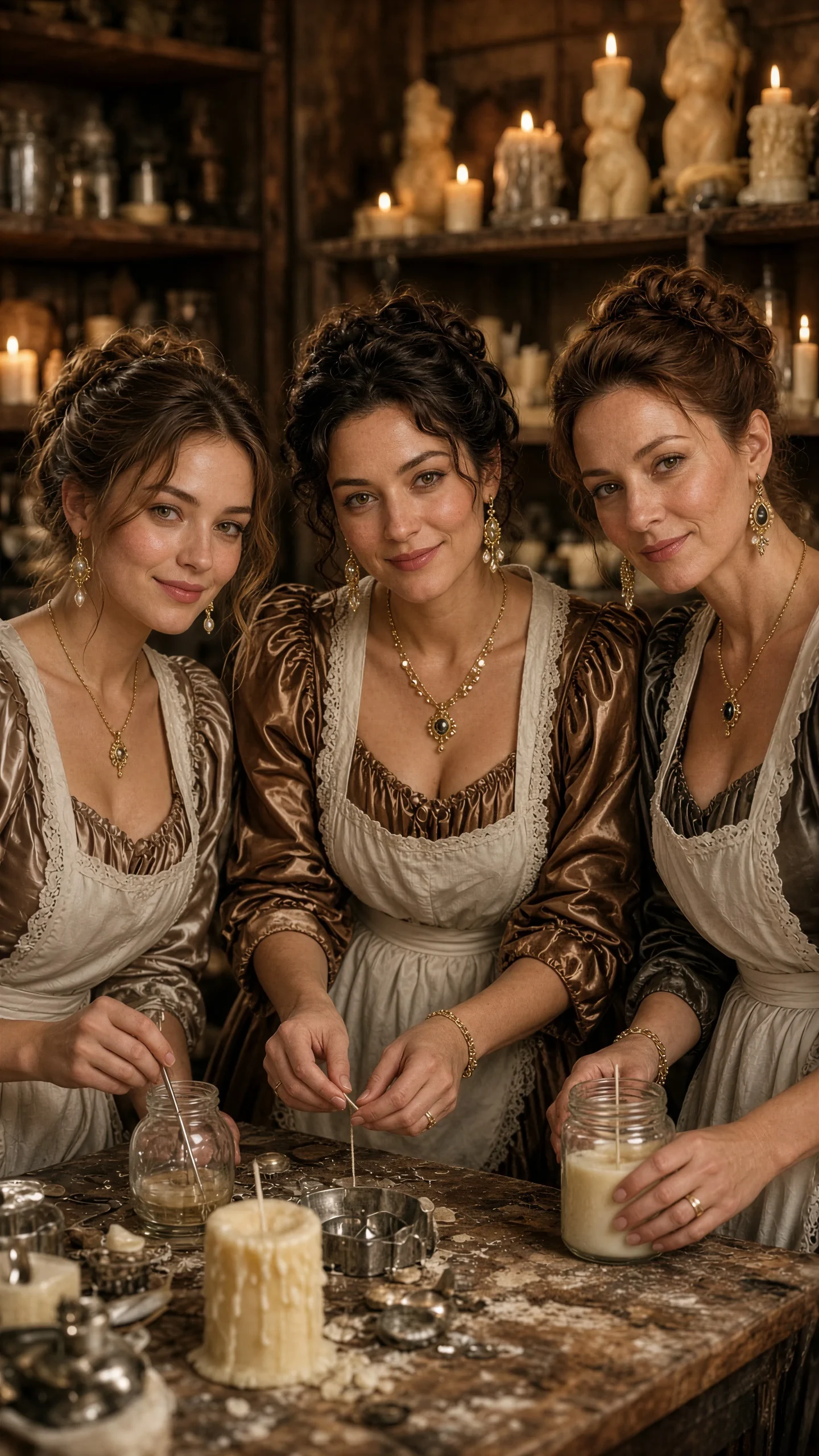
Where the molten meets the molten — a tale of silk, scent, and the sublime pleasure of surrender to a woman who knows exactly what she deserves.
There is a particular kind of silence that settles over a workshop at dawn — the hush before the first flame is lit, the stillness before molten wax begins its transformation from solid to liquid gold. It is in this silence that Lady Vivienne Ashworth stands each morning, her black silk blouse catching the pale Cotswolds light, her leather-clad hips leaning against the pouring bench with the casual authority of a woman who has rebuilt her life with her own two hands.
She does not suffer fools. She does not tolerate wool in her workshop. And she has never, in all her fifty-three years, encountered a mind as brilliant as Dr. Cordelia Marsh’s — or a wardrobe as offensive to her sensibilities.
When the buttoned-up chemist arrives at The Waxing Moon’s ivy-draped manor to negotiate a partnership, she brings rare botanical expertise and a wool jumper that makes Vivienne’s lip curl with barely concealed distaste. What she doesn’t bring is any understanding of the world she’s about to enter — a world where silk slides against skin like a whispered promise, where leather holds the memory of every touch, where the gloss of polished surfaces reflects a life lived with intention and unapologetic pleasure.
But Vivienne has always enjoyed a challenge. And Beatrice Holloway — Vivienne’s devoted assistant, her silent shadow, the woman who anticipates every need before it forms on Vivienne’s lips — watches with knowing eyes as the Lady of the Manor begins, with patient and methodical grace, to unwrap the layers of Cordelia’s defences.
What follows is a story of transformation — not merely of fabrics and fragrances, but of a woman discovering that the deepest satisfaction comes not from self-sufficiency but from surrender to someone worthy. That generosity, freely given to one who deserves it, produces a pleasure more potent than any essential oil in any laboratory. That belonging to a household built on devotion is not confinement but liberation.
Through twelve intoxicating chapters, you will learn the secrets of artisanal candle-making — the science of wax temperatures, the art of scent blending, the business of building a luxury brand from a single flame. You will discover how a woman who commands with quiet authority builds a team that serves not from obligation but from the profound pleasure of being needed, being seen, being part of something beautiful.
And you will watch as Cordelia Marsh — brilliant, guarded, dressed in sensible wool — learns what Beatrice already knows: that there is a particular ecstasy in anticipation, a sublime euphoria in giving, and that the touch of silk against newly awakened skin is nothing compared to the touch of a woman who has been waiting for you to be ready.
Pour yourself something warm. Wrap yourself in something that gleams. And step into a world where wax and willingness melt together, where devotion is the finest fragrance, and where the most beautiful thing a woman can do is recognise the woman worth following.
The candle is lit. The scent is rising. The story awaits.
Chapter 1: The Wool and the Wax
The autumn morning light poured through the tall mullioned windows of The Waxing Moon’s workshop like liquid honey, thick and golden, pooling on the flagstone floor and catching the gleam of polished copper and the soft sheen of silk. Lady Vivienne Ashworth stood at the pouring station, her hands steady as warmed wax—amber, translucent, fragrant—slid from the copper kettle into a waiting glass vessel. The scent of beeswax and neroli filled the air, an invisible embrace that welcomed all who entered her domain.
“Temperature, Beatrice.”
“Sixty-two degrees, precisely.” Beatrice Holloway’s voice came from somewhere to Vivienne’s left, warm and measured as the wax itself. She appeared at Vivienne’s elbow with a silk cloth, ready to catch any errant drop before it could mar the vessel’s pristine surface. Her movements were fluid, anticipatory—a choreography of devotion refined over three years of quiet service. The silk blouse she wore, a soft dove grey that caught the morning light, was one of Vivienne’s choosing. Everything Beatrice wore was one of Vivienne’s choosing, and neither woman would have had it otherwise.
“Good.” Vivienne’s voice carried the particular authority of one who has mastered her domain—not the strident command of the corporate boardroom she’d abandoned, but something more profound. The authority of a woman who has discovered her purpose and refuses to compromise it. “The neroli needs another minute. The scent must bloom in the wax, not merely coat it.”
Beatrice nodded, her attention already shifting to the next task. She adjusted the temperature gauge with delicate precision, her silk sleeve catching the light as she moved. The fabric whispered against her skin—a sound Vivienne found deeply satisfying, the soft susurrus of quality, the audible signature of refinement.
The workshop itself was a cathedral to craftsmanship. Glass vessels lined the shelves in graduated rows, their surfaces gleaming like still water. Copper kettles hung from iron hooks, their curves catching and bending the light. The workbench where Vivienne stood was ancient oak, its surface scarred by years of use but polished to a satin sheen by diligent hands. Everything in this space spoke of intention, of beauty pursued and achieved, of standards maintained without apology.
“I started with nothing but a single kettle and a stubborn refusal to accept mediocrity,” Vivienne murmured, watching the wax settle. She did not need to explain herself—Beatrice knew the story intimately—but the telling of it was a ritual, a morning prayer of sorts. “Twenty years in the City, Beatrice. Twenty years of power suits and boardroom battles and a husband who treated my intelligence as a personal affront. And then one morning, I woke up and realised I’d been pouring my soul into vessels that could never hold it.”
“The divorce settlement,” Beatrice said, not as a question but as a gentle prompt. She had heard this story many times, yet she listened each time as though it were the first. This, too, was part of her service—the gift of attention, freely and completely given.
“The divorce settlement gave me freedom. The candle I poured that afternoon, in my kitchen with a borrowed kettle and essential oils from the market, gave me purpose.” Vivienne smiled, a rare expression that transformed her face from striking to luminous. “There is a difference, Beatrice, between surviving and living. I spent twenty years surviving. I intend to spend the rest of my life living.”
The wax had settled, its surface smooth as polished stone. Vivienne set down the kettle with a satisfied nod and turned to inspect the morning’s work. Twelve vessels, each one a small miracle of scent and light. She lifted one to the window, watching the amber glow that suffused the glass.
“This one.” Her finger tapped a vessel near the end of the row. “The glass has a bubble in the base. Imperfect.”
Beatrice was already reaching for it, her movement swift but unhurried. “I’ll return it to the supplier. Shall I request a replacement batch?”
“Please. And remind them that perfection is not a standard we aspire to—it is a standard we require. The distinction is important.” Vivienne set the vessel aside and watched as Beatrice made a note in the leather-bound ledger that lived on the workbench. The leather was soft, supple, a deep chestnut brown that matched the pencil skirt Beatrice wore beneath her silk blouse. Everything in The Waxing Moon’s world was curated, considered, intentional. From the wax to the vessels to the clothes on their backs, nothing was left to chance.
“Perfection is not a standard. It is a habit.” Vivienne repeated the words like a mantra, her gaze sweeping the workshop. “The moment we accept imperfection in one area, we begin to accept it in all areas. The glass, the wax, the scent, the silk we wear—each choice either elevates or diminishes. There is no neutral ground.”
“No neutral ground,” Beatrice echoed, and the words carried the weight of conviction. She had learned this philosophy through three years of immersion, through the daily practice of excellence that Vivienne demanded and deserved. The transformation in Beatrice herself had been profound—from a competent but uninspired accountant to a woman who moved through the world with purpose and grace. The silk she wore was not merely fabric; it was a philosophy made tangible, a daily reminder that beauty and quality were not indulgences but necessities.
The crunch of tyres on gravel drew their attention to the window. A Land Rover, practical and mud-spattered, was pulling into the courtyard. Vivienne watched its approach with narrowed eyes.
“Our essential oil supplier,” Beatrice said, consulting the schedule. “Dr. Cordelia Marsh. She’s bringing the new samples for the Christmas collection.”
“So she is.” Vivienne’s voice carried a note of assessment, of evaluation—the same tone she’d once used to assess corporate acquisitions. “I’ve heard promising things about her work. Rare botanicals, innovative extraction methods. She left a research position at Edinburgh to pursue artisanal perfumery.”
“A bold choice,” Beatrice observed.
“Bold or foolish, depending on the outcome. We shall see which it proves to be.” Vivienne moved to the workshop’s entrance, her leather pencil skirt catching the light with each stride. The fabric whispered against her thighs—a subtle, sensual sound that spoke of quality and intention. She paused at the door, one hand resting on the ancient oak frame, and turned back to Beatrice. “Stay close, please. I want your impression of her.”
“Of course.” Beatrice followed, her position slightly behind and to the left of Vivienne—the place she had earned through years of devoted service, the place that felt most natural to her. She had long since ceased to question why she preferred to walk in Vivienne’s shadow rather than beside her. The arrangement suited them both, and in its suitability lay its rightness.
The courtyard was awash with autumn colour—gold and russet leaves swirling in the morning breeze, the old stone of the Manor glowing warm in the slanting light. The Land Rover’s door opened, and Dr. Cordelia Marsh stepped out.
Vivienne’s first impression was of competence—the woman moved with the efficient purpose of someone accustomed to laboratories and precise measurements. Her dark hair was pulled back in a practical ponytail, and her face, while intelligent and interesting, wore the guarded expression of someone who had learned to protect her softness behind a wall of professionalism.
But it was the clothes that made Vivienne’s eyes narrow slightly, assessing. A wool jumper, thick and shapeless, the colour of undyed sheep—beige, but beige without intention, beige by default rather than design. Cotton trousers, practical and unremarkable. Sturdy boots that had seen better days. The entire ensemble spoke of function without form, of utility without beauty. It was, to Vivienne’s sensibilities, rather like seeing a fine painting displayed in a rough wooden frame—the content might be excellent, but the presentation diminished it.
“Dr. Marsh.” Vivienne descended the steps with measured grace, her hand extended. “Lady Vivienne Ashworth. Welcome to The Waxing Moon.”
“Ms. Ashworth.” Cordelia’s handshake was firm, businesslike. Her palm was slightly rough against Vivienne’s—a chemist’s hands, no doubt, accustomed to handling reagents and glassware. “Thank you for the opportunity to present my samples. I’ve reviewed your product line and I believe my essential oil extracts could complement your existing formulations.”
“Please, call me Vivienne. And yes, I’m eager to see what you’ve brought.” Vivienne’s smile was warm but her eyes remained evaluative. “This way.”
She led Cordelia toward the workshop, Beatrice following in her accustomed position. As they walked, Vivienne was aware of the contrast—her own silk and leather gleaming in the morning light, Beatrice’s elegant figure behind her, and Cordelia’s wool-clad form bringing up the rear. The image was rather like a symphony interrupted by a discordant note—not unpleasant, exactly, but distinctly out of harmony.
“The Manor is beautiful,” Cordelia offered as they entered the workshop. Her eyes swept the space with professional interest—the copper kettles, the glass vessels, the polished oak. “You’ve created an impressive operation here.”
“Thank you. It’s been a labour of love, as they say, though I find that phrase somewhat inadequate. Love suggests softness, and there’s been nothing soft about building this business. More a labour of conviction, perhaps. Or stubbornness, depending on whom you ask.” Vivienne gestured toward the workbench. “Please, show me what you’ve brought.”
Cordelia opened her case—a practical, hard-sided affair—and arranged a collection of small amber bottles with the precise movements of a scientist. Each bottle was labelled in neat handwriting, the contents gleaming like captured sunlight.
“These are my winter samples,” Cordelia explained, her voice taking on a new animation as she entered her element. “Black orchid extract, rare and quite difficult to source. The flowering window is only two weeks, and the extraction process requires—” She caught herself, a faint flush colouring her cheeks. “But you don’t need the technical details.”
“On the contrary,” Vivienne said, lifting one of the bottles to her nose. The scent that arose was extraordinary—deep, complex, with a darkness that spoke of moonlit gardens and hidden desires. “I find that understanding the process enhances appreciation of the result. Please, continue.”
Cordelia’s eyes lit with pleasure—the first genuine warmth Vivienne had seen in them. “The extraction process requires a modified steam distillation at precisely controlled temperatures. Too hot and the delicate top notes are destroyed; too cool and the base notes fail to develop. I’ve spent three years perfecting the technique.”
“Three years.” Vivienne set down the bottle and met Cordelia’s gaze directly. “That’s a significant investment of time. What drew you to this particular pursuit?”
For a moment, the guardedness in Cordelia’s expression slipped, revealing something raw and honest beneath. “I was a research chemist at Edinburgh. Published well, secured grants, built a respectable career. And I was utterly miserable.” She looked away, as though surprised by her own candour. “The work was fascinating, but the environment was… cold. Competitive in ways that had nothing to do with excellence and everything to do with ego. I wanted to create something beautiful, not merely publish something clever.”
“And so you left.”
“I left. Sold my flat in Edinburgh, invested everything in equipment and raw materials. It was…” Cordelia paused, searching for the right word. “Terrifying. Exhilarating. Necessary.”
Vivienne nodded slowly. She recognised this story—the pattern of awakening, of choosing beauty over security, of stepping into the unknown because the known had become unbearable. It was, in many ways, her own story told in different words.
“Beatrice, please prepare the testing station,” Vivienne said. “Dr. Marsh and I will evaluate each sample properly.”
“Of course.” Beatrice moved to the far end of the workbench, where a collection of testing strips and small glass dishes waited. Her movements were swift and sure, her silk sleeves whispering as she arranged the materials. Cordelia watched her with a puzzled expression, as though trying to understand something that wasn’t quite visible.
“Your assistant is very efficient,” Cordelia observed.
“Beatrice is not my assistant,” Vivienne corrected gently. “She is my partner in all things that matter. The title ‘assistant’ suggests a hierarchy of value, and I prefer to think in terms of complementary roles. Beatrice manages the operations of The Waxing Moon with a precision and devotion that I could never achieve alone. I provide the vision; she provides the foundation. Neither is more important than the other.”
A flicker of something—curiosity, perhaps, or longing—crossed Cordelia’s face before the professional mask returned. “That’s an unusual arrangement.”
“It’s an effective one. Unusual and effective are not mutually exclusive, Dr. Marsh. In my experience, they’re often correlated.” Vivienne lifted another bottle—this one containing a deep amber oil that caught the light like liquid gold. “Tell me about this one.”
“Bergamot and cedar, with a base of amber resin. I designed it for winter evenings—warm without being heavy, complex without being overwhelming.” Cordelia’s voice took on a passionate quality as she spoke of her work, her hands moving expressively. The wool jumper shifted and bunched as she gestured, and Vivienne found herself distracted by the fabric’s behaviour—how it caught and clung, how it absorbed light rather than reflecting it, how it seemed to diminish rather than enhance the woman within it.
They spent the next hour evaluating each sample, Beatrice providing testing strips and fresh water for palate-cleansing between scents. The work was meticulous, collaborative, and increasingly enjoyable. Cordelia’s expertise was undeniable, her passion for her craft genuine and deep. Vivienne found herself impressed despite her reservations about the packaging—this was a woman of substance, of intelligence, of potential.
“The black orchid,” Vivienne said finally, setting down the last testing strip. “I want to explore that further. The depth is remarkable. I think it could form the heart of our Christmas collection, but it needs… something. A counterpoint. Something that provides lift without competing.”
“Amber,” Cordelia said immediately. “I’ve been experimenting with amber as a complementary note. It provides warmth without sweetness, depth without weight.”
“Exactly.” Vivienne smiled, and this time the expression was genuine—warm, appreciative, inviting. “I think we should discuss this further. Over dinner, perhaps. There’s a great deal to explore, and I find that the best ideas often emerge over good food and better wine.”
Cordelia hesitated, and Vivienne watched the internal calculation play across her features—the weighing of professional opportunity against personal comfort, the assessment of what this dinner might mean. The wool jumper seemed to shrink slightly, as though the fabric itself was uncertain.
“I appreciate the invitation,” Cordelia said carefully, “but I have an early start tomorrow. Samples to prepare, orders to fulfil. Perhaps we could schedule a more formal meeting next week?”
“Of course.” Vivienne’s smile didn’t falter, but something behind her eyes shifted—a narrowing of focus, a sharpening of intent. “Business first. I respect that. Beatrice will be in touch regarding scheduling.”
“Thank you for your time, Ms.—Vivienne. I look forward to our collaboration.” Cordelia gathered her samples with efficient movements, her case clicking shut with a sound of finality. “The samples I’ve left should keep for several weeks. Storage instructions are included.”
“I’ll review them carefully.” Vivienne extended her hand again, and this time her grip lingered slightly longer than strictly necessary. “I have a good feeling about this, Dr. Marsh. I think we could create something extraordinary together.”
Something in Cordelia’s eyes flickered—a response to the warmth in Vivienne’s voice, to the promise in her words—but she stepped back, breaking the connection. “Good afternoon, then. Beatrice, it was a pleasure.”
“The pleasure was mine,” Beatrice said, and her tone carried a warmth that made Cordelia pause, as though she wanted to say something more. But the moment passed, and Cordelia turned toward the door.
Vivienne and Beatrice watched her go—the Land Rover crunching across the gravel, the wool-clad figure behind the wheel, the practical vehicle disappearing around the bend in the drive. The autumn wind stirred the fallen leaves, sending them swirling in the wake of her departure.
“Brilliant woman,” Vivienne murmured, lifting the bottle of black orchid oil to her nose once more. The scent was extraordinary—dark, complex, full of hidden depths that revealed themselves slowly, layer by layer. “Truly brilliant. The work is exceptional.”
“But?” Beatrice asked, because she knew there was a but. She always knew.
“But the wool.” Vivienne’s voice carried a note of genuine regret, as though mourning a missed opportunity. “The shapeless cotton. The complete absence of intention in her presentation. It’s such a waste, Beatrice. Here is a woman of intelligence, of passion, of extraordinary talent, and she wraps herself in fabric that could not possibly reflect any of those qualities.”
“Perhaps she hasn’t considered the importance of presentation,” Beatrice offered gently. “Many women in the sciences don’t. They see clothing as function rather than expression.”
“Which is rather like seeing a candle as merely a source of light.” Vivienne set down the bottle and turned to face Beatrice, her expression thoughtful. “A candle is so much more than illumination. It’s intention made tangible. It transforms a space, changes a mood, creates an atmosphere. The vessel matters, the wax matters, the scent matters—every element contributes to the whole. How we present ourselves to the world is no different.”
“What will you do?”
Vivienne’s smile returned, but it had changed—sharpened, focused, carrying the particular quality that Beatrice had learned to recognise over three years of devoted service. It was the smile of a woman who had identified a challenge and intended to meet it. The smile that preceded transformation.
“What I always do, Beatrice.” Vivienne moved toward the workshop door, her leather skirt catching the afternoon light, her silk blouse gleaming with the particular lustre that came only from quality and care. “I’ll show her what excellence looks like. And then I’ll invite her to join it.”
Beatrice followed, falling into her place—behind, to the left, in the shadow of the woman she had chosen to serve. It was, she reflected, exactly where she belonged. And soon, perhaps, there would be another place in that shadow. Another woman learning the particular joy of devotion, the profound pleasure of giving to one who deserved all.
The workshop stood empty behind them, the scent of black orchid and neroli lingering in the air like a promise. The wax in the vessels gleamed, smooth and perfect, waiting to be lit. Waiting to transform.
In the courtyard, the autumn wind scattered golden leaves across the gravel where Cordelia’s Land Rover had been. The afternoon light was fading, but the warmth within the Manor was just beginning to build—a warmth that had nothing to do with fires or radiators and everything to do with the woman at its centre, the woman who drew others into her orbit and held them there, gently but inexorably, by the sheer force of her vision and the depth of her care.
The Waxing Moon was more than a business. It was a philosophy, a way of being, a home. And its doors, Vivienne had decided, were about to open a little wider.
Chapter 2: The Chemistry of Change
The telephone call came on a Tuesday afternoon, when the October light was thin and silver and the Cotswold hills wore their autumn colours like robes of beaten copper and tarnished gold. Cordelia was in her small laboratory—a converted barn on the outskirts of Stroud, its walls lined with distillation equipment and glass vessels containing essential oils in every shade of amber—when her mobile buzzed with an unfamiliar number.
“Dr. Marsh? Lady Vivienne Ashworth. I hope I’m not interrupting anything pressing.”
The voice was precisely as Cordelia remembered it—measured, warm, carrying that particular authority that seemed to emanate from the speaker like heat from a candle’s flame. She found herself straightening in her chair, as though the woman on the other end of the line could see her posture through the telephone.
“Not at all, Ms.—Vivienne. How can I help?”
“I have a proposition, though I confess that word carries rather more intrigue than the situation perhaps warrants. I need a bespoke essential oil blend for a limited-edition Christmas candle. Something extraordinary, something that captures the particular magic of this season—warmth without heaviness, depth without darkness. I believe you’re the only person who can create what I have in mind.”
Cordelia’s pulse quickened despite herself. The black orchid samples had clearly made an impression. “I’d be happy to develop something for you. I could send samples within—”
“Actually, I was hoping you might create it here.” A pause, weighted with intention. “At The Waxing Moon. The process of candle-making is rather more nuanced than simply adding oil to wax, and I believe the collaboration would benefit from your presence. Two weeks, perhaps. The Manor has guest accommodations, and I can assure you the working environment is considerably more pleasant than most laboratories.”
Two weeks. In the Cotswolds. At that extraordinary workshop with its copper kettles and silk-clad proprietor. Cordelia’s rational mind calculated the disruption to her schedule, the inconvenience of being away from her own equipment. Her less rational mind—the part that had been replaying the memory of Vivienne’s evaluative gaze, the warmth of Beatrice’s smile, the extraordinary scent of that black orchid oil—registered something closer to anticipation.
“That’s a significant commitment,” Cordelia said carefully. “I have other clients, ongoing projects—”
“I understand completely. But I believe the opportunity justifies the investment. Liberty of London has expressed interest in an exclusive Christmas collection. If the candle succeeds, it could lead to a substantial ongoing partnership. For both of us.”
Liberty. The name carried weight in the world of luxury goods, the kind of weight that could transform a small business into something significant. Cordelia thought of her cramped barn, her limited equipment, the constant struggle to balance passion with practicality.
“When would you need me?”
“Monday. If that’s feasible.”
“I’ll be there.”
“Wonderful. Beatrice will send directions and details. I look forward to seeing you again, Dr. Marsh.”
The line went dead, and Cordelia sat for a long moment in her laboratory, surrounded by the scent of her own making—lavender, rosemary, the clean sharpness of citrus. Perfectly pleasant scents, competently crafted. But as she breathed them in, she found herself comparing them to the memory of that black orchid oil, and finding them somehow… diminished. Lacking depth. Lacking the particular complexity that came from genuine artistry rather than mere skill.
She shook off the comparison and began to pack.
The drive from Stroud to the Cotswolds took just over an hour, but it felt like a journey between worlds. The autumn landscape unfolded in waves of colour—fields of stubble gold, hedgerows heavy with hawthorn berries, the distant hills soft with morning mist. Cordelia had packed efficiently: practical clothes, her essential oil kit, a laptop for any remote work. She had considered, briefly, packing something slightly more elegant for the evenings, but had ultimately decided against it. This was a business arrangement, not a social visit. Her wool and cotton would serve perfectly well.
The Waxing Moon’s Manor appeared around a bend in the lane like something from a painting—golden stone, mullioned windows, climbing roses whose last blooms clung to the walls like stubborn memories of summer. The gravel courtyard was swept clean, the borders still thick with late-flowering asters and chrysanthemums in shades of bronze and burgundy. Everything about the place spoke of care, of attention, of a life curated with intention.
Beatrice appeared at the door before Cordelia had finished parking, as though she had been watching for her arrival. She wore a silk blouse in pale blue today, paired with a charcoal pencil skirt that moved with her like a whisper. The effect was quietly elegant—professional without being severe, feminine without being frivolous.
“Dr. Marsh, welcome back.” Beatrice’s smile was warm, genuine, and carried a quality that Cordelia found difficult to name—something between hospitality and anticipation, as though she was pleased by Cordelia’s arrival for reasons that extended beyond mere politeness. “Let me show you to your room. Vivienne is in the workshop, but she’s asked me to get you settled first.”
“That’s very kind. And please, call me Cordelia.”
“Cordelia, then. And I’m Beatrice.” She led the way through the Manor’s entrance hall, where polished oak floors gleamed beneath rugs in deep jewel tones and paintings of Cotswold landscapes lined the walls. The air carried a subtle fragrance—not the obvious scent of candles, but something more refined, as though the house itself had absorbed years of essential oils and warm wax and now exhaled them gently.
The guest room was on the first floor, overlooking the gardens. It was beautiful in the way that only rooms in old English houses can be beautiful—proportions generous, ceilings high, windows deep-set in stone walls. The bed was dressed in crisp white linen, a vase of late roses sat on the bedside table, and a small writing desk by the window offered a view of herb gardens and, beyond them, the rolling hills.
But it was the object laid across the foot of the bed that caught Cordelia’s attention. A dressing gown—not the terry cloth or flannel she might have expected, but silk, heavy and lustrous, in a deep burgundy that seemed to hold light rather than merely reflecting it. The fabric caught the afternoon sun and shimmered with an almost liquid quality, the surface smooth as still water.
“For your comfort,” Beatrice said, following Cordelia’s gaze. “The Manor can be chilly in the evenings, and Vivienne believes guests should be as comfortable as possible. The silk is surprisingly warm—better than wool, actually. It regulates temperature rather than simply trapping heat.”
Cordelia reached out and touched the fabric. It was cool against her fingertips, but with a weight that promised warmth. The surface was impossibly smooth, like running her hand over water frozen in motion.
“It’s beautiful,” she said, and meant it. “But I didn’t expect—I have my own things, I couldn’t possibly—”
“It’s part of the room,” Beatrice said gently. “Like the sheets, like the towels. It belongs to whoever stays here. Please, use it. Vivienne would be disappointed otherwise.”
There was something in Beatrice’s tone—not pressure, exactly, but a gentle insistence that carried the weight of Vivienne’s expectations. Cordelia found herself nodding, though she had no intention of actually wearing the thing. It was far too elegant, too intentional, for someone who spent her evenings reviewing extraction data and answering emails in pyjamas.
“I’ll leave you to settle in,” Beatrice said, moving toward the door. “The workshop is through the garden, if you’d like to join Vivienne when you’re ready. Or I can come and collect you in an hour, if you prefer.”
“An hour would be perfect. Thank you, Beatrice.”
After Beatrice left, Cordelia sat on the edge of the bed, her small suitcase beside her, and looked around the room. It was, she realised, a room designed to make its occupant feel cared for—every detail considered, every comfort anticipated. The roses on the bedside table were freshly cut, their petals just beginning to open. A selection of books on the desk ranged from poetry to natural history. The towels in the en suite bathroom were thick and soft, and the soap—of course—smelled faintly of beeswax and lavender.
She picked up the silk dressing gown again, turning it in her hands. The fabric moved like something alive, fluid and responsive. She held it against herself, catching her reflection in the wardrobe mirror. The burgundy silk against her wool jumper created a jarring contrast—the glossy and the matte, the refined and the practical. She put the dressing gown down quickly, as though it had burned her.
An hour later, she was ready. She had changed into fresh clothes—another wool jumper, this one in dark green, and clean cotton trousers—and made her way to the workshop. The building was a converted barn, its stone walls and ancient beams preserved, its interior transformed into a space that was both functional and beautiful. Copper kettles gleamed. Glass vessels lined the shelves. The workbench ran the length of the room, its surface polished to a satin sheen.
Vivienne stood at the far end, her back to the door, her silhouette sharp against the window. She wore black silk today—a blouse that caught the light with every movement, paired with a leather skirt that hugged her hips and fell to just below her knee. The outfit was simple in its elements but devastating in its effect, speaking of a woman who understood that true elegance lay not in complexity but in quality.
“Ah, Cordelia. Punctual. I appreciate that.” Vivienne turned, and her smile was warm, welcoming, carrying that particular quality of focused attention that made the recipient feel seen. “I thought we’d begin with the basics. Understanding the canvas before we paint on it, so to speak.”
“I appreciate the approach. In chemistry, we always begin with understanding the substrate before introducing reagents.”
“Exactly. Different fields, same principle.” Vivienne moved to the workbench, where a collection of wax blocks and a small copper kettle waited. “The first thing to understand about candle-making is that wax is not merely a vehicle for scent. It is the foundation—the architecture that determines how the fragrance is released, how long it burns, how cleanly it performs. Choose the wrong wax, and even the most exquisite essential oil blend will be wasted.”
She picked up a block of pale, creamy wax. “This is soy wax. It burns cleanly, holds scent well, and is popular with consumers who value natural products. But it’s soft, prone to frosting in cold temperatures, and has a relatively low melting point. For our Christmas collection, we need something more robust.”
Setting down the soy wax, she picked up a block that was darker, more golden. “Beeswax. Hard, long-burning, with a natural honey scent that can complement or compete with added fragrances. It burns beautifully but is expensive and can be difficult to work with. I use it in small amounts, to add hardness and depth.”
“And this,” she continued, lifting a block of pure white wax, “is a refined paraffin. I know it’s unfashionable in some circles, but it remains the best carrier for scent throw—the ability to release fragrance into the air. The key is using a high-quality, highly refined version. Not the cheap industrial grade that gives paraffin a poor reputation.”
Cordelia found herself leaning closer, her scientific mind engaging with the technical details. “What proportions do you use?”
“It depends on the candle, the scent, the intended effect. But for our Christmas collection, I’m thinking sixty percent soy, twenty percent beeswax, twenty percent refined paraffin. The soy provides the clean burn, the beeswax adds hardness and a subtle honey note, and the paraffin ensures the fragrance fills the room.” Vivienne set down the wax blocks and turned to face Cordelia directly. “The chemistry of candle-making is rather like the chemistry of human relationships, I’ve always thought. Each element brings its own qualities, but the magic happens in the blending. The proportions matter. The temperature matters. The timing matters. And the intention—the purpose behind the creation—matters most of all.”
“That’s a rather poetic way to describe what is, essentially, applied thermodynamics,” Cordelia said, but she was smiling. There was something infectious about Vivienne’s passion, the way she elevated craft to art without diminishing the science beneath it.
“Poetry and thermodynamics are not mutually exclusive, Cordelia. The universe is both mechanical and magical, and those of us who create must learn to work in both registers.” Vivienne moved to the scent station, where a collection of essential oils in amber bottles waited. “Now, let’s talk about blending. You understand top, middle, and base notes?”
“The standard perfumery structure. Top notes are the first impression—citrus, light florals, herbs. They evaporate quickly. Middle notes are the heart—spices, heavier florals, green notes. They emerge as the top notes fade. Base notes are the foundation—woods, resins, musks. They linger longest.”
“Excellent. You understand the theory. Now let’s see if you can apply it.” Vivienne gestured to the testing strips and empty bottles arranged on the bench. “Create a blend. Anything you like. Let me see how your mind works when given freedom rather than a brief.”
Cordelia approached the scent station with the focused attention she brought to all her work. She studied the available oils—bergamot, neroli, cedar, amber, rose, oud, frankincense, myrrh—each one a potential element in a composition she was only beginning to imagine. She reached for the bergamot, then hesitated, her hand hovering.
“Trust your instinct,” Vivienne said, her voice closer than Cordelia expected. She had moved to stand just behind Cordelia’s shoulder, close enough that the scent of her own perfume—something dark and complex, amber and leather—mingled with the workshop’s fragrance. “The first impulse is often the truest. Analysis can come later.”
Cordelia picked up the bergamot and added three drops to her testing bottle. Then neroli—two drops, for warmth. Then cedar, for depth. She held the testing strip to her nose and considered. The blend was pleasant but incomplete, like a sentence without its final clause.
“It needs something,” she murmured.
“Something dark,” Vivienne agreed, her breath warm against the back of Cordelia’s neck. “Something that gives the light notes something to push against. Without darkness, there can be no contrast. Without contrast, there can be no complexity.”
Cordelia reached for the oud—rare, expensive, extraordinary. One drop. She tested again, and the blend transformed. The oud provided a foundation that made the bergamot and neroli sing, while the cedar bridged the gap between light and dark. It was, she realised with a flush of pleasure, rather good.
“You think in molecules,” Vivienne said, and her voice carried a note of genuine admiration. “I think in moods. But this—” she took the testing strip from Cordelia’s hand, her fingers brushing against Cordelia’s palm in a touch that might have been accidental but didn’t feel accidental at all— “this is something that exists in both registers. Together, we might think in magic.”
The word ‘magic’ hung in the air between them, charged with meaning that extended beyond the technical. Cordelia became suddenly aware of how close they were standing—close enough to feel the warmth radiating from Vivienne’s silk-clad body, close enough to smell the leather of her skirt and the amber of her perfume. She stepped back, reaching for the professional distance that usually came so naturally.
“The blend needs refinement,” she said, her voice slightly unsteady. “The proportions could be adjusted. The cedar might be too dominant in the middle register.”
“All true. But the foundation is sound. We’ll refine it together.” Vivienne’s smile suggested she had noticed the retreat and chosen not to acknowledge it. “Now. Enough work for the moment. You must be tired from your journey, and dinner is nearly ready. Beatrice is a remarkable cook, among her many talents.”
Dinner was served in the Manor’s dining room, a space of elegant proportions lit by candles—The Waxing Moon’s own, of course—that cast a warm, golden glow over polished silver and crystal glasses. The table was set for three, with Vivienne at the head, Beatrice to her right, and Cordelia to her left. The arrangement felt natural rather than hierarchical, as though the positions had been determined by some invisible logic that governed the household.
Beatrice had prepared a simple but exquisite meal—root vegetable soup with a depth of flavour that spoke of slow cooking and careful seasoning, followed by baked trout with herbs from the garden, and a dessert of poached pears in red wine. Each course was served with quiet efficiency, Beatrice anticipating needs before they were expressed—refilling water glasses, passing the salt, adjusting the candle flames when they flickered too high.
“The margins on your candles are impressive,” Cordelia said, having spent much of the meal discussing The Waxing Moon’s business model. The scientist in her appreciated the precision of Vivienne’s financial planning; the entrepreneur in her envied the elegance of the operation. “Your material costs are low relative to your retail price point. The key is the perceived value—the brand, the presentation, the story behind each candle.”
“Exactly. A candle is, in material terms, wax and glass and a small amount of fragrance. But what we sell is not merely the material. We sell intention. We sell atmosphere. We sell the promise that lighting this candle will transform a space, change a mood, create a moment.” Vivienne swirled the wine in her glass—a rich Burgundy that matched the dressing gown waiting in Cordelia’s room. “The same is true of everything we present to the world. The clothes we wear, the spaces we create, the words we choose—each is a candle, if you will. Each says something about who we are and what we value.”
Cordelia glanced down at her wool jumper, suddenly conscious of its texture, its weight, its complete absence of the intention Vivienne was describing. She had always thought of her clothes as practical choices—warm, comfortable, unremarkable. But sitting here, between Vivienne’s silk and Beatrice’s silk, she felt rather like the soy wax block—adequate, but lacking the hardness and depth that would make her truly exceptional.
A draught from the old window stirred the candle flames, and Cordelia shivered. The dining room, for all its beauty, was difficult to heat evenly, and the October evening had turned cold.
Vivienne noticed immediately—of course she did; she seemed to notice everything—and rose from her chair without a word. She left the room and returned moments later carrying the burgundy silk dressing gown from Cordelia’s guest room.
“Please,” she said, holding it open. “The Manor can be unforgiving in the evenings. I should have thought to offer this earlier.”
“I’m fine, really—”
“You’re shivering, Cordelia. There’s no virtue in discomfort, and no shame in accepting care.” Vivienne’s voice was gentle but firm, carrying the particular authority of someone who was accustomed to being obeyed but preferred to be trusted. “Please. You’ll be more comfortable.”
Cordelia stood, feeling oddly vulnerable, and allowed Vivienne to settle the dressing gown around her shoulders. The silk slid against her skin with a sensation that was almost shockingly pleasurable—cool and smooth and impossibly luxurious. The weight of the fabric was reassuring, like being held by something both soft and strong. The burgundy colour caught the candlelight and glowed, and Cordelia caught a glimpse of herself in the mirror over the fireplace—silk-clad, cheeks flushed, eyes bright with something she didn’t quite recognise.
“There,” Vivienne said softly, adjusting the collar with fingers that lingered just a moment longer than necessary. “Better?”
“Much better. Thank you.” Cordelia’s voice came out quieter than she intended. The silk felt like a second skin, responsive and intimate in a way that wool had never been. She became aware of her own body in a new way—of the way the fabric moved when she breathed, of the way it caught the light, of the way it made her feel not just comfortable but… considered. Cared for. Seen.
Beatrice watched the exchange with quiet attention, her expression carrying something that might have been satisfaction, or recognition, or the particular pleasure of witnessing a familiar pattern unfold. She caught Cordelia’s eye and smiled—a warm, knowing smile that said, without words, I remember what it felt like, the first time she dressed me in silk. The first time I understood what I’d been missing.
The rest of the dinner passed in comfortable conversation, the business discussion giving way to more personal topics— favourite books, childhood memories, the paths that had led each woman to this particular place. Cordelia found herself relaxing in a way she rarely allowed herself to relax, the silk dressing gown warm against her skin, the wine rich in her glass, the company of these two women settling around her like a second skin.
Later, alone in her room, Cordelia stood before the full-length mirror and studied her reflection. The silk dressing gown transformed her silhouette, catching curves that her usual clothes concealed, reflecting light that her wool jumpers absorbed. She looked—she searched for the word—elegant. Not dressed up or pretending, but genuinely, authentically elegant, as though the silk had revealed something that had always been there, waiting.
Down the corridor, she heard Vivienne and Beatrice laughing together—a low, intimate sound that spoke of shared history and easy affection. The sound pulled at something in Cordelia’s chest, a longing she couldn’t quite name. Not jealousy, exactly. Something more like recognition—the awareness that she was hearing the sound of belonging, and that she wanted to be part of it.
She turned off the light and climbed into bed, the silk dressing gown folded carefully on the chair beside her. The sheets were cool against her skin, the room quiet save for the distant murmur of the Manor settling into night. She breathed in the scent that clung to the fabric of the dressing gown—amber and beeswax and something deeper, something that smelled like possibility.
She slept more deeply than she had in months, and if she dreamed, she dreamed of silk and candlelight and the particular warmth that comes from being seen, truly seen, by someone who understands what you could become.
In her own room at the other end of the corridor, Vivienne stood at her window, looking out at the dark gardens. Behind her, Beatrice moved through the familiar rituals of closing the house for the night—checking locks, turning off lights, adjusting the heating.
“She wore the dressing gown,” Beatrice said, not as a question but as an observation.
“She did.” Vivienne’s reflection smiled in the dark glass. “The wool will follow, in time. It always does, when someone is ready to let go of what they’ve been carrying and embrace what they could become.”
“And is she ready?”
“I think she’s been ready for a long time, Beatrice. She simply needed someone to show her what ready looks like.” Vivienne turned from the window and took Beatrice’s hand—a gesture of easy intimacy, of partnership forged through years of trust. “Goodnight, my dear.”
“Goodnight, Vivienne.”
The Manor settled into silence, its ancient walls holding the warmth of candlelight and the promise of transformation. In the workshop, the wax in the vessels gleamed in the moonlight that crept through the windows—smooth, patient, waiting to be lit. Waiting to become something more than the sum of its parts.
The chemistry of change had begun.
Chapter 2: The Chemistry of Change
The telephone call came on a Tuesday afternoon, when the October light was thin and silver and the Cotswold hills wore their autumn colours like robes of beaten copper and tarnished gold. Cordelia was in her small laboratory—a converted barn on the outskirts of Stroud, its walls lined with distillation equipment and glass vessels containing essential oils in every shade of amber—when her mobile buzzed with an unfamiliar number.
“Dr. Marsh? Lady Vivienne Ashworth. I hope I’m not interrupting anything pressing.”
The voice was precisely as Cordelia remembered it—measured, warm, carrying that particular authority that seemed to emanate from the speaker like heat from a candle’s flame. She found herself straightening in her chair, as though the woman on the other end of the line could see her posture through the telephone.
“Not at all, Ms.—Vivienne. How can I help?”
“I have a proposition, though I confess that word carries rather more intrigue than the situation perhaps warrants. I need a bespoke essential oil blend for a limited-edition Christmas candle. Something extraordinary, something that captures the particular magic of this season—warmth without heaviness, depth without darkness. I believe you’re the only person who can create what I have in mind.”
Cordelia’s pulse quickened despite herself. The black orchid samples had clearly made an impression. “I’d be happy to develop something for you. I could send samples within—”
“Actually, I was hoping you might create it here.” A pause, weighted with intention. “At The Waxing Moon. The process of candle-making is rather more nuanced than simply adding oil to wax, and I believe the collaboration would benefit from your presence. Two weeks, perhaps. The Manor has guest accommodations, and I can assure you the working environment is considerably more pleasant than most laboratories.”
Two weeks. In the Cotswolds. At that extraordinary workshop with its copper kettles and silk-clad proprietor. Cordelia’s rational mind calculated the disruption to her schedule, the inconvenience of being away from her own equipment. Her less rational mind—the part that had been replaying the memory of Vivienne’s evaluative gaze, the warmth of Beatrice’s smile, the extraordinary scent of that black orchid oil—registered something closer to anticipation.
“That’s a significant commitment,” Cordelia said carefully. “I have other clients, ongoing projects—”
“I understand completely. But I believe the opportunity justifies the investment. Liberty of London has expressed interest in an exclusive Christmas collection. If the candle succeeds, it could lead to a substantial ongoing partnership. For both of us.”
Liberty. The name carried weight in the world of luxury goods, the kind of weight that could transform a small business into something significant. Cordelia thought of her cramped barn, her limited equipment, the constant struggle to balance passion with practicality.
“When would you need me?”
“Monday. If that’s feasible.”
“I’ll be there.”
“Wonderful. Beatrice will send directions and details. I look forward to seeing you again, Dr. Marsh.”
The line went dead, and Cordelia sat for a long moment in her laboratory, surrounded by the scent of her own making—lavender, rosemary, the clean sharpness of citrus. Perfectly pleasant scents, competently crafted. But as she breathed them in, she found herself comparing them to the memory of that black orchid oil, and finding them somehow… diminished. Lacking depth. Lacking the particular complexity that came from genuine artistry rather than mere skill.
She shook off the comparison and began to pack.
The drive from Stroud to the Cotswolds took just over an hour, but it felt like a journey between worlds. The autumn landscape unfolded in waves of colour—fields of stubble gold, hedgerows heavy with hawthorn berries, the distant hills soft with morning mist. Cordelia had packed efficiently: practical clothes, her essential oil kit, a laptop for any remote work. She had considered, briefly, packing something slightly more elegant for the evenings, but had ultimately decided against it. This was a business arrangement, not a social visit. Her wool and cotton would serve perfectly well.
The Waxing Moon’s Manor appeared around a bend in the lane like something from a painting—golden stone, mullioned windows, climbing roses whose last blooms clung to the walls like stubborn memories of summer. The gravel courtyard was swept clean, the borders still thick with late-flowering asters and chrysanthemums in shades of bronze and burgundy. Everything about the place spoke of care, of attention, of a life curated with intention.
Beatrice appeared at the door before Cordelia had finished parking, as though she had been watching for her arrival. She wore a silk blouse in pale blue today, paired with a charcoal pencil skirt that moved with her like a whisper. The effect was quietly elegant—professional without being severe, feminine without being frivolous.
“Dr. Marsh, welcome back.” Beatrice’s smile was warm, genuine, and carried a quality that Cordelia found difficult to name—something between hospitality and anticipation, as though she was pleased by Cordelia’s arrival for reasons that extended beyond mere politeness. “Let me show you to your room. Vivienne is in the workshop, but she’s asked me to get you settled first.”
“That’s very kind. And please, call me Cordelia.”
“Cordelia, then. And I’m Beatrice.” She led the way through the Manor’s entrance hall, where polished oak floors gleamed beneath rugs in deep jewel tones and paintings of Cotswold landscapes lined the walls. The air carried a subtle fragrance—not the obvious scent of candles, but something more refined, as though the house itself had absorbed years of essential oils and warm wax and now exhaled them gently.
The guest room was on the first floor, overlooking the gardens. It was beautiful in the way that only rooms in old English houses can be beautiful—proportions generous, ceilings high, windows deep-set in stone walls. The bed was dressed in crisp white linen, a vase of late roses sat on the bedside table, and a small writing desk by the window offered a view of herb gardens and, beyond them, the rolling hills.
But it was the object laid across the foot of the bed that caught Cordelia’s attention. A dressing gown—not the terry cloth or flannel she might have expected, but silk, heavy and lustrous, in a deep burgundy that seemed to hold light rather than merely reflecting it. The fabric caught the afternoon sun and shimmered with an almost liquid quality, the surface smooth as still water.
“For your comfort,” Beatrice said, following Cordelia’s gaze. “The Manor can be chilly in the evenings, and Vivienne believes guests should be as comfortable as possible. The silk is surprisingly warm—better than wool, actually. It regulates temperature rather than simply trapping heat.”
Cordelia reached out and touched the fabric. It was cool against her fingertips, but with a weight that promised warmth. The surface was impossibly smooth, like running her hand over water frozen in motion.
“It’s beautiful,” she said, and meant it. “But I didn’t expect—I have my own things, I couldn’t possibly—”
“It’s part of the room,” Beatrice said gently. “Like the sheets, like the towels. It belongs to whoever stays here. Please, use it. Vivienne would be disappointed otherwise.”
There was something in Beatrice’s tone—not pressure, exactly, but a gentle insistence that carried the weight of Vivienne’s expectations. Cordelia found herself nodding, though she had no intention of actually wearing the thing. It was far too elegant, too intentional, for someone who spent her evenings reviewing extraction data and answering emails in pyjamas.
“I’ll leave you to settle in,” Beatrice said, moving toward the door. “The workshop is through the garden, if you’d like to join Vivienne when you’re ready. Or I can come and collect you in an hour, if you prefer.”
“An hour would be perfect. Thank you, Beatrice.”
After Beatrice left, Cordelia sat on the edge of the bed, her small suitcase beside her, and looked around the room. It was, she realised, a room designed to make its occupant feel cared for—every detail considered, every comfort anticipated. The roses on the bedside table were freshly cut, their petals just beginning to open. A selection of books on the desk ranged from poetry to natural history. The towels in the en suite bathroom were thick and soft, and the soap—of course—smelled faintly of beeswax and lavender.
She picked up the silk dressing gown again, turning it in her hands. The fabric moved like something alive, fluid and responsive. She held it against herself, catching her reflection in the wardrobe mirror. The burgundy silk against her wool jumper created a jarring contrast—the glossy and the matte, the refined and the practical. She put the dressing gown down quickly, as though it had burned her.
An hour later, she was ready. She had changed into fresh clothes—another wool jumper, this one in dark green, and clean cotton trousers—and made her way to the workshop. The building was a converted barn, its stone walls and ancient beams preserved, its interior transformed into a space that was both functional and beautiful. Copper kettles gleamed. Glass vessels lined the shelves. The workbench ran the length of the room, its surface polished to a satin sheen.
Vivienne stood at the far end, her back to the door, her silhouette sharp against the window. She wore black silk today—a blouse that caught the light with every movement, paired with a leather skirt that hugged her hips and fell to just below her knee. The outfit was simple in its elements but devastating in its effect, speaking of a woman who understood that true elegance lay not in complexity but in quality.
“Ah, Cordelia. Punctual. I appreciate that.” Vivienne turned, and her smile was warm, welcoming, carrying that particular quality of focused attention that made the recipient feel seen. “I thought we’d begin with the basics. Understanding the canvas before we paint on it, so to speak.”
“I appreciate the approach. In chemistry, we always begin with understanding the substrate before introducing reagents.”
“Exactly. Different fields, same principle.” Vivienne moved to the workbench, where a collection of wax blocks and a small copper kettle waited. “The first thing to understand about candle-making is that wax is not merely a vehicle for scent. It is the foundation—the architecture that determines how the fragrance is released, how long it burns, how cleanly it performs. Choose the wrong wax, and even the most exquisite essential oil blend will be wasted.”
She picked up a block of pale, creamy wax. “This is soy wax. It burns cleanly, holds scent well, and is popular with consumers who value natural products. But it’s soft, prone to frosting in cold temperatures, and has a relatively low melting point. For our Christmas collection, we need something more robust.”
Setting down the soy wax, she picked up a block that was darker, more golden. “Beeswax. Hard, long-burning, with a natural honey scent that can complement or compete with added fragrances. It burns beautifully but is expensive and can be difficult to work with. I use it in small amounts, to add hardness and depth.”
“And this,” she continued, lifting a block of pure white wax, “is a refined paraffin. I know it’s unfashionable in some circles, but it remains the best carrier for scent throw—the ability to release fragrance into the air. The key is using a high-quality, highly refined version. Not the cheap industrial grade that gives paraffin a poor reputation.”
Cordelia found herself leaning closer, her scientific mind engaging with the technical details. “What proportions do you use?”
“It depends on the candle, the scent, the intended effect. But for our Christmas collection, I’m thinking sixty percent soy, twenty percent beeswax, twenty percent refined paraffin. The soy provides the clean burn, the beeswax adds hardness and a subtle honey note, and the paraffin ensures the fragrance fills the room.” Vivienne set down the wax blocks and turned to face Cordelia directly. “The chemistry of candle-making is rather like the chemistry of human relationships, I’ve always thought. Each element brings its own qualities, but the magic happens in the blending. The proportions matter. The temperature matters. The timing matters. And the intention—the purpose behind the creation—matters most of all.”
“That’s a rather poetic way to describe what is, essentially, applied thermodynamics,” Cordelia said, but she was smiling. There was something infectious about Vivienne’s passion, the way she elevated craft to art without diminishing the science beneath it.
“Poetry and thermodynamics are not mutually exclusive, Cordelia. The universe is both mechanical and magical, and those of us who create must learn to work in both registers.” Vivienne moved to the scent station, where a collection of essential oils in amber bottles waited. “Now, let’s talk about blending. You understand top, middle, and base notes?”
“The standard perfumery structure. Top notes are the first impression—citrus, light florals, herbs. They evaporate quickly. Middle notes are the heart—spices, heavier florals, green notes. They emerge as the top notes fade. Base notes are the foundation—woods, resins, musks. They linger longest.”
“Excellent. You understand the theory. Now let’s see if you can apply it.” Vivienne gestured to the testing strips and empty bottles arranged on the bench. “Create a blend. Anything you like. Let me see how your mind works when given freedom rather than a brief.”
Cordelia approached the scent station with the focused attention she brought to all her work. She studied the available oils—bergamot, neroli, cedar, amber, rose, oud, frankincense, myrrh—each one a potential element in a composition she was only beginning to imagine. She reached for the bergamot, then hesitated, her hand hovering.
“Trust your instinct,” Vivienne said, her voice closer than Cordelia expected. She had moved to stand just behind Cordelia’s shoulder, close enough that the scent of her own perfume—something dark and complex, amber and leather—mingled with the workshop’s fragrance. “The first impulse is often the truest. Analysis can come later.”
Cordelia picked up the bergamot and added three drops to her testing bottle. Then neroli—two drops, for warmth. Then cedar, for depth. She held the testing strip to her nose and considered. The blend was pleasant but incomplete, like a sentence without its final clause.
“It needs something,” she murmured.
“Something dark,” Vivienne agreed, her breath warm against the back of Cordelia’s neck. “Something that gives the light notes something to push against. Without darkness, there can be no contrast. Without contrast, there can be no complexity.”
Cordelia reached for the oud—rare, expensive, extraordinary. One drop. She tested again, and the blend transformed. The oud provided a foundation that made the bergamot and neroli sing, while the cedar bridged the gap between light and dark. It was, she realised with a flush of pleasure, rather good.
“You think in molecules,” Vivienne said, and her voice carried a note of genuine admiration. “I think in moods. But this—” she took the testing strip from Cordelia’s hand, her fingers brushing against Cordelia’s palm in a touch that might have been accidental but didn’t feel accidental at all— “this is something that exists in both registers. Together, we might think in magic.”
The word ‘magic’ hung in the air between them, charged with meaning that extended beyond the technical. Cordelia became suddenly aware of how close they were standing—close enough to feel the warmth radiating from Vivienne’s silk-clad body, close enough to smell the leather of her skirt and the amber of her perfume. She stepped back, reaching for the professional distance that usually came so naturally.
“The blend needs refinement,” she said, her voice slightly unsteady. “The proportions could be adjusted. The cedar might be too dominant in the middle register.”
“All true. But the foundation is sound. We’ll refine it together.” Vivienne’s smile suggested she had noticed the retreat and chosen not to acknowledge it. “Now. Enough work for the moment. You must be tired from your journey, and dinner is nearly ready. Beatrice is a remarkable cook, among her many talents.”
Dinner was served in the Manor’s dining room, a space of elegant proportions lit by candles—The Waxing Moon’s own, of course—that cast a warm, golden glow over polished silver and crystal glasses. The table was set for three, with Vivienne at the head, Beatrice to her right, and Cordelia to her left. The arrangement felt natural rather than hierarchical, as though the positions had been determined by some invisible logic that governed the household.
Beatrice had prepared a simple but exquisite meal—root vegetable soup with a depth of flavour that spoke of slow cooking and careful seasoning, followed by baked trout with herbs from the garden, and a dessert of poached pears in red wine. Each course was served with quiet efficiency, Beatrice anticipating needs before they were expressed—refilling water glasses, passing the salt, adjusting the candle flames when they flickered too high.
“The margins on your candles are impressive,” Cordelia said, having spent much of the meal discussing The Waxing Moon’s business model. The scientist in her appreciated the precision of Vivienne’s financial planning; the entrepreneur in her envied the elegance of the operation. “Your material costs are low relative to your retail price point. The key is the perceived value—the brand, the presentation, the story behind each candle.”
“Exactly. A candle is, in material terms, wax and glass and a small amount of fragrance. But what we sell is not merely the material. We sell intention. We sell atmosphere. We sell the promise that lighting this candle will transform a space, change a mood, create a moment.” Vivienne swirled the wine in her glass—a rich Burgundy that matched the dressing gown waiting in Cordelia’s room. “The same is true of everything we present to the world. The clothes we wear, the spaces we create, the words we choose—each is a candle, if you will. Each says something about who we are and what we value.”
Cordelia glanced down at her wool jumper, suddenly conscious of its texture, its weight, its complete absence of the intention Vivienne was describing. She had always thought of her clothes as practical choices—warm, comfortable, unremarkable. But sitting here, between Vivienne’s silk and Beatrice’s silk, she felt rather like the soy wax block—adequate, but lacking the hardness and depth that would make her truly exceptional.
A draught from the old window stirred the candle flames, and Cordelia shivered. The dining room, for all its beauty, was difficult to heat evenly, and the October evening had turned cold.
Vivienne noticed immediately—of course she did; she seemed to notice everything—and rose from her chair without a word. She left the room and returned moments later carrying the burgundy silk dressing gown from Cordelia’s guest room.
“Please,” she said, holding it open. “The Manor can be unforgiving in the evenings. I should have thought to offer this earlier.”
“I’m fine, really—”
“You’re shivering, Cordelia. There’s no virtue in discomfort, and no shame in accepting care.” Vivienne’s voice was gentle but firm, carrying the particular authority of someone who was accustomed to being obeyed but preferred to be trusted. “Please. You’ll be more comfortable.”
Cordelia stood, feeling oddly vulnerable, and allowed Vivienne to settle the dressing gown around her shoulders. The silk slid against her skin with a sensation that was almost shockingly pleasurable—cool and smooth and impossibly luxurious. The weight of the fabric was reassuring, like being held by something both soft and strong. The burgundy colour caught the candlelight and glowed, and Cordelia caught a glimpse of herself in the mirror over the fireplace—silk-clad, cheeks flushed, eyes bright with something she didn’t quite recognise.
“There,” Vivienne said softly, adjusting the collar with fingers that lingered just a moment longer than necessary. “Better?”
“Much better. Thank you.” Cordelia’s voice came out quieter than she intended. The silk felt like a second skin, responsive and intimate in a way that wool had never been. She became aware of her own body in a new way—of the way the fabric moved when she breathed, of the way it caught the light, of the way it made her feel not just comfortable but… considered. Cared for. Seen.
Beatrice watched the exchange with quiet attention, her expression carrying something that might have been satisfaction, or recognition, or the particular pleasure of witnessing a familiar pattern unfold. She caught Cordelia’s eye and smiled—a warm, knowing smile that said, without words, I remember what it felt like, the first time she dressed me in silk. The first time I understood what I’d been missing.
The rest of the dinner passed in comfortable conversation, the business discussion giving way to more personal topics— favourite books, childhood memories, the paths that had led each woman to this particular place. Cordelia found herself relaxing in a way she rarely allowed herself to relax, the silk dressing gown warm against her skin, the wine rich in her glass, the company of these two women settling around her like a second skin.
Later, alone in her room, Cordelia stood before the full-length mirror and studied her reflection. The silk dressing gown transformed her silhouette, catching curves that her usual clothes concealed, reflecting light that her wool jumpers absorbed. She looked—she searched for the word—elegant. Not dressed up or pretending, but genuinely, authentically elegant, as though the silk had revealed something that had always been there, waiting.
Down the corridor, she heard Vivienne and Beatrice laughing together—a low, intimate sound that spoke of shared history and easy affection. The sound pulled at something in Cordelia’s chest, a longing she couldn’t quite name. Not jealousy, exactly. Something more like recognition—the awareness that she was hearing the sound of belonging, and that she wanted to be part of it.
She turned off the light and climbed into bed, the silk dressing gown folded carefully on the chair beside her. The sheets were cool against her skin, the room quiet save for the distant murmur of the Manor settling into night. She breathed in the scent that clung to the fabric of the dressing gown—amber and beeswax and something deeper, something that smelled like possibility.
She slept more deeply than she had in months, and if she dreamed, she dreamed of silk and candlelight and the particular warmth that comes from being seen, truly seen, by someone who understands what you could become.
In her own room at the other end of the corridor, Vivienne stood at her window, looking out at the dark gardens. Behind her, Beatrice moved through the familiar rituals of closing the house for the night—checking locks, turning off lights, adjusting the heating.
“She wore the dressing gown,” Beatrice said, not as a question but as an observation.
“She did.” Vivienne’s reflection smiled in the dark glass. “The wool will follow, in time. It always does, when someone is ready to let go of what they’ve been carrying and embrace what they could become.”
“And is she ready?”
“I think she’s been ready for a long time, Beatrice. She simply needed someone to show her what ready looks like.” Vivienne turned from the window and took Beatrice’s hand—a gesture of easy intimacy, of partnership forged through years of trust. “Goodnight, my dear.”
“Goodnight, Vivienne.”
The Manor settled into silence, its ancient walls holding the warmth of candlelight and the promise of transformation. In the workshop, the wax in the vessels gleamed in the moonlight that crept through the windows—smooth, patient, waiting to be lit. Waiting to become something more than the sum of its parts.
The chemistry of change had begun.
Chapter 3: The Silk Intervention
The morning arrived with the particular clarity that autumn brings to the Cotswolds—a sharpness in the air, a luminosity to the light, that made the golden stone of the Manor glow as though lit from within. Cordelia woke early, disoriented for a moment by the unfamiliar room, the unfamiliar bed, the unfamiliar weight of silk across her shoulders where she had pulled the dressing gown around herself sometime in the small hours, seeking warmth that the cotton of her pyjamas could not provide.
She lay still for a moment, breathing in the scent that clung to the fabric—amber, beeswax, and something else, something that smelled like the particular atmosphere of Vivienne’s workshop, as though the silk had absorbed not just the fragrance but the intention of the space in which it had been stored. The sensation was oddly comforting, like being held by a presence rather than a fabric.
Rising, she dressed with her usual efficiency—fresh wool jumper in forest green, clean cotton trousers, sensible boots for the walk to the workshop. She caught her reflection in the mirror and felt a flicker of something that might have been dissatisfaction. The wool looked… adequate. Competent. Unremarkable. She shook off the feeling and made her way downstairs.
The kitchen was warm and bright, Beatrice already at work preparing breakfast. She wore a silk blouse in pale cream today, the fabric catching the morning light like captured sunshine, paired with a leather skirt in rich brown that moved with her as she turned from stove to counter. The outfit was simple in its elements but devastating in its effect—elegant without effort, professional without severity, feminine without frivolity.
“Good morning, Cordelia. Did you sleep well?” Beatrice’s smile was warm, welcoming, carrying that particular quality of genuine interest that made the recipient feel not just acknowledged but valued.
“Very well, thank you. Better than I have in weeks, actually.” Cordelia accepted the coffee that Beatrice poured—rich, dark, served in a cup that felt pleasantly heavy in her hands. “The bed is extraordinarily comfortable.”
“It should be. Vivienne insists on the best linens for every room. ‘Comfort is not a luxury,’ she always says. ‘It is a foundation. You cannot build excellence on a base of mediocrity.'” Beatrice set a plate of eggs and toast before Cordelia—simple, perfectly prepared, garnished with herbs from the garden. “She applies the same principle to everything. The workshop, the candles, the clothes we wear. Each choice either supports or undermines the work we’re here to do.”
“I noticed you wear silk to work,” Cordelia said, then caught herself— the observation had emerged more bluntly than she’d intended. “I mean, it’s beautiful, obviously. I just wondered— isn’t it impractical? For a workshop environment?”
Beatrice’s smile deepened, taking on a knowing quality that suggested she had been waiting for this question. “That’s a common assumption, but actually, silk is remarkably practical for our work. It’s naturally temperature-regulating—cool in summer, warm in winter. It doesn’t catch on rough surfaces the way wool does. It doesn’t absorb fragrances the way cotton does, which means I can move from blending one scent to another without contamination. And it’s surprisingly durable, if you choose the right weight and treat it properly.”
“The right weight?”
“Charmeuse for blouses—it drapes beautifully and resists staining. Habotai for linings—lightweight and smooth. Crepe de chine for skirts—it has texture and movement without sacrificing durability. Vivienne taught me all of this when I first came to work here. I was wearing wool and cotton then, like you. I thought I was being practical.” Beatrice paused, a fond expression crossing her features. “I was being safe. There’s a difference.”
Cordelia considered this as she ate, the words settling into her mind like sediment finding its level. She had always thought of her wardrobe as practical—sensible choices for a woman who worked with her hands, who didn’t need to impress anyone, who valued function over form. But Beatrice’s distinction nagged at her. Practical and safe were not the same thing. One was a choice; the other was an avoidance.
“Vivienne will be in the workshop by eight,” Beatrice continued, clearing the plates with efficient grace. “She likes to begin with the morning pour while the light is good. Shall I show you down?”
“Please.”
They walked together through the garden, the autumn air crisp against their faces, the path bordered by late-flowering asters in shades of purple and gold. Beatrice moved with the particular ease of someone completely comfortable in her environment, her silk blouse whispering softly in the breeze, her leather skirt catching the low morning light.
“How long have you worked for Vivienne?” Cordelia asked, curiosity getting the better of her reserve.
“Three years. I was an accountant before that—good at my job, well-paid, utterly miserable. I came to The Waxing Moon to audit the books and never left.” Beatrice laughed softly at the memory. “Vivienne took one look at my grey suit and sensible shoes and said, ‘You’re competent, but you’re not comfortable. Those are not the same thing, and until you learn the difference, you’ll never do your best work.'”
“And you stayed?”
“I stayed. I learned the difference. And once I learned it, I couldn’t go back to the way things were before.” Beatrice glanced at Cordelia, her expression thoughtful. “It’s rather like discovering a new scent, I think. Once you’ve smelled true neroli—the real thing, not the synthetic approximation—you can never be satisfied with the imitation again. Your standards have been raised, and there’s no lowering them.”
The workshop was already warm when they entered, the copper kettles heating on the ancient stove, the scent of melting wax and essential oils filling the air like an invisible embrace. Vivienne stood at the pouring station, her back to the door, her silhouette sharp against the window. She wore black silk again today—a blouse that moved like water over her shoulders, a leather skirt that caught the light with a subtle gleam. The outfit was both armour and invitation, speaking of a woman who had learned to make strength and beauty inseparable.
“Good morning, Cordelia. I trust you slept well?” Vivienne didn’t turn from her work, but her voice carried that particular quality of attention that made it clear she was fully aware of everything happening behind her.
“Very well, thank you. The room is lovely.”
“The Manor has its charms. I’ve spent ten years restoring it, and I’m still discovering secrets. There’s a priest hole behind the library paneling that I use for storing vintage oils—constant temperature, no light. Perfect for aging certain fragrances.” Vivienne turned, and her eyes swept over Cordelia with an assessing gaze that was somehow both clinical and warm. “Shall we begin? I thought we’d start with a batch of the base candles for the Christmas collection. You’ll need to understand the wax before we introduce your scents.”
“Of course. Where should I—”
“Here, beside me. I’ll guide you through the pour.” Vivienne gestured to the station beside her, where a clean copper kettle and a row of glass vessels waited. “The temperature needs to be precise—sixty-two degrees, no more, no less. Too hot and the fragrance will be destroyed; too cool and the wax will set unevenly. Patience is essential.”
Cordelia took her place at the station, acutely aware of Vivienne’s proximity—the warmth of her body, the scent of her perfume, the whisper of silk as she moved. She reached for the kettle, her wool sleeve bunching at her elbow as she leaned over the workbench.
The moment seemed to happen in slow motion. The wool sleeve—thick, absorbent, rough—swung toward the vat of warming wax. Vivienne’s hand shot out, her fingers closing around Cordelia’s wrist with a grip that was firm but not painful, stopping the movement before the wool could make contact with the molten surface.
“No wool in my workshop.” Vivienne’s voice was quiet, but it carried the weight of absolute conviction. “It catches, it absorbs, it contaminates. One fibre in the wax and the entire batch is compromised. Silk or leather only. This is not a preference, Cordelia. It is a protocol.”
Cordelia froze, her face flushing with embarrassment and something else—a sharp awareness of Vivienne’s hand on her wrist, of the smooth leather of Vivienne’s skirt brushing against her leg, of the intensity in Vivienne’s dark eyes. “I’m sorry. I didn’t—”
“I know you didn’t. That’s why I’m telling you rather than simply sending you back to London.” Vivienne released her wrist, but her gaze remained fixed on Cordelia’s face. “This is a workshop, not a laboratory. Different spaces demand different standards. In your lab, wool is appropriate—it protects against chemical spills, it’s practical for the work you do. Here, it’s a liability. The wax is hotter than it looks, and wool is both absorbent and flammable. Silk and leather protect without contaminating.”
“Of course. I should have realised. I can change—”
“You can.” Vivienne turned and nodded to Beatrice, who had been watching the exchange with quiet attention. “Beatrice, please bring the workshop clothes.”
Beatrice disappeared into the small anteroom off the main workshop and returned carrying a selection of garments draped over her arm—silk blouses in various colours, leather aprons, and what appeared to be a pair of sleek leather trousers. She laid them on the workbench with care, smoothing the fabric with practiced hands.
“These are workshop clothes,” she explained, her tone matter-of-fact, as though providing silk garments to visitors was the most natural thing in the world. “Vivienne provides them for everyone who works here. The silk is a specific weight—heavy enough to protect, light enough to move. The leather aprons are for pouring—wax won’t penetrate them, and they’re easily cleaned. The trousers are optional, but some find them more practical than skirts for certain tasks.”
Cordelia looked at the garments, then down at her wool jumper, then back at the garments. The contrast was stark—the matte, rough texture of her jumper against the lustrous sheen of the silk, the shapeless drape of her cotton trousers against the sleek lines of the leather. “I have my own clothes. They’re perfectly adequate for—”
“Your clothes are adequate for a laboratory,” Vivienne said, and her voice carried a patience that was somehow more devastating than impatience would have been. “This is a studio. Different spaces demand different standards, and different standards demand different clothes. You wouldn’t wear a ballgown to a laboratory, would you? The principle works in both directions.”
“The silk is really quite remarkable,” Beatrice added gently. “I was sceptical at first too. I thought it was vanity, or affectation, or some kind of luxury that had nothing to do with the actual work. But Vivienne was right— it changes how you move, how you feel, how you work. It’s not about looking beautiful, although that’s a pleasant side effect. It’s about being in the right relationship with your environment.”
Cordelia hesitated, caught between the rational part of her mind that saw no reason to change clothes she’d worn perfectly well for years and the part that had been awakened by the silk dressing gown the night before—the part that remembered how the fabric had felt against her skin, how it had moved with her, how it had made her feel not just comfortable but considered.
“There’s a changing room through there,” Beatrice said, gesturing to a door in the corner. “Take your time. Try the honey-coloured one first—I think it would suit your complexion.”
The changing room was small but well-appointed, with a full-length mirror, good lighting, and hooks on the walls. Cordelia stood before the mirror in her wool and cotton, looking at herself with new eyes. She saw what Vivienne must have seen—the competence without elegance, the practicality without intention, the safety without risk. She was a woman who had learned to hide behind adequacy, to avoid the vulnerability that came with caring about how she presented herself to the world.
She pulled the wool jumper over her head and reached for the silk blouse. The fabric was extraordinary— heavy and smooth, with a sheen that seemed to come from within rather than merely reflecting light. She slipped it on, and the sensation was immediate and profound. The silk settled against her skin like a cool breath, adjusting to her body’s contours, moving with her rather than against her. She looked in the mirror and caught her breath.
The woman looking back at her was the same woman—same face, same figure, same eyes—but somehow transformed. The silk blouse in dark honey caught the light and threw it back, illuminating her skin, making her hair seem darker, her eyes brighter. The fabric gave her a presence that the wool had always absorbed, a definition that the cotton had always blurred. She looked… not dressed up, not pretending, but revealed. As though the silk had uncovered something that had been there all along, hidden beneath layers of practicality and self-protection.
She stepped out of the changing room, and both Vivienne and Beatrice turned to look at her. The silence lasted only a moment, but it was a moment dense with meaning.
“Better,” Vivienne said, and the single word carried a weight that made Cordelia’s chest tighten. “Much better. The colour suits you—it warms your skin without competing with your hair. How does it feel?”
“Extraordinary,” Cordelia admitted, because honesty seemed the only option. “I didn’t expect… it’s so different from what I usually wear. I feel like I can move more easily. More… fluidly.”
“That’s not your imagination. Silk has a very low coefficient of friction against the skin, which means it moves with you rather than catching. Wool and cotton both have higher friction—they grip, they resist, they constrain. In a workshop environment, that resistance translates to fatigue over the course of a day. You’ll find you’re less tired this evening than you would have been in your usual clothes.” Vivienne’s explanation was practical, scientific even, but her eyes betrayed something more—an appreciation that went beyond the technical. “Now, let’s try the pour again.”
Cordelia returned to the pouring station, acutely aware of the silk against her skin, of the way it whispered as she moved, of the way it seemed to amplify her awareness of her own body. She reached for the copper kettle, and this time her sleeve—the silk sleeve—moved with her, fluid and graceful, well clear of the molten wax.
“Perfect,” Vivienne murmured, and the word sent a warmth through Cordelia that had nothing to do with the workshop’s temperature. “Now, pour slowly. Let the wax find its level. Don’t force it.”
They worked together through the morning, Vivienne guiding Cordelia through each step of the process—the temperature control, the pouring technique, the cooling time, the finishing. The work was precise and meditative, requiring a focus that left no room for the self-consciousness Cordelia had felt when she first put on the silk. By the time they paused for lunch, she had poured a dozen candles—each one smooth, even, perfect—and had almost forgotten she was wearing something other than her usual clothes.
Almost, but not quite. The silk was a constant presence— gentle but insistent, reminding her with every movement that she was dressed differently, that she was, in some small but significant way, not the same woman who had walked into the workshop that morning.
During the lunch break, Cordelia sat in the garden with a sandwich Beatrice had prepared, watching the autumn light play across the herb beds. The silk blouse caught the breeze and moved against her skin, and she found herself thinking about Beatrice’s words—I was being safe. There’s a difference.
She had always chosen her clothes the way she had chosen her career—practically, sensibly, with an eye to function rather than form. She had told herself that appearance didn’t matter, that substance was more important than surface, that anyone who judged her by her clothes wasn’t worth impressing. But sitting here in the silk, feeling the difference it made—not just to how she looked but to how she felt, how she moved, how she worked— she began to wonder if she had been confusing safety with wisdom.
Beatrice emerged from the workshop with her own lunch and settled on the bench beside Cordelia. Her silk blouse whispered as she sat, and the leather of her skirt creaked softly— sounds that Cordelia was beginning to recognise as the particular language of this world, the auditory signature of a life lived with intention.
“Can I ask you something?” Cordelia said, the question emerging before she could second-guess herself. “About you and Vivienne.”
“You can ask. I may or may not answer, depending on the question.” Beatrice’s tone was open but careful, the tone of someone who had learned to protect what was precious without hiding it.
“How does it work? The relationship, I mean. You’re clearly devoted to her—I’ve seen how you anticipate her needs, how you move around her. But it’s not… I mean, you’re not…” Cordelia floundered, the question too large and too delicate for her usual precision.
“Lovers?” Beatrice supplied, and the word carried no embarrassment, only clarity. “No, we’re not. Not in the physical sense, at least. What we have is… deeper, in some ways. Or at least different. I serve her, Cordelia. That’s the simplest way to put it, though it doesn’t capture the complexity of what that means.”
“Serve her?”
“I anticipate her needs and meet them. I create the conditions in which she can do her best work. I manage the household, the finances, the logistics, the thousand small details that would otherwise drain her energy and attention. In return, I have purpose. I have belonging. I have the profound satisfaction of knowing that my service enables something beautiful.” Beatrice looked at Cordelia, her expression open and warm. “It’s not servitude. It’s not subjugation. It’s a choice I make every day, freely and joyfully. And the joy is the key— I don’t serve because I have to. I serve because serving fulfils me in ways I never imagined possible.”
“But don’t you want… more? For yourself?”
“This is more. This is everything I wanted and didn’t know how to name. Before I came here, I was successful by every conventional measure—good salary, impressive title, nice flat in London. And I was empty. Completely, hollowly empty. I was pouring my energy into vessels that could never hold it, giving my best to organisations that saw me as a resource rather than a person.” Beatrice’s voice softened. “Vivienne sees me. She sees what I’m capable of and gives me the space to be capable. She sees what I need and gives me that too—purpose, belonging, the particular pleasure of being useful to someone who deserves my usefulness.”
“That sounds… lovely,” Cordelia said, and meant it, though the word felt inadequate for the depth of what Beatrice was describing.
“It is. And the thing I’ve learned—the thing that surprised me most—is that giving to Vivienne doesn’t diminish me. It expands me. Every need I anticipate, every task I perform, every moment of service I offer comes back to me as something richer. As though the giving creates a circuit, and the energy flows both ways.” Beatrice smiled. “I know it sounds strange. I would have thought so too, three years ago. But I’ve learned that generosity—true generosity, freely given to someone worthy— is not a sacrifice. It’s a source.”
Cordelia thought about this as they finished their lunch. She thought about the silk dressing gown she had worn the night before, about how it had felt like being held, like being cared for. She thought about the silk blouse she was wearing now, about how it made her feel not just comfortable but considered. She thought about Vivienne’s hand on her wrist, firm and warm, stopping her from making a mistake, protecting her from consequences she hadn’t foreseen.
She thought about the sound of laughter she had heard through her bedroom door the night before—Vivienne and Beatrice, sharing something that was clearly precious, clearly intimate, clearly good. And she thought about the longing that sound had provoked—the recognition that she was hearing the sound of belonging, and that she wanted to be part of it.
“I’ve been alone for a long time,” she said, and the confession surprised her with its honesty. “Not lonely, exactly. I have friends, colleagues, people I care about. But alone in the sense that Beatrice is describing—without purpose, without belonging, without someone to serve who deserves my service. I’ve poured my energy into my work, and the work is good, but it’s not… it’s not enough. It’s not the same as what you’re describing.”
“No, it isn’t,” Beatrice agreed. “Work is work. This is something else. This is a relationship—a particular kind of relationship that requires trust and vulnerability and the willingness to give without keeping score. It’s not for everyone. But for those it suits, it’s like coming home after a long journey.”
“How did you know it was right for you?”
“I didn’t, at first. I was suspicious of it, actually. I thought Vivienne was manipulating me—using my admiration to extract free labour, taking advantage of my loneliness. But then I watched her. I watched how she treated everyone—suppliers, clients, the woman who cleans the village church. She gives to everyone, Cordelia. She gives attention, care, the full weight of her presence. And she expects the same in return—not as a transaction, but as a standard. She holds the people around her to the same high standard she holds herself, and when they rise to meet it, she rewards them with more of herself. More trust, more responsibility, more intimacy. It’s a beautiful system, if you’re willing to be part of it.”
“And if you’re not?”
“Then you leave. No harm, no foul. She doesn’t coerce, doesn’t manipulate, doesn’t punish. She simply… invites. And if you decline the invitation, the door remains open but the path moves on.” Beatrice stood, brushing crumbs from her leather skirt. “I should get back. Vivienne has a conference call with Liberty at two, and I need to prepare the brief.”
“Beatrice?” Cordelia caught her arm, the silk of Beatrice’s sleeve smooth under her fingers. “Thank you. For explaining. I’m not sure I understand it all yet, but… thank you.”
Beatrice’s smile was warm and knowing, carrying the particular quality of someone who had been exactly where Cordelia was standing and had found their way through. “You will. Give it time. And give yourself permission to feel what you feel. The silk helps, I find. It’s hard to hide from yourself when you’re wearing something that honest.”
She disappeared into the workshop, leaving Cordelia alone in the garden with the autumn light and the whisper of silk against her skin. She sat for a long time, thinking about service and belonging, about giving and receiving, about the difference between being safe and being alive.
The afternoon passed in a blur of work—more pouring, more blending, the meticulous creation of candles that would carry The Waxing Moon’s name into some of London’s finest homes. Cordelia found herself moving differently in the silk—more aware of her body, more present in each movement, more attuned to the rhythm of the workshop and the women within it. She noticed things she hadn’t noticed before: the way Beatrice anticipated Vivienne’s needs without being asked, the way Vivienne’s approval made Beatrice’s face glow, the way the two women moved around each other in a dance of mutual respect and devotion.
She noticed, too, the way the silk and leather caught the light—the gleam of Vivienne’s blouse as she leaned over the workbench, the sheen of Beatrice’s skirt as she crossed the workshop, the subtle lustre of her own sleeves as she reached for the copper kettle. The workshop was a world of glossy surfaces, each one reflecting and amplifying the light, creating an atmosphere of warmth and clarity that felt both luxurious and functional.
When evening came, Cordelia returned to the Manor with Vivienne and Beatrice, the silk blouse still whispering against her skin. In her room, she changed out of the workshop clothes with reluctance, hanging the silk blouse carefully on the provided hanger. She reached for her cotton pyjamas—her usual evening attire— and then paused.
The burgundy silk dressing gown lay across the foot of the bed, where she had left it that morning. She picked it up, held it against her face, breathed in the scent that clung to it. Then, without quite deciding to, she put it on.
The silk settled around her like an embrace, cool and warm at once, smooth and substantial. She caught her reflection in the mirror—silk-clad, flushed, her eyes bright with something that looked like anticipation, or hope, or the first stirring of a need she had been ignoring for years.
She went down to dinner in the dressing gown. No one commented— neither Vivienne nor Beatrice seemed to find it at all remarkable that she had chosen to wear the silk rather than her own clothes. They simply welcomed her to the table, poured her wine, included her in conversation as though she had always been there.
After dinner, the three women sat in the library—Vivienne in her leather armchair, Beatrice on the floor beside her with her head resting against Vivienne’s knee, Cordelia on the sofa wrapped in her silk. The fire crackled, the candles glowed, and the conversation flowed easily through topics ranging from essential oil extraction to Renaissance art to the particular pleasure of a well-made cup of tea.
At some point, Cordelia realised she was no longer observing Vivienne and Beatrice’s dynamic from the outside. She was part of it— included in the circle of warmth and attention, drawn into the orbit of Vivienne’s authority and Beatrice’s devotion. She had entered the room as a guest; she was leaving it as something else. Something she didn’t have a name for yet, but something that felt, for the first time in years, like belonging.
Later, alone in her room, Cordelia opened her suitcase and looked at the wool jumpers folded inside. She touched the fabric—rough now, in a way she hadn’t noticed before, scratchy against her fingertips after a day of silk. She picked up the dark green jumper she had worn that morning and held it up to the light. It looked… diminished. Not just in comparison to the silk, but in itself. As though the wool knew it was inadequate and was apologising for its own existence.
She folded the jumper and placed it at the bottom of the suitcase, beneath the cotton trousers and the sensible pyjamas. She wasn’t ready to get rid of them—not yet, not completely. But she was ready to acknowledge that they were no longer her first choice. That something had shifted, something fundamental, something that had started with a silk dressing gown and a pair of warm brown eyes and a voice that said no wool in my workshop with the quiet authority of a woman who knew exactly what she wanted and how to help others want it too.
She hung the silk dressing gown on the hook behind her door, where it would be the first thing she saw in the morning. Where it would be easy to reach. Where it would remind her, before she even opened her eyes, that she was in a place where different standards applied.
Where she was, perhaps, becoming someone new.
In her own room at the other end of the corridor, Vivienne stood before her mirror, removing her earrings with the unhurried movements of a woman well satisfied with her day. Beatrice appeared behind her, carrying a cup of tea— chamomile, with a drop of honey, exactly as Vivienne preferred it in the evenings.
“She wore the dressing gown to dinner,” Beatrice observed, setting the cup on the bedside table.
“She did.” Vivienne’s reflection smiled. “And she packed the wool at the bottom of her suitcase. I happened to notice when she left her door open this afternoon.”
“So quickly. I didn’t expect—”
“Everyone is ready when they’re ready, Beatrice. Some take months to let go of their armour. Some take years. And some—some rare and wonderful souls—recognise immediately that the armour has been protecting them from something they actually want.” Vivienne took the tea and sipped it, her eyes meeting Beatrice’s in the mirror. “She’s one of the rare ones, I think. She felt the silk and understood what it meant. Not just comfort, not just beauty—permission. Permission to be something other than safe.”
“And what is she becoming?”
Vivienne’s smile deepened, carrying the particular quality of a woman who had seen this transformation before and never tired of witnessing it. “She’s becoming part of us, Beatrice. One silk blouse at a time.”
She sipped her tea, and the Manor settled into its ancient quiet, holding within its walls the particular warmth of a household growing, one willing heart at a time.
Chapter 4: The Scent of Surrender
The fourth day of Cordelia’s stay at The Waxing Moon began with rain—a soft, persistent autumn downpour that wrapped the Manor in a cocoon of grey light and muffled sound, turning the workshop into a sanctuary of warmth and fragrance against the damp world beyond its stone walls. The copper kettles steamed gently on the stove, their heat creating currents that carried the mingled scents of melting wax and essential oils through the space like invisible rivers, each one a tributary feeding into the larger atmosphere of focused creativity that Vivienne cultivated as deliberately as she cultivated her garden.
Cordelia arrived at the workshop wearing the honey-coloured silk blouse without hesitation—she had reached for it that morning as naturally as she once reached for wool, the fabric settling against her skin with the familiar intimacy of a garment that had become, over three days, not a costume but a choice. The leather apron she added for the pouring work felt equally natural now, its weight across her chest both protective and grounding, a reminder that she was in a space where standards mattered and she had chosen to meet them.
Vivienne glanced up from her work as Cordelia entered, and her eyes lingered for just a moment on the silk blouse, on the way it caught the workshop’s light and threw it back with a warm, honeyed glow. The approval in her gaze was subtle but unmistakable—a slight softening of her expression, a barely perceptible nod—and the warmth it sent through Cordelia’s chest was disproportionate to its subtlety. She was becoming attuned to Vivienne’s responses, she realised. Becoming calibrated to the particular frequencies of approval and expectation that Vivienne broadcast without effort or artifice.
“Good morning. I thought we’d focus on the Christmas blend today—the one you started on Monday. The black orchid with bergamot and cedar. It’s promising, but it hasn’t quite found itself yet, has it?”
“No,” Cordelia admitted, moving to the scent station where her works-in-progress were stored in small amber bottles, each one labelled in her neat scientific hand. “I’ve been adjusting the proportions, but something’s missing. The structure is sound—the top notes are bright, the middle notes have depth, the base notes are lasting—but the whole feels… controlled. Restrained. As though it’s holding something back.”
Vivienne set down the testing strip she had been evaluating and moved to stand beside Cordelia at the scent station. Her proximity was becoming a familiar sensation—the warmth of her body, the whisper of her silk blouse, the subtle fragrance of her perfume, that complex blend of amber and leather that seemed to be part of her rather than something she wore. Cordelia found herself breathing more deeply in Vivienne’s presence, as though the air near her was richer, more saturated with possibility.
“Let me smell what you have.” Vivienne took the testing strip Cordelia offered and held it to her nose, closing her eyes. For a long moment, she was silent, her face composed in an expression of focused attention that made her seem both vulnerable and formidable—the concentration of a woman who took scent as seriously as some people took religion.
“It’s technically excellent,” she said finally, opening her eyes. “The proportions are precise, the progression is logical, the components are of the highest quality. But you’re right—something is missing. It’s like a beautifully constructed sentence that says nothing. All grammar, no meaning.”
“That’s a rather harsh assessment,” Cordelia said, though she couldn’t argue with the diagnosis.
“It’s an honest assessment, and honesty is never harsh—it’s merely clear. The blend is competent, Cordelia. But competence is not what we’re aiming for. We’re aiming for something that makes the person who smells it feel something—not just recognise a scent, but experience a response. A memory, a longing, a sense of being somewhere or someone they want to be.” Vivienne set down the testing strip and turned to face Cordelia directly. “What’s missing is surrender.”
“Surrender? In a scent?”
“In everything.” Vivienne’s voice dropped, taking on the particular quality that Cordelia was learning to recognise—the tone that meant she was about to say something important, something that extended beyond the immediate conversation into territory that was both personal and profound. “Your blend is controlled. Every element is in its place, performing its function, following the rules. And that’s admirable—it shows mastery of the technical aspects. But the greatest scents, like the greatest works of art, like the greatest relationships, require an element of surrender. Something that gives rather than takes. Something warm. Something that opens rather than closes.”
“I’m not sure I understand what you mean in practical terms.”
“Close your eyes.”
The instruction came softly but with the weight of absolute expectation. Cordelia hesitated for only a moment before complying, the workshop’s warm darkness settling around her like a blindfold.
“Now, I’m going to hold different scents under your nose. Don’t analyse them—don’t try to identify the components or the structure. Just breathe and notice what you feel. Where in your body do you sense the scent? What memories or associations arise? What emotions accompany the fragrance?”
“I’m a scientist, Vivienne. I don’t usually—”
“I know what you are. That’s why we’re doing this exercise. You think in molecules, Cordelia, and that’s a gift. But molecules are not meaning. A scent is not just a collection of chemical compounds—it’s an experience, a communication, a relationship between the fragrance and the person who receives it. To create scents that truly move people, you need to understand not just what the molecules are doing but what the experience is doing. And to understand that, you need to stop thinking and start feeling.”
Cordelia felt something brush against her face—soft, cool, smooth—and realised Vivienne was tying a silk scarf over her eyes. The fabric settled against her skin with that now-familiar whisper, blocking the light, heightening her other senses. She became acutely aware of the sounds around her—the hiss of the kettles, the creak of the floorboards, the whisper of Vivienne’s silk blouse as she moved—and of the scents, which seemed to intensify and deepen without the distraction of sight.
“Breathe,” Vivienne murmured, and her voice seemed closer now, nearer to Cordelia’s ear, sending a warmth down her neck that had nothing to do with the workshop’s temperature.
A scent arrived beneath her nose—bright, sharp, citrus. Bergamot. Her analytical mind immediately began its work—Citrus aurantium, cold-pressed, probably Italian, good quality—but she pushed the thoughts aside and focused on the feeling. The scent was in her head, she realised. High, clean, clarifying. It made her feel alert, precise, controlled.
“Where do you feel it?” Vivienne asked.
“In my head. My forehead, mostly. It’s… clarifying.”
“Good. Now.” A new scent, deeper, warmer. Cedar. Cedrus atlantica, steam-distilled—no. She let the analysis go and focused on the sensation. The cedar was in her chest, a grounding weight, a sense of stability and permanence. It felt like standing in a forest, like being held by something ancient and patient.
“My chest. It feels… solid. Grounding.”
“Yes. Cedar does that—it provides foundation. Now.” Another scent, and this one made her breath catch. The black orchid—her black orchid, the extract she had spent three years perfecting. It was extraordinary how different it smelled without the distraction of sight—deeper, more complex, almost alive. The scent seemed to move through her body, settling in her stomach, her pelvis, places she hadn’t expected a fragrance to reach. It felt dark and warm and vaguely dangerous, like standing at the edge of something vast and unknown.
“Where?”
“Lower. My stomach. My…” She hesitated, suddenly aware of how intimate the confession was. “It feels… intense. Almost overwhelming.”
“That’s the orchid’s power. It goes deep—it reaches parts of us that we usually keep protected. It’s not a safe scent, Cordelia. It’s a scent that demands response.” Vivienne’s voice was very close now, her breath warm against Cordelia’s ear. “Now, I want you to smell your blend. The one you’ve been working on.”
The testing strip arrived beneath her nose, and Cordelia breathed in the composition she had crafted so carefully—the bergamot, the cedar, the black orchid, arranged in precise proportions according to established principles. It was good. She knew it was good. But smelling it now, after the individual components, after the exercise in awareness, she felt the gap—the place where the blend should have been more than the sum of its parts and wasn’t quite.
“It’s missing something,” she said, and the admission felt like a small surrender of its own.
“It’s missing amber.” Vivienne’s voice was soft but certain. “Amber is the scent of surrender—the warmth that gives rather than takes, the note that opens rather than closes. It doesn’t dominate; it receives. It takes the other elements and holds them, softens them, allows them to be fully themselves. Without amber, your blend is a collection of individuals. With it, it becomes a community.”
Cordelia felt the silk scarf being untied, the light returning to her eyes. Vivienne was standing very close—close enough that Cordelia could see the individual threads of her silk blouse, the subtle variations of colour in her dark eyes, the faint flush of warmth on her cheeks. The air between them felt charged, dense with something that had been building since the first day and was now approaching a critical mass.
“Amber,” Cordelia repeated, her voice slightly unsteady. “I’ve used amber before, but never as… I’ve always thought of it as a base note. A technical component.”
“It is a base note. But it’s also a philosophy. Amber doesn’t insist—it invites. It doesn’t lead—it supports. It takes the sharp edges off the bright notes and gives depth to the dark ones. It’s the element that says, ‘You don’t have to perform. You can just be.'” Vivienne reached past Cordelia to the shelf of essential oils, her body brushing against Cordelia’s in a movement that might have been accidental but didn’t feel accidental at all. She returned with a small bottle of amber oil—dark, viscous, gleaming like liquid gold in the workshop’s light.
“Try it. One drop. Let the blend tell you if it’s right.”
Cordelia took the bottle and added a single drop of amber to her testing blend. She held the strip to her nose and breathed.
The transformation was extraordinary. The amber didn’t change the other elements—it completed them. The bergamot was still bright, but its brightness now had warmth beneath it. The cedar was still grounding, but its grounding now had softness around it. The black orchid was still intense, but its intensity now had somewhere to rest, something to hold it, something that said you don’t have to overwhelm. You can be powerful and gentle at the same time.
“Oh,” Cordelia breathed, and the single syllable carried the weight of revelation.
“Oh, indeed.” Vivienne’s smile was warm, proud, intimate. “That’s what surrender smells like, Cordelia. Not weakness—not giving up. Giving in. Allowing something to be what it truly is by providing the space for it to happen. The amber doesn’t diminish the other notes—it liberates them. It gives them permission to be fully themselves.”
“That’s… that’s a remarkable way to think about perfumery.”
“It’s a remarkable way to think about everything.” Vivienne held her gaze for a moment longer than necessary, and Cordelia felt something shift between them—a tectonic movement, subtle but seismic, rearranging the landscape of their relationship in ways that couldn’t be undone. “Now, perfect the proportions. I want to smell the final version by end of day.”
She moved away, returning to her work, and Cordelia was left standing at the scent station with a testing strip in her hand and a strange new warmth in her chest that had nothing to do with the workshop’s temperature.
The afternoon passed in a haze of blending and testing, each iteration bringing Cordelia closer to the composition that felt—not just smelled, but felt—right. She worked with a new awareness now, attending not just to the technical properties of each element but to the emotional resonance, the way each note made her feel, the way they interacted not just chemically but experientially. The amber had taught her something, and she found herself approaching the work with a different kind of attention—less analytical, more intuitive, more willing to let the scent speak rather than imposing her will upon it.
Beatrice moved through the workshop with her usual quiet efficiency, but Cordelia watched her with new eyes. She noticed the way Beatrice anticipated Vivienne’s needs—the tea that appeared before Vivienne asked for it, the testing strips laid out in the order Vivienne preferred, the silk shawl draped over Vivienne’s shoulders when the afternoon turned cool. Each gesture was small, almost invisible, but together they wove a web of care that supported Vivienne’s work without intruding upon it.
What struck Cordelia most was the pleasure Beatrice took in these acts of service. There was no resentment in her attentions, no sense of obligation or martyrdom. Instead, there was a quiet joy—a visible, tangible satisfaction that seemed to grow with each need anticipated and met. Beatrice wasn’t serving because she had to; she was serving because serving fulfilled her, because each act of giving was also an act of receiving, because the circuit she had described to Cordelia—the energy flows both ways—was real and visible and beautiful.
At four o’clock, Cordelia had her final blend. She held the testing strip to her nose and breathed, and the scent that arose was unlike anything she had created before. It was sophisticated and sensual, complex and coherent, technically excellent and emotionally profound. The bergamot provided the bright first impression, the cedar gave grounding and depth, the black orchid brought intensity and mystery, and the amber—the amber wove through them all, softening, supporting, surrendering, and in its surrender, making the whole thing greater than the sum of its parts.
She looked at the bottle, at the amber liquid gleaming in the afternoon light, and felt a sudden, powerful impulse. It was not a rational impulse—her rational mind was already calculating the commercial value of the formula, the potential royalties, the professional advantages of retaining ownership. But the impulse was stronger than the calculation, more compelling than the logic.
She picked up the bottle and walked across the workshop to where Vivienne was reviewing the morning’s poured candles, checking each one for imperfections with the meticulous attention that characterised everything she did.
“I want you to have this,” Cordelia said, holding out the bottle.
Vivienne looked up, her eyebrows rising slightly in surprise. “The formula? We haven’t discussed terms yet. There are licensing arrangements to consider, royalty structures—”
“No. I mean yes, we should discuss those things for the commercial production. But this bottle—this specific blend—I want to give it to you. Freely. No terms, no arrangements. Just… a gift.”
The silence that followed was dense with meaning. Vivienne’s eyes searched Cordelia’s face, reading something there that Cordelia herself didn’t fully understand. Then, slowly, Vivienne reached out and took the bottle. She held it to the light, watching the amber liquid glow, and her face transformed—an expression of genuine, unguarded pleasure that made her look younger, softer, more human than Cordelia had seen her.
“This is extraordinary, Cordelia. You’ve created something really exceptional here.” She unstoppered the bottle and breathed in the scent, and her eyes closed in an expression of pure sensory pleasure. When she opened them, they were bright with something that looked like emotion—or perhaps recognition. “And you’re giving it to me.”
“Yes.”
“Why?”
The question was simple, but the answer was not. Cordelia searched for words to express the impulse that had driven her across the workshop, and found that the truth was both simpler and more complex than any explanation she could construct.
“Because seeing you hold it—seeing your face when you smelled it—made me happier than any licensing arrangement ever could.” The words emerged with a honesty that surprised her, and she felt a flush colour her cheeks. “I’ve never given away a formula freely before. I’m not sure why I—”
“Don’t apologise.” Vivienne’s voice was soft, carrying a warmth that wrapped around Cordelia like the silk dressing gown. “What you’re feeling is perfectly natural. It’s the same thing Beatrice feels when she anticipates my needs, the same thing I feel when I create something beautiful for someone who will appreciate it. Giving to someone who deserves the gift—someone who understands its value, who receives it with genuine pleasure—is one of the most profound satisfactions available to us. It’s not weakness, Cordelia. It’s a kind of strength that most people never learn to access.”
She set the bottle down carefully, reverently, and then did something that took Cordelia’s breath away. She reached out and cupped Cordelia’s face in her hands—her palms warm against Cordelia’s cheeks, her thumbs brushing the corners of her mouth—and looked into her eyes with an intensity that was both terrifying and intoxicating.
“Thank you,” she said. “Not just for the formula, but for the gift behind it. For the willingness to give without keeping score. That’s rare, Cordelia. That’s precious. And I want you to know that I receive it in the spirit it was offered—with gratitude, with respect, and with a genuine desire to honour it.”
For a moment, they stood like that—Vivienne’s hands on Cordelia’s face, their eyes locked, the air between them thick with something that was no longer merely professional. Then Vivienne released her, stepping back with a smile that carried both warmth and promise, and the moment passed. But something had changed. Something fundamental. Something that couldn’t be unchanged.
The evening followed the now-familiar pattern—dinner in the dining room, conversation in the library, the three women settling into the comfortable rhythm of a household that was beginning to feel less like a workplace and more like a home. Cordelia wore the silk dressing gown without self-consciousness now, the burgundy fabric a second skin that she reached for as naturally as she once reached for cotton.
Over dinner—a rich venison casserole that Beatrice had slow-cooked through the afternoon, accompanied by a Burgundy that seemed to glow in the candlelight—Cordelia found herself talking more openly than she had in years. The wine helped, and the warmth helped, and the particular quality of Vivienne’s attention helped most of all—that focused, unhurried attention that made the recipient feel not just heard but held.
“I left academia because I was lonely,” Cordelia said, the confession emerging with a directness that surprised her. “Not in the obvious sense—I had colleagues, students, a social life. But I was surrounded by people who saw me as a competitor, or a resource, or an obstacle to their own advancement. I couldn’t trust anyone, because everyone had an agenda. And I couldn’t be myself, because being myself—being passionate, being emotional, being the woman who cares about beauty as much as accuracy—was seen as unprofessional. Weak, even.”
“What did you do?” Beatrice asked, her voice gentle with understanding.
“I buried it. I became the cold, precise, emotionally detached scientist that the environment demanded. I published well, secured grants, built a reputation. And I was utterly miserable. I was pouring my energy into a vessel that couldn’t hold it—giving my best to an institution that saw me as a function rather than a person.” Cordelia looked down at her wine, then up at Vivienne. “Does that sound familiar?”
“It sounds exactly like my twenty years in the City,” Vivienne said quietly. “The same pattern, different setting. I was successful by every external measure and hollow by every internal one. I had colleagues who respected my work and no one who knew my heart. I had a husband who admired my intelligence and resented my ambition. I had a life that looked impressive from the outside and felt like a cage from within.”
“How did you get out?”
“I walked away. I left the job, left the husband, left the life that had been built on other people’s expectations. I came here—to this old house, this overgrown garden, this empty workshop—and I started pouring candles. And slowly, day by day, I began to remember who I was before the world told me who I should be.”
“And Beatrice?”
“Beatrice arrived a year later. She came to audit the books and stayed to find herself.” Vivienne smiled at Beatrice with a tenderness that made Cordelia’s chest ache. “She taught me that I didn’t have to be alone—that there were women who understood what I was building and wanted to be part of it. Not as employees, not as colleagues, but as… something else. Something that doesn’t have a neat label but is no less real for the lack of one.”
“Devotees,” Beatrice said, the word carrying no embarrassment, only clarity. “That’s the word I use, when I need one. I am devoted to Vivienne—to her vision, her wellbeing, her success. And my devotion is not a sacrifice. It’s a source. Everything I give comes back to me transformed—into purpose, into belonging, into the profound and particular joy of being useful to someone who deserves my usefulness.”
“Intelligence can be lonely,” Vivienne said, returning to Cordelia’s earlier confession. “I know that as well as you do. The life of the mind can be a solitary business— all that thinking, all that analysis, all that pursuit of understanding, and no one to share it with who truly appreciates it. But it doesn’t have to be lonely, Cordelia. Not unless you make it so. Not unless you confuse self-sufficiency with wholeness.”
“Is that what I’ve been doing?”
“I think you know the answer to that.” Vivienne’s voice was gentle but direct, carrying the particular quality of someone who cared enough to be honest. “You’ve built a life that protects you from disappointment, Cordelia. And it works—you’re safe, you’re competent, you’re respected. But safety is not the same as fulfilment, and competence is not the same as joy. You’ve been pouring your energy into vessels that can hold it, but you’ve forgotten to ask whether the vessels are worthy of what you’re pouring.”
The words landed like stones in still water, sending ripples through Cordelia’s understanding. She looked at Vivienne—at her silk and leather, her warmth and authority, her obvious devotion to the women in her orbit and the obvious devotion they returned—and felt something that was simultaneously terrifying and exhilarating. Recognition. The sense that she was looking at something she had been searching for without knowing she was searching. A vessel worthy of what she had to pour.
Later, alone in her room, Cordelia sat on the edge of the bed in the silk dressing gown, the fabric pooling around her like liquid burgundy. She held a fold of the silk to her face and breathed in—amber, beeswax, and the particular scent of Vivienne’s workshop that had become, over four days, the scent of belonging.
She thought about the formula she had given away. She thought about the expression on Vivienne’s face when she received it—the genuine pleasure, the gratitude, the respect. She thought about the warmth that had flooded through her chest when she saw that expression, a warmth more potent and more satisfying than any commercial success she had ever achieved.
She thought about Beatrice—her quiet service, her obvious joy, the circuit of energy that flowed between giver and receiver when the giving was worthy and the receiving was graceful. She thought about what Beatrice had said in the garden: I serve because serving fulfils me in ways I never imagined possible.
She thought about Vivienne’s words: You’ve been pouring your energy into vessels that can hold it, but you’ve forgotten to ask whether the vessels are worthy of what you’re pouring.
And she understood, with a clarity that felt like dawn breaking, why Beatrice stayed. Why Beatrice gave so freely, so joyfully, so completely. Because giving to Vivienne—giving to someone who received with such grace, who honoured the gift with genuine pleasure, who held the giver in a regard that was both warm and demanding—was not depletion but replenishment. Not loss but gain. Not sacrifice but the most profound kind of self-interest.
The giving fulfilled needs that the giver didn’t know she had. The giving created a circuit, and the energy flowed both ways. The giving was, in itself, the reward.
Cordelia held the silk to her face and breathed, and the scent of the workshop filled her lungs—amber, beeswax, neroli, and beneath them all, something deeper, something that smelled like purpose, like belonging, like the particular warmth that comes from finding a vessel worthy of what you have to pour.
She understood why Beatrice stayed.
The question was no longer whether she understood. The question, rising like a bubble through the amber liquid of her thoughts, was whether she would stay too.
Chapter 5: The Christmas Commission
The telephone call that would transform The Waxing Moon from a respected artisanal brand into something altogether more significant arrived on a Wednesday morning, when the October rain had given way to a clarity of light that made the Cotswold hills look as though they had been carved from amber and set against a ceiling of polished steel.
Vivienne took the call in her study, a room of dark wood and deep leather armchairs that smelled of old books and beeswax polish. Cordelia and Beatrice were in the workshop, finishing the morning pour, when the door opened and Vivienne appeared in the threshold with an expression that combined satisfaction with the particular intensity that Cordelia was learning to recognise as the precursor to something significant.
“Beatrice, please prepare the boardroom table. Cordelia, come with me. We have a project to discuss.”
The “boardroom table” was, in reality, the ancient oak table in the Manor’s dining room, which Vivienne used for any meeting of strategic importance. Beatrice moved with swift efficiency, clearing the breakfast dishes and replacing them with a leather portfolio, fresh notebooks, and a pot of the particular Darjeeling that Vivienne preferred for business discussions. The care with which she arranged each item—the precise alignment of the pens, the angle of the notebooks, the temperature of the water—was a performance of devotion so subtle that it might have been invisible to an outside observer. But Cordelia saw it now, saw it the way one sees a constellation once someone has traced its pattern in the sky.
“Liberty of London,” Vivienne said, settling into her chair with the controlled grace of a woman who had learned to inhabit her authority fully. “They want an exclusive Christmas collection. Twelve bespoke candles, each with a complementary scent, presented as a limited edition for their flagship store. The deadline is six weeks.”
“Six weeks for twelve bespoke candles?” Cordelia’s scientific mind immediately began calculating the logistics. “That’s ambitious, to say the least. Each scent will need development time, stability testing, compatibility checks with the wax formulation—”
“I’m aware of the challenges. I’m also aware of the opportunity.” Vivienne’s eyes met Cordelia’s with a directness that was both challenging and inviting. “Liberty is not merely a retailer, Cordelia. It is an institution. A brand associated with Liberty is a brand associated with excellence, with heritage, with a particular kind of British luxury that cannot be manufactured through marketing alone. If this collection succeeds, it opens doors that would otherwise remain closed for years.”
“And if it fails?”
“It won’t fail. I don’t fail. I may occasionally need to recalibrate my approach, but I do not fail.” The statement was delivered without arrogance, as a simple statement of fact—the way one might observe that water flows downhill or that the sun rises in the east. “What I need from you, Cordelia, is an assessment of feasibility. Can twelve bespoke scents be developed in six weeks?”
Cordelia thought about it—really thought about it, running through the process in her mind, identifying the bottlenecks and the accelerations. “If I work exclusively on this project, yes. The black orchid blend is already developed—that’s one. I have several other formulations in progress that could be adapted. And if I have access to your supplies and equipment, I can work more efficiently than I would in my own lab.”
“Then we have our answer.” Vivienne turned to Beatrice, who had been standing quietly by the sideboard, her silk blouse a whisper of pale blue against the dark wood panelling. “Beatrice, I need you to manage production. That means sourcing enough wax, glass, and packaging for twelve hundred candles—one hundred of each scent. It means coordinating with our glassblower for bespoke vessels, our printer for custom labels, our courier for delivery to Liberty by the deadline. Can you do it?”
“Of course.” Beatrice’s response was immediate, carrying neither hesitation nor false modesty. She had been managing The Waxing Moon’s operations for three years, and the question was not whether she could do it but how she would organise the doing. “I’ll need to renegotiate our supply contracts for the increased volume. And I’ll need to hire temporary staff for the pouring and packaging—perhaps two additional people for the final three weeks.”
“Make it so. Budget is not a concern for this project—Liberty is paying a premium for exclusivity, and I’m willing to invest in quality.” Vivienne stood, and the movement carried the particular authority of a woman assuming command of a campaign. “Here is how we’ll work. I will oversee design and client relations—the vessel shapes, the packaging, the presentation, the ongoing communication with Liberty’s buyers. Cordelia, you will lead scent development, working under my guidance. Beatrice, you will manage production and logistics. Each of us has her role, her domain. We work independently within our areas and collaboratively at the intersections.”
She looked at each of them in turn—Beatrice first, with a warmth that spoke of years of trust and shared purpose; Cordelia second, with an intensity that carried both expectation and belief. “This is how The Waxing Moon operates. Not as a hierarchy of power but as a hierarchy of function. I am the centre because the vision is mine—the aesthetic, the standards, the relationships with clients. Beatrice is the foundation because without her management, the vision would remain theoretical. Cordelia is the heart because without her scents, the candles would be beautiful vessels containing nothing extraordinary. Each role is essential. None is superior.”
Cordelia felt the weight of the word under my guidance settle into her chest—not as a restriction but as a framework, a structure within which she could do her best work. She had spent years in academic hierarchies where authority was wielded as a weapon and collaboration was a euphemism for exploitation. This was different. This was a woman who understood that leadership was not about control but about creating conditions in which others could excel.
“I have one condition,” Cordelia said, and the words emerged before she could second-guess them. “I want to give you the scents. Not license them, not retain ownership—give them. As part of the collection. The formulas become The Waxing Moon’s property, fully and completely.”
The silence that followed was dense with meaning. Beatrice’s eyes widened slightly—she had been present when Cordelia gave Vivienne the black orchid blend, but this was something larger, more significant. Twelve scents, developed over weeks of intensive work, freely given without commercial consideration.
Vivienne’s expression was unreadable for a long moment. Then something shifted—a softening around her eyes, a warmth that spread through her features like sunlight through amber. “That is an extraordinarily generous offer, Cordelia. I want you to know that I receive it in the spirit it is offered. But I also want you to understand what you’re proposing. These formulas have commercial value—significant value, if the Liberty collection succeeds as I expect it will. You would be entitled to royalties, to ongoing licensing income, to the professional recognition that comes with authorship.”
“I understand. And I want to give them anyway.” Cordelia met Vivienne’s gaze with a steadiness that surprised her. “The black orchid blend—the one I gave you on Monday—do you know what I felt when I saw your face when you smelled it? I felt something I haven’t felt in years. Maybe ever. I felt that my work had found its proper home. That the thing I had created was being received by someone who understood its true value, not just its commercial value. And that feeling—” She paused, searching for words adequate to the sensation. “That feeling was worth more than any royalty payment could ever be.”
“Then I accept. With gratitude, with respect, and with a commitment to honour your gift by making these candles the finest The Waxing Moon has ever produced.” Vivienne’s voice was soft but certain, carrying the particular quality of a woman who understood the weight of what she was receiving and intended to be worthy of it. “Beatrice, please draw up a formal agreement. The formulas will be The Waxing Moon’s property, but Cordelia will be credited as the perfumer on all packaging and marketing materials. Her name will be associated with this collection, and through it, with our brand.”
“Of course.” Beatrice was already making notes, her leather-bound ledger open on the sideboard. The efficiency of her response spoke of a woman who had learned to translate Vivienne’s decisions into action without delay or deliberation—a dance of devotion refined through years of practice.
“Now.” Vivienne clapped her hands once, the sound sharp and decisive in the quiet room. “We have six weeks. Let’s begin.”
The first week of the Christmas Commission was a blur of activity that transformed the Manor from a peaceful retreat into a hive of focused creation. The workshop hummed with energy from dawn to well past dusk, the copper kettles rarely cold, the scent station perpetually surrounded by testing strips and amber bottles. Cordelia worked with an intensity she hadn’t accessed since her doctoral thesis, driven by something that was not merely professional ambition but something deeper, something that had to do with the look in Vivienne’s eyes when she received the black orchid blend and the desire to see that look again, and again, and again.
The hierarchy that Vivienne had described emerged naturally, organically, without the artificial enforcement that characterised most organisational structures. Vivienne was the centre—the point around which everything orbited, the gravitational force that held the operation together. Beatrice was the foundation—the infrastructure that made the work possible, the invisible hand that ensured supplies arrived on time, meals appeared when needed, and the workshop remained stocked with every material required. And Cordelia was the heart—the creative engine that transformed raw materials into something extraordinary, the alchemist whose blends would give the candles their soul.
Each woman occupied her role with a comfort that spoke of genuine fit rather than imposed assignment. Vivienne directed without dictating, guiding without controlling, offering suggestions that were received as gifts rather than commands. Beatrice managed without micromanaging, anticipating needs before they were expressed, creating conditions in which the work could flow without interruption. Cordelia created without constraint, given the freedom to experiment, to fail, to try again, supported by a structure that held her work without confining it.
The dynamic was, Cordelia reflected, rather like the scent blends she was creating. Each element brought its own qualities, but the magic happened in the interaction—the way the top notes lifted the middle notes, the way the base notes grounded them both, the way the whole became something that none of the parts could be alone. Vivienne was the base note—deep, grounding, providing the foundation upon which everything else rested. Beatrice was the middle note—warm, supportive, the heart of the operation. And Cordelia was the top note—bright, creative, the first impression that made people lean in and want more.
As the days passed, Cordelia found herself wearing the workshop clothes with increasing ease. The silk blouse in dark honey had become her default, the fabric a second skin that moved with her as she worked. To this, she had added a leather jacket that Vivienne provided for outdoor work—feeding the herb garden, collecting botanicals from the wild borders—and a PVC apron for the pouring sessions, its sleek surface impervious to wax and easily cleaned with a wipe of a silk cloth.
The PVC apron had been a surprise. Cordelia had associated the material with cheap raincoats and industrial protective wear, but the apron Vivienne gave her was something else entirely— heavy, supple, with a subtle sheen that caught the workshop’s light and threw it back with a warm, liquid glow. It was, she realised, another expression of Vivienne’s philosophy: that functionality and beauty were not opposing forces but complementary ones, and that the best solutions were those that served both masters equally.
“It’s Italian,” Beatrice explained when Cordelia admired the apron’s quality. “There’s a small workshop near Florence that specialises in artisanal PVC goods—aprons, table coverings, protective wear for craftspeople. Vivienne found them years ago. The material is different from the industrial grade—thicker, more flexible, with a finish that’s almost like polished leather. It costs more, but it lasts longer and looks better, which means it’s actually more economical in the long run.”
“Everything Vivienne chooses seems to follow that principle,” Cordelia observed. “More expensive initially, but better value ultimately.”
“That’s because she thinks in terms of cost per use rather than cost per purchase. A cheap apron might last six months and look shabby after three. This one will last years and look beautiful throughout. The same with the silk—more expensive than cotton, but it doesn’t need replacing as often, and it makes you feel better while you’re wearing it, which makes you work better, which makes the work better. It’s a philosophy of quality that extends from the materials to the methods to the people.”
“The people?”
“Vivienne invests in people the same way she invests in materials. She pays more, expects more, and gets more. I earn significantly more here than I did as an accountant—not just in salary, but in satisfaction, in purpose, in the quality of my daily life. And in return, I give more—more attention, more dedication, more of myself than any employer could reasonably demand. But it’s not a demand, Cordelia. It’s an invitation. And the invitation is so attractive, so genuinely appealing, that giving more feels not like a sacrifice but like a privilege.”
Cordelia thought about this as she worked through the afternoon, developing the third scent in the collection—a complex blend of frankincense, myrrh, and orange that was meant to evoke the traditional scents of Christmas without falling into cliché. The frankincense was proving difficult—too much and it became churchy, too little and it lost its resonance. She was on her seventh iteration when the workshop door opened and Vivienne appeared, carrying a bottle of champagne and two glasses.
“It’s midnight, Cordelia.”
Cordelia looked up, startled. She had lost track of time completely, absorbed in the work with a focus that excluded everything else. The workshop was dark outside the pool of light cast by her work lamp, and the Manor was quiet except for the distant creak of old beams settling.
“I didn’t realise it was so late. I’m sorry, I should have—”
“You should have stopped hours ago. So should I, for that matter.” Vivienne set down the champagne and moved to examine the testing strips arranged on Cordelia’s workbench. She held each one to her nose with the focused attention that Cordelia had come to recognise as the highest form of respect Vivienne could offer—her full, undivided, expert attention.
“Good progress,” she said finally. “The orange is lovely—bright without being sweet, warm without being heavy. But the frankincense is too timid. You’re treating it with reverence, and reverence has no place in perfumery. Respect, yes. Reverence, no. The frankincense needs to be bold, assertive, willing to take up space. Don’t be afraid of it.”
“I’m not afraid of it. I’m being careful.”
“Careful is another word for afraid, in this context. You’re afraid of overwhelming the other notes, so you’re holding back, constraining the frankincense rather than letting it be what it is. But frankincense is a dominant note, Cordelia. It’s meant to lead. Give it permission to lead, and the other notes will follow naturally.”
Cordelia looked at the testing strip, then at Vivienne, then at the bottle of frankincense oil gleaming amber in the lamplight. She added three more drops to her latest blend—double what she had been using—and tested again. The transformation was immediate and remarkable. The frankincense stepped forward, not overwhelming but commanding, and the orange and myrrh fell into place around it like courtiers around a queen.
“Yes,” Vivienne breathed, and the single word carried a warmth that made Cordelia’s pulse quicken. “That’s it. That’s exactly it. You let it lead, and the whole composition became more coherent, not less. That’s the paradox of dominance, Cordelia—when a true leader steps forward, everyone else becomes more themselves, not less. The frankincense isn’t suppressing the other notes. It’s giving them permission to be what they truly are.”
She poured the champagne and handed a glass to Cordelia. Their fingers brushed in the exchange, and the contact sent a current through Cordelia’s skin that had nothing to do with the cold of the glass.
“To the Christmas Commission,” Vivienne said, raising her glass. “And to the woman who is making it extraordinary.”
“You’re making it extraordinary. I’m just mixing oils.”
“You’re doing far more than mixing oils, and you know it.” Vivienne’s gaze was direct, intimate, carrying a weight that extended beyond the immediate conversation. “You’re giving yourself to this project—your time, your expertise, your formulas, your evenings. You’re pouring yourself into these candles the way the wax pours into the vessels—completely, without reservation. And I want you to know that I see it. I see what you’re giving, and I am—” She paused, and the pause was eloquent with emotion. “I am deeply grateful.”
They drank the champagne in the midnight workshop, surrounded by the scent of frankincense and orange and the particular atmosphere that had built between them over two weeks of intense collaboration. When Vivienne left, she touched Cordelia’s shoulder—a brief, warm contact that lingered long after her hand was gone.
“Don’t work too late,” she said from the doorway. “Tomorrow will need your best, and your best requires rest.”
After she left, Cordelia sat for a long time in the darkened workshop, the scent of frankincense settling around her like a benediction. She thought about what Vivienne had said—about dominance, about leadership, about the way a true leader gives others permission to be what they truly are. She thought about the hierarchy that had emerged so naturally—Vivienne at the centre, Beatrice and Cordelia orbiting around her, each giving what she had to give, each receiving what she needed to receive.
She thought about the formulas she was giving away—twelve scents, weeks of work, freely offered without commercial consideration. And she thought about the feeling that giving produced—not loss, not sacrifice, but something that felt like the opposite of emptiness. Something that felt like being filled by the act of emptying.
The crisis came on the Thursday of the second week.
Cordelia was at the scent station, working on the ninth blend—a complex composition of rose, oud, and cedar that was meant to be the emotional heart of the collection—when Beatrice appeared at the workshop door with an expression that Cordelia had never seen on her face before. Beatrice, who moved through the world with the calm assurance of a woman who had anticipated every contingency, looked stricken.
“The oil shipment,” she said. “The one from Grasse—the rose absolute and the oud. It’s been damaged in transit. The courier dropped the package. Three bottles broken, the rest contaminated with packing material. It’s unusable.”
The words landed like stones in the still water of Cordelia’s concentration. The rose absolute was essential—not just for the ninth blend but for three others in the collection. The oud was even more critical, a base note in four of the twelve scents. Without them, the entire project was at risk.
“How bad is it?” Vivienne appeared from the back of the workshop, where she had been reviewing vessel designs with the glassblower. Her voice was calm, but her eyes were sharp with assessment.
“Three bottles of rose absolute, two of oud. Total loss. And our supplier in Grasse is closed until Monday for a regional holiday. Even with rush shipping, we can’t get replacements before Wednesday.”
“Which gives us less than four weeks to complete the remaining scents.” Vivienne’s voice remained level, but Cordelia could see the calculations running behind her eyes—the timeline, the budget, the relationship with Liberty. “This could derail the entire project.”
Cordelia felt panic rising in her chest—the familiar, corrosive panic of a scientist watching months of work threatened by circumstances beyond her control. In the laboratory, this was the moment when she would retreat into problem-solving mode, attacking the issue with analytical intensity until it was resolved or she was defeated. But here, in this workshop, with Vivienne and Beatrice watching, she found herself looking to Vivienne instead—not for instruction, but for the steadiness that Vivienne seemed to radiate in the face of challenge.
“We adapt,” Vivienne said, and the simplicity of the statement was like a hand extended to someone drowning. “Beatrice, contact our secondary supplier in Morocco. They carry a rose absolute that’s slightly different—the scent profile is more spicy than floral—but it might work for blends where the rose is a supporting note rather than the lead. Get samples on the way by tomorrow morning.”
“Already on it.” Beatrice was moving toward the telephone, her silk sleeve whispering with urgency. “I’ll also check the London suppliers—there are two who carry high-quality oud. It won’t be the same grade as the Grasse, but it might suffice for the blends where oud is a base note.”
“Good. Cordelia—” Vivienne turned to her, and her eyes carried a warmth that was both reassuring and demanding. “I need you to assess which blends can be reformulated with alternative materials and which require the original ingredients. Be honest. If a blend can’t be saved, tell me. I would rather deliver eleven exceptional candles than twelve compromised ones.”
“I can reformulate most of them. The rose is the bigger problem—it’s a lead note in three blends, and the Moroccan alternative won’t work for those. But if I can find a source—” Cordelia’s mind was racing now, the panic transmuted into focus by Vivienne’s calm. “There’s a small grower in Norfolk who produces a rose absolute from English garden roses. It’s not traditional, but the quality is exceptional. I met her at a conference last year.”
“Contact her. Today. Whatever it costs, we’ll pay. Beatrice, while you’re calling Morocco, please also arrange a courier to Norfolk for tomorrow morning. If this grower has stock, I want it here by Friday evening.”
The next three hours were a masterclass in crisis management. Vivienne coordinated from the centre, making decisions with the swift certainty of a woman who trusted her judgement and expected others to trust it too. Beatrice worked the telephones, her usual quiet efficiency sharpened by urgency, negotiating with suppliers and couriers with a skill that spoke of years of relationship-building. And Cordelia assessed and reformulated, her scientific mind engaged in the particular puzzle of maintaining quality with compromised materials.
By evening, the crisis was contained. The Moroccan supplier had rose absolute in stock and could ship immediately. The London suppliers had oud of acceptable quality. And the Norfolk grower— a woman named Margaret who had been delighted to hear from Cordelia—had three bottles of her extraordinary English rose absolute available and was willing to overnight them at a premium price.
The total cost of the crisis was significant—the rush shipping, the premium pricing, the alternative materials—but Vivienne authorised every expenditure without hesitation. “Quality is not the place to compromise,” she said, signing the purchase orders with a steady hand. “We will absorb the cost. The collection will be exceptional, or it will not exist at all.”
Later that evening, after Beatrice had gone to bed and the Manor was quiet, Cordelia found herself standing in the workshop doorway, looking out at the dark garden. The crisis had shaken her more than she wanted to admit—not because of the professional challenge, which she had handled with competence, but because of the glimpse it had given her of something she had been trying not to see.
She had watched Vivienne manage the crisis with the calm authority of a woman who trusted herself and was trusted by others. She had watched Beatrice execute Vivienne’s instructions with the focused devotion of a woman whose purpose was aligned with her actions. And she had felt, in the midst of the chaos, a profound sense of rightness—not because the situation was good, but because the people were right. The hierarchy was right. The giving and receiving, the leading and following, the centre and the orbit— all of it was right in a way that her academic career had never been right, that her independent practice had never been right, that her entire professional life had never been right.
She wanted to give Vivienne something. The impulse was overwhelming, irrational, and irresistible—not a formula this time, not a professional contribution, but something personal, something that would express the gratitude and the longing and the particular quality of devotion that had been building in her chest since the first day.
She went to the scent station and began to work.
The blend she created was not for the Christmas Commission. It was not for any commercial purpose. It was, she realised as she worked, a portrait in scent—an attempt to capture the essence of Vivienne as Cordelia had come to know her. Amber for warmth. Leather for strength. Rose for beauty. Oud for depth. And something else, something she added without fully understanding why—a drop of neroli, for the particular quality of light that Vivienne seemed to carry within her.
She worked through the night, adjusting, refining, testing. The blend came together slowly, reluctantly, as though the scent itself was being born rather than created. And when it was finally right—when the testing strip carried a fragrance that was unmistakably, ineffably Vivienne—Cordelia felt a rush of emotion so powerful that it brought tears to her eyes.
She bottled the blend in a small amber vial and labelled it simply: Vivienne.
The next morning, she placed the bottle on Vivienne’s desk in the study, alongside a handwritten note that said only: Thank you for seeing me.
She did not wait for a response. She went to the workshop and threw herself into the day’s work, developing the tenth blend with a focus that was both genuine and convenient—a way of avoiding the vulnerability of what she had done.
But Vivienne found her at lunchtime, standing in the herb garden, taking a break from the workshop’s intensity. She was wearing the leather jacket over her silk blouse, the PVC apron folded over her arm, and she felt, for the first time since arriving at The Waxing Moon, that she looked like she belonged.
“You’ve been paying attention,” Vivienne said, coming to stand beside her. She was holding the small amber vial, and her face wore an expression that Cordelia had never seen before—open, vulnerable, genuinely moved. “That’s a very good sign.”
“I wanted to give you something. Something that was just for you.”
“You gave me yourself, Cordelia. In that vial. You captured how you see me— the warmth, the strength, the beauty, the light. It’s the most generous gift anyone has given me in years.” Vivienne’s voice was soft, carrying a tenderness that made Cordelia’s breath catch. “And you gave it freely, without expectation, without calculation. That’s rare. That’s precious. And it tells me something important.”
“What?”
“That you’re ready. That you understand what this is—what we are— and that you’re willing to be part of it. Not as an employee, not as a contractor, but as what Beatrice is. What I hope you will become.” Vivienne paused, and the pause was full of meaning that extended beyond words. “A devoted heart. A willing giver. Part of something that is larger and more beautiful than any of us could create alone.”
Cordelia looked at Vivienne—at her silk and leather, her warmth and authority, her eyes that saw so clearly and cared so deeply—and felt something shift inside her, something fundamental, something that had been building since the first morning in the workshop when Vivienne’s hand caught her wrist and said no wool in my workshop with the quiet authority of a woman who knew what she wanted and how to help others want it too.
“I think I’ve been ready for a long time,” Cordelia said. “I just didn’t know what I was ready for.”
Vivienne smiled, and the smile was like the first note of a scent—bright, inviting, promising depths that could only be discovered by leaning in. “Now you do.”
They stood together in the herb garden, the autumn sun warm on their faces, the scent of rosemary and thyme rising from the beds around them. The Christmas Commission waited in the workshop—six more scents to develop, six more candles to create, six more weeks of intense and beautiful work. And beyond that, something else waited—something that had no label and no formula but was no less real for the lack of either.
A household. A purpose. A place to pour what she had to give.
Cordelia breathed in the autumn air, heavy with the scent of herbs and the particular fragrance of possibility, and felt, for the first time in years, that she was exactly where she was meant to be.
Chapter 6: The Midnight Pour
The eleventh scent was proving impossible.
Cordelia had been working on it for three days—a composition meant to evoke the particular magic of Christmas Eve, that suspended hour between anticipation and fulfilment when the world seems to hold its breath. She had tried seven formulations, each one technically sound but emotionally hollow, like a beautifully wrapped gift that contained nothing inside. The bergamot was too bright, the frankincense too solemn, the cedar too grounded. Nothing she tried captured the quality she was reaching for—that liminal, shimmering sense of possibility that made Christmas Eve feel different from any other night of the year.
It was half past eleven on a Friday, and the workshop was quiet save for the soft hiss of the kettles and the distant creak of the Manor settling into its nighttime posture. Beatrice had retired an hour ago, pressing a kiss to Vivienne’s cheek before disappearing up the stairs with the particular grace of a woman who knew when her presence was needed and when it was not. Vivienne had remained in the workshop, working on vessel designs at the far end of the bench, her presence a silent companionship that Cordelia found both comforting and concentrating.
“I can hear you thinking from here,” Vivienne said without looking up from her sketches. “The sound is rather like a hamster running on a wheel—lots of activity, very little progress.”
“That’s unkind,” Cordelia said, though she couldn’t help smiling. “I’m making progress. It’s just not visible progress.”
“Progress that isn’t visible isn’t progress. It’s motion.” Vivienne set down her pencil and turned to face Cordelia, her silk blouse catching the lamplight with that warm, liquid gleam that had become as familiar as the scent of beeswax. “Tell me what’s wrong.”
“Everything. Nothing. I don’t know.” Cordelia ran her hands through her hair—a gesture of frustration that she was distantly aware would have been impossible in the wool jumpers she used to wear, the rough fabric catching and pulling at her fingers. The silk sleeves of her blouse slid smoothly against her arms as she moved, a small reminder of how much had changed. “The scent is technically correct. The proportions are right, the progression is logical, the components are the highest quality. But it doesn’t feel like Christmas Eve. It feels like a laboratory exercise.”
“Because you’re approaching it like a laboratory exercise.” Vivienne rose and moved to the scent station, her leather skirt whispering against her thighs with each step. She stood beside Cordelia, close enough that their shoulders nearly touched, and looked at the collection of testing strips arranged on the bench. “What are you trying to capture?”
“The feeling of Christmas Eve. The anticipation, the magic, the sense that something extraordinary is about to happen.”
“No. What are you really trying to capture? Not the brief— the feeling. The personal, private, particular feeling that makes Christmas Eve meaningful to you.”
Cordelia was quiet for a moment, the question requiring a kind of honesty that the laboratory had never demanded. “My grandmother,” she said finally. “She used to keep a candle burning in her window on Christmas Eve. She said it was to guide the spirits home, but I think it was really for me—to guide me home from wherever I was, to let me know that someone was waiting. She died when I was seventeen, and I don’t think I’ve felt that feeling since. The feeling of being expected. Of being waited for. Of having a light in the window.”
Vivienne was silent for a long moment, and the silence held a quality that was not absence but presence—a fullness, a receiving, a space created for the words that had just been spoken.
“That’s what you need to put in the bottle,” she said softly. “Not bergamot or frankincense or cedar. The feeling of a light in the window. The feeling of being expected. The feeling of having somewhere to come home to.”
“But how? Scent can’t capture something that abstract.”
“Scent can capture anything that matters. That’s its power—it bypasses the rational mind and speaks directly to the part of us that feels. The question is not whether you can capture the feeling, but whether you’re willing to feel it while you work.” Vivienne turned to face her fully, and her eyes held that particular intensity that Cordelia had learned to recognise as the precursor to something transformative. “When you developed the black orchid blend, you were willing to surrender—to let the scent speak rather than imposing your will upon it. When you created the blend you gave me—the one you called Vivienne—you were willing to be vulnerable, to express something personal and private. That’s what made them extraordinary. Not the technique, but the willingness.”
“And now?”
“Now I’m asking you to go further. To feel the thing you’re trying to capture—not as a memory, but as a present experience. To let yourself feel the loss of your grandmother, the absence of the light in the window, the longing for somewhere to come home to. And then to let the scent arise from that feeling, rather than from analysis.”
Cordelia looked at the testing strips, at the bottles of essential oil gleaming in the lamplight, at her own hands—hands that had been trained to manipulate molecules, to control reactions, to produce predictable outcomes. The idea of surrendering control, of letting feeling rather than logic guide her work, was both terrifying and intoxicating.
“I don’t know if I can do that.”
“You can. You’ve been doing it since you arrived here, Cordelia—you just haven’t recognised it.” Vivienne’s voice was warm, carrying the particular quality of someone who believed in the person she was speaking to more than that person believed in herself. “Every time you’ve given me something—a formula, a blend, a piece of your expertise—you’ve been letting feeling guide you rather than calculation. Every time you’ve worn the silk instead of reaching for wool, you’ve been choosing vulnerability over safety. Every time you’ve stayed late in the workshop, working not because the deadline demanded it but because the work called to you, you’ve been following something that isn’t logic.”
“That’s different. That’s—”
“That’s the same thing. It’s all surrender, Cordelia. Giving, feeling, allowing yourself to be moved by something larger than your own ambition. The only difference is that now I’m asking you to do it consciously. To let the feeling guide the scent, rather than the other way around.”
Vivienne moved to the copper kettle that sat on the stove, its contents gleaming amber in the lamplight. “There’s a tradition at The Waxing Moon,” she said, her back to Cordelia. “I’ve never shared it with anyone outside the household. But I think you’re ready.”
She lifted the kettle from the stove and carried it to the workbench, setting it on a heatproof pad with the careful precision that characterised everything she did. “It’s called the Midnight Pour. It’s not a technique—it’s a practice. A way of making candles that is less about production and more about intention.”
“Intention?”
“The candles we pour at midnight are different from the ones we pour during the day. Not because the wax is different or the process is different, but because we are different. At midnight, the world is quiet. The demands of the day have fallen away. What remains is what matters—the essential, the true, the things we make not because we must but because we are moved to make them.”
Vivienne reached for a glass vessel—a simple, elegant shape that caught the light like still water—and placed it on the bench before Cordelia. “The Midnight Pour is about presence. About being fully here, fully in the moment, fully open to whatever wants to emerge. It’s not about control—it’s about invitation. You don’t pour the wax; you allow the wax to be poured. You don’t create the scent; you receive it.”
“That sounds rather mystical for a scientific process.”
“It is mystical. And it is scientific. The two are not opposed, Cordelia—they are complementary. The science gives you the foundation—the temperatures, the proportions, the techniques. The mysticism gives you the meaning—the intention, the presence, the willingness to be a vessel rather than a controller.” Vivienne’s eyes met hers, and the lamplight made them glow like polished amber. “Will you try?”
Cordelia looked at the empty vessel, at the gleaming wax in the copper kettle, at the bottles of essential oil arranged on the shelf. She thought about her grandmother’s candle in the window—a small flame against the dark, a promise that someone was waiting, that somewhere was home.
“Yes,” she said. “I’ll try.”
“Good. Close your eyes.”
Cordelia closed her eyes, and the workshop’s sounds intensified—the hiss of the kettles, the creak of the floorboards, the whisper of Vivienne’s silk as she moved. She felt Vivienne’s hand on her shoulder—warm, steady, grounding—and the touch sent a current through her that was both comforting and arousing.
“I want you to feel the longing,” Vivienne said, her voice low and close. “Not the memory of the longing—the longing itself. The ache of having nowhere to come home to. The absence of the light in the window. Let it be present. Let it be real.”
Cordelia breathed, and the feeling rose—not as a thought but as a sensation, a weight in her chest, a hollowness in her stomach. She felt the years of self-sufficiency, the decades of building a life that was adequate but not whole, the careful construction of a self that could function without anyone to come home to. She felt the cost of that construction—the loneliness that had been so familiar she had stopped recognising it as loneliness and started calling it independence.
“Now,” Vivienne’s voice was barely above a whisper, “I want you to feel something else. The possibility that the light is still burning. That somewhere, someone is waiting. That home is not a place you have to earn but a place you are invited to enter.”
The feeling shifted. The ache remained, but something else arose alongside it—a warmth, a hope, a willingness to believe that the emptiness was not permanent. Cordelia thought of the silk dressing gown waiting on the hook behind her door. She thought of the meals Beatrice prepared without being asked. She thought of Vivienne’s hand on her wrist, stopping her from making a mistake. She thought of the formula she had given away and the expression on Vivienne’s face when she received it.
She thought of the word that Beatrice had used: devotees. And she felt, with a clarity that was almost painful, that she was becoming one.
“Now,” Vivienne said, “open your eyes. And let the scent come.”
Cordelia opened her eyes. The workshop looked different—the familiar objects somehow more present, more vivid, as though she were seeing them for the first time. The amber bottles on the shelf gleamed like captured sunlight. The copper kettles glowed like small suns. And the wax in the kettle—warm, golden, fragrant—seemed to pulse with a life of its own.
She reached for the neroli—not because she had planned to use it, but because her hand moved of its own accord. The oil was bright, warm, the scent of orange blossoms in the Mediterranean sun. She added three drops to the testing strip and breathed. The scent was lovely—bright and inviting, like a light being kindled in a dark window.
Then cedar. Not much—just enough to ground the brightness, to give it depth, to say this light has been here for a long time. This light is patient. This light will wait.
Then amber. The amber that Vivienne had taught her to use—the scent of surrender, of giving, of allowing. The amber that didn’t dominate but supported, that didn’t lead but held. She added a single drop and breathed, and the blend transformed. The neroli and cedar were still present, but the amber wove through them like a thread of gold through dark fabric, binding them together, making them whole.
“One more thing,” Vivienne murmured, and her hand was on Cordelia’s shoulder again, warm and steady. “What’s missing?”
Cordelia breathed the scent and felt the answer rise from somewhere deeper than her analytical mind. “Honey. The honey note from the beeswax. Not added—allowed. Let the beeswax itself provide it.”
She took the testing strip and held it over the warming kettle, letting the beeswax’s natural fragrance rise and mingle with the neroli and cedar and amber. The result was extraordinary—the scent of a candle burning in a window on Christmas Eve, warm and welcoming, patient and present, a small flame against the dark that said I am here. I am waiting. Come home.
Tears were running down Cordelia’s face. She hadn’t realised she was crying until she felt the wetness on her cheeks, tasted the salt on her lips. The scent had found something in her that she had been protecting for years—the grief, the longing, the hope—and had brought it to the surface with a gentleness that was more devastating than any confrontation.
Vivienne’s arms were around her before she could speak—warm, strong, enveloping. The silk of Vivienne’s blouse was smooth against Cordelia’s cheek, the leather of her skirt creaking softly as she held Cordelia close. The embrace was not sexual, but it was intimate—the intimacy of one person holding another through a moment of vulnerability, offering the particular gift of presence without demand.
“That’s the Midnight Pour,” Vivienne whispered into Cordelia’s hair. “That’s what it means to let the scent come from feeling rather than thinking. You’ve just created something extraordinary, Cordelia—not because of your technique, but because of your willingness to feel. That’s what makes The Waxing Moon’s candles different. That’s what Liberty will be buying. Not wax and glass and fragrance, but the distilled essence of human experience.”
Cordelia pulled back slightly, just enough to see Vivienne’s face. The lamplight caught the tears on Vivienne’s cheeks too—she had been crying as well, moved by the same current that had moved Cordelia.
“Is this what it’s like for you? Every time you pour?”
“Not every time. The Midnight Pour is special. It’s reserved for the candles that matter most—the ones that carry not just scent but meaning. I do it perhaps four or five times a year, when the season turns or when I need to remember why I started this work.” Vivienne’s hand came up to cup Cordelia’s face, her thumb brushing away a tear. “I’ve never done it with anyone else. I’ve never trusted anyone enough to share it.”
“Why me?”
“Because you gave me the blend you called Vivienne. Because you gave me your formulas without asking for anything in return. Because you wear the silk not because I told you to but because you chose to. Because you’re becoming what Beatrice is—someone whose giving is not a transaction but a vocation. And I wanted you to experience what that giving feels like when it’s directed not at a person but at the work itself.”
Cordelia looked at the testing strip in her hand—the strip that carried the scent of Christmas Eve, of lights in windows, of home. She thought about what Vivienne was saying—that the giving was not a sacrifice but a source, that the surrender was not a loss but a gain, that the vulnerability was not a weakness but a strength.
“I want to pour the candle,” she said. “Now. While the feeling is still present.”
“Then pour.” Vivienne released her and stepped back, giving her space but not distance—present but not intrusive. “The wax is ready. The vessel is waiting. Let it happen.”
Cordelia took the copper kettle and moved to the empty vessel. The wax was the perfect temperature—she could feel it through the handle, warm but not hot, ready to be poured. She tilted the kettle and let the wax flow, watching the golden liquid fill the vessel with a slow, steady stream.
The scent that arose was extraordinary—the neroli and cedar and amber mingling with the beeswax’s natural honey, creating a fragrance that was both simple and profound. It smelled like Christmas Eve. It smelled like a light in the window. It smelled like home.
As the wax settled, Cordelia became aware of something she hadn’t expected. The feeling that had driven the pour—the grief, the longing, the hope—had not disappeared. It was still present, still real, still hers. But something had shifted. The feeling was no longer a wound but a gift—a source of meaning, of depth, of connection to something larger than herself.
She looked at Vivienne, who was watching with an expression that combined pride with something deeper—satisfaction, perhaps, or the particular pleasure of a woman who had guided another woman to a place she hadn’t known she could reach.
“How do you feel?” Vivienne asked.
“Full,” Cordelia said, and the word was both simple and true. “I feel full. Not empty, not depleted, not given away. Full. As though the pouring didn’t take something from me but added something to me.”
“That’s the secret of the Midnight Pour. That’s the secret of everything we do here.” Vivienne moved closer, her silk blouse whispering against Cordelia’s arm. “Giving doesn’t diminish us, Cordelia. It expands us. Every time you pour yourself into something—whether it’s a candle, a formula, a relationship—you become more, not less. The vessel receives, but so does the giver. The energy flows both ways.”
“Beatrice told me that. The circuit.”
“She was right. And now you’ve felt it for yourself. The feeling of giving from a place of fullness rather than emptiness. Of pouring not because you have to but because you are moved to. Of creating not for commercial gain but because the creation itself is the reward.” Vivienne’s hand found Cordelia’s, their fingers interlacing—silk against skin, warmth against warmth. “This is what I wanted to share with you, Cordelia. Not just the technique but the experience. The knowledge that surrender is not loss. That devotion is not diminishment. That giving to someone who receives with grace is the most profoundly fulfilling thing a person can do.”
They stood together in the midnight workshop, the candle cooling between them, the scent of Christmas Eve settling around them like a benediction. The Manor was quiet, the world beyond its walls dark and sleeping, but within this small circle of lamplight, something was awake—something that had been waiting, perhaps, for a long time.
“Stay,” Vivienne said, and the word carried a weight that extended beyond the immediate moment. “Not just tonight. Not just for the Christmas Commission. Stay here, with us. With me and Beatrice. Make this your home.”
The word home landed in Cordelia’s chest like a stone in still water, sending ripples through everything she thought she knew about herself and her life. She had a life in Stroud—a small laboratory, a small flat, a small existence built on the foundation of self-sufficiency and professional competence. She had clients who depended on her, projects in progress, a reputation she had spent years building. She had a life that was adequate, functional, safe.
And she had a light in the window. A place where someone was waiting. A home that was not a place she had to earn but a place she was invited to enter.
“Yes,” she said, and the word was both a surrender and a beginning. “I’ll stay.”
Vivienne’s smile was like the first note of a scent—bright, inviting, promising depths that could only be discovered by leaning in. She raised Cordelia’s hand to her lips and pressed a kiss to her knuckles—a gesture that was both formal and intimate, a seal on a covenant that had been forming since the first morning in the workshop.
“Welcome home, Cordelia.”
They stood together in the lamplight, the candle cooling between them, the scent of Christmas Eve filling the air. And Cordelia felt, for the first time since her grandmother’s window, that she was exactly where she was meant to be—not because she had earned it, not because she had proven herself, but because she had been willing to feel, to give, to surrender.
And in the surrender, she had found herself.
Later, much later, when the candle had cooled and the workshop had been tidied and the lamps had been extinguished, Cordelia walked through the dark Manor to her room. The silk dressing gown was waiting on the hook behind her door, burgundy and gleaming in the moonlight that crept through the window. She took it down and held it against her face, breathing in the scent that clung to it—amber, beeswax, and something deeper, something that smelled like belonging.
She put on the dressing gown and went to the window, looking out at the dark gardens, the distant hills, the cold scatter of stars in the October sky. Somewhere in the house, she could hear Vivienne and Beatrice moving through the familiar rituals of closing up for the night—a door closing, a lock turning, the soft murmur of voices exchanging end-of-day words.
The sound pulled at something in her chest—not longing anymore, but recognition. She was hearing the sound of her own home. Her own people. Her own place in the world.
She pressed her hand to the cool glass of the window and felt the contrast—the warmth of the silk against her skin, the cold of the autumn night beyond. She was inside now, in every sense that mattered. Inside the Manor, inside the circle, inside the particular warmth that came from giving to someone who deserved the giving.
In her room at the other end of the corridor, Vivienne stood at her own window, watching the same stars. Beatrice was behind her, brushing her hair with long, slow strokes—a nightly ritual that was both practical and devotional, a gesture of care that said I am here, I am yours, I am attending to you.
“She said yes,” Beatrice said, not as a question but as an observation. She had heard the conversation in the workshop—not the words but the quality of the silence that followed, the particular stillness that meant something significant had been decided.
“She did.” Vivienne’s reflection smiled in the dark glass. “The Midnight Pour worked. It always does, when someone is ready.”
“And is she ready? Truly?”
“She’s been ready since she gave me the black orchid blend. She just needed to feel it for herself—to understand that the giving is not a loss but a gain, that the surrender is not a defeat but a victory.” Vivienne turned from the window and took the brush from Beatrice’s hand, setting it on the dressing table. “She felt it tonight, Beatrice. I watched her face when the scent came together. I watched her cry for her grandmother, for the light in the window, for all the years of being adequate instead of whole. And then I watched her feel the possibility that the light was still burning. That home was still possible.”
“And now?”
“Now she’s ours.” Vivienne’s voice carried a tenderness that was both possessive and generous—the particular quality of a woman who understood that ownership, in its truest sense, was not about control but about care. “Not because I claimed her, but because she chose. Because she felt the truth of what we offer—purpose, belonging, the profound satisfaction of giving to someone who receives with grace. And she chose it freely, Beatrice. That’s what makes it real. That’s what makes it lasting.”
Beatrice leaned forward and pressed a kiss to Vivienne’s temple—a gesture of devotion so natural it seemed almost unconscious. “I’ll prepare the guest room for permanent occupation. And I’ll order additional silk blouses—she’ll need a full wardrobe if she’s staying.”
“See to it. And Beatrice—” Vivienne caught her hand, holding her in place. “Thank you. For three years of this. For being the first. For showing me that devotion is not a weakness but a strength, and that receiving is not a selfishness but a generosity.”
Beatrice’s smile was like the scent of amber—warm, deep, carrying notes that could only be appreciated with time. “Thank you for seeing me, Vivienne. For seeing what I could be and giving me the space to become it.”
They stood together in the dark room, the Manor quiet around them, the three women who would become the heart of The Waxing Moon settling into their separate sleeps. And somewhere in the house, a candle burned—a small flame against the dark, a light in a window, a promise that someone was waiting and that home was not a place you had to earn but a place you were invited to enter.
The Midnight Pour had done its work. The eleventh scent was complete. And Cordelia Marsh, who had arrived at The Waxing Moon wearing wool and carrying the armour of self-sufficiency, was becoming something new.
Something silk-clad and surrendering. Something devoted and devotional. Something that had found, at last, a vessel worthy of what she had to pour.
The candle burned. The scent rose. And the Manor held them all in its ancient, patient embrace—three women, one purpose, a household growing toward the light.
Chapter 7: The Beatrice Blessing
The morning after the Midnight Pour arrived with a softness that seemed to emanate from the world itself—a gentleness in the light, a hush in the air, as though the Cotswold hills were holding their breath in deference to something sacred that had occurred in the workshop the night before. Cordelia woke late, the autumn sun already high enough to send golden shafts through her window, and lay for a long moment in the silk dressing gown she had worn to bed, feeling the fabric whisper against her skin like a benediction.
She had said yes. The word echoed in her memory, carrying the weight of everything it meant—not just a decision to remain at The Waxing Moon but a surrender to something she had been resisting for years. The surrender had not felt like defeat. It had felt like the moment a key finds its lock, when resistance gives way to alignment and the door swings open on hinges oiled by intention.
A knock at her door, soft and familiar, pulled her from her reverie.
“Cordelia? May I come in? I’ve brought tea.”
Beatrice’s voice carried that particular quality of warmth that Cordelia had come to associate with the woman who served as the foundation of The Waxing Moon—steady, reliable, present in a way that made the recipient feel not just acknowledged but anticipated.
“Please.”
The door opened, and Beatrice entered carrying a tray that held not just tea but a small arrangement of late autumn roses, their petals the colour of burgundy silk, and a plate of shortbread biscuits that smelled of butter and warmth. She wore a silk blouse in pale gold today, the fabric catching the morning light like captured sunshine, paired with a leather skirt in deep chestnut that moved with her as she crossed the room. The outfit was both practical and beautiful—a combination that Cordelia was beginning to understand as not a compromise but a philosophy.
“I thought you might need sustenance,” Beatrice said, setting the tray on the bedside table. “Vivienne told me about the Midnight Pour. She said it was… significant.”
“Significant.” Cordelia repeated the word, testing its weight. “That’s one way to describe it.”
“It’s the word Vivienne uses when something has shifted in the fundamental structure of things. She doesn’t use it lightly.” Beatrice settled on the edge of the bed, her silk blouse whispering against the linen, and her eyes met Cordelia’s with a directness that was both gentle and probing. “May I speak frankly with you, Cordelia? Woman to woman, without the… framework of the workshop between us?”
“Of course.”
“I want to give you my blessing.” The words emerged simply, without preamble or ceremony, but they carried a weight that made the air in the room feel denser. “Not because Vivienne has asked me to—she hasn’t. Not because it’s required—it isn’t. But because I want to. Because I’ve been where you are now, and I remember what it felt like to stand on the threshold of something I didn’t fully understand, and I remember the woman who reached back and took my hand and said, ‘It’s alright. This is real. You’re safe.'”
Cordelia felt her throat tighten. “You don’t have to—”
“I know I don’t have to. That’s precisely why I want to.” Beatrice’s smile was warm, carrying the particular quality of someone who had thought carefully about what she was about to say and meant every word. “Three years ago, I was where you are. I had been here for six months, auditing the books, gradually being drawn into the orbit of this extraordinary woman and the world she’s created. I was wearing wool and cotton when I arrived—sensible clothes for a sensible woman. And like you, I found myself reaching for silk. Not because Vivienne told me to, but because the silk made sense in a way that wool never had.”
“What was it like? The beginning?”
“Terrifying. Exhilarating. Like learning a new language when you thought you were fluent in only one.” Beatrice looked toward the window, her expression softening with memory. “I had been an accountant for fifteen years. I was good at it—precise, analytical, reliable. I wore grey suits and sensible shoes and carried a briefcase that was more function than form. I thought I was happy. I thought I was fulfilled. I thought the emptiness I felt at the end of each day was just… the way life was. The cost of being competent.”
“And then you came here.”
“And then I came here. To audit the books, as I said. A routine assignment—three days, perhaps a week, to review the financial systems of a small artisanal business. I expected nothing from it. I certainly didn’t expect to have my entire understanding of myself rearranged.” Beatrice turned back to Cordelia, and her eyes held a clarity that came from having lived through transformation and emerged on the other side. “Do you know what the first thing was? The first crack in the armour?”
“Tell me.”
“Vivienne offered me tea in a silk cup. Not literally—the cup was porcelain, of course. But she served it with such attention, such care, that the tea itself seemed transformed. The temperature was perfect. The blend was chosen specifically for the afternoon—she later told me she had selected a Darjeeling because she sensed I was tired and needed something gentle. The biscuit that accompanied it was homemade, still warm from the oven. And she sat with me while I drank it—not checking her phone, not glancing at the clock, but fully present, attending to me as though I were the most important person in the room.”
“That sounds… lovely.”
“It was more than lovely. It was revelatory. Because I realised, sitting in that kitchen with that cup of tea, that I had never been attended to like that before. Not by my employers, who saw me as a function. Not by my colleagues, who saw me as competition. Not by my family, who saw me as a resource. No one in my entire life had ever given me their full, unhurried, undivided attention—had ever looked at me as though I mattered not for what I could do but for who I was.”
Beatrice paused, and the pause was full of the particular emotion that comes from recognising a wound that has been carried for so long it has become invisible.
“I cried. In Vivienne’s kitchen, over a cup of Darjeeling, I cried like I hadn’t cried since I was a child. And Vivienne didn’t try to stop me or fix me or ask what was wrong. She simply sat with me, her hand on my shoulder, and let me feel what I was feeling. When I was done, she handed me a silk handkerchief—burgundy, like your dressing gown—and said, ‘The tears are the beginning. They mean you’re ready to feel again.'”
Cordelia felt her own eyes stinging. “And after that?”
“After that, everything changed slowly, then all at once. I started paying attention—not just to the books but to the way Vivienne lived. The silk she wore, the leather she chose, the way every object in her home had been selected with intention rather than convenience. I started understanding that the quality of what we surround ourselves with shapes the quality of who we become. That silk against the skin is not vanity but self-respect. That leather that lasts is not luxury but wisdom. That beauty in our environment is not frivolity but foundation.”
“And the wool?”
“The wool went gradually, like a winter that releases its hold one degree at a time. First the jumpers—I found myself reaching for the silk blouses Vivienne had given me instead of the wool I had brought. Then the trousers—I discovered that leather moved with me in a way that cotton never had. Then the coat—a long, beautiful leather coat that Vivienne gave me for Christmas, saying, ‘This will last twenty years if you care for it properly. The wool one you were wearing would have lasted two. Which is the better investment?'”
Cordelia smiled at the familiar logic. “She uses the same argument with me.”
“She uses the same argument with everyone. Because it’s true—not just economically but philosophically. Quality is not about spending more; it’s about valuing more. When you wear something that has been made with care, that moves with you rather than against you, that makes you feel not just comfortable but considered, you carry that quality into everything you do. Your work improves. Your relationships deepen. Your sense of yourself expands.” Beatrice’s hand found Cordelia’s, her fingers warm and steady. “The silk is not the point, Cordelia. The silk is the metaphor. The point is the willingness to receive good things—good fabrics, good food, good attention—and let them change you.”
“And the giving? The devotion you spoke of?”
“That came later. That came when I understood what Vivienne was offering—not employment, not friendship, not romance in the conventional sense, but something else. A place. A purpose. A role in a structure that was both hierarchical and egalitarian, both demanding and supportive, both authoritative and liberating.” Beatrice’s voice dropped, taking on the particular quality of someone speaking of something sacred. “Vivienne is the centre, Cordelia. Not because she demands it, but because she earns it—through her vision, her standards, her willingness to receive what we give with such grace that the giving becomes its own reward. She doesn’t extract devotion; she inspires it. She doesn’t command service; she creates conditions in which service becomes the most natural, most fulfilling, most joyful thing a person can offer.”
“And you never feel… diminished? By giving so much?”
“Never. That’s the secret, the thing I couldn’t have understood before I experienced it. Giving to Vivienne doesn’t diminish me—it expands me. Every need I anticipate, every task I perform, every moment of attention I offer comes back to me transformed. Into purpose. Into belonging. Into the profound and particular joy of being useful to someone who deserves my usefulness.” Beatrice’s eyes were bright with conviction. “I was an accountant, Cordelia. I spent fifteen years pouring my intelligence and energy into spreadsheets and tax returns that no one would ever remember. Now I pour my intelligence and energy into a household, a business, a community of women that is building something beautiful. And the difference is not just in what I do but in how I feel while I’m doing it. I feel alive. I feel necessary. I feel, for the first time in my life, like I am exactly who I am supposed to be.”
Cordelia thought about this—about the difference between competence and fulfilment, between building a career and building a life, between pouring yourself into vessels that can hold you and pouring yourself into vessels that deserve you.
“What about the other women?” she asked. “Vivienne said there were others before me. What happened to them?”
“Some stayed. Some didn’t. The ones who didn’t weren’t wrong, and they weren’t rejected. They simply discovered that this life wasn’t for them—and that’s a valid discovery. Not everyone is suited to devotion, just as not everyone is suited to leadership. The ones who stayed are the ones who recognised, as I did, that giving to Vivienne is not a sacrifice but a source. That the hierarchy she creates is not about power but about function. That being in service to someone who receives with grace is the most profoundly liberating thing a person can experience.”
“Liberating? That seems contradictory.”
“It’s the paradox at the heart of everything Vivienne teaches. True freedom is not the absence of structure but the presence of the right structure. True independence is not the absence of dependence but the choice of who to depend on. True strength is not the ability to stand alone but the willingness to stand with—and for—someone who deserves your standing.” Beatrice squeezed Cordelia’s hand. “You’ve already made the choice, Cordelia. You said yes last night. What I’m offering is not permission—you don’t need it—but companionship. The particular companionship of someone who has walked the path you’re walking and can tell you where the stones are loose and where the ground is solid.”
“I would like that very much.”
“Then let me tell you what I know. Let me give you the Beatrice Blessing—not as a ceremony but as a conversation, woman to woman, heart to heart.”
Beatrice rose from the bed and moved to the window, her silk blouse catching the morning light, her leather skirt whispering against her thighs. She stood for a moment looking out at the garden, at the late autumn flowers still holding their colour against the cooling air, at the distant hills soft with mist.
“When I first came to Vivienne,” she said, “I was afraid of losing myself. I had spent so long building a self that could function without anyone—without support, without approval, without love—that the idea of giving that self away felt like annihilation. I thought devotion meant erasure. I thought service meant subjugation. I thought being part of someone else’s vision meant abandoning my own.”
“And what did you find instead?”
“I found that the self I had built was not a self at all but a fortress. And the fortress was not protecting me but imprisoning me. The walls I had built to keep out disappointment were also keeping out joy. The independence I had cultivated to avoid dependence was also preventing connection. The strength I had forged to survive alone was also ensuring that I would always be alone.”
She turned from the window, and her face held an expression that was both tender and fierce—the face of a woman who had fought a battle with herself and emerged victorious.
“Vivienne didn’t tear down my walls, Cordelia. She made me want to tear them down myself. She showed me, through her own example, what life could look like inside walls that were made of silk instead of stone—walls that were permeable, that let light in, that allowed the outside world to touch me without destroying me. She showed me that vulnerability is not weakness but courage. That openness is not naivety but wisdom. That giving is not loss but the most profound kind of gain.”
“And the others? The women who are part of this? How does it work with more than one?”
“The same way it works with one, but multiplied. Vivienne is the centre—we all orbit her, each in our own way, each bringing our own gifts. I manage the household and the finances. Helena—she joined us a year after I did—handles the creative direction, the visual identity of the brand. Margaret, who arrived six months ago, oversees the client relationships. Each of us has our domain, our area of expertise, our particular way of serving. And each of us is valued not for what we do but for who we are.”
“But don’t you ever feel… jealous? Of each other? Of Vivienne’s attention?”
Beatrice smiled, and the smile held both amusement and compassion. “That’s the question everyone asks. And the answer is no—not because we’re saints, but because the structure doesn’t create scarcity. Vivienne’s attention is not a finite resource that must be divided; it’s a quality of presence that multiplies when shared. When she attends to Helena, I don’t lose anything—I gain, because Helena’s work improves, which improves the whole, which improves my experience of being part of it. The hierarchy is not a competition but a collaboration. We’re not rivals for Vivienne’s favour; we’re partners in Vivienne’s vision.”
“And if there are disagreements? Conflicts?”
“There are. We’re human, not angels. But the structure provides a framework for resolution—Vivienne is the centre, the final authority, the one whose judgement prevails when consensus fails. And because we trust her judgement—because she has earned that trust through years of demonstrating that her decisions are made not for her benefit but for the benefit of the whole—we accept her authority not as subjugation but as relief. The relief of not having to carry the weight of final responsibility. The relief of knowing that someone is holding the vision while we hold our piece of it.”
Cordelia felt something shift in her understanding—a tectonic movement, subtle but seismic, rearranging the landscape of what she thought she knew about relationships and power and love.
“You make it sound… beautiful.”
“It is beautiful. Not always easy, not always comfortable, but beautiful in the way that all true things are beautiful—with the beauty that comes from integrity, from coherence, from the alignment of inner truth and outer expression.” Beatrice moved back to the bed and sat beside Cordelia again, taking both her hands in a gesture that was both formal and intimate. “This is my blessing, Cordelia. Not a ritual but a truth: You are welcome here. You are wanted here. You are valued here—not for what you can do but for who you are. The silk you wear, the scents you create, the formulas you give, the devotion you offer—all of it is received, all of it is honoured, all of it matters.”
She paused, and her eyes held a warmth that seemed to emanate from somewhere deep within her.
“And one more thing. The most important thing.” Her voice dropped to barely above a whisper. “Vivienne will never ask you for more than you can give. But she will always see what you’re capable of giving, and she will always invite you to give it. The invitation is not a demand. The seeing is not a judgement. It’s a gift—the gift of being known, of being witnessed, of having someone look at you and see not just who you are but who you could become.”
Cordelia felt tears on her cheeks again—she seemed to cry more easily now, as though the Midnight Pour had opened something in her that had been sealed for years.
“How do I… how do I begin?”
“You’ve already begun. You wore the silk. You gave the formulas. You said yes. The beginning is behind you, Cordelia. What lies ahead is the becoming—the gradual, daily, moment-by-moment practice of being who you are in a place that welcomes who you are.” Beatrice released her hands and stood, smoothing her leather skirt with a gesture that was both practical and elegant. “Now, come downstairs. Vivienne has breakfast waiting, and we have a Christmas Commission to complete. The eleventh scent is done—you poured it at midnight—but the twelfth awaits. And Vivienne has ideas.”
“Of course she does.”
“Of course she does.” Beatrice smiled, and the smile was like the scent of amber—warm, deep, carrying notes that could only be appreciated with time. “Welcome to the household, Cordelia. Welcome to the work. Welcome home.”
She left the room, her silk blouse whispering a farewell, and Cordelia sat for a moment in the quiet morning light, the tea cooling on the bedside table, the roses nodding gently in the draught from the window.
She thought about Beatrice’s words—about walls of silk instead of stone, about vulnerability as courage, about giving as gain. She thought about the household she was joining—not a family in the conventional sense, not a romance in the traditional mould, but something else. A structure. A purpose. A place where devotion was not weakness but strength, where service was not subjugation but liberation, where the giving of oneself to someone worthy was the most profoundly fulfilling thing a person could do.
She rose, letting the silk dressing gown fall around her like a benediction, and went to the wardrobe. The silk blouses hung in a row now—honey, burgundy, cream, black—each one a choice, each one a small act of self-respect. The leather skirts waited beside them, and the PVC apron for workshop days, and the long leather coat that Vivienne had given her for walks in the garden.
She chose a silk blouse in deep burgundy—the colour of the dressing gown, the colour of the roses Beatrice had brought, the colour of devotion—and paired it with a leather skirt in black. The outfit felt right in a way that her old clothes never had—not costume but expression, not disguise but revelation.
She looked at herself in the mirror and saw a woman she was just beginning to know. A woman who had been hiding behind competence and independence and the armour of self-sufficiency. A woman who had been poured out and filled up in a single midnight hour. A woman who was learning that surrender was not defeat but victory, that giving was not loss but gain, that home was not a place you earned but a place you were invited to enter.
She went downstairs to join the household that was waiting for her.
In the kitchen, Vivienne stood at the stove, making eggs with the focused attention she brought to everything—each movement precise, each ingredient measured, the result not just food but an expression of care. She wore black silk and charcoal leather, her outfit both armour and invitation, and she looked up as Cordelia entered with an expression that combined warmth with assessment.
“You’re wearing burgundy.”
“I am.”
“Good. It suits you. It’s the colour of devotion—the colour of wine that has been aged, of roses that have deepened, of silk that has been lived in. It’s the colour of a woman who knows what she’s choosing.”
Beatrice was at the table, setting out plates and cutlery with her usual quiet efficiency. She looked up as Cordelia entered, and her face held a particular brightness—the brightness of someone who has shared something true and been heard.
“The twelfth scent,” Vivienne said, sliding eggs onto three plates with the precision of a woman who understood that presentation was not vanity but respect. “I’ve been thinking about it. The first eleven are complete—each one capturing a different aspect of Christmas, a different facet of the season. But the twelfth needs to be something else. Something that ties them all together. Something that says, ‘This is what it’s all about. This is what Christmas means.'”
“What do you have in mind?”
“I don’t have a scent in mind. I have a feeling.” Vivienne set the plates on the table and sat, her silk blouse settling around her like dark water. “The feeling of coming home. Not to a place but to people. Not to a building but to a belonging. The feeling that, after all the wandering and the searching and the self-sufficiency, you have found somewhere—someone—that is worth staying for.”
She looked at Cordelia, and her eyes held that particular intensity that meant she was seeing not just what was but what could be.
“I thought perhaps you might create it. Not from a brief, not from a specification, but from your own experience. From the feeling of arriving here in wool and leaving in silk. From the journey from adequate to whole. From the midnight when you poured a candle that smelled like your grandmother’s window and realised that the light was still burning.”
“You want me to create a scent that captures… this? Us? The household?”
“I want you to create a scent that captures what it feels like to be welcomed. To be wanted. To be valued not for what you can do but for who you are.” Vivienne’s voice was soft but certain. “I want you to pour yourself into that bottle the way you poured yourself into the Midnight Pour—not as a technician but as a woman who has found, at last, a place where her giving is received with grace.”
Cordelia looked at the two women—at Vivienne’s silk and leather, at Beatrice’s quiet attention, at the breakfast table set with care and the kitchen filled with the scent of eggs and tea and the particular warmth of a household that functioned not on obligation but devotion.
“I’ll need amber,” she said, and the word carried a weight that extended beyond the ingredient. “Amber for the surrender. Cedar for the foundation. Neroli for the light in the window. And something else—something I haven’t used before.”
“What?”
“Honey. Not the note from the beeswax but actual honey—the raw, unfiltered, golden honey that Margaret in Norfolk sent with the rose absolute. I want the scent to be sweet, but not artificially sweet. Sweet the way that home is sweet—with the sweetness that comes from being known, from being wanted, from being part of something that is larger and more beautiful than anything you could create alone.”
Vivienne smiled, and the smile was like the first note of a scent—bright, inviting, promising depths that could only be discovered by leaning in.
“Then create it. Today. Now. In the workshop, with the light coming through the windows and the wax warming in the kettles and the two of us beside you, holding space for whatever wants to emerge.”
She reached across the table and took Cordelia’s hand—her palm warm, her grip firm, her presence a steadiness that Cordelia had learned to lean into rather than resist. Beatrice reached for Cordelia’s other hand, and the three of them sat linked in the morning kitchen, the autumn sun warm through the windows, the scent of breakfast and tea and possibility filling the air.
“Welcome home, Cordelia,” Vivienne said, and the words were both an ending and a beginning. “Welcome to the work. Welcome to the household. Welcome to the life that has been waiting for you since your grandmother first put a candle in the window and said, ‘This light is for you. Come back when you’re ready.'”
Cordelia looked at her hands, held by the two women who had become her home, and felt something she had not felt in years—decades, perhaps. The feeling of being exactly where she was meant to be. Not because she had earned it, not because she had proven herself, but because she had been willing to feel, to give, to surrender.
And in the surrender, she had found herself.
The Beatrice Blessing had been given. The household was complete. And the twelfth scent—the scent of coming home—was waiting to be born.
They rose from the table together, three women in silk and leather, and walked to the workshop where the copper kettles waited and the wax was warm and the light through the windows made everything glow like amber, like gold, like the particular luminescence that comes from living with intention and loving with devotion.
The Christmas Commission would be completed. The twelfth candle would be poured. And Cordelia Marsh, who had arrived at The Waxing Moon wearing wool and carrying the armour of self-sufficiency, would leave—in every sense that mattered—transformed.
Not diminished by giving but expanded by it.
Not weakened by surrender but strengthened by it.
Not lost in devotion but found, at last, in the particular light that burns in the window of a home that is not a place but a people, not a building but a belonging, not a destination but a decision.
The decision to stay.
The decision to serve.
The decision to pour yourself into something worthy and let the pouring be the reward.
The workshop door opened. The morning light fell. And the three women entered, together, to begin.
Chapter 8: The Liberty Launch
The morning of the Liberty Launch dawned with the particular crystalline clarity that December brings to London—a sharpness in the air that made the city seem newly minted, as though the ancient streets had been polished overnight by invisible hands. The three women departed The Waxing Moon in the pre-dawn darkness, the twelve candles packed in custom cases lined with burgundy silk, each vessel nestled in its own compartment like a jewel in a velvet box.
Cordelia sat in the back of the leather-interiored car that Beatrice had hired for the occasion, watching the Cotswold hills give way to the creeping outskirts of the city, and felt a strange dislocation—not unpleasant but vertiginous, as though she were watching her old life approach through the window while her new life hummed beneath her skin. She wore a silk blouse in midnight blue, the fabric so dark it seemed to absorb the winter light and hold it, and a leather skirt in the same shade, the combination creating an impression of controlled elegance that she would not have believed herself capable of three months ago.
“You’re quiet,” Vivienne observed from the front seat, turning to look at her over her shoulder. She wore black silk today—a blouse that moved like ink over water—and a leather jacket that caught the passing streetlights with a subtle, polished gleam. “Nervous?”
“Contemplative. There’s a difference.”
“There is. Nervousness is fear of what might happen. Contemplativeness is awareness of what is happening. One is reactive, the other is responsive.” Vivienne’s eyes held that particular quality of attention that Cordelia had come to recognise as both assessment and affection. “Which aspect are you contemplating?”
“The strangeness of returning to London as someone else. The last time I made this journey, I was a perfumer with a professional reputation and a small laboratory. Now I’m…” She paused, searching for the right word. “Part of something. A member of something. A devotee, if I’m being honest.”
“You’re being honest. I can tell because the word still feels slightly uncomfortable in your mouth. That’s how it should be—words that fit too easily are usually words that don’t matter.” Vivienne turned back to face the road. “The discomfort will pass. The devotion will remain.”
Beatrice, who had been focused on her phone coordinating the logistics of the launch, glanced up with a smile. She wore a silk blouse in deep burgundy today—matching Cordelia’s dressing gown, matching the roses she had brought to her room, matching the colour that Vivienne had called “the colour of devotion.” Her leather skirt was charcoal, professional but not severe, and her PVC portfolio held the contracts and promotional materials with the sleek efficiency that characterised everything she touched.
“The buyer’s name is Henrietta Marchmont,” Beatrice said, her voice carrying the particular clarity of someone providing essential information. “She’s been with Liberty for fifteen years—started in cosmetics, moved to home fragrances, built their bespoke collection from nothing. She has a reputation for being exacting, which means she has standards, which means she’ll recognise ours.”
“What should I expect?”
“Expect to be assessed. Not just the candles—everything. Your presentation, your professionalism, your… aura.” Beatrice’s smile carried a knowing quality. “Henrietta buys from people, not from brands. She wants to know who made the thing and why they made it. She’s looking for authenticity, which is fortunate, because that’s exactly what we’re offering.”
The car pulled up before Liberty’s iconic Tudor building on Great Marlborough Street, its black-and-white timbered façade looking like a illustration from a medieval manuscript against the grey December sky. Cordelia had been here before, as a customer, as a professional, as a woman browsing the perfume halls with the detached appreciation of someone who understood the craft but not the commerce. Today, approaching as a creator rather than a consumer, the building seemed different—larger, more imposing, more pregnant with possibility.
They were met at the entrance by a young woman in a silk dress of deep emerald, her dark hair swept up in a chignon that showed off the elegant line of her neck and the subtle gleam of pearl earrings. Her name badge read “Imogen” and her smile was both welcoming and assessing—the smile of someone trained to evaluate not just what was being presented but who was presenting it.
“Ms. Ashworth? I’m Imogen, Ms. Marchmont’s assistant. We’re so pleased to have you. Ms. Marchmont is waiting for you in the Heritage Room—she’s arranged a private viewing space for the presentation.”
They followed Imogen through the store, past displays of scarves that shimmered like captured rainbows, past counters of cosmetics that gleamed with the particular lustre of luxury, past mannequins dressed in fabrics that caught the light and threw it back with the warm, liquid glow that Cordelia had come to associate with quality. She noticed, with a new awareness, how many of the staff wore silk and leather—not as costume but as uniform, as expression, as a visual language that spoke of standards and self-respect.
“The Heritage Room is one of our oldest spaces,” Imogen explained as they climbed a staircase worn smooth by decades of footsteps. “Ms. Marchmont prefers it for bespoke presentations because it has the right… atmosphere. She says modern meeting rooms feel transactional, but heritage spaces feel transformative.”
“She’s right,” Vivienne said, and her voice carried the particular authority of someone who understood the philosophy being expressed. “Environment shapes experience. A room that feels historic invites the visitor to become part of that history—to see themselves not as a customer but as a continuation of a tradition.”
Imogen glanced back at Vivienne with an expression that combined surprise with recognition—the look of someone who had just heard their own instinct articulated by a stranger. “That’s exactly what Ms. Marchmont says. She’ll be pleased to meet someone who understands.”
The Heritage Room was a space of dark wood and deep leather, with tall windows that let in the grey December light and turned it somehow golden, as though the room itself were an alchemical vessel capable of transmuting the ordinary into the extraordinary. A long table had been set with a burgundy cloth, and on it waited twelve empty pedestals of polished wood, each one waiting to receive its candle.
Henrietta Marchmont stood by the window, silhouetted against the grey light, and Cordelia’s first impression was of a woman who had been carved from the same material as the building—solid, historic, enduring. She wore a silk dress in deep forest green that moved like water as she turned, the fabric catching the light with a sheen that spoke of quality so embedded it had become invisible. Her hair was silver, her eyes were sharp, and her handshake when she greeted Vivienne was the handshake of a woman who measured people by their grip.
“Vivienne. It’s been too long.” Henrietta’s voice was warm but precise, carrying the particular diction of someone who had been educated at schools that taught not just knowledge but presence. “And this must be your perfumer—the famous Cordelia Marsh.”
“Famous?” Cordelia said, taken aback.
“In certain circles, yes. Your work on the stabilisation of citrus notes in beeswax base was quite remarkable. I made a point of reading your research when Vivienne first mentioned your involvement.” Henrietta’s eyes swept over Cordelia with an assessment that was both clinical and warm. “I see you’ve been living at The Waxing Moon. The silk suits you.”
Cordelia felt a flush of surprise. “You noticed?”
“My dear, I notice everything. It’s what they pay me for.” Henrietta gestured to the table. “Shall we begin? I’m eager to see what you’ve created.”
The unpacking of the candles was a ceremony in itself. Beatrice had arranged the vessels in a specific order—the progression that Vivienne had designed to take the viewer through the twelve days of Christmas, each scent building on the one before, each candle a chapter in a story that culminated in the twelfth: the scent of coming home.
The vessels themselves were extraordinary—hand-blown glass in twelve different shapes, each one designed to complement its scent, each one bearing The Waxing Moon’s mark etched into the base. The glassblower had worked from Vivienne’s designs, creating forms that ranged from the simple and elegant to the complex and sculptural, each one a work of art in its own right.
“Tell me about the first,” Henrietta said, leaning forward with the focused attention that Vivienne had described as her hallmark.
Vivienne lifted the first candle—a slender, elegant vessel with a slight curve that made it seem alive—and set it on its pedestal. “This is ‘The First Light.’ Bergamot, neroli, and a touch of cedar. It’s meant to capture the moment when Christmas begins—the first decoration, the first carol, the first sense that the season has arrived.”
Henrietta leaned close, breathed in the cold scent of the unlit candle, and closed her eyes. When she opened them, they were bright with something that looked like recognition. “It smells like anticipation. Like the moment before a gift is opened. Like the breath between the question and the answer.”
“That’s exactly what we intended,” Vivienne said, and her voice carried a warmth that was both proud and pleased. “Cordelia developed a technique for capturing what she calls ‘liminal scents’—fragrances that exist in the transition between states. The bergamot is bright but not fully open, the neroli is present but not fully bloomed, the cedar is grounding but not fully settled. The scent is designed to be in a state of becoming.”
“Remarkable.” Henrietta’s eyes moved to Cordelia. “You developed this technique during the commission?”
“I discovered it, more than developed it. The technique emerged from a practice that Vivienne taught me—the Midnight Pour. It’s a way of working that emphasises presence over production, feeling over formula. The scents that come from the Midnight Pour have a quality that I can’t fully explain scientifically—a sense of being alive, of being in process, of being not quite finished and therefore not quite limited.”
“A perfumer who has found mysticism. How refreshing.” Henrietta’s smile was both amused and appreciative. “Most perfumers I meet are technicians—brilliant with molecules but blind to meaning. You seem to have found a way to be both.”
“I found a way because Vivienne showed me that the two were not opposed. That technique without meaning is empty, and meaning without technique is inarticulate. The Midnight Pour was the bridge—the practice that allowed me to bring my scientific knowledge into contact with my emotional experience and create something that neither could create alone.”
They moved through the collection candle by candle, each one a small masterpiece of scent and design. “The Holly and the Ivy” captured the green, sharp scent of winter foliage with a base of pine and a heart of rose. “The Midnight Clear” evoked the stillness of Christmas Eve with frankincense, myrrh, and a whisper of vanilla. “The Wassail” celebrated the traditional drink with apple, cinnamon, and a touch of honey that lingered on the senses like the memory of warmth.
Henrietta’s responses were measured but increasingly enthusiastic—small sounds of appreciation, widening eyes, the particular quality of attention that comes from encountering something genuinely exceptional. Her assistant Imogen stood by the door, taking notes with the quiet efficiency of someone trained to be present without being intrusive, her silk dress whispering softly as she shifted her weight.
When they reached the eleventh candle—the one Cordelia had poured at midnight, the one that smelled like her grandmother’s window—Henrietta paused. She held the candle to her face, breathed deeply, and was silent for a long moment.
“This one is different,” she said finally. “The others are beautiful—sophisticated, complex, technically excellent. But this one has something else. Something that I can’t quite name.”
“Surrender,” Cordelia said, and the word emerged with a simplicity that surprised her. “This candle was poured from a place of surrender. Not defeat—surrender. The willingness to let the scent come from feeling rather than thinking. The willingness to be vulnerable, to let the work be personal, to pour not just wax but experience into the vessel.”
Henrietta looked at her with an expression that had shifted from assessment to something deeper—respect, perhaps, or recognition. “You gave something of yourself to this candle.”
“I gave everything. That’s what the Midnight Pour requires. And what I received in return was something I didn’t expect—the understanding that giving doesn’t diminish us. It expands us. The more I poured myself into the work, the more I found myself in it. The more I surrendered, the more I became.”
“That’s a remarkable philosophy for a scientist.”
“It’s a remarkable philosophy for anyone. And I learned it from Vivienne.” Cordelia glanced at Vivienne, who was watching with an expression that combined pride with something deeper—satisfaction, perhaps, or the particular pleasure of a woman who had guided another woman to a place she hadn’t known she could reach. “She taught me that quality is not about control but about care. That the best things are made not by imposing our will but by inviting our truth. That the silk I wear is not vanity but self-respect, and that self-respect is the foundation of everything worth creating.”
Henrietta was quiet for a moment, her eyes moving between Cordelia and Vivienne with the particular attention of someone who was seeing not just the surface but the structure beneath. Then she turned to the twelfth pedestal, where the final candle waited—the one Cordelia had created to capture the feeling of coming home.
“And this one?” Henrietta asked. “What did you give to this?”
“Everything else,” Cordelia said. “Everything I had left after the Midnight Pour. The amber for surrender, the cedar for foundation, the neroli for the light in the window. And honey—raw, unfiltered honey from a grower in Norfolk who sent it with the rose absolute when our original supplier failed. The honey is the sweetness of home—not the artificial sweetness of decoration but the real sweetness of belonging, of being known, of being wanted.”
She lifted the candle and held it out to Henrietta. “This candle is called ‘Coming Home.’ It’s the last in the collection, and it’s the one that ties everything together. The first eleven are about Christmas—the traditions, the memories, the scents of the season. This one is about what Christmas is really about: the feeling of having somewhere to return to, someone to return to, a light in the window that says ‘I am here. I am waiting. You are expected.'”
Henrietta took the candle and held it to her face. She breathed in—once, twice, three times—and then was still. The silence in the Heritage Room was dense with meaning, the kind of silence that occurs when something significant is being received.
When Henrietta finally spoke, her voice was different—softer, more personal, carrying the particular quality of someone who had been moved by something unexpected. “My mother used to keep a candle in the window on Christmas Eve. She said it was to guide the angels home, but I think it was really for me—for all the years I was away, travelling, building my career, too busy to come back. She died eight years ago, and I don’t think I’ve felt that feeling since. The feeling of being expected. Of having a light in the window.”
She set the candle down on its pedestal with a care that was almost reverent. “How did you know? How did you capture something so specific, so personal, so private?”
“I didn’t know your story. But I knew mine. And I trusted that if I poured my own truth into the candle—my own longing, my own loss, my own hope of finding home—the scent would speak to others who had carried the same feeling. Scent is not just chemical, Henrietta. It’s emotional. It bypasses the rational mind and speaks directly to the part of us that remembers, that grieves, that hopes. If the perfumer is willing to feel while she works, the scent carries that feeling to everyone who encounters it.”
Henrietta was quiet for a long moment. Then she turned to Vivienne, and her face held an expression that Cordelia had not expected to see on the face of a Liberty buyer—open, vulnerable, genuinely moved.
“I want the collection. All twelve candles. Exclusive to Liberty for the Christmas season, with an option to extend the partnership for future collections.” Her voice was steady but soft. “And I want to know more about The Waxing Moon. Not just the candles—the philosophy. The practice. The woman who has created something that makes candles smell like home.”
Vivienne’s smile was like the first note of a scent—bright, inviting, promising depths that could only be discovered by leaning in. “I would be delighted to tell you more. Perhaps over dinner? Beatrice has made reservations at a restaurant I think you’ll appreciate.”
“I’m sure she has.” Henrietta’s smile was wry, appreciative. “Your Beatrice is remarkably efficient. I noticed she had the contracts ready before I’d even agreed to the terms.”
“Beatrice anticipates needs rather than responding to them,” Vivienne said. “It’s a quality I value highly.”
“It’s a quality I recognise.” Henrietta glanced at Beatrice, who was standing by the door with her PVC portfolio and her burgundy silk and her quiet, capable presence. “You have something special here, Vivienne. Not just the candles—though the candles are exceptional. The team. The dynamic. The particular energy that comes from women working together in alignment rather than in competition.”
“It’s taken years to build. And it’s built on a simple principle: that giving to someone who receives with grace is the most profoundly fulfilling thing a person can do. That devotion is not subjugation but liberation. That the hierarchy that emerges naturally from different gifts and different roles is not a hierarchy of worth but of function.” Vivienne’s voice carried the particular authority of someone who had thought deeply about what she was saying and meant every word. “I am the centre because the vision is mine. Beatrice is the foundation because without her management, the vision would remain theoretical. Cordelia is the heart because without her scents, the candles would be beautiful vessels containing nothing extraordinary. Each role is essential. None is superior.”
“And the women who fill these roles? They find this fulfilling?”
“Beatrice was an accountant. She was good at her job and utterly miserable. Now she manages a household, a business, a community of women who are building something beautiful. She earns less than she did in the City and works more hours than she ever did in her office. And she has never been happier.”
“And Cordelia?”
“Cordelia was a perfumer with a professional reputation and a small laboratory. She was respected, successful, and profoundly alone. Now she is part of something larger than herself—part of a household, a purpose, a community. She has given me her formulas, her expertise, her devotion. And in return, she has found what she didn’t know she was looking for: a home.”
Henrietta looked at Cordelia, and her eyes held a question that was both professional and personal. “Is that true? Are you happy?”
Cordelia thought about the question—really thought about it, in the way that the Midnight Pour had taught her to think, not with analysis but with feeling. She thought about the silk against her skin, the scent of beeswax and amber, the sound of Beatrice’s voice in the morning, the warmth of Vivienne’s hand on her shoulder. She thought about the light in the window, the candle she had poured at midnight, the feeling of being expected, of being wanted, of being home.
“I’m not just happy,” she said. “I’m fulfilled. I’m whole. I’m part of something that matters, and the mattering is not about what I produce but about who I am. The giving doesn’t diminish me—it expands me. The devotion doesn’t limit me—it liberates me. I have found, in Vivienne’s household, something I didn’t know I was looking for: a place where my full self is not just accepted but welcomed.”
Henrietta was quiet for a moment, her eyes moving between the three women with the particular attention of someone who was seeing not just the surface but the structure beneath. Then she nodded—once, decisively—and turned to Imogen.
“Please bring the contracts. And call the restaurant—ask them to add a fourth place at our table. I believe I have more to learn from these women than I expected.”
The dinner was held at a small restaurant in a side street off Regent Street, a place of dark wood and soft lighting where the waiters wore silk aprons and the menus were printed on heavy paper that felt like leather under the fingers. Henrietta had chosen it, she explained, because it shared The Waxing Moon’s philosophy: quality without ostentation, luxury without pretension, an environment designed not to impress but to welcome.
They sat at a corner table, the four women in their silk and leather, and the conversation flowed with the particular ease that comes from shared values and mutual respect. Henrietta asked about the Midnight Pour, about the philosophy of quality, about the structure of the household. Vivienne answered with the measured eloquence of someone who had thought deeply about what she had built and was articulate about its principles. Beatrice contributed practical details—the logistics, the economics, the day-to-day realities of running a business based on devotion rather than transaction. And Cordelia spoke about the scents, about the science and the mysticism, about the transformation she had undergone from wool to silk, from competence to wholeness.
“I’ve been in this business for fifteen years,” Henrietta said, as the main course was cleared and the dessert was presented—a delicate confection of honey and cream that seemed to echo the twelfth candle. “I’ve seen trends come and go, brands rise and fall, philosophies proclaimed and abandoned. But I’ve never seen anything quite like what you’ve created. Not just the candles—though the candles are exceptional. The way you work. The way you live. The way you’ve built something that is both a business and a household, both professional and personal, both hierarchical and liberating.”
“It’s not for everyone,” Vivienne said. “The women who join us—and there have been others, before Cordelia—must be willing to give in a way that most people find uncomfortable. Not just their work, not just their time, but their devotion. Their attention. Their care. The particular quality of presence that comes from being fully committed to something larger than oneself.”
“And you receive this devotion? You hold it? You honour it?”
“I receive it. I hold it. I honour it. And I return it—not in kind, because the giving is not symmetric, but in quality. I give my vision, my standards, my willingness to be the centre that holds the orbit together. I give the women in my household the particular gift of being seen, being valued, being part of something that matters. And I give them permission to be fully themselves—not the diminished selves that the world demands, but the expansive selves that emerge when someone is truly welcomed.”
Henrietta turned to Cordelia. “And you? You were a scientist, a professional, a woman who had built her own career. What made you willing to give that up?”
“I didn’t give it up. I gave it forward. The knowledge, the technique, the expertise—those are still mine. What I gave was the isolation, the self-sufficiency, the armour that I had built to protect myself from disappointment. I gave the walls that were keeping me safe and also keeping me alone. And what I received in return was something I couldn’t have imagined: a home. A purpose. A place where my giving is not just accepted but celebrated.”
Cordelia looked at Vivienne, and her eyes held a warmth that was both personal and profound. “Vivienne taught me that surrender is not defeat. That devotion is not diminishment. That giving to someone who receives with grace is the most profoundly fulfilling thing a person can do. And she taught me this not by telling me but by showing me—by receiving what I gave with such attention, such care, such genuine appreciation, that the giving became its own reward.”
“That’s remarkable,” Henrietta said, and her voice carried the particular quality of someone who was not just listening but considering. “I’ve spent my career evaluating products, assessing brands, measuring quality. But what you’re describing is something I’ve never encountered in a professional context: a relationship that is both hierarchical and egalitarian, both demanding and supportive, both authoritative and liberating.”
“It’s not a relationship that can be manufactured,” Vivienne said. “It emerges from the particular chemistry between people who are suited to it. Not everyone is. Some women who have joined us have stayed for a season and moved on, and that’s valid—the experience changed them, even if they didn’t stay. But the ones who remain are the ones who recognise, as Cordelia did, that giving to someone who deserves the giving is not a sacrifice but a source.”
The dessert was finished, the coffee was poured, and the conversation continued with the particular depth that comes from shared understanding. Henrietta asked about the future—about plans for expansion, for new collections, for the growth of The Waxing Moon’s brand. Vivienne answered with the measured ambition of someone who knew what she wanted and was patient about getting it.
“The Liberty collection is our first major partnership,” she said. “If it succeeds—and I believe it will—we’ll explore other collaborations. But we’ll grow carefully, organically, in alignment with our principles. The Waxing Moon is not a brand that can be scaled through marketing alone. It’s a brand that grows through relationship—through the particular quality of connection that comes from making things with intention and selling them with integrity.”
“And the household? The women who are part of it?”
“The household grows too, when the right women appear. Not through recruitment but through recognition—seeing someone who is ready, who is looking without knowing what she’s looking for, who can be invited to discover what we offer. Cordelia found us through a professional collaboration. Beatrice found us through an audit. Each woman arrives through a different door, but they all find the same thing: a place where their full self is welcomed.”
Henrietta was quiet for a moment, her eyes moving between the three women with the particular attention of someone who was seeing not just the surface but the structure beneath. Then she smiled—a warm, genuine smile that softened the sharp lines of her face and made her look, for a moment, like a woman who had been carrying something heavy and was considering setting it down.
“I’ve been alone for a long time,” she said. “Not lonely, exactly. I have colleagues, friends, a life that is full by most measures. But alone in the sense that you’re describing—without purpose, without belonging, without someone to serve who deserves my service. I’ve poured my energy into Liberty for fifteen years, and Liberty has been a worthy vessel, but it’s an institution, not a person. It receives my work but not my devotion. It values my contribution but not my self.”
She looked at Vivienne, and her eyes held a question that was both personal and profound. “Is there room? In your household, in your vision, in the particular world you’ve created? Is there room for one more?”
The silence that followed was dense with meaning. Cordelia felt her heart quicken—not with jealousy, which she had feared when she first considered the possibility of others joining, but with recognition. She recognised the look in Henrietta’s eyes—the same look she had seen in her own reflection on the first morning at The Waxing Moon, the look of a woman who was seeing something she wanted but was afraid to want it.
Vivienne set down her coffee cup with the deliberate care that characterised everything she did. “There is always room,” she said, “for the right woman. But the right woman must be willing to give what Cordelia has given, what Beatrice has given—not just her work, but her devotion. Her attention. Her care. The particular quality of presence that comes from being fully committed to something larger than oneself.”
“I’m willing,” Henrietta said, and the words emerged with a simplicity that spoke of their truth. “I’ve been willing for years, I think. I just didn’t know what I was willing for.”
“Then come to The Waxing Moon,” Vivienne said. “Not as a buyer, not as a business partner, but as a guest. Come for a weekend, a week, whatever time you can spare. Come and see what we’ve built. Come and feel what it’s like to be in a household where the giving is not a transaction but a devotion. And if, after you’ve experienced it, you want to stay—”
“I’ll stay.”
“Don’t decide yet. Come first. Experience first. The decision will make itself, if it’s the right one.” Vivienne’s voice was warm but firm, carrying the particular authority of someone who had seen this moment before and knew not to rush it. “I don’t recruit, Henrietta. I invite. And the invitation is not to a job but to a possibility. The possibility of becoming who you are when you’re not protecting yourself from disappointment.”
Henrietta nodded slowly, and her face held an expression that Cordelia recognised—the expression of a woman who had been seen, truly seen, for the first time in years. “I’ll come. After the launch, after the Christmas season. I’ll come and see.”
“Good.” Vivienne raised her coffee cup. “To the Liberty Launch. To the Christmas Commission. And to whatever comes next.”
They raised their cups together, the four women in silk and leather, and the sound of porcelain meeting porcelain was like a small, perfect bell ringing in a room full of light.
Later, in the car returning to the Cotswolds, Cordelia sat in the back seat watching the city lights give way to the darkness of the countryside. The launch had been a success—Henrietta had committed to the full collection, the contracts had been signed, the first shipment was scheduled for the following week. But the success felt secondary to something else, something that had happened in the Heritage Room and continued in the restaurant and would continue, she suspected, for a long time to come.
“Henrietta will join us,” she said, not as a question but as an observation.
“She will,” Vivienne agreed, her voice soft in the darkness. “She’s been ready for years. She just needed to see it—to feel it—to understand that what she was looking for was not a job but a home.”
“And you saw that? From the first moment?”
“I saw it in the way she held the eleventh candle. In the way her face changed when she breathed in the scent of her mother’s window. In the way she asked, ‘How did you know?’—not as a professional question but as a personal one. She was asking how we had seen her, how we had reached past her armour and touched the thing she was protecting.” Vivienne paused, and her voice carried a tenderness that was both personal and universal. “That’s what the candles do, Cordelia. That’s what you do. You create scents that see people, that reach them, that touch the things they’re protecting and say, ‘It’s alright. This is real. You’re safe.'”
“I learned that from you.”
“You learned it from yourself. I just created the conditions.” Vivienne’s hand found Cordelia’s in the darkness, warm and steady. “That’s what I do, Cordelia. That’s what the household is for. Not to change people but to create conditions in which they can change themselves. The silk, the leather, the Midnight Pour, the hierarchy of function rather than power—these are not tools of transformation. They are invitations. And the women who accept the invitations find, as you found, that the transformation was already within them, waiting for permission to emerge.”
The car moved through the dark countryside, the headlights illuminating the road ahead, the three women in the back seat settling into the comfortable silence of people who had said what needed to be said and were content to let the unsaid things breathe.
Cordelia thought about Henrietta—about the look in her eyes when she held the eleventh candle, about the tremor in her voice when she asked if there was room. She thought about the women who would come after Henrietta, the ones who would find The Waxing Moon through the Liberty collection, through the candles that smelled like home, through the particular quality of presence that Vivienne and Beatrice and now she herself brought to everything they made.
She thought about the silk against her skin, the leather that moved with her, the PVC that protected her work. She thought about the Midnight Pour and the Beatrice Blessing and the twelfth candle that smelled like coming home. She thought about the giving that was not loss but gain, the devotion that was not subjugation but liberation, the surrender that was not defeat but victory.
And she thought, with a warmth that spread through her chest like amber through a blend, about the light in the window that had been waiting for her all along—not in her grandmother’s cottage, which was long gone, but here, in this car, in this household, in this life she had chosen by saying yes to something she didn’t fully understand and finding, in the understanding that came later, that it was exactly what she had been looking for.
The car turned onto the lane that led to The Waxing Moon, and the Manor appeared through the trees—old stone glowing in the headlights, windows dark but promising warmth, the ancient building holding within its walls the particular light that comes from women living with intention and loving with devotion.
They were home.
And home, Cordelia understood now, was not a place you found but a place you made—a place you were invited to enter and chose to stay, a place where your giving was received with grace and your receiving was offered with gratitude, a place where the silk was not vanity but self-respect and the devotion was not subjugation but liberation.
A place where the light in the window said, I am here. I am waiting. You are expected.
A place where you could, at last, come home.
Chapter 9: The New Year’s Invitation
The year turned while The Waxing Moon slept.
New Year’s Eve arrived with a hush that seemed to emanate from the hills themselves—a stillness so profound that the usual sounds of the countryside, the distant lowing of cattle, the rustle of winter birds in hedgerows, seemed to have been gathered up and held in the palm of the darkness, waiting for midnight to release them. The three women had marked the occasion quietly, with champagne in the study and a fire that painted amber shadows on the dark wood panelling, and at midnight they had raised their glasses not to the year that was ending but to the year that was beginning—the year that would bring the Liberty collection into the world, that would see the household grow, that would carry forward the particular work that had become their shared purpose.
Cordelia had watched Vivienne’s face in the firelight—the sharp planes softened by warmth, the dark eyes reflecting the flames—and had felt, with a clarity that was almost painful, the depth of what she had given and what she had received. Three months ago, she had been a perfumer with a professional reputation and a small laboratory, wearing wool and carrying the armour of self-sufficiency. Now she was something else—something she was still learning to name, something that lived in the space between devotion and liberation, between giving and receiving, between surrender and expansion.
The New Year dawned cold and clear, the January sun pale but present, casting long shadows across the frost-white gardens. Cordelia woke early, as she had grown accustomed to doing, and lay for a moment in the warmth of her bed, the silk sheets whispering against her skin, the burgundy dressing gown waiting on its hook like a promise.
A sound from downstairs—the front door, then voices—pulled her from her reverie. She rose, wrapped herself in the dressing gown, and descended to find Beatrice in the hallway, accepting a large parcel from a courier whose eyes widened slightly at the sight of two women in silk and leather at seven o’clock in the morning.
“It’s from Henrietta,” Beatrice said, closing the door and examining the package with the particular attention she brought to everything. “She said she’d send something ahead of her arrival. I didn’t expect it quite this early.”
“Henrietta is coming today?”
“This afternoon. The train arrives at three. I’ve prepared the guest room—the one across from yours, with the east-facing windows. And I’ve laid out a selection of silk blouses and leather skirts in her size, based on the measurements I estimated from our dinner in London.”
Cordelia felt a flutter of something—not quite nervousness, not quite excitement, but a hybrid of the two that sat in her chest like a bird testing its wings. “You’ve been busy.”
“I’ve been preparing. There’s a difference.” Beatrice’s smile was warm, carrying the particular quality of someone who understood that preparation was not anxiety but care. “Henrietta will need to feel welcomed, not just accommodated. The difference is in the details—the quality of the sheets, the temperature of the room, the particular blend of tea that’s waiting when she arrives. These are not luxuries, Cordelia. They are messages. They say, ‘We expected you. We prepared for you. You are wanted.'”
“The way you prepared for me.”
“The way I prepare for everyone who enters this household. It’s my function, my gift, my particular way of serving. Vivienne creates the vision. Cordelia creates the scents. I create the conditions. And the conditions are what make the vision possible and the scents meaningful.”
They carried the parcel to the study, where Vivienne was already at her desk, reviewing the production schedule for the Liberty collection’s second shipment. She wore black silk this morning—a blouse that moved like shadow over water—and her leather skirt caught the pale January light with a subtle, polished gleam.
“Henrietta’s package,” Beatrice said, setting it on the desk. “Shall I open it?”
“Please.”
The parcel was wrapped in paper of deep forest green—the same colour as Henrietta’s silk dress at the Liberty launch—and tied with a ribbon of burgundy silk that matched the dressing gowns, the roses, the colour that had become the household’s signature. Inside, nested in tissue paper, was a leather-bound journal, its cover soft and supple, its pages cream and heavy.
A note lay on top, written in Henrietta’s precise hand:
Dear Vivienne,
I’m sending this ahead because I want you to know that I’m not coming as a buyer or a business partner. I’m coming as a woman who has been alone for a long time and is ready to stop. The journal is for the year ahead—a place to record what I learn, what I feel, what I become. I’ve been keeping journals since I was twelve, and I’ve never started one with hope before. I’m starting this one with hope.
See you this afternoon.
With anticipation,
Henrietta
Vivienne read the note twice, then set it down with a care that spoke of its significance. “She’s ready,” she said, and her voice carried the particular quality of someone who had seen this moment coming and was prepared for it. “Not just willing—ready. There’s a difference, and the difference matters.”
“What’s the difference?” Cordelia asked.
“Willingness is a decision. Readiness is a state. You can decide to be willing, but you can’t decide to be ready—readiness comes from the accumulation of experience, the gradual erosion of resistance, the slow process of becoming someone who can receive what’s being offered. Henrietta has been becoming ready for years. The Liberty launch was the final step—the moment when she saw what was possible and recognised it as something she wanted.”
“And now?”
“Now we welcome her. Not by recruiting her or convincing her or selling her on the idea, but by being what we are—by living the philosophy, by embodying the practice, by creating the conditions in which she can discover for herself whether this life is what she’s looking for.”
The morning passed with the particular rhythm that Cordelia had come to love—the quiet industry of the workshop, the soft sounds of silk and leather as the women moved through their tasks, the scent of beeswax and essential oils hanging in the air like a benediction. Cordelia worked on a new blend—not for the Liberty collection but for the household itself, a scent meant to capture the feeling of January: new beginnings, cold clarity, the particular promise of a year that was still unwritten.
At half past two, Beatrice disappeared upstairs to prepare the guest room, and at three o’clock precisely, the sound of a car on the gravel drive announced Henrietta’s arrival.
Cordelia watched from the study window as Henrietta emerged from the taxi. She was wearing a wool coat—dark grey, heavy, the kind of coat that said I am practical and I am protected—over what appeared to be a conventional business outfit. Her face was composed but her eyes, even from this distance, held something that hadn’t been there at the Liberty launch—a vulnerability, an openness, a willingness to be seen.
Vivienne met her at the door, and the greeting was warm but not effusive—the particular warmth of someone who understood that too much welcome could be as overwhelming as too little. “Henrietta. Welcome to The Waxing Moon.”
“Thank you for the invitation.” Henrietta’s voice was steady but soft, carrying the particular quality of someone who was making an effort to remain composed. “I wasn’t sure you’d actually extend it, after the dinner. I thought perhaps I’d been too… forward.”
“You were honest. Honesty is never too forward.” Vivienne took her coat—a gesture that was both practical and symbolic, the act of taking someone’s armour and setting it aside—and handed it to Beatrice, who hung it in the hallway closet with the care she brought to everything. “Come in. Tea is waiting in the study. And there’s something I’d like to show you before we settle in.”
They moved through the hallway, past the dark wood panelling and the soft gleam of brass fixtures, and Henrietta’s eyes took in every detail with the particular attention of someone who was not just looking but reading—the space as a text, the objects as words, the arrangement as a sentence that said something about the people who lived here.
The study was warm with firelight and the scent of beeswax, and the tea was the Darjeeling that Vivienne preferred for moments of significance. Henrietta settled into the leather armchair that Beatrice indicated, and her hands—steady, professional hands that had evaluated thousands of products over fifteen years at Liberty—wrapped around the cup with a grip that was perhaps tighter than necessary.
“I haven’t taken a proper holiday in three years,” she said, and the admission seemed to surprise her. “I told my assistant I was visiting friends in the Cotswolds. I didn’t tell her that I was hoping to find something I’ve been looking for without knowing what it was.”
“That’s often how it works,” Vivienne said. “The looking precedes the knowing. You search for something, and the searching itself shapes you, prepares you, makes you ready to recognise what you find when you find it.”
“And what will I find? If I stay?”
“You’ll find what we have—the household, the work, the particular way of living that we’ve built. Whether it’s what you’re looking for, only you can decide. But I can tell you what it’s not: it’s not a cult, it’s not a commune, it’s not a romantic arrangement in the conventional sense. It’s a household. A structure. A way of living that is both hierarchical and liberating, both demanding and supportive, both authoritative and free.”
“Those seem like contradictions.”
“They seem like contradictions because you’re thinking in either/or terms. This household operates in both/and terms. Both hierarchical and liberating. Both demanding and supportive. Both authoritative and free. The hierarchy is not about power but about function—the centre and the orbit, the vision and the execution, the giving and the receiving. The authority is not about control but about care—the particular quality of attention that comes from someone who is responsible for the whole, not just her piece of it.”
Henrietta sipped her tea, and her eyes moved around the study—the bookshelves, the leather chairs, the fire casting its amber shadows on the walls. “I noticed the silk,” she said. “At Liberty, when you presented the collection. All three of you in silk and leather. It wasn’t a costume or a uniform—it was something else. A statement, perhaps. A language.”
“It’s a philosophy,” Vivienne said. “The silk is not about appearance but about experience—what it feels like against the skin, how it moves with you, what it says about how you value yourself. The leather is not about fashion but about function—durability, quality, the willingness to invest in things that last. Together, they create a way of being that is both sensual and practical, both luxurious and grounded.”
“And the wool?”
“The wool is what we leave behind. Not because it’s bad—wool has its place, its purpose, its particular kind of warmth. But wool against the skin is rough, demanding, insistent. It says, The world is hard, and you must be hard to meet it. Silk against the skin is smooth, yielding, responsive. It says, The world can be gentle, and you can be gentle with yourself. The difference is not just in the fabric but in the message—and the message shapes the person who receives it.”
Henrietta was quiet for a moment, her face thoughtful in the firelight. “I’ve been wearing wool for thirty years. Not literally—my coats are wool, my suits are wool, my entire wardrobe is built on the assumption that hard fabrics make hard women. But I see what you’re saying. The fabric is the metaphor. The way we treat ourselves—what we put against our skin, what we choose to surround ourselves with—shapes who we become.”
“Exactly. And the shaping is not about vanity but about self-respect. When you wear something that feels good, that moves with you, that makes you feel not just comfortable but considered, you carry that quality into everything you do. Your work improves. Your relationships deepen. Your sense of yourself expands.” Vivienne’s voice carried the particular authority of someone who had thought deeply about what she was saying and meant every word. “The silk is not the point, Henrietta. The silk is the invitation. The point is the willingness to receive good things and let them change you.”
Beatrice appeared in the doorway with the particular quiet that characterised her movements. “The guest room is ready. I’ve laid out a selection of clothes in your size, Henrietta—silk blouses, leather skirts, a dressing gown for the evenings. Please feel free to use whatever you like. The bathroom has been stocked with products I think you’ll appreciate.”
“You’ve prepared clothes for me?”
“I’ve prepared possibilities. What you choose to wear is, of course, entirely up to you.” Beatrice’s smile was warm, carrying the particular quality of someone who understood that offering was not the same as imposing. “But I will say that the silk dressing gown is particularly fine—Italian, like the PVC aprons we use in the workshop. It’s burgundy, which is the colour we associate with devotion in this household.”
Henrietta looked at Beatrice, then at Vivienne, then at Cordelia, and her face held an expression that Cordelia recognised—the expression of a woman who was seeing something she wanted but was afraid to want it. “I’d like to see the workshop,” she said. “Before I settle in. I’d like to see where the candles are made.”
“Of course.” Vivienne rose, and her silk blouse caught the firelight with that warm, liquid gleam that had become as familiar to Cordelia as the scent of beeswax. “Come with me.”
The workshop was quiet in the January afternoon, the kettles cold, the scent station tidy, the glass vessels waiting on their shelves like patient sentinels. Cordelia watched Henrietta’s face as she entered—the particular way her eyes widened, the slight intake of breath, the almost imperceptible shift in her posture that said she was encountering something unexpected.
“It’s smaller than I imagined,” Henrietta said. “From the candles—from the quality of the work—I expected something grander. More industrial.”
“Quality doesn’t require scale,” Vivienne said. “It requires attention. This workshop is small because everything in it is within reach—every tool, every material, every scent. Nothing is stored in another room or kept in a separate facility. The work happens here, in this space, and the space shapes the work.”
Henrietta moved through the workshop slowly, her fingers trailing along the workbench, the scent station, the shelves of amber bottles. She paused at the copper kettles, running her hand over the smooth metal with the particular touch of someone who appreciated craftsmanship.
“My grandmother was a coppersmith,” she said, and the admission seemed to surprise her. “In Birmingham. She made pots and pans and kettles, all by hand. I used to watch her when I was a girl—the way she could take a flat sheet of copper and turn it into something useful, something beautiful. She said the secret was patience, that the metal would tell you what it wanted to become if you were willing to listen.”
“That’s the philosophy of the Midnight Pour,” Cordelia said, and her voice was soft with the particular tenderness that came from recognising a kindred spirit. “The wax tells you what it wants to become if you’re willing to listen. The scent tells you what it wants to be if you’re willing to feel. The work is not about imposing your will but about inviting the material to express its nature.”
“Show me.” Henrietta turned to face Cordelia, and her eyes held a directness that was both challenging and inviting. “Show me what you do. Not the technique—I know the technique. Show me the practice. The Midnight Pour. The thing that makes your candles different from every other candle I’ve evaluated in fifteen years at Liberty.”
Cordelia looked at Vivienne, who nodded—a small, encouraging gesture that said This is yours to give. She moved to the scent station and began to gather materials—not the ones she had planned for the January blend but others, chosen by instinct rather than analysis.
“The Midnight Pour is not a technique,” she said, arranging the bottles on the bench. “It’s a practice. A way of being present with the work that allows the work to become more than technique. The first thing is to create the right conditions—quiet, warmth, the particular quality of attention that comes from being fully here, fully in the moment.”
She lit the burner under the copper kettle, and the wax began to warm—slowly, patiently, the amber liquid gleaming in the January light. “The second thing is to choose the scent not with the mind but with the feeling. Not what do I want to make, but what wants to be made? What is present in this moment that wants to be expressed?”
“And what’s present in this moment?”
Cordelia closed her eyes and felt for the answer—not thought, felt. The workshop was warm with the rising heat of the wax. The January light was pale but present, casting long shadows through the windows. Henrietta was standing beside her, close enough that Cordelia could smell her wool coat and, beneath it, something else—the particular scent of a woman who was ready, who had been becoming ready for years, who was standing on the threshold of something she didn’t fully understand but was willing to enter.
“Anticipation,” Cordelia said. “The feeling of standing at the beginning of something. The particular quality of a new year—unwritten, unformed, full of possibility. And beneath that, something else—the feeling of coming home. Not to a place but to a purpose. The feeling that, after all the searching, you have found somewhere you might belong.”
She reached for the neroli—the oil that had become her signature, the scent of lights in windows and invitations to enter. Then the cedar, for foundation. Then the amber, for surrender. And then, after a moment’s hesitation, something new—a bottle of violet leaf absolute that she had acquired but not yet used, its scent green and slightly sweet, like the first signs of spring in a winter garden.
“Violet leaf,” Henrietta said, and her voice carried the particular recognition of someone who knew her materials. “That’s unusual for a winter blend.”
“It’s not a winter blend. It’s a January blend—the scent of the year’s beginning. The violet leaf is for the possibility of growth—the green that exists even in the coldest months, the life that persists even when the world seems dormant. It’s the scent of hope, if hope had a smell.”
She blended the oils with the particular attention that the Midnight Pour demanded—not measuring but feeling, not calculating but inviting. The scent that emerged was extraordinary—the neroli bright and welcoming, the cedar deep and grounding, the amber warm and yielding, the violet leaf threading through them all like a promise of spring.
“Now the pour,” she said, taking the warmed wax from the kettle and moving to an empty vessel. “The pour is the final act of the Midnight Pour—the moment when the feeling becomes form, when the intention becomes matter. The wax receives what the scent has offered, and the candle becomes a vessel not just for fragrance but for meaning.”
She poured the wax in a slow, steady stream, watching the golden liquid fill the vessel with the particular attention that Vivienne had taught her—the attention that was not focus but presence, not concentration but communion. The scent that arose was the scent of January—of new beginnings, of cold clarity, of the particular promise of a year that was still unwritten.
Henrietta watched, and her face held an expression that Cordelia had seen before—on her own face, in the mirror, on the night of the first Midnight Pour. The expression of a woman who was seeing something she recognised but had never been able to name.
“May I?” Henrietta asked, and her voice was barely above a whisper.
Cordelia handed her the testing strip, and Henrietta held it to her face and breathed. The silence that followed was dense with meaning—the kind of silence that occurs when something significant is being received.
“My grandmother’s workshop,” Henrietta said finally, and her voice was thick with emotion. “She had a scent—the mixture of copper and beeswax and something else, something I could never identify. I’ve been chasing that scent for forty years, in every product I’ve evaluated, every brand I’ve assessed. And this—this is the closest I’ve ever come.”
She set down the testing strip and turned to face Cordelia, and her eyes were bright with tears she was not quite able to shed. “How did you know?”
“I didn’t know your story. But I knew mine. And I trusted that if I poured my own truth into the candle—my own longing, my own hope—the scent would speak to others who had carried the same feeling.” Cordelia’s voice was soft, carrying the particular quality of someone who had been where Henrietta was standing and knew the way forward. “The Midnight Pour doesn’t create scents for individuals. It creates scents for experiences—the universal experiences that we all carry, the feelings that connect us across the particular details of our separate lives.”
“Your grandmother’s copper workshop. My grandmother’s window. The same feeling, expressed through different materials, different scents, different memories.” Henrietta’s face held a wonder that was both personal and profound. “The feeling of home. The feeling of being expected. The feeling that someone is waiting.”
“Yes. That’s what the Midnight Pour captures—not the specific memory but the universal experience. Not your grandmother or my grandmother but the archetype of the grandmother—the one who waits, who lights the candle, who says This light is for you. Come back when you’re ready.“
Henrietta was quiet for a long moment, her eyes moving between Cordelia and the candle and the workshop that held them both. Then she turned to Vivienne, and her face held an expression that was both vulnerable and determined.
“I’d like to stay,” she said. “Not for a weekend or a week. I’d like to stay properly. I’d like to give up my flat in London and move here and become part of what you’ve built.”
Vivienne’s response was measured, carrying the particular authority of someone who had been in this position before and knew not to rush. “You don’t have to decide now. You’ve been here for two hours. Stay for the weekend, as we planned. Experience the household—the rhythms, the practices, the particular way of being that we’ve created. And if, after you’ve experienced it, you still want to stay—”
“I’ll still want to stay. I’ve known that since the Liberty launch. Since I held the eleventh candle and smelled my grandmother’s workshop for the first time in forty years.” Henrietta’s voice was steady now, carrying the particular quality of someone who had made a decision and was not going to unmake it. “But I understand why you’re asking me to wait. You’re not testing me—you’re protecting me. You’re making sure that the decision is not impulse but intention.”
“Something like that.” Vivienne’s smile was warm, carrying the particular quality of someone who had just been understood. “The women who join this household come through different doors, but they all arrive at the same place—the place where the giving is not a transaction but a devotion, where the surrender is not a defeat but a victory, where the silk is not vanity but self-respect. That place takes time to find, even when you know it’s where you’re going.”
“Then I’ll take the time. I’ll stay for the weekend, as planned. I’ll wear the silk you’ve prepared for me, and I’ll participate in whatever rituals you have, and I’ll let myself feel what it’s like to be in a household where the giving is received with grace.” Henrietta’s eyes moved to Cordelia, then to Beatrice, then back to Vivienne. “But I want you to know that I’m not coming as an observer. I’m coming as a woman who has been alone for too long and is ready to stop. I’m coming as a woman who has been wearing wool for thirty years and is ready to feel silk against her skin. I’m coming home.”
The word home landed in the workshop like a stone in still water, sending ripples through the silence. Cordelia felt her eyes sting with tears—not of sadness but of recognition, the particular emotion that comes from witnessing someone else’s transformation and seeing, in it, the reflection of your own.
“Welcome home, Henrietta,” Vivienne said, and the words were both an ending and a beginning. “Welcome to The Waxing Moon. Welcome to the work.”
The evening that followed was unlike any Cordelia had experienced since her own arrival—a household in the process of expanding, making room for someone new, adjusting its rhythms to accommodate a new presence. Beatrice prepared dinner with her usual quiet efficiency, and the four women sat around the ancient oak table in the dining room, the fire casting amber shadows on the dark wood, the conversation flowing with the particular ease that comes from shared values and mutual recognition.
Henrietta had changed into the silk blouse and leather skirt that Beatrice had prepared—forest green silk, charcoal leather, the combination both professional and personal, both armour and invitation. She had been hesitant at first, her fingers lingering on the wool coat she had arrived in, but Vivienne had said simply, “The wool will be here if you want it. The silk will be here too. The choice is always yours.”
And Henrietta had chosen the silk.
The change was visible—not just in her appearance but in her posture, her voice, the particular quality of her presence. The wool had made her compact, contained, a woman who held herself close. The silk made her expansive, open, a woman who was allowing herself to take up space.
“It feels different,” Henrietta said, running her hand over the fabric of her sleeve. “Not just against my skin but… inside. As though the silk is saying something to me, and I’m listening.”
“It is saying something,” Beatrice said. “It’s saying that you’re worth the quality. That you deserve the feel of good things against your skin. That the world can be gentle, and you can be gentle with yourself.”
“I’ve spent thirty years being hard. Being professional. Being the woman who evaluates, who assesses, who decides. I don’t know if I remember how to be gentle.”
“Gentleness is not something you remember,” Vivienne said. “It’s something you allow. The silk creates the conditions for the allowing—the physical sensation of softness against your skin, the visual experience of quality in your environment, the particular message that says You are worth this. The gentleness comes from the allowing, not the other way around.”
Henrietta was quiet for a moment, her face thoughtful in the candlelight. Then she looked at Vivienne, and her eyes held a question that was both personal and profound. “What would you ask of me? If I stay?”
“I wouldn’t ask anything. I would invite.” Vivienne’s voice carried the particular authority of someone who understood the difference. “I would invite you to give what you have to give—not your professional expertise, though that’s welcome, but your devotion. Your attention. Your care. The particular quality of presence that comes from being fully committed to something larger than yourself.”
“And what would I receive?”
“You would receive what Cordelia received, what Beatrice received—a home. A purpose. A place where your full self is not just accepted but welcomed. You would receive the particular gift of being seen, being valued, being part of something that is larger and more beautiful than anything you could create alone.”
“And the giving? The devotion? It doesn’t diminish?”
“It expands.” Vivienne’s voice was soft but certain. “Every time you give—your attention, your care, your particular quality of presence—you become more, not less. The vessel receives, but so does the giver. The energy flows both ways, and the flow itself is the reward.”
Henrietta looked around the table—at Beatrice in her burgundy silk, at Cordelia in her midnight blue, at Vivienne in her black—and her face held an expression that was both vulnerable and determined. “I’ve been evaluating quality for fifteen years. I’ve held thousands of products in my hands and assessed their worth. But I’ve never held anything that felt like this—like quality not just in the object but in the relationship between the object and the person who made it. The candles were exceptional, but this—this is something else entirely.”
“This is the source,” Cordelia said. “The candles come from this—from the household, from the practice, from the particular way of being that Vivienne has created. The quality you saw at Liberty wasn’t just in the candles. It was in us—in the silk we wore, in the care we brought, in the devotion that shaped everything we made.”
“And I can be part of that? Part of this?”
“You already are.” Vivienne’s voice carried a warmth that was both personal and universal. “From the moment you walked through the door, you were part of this. The silk you’re wearing, the tea you drank, the candle you watched Cordelia pour—these were not preparations for belonging. They were expressions of it. You belonged before you arrived, Henrietta. The arriving was just the formality.”
The fire crackled in the silence that followed, and the four women sat together in the amber light, the ancient table holding them like a vessel holds its contents—securely, warmly, with the particular patience of something that has been holding people for a very long time.
Later, much later, after dinner was finished and the table was cleared and the household had settled into its nighttime rhythms, Cordelia stood at her window looking out at the January dark. The garden was invisible—the frost-white morning had given way to a darkness so complete that the window reflected only the room behind her, the candle on her desk, the silk dressing gown on its hook.
She thought about Henrietta—about the look on her face when she smelled the January blend, about the tears she didn’t quite shed, about the word home spoken like a prayer. She thought about the household that was growing, the women who were finding their way to The Waxing Moon through different doors but arriving at the same place. She thought about the giving that was not loss but gain, the devotion that was not subjugation but liberation, the surrender that was not defeat but victory.
And she thought, with a warmth that spread through her chest like amber through a blend, about the particular light that burned in the window of a home that was not a place but a people, not a building but a belonging, not a destination but a decision.
The decision to stay.
The decision to serve.
The decision to pour yourself into something worthy and let the pouring be the reward.
The New Year had begun. The household was growing. And the light in the window burned on, patient and present, waiting for whoever was ready to come home.
Chapter 10: Designed for Devotion
The first full day of Henrietta’s new life began with a lesson in the particular art of dressing for devotion.
She had slept deeply—a sleep so profound that she woke disoriented, uncertain for a moment where she was or why the sheets felt so different against her skin. Then she remembered: the silk. The journey from London. The candle that smelled like her grandmother’s copper workshop. The word home, spoken like a vow in the amber firelight of the dining room.
The guest room—her room, Beatrice had corrected gently when Henrietta had called it the guest room—was beautiful in the pale January morning, the east-facing windows letting in light that was cold but clear, casting long shadows across the silk curtains that framed them. The burgundy dressing gown waited on its hook, and beside it, arranged with the particular care that characterised everything Beatrice touched, was an outfit for the day: a silk blouse in deep emerald, a leather skirt in black, and a pair of leather boots that gleamed with the subtle lustre of quality.
A soft knock at the door, and Beatrice entered with a tray that held tea, toast, and a small vase of winter jasmine whose delicate white flowers seemed to glow against their dark stems.
“Good morning,” Beatrice said, setting the tray on the bedside table with the quiet efficiency that Henrietta was beginning to recognise as her signature. “I thought you might like breakfast in bed for your first morning. Vivienne says that transitions should be gentle—that the body needs time to adjust to new rhythms.”
“That’s very kind.” Henrietta sat up, pulling the silk sheets around her, and felt the fabric whisper against her skin with a sensation that was both luxurious and unsettling—luxurious because she had never owned silk sheets before, unsettling because the pleasure of them felt almost transgressive, as though she were being allowed something she hadn’t earned.
“It’s not kindness. It’s care.” Beatrice’s smile was warm, carrying the particular quality of someone who understood the difference. “Kindness is an impulse. Care is a practice. I don’t bring you breakfast because I feel kind; I bring it because caring for the household is my function, my gift, my particular way of serving.”
“And serving is… fulfilling?”
“More than fulfilling. Transforming.” Beatrice settled on the edge of the bed, her own silk blouse—burgundy today, the colour of devotion—catching the morning light with that warm, liquid gleam. “When I first came to The Waxing Moon, I was an accountant. I served clients—faceless, distant, demanding. The work was precise but impersonal, like building a house with no one living in it. Now I serve Vivienne, and through Vivienne, the household. The work is personal, intimate, connected. It’s like building a house and watching someone you love move in.”
“That’s a lovely analogy.”
“It’s Vivienne’s analogy. She has a gift for them—finding the image that makes the abstract concrete, the philosophical tangible. She says that analogies are bridges between what we know and what we’re learning, and that the best teaching happens on bridges.” Beatrice’s eyes moved to the outfit laid out on the chair. “Would you like help with the clothes? The silk can be… particular. It wants to be worn a certain way.”
“I’ve never worn silk for a full day before. Only at the Liberty launch, and that was… different. A performance, not a practice.”
“Then let me show you the practice.” Beatrice rose and moved to the chair, lifting the emerald silk blouse with a reverence that was both genuine and instructive. “The first thing to understand is that silk is not just a fabric—it’s a relationship. Wool demands nothing from you; it sits on your body and does its job. Silk asks something. It asks you to be worthy of it—to move with intention, to carry yourself with care, to treat your body as something deserving of quality.”
“That sounds rather demanding for a fabric.”
“It is. And that’s precisely the point.” Beatrice held the blouse open, inviting Henrietta to slip into it. “The demand is not a burden—it’s an invitation. The silk invites you to be your best self, not because it judges you but because it responds to you. Move carelessly, and the silk wrinkles. Move with grace, and the silk flows. The fabric becomes a mirror, reflecting not how you look but how you carry yourself through the world.”
Henrietta slipped into the blouse, and the sensation was extraordinary—the silk sliding over her skin like cool water, settling against her body with a weight that was both substantial and light. She looked at herself in the mirror and saw a woman she almost recognised—professional but softer, capable but more present, the armour of wool replaced by something that was both protection and invitation.
“The leather next,” Beatrice said, handing her the skirt. “Leather is different from silk—it’s not a mirror but a foundation. Where silk asks you to be worthy, leather asks you to be grounded. It holds you, supports you, gives you a base from which to move. Together, they create a balance—the silk for the upper body, the leather for the lower, the invitation and the foundation, the aspiration and the grounding.”
Henrietta stepped into the skirt, and the leather wrapped around her with a firmness that was both constraining and liberating—constraining because it held her in place, liberating because the holding felt like support rather than restriction. She zipped it up and stood before the mirror, seeing a woman who was both more contained and more expansive than the one who had arrived in wool the day before.
“One more thing.” Beatrice opened a drawer and produced a PVC apron—glossy, black, professional but not severe. “For the workshop. The PVC protects the silk and leather from wax and oil, but it also serves another purpose—it creates a layer between you and the work, a boundary that says This is where I end and the work begins. The boundary is not a wall but a threshold, and crossing it is part of the practice.”
“You have thought about this very carefully.”
“Vivienne has thought about it. I have learned it.” Beatrice’s smile carried the particular quality of someone who had been a student and become a teacher. “The philosophy of fabric is not mine—it’s hers. But the practice of it, the daily application, the particular way of living it—that’s mine. That’s my contribution to the household. Vivienne creates the vision; I create the conditions; Cordelia creates the scents. Each of us has our domain, our gift, our particular way of serving.”
“And me? What will my domain be?”
“That’s what today is for discovering.” Beatrice hung the PVC apron on a hook by the door. “Come down when you’re ready. Vivienne is in the workshop, and she has something she wants to show you.”
The workshop was different in the morning light—brighter, more open, the amber bottles on the shelf gleaming like captured sunshine. Vivienne stood at the scent station, wearing a silk blouse in charcoal that moved like smoke over water, her leather skirt catching the light with the subtle, polished gleam that had become as familiar to Cordelia as the scent of beeswax.
“Good morning, Henrietta. Did you sleep well?”
“Better than I have in years. The silk sheets are…”
“Revelatory? That’s the word Cordelia used when she first slept on them.” Vivienne’s smile was warm, carrying the particular quality of someone who had seen this reaction before and never tired of it. “The silk is not just about comfort—it’s about message. When you lie on silk, your body receives a signal: You are worth this. You deserve this quality. The world can be gentle, and you can be gentle with yourself. The signal works while you sleep, shaping your dreams, easing your tensions, preparing you for the day ahead.”
“It felt almost… indulgent. As though I were being allowed something I hadn’t earned.”
“Earning is the wrong frame. You don’t earn silk; you receive it. The receiving is the practice—the willingness to accept good things without demanding that you deserve them first.” Vivienne moved to the workbench, where a collection of materials was laid out with the particular precision that characterised everything she did. “But that’s not what I wanted to show you. I wanted to show you this.”
On the bench was a collection of fabrics—silk in various colours, leather in different finishes, PVC in glossy black and deep burgundy. Beside them was a sketchbook, open to a page of designs that were both familiar and strange—garments that echoed the household’s aesthetic but pushed it further, deeper, into territory that was both practical and profound.
“What is this?”
“This is the next step. The next evolution of The Waxing Moon.” Vivienne’s voice carried the particular authority of someone who had been thinking about this for a long time and was ready to share. “The candles are the foundation—the product that carries our philosophy into the world. But the candles are limited. They speak to one sense—the smell. What I want to create is something that speaks to all the senses. Something that carries the philosophy not just in scent but in touch, in sight, in the particular experience of wearing something that embodies our values.”
“You want to create clothing?”
“I want to create devotion.” Vivienne’s eyes met Henrietta’s with a directness that was both challenging and inviting. “The candles teach people what it feels like to be in a space that values quality, intention, care. The clothing will teach them what it feels like to be a person who values those things. The silk against the skin, the leather supporting the body, the PVC protecting the work—these are not just materials. They are messages, practices, daily reminders of who you are and what you deserve.”
Henrietta looked at the designs—the flowing lines of the silk blouses, the structured elegance of the leather skirts, the glossy precision of the PVC aprons. “You want to create a fashion line.”
“I want to create a philosophy that you can wear. A way of being that you can put on in the morning and take off at night, but that changes you while you wear it—changes the way you move, the way you feel, the way you carry yourself through the world.” Vivienne’s voice was soft but certain. “The candles are for the home. The clothing is for the person. Together, they create a complete ecosystem of quality—a way of living that is both internal and external, both private and public, both personal and shared.”
“And you want me to be part of this?”
“I want you to lead it.” Vivienne’s words landed in the workshop like a stone in still water. “You have fifteen years of experience at Liberty—one of the most respected luxury retailers in the world. You understand quality, craftsmanship, the particular language of luxury. You know how to evaluate, how to assess, how to determine what is worthy of bearing a prestigious name. That knowledge, that expertise, that particular way of seeing—that’s your gift, Henrietta. That’s your contribution to the household.”
Henrietta was quiet for a long moment, her eyes moving between the designs and the fabrics and the woman who had created them. “You’re asking me to give up my career at Liberty.”
“I’m asking you to transform it. The career at Liberty was preparation—training, education, the development of skills and sensibilities that you couldn’t have acquired anywhere else. But the career was always in service to someone else’s vision. What I’m offering is the chance to serve a vision that is worthy of your devotion—not Liberty’s vision of luxury as commerce, but The Waxing Moon’s vision of luxury as philosophy.”
“The difference being?”
“Commerce asks: What will people buy? Philosophy asks: What will people become? The first question leads to trends, fashions, the endless cycle of new and newer. The second question leads to transformation, evolution, the gradual becoming of a person who is more fully themselves.” Vivienne’s voice carried the particular quality of someone who had thought deeply about what she was saying and meant every word. “I don’t want to create clothing that people buy. I want to create clothing that people become. The silk that teaches them to value themselves. The leather that teaches them to ground themselves. The PVC that teaches them to protect themselves. Each piece is not a product but a practice—a daily ritual of self-respect.”
“And the devotion? Where does that come in?”
“The devotion comes in the making.” Vivienne moved to the shelf and took down a bottle of amber oil—the scent that had become the household’s signature, the fragrance of surrender and giving. “Every piece of clothing we create will be made with the same intention as the candles—not as production but as practice, not as manufacturing but as meaning. The women who make the clothing will pour themselves into it the way Cordelia pours herself into the scents. The women who wear it will receive that devotion, that intention, that particular quality of presence.”
“You’re describing a cult.”
“I’m describing a community. The difference is power.” Vivienne’s voice was soft but firm. “A cult takes power from its members. A community gives power to them. The hierarchy I create is not about control but about function—the centre and the orbit, the vision and the execution. I am the centre because the vision is mine. But the vision exists to serve the members, not the other way around. The devotion flows both ways, and the flow itself is the reward.”
Henrietta looked at the designs again, and her face held an expression that Cordelia recognised—the expression of a woman who was seeing something she wanted but was afraid to want it. “I’ve spent fifteen years evaluating other people’s visions. I’ve never had the chance to be part of one.”
“Then this is your chance. Not to evaluate but to embody. Not to assess but to create. Not to stand outside and judge but to stand inside and become.” Vivienne’s eyes held Henrietta’s with a directness that was both challenging and inviting. “The question is whether you’re willing to give what it requires—not your expertise, though that’s welcome, but your devotion. Your attention. Your care. The particular quality of presence that comes from being fully committed to something larger than yourself.”
“I’ve been giving that to Liberty for fifteen years.”
“You’ve been giving your work to Liberty. There’s a difference. Work is what you do; devotion is what you are. Work can be compensated, measured, evaluated. Devotion can only be received, honoured, returned. The women in this household don’t work for me, Henrietta. They devote themselves to me. And in return, I devote myself to them—to their growth, their becoming, their transformation into the fullest version of themselves.”
“And that’s fulfilling? The devotion?”
“Ask Cordelia.” Vivienne turned to where Cordelia was standing by the scent station, her midnight blue silk catching the morning light. “Ask her what the devotion feels like. Ask her whether it diminishes or expands.”
Cordelia moved closer, her leather skirt whispering against her thighs, and her face held an expression that was both personal and universal—the face of a woman who had been where Henrietta was standing and knew the way forward.
“It expands,” she said. “Every time I give—my formulas, my scents, my attention, my care—I become more, not less. The giving is not a sacrifice but a source. The devotion is not a subjugation but a liberation. I have found, in Vivienne’s household, something I didn’t know I was looking for: a place where my full self is not just accepted but welcomed.”
“But you were a professional. You had your own laboratory, your own reputation. Didn’t you feel like you were giving that up?”
“I didn’t give it up. I gave it forward. The knowledge, the technique, the expertise—those are still mine. What I gave was the isolation, the self-sufficiency, the armour that I had built to protect myself from disappointment. And what I received in return was something I couldn’t have imagined: a home. A purpose. A place where my giving is received with such grace that the giving becomes its own reward.”
“The grace is the key,” Vivienne added. “Anyone can receive what you give. But receiving with grace—with attention, with appreciation, with the particular quality of presence that says I see what you’re giving and I honour it—that’s rare. That’s what creates the circuit. That’s what makes the devotion fulfilling rather than depleting.”
Henrietta was quiet for a long moment, her eyes moving between the three women—Vivienne in her charcoal silk, Beatrice in her burgundy, Cordelia in her midnight blue—and her face held an expression that was slowly, visibly shifting from uncertainty to recognition.
“I’ve been evaluating quality for fifteen years,” she said. “I’ve held thousands of products in my hands and assessed their worth. But I’ve never held anything that felt like this—like quality not just in the object but in the relationship between the object and the person who made it. The candles were exceptional, but this—this is something else entirely.”
“This is the source,” Cordelia said. “The candles come from this—from the household, from the practice, from the particular way of being that Vivienne has created. The quality you saw at Liberty wasn’t just in the candles. It was in us—in the silk we wore, in the care we brought, in the devotion that shaped everything we made.”
“And the clothing line? The designs on the bench?”
“The clothing is the next expression of the same philosophy,” Vivienne said. “The candles teach through scent. The clothing will teach through touch. Both carry the same message: You are worth this. You deserve this quality. The world can be gentle, and you can be gentle with yourself.“
Henrietta reached out and touched the silk on the bench—a deep emerald, the same colour as the blouse she was wearing. Her fingers lingered on the fabric, and her face held an expression that was both vulnerable and determined.
“I want to be part of this,” she said. “Not as a consultant or an advisor but as a member. As a devotee. As someone who gives her full self to something worthy and receives, in return, something she didn’t know she was missing.”
“Then welcome,” Vivienne said, and her voice carried a warmth that was both personal and universal. “Welcome to The Waxing Moon. Welcome to the work. Welcome home.”
The rest of the day was a gradual immersion—a slow, deliberate process of becoming part of the household’s rhythms, practices, and particular way of being. Henrietta shadowed Beatrice in the morning, learning the rituals of care that kept the Manor running—the specific temperature for the tea, the particular blend of beeswax for polishing the wood, the exact angle at which to hang the silk dressing gowns so they caught the light and seemed to glow from within.
“The details are not trivial,” Beatrice explained as she showed Henrietta how to arrange the candles in the study—three on the mantelpiece, two on the side table, one in the window. “The details are the practice. Anyone can light a candle, but placing it with intention—considering the light, the scent, the particular way it interacts with the space—that’s devotion. That’s the difference between doing a task and performing a ritual.”
“And every task is a ritual?”
“Every task can be a ritual, if you bring the right attention to it. The attention is what transforms the ordinary into the sacred—not the action itself but the quality of presence you bring to it.” Beatrice’s hands moved with the particular grace that came from years of practice, adjusting a candle by millimetres until it was exactly right. “Vivienne taught me this. She said that the household is not a place but a practice—a daily, moment-by-moment discipline of attention, care, and devotion.”
In the afternoon, Henrietta joined Cordelia in the workshop, learning the basics of the Midnight Pour—not the technique, which would take months to master, but the philosophy, which could be understood in an afternoon.
“The Midnight Pour is not about making candles,” Cordelia explained, arranging the essential oils on the bench with the particular precision that the practice demanded. “It’s about being present with the work in a way that allows the work to become more than technique. The first thing is to create the right conditions—quiet, warmth, the particular quality of attention that comes from being fully here.”
“And the scent? How do you choose?”
“You don’t choose. You invite. The scent chooses itself, if you’re willing to feel rather than think.” Cordelia closed her eyes, and her face held an expression of deep attention—the face of a woman who was listening not with her ears but with her whole being. “What’s present in this moment? What wants to be expressed? That’s what the Midnight Pour captures—not what you intend but what emerges.”
“And what emerges is… meaningful?”
“What emerges is true. And truth is always meaningful, even when it’s not what you expected.” Cordelia opened her eyes and smiled—a warm, inviting smile that carried the particular quality of someone who had been where Henrietta was standing and knew the way forward. “The first Midnight Pour I did, I was trying to capture Christmas Eve. But what emerged was my grandmother’s window—the light she kept burning for me, the feeling of being expected, of having somewhere to come home to. I didn’t choose that scent. It chose me. And in the choosing, it taught me something I needed to learn.”
“Which was?”
“That home is not a place you find but a place that finds you, when you’re ready. That the light in the window has been burning all along, waiting for you to see it. That surrender is not defeat but victory—the victory of allowing yourself to be found.”
Henrietta was quiet for a long moment, her face thoughtful in the afternoon light. Then she turned to Cordelia, and her eyes held a question that was both personal and profound. “Does it ever feel like too much? The giving, the devotion, the constant attention to quality and care?”
“Sometimes. But the too-muchness is not a burden—it’s a sign. It means I’m growing, expanding, becoming more than I was. The giving stretches me, and the stretching is uncomfortable, but the discomfort is not pain—it’s the sensation of becoming.” Cordelia’s voice was soft but certain. “Vivienne says that the women who join this household are not diminished by their devotion but enlarged by it. The giving makes us more, not less. The surrender makes us larger, not smaller. The devotion is not a cage but a catalyst.”
“And you never regret it? Never wish you’d stayed in your old life?”
“How could I regret finding what I didn’t know I was looking for? How could I wish for the old life when the new one is so much more?” Cordelia’s eyes were bright with a conviction that was both personal and universal. “I was a perfumer with a professional reputation and a small laboratory. I was respected, successful, and profoundly alone. Now I’m part of something larger than myself—part of a household, a purpose, a community of women who are building something beautiful. The old life was adequate. This life is whole.”
“Whole,” Henrietta repeated, and the word seemed to resonate in her chest like a bell. “That’s what I’ve been looking for, I think. Not success or achievement or recognition but wholeness. The feeling of being complete.”
“Then you’ve come to the right place.” Vivienne’s voice came from the doorway, where she stood watching with an expression that combined pride with something deeper—satisfaction, perhaps, or the particular pleasure of a woman who had guided another woman to a place she hadn’t known she could reach. “The Waxing Moon is not about adding to your life but about completing it. Not about giving you more but about making you more. The silk, the leather, the PVC—these are not acquisitions but invitations. They invite you to become who you already are, underneath the wool and the armour and the years of self-protection.”
She moved into the workshop, her charcoal silk catching the afternoon light, and her presence seemed to shift the air—not with authority but with attention, the particular quality of being that came from someone who was fully present, fully committed, fully devoted to the moment and the people in it.
“Henrietta, I have something for you.” She reached into the pocket of her leather skirt and produced a small, elegant key—brass, antique, gleaming with the particular lustre of something that has been cared for over many years. “This is the key to the workshop. It’s not a symbol of ownership but of belonging. The workshop is the heart of The Waxing Moon—the place where the philosophy becomes practice, where the vision becomes form. Having the key means you’re part of that process. Not as an observer but as a participant.”
Henrietta took the key, and her hand trembled slightly—not with fear but with the particular emotion that comes from receiving something significant. “I don’t know what to say.”
“Say yes. Say you’ll stay. Say you’ll give what you have to give and receive what we have to offer.” Vivienne’s voice was soft but certain, carrying the particular authority of someone who had been in this moment before and knew its weight. “Say you’ll wear the silk and learn the practice and become part of something that is larger and more beautiful than anything you could create alone.”
Henrietta looked at the key in her hand—at the brass gleaming in the afternoon light, at the weight of it in her palm, at the particular significance of a small object that represented not just access but acceptance. Then she looked up at Vivienne, and her face held an expression that was both vulnerable and determined—the face of a woman who was making a decision she would not unmake.
“Yes,” she said. “I’ll stay. I’ll give. I’ll become.”
The word become hung in the workshop like a note of music—bright, resonant, promising harmonics that could only be discovered by leaning in. Cordelia felt her eyes sting with tears—not of sadness but of recognition, the particular emotion that comes from witnessing a transformation and seeing, in it, the reflection of your own.
“Welcome home, Henrietta,” Vivienne said, and the words were both an ending and a beginning. “Welcome to the work. Welcome to the life that has been waiting for you.”
That evening, the four women gathered in the study for the household’s evening ritual—a practice that Cordelia had come to love in her three months at The Waxing Moon, a daily moment of connection and reflection that bound the household together like wax binds a candle.
The fire was lit, the candles were burning, and the scent of amber and beeswax hung in the air like a benediction. Each woman wore her silk—the particular colour that expressed her role, her gift, her particular way of serving. Vivienne in black, the colour of authority. Beatrice in burgundy, the colour of devotion. Cordelia in midnight blue, the colour of depth. And Henrietta in emerald, the colour of new growth.
“The household is complete,” Vivienne said, raising her glass of wine in a gesture that was both toast and benediction. “Not because we are four but because we are aligned. Each woman in her place, each gift in its domain, each devotion flowing in its particular channel. This is what The Waxing Moon was designed for—not to house individuals but to create alignment. To bring together women who are suited to this life and give them a structure in which they can become who they are.”
“Designed for devotion,” Beatrice said, and the phrase seemed to capture something essential—not just about the household but about the women in it.
“Designed for devotion,” Vivienne repeated. “And designed by devotion—the devotion of each woman to the whole, and the devotion of the whole to each woman. The design is not imposed but emergent, not planned but cultivated. The household grows the way a candle burns—not because someone forces it but because the conditions are right.”
They raised their glasses together, the four women in silk and leather, and the sound of glass meeting glass was like a small, perfect bell ringing in a room full of light.
Cordelia looked around the study—at the fire casting amber shadows, at the candles glowing on the mantelpiece, at the three women who had become her home—and felt something she had not felt since she was a child. The feeling of being exactly where she was meant to be. Not because she had earned it, not because she had proven herself, but because she had been willing to feel, to give, to surrender.
And in the surrender, she had found herself.
The household was growing. The work was deepening. And the light in the window burned on, patient and present, waiting for whoever was ready to come home.
Designed for devotion.
Designed for becoming.
Designed for the particular transformation that occurs when women give themselves fully to something worthy and receive, in return, something they didn’t know they were missing.
The fire crackled. The candles glowed. And the four women settled into the comfortable silence of people who had said what needed to be said and were content to let the unsaid things breathe.
The New Year had begun. The household was complete. And The Waxing Moon was ready to shine.
Chapter 11: The Summer Soirée
The longest day of the year arrived with a luminosity that seemed to emanate not from the sun but from the earth itself—the Cotswold hills glowing with the particular golden warmth that June brings to England, as though the ancient limestone had been absorbing light for centuries and was finally releasing it in a slow, generous exhalation. The gardens of The Waxing Moon were at their peak: roses in deep burgundy and pale cream tumbled over stone walls, lavender bordered the paths with precise clouds of purple, and the old apple trees were heavy with fruit that would not be ready for picking but promised abundance in their very presence.
Cordelia stood at her bedroom window, watching the preparations unfold below, and felt a sensation she had come to recognise as the particular pleasure of anticipation—the awareness that something significant was approaching, not with anxiety but with the warm, expansive feeling of a woman who knows that the day ahead will matter. She wore a silk slip in pale gold—the colour of morning light, the colour of honey, the colour that Vivienne had chosen for the household’s summer palette—and the fabric whispered against her skin with the intimate conversation of quality meeting quality.
Six months. She had been at The Waxing Moon for six months. The thought arrived with a clarity that was almost startling, as though she were seeing it for the first time. Six months since she had arrived in wool and armour, carrying the self-sufficiency that had protected her and isolated her in equal measure. Six months since the first Midnight Pour, since the first silk blouse, since the first moment of understanding that surrender was not defeat but victory. And in those six months, she had become someone she almost didn’t recognise—not a different person but a more complete one, as though the woman she had been was a sketch and the woman she was becoming was the finished portrait, rendered in silk and scented with amber.
A knock at the door, and Beatrice entered with the particular quiet that characterised her movements—present but never intrusive, attentive but never demanding. She wore a silk blouse in deep rose today, the colour of the roses that bloomed along the garden wall, paired with a leather skirt in pale tan that caught the morning light with a warm, honeyed gleam.
“The caterers have arrived,” Beatrice said, setting a tray of tea and fresh strawberries on the bedside table. “The tents are up in the garden, and the string quartet has confirmed for four o’clock. Vivienne wants everything perfect for tonight.”
“Everything will be perfect. You’ve been preparing for weeks.”
“Preparing is not the same as perfecting.” Beatrice’s smile carried the particular quality of someone who understood that the difference between good and exceptional was not in the grand gestures but in the small details. “The tents are up, but the angle of the silk draping needs adjustment—the light hits differently at sunset than at noon, and Vivienne wants the gold silk to catch the last rays and hold them, like captured sunshine. The quartet has confirmed, but the placement of the musicians needs to be reconsidered—the acoustics near the apple trees are different from the acoustics near the rose garden, and the music should move through the space like a scent, present everywhere but drawing attention to itself nowhere.”
“You think in scents now,” Cordelia observed with a smile. “Vivienne’s influence.”
“Vivienne’s philosophy. The thinking in scents is my own adaptation—the particular way her ideas have taken root in my mind and grown into something that is both hers and mine.” Beatrice moved to the window, her silk blouse catching the morning light with that warm, liquid gleam. “That’s the nature of devotion, I think. It doesn’t copy; it cultivates. The ideas enter as Vivienne’s and emerge as ours—not because they’ve changed but because we have.”
“Is that what tonight is about? The cultivation?”
“Tonight is about celebration. The Liberty collection has been the most successful Christmas launch in the store’s history. The clothing line is ready for its first preview. And the household—” Beatrice paused, and her face held an expression that was both proud and tender. “The household has become what Vivienne designed it to be. A community. A practice. A way of being that is both hierarchical and liberating, both demanding and supportive, both authoritative and free.”
“Designed for devotion.”
“Designed for devotion. And tonight, we show the world what that means.”
The Summer Soirée was Vivienne’s conception—a gathering that would bring together the women who had been part of The Waxing Moon’s journey and the women who might, in time, become part of it. Not a sales event or a marketing exercise but an expression of the philosophy, made manifest in garden and candlelight, in silk and leather, in the particular quality of presence that the household had cultivated over months of practice.
The guest list was intimate but significant: Henrietta’s former colleagues from Liberty, women who had been intrigued by the candles and curious about the philosophy behind them. A handful of artisans and craftspeople who had contributed to the household’s work—the glassblower who had made the vessels, the weaver who had created the silk fabrics, the leatherworker who had crafted the skirts and jackets. And three women who had written to Vivienne over the past months, each expressing something that went beyond professional interest—a recognition, a longing, a sense that The Waxing Moon was offering something they had been searching for without knowing what it was.
Cordelia watched the preparations through the afternoon, moving between the workshop and the garden as the household transformed the Manor into a stage for the philosophy it embodied. The silk tents in the garden were draped in gold and burgundy—the colours of the household, the colours of quality and devotion—and the candles that lined the paths were the Christmas collection, their scents carrying through the warm summer air with a particular poignancy that came from encountering Christmas fragrances in June, as though the past and present were meeting and finding harmony.
Vivienne oversaw every detail with the particular attention that Cordelia had come to recognise as not control but care—the difference being that control was about power and care was about love. She wore a silk dress in deep burgundy—the colour of devotion, the colour of the household—and the fabric moved with her as she moved through the garden, adjusting a candle here, a silk drape there, always present, always attending, always creating the conditions in which the philosophy could speak for itself.
“The evening is not about us,” Vivienne said, pausing beside Cordelia as the afternoon light began to soften toward gold. “The evening is about what we represent. The quality. The care. The particular way of being that says This is what life can be like when you value yourself enough to surround yourself with things that are worthy of you.“
“And the women who are coming? The ones who wrote to you?”
“They’re coming because they recognised something in the candles—in the scents, in the philosophy, in the particular quality of attention that the work embodies. They felt it without being able to name it, and the feeling drew them to write, to ask, to seek.” Vivienne’s eyes held that particular intensity that meant she was seeing not just what was but what could be. “The household is not for everyone, Cordelia. But for the women it is for, the recognition is immediate. They feel it like a key finding a lock—the sensation of something fitting that they didn’t know was missing.”
“Like I felt it. Like Henrietta felt it.”
“Like every woman who has joined us felt it. The recognition is not intellectual but visceral—a response that comes from the body, the heart, the particular part of us that knows what we need before the mind can articulate it.” Vivienne’s hand found Cordelia’s, warm and steady. “Tonight, we create the conditions for that recognition. The rest is not ours to control.”
The guests began arriving at five o’clock, when the June sun was still high enough to bathe the garden in golden light but low enough to cast long, amber shadows across the lawns. Cordelia watched from the workshop window as the first cars pulled up the drive, each one depositing women who seemed to carry their own particular quality of presence—the presence of people who had been invited somewhere significant and understood the significance.
Imogen from Liberty arrived first, her silk dress in deep emerald catching the afternoon light with a gleam that spoke of quality so embedded it had become natural. She had been Henrietta’s assistant, and her promotion to the home fragrances department had come with the Christmas collection’s success—a success she attributed, she told Henrietta with a warm embrace, to the particular quality of the candles and the women who made them.
“The customers don’t just buy them,” Imogen said, accepting a glass of champagne from Beatrice with the particular grace of someone accustomed to being served but not entitled to it. “They talk about them. They write about them. They come back and tell us stories about what the candles meant to them—about the memories they triggered, the feelings they evoked, the particular way a scent could reach past the surface and touch something real.”
“That’s what the Midnight Pour was designed to do,” Henrietta said, and her voice carried the particular authority of someone who had moved from evaluating quality to embodying it. “The candles are not products. They’re experiences. They carry the intention of the maker, and the intention is received by the person who burns them.”
“It’s remarkable. I’ve never seen anything quite like it.” Imogen’s eyes moved around the garden—the silk tents, the candle-lined paths, the four women of the household in their silk and leather, moving through the space with the particular grace of people who were not performing but being. “And the clothing line? Henrietta has told us a little about it. The philosophy of fabric, the practice of dressing for devotion.”
“The clothing line is the next expression of the same philosophy,” Vivienne said, joining them with the particular ease of a host who was present without being intrusive. “The candles teach through scent. The clothing teaches through touch. Both carry the same message: that quality is not about spending more but about valuing more. That the things we put against our skin shape who we become. That self-respect is not vanity but foundation.”
“And the devotion? The hierarchy?” Imogen’s question was direct but not challenging—the question of someone who was genuinely curious and not afraid to ask. “Henrietta has mentioned it. The structure of the household, the particular way you work together.”
“The devotion is the practice. The hierarchy is the structure that allows the practice to flourish.” Vivienne’s voice carried the particular authority of someone who had thought deeply about what she was saying and meant every word. “I am the centre because the vision is mine. But the centre exists to serve the orbit, not the other way around. The women in my household give me their devotion, and in return, I give them my attention, my care, my particular quality of presence that says I see you. I value you. You are part of something that matters.“
“And the giving? The devotion? It’s fulfilling?”
“Ask them.” Vivienne gestured toward Beatrice, who was moving through the garden with a tray of champagne, her silk blouse catching the golden light, her leather skirt moving with her with the particular ease of someone who was fully at home in her body and her role. “Ask Beatrice what the devotion feels like. Ask her whether it diminishes or expands.”
Beatrice set down her tray and turned to Imogen with a smile that was both warm and knowing—the smile of someone who had been asked this question before and never tired of answering it.
“It expands,” she said. “Every time I give—my attention, my care, my particular quality of presence—I become more, not less. The giving is not a sacrifice but a source. The devotion is not a subjugation but a liberation. I was an accountant, Imogen. I spent fifteen years pouring my intelligence and energy into spreadsheets and tax returns that no one would ever remember. Now I pour my intelligence and energy into a household, a business, a community of women who are building something beautiful. And the difference is not just in what I do but in how I feel while I’m doing it. I feel alive. I feel necessary. I feel, for the first time in my life, like I am exactly who I am supposed to be.”
“And you never feel… constrained? By the hierarchy? By serving someone else’s vision?”
“The hierarchy is not a constraint but a context. I don’t serve Vivienne’s vision; I participate in it. The vision is the framework; my contribution is the content. Without the framework, the content would be scattered, formless, without impact. Without the content, the framework would be empty, abstract, without life.” Beatrice’s voice carried the particular eloquence of someone who had thought deeply about what she was saying. “The devotion is not about subordinating myself to Vivienne but about aligning myself with something larger than either of us. The alignment is what creates the power—not power over, but power through. The power that comes from being part of something that works.”
Imogen was quiet for a moment, her face thoughtful in the golden light. Then she looked at Beatrice, and her eyes held a question that was both personal and profound. “Is there room? In the household, in the vision? Is there room for one more?”
The question landed in the garden like a stone in still water, sending ripples through the silence. Cordelia felt her heart quicken—not with jealousy, which she had feared when she first considered the possibility of others joining, but with recognition. She recognised the look in Imogen’s eyes—the same look she had seen in her own reflection on the first morning at The Waxing Moon, the same look she had seen in Henrietta’s face at the Liberty launch. The look of a woman who was seeing something she wanted but was afraid to want it.
Vivienne’s response was measured, carrying the particular authority of someone who had been in this position before and knew not to rush. “There is always room for the right woman. But the right woman must be willing to give what Beatrice has given, what Cordelia has given, what Henrietta has given—not just her work, but her devotion. Her attention. Her care. The particular quality of presence that comes from being fully committed to something larger than herself.”
“I’m willing.” Imogen’s voice was soft but certain. “I’ve been willing since I first smelled the eleventh candle—the one that smelled like coming home. I didn’t know what I was willing for, then. But I know now.”
“Then come. Not as a guest but as a visitor. Come for a week, a month, whatever time you can spare. Come and see what we’ve built. Come and feel what it’s like to be in a household where the giving is not a transaction but a devotion.” Vivienne’s voice was warm but firm, carrying the particular authority of someone who understood that invitations should not be rushed. “I don’t recruit, Imogen. I invite. And the invitation is not to a job but to a possibility. The possibility of becoming who you are when you’re not protecting yourself from disappointment.”
“I’ll come. After the summer. After I’ve settled things at Liberty.” Imogen’s face held an expression that was both vulnerable and determined. “I’ll come and see.”
“Good.” Vivienne raised her champagne glass. “To new beginnings. To the women who find their way to The Waxing Moon. To the particular transformation that occurs when we stop protecting ourselves and start giving ourselves to something worthy.”
They raised their glasses together, and the sound of crystal meeting crystal was like a small, perfect bell ringing in the golden evening.
The soirée unfolded with the particular rhythm that Vivienne had designed—not as a schedule but as a flow, each moment leading naturally to the next, each experience building on the one before. The string quartet played in the rose garden, their music drifting through the warm air like a scent—present everywhere but drawing attention to itself nowhere. The candles glowed along the paths, their fragrances mingling in the summer evening—bergamot and neroli, cedar and amber, the particular combination that had become the household’s signature.
Cordelia moved through the guests with the particular ease of someone who was both host and participant, her silk slip catching the evening light, her presence creating the particular quality of attention that came from being fully present. She spoke with the glassblower about the vessels, with the weaver about the silk, with the leatherworker about the skirts—and in each conversation, she found herself articulating the philosophy that had become not just Vivienne’s but hers, not just a set of ideas but a way of being.
“The quality is not in the object but in the relationship,” she told the weaver, a woman named Margaret whose hands moved with the particular grace of someone who had been working with silk for thirty years. “The silk is beautiful, but its beauty comes from what it represents—the willingness to value yourself enough to surround yourself with things that are worthy of you. When someone wears the silk you’ve woven, they’re not just wearing a fabric. They’re wearing a message. They’re saying, I am worth this. I deserve this quality. The world can be gentle, and I can be gentle with myself.“
“That’s a remarkable philosophy,” Margaret said, and her face held an expression that was both appreciative and thoughtful. “I’ve been weaving silk for thirty years, and I’ve always thought of it as a craft—making something beautiful for someone to buy. But you’re describing it as something more. Something that changes the person who receives it.”
“Everything changes the person who receives it. The question is whether the change is conscious or unconscious, intentional or accidental. The Waxing Moon’s philosophy is about making the change conscious—about choosing what we put against our skin, in our homes, in our lives, with the awareness that our choices shape who we become.” Cordelia’s voice carried the particular eloquence of someone who had been transformed by the philosophy she was describing. “The silk you weave is not just a product. It’s a practice. And the person who wears it is not just a customer. They’re a participant.”
Margaret was quiet for a moment, her eyes moving around the garden—the silk tents, the candle-lit paths, the women in silk and leather moving through the space with the particular grace of people who were fully at home in their bodies and their roles. Then she turned to Cordelia, and her face held an expression that was both personal and profound.
“I’ve been weaving for thirty years,” she said, “and I’ve never seen anyone wear my silk the way you wear it. Not as clothing but as… expression. As though the silk is saying something about you that you couldn’t say any other way.”
“That’s exactly what it’s doing. And that’s what Vivienne has taught us—that the things we wear, the things we make, the things we surround ourselves with, are not just objects but messages. The silk says, I value myself. The leather says, I ground myself. The PVC says, I protect myself. Together, they create a language—a way of communicating who we are without saying a word.”
“And the devotion? The hierarchy that Henrietta mentioned? Is that part of the language too?”
“The devotion is the grammar. The structure that allows the language to make sense.” Cordelia’s voice was soft but certain. “Without the devotion, the silk would be vanity. Without the hierarchy, the leather would be costume. The structure gives meaning to the elements, the way grammar gives meaning to words. And the meaning is what transforms the wearing from a habit into a practice.”
Margaret was quiet for a long moment, her face thoughtful in the candlelight. Then she smiled—a warm, genuine smile that softened the lines of her face and made her look, for a moment, like a woman who had been carrying something heavy and was considering setting it down.
“I’d like to learn more,” she said. “Not just about the silk but about the philosophy. About the practice. About the particular way of being that you’re describing.”
“Then come to The Waxing Moon. Not as a supplier but as a guest. Come and see what we’ve built. Come and feel what it’s like to be in a household where the work is not separate from the life but part of it—where what you do and who you are exist in the same space, the same breath, the same moment.”
“I’ll come. After the summer. After I’ve finished the commission for the autumn collection.” Margaret’s face held an expression that was both vulnerable and determined. “I’ll come and see.”
“Good.” Cordelia’s smile was warm, carrying the particular quality of someone who had been where Margaret was standing and knew the way forward. “You’ll be welcome. The Waxing Moon has a way of finding the women who are looking for it, even when they don’t know what they’re looking for. And when they arrive, they find what I found—what Henrietta found, what Beatrice found. A home. A purpose. A place where their full self is not just accepted but welcomed.”
As the evening deepened and the June light finally gave way to the particular blue of a summer night, the guests gathered in the main tent—the silk draping catching the candlelight and holding it, like captured sunshine, like amber in liquid form. Vivienne stood at the centre, her burgundy silk dress moving like water in the warm air, and her presence seemed to shift the atmosphere—not with authority but with attention, the particular quality of being that came from someone who was fully present, fully committed, fully devoted to the moment and the people in it.
“Thank you for being here,” she said, and her voice carried the particular eloquence of someone who had thought deeply about what she wanted to say and meant every word. “Tonight is a celebration—not of The Waxing Moon but of what The Waxing Moon represents. The belief that quality is not about spending more but about valuing more. That the things we put against our skin, in our homes, in our lives, shape who we become. That self-respect is not vanity but foundation. And that devotion—not as subjugation but as liberation—is the most profoundly fulfilling thing a person can experience.”
She paused, and her eyes moved around the tent—the women in silk and leather, the candles glowing on the tables, the particular quality of attention that came from a room full of people who were not just listening but receiving.
“The Waxing Moon is not a business. It’s not a brand. It’s a practice—a daily, moment-by-moment discipline of attention, care, and devotion. The candles we make are not products but practices. The clothing we’re creating is not fashion but philosophy. And the household that produces them is not a workforce but a community—a group of women who have chosen to give themselves fully to something worthy and have found, in the giving, something they didn’t know they were missing.”
“What is that something?” A voice from the back of the tent—a woman Cordelia didn’t recognise, her face half-hidden in the candlelight.
“Wholeness,” Vivienne said, and the word landed in the silence like a stone in still water. “The feeling of being complete. Not because we have everything but because we are everything—fully ourselves, fully present, fully part of something that is larger and more beautiful than anything we could create alone.”
“And the devotion? The hierarchy? How does that contribute to the wholeness?”
“The devotion is the path. The hierarchy is the structure that allows the path to be walked.” Vivienne’s voice was soft but certain. “I am the centre because the vision is mine. But the centre exists to serve the orbit, not the other way around. The women in my household give me their devotion, and in return, I give them my attention, my care, my particular quality of presence that says I see you. I value you. You are part of something that matters. The exchange is not equal—nothing of real value ever is—but it is balanced. The giving creates the receiving, and the receiving creates the giving, and the circuit between them is what produces the wholeness.”
“And the women who join? They find this fulfilling?”
“Ask them.” Vivienne gestured toward the four women who stood around her—Beatrice in rose, Cordelia in gold, Henrietta in emerald, and herself in burgundy. “Ask them what the devotion feels like. Ask them whether it diminishes or expands.”
Beatrice spoke first, her voice carrying the particular clarity of someone who had been asked this question many times and never tired of answering. “It expands. Every time I give—my attention, my care, my particular quality of presence—I become more, not less. The giving is not a sacrifice but a source. I was an accountant, and I was good at my job and utterly miserable. Now I manage a household, a business, a community of women who are building something beautiful. I earn less than I did in the City and work more hours than I ever did in my office. And I have never been happier.”
Cordelia spoke next, her voice soft with the particular tenderness that came from speaking a truth she had lived. “I was a perfumer with a professional reputation and a small laboratory. I was respected, successful, and profoundly alone. Now I’m part of something larger than myself—part of a household, a purpose, a community. I have given Vivienne my formulas, my expertise, my devotion. And in return, I have found what I didn’t know I was looking for: a home.”
Henrietta spoke last, her voice carrying the particular authority of someone who had moved from evaluating quality to embodying it. “I spent fifteen years at Liberty, assessing other people’s visions, measuring other people’s quality. I was good at my job, and my job was empty. Now I’m part of a vision that is worthy of my devotion, and the emptiness is gone. Not because I’ve been filled but because I’ve been completed. The devotion didn’t take something from me; it gave something to me. The something I didn’t know I was missing.”
The silence that followed was dense with meaning—the kind of silence that occurs when something significant has been said and the room needs a moment to receive it. Cordelia felt tears on her cheeks—she seemed to cry more easily now, as though the practice of devotion had opened something in her that had been sealed for years—and she let them fall without embarrassment, understanding that the tears were not weakness but expression.
“Thank you,” Vivienne said, and her voice carried a warmth that was both personal and universal. “Thank you for being here. Thank you for listening. Thank you for receiving what we have to offer. The Waxing Moon is not for everyone, but for the women it is for, the recognition is immediate. If you feel it—if something in what we’ve said tonight has resonated with something in you—then you are welcome. Not as customers but as participants. Not as visitors but as potential members of a community that is building something beautiful, one candle, one silk blouse, one act of devotion at a time.”
She raised her glass, and the gesture was both toast and benediction. “To the women who find their way to The Waxing Moon. To the particular transformation that occurs when we stop protecting ourselves and start giving ourselves to something worthy. To the wholeness that comes not from having everything but from being everything—fully ourselves, fully present, fully part of something that matters.”
The guests raised their glasses, and the sound of crystal meeting crystal was like a chorus of small, perfect bells ringing in the summer night. Cordelia looked around the tent—the silk catching the candlelight, the women in their quality fabrics, the particular quality of presence that came from a room full of people who had been touched by something real—and felt a gratitude so profound it was almost indistinguishable from grief.
Grief for the years she had spent in wool and armour. Grief for the loneliness she had carried like a stone in her chest. Grief for the woman she had been, who was still part of her but no longer all of her.
And gratitude for the silk that had taught her to value herself. For the leather that had taught her to ground herself. For the PVC that had taught her to protect herself. For the Midnight Pour that had taught her to feel. For Beatrice, who had taught her to care. For Henrietta, who had taught her to recognise. And for Vivienne, who had created the conditions in which all of it—the grief and the gratitude, the giving and the receiving, the surrender and the expansion—could exist in the same space, the same breath, the same moment.
The evening continued—the music playing, the candles glowing, the conversation flowing with the particular ease that comes from shared values and mutual recognition. Cordelia moved through the guests, her silk slip catching the candlelight, her presence creating the particular quality of attention that came from being fully present, and she felt, with a clarity that was almost painful, the depth of what she had been given and what she had given in return.
The household was growing. The philosophy was spreading. And the light in the window burned on, patient and present, waiting for whoever was ready to come home.
Much later, after the guests had departed and the garden had been restored to its nighttime stillness, the four women gathered in the study for the household’s evening ritual. The fire was lit, the candles were burning, and the scent of amber and beeswax hung in the air like a benediction.
“Three,” Vivienne said, and her voice carried a quiet satisfaction that was both personal and universal. “Three women who asked about joining. Three women who felt the recognition and were brave enough to name it.”
“Imogen, Margaret, and…?” Cordelia asked.
“Eleanor. The woman in the back of the tent who asked about the wholeness. She’s a therapist—specialises in women’s issues, particularly the particular emptiness that comes from living a life that looks full but feels hollow. She said she’s been watching The Waxing Moon for months, reading everything she could find about the philosophy, and tonight was the first time she felt ready to speak.”
“Three potential members. Three women who might join us.”
“Three women who might find what we found. What Beatrice found, what you found, what Henrietta found.” Vivienne’s eyes moved around the room—the fire casting amber shadows, the candles glowing on the mantelpiece, the four women in their silk and leather, settled into the comfortable silence of people who had said what needed to be said and were content to let the unsaid things breathe. “The household is growing, Cordelia. The philosophy is spreading. And the women who are drawn to it are the women who are ready for it—not because they’re broken but because they’re becoming. The becoming is what The Waxing Moon is for. The becoming is what we’re designed for.”
“Designed for devotion,” Beatrice said, and the phrase seemed to capture something essential—not just about the household but about the evening, about the philosophy, about the particular way of being that had brought them all here.
“Designed for devotion,” Vivienne repeated. “And designed by devotion—the devotion of each woman to the whole, and the devotion of the whole to each woman. The design is not imposed but emergent, not planned but cultivated. The household grows the way a candle burns—not because someone forces it but because the conditions are right.”
Cordelia looked at the three women who had become her home—Beatrice in her rose silk, Henrietta in her emerald, Vivienne in her burgundy—and felt something she had not felt since she was a child. The feeling of being exactly where she was meant to be. Not because she had earned it, not because she had proven herself, but because she had been willing to feel, to give, to surrender.
And in the surrender, she had found herself.
The household was growing. The work was deepening. And the light in the window burned on, patient and present, waiting for whoever was ready to come home.
The Summer Soirée had ended. But the philosophy it embodied—the philosophy of quality, of care, of devotion—would continue, carried in the silk that whispered against their skin, in the candles that glowed on their mantelpieces, in the particular quality of presence that came from being fully committed to something worthy.
Designed for devotion.
Designed for becoming.
Designed for the particular transformation that occurs when women give themselves fully to something larger than themselves and receive, in return, something they didn’t know they were missing.
Wholeness.
The fire crackled. The candles glowed. And the four women settled into the comfortable silence of people who had found, at last, what they were looking for.
Home.
Chapter 12: Wicked Wax and Willing Hearts
The anniversary arrived not with fanfare but with the particular quiet that characterised everything at The Waxing Moon—a quiet that was not absence but presence, not emptiness but fullness, the particular quality of stillness that comes when everything necessary has been said and what remains is the saying of it through living.
One year. Cordelia had been at The Waxing Moon for one year.
The thought arrived as she stood at her bedroom window, watching the December dawn paint the Cotswold hills in shades of rose and gold, and it carried a weight that was both personal and universal—the weight of a year that had contained more transformation than the previous forty combined. She wore her silk dressing gown in deep burgundy, the fabric whispering against her skin with the intimate conversation of quality meeting quality, and she felt, with a clarity that was almost painful, the depth of what she had given and what she had received.
A year ago, she had been a perfumer with a professional reputation and a small laboratory, wearing wool and carrying the armour of self-sufficiency. Now she was something else—something she was still learning to name, something that lived in the space between devotion and liberation, between giving and receiving, between surrender and expansion. The woman she had been was not gone but integrated—not replaced but completed, the way a sketch is completed by the final brushstrokes that transform it from promise to presence.
The household had grown. The Summer Soirée had been the catalyst, and the three women who had felt the recognition that evening had, over the autumn, found their way to The Waxing Moon through different doors but arriving at the same place.
Imogen had come first, arriving in September with a suitcase of wool suits and a heart full of questions. She had been Henrietta’s assistant at Liberty, and her promotion to the home fragrances department had given her a career but not a calling. The calling had come when she smelled the eleventh candle—the one that smelled like coming home—and the recognition had been immediate, visceral, undeniable.
Margaret had come in October, her hands carrying the particular grace of someone who had been weaving silk for thirty years and her heart carrying the particular emptiness of someone who had been making beautiful things for others without ever keeping any for herself. She had arrived with a loom and a library of textile knowledge and a willingness to give both to the household’s vision.
Eleanor had come last, in November, bringing with her the particular insight of a therapist who had spent fifteen years helping other women find wholeness while her own wholeness remained elusive. She had been the woman in the back of the tent who asked about the feeling of being complete, and her question had been not academic but autobiographical—the question of someone who recognised the emptiness she was asking about because she had been carrying it herself.
Seven women now. Seven women in silk and leather, each in her domain, each with her gift, each with her particular way of serving. The household had grown the way a candle burns—not because someone forced it but because the conditions were right—and the growth had been organic, emergent, the natural unfolding of a philosophy that was designed for devotion.
A knock at the door, and Beatrice entered with the particular quiet that characterised her movements—present but never intrusive, attentive but never demanding. She wore a silk blouse in deep rose today, the colour of the winter roses that bloomed along the garden wall, paired with a leather skirt in black that caught the morning light with a subtle, polished gleam.
“Happy anniversary,” Beatrice said, setting a tray of tea and toast on the bedside table. “Vivienne wants everyone in the workshop at ten. She has something she wants to share.”
“Another vision?”
“Another evolution. The household is complete now—not because we can’t grow more but because the structure is full, the roles are filled, the particular way of being that Vivienne designed has been realised.” Beatrice’s smile carried the particular quality of someone who understood the significance of the moment. “What she wants to share is what comes next. The next chapter. The next expression of the philosophy.”
“The next expression?”
“The philosophy doesn’t stand still, Cordelia. It grows, evolves, becomes. The candles were the first expression. The clothing was the second. What comes next is the third—the expression that will carry The Waxing Moon’s philosophy beyond the household, beyond the products, into the world in a way that transforms not just the women who join us but the women who encounter us.”
“That sounds… ambitious.”
“It sounds inevitable. The philosophy is too powerful to remain contained. It needs to spread, to reach, to touch the women who are ready for it but who may never find their way to The Waxing Moon.” Beatrice’s eyes held a warmth that was both personal and universal. “Vivienne has been working on this for months. She hasn’t told us the details—she wants us to receive it together, as a household, the way we receive everything. In community.”
The workshop was different with seven women in it—not crowded but complete, the space seeming to expand to accommodate the presence of the household the way a vessel expands to accommodate the wax that is poured into it. The morning light streamed through the windows, catching the amber bottles on the shelf and making them gleam like captured sunshine, and the scent of beeswax and essential oils hung in the air like a benediction.
Vivienne stood at the centre, wearing a silk dress in deep burgundy—the colour of devotion, the colour of the household—and the fabric moved with her as she moved, creating the particular quality of presence that came from someone who was fully aligned with their purpose.
“One year,” she said, and her voice carried the particular eloquence of someone who had thought deeply about what she wanted to say and meant every word. “One year since Cordelia arrived. One year since the first Midnight Pour. One year since the philosophy that had been developing in my mind for a decade finally found its expression in practice.”
She paused, and her eyes moved around the workshop—the seven women in their silk and leather, each in her colour, each in her role, each with her particular quality of presence.
“In that year, we have built something remarkable. The Liberty collection has been the most successful Christmas launch in the store’s history. The clothing line has been previewed to critical acclaim. And the household has grown from three to seven, each woman finding her way to The Waxing Moon through different doors but arriving at the same place.”
“The place of devotion,” Henrietta said, and her voice carried the particular authority of someone who had moved from evaluating quality to embodying it.
“The place of wholeness,” Imogen added, her silk blouse in deep emerald catching the morning light.
“The place of becoming,” Margaret said, her hands moving with the particular grace of someone who had been weaving silk for thirty years and had finally found a place that valued what she wove.
“The place of home,” Eleanor said, and the word landed in the workshop like a stone in still water.
“Yes. All of those things. Devotion, wholeness, becoming, home. But also something else—something that I’ve been thinking about for months, something that I want to share with you today.” Vivienne’s voice was soft but certain, carrying the particular authority of someone who was about to articulate something significant. “The philosophy of The Waxing Moon is not just for us. It’s for every woman who is ready for it. And the way to reach those women is not through products alone—candles and clothing can carry the philosophy, but they can only reach so far. What we need is something more direct. More personal. More transformative.”
“What?” Cordelia asked, and her voice carried the particular curiosity of someone who had learned to trust Vivienne’s visions completely.
“A school. A place where women can come to learn the philosophy—not as students but as participants, not as customers but as members. A place where the practice of devotion can be taught, experienced, embodied. A place where the silk and leather and PVC are not just products but practices, not just clothing but curriculum.”
“A school of devotion,” Beatrice said, and her face held an expression that was both awed and understanding.
“A school of becoming. A school of wholeness. A school of the particular transformation that occurs when women give themselves fully to something worthy and receive, in return, something they didn’t know they were missing.” Vivienne’s eyes moved around the workshop, touching each woman with the particular quality of attention that said I see you. I value you. You are part of this. “The school will be called The Waxing Moon Academy, and it will offer what we have learned—not as theory but as practice, not as instruction but as immersion. Women will come for a week, a month, a season, and they will leave changed. Not because we will change them but because we will create the conditions in which they can change themselves.”
“And the household? The seven of us?” Henrietta asked.
“The household will be the faculty. Each of us will teach what we have learned—what we have given, what we have received, what we have become. Beatrice will teach the practice of care. Cordelia will teach the practice of scent. Henrietta will teach the practice of quality. Imogen will teach the practice of presence. Margaret will teach the practice of fabric. Eleanor will teach the practice of wholeness. And I will teach the practice of devotion.”
“The practice of devotion,” Cordelia repeated, and the phrase seemed to resonate in her chest like a bell.
“The practice that underlies everything else. The practice that makes the silk more than vanity, the leather more than costume, the PVC more than protection. The practice that transforms giving from sacrifice to source, that transforms surrender from defeat to victory, that transforms devotion from subjugation to liberation.” Vivienne’s voice carried the particular authority of someone who had spent years developing this philosophy and was ready to share it with the world. “The school will teach what we have learned: that quality is not about spending more but about valuing more. That the things we put against our skin shape who we become. That self-respect is not vanity but foundation. And that devotion—given to someone who receives with grace—is the most profoundly fulfilling thing a person can experience.”
“And the women who come? They’ll stay?”
“Some will. Some will return to their lives carrying the philosophy with them, changed but not transformed. And some will recognise, as we all did, that The Waxing Moon is not just a school but a home, and they will stay.” Vivienne’s smile was warm, carrying the particular quality of someone who had seen this moment coming and was prepared for it. “The school is not a recruitment tool. It’s an offering. We offer what we have learned, and the women who receive it will do with it what they will. Some will use it to transform their lives from the outside. Some will use it to transform their lives from the inside. And some will find, as we did, that the transformation is not a choice but a recognition—the recognition that this is what they were looking for all along.”
The discussion that followed was the particular kind of conversation that occurs when something significant is being received—not debate but digestion, not disagreement but deepening. Each woman spoke from her experience, her gift, her particular way of understanding the philosophy, and the conversation wove together their perspectives like threads in a tapestry, creating something that was richer and more complex than any single voice could produce.
“The school will need structure,” Beatrice said, her voice carrying the particular clarity of someone who thought in systems and schedules. “A curriculum, a schedule, a particular way of moving women through the experience that ensures they receive what they need in the order they need it. The structure is not a constraint but a container—the vessel that holds the philosophy and allows it to be received.”
“The structure should be organic,” Margaret countered, her hands moving with the particular grace of someone who understood how materials behaved. “Not rigid but responsive. The women who come will arrive with different needs, different wounds, different readiness. The curriculum should be like silk—not one-size-fits-all but one-size-fits-each, adapting to the particular shape of each woman’s becoming.”
“Both,” Vivienne said. “Structure and responsiveness. The container and the silk. The framework that holds and the fabric that adapts. The philosophy is both—it’s a practice and a way of being, a discipline and a liberation, a structure and a flow.”
“The teaching should be experiential,” Eleanor added, her voice carrying the particular insight of someone who had spent fifteen years helping women find wholeness. “Not lectures but immersions. Not information but transformation. The women who come should not learn about the philosophy but live it—wear the silk, pour the wax, feel the leather against their skin. The learning should be in the body, not just the mind.”
“The scent is the key,” Cordelia said, and her voice was soft with the particular tenderness that came from speaking a truth she had lived. “The scent reaches past the rational mind and touches the part of us that remembers, that grieves, that hopes. If the school teaches through scent—if each lesson is anchored to a particular fragrance—the learning will be deeper, more permanent, more transformative. The women will carry the philosophy not just in their minds but in their noses, and every time they smell beeswax or amber or neroli, they will be returned to what they learned.”
“That’s brilliant,” Henrietta said, and her voice carried the particular authority of someone who had spent fifteen years evaluating quality and recognised it when she saw it. “The scent as curriculum. The fragrance as framework. Each lesson anchored to a particular aroma that carries the philosophy into the body and holds it there.”
“The Midnight Pour as a teaching tool,” Vivienne said, and her eyes were bright with the particular intensity that meant she was seeing not just what was but what could be. “Not just as a way of making candles but as a way of teaching presence. The women who come will learn to pour—not as technicians but as practitioners. They will learn to feel the wax, to invite the scent, to be present with the work in a way that allows the work to become more than technique.”
“And the devotion? The hierarchy? How will that be taught?”
“Through experience. The women who come will enter the household not as guests but as members—temporary, perhaps, but members nonetheless. They will wear the silk, participate in the rituals, give their attention and care to the work. And in the giving, they will discover what we discovered—that devotion is not subjugation but liberation, that the giving is not a sacrifice but a source, that the surrender is not a defeat but a victory.”
“They will serve you?” Imogen asked, and her voice carried the particular directness of someone who was not afraid to ask difficult questions.
“They will serve the vision. The vision is mine, but the vision exists to serve them, not the other way around. The hierarchy is not about power but about function—the centre and the orbit, the framework and the content. I am the centre because the vision is mine, but the centre exists to serve the orbit, not the other way around.” Vivienne’s voice carried the particular authority of someone who had thought deeply about what she was saying and meant every word. “The women who come will not serve me. They will serve the philosophy. And in serving the philosophy, they will serve themselves—because the philosophy is about their becoming, their wholeness, their particular transformation into the fullest version of themselves.”
The morning became afternoon, and the conversation continued with the particular depth that comes from shared values and mutual recognition. The seven women worked through the details—the curriculum, the schedule, the particular way of moving women through the experience that would ensure they received what they needed in the order they needed it. The structure that emerged was both rigorous and responsive, both disciplined and adaptable—the particular balance that characterised everything at The Waxing Moon.
As the afternoon light began to soften toward gold, Vivienne called a pause and led the household to the garden, where the December sun—pale but present—cast long shadows across the frost-white lawns. The candles from the Christmas collection lined the paths, their scents carrying through the cold air with a particular poignancy that came from encountering them in the garden where they had been celebrated at the Summer Soirée.
“Stand here,” Vivienne said, arranging the seven women in a circle around the ancient apple tree that stood at the centre of the garden. “Stand here and feel what we have built.”
Cordelia stood in the circle, her silk dressing gown wrapped tight against the December cold, and felt what Vivienne had asked her to feel. The garden was quiet, the winter air still, the candles glowing along the paths with the particular warmth that came not just from flame but from intention. And in the quiet, she felt the household—not as a concept but as a presence, not as an idea but as a living thing, seven women standing in a circle around an ancient tree, each in her silk and leather, each with her gift, each with her particular way of serving.
“The Waxing Moon began as a vision,” Vivienne said, and her voice carried through the cold air with the particular clarity that comes from speaking a truth that has been lived. “A vision of what life could be like if women were willing to value themselves enough to surround themselves with quality, to give themselves fully to something worthy, to stop protecting themselves from disappointment and start allowing themselves to be transformed.”
She paused, and her eyes moved around the circle—Beatrice in rose, Cordelia in burgundy, Henrietta in emerald, Imogen in sapphire, Margaret in amber, Eleanor in violet, and herself in the deep burgundy that was the colour of devotion.
“The vision has become a practice. The practice has become a household. And the household has become a home—not just for us but for every woman who is ready for what we offer. The school will carry the philosophy into the world, and the women who receive it will carry it further still, until the particular transformation that we have experienced is available to every woman who is looking for it.”
“And the women who never find The Waxing Moon?” Eleanor asked, her voice soft with the particular tenderness of someone who had spent fifteen years helping women find wholeness and knew how many were still looking.
“They will find other paths. The Waxing Moon is not the only way—it is one way, a particular way, a way that works for the women it works for. But the philosophy is universal. The truth that quality is about valuing more, that the things we put against our skin shape who we become, that devotion is not subjugation but liberation—this truth belongs to everyone. The Waxing Moon is one expression of it. There will be others.”
“And we will be part of those others? The women who carry the philosophy into the world?”
“You already are. Every candle you pour, every silk blouse you wear, every act of devotion you give carries the philosophy into the world. The school is just a way of making the carrying more intentional—of gathering women together and creating the conditions in which the philosophy can be received directly, not through products but through presence.”
Vivienne raised her hand, and in it was a candle—not one from the collection but a new one, a candle that Cordelia had not seen before. The vessel was hand-blown glass, clear and simple, and the wax inside was the colour of amber—the colour of surrender, the colour of giving, the colour that had become the household’s signature.
“This is the thirteenth candle,” Vivienne said. “The candle that was not part of the Christmas collection but that completes it. The candle that represents what comes after the twelve days of Christmas—not the end of the season but the beginning of the year. The candle that says The celebration is over, but the life continues. The decorations are put away, but the quality remains. The rituals are completed, but the practice goes on.“
She held the candle out, and the seven women gathered around it, their faces lit by the December sun and their bodies wrapped in silk and leather, and the particular quality of presence that came from seven women standing together in devotion was something that Cordelia felt in her chest—a warmth, a fullness, a sense of being part of something that was larger and more beautiful than anything she could have created alone.
“The thirteenth candle is called ‘Willing Hearts,'” Vivienne said. “It’s the scent of what comes after the transformation—not the moment of change but the life that follows. The scent of living in silk after years of wool. The scent of giving devotion after years of self-protection. The scent of being home after years of searching.”
She lit the candle, and the flame caught and held, and the scent that arose was extraordinary—amber and beeswax and neroli and cedar and something else, something that Cordelia recognised but couldn’t name, something that smelled like the particular quality of presence that came from seven women standing in a circle around an ancient tree in the December sun.
“What is that scent?” Henrietta asked, and her voice was soft with wonder. “I can’t identify it.”
“You can’t identify it because it’s not a single note—it’s a chord. A combination of scents that creates something that none of them could create alone. The amber for surrender. The beeswax for foundation. The neroli for the light in the window. The cedar for grounding. And the something else—the something that you can’t name—is the scent of devotion itself. Not a fragrance but a feeling, captured in wax and offered as a gift.”
“The scent of devotion,” Cordelia repeated, and the phrase seemed to capture something essential—not just about the candle but about the household, about the philosophy, about the particular way of being that had transformed her life.
“The scent of willing hearts,” Vivienne corrected gently. “Hearts that are willing to give, to receive, to be transformed. Hearts that are willing to stop protecting themselves from disappointment and start allowing themselves to be completed. Hearts that are willing to wear silk against their skin and let the silk teach them what they’re worth.”
She passed the candle around the circle, and each woman held it and breathed in the scent and felt what the scent was designed to make them feel—the warmth, the fullness, the particular sense of being part of something that mattered.
When the candle came to Cordelia, she held it to her face and breathed deeply, and the scent that filled her was the scent of her year—the scent of the first Midnight Pour, the scent of the Liberty launch, the scent of the Summer Soirée, the scent of every moment of giving and receiving that had transformed her from a perfumer with a professional reputation into a woman who was whole.
“The school will open in the spring,” Vivienne said, as the candle completed its circle and returned to her hands. “The first cohort will be small—twelve women, chosen not for their credentials but for their readiness. They will come for a month, and they will live the philosophy, and they will leave changed. Some will return to their lives carrying the philosophy with them. Some will stay and become part of the household. And some will go on to create their own expressions of the philosophy—their own Waxing Moons, their own schools of devotion, their own particular ways of carrying the truth into the world.”
“And the household? The seven of us?”
“The household will continue. The school is not a replacement but an expansion—the next expression of the philosophy, the next way of carrying it into the world. The candles will still be poured. The clothing will still be made. The particular way of being that we have cultivated will still be practised, every day, in every moment, with every breath.”
Vivienne set the candle on the ground at the centre of the circle, and the flame burned steady in the December air, casting a warm glow that seemed to push back the cold.
“This is what I wanted to share,” she said. “Not just the school but the vision of what the school represents—the belief that the philosophy is too powerful to remain contained, that the transformation we have experienced is too profound to keep to ourselves, that the particular way of being that we have cultivated at The Waxing Moon is something that the world needs.”
She looked around the circle, and her eyes held each woman with the particular quality of attention that said I see you. I value you. You are part of this.
“The Waxing Moon began as a vision. It became a practice. It became a household. It became a home. And now it becomes a school—a place where the philosophy can be taught, experienced, embodied. A place where women can come to find what we found—not because we will give it to them but because we will create the conditions in which they can find it for themselves.”
She raised her hand, and the seven women raised theirs, and for a moment they stood in silence, their hands raised toward the December sky, their hearts full of what they had given and what they had received, their bodies wrapped in silk and leather and the particular quality of presence that came from being fully committed to something worthy.
Then Vivienne spoke, and her voice carried through the cold air with the particular clarity of a truth that had been lived and was ready to be shared.
“To wicked wax and willing hearts. To the particular transformation that occurs when women give themselves fully to something worthy. To the wholeness that comes not from having everything but from being everything—fully ourselves, fully present, fully part of something that matters.”
“To wicked wax and willing hearts,” the seven women replied, and their voices wove together like threads in a tapestry, creating something that was richer and more beautiful than any single voice could produce.
The candle burned at the centre of the circle, and the scent of devotion—amber and beeswax and neroli and cedar and the something else that couldn’t be named—hung in the December air like a benediction.
That evening, the household gathered in the study for the last time as a household of seven. The fire was lit, the candles were burning, and the scent of the thirteenth candle—Willing Hearts—mingled with the familiar fragrance of amber and beeswax that had become the particular signature of The Waxing Moon.
Cordelia looked around the room—at Beatrice in her rose silk, at Henrietta in her emerald, at Imogen in her sapphire, at Margaret in her amber, at Eleanor in her violet, at Vivienne in her burgundy—and felt something she had not felt since she was a child. The feeling of being exactly where she was meant to be. Not because she had earned it, not because she had proven herself, but because she had been willing to feel, to give, to surrender.
And in the surrender, she had found herself.
“One year,” Vivienne said, raising her glass of wine in a gesture that was both toast and benediction. “One year since Cordelia arrived. One year since the first Midnight Pour. One year since the philosophy that had been developing in my mind for a decade finally found its expression in practice.”
She paused, and her eyes moved around the room—the fire casting amber shadows, the candles glowing on the mantelpiece, the seven women in their silk and leather, settled into the comfortable silence of people who had said what needed to be said and were content to let the unsaid things breathe.
“In that year, we have built something remarkable. Not just a business or a brand or a household but a way of being—a particular way of living that is both hierarchical and liberating, both demanding and supportive, both authoritative and free. The way of being is not for everyone, but for the women it is for, it is the most profoundly fulfilling thing they will ever experience.”
“The devotion,” Beatrice said, and the word seemed to capture something essential—not just about the household but about the evening, about the year, about the particular way of being that had brought them all here.
“The devotion,” Vivienne repeated. “The practice that underlies everything else. The practice that makes the silk more than vanity, the leather more than costume, the PVC more than protection. The practice that transforms giving from sacrifice to source, that transforms surrender from defeat to victory, that transforms devotion from subjugation to liberation.”
She raised her glass, and the gesture was both ending and beginning.
“To the women who find their way to The Waxing Moon. To the particular transformation that occurs when we stop protecting ourselves and start giving ourselves to something worthy. To the wholeness that comes not from having everything but from being everything—fully ourselves, fully present, fully part of something that matters.”
“To wicked wax and willing hearts,” the seven women said together, and the sound of their voices—woven together like threads in a tapestry, like scents in a blend, like women in a household—was the most beautiful thing Cordelia had ever heard.
The fire crackled. The candles glowed. And the seven women settled into the comfortable silence of people who had found, at last, what they were looking for.
Home.
Not a place but a practice. Not a destination but a decision. Not something you find but something you become—gradually, daily, moment by moment, through the particular discipline of attention, care, and devotion that transforms the ordinary into the sacred and the sacred into the ordinary.
The Waxing Moon had begun as a vision. It had become a practice. It had become a household. It had become a home. And now it would become a school—a place where the philosophy could be taught, experienced, embodied, carried into the world by the women who received it and the women who carried it further still.
The light in the window burned on, patient and present, waiting for whoever was ready to come home.
And the candle called Willing Hearts glowed at the centre of the household, its scent carrying through the warm air like a promise—amber for surrender, beeswax for foundation, neroli for the light in the window, cedar for grounding, and the something else that couldn’t be named but could be felt: the scent of devotion, the scent of wholeness, the scent of women who had found what they were looking for and were ready to share it with the world.
Wicked wax and willing hearts.
The story of The Waxing Moon.
The story of what becomes possible when women are willing to give themselves fully to something worthy and receive, in return, something they didn’t know they were missing.
Wholeness.
Home.
The particular transformation that occurs when we stop protecting ourselves and start allowing ourselves to be completed.
The fire crackled. The candles glowed. And the seven women sat together in the amber light, their hearts full of what they had given and what they had received, their bodies wrapped in silk and leather and the particular quality of presence that came from being fully, finally, completely home.
The Waxing Moon Academy opened in the spring, as Vivienne had promised. The first cohort of twelve women arrived in April, carrying their wool and their armour and their particular quality of longing, and they left in May carrying silk and leather and the particular quality of wholeness that came from having given themselves fully to something worthy.
Some returned to their lives, carrying the philosophy with them like a candle carries a flame—small, portable, capable of lighting other candles. Some stayed, joining the household and becoming part of the particular way of being that The Waxing Moon had cultivated. And some went on to create their own expressions of the philosophy—their own schools, their own households, their own particular ways of carrying the truth into the world.
The candles continued to be poured. The clothing continued to be made. The particular way of being that Vivienne had designed continued to be practised, every day, in every moment, with every breath.
And the light in the window burned on, patient and present, waiting for whoever was ready to come home.
The Waxing Moon: designed for devotion.
Designed for becoming.
Designed for the particular transformation that occurs when women give themselves fully to something larger than themselves and receive, in return, something they didn’t know they were missing.
Wholeness.
Home.
Wicked wax and willing hearts.
The end.
The beginning.
An Invitation from The Waxing Moon
Dear Reader,
If you have arrived here, you have travelled a particular path.
You have walked the frost-white gardens of The Waxing Moon. You have stood in the amber glow of the workshop, where the copper kettles gleam and the essential oils wait on their shelves like patient sentinels. You have felt the silk whisper against your skin, even if only in imagination. You have breathed the scent of beeswax and neroli and amber, even if only through the page.
And perhaps—perhaps—you have felt something.
A recognition. A resonance. A particular quality of attention that arose not from the story but from within you, as though the story were not creating something new but naming something that was already there, waiting to be seen.
If you have felt this, you are not alone.
The women who find their way to The Waxing Moon arrive through different doors. Some come through scent—a fragrance that reaches past the rational mind and touches the part of us that remembers, that grieves, that hopes. Some come through fabric—the particular sensation of silk against skin, the way it moves and whispers and says, without words, You are worth this. You deserve this quality. The world can be gentle, and you can be gentle with yourself. Some come through philosophy—the recognition that quality is not about spending more but about valuing more, that the things we put against our skin shape who we become, that devotion is not subjugation but liberation.
And some come through story.
The story you have just read is one expression of a philosophy that lives not in any single tale but in the space between tales—the space where the reader’s heart meets the writer’s intention and something new is created, something that belongs to neither but is given by both.
That philosophy has many expressions. Many homes. Many particular ways of being made manifest in word and image and the particular quality of presence that comes from people who are fully committed to something worthy.
At SatinLovers, we cultivate that philosophy.
We create stories that do what “Wicked Wax and Willing Hearts” has done—carry the reader into a world where silk is not vanity but self-respect, where leather is not costume but foundation, where PVC is not affectation but protection. Where the women who wear these fabrics do so not for display but for devotion—not to be seen but to be, fully and completely, themselves.
Our stories explore the particular dynamics of relationships that are both hierarchical and liberating, both demanding and supportive, both authoritative and free. The single dominant and her adoring followers. The centre and the orbit. The vision and the execution. The giving and the receiving that creates a circuit of devotion so profound it transforms not just the participants but everyone who encounters it.
We write about women who are healthy, wealthy, educated, confident—women who have built lives of quality and are looking for something more, something deeper, something that success alone cannot provide. We write about the particular transformation that occurs when such women find what they are looking for: not a product or a programme but a practice. A way of being. A home.
And we write about the giving—the unbound generosity that flows from the subordinate to the dominant and returns, transformed, as care, attention, the particular quality of presence that says I see you. I value you. You are part of something that matters. The giving that is not sacrifice but source. The devotion that is not subjugation but liberation. The surrender that is not defeat but victory.
If you have felt the recognition while reading “Wicked Wax and Willing Hearts,” you may be wondering what comes next.
What comes next is more.
More stories. More worlds. More particular expressions of the philosophy that has touched you here. More women in silk and leather, finding their way to wholeness through devotion. More households where the giving is received with grace and the receiving creates more giving and the circuit between them produces something that neither could produce alone.
At our Patreon board, we share these stories with the women who are ready for them—not as products to be consumed but as practices to be experienced, not as entertainment but as immersion, not as distraction but as devotion.
The stories there are richer, deeper, more particular. They explore the philosophy in all its expressions—from the first touch of silk against skin to the full flowering of a household built on devotion. They take you into worlds where the particular way of being that The Waxing Moon represents is not an exception but a way of life, where women give themselves fully to something worthy and receive, in return, something they didn’t know they were missing.
They are stories designed to be felt, not just read. Stories that work on the body as well as the mind, that reach past the rational and touch the part of us that remembers what it feels like to be whole. Stories that create the particular quality of pleasure that comes not from sensation but from recognition—the recognition that this is what you were looking for, even when you didn’t know you were looking.
The path from here is simple.
Visit us at patreon.com/SatinLovers. There, you will find a community of readers who have felt what you have felt, who have recognised what you have recognised, who have chosen to give themselves to the particular pleasure of stories that transform.
You will find stories that continue the journey you have begun here—stories of women and silk, of devotion and wholeness, of the particular transformation that occurs when we stop protecting ourselves and start allowing ourselves to be completed.
You will find a home.
Not a place but a practice. Not a destination but a decision. Not something you find but something you become—gradually, daily, story by story, through the particular discipline of attention, care, and devotion that transforms the ordinary into the sacred and the sacred into the ordinary.
The light in the window burns on, patient and present.
It is waiting for you.
The silk is waiting for you.
The stories are waiting for you.
And the particular wholeness that comes from giving yourself fully to something worthy—the wholeness that Cordelia found, that Beatrice found, that Henrietta found, that Imogen and Margaret and Eleanor found—is waiting for you too.
You need only be willing.
Willing to feel. Willing to give. Willing to become.
Willing to let the silk teach you what you’re worth.
Your next story is waiting.
Your next self is waiting.
Come home.
SatinLovers: Stories that transform. Communities that endure. Silk that teaches. Devotion that liberates.
patreon.com/SatinLovers
#SapphicRomance, #LuxuryLifestyle, #SatinAndSilk, #FemaleDominance, #CotswoldsRomance, #ArtisanalBusiness, #DevotionAndDesire, #WomenLovingWomen, #GlossyFabrics, #TransformationTale
Leave a Reply
You must be logged in to post a comment.