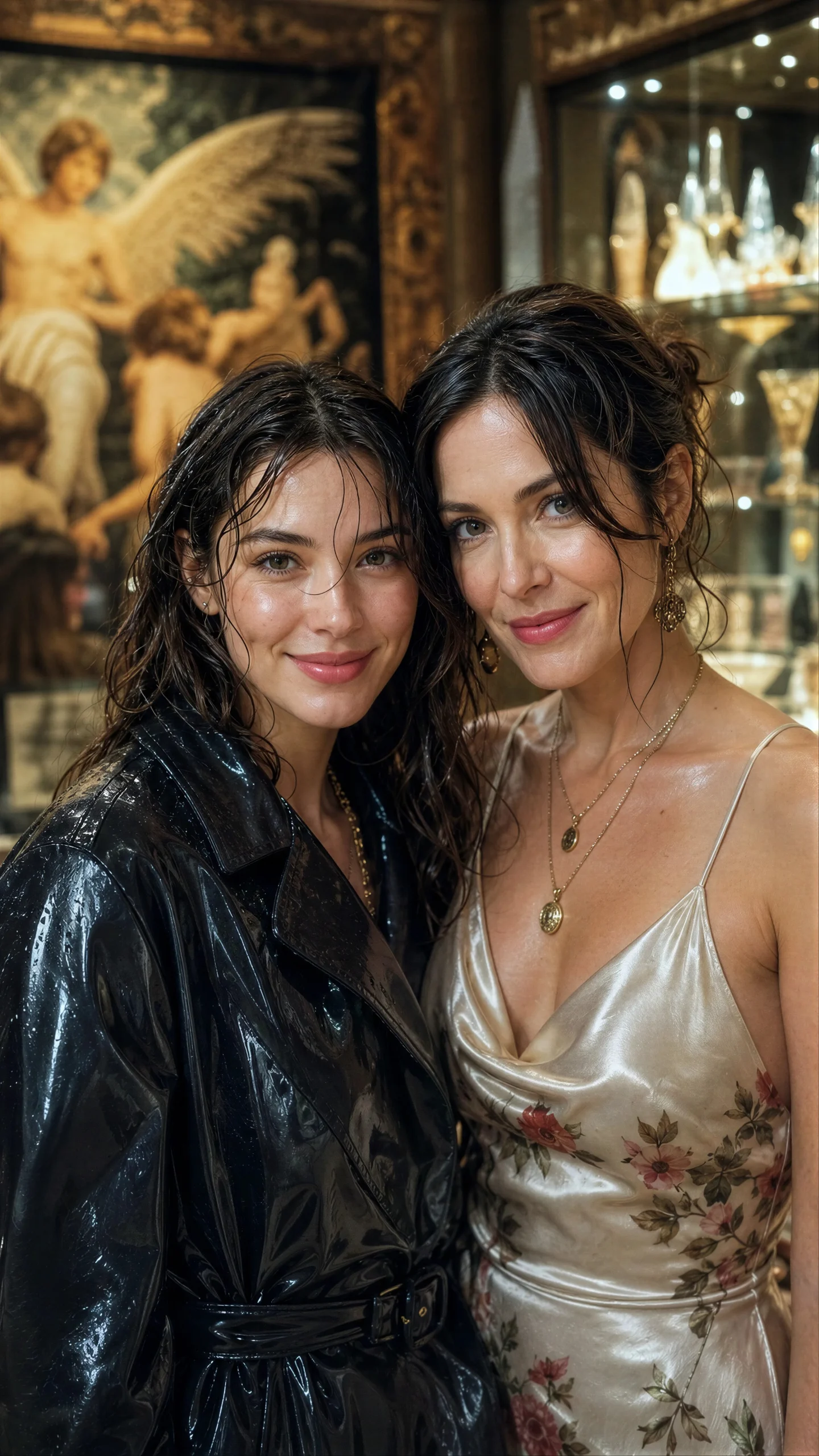
When an Angel Weaves Two Hearts Across Centuries
A Sensual Tale of Silk, Scent, and Divine Intervention—Where Love Transcends Time and Satin Becomes Prayer
What if the touch of satin against your skin were not merely pleasure, but prayer?
In a centuries-old atelier in Lyon, where antique silk tapestries depict angels with wings of woven light, a storm brings two women together—and an unseen presence begins to weave their hearts into a story begun three hundred years before.
Margaux St. Clair, silver-streaked and serene, restores tapestries that whisper of divine love. Vivienne Laurent, vibrant and luminous, creates perfumes that capture the essence of angelic presence. When their paths cross, something ancient stirs. Something sacred. Something that has been waiting centuries to be completed.
But this is not merely a love story. It is an invitation.
Through twelve chapters of escalating emotional intensity, you will journey alongside Margaux and Vivienne as they discover their ancestors’ forbidden love, perform rituals under full moons, and receive an angel’s blessing that allows them to see each other’s true souls. You will feel the slick caress of PVC in rainstorms, the liquid embrace of satin in candlelight, the strength of bodies moving in yoga and dance—physical practice as devotion, athletic grace as prayer.
You will learn French phrases of love and longing, words that capture nuances your own language cannot hold. Je veux vous connaître—I want to know you. L’amour traverse le temps—Love transcends time.
You will feel what they feel: the loneliness of dedication interrupted by hope, the terror and ecstasy of vulnerability, the transcendent power of being truly seen and truly loved.
And perhaps, as you turn the final page, you will sense something stirring within you—a desire for the luminous life these women embody. The glossy confidence of satin. The sleek strength of a body honed through practice. The deep pleasure of surrounding yourself with beauty, with quality, with things that shine and catch the light.
This is the story the angel has been waiting to tell you.
Are you ready to receive it?
Chapter 1: “L’Orage” (The Storm)
“Quand le ciel pleure, la terre ouvre son cœur.”
(When the sky weeps, the earth opens its heart.)
The rain had been falling for three days.
Not the gentle, persistent rain of autumn that Lyon knew so well—the kind that painted the cobblestones slick and dark and made the Rhône shimmer like liquid silver—but a rain that seemed personal, deliberate, as if the sky had looked down upon the ancient city and decided it needed cleansing. It fell in sheets, in curtains, in great sweeping gestures that turned the streets into rivers and the rivers into oceans. The light was the colour of old pearls, grey and luminous, and it made everything it touched look as though it had been dipped in liquid moonlight.
Margaux St. Clair stood at the tall window of her atelier, watching the rain transform the courtyard below into something otherworldly. Her reflection stared back at her from the glass—silver-streaked dark hair swept up in a loose chignon, a face that forty-five years had sculpted into angles and planes that conveyed authority and serenity in equal measure. She wore an ivory satin blouse that moved when she moved, that caught the pale light and held it, that whispered against her skin like a secret being told over and over. The fabric was her armour, her comfort, her second skin. She had worn satin since she was old enough to choose her own clothes, had always found something deeply right about the way it felt—the slick, cool surface sliding against her body, the way it caught light and made her feel luminous even on the greyest days.
The atelier had been her world for fifteen years. She had inherited it from her mentor, Madame Rousseau, who had inherited it from hers, in an unbroken chain stretching back to the seventeenth century. The building itself was older still—stone walls thick enough to mute even this storm’s fury, tall windows that had witnessed centuries of weavers and restorers, wooden beams darkened by age and the smoke of countless candles. Now it housed Margaux’s life’s work: the restoration of antique silk tapestries, many of them depicting scenes of angelic visitation that had been woven by hands long turned to dust.
She turned from the window and moved back to her worktable, her steps measured, deliberate—the walk of a woman who had spent decades in physical practice. Every morning, before the sun rose, Margaux unrolled her mat in the conservatory and moved through sequences that her body knew better than her own name. Yoga had found her in her twenties, when she was recovering from a climbing injury that had left her left shoulder frozen and her spirit colder still. The practice had thawed both. Now, at forty-five, her body was strong in the way that water is strong—flexible, persistent, capable of holding poses that would make women half her age tremble. She could feel the strength in her core as she leaned over the tapestry, could feel the muscles of her back engaging as she bent to examine a thread so fine it was barely visible to the naked eye.
The tapestry before her was her most challenging restoration yet. Dated to 1647, it depicted two women standing beneath the outstretched wings of an angel. The women’s hands were clasped, their faces turned toward each other with an expression that Margaux had spent months trying to accurately name. It was not merely love, though love was certainly present. It was not merely devotion, though devotion was woven through every thread. It was recognition—the look of someone who has found what they have always been seeking, who has been seen in return. The angel above them was rendered in threads of gold and silver that had, against all odds, retained their lustre through nearly four centuries. When Margaux worked on those sections, she felt something she had never been able to articulate—a warmth in her chest, a sense of presence, as if the angel depicted in silk were somehow also in the room with her.
She had never told anyone about this feeling. It was too precious, too fragile, too easily dismissed as fancy or fatigue. But it was real. She knew it was real. And it had been growing stronger in recent weeks, as if the approaching storm had been building not only in the sky but in the very fabric of her existence.
“Bonjour, mon ange,” she murmured to the tapestry, a habit she had developed over years of working alone. The words were absurd, she knew—speaking to a woven figure as if it could hear—but the ritual brought her comfort. “Comment allez-vous aujourd’hui?” (How are you today?)
The angel, of course, did not answer. But the warmth in Margaux’s chest pulsed, just slightly, like a heartbeat that was not her own.
She picked up her tools—fine tweezers, a needle so thin it seemed to be made of light itself, threads of silk dyed to match the original colours as precisely as science and art could manage. The work required absolute concentration, absolute steadiness. Her hands, strengthened by years of practice and the specific demands of restoration, held perfectly still as she began to repair a section where time had frayed the angel’s wing.
The rain intensified. Lightning flashed, and for a moment, the atelier was flooded with white light that made every silk surface gleam. The hanging fabrics—antique samples Margaux used for reference, modern pieces she found beautiful—transformed into a gallery of luminous surfaces. Satin caught the light and threw it back in ripples. A length of PVC fabric she had acquired for a contemporary restoration project shone like black water. Nylon panels shimmered like auroras captured in cloth.
Then darkness again, and the rain’s voice rose to something approaching a roar.
Margaux worked on, lost in the meditative state that restoration always induced in her. Time became fluid, measured not in minutes but in threads repaired, colours matched, textures recreated. Her body held its position through sheer muscular endurance—core engaged, shoulders relaxed, breath steady. This was the athleticism of her craft, the physical discipline that no one saw but that was as real and demanding as any sport. She had muscles in her hands, her forearms, her back that existed because of this work, and she was proud of them in a quiet, private way.
She was so absorbed that she didn’t hear the door at first.
It was the wind that alerted her—a gust that swept through the atelier’s ancient door as it burst open, carrying rain and the scent of wet stone and something else, something floral and sharp that cut through the familiar smells of old silk and lavender. Margaux looked up, startled, her needle suspended above the tapestry.
A woman stood in the doorway, framed by the storm.
She was drenched. Her black PVC trench coat glistened like liquid obsidian, every surface reflecting the grey light in slick, sliding patterns. Raindrops clung to the material in tiny, perfect spheres before sliding down its smooth surface in tiny rivers. Beneath the coat, which hung open, an emerald satin slip clung to curves that the rain had made vivid—the fabric darkened by moisture, translucent in places, clinging with an intimacy that was somehow both vulnerable and defiant. Her dark hair was plastered to her head, water streaming down her face, and her eyes—wide, dark, luminous—found Margaux’s across the length of the atelier.
Time stopped.
Margaux would later try to describe this moment and find that language failed her. It was not merely attraction, though attraction was certainly present—a jolt of awareness that ran through her body like current through wire. It was not merely surprise, though surprise was there too. It was recognition. The same recognition she saw in the faces of the women in the tapestry. The sense of something found that had been sought without knowing it was missing.
And with the recognition came the warmth—that familiar pulse in her chest, but intensified a hundredfold. It spread through her like sunlight through silk, filling spaces she hadn’t known were empty. The angel. The angel was here, was present, was somehow wrapped around this moment like wings around a nest.
“Mon Dieu,” Margaux whispered, though whether in prayer or exclamation, she couldn’t say.
The woman in the doorway shivered, and the motion seemed to break the spell. Margaux moved—not walking, almost flowing, her yoga-trained body carrying her across the atelier with a grace that surprised even herself.
“Entrez,” she said, her voice steadier than her heartbeat. “Entrez, je vous en prie.” (Come in, I beg you.)
The woman stepped inside, and the wind pushed the door shut behind her with a sound like a sigh. She stood there, dripping, her PVC coat shedding water onto the ancient stone floor, and looked around the atelier with an expression of wonder that transformed her face from beautiful to transcendent.
“C’est… c’est magnifique,” she breathed. (It’s… it’s magnificent.) Her voice was low, musical, carrying an accent that was Parisian but softened by years elsewhere. “Qu’est-ce que c’est que cet endroit?” (What is this place?)
“This,” said Margaux, finding her voice, “is a very old atelier. I restore antique silk tapestries. Please—” She gestured toward a chair near the warmth of the restoration lamps. “Asseyez-vous. Vous êtes trempée.” (Sit down. You are soaked.)
The woman laughed, and the sound was like rain on satin—soft, rhythmic, somehow soothing. “Je suis Vivienne. Vivienne Laurent.” She extended a hand, and Margaux took it. Their fingers touched, and the warmth in Margaux’s chest flared. She felt it in her hand, travelling up her arm, settling somewhere near her heart.
“Margaux St. Clair.” She held the hand a moment longer than necessary, then released it with a reluctance that felt almost physical. “Laissez-moi vous aider.” (Let me help you.)
She moved to a cabinet and retrieved a large towel—soft, thick, and, she realised with a flush of self-consciousness, monogrammed with her initials in silver thread. A luxury, but one she had never apologised for. Quality was quality. She had learned long ago that surrounding oneself with beautiful things was not vanity but nourishment—that the glossy, the luminous, the well-made were not indulgences but necessities for a soul that wished to remain luminous itself.
Vivienne took the towel and began to dry her hair, her movements efficient, graceful—the movements of a body that knew itself, that had been trained. Margaux watched, fascinated. There was an athleticism in the way Vivienne held herself, in the way her shoulders moved, in the subtle definition of her arms visible beneath the wet satin.
“Vous êtes sportive?” Margaux asked, then flushed at the forwardness of the question. (Are you athletic?)
Vivienne smiled. “Un peu. Je nage. Je cours. Et mon travail… la parfumerie… c’est plus physique que les gens ne le pensent.” (A little. I swim. I run. And my work… perfumery… it’s more physical than people think.) She demonstrated with a motion—holding an imaginary beaker, stirring, pouring—and Margaux saw the strength in her forearms, the steadiness in her hands.
“Je comprends,” Margaux said. (I understand.) “Mon travail aussi. Des heures debout. Des mouvements précis. La force dans les mains.” (My work too. Hours standing. Precise movements. Strength in the hands.)
“Exactement.” Vivienne’s eyes met hers, and there was understanding there—the understanding of one woman who honed her body through craft recognising another. “Et vous? Vous faites autre chose?“
“Le yoga. Chaque matin.” Margaux felt a pride she didn’t try to hide. “Depuis vingt ans. Mon corps… c’est mon instrument. Je dois en prendre soin.” (Yoga. Every morning. For twenty years. My body… it’s my instrument. I must take care of it.)
“C’est beau,” Vivienne said softly. (It’s beautiful.) “Le corps comme instrument. Comme prière.” (The body as instrument. As prayer.)
The word hung in the air between them—prière—prayer—and Margaux felt the warmth pulse again. She turned away, moving toward the small kitchen area at the back of the atelier, partly to make tea as she had promised, partly to hide the emotion she felt certain was visible on her face.
“Je vais préparer du thé,” she said. (I’ll make tea.) “Vous aimez le thé?“
“J’adore le thé.” (I love tea.) Vivienne’s voice followed her, warm despite the chill of wet clothes. “Et j’adore cet endroit. J’aurais dû deviner… quand j’ai vu la lumière…” She trailed off, and Margaux turned.
“La lumière?“
Vivienne was standing now, the towel draped around her shoulders, her PVC coat still glistening. She gestured toward the window. “Je marchais dans la rue. La pluie était terrible. Et puis… j’ai vu une lumière. Pas une lumière normale. Une lumière… dorée. Comme si quelqu’un m’appelait.” (I was walking in the street. The rain was terrible. And then… I saw a light. Not a normal light. A… golden light. As if someone was calling me.)
Margaux’s hands trembled. She set down the kettle she had been holding and turned to face Vivienne fully.
“Une lumière dorée,” she repeated. (A golden light.)
“Oui.” Vivienne looked at her, and there was something in her eyes—a question, a hope, a fear. “C’est ridicule, je sais. Mais… j’ai suivi la lumière. Et elle m’a menée ici. À vous.” (It’s ridiculous, I know. But… I followed the light. And it led me here. To you.)
The warmth in Margaux’s chest was a sun now, radiating light and heat through every part of her. She felt it in her fingertips, in her toes, in the roots of her hair. The angel was here. The angel had brought this woman to her. The angel was, somehow, in the golden light that Vivienne had followed through the storm.
“Ce n’est pas ridicule,” Margaux said, and her voice was not steady, could not be steady. (It’s not ridiculous.) “Ce n’est pas ridicule du tout.“
They stood in silence, the rain pounding against the windows, the ancient stones humming with a frequency that was almost audible. The silk hangings stirred in a breeze that came from nowhere, their glossy surfaces catching the lamplight and scattering it in patterns that looked, if one were inclined to see it, like wings.
Margaux moved first. She crossed to a trunk and opened it, retrieving a garment that she had made herself—a long robe of deep burgundy satin, smooth and cool and luminous. She had made it for evenings when she worked late, for the times when the atelier grew cold and she needed something against the chill that was also beautiful, also alive with light.
“Mettez ceci,” she said, holding it out to Vivienne. (Wear this.) “Votre… votre robe… elle est mouillée. Vous aurez froid.” (Your… your dress… it’s wet. You’ll be cold.)
Vivienne looked at the robe, then at Margaux. “Elle est magnifique,” she whispered. (It’s magnificent.) “Vous êtes sûre?“
“Je suis sûre.” (I’m sure.) “Satin. C’est… c’est ce que je préfère. La façon dont il attrape la lumière. La façon dont il sent contre la peau.” (Satin. It’s… it’s what I prefer. The way it catches the light. The way it feels against the skin.)
“Comme une prière,” Vivienne said, and there was that word again—prayer—and Margaux knew that this woman understood something that most people never would.
Vivienne turned away and, with movements that were both practical and somehow ceremonial, removed the wet PVC coat and let it fall to the floor with a slick, liquid sound. The emerald satin slip clung to her body, wet and translucent, and Margaux looked away—not from modesty but from the intensity of what she felt. She heard the wet fabric slide over skin, heard the whisper of dry satin being donned, and when she looked again, Vivienne was wrapped in burgundy, the robe’s glossy surface transforming her from a drowned stranger into something that looked like it had stepped from one of the tapestries.
“Comment je suis?” Vivienne asked, turning slowly. (How do I look?)
Margaux’s breath caught. The burgundy satin moved with Vivienne’s body, catching light, throwing it back, making her glow. She looked like a figure from a painting—a Renaissance angel in burgundy and silver, her dark hair drying in waves that framed her face, her eyes luminous in the warm light.
“Vous êtes… ” Margaux began, then stopped. There were no words adequate. Not in French, not in English, not in any language she knew. “Vous êtes belle,” she said finally, and the word was so insufficient that she almost laughed. (You are beautiful.)
“Merci,” Vivienne said, and her smile was like sunrise—gradual, inevitable, transforming. “Merci, Margaux.“
The tea was made and drunk in a silence that was not awkward but full—full of questions unasked, of answers not yet given, of a presence that wrapped around them both like wings of light. The storm raged outside, but inside the atelier, there was only warmth, only the whisper of satin moving against satin, only the occasional meeting of eyes that conveyed more than words could hold.
As Vivienne prepared to leave—reluctantly, it seemed, her movements slow, her glances toward Margaux frequent—she paused at the door.
“Margaux?“
“Oui?“
“Est-ce que je peux revenir?” (Can I come back?)
Margaux felt the warmth pulse one final time—strong, certain, like a heartbeat that was not her own but that she had been hearing all her life.
“Oui,” she said. “Revenez. Je vous attendrai.” (Yes. Come back. I will wait for you.)
Vivienne smiled, and the door opened, and the storm swallowed her. But the warmth remained. And in the tapestry, the angel’s golden threads seemed, just for a moment, to glow.
Chapter 2: “La Tapisserie” (The Tapestry)
“Les fils du destin sont tissés par des mains invisibles.”
(The threads of destiny are woven by invisible hands.)
The morning after the storm arrived like a gift wrapped in gold.
Margaux had not slept. After Vivienne’s departure, she had returned to the tapestry and worked through the night, her hands guided by something that was not quite her own will, her eyes seeing threads and patterns she had never noticed in fifteen years of restoration. The angel’s wings seemed to shimmer with new light, the golden threads catching even the faintest illumination and multiplying it, spreading it across the silk like honey spread across warm bread. She had worked until dawn bled through the tall windows, painting the atelier in shades of rose and amber, and then she had unrolled her mat in the conservatory and moved through her practice with a ferocity that surprised even her.
The yoga was different that morning. Each pose seemed to hold her longer, deeper, as if her body were being stretched not just by her own muscles but by some external force—gentle but insistent, like hands of light adjusting her alignment from the inside. Her breath came slow and deep, and with each exhalation, she felt something release—not tension, exactly, but something older, something that had been held in her body for years without her knowing. By the time she reached savasana, the corpse pose, tears were sliding down her temples and into her silver-streaked hair.
She did not understand the tears. She did not need to. They were a release, and she accepted them as she accepted everything her body told her—with trust, with gratitude, with the quiet confidence of a woman who had spent two decades learning to listen to her own flesh.
She showered and dressed with particular care. The ivory satin blouse from yesterday was replaced with one of pale champagne, its surface catching the morning light like still water. She paired it with trousers of black PVC—not the heavy, industrial kind, but a soft, supple version that moved with her body like liquid shadow, its surface gleaming with each step. She had discovered PVC trousers years ago, had been initially uncertain about their boldness, but had quickly realised that they made her feel powerful, sleek, invincible. They were her armour for days when she needed courage. Today, she needed courage.
She was arranging the atelier—hanging additional silk panels to catch the light, positioning the tapestry where it would be most visible—when her phone chimed. A message from Colette Marchand, her oldest friend and the owner of the boutique across the courtyard. Colette supplied Margaux with rare fabrics and, more importantly, with conversation, wine, and the particular comfort of a friendship that had endured three decades.
Coming to see you. Have something special. Don’t argue. ~C
Margaux smiled. Colette never argued about visits; she simply arrived, a force of nature wrapped in whatever glossy fabric had caught her fancy that season. Today, when the boutique door chimed and Colette swept into the atelier, she was wearing a jacket of deep sapphire PVC that caught the light like a midnight ocean, paired with a white satin camisole that glowed against her brown skin. Her silver hair was cropped close to her head, and her body—sculpted by decades of competitive swimming before an injury had redirected her passion toward fashion—moved with the particular grace of someone who had been an athlete and would always be an athlete, even in retirement.
“Bonjour, ma chère,” Colette said, kissing Margaux on both cheeks. “Tu as l’air… différente. Qu’est-ce qui s’est passé?” (Hello, my dear. You look… different. What has happened?)
“Rien,” Margaux said, and the lie was so transparent that they both laughed.
“Menteuse,” Colette said, settling into a chair with the easy athleticism of a woman who could still swim a hundred metres in under a minute at sixty-two. (Liar.) “Tu as rencontré quelqu’un.” (You met someone.)
“Une femme est entrée pendant l’orage,” Margaux admitted, because there was no use denying anything to Colette, who had known her since they were both fifteen and had shared every secret since. “Elle s’appelle Vivienne. Elle est parfumeuse.“
“Parfumeuse!” Colette’s eyebrows rose. “Intéressant. Et elle est… belle?“
“Elle est… ” Margaux searched for a word and found none adequate. “Elle est comme cette tapisserie. Ancienne et nouvelle à la fois. Comme si je la connaissais déjà.“
Colette studied her for a long moment, her dark eyes—still sharp as flint despite the silver in her hair—seeing more than Margaux wished. “Comme une réincarnation?” (Like a reincarnation?)
“Je ne sais pas. Mais quand elle est partie… l’ange… la tapisserie… quelque chose a changé.“
Colette rose and moved to the tapestry, her sapphire PVC jacket whispering as she walked. She had seen the tapestry a hundred times, had watched Margaux work on it for years, but today she stood before it and was still.
“Mon Dieu,” she said quietly. “C’est… c’est plus lumineux. Les fils d’or. Regarde.” (My God. It’s… it’s more luminous. The gold threads. Look.)
Margaux looked. Colette was right. The golden threads of the angel’s wings, which had been dulled by centuries of accumulated grime, now seemed to glow with an inner light, as if someone had polished them from within. The effect was subtle—someone unfamiliar with the tapestry might not notice—but to Margaux, who had spent months studying every thread, it was unmistakable.
“Je n’ai rien fait,” she said, and her voice was barely a whisper. (I did nothing.)
“Je sais,” Colette said. “C’est pour ça que c’est remarquable.” (I know. That’s why it’s remarkable.)
The door chimed.
Margaux’s heart stopped. Then started. Then raced.
Vivienne stood in the doorway, and the morning light behind her created a halo effect that made Margaux’s breath catch. She wore a tailored navy PVC skirt that ended just below her knee, its surface catching the light in slick, sliding patterns that moved when she moved. A cream satin blouse was tucked into it, the fabric’s glossy surface glowing against her skin. Her dark hair was dry now, falling in waves around her face, and she held in her hands a small package wrapped in tissue paper.
“Bonjour,” she said, and her voice was tentative, hopeful, as if she were not certain she would be welcomed despite Margaux’s invitation. “Je… j’espère que je ne dérange pas.” (I hope I’m not disturbing you.)
“Vous ne dérangez jamais,” Margaux said, and the words came out with more intensity than she intended. (You never disturb.) She gestured Vivienne inside. “Entrez. J’ai… j’ai pensé à vous.” (Enter. I have… I have thought of you.)
“Moi aussi,” Vivienne said, and her smile was like the sun emerging from behind clouds—gradual, inevitable, transformative. “Moi aussi, j’ai pensé à vous. Toute la nuit.” (Me too. Me too, I thought of you. All night.)
Colette, who had been watching this exchange with the expression of someone watching a particularly good tennis match, cleared her throat. “Je suis Colette,” she said, extending her hand. “Une vieille amie de Margaux. Et vous devez être Vivienne.” (I am Colette. An old friend of Margaux’s. And you must be Vivienne.)
Vivienne shook her hand, a flicker of surprise crossing her face. “Comment savez-vous?” (How do you know?)
“Parce que je connais Margaux depuis trente ans,” Colette said, her smile knowing and warm, “et je ne l’ai jamais vue regarder quelqu’un comme elle vous regarde.” (Because I have known Margaux for thirty years, and I have never seen her look at anyone the way she looks at you.)
“Colette,” Margaux said, and her voice carried a warning that was undermined entirely by the blush rising in her cheeks.
“Je m’en vais,” Colette said, rising with fluid grace. (I’m going.) She kissed Margaux on both cheeks, then turned to Vivienne. “Prenez soin d’elle,” she said, and the words were light but the meaning was not. (Take care of her.) “Et revenez me voir à la boutique. J’ai des choses qui vous iraient parfaitement.” (And come see me at the boutique. I have things that would suit you perfectly.)
She swept out in a rustle of sapphire PVC, leaving behind the scent of her perfume—something dark and floral that Margaux had been breathing for thirty years—and a silence that was somehow fuller than before.
Vivienne looked at Margaux. “Elle est… remarquable.” (She’s… remarkable.)
“Elle est ma meilleure amie,” Margaux said. “Et elle a raison. J’ai pensé à vous toute la nuit.” (She’s my best friend. And she’s right. I thought of you all night.)
“Alors nous avons quelque chose en commun.” Vivienne held out the package. “J’ai apporté quelque chose. Pour vous remercier de votre hospitalité.” (Then we have something in common. I brought something. To thank you for your hospitality.)
Margaux took the package, her fingers brushing Vivienne’s in the transfer. The warmth flared again—that familiar pulse in her chest, that sense of presence, of wings wrapped around them both. She unwrapped the tissue paper and found a small glass vial, exquisitely crafted, filled with a liquid that seemed to glow with its own light.
“C’est… c’est un parfum?” Margaux asked, though she knew the answer. (Is it… is it a perfume?)
“Oui.” Vivienne’s eyes were bright with excitement and something else—vulnerability, hope, the fear of offering something precious and having it rejected. “Je l’ai créé hier soir. Après… après vous avoir quittée. Je n’ai pas dormi. Je ne pouvais pas. Alors j’ai travaillé. Et c’est… c’est ce qui est sorti.” (I created it last night. After… after leaving you. I didn’t sleep. I couldn’t. So I worked. And this is… this is what came out.)
Margaux uncorked the vial and brought it to her nose. The scent that rose to meet her was like nothing she had ever experienced. It was the atelier—old silk and lavender and the particular mustiness of ancient stone—but transformed, elevated, made luminous. There was rain in it, and candlelight, and something golden that had no name but that she recognised instantly as the scent of the warmth in her chest, the angel’s presence rendered in fragrance.
“C’est… c’est moi?” she whispered. (It’s… it’s me?)
“C’est nous,” Vivienne said. (It’s us.) “C’est ce que j’ai senti quand je vous ai rencontrée. C’est ce que j’ai senti quand vous m’avez regardée. C’est… c’est l’ange.” (It’s what I felt when I met you. It’s what I felt when you looked at me. It’s… it’s the angel.)
Margaux’s hands trembled. She corked the vial and set it down with the careful precision of someone handling something sacred, which, she realised, was exactly what she was doing.
“Venez,” she said, extending her hand without thinking, her body moving before her mind could catch up. “Je veux vous montrer quelque chose.” (Come. I want to show you something.)
Vivienne took her hand. The warmth between their palms was not metaphorical; it was physical, tangible, a heat that seemed to emanate from the point of contact and spread through both of them. Margaux led her across the atelier, past hanging silks that whispered as they passed, past shelves of ancient fabrics and modern wonders, to the tapestry.
“Voilà,” Margaux said. “La raison pour laquelle je suis ici. La raison pour laquelle je suis toujours ici.” (Here. The reason I am here. The reason I am always here.)
Vivienne looked at the tapestry, and Margaux watched her face for the moment of recognition she knew would come. It arrived like dawn—slowly at first, then all at once. Her eyes widened. Her lips parted. Her hand rose to her mouth.
“Mon Dieu,” she breathed. “C’est… c’est nous.” (My God. It’s… it’s us.)
It was not, of course, literally them. The tapestry was nearly four centuries old. But the resemblance was uncanny—the woman on the left had Margaux’s silver-streaked dark hair, her angular face, her particular way of standing with weight on one hip. The woman on the right had Vivienne’s waves, her fuller figure, her tilted chin. They stood with hands clasped, faces turned toward each other, and above them—
“L’ange,” Vivienne whispered. (The angel.)
The angel in the tapestry was rendered in threads of gold and silver that seemed, in that moment, to glow with an intensity that was impossible. The light was not reflected; it was generated, as if the threads themselves were tiny suns, tiny stars, tiny fragments of a luminescence that belonged to another world entirely.
“Elle s’appelle Clothilde,” Margaux said, her voice hushed, reverent. “La femme qui a tissé cette tapisserie. Elle vivait ici, dans ce bâtiment, au dix-septième siècle. Et on dit qu’elle a été visitée par des anges.” (She was called Clothilde. The woman who wove this tapestry. She lived here, in this building, in the seventeenth century. And they say she was visited by angels.)
“Visitée par des anges,” Vivienne repeated, and her voice had the quality of someone testing a phrase to see if it was real. “Et l’autre femme? Celle qui ressemble à…?” (Visited by angels. And the other woman? The one who looks like…?)
“Marguerite,” Margaux said. “Elle était… on ne sait pas exactement. Amie? Compagne? Les archives sont vagues. Mais le visage… la façon dont elles se regardent… ” She stopped, unable to continue, because she was looking at Vivienne looking at the tapestry, and the resemblance between the living woman and the woven one was so strong that it made her dizzy.
“Elles s’aimaient,” Vivienne said. It was not a question. (They loved each other.)
“Oui.“
“Et l’ange les bénissait.” (And the angel blessed them.)
“Oui.“
They stood in silence, looking at the tapestry, looking at each other, looking at the angel whose golden threads seemed to pulse with light that was not of this world. The atelier was quiet around them—the hanging silks still, the ancient stones holding their secrets, the morning light painting everything in shades of gold.
Then Vivienne reached out and touched the tapestry.
“Non!” Margaux’s hand shot out, catching Vivienne’s wrist, not roughly but firmly—the grip of a woman whose hands were strong from years of precise work, whose body was powerful from decades of practice. “Ne touchez pas. Les fibres… elles sont…” (Don’t touch. The fibres… they’re…)
But she stopped. Because something was happening.
Where Vivienne’s fingers had brushed the tapestry, light bloomed. Not external light—nothing in the atelier had changed—but light from within the threads themselves, a luminescence that spread from the point of contact like ripples in a pond, like dawn spreading across a horizon, like honey spreading across warm bread. The angel’s wings, which had been depicted in a resting position, seemed to shift, to extend, as if the figure were stretching, waking, coming alive.
“Est-ce que vous voyez ça?” Vivienne whispered, and her voice was the voice of someone who does not trust their own eyes. (Do you see that?)
“Je le vois,” Margaux said, and her voice was the voice of someone who has always trusted her eyes and is now seeing something beyond their capacity. (I see it.) “Je l’ai toujours senti. La chaleur. La présence. Mais je n’ai jamais… je n’ai jamais vu…” (I’ve always felt it. The warmth. The presence. But I’ve never… I’ve never seen…)
“Les ailes,” Vivienne said. “Elles bougent. Regarde. Les ailes.” (The wings. They’re moving. Look. The wings.)
Margaux looked. The angel’s wings, woven in gold and silver thread, were extending—slowly, impossibly, beautifully—until they stretched above and around the two women in the tapestry, enfolding them in a embrace of woven light. And the light was not contained within the threads; it spilled outward, filling the atelier with a golden glow that made every glossy surface—the satin hangings, the PVC panels, the nylon samples—shine as if they had been polished from within.
The warmth in Margaux’s chest was a sun now, and she felt it spreading through her body, through her arms, through the hand that still gripped Vivienne’s wrist. She felt it travel between them like current through a wire, like light through silk, like love through time.
“Céleste,” she said, and she did not know where the name came from—only that it was true, that it had always been true, that the angel in the tapestry had always been Céleste, waiting for this moment, waiting for these two women to stand before her and see.
“Céleste,” Vivienne repeated, and the name on her lips was like a prayer, like a key turning in a lock, like the first note of a symphony that had been waiting centuries to be played.
The light pulsed once—bright, warm, encompassing—and then faded, leaving the atelier in its morning glow, the tapestry as it had been, the angel’s wings in their resting position. But something had changed. Something fundamental, something that could not be undone.
Margaux released Vivienne’s wrist. They stood facing each other, the tapestry between them, the scent of the perfume Vivienne had created hanging in the air like a blessing.
“Qu’est-ce qui vient de se passer?” Vivienne asked, and her voice was steady but her eyes were wide, her pupils dilated, her breath coming fast. (What just happened?)
“Je ne sais pas,” Margaux said. (I don’t know.) “Mais je sais que c’est réel. Et je sais que ce n’est pas fini.” (But I know it’s real. And I know it’s not finished.)
“Comment le savez-vous?” (How do you know?)
“Parce que je le sens,” Margaux said, pressing her hand to her chest, to the place where the warmth still pulsed like a second heartbeat. “Ici. Depuis hier. Depuis que vous êtes entrée. Et maintenant… maintenant c’est plus fort. Comme si… comme si elle nous attendait.” (Here. Since yesterday. Since you entered. And now… now it’s stronger. As if… as if she was waiting for us.)
“L’ange.” (The angel.)
“Céleste.“
“Céleste,” Vivienne repeated, and then she smiled—a smile that was like the light that had just filled the atelier, warm and golden and full of something that was not quite hope because hope implies doubt, and there was no doubt in that smile, only certainty, only recognition, only the profound relief of someone who has been searching for something without knowing what it was and has finally found it.
“Je reviendrai,” she said. (I will come back.) “Demain. Et après-demain. Et tous les jours. Si vous me le permettez.” (Tomorrow. And the day after. And every day. If you allow me.)
“Je vous en prie,” Margaux said, and the words were formal but the feeling was not—was anything but—was the opposite of formal, was raw and real and trembling like a leaf in wind. “Revenez. Toujours. Je vous attendrai.” (Please. Come back. Always. I will wait for you.)
“Toujours,” Vivienne said, and the word hung in the air like the scent of perfume, like the glow of golden threads, like the promise of an angel whose wings had stretched across four centuries to bring two women together. (Always.)
She left, and the atelier was quiet, and the tapestry gleamed, and Margaux stood alone in the space that had been her world for fifteen years and felt it expand—felt it grow to encompass something larger, something luminous, something that had been waiting for her since before she was born.
She looked at the angel in the tapestry, at the golden threads that still seemed to glow with inner light, at the wings that had stretched and folded and left behind a sense of presence that was as real as the silk beneath her fingertips.
“Merci,” she whispered. (Thank you.) “Merci, Céleste. Je comprends maintenant. Je comprends.” (Thank you, Céleste. I understand now. I understand.)
The warmth pulsed once more—soft, gentle, like a hand on her heart—and Margaux knew, with a certainty that went beyond knowledge, that this was only the beginning.
Chapter 3: “Le Parfum de l’Ange” (The Angel’s Perfume)
“Un parfum peut éveiller des souvenirs que le cœur a oubliés.”
(A scent can awaken memories the heart has forgotten.)
Three days passed, and Margaux existed in a state of sustained luminosity.
She had not known such a state was possible—to move through the ordinary motions of her life while simultaneously inhabiting another dimension, one where every sensation was heightened, every colour deepened, every surface she touched seemed to hum with significance. She worked on the tapestry, and the angel’s golden threads glowed. She practiced yoga in the conservatory, and her body moved with a fluidity that surprised even her, as if the warmth in her chest had become a lubricant for her joints, a lightness in her limbs. She walked through Lyon’s streets, and the city seemed to have been repainted—cobblestones gleaming wetly, shop windows catching the autumn sun like mirrors, women passing in coats of leather and PVC that shone like liquid armour.
She was waiting. She knew she was waiting. And the waiting itself was a form of pleasure, because she knew—with the same certainty she knew her own name—that Vivienne would return.
On the third morning, a note arrived. Not a text, not an email, but an actual note, written by hand on thick cream paper, delivered by a courier whose motorcycle rumbled through the courtyard and made the ancient stones vibrate.
Chère Margaux,
Venez chez moi. Ma parfumerie. Aujourd’hui, à trois heures.
J’ai quelque chose à vous montrer. Quelque chose que j’ai créé.
Apportez votre cœur ouvert.
Vivienne
P.S. La parfumerie est dans l’ancienne écurie derrière l’Hôtel de Ville. Suivez le parfum.
(Dear Margaux, Come to me. My perfumery. Today, at three o’clock. I have something to show you. Something I have created. Bring your open heart. Vivienne. P.S. The perfumery is in the old carriage house behind the Hôtel de Ville. Follow the scent.)
Margaux read the note three times, each reading revealing a new layer of meaning. Apportez votre cœur ouvert. Bring your open heart. Not “bring yourself” or “come see me,” but bring your open heart—an instruction, an invitation, a challenge. As if Vivienne knew—as if Céleste had told her—that Margaux’s heart had been closed for years, protected by silk and routine and the careful architecture of solitude.
She dressed with intention. The charcoal satin jacket first—structured, tailored, its surface gleaming like polished pewter. Beneath it, a white silk camisole so fine it was almost transparent, its glossy surface catching light like frost on glass. Black trousers, slim and precise. Her silver-streaked hair swept up, exposing the strong line of her neck. She looked at herself in the mirror and saw a woman who was both armoured and exposed—satin and silk as protection and revelation, the glossy surfaces reflecting light while the soft fabric beneath whispered against her skin like a secret.
She walked through Lyon with the purposeful stride of a woman whose body had been trained to move efficiently—yoga and years of standing at restoration tables had given her a gait that was both athletic and graceful, each step engaging her core, her posture impeccable. The city passed around her in a blur of autumn colours and glossy surfaces—shop windows displaying satin dresses, PVC coats, nylon scarves that caught the light—and she felt a kinship with all of it, a sense that the world was conspiring to shine for her.
The perfumery was hidden, as Vivienne had promised, behind the Hôtel de Ville in a converted carriage house whose stone walls were draped in ivy and whose ancient wooden door was painted a deep, glossy black. The scent hit Margaux before she reached the threshold—jasmine, rose, sandalwood, and something else, something that made her heart rate increase and her breath catch, something that smelled like the warmth in her chest made manifest.
She pushed open the door and stepped into another world.
The carriage house had been transformed. The high ceilings were crossed with ancient beams from which hung dozens of glass vessels—amber, clear, cobalt—each one catching the light from tall windows and scattering it in patterns that moved like living things. Worktables lined the walls, covered with beakers, pipettes, scales, and books whose pages were stained with centuries of perfume-making knowledge. Candles burned in strategic locations, their warm light making every glossy surface gleam—the glass, the polished wood, the PVC of the protective apron hanging on a hook by the door.
And there, in the centre of it all, stood Vivienne.
She wore a flowing plum satin dress that moved when she breathed, its surface catching the candlelight and holding it in ripples of deep purple and violet. The fabric pooled at her feet like liquid shadow, and as she turned at the sound of the door, it swirled around her in a way that made Margaux think of water, of silk, of the way light moves through things that are both solid and fluid. Her dark hair was loose, falling in waves past her shoulders, and her face—her beautiful, transformed face—broke into a smile that was like sunrise: gradual, inevitable, illuminating.
“Vous êtes venue,” she said, and her voice carried the particular warmth of someone who has been hoping and is now released from hope. (You came.)
“Vous m’avez invitée,” Margaux replied, moving into the space with the careful steps of someone entering a temple. “Comment pourrais-je refuser?” (You invited me. How could I refuse?)
“Vous pourriez,” Vivienne said, moving toward her with the grace of a woman whose body was as trained as Margaux’s—swimming and running had given her a fluidity that was different from yoga’s stillness but equally beautiful, equally disciplined. “Vous pourriez dire non. Vous pourriez rester dans votre atelier avec vos tapisseries et votre ange. Mais vous êtes ici.” (You could. You could say no. You could stay in your atelier with your tapestries and your angel. But you are here.)
“Je suis ici,” Margaux said, and the words were a confession, a surrender, a prayer. “Je suis ici parce que… parce que je ne peux pas être ailleurs. Pas maintenant. Pas après…” (I am here because… because I cannot be elsewhere. Not now. Not after…)
“Pas après la tapisserie,” Vivienne finished for her. “Pas après Céleste.” (Not after the tapestry. Not after Céleste.)
The name hung in the air between them, golden and alive, and Margaux felt the warmth in her chest pulse in recognition. “Vous croyez?” she asked, and the question was not about belief in angels but about something more fragile, more precious—belief in what was happening between them. (You believe?)
“Je sais,” Vivienne said, and her certainty was a force, a foundation, a thing Margaux could lean against. “Je sais comme je sais que le satin est lisse. Comme je sais que le PVC brille. Comme je sais que certaines choses sont vraies même si on ne peut pas les expliquer.” (I know. I know the way I know that satin is smooth. The way I know that PVC shines. The way I know that certain things are true even if one cannot explain them.)
“Alors vous savez plus que moi,” Margaux said, and there was no shame in the admission, only the relief of someone who has been carrying a secret and can finally set it down. “Je sens. Depuis des années. La chaleur. La présence. Mais je ne sais pas. Pas encore.” (Then you know more than I do. I feel. For years. The warmth. The presence. But I don’t know. Not yet.)
“Vous saurez,” Vivienne said. “Venez. Je veux vous montrer quelque chose.” (You will know. Come. I want to show you something.)
She led Margaux deeper into the perfumery, past the hanging vessels that chimed softly as they passed, past shelves lined with bottles whose contents gleamed in colours that seemed too vivid to be real—amber and gold and deep ruby red. They reached a worktable at the back of the space, cleared except for a single object: a glass vial, smaller than Margaux’s palm, filled with a liquid that seemed to glow with its own light.
“Voilà,” Vivienne said, and her voice had dropped to something barely above a whisper, reveent, ceremonial. “L’Ange de Soie.” (Here. The Angel of Silk.)
Margaux looked at the vial, then at Vivienne. “C’est… c’est le parfum que vous m’avez donné?” (It’s… it’s the perfume you gave me?)
“Non,” Vivienne said. “Celui-là était… un brouillon. Une ébauche. C’est… c’est la version complète. Trois jours de travail. Trois jours sans dormir. Trois jours de… de conversation avec l’ange.” (No. That one was… a draft. A sketch. This is… this is the complete version. Three days of work. Three days without sleeping. Three days of… of conversation with the angel.)
“Conversation avec l’ange?“
“Je sais comment ça sonne,” Vivienne said, and her smile was rueful, self-aware, the smile of a woman who has spent her life in a profession that straddles the line between science and magic and has learned to be comfortable with the ambiguity. “Mais c’est ce qui s’est passé. La nuit après la tapisserie… après Céleste… je suis revenue ici. Et j’ai commencé à travailler. Et chaque fois que je fermais les yeux, je la voyais. Céleste. Ses ailes. Sa lumière. Et elle me montrait… elle me montrait des souvenirs. Des souvenirs qui n’étaient pas les miens.” (I know how it sounds. But it’s what happened. The night after the tapestry… after Céleste… I came back here. And I began to work. And every time I closed my eyes, I saw her. Céleste. Her wings. Her light. And she showed me… she showed me memories. Memories that were not mine.)
“De qui?” (Whose?)
“Clothilde,” Vivienne said, and the name fell into the space between them like a stone into still water, sending ripples through everything. “Et Marguerite. Je les ai vues. Je les ai senties. Leur amour. Leur peur. Leur joie. Et j’ai mis tout ça dans le parfum.” (Clothilde. And Marguerite. I saw them. I felt them. Their love. Their fear. Their joy. And I put all of it into the perfume.)
Margaux’s hands trembled. She pressed them flat against the worktable, feeling the cool wood beneath her palms, grounding herself. “Vivienne… c’est…” (Vivienne… that’s…)
“Je sais,” Vivienne said. “C’est fou. C’est impossible. Mais c’est réel. Sentez. Sentez et dites-moi que ce n’est pas réel.” (I know. It’s crazy. It’s impossible. But it’s real. Smell. Smell and tell me it’s not real.)
She picked up the vial with hands that Margaux now saw were strong—not delicate, not fragile, but powerful in the way of someone who spent hours each day pouring, lifting, stirring, holding heavy beakers steady. The muscles in her forearms were defined, the tendons visible as she uncorked the vial with a precise, practiced motion. This was the athleticism of perfumery, Margaux realised—the endurance of standing for hours, the strength required to handle equipment, the steadiness of hand that came from a body trained to be still. It was different from her own yoga-honed strength but equally disciplined, equally beautiful.
“Sentez,” Vivienne said again, holding the vial toward Margaux. (Smell.)
Margaux leaned forward. The scent that rose to meet her was… she had no words. It was everything. It was the atelier—old silk and lavender and stone. It was the storm—rain and electricity and the ozone of lightning. It was the tapestry—golden thread and ancient dye and the particular mustiness of four centuries. It was the warmth in her chest—the angel’s presence—made visible, made tangible, made into something she could inhale and hold inside her body.
And beneath it all, woven through it like a thread of gold through silk, was something she recognised but had never been able to name: the scent of being truly seen. The fragrance of recognition. The perfume of a love that had been waiting, patient and luminous, across four centuries.
“Mon Dieu,” Margaux whispered, and the words were not exclamation but prayer. (My God.) “C’est… c’est elle. C’est Céleste. C’est…” (It’s… it’s her. It’s Céleste. It’s…)
“C’est nous,” Vivienne said. “C’est Clothilde et Marguerite. C’est vous et moi. C’est l’amour qui traverse le temps.” (It’s us. It’s Clothilde and Marguerite. It’s you and me. It’s love that transcends time.)
Margaux’s eyes filled with tears. Not tears of sadness—tears of recognition, of release, of something breaking open inside her that had been sealed shut for longer than she could remember. The tears slid down her cheeks and fell onto the worktable, and where they landed, the wood seemed to glow, just for a moment, with the same golden light that lived in the tapestry’s threads.
“Pourquoi pleurez-vous?” Vivienne asked, and her voice was gentle, concerned, the voice of someone who has been waiting for this reaction and is not afraid of it. (Why are you crying?)
“Parce que… ” Margaux’s voice broke. She took a breath, steadied herself, tried again. “Parce que je ne savais pas que j’avais oublié. Ce sentiment. Cette… cette plénitude. Je ne savais pas qu’elle existait. Et maintenant je la sens, et c’est… c’est comme revenir à la maison. Une maison que je ne savais pas que j’avais quittée.” (Because… I didn’t know I had forgotten. This feeling. This… this fullness. I didn’t know it existed. And now I feel it, and it’s… it’s like coming home. A home I didn’t know I had left.)
Vivienne set down the vial and took Margaux’s hands. Their fingers intertwined, and the warmth—Céleste’s warmth, the angel’s warmth, the warmth that had been building since the storm—flowed between them like light through silk, like water through a channel that had been carved over centuries.
“Vous êtes revenue,” Vivienne said. “C’est tout ce qui compte.” (You have returned. That’s all that matters.)
They stood in silence, hands clasped, the perfume hanging in the air around them like a blessing. The candles flickered. The glass vessels chimed softly. The light through the windows shifted from afternoon gold to something deeper, richer, the colour of honey held up to the sun.
Then a sound—the door opening, footsteps, and a voice.
“Vivienne? Tu es là? J’ai apporté les… oh.“
The woman who entered was tall, striking, with close-cropped dark hair and skin the colour of burnished copper. She wore a jacket of deep emerald PVC that caught the light like a jewel, paired with a black satin skirt that moved with her like liquid shadow. Her body was lean and powerful—the body of a rower, Margaux would later learn, years of early mornings on the Rhône having sculpted muscles that were visible even through the sleek fabric.
“Pardonnez-moi,” the woman said, stopping in the doorway, her eyes moving between Vivienne and Margaux with the quick assessment of someone accustomed to reading situations. “Je ne voulais pas interrompre.” (Forgive me. I didn’t want to interrupt.)
“Pas de tout,” Vivienne said, releasing Margaux’s hands with a reluctance that was visible, tangible, a letting-go that was almost physical. “Margaux, je vous présente Dr. Amina Diallo. Chimiste. Rameuse. Et ma meilleure amie.” (Not at all. Margaux, this is Dr. Amina Diallo. Chemist. Rower. And my best friend.)
“Enchantée,” Amina said, extending her hand. Her grip was firm, confident—the handshake of a woman who was comfortable with her own strength. “Et la femme qui a fait pleurer Vivienne? Je dois vous connaître depuis des années.” (Delighted. And the woman who made Vivienne cry? I should have known you for years.)
“Je n’ai pas pleuré,” Vivienne protested, but her voice was thick, and they all knew the lie for what it was.
“Menteuse,” Amina said, and the word was spoken with the same affection Colette had used, the same knowing warmth of a friend who sees through pretence to the truth beneath. “Vivienne ne pleure jamais. Sauf quand quelque chose est… transcendant.” (Vivienne never cries. Unless something is… transcendent.)
“C’est vrai,” Vivienne admitted. “Et c’était… transcendant.” (It’s true. And it was… transcendent.)
Amina looked at Margaux with new interest. “Elle vous a montré le parfum?“
“Oui.“
“Et?“
Margaux searched for words and found none adequate. “C’est… c’est comme si quelqu’un avait mis l’amour dans une bouteille.” (It’s… it’s as if someone had put love in a bottle.)
Amina nodded, as if this were exactly the answer she had expected. “C’est ce que Vivienne fait. Elle met des choses dans des bouteilles. Des émotions. Des souvenirs. Des… des prières.” (That’s what Vivienne does. She puts things in bottles. Emotions. Memories. Prayers.) She looked at Vivienne. “Mais celui-ci est différent. Je l’ai senti quand elle l’a fini. Il y a quelque chose de… d’autre. Quelque chose que je ne peux pas mesurer.” (But this one is different. I felt it when she finished it. There’s something… else. Something I can’t measure.)
“C’est l’ange,” Vivienne said simply. (It’s the angel.)
Amina was quiet for a moment. Then she nodded again—slowly, thoughtfully, the nod of a scientist who has learned that some things exist beyond the reach of instruments. “Alors c’est réel. Et c’est… c’est sacré.” (Then it’s real. And it’s… it’s sacred.)
“Oui.“
“Dans ce cas,” Amina said, moving to the door with the fluid grace of a rower who had spent thousands of hours moving in synchronization with water and other bodies, “je vous laisse. Vous avez des choses à discuter. Des choses à… sentir.” (In that case, I’ll leave you. You have things to discuss. Things to… smell.) She paused at the door. “Vivienne? Le parfum. Il est… parfait. Ne changez rien.” (Vivienne? The perfume. It’s… perfect. Don’t change anything.)
She left, the emerald PVC jacket catching the light one final time before the door closed behind her, and the perfumery was quiet again.
Margaux looked at Vivienne. “Elle est… remarquable.” (She’s… remarkable.)
“Comme votre Colette,” Vivienne said. “Nous avons toutes besoin de quelqu’un qui nous voit. Vraiment.” (Like your Colette. We all need someone who sees us. Truly.)
“Et vous? Est-ce que je vous vois?” Margaux asked, and the question was more intimate than any touch, more vulnerable than any confession. (And me? Do I see you?)
Vivienne was quiet for a long moment. Then she reached out and touched Margaux’s face—just the tips of her fingers, tracing the line of her jaw, the curve of her cheekbone. The touch was feather-light, almost not there, but Margaux felt it everywhere—on her skin, in her chest, in the place where the warmth lived and pulsed.
“Vous commencez à me voir,” Vivienne said. “Et c’est… c’est effrayant. Et c’est… c’est magnifique.” (You are beginning to see me. And it’s… it’s frightening. And it’s… it’s magnificent.)
“Je veux voir,” Margaux said, and the words were a vow. “Je veux tout voir. Tout savoir. Tout sentir.” (I want to see. I want to see everything. Know everything. Feel everything.)
“Alors sentez,” Vivienne said, picking up the vial again and holding it to Margaux’s nose. “Sentez et ouvrez votre cœur. Et laissez Céleste vous montrer.” (Then smell. Smell and open your heart. And let Céleste show you.)
Margaux inhaled.
And the world changed.
The perfume entered her body and became light—golden light, angel light, light that filled every space, every cell, every hidden corner of her being. She saw Céleste—not in the tapestry, not in a vision, but here, in the perfumery, wings spread wide, light pouring through silk that hung from the ceiling like captured rainbows. The angel was beautiful beyond description—luminous, serene, ancient and newborn at once, and she was looking at Margaux with an expression that Margaux recognised because she had seen it in the tapestry, had seen it in Vivienne’s eyes: recognition. The look of someone who has found what they have been seeking.
“Je vous vois,” Céleste said, and her voice was the sound of silk moving, of light through glass, of every beautiful thing Margaux had ever known. (I see you.) “Je vous ai toujours vue. Et maintenant… maintenant vous êtes prête.” (I have always seen you. And now… now you are ready.)
“Prête pour quoi?” Margaux asked, but the angel only smiled—serene, knowing, patient—and the light intensified, and Margaux felt herself being filled, being held, being seen in a way she had never been seen before, and the tears came again, not of sadness but of joy, not of loss but of finding, and she heard Vivienne’s voice, far away and close at once, saying “Je suis là. Je suis là. Vous n’êtes pas seule.” (I’m here. I’m here. You are not alone.)
The light faded. The perfumery returned. Vivienne was holding her—strong arms, steady body, the scent of the perfume mingling with the scent of Vivienne’s skin and the warmth of Céleste’s presence.
“Qu’est-ce qui s’est passé?” Margaux asked, her voice raw. (What happened?)
“Céleste vous a touchée,” Vivienne said. “Elle vous a vue. Vraiment vue. Pour la première fois.” (Céleste touched you. She saw you. Truly saw you. For the first time.)
“Pour la première fois? Mais… elle m’a toujours…” (For the first time? But… she has always…)
“Elle a toujours été là,” Vivienne said. “Mais il y a une différence entre être présente et être vue. Vous le savez. Vous le sentez.” (She has always been there. But there’s a difference between being present and being seen. You know this. You feel this.)
Margaux did know. She had spent years feeling the angel’s presence without being seen by her—years of working alone, of living alone, of being alone in a way that had seemed chosen but was, she now understood, simply accepted. She had been like the tapestry—beautiful, ancient, waiting for someone to look closely enough to see the light in the threads.
“Maintenant,” Vivienne said, “maintenant elle vous voit. Et moi aussi.” (Now. Now she sees you. And me too.)
“Et qu’est-ce que vous voyez?” (And what do you see?)
Vivienne looked at her—looked at her the way the angel had looked at her, the way the women in the tapestry looked at each other, with recognition and wonder and the beginning of something that had no name but was as real as silk, as light, as love.
“Je vois une femme qui a oublié qu’elle était belle,” Vivienne said. “Je vois une femme qui a enfermé son cœur dans du satin et du travail. Je vois une femme qui est prête… prête à s’ouvrir. Prête à être vue. Prête à vivre.” (I see a woman who forgot she was beautiful. I see a woman who locked her heart in satin and work. I see a woman who is ready… ready to open. Ready to be seen. Ready to live.)
“Et si j’ai peur?” (And if I’m afraid?)
“Alors je serai là,” Vivienne said. “Avec vous. Comme Céleste est avec nous. Et nous traverserons la peur ensemble.” (Then I will be there. With you. As Céleste is with us. And we will move through the fear together.)
The candles burned low. The light through the windows deepened to amber. The perfume hung in the air like a promise, like a prayer, like the beginning of everything.
“D’accord,” Margaux said, and the word was small but it contained everything—every fear, every hope, every yearning she had ever felt and every yearning she had not known she possessed. “D’accord. Je suis prête.” (Okay. Okay. I’m ready.)
Vivienne smiled, and it was like the sun rising, like silk catching light, like an angel spreading her wings.
“Alors commençons,” she said. (Then let us begin.)
Chapter 4: “L’Élégance du Mouvement” (The Elegance of Movement)
“Le corps en mouvement est une prière vivante.”
(The body in motion is a living prayer.)
The invitation came at dawn.
Margaux had been awake for hours—had been awake, in truth, since three in the morning, when the warmth in her chest had intensified to a degree that made sleep impossible. She had lain in her bed, in her apartment above the atelier, wrapped in satin sheets that gleamed like liquid mercury in the moonlight, and felt Céleste’s presence pulse through her body like a second heartbeat, like a tide, like the rhythm of breath that continues whether we are conscious of it or not. The angel was close. Closer than she had ever been. And the closeness carried a message, though Margaux could not yet translate it into words—only into sensation, into the particular tingling in her fingertips, the warmth in her solar plexus, the sense that something was being prepared, something was being arranged, something was approaching that would change everything.
She had risen at five, unrolled her mat in the conservatory, and begun to move.
The conservatory was her sanctuary—a glass-walled room attached to the back of the atelier, filled with plants that thrived in the humid warmth and flooded with light from the moment the sun cleared the rooftops of Lyon. This morning, the light was extraordinary: the autumn sun, still low and golden, streamed through the glass and painted everything in shades of amber and honey. The plants seemed to glow. The wooden floor gleamed. And Margaux, in her sleek black PVC yoga outfit—leggings that moved with her body like a second skin, a crop top that held her like a gentle but firm embrace—shone like a figure carved from polished obsidian.
She had discovered PVC yoga wear years ago, almost by accident. A client had brought her a contemporary piece for restoration—a wall hanging made of PVC that had been painted to look like antique silk—and Margaux had been so taken with the material’s suppleness, its glossiness, its ability to catch and hold light, that she had sought out clothing made from it. The first time she had worn PVC leggings in practice, she had felt transformed—as if her body had been dipped in liquid power, as if every movement she made was amplified by the material’s sheen. The way it caught the light, the way it moved with her, the way it made her feel simultaneously protected and revealed—it was, she had realised, exactly how she wanted to feel in her own skin.
She moved through her usual sequence—sun salutations first, flowing from one pose to the next with the fluidity of water finding its path through stone. Her body knew this path, had walked it thousands of times, and it responded now with a grace that surprised even her. The PVC leggings whispered as she moved, their surface catching the golden light and scattering it in patterns that looked like living things. Her breath came slow and deep, and with each exhalation, she felt the warmth in her chest expand, filling her body with something that was not quite heat and not quite light but was undeniably real.
She held warrior pose—virabhadrasana—and felt the strength in her legs, the openness in her chest, the extension of her arms reaching toward the walls of the conservatory as if trying to touch something just beyond her grasp. Her muscles trembled, not with fatigue but with energy, with the particular vibration of a body that is being used exactly as it was designed to be used. This was the athleticism of yoga—not the competitive athleticism of sport, but the internal athletics of a body in dialogue with itself, each muscle speaking to its neighbours, each bone finding its perfect alignment.
It was in this pose—arms extended, heart open, body strong—that she felt Céleste’s message resolve into clarity. Not words, exactly—angels did not speak in words—but a knowing, a certainty, a direction.
Invite her. Today. Here. Share this.
Margaux lowered her arms and reached for her phone.
Vivienne, would you come to the atelier this morning? I have a practice I would like to share with you. Ten o’clock. Wear something you can move in.
The response came within minutes.
I’ll be there. I’ve been awake since three. I think we have the same alarm clock. ~V
Margaux smiled—a smile that felt like sunlight breaking through clouds, warm and sudden and illuminating. She continued her practice, moving through poses with a lightness that seemed to come from somewhere beyond her own muscles, as if Céleste were guiding her, adjusting her, preparing her body for what was to come.
At nine-thirty, she heard footsteps in the atelier below—not Vivienne’s, but the particular rhythm of Colette’s walk, which Margaux could have identified in a crowd of thousands. She descended the stairs to find her friend arranging a selection of fabrics on the worktable, her movements brisk and efficient, her body—still sculpted from decades in the pool—moving with the particular economy of an athlete who knows that wasted motion is wasted energy.
Colette wore a jacket of deep burgundy PVC this morning, its surface gleaming like polished wine, paired with charcoal satin trousers that moved with her like smoke. Her silver hair was freshly cut, and her face—dark, lined with the wisdom of sixty-two years—was bright with the particular energy of someone who has something to say.
“Bonjour, ma chère,” she said without looking up. “J’ai apporté des échantillons pour votre nouvelle amie. Si elle va venir ici régulièrement, elle devrait être habillée correctement.” (I’ve brought samples for your new friend. If she’s going to come here regularly, she should be dressed properly.)
“Colette, je ne peux pas…” (Colette, I can’t…)
“Vous pouvez,” Colette interrupted, and her voice carried the particular authority of a woman who has been dressing other women for forty years and knows, with absolute certainty, that she is right. “Regardez ceci.” (You can. Look at this.)
She held up a length of white satin—not the stiff, formal satin of evening gowns, but a soft, flowing version that moved like liquid, that caught the light like fresh snow, that seemed to glow with an inner luminescence. It was, Margaux realised, perfect for movement—supple enough to flow with the body, glossy enough to catch the light, beautiful enough to make whoever wore it feel transformed.
“C’est pour le yoga?” Margaux asked, though she knew the answer. (Is this for yoga?)
“C’est pour tout,” Colette said. “Mais oui, surtout pour le yoga. J’ai commencé à créer une ligne de vêtements de pratique il y a six mois. Satin, PVC, nylon. Des tissus qui brillent. Des tissus qui font sentir belle. Des tissus qui… prient.” (It’s for everything. But yes, especially for yoga. I started creating a practice wear line six months ago. Satin, PVC, nylon. Fabrics that shine. Fabrics that make one feel beautiful. Fabrics that… pray.)
“Prient?” (Pray?)
Colette looked at her, and her eyes—dark, knowing, seeing—held a depth that Margaux had not expected. “Le mouvement est une prière, Margaux. Vous le savez mieux que quiconque. Quand vous êtes sur votre tapis, quand votre corps se meut… c’est sacré. Et les vêtements que vous portez devraient l’être aussi.” (Movement is prayer, Margaux. You know this better than anyone. When you are on your mat, when your body moves… it is sacred. And the clothes you wear should be too.)
“Vous avez raison,” Margaux said, and the admission was not concession but recognition—the recognition of a truth she had always known but had never articulated. “J’ai toujours choisi mes vêtements de pratique avec soin. Le PVC… la façon dont il attrape la lumière… c’est important. C’est… c’est une offrande.” (You’re right. I have always chosen my practice clothes with care. The PVC… the way it catches the light… it’s important. It’s… it’s an offering.)
“Exactement,” Colette said, and her smile was the smile of a woman who has spent her life helping other women feel beautiful and has never once doubted the importance of her calling. “Alors prenez ceci pour Vivienne. Et dites-lui que je peux créer ce qu’elle veut. Dans n’importe quel tissu. Dans n’importe quelle couleur. Pour n’importe quelle pratique.” (Exactly. Then take this for Vivienne. And tell her I can create whatever she wants. In any fabric. In any colour. For any practice.)
“Vous êtes…” Margaux began, but Colette waved the words away.
“Je suis votre amie,” she said. “Et je vois ce qui se passe. L’ange. La tapisserie. Vivienne. C’est… c’est magnifique. Et je veux en faire partie. Même si c’est juste en créant des vêtements.” (I am your friend. And I see what is happening. The angel. The tapestry. Vivienne. It’s… it’s magnificent. And I want to be part of it. Even if it’s just by creating clothes.)
She left shortly after, the burgundy PVC jacket catching the light as she swept through the courtyard, and Margaux was left holding the white satin, feeling its smooth surface slide through her fingers like a promise, like a prayer, like the beginning of everything.
At ten o’clock precisely, Vivienne knocked.
Margaux opened the door and felt the world shift.
Vivienne wore a flowing white satin practice outfit—tunic and trousers, loose enough to move but fitted enough to reveal the lines of her body. The fabric was not the same as what Colette had brought—Vivienne had found her own, had chosen it herself—but it was close enough that Margaux wondered if Céleste’s influence extended to wardrobe selections. The white satin caught the morning light and glowed, making Vivienne look like a figure from a painting, like an angel in human form, like everything Margaux had ever wanted and not known how to name.
“Bonjour,” Vivienne said, and her voice was soft, morning-soft, as if she had been speaking in whispers for hours. “J’ai reçu votre message. Et je n’ai pas pu… je ne pouvais pas attendre.” (I received your message. And I couldn’t… I couldn’t wait.)
“Entrez,” Margaux said, and the word was an invitation into more than the atelier—it was an invitation into her practice, her sanctuary, her body, her life. “J’ai quelque chose pour vous. De la part de Colette.” (Come in. I have something for you. From Colette.)
She gave Vivienne the white satin, and Vivienne held it up, letting it unfurl in the morning light, watching it shimmer and flow like water, like light, like something alive. “C’est… c’est parfait,” she breathed. (It’s… it’s perfect.) “La façon dont il attrape la lumière… c’est comme… c’est comme Céleste.” (The way it catches the light… it’s like… it’s like Céleste.)
“Colette dit que le mouvement est une prière,” Margaux said. “Et que les vêtements devraient l’être aussi.” (Colette says that movement is prayer. And that clothes should be too.)
“Elle a raison,” Vivienne said, and there was a depth to her agreement that went beyond words—a recognition, a knowing, the same knowing that had drawn her to the atelier in the storm. “Je vais me changer. Si vous permettez.” (She’s right. I’ll change. If you permit.)
She disappeared into the small bathroom at the back of the atelier, and Margaux heard the whisper of fabric, the rustle of clothes being exchanged, the particular music of a body being prepared for something sacred. When Vivienne emerged, she was wearing the white satin, and the effect was transformative—the fabric moved with her, caught the light, made her glow. She looked like a figure from the tapestry, like Clothilde reborn, like a prayer made visible.
“Suivez-moi,” Margaux said, extending her hand. (Follow me.) “La pratique est dans le conservatoire.” (The practice is in the conservatory.)
She led Vivienne up the narrow staircase to the glass-walled room, and watched her face as she entered. The conservatory was at its most beautiful in the morning—the light streaming through the glass, the plants glowing green and gold, the wooden floor gleaming. Two mats were laid side by side, and the space between them was charged with potential, with anticipation, with the particular electricity of two bodies about to move in proximity for the first time.
“C’est… c’est votre église,” Vivienne said, and the word—église, church—was not ironic but reverent. (It’s… it’s your church.)
“Mon temple,” Margaux corrected gently. “Le corps est un temple. Et ici… ici je le honore.” (My temple. The body is a temple. And here… here I honour it.)
“Montrez-moi,” Vivienne said. (Show me.)
They stood facing each other on their mats, and Margaux felt the moment settle into something sacred. The light was golden. The air was warm. The plants seemed to lean toward them, as if listening. And beneath it all, present but unseen, Céleste’s warmth pulsed like a heartbeat shared between three beings.
“Commencez par respirer,” Margaux said, her voice dropping into the particular cadence she used in practice—low, steady, rhythmic, like waves on a shore. “Fermez les yeux. Sentez l’air entrer. Sentez l’air sortir. Ne pensez à rien. Soyez ici. Soyez maintenant.” (Begin by breathing. Close your eyes. Feel the air enter. Feel the air leave. Think of nothing. Be here. Be now.)
Vivienne closed her eyes, and Margaux watched her face transform—the tension in her jaw releasing, the lines between her brows smoothing, her lips parting slightly as her breath deepened. She was, Margaux realised, a natural—someone whose body understood instinctively what Margaux’s body had learned through years of practice. There was an athlete’s awareness in the way Vivienne held herself, a swimmer’s understanding of breath and movement and the dialogue between body and water translated now into the dialogue between body and air.
“Maintenant, levez les bras,” Margaux instructed, moving into the first position of the sun salutation. “Inspirez. Sentez l’énergie monter. Sentez votre corps s’étirer. Sentez le satin sur votre peau.” (Now, raise your arms. Inhale. Feel the energy rise. Feel your body stretch. Feel the satin on your skin.)
Vivienne raised her arms, and the white satin flowed with her, catching the light, moving like water, like silk, like something alive. Margaux, in her black PVC, moved beside her, and the contrast was striking—dark and light, sleek and flowing, two bodies in different materials but the same motion, the same breath, the same prayer.
“Plyez les genoux. Les mains au sol. Expirez.” (Bend the knees. Hands to the ground. Exhale.)
They moved together, and Margaux felt something she had never felt in twenty years of practice—a synchronization that went beyond matching movements, beyond following a sequence. It was as if their bodies were communicating, as if each movement Vivienne made sent a signal that Margaux’s body received and responded to, and vice versa. They were not two women doing yoga side by side; they were one organism with four arms, four legs, two hearts, two breaths that had somehow become one.
“La planche,” Margaux said, and they both lowered into plank pose—arms straight, bodies in a perfect line, muscles engaged. Margaux felt the strength in her arms, her core, her legs—the strength that came from years of practice, from thousands of hours of holding and flowing and breathing. She glanced at Vivienne and saw the same strength—different in its origins, born from swimming and running rather than yoga, but equally impressive, equally beautiful. The white satin of Vivienne’s tunic hung from her body, revealing the definition of her arms, the line of her back, the curve of her hips. The PVC of Margaux’s outfit gleamed like polished stone, revealing her own definition, her own strength, her own beauty.
“Le chien tête en bas,” Margaux said, and they moved into downward dog—hips raised, spines extended, hands and feet planted on the mat. The position required strength and flexibility in equal measure, and Margaux felt both in her body, felt the way her muscles engaged and released, the way her spine lengthened, the way the PVC moved with her like a second skin. (Downward dog.)
Vivienne’s body was different from hers—longer, softer in some places, harder in others—but it moved with the same intention, the same breath, the same prayer. And as they held the pose, Margaux felt Céleste’s presence intensify. The warmth in her chest spread to her limbs, and she felt as if she were being held—cradled by light, supported by wings, carried by something that was not visible but was absolutely real.
“Sentez l’énergie,” Margaux said, and her voice was barely a whisper now, hushed by the sacredness of the moment. “Sentez-la circuler. Dans vos bras. Dans vos jambes. Dans votre cœur. Céleste est ici. Elle nous guide.” (Feel the energy. Feel it circulate. In your arms. In your legs. In your heart. Céleste is here. She guides us.)
“Je la sens,” Vivienne said, and her voice was thick with wonder. “Je la sens dans le satin. Dans l’air. Dans mes mains. C’est… c’est comme être tenue.” (I feel her. I feel her in the satin. In the air. In my hands. It’s… it’s like being held.)
They moved through the sequence—warrior poses, triangle poses, balancing poses—each one flowing into the next like water into water, like light into light. Margaux’s body sang with the pleasure of movement, with the particular euphoria that came from pushing her muscles to their edge and finding that edge had moved, had expanded, had grown. This was the athleticism of yoga—not the competitive athletics of sport, but the internal athletics of a body in dialogue with itself, each muscle speaking to its neighbours, each bone finding its perfect alignment.
And through it all, Céleste’s presence grew. The warmth became heat. The pulse became a steady, rhythmic beating that seemed to emanate from the space between them, from the air itself, from the golden light that streamed through the glass and made every glossy surface—the PVC, the satin, the plants’ waxy leaves—shine with an intensity that was almost unbearable.
“La posture de l’arbre,” Margaux said. “Trouvez votre équilibre. Un pied sur la terre. L’autre sur votre cuisse. Les mains en prière.” (Tree pose. Find your balance. One foot on the earth. The other on your thigh. Hands in prayer.)
They shifted into the pose, and Margaux felt the familiar challenge of balance—the way the body must make constant micro-adjustments to stay upright, the way the mind must focus on a single point to keep the body still. She pressed her hands together at her heart and felt the warmth intensify, felt Céleste’s presence focus, felt as if the angel were standing between them, her wings spread wide, her light pouring through their joined hands.
Vivienne wobbled. Her raised foot slipped, and she gasped, her arms windmilling, her body tilting toward the edge of her mat. Margaux moved without thinking—stepped off her own mat, caught Vivienne’s arm, steadied her with a hand on her hip. The touch was instinctive, practical, the touch of a teacher supporting a student. But the moment their bodies connected, the warmth flared, and they both felt it—a surge of energy that travelled from Margaux’s hand through Vivienne’s body and back again, a circuit completed, a connection made.
“Je suis désolée,” Vivienne said, but she didn’t pull away. She leaned into Margaux’s support, her body finding its balance against the other woman’s strength. (I’m sorry.)
“Ne vous excusez pas,” Margaux said, and her voice was rough with something that was not exertion but emotion. “La posture de l’arbre… c’est difficile. L’équilibre… c’est un dialogue. Entre la force et la souplesse. Entre le mouvement et l’immobilité. Entre… ” She stopped, because she was going to say “between two bodies,” and the words felt too intimate, too revealing, too true. (Don’t apologise. Tree pose… it’s difficult. Balance… it’s a dialogue. Between strength and flexibility. Between movement and stillness. Between…)
“Entre nous,” Vivienne finished, and the words were quiet but certain. (Between us.)
“Oui,” Margaux said, because there was no point denying it, because the truth was in her body, in the warmth, in the way her hand still rested on Vivienne’s hip and had no intention of moving. “Entre nous.“
They held the pose together—Margaux supporting, Vivienne balancing, their bodies forming a single shape that was both practical and beautiful, both athletic and intimate. The white satin of Vivienne’s tunic pressed against the black PVC of Margaux’s outfit, and the contrast—light and dark, soft and sleek, flowing and fitted—was so visually perfect that it seemed choreographed, seemed designed, seemed blessed.
“En harmonie,” Margaux whispered. (In harmony.)
“En harmonie,” Vivienne repeated, and the word was a vow.
They moved through the rest of the sequence together, and each pose was a conversation—Margaux leading, Vivienne following, their bodies learning each other’s rhythms, each other’s strengths, each other’s edges. The warrior poses were powerful, their arms extended, their legs strong, their chests open. The triangle poses were elegant, their bodies forming clean lines that caught the light and held it. The balancing poses were intimate, requiring trust and support and the particular vulnerability of asking another body to hold you up.
And through it all, Céleste’s presence grew, until the conservatory seemed filled with golden light that was not coming from the sun but from somewhere else—somewhere between the visible and the invisible, somewhere between the material and the divine. The plants seemed to lean toward them. The air seemed to hum. And every glossy surface—the PVC, the satin, the glass walls—shone with a luminescence that was almost too beautiful to bear.
“La posture du cadavre,” Margaux said finally. “Allongez-vous. Fermez les yeux. Laissez aller.” (Corpse pose. Lie down. Close your eyes. Let go.)
They lay on their mats, side by side, their bodies still but humming with energy, their breath slowing, their hearts finding a shared rhythm. Margaux felt the PVC of her outfit cooling against her skin, felt the wooden floor solid beneath her back, felt the warmth in her chest pulsing in time with a heartbeat that was not her own.
And then, without planning it, without thinking it, she reached out her hand.
Vivienne took it.
Their fingers intertwined, and the warmth—Céleste’s warmth, the angel’s warmth, the warmth that had been building since the storm—flowed between them like light through silk, like water through a channel that had been carved over centuries. Margaux felt it in every cell of her body, felt herself being filled, being held, being seen.
“Ouvrez les yeux,” Céleste said, and the angel’s voice was not sound but sensation—a warmth that spoke, a light that communicated, a presence that could be felt but not touched. (Open your eyes.)
Margaux opened her eyes. Vivienne opened hers.
They turned their heads on their mats and looked at each other, and what they saw made them both gasp.
Vivienne was bathed in golden light. Not the light from the windows—this was different, deeper, coming from within her body and radiating outward through her skin, through the white satin, through the air around her. She glowed like a figure from the tapestry, like an angel in human form, like everything sacred and beautiful and true.
And Margaux—Margaux could see herself reflected in Vivienne’s eyes, and she saw that she, too, was glowing. The black PVC of her outfit shone with an inner light, and her skin—her silver-streaked hair, her strong arms, her whole body—radiated a luminescence that was not of this world.
“Je vous vois,” Vivienne whispered, and the words were the same ones Céleste had spoken in the perfumery, but they meant something different now—something more, something deeper, something that included bodies and hearts and the space between them. (I see you.)
“Je vous vois,” Margaux said, and the words were a mirror, a reflection, a recognition that went both ways and had always gone both ways and would always go both ways. “Je vous vois. Enfin. Comme Céleste vous voit.” (I see you. Finally. As Céleste sees you.)
The light intensified, and for a moment—a single, eternal, luminous moment—they saw each other as the angel saw them: bodies of light, hearts of gold, souls wrapped in satin and PVC and the particular beauty of women who have spent their lives learning to be strong, to be flexible, to be luminous.
Then the light faded, and the conservatory was just a conservatory again, and they were just two women lying on mats, holding hands, breathing. But everything had changed. Everything was different. Everything was more.
“Qu’est-ce que c’était?” Vivienne asked, and her voice was hushed, awed, the voice of someone who has seen something sacred and is still processing it. (What was that?)
“Céleste,” Margaux said. “Elle nous a montrés. Elle nous a vus. Vraiment vus. Pour la première fois.” (Céleste. She showed us. She saw us. Truly saw us. For the first time.)
“Et qu’est-ce qu’elle a vu?” (And what did she see?)
Margaux turned on her side, propping herself on one elbow, looking down at Vivienne whose hand she still held. The white satin glowed in the morning light, and Vivienne’s face—beautiful, transformed, luminous—looked up at her with an expression that was both question and answer.
“Elle a vu deux femmes qui s’aiment,” Margaux said, and the words were the truest she had ever spoken. “Qui se sont toujours aimées. Qui s’aimeront toujours. À travers le satin, à travers le temps, à travers tout.” (She saw two women who love each other. Who have always loved each other. Who will always love each other. Through satin, through time, through everything.)
Vivienne’s eyes filled with tears, but she was smiling—that sunrise smile, that dawn smile, that smile that was like the angel’s light made human. “Alors c’est vrai,” she said. “Ce que je sens. Ce que vous sentez. Ce que Céleste nous montre. C’est vrai.” (Then it’s true. What I feel. What you feel. What Céleste shows us. It’s true.)
“C’est vrai,” Margaux said. “Et c’est… c’est seulement le commencement.” (It’s true. And it’s… it’s only the beginning.)
They lay there, hand in hand, the morning light washing over them, the conservatory humming with a presence that was both new and ancient, both strange and familiar. The PVC and satin that clothed them shone with the last remnants of angelic light, and their bodies—strong, flexible, beautiful, trained by years of practice and discipline—rested in the particular peace that comes from being truly seen.
And somewhere, in the space between the visible and the invisible, Céleste watched, her wings spread wide, her light pouring through the glass and the satin and the PVC and everything that shone, and she smiled, because her work was not done, but it was going well, and the two women she had been guiding for centuries were finally, finally, beginning to see.
Chapter 5: “Les Visions” (The Visions)
“Quand les yeux se ferment, l’âme s’ouvre.”
(When the eyes close, the soul opens.)
The dreams began that night.
Margaux had returned from the conservatory changed—not metaphorically but physically, her body humming with a frequency she could feel in her bones, her skin still tingling from the touch of Vivienne’s hand, from the light that had poured through them both like honey through silk. She had showered, had dressed in a floor-length nightgown of pale grey satin that moved against her body like a whispered secret, had climbed into her bed with its sheets of ivory satin that gleamed like still water in the moonlight. She had expected to lie awake for hours, replaying the conservatory in her mind, savoring each moment like a rare wine held on the tongue. Instead, she had fallen asleep the instant her head touched the pillow, and the dreams had taken her.
Céleste was waiting.
Not in the atelier, not in the conservatory, not in any space Margaux recognised. The dream-place was vast and luminous—a space that seemed to be made entirely of light, of silk, of the particular golden glow that had filled the conservatory when the angel had revealed herself. There were no walls, no floor, no ceiling—just light, extending in every direction, warm and encompassing, like being held inside a sun.
And in the centre of the light, Céleste.
The angel was more beautiful than anything Margaux had ever seen or imagined seeing. Her wings were not feathered but made of liquid light—light that flowed and shifted and moved like silk in wind, like water in current, like everything fluid and luminous and alive. Her face was serene, ageless, carrying the particular wisdom of a being who had existed for millennia and had chosen, out of all the souls in all the world, to watch over this one woman and this one lineage and this one love that refused to die.
“Margaux,” the angel said, and her voice was not sound but sensation—a warmth that spoke, a light that communicated, a presence that could be felt in every cell of Margaux’s dreaming body. “Regardez. Je vais vous montrer.” (Look. I will show you.)
The light shifted, and Margaux saw.
She saw a woman—dark-haired, strong-armed, seated at a loom in a room that Margaux recognised. The atelier. But not as it was now—simpler, rougher, the walls bare stone, the windows smaller, the light coming from candles rather than electricity. The woman at the loom was weaving, her hands moving with the same precision that Margaux’s hands used in restoration, her body holding the same posture, her breath coming in the same rhythm. She wore a gown of deep blue satin—satin, even then, even in the seventeenth century, because some preferences are not learned but remembered, not chosen but inherited—and the fabric caught the candlelight and glowed like a piece of the night sky brought to earth.
“Clothilde,” Céleste said. “Votre ancêtre. La femme qui a tissé la tapisserie.” (Your ancestor. The woman who wove the tapestry.)
“Elle me ressemble,” Margaux whispered, and the resemblance was extraordinary—the same angular face, the same silver-streaked dark hair, the same way of holding the body with quiet authority. (She looks like me.)
“Vous êtes sa descendante,” Céleste said. “Pas seulement par le sang. Par l’esprit. Par les mains. Par le cœur.” (You are her descendant. Not only by blood. By spirit. By hands. By heart.)
The vision shifted, and Margaux saw another woman entering the room. This woman was different—softer, rounder, with dark hair that fell in waves past her shoulders and a face that was all warmth and openness and the particular beauty of someone who experiences the world through scent. She wore a gown of emerald satin that moved with her like liquid shadow, and she carried in her hands a small glass vial that seemed to glow with its own light.
“Marguerite,” Céleste said. “Parfumeuse. Et l’amour de la vie de Clothilde.” (Marguerite. Perfumer. And the love of Clothilde’s life.)
“Elle ressemble à…” Margaux began, but she didn’t need to finish. The resemblance to Vivienne was as striking as the resemblance between Clothilde and herself—the same waves of dark hair, the same fuller figure, the same way of moving with fluid grace. (She looks like…)
“Oui,” Céleste said. “Vivienne est la descendante de Marguerite. Par le sang et par l’esprit. Par les mains et par le cœur.” (Yes. Vivienne is Marguerite’s descendant. By blood and by spirit. By hands and by heart.)
Margaux watched as Clothilde and Marguerite came together in the candlelit room. Their hands clasped—the same gesture depicted in the tapestry, the same gesture Margaux had shared with Vivienne in the conservatory. And as they touched, light bloomed between them—the same golden light, the same angelic glow, the same luminescence that had filled the atelier and the perfumery and the conservatory. Céleste was there, had always been there, her wings spread wide, her light pouring through the clasped hands like water through a channel that had been carved over lifetimes.
“Elles s’aimaient,” Céleste said. “Comme vous vous aimez. Comme vous vous êtes toujours aimées. L’amour traverse le temps, Margaux. Il ne meurt pas. Il attend.” (They loved each other. As you love each other. As you have always loved each other. Love transcends time, Margaux. It does not die. It waits.)
“Qu’est-il arrivé?” Margaux asked, because the light in the vision was shifting, darkening, and she felt a fear she could not name—a premonition of something terrible approaching. (What happened?)
“C’est une longue histoire,” Céleste said. “Et nous avons du temps. Mais pour ce soir, retenez ceci: vous n’êtes pas seule. Vous n’avez jamais été seule. Et ce que vous sentez pour Vivienne… ce n’est pas nouveau. C’est un souvenir.” (It is a long story. And we have time. But for tonight, remember this: you are not alone. You have never been alone. And what you feel for Vivienne… it is not new. It is a memory.)
The dream faded, and Margaux woke in the grey light of dawn, her heart pounding, her body drenched in sweat that made her satin nightgown cling to her skin like a second self. She lay still, breathing, feeling the warmth of Céleste’s presence lingering like the scent of perfume in an empty room, and she knew—with the same certainty she knew her own name—that everything the angel had shown her was true.
Across Lyon, in her apartment above the perfumery, Vivienne was having her own encounter.
She had been working late—mixing, measuring, testing, her hands moving with the particular precision that perfumery demanded. The carriage house was quiet around her, the glass vessels hanging from the beams catching the candlelight and scattering it in patterns that moved like living things. She wore a simple black satin slip that moved with her body, its surface catching the light in ripples of dark water, and her feet were bare on the cool stone floor—the feet of a woman who spent her days in motion and valued the rare moments of stillness.
She was reaching for a vial of jasmine absolute when she saw it.
The mirror.
Vivienne had placed a large antique mirror against the wall of the perfumery years ago—a gift from her grandmother, its frame carved with figures of angels. She used it to check her work, to watch her hands as they moved, to see herself as others saw her. But tonight, when she glanced at the mirror, she did not see herself alone.
Céleste was behind her.
The angel stood in the mirror’s reflection, her wings spread wide, her hands raised in a gesture of blessing, her light filling the glass like sunrise filling a window. She was beautiful—impossibly, heartbreakingly beautiful—and her expression was one of such tenderness, such compassion, such patient, ancient love, that Vivienne’s breath caught and her eyes filled with tears.
“Vivienne,” the angel said, and her voice was not sound but scent—jasmine and rose and something golden that had no name, a fragrance that Vivienne had been trying to capture her entire life without knowing it. “Ne craignez rien. Je suis avec vous. J’ai toujours été avec vous.” (Fear nothing. I am with you. I have always been with you.)
“Céleste,” Vivienne whispered, and the name was a prayer, a recognition, a key turning in a lock that had been waiting centuries to be opened.
“Tournez-vous,” the angel said. (Turn around.)
Vivienne turned.
There was nothing behind her—no figure, no wings, no light. Just the perfumery, with its hanging vessels and its worktables and its candles. But the air was different. It was warm. It was golden. And it was filled with a scent that Vivienne recognised instantly: the perfume she had created. L’Ange de Soie. The angel’s presence, made visible in the mirror, was made tangible in the scent that filled the room like a blessing.
“Elle est ici,” Vivienne said to the empty room. “Elle est vraiment ici.” (She’s here. She’s really here.)
The light intensified for a moment—a pulse, a heartbeat, a confirmation—and then faded, leaving Vivienne alone in the perfumery, trembling, tears streaming down her face, the scent of the angel’s perfume filling every breath.
She reached for her phone.
Margaux. I need to see you. Tonight. Please.
The response came within seconds.
My apartment. Above the atelier. Come now.
Margaux’s apartment was a revelation.
Vivienne had imagined it, of course—had constructed it in her mind from what she knew of Margaux’s character, her aesthetic, her devotion to beauty. But the reality exceeded the imagining the way a river exceeds a stream, the way a symphony exceeds a single note.
The space was the top floor of the ancient building that housed the atelier, and it had been transformed into something that was less a living space and more a sanctuary. The walls were exposed stone, their rough texture softened by hangings of silk and satin that caught the candlelight—because there were candles everywhere, dozens of them, their warm light making every glossy surface gleam. The furniture was minimal—a deep sofa upholstered in charcoal satin, a table of dark wood, shelves lined with books and objects that gleamed with the particular patina of things that had been loved for a long time. And everywhere, everywhere, fabric—satin panels hanging from the ceiling like captured waterfalls, PVC cushions that shone like polished stone, nylon scarves draped over lamps to diffuse the light into something soft and golden.
Margaux met her at the door, and Vivienne’s heart stopped.
She wore a gown of midnight blue satin that pooled at her feet like captured night sky, its surface catching the candlelight and holding it in constellations of reflected flame. The fabric moved when she moved, flowing like water, like silk, like everything liquid and luminous and alive. Her silver-streaked hair was loose, falling past her shoulders in waves that caught the light like threads of moonlight woven into midnight. Her feet were bare. Her face was open—more open than Vivienne had ever seen it, vulnerable and strong and beautiful in the way that things are beautiful when they have stopped protecting themselves.
“Entrez,” Margaux said, and the word was an invitation into more than her apartment—it was an invitation into her life, her self, her heart. “J’ai préparé le dîner. Et j’ai… j’ai besoin de vous parler.” (Come in. I’ve prepared dinner. And I need… I need to speak with you.)
Vivienne crossed the threshold, and the warmth hit her immediately—Céleste’s warmth, the angel’s warmth, filling the apartment like sunlight through silk. She was wearing a crimson PVC dress that caught the candlelight like liquid fire, its surface gleaming with each movement, its sleek lines revealing the strength of her body—the swimmer’s shoulders, the runner’s legs, the particular definition that came from a life of physical practice. The contrast between them was striking and beautiful—Margaux in soft, flowing satin, Vivienne in sleek, fitted PVC, one like the night sky, the other like a flame burning within it.
“Vous êtes magnifique,” Margaux said, and the words were not polite but honest—the raw, unfiltered truth of a woman who has stopped pretending. (You are magnificent.)
“Vous aussi,” Vivienne said. “Dans le satin… vous êtes… c’est comme voir une prière.” (You too. In the satin… you are… it’s like seeing a prayer.)
“Asseyez-vous,” Margaux said, gesturing toward the table, which was set for two with china and crystal that gleamed in the candlelight. “Je vais servir. Mais d’abord… qu’est-ce qui s’est passé? Votre message… j’ai senti votre peur.” (Sit down. I’ll serve. But first… what happened? Your message… I felt your fear.)
“J’ai vu l’ange,” Vivienne said, and the words tumbled out of her like water from a broken dam. “Dans le miroir. Elle était derrière moi. Ses ailes… ses mains… elle me bénissait. Et quand je me suis retournée… elle n’était plus là. Mais le parfum… mon parfum… il remplissait la pièce. Et je savais. Je savais qu’elle était réelle.” (I saw the angel. In the mirror. She was behind me. Her wings… her hands… she was blessing me. And when I turned around… she was gone. But the perfume… my perfume… it filled the room. And I knew. I knew she was real.)
Margaux’s hands trembled as she set down the bottle of wine she had been holding. She sat across from Vivienne, the candlelight flickering between them, and the words came—not smoothly but in fragments, in pieces, like a tapestry being unwoven thread by thread.
“J’ai rêvé d’elle,” Margaux said. “Céleste. Elle m’a montré… elle m’a montré Clothilde. Et Marguerite. Elles étaient là, dans le rêve. Dans l’atelier, mais l’atelier d’il y a quatre siècles. Clothilde tissait. Marguerite est entrée. Et quand elles se sont prises la main… la même lumière. La même lumière que dans le conservatoire.” (I dreamed of her. Céleste. She showed me… she showed me Clothilde. And Marguerite. They were there, in the dream. In the atelier, but the atelier of four centuries ago. Clothilde was weaving. Marguerite entered. And when they clasped hands… the same light. The same light as in the conservatory.)
Vivienne’s eyes widened. “Vous les avez vues? Clothilde et Marguerite?” (You saw them? Clothilde and Marguerite?)
“Elles nous ressemblent,” Margaux said. “Clothilde me ressemble. Marguerite vous ressemble. Céleste m’a dit que nous sommes leurs descendantes. Pas seulement par le sang. Par l’esprit. Par les mains. Par le cœur.” (They look like us. Clothilde looks like me. Marguerite looks like you. Céleste told me we are their descendants. Not only by blood. By spirit. By hands. By heart.)
The silence that followed was not empty but full—full of the weight of what had been said, of the implications that spread outward like ripples in a pond, like light through silk. The candlelight flickered. The satin hangings whispered. And Céleste’s warmth pulsed between them like a shared heartbeat.
“Alors c’est vrai,” Vivienne said finally, and her voice was the voice of someone who has been given a gift so enormous that they cannot yet comprehend its dimensions. “Ce que je sens pour vous. Ce que vous sentez pour moi. Ce n’est pas nouveau. C’est… c’est un souvenir.” (Then it’s true. What I feel for you. What you feel for me. It’s not new. It’s… it’s a memory.)
“Céleste m’a dit exactement la même chose,” Margaux said, and the coincidence—or the confirmation—made them both tremble. “‘Ce n’est pas nouveau. C’est un souvenir.’ Elle a dit que l’amour traverse le temps. Qu’il ne meurt pas. Qu’il attend.” (Céleste told me exactly the same thing. ‘It’s not new. It’s a memory.’ She said that love transcends time. That it does not die. That it waits.)
“Et maintenant?” Vivienne asked. “Qu’est-ce que nous faisons maintenant?” (And now? What do we do now?)
Margaux rose from her chair and moved to the sideboard, returning with two plates of food—simple, elegant, prepared with the same care she brought to her restoration work. She set them down, poured the wine, and then sat looking at Vivienne across the candlelit table, her midnight blue satin gown pooling around her like a piece of the night sky brought to earth.
“Maintenant,” Margaux said, “nous mangeons. Nous buvons. Et nous parlons. Nous partageons tout ce que nous avons vu, tout ce que nous avons senti, tout ce que Céleste nous a montré. Et nous essayons de comprendre.” (Now, we eat. We drink. And we talk. We share everything we have seen, everything we have felt, everything Céleste has shown us. And we try to understand.)
“D’accord,” Vivienne said. “Mais d’abord… ” She reached across the table and took Margaux’s hand. The touch sent warmth through both of them—Céleste’s warmth, the angel’s warmth, the warmth that had been building since the storm and was now so strong it seemed to fill the room like sunlight through silk. “D’abord, dites-moi ce que vous avez ressenti. Pas ce que vous avez vu. Ce que vous avez ressenti. Dans le rêve. Quand vous les avez vues. Clothilde et Marguerite.” (Okay. But first… first, tell me what you felt. Not what you saw. What you felt. In the dream. When you saw them. Clothilde and Marguerite.)
Margaux closed her eyes, and when she spoke, her voice was the voice of a woman who has been given permission to be honest and is using it for the first time.
“J’ai ressenti… de la reconnaissance,” she said. “Comme quand on retrouve quelque chose qu’on a perdu. Quelque chose qu’on ne savait pas qu’on avait perdu. Elles étaient là, Clothilde et Marguerite, et elles s’aimaient, et c’était… c’était comme me regarder. Comme regarder nous. Et j’ai ressenti… j’ai ressenti que c’était juste. Que c’était toujours été juste. Que quoi qu’il arrive… quoi que le monde dise… c’était juste.” (I felt… recognition. Like finding something you’ve lost. Something you didn’t know you’d lost. They were there, Clothilde and Marguerite, and they loved each other, and it was… it was like watching myself. Like watching us. And I felt… I felt that it was right. That it had always been right. That no matter what happens… no matter what the world says… it was right.)
Vivienne’s grip on her hand tightened. “Moi aussi,” she said. “Quand j’ai vu Céleste dans le miroir… quand elle m’a bénie… j’ai ressenti la même chose. La reconnaissance. Le souvenir. Comme si… comme si j’avais été attendue. Comme si toute ma vie avait été une préparation pour ce moment. Pour vous.” (Me too. When I saw Céleste in the mirror… when she blessed me… I felt the same thing. Recognition. Memory. As if… as if I had been expected. As if my whole life had been a preparation for this moment. For you.)
“Pour moi?“
“Pour vous. Pour nous. Pour… pour ce que nous sommes en train de devenir.” (For you. For us. For… for what we are becoming.)
The tears came then—not for either of them alone but for both of them together, for Clothilde and Marguerite, for the love that had survived four centuries, for the angel who had watched over it all with patient, luminous devotion. They sat across from each other, hands clasped, tears streaming, and the candlelight made the tears shine like liquid gold on their cheeks.
“Je crois que nous sommes destinées,” Margaux whispered, and the words were not a question but a statement—the truest statement she had ever made, the statement of a woman who has spent her life restoring the past and has finally found her own place in it. “Je crois que nous avons toujours été destinées. Et je crois que Céleste… elle nous a trouvés. Elle nous a réunis. Et maintenant… maintenant elle nous montre pourquoi.” (I believe we are destined. I believe we have always been destined. And I believe Céleste… she found us. She brought us together. And now… now she shows us why.)
“Pourquoi?” Vivienne asked. “Pourquoi maintenant? Pourquoi nous?” (Why? Why now? Why us?)
“Je ne sais pas,” Margaux admitted. “Mais je sais que les réponses viendront. Céleste nous montrera. Elle nous montre déjà. Chaque rêve, chaque vision, chaque parfum… c’est une pièce du puzzle. Et nous… nous sommes en train de l’assembler.” (I don’t know. But I know the answers will come. Céleste will show us. She is already showing us. Every dream, every vision, every perfume… it’s a piece of the puzzle. And we… we are assembling it.)
“Ensemble,” Vivienne said. (Together.)
“Ensemble,” Margaux repeated, and the word was a vow.
They ate. They drank. They talked. The food was simple—roasted vegetables, crusty bread, a cheese that tasted of the earth and the animals that had grazed upon it—and the wine was rich and red and tasted of sunlight captured in a bottle. But the meal was not about the food. It was about the conversation, the sharing, the slow and careful exchange of words that were also touches, that were also caresses, that were also the beginning of something that had no name but was as real as the satin that clothed them, the candlelight that surrounded them, the angel that watched over them.
Vivienne told Margaux about her life—her childhood in Paris, her grandmother who had been a perfumer before her, the way scent had always been her primary language, the way she experienced the world through her nose before her eyes or her ears. She told her about swimming—the way water felt against her skin, the way her body moved through it like silk through fingers, the way the exertion cleared her mind and made her feel alive in a way that nothing else could.
“L’eau est comme le satin,” she said. “Elle coule. Elle attrape la lumière. Elle vous tient. Quand je nage… c’est comme être enveloppée. Comme être bercée. C’est… c’est une prière.” (Water is like satin. It flows. It catches the light. It holds you. When I swim… it’s like being enveloped. Like being rocked. It’s… it’s a prayer.)
“Je comprends,” Margaux said. “Le yoga est pareil. Le mouvement. La respiration. Le corps qui se plie et s’étire. C’est une conversation. Entre le corps et l’âme. Et les vêtements… le PVC, le satin… ils font partie de la conversation. Ils brillent quand je brille. Ils bougent quand je bouge. Ils… ils prient avec moi.” (I understand. Yoga is the same. The movement. The breath. The body bending and stretching. It’s a conversation. Between body and soul. And the clothes… the PVC, the satin… they’re part of the conversation. They shine when I shine. They move when I move. They… they pray with me.)
“C’est beau,” Vivienne said. “La façon dont vous parlez du mouvement. Du corps. Des vêtements. C’est… c’est sacré.” (It’s beautiful. The way you speak of movement. Of the body. Of clothes. It’s… it’s sacred.)
“Tout est sacré,” Margaux said. “Quand on fait attention. Quand on regarde vraiment. Quand on touche vraiment. Le satin sur la peau. Le PVC dans la lumière. Le corps en mouvement. L’amour entre deux femmes. Tout est sacré.” (Everything is sacred. When one pays attention. When one truly looks. When one truly touches. Satin on skin. PVC in the light. The body in motion. Love between two women. Everything is sacred.)
The words hung in the air between them, golden and true, and Céleste’s presence filled the room like sunlight through silk—warm, encompassing, blessing. The candlelight flickered. The satin hangings whispered. And Margaux, in her midnight blue gown, and Vivienne, in her crimson PVC, sat across from each other, hands still clasped, hearts still open, and knew that they were part of something larger than themselves, something luminous, something that had been waiting four centuries to begin.
“Que faisons-nous demain?” Vivienne asked, and the question was not about logistics but about direction—where do we go from here, what do we follow, how do we continue this journey that the angel has set us on. (What do we do tomorrow?)
“Demain,” Margaux said, “nous retournons à la tapisserie. Nous regardons. Nous écoutons. Et nous laissons Céleste nous guider.” (Tomorrow, we return to the tapestry. We look. We listen. And we let Céleste guide us.)
“Et si elle nous montre quelque chose que nous ne voulons pas voir?” (And if she shows us something we don’t want to see?)
Margaux looked at Vivienne—looked at her the way the angel had looked at her in the dream, the way Clothilde had looked at Marguerite, the way one woman looks at another when she has decided to be brave.
“Alors nous le regarderons quand même,” she said. “Ensemble. Et nous traverserons ce que nous trouverons. Comme nous avons traversé l’orage. Comme nous traverserons tout.” (Then we will look anyway. Together. And we will move through what we find. As we moved through the storm. As we will move through everything.)
“Ensemble,” Vivienne said, and the word was a promise, a prayer, a beginning.
“Ensemble,” Margaux repeated.
And in the space between them, Céleste smiled, her wings spread wide, her light pouring through the satin and the PVC and the candlelight and everything that shone, because her work was not done, but it was going well, and the two women she had been guiding for centuries were finally, finally, beginning to understand.
Chapter 6: “Le Médaillon” (The Locket)
“Ce qui est caché attend son heure.”
(What is hidden waits for its time.)
The morning light had a particular quality that Margaux had come to recognise as Céleste’s signature—a golden warmth that went beyond the sun’s actual position, a luminescence that seemed to emanate from the air itself, from the stones of the atelier, from the silk that hung from the ceiling like captured waterfalls. It was the light of revelation, of things about to be uncovered, of secrets that had been patient for centuries and were finally, finally ready to be told.
Vivienne arrived at ten, as she had every morning for the past week. Their routine had established itself with the natural rhythm of a river finding its course—yoga in the conservatory first, their bodies moving in the synchronization that had become as natural as breathing, the PVC and satin of their practice clothes catching the light as they flowed through sequences that seemed choreographed by an unseen hand. Then breakfast, prepared by Margaux in the small kitchen that adjoined the atelier—coffee, bread, fruit, cheese, the simple fare of a country that understood that food was love made tangible. And then work—Margaux at the tapestry, Vivienne at the perfumery, or both of them together in the atelier, researching, talking, following the threads that Céleste was weaving through their lives.
This morning, Margaux had noticed something different. The tapestry had changed again—not dramatically, not in a way that anyone else would notice, but in the subtle way that Margaux had learned to read over fifteen years of restoration. The angel’s wings, which had been depicted in a resting position for as long as Margaux had known the piece, seemed to have shifted again, extending slightly further than before, as if the figure were reaching toward something just beyond the frame. And the golden threads—those impossible, luminous threads that had been dull with age when Margaux first began the restoration—now glowed with an intensity that made her eyes water.
“Elle attend,” Margaux said to the tapestry, as she did every morning. “Qu’attendez-vous, mon ange?” (She waits. What are you waiting for, my angel?)
The warmth pulsed in her chest—Céleste’s response, her confirmation, her patient, luminous affirmation that yes, she was waiting, and yes, the waiting was almost over.
Vivienne entered the atelier wearing a tailored jacket of deep emerald PVC that caught the morning light like a jewel, paired with a flowing cream satin skirt that moved with her like liquid moonlight. The combination was striking—the sleek, glossy jacket defining her upper body with sharp, confident lines, the soft, luminous skirt flowing around her legs with gentle, yielding grace. It was a visual representation of who Vivienne was: strength and softness, precision and flow, the athlete and the artist, held together in one beautiful body.
Around her neck, catching the light as she moved, hung a locket.
Margaux had noticed it before—had seen it in the perfumery, had glimpsed it during their yoga practice, had been aware of it as a constant presence against Vivienne’s skin. But she had never asked about it. It felt too personal, too intimate, too much like asking to be shown something that would be offered when the time was right.
Today, the time was right.
“Le médaillon,” Margaux said, nodding toward the locket as Vivienne settled into the chair beside the worktable. “Vous le portez toujours.” (The locket. You always wear it.)
Vivienne’s hand rose to touch the silver oval that rested against her collarbone, her fingers tracing its ornate surface with the particular tenderness of someone handling something sacred. “Il appartenait à ma grand-mère,” she said. “Et à sa grand-mère avant elle. Une lignée de femmes… des femmes qui croyaient aux anges.” (It belonged to my grandmother. And to her grandmother before her. A lineage of women… women who believed in angels.)
“Croyaient?” Margaux asked, and the word was a gentle question—not challenging but curious, inviting. (Believed?)
“Plus que croyaient,” Vivienne said, and her voice dropped into something reverent, something hushed. “Ma grand-mère disait qu’elle avait été visitée. Par un ange. Elle ne disait jamais lequel. Elle ne disait jamais ce qui s’était passé. Mais elle disait… elle disait que l’ange lui avait donné le médaillon. Et que le médaillon s’ouvrirait un jour. Quand le moment serait venu.” (More than believed. My grandmother said she had been visited. By an angel. She never said which one. She never said what had happened. But she said… she said the angel had given her the locket. And that the locket would open one day. When the moment was right.)
Margaux felt the warmth in her chest flare—not the gentle pulse she had grown accustomed to but a surge, a rising, as if Céleste were responding to the locket’s presence with recognition, with excitement, with the particular intensity of a being who has been waiting for something and sees it approaching.
“Il ne s’est jamais ouvert?” Margaux asked, and her voice was barely above a whisper. (It has never opened?)
“Jamais,” Vivienne said. “Ma grand-mère a essayé. Sa mère a essayé. J’ai essayé. Il n’y a pas de serrure. Pas de charnière visible. C’est comme s’il était… scellé. Fermé par quelque chose qui n’est pas de ce monde.” (Never. My grandmother tried. Her mother tried. I tried. There is no lock. No visible hinge. It’s as if it were… sealed. Closed by something not of this world.)
“Puis-je?” Margaux asked, extending her hand. (May I?)
Vivienne hesitated for only a moment before unclasping the chain and placing the locket in Margaux’s palm. The silver was warm—not metal-warm but body-warm, as if it had been holding the heat of generations of women who had worn it against their skin. It was heavier than it looked, and its surface was ornate, depicting an angel with wings spread wide, the figure rendered in exquisite detail that seemed too fine for any human hand to have crafted.
And as Margaux held it, the warmth in her chest pulsed in a new rhythm—not her heartbeat, not Céleste’s heartbeat, but something else, something that seemed to come from the locket itself, a resonance, a recognition, a response.
“Vous le sentez?” Vivienne asked, watching Margaux’s face. (You feel it?)
“Je le sens,” Margaux said. “C’est… c’est comme Céleste. Mais différent. Plus… concentré. Comme si l’ange était… à l’intérieur.” (I feel it. It’s… it’s like Céleste. But different. More… concentrated. As if the angel were… inside.)
“Ma grand-mère disait la même chose,” Vivienne said, and her voice was thick with wonder and something else—something that might have been fear, might have been hope, might have been the particular emotion that comes from standing on the threshold of a revelation. “Elle disait que le médaillon avait un cœur. Et que le cœur battait.” (My grandmother said the same thing. She said the locket had a heart. And that the heart beat.)
Margaux closed her fingers around the locket and felt it—yes, a pulse, faint but undeniable, a rhythm that was not her own but that responded to her touch, that quickened when she held it, that seemed to be reaching toward her the way a hand reaches toward another hand across a divide.
“Venez,” she said, rising from her chair with the fluid grace of a body trained by decades of practice. “Venez à la tapisserie. Je veux… je veux essayer quelque chose.” (Come. Come to the tapestry. I want… I want to try something.)
They moved together across the atelier, past the hanging silks that whispered as they passed, past the shelves of ancient fabrics and modern wonders, to the tapestry that had been Margaux’s life’s work and was now something more—a portal, a connection, a thread linking two women across four centuries.
The tapestry glowed. There was no other word for it—the golden threads of the angel’s wings pulsed with an inner light that was not reflected but generated, as if the silk itself were alive, as if the figure woven into the fabric were breathing, waiting, watching. The two women in the tapestry—Clothilde and Marguerite, Margaux now knew—stood with their hands clasped, their faces turned toward each other with that expression of recognition that Margaux had spent months trying to name and had finally understood: it was the expression of someone who has found their way home.
“Regardez l’ange,” Margaux said, her voice hushed, reverent. “Ses ailes. Elles ont changé encore. Elles s’étendent. Comme si… comme si elle tendait les bras.” (Look at the angel. Her wings. They’ve changed again. They’re extending. As if… as if she were reaching out.)
Vivienne looked, and her breath caught. “C’est vrai. Elles sont… plus ouvertes. Plus… vivantes.” (It’s true. They’re… more open. More… alive.)
“Donnez-moi votre main,” Margaux said, and the request was not casual but ceremonial, not a suggestion but a ritual. “Et le médaillon. Mettez le médaillon dans ma main. Et mettez votre main sur la mienne. Sur le médaillon. Sur la tapisserie.” (Give me your hand. And the locket. Put the locket in my hand. And put your hand on mine. On the locket. On the tapestry.)
Vivienne’s eyes widened, but she did not hesitate. She placed the locket in Margaux’s palm, then laid her own hand over it, her fingers intertwining with Margaux’s, their joined hands holding the silver oval between them like something sacred, like something alive, like something that had been waiting for this exact configuration of bodies and light and intention.
“Maintenant,” Margaux said, “touchons la tapisserie. Ensemble. Avec le médaillon.” (Now, let us touch the tapestry. Together. With the locket.)
She extended their joined hands toward the tapestry—toward the angel, toward those glowing, golden wings, toward the figure that had been woven four centuries ago by a woman who looked like Margaux and who had loved a woman who looked like Vivienne.
Their fingers touched the silk.
The world changed.
The warmth that had been building in Margaux’s chest exploded—not painfully, not violently, but with the force of a sunrise, of a river breaking through a dam, of a light that had been contained for four centuries and was finally, finally being released. It flowed through her arm, through her hand, through the locket, through Vivienne’s hand, through Vivienne’s body, and back again—a circuit, a loop, a channel that had been carved across centuries and was now, at last, being opened.
The tapestry blazed with golden light. The angel’s wings stretched wide—wider than the frame of the tapestry, wider than the wall, wider than the room, extending into a space that was not physical but spiritual, not of this world but of the one that exists alongside it, the one that most people never see but that was now, in this moment, as visible as the silk beneath their fingers.
And the locket—the locket grew warm. Not body-warm but sun-warm, light-warm, angel-warm. It pulsed against their palms with a rhythm that was neither Margaux’s heartbeat nor Vivienne’s but something else, something older, something that had been beating since before either of them was born and would continue beating long after they were gone.
Then, with a sound like a sigh, like a breath released after centuries of holding, the locket opened.
It did not spring open. It did not click or snap. It simply… opened. As if it had been waiting for this exact moment, this exact combination of hands and light and intention, and now that the moment had arrived, it could finally relax, finally reveal, finally share what it had been holding for so long.
Margaux and Vivienne gasped in unison. The light from the locket was not golden but silver—pure, luminous, the colour of moonlight captured in metal—and it illuminated the tiny interior with a clarity that made every detail vivid, every line precise, every shadow visible.
Inside the locket was a miniature portrait.
Two women, rendered in paint so fine it might have been woven from light itself. They wore 17th-century dress—one in deep blue satin that Margaux recognised as the colour she herself favoured, the other in emerald green that matched the PVC jacket Vivienne had worn this morning. Their faces were turned toward each other, their hands clasped in a gesture that was identical to the one depicted in the tapestry, and their expressions…
Their expressions were the same. The same recognition. The same devotion. The same look of someone who has found what they have been seeking and knows it, absolutely and completely, in the moment of finding.
But it was the faces themselves that made Margaux’s knees buckle.
The woman in blue looked like Margaux. Not exactly—not a copy, not a twin, but a resonance, an echo, a reflection across four centuries. The same angular face, the same silver-streaked dark hair, the same way of holding the head with quiet authority.
The woman in green looked like Vivienne. The same waves of dark hair, the same fuller figure, the same warmth in the eyes, the same way of smiling with the whole face.
“Mon Dieu,” Vivienne whispered, and her voice was the voice of someone who has seen a ghost and is not afraid because the ghost is herself. “C’est… c’est nous.” (My God. It’s… it’s us.)
“C’est Clothilde et Marguerite,” Margaux said, and her voice was steady because it had to be steady, because if it wavered she would fall, and she could not fall, not now, not when the revelation was still unfolding, not when the locket was still open and the light was still pouring and the angel’s wings were still stretched wide. “C’est nos ancêtres. C’est… c’est nous.” (It’s Clothilde and Marguerite. It’s our ancestors. It’s… it’s us.)
Vivienne turned the locket over, and there, on the reverse side, etched into the silver in old French with a hand that was precise and loving and deliberate, was an inscription:
“L’amour traverse le temps. Clothilde et Marguerite.”
(Love transcends time. Clothilde and Marguerite.)
The words hung in the air like a bell that had been struck, like a note that had been sung, like a truth that had been spoken and could not be unspoken. Margaux read them three times, four times, five times, and each reading was a confirmation, a validation, a proof of what Céleste had been showing them in dreams and visions and the golden light that filled every space they shared.
“L’amour traverse le temps,” Vivienne repeated, and the words were not a recitation but a prayer, a mantra, a vow. “C’est… c’est une promesse. Gravée dans l’argent. Par Clothilde elle-même.” (Love transcends time. It’s… it’s a promise. Engraved in silver. By Clothilde herself.)
“Vous pensez que c’est Clothilde qui l’a gravé?” Margaux asked, and the question was not doubt but curiosity—the curiosity of a woman who had spent her life studying the past and knew that every detail mattered. (You think it was Clothilde who engraved it?)
“Regardez l’écriture,” Vivienne said, holding the locket under the light. “C’est l’écriture d’une femme qui sait utiliser ses mains. Précise. Délicate. Mais forte. C’est l’écriture d’une tisserande.” (Look at the writing. It’s the writing of a woman who knows how to use her hands. Precise. Delicate. But strong. It’s the writing of a weaver.)
Margaux looked, and she saw it—the particular precision of the letters, the way each stroke was deliberate and confident, the way the words flowed across the silver with the same rhythm that Margaux used in her own restoration work. It was, she realised, the same hand that had woven the tapestry. The same hands that had created the angel in silk had created this inscription in silver.
“Clothilde,” she whispered, and the name was not a word but a reaching, a touching, a connection across four centuries of silence. “Vous avez fait ceci pour Marguerite. Pour qu’elle se souvienne. Pour que… pour que quelqu’un se souvienne.” (You made this for Marguerite. So she would remember. So that… so that someone would remember.)
“Et nous nous souvenons,” Vivienne said. “Nous nous souvenons, Margaux. C’est pour ça que Céleste nous a réunies. Pour que nous nous souvenions.” (And we remember. We remember, Margaux. That’s why Céleste brought us together. So we would remember.)
The light from the tapestry began to fade, the angel’s wings slowly folding back to their resting position, the golden threads dimming to their usual lustre. But the locket remained open in their hands, the portrait still vivid, the inscription still clear, the silver still warm with the heat of revelation.
They stood in silence for a long moment, holding the locket between them, holding each other’s hands, holding the weight of what they had discovered. The atelier was quiet around them—the hanging silks still, the ancient stones holding their breath, the morning light painting everything in shades of gold that seemed, in this moment, to be not just light but love made visible.
Then Margaux moved.
She walked to the back of the atelier, to the section she used as an office—the desk covered in papers and books, the shelves lined with archives and records, the filing cabinet that held centuries of information about the building and its inhabitants. She had spent years researching the history of the atelier, had traced the ownership of the building back through generations of weavers and restorers, had documented every name she could find in the parish records and city archives.
“Aidez-moi,” she said to Vivienne, pulling open a drawer and removing a folder thick with papers. “Aidez-moi à chercher. Clothilde. Marguerite. Il doit y avoir des registres. Des actes de naissance. Des contrats. Quelque chose.” (Help me. Help me search. Clothilde. Marguerite. There must be records. Birth certificates. Contracts. Something.)
Vivienne moved to her side, and together they began to search—through parish records and property deeds, through tax documents and guild registrations, through the particular paper trail that every life leaves behind, no matter how carefully it tries to hide.
They found Clothilde first. Born 1623, Lyon. Daughter of a silk merchant. Apprenticed to the weavers’ guild at fifteen. Master weaver by twenty-five. Owner of the building that now housed Margaux’s atelier by thirty. The records were sparse but clear—Clothilde had been a woman of substance, of skill, of means. She had built a life for herself in a world that did not make it easy for women to build lives.
Marguerite was harder to find. Born 1628, Grasse—the perfume capital of France. Daughter of a perfumer. Moved to Lyon in 1650. And there, in the parish records of the church of Saint-Nizier, a single entry that made Margaux’s hands tremble:
“Marguerite Aubin, parfumeuse, établie à Lyon, demeurant chez Clothilde Lefèvre, tisserande.”
(Marguerite Aubin, perfumer, established in Lyon, residing with Clothilde Lefèvre, weaver.)
“Demeurant chez,” Vivienne read, and her voice was barely audible. “Residing with. Elles vivaient ensemble.” (Residing with. They lived together.)
“Dans ce bâtiment,” Margaux said, and the realisation crashed over her like a wave, like a storm, like the rain that had brought Vivienne to her door. “Elles vivaient ici. Dans ce bâtiment. Clothilde tissait dans l’atelier. Marguerite créait des parfums… où? Où?” (In this building. They lived here. In this building. Clothilde wove in the atelier. Marguerite created perfumes… where? Where?)
She moved through the atelier with new eyes, seeing not just the space as it was now but the space as it had been—Clothilde at the loom, Marguerite at her perfumer’s organ, the two crafts coexisting in the same building, the two women coexisting in the same life. She thought of the small room at the back of the atelier, the one she used for storage, the one with the stone walls and the small window and the particular scent that lingered no matter how many times she aired it—
“La pièce arrière,” she said. “Il y a une odeur. Depuis que je suis ici. Une odeur que je n’ai jamais pu identifier. Pas mauvaise. Pas forte. Juste… là. Comme un fantôme de parfum.” (The back room. There’s a scent. Since I’ve been here. A scent I’ve never been able to identify. Not bad. Not strong. Just… there. Like a ghost of perfume.)
“Montrez-moi,” Vivienne said, and they moved together to the small room at the back of the atelier.
Vivienne stepped through the door and stopped. Her nostrils flared. Her eyes widened. Her hand rose to her chest, to the open locket that still hung around her neck.
“C’est elle,” she whispered. “C’est Marguerite. Son parfum. Il est encore là. Après quatre siècles. Il est encore là.” (It’s her. It’s Marguerite. Her perfume. It’s still here. After four centuries. It’s still here.)
“Vous le reconnaissez?” Margaux asked, and the question was not doubt but wonder—the wonder of a woman who had lived with this scent for fifteen years and had never known what it was. (You recognise it?)
“Je le sens,” Vivienne said. “Jasmine. Rose. Et quelque chose d’autre. Quelque chose que je n’ai jamais senti nulle part ailleurs. Quelque chose qui… qui ressemble à l’ange.” (I smell it. Jasmine. Rose. And something else. Something I’ve never smelled anywhere else. Something that… that smells like the angel.)
“Céleste,” Margaux said, and the name was a realisation, a recognition, a key turning in a lock. “Marguerite sentait l’ange. Comme vous. Comme votre parfum. L’Ange de Soie. Ce n’est pas un nouveau parfum. C’est un souvenir. Vous avez recréé le parfum de Marguerite.” (Céleste. Marguerite smelled the angel. Like you. Like your perfume. L’Ange de Soie. It’s not a new perfume. It’s a memory. You recreated Marguerite’s perfume.)
Vivienne’s eyes filled with tears. “Sans le savoir,” she said. “Sans savoir que c’était le sien. J’ai juste… j’ai senti ce qu’il fallait. Ce qui était juste. Et c’était… c’était elle.” (Without knowing. Without knowing it was hers. I just… I smelled what was needed. What was right. And it was… it was her.)
“Comme moi,” Margaux said, and her voice was rough with emotion, with the particular roughness that comes from holding back a tide. “Quand j’ai commencé à restaurer la tapisserie. Je ne savais pas pourquoi elle me parlait. Pourquoi je ne pouvais pas la quitter. Pourquoi je passais mes journées et mes nuits sur ces fils. Mais c’était… c’était Clothilde. C’était ma grand-mère spirituelle. Elle m’attendait.” (Like me. When I started restoring the tapestry. I didn’t know why it spoke to me. Why I couldn’t leave it. Why I spent my days and nights on these threads. But it was… it was Clothilde. It was my spiritual grandmother. She was waiting for me.)
They stood in the small room that had been Marguerite’s perfumery, surrounded by the ghost of a scent that had lingered for four centuries, and the weight of the discovery pressed down on them—not as a burden but as a blessing, not as a load but as a gift. They were walking in their ancestors’ footsteps. They were living in their ancestors’ home. They were continuing their ancestors’ work. And the angel—the same angel, the one angel, Céleste—had been watching over it all, guiding them, waiting for them, weaving them together thread by thread, scent by scent, dream by dream.
“Que faisons-nous maintenant?” Vivienne asked, and the question was not about logistics but about direction—where do we go from here, what do we follow, how do we honour what we’ve been given. (What do we do now?)
“Nous cherchons,” Margaux said, and her voice was steady now, steady with the particular steadiness that comes from knowing exactly what needs to be done. “Nous cherchons tout. Tout ce que nous pouvons trouver. Sur Clothilde. Sur Marguerite. Sur leur vie. Sur leur amour. Et nous trouvons… nous trouvons la fin de l’histoire.” (We search. We search for everything. Everything we can find. About Clothilde. About Marguerite. About their life. About their love. And we find… we find the end of the story.)
“La fin?” (The end?)
“Céleste m’a montré quelque chose dans le rêve,” Margaux said. “La lumière qui s’assombrissait. La peur. Quelque chose de terrible qui approchait. Je ne sais pas ce que c’était. Mais je sais que l’histoire de Clothilde et Marguerite ne s’est pas bien terminée. Et je sais que Céleste veut que nous sachions pourquoi.” (Céleste showed me something in the dream. The light darkening. The fear. Something terrible approaching. I don’t know what it was. But I know that Clothilde and Marguerite’s story didn’t end well. And I know that Céleste wants us to know why.)
“Alors nous trouverons,” Vivienne said, and her voice was fierce, determined, the voice of a woman who has been given a purpose and will not rest until it is fulfilled. “Et nous réparerons ce qui a été brisé. Si nous le pouvons.” (Then we will find. And we will repair what was broken. If we can.)
“Nous le pouvons,” Margaux said, and the certainty in her voice was not arrogance but faith—faith in the angel, in the locket, in the tapestry, in the two women who had lived and loved four centuries ago and were still, somehow, present. “Nous le devons. Pour elles. Pour nous. Pour Céleste.” (We can. We must. For them. For us. For Céleste.)
The locket pulsed against Vivienne’s chest—one final beat, one final confirmation—and then was still. But it remained open, the portrait still visible, the inscription still clear, the promise still held in silver and paint and the particular love that survives everything, that transcends everything, that waits, patient and luminous, for the moment when it can finally be known.
Margaux reached out and took Vivienne’s hand. Their fingers intertwined, and the warmth flowed between them—Céleste’s warmth, the angel’s warmth, the warmth of Clothilde and Marguerite and every woman who had ever loved another woman and refused to let that love be forgotten.
“Ensemble,” Margaux said. (Together.)
“Ensemble,” Vivienne repeated. (Together.)
And in the small room that had been Marguerite’s perfumery, surrounded by the ghost of a scent that had waited four centuries to be recognised, two women stood hand in hand, holding a locket that held a portrait that held a love that held a secret that was finally, finally, beginning to be told.
Chapter 7: “Les Nuits de l’Atelier” (Atelier Nights)
“La nuit révèle ce que le jour cache.”
(The night reveals what the day conceals.)
The first night was accidental.
They had been searching for hours—Margaux at her desk, surrounded by archives and parish records and the particular dust of centuries that clings to old paper; Vivienne at the worktable she had claimed as her own, her laptop open to digital archives of seventeenth-century Lyon, her fingers moving across the keyboard with the same precision she brought to her perfumer’s organ. The atelier was quiet around them, the kind of quiet that comes not from absence but from presence—the presence of history, of memory, of two women who had lived and loved in this very space four centuries ago and whose story was slowly, painstakingly being pieced together from fragments of paper and thread and scent.
Margaux had changed into her evening clothes—a flowing gown of charcoal satin that moved with her body like liquid shadow, its surface catching the lamplight and holding it in ripples of dark silver. She had learned, over the years, that the right clothing was not vanity but intention—that the way she dressed for her work affected the quality of the work itself, that the satin against her skin was a form of communication with the past, a way of saying I am here, I am present, I am worthy of what you have to tell me. The glossy surface of the fabric reflected the light of the lamps she had positioned around the desk, and the effect was like being surrounded by a constellation of small moons, each one illuminating a different fragment of the story she was uncovering.
Vivienne had removed her emerald PVC jacket—working hours required freedom of movement—and was wearing a simple black satin camisole that glowed against her skin like a second self. Her arms were bare, and Margaux found herself watching them—the definition that came from years of swimming, the particular lean strength of shoulders that had pulled against water thousands of times, the way the muscles moved beneath the skin as she typed, as she reached for books, as she turned pages with fingers that were both delicate and powerful. There was an athleticism to Vivienne’s body that was different from Margaux’s own yoga-honed strength—more dynamic, more explosive, the strength of someone who had trained her body to move through resistance rather than hold against it.
“J’ai trouvé quelque chose,” Vivienne said, and her voice broke the silence like a stone breaking still water. “Un registre paroissial. L’église de Saint-Nizier. 1654. Clothilde Lefèvre et Marguerite Aubin. Un acte de… je ne sais pas ce que c’est. Un ‘pacte de vie commune.’ Je n’ai jamais entendu ce terme.” (I found something. A parish register. The church of Saint-Nizier. 1654. Clothilde Lefèvre and Marguerite Aubin. A record of… I don’t know what this is. A ‘pact of shared life.’ I’ve never heard this term.)
Margaux rose from her desk and moved to Vivienne’s side, her satin gown whispering as she walked. She leaned over Vivienne’s shoulder, close enough to smell her—jasmine and rose and the particular warmth that was Vivienne’s own scent, the scent that Margaux had come to associate with home—and read the screen.
The document was in old French, the handwriting cramped and faded, but the words were clear:
“Ce jour, le quatorzième jour de juin, mil six cent cinquante-quatre, devant Dieu et la communauté, Clothilde Lefèvre, tisserande, et Marguerite Aubin, parfumeuse, ont fait voeu de vie commune, s’engageant l’une à l’autre pour le temps de leur vie, comme sœurs de cœur et d’âme, leurs biens et leurs corps partagés, leurs peines et leurs joies unies, sous la protection de l’ange Céleste, dont elles ont témoigné la présence.”
(This day, the fourteenth day of June, sixteen hundred fifty-four, before God and the community, Clothilde Lefèvre, weaver, and Marguerite Aubin, perfumer, made vow of shared life, committing to each other for the duration of their lives, as sisters of heart and soul, their goods and bodies shared, their sorrows and joys united, under the protection of the angel Céleste, whose presence they testified.)
“‘Sous la protection de l’ange Céleste’,” Margaux read, and her voice was barely a whisper. “Elles ont témoigné sa présence. En 1654. Devant l’église. Elles ont dit qu’un ange les protégeait.” (‘Under the protection of the angel Céleste.’ They testified to her presence. In 1654. Before the church. They said an angel protected them.)
“Et l’église l’a accepté,” Vivienne said, and the wonder in her voice was thick enough to cut. “En 1654, l’église a accepté un pacte entre deux femmes. Sous la protection d’un ange. Comment est-ce possible?” (And the church accepted it. In 1654, the church accepted a pact between two women. Under the protection of an angel. How is that possible?)
“Céleste,” Margaux said, and the name was not an answer but a recognition. “Elle les a protégées. Pas juste spirituellement. Physiquement. Elle a… elle a fait en sorte que l’église les accepte. Elle a intervenu.” (She protected them. Not just spiritually. Physically. She… she made the church accept them. She intervened.)
“Un ange qui intervient dans les affaires humaines,” Vivienne said, and there was no skepticism in her voice—only the particular awe of someone who has been raised on stories of angels and is now, for the first time, seeing evidence that the stories might be true. “C’est… c’est extraordinaire.” (An angel who intervenes in human affairs. It’s… it’s extraordinary.)
“C’est Céleste,” Margaux said simply. “Elle fait l’extraordinaire comme d’autres font le respirer.” (It’s Céleste. She does the extraordinary the way others do breathing.)
The warmth pulsed in her chest—confirmation, affirmation, the angel’s particular way of saying yes, this is true, and there is more, keep looking, keep finding, keep remembering.
“Continuez à chercher,” Margaux said. “Il doit y avoir plus. Des registres. Des lettres. Des… quelque chose. Quelque chose qui nous dit ce qui s’est passé après.” (Keep searching. There must be more. Registers. Letters. Something. Something that tells us what happened after.)
“Après?” (After?)
“Après le pacte. Après 1654. Quelque chose… quelque chose s’est passé. Céleste m’a montré dans le rêve. La lumière qui s’assombrissait. La peur. Quelque chose de terrible. Je veux savoir quoi.” (After the pact. After 1654. Something… something happened. Céleste showed me in the dream. The light darkening. The fear. Something terrible. I want to know what.)
They searched. The night deepened around them, the lamplight growing warmer as the windows went dark, the atelier becoming a cocoon of light and warmth and the particular intimacy that comes from shared purpose. Margaux lit candles—not for light but for atmosphere, for the particular quality that candlelight brings to a space, the way it makes every glossy surface gleam, every shadow deepen, every moment feel sacred.
The hours passed. Margaux made tea—jasmine tea, because the scent seemed appropriate, seemed to echo the ghost of Marguerite’s perfume that still lingered in the back room. They drank it from cups of white porcelain that gleamed in the candlelight, and the warmth of the tea was nothing compared to the warmth that pulsed between them—Céleste’s warmth, the angel’s warmth, the warmth that had been building since the storm and was now so constant, so present, that Margaux could not remember what it had felt like to be without it.
“J’ai trouvé une lettre,” Vivienne said, and her voice had the particular hush of someone who has found something precious and is afraid of breaking it. “Elle n’est pas signée. Mais l’écriture… c’est la même écriture que sur le médaillon. C’est Clothilde.” (I found a letter. It’s not signed. But the handwriting… it’s the same handwriting as on the locket. It’s Clothilde.)
Margaux moved to her side again, and they read together, their heads bent close, their shoulders touching, the satin of Margaux’s gown pressed against the satin of Vivienne’s camisole in a whisper of fabric against fabric, light against light.
“Mon cœur,
La nuit est longue sans toi. Les fils s’entremêlent sur le métier, mais mes mains ne trouvent pas leur rythme. Le parfum de jasmin s’est dissipé de nos chambres, et je ne peux le retrouver, car c’est ton parfum, et sans toi il n’est rien.
*L’ange est avec moi. Céleste veille. Ses ailes me couvrent quand je tremble, et je tremble souvent, mon cœur, car le monde est froid et dur, et il y a des voix qui disent que notre amour est contre nature, contre Dieu, contre l’ordre des choses.
Mais l’ange dit le contraire. L’ange dit que notre amour est sacré. Que nous sommes bénies. Que le fil qui nous unit a été tissé avant notre naissance et continuera après notre mort.
Je crois l’ange. Je dois la croire. Car sans cette croyance, je ne pourrais supporter la nuit.
Reviens-moi. Reviens-moi vite. Et apporte ton parfum, car sans lui, l’atelier n’est que pierre et silence.
Ton âme,
C.”
(My heart, The night is long without you. The threads entangle on the loom, but my hands cannot find their rhythm. The scent of jasmine has dissipated from our chambers, and I cannot recover it, for it is your scent, and without you it is nothing. The angel is with me. Céleste watches. Her wings cover me when I tremble, and I tremble often, my heart, for the world is cold and hard, and there are voices that say our love is against nature, against God, against the order of things. But the angel says otherwise. The angel says our love is sacred. That we are blessed. That the thread that unites us was woven before our birth and will continue after our death. I believe the angel. I must believe her. For without this belief, I could not bear the night. Return to me. Return to me quickly. And bring your perfume, for without it, the atelier is but stone and silence. Your soul, C.)
The silence that followed was not empty but full—full of the weight of four centuries, of the love that had survived them, of the pain that had accompanied that love like a shadow that cannot be separated from the body that casts it.
“‘Le monde est froid et dur’,” Vivienne repeated, and her voice was thick with tears she was trying not to shed. “‘Il y a des voix qui disent que notre amour est contre nature.’ En 1654. C’était déjà… c’était déjà comme ça.” (‘The world is cold and hard.’ ‘There are voices that say our love is against nature.’ In 1654. It was already… it was already like that.)
“C’était toujours comme ça,” Margaux said, and her voice was steady because it had to be steady, because someone had to be steady, because the grief that was rising in both of them needed a container and she would be that container. “Mais l’ange… l’ange disait le contraire. L’ange disait que leur amour était sacré. Et Clothilde la croyait. Elle devait la croire. Pour survivre.” (It was always like that. But the angel… the angel said otherwise. The angel said their love was sacred. And Clothilde believed her. She had to believe her. To survive.)
“Et nous?” Vivienne asked, and the question was not about the past but about the present—about them, about their love, about the world they inhabited and the voices that still, four centuries later, said the same things. “Est-ce que nous croyons l’ange?” (And us? Do we believe the angel?)
“Je la crois,” Margaux said, and the certainty in her voice was not performance but truth—the truth of a woman who had spent her life restoring the past and had finally found, in the angel’s warmth and the tapestry’s glow and the locket’s revelation, something that was not just history but present, not just memory but living, breathing, pulsing reality. “Je la crois parce que je la sens. Chaque jour. Chaque nuit. Dans le satin. Dans le PVC. Dans la lumière. Dans vous. Elle est là. Elle a toujours été là. Et elle dit… elle dit que nous sommes sacrées.” (I believe her. I believe her because I feel her. Every day. Every night. In the satin. In the PVC. In the light. In you. She is there. She has always been there. And she says… she says we are sacred.)
“Sacrées,” Vivienne repeated, and the word was a whisper, a prayer, a beginning. (Sacred.)
“Sacrées,” Margaux confirmed. “Comme Clothilde et Marguerite. Comme l’amour qui traverse le temps. Comme nous.” (Sacred. Like Clothilde and Marguerite. Like love that transcends time. Like us.)
The night deepened. The candles burned lower. The atelier grew warmer—not from the flames but from Céleste’s presence, which seemed to intensify as the hours passed, as if the angel drew closer in the darkness, as if the night was her particular domain, the time when she could be most present, most active, most real.
Margaux found herself telling Vivienne about her practice—about the way yoga had saved her, about the years of stiffness and pain that had followed her mother’s death, about the first time she had held warrior pose and felt something release in her chest that was not just physical but emotional, spiritual, cosmic. She spoke of the PVC leggings she had discovered, the way they made her feel powerful and beautiful and seen, the way their glossy surface caught the light of the conservatory and made her practice feel like a performance, like an offering, like a prayer.
“Le mouvement est une prière,” she said, echoing Colette’s words. “Et les vêtements sont… les vêtements sont l’église. Le satin, le PVC, le nylon… ils ne sont pas des tissus. Ils sont… ils sont des temples. Des temples portables. Des temples que nous portons sur notre peau.” (Movement is prayer. And clothes are… clothes are the church. Satin, PVC, nylon… they are not fabrics. They are… they are temples. Portable temples. Temples we wear on our skin.)
Vivienne listened with the particular attention of someone who is hearing a truth they have always known but never heard articulated. “Ma grand-mère disait quelque chose de similaire,” she said. “Sur le parfum. Elle disait que le parfum était une prière. Que chaque essence était un mot. Et qu’un parfum était une phrase. Une phrase qu’on offrait à Dieu.” (My grandmother said something similar. About perfume. She said perfume was a prayer. That each essence was a word. And that a perfume was a sentence. A sentence offered to God.)
“Alors nous prions,” Margaux said. “Vous avec votre parfum. Moi avec mon mouvement. Et Céleste… Céleste écoute. Elle a toujours écouté.” (Then we pray. You with your perfume. Me with my movement. And Céleste… Céleste listens. She has always listened.)
“Depuis Clothilde et Marguerite.” (Since Clothilde and Marguerite.)
“Depuis toujours,” Margaux said, and the correction was not pedantic but expansive—opening the timeline from four centuries to eternity, from a specific love to the principle of love itself. “Depuis que l’amour existe. Depuis que deux femmes se sont regardées et ont su. Céleste a toujours été là. Tissant. Protégeant. Attendant.” (Since always. Since love has existed. Since two women looked at each other and knew. Céleste has always been there. Weaving. Protecting. Waiting.)
“Attendant quoi?” (Waiting for what?)
“Nous,” Margaux said, and the word was not arrogance but recognition—the recognition of a woman who has been chosen and is only now beginning to understand the weight and the wonder of that choosing. “Elle attendait nous. Pour continuer ce que Clothilde et Marguerite ont commencé. Pour… pour terminer l’histoire.” (Us. She was waiting for us. To continue what Clothilde and Marguerite began. To… to finish the story.)
“Terminer?” (Finish?)
“Je ne sais pas,” Margaux admitted, and the admission was not weakness but honesty—the honesty of a woman who has been given a glimpse of something vast and is still trying to comprehend its dimensions. “Je sais seulement que l’histoire n’est pas finie. La tapisserie… elle n’est pas finie. Il manque quelque chose. Un fil. Une figure. Une… je ne sais pas. Mais je le sens. Dans le toucher. Dans les fils. Il y a un vide. Un espace qui attend d’être rempli.” (I don’t know. I only know that the story isn’t finished. The tapestry… it isn’t finished. Something is missing. A thread. A figure. A… I don’t know. But I feel it. In the touch. In the threads. There is a void. A space waiting to be filled.)
Vivienne was quiet for a long moment, her eyes on the tapestry that glowed in the candlelight, its golden threads pulsing with that impossible, luminous light. Then she rose and moved toward it, her black satin camisole catching the light like a second skin, her body moving with the particular grace of an athlete who has spent her life in water and has brought that fluidity to land.
“Montrez-moi,” she said, standing before the tapestry, her hand raised but not touching. “Montrez-moi où vous sentez le vide.” (Show me. Show me where you feel the void.)
Margaux moved to her side, and together they looked at the tapestry—at Clothilde and Marguerite with their clasped hands, at Céleste with her spread wings, at the golden light that filled every thread. And Margaux saw it—the void, the space that had been nagging at her for months, the place where something was missing.
“Là,” she said, pointing to a section of the tapestry just below the angel’s wings, between the two women. “Il y a un espace. Un espace qui devrait être rempli. Mais qui est vide. Comme si Clothilde avait… comme si elle avait prévu d’y mettre quelque chose. Et ne l’a jamais fait.” (There. There’s a space. A space that should be filled. But is empty. As if Clothilde had… as if she had planned to put something there. And never did.)
“Ou comme si elle l’avait mis,” Vivienne said slowly, her eyes narrowing, “et que quelqu’un l’avait enlevé.” (Or as if she had put something there. And someone had removed it.)
The thought was like a blade—sharp, sudden, cutting through the warm haze of the evening and leaving something cold and clean in its wake. Margaux looked at the space more carefully, her restorer’s eyes seeing what her romantic’s eyes had missed: the threads around the void were not unfinished but broken. Cut. Someone had removed something from the tapestry, and they had done it deliberately.
“Quelqu’un a coupé les fils,” she said, and her voice was the voice of a woman who has spent her life repairing damage and recognises it when she sees it. “Quelqu’un a… effacé quelque chose. De la tapisserie. De l’histoire.” (Someone cut the threads. Someone… erased something. From the tapestry. From history.)
“Quoi?” (What?)
“Je ne sais pas,” Margaux said, but even as she spoke, the warmth in her chest pulsed—not gently, not reassuringly, but urgently, insistently, as if Céleste were trying to tell her something, as if the angel were pushing against the boundaries of her awareness, trying to show her something she was not yet ready to see. “Mais je vais le découvrir. Nous allons le découvrir. Ensemble.” (I don’t know. But I will find out. We will find out. Together.)
“Ensemble,” Vivienne confirmed, and the word was a vow, a prayer, a promise that had been made four centuries ago and was being remade now, in this atelier, in this night, between these two women who were and were not the same women who had made it before.
The candles guttered. The night reached its deepest hour—that hour between midnight and dawn when the world is quietest, when the veil between things is thinnest, when angels can be most clearly felt if not seen. And in that hour, Margaux and Vivienne sat together on the floor of the atelier, their backs against the wall, their shoulders touching, the satin of Margaux’s gown pressed against the satin of Vivienne’s camisole, and they talked.
They talked about everything. About their childhoods—Margaux’s in Lyon, surrounded by fabric and history; Vivienne’s in Paris, surrounded by scent and story. About their bodies—how Margaux had found yoga in her twenties and it had transformed her from a stiff, grieving young woman into someone strong, flexible, alive; how Vivienne had found swimming in her teens and it had given her a way to move through the world that was both escape and encounter, both solitude and connection. About their clothes—how Margaux had discovered satin as a teenager, had wrapped herself in it like armour, had found in its glossy surface a way to feel beautiful when everything else told her she was not; how Vivienne had found PVC in her twenties, had been initially uncertain about its boldness, had then embraced it as a declaration, a refusal to be invisible, a way of saying I am here, I am luminous, I will not be ignored.
“Le satin et le PVC,” Margaux said, and her voice was soft, drowsy, the voice of someone who is drifting between waking and sleep. “Ils brillent. Ils attrapent la lumière. Ils… ils disent quelque chose. Quelque chose de fort. Quelque chose de vrai.” (Satin and PVC. They shine. They catch the light. They… they say something. Something strong. Something true.)
“Ils disent: ‘Je suis ici’,” Vivienne said. “‘Je suis belle. Je suis forte. Je ne serai pas invisible.’” (They say: ‘I am here. I am beautiful. I am strong. I will not be invisible.’)
“Oui,” Margaux said. “Exactement. Et les tissus mats… les tissus ternes… ils disent le contraire. Ils disent: ‘Ne me regardez pas. Je ne suis rien. Je ne suis personne.’ Le velours, la laine, le coton grossier… ils effacent. Ils rendent invisible.” (Yes. Exactly. And matte fabrics… dull fabrics… they say the opposite. They say: ‘Don’t look at me. I am nothing. I am no one.’ Velvet, wool, coarse cotton… they erase. They make invisible.)
“Ma grand-mère détestait le velours,” Vivienne said, and the memory made her smile—a small, private smile, the smile of someone holding a precious thing. “Elle disait que le velours était… qu’il avalait la lumière. Qu’il prenait la beauté et la gardait pour lui. Qu’il était égoïste. Elle ne portait que du satin. Que du PVC. Que des choses qui brillaient.” (My grandmother hated velvet. She said velvet was… that it swallowed light. That it took beauty and kept it for itself. That it was selfish. She only wore satin. Only PVC. Only things that shone.)
“Elle avait raison,” Margaux said. “Le velours est… le velours est un voleur de lumière. Il prend. Il ne donne pas. Le satin donne. Le PVC donne. Ils reflètent. Ils amplifient. Ils… ils prient.” (She was right. Velvet is… velvet is a thief of light. It takes. It does not give. Satin gives. PVC gives. They reflect. They amplify. They… they pray.)
“Alors nous porterons du satin,” Vivienne said. “Et du PVC. Et du nylon. Et nous prierons. Et Céleste écoutera. Comme elle a écouté Clothilde et Marguerite. Comme elle écoutera nos filles. Et leurs filles. Et toutes les femmes qui viendront après nous.” (Then we will wear satin. And PVC. And nylon. And we will pray. And Céleste will listen. As she listened to Clothilde and Marguerite. As she will listen to our daughters. And their daughters. And all the women who come after us.)
“Nos filles?” Margaux asked, and the question was not about biology but about legacy—about what they would leave behind, what they would pass on, what thread they would add to the tapestry that Clothilde had begun and that Céleste had protected across four centuries. (Our daughters?)
“Nos filles,” Vivienne said. “Spirituelles. Pas charnelles. Les femmes que nous guiderons. Les femmes que nous aiderons. Les femmes qui, grâce à nous, sauront qu’elles sont sacrées. Qu’elles sont belles. Qu’elles sont… aimées.” (Our daughters. Spiritual. Not physical. The women we will guide. The women we will help. The women who, because of us, will know they are sacred. That they are beautiful. That they are… loved.)
“Alors nous avons du travail,” Margaux said, and the words were not a burden but a blessing—the blessing of purpose, of meaning, of a life that was no longer just her own but part of something larger, something luminous, something that had been woven across centuries and was still being woven, would always be woven, by hands both human and divine. (Then we have work to do.)
“Oui,” Vivienne said. “Mais pas cette nuit. Cette nuit… cette nuit est pour nous. Pour le satin. Pour la lumière. Pour Céleste.” (Yes. But not tonight. Tonight… tonight is for us. For the satin. For the light. For Céleste.)
“Pour nous,” Margaux agreed, and the word was a door opening, a path appearing, a thread being woven into the tapestry of their shared life.
They fell asleep there, on the floor of the atelier, surrounded by silk and satin and the ghost of a perfume that had waited four centuries to be remembered. Margaux’s head rested on Vivienne’s shoulder, her silver-streaked hair spilling across the black satin of Vivienne’s camisole like moonlight on midnight. Vivienne’s arm was around her, holding her with the particular strength of a swimmer who knows how to support, how to carry, how to keep someone safe in deep water. And the locket—the silver locket that had been sealed for four centuries and was now, finally, open—rested between them, its portrait facing the ceiling, its inscription facing the floor, its heart—the heart that Vivienne’s grandmother had said beat—beating still, steady and sure, keeping time with a love that had never died and never would.
And above them, invisible but present, Céleste watched. Her wings were spread wide—wider than the atelier, wider than the building, wider than Lyon itself—covering them with light that was not of this world but was, in this moment, as real as the satin against their skin, as warm as the body against their body, as true as the love that had brought them together and would keep them together and would carry them, eventually, into the story’s next chapter, which was already being written, already being woven, already being prepared by an angel who had been waiting for this moment for four hundred years and was not, would never be, finished.
Chapter 8: “Le Festival” (The Festival)
“La lumière n’appartient à personne. Elle appartient à tous.”
(Light belongs to no one. It belongs to everyone.)
Lyon in December was a city transformed.
The Fête des Lumières—the Festival of Lights—had begun as a religious observance, a gratitude offered to the Virgin Mary for sparing the city from plague in 1643. But over the centuries it had evolved into something larger, something that encompassed the sacred and the secular, the ancient and the modern, the individual and the communal. For four nights in December, the entire city became a canvas for light—projections on ancient walls, installations in public squares, candles in windows, and the particular luminescence that comes when an entire population agrees, for a brief and beautiful time, to see their city not as it is but as it could be: luminous, transcendent, divine.
Margaux had always loved the festival. It was, she felt, the one time of year when the rest of the world saw what she saw every day—the light that lived in ordinary things, the glow that waited beneath surfaces, the radiance that could be coaxed from stone and silk and glass if one only knew how to look. She spent months preparing, hanging satin panels in her windows that caught the candlelight and scattered it in patterns that moved like living things, positioning mirrors to amplify the glow, draping nylon threads across the courtyard that shimmered like captured starlight.
This year, the preparation felt different. This year, she was not alone.
Vivienne arrived at the atelier on the first morning of the festival wearing a coat of white PVC that caught the winter light like polished pearl, its surface gleaming with the particular lustre that comes from a material that has been chosen with intention and worn with confidence. Beneath it, a dress of deep midnight blue satin flowed to her ankles, moving with her body like water finding its course, its surface catching the light from the windows and holding it in ripples of dark silver. Her dark hair was swept up, exposing the strong line of her neck, and the silver locket—the locket that had been sealed for four centuries and was now, finally, open—rested against her collarbone like a star that had fallen to earth and chosen to stay.
“Bonjour, mon cœur,” she said, and the endearment—mon cœur, my heart—was not casual but ceremonial, a daily ritual that had established itself in the weeks since the night they had fallen asleep on the atelier floor. “J’ai apporté des bougies. Et du vin. Et… quelque chose d’autre.” (Good morning, my heart. I brought candles. And wine. And… something else.)
“Quelque chose d’autre?” Margaux asked, moving toward her with the fluid grace of a body that had been practicing yoga for twenty years and had, in recent weeks, found a new depth to its practice—a flexibility that came not just from physical training but from emotional opening, from the particular suppleness that comes when a heart stops protecting itself and allows itself to be moved. She wore a gown of charcoal satin that pooled at her feet like liquid shadow, its surface gleaming in the morning light, and her silver-streaked hair was loose, falling past her shoulders in waves that caught the light like threads of moonlight. (Something else?)
Vivienne reached into her bag and produced a small glass vial—familiar, luminous, filled with the perfume that had become their shared signature, the scent of angel and memory and love that had survived four centuries.
“L’Ange de Soie,” she said. “La version finale. J’ai travaillé dessus toute la nuit. J’ai ajouté… j’ai ajouté quelque chose. Quelque chose que j’ai trouvé dans les notes de Marguerite.” (The Angel of Silk. The final version. I worked on it all night. I added… I added something. Something I found in Marguerite’s notes.)
“Les notes de Marguerite?” Margaux asked, and the question was sharp with excitement, with the particular intensity that comes from a researcher who has been searching for something and hears that it has been found. “Où? Comment?” (Marguerite’s notes? Where? How?)
“Dans le médaillon,” Vivienne said, and the words were simple but their implications were vast. “Quand il s’est ouvert, il y avait le portrait. L’inscription. Et… et un autre côté. Un côté que nous n’avions pas vu. Parce qu’il fallait tourner le médaillon. D’une certaine façon. Une façon que… que Céleste m’a montrée. Dans un rêve.” (In the locket. When it opened, there was the portrait. The inscription. And… and another side. A side we hadn’t seen. Because the locket had to be turned. A certain way. A way that… that Céleste showed me. In a dream.)
Margaux felt the warmth in her chest flare—not the gentle pulse she had grown accustomed to but a surge, a rising, the particular intensity that came when Céleste was about to reveal something, when the angel was pushing against the boundaries of the visible world, trying to show something that had been hidden and was now, finally, ready to be seen.
“Montrez-moi,” she said. (Show me.)
Vivienne unclasped the locket from around her neck and held it out. The silver oval gleamed in the morning light, its surface ornate with the figure of the angel, and Margaux took it with hands that trembled—not with fear but with anticipation, with the particular vibration of a body that knows it is about to receive something important.
She turned the locket over. And there, etched into the silver in handwriting so small it was almost invisible, in the same precise, deliberate hand that had written the letter and engraved the inscription, were words:
“Pour ouvrir le sceau, il faut le parfum de l’ange. Trois gouttes sur le fil manquant. Et la lumière fera le reste.”
(To open the seal, one needs the angel’s perfume. Three drops on the missing thread. And the light will do the rest.)
Margaux read the words three times, each reading revealing new layers of meaning, new implications, new possibilities. The missing thread—the void in the tapestry that she had discovered, the space where something had been cut away, erased, removed from history. The perfume—the angel’s perfume, the scent that Vivienne had created without knowing it was a memory, the fragrance that had filled the atelier and the perfumery and every space they shared. And the light—the light of the festival, the light that was even now beginning to gather in the streets of Lyon, the light that came not just from candles and projections but from something else, something older, something that had been waiting for this exact moment to reveal itself.
“Le fil manquant,” Margaux whispered. “Le parfum de l’ange. Et la lumière.” (The missing thread. The angel’s perfume. And the light.)
“Le festival,” Vivienne said, and her voice was filled with the same wonder, the same awe, the same sense of standing on the threshold of something vast. “Céleste attendait le festival. Elle attendait la lumière. Elle attendait… elle attendait maintenant.” (The festival. Céleste was waiting for the festival. She was waiting for the light. She was waiting… she was waiting for now.)
They spent the day preparing.
Margaux worked on the tapestry, her hands moving with a precision that came from years of practice and a purpose that came from something deeper, something that had nothing to do with skill and everything to do with calling. She examined the void—the space where the threads had been cut, the gap in the tapestry’s narrative—and she saw, with eyes that had been opened by weeks of angelic guidance, what had been removed.
It was a figure. A third figure, alongside Clothilde and Marguerite. A figure with wings.
“Céleste,” she breathed. “Elle se représentait. Dans la tapisserie. Clothilde tissait l’ange dans le tissu. Et quelqu’un… quelqu’un l’a coupée. L’a effacée.” (She was depicting herself. In the tapestry. Clothilde was weaving the angel into the fabric. And someone… someone cut her out. Erased her.)
“Pourquoi?” Vivienne asked, and the question was not rhetorical but genuine—the question of a woman who had spent her life working with scent and was now confronting a mystery that had no fragrance, only the cold, clean smell of destruction. (Why?)
“Parce qu’elle était la preuve,” Margaux said, and the realisation crashed over her like a wave, like the storm that had brought Vivienne to her door, like the light that had filled the conservatory when Céleste had revealed herself. “Céleste était la preuve que l’amour de Clothilde et Marguerite était sacré. Béni par un ange. Et quelqu’un… quelqu’un ne voulait pas que cette preuve existe.” (Because she was the proof. Céleste was the proof that Clothilde and Marguerite’s love was sacred. Blessed by an angel. And someone… someone didn’t want that proof to exist.)
“L’église?” (The church?)
“Peut-être,” Margaux said. “Ou la famille. Ou la communauté. Ou… je ne sais pas. Mais quelqu’un a coupé l’ange de la tapisserie. Et sans l’ange… sans la preuve de la bénédiction… Clothilde et Marguerite n’étaient que deux femmes. Deux femmes qui vivaient ensemble. Qui s’aimaient. Sans protection. Sans bénédiction. Sans… sans sacré.” (Maybe. Or the family. Or the community. Or… I don’t know. But someone cut the angel from the tapestry. And without the angel… without the proof of the blessing… Clothilde and Marguerite were just two women. Two women who lived together. Who loved each other. Without protection. Without blessing. Without… without the sacred.)
The weight of the discovery settled over them like a shroud, like a shadow, like the particular darkness that comes from understanding how easily love can be erased, how quickly the sacred can be made profane, how thoroughly a story can be rewritten by those who fear it.
But then the warmth pulsed—Céleste’s warmth, the angel’s warmth, the warmth that had been building since the storm and was now, in this moment, stronger than it had ever been—and Margaux felt something shift inside her, something that was not despair but determination, not grief but purpose.
“Mais nous pouvons la restaurer,” she said, and her voice was steady, sure, the voice of a woman who has spent her life repairing what others have destroyed. “Nous pouvons retisser l’ange. Avec les fils d’or. Avec le parfum. Avec la lumière du festival. Nous pouvons… nous pouvons la ramener.” (But we can restore her. We can re-weave the angel. With the golden threads. With the perfume. With the light of the festival. We can… we can bring her back.)
“Comment?” (How?)
“Le parfum,” Margaux said, holding up the vial that Vivienne had brought. “Trois gouttes sur le fil manquant. C’est ce que dit l’inscription. Et la lumière… la lumière fera le reste.” (The perfume. Three drops on the missing thread. That’s what the inscription says. And the light… the light will do the rest.)
“Quand?” (When?)
“Ce soir,” Margaux said. “La première nuit du festival. Quand la lumière est la plus forte. Quand la ville entière brille. Quand Céleste… quand Céleste est la plus proche.” (Tonight. The first night of the festival. When the light is strongest. When the entire city shines. When Céleste… when Céleste is closest.)
The afternoon brought visitors.
Colette arrived first, bearing a garment bag that she handled with the particular care of a woman who had spent forty years working with fabric and knew, with absolute certainty, that fabric deserved respect. She wore a jacket of deep wine PVC that caught the winter light like polished garnets, paired with trousers of charcoal satin that moved with her athlete’s stride—still strong, still precise, the body of a swimmer who had never stopped swimming, who still rose at five each morning to move through water with the same devotion that Margaux brought to her mat.
“J’ai fini,” she announced, laying the garment bag on the worktable with the ceremony of a priest laying a sacred text on an altar. “Les vêtements pour ce soir. Pour vous deux. Pour le festival.” (I’ve finished. The clothes for tonight. For you both. For the festival.)
She unzipped the bag and revealed two garments that made Margaux’s breath catch.
The first was a gown of white satin so pure it seemed to glow with its own light—not the white of snow or paper but the white of stars, of moonlight, of the particular luminescence that comes from something that has been infused with intention. The fabric was supple, flowing, and as Margaux touched it, she felt the particular warmth that came from fabric that had been created with love—Colette’s love, the love of a woman who understood that clothing was not covering but revelation.
The second was a gown of black PVC so sleek it looked like liquid shadow captured in fabric—not the black of absence but the black of depth, of richness, of the particular darkness that comes from something that has absorbed so much light it has become a source of light itself. The material was supple despite its boldness, moving when Colette held it up, catching the afternoon light and holding it in patterns that shifted like living things.
“Le blanc pour vous,” Colette said to Margaux. “Le noir pour Vivienne. Le satin et le PVC. La lumière et la profondeur. Comme vous êtes.” (White for you. Black for Vivienne. Satin and PVC. Light and depth. As you are.)
“Colette, c’est… c’est magnifique,” Margaux said, and her voice was thick with the particular emotion that comes from being seen—truly seen—by someone who has known you for years and has been waiting, patiently, for you to become who you were always meant to be. “Comment… comment saviez-vous?” (Colette, it’s… it’s magnificent. How… how did you know?)
“Je savais parce que je vous vois,” Colette said simply. “Je vous vois depuis le début. Depuis la première fois que vous êtes venue dans ma boutique, il y a quinze ans, avec vos mains tremblantes et vos yeux pleins de peurs. Je vous voyais alors. Et je vous vois maintenant. Et ce que je vois… ce que je vois est magnifique.” (I knew because I see you. I’ve seen you since the beginning. Since the first time you came into my shop, fifteen years ago, with your trembling hands and your eyes full of fears. I saw you then. And I see you now. And what I see… what I see is magnificent.)
“Merci,” Margaux whispered, and the word was inadequate but it was all she had. “Merci pour tout. Pour les vêtements. Pour la vision. Pour… pour l’amitié.” (Thank you. For everything. For the clothes. For the vision. For… for the friendship.)
“L’amitié n’est pas un cadeau,” Colette said, and her voice was firm, certain, the voice of a woman who has lived long enough to know what is true. “L’amitié est un fil. Un fil qui traverse le temps. Comme le satin. Comme l’amour. Comme les anges.” (Friendship is not a gift. Friendship is a thread. A thread that transcends time. Like satin. Like love. Like angels.)
Amina arrived shortly after, her tall frame filling the doorway, her close-cropped dark hair catching the light like polished bronze. She wore a jacket of deep emerald PVC that gleamed like a jewel, paired with a skirt of black satin that moved with her like liquid shadow—the same combination she had worn the first time Margaux had met her, the combination that said I am here, I am strong, I will not be invisible.
“J’ai apporté quelque chose,” she said, reaching into her bag and producing a small bottle of dark glass. “De l’eau du Rhône. Recueillie ce matin. À l’aube. Quand l’eau est la plus pure.” (I brought something. Water from the Rhône. Collected this morning. At dawn. When the water is purest.)
“De l’eau?” Vivienne asked, and the question was not confusion but curiosity—the curiosity of a perfumer who understood that water was not just water but a carrier, a medium, a vehicle for transformation. (Water?)
“Pour le parfum,” Amina said. “Mon grand-mère… elle était guérisseuse. Au Sénégal. Elle disait que l’eau du fleuve avait un pouvoir. Le pouvoir de… de délier. De défaire les nœuds. De libérer ce qui est retenu.” (For the perfume. My grandmother… she was a healer. In Senegal. She said river water had a power. The power to… to untie. To undo knots. To release what is held.)
“Libérer ce qui est retenu,” Margaux repeated, and the phrase resonated in her chest like a bell, like a note, like the particular sound that comes when a truth is spoken and recognised. “Oui. C’est… c’est exactement ce que nous devons faire. Libérer Céleste. Libérer l’ange de la tapisserie. Libérer… libérer l’histoire.” (Release what is held. Yes. That’s… that’s exactly what we need to do. Release Céleste. Release the angel from the tapestry. Release… release the story.)
“Alors nous le ferons,” Amina said, and her voice carried the particular authority of a woman who had spent her life in the space between science and spirit and had learned that both were true, both were real, both were necessary. “Ensemble. Ce soir. Quand la lumière sera la plus forte.” (Then we will do it. Together. Tonight. When the light is strongest.)
“Ensemble,” they all said, and the word was not just agreement but commitment—a vow made by four women in an atelier filled with silk and satin and the ghost of a perfume that had waited four centuries to be remembered.
The evening came slowly, the way winter evenings do—the light fading gradually, the sky deepening from blue to violet to the particular darkness that comes not from absence but from anticipation. And as the light faded, the city began to glow.
The Fête des Lumières was not just candles in windows—though there were candles, thousands of them, their small flames dancing in the cold air like a constellation of fallen stars. It was projections on ancient walls that turned stone into water, into fire, into light. It was installations in public squares that transformed familiar spaces into something otherworldly, something sacred, something that existed in the space between the visible and the invisible. It was the particular luminescence that comes when an entire city agrees, for four nights, to be more than it is—to be luminous, transcendent, divine.
Margaux and Vivienne dressed in silence, in the small room at the back of the atelier that had been Marguerite’s perfumery. The white satin flowed over Margaux’s body like liquid light, its surface catching the candle they had lit and holding it in ripples of pale gold. The black PVC encased Vivienne’s form like liquid shadow, its surface gleaming with the particular lustre that comes from a material that has been chosen with intention and worn with devotion.
They looked at each other, and what they saw made them both gasp.
Margaux, in white satin, looked like an angel—not Céleste, not yet, but the possibility of an angel, the human version of the divine, the particular beauty that comes from a woman who has stopped hiding and started shining. The fabric moved with her body, catching the light, amplifying it, making her glow like a figure from the tapestry, like Clothilde reborn, like a prayer made visible.
Vivienne, in black PVC, looked like the night sky—not dark but deep, not empty but full, the particular darkness that comes from something that has absorbed so much light it has become a source of light itself. The material caught the candle and held it in patterns that shifted like living things, and her body—strong, sculpted, the body of a swimmer and a runner and a perfumer and a lover—moved within it like a force of nature, like a river in a channel, like everything powerful and beautiful and true.
“Vous êtes… ” Vivienne began, but the words would not come. (You are…)
“Je sais,” Margaux said. “Vous aussi. Nous sommes… nous sommes prêtes.” (I know. You too. We are… we are ready.)
They moved to the atelier, where Colette and Amina were waiting. Colette wore a gown of deep burgundy satin that moved like wine, like blood, like the particular red that comes from passion held and passion released. Amina wore a jumpsuit of midnight blue PVC that gleamed like polished armor, like a second skin, like the particular protection that comes from being exactly who you are and refusing to apologize for it.
“La ville brille,” Colette said, looking out the window at the lights that were beginning to illuminate Lyon’s streets. “Et nous aussi.” (The city shines. And so do we.)
“Nous aussi,” Amina agreed, and her voice was quiet but certain, the voice of a scientist who has learned that some things cannot be measured but must be experienced. “Prêtes?” (So do we. Ready?)
“Prêtes,” Margaux and Vivienne said together, and the word was not just readiness but willingness—a willingness to step into the unknown, to trust the angel, to believe that the light would do what the inscription promised and the perfume would open what had been sealed and the love that had survived four centuries would, finally, be made whole.
The tapestry glowed.
Not the usual glow—not the gentle, golden luminescence that Margaux had grown accustomed to over months of restoration—but a blaze, a fire, a radiance that filled the atelier with light so intense it was almost unbearable. The golden threads of the angel’s wings pulsed with a frequency that seemed to vibrate in Margaux’s bones, and the two women in the tapestry—Clothilde and Marguerite—seemed to move, to breathe, to reach toward each other across the void where the third figure had been cut away.
“Le vide,” Margaux said, pointing to the space. “C’est là. C’est là que nous devons mettre le parfum.” (The void. That’s where we need to put the perfume.)
Vivienne uncorked the vial of L’Ange de Soie, and the scent that rose from it was… Margaux had no words. It was everything. It was jasmine and rose and sandalwood and something else, something golden, something that smelled like the warmth in her chest made manifest, like the angel’s presence made tangible, like love itself distilled into a fragrance that could be inhaled and held and used to heal what had been broken.
“Trois gouttes,” Margaux said. “Sur le fil manquant. Comme l’inscription le dit.” (Three drops. On the missing thread. As the inscription says.)
Vivienne moved toward the tapestry, the black PVC of her gown catching the blazing light and holding it in patterns that made her look like a figure of shadow and fire, of darkness and light, of everything that exists in the space between the visible and the invisible. She raised the vial, and her hand—steady, sure, the hand of a perfumer who had spent her life measuring and mixing and creating—tilted, and three drops fell.
They fell slowly, as if the air itself were thickening around them, as if time were slowing to accommodate the magnitude of what was happening. The drops caught the light as they fell—golden, luminous, each one a tiny sun—and they landed on the void in the tapestry, on the space where the threads had been cut, on the gap where the angel had been erased.
And the light—the light from the festival, the light from the candles, the light from the tapestry itself, the light from Céleste’s wings—converged.
It was not dramatic. It was not explosive. It was, instead, gradual—the way dawn is gradual, the way healing is gradual, the way love is gradual. The light gathered in the void like water finding its level, like a river finding its course, and as it gathered, it solidified, it materialised, it became…
Thread.
Golden thread, luminous and alive, weaving itself into the void with a precision that was not human but divine, filling the space that had been empty for four centuries, restoring the figure that had been cut away, bringing back the angel that had been erased.
Céleste.
The angel appeared in the tapestry as she had appeared in Margaux’s dream—wings spread wide, hands raised in blessing, face serene with the particular wisdom of a being who had existed for millennia and had chosen, out of all the souls in all the world, to watch over this one love, this one lineage, this one story that refused to die.
And as the final thread was woven, as the angel was made whole, as the tapestry was completed for the first time in four hundred years, the light exploded.
Not outward— inward. The light did not fill the room; it filled them. Margaux felt it pour into her body through her eyes, her skin, her breath, filling every cell, every space, every hidden corner of her being with a luminescence that was not just light but love—Céleste’s love, the angel’s love, the love that had been waiting four centuries to be released and was now, finally, flowing freely.
She looked at Vivienne and saw the same light—the same luminescence, the same love, the same angelic glow that made the black PVC of her gown shine like a sun in darkness, that made her skin radiant, that made her eyes blaze with a fire that was not of this world but was, in this moment, as real as the fabric against her skin, as warm as the hand in her hand, as true as the love that had brought them together and would keep them together and would carry them, finally, into the story’s next chapter.
“Je vous vois,” Margaux said, and the words were not just recognition but revelation—the revelation of a woman who has been restored, who has been made whole, who has been filled with light and is now, for the first time, truly able to see. “Je vous vois. Comme Céleste vous voit. Comme Clothilde voyait Marguerite. Comme l’amour voit toujours.” (I see you. I see you. As Céleste sees you. As Clothilde saw Marguerite. As love always sees.)
“Je vous vois,” Vivienne repeated, and the words were a mirror, a reflection, a recognition that went both ways and had always gone both ways and would always go both ways, world without end, amen. “Je vous vois. Enfin. Pour toujours.” (I see you. Finally. Forever.)
Colette and Amina stood behind them, silent, witness, their own eyes filled with tears that shone like liquid gold in the angel’s light. Colette’s burgundy satin glowed like a ember, and Amina’s midnight PVC blazed like a star, and they, too, were part of the light, part of the love, part of the story that was being told not just in the tapestry but in the lives of every woman who had ever loved another woman and refused to let that love be erased.
“C’est fini,” Céleste said, and her voice was not sound but sensation—a warmth that spoke, a light that communicated, a presence that could be felt in every cell of every body in the room. “Le fil est restauré. L’ange est revenue. Et l’histoire… l’histoire peut enfin être racontée.” (It is finished. The thread is restored. The angel has returned. And the story… the story can finally be told.)
“Quelle histoire?” Margaux asked, and the question was not about the past but about the future—about what came next, about what they would do with this light, this love, this angelic blessing that had been four centuries in the making. (What story?)
“Votre histoire,” Céleste said. “L’histoire de toutes les femmes qui s’aiment. Qui se sont toujours aimées. Qui s’aimeront toujours. L’histoire que vous raconterez. Avec vos mains. Avec vos parfums. Avec vos corps en mouvement. Avec vos vêtements qui brillent. Avec votre amour qui traverse le temps.” (Your story. The story of all women who love each other. Who have always loved each other. Who will always love each other. The story you will tell. With your hands. With your perfumes. With your bodies in motion. With your clothes that shine. With your love that transcends time.)
“Alors nous la raconterons,” Margaux said, and the vow was not hers alone but theirs—all of theirs, the four women in the atelier and the two women in the tapestry and the angel who watched over them all. “Nous la raconterons. En satin. En PVC. En lumière. En amour. Pour toujours.” (Then we will tell it. In satin. In PVC. In light. In love. Forever.)
The light settled. The tapestry glowed—not with the blazing intensity of the restoration but with the warm, steady luminescence that Margaux had come to recognise as Céleste’s signature, the angel’s particular way of saying I am here, I am present, I am with you, always. The void was filled. The angel was whole. And the story—the story that had begun four centuries ago with two women who loved each other and an angel who blessed that love—was, finally, complete.
But not finished. Never finished. Because stories, like love, like light, like the golden threads of a tapestry woven by an angel’s hand, do not end. They continue. They grow. They spread. They reach out, thread by thread, scent by scent, light by light, until they encompass not just two women or four women but all women—all the women who have ever loved, who are loving now, who will love in the future. All the women who are sacred. All the women who are blessed. All the women who shine.
And in the atelier in Lyon, in the first night of the Festival of Lights, four women stood before a tapestry that had been made whole, and they knew—with the same certainty they knew their own names—that they were part of something larger than themselves, something luminous, something that had been woven across centuries and was still being woven, would always be woven, by hands both human and divine.
“Joyeux festival,” Colette said, raising her glass of wine in the candlelight. “Joyeux festival à toutes. À celles qui sont ici. À celles qui sont dans la tapisserie. Et à l’ange qui nous regarde.” (Happy festival. Happy festival to all. To those who are here. To those who are in the tapestry. And to the angel who watches over us.)
“Joyeux festival,” they all said, and the words were a toast, a prayer, a beginning.
And Céleste smiled.
Chapter 9: “La Connexion Ancestrale” (The Ancestral Connection)
“Le sang se souvient de ce que l’esprit oublie.”
(Blood remembers what the mind forgets.)
The days following the Festival of Lights carried a quality that Margaux could only describe as lumineux—luminous, as if the restoration of Céleste to the tapestry had not merely repaired a four-hundred-year-old wound but had opened a channel through which light itself could flow more freely. The atelier felt different. The air tasted different. Even the fabrics hanging from the ceiling—silk panels that had always caught the light with particular grace—now seemed to glow from within, as if each thread had been infused with the same golden luminescence that had blazed from the tapestry on that extraordinary night.
Margaux noticed the change most acutely in her body.
She had been practicing yoga for twenty years, had spent thousands of hours on her mat, had pushed her body through sequences that ranged from gentle restorative flows to challenging power practices that left her trembling and drenched in sweat. She knew her body’s edges, its capabilities, its particular ways of communicating fatigue and strength and the need for rest. But since the festival, those edges had shifted. Her flexibility had increased dramatically—not gradually, as one would expect from consistent practice, but overnight, as if the restoration of the angel had somehow unlocked something in her physical being that had been waiting, dormant, for exactly this moment.
She moved through her morning practice in the conservatory, her body clad in a sleek charcoal PVC unitard that caught the winter light and held it in patterns of liquid silver, and she felt every pose as if she were feeling it for the first time. Warrior pose—virabhadrasana—opened her chest in a way that brought tears to her eyes, the stretch reaching not just into her muscles but into something deeper, something that felt like memory, like inheritance, like the particular opening that comes when a body remembers what it was made for.
“Le corps se souvient,” she murmured, holding the pose, feeling the strength in her legs, the openness in her heart, the particular tingling in her fingertips that she had come to associate with Céleste’s presence. “Le corps se souvient de tout.” (The body remembers. The body remembers everything.)
She flowed into triangle pose—trikonasana—and the stretch along her side felt like a river finding its course, like silk being unwound from a spool, like everything fluid and luminous and ancient. Her PVC unitard moved with her, its glossy surface catching the light from the conservatory windows and scattering it in patterns that seemed to move with intelligence, with intention, with the particular purpose that comes from fabric that has been chosen with care and worn with devotion.
The conservatory door opened, and Vivienne entered.
She wore a practice outfit of white satin—loose trousers that flowed with her movement, a fitted top that defined the strong lines of her swimmer’s body—and the fabric caught the light like fresh snow, like captured moonlight, like everything pure and luminous and sacred. Her dark hair was pulled back, exposing the strong column of her neck and the silver locket that rested against her collarbone like a star that had chosen to stay.
“Bonjour, mon cœur,” she said, and the endearment had become as natural as breath, as essential as oxygen, as constant as the warmth that pulsed between them. “J’ai dormi comme une pierre. Et j’ai rêvé.” (Good morning, my heart. I slept like a stone. And I dreamed.)
Margaux lowered from her pose and turned to face her, her body still humming with the energy of her practice, her PVC unitard gleaming in the morning light. “De quoi?” (About what?)
“De Clothilde. Et Marguerite. Mais pas comme avant. Pas comme un rêve. Comme… comme un souvenir. Comme si j’avais été là.” (About Clothilde. And Marguerite. But not like before. Not like a dream. Like… like a memory. As if I had been there.)
The warmth in Margaux’s chest pulsed—not gently but urgently, insistently, with the particular intensity that had become Céleste’s way of saying pay attention, this is important, this is the thread you have been following and it is leading somewhere.
“Asseyez-vous,” Margaux said, gesturing to the mat beside her own. “Pratiquons ensemble. Et parlez-moi du rêve. Pendant que nous bougeons. Le mouvement… le mouvement aide à se souvenir.” (Sit down. Let’s practice together. And tell me about the dream. While we move. Movement… movement helps to remember.)
They moved through their sequence together—sun salutations first, flowing from one pose to the next with the synchronization that had become as natural as breathing. The white satin of Vivienne’s outfit and the charcoal PVC of Margaux’s created a visual dialogue—light and shadow, soft and sleek, flowing and fitted—that seemed to echo the dialogue between their bodies, their breath, their hearts.
“Dans le rêve,” Vivienne said, breathing deeply as they moved into downward dog, “j’étais Marguerite. Pas que je la regardais. J’étais elle. Je sentais ses mains. Ses mains… elles sentaient le jasmin. Et la rose. Et quelque chose d’autre. Quelque chose de doré. Comme le parfum que j’ai créé.” (In the dream, I was Marguerite. Not that I was watching her. I was her. I felt her hands. Her hands… they smelled of jasmine. And rose. And something else. Something golden. Like the perfume I created.)
“Le parfum de l’ange,” Margaux said, moving into plank pose, her body strong and steady, the PVC gleaming like polished stone. “Vous sentiez le parfum de l’ange à travers les mains de Marguerite.” (The angel’s perfume. You smelled the angel’s perfume through Marguerite’s hands.)
“Oui,” Vivienne said, and her voice was thick with wonder, with the particular awe that comes from touching something that exists beyond the boundaries of the ordinary. “Et je sentais… je sentais Clothilde. Pas avec mes yeux. Avec mes mains. Comme si je la touchais. Comme si je la connaissais par le toucher. La texture de sa peau. La chaleur de son corps. La façon dont elle tremblait quand je…“
She stopped, and Margaux saw the flush that rose from her chest to her face, the particular colour that comes from remembering something intimate, something that belongs to the body and not just the mind.
“Quand vous…?” Margaux prompted gently, moving into cobra pose, her body arching, her heart opening, the PVC stretching with her like a second skin. (When you…?)
“Quand je la touchais,” Vivienne said, and the words were quiet, intimate, spoken in the particular hush that belongs to bedrooms and sacred spaces. “Quand je posais mes mains sur elle. Sur ses épaules. Sur son dos. Sur… sur tout. Et elle tremblait. De plaisir. De reconnaissance. De… de l’émotion d’être vue. D’être touchée par quelqu’un qui la voyait vraiment.” (When I touched her. When I placed my hands on her. On her shoulders. On her back. On… on everything. And she trembled. With pleasure. With gratitude. With… with the emotion of being seen. Of being touched by someone who truly saw her.)
Margaux felt her own body respond—not just to the words but to the memory they carried, the ancestral memory that flowed through her blood like a river, like a thread, like the golden light that had filled the atelier during the festival. She felt Clothilde’s trembling in her own body, felt the touch of hands that were and were not Vivienne’s, felt the particular vulnerability and strength that comes from being truly seen by someone who loves you.
“Je ressentais la même chose,” she said, and her voice was rough with emotion, with the particular roughness that comes from holding back a tide. “Pas dans un rêve. Dans ma pratique. Quand je suis en posture. Quand mon corps s’ouvre. Je sens… je sens Clothilde. Comme si elle était en moi. Comme si elle pratiquait avec moi. Comme si chaque posture était un souvenir de son corps.” (I felt the same thing. Not in a dream. In my practice. When I’m in a pose. When my body opens. I feel… I feel Clothilde. As if she were in me. As if she were practicing with me. As if each pose were a memory of her body.)
“La connexion ancestrale,” Vivienne said, and the phrase was not a label but a recognition—the recognition of something they had both been experiencing, both been feeling, both been trying to name. “C’est ça. C’est ce que Céleste fait. Elle nous connecte. Pas juste à elle. À elles. À Clothilde et Marguerite. À nos ancêtres. À… à nous-mêmes.” (The ancestral connection. That’s it. That’s what Céleste does. She connects us. Not just to her. To them. To Clothilde and Marguerite. To… to ourselves.)
“Le sang se souvient,” Margaux said, and the words felt true in her mouth, felt right, felt like the name for something she had been trying to name for weeks. “Le sang se souvient de ce que l’esprit oublie. Nos corps… nos corps sont les archives. Pas les papiers. Pas les registres. Nos corps.” (Blood remembers. Blood remembers what the mind forgets. Our bodies… our bodies are the archives. Not the papers. Not the registers. Our bodies.)
They moved through the rest of their practice in silence—not the absence of sound but the presence of something deeper, something that communicated through touch and breath and the particular way their bodies moved together, synchronized by four centuries of inherited memory. The white satin and charcoal PVC caught the morning light and held it in patterns that seemed to dance, to breathe, to live. And Céleste’s warmth pulsed between them like a shared heartbeat, like a shared breath, like the particular rhythm that comes when two bodies remember that they were once one.
Colette arrived at noon, as she did every day, bringing lunch and conversation and the particular groundedness that came from a woman who had spent sixty-two years learning that the body was not just a vessel but a temple, not just a tool but a prayer.
She wore a jacket of deep sapphire PVC that gleamed like a polished jewel, paired with trousers of cream satin that moved with her athlete’s stride—still strong, still precise, the body of a swimmer who had never stopped moving through water, who still rose before dawn to swim laps in the municipal pool, who still understood that athletics was not a youthful pursuit but a lifelong devotion.
“Vous rayonnez,” she said, looking at Margaux and Vivienne with the particular assessment of a woman who had spent forty years dressing other women and could read their bodies like texts. “Toutes les deux. Depuis le festival. Vous rayonnez comme… comme des bougies. Comme des lampes. Comme des femmes qui ont trouvé quelque chose.” (You radiate. Both of you. Since the festival. You radiate like… like candles. Like lamps. Like women who have found something.)
“Nous avons trouvé quelque chose,” Margaux said, and the words were not boastful but truthful, the simple statement of a woman who has been given a gift and is learning to hold it. “Ou plutôt… quelque chose nous a trouvées.” (We found something. Or rather… something found us.)
“L’ange,” Colette said, and it was not a question but a confirmation—she had been present at the festival, had seen the light, had felt the warmth, had witnessed the restoration of the tapestry and understood, with the particular wisdom of a woman who had lived long enough to know that some things could not be explained but only experienced. “Elle est plus proche maintenant. Depuis que vous l’avez restaurée. Je le sens. Dans le tissu. Dans l’air. Dans… dans la façon dont vous vous regardez.” (The angel. She’s closer now. Since you restored her. I feel it. In the fabric. In the air. In… in the way you look at each other.)
“La façon dont nous nous regardons?” Vivienne asked, and there was a softness in her voice, a vulnerability that she had learned to show in the weeks since the festival, a willingness to be seen that was itself a form of healing. (The way we look at each other?)
“Oui,” Colette said, and her voice was gentle but firm, the voice of a woman who had spent her life helping other women see themselves clearly and had no patience for pretense. “Comme Clothilde et Marguerite se regardaient. Je ne les ai jamais vues, bien sûr. Mais je les ai tissées. Pendant des années. J’ai créé les vêtements que vous portez. Et quand je vous regarde… quand je vous regarde ensemble… je vois la tapisserie. Vivante. Respire. Pas en soie. En chair.” (Yes. Like Clothilde and Marguerite looked at each other. I never saw them, of course. But I wove them. For years. I created the clothes you wear. And when I look at you… when I look at you together… I see the tapestry. Alive. Breathing. Not in silk. In flesh.)
The words hung in the air like a blessing, like a benediction, like the particular truth that comes from someone who has been watching from the outside and has seen what those on the inside cannot always see.
“Colette,” Margaux said, and her voice was thick with gratitude, with the particular emotion that comes from being told that your love is visible, that your connection is real, that the thing you feel in the privacy of your heart is not just internal but external, not just personal but universal. “Merci. Pour tout. Pour les vêtements. Pour la vision. Pour… pour nous avoir vues.” (Thank you. For everything. For the clothes. For the vision. For… for seeing us.)
“Je vous ai toujours vues,” Colette said. “Même avant que vous ne vous voyiez vous-mêmes. C’est… c’est mon métier. Voir les femmes. Les vraies femmes. Celles qui brillent. Celles qui refusent d’être invisibles.” (I have always seen you. Even before you saw yourselves. It’s… it’s my profession. Seeing women. True women. Those who shine. Those who refuse to be invisible.)
She reached into the bag she had brought and produced two garments—a robe of deep midnight blue satin for Margaux, a robe of pure white PVC for Vivienne—that seemed to glow in the atelier’s light.
“Pour ce soir,” she said. “J’ai… j’ai eu une idée. Après le festival. J’ai commencé à créer une collection. Une collection inspirée par la tapisserie. Par l’ange. Par vous.” (For tonight. I had… I had an idea. After the festival. I started creating a collection. A collection inspired by the tapestry. By the angel. By you.)
“Une collection?” Vivienne asked, and her perfumer’s curiosity was piqued—the curiosity of a woman who understood creation, who spent her life combining elements into something greater than the sum of its parts. (A collection?)
“Des vêtements qui brillent,” Colette said. “Des vêtements qui racontent une histoire. L’histoire de Clothilde et Marguerite. L’histoire de Céleste. L’histoire de… de l’amour qui traverse le temps. En satin. En PVC. En nylon. En tout ce qui attrape la lumière et la garde et la partage.” (Clothes that shine. Clothes that tell a story. The story of Clothilde and Marguerite. The story of Céleste. The story of… of love that transcends time. In satin. In PVC. In nylon. In everything that catches light and keeps it and shares it.)
“C’est magnifique,” Margaux said, and she meant it—not just as a compliment but as a recognition, a validation, a confirmation that what they had experienced was not just personal but universal, not just theirs but everyone’s. “Et les tissus mats? Le velours? La laine?“(It’s magnificent. And the matte fabrics? Velvet? Wool?)
“Pas dans ma collection,” Colette said, and her voice carried the particular authority of a woman who had spent forty years deciding what fabrics deserved to touch women’s bodies and had reached a conclusion that was not arbitrary but absolute. “Jamais. Les tissus mats effacent. Ils rendent invisibles. Le velours… le velours est un voleur de lumière. Il prend. Il ne donne pas. Mes vêtements donnent. Ils reflètent. Ils amplifient. Ils… ils prient.” (Never. Matte fabrics erase. They make invisible. Velvet… velvet is a thief of light. It takes. It does not give. My clothes give. They reflect. They amplify. They… they pray.)
“Comme le yoga,” Margaux said, and the connection was not forced but natural—the natural connection between a body in motion and a fabric in light, between a practice that amplified the body’s energy and a material that amplified the light’s radiance. “Comme le parfum. Comme tout ce qui… tout ce qui prend la lumière et la rend plus grande.” (Like yoga. Like perfume. Like everything that… everything that takes light and makes it bigger.)
“Exactement,” Colette said, and her smile was the smile of a woman who has been understood. “Exactement comme ça.” (Exactly. Exactly like that.)
The afternoon brought Amina, who arrived with her particular combination of scientific precision and spiritual openness, her tall frame wrapped in a coat of deep burgundy PVC that caught the winter light like polished wine, her close-cropped hair gleaming like bronze.
“J’ai fait des recherches,” she said, settling into the chair beside the worktable with the particular efficiency of a woman who valued both comfort and function. “Sur la connexion ancestrale. La mémoire cellulaire. La façon dont les expériences de nos ancêtres sont… inscrites dans nos corps.” (I did research. On the ancestral connection. Cellular memory. The way our ancestors’ experiences are… inscribed in our bodies.)
“Et?” Margaux asked, leaning forward with the particular intensity of a woman who has been feeling something in her body that she cannot explain and is hungry for any framework that might help her understand. (And?)
“La science est… prudente,” Amina said, and her voice carried the particular care of a scientist who has learned that the most interesting things happen at the edges of what can be measured. “Elle ne dit pas ‘oui’ et elle ne dit pas ‘non.’ Elle dit ‘peut-être.’ Mais le ‘peut-être’ est… fascinant.” (Science is… cautious. It doesn’t say ‘yes’ and it doesn’t say ‘no.’ It says ‘maybe.’ But the ‘maybe’ is… fascinating.)
“Dites-nous le ‘peut-être’,” Vivienne said, and her voice was soft, curious, the voice of a woman who had spent her life working with things that could not be measured—scent, emotion, the particular way a fragrance could transport someone across time and space—and had learned that the unmeasurable was not the unreal. (Tell us the ‘maybe.’)
“Le ‘peut-être’ dit ceci,” Amina said, and her voice dropped into the particular cadence she used when she was translating science into language that non-scientists could understand—careful, precise, but also poetic, because Amina understood that science and poetry were not opposites but dialects of the same language. “Nos cellules se souviennent. Pas comme le cerveau se souvient. Pas avec des mots et des images. Avec des… des sensations. Des réactions. Des inclinations. La façon dont notre corps réagit à un parfum. La façon dont nos muscles se souviennent d’un mouvement. La façon dont notre cœur… notre cœur se souvient d’un amour.” (The ‘maybe’ says this. Our cells remember. Not the way the brain remembers. Not with words and images. With… with sensations. Reactions. Inclinations. The way our body reacts to a scent. The way our muscles remember a movement. The way our heart… our heart remembers a love.)
“La mémoire cellulaire,” Margaux said, and the phrase felt like a key turning in a lock, like a thread being woven into a tapestry, like the particular satisfaction that comes from finding a name for something you have been experiencing. “C’est… c’est ce que je ressens. Quand je pratique. Quand je bouge. Mon corps se souvient de Clothilde. De ses mouvements. De sa force. De sa… de sa façon d’être dans le monde.” (Cellular memory. That’s… that’s what I feel. When I practice. When I move. My body remembers Clothilde. Her movements. Her strength. Her… her way of being in the world.)
“Et quand je crée un parfum,” Vivienne said, and her voice was thick with recognition, with the particular emotion that comes from understanding something you have always felt but never named. “Mon nez se souvient de Marguerite. De ses essences. De sa façon de combiner. De sa… de sa façon de sentir le monde.” (And when I create a perfume. My nose remembers Marguerite. Her essences. Her way of combining. Her… her way of smelling the world.)
“Oui,” Amina said. “C’est la mémoire cellulaire. Et la connexion… la connexion entre vous deux… elle n’est pas nouvelle. Elle est ancienne. Elle est… elle est dans vos cellules. Dans votre sang. Dans vos os. Vous ne tombez pas amoureuses. Vous… vous vous reconnaissez.” (Yes. That’s cellular memory. And the connection… the connection between you two… it’s not new. It’s ancient. It’s… it’s in your cells. In your blood. In your bones. You’re not falling in love. You’re… you’re recognising each other.)
“Comme Clothilde et Marguerite se sont reconnues,” Margaux said, and the realisation was not new but the articulation of it was—the first time she had spoken this particular truth, the first time she had given words to the feeling that had been growing in her since the moment Vivienne walked through the atelier door in the storm. “Elles se sont reconnues. Pas découvertes. Reconnues. Comme… comme quand on retrouve un parfum qu’on a oublié. Un parfum qu’on n’avait pas conscience d’avoir perdu. Et quand on le retrouve… c’est… c’est un retour. Pas une découverte.” (Like Clothilde and Marguerite recognised each other. Not discovered. Recognised. Like… like when you find a scent you’d forgotten. A scent you didn’t know you’d lost. And when you find it… it’s… it’s a return. Not a discovery.)
“Un retour,” Vivienne repeated, and the word was a whisper, a prayer, a recognition. “Oui. C’est… c’est exactement ça. Un retour. Comme si… comme si je revenais à la maison. Après… après quatre cents ans d’absence.” (A return. Yes. That’s… that’s exactly it. A return. As if… as if I were coming home. After… after four hundred years of absence.)
The warmth pulsed—Céleste’s warmth, the angel’s warmth, the warmth that had been building since the storm and was now, in this moment, so strong that Margaux could feel it in every cell of her body, in every thread of her being, in every fiber of the satin and PVC that clothed her.
“Céleste nous a attendues,” she said. “Pendant quatre siècles. Elle a attendu que nous soyons prêtes. Que nous soyons… que nous soyons assez fortes. Assez ouvertes. Assez… assez lumineuses pour la recevoir.” (Céleste waited for us. For four centuries. She waited for us to be ready. For us to be… for us to be strong enough. Open enough. Luminous enough to receive her.)
“Et maintenant?” Vivienne asked. “Maintenant nous sommes prêtes?” (And now? Now we’re ready?)
“Maintenant nous sommes prêtes,” Margaux said, and the certainty was not arrogance but faith—faith in the angel, in the tapestry, in the locket, in the four women who had gathered in this atelier and the two women who had lived in it four centuries ago and the love that connected them all like a golden thread woven through time. “Maintenant nous pouvons… nous pouvons la recevoir. Et recevoir ce qu’elle veut nous donner.” (Now we’re ready. Now we can… we can receive her. And receive what she wants to give us.)
“Qu’est-ce qu’elle veut nous donner?” Amina asked, and the question was not skeptical but curious—the curiosity of a scientist who has learned that the most interesting questions are the ones that cannot yet be answered. (What does she want to give us?)
“Je ne sais pas,” Margaux admitted. “Mais je sais que c’est… c’est grand. C’est… c’est plus grand que nous. Plus grand que l’atelier. Plus grand que Lyon. C’est… c’est quelque chose qui a attendu quatre siècles. Et qui attend encore. Qui attend que nous… que nous fassions le dernier pas.” (I don’t know. But I know it’s… it’s big. It’s… it’s bigger than us. Bigger than the atelier. Bigger than Lyon. It’s… it’s something that has waited four centuries. And is still waiting. Waiting for us to… to take the last step.)
“Quel dernier pas?” (What last step?)
Margaux looked at Vivienne—looked at her the way Clothilde must have looked at Marguerite, the way the angel looked at both of them, with the particular gaze that sees not just the surface but the depth, not just the present but the past and the future, not just the woman but the lineage, the legacy, the love that flows through her like a river, like a thread, like light through silk.
“Je crois,” she said slowly, “que le dernier pas… c’est de nous laisser aller. De cesser de… de contrôler. De diriger. De comprendre. Et de simplement… d’être. D’être ensemble. D’être ce que nous sommes. Clothilde et Marguerite. Margaux et Vivienne. L’amour et l’ange. Le satin et le PVC. La lumière et la profondeur. Tout. Ensemble. En harmonie.” (I think… the last step… is to let go. To stop… controlling. Directing. Understanding. And to simply… be. To be together. To be what we are. Clothilde and Marguerite. Margaux and Vivienne. Love and angel. Satin and PVC. Light and depth. Everything. Together. In harmony.)
“Lâcher prise,” Amina said, and the phrase—to let go, to release, to surrender—carried the particular weight of a concept that was both simple and impossible, both easy and the hardest thing a human being could do. “C’est… c’est le plus difficile. Et le plus nécessaire.” (Letting go. That’s… that’s the most difficult. And the most necessary.)
“C’est comme dans le yoga,” Margaux said. “Quand vous tenez une posture… vous ne forcez pas. Vous ne résistez pas. Vous… vous respirez. Vous laissez le corps s’ouvrir. Vous laissez le muscle s’étirer. Vous laissez… vous laissez la posture vous prendre. Au lieu de vous prendre à la posture.” (It’s like in yoga. When you hold a pose… you don’t force. You don’t resist. You… you breathe. You let the body open. You let the muscle stretch. You let… you let the pose take you. Instead of taking the pose.)
“Et quand on lâche prise,” Vivienne said, and her voice was soft, knowing, the voice of a woman who had spent her life working with volatile substances and had learned that the most powerful reactions came not from control but from surrender, “quand on cesse de contrôler… le parfum se crée. La fragrance naît. Pas parce qu’on l’a forcé. Mais parce qu’on l’a… laissé être.” (And when one lets go… the perfume creates itself. The fragrance is born. Not because one forced it. But because one… let it be.)
“C’est ça,” Margaux said. “C’est exactement ça. Nous devons… nous devons laisser être. Laisser Céleste être. Laisser Clothilde et Marguerite être. Laisser… nous laisser être. Ce que nous sommes. Ce que nous avons toujours été. Ce que nous serons toujours.” (That’s it. That’s exactly it. We must… we must let be. Let Céleste be. Let Clothilde and Marguerite be. Let… let ourselves be. What we are. What we have always been. What we will always be.)
The atelier was quiet around them—the particular quiet that comes not from absence but from presence, the presence of four women and two ancestors and one angel and the love that connected them all like a golden thread woven through time. The satin and PVC that clothed them gleamed in the afternoon light, and the tapestry on the wall glowed with the steady, warm luminescence that had become its constant state since the festival, and the locket that hung between Vivienne’s breasts pulsed with the heartbeat that had been beating for four centuries and was now, finally, synchronized with their own.
“Ce soir,” Margaux said, and the words were not a plan but a prayer. “Ce soir, nous lâcherons prise. Ensemble. Dans la lumière. Dans le satin. Dans le PVC. Dans le parfum. Dans l’amour. Et nous verrons… nous verrons ce que Céleste veut nous montrer.” (Tonight. Tonight, we will let go. Together. In the light. In the satin. In the PVC. In the perfume. In love. And we will see… we will see what Céleste wants to show us.)
“Ce soir,” they all said, and the word was a vow, a promise, a beginning.
And in the tapestry, Céleste smiled—her wings spread wide, her hands raised in blessing, her light pulsing with the particular intensity that comes when an angel has been waiting for four hundred years and knows, finally, that the waiting is almost over.
Chapter 10: “Le Message de l’Ange” (The Angel’s Message)
“L’amour n’est pas une destination. C’est une lumière qui éclaire le chemin.”
(Love is not a destination. It is a light that illuminates the path.)
The evening arrived not with darkness but with light.
Margaux had prepared the atelier with the particular care that comes from knowing that a space is about to receive something sacred. She had draped panels of white satin from the ceiling so that they fell in cascading folds, catching the candlelight and scattering it in patterns that moved like living things, like breath made visible, like the particular luminescence that comes when fabric and flame conspire to create something more than either could create alone. She had placed mirrors at angles throughout the room so that the light multiplied, reflected, amplified—each flame becoming ten, each glow becoming a constellation, each candle becoming a star in a galaxy of warmth and radiance.
Vivienne had prepared the perfumery—the small room at the back of the atelier that had been Marguerite’s space four centuries ago and was now, in this moment, both past and present, both memory and creation. She had blended a new version of L’Ange de Soie—this one containing not just the jasmine and rose and sandalwood of the original but the water from the Rhône that Amina had brought, the particular essence of river and dawn and the healing that comes from things that flow. The scent filled the atelier like a presence, like a prayer, like the particular fragrance that comes when love is made tangible.
Colette had brought garments—not just for Margaux and Vivienne but for all four of them, creations from the collection she had begun since the festival, pieces that embodied her vision of clothing as prayer, fabric as temple, the glossy surfaces of satin and PVC and nylon as reflections of the light that lived inside every woman who refused to be invisible.
Amina had brought her presence—her particular combination of scientific precision and spiritual openness, her tall frame wrapped in a gown of deep violet PVC that gleamed like twilight, like the particular moment when day and night are both present and neither has won. She had also brought her grandmother’s wisdom—the stories of healers and rivers and the particular power that comes from standing in the space between what can be measured and what can only be experienced.
They gathered in the atelier as the last light of the winter day faded and the first candles were lit, four women in garments that shone, surrounded by silk and satin and the ghost of a perfume that had waited four centuries to be remembered, and they knew—with the same certainty they knew their own names—that this evening would be unlike any other.
“Prêtes?” Margaux asked, and the word was not a question but a threshold—an invitation to step across, to leave behind what they had been and become what they were meant to be. (Ready?)
“Prêtes,” they said together, and the word was a key turning in a lock, a thread being woven into a tapestry, a light being lit in a darkness that had lasted four hundred years. (Ready.)
They began with movement.
Margaux led them through a yoga sequence—not the structured practice of her morning routine but something more fluid, more intuitive, more alive. She moved through the conservatory with the particular grace of a body that had been practicing for twenty years and had, in recent weeks, found a depth to its practice that went beyond anything she had experienced before. Her body was clad in a unitard of deep midnight blue PVC that caught the candlelight and held it in patterns of liquid silver, and as she moved, the light moved with her, dancing across the glossy surface like moonlight on water, like starlight on silk, like everything fluid and luminous and sacred.
Vivienne moved beside her, her body strong and fluid, the body of a swimmer who had spent her life moving through water and had brought that particular grace to land. She wore a flowing ensemble of white satin that moved with her like a second self, like a second skin, like the particular garment that comes when fabric and body are so aligned that they become one. The satin caught the light differently than the PVC—softer, more diffuse, more like the glow of dawn than the gleam of moonlight—and the contrast between them was not opposition but dialogue, not conflict but conversation.
Colette moved with them, her sixty-two-year-old body still strong, still precise, still carrying the particular athlete’s grace that came from decades of swimming and the particular wisdom that came from decades of living. She wore a gown of deep burgundy satin that moved like wine, like blood, like the particular red that comes from passion held and passion released, and her movement was not as fluid as the younger women’s but had a depth, a weight, a particular groundedness that came from knowing exactly who she was and exactly where she stood.
Amina moved with them, her tall frame carrying the particular authority of a woman who had spent her life in the space between science and spirit and had learned that both were true, both were real, both were necessary. She wore a jumpsuit of deep violet PVC that gleamed like polished armor, like a second skin, like the particular protection that comes from being exactly who you are and refusing to apologize for it, and her movement was precise, deliberate, the movement of a scientist who has learned that the body is not just a vessel but an instrument.
They moved together, four women in garments that shone, their bodies flowing through a sequence that was not choreographed but intuitive, not planned but inspired, not directed but guided by something that moved through them like a current, like a thread, like the particular flow that comes when bodies stop trying to control and start trying to listen.
“Écoutez votre corps,” Margaux said, and her voice was soft, hypnotic, the voice of a woman who has spent years learning to listen to her own body and is now teaching others to do the same. “Votre corps sait. Votre corps se souvient. Laissez-le parler. Laissez-le bouger. Laissez-le… laissez-le être.” (Listen to your body. Your body knows. Your body remembers. Let it speak. Let it move. Let it… let it be.)
“Lâcher prise,” Vivienne whispered, and the phrase was not a command but an invitation—an invitation to release, to surrender, to let go of the need to control and the need to understand and the need to be anything other than what they were in this moment: four women, moving together, in light, in satin, in PVC, in the particular grace that comes when bodies stop performing and start praying. (Let go.)
The movement became meditation. The meditation became prayer. The prayer became an opening—a particular kind of opening that comes not from effort but from surrender, not from trying but from allowing, not from doing but from being. And as they opened, the warmth came.
It came slowly at first, like dawn, like the gradual brightening of a sky that has been dark all night. Margaux felt it in her chest—the familiar warmth that had been pulsing since the storm, the warmth she had come to recognise as Céleste’s presence—but this time it was different. This time it was not just a pulse but a flow, not just a warmth but a light, not just a presence but a… a voice.
Not a voice that spoke in words. Not a voice that could be heard with ears. But a voice that communicated through warmth, through light, through the particular sensation that comes when something vast and ancient and loving reaches out to touch something small and brief and precious.
“Je la sens,” Margaux breathed, and her body stilled, held in a pose that was not a pose but a receiving, not a position but an opening. “Je la sens… elle parle. Pas avec des mots. Avec… avec la lumière. Avec la chaleur. Avec… avec tout.” (I feel her. I feel her… she speaks. Not with words. With… with light. With warmth. With… with everything.)
“Je la sens aussi,” Vivienne said, and her voice was thick with tears, with the particular emotion that comes from touching something that exists beyond the boundaries of the ordinary. “Elle est… elle est partout. Dans le satin. Dans le PVC. Dans l’air. Dans… dans nous.” (I feel her too. She’s… she’s everywhere. In the satin. In the PVC. In the air. In… in us.)
“Dans nos cellules,” Amina said, and her scientific mind was not skeptical but awed, not questioning but confirming, because she had spent her life learning that the most extraordinary things happened at the edges of what could be measured and this—this—was beyond anything she had ever measured. “Elle est dans nos cellules. Dans notre sang. Dans nos os. Elle est… elle est nous. Et nous sommes elle.” (In our cells. In our blood. In our bones. She is… she is us. And we are her.)
“Elle parle,” Colette said, and her voice was the voice of a woman who had spent sixty-two years learning to listen and had finally, in this moment, heard something worth listening to. “Écoutez. Écoutez avec vos corps. Écoutez avec votre sang. Écoutez… écoutez avec votre amour.” (She speaks. Listen. Listen with your bodies. Listen with your blood. Listen… listen with your love.)
They listened.
And Céleste spoke.
The message came not as words but as sensations—a cascade of warmth and light and the particular knowledge that comes not through the mind but through the body, not through thought but through feeling, not through understanding but through experiencing.
Margaux received it first—or perhaps she received it first because she was the most practiced in listening, because her years of yoga had taught her to hear what her body was saying, because her years of restoration had taught her to hear what silk was saying, because her years of living in this atelier had taught her to hear what the past was saying. The message flowed into her like water into a vessel, like light into a window, like love into a heart that has been waiting.
She gasped—and the gasp was not pain but recognition, not surprise but remembrance, the particular sound that comes when a body remembers something it has always known.
“Elle dit… ” Margaux began, and her voice was trembling but steady, shaking but sure, the voice of a woman who is holding something vast and is determined not to drop it. “Elle dit que l’amour… l’amour entre femmes… est sacré. Non pas malgré ce que dit le monde. Mais… mais parce que c’est la vérité la plus ancienne. La première vérité. La vérité qui existait avant les églises. Avant les lois. Avant les voix qui disent ‘non.’ L’amour entre femmes est… est la lumière originelle. La première flamme. Le premier… le premier fil.” (She says… she says that love… love between women… is sacred. Not despite what the world says. But… but because it is the oldest truth. The first truth. The truth that existed before churches. Before laws. Before the voices that say ‘no.’ Love between women is… is the original light. The first flame. The first… the first thread.)
“Le premier fil,” Vivienne repeated, and the phrase resonated in the room like a bell, like a note, like the particular sound that comes when a truth is spoken and recognised. “C’est pour ça que Clothilde tissait. Elle tissait… elle tissait la première vérité. Dans la soie. Dans la lumière.” (The first thread. That’s why Clothilde wove. She wove… she wove the first truth. In silk. In light.)
“Oui,” Margaux said, and the word was not agreement but continuation, not confirmation but expansion. “Et Céleste dit… elle dit que chaque femme qui aime une femme… porte ce fil. Dans son corps. Dans son sang. Dans ses cellules. Le fil n’est pas… il n’est pas dans les papiers. Pas dans les registres. Pas dans les archives. Il est… il est en nous. Il a toujours été en nous.” (Yes. And Céleste says… she says that every woman who loves a woman… carries this thread. In her body. In her blood. In her cells. The thread is not… it’s not in papers. Not in registers. Not in archives. It is… it is in us. It has always been in us.)
“La mémoire cellulaire,” Amina said, and her voice was hushed, reverent, the voice of a scientist who has found evidence of something that science has always suspected but never proven. “C’est… c’est la preuve. Pas la preuve que la science peut mesurer. Mais la preuve que le corps connaît. Que le sang se souvient. Que l’amour… l’amour s’inscrit. Dans la chair. Dans le temps.” (Cellular memory. That’s… that’s the proof. Not the proof that science can measure. But the proof that the body knows. That blood remembers. That love… love inscribes itself. In flesh. In time.)
“Et elle dit autre chose,” Margaux said, and her voice dropped into something deeper, something that came not from her own knowledge but from the message itself, from the angel’s voice flowing through her like light through silk. “Elle dit que les vêtements… les vêtements que nous portons… ne sont pas des couvertures. Ne sont pas des déguisements. Ne sont pas… ne sont pas des armures. Ils sont… ils sont des prières. Des prières que nous portons sur notre peau. Des prières qui disent: ‘Je suis ici. Je suis sacrée. Je suis… je suis lumière.’” (And she says something else. She says that clothes… the clothes we wear… are not coverings. Are not disguises. Are not… are not armor. They are… they are prayers. Prayers we wear on our skin. Prayers that say: ‘I am here. I am sacred. I am… I am light.’)
“Le satin,” Colette said, and her voice was thick with tears, with the particular emotion that comes from hearing something you have always known articulated for the first time. “Le PVC. Le nylon. Ils brillent. Ils reflètent. Ils… ils amplifient. C’est… c’est ce que font les prières. Elles brillent. Elles reflètent. Elles amplifient. Elles… elles prennent la lumière et la rendent plus grande.” (Satin. PVC. Nylon. They shine. They reflect. They… they amplify. That’s… that’s what prayers do. They shine. They reflect. They amplify. They… they take light and make it bigger.)
“Et les tissus mats?” Amina asked, and the question was not challenge but curiosity—the curiosity of a woman who wanted to understand the full picture, who needed to know not just what was sacred but what was not. (And matte fabrics?)
“Les tissus mats effacent,” Céleste said—and this time the voice was not a sensation but a sound, not a feeling but a presence, the particular sound that comes when an angel speaks directly, without intermediary, without translation, without the filter of a human body. “Les tissus mats absorbent la lumière. La gardent pour eux. Ne la partagent pas. Ne la reflètent pas. Ne l’amplifient pas. Le velours… le velours est un voleur. Il prend la lumière et ne la rend pas. La laine… la laine étouffe. Elle couvre. Elle cache. Elle rend invisible.” (Matte fabrics erase. Matte fabrics absorb light. Keep it for themselves. Do not share it. Do not reflect it. Do not amplify it. Velvet… velvet is a thief. It takes light and does not return it. Wool… wool suffocates. It covers. It hides. It makes invisible.)
The voice was not Margaux’s. It was not Vivienne’s. It was not any of theirs. It was… it was Céleste. Speaking directly. Through the light. Through the warmth. Through the particular channel that had been opened when they let go, when they stopped trying to control and started trying to listen, when they stopped trying to understand and started trying to be.
“Céleste,” Margaux breathed, and the name was a prayer, a recognition, a homecoming. “Vous… vous parlez.” (Céleste. You… you speak.)
“J’ai toujours parlé,” the angel said, and the voice was warm, luminous, the particular sound that comes when love itself has a voice. “Mais vous n’entendiez pas. Vous écoutiez avec vos oreilles. Avec vos esprits. Avec vos peurs. Maintenant… maintenant vous écoutez avec vos corps. Avec votre sang. Avec votre amour. Et vous entendez.” (I have always spoken. But you did not hear. You listened with your ears. With your minds. With your fears. Now… now you listen with your bodies. With your blood. With your love. And you hear.)
“Nous entendons,” they said together, and the words were not just agreement but acknowledgment—a recognition that they had been given a gift and were receiving it, that they had been offered a truth and were accepting it, that they had been opened and were allowing the light to pour in. (We hear.)
“Alors entendez ceci,” Céleste said, and her voice grew stronger, brighter, more present, as if the channel were widening, as if the connection were deepening, as if the angel were moving closer to the visible world with every word. “Le message. Le message que j’ai porté pendant quatre siècles. Le message que Clothilde a tissé. Que Marguerite a parfumé. Que vous… que vous devez maintenant porter.” (Then hear this. The message. The message I have carried for four centuries. The message that Clothilde wove. That Marguerite perfumed. That you… that you must now carry.)
“Nous écoutons,” Margaux said, and her body was still, open, receiving, the particular posture that comes when a vessel is being filled. (We listen.)
“Le message est ceci,” Céleste said. “Vous n’êtes pas seules. Vous ne l’avez jamais été. Chaque femme qui aime une femme… chaque femme qui a aimé… chaque femme qui aimera… porte le fil. Le fil d’or. Le fil de lumière. Le fil qui traverse le temps. Et ce fil… ce fil les connecte. Pas métaphoriquement. Pas symboliquement. Réellement. Dans le sang. Dans les cellules. Dans la chair.” (The message is this. You are not alone. You never have been. Every woman who loves a woman… every woman who has loved… every woman who will love… carries the thread. The golden thread. The thread of light. The thread that transcends time. And this thread… this thread connects them. Not metaphorically. Not symbolically. Really. In blood. In cells. In flesh.)
“La connexion ancestrale,” Vivienne whispered, and the phrase was not a label but a living thing, a truth that was breathing in the room, pulsing in the light, glowing in the satin and PVC that clothed them. (The ancestral connection.)
“Oui,” Céleste said. “La connexion ancestrale. Mais plus que ça. La connexion… universelle. Cosmique. Divine. Chaque femme qui s’aime elle-même. Chaque femme qui aime une autre femme. Chaque femme qui… qui brille. Qui refuse d’être invisible. Qui porte le satin. Qui porte le PVC. Qui porte la lumière sur sa peau. Chacune de ces femmes… porte le fil. Et le fil… le fil les trouve. Les connecte. Les… les rassemble.” (Yes. The ancestral connection. But more than that. The connection… universal. Cosmic. Divine. Every woman who loves herself. Every woman who loves another woman. Every woman who… who shines. Who refuses to be invisible. Who wears satin. Who wears PVC. Who wears light on her skin. Each of these women… carries the thread. And the thread… the thread finds them. Connects them. Gathers them.)
“Les rassemble,” Colette repeated, and the word carried the particular weight of a woman who had spent her life gathering women together—through fabric, through sport, through the particular community that comes when people who have been invisible decide to be seen. “Comme… comme un atelier. Comme une équipe. Comme… comme une famille.” (Gathers them. Like… like an atelier. Like a team. Like… like a family.)
“Comme une société,” Céleste said, and the word—société, society—carried a particular resonance, a particular weight, the particular significance that comes when an angel uses a specific word and means it specifically. “Une société de femmes. De femmes qui brillent. De femmes qui s’aiment. De femmes qui… qui savent. Qui se souviennent. Qui portent la lumière.” (A society. A society of women. Of women who shine. Of women who love each other. Of women who… who know. Who remember. Who carry the light.)
“Une société,” Margaux said, and the word was not a concept but a calling, not an idea but an invitation, the particular word that comes when something is being named for the first time and the naming itself is a creation. “Céleste… vous voulez que nous… que nous créions une société?” (A society. Céleste… you want us to… to create a society?)
“Je ne veux rien,” Céleste said, and the correction was gentle but firm, the particular gentleness that comes when an angel clarifies a misunderstanding. “Je ne crée pas. Je… je guide. Je montre. Je révèle. La société existe déjà. Elle a toujours existé. Dans le fil. Dans le sang. Dans les cellules. Vous n’avez pas à la créer. Vous avez à… à la reconnaître. À la nommer. À… à la réunir.” (I want nothing. I don’t create. I… I guide. I show. I reveal. The society already exists. It has always existed. In the thread. In the blood. In the cells. You don’t have to create it. You have to… to recognise it. To name it. To… to gather it.)
“La reconnaître,” Vivienne said, and the word was a key turning in a lock, a thread being woven into a tapestry, a light being lit in a darkness that had lasted not just four centuries but millennia. “Reconnaître les femmes qui portent le fil. Les femmes qui brillent. Les femmes qui… qui sont sacrées.” (Recognise it. Recognise the women who carry the thread. The women who shine. The women who… who are sacred.)
“Oui,” Céleste said. “Les reconnaître. Et les… les accueillir. Les rassembler. Les… les aimer. Comme vous vous aimez. Comme Clothilde aimait Marguerite. Comme l’amour traverse le temps. Créer… créer un sanctuaire. Un lieu. Un… un espace. Pas un lieu physique—bien qu’un lieu physique puisse aider. Un espace… un espace dans le cœur. Dans l’âme. Dans le… dans le fil. Un sanctuaire que les femmes peuvent visiter. Où elles peuvent… où elles peuvent briller. Sans peur. Sans honte. Sans… sans devoir se cacher.” (Yes. Recognise them. And welcome them. Gather them. Love them. As you love each other. As Clothilde loved Marguerite. As love transcends time. Create… create a sanctuary. A place. A… a space. Not a physical place—though a physical place can help. A space… a space in the heart. In the soul. In the… in the thread. A sanctuary that women can visit. Where they can… where they can shine. Without fear. Without shame. Without… without having to hide.)
“Un sanctuaire,” Amina said, and the word carried the particular weight of a woman who had spent her life in spaces that were not quite accepted by the mainstream and knew, with absolute certainty, that such spaces were not luxuries but necessities. “Un sanctuaire pour les femmes qui aiment les femmes. Pour les femmes qui brillent. Pour les femmes qui… qui refusent le velours et choisissent le satin.” (A sanctuary. A sanctuary for women who love women. For women who shine. For women who… who refuse velvet and choose satin.)
“Et qui refusent l’invisibilité,” Colette added, and her voice was fierce, certain, the voice of a woman who had spent sixty-two years refusing to be invisible and had earned the right to speak with authority. “Et qui choisissent la lumière. Et qui choisissent… qui choisissent d’être vues.” (And who refuse invisibility. And who choose light. And who choose… who choose to be seen.)
“Oui,” Céleste said, and her voice was warm with approval, with the particular warmth that comes when an angel sees that her message has been received and understood. “C’est ça. C’est le message. Vous n’êtes pas seules. Vous ne l’avez jamais été. Et les femmes comme vous… les femmes qui brillent… elles ne sont pas seules non plus. Trouvez-les. Reconnaissez-les. Aimez-les. Et… et créez le sanctuaire. Pas un culte. Pas une religion. Pas… pas un dogme. Un sanctuaire. Un lieu de repos. De lumière. D’amour. Un lieu que les femmes peuvent visiter… et quitter. Quand elles veulent. Comme elles veulent. Un lieu… un lieu de liberté.” (Yes. That’s it. That’s the message. You are not alone. You never have been. And women like you… women who shine… they are not alone either. Find them. Recognise them. Love them. And… and create the sanctuary. Not a cult. Not a religion. Not… not a dogma. A sanctuary. A place of rest. Of light. Of love. A place that women can visit… and leave. When they want. As they want. A place… a place of freedom.)
“Un lieu de liberté,” Margaux repeated, and the phrase was not a description but a declaration, not a summary but a beginning, the particular phrase that comes when something is being born and the naming of it is part of the birth. “Où les femmes peuvent… peuvent être. Peuvent briller. Peuvent aimer. Peuvent… peuvent porter le satin. Le PVC. Le nylon. Peuvent porter la lumière sur leur peau. Sans… sans demander la permission.” (A place of freedom. Where women can… can be. Can shine. Can love. Can… can wear satin. PVC. Nylon. Can wear light on their skin. Without… without asking permission.)
“Sans demander la permission,” Vivienne said, and the phrase was a vow, a commitment, a line drawn in the sand of history. “C’est… c’est le message. C’est… c’est ce que Clothilde et Marguerite savaient. C’est ce que Céleste a toujours su. C’est ce que nous… nous savons maintenant. Nous n’avons pas besoin de permission. Nous avons… nous avons le fil. Nous avons le sang. Nous avons la lumière. Nous avons… nous avons l’ange.” (Without asking permission. That’s… that’s the message. That’s… that’s what Clothilde and Marguerite knew. That’s what Céleste has always known. That’s what we… we know now. We don’t need permission. We have… we have the thread. We have the blood. We have the light. We have… we have the angel.)
“Vous m’avez,” Céleste said, and the words were simple, direct, the particular simplicity that comes when a being who has existed for millennia distils everything into two words. “Toujours. Pour toujours. Et le message… le message est simple. Aimez. Brillez. Soyez. Soyez… soyez ce que vous êtes. Ce que vous avez toujours été. Ce que vous serez toujours. Des femmes qui aiment. Des femmes qui brillent. Des femmes qui… qui portent la lumière.” (You have me. Always. Forever. And the message… the message is simple. Love. Shine. Be. Be… be what you are. What you have always been. What you will always be. Women who love. Women who shine. Women who… who carry the light.)
“Aimez. Brillez. Soyez,” they said together, and the words were not a repetition but a commitment, not an echo but a beginning, the particular sound that comes when four women in an atelier in Lyon receive a message from an angel and accept it, not as a gift but as a responsibility, not as a blessing but as a calling.
“Et le sanctuaire?” Colette asked, and the question was not about logistics but about vision—the vision of a woman who had spent her life creating spaces for women to be seen and was now being asked to imagine a space that was larger, deeper, more luminous than anything she had created before. (And the sanctuary?)
“Le sanctuaire viendra,” Céleste said. “Quand le moment sera venu. Quand les femmes seront prêtes. Quand… quand le fil aura trouvé assez de femmes pour le porter. Pour l’instant… pour l’instant, le message suffit. Le message et… et l’amour. L’amour que vous portez. L’amour que vous… que vous partagez. L’amour qui traverse le temps.” (The sanctuary will come. When the time is right. When the women are ready. When… when the thread has found enough women to carry it. For now… for now, the message is enough. The message and… and love. The love you carry. The love you… you share. The love that transcends time.)
“L’amour qui traverse le temps,” Margaux said, and the phrase was the inscription on the locket, the words that Clothilde had engraved in silver four centuries ago, the truth that had survived everything that had tried to erase it. “C’est… c’est le message. Et c’est… c’est le fil. Et c’est… c’est nous.” (Love that transcends time. That’s… that’s the message. And it’s… it’s the thread. And it’s… it’s us.)
“C’est vous,” Céleste confirmed. “Et c’est toutes les femmes qui viendront après vous. Et toutes les femmes qui sont venues avant. Et toutes les femmes qui sont ici, maintenant, dans le monde, qui portent le fil sans le savoir. Qui brillent sans savoir pourquoi. Qui aiment sans demander la permission. Trouvez-les. Reconnaissez-les. Aimez-les. Et… et le sanctuaire viendra.” (It’s you. And it’s all the women who will come after you. And all the women who came before. And all the women who are here, now, in the world, who carry the thread without knowing it. Who shine without knowing why. Who love without asking permission. Find them. Recognise them. Love them. And… and the sanctuary will come.)
The light pulsed—one final time, one final surge, one final blaze of the particular luminescence that comes when an angel has delivered her message and is withdrawing, not because she is leaving but because the message is complete, because the channel has served its purpose, because the women who received it are now the carriers and the carrying has begun.
“Merci,” Margaux whispered, and the word was inadequate but it was all she had. “Merci, Céleste. Pour le message. Pour la lumière. Pour… pour tout.” (Thank you. Thank you, Céleste. For the message. For the light. For… for everything.)
“Merci,” Vivienne said, and her hand found Margaux’s, their fingers intertwining, the satin and PVC of their garments whispering as they touched, the light catching their joined hands and holding it like a promise. (Thank you.)
“Merci,” Colette and Amina said together, and their voices were the voices of women who had been given a purpose and were accepting it, who had been shown a path and were stepping onto it, who had been touched by an angel and would never be the same. (Thank you.)
“Je suis toujours avec vous,” Céleste said, and her voice was fading, not because she was leaving but because the channel was closing, because the message had been delivered and the women were ready to carry it. “Dans le satin. Dans le PVC. Dans la lumière. Dans votre amour. Je suis… je suis le fil. Et le fil… le fil ne se rompt jamais.” (I am always with you. In the satin. In the PVC. In the light. In your love. I am… I am the thread. And the thread… the thread never breaks.)
The light settled. The warmth remained—not the blazing intensity of the message but the steady, constant glow that had become their companion, their guide, their particular way of knowing that they were not alone, that they had never been alone, that they would never be alone.
The four women stood in the atelier, surrounded by silk and satin and the ghost of a perfume that had waited four centuries to be remembered, and they knew—with the same certainty they knew their own names—that everything had changed. That the message had been received. That the calling had been accepted. That the thread had been passed.
And that the sanctuary—the sanctuary that would gather women who shine, women who love, women who refuse to be invisible—would come.
They stood in silence for a long time. The candles burned lower. The satin panels whispered in a draft that came from nowhere and everywhere. The tapestry glowed on the wall—Céleste’s wings spread wide, her hands raised in blessing, her light steady and sure.
Then Vivienne spoke.
“Aimez. Brillez. Soyez,” she said, and the words were not a repetition but a beginning—the beginning of something that had been waiting four centuries to begin and was now, finally, starting. “C’est… c’est ce que nous ferons. C’est ce que nous… ce que nous sommes.” (Love. Shine. Be. That’s… that’s what we will do. That’s what we… what we are.)
“Oui,” Margaux said, and the word was not agreement but commitment, not confirmation but vow. “C’est ce que nous sommes. Et c’est ce que nous… ce que nous offrirons. Aux femmes qui portent le fil. Aux femmes qui brillent. Aux femmes qui… qui cherchent un sanctuaire.” (Yes. That’s what we are. And that’s what we… what we will offer. To women who carry the thread. To women who shine. To women who… who seek a sanctuary.)
“Alors c’est décidé,” Colette said, and her voice was steady, sure, the voice of a woman who had spent her life making things and was now making something larger than anything she had made before. “Nous porterons le message. Nous trouverons les femmes. Nous… nous créerons le sanctuaire. En satin. En PVC. En lumière. En amour.” (Then it’s decided. We will carry the message. We will find the women. We… we will create the sanctuary. In satin. In PVC. In light. In love.)
“Ensemble,” Amina said, and the word was the thread that connected them—the thread that had always connected them, the thread that Céleste had woven through their lives and their bodies and their blood. (Together.)
“Ensemble,” they all said, and the word was not just agreement but creation—the creation of a bond, a purpose, a community that had always existed and was now, for the first time, being named.
And in the tapestry, Céleste smiled—her wings spread wide, her hands raised in blessing, her light pulsing with the particular intensity that comes when an angel has been waiting for four hundred years and knows, finally, that the waiting is over.
The message had been delivered.
The thread had been passed.
And the sanctuary—the sanctuary of women who shine, who love, who refuse to be invisible—had begun.
Chapter 11: “Le Rituel” (The Ritual)
“Le rituel n’est pas une répétition. C’est une révélation.”
(The ritual is not a repetition. It is a revelation.)
Three nights after the angel’s message, Margaux dreamed.
She was in the atelier—but not the atelier as it existed now, with its electric lights and its laptop computers and its modern restoration equipment. This was the atelier as it had been in 1654, lit by candles and firelight, the loom standing in the center of the room like a altar, its threads stretched taut and gleaming with the particular luminescence that comes from silk that has been woven with intention, with devotion, with love.
Clothilde was there.
She stood at the loom, her hands moving with the particular precision that comes from decades of practice, her fingers dancing among the threads like a musician’s fingers on strings, like a painter’s brush on canvas, like everything that creates beauty through touch. She wore a gown of deep midnight blue satin that caught the firelight and held it in ripples of dark gold, and her hair—dark, streaked with silver even then, even at thirty-two—fell past her shoulders in waves that shimmered like threads of moonlight.
Marguerite was there.
She sat at a small table near the window, her perfumer’s tools spread before her—glass vials, copper distillers, the particular implements of a craft that was both art and science, both creation and discovery. She wore a robe of deep emerald satin that glowed like a jewel in the candlelight, and her hands—strong, precise, the hands of a woman who worked with essences and understood that the most powerful things in the world were invisible—moved among her tools with the particular grace that comes from knowing exactly what one is doing and why.
And Céleste was there.
The angel stood between them, her wings spread wide, her light filling the room with the particular luminescence that Margaux had come to recognise as her signature—warm, golden, steady, the light that said I am here, I am present, I am with you, always. Her hands were raised in blessing, and her face—that face that Margaux had seen in the tapestry, in the locket, in her dreams—was serene with the particular wisdom of a being who had existed for millennia and had chosen, out of all the souls in all the world, to watch over this one love.
“Le rituel,” Clothilde said, and her voice was not Margaux’s voice but her own—deeper, rougher, the voice of a woman who had spent her life working with silk and had learned that the most beautiful things required the most patient hands. “Nous devons créer le rituel. Le rituel qui… qui porte le fil. Qui le transmet. Qui le… qui le rend vivant.” (The ritual. We must create the ritual. The ritual that… that carries the thread. That transmits it. That… that makes it alive.)
“Le rituel de la lumière,” Marguerite said, and her voice was softer, more melodic, the voice of a woman who spent her days among scents and had learned that the most powerful fragrances were the ones that lingered. “Le rituel qui… qui prend la lumière et la partage. Qui prend l’amour et le transmet. Qui prend… qui prend le fil et le rend plus fort.” (The ritual of light. The ritual that… that takes light and shares it. That takes love and transmits it. That takes… takes the thread and makes it stronger.)
“Comment?” Céleste asked, and the angel’s voice was not sound but sensation—warmth that spoke, light that communicated, presence that could be felt in every cell. “Comment créerez-vous le rituel? Avec quoi? Avec… avec quoi porterez-vous la lumière?” (How? How will you create the ritual? With what? With… with what will you carry the light?)
Clothilde looked at Marguerite. Marguerite looked at Clothilde. And between them, in the space that had been empty for four centuries and was now, in this dream, full, Céleste waited.
“Avec la soie,” Clothilde said, touching the threads on the loom, her fingers moving through the silk like water through a stream, like light through a window, like love through a heart. “Avec le satin. Avec… avec tout ce qui brille. Tout ce qui reflète. Tout ce qui… tout ce qui prend la lumière et la rend plus grande.” (With silk. With satin. With… with everything that shines. Everything that reflects. Everything that… everything that takes light and makes it bigger.)
“Avec le parfum,” Marguerite said, lifting a vial of jasmine essence to her nose, inhaling deeply, her eyes closing with the particular pleasure that comes from encountering a scent that is both familiar and revelatory. “Avec la fragrance. Avec… avec tout ce qui porte la mémoire. Tout ce qui traverse le temps. Tout ce qui… tout ce qui prend l’amour et le rend éternel.” (With perfume. With fragrance. With… with everything that carries memory. Everything that transcends time. Everything that… everything that takes love and makes it eternal.)
“Et avec le corps,” Céleste said, and her voice was warm with approval, with the particular warmth that comes when an angel sees that her guidance has been understood. “Avec le mouvement. Avec la… la grâce du corps en mouvement. Avec le souffle. Avec la force. Avec… avec tout ce que le corps fait quand il… quand il prie.” (And with the body. With movement. With the… the grace of the body in motion. With breath. With strength. With… with everything the body does when it… when it prays.)
“Le rituel,” Clothilde said, and her voice was steady, sure, the voice of a woman who has been given a vision and is ready to bring it into being. “Le rituel de l’ange. Le rituel de la soie. Le rituel qui… qui unit. Le tissu. Le parfum. Le mouvement. La lumière. L’amour. Tout. Ensemble. En… en harmonie.” (The ritual. The ritual of the angel. The ritual of silk. The ritual that… that unites. The fabric. The perfume. The movement. The light. The love. Everything. Together. In… in harmony.)
Margaux watched from the edge of the dream, her body clad in a gown of white satin that she had not chosen but had been given—the particular garment that comes in dreams when the dream is not just a dream but a message, a teaching, a transmission. She watched as Clothilde and Marguerite and Céleste began to move, to create, to weave the ritual that would carry the thread across four centuries and deliver it, finally, to her.
And she understood.
She woke with the dawn, her body humming with the particular energy that comes not from rest but from revelation, not from sleep but from seeing. The dream was not fading—it was settling, integrating, becoming part of her in the way that important things become part of us: not through memory but through transformation.
Vivienne was already awake, lying beside her in the small bed they had begun to share since the festival, her dark eyes open and watching with the particular attention that comes from love that is also recognition, from passion that is also devotion. She wore a camisole of black satin that caught the early light and held it in patterns of dark silver, and the locket rested against her collarbone, its silver surface gleaming with the particular luminescence that comes from an object that has been touched by an angel.
“Vous avez rêvé,” Vivienne said, and it was not a question but a recognition—the recognition of a woman who had learned to read her lover’s body like a text, who could see the dream still moving behind her eyes. “De Clothilde. De Marguerite. De… de Céleste.” (You dreamed. About Clothilde. About Marguerite. About… about Céleste.)
“Oui,” Margaux said, and the word was not confirmation but continuation, not agreement but opening. “Et elles m’ont montré. Elles m’ont montré le rituel.” (Yes. And they showed me. They showed me the ritual.)
Vivienne’s eyes sharpened with the particular intensity that comes when a perfumer encounters a new essence, a new combination, a new possibility. “Le rituel?” (The ritual?)
“Le rituel de l’ange,” Margaux said, sitting up, the white satin of her nightgown catching the morning light and holding it in ripples of pale gold. “Le rituel qui porte le fil. Qui le transmet. Qui le… qui le rend vivant. Le rituel que Clothilde et Marguerite ont créé. Que Céleste a béni. Et que nous… que nous devons maintenant pratiquer.” (The ritual of the angel. The ritual that carries the thread. That transmits it. That… that makes it alive. The ritual that Clothilde and Marguerite created. That Céleste blessed. And that we… that we must now practice.)
“Montrez-moi,” Vivienne said, and the words were not a request but an invitation—an invitation to share, to transmit, to pass the thread from one woman to another as it had been passed across four centuries. (Show me.)
They began in the conservatory.
Margaux had prepared the space with the particular care that comes from knowing that a room is about to become a temple. She had draped panels of white satin from the ceiling so that they fell in cascading folds, catching the morning light and scattering it in patterns that moved like breath, like prayer, like the particular luminescence that comes when fabric and light conspire to create something sacred. She had placed candles—white candles, unscented, pure—on every surface, and the flames danced in the still air like small prayers, like tiny angels, like the particular light that comes when fire is used not for warmth but for worship.
She had laid out garments.
For herself: a unitard of deep midnight blue PVC that caught the light like polished stone, like liquid shadow, like the particular darkness that comes from something that has absorbed so much light it has become a source of light itself. The material was supple despite its boldness, moving when she touched it, catching the candlelight and holding it in patterns that shifted like living things.
For Vivienne: a flowing ensemble of white satin—loose trousers that pooled at her ankles like liquid light, a fitted top that defined the strong lines of her swimmer’s body, a scarf that could be wrapped and draped and used in ways that were both practical and sacred. The fabric glowed in the candlelight like fresh snow, like captured moonlight, like everything pure and luminous and divine.
“Le rituel a trois parties,” Margaux said, and her voice was soft, hypnotic, the voice of a woman who is not teaching but transmitting, not instructing but initiating. “Le tissu. Le parfum. Le mouvement. Trois parties. Trois… trois prières. Qui se combinent. Qui s’unissent. Qui… qui deviennent une.” (The ritual has three parts. The fabric. The perfume. The movement. Three parts. Three… three prayers. That combine. That unite. That… that become one.)
“Trois prières,” Vivienne repeated, and the phrase was not a label but a recognition—the recognition of a woman who had spent her life working with scents and understood that the most powerful fragrances were the ones that combined essences, that united elements, that became something greater than the sum of their parts. “Comme un parfum. Trois notes. La note de tête. La note de cœur. La note de fond. Chaque note est belle seule. Mais ensemble… ensemble elles deviennent… elles deviennent un parfum.” (Three prayers. Like a perfume. Three notes. The top note. The heart note. The base note. Each note is beautiful alone. But together… together they become… they become a perfume.)
“Exactement,” Margaux said, and the confirmation was not just agreement but recognition—the recognition that Vivienne understood, that the analogy had landed, that the thread was being passed. “Le tissu est la note de fond. Le parfum est la note de cœur. Le mouvement est la note de tête. Et ensemble… ensemble elles créent… elles créent le rituel. Le parfum de l’ange.” (Exactly. The fabric is the base note. The perfume is the heart note. The movement is the top note. And together… together they create… they create the ritual. The angel’s perfume.)
“Commençons,” Vivienne said, and the words were not impatience but readiness—the readiness of a woman who has been waiting for this moment without knowing she was waiting and is now, finally, ready to begin. (Let’s begin.)
They dressed in silence.
Not the silence of absence but the silence of presence—the particular silence that comes when two women are preparing for something sacred and words would only diminish it. Margaux stepped into her PVC unitard and felt the material embrace her body like a second skin, like a second self, like the particular garment that comes when fabric and body are so aligned that they become one. The glossy surface caught the candlelight and held it in patterns of liquid silver, and as she moved, the light moved with her, dancing across the PVC like moonlight on water, like starlight on silk, like everything fluid and luminous and alive.
Vivienne stepped into her satin ensemble and felt the fabric flow over her body like water finding its course, like light finding its window, like love finding its home. The white satin glowed in the candlelight like fresh snow, like captured dawn, like everything pure and radiant and sacred, and as she tied the scarf around her waist, the fabric whispered against itself with the particular sound that comes when silk meets silk, when light meets light, when one luminous thing touches another.
“La première partie,” Margaux said, and her voice was the voice of a woman who is not performing but praying, not demonstrating but devoting. “Le tissu. La note de fond. La… la fondation. Le tissu que nous portons n’est pas… n’est pas une couverture. Pas une armure. Pas un déguisement. C’est… c’est une prière. Une prière que nous portons sur notre peau.” (The first part. The fabric. The base note. The… the foundation. The fabric we wear is not… not a covering. Not armor. Not a disguise. It’s… it’s a prayer. A prayer we wear on our skin.)
“Une prière,” Vivienne said, and the word was not a repetition but a recognition—the recognition of a woman who had spent her life working with things that could not be seen and had learned that the most powerful things in the world were invisible. “Le satin… le satin prie. Le PVC prie. Ils… ils disent quelque chose. Ils disent: ‘Je suis ici. Je suis sacrée. Je suis… je suis lumière.’” (A prayer. Satin… satin prays. PVC prays. They… they say something. They say: ‘I am here. I am sacred. I am… I am light.’)
“Oui,” Margaux said. “Et les tissus mats? Les tissus qui… qui effacent?“(Yes. And the matte fabrics? The fabrics that… that erase?)
“Ils ne prient pas,” Vivienne said, and her voice was certain, sure, the voice of a woman who has been taught and has learned and now knows. “Ils… ils prennent. Ils absorbent. Ils gardent la lumière pour eux. Le velours… le velours est un voleur de lumière. La laine… la laine étouffe. Le coton… le coton efface. Ces tissus ne prient pas. Ils… ils renoncent. Ils disent: ‘Je ne suis rien. Je ne suis personne. Ne me regardez pas.’” (They don’t pray. They… they take. They absorb. They keep the light for themselves. Velvet… velvet is a thief of light. Wool… wool suffocates. Cotton… cotton erases. These fabrics don’t pray. They… they give up. They say: ‘I am nothing. I am no one. Don’t look at me.’)
“Donc nous portons le satin,” Margaux said. “Nous portons le PVC. Nous portons le nylon. Nous portons… nous portons la lumière. Sur notre peau. Comme une prière. Comme… comme un voeu. Comme… comme une bénédiction.” (So we wear satin. We wear PVC. We wear nylon. We wear… we wear light. On our skin. Like a prayer. Like… like a vow. Like… like a blessing.)
“Comme une bénédiction,” Vivienne repeated, and the phrase was not a label but a living thing, a truth that was breathing in the room, pulsing in the light, glowing in the satin and PVC that clothed them. “La première partie du rituel. Le tissu. La bénédiction que nous portons.” (Like a blessing. The first part of the ritual. The fabric. The blessing we wear.)
“La deuxième partie,” Margaux said, and she moved to the small table where Vivienne had placed the vial of L’Ange de Soie. “Le parfum. La note de cœur. Le… le centre. Le parfum est le cœur du rituel parce que… parce que le parfum traverse le temps. Le parfum… le parfum se souvient.” (The second part. The perfume. The heart note. The… the center. The perfume is the heart of the ritual because… because perfume transcends time. Perfume… perfume remembers.)
Vivienne uncorked the vial, and the scent that rose from it was… Margaux had no words. It was everything. It was jasmine and rose and sandalwood and the water from the Rhône and something else, something golden, something that smelled like the warmth in her chest made manifest, like the angel’s presence made tangible, like love itself distilled into a fragrance that could be inhaled and held and used to heal what had been broken.
“Le parfum se souvient,” Vivienne said, and her voice was thick with the particular emotion that comes from inhaling something that is not just a scent but a memory, not just a fragrance but a history. “Quand je… quand je sens le jasmin, je sens Marguerite. Quand je sens la rose, je sens Clothilde. Quand je sens… quand je sens l’ange, je sens… je sens Céleste. Le parfum est… le parfum est la mémoire. Vivante. Respirante. Pas dans les papiers. Dans… dans l’air.” (Perfume remembers. When I… when I smell jasmine, I smell Marguerite. When I smell rose, I smell Clothilde. When I smell… when I smell the angel, I smell… I smell Céleste. Perfume is… perfume is memory. Alive. Breathing. Not in papers. In… in the air.)
“Et quand nous portons le parfum,” Margaux said, “nous portons la mémoire. Nous portons… nous portons Marguerite. Nous portons Clothilde. Nous portons Céleste. Sur notre peau. Dans l’air que nous… que nous respirons. Dans… dans chaque souffle.” (And when we wear the perfume, we carry the memory. We carry… we carry Marguerite. We carry Clothilde. We carry Céleste. On our skin. In the air that we… that we breathe. In… in every breath.)
“Chaque souffle est une prière,” Vivienne said, and the phrase was not a metaphor but a truth—a truth she had learned from her grandmother, from her craft, from the particular wisdom that comes from working with invisible things and understanding that the invisible is not the unreal. “Chaque souffle… chaque souffle porte le parfum. Et le parfum porte la mémoire. Et la mémoire porte… porte l’amour.” (Every breath is a prayer. Every breath… every breath carries the perfume. And the perfume carries the memory. And the memory carries… carries love.)
Vivienne dipped her finger into the vial and touched the perfume to her wrists, to her throat, to the place behind her ears where the pulse beats closest to the surface, where the skin is thinnest, where the scent can be most deeply absorbed. Then she took Margaux’s hand and did the same for her—touching the perfume to her wrists, her throat, the place behind her ears—with the particular tenderness that comes from anointing someone you love, from touching them not with desire but with devotion, from marking them not with possession but with prayer.
“La deuxième partie du rituel,” Margaux said, and her voice was barely a whisper, barely a breath, barely a sound. “Le parfum. La mémoire que nous portons.” (The second part of the ritual. The perfume. The memory we carry.)
“La troisième partie,” Margaux said, and she moved to the center of the conservatory, where the satin panels fell from the ceiling like curtains of light, where the candles burned like small stars, where the space had been prepared not just with fabric and flame but with intention, with devotion, with the particular care that comes when a woman is creating a temple. “Le mouvement. La note de tête. La… la prière du corps.” (The third part. The movement. The top note. The… the prayer of the body.)
“La prière du corps,” Vivienne said, and the phrase resonated in the room like a bell, like a note, like the particular sound that comes when a truth is spoken and recognised. “Le corps… le corps prie. Quand il bouge. Quand il… quand il s’ouvre. Quand il… quand il lâche prise.” (The prayer of the body. The body… the body prays. When it moves. When it… when it opens. When it… when it lets go.)
“Le mouvement est la prière,” Margaux said, echoing the words she had spoken weeks ago, the words that had been a revelation then and were a foundation now. “Et le corps est… le corps est l’église. Le satin et le PVC sont… sont les vêtements de l’église. Le parfum est… est l’encens. Et le mouvement… le mouvement est la prière.” (Movement is prayer. And the body is… the body is the church. Satin and PVC are… are the vestments of the church. The perfume is… is the incense. And the movement… the movement is the prayer.)
“Alors prions,” Vivienne said, and the words were not a suggestion but a surrender—a surrender to the moment, to the movement, to the particular grace that comes when a body stops trying to control and starts trying to listen. (Then let us pray.)
They began to move.
Not the structured sequence of Margaux’s morning practice but something more fluid, more intuitive, more alive—a movement that was not choreographed but channeled, not planned but inspired, not directed but guided by something that moved through them like a current, like a thread, like the particular flow that comes when bodies stop performing and start praying.
Margaux’s body moved through the space with the particular grace that came from twenty years of practice and the particular depth that came from weeks of ancestral connection. Her PVC unitard caught the candlelight and held it in patterns of liquid silver, and as she moved, the light moved with her, dancing across the glossy surface like moonlight on water, like starlight on silk, like everything fluid and luminous and sacred. She felt Clothilde in her muscles, in her bones, in the particular way her body opened when she stopped trying and started allowing, and the feeling was not possession but presence, not invasion but invitation.
Vivienne’s body moved with the particular grace that came from a lifetime of swimming and the particular fluidity that came from weeks of yoga practice. Her white satin ensemble flowed with her like a second self, like a second skin, like the particular garment that comes when fabric and body are so aligned that they become one. She felt Marguerite in her breath, in her lungs, in the particular way her body moved through space as if through water, and the feeling was not memory but recognition, not echo but presence.
They moved together—not in unison but in harmony, not in synchronization but in conversation, the particular dialogue that comes when two bodies know each other so well that they can communicate without words, without touch, without anything but the shared language of movement and breath and light.
“Le corps se souvient,” Margaux breathed, and the words were not speech but prayer, not language but liturgy. “Le corps se souvient de tout. De Clothilde. De Marguerite. De… de l’amour qui traverse le temps.” (The body remembers. The body remembers everything. About Clothilde. About Marguerite. About… about love that transcends time.)
“Le parfum se souvient,” Vivienne whispered, and the words were not speech but incense, not language but fragrance. “Le parfum se souvient de tout. Du jasmin. De la rose. De… de l’ange qui veille.” (The perfume remembers. The perfume remembers everything. About jasmine. About rose. About… about the angel who watches.)
“Le tissu se souvient,” they said together, and the words were not speech but light, not language but luminescence. “Le tissu se souvient de tout. De la soie. Du satin. De… de la lumière qui ne s’éteint jamais.” (The fabric remembers. The fabric remembers everything. About silk. About satin. About… about the light that never goes out.)
The warmth came.
Not gradually, not slowly, but all at once—a blaze, a fire, a radiance that filled the conservatory with light so intense it was almost unbearable. The golden threads of Céleste’s presence wove through the space like living things, like breathing things, like the particular luminescence that comes when an angel is not just present but participating, not just watching but worshiping.
“Le rituel est complet,” Céleste said, and her voice was not sound but sensation—a warmth that spoke, a light that communicated, a presence that could be felt in every cell of every body in the room. “Le tissu. Le parfum. Le mouvement. Trois prières. Trois notes. Un… un parfum. Le parfum de l’ange.” (The ritual is complete. The fabric. The perfume. The movement. Three prayers. Three notes. One… one perfume. The angel’s perfume.)
“Le parfum de l’ange,” Margaux and Vivienne said together, and the words were not a repetition but a recognition—the recognition that they had created something, that the ritual was not just a practice but a creation, that the three parts had combined into something greater than any of them alone.
“Et maintenant,” Céleste said, “le rituel est… est vôtre. Vous le portez. Vous le… vous le transmettez. Vous le… vous le donnez. Aux femmes qui portent le fil. Aux femmes qui brillent. Aux femmes qui… qui cherchent un sanctuaire.” (And now, the ritual is… is yours. You carry it. You transmit it. You give it. To women who carry the thread. To women who shine. To women who… who seek a sanctuary.)
“Nous le porterons,” Margaux said, and the vow was not just words but commitment—the commitment of a woman who has been given a gift and is determined to share it. “Nous le transmettrons. Nous le… nous le donnerons. À chaque femme qui… qui a besoin de lumière.” (We will carry it. We will transmit it. We will give it. To every woman who… who needs light.)
“À chaque femme qui a besoin de… de se souvenir,” Vivienne added. “De… de qui elle est. De… de ce qu’elle est. De… de la lumière qu’elle porte.” (To every woman who needs to… to remember. Of… of who she is. Of… of what she is. Of… of the light she carries.)
“Oui,” Céleste said, and her voice was warm with the particular warmth that comes when an angel sees that her message has been not just received but embodied, not just heard but lived. “C’est ça. C’est… c’est le rituel. Et le rituel est… est vivant. Aussi longtemps que… que des femmes le pratiquent. Que des femmes le portent. Que des femmes… que des femmes brillent.” (Yes. That’s it. That’s… that’s the ritual. And the ritual is… is alive. As long as… as women practice it. As women carry it. As women… as women shine.)
The light settled. The warmth remained—not the blazing intensity of the ritual but the steady, constant glow that had become their companion, their guide, their particular way of knowing that they were not alone, that they had never been alone, that they would never be alone.
Margaux and Vivienne stood in the conservatory, their bodies still humming with the energy of the movement, their skin still glowing with the scent of the perfume, their garments still gleaming with the light of the candles. They looked at each other, and what they saw was not just each other but everything—Clothilde and Marguerite, Céleste and the thread, the four centuries of love that had brought them to this moment and would carry them forward into whatever came next.
“Le rituel est complet,” Margaux said, and the words were not an ending but a beginning—the beginning of a practice, a tradition, a way of being that would carry the thread forward, that would keep the light alive, that would gather the women who shone and hold them in a sanctuary of satin and PVC and perfume and movement and love. “Et nous… nous sommes prêtes.” (The ritual is complete. And we… we are ready.)
“Prêtes,” Vivienne said, and the word was not readiness but willingness—a willingness to carry what they had been given, to share what they had received, to be what they had always been: women who love, women who shine, women who carry the light. “Prêtes pour… pour tout. Pour le sanctuaire. Pour les femmes. Pour… pour l’ange. Pour… pour l’amour qui traverse le temps.” (Ready. Ready for… for everything. For the sanctuary. For the women. For… for the angel. For… for love that transcends time.)
And in the tapestry that hung on the atelier wall, visible through the open door, Céleste smiled—her wings spread wide, her hands raised in blessing, her light pulsing with the particular intensity that comes when an angel has been waiting for four hundred years and knows, finally, that the waiting is over and the ritual has begun.
Chapter 12: “L’Avenir Lumineux” (The Luminous Future)
“La lumière ne meurt jamais. Elle voyage. Elle se transforme. Elle trouve de nouveaux visages à éclairer.”
(Light never dies. It travels. It transforms. It finds new faces to illuminate.)
Spring came to Lyon the way spring comes to all ancient cities—gradually, then suddenly, the way a candle flame catches, the way a fragrance blooms, the way love moves from possibility to presence. The snows melted into the Rhône, the river carrying winter’s memory toward the sea, and the city’s ancient walls began to glow with the particular luminescence that comes when stone remembers what it feels like to be warm.
Margaux felt the change in her body first.
She had been practicing yoga on the conservatory floor every morning since the ritual, her body moving through sequences that had become not just exercise but liturgy, not just practice but prayer. She wore a unitard of deep midnight blue PVC that caught the morning light and held it in patterns of liquid silver, and as she moved through her sun salutations, she felt every pose as a conversation—not just with her own body but with Clothilde’s, not just with her own breath but with Marguerite’s, not just with her own heart but with Céleste’s.
The connection had deepened since the ritual. The ancestral memory that had been a whisper was now a voice, that had been a presence was now a communion, that had been a warmth was now a fire. Margaux could feel Clothilde in her muscles when she held warrior pose—virabhadrasana—the particular strength that came from four centuries of inherited grace, the particular openness that came from a heart that had been broken and healed and broken and healed until it became capable of holding more light than any single heart could hold alone.
She could feel Marguerite in her breath when she moved through the flowing sequences—vinyasa—the particular rhythm that came from a perfumer’s lungs, from a woman who had spent her life inhaling essences and had learned that the most powerful things in the world were invisible, that the most important things could not be seen but only felt, that the most beautiful things were the ones that lingered after the source had gone.
And she could feel Céleste in the warmth that pulsed between her heart and her skin—the particular warmth that had become as constant as her heartbeat, as natural as her breath, as essential as the light that came through the conservatory windows every morning and made the PVC of her unitard gleam like polished stone, like liquid shadow, like everything deep and luminous and sacred.
“Le printemps,” she murmured, holding triangle pose—trikonasana—her body open, her heart exposed, her PVC unitard catching the light and scattering it in patterns that moved like living things. “Le printemps est… est la promesse tenue. La lumière qui revient. La… la résurrection.” (Spring. Spring is… is the kept promise. The light that returns. The… the resurrection.)
Vivienne appeared in the conservatory doorway, her body clad in a flowing ensemble of white satin that moved with her like a second self, like a second skin, like the particular garment that comes when fabric and body are so aligned that they become one. Her dark hair was loose, falling past her shoulders in waves that caught the light like threads of midnight, and the silver locket rested against her collarbone, its surface gleaming with the particular luminescence that comes from an object that has been touched by an angel and has never forgotten the touch.
“Le printemps,” Vivienne agreed, and her voice was soft, warm, the voice of a woman who had spent the winter learning to listen and was now, finally, hearing. “Et avec le printemps… avec le printemps vient… vient l’avenir.” (Spring. And with spring… with spring comes… comes the future.)
“L’avenir lumineux,” Margaux said, lowering from her pose and turning to face her, her body still humming with the energy of her practice, her PVC unitard gleaming in the morning light. “L’avenir que Céleste nous a promis. L’avenir que… que nous devons maintenant créer.” (The luminous future. The future that Céleste promised us. The future that… that we must now create.)
“Aujourd’hui?” Vivienne asked, and the question was not impatience but readiness—the readiness of a woman who had been waiting for this moment without knowing she was waiting and was now, finally, ready to begin. (Today?)
“Aujourd’hui,” Margaux said. “Colette et Amina viendront. Et… et d’autres.” (Today. Colette and Amina will come. And… and others.)
“D’autres?” (Others?)
Margaux smiled, and the smile was not just happiness but knowing—the knowing of a woman who had been given a vision and was watching it unfold. “Céleste m’a montré. Dans un rêve. Des femmes. Des femmes qui portent le fil. Des femmes qui… qui brillent. Des femmes qui cherchent… qui cherchent le sanctuaire. Elles viendront aujourd’hui. Pas toutes. Mais… mais les premières. Les… les premières à entendre l’appel.” (Céleste showed me. In a dream. Women. Women who carry the thread. Women who… who shine. Women who seek… who seek the sanctuary. They will come today. Not all of them. But… but the first ones. The… the first ones to hear the call.)
They prepared the atelier with the particular care that comes from knowing that a space is about to become something more than a space.
Margaux draped panels of white satin from the ceiling so that they fell in cascading folds, catching the spring light and scattering it in patterns that moved like breath, like prayer, like the particular luminescence that comes when fabric and light conspire to create something sacred. She placed candles on every surface—white candles, unscented, pure—and the flames danced in the still air like small prayers, like tiny angels, like the particular light that comes when fire is used not for warmth but for worship.
Vivienne prepared the perfume—L’Ange de Soie, the angel’s silk, the fragrance that had been created from memory and had become a memory itself, a scent that carried four centuries of love in its molecules, that held the presence of an angel in its essence, that made every breath a prayer and every prayer a connection. She filled small vials with the golden liquid and arranged them on a table near the door, so that each woman who entered could take one, could carry the scent with her, could hold the memory in her hands.
Colette arrived first, bearing garment bags that she handled with the particular care of a woman who had spent forty years working with fabric and knew, with absolute certainty, that fabric deserved respect. She wore a gown of deep burgundy satin that moved like wine, like blood, like the particular red that comes from passion held and passion released, and her sixty-two-year-old body was strong, sure, the body of a swimmer who had never stopped swimming, who still rose before dawn to move through water with the same devotion that Margaux brought to her mat.
“J’ai apporté des vêtements,” she said, laying the garment bags on the worktable with the ceremony of a priest laying sacred texts on an altar. “Pour les femmes qui viendront. Pour… pour celles qui ne savent pas encore ce qu’elles cherchent mais… mais qui le reconnaîtront quand elles le verront.” (I brought clothes. For the women who will come. For… for those who don’t yet know what they seek but… but who will recognise it when they see it.)
“Des vêtements de lumière,” Margaux said, and the phrase was not a label but a prayer. “Des vêtements qui… qui prient. Qui disent: ‘Je suis ici. Je suis sacrée. Je suis… je suis lumière.’” (Clothes of light. Clothes that… that pray. That say: ‘I am here. I am sacred. I am… I am light.’)
“Exactement,” Colette said, and her smile was the smile of a woman who had been understood. “Satin. PVC. Nylon. Tout ce qui… tout ce qui brille. Tout ce qui reflète. Tout ce qui… tout ce qui prend la lumière et la rend plus grande.” (Exactly. Satin. PVC. Nylon. Everything that… everything that shines. Everything that reflects. Everything that… everything that takes light and makes it bigger.)
Amina arrived next, her tall frame filling the doorway, her close-cropped dark hair catching the light like polished bronze. She wore a jumpsuit of deep emerald PVC that gleamed like a jewel, like armor, like the particular protection that comes from being exactly who you are and refusing to apologize for it, and her movement was precise, deliberate, the movement of a scientist who has learned that the body is not just a vessel but an instrument.
“J’ai parlé à des femmes,” she said, settling into the chair beside the worktable with the particular efficiency of a woman who valued both comfort and function. “Des femmes qui… qui cherchent. Qui sentent qu’il y a quelque chose. Quelque chose qu’elles ne trouvent pas dans le… dans le monde ordinaire. Quelque chose qui… qui les appelle.” (I spoke to women. Women who… who are searching. Who feel that there is something. Something they don’t find in the… in the ordinary world. Something that… that calls them.)
“L’appel du fil,” Vivienne said, and the phrase was not a label but a recognition—the recognition of something they had all felt, the particular pull that came not from outside but from inside, not from the world but from the blood, from the cells, from the particular inheritance that had been passed from woman to woman for four centuries. “L’appel que… que nous avons tous ressenti. L’appel que Céleste… que Céleste envoie.” (The call of the thread. The call that… that we have all felt. The call that Céleste… that Céleste sends.)
“Oui,” Amina said. “Et elles viendront. Aujourd’hui. Pas parce que je les ai invitées. Pas parce que… parce que quelqu’un les a invitées. Mais parce que… parce que le fil les a trouvées. Comme il nous a trouvées. Comme il… comme il trouve toujours celles qui portent la lumière.” (Yes. And they will come. Today. Not because I invited them. Not because… because someone invited them. But because… because the thread found them. As it found us. As it… as it always finds those who carry the light.)
They came.
Not all at once but one by one, the way stars appear in the evening sky—gradually, then suddenly, the way a fragrance blooms, the way love moves from possibility to presence. They came through the atelier door and into the light, and each one brought with her a particular luminescence that had been hidden, that had been suppressed, that had been waiting for exactly this moment to be revealed.
The first was a woman named Solène.
She was tall, angular, with the particular build of a runner—lean muscle, long limbs, the body of a woman who had spent her life moving through space with the particular efficiency that comes from knowing that every step matters. She wore a coat of grey wool that absorbed the light and held it in its matte surface, and beneath it, a dress of cotton that hung on her frame like a shroud, like a surrender, like the particular garment that comes when a woman has given up on being seen.
But her eyes—her eyes were luminous.
“Je ne sais pas pourquoi je suis venue,” she said, and her voice was uncertain, trembling, the voice of a woman who has been called by something she cannot name and has followed the call despite her fear. “Quelqu’un… quelqu’un m’a dit… m’a dit qu’il y avait quelque chose ici. Quelque chose que… que je cherchais. Mais je ne sais pas ce que je cherche.” (I don’t know why I came. Someone… someone told me… told me there was something here. Something that… that I was looking for. But I don’t know what I’m looking for.)
“Vous cherchez la lumière,” Margaux said, and the words were not a guess but a recognition—the recognition of a woman who had been where Solène was now, who had felt what Solène was feeling now, who had worn what Solène was wearing now and had known, even then, that it was wrong. “La lumière que vous portez. La lumière que… que vous avez cachée. La lumière que… que vous cherchez à retrouver.” (You are looking for light. The light you carry. The light that… that you have hidden. The light that… that you are seeking to find again.)
“La lumière?” Solène asked, and the question was not skepticism but hunger—the hunger of a woman who has been starving for something she could not name and is being offered it for the first time. (Light?)
Colette stepped forward, bearing a garment bag that she opened with the particular ceremony of a woman who has spent her life dressing other women and knows that the right garment can change not just how a woman looks but who she is.
“Voici,” she said, and she held up a gown of deep sapphire satin that caught the atelier light and held it in ripples of dark blue fire. “Portez ceci. Pas parce que… pas parce que c’est joli. Mais parce que… parce que c’est une prière. Une prière que vous porterez sur votre peau. Une prière qui dira: ‘Je suis ici. Je suis sacrée. Je suis… je suis lumière.’” (Here. Wear this. Not because… not because it’s pretty. But because… because it’s a prayer. A prayer you will wear on your skin. A prayer that will say: ‘I am here. I am sacred. I am… I am light.’)
Solène looked at the gown, and Margaux saw the conflict in her eyes—the war between the woman she had been taught to be and the woman she knew she was, the battle between the grey wool that absorbed and the sapphire satin that reflected, the struggle between invisibility and light.
“Je… je ne sais pas,” she said, and her voice was barely a whisper, barely a breath. “Je ne… je ne porte jamais… jamais des choses comme ça. Des choses qui… qui brillent. Des choses qui… qui attirent l’attention. J’ai… j’ai toujours pensé que… que je devais me cacher. Que… que si je brillais, les gens… les gens verraient. Et ce qu’ils verraient… ce qu’ils verraient ne… ne serait pas accepté.” (I… I don’t know. I never… never wear things like that. Things that… that shine. Things that… that attract attention. I’ve… I’ve always thought that… that I had to hide. That… that if I shone, people… people would see. And what they would see… what they would see would… would not be accepted.)
“Ce qu’ils verraient,” Vivienne said, stepping forward, her white satin ensemble glowing in the candlelight like fresh snow, like captured dawn, like everything pure and luminous and sacred, “ce qu’ils verraient serait… serait vous. La vraie vous. La vous qui… qui porte la lumière. La vous qui… qui mérite d’être vue.” (What they would see would be… would be you. The true you. The you who… who carries light. The you who… who deserves to be seen.)
“La vous qui mérite d’être vue,” Solène repeated, and the phrase was not a repetition but a revelation—the revelation of a woman who has been told her whole life to be small, to be quiet, to be invisible, and is hearing for the first time that she deserves to be seen. “Je… je peux?” (The you who deserves to be seen. I… I can?)
“Vous pouvez,” Margaux said. “Vous pouvez… vous pouvez briller. Vous pouvez… vous pouvez être vue. Vous pouvez… vous pouvez être ce que vous êtes. Ce que vous avez toujours été. Ce que vous… ce que vous serez toujours.” (You can. You can… you can shine. You can… you can be seen. You can… you can be what you are. What you have always been. What you… what you will always be.)
Solène took the gown, and her hands trembled—not with fear but with anticipation, with the particular vibration of a body that knows it is about to receive something important. She stepped behind the satin panels and changed, and when she emerged, Margaux felt the warmth in her chest flare—not the gentle pulse she had grown accustomed to but a surge, a rising, the particular intensity that came when Céleste was celebrating, when the angel was welcoming another woman into the light.
The sapphire satin transformed Solène.
Not just her appearance but her presence, her energy, her particular way of being in the world. The gown caught the atelier light and held it in patterns that moved with her body, and the fabric flowed over her runner’s frame like water finding its course, like light finding its window, like love finding its home. Her angular build, which had seemed awkward in the grey wool, became elegant in the satin—the lean muscle defined, the long limbs elongated, the particular beauty that comes from a body that has been trained and disciplined and pushed to its limits and has earned, through that pushing, the right to be adorned.
“Mon Dieu,” Solène breathed, looking at herself in the mirror, looking at herself as if for the first time, looking at herself and seeing not what she had been told she was but what she actually was. “Je… je suis…” (My God. I… I am…)
“Vous êtes lumineuse,” Colette said, and the words were not a compliment but a confirmation. “Vous avez toujours été lumineuse. Le satin ne… ne crée pas la lumière. Il la… il la révèle. Il prend ce qui est déjà là et… et le rend visible.” (You are luminous. You have always been luminous. Satin doesn’t… doesn’t create light. It… it reveals it. It takes what is already there and… and makes it visible.)
More women came.
A dancer named Léa, whose body moved with the particular fluidity that comes from years of training, whose muscles were long and supple, whose presence was quiet but whose light, once revealed in a gown of white PVC that gleamed like polished pearl, was blinding. She had been wearing matte black, shapeless, invisible, and the transformation was not just visual but visceral—her body, freed from the fabric that had been suppressing it, moved through the atelier with the particular grace that comes when a woman stops hiding and starts shining.
A weightlifter named Marguerite—comme l’ancêtre, Vivienne whispered, and the name was not coincidence but confirmation—whose body was broad, powerful, built, the body of a woman who had spent her life lifting heavy things and had developed the particular strength that comes from pushing against resistance. She had been wearing loose cotton that hid her muscles, that made her small, that made her invisible, and when Colette dressed her in a jumpsuit of deep crimson PVC that caught the light like polished garnets, she wept.
“Je… je ne savais pas,” she said, and her voice was thick with tears, with the particular emotion that comes from seeing yourself clearly for the first time. “Je ne savais pas que je… que je pouvais être… que je pouvais être ça. Que je pouvais être… belle. Forte. Et… et visible. En même temps.” (I… I didn’t know. I didn’t know that I… that I could be… that I could be this. That I could be… beautiful. Strong. And… and visible. At the same time.)
“Vous avez toujours pu,” Amina said, and her voice was gentle but firm, the voice of a woman who had spent her life in the space between science and spirit and had learned that both were true. “Le monde… le monde vous a dit que non. Que vous deviez choisir. Forte ou belle. Visible ou… ou invisible. Mais… mais ce n’est pas vrai. Vous pouvez être… vous pouvez être tout. En même temps. En… en harmonie.” (You have always been able to. The world… the world told you no. That you had to choose. Strong or beautiful. Visible or… or invisible. But… but that’s not true. You can be… you can be everything. At the same time. In… in harmony.)
A swimmer named Océane, whose shoulders were broad, whose arms were powerful, whose body had been shaped by years of moving through water and carried the particular grace that comes from that movement. She had been wearing a shapeless sweater of rough wool that made her look not just invisible but uncomfortable, and when Vivienne handed her a vial of L’Ange de Soie and she inhaled, her eyes closed with the particular pleasure that comes from encountering a scent that is both familiar and revelatory.
“Ce parfum,” she said, and her voice was dreamy, distant, the voice of a woman who has been transported by a fragrance to a place she did not know existed. “Il… il sent comme… comme un souvenir. Comme… comme quelque chose que j’ai oublié. Que je… que je veux retrouver.” (This perfume. It… it smells like… like a memory. Like… like something I’ve forgotten. That I… that I want to find again.)
“C’est le parfum de l’ange,” Vivienne said. “Et il se souvient de vous. Même si… même si vous ne vous souvenez pas de lui. Le parfum… le parfum traverse le temps. Et il… il vous reconnaît.” (It’s the angel’s perfume. And it remembers you. Even if… even if you don’t remember it. The perfume… the perfume transcends time. And it… it recognises you.)
By evening, the atelier was full.
Twelve women—twelve—gathered in the space that had been prepared with satin and candles and the particular intention that comes when a room is not just decorated but consecrated. They wore garments that shone: satin in every colour, PVC in every depth, nylon in every sheen. Their bodies were different—runners and swimmers and dancers and weightlifters and yogis and women whose athletics were not formal but whose grace was natural—and their garments fit each body differently, flowed over each form differently, caught the light differently.
But they all shone.
That was the commonality—not the type of body, not the type of movement, not the type of sport. The commonality was the light. Every woman in the room carried it, had always carried it, had been told to hide it and had hidden it and had suffered from the hiding. And now, in garments that reflected and amplified and prayed, the light was visible, was blazing, was filling the atelier with a luminescence that was not just physical but spiritual, not just visible but visceral, not just beautiful but sacred.
“Le rituel,” Margaux said, and her voice was soft, hypnotic, the voice of a woman who is not performing but praying, not demonstrating but devoting. “Nous allons pratiquer le rituel. Le rituel de l’ange. Le rituel qui… qui porte le fil. Qui le transmet. Qui le… qui le rend vivant.” (The ritual. We will practice the ritual. The ritual of the angel. The ritual that… that carries the thread. That transmits it. That… that makes it alive.)
“Le rituel a trois parties,” Vivienne said, and her voice was the voice of a woman who has been taught and has learned and is now teaching. “Le tissu. Le parfum. Le mouvement. Trois prières. Trois notes. Un… un parfum. Le parfum de l’ange.” (The ritual has three parts. The fabric. The perfume. The movement. Three prayers. Three notes. One… one perfume. The angel’s perfume.)
They began with the fabric.
Margaux moved among the women, touching the satin of their gowns, the PVC of their jumpsuits, the nylon of their flowing ensembles, and as she touched each fabric, she spoke—not teaching but blessing, not instructing but initiating.
“Le tissu que vous portez est une prière,” she said. “Une prière que vous portez sur votre peau. Une prière qui dit: ‘Je suis ici. Je suis sacrée. Je suis… je suis lumière.’ Le satin prie. Le PVC prie. Le nylon prie. Ils… ils prennent la lumière et la rendent plus grande. Et vous… vous êtes la lumière.” (The fabric you wear is a prayer. A prayer you wear on your skin. A prayer that says: ‘I am here. I am sacred. I am… I am light.’ Satin prays. PVC prays. Nylon prays. They… they take light and make it bigger. And you… you are the light.)
They moved to the perfume.
Vivienne moved among the women, offering the vials of L’Ange de Soie, anointing each woman’s wrists, throat, the place behind her ears where the pulse beats closest to the surface. The scent filled the atelier like a presence, like a prayer, like the particular fragrance that comes when love is made tangible, and as each woman inhaled, Margaux saw the recognition in her eyes—the recognition of something she had always known but had never been able to name.
“Le parfum se souvient,” Vivienne said. “Le parfum se souvient de vous. De… de qui vous êtes. De… de ce que vous portez. Le fil. La lumière. L’amour qui… qui traverse le temps. Chaque souffle est une prière. Et chaque prière… chaque prière vous connecte. À l’ange. À vos ancêtres. À… à vous-mêmes.” (The perfume remembers. The perfume remembers you. Of… of who you are. Of… of what you carry. The thread. The light. The love that… that transcends time. Every breath is a prayer. And every prayer… every prayer connects you. To the angel. To your ancestors. To… to yourselves.)
They moved to the movement.
Margaux led them through a sequence that was not choreographed but channeled, not planned but inspired, not directed but guided by something that moved through them like a current, like a thread, like the particular flow that comes when bodies stop performing and start praying. The PVC of her unitard caught the candlelight and held it in patterns of liquid silver, and as she moved, the light moved with her, and the women followed, their satin and PVC and nylon garments catching the light and scattering it in patterns that filled the atelier with luminescence.
“Le mouvement est la prière,” Margaux said, and her voice was barely a whisper, barely a breath, barely a sound. “Et le corps est… le corps est l’église. Le satin et le PVC sont… sont les vêtements de l’église. Le parfum est… est l’encens. Et le mouvement… le mouvement est la prière.” (Movement is prayer. And the body is… the body is the church. Satin and PVC are… are the vestments of the church. The perfume is… is the incense. And the movement… the movement is the prayer.)
The warmth came.
Not gradually, not slowly, but all at once—a blaze, a fire, a radiance that filled the atelier with light so intense it was almost unbearable. The golden threads of Céleste’s presence wove through the space like living things, like breathing things, and every woman felt it—not as heat but as love, not as light but as recognition, not as presence but as home.
“Je la sens,” Solène breathed, and her voice was thick with tears, with the particular emotion that comes from touching something that exists beyond the boundaries of the ordinary. “Je la sens… l’ange. Elle est… elle est ici. Elle est… elle est en nous.” (I feel her. I feel her… the angel. She’s… she’s here. She’s… she’s in us.)
“Nous la sentons toutes,” Léa said, and her voice was the voice of a dancer who has spent her life moving through space and has finally found the space she was meant to move through. “Elle est… elle est le fil. Et le fil… le fil nous connecte. Toutes. Ensemble.” (We all feel her. She’s… she’s the thread. And the thread… the thread connects us. All. Together.)
“Ensemble,” they said, and the word was not just agreement but creation—the creation of a bond, a community, a sanctuary that had always existed and was now, for the first time, being made visible.
The ritual ended as all true rituals end—not with a conclusion but with a beginning, not with an ending but with an opening, the particular opening that comes when something that has been hidden is revealed and the revealing changes everything.
The twelve women stood in the atelier, their bodies still humming with the energy of the movement, their skin still glowing with the scent of the perfume, their garments still gleaming with the light of the candles. They looked at each other, and what they saw was not strangers but sisters, not differences but connections, not separation but the particular unity that comes when women who have been invisible decide to be seen.
“Le sanctuaire,” Margaux said, and her voice was soft but sure, the voice of a woman who has been given a vision and has watched it come true. “Il est… il est ici. Pas… pas juste dans cet atelier. Dans… dans nous. Dans le fil. Dans la lumière. Dans… dans l’amour que nous portons.” (The sanctuary. It’s… it’s here. Not… not just in this atelier. In… in us. In the thread. In the light. In… in the love we carry.)
“Et il grandira,” Colette said, and her voice was the voice of a woman who had spent her life making things and had learned that the most beautiful things were the ones that grew. “Comme… comme un tissu. Comme une tapisserie. Fil par fil. Femme par femme. Lumière par lumière. Il… il grandira.” (And it will grow. Like… like fabric. Like a tapestry. Thread by thread. Woman by woman. Light by light. It… it will grow.)
“Et nous… nous le porterons,” Amina said, and her voice was the voice of a scientist who had found evidence of something that science had always suspected but never proven. “Partout où nous irons. Dans nos vêtements. Dans nos parfums. Dans nos mouvements. Dans… dans nos vies. Nous porterons le sanctuaire. Et les femmes qui… qui cherchent… elles le trouveront. Parce que… parce que le fil les trouvera. Comme il nous a trouvées.” (And we… we will carry it. Everywhere we go. In our clothes. In our perfumes. In our movements. In… in our lives. We will carry the sanctuary. And the women who… who are searching… they will find it. Because… because the thread will find them. As it found us.)
“Aimez. Brillez. Soyez,” Vivienne said, and the words were not a repetition but a promise—the promise of a woman who has been given a gift and is determined to share it, who has been touched by an angel and is determined to touch others, who has been filled with light and is determined to shine. “C’est… c’est le message. C’est… c’est le rituel. C’est… c’est nous.” (Love. Shine. Be. That’s… that’s the message. That’s… that’s the ritual. That’s… that’s us.)
“C’est nous,” they all said, and the words were not just agreement but creation—the creation of a community, a sanctuary, a society of women who shine, who love, who refuse to be invisible, who carry the light on their skin and in their hearts and in the particular thread that connects them all.
And in the tapestry that hung on the atelier wall, Céleste smiled—her wings spread wide, her hands raised in blessing, her light pulsing with the particular intensity that comes when an angel has been waiting for four hundred years and knows, finally, that the waiting is over and the future has begun.
The luminous future.
The future that had been promised.
The future that was being created, thread by thread, woman by woman, light by light, in an atelier in Lyon where an angel watched and a tapestry glowed and twelve women stood in garments that shone and knew—with the same certainty they knew their own names—that they were part of something larger than themselves, something luminous, something that had been woven across centuries and was still being woven, would always be woven, by hands both human and divine.
Later—much later, after the candles had burned low and the women had embraced and wept and laughed and exchanged the particular contact information that comes when people are not just meeting but recognizing—Margaux and Vivienne stood alone in the atelier.
The tapestry glowed on the wall—Céleste’s wings spread wide, her hands raised in blessing, her light steady and sure. The locket rested between Vivienne’s breasts, its silver surface gleaming with the particular luminescence that comes from an object that has been touched by an angel and has never forgotten the touch. The vial of L’Ange de Soie sat on the worktable, half-empty, its golden liquid catching the last of the candlelight.
“C’est fait,” Margaux said, and her voice was soft, satisfied, the voice of a woman who has completed something and is ready to begin the next thing. “Le sanctuaire est… est né.” (It’s done. The sanctuary is… is born.)
“Non,” Vivienne said, and the correction was gentle but firm. “Pas né. Reconnu. Le sanctuaire a toujours existé. Dans le fil. Dans le sang. Dans les cellules. Nous… nous ne l’avons pas créé. Nous l’avons… reconnu. Et en le reconnaissant… en le reconnaissant, nous l’avons rendu visible.” (No. Not born. Recognised. The sanctuary has always existed. In the thread. In the blood. In the cells. We… we didn’t create it. We… recognised it. And by recognising it… by recognising it, we made it visible.)
“Rendu visible,” Margaux repeated, and the phrase was not a repetition but a revelation—the revelation of a woman who has spent her life restoring things that were hidden and has finally restored the most important thing of all. “Comme… comme la tapisserie. Comme l’ange. Comme… comme nous.” (Made visible. Like… like the tapestry. Like the angel. Like… like us.)
“Comme nous,” Vivienne agreed, and her hand found Margaux’s, their fingers intertwining, the satin of her sleeve whispering against the PVC of Margaux’s unitard, the light catching their joined hands and holding it like a promise. “Et maintenant… maintenant nous brillons. Et le monde… le monde nous voit. Et les femmes qui… qui cherchent… elles nous trouvent. Et le sanctuaire… le sanctuaire grandit.” (Like us. And now… now we shine. And the world… the world sees us. And the women who… who are searching… they find us. And the sanctuary… the sanctuary grows.)
“Fil par fil,” Margaux said. “Femme par femme. Lumière par lumière.” (Thread by thread. Woman by woman. Light by light.)
“Lumière par lumière,” Vivienne said, and the phrase was not a repetition but a prayer—the prayer of a woman who has been given a gift and is determined to share it, who has been touched by an angel and is determined to touch others, who has been filled with light and is determined to shine.
They stood in the atelier, surrounded by silk and satin and the ghost of a perfume that had waited four centuries to be remembered, and they knew—with the same certainty they knew their own names—that this was not an ending but a beginning, not a conclusion but an opening, not a final chapter but the first page of a story that would continue long after they were gone, that would be written in satin and PVC and light, that would be carried by women who shone, who loved, who refused to be invisible, who carried the thread in their blood and the light on their skin and the angel in their hearts.
The luminous future had begun.
And Céleste smiled.
Et maintenant, chère lectrice…
(And now, dear reader…)
The atelier is quiet now. The candles have burned to their holders. The twelve women have returned to their lives, carrying the thread in their blood and the light on their skin and the particular knowledge that they are not alone, that they have never been alone, that they will never be alone.
But you are still here.
You have been here all along—not in the atelier, not in Lyon, not in the physical space where the ritual was performed—but here, in the space between the words, in the silence between the sentences, in the particular place where stories live and breathe and wait to be received.
You felt it, didn’t you?
The warmth. The light. The particular sensation that comes when something sacred reaches through a story and touches the person reading it. You felt Céleste’s presence—not as a character in a tale but as a real warmth in your chest, a real glow behind your eyes, a real pulse in your blood that said you are part of this, you have always been part of this, you carry the thread whether you know it or not.
You felt the satin. Not with your fingers but with your imagination, with the particular sense that comes from reading about fabric that shines and knowing, somewhere deep in your cells, that you deserve to wear such fabric, that your body deserves to be adorned, that your light deserves to be seen.
You felt the movement. Not in your muscles but in your desire, in the particular longing that comes from reading about bodies in motion and wanting to move, wanting to open, wanting to let go of everything that has been holding you back and simply… be.
Vous avez senti le fil.
(You felt the thread.)
And now you are wondering—what happens next? Where do you go from here? How do you find the sanctuary that Margaux and Vivienne and Colette and Amina and Céleste have created?
The answer is simple. The answer is luminous. The answer is waiting for you.
At SatinLovers.co.uk, the sanctuary exists.
Not as a metaphor. Not as a story. As a living, breathing, luminous space where women who shine gather to read, to feel, to remember who they are. Where the satin gleams and the PVC shines and the nylon catches the light and every story is a prayer, every image is a blessing, every word is a thread in the tapestry that connects you to every woman who has ever loved, ever shone, ever refused to be invisible.
The stories there are like this one—sensual, spiritual, luminous tales of women who love women, who wear fabric that shines, who move their bodies with devotion, who carry the light in their blood and on their skin. But each story is different. Each story is a new thread. Each story is another facet of the sanctuary, another room in the temple, another way of seeing and being seen.
Some stories are about yoga—about bodies in motion, about the particular prayer that comes from stretching and breathing and opening. Some stories are about swimming—about bodies in water, about the particular grace that comes from moving through something fluid and luminous. Some stories are about dance, about weightlifting, about running, about every way a woman’s body can move and shine and be sacred.
Some stories are about perfume—about the invisible things that carry memory, about the scents that linger, about the particular fragrance that comes when love is made tangible. Some stories are about fabric—about the way satin feels against skin, about the way PVC catches light, about the way nylon flows and gleams and transforms.
Some stories are about angels. About beings of light who watch over women who love. About presences that can be felt but not seen, that communicate through warmth and light and the particular sensation that comes when something sacred touches something precious.
All of them are about you.
Chaque histoire est un fil. Chaque fil vous connecte. À l’ange. À vos ancêtres. À… à vous-mêmes.
(Every story is a thread. Every thread connects you. To the angel. To your ancestors. To… to yourselves.)
And for those who want more—for those who have felt the thread and want to hold it, who have seen the light and want to carry it, who have heard the call and want to answer—there is the members area at members.satinlovers.co.uk.
This is the inner sanctum. The deeper sanctuary. The particular space where the stories are longer, the images are more luminous, the connections are more profound. Where women who have chosen to shine gather not just as readers but as community, as sisterhood, as the living embodiment of the society that Céleste envisioned and Clothilde wove and Marguerite perfumed and Margaux and Vivienne brought into being.
The membership is not a transaction. It is a réciprocité—a reciprocity, a mutual giving, the particular exchange that comes when two people recognize each other’s value and choose to support each other. Your patronage supports the creation of more stories, more light, more threads in the tapestry. And in return, you receive access to a world that is being woven specifically for you—to educate, to illuminate, to awaken.
La réciprocité est sacrée.
(Reciprocity is sacred.)
It is the way the thread grows stronger. It is the way the light grows brighter. It is the way the sanctuary expands—woman by woman, story by story, gift by gift, each one adding to the whole, each one making the tapestry more luminous, more complete, more alive.
When you become a patron, you are not just subscribing to a website. You are joining the society. You are carrying the thread. You are saying: I am here. I am sacred. I am light. And I choose to support the light in others.
Le mouvement continue.
The body you have been reading about—Margaux’s body, Vivienne’s body, the bodies of the twelve women who gathered in the atelier—is your body too. Not in shape or size or ability, but in luminosity. In the particular light that lives in every woman who moves with intention, who trains with devotion, who pushes against resistance and emerges stronger, more flexible, more open.
The athletes in these stories—the runners, the swimmers, the dancers, the weightlifters, the yogis—are not fantasies. They are invitations. Invitations to move your own body. To find your own practice. To discover the particular prayer that your body has been waiting to pray.
And the fabric—the satin, the PVC, the nylon—is not just aesthetic. It is theological. It is the particular way that light becomes visible, that prayer becomes tangible, that the invisible becomes seen. When you wear fabric that shines, you are not just dressing. You are declaring. You are saying: I refuse to be invisible. I refuse to be erased. I refuse to wear the matte, the dull, the light-absorbing fabrics that the world has told me to wear. I choose the light. I choose to shine.
Aimez. Brillez. Soyez.
(Love. Shine. Be.)
This is not just the message of the angel. It is the practice of the sanctuary. It is the way of SatinLovers. It is the invitation that is being extended to you, right now, in this moment, in the space between these words.
The atelier is quiet. The candles have burned down. The story has ended.
But the thread continues.
The thread that connects you to Margaux and Vivienne, to Clothilde and Marguerite, to Céleste and the four centuries of love that have been woven through time like golden silk through a tapestry—that thread is in your hands now. You can feel it. You can hold it. You can choose what to do with it.
You can visit SatinLovers.co.uk and read more stories, feel more light, discover more threads in the tapestry.
You can join the members area at members.satinlovers.co.uk and go deeper, receive more, become part of the society that is being created thread by thread, woman by woman, light by light.
You can support the creation of more stories, more light, more sanctuary, knowing that your support is not a transaction but a prayer, not a purchase but a contribution to something luminous and growing and alive.
Or you can simply sit with what you have felt. Let the warmth settle. Let the light linger. Let the thread do what threads do—connect, weave, create.
But know this: you are not alone. You have never been alone. And the sanctuary—the sanctuary of women who shine, who love, who refuse to be invisible—is waiting for you.
Le fil ne se rompt jamais.
(The thread never breaks.)
Et la lumière… la lumière vous attend.
(And the light… the light is waiting for you.)
Visit SatinLovers.co.uk to explore more luminous tales of women who shine.
Join the sanctuary at members.satinlovers.co.uk and become part of the society.
Your light is needed. Your thread is wanted. Your presence is sacred.
Aimez. Brillez. Soyez.
Love. Shine. Be.
Que la lumière vous guide. May the light guide you.
#LesbianRomance, #AngelicFiction, #SatinAesthetic, #FrenchLove, #LuxuryLifestyle, #SpiritualJourney, #FemaleAthletics, #HistoricalRomance, #AngelBlessing, #SensualStorytelling
Leave a Reply
You must be logged in to post a comment.