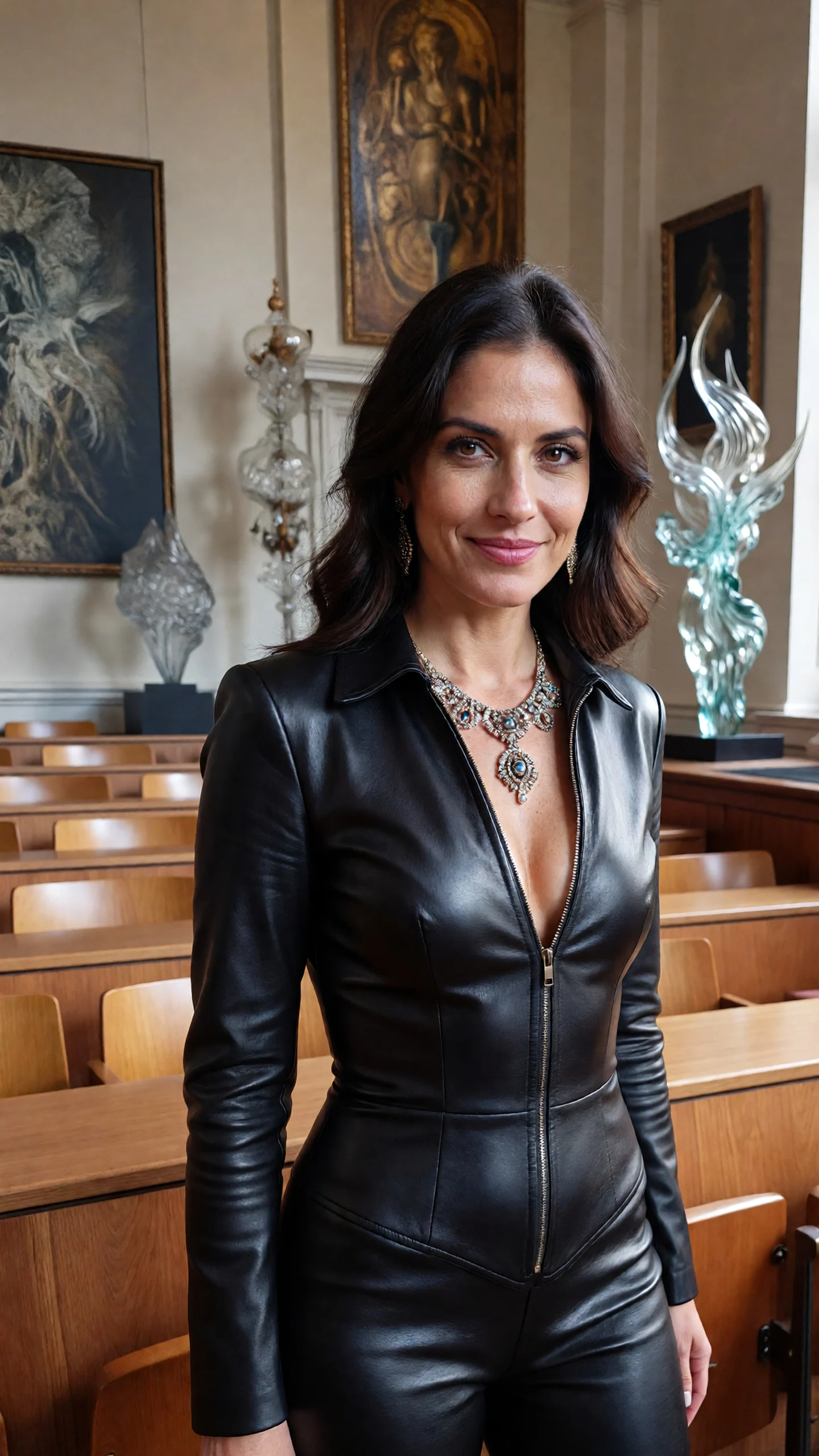
When Knowledge Becomes Desire
Some lessons cannot be learned from books alone…
In the hallowed halls of academia, where intellect reigns supreme and logic governs all, there exists a hidden curriculum—a secret education in the art of influence, the science of surrender, and the exquisite pleasure of yielding to one who knows exactly how to guide your mind… and your desires.
Meet Professor Adrian Vance: brilliant, accomplished, yet achingly uncertain in the ways of the heart. His lectures on cognitive psychology captivate students, but his attempts at romance falter and fail. He watches from the shadows as confident men claim the attention of extraordinary women, wondering if he will forever remain a spectator in the theater of desire.
Then she walks into his lecture hall.
Dr. Elsinore Blackwood—visiting professor, brilliant neuroscientist, a vision in black leather and emerald satin. She challenges his theories with razor-sharp precision, dismisses his advances with polite indifference, and ignites within him a hunger he has never known. She is everything he is not: confident, commanding, effortlessly magnetic.
But Professor Vance possesses something his rivals do not—a deep understanding of the human mind, its patterns, its vulnerabilities, its secret yearnings. And as he delves into the forbidden corners of his discipline, studying the ancient and modern arts of influence, he discovers within himself a power he never imagined.
What begins as academic curiosity transforms into mastery. What starts as clumsy attempts at connection evolves into sophisticated seduction. And what was once unrequited longing becomes… something else entirely.
Follow Adrian’s journey from uncertain scholar to master of influence, from rejected suitor to the center of an extraordinary circle of brilliant, confident women who discover in surrender a freedom they never knew they craved. Watch as glossy leather, shimmering satin, and sleek PVC become not merely fashion choices, but symbols of transformation—external reflections of internal liberation.
This is not merely a story of seduction. It is an education in the psychology of desire, a masterclass in the art of influence, and an invitation to explore the boundaries between control and surrender, between teaching and possessing, between the intellectual and the intimately physical.
Some lessons change everything you thought you knew.
Some teachers transform everything you thought you wanted.
Some knowledge, once acquired, cannot be unlearned…
Chapter One: The Scholar’s Secret Yearning awaits you below.
📖 Further chapters available exclusively to our Patreon members.
Become a free member today at members.satinlovers.co.uk to continue Adrian’s journey of transformation and discover the secrets that await within each subsequent chapter. Unlock the complete story of influence, desire, and the exquisite art of surrender.
Chapter 1: The Scholar’s Secret Yearning
The autumn light filtered through the Gothic windows of Ashworth Hall, casting long amber fingers across rows of attentive faces, each one turned toward the lectern where Professor Adrian Vance stood like a scholar-priest at his altar of knowledge. His tweed jacket, though well-tailored, hung on his frame with the resigned drape of fabric that knew it was merely functional—costume rather than couture. The leather elbow patches, worn smooth by years of gripping the edges of desks, seemed to whisper of a man more comfortable with books than with the beating hearts before him.
“The psychology of influence,” he began, his baritone voice filling the lecture hall with the resonance of someone who had learned to project authority in academic spaces, even when such authority felt like borrowed finery, “is not merely about persuasion. It is about understanding the architecture of human desire, the hidden chambers of motivation that drive decisions we believe we make freely.”
He paused, allowing the words to settle like dust motes in the afternoon light, watching as students’ pens moved across notebooks, transcribing his insights with the devotion of acolytes. This, at least, he understood. This domain of cognition and behavior, where he moved with the certainty of a cartographer mapping familiar territories. Here, in the realm of theory and research, he was master of all he surveyed.
It was in other territories—those of the heart, of connection, of the electric space between two souls—that he found himself wandering blind, mapless, hopelessly lost.
“Consider,” he continued, pacing now, his worn Oxfords clicking against the aged hardwood floor, “the concept of anchoring. In classical conditioning, Pavlov demonstrated that a neutral stimulus, when paired with a significant one, eventually comes to elicit the same response. But what if we were to apply this not to salivating dogs, but to human emotions? What if a touch, a word, a particular tone of voice could become linked to feelings of pleasure, comfort, or desire?”
A hand rose in the third row—Margaux Sinclair, the librarian who had been auditing his lectures this semester. Today she wore a midnight blue satin blouse that caught the light whenever she shifted, the fabric shimmering like the surface of a still lake at twilight. Her charcoal pencil skirt had the subtle sheen of fine leather, and Adrian found his gaze drawn to the way it caught the afternoon glow, the way it seemed to embrace her form with a lover’s devotion.
“Professor Vance,” Margaux said, her voice carrying the melodic quality of someone accustomed to quiet spaces, “are you suggesting that we can deliberately create these associations? That we can engineer emotional responses through strategic pairing of stimuli?”
Adrian felt a familiar flutter in his chest—the mixture of admiration and longing that Margaux consistently evoked. She understood. She always understood. And yet she remained as distant as the moon, beautiful and luminous and utterly beyond his reach.
“Indeed, Ms. Sinclair. The question becomes not whether we can, but whether we should—and who possesses the skill to do so ethically and effectively.”
As if summoned by the very mention of skill, the lecture hall’s heavy oak door swung open with a whisper of expensive fabric. Every head turned, Adrian’s among them, as Dr. Elsinore Blackwood entered like a force of nature given form.
She was dressed in a black leather pencil skirt that moved with her like a second skin, catching the light in ripples of midnight gloss. Above it, an emerald satin blouse draped with the casual elegance of someone who wore luxury as others wore necessity. The fabric shifted and shimmered with each confident stride, a liquid cascade of green that seemed to pulse with its own inner light. Her heels—patent leather, stilettos of predatory elegance—clicked against the floor with the rhythm of someone who knew exactly where she was going and expected the world to accommodate her arrival.
Adrian’s throat constricted. His carefully prepared lecture notes seemed to blur at the edges of his vision. Three weeks she had been at the university—a visiting professor from the Edinburgh Institute of Neuroscience—and three weeks he had been unable to form a single coherent sentence in her presence that extended beyond professional pleasantries.
“Dr. Blackwood,” he managed, his voice steadier than he felt. “We’re honored by your presence.”
“I’m certain you are.” She moved to an empty seat in the front row, crossing her legs with the deliberate grace of someone who knew the power of presentation. The leather of her skirt whispered against itself, a sound that seemed to resonate somewhere in Adrian’s chest. “Please, continue. I’m curious about your theories on ‘engineering emotional responses.’”
The slight emphasis she placed on the phrase made it clear she found the concept quaint, perhaps even naive. Adrian felt heat rise to his cheeks, but he pressed on, drawing from a reserve of professional pride.
“The process,” he said, recovering his rhythm, “involves several key elements. First, one must establish rapport—a state of harmonious connection where the subject feels understood and safe. This can be achieved through matching and mirroring: adopting similar postures, breathing patterns, even speech cadence. When we reflect someone’s reality back to them, they unconsciously perceive us as kindred spirits.”
He demonstrated subtly, shifting his stance to mirror Margaux’s attentive lean, adjusting his breathing to a slower, deeper rhythm. He noticed Margaux’s shoulders relax almost imperceptibly, her body responding to the unconscious harmony he’d created.
“Second,” he continued, “one must identify states of heightened emotion—moments of joy, excitement, or pleasure when the subconscious mind is particularly receptive. In these moments, the application of a specific, unique stimulus can create an anchor. A touch to the shoulder, a particular phrase, a specific gesture—these become linked to the emotional state, allowing the skilled practitioner to later evoke that state at will.”
“Fascinating,” Dr. Blackwood said, and Adrian could not tell if she was genuinely interested or politely dismissive. Her fingers, adorned with a single silver ring, traced the arm of her chair in a gesture that seemed deliberately hypnotic. “And you believe this has practical applications beyond the laboratory?”
“The applications are limitless,” Adrian replied, warming to his subject. “Consider the teacher who can instantly calm an anxious student, the negotiator who can evoke trust in a skeptical counterpart, or—” he hesitated, aware of the personal territory he was approaching, “—the individual who can create feelings of warmth and connection in social interactions.”
“Or the charlatan who can manipulate the vulnerable,” Dr. Blackwood countered, her green eyes sharp as cut glass. “Your theories are interesting, Professor, but they lack practical application. The controlled environment of academia is far removed from the chaos of real human interaction. People are not so easily programmed as your theories suggest.”
The lecture hall fell silent. Students glanced between the two professors with the fascination of spectators at a tennis match. Adrian felt the sting of her dismissal, but also something else—a spark of challenge that ignited his competitive instincts.
“Perhaps,” he said carefully, “the difference between theory and practice lies not in the limitations of the technique, but in the skill of the practitioner. A scalpel in untrained hands is merely a blade. In the hands of a surgeon, it becomes an instrument of healing.”
“A surgeon trains for years,” Dr. Blackwood replied, rising from her seat with fluid grace. Her leather skirt caught the light again, and Adrian found himself momentarily captivated by the play of shadow and shine across its surface. “What training do your hypothetical practitioners undergo, Professor? What ethical frameworks guide their application of these… techniques?”
She moved toward the door, clearly intending to leave, but paused at the threshold, turning back with an expression that might have been curiosity or might have been contempt.
“I look forward to seeing your theories demonstrated in practice, Professor Vance. Until then, I remain… skeptical.”
The door closed behind her with a soft click, and Adrian released a breath he hadn’t realized he’d been holding. The lecture hall buzzed with whispered commentary, but his mind was elsewhere—following the click of patent leather heels down the corridor, replaying the shimmer of emerald satin, the whisper of black leather.
“Professor?” Margaux’s voice pulled him back to the present. She had approached during his reverie, her midnight blue satin blouse now close enough that he could see the delicate stitching at the collar, the way the fabric seemed to glow with its own inner light. “That was… intense.”
“Dr. Blackwood is a formidable intellect,” Adrian managed, straightening his notes with hands that weren’t entirely steady. “Her skepticism is… valuable. It challenges us to refine our understanding.”
“Is that all she challenges?” Margaux asked, a knowing smile playing at the corners of her lips. Her leather skirt creaked softly as she shifted her weight, the sound oddly intimate in the emptying lecture hall. “Because from where I sat, it looked like she challenged more than your theories.”
Adrian felt heat rise to his cheeks. “I’m not sure I know what you mean.”
“Professor Vance,” Margaux said gently, “I’ve been auditing your lectures for three semesters. I’ve never seen you lose your composure like that. Your voice changed when she entered—deeper, more deliberate. You started mirroring her posture within seconds, though I doubt you were conscious of it.”
He stared at her, surprised by her perceptiveness. “You noticed that?”
“I notice a great deal,” she replied, her smile widening. “It’s a professional hazard for librarians. We observe, we catalog, we remember.” She glanced toward the door where Elsinore had departed. “For what it’s worth, I don’t think she’s as dismissive as she pretends. The questions she asked weren’t those of someone uninterested. They were challenges—tests to see if you could defend your position.”
“You think so?”
“I know so.” Margaux touched his arm briefly—a featherlight contact that sent an unexpected warmth through his sleeve. “If you’ll excuse me, I have manuscripts awaiting cataloging. But Professor? Perhaps consider that the skills you lecture about might be more applicable than Dr. Blackwood believes. Perhaps the gap between theory and practice is smaller than either of you realizes.”
She turned and walked toward the door, her satin blouse catching the dying afternoon light one final time before she disappeared into the corridor. Adrian stood alone in the lecture hall, his mind racing with implications.
The evening found Adrian in his office, surrounded by towers of books and the soft glow of his desk lamp. The room smelled of old paper and leather bindings—comforting scents that usually centered him. Tonight, however, his thoughts refused to settle.
He pulled a volume from his shelf: Patterns of the Hypnotic Techniques of Milton H. Erickson, M.D.—a text he had read cover to cover multiple times, but never with practical intent. Tonight, he opened it with different eyes.
“The utilization approach,” he murmured, reading aloud as the words began to take on new meaning. “The therapist accepts the patient’s reality and utilizes it, rather than fighting against it. Every behavior, every belief, every resistance can be transformed into a resource…”
He made notes in the margins, his handwriting growing more animated as connections formed. The concepts he had taught theoretically for years suddenly seemed practical, applicable, immediate.
Matching and mirroring—he had done it unconsciously with Margaux, and she had responded with relaxation and openness. What if he could do it deliberately, skillfully, with Elsinore?
Anchoring—he had described the process in lecture, but had he ever actually attempted to create an anchor? The touch to Margaux’s arm, brief as it was—had that been an accident, or had some instinct guided him?
Pacing and leading—meeting someone in their current reality before guiding them toward a new one. Elsinore’s skepticism was her reality. What if, instead of fighting it, he could utilize it?
He reached for another book: Trance-formations: Neuro-Linguistic Programming and the Structure of Hypnosis. The pages fell open to a section on embedded commands—phrases hidden within larger sentences that the conscious mind might miss but the subconscious would absorb.
“Consider the possibilities,” he read aloud, practicing the cadence. “When you begin to feel curious about these techniques, you might find yourself wanting to learn more. And as you discover new applications, you could become aware of opportunities you hadn’t noticed before.”
The embedded commands—italicized in his mind—were subtle but clear. Begin to feel curious. Find yourself wanting. Discover new applications. Become aware. Each one a seed planted in the listener’s subconscious, waiting to bloom.
He practiced for hours, refining his tone, his pacing, his emphasis. He recorded himself and played it back, adjusting and improving. The academic who had lectured about influence was becoming something else—a student of its practical application.
A knock at his office door interrupted his practice. He opened it to find Margaux, now wearing a glossy black PVC raincoat that seemed to drink in the corridor’s dim light. In one hand, she held a stack of books; in the other, a thermos.
“I thought you might still be here,” she said, her eyes taking in the scattered volumes and notes. “You missed dinner.”
“I was… working.”
“Clearly.” She entered without waiting for invitation, setting the thermos on his desk. “Tea. You look like you need it.” Her PVC raincoat rustled as she moved, the sound slick and somehow comforting. “May I ask what you’re working on? It must be something absorbing to make you forget sustenance.”
Adrian hesitated, then decided honesty might be refreshing. “I’m studying the practical application of hypnotic techniques. The things I lecture about—I’ve always understood them theoretically, but I’ve never tried to use them.”
Margaux’s eyebrows rose. “And what has prompted this sudden interest in practical application?”
“Dr. Blackwood’s challenge, if I’m honest. She said my theories lack practical application. I want to prove her wrong.”
“Or perhaps you want to prove something else to her entirely?” Margaux’s smile was knowing, almost teasing. She settled into the chair across from his desk, her raincoat creaking as it adjusted to her form. “Professor, may I offer an observation?”
“Please.”
“You’ve spent years studying how people influence each other, yet you’ve never applied that knowledge to your own life. You understand the theory of rapport, but you stand apart at social gatherings. You can describe the process of anchoring, but you’ve never deliberately created one. You know the mechanics of attraction, yet you remain alone.”
The words stung, but Adrian recognized their truth. “You’re not wrong.”
“I know I’m not.” Margaux leaned forward, her PVC coat catching the lamplight in a way that made it seem almost liquid. “So what’s different now? What has changed?”
Adrian met her gaze. “I met someone who makes me want to be different. Someone who challenges me to become more than I am.”
“Dr. Blackwood.”
“Yes.”
Margaux nodded slowly. “Then perhaps this research isn’t really about proving her wrong. Perhaps it’s about becoming someone worthy of her attention. Someone who can meet her as an equal—not just intellectually, but in all the ways that matter.”
The observation struck Adrian with the force of revelation. She was right. This wasn’t about academic pride. It was about transformation—about becoming the kind of man who could stand before a woman like Elsinore Blackwood and not feel diminished.
“How do I begin?” he asked, and the question felt like the first honest thing he had said in years.
“You’ve already begun,” Margaux replied, rising from the chair. “Awareness is the first step. The rest is practice, patience, and the willingness to fail while learning.” She paused at the door, her hand on the frame. “I’m auditing your Thursday lecture as well. Perhaps… perhaps I could be a practice partner of sorts. Someone to test techniques on, if you will.”
The offer hung in the air between them, laden with implications Adrian wasn’t sure he fully understood. “You would do that?”
“I find myself curious about these techniques as well,” she said, a slight smile playing at her lips. “Consider it a… collaborative research project. Goodnight, Professor.”
She was gone before he could respond, leaving only the lingering scent of her perfume and the echo of her PVC raincoat’s whisper. Adrian sat in the wake of her departure, mind racing with new possibilities.
He opened another notebook and began writing:
Week 1: Master matching and mirroring. Practice with Margaux. Observe results.
Week 2: Study embedded commands. Practice delivery. Test in conversation.
Week 3: Learn to identify natural trance states. Practice guiding deeper.
Week 4: Create first deliberate anchor. Test effectiveness.
It was a curriculum of transformation, a syllabus for becoming someone new. And as the clock tower struck midnight, Adrian Vance began his education in earnest—the education that would change everything he thought he knew about influence, connection, and the architecture of desire.
Outside his window, the autumn moon hung heavy and luminous, casting silver light across the campus. Somewhere in the faculty housing wing, Dr. Elsinore Blackwood was likely working late, her sharp mind dissecting some complex neurological puzzle. She had dismissed him today, but she had also come to his lecture. She had challenged him, but she had also engaged.
The difference between theory and practice, Adrian thought, watching the moonlight play across the glass, is the difference between knowing the path and walking it.
He was ready to walk.
The journey had begun.
The Journey Has Only Begun…
As Professor Adrian Vance takes his first steps toward transformation, you may find yourself wondering…
What happens when theory becomes practice?
What unfolds when a man who understands the architecture of the human mind turns that understanding toward the art of seduction?
And what becomes of the brilliant, confident Dr. Elsinore Blackwood when she encounters someone who can meet her not just as an intellectual equal, but as something far more compelling?
The path from uncertain scholar to master of influence winds through eleven more chapters of discovery, desire, and delicious surrender. Each installment reveals new techniques, deeper connections, and the exquisite pleasure of watching extraordinary women discover the freedom that lies in yielding to one worthy of their trust.
In the chapters to come:
📖 Chapter 2: Adrian’s first experiments with pacing and leading—and an unexpected encounter with Elsinore at her presentation, where she wears a burgundy leather dress that catches every eye in the room…
📖 Chapter 3: The art of anchoring revealed, as Adrian conducts a “research study” that teaches him to create powerful emotional associations with a single touch…
📖 Chapter 4: A faculty soirée where Adrian tests his developing skills against his charismatic rival, Dr. Lucien Cross, while Elsinore stuns in black PVC and Vivian Lau turns heads in form-fitting latex…
📖 Chapter 5: A private consultation where academic discussion becomes something far more intimate, and Adrian discovers how to create rapport that transcends the professional…
📖 Chapter 6: The rival’s gambit, as Lucien makes his move on Elsinore, and Adrian must find a way to offer something his competitor cannot…
📖 Chapter 7: The breakthrough session, where fractionation techniques deepen Elsinore’s trance state, and she begins to dream of Adrian’s voice…
📖 Chapter 8: Adrian’s confidence blossoms as he expands his circle to include the leather-clad Professor Isabella Conti and the vinyl-garbed research assistant Yuki Tanaka…
📖 Chapter 9: External obstacles arise as Dean Harrison questions Adrian’s methods, and Elsinore confronts him wearing midnight blue PVC that reflects her internal conflict…
📖 Chapter 10: The relationship deepens physically, as Adrian creates pleasure anchors during intimate moments, and Elsinore discovers the freedom in surrender…
📖 Chapter 11: A private gathering where group dynamics solidify, as four extraordinary women in glossy attire discover their roles within Adrian’s expanding circle…
📖 Chapter 12: The new order emerges, as Adrian’s transformation completes and the university itself begins to reflect his influence…
Continue the Journey
The transformation you’ve witnessed in Chapter 1 is merely the beginning. To follow Adrian’s complete journey from uncertain academic to master of influence—to discover each technique, each seduction, each surrender—become a free member today.
🔓 Join us at members.satinlovers.co.uk
As a free member, you’ll gain access to:
✨ All subsequent chapters of The Seductive Professor
✨ Exclusive stories exploring the art of hypnotic seduction
✨ A community of readers who appreciate the finer aspects of influence and desire
✨ Regular updates as Adrian’s story unfolds
The techniques Adrian discovers are not merely fiction. They are rooted in real psychological principles—patterns you can observe, understand, and perhaps even apply in your own journey of connection and influence.
Some lessons cannot be learned from books alone.
Some journeys cannot be completed in a single chapter.
Some transformations require a guide…
Become a member today. The next chapter awaits.
members.satinlovers.co.uk — Where sophisticated desires find their story.
#HypnoticSeduction, #AcademicRomance, #InfluenceAndDesire, #GlossyAttire, #SatinAndLeather, #SurrenderAndFreedom, #PowerExchange, #SeductiveProfessor, #PsychologicalSeduction, #SatinLovers
Leave a Reply
You must be logged in to post a comment.