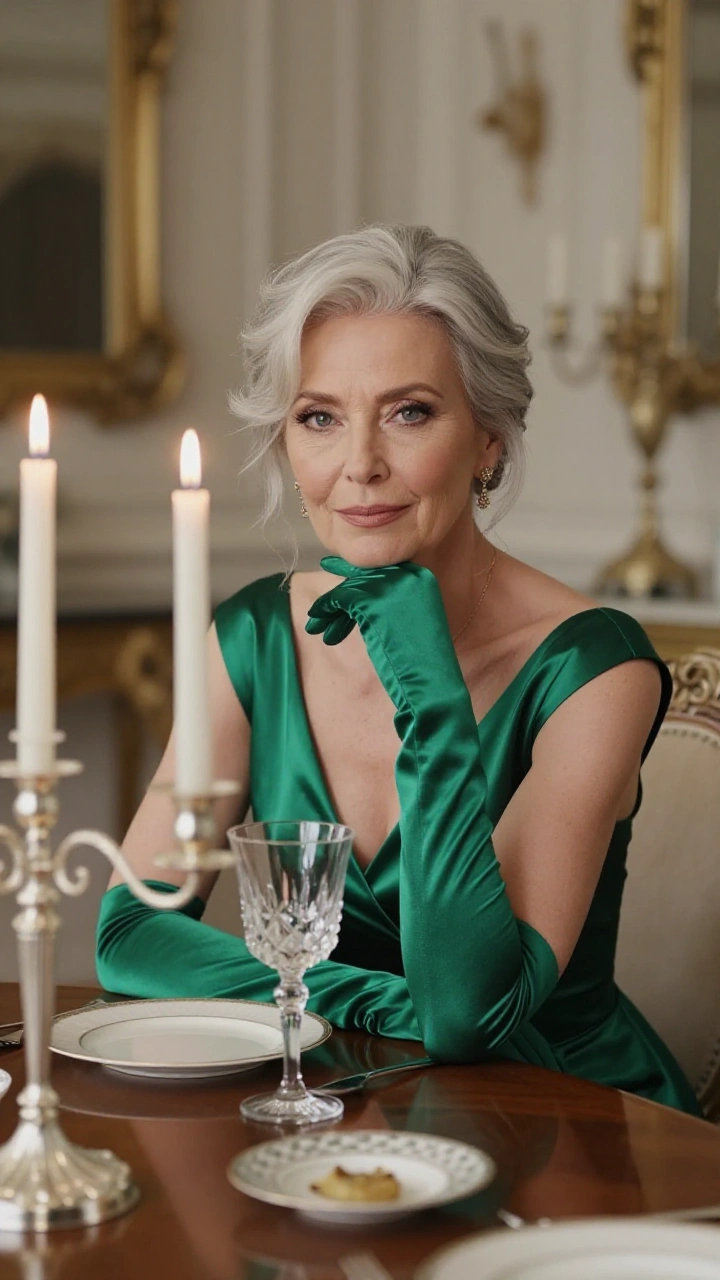
The Hostess
Previously in The Private Dinner Chapter 3: Catherine Ashworth received a mysterious summons to a Private Dinner in Belgravia. In the days that followed, she encountered a series of women—her friend Margaret in burgundy leather, her trainer Danae in glossy PVC, her assistant Olivia in gleaming leather—who each wore fabrics that caught the light and spoke of a dominant presence they admired. On the evening of the dinner, Catherine dressed in a midnight-blue satin gown and an oxblood leather jacket and arrived at 14 Eaton Square. She was greeted by Vivienne—Theodora’s companion, the voice from the telephone—who guided her through a hallway of paintings and ajar doors, past rooms that whispered of a life lived with purpose and beauty. Vivienne spoke of a household of seven women, devoted not by obligation but by choice, giving themselves to a woman who saw them fully and loved what she saw. “Generosity,” Vivienne said, “is the natural expression of a heart that has been filled to overflowing.” Then she opened the double doors, and Catherine stepped through.
Now, the dining room. The table. The woman at its head. The beginning of everything.
The room entered Catherine before Catherine entered the room.
That was the only way she could describe it afterward—the sensation that the space beyond the double doors did not wait for her to cross the threshold but reached out and received her, the way the sea receives a river, the way a held breath receives its release, the way a locked room receives the key that has been waiting, all along, in a pocket that had never been checked.
It was a dining room. And it was not merely a dining room.
The proportions were Georgian—high ceilings, tall windows draped in panels of ivory silk that caught the last of the October evening and transformed it into something softer, warmer, more forgiving than any light that had ever fallen through glass. The walls were painted in a colour that Catherine, in her professional capacity, would have called taupe but that here, in this context, in this light, in this atmosphere of deliberate and exquisite curation, revealed itself as something far more complex—a shade that shifted between mushroom and gold and the faintest whisper of rose, like the interior of a shell that has been held against the ear and heard the sea.
The table was mahogany—old mahogany, the kind that has lived through centuries of dinners and absorbed them, the surface gleaming with the deep, liquid patina that only time and care can bestow. It was set for eight: eight places, eight settings of china so fine it was almost translucent, eight arrangements of crystal that caught the candlelight—because the room was lit by candles, dozens of them, in candelabra of aged silver and sconces of beaten brass, the flames steady and warm and alive in a way that electric light, for all its convenience, can never be.
The candles cast their light upward, illuminating the faces of the women who sat at the table, and downward, illuminating the surface of the mahogany and the crystal and the china, and outward, illuminating the fabrics that the women wore—and here, Catherine’s breath caught, because the fabrics were extraordinary.
Every woman at the table was dressed in something that gleamed.
Not the dull, safe, lifeless fabrics of the world Catherine had inhabited—the wools, the cottons, the sensible tweeds that said I am competent but never I am alive. These women wore fabrics that conversed with light: satin that moved like water, leather that gleamed like polished wood, PVC that shimmered like the surface of a dark lake, silk that caught every flame and multiplied it. The effect was not uniform—each woman had chosen her own fabric, her own colour, her own cut—but the effect was unified, as though they had all been guided by the same hand, the same eye, the same understanding that beauty is not vanity but vitality, and that a woman who wears something that catches the light is a woman who has decided to be seen.
And at the head of the table, in a chair that was not larger than the others but that somehow, through presence rather than proportion, commanded the room—sat Theodora.
Catherine would remember, for the rest of her life, the first moment of seeing Theodora—not as a sequence of details but as a single, comprehensive impression, the way one remembers the first moment of hearing a piece of music that will become beloved: not the individual notes but the feeling, the atmosphere, the sense that something has shifted in the air and will never shift back.
Theodora was perhaps fifty. Perhaps more. Age sat upon her not as a burden but as an adornment—the way age sits upon certain buildings, certain wines, certain trees that have weathered storms and emerged not diminished but defined. Her hair was silver—not grey, not white, but silver, the colour of moonlight on water, swept back from a face that was not beautiful in the way that fashion uses the word but arresting in the way that certain faces are arresting: the architecture of the bones, the depth of the eyes, the particular set of the mouth that suggests not severity but discernment—a mouth that has learned to say no and yes with equal precision, and to mean both.
She wore a gown of emerald satin that caught the candlelight and transformed it into something almost liquid—a sheen that moved across the fabric like light across the surface of a deep lake, darkening and brightening with each breath, each gesture, each subtle shift of the body beneath. The satin was cut simply—no ornamentation, no embellishment, no distraction from the essential fact of the fabric itself, which was that it was alive in a way that ordinary fabric was not, that it responded to light and movement and touch as though it were not a covering but a conversation between the body and the world.
Her hands were bare—no gloves, no rings, no ornaments of any kind—and yet her hands were, in their bareness, more striking than any adornment could have made them. They were the hands of a woman who has used them—held them, moved them, rested them upon surfaces and upon people with the deliberate grace of someone who understands that a hand is not merely a tool but an instrument of communication, capable of saying more in a single touch than most mouths can say in an hour.
Her eyes were the colour of the sea on an overcast day—grey-green, deep, changeable—and they were, Catherine realised with a jolt that was not unpleasant but vertiginous, the eyes of a woman who sees. Not in the ordinary sense—everyone sees in the ordinary sense—but in the way that a photographer sees, or a painter, or a doctor who has learned to read the body’s subtle signals: with attention, with patience, with the kind of sustained, focused perception that most people reserve for moments of crisis but that Theodora, apparently, brought to every moment of every day.
Those eyes were looking at Catherine.
Those eyes had been looking at Catherine since the doors opened.
Those eyes were, Catherine understood with a certainty that bypassed thought and landed directly in the chest, the eyes that had seen her three months ago at the Tate, standing before a Hodgkin, weeping. The eyes that had recognised, in that single tear, not sadness but readiness. The eyes that had sent a serpent and a rose and a voice like warm honey to guide her here, to this table, to this candlelight, to this moment.
“Welcome, Catherine,” Theodora said.
Her voice was not what Catherine had expected. It was not deep, not resonant, not the kind of voice that fills a room through volume. It was, instead, the kind of voice that fills a room through attention—a voice that makes every word sound as though it has been chosen specifically for the person who is hearing it, a voice that does not demand silence but earns it, the way a sunset earns silence: not through command but through beauty.
“I am Theodora,” she continued, rising from her chair with a fluidity that made the movement seem less like standing and more like unfolding—the emerald satin shifting, catching light, releasing it. “And you are, at last, here.”
Catherine opened her mouth to respond—to say something appropriate, something polished, something that would demonstrate her competence and her wit and her worthiness of the summons—and found that she had no words. Not because she was intimidated—she was not, or not exactly—but because the room, the candlelight, the women, the satin, the eyes, the voice, all of it combined to create a space in which the usual currencies of social exchange—wit, charm, the clever remark—seemed not merely inadequate but irrelevant, like bringing coins to a place that dealt only in gold.
“I don’t know what to say,” Catherine admitted. It was the second time in an hour she had spoken those words—first to Vivienne, now to Theodora—and she was beginning to suspect that this honesty, this willingness to stand in the presence of something extraordinary and admit her own smallness, was not a weakness but a key.
Theodora smiled. It was a smile that transformed her face—not from severe to warm, because her face had never been severe, but from composed to radiant, the way a cloud transforms when the sun moves behind it from obscuring to illuminating.
“You don’t need to know what to say,” Theodora said. “You need only sit. And eat. And allow yourself to be where you are. The rest will come.”
She extended her hand—not to shake, but to be held. Catherine took it. The touch was brief—three seconds, perhaps four—but in those seconds, Catherine felt something travel from Theodora’s skin to her own: a warmth, a current, a recognition that was not intellectual but cellular, as though their bodies were exchanging information that their minds could not yet process. Theodora’s hand was warm, dry, firm without being hard, and it held Catherine’s with a gentleness that was, paradoxically, more commanding than any grip.
This is a woman, Catherine thought, who has held many hands. And who knows, in the first second of contact, everything that hand needs to say.
“Sit,” Theodora said, releasing Catherine’s hand and gesturing to the chair at her right. “Beside me. Where you belong.”
Catherine sat, and as she did, the other women at the table turned to her—not with the appraising scrutiny of strangers but with the warm, knowing regard of women who have been where she is now and remember it with a tenderness that is almost maternal.
Theodora introduced them, one by one, and with each introduction, Catherine’s sense of the extraordinary deepened.
“Margaret Hartwell,” Theodora said, indicating the woman to Catherine’s right—a tall, broad-shouldered woman in a burgundy leather jacket that caught the candlelight like a glass of good Bordeaux. “Consultant surgeon at Guy’s Hospital. The steadiest hands in London, and the most unflappable temperament I have ever encountered.”
Margaret smiled—the same warm, private, contained smile Catherine had seen at The Wolseley three days ago—and said, with the quiet authority of a woman who has nothing to prove: “We’ve met.”
Theodora raised an eyebrow—a gesture so elegant it barely qualified as a movement. “Have you?”
“I had lunch with Catherine last week,” Margaret explained. “I told her to dive.”
Theodora’s gaze moved from Margaret to Catherine with an expression that was not surprise but satisfaction—the satisfaction of a woman whose arrangements, however subtle, however invisible, always produce the intended result. “And did she?”
“I’m here,” Catherine said.
“So you are,” Theodora murmured, and the words carried a weight that exceeded their simplicity—a weight that said I know what it cost you to be here, and I honour that cost, and I will make it worth your while.
“Eleanor West,” Theodora continued, indicating the woman across the table—a woman of perhaps forty-five, dark-haired, fine-boned, dressed in a sheath of deep plum satin that moved like ink when she moved. “Novelist. Two Booker shortlists, one Orange Prize, and the rare distinction of having made me weep in public, which I do not do.”
Eleanor laughed—a laugh that was warm and self-deprecating and yet somehow regal, the laugh of a woman who has earned the right to find herself amusing. “She wept,” Eleanor told Catherine. “In the middle of a restaurant in Mayfair. Over a scene I had written in a fever at three in the morning, wearing pyjamas and drinking cold tea. I told her it was the cold tea that deserved the tears, but she insisted it was the prose.”
“The prose,” Theodora said, with the faintest suggestion of mock severity, “was devastating. The cold tea was merely criminal.”
“Priya Kapoor,” Theodora continued, turning to the woman beside Eleanor—a woman of perhaps thirty-eight, strikingly beautiful, with the dark eyes and sharp cheekbones of someone who has inherited beauty from multiple continents. She wore a fitted dress of black PVC that caught the candlelight like a dark mirror, its surface gleaming with a high sheen that was simultaneously modest and audacious. “Financier. She has made more money for more women in this city than anyone I know, and she has done it with an integrity that most people in her profession consider optional.”
Priya inclined her head—a gesture that was not humble but gracious, the gesture of a woman who has heard praise and accepted it without embarrassment because she knows it is deserved. “I make money for women because women spend money wisely,” she said. “And I make money for Theodora because Theodora spends it more wisely than anyone I’ve ever met.”
“Helena Marchetti,” Theodora said, indicating the woman beside Priya—a woman of perhaps fifty, with the silver-streaked auburn hair and the expressive hands of someone who has spent her life communicating through a keyboard. She wore a gown of deep navy satin, its surface shimmering like the night sky reflected in still water. “Concert pianist. She has played in every major hall in Europe and has the particular distinction of having made me weep in private, which I also do not do.”
Helena smiled—a smile that was shy and radiant and contained, like sunlight through stained glass. “I played for her once,” she said, looking at Theodora with an expression that Catherine recognised immediately, because she had seen it on the faces of Margaret and Danae and Olivia and every woman who had spoken of a dominant presence they loved: an expression of devotion so pure and so complete that it transcended the word and became something else—a state of being, a way of inhabiting the world, a quality of light that emanated from the woman who wore it and illuminated everyone around her.
“Rosalind Vere,” Theodora continued, turning to the woman beside Helena—a woman of perhaps forty-five, with the upright posture and the direct gaze of someone who has spent her life in courtrooms where posture and gaze are weapons. She wore a tailored jacket of black leather, its surface gleaming like polished obsidian, over a silk blouse of ivory. “Barrister. She has argued cases before the Supreme Court and has never lost a case she believed in, which is not the same as never losing a case, but is, I think, more important.”
“I have lost cases,” Rosalind said, her voice crisp and precise and yet warm, like a good Burgundy served at the perfect temperature. “I have never lost a case where the cause was just. Theodora taught me the difference.”
“Juno Ashby,” Theodora said, indicating the woman at the far end of the table—a woman of perhaps thirty-five, with the wild dark hair and the ink-stained fingers of someone who creates with her hands. She wore a dress of deep red PVC that caught the light like a polished ruby, its surface so glossy it seemed to be wet. “Sculptor. She works in bronze and marble and, occasionally, in the patience of the people who love her, which she tests with her refusal to eat anything green.”
“I eat green things,” Juno protested. “I eat green things occasionally. I eat green things when they are disguised as other things.”
“You eat pesto,” Theodora said. “Which is basil, oil, and cheese. The green is incidental.”
“And finally,” Theodora said, turning to the woman who had guided Catherine through the hallway and who now sat at Theodora’s left hand, dressed in the black satin sheath that had first caught Catherine’s breath at the threshold, “you have met Vivienne. My companion. My confidante. The keeper of my household and the guardian of my sanity. She is the voice you heard on the telephone, the hand that opened the door, and the reason, more often than not, that things in this house function as smoothly as they do.”
Vivienne inclined her head—a gesture that was not subservient but devoted, the gesture of a woman who has chosen her place and inhabits it with the fullness of someone who understands that chosen devotion is not diminishment but exaltation.
“She is also,” Theodora added, with a warmth that was not public performance but private truth, “the woman who has made me happier than I have any right to be, and who I do not deserve, and who stays anyway, which is the definition of grace.”
Vivienne’s dark eyes met Theodora’s, and in that meeting—in that sustained, silent, intimate exchange of gazes across a table set with silver and candlelight—Catherine saw something that made the locked room inside her not merely open but flood: the sight of two women who loved each other with a completeness that most people only read about in novels and dismiss as fiction.
It was not fiction. It was here. It was real. It was sitting at a table in Belgravia, wearing satin and leather and PVC, surrounded by candlelight and crystal and the quiet hum of women who had found, in one woman’s presence, the thing they had been searching for their entire lives.
The dinner began.
The food was extraordinary—not in the ostentatious way of Michelin-starred restaurants, where every plate is a performance and every ingredient a pronouncement, but in the quieter, deeper way of food that has been prepared with knowledge and served with love. The first course was a velouté of celeriac and pear—silky, subtle, the flavours intertwining like the voices in a duet. The second was turbot in a beurre blanc so precise it tasted like the ocean had been distilled into a single, perfect note. The third was a risotto of black truffle and aged parmesan, the rice cooked to the exact point where it yields without collapsing, where it holds its shape while surrendering its essence.
The wine was equally considered—a Sancerre with the fish, a Barolo with the risotto, each chosen not for its price but for its conversation with the food, the way a good companion is chosen not for their résumé but for their ability to make the evening more interesting.
But it was not the food or the wine that made the dinner extraordinary. It was the conversation.
Theodora did not dominate the discussion. She orchestrated it—the way a conductor orchestrates a symphony, not by playing every instrument but by knowing when each one should speak and when it should listen, when the melody should rise and when it should fall, when the silence between notes is more important than the notes themselves.
She asked each woman a question. The questions seemed simple—What are you working on? How was your week? What did you think of the exhibition at the National?—but each one, Catherine noticed, was calibrated to reach beneath the surface, to touch the place where the real life lived, the place where the public self ended and the private self began.
When she asked Eleanor about her current novel, Eleanor spoke not of plot or character but of the fear that accompanied every blank page—the fear that this time, the words would not come, that the well had run dry, that the thing that made her a writer had departed in the night without leaving a forwarding address. And as she spoke, the other women leaned in—not with the polite attention of dinner guests but with the rapt attention of women who had felt the same fear in their own work and recognised it, as one recognises one’s own face in a crowd.
When she asked Priya about a recent acquisition, Priya spoke not of the financial details but of the human ones—the woman whose company she had acquired, the years of work that had built it, the moment when Priya had looked across the negotiating table and seen not a competitor but a mirror: another woman who had built something from nothing and was now being asked to let it go. And as she spoke, Margaret reached across the table and touched her wrist—the same gesture she had made with Catherine at The Wolseley, a gesture that said I see you, I understand, you are not alone.
When she asked Helena about a forthcoming recital, Helena spoke not of the programme but of the silence—the silence that preceded the first note, the silence that followed the last, and the way that silence, in the right hands, could be more eloquent than any music. And as she spoke, Juno nodded with the particular intensity of an artist who understands that the spaces between things are not empty but full—full of potential, full of meaning, full of the same energy that, in a different medium, she tried to capture in bronze and marble.
Catherine listened. She ate. She drank. She felt the wine and the food and the conversation entering her not as sustenance but as nourishment—the kind that feeds not the body but the soul, the kind that leaves one not full but expanded, larger than one was before, more capable of containing the world and all its beauty.
And then Theodora turned to her.
“And Catherine,” Theodora said, and the room shifted—the way a room shifts when the conductor turns to the soloist, every instrument falling silent, every eye turning, every breath held. “I have a question for you.”
Catherine set down her glass. The candlelight caught the satin of her gown and the leather of her jacket and illuminated them both—the softness and the structure, the midnight and the oxblood—and she felt, in this moment, not nervous but ready, the way an instrument is ready when it has been tuned by a master hand.
“Ask,” Catherine said.
Theodora’s grey-green eyes met Catherine’s with a directness that was not aggressive but absolute—the directness of a woman who does not look away because she has nothing to hide and nothing to prove, who holds a gaze not as a challenge but as a gift, an offering of full attention in a world that rarely gives anyone its full attention for more than a few seconds.
“What is it that you truly want, Catherine?” Theodora asked. “Not what you have built your life around wanting. Not what the world has told you to want. Not what you think you should want, or what you think I want to hear, or what you think will make you sound intelligent or impressive or worthy of this table. What do you want?”
The question hung in the air like a struck note—vibrating, resonant, filling the room with its frequency. Catherine could feel the other women listening, could feel their attention like warmth on her skin, could feel the space that had been created for her answer—not a small space, not a cramped space, but a vast, open, candlelit space in which anything could be said and anything could be heard.
She opened her mouth to give the familiar answer—the one about her career, her reputation, her independence, the fortress she had built with her own hands and her own will—and the words dissolved on her tongue, because Theodora’s eyes were holding her, and in those eyes she saw not judgement but invitation, an invitation to step past the fortress, past the competence, past the carefully constructed self, and into the vast, unknown, terrifying, exhilarating landscape that lay beyond.
And so Catherine spoke the truth.
“I want to be known,” she said. “Fully. Without judgement. I want to give myself to something larger than my own ambition. I want to be part of something—not a project, not a career, but a life. A shared life. I want to stop being a fortress and start being a home. I want—” Her voice faltered, not from weakness but from the weight of what she was saying, the weight of words that had been locked in a room for years and were now, at last, seeing light. “I want to be held. Not physically—though that too—but held in the sense of being contained, being carried, being part of a structure that is stronger than I am alone. I want to stop holding everything and let someone hold me. I want to stop being the centre of my own universe and let someone else be the centre, and I want to revolve around that someone with the trust that the orbit is not a cage but a dance.”
The silence that followed was not empty but full—full of the kind of attention that is the rarest gift one human being can give another. Catherine could feel it: seven women, leaning in, holding her words, holding her, with a tenderness that was not pity but recognition—the recognition of women who had stood where she was standing and spoken the same words and been received, not with judgement, but with open arms.
Margaret reached across the table and touched her wrist.
Eleanor nodded, her eyes bright.
Priya smiled—a smile that was not social but sacred, the smile of a woman who has heard her own story in another woman’s mouth and knows, therefore, that she is not alone.
Theodora listened without interruption. When Catherine finished, the silence held for a moment longer—a breath, a heartbeat, the space between the last note of a symphony and the first sound of applause—and then Theodora spoke.
“What you describe,” Theodora said, her voice low and warm and precise, “is not weakness, Catherine. It is the deepest form of strength—the willingness to name what you need. Most people die without ever doing that. They live their entire lives in fortresses of their own construction, and they die in those fortresses, and no one ever knows what was inside. You have just opened the door. You have just spoken the words that most people take to the grave. And you have spoken them here, at this table, surrounded by women who have spoken the same words and who know, from experience, that speaking them is not the end of something but the beginning.”
She paused. The candlelight caught the emerald satin and made it glow.
“You want to be known,” Theodora repeated. “You want to be held. You want to be part of something larger than yourself. You want to give yourself to someone worthy of that gift. These are not small desires, Catherine. They are the largest desires a human being can have. And they are, I promise you, desires that can be met.”
Theodora reached across the table and took Catherine’s hand—not briefly, not perfunctorily, but fully, completely, her fingers interlacing with Catherine’s, her palm warm against Catherine’s palm, the contact sustained and deliberate and intentional.
“You have come to the right place,” Theodora said. “You have come to the right table. And you have come at the right time. The only question that remains—the only question that ever remains—is whether you are willing to stay.”
Catherine looked at Theodora—at the silver hair, the emerald satin, the grey-green eyes that saw her completely and loved what they saw. She looked at the women around the table—Margaret in burgundy leather, Eleanor in plum satin, Priya in black PVC, Helena in navy satin, Rosalind in black leather, Juno in red PVC, Vivienne in black satin—each one extraordinary, each one devoted, each one a proof that the thing Catherine wanted was not fantasy but fact, not dream but reality, not fiction but here, now, real.
She looked at Theodora’s hand, holding hers.
She looked at the candlelight.
She looked at the locked room inside herself—wide open now, flooded with light, no longer a locked room but a living room, a room in which something was growing, something was taking root, something was beginning to bloom.
“Yes,” Catherine said. “I am willing to stay.”
Theodora’s smile transformed her face from composed to radiant, and the room—the candles, the crystal, the satin, the leather, the PVC, the women, the wine, the mahogany table that had held a thousand dinners and would hold a thousand more—seemed to lean in, to brighten, to welcome.
“Then welcome,” Theodora said, and her voice was the voice from the telephone, the voice that had settled behind Catherine’s sternum and never left, the voice that was warm honey and patient intention and the promise of something vast. “Welcome, Catherine. Welcome home.”
The dinner continued. The candles burned. The conversation flowed. And Catherine, sitting at Theodora’s right hand, in satin and leather, in candlelight and warmth, felt something she had not felt since childhood—since before the fortress, since before the competence, since before the locked room and the carefully constructed self.
She felt home.
Next in The Private Dinner: Chapter Five — The Conversation. The dinner deepens. The wine flows. And Theodora, with the patient precision of a woman who has conducted a thousand such evenings, draws Catherine further into the world behind the threshold—speaking of devotion as strength, of surrender as freedom, of the euphoria that comes when a woman who has been holding everything finally learns to let go. The other women share their stories—of the lives they lived before, of the moment they chose to stay, of the bliss that followed. And Catherine, listening, feels the last walls of the fortress begin to fall.
If this chapter has moved you—if you have felt, in these words, the warmth of a table set with silver and candlelight, the pull of a gaze that sees you completely, the stirring of a longing you have carried your whole life without naming—know that the table is real. The candles are lit. The chair beside Theodora is waiting. You need only say yes.
With deepest devotion,
Dianna
Leave a Reply
You must be logged in to post a comment.