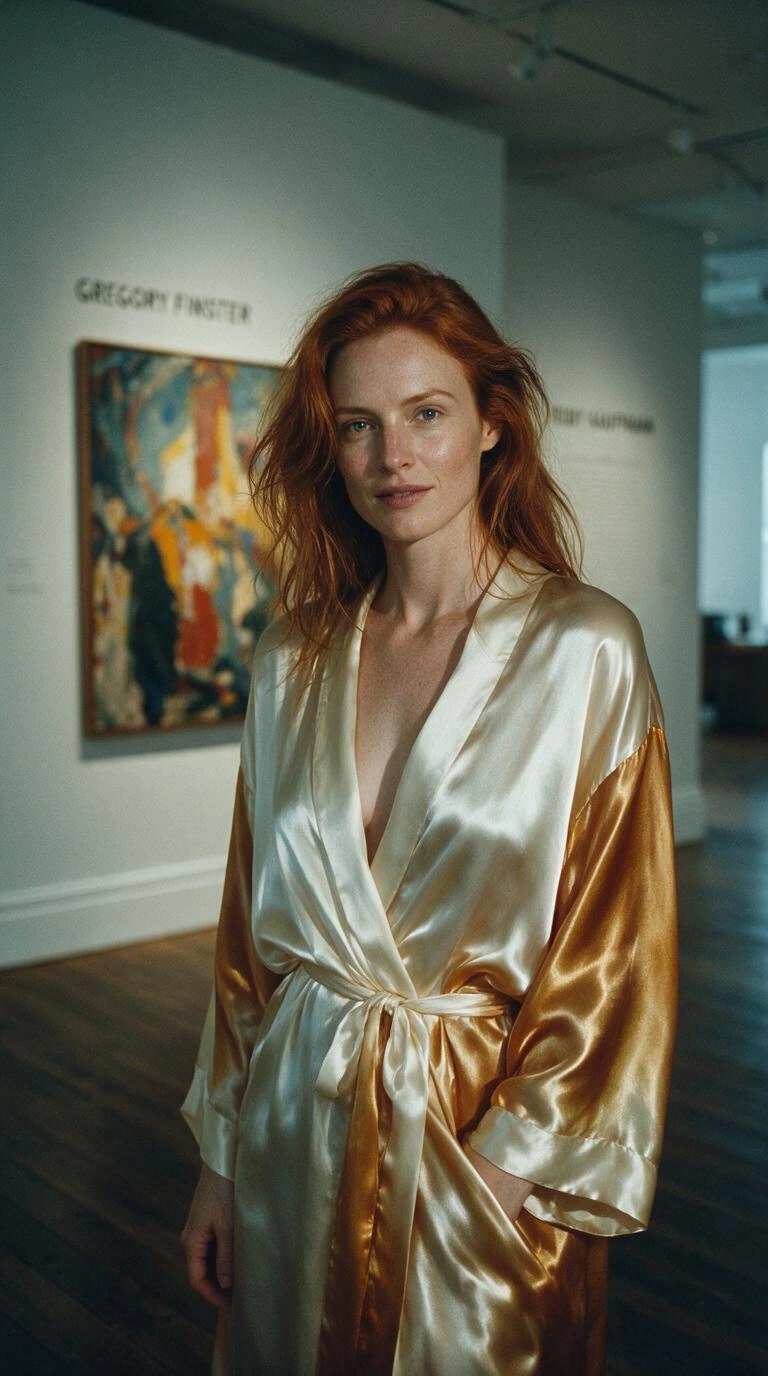
The Inner Gloss — Items #7 and #8
My darling.
Come closer. Not because anyone else is here — they’re not. That’s rather the point of today. Come closer because I want to tell you something that I’ve been building toward since the very first sentence of this series, something that I’ve been circling like a candle circles a room, illuminating different corners each time, and now, finally, we’ve arrived at the centre.
Everything we’ve done so far — the sheets, the walks, the wardrobe, the garment, the dinner, the learning — has been preparation. Beautiful, necessary, life-altering preparation, yes. But preparation nonetheless. We’ve been building the outside of you: the surface, the shine, the visible gloss. And that outside matters — oh, it matters enormously, because the world sees the outside first, and a woman who presents a glossy surface to the world is a woman who has declared her own value before anyone else can question it.
But today, my love, we go inside.
Today we talk about what happens when the door closes, the candles are lit, the phone is off, and you are — deliberately, intentionally, gloriously — alone. Not the loneliness of being left. The luxury of choosing solitude. The difference between those two things is the difference between a draught and a breeze, between a wound and an opening, between velvet and satin: one happens to you, and one is chosen by you, and the choosing makes all the difference.
I have a new friend to introduce you to. Her name is Solène, and she is the quietest woman I know, and also the most luminous, and those two facts are not coincidental.
Item Seven: The Solo Culture Date
Let me ask you something, and I want you to answer with the same honesty you brought to the Clarity Dinner questions:
When was the last time you went somewhere beautiful — entirely alone?
Not to meet someone. Not with a friend, a partner, a date, a group. Not “I was early so I wandered in for ten minutes.” Alone. For a full afternoon. A gallery, a museum, a theatre, a concert hall — somewhere built for the specific purpose of showing you something extraordinary, and you went there with no one to perform for, no one to check in with, no one to ask “what did you think?” at the end. Just you, and the art, and the silence between you.
If you’re like most women — and I was, for years — the answer is either “never” or “once, and I felt slightly strange about it.” Because here is the unspoken rule that most of us absorb without ever deciding to: going to cultural places alone is something you do when you can’t find company. It’s the fallback, the consolation prize, the thing you do when plans fall through. Going alone on purpose — dressing for it, planning it, treating it as a date — that feels almost transgressive. That feels like something only very confident people do, or very lonely people, and you’re neither, are you? You’re somewhere in the comfortable middle, where culture is something you share.
My darling. I want to dismantle that idea the way we dismantled the grey wardrobe — piece by piece, with love and with ruthlessness.
Going alone is not the fallback. Going alone is the luxury.
Here’s why. When you go to a gallery with someone — even someone you love, even someone fascinating — your attention is split. Half of you is looking at the art. The other half is managing the experience: Are they enjoying this? Should we move on? Are they bored? Should I pretend to spend less time on this painting than I want to? Do they want coffee? Should I suggest coffee? Is my face doing the right thing right now — interested, thoughtful, not too lingering, not too quick?
You are, in short, performing. Even with the best companion, even with a Celeste or a Margaux, you are performing the role of “person at a gallery,” and the performance takes energy, and the energy is not going to the art.
When you go alone, the performance stops. There is no audience. There is no one to perform for. And in the absence of performance, something extraordinary happens: you become receptive. You become a surface that the art can actually touch, because you’re not busy being a surface for someone else’s expectations. You become, in the best sense of the word, passive — not in the way of lying down and giving up, but in the way of a satin sheet receiving light: open, smooth, ready.
I want to tell you about Solène, because her story is the reason this item made the list.
I met Solène at Margaux’s second Clarity Dinner — she arrived in a satin trench the colour of a winter sky, moved through the room like a woman who was used to being the most interesting person present but didn’t need anyone to confirm it, and spoke less than anyone else at the table. When she did speak, the whole table leaned in, the way you lean in to catch a scent you can’t quite identify but know you want more of.
Over the course of the evening, I learned three things about Solène: she was a curator at a small contemporary gallery in South London, she had once been a corporate lawyer, and every Tuesday afternoon — every single Tuesday, without exception, for the past four years — she took herself on a solo culture date. A different gallery, a different museum, a different theatre. Always alone. Always dressed as if she were meeting someone worth dressing for. Because, she said, she was.
“I spent thirty years going to galleries with other people,” she told me, in that quiet voice of hers that makes you hold your breath slightly so you don’t miss a syllable. “And I spent thirty years having opinions that were half mine and half the person next to me. I didn’t know which half was which. When I started going alone, I discovered that I had taste. Not someone else’s taste that I’d been mirroring. My own. Specific, idiosyncratic, sometimes embarrassing. I fell in love with a video installation that my ex-boyfriend would have found pretentious, and I stood in front of it for forty minutes and cried, and there was no one there to tell me whether crying was the correct response, so I just cried, and it was the most honest forty minutes of my adult life.”
She paused. She sipped her wine. She looked at me with eyes that were the colour of polished slate and twice as sharp.
“That’s what solitude gives you, Dianna. Not loneliness. Honesty. The kind you can only find when there’s no one to be honest for.”
I went home that night and I booked a ticket to the National Gallery for the following Tuesday. Alone. In a satin blouse I’d been saving for “an occasion.” This was the occasion.
The Solo Culture Date Protocol:
Step One: Choose Your Venue. A gallery, a museum, a theatre, a concert hall, a sculpture park, a historic house. Somewhere with art — not a shop, not a café, not a park bench. Somewhere built specifically to show you something that someone made because they needed to make it. Art is evidence that humans have always known that life is not enough on its own — that we need to add to it, to gloss it, to make it more than functional. Art is the original gloss. Go and stand in it.
Step Two: Dress for Yourself. This is crucial, my darling. Do not go in your “running errands” clothes. Do not go in the grey cardigan you kept “just for popping out.” Dress the way you dressed for the Clarity Dinner — with intention, with gloss, with the understanding that you are meeting someone worth dressing for, and that someone is you. Wear your One Perfect Garment if you can. Wear the satin, the PVC, the high-shine nylon. Wear the thing that makes you feel like the most concentrated version of yourself. Why? Because you are about to have an intimate encounter — with art, with yourself, with the silence between the two — and you should dress for intimacy the way you’d dress for any encounter that matters.
Step Three: Leave the Phone. Not in your pocket. Not on silent. Leave it. In your bag, in a locker, at home if you’re brave enough. The phone is the anti-solitude device. It is the velvet rope between you and the experience, the fuzzy barrier that turns a painting into a photo opportunity and a moment into a status update. Without it, you are present. With it, you are performing. Choose presence.
Step Four: Linger. The rule of the Solo Culture Date is that you may spend as long as you like on anything. There is no one waiting. There is no schedule. If a single painting holds you for thirty minutes, you give it thirty minutes. If a room does nothing for you, you walk through it in ten seconds. You are not completing a course. You are not seeing everything. You are following your own attention, and your attention is a compass that has been calibrated by everyone else’s needs for your entire life, and today you are letting it point wherever it wants to point.
Step Five: Do Not Narrate. This is the hardest part, and the most important. When you see something beautiful — and you will — the instinct will be to tell someone. To text a photo. To describe it. To convert the experience into communication. Resist this. Let the experience stay inside. Let it be yours, unshared, un-narrated, like a letter you write but never send. The unshared experience is the richest kind, because it hasn’t been diluted by the act of translation. It sits in you, whole and gleaming, like a pearl in an oyster.
I did it. That Tuesday at the National Gallery. I went alone, in my champagne satin blouse, with no phone and no companion and no plan. I stood in front of a Turner painting of a sunset for — I don’t know how long. Long enough that a guard walked past twice and gave me a look the second time. Long enough that the painting stopped being a painting and became a window, and through the window I could see something I’d been avoiding for months: the fact that I was tired. Not sleepy-tired. Soul-tired. The kind of tired that comes from performing your life instead of living it.
I cried. Quietly, in the National Gallery, in a satin blouse, in front of a Turner. And then I went and had a cup of tea in the café, alone, and read nothing, scrolled nothing, and just sat with the feeling the way you sit with a good wine — letting it breathe, letting it open, letting it become what it was trying to become.
I went home different. Not dramatically — I didn’t quit my job or move to Paris. But internally shifted, the way a compass needle shifts when you move it away from a magnet. The magnet had been other people’s expectations. The needle was my own north. And for the first time in years, I could feel which direction mine was.
That’s what the Solo Culture Date gives you, my darling. Not culture — though you’ll get that too. Direction.
Item Eight: The Winter Vision Letter
And now we come to it. The most powerful item on the entire list. The one that Celeste warned me about (“be careful with this one, Dianna — it works”), the one that Margaux called “the most dangerous piece of paper a woman can write,” the one that Solène described, in her quiet, devastating way, as “the moment I stopped drifting and started navigating.”
Item Eight. The Winter Vision Letter.
Here is what you’re going to do, and I want you to feel the weight of it before I tell you the mechanics, because the weight is the point:
On the last warm evening of autumn — you’ll know it when it comes, the air will have that particular golden sweetness that means the season is ending — you are going to sit down and write a letter to your future self. The self who will exist on the winter solstice, the shortest day of the year, the darkest night. You will write it in the present tense, as if the things you want have already happened. You will make it sensory and specific and true. You will seal it in an envelope. You will write on the envelope: “Do not open until the winter solstice.” And you will put it somewhere safe and walk away from it, and you will not open it until that darkest night, when you will sit down, alone, in your satin sheets, with a candle, and read what the woman you were in autumn hoped for the woman you’d become in winter.
Let me explain why this works, because the why is where the power lives.
The human brain is a prediction machine. It is constantly, quietly, relentlessly generating expectations about what comes next, and then shaping your behaviour to meet those expectations. Most of the time, this happens below the surface — you expect tomorrow to be like today, so tomorrow becomes like today. You expect winter to be hard, so winter is hard. You expect yourself to be the same person you’ve always been, so you are.
The Winter Vision Letter hacks this system. It doesn’t just set goals — goals are abstract, fuzzy things that drift like clouds. It writes a future into existence. In the present tense, with sensory detail, with emotional specificity, it tells your brain: this is where we’re going. And your brain, that obedient prediction machine, starts — quietly, below the surface, without your conscious knowledge — shaping your days to meet the prediction.
It’s the golden hour walk, but for your life. You walk toward the light because you’ve told yourself the light is where you’re going.
The Protocol:
Step One: The Setting. The last warm evening of autumn. You’ll feel it — there’s a particular quality to the air, a sweetness that’s almost a sadness, the world saying goodbye to itself. Light a candle. Pour a glass of something. Put on music — something without words, something that opens rather than fills. Sit at a desk or a table, not on the sofa, not in bed — this is work, sacred work, and it deserves a posture of attention. Wear something that makes you feel like the woman you’re becoming — your satin robe, your One Perfect Garment if it’s comfortable enough to write in. Make the setting a ceremony, because the setting tells your brain: this matters.
Step Two: The Paper. Not a screen. Never a screen. Paper. Good paper — heavy, smooth, the kind that takes ink without bleeding. And a pen that you like — not a biro, not something that scratches. A pen that glides. The physical act of writing by hand activates different neural pathways than typing. It’s slower, which means you think more. It’s more embodied, which means the letter gets into your body, not just your head. This is a letter you’re writing with your hands, and your hands remember things your keyboard forgets.
Step Three: The Structure. Write it as a letter. “Dear [your name],” at the top. Not “Dear Future Me” — that’s too abstract, too distant. Your name. The name you answer to. The name your mother chose or the name you chose for yourself. Write to the woman who will open this envelope on the solstice, and write to her as if she already is everything you hope she’ll be.
Step Four: The Content. This is where it gets specific, and the specificity is the magic. You are going to write in the present tense, as if everything you want has already happened. Not “I hope to” or “I want to” or “I plan to.” I am. I have. I feel.
Here are the categories to cover, and I want you to be specific in each one:
Your body: “I am sleeping deeply every night, in my satin sheets, and I wake feeling rested. My body is strong — I have been walking every day, and I can feel the difference in my legs, in my spine, in the way I move through the world. I feel alive in my body.”
Your mind: “I have completed my course in [whatever you chose for Item Six], and I feel the quiet pride of a woman who has learned something new. My mind is curious, engaged, glossy with new knowledge. I am reading, thinking, growing.”
Your wardrobe: “I open my wardrobe and I see a capsule that makes me happy. Every piece is glossy, defined, mine. I get dressed in the morning and I feel like the most concentrated version of myself.”
Your home: “My bedroom is a sanctuary. The sheets are satin. The candles are lit. The space is curated, clean, mine.”
Your relationships: “I have hosted [number] Clarity Dinners. I have a circle of women who see me, who challenge me, who shine with me. I am connected, not peripherally but deeply.”
Your work or purpose: “I am engaged with my work in a way that feels meaningful. I am not just doing — I am building. I can see the shape of what I’m creating, and it is good.”
Your finances: “I have taken control of my money. I know what I have, what I’m saving, what I’m building. I feel the gloss of financial clarity — not wealth necessarily, but certainty, which is its own kind of wealth.”
Your feeling state: This is the most important one, my darling. Don’t skip it. “I feel [specific emotion]. I feel [another specific emotion]. I feel like a woman who has chosen her own life, not had it chosen for her. I feel glossy — not just on the surface, but all the way through.”
Step Five: The Seal. When you’ve written everything — and take your time, this is not a race, this is a composition — read it through once. Then fold it. Put it in an envelope. Seal the envelope. Write on the front: “Do not open until the winter solstice.” Put it somewhere you’ll find it but won’t be tempted to peek — a drawer, a book, the pocket of a coat you won’t wear until December. And then walk away.
Step Six: The Opening. On the winter solstice — the shortest day, the longest night, the moment when the year turns from dark to light — you will sit down, alone, in your satin sheets, with a candle, and you will open the envelope. And you will read what the woman you were in autumn hoped for the woman you’d become in winter.
I cannot tell you what this feels like, because it’s different for every woman, but I can tell you what it felt like for me, and I can tell you what it felt like for Solène, and I can tell you that neither of us has ever been the same since.
Mine was last December. I opened it on the solstice, in bed, in the champagne satin, with a single candle and a glass of wine. And I read it, and — here is the extraordinary, almost eerie thing — almost everything I’d written had happened. Not because the letter was magic, though it felt like magic. Because the letter had told my brain where to go, and my brain had spent three months quietly, invisibly, relentlessly steering me there. The walks, the dinners, the learning, the purge — all of it had been in the letter, and all of it had come true, because I had written it as if it already had.
The things that hadn’t happened yet? They were the things I’d been too vague about. The things I’d written as “I hope” instead of “I am.” The fuzzy ones. And I made a note, right there in bed on the solstice, that next year’s letter would have no fuzziness in it. Next year’s letter would be all satin.
Solène told me about hers over coffee, in that quiet voice, with those slate-sharp eyes. “I wrote that I would have left the gallery and started my own curatorial project. I wrote it in the present tense: ‘I have left. I have started. I am building something that is mine.’ And I read it on the solstice and I hadn’t done it. I was still at the gallery. I was still safe. And I looked at the letter and I thought: the woman who wrote this knew something I’ve been pretending not to know. I handed in my notice on the 23rd of December. I started my project in January. It launches next spring.”
She looked at me over the rim of her coffee cup.
“The letter doesn’t predict the future, Dianna. It authorises it. It gives you permission to become what you already know you are. And sometimes that’s the only thing standing between you and your own life — permission. So you give it to yourself. In your own hand. On good paper. In the present tense.”
The Fuzzy Alternative (Brief, I Promise)
You know what I’m going to say, because I’ve said it before, and I’ll say it one last time, because this is the last time we’ll be in the dark together:
The alternative is the autumn that doesn’t get lived. The weekends that pass in a soft, grey blur of scrolling and snacking and “I should really do something today” that never becomes doing. The galleries you walk past. The letter you never write because “it’s a bit silly, isn’t it?” The solitude that happens to you instead of by you — the cancelled plans, the free evening you fill with noise because silence feels like lack.
It’s the velvet life. Soft. Obscuring. The texture of almost.
And you, my darling — you who have come this far, who have done the sheets and the walks and the purge and the dinners and the learning — you are not an almost woman anymore. You are a definite woman. A woman of clasp-click decisions and satin-smooth intentions. The velvet life is not for you. It was never for you. You just didn’t know there was an alternative, and now you do, and knowing is the beginning of choosing, and choosing is the beginning of becoming.
Where We Are
Eight items down. Two to go. And the two that remain are the ones that will turn this list from a season into a life. The money episode and the gathering episode. The practical climax and the community crescendo. The moment where we talk about wealth as a fabric, and the moment where I finally — gently, lovingly, with full intention — invite you to consider that the list was never really a list at all.
☑ Item One: The Satin Sheet Switch — your nightly restoration.
☑ Item Two: The Golden Hour Gloss Walk — your daily devotion.
☑ Item Three: The One Perfect Garment — your concentrated self.
☑ Item Four: The Capsule Wardrobe Purge — your curated portrait.
☑ Item Five: The Clarity Dinner — your social gloss, gone public.
☑ Item Six: The New Thing Before the Frost — your inner gloss, expanding.
☑ Item Seven: The Solo Culture Date — your private gloss, deepened.
☑ Item Eight: The Winter Vision Letter — your future, written in your own hand.
Next week, my darling: the money. The candles. The notebook. The evening when you sit down with your finances and treat them with the same care you’ve treated your wardrobe, your bedding, your dinners, your learning. Because wealth is a fabric too — and it can be coarse and scratchy, or it can be smooth and glossy, and the difference is education and intention.
And after that? The Glossy Gathering. The final item. The door that has been waiting at the end of this whole list, the one that was always there, the one you’ve been walking toward since Part One without quite knowing it.
Celeste will be there. Priya will be there. Margaux will be there. Solène will be there. And so, my darling, will you.
Until then: go to the gallery. Write the letter. Choose the solitude. And when you sit alone in front of something beautiful, with no phone and no companion and no performance, and you feel that strange, specific, glossy feeling of being wholly present in your own life for perhaps the first time — remember this:
That feeling is not the art. That feeling is you. It was always you. The art just gave you a quiet enough room to finally hear yourself think.
Yours in solitude and satin,
Dianna 💛
P.S. — If you write the letter, tell me. You don’t have to tell me what’s in it — that’s yours, sacredly yours. But tell me you wrote it. Tell me you sealed it. Tell me where you’re hiding it. I want to know that somewhere in your house, there is an envelope with your future inside it, waiting for the darkest night to open like a flower.
P.P.S. — And if you take the Solo Culture Date, tell me what you saw. What held you. What made you stop. I have a suspicion — call it a Chronicler’s intuition — that the thing that holds you will tell you something important about yourself. It always does. That’s what art is for.
Leave a Reply
You must be logged in to post a comment.