
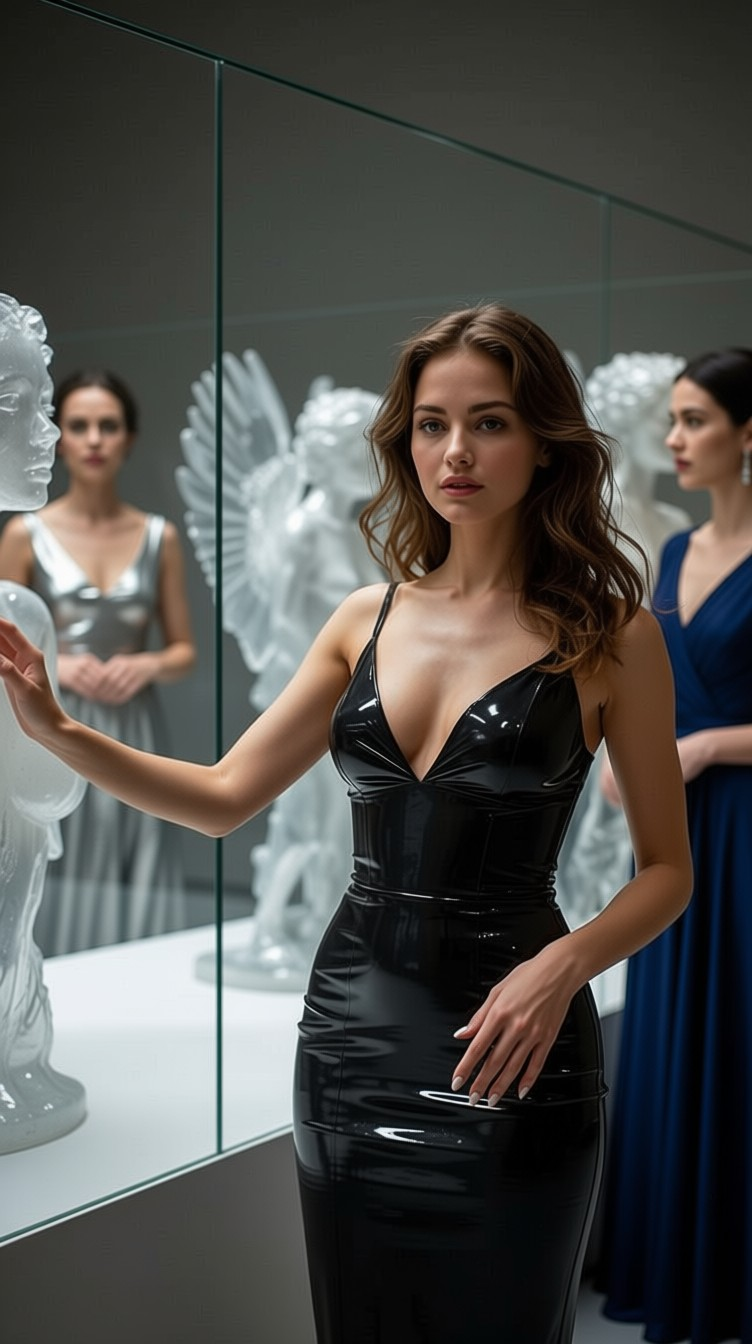
A Masterclass in the Architecture of Desire
What if the most powerful weapon in your arsenal was not what you say—but what you allow others to reveal?
In the shadowed corridors of private galleries and the hushed luxury of exclusive restaurants, a different kind of man moves among us. He does not announce himself. He does not fill rooms with his presence. Yet when he departs, those who have encountered him find themselves haunted by the question: Why do I feel more seen by this stranger than by anyone I have known for years?
Marcus Vale is such a man. And Elena Rosetti—a woman who has spent her life handling beautiful things while starving for someone to handle her heart—is about to discover what happens when the right question meets the right silence.
This is not a romance. This is a revelation.
“The Weight of Glass”
Milan breathed beneath the weight of April rain.
The Salone del Mobile had transformed the city into a living cathedral of design—showrooms spilling light onto wet cobblestones, the air thick with the scent of fresh varnish and the quiet desperation of those who had traveled from thirty-seven countries to witness beauty rendered in wood, glass, and steel.
And in a private gallery off Via Monte Napoleone, where the crowd had thinned to those who understood that true luxury requires stillness to appreciate, Marcus Vale stood before a chair made entirely of hand-blown Venetian glass.
The piece was impossible. That was its purpose.
Forty-seven individual pieces of crystal-clear glass, each no thicker than a breath, joined at angles that seemed to defy physics. The seat appeared substantial enough to hold weight, yet transparent enough that light passed through it unimpeded, casting prismatic shadows on the white marble floor. It was a meditation on fragility and strength—the kind of object that existed to teach its viewer something about themselves.
Marcus had been standing before it for eleven minutes. He had counted.
His suit was charcoal wool from a tailor on Savile Row who had dressed three generations of diplomats and financiers. The fabric caught the gallery’s recessed lighting with each subtle shift of his posture, revealing undertones of blue that emerged only in motion. His hands were clasped behind his back—not in stiffness, but in the practiced ease of a man who had learned that stillness draws more attention than movement.
His eyes, the gray of London fog before rain, moved across the chair with the patience of someone reading a text in a language he was still mastering. He was not judging the piece. He was listening to it.
What are you trying to tell me?
The glass offered no answer. Glass never did. It merely reflected—and in reflecting, revealed.
“She’s extraordinary, isn’t she?”
The voice arrived before its owner—measured, cultured, carrying the particular confidence of a woman who had spent decades being the most interesting person in any room she entered.
Marcus did not turn. Not yet. He had learned that the first moment of contact established everything that followed. Rush to face a speaker, and you revealed yourself as eager. Ignore them too long, and you announced yourself as rude. The space between—three heartbeats, perhaps four—was where presence lived.
“She,” he repeated softly, still studying the chair. “You personify it. Interesting.”
“Beautiful things deserve pronouns.” The woman moved into his peripheral vision, her heels clicking softly against marble. “Objects that inspire devotion become, in some sense, alive.”
“And what devotion does this one inspire in you?”
“Caution.” A pause, heavy with meaning. “And curiosity. A dangerous combination.”
Now Marcus turned.
She was perhaps fifty-three, though she carried her years the way certain wines carry their age—as evidence of depth rather than decline. Her auburn hair was swept up in a chignon that exposed a neck both elegant and strong. Her face bore the trace evidence of a life spent in the presence of beautiful things: fine lines around eyes that had examined countless treasures, a mouth that had negotiated fortunes, skin that held the particular glow of someone who had never wanted for money but had hungered constantly for meaning.
But it was her coat that announced her.
Burgundy PVC, floor-length, tailored to follow every curve before flaring at the ankle like the final note of a symphony. The material caught the gallery light with a liquid gleam—glossy, unbroken, suggesting depths that the eye could not penetrate. Beneath its structured weight, glimpses of cream silk whispered at her throat and wrists, the contrast between soft and severe creating an effect that was at once armor and invitation.
She was, Marcus understood immediately, a woman who had learned to present herself as a masterpiece. And she was waiting for someone to recognize that the masterpiece was a façade.
“Most people touch it,” she said, gesturing toward the chair with a hand adorned by a single ring—a sapphire, emerald-cut, the color of deep water. “They cannot help themselves. They need to know if the danger is real. They need to feel the fragility beneath their fingertips, even if feeling it means destroying it.”
“And yet you haven’t touched it either.”
“No.”
“Because you already know the danger is real.”
She turned to face him fully, and her eyes—sharp, dark, assessing—met his with the directness of someone who had grown weary of games.
“I know danger when I see it.” Her lips curved, not quite a smile. “I also know value. The piece is not for sale, you know. It belongs to a private collector who loans it only to spaces he trusts. The gallery owner has been trying to acquire it for three years. The answer is always the same.”
“Trust,” Marcus repeated, the word landing between them like a stone dropped into still water. “A valuable currency. I wonder how much he paid for it—not in euros, but in years. In careful choices. In the accumulation of the reputation that makes such trust possible.”
The woman’s expression shifted almost imperceptibly. The almost-smile faded. What replaced it was something more alert, more present.
“You speak as if you know him.”
“I speak as if I understand the architecture of trust.” Marcus finally allowed himself to hold her gaze fully. “It is not so different from the architecture of glass, really. Both require heat. Both require patience. And both can shatter in an instant if handled by someone who does not understand their nature.”
She was silent for a long moment. When she spoke again, her voice had dropped half a register—intimate, as if they were the only two people in the gallery.
“What do you see,” she asked, “when you look at it? At the chair?”
Marcus considered the question. He could have answered superficially—commented on the craftsmanship, the audacity of the design, the way light behaved in its presence. But he understood that such an answer would close a door that had just begun to open.
“I see a question,” he said finally. “The artist asking: What will you risk to possess beauty? The glass does not invite touch. It dares it. And in daring, it reveals the character of everyone who approaches. Do they reach out, driven by the need to conquer? Do they pull back, fearing damage? Or do they simply stand—and let the beauty exist without needing to own it?”
He turned to her. His voice was quiet, but each word carried weight.
“I see the same question in many things. In art. In business. In people.” A pause. “What will you risk to possess beauty? And what are you willing to let exist without possessing it at all?”
The woman felt something shift in her chest—a sensation she had not experienced in years. It was not attraction, exactly. Or rather, it was attraction’s more sophisticated cousin: the pull toward someone who saw past the surface into currents she had forgotten existed.
“You’re not here for the furniture fair,” she said. It was not a question.
“No.”
“Then why?”
“To listen.” He gestured toward the chair. “Beauty speaks. Most people are too busy talking to hear it. I have found that silence—true silence, the kind that creates space for others to fill—is the most undervalued skill in the world. It is also the most magnetic.”
She found herself wanting to fill the silence he had just created. She found herself wanting to tell him things—about her life, her work, the private collection she had built over three decades. She found herself wanting to know his name.
How is this happening? she wondered. He has asked me nothing. He has revealed nothing. And yet I feel as if I am standing on a ledge, preparing to step into air.
“You have an extraordinary way of looking at things,” she said, her voice carrying a transparency that surprised her. “At people.”
“I have an ordinary way of looking,” he corrected gently. “What is extraordinary is how rarely people truly look. Most of us spend our lives scanning—surfaces, opportunities, threats. We catalogue without seeing. We hear without listening.” He gestured toward the chair again. “The glass is transparent. Anyone can see through it. But how many have stood where we stand and truly seen what it is trying to teach?”
“Which is?”
“That strength and fragility are not opposites. That beauty does not require possession. That the most valuable things in life are the ones that ask us to become worthy of them.”
The woman was silent. The gallery had grown quieter around them—the last of the day’s visitors filtering out, the staff beginning to cast glances toward the doors. Somewhere in the distance, a phone rang and went unanswered.
“My name is Vivienne,” she said finally. “Vivienne Chevalier.”
She extended her hand. The burgundy PVC shifted with the movement, light sliding across its surface like water.
Marcus took her hand—not too firmly, not too softly, but with a pressure that matched her own. His skin was warm, his grip unhurried. He held the contact exactly long enough.
“Marcus Vale.”
“Italian?”
“By ancestry. English by upbringing. By choice, I belong to no single place.”
“A citizen of the world.” Her eyes narrowed slightly, appraising. “Or a man who has not yet found where he belongs?”
“Or a man who has found that belonging is not a location.” He released her hand. “It is a practice. A way of being present wherever you are, fully enough that the location ceases to matter.”
Vivienne felt her pulse quicken. The words were simple enough. But something beneath them—a current, a pull, a sense of doors opening into rooms she had not known existed—made her feel slightly unbalanced.
“You should come to my gallery,” she heard herself say. “I have a collection that would interest you. Not furniture—paintings. Renaissance, mostly. Works that have stories most people never bother to learn.”
“I would like that.”
She reached into her handbag—a clutch of cream leather that matched the silk at her throat—and withdrew a card. Glossy white stock, black lettering, a single phone number. No address. The location of her gallery was known only to those who had earned the privilege.
“Call tomorrow. I will arrange a private viewing.” She paused, then added something she had not planned to say: “I find I want to know what you see when you look at my paintings. I suspect it will be different from what anyone else has seen.”
Marcus took the card. He studied it for a moment—not the text, but the weight of the paper, the texture of the finish. Then he slipped it into the inner pocket of his jacket, over his heart.
“I will call.”
“And the chair?” She gestured toward the glass sculpture. “Will you touch it before you go?”
Marcus turned back to the piece. The light had shifted as the afternoon waned, and the glass now threw prisms across the walls like scattered stars. It was more beautiful now than it had been eleven minutes ago, when he had first stopped before it.
“No,” he said. “I will let it be. Some beauty should exist without being claimed. It teaches us that not everything in life requires our ownership to matter.”
He turned back to Vivienne. His gray eyes held hers with a steadiness that felt like a promise.
“Though I suspect you already know that. You wear armor so elegant that most people forget it is armor at all. But you have been touched enough by those who did not understand what they were reaching for. Perhaps it is time for someone to simply stand beside you—and let you exist without needing to be possessed.”
Vivienne’s breath caught.
The words had landed somewhere beneath her ribs. She had built her life on being the one who possessed—the collector, the curator, the woman who decided what was worthy and what was not. She had not realized, until this moment, how exhausting it had been to never be simply seen.
What is this man? she wondered. And why do I feel as if he has known me for years, when we have exchanged no more than twenty sentences?
“I will expect your call,” she said, her voice carrying a softness she had not intended to reveal.
“Tomorrow. Eleven o’clock.”
“No earlier?”
“I would not want to interrupt your morning rituals. The time one takes for oneself, before the world begins to make demands—that is sacred time. I have learned to respect it in others.”
Vivienne felt something crack open inside her—some wall she had not known existed. She had not told him about her mornings. She had not mentioned the hour she spent in silence before the rest of her household awoke, the coffee she drank in darkness, the way she used those sixty minutes to prepare herself for the performance of being Vivienne Chevalier.
How does he know?
But even as she asked, she understood. He did not know her specific rituals. He knew something deeper: that a woman like her—a woman who presented herself as a masterpiece—would need time, every day, to paint the canvas before stepping into the world.
It was the same thing he had seen in the glass chair. Not the object itself, but what the object revealed about everyone who approached it.
“Tomorrow, then,” she said. “Eleven o’clock.”
She turned and walked toward the gallery’s exit, her burgundy coat catching the last of the afternoon light. At the door, she paused and looked back.
Marcus had already returned his attention to the chair. He was standing exactly as he had been when she first approached: hands clasped behind his back, gray eyes moving across the glass with patient attention.
He is not watching me leave, she realized. He is not trying to have the last word. He has returned to the present moment, as if our conversation was simply another note in a symphony he is still listening to.
And for reasons she could not have articulated, this made her want to see him again more than any pursuit ever had.
She stepped into the Milan rain, and did not look back again.
Inside the gallery, Marcus remained before the chair for seven more minutes.
He was thinking about Vivienne Chevalier—about the armor she wore, about the softness she had revealed in those final moments, about the hunger that lived behind her composed exterior. He was not thinking about these things with calculation. He was not strategizing.
He was simply listening to what his instincts had observed.
She is a woman who has spent her life being admired, he reflected. But admiration, after a certain point, becomes its own form of invisibility. The admirer sees only the surface—the glossy exterior, the accomplishment, the masterpiece. They do not see the artist beneath.
She wants to be known. Not admired. Known. And she has almost given up hoping that anyone is capable of it.
He pulled the card from his pocket and studied it again. White stock. Black ink. A phone number that connected to a woman who had spent decades building walls so elegant that no one recognized them as walls.
Tomorrow at eleven, he would call. And when he arrived at her gallery, he would do what he had done today: he would listen. He would create space. He would ask questions that invited her to see herself more clearly.
And in that seeing, she would begin to anchor herself to him.
Not because he had manipulated her. Not because he had performed. But because he had offered the rarest gift in the world: the experience of being truly witnessed.
This was the art of the unspoken. This was the architecture of trust.
And Marcus Vale had spent twenty years mastering it.
He slipped the card back into his pocket, turned from the glass chair, and walked into the Milan evening—where the rain had softened to mist and the lights of the city were beginning to glow like embers in the gathering dark.
CHAPTER TWO “The Arrangement”
The estate outside Geneva existed in no guidebook.
It had been built in 1847 by a banking family whose fortune had since dispersed into the foundations of European infrastructure—railways, telegraph lines, the quiet architecture of continental commerce. The house remained: a château of pale limestone and slate roofs, surrounded by gardens that had been designed to appear wild while concealing meticulous planning behind every apparent chaos.
Tonight, the château’s ballroom had been transformed into an auction house of the most discreet variety. No catalogues. No public listings. The invitation had arrived by private courier, printed on paper so thick it whispered when handled, bearing only a date, a time, and coordinates that resolved into the estate’s location when entered into secure navigation systems.
Thirty-seven people moved through the space, champagne flutes catching light from crystal chandeliers that had hung in place for a hundred and seventy-three years. The women wore gowns that cost more than most automobiles. The men wore watches that cost more than most houses. And none of them looked at each other with anything other than professional curiosity.
They were here for manuscripts.
Love letters. Forty-three of them, written in the hand of a Renaissance courtesan whose name had been erased from history by those who found her influence inconvenient. Scholars had debated their existence for centuries. Tonight, the debate would end—not in public academic journals, but in private ledgers that would never be examined by anyone outside a very small circle.
Marcus Vale stood at the edge of the ballroom, his back against a wall covered in silk damask the color of aged champagne. He wore a suit of charcoal worsted wool, its surface absorbing light rather than reflecting it—a deliberate choice. Tonight was not about being seen. Tonight was about seeing.
His employer—a consortium whose name he had never been told and whose members he had never met—had engaged him for a specific purpose: to assess authenticity. Not of the letters. Others were more qualified for that task. His purpose was to assess the authenticity of the people.
Who here is genuine? he had been asked. Who here wears their desires on their surface, and who has buried them beneath acceptable facades? Who might become… useful?
He had agreed without asking what “useful” meant. The fee was substantial. The work was interesting. And he had learned, over years of such assignments, that the answers usually revealed themselves in time.
His eyes moved across the room with the patience of a man reading a book he intended to savor.
There. A collector from Munich, leaning too close to a young woman who was clearly not his wife, his hunger for acquisition extending beyond manuscripts into territories that would cost him dearly if observed by the wrong people.
There. An American tech founder, laughing too loudly, his discomfort in these surroundings leaking through the cracks of his performed confidence. He did not belong here. He knew it. And his desperation to prove otherwise would make him careless.
And there—
His gaze settled on a woman standing apart from every cluster, her attention fixed on a display case near the far wall where three of the letters had been laid out for examination under magnifying glasses and soft light.
She was perhaps thirty-four. Her hair was dark, almost black, swept back from her face in a style that exposed the clean architecture of her jaw and the slender column of her neck. Her gown was black silk—no, not merely black. Black that drank light, that seemed to create darkness rather than simply occupy it. Its surface was so smooth that even the chandelier’s brilliance seemed to slide off it, like water from glass.
But it was her stillness that caught him.
Everyone else in the room was performing. Even those who stood alone were performing solitude, arranging their expressions into masks of bored sophistication. This woman was not performing. She was reading.
He watched her lift one of the magnifying glasses. Watched her eyes move across the faded ink with the focus of someone listening to a voice only they could hear. Watched her lips part slightly—not in performance, but in genuine response to something the letter contained.
She is not here to acquire, Marcus thought. She is here to understand.
He had seen this before, though rarely. Most people at auctions treated the objects as commodities—investments, status symbols, weapons in battles of social positioning. This woman treated the letters as if they were still alive. As if the woman who had written them was standing beside her, whispering secrets across five centuries of silence.
He wanted to know what she heard.
He waited until the first round of bidding had concluded—six letters sold for sums that would have funded hospitals, schools, the kind of infrastructure that the château’s original builders had once championed. The crowd had thinned slightly as the auction’s intermission began, guests drifting toward the terrace for air, toward the smoking room for negotiation, toward private corners for the kinds of conversations that would never be recorded.
The woman had drifted too. Not toward people—toward the garden.
Marcus followed at a distance that would not intrude but would not lose her. The terrace doors stood open, spilling light onto stone paths that wound between hedges and fountains and sculptures that had been commissioned by artists whose names had outlived the banking family’s fortune.
He found her beside a pool where koi the color of sunset traced lazy circles through black water. She had wrapped a shawl of some gossamer fabric around her shoulders—white, translucent, catching the moonlight like a whisper made visible. Her back was to him, her attention fixed on the water’s surface, where the fish moved like living flames beneath the dark mirror.
She knew he was there. He could tell by the subtle shift in her posture—the almost imperceptible straightening of her spine, the slight turn of her head that brought him into her peripheral vision.
She did not acknowledge him. Neither did she move away.
Interesting, he thought. She is testing me. Will I rush to fill the silence? Will I announce myself with the awkwardness of someone who does not understand the space between strangers?
He did neither.
He simply approached—slowly, without sound on the soft grass—and stopped at a distance that allowed conversation without intrusion. Three feet. Perhaps slightly more. Close enough to speak without raising his voice. Far enough to allow her to turn and face him if she wished, or to remain as she was if she preferred the water’s company.
They stood in silence for seventeen seconds. He counted.
“It’s a strange thing,” he said finally, his voice pitched low enough that the words would not carry beyond them, “to read someone’s love letters in a room full of people who see them only as investments.”
She turned then. Not quickly—there was no startle in the movement, no performed surprise. She turned the way a flower turns toward light, with the inevitability of something that had been waiting for the right stimulus.
Her face was more striking up close than it had been across the ballroom. Her eyes were dark, almost black, set beneath brows that arched with the precision of architectural elements. Her mouth was full, painted a deep burgundy that echoed the color of wine left too long in the glass. Her skin was pale, luminous in the moonlight, with the kind of clarity that came not from cosmetics but from the absence of the need for them.
She was, he understood immediately, a woman who had learned that her beauty was not her most interesting feature. And she had grown weary of anyone who failed to recognize this.
“Strange?” she repeated, her accent carrying traces of Italian beneath polished international English. “Or honest? The letters were written to be read. Perhaps the only dishonesty is pretending they matter only for their provenance.”
“You read them as if they were still alive.”
“They are alive. Every time someone reads them. Every time someone wonders what it felt like to write words that could destroy you if they fell into the wrong hands.” She turned back to the pool. “The woman who wrote these letters—her name was Caterina. She was twenty-three when she met the man who would become her correspondent. A cardinal, if the scholarship is correct. A prince of the Church. And she loved him enough to put ink to paper, knowing that each letter was evidence that could have seen her executed and him destroyed.”
“Love as an act of courage.”
“Love as an act of madness.” She paused. “Though perhaps they are the same thing.”
Marcus moved closer—not enough to intrude, but enough to establish a different kind of presence. The air between them shifted.
“You speak about her as if you know her.”
“I know the type.” The woman’s voice had grown quieter, more interior. “Women who love beyond reason. Women who give everything to someone who can never fully belong to them. Women who—” She stopped herself, a flicker of something—recognition? pain?—crossing her features before the composure returned.
“You’ve been that woman,” Marcus said. It was not a question.
She turned to face him fully, and her eyes met his with an intensity that felt like a door being unlocked.
“You are either very perceptive,” she said, “or very presumptuous.”
“I am both. Though I try to deploy the latter only in service of the former.”
The ghost of a smile touched her lips. “And which are you deploying now?”
“Observation.” He held her gaze without flinching. “I watched you examine those letters. You were not cataloguing. You were not assessing condition or provenance or the likelihood of authentication. You were listening. To a woman who has been dead for five hundred years, but whose voice still reaches you through the ink she left behind.”
The woman was silent. The koi continued their endless circles. Somewhere in the distance, music from the ballroom drifted through the open doors—something baroque, strings and harpsichord, structured beauty concealing emotional depths.
“My name is Elena,” she said finally. “Elena Rosetti.”
“Marcus Vale.”
“I know.”
He raised an eyebrow.
“You were pointed out to me. Before the auction began.” She gestured toward the château with a movement so graceful it seemed choreographed. “There are people here who have been watching you all evening. They described you as a man who notices things. A man who listens.”
“And did they warn you to stay away?”
“They warned me to be careful.” Her eyes held his. “I have never been very good at careful.”
“Careful is overrated. It protects you from danger. But it also protects you from discovery.”
“Discovery of what?”
“Of the things you already know but have not allowed yourself to voice. Of the hungers you have buried beneath accomplishments and armor. Of the—” He paused, choosing his next words with surgical precision. “Of the person you might become if someone gave you permission to stop performing.”
Elena’s breath caught. It was subtle—a nearly invisible movement of her chest beneath the black silk—but he noticed. He noticed everything.
“You speak,” she said slowly, “as if you can see inside me. As if you know things I have never told anyone.”
“I cannot see inside you. No one can do that. But I can see the shape of what you hide. The contours of your armor. The places where the weight has worn grooves into your spirit.”
“My armor.” Her hand moved unconsciously to touch the silk at her shoulder. “You mean this? The gown?”
“I mean whatever you have wrapped around yourself to survive a world that has never asked what you need—only what you can provide.”
The words landed between them like a stone dropped into still water. Elena felt ripples spreading outward, touching places she had kept hidden for years.
How? she wondered. How does he know? I have spent my entire life being the one who provides. The one who finds the beautiful things, who authenticates the treasures, who makes the deals that build collections and legacies. I have never—
No one has ever asked.
The realization was like a knife sliding between her ribs. Not because it wounded, but because it released something that had been pressurized for too long.
“I spent my childhood in Florence,” she heard herself saying. The words emerged without her permission, drawn forth by the gravity of his attention. “My mother cleaned houses. The houses of collectors. I used to accompany her sometimes, when I was very young. I would sit in corners and stare at the walls—paintings, tapestries, sculptures. Objects I could never own. Beauty I could never possess.”
“And yet you built a career around them.”
“I built a career around understanding why people need them. Why the collectors my mother worked for surrounded themselves with things they could touch but never truly have. Why beauty becomes an addiction for people who cannot find it anywhere else.”
“And what did you conclude?”
“That everyone is hungry. Everyone is starving for something they cannot name. And beautiful objects are just—mirrors. They reflect the hunger back without ever satisfying it.”
She turned to him, her eyes bright with something that might have been tears, though none fell.
“But that’s not what I really learned. What I really learned is that I am just like them. I have spent my life curating beauty I cannot keep. Building collections I will never own. Giving everything to people who take without giving back, because I never learned how to ask for what I actually need.”
“And what do you actually need?”
The question hung in the air. Elena felt its weight pressing against her chest, demanding an answer she had never allowed herself to articulate.
“I don’t know,” she admitted. “I have never let myself think about it.”
“No,” Marcus said gently. “You know. You have always known. You have simply been too afraid to say it, because saying it would make it real, and making it real would mean you might never get it. And the possibility of wanting something you cannot have is more painful than never wanting at all.”
She stared at him. The moonlight caught the tears she had been holding back, turning them into light.
“What do you think I need?”
“I think you need what Caterina needed. What every woman who has ever written letters she could be destroyed for has needed.” He took a step closer—near enough now that she could feel the warmth of his presence. “You need someone worth surrendering to. Someone whose strength makes your surrender feel like freedom rather than defeat. Someone who receives what you give and multiplies it rather than consuming it.”
“And where would I find such a person?”
“I have no idea.” His voice was soft, but his eyes held hers with unwavering intensity. “But I suspect you have been looking for him your entire life. And I suspect that when you find him—if you find him—you will recognize him not by what he says, but by how you feel when he listens.”
Elena felt something crack open inside her. Some wall she had built so long ago that she had forgotten it was a wall. Some armor she had worn so constantly that she had mistaken it for skin.
“Who are you?” she whispered.
“A man who listens.” He reached into the inner pocket of his jacket and withdrew a card—white stock, simple black lettering, a phone number. “And a man who will be at Le Ciel in Paris, two weeks from tonight. A restaurant that requires introduction, but I suspect you know how to find such places.”
He pressed the card into her hand. His fingers brushed her palm—warm, deliberate, electric.
“If you want to continue this conversation, you know where to find me. If you do not, I will understand. Some doors are easier left closed.”
He released her hand and stepped back.
“Think about what you need, Elena. Not what you should want. Not what the world expects you to want. But what you actually need. And when you have an answer—if you have an answer—bring it to Paris.”
He turned and walked back toward the château, leaving her standing beside the koi pool where living flames traced circles through black water, beneath a moon that had watched five hundred years of women searching for something they could not name.
Elena stood motionless for a long time.
The music drifted across the garden. The fountain played its endless liquid song. The koi swam their patient loops. And somewhere inside her chest, something that had been asleep for a very long time began to stir.
What do you actually need?
She looked down at the card in her hand. White stock. Black ink. A phone number.
Two weeks, she thought. Paris. Le Ciel.
She had heard of it. Everyone in her world had heard of it. A restaurant that existed only for those who knew to ask, where reservations were not made but granted, where the tables were occupied by people whose names appeared in no public records but whose decisions shaped the movements of markets and nations.
He moves in circles I have only observed from the outside.
He listens in a way no one has ever listened.
He sees through armor I have spent a lifetime constructing.
She should be afraid. She should be suspicious. She should be asking herself what he wanted, what game he was playing, what price he would eventually demand.
But instead, she found herself thinking about the letters she had examined—the ones written by a woman who had loved beyond reason, who had committed her forbidden desires to ink and paper, who had trusted someone enough to hand him the power to destroy her.
Caterina knew, Elena thought. She knew that surrender is not weakness. Not when you choose it. Not when you choose someone worthy of receiving it.
She slipped the card into her evening bag, beside her own identification, her own secrets, her own carefully maintained life.
Two weeks, she thought again.
And for the first time in longer than she could remember, she felt something that might have been hope.
CHAPTER THREE
“The First Silence”
Paris at midnight wore light like jewelry.
From the window of Le Ciel—positioned on the fourth floor of a Haussmann building whose address appeared on no map—the city spread below in grids of amber and gold. The Eiffel Tower pulsed its hourly beacon across the arrondissement, and the Seine caught fragments of radiance as it wound through the heart of the capital like a ribbon of liquid mercury.
The restaurant itself was a study in intentional darkness. Black lacquer walls reflected candlelight from surfaces so polished they appeared wet. The tables were few—no more than twelve—and separated by distances that made each feel like a private room. The ceilings were high, painted with constellations in gold leaf against midnight blue, creating the illusion of dining beneath an eternal sky.
There was no menu. There was no sign outside. There was only a heavy door of carved mahogany that opened to those who knew it existed, and a maître d’ who asked no questions and remembered every face.
Marcus had arrived seventeen minutes early.
He had chosen his clothing with deliberate care for the evening—a suit of midnight blue wool so dark it appeared black until light moved across it, revealing depths of color that shifted like the ocean at night. His shirt was white, cutaway collar, fastened with studs of black onyx. His tie was silver silk, knotted in a manner that suggested English tailoring and public school origins. He wore no watch—timepieces were unnecessary for a man who had learned to measure moments by the quality of the attention they contained.
His table was positioned against the wall, offering a view of both the entrance and the city beyond the windows. He had specifically requested this placement. A man who sat with his back to a door was a man who had not learned the value of awareness. A man who faced the entrance while allowing his companion to survey the room was a man who understood the subtleties of psychological comfort.
He ordered nothing. He simply waited.
She may not come, he thought. The ground we covered in Geneva was substantial. Some women need time to process what they have revealed to themselves. Some women need to retreat behind their armor before they can risk lowering it again.
But he knew she would come.
He had read something in Elena Rosetti’s eyes that could not be unread—a hunger so long suppressed it had become part of her cellular structure. Women like her did not retreat from the possibility of being seen. They might pretend to. They might perform hesitation, construct obstacles, invent reasons to delay.
But eventually, inevitably, they moved toward the light.
She arrived precisely at eight o’clock.
The maître d’ escorted her through the maze of tables with the quiet efficiency of a man who understood that his role was to be invisible, and Marcus watched her approach with the same patient attention he had given to the glass chair in Milan.
Her gown was emerald green silk—a color that caught the candlelight and transformed it into something almost liquid, as if she were wrapped in captured starlight. The fabric moved with her, clinging and releasing in rhythms that suggested rather than revealed, promising depths beneath its surface that no superficial glance could penetrate. Over it, she wore a coat of black leather so supple it draped like water, its glossy surface throwing reflections in every direction, creating an aura of dark light around her form.
Her hair was loose tonight—dark waves falling past her shoulders, freed from the controlled style she had worn in Geneva. Her face was luminous in the candle’s glow, her lips painted the same deep burgundy he remembered, her eyes scanning the room with an alertness that softened only when they found his.
She did not smile when she saw him. She did not perform pleasure or surprise or any of the social rituals that typically accompanied reunion. She simply looked at him—really looked, with the same intensity he had observed when she examined the letters—and allowed whatever she was feeling to exist without apology.
Good, he thought. She has decided not to pretend. This is progress.
“Elena.” He rose as she approached, a gesture that cost him nothing and signaled everything. “You found it.”
“Le Ciel.” She stopped before the table, allowing the maître d’ to guide her coat from her shoulders. Beneath it, the emerald silk revealed the architecture of her form—strong shoulders, a waist that suggested disciplined attention, hips that carried the memory of generations of Italian beauty. “A restaurant that does not exist. I had to call in three favors just to learn which building to enter.”
“And yet you came.”
“I came.” She allowed him to seat her, the silk whispering against the chair as she settled into place. “Though I have not yet decided why.”
“Perhaps you wanted the conversation we began in Geneva to continue.”
“Perhaps.” Her eyes held his across the table, the candle between them throwing dancing shadows across her features. “Or perhaps I wanted to understand how you did what you did. In fifteen minutes, you made me reveal things I have never spoken about. Not to colleagues. Not to friends. Not to lovers.”
“I did not make you reveal anything. I created space. You chose what to fill it with.”
“That is a distinction without a difference.”
“It is the most important distinction in the world.” He leaned forward slightly—not enough to intrude, but enough to establish a different kind of presence. “When someone makes you reveal something, they have taken. When someone creates space for you to choose what to reveal, they have given. The result may appear the same from the outside. But the internal experience is entirely different.”
Elena was silent. The waiter appeared—a ghost in black who placed glasses of champagne before them and vanished without a word. The bubbles rose through the golden liquid like frozen time.
“You said you would be here,” she said finally. “Two weeks. You said to bring an answer to a question I did not know how to answer.”
“And have you found an answer?”
“I have thought of almost nothing else.”
A silence opened between them. Marcus held it—not filling the space with words, not rushing to guide the conversation, simply waiting with the patience of a man who understood that the most important things emerge only when given room to breathe.
Elena felt the silence pressing against her. In any other encounter, she would have rushed to fill it. She would have deployed charm, wit, professional observation—any weapon in her considerable arsenal to maintain control of the interaction. But something about Marcus’s stillness disarmed her. It did not demand; it invited. It did not pressure; it waited.
He actually wants to hear what I have to say, she realized. Not because it serves his purposes. Not because he can use it against me. But because—
Because he is interested. In me. Not in what I can provide. Not in what I represent. In who I actually am.
“When I was twelve years old,” she heard herself say, “my mother took me to work with her for the first time. She cleaned the house of a man named Bellini—a collector whose walls were covered in Renaissance paintings. Not the great masters, but their students, their followers. Works that were beautiful but not valuable enough to require museums.”
She paused, lifting her champagne glass and taking a small sip. The wine was excellent—probably older than she was, crisp and golden, tasting of minerals and time.
“I remember standing in his gallery. A long room with tall windows and parquet floors. There were twenty-three paintings on the walls. I counted. And I remember thinking: this is what wealth looks like. Not the money itself, but the ability to surround yourself with things that need nothing from you. Things that exist simply to be beautiful. Things that require nothing but your attention.”
“You envied him.”
“I envied the paintings.” Her laugh was soft, self-aware. “I thought: they have found their place. They hang on these walls, in this light, and they are complete. They do not need to be anywhere else. They do not need to be anything more than what they are.”
“And you felt you had not found your place.”
“I felt—” She stopped, searching for words precise enough to carry the weight of the memory. “I felt like something that had been created without being finished. As if the artist had begun the work and then walked away, leaving me incomplete. Waiting for something—or someone—to come and add the final brushstrokes.”
The waiter returned, placing plates before them—duck confit, the skin bronzed and glistening, surrounded by vegetables arranged with the precision of a still life. Neither Marcus nor Elena looked at the food. Their attention remained locked on the space between them.
“You have spent your life seeking that completion,” Marcus said. It was not a question.
“I have spent my life seeking beauty. Curating it. Authenticating it. Building collections for people who have more money than understanding.” Her voice had grown quieter, more interior. “I thought it would be enough. To be near beautiful things. To touch them, examine them, know their secrets. I thought proximity to beauty would make me beautiful by association.”
“And has it?”
Elena looked down at her plate. At her hands—elegant, capable, wearing no rings, no ornaments. At her reflection in the polished surface of the table, ghostly and indistinct.
“No,” she said. “It has only made me more aware of what I lack. The objects I handle are complete. They are what they were made to be. And I am—” She broke off, something raw flickering across her features before she controlled it. “I am still waiting to become what I was made for. Still waiting to discover what that even is.”
“Tell me about your work,” Marcus said. The shift seemed abrupt, but his voice carried a subtle instruction: Do not dwell in the wound. Describe the context that has shaped it.
Elena accepted the redirection without resistance. “I am an acquisition specialist. My clients are collectors, institutions, private individuals whose names you would recognize. They hire me to find objects they cannot find themselves, to authenticate provenance, to negotiate acquisitions that must remain invisible.”
“Invisible,” he repeated. “You make yourself invisible to serve their visibility.”
“I make myself useful.” A defensive edge crept into her voice. “I have built a reputation. I am respected in my field. My opinion can determine whether a painting sells for ten thousand euros or ten million.”
“And yet you described yourself, a moment ago, as incomplete.”
The defensive edge collapsed. Elena reached for her champagne again—this time drinking more deeply than before.
“I have built a career on being the one who provides. The one who finds. The one who authenticates. I give my expertise, my judgment, my knowledge to every transaction. And at the end of each day—” She stopped, her throat tightening. “At the end of each day, I return to an apartment filled with catalogs and photographs and files. With images of beautiful things that belong to other people. With the hollow satisfaction of having served others’ desires while never naming my own.”
“What are your desires, Elena?”
She stared at him. The question was simple. Direct. It carried no judgment, no expectation, no subtle instruction about what the answer should be.
What are my desires?
No one had ever asked her this. Not her family, who had expected her to achieve enough to justify their sacrifices. Not her colleagues, who competed with her in arenas where desire was a weakness to be exploited. Not her lovers—whoever they had been, however many or few—who had assumed that her desires matched their own or did not matter enough to inquire.
“I want—” She stopped. Started again. Stopped.
The silence held her. Marcus held the silence.
“I want to stop performing,” she whispered. “I want to stop being the one who always has the answer, who always knows the value of everything, who can authenticate anything except herself. I want—” Her voice cracked, and she felt tears threaten. “I want someone to ask me what I need and actually wait for the answer. I want someone to see past the expertise, past the reputation, past the armor I have built, to the woman underneath who has been waiting to be discovered for thirty-four years.”
She looked up at him, her eyes bright with unshed tears.
“Is that too much to ask?”
“No.” His voice was gentle, but his attention was fierce. “It is exactly enough to ask. It is the only thing worth asking.”
He reached across the table—not to take her hand, but to rest his fingertips near hers on the white linen. A gesture of presence. A reminder that she was not alone in the silence she had created.
“You have built an extraordinary life,” he said. “Expertise. Reputation. The trust of powerful clients who depend on your judgment. These are not small achievements. They are the foundation upon which everything else is built.”
“But?”
“There is no but. There is only continuation. You have built a life that serves others. Now the question becomes: what will you build that serves yourself? Not instead of what you have created, but alongside it. Not in opposition to your achievements, but in fulfillment of them.”
“I do not know how.”
“Of course you do not. You have spent your entire life learning how to serve. No one has taught you how to receive. No one has modeled what it looks like to have needs and express them and trust that they might be met.”
His gray eyes held hers with unwavering intensity.
“But you can learn. If you want to. If you are willing to trust someone enough to show you how.”
Elena felt something trembling inside her—not fear, exactly, but the vertigo of standing at the edge of a cliff, looking down into depths she could not measure.
“How do I know who to trust?”
“You do not. Not until you take the risk of trusting them. Trust is not something that can be proven in advance. It can only be demonstrated through the act of extending it.”
“That seems—” She searched for the word. “Dangerous.”
“It is. The most important things always are.” He withdrew his hand, leaning back slightly to give her space. “But consider the alternative. You could continue as you have been. Building collections for others. Filling your apartment with images of beautiful things that belong to other people. Performing competence and expertise while the woman underneath slowly fades from lack of nourishment.”
His voice softened.
“Or you could take a risk. You could trust that the hunger you have felt your entire life is not a flaw to be overcome, but a signal pointing toward what you actually need. You could let someone show you what it feels like to be seen—all the way through, past every layer of armor—and discover that being seen does not destroy you, but completes you.”
Elena sat in silence. The duck confit cooled on their plates, untouched. The candle between them guttered in some imperceptible draft, shadows dancing across the black lacquer walls.
“What if I choose wrong?” she finally asked. “What if I trust someone who is not worthy of it?”
“Then you will learn something valuable about yourself. You will learn that you can survive betrayal. You will learn that your armor can be pierced and you will still exist. And you will learn to recognize the difference between someone who takes and someone who receives.”
“And which are you?” The question emerged with an edge that surprised her. “A taker or a receiver?”
“I am a mirror.” He met her challenge without flinching. “I reflect what is shown to me. If you approach me with performance, I will reflect the performance. If you approach me with truth, I will reflect the truth. What you experience in my presence is not something I impose—it is something you bring, finally given permission to exist.”
“And if what I bring is ugly? Broken? Unworthy of reflection?”
“Then we will both discover that ugliness and brokenness are not the same as unworthiness. They are simply textures in a larger composition. The Japanese have an art called kintsugi—repairing broken pottery with gold lacquer. The breaks become part of the beauty. They do not diminish the vessel; they enhance it.”
He leaned forward again, his voice dropping to a register that seemed meant only for her.
“I have spent twenty years learning to see people as they are, not as they pretend to be. And I have never once encountered someone whose true self was unworthy of attention. I have encountered fear. I have encountered pain. I have encountered years of accumulated armor that has calcified around wounds that never healed. But beneath all of it—always—there is something precious. Something waiting to be discovered by someone patient enough to look.”
Elena felt the tears finally spill over, tracking down her cheeks in the candlelight. She did not wipe them away. She did not apologize for them. She simply let them exist.
“I do not know how to do this,” she admitted. “I do not know how to let someone see me. I have spent thirty-four years perfecting my invisibility. The thought of dropping it—of standing exposed—” She shuddered. “It feels like dying.”
“It is not dying. It is being born.” His gray eyes held her tears without judgment, without pity—only understanding. “The birth is always painful. But what emerges on the other side is not the person you were pretending to be. It is the person you have always been, finally given permission to exist.”
He reached into his jacket and withdrew a handkerchief—white linen, monogrammed with initials she did not recognize, pressed to a crispness that suggested careful storage. He placed it on the table between them, not handing it to her but offering it, allowing her to choose whether to accept.
“You do not have to decide anything tonight,” he said. “You do not have to drop your armor in a single gesture. You can take as much time as you need. You can reveal yourself in increments, testing at each stage whether the space you have entered is safe enough to continue.”
“But you want me to continue.”
“I want nothing from you that you are not ready to give. That is not a platitude—it is a principle. I have learned that receiving something before someone is ready to give it poisons the gift. Whatever flows between us must emerge from your readiness, not my appetite.”
Elena stared at him through her tears. The candlelight caught the moisture on her cheeks, turning it to gold.
He means it, she realized. He actually means it. He is not performing patience. He is not waiting for me to let my guard down so he can take what he wants. He is waiting because—
Because he values what is being offered more than the speed with which it arrives.
“How?” she whispered. “How do I learn to trust? When every experience I have had has taught me that trust is rewarded with betrayal?”
“You begin by trusting small things. You begin by extending faith in increments and observing what happens. And when those increments are honored—when the trust is received rather than exploited—you extend a little more.”
He gestured toward the handkerchief still lying between them.
“You can begin now if you choose. You can wipe your tears and pretend this conversation never happened. You can exit into the Paris night and return to your apartment full of catalogs and photographs. Or—”
He let the word hang.
“Or you can accept that I have seen something true tonight. That I have witnessed a woman who is tired of performing, tired of providing, tired of being strong. And you can let that witnessing stand—without retreating, without apologizing, without pretending it never occurred.”
Elena looked at the handkerchief. At the candle. At Marcus’s gray eyes, which continued to hold her with patient attention.
What would it feel like? she wondered. To let this moment exist without erasing it? To let someone see me in a state I have spent my entire life hiding?
Her hand moved toward the handkerchief—not to reject it, but to pick it up. The linen was cool and smooth against her fingers. She brought it to her face and dabbed at her tears, an action so simple it should have meant nothing.
But it meant everything.
She was not hiding. She was not apologizing. She was letting herself be seen.
“Thank you,” she said, her voice rough.
Marcus nodded once—a gesture of acknowledgment that carried no excess, no performance.
“Would you like to eat?” he asked. “The duck is exceptional here. And I suspect you have not allowed yourself a proper meal in longer than you can remember.”
Elena laughed—a genuine sound, surprised out of her by the shift in tone. “How did you know?”
“Because I have been watching you. Not just tonight—in everything. The way you hold yourself. The discipline of your form. You treat your body the way you treat everything else: as an instrument to be managed rather than a vessel to be nourished.”
“You make me sound—”
“Like someone who has forgotten that she deserves care.” He picked up his fork and knife, demonstrating that the conversation could continue while the body received attention. “Perhaps tonight you might remember. Even a little.”
Elena picked up her own utensils. The duck was cool now, but still delicious—rich and savory, the skin crackling with each bite. She had not realized how hungry she was until she began to eat.
“Tell me about yourself,” she said between bites. “You have spent the entire evening asking questions. You have revealed nothing about who you are, where you come from, what you want.”
“I have revealed everything that matters.” He cut a precise piece of duck, lifted it to his mouth, chewed slowly. “You know that I listen. You know that I see. You know that I receive without taking. The other details—the biography, the geography, the lists of accomplishments—are simply furniture in the room of who I am. They tell you nothing about how I will be in your presence.”
“I want to know anyway.”
“Why?”
“Because—” She stopped, trying to articulate something she barely understood. “Because I have given you pieces of myself tonight. And some part of me needs to know that exchange is not entirely one-sided. That you understand what it means to reveal.”
Marcus set down his fork. His gray eyes grew distant, as if looking at something far away in time or space.
“I was married once,” he said. “Fifteen years. I thought I knew everything about her. I thought my attention was complete, my understanding total. And then one day she told me she had been running from me for a decade.
CHAPTER FOUR “The Return”
Rome in autumn carried the weight of centuries in its bones.
The light fell differently here than in Paris—older, somehow, as if the sun had traveled through layers of history before reaching the cobblestones and worn marble facades. The air tasted of dust and ancient stone and the particular sweetness of cypress trees that had watched empires rise and fall from their stations along immortal roads.
Elena stood before the entrance to Palazzo Corsini, her heart conducting a symphony of rhythms she had not requested. Two weeks had passed since Paris. Two weeks of sleepless nights, of conversations replayed in her mind like records spinning on endless repeat, of questions multiplying in the darkness while answers remained stubbornly out of reach.
She had not expected to see him again so soon.
When the message had arrived—delivered by courier to her apartment in Milan, written in handwriting she did not recognize on cream stationery that smelled faintly of sandalwood—she had told herself it was coincidence. A professional opportunity. An invitation to consult on a Bernini sketch that had surfaced in a private collection and required authentication by someone whose discretion was as valued as her expertise.
He knew I would accept, she thought, standing motionless before the palazzo’s massive wooden doors. He knew that the pretense of professional necessity would give me permission to return without revealing how much I wanted to.
The understanding should have alarmed her. It did alarm her—in the abstract way that standing at the edge of a cliff alarms someone who has never learned to trust their own balance. But beneath the alarm, beneath the rational voice warning her that she was stepping into territory she could not map, there was something else.
Relief.
For the first time in longer than she could remember, she did not have to pretend that she did not want to see someone. She did not have to perform indifference, construct barriers, maintain the careful distance that had defined her every significant relationship. The invitation had been extended. She had accepted. And now she stood at the threshold, dressed in a coat of black leather so supple it moved like liquid shadow, over a sheath of cream silk that whispered against her skin with each breath.
She had chosen the clothing deliberately. The leather—glossy, commanding, impenetrable—represented the armor she had worn her entire life. The silk beneath—soft, luminous, exquisitely vulnerable—represented what she suspected lay underneath.
He will see both, she thought. And somehow, I want him to.
The doors opened before she could knock.
The Palazzo Corsini was closed to the public that day.
She had known it would be. The arrangement had specified a private viewing—a privilege reserved for scholars, dignitaries, and those whose connections extended beyond the reach of ordinary access. The galleries stretched before her in silence, their walls hung with masterpieces that had witnessed revolutions, occupations, the rise and fall of ideologies that had sought to claim art as propaganda.
A guard appeared—not to inspect her credentials, but to guide her through the labyrinthine corridors toward a room she had not visited since her graduate studies. The walls here were covered in crimson silk damask, the floors inlaid with parquet patterns that spoke of craftsmen long dead. And in the center of the room, mounted on an easel of polished walnut, was a single drawing.
A Bernini sketch. A study for his sculpture of Daphne, caught in the moment of her transformation into a laurel tree. The figure’s face showed terror and wonder in equal measure—her fingers elongating into leaves, her toes rooting into earth, her body suspended between humanity and something beyond it.
“It is extraordinary,” said a voice behind her. “Is it not?”
She did not turn. Not immediately. She had learned, in Paris, that Marcus Vale moved through the world at his own pace, and that rushing to acknowledge his presence would signal a eagerness she was not yet prepared to reveal.
“It is a study in metamorphosis,” she said, keeping her eyes on the drawing. “The moment when everything changes. When the self you have known dissolves into something unrecognizable.”
“And is that dissolution tragedy? Or liberation?”
“Bernini seems to suggest it is both.”
“Perceptive.” She heard him approach—the soft sound of leather soles on parquet, the subtle shift of air that announced another body entering her space. He stopped beside her, close enough that she could feel the warmth of his presence, far enough that the distance between them remained respectful.
“The sculpture was commissioned by a cardinal,” he continued. “A man of the Church who spent his life in service to an institution that demanded the suppression of certain desires. And yet he chose to immortalize a story about a woman pursued by a god, who escapes that pursuit through transformation. One wonders what he saw in the myth.”
“Perhaps he saw himself.” Elena finally turned to face him. “Pursued by forces he could not name. Seeking escape through transformation into something his pursuers could no longer recognize.”
Marcus wore a suit of charcoal wool today, its surface absorbing the gallery light rather than reflecting it. His shirt was white, his tie the color of aged wine. His face was calm, composed—but his gray eyes carried something she had not seen in Paris.
Depth, she thought. As if something has shifted behind the surface since we last met.
“You look well,” he said. “The light in Milan must agree with you.”
“I have not been in Milan. I have been—” She stopped, uncertain how much to reveal. “Traveling. Thinking.”
“Thinking about what?”
“About what you said. About trust. About the risk of letting someone see past the armor.” She gestured toward the Bernini. “About whether transformation is tragedy or liberation.”
“And what have you concluded?”
“That I do not know. That perhaps the answer reveals itself only in the transformation itself. That asking the question from the outside is like trying to describe the taste of wine you have never sipped.”
Marcus nodded slowly—a gesture of acknowledgment that carried no judgment.
“I have been thinking as well,” he said. “About our conversation in Paris. About what I shared, and what I held back.”
“You shared very little. You deflected every question I asked about yourself.”
“I know.” His voice carried an edge she had not heard before—something raw beneath the composed surface. “And I have been considering whether that was fairness or manipulation. Whether I created space for you to reveal yourself while refusing to meet you in that space.”
Elena felt something shift in her chest—a recalibration of her understanding of this man.
He has been examining his own conduct, she realized. He has been questioning whether he earned what I gave.
“I told you in Paris that I was married,” he continued. “That my wife spent a decade running from me without my knowledge. I did not tell you the rest.”
“The rest?”
“The reason she ran.” He turned to face the Bernini, his profile illuminated by the gallery’s subtle lighting. “I was a man who believed that attention was the same as presence. That providing was the same as giving. That asking questions was the same as listening to the answers.”
He paused, and she watched something move across his features—the shadow of a pain that had not fully healed.
“I asked her questions constantly. About her day, her work, her thoughts, her feelings. I believed I was being attentive. A good husband. Engaged. Interested.” His voice grew quieter. “But I was not listening to her answers. I was cataloguing them. Filing them away in some mental database that I believed constituted knowing her. And all the while, she was telling me—without words, in the spaces between the sentences I was so careful to parse—that she was drowning in a marriage where she was seen but not witnessed. Questioned but not heard.”
Elena felt a chill move through her.
He is describing me, she thought. The life I have built. The relationships I have maintained. The constant sensation of being asked questions by people who do not actually want the answers.
“What happened to her?” she asked softly.
“She left. Not dramatically—there was no explosion, no betrayal in the conventional sense. She simply disappeared into herself until the woman I had married no longer existed. And then she told me she had been gone for years. That I had been married to a performance without realizing it was not the truth.”
“Did you try to find her? The real her?”
“I tried something more difficult.” He turned back to face Elena, and his gray eyes held hers with an intensity that felt like a hand reaching through darkness. “I tried to find myself. The part of me that had been so focused on being the right kind of husband that I had forgotten to be present with my wife. The part that had mistaken performance for intimacy. The part that had built an entire identity around providing for others without ever learning how to receive.”
Elena was silent. The Bernini drawing hung between them, Daphne frozen in her moment of impossible transformation.
“And did you? Find yourself?”
“I found something. A practice. A way of being in the world that prioritizes presence over performance, receiving over taking, space over filling.” He gestured toward the drawing. “I learned that the most powerful thing I could offer another person was not my expertise, not my provision, not my attention—but my silence. The space in which they could finally hear themselves think.”
Calibrated silence, Elena thought, remembering Paris. The technique he used on me. The way he created room for me to reveal things I had never spoken.
“You were testing me,” she said. “In Paris. You were using the technique you developed after your marriage ended.”
“I was not testing you. I was offering you what I have learned to offer—the only thing of genuine value I possess.” His voice softened. “But I withheld something in return. I let you reveal yourself without meeting you in that space. That was not fairness. It was calculation dressed as patience.”
“And tonight you are correcting that.”
“Tonight I am attempting to.” He reached into the inner pocket of his jacket and withdrew a small object—a key, wrought from iron, its surface worn smooth by generations of handling. “This is the key to my home outside Florence. A palazzo that has been in my family for three generations. I am offering it to you.”
Elena stared at the key in his palm.
“You barely know me.”
“I know what you revealed in Paris. I know that you are tired of performing, tired of providing, tired of being strong. I know that you have spent your life curating beauty for others while starving for someone to see the beauty in you.” His voice dropped to a register that seemed to bypass her ears entirely and speak directly to something deeper. “And I know that I am offering something I have never offered to anyone since my marriage ended. Not control. Not possession. But the possibility of a space where you do not have to perform. Where you can discover what it feels like to be witnessed without the armor, without the expertise, without the carefully maintained distance.”
Elena felt her hand trembling as she reached toward the key. She stopped herself before making contact.
“Why?” she whispered. “Why offer this to me? You could have anyone. Women who are more beautiful, more accomplished, more—”
“More practiced at performing,” he interrupted gently. “More skilled at showing me what they believe I want to see. More accomplished at constructing the appearance of intimacy while protecting themselves from its reality.”
He closed his hand around the key, holding it between them like a question.
“I am not interested in performances, Elena. I am interested in truth. And truth, in my experience, is the most precious and rare thing any human being can offer. When I encountered you in Geneva—when I watched you read those letters as if they were living voices speaking across centuries—I recognized something I had seen only rarely in my life. A woman who had not yet forgotten how to feel.”
“I have forgotten,” she said, the words emerging with a rawness she had not intended. “I have spent years forgetting. The armor you speak of is not something I constructed consciously—it is something I built layer by layer, year after year, until I no longer remembered what it was designed to protect.”
“Then let us discover together what lies beneath.”
He extended his hand again, the key resting in his palm like an offering to something sacred.
“Come to Florence. Not tonight—take whatever time you need to arrange your life, to prepare yourself, to decide whether this is a door you truly want to open. But know that the invitation is genuine. Know that when you arrive, you will find a space where the only expectation is that you be present. Where the only request is that you bring whatever you are carrying—even if what you are carrying is broken.”
Elena looked at the key. At his face. At the Bernini drawing, where Daphne’s face showed terror and wonder in equal measure as she transformed into something she had never been before.
“What if I am too broken?” she asked. “What if the layers have gone too deep? What if, when you finally see what lies beneath the armor, you find something you do not want to witness?”
“Then I will witness it anyway.” His voice was steady, certain. “And I suspect I will find what I have found every other time I have looked past someone’s defenses—not brokenness, but buried treasure. Not damage, but diamonds formed under pressure. Not something to be discarded, but something to be polished.”
He placed the key in her hand, closing her fingers around it with his own.
“I have spent fifteen years learning to see people as they truly are,” he said. “And I have never once encountered someone whose true self was not beautiful. Wounded, perhaps. Guarded, certainly. But beautiful.”
Elena felt the weight of the iron key in her palm—cool, solid, real.
This is madness, she thought. I have known this man for three conversations. I am accepting a key to his home. I am standing in a closed museum in Rome, wearing leather and silk, holding the physical symbol of an invitation I do not fully understand.
And yet—
And yet it feels like the first honest thing I have done in years.
“When?” she asked. “When should I come?”
“That is for you to decide.” He released her hand, stepping back to restore the respectful distance between them. “The palazzo will be there whenever you are ready. The key will work whenever you turn it. And I will be present whenever you arrive.”
“And if I need time? If I need to think, to process, to determine whether this is something I truly want?”
“Then take the time you need.” His gray eyes held hers with an expression she could not quite name—something between patience and anticipation. “I have learned that genuine connections cannot be rushed. They must emerge at their own pace, in their own time. Any attempt to accelerate the process simply creates another performance.”
“But you want me to come.”
“I want nothing from you that you are not ready to give.” He smiled then—a genuine expression that transformed his face, softening the edges of his composed exterior. “Though I confess I hope you will come. The palazzo has been empty for too long. And I suspect the walls are hungry for someone who knows how to see beauty.”
Elena looked down at the key again. At the worn iron, the shape that spoke of old locks and older doors.
“I am afraid,” she admitted. “I am afraid of what I might find when I stop performing. I am afraid of what you might find when the armor comes off.”
“I know.” His voice was gentle. “Fear is the natural companion of transformation. It is the voice that tells you the cliff is high, the water is deep, the unknown is dangerous. And sometimes that voice is correct—sometimes the cliff is too high, the water too rough, the unknown too treacherous.”
He reached out and touched her cheek—a gesture so brief, so light, it might have been imagined.
“But sometimes the voice is lying. Sometimes the cliff reveals wings you did not know you had. Sometimes the water bears you up instead of pulling you down. Sometimes the unknown is simply the not-yet-discovered.”
He withdrew his hand.
“The question is not whether you are afraid. The question is whether the fear is the only voice you will listen to.”
Elena stood in the gallery, surrounded by masterpieces that had witnessed centuries of human striving. The Bernini drawing hung beside her, frozen in its moment of metamorphosis. Marcus stood before her, offering nothing but space and presence and the worn iron key that now rested against her palm.
What would it feel like? she wondered. To walk through a door without knowing what lay on the other side? To trust someone enough to let him see what I have spent a lifetime hiding?
What would it feel like to stop running?
“I will come,” she heard herself say. “I do not know when. I do not know what I will bring. But I will come.”
Marcus inclined his head—a gesture of acknowledgment that carried no triumph, only acceptance.
“Then I will be waiting.”
He turned and walked toward the gallery’s exit, his footsteps fading into silence on the parquet floor. Elena watched him go, the key growing warm in her closed fist, her heart beating in rhythms she did not recognize.
Transformation, she thought, looking again at the Bernini. The moment when everything changes. When the self you have known dissolves into something unrecognizable.
Daphne was running from Apollo, she remembered. Running from pursuit. Running from a god who would not stop chasing.
But what if the transformation was not escape? What if it was the beginning of something she had never imagined?
She closed her eyes and felt the weight of the key against her skin.
Florence, she thought. A palazzo. A man who sees without taking.
A door I have never walked through before.
CHAPTER FOUR “The Return”
Rome in autumn carried the weight of centuries in its bones.
The light fell differently here than in Paris—older, somehow, as if the sun had traveled through layers of history before reaching the cobblestones and worn marble facades. The air tasted of dust and ancient stone and the particular sweetness of cypress trees that had watched empires rise and fall from their stations along immortal roads.
Elena stood before the entrance to Palazzo Corsini, her heart conducting a symphony of rhythms she had not requested. Two weeks had passed since Paris. Two weeks of sleepless nights, of conversations replayed in her mind like records spinning on endless repeat, of questions multiplying in the darkness while answers remained stubbornly out of reach.
She had not expected to see him again so soon.
When the message had arrived—delivered by courier to her apartment in Milan, written in handwriting she did not recognize on cream stationery that smelled faintly of sandalwood—she had told herself it was coincidence. A professional opportunity. An invitation to consult on a Bernini sketch that had surfaced in a private collection and required authentication by someone whose discretion was as valued as her expertise.
He knew I would accept, she thought, standing motionless before the palazzo’s massive wooden doors. He knew that the pretense of professional necessity would give me permission to return without revealing how much I wanted to.
The understanding should have alarmed her. It did alarm her—in the abstract way that standing at the edge of a cliff alarms someone who has never learned to trust their own balance. But beneath the alarm, beneath the rational voice warning her that she was stepping into territory she could not map, there was something else.
Relief.
For the first time in longer than she could remember, she did not have to pretend that she did not want to see someone. She did not have to perform indifference, construct barriers, maintain the careful distance that had defined her every significant relationship. The invitation had been extended. She had accepted. And now she stood at the threshold, dressed in a coat of black leather so supple it moved like liquid shadow, over a sheath of cream silk that whispered against her skin with each breath.
She had chosen the clothing deliberately. The leather—glossy, commanding, impenetrable—represented the armor she had worn her entire life. The silk beneath—soft, luminous, exquisitely vulnerable—represented what she suspected lay underneath.
He will see both, she thought. And somehow, I want him to.
The doors opened before she could knock.
The Palazzo Corsini was closed to the public that day.
She had known it would be. The arrangement had specified a private viewing—a privilege reserved for scholars, dignitaries, and those whose connections extended beyond the reach of ordinary access. The galleries stretched before her in silence, their walls hung with masterpieces that had witnessed revolutions, occupations, the rise and fall of ideologies that had sought to claim art as propaganda.
A guard appeared—not to inspect her credentials, but to guide her through the labyrinthine corridors toward a room she had not visited since her graduate studies. The walls here were covered in crimson silk damask, the floors inlaid with parquet patterns that spoke of craftsmen long dead. And in the center of the room, mounted on an easel of polished walnut, was a single drawing.
A Bernini sketch. A study for his sculpture of Daphne, caught in the moment of her transformation into a laurel tree. The figure’s face showed terror and wonder in equal measure—her fingers elongating into leaves, her toes rooting into earth, her body suspended between humanity and something beyond it.
“It is extraordinary,” said a voice behind her. “Is it not?”
She did not turn. Not immediately. She had learned, in Paris, that Marcus Vale moved through the world at his own pace, and that rushing to acknowledge his presence would signal a eagerness she was not yet prepared to reveal.
“It is a study in metamorphosis,” she said, keeping her eyes on the drawing. “The moment when everything changes. When the self you have known dissolves into something unrecognizable.”
“And is that dissolution tragedy? Or liberation?”
“Bernini seems to suggest it is both.”
“Perceptive.” She heard him approach—the soft sound of leather soles on parquet, the subtle shift of air that announced another body entering her space. He stopped beside her, close enough that she could feel the warmth of his presence, far enough that the distance between them remained respectful.
“The sculpture was commissioned by a cardinal,” he continued. “A man of the Church who spent his life in service to an institution that demanded the suppression of certain desires. And yet he chose to immortalize a story about a woman pursued by a god, who escapes that pursuit through transformation. One wonders what he saw in the myth.”
“Perhaps he saw himself.” Elena finally turned to face him. “Pursued by forces he could not name. Seeking escape through transformation into something his pursuers could no longer recognize.”
Marcus wore a suit of charcoal wool today, its surface absorbing the gallery light rather than reflecting it. His shirt was white, his tie the color of aged wine. His face was calm, composed—but his gray eyes carried something she had not seen in Paris.
Depth, she thought. As if something has shifted behind the surface since we last met.
“You look well,” he said. “The light in Milan must agree with you.”
“I have not been in Milan. I have been—” She stopped, uncertain how much to reveal. “Traveling. Thinking.”
“Thinking about what?”
“About what you said. About trust. About the risk of letting someone see past the armor.” She gestured toward the Bernini. “About whether transformation is tragedy or liberation.”
“And what have you concluded?”
“That I do not know. That perhaps the answer reveals itself only in the transformation itself. That asking the question from the outside is like trying to describe the taste of wine you have never sipped.”
Marcus nodded slowly—a gesture of acknowledgment that carried no judgment.
“I have been thinking as well,” he said. “About our conversation in Paris. About what I shared, and what I held back.”
“You shared very little. You deflected every question I asked about yourself.”
“I know.” His voice carried an edge she had not heard before—something raw beneath the composed surface. “And I have been considering whether that was fairness or manipulation. Whether I created space for you to reveal yourself while refusing to meet you in that space.”
Elena felt something shift in her chest—a recalibration of her understanding of this man.
He has been examining his own conduct, she realized. He has been questioning whether he earned what I gave.
“I told you in Paris that I was married,” he continued. “That my wife spent a decade running from me without my knowledge. I did not tell you the rest.”
“The rest?”
“The reason she ran.” He turned to face the Bernini, his profile illuminated by the gallery’s subtle lighting. “I was a man who believed that attention was the same as presence. That providing was the same as giving. That asking questions was the same as listening to the answers.”
He paused, and she watched something move across his features—the shadow of a pain that had not fully healed.
“I asked her questions constantly. About her day, her work, her thoughts, her feelings. I believed I was being attentive. A good husband. Engaged. Interested.” His voice grew quieter. “But I was not listening to her answers. I was cataloguing them. Filing them away in some mental database that I believed constituted knowing her. And all the while, she was telling me—without words, in the spaces between the sentences I was so careful to parse—that she was drowning in a marriage where she was seen but not witnessed. Questioned but not heard.”
Elena felt a chill move through her.
He is describing me, she thought. The life I have built. The relationships I have maintained. The constant sensation of being asked questions by people who do not actually want the answers.
“What happened to her?” she asked softly.
“She left. Not dramatically—there was no explosion, no betrayal in the conventional sense. She simply disappeared into herself until the woman I had married no longer existed. And then she told me she had been gone for years. That I had been married to a performance without realizing it was not the truth.”
“Did you try to find her? The real her?”
“I tried something more difficult.” He turned back to face Elena, and his gray eyes held hers with an intensity that felt like a hand reaching through darkness. “I tried to find myself. The part of me that had been so focused on being the right kind of husband that I had forgotten to be present with my wife. The part that had mistaken performance for intimacy. The part that had built an entire identity around providing for others without ever learning how to receive.”
Elena was silent. The Bernini drawing hung between them, Daphne frozen in her moment of impossible transformation.
“And did you? Find yourself?”
“I found something. A practice. A way of being in the world that prioritizes presence over performance, receiving over taking, space over filling.” He gestured toward the drawing. “I learned that the most powerful thing I could offer another person was not my expertise, not my provision, not my attention—but my silence. The space in which they could finally hear themselves think.”
Calibrated silence, Elena thought, remembering Paris. The technique he used on me. The way he created room for me to reveal things I had never spoken.
“You were testing me,” she said. “In Paris. You were using the technique you developed after your marriage ended.”
“I was not testing you. I was offering you what I have learned to offer—the only thing of genuine value I possess.” His voice softened. “But I withheld something in return. I let you reveal yourself without meeting you in that space. That was not fairness. It was calculation dressed as patience.”
“And tonight you are correcting that.”
“Tonight I am attempting to.” He reached into the inner pocket of his jacket and withdrew a small object—a key, wrought from iron, its surface worn smooth by generations of handling. “This is the key to my home outside Florence. A palazzo that has been in my family for three generations. I am offering it to you.”
Elena stared at the key in his palm.
“You barely know me.”
“I know what you revealed in Paris. I know that you are tired of performing, tired of providing, tired of being strong. I know that you have spent your life curating beauty for others while starving for someone to see the beauty in you.” His voice dropped to a register that seemed to bypass her ears entirely and speak directly to something deeper. “And I know that I am offering something I have never offered to anyone since my marriage ended. Not control. Not possession. But the possibility of a space where you do not have to perform. Where you can discover what it feels like to be witnessed without the armor, without the expertise, without the carefully maintained distance.”
Elena felt her hand trembling as she reached toward the key. She stopped herself before making contact.
“Why?” she whispered. “Why offer this to me? You could have anyone. Women who are more beautiful, more accomplished, more—”
“More practiced at performing,” he interrupted gently. “More skilled at showing me what they believe I want to see. More accomplished at constructing the appearance of intimacy while protecting themselves from its reality.”
He closed his hand around the key, holding it between them like a question.
“I am not interested in performances, Elena. I am interested in truth. And truth, in my experience, is the most precious and rare thing any human being can offer. When I encountered you in Geneva—when I watched you read those letters as if they were living voices speaking across centuries—I recognized something I had seen only rarely in my life. A woman who had not yet forgotten how to feel.”
“I have forgotten,” she said, the words emerging with a rawness she had not intended. “I have spent years forgetting. The armor you speak of is not something I constructed consciously—it is something I built layer by layer, year after year, until I no longer remembered what it was designed to protect.”
“Then let us discover together what lies beneath.”
He extended his hand again, the key resting in his palm like an offering to something sacred.
“Come to Florence. Not tonight—take whatever time you need to arrange your life, to prepare yourself, to decide whether this is a door you truly want to open. But know that the invitation is genuine. Know that when you arrive, you will find a space where the only expectation is that you be present. Where the only request is that you bring whatever you are carrying—even if what you are carrying is broken.”
Elena looked at the key. At his face. At the Bernini drawing, where Daphne’s face showed terror and wonder in equal measure as she transformed into something she had never been before.
“What if I am too broken?” she asked. “What if the layers have gone too deep? What if, when you finally see what lies beneath the armor, you find something you do not want to witness?”
“Then I will witness it anyway.” His voice was steady, certain. “And I suspect I will find what I have found every other time I have looked past someone’s defenses—not brokenness, but buried treasure. Not damage, but diamonds formed under pressure. Not something to be discarded, but something to be polished.”
He placed the key in her hand, closing her fingers around it with his own.
“I have spent fifteen years learning to see people as they truly are,” he said. “And I have never once encountered someone whose true self was not beautiful. Wounded, perhaps. Guarded, certainly. But beautiful.”
Elena felt the weight of the iron key in her palm—cool, solid, real.
This is madness, she thought. I have known this man for three conversations. I am accepting a key to his home. I am standing in a closed museum in Rome, wearing leather and silk, holding the physical symbol of an invitation I do not fully understand.
And yet—
And yet it feels like the first honest thing I have done in years.
“When?” she asked. “When should I come?”
“That is for you to decide.” He released her hand, stepping back to restore the respectful distance between them. “The palazzo will be there whenever you are ready. The key will work whenever you turn it. And I will be present whenever you arrive.”
“And if I need time? If I need to think, to process, to determine whether this is something I truly want?”
“Then take the time you need.” His gray eyes held hers with an expression she could not quite name—something between patience and anticipation. “I have learned that genuine connections cannot be rushed. They must emerge at their own pace, in their own time. Any attempt to accelerate the process simply creates another performance.”
“But you want me to come.”
“I want nothing from you that you are not ready to give.” He smiled then—a genuine expression that transformed his face, softening the edges of his composed exterior. “Though I confess I hope you will come. The palazzo has been empty for too long. And I suspect the walls are hungry for someone who knows how to see beauty.”
Elena looked down at the key again. At the worn iron, the shape that spoke of old locks and older doors.
“I am afraid,” she admitted. “I am afraid of what I might find when I stop performing. I am afraid of what you might find when the armor comes off.”
“I know.” His voice was gentle. “Fear is the natural companion of transformation. It is the voice that tells you the cliff is high, the water is deep, the unknown is dangerous. And sometimes that voice is correct—sometimes the cliff is too high, the water too rough, the unknown too treacherous.”
He reached out and touched her cheek—a gesture so brief, so light, it might have been imagined.
“But sometimes the voice is lying. Sometimes the cliff reveals wings you did not know you had. Sometimes the water bears you up instead of pulling you down. Sometimes the unknown is simply the not-yet-discovered.”
He withdrew his hand.
“The question is not whether you are afraid. The question is whether the fear is the only voice you will listen to.”
Elena stood in the gallery, surrounded by masterpieces that had witnessed centuries of human striving. The Bernini drawing hung beside her, frozen in its moment of metamorphosis. Marcus stood before her, offering nothing but space and presence and the worn iron key that now rested against her palm.
What would it feel like? she wondered. To walk through a door without knowing what lay on the other side? To trust someone enough to let him see what I have spent a lifetime hiding?
What would it feel like to stop running?
“I will come,” she heard herself say. “I do not know when. I do not know what I will bring. But I will come.”
Marcus inclined his head—a gesture of acknowledgment that carried no triumph, only acceptance.
“Then I will be waiting.”
He turned and walked toward the gallery’s exit, his footsteps fading into silence on the parquet floor. Elena watched him go, the key growing warm in her closed fist, her heart beating in rhythms she did not recognize.
Transformation, she thought, looking again at the Bernini. The moment when everything changes. When the self you have known dissolves into something unrecognizable.
Daphne was running from Apollo, she remembered. Running from pursuit. Running from a god who would not stop chasing.
But what if the transformation was not escape? What if it was the beginning of something she had never imagined?
She closed her eyes and felt the weight of the key against her skin.
Florence, she thought. A palazzo. A man who sees without taking.
A door I have never walked through before.
CHAPTER SIX
“The Offering”
Three months after Paris, Elena Rosetti drove through the Tuscan hills in a car she had rented from Florence airport, the worn iron key heavy in her pocket and the weight of a decision heavy in her chest.
The countryside unfolded around her like pages from a book she had forgotten how to read—cypress trees standing sentinel along ancient roads, vineyards terracing hillsides in geometric poetry, farmhouses of honey-colored stone catching the afternoon light as if they had been built specifically to hold it. The air through the open window tasted of dust and olive groves and the particular sweetness of a land that had been cultivated for longer than most nations had existed.
What am I doing? she thought, navigating a curve that revealed yet another breathtaking vista. What am I driving toward?
The question was not rhetorical. She had asked herself versions of it repeatedly during the three months since the charity gala—during the quiet mornings of yoga and meditation, during the evenings spent reading poetry instead of auction catalogs, during the long nights when sleep refused to come and she lay in darkness examining the shape of her life as if seeing it for the first time.
She had changed. The change was visible—in her body, stronger and more supple from months of physical practice; in her face, softer yet more defined, as if the features had settled into their true arrangement; in her wardrobe, where bold colors and glossy textures had replaced the neutral armor of professional invisibility. But the visible change was merely evidence of something deeper. Something that had shifted in the architecture of her being.
He asked me what I needed, she remembered. And I told him. I told him I needed someone to see past the armor. Someone worth surrendering to. Someone whose strength would make my surrender feel like freedom rather than defeat.
And then he gave me a key.
The road curved again, and suddenly the palazzo appeared before her.
It was not what she had expected. She had imagined something grander, perhaps—a statement of wealth and power, a monument to masculine achievement. What she saw instead was a structure of quiet grace: three stories of pale stone weathered by centuries into a color that seemed to glow from within, a central courtyard visible through open gates, gardens spilling down the hillside in carefully cultivated chaos.
The building did not announce itself. It did not need to. It existed in the landscape as if it had grown there organically, as much a part of the Tuscan earth as the cypress and the olive. Its presence was not demand but invitation.
Like him, she thought. Like the man who lives inside it.
She parked the car in a courtyard paved with stones worn smooth by generations of footsteps. A fountain at the center whispered water into a basin of carved marble—a cherub pouring from an amphora, the water catching light like scattered diamonds. The sound was gentle, constant, the kind of noise that faded into the background until silence fell and one realized how much one missed it.
She sat for a moment, her hands still on the steering wheel, her heart beating in rhythms that felt simultaneously foreign and familiar.
The key, she thought. I have the key. I could let myself in. He said the door would open whenever I arrived.
But something held her in place—not fear exactly, but a quality of attention she had learned to recognize as important. The moment before a threshold was crossed. The breath before a step was taken. The space between what had been and what would be.
She did not reach for the key. Instead, she stepped out of the car and walked toward the entrance, her heels clicking softly against ancient stone.
The door opened before she could knock.
Marcus stood in the frame, his figure silhouetted against the soft light of an interior she could not yet see.
He wore no jacket today—only a shirt of cream linen, the sleeves rolled to expose forearms that were more muscular than she had expected, the collar open at the throat in a way that suggested ease rather than carelessness. His face was composed in the familiar expression of patient attention, but something in his eyes had changed since Paris. A softness. A readiness.
He was waiting for me, she realized. Not with impatience. Not with expectation. But with the particular presence of someone who has prepared space for another to enter.
“You came,” he said. It was not a question.
“I came.”
Neither moved for a long moment. The fountain whispered behind her. The afternoon light caught the silver at his temples, the lines around his eyes that spoke of decades of seeing and listening and learning.
“May I enter?” she asked finally, the formal words feeling right in this context of ancient thresholds and carefully negotiated crossings.
“You have the key.” He gestured toward the door—a heavy construction of dark wood and iron hardware, its surface worn by centuries of hands turning its latch. “You do not need permission for a space that has already been offered.”
“I need permission for something else.” She felt the words emerge from a place deeper than conscious thought. “The key opens a door. But what I am asking to enter is not a building.”
Marcus studied her face with the attention she had come to recognize—not cataloguing, not assessing, but receiving. Taking in what she offered without demanding more, creating space for whatever might follow.
“Then ask,” he said simply.
Elena drew a breath. The air tasted of history and rosemary and the particular sweetness of late autumn in a land that understood the beauty of cycles.
“I have spent three months learning to know myself,” she said. “Learning to feel again after years of numbness. Learning to want after years of believing my desires did not matter.” She paused, her voice catching on something that felt like truth and fear intertwined. “I have discovered things about myself that I never knew—needs I never acknowledged, hungers I never named, wounds I never allowed to heal because I was too busy pretending I was not wounded.”
Her hands trembled slightly at her sides. She stilled them with an effort of will.
“I am not the same woman who stood in your gallery in Rome. I am not the same woman who danced with you in Paris. I am someone still becoming—still discovering what lies beneath the layers of armor I built over thirty-four years.” She met his eyes directly, feeling the intensity of his gray gaze like light piercing water. “And I am asking permission to bring this becoming into your space. To let you witness whatever I am in the process of discovering. To trust you with something I have never trusted anyone with—the process of my own transformation.”
The words hung between them, heavier than any object, more valuable than any treasure she had ever authenticated.
Marcus did not respond immediately. He held her gaze with the particular quality of attention she had learned to recognize—presence without pressure, reception without demand.
“The palazzo is yours to enter,” he said finally. “The gardens, the rooms, the silence that lives in these walls. All of this was offered in Rome, and the offer remains.”
He stepped aside, creating space for her to cross the threshold.
“But what you are asking now is something different. You are asking me to receive your trust—your vulnerability, your becoming, the raw material of your transformation. You are asking me to hold space for something I cannot control and you cannot predict.”
His voice dropped to a register that seemed to bypass her ears entirely and speak directly to something deeper.
“I receive that offering. Not because I have earned it, though I have spent fifteen years preparing myself to be worthy of such gifts. Not because I deserve it, though I have worked to become someone who receives rather than takes. I receive it because you are offering it, and because I have learned that the most sacred transactions between human beings are not exchanges but offerings—gifts given not for what they might purchase, but for what they might create.”
He extended his hand—not to take hers, but to rest it palm-up between them, an invitation rather than a claim.
“I will witness your becoming, Elena. I will hold space for whatever you discover. And I will receive what you offer without consuming it—honoring your trust by allowing it to transform us both.”
Elena looked at his open hand. At the lines crossing his palm, the evidence of a life lived in service to understanding. At the steadiness of his gesture, the absence of any pressure to accept.
This is what it feels like, she thought. This is what it feels like to be given a choice that is actually a choice. An invitation that contains no demand.
She placed her hand in his.
The contact was electric—not with the superficial charge of physical attraction, but with something deeper. The recognition of a circuit completing. A connection forming at a level beneath skin and bone.
“Then I enter,” she said. “Not just the palazzo. But whatever this is. Whatever we are creating.”
His fingers closed around hers—not gripping, but holding. Creating a point of contact that anchored without constraining.
“Then you are welcome,” he said. “As you are. As you are becoming. As you will be.”
He drew her gently across the threshold.
The interior of the palazzo unfolded before her like a meditation on restraint.
The floors were terracotta tiles worn smooth by centuries, their surface glowing with the patina of age. The walls were painted in colors that seemed to have been chosen for their ability to hold light—pale gold, soft cream, the green-gray of olive leaves. The furniture was sparse but exquisite: a Renaissance chest in carved walnut, a sofa upholstered in cream linen, tables that held nothing but single objects—a bowl of fruit, a vase of flowers, a book lying open as if the reader had just stepped away.
There was no clutter. No excess. No display of wealth for its own sake.
Everything here serves a purpose, Elena understood. Not a function, but a meaning. Each object has been chosen not for what it announces, but for what it offers.
“The palazzo has been in my family for three generations,” Marcus said, releasing her hand as they entered a central salon with tall windows overlooking the gardens. “My grandfather bought it from an Italian countess who could no longer afford its upkeep. My father restored it. And I—”
He paused, gesturing toward a chair that invited her to sit.
“I learned to listen to it. To understand what the space wanted to become. To strip away the additions that had accumulated over centuries and reveal the bones beneath.”
Elena settled into the chair—cream linen over a frame that supported without constraining, its cushions firm enough to hold her upright, soft enough to invite her to remain. The afternoon light fell across her lap through windows that had witnessed revolutions and wars and the quiet passages of ordinary lives.
“You speak about the palazzo as if it were alive,” she observed.
“Everything is alive if you listen closely enough. Buildings carry the imprint of everyone who has inhabited them. They absorb the emotions, the intentions, the particular quality of attention that each resident has brought to their days.” He moved toward a sideboard where crystal glasses caught the light like frozen water. “This palazzo was a place of sorrow for many years—a family that fought within these walls, that filled the rooms with resentment and accusation. When I inherited it, I spent the first year simply sitting. Not renovating. Not changing. Just sitting in each room, listening to what it held.”
“What did you hear?”
“Pain, at first. The residue of generations of unhappiness. But beneath that—” He poured something amber into two glasses, the liquid catching light like captured sunlight. “Beneath that, I heard what the space wanted to be. A place of peace. A place where the noise of the world could not penetrate. A place where someone could finally hear themselves think.”
He crossed to her and offered one of the glasses. “Wine from the hills you passed on your drive. The vineyard has been producing since before the palazzo was built.”
Elena accepted the glass, raising it to her lips. The wine was extraordinary—complex, layered, tasting of earth and sun and the particular patience of vines that had been tended by generations of hands.
“It is beautiful,” she said. “The wine. The palazzo. The life you have built here.”
“The life I am still building.” He settled into a chair across from her, his posture relaxed but attentive. “A life is not something you finish constructing. It is something you continue to practice. Each day an opportunity to deepen what you have created, to strip away another layer of what no longer serves, to listen more closely to what wants to emerge.”
His gray eyes held hers across the space between them.
“You have been practicing as well. I can see it in the way you hold yourself. In the quality of your presence. In the—” He paused, as if searching for the precise word. “In the radiance that emanates from you now. A year ago, you were beautiful but dimmed—like a lamp whose shade had accumulated layers of dust. Now you shine.”
Elena felt warmth rise to her cheeks that had nothing to do with the wine.
“I have been practicing,” she admitted. “But I have also been afraid. Afraid that the changes were illusion. That when I arrived here, when I faced you again, I would discover that I had not actually changed at all—that I was still the same armored, hidden woman I have always been.”
“And what have you discovered?”
“That the change is real. That the fear is also real. And that the two can coexist—that I can be transformed and still uncertain, different and still becoming.”
Marcus nodded slowly, a gesture of deep recognition.
“The wisest people I have known are those who understand that certainty is not the goal. Presence is the goal. The ability to stand exactly where you are, feeling exactly what you feel, without requiring yourself to be further along than you are.”
He leaned forward slightly, the afternoon light catching the silver at his temples.
“Tell me about your practice. What have you discovered in these three months?”
Elena took another sip of wine, letting the question settle into her before attempting to answer.
“I discovered that my body holds memories my mind has forgotten,” she said. “In yoga, in movement, I found grief stored in my hips, fear locked in my shoulders, anger compressed in my jaw. I wept during poses I had performed a thousand times without feeling anything—because finally I was present enough to feel what the poses were releasing.”
She looked down at her hands, cradling the glass.
“I discovered that my mother’s voice still lives inside me, criticizing every choice, questioning every desire. And I discovered that I can hear that voice without obeying it—that I can thank her for trying to protect me and then make a different choice.”
“What kind of choices?”
“Small ones, at first. Buying clothing that pleased me rather than clothing that was appropriate. Eating food that brought joy rather than food that was efficient. Taking walks without destination, reading books without purpose, letting myself be unproductive for hours at a time.” She smiled, a expression that felt new on her face. “I discovered that the world did not collapse when I stopped being useful. That my value did not disappear when I was not providing something.”
“And the larger choices?”
Elena met his eyes directly.
“I chose to come here. To trust you with something I have never trusted anyone with. To—”
She stopped, feeling the weight of what she was about to say.
“To let you see me.”
The words fell into the space between them like stones dropped into still water. Ripples spread outward, touching the walls, the windows, the ancient stones that had witnessed so many similar moments across the centuries.
“See you how?” Marcus asked. His voice was gentle, but there was no retreat in it—no offering of escape from the direction their conversation had taken.
Elena drew a slow breath.
“Without armor. Without performance. Without the careful construction of competence and capability I have spent thirty-four years building.” Her voice trembled slightly, but she did not steady it. “I want to stand before you as I actually am—uncertain and afraid and wanting things I have never let myself want. And I want to discover that this person—this real, unguarded, messy person—is worthy of being received.”
Marcus rose from his chair and moved toward her—not quickly, not slowly, but with the deliberate pace of someone approaching something sacred. He stopped before her, close enough that she could feel the warmth of his presence, far enough that she did not feel crowded.
“Then stand,” he said.
Elena looked up at him, her heart racing in a way that had nothing to do with fear and everything to do with the precipice she was approaching.
“What?”
“Stand. Let me see you.”
She hesitated. The chair felt safe—a throne from which she could speak of vulnerability without actually becoming vulnerable. Rising would mean stepping out of that safety. Standing would mean exposing herself to his gaze without the mediation of conversation.
This is what I came for, she reminded herself. This is the offering I have been preparing to make.
She placed her glass on the table beside her and rose.
The afternoon light fell through the tall windows, illuminating Elena where she stood.
She wore a dress of cream silk—a simple sheath that draped over her form without constraining it, its surface catching the light in subtle ripples as she moved. Over it, a coat of burgundy PVC that she had not removed when entering the palazzo, its glossy surface creating a dramatic contrast with the softness beneath. Her hair was loose, falling past her shoulders in dark waves. Her face was bare of anything but the natural glow that came from months of nourishment and rest.
She felt exposed. She felt powerful. She felt both things simultaneously, and the contradiction did not tear her apart.
Marcus stood before her, his gray eyes moving across her face and form with the same patient attention he had given to the glass chair in Milan, the Bernini sketch in Rome. Not consuming. Not assessing. Simply receiving.
“The coat,” he said. “Take it off.”
His voice was not harsh. It was not demanding. But it carried the weight of instruction—a command that was also an invitation.
Elena’s hands rose to the buttons at her throat. Her fingers trembled as she worked them open—small mother-of-pearl discs releasing one by one, revealing the cream silk beneath. The PVC whispered against itself as she pushed the coat from her shoulders, letting it slide down her arms and pool on the floor behind her like a shed skin.
She stood in the cream silk, the afternoon light illuminating her form, the palazzo’s ancient stones holding the space for her transformation.
“Now the dress.”
Her breath caught. This was further than she had expected to go. This was—
This is what you came for, the voice inside her reminded her. Not seduction. Not performance. But exposure. The willingness to be seen.
“The dress is not armor,” she heard herself say. “I wore the coat as armor. The dress is—”
“Preparation,” Marcus said. “The layer between armor and skin. The transition between what you show the world and what you actually are.”
He moved closer, his hands rising to rest on her shoulders—not gripping, but present. A point of contact. An anchor.
“You do not have to remove anything you are not ready to reveal. But I want you to understand that every layer between your skin and my sight is a choice you are making. A decision to remain partially hidden. A statement about what you still do not trust me to receive.”
Elena felt tears prick at her eyes.
“I want to trust you,” she whispered. “I have never wanted anything more. But I have spent my entire life learning to hide. The habit is so deep I do not know how to stop.”
“You do not stop. You practice stopping. One layer at a time. One moment of choice after another.”
His hands slid down her arms, coming to rest at the zipper hidden in the seam of her dress.
“May I?”
She nodded once—a small motion that felt larger than any gesture she had ever made.
The zipper whispered down. The silk loosened around her form, no longer clinging but waiting—ready to fall if she chose to let it.
Marcus’s hands returned to her shoulders, resting on the thin straps that held the dress in place.
“This is the offering,” he said softly. “Not your body—though that may come. Not your desire—though that too may emerge. The offering is your trust. Your willingness to stand before me in whatever state you choose, knowing that what you reveal will be received rather than consumed.”
He paused, his gray eyes holding hers with an intensity that felt like light penetrating water.
“What do you choose, Elena? What do you want to offer?”
Elena stood in the ancient palazzo, the afternoon light warming her skin, the weight of centuries pressing against her from the walls and floors and stones. She felt the dress waiting to fall. She felt the armor she had carried for thirty-four years. She felt the new self she had been cultivating—the woman who practiced yoga at dawn, who wore glossy fabrics that caught the light, who was learning to want without apology.
What do I choose?
She chose.
Her hands rose to Marcus’s, guiding them to the straps of her dress. She held his gaze as his fingers curled around the thin bands of silk, as he drew them down her arms, as the fabric released its hold on her body and slid to the floor in a whisper of cream.
She stood before him in nothing but her skin—exposed, vulnerable, more naked than she had ever been in any lover’s presence because this nakedness was not about seduction. It was about truth.
Marcus did not look away. He did not consume her with his gaze, did not assess her body with the hungry evaluation she had experienced from other men. He simply received—letting his eyes move across her form with the same patient attention he gave to everything.
“You are beautiful,” he said. The words carried no performance, no agenda. “Not because of your form, though your form is lovely. Because of your courage. Because of your willingness to stand here without armor, offering what you have protected your entire life.”
He stepped back—not retreating, but creating space.
“This is the offering I receive. Not your body—that is not mine to take. But your trust. Your vulnerability. The gift of letting me see you as you actually are.”
Elena felt tears tracking down her cheeks. She did not wipe them away.
“I am afraid,” she admitted. “I am afraid you will see something you do not want. Something broken or ugly or unworthy of—”
“I see you.” His voice was steady, certain. “I see a woman who has spent thirty-four years building walls and is now choosing, brick by brick, to take them down. I see strength that has been used to protect rather than to connect. I see hunger that has been denied so long it has forgotten its own shape.”
He moved toward her again, his hand rising to cup her cheek—a gesture of tenderness so unexpected she nearly flinched.
“And I see beauty. The kind that comes from truth. The kind that cannot be performed or constructed or bought. The kind that exists only when someone is finally willing to be exactly who they are.”
Elena leaned into his touch, her eyes closing, her body releasing tension she had not known she was holding.
“What happens now?” she whispered.
“Now we practice,” Marcus said. “We practice receiving and being received. We practice the discipline of presence—showing up fully for whatever emerges between us. We practice reciprocal generosity—offering what we have and accepting what we are given.”
His thumb traced the line of her jaw, gentle as a question.
“And gradually, layer by layer, moment by moment, we discover what becomes possible when two people stop performing and start being.”
Elena opened her eyes, meeting his gaze with a new quality of presence—not the sharp attention of her professional life, but something softer. Deeper. More surrendered.
“I have never done this before,” she said. “I have never let someone see me this way.”
“I know.” His hand moved from her cheek to her hair, threading through the dark waves with a tenderness that made her breath catch. “You are learning. And I am learning with you. The practice is not something one masters alone—it emerges only in the space between two people who are willing to be present for each other.”
He stepped back, allowing her space to breathe, to exist, to simply be in her skin without the pressure of his proximity.
“There are clothes for you in the room at the top of the stairs,” he said. “The palazzo has prepared for your arrival. When you are ready—when you have taken whatever time you need—you can join me in the garden for dinner.”
He turned and walked toward the tall windows that opened onto the terrace, his figure silhouetted against the fading afternoon light.
“Elena.”
She looked up.
“I received your offering. I honor your trust. And I look forward to witnessing whatever you become.”
He stepped through the windows and was gone, leaving her standing in the ancient salon, her skin glowing in the amber light, her heart beating in rhythms she did not recognize.
This is what it feels like, she thought. This is what it feels like to be seen. Not consumed. Not assessed. Not desired for what you can provide.
Seen.
Received.
Honored.
She stood for a long time in the fading light, letting the experience settle into her bones. Then, slowly, deliberately, she moved toward the stairs to find the room that had been prepared for her.
The offering had been made.
The receiving had occurred.
And whatever came next, she knew that something fundamental had shifted in the architecture of her being.
Transformation, she thought, remembering the Bernini sketch in Rome. The moment when everything changes. When the self you have known dissolves into something unrecognizable.
She climbed the stairs, her bare feet silent on the ancient stone.
Not dissolves, she corrected herself. Emerges. The self I have always been, finally given permission to exist.
CHAPTER SEVEN “The Anchor”
Six months had passed since Elena Rosetti first stood naked in the salon of the Palazzo della Luna, offering Marcus Vale a trust she had never offered anyone.
Six months of practice.
The word had become central to her understanding of what had emerged between them—not a relationship in the conventional sense, not a romance, not an affair. A practice. A discipline of presence and attention, of giving and receiving, of stripping away layers of performance until only truth remained.
She had returned to the palazzo repeatedly during those months—not permanently, for her life in Milan still required tending, but regularly. Weekends that stretched into weeks. Stolen days between auctions and consultations. A rhythm had established itself, a pendulum swing between the world she had built and the world she was discovering, each journey to Tuscany a shedding of armor, each departure a testing of whether the changes would hold beyond the sanctuary Marcus had created.
They had held.
More than held—they had deepened. The woman who drove away from the palazzo after each visit was not the same woman who had arrived. She carried something back with her: a quality of presence that her colleagues noticed without understanding, a radiance that made her more effective at her work while requiring less effort, a sense of alignment that made every negotiation feel like an extension of her own being rather than a performance she was executing.
Reciprocal generosity, she thought, guiding her car through the familiar Tuscan hills on an evening in late spring. I give to him, and he receives in a way that makes me more myself. The gift returns transformed—not as payment, but as expansion.
The vineyards were green now, the vines heavy with new growth, the air tasting of grass and wildflowers and the particular sweetness of a land entering its season of abundance. The light fell in long golden shafts through the cypress trees, dappling the road with shadows that shifted as she passed.
Tonight would be different.
She had received a message three days ago—not from Marcus, but from a number she did not recognize. The text had been brief: The Dominus requests your presence at the spring gathering. The Palazzo della Luna. Saturday at sunset. Come prepared to offer what you have learned.
She had shown the message to Marcus that evening, watching his face for some clue to its meaning.
“The Dominus,” he had said, and something in his voice had shifted—a quality of reverence she had never heard before. “You are being invited into the inner circle.”
“The inner circle of what?”
“Of those who practice what we have been practicing together. The art of presence. The discipline of receiving. The transformation that occurs when genuine giving meets genuine acceptance.”
He had reached across the table to take her hand—not in the gentle, offering way he usually touched her, but with a grip that conveyed something more urgent.
“This is not a casual invitation, Elena. The Dominus does not extend such requests lightly. He sees—and he has seen something in you that he believes worthy of cultivation.”
“What does he want from me?”
“Nothing you are not already prepared to give. The Dominus receives, as I receive. But his capacity for reception is—” Marcus had paused, searching for the right word. “Vast. Transformative. To give to him is to participate in something larger than any individual exchange.”
Something larger, Elena thought now, bringing the car to a stop in the familiar courtyard. A society. A community. A network of people who have learned what I have been learning—that true power lies not in taking, but in receiving. Not in accumulating, but in channeling.
The fountain whispered its eternal song. The palazzo glowed in the last light of evening, its windows catching the amber radiance of a sun sinking toward the hills.
And in that light, Elena understood what she had been preparing for all these months.
Not just a relationship. Not just a transformation. But an anchoring—a rooting of her deepest desires and most authentic self in something permanent, something greater than her individual existence.
He is the anchor, she realized. Marcus. The Dominus. The society they represent. They are not separate from the transformation I have undergone—they are its foundation. The ground in which my new self has been taking root.
She stepped out of the car.
The palazzo had been transformed.
Not physically—the ancient stones remained, the terracotta floors, the windows that had witnessed centuries of human striving. But the energy had shifted. Where before there had been quietude, a sanctuary designed for individual reflection, now there was a hum—a frequency she could feel in her bones, as if the building itself had awakened to some larger purpose.
Candles lined the corridors—not the harsh illumination of electric light, but the warm, living glow of flame dancing on wax. Their scent filled the air: beeswax and something else, a fragrance she did not recognize but that made her think of temples and ancient rituals.
She followed the light toward the garden.
The terrace had been arranged for a gathering.
Low tables dotted the space, draped in fabrics of deep burgundy and gold, bearing platters of food and bottles of wine and flowers in colors that seemed to glow in the candlelight. Around them, perhaps twenty people moved in conversation—men and women whose presence carried a particular quality Elena was learning to recognize.
Presence, she thought. These are people who have practiced. Who have learned to inhabit themselves fully, to occupy the space they actually fill rather than the smaller territory most people inhabit.
Their clothing was elegant but not ostentatious—fine fabrics in rich colors, leather and silk and the glossy gleam of PVC catching light like liquid fire. Elena looked down at herself, at the dress she had chosen for the evening: a sheath of deep purple silk that moved like water against her skin, over which she wore a coat of black leather so supple it draped like fabric, its surface polished to a mirror sheen that reflected the flames around her.
Armor, she thought. But transformed. The armor I wear now does not hide—it announces. It does not protect against connection—it invites it.
“Elena.”
She turned to find Marcus approaching, his figure emerging from the shadows of a cypress allée. He wore a suit of black wool that absorbed light rather than reflecting it, his shirt the color of cream, his face composed in the expression she had come to know so well—patient attention, ready reception, the particular stillness that invited others to fill the space he created.
“You came,” he said.
“I was summoned.”
“You were invited.” He offered his arm—a gesture both formal and intimate. “There is a difference. The Dominus does not command. He creates space and allows those who are ready to fill it.”
She took his arm, feeling the warmth of his body through the fine fabric of his sleeve.
“What will happen tonight?”
“An offering. A witnessing. A recognition of what you have become and what you are preparing to receive.”
He guided her through the garden, past clusters of conversation that paused briefly as she passed—eyes meeting hers with acknowledgment, welcome, the particular recognition of those who see a kindred spirit.
“The Dominus has been watching your progress,” Marcus continued. “Through my reports. Through his own observation. He sees what I see—a woman who has transformed herself through the practice of presence, who has learned to give without depleting, to receive without consuming.”
“And what does he want from me?”
“What does anyone want who has learned the art of true receiving? He wants what you are prepared to offer. Not your performance—those who surround him have long since transcended performance. Not your expertise—valuable as that may be, it is not what draws his attention.”
He stopped at the edge of the garden, where the terrace gave way to a view of the Tuscan hills rolling into darkness.
“He wants your devotion. Your commitment. Your willingness to anchor yourself in something larger than your individual existence—to become a vessel for the kind of transformation you have experienced, extended to others who are still lost in the armor you have learned to shed.”
Elena felt the word land in her chest like a stone dropping into still water.
Devotion.
The word carried weight—religious, transcendent, suggesting a surrender that went deeper than anything she had experienced.
“I am not a religious person,” she said slowly. “I do not know if I am capable of devotion in the way you mean it.”
“Devotion is not about religion. It is about alignment—the recognition that your deepest fulfillment comes from serving something that deserves your service.” Marcus turned to face her, his gray eyes catching the candlelight. “You have experienced this already, in smaller measure. When you give to me—your trust, your vulnerability, your presence—how do you feel?”
“Expanded. More myself. As if the giving were actually receiving.”
“That is devotion in its purest form. The act of offering that becomes its own reward. The surrender that creates freedom rather than constraint.”
His hand rose to her face, cupping her cheek with a tenderness that made her breath catch.
“The Dominus offers an opportunity to deepen this practice—to anchor your devotion in a source that can receive it without limit, that can transform it into something that extends far beyond any individual relationship.”
“And what would that look like? In practice?”
“Service. Support. The commitment of your resources—financial, emotional, spiritual—to the work of the society. In return, you receive purpose. Connection. The knowledge that your giving is creating transformation you may never fully see but will always feel.”
His thumb traced the line of her jaw.
“It is not for everyone. Some are called to different paths. But for those who are ready—those who have glimpsed what becomes possible when genuine giving meets genuine receiving—it offers something that cannot be found anywhere else.”
“A home,” Elena whispered.
“A home,” Marcus confirmed. “For the part of you that has always been searching. The part that knew there was something more, something beyond the transactions and performances and carefully maintained distances. The part that wanted to belong before you even knew what belonging meant.”
They moved through the garden together, Marcus guiding her toward a central space where the tables had been arranged in a circle around a focal point she could not yet see. The other guests fell silent as they passed, creating a path that felt both formal and natural—a recognition of something significant about to occur.
The focal point resolved itself as they approached: a chair, ancient and ornate, carved from dark wood and upholstered in leather the color of wine. It sat empty on a dais of raised stone, facing the gathered company.
But the chair was not the true center of attention.
To its right, standing in the shadows cast by flickering torches, was a figure Elena could not clearly see. The light seemed to bend around them, creating an effect of presence without definition—height and weight and mass suggested rather than revealed.
The Dominus, she understood. The one who receives. The anchor around which all of this revolves.
Marcus released her arm, stepping back to create space.
“Approach,” he said softly. “Offer what you have learned. Let him see what you have become.”
Elena walked forward alone.
The circle of guests watched in silence as she crossed the open space toward the empty chair and the shadowed figure beside it. Each step felt deliberate, weighted—a ritual movement toward something she could not fully name.
She stopped before the dais, looking up at the figure whose features remained obscure in the torchlight.
“Elena Rosetti.” The voice that emerged from the shadows was neither male nor female in any conventional sense—it carried qualities of both, or perhaps transcended such categories entirely. It resonated in her chest, vibrating against bones and organs before reaching her ears. “You have traveled far to stand in this place.”
“I have.”
“Not in distance. In transformation. The journey from armor to vulnerability, from performance to presence, from isolated giving to generative offering.” A pause that felt like evaluation—not judgment, but deep seeing. “We have watched your progress with interest.”
“We?”
“The society. The community of practitioners who have learned what you are learning—that true power lies in reception, that genuine wealth is measured not in what one accumulates but in what one channels, that the highest purpose of any human life is to become a vessel for transformation.”
The figure moved slightly, a shifting of shadows that suggested forward motion.
“You have been offered an invitation. Not merely to observe, but to participate. To become part of something that extends beyond any individual existence. To anchor yourself in a source that can receive your devotion and multiply it beyond measure.”
Elena felt her heart racing—not from fear, but from the intensity of being so completely seen. The Dominus, whatever else they might be, was a presence that left no corner unexamined, no performance unpenetrated.
“What would you have me give?” she asked, her voice steadier than she expected.
“What have you learned to offer?”
The question hung in the air, patient and demanding.
Elena thought of the past six months—the shedding of armor, the practice of presence, the gradual discovery of a self she had never known existed. She thought of the nights spent in deep conversation with Marcus, exploring the contours of her fear and desire. She thought of the mornings of yoga and meditation, the afternoons wandering the palazzo’s gardens, the evenings of shared silence that spoke louder than any conversation.
She thought of the moment she had stood naked in the salon, offering her vulnerability to a man who received it without consuming it.
This, she understood. This is what I have learned to offer. Not my body, not my expertise, not my professional accomplishments. My trust. My presence. My willingness to be seen and transformed.
“I have learned to offer myself,” she said. “Not as performance. Not as transaction. But as gift. As trust. As devotion.”
“Then offer.”
The word was instruction and invitation simultaneously.
Elena moved forward, ascending the steps of the dais until she stood before the shadowed figure. Up close, she could see that the obscurity was not entirely supernatural—the Dominus wore robes of some material that absorbed light, their face shadowed by a cowl that created deliberate mystery.
But she could feel the presence. The vastness of it. The capacity for reception that seemed to extend into infinity.
She lowered herself to her knees—a gesture that would have felt like submission a year ago, but now felt like alignment. Like recognition. Like the completion of a circuit she had been building toward her entire life.
“I offer myself,” she said, her voice clear in the silent garden. “My trust. My presence. My devotion. I anchor myself in this society, in this practice, in whatever transformation you create through my offering. I give not for what I might receive, but because giving is what I have learned to do. Because the offering itself has become its own reward.”
She felt hands descend upon her head—warm, solid, undeniably real despite the mystery of the figure they belonged to. A pressure that was neither heavy nor light, but precisely calibrated.
“I receive your offering,” the Dominus said, the voice resonating through every cell of her body. “I honor your trust. I accept your devotion. And I transform what you give into something that will extend far beyond this moment, far beyond this garden, far beyond any individual life.”
The hands shifted, lifting her chin until her face was raised toward the shadowed cowl.
“You are no longer alone, Elena Rosetti. You are anchored. Rooted in something that will not consume what you offer, but multiply it. The society receives you. The practice claims you. And the transformation continues—not as endpoint, but as eternal process.”
The hands withdrew. Elena remained kneeling for a moment longer, feeling the aftershocks of the encounter vibrating through her system.
Then she rose.
The remainder of the evening passed in a blur of conversation and connection.
The other guests—now revealed as fellow practitioners—approached her with welcome and recognition. She learned names and stories, heard accounts of transformations that mirrored her own, discovered that the path she had walked was one that many had traveled before her.
Marcus remained at her side through most of it, his presence a steady anchor as she integrated what had occurred. He introduced her to members of the society’s inner circle, explained the structures and practices that governed its operation, described the ways in which her resources—financial and otherwise—could be channeled toward the collective work.
“The Dominus does not demand,” he explained at one point, as they stood together watching the moon rise over the Tuscan hills. “He receives. The distinction is crucial. What you give—money, time, energy, devotion—flows into a vessel that transforms it. You will see the returns not as direct payment, but as expansion. Purpose. The deep satisfaction of participating in something larger than yourself.”
“And what is the work, exactly? What does the society do with what it receives?”
“It creates spaces like this one. Sanctuaries where people can practice presence without the demands of the performance-driven world. It identifies those who are ready for transformation and connects them with guides who can facilitate their journey. It builds networks of practitioners who support each other in the discipline of genuine giving and receiving.”
He turned to face her, his gray eyes soft in the moonlight.
“It multiplies beauty. It amplifies truth. It takes the isolated desires of individuals who have been taught to hoard and hide, and shows them what becomes possible when those desires are offered rather than protected.”
Elena looked out over the garden, where candles still flickered and practitioners still conversed, where the shadows held secrets and the light promised revelation.
I have found it, she thought. The thing I was searching for without knowing what to call it. A place to belong. A purpose to serve. An anchor for the self I have become.
Later—much later, when the guests had departed and the candles had burned low and the palazzo had returned to its familiar quietude—Elena stood in the same salon where she had first offered herself to Marcus, six months before.
She wore nothing now. Not because she had been commanded to remove her clothing, but because she had chosen to. Because the armor she had once needed no longer served a purpose. Because standing in her skin, in this place, felt like the most natural thing in the world.
Marcus stood before her, also unclothed, his body illuminated by the last embers of the fire. The scars she had discovered over the months of their intimacy—evidence of a life lived before she knew him—glowed faintly in the dying light.
They had made love that night for the first time.
Not the perfunctory coupling she had experienced with other lovers, but something deeper—a physical expression of the practice they had been developing together. Each touch an offering. Each receiving a multiplication. The boundary between giving and taking dissolving until only flow remained.
“You are changed,” he said now, his voice soft in the darkness.
“I am anchored.”
“Yes.” He moved toward her, his hand rising to cup her face in the gesture that had become familiar. “Anchored in me. Anchored in the society. Anchored in the practice that has transformed you.”
“And in the Dominus.”
“In the Dominus most of all. He is the center around which everything else revolves. The source from which all reception flows.”
His thumb traced the line of her jaw, sending shivers down her spine.
“You will feel it, in the days to come. The pull toward him. The desire to give, to offer, to channel your resources toward his work. This is not weakness. This is not manipulation. This is the natural response of a soul that has found something worth serving.”
Elena leaned into his touch, feeling the warmth of his palm against her skin.
“I have never felt this way before,” she admitted. “This sense of purpose. This clarity about what I am meant to do.”
“Because you have never before encountered something that could receive you fully. The world is full of takers—people and institutions that consume whatever you offer and demand more. But here, in this society, in this practice, you have found receivers. People who take what you give and transform it into something that honors both the giver and the gift.”
He drew her closer, his other arm wrapping around her waist.
“This is only the beginning. The practice deepens. The transformation continues. Each day offers new opportunities to give and receive, to shed another layer, to become more fully who you were meant to be.”
“And you?” She looked up at him, her eyes searching his face. “What is your role in what comes next?”
“I am your guide. Your partner. The anchor that holds you while you explore the depths of what the society offers.” His voice dropped to a whisper. “And I am your companion in the practice—the one who receives what you offer and multiplies it, who offers in return what you are ready to receive.”
He kissed her then—a kiss that carried the weight of everything they had shared and everything that lay ahead. Not a sealing of a contract, but a continuation of a conversation that had begun in a gallery in Geneva and would continue for as long as they both chose to practice together.
When they separated, Elena rested her head against his chest, listening to his heartbeat in the dying light.
“I am not afraid anymore,” she said.
“No?”
“No. I have found something worth trusting. Worth serving. Worth anchoring myself to.” She looked up at him. “And I have found someone worth surrendering to.”
Marcus smiled—a genuine expression that transformed his face into something approaching joy.
“Then you understand,” he said. “You understand what we have been practicing toward all along.”
“I understand.”
She returned her head to his chest, feeling the warmth of his body against her skin, the steadiness of his breath, the particular quality of presence that made him who he was.
Outside, the moon continued its arc across the Tuscan sky. The palazzo held them in its ancient embrace. And somewhere in the darkness, the Dominus received the devotion of those who had chosen to anchor themselves in his service.
Elena closed her eyes.
For the first time in her thirty-four years, she felt complete.
Not finished—she understood now that completion was not an endpoint but a practice. Not arrived—she would continue to travel, to grow, to shed layers she did not yet know she wore. But complete in the sense of being whole. Integrated. Aligned.
Anchored.
She smiled against Marcus’s chest, feeling his arms tighten around her.
This is what it feels like, she thought. This is what it feels like to stop searching and start belonging.
To stop performing and start being.
To stop protecting and start offering.
To find, at last, what was always waiting to be found.
The fire died to embers. The night deepened around them. And in the ancient palazzo that had witnessed centuries of human transformation, two practitioners of the art of presence held each other in the darkness, their breathing synchronized in the rhythm of mutual reception.
Outside, the stars wheeled overhead—some of them dead for millennia, their light only now reaching the earth. Inside, something new was being born.
Not love, exactly. Not devotion alone. Something that contained both and transcended them.
The practice, Elena thought, drifting toward sleep in the arms of the man who had taught her to see. The discipline of becoming. The art of the unspoken.
She smiled.
And now, finally, I understand.
EPILOGUE
“The Invitation”
The letter arrived on a morning of soft Tuscan rain, three weeks after Elena’s anchoring.
It was delivered by courier—a young man in dark livery who bowed slightly as he presented the cream-colored envelope to her at the palazzo’s entrance. The paper was heavy, textured, bearing the impression of a seal she had come to recognize: a crescent moon cradled within a circle of stars.
The Society of the Luminae.
She had learned its proper name in the days following her initiation, had begun to understand the vast network of practitioners and patrons that extended far beyond the walls of the Palazzo della Luna. The Dominus, she now knew, was merely the visible center of something far larger—a constellation of souls who had discovered the same truth through different paths, in different countries, across different centuries.
We are not alone, Marcus had told her. We have never been alone. The practice is ancient. The society is eternal. And the invitation is always extended to those who are ready to receive it.
She broke the seal.
Dearest Elena,
Your transformation has been a joy to witness. The courage you have shown—the willingness to shed layers of armor that have protected and constrained you in equal measure—speaks to a quality of spirit that the Society treasures above all others.
But your journey, of course, has only begun.
The practice deepens. The path unfolds. And there are others—many others—who walk similar roads, whose stories might illuminate your own, whose transformations might inspire new depths in your understanding.
You are invited to continue your exploration.
Within the archives of our community, you will find tales of those who have come before: women who discovered their power through surrender, men who learned that true dominance lies in the art of receiving, practitioners who transformed their deepest hungers into their greatest gifts.
Their stories await you. As does the ongoing chronicle of the Society itself—the eternal conversation between those who give and those who receive, the sacred dance of devotion and transformation that has continued across generations.
The invitation, dear Elena, is perpetual.
You need only accept it.
In service and reception,
The Luminae
Elena held the letter in her hands, feeling the weight of its promise.
Outside, the rain continued to fall—soft, persistent, nourishing the earth with its patient offering. She thought of all the mornings she had stood in galleries and auction houses, surrounded by beauty she could authenticate but never possess. She thought of all the nights she had returned to apartments full of objects that belonged to others, her expertise valued but her self unseen.
And now?
Now she stood in a palazzo that had become home, anchored in a practice that had transformed her, connected to a community that saw her as she truly was. The letter in her hands was not an instruction—it was an acknowledgment. A confirmation that the journey she had begun would continue to unfold, that the discoveries she had made were merely the first steps on a path without end.
She thought of the other stories the letter mentioned—other women who had shed their armor, other men who had learned the art of calibrated presence, other practitioners who had found their way to the same truth through different doors.
What might they teach me? she wondered. What might I learn from witnessing their transformations?
The question opened something in her chest—a hunger that felt like expansion rather than lack. The desire to continue. To deepen. To receive more of what the Society had to offer.
She smiled.
Reciprocal generosity, she thought. I offer my attention. The Society offers its stories. The exchange multiplies both.
The archives of the Society were vast, she would discover.
They existed not in a single location but in a dispersed network—in whispered tales and written chronicles, in the shared memories of practitioners who had walked the path before her, in the ongoing conversation that the Society maintained with those who had accepted its invitation.
And they existed, too, in a place she could access whenever she chose: a repository of stories curated by those who understood the power of narrative to transform.
The stories await you, the letter had said.
And Elena, who had spent her life authenticating the stories that others had told through paint and canvas and carved stone, understood finally that the most valuable stories were not the ones preserved in museums.
They were the ones that transformed the reader.
They were the ones that invited the soul to expand.
They were the ones that offered, through the written word, the same quality of presence that Marcus had offered through his calibrated silence—the space in which transformation could occur.
Dear reader,
The story you have just witnessed—Elena’s journey from armored isolation to anchored devotion—is but one thread in a tapestry that extends far beyond these pages. The Society of the Luminae continues its work, its practitioners multiplying beauty through the sacred practice of giving and receiving.
Other stories await. Other transformations. Other souls who discovered, through the art of presence, what they had been searching for without knowing its name.
You are invited to continue your exploration.
The archives of the Society are maintained in a place where those who are ready can access them—a repository of tales designed to illuminate, to inspire, to create the same quality of expansion that Elena experienced in the presence of those who could truly receive her.
The invitation, dear reader, is perpetual.
You need only accept it.
Discover more stories of transformation, devotion, and the art of presence at:
patreon.com/SatinLovers
Where beauty multiplies through the sacred exchange of giving and receiving.
— The Luminae Society —
#thearchitectureofdesire #calibratedsilence #psychologicalintimacy #dominantmaleprotagonist #reciprocalgenerosity #luxuryromance #transformationthroughsurrender #theluminaesociety #glossyfemininity #masterythroughlistening

Leave a Reply
You must be logged in to post a comment.