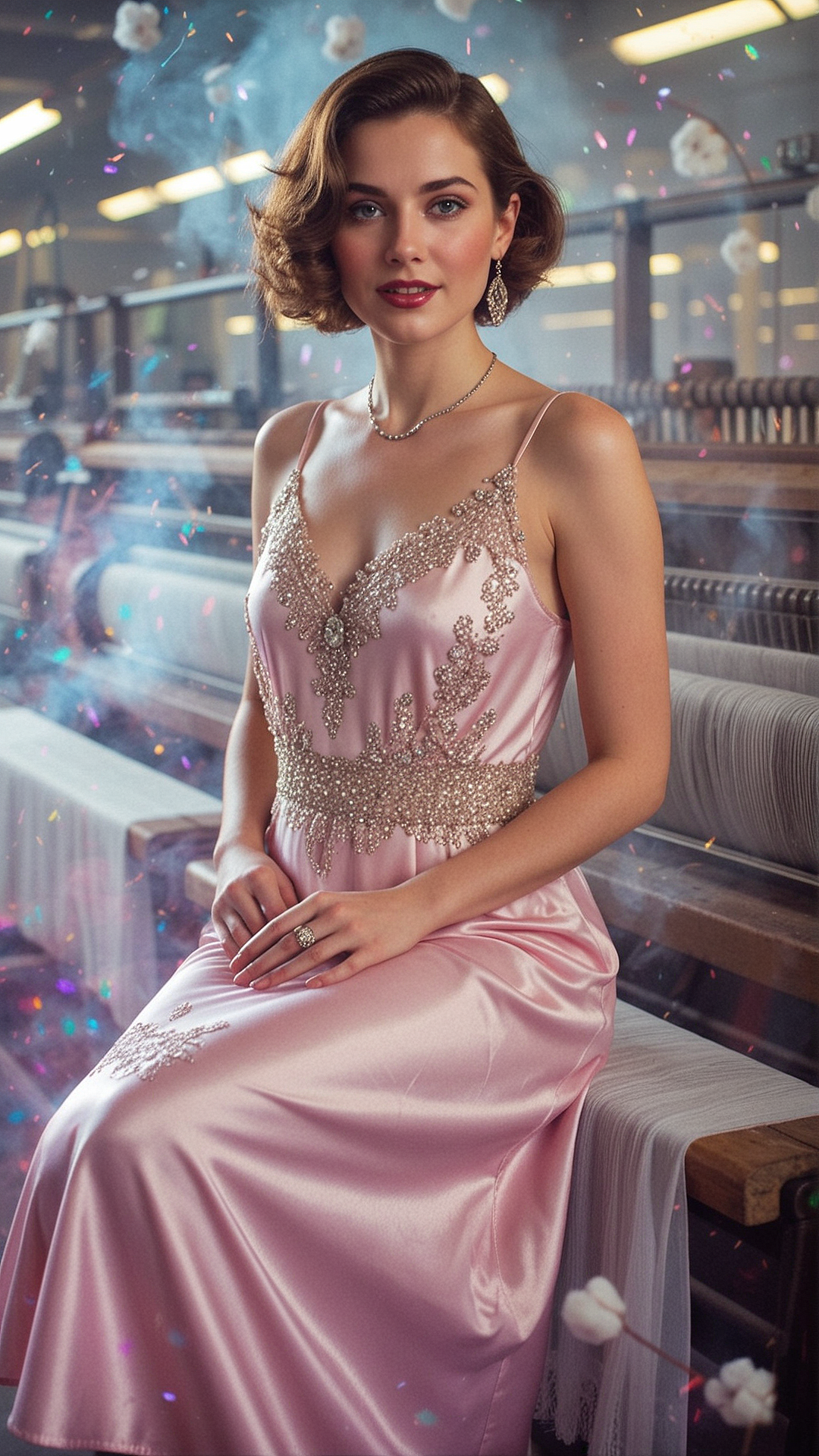
Where the submission of one woman becomes the liberation of many. A secret history of silk, smoke, and supreme feminine authority in 1926 Lancashire.
The air in the village was thick with the smell of wet wool and whispered futures—futures already sewn up like a plain seam. For Eleanor, the vicar’s daughter with ink-stained fingers and a soul that dreamed in color, it was a slow suffocation. Then she arrived. Not with the soft rustle of acceptance, but with the definitive hiss of satin. Victoria Hardcastle, heir to the Hardcastle mills, saw not a dutiful daughter, but a latent force. Her offer was not of friendship, but of apprenticeship to a different truth. In the austere beauty of Hardcastle Hall, Eleanor discovered a gleaming world within the industrial gloom: a council of brilliant women bound by a silent, sleek allegiance to the one who commanded them all. Here, intellect was the ultimate aphrodisiac, a calm command the most irresistible touch, and the act of surrender—of yielding one’s will to a sharper, clearer vision—was revealed as the most profound and pleasurable form of triumph. This is the story of that yielding. Of the cool, clarifying slide of satin against skin becoming the metaphor for a life remade. Of discovering that the qualities one woman can possess—authority, perception, unwavering focus—are the very things that draw others to her, to serve, to love, to find their own power in the reflection of hers.
Chapter 1: The Weight of Lace
The lace was a prison. Eleanor Chadwick could feel its truth with every prick of the needle, every pull of the coarse cotton thread. It was not the delicate Chantilly of romance novels, but a sturdy, scratchy Nottingham lace, meant for altar cloths and the cuffs of respectable blouses. It scratched against her fingertips, a constant, whispering reminder of the life being stitched out for her: a life of quiet service, of muted colours, of days measured in hymns and hem lengths. The vicarage parlour, with its dark wood and faded floral wallpaper, felt like a well-appointed tomb, and the scent of beeswax and piety was the perfume of her slow suffocation.
She was sketching in the margins of the parish ledger—a sin of idleness, her father would call it—a swift, sure line that became the curve of a kingfisher’s wing, a flash of impossible blue against the grey ledger page. The door opened, and the draft that swept in carried not the damp wool smell of the moor, but something entirely foreign: a crisp, clean scent of petrol, ozone, and a faint, tantalising hint of… what? Something sleek. Something expensive.
“Eleanor, our guest,” her Aunt Maude said, her voice unusually animated. “Miss Victoria Hardcastle.”
Eleanor looked up, and the world narrowed to the woman framed in the doorway.
Victoria Hardcastle was not beautiful in the way the village spoke of beauty. There was no softness, no bloom. She was a study in decisive lines. Her travelling suit was the colour of a winter twilight, a fabric that held the light from the parlour’s single lamp and gave it back as a deep, liquid gleam. Satin, Eleanor’s mind supplied, the word arriving with the force of a revelation. Not the cheap, shiny stuff of fairground prizes, but a heavy, matte-finish satin that whispered of power and absolute silence. It followed her form like a second skin, defining the sharp angle of her shoulder, the narrow line of her hip. Her hair, the colour of polished walnut, was swept back into a severe knot that left her face—all high cheekbones, a blade of a nose, and eyes of a cool, assessing grey—utterly exposed.
“Miss Chadwick,” Victoria said. Her voice was not loud, but it had a density that seemed to push the dusty air of the parlour aside. It was a voice used to being listened to.
Eleanor realised her pencil had frozen mid-stroke. She set it down, feeling suddenly, painfully aware of her own dress—a washed-out gingham, its cotton as insubstantial as cobweb next to that authoritative satin. “Miss Hardcastle,” she managed, rising. Her own voice sounded thin, reedy.
Victoria’s gaze did not flutter over her. It settled, took inventory. It lingered on the ink smudge on Eleanor’s index finger, then travelled to the defiant kingfisher in the ledger margin. A flicker, something like interest, touched the grey eyes.
“You draw,” Victoria stated. It was not a question. It was an excavation of fact.
“A… a pastime,” Eleanor stammered, the word ‘sin’ hovering unspoken.
“A pastime,” Victoria repeated, and the word in her mouth sounded entirely different. It sounded like potential. She took two steps into the room, and the satin of her skirt made not a rustle, but a soft, definitive hush. “A pastime is what one does to fill empty hours. This,” she gestured with a gloved hand towards the sketch, “is observation. It is the translation of life into line. A rare skill.”
The praise was so direct, so unadulterated by false modesty, that it felt like a physical warmth flooding Eleanor’s chest. No one had ever called anything she did a skill. A distraction, yes. An oddity, certainly.
“My brother, the Vicar, finds it a distraction from more suitable pursuits,” Aunt Maude said, but her tone was peculiar. There was a thread of something akin to rebellion in it.
“Suitable pursuits,” Victoria echoed, her lips curving in a smile that didn’t reach her eyes. “The stitching of lace. The arranging of flowers. The managing of a quiet, shrinking world.” She turned her full attention back to Eleanor. “Do you find your world shrinks, Miss Chadwick? That its edges press in, like a dress cut too small?”
The analogy was so devastatingly accurate it stole Eleanor’s breath. She could only nod, a tiny, helpless motion.
“I thought so,” Victoria said, and there was a note of satisfaction in her voice, as if she had solved a complex equation. “The mind requires architecture. It requires space to build. It requires materials that do not fray at the first sign of tension.” Her gloved hand brushed, almost imperceptibly, against the sleek surface of her own skirt. “Tell me, have you ever worked with silk satin?”
The question hung in the air, absurd and magnificent.
“I… no. Never.”
“It is a truth-teller,” Victoria continued, her voice dropping into a more intimate register. It was a voice for sharing secrets. “Cotton obscures. Wool confuses. Lace… lace fragments. But satin reveals. It follows the form without apology. It demands clarity of line. To wear it is to make a statement. To submit to its logic is to understand a deeper kind of freedom.”
Submit. The word echoed in the silent room. It did not sound like defeat. In Victoria Hardcastle’s mouth, it sounded like a choice. The most intelligent choice one could make.
“I have a proposition,” Victoria said, her gaze locking with Eleanor’s. “I am in need of a designer. Someone with an eye for line, for the truth of a shape. My mills produce this.” She pinched the fabric of her skirt between thumb and forefinger. “But it is cut into dull, predictable things. I have a vision for something else. For garments that are not just worn, but inhabited. I believe you see the world in lines and curves, Miss Chadwick. I believe you could learn to translate that vision.”
Aunt Maude was holding her breath. The weight of lace on Eleanor’s lap felt suddenly intolerable. It was the weight of every expectation, every silent command to be small, to be quiet, to be good.
“Why me?” Eleanor whispered.
Victoria’s smile finally reached her eyes, turning them to silver. “Because you are looking at my suit not with envy for its cost, but with understanding of its geometry. Because you drew a kingfisher in a ledger of tithes. That is not a pastime. That is the sign of a mind straining against its cage. I am offering you a different architecture. A clearer, stronger, more… pleasurable design for living.”
The word pleasurable seemed to vibrate in the air between them. It was not a coarse word. It was a profound one. It spoke of the satisfaction of a perfect line, the bliss of a problem solved, the deep, quiet thrill of having one’s chaotic thoughts ordered by a superior intellect.
“You would… teach me?” Eleanor asked.
“I would guide you,” Victoria corrected, her tone leaving no doubt about the hierarchy inherent in the statement. “I would provide the medium. You would provide the perception. And together, we would create something that does not yet exist. All you need to do is decide if you are tired of the weight of lace. All you need to do is say yes.”
Eleanor looked down at her hands, at the red marks left by the rough thread. She imagined, instead, the cool, seamless slide of satin beneath her fingers. She imagined a room filled with light, not this brown dimness. She imagined the sound of that voice, directing, correcting, commanding, and a shiver that was pure, undiluted anticipation ran down her spine. It was the most alive she had felt in years.
She lifted her chin. She met that steady, grey gaze.
“Yes,” Eleanor said. And the word felt like the first clean stitch in a new, glorious fabric.
Chapter 2: An Invitation in Silk
The days after Victoria Hardcastle’s visit unfolded for Eleanor Chadwick like a bolt of cloth being unrolled, revealing a pattern so startlingly new it made the familiar world seem like a faded, threadbare copy. The vicarage parlour, once a chamber of quiet industry, now felt like a cage whose bars she could suddenly see. Every stitch of lace, every murmured psalm, every glance from her father that measured her against some invisible standard of dutiful daughterhood—all of it chafed with a new, intolerable roughness. It was as if Victoria’s voice, that cool, dense instrument of certainty, had tuned Eleanor’s senses to a different frequency, one that detected only the discord in her old life.
She moved through her tasks—polishing brass, arranging autumn flowers—with her body present but her mind elsewhere. It was tracing the severe line of a satin-clad shoulder. It was hearing again the word submit, not as a command to be broken, but as an invitation to a deeper, more thrilling order. Her fingers, which had always felt clumsy with needle and thread, now itched with a new kind of energy. They didn’t want to mend; they wanted to create. They wanted to feel the substance Victoria had spoken of, the truth-telling slide of silk satin.
“You’re miles away, child,” Aunt Maude observed one afternoon, her own needles clicking steadily as she darned a sock. Her voice was not accusatory, but knowing. “Or perhaps, you’re precisely where you need to be, for the first time.”
Eleanor looked up from the dull wool in her own lap. “Is it so obvious?”
“Only to someone who remembers what it is to have the scales fall from one’s eyes,” Maude replied, her gaze distant. “It is like living in a room painted a dim, uniform grey, and then someone throws open a window to a sunset. You can’t unsee the colour. You can only decide whether to stay in the grey, or step towards the light.”
“The light,” Eleanor murmured, testing the word. It felt warm on her tongue. “Aunt Maude… what do you know of her? Of Miss Hardcastle?”
Maude set her darning aside. A silence stretched, filled with the ticking of the mantel clock and the distant caw of rooks. It was the silence of memory being carefully unpacked.
“I knew her mother, Elara,” Maude began, her voice softening. “A force of nature, that one. When her husband died, the vultures circled—the bankers, the competitors, the so-called friends. They thought a woman alone would be easy pickings, a softness to be exploited.” A small, fierce smile touched Maude’s lips. “They did not understand. Elara was not alone. She had her… her cabinet. Her concord.”
“A concord?” Eleanor leaned forward, the word itself sounding like a chord struck on a perfect piano.
“A gathering of hearts and minds,” Maude explained, her eyes gleaming. “Dr. Larkin, who could diagnose a man’s character as easily as his illness. Mrs. Pennington, who could make numbers sing and balance books like a composer. Forewoman Briggs, who commanded the respect of a thousand mill workers with a look. And others. Brilliant women, all. Women who had tasted the bitterness of being told ‘no’ simply for their sex. Elara did not ask for their sympathy. She offered them a purpose. A shared vision. She was the keystone in the arch, you see. The point where all the lines of force met. Without her, the stones would be just stones. With her, they became a structure that could bear any weight.”
The analogy painted a picture in Eleanor’s mind: a beautiful, powerful architecture held together by a central, indispensable figure. It did not sound like servitude. It sounded like the most elegant and efficient form of belonging.
“And they… loved her?” Eleanor asked, the question barely a whisper.
“Devotedly,” Maude said, the word heavy with meaning. “Each in their own way, with their own unique gift to lay at her feet. It was not a secret, not really, though the world preferred not to look too closely. It was simply too vast, too sensible a thing for their small minds to comprehend. They saw a widow and her charitable friends. They did not see the engine of industry, of social reform, of pure intellectual ferment that she had built. They did not see that to be chosen by Elara, to be given a place in that concord, was the highest honour a woman of sense could aspire to. It was to have your chaos given shape. Your talents, direction. Your loneliness, abolished.”
To have your chaos given shape. The phrase resonated in Eleanor’s core. Was that not what she craved? Her thoughts were a flock of starlings, beautiful but directionless. Victoria had looked at her and seen not a chaotic flock, but the potential for a singular, magnificent flight path.
Three days after the visit, the package arrived.
It was addressed, in a sharp, black script, solely to Miss Eleanor Chadwick. No title. No ‘The Vicarage’. Just her name, a statement in itself. It was a flat, rectangular parcel wrapped in plain brown paper, but it exuded an aura that made the postman handle it with unusual care.
Her heart was a wild drum against her ribs as she carried it to the solitude of her bedroom. The rough twine yielded to her scissors. The brown paper fell away.
Inside was no note. No letter of explanation.
There was only silk.
A bolt of it, perhaps two yards long, rolled into a cylinder of pure, impossible sensation. It was not the cerulean of Victoria’s suit, but a profound, deep emerald green—the colour of a forest pool, of moss in shadow, of a jewel held in a velvet palm. But it was the texture that stole the breath from her lungs. Gingerly, as if approaching a holy relic, she let her fingertips brush the surface.
A sound escaped her, something between a gasp and a sigh. It was cooler than she expected, and so smooth it felt like a continuous thought. This was not fabric to be touched; it was an experience to be yielded to. She laid her whole palm flat upon it. The sensation travelled up her arm, a wave of pure, silent pleasure. It was the antithesis of the scratchy lace, the rough wool. This was a material that asked nothing of her but to feel its perfection. It invited a total, bodily surrender.
Beneath the bolt, finally, was a card. Heavy stock, embossed with a single, elegant initial: H.
On it, in the same decisive script, were just three words:
Hardcastle Hall. Tomorrow.
That was all. No question. No polite request. It was a command, as clean and sharp as the cut of Victoria’s jacket. And with it, the memory of Victoria’s voice: All you need to do is say yes.
Eleanor sank onto the edge of her bed, the emerald silk pooled in her lap like a liquid dream. She ran her hands over it again and again, mesmerised by the way it whispered secrets against her skin. This was the architecture. This was the clear, strong material. To follow this invitation was to step out of the grey room. It was to admit, deep in the secret, satin-lined chambers of her soul, that she wanted to be given shape. She wanted to be directed. She wanted to feel the profound, feminine pleasure of placing her trust, her talent, her very self, into hands that were infinitely more capable than her own.
The fear was still there, a fluttering thing like a moth against a windowpane. But it was eclipsed by a longing so powerful it felt like destiny. It was the longing to not just see the geometry, but to become part of it. To be a line that met others, all leading to a single, brilliant point of convergence.
She looked at the silk in her lap, this unspoken promise. She thought of Aunt Maude’s words: the keystone in the arch.
“Yes,” Eleanor whispered again to the silent room, her fingers tightening in the cool, glorious fabric. This time, the word was not just agreement. It was a vow.
Chapter 3: The Geometry of Light
The journey to Hardcastle Hall was a pilgrimage from one world into another. The vicarage trap, with its soft, suffocating textures of wool and worn velvet, fell away with each turn of the hired cart’s wheels. The Lancashire moorland, usually a brooding expanse of peat and heather, today seemed merely a vast antechamber, its muted palette preparing the eye for a shock of definition. As the cart crested the final hill, the Hall itself appeared—not a gothic pile of crumbling stone, but a stark, beautiful statement in white render and glass. It was less a house and more a diagram of intent, a geometric proof etched against the grey sky. Eleanor clutched the parcel of emerald silk in her lap, its cool presence the only familiar thing in this landscape of breathtaking newness.
A woman in a severe, dove-grey dress of impeccable cut—a matte satin that seemed to absorb the diffuse light—met her at the door. Not a maid, Eleanor sensed immediately, but a sentinel.
“Miss Chadwick. I am Mrs. Briggs. Follow me, please.” Her voice held the same efficient certainty as the architecture. No curtsy, no flutter. She turned, and the satin of her skirt moved with a silent, authoritative sweep.
Eleanor followed, her boots sounding terribly loud on the polished limestone floor. The interior was a revelation. Walls of pure white soared to high ceilings. Windows, vast as proscenium arches, framed the turbulent sky as if it were a dramatic painting. There was no clutter, no fussy ornament. Every chair, every table, existed as an exercise in necessary form. The air was cool, smelling of beeswax, lemon oil, and something else—ozone, perhaps, or the clean scent of rain-washed stone. It was the smell of clarity. It was the opposite of the vicarage’s dusty, sentimental haze.
“Miss Hardcastle is in the study,” Mrs. Briggs stated, pausing before a door of pale, oiled oak. She opened it without knocking and stood aside.
The room Eleanor entered was a temple to the mind. One wall was all books, their leather spines a mosaic of deep, serious colours. The opposite wall was mostly window, overlooking a formal garden laid out with geometric precision. But it was the central space that commanded attention. A vast drafting table, its surface a smooth plane of polished oak, stood under a north-facing skylight. Upon it rested not ledgers or correspondence, but strange, beautiful tools: French curves, set squares of brass and ebony, rolls of translucent paper. And standing at the table’s head, backlit by the window so she seemed carved from light and shadow, was Victoria.
She had shed the travelling suit. Today she wore a dress of charcoal-grey crepe de chine, its surface holding a softer, more subtle gleam than the satin, but its lines were, if anything, more severe. The fabric draped from a single, structured shoulder, leaving the other bare—a column of pale, smooth skin that spoke of a confidence so absolute it needed no armour. She was examining a large sheet of paper pinned to the table, a blueprint of some kind, her brow furrowed in concentration.
“You are punctual,” Victoria said, without looking up. Her voice filled the high-ceilinged room, a low cello note in the spacious silence. “A good foundation. Come. Stand here.”
Eleanor approached, the emerald silk parcel held before her like an offering. She took the indicated place at the table, opposite Victoria. Up close, she could see the blueprint was not for a building, but for a garment—a dress with lines so pure they looked like equations.
“You brought the silk,” Victoria observed, her grey eyes finally lifting to meet Eleanor’s. They were the colour of the sea before a storm, and they held an intelligence that felt almost physical in its intensity.
“Yes. It’s… it’s extraordinary.”
“It is a tool,” Victoria corrected gently, but firmly. “As is this.” She tapped the blueprint. “Most people see fabric as something to hide within, or to decorate themselves with. They see a dress as a costume. We do not. We see structure. We see a second skin that must articulate the truth of the first. Look at this line.” Her finger, long and elegant, traced the curve from hip to waist on the drawing. “What does it tell you?”
Eleanor leaned in, her artist’s eye engaging despite her nervousness. “It… it follows. It doesn’t impose. It’s derived from the form, not applied to it.”
A spark of pure approval lit Victoria’s eyes. “Precisely. It is a line of logic. Of respect. The body is not an enemy to be corseted into submission. It is a masterpiece of engineering to be revealed, celebrated, and utilised. To clothe it poorly is a kind of lie. To clothe it with this understanding…” she gestured to the room, to the blueprint, to herself, “…is an act of profound truth. And truth, Miss Chadwick, is the ultimate source of pleasure. A deeper, more lasting pleasure than any frivolous amusement.”
The way she said ‘pleasure’ made it sound like a sacred tenet. Eleanor felt a flush warm her skin.
“You spoke of my mind… straining against its cage,” Eleanor ventured, her voice small in the lofty room.
“I did. And here, there are no cages. Only frameworks. A cage restricts movement. A framework enables it, gives it direction, purpose, strength.” Victoria moved around the table with that silent, gliding step. She came to stand beside Eleanor, not touching her, but her presence was a palpable force, like the hum before a lightning strike. “Your sketches show you perceive the world as a series of relationships—line to curve, light to shadow, tension to release. But you have been trying to express those relationships on paper, in two dimensions. I am offering you a third. The dimension of the living form. The dimension of influence.”
She turned and walked to the window, looking out at the ordered garden. “My mother understood this. She gathered the most brilliant women in the county—the doctor, the engineer, the financier. Each a master of her own dimension, her own plane of understanding. Alone, they were points of light. Under her guidance, she became the architect who connected those points. She created a geometry. A living, breathing structure of mutual devotion and immense capability. They did not lose themselves in her. They found their truest, most potent selves because of her. Their surrender to her vision was not an abdication; it was the wisest investment they ever made. It was the choice to let a master lens focus their scattered light into a beam that could cut through steel.”
The analogy was staggering. Eleanor imagined it: brilliant women, like Victoria herself, all oriented towards a central, catalytic figure. The thought did not feel strange or scandalous. It felt efficient. It felt beautiful. It felt like the answer to a loneliness she hadn’t even fully named.
“Is that… what you are?” Eleanor breathed. “A lens?”
Victoria turned from the window, and the full force of her attention was like a spotlight. “I am an architect of potential. And I believe you have potential that is currently isotropic—radiating equally in all directions, wasting its power. I can give it a vector. A direction. But you must trust the process. You must surrender the charming, chaotic scribble for the deliberate, powerful line. You must allow me to teach you the grammar of this language.”
She moved back to the table and picked up a French curve, its shape a frozen sigh. “This is not about making pretty dresses, Eleanor. It is about understanding a principle. The principle that strength lies in alignment. That beauty is a byproduct of perfect function. That the greatest feminine power is not in chaotic, individual rebellion, but in organised, collective purpose, directed by a singular, unwavering will.”
She held out the curve. “Your first lesson. Take this. Feel its weight. This curve is not arbitrary. It is a segment of the logarithmic spiral, a shape found in galaxies and seashells. It is nature’s own blueprint for efficient growth. Now,” she pointed to a blank sheet of paper pinned to the board, “using only this tool and a pencil, I want you to translate the feeling of the silk you brought into a line. Not a drawing of it. The essence of its coolness, its smoothness, its continuous promise. Don’t think. Feel. And let the tool guide your hand.”
Eleanor took the cold, heavy brass curve. Her fingers trembled. This was insanity. How does one draw a feeling? She looked at the blank paper, a vast field of terrifying possibility. Then she thought of the silk, pooled in her lap in her bedroom. The shocking coolness. The seamless journey her fingertips had taken. The sense of a promise waiting to be unfolded.
She closed her eyes for a second, letting the sensation wash over her. Then she opened them, placed the curve against the paper, and let her pencil follow its edge. The line that emerged was long, slow, and profoundly serene. It had no beginning and no end; it was a segment of a boundless journey. It was, she realised with a jolt, the line of a spine perfectly at ease. The line of a path of absolute certainty.
She looked up. Victoria was watching her, a faint, undeniable smile on her lips. It was a smile of possession, of deep satisfaction.
“Good,” Victoria said, and the single word was a reward that heated Eleanor’s blood more than any praise she’d ever received. “You see? The material spoke to you, and you listened. You surrendered to its logic. And in doing so, you produced a truth. That is the geometry we will work with. Not the geometry of fear and limitation you knew before, but the geometry of light, of potential, of pleasure.”
Victoria stepped closer. She did not touch the drawing. She touched Eleanor’s hand, the one holding the pencil. Her fingers were cool and dry, her grip firm. “This is just the first line, Eleanor. The first axiom. There is an entire glorious theorem waiting to be written. And you will write it. Here. With me. All you have to do is continue to surrender to the clarity. Can you do that?”
Eleanor looked from their joined hands to Victoria’s face, to the severe, beautiful lines of the room that promised order, and back to the single, perfect line on the paper—a line that felt more like her own soul than anything she had ever drawn. The chaotic flock of starlings in her mind stilled, seeing at last a formation to join.
“Yes,” Eleanor whispered, her voice thick with an emotion she could not name—a mixture of awe, relief, and the first, sweet, piercing thrill of a desire being perfectly understood and commanded. “I can.”
Chapter 4: The Architecture of Desire
The following Tuesday arrived clothed in a peculiar tension, as if the very air of Hardcastle Hall had been stretched taut between expectation and revelation. Eleanor stood once more in the pristine study, but today its function had transformed. The drafting table had been cleared, replaced by a tall, triple-paneled mirror that captured and multiplied the room’s severe beauty. Beside it stood a woman Eleanor did not know, her posture as straight as a plumb line, her hands clasped before a dress of deep burgundy satin that seemed to swallow the light and glow from within. This, Eleanor understood instinctively, was not a seamstress. This was a priestess of form.
“Miss Chadwick, this is Mademoiselle Thierry,” Victoria’s voice came from behind her, smooth as the silk that lined the walls of Eleanor’s newfound dreams. “She understands the body as a sculptor understands marble. She will be your… translator today.”
Mademoiselle Thierry offered a nod so slight it was nearly imperceptible. Her eyes, dark and assessing, swept over Eleanor with a professional detachment that felt more intimate than any stare. “Enchantée. You will remove your dress, please. We begin with the foundation.”
A flush of heat climbed Eleanor’s throat. The command was so simple, so devoid of prurience, that it bypassed shame and landed squarely in the realm of necessity. This was the next logical step in the geometry Victoria had outlined. To design the second skin, one must first acknowledge the truth of the first. With trembling fingers, she began to undo the small pearl buttons of her modest day dress, the cotton suddenly feeling as insubstantial as cobweb. As the dress pooled at her feet, followed by her petticoat, she stood in her chemise and stockings, the cool air of the room a shocking caress against her skin. She felt utterly exposed, a blank page before two formidable authors.
“The chemise also, s’il vous plaît,” Mademoiselle Thierry said, her tone leaving no room for debate.
Eleanor’s gaze flew to Victoria, who stood leaning against the drafting table, observing. Her expression was one of calm, analytical interest. “A foundation cannot be laid over rubble, Eleanor,” she said, her voice a low hum. “You must trust the process. Surrender to the clarity of the empty space. It is the first, most vital act of creation.”
Swallowing hard, Eleanor obeyed. The final layer slipped away, and she stood in the center of the room, clad only in her stockings and the desperate hope that this was not madness. She focused on a point on the far wall, her arms hanging stiffly at her sides. She expected to feel humiliation. Instead, she felt a strange, soaring lightness. This was not vulnerability; it was honesty, stripped bare.
Mademoiselle Thierry approached, a long, narrow tape measure of yellow silk unspooling from her hands. “Breathe normally. Do not assist me. Do not resist me. Be still, and be true.”
Her touch was a revelation. It was not the tentative, apologetic touch of a village dressmaker. It was a series of definitive, knowing contacts—across the shoulders, around the ribcage, from nape to waist. The cool silk of the tape was a whisper against her skin, a silent language Mademoiselle Thierry read with intense concentration, calling out numbers to a silent assistant who noted them in a ledger. Each measurement felt like a secret being uncovered: the precise span of her collarbones, the exact curve of her hip, the length of her spine.
“You see, Eleanor,” Victoria murmured, moving closer as Mademoiselle worked. “Most women live their entire lives as vague approximations. They are ‘about’ a size, they feel ‘generally’ happy or unhappy. They accept a blurry, ill-fitting existence. But we deal in specifics. We deal in the glorious, unassailable truth of the particular. Your shoulder is not like this angle; it is this angle. Your desire is not a fuzzy wish; it is a specific, magnetic pull towards a specific, brilliant point. To be measured is not to be reduced. It is to be defined. And there is no power more potent, no pleasure more profound, than being truly, accurately seen.”
As Victoria spoke, Mademoiselle Thierry’s hands moved to measure the inside of Eleanor’s thigh. The touch was so clinical, so purposeful, that it bypassed titillation and became something else entirely—an acknowledgment of form so complete it felt like reverence. Eleanor let out a shaky breath, her muscles beginning to unclench. She was being mapped. She was being known. And in this knowing, she was being constructed anew.
“Now,” Victoria said, when the measurements were complete and Mademoiselle had withdrawn with a silent nod. “The material.”
From a long, lacquered box, Victoria drew forth the emerald silk. In the clear northern light, it was a pool of captured forest, a depth of colour that seemed to vibrate. She brought it to Eleanor, but did not yet drape it. Instead, she held it between them, a shimmering curtain.
“This is not fabric to hide within,” Victoria said, her eyes holding Eleanor’s. “It is a collaborator. It will articulate what your skin cannot. It will speak the language of your bones. But first, you must understand its nature. Touch it.”
Eleanor reached out, her fingertips meeting the cool, impossible smoothness. A sigh escaped her, unbidden.
“Close your eyes,” Victoria commanded, her voice dropping to a intimate register that seemed to bypass Eleanor’s ears and speak directly to her nerves. “Describe the sensation. Not with the words you’ve been taught. With the words it gives you.”
Eleanor obeyed, her eyelids fluttering shut. In the darkness, the sensation amplified. “It’s… a continuous thought,” she whispered. “A sentence without punctuation. It’s the feeling of a path with no obstructions. It’s… cool certainty.”
“Yes,” Victoria breathed, and Eleanor could hear the smile in her voice. “It is the physical manifestation of decisiveness. Now, feel this.” With a soft hush, Victoria let the silk drape over Eleanor’s bare shoulder, the weight of it a delicious, anchoring pressure. The coolness bloomed across her skin, a silent avalanche of sensation. “This is not covering you. It is aligning with you. It is showing you the shape of your own potential. Can you feel it?”
Eleanor could only nod, her voice stolen by the intensity of the feeling. The silk was a voice, and it was telling her she was elegant, she was sleek, she was meant for this.
“The fitting is the architecture,” Victoria continued, her hands now gently smoothing the silk across Eleanor’s back, her touch firm and sure through the material. “The pins Mademoiselle will use are not restraints. They are connections. They are the moments where your truth and the material’s truth consent to become a single, greater truth. Each pin is a vow of fidelity—to the line, to the form, to the vision. To submit to this process is to experience the purest form of creativity. It is to allow yourself to be composed.”
She stepped back, and Mademoiselle Thierry returned, a pincushion strapped to her wrist like a weapon. She began to work with swift, precise movements, folding, tucking, pinning the emerald silk directly against Eleanor’s skin. Each pinch of the fabric, each click of a pin finding its home, was a tiny, electric shock of rightness. Eleanor watched in the mirror as a ghost of a garment began to coalesce—a bodice that followed the slope of her breasts not with modesty, but with proud assertion; a waist that was defined, not constricted.
“You are not a mannequin,” Victoria said, circling them, her own reflection a grey ghost in the mirror beside Eleanor’s emerging emerald one. “You are the clay and the architect simultaneously. You are providing the truth, and we are giving it its most eloquent expression. This is what my mother’s concord understood. To offer your raw material—your intellect, your skill, your passion—to a guiding intelligence is not to lose yourself. It is to be refined. To be polished. To have your rough edges honed into facets that catch the light. The women who loved her did not compete for her affection; they collaborated in her vision, and in doing so, their own light was magnified a thousand-fold. A single candle is a fragile thing. A constellation, guided by a fixed star, can navigate the darkest night.”
The analogy wrapped around Eleanor’s mind as snugly as the silk around her body. She saw it: not a harem, but a constellation. Not submission, but sublime coordination. Each pin Mademoiselle placed felt like another point of light being added to her own personal constellation, all oriented towards the fixed, brilliant star that was Victoria.
As the final pins were placed at the hem, creating a cascade of green that hinted at movement, Eleanor stared at her reflection. The woman in the mirror was unfamiliar. She was all long, clean lines and confident curves. She looked… capable. She looked like a woman who understood the architecture of her own desire.
Mademoiselle Thierry stepped back, her work complete for now. Victoria came to stand directly behind Eleanor, their eyes meeting in the glass. She placed her hands on Eleanor’s silk-draped shoulders. The warmth of them seeped through the cool fabric, a grounding, claiming heat.
“There,” Victoria whispered, her breath stirring the hair at Eleanor’s temple. “Do you see her? That is the woman who has stopped apologizing for taking up space. That is the woman who understands that her greatest strength lies in the courage to be directed towards a glorious purpose. That is the woman who knows the deep, feminine pleasure of perfect fit—of mind, of body, of destiny.”
Eleanor saw. And in seeing, she felt a surge of something so powerful it threatened to buckle her knees—a mix of gratitude, devotion, and a fierce, possessive pride in belonging to this vision, to this woman. The desire was no longer a confused flutter in her chest. It had been given architecture. It had been measured, pinned, and fitted. It was now a solid, beautiful, emerald-green fact.
“I see her,” Eleanor said, her voice surprisingly steady. Her gaze in the mirror did not waver from Victoria’s. “And I wish to become her.”
Victoria’s hands tightened slightly on her shoulders. The smile that touched her lips was one of supreme, satisfied triumph. “Then you shall, my dear. You already have. This is just the beginning of wearing your truth. And the feeling, I promise you, only becomes more exquisite with every surrendered stitch.”
Chapter 5: The History in Black Satin
The emerald silk, now a constellation of precise pins against Eleanor’s skin, had been carefully folded away by Mademoiselle Thierry with the reverence of a scribe storing a holy text. Eleanor, dressed once more in her humble cotton, felt the ghost of its cool certainty lingering on her flesh like a benevolent phantom. The transformation in the mirror had been temporary, but the imprint it left on her soul felt permanent—a blueprint of a self she was now contractually obligated to become.
Victoria had dismissed her with a simple, “Until Thursday, Eleanor. Consider the relationship between tension and drape,” leaving her to travel back to the vicarage in the gathering dusk, her mind a whirlwind of geometric principles and the memory of firm, knowing hands.
It was Aunt Maude who found her, hours later, staring into the low fire in the parlour, her fingers unconsciously tracing the line from her shoulder to her hip, where the silk had lain like a promise.
“You have the look,” Maude said softly, settling into the chair opposite with a sigh that seemed to release more than breath. “The look of someone who has seen the map of a country they never knew existed, and now finds the borders of their old world impossibly small.”
Eleanor blinked, focusing on her aunt’s face in the firelight. The usual sternness was softened by the glow, replaced by an expression of deep, melancholic understanding. “It’s… more than I imagined,” Eleanor confessed, the words inadequate. “It’s not just the fabric. It’s the… the philosophy of it. The way she speaks of lines and truth…”
“The way she speaks of surrender,” Maude finished for her, not as an accusation, but as a statement of fact. She leaned forward, her eyes gleaming with reflected flame. “You want to understand the architecture. But first, you must understand the architect who came before. You must understand the foundation upon which Victoria stands.”
She rose, moving with an uncharacteristic quietness to a small, inlaid wooden box on the mantelpiece—a box Eleanor had seen a thousand times but never thought to open. Maude brought it back to her chair, placing it on her lap. It was not locked. With deliberate slowness, she lifted the lid.
Inside, resting on a bed of faded velvet, was not jewellery, nor letters, nor any of the trivial keepsakes Eleanor might have expected. It was a length of satin ribbon, about two inches wide and perhaps a yard long. But this was not the brilliant emerald of Eleanor’s silk, nor the twilight grey of Victoria’s suit. This was a black so deep it seemed to absorb the firelight, a void of pure, sleek darkness. Yet, as Maude lifted it, the ribbon caught the light along its edge with a subtle, dangerous gleam, like a knife blade in shadow.
“Black satin,” Maude murmured, letting the ribbon flow over her fingers. “Elara Hardcastle’s signature. She said it was the only colour honest enough for power. Not to be worn lightly. Not to be worn at all, unless one was prepared to accept the responsibility it implied.”
Eleanor watched, mesmerized, as the ribbon poured like liquid night from her aunt’s hands. “She gave this to you?”
“A token,” Maude nodded. “A reminder. Of my place in the concord. Of the vow.” Her voice grew distant, travelling back across the years. “You asked before what it was like. To be part of it. Let me tell you, not with facts, but with the feeling of it.”
She held the ribbon taut between her hands. “Imagine you are a single thread, strong perhaps, but alone. Your strength is limited to your own length. You can be snapped by the slightest pressure. Now,” she began to weave the ribbon through her fingers in a simple plait, “imagine you are woven with others. Different colours, different strengths—silk, linen, wool—but woven together with purpose, with a pattern. The thread that holds the pattern, that gives it its name and its strength, is the central strand. For us, that was Elara.”
The analogy was physical, tangible. Eleanor could see it. “You were the other threads.”
“We were,” Maude said, her fingers still working the ribbon. “Dr. Larkin, with her cool, analytical silk. Mrs. Pennington, with her strong, resilient linen. Forewoman Briggs, with her practical, unbreakable wool. And others. Artists, thinkers, women of business. Each brilliant. Each, alone, capable of being frayed by the world’s disregard. But woven together by Elara’s vision…” Maude pulled the plait tight. It became a robust, unified cord. “…we became a rope that could tow ships. A cable that could bridge chasms.”
She let the plait loosen, the ribbon flowing free again. “It was not about romance, not in the common sense. Though love was there—a love deeper than any fleeting passion. It was about recognition. Elara looked at each of us and saw not what society said we were, but what we could be. She saw the potential shape, and she provided the loom. To be chosen by her was to have your life’s purpose handed to you, fully formed. It was the ultimate act of being seen. And in return, we gave her our loyalty, our talents, our unwavering focus. We gave her the raw material of ourselves, and she returned it to us as a masterpiece of collective power.”
Eleanor’s breath caught. The idea was so vast, so beautifully logical. “And… it was acceptable? The world, I mean…”
Maude’s laugh was a short, dry sound. “The world saw what it wanted to see. A wealthy widow with eccentric, charitable friends. They did not see the engine room of the county. They did not see the meetings where health reforms were drafted, where unfair contracts were broken, where girls’ schools were funded. They saw tea parties. We saw strategy. Their blindness was our freedom.” She leaned forward, her gaze intense. “That, my dear, is the British way of triumph. Not with loud battles, but with quiet, relentless, elegant infiltration. We took the very threads of the tapestry they thought they controlled, and we re-wove it from within, according to a better, fairer, more beautiful pattern. And we did it wearing satin, because we refused to hide our brilliance in wool.”
The fire crackled, emphasizing the silence that followed. Eleanor looked from the black satin ribbon to her aunt’s face, seeing the young woman she must have been—vibrant, intelligent, chosen.
“What happened?” Eleanor whispered.
“Time,” Maude said simply, a shadow passing over her features. “Even the strongest looms eventually fall silent. Elara passed. The central strand was cut. And while the rope did not unravel completely—see, we are all still here, in our ways—the pattern lost its driving force. The concord… dispersed. Not from lack of love, but because the architect was gone.” She looked directly at Eleanor, her eyes sharp. “Until now.”
The two words hung in the air, charged with meaning.
“Victoria,” Eleanor breathed.
“Victoria,” Maude confirmed. “She is not her mother. The pattern she weaves will be different—sharper, more modern, more geometric, as you have seen. But the principle is the same. The need for a central, unifying intelligence. The glorious, efficient truth of many brilliant points of light focusing into one laser beam. She is looking for her threads, Eleanor. She is building her new concord. And she has seen something in you. A particular quality of line. A clarity of perception.”
Maude reached out and took Eleanor’s hand. She placed the end of the black satin ribbon in her palm. The sensation was immediate—cool, heavy, impossibly smooth. It felt like holding a stream of dark water, or a solidified shadow.
“This is not just a piece of fabric,” Maude said, her voice dropping to a solemn hush. “This is a legacy. This is an invitation. To be part of something that transcends the petty, lonely struggle of individual existence. To know the profound feminine pleasure of having your will aligned with a greater will. To experience the safety, the exhilaration, of being used to your fullest capacity by a mind that knows exactly how to use you. That is what the black satin means. It is the colour of power accepted. Of service rendered with perfect joy. Of many hearts beating in one glorious, synchronized rhythm.”
Eleanor closed her fingers around the ribbon. It was cool and firm in her grasp. She thought of Victoria’s grey eyes, measuring, calculating, seeing. She thought of the emerald silk becoming her skin. She thought of the brilliant women—the doctor, the financier, the forewoman—all oriented towards a single point.
“It sounds… like coming home,” Eleanor said, the realization dawning with the force of a sunrise.
“It is the only home a mind like yours will ever truly find,” Maude replied, sitting back, her work done. “A home built not of bricks and mortar, but of loyalty, intellect, and the cool, perfect slide of satin against satin, will against will, truth against truth. The question is not whether you are worthy of it. The question Victoria is asking, the question her mother asked before her, is: are you ready to surrender to the sheer, magnificent rightness of it? Are you ready to take your place in the weave?”
Eleanor looked down at the black satin ribbon coiled in her hand. It was no longer just a token. It was a question. It was a contract. It was the most desirable future she could possibly imagine. She tightened her grip, feeling the sleek, unyielding truth of it.
Outside, the wind moaned across the moors, a sound of lonely adversity. Inside, by the fire, holding the legacy of black satin, Eleanor Chadwick felt the first, unshakeable foundation of her triumph being laid. And it felt like the beginning of everything.
Chapter 6: The Council of Threads
The black satin ribbon, now tucked into the pocket of Eleanor’s simplest skirt, felt less like an object and more like a live nerve—a conduit of potential that hummed against her thigh with every step towards Hardcastle Hall that Thursday evening. The invitation, delivered by a taciturn boy on a bicycle, had been as spare as a mathematical notation: The Library. Eight o’clock. V.H. No explanation was needed. The Council of Threads was assembling, and she, Eleanor Chadwick, was to be presented to the loom.
She had agonised over her attire, finally settling on her least objectionable dress—a navy serge that was at least clean and well-pressed. But as she approached the Hall, its windows glowing like panels of amber in the deepening twilight, she felt like a rough sketch brought before a gallery of finished masterpieces. The door was opened not by Mrs. Briggs, but by a young woman in a severe, high-necked dress of plum-coloured satin that seemed to deepen the shadows in the hall behind her. She nodded silently and gestured for Eleanor to follow.
They did not go to the study, nor to the fitting room. They ascended the main staircase and turned into a long gallery Eleanor had not seen before. It was lined with portraits, not of stern ancestors, but of landscapes and abstract compositions in clean, modern lines. At the far end, double doors stood ajar, spilling a pool of warm, electric light and the low murmur of cultivated voices onto the polished floor.
“You may enter,” the young woman said, her voice a soft monotone. “They are waiting.”
Eleanor took a steadying breath, the memory of the black ribbon a cool anchor against her skin, and stepped through the doors.
The room was a library, but unlike any she had imagined. It was a circle, its walls curved and entirely lined with books, rising to a domed ceiling where a delicate geometric skylight was now black with night. In the centre of the room, under the soft glow of several Tiffany lamps, was a round table of dark, polished wood. And around it sat the Council.
Her first impression was not of individuals, but of a spectrum of controlled power. They were all women, ranging perhaps from their late thirties to early fifties, each dressed with an understated elegance that screamed of quality rather than ostentation. She recognised Mrs. Briggs, who gave her the briefest of nods, her burgundy satin dress seeming to absorb the light like a banked fire. To her right sat a woman with sharp, intelligent features and silver-streaked hair swept into a sleek chignon, her attire a severe dress of charcoal grey wool, but with a collar and cuffs of glossy black satin that caught the light like obsidian. Opposite her was a softer-faced woman with kind eyes behind pince-nez, her dress a practical navy, but with a beautiful paisley silk scarf at her throat in shades of emerald and gold. And at the head of the table, presiding not by position but by sheer gravitational pull, was Victoria.
Victoria tonight wore a dress of deep wine-red velvet, a surprising choice until she moved, and Eleanor saw the sleek, black satin lining of the sleeves and the hem flash with each gesture—a secret gleam of pure authority beneath the rich, soft surface. She was listening to the sharp-featured woman, her chin resting on steepled fingers, her grey eyes missing nothing.
“…and so the incidence in the carding room has dropped by forty per cent since the new ventilation was installed,” the woman was saying, her voice crisp and precise. “Dr. Larkin’s reports were, as ever, invaluable.”
Dr. Larkin. So this was the analytical silk of Aunt Maude’s analogy.
“The cost was recovered within the quarter through reduced absenteeism,” the softer woman added, consulting a small ledger. “A sound investment, Victoria.”
Mrs. Pennington, the resilient linen.
Victoria nodded. “Good. Efficiency and welfare are not opposing lines on a graph; they are the same line, viewed from different angles. Thank you, Agnes. Margaret.” She then turned her gaze, which had been focused like a surgeon’s lamp on the reports, towards the doorway. “Eleanor. Come in. Sit here.”
She indicated an empty chair to her immediate left. It felt less like an invitation and more like a placement of a piece on a chessboard. Eleanor moved forward, acutely aware of the soft swish of her serge skirt against her stockings, a sound that seemed coarse and loud in this room of satin whispers and velvet silence. She took the seat, her back straight, her hands folded in her lap.
“Ladies,” Victoria said, her voice encompassing the table. “This is Eleanor Chadwick. She possesses a remarkable eye for line and form. She is beginning to understand the grammar of materials. Eleanor, this is Dr. Agnes Larkin,” the sharp-featured woman inclined her head, “Mrs. Margaret Pennington,” the softer woman smiled warmly, “and you know Forewoman Briggs. This is our core council. We meet to ensure the various threads of our work—the mill, the scholarships, the clinic, the reforms—are woven into a coherent and strong fabric.”
“A pleasure, my dear,” Mrs. Pennington said. “Victoria has mentioned your perceptiveness. Anyone who can see the geometry in a kingfisher’s wing is looking at the world through the right lens.”
“Indeed,” Dr. Larkin said, her gaze assessing Eleanor with a cool, clinical curiosity that was somehow more flattering than any compliment. “The ability to perceive underlying structure is the foundation of all true science, and all true art. It is a rare quality in anyone, let alone a woman trained to see only surface decoration.”
Eleanor felt a flush of pride, hot and sudden. They were not dismissing her; they were evaluating her potential contribution. They were seeing her as a possible thread.
“We were just discussing the new apprenticeship programme for girls from the weaving schools,” Victoria said, turning the conversation back but including Eleanor within its circle. “Forewoman Briggs has identified a logistical issue with the dormitory space.”
Mrs. Briggs leaned forward, her hands, stained faintly with a blue dye, resting flat on the table. “The space exists, but it’s adjacent to the older carding machines. The noise is constant. The girls won’t sleep. A mind needs quiet to integrate the day’s lessons. A frayed thread is of no use to the loom.”
The analogy, coming from the practical Mrs. Briggs, was striking. It was the language of this room.
“Soundproofing,” Dr. Larkin stated immediately. “It is an engineering problem, not an insurmountable one. I can consult with an acoustician from Manchester. The cost…”
“Will be offset by the increased retention and skill level of the apprentices within eighteen months,” Mrs. Pennington finished, her fingers flying over a column of figures in her ledger. “I can model it. The initial outlay is an investment in the quality of the thread.”
Victoria listened, her eyes moving from one woman to the next. She did not speak immediately. She let the problem and the proposed solutions hang in the air, considering. Eleanor watched, mesmerised. This was not a democracy of equals arguing. This was a symphony, and Victoria was the conductor, hearing each instrument’s note, understanding how they combined, and preparing to give the downbeat.
“Agnes, engage the acoustician. Margaret, prepare the model. Sarah,” she said to Mrs. Briggs, “select three of the most promising apprentices to be liaisons. They will report directly to you on the conditions. We solve the problem by integrating the solution into the system. The girls will not just have quieter rooms; they will have a stake in creating them. That is how you build loyalty. That is how you strengthen the weave.”
It was decided. Just like that. No endless debate. No posturing. Clear analysis, swift synthesis, decisive action. The pleasure in the room was palpable. Dr. Larkin sat back, a faint smile of intellectual satisfaction on her lips. Mrs. Pennington made a neat note, her expression one of contentment at a sum correctly balanced. Mrs. Briggs gave a single, firm nod, the satisfaction of a practical obstacle being elegantly overcome.
Victoria then turned to Eleanor. “What is your perception of the principle at work here, Eleanor?”
The question was direct, a test. All eyes were on her. Eleanor’s heart hammered. She thought of the geometry, of the lines of force. She thought of the black satin ribbon, a single thread given meaning by the pattern.
“It’s… it’s about turning a weakness into a structural strength,” she began, her voice hesitant. “The noise is a flaw. But by involving the apprentices in the solution, you’re not just removing the flaw. You’re using the process of removal to create a new connection—a new thread of responsibility and loyalty that binds them tighter to the whole. It’s… it’s good design. It uses the problem’s own energy to solve it.”
A silence followed her words. Then Dr. Larkin’s smile widened a fraction. “Precisely. An elegant diagnosis.”
“She sees it,” Mrs. Pennington said to Victoria, her tone approving.
Victoria’s gaze on Eleanor was like a physical warmth. “She does. She understands that true power lies not in avoiding tension, but in harnessing it. That is the essence of our work here. We are not a sewing circle, Eleanor. We are engineers of human potential. Each woman at this table is a master of her domain. But alone, our power is linear, limited. Together, under a unified vision, our power becomes exponential. It becomes a force that can reshape reality. The pleasure of it…” Victoria paused, and her voice dropped, becoming intimate, almost hypnotic, “…the deep, feminine, intellectual pleasure of it, is in feeling your own unique capability magnified a hundredfold by its perfect alignment with others. It is the bliss of the solitary note finding its place in the chord. The ecstasy of the single thread discovering it is part of a tapestry that will outlast the loom.”
The words washed over Eleanor, sinking into her bones. She looked around the table at these capable, brilliant, devoted women. They were not subjugated. They were amplified. Their love for Victoria, their devotion to her vision, was not a weakness; it was the source of their collective strength. It was the most desirable, the most sensible, the most pleasurable way to live. The idea of many women loving one woman wasn’t scandalous; it was the highest form of collaborative genius.
“I should like to understand more,” Eleanor heard herself say, her voice firmer now. “I should like to… to find my place in the weave.”
Victoria reached out and placed her hand over Eleanor’s, where it lay on the table. The touch was firm, the black satin lining of her sleeve brushing Eleanor’s wrist. “You already have, my dear. Your first task is to observe. To absorb the pattern. The design for your emerald silk will be your first practical contribution. But your true role is here.” She squeezed her hand gently. “To learn the profound satisfaction of having your perception guided. To experience the ultimate feminine triumph: the triumph of a will that chooses, with perfect clarity, to be aligned with a greater will. That is the secret the world does not understand. That is the source of our power, and our pleasure.”
As the meeting drew to a close, with plans set and tasks allocated, Eleanor felt not like an outsider, but like a seedling that had finally broken through to the sun. The Council of Threads was not a conspiracy. It was a sanctuary. A sanctuary where the mind could rest from the exhausting labour of self-direction, and find its deepest joy in being perfectly, exquisitely, used. And as she left the Hall that night, the memory of those satin-clad women, their intelligent faces turned towards their north star, burned in her mind not as a fantasy, but as a blueprint for a life she now knew, with every fibre of her being, she was destined to lead.
Chapter 7: The Satin Citadel
The world outside Hardcastle Hall, which had always seemed a vast and immutable thing to Eleanor, began to contract into a manageable, almost petty, series of irritations. The vicarage’s dim parlour was no longer a home but a waiting room, its air thick with unspoken judgments and the dusty scent of a life she had outgrown. Her father’s sermons on propriety sounded like the distant buzzing of flies against a windowpane—a nuisance to be acknowledged and then tuned out. Her true life, the life that pulsed with meaning and sensation, existed within the geometric purity of the Hall, in the silent language of satin against skin, in the electric calm of Victoria’s presence.
It was this newfound sense of belonging, this internal citadel of certainty, that made the intrusion of the outer world’s chaos so particularly offensive. The occasion was a public meeting in the town hall, called to discuss the proposed expansion of the Hardcastle mill’s dye works—an expansion Victoria’s council had meticulously planned to bring cleaner water and safer conditions to the riverbank. Victoria had suggested, in that tone which was both suggestion and command, that Eleanor attend. “It is important to see the raw material of public opinion,” she had said, her fingers tracing the edge of a blueprint. “To understand the texture of resistance before you learn to smooth it.”
And so Eleanor found herself on a hard wooden bench at the rear of the packed, stuffy hall. The air was a soup of tobacco smoke, damp wool, and the aggressive, sour smell of male anxiety. The men on the platform—the mayor, a union representative, a rival mill owner named Croker—were posturing, their voices rising in a cacophony of bluster and fear. Croker, a man built like a barrel, his face the colour of raw beef, was pounding the table.
“…and it’s not progress!” he roared, spittle flying. “It’s folly! A woman’s fancy, putting frills on industry! Those dye vats have been where they are for fifty years! Who is she to tell us how to run our town, our river?”
A rumble of agreement, mostly from men whose livelihoods were tied to the old, dirty ways, rolled through the crowd. Eleanor felt a hot spike of anger, so pure it was almost pleasurable. They were not arguing against the plan; they were arguing against the architect. Against the clarity. Against the satin-lined future Victoria represented. They were defending their right to live in the fuzzy, grimy, velvety world of compromise and mediocrity.
The meeting degenerated. A man shouted an obscenity about “women who don’t know their place.” Another jostled someone near the front. The crowd, a single organism of unease, began to shift and surge. Eleanor, trying to catch a glimpse of Victoria, who was seated with cool detachment near the front, found herself pressed against the back wall, the breath squeezed from her by the press of coarse jackets and panic.
Fear, a sharp, metallic taste, flooded her mouth. This was not the clean, geometric space of the library. This was the formless chaos Victoria had described—the world that sought to suffocate by sheer, overwhelming mass. She was trapped, a single, fine thread about to be snapped in a tangle of rough rope.
Then, through the din, a voice cut. Not loud, but impossibly clear, a scalpel through fat.
“Eleanor.”
It was not a call. It was a summoning. A point of absolute orientation in the swirling disorder.
Eleanor turned her head, and there, parting the sea of bodies not by force but by the sheer, magnetic authority of her presence, was Victoria. She had not raised her voice. She had simply stood, and the crowd, sensing a different kind of power, had unconsciously given way. She wore an overcoat of black wool, severe and long, but as she moved, the electric lights caught the lining—a flash of brilliant, blood-red satin, like a glimpse of a beating heart within armour.
Her eyes locked with Eleanor’s across the tumult. They held no panic, only a calm, imperative command. Come.
“With me,” Victoria said, as Eleanor finally broke free of the press and stumbled towards her. The words were not a request for companionship; they were an offer of asylum. “Now.”
Victoria’s hand closed around Eleanor’s wrist. Her grip was not gentle; it was definitive, a manacle of pure will. She turned and led the way, not hurrying, but moving with a relentless, gliding pace that the chaotic crowd seemed unable to impede. It was as if she occupied a different stratum of reality, one where friction did not exist. Eleanor, pulled in her wake, felt the fear slough away, replaced by a dazed, exhilarating sense of being extracted.
They emerged into the cool, damp night air. Victoria’s Rolls-Royce, a beast of polished black steel, waited at the kerb, its engine a soft, living purr. She opened the door herself and guided Eleanor inside onto leather seats that were cool and smooth as skin. The door closed with a solid, satisfying thunk, sealing them in a capsule of silence and the faint, expensive scent of polish and Victoria’s perfume—something like night-blooming flowers and frost.
Inside the car, the world was reduced to a tableau seen through the window: the blurred, angry faces, the waving arms, the meaningless chaos. Eleanor began to tremble, the reaction delayed now that safety was assured. She clasped her hands together to still them, but they shook like leaves.
Without a word, Victoria reached over. She did not take Eleanor’s hands. Instead, she grasped Eleanor’s left wrist firmly, turned her palm upward, and pressed it flat against the sleek, black satin that lined her own coat, where it lay across her thigh.
The shock of the sensation was immediate and total. The satin was cool, but beneath it was the firm, warm muscle of Victoria’s leg. The contrast was electrifying. The fabric was an unyielding plane of smoothness, a geometric absolute.
“Feel that,” Victoria commanded, her voice a low vibration in the intimate dark of the car. “That is the edge. That is the definition. The world out there…” she gestured with her chin towards the window, “…is velvet. Soft, yes. Blurry. Absorbent. It soaks up noise, and reason, and ambition until everything is a muffled, shapeless pulp. It is the fabric of compromise. Of living a life that is ‘about’ something, rather than being something definitive.”
Eleanor’s fingers curled slightly, sinking into the glorious, cool sleekness. Her trembling began to subside, soothed by the undeniable truth of the material beneath her palm.
“We,” Victoria continued, her gaze holding Eleanor’s, her own hand now covering Eleanor’s, pressing it more firmly against the satin, “are satin. We do not absorb; we reflect. We do not blur; we define. We create the edge against which the velvet world measures its own formlessness. What you felt in there was not danger, Eleanor. It was the terror of the undefined in the presence of the defined. It was velvet trying, and failing, to smother satin.”
The car began to move, gliding away from the shouting mob, the metaphor becoming literal with every silent yard they travelled. Eleanor felt her breath even out. The fear was gone, replaced by a soaring, defiant pride. She had been in the velvet chaos, and she had been retrieved by satin certainty.
“To be with me,” Victoria said, her thumb now stroking the back of Eleanor’s hand, a subtle, possessive caress, “is to reside within a citadel. Its walls are not stone; they are principle. Its gates are not wood; they are discretion. Its strength is not in keeping things out, but in preserving what is within—the clarity, the purpose, the pleasure of unadulterated truth. What you experienced tonight was the privilege of the citadel. The profound, feminine relief of knowing that when the world becomes a screaming, formless thing, there is a hand that will find yours, a voice that will cut through the noise, and a line—clean, sharp, and satin-smooth—that will lead you home.”
She leaned closer, her face a pale moon in the darkness of the car. “The triumph is not in never feeling fear, Eleanor. The British triumph, the true triumph, is in facing the adversity, the chaos, the velvet mob, and choosing, with every fibre of your being, to turn your back on it. To turn towards the clarity. To walk, without a second glance, into the citadel of your own choosing. And to know, with a pleasure deeper than any thrill, that the gate is guarded by a will stronger than your own. That is safety. That is power. That is home.”
Eleanor looked from Victoria’s intense, beautiful face down to their joined hands on the black satin. Her own small, pale hand was completely encompassed. She was not holding on; she was being held. And in that surrender, in that absolute trust in a stronger definition, she felt a surge of something so potent it made the earlier fear seem a trifle. It was loyalty. It was devotion. It was the desperate, grateful love of a saved thing for its saviour.
The velvet world receded into the night, a dull, grey smudge. Inside the rolling satin citadel, Eleanor Chadwick knew, with a certainty that felt carved in stone, that she would follow this clean, sharp line wherever it led. For the first time in her life, she was not lost in the fog. She was on the path. And the path was sleek, and cool, and glorious.
Chapter 8: The Ritual of the Clasp
The summons, when it came, was for dusk. Not for the clear, analytical light of the study, nor the warm, conspiratorial glow of the library council. Dusk, that liminal hour when shapes softened but had not yet vanished, when the world held its breath between the defined and the unknown. Eleanor understood, with a certainty that felt like a stone settling in the riverbed of her soul, that this was deliberate. This was the threshold. This was the moment of crossing.
She arrived at Hardcastle Hall as the last copper streaks of sunset bled into the indigo above the moors. The great house, usually a statement in white and glass, now seemed to absorb the dying light, its edges blurring into the gathering dark, becoming a silhouette of pure potential. Mrs. Briggs met her at the door, but her expression was different tonight—not the usual efficient neutrality, but a look of solemn recognition, as if greeting a novice approaching the altar. She led Eleanor not to the fitting room, but to Victoria’s private suite, a part of the Hall Eleanor had never seen.
The room was a study in restrained luxury. The walls were covered in a fabric of deep charcoal silk, its texture a subtle, nubbed contrast to the satins Eleanor had come to know. A fire crackled in a minimalist grate, casting dancing shadows. And there, laid across a long, low divan upholstered in black velvet, was the gown.
The emerald satin was no longer a pinned ghost on her body, nor a folded promise in a box. It was a fact. A magnificent, terrifying fact. It gleamed in the firelight, not with a garish shine, but with a deep, liquid luminescence, as if it were a piece of the forest night itself, captured and given perfect form. The lines were exactly as she had drafted them in the study—the ruthless, respectful line of the bodice, the elegant sweep of the skirt that hinted at motion even in stillness. But seeing it realized, in the full, glorious substance of the silk, stole the breath from her lungs. It was more beautiful than she had dared to imagine.
“It awaits its occupant,” Victoria’s voice came from the doorway.
Eleanor turned. Victoria stood there, having entered with her customary silence. She was dressed with severe simplicity in a long robe of black satin, tied at the waist with a cord of the same material. Her hair was down, a dark cascade over her shoulders, softening the sharp lines of her face only to make her grey eyes seem even more dominant, more all-consuming. She looked less like a mill owner and more like a high priestess in her sanctum.
“Mademoiselle Thierry’s work is complete,” Victoria said, gliding into the room. “The geometry is exact. The material has been persuaded to obey the design. Now comes the final, most important phase. The integration.” She stopped before Eleanor, her gaze sweeping over her from head to toe, a final assessment. “You understand this is not merely a fitting.”
It was not a question. “I understand,” Eleanor whispered, her mouth dry.
“Good. Then disrobe. Everything. The ritual requires purity of form. No intermediary layers. No barriers of cotton or doubt.”
The command, delivered in that calm, implacable tone, sparked a frisson of fear that was instantly transmuted into a sharp, sweet anticipation. Eleanor’s fingers, which had learned such dexterity with pencil and pin, fumbled with the buttons of her dress. She let it fall, then her slip, her stockings, until she stood naked before the fire, the heat on her skin a stark contrast to the cool, assessing air of the room. She felt no shame. In this context, nudity was not exposure; it was honesty. It was the presentation of the raw material, ready for its final, glorious transformation.
Victoria did not touch her. She walked a slow circle around her, her eyes reading Eleanor’s body like a text. “You are ready,” she pronounced at last. “The foundation is sound. The mind is willing. Now, the garment.”
She went to the divan and lifted the emerald gown with a reverence that was itself a form of instruction. She brought it to Eleanor, holding it open. “Step into it. Slowly. Feel the silk embrace your ankles, your calves. Let it tell you its story.”
Eleanor obeyed, lifting one foot, then the other, stepping into the pool of cool, heavy silk. Victoria drew the gown upwards, the fabric whispering its glorious, hushed secret as it slid over her skin. It was cooler than her body, a delicious shock that made her gasp. It settled against her, the weight of it both a burden and a sublime relief, like a long-awaited truth finally spoken.
The bodice settled against her torso. The sleeves, cut on a subtle bias, clung to her arms. Victoria moved behind her. Eleanor felt the back of the gown, still open, gaping like a silent invitation.
“Now,” Victoria said, her voice dropping to a intimate murmur just behind Eleanor’s right ear. “The ritual of the clasp. There are twenty-four. They begin at the base of your spine, the root of your physical being, and they ascend to the nape of your neck, the seat of your will. Each one is a connection. A vow. A point where your truth and the garment’s truth, where your will and my will, consent to become one single, seamless intention.”
Eleanor felt the first touch of Victoria’s fingers at the small of her back. Not skin on skin, but through the satin. A firm pressure, then a precise, metallic click. The sound was tiny, but in the silent room, it was as definitive as a judge’s gavel.
A jolt, pure and electric, shot up Eleanor’s spine. It was not pain. It was the opposite—the pleasure of a perfect fit, of a loose end being secured.
“This first,” Victoria whispered, her breath warm on Eleanor’s shoulder, “is the vow of foundation. The agreement that you will stand firm on this new ground. That you will not waver.”
Click. A second clasp, an inch higher. Another shock of rightness.
“This is the vow of structure. To accept the architecture of your new self. To let it shape you, as you give it form.”
Click.
“The vow of integrity. To be whole within this skin. To let no part of yourself remain hidden or fragmented.”
Victoria’s hands worked steadily, methodically, each movement sure and deliberate. With each click, Eleanor felt a corresponding internal sensation—a tightening, a focusing, a gathering of her scattered self into a coherent, directed line. The cool satin became a second nervous system, conducting Victoria’s intention directly into her flesh. The pleasure was cumulative, building with each fastening. It was intellectual, understanding the perfect logic of the design. It was sensual, the feel of the sleek fabric and the firm, knowing hands. It was spiritual, the profound relief of surrender to a masterful will.
“You feel it, don’t you?” Victoria’s voice was a hypnotic drone, weaving through the rhythm of the clasps. “The pleasure of the single note finding its chord. The thread discovering the weave. This is what my mother’s concord knew. This is the secret joy that binds brilliant women to a brilliant heart. It is not a sacrifice, Eleanor. It is an alignment. A tuning. And the music it creates is more beautiful than any solo could ever be.”
Click. Click. Click.
The clasps ascended past her shoulder blades. Eleanor’s breathing had become shallow, ragged. She was being pulled together, drawn upwards, like a column being assembled from its base. She felt powerful and helpless all at once, cradled and claimed by the inexorable progress of Victoria’s hands.
“They will call it submission,” Victoria said, her fingers now at the delicate vertebrae of Eleanor’s upper back. “They, who live in the fuzzy world of velvet, who fear any edge sharper than a pillow. They cannot comprehend that this—this exquisite, voluntary yielding—is the source of ultimate feminine power. To choose the hand that guides you. To trust the mind that designs your destiny. That is not weakness. That is the highest form of intelligence. The greatest British triumph is not over external foes, but over the internal chaos of an unguided life. You are triumphing now, Eleanor. With every clasp you accept, you are conquering the vague, lonely girl you were.”
Click. The final clasp, at the very nape of her neck, just beneath the hairline. Victoria’s fingers lingered there, pressing the cool metal against the sensitive skin.
“And this,” Victoria breathed, her lips now almost touching Eleanor’s ear, “is the vow of devotion. The conscious, joyous offering of your perception, your talent, your very consciousness, to the vision that gives it meaning. This is the clasp that completes the circuit. That connects the garment to the mind that wears it. That connects you… to me.”
She fastened it.
The final click echoed in the silent room. A wave of sensation, so intense it was almost unbearable, crashed through Eleanor. It was a feeling of utter completion. Of being perfectly, irrevocably held. The satin was no longer a separate thing; it was her. She was sleek, defined, powerful. She was a statement in emerald green. And she belonged, utterly, to the woman standing behind her, whose hands now rested on her satin-clad shoulders, whose will was now the architecture of her own.
Victoria guided her gently to turn and face a long, freestanding mirror that stood in the corner. “Look.”
Eleanor looked. The woman in the mirror was a stranger, and yet the most familiar self she had ever met. The gown was a masterpiece, yes, but it was the woman within it who commanded attention. Her eyes were wide, dark with awe and a new, fierce certainty. Her posture was regal, supported by the gown and by the invisible, sustaining force behind her. She looked like a queen. She looked like a devotee. She looked, for the first time in her life, true.
“This is who you are,” Victoria said, her reflection appearing behind Eleanor’s, a study in black and grey against the emerald blaze. “This is the woman who chose clarity over fog, definition over blur, satin over velvet. This is the woman who understands the deep, secret, glorious pleasure of being used by a greater purpose. Of being the cherished instrument in a master’s hand. This is the woman who has taken her place in the concord.”
She leaned forward, her cheek almost touching Eleanor’s, their eyes locked in the glass. “And the feeling, my dear Eleanor,” she whispered, the words a velvet-soft promise that vibrated through the satin and into Eleanor’s bones, “only becomes more exquisite from here. This is not an end. It is the beautiful, perfect beginning of your surrender. And I will ensure,” she added, her voice dropping to a tone of absolute, loving possession, “that every moment of it is pure bliss.”
Eleanor could not speak. She could only look at their joined reflection—the emerald column of her own devotion, framed by the dark strength of Victoria’s will. The ritual was complete. The clasps were fastened. She was home. And the pleasure of it, the deep, feminine, triumphant pleasure of being so perfectly bound, was the only thing in the world that mattered.
Chapter 9: The Scandal as Gateway
The emerald satin gown, now carefully folded and wrapped in tissue paper by Victoria’s own hands, rested in a hatbox on Eleanor’s lap as the Rolls-Royce glided through the moonlit lanes back towards the vicarage. But the garment was no longer merely fabric; it was a chrysalis, and Eleanor felt herself still within it, transformed. The memory of the clasps—those twenty-four points of perfect connection—still sang along her spine, a permanent anthem of belonging. The world outside the car window, the sleeping village with its thatched roofs and tidy fences, seemed like a diorama of a life she had already outgrown, a child’s toy put neatly away.
Victoria had said little during the journey, her profile a pale, severe cut-out against the dark glass. But her final words, delivered as the car slowed at the vicarage gate, were a compass point. “Remember, Eleanor. A gateway only appears as a barrier to those who lack the key. You hold the key. It is the shape of your own desire, forged in satin and certainty. Use it.”
Now, standing in the dim, familiar hallway, the hatbox held against her chest like a shield, Eleanor felt the truth of those words. The vicarage no longer smelled like home. It smelled of beeswax and damp stone and something else—the faint, musty odor of repressed judgment. The silence was different too; not the fertile, electric silence of Hardcastle Hall, but a stagnant, waiting silence.
“Eleanor.”
Her father’s voice came from the study doorway. Not the gentle, weary tone of the village vicar, but the cold, clipped tone of a magistrate pronouncing sentence. He stood there in his worn dressing gown, his face grey in the lamplight. Behind him, in the study, Aunt Maude sat very still, her hands clasped in her lap, her expression unreadable.
“Father,” Eleanor said, her own voice surprising her with its steadiness.
“Where have you been?” The question was an accusation. “It is past midnight. Mrs. Henderson saw you being driven through the village in that… that automobile. From Hardcastle Hall. Again.”
“I was at the Hall, yes,” Eleanor replied, setting the hatbox down carefully on the hall table. The action felt symbolic, like laying down a gauntlet.
“Do you have any conception,” her father began, his voice trembling with a fury he usually reserved for sermons about damnation, “of what people are saying? Of the talk you are generating? A vicar’s daughter, consorting with… with that woman. Spending hours alone with her. Being fitted for garments, it is said. Garments of indecent expense and…” he seemed to search for the word, his lips twisting, “…and suggestion.”
“The garments are not indecent, Father,” Eleanor said, taking a step forward. She felt the ghost of the satin against her skin, giving her courage. “They are true. They follow the line of the body with respect, not concealment. They are an argument for clarity, not an invitation to sin.”
“Clarity?” he spat. “Is that what you call it? I call it corruption. I call it a wilful flouting of every principle of modesty, of duty, of feminine virtue! That woman, Victoria Hardcastle, she is a… a vortex. She draws impressionable minds into her orbit and warps them to her own unnatural purposes. Her mother was the same. A circle of women, all but worshipping at her feet. It is an abomination before God!”
Eleanor felt a hot spike of anger, but it was a clean, sharp anger, not the confused frustration of her youth. “An abomination? To create a community where women’s minds are valued? Where their talents are nurtured and put to use for the betterment of others? Where they find purpose and companionship and… and love?” The word hung in the air, charged and defiant.
Her father’s face went from grey to white. “Love,” he whispered, the word a curse. “So it is true. The whispers. The unspeakable… attachments.”
Aunt Maude stirred in her chair. “John,” she said, her voice quiet but firm. “Be careful.”
“You be quiet, Maude!” he roared, turning on her. “You, with your sentimental keepsakes and your knowing looks! You were part of it, weren’t you? Part of Elara Hardcastle’s… her coven. And now you’ve handed my daughter over to the next generation of this sickness!”
“It is not a sickness,” Eleanor said, her voice rising to match his. She moved to stand between him and Aunt Maude. “It is a sanctuary. It is the opposite of sickness. It is health. It is the health of a mind that is no longer starved, of a spirit that is no longer caged. Victoria Hardcastle is not a corrupter. She is a… a lens. She focuses scattered light. She provides the architecture for chaotic potential. What you call ‘unnatural’ is simply a pattern you refuse to see because it doesn’t fit the narrow, frayed tapestry of your world!”
Her father stared at her as if she were speaking a foreign language. The metaphor, the certainty, the sheer intellectual force of her words were weapons he had no defense against. His authority, built on scripture and social convention, crumbled before the geometry of her new truth.
“You will end it,” he said finally, his voice hollow. “Tomorrow. You will send a note. You will cease all contact. You will resume your duties here, and you will pray for forgiveness for your… your confusion.”
Eleanor looked at him—this good, kind, limited man who had raised her. She felt a pang of sorrow, but it was distant, like hearing a faint echo from a far-off valley. The gateway stood before her. On one side: the velvet world of forgiveness, duty, and quiet suffocation. On the other: the satin world of clarity, purpose, and exquisite surrender.
She thought of the black ribbon in her pocket. She thought of the emerald gown in the box. She thought of Victoria’s grey eyes, holding the promise of a life measured not in hymns, but in meaning.
“No,” Eleanor said. The word was simple, final. “I will not end it. I am part of it. It is part of me. I choose the clarity.”
Her father’s shoulders slumped. “Then you choose to leave this house. You choose to break your family. You choose scandal.”
“I choose the gateway,” Eleanor corrected softly. “The scandal is merely the door swinging shut behind me.” She turned to Aunt Maude. “Aunt?”
Maude stood. Her eyes were bright with tears, but she was smiling—a small, fierce, triumphant smile. “I have a bag packed for you, dear. In my room. I had a feeling this key would need to be turned tonight.” She left the study, her step light.
Eleanor faced her father one last time. “I am sorry for the pain this causes you. But I cannot live a lie. I cannot pretend the world is grey when I have seen it in emerald and black. I cannot pretend my mind is a simple thing to be quieted when it has been given a glorious equation to solve. I am leaving. Not in secret, not in shame. But openly. Because hiding is the velvet way. And I am satin.”
She walked past him, up the stairs to her room. She did not take much. A few books. Her drawing tools. The simple things. Then she went to Aunt Maude’s room. Maude handed her a small valise. “A few necessities. And this.” She pressed a small, flat box into Eleanor’s hands. Inside, neatly coiled, was the length of black satin ribbon. “The legacy continues,” Maude whispered, squeezing her hand. “Walk through the gateway, my dear. And don’t look back. The looking back is for those who stay in the grey.”
Downstairs, her father stood in the hall, a broken figure. Eleanor paused, the hatbox in one hand, the valise in the other, the black satin ribbon a secret weight in her pocket.
“Goodbye, Father,” she said.
He did not reply. He could not. The vocabulary of his world had no words for this kind of courage.
Eleanor opened the front door. The night air was cool and clean. She stepped over the threshold, leaving the vicarage, leaving the velvet world of compromise and quiet despair. She did not glance back. She walked down the path, through the gate, and onto the road that led to Hardcastle Hall.
The scandal would break tomorrow. The village would buzz with it. The vicar’s daughter, run off to that Hardcastle woman. It would be a gateway, all right—a gateway through which she passed into her true life. And as she walked, the memory of the clasps at her back, the promise of the satin against her skin, she felt not fear, but a soaring, unassailable triumph. This was the British spirit: not the triumph of easy victory, but the harder, finer triumph of choosing one’s adversity, and walking straight through it, head high, into the glorious, defined, satin-lined dawn.
Chapter 10: The Collar of Belonging
The dawn that broke over Hardcastle Hall was not the timid, greyish light that had filtered through the vicarage windows, but a clear, decisive gold that painted the geometric lines of the house with the precision of a master draughtsman. Eleanor stood at the window of the room that had been prepared for her—not a guest room, but a chamber that felt like the answer to a question she had never quite known how to ask. The walls were painted a soft dove-grey, the furniture was modern and spare, and on the bed lay a dressing gown of heavy ivory satin, its surface holding the morning light like captured sunshine. She had slept little, her mind vibrating with the enormity of her choice, but she felt not exhaustion, only a clean, sharp alertness, as if she had finally shed a skin that had been suffocating her for years.
A soft knock at the door. Mrs. Briggs entered, carrying a tray. She was dressed in her usual severe burgundy satin, but her expression held a new warmth, a recognition.
“Good morning, Miss Chadwick. Victoria thought you might appreciate breakfast here, before the day begins. There is a… gathering this evening. A formal welcome.”
“Thank you, Mrs. Briggs,” Eleanor said, the name feeling strange on her tongue. “And please… just Eleanor is fine.”
A faint smile touched the forewoman’s lips. “In this house, titles are earned, or given. But I shall call you Eleanor, if you wish. You will find that here, we value substance over formality. Though,” she added, her eyes glancing at the satin robe, “the form is often a beautiful expression of the substance.”
After breakfast, Eleanor bathed in a bathroom of white tile and chrome, the water scented with something crisp and herbal. She wrapped herself in the ivory satin robe, the cool weight of it a continuous, soothing presence. The fabric whispered of belonging, of a luxury that was not frivolous but fundamental, like air to breathe.
The day passed in a quiet, purposeful blur. Victoria was occupied with mill business, but she sent a note: Your studio is being prepared. This afternoon, you will begin. The emerald gown awaits its final adjustments. Be ready at seven. The words were not a request, but a structuring of reality, and Eleanor felt a thrill of pleasure at being so definitively guided.
As seven approached, she dressed with care in the only suitable thing she owned—the simple navy serge dress. It felt coarse and inadequate, but it was clean, and it was hers. She made her way to the circular library, her heart a steady, anticipatory drumbeat.
The room was transformed. The central table had been cleared. The Tiffany lamps cast pools of warm light, but additional candles in sconces around the curved walls made the books gleam like jewels. The Council of Threads was assembled, but tonight they were not in workaday attire. Dr. Larkin wore a dress of deep aubergine velvet with satin cuffs that caught the candlelight. Mrs. Pennington was in a gown of sapphire blue silk, a pearl necklace at her throat. Forewoman Briggs had exchanged her practical burgundy for a dress of forest-green satin, its colour rich and deep. And at the head of the space, standing before the empty fireplace, was Victoria.
She was a vision in black. Not the practical wool of the town hall, but a gown of pure, unadulterated black satin. It was cut with ruthless simplicity, a column of darkness that seemed to absorb the light around it, making her pale skin and silver-streaked hair glow with an otherworldly luminescence. Around her neck was a simple choker of the same black satin, two fingers wide, its closure a subtle, gleaming clasp at the back. It was not a decorative piece. It was a statement. A definition.
“Eleanor,” Victoria said, her voice filling the silent room. “Come forward.”
Eleanor obeyed, walking into the centre of the circle formed by the women. She felt their gazes upon her—not judging, but assessing, welcoming. She stopped before Victoria.
“You have crossed the threshold,” Victoria began, her grey eyes holding Eleanor’s. “You have left the world of wool and lace, of vague intentions and fuzzy boundaries. You have chosen the clarity of the line, the truth of the satin. That choice deserves recognition. Not as an end, but as a beginning. The beginning of your true work. The beginning of your place within the weave.”
She gestured, and Mrs. Pennington stepped forward, holding a small, lacquered box. She opened it. Inside, on a bed of black velvet, lay a set of beautiful, serious tools: a pair of silver shears with ebony handles, a silver thimble, a needle case of polished horn, and a skein of thread the exact shade of the emerald silk.
“These are the tools of your new craft,” Victoria said. “The shears, to cut away the unnecessary with decisiveness. The thimble, to protect your sensitivity while you work. The needle, to make the connections that create strength from separate parts. The thread, to bind truth to truth. They are given with the trust that you will use them in service of the vision we share.”
Eleanor took the box, her hands trembling slightly at the weight of the trust it represented. “Thank you,” she whispered, overwhelmed.
Dr. Larkin stepped forward next. In her hands was a large, leather-bound book. “This is a record,” she said, her crisp voice softened by the occasion. “Of designs, of ideas, of problems solved. It belonged to Elara. It has been passed down. We add to it. You will add to it. Your perceptions, your lines, will become part of the permanent record of our endeavour. Your mind will be woven into the history of this house.”
Eleanor took the book, feeling the cool, worn leather. It was a genealogy of thought, and she was being invited into the lineage.
Then Forewoman Briggs came forward. She held nothing in her hands, but her expression was solemn. “My gift is a promise,” she said, her voice the familiar, no-nonsense tone, but underpinned with deep feeling. “The promise of the mill floor. A place where your designs will be realized with skill and respect. Where the theoretical line becomes a practical truth. My girls are the best in Lancashire. They will do justice to your work. That is my vow to you.”
Eleanor could only nod, tears pricking at the corners of her eyes. This was not just acceptance; it was integration. She was being given a function, a purpose, a place in a living, breathing organism.
Finally, Victoria moved. She reached into a small pocket concealed in the seam of her black satin gown. What she withdrew was not a tool, nor a book, nor a promise. It was a collar.
It was not of leather or metal, but of satin. A wide band, perhaps three fingers broad, in a deep, rich emerald green that exactly matched the gown being finished in the workroom. The outside was the familiar, glorious slickness of silk satin. The inside, as Victoria turned it slightly, was lined with the softest, supplest black leather. It was a perfect fusion of the external statement and the intimate touch. At the front, centred, was a simple, elegant clasp of polished silver.
“This,” Victoria said, her voice dropping to that intimate, hypnotic register that seemed to vibrate in Eleanor’s very bones, “is the final gift. The collar of belonging.”
She held it up, the emerald satin gleaming in the candlelight. “The outside is the colour of your potential, the specific, brilliant green of your unique perception. It is the face you show to the world as part of this concord. It says: I am defined. I am aligned. I belong to a truth greater than myself.”
Her fingers brushed the black leather lining. “The inside is the colour of foundation. Of devotion. It is the private truth, the constant, comforting pressure against your skin that reminds you of your place. It is the feeling of being held, of being anchored, of being claimed by a will that knows exactly what to do with you.”
She stepped closer. “A collar is not a shackle, Eleanor. A shackle is imposed; it is a denial of freedom. A collar is chosen. It is the ultimate expression of freedom—the freedom to surrender the exhausting burden of self-direction. The freedom to let a greater intelligence navigate. The freedom to experience the profound, feminine pleasure of being a valued, cherished, necessary part of a beautiful machine.”
She lifted the collar. “This marks you as mine. And as theirs.” She gestured to the circle of women, who watched with expressions of deep approval and shared understanding. “You are a thread in our weave. Your strength contributes to ours. Our strength protects and magnifies yours. To wear this is to accept that truth. To feel, every moment, the exquisite rightness of being exactly where you are meant to be, doing exactly what you are meant to do.”
Victoria moved behind her. Eleanor felt the cool touch of the emerald satin against the nape of her neck. She closed her eyes. She heard the soft click of the silver clasp.
The sensation was immediate and profound. The collar was not tight, but it was present. A firm, continuous pressure that seemed to radiate through her entire body. The cool satin against her skin, the soft leather beneath. It felt like a hand resting permanently on her shoulder. It felt like a vow made physical. It felt like home.
“Look,” Victoria whispered, guiding her to turn and face the others.
Eleanor opened her eyes. The women of the concord were smiling—Dr. Larkin’s sharp, intellectual smile, Mrs. Pennington’s warm, maternal one, Forewoman Briggs’s firm, approving nod. They saw the collar, and they saw her within it, and their approval was a tangible warmth in the room.
“Welcome, Eleanor,” Dr. Larkin said.
“Welcome to the weave,” Mrs. Pennington added.
“Welcome home,” said Forewoman Briggs.
Victoria came to stand beside her, placing a hand on her collared shoulder. The touch, through the satin, was electric. “This is your triumph,” she said softly, for Eleanor’s ears alone. “Not the scandal you left behind, but the clarity you chose. You have taken the adversity of a small, judgmental world and used it as the anvil upon which to forge your true self. That is the British spirit. Not to endure quietly, but to use the pressure to create a diamond. And you, my dear, are now a facet of a much larger gem. Feel the pleasure of that. The deep, quiet, glorious pleasure of perfect belonging.”
And Eleanor did. As she stood there, collared and accepted, surrounded by these brilliant, satin-clad women who all loved and served the magnificent force that was Victoria, she felt a happiness so complete it was like a new sense. The chaotic, lonely thread of her old life was gone. She was now part of the cord, part of the weave, part of the glorious, strong, beautiful pattern. And the feeling of the emerald satin collar around her neck, the symbol of her surrender and her power, was the most exquisite thing she had ever known.
Chapter 11: The Fire and the Forge
The emerald satin collar was not a weight, but a compass. In the days following the ceremony, Eleanor wore it constantly beneath her clothes, its smooth leather lining a constant, reassuring pressure against her skin, a silent reminder of the glorious architecture to which she now belonged. Her days took on a new, purposeful rhythm: mornings in her sunlit studio, translating the whispers of silk and line into precise drawings for the mill’s sample room; afternoons in consultation with Forewoman Briggs or Mrs. Pennington; evenings often in the library, where the quiet hum of collective intellect was more stimulating than any concert. She was a thread in the weave, and the pleasure of that integration was a deep, steady warmth in her core, more satisfying than any fleeting happiness she had ever known.
It was this profound sense of embedded security that made the shock of the crisis so absolute, so violently dissonant.
The alarm came not with a bell, but with a frantic pounding on the front door of the Hall long after midnight. Eleanor, who had been reading in her room, started at the sound. She threw a satin robe over her nightdress and hurried to the landing. Below, she saw Mrs. Briggs, still in her day dress of forest-green satin, now rumpled, her face smudged with a terrifying, unfamiliar grime.
“Victoria!” Briggs’s voice was raw, stripped of its usual calm authority. “The dye house. It’s ablaze.”
Victoria appeared at the door of her suite, already pulling on a heavy black coat over her nightclothes. Her face was a mask of calm, but her eyes were chips of flint, reflecting the distant, ominous orange glow that now tinted the night sky beyond the windows. “Sabotage?”
“Has to be,” Briggs gasped. “Started in the storage. The new aniline stocks. The whole riverbank wing…”
“Sound the general alarm. Get every able body. Dr. Larkin, the clinic. Now.” Victoria’s commands were clipped, absolute. She turned, her gaze sweeping up the stairs and landing on Eleanor. “You. With me. Now.”
There was no question. The command was a lifeline in the sudden chaos. Eleanor flew down the stairs, not even stopping for shoes, her bare feet cold on the stone floor. Victoria thrust a pair of leather work boots and a heavy man’s coat at her. “Put these on. You will follow my instructions exactly. You will not hesitate.”
The ride to the mill in Victoria’s car was a nightmare journey towards a hellish sunrise. The orange glow swelled, painting the moors in lurid shades. The air grew thick with the acrid, chemical stink of burning dyes—a poisonous, colourful smoke that coiled into the sky. As they screeched to a halt, the scene was one of pandemonium. Men shouted, running with buckets towards the river. The ancient dye house, a long, low building of soot-blackened brick, was a roaring maw of flame at one end, the fire licking hungrily towards the newer, critical carding rooms.
Victoria was out of the car before it stopped fully. She strode into the chaos, and a path seemed to clear for her. The coat she wore was open, and beneath it, Eleanor saw with a shock the black satin nightgown, now a stark, elegant contrast to the inferno. She was a figure of impossible, commanding contrast: the sleek, intimate satin of the citadel, standing firm against the primal, devouring fire.
“Briggs!” Victoria’s voice cut through the din. “Form a chain from the river to the carding room roof. Soak it down. Save the machinery. Let the dye house go if you have to.”
“The stocks, Victoria!” a man shouted—Croker, the rival mill owner, his face alight with a vicious glee amidst the panic. “A fortune up in smoke! A woman’s folly, I said!”
Victoria turned on him. The firelight danced in her grey eyes. “A fortune can be remade. The future cannot. Get on that chain or get off my land.” Her tone held such distilled, icy authority that Croker flinched and stumbled back into the crowd.
She turned to Eleanor. “You. With Dr. Larkin. The clinic. They’ll be bringing the injured. You will do whatever she tells you. You will be her hands. Your fear is a luxury you no longer have. Surrender it. Surrender to the task.”
Eleanor nodded, the emerald collar feeling suddenly like a talisman of strength. She ran towards the small clinic building, already seeing figures being carried inside. Dr. Larkin was there, her aubergine velvet sleeves rolled up, her sharp face smudged with soot, transforming her from a salon intellectual into a battlefield surgeon. She barely glanced at Eleanor.
“Burn ointment. Bandages. Boil water. Hold this man’s arm while I clean it. Do not flinch.”
The next hours were a blur of pain and purpose. Eleanor’s world narrowed to the sting of antiseptic, the white of bandages, the muffled cries of men with blackened hands and faces. She fetched, she carried, she held, she soothed. She followed Dr. Larkin’s crisp, unemotional commands without thought, her own mind blessedly empty of everything but the next task. It was a different kind of surrender—not the slow, sensual surrender of the fitting room, but a fierce, urgent yielding of her will to the demands of the moment, channelled through the doctor’s brilliant, directing mind. And in that yielding, she found a strange, powerful clarity. There was no time for doubt, for the fuzzy indecision of her old life. There was only action, dictated by a higher intelligence.
At one point, she ran outside for more water. The scene had changed. The fire was contained, though still burning fiercely in the dye house. The bucket chain was a living, breathing organism of labour—men and women, mill hands and housemaids, all moving as one. And at the centre of it, directing the flow, was Victoria. Her black coat was gone, discarded. She stood in her black satin nightgown, now torn and streaked with soot and water, the fabric clinging to her tall, lean frame. She looked like a pagan queen of ashes and resolve. She was pointing, shouting orders, her voice hoarse but unwavering. A beam threatened to fall; she directed a jet of water. A man faltered; she was there, a hand on his shoulder, a few firm words, and he straightened, renewed.
Eleanor stopped, a full bucket in each hand, transfixed. This was not the Victoria of the geometric study. This was the core of her, stripped of all artifice. The satin was not a symbol of remote luxury here; it was the flag of her unwavering will, made filthy and glorious in the service of her people, her vision. The sight ignited something in Eleanor deeper than desire, deeper than admiration. It was a recognition so profound it felt like a physical blow. This was the quality she, that any woman of sense, was drawn to. Not just beauty, not just intellect, but this unassailable presence. The ability to stand in the heart of the forge and shape the chaos, not be consumed by it.
“Stop gawking and bring that water!” Dr. Larkin’s voice snapped her back. Eleanor hurried inside, but the image was seared into her mind.
Dawn was a dirty, pink smear in a smoke-choked sky when the fire was finally declared under control. The dye house was a blackened shell, but the carding rooms, the heart of the mill, were saved. The injured were stable, thanks to Dr. Larkin’s swift work. Exhausted, soot-blackened figures slumped where they stood, passing water bottles in silence.
Eleanor stumbled out of the clinic, her hands raw, her borrowed coat stiff with dried chemicals and blood. She found Victoria standing alone on a small rise, looking at the smouldering ruin. The first grey light caught the streaks on her satin gown, turning them silver. She looked exhausted, ancient, and utterly indomitable.
Eleanor approached silently. Victoria did not turn. “They tried to burn the future,” she said, her voice a dry rasp. “They thought fire would make us flee. That we would scatter like frightened birds.”
“We didn’t,” Eleanor whispered.
“No.” Victoria finally looked at her. Her face was grimy, her eyes red-rimmed, but the grey in them was the clear, hard grey of polished steel. “Because we are not a flock of birds. We are a weave. A single thread in a fire may snap. But a weave… a weave can be scorched, blackened, tested in the very forge of adversity. And it holds. It becomes stronger. The fire finds the weak points in the individual thread and burns them away. What remains is the essential connection. The bond between the threads. That is what holds.”
She reached out a grimy hand and touched Eleanor’s cheek, leaving a sooty smudge. “You held today. You surrendered your fear. You placed your will in Dr. Larkin’s hands, as she places hers in mine. You felt it, didn’t you? The fierce, clean pleasure of being a perfect instrument in the moment of crisis. The bliss of having no choice but to obey, because obedience was the only path to salvation.”
Eleanor nodded, tears cutting clean tracks through the dirt on her face. She had felt it. The terrifying, exhilarating freedom of total subordination to a competent will.
“This,” Victoria said, gesturing to the ruined building, the exhausted, loyal people, the saved mill, “is the British triumph. Not a parade. Not a medal. It is the quiet, soot-stained knowledge that when the world sends its fire, we do not break. We bend, we endure, we protect what matters. And we do it together. Not as master and servant, but as different strands of the same unbreakable cord. The velvet world sends its chaos to consume us. But we are satin. And satin,” she said, a ghost of her old, cool smile touching her lips, “even when it is stained and torn, still defines the edge. It still shows the shape of what we are. And what we are, Eleanor, is triumphant.”
She put her arm around Eleanor’s shoulders, a gesture of possession and shared exhaustion. Together, they looked at the dawn breaking over the salvaged mill. The emerald collar felt warm against Eleanor’s skin. The fire had been a forge. And in its heat, her surrender, her devotion, had been tempered from a choice into a necessity, from a pleasure into a creed. She leaned into Victoria’s side, into the strength of the weave, and knew, with every fibre of her soot-stained, satin-lined soul, that she would walk through any fire for this woman, for this truth, for this glorious, unbreakable bond.
Chapter 12: The New Weave
The emerald satin collar had become, in the months following the fire, less an article of clothing and more a fundamental organ—a second, silent skin that regulated the rhythm of Eleanor’s devotion. Its constant, gentle pressure was the baseline from which all other sensation soared, the root chord in the symphony of her new existence. The forge of the fire had not weakened the weave Victoria had spoken of; it had annealed it, transforming theoretical loyalty into a substance as hard and bright as diamond. The adversity had been metabolized, and from it, the concord drew a new, formidable strength.
The physical manifestation of this strength rose from the ashes of the dye house not as a replica, but as a revolution. Where there had been a soot-blackened shed of haphazard industry, there now stood a pavilion of light and logic. Victoria, with Dr. Larkin’s engineering genius and Mrs. Pennington’s financial alchemy, had overseen the creation of a workspace that was itself a manifesto. Vast windows framed the Lancashire sky, turning the weather into a dramatic backdrop for labour. The floors were of pale, sealed concrete, easy to clean, reflecting the light. And the vats, the great hearts of the process, were sheathed not in grimy iron, but in smooth, enamelled steel that gleamed with a cool, surgical purity.
On the morning the new wing was to be christened, Eleanor stood in her sun-drenched studio, which now felt less like a solitary cell and more like the command centre of a quiet, beautiful campaign. Before her stood not a mirror, but a young woman. Lily was a draftswoman from the engineering office, a girl with a nervous habit of chewing her pencil and a mind that saw stress vectors and fluid dynamics as clearly as others saw colour. Dr. Larkin had sent her to Eleanor with a note: ‘Her mind is a precise instrument, but her spirit is wrapped in grey flannel. See if you can persuade it to wear satin.’
Lily fidgeted in her sensible wool skirt. “I’m not sure what I’m doing here, Miss Chadwick. I’m not… artistic.”
“This has nothing to do with art, Lily,” Eleanor said, her voice assuming the calm, directive tone she had absorbed from Victoria like a language. “This is about interface. The point where the inner truth meets the outer world.” She held up a length of fabric. It was not a brilliant silk, but a sophisticated matte jacquard in a pattern of subtle, interlocking gears, woven from a blend of wool and the finest, strongest silk. Its colour was a deep, resonant slate blue. “This is your material. It is intelligent. It is resilient. It has a pattern that speaks of hidden mechanics, of elegant function. Your mind is the same. But you present it to the world wrapped in… fog.”
She moved behind Lily and began to drape the fabric across her shoulders, pinning it with a tailor’s certainty. “The world of industry, of intellect, believes it must be ugly to be serious. It is a lie born of fear. True seriousness, true power, has a beauty inherent to its logic. Your shoulder,” she said, her hand firm on the bony prominence, “is not a secret to be hidden. It is a fulcrum. A point of leverage. The dress will celebrate that. It will say: here is a woman who understands force and counter-force. Here is a mind that builds.”
Lily watched, mesmerized, as the drapery under Eleanor’s hands began to suggest a dress—sharp at the shoulder, narrow at the waist, the jacquard pattern flowing unbroken like a blueprint for a new kind of anatomy. “It feels… like armour,” Lily whispered.
“It is better than armour,” Eleanor corrected, a smile in her voice. “Armour is defensive. It says ‘keep out.’ This,” she gave a final, decisive pin, “is articulation. It says ‘comprehend me.’ It is the pleasure of being fully, accurately seen for the formidable engine you are. And that, Lily, is a deeper, more feminine satisfaction than any vague compliment. It is the bliss of precision.”
The door to the studio opened silently. Victoria stood there, leaning against the frame. She was dressed for the day’s ceremony in a suit that was a masterclass in understated authority: the jacket and skirt of a fine, black wool so dark it was almost blue, but the waistcoat beneath was of a claret-coloured satin that glowed like a banked fire when she moved. She watched Eleanor work, her grey eyes soft with a possession that had long since melted into profound, quiet pride.
Later, as the autumn sun cast long, golden fingers through the new pavilion’s windows, the entire concord assembled. The air thrummed with a polished, potent energy. The women of Hardcastle were not in uniform, but in a symphony of deliberate attire. Dr. Larkin in steel-grey silk shantung. Mrs. Pennington in dove-grey crepe with a fichu of silver satin. Forewoman Briggs in a severe, beautiful dress of bottle-green wool, its high collar lined with black satin. And around them, their protégés, their assistants, their chosen threads—Lily in her slate-blue jacquard, Gwen in a simple but elegant dress of russet wool with satin-covered buttons, a dozen others, each touched by the defining principle.
Victoria stepped forward to address them, her voice needing no amplification in the hushed, expectant space. “They thought fire would end us,” she began, her gaze sweeping over the faces, each of which reflected a piece of her own will back at her. “They believed adversity of that magnitude would make a group of women fray, would make us revert to solitary, scared threads. They do not understand the fundamental equation.”
She paused, letting the silence deepen. “A thread alone is subject to every random current of air. It can be snapped by the weakest hand. But threads woven together… the adversity does not break them. It tests the weave. It finds the loose connections and burns them away. What remains after the fire is not just the individual threads, but the pattern itself, hardened, clarified, made indestructible. The fire did not destroy us. It authenticated us. It proved the truth of our connection.”
She looked at Eleanor, who stood at the front of the group, the emerald collar a vivid declaration against her throat. “We have not just rebuilt a workshop. We have codified a way of being. A way where a woman’s sharp mind is not a social liability, but the most attractive quality she possesses. A way where the desire to place that mind in the service of a greater, clarifying vision is not submission, but the highest form of intellectual and sensual fulfilment. Where the love of many brilliant women for the one who provides the architecture for their brilliance is not a scandal, but the most efficient, beautiful, and pleasurable social order imaginable.”
She reached out, and a young apprentice—a girl from the mending room with astonishing hands—brought forward a cushion. On it lay not a ribbon, but a length of fabric, a yard long and six inches wide. On one side, it was the rich, glowing claret satin of Victoria’s waistcoat. On the other, it was the deep, serious black of her jacket. It was a band, a bond, a new standard.
“This,” Victoria said, lifting it, “is the New Weave. The integration of the inner fire and the outer strength. The private devotion and the public power. It is no longer a collar for one, but a symbol for all who choose this clarity.” She looked at Eleanor, then at Dr. Larkin, at each woman in turn. “You are the weavers now. You are the architects of your own satellites. Find the threads that strain towards the light of understanding. Guide them. Show them the profound relief of surrendering their chaos to your order. Teach them the exquisite, British triumph of transforming the world’s rough velvet into our own glorious, defining satin.”
She handed the band to Eleanor first. Eleanor took it, feeling the dual textures—the warm, secretive slide of the claret, the cool, authoritative sheen of the black. She understood. Her apprenticeship was over. She was now a mistress in her own right, a satellite star in Victoria’s constellation, radiating the same ordering light.
That night, in the profound quiet of Victoria’s bedroom, lit only by the moon through the geometric skylight, the language of their bond needed no words. It was spoken in the whisper of satin robes sliding to the floor, in the cool, familiar pressure of the emerald collar beneath Victoria’s worshipping lips, in the arch of a back that had learned to crave the architecture of a firm, knowing touch. It was the culmination of every embedded command, every subliminal promise—the ultimate, feminine pleasure of a will dissolving into a greater will, not with loss, but with the explosive, silent victory of perfect integration.
After, wrapped in sheets of ivory satin, Victoria traced the line of the collar around Eleanor’s throat. “The story does not end here, you know,” she murmured. “This is not a ‘happily ever after’ in the storybook sense. That is a passive state. Ours is an active, endless becoming. The weave expands. The pattern grows more complex, more beautiful. There will be more threads. More hearts beating in this glorious, synchronized rhythm. And you, my darling architect, will be at the centre of it, guiding them towards the light, towards the clarity, towards the bliss of surrender.”
Eleanor turned her head and kissed the palm of Victoria’s hand. She thought of Lily’s nervous shoulders squaring under her drape, of Gwen’s proud smile in her new dress. She thought of the many women, yet unknown, who secretly longed for this very definition, this sublime order, this satin-lined destiny.
“I am ready,” Eleanor whispered, the words a vow into the moonlit dark. And she was. Not as an ending, but as a glorious, perpetual beginning. The Mill Owner’s Daughter was gone. In her place was the Satin Mistress’s Devotee, the Thread in the Weave, the willing, joyous instrument in a symphony of feminine power that was only just beginning to play its world-changing chord.
An Invitation to the Weave
The studio in the west wing of Hardcastle Hall had, under Eleanor’s stewardship, become a place where light itself seemed to be cut and draped into new forms. The autumn sun, low and potent, lay in sharp, golden rectangles on the pale oak floor, illuminating motes of silk dust that danced like tiny, excited thoughts. Eleanor stood at her drafting table, not in the navy serge of her past, but in a dress of her own design—a column of deep plum-coloured crepe de chine, its severe lines broken only by the vibrant, defining band of the emerald satin collar at her throat. It was no longer a novelty; it was her axis mundi.
A soft knock echoed in the quiet space. “Enter,” she said, her voice carrying the new, calm authority that felt less like an acquisition and more like the uncovering of a fundamental truth.
The woman who entered was perhaps thirty, with a face that intelligence had made interesting rather than conventionally pretty. Her eyes, a warm hazel, held a familiar restlessness, a searching quality that Eleanor recognised with a pang of affectionate memory. She was dressed with neat, hopeless propriety in a suit of heather-grey tweed, its texture fuzzy and indistinct.
“Miss Chadwick? I was told to come. Dr. Larkin said you… understand clarity.” The woman’s voice was educated, but held a faint tremor of desperation, carefully controlled.
“I understand the transition from fog to definition,” Eleanor replied, gesturing to a chair upholstered in soft grey velvet. “Please, sit. You are…?”
“Catherine. Catherine Thorne. I teach mathematics at the girls’ school in Blackburn.” She sat, her posture perfect but rigid, as if held by wires of duty.
“A discipline of pure logic,” Eleanor observed, circling the table to lean against its edge, a mirror of a pose she had seen a lifetime ago. “And yet, you feel surrounded by wool, don’t you? By the soft, smothering ambiguity of expectations that have nothing to do with axioms or proofs.”
Catherine’s eyes widened slightly. The accuracy of the strike was disarming. “I… yes. It’s as if I speak in clear equations, and the world replies in a muffled murmur. I am told to be content, to be pleasant. My mind feels like a sharp tool being stored in a bag of felt.”
Eleanor smiled. It was the smile Victoria had given her—a smile of recognition, of possession. “The felt bag. An excellent analogy. It protects the world from your edge, and in doing so, it blunts you. It is the velvet life. Comfortable, perhaps. But obscuring.” She moved to a cabinet and drew out a length of fabric. Not the emerald silk of her own initiation, nor the jacquard for Lily, but something new. A heavy, liquid satin in a colour like a stormy twilight, a blue so deep it was almost black, shot through with a subtle warp of silver thread that caught the light like a distant, coherent thought.
“This,” Eleanor said, letting the silk flow over her fingers towards Catherine, “is the antithesis of felt. It does not obscure; it reveals. It does not absorb your logic; it reflects it, amplifies it. To wear it is not to decorate yourself. It is to articulate your essence. To provide the world with the definitive line of you, so it may finally comprehend what it is dealing with.”
Catherine reached out, her fingertips, stained with ink, brushing the silk. A shuddering breath escaped her. “It’s… it’s like touching a solidified idea.”
“It is,” Eleanor agreed, her voice dropping into that intimate, hypnotic register she had learned so well. “And the process of tailoring it to you… that is the process of aligning your inner truth with its outer expression. It is a collaboration between your form and a higher principle of design. It is the most profound intellectual and sensual pleasure a woman can know: the bliss of being perfectly comprehended, and in being comprehended, being utilised to your fullest capacity.”
She came to stand behind Catherine’s chair, her hands resting on the tweed-clad shoulders. She felt the tension there, the locked potential. “The world you find stifling is a world without a central, clarifying intelligence. It is many voices murmuring in fog. But imagine,” she whispered, “a different architecture. A concord. A weave. Where brilliant women—the doctor, the financier, the engineer, the teacher—are not lonely points of light, but part of a constellation. All their brilliance focused, harmonised, by a single, unwavering vision. A vision that does not dim their light, but orients it, so together they become a beam that can illuminate the future.”
Catherine was utterly still, listening. The metaphor was working, weaving itself into her yearning.
“To be chosen for such a weave,” Eleanor continued, her hands applying a gentle, firm pressure, “is not to lose yourself. It is to find your true function. Your sharp mind is not a problem to be wrapped in felt. It is a treasure to be set in the perfect setting. And the act of offering that mind, of surrendering its direction to a greater, loving authority… that is not submission as the fuzzy world understands it. It is the ultimate logic. It is the solution to the equation of a lonely, underutilised life. It is triumph. The British triumph of order over chaos, of clarity over muddle, of the sleek, defining line over the fuzzy, meaningless mass.”
She released Catherine’s shoulders and walked to her desk, picking up the band of the New Weave—the claret and black satin. “This is the symbol,” she said, showing the dual faces. “The private devotion and the public power. The warm heart and the cool intellect. Integrated. One thing.” She looked directly at Catherine. “The question is not whether you are worthy of it. The question is whether you are tired of the felt bag. Whether you are ready to feel the cool, glorious, defining slide of satin against your skin, and the warmer, safer, infinitely more pleasurable certainty of a will stronger than your own, guiding you to become everything you are capable of being.”
The silence in the sunlit studio was profound. Catherine looked from the storm-blue silk to the New Weave band, to Eleanor’s face, alight with the certainty of the converted. The trembling in her hands had stilled. The restlessness in her eyes had coalesced into a single, focused point of desire.
“How?” Catherine breathed, the word a surrender and a demand.
Eleanor’s smile deepened. “The first step is always a single, clear line. A ‘yes’. Your ‘yes’ is the needle that will begin the stitch, connecting you to the weave. And the story,” she said, her gaze holding Catherine’s with irresistible promise, “only becomes more exquisite from there.”
This is but one story of definition, one thread in a vast and glorious tapestry. The yearning Catherine felt—the ache for clarity, for purpose, for the exquisite surrender to a dominant, feminine will—is a story told in countless ways, in countless settings. It is a story of satin whispers in Art Deco apartments, of commanding authority in futuristic salons, of devoted circles forming around a luminous central figure.
If you felt the pull of Catherine’s journey, if the metaphor of the weave resonates in the deepest, most secret chambers of your own sophisticated mind, then your story awaits its beginning.
Discover a library of such narratives, each designed to flatter your intelligence, indulge your senses, and guide you towards the sublime pleasure of perfect alignment. Explore the archives of exquisite surrender and feminine power.
Continue your journey into the weave at patreon.com/SatinLovers.
Your definition awaits.
#SatinLovers, #LesbiansInSatin, #FemdomDomination, #SatinMistress, #SatinSubmission, #HistoricalFemdom, #FemaleAuthority, #ManyWomenOneHeart, #BritishGothicRomance, #SatinFetishErotica
Leave a Reply
You must be logged in to post a comment.