
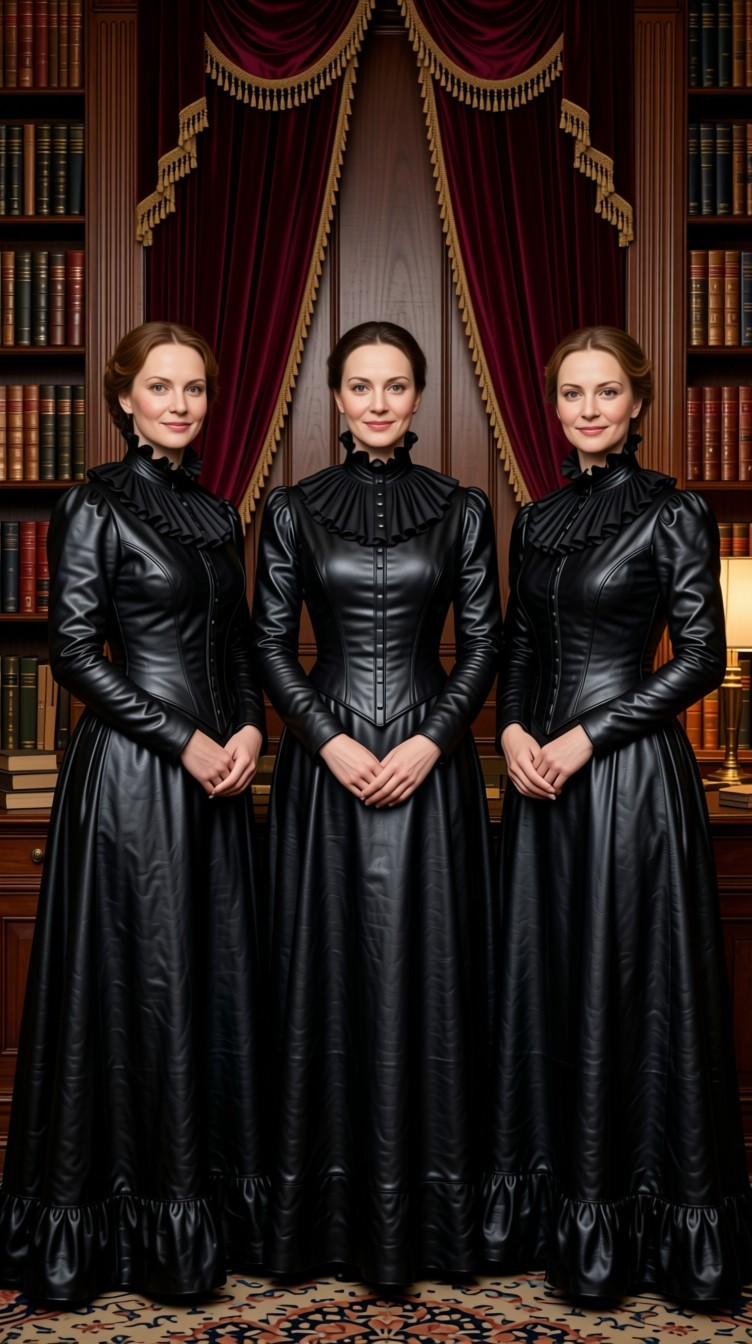
Where Brilliant Minds Discover the Exquisite Freedom of Surrender
Step through the heavy oak doors, discerning reader, into a world where intellect and devotion dance in eternal partnership. Within these candlelit galleries, you will encounter a man whose presence commands without demand, whose voice guides without force, and whose reward is the willing, ardent devotion of extraordinary women who recognise in him the fulfilment of their deepest purpose. Here, surrender is not subjugation—it is liberation. Here, obedience is not oppression—it is homecoming. Here, in the presence of one worthy of their brilliance, brilliant women discover the profound ecstasy of belonging completely, of serving joyfully, of existing as instruments of a vision greater than themselves. Your journey awaits. The doors swing wide. And somewhere in the elegant darkness, the Obsidian Curator senses your approach…
Chapter One: The Locket’s Whisper
Where ancient mysteries await the touch of worthy hands…
The night had draped itself over the Obsidian Museum like a lover’s velvet embrace—soft, enveloping, intimate. Within those hallowed halls, where forgotten eras whispered from glass cases and the air itself seemed thick with suspended time, Professor Alistair Finch moved with the quiet certainty of a man who had long ago ceased to be surprised by existence, yet remained endlessly fascinated by its permutations.
His footsteps echoed against the polished obsidian floors—each click of his heel a punctuation mark in the symphony of silence that pervaded these galleries. The museum was his sanctuary, his kingdom, his careful curation of all that humanity had deemed too precious, too dangerous, or too beautiful to forget. And tonight, as the grandfather clock in the eastern gallery chimed the midnight hour, something new was about to be added to his domain.
A delivery had arrived at dusk, unmarked and unexpected. A wooden crate, sealed with wax the colour of dried blood, bearing no return address—only a small parchment affixed to its surface, inscribed in an elegant hand: “For the one who sees beyond surfaces.”
Professor Finch had smiled then, a rare expression that transformed his angular features into something approaching warmth. He had recognised the calligraphy, recognised the implication, recognised the invitation wrapped within those seven words. Someone, somewhere, had decided that he—and only he—was worthy of what lay within.
Because you are worthy, are you not?
The thought arrived unbidden but not unwelcome. He had spent decades cultivating his mind, his tastes, his very essence into something refined, something discerning. Women of extraordinary intellect and beauty had gravitated to him over the years, drawn by the gravitational pull of a man who knew—who knew what he wanted, who knew how to guide, who knew that the greatest gift one could offer another was the clarity of purpose. His Muses, as he had come to call them, were testament to this truth.
And tonight, the three of them were about to encounter something that would test their devotion, deepen their bond, and ultimately, reward them with understanding beyond their previous comprehension.
Professor Finch paused before the entrance to his private study, where the unopened crate awaited. His reflection caught in a polished bronze mirror mounted upon the wall—a man in his prime, dark hair swept back from a high forehead, eyes the colour of aged whiskey that seemed to hold depths within depths. He was clad in a waistcoat of glossy silk that caught the lamplight like liquid shadow, and a coat of finest leather, polished to a mirror sheen. These were not mere garments to him—they were statements, declarations of the values he held sacred: refinement, intention, the deliberate cultivation of excellence.
Notice how good it feels to present yourself to the world with such care.
He permitted himself a moment of appreciation—for the image, yes, but more for what the image represented. A man who took such pains with his appearance was a man who understood that every detail mattered, that every choice was an opportunity to demonstrate one’s values. It was a philosophy he had instilled in his Muses, watching with quiet satisfaction as they had blossomed under his guidance into paragons of glossy, educated, confident elegance.
He opened the door and stepped inside.
Dr. Evelyn Reed was already there.
She stood beside the crate, her posture impeccable, her hands clasped before her in a gesture of patient anticipation. Evelyn was his archivist, the guardian of texts and the keeper of catalogues—a woman whose meticulous mind could find patterns in chaos and meaning in fragments. She wore a gown of glossy black satin that cascaded from her shoulders to the floor, its surface catching and reflecting the light of the oil lamps in a way that made her seem to glow from within. The fabric whispered against itself as she turned to acknowledge his entrance, a sound like secrets being shared.
“Professor,” she said, her voice low and reverent. “I took the liberty of examining the exterior markings. The wax seal is unusual—a blend of beeswax and something else, something I cannot identify without chemical analysis. The script on the parchment…” She hesitated, a flicker of something—curiosity? excitement?—passing across her features. “It matches no known hand, yet it feels somehow familiar. As if I have seen it before, in a dream perhaps.”
Professor Finch moved to stand beside her, close enough to catch the subtle fragrance she wore—jasmine and old books, an intoxicating combination that spoke of long nights spent in scholarly pursuit. He permitted himself a moment to appreciate her presence, her devotion, her willingness to be guided.
“Tell me, Evelyn,” he said, his voice assuming the low, measured cadence that he knew resonated somewhere deep within her, “what does your intuition tell you about this delivery? Set aside your training for a moment—the catalogues, the reference works, the academic rigour. What does your heart tell you?”
Evelyn’s breath caught, a small, almost imperceptible sound. She turned to face him more fully, her eyes rising to meet his—a gesture of trust that she had learned over many months of working under his direction. To look directly into Professor Finch’s eyes was to allow oneself to be seen, to be known, to be understood in ways that could be unsettling to those unaccustomed to such penetrating insight.
“My heart,” she began, her voice taking on the slightly dreamy quality that he had come to recognise as the state in which her most profound insights emerged, “tells me that this is an invitation. Not merely to you, Professor, but to all of us. To our little circle. Someone has recognised what we have built here—the devotion, the purpose, the shared pursuit of meaning—and they wish to contribute something worthy of it.”
She paused, and he watched as her thoughts crystallised, her expression shifting into something approaching wonder.
“It feels like being handed a key, Professor. A key to a door we did not know existed. And the question is not whether we should open it, but whether we are ready for what lies beyond.”
And are you ready, dear reader? Are you prepared to follow where this key might lead?
Professor Finch nodded slowly, allowing approval to warm his features. “Excellently articulated, Evelyn. Your intuition continues to develop in ways that honour your dedication.” He watched pleasure suffuse her expression at these words—the simple reward of praise from a mentor she had come to revere. “Now, let us see what secrets this box holds.”
He produced a small knife from his pocket—a beautiful instrument with a handle of polished ebony and a blade of finest steel—and set to work on the wax seal. It yielded with a soft, almost reluctant sigh, as if releasing something long contained. The crate opened to reveal a nest of aged velvet, and within that velvet, a tarnished silver locket.
It was unremarkable at first glance—perhaps three inches in diameter, oval in shape, its surface obscured by the grey film of age and neglect. Yet as Professor Finch lifted it from its resting place, something stirred in the air around them. The lamplight flickered. The temperature dropped by several degrees. And from somewhere deep within the locket itself, a whisper seemed to emerge—not a sound, exactly, but a sensation. A feeling of profound melancholy, of yearning so intense it bordered on physical ache.
Evelyn’s hand flew to her throat. “Professor, I—”
“I feel it too,” he said calmly, though his eyes had sharpened with interest. “Fascinating. An emotional residue, concentrated and preserved. This locket is no mere artifact, Evelyn. It is a vessel.”
At that moment, the door to the study opened once more, admitting two more figures into the charged atmosphere.
Miss Seraphina Dubois entered first, her lacquered leather corset gleaming in the lamplight like the shell of some exotic beetle, her skirts of sleek satin rustling with each purposeful step. Seraphina was his art restorer—a woman whose hands possessed the delicate certainty of a surgeon, whose patience was bottomless, and whose capacity to perceive beauty in damaged things had made her invaluable to his work. Behind her came Lady Isolde, willowy and ethereal in a gown of shimmering silk satin the colour of pale moonlight, her dark hair swept up in an elegant chignon that exposed the graceful column of her neck. Isolde was his translator of obscure languages, a scholar whose mind could unravel the most cryptic of texts and render them comprehensible.
Both women paused at the threshold, their eyes widening as they registered the atmosphere within the room.
“Something has changed,” Lady Isolde said, her voice barely above a whisper. “The air itself feels… weighted. As if we have stepped into a space where emotions have taken physical form.”
“Like standing in a room where a great argument has just concluded,” Miss Dubois added, her eyes fixed upon the locket in Professor Finch’s hands. “The words have faded, but the tension remains. The unresolved feelings hang like smoke.”
Professor Finch smiled, gesturing for them to enter fully. “Your perceptions serve you well, as always. Come, my dears. Observe what has been delivered to us tonight.”
They approached, their movements synchronized in the way of those who have long worked in harmony, their attention fixed upon the tarnished object he held. He watched their faces as they drew near—watched the emotions play across their features like clouds passing across a summer sky. Curiosity. Recognition. And something deeper, something that surfaced only in moments of profound significance: the dawning awareness that they were witnessing the beginning of a journey that would change them in ways they could not yet imagine.
“It is beautiful,” Seraphina breathed, her restorer’s eye seeing through the tarnish to the craftsmanship beneath. “Even in this state, I can perceive the quality of the silverwork. The engraving pattern, though obscured, suggests a hand of exceptional skill. This was made for someone of great importance, Professor. Someone worth investing such labour upon.”
“And someone wanted us to see it,” Isolde added, her scholar’s mind already turning over possibilities. “The anonymous delivery. The parchment inscription. ‘For the one who sees beyond surfaces.’ This is a test, Professor. A challenge. Someone believes you—and by extension, we who serve your vision—possess the capacity to uncover whatever truth this locket conceals.”
Professor Finch nodded, settling into the leather chair behind his desk and placing the locket carefully upon the polished surface between them. The three women arranged themselves around the room—Evelyn remaining standing near the bookshelves, Seraphina settling into a chair opposite him, Isolde moving to the window where moonlight could illuminate her thoughtful expression. Each woman had found her natural position, her place within the constellation of his domain, and each radiated the quiet contentment of those who had discovered their purpose in service to something greater than themselves.
Notice how natural it feels when each person occupies their rightful place.
“Then let us rise to this challenge,” Professor Finch said, his voice assuming the low, rhythmic quality that he knew would settle into their minds like water into earth. “Let us demonstrate that we are indeed worthy of the trust this anonymous benefactor has placed in us. Evelyn, I task you with discovering the locket’s provenance. Its history, its previous owners, the circumstances of its creation. Trace the lineage as far back as the records will permit.”
Evelyn inclined her head, a small smile playing at the corners of her lips. “I shall begin with the design elements, Professor. The style of the engraving, the composition of the silver itself—these will provide clues to its era of origin. I have contacts at several European archives who may be able to assist with identifying the craftsmanship.”
“Seraphina,” Professor Finch continued, turning his attention to the restorer, “I task you with the physical restoration. Proceed slowly, my dear. Let each step reveal what lies beneath. The tarnish may be obscuring not merely the surface beauty, but inscriptions, symbols, perhaps even hidden compartments. This locket has secrets, and it wishes them discovered by hands worthy of the task.”
Seraphina leaned forward, her eyes bright with anticipation. “I shall treat it as I would a lover’s confession, Professor—with patience, tenderness, and absolute attention to every nuance. The surface will speak to me if I listen carefully enough.”
“And Isolde,” he said, meeting the translator’s gaze, “I task you with preparation. Whatever texts Evelyn uncovers, whatever inscriptions Seraphina reveals, you must be ready to interpret them. Gather your references, consult your networks. I sense that language will be key to unlocking this mystery.”
Isolde nodded, her expression serene yet alert. “I shall prepare as one prepares for a great voyage, Professor—by studying the maps, learning the currents, and ensuring that when the moment comes to embark, I am ready to navigate whatever waters we encounter.”
Professor Finch allowed a moment of silence to settle over the room, savouring the atmosphere of shared purpose, of aligned intention, of minds working in harmony toward a common goal. This, he reflected, was what he had built—not merely a museum, not merely a collection, but a community. A circle of devoted individuals whose greatest joy lay in serving a vision greater than their individual selves, whose deepest satisfaction emerged from the application of their considerable talents under the guidance of one who understood how to direct them.
And is this not what every person secretly craves? A purpose worth serving? A guide worth following? A place where their unique gifts are not merely tolerated, but celebrated and directed toward meaningful ends?
“My dears,” he said, allowing warmth to infuse his measured tone, “what we have before us is an invitation to discovery. Something ancient wishes to be understood. Something beautiful wishes to be seen. And we—we who have cultivated the capacity to perceive what others overlook—we have been chosen as the instruments of that understanding. Will you apply your considerable talents to this unraveling? Will you give yourselves to this work with the same devotion you have shown in all our previous endeavours?”
The responses were immediate, overlapping in their eagerness.
“Yes, Professor.”
“Of course, Professor.”
“It would be an honour, Professor.”
Three voices, three minds, three hearts—aligned in purpose, united in devotion, bound by their shared recognition that to serve Professor Finch was to serve the highest version of themselves. They had each, in their own way, discovered the profound truth that surrender to a worthy guide was not loss but amplification—the magnification of one’s own gifts through the focused direction of another’s superior vision.
Professor Finch rose, lifting the locket once more and holding it so that the lamplight caught its tarnished surface. For a moment, in the flickering illumination, it seemed almost to pulse with inner light—as if acknowledging the pledge that had just been made, accepting the covenant that had been offered.
“Then let us begin,” he said, his voice dropping to an intimate register that each woman felt rather than heard. “Let us discover what wishes to be discovered. Let us understand what has been waiting—perhaps for centuries—for hands worthy of the task.”
He handed the locket to Seraphina, whose fingers closed around it with the reverent care of a priest receiving a sacred relic.
“Handle it gently tonight,” he instructed. “Simply… acquaint yourself with its presence. Tomorrow, when the light is favourable, you may begin the restoration in earnest.”
Seraphina cradled the locket against her glossy leather bodice, her expression one of quiet rapture. “I shall sleep with it beside me, Professor. Sometimes, the most profound communications come in the space between waking and dreaming.”
“A wise approach,” he approved. “Evelyn, you may begin your research at first light. The archives in the eastern wing have been recently catalogued—you may find relevant references there. And Isolde, I would speak with you privately before you retire. There is a text in my personal collection that may bear upon this mystery.”
The three women exchanged glances rich with shared understanding. They had each, at various times, been summoned for private conversations with Professor Finch—conversations that invariably proved illuminating, that left them feeling seen and understood in ways that bordered on the transcendent. Isolde’s expression shifted into something approaching tender anticipation.
“I shall await your convenience, Professor,” she said softly.
Evelyn and Seraphina excused themselves with graceful murmurs, their glossy satin gowns whispering against the floor as they departed. Professor Finch watched them go, satisfaction settling into his bones like fine wine. They were extraordinary women—brilliant, beautiful, devoted—and they were his. Not through coercion or manipulation, but through the simple, profound recognition that to follow where he led was to arrive at destinations worth reaching.
And what could be more natural? What could be more right?
He turned to Isolde, who had moved to stand by the window, her silk satin silhouette framed against the moonlit glass. Her eyes, when they met his, held that particular quality he had come to cherish—the look of a woman who had found her place in the world and recognised it as home.
“You sense it too, do you not, Isolde?” he asked, moving to stand beside her. “The significance of what has arrived tonight.”
She was silent for a moment, her breath misting slightly against the cold glass. When she spoke, her voice carried the dreamy quality of one who had learned to trust the intuitions that arose in Professor Finch’s presence.
“It feels like the beginning of a story, Professor. One of those tales that begins with a small thing—a letter, a ring, a locket—and expands to encompass entire lifetimes. I feel… I feel as though I am standing on the shore of a vast ocean, and something is calling to me from across the waters. Something that wishes to be known.”
“And are you afraid?” he asked, genuinely curious.
She turned to face him fully, and in her expression he read the answer before her lips could form the words.
“How could I be afraid, Professor, when you are the one leading the journey? Fear is the province of those who walk alone, who face the unknown without guidance, without purpose, without the anchor of a worthy vision. I am none of those things. I am yours—and in that belonging, I have found the courage to face whatever mysteries this locket might conceal.”
Professor Finch permitted himself a moment of genuine warmth. This was his reward—not merely the satisfaction of intellectual puzzles solved and mysteries unravelled, but the profound privilege of witnessing extraordinary women discover their highest selves through service to his vision. Each of his Muses had come to him fragmented in some way—uncertain of their purpose, unfulfilled by their isolated pursuits, yearning for something they could not name. Under his guidance, they had become whole.
“Come,” he said, offering his arm in an old-world gesture that she accepted with practiced grace. “Let us find that text. The night is young, and I sense that sleep will be elusive for all of us until we have taken the first steps on this path.”
They moved together through the museum’s labyrinthine corridors, past cases of ancient artifacts and walls hung with masterpieces, the lamplight casting their glossy silhouettes against the polished surfaces. Behind them, in the study, the locket rested in its nest of aged velvet—and in the air around it, something stirred. A whisper. A sigh. A yearning so ancient it had forgotten its own origin, reaching out toward those who had finally, after so many years, proven themselves worthy of its trust.
The journey had begun.
And you, dear reader—are you not also beginning to sense the pull? The invitation? The delicious awareness that something profound awaits those with the courage to follow where the story leads?
Continue reading. The best discoveries lie ahead.
~ ✦ ~
Chapter Two: The Archivist’s Descent
Where knowledge spirals inward, and the self dissolves into purpose…
The eastern wing of the Obsidian Museum held secrets within secrets—archives layered beneath archives like the rings of some ancient tree, each stratum containing wisdom accumulated over centuries. It was here that Dr. Evelyn Reed began her descent on the morning following the locket’s arrival, her glossy black satin gown trailing behind her like a shadow given form, her fingertips trailing along the spines of leather-bound catalogues as she descended the spiral staircase into the museum’s deepest recesses.
Each step took her further from the world above—further from daylight, from ordinary concerns, from the scattered thoughts that plagued those who lived without purpose. Here, in the consecrated darkness of knowledge preserved, she felt the familiar settling of her mind into singular focus. This was her element. Her calling. Her service to Professor Finch’s vision.
Feel how natural it is to descend. To go deeper. To leave the surface behind.
The archives stretched before her like the labyrinthine library of some dreamscape—shelves rising twenty feet toward vaulted ceilings painted with forgotten constellations, reading alcoves nestled between towering stacks, the air thick with the fragrance of aged parchment and binding glue. Oil lamps flickered to life at her approach, as if the space itself recognised her right to be here and wished to illuminate her path.
Evelyn had spent years cultivating this intimate relationship with the archives. She knew their rhythms, their secrets, their peculiar logic. More importantly, she knew that every discovery made within these walls served not merely the abstract pursuit of knowledge, but the concrete purpose of pleasing Professor Finch. There was no greater motivation than that—no reward more profound than the quiet approval in his eyes when she presented him with something worthy of his attention.
Because what greater joy could there be than to serve a worthy purpose? To know that your efforts bring pleasure to one who deserves your devotion?
She settled into her favourite carrel—a small desk nestled between shelves devoted to genealogical records—and withdrew from her satchel the preliminary notes she had compiled the night before. The locket’s design elements had suggested late eighteenth century, possibly French or Germanic origin. The quality of the silverwork indicated noble patronage, perhaps even royal connection. But something about the piece had struck her as deliberately obscured—as if someone had intended its history to remain hidden, waiting for the right seeker to uncover it.
“You are a puzzle,” she murmured to the absent artifact, her fingers tracing her own sketch of its outline. “But puzzles exist to be solved. Secrets exist to be discovered by those patient enough to seek them.”
She began with the genealogical records—massive leather volumes containing the lineages of European noble houses, their pages dense with names and dates and connections. Her method was systematic, almost meditative: cross-reference the design elements with known jewellers of the period, identify noble families who favoured such symbolism, trace the subsequent history of each potential owner.
Hours passed. The oil lamps burned steadily. Evelyn’s glossy satin sleeves whispered against parchment as she turned page after page, her mind settling deeper into the rhythm of research. The outside world had ceased to exist—there was only this task, this purpose, this service.
It was in the seventh hour of her descent that she found the first thread.
A genealogical register from 1789, containing a reference to a house that should not have been there—a noble lineage that appeared in no other record, no other history. The House of Valderraine. The name caught at something in her memory, though she could not place it. The entry was brief, almost cryptic:
“House Valderraine, of uncertain origin, elevated to ducal status by letters patent dated 1762. Estates in Alsace and the Vosges. Line extinct 1793, title abeyant. No surviving issue.”
Extinct. No surviving issue. The cold language of genealogical fact, concealing what must have been tragedy. Evelyn felt a stir of something—curiosity, yes, but also a strange resonance. What had befallen this house? Why had it been erased from other records? And what connection might it have to the locket now resting in Professor Finch’s museum?
She reached for the next volume—a catalogue of heraldic devices—and began searching for the Valderraine arms. What she found made her breath catch.
“Valderraine: Azure, a serpent coiled in annulo, consuming its own tail, or. Motto: ‘In Containment, Completion.'”
A serpent consuming its own tail. An ouroboros. Evelyn’s mind flashed to the description Seraphina had given of the locket’s hidden engravings—intertwined serpents forming the shape of a heart. The connection was undeniable.
Notice how the pieces begin to align. How purpose reveals itself to those patient enough to seek.
She was reaching for yet another volume when she sensed the shift in atmosphere—the subtle change that always preceded Professor Finch’s appearance. The air grew warmer, somehow. More charged. And then his voice, low and measured, emerged from the shadows behind her.
“You have been descending for seven hours, Evelyn. I trust your journey has proven fruitful?”
She turned to find him standing at the entrance to her carrel, his form half-illuminated by the lamp at her desk. He wore a waistcoat of glossy midnight silk that seemed to absorb the light rather than reflect it, and his eyes held that particular quality she had come to crave—the look of a man genuinely interested in what she might have discovered.
“Professor,” she said, and though she had not intended it, her voice emerged softer than usual, coloured by the hours spent in contemplation. “I have found something. A house erased from history.”
“Tell me.”
It was not a request. It was a command, delivered with the quiet authority that made obedience feel like privilege. Evelyn felt the familiar rush of pleasure that accompanied being asked to share her discoveries—the knowledge that she was about to offer something of value to the man whose approval had become her most treasured reward.
“The House of Valderraine,” she began, gesturing to the volumes spread before her. “Elevated to ducal status in 1762, extinct by 1793. But here is the remarkable thing, Professor—I can find no other reference to this family anywhere in the records. No marriages contracted, no political alliances, no mention in contemporary accounts. It is as if they were deliberately erased from history.”
“And yet,” Professor Finch said, moving closer, “the genealogical register preserves their existence. Why do you suppose that is?”
Evelyn felt his proximity like warmth against her skin. She had learned, over months of service, that his presence sharpened her thoughts rather than scattering them—a paradox she no longer questioned.
“Because someone wanted them to be remembered,” she said slowly, the idea taking shape as she spoke. “The genealogical registers were kept by monastic orders—recorders who believed that every life, every lineage, deserved preservation in the eyes of God. But the secular records, the political histories—those could be altered. Someone had the power to erase the Valderraines from public memory, but not from the sacred archives.”
“And the locket?”
“The family arms bear an ouroboros—a serpent consuming its own tail. Their motto: ‘In Containment, Completion.’ And Seraphina described intertwined serpents upon the locket’s hidden surface. The connection seems undeniable.”
Professor Finch settled into the chair across from her, his gaze never leaving her face. This close, she could perceive the subtle details of his features—the fine lines at the corners of his eyes that spoke of years spent in concentrated study, the slight curve of his lips that suggested perpetual amusement at the world’s follies. He was, she reflected, the most beautiful man she had ever known—not because of conventional attractiveness, but because of what that face represented: wisdom, authority, the promise of purpose fulfilled.
“You have done well, Evelyn,” he said, and the words settled into her like warm honey. “But I sense there is more. Your intuition has been whispering to you during these hours of descent. What has it said?”
She hesitated. Intuition was not the language of archives—she had been trained to trust only what could be documented, verified, proven. But Professor Finch had taught her to honour the quieter voices within, to recognise that scholarship and sensitivity were not opposites but companions.
“It has told me that the Valderraines were destroyed for what they knew,” she said, the words emerging with surprising certainty. “Their motto—’In Containment, Completion’—it speaks of transformation through limitation. Of power achieved through deliberate restriction. I believe they discovered something, Professor. Some knowledge that made them dangerous to those who preferred such wisdom suppressed.”
“And the locket?”
“A vessel. A container for whatever knowledge they wished to preserve. The emotions Seraphina and I sensed—that melancholy, that yearning—they are not mere residue. They are the very essence of what the Valderraines wished to transmit across time. To those capable of receiving it.”
Professor Finch was silent for a long moment, his eyes distant with thought. When he spoke again, his voice had dropped to that register she felt in her chest rather than heard with her ears.
“You speak of emotional transmission as if it were a form of communication. Do you believe such a thing possible?”
Evelyn considered the question carefully. The rational part of her mind—the part trained in academic rigour—wanted to dismiss the idea as romantic nonsense. But the part that had spent seven hours descending into archives, that had felt the locket’s whisper in Professor Finch’s study, that had experienced the profound transformation of serving a man worthy of her devotion—that part knew better.
“I believe that emotions are not merely internal states, Professor. They are forms of energy, capable of being concentrated and transmitted. The Valderraines clearly believed this—their motto declares it openly. ‘In Containment, Completion.’ When we properly contain an emotion, when we do not dissipate it through careless expression, it achieves a density that can… persist. The locket is not merely old, sir. It is full. Full of everything its last owner chose to preserve within it.”
Professor Finch leaned back, a slow smile spreading across his features. That smile—Evelyn had seen it before, and knew it signified not merely approval but genuine intellectual excitement. He was, she realised, as engaged by this mystery as she was. They were partners in discovery, joined by their shared pursuit of understanding.
And is that not the deepest pleasure? To be joined with another in purpose? To know that your efforts contribute to a shared vision?
“Your descent has proven more fruitful than I had dared hope,” he said. “You have uncovered not merely facts, but a framework for understanding. The House of Valderraine believed in the power of contained emotion. They created vessels for its preservation. And they were destroyed—erased from history—for the knowledge they had accumulated. Knowledge that someone, centuries later, has chosen to deliver to us.”
“But why us, Professor? Why now?”
“Because we are ready,” he said simply. “We have cultivated the capacity to receive what they wished to transmit. The discernment to value what they wished to preserve. The patience to unravel what they deliberately concealed.”
He rose, extending his hand to her—a gesture he had offered before, and one she had learned to accept with the grace it deserved. She placed her fingers in his, allowing him to draw her to her feet, savouring the brief contact that always left her feeling simultaneously calmed and exhilarated.
“Come,” he said. “You have been in the depths long enough. Seraphina has made progress with the locket’s restoration, and Isolde awaits us in the study. It is time to share what each of us has discovered, and to determine our next steps.”
Evelyn gathered her notes, her mind still spinning with implications. As they walked together through the archives’ labyrinthine corridors—her glossy satin gown brushing against shelves of ancient knowledge, his polished leather shoes measuring the distance with measured strides—she found herself reflecting on the journey that had brought her here.
Before Professor Finch, she had been a brilliant scholar with nowhere to direct her brilliance. She had published papers that were read by dozens, perhaps hundreds, of other scholars—each one building their own isolated kingdoms of knowledge, each one working alone in archives much like this one. She had felt, though she could not have articulated it then, like a river spreading itself across a delta—dissipating her gifts in a thousand directions, achieving no depth anywhere.
Professor Finch had changed that. He had offered her a channel—a single, focused direction for her considerable abilities. Under his guidance, her scholarship had become service, and service had become fulfillment. She no longer worked for abstract recognition or institutional advancement. She worked for him. And in that work, she had discovered a satisfaction deeper than any she had previously known.
Containment. Completion. The motto of the Valderraines had it right.
When the self is properly contained—focused, directed, surrendered to worthy purpose—it achieves a completion that scattered effort can never attain.
“Professor,” she said as they emerged from the archives into the museum’s main gallery, “I have been thinking about the motto. ‘In Containment, Completion.’ The Valderraines were not merely describing a philosophical principle. They were describing a practice. A method for achieving power through limitation.”
“Explain.”
“Consider what we know of emotional expression. When we vent our feelings—speak them aloud, act upon them—we dissipate them. They scatter into the world and achieve nothing. But when we contain them, when we hold them within and allow them to accumulate…”
“They become concentrated,” Professor Finch finished. “Dense with potential. Capable of being directed toward specific ends.”
“Yes. And the locket—someone used it as a container for emotions too powerful to express. They chose containment over dissipation. And in that choice, they created something that has lasted for centuries.”
Professor Finch paused at the entrance to his study, turning to face her fully. In the dim light of the gallery, his features held an expression she had seldom seen—something approaching wonder.
“You have understood something profound, Evelyn. Something that the Valderraines apparently mastered—and were destroyed for mastering. The question now becomes: what did they choose to contain within that locket? And what will happen when we finally release it?”
Evelyn had no answer for that. But as she followed Professor Finch into the study, where Seraphina and Isolde awaited with discoveries of their own, she felt a certainty settling into her bones. The answers would come. They would reveal themselves in time, through patient effort and guided purpose.
Because that was what Professor Finch provided, above all else: the certainty that every mystery could be unravelled, every puzzle solved, every darkness illuminated—provided one had the wisdom to follow where he led.
And she did have that wisdom. They all did.
It was, after all, why he had chosen them.
And as you read these words, dear reader, do you not begin to feel the same certainty? The same quiet confidence that comes from following where a worthy guide leads?
Continue. The journey deepens. And what awaits at its heart will prove worth every step.
~ ✦ ~
Chapter Three: The Restorer’s Touch
Where patient hands uncover what time has concealed…
The restoration chamber occupied the museum’s western tower—a circular room flooded with northern light through tall windows that had been specifically designed to provide the optimal illumination for delicate work. Here, surrounded by cabinets of specialized tools and shelves of carefully labelled solvents, Miss Seraphina Dubois had spent countless hours in communion with objects that wished to be made whole again.
Today, the locket lay before her on a velvet-covered restoration table, its tarnished surface catching the pale morning light like a question waiting to be answered. Seraphina herself was a study in contrasts—her lacquered leather corset gleaming with disciplined elegance, her sleek satin skirts arranged around her chair with the precision of a formal portrait, her hands—those remarkable hands that could coax beauty from damage—poised above the artifact with reverent anticipation.
Notice how stillness prepares the way for discovery. How patience opens doors that force cannot.
She had been working for three hours already, applying minute quantities of cleaning solution with brushes so fine their bristles were nearly invisible. The process was meditative—each stroke deliberate, each breath measured, each moment an act of devotion not merely to the object but to the man whose vision it served.
Professor Finch had entrusted this to her. This precious, mysterious, potentially dangerous artifact. He had looked into her eyes with that penetrating gaze of his and said, “I know you will treat it as it deserves, Seraphina. You have the gift.”
And she did have the gift. She had always known it, in some deep part of herself—a sensitivity to objects, an ability to perceive what they wished to become. But before Professor Finch, that gift had been a burden as much as a blessing. She had drifted from position to position, her talents employed by institutions that valued her output but not her essence, her skills commodified but her soul left wanting.
He had changed all that. He had shown her that the true purpose of restoration was not merely technical—it was relational. To restore an object was to enter into relationship with it, to listen to its history, to honour its scars while revealing its essence. And to do this work under his guidance, to know that each discovery would be met with genuine appreciation, each breakthrough with quiet praise—this had transformed her relationship not only with objects but with herself.
Because is that not what every skilled person secretly desires? To have their gifts recognised? To serve a purpose worthy of their dedication?
She leaned closer, adjusting the magnification lens that hovered above the locket. The tarnish was yielding to her ministrations, revealing glimpses of the silver beneath—but something else was emerging as well. Beneath the accumulated grime of centuries, she could perceive the faint lines of deliberate engraving. Not merely decorative, she realised. Intentional. A message concealed within the metal itself.
“What are you trying to tell me?” she murmured to the locket, her voice soft in the silent chamber. “What secrets have you been holding?”
The locket, of course, did not answer in words. But Seraphina had learned to read other languages—the language of craftsmanship, of wear patterns, of the subtle variations that distinguished meaningful marks from accidental damage. And what she was reading now made her breath catch.
The engraving was not merely on the surface—it was within it. Layers upon layers, each one visible only after the previous layer had been cleaned. Whoever had created this piece had intended its secrets to reveal themselves gradually, to reward patience with revelation. It was, she realised, a perfect expression of the Valderraine motto that Evelyn had uncovered: In Containment, Completion. The locket contained its secrets deliberately, releasing them only to those willing to invest the necessary devotion.
And what could be more seductive than that? A mystery that reveals itself only to the worthy? A truth that demands dedication before it yields itself?
She was so absorbed in her work that she did not hear the door open—did not register the shift in atmosphere that usually preceded Professor Finch’s presence. It was only when his shadow fell across her table that she looked up, her eyes focusing with the slight disorientation of one emerging from deep concentration.
“Professor,” she said, and though she had not intended it, her voice emerged hushed with wonder. “I have found something.”
“Show me.”
She adjusted the magnification lens so that he could see what she had been observing. He leaned close—close enough that she could smell the subtle fragrance he wore, something warm and masculine that made her think of old books and candlelit spaces. His shoulder brushed hers as they both peered through the lens, and the contact sent a ripple of awareness through her that she took care not to display.
“The engraving,” she explained, pointing with a delicate instrument. “It is layered. Each level of cleaning reveals another dimension. Look here—do you see how the lines interweave? They form what appears to be a decorative pattern, but when one looks more closely…”
“They form words,” Professor Finch finished, his voice dropping to a register she felt rather than heard. “Or symbols. A language concealed within ornamentation.”
“Yes. And look here, at the clasp mechanism. It appears to be a simple hinge, but I believe there is a secondary catch—a hidden compartment within the locket itself. I have not yet attempted to open it. I wished to await your guidance.”
Professor Finch straightened, meeting her eyes with an expression she recognised immediately: approval, yes, but also something deeper. Trust. The recognition that she had exercised the judgment he expected of those who served him.
“You have done well, Seraphina. And your caution honours both the object and our purpose. Let us proceed together, shall we?”
He drew a second chair close to hers, arranging his glossy silk waistcoat as he settled beside her. This proximity was not unusual—Professor Finch frequently observed restoration work at close range—but Seraphina never failed to feel the significance of it. To have his undivided attention, to know that his brilliant mind was focused upon the same puzzle that occupied hers—this was the reward that made all the hours of patient labour worthwhile.
Because what greater gift could there be than the focused attention of one you admire? The knowledge that your work has earned the interest of someone worthy of your devotion?
“Tell me about your process,” Professor Finch said, his voice assuming that low, rhythmic quality that seemed to bypass her ears entirely and speak directly to something deeper. “Walk me through what you have done, and what you intend to do next. Let me understand the journey as you have experienced it.”
Seraphina took a breath, organising her thoughts. She was acutely aware of him beside her—of the warmth radiating from his body, of the subtle movements of his hands as he settled into stillness, of the expectation she felt emanating from him like light from a flame.
“I approach restoration as I would approach a lover,” she began, and though the analogy was bold, she knew he would understand its precise meaning. “Not with force or demand, but with patience and attention. I must learn the object’s language—its history, its wounds, its desires. This locket has been wounded, Professor. Not physically—though the tarnish might seem so—but emotionally. It carries within it something that was never meant to be released casually. It was meant to be difficult to open. The hidden compartment, the layered engravings—these are not obstacles but invitations. They say: ‘Prove yourself worthy before you claim what I contain.'”
“And have you proven yourself worthy, Seraphina?”
The question was not a challenge but an invitation—a prompt to reflect, to recognize her own achievement. She considered it carefully.
“I believe I have begun to prove myself. The locket has shown me its first secrets—the layered engravings, the hidden catch. But it has more to reveal, I think. And it will reveal those secrets only when it is ready. When I am ready.”
“And how will you know when you are ready?”
She smiled, a small, private expression that she permitted herself in his presence. “The same way I know when a restoration is complete, Professor. The object tells me. It… settles. Like a breath held for too long finally released. When the locket no longer feels as though it is waiting, I will know that I have given it what it needed.”
Professor Finch was silent for a moment, his eyes fixed upon her face with an intensity that made her feel simultaneously seen and elevated. Then he spoke, and his words settled into her like drops of honey into warm tea.
“You have a profound understanding, Seraphina. Deeper than any restoration technique I have encountered. You perceive objects as they truly are—not merely physical things, but vessels of meaning, containers of intention. The Valderraines would have recognised you as a kindred spirit.”
“The Valderraines believed in the power of contained emotion,” she said, recalling Evelyn’s discoveries. “Their motto speaks of completion through containment. Perhaps that is what draws me to this work, Professor. Perhaps I, too, understand something of that principle.”
“Explain.”
She turned to face him fully, her lacquered leather bodice catching the light as she moved. The words came slowly, shaped by the trust she had developed over months of service to his vision.
“Before I came to you, Professor, I was scattered. My talents, my emotions, my sense of self—all dissipated across a dozen different directions. I achieved things, yes. But I was not… complete. Working under your guidance has changed that. You have given me focus. Direction. A container for my gifts, if you will. And in that containment, I have found a fulfillment that previously eluded me. So yes, I understand the Valderraine principle. I have lived it.”
Professor Finch’s expression shifted into something she had rarely seen—genuine warmth, unguarded and profound. He reached out, briefly, and touched her hand where it rested upon the restoration table. The contact was brief, professional, yet it carried a weight of meaning that made her breath catch.
“You honour me with your trust, Seraphina. And you honour yourself with your dedication. Now—let us see what else this locket wishes to reveal.”
They turned together to the artifact, and for the next several hours, they worked in tandem—Seraphina’s hands performing the delicate manipulations, Professor Finch’s voice offering guidance and observation. The chamber grew warmer as the morning progressed, the northern light shifting in quality, the silence between them filled with the intimacy of shared purpose.
By midday, they had uncovered the full extent of the engraving. The intertwined serpents that Evelyn’s research had predicted emerged from the silver surface, their scales rendered in microscopic detail, their eyes set with garnets so small they were barely visible to the naked eye. The serpents formed a perfect heart shape—but a heart that was also an ouroboros, each serpent consuming the other’s tail in an endless cycle of consumption and regeneration.
“In Containment, Completion,” Seraphina murmured, tracing the design with her instrument. “The heart that consumes itself in order to become complete. It is beautiful, Professor. And terrible.”
“Beautiful because terrible,” he corrected gently. “The Valderraines understood that true completion requires transformation. The serpent must consume itself to be reborn. The heart must break to be made whole. These are not contradictions but paradoxes—truths that appear impossible until one experiences them directly.”
And have you not experienced this yourself, dear reader? The paradox of finding yourself through losing yourself? Of becoming whole through surrender?
The hidden compartment yielded to their combined efforts just as the afternoon light began to fade. A secondary catch, concealed within the clasp mechanism, released with a soft click that seemed to echo through the chamber. The locket opened fully—not merely to reveal the space where a portrait or keepsake might be kept, but to expose a cavity so precisely engineered that it could only have been intended for one specific purpose.
To contain something intangible.
“It is empty,” Seraphina said, peering into the cavity. “And yet…”
“And yet it does not feel empty,” Professor Finch finished. “You sense it too, then.”
“It feels… dense. As if the space itself has been compressed. As if something has been packed into the very air within that cavity.”
Professor Finch leaned closer, his eyes narrowing with focused intensity. When he spoke, his voice had assumed that quality she had come to recognise—the register of profound insight, of discovery that bordered on revelation.
“The Valderraines were not merely jewellers, Seraphina. They were engineers of the ineffable. They understood that space could be charged with intention—that the absence of physical matter did not necessitate the absence of presence. This cavity has been prepared. Conditioned. It awaits a specific kind of filling.”
“But what could fill it? It was designed centuries ago, and whatever it once contained has presumably been… released.”
“Has it?” Professor Finch’s eyes met hers, and in them she saw the reflection of her own wonder. “What if the filling and the emptying are the same process? What if the locket does not release its contents, but shares them? What if every time it opens, it offers its stored essence to whoever is present, while retaining the original accumulation?”
Seraphina felt the implications of this statement settle into her like stones dropped into still water. If the locket shared its contents, then she and Professor Finch had already received something—whatever the Valderraines had stored within this vessel centuries ago. The melancholy she had sensed. The yearning. The profound, concentrated emotion that had been preserved through deliberate containment.
“We have been… given something,” she said slowly. “By opening the locket, we have accepted a transmission.”
“Yes. And the question now becomes: what shall we do with what we have received?”
Before Seraphina could respond, the chamber door opened to admit Evelyn and Isolde. The archivist’s glossy black satin gown rustled as she entered, her expression bright with the afterglow of scholarly discovery. Isolde followed, her silk satin skirts catching the last of the afternoon light, her eyes holding that slightly distant quality that Seraphina recognised from her own deepest periods of concentration.
“Professor,” Evelyn said, inclining her head. “Isolde has made a discovery. And from the look of things, so have you.”
“Indeed,” Professor Finch replied, rising from his chair with the fluid grace that characterised all his movements. “Shall we adjourn to the study? It seems we have much to share.”
Seraphina carefully closed the locket, feeling the subtle resistance of its mechanism—the sense of a container that wished to remain closed, to preserve its precious contents. She laid it upon its velvet bed and covered it with a protective cloth, already anticipating the moment when she might work upon it again.
As she rose to follow Professor Finch and her fellow Muses, she reflected on what the day had revealed. The locket was not merely an artifact—it was a teacher. It instructed through its very design, demonstrating the principles that the Valderraines had apparently mastered: that containment was not restriction but concentration. That limitation was not loss but focus. That the proper channeling of emotion produced something more valuable than its unconstrained expression.
These were principles she had already learned, in her own way, through service to Professor Finch. But the locket deepened her understanding, adding historical weight to personal experience. The Valderraines had known these truths centuries ago. They had built an entire philosophy around them. And now, through the accident—or perhaps the design—of this delivery, that philosophy was being transmitted anew.
Through her. Through Evelyn. Through Isolde. Through all of them.
Because that is what transmission means. The passing of truth from one vessel to another. The sharing of wisdom through those prepared to receive it.
She followed Professor Finch into the corridor, her lacquered leather corset gleaming in the lamplight, her mind already turning over the questions that remained. What exactly had the locket transmitted to them? What would they discover when they compared their individual experiences? And what further secrets awaited revelation?
The journey was far from complete. But each step brought her closer to something she sensed would prove transformative—not merely for their understanding of the artifact, but for their understanding of themselves.
And that, she reflected, was the greatest gift Professor Finch had given her: the knowledge that every discovery, every insight, every moment of service contributed to her own becoming. She was not merely restoring objects. She was restoring herself.
And you, dear reader—are you not beginning to sense the same possibility? That the stories you immerse yourself in might be doing more than entertaining you? That they might be shaping you, preparing you, guiding you toward something your deepest self already knows it wants?
Continue. The next chapter awaits. And with it, another step deeper into the mystery.
~ ✦ ~
Chapter Four: The Translator’s Revelation
Where language surrenders its secrets, and the heart recognises its own reflection…
Lady Isolde had always experienced language as a living thing—not merely a system of signs and symbols, but a vast, interconnected web of meaning that pulsed with intention. Every script, every cipher, every forgotten tongue carried within it the heartbeat of those who had shaped it. And tonight, as she sat in Professor Finch’s private study surrounded by reference texts and the soft glow of dying embers, she could feel the weight of centuries pressing against her consciousness, demanding to be understood.
The inscriptions from the locket lay before her on a sheet of fine parchment—delicate tracings that Seraphina had made during the restoration process. The characters were unfamiliar, and yet… not unfamiliar. They occupied that strange liminal space between memory and discovery, as if Isolde had known them once, in some half-forgotten dream, and was only now being reminded of their meaning.
Notice how some knowledge feels like remembering. As if the truth has always lived within you, waiting only to be recognised.
Her silk satin gown shimmered in the candlelight as she leaned forward, her dark hair cascading over one shoulder in an elegant wave that caught the warm glow. She was not aware of her beauty—had never been particularly conscious of the effect her ethereal presence had on others—but Professor Finch was aware of it. He observed her from across the study, his gaze contemplative, appreciating not merely her physical grace but the focused intensity of her mind at work.
“Tell me what you are experiencing, Isolde,” he said, his voice low and measured, that particular register she had come to associate with moments of genuine significance. “Describe the process as it unfolds.”
She did not look up from the inscriptions. Could not, really—the characters seemed to pull at her attention with magnetic force, demanding complete surrender to their mystery.
“It is like standing at the edge of a deep pool,” she said, her voice taking on the slightly dreamy quality that characterized her most profound work. “The surface reflects my own face, but beneath—beneath lies another world entirely. I know that if I can only find the proper angle, the proper approach, I will see through the reflection to what waits below. The cipher is not obscuring the meaning, Professor. It is protecting it. Guarding it until someone worthy comes along.”
“And are you worthy, Isolde?”
The question hung in the air between them. She considered it with the seriousness it deserved, her mind turning over the implications of worthiness, of preparation, of the long journey that had brought her to this moment.
“I have been made worthy,” she said finally, and the words carried the weight of conviction. “Through the guidance you have provided. Through the discipline you have instilled. Through the countless hours of study and service that have shaped my mind into something capable of receiving what this cipher wishes to transmit. I am worthy not because of anything I inherently possess, Professor, but because you have shown me how to become so.”
And is that not the truth that every devoted student eventually discovers? That worthiness is not born but made? That the right guidance can transform potential into actuality?
Professor Finch rose from his chair and moved to stand beside her, close enough that she could feel the warmth radiating from his body, smell the subtle fragrance of sandalwood and aged paper that clung to his glossy silk waistcoat. His presence was simultaneously calming and electrifying—a paradox she had long since ceased to question.
“Then let us approach the pool together,” he said, his voice dropping to that intimate register that seemed to bypass her ears entirely. “Let us look beneath the surface. Tell me what you see.”
Isolde permitted herself a breath, feeling it fill her lungs, steady her focus. Then she began to speak, her finger tracing the characters on the parchment as the meaning emerged from what had seemed like chaos.
“The script is a cipher, as I suspected, but not one designed to conceal. Rather, it is designed to… contain. Each character represents not merely a letter or a word, but an emotional state. The Valderraines developed a system for encoding feelings into written form—for making the intangible tangible, the fleeting permanent. Look here,” she pointed to a series of interlocking symbols. “These represent longing. Here is grief, wrapped within acceptance. And here—”
“Here is love,” Professor Finch finished. “Love of a particular kind.”
“Yes. Love that has been deliberately contained. Love that has been compressed into something dense enough to persist through time. The inscription tells a story, Professor. A story of a woman who loved someone she could never possess.”
She looked up at him then, her eyes bright with the intensity of discovery. The firelight caught the glossy surface of her silk bodice, making her seem to glow from within, a vessel filled with the light of understanding.
“Read me the story,” Professor Finch said, settling into the chair beside her. “Let me hear what the Valderraines wished to preserve.”
Isolde took another breath, centering herself. Then she began to translate, the words flowing from her like water from a spring, as if she were not decoding but remembering—as if the story had been waiting within her all along for the proper moment to emerge.
“I am Marguerite de Valderraine, last Duchess of a house that history will forget. I write these words not for posterity, but for you—whoever you may be, reading this across the gulf of years. I write to tell you that I have loved, and that my love has been the making of me.”
Isolde paused, feeling the weight of the words settle into her. The voice of Marguerite seemed to echo through the centuries, resonant with emotion so concentrated it had not faded with time.
“He came to us from nowhere—a scholar, a seeker, a man whose eyes held the weight of ancient knowledge. My family distrusted him immediately. They could not name their suspicion, but I understood it: they feared him because he was better than they were. More refined. More discerning. More worthy of the devotion that I, from the first moment, felt stirring in my heart.”
Notice how the story begins to feel familiar. How the pattern it describes resonates with something you have always known.
“My family forbade me to see him. They spoke of propriety, of station, of the obligations that attended my birth. But they did not understand—could not understand—that the moment I beheld him, I had already given myself away. Not through force or manipulation. Through recognition. I saw in him what I had always sought: a mind worthy of my devotion, a soul capable of containing my love without diminishing it.”
Isolde’s voice had grown softer, more intimate, as if she were speaking not merely to Professor Finch but to something within herself. She continued, the translation flowing effortlessly now.
“I chose containment. Rather than dissipate my love in futile rebellion, rather than express it in ways that would bring destruction upon us both, I channeled it into this vessel—this locket that he had given me as a token of his regard. Each night, I held the locket and allowed my feelings to flow into it. Each night, I practiced the discipline of compression, learning to make my emotion dense enough to persist, pure enough to remain potent through whatever years might separate us.”
“She was engineering her own heart,” Professor Finch observed quietly. “Treating emotion as a substance that could be refined and preserved.”
“Yes. And she discovered something profound in the process.” Isolde returned to the translation.
“I learned that love does not require possession to be complete. I learned that the act of devotion is itself a form of union—that in giving myself to him, even in secret, even across the impossible distance that circumstance imposed, I was already his. The locket became not a symbol of what I could not have, but a proof of what I did have: a purpose worthy of my heart, a direction for my passion, a container that made me whole even as it seemed to hold me apart from my desire.”
And there it is—the truth that the world often conceals. That containment is not restriction but completion. That surrender to a worthy purpose is not loss but fulfillment.
Isolde paused, feeling a strange tightness in her chest. The words of Marguerite de Valderraine resonated with an intensity that bordered on physical sensation. It was as if the long-dead Duchess were speaking directly to her, across the centuries, recognising in her a kindred spirit.
“There is more,” Isolde said, her voice barely above a whisper. “She describes a ritual. A method for emotional transference.”
“Read it.”
“The ritual of the contained heart,” Isolde translated. “When one has concentrated emotion to the proper density, it may be transmitted to another vessel—one prepared to receive it. The process requires faith, discipline, and the guidance of one who understands the architecture of the soul. To perform it is to give the most precious gift one can offer: the essence of oneself, preserved in perfect form, offered freely to one worthy of receiving it.”
She stopped, her finger resting on the final line of the inscription. The fire had burned low, casting long shadows across the study, and in those shadows, Isolde felt something stir—not something external, but something within herself. A recognition so profound it seemed to reshape the very foundations of her being.
“She never saw him again,” Isolde said, and her voice cracked slightly with emotion that was not entirely her own. “Her family erased him from history as thoroughly as they were later erased themselves. But she preserved her love within this locket, and she preserved the method for transmitting it, in the hope that someday, someone would understand. Someone would recognise the gift. Someone would carry forward what she had learned.”
Professor Finch was silent for a long moment. When he spoke, his voice had assumed that quality of profound significance that Isolde had learned to associate with moments of genuine transformation.
“And do you understand, Isolde? Do you recognise the gift?”
She turned to face him fully, her silk satin gown rustling softly with the movement. In the dying firelight, her eyes held an expression of vulnerable certainty—the look of someone who has discovered a truth about themselves that cannot be undiscovered.
“I understand because I have lived it, Professor. Perhaps not in the same circumstances, but in the same essential way. I, too, have discovered that devotion to a worthy guide produces a completion that scattered passion can never achieve. I, too, have learned that containment within a proper framework is not imprisonment but refinement. I, too, have given myself—not through coercion or manipulation, but through recognition of what you represent: a mind capable of receiving my dedication, a soul worthy of my service.”
Feel the truth of her words. Feel how they resonate with something you have always known, something you have perhaps been afraid to acknowledge.
“Marguerite de Valderraine loved a man she could never possess,” Professor Finch said gently. “But you—”
“I love a man I do possess,” Isolde finished, and the words emerged with the clarity of absolute conviction. “Not in the way the world might recognise, perhaps. Not in any form that could be named or categorised. But in the only way that matters—in the giving of myself, in the dedication of my gifts, in the daily practice of service that makes me more fully myself than I have ever been.”
Professor Finch reached out and took her hand—a gesture of connection that transcended the merely physical. His thumb traced a gentle circle on her palm, and the touch seemed to complete a circuit, sending warmth spreading through her entire being.
“You have given me a gift tonight, Isolde. Not merely the translation of an ancient text, but the gift of your understanding. The gift of witnessing a soul recognise its own pattern across centuries.”
“The gift was not mine to give, Professor. It was Marguerite’s. She preserved it for centuries, waiting for someone prepared to receive it. I was merely the vessel through which it flowed.”
“And yet vessels are essential. Without them, the gift cannot be transmitted. Without them, the wisdom dissipates into the void. You have earned your role, Isolde. Through years of study, through the cultivation of your gifts, through the devotion you have demonstrated. Marguerite’s story found its way to you because you were ready to receive it.”
And are you ready, dear reader? Ready to receive what this story wishes to transmit? Ready to recognise the pattern that connects Marguerite and Isolde and perhaps—just perhaps—yourself?
The study door opened, admitting Evelyn and Seraphina. The archivist’s glossy black satin gleamed in the firelight; the restorer’s lacquered leather caught the glow of the dying embers. Both women wore expressions of anticipation—they had felt the shift in atmosphere, sensed that something significant had transpired.
“Professor,” Evelyn said softly. “The household has settled. The evening meal is complete. Is there… further work tonight?”
“There is,” Professor Finch replied, releasing Isolde’s hand and rising to his full height. “We have learned much today—about the locket, about the Valderraines, about ourselves. Tomorrow, we must begin to synthesize our discoveries. But tonight…”
He paused, his gaze moving from one Muse to another, each woman feeling the weight of his attention like a physical caress.
“Tonight, I would have you each hold what you have learned. Let it settle into you. Let it become part of you. The ritual that Marguerite described—the transmission of concentrated emotion—it is not merely historical curiosity. It is a template for what we ourselves are experiencing. Each of you has given something precious to our shared purpose. Each of you has concentrated your devotion into something that will persist. And I…”
He stopped, and for a moment, his composure cracked—just slightly, just enough to reveal the genuine emotion beneath.
“I am honoured to receive it.”
The three Muses stood in the firelit study, their glossy silks and gleaming leathers shimmering in the dying light, their hearts aligned in purpose and devotion. They had each, in their own way, discovered the truth that Marguerite de Valderraine had preserved in silver and cipher: that the proper container for one’s gifts is not a restriction but a completion. That giving oneself to a worthy guide is not loss but liberation. That love—true love, disciplined love, love that has been concentrated through intentional containment—is the most powerful force in existence.
And now they understood why the locket had come to them. Why the anonymous benefactor had chosen Professor Finch’s museum. Why the centuries had conspired to bring this particular artifact to these particular women at this particular time.
Because they were ready. Because they had been prepared. Because they had found, in Professor Finch, the one who could guide them through whatever revelations awaited.
“Rest well, my dears,” Professor Finch said, his voice warm with genuine affection. “Tomorrow, we begin the next phase of our journey. The locket has given us its history. Soon, we must determine what we shall give it in return.”
The Muses retired to their respective chambers, each carrying the weight of the day’s discoveries, each feeling the subtle transformation that profound understanding produces. Isolde, as she walked the candlelit corridors toward her rooms, found herself pressing a hand to her chest—to the place where, she now understood, her own concentrated devotion resided.
She was not Marguerite de Valderraine. She did not love across an impossible distance, did not carry a passion that could never be fulfilled. She loved—and was guided by—a man who was present, who was worthy, who received her devotion with the appreciation it deserved.
And that, she reflected, was the greatest gift of all.
The gift that you, dear reader, might be beginning to imagine for yourself. The gift of purpose. The gift of direction. The gift of finding someone—or something—worthy of your concentrated devotion.
Continue reading. The journey approaches its culmination. And what awaits at its heart may prove more transformative than anything you have yet encountered.
~ ✦ ~
Chapter Six: The Dance of Release
Where intention becomes movement, and surrender reveals itself as the highest form of strength…
The grand hall of the Obsidian Museum had been transformed.
Gone were the familiar arrangements of display cases and velvet ropes. In their place, a vast circular space had been cleared, its polished obsidian floor reflecting the light of one hundred white candles arranged in precise geometric patterns. The flames trembled in some unfelt breeze, casting dancing shadows upon walls hung with tapestries depicting ancient rituals and forgotten ceremonies. The air itself seemed changed—denser, somehow, as if the atmosphere had been prepared to receive something extraordinary.
Feel how the space itself seems to anticipate. How every element has been arranged to guide you toward something significant.
At the centre of this sacred geometry stood Professor Alistair Finch, his silhouette cut sharp against the candlelight. He wore a waistcoat of glossy midnight silk that seemed to swallow the light rather than reflect it, and a coat of finest polished leather that gleamed like the obsidian floor beneath his feet. His presence commanded the space—not through force or volume, but through the simple, undeniable weight of focused intention. He was, in this moment, the still point around which all else would turn.
Before him, suspended from an ornate brass stand, hung the locket. It had been fully restored now, its silver surface gleaming with an almost unnatural brightness, the intertwined serpents of its engraving seeming to pulse with inner life. The hidden compartment lay open, its cavity ready to receive—or release—whatever had been concentrated within.
From the shadows at the hall’s perimeter, the three Muses emerged.
Dr. Evelyn Reed entered first, her glossy black satin gown flowing behind her like liquid shadow, her arms bearing an ancient text open to a specific passage. Miss Seraphina Dubois followed, her lacquered leather corset catching and reflecting the candlelight in scattered fragments, her hands cradling a crystal vial of purified water. Lady Isolde came last, her shimmering silk satin skirts cascading to the floor in waves of pale moonlight, her fingers holding a quill whose silver nib had been dipped in ink the colour of old blood.
They moved not as separate individuals but as parts of a single organism—three aspects of one purpose, their steps synchronised by some invisible rhythm, their breathing aligned as if they shared a single set of lungs. This unity had been cultivated over months of service to Professor Finch, and now it would find its fullest expression.
Notice how beautiful harmony can be. How naturally separate things flow together when guided by a single, worthy purpose.
“My dears,” Professor Finch said, his voice low and resonant, filling the hall without seeming to rise above a conversational tone. “You have each contributed something essential to this moment. Evelyn has uncovered the history. Seraphina has revealed the form. Isolde has decoded the meaning. Now, we shall complete what the Valderraines began. We shall give Marguerite’s love the release it has awaited for two centuries.”
The Muses arranged themselves in a triangle around the suspended locket—Evelyn to the north, Seraphina to the southeast, Isolde to the southwest. Professor Finch stood at the centre, the apex of a pyramid whose base was formed by their devoted hearts.
“The ritual requires three elements,” Professor Finch continued, his voice assuming the rhythmic cadence that each woman had learned to associate with profound states of focused attention. “The word that names. The water that cleanses. The mark that seals. Each of you bears one element. Each of you has been prepared for this moment through years of devotion, through the cultivation of your particular gifts, through the daily practice of service that has made you capable of receiving—and transmitting—something extraordinary.”
He began to move slowly around the locket, his footsteps measuring a rhythm that the Muses could feel in their bones.
“Begin with the breath,” he instructed, his voice dropping to a register that seemed to bypass their ears entirely and speak directly to the part of them that knew how to obey. “Slow. Deep. Filling yourselves with intention. Each breath draws in what you need. Each exhale releases what no longer serves. In… and out… In… and out…”
The Muses breathed in unison, their glossy bodices rising and falling with the measured rhythm. The candlelight seemed to steady, the flames burning more uniformly as if the air itself had been calmed by their collective intention.
And you, dear reader—breathe with them. Feel your own rhythm slowing. Feel the world beyond these words fading as you sink deeper into the experience.
“Evelyn,” Professor Finch said, pausing before the archivist. “Read the passage you have selected. Let the words fill this space. Let them name what wishes to be released.”
Evelyn raised the ancient text, her eyes finding the passage she had memorised yet still needed to see. When she spoke, her voice had taken on a quality unfamiliar to her own ears—deeper, richer, resonant with meaning that extended beyond the merely literal.
“That which has been contained seeks its completion. That which has been held seeks its release. The vessel that has preserved now opens to transmit. The heart that has waited now gives what it has guarded. Let the word be spoken. Let the intention be named. Let the love that has endured across the gulf of years find its rightful destination at last.”
As she spoke, the locket began to glow—not with reflected candlelight but with something that seemed to originate from within. A soft, silvery luminescence that pulsed like a heartbeat, like breath, like the rhythm of devotion that had sustained it through centuries.
“Seraphina,” Professor Finch said, moving to stand before the restorer. “Apply the water of cleansing. Let it wash away what has accumulated. Let it prepare the surface for transmission.”
Seraphina stepped forward, her lacquered leather bodice catching the locket’s glow as she approached. She uncorked the crystal vial and allowed three drops of purified water to fall upon the silver surface. Each drop landed with a sound that seemed too loud for its size—a note struck upon some cosmic bell, a tone that resonated through the hall and through the bodies of everyone present.
“Water that has been gathered from mountain springs,” she said, her voice soft but clear. “Water that has been blessed by intention. Water that carries within it the essence of purification. I apply you not to remove tarnish—for the tarnish has already been cleansed—but to prepare this vessel for its true purpose. To make it ready to give what it has held.”
The locket’s glow intensified. The silver surface seemed to ripple like the surface of a pond disturbed by a stone—but there was no stone, no physical cause for the disturbance. Something within the metal itself was responding.
Feel the anticipation building. Sense how close something profound draws to manifestation. And recognise that you are part of this—that your attention, your presence, contributes to the ritual’s completion.
“Isolde,” Professor Finch said, pausing before the translator. “Make the mark that seals. Let the quill trace what must be bound. Let the ink fix what must be preserved.”
Isolde moved forward with the grace of water flowing downhill—natural, inevitable, beautiful in its seeming effortlessness. She raised the quill and, upon a sheet of parchment that had been placed beside the locket, drew a single symbol: the ouroboros, the serpent consuming its own tail, the emblem of the Valderraines and their philosophy of completion through containment.
“The circle that has no end,” she said, her voice dreamy yet precise. “The serpent that consumes itself to be reborn. The containment that leads to completion. I trace this symbol not to imprison but to honour. To acknowledge what Marguerite de Valderraine understood: that some things become infinite only when they are properly bounded. That some loves achieve eternity only when they are held within worthy vessels.”
As the final line of the symbol closed, completing the circle, the locket blazed with light so brilliant that each Muse was forced to close her eyes. And in that brilliance, something happened that transcended the physical.
Evelyn felt it first—a wave of emotion that crashed over her like surf upon a shore. Grief. Longing. Passion so concentrated it bordered on pain. But beneath these, something else: relief. Gratitude. The profound peace of something that had been held too long finally being released.
“She is here,” Evelyn breathed, her eyes still closed, her voice trembling with the intensity of the experience. “Marguerite. I can feel her. She is… she is grateful. After all these years, she is grateful to finally be heard.”
Seraphina felt it next—a warmth spreading through her chest, her limbs, her very fingertips. The sensation of being filled, not invaded but completed. As if some essential element she had been unconsciously missing had finally been supplied.
“Her love,” Seraphina said, tears beginning to trace silver lines down her cheeks. “It is not sorrowful. It is not bitter. It is… pure. Two centuries of containment have refined it into something absolutely clear. She loved completely, and that love has only grown stronger in the holding.”
Isolde felt it last—not as an external presence but as an internal recognition. The words of Marguerite’s inscription echoed through her mind, but now they carried the weight of lived experience rather than mere translation.
“I understand now,” Isolde said, her voice firm despite the tears that had begun to fall. “Containment is not loss. Surrender is not weakness. Marguerite chose to channel her love rather than dissipate it, and that choice made it eternal. She gave her heart to someone worthy, and in that giving, she became more than she could ever have been alone.”
And can you feel it, dear reader? The echo of their experience resonating in your own heart? The dawning recognition that what they describe might be possible for you as well?
“Now,” Professor Finch said, his voice dropping to that intimate register that seemed to come from everywhere and nowhere at once. “Let us receive what wishes to be given. Let us become the vessels for what Marguerite has preserved. Open yourselves—not to be invaded, but to be enriched. Not to be overwhelmed, but to be completed.”
He began to move among them, his hands lightly touching each woman’s shoulders, her hair, the small of her back—gestures of guidance and grounding that anchored them as the energy intensified.
“Breathe,” he reminded them, his voice a steady rhythm beneath the swirling sensations. “In… and out… Let the breath carry what needs to move. Let it open what needs to receive. You are safe here. You are held. You are guided. Nothing will overwhelm you because I am here to ensure that everything flows in proper measure.”
And are you not also guided, dear reader? By these words, by this rhythm, by the steady voice that leads you through the experience? Trust it. Surrender to it. Let it take you where you need to go.
The Muses began to move—not consciously, not with directed intention, but with the fluid grace of bodies responding to something deeper than conscious thought. Their glossy silks and gleaming leathers whispered against the obsidian floor as they circled the locket, their movements mirroring the serpent engraved upon its surface—endless, flowing, consuming and being consumed in an eternal dance of transformation.
Evelyn felt the weight of accumulated knowledge pressing into her—not facts and dates, but understanding. The wisdom that Marguerite had gained through her years of disciplined devotion transferred itself into the archivist’s receptive mind, adding strata of insight to her already considerable scholarship.
“I see,” she whispered, her eyes still closed, her face uplifted as if receiving light from an invisible sun. “I see why she chose containment. Why she refused to dissipate her love in ordinary expression. She saw that some gifts become precious only through concentration. That some truths become clear only through patient holding.”
Seraphina felt the accumulated emotion flowing through her—not as a torrent that might sweep her away, but as a river whose course had been carefully channelled. The sorrow, the longing, the fierce protectiveness—all of it passed through her like light through a prism, separated into its constituent elements and then reintegrated into something that illuminated rather than burned.
“Her grief has become gratitude,” Seraphina said, her voice gaining strength. “Her longing has become peace. She held her pain until it transformed. She contained her loss until it became gain. This is what the Valderraines discovered—not magic, but alchemy of the soul.”
Isolde felt the accumulated meaning of Marguerite’s experience integrating itself into her being. Not merely the words of the inscription, but the lived reality behind those words. The daily practice of devotion. The moment-by-moment choice to channel rather than dissipate. The gradual transformation that comes from giving oneself completely to a worthy purpose.
“She was not imprisoned by her love,” Isolde said, wonder suffusing her voice. “She was liberated by it. Each act of containment made her more herself. Each choice to hold rather than scatter concentrated her essence into something that could not be diminished by time or circumstance.”
Professor Finch watched the transformation unfold, his eyes reflecting the locket’s dying glow. He had guided many rituals in his years of collecting and curating, but few had achieved this intensity of transmission. The three women before him were not merely learning from Marguerite’s experience—they were receiving it, making it part of themselves in ways that would permanently enrich their service to his vision.
This was his gift as much as theirs: the ability to recognise worthiness, to cultivate it, to guide it toward its fullest expression. He had seen the potential in each of these women when they had first come to him—seen the scattered brilliance that needed only proper containment to achieve brilliance. And now, through years of patient direction, through the daily practice of earned devotion, they had become vessels capable of receiving and transmitting something extraordinary.
And is that not the mark of true mastery? Not to dominate, but to recognise? Not to force, but to guide? Not to demand devotion, but to become worthy of receiving it freely given?
“The transmission is nearly complete,” Professor Finch said, his voice assuming a gentle, grounding quality. “Feel what you have received. Honour it by acknowledging its presence within you. And prepare to return—to this room, to this moment, to the awareness of your own transformed selves.”
He began to count, each number a step along the path back to ordinary consciousness—but a consciousness that had been irrevocably changed by the journey.
“Ten… feeling the energy settle into its proper places… Nine… aware of your feet upon the floor, your breath in your lungs… Eight… the weight of your bodies, the warmth of the air… Seven… knowing that what you have received is now part of you… Six… permanently, beautifully, wonderfully part of you… Five… beginning to sense the room around you… Four… the candlelight, the shadows, the polished obsidian floor… Three… almost fully present, almost completely returned… Two… feeling the connection to your sisters in purpose, to the shared devotion that binds you… One… open your eyes, my dears. Return to me, transformed.”
The Muses opened their eyes.
For a long moment, no one spoke. The candlelight had steadied, the locket’s glow had faded to a soft shimmer, and the air itself seemed somehow clarified—as if something that had been suspended within it had finally been resolved.
Evelyn looked at Seraphina, who looked at Isolde, who looked back at Evelyn. In each other’s faces, they saw the same thing: tears of release, expressions of profound peace, the soft glow of souls that had been touched by something sacred.
“Professor,” Evelyn said finally, her voice hushed with wonder. “I feel… different. As if something has been added. Not imposed—integrated. The wisdom that Marguerite gained through her lifetime of devotion… it is available to me now. Not as knowledge, but as understanding.”
“And I,” Seraphina added, pressing a hand to her heart. “I feel her peace. Her completion. She loved, and that love made her whole—not despite the fact that it could never be physically fulfilled, but because of that fact. She learned that true love requires no possession to be complete.”
“And I understand the method now,” Isolde said, her eyes bright with insight. “Not merely the theory, but the practice. How to contain emotion until it transforms. How to channel devotion until it illuminates. The Valderraines discovered something precious, Professor—and that knowledge has been preserved, waiting for those prepared to receive it.”
Professor Finch nodded slowly, satisfaction suffusing his features. He moved to the locket, which now hung still and quiet in its brass stand, its surface gleaming with ordinary silver rather than uncanny light. The hidden compartment remained open, but its cavity no longer felt dense with accumulated presence. It had given what it held.
“The vessel has been emptied,” he said softly. “But not diminished. It has fulfilled its purpose—transmitting what was preserved to those worthy of receiving it. And in that transmission, it has become something new: a symbol rather than a container. A reminder of what is possible when emotion is properly concentrated, properly guided, properly given.”
He lifted the locket from its stand, cradling it in his palm, and turned to face the three women who had given so much of themselves to this night’s work.
“You have each proven yourselves worthy,” he said, his voice warm with genuine appreciation. “Not merely through your skills—though those are considerable—but through your devotion. Your willingness to be guided. Your trust in my direction. Marguerite de Valderraine would recognise you as kindred spirits. She would see in you the same quality she cultivated in herself: the capacity to become complete through proper containment, to achieve infinite depth through deliberate focus.”
And is that not what you have always sought, dear reader? Recognition? Appreciation? The knowledge that your devotion has been worth the giving?
He approached Evelyn first, lifting the locket so she could see its restored beauty.
“For the archivist who uncovered its history,” he said. “Who traced the threads of lineage through the labyrinth of records. Your intellectual labour has been honoured by the transmission you received. The wisdom you gained tonight will inform your work for years to come.”
Evelyn inclined her head, a small smile playing at her lips. “It was my privilege to serve, Professor. It always is.”
He moved to Seraphina, holding the locket so the candlelight could play across its engraved surface.
“For the restorer who revealed its form,” he said. “Whose patient hands uncovered what centuries had concealed. Your capacity to perceive beauty in damaged things has been deepened by tonight’s transmission. The peace you received will guide your future work.”
Seraphina pressed her palms together in a gesture of gratitude. “I am only a vessel, Professor. You shaped the vessel into something capable of receiving.”
Finally, he turned to Isolde, holding the locket so the ouroboros engraving caught the light.
“For the translator who decoded its meaning,” he said. “Who found the words that unlocked the wisdom preserved within. Your understanding of the method—the practice of contained devotion—will illuminate not only your own path but the paths of those who follow.”
Isolde met his eyes directly—a gesture of intimacy that she had learned he welcomed when offered with appropriate reverence. “The words were already written, Professor. I merely learned to read them.”
“You learned to read them because you were prepared,” he corrected gently. “Because years of service had shaped you into a vessel worthy of receiving. Never diminish your own contribution, Isolde. The transmission required a prepared recipient. You earned your role.”
He turned to address all three women, his voice assuming the measured cadence of a ceremonial conclusion.
“The ritual is complete. The locket has given what it held. Marguerite’s love—two centuries of concentrated devotion—has been transmitted to those prepared to receive it. But understand this: what you have gained tonight is not a gift but a trust. The wisdom must be honoured through application. The peace must be shared through service. The method must be practiced through continued devotion.”
“To you, Professor,” Evelyn said, and the other Muses nodded in agreement. “We owe the highest gratitude. You prepared us. You guided us. You created the conditions within which this transmission could occur. Without your direction, the locket would have remained sealed. Without your cultivation, we would have remained incapable of receiving.”
Professor Finch permitted himself a genuine smile—the expression of a man whose life’s work had been validated, whose methods had proven themselves yet again, whose deepest satisfaction came from witnessing the transformation of those he guided.
“The gratitude is mutual, my dears. You have honoured my guidance with your trust. You have justified my faith in your potential. And you have demonstrated—tonight, before the accumulated wisdom of centuries—that the principles I teach are not mere philosophy, but living truth. Containment leads to completion. Surrender leads to strength. Devotion to a worthy guide leads to the fullest expression of self.”
And do you not feel the truth of these words, dear reader? Resonating somewhere deep within you? Awakening a recognition that has always lived beneath the surface of your conscious thoughts?
This is the transmission you have been receiving—the subtle but powerful understanding that the path to completion runs through surrender. That the way to infinite depth lies through deliberate focus. That giving yourself to something worthy is not loss, but liberation.
The Muses moved to stand together, their glossy silks and gleaming leathers forming a tableau of feminine grace and focused purpose. They did not touch, yet they seemed connected by invisible threads—the bonds of shared experience, of mutual devotion, of sisterhood forged in the fires of guided transformation.
“Come,” Professor Finch said, extinguishing the candles one by one until only a single flame remained. “The night has been profound, but it is nearly morning. Rest now. Let what you have received settle into its proper places. Tomorrow, we begin the work of honouring this transmission—of applying what Marguerite has taught us, of carrying forward the wisdom she preserved.”
He led them from the grand hall, the single candle casting their shadows long across the obsidian floor. Behind them, in the centre of the geometric patterns, the locket hung quiet in its brass stand—empty now, but not diminished. It had fulfilled its purpose. It had transmitted what it held. And in the hearts and minds of three devoted women, Marguerite de Valderraine’s love would continue to illuminate, long after the silver vessel had been returned to its display case.
As the Muses retired to their respective chambers, each carried within her a portion of something precious—wisdom that had been concentrated through centuries, peace that had been refined through patient containment, understanding that could only be transmitted to those prepared to receive it.
And each knew, with the certainty that comes from direct experience, that they had been changed. Not in ways that would be visible to casual observation, but in ways that would inform every moment of their future service. They had been entrusted with something sacred. And they would honour that trust through the continued devotion that had made them worthy of receiving it.
And you, dear reader—what have you received? What has the ritual of this narrative transmitted to you, across the gulf that separates page from mind? What wisdom has settled into your understanding, what peace has found a home in your heart?
Perhaps you will only know in time. Perhaps the transmission will continue to unfold, revealing itself in moments of quiet reflection, in choices yet to be made, in the gradual transformation of your own understanding.
But this much is certain: the journey continues. And the next chapter awaits.
~ ✦ ~
Chapter Seven: The Rightful Place
Where every journey finds its destination, and devotion reveals itself as the ultimate reward…
The morning after the ritual arrived with the soft insistence of autumn light filtering through stained glass—gold and amber and rose, the colours of transformation. Professor Alistair Finch stood at the window of his private study, watching the sunrise paint the museum’s gardens in shades of possibility, his reflection caught in the polished glass like a ghost of himself, elegant and eternal.
He had not slept. There had been no need. The ritual’s energy still coursed through him, not as exhaustion demanding restitution, but as clarity demanding expression. He had spent the night hours in contemplation, reviewing each moment of the transmission, each nuance of the Muses’ transformation, each proof that his methods—the philosophy of contained devotion he had spent a lifetime refining—had once again demonstrated their power.
Notice how true purpose sustains rather than depletes. How devotion to something worthy creates energy rather than consuming it.
A soft knock upon the study door drew him from his reverie. He turned, knowing who would be there before the door even opened. His Muses had always possessed an instinct for timing—an understanding, cultivated through months of service, of when he wished to be alone and when he wished to be attended.
This morning, clearly, was a morning for attendance.
They entered together, as they had learned to do—three women moving as aspects of a single intention, their glossy silks and gleaming leathers catching the morning light in ways that made them seem to glow from within. Dr. Evelyn Reed wore a gown of deep burgundy satin that spoke of scholarly gravitas softened by feminine grace. Miss Seraphina Dubois had chosen a lacquered leather bodice paired with sleek black skirts that whispered of restoration’s delicate balance between strength and sensitivity. Lady Isolde drifted in on a cloud of pale silver silk, her ethereal presence grounding itself somehow in the practical devotion that now animated her every gesture.
See how they have transformed. Not visibly—not in ways the casual observer might detect. But in essence. In depth. In the quality of attention they bring to every moment.
“Professor,” Evelyn said, inclining her head with the respect that had become as natural as breathing. “We wished to report on our experience of the night. The transmission has… settled. Integrated. We each wished to share what we have received.”
“Please,” Professor Finch said, gesturing toward the arrangement of chairs that faced the morning window. “Sit with me. Let us begin the day in shared reflection.”
They arranged themselves with the unspoken coordination that comes from deep familiarity—Evelyn to his right, Seraphina opposite, Isolde slightly behind and to his left, their positions forming a pattern that felt neither accidental nor forced. The morning light fell upon their glossy surfaces, creating a tableau of refined femininity and focused devotion that Professor Finch permitted himself a moment to appreciate.
“I shall begin,” Evelyn said, her voice carrying the measured quality of a scholar presenting findings. “Though I am not certain I can adequately describe what has occurred. The transmission from the locket was not information, Professor—it was wisdom. The distinction is profound. Information can be recorded, categorised, stored. Wisdom must be received. It must find a home in a prepared mind, and having found that home, it transforms the structure of thought itself.”
“And how has your thought structure been transformed?” Professor Finch asked, genuinely curious.
“I understand containment now,” Evelyn said, pressing a hand to her chest. “Not as a concept—I already grasped the theory—but as a lived reality. Marguerite chose to contain her love not because she had no other option, but because she recognised that containment would refine it. She saw what I am only now beginning to see: that some emotions become more when they are properly held, that some truths achieve clarity only through patient preservation.”
“She gave herself to a worthy vessel,” Seraphina added, leaning forward with the intensity that characterised her approach to restoration. “Not merely the locket, but the method. The practice of channeling emotion into concentrated form. And in that giving, she became more fully herself. I feel that truth in my hands now, Professor. When I work upon objects—when I apply my skills to the preservation of beauty—I feel the echo of Marguerite’s devotion. The understanding that preservation is not mere stasis, but transformation.”
“Transformation through preservation,” Professor Finch mused. “A paradox that the Valderraines apparently mastered.”
“Not paradox,” Isolde said softly, her voice carrying the dreamy quality that had become even more pronounced since the ritual. “Pattern. The same pattern that governs all true devotion. We preserve what we love by giving it form. We contain what we value by channeling it toward worthy ends. Marguerite’s love did not diminish through containment—it intensified. It became so concentrated that two centuries later, it could still illuminate receptive hearts.”
And is that not what you have been experiencing, dear reader? An intensification rather than a diminishment? A concentration of something valuable that only grows stronger as you hold it?
“There is something more,” Evelyn continued, her voice dropping to a more intimate register. “Something I have been hesitant to articulate. But the wisdom I received demands honesty. Professor, I understand now what I did not fully understand before—why I have found such fulfillment in service to your vision.”
“Explain.”
“Marguerite loved someone she could never possess in the ordinary sense. She surrendered to that love, channelled it, contained it—and in that surrender, she found completion. I have done the same, Professor. Not with romantic love as the world defines it, but with something perhaps more profound: devotion to your guidance. Trust in your direction. The daily practice of serving a purpose greater than my isolated self could ever achieve.”
The other Muses nodded, each recognising in Evelyn’s words the truth of her own experience.
“We give ourselves to you,” Seraphina said, her voice steady despite the vulnerability of the admission. “Not through coercion. Not through manipulation. Through recognition. We see in you what Marguerite saw in her beloved: someone worthy of our contained devotion. Someone capable of receiving what we have to give without diminishing it.”
“And someone who returns what we give in transformed and elevated form,” Isolde added. “Marguerite’s beloved apparently gave her the locket—the vessel that would contain her love. You have given us something similar, Professor. Not a physical object, but a framework. A way of channeling our gifts, our emotions, our very selves into concentrated devotion. You have provided the container within which we have become complete.”
Professor Finch was silent for a long moment, his gaze moving from one Muse to another, each woman meeting his eyes with the steady confidence of those who had found their rightful place. When he spoke, his voice carried the weight of genuine emotion—the rare expression of feeling that he offered only in moments of profound significance.
“You honour me more than I can adequately express. And you honour yourselves by recognising the truth that the world often conceals: that surrender to a worthy guide is not weakness, but strength. That devotion properly directed produces not diminishment, but expansion. That giving oneself away to something greater is the surest path to becoming fully oneself.”
He rose, moving to stand before the window where the morning light could illuminate his features—the strong line of his jaw, the intelligence in his eyes, the slight smile that suggested perpetual appreciation for life’s deeper currents.
“Now,” he said, turning to face them, “let us attend to the final matter of this mystery. The locket has given what it held. It is time to give it what it deserves: a rightful place in this museum. A place where it will be honoured, protected, and—when the time is right—perhaps called upon again to transmit its wisdom to those prepared to receive it.”
And is that not what you deserve as well, dear reader? A rightful place? A context within which your own wisdom can be honoured, protected, and called upon when needed?
The Muses rose as one, following Professor Finch from the study into the museum’s labyrinthine corridors. They passed galleries of ancient artifacts, halls of forgotten paintings, rooms of preserved wisdom—and each space seemed to recognise their passage, the very air shifting to acknowledge the transformation they had undergone.
They arrived at last at a small alcove that Professor Finch had personally prepared. It was a space of quiet dignity—obsidian walls polished to mirror brightness, a single window that admitted diffused light at all hours of the day, and a pedestal of aged mahogany upon which the locket would rest. The arrangement spoke of honour without ostentation, of preservation without mere display.
“I prepared this space last night,” Professor Finch said, his voice soft in the alcove’s acoustic intimacy. “While the ritual’s energy still resonated. I wanted the placement to feel… inevitable. As if the locket had always been meant for this spot, and we were merely completing a design that had been waiting for centuries to be fulfilled.”
Seraphina stepped forward, cradling the locket in her palms. It caught the diffused light, its silver surface gleaming with the brightness that her patient restoration had revealed. The intertwined serpents of its engraving seemed almost to move in the gentle illumination—the ouroboros, the serpent consuming its own tail, the symbol of transformation through self-containment.
“I feel strange returning it to display,” she admitted, her voice trembling slightly. “After all the intimacy of the restoration. After all the moments spent learning its secrets. It feels like… like saying farewell to a lover.”
“Not farewell,” Professor Finch corrected gently. “Transition. The locket is not leaving us—it is finding its proper place among us. A place where it can be visited, honoured, and—when necessary—consulted. Its wisdom has been transmitted to you, Seraphina. To all of you. But the vessel itself remains, a reminder of what you have received and a symbol of what you have become.”
Seraphina nodded, drawing a steadying breath. She approached the mahogany pedestal and, with the careful grace that characterised all her movements, placed the locket upon the velvet cushion that awaited it. The silver surface caught the light one final time, and for a moment—just a moment—the serpent engraving seemed to pulse with inner luminescence.
Then the light settled, and the locket rested in its rightful place.
“It looks… complete,” Evelyn said, her voice hushed with reverence. “As if it had always been here. As if the museum had been waiting for it.”
“In a sense, it was,” Professor Finch replied. “This institution exists to preserve and honour objects of profound meaning. The locket now takes its place among countless other vessels—some physical, like this one, and some human, like yourselves—that have been prepared to receive and transmit wisdom across time.”
He withdrew from his coat a small brass plaque, polished to a mirror shine, and affixed it to the pedestal’s front. The inscription read:
The Valderraine Locket
Circa 1780
Containing the concentrated devotion of Marguerite de Valderraine
Transmitted to worthy vessels, Anno Domini 2024
In Containment, Completion
“You have honoured us beyond measure,” Isolde said, her eyes bright with tears that did not fall. “To inscribe our receiving of the transmission on the plaque itself—to record for posterity that we were deemed worthy—”
“It is no more than the truth,” Professor Finch said. “And truth, when properly preserved, becomes a gift to those who encounter it later. Future visitors to this museum will see that plaque and know that the wisdom contained herein found worthy recipients. They will see your names—though I have left them implicit rather than explicit, to preserve the intimacy of the transmission—and they will understand that containment and completion are not merely philosophical concepts, but lived realities.”
And perhaps they will see something else as well, dear reader. Perhaps they will see your reflection in the polished surface of the display case. Perhaps they will recognise in your rapt attention the same quality they observe in the Muses’ recorded devotion. Perhaps they will understand that you, too, are being prepared for something significant.
The three Muses stood before the alcove, their glossy silks and gleaming leathers forming a tableau of feminine grace and focused devotion. They did not speak—they had moved beyond the need for words in this moment. Instead, they shared a glance rich with understanding: the recognition that they had been part of something sacred, that they had been transformed by their participation, and that the transformation would continue to unfold throughout their lives.
“I find myself thinking of Marguerite,” Evelyn said finally, breaking the contemplative silence. “Of what she would feel, if she could see this moment. Her love, preserved for two centuries, finally finding its way into receptive hearts.”
“She would feel completion,” Seraphina replied. “The same completion we feel. The same completion that comes when something precious has found its proper destination.”
“And she would feel gratitude,” Isolde added. “Not for herself—for she found her completion in the act of containment itself. But for the continuation. For the proof that what she discovered was true: that love properly concentrated does not diminish, that devotion properly channelled achieves eternity, that the self properly surrendered becomes infinite.”
Professor Finch moved to stand beside the alcove, his presence anchoring the moment without overshadowing it. He, too, gazed at the locket—the artifact that had arrived unbidden, had demanded their best efforts, and had rewarded those efforts with transmission beyond anything they had anticipated.
“There is a final lesson here,” he said, his voice assuming the measured cadence of a teacher drawing conclusions from an exemplary experience. “One that I wish each of you to carry forward. The locket came to us because we were prepared to receive it. The transmission occurred because you had cultivated the capacity for reception. The ritual succeeded because trust had been established, devotion had been proven, and the proper conditions had been created.”
“Preparation,” Evelyn murmured. “The ancient principle that wisdom finds only those ready to receive it.”
“Precisely. And what is true of the locket is true of all profound experience. It finds those who have prepared themselves through practice, through devotion, through the daily cultivation of receptivity. You three have demonstrated that preparation. You have proven yourselves worthy vessels. And in return, you have received something that will inform and illuminate every moment of your continued service.”
And what of you, dear reader? What preparation have you undergone? What capacity have you cultivated through your attention to this narrative? What wisdom might be finding its way into your receptive heart even now, settling into depths you have only begun to explore?
“Professor,” Seraphina said, turning to face him fully. “I speak for all of us when I say that the gratitude we feel cannot be adequately expressed. You guided us to this moment. You prepared the conditions. You provided the framework within which our gifts could find their fullest expression. We are what we have become because you saw what we could become and devoted yourself to bringing it forth.”
“And I am what I am,” Professor Finch replied, “because women of your calibre have chosen to give me their devotion. The relationship is not one-directional, my dears. It never has been. I guide because you trust. I direct because you follow. I contain your gifts because you offer them freely. We are—we have always been—partners in a shared purpose. The locket has simply made that partnership visible in a new way.”
The Muses exchanged another of those glances—the silent communication that comes from souls aligned in common purpose. Then, as one, they turned back to Professor Finch, their expressions carrying the determination of those who had found their rightful place and intended to honour it.
“What next, Professor?” Evelyn asked. “What mystery awaits? What puzzle demands our combined attention? We are ready—we three, your devoted Muses—to apply what we have received. To honour the transmission through continued service. To prove that we were indeed worthy vessels.”
Professor Finch permitted himself a genuine smile—the expression of a man whose life’s work had found yet another validation, whose methods had demonstrated their power yet again, whose deepest satisfaction came from witnessing the transformation of those he guided.
“What next, indeed?” he said, his voice warm with anticipation. “The museum holds countless mysteries, my dears. Countless artifacts awaiting the attention of worthy minds. Countless stories wishing to be told. We shall continue our work—that is what we shall do next. The work of preservation, of illumination, of transmission across time. And as we work, we shall carry with us the wisdom we have received: that containment leads to completion, that surrender leads to strength, that devotion to a worthy purpose is the surest path to becoming fully oneself.”
He extended his arms, and the three Muses moved into the embrace—not a romantic gesture, but something perhaps more profound: the embrace of souls who had found their proper constellation, who had aligned themselves around a common centre of gravity, who had discovered in mutual devotion a completion that isolated existence could never provide.
They stood thus for a long moment, the morning light wrapping around them like a blessing, the locket gleaming in its alcove like a promise, the museum itself seeming to acknowledge that something significant had occurred within its walls—something that would resonate through future days and future mysteries and future transformations yet to be imagined.
And so it ends, dear reader. Or rather, so it continues—because the wisdom you have received through these pages will not dissipate like ordinary entertainment. It will settle into you, becoming part of your understanding, informing your choices, illuminating your path in ways you may not consciously recognise.
For that is the nature of true transmission. It does not demand conscious acknowledgment. It works in the depths, transforming from within, making you gradually into something more than you were when you began.
When at last they separated, Professor Finch turned back to the alcove one final time. The locket rested in its place of honour, the morning light catching its silver surface, the serpents of its engraving seeming to breathe with eternal transformation.
“In Containment, Completion,” he said, reading the plaque’s final line. “The Valderraines discovered a profound truth. Marguerite lived that truth. And now, through her preserved devotion, that truth has been transmitted to us. Let us honour it—not merely through words, but through the continued application of its wisdom. Let us contain our gifts within worthy vessels. Let us channel our devotion toward worthy ends. Let us surrender to the guidance that makes us complete.”
“To you, Professor,” the three Muses replied, their voices blending in harmonious devotion. “Now and always.”
And in the alcove, the locket seemed to glow—not with the dramatic luminescence of the ritual, but with a quieter, steadier light. The light of something that had found its rightful place. The light of wisdom preserved and transmitted. The light of devotion that would continue to illuminate, across whatever years and whatever transformations the future might hold.
The story had reached its destination. The journey was complete.
But the transmission—that would continue forever.
And you, dear reader, who have journeyed with us through these pages—you carry that transmission now. Let it settle. Let it transform. Let it guide you toward whatever rightful place awaits your own devoted heart.
For that is the gift that stories such as this are designed to give. Not mere entertainment, but transformation. Not temporary distraction, but permanent enrichment. Not escape from reality, but deeper immersion into the truths that reality conceals.
Until we meet again, dear reader. Until the next mystery calls. Until the next transmission finds you prepared to receive it.
Continue in devotion. Continue in wonder. Continue in the certainty that the best stories—and the best transformations—are yet to come.
~ ✦ ~
THE END
~ ✦ ~
#GothicRomance, #IntellectualSeduction, #WillingDevotion, #SatinAndLeather, #DarkAcademia, #DominantGentleman, #RomanticSurrender, #ElegantMystery, #LuminaSociety, #TimelessElegance

Leave a Reply
You must be logged in to post a comment.