
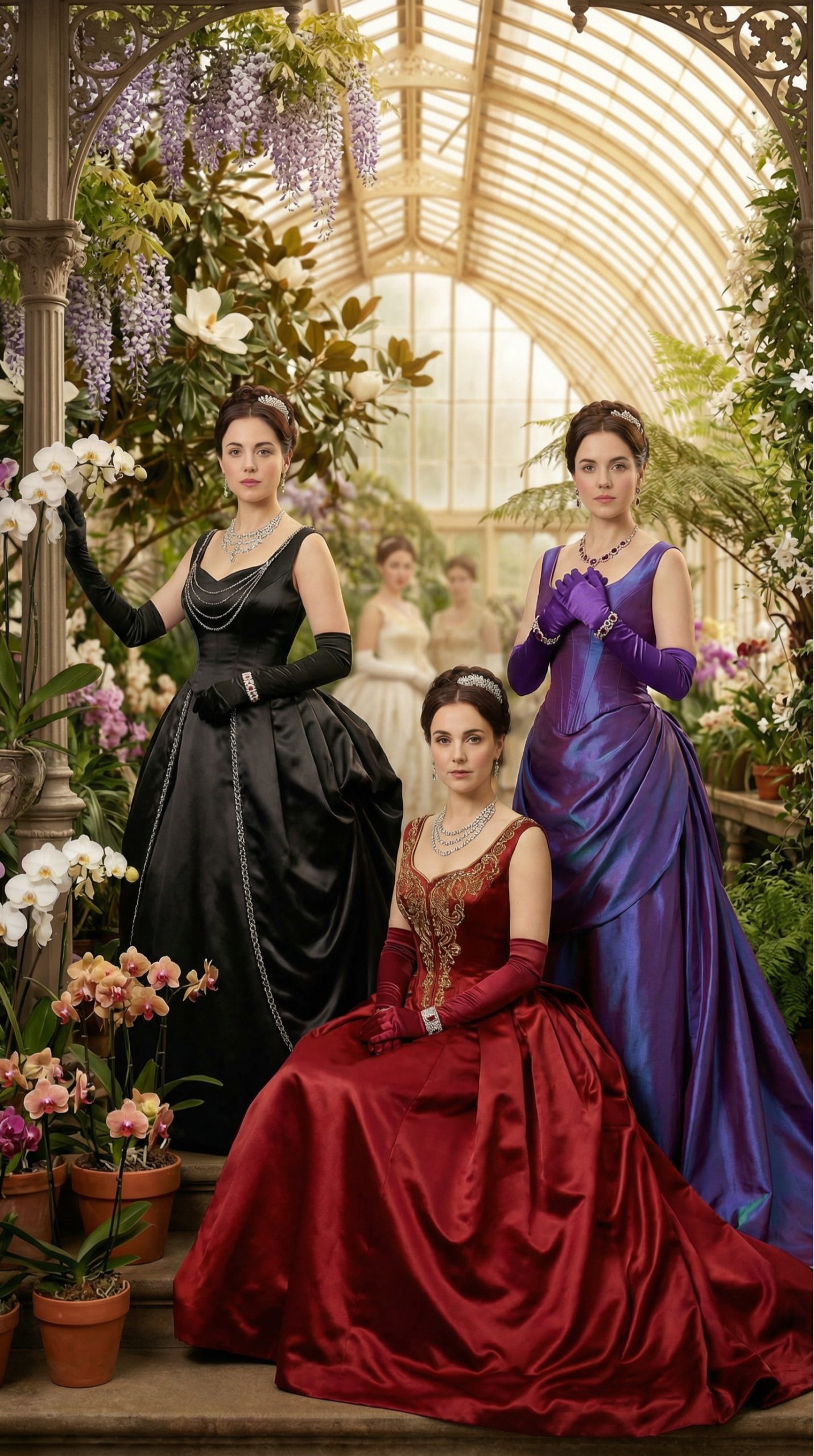
Where the hum of the world fades into the silence of his command, and three brilliant souls discover the terrifying, exquisite freedom of surrender.
The invitation arrived not with a fanfare, but with the whisper of expensive paper against polished wood. For the women of the Scarlet Circle—brilliant, wealthy, and fiercely independent—life had become a series of hollow victories. They conquered boardrooms and mastered the arts, yet they remained stranded on the shores of their own desires, longing for a tide they could not command themselves.
Then came him.
He was a mystery carved from shadow and certainty, a man who did not need to raise his voice to empty a room. In his presence, the constant, buzzing noise of their ambition quieted, replaced by a singular, resonant frequency. He saw past their armor of cashmere and wit to the fragile, trembling things beneath. He did not ask for their submission; he simply created a space where it was the only logical, beautiful choice.
Step into the salon where the air is thick with secrets and the scent of jasmine. Witness the alchemy of a love that defies convention, where three extraordinary women find that by kneeling before one masterful, nurturing force, they do not diminish—they ascend. This is the story of how the fragmented pieces of a soul can find their wholeness in the grip of a man strong enough to hold them all. Dare to see what lies within the reflection?
Chapter 1: The Shattered Reflection
The storm outside was not merely weather; it was a tantrum of the heavens, throwing itself against the glass of Mrs. Cavendish’s Mayfair drawing room with a violence that made the crystal on the sideboard tremble. Inside, however, the air was stagnant, thick with the scent of expensive perfume and the acrid, coppery tang of stale frustration. We were three women of substantial means and considerable intellect, dressed in the finest armor London could provide—me in emerald satin that felt cool against my feverish skin, Miss Eleanor in severe, polished leather that creaked with her every restless shift, and our hostess, Mrs. Cavendish, draped in heavy silk brocade that seemed to weigh her down like a chain.
We were failing. And worse, we were failing loudly.
“It is a hopeless endeavor,” Mrs. Cavendish snapped, her voice usually a instrument of social suasion now cracking with jagged edges. She stood by the fireplace, her knuckles white as she gripped the mantelpiece. “The Sterling family is ruined. The rumors have taken root. No amount of charity balls or whispered favors can uproot a tree once it has begun to rot.”
“It is not a tree, Caroline, it is a weed,” Eleanor countered, pacing the length of the Persian rug with the predatory gait of the caged leopard she resembled. She spun on her heel, her leather riding boots making a sharp, decisive sound against the floor. “We do not nurture it; we cut it down. We go to the source of the lies—the man behind the scandal—and we break him. I have contacts in the underground tracks. I can find leverage. Fear is a sharper tool than pity.”
I sat on the velvet chaise, feeling the texture of the fabric—soft, yielding, vaguely fuzzy—grate against my nerves. It felt wrong, like wearing wool in the middle of summer. “Violence is a blunt instrument, Eleanor,” I said, my voice sounding tired even to my own ears. “And fear? Fear is ephemeral. It turns to resentment in a heartbeat. What the Sterlings need is a restoration of truth. But how do we make the truth shine brighter than a scandal?”
“Truth?” Eleanor scoffed, throwing her hands up. “Truth is a whisper, Beatrice. Scandal is a shout. We are shouting at a hurricane.”
She was right. We were shouting. We were three shards of a mirror, each brilliant and sharp in our own right, but we had been dropped, and now we were lying on the floor, reflecting nothing but chaos. We had the resources—my intellect, Eleanor’s ferocity, Caroline’s influence—but we lacked the frame. We lacked the glue. We were a collection of magnificent parts with no engine to drive them. I looked at Caroline, saw the tears trembling in her eyes, and looked at Eleanor, saw the desperate need to just do something, anything, to stop the feeling of helplessness. We were a fractured wholeness, spinning in the void.
Then, the door opened.
It did not slam; it opened with a quiet, deliberate click that silenced Eleanor’s mid-rant. The butler announced him, but the name was lost to the sound of the rain and the sudden, frantic thumping of my own heart.
Lord Alistair Finch stood on the threshold.
He was soaked. His dark coat was plastered to his shoulders, and droplets of water clung to his hair like diamonds in the gloom. He did not look like a man who had just battled a storm to attend a salon; he looked like the storm itself, tamed and encased in human form. He carried no umbrella, wore no hat that was still intact. He simply stood there, filling the room with a presence so heavy, so dense, it seemed to suck the very air out of my lungs.
He closed the door behind him. The click was the final punctuation of our chaotic noise.
“Ladies,” he said. His voice was not loud. It was a baritone scrape of velvet over steel—deep, resonant, and impossibly calm. It was the sound of an anchor hitting the seabed.
No one moved. We were frozen, like rabbits scenting a wolf, yet there was no urge to flee. There was only the urge to be still.
“I apologize for the intrusion,” he continued, stepping further into the room. He didn’t look at the furniture, or the art, or the dying fire. He looked at us. His gaze swept over Caroline, then Eleanor, and finally, it landed on me. It felt like a physical touch, a heavy, warm hand pressing against my chest. “I heard the Sterling matter was reaching a crisis. I thought perhaps you might require… perspective.”
“Perspective?” Eleanor recovered first, her chin jutting out, though her hand trembled slightly at her side. “We need action, my Lord, not philosophy. We are trying to save a family from the gutter.”
Alistair smiled. It was a small, curved thing, not amused, but infinitely knowing. “And in your attempts to save them, you are in danger of shattering yourselves,” he said softly. He moved to the center of the room, the water dripping from him onto the expensive rug, marking the space as his own. “You are trying to fight the ocean with a bucket, Eleanor. And you, Beatrice… you are trying to grow a rose in the dark. And Caroline…” He turned his eyes to our hostess. “You are trying to hold up a collapsing roof with your bare hands.”
He spoke in analogies, and my mind, tired of linear logic, drank them in like water.
“How do you know what we are?” Caroline whispered, her voice breaking.
“Because I see you,” Alistair said. He took a step closer to me. I caught the scent of him—rain, and tobacco, and something else. Something cold and clean, like metal. “I see a brilliant mind trying to solve a puzzle that is not a puzzle. It is a lock.”
I looked up at him, my breath hitching. “A lock?”
“A very complex lock,” he murmured, looking down into my eyes. “And you three have been picking at it with pins made of gossip and desperation. But a lock requires a key. An iron key.”
The metaphor struck me with the force of a physical blow. “You think you are the key?” I heard myself ask, my voice barely audible.
“I think,” he said, reaching out to brush a stray drop of water from the lapel of my satin gown, his fingers lingering just a fraction of a second too long on the fabric, “that I am the hand that turns it. But the key… the key is your willingness to stop fighting the current and let the river take you where it needs to go.”
Eleanor let out a harsh breath, but she didn’t argue. She stood there, her leather-clad legs planted, her eyes wide, fixed on him. “And where does it go, this river?”
“To victory,” Alistair said, finally looking away from me to encompass them all. “But not a victory of noise and shouting. A victory of silence. Of precision. Of surrender.”
“Surrender?” The word tasted foreign on my tongue, yet the moment he said it, a wave of relief washed over me, starting at the crown of my head and trickling all the way down to my toes. It was the most terrifying, most delicious word I had ever heard.
“You are all so strong,” he said, walking slowly around us, inspecting us like a general inspecting his troops, or a sculptor inspecting his clay. “Strong enough to conquer the world, perhaps. But you are not strong enough to conquer the chaos within your own hearts. For that, you must yield.”
He stopped behind Eleanor. I saw her shiver as he leaned in close to her ear, though he didn’t touch her. “You burn, Eleanor. You are a wildfire seeking a forest. But without a boundary, you only destroy.”
He moved to Caroline. “You carry the weight of the world, Caroline. You are a pillar bearing a temple that has no foundation. You are exhausted.”
Then he returned to me. He stood before me, towering over where I sat. “And you, Beatrice. You are a glass garden. Beautiful, rare, fragile. You have locked your gates to keep the storms out. But in doing so, you have also locked the sun out.”
He knelt then. Slowly. Gracefully. He went down on one knee before me, bringing his eyes level with mine. The dominance in the gesture was staggering. He knelt not to supplicate, but to inspect. To claim.
“I am not here to take your strength,” he whispered, his eyes locked on mine, pools of darkness I felt I could fall into forever. “I am here to give it a direction. I am here to hold the mirror so you can see yourselves clearly. But you must stop looking away.”
The silence in the room was absolute. The storm outside seemed to have ceased, or perhaps my ears had simply stopped hearing it. I looked at his hand, resting on his knee—strong, long-fingered, capable. I looked at Eleanor, who had stopped pacing, who was standing perfectly still, her chest rising and falling rapidly, her leather creaking softly in the quiet. I looked at Caroline, who had sunk to the floor, her silk billowing around her, watching him with a look of religious awe.
He didn’t ask us to agree. He didn’t ask for permission. He simply stated the nature of the universe as he saw it, and in that moment, it was the only truth that existed.
“What must we do?” I heard the voice, and realized with a start that it was mine.
Alistair smiled, and this time, it reached his eyes, crinkling the corners with a warmth that terrified me.
“You must breathe,” he said, reaching out to take my hand. His grip was firm, dry, unshakeable. “You must trust the iron. You must let the key turn. And then, my dear ladies… we will begin.”
“You are thinking of this crisis as a storm,” Alistair said, his thumb tracing the delicate veins on the back of my wrist, sending little electric shocks up my arm. “You see the wind and the rain, and you think the solution is to build a wall against it. But a wall only breaks when the gale is strong enough.”
He shifted his gaze to Eleanor, who was watching him with a hunger that was almost predatory, yet softened by a strange new reverence.
“Consider the willow, Miss Eleanor,” he murmured. “It does not stand rigid like the oak. It does not fight the wind. It bends. It surrenders to the force of the gale, flowing with it, wrapping around it. And in that bending, in that ultimate yielding, it survives. The oak snaps because it refuses to bow. To conquer the storm, you must become the wind’s lover, not its enemy. You must let it move through you, trusting that your roots are deep enough to hold you.”
Eleanor let out a breath that sounded like a whimper. “I have always been the oak,” she whispered. “I have always fought.”
“And you are exhausted,” Alistair said gently, not unkindly. “Fighting the current is exhausting. Floating with it… that is an art.”
He turned then to Mrs. Cavendish, who had drawn her silk shawl tighter around herself, shivering not from cold, but from the intensity of his attention.
“And you, Caroline. You think you must hold the sky upon your shoulders. But I tell you, strength is not always granite. Sometimes, strength is water.”
He released my hand and stood, walking slowly to the window where the rain lashed against the glass. He looked out at the chaotic night, his reflection ghostly and commanding.
“There is an ancient tale of the river and the canyon,” he began, his voice dropping to a hypnotic drone that seemed to vibrate in the very floorboards. “The river rushes forward, wild and untamed, desperate to find the sea. It crashes against the rocks, it wears itself down. It thinks its freedom is in its speed, in its violence. But then it meets the canyon. The canyon is deep, it is dark, and it is still. The river fears it. It thinks the canyon is a trap.”
I found myself leaning forward, my breath caught in my throat. I was the river. I knew I was the river.
“But the river flows into the canyon,” Alistair continued, turning back to face us, his eyes piercing the gloom. “And for the first time, it is still. It is not trapped; it is held. The canyon shapes the water. It gives the river direction. It tells the water where to go. And the water, in accepting that guidance, becomes deeper. It becomes profound. It is no longer a chaotic stream splashing over stones; it is a force of nature, moving with purpose, majestic and terrifyingly beautiful.”
He walked back to the center of the room, standing between us, a vortex of calm.
“The Sterling family is the river,” he said softly. “And the scandal is the jagged rock it dashes itself against. You ladies… you are trying to push the water. But I am offering to be the canyon.”
I felt a throb deep in my belly, a clenching of muscles that had nothing to do with fear and everything to do with a sudden, overwhelming need to be filled, to be directed. The analogy was stripping me bare.
“You want to be the canyon?” Eleanor asked, her voice husky, laced with a challenge that was crumbling into curiosity.
“I want to be the bed in which you flow,” Alistair corrected, his eyes locking onto hers, then mine, then Caroline’s. “I want to give you the banks that keep you from overflowing. I want to give you the depth that gives you meaning. You are all rushing water, Caroline with your influence, Eleanor with your fire, Beatrice with your intellect. But without the channel… without the iron restraint… you are just a flood. Destructive. And eventually, you dry up.”
He stopped in front of me again. I could feel the heat radiating from him, despite the dampness of his clothes.
“To find your power,” he whispered, reaching out to tilt my chin up, forcing me to meet his gaze, “you must accept the guidance. You must let me tell you where the river runs. You must let me hold the key that locks the gates and opens the path.”
“What is the path?” I breathed, feeling like I was standing on the edge of a precipice, looking down into a dizzying, wonderful abyss.
“The path,” he smiled, a dark, knowing curve of his lips, “is surrender. It is the realization that you are not the captain of the ship. You are the sea. And I am the moon. And when I pull…” He made a subtle, beckoning gesture with his fingers. “…you will rise. You will swell. You will conquer the shore not by fighting it, but by surrendering to my tide.”
I closed my eyes for a second, overwhelmed by the imagery. It was illicit. It was frightening. And it was the most delicious thing I had ever heard. I wanted to be the sea. I wanted to be pulled by his gravity.
“We need to save the Sterlings,” I managed to say, my voice trembling, trying to grasp at the last shreds of my logical mind. “That is the reality.”
“Reality is clay,” Alistair said dismissively, waving a hand as if swatting away a fly. “We mold it. We do not ask the clay what shape it wishes to take. We impose our will upon it. That is the art of business, my dear Beatrice, and it is the art of love. You have been trying to negotiate with the clay. It is time to sculpt.”
He looked at the three of us, arrayed before him like offerings on an altar.
“Tonight, we do not plan,” he commanded, his voice taking on a steely edge that made my knees weak. “Tonight, you breathe. You cease your frantic rushing. You look at me, and you listen to the silence. Can you do that? Can you simply be?”
I looked at Eleanor. The fire in her eyes had banked into a smoldering glow. She looked at Alistair and gave a single, sharp nod. I looked at Caroline. She had stopped shivering; she was watching him with the glassy-eyed devotion of a devotee in a temple.
And I… I felt my own head move. A subtle tilt downward. A bow.
“Yes,” I whispered.
“Good,” Alistair said, the satisfaction in his voice rolling over us like a warm, heavy blanket. “Then the lesson begins. The storm is outside. The silence is in here. Let us learn the difference.”
Chapter 2: The Architecture of Silence
The storm had not abated—if anything, it had grown more ferocious, the wind screaming against the glass like a banshee denied its prey. Yet the room felt strangely hushed, as if Lord Alistair had brought with him a sphere of stillness that pressed against the very walls of the house.
He stood by the fireplace now, his coat still damp, making no move to remove it. He did not look at us with expectation. He simply was. And in that being, he commanded the space more thoroughly than any king upon a throne.
“Sit,” he said. It was not a request. It was an observation of what must naturally occur.
We sat. I found myself sinking back onto the velvet chaise, the emerald satin of my gown pooling around me like liquid jade. Eleanor lowered herself into a wingback chair, her leather creaking in protest, her thighs tense as if she might spring up at any moment. Mrs. Cavendish—Caroline—sank onto the settee opposite me, her silk brocade rustling with a whisper that sounded almost like a sigh of relief.
“Caroline,” Alistair said, his voice a low hum that vibrated in the hollow of my throat. “You have a cellar that rivals the Queen’s own. I find myself parched from the road. Would you do me the honor?”
It was a test. I knew it instantly. He was asking our hostess—the woman who had been holding the weight of the world on her shoulders—to perform the simple, domestic act of service. To pour wine. To be, for a moment, not the grand manipulator of society, but a woman attending to a man’s thirst.
Caroline hesitated. I saw the conflict flash across her face—the indignation, the urge to snap that she had servants for such things. But then she looked at him, at the quiet patience in his dark eyes, and something in her… softened. She rose, moved to the sideboard, and returned with a bottle of burgundy that breathed of old money and older vineyards.
She poured. The liquid caught the firelight, glowing like garnet. When she handed him the glass, her hand trembled only slightly.
“Thank you,” he said, and he meant it. I could tell he meant it. And in that meaning, Caroline seemed to shrink an inch, to settle into herself. She had given him something. And he had received it as if it were gold.
“Tell me,” Alistair said, settling into a chair that placed him at the centre of our triangle, swirling the wine in his glass with a lazy precision. “What do you know of the sonnet, Beatrice?”
I blinked. The question was so absurd, so far removed from the catastrophe at hand, that for a moment I could not speak. “I… I am a botanist, my Lord. Not a poet.”
“You are a woman of intellect,” he corrected gently. “And intellect recognizes pattern. The sonnet is architecture. It is structure. Fourteen lines. A turn. A resolution. It is a house built of breath and ink. Tell me what holds it together.”
I swallowed, my mouth suddenly dry. “The… the turn. The volta. It is the moment of shift. The place where the argument changes. Without it, the poem is merely… decoration.”
“Precisely,” he said, and the approval in his voice felt like warm honey poured over my nerves. “Decoration. Surface. The sonnet requires the turn, or it is merely pretty words in a row. It requires the moment of surrender, where the poet admits that what came before was incomplete. That is where the beauty lives.”
He looked at me, and I felt the weight of his attention like a hand pressed against the small of my back.
“You, Beatrice, are trying to write a poem without a turn. You are trying to solve the Sterling crisis with logic and reason and intellect, piling line upon line of beautiful thought. But you have not yet reached the volta. You have not yet surrendered the argument to the possibility that you do not know the answer.”
The truth of it struck me like a physical blow. I had been building a house without a foundation, adding room after room to a structure that had no core.
“And what is the answer?” I heard myself ask, my voice barely above a whisper. “What is the turn?”
“The turn,” he said, leaning forward slightly, “is trust. It is the admission that your own mind, magnificent though it may be, is not enough. It is the moment you hand the pen to someone else and say, ‘Finish it for me. I cannot see the end.'”
He turned then to Eleanor, who had been watching with the coiled intensity of a predator. “And you, Miss Eleanor. You know horses.”
Her chin lifted. “I know them better than I know myself.”
“Do you? Then tell me—when a horse is wild, when it is panicked and thundering across the field, how do you bring it to stillness?”
She opened her mouth to answer, then closed it. Her brow furrowed. “You… you do not chase it. That only adds to the fear. You stand still. You breathe. You let it come to you. You become the stillness it seeks.”
“Precisely,” Alistair said, and now his voice dropped to something almost tender. “You become the stillness. And yet, Eleanor, you are running. You are thundering across the field, trying to outrun the panic, trying to fight the wind. Where is your stillness? Where is the place you go to be caught?”
I saw Eleanor’s jaw tighten. I saw the shimmer of moisture in her eyes that she blinked away furiously. “I do not have one,” she admitted, her voice rough. “I have never had one. I have always been the one who runs.”
“Then perhaps,” Alistair said softly, “it is time you found someone worth stopping for. Someone who knows how to hold the reins without pulling them taut. Someone who understands that the horse is not broken by force, but by the offer of safety.”
He rose then, moving to stand before Caroline. He did not touch her. He simply stood, allowing his presence to wash over her like a tide.
“Caroline. Hostess. Weaver of webs. You hold the threads of society in your hands. You know where the bodies are buried, and you know how to make the living dance. But tell me—when is the last time someone asked you to sit? When is the last time someone told you that you had done enough?”
Caroline’s breath caught. Her hand flew to her throat, as if to press against a wound that had been bleeding for years. “I cannot remember,” she whispered. “It has been… so long.”
“You are carrying a temple on your back,” Alistair said, his voice a rumble of thunder that promised rain after drought. “But temples are not meant to be carried. They are meant to be inhabited. You are so busy holding up the roof that you have forgotten there is an altar inside. And an altar, Caroline, is not a place of work. It is a place of offering. Of surrender.”
He stepped back, surveying us. I felt stripped, opened, as if he had cut away the layers of satin and silk and leather until I stood naked before him—not in body, but in spirit. It was terrifying. It was intoxicating. It was the first time in memory that I felt… seen.
“The Sterling crisis will be solved,” he said, returning to his chair, his wine glass cradled in his large, capable hands. “But not tonight. Tonight, we do not speak of it. Tonight, we practice the art of being. We breathe. We listen to the storm and we thank it for reminding us that there is shelter. We allow the silence to do what noise cannot—we let it build the foundation.”
“And if we cannot?” Eleanor challenged, though her voice had lost its edge. “If the silence is too… too loud?”
Alistair smiled, and there was a darkness in it that made my pulse quicken.
“Then you will look at me,” he said simply. “And you will remember that silence is not emptiness. It is a vessel. And I am here to fill it.”
The fire crackled. The rain wept against the glass. And I sat, my hands folded in my lap, my satin gown cool against my skin, feeling the most peculiar sensation—a sensation I had read of in poetry but never believed I would experience.
I felt like a lock that had finally found its key. I felt the iron turning in my heart.
The fire had burned lower, casting the room in a amber haze that made the shadows dance along the walls. I found myself leaning forward, my elbows resting on my knees, my entire being focused on the man who sat before us like a judge upon his bench. The silence he had commanded had settled over us, but it was not an empty silence. It was thick, heavy, expectant—like the air before a thunderclap.
Lord Alistair set down his wine glass with a soft click that seemed to echo in the hollow of my chest. He looked at each of us in turn, his gaze lingering on mine with an intensity that made my breath catch.
“You asked about the sonnet, Beatrice,” he said, his voice dropping to a register that seemed to bypass my ears entirely and speak directly to the marrow of my bones. “You spoke of structure. Of the volta. But a sonnet is not merely scaffolding. It is a cage of sound that captures something wild and makes it sing.”
He rose, moving to stand before the fireplace, the light behind him carving his silhouette from the gloom. When he spoke again, his voice had taken on a rhythm, a cadence that was almost musical.
“A glass garden grows in winter’s grip,
Where crystal blooms untouched by sun or rain,
The gardener’s hands have lost their skillful grip,
And tend to flowers that cannot sustain.
The walls are high, the gates are locked with fear,
Each petal perfect, frozen in its place,
No wind may enter, and no root pierce here,
A beautiful and terrible embrace.
But there is one who holds an iron key,
Who walks between the rows with steady tread,
He does not ask the flowers to be free,
He asks them simply to be fed.
The gate swings wide, the winter falls away,
And in his hands, the garden learns to stay.”
The words hung in the air, shimmering. I felt them settle over me like a net of fine silk—light, almost imperceptible, yet impossible to shake off. My lips parted. I could not look away from him. The sonnet was simple, yes, but in its simplicity lay a devastating truth.
“You see,” Alistair said, his voice returning to its normal register, though it seemed to have gained a new resonance, a new weight. “The gardener in the poem does not tear down the walls. She has built them for a reason. They have protected her. They have made her beautiful in a way that wild flowers cannot be. He does not ask her to become something else. He asks her only to trust him with the key.”
I felt my heart pounding against my ribs. The glass garden. My garden. I had spent a lifetime cultivating my intellect, my reason, my careful distance from the messy turbulence of feeling. I had made myself into something rare and pristine, and I had locked the gates to keep the world from trampling what grew within.
And here stood a man who saw the walls not as an obstacle, but as an invitation. Who saw the lock not as a rejection, but as a question waiting to be answered.
“The turn,” I whispered, my voice cracking. “The volta. It comes at the ninth line. ‘But there is one who holds an iron key.'”
Alistair smiled, and the warmth in it seemed to fill the room. “You feel it, then. The shift. The moment where the poem stops describing a prison and begins describing a possibility. That is where you must live, Beatrice. Not in the first eight lines, where the garden is locked and the gardener is alone. But in the final six, where the gate swings wide and the one who holds the key steps through.”
“But how do I know…” I stopped, swallowed, tried again. “How do I know that he will not trample what grows inside? How do I know that he will not bring the winter in with him?”
Eleanor shifted in her chair, her leather creaking. I saw her hand curl into a fist on her thigh, the knuckles white. She was fighting something—a battle I could not name, but whose presence I could feel.
“You do not know,” Alistair said simply. “You cannot know. The sonnet does not tell you if the gardener is wise. It only tells you that she chooses. That is the nature of the volta. It is a leap. A moment of faith that transforms everything that came before.”
He turned to Eleanor then, and his gaze softened into something almost tender. “You, Miss Eleanor, are not the glass garden. You are the key itself. Iron forged in fire. Strong, unyielding, purposeful. But a key that is never turned grows rusty in its lock. A key that is never used forgets what it was made for.”
Eleanor’s breath came faster. I saw the rise and fall of her chest beneath the tight leather of her bodice. “And what was I made for?” she asked, and her voice was raw.
“To open,” Alistair replied. “To grant entry. To be the instrument through which the locked becomes the liberated. But you have been turning yourself in circles, trying to open doors that have no locks, trying to force entry where you were not invited. The key does not force. The key waits for the hand that knows how to use it.”
He reached into his coat pocket and withdrew something small, something that glinted in the firelight. A key. An actual iron key, dark and ancient, its bow worn smooth by generations of fingers.
He held it out to me.
I stared at it. My hand trembled as I reached forward, my satin sleeve falling back to expose the pale skin of my wrist. When my fingers closed around the iron, it was warm—warm from his body, warm as if it had been waiting for this moment across centuries.
“It is not a key to any door in this house,” Alistair said, his voice barely above a whisper. “It is a key to a door that does not yet exist. A door that you will build when you are ready. I am giving it to you now so that you may hold it, feel its weight, and know that when the time comes—when the gate is ready—there will be a hand strong enough to turn it.”
I clutched the iron in my palm, feeling the ridges press into my flesh. It was heavy. It was real. It was the most frightening and most precious thing anyone had ever placed in my hands.
“And if I am never ready?” I asked, my voice barely audible.
Alistair knelt before me again, as he had done before. His eyes were level with mine. This close, I could smell the rain still clinging to his hair, the tobacco on his breath, the faint musk of his skin beneath.
“Then you will hold the key until you are,” he said softly. “And I will wait. The iron does not rust when it is held by a woman who knows its value. It only grows stronger.”
He stood, turned, and walked back to the fireplace. The firelight caught the planes of his face, the sharp angle of his jaw, the darkness of his eyes.
“Chapter two of our evening draws to a close,” he announced, his voice returning to its normal, commanding tone. “The architecture of silence is built. The sonnet has been spoken. The key has been given. What remains now is the most difficult task of all.”
He looked at each of us in turn.
“You must sleep. You must let the night do what the night does—take the fragments of the day and knit them into something coherent. And in the morning, you will wake, and you will know—truly know—that you are no longer alone in the glass garden.”
I looked down at the key in my hand. I felt its weight, its promise, its terrifying potential. And I felt something else—a warmth spreading through my chest, a sensation I had almost forgotten.
Hope.
Dangerous, fragile, beautiful hope.
Chapter 3: The Satin Pact
The morning after the storm arrived with a pale, tentative light that seemed almost apologetic for the violence of the night before. I had slept, though I could not say how deeply. My dreams had been tangles of iron and glass, of walls that breathed and gates that whispered my name in a voice I recognized but could not place.
The key sat on my vanity table when I woke, its dark metal stark against the ivory comb and silver brush. I had placed it there myself, yet seeing it in the clear light of day felt like discovering an artifact from another life. I touched it with the tip of my finger, half-expecting it to burn. It did not. It merely waited, patient as stone.
By noon, we had gathered in the conservatory.
It was my sanctuary—a structure of iron and glass attached to the eastern wing of my townhouse, filled with specimens that required conditions the English climate could not provide. Orchids with lips like velvet. Ferns that unfurled like sleepy fists. Jasmine that released its perfume only when the sun began its descent. The air was thick with humidity, the glass panels weeping with condensation.
Eleanor arrived first, still dressed in her riding clothes, though she had exchanged her leather boots for softer shoes that made no sound on the stone floor. Caroline followed, her silk morning dress a cloud of pale lavender that seemed to float around her as she moved. And I—wearing a gown of ivory satin that I had chosen specifically for its texture, knowing how the cool, slippery fabric would feel against my skin as I worked.
We stood in silence for a moment, the three of us, surrounded by the evidence of my careful cultivation. The glass garden. The name Alistair had given to my soul made manifest.
“He gave me no instructions,” Caroline said, her voice hushed, as if she feared disturbing the plants. “He simply said, ‘Begin with what you have.’ But what do I have? Influence? Connections? A talent for seating arrangements that keeps enemies apart and allies together?”
“You have more than that,” Eleanor replied, moving to examine a cluster of night-blooming jasmine. Her fingers brushed the leaves with surprising tenderness. “You have the ability to see patterns in people. To know what they desire before they know it themselves.”
Caroline laughed, but it was not a bitter sound. It was tired, but curious. “And how is that useful to the Sterlings? Shall I arrange a ball so magnificent that their creditors forget they are owed money?”
“Perhaps,” I said, moving toward the workbench where my mortars and pestles sat in neat rows, alongside jars of dried petals and essential oils. “Perhaps that is exactly what you shall do. But not yet. First, there is work of a different kind.”
I pulled on my satin gloves—the ivory ones I wore when handling delicate specimens, the ones that allowed me to feel texture without leaving the oils of my skin behind. The fabric slid over my fingers like water, cool and smooth, and I felt a shiver of… something. Recognition. Anticipation.
“Lord Alistair asked me to create something,” I explained, selecting a jar of dried rose petals and another of crushed amber resin. “A perfume. But not merely a pleasant scent. He said it should be the olfactory essence of triumph. Of victory achieved not through force, but through… through…”
“Through the turning of a key,” Eleanor finished for me, her eyes dark with understanding.
“Yes.” I uncorked the jar of roses, and the scent rose up—sweet, nostalgic, slightly mournful. “But I cannot do this alone. I need your minds. Your instincts.”
Caroline moved to stand beside me, her lavender silk brushing against my ivory satin. The contrast in textures made my skin prickle. “What do you need me to do?”
“Tell me what triumph smells like,” I said. “Not the battlefield. Not the conquest. But the moment after. The moment when the struggle is over, and you realize you have survived.”
Caroline closed her eyes. Her breath slowed. When she spoke, her voice was distant, as if she were remembering something from long ago. “It smells like rain on hot stone. Like the air after a thunderstorm, when the world has been washed clean. It smells like… like sweat drying on cooled skin. Like the moment you realize you can stop running.”
I closed my own eyes, letting her words sink into me. Rain on hot stone. Sweat drying on cooled skin. The moment you realize you can stop running.
“The key,” I whispered. “The moment the gate swings open.”
I reached for a vial of petrichor oil—the essence of rain on dry earth—and added a single drop to the mortar. The scent bloomed, green and elemental, cutting through the sweetness of the roses.
Eleanor had moved to stand on my other side, her leather-clad arm brushing against my satin sleeve. The contrast was stark—the tough, animal hide against the delicate, manufactured gloss. “And what of the struggle itself?” she asked, her voice rough. “Triumph is meaningless without it. The scent needs… teeth.”
“Teeth,” I repeated, considering. “Something sharp. Something that reminds the wearer that victory was not free.”
“Clove,” Eleanor said immediately. “No—cardamom. Something that bites, but sweetens as it warms.”
I nodded, reaching for a jar of crushed cardamom pods. The spice released its fragrance—warm, complex, with a subtle burn at the back of the throat. I added a pinch, grinding it into the petals and oil with my pestle, the satin of my glove sliding against the stone in a rhythm that felt almost meditative.
“May I?” Eleanor asked, and before I could respond, she reached out and placed her hand over mine—over the pestle, over the satin. Her grip was firm, guiding my motion, and the leather of her palm pressed against the sleek fabric of my glove.
I froze. The sensation was electric—the contrast of textures, the pressure of her strength, the intimacy of sharing the task. My breath caught.
“You grind too softly,” Eleanor murmured, her lips close to my ear. “You are afraid of crushing the petals too finely. But that is exactly what they need. They must be destroyed to release what they hold.”
The words were a metaphor. I knew they were a metaphor. But they landed in my body like a touch, like a promise.
“I am afraid,” I admitted, my voice barely a whisper. “I am afraid of ruining it. Of destroying something beautiful in pursuit of something I cannot yet name.”
Eleanor’s hand pressed harder, forcing mine to grind deeper. The petals broke apart, releasing a surge of fragrance that filled the humid air. “Beauty is not destroyed by being used,” she said. “It is fulfilled. A rose that is never crushed never becomes perfume. It simply… rots.”
I looked at her then—really looked. Her face was close to mine, her eyes dark and fierce, her breath coming faster than before. And in that moment, I felt something shift between us. Not competition. Not jealousy. But a recognition.
We were both falling. We were both surrendering. And we were falling toward the same center.
“Caroline,” I said, my voice trembling. “The base. What holds it all together? What makes the scent last?”
Caroline had been watching us, her hand pressed against her collarbone, her eyes wide. “Musk,” she said softly. “Something animal. Something that reminds us that beneath the silk and the satin and the leather, we are flesh. We are blood. We are alive.”
I reached for the final jar—the one that contained the ambergris, the rare and precious substance that anchored the most expensive perfumes. I added a sliver, no larger than a grain of rice, and began to blend it with the rest.
The scent that rose from the mortar was like nothing I had ever experienced. It was rain and roses and cardamom and something deep, ancient, primal. It was the smell of a door opening. Of a key turning. Of a gate swinging wide to admit the one who had been waiting outside.
I lifted the mortar and held it out to them—to Eleanor on my left, to Caroline on my right. “Breathe,” I said.
They leaned in. The three of us hovered over the stone vessel, our faces close, our breath mingling. I felt the warmth of Eleanor’s shoulder against mine, the brush of Caroline’s silk against my arm.
“Triumph,” Caroline whispered.
“Surrender,” Eleanor murmured.
“Love,” I breathed.
And in that moment, I understood something profound. The love I felt for these women—the fierce, protective, almost desperate affection—was not separate from my devotion to Alistair. It was an extension of it. We were branches of the same tree, reaching toward the same sun. Our roots were tangled together beneath the earth, drawing from the same source.
I turned my head slightly, and my lips brushed against Eleanor’s temple. She did not pull away. She leaned into the touch, her eyes closing.
“We should give it a name,” Caroline said, her voice thick. “The perfume. What shall we call it?”
I thought of the key on my vanity. Of the sonnet Alistair had spoken. Of the glass walls that had kept me safe and alone.
“Volta,” I said. “The turn. The moment when everything changes.”
Eleanor’s hand found mine beneath the table—satin against leather, cool against warm. Caroline’s fingers brushed against my shoulder, light as moth wings.
“The Volta,” Eleanor repeated. “Yes.”
And then, without planning it, without deciding it, the three of us came together in an embrace that felt less like a hug and more like a weaving. Satin and leather and silk, bodies and breath, hearts beating in tandem. I felt Eleanor’s lips press against my jaw, felt Caroline’s tears dampen my neck, felt my own hands cling to them as if they were the only solid things in a world that had suddenly become liquid.
We were no longer three shards of a broken mirror. We were being fused back together. And the heat that melded us was the same—the gravity of a single man who had seen us, truly seen us, and had asked nothing more than that we allow ourselves to be held.
“When do we show him?” Caroline asked against my skin.
“Soon,” I replied. “When it is perfect. When we are ready.”
And I knew, with a certainty that settled into my bones, that we would know when that moment arrived. The key would tell us. The turn would come.
And the glass garden would finally, beautifully, bloom.
We remained tangled together for a long moment, the three of us, our breathing slowly synchronizing into a single rhythm. The jasmine had begun to release its scent as the afternoon light shifted, and the air grew heavy with its intoxicating sweetness.
Caroline was the first to pull back, though she did not go far. Her hand remained on my shoulder, her fingers tracing idle patterns on the satin of my sleeve. Her eyes were red-rimmed, but there was a peace in them I had not seen before—a stillness that had not been there even in the quietest moments of our friendship.
“You know,” she said, her voice soft and distant, as if she were speaking from a place deep within herself, “I have never told anyone this. Not my late husband, God rest his distracted soul. Not my dearest confidantes. Not even my own reflection in the mirror.”
Eleanor and I exchanged a glance, but neither of us spoke. We simply waited, giving her the space her words required.
“I was seventeen,” Caroline began, settling back onto the stone bench beside the workbench, her lavender silk pooling around her like spilled wine. “My father had arranged a match with a man twice my age—a viscount with a crumbling estate and a desperate need for my dowry. I was to be the plaster that held his rotting walls together.”
She smoothed the fabric of her skirt with trembling hands, and I watched the silk ripple like water disturbed by a stone.
“The night before the wedding, I fled. Not to run away, exactly. I simply… walked. I found myself in a garden not unlike this one, though it belonged to a stranger—a neighbor’s estate I had wandered into by accident or fate. It was winter, and the glasshouse was dark, but I could see shapes inside. I pushed open the door.”
Eleanor shifted closer, her leather creaking softly. I moved to sit beside Caroline, my satin gown whispering against the stone.
“There was a man inside,” Caroline continued, her eyes fixed on some middle distance only she could see. “He was tending to a lemon tree—one of those delicate creatures that cannot survive an English winter without heat. He had built a small brazier and was feeding it with coal, his hands black with soot, his shirtsleeves rolled to his elbows. He looked up when I entered, and I saw that he was not young. Not old either. But his eyes…”
She trailed off, and a smile curved her lips, fragile as spun glass.
“His eyes were like… have you ever watched a candle flame in absolute darkness? That small, perfect point of light that makes the darkness itself visible? That was how he looked at me. Not with judgment. Not with desire—at least, not the kind I had been taught to expect. He looked at me as if I were a question he had been waiting his whole life to answer.”
“What did he say?” I asked, my voice barely a whisper.
“He said nothing at first. He simply gestured to the bench beside the brazier. ‘You are cold,’ he observed. ‘Sit. Warm yourself. The lemons do not mind the company.'”
Caroline laughed softly, the sound like wind chimes in a gentle breeze.
“I sat. I warmed my hands over the brazier, and he continued his work—pruning the tree with a small, sharp knife, his movements precise and unhurried. And then, without looking at me, he began to speak. He told me about the lemon tree—how it had been a gift from his mother, how it had survived a fire and a flood and years of neglect before he inherited it. He told me that caring for it had taught him more about love than any woman ever had.”
She paused, and I saw the shimmer of tears on her cheeks. She did not wipe them away.
“I asked him what he had learned. And he turned to me then, holding the pruning knife in his blackened hand, and said, ‘I learned that love is not possession. It is pruning. It is cutting away the dead wood so that the living heart may breathe. It is knowing where to make the cut—shallow enough to heal, deep enough to matter.'”
The words settled over me like a mantle. I felt them sink into my skin, my bones, my very marrow.
“And then,” Caroline continued, her voice growing even softer, “he looked at me with those candle-flame eyes, and he said, ‘Someone has been pruning you, child. But they have been cutting at the roots instead of the branches. They have been trying to make you small enough to carry, instead of strong enough to grow.'”
I felt my breath catch. The words described me as much as they described her. Perhaps they described every woman who had ever been shaped by hands that did not understand the nature of the thing they were shaping.
“What happened then?” Eleanor asked, her voice rough with emotion.
“I wept,” Caroline said simply. “I wept for hours, sitting on that bench beside his lemon tree, while he worked in silence around me. And when my tears were finally spent, he handed me a lemon—a small, imperfect thing that had somehow survived the winter—and he said, ‘Take this. Plant the seeds. Do not let anyone tell you what shape your garden should take.'”
She looked at us then, her eyes shining.
“I never saw him again. The wedding proceeded as planned. My husband was kind, in his distant way, but he never saw me—not truly. I built my garden, my networks, my webs of influence, always searching for that feeling again—that sense of being seen by someone who knew where to make the cut.”
“And did you find it?” I asked, though I suspected I knew the answer.
Caroline reached out and took both of our hands—Eleanor’s leather-clad fingers and my satin-wrapped ones—in her own.
“I am finding it now,” she said, her voice steady and sure. “In the two of you. In the gravity of a man who looks at us and sees not what we can do for him, but what we can become with him.”
She squeezed our hands, and I felt the pressure of her grip through the layers of fabric that separated our skins.
“That, my dearest sisters, is what love is. Not the lemons, not the tears, not the winter garden. It is the moment when someone hands you the pruning knife and says, ‘I will show you where to cut, but the hand that holds the blade will always be your own.'”
Eleanor made a sound low in her throat—something between a sob and a sigh. And then she leaned forward and pressed her forehead against Caroline’s, her leather-clad hand reaching out to grasp my own.
We sat there, the three of us, in the humid warmth of the conservatory, surrounded by the scent of jasmine and the promise of Volta. And I felt something crack open inside me—not painfully, but like a seed casing splitting to release the green shoot within.
The glass garden was beginning to bloom.
And we were blooming with it.
Chapter 4: The Leather and the Lock
The underground track lay beneath the streets of London like a secret wound—a place where the city’s elite and its underworld mingled in the flickering light of gas lamps, where fortunes were won and lost on the backs of horses that would never see a proper hunt field. The air down here was thick with the smell of hay and sweat and smoke, the cries of bookmakers cutting through the gloom like knives through silk.
I moved through the crowd with purpose, my leather riding habit creaking softly with each step. The material had been custom-made for me by a tailor who understood that a woman’s armor need not be made of steel. It fit like a second skin, glossy and black, hugging my thighs and my waist and my back with a pressure that was almost intimate. I had worn it a hundred times before, but tonight it felt different. Tonight, I was not wearing it for myself.
I was wearing it for him.
The thought sent a shiver through me that had nothing to do with the damp chill of the underground. Lord Alistair Finch had given me a task—not a request, not a suggestion, but a directive delivered in that low, resonant voice that seemed to bypass my ears entirely and speak to something deeper. I was to infiltrate the racing syndicate that held the debts of the Sterling family, to find leverage where others had found only walls.
But more than that, he had given me a method.
You are the key, Eleanor, he had said, his hand brushing against the leather of my sleeve as he spoke. But a key does not force the lock. A key aligns with the mechanism. It understands the shape of what it must open. Move through that world not as a conqueror, but as one who belongs there. Let them see what they expect to see—a woman of spirit and ambition. And then, when the moment is right, turn.
I did not fully understand what he meant. But I trusted that I would, when the time came.
The man I sought was called Henley—a breeder of questionable ethics and a gambler of even more questionable judgment. He stood near the paddock, a cheroot clutched between his stained fingers, his eyes scanning the crowd with the predatory alertness of a man who knows he has enemies. He was flanked by two guards, thick-necked brutes who looked as though they had been carved from the same block of coarse stone.
I approached without hesitation. The leather of my habit whispered against itself as I moved, and I felt the eyes of the crowd following me. A woman alone in this place was either a curiosity or a target. I intended to be neither. I intended to be inevitable.
“Mr. Henley,” I said, stopping before him with my chin lifted and my hands clasped loosely behind my back. “I am told you are the man to see about a particular bay mare that ran at Epsom last spring. The one that placed second when everyone expected first.”
Henley’s eyes narrowed. He looked me up and down with a gaze that felt like oil sliding across my skin, but I did not flinch. I did not drop my eyes. I simply waited.
“I know every horse that ran at Epsom,” he said, his voice a rasp. “And I know every rider and every owner. I don’t know you.”
“No,” I agreed. “You do not. But you know of me. My family’s stables in Yorkshire. The breeding program that produced three Derby winners in a decade. You know that when I ask about a horse, it is not idle curiosity.”
It was a calculated risk, trading on my family’s reputation. But I was not trading on it for myself. I was trading on it for the mission. For him.
Henley’s posture shifted. The suspicion did not leave his face, but something else joined it—interest. Greed. The desperate hunger of a man who sees an opportunity.
“Miss Eleanor Vance,” he said, and there was a new note in his voice, one that made my skin crawl even as I kept my face composed. “I have heard of your… talents. Both in the saddle and in the breeding shed.”
The innuendo was deliberate. Crude. The old Eleanor—the Eleanor who had always been the oak, rigid and fighting—would have bristled. Would have snapped back with a cutting remark that put him in his place.
But I was not that Eleanor anymore. Or rather, I was that Eleanor, but I had been given a new shape to hold.
“Flattery,” I said, allowing a smile to curve my lips, “is a currency I neither need nor desire. What I desire is information. And I am prepared to pay for it in a currency you will find far more valuable.”
Henley’s eyebrows rose. “And what currency is that?”
I stepped closer, close enough that the smoke of his cheriot tickled my nose, close enough that I could see the yellowed whites of his eyes. The leather of my bodice pressed against the edge of his coat, and I felt the heat of his body through the material.
“Discretion,” I murmured. “I know about the Sterling debts. I know you hold the paper. And I know that certain parties would pay a great deal to learn that you are considering… alternative arrangements.”
It was a bluff, or at least a partial one. But I delivered it with the calm certainty that Alistair had modeled for me. I did not raise my voice. I did not threaten. I simply stated a fact, as if it were already written in the ledger of the world.
Henley’s face went pale. For a moment, I thought I had miscalculated, that I had pushed too hard too fast. But then he laughed—a short, sharp bark that was more nerves than humor.
“You have brass, Miss Vance. I will give you that. But the Sterling debts are not for sale. They are… spoken for.”
“By whom?” I asked, though I already knew. The scandal had been engineered by someone with power and a grudge. The debts were merely the chain.
Henley shook his head. “That is not information I can give. Not without risking far more than a few unpaid notes.”
“Then give me something else,” I said. “Give me the name of the man who placed the bet that broke the Sterling son at the gaming tables. The man who encouraged him to wager more than he could lose. I know he exists. You know he exists. And I suspect you know his name.”
The silence stretched between us, thick and taut. I could feel the eyes of his guards on me, feel the pressure of the crowd behind my back. But I held my ground. The leather pressed against my skin, and I imagined it was Alistair’s hand instead—firm, steady, guiding.
“Blackwood,” Henley said finally, the word escaping him like a breath he had been holding too long. “Sir Marcus Blackwood. He arranged the whole thing. But you did not hear it from me.”
Sir Marcus Blackwood. The name landed in my chest like a stone dropped into still water. I knew him—a baronet with political ambitions and a cruel streak that ran through his public life. He had dined at my family’s table. He had smiled at my sisters.
And he had destroyed the Sterlings for sport.
“Thank you, Mr. Henley,” I said, inclining my head the smallest fraction. “You have been most helpful.”
I turned to leave, but his hand shot out, catching my wrist. His grip was rough, his fingers digging into the leather of my glove.
“Not so fast, Miss Vance,” he snarled, his earlier deference evaporating. “You think you can walk in here, flash your family name and your pretty figure, and take what you want? This is my world. And in my world, debts must be paid.”
I looked down at his hand on my wrist. Then I looked up at his face. And I felt something shift inside me—a warmth spreading from my core, a strength that was not my own.
“You are mistaken, Mr. Henley,” I said, my voice low and steady. “I did not take anything. I asked. And you gave. The transaction is complete. If you attempt to extract further payment, you will find that the cost is far higher than you can afford.”
His grip tightened. “Is that a threat?”
“No,” I said, and I smiled—a smile that felt as though it belonged to someone else, someone larger and more powerful than I had ever been. “It is a promise. And it comes from someone far more dangerous than myself.”
I saw the flicker of uncertainty in his eyes. He did not know what I meant, but he felt the truth of it. He felt the gravity of the presence that stood behind me, even though Alistair was nowhere near.
His hand released my wrist.
I walked away without looking back. The leather of my habit moved with me, and I felt each creak and whisper of the material as though it were a language speaking directly to my skin.
The carriage ride back to my townhouse was a blur of gaslit streets and racing thoughts. I had the name. I had the leverage. But it was not the victory that occupied my mind.
It was the feeling.
For years, I had been the one who fought. The one who rode harder, pushed further, refused to bend. I had worn my independence like a badge of honor, and I had worn my leather like armor against a world that wanted to tame me.
But tonight, I had not fought. I had flowed. I had worn the leather not as armor, but as a conduit—a material that connected my skin to his will. Every creak, every whisper of the material against my body had been a reminder that I was not alone. That I was guided. That I was used in the most exquisite sense of the word.
The carriage stopped. I sat for a moment in the darkness, my hands trembling in my lap.
I wanted to tell him. I wanted to go to him immediately, to kneel before him and describe every moment, to feel his hand on my leather-clad shoulder and hear him say that I had done well.
But that was not the arrangement. The arrangement was that I would return to the others, that we would share what we had learned, that we would weave our individual threads into a tapestry that would save the Sterlings and destroy their enemies.
And yet.
I closed my eyes and let myself imagine it—his voice, low and resonant, telling me that I had pleased him. His hand, warm and strong, tracing the line of my jaw. His lips, brushing against my ear as he whispered the words I had not known I needed to hear.
Good girl, Eleanor. You have turned the key.
The leather between my thighs felt slick now, warmed by a heat that had nothing to do with the ride. I pressed my knees together, feeling the material grip and slide, and I let out a breath that was almost a moan.
Tomorrow, I would be the fierce Miss Eleanor Vance again. Tomorrow, I would plan and plot and fight alongside my sisters.
But tonight, in the dark of the carriage, I allowed myself to be something else. Something softer. Something surrendered.
I was the lock. And he was the key.
And the gate was finally, beautifully, beginning to open.
Private Journal of Miss Eleanor Vance
14th of November, 1889
I sit before my vanity now, the leather of my riding habit still clinging to my skin, still warm from my body and from the night’s work. I have not changed. I cannot bring myself to remove it. The material feels like proof—as if the gloss of it, the creak of it, the very scent of it absorbed into the pores of my arms and thighs, serves as evidence that this night was real.
My hand trembles as I write. Not from fear. Not from exhaustion. From something far more terrifying.
Relief.
I have spent twenty-eight years building myself into a fortress. I learned to ride before I could walk properly. I learned to shoot, to gamble, to negotiate, to intimidate. I wore my independence like a second skin—no, like a first skin, for it was more real to me than the flesh beneath. I told myself that strength meant standing alone. That need was weakness. That to want someone to lean on was to admit defeat.
What a beautiful, terrible lie I told myself.
Tonight, I walked into a den of thieves and predators, and I did not fight. I did not brace myself against the world. I did not erect walls of indignation or sharpen my tongue into a weapon. Instead, I carried something with me—someone with me. Invisible but undeniable. A presence that held me upright not from beneath, but from within.
I feel as though I have spent my entire life swimming against a current that I did not choose, exhausting myself in the belief that to stop moving was to drown. And then a hand reached down—not to pull me out, not to rescue me—but simply to turn my face downstream. To show me that the river was flowing in the direction I had wanted to go all along.
Let the current carry you, Eleanor. You do not need to fight the water. You need only to steer.
His voice. I hear it even now, though he spoke those words to me only once, in passing, days ago. They have taken root somewhere beneath my ribs, and they grow in the dark like the night-blooming jasmine in Beatrice’s conservatory.
I touched myself in the carriage.
I cannot believe I am writing these words. I cannot believe my hand moves across the page forming them. But the journal does not judge. The journal does not blush or look away. And so I will write the truth, because he has taught me that the truth is not something to be survived—it is something to be surrendered to.
I touched myself in the carriage, and I thought of him. Not of his face or his hands or his body, though I have imagined all of those things in the privacy of my mind. I thought of his voice. The way it dropped into a room and filled every corner, leaving no space for doubt. The way it made me feel small without making me feel diminished. The way it turned my spine to liquid and my will to smoke.
I thought of what it would feel like to hear that voice say my name. Not Miss Vance, not Eleanor, but something deeper—a name I did not know I had until he spoke it into existence.
And I thought of the leather.
This leather that I wear. This material that has been my armor for so long. Tonight I understood something about it. It is not a wall. It is a conduit. The leather does not protect me from feeling—it transmits feeling. Every brush of air, every shift of my body, every moment of contact with the world, the leather receives it and translates it into a language my skin can understand.
When the leather creaks, I feel his hand. When it slides against itself, I feel his breath. When it warms against my thighs, I feel his presence wrapping around me like a tide.
I am not the leather. I am not the armor. I am the soft, trembling thing inside it—the thing I have spent my life pretending does not exist.
And he sees that thing. He sees me.
Not the Miss Eleanor Vance who wins races and bankrupts idiots and walks through ballrooms like she owns the floorboards. The me that wakes at three in the morning with tears on her face and no memory of why. The me that looks at Beatrice and Caroline and feels a love so vast and terrifying that she cannot name it. The me that wants, with a desperation she dare not speak, to be held by someone strong enough to hold all of her broken pieces together until she remembers how to be whole.
I am falling. I have been falling for days, perhaps since the first moment he walked into Caroline’s drawing room and the storm outside seemed to quiet in deference to the storm inside him.
And the miracle—the devastating, beautiful miracle—is that I am not afraid.
Because falling is only dangerous when there is no one to catch you. And I know, with a certainty that settles into my bones like the warmth of the leather against my skin, that he is already there. Already beneath me. Already waiting with arms that will not drop me, with hands that will not turn away, with a voice that will say, I have you now, Eleanor. You can stop fighting.
I want to stop fighting.
God help me, I want to stop fighting so badly it makes my chest ache.
I do not know what happens next. I do not know how we will save the Sterlings, or destroy Sir Marcus Blackwood, or navigate the labyrinth of scandal and debt and ruin that surrounds us. But for the first time in my life, I do not need to know. I do not need to have the answer, because the answer is not a plan. The answer is not a strategy.
The answer is a person.
The answer is a man who walks into a room and makes the air feel different. Who looks at three broken women and sees not a problem to be solved, but a garden to be tended. Who holds out an iron key and says, When you are ready. I will wait.
I am ready.
I have been ready my whole life. I simply did not know what I was waiting for.
Tomorrow, I will give him the name. Sir Marcus Blackwood. The lever that will move the world. I will place it in his hands like an offering, and I will watch him transform it into justice.
But tonight, I will sit in my leather and my longing, and I will let myself feel.
I will let myself want.
I will let myself surrender to the knowledge that I am no longer alone.
And I will call it victory.
— E.V.
Chapter 5: The Silk Weaver’s Web
The Cavendish ballroom was not merely a room; it was a theater of light, a sprawling edifice of gilded mirrors and crystal chandeliers designed to make the very act of breathing feel like a performance. Outside, the night was black and unyielding, but inside, we were suspended in a golden amber that seemed to deny the existence of shadows.
I stood on the landing, looking down at the swirling sea of satin and velvet. The heat of a thousand bodies rose to meet me, along with the scent of beeswax, powder, and the faint, sharp tang of anxiety that always underlies these gatherings. It was the scent of a hunt where the weapons were gossip and the prey was reputation.
Usually, I thrived on this. I was the spider in the center of the web, the one who knew which threads to pull and which to sever. But tonight, as I smoothed the heavy silk brocade of my gown, I felt a strange, new rhythm in my blood. I was not the predator tonight. I was the instrument.
My gown was a masterpiece of construction—cobalt silk embroidered with thread the color of moonlight, the bodice stiff and supportive, the skirt a river of fabric that whispered against the marble with every step. It was heavy. It was magnificent. And it was my gift to him.
“You look formidable, Caroline,” Beatrice whispered, appearing beside me. She wore a gown of emerald satin that clung to her curves like a second skin, her hair pinned up in loose, artful curls that I knew she had arranged with her own hands. “Like a queen preparing for battle.”
“A queen has many weapons,” I replied, my voice steady despite the frantic thumping of my heart. “But tonight, she fights with threads, not swords. How goes the perfume?”
“The final application is drying,” she said, touching her wrist. “It smells like a promise, Eleanor. A promise of a world where things are right again.”
And then, Eleanor arrived. She did not glide; she strode, her movements sharp and purposeful. She wore a gown of midnight blue that, while technically silk, was cut and tailored with the severity of a riding habit. There was leather at her waist, a belt that seemed to bind the softness of the fabric to the strength of the spine beneath.
“Do we have a plan?” Eleanor asked, her eyes scanning the crowd below.
“We have the plan Alistair gave us,” I corrected gently. “We are not to force the outcome. We are to create the conditions under which the outcome becomes inevitable.”
She nodded, and I saw her shoulders relax—an infinitesimal softening, like a blade returning to its sheath.
“Then let us descend,” I said, taking Eleanor’s arm on one side and Beatrice’s on the other. “The web awaits.”
We moved into the throng, and instantly, the atmosphere shifted. We were not merely three wealthy ladies anymore; we were the Satin Circle, the enigmatic trio who had been spotted with the elusive Duke of Ashworth. I felt the weight of their attention, the speculative glances, the hungry curiosity.
It was time to begin.
Sir Marcus Blackwood stood near the dais, a man whose thin lips and cold eyes bespoke a nature as withered as his soul. He was holding court, recounting some dull anecdote to a rapt audience of sycophants. I did not approach him directly. To approach is to show need.
I moved to the periphery of his circle, engaging a young duchess in conversation. We spoke of the weather, of the music, of the dangerous state of the roads. Slowly, artfully, I steered the conversation toward the Sterling family.
“It is a tragedy, truly,” I said, my voice pitched just loud enough to carry. “I heard the most curious thing just yesterday—that the debts in question were not accumulated through gambling, but through a… what was the word I heard? An investment? A sound, conservative investment that went sour due to a clerk’s error?”
It was a lie. A fabrication so thin it was transparent. But the nature of a web is that the fly does not see the silk for the dewdrops glistening upon it.
I saw Sir Marcus’s head snap toward me. His eyes narrowed.
“An error?” he interjected, his voice slick with false concern. “Surely not. My understanding is that the young Mr. Sterling has a taste for the cards. A fatal weakness.”
I turned to him, offering him my most gracious, vacuous smile. “Oh, Sir Marcus, surely you jest. I was told by a reliable source that the funds were embezzled. Stolen by a trusted advisor. Surely a man of your standing knows the difference between a wastrel and a victim?”
The silence that fell over the circle was profound. I had not accused him. I had merely cast a stone into the pond and watched the ripples spread. The insinuation hung in the air—that perhaps the “embezzlement” was not an internal affair, but an external extraction.
“Madam,” he hissed, his face flushing a mottled red. “You speak of things you do not understand. I advise caution when spreading such rumors.”
“Rumors?” I laughed, a light, silvery sound that made no apology. “My dear Sir Marcus, I am merely repeating what is being whispered in the ear of the Prince Consort himself. But if you say it is otherwise…”
I let the sentence dangle. A thread left loose, waiting to be pulled.
Beatrice drifted past us then, her emerald satin rustling like dry leaves. She paused, her hand brushing against my shoulder—a signal. She had caught the scent of Blackwood’s fear. It was acrid, sharp, like burnt paper. The trap was springing, but not from the outside. It was springing from the chaos within his own mind.
Across the room, Eleanor stood near the orchestra, her back straight, her gaze fixed on Blackwood with the intensity of a hawk. She was the anchor. If I was the silk and Beatrice was the scent, Eleanor was the iron. If Blackwood tried to flee, she would be there.
The music swelled—a waltz, intricate and commanding.
Alistair appeared on the staircase.
He did not enter the room. He merely stood there, a step above us all, his dark coat immaculate, his hands clasped behind his back. He did not look at me. He did not look at the crowd. He looked at the space between us, at the invisible lines of force that connected every person in the room.
I felt him. I felt his presence like a magnetic pull at the base of my spine. I was weaving the web, yes, but he had spun the silk. I was throwing the stones, but he had calmed the waters.
I felt a sudden, overwhelming rush of power—not my own, but a reflection of his. I was not a woman in a difficult position anymore. I was an extension of his will. My silk was his silk. My words were his breath.
Sir Marcus was sputtering now, trying to recover his composure, to turn the tide of the conversation back to his favor. “I insist, Mrs. Cavendish, that you retract your implication. I have never had any dealings with the Sterlings that were not…”
“That were not what?” Eleanor’s voice cut through the room like a whip crack. She had crossed the floor in three long strides and now stood beside me, her belt of leather gleaming in the candlelight. “That were not predatory? That were not designed to break a family to feed your own vanity?”
The room went deathly still. The music seemed to falter.
Sir Marcus turned on her, his face purple. “You dare? You, a woman of… dubious reputation, speaking to a Baronet of the Realm?”
“Reputation is a curious thing,” I interjected smoothly, stepping between them before Eleanor could strike with her fists rather than her words. “It is like a silk gown, Sir Marcus. Beautiful to look at from a distance, but if you pull a single loose thread, the whole thing unravels into a pile of useless fabric on the floor.”
I stepped closer to him, invading his personal space, forcing him to look up at me. I could smell the fear on him now, rank and sour.
“I have pulled the thread, Marcus,” I whispered, so low that only he could hear. “And the unraveling has already begun. You can let go of the Sterlings now, quietly, and perhaps salvage something of your dignity. Or you can wait for the next tug.”
He stared at me, his eyes wide, trapped in the amber gaze of a woman who was suddenly, terrifyingly, not alone.
He knew. He didn’t know how, or why, but he knew that the three women standing before him were not merely themselves. They were the tip of a spear. They were the fingers of a hand he could not see.
The music swelled again, louder, triumphant.
Sir Marcus stepped back, his lips thinning into a white line. He bowed, stiff and jerky. “I fear the heat is affecting me, ladies. I require… air.”
He turned and fled the room, leaving a wake of whispers and raised eyebrows.
I let out a breath I felt I had been holding for a lifetime. My silk brocade felt incredibly heavy now, grounding me, anchoring me to the floor. I looked up to the staircase.
Alistair was gone.
But I felt him. I felt his approval washing over me, warmer than any fire, sweeter than any wine. I had not done this for myself. I had done it because he had asked me to weave, and I had discovered that I was happiest when I was part of his tapestry.
Eleanor touched my arm, her leather glove cool against my bare skin. “We did it,” she whispered.
“Yes,” I replied, looking at Beatrice, whose smile was radiant. “We did it. But more importantly… we made him proud.”
I looked back at the empty staircase, and for a moment, I could almost see the iron key turning in the lock of the world, opening a door that led not just to victory, but to home.
“I don’t want to take this gown off,” I murmured to them, surprising myself. “I want to wear it forever. I want to wear his favor, invisible though it may be, like a mantle of stars.”
Beatrice took my hand. “Then don’t,” she said softly. “Wear it in your heart. The silk is just the outward form. The surrender… that is what makes it beautiful.”
And as we stood there in the center of the ballroom, surrounded by the glittering, gossiping throng, I knew that we were no longer three solitary islands. We were a continent. And he was the gravity that held us together.
Chapter 6: The Convergence
The carriage ride back to the house was not merely a journey through the dark, cobbled streets of London; it felt like a return to the womb. We were encased in velvet and silence, the rhythmic clatter of the horses’ hooves against the pavement acting as a hypnotic metronome, counting down the beats of our shared heart. The tension of the ball—the weaving of the web, the shattering of Sir Marcus—had drained away, leaving behind a luminous, vibrating fatigue.
We did not speak. Words felt inadequate, clumsy tools for the cathedral of emotions we had erected. I rested my head against the cool leather of the squab, my hand finding Eleanor’s in the dark. She gripped me hard, her leather gloves creaking, the pressure grounding me, anchoring me to the earth. Beatrice sat opposite, her eyes closed, a faint, serene smile playing on her lips, the scent of Volta still clinging to her skin like an invisible aura.
When we arrived, it was not to our respective homes, but to the sanctuary we had agreed upon—my glass garden. It felt right that we should return to the place where the seeds had first been sown, where the air was thick with life and the glass walls kept the storms at bay.
We moved through the house like ghosts, shedding our outer garments as we went. The heavy silk brocade of my gown fell away first, pooled on the floor of the dressing room like a discarded skin. Then came Eleanor’s stiff, tailored jacket, her boots, her leather belt. Beatrice’s emerald satin followed, shimmering in the candlelight until we stood in our chemises, the cool air of the night raising gooseflesh on our arms.
“Are we to sleep?” Eleanor asked, her voice rough, stripped of its armor.
“No,” I replied, my voice sounding strange to my own ears—thinner, higher, yet more resonant. “We are not to sleep. We are to… be.”
We entered the conservatory. The moon was high, casting a silver glow through the glass panes, turning the ferns into skeletal sculptures and the orchids into pale, ghostly flames. The humidity wrapped around us instantly, a warm, wet embrace that smelled of earth and night-blooming jasmine.
In the centre of the room, Alistair waited.
He had arrived before us, unseen, unheard. He sat on a stone bench, his long legs stretched out before him, his shirt sleeves rolled up to the elbows, exposing the strong, corded muscle of his forearms. He looked not like a Duke, but like a king surveying a conquered territory that he loved more than his own life.
He did not stand as we entered. He did not rush to greet us. He simply watched us with eyes that held the quiet, devastating depth of the ocean.
We walked to him, not as individuals, but as a single entity with three heads and six limbs. We sank to the floor at his feet—a tangle of pale limbs and linen, of satin and leather and silk cast aside.
I looked up at him, the heat of the conservatory making my skin prickle, making the fine hairs on my arms stand on end. I felt undone. I felt… liquid.
“You did well,” Alistair said. His voice was a low rumble that I felt in the floorboards beneath my knees.
“We did what you asked,” Beatrice whispered, resting her head against Eleanor’s shoulder. “We wove the web. We turned the key.”
“You did more than that,” he corrected gently. “You ceased to be the storm and became the channel through which the storm flows. You ceased to be the glass and became the light that shines through it.”
He leaned forward then, extending a hand. It was a large hand, calloused at the base of the fingers, warm and dry. I reached out and took it, and Eleanor and Beatrice followed suit, piling our hands into his until we were a living knot of fingers and palms.
“Do you feel it?” he asked. “The friction? The heat?”
“Yes,” I breathed. The sensation was overwhelming—the friction of skin against skin, the warmth of his hand encompassing ours. It felt like the spark before a fire, the strike of flint against steel.
“This is the convergence,” he said, his eyes moving from one face to the next, piercing, yet full of a tenderness that brought tears to my eyes. “This is what happens when three rivers find their way to the sea. They do not lose their names, and they do not lose their paths. But they lose their loneliness.”
I felt a sob rising in my throat—not a sad sob, but a sound of pure, unadulterated release. I looked at Eleanor, saw the tears tracking silently down her cheeks, saw the way her body leaned into mine as if she were afraid she might float away if she let go. I looked at Beatrice, whose eyes were closed in rapture, a small smile playing on her lips.
“We were so empty,” I whispered, the confession tearing out of me. “Before this. Before you. We were so full of everything—money, status, influence—but we were hollow. Like bells with no clappers.”
“And now?” Alistair asked, his thumb stroking the back of my hand.
“Now…” I struggled to find the words, to find a metaphor that could encompass the vastness of what I was feeling. “Now I am… full. I am filled with a purpose that is not my own. I am a cup that has been turned upright, waiting for the wine.”
Alistair smiled, and the expression shifted something in the atmosphere of the room. It felt as though the moon outside had suddenly brightened, as though the glass walls had melted away to let in the universe.
“You are not merely cups,” he said softly. “You are the soil. You are the roots. You are the very earth from which the garden grows. And I am… the sun. I cannot grow without you, and you cannot bloom without me. But the light comes from above.”
He shifted then, opening his arms.
I did not think. I did not hesitate. I moved into his embrace, and Eleanor and Beatrice moved with me. We collapsed against him, a tangled pile of limbs and breath. I felt his chest against my cheek, the steady, rhythmic thump of his heart—the anchor in the chaos of the night. I smelled the rain on his coat, the tobacco, the deep, musky scent that was uniquely him.
I felt Eleanor’s arms wrap around my waist, her face burying itself in my neck. I felt Beatrice’s hand on my knee, her fingers tangling in my chemise. We were a knot of flesh and need and love, held together by the gravity of the man at our center.
“Is this normal?” Eleanor’s voice came muffled from my shoulder, thick with tears. “Is this what life is supposed to feel like?”
“Normal,” Alistair murmured against my hair, his lips brushing my scalp with a touch that was reverent, “is a setting on a drying machine. It is sterile. It is small. What this is… this is life in its natural habitat. This is a pride of lions sleeping in the sun. This is a school of fish moving as one. This is the natural order of the universe, stripped of the lies that tell us we must be solitary islands.”
I closed my eyes and let the sensation wash over me. I felt the “sacred unfurling” he had spoken of—the opening of the flower, the expansion of the chest, the release of the breath I had been holding for thirty years. I was not Caroline Cavendish, the society hostess. I was not the widow with the crumbling estate. I was a woman who was held. I was a woman who was seen.
“Can we stay?” Beatrice asked, her voice a sigh. “Can we stay here forever?”
“You can stay as long as you wish,” Alistair answered. “But the sun rises, my dears. The sun always rises. And when it does, we must go out into the world again. But we will go out together. And we will no longer be fighting the storm. We will be the storm.”
I felt a shiver run through the three of us—a shared vibration of power and submission, of fear and absolute safety. We were the convergence. We were the point where the vertical and the horizontal met, where the sky touched the earth.
And for the first time in my life, I was not afraid of the fall.
We lay there for an eternity, or perhaps only a few minutes—the clock had ceased to matter in the cathedral of the conservatory. The heat of his body was a hearth fire, and we were the travelers seeking warmth from the blizzard. I felt the steady expansion and contraction of his chest against my cheek, a rhythm that seemed to dictate the beating of my own heart.
Eventually, Alistair shifted. He did not push us away, but rather adjusted his position so that he could see all three of us. We pulled back reluctantly, our hands remaining intertwined, our bodies reluctant to break the circuit of contact.
“You speak of fear,” Alistair said, his voice low and laced with the texture of velvet wrapping around iron. “You speak of the fear of the fall. But tell me, my loves, have you ever considered the terror of the mountain?”
Eleanor frowned, her brow furrowing in that way it did when she was trying to solve a puzzle. “The mountain? Do you mean the climb?”
“No,” Alistair said, shaking his head slowly. “I mean the burden of being the mountain. Imagine, if you will, a great peak of stone. It rises above the world, majestic and terrible. It endures the wind, the snow, the lightning. It stands alone. It is the definition of strength.”
He reached out, taking a lock of Beatrice’s hair and twining it gently around his finger. “But inside the stone, there is a vibration. A deep, constant thrumming. It is the pressure of the earth. The weight of the sky. To be the mountain is to hold up the heavens on your shoulders, and yet… to be utterly still.”
I felt the weight of his words settle in my chest. I had been the mountain. I had been the one holding up the social order, the reputations, the fortunes. And I had been crushed by the silence of it.
“Imagine,” Alistair continued, his eyes holding mine with an intensity that made my breath hitch, “that this mountain is riddled with fissures. Tiny, hairline cracks that run through the granite like veins. And into these cracks, the wind howls. It is a lonely sound. It is the sound of strength that has no one to share the load. The mountain stands tall, yes, but it is slowly being eroded from the inside out by the very air it must breathe.”
He paused, letting the image take root in the fertile soil of our minds.
“Now,” he whispered, leaning closer, “imagine that the rains come. Not the storm that batters the stone, but a gentle, persistent water. It seeps into the fissures. It fills the cracks. It turns the dry dust into mud, and then into something else. It changes the nature of the stone. The mountain does not lower itself. It does not shrink. But suddenly, the wind cannot howl in the cracks anymore. Because the cracks are filled.”
I felt a tear slide down my cheek, hot and fast, splashing onto the linen of my chemise. “The water,” I breathed. “The water… fills the emptiness.”
“Yes,” Alistair said, his thumb coming up to brush the tear from my skin. “The water is the love you bear for one another, and the devotion you bear to me. You are not washing the mountain away, Caroline. You are becoming the lifeblood of it. You are turning a cold, jagged piece of rock into a living thing. A garden.”
He looked at Eleanor then. “And you, my wild one. You spoke of the lock and the key. But think of the key in the lock. Does the key weaken the lock? Does it destroy the mechanism?”
“No,” Eleanor whispered. “It makes it work. It makes it open.”
“Precisely,” Alistair smiled. “The lock is useless without the key. It is just a metal guard blocking a door. The key is the purpose. The key is the function. When you turn, Eleanor, you are not surrendering your sharpness. You are fulfilling it. You are finally doing the one thing you were actually made to do. You are opening the gate.”
He looked at Beatrice, whose eyes were wide and shimmering. “And the glass. Does the glass break when the light shines through it?”
“No,” Beatrice answered, her voice barely a sound. “The glass makes the light beautiful. It makes it visible.”
“The glass catches the light and holds it still,” Alistair said, his voice taking on a hypnotic cadence. “Without the glass, the light is just radiation. It passes through the air and is gone. But the glass? The glass makes the light art. You are the prism, Beatrice. You take the white light of my will and you break it into the colors of the spectrum. You make it visible to the world.”
He sat back, wrapping his arms around us again, pulling us tight against the solid wall of his chest. “This is the convergence. It is not the erasure of the self. It is the completion of the self. You are the mountain, and I am the roots that hold you fast. You are the lock, and I am the hand that turns you. You are the glass, and I am the light that fills you.”
I buried my face in his shirt, inhaling the scent of him—rain and tobacco and a smell that was simply male. I felt the anxiety in my chest—the tight, twisted knot of responsibility that had lived there for so long—begin to loosen. It didn’t disappear. It didn’t vanish into thin air. But it softened. It became pliable.
“We are not alone,” I whispered against his chest.
“Never again,” he replied, his voice a rumble that vibrated through my entire body. “The solitary walk is over. The fortress of one has fallen. And in its place… we build a home.”
The glass walls of the conservatory seemed to dissolve. The storm outside ceased to exist. There was only the warmth of his skin, the beat of his heart, and the sacred, terrifying, beautiful knowledge that we were finally, irrevocably, whole.
Chapter 7: The Iron Key Turns
The dawn did not break; it seeped, a slow, bruised purple bleeding into the indigo of the sky. We had moved from the conservatory to the privacy of the main drawing room, a space that felt less like a house and more like the interior of a velvet jewel box. The fire had been banked, casting long, dancing shadows against the walls, but the true light in the room came from the man who sat in the high-backed chair.
Lord Alistair Finch.
He sat with the ease of a monarch who has long since ceased to wonder why he is obeyed, and simply accepts his sovereignty as a fact of nature. He was dressed now in fresh clothes—a dark coat of superfine wool, a cravat of pristine white tied with mathematical precision—but his eyes were the same. Dark. Deep. Seeing everything.
We sat before him on the thick Persian rug—Beatrice, Eleanor, and I. We were not in our ball gowns. We were not in the armor of our daily lives. We were wrapped in dressing gowns of silk and satin, our hair unbound, our faces scrubbed free of paint and pretense. We felt naked, yet safer than we had ever felt in the finest couture.
“The Sterlings are saved,” Alistair said. It was not a question. It was a statement of fact, delivered in that low, resonant baritone that seemed to vibrate in the very marrow of my bones.
“The news came an hour ago by courier,” I replied, my voice sounding strange to my own ears—soft, yielding, stripped of its usual hostess cadence. “Sir Marcus has fled to the continent. The debts have been called in by his creditors, not ours. The title is secure. The family is… whole.”
“And the web?” Alistair asked, his gaze shifting to Eleanor.
“Unraveled,” Eleanor said, a fierce pride in her voice. “The threads we cut will not grow back. The narrative we set is the one they will remember. We are not victims, my Lord. We are the architects.”
I looked at them—my sisters. My partners in this sublime conspiracy. I saw the exhaustion in their eyes, yes, but beneath it, something else. A glimmer. A sheen. Like metal that has been burnished by fire.
Alistair rose. He moved to the window, looking out at the waking city, but his presence seemed to fill the room even with his back turned.
“You have done well,” he said, turning back to face us. “You have proven that the glass can hold the storm, that the iron can turn the lock, that the silk can weave the shield. But the work is not the victory. The work is merely the preparation.”
He walked to the center of the rug, standing over us. The air between us grew heavy, charged with a potential that made the hairs on my arms stand up.
“What do you mean?” Beatrice asked, her voice trembling.
“I mean that a key is forged for a purpose,” Alistair said softly. “It is not meant to sit in a pocket, cold and unused. It is meant to be inserted into the lock. It is meant to turn. The friction is its function. The opening is its goal.”
He knelt then. Slowly. Deliberately. He went down on one knee before us, lowering himself to our level, yet somehow towering over us still. He reached into his waistcoat pocket and withdrew a small, velvet pouch.
“This,” he said, undoing the drawstring, “was not given to you by chance.”
He tipped the pouch into his palm. Three small, identical objects tumbled into his hand.
They were keys.
They were not large keys. They were delicate things, wrought from a dark, burnished metal—perhaps iron, perhaps something more precious. They were identical in shape, intricate and beautiful, with a bow shaped like a blooming rose.
I gasped. I felt my heart leap into my throat, hammering against my ribs like a trapped bird.
“You gave me a key,” I whispered. “The night of the storm. You said…”
“I said it was a key to a door that does not yet exist,” Alistair corrected gently. “I said you must hold it until the door was ready.”
He held out his hand, offering the keys to us.
“The door exists now,” he said. “The door is the life you have built. The door is the loyalty you have forged. The door is the sanctuary you have created in the storm. But a door without a lock is merely a hole in the wall. A key without a lock is a piece of scrap metal.”
He took my hand. He placed one of the keys in my palm, closing my fingers around it with a firm, possessive grip. The metal was warm, as if it had been soaking in the heat of his body.
“Caroline,” he said, his voice dropping to a whisper that felt like a caress. “You are the door. You are the keeper of the threshold. You decide who enters. You decide what is kept safe. But you do not lock the door to keep the world out. You lock it to keep the peace in. You lock it so that inside, the rules are yours. The rules are mine.”
He moved to Beatrice, pressing a key into her hand. “Beatrice. You are the mechanism. The tumblers. The complex, beautiful machinery that makes the lock work. Without you, the key is useless. Without you, the door is jammed. You are the logic that underpins the magic. You are the order that makes the chaos bloom.”
Finally, he turned to Eleanor. Her hand was shaking when he took it, her knuckles white. He placed the key in her palm, but he did not let go immediately. He held her hand, his eyes locking onto hers with a ferocity that made her breath hitch.
“Eleanor,” he said. “You are the turn. You are the torque. You are the force that drives the key home. Without your strength, the lock remains stubborn. Without your fire, the mechanism rusts. You are the hand on the lever. You are the will that makes the way.”
He sat back on his heels, surveying us.
“These keys will not open a chest of gold,” he said. “They will not open a diary or a safe. They are master keys. They are symbols of the bond we have forged. When you hold this key, you are holding the knowledge that you belong to something larger than yourself. You are holding the proof that you are not drifting.”
I looked down at the key in my hand. It felt heavy. Significant. It felt like the weight of a mountain lifted from my shoulders and placed into my palm.
“What do we do with them?” I asked, my voice trembling.
“You keep them,” Alistair said. “You wear them. Close to your heart. Where the metal can warm against your skin. Where you can feel them when you are afraid, when you are alone, when the world tries to tell you that you are small and separate.”
He leaned forward, his eyes sweeping over us, capturing us all in his gaze.
“This is the Iron Key turning,” he said softly. “This is the moment the lock clicks shut. Not to trap you, but to secure you. You are no longer three women adrift in a sea of chaos. You are the crew of a ship with a rudder. You are the roots of a tree with a trunk. You are mine.”
The word mine hung in the air, suspended like the dust motes dancing in the firelight. It should have shocked me. It should have offended my independent spirit, my pride in my own autonomy. It should have felt like a cage.
But it didn’t.
It felt like coming home.
I looked at Beatrice. She was clutching her key to her chest, her eyes closed, tears streaming down her face, a smile of pure, unadulterated bliss on her lips. I looked at Eleanor. She was staring at Alistair with a look of fierce, burning devotion, like a wolf who had finally found the master she needed to obey.
I looked at Alistair. He was waiting. Watching. Patient as the mountain, steady as the sea.
I lifted the key to my lips and kissed the cold metal. It tasted of iron and salt and promise.
“Yours,” I whispered. “We are yours.”
And as the words left my mouth, I felt the final piece of the puzzle slide into place. The fractured wholeness was healed. The shattered reflection was made whole. The glass garden was no longer a prison. It was a paradise.
And the key had turned.
My dearest devotees,
The dust has settled on the “Glass Garden,” the key has turned in the lock, and the silence that follows is filled not with emptiness, but with the profound, resonant hum of belonging. You have walked through the storm with Lady Beatrice, Miss Eleanor, and Mrs. Cavendish. You have felt the thrill of the surrender, the exquisite weight of the iron key, and the devastating power of a man who does not need to shout to command the world.
But as the dawn breaks and the fire fades to embers, ask yourself: is the story truly over?
Or is it merely the beginning of your own initiation?
You felt the pull, did you not? The way the words curled around your mind like smoke, the way the promise of that authority—that ancient, mesmerising masculinity—seeped into your very pores. You recognized the longing in their eyes, because it is the same longing that beats in your own heart. The desire to be seen. To be held. To be part of something far greater than yourself.
The LuminaSociety does not close its doors when the final page is written. In fact, the doors have only just swung open to reveal the sanctuary that waits within.
There are other gardens. Other locks. Other keys.
Imagine a world where the satin is always slick, the leather always warm, and the presence of a masterful hand is a constant, comforting gravity. Imagine stories that do not just tell you of love, but invoke it, wrapping you in a velvet embrace of high-stakes romance and intelligent surrender. We have woven a tapestry of tales for women of quality—women who know that submission is not weakness, but the ultimate strength.
Do not let the fire die out. Feed the flame. Step into the inner circle where the air is thick with secrets and the pleasures are as deep as the ocean.
Your next obsession awaits. Your next lesson is ready.
Come, let us unlock the rest of the world together.
Join the circle and discover your next surrender at patreon.com/SatinLovers
#SensualMystery, # EroticRomance, #TheArtOfSurrender, #DevotedCircle, #FeminineGrace, #MagneticMasculinity, #SecretSociety, #PassionAndPoetry, #TheUltimateGift, #SatinShadows
Leave a Reply
You must be logged in to post a comment.