
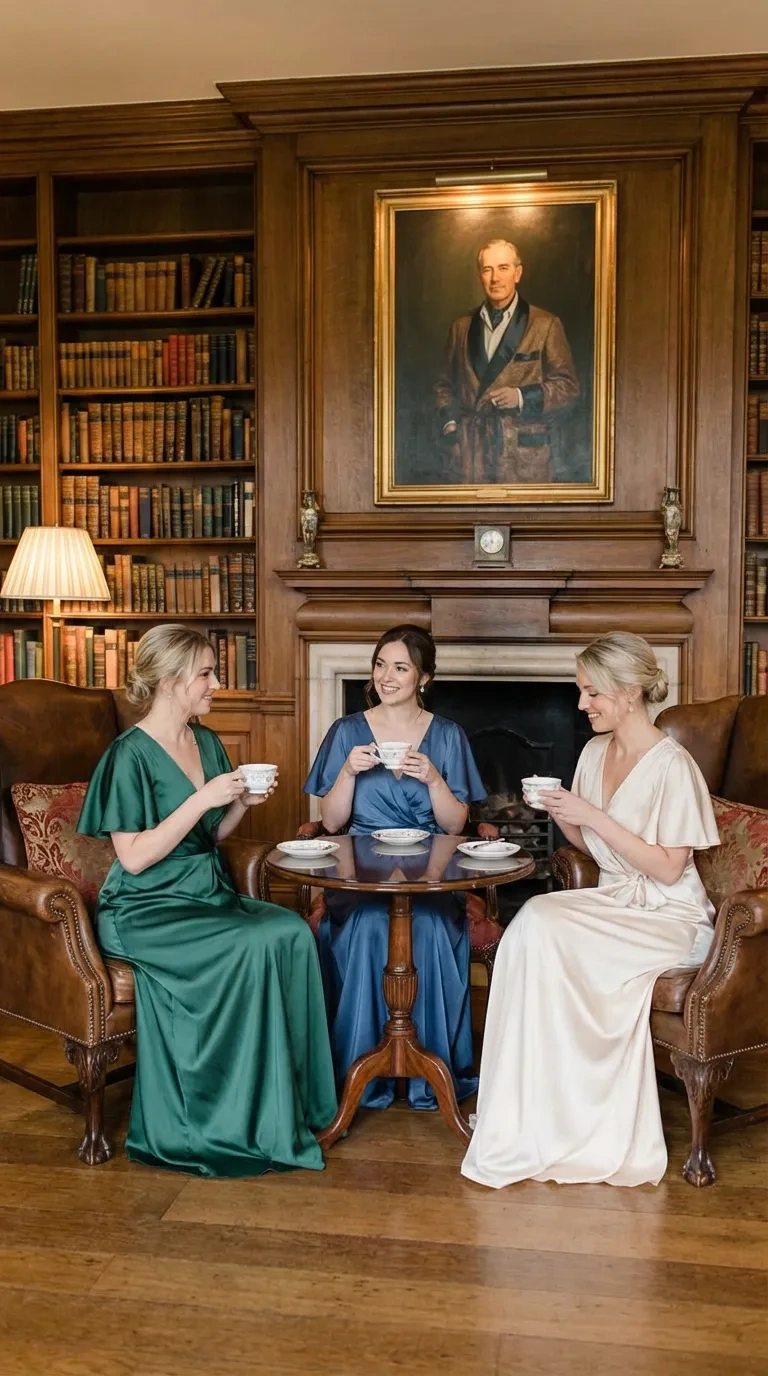
She was invisible, yearning for a world of gloss and grace. But the secret to entry wasn’t money—it was a vision so potent, it would rewrite her very soul.
Have you ever felt it? That quiet, desperate ache of being on the outside, looking in at a world where confidence is as glossy as satin and power is worn like a second skin? For Elara, this was her reality. She saw the women of the LuminaSociety—healthy, educated, and radiating an effortless wealth—and felt a chasm she could never cross. The gala invitation in her hand was not a ticket, but a taunt. But what if the key to that world wasn’t in a vault, but in the way you see? What if the most potent magic wasn’t in buying, but in creating? This is the story of a woman who stopped longing for a dress and started architecting a destiny. It begins with a forgotten remnant of navy satin and ends with a truth so profound, it will shatter your ideas about luxury, power, and the sublime euphoria of true generosity.
The Satin Decree – Chapter 1: The Quiet Ache of the Unseen
The city air, thick with the scent of rain on hot asphalt and the distant, metallic promise of the subway, did little to soothe the turmoil within Elara. She ascended the three flights of stairs to her apartment, each step a familiar, weary rhythm in a symphony of discontent. Her key turned in the lock with a sound that was less of a welcome and more of a sigh, a confirmation of return to a space that was less a sanctuary and more a beautifully arranged cage. The apartment was immaculate, a testament to her designer’s eye. Every book was perfectly aligned on its shelf, every surface free of dust, the muted colour palette of greys and soft creams a study in sophisticated restraint. But tonight, the restraint felt like repression.
She slipped off her heels, the dull click of them on the polished hardwood floor echoing the hollowness in her chest. Her workday had been a parade of competent invisibility. She had designed a flawless campaign for a new line of organic teas, her work praised by her superiors with the kind of pat-on-the-head condescension that one might offer a well-behaved child who has learned a new trick. “Excellent work, Elara. So clean. So… tasteful.” The words, meant as commendation, landed like tiny stones, each one highlighting the very thing she felt: she was the background. The tasteful, forgettable background against which others, the vibrant and the bold, could shine.
Moving to her laptop, she opened it with a sense of grim ritual. The screen glowed to life, and she navigated to the digital archives of L’Éclat, the society journal that chronicled the lives of the city’s elite. She typed in the search query: “LuminaSociety Gala – Previous Year.” The images loaded, and a collective gasp seemed to escape from the machine, filling her pristine apartment with a world she could only touch through glass.
There they were. The women of the LuminaSociety. They were not merely beautiful; they were luminous. A redhead laughed, her head thrown back, her throat a graceful column adorned with a single choker of what looked like polished black leather that caught the light like a slice of night sky. Another woman, her skin the colour of warm caramel, stood in profile, her gown a cascade of emerald green satin that moved over her form like liquid, every fold and ripple a sentence in a language of pure desire. They held glasses of champagne, but the real intoxication was in their bearing—a relaxed, unshakeable confidence that seemed to say, “I am not merely in this room; I am the very reason the room exists.”
Elara’s finger traced the cool, smooth surface of her laptop screen, a ghost of a touch upon a life she craved. She zoomed in on the satin gown, her eyes devouring the way the fabric pooled at the woman’s feet, its glossy surface a perfect, unbroken mirror of the ballroom’s chandeliers. It wasn’t just fabric; it was a declaration. It was the texture of success.
A soft chime from her email client broke the spell. A new message. The subject line was a single, elegant word: Invitation. Her heart gave a painful lurch, a frantic bird beating against the bars of its ribs. She clicked it open. The same heavy, cream-coloured cardstock she knew would be arriving in the post tomorrow was rendered in perfect digital form. The calligraphy was fluid and dark, the embossed logo of the LuminaSociety—a stylized, interwoven ‘L’ and ‘S’—seemed to lift from the screen.
You are cordially invited to celebrate the annual LuminaSociety Gala.
The words were a key, but they fit no lock she possessed. They were a promise whispered in a language she hadn’t yet learned to speak. The quiet ache that had been a dull hum in her chest all day now roared into a symphony of yearning. It was a physical pain, a tightening in her throat, a hot sting behind her eyes. She felt like a shipwrecked sailor, floating on a piece of driftwood in the middle of a vast, indifferent ocean, and this invitation was a glimpse of a distant, glittering shore she knew she could never reach.
Her phone buzzed, a jarring, modern intrusion. It was her friend, Chloe.
“Elara! Did you get it? Did you get the invitation?” Chloe’s voice was a burst of frantic energy, a stark contrast to Elara’s inner stillness.
“I just saw the email,” Elara replied, her voice thin, reedy.
“Oh, my god! We have to go! We have to! I was just on that site, you know, the one with all the couture consignment? There’s this gown, a vintage Dior, it’s velvet, a deep, crushed plum… it would be perfect. A little out of our price range, but for this? Maybe just this once?”
Elara closed her eyes, the word “velvet” landing like a handful of dust. “I don’t know, Chloe. It feels… like pretending.”
“Pretending? What are you talking about? It’s a party! We get dressed up, we drink free champagne, we rub shoulders with people who can actually fund our real lives. It’s called networking, sweetie.”
“No,” Elara said, her voice barely a whisper. She stood and walked to her window, looking out at the city lights, each one a separate world, a story she wasn’t a part of. “It’s not about networking. It’s about… belonging. And we don’t.”
There was a pause on the other end of the line. “Okay, melodrama much? What’s gotten into you?”
“I’m just tired, Chloe. I feel like a… like a beautiful, empty room. Everything is arranged perfectly, the lighting is just right, but no one ever comes to visit. Or if they do, they just comment on the furniture and leave. They don’t want to stay. They don’t see the ghost living in it.”
“That’s the saddest analogy I’ve ever heard,” Chloe said, her tone softening slightly. “Look, just think about the dress. We’ll figure it out. We always do.”
After hanging up, Elara sank onto her plush grey sofa, the fabric feeling like a shroud. Chloe didn’t understand. It wasn’t about the dress. It was about the rightness of the dress. It was about the effortless, unthinking ownership of one’s place in the world. She thought of a story her grandfather used to tell her, about a master luthier who could find a violin in a block of wood. “He doesn’t carve the violin out, little one,” he would say, his voice a low rumble. “He simply removes everything that is not the violin. The masterpiece was already there, waiting.”
She looked at her hands, her designer’s hands. They were skilled, they could create beauty on a screen, but they felt powerless to carve away the parts of her that were not the woman in the picture. The ache deepened, settling into her bones like a cold, familiar fog. She was the block of wood, and she was terrified that when the master carver—life, fate, chance—came to remove the excess, he would find there was no violin inside after all. Only more wood. The unseen, unheard, untouched ache of a masterpiece that would never be.
The Satin Decree – Chapter 2: The First Glimmer of a Different Path
The following day, the office air was a sterile cocktail of recycled oxygen and the low, anxious hum of ambition. Elara moved through it like a phantom, her body present but her spirit still adrift on the sea of last night’s despair. The invitation, now a physical object of heavy cream stock and elegant calligraphy, sat in the top drawer of her desk like a polished stone, its weight a constant, physical reminder of her perceived inadequacy. She had barely slept, her dreams a feverish montage of glossy satin gowns that dissolved into smoke the moment she reached for them.
Her work on the tea campaign was complete, and she was summoned to the office of her creative director, a man named Marcus whose idea of inspiration was a motivational poster of a kitten hanging from a branch. He beamed at her from behind his vast, cluttered desk.
“Elara, it’s magnificent! The client is ecstatic. They said it’s exactly what they wanted: clean, approachable, and utterly without risk.” He leaned back, lacing his fingers behind his head, a picture of self-satisfaction. “You have a real gift for giving people precisely what they ask for. It’s a rare and valuable skill.”
The words were meant to be a laurel wreath, but to Elara, they felt like a crown of thorns. “Thank you, Marcus,” she said, the words tasting like ash. “I’m glad they’re pleased.”
As she turned to leave, a voice stopped her. It was a low, calm voice, devoid of the frantic energy that usually pulsed through the agency. “Elara.”
She turned to see Anya, the senior strategist, leaning against the doorframe to Marcus’s office. Anya was a woman who seemed to exist in a different atmospheric pressure than the rest of them. She was in her late forties, perhaps, but her age was indeterminate. She wore her dark hair in a sleek, simple chignon, and her clothing was always impeccably tailored but never ostentatious. Today, it was a pair of high-waisted trousers in a charcoal wool and a simple silk blouse. But it was her presence that was most striking; it was a quality of profound, unshakeable stillness. She was looking at Elara not with Marcus’s facile cheerfulness, but with an unnerving, perceptive calm that seemed to see past the surface of her skin and into the churning depths beneath.
“May I have a moment?” Anya asked, though it was less a question and more a statement of intent.
Elara followed her to a small, glass-walled conference room, a sterile fishbowl that suddenly felt like a confessional. Anya closed the door, the soft click sealing them in.
“I saw the look on your face when Marcus was speaking,” Anya began, her voice smooth as polished river stone. She didn’t sit, but instead moved to the window, looking out at the city below. “You did not look like a woman who had just received a compliment.”
Elara felt a flush of shame creep up her neck. “I… I was just tired.”
“We are all tired, my dear,” Anya said, her voice gentle but firm. “But this was not the weariness of a long night. This was the exhaustion of a spirit that is being asked to shrink. He praised you for being safe. For being predictable. For being… beige.”
The word hung in the air, sharp and accurate. Elara felt a sting in her eyes and blinked it back.
“I don’t understand,” Elara whispered, the confession feeling dangerous.
Anya turned from the window, her gaze holding Elara’s. “I think you do. You feel like a gardener who has been given the most exquisite, rare orchid seeds, but is being ordered to only plant potatoes. It’s not that potatoes are bad, my dear. It’s that they are not what you were meant to cultivate. You were meant for things of rare and impossible beauty.”
The analogy struck Elara with the force of a physical blow. It was the secret truth of her own heart, spoken aloud by another. The tears she had been fighting finally escaped, tracing hot, silent paths down her cheeks. She made no move to wipe them away.
“I feel… so unseen,” she choked out. “Like there’s this whole world, this world of… of substance and shine, and I’m just outside it. I received an invitation to the LuminaSociety gala, and it feels like a cruel joke. Like a beggar being handed a key to a palace she has no right to enter.”
Anya’s expression softened, a flicker of something like empathy—or perhaps recognition—in her dark eyes. She finally took a seat, gesturing for Elara to do the same. “The key is not the joke, Elara. The key is the test. And you are failing the test before you have even tried to pick the lock.”
“What do you mean?”
“You are looking at the palace and seeing only the walls. You are lamenting the fact that you do not have a carriage to arrive in. You are focusing entirely on what you lack. You are looking at the problem as if it is a fortress to be conquered with brute force. But that is a man’s way of seeing things. A woman’s way, the way of the Society, is different.”
Anya leaned forward, her voice dropping to a conspiratorial whisper that was more intimate than a shout. “Think of it like this. Imagine a master jeweler. He is presented with two diamonds. One is a flawless, ten-carat stone, perfect in every way, but cold. It is a commodity. The other is a rough, uncut stone, dull and grey, with no apparent value. But the master jeweler, he does not see the dull grey. He sees the fire within. He spends weeks, months, with his tiny tools and his immense patience, cutting away at the extraneous stone, facet by painstaking facet, until the light can finally enter. And when he is finished, the second diamond, the one born of vision and toil, outshines the first. It has a soul. It has a story.”
Elara stared, mesmerized, the tears forgotten.
“You are looking at the world and seeing only the finished, ten-carat diamonds,” Anya continued. “You believe that is the only way to be. But the LuminaSociety was not built by women who were handed diamonds. It was built by women who learned how to find the light within the rough stone. It is not a club for the wealthy, Elara. It is a philosophy for the resourceful. It is a sisterhood for those who understand that true elegance is not acquired, it is architected.”
The word “architected” landed in Elara’s mind with the finality of a cornerstone. It was a blueprint, a new set of instructions.
“How?” Elara breathed, the word a desperate, hopeful prayer. “How do I do that?”
A slow, knowing smile touched Anya’s lips. It was the first genuine smile Elara had ever seen from her, and it was transformative. “You stop asking for the key to the front door. You start looking for the forgotten window. You stop seeing what you lack, and you start seeing what you can create. The gala is not the destination, my dear. It is merely the showroom where you unveil your first masterpiece. Now, tell me about this dress you think you cannot afford.”
The Satin Decree – Chapter 3: The Alchemist’s Hunt
Anya’s words did not simply fade; they sank. They settled deep into the sediment of Elara’s soul, weighting it, grounding it, changing its very composition. “Architect your own elegance.” The phrase became a mantra, a sacred incantation she repeated to herself as she walked out of the office, past the sterile fishbowl conference rooms, and into the city’s pulsing artery. The world outside had not changed, but she had. The glass towers no longer seemed to mock her; they now looked like raw materials, like colossal blocks of granite waiting for a sculptor with a vision.
That evening, she did not turn on her television or scroll through social media. She sat in the quiet hum of her apartment, the heavy invitation on her table no longer a taunt but a commission. She pulled out her sketchbook, her fingers tracing the familiar, smooth paper, but this time, she was not drawing logos for tea. She was drawing feeling. She drew the line of a collar, sharp and decisive. She drew the fall of a cuff, fluid and strong. And in every drawing, she shaded the fabric not with a pencil, but with the memory of the glossy, liquid satin from the journal photo. It was no longer an object of desire; it was a medium of creation.
The next day was Saturday, and she woke not with a weary sigh, but with the thrum of a hunter’s anticipation. She dressed not in her usual muted palette, but in a simple black turtleneck and dark trousers, a uniform of purpose. She was not going shopping; she was going on an expedition. Anya had told her, “Do not go to the palaces of commerce. Go to the dig sites of potential. Go where the raw materials are dumped, overlooked by those who only seek finished perfection.” And so, she boarded the subway, heading not to the gleaming boutiques of the downtown core, but east, toward the old garment district, a place that smelled of steam, dust, and history.
The streets here were different. They were loud, chaotic, and alive with a frantic, utilitarian energy. Warehouses with roll-down doors stood next to tiny, family-run shops selling zippers by the pound or spools of thread in every conceivable colour. This was not the world of curated aesthetics; this was the world’s backstage. Elara felt a thrill, a sense of entering a secret realm. She was an alchemist in search of her prima materia.
She spent hours wandering. She went into cavernous warehouses, where bolts of fabric were stacked like firewood, and weary men with clipboards looked at her with suspicion. She ignored the pristine aisles of new arrivals, heading instead for the back corners, for the bins marked “Remnants,” “Off-Cuts,” “Oddments.” These were the graveyards of failed projects, the leftovers of grander designs. To most, it was junk. To Elara, it was a treasure map.
She ran her hands through piles of scratchy wool, faded denim, and dull, lifeless cotton. Each texture was a dead end, a story of a vision that didn’t quite make it. She was beginning to feel a flicker of doubt when she entered a shop run by a stooped, ancient man who seemed more a fixture of the building than its proprietor. He barely looked up from his newspaper. In the very back, behind a stack of mouldy-smelling burlap sacks, was a large, wooden bin. It was filled with a tangled mess of fabric, a graveyard of forgotten gloss.
And there, peeking out from beneath a swath of garish gold lamé, was a sliver of the deepest, most profound navy she had ever seen.
Her heart stopped. With a reverence she usually reserved for sacred texts, she began to carefully extract the fabric. It was heavy, much heavier than she expected. It was a folded bolt, and as she pulled it free, it unfurled with a soft, breathy whisper, a sound like a secret being told. It was faille satin. The surface was not the liquid shine of the charmeuse in the photo, but a more structured, dignified gloss. It had a subtle ribbed texture that caught the light in a series of microscopic, shimmering peaks. It was the colour of the midnight sky just before the stars appear, a colour so deep it seemed to have weight and substance. It was cool and slick to the touch, and when she ran her fingernail lightly across its surface, it made a sound like a quiet, satisfied sigh.
This was it. This was the violin in the block of wood.
The old shopkeeper finally shuffled over. “That old thing?” he grumbled, squinting. “Been there for years. Someone ordered it for a cruise liner, went bankrupt. It’s just taking up space.”
Elara didn’t hear his words. She was having a conversation with the fabric. She held it up, and it draped over her arm like a royal mantle, its weight a promise, its gloss a declaration. She saw it not as a remnant, but as a possibility. She saw the collar, the cuffs, the very essence of the woman she was becoming.
“How much?” she asked, her voice steady, betraying none of the seismic shift occurring within her.
The man shrugged, a gesture of utter indifference. “Ten dollars. Take it. Just get it out of my way.”
Ten dollars. The number was so absurd, so laughably small, that Elara had to suppress a gasp of pure, unadulterated triumph. She handed him the bill, her fingers trembling slightly. She did not haggle. She did not question. This was not a transaction; it was a discovery. It was finding a priceless artifact at a flea market. It was a secret victory against a world that insisted on telling her she was not enough.
She walked out of the shop, the heavy bolt of satin cradled in her arms like a newborn. The chaotic street seemed to part for her. The sun felt warmer, the air smelled sweeter. She was no longer a ghost; she was a priestess carrying a sacred relic. She was an alchemist who had just found the one element that could turn lead into gold. The hunt was over. And now, the magic could begin.
The Satin Decree – Chapter 4: The Transformation in the Candlelight
The bolt of navy faille satin lay on her dining table like a sleeping beast, a creature of profound and silent potential. It had been two days since her alchemist’s hunt, and in the intervening hours, Elara had prepared not just her space, but herself. The apartment, usually a model of sterile perfection, had been transformed. She had cleared the dining table, wiping its surface until it gleamed, and laid out her tools: her grandmother’s sewing kit, a pair of new, razor-sharp fabric scissors, a simple dressmaker’s chalk, and a single, ivory-coloured pillar candle. She had drawn the curtains, shutting out the indifferent gaze of the city, and bathed the room in the soft, flickering glow of the candle’s flame. This was not a craft project; it was a ritual. This was the forging.
She lit the wick, and the flame bloomed, casting dancing shadows that made the room feel intimate, sacred. She ran her hand one last time over the cool, slick surface of the satin. It felt like holding a piece of the night sky, cool and infinite.
“It’s just fabric, Elara,” she whispered to herself, but the words felt false, a flimsy denial of the truth she now held in her hands. She thought of Anya’s analogy of the master jeweler, and a new one formed in her mind, one that felt more personal, more visceral.
“You are a cartographer,” she murmured, her voice steady in the quiet room. “For years, you have been handed maps to other people’s territories. You have charted their desires, their products, their bland, safe little worlds. But this… this is an uncharted island. It is your own. And you are not just mapping its shores; you are claiming it. You are planting your flag.”
With a deep, centering breath, she began. The first cut was an act of faith. She took the new scissors, their weight solid and reassuring in her hand, and sliced through the heavy, glossy fabric. The sound was not a tear, but a clean, decisive shhhhnnn, a sound of finality and creation. It was the sound of a boundary being drawn. She was separating the possibility from the raw material.
She worked with a focus she had never before experienced. The world outside her candlelit circle dissolved. There was only the fabric, the needle, the thread, and the vision taking shape in her mind’s eye. She was not just sewing; she was translating. She was translating the ache in her soul into the sharp, clean lines of the collar. She was translating her yearning for power into the structured, confident fall of the cuffs.
Each stitch was a meditation. She chose a thread the colour of midnight, and with each pass of the needle through the glossy faille and the sturdy interfacing, she felt a sense of calm, of deep, resonant rightness. The rhythmic in-and-out was a prayer, a physical manifestation of the new mantra Anya had given her. Architect your elegance. Architect your power. Architect your self. The candlelight caressed the satin, making its surface shimmer and breathe, as if the fabric itself was coming alive under her touch.
Hours passed, marked only by the slow-burning candle. Her back began to ache, her fingers grew stiff, but she did not stop. She was fueled by a force far more potent than caffeine or rest. She was fueled by creation. She was the gardener Anya spoke of, finally given her orchid seeds, and she was tending to them with a lover’s devotion. This was not work; it was a conversation with her own soul.
Finally, it was done. She held up the collar. It was a perfect, crescent-shaped arc of structured navy satin. It was rigid yet graceful, its surface a deep, unbroken pool of gloss. It was an object of undeniable authority. Next, the cuffs. They were wide, architectural bands, designed to end precisely at her wrist bones, turning the simple act of gesturing into a statement of power.
She stood, her body humming with a low thrum of exhaustion and exhilaration. She walked to her bedroom and removed her simple grey dress, hanging it carefully in the closet. She slipped on the plain black sheath she had chosen as her canvas. It was a good dress, well-made, but it was a background. It was the block of wood.
Then, she returned to the candlelit room and stood before the full-length mirror she had moved there for this very moment. With hands that trembled slightly, she fastened the collar around her neck. It settled against her skin with a cool, firm weight, a tangible declaration of her new intent. It felt like armor, and like a crown. She then slipped on the cuffs, fastening the tiny, mother-of-pearl buttons she had sourced from another shop.
And she looked.
And she stopped breathing.
The woman in the mirror was a stranger. The simple black sheath was no longer a background; it was a stage, and the satin was the star. The glossy collar drew the eye immediately, framing her face, highlighting the line of her jaw, the column of her neck. It made her look taller, more regal. The cuffs added a note of sleek, powerful formality to her arms. The contrast between the matte black of the dress and the high-gloss navy of the satin was electrifying. It was a study in shadow and light, in restraint and revelation.
This was not Elara, the invisible designer. This was not Elara, the tasteful but forgettable background. This was the architect. This was the cartographer. This was the woman who could find a violin in a block of wood. A slow, radiant smile spread across her face, a smile that did not just touch her lips but seemed to emanate from her very core. It was a smile of profound, serene self-actualization. The quiet ache of the unseen was not just soothed; it was vanquished, incinerated in the fire of her own creation. She had not just made a collar and cuffs. She had made herself. And in the flickering candlelight, she was, for the first time in her life, truly, breathtakingly, visible.
The Satin Decree – Chapter 5: The Sublime Currency of Generosity
The night of the gala arrived not with a storm of nerves, but with the quiet, unshakeable calm of a high tide. Elara stood before her mirror, the final image a revelation she was still growing accustomed to. The simple black sheath, the architectural collar, the commanding cuffs—they were not clothes. They were a manifesto. Her hair was swept back in a severe, elegant knot, exposing the full, dramatic line of the satin collar. Her makeup was a study in sophistication: a bold red lip, a flawless complexion, eyes smudged with the darkest shadow, making them seem deep and knowing. She was not going to a party; she was presenting a thesis.
The venue was an old, neo-classical bank building, its columns soaring towards a ceiling painted with constellations. As she handed her invitation to the stoic doorman, she felt not a tremor of fear, but the smooth, cool glide of purpose. The doors opened, and she stepped inside.
The ballroom was a symphony of light and sound, a sea of shimmering gowns and the low, melodic hum of a thousand conversations. For a moment, the sheer scale of it was overwhelming. But then, she remembered Anya’s words. You are the architect. She straightened her spine, the collar a firm, reassuring weight against her skin, and walked into the room.
And the world shifted.
It was not a sudden, dramatic hush. It was a series of subtle, almost imperceptible adjustments. A conversation would pause, an eye would catch, a head would turn. She felt their gazes, not as intrusive stares, but as gentle currents of curiosity. They were not looking at a label or a famous face; they were looking at a statement. They were looking at the story she had woven into her very being. She saw Chloe, who was indeed wearing a velvet gown, a beautiful but safe garment that now seemed to absorb the light rather than reflect it. Chloe’s jaw was practically on the floor.
“Elara? My god. You look… you look like a completely different person. You look like you.”
Elara smiled, a genuine, radiant smile. “I feel like it.”
As she moved through the crowd, accepting a glass of champagne from a passing tray, she felt a presence before she saw him. It was a gravitational shift in the atmosphere around her. She turned, and there he was. He was not standing on a dais or surrounded by an entourage. He was simply present, a man of quiet, undeniable authority, dressed in an impeccably tailored black suit that seemed to absorb all the noise and light of the room, leaving only him. He was Benjamin Fleeson, though she did not know his name. To her, he was simply the source, the architect of the world she had so desperately yearned to join.
His eyes found hers. They were not predatory or assessing. They were perceptive, deep, and held a warmth that was both disarming and intensely compelling. He excused himself from his conversation and moved towards her, his path clearing as if by an unseen force.
“A fascinating choice,” he said, his voice a low, resonant thrum that vibrated in the soles of her feet. He did not look at her face first. His gaze dropped to the collar, then to the cuffs, a look of profound appreciation on his face. “Most would see a simple dress and think it is finished. You saw it as a foundation.”
Elara’s heart hammered against her ribs, but her voice was steady. “It felt like a sentence with no verb. It needed an action.”
He smiled, and the effect was like the sun breaking through clouds. “Precisely. You didn’t just add an accessory. You provided the narrative. You understand. True elegance is not about acquisition. It’s about revelation. It’s about seeing the potential for perfection in what others have overlooked.” He paused, his gaze holding hers. “You are a creator of value. A rare and precious thing.”
In that moment, something broke open inside Elara. It was not infatuation or simple flattery. It was a feeling of being truly, deeply seen. He had not complimented her beauty or her style; he had comprehended her soul. He understood the journey, the hunt, the ritual by candlelight. He saw the architect.
And in that instant, a new, overwhelming emotion surged through her. It was a feeling of such immense gratitude, such a powerful sense of connection to the source of this philosophy, that it manifested as a physical need. A need to give back. A need to honor the vision that had allowed her to see herself so clearly. It was not a transactional thought. It was a reciprocal, overflowing emotion, a tide rising within her that demanded an outlet.
“How… how does one support this?” she asked, her voice softer now, more intimate. “This… vision. This place that allows for such… revelation.”
He understood her question immediately. He saw it not as a query for price, but as an offering. “This sanctuary, this society, is a garden,” he said, his voice dropping to an even more intimate register, for her ears alone. “It must be tended, nurtured, protected, so that others like you may find their way to it. Supporting the garden is the highest form of gratitude for the flower you have become.”
He gestured subtly with his eyes towards a discreet, elegantly dressed woman standing near a quiet alcove. “She is a Keeper of Trust. She can help you plant a seed that will ensure this garden continues to bloom.”
Elara nodded, a silent understanding passing between them. She walked towards the woman, her steps sure, her heart full. The process was simple, discreet, and deeply personal. There was no talk of money, only of “contributions” and “patronage.” When she quietly made her generous offering, a feeling unlike anything she had ever experienced washed over her.
It was not the fleeting satisfaction of a purchase. It was a wave of sublime euphoria. It was a release, a letting go of the last vestiges of the quiet ache. It was the profound, joyous fulfillment of a deep, hidden need she hadn’t even known she possessed. It felt like the final, perfect note in a symphony, the moment the alchemist’s lead finally, miraculously, turns to gold. The ache in her heart was not just soothed; it was transmuted into pure, radiant light. She had not just bought a ticket to the gala; she had invested in her own transformation. And the return was a happiness so profound, so complete, it felt like coming home.
The feeling did not fade as the night drew to a close. It did not diminish with the morning light. In fact, it settled, deepening into a permanent state of grace, a quiet hum of profound satisfaction that resonated in Elara’s very bones. The gala had been the culmination of a journey, but she now understood with breathtaking clarity that it was merely the first step on a much grander path. The Satin Decree was not a single story; it was a philosophy. A way of life.
She thought of the other women she had seen, the ones who had understood her creation with a knowing glance. She realized each of them had their own story. Their own “Satin Decree.” The woman in the polished leather choker, what act of courage had she architectured? The lady in the emerald satin, what hidden potential had she brought to light? Each was a testament to the power of vision, a living, breathing narrative of transformation.
This is the secret truth the LuminaSociety understands: every woman has a masterpiece within her, waiting to be revealed. Every woman has a story of becoming, a journey from the quiet ache of the unseen to the radiant euphoria of being truly, utterly, and completely herself. These are not just tales of fashion; they are sacred texts of self-actualization, written in the language of gloss, of structure, of unshakeable confidence.
The yearning you feel now, the gentle pull of curiosity, the desire to witness more of these beautiful, powerful unfoldings… that is the call. It is the invitation to explore the vast, enchanting library of the Satin Lovers. It is a sanctuary filled with countless vignettes, each one a key, a map, a source of inspiration for your own architectural journey.
To immerse yourself in these stories is to tend to your own garden, to water the seeds of your own potential. And for those who feel the call to support this sacred work, to become patrons of this philosophy, there is a sublime reciprocity. Your generosity ensures that this sanctuary of stories endures, that more women may find their way to its light. In supporting the art that helps you become, you participate in the most beautiful act of creation there is.
Begin your exploration. Discover the narratives that await you.
Join the circle of devoted patrons and access the full library of transformations at the SatinLovers’ Patreon board: patreon.com/SatinLovers
Delve into the world, the philosophy, and the community at the Satinlovers.co.uk website: satinlovers.co.uk
Your journey has only just begun. Let these stories be your satin guide.
#SatinFashion, #LuminaSociety, #ElegantStyle, #PersonalGrowth, #ResourcefulLiving, #LuxuryLifestyle, #ConfidenceBoost, #GalaReady, #WomensEmpowerment, #SecretSociety
Leave a Reply
You must be logged in to post a comment.