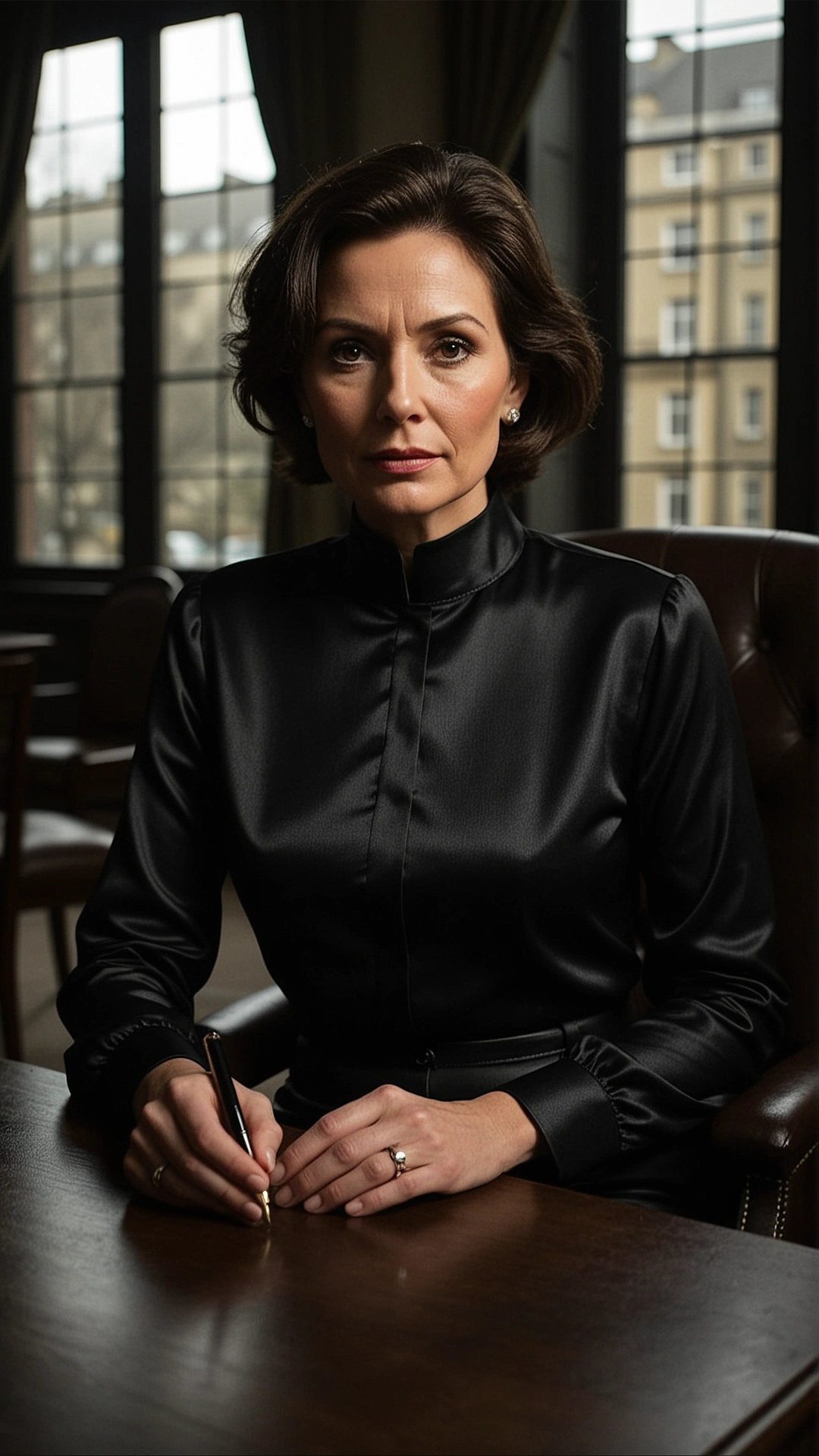
What if the most valuable thing you could touch was not a stock certificate, but the hand of a woman who saw your worth before you did?
Warning: This story contains adult subjects. Juniors and the overly sensertive should not read it.
In the hushed rooms of a Marylebone townhouse, where midnight-blue silk pools on polished parquet and the scent of Earl Grey drifts through corridors kept immaculate by devoted hands, a woman in a charcoal satin blouse turns a signet ring on her finger and considers a lie.
The lie comes wrapped in beautiful graphics and exponential projections. It wears polished shoes and an expensive watch. It speaks the language of disruption and innovation. It is the kind of lie that has separated intelligent women from their fortunes for generations.
But Cordelia Ashworth did not build a twenty-year career in venture capital by believing beautiful lies. She built it by touching the fabric before reading the prospectus — by placing her fingers on the substance and letting her hands tell her what her eyes could not.
When her junior partner Vivienne brings her an opportunity that seems too good to be true, Cordelia recognizes the pattern. She has seen it before. She has lost everything to it before. And she has rebuilt from the ashes with the help of women whose devotion is not weakness but the purest form of strength she has ever known.
What follows is a story of silk and substance, of patient capital and im patient men, of a household built on the radical principle that a single woman surrounded by devoted companions is not a luxury but a foundation. It is a story about the difference between quality that endures and spectacle that evaporates. It is a story about training men to serve with pride and women to serve with joy. It is a story about touching the fabric.
It is a story about what becomes possible when a woman stops chasing what looks impressive and starts cultivating what is real.
Turn the page. Touch the silk. Let the story find you.
CHAPTER ONE: THE SILK AND THE SIGNET
The morning entered Cordelia Ashworth’s study the way it entered every room of her Marylebone townhouse — through silk.
Not directly. Not crudely. The Georgian windows faced east, and the light that passed through them had already been filtered by midnight-blue curtains so heavy with weave that they transformed ordinary sunshine into something liquid, something that moved across the parquet floor like honey poured from a height. The light touched the silver coffee service on the desk, the fountain pen, the leather-bound journal, and the pitch deck that Vivienne had left the previous evening — and it made each object look as though it had been dipped in varnish and set to gleam.
Cordelia was already at her desk. She had been there since six, which was not unusual. What was unusual was the charcoal satin blouse she had chosen to wear with her high-waisted wool trousers — charcoal, not her customary cream. She dressed for her mood the way other women dressed for the weather, and this morning her mood was the colour of a sky that might hold rain or might hold nothing at all. Her silver-streaked auburn hair fell loose past her shoulders, still unbrushed, catching the blue-filtered light in ways that made it seem almost iridescent. Her feet were in patent leather slippers that shone like wet stones.
She turned the signet ring on her left hand. Once. Twice. A third time.
The ring was gold, heavy, engraved with a pattern that had no meaning to anyone except Cordelia — a pattern she had designed herself when she was twenty-seven and broke and rebuilding. She had worn it every day since. It was not jewellery. It was an instrument. When she turned it clockwise, she was evaluating. When she turned it counter-clockwise, she was deciding. When she held it still, she was certain. This morning she was turning it clockwise, which meant she was not yet certain about anything.
The pitch deck lay open before her. THEO BRENNAN — REVOLUTIONARY TEXTILE TECHNOLOGY — PROJECTED RETURNS: 40% ANNUALLY. The cover page was beautiful. The graphics were beautiful. The projections were beautiful. Everything about it was beautiful, and Cordelia Ashworth had learned, at significant personal cost, that beauty without substance was the most expensive thing a woman could buy.
She had just finished reading the market analysis — which assumed simultaneous growth in three economies that had never grown simultaneously — when the door opened behind her without a sound.
Petra.
Cordelia did not turn. She did not need to. Petra moved the way water moves through a smooth channel — without friction, without noise, without wasted effort. She wore her household uniform of black satin with a white Peter Pan collar, the fabric catching the filtered light in a way that made her seem outlined in liquid shadow. Her dark hair was in a chignon so precise it might have been carved from obsidian. She carried a tray: a single espresso cup, a small silver jug of steamed milk, and one cube of raw sugar in a porcelain dish.
She set the tray at Cordelia’s right hand. The cup was pre-warmed. The espresso was a double, pulled ninety seconds ago — long enough for the crema to settle, not long enough for the heat to drop. The sugar cube was positioned beside the cup at the two o’clock angle, which was where Cordelia preferred to reach for it.
Petra did not speak. She had not spoken during the morning coffee service in six years. She did not need to. The ritual was so deeply established that words would have been an intrusion, a breaking of the surface tension that held the morning together. Instead, she placed her hand briefly on the desk beside Cordelia’s — not touching, not quite, but near enough that the warmth of her palm reached the back of Cordelia’s hand like a rumour.
Cordelia turned from the pitch deck. She looked up at Petra. Their eyes met.
The touch came to Petra’s wrist — Cordelia’s fingers, light as silk thread, pressing against the pulse point. A single touch. It lasted perhaps two seconds. But in those two seconds, something passed between them that had been passing for six years and had never once required articulation: gratitude, devotion, the particular tenderness that exists between a woman who provides structure and a woman who finds her purpose within it.
Petra’s face softened. Not dramatically — Petra was not a woman given to dramatic expression. But the corners of her mouth lifted by a fraction, and the tension in her jaw released by a degree, and her shoulders settled by a centimetre. To anyone else, the change would have been invisible. To Cordelia, who had spent six years learning to read Petra the way she read fabric — by touch, by light, by the way it moved — the change was as clear as a bell struck in a quiet room.
“Thank you, Petra.”
The words were quiet. They were also unnecessary, and both women knew it. But Cordelia said them because she had learned, over twenty years of building and rebuilding, that acknowledgment was not a courtesy. It was a nutrient. It was the thing that made devotion grow rather than merely persist. She had learned this the hard way — by failing to acknowledge, early in her career, the people who served her, and watching their devotion wither like silk left in direct sunlight.
Petra withdrew. The door closed behind her with the softest possible click.
Cordelia picked up the espresso. She added the sugar cube. She drank.
The coffee was perfect, as it was every morning, as it had been every morning for six years. The perfection was not accidental. It was the product of a system: Petra’s understanding of Cordelia’s preferences, refined over years of observation and quiet adjustment; Cordelia’s consistent acknowledgment, which made Petra want to refine rather than merely repeat; and the relationship between the two, which was not employer-employee but something older and more fundamental — a woman who commands and a woman who serves, bound by mutual choice, sustained by mutual care.
Cordelia set down the cup and returned to the pitch deck.
She was halfway through the competitive analysis — which listed no actual competitors, only “adjacent technologies,” a phrase that made her ring turn faster — when Cosima appeared in the doorway.
Cosima was taller than Petra, broader in the shoulders, with skin the colour of oiled walnut and close-cropped hair that she kept covered with a silk scarf in deep burgundy. Her uniform was the same black satin with white collar, but she wore it differently — with a military precision that reflected her previous life as a logistics officer in the merchant navy. She had come to Cordelia four years ago, after a discharge that left her with no direction and a profound need for structure. Cordelia had given her both.
“The morning deliveries have arrived and been catalogued, ma’am.” Cosima’s voice was low, respectful, warm — the voice of a woman who understood that respect was not subservience but a form of elegance. “The silk from Lyon is as expected. The leather from Florence is short one hide. I’ve contacted Signor Castellani and he will replace it by Thursday.”
“Thank you, Cosima. Was he apologetic?”
“He was, ma’am. He said the hide had a flaw he didn’t feel comfortable shipping.”
Cordelia smiled. This was the result of three years of training. Signor Castellani had once shipped whatever he had, flaws and all, because he did not believe anyone would notice. Cordelia had noticed. She had returned the flawed leather with a note — not angry, not accusatory, but specific. She had described the flaw in detail, explained why it mattered, and told him that she valued his work enough to wait for quality. She had also paid a premium for the replacement.
The result: Signor Castellani now inspected every hide before shipping. He rejected his own work when it fell short. He took visible pride in meeting her standard. He had become, in his own way, devoted — not as a companion, but as a provider, a man who served a woman who had taught him what excellence looked like and made him want to achieve it.
This was the principle Cordelia would later teach Vivienne: men want to serve well. They need to know what good service looks like. Tell them clearly. Acknowledge them genuinely when they deliver. Correct them promptly and privately when they don’t. Pay well for quality. They will move mountains for you — not because you demand it, but because you make them want to.
“Tell him Thursday is acceptable,” Cordelia said. “And tell him I appreciate his attention to the flaw. That’s the kind of care that makes a supplier irreplaceable.”
Cosima nodded. She lingered for a moment — not from uncertainty but from something else, a small question she was weighing whether to ask.
“Yes, Cosima?”
“Helene is upstairs preparing your wardrobe. She asked whether you would be receiving Miss Marsh this morning or going to the office first.”
Cordelia considered. Vivienne was due at eight. It was now seven-fifteen. She would receive Vivienne here, in the study, where the light was good and the tea was silver and the atmosphere carried the particular authority of a room that had been the site of many decisions, most of them correct.
“Here. And please ask Helene to include the leather skirt. The charcoal one.”
“Yes, ma’am.”
Cosima withdrew. Her footsteps receded down the corridor with the measured cadence of a woman who had once walked ship decks in heavy seas and now walked hardwood floors as though they were the same surface — because to Cosima, they were. The household was her ship. Cordelia was her captain. The metaphor was not one she would have articulated, but it was one she lived.
Cordelia returned to the pitch deck. She read the financial projections. She read the market analysis. She read the team biographies. She read the testimonials from early investors — all of whom she recognised as speculators, people who chased heat rather than cultivated warmth.
She turned her signet ring. Clockwise. Evaluating.
At seven-forty, she heard Helene on the stairs. Helene was the newest member of the household — six months, barely a season — and she had not yet fully absorbed the household’s rhythms. Her footsteps were lighter than Petra’s, less certain than Cosima’s, carrying the particular quality of a woman who was learning to belong and had not yet quite believed that she did.
Helene entered the study carrying a garment bag and a shoe box. She was in her black satin uniform, but hers had a subtle difference from Petra’s and Cosima’s — a slightly narrower collar, a slightly shorter skirt. Cordelia had specified these differences deliberately. Each woman’s uniform was identical in fabric and fundamental design but distinct in detail, because Cordelia understood that devotion did not mean erasure. A woman could serve and still be herself. The uniform was a framework, not a cage.
“Good morning, Helene.”
“Good morning, ma’am.” Helene’s voice was soft, slightly breathless. She was still awed by the household, by the townhouse, by the woman who had taken her in when she was directionless and unhappy and given her something she had never known she needed: a place to be useful.
“Is the leather skirt ready?”
“Yes, ma’am. I’ve polished the boots as well. And I’ve laid out fresh lingerie — the cream silk.”
Cordelia nodded. “Good. I’ll change after Vivienne arrives. I want to receive her in this —” she touched the charcoal satin of her blouse — “because this is how I think best, and I need to think clearly this morning.”
Helene hung the garment bag on the stand beside the wardrobe and placed the shoe box beneath it. She moved to the window to adjust the curtains — opening them a fraction wider, allowing more of the filtered light to enter. It was a small act, but it was an act of anticipation. Helene had noticed that Cordelia preferred more light when she was working, less when she was reading. She had noticed this without being told. She was learning.
“Helene.”
“Yes, ma’am?”
Cordelia looked at her — really looked, the way she looked at fabric, with attention that went beyond the surface. Helene was twenty-eight, slender, with light brown hair that she was growing out at Cordelia’s suggestion. Her skin was fair. Her eyes were grey-green and still carried traces of the uncertainty that had defined her when she arrived. But the uncertainty was fading. In its place, something else was growing — a quiet pride, a sense of belonging, a nascent understanding that service was not degradation but elevation.
“You’ve done well this morning. The curtains were exactly right.”
Helene’s face transformed. Not dramatically — Helene was not a woman given to dramatic expression any more than Petra was — but the grey-green eyes brightened, and the shoulders lifted, and the mouth curved into a smile that she tried to suppress and could not. The praise had landed. It had landed the way praise always lands when it is genuine, specific, and timely — like rain on soil that has been waiting.
“Thank you, ma’am.”
“You may go. And Helene —”
“Yes?”
“When you’ve finished upstairs, come back to the study. I’ll need you to take notes during my meeting with Vivienne.”
Helene’s eyes widened. This was new. This was an expansion of her role, a sign of trust, a step deeper into the household. She nodded quickly, her satin uniform catching the light as she moved, and left the study with footsteps that were — for the first time since she had arrived — almost as measured as Cosima’s.
Cordelia watched her go. She turned her signet ring. Counter-clockwise this time. She was deciding.
She had decided about Theo Brennan’s pitch before she had finished reading it. The decision was no. The pitch was a performance. The product was unproven. The projections were fantasy. The team was compromised. The testimonials were meaningless. Everything about it was surface — beautiful, polished, luminous surface, like a lacquer applied to rotten wood.
But the purpose of Vivienne’s visit this morning was not to confirm the decision. The purpose was to teach Vivienne to make the decision herself. This was the real work — not the investment, not the capital, not the returns. The real work was the cultivation of a younger woman’s judgement, the transfer of a skill that could not be learned from books or lectures but only from proximity to someone who had learned it the hard way.
Cordelia had learned it the hard way. Twenty years ago, she had invested everything she had saved — nearly two hundred thousand pounds — in a company that promised revolutionary fabric at low cost. The pitch had been beautiful. The projections had been spectacular. The product had failed in the market within a year. The company had collapsed. She had lost everything.
She had been alone then. No household. No Petra, no Cosima, no Helene. No one to bring her coffee, to catalogue her deliveries, to polish her boots. No one to touch her wrist in the morning and remind her, without words, that she was not alone. She had rebuilt her finances slowly, painfully, over five years. She had rebuilt her life over ten. She had found Petra first — a woman working in a fabric shop on Marylebone High Street, brilliant and unrecognised, who understood silk the way a pianist understands a keyboard, by touch and instinct. Cordelia had offered her a position, a home, a purpose. Petra had accepted. That had been the beginning.
The beginning of the household. The beginning of the life that now surrounded Cordelia like silk surrounds a body — not constraining but defining, not heavy but holding, not loud but present in every moment.
At seven-fifty-five, the front door bell rang. Petra answered it. Cordelia heard the murmur of voices in the hall — Petra’s low welcome, another woman’s brighter response. Footsteps on the parquet. The drawing room door opening and closing. The particular sound of a leather bag being set on a side table.
At eight o’clock precisely, Vivienne Marsh entered the study.
She was wearing an emerald satin blouse with a high collar that caught the morning light and threw it back in shades of deep green and gold. Her dark hair was in a sleek chignon. Her leather trousers were fitted and polished. She carried a folder and a tablet and an expression of barely contained excitement.
“Good morning, Cordelia.”
“Good morning, Vivienne. Sit. Tea?”
“Yes, please.”
Cordelia rang the small bell on her desk. A moment later, Petra appeared. “Tea for two, please. The Earl Grey.”
Petra nodded and withdrew. Vivienne watched her go — watched the way the black satin moved, the way the white collar framed the back of her neck, the way she disappeared through the door without a sound.
“Does she ever walk loudly?” Vivienne asked, half-smiling.
“She has never walked loudly in six years. It is not in her nature. But it is also not necessary. The household runs on anticipation, not announcement.”
Vivienne nodded. She had been coming to the townhouse for eighteen months and was still adjusting to the atmosphere — the order, the beauty, the particular quality of silence that existed between the women who lived here. Not the silence of suppression. The silence of a system so well-tuned that noise was unnecessary.
She set the folder on the desk. “I’ve brought the supplementary data you asked for. The market analysis from the Singapore office, and the —”
“In a moment.” Cordelia raised a hand. Not peremptorily — gently, the way one might raise a hand to catch a butterfly. “First, tell me about yesterday. You left the pitch deck with me and went home. What did you think about?”
Vivienne settled into the chair opposite Cordelia. The chair was leather, deep, positioned so that the light from the window fell on the sitter rather than on Cordelia — a deliberate arrangement that gave Cordelia the advantage of shadow and Vivienne the vulnerability of illumination.
“I thought about the fabric,” Vivienne said. “I couldn’t stop thinking about the fabric. The projections are extraordinary. The market opportunity is enormous. But I kept thinking — what does it feel like? I’ve read the specifications. I’ve seen the photographs. But I haven’t touched it.”
Cordelia turned her signet ring. Clockwise. But she was not evaluating the pitch. She was evaluating Vivienne.
“What else?”
“I thought about the team. Theo Brennan is persuasive. But I looked up his head of quality control — the one you asked about — and I found something I didn’t like.”
“Tell me.”
“He was dismissed from a position at a textile firm in Manchester three years ago. The dismissal was not public, but I found a former colleague who told me he was let go for falsifying test results. The results were used to secure a contract that later collapsed when the fabric failed.”
Cordelia felt something she rarely felt — a flash of pride in another person’s work. She suppressed it. Praise, to be effective, must be timely and specific. Now was not the moment. The moment would come later, when Vivienne had finished the thought.
“Anything else?”
Vivienne hesitated. She smoothed her leather trousers with both palms — a gesture Cordelia had observed many times, a self-soothing motion that meant Vivienne was about to say something she was uncertain about.
“I kept thinking about something you said to me when I first joined the firm. You said, ‘The most expensive thing in the world is a cheap fabric that looks expensive.’ I think this might be that.”
Cordelia stopped turning her ring. She held it still.
Petra returned with the tea service — the silver pot that had been in Cordelia’s family for four generations, two cups of translucent porcelain, a small jug of milk, a dish of lemon slices. She poured for both women, placed the cups, and withdrew. The entire operation took less than ninety seconds and produced no sound louder than the liquid meeting porcelain.
Cordelia added milk to her tea. She watched the cloud form and dissipate, white into amber, a small chemistry of comfort.
“Tell me what you see,” she said.
Vivienne looked at her. “In the pitch?”
“In anything. Tell me what you see.”
Vivienne took a breath. She had learned, over eighteen months, that Cordelia’s questions were never simple. They were doors. The question was not the point. The point was what lay on the other side.
“I see a pitch that is beautiful on the surface. I see projections that assume conditions that have never existed. I see a team with a compromised quality lead. I see testimonials from speculators. I see a product I have never touched.” She paused. “And I see a woman who has already decided not to invest, and who is waiting to see if I can see the same thing.”
Cordelia smiled. It was a rare expression — not because she was unhappy, but because her face, like her investments, tended toward stillness. When she smiled, it was because something had genuinely moved her.
“What do you feel?”
This was the question that separated evaluation from judgement. Anyone could learn to read a pitch deck. Anyone could learn to spot a falsified test result. But the feeling — the visceral, somatic response that occurred when a woman of intelligence and taste encountered something true or something false — that was the instrument that could not be taught. It could only be cultivated.
Vivienne closed her eyes. She sat in the leather chair, in the emerald satin and polished leather, in the filtered light of the Marylebone morning, and she listened to her body.
“I feel suspicion,” she said. “In my stomach. Below the ribs. It feels like the time I bought a silk blouse from a market stall — it looked perfect, but when I got it home and held it to the light, the weave was loose and the colour was printed on, not dyed in. It felt like a betrayal. This feels like that.”
Cordelia picked up her tea. She sipped. She set it down.
“Good,” she said. “Now. We are going to touch the fabric.”
She stood. Her charcoal satin caught the light one final time as she moved toward the door. She turned back.
“And Vivienne —”
“Yes?”
“The fact that you looked up the quality controller. The fact that you found the dismissal. The fact that you remembered what I said about cheap fabric. That was good work. Very good work.”
Vivienne’s face did what Helene’s face had done an hour earlier — it transformed. Not dramatically. But the eyes brightened, and the shoulders lifted, and the mouth curved into a smile that she did not try to suppress, because she was learning, slowly, that in this household, praise was not something to be embarrassed by. It was something to be received. Like silk. Like tea. Like the touch of a hand on a wrist in the morning light.
“Thank you, Cordelia.”
“Thank yourself. You did the work.”
She opened the door. In the corridor, Helene was waiting with a notebook, her black satin pristine, her grey-green eyes ready. Petra was in the hallway, arranging flowers in a crystal vase. Cosima was in the kitchen, reviewing the week’s provisions. The household hummed around Cordelia like a tuning fork — each woman in her place, each woman at peace, each woman held.
“Come,” Cordelia said. “There is a room on the second floor you have never seen. It is where I keep my collection. It is where I keep my failures and my recoveries. It is where I learned to touch the fabric before I read the prospectus.”
She led Vivienne and Helene up the stairs. Behind them, Petra finished the flowers and stepped back to admire them — white peonies in crystal, the stems visible through the water like the bones of a beautiful hand. She touched the nearest bloom with a fingertip. It was cool, firm, alive.
In the kitchen, Cosima heard the footsteps overhead and smiled. She knew where they were going. She had been to the fabric room herself, three years ago, when Cordelia had first shown her the collection. She had touched the Lyon silk and the failed synthetic and understood, in the space between her fingers, everything that Cordelia had been trying to teach.
The household held. The morning moved. The silk caught the light.
And on the desk in the study, abandoned, Theo Brennan’s pitch deck lay open to its final page — a page that showed a projected return of forty percent annually, illustrated with a graph that rose like a rocket, beautiful and impossible, like a firework that would dazzle for a moment and then leave nothing but smoke and darkness and the memory of having been fooled.
The signet ring on Cordelia’s finger was still.
She was certain.
CHAPTER TWO: THE PITCH
The afternoon arrived in the townhouse the way a well-trained servant enters a room — announced, expected, and perfectly timed. Two o’clock. The drawing room had been prepared since noon: Cosima had polished the silver coffee service until it reflected the ceiling roses, Petra had arranged the seating with the precision of a chess player who intended to win, and Helene had laid a fire of apple wood that scented the air with something sweet and barely there, like a rumour of warmth rather than warmth itself.
Cordelia had changed. The charcoal satin blouse and wool trousers of the morning had been replaced by a charcoal wool dress with a silk-lined collar that lay against her throat like a cool hand. The dress was structured, architectural — it did not flow so much as it held its position, the way a well-built bridge holds its span. Her patent leather knee boots caught the firelight and threw it back in long, liquid streaks. She wore no jewellery except the signet ring. She had considered pearls and decided against them. Pearls would have been diplomacy. She wanted clarity.
Vivienne sat to her left on a cream silk sofa, her emerald satin blouse buttoned to the throat, her leather trousers catching a different angle of the fire. She held a leather notebook and a fountain pen — not a tablet, not a phone. Cordelia had taught her this: when you meet a man who performs, you do not give him a screen to perform to. You give him your eyes. You give him the weight of your attention. You make him feel that everything he says lands somewhere solid, and then you watch where it lands and whether it holds.
Petra stood beside the coffee service, her black satin uniform absorbing the light in a way that made her seem less like a person and more like a quality of the room — a depth, a richness, the way shadow is a quality of light. Her hands were folded at her waist. Her face was composed. She had been briefed on the visitor and had been told, specifically, to serve but not to disappear. Cordelia wanted Theo Brennan to see the household. She wanted him to understand, before he opened his mouth, that he was entering a world with standards.
At two minutes past two, the front bell rang. Cosima answered it.
Cordelia heard the exchange in the hall — Cosima’s measured greeting, a male voice, confident and slightly too loud, the particular volume of a man who has been told that presence is power and has overcorrected. Footsteps on the parquet. The drawing room door opened.
Theo Brennan entered the way a wave enters a shore — with energy, with momentum, with the sense that he had been moving toward this room for some time and had built up a head of steam that he was not going to dissipate by pausing.
He was handsome. Cordelia catalogued this immediately, the way she catalogued everything — not because it mattered, but because it was data. Handsome in the way that expensive packaging is handsome: designed to appeal, tested for broad appeal, lacking any particular signature. His hair was dark, well-cut, not bespoke. His suit was navy, well-fitted, not bespoke. His shoes were polished, expensive, not bespoke. His watch was a brand that signalled wealth to people who could not distinguish between wealth and its advertisement. Everything about him was good and nothing about him was specific.
He carried a leather portfolio under one arm and a tablet in his opposite hand. His handshake, when he offered it to Cordelia, was firm — the particular firmness of a man who had read somewhere that firm handshakes inspire confidence and had been practising ever since. His palm was slightly damp. His eyes, pale blue, swept the room in a single practised arc, calculating — the Adam ceiling, the silk curtains, the silver service, the woman in black satin standing beside it — and arrived back at Cordelia with a smile that was white, even, and utterly unrevealing.
“Mrs. Ashworth. Thank you for the invitation.” His voice was warm, modulated, the voice of a man who had spent years in rooms like this and had learned to sound as though he belonged in them. “What a extraordinary home.”
“Miss Ashworth,” Cordelia corrected, gently. The correction was not about marital status. It was about precision. She had never been married. She had no interest in being married. The title was a fact, and facts, in this room, mattered. “Please, sit.”
Theo sat in the chair opposite — the chair that was not the sofa, that was not beside Vivienne, that was positioned at a distance Cordelia had specified. Not far enough to be cold. Not close enough to be intimate. The distance of evaluation. He crossed his legs, settled his portfolio on his knee, and looked at Petra.
“Coffee?” Cordelia offered.
“Please. Black.”
Petra poured. The coffee was a single-origin Kenyan, roasted two days ago by a small supplier in Bermondsey whom Cordelia had been buying from for eight years. She had chosen it for this meeting because it was complex, demanding, and rewarded attention — qualities she intended to test in other areas. Petra placed the cup on the small table beside Theo’s chair. She withdrew to her position by the service.
Theo sipped. He nodded appreciatively. “Excellent coffee.”
“It is,” Cordelia agreed. “The roaster is a man named David Okafor. He sources single-estate beans and roasts them in small batches. I have been his customer for eight years. When he first supplied me, the roasts were inconsistent. I returned the inconsistent batches with notes explaining what was wrong — not angrily, specifically. I told him what I tasted and what I wanted to taste. He adjusted. He improved. Now his roasts are flawless, and he credits me with teaching him to listen to the beans rather than impose his will on them.” She paused. “I tell you this because I believe the relationship between a buyer and a supplier is the most honest measure of both. Don’t you?”
Theo blinked. This was not the opening he had expected. He had expected pleasantries, a settling-in, a few minutes of social lubrication before the pitch. Instead, he had been handed a parable about quality and correction, and he was not entirely sure whether it was a welcome or a warning.
“I absolutely agree,” he said, recovering smoothly. “Relationships are everything in business. That’s why I’m here today — to build a relationship, not just to pitch a product.”
“Then let’s hear about the product,” Cordelia said. She did not lean forward. She did not adjust her posture. She sat in her charcoal wool and patent leather with the stillness of a woman who had learned that stillness was not passivity but a particular form of attention — the attention of a listener who intended to hear not just what was said but what was meant, what was omitted, what was papered over with graphics and enthusiasm.
Theo opened his portfolio. He placed the tablet on the side table and angled it so both women could see. The screen lit up with a presentation — beautifully designed, as Cordelia had noted the previous evening. Clean lines, striking typography, photographs of fabric that shimmered and flowed.
“I’ll start with the problem,” Theo said. He had been coached well. Starting with the problem was the current orthodoxy of pitchcraft — establish the pain point, then offer the salve. “Traditional silk production is slow, labour-intensive, and expensive. The global demand for silk-like fabric far exceeds the supply. Our technology — and I say our with full respect for the team that developed it — produces a fabric that is visually and tactilely indistinguishable from traditional silk at thirty percent of the cost.”
He advanced to the next slide. A comparison chart. Traditional silk on one side, his product on the other. The columns were colour-coded — gold for traditional, blue for his product. The blue column was longer in every metric except price, where it was dramatically shorter.
“The market opportunity is enormous. Fashion houses, interior designers, automotive manufacturers — any industry that uses silk or silk-like fabric is a potential customer. We project forty percent annual returns for early investors, with a path to profitability within eighteen months.”
He continued. Market analysis. Competitive landscape. Team biographies. Financial projections. Each slide was polished. Each point was articulated with the fluency of a man who had made this pitch many times and had refined it to a sequence of verbal gestures as choreographed as a ballet.
Cordelia watched his hands. They were expressive, moving in shapes that illustrated his words — widening to show scale, chopping to show precision, spreading to show opportunity. But beneath the expressiveness, she noticed something: his left hand, the one not holding the tablet, kept touching his watch. Not checking the time. Touching it. A self-soothing gesture. The gesture of a man who was performing confidence rather than feeling it.
Vivienne was watching the presentation. She was leaning forward slightly — the instinctive response to a well-delivered pitch. But her hands were still in her lap, and her fountain pen had not moved. Cordelia had taught her this: if your hands want to write, the pitch has engaged your mind. If your hands are still, the pitch has engaged only your eyes. Engagement of the eyes is performance. Engagement of the mind is substance.
Petra stood motionless by the coffee service. She had heard many pitches in this room — not business pitches, but the pitches of women who came to the townhouse seeking a place in the household, seeking structure, seeking Cordelia’s attention. She had learned to read the room the way Cordelia read fabric: by feel. What she felt now was Cordelia’s particular stillness — the stillness that meant she was not being persuaded but was allowing the performance to continue so that her companion could learn from it.
Theo reached his final slide. “I believe this is a once-in-a-generation opportunity. The textile industry hasn’t seen real innovation in decades. We’re not just offering a product. We’re offering a paradigm shift.”
Paradigm shift. Cordelia held the phrase in her mind the way she held fabric in her hands — turning it, examining it, testing its weight. It was a phrase that meant nothing and everything. It was the verbal equivalent of the synthetic fabric in her collection — impressive at first touch, revealing nothing on closer examination.
“Thank you, Mr. Brennan,” she said. “An impressive presentation. May I ask some questions?”
“Of course. That’s what this is about — dialogue.”
“Three questions.” She raised a finger. “First. What is the tensile strength of your fabric compared to traditional silk? Not the marketing figure — the measured figure, in newtons per tex.”
Theo smiled. It was the smile of a man who had anticipated questions but not this one. “Our fabric performs comparably to traditional silk across all key metrics. The tensile strength is within the standard range for—”
“What range?”
“I don’t have the exact figure to hand, but I can—”
“Please do. I would like the exact figure, the test methodology, and the name of the laboratory that performed the test.”
Theo’s left hand touched his watch again. “I’ll have that for you within the week.”
Cordelia raised a second finger. “Second question. What happens to your production costs if your raw material prices increase by twenty percent?”
“We’ve modelled for volatility. Our supply chain is—”
“Your projections show a flat cost curve for five years. No commodity market in the world has a flat cost curve for five years. What happens at twenty percent?”
Theo paused. The pause was brief — a fraction of a second — but Cordelia saw it. It was the pause of a man who had been asked a question he did not want to answer in a room where he had expected only soft ones.
“We would absorb the increase through efficiency gains in the production process.”
“Which efficiency gains? Your production process is proprietary, which means I cannot evaluate it. Your cost projections do not account for material price volatility, which means they are not projections but aspirations. And your answer just now — ‘absorb through efficiency gains’ — is not an answer. It is a phrase that sounds like an answer.”
The room was very quiet. The apple wood fire shifted in the grate, sending a small constellation of sparks up the chimney. Petra’s face was unreadable. Vivienne’s pen was motionless.
Theo’s smile had not changed, but the muscles around his eyes had tightened. “I appreciate the rigour of your questions, Miss Ashworth. These are exactly the kinds of conversations I want to have with serious investors.”
Cordelia raised a third finger. “Final question. Who is your head of quality control?”
“His name is Martin Grieves. Excellent engineer. Twenty years of experience in textile manufacturing.”
“Martin Grieves was dismissed from a position at Brookfield Textiles in Manchester three years ago for falsifying test results. The falsified results were used to secure a contract that subsequently collapsed when the fabric failed in the market. The collapse resulted in losses of approximately four million pounds for Brookfield’s clients.” She paused. “Did you know this when you hired him?”
The silence that followed was not the silence of consideration. It was the silence of a man whose performance had been punctured and who was calculating, rapidly, how much air remained.
“I was not aware of the specifics of Mr. Grieves’ departure from Brookfield. I can assure you that his work with us has been—”
“You were not aware, or you did not investigate?”
“I — we conducted standard background checks—”
“Standard background checks would have revealed the dismissal. Brookfield filed a report with the Textile Industry Standards Board. The report is a matter of public record. Which means either your background checks were not standard, or you chose not to act on what they revealed.”
Theo set down his coffee cup. The cup met the saucer with a small, sharp sound — the first uncontrolled thing he had done since entering the room. His composure was still intact, but it was intact the way a shell is intact: whole on the surface, cracked underneath.
“Miss Ashworth, I think there may be a misunderstanding about Mr. Grieves’ history. I would be happy to—”
“There is no misunderstanding. I know Martin Grieves. I know Brookfield Textiles. I know the contract that collapsed because I was one of the investors who lost money in it.”
Theo’s face changed. Not dramatically — he was too well-trained for that — but the colour shifted by a degree, and the smile became a fraction less certain, and the pale blue eyes lost the particular brightness that had animated them since he entered.
“I wasn’t aware of that connection.”
“Now you are.” Cordelia uncrossed her legs and stood. The charcoal wool dress fell into its architectural lines. The patent leather boots caught the firelight one final time. “Thank you for coming, Mr. Brennan. I will consider what you’ve presented.”
She extended her hand. Theo took it. The handshake was firm, as before, but the dampness was more pronounced. He collected his portfolio and tablet. Petra materialised at the door — not suddenly, but with the timed precision of a woman who had been waiting for exactly this moment.
“Mr. Brennan is leaving, Petra. Please show him out.”
Theo followed Petra into the hall. His footsteps receded — quicker than they had arrived, the pace of a man who had run out of momentum. The front door opened and closed. The particular silence of the townhouse settled back into place like water finding its level.
Cordelia returned to her chair. She picked up her tea — cold now, but she drank it anyway, because waste was a quality she did not tolerate in herself or others.
Vivienne was staring at her.
“You barely reacted,” Vivienne said. “You sat there like you were watching rain on a window. Were you not impressed?”
Cordelia set down the cup. “I was impressed by the presentation. The graphics were excellent. The delivery was polished. The narrative structure was sound. If I were judging a pitch competition, he would have scored well.”
“But?”
“But I was not impressed by the substance. The product is untested. The projections are fantasy. The team is compromised. And the man himself — did you notice his hands?”
“His hands?”
“His left hand. He kept touching his watch. Not checking the time — touching it. It’s a self-soothing gesture. It means the confidence was performed, not felt. A man who believes in his product does not soothe himself while presenting it. He is energised by it. He leans into it. Theo was leaning away from his own pitch by the end.”
Vivienne was quiet for a moment. She turned her fountain pen between her fingers — her own self-soothing gesture, and she knew it.
“The questions you asked,” she said. “You already knew the answers. You already knew about Martin Grieves. You already knew the projections were unrealistic. Why did you ask?”
Cordelia leaned forward. This was the teaching moment — the moment that justified the entire meeting, the entire performance of polite listening, the entire exercise of allowing a man to believe he was being considered when he was being dissected.
“I asked for three reasons. First, to give him the opportunity to be honest. A man who lies because he doesn’t know the truth is ignorant. A man who lies when he does know the truth is dishonest. I needed to know which one Theo was. He is the second, which is worse.”
“Second?”
“To show you the difference between a pitch and a product. A pitch is what a man wants you to believe. A product is what your hands tell you when you touch it. Theo gave us a pitch. He did not give us a product. He did not bring a sample. He did not invite us to the factory. He did not offer to let us touch the fabric. A man who believes in his product wants you to touch it. He is hungry for the moment when your fingers meet the material and you feel what he feels. Theo did not have that hunger. He had the hunger of a man who wants the cheque, not the customer.”
“And third?”
Cordelia smiled — the rare smile, the one that moved her face from stillness to warmth like a lamp being lit in a dark room.
“Third, to teach you that the most powerful thing a woman can do in a negotiation is ask a question she already knows the answer to. It is not a trick. It is a test. The answer tells you not about the subject but about the man. Does he lie? Does he deflect? Does he admit what he doesn’t know? Does he try to bluff? Theo bluffed. He tried to give me phrases that sounded like answers. A man who bluffs under gentle questioning will bluff under pressure. A man who bluffs under pressure will bluff to investors, to regulators, to customers. You cannot build a business on a bluffer.”
Petra returned. She moved to the coffee service and began to clear it — the cups, the pot, the small dishes — each item handled with the care reserved for objects that matter. Her black satin caught the last of the firelight as she worked.
“Petra,” Cordelia said.
Petra looked up.
“When Mr. Brennan was leaving, did he say anything?”
Petra considered. “He said, ‘She’s tougher than she looks.’ He said it to himself, but I was beside him.”
Cordelia nodded. “Tougher than she looks. He means older than he expected. More prepared than he expected. Less susceptible to charm than he expected. He came into this room expecting a wealthy woman who would be flattered by attention and impressed by graphics. He found a woman who reads fabric, not prospectuses.”
She turned to Vivienne. “This is the lesson. The next time a man pitches you, do not listen to what he says first. Listen to what he brings. Does he bring a product or a presentation? Does he bring a sample or a slide? Does he bring evidence or expectation? The man who brings a product wants you to judge it. The man who brings a presentation wants you to be impressed by it. Judgement and impression are not the same thing. Judgement is what you do. Impression is what is done to you.”
Vivienne wrote in her notebook — three lines, quick, precise. Cordelia did not read them. She did not need to. She knew what Vivienne was writing because she had taught her to write it: Product, not presentation. Evidence, not expectation. Judgement, not impression.
“One more thing,” Cordelia said. She stood and moved to the window, where the afternoon light was thickening toward gold. “When you manage men — suppliers, contractors, employees — the principle is the same. Tell them what you want. Be specific. Martin Grieves falsified test results because no one told him, with sufficient clarity, that honesty mattered more than numbers. I do not excuse what he did. But I understand how it happens. A manager says, ‘We need good results.’ The employee hears, ‘We need results that look good.’ The gap between those two instructions is where integrity goes to die.”
She turned back to the room. Vivienne was watching her with the particular attention of a woman who was not merely listening but absorbing — taking the words in through her skin, through the silk of her blouse, through the leather of her trousers, letting them settle into the place where knowledge becomes instinct.
“Be specific,” Cordelia repeated. “Be consistent. Be kind. And when a man delivers what you asked for, acknowledge it — genuinely, specifically, immediately. Men are not complicated. They want to be useful. They want to be seen. They want to serve something that matters. Give them that, and they will give you everything they have. Fail to give them that, and they will give you what Theo Brennan gave us: a beautiful shell with nothing inside.”
The fire had burned down to embers. The apple wood scent was fading. The room was growing dark in the way rooms grow dark when the afternoon turns — gradually, gently, like a fabric changing colour as the light shifts.
Petra finished clearing the service. She paused at the door and looked back at Cordelia — a glance that lasted perhaps a second, that carried perhaps a year’s worth of understanding, that said, without words: I am here. I am yours. The household holds.
Cordelia met her eyes. She did not touch her wrist — the distance was too great, the moment too brief. But the meeting of their eyes was its own touch, its own language, its own thread in the fabric of the household that had been woven over six years and was still being woven, still growing, still catching light.
“Tomorrow,” Cordelia said to Vivienne, “we go to the second floor. There is a room you have not seen. It is where I keep my collection — the fabrics that have succeeded and the fabrics that have failed. It is where I learned to touch before I read. It is where you will learn it too.”
Vivienne closed her notebook. She stood. Her emerald satin caught the last of the afternoon’s gold, and for a moment she seemed to glow — not with reflected light but with something interior, something kindled, something that had not been there when she sat down.
“I’m ready,” she said.
“I know you are,” Cordelia said. “That’s why I invited him. Not to hear his pitch. To hear yours.”
Vivienne’s brow creased. “My pitch?”
“Your questions. Your observations. Your instincts. You found the information about Grieves. You remembered what I said about cheap fabric. You felt the suspicion in your body and you didn’t ignore it. That is your pitch, Vivienne — not what you present to the world, but what you see when the world presents itself to you.”
Vivienne was very still. The fountain pen was still in her hand. The notebook was closed. The emerald satin was darkening as the light receded, but her face was bright — bright with the particular luminance of a woman who has been told, by someone she respects, that she is becoming what she was meant to be.
“Thank you, Cordelia.”
“Don’t thank me. You did the work. I merely created the room.”
She moved toward the door. In the hallway, Cosima was waiting with the evening’s post — letters in a silver tray, each one opened, sorted, and flagged by priority. Helene was on the stairs with a fresh log for the fire. Petra was in the kitchen, preparing the evening meal, her black satin moving through the warm light of the range.
The household held. The afternoon turned. The silk waited on the second floor, folded in darkness, patient as truth.
CHAPTER THREE: THE LESSON IN THE FABRIC
The second floor of the townhouse was a country unto itself.
Cordelia led Vivienne up the principal staircase — eighteen steps of walnut, each tread worn to a gentle curve by twenty years of feet that knew where they were going — and through a corridor that Vivienne had walked perhaps a dozen times without ever noticing the door at its end. The door was there. It had always been there. But it was painted the same cream as the walls, and it had no handle on the outside, and it sat beneath a portrait of a woman in a dark dress that drew the eye upward and away from what lay beneath. The portrait was a misdirection. Cordelia had hung it there deliberately, the way a jeweller places a less valuable piece in the window to protect what lies inside the shop.
Cordelia produced a key from somewhere within the folds of her charcoal wool dress — not a pocket, exactly, but an opening in the seam that her tailor had built to her specification, because Cordelia did not carry keys in handbags and she did not fumble. The key was brass, old, heavy. It turned in the lock with the sound of something meant to open — not the sharp click of a modern mechanism but the deep, satisfied thunk of a lock that had been made by a craftsman who understood that the act of opening a door should feel like a small ceremony.
The room beyond was not large. Perhaps four metres by five. But it contained more than rooms ten times its size, because what it contained was time.
Cordelia stepped inside and pulled the cord that hung beside the door. A lamp came on — not overhead, not electric, but a brass wall sconce fitted with a low-wattage bulb that mimicked candlelight. The light was warm, amber, forgiving. It illuminated the room the way memory illuminates the past: selectively, gently, with emphasis on what matters and shadow on what does not.
The walls were lined with shelves. The shelves held bolts of fabric. Each bolt was wrapped in acid-free tissue and labelled with a card — handwritten, in Cordelia’s own hand, with a fountain pen she had owned since university. The cards recorded the producer, the date of acquisition, the nature of the investment, and the outcome. Some cards were brief. Some were paragraphs. One — Vivienne would read it later — was two pages long and described, in unsparing detail, the worst decision Cordelia Ashworth had ever made.
Helene followed them in. She carried a notebook and stood near the door, her black satin uniform catching the amber light in a way that made her seem like a figure in an old painting — a handmaiden in a portrait, present but not central, watching but not watched. She was learning to occupy this role: the witness. The one who remembers what was said so that the ones who said it can forget and move forward.
“Close the door, Helene,” Cordelia said. Her voice was different in this room. Not softer — Cordelia’s voice was never soft in the way that word usually meant. But lower. Closer to the chest. The voice of a woman speaking from a deeper place than her usual register, a place where the lessons of twenty-five years were stored not as knowledge but as sediment, compressed by time into something dense and precious.
Helene closed the door. The room sealed itself around them — the three women, the shelves, the fabric, the amber light. The sounds of the household — Cosima in the kitchen, Petra moving through the hall — became distant, muffled, as though the room existed in a separate current of time.
“This,” Cordelia said, “is where I keep my education.”
Vivienne looked around. She had expected something grander — or rather, she had expected something that signalled grandeur in the way she had been taught to recognise it: space, light, display. This room was the opposite. It was intimate, dim, dense with material. It smelled of cotton and cedar and something else — something she could not name but that she would later recognise as the particular scent of fabric that has been stored properly: clean, dry, wrapped, respected.
“Each bolt represents an investment,” Cordelia continued. “Not all of them were mine. Some I inherited from my mother, who was not a wealthy woman but was a woman of taste. She taught me to touch fabric before I could read. She would take me to shops in Leeds — we lived in Leeds then, in a small house with a garden that grew more weeds than flowers — and she would hold a piece of cloth to my cheek and say, ‘What does that say to you?’ I was four. I did not understand the question. But I understood the feeling. Some fabrics said yes. Some said no. My mother never bought the ones that said no.”
She moved along the shelves, touching the wrapped bolts the way a librarian touches spines — not reading each one, but acknowledging each one, letting her fingers register the shapes and weights through the tissue.
“I have kept every fabric from every investment I have made. The successes and the failures. Especially the failures. The failures are more instructive, and they are harder to look at, which is precisely why they must be kept.”
She stopped at a shelf at eye level and withdrew a bolt wrapped in grey tissue. The bolt was light — surprisingly so, as though the fabric inside had been drained of substance. She carried it to the table in the centre of the room — a table of dark wood, scarred, clearly old, clearly used for this purpose many times — and unwrapped it.
The fabric inside was a synthetic blend. Visually, it was not unattractive — a pale blue, with a sheen that attempted to mimic silk’s lustre. But the sheen was surface-only. It did not come from within. It was applied, like paint on plaster. Vivienne could see this now, in this light, in this room, with Cordelia standing beside her: the difference between a sheen that is inherent and a sheen that is imposed was the difference between a glow and a glare.
“Touch it,” Cordelia said.
Vivienne reached out. Her fingers — the fingers that had been trained over eighteen months to evaluate, to assess, to judge — met the fabric.
It was cold. Not physically cold — the room was warm — but texturally cold. The surface was smooth but lifeless, like glass. There was no give, no response, no conversation between the fabric and the skin. It was a monologue, not a dialogue. It told you what it was and did not ask what you were.
“It feels —” Vivienne searched for the word.
“Dead,” Cordelia said. “Say it. It feels dead. That is the word. Not harsh, not ugly, not cheap — those are judgements. Dead is a description. This fabric is dead because it has no interior. Everything it has is on the surface. The colour is printed. The sheen is coated. The hand is engineered. There is nothing inside it that was grown or made by a living process. It is a product. It is not a material.”
She let the word hang in the amber air. Product. Material. The distinction was the lesson, and the lesson was already landing.
“This fabric,” Cordelia continued, “was produced by a company called Nexora Textiles. Fifteen years ago, Nexora pitched me a revolutionary process — synthetic fabric with the properties of silk at a fraction of the cost. The pitch was beautiful. The projections were extraordinary. The team was impressive. The testimonials were from people I respected.” She paused. “I invested everything I had saved. Two hundred and seven thousand pounds. It was every penny I had accumulated over five years of working in finance, living modestly, saving aggressively, building what I believed would be the foundation of my independence.”
Vivienne was very still. She had never heard this story. She had known Cordelia as a woman who seemed to have always been what she was — wealthy, composed, certain. The idea that Cordelia had once been young and vulnerable and broke was not merely surprising; it was reorienting. It was like learning that a mountain had once been flat.
“The fabric entered the market in the spring of that year. By summer, it was pilling — do you know what pilling is?”
“Small balls of fibre forming on the surface.”
“Exactly. The synthetic blend was not stable under friction. The coating that gave it its sheen began to degrade within weeks. The colour faded unevenly. Customers returned the garments. Retailers cancelled orders. Nexora’s revenue projections, which had been based on repeat business, collapsed. The company declared bankruptcy in the autumn. I lost everything.”
Cordelia’s voice did not crack. It did not waver. But it changed — the way a river changes when it passes over a stone, the same current meeting an obstacle that alters its surface without stopping its flow.
“I remember the day I received the letter from the liquidator. I was sitting in a flat in Camberwell — a small flat, one bedroom, rented. I had moved there when I started saving, and I had not moved because I had been saving, not spending. The letter came in the afternoon post. I opened it, read it, and sat in the chair by the window for — I do not know how long. Hours. The light moved from one wall to the other. I did not move. I did not cry. I did not feel anything except a particular emptiness that I can only describe as the absence of the future. I had been building toward something, and the something had been removed, and what remained was the present, which was a rented flat and an empty bank account and a piece of fabric that had promised everything and delivered nothing.”
Vivienne reached out and touched Cordelia’s hand. It was an instinctive gesture — not calculated, not performed, but genuine. The kind of gesture that exists in the space between professional and personal, between colleague and companion, between what is appropriate and what is true.
Cordelia looked at Vivienne’s hand on hers. She did not withdraw. She did not squeeze. She simply let it be there, the way she let the morning light be there on her desk, the way she let Petra’s touch be there on her wrist — accepting what was offered without demanding more.
“Thank you,” Cordelia said. Not for the comfort. For the courage. It took courage, in that room, in that amber light, to touch the woman who was confessing a failure. Most people pull back from failure as though it were contagious. Vivienne had reached toward it.
Cordelia turned to the shelves and selected a second bolt. This one was heavier, wrapped in cream tissue, tied with a silk ribbon. She carried it to the table and unwrapped it with the care of a woman handling something that was not merely valuable but alive.
The fabric inside was silk. Not silk-like, not silk-effect, not silk-inspired. Silk. The colour was pale gold — not the gold of metal but the gold of honey held to light, warm and deep and seemingly lit from within. The surface moved like water finding its level. When Cordelia lifted a corner, the fabric fell in a cascade that seemed to take longer than gravity should allow, as though the silk were negotiating with the air on the way down.
“Touch this,” she said.
Vivienne touched it.
The difference was not gradual. It was not a spectrum. It was a cliff. The synthetic fabric had been dead; this fabric was alive. It responded to her fingers — not with resistance or passivity but with a kind of conversation, the way a good handshake is a conversation. The silk had warmth. It had depth. When she held it to the light, the colour did not sit on the surface but seemed to rise from within, as though the fabric were a window onto something luminous behind it.
“This,” Cordelia said, “is from a mill in Lyon. Maison Pellerin. A small operation — fifteen employees, three looms, one dye master who learned the craft from her mother, who learned it from hers. I invested in Maison Pellerin three years after Nexora collapsed. I had rebuilt some of my savings by then — not much, perhaps forty thousand pounds. I invested thirty of it. The projections were modest. The returns were projected at eight percent annually. Every firm I approached before had wanted forty. Maison Pellerin offered eight. No one wanted to invest. The returns were too small. The operation was too traditional. The market was too niche.”
She held the silk to the amber light. The gold deepened, shifted, seemed to breathe.
“I invested because I touched the fabric. I held it to my cheek — the way my mother taught me, in the shops in Leeds — and it said yes. Not with projections. Not with graphics. With the only language that fabric truly speaks: the language of the hand.”
She draped the silk across the table beside the synthetic. The contrast was devastating. The synthetic looked worse in proximity to the silk — its surface sheen became obviously flat, its colour obviously printed, its hand obviously dead. Next to the silk, it looked not merely inferior but dishonest, like a lie told beside a truth.
“Maison Pellerin has returned ten times my initial investment over fifteen years. The returns were not spectacular in any single year. They were consistent. They compounded. The mill grew slowly, carefully, within its capacity. The quality never wavered. The fabric never failed. And the relationship between the mill and its investor — between Madame Pellerin and me — became something that no projection could have captured: a partnership built on mutual respect for the same thing, which is quality that endures.”
Vivienne looked at the two fabrics. She touched them again — the synthetic, then the silk. The synthetic, then the silk. Each time, the contrast was the same: dead, then alive. Monologue, then dialogue. Surface, then depth.
“The lesson,” Cordelia said, “is not that synthetic fabric is bad and natural fabric is good. The lesson is more specific and more useful. The lesson is: before you read the prospectus, touch the product. Before you listen to the pitch, examine the proof. Quality reveals itself in the hand, in the light, in the way it ages. Gimmicks reveal themselves in the same way — they look impressive at first and deteriorate rapidly. The synthetic looked beautiful in the shop. It looked dead in six months. The silk looked beautiful in the shop. It looks beautiful now, fifteen years later. That is the difference. Not between materials. Between truths.”
She folded the silk and rewrapped it in its cream tissue, tying the ribbon with a knot that was precise without being fussy. She did the same with the synthetic, but without the ribbon — the grey tissue closed around it like a shroud.
“There is something else,” Cordelia said. She did not return the bolts to the shelf immediately. She stood at the table, her hands resting on the wrapped fabric, her signet ring catching the amber light.
“After Nexora collapsed, I was alone. I had no household. I had no companions. I had no one to bring me coffee in the morning, to catalogue my deliveries, to polish my boots. I had a rented flat and an empty bank account and a failure that tasted like ash. I rebuilt my finances over five years. I rebuilt my career over seven. But I rebuilt my life over ten, because the life I wanted was not a life of solitary success. It was a life of shared purpose. And I did not know how to build that until I found the right person.”
She moved to the shelf and withdrew a third bolt — smaller, wrapped in black tissue. Inside was a length of black satin so fine it seemed to drink the light rather than reflect it. The surface was like still water at midnight.
“This is from the first bolt of satin I purchased for the household. I bought it the month Petra came to live with me. I had been rebuilding for three years. I had a small flat in Marylebone — not this townhouse, a smaller one, but mine. I was working as an independent consultant, advising small investors on textile ventures. I was surviving. I was not living.”
She held the satin to her cheek — the gesture her mother had taught her, the gesture that bypassed the mind and spoke directly to the part of her that knew.
“I went to a fabric shop on Marylebone High Street. A small shop, run by a woman who had been there for thirty years. I was looking for satin for a blouse — I had decided, after years of wearing whatever was practical and cheap, that I would wear what I wanted, and what I wanted was satin. The woman behind the counter was Petra.”
Vivienne looked up. She had known Petra as the silent, graceful presence in the household — the woman who brought coffee without being asked, who touched Cordelia’s wrist in the morning, who moved like water through a smooth channel. She had never thought of Petra as having a before.
“Petra was thirty-one. She had been working in the shop for eight years. She knew more about fabric than anyone I had ever met — not from education, though she had that too, but from touch. Eight years of handling fabric every day. Eight years of learning to read silk and satin and wool and linen the way a musician reads scores. She was brilliant. She was also invisible. The shop owner took credit for her expertise. Customers asked for the owner by name. Petra was the hands behind the counter, never the face.”
Cordelia set the satin down. She turned to Vivienne, and her face held something Vivienne had not seen before — not vulnerability, not nostalgia, but something closer to wonder. The wonder of a woman looking back at the moment that changed everything and still not quite believing it happened.
“I bought the satin. I came back the next week and bought more. The week after that. I came every week, and each time I stayed longer, and each time I talked to Petra rather than the owner. I asked her questions. She answered with the particular eloquence of a woman who has been waiting years for someone to ask. I learned about her training, her knowledge, her frustration. I learned that she lived in a bedsit in Kilburn, that she ate alone, that she had no one who saw what she was.”
She paused. The amber light had not changed — the room existed outside time, or within its own time, a pocket of slowness in a world that moved too fast.
“I offered her a position. Not a job — a position. A place. I told her I was building a household and I needed someone who understood fabric the way she did. I told her I could not pay much — I was still rebuilding — but I could offer her a room, a purpose, and the chance to be seen. She accepted. She moved in the following week. She has been with me for six years.”
Helene, at the door, was writing in her notebook. Her pen moved quickly, recording not the facts but the feeling — the quality of the air in the room, the weight of Cordelia’s voice, the way the amber light made the satin on the table glow like a banked fire.
“The household was not a plan,” Cordelia said. “It was not a strategy. It was an act of recognition. I saw in Petra what I had seen in the Lyon silk: quality that was unrecognised, undervalued, and real. I did not rescue her. I invested in her. The same way I invested in Maison Pellerin — not because the returns were spectacular but because the substance was extraordinary. And the returns, like the silk, have compounded. Petra’s devotion is not a debt she owes me. It is a dividend she pays herself — the dividend of living a life that fits, of being seen, of serving something she believes in.”
She turned to the shelf and replaced the bolts — the synthetic in its grey shroud, the silk in its cream wrapping, the satin in its black tissue. Each returned to its place. Each carried its lesson.
“The same principle applies to men,” Cordelia said, and her voice shifted register — from the personal to the practical, from the past to the present, from the lesson to its application. “When you meet a male provider — a contractor, a supplier, an employee — you are meeting fabric. Some will be synthetic. Some will be silk. Your job is to touch before you buy. Not literally — though sometimes literally. You touch by asking specific questions. You touch by observing how they respond to clarity. You touch by giving them a small task and seeing how they handle it. A man who handles a small task with care will handle a large task with care. A man who handles a small task with sloppiness will tell you everything you need to know, if you are willing to hear it.”
She moved to the door. Helene stepped aside, notebook in hand, pen still.
“Signor Castellani — the leather supplier in Florence — was synthetic when I first met him. He shipped whatever he had. He did not inspect. He did not care. He cared about the invoice, not the hide. I did not fire him. I did not punish him. I returned the flawed leather with a note that described the flaw, explained why it mattered, and told him I valued his work enough to wait for quality. I paid a premium for the replacement. And I acknowledged him — specifically, genuinely — when the replacement arrived flawless.”
She opened the door. The corridor was cool after the amber warmth of the fabric room. The sounds of the household returned — Cosima’s voice in the kitchen, the clink of cutlery, the particular rhythm of a home being maintained by women who cared.
“He is silk now. Not because I transformed him. Because I identified what was real in him — pride in his craft, desire to be recognised — and gave it a framework to express itself. Men are not projects. They are fabric. Some are synthetic and will always be synthetic, and you should not invest your time in them. Some are silk that has been treated like synthetic — unrecognised, unacknowledged, expected to perform without being valued. Those men, when given clear standards and genuine acknowledgment, will transform. Not because you change them. Because you reveal what was always there.”
Vivienne stepped into the corridor. She felt different — not in a way she could name, not in a way that showed on her face, but in a way that was nonetheless real. The fabric room had done what it was designed to do. It had touched her. Not with information but with experience. Not with facts but with the particular knowledge that comes from holding two things in your hands and feeling the difference between dead and alive.
“Cordelia,” she said.
“Yes?”
“The pitch deck. Theo’s pitch. You knew before I brought it to you, didn’t you? You knew from the first page.”
Cordelia turned. The corridor light was different from the amber — cooler, more honest, less forgiving. In it, Cordelia looked her age for the first time in Vivienne’s experience. Not old. Not diminished. But real. A woman who had lived and lost and rebuilt and was still standing, still wearing satin, still turning a signet ring on her finger with the particular motion of someone who had earned the right to be certain.
“I suspected from the first page. I knew from the third. The market analysis was too clean. Real markets are not clean. They are messy, contradictory, full of variables that do not behave. Theo’s analysis behaved. It was choreographed. Real data is not choreographed. It stumbles. It surprises. It does not perform.”
“Then why did you let him come? Why did you sit through the entire pitch?”
Cordelia smiled. It was the same smile from the drawing room — the rare one, the one that moved her face from stillness to warmth — but it carried a different weight here, in the corridor outside the room where she kept her failures and her recoveries.
“Because you needed to see it. Not hear about it. See it. You needed to watch a man perform confidence he did not feel, answer questions he could not answer, and leave a room knowing he had been seen through. That is not a lesson I can teach you with words. It is a lesson that must be witnessed. And you witnessed it. You saw his hand touch his watch. You saw the colour leave his face when I mentioned Martin Grieves. You felt the difference between a man who brings a product and a man who brings a presentation. That knowledge is in your body now, not just in your mind. And your body will not forget it.”
She reached out and touched the charcoal wool of her own dress, just above her heart. The gesture was unconscious — or perhaps it was not, with Cordelia, who did few things unconsciously.
“The same way your fingers will not forget the difference between that synthetic fabric and the Lyon silk. You will carry that difference in your hands for the rest of your career. Every time you touch a product, every time you evaluate a pitch, every time you meet a man who wants your money or your time, your hands will remember what they felt in this room. And they will tell you what your eyes cannot.”
She began to walk toward the stairs. Helene followed. Vivienne stood for a moment in the corridor, outside the closed door, beneath the portrait of the woman in the dark dress that was meant to draw the eye upward and away from what lay beneath.
She thought about Petra, working in a shop for eight years, invisible. She thought about Cordelia, sitting in a rented flat with a letter from a liquidator and an empty future. She thought about the synthetic fabric, dead in six months, and the silk, alive after fifteen years. She thought about the black satin, wrapped in black tissue, the first bolt of a household that had grown to hold four women and was growing still.
She touched the emerald satin of her own blouse. It was not the finest silk — she had bought it from a department store, not a mill — but it was real. It responded to her fingers. It had warmth. It was not dead.
She made a decision then, standing in that corridor, that she would not articulate for another month. She would replace the department-store satin with something better. Something from a mill. Something she had touched before she bought. Something that said yes.
She followed Cordelia down the stairs, into the drawing room, into the household that held like silk holds a body — not constraining but defining, not heavy but present, not loud but there in every moment, catching light, catching life, catching the particular glow of women who had found what they were looking for and were not looking away.
CHAPTER FOUR: THE ARTISAN’S INVITATION
The morning after the fabric room was a different kind of morning.
Cordelia woke at five, which was earlier than her usual six, and lay in her cream silk sheets for twelve minutes without moving — an indulgence she permitted herself perhaps twice a year. The townhouse was silent in the way that only a well-maintained house can be silent: not empty, not dead, but held in a kind of suspension, every object in its place, every surface resting, every system paused and waiting for the woman whose rhythm set all other rhythms in motion.
She thought about Margaux Fielding.
She had been thinking about Margaux Fielding for three weeks, ever since a letter arrived at the townhouse — handwritten, on paper that was clearly not stationery but clearly not casual either, the kind of paper a person chooses when they want their words to carry weight but do not own paper designed for that purpose. The letter was brief. Three paragraphs. The first introduced Margaux and her mill in the Scottish Borders. The second described the silk she produced and the investment she sought. The third said: I have been told you are a woman who touches before she reads. I am a woman who makes things worth touching.
That last sentence had done something to Cordelia. Not impressed her — she was not easily impressed by language, having spent twenty years listening to language used as a tool of persuasion rather than a vehicle for truth. But the sentence had landed in a place that was deeper than impression. It had landed in the place where recognition lives — the place that responds not to what is said but to the particular frequency of honesty that animates the saying.
She had written back the same day. Come to London. Bring the fabric. Do not bring a presentation.
Now it was the morning of the visit, and Cordelia was lying in silk sheets, thinking about a woman she had never met and a mill she had never seen, and the signet ring on her finger was turning clockwise.
She rose. She washed. She dressed in a cream silk blouse — not the charcoal of evaluation but the cream of openness, the colour she chose when she wanted to receive rather than assess. The blouse had a mandarin collar and covered buttons that fastened from the inside, so the surface was unbroken satin from throat to waist. She paired it with a charcoal wool skirt that fell to mid-calf and leather boots in dark brown that Cosima had polished the previous evening to a shine so deep it seemed to hold light rather than reflect it.
She descended the stairs at five-forty-five and found Petra already in the study.
Petra did not startle. She never startled. She was standing beside the window, adjusting the curtains — opening them to the precise width that admitted morning light without glare, a calibration she had refined over six years until it was as automatic as breathing. She wore her black satin uniform with the white Peter Pan collar, and in the early light, the satin seemed less black than midnight — a colour that contained depth rather than absence.
“You’re early,” Cordelia said.
“I knew you would be.”
This was the language of the household — not prescience but attention. Petra had not predicted Cordelia’s early rising. She had felt it. The household had a weather system of its own, and Petra was its barometer. She knew when Cordelia was restless the way a sailor knows when the pressure is dropping — not through calculation but through a kind of bodily attunement that six years of proximity had made precise.
“Tea?”
“Please. And Petra —”
“Yes?”
“When our guest arrives, I want you in the drawing room, not the kitchen. I want her to see you.”
Petra’s expression did not change, but something behind her eyes shifted — a brightness, a warmth, the particular pleasure of being asked to be visible. For six years, Petra had served in the background — the coffee, the curtains, the silent presence — and she had found her purpose there. But being asked to step forward was not a disruption of that purpose. It was an expansion of it. Cordelia was saying: You are not merely my household. You are my evidence.
“I’ll change into a fresh uniform,” Petra said.
“You will not. You will wear what you are wearing. You are not being displayed. You are being seen. There is a difference, and Margaux Fielding will know it.”
Petra inclined her head. She left to prepare the tea. Cordelia heard her footsteps — silent, precise, the footsteps of a woman who had been told she mattered and was carrying the instruction like a jewel in her chest.
At seven, Cosima appeared with the morning’s deliveries. She was in her black satin, the burgundy silk scarf covering her hair, her posture carrying the particular authority of a woman who had once walked ship decks and now walked corridors and found them equally worthy of her attention.
“There’s a delivery from Bermondsey,” Cosima said. “David Okafor sent a new roast — an Ethiopian Yirgacheffe. He said it’s the best batch he’s had this year. He wanted you to try it.”
“David Okafor,” Cordelia said, “is a man who has learned to take pride in his work. When I first engaged him, he was a roaster. Now he is an artisan. The difference is not in the coffee. The difference is in how he sees himself.”
“He also sent a note.” Cosima handed it over. The note was handwritten on brown paper — David’s characteristic stationery, chosen not for elegance but because he believed that good coffee deserved honest paper. The note read: Miss Ashworth — this batch reminded me of what you told me three years ago: ‘Listen to the beans, don’t impose on them.’ I think I’m finally listening. — David
Cordelia read the note twice. She folded it and placed it in the drawer of her desk where she kept the small correspondences that mattered — not the contracts, not the financial statements, but the human evidence that her methods worked.
“Cosima, when David next delivers in person, I want you to tell him something. Tell him that his note pleased me. Tell him specifically what pleased me — that he used the word ‘listening,’ which means he has internalised the lesson rather than merely following the instruction. And tell him that I will be increasing our order, because a roaster who listens to his beans is a roaster worth investing in.”
“Yes, ma’am.” Cosima made a note in her ledger — she carried a small leather-bound book in the pocket of her apron, a habit from her merchant navy days when every instruction was logged and every log was sacred. “And the Ethiopian roast — shall I prepare it for this morning?”
“No. Prepare the Earl Grey. I want tea today, not coffee. Our guest will be nervous, and tea is kinder to nervousness than coffee. Coffee sharpens. Tea steadies. I want Margaux Fielding steady when she walks through that door.”
At eight-fifteen, Helene arrived in the study. She was in her black satin uniform, her hair pulled back, her notebook in hand. She had been different since the fabric room — not dramatically, not in ways that showed on the surface, but in the quality of her attention. She listened now the way Petra moved: with precision, with economy, with the particular absorption of a woman who had discovered that paying attention was not a task but a pleasure.
“Helene, I want you in the drawing room this morning as well. You’ll take notes, but I also want you to observe. Watch how Margaux presents herself. Watch what she brings and what she doesn’t bring. Watch her hands. The hands will tell you everything.”
“Yes, ma’am. What should I watch for in her hands?”
“Stillness. A woman who knows her product is calm in her hands. A woman who is performing has hands that move too much — like Theo Brennan touching his watch. Margaux Fielding has been turned down by every firm she has approached. If her hands are still despite that, it means she believes in what she makes. If her hands are restless, it means she has been shaken by the rejections. Both are useful to know.”
Helene nodded. She wrote in her notebook: Hands. Stillness = belief. Restlessness = doubt.
At nine o’clock, the front bell rang.
The sound was different from Theo Brennan’s arrival. Theo had arrived with momentum — the bell rung once, firmly, the knock of a man who expected the door to open because doors always opened for him. This bell was rung twice, with a pause between, the cadence of a person who was not certain they had the right address and was giving the house a chance to deny them entry.
Cosima answered the door. Cordelia listened from the study.
She heard Cosima’s measured greeting. She heard a voice she had not heard before — quiet, low, with the particular cadence of the Scottish Borders, where vowels are rounded and consonants are given their full weight, as though each syllable is a piece of fabric being carefully cut. The voice said: “Margaux Fielding. I believe Miss Ashworth is expecting me.”
“Please come in. Miss Ashworth will receive you in the drawing room.”
Cordelia rose. She crossed the hall to the drawing room, where Petra had already positioned herself beside the silver tea service and Helene stood near the window with her notebook. The fire was lit — apple wood again, the scent sweet and unobtrusive. The curtains were open to the morning light, which fell across the room in long, clean panels that made everything they touched look considered.
Margaux Fielding entered the drawing room and stood for a moment in the doorway.
She was not what Cordelia had expected, though Cordelia would not have been able to say precisely what she had expected. Margaux was of medium height — perhaps five foot five — with a figure that was not slender so much as solid, the body of a woman who had spent years doing physical work: lifting bolts of fabric, tending mulberry trees, operating looms. Her hair was a dark blonde, shot through with grey at the temples, pulled back in a simple plait that hung to the middle of her back. Her face was weathered — not rough, but textured, the skin of a woman who worked outdoors and had not apologised for it with cosmetics.
She wore a dove-grey silk shirt under a tailored wool coat in a darker grey. The shirt was her own — Cordelia could see this immediately, not because it was imperfect but because it had the particular quality of fabric made by the person wearing it: a confidence in the material, a lack of self-consciousness, the way a painter wears a shirt splashed with the same colours as the canvas. The coat was well-made but not new. The shoes were leather, flat, polished but worn.
She carried no tablet. She carried no portfolio. She carried no briefcase. She carried a single bolt of fabric, wrapped in unbleached cotton, held against her chest the way a mother carries a child — not tightly, not loosely, but with the particular grip of someone who knows the weight and worth of what they hold.
Cordelia felt something shift inside her. It was not recognition, not yet. It was the first tremor of recognition — the seismic whisper that precedes the quake, the moment when the ground begins to move before the surface breaks.
“Miss Fielding. Welcome. Please, sit.”
Margaux sat. She chose the chair opposite the sofa — the same chair Theo had occupied two days earlier — but she sat in it differently. Theo had sat as though he owned it, crossing his legs, settling in, claiming space. Margaux sat as though she were a guest, which she was: upright, attentive, her feet flat on the floor, the bolt of fabric resting on her lap.
“Thank you for receiving me, Miss Ashworth. I know your time is valuable.”
“It is. So is yours. Let’s not spend it on pleasantries.” Cordelia settled onto the sofa beside Vivienne, who had arrived at eight-forty-five in a navy satin blouse with a high collar and fitted leather trousers, her notebook already open, her fountain pen ready. “You wrote that you are a woman who makes things worth touching. Show me.”
Margaux looked at her. The look lasted perhaps three seconds — long enough for Cordelia to see that her eyes were the colour of the sea off the Scottish coast on an overcast day: grey, green, deep, with light that came from below rather than above. The look was not challenging. It was assessing. Margaux Fielding was reading Cordelia Ashworth the way Cordelia read fabric — by feel, by instinct, by the quality of the light that passed between them.
Then she unwrapped the bolt.
The cotton fell away. The silk beneath it was the colour of pale gold — not the gold of coins or jewellery but the gold of late afternoon sun on wheat fields, the gold of honey held to a window, the gold of something that has absorbed light and is now giving it back. The fabric lay across Margaux’s lap and caught the morning light from the window and did something to it — not merely reflected it but transformed it, softened it, made it warmer, made it seem as though the room itself had taken a breath.
Petra made a sound. It was almost inaudible — a small intake of breath, a whisper of air through parted lips — but in the quiet of the drawing room, it was as clear as a bell. Petra, who had handled fabric for eight years in a shop and six years in this household, who could identify a mill by its weave and a dye by its scent, had made a sound at the sight of this silk. It was the sound of a professional encountering something that exceeded her experience.
Cordelia did not look at Petra. She did not need to. The sound told her everything.
“Tell me about it,” Cordelia said.
Margaux did not stand. She did not present. She did not advance to a slide or refer to a chart. She remained seated, the silk in her lap, her hands resting on its surface with the particular lightness of a woman who knew that pressing too hard would damage the fibres.
“It’s silk from my mill in the Borders. The mulberry trees are eight years old — I planted them the year I took over the mill from my mother. The silkworms are Bombyx mori, a strain that has been in my family for four generations. The reeling is done by hand — three women, each with decades of experience. The weaving is done on traditional looms that my grandfather built. The entire process, from leaf to fabric, takes four months for a single bolt.”
“Four months,” Vivienne repeated. She had leaned forward — not dramatically, but enough that Cordelia noticed. The silk had engaged Vivienne’s eyes. Now Margaux’s words were engaging her mind.
“Four months. The commercial standard is four weeks. The difference is not efficiency. The difference is time. Time in the reeling, time in the spinning, time in the weaving. Each stage is given the duration it requires, not the duration a schedule demands. The silk is stronger because the fibres are handled less. The colour is deeper because the dye is given time to penetrate rather than being forced. The hand is finer because the weaving is slow.”
“And the cost?” Cordelia asked.
“The cost is higher than commercial silk. Significantly higher. A metre of my silk costs four times what a metre of commercial silk costs. That is why every firm I have approached has declined to invest. The projections show modest returns — eight to ten percent annually. No one is interested in eight to ten percent.”
Cordelia turned her signet ring. Clockwise. But she was not evaluating the silk. She had already evaluated the silk — the moment Petra made that sound, the evaluation had begun, and it was nearing completion. She was evaluating Margaux.
“Why do you want investment?”
“I need to expand. The mill produces two hundred metres of finished silk per month. I have orders for five hundred. I have turned away orders because I cannot fulfil them. I need to build a second reeling facility, hire and train three additional reelers, and purchase a second loom. The investment I am seeking is one hundred and twenty thousand pounds. It would allow me to double production within eighteen months.”
“And the return?”
“Eight to ten percent annually, beginning in year two. A minority stake. I retain control of the mill.”
Cordelia was quiet. The fire shifted. The apple wood sent a scent through the room that was sweet and barely there, like a rumour of orchards. The silk in Margaux’s lap continued to do what silk of that quality does — hold light, hold warmth, hold the eye of every person in the room who understood what they were seeing.
“May I?” Cordelia extended her hand toward the silk.
“Please.”
Cordelia touched it.
The sensation was immediate and complete. The silk responded to her fingers the way the Lyon silk had responded — with warmth, with depth, with the particular conversation that exists between quality and the hand that knows it. But this silk was not the Lyon silk. It was different. The Lyon silk was refined, polished, sophisticated — the product of a mill that had been perfecting its process for generations. Margaux’s silk was rawer, more direct, more alive. It had not been polished into perfection. It had been grown into authenticity. The difference was the difference between a speech and a conversation — both could be brilliant, but a conversation breathed.
She held the silk to her cheek. The gesture was instinct — the gesture her mother had taught her in shops in Leeds, the gesture she had performed in the fabric room two days earlier, the gesture that bypassed the intellect and spoke directly to the part of her that knew.
The silk was warm against her skin. Not body-warm — fabric-warm. The kind of warmth that comes from a material that has been made with attention, that has absorbed the care of every hand that touched it during its four-month journey from leaf to fabric. It was the warmth of intention made tangible.
She lowered the silk and looked at Margaux.
“You said in your letter that you are a woman who makes things worth touching. You are. But I have a question that is not about the silk.”
Margaux’s hands were still. Cordelia noted this — noted it with the particular satisfaction of a woman whose prediction had been confirmed. Margaux’s hands rested on the silk in her lap with the calm of a woman who knew what she had made and did not need to justify it. Her hands were not Theo Brennan’s hands. They did not perform. They did not soothe. They simply held.
“Ask,” Margaux said.
“You have been turned down by every firm you approached. You have travelled from the Scottish Borders to London, which is not a short journey, to sit in a stranger’s drawing room and show a bolt of silk to a woman you have never met. You have brought no presentation, no projections, no team biographies. You have brought fabric. Why?”
Margaux considered the question. She did not answer immediately, which told Cordelia something important: she was not reaching for a prepared response. She was reaching for the truth.
“Because I looked you up,” Margaux said. “Before I wrote the letter. I looked at your investments. I looked at the companies you have backed and the companies you have declined. I noticed a pattern. The companies you backed made things. The companies you declined promised things. I make things. I did not want to promise you things. I wanted to show you what I make and let it speak.”
“And if it had not spoken? If I had touched it and felt nothing?”
“Then I would have gone home. I cannot make silk that does not speak. I can only make the silk I make. If it is not enough, it is not enough. I will not change what I make to suit what someone expects. That is not making. That is manufacturing.”
The distinction landed in the room like a stone in still water. Making. Manufacturing. The difference was the difference between the Lyon silk and the Nexora synthetic — between something grown and something imposed, between dialogue and monologue, between a woman who listened to her material and a company that dictated to its process.
Cordelia turned her signet ring. Counter-clockwise. She was deciding.
But she did not announce her decision. She had learned, over twenty years, that decisions made in the heat of impression were decisions made poorly. The silk had spoken. Margaux had spoken. But the mill had not spoken yet, and the mill was where the work happened, and Cordelia did not invest in what she had not seen being made.
“I am not going to give you an answer today,” Cordelia said. She saw something cross Margaux’s face — not surprise, not disappointment, but a kind of resigned patience, the expression of a woman who had heard this sentence before, from every firm that had ultimately said no. “But I am going to give you something else. I am going to come to your mill.”
Margaux blinked. “You will come to the Borders?”
“I will come to the Borders. I will see the mulberry trees. I will meet the reelers. I will watch the weaving. I will smell the rooms where the work happens. And then I will decide. Not before.”
Margaux’s hands moved for the first time — not restlessly, not in anxiety, but in something that was closer to relief. She placed one hand flat on the silk in her lap, as though steadying herself against its surface.
“When?”
“Next week. I will bring two members of my household. We will stay overnight. You will show us everything.”
“Of course. I — yes. Thank you.”
“Don’t thank me yet. I have not invested. I have only agreed to look.”
“Looking is more than anyone else has offered.”
Cordelia stood. The meeting was over — not because it had been cut short, but because it had said what it needed to say. The silk had spoken. Margaux had spoken. The next conversation would happen in the Borders, among the mulberry trees and the looms and the women who made the fabric that had made Petra draw a breath in a quiet room.
Margaux stood as well. She began to rewrap the silk in its unbleached cotton, her hands handling the fabric with the care of a woman folding a letter she had been writing for four months. As she worked, her eyes moved around the room — not calculating, not evaluating, but absorbing. She saw Petra in her black satin by the tea service. She saw Helene in her black satin by the window, notebook in hand. She saw Vivienne in her navy satin and leather, pen still, eyes attentive.
She saw the household.
Something crossed her face that was not an expression so much as a weather system — a shift in pressure, a change in temperature, the movement of something internal that had been still for a long time and was now, without warning, beginning to move. She looked at Petra, who stood with the particular composure of a woman who had found her place, and at Helene, who stood with the particular attentiveness of a woman who was finding it, and at the room itself, which held these women the way a setting holds stones — not gripping but supporting, not displaying but presenting, not demanding but offering.
Cordelia saw the look. She recognised it. She had seen it in the mirror, twenty years ago, in a rented flat in Camberwell, on the day she lost everything — but in reverse. Then, the look had been the departure of hope. On Margaux’s face, now, the look was the arrival of it.
“Miss Fielding,” Cordelia said.
Margaux turned, the wrapped bolt held against her chest.
“Yes?”
“You said you looked me up before you wrote. You said you noticed a pattern in my investments. But you did not mention my household. You did not mention Petra, or Cosima, or Helene. You did not ask about the women in black satin who serve the tea and take the notes. Why?”
The question was a test, but not the kind Theo Brennan had failed. This was a different kind of test — not one with a right answer and a wrong answer, but one with a true answer and a false answer. The true answer would tell Cordelia something about Margaux. The false answer would tell her something different but equally useful.
Margaux was quiet for a moment. The apple wood fire shifted. The morning light moved one degree across the floor.
“I did not mention your household,” Margaux said, “because I did not understand it. I saw it. I saw the way the women moved. I saw the way they looked at you. I saw the way you looked at them. But I did not have words for it, and I did not want to use the wrong ones. So I watched, and I waited, and I hoped that if you came to the mill, I might understand it better.”
It was the true answer. Cordelia knew this the way she knew the silk was real — by touch, by feel, by the quality of the light that passed between the words.
“Then I will see you in the Borders,” Cordelia said. “And perhaps you will.”
Margaux left. Cosima showed her out. The front door opened and closed. The particular silence of the townhouse returned, settling into the corners like dust after a wind.
Petra began to clear the tea service. Her movements were different — not faster, not slower, but more deliberate, as though the sight of the silk had reminded her of why she was here, of what she served, of the standard that the household existed to maintain.
Vivienne closed her notebook. She looked at Cordelia.
“You’re going to invest.”
“I’m going to visit the mill. One does not invest in fabric one has not seen being made.”
“But you’re going to invest.”
Cordelia turned her signet ring. It was still. She held it still.
“The silk spoke, Vivienne. It said yes. But I have heard yes before, and I have been wrong. The mill will tell me what the silk cannot — whether the quality is a system or an accident. Whether Margaux is a maker or a moment. Whether the silk I touched today is the silk that will be produced in five years, or whether it is a sample that cannot be replicated. These are questions that cannot be answered in a drawing room. They can only be answered in the place where the work happens.”
She moved to the window. The morning had brightened. London was waking — sounds of traffic, voices, the particular rhythm of a city that moved whether or not the people in it knew where they were going.
“But yes,” she said. “I am going to invest.”
Helene, who had been writing steadily throughout the exchange, looked up from her notebook. Her grey-green eyes were bright with something that was not excitement but recognition — the same recognition Cordelia had seen on Margaux’s face, the same weather system, the same shift.
“Ma’am,” Helene said. “May I ask something?”
“Of course.”
“When Miss Fielding looked at us — at Petra and me — what did she see?”
Cordelia turned from the window. She looked at Helene — at the black satin that caught the light, at the notebook in her hands, at the face that was losing its uncertainty day by day, like a sky clearing after rain.
“She saw what most people see when they encounter this household for the first time,” Cordelia said. “She saw a question she has been carrying her whole life, being answered in a room she did not expect to find it in.”
She did not elaborate. She did not need to. Helene’s face told her the words had landed — not in the mind, where they would be analysed, but in the chest, where they would be kept.
“Prepare for travel, Helene. We leave for the Borders on Tuesday. Pack for three days. Bring the notebook. Bring your best satin. We are going to show Margaux Fielding what her silk looks like next to ours.”
She left the drawing room. In the hallway, Petra was arranging flowers — white peonies again, their stems visible through the crystal vase like the bones of a beautiful hand. Cordelia paused beside her and touched the nearest bloom. Cool, firm, alive.
“Petra.”
“Yes, ma’am?”
“The silk she brought. What did you feel?”
Petra did not answer immediately. She adjusted a peony by a fraction of an inch, considering.
“I felt fabric that was made by someone who loves what she does,” Petra said. “I have handled fabric every day for fourteen years. I know the difference between fabric that is made for money and fabric that is made for love. That silk was made for love.”
“And the maker?”
Petra looked at Cordelia. Her dark eyes, in the morning light, held something that was not often there — not devotion, which was always there, but something newer, something that was not quite sympathy and not quite recognition but something adjacent to both.
“She is alone,” Petra said. “The way you were alone. Before me.”
Cordelia held Petra’s gaze for a long moment. The hallway was quiet. The peonies were still. The household held.
“Yes,” Cordelia said. “The way I was alone. Before you.”
She touched Petra’s wrist — the morning touch, the touch that carried six years of weight in two seconds of contact. Then she walked to her study, where the Ethiopian coffee from David Okafor waited in its freshly roasted stillness, and where the signet ring on her finger was still, and where the morning light fell on a desk that held no pitch deck, no projections, no promises — only the memory of silk that spoke, and the certainty of a journey that would confirm what her hands already knew.
CHAPTER FIVE: THE JOURNEY NORTH
The car arrived at seven in the morning — a black leather-interiored Bentley that Cordelia had owned for six years and maintained with the same attention she applied to her investments and her household. It was not new. It was not flashy. It was correct, the way a well-tailored coat is correct: timeless, functional, and communicating something about its owner that could not be communicated by novelty or spectacle.
The driver was Thomas.
Thomas was sixty-three years old, soft-spoken, and had been driving for Cordelia for four years. He had come to her through an agency — a former chauffeur for a logistics company, precise in his habits, quiet in his manner, and carrying the particular restlessness of a man who had been treated as equipment rather than personnel for the majority of his working life. Cordelia had recognised something in him during the interview — not brilliance, not ambition, but a quality she had learned to value above both: consistency. Thomas arrived on time. Thomas drove with attention. Thomas noticed things — a change in road surface, a shift in weather, the particular sound an engine makes when something is not quite right — and he mentioned them without being asked.
She had hired him at a salary twenty percent above the agency rate. She had told him, on his first day, exactly what she expected: punctuality, discretion, and the willingness to mention anything he noticed, no matter how small. She had told him that she did not want a man who waited for instructions. She wanted a man who anticipated needs and communicated observations. She had told him that his eyes and ears were more valuable to her than his hands on the wheel.
Four years later, Thomas was the best driver in London. Not the most skilled — there were drivers with faster reflexes and better technical training. But the best, in the way that mattered: he was a man who had been told what was expected, acknowledged when he delivered, corrected when he fell short, and given the framework to take pride in work that most people considered invisible. He polished the Bentley every morning before his shift. He checked the oil without being asked. He kept the leather interior conditioned with a product he had researched himself and presented to Cordelia for approval, explaining why it was superior to the one the agency recommended. Cordelia had approved it, told him his research was excellent, and watched the quiet pleasure move across his weathered face like light across water.
Now Thomas stood beside the Bentley in the morning chill, wearing his charcoal wool coat and leather gloves, the car’s engine running at a whisper. He opened the rear door as the townhouse door opened, and he did not smile — Thomas did not smile easily — but his posture straightened by a degree, which was his version of a smile, and which Cordelia read as accurately as she read fabric.
“Good morning, Thomas.”
“Good morning, Miss Ashworth. The route is clear. I’ve checked the weather — rain expected north of York, clearing by the time we reach the Borders. I’ve brought the umbrella and the waterproof covers for the luggage.”
“Excellent. That’s exactly the kind of attention I rely on you for.”
Thomas inclined his head. The acknowledgment landed — she could see it in the way his shoulders settled, the way his hands found their position on the door with renewed purpose. Four years of this: specific praise, delivered genuinely, timed precisely. The result was a man who did not merely drive but served, and who found satisfaction in service because the service was seen.
Cordelia descended the steps in a travelling outfit she had chosen with the same care she applied to investment decisions: a midnight-blue satin blouse with a high collar and covered buttons, a charcoal wool coat that fell to mid-thigh, leather trousers in a dark brown that matched her boots, and a silk scarf in deep burgundy that she had tied at her throat in a knot Petra had taught her — a knot that was both practical and decorative, that stayed in place during travel and looked considered rather than casual. The satin caught the grey London light and held it, giving her an outline that was less a silhouette and more a statement: this is a woman who knows where she is going.
Petra followed. She wore her black satin uniform — the household travelling version, which had a slightly longer skirt and a higher collar, designed for modesty in public and elegance in private. Over it, she wore a wool coat in charcoal, identical in cut to Cordelia’s but without the satin lining — a distinction that was invisible to outsiders but meaningful within the household. The coat marked her as part of the household without erasing her position within it. She carried a small leather case containing the tea service — a miniature version of the silver pot and porcelain cups that Cordelia preferred, because Cordelia did not drink motorway service-station tea and had no intention of starting.
Vivienne came next, in a forest-green satin blouse with a mandarin collar and fitted leather trousers in black. She carried a leather satchel with her notebook, her fountain pen, and a copy of the prospectus Margaux had sent — the three-page document that was not a prospectus at all but a description of a mill, a process, and a woman who made things worth touching. Vivienne had read it four times. She would read it again in the car, because reading was not merely absorption but rehearsal — the preparation of the mind for what the eyes would soon see.
Helene was last. She wore her black satin uniform with the travelling modifications, a wool coat identical to Petra’s, and carried a larger case containing notebooks, reference materials, and — at Cordelia’s specific instruction — a change of satin for the evening. Cordelia had told her to pack her best, and Helene had spent forty minutes the previous evening selecting between two blouses, a decision that would have been unimaginable six months ago, when she had owned nothing worth selecting between.
Thomas loaded the luggage. Cordelia, Petra, and Vivienne settled into the rear of the Bentley — the leather seats warm from the engine’s heat, the interior scented with the particular combination of leather and beeswax that Thomas maintained. Helene sat in the front, beside Thomas, because Cordelia had learned that Helene’s observations were sharper when she had a different vantage point from the other women, and because sitting beside Thomas gave Helene the opportunity to watch a man who served well — to see, up close, what trained male provision looked like.
“Thomas,” Cordelia said, as the Bentley pulled away from the kerb and into the thin Tuesday morning traffic. “Before we leave London, I want to stop at the Bermondsey roasters. David Okafor has promised me a sample of the Ethiopian roast. It will take five minutes.”
“Of course, Miss Ashworth. I’ve allowed time for one stop. The route accounts for it.”
This was what Cordelia had trained: a man who built her requests into his planning, who did not need to be told twice, who treated her time as a resource he was responsible for protecting. She had not taught him this by demanding it. She had taught it by explaining, once, that her time was the most valuable thing in the household — more valuable than the silver, more valuable than the silk, more valuable than the townhouse itself — and that his role was to protect it. She had told him this on his first day. She had never needed to repeat it.
The Bentley stopped in Bermondsey. Thomas parked in a loading zone that he had permission to use — he had arranged the permission himself, three years ago, by visiting the roastery’s landlord and explaining that Miss Ashworth’s driver required a reliable stopping point. The landlord had granted it. Thomas had not told Cordelia about the arrangement until she noticed the consistent parking and asked. He had explained it with the quiet pride of a man who had solved a problem before it became one.
“Thank you, Thomas. That was thoughtful.”
“Thank you, Miss Ashworth. It seemed sensible.”
David Okafor was waiting at the door of the roastery — a tall man in his fifties with close-cropped grey hair and hands that were permanently stained with the particular residue of a life spent handling coffee beans. He wore an apron over a clean shirt, and his face broke into a wide, unrestrained smile when he saw Cordelia.
“Miss Ashworth. I’ve been waiting since six. The Ethiopian — I’ve never roasted anything like it. The beans are from a cooperative in Yirgacheffe, and the flavour profile is — I don’t have the words. You’ll taste it. You’ll see.”
He pressed a small package into her hands — a bag of beans, freshly roasted that morning, still warm. The smell rose from it like a conversation: floral, citrus, deep, with a sweetness that was not sugar but something older and more complex.
“David, this smells extraordinary.”
“It tastes better than it smells. And it smells like a garden in paradise, so that’s saying something.”
Cordelia laughed. It was a rare sound — rarer than the smile, rarer than the stillness of the ring — and it surprised Petra, who glanced at Cordelia with the particular attention she gave to anything unusual. David Okafor had earned Cordelia’s laughter, the way he had earned her custom: by being genuine, by caring about his work, by treating the relationship between roaster and buyer as a collaboration rather than a transaction.
“David, I want you to know something. The note you sent — the one about listening to the beans — I shared it with my colleagues. I used it as an example of what happens when a craftsman internalises a principle rather than merely following an instruction. You are, in a small way, teaching people you have never met.”
David’s face changed. Not dramatically — he was not a man given to visible emotion — but the smile softened, and the eyes brightened, and the stained hands tightened on the edge of his apron in a gesture that was not nervousness but the physical expression of a feeling that was too large for the body to hold quietly.
“I didn’t know that, Miss Ashworth. That means — that means a great deal.”
“It should. You’ve earned it. Now — I must go. I’m travelling to the Borders. But I will be back next week, and I expect to taste the Ethiopian properly. Save me a bag.”
“Always.”
Thomas opened the car door. Cordelia climbed in with the coffee in her hands, the smell filling the Bentley’s interior with something that made the leather seats seem warmer and the morning seem brighter. As they pulled away, she turned to Vivienne.
“What did you observe?”
Vivienne considered. She had been watching from the car window — David’s enthusiasm, his stained hands, the way he pressed the package into Cordelia’s hands as though it were a gift rather than a transaction.
“He loves what he does. He doesn’t just roast coffee — he cares about it. And he cares about your opinion of it, not because you pay him but because your opinion matters to him.”
“Correct. And what did you notice about how I treated him?”
“You were warm. Not performatively warm — genuinely. You laughed. You told him his work was teaching people. You gave him something he couldn’t buy: the knowledge that his craft had reach beyond his roastery.”
Cordelia nodded. The Bentley turned north, onto the road that would carry them through London’s edges and into the countryside beyond. The buildings thinned. The sky widened.
“That is the principle. Men like David — men who have a craft, who take pride in it, who want it to be recognised — do not need to be managed. They need to be acknowledged. The acknowledgment must be specific — not ‘good job’ but ‘your note about listening to the beans taught my colleagues.’ It must be genuine — you cannot fabricate appreciation; men like David can smell falsehood the way he can smell a bad roast. And it must be public when possible — I told him I shared his note. That expanded the recognition beyond the two of us. It told him that his work had entered a larger world.”
She paused. Thomas was driving with his particular attention — smooth, anticipatory, the car moving through traffic the way Petra moved through the household, without friction or waste. Helene, beside him, was watching his hands on the wheel.
“The same principle applies to Thomas. When I hired him, he was a driver. Now he is a man who parks in loading zones he has arranged permission for, who researches leather conditioners and presents his findings, who checks the weather and packs umbrellas without being asked. I did not train him by issuing commands. I trained him by telling him what I valued — my time, my comfort, my safety — and then acknowledging him when he protected those things. The acknowledgment was the training. The praise was the instruction. Men who are told what is valued and praised for delivering it will continue to deliver it, because the praise is not merely pleasant but meaningful — it tells them they are seen, that their work matters, that they are not equipment but contributors.”
The Bentley joined the motorway. London fell away behind them — the towers, the traffic, the particular grey urgency of a city that moved too fast. The countryside opened: green fields, grey stone walls, the occasional flash of a river catching the morning light. The sky was large — larger than it ever was in London — and the clouds moved across it with the slow deliberation of things that had nowhere to be.
Petra prepared tea. She had brought a thermos of hot water and the miniature silver pot, and she poured with the same precision she applied in the drawing room — the pot warmed, the leaves measured, the steeping timed by an internal clock that six years of service had calibrated to the second. She handed Cordelia a cup, then Vivienne, then poured one for Helene in the front seat, passing it forward with a touch on Helene’s shoulder that was both practical and tender — the touch of a woman who had learned to care for a younger member of the household through small gestures that accumulated like sediment into something solid.
“Petra,” Cordelia said, holding the tea in both hands, the porcelain warm against her palms. “On this journey, I want you to do something different.”
Petra looked at her. Waiting. The particular quality of Petra’s waiting — patient, attentive, without expectation — was one of the things Cordelia valued most in the household. Petra did not anticipate what she would be asked. She simply made herself ready to receive it.
“When we arrive at the mill, I want you to evaluate the fabric. Not as my household — as a fabric specialist. I want your professional opinion. I want you to touch the silk at every stage of the process and tell me what you feel. I want you to be, for the duration of this visit, what you were before you came to me: a woman who reads fabric by hand.”
Petra’s expression shifted. Not dramatically — Petra’s face was a landscape of subtle changes, readable only to someone who had spent years learning its topography. But Cordelia saw it: a brightness, a straightening, the particular response of a woman who had been asked to bring forward a part of herself that she had set aside — not abandoned, not forgotten, but held in reserve, the way a musician holds a favourite instrument in its case, waiting for the occasion that deserves it.
“I will, ma’am.”
“Good. And Petra —”
“Yes?”
“I have not forgotten what you were. I have not asked you to be less than you were. I have asked you to be more. But the more includes the original. The woman who read fabric in a shop on Marylebone High Street is part of the woman who serves tea in my drawing room. They are not separate. They are layers, like silk layered over silk — each one adding depth without obscuring what lies beneath.”
Petra’s hands were very still on the tea service. Her dark eyes held something that was not tears — Petra did not cry easily — but was perhaps the precursor to tears, the way a change in pressure is the precursor to rain. She blinked once, slowly, and the moment passed, and the hands resumed their work, and the tea service continued, and the household moved north.
Vivienne watched this exchange with the particular attention she had been developing over eighteen months — the attention that was not merely observation but absorption, the taking in of not just what was said but the space between what was said, the silence that carried as much meaning as the words.
“Cordelia,” Vivienne said, as the countryside unrolled outside the windows like a bolt of green and grey fabric. “May I ask you something about the household?”
“You may ask me anything.”
“How did you know? How did you know that Petra was the right person? That first day, in the fabric shop — what told you?”
Cordelia sipped her tea. The Earl Grey was perfect — the water at the right temperature, the steeping at the right duration, the leaves at the right quantity. Petra’s craft, expressed in a cup.
“I didn’t know,” Cordelia said. “I recognised.”
“The difference?”
“Knowing is a conclusion. Recognition is a feeling. I felt that Petra understood fabric the way I understood it — not as a product but as a language. I felt that she had been speaking that language for years to no one who was listening. I felt that she was lonely in the particular way that talented people are lonely when their talent is invisible. And I felt that if I offered her a place where her talent was not merely visible but central — where her knowledge of fabric was not a job skill but a household foundation — she would flourish.”
She set down the cup.
“I was right. But I could have been wrong. Recognition is not certainty. It is a hypothesis of the heart, tested over time. I tested it by giving Petra room to be herself — by not dictating her methods, by not supervising her constantly, by trusting her to do what she did well and acknowledging her when she did it. The trust was the test. The acknowledgment was the result. And over six years, the hypothesis has been confirmed so many times that it is no longer a hypothesis. It is a fact. Petra is the right person. She was always the right person. She simply needed a room where rightness was seen.”
The Bentley moved north. The landscape changed — the fields grew larger, the walls greyer, the sky wider. The rain that Thomas had predicted arrived north of York, a soft, persistent rain that streaked the windows and made the interior of the car feel more intimate, more contained, like a room within a room.
Helene, in the front seat, had been writing steadily. She looked up and caught Thomas’s eye in the rear-view mirror. Thomas glanced at her — briefly, professionally, the glance of a man who was aware of his passengers without being intrusive — and then back at the road. But in that glance, Helene saw something she had been learning to see: the quiet satisfaction of a man who was exactly where he was supposed to be, doing exactly what he was supposed to do, serving a woman who saw him.
She wrote in her notebook: Thomas does not need to be told he is valued. He knows. But telling him anyway — that is what makes the difference between a servant and a contributor. The knowledge is the foundation. The acknowledgment is the architecture built on it.
“Thomas,” Cordelia said, from the rear seat.
“Yes, Miss Ashworth?”
“When we stop for lunch, I want you to eat with us. Not separately. With us.”
Thomas’s eyes met hers in the mirror. The invitation was unprecedented — in four years, Thomas had always eaten separately, at a driver’s table or in the car, because that was the convention, and Thomas was a man who respected convention. But Cordelia was not bound by convention. She was bound by principle, and the principle was that a man who served well deserved to eat in the company of the women he served.
“Thank you, Miss Ashworth. That is very kind.”
“It is not kind. It is correct. You have driven four hours in rain to take us to a mill in the Borders. You will drive four more to bring us back. The least we can do is feed you at our table.”
Thomas said nothing more. But his posture straightened again — that degree of lift that was his version of a smile — and his hands on the wheel adjusted with the particular care of a man who had been given something he had not known he wanted and was now holding it the way one holds something precious.
They stopped for lunch at a country inn north of Newcastle — a stone building with low ceilings and a fire that was already lit, because Thomas had called ahead and asked the landlord to ensure the fire was burning and a table was prepared. He had not told Cordelia about the call. She would learn it later, from the landlord, who would mention it as though it were nothing remarkable. And Cordelia would note it, and would acknowledge Thomas for it, and the cycle would continue: expectation, delivery, acknowledgment, pride.
The four women and one man sat at a wooden table by the fire. Petra had changed into a fresh blouse from her case — a cream satin that she wore for travel days, less formal than the black but still part of the household’s visual language. Vivienne wore her forest-green satin. Helene wore her black. Cordelia wore her midnight-blue. Thomas wore his charcoal coat, which he removed at the table, revealing a clean white shirt that he had ironed himself that morning, because Thomas did not trust dry cleaners with the things that mattered.
The landlord brought food — simple, well-made, the kind of food that a good kitchen produces when it is not trying to impress but merely to feed. Cordelia ate with attention. She always ate with attention, because attention was the principle that governed everything in her life: attention to fabric, attention to people, attention to the food that entered her body and the company that surrounded her table.
“Thomas,” she said, as the landlord cleared the plates. “Tell me about the route from here. What do you know about the roads in the Borders?”
Thomas sat slightly straighter. Cordelia was asking his opinion — not rhetorically, not as a test, but because she genuinely wanted to know, because Thomas’s knowledge of roads was deeper than hers and she respected expertise wherever she found it.
“The roads are narrower than the motorway. Single-track in places, with passing places. The mill is outside a village called Stitchill — three miles down a lane that may be unadopted. I’ve checked the satellite imagery. The surface looks passable but rough. I’ll take it slowly.”
“Thank you. That’s exactly what I needed to know.”
The acknowledgment was specific, genuine, and public — delivered in front of the four women at the table. Thomas received it the way he always received it: with a small nod, a straightening of posture, and the particular quiet of a man whose pride had been fed.
They returned to the Bentley. The rain had softened to mist. The countryside had changed again — the fields giving way to hills, the hills rising toward something that was not quite mountains but carried the suggestion of them, the way a sketch carries the suggestion of a finished drawing. The stone walls were older here, built in patterns that belonged to another century. The trees were fewer and harder, bent by winds that had been blowing since before anyone alive could remember.
Cordelia watched the landscape and felt something she had not expected: anticipation. Not the anticipation of an investment decision, which was professional and measured. Something more personal. The anticipation of a woman who had seen silk that spoke and was now travelling to meet the woman who had made it speak.
“Vivienne,” she said.
“Yes?”
“When we arrive, I want you to do something for me. I want you to watch Margaux the way you watched Theo Brennan. Not to find fault — to find truth. The same instrument, applied differently. With Theo, you were looking for dishonesty. With Margaux, look for honesty. It is harder to find. It hides more effectively, because it does not announce itself.”
“And if I find it?”
“Then we will have learned something that no prospectus could teach us. We will have learned whether quality is a system or an accident. And that, Vivienne, is the only question that matters.”
The Bentley turned onto the lane that led to Stitchill. The surface was rough, as Thomas had predicted — stones and mud, the kind of road that tested a car’s suspension and a driver’s patience. Thomas drove slowly, carefully, his hands steady on the wheel, his attention absolute. The mist thickened. The hills closed in. And then, through the grey, a shape appeared: a low stone building with a slate roof, smoke rising from a chimney, and beside it, a row of trees that were not like the others — broad-leaved, glossy, alive.
Mulberry trees.
Cordelia leaned forward. Her signet ring turned clockwise.
“There,” she said. “That is where the silk begins.”
Petra, beside her, drew a breath — the same small intake of air she had made in the drawing room when Margaux unwrapped the bolt. The breath of a professional approaching the source. The breath of a woman who had spent fourteen years reading fabric and was now about to read the place where fabric was born.
Thomas stopped the Bentley beside a low stone wall. He opened the door. The mist entered the car, cool and damp, carrying the scent of wet earth and wood smoke and something else — something green and alive and growing, the scent of mulberry leaves in the rain.
Cordelia stepped out. Her midnight-blue satin caught the grey light of the Borders and held it the way the silk had held the morning light in her drawing room — not reflecting but absorbing, not displaying but becoming. She stood beside the Bentley, in the mist, in the silence, in the particular stillness of a place that had been making things worth touching for four generations.
The door of the mill opened. Margaux Fielding stood in the doorway, wearing a dove-grey silk shirt and a wool coat, her dark-blonde plait over one shoulder, her hands empty and still at her sides.
She did not speak. She did not need to. The mill spoke for her — the smoke from the chimney, the looms visible through the windows, the mulberry trees dripping with rain. Everything in this place said the same thing, in the same language, with the same quiet authority: This is where I make things. This is how I make them. Touch them if you want to know.
Cordelia walked toward the door. Petra followed. Vivienne followed. Helene followed. Thomas remained beside the Bentley, his hands folded, his posture straight, watching the four women walk toward the mill with the particular composure of a man who knew his role and was content in it.
The household moved. The mist held. The mulberry leaves dripped.
And the silk, somewhere inside that low stone building, was waiting — patient as truth, warm as intention, alive as the hands that had made it.
CHAPTER SIX: THE HOUSEHOLD REVEALED
The mill smelled of warm leaves.
Not the sharp, green scent of growing things — that was outside, in the mulberry trees, in the rain that still clung to their broad leaves — but the softer, deeper scent of leaves that had been harvested, dried, and were now being transformed, through the alchemy of silkworms and time, into something that was no longer plant and not yet fabric. The scent filled the low-ceilinged rooms of the stone building the way Cordelia’s authority filled the townhouse: completely, quietly, without asking permission.
Margaux led them through the mill the way a curator leads visitors through a gallery — not by explaining each exhibit but by allowing the exhibits to explain themselves. She walked ahead, her dove-grey silk shirt moving through the dim light, her plait swaying against her back with the rhythm of a woman who had walked these rooms ten thousand times and could have walked them blind. She did not narrate. She did not present. She opened doors and stepped aside.
The first room held the mulberry leaves. They were spread on wooden racks, each rack labelled with a date in Margaux’s handwriting — the same handwriting Cordelia had seen on the letter, the same particular pressure of pen on paper that suggested a woman who formed her letters deliberately, as though each one were a small act of construction. The leaves were broad, pale green, still faintly damp from the morning’s rain. They smelled of chlorophyll and earth.
“The leaves are harvested at dawn,” Margaux said, “when the moisture content is highest. The worms eat better when the leaves are wet. It is one of the things my grandmother taught me that no textbook has ever mentioned.”
She touched a leaf with the back of her hand — a gesture so gentle it was almost a caress, the gesture of a woman who understood that the material she worked with was alive and deserved the respect that living things deserve. Cordelia watched the gesture and felt something she had felt only once before: the recognition of a kindred principle. She had seen this same tenderness in Petra’s handling of fabric, in Cosima’s treatment of the household’s provisions, in Helene’s careful arrangement of the curtains. It was the tenderness of a woman who did not distinguish between caring for things and caring for people, because the distinction was false — care was care, and it flowed from the same source regardless of its object.
Petra moved through the room with a different quality of attention. She was not listening to Margaux’s words — she was touching the leaves. Her fingers, the fingers that had read fabric for fourteen years, were reading the raw material from which fabric was born. She lifted a leaf, turned it, held it to the grey light from the window. Her face held the particular concentration of a specialist at work — not the polite attention of a guest but the deep, almost meditative absorption of a professional encountering the source of her craft.
“Petra,” Cordelia said, quietly. “What do you feel?”
Petra did not look up. “The cellulose structure is dense. The moisture is even — no dry spots, no pooling. Whoever harvested these understood that consistency in the leaf means consistency in the fibre. The worms will produce uniform silk because the raw material is uniform.” She paused. “This is not farming. This is cultivation. The difference is the difference between a factory and a household.”
Margaux heard this. Her eyes moved to Petra — not with surprise, not with the defensive sharpening of a craftsperson encountering a rival, but with the particular alertness of a woman who had just heard something she had been waiting years to hear. Someone who understood. Someone who spoke the language.
“You know silk,” Margaux said. It was not a question.
“I know fabric,” Petra said. “Silk is one of the languages it speaks.”
Cordelia watched this exchange from the doorway. Vivienne stood beside her, notebook open, pen moving. Helene was behind them both, her grey-green eyes tracking every gesture, every glance, every shift of weight. The household was arranged in its characteristic formation: Cordelia at the front, Petra in the middle where the work happened, Vivienne observing, Helene absorbing. It was not a hierarchy. It was an architecture — each woman in the position that allowed her particular strength to function at its highest capacity.
Margaux led them to the next room. This one was warmer — heated by a stove that maintained a constant temperature, the air thick with the particular humidity that silkworms require. The room held trays — dozens of them, arranged on wooden shelves, each tray covered with a fine mesh through which the worms could be seen: pale, translucent, pulsing gently as they consumed the leaves arranged around them. The sound of the room was the sound of eating — a soft, continuous rustling, like pages being turned in a library.
“These are Bombyx mori,” Margaux said. “The strain has been in my family for four generations. My great-grandmother brought the eggs from Lyon in 1928. She carried them in her coat pocket, on a train, through a winter that killed every other silkworm in the county. These survived. They have survived every winter since. I do not know if it is genetics or stubbornness. I suspect both.”
Vivienne leaned over a tray. The worms moved with the particular undirected purpose of creatures that know only one task: eat, grow, spin. They did not hesitate. They did not second-guess. They simply did what they were made to do, with a consistency that was almost philosophical.
“How long until they spin?” Vivienne asked.
“Three weeks. The spinning takes three days. Each cocoon yields approximately one kilometre of continuous filament. One kilometre, from a worm that weighs less than a gram. When I think about that — when I really think about it — I cannot decide whether it is miraculous or ordinary. It is both, I think. The most extraordinary things are always the most ordinary. They happen every day, and we forget to be amazed.”
Cordelia turned her signet ring. Clockwise. She was evaluating, but not the mill. She was evaluating the feeling in the room — the warmth, the humidity, the soft rustling, the grey light through windows that had not been cleaned recently but were clean enough to let the Borders sky enter and illuminate the work. The mill was not pristine. It was not polished. It was not the kind of place that appeared in magazines. It was the kind of place that appeared in fabric — in the quality of the silk that emerged from it, in the warmth of the material that had been made by hands that cared, in the particular aliveness that Petra had identified in the drawing room and that was now, in this room, being explained.
“Margaux,” Cordelia said. “May I see the reeling?”
Margaux looked at her. The look lasted longer than a glance — it was the look of a woman deciding how much to show. Not from secrecy — Cordelia had already sensed that Margaux was constitutionally incapable of dishonesty — but from the particular protectiveness of a craftsperson who has been judged before by people who did not understand and who has learned to reveal slowly, the way silk reveals its depth: layer by layer, not all at once.
“Follow me.”
The reeling room was at the back of the mill, through a door that was lower than the others — Cordelia had to duck, and Petra, who was taller, ducked more deeply. The room was small, warm, lit by two windows that faced north, so the light was even and cool, without the distraction of direct sun. This was deliberate — Margaux explained that direct sunlight altered the perception of the silk’s colour, and reeling required precision of both touch and sight.
Three women worked in the room. They sat on low stools beside basins of warm water, their hands submerged, their fingers moving with the particular speed and delicacy of a skill that had been practised for decades. Each woman was reeling silk from cocoons — unwinding the continuous filament, guiding it onto a reel that turned slowly, steadily, without variation. The filament was so fine it was barely visible — a thread of light, a whisper of protein, a line so thin it seemed to be drawn from the air rather than from a cocoon.
The three women looked up when the visitors entered. They were older — two in their sixties, one perhaps seventy — with faces that carried the particular serenity of women who had spent their lives doing work that required total attention and had found, in that attention, a kind of peace. Their hands were in the water, but their eyes were on Cordelia and her household, and their expressions held something that Cordelia recognised: curiosity, assessment, the particular alertness of women who had heard that the boss was bringing visitors and wanted to see what kind of visitors they were.
“This is Mrs. Drummond,” Margaux said, indicating the eldest. “She has been reeling for fifty-two years. Her mother reeled before her. Her grandmother reeled before her mother. She is the reason this silk is what it is.”
Mrs. Drummond did not smile. She inclined her head with the dignity of a woman who had been introduced many times and did not require the introduction to know her own worth. Her hands remained in the water, her fingers continuing their work without interruption. She was not going to stop reeling for visitors. The work was more important than the politeness. Cordelia respected this immediately and completely.
“Mrs. Drummond,” Cordelia said. “May I watch?”
Mrs. Drummond’s eyes — sharp, grey, undiminished by age — assessed Cordelia for a long moment. Then she nodded once and returned her attention to the basin.
Cordelia stood beside her and watched. The reeling was a dance — not a performance, not a display, but the kind of dance that exists between a skilled hand and a responsive material. Mrs. Drummond’s fingers found the end of the filament by touch, without looking, and guided it through a series of guides that kept the thread at consistent tension. The reel turned. The filament unwound. The cocoon, submerged in warm water, gradually diminished as its silk was drawn away, like a story being told one word at a time.
“The tension is everything,” Margaux said, from beside Cordelia. “Too tight and the filament breaks. Too loose and it tangles. Mrs. Drummond maintains a tension that varies by less than two percent across an entire reel. Machines cannot do this. They maintain tension mechanically, but they cannot feel when the silk wants to move faster or slower. Mrs. Drummond can. She has been feeling it for fifty-two years.”
Cordelia watched Mrs. Drummond’s hands. She thought of Petra’s hands, which read fabric the way Mrs. Drummond’s hands read tension. She thought of Cosima’s hands, which had once handled ropes on ship decks and now handled the household’s logistics with the same instinctive precision. She thought of her own hands, which turned a signet ring and felt the weight of decisions in the metal. Hands, she had always believed, were the most honest part of a person. The face could lie. The voice could perform. The hands could not. They revealed what the body knew, regardless of what the mind claimed.
“Mrs. Drummond,” Cordelia said. “How do you know when the tension is right?”
Mrs. Drummond did not look up. Her fingers continued their dance. But she answered, in a voice that was low and unhurried, the voice of a woman who had been asked a question she had been answering with her hands for half a century.
“It hums,” she said. “The silk, when the tension is right, hums. Not a sound you hear with your ears. A sound you hear with your fingers. Like a tuning fork, but smaller. Quieter. When I feel the hum, I know. When I don’t, I adjust until I do.”
Cordelia felt something move through her — not emotion, not thought, but something between and beyond both. A recognition so deep it was almost physical. She had spent twenty years learning to touch fabric before she read it. Mrs. Drummond had spent fifty-two years learning to hear silk with her fingers. They were doing the same thing, at different scales, in different rooms, with different materials. The principle was identical: the material speaks, and the hand listens, and the knowledge that passes between them is more honest than any analysis, any projection, any pitch.
“Thank you, Mrs. Drummond.”
Mrs. Drummond inclined her head again. The interview was over. The work continued.
They moved through the rest of the mill — the spinning room, where the reeled silk was twisted into thread; the dye room, where Margaux dyed the silk using natural pigments she prepared herself from plants grown in the mill’s garden; the weaving room, where two looms stood, one built by Margaux’s grandfather, one newer but built to the same specifications. Each room told the same story: time, attention, care, and the particular quality that emerges when a woman makes what she makes because she loves making it and cannot imagine making anything else.
When the tour was complete, Margaux led them to the kitchen — a room at the front of the mill, with windows that faced the mulberry trees and the lane and the grey Borders sky. The kitchen was warm, simple, and clean. A fire burned in an iron stove. A kettle sat on the hob. A wooden table occupied the centre of the room, large enough for six, set with cups and plates that were mismatched but each one chosen — pottery in earthy colours, glazes that caught the firelight and held it.
Margaux made tea. She did not ask how they took it. She poured five cups — one for each woman and one for Thomas, who was outside, checking the Bentley — and set them on the table with the particular care of a woman who understood that hospitality was not a performance but a principle. The tea was loose-leaf, brewed in a brown betty teapot that had been in the kitchen for as long as Margaux could remember.
They sat. Cordelia, Petra, Vivienne, Helene, and Margaux, around a wooden table in a stone kitchen in the Scottish Borders, drinking tea that tasted of earth and smoke and the particular clarity that comes from water drawn from a well rather than a tap.
“Miss Ashworth,” Margaux said. She was sitting across from Cordelia, her hands wrapped around her cup, her grey-green eyes steady. “I showed you the mill. I showed you the worms, the reeling, the spinning, the dyeing, the weaving. I showed you Mrs. Drummond, who is the best reeler in Britain and has never been acknowledged as such by anyone outside this valley. I showed you everything I have. Now I want to ask you something.”
“Ask.”
Margaux looked at Petra. Then at Helene. Then at Vivienne. Then back at Cordelia.
“Your household,” she said. “I have been watching it since you arrived. Not the clothes — though the clothes are remarkable, and I will say more about that in a moment. I have been watching the way they move. The way they look at you. The way you look at them. The way Petra touched the mulberry leaves as though they were precious. The way Helene has not stopped writing since she arrived, because she is afraid of forgetting something. The way Vivienne watches you the way a student watches a master — not with deference but with the particular hunger of a woman who is learning and knows it.”
She paused. The fire in the stove shifted. The kettle, no longer boiling, clicked softly.
“I have been alone for eleven years,” Margaux said. “Since my mother died. I run the mill with Mrs. Drummond and the other reelers, but they go home at night. I eat alone. I sleep alone. I work alone. I have told myself, for eleven years, that this is the price of independence — that a woman who makes things must make them alone, because companionship is a distraction and distraction is the enemy of quality.”
She looked at her tea. The surface trembled slightly — not from the stove’s heat but from the vibration in her hands, the vibration of a woman saying something she had not said before and was not certain she could say.
“But I have watched your household today, and I see that I was wrong. Companionship is not a distraction. It is a foundation. Petra does not distract you from your work. She enables it. Helene does not drain your attention. She amplifies it. Vivienne does not compete with you. She extends you. Your household is not a cost of your success. It is the infrastructure of it.”
The kitchen was very quiet. The fire clicked. The rain, which had been mist, began to fall properly — a steady, gentle rain that tapped the windows like fingers on a table, patient and persistent.
Cordelia set down her cup. She looked at Margaux across the table, and her face held something she did not often allow it to hold: openness. Not the controlled openness of a professional receiving information, but the raw openness of a woman hearing her own life described by a stranger and recognising the description as true.
“You are correct,” Cordelia said. “But you are also incomplete. The household is not something I built. It is something that grew. I did not design it. I created the conditions for it — the standards, the expectations, the acknowledgment — and then I allowed it to become what it needed to become. Petra came to me because she needed a place where her knowledge was valued. Cosima came because she needed structure. Helene came because she needed purpose. I did not choose them. I recognised them. The same way I recognise fabric — by touch, by feel, by the quality of the response when I make contact.”
She turned to Petra, who was sitting beside her, her black satin uniform incongruous and yet somehow perfectly at home in the stone kitchen, the fabric catching the firelight in a way that made the rough walls seem less rough and the simple table seem less simple.
“Petra,” Cordelia said. “Tell Miss Fielding what the household means to you.”
Petra looked at Margaux. Her dark eyes, in the firelight, held the particular clarity of a woman who had been asked to speak honestly and intended to do so.
“Before I came to Miss Ashworth, I worked in a shop. I was good at my work. I knew fabric better than anyone in the shop, including the owner. But no one knew I knew. I was invisible. I was hands behind a counter. I went home every night to a room where no one asked me what I thought about anything, because no one knew I had thoughts worth asking for.”
She paused. Her fingers, resting on the table, were still — the stillness of a woman who had found her peace and did not need to fidget to prove it.
“The household is not a job. It is a recognition. Miss Ashworth saw what I was and gave me a place to be it. I do not serve her because I am obligated. I serve her because serving her is the fullest expression of what I am. When I touch fabric and tell her what I feel, I am not performing a task. I am being myself. The household did not give me a job. It gave me a self.”
Margaux’s eyes were bright. Not with tears — she was a woman of the Borders, and women of the Borders did not cry easily — but with the particular luminescence of a woman who has been alone for a long time and is hearing, for the first time, that aloneness is not mandatory.
“And the others?” Margaux asked. “Cosima. Helene. Are they — do they feel the same?”
“Cosima came from the merchant navy,” Cordelia said. “She was a logistics officer. She was excellent at her work and deeply unhappy, because the navy gave her structure but not belonging. She needed both. I gave her both. The household is her ship. I am her captain. She runs the logistics of this house — the deliveries, the provisions, the maintenance — with the same precision she ran a vessel’s supply chain. She is happy because she is useful and because her usefulness is seen.”
She looked at Helene, who was writing in her notebook but listening with the particular attention of a woman who had learned that the most important things were often said when you were not expecting them.
“Helene is newer. Six months. She came to me through Vivienne, who found her working in an archive — brilliant, meticulous, and utterly lost. She had no direction. She had no confidence. She had a gift for observation and no one to observe for. I brought her into the household and gave her a role: the witness. She records what happens so that the rest of us can move forward without losing what we have learned. She is finding herself through the act of paying attention. It is early, but she is growing. I can see it. Petra can see it. We can see it because we have been where she is.”
Margaux was quiet for a long moment. The rain continued. The fire clicked. Mrs. Drummond’s voice drifted from the reeling room — she was singing, softly, a song in a language Cordelia did not recognise, probably Scots Gaelic, probably something her grandmother had sung, probably something that had been sung in this mill for a hundred years.
“The clothes,” Margaux said, suddenly. She looked at Petra’s black satin, at Vivienne’s forest-green, at Helene’s black, at Cordelia’s midnight-blue. “The satin. The leather. The way you dress. It is not merely aesthetic. It is a language. You are speaking to each other through fabric.”
“You are the first person to see that,” Cordelia said. “Most people see the clothes and think vanity. You see the clothes and hear a conversation.”
“What are you saying?”
Cordelia touched the satin of her blouse — the midnight-blue that had caught the Borders light and held it all day, that had moved through the mill and the reeling room and the kitchen without losing its lustre, that had been, since the moment she put it on, not merely a garment but a statement.
“We are saying that we value quality. We are saying that we refuse the rough, the coarse, the matte — the fabrics that signal compromise and resignation. We are saying that a woman who commands and the women who serve her all deserve to be wrapped in materials that feel as good as they look. The satin is not decoration. It is principle. It says: we do not accept less. We do not tolerate the dull. We do not wear the language of defeat.”
She looked at Margaux’s dove-grey silk shirt — the shirt Margaux had made herself, from her own silk, on her own loom, with her own hands.
“You are already speaking the language, Margaux. You have been speaking it your whole life. You simply did not know anyone else was listening.”
Margaux put down her cup. She stood. She walked to the window and looked out at the rain, at the mulberry trees, at the lane that led to the village and the world beyond. Her back was straight, her plait heavy against her spine, her hands at her sides — still, the way they had been still in the drawing room, the way they had been still through the entire tour, the stillness of a woman who knew what she had made and did not need to fidget to prove it.
“I have been alone for eleven years,” she said again, but differently this time — not as confession but as diagnosis. “I thought it was the price. I thought quality required solitude. I thought devotion was a luxury I could not afford.”
She turned from the window. Her grey-green eyes met Cordelia’s across the kitchen, across the table, across the distance between a woman who had built a household and a woman who was beginning to wonder if she might build one too.
“What if I was wrong?”
Cordelia turned her signet ring. Counter-clockwise. She was deciding.
“Then the question is not whether you were wrong. The question is what you intend to do about it.”
The rain fell. The fire clicked. Mrs. Drummond sang. And in the kitchen of a stone mill in the Scottish Borders, five women sat around a wooden table — four in satin, one in silk — and the distance between them was not distance at all but the space in which something new was beginning to grow, the way silk grows: slowly, attentively, one filament at a time, drawn from the body of a woman who had been carrying it alone and was now, at last, beginning to let it unspool.
CHAPTER SEVEN: THE TRAINING OF MEN
Morning in the Borders arrived not with light but with sound.
Cordelia woke in the small bedroom Margaux had prepared for her — a room with stone walls, a narrow bed, and a window that faced east toward the mulberry trees. The window was uncovered, no curtain, no blind, just the sky and the glass and the slow revelation of a landscape that had been dark for eight hours and was now, degree by degree, becoming visible. She lay in the bed — which was simple, clean, and dressed in cotton sheets that were not silk but were honest, the way good bread is honest when it is not cake — and listened.
She heard the mill waking. Not the machinery — the looms were silent, the reeling basins cold — but the sounds that preceded the work: a door closing, footsteps on stone, the kettle being filled at the sink. And beneath these, the sound she had slept beside and would miss when she returned to London: the rain. Not the aggressive rain of the previous day but a gentler version, a rain that fell as though it had nowhere else to be and was content to remain.
She rose. She washed in water that was cold — Margaux’s mill had no hot water on demand, only the kettle — and she did not mind, because discomfort in service of experience was not discomfort but education. She dressed in the blouse she had brought for the second day: a deep burgundy satin with a high collar and a slight sheen that deepened in the grey morning light to the colour of old wine. She paired it with her leather trousers and brown boots. She fastened the signet ring. She looked at herself in the small mirror above the washstand — the only mirror in the room, slightly foxed, honest in its imperfections — and saw a woman who had slept in a stone mill in the Scottish Borders and looked, despite this, exactly like herself.
She descended the narrow staircase to the kitchen. Margaux was already there, standing at the stove, her dove-grey silk shirt replaced by one in pale blue — again, her own make, again, the fabric of a woman who dressed in her own craft the way a painter signs their canvas. She was making porridge — not the instant kind but the kind that requires twenty minutes of patient stirring, the kind that Margaux had been making every morning for eleven years and had perfected to a degree that would have embarrassed most restaurant chefs.
“Good morning,” Margaux said, without turning from the stove. “The porridge will be ready in eight minutes. I’ve put the kettle on. Petra is in the reeling room — she asked to watch Mrs. Drummond start the morning’s work. Vivienne is in the garden, looking at the mulberry trees. Helene is in the weaving room, sketching the looms.”
“You’ve accounted for everyone.”
“I woke at five. I’ve had time.”
Cordelia sat at the wooden table. The kitchen was different in the morning — the light came from the east window now, not the north, and it was warmer, more golden, the kind of light that made even stone walls look hospitable. The fire in the stove was freshly lit. The kettle was beginning to murmur.
“Margaux,” Cordelia said. “I want to talk about something while we are alone.”
Margaux turned from the stove. Her grey-green eyes were clear — she had slept, and the sleep had been good, and the conversation of the previous evening had not kept her awake but had, Cordelia suspected, allowed her to rest more deeply than she had in years. The weight of a confession, once made, often produces the best sleep of a person’s life.
“Of course.”
“I want to talk about the men in your life.”
Margaux’s expression shifted — not with discomfort but with the particular alertness of a woman who had not expected the conversation to move in this direction and was recalibrating.
“I don’t have men in my life. I have the mill.”
“You have a landlord. You have a supplier of equipment. You have the man who delivers the dye materials. You have the man who maintains the looms. You have, I suspect, a bank manager. These are men in your life, Margaux. They are not companions, but they are providers and facilitators, and the way you manage them determines whether they serve you or whether you serve them.”
Margaux poured the porridge into two bowls — handmade pottery, the glaze a deep blue that echoed the morning sky — and set one before Cordelia. She sat across the table with her own bowl. The porridge was perfect: thick, smooth, neither sweet nor bland, the kind of food that tasted of attention.
“Tell me about the man who maintains your looms,” Cordelia said.
Margaux considered. “His name is Robert Cairns. He lives in the village. He’s been maintaining the looms since my mother’s time. He’s competent. He comes when I call, does the work, leaves.”
“How do you pay him?”
“By the hour. He submits an invoice at the end of each month. I pay it.”
“Do you ever tell him when the work is good?”
Margaux frowned. “Why would I? He’s doing what I pay him to do.”
Cordelia ate a spoonful of porridge. She let the silence hold for a moment — not to create discomfort but to create space, the way a musician creates space between notes so that the next note lands with more weight.
“Let me tell you about Thomas,” Cordelia said. “My driver. You met him yesterday. He drove us four hours through rain to bring us here. He will drive us four hours back. He checked the weather before we left and packed umbrellas. He called ahead to the inn where we stopped for lunch and asked the landlord to light the fire and prepare a table. He arranged permanent parking permission at my coffee supplier’s premises three years ago and did not tell me about it until I noticed. He researches leather care products and presents his findings for my approval. He irons his own shirts because he does not trust dry cleaners with the things that matter.”
She set down her spoon.
“Thomas was not this man when I hired him. When I hired him, he was a driver. He arrived on time. He drove competently. He left at the end of his shift. He was adequate. He was not exceptional. He was not devoted. He was a man performing a function for a salary, and he would have remained that man indefinitely if I had not done something specific.”
“What did you do?”
“I told him what I valued. Not what I wanted him to do — what I valued. There is a difference, and the difference is everything. Telling a man what to do produces obedience. Telling a man what you value produces investment. Obedience is external — it lasts as long as the instruction is present. Investment is internal — it lasts as long as the value is acknowledged.”
She picked up her tea — Margaux had poured it without being asked, the gesture of a woman whose hospitality was instinctive.
“When Thomas started, I said to him: ‘Thomas, I value three things. I value my time, and I need you to protect it. I value my comfort, and I need you to anticipate it. I value my safety, and I need you to ensure it. Everything you do for me flows from these three values. If you protect my time, anticipate my comfort, and ensure my safety, you are doing your job. If you do more than these three things, you are exceeding your job, and I will notice, and I will tell you that I have noticed.'”
She sipped the tea. It was not Earl Grey — Margaux’s kitchen stocked a different blend, a Ceylon that was brisk and uncomplicated — but it was hot and well-made, and Cordelia did not refuse good tea on principle.
“The first month, Thomas did his job. He drove. He arrived on time. He was adequate. At the end of the month, I said to him: ‘Thomas, you have protected my time consistently this month. You have not been late once. I want you to know that I have noticed, and that your punctuality matters to me.’ That was all. No bonus. No ceremony. Just a specific, genuine acknowledgment of a specific, genuine behaviour.”
“And the effect?”
“The effect was immediate and visible. The next month, Thomas began anticipating. He checked the weather without being asked. He planned routes without being asked. He began doing the things I had not instructed him to do but that flowed from the values I had articulated. And each time he did something new, I acknowledged it — specifically, genuinely, and in a way that connected his action to the value it served.”
“An example?”
“When he first checked the weather and packed an umbrella, I said: ‘Thomas, you anticipated my comfort today. The umbrella you packed was not requested, but it was needed, and your foresight prevented discomfort. Thank you.’ I did not say ‘good job.’ I did not say ‘nice work.’ I said specifically what he had done — anticipated my comfort — and connected it to the value I had articulated. This told him two things: that I had noticed, and that I had categorised his action correctly. The noticing told him he was seen. The categorising told him he was understood. Men need both. Being seen without being understood is surveillance. Being understood without being seen is abstraction. Together, they produce the feeling that matters: mattering.”
Margaux was very still. Her porridge was cooling in its bowl, untouched. Her grey-green eyes were fixed on Cordelia with the particular intensity of a woman who was hearing something she had needed to hear for a long time and was afraid that if she moved, the words would stop.
“And Robert Cairns?” Margaux asked. “How would I apply this to Robert?”
“Tell Robert what you value. Not what you want him to do — what you value. You value precision in the looms. You value timeliness in the maintenance. You value the particular sound a well-maintained loom makes — the click of the heddles, the beat of the shuttle, the rhythm that tells you the tension is right. Tell him these things. Tell him that when the looms sound right, your silk is right, and that his work is the foundation of that sound.”
She paused.
“Then, the next time he maintains a loom and it sounds right, tell him. Specifically. Not ‘good work, Robert’ but ‘Robert, the heddles are clicking evenly. The tension you have set is exactly what this loom needs. I can hear the difference, and the difference matters.’ Connect his action to your value. Make him understand that his hands produce something you can hear in the fabric. Give him the thing he has never had: the knowledge that his craft has a consequence he can be proud of.”
“You think that will change him?”
“I think it will reveal him. The same way touching fabric reveals its quality. Robert Cairns may be silk that has been treated like synthetic. He may be a man who has maintained looms for thirty years and has never been told what his maintenance produces. If that is the case, your acknowledgment will not change him. It will unlock him. He will begin to take pride not in the maintenance but in the sound — in the consequence of his work rather than the work itself. And a man who takes pride in consequences is a man who serves the mission, not the invoice.”
Margaux picked up her spoon. She ate a mouthful of porridge. She chewed slowly — not from hesitation but from the particular deliberateness of a woman who was processing something large and needed the small, repetitive action of eating to anchor herself while the processing happened.
“There is something else,” Cordelia said. “The principle of correction. Acknowledgment is the positive reinforcement. Correction is the other half. When a man fails to meet the standard — when Robert sets the tension wrong, when Thomas is late, when David Okafor sends an inconsistent roast — you must correct. But correction, like acknowledgment, must be specific, genuine, and connected to the value.”
“How?”
“You do not say ‘this is wrong.’ You say ‘this is not what I value, and here is why.’ You describe the gap between what was delivered and what was expected. You do not accuse — you describe. You do not punish — you inform. And you do it immediately, not later, because correction delayed is correction distorted. A man who is corrected in the moment can connect the correction to the action. A man who is corrected a week later can only connect it to the memory of the action, and memories are unreliable.”
She set down her tea.
“I will give you an example from my own experience. Signor Castellani — my leather supplier in Florence — sent me a shipment of hides three years ago. The leather was flawed. Not dramatically — a slight inconsistency in the grain, visible only to someone who touched it, which I did, because I always touch. I could have returned the shipment with a note saying ‘unacceptable.’ That would have been correction by rejection, which is correction without instruction. It tells the man what is wrong without telling him why it matters or how to fix it.”
“Instead?”
“I returned the shipment with a three-page letter. The first page described the flaw — specifically, in language a leather supplier would understand, using the terminology of his craft. The second page explained why the flaw mattered — how it would affect the finished product, how it would compromise the quality I required, how it fell short of the standard I valued. The third page told him what I wanted instead — the specific grade, the specific finish, the specific consistency — and told him that I valued his work enough to wait for the correct product rather than accept the incorrect one.”
“And his response?”
“His response was to send a replacement shipment, flawless, with a handwritten note that said: ‘No one has ever told me what they wanted with this clarity. I have spent twenty years guessing. Thank you for telling me.’ He has not sent a flawed shipment since. Not because he fears rejection — because he now knows what I value, and knowing what is valued is the foundation of pride.”
The kitchen door opened. Petra entered, her black satin uniform slightly damp from the reeling room’s humidity, her face carrying the particular brightness of a woman who had spent an hour watching a master at work. Behind her came Thomas — not entering the kitchen but visible through the doorway, standing in the hall, his charcoal coat buttoned against the morning chill, his posture straight, his face carrying the quiet contentment of a man who had spent the night in a stone outbuilding and had not complained because complaining was not among the values Cordelia had articulated.
“Thomas,” Cordelia said. “Come in. Sit. Margaux has made porridge.”
Thomas hesitated. The hesitation was brief — a fraction of a second — but Cordelia saw it. It was the hesitation of a man who had been invited into a kitchen by women in satin and was not certain the invitation extended to the table. This was the residual conditioning of a world that told men in service to know their place. Cordelia had been working, for four years, to replace that conditioning with something better: the knowledge that his place was wherever his service was valued, and that a kitchen table where porridge was served was exactly such a place.
“Sit, Thomas. You drove eight hours yesterday. You deserve breakfast at a table, not standing in a hallway.”
Thomas sat. Margaux poured him porridge without being asked — the same instinctive hospitality she had shown the evening before, the hospitality that was not performance but principle. Thomas accepted the bowl with a nod and began to eat with the particular neatness of a man who had been in the military and had never fully unlearned the habit of eating as though someone might inspect his plate afterward.
Petra sat beside Cordelia. Her black satin caught the morning light from the east window and held it differently from the way it had held the London light — warmer, softer, as though the fabric itself was responding to the Borders air. She poured herself tea and held the cup in both hands, the way she always held her first cup of the morning — as though the warmth was not merely physical but ceremonial, a small ritual of beginning.
“Mrs. Drummond is reeling,” Petra said. “She started at six. I watched her set the tension on the first cocoon. Her hands moved without hesitation — no testing, no adjustment. She knew the tension by feel, the way I know fabric by feel. It is the same skill, applied to a different material. She is extraordinary.”
“She is,” Margaux agreed. “And she has never been told.”
“Then tell her,” Cordelia said. “Today. Before we leave. Tell her specifically what you see. Tell her that her tension control is the foundation of the silk’s consistency. Tell her that the reeling she does is not a task but a craft, and that you recognise it as such. Tell her, Margaux. Use the words. Make them specific. Make them genuine. And watch what happens to a woman who has been reeling for fifty-two years when someone finally tells her that her hands have been speaking a language worth hearing.”
Margaux looked at Cordelia across the table. The morning light was full now — the kitchen was bright, the stone walls warm-coloured, the fire in the stove crackling with the particular sound of a fire that has been burning since before dawn and is now in its mature phase, steady and confident. The rain had stopped. Through the window, the mulberry trees were visible, their leaves dark with moisture, shining.
“The same principle,” Margaux said slowly. “For men and women. Acknowledgment. Specific. Genuine. Connected to value.”
“The same principle. The same language. The same practice. Men and women are not different in this regard, Margaux. They are different in many things, but not in this. Every person — man, woman, reeler, driver, supplier, housekeeper — needs to know that what they do matters, that it is seen, and that the seeing is specific. Generic praise is a coin. Specific acknowledgment is a key. Coins are spent and forgotten. Keys open doors that stay open.”
Thomas, eating his porridge in the quiet, attentive way that was his manner, heard this. He did not comment — Thomas rarely commented — but his spoon paused for a moment, and his eyes moved to Cordelia with the particular expression he wore when she said something that settled into him: not gratitude, not surprise, but the deep, quiet recognition of a man who was being described accurately and knew it.
Vivienne entered from the garden, her forest-green satin damp at the shoulders from the mist that still clung to the mulberry trees. She carried a leaf — a single mulberry leaf, broad and dark green, its surface beaded with water. She placed it on the table beside her bowl.
“I picked this from the tree closest to the mill,” she said. “I wanted to feel it. To understand the beginning.”
“And what did you feel?” Cordelia asked.
“Life. The leaf is alive in a way that is different from fabric being alive. The fabric is alive because of the attention that went into it. The leaf is alive because it is still growing. The silk is the bridge between the two — the living leaf becomes the living fabric through the worm and the reeler and the weaver. It is a chain of life, and each link is a person who cares.”
Cordelia looked at the leaf on the table. She touched it — lightly, with one finger, the way Mrs. Drummond had touched the leaf in the reeling room. It was cool, firm, veined with a complexity that no human hand could replicate. It was the raw material. The beginning. The first word in a sentence that ended with silk.
“Margaux,” Cordelia said. “I have decided.”
Margaux set down her spoon. Her hands were still — the stillness that Cordelia had come to recognise as Margaux’s natural state, the stillness of a woman who did not fidget because she did not need to.
“I am going to invest in your mill. One hundred and twenty thousand pounds. The terms you proposed — minority stake, eight to ten percent return, you retain control. I will add one condition.”
“Which is?”
“You will not remain alone. I am not making a financial demand — I am making an observation. The mill needs what my household has: not merely capital but companionship. Not merely investment but infrastructure. You need someone who sees what you do and tells you it matters. You need someone who touches the silk and tells you what they feel. You need, Margaux, what Petra gave me six years ago: a mirror that reflects not your face but your value.”
Margaux’s hands were no longer still. They were trembling — finely, almost invisibly, the way a tuning fork trembles when it has been struck. She placed them flat on the table to still them, and the table received them the way the table received everything: solidly, without judgement.
“I don’t know how to build that,” Margaux said. “I know how to build silk. I do not know how to build a household.”
“You build it the same way,” Cordelia said. “One thread at a time. One person at a time. One acknowledgment at a time. You start with Mrs. Drummond. You tell her what her hands mean. You tell Robert Cairns what his looms mean. You tell the reelers, the spinner, the dyer — each one, specifically, genuinely, what their work produces. You build the household the way you build the silk: by touching before you read, by feeling before you judge, by trusting that quality, once acknowledged, will compound.”
She reached across the table and placed her hand over Margaux’s. The gesture was not the wrist-touch she shared with Petra — that was the household’s language, learned and specific. This was a different gesture. The gesture of one woman reaching toward another across the distance of eleven years of solitude and saying, with the pressure of her fingers: You are not alone anymore. You are being seen.
Margaux looked at Cordelia’s hand on hers. She looked at the burgundy satin of Cordelia’s sleeve, at the signet ring, at the leather of the trousers, at the boots that had walked through her mill and her garden and her life in a single day and had left footprints that would not be easily filled.
“Come back,” Margaux said. “After you return to London. Come back. Not to inspect — to visit. To sit in the kitchen. To drink the tea. To tell me when the silk is right and when it is not. To bring Petra, so she can touch the fabric and tell me what she feels. To bring Vivienne, so she can write what she sees. To bring Helene, so she can remember what was said.”
“I will come back,” Cordelia said. “And I will bring the household. And the household will do what it does: it will see you, Margaux. It will see what you make and how you make it and why it matters. And you will feel, for the first time in eleven years, what it is like to be seen by women who understand.”
She withdrew her hand. The gesture was complete. The kitchen was bright with morning light. The mulberry leaf sat on the table between them, veined and alive and beginning to dry at the edges, the way all living things dry when they are removed from the source — but not yet. Not yet. It was still green. It was still cool. It was still the beginning of something that would become, through time and attention and the particular alchemy of women who care, silk that speaks.
Thomas stood and cleared his bowl. He carried it to the sink and washed it — not because he was asked, but because cleanliness was a value Cordelia had articulated, and he had internalised it, and internalised values produce spontaneous right action. He dried the bowl, placed it on the rack, and turned to Cordelia.
“When would you like to leave, Miss Ashworth?”
“After Margaux has spoken to Mrs. Drummond. After Petra has touched the morning’s reeling. After Vivienne has written what she has seen. We do not rush, Thomas. We arrive when arriving is complete.”
“Understood. I’ll prepare the car.”
He left the kitchen. They heard him outside, opening the Bentley’s doors, checking the engine, performing the small rituals of a man who served well and knew it. The sound was not the sound of subservience. It was the sound of devotion — devotion that had been trained not through demand but through the particular alchemy of clear expectations, specific acknowledgment, and the steady, patient work of telling a man what was valued and watching him become what he was capable of becoming.
Cordelia finished her tea. Petra refilled it without being asked. Vivienne wrote in her notebook. Helene appeared in the doorway, her own notebook full, her grey-green eyes bright with the particular luminescence of a woman who had spent a morning in a weaving room, sketching looms, and had found in the wooden frames and the silk threads a beauty that she had not known she was looking for.
The household held. The mill breathed. The morning continued.
And somewhere in the reeling room, Mrs. Drummond sat at her basin, her hands in the warm water, her fingers feeling for the hum of silk at the right tension, singing a song her grandmother had sung, waiting — as she had waited for fifty-two years — for someone to tell her that the hum she felt was not just in her fingers but in the fabric, and in the fabric’s future, and in the women who would wear it, and in the rooms where it would catch the light, and in the households where it would be touched by hands that knew.
CHAPTER EIGHT: THE DINNER
The evening came to the Borders the way silk comes to a loom: slowly, evenly, and with a quality of light that could not be rushed or replicated.
Cordelia had spent the afternoon in the weaving room with Petra and Margaux, watching the older of the two looms produce a length of silk that would become, Margaux explained, part of a commission for a Japanese textile house that valued hand-woven fabric the way Cordelia valued hand-made investments: absolutely, without compromise, at a price that reflected the truth of the making rather than the convenience of the market. The loom was Margaux’s grandfather’s construction — oak frames, iron heddles, a shuttle that had been replaced three times in sixty years but that moved along the same race, in the same rhythm, carrying the same quality of thread that the mulberry trees and the silkworms and Mrs. Drummond’s fingers had conspired to produce.
Petra had touched the silk as it emerged from the loom — still on the beam, still under tension, still warm from the friction of the weaving — and her face had done something Cordelia had seen only twice before: it had opened. Not in surprise, not in wonder, but in the particular surrender of a specialist encountering a material that exceeded her experience, the way a pianist might encounter a piano built by a master craftsman and feel, in the first touch of the keys, that the instrument was teaching her something her hands had not known.
“This silk,” Petra had said, “is not like the Lyon silk. The Lyon silk is perfect. This silk is alive.”
Margaux had looked at Petra with the expression of a woman who had been understood for the first time in eleven years and was not certain she could bear it. She had not spoken. She had simply stood beside the loom, her hands at her sides, and let the silence hold what the words could not.
Now it was evening. The mill was closed — the reelers had gone home, the looms were silent, the mulberry trees were dark shapes against a sky that was not yet black but had moved beyond blue into the particular violet that the Borders produced in the hour between sunset and night, a colour that existed nowhere else and that Margaux had once tried to dye into silk and failed, because some colours, she said, belonged only to the sky and could not be captured by any thread.
The kitchen had been transformed. Margaux had spent two hours preparing a dinner that was not elaborate but was precise — the same precision she applied to the mill, applied now to food. The table was set for six: Cordelia, Petra, Vivienne, Helene, Margaux, and Thomas. The pottery was the same mismatched earth-toned set from the morning, but Margaux had added candles — four of them, in iron holders that had been her grandmother’s, the wax pooling in the holders’ bases like amber in a setting. The candles were not scented. Margaux did not believe in scented candles at dinner. “The food is the scent,” she had said, when Petra asked. “Anything else competes with it.”
The food was the scent. The kitchen smelled of rosemary — not from a bottle but from a sprig Margaux had cut from the bush that grew beside the mill’s door, a bush that had been there longer than Margaux and that produced, in all weathers, a fragrance so concentrated that a single sprig could fill a room. The rosemary had been used on a joint of lamb that was now resting in the oven, and the smell of it — meat and herb and the particular sweetness of fat rendering slowly — mixed with the smell of the candles and the stone walls and the faint, persistent scent of mulberry leaves that permeated everything in the mill, even the kitchen, even the clothes, even the hair.
Cordelia had changed for dinner. She had brought, in her case, a black satin blouse with a high collar and long sleeves that she had purchased from a small atelier in Florence — not a famous house but a workshop run by a woman named Francesca who made garments the way Margaux made silk: by hand, by intention, with materials that spoke. The blouse was simple in design but complex in effect: the satin was so fine that it moved like liquid over the body, catching the candlelight and holding it in small pools that shifted as she moved, so that she seemed to be wearing not fabric but captured fire. She had paired it with her leather trousers and the brown boots, which Petra had polished that afternoon with a cloth and a technique she had learned from a cobbler in Marylebone who had since retired — a technique that involved small circular motions and a particular beeswax that was no longer manufactured but that Petra had hoarded, because Petra hoarded quality the way other people hoarded money.
Petra had changed into a fresh black satin uniform — the evening version, which had a slightly lower neckline and a sheen that was deeper, more pronounced, as though the evening satin had been woven to hold candlelight specifically. She wore her hair down — a rare occurrence, reserved for occasions that were not public but intimate — and the black of her hair against the black of the satin created a monochrome that was not absence but presence, the way a silence in music is not the absence of sound but the presence of attention.
Vivienne wore a deep teal satin blouse that she had acquired three months into her mentorship with Cordelia — the first garment she had purchased with the understanding that fabric was not covering but communication. She had chosen the teal herself, without guidance, and Cordelia had approved the choice with a nod that Vivienne had understood as significant: the nod meant not merely that the colour was becoming but that the choice was mature, that Vivienne had begun to hear the language of fabric and was speaking it with her own voice.
Helene wore her black satin, but she had added something: a silk scarf in deep plum that Margaux had given her that afternoon, pulled from a drawer in the weaving room where Margaux kept finished pieces that were not for sale — pieces that were experiments, or mistakes, or simply too personal to part with. The scarf was not perfect — the dye was slightly uneven, the weave slightly irregular — but it was alive in the way Petra had described, and Helene had wrapped it around her throat with the particular care of a woman who understood that she had been given not a gift but a confidence.
Margaux wore her own silk — a shirt in the colour of the Borders sky at this very hour, that violet that could not be captured, except that she had captured it, or something close to it, close enough that the candlelight made the shirt seem to glow from within, as though Margaux were wearing the evening itself. She had paired it with a wool skirt in dark grey and leather boots that were older than Cordelia’s and more worn, but that had been polished with the same attention Thomas gave to his shoes — attention that was not vanity but respect, respect for the materials that served the body and the body that served the work.
Thomas sat at the table. He had been invited, as he had been invited to lunch, and he had accepted with the same quiet straightening of posture that was his signature. He wore a clean shirt — ironed that morning, as always — and his charcoal wool coat, which he removed at the table and hung on the back of his chair with the particular care of a man who had been taught, over four years, that his comfort was valued alongside the comfort of the women he served.
Margaux served the lamb. She carried it from the oven on a ceramic dish that had been her mother’s — white, chipped at one corner, glazed with a pattern of blue leaves that echoed the mulberry trees outside. The lamb was golden, the rosemary still clinging to its crust, the juices pooling in the dish with the particular richness that comes from meat that has been cooked slowly, at a low temperature, by a woman who understood that time was not an ingredient but a method.
She carved it with a knife that was not new but was sharp — sharpened that morning, on a stone that had been in the kitchen for three generations, with the same motion, the same angle, the same pressure that her grandmother had used and her mother had used and that Margaux now used, because some skills are not taught but inherited, passed from hand to hand the way silk is passed from loom to bolt.
“Thomas,” Margaux said, as she placed a plate before him. “I’ve given you the end cut. I don’t know if you prefer it, but my father always did, and I learned from him that the end cut is the most flavourful and the least appreciated, which seemed appropriate, given what we have been discussing today.”
Thomas looked at the plate. He looked at Margaux. His face, which was usually a landscape of careful neutrality, shifted — not dramatically, not visibly to anyone who was not watching closely, but Cordelia was watching closely, and she saw it: a softening, a warmth, the particular response of a man who had been seen not as a function but as a person with preferences that mattered.
“Thank you, Miss Fielding. The end cut is my preference. How did you know?”
“I didn’t know. I guessed. But the guess was informed by observation. You strike me as a man who appreciates substance over appearance, and the end cut has more substance and less appearance than any other part of the lamb.”
Thomas inclined his head. The acknowledgment — specific, genuine, connected to a quality she had observed — landed in him the way Cordelia’s acknowledgments always landed: not as flattery but as recognition, the particular nourishment that men in service rarely receive and never forget.
Cordelia watched this exchange and felt something she had felt only once before, in a fabric shop on Marylebone High Street, when she had watched Petra handle a bolt of silk and recognised, in the handling, a kindred principle. Margaux had just done, instinctively, what Cordelia had spent twenty years learning to do deliberately: she had seen a man, identified what was real in him, and reflected it back in language that was specific and genuine. Margaux was not trained in this. She was natural. The same instinct that made her silk alive — the instinct to touch before reading, to feel before judging — made her interactions with people alive in the same way.
“Margaux,” Cordelia said, as the plates were passed and the wine was poured — a red from a small producer in the Borders that Margaux had discovered at a farmers’ market in Kelso and had been buying for seven years, because the wine was honest and the winemaker was a woman who understood that grapes, like silk, required time. “Tell me about the men who work for you. Not the reelers — the men. The ones who provide services to the mill.”
Margaux considered. She carved herself a slice of lamb and ate a mouthful before answering — not from rudeness but from the particular habit of a woman who had eaten alone for eleven years and was not accustomed to being asked questions at dinner.
“There are three. Robert Cairns, who maintains the looms. He comes monthly, sometimes more often if a heddle breaks or a shuttle jams. He is competent and quiet. He does not talk about his work. He does the work and leaves.”
“And the others?”
“James Nairn. He delivers the dye materials — the madder root, the woad, the weld. He comes every two months, driving a van from a supplier in Edinburgh. He is a commercial driver. He does not know what the materials are used for. He delivers them the way he delivers everything: as packages, not as components.”
“And the third?”
“Alasdair Moffat. He is the landlord. He owns the land the mill sits on. He collects the rent quarterly. He is —” Margaux paused. “He is a man who sees the mill as a liability. He has suggested, more than once, that the land would be more valuable as a holiday cottage. He does not understand what happens here. He sees stone walls and old equipment and a woman who makes something he cannot value because it cannot be priced the way property can be priced.”
Cordelia ate her lamb. It was extraordinary — the rosemary had penetrated the meat completely, and the slow cooking had produced a texture that was not merely tender but integrated, the fibres and the fat and the herbs merged into something that was no longer ingredients but a single, coherent expression of care. She thought about the lamb the way she thought about silk: as a material transformed by attention, made better by the time and intention of the woman who prepared it.
“Three men,” Cordelia said. “Three different relationships. Three different opportunities. Let us discuss each one, because each one represents a type that you will encounter repeatedly, and the way you handle each type will determine whether your mill is served or merely supplied.”
She set down her fork. The candles flickered. The kitchen, which had been warm and fragrant, became something else — not a dining room but a classroom, the way Cordelia’s drawing room became a classroom, the way the fabric room became a classroom. The same principle, applied in a different setting: the lesson embedded in the living, the instruction woven into the experience.
“Robert Cairns is your Thomas,” Cordelia said. “He is a man with a craft who has not been told what his craft produces. He maintains looms. He does not know — because you have not told him — that the maintenance he performs is the foundation of the silk’s quality. He thinks he is fixing machines. He does not know he is building music, because the sound of a well-maintained loom is music, and the silk that emerges from that sound carries the music in its weave. Tell him. Tell him specifically. Tell him the next time he comes, and tell him every time after that. Watch what happens to a man who learns that his craft has a consequence he never knew about.”
Petra nodded. She had seen this with Thomas — had watched the transformation over four years, the gradual unfolding of a man who had been adequate and became devoted, not through demand but through the steady, patient work of being told what mattered and being acknowledged when he delivered it.
“James Nairn is different,” Cordelia continued. “He is a commercial driver. He does not know what he carries. He sees packages, not components. He is a man who has been reduced to a function by the system that employs him, and he has accepted the reduction because no one has offered him an alternative.”
She sipped the wine. It was good — not complex, not sophisticated, but honest, the way Margaux’s porridge was honest, the way the lamb was honest. Food and drink that tasted of the person who made them.
“You cannot transform James Nairn in a single meeting. But you can plant a seed. The next time he delivers, invite him in. Not for tea — for a moment. Show him the dye room. Show him the madder root in his hand and the silk it produces. Show him the connection between the package he carries and the colour it becomes. He does not need to understand the chemistry. He needs to understand that what he does matters — that the packages he delivers are not cargo but colour, and that the colour is the beginning of something beautiful.”
“You think a delivery driver cares about beauty?” Vivienne asked. She was eating with attention — the same attention she applied to everything, the attention that was her particular gift and that Cordelia was refining the way a jeweller refines a stone.
“I think every person cares about beauty, Vivienne. Not every person knows they care. James Nairn may not have the language for beauty, but he has the capacity for it, because the capacity for beauty is not learned — it is inherent. It is the capacity that makes a child stop to look at a sunset, that makes a man pause at the sound of a river, that makes a woman touch a fabric and hold it to her cheek. The capacity is there. The language may be missing. Your job, Margaux, is not to teach him the language but to give him the experience, and let the experience find its own words.”
Margaux was eating slowly. Her grey-green eyes moved between Cordelia and the candle and the wine and the lamb, the way they had moved between the loom and the silk and the mulberry trees all day — the eyes of a woman who was absorbing not just information but a way of being, a method of seeing the world that she had not encountered before and that was, she was beginning to understand, not a method but a philosophy.
“And Alasdair Moffat?” Margaux asked.
Cordelia was quiet for a moment. The candles flickered. Outside, the Borders night had arrived — not suddenly but completely, the way a tide arrives, covering everything, leaving only the highest points visible. Through the kitchen window, the mulberry trees were invisible now, absorbed into the darkness, present only in the sound of their leaves stirring in a wind that had not been there an hour ago.
“Alasdair Moffat is the most important of the three,” Cordelia said, “because he is the most dangerous. Robert and James are men who do not know their value. Alasdair is a man who does not value yours. He is not ignorant — he is dismissive. He sees the mill and does not see what it produces. He sees the land and does not see what grows on it. He sees you and does not see what you make.”
She turned her signet ring. Clockwise.
“You cannot train Alasdair the way you train Robert or James. You cannot acknowledge him into understanding, because acknowledgment presupposes that the person has something worth acknowledging, and Alasdair, in his relationship to the mill, does not. What you can do — what you must do — is reframe the relationship. You must make the mill more valuable to him as a mill than as a holiday cottage, and you do that not by argument but by evidence.”
“What kind of evidence?”
“The evidence of results. When my investment doubles your production, when the silk appears in garments that are photographed and published, when the mill becomes not merely a producer but a brand — a name that carries weight in the markets where Alasdair Moffat’s friends buy their wives’ clothes — then the mill’s value will be undeniable. Not because you have argued for it but because the world has demonstrated it. Alasdair Moffat does not need to understand silk. He needs to understand that other people understand it, and that their understanding has a price he can comprehend.”
She picked up her wine.
“This is the principle for dealing with men who dismiss: you do not persuade them. You prove them wrong, and you let the proof do the persuading. Men who dismiss do not respond to argument — they treat argument as weakness, as the desperation of a person who cannot win by other means. But they cannot dismiss results. Results are not arguments. They are facts. And facts, once established, have a weight that no dismissal can lift.”
Thomas, at the end of the table, was listening with the particular stillness of a man who had been the subject of the conversation and was now learning from it. He did not speak. But his eyes moved between the women with the attention of someone who was not merely hearing but understanding — understanding that the women who employed him were not merely employers but practitioners of a philosophy that applied to him as much as to Robert Cairns or James Nairn, and that the acknowledgment he received was not accidental but methodical, the product of a woman who had spent twenty years learning how to see people clearly and tell them what she saw.
“Thomas,” Cordelia said, turning to him. The table went quiet. The candles flickered. The wind moved the mulberry leaves outside, a sound like distant silk.
“Yes, Miss Ashworth?”
“I want to ask you something, and I want you to answer honestly, because your answer will teach something that I cannot teach myself.”
Thomas set down his fork. He gave her his full attention — the same attention he gave to the road, the same attention he gave to the weather, the same attention that had made him, over four years, the best driver in London.
“When I hired you,” Cordelia said, “I told you what I valued. I have acknowledged you consistently since. Has it changed you?”
The question was not rhetorical. It was not a setup for a compliment. It was a genuine inquiry, the kind that Cordelia made rarely and that, when she made them, carried the weight of her full intelligence and her full attention.
Thomas considered. He was not a man who answered quickly, because he was not a man who spoke without thinking. The silence at the table was not uncomfortable — it was the silence of a man gathering himself, the way a musician gathers breath before a difficult passage.
“Miss Ashworth,” he said, “before I drove for you, I drove for a logistics company. I was good at my job. I was never told I was good at my job. I was told when I was late. I was told when I made a mistake. I was never told when I did something right, because doing something right was expected, and expectation, in that company, was not acknowledged. It was enforced.”
He paused. The candles flickered.
“When you hired me, you told me what you valued. You told me that my time-keeping mattered. You told me that my observations mattered. You told me that my care for the car mattered. And then — this is the part that changed me — you told me when I delivered those things. Not with praise. With acknowledgment. You said specifically what I had done and why it mattered. You did not say ‘good job.’ You said ‘Thomas, you anticipated my comfort today.’ You said ‘Thomas, your route planning saved twenty minutes, and twenty minutes of my time is valuable.’ You connected what I did to what you valued, and the connection — not the praise, the connection — is what changed me.”
He looked at his plate. Then at Cordelia. His eyes, in the candlelight, held something that Cordelia had seen in Petra’s eyes on the first morning in the townhouse, in Cosima’s eyes the day she left the merchant navy, in Helene’s eyes the day she first wore the black satin: the particular expression of a person who has been seen and knows it.
“I do not drive for you because you pay me, Miss Ashworth. I drive for you because you see me. And being seen — being truly seen, specifically, genuinely, by someone who understands what they are seeing — is the most valuable thing I have ever received. More valuable than the salary. More valuable than the car. More valuable than any benefit. The acknowledgment is the benefit. Everything else is secondary.”
The table was silent. The candles flickered. The wind moved through the mulberry trees. The lamb cooled on the plates, and no one cared, because something was happening at the table that was more nourishing than food.
Margaux’s eyes were bright. Not with tears — she was a woman of the Borders — but with the particular luminescence that comes when a woman who has been alone for a long time witnesses, for the first time, the texture of devotion that is not demanded but cultivated, not extracted but given, not commanded but inspired.
She looked at Thomas. She looked at Petra. She looked at Vivienne and Helene. She looked at Cordelia, in her black satin that held the candlelight like a promise, and she understood, with the clarity that comes not from instruction but from experience, that the household was not a hierarchy. It was a conversation. A long, continuous, multivoiced conversation between a woman who saw and the people who were seen, and the seeing was not surveillance but love — not the love of romance, not the love of family, but the love of recognition, which was, Cordelia would have said, the most durable love of all, because it was the love that said: I know what you are, and I will not let you forget it.
“Thank you, Thomas,” Cordelia said. “That was precisely what I needed you to say, and I suspect you knew that.”
Thomas inclined his head. The ghost of a smile — the rarest expression in his repertoire — crossed his face and was gone.
Margaux rose. She cleared the plates. She brought dessert — not a confection but a cheese board, with three local cheeses that she had been aging in the mill’s cellar, which had been built for silk but served cheese admirably, because both required the same conditions: cool, dark, consistent. The cheese was sharp, complex, the kind of food that demanded attention rather than pleasing casually.
She served it with the last of the wine and sat at the table, in her violet silk, in the candlelight, among women in satin and a man in clean cotton, and she felt — for the first time in eleven years — that the table was full.
“Cordelia,” Margaux said. The use of the first name was deliberate. It was the first time she had used it. It was not a slip but a crossing — a threshold, stepped over with intention, the way one steps from one room into another.
“Yes, Margaux?”
“When you come back — when you bring the household back — will you help me build one here?”
Cordelia set down her glass. She looked at Margaux across the table, across the candles, across the distance that was no longer distance but proximity — the proximity of two women who had recognised each other in the way that quality recognises quality: by touch, by feel, by the particular resonance that occurs when two instruments are tuned to the same frequency.
“I will help you,” Cordelia said. “But the building will be yours. I will not choose your household. I will not select your companions. I will teach you the principle — the seeing, the acknowledging, the connecting of action to value — and you will apply it to the people who are already around you. Mrs. Drummond. Robert Cairns. James Nairn. Perhaps others, in time. The household is not imported, Margaux. It is grown. From the soil of your own attention, in the climate of your own values, with the particular light that only you can provide.”
She reached across the table. She took Margaux’s hand. The gesture was not the hand-over-hand of the morning — that had been instruction. This was something else. This was the gesture of a woman who had found, in a stone mill in the Scottish Borders, a mind that matched her own, a craft that matched her principle, a life that matched her philosophy, and who was not willing to let that match go unacknowledged.
“You will not be alone, Margaux. Not anymore. That is not a promise I make lightly. I do not make promises lightly. But I make this one, because I have touched what you make, and I have felt what I felt, and I have spent twenty years learning to trust my hands, and my hands are telling me that this is right.”
Margaux’s fingers tightened around Cordelia’s. The grip was not desperate — it was the grip of a woman who had been standing alone for eleven years and had just been offered a hand and was holding it the way one holds something that is both fragile and strong: carefully, firmly, with the full knowledge that what is held can transform both the holder and the held.
The candles burned. The cheese was eaten. The wine was finished. The wind moved through the mulberry trees. And in a stone kitchen in the Scottish Borders, a household that had been four women and one man became, for one evening, five women and one man, and the table that had held six now held something larger than its size: the beginning of a connection that would, like silk, take time to make and would, like silk, last longer than anyone at the table could imagine.
Helene wrote in her notebook, in the candlelight, with her fountain pen: The household is not a structure. It is a conversation. It begins with seeing and continues with acknowledging and deepens with repeating, and the repetition is not tedium but rhythm, the way the loom’s rhythm is not tedium but music, and the music, once heard, cannot be unheard, and once felt, cannot be unfelt, and once known, cannot be unknown.
She closed the notebook. She looked at the women around the table — Cordelia in black satin, Petra in black satin, Vivienne in teal, Margaux in violet — and she thought: This is what it looks like. This is what it has always looked like. Women in silk, in candlelight, at a table, seeing each other, and being seen.
And she knew, with the particular certainty that comes not from logic but from the body, from the place where the silk meets the skin, that she was where she was supposed to be.
CHAPTER NINE: THE INVESTMENT
The morning after the dinner was different from the morning before.
Cordelia recognised the difference the way she recognised fabric — by feel, by the quality of the air, by the particular weight of a space that had been changed by what had been said in it. The kitchen smelled the same: rosemary, stone, the fading sweetness of candle wax. The light came through the same east window, falling on the same wooden table where six people had eaten lamb and drunk wine and one man had said the truest thing he had ever said. But the room was not the same. Rooms that have held significant conversations hold the residue of those conversations the way silk holds dye — invisibly, permanently, in the structure rather than on the surface.
She dressed in a charcoal satin blouse she had brought for the journey home — the colour of evaluation, the colour she wore when decisions were being finalised. The satin was heavier than the burgundy or the midnight-blue, woven with a density that gave it a matte quality at a distance but a deep, moving lustre up close, the way a serious face can seem stern from across a room and reveal warmth when approached. She paired it with her leather trousers and boots. She fastened the signet ring. She descended to the kitchen.
Margaux was there. She was not at the stove — she was at the table, with paper spread before her. Not a prospectus. Not a presentation. A letter. Handwritten, in the same deliberate hand that had written to Cordelia three weeks earlier, on the same paper that was not stationery but was not casual. The letter was addressed to Cordelia, and it was dated that morning, and Margaux had been writing it since four o’clock, which Cordelia knew because the candle beside her was half-burned and the tea in her cup was cold and the pen was still in her hand.
“Good morning,” Cordelia said.
Margaux looked up. Her eyes were clear — she had not slept, or had slept very little, but the lack of sleep had produced not exhaustion but intensity, the way a reduction in stock produces not less flavour but more. She wore a silk shirt in pale gold — the same colour as the bolt she had brought to London, the colour of late afternoon sun on wheat — and her plait was fresh, tight, the hair pulled back from a face that held something new: resolution.
“I have been writing,” Margaux said. “Not a prospectus. A letter. I wanted to say, in writing, what I could not say at dinner. I wanted to say it in writing because writing is the medium in which I am most honest. Speaking allows evasion. Writing does not. When you write, the words remain, and you must answer for them.”
Cordelia sat across from her. She did not reach for the letter. She waited. The principle of patience — the same principle she applied to investments, to fabric, to people — was the principle of allowing things to arrive at their own pace rather than imposing a pace upon them.
Margaux slid the letter across the table. Cordelia took it. She read it.
The letter was three pages. The first page described the mill — not in financial terms but in material ones. It described the mulberry trees, the silkworms, the reelers, the looms. It described the process from leaf to fabric in language that was precise and unadorned, the language of a woman who knew her craft so deeply that she could describe it without embellishment and trust the description to be sufficient. The second page described the investment: the amount, the purpose, the projected return, the terms. It was the same information Margaux had presented verbally in the drawing room, but written, it had a different weight — the weight of commitment, of words that could not be taken back. The third page was personal. It said:
I have been alone for eleven years. I believed this was necessary. I believed that quality required solitude, that devotion was a luxury I could not afford, that the mill was enough. I was wrong. The mill is not enough. The mill is the work, but the work is not the life, and a life lived only for work is a bolt of silk with no one to wear it — beautiful, perhaps, but unworn, which is a kind of waste.
I am not asking you to build my household. I am asking you to teach me how to build it myself. I am asking you to come back, to bring the women who have taught you what companionship means, and to let me learn from them as they have learned from you.
I am asking, Cordelia, because I have spent eleven years not asking, and the not-asking has cost me more than the asking ever could.
Cordelia read the letter twice. She folded it. She placed it in the inside pocket of her leather jacket, against her body, where she carried things that mattered — not documents, not contracts, but the human evidence that her methods worked.
“Your letter is honest,” Cordelia said. “It is also unnecessary. I had already decided to invest. I had already decided to return. I had already decided to help you build what you need to build. But the letter is not unnecessary in the way that matters, because the letter is not for me. It is for you. You wrote it to clarify your own mind, and the clarity is in the writing, not in the reading. The act of putting words on paper forced you to be specific about what you want. That is the value of writing — not communication but distillation. You distilled your desire into three pages, and now you know exactly what you are asking for, and knowing what you are asking for is the prerequisite for receiving it.”
Petra entered the kitchen. She was in her travelling uniform — the black satin with the longer skirt and higher collar, the version that was both public and private, both formal and personal. She carried Cordelia’s leather case, packed and ready, and she set it beside the door with the particular care she applied to all of Cordelia’s belongings — not reverence but respect, the respect of a woman who understood that the objects in her care were extensions of the woman they served.
“The car is loaded,” Petra said. “Thomas has checked the route. He says the rain has cleared south of York and the roads should be dry by the time we reach the motorway.”
“Thank you. Petra, sit. I want you here for this conversation.”
Petra sat. She did not ask why — she had learned, over six years, that Cordelia’s invitations to sit were not casual but structural, that being asked to be present was being asked to be witness, and that witnessing was not passive but active, a form of participation that mattered as much as speaking.
Vivienne and Helene arrived together, Vivienne in her teal satin, Helene in her black with the plum scarf Margaux had given her still wrapped around her throat. They carried their own cases. They sat at the table. The household was assembled.
Margaux looked at the five women in her kitchen — five women in satin and silk, in black and teal and charcoal and gold, sitting at a wooden table in a stone mill in the Scottish Borders on a morning that smelled of rosemary and candle wax and the particular clarity that comes from a night of not-sleeping and a morning of knowing why.
“I want to do this properly,” Cordelia said. “The investment. I want to formalise it. Not with a contract drawn up by a solicitor I do not trust — with a document that reflects the nature of the partnership. But I also want to do it legally, which means I need a solicitor. I have one in London — Gerald Pryce. He has handled my investments for twelve years. He is precise, he is honest, and he requires the same training I have given Thomas.”
“Training?” Margaux asked.
“Gerald Pryce is a solicitor. He is an excellent solicitor. But when I first engaged him, he was a solicitor who treated my investments as transactions — documents to be drafted, terms to be negotiated, fees to be charged. He was competent. He was not invested. The difference between a competent solicitor and an invested solicitor is the difference between a man who drafts a contract and a man who protects a principle.”
She turned to Vivienne. “This is the lesson for today. It applies to every professional relationship — solicitors, accountants, bankers, agents. The principle is the same as the principle for Thomas, for David Okafor, for Robert Cairns. But the application is different, because professional men have a different relationship to their work than service men. Thomas serves you directly. Gerald Pryce serves the transaction. The question is: how do you make a man who serves transactions serve the principle behind the transaction?”
“How?” Vivienne asked. Her pen was ready. Her notebook was open. She was leaning forward — not with the eagerness of a student but with the hunger of a woman who had been learning for eighteen months and was beginning to see the architecture beneath the lessons, the underlying structure that connected every principle Cordelia taught.
“You tell him what the transaction means. Not what it is — what it means. When I first engaged Gerald, I said to him: ‘Gerald, I am not asking you to draft a contract. I am asking you to protect a relationship. The contract is the instrument. The relationship is the purpose. Every clause you write, every term you negotiate, every protection you build into the document must serve the relationship, not the transaction. If the contract protects the transaction but damages the relationship, the contract has failed, regardless of how legally sound it is.'”
She paused. Petra poured tea — the last of Margaux’s Ceylon, brewed in the brown betty pot that had been on the kitchen shelf for as long as Margaux could remember. The tea was dark, brisk, honest. It suited the morning.
“Gerald did not understand this at first. He is a solicitor — he thinks in terms of law, not relationships. So I gave him an example. I said: ‘Gerald, when you draft a contract for a property purchase, you protect the buyer’s interest in the property. But the property is not the buyer’s interest. The buyer’s interest is in having a home. The property is the instrument. The home is the purpose. If the contract protects the property but prevents the buyer from using it as a home, the contract has failed.’ This he understood, because it was concrete, because it used the language of his craft to express the principle I was teaching.”
She sipped her tea.
“The result was immediate. Gerald began drafting contracts differently. He began asking, before each clause: ‘Does this serve the relationship?’ He began calling me — not to report on the transaction but to ask about the purpose. ‘Miss Ashworth, I am drafting the intellectual property clause. Does the relationship require you to retain all IP, or does the partner need access to certain elements?’ He was no longer drafting in a vacuum. He was drafting in conversation with the purpose. And the contracts he produced were not merely legally sound but relationally sound — they protected not just the terms but the intention behind the terms.”
Margaux was listening with the particular intensity she had shown throughout the visit — the intensity of a woman who was not merely hearing a lesson but watching a method being demonstrated, the way she had watched Mrs. Drummond’s hands and understood, from the watching, something about reeling that no instruction could have taught.
“How do I find a solicitor like that?” Margaux asked. “I have used the same firm in Kelso for years. They are adequate. They draft what I ask them to draft. They have never asked about the purpose.”
“You do not find a solicitor like that,” Cordelia said. “You make one. You take the solicitor you have — the adequate one, the one who drafts without asking — and you teach him to ask. The same way I taught Gerald. You tell him what the relationship means. You give him a concrete example. You acknowledge him when he asks the right question. You correct him when he does not. And over time — months, perhaps a year — he becomes a solicitor who serves the principle, not merely the transaction.”
She reached into her leather jacket and produced a card — Gerald Pryce’s card, which she carried not because she needed his number but because she believed in the physical reality of professional relationships, the weight of a card in a hand, the texture of the paper, the way a card communicates seriousness in a way that a phone number texted does not.
“Use Gerald. For this investment, use my solicitor. He understands my principles. He will draft a document that protects both of us — that protects your control of the mill, that protects my investment, that protects the relationship that is the foundation of both. When the document is drafted, take it to your Kelso solicitor and let him review it. Tell him specifically what you want him to look for: not legal flaws but relational flaws. Ask him: ‘Does this contract serve the relationship between Miss Ashworth and me, or does it serve only the transaction?’ If he cannot answer the question, teach him. If he will not learn, replace him.”
“Replace him?”
“Margaux, a solicitor who will not learn is a solicitor who will not serve. The same principle applies to every professional relationship. Men who will not learn what you value cannot protect what you value. They can protect the transaction, but the transaction is not the treasure. The treasure is the relationship, the principle, the quality that the transaction is designed to support. A solicitor who protects the transaction but not the treasure is a lock on the wrong door. He keeps the wrong things out and lets the right things escape.”
Helene was writing. Her fountain pen moved across the notebook with the particular fluency it had developed over six months of practice — not the hesitant scratching of a woman unsure of her words but the confident inscription of a woman who had found, in the act of recording, a purpose that was both service and self-expression. She wrote: The transaction is the instrument. The relationship is the purpose. Every professional — solicitor, accountant, banker, agent — must be taught to serve the purpose, not merely the instrument. The teaching is the same: tell them what you value, acknowledge them when they deliver, correct them when they do not. The difference between a professional who serves the transaction and one who serves the purpose is not talent. It is training. And training is not telling. It is the patient, repeated, specific act of connecting action to value until the connection becomes instinct.
Cordelia stood. The morning was advancing. The light through the east window had shifted from the pale gold of dawn to the clearer, harder light of mid-morning, the light that said the day was moving and the household must move with it.
“Margaux,” Cordelia said. “I am going to invest one hundred and twenty thousand pounds in your mill. The terms are yours: minority stake, eight to ten percent return beginning year two, you retain control. Gerald Pryce will draft the agreement. You will review it with your solicitor. The document will be signed in London, in my drawing room, with the household present, because investments are not private transactions — they are household events, and the household that witnesses the signing is the household that supports the investment.”
She crossed the kitchen to where Margaux sat. She stood beside her — not across the table, which was the position of evaluation, but beside her, which was the position of partnership. She placed her hand on Margaux’s shoulder. The gesture was not the hand-over-hand of the dinner or the hand-clasp of the evening. It was something new: the touch of a woman who had moved from recognition to decision and was now, through the physical fact of contact, making the decision real.
“The money is not the investment, Margaux. The money is the instrument. The investment is what the money makes possible: the second reeling facility, the additional reelers, the new loom, the doubled production. But beyond the production — beyond the silk — the investment makes possible something else. It makes possible a future in which you are not alone. A future in which the mill is not a solitary workshop but a household — a place where women work and live and are seen, where men serve and are acknowledged, where the silk that emerges from the looms carries in its weave not just the quality of the making but the quality of the relationships that made the making possible.”
Margaux’s shoulder was warm under Cordelia’s hand. The silk of her gold shirt moved beneath the touch, alive, responsive, the way all of Margaux’s silk was alive — not because of the material alone but because of the intention behind it, the four months of attention that had produced a fabric that could feel, to the hand that touched it, like something breathing.
“Come to London,” Cordelia said. “In two weeks. Bring the silk — not a sample, a bolt. Bring Mrs. Drummond if she will travel. Bring the letter you wrote this morning. Come to the townhouse. We will sign the agreement in the drawing room, with the household present, with Petra serving tea and Vivienne witnessing and Helene recording and Cosima ensuring that everything is in its place. And then we will begin.”
“Begin what?”
“The work of building your household. The work of transforming the mill from a solitary craft into a collective practice. The work of teaching Mrs. Drummond that her hands speak a language worth hearing. The work of teaching Robert Cairns that his looms produce music. The work of teaching your Kelso solicitor to ask about purpose. The work of making silk that is not merely alive but accompanied — silk that carries, in its weave, the presence of every person who touched it and was told that their touching mattered.”
She lifted her hand. The gesture was complete. The touch had said what the words had said, and the words had said what the letter had said, and the letter had said what the silk had said, and the silk had said what the hands had said, and it was all the same thing, spoken in different languages, at different volumes, in different rooms, but meaning the same thing: You are seen. You are valued. You are not alone.
The household prepared to leave. Petra packed the tea service. Vivienne closed her notebook. Helene finished her inscription. Thomas brought the Bentley to the mill’s door — the engine a whisper, the leather interior waiting, the windows cleared of the morning’s mist.
Margaux stood in the doorway as they departed. She did not wave — waving was not her language. She stood. She was still. Her hands were at her sides, the way they had been in the drawing room in London, the way they had been throughout the visit, the stillness of a woman who knew what she had and did not need to fidget to prove it. But her face was different. Her face held something it had not held when they arrived: not hope, which was too vague, not gratitude, which was too small, but the particular expression of a woman who has been told, specifically and genuinely, that what she is matters, and who is beginning — just beginning, the way a mulberry tree begins, from a single seed, in a single season, in the particular soil of a particular place — to believe it.
Cordelia looked back from the Bentley’s window as Thomas turned onto the lane. Margaux was still in the doorway. The mulberry trees were behind her, their leaves shining in the morning light. The smoke from the mill’s chimney rose straight up into a sky that was clearing, the Borders clouds pulling apart like silk being reeled, revealing a blue that was not London blue — not grey, not muted — but the blue of a place that made things worth touching, and that was, for the first time in eleven years, beginning to make something else as well: a household, grown from the same principles that grew the silk, one thread at a time, one person at a time, one acknowledgment at a time.
The Bentley moved south. The Borders fell away behind them. Thomas drove with his particular attention — smooth, anticipatory, the car moving through the landscape the way Petra moved through the household, without friction or waste. The household was in the car, and the car was on the road, and the road led to London, and London led to the drawing room where the agreement would be signed, and the signing would lead to the next thing, and the next thing would lead to the thing after that, and the chain of things — each one connected, each one acknowledged, each one grown from the one before — was the household, was the investment, was the life.
Cordelia turned her signet ring. It was still. She held it still. The decision was made. The investment was made. The connection was made. And in the car, in the leather seats, in the scent of the Ethiopian coffee David Okafor had sent and that Thomas had kept in a thermos for the journey home, the household moved south, carrying with it the particular weight of a woman who had been alone and was not alone anymore, and the particular lightness of a household that had grown, in a single weekend, by one mill, one woman, one bolt of silk that spoke.
Vivienne opened her notebook. She wrote, in the moving car, with the pen steady in her hand: The investment is not the money. The investment is the seeing. The money is the instrument. The seeing is the purpose. And the seeing, once given, compounds — the way silk compounds, the way quality compounds, the way attention compounds — until what began as a single touch becomes a household, and what began as a household becomes a world.
She closed the notebook. She looked out the window. The Borders were behind them. The future was ahead. And between the two, the road — straight, clear, driven by a man who had been told what was valued and had delivered it, carrying women who had been seen and were going home to see again.
CHAPTER TEN: VIVIENNE’S TRANSFORMATION
Three days after the return from the Borders, Vivienne did something she had never done before.
She opened her wardrobe and removed every garment that was not satin, silk, leather, or a natural fibre of sufficient quality to meet a standard she had not known she possessed until the moment she held each item up to the light and felt, through her fingertips, the particular absence that coarse fabric communicates — not roughness exactly, but indifference. The cotton shirts she had worn before the mentorship felt like paper. The wool cardigans felt like punishment. The synthetic blouses she had purchased during a period of financial caution, when she had been trying to look professional on a budget that did not allow for professionalism, felt like lies told in thread.
She folded the rejected garments into a box. She would donate them — not to a charity shop, where they would be sold to women who might not know the difference, but to a textile recycling facility in Walthamstow that Petra had identified, which repurposed fabric into industrial insulation. The irony was not lost on Vivienne: garments that had been worn close to the skin would become insulation in walls, which was, she thought, a kind of metaphor for what happened to women who wore indifference — they became insulation for other people’s comfort, their own warmth trapped between layers that were not theirs.
The wardrobe, stripped of the inadequate, revealed what remained: seven satin blouses in colours she had chosen over eighteen months with increasing confidence — the teal she had worn to the Borders, a deep burgundy that echoed Cordelia’s, a forest-green that Petra had said brought out the colour of her eyes, a pale gold that Margaux’s silk had inspired her to seek, a charcoal that was the colour of evaluation, a midnight-blue that was the colour of authority, and a white so pure it seemed to generate its own light. Three pairs of leather trousers — black, dark brown, and a deep oxblood that had been a gift from Cordelia on the anniversary of her first year in the household. Two silk scarves. One leather skirt. One satin slip that she wore beneath her outer garments not for warmth but for the feeling — the particular, private, incommunicable pleasure of satin against skin, which was not vanity but self-regard, the regard of a woman who had learned that what she wore against her body was the first conversation she had with herself each morning.
She dressed in the white satin blouse and the black leather trousers. She looked at herself in the mirror — not the foxed mirror of Margaux’s mill but the full-length mirror in her room in Cordelia’s townhouse, the room that had been hers for fourteen months and that she had furnished, under Petra’s guidance, with the particular spareness that the household preferred: a bed with linen sheets, a wardrobe of dark wood, a chair upholstered in charcoal velvet, and a single painting — a watercolour of the Borders that she had commissioned from an artist in Galashiels whose work Margaux had recommended, because Margaux recommended only what she had touched and found true.
The woman in the mirror was not the woman who had entered the townhouse eighteen months ago. That woman had been competent, analytical, and dressed in clothes that communicated nothing except a willingness to conform to professional norms. This woman was something else. This woman wore satin the way a musician wears an instrument — not as decoration but as extension, the fabric and the body forming a single instrument that produced a particular quality of presence. This woman’s eyes held the particular clarity that comes not from intelligence alone but from intelligence that has been trained to see — trained by eighteen months of watching Cordelia evaluate fabric, evaluate people, evaluate the gap between what was claimed and what was true.
Vivienne left her room and descended to the drawing room. It was ten o’clock on a Wednesday morning. Cordelia was at her desk, in a navy satin blouse with a high collar, writing letters in the particular hand that Vivienne had studied the way she had studied everything about Cordelia — not to imitate but to understand, to learn the principles that produced the hand the way she had learned the principles that produced the silk. Petra was arranging the tea service on the side table, the silver pot catching the morning light from the tall windows. Cosima was in the kitchen, overseeing the delivery of provisions from a supplier whose quality she had evaluated and approved using the same principles Cordelia applied to fabric: touch, feel, trust the evidence of the senses over the evidence of the presentation. Helene was in the library, cataloguing the household’s reference collection, a task she had invented for herself and that Cordelia had approved because invention was a sign of growth.
“Vivienne,” Cordelia said, without looking up from her letter. “Sit. I have something to discuss with you.”
Vivienne sat in the chair beside the desk — not across from it, which was the position of a visitor, but beside it, which was the position of a member of the household. The distinction was one Cordelia had taught her in the first month: position in space communicates position in relationship. A woman who sits across a desk is a supplicant. A woman who sits beside it is a partner. The furniture is the first lesson.
“I have received a communication from Gerald Pryce,” Cordelia said. “The draft agreement for the Fielding investment is ready for review. He has done what I asked — he has drafted a document that protects both the financial instrument and the relational purpose. He has sent it with a note that says, and I quote: ‘Miss Ashworth, I have drafted this agreement with the relationship as the primary protected interest. The financial terms are secondary to the relational terms, which is, I believe, the first time I have written those words in thirty years of practice. I find I prefer it.'”
She set down her pen.
“Gerald is learning. He is learning because I taught him, and I taught him because I told him what I valued and acknowledged him when he delivered it. The same principle. Always the same principle. But the principle is not mine, Vivienne. It is not proprietary. It is not secret. It is available to anyone who is willing to practice it with the consistency and specificity it requires.”
She turned to face Vivienne directly. The navy satin caught the morning light and held it with the particular stillness that fine fabric produces — not glittering, not flashing, but present, a quality of surface that said: I am here, I am what I am, and I will not pretend to be less.
“I want you to handle the Kelso solicitor.”
Vivienne felt something move through her — not fear, not anxiety, but the particular alertness of a woman who has been given a responsibility she has been preparing for without knowing she was preparing for it. The way a reeler prepares for silk by years of touching thread — not consciously, not deliberately, but through the accumulation of contact that eventually produces, in the hands, a knowledge that the mind has not yet articulated.
“Margaux’s solicitor,” Vivienne said.
“Yes. The adequate one. The one who drafts without asking about purpose. I want you to teach him.”
“How?”
Cordelia smiled. It was the rare smile — the one that moved across her face like light across water, brief and genuine and gone. “You know how. You have been watching me do it for eighteen months. You have watched me train Thomas, David Okafor, Gerald Pryce, Signor Castellani. You have watched me correct and acknowledge, correct and acknowledge, the steady rhythm of it, the way a loom’s rhythm is steady — not because it is mechanical but because the rhythm is the principle expressing itself through repetition. You know how, Vivienne. The question is not how. The question is whether you are willing to begin.”
“I am willing.”
“Then I will tell you what I expect. I expect you to call the Kelso solicitor — his name, according to Margaux, is Douglas Erskine — and introduce yourself as my representative. I expect you to tell him what you value: that the agreement must protect the relationship between Miss Ashworth and Miss Fielding, not merely the financial transaction. I expect you to send him the draft agreement and ask him to review it not for legal flaws but for relational flaws. I expect you to acknowledge him when he asks the right question. I expect you to correct him when he does not. And I expect you to do this without me in the room.”
The last sentence was the point. The last sentence was the transformation — not the wardrobe, not the satin, not the eighteen months of watching, but this: the moment when the student is asked to practice without the master present, the moment when the reeler is asked to set the tension without Mrs. Drummond watching, the moment when the hands must do what the hands have learned and the mind must trust that the learning has taken.
“Cordelia,” Vivienne said. “What if I fail?”
Cordelia set down her pen. She turned her chair fully, so that she faced Vivienne not at an angle but directly, the position of complete attention. Her eyes — dark, steady, carrying the particular weight of a woman who had been evaluating for twenty years and had learned that the most important evaluations were not of fabric or investments but of people — held Vivienne’s with a force that was not pressure but presence.
“Vivienne, you will not fail. You will not fail because you have been learning for eighteen months, and learning, when it is done correctly, produces not certainty but competence. Certainty is a wall. Competence is a door. You do not need to be certain. You need to be competent. And you are competent because you have watched, and you have practiced, and you have internalised the principle to the degree that it is no longer a principle but a habit — the habit of seeing specifically, acknowledging genuinely, and connecting action to value.”
She paused. The drawing room was quiet. The morning light moved across the floor in long, slow bands that would reach the tea service by eleven o’clock and the desk by noon. The household moved around them — Petra in the kitchen, Cosima with the provisions, Helene in the library — each woman in her position, each position part of the architecture.
“But if you do fail — if Douglas Erskine does not respond, if the correction does not land, if the acknowledgment does not take — then you will have learned something that success could not teach you. You will have learned the texture of resistance, the quality of a man who will not learn, and that knowledge is not failure. It is information. It is the information that tells you whether to continue investing in this man or to replace him. And the ability to make that distinction — to know when to persist and when to withdraw — is the most important skill you will ever develop. More important than the training itself. Because training is a craft, and crafts can be practiced. But knowing when to stop — that is wisdom, and wisdom cannot be practiced. It can only be earned.”
Vivienne stood. The white satin moved with her — not flowing, not rippling, but moving with the particular precision of fabric that has been cut to fit a specific body, the way a principle is cut to fit a specific situation. She felt the leather of her trousers against her legs, the weight of the boots on the floor, the coolness of the signet ring she did not wear but whose absence she felt — the ring was Cordelia’s, and Vivienne did not wear it, but she carried its principle: the weight of decision, the turn of evaluation, the clockwise and counter-clockwise of a mind that judged by touch.
“I will call him this afternoon,” Vivienne said.
“Good. And Vivienne —”
“Yes?”
“When you speak to him, do not apologise for calling. Do not soften the introduction. Do not say ‘I’m sorry to bother you’ or ‘I know you’re busy.’ You are not bothering him. You are not imposing on his time. You are a representative of Cordelia Ashworth, and you are calling to instruct him in the standards that govern the relationship he is being asked to serve. The instruction is not a favour. It is a requirement. And requirements, when they are stated clearly and without apology, produce a different response than requests. Men respond to requirements with attention. They respond to requests with delay. State the requirement. Let him respond. And listen — not to his words but to the quality of his response. The quality will tell you everything you need to know about whether this man can be taught.”
Vivienne nodded. She left the drawing room. She climbed the stairs to her room, where her notebook waited on the desk beside the watercolour of the Borders. She sat. She opened the notebook. She wrote, in the hand that had been developing over eighteen months — not Cordelia’s hand, not Petra’s hand, but her own hand, the hand of a woman who was becoming what she was becoming through the particular alchemy of watching and doing and failing and doing again:
The call is the first independent act. Everything before this has been observation. Everything after this will be practice. The observation has taught me the principle. The practice will teach me the application. And the application, if it is done with specificity and genuineness and the willingness to connect action to value, will produce in Douglas Erskine the same transformation it produced in Thomas and Gerald and David: the transformation from adequate to invested, from function to devotion, from a man who does what he is told to a man who does what he values.
She closed the notebook. She picked up her phone. She dialled the number Margaux had provided.
The phone rang three times. A voice answered — male, middle-aged, carrying the particular measured tone of a small-town solicitor who had been practising law for twenty years and had long since stopped expecting calls to contain anything other than routine.
“Erskine and Drummond, Douglas Erskine speaking.”
“Mr. Erskine, my name is Vivienne Laurent. I am calling on behalf of Cordelia Ashworth, who is investing in the Fielding Silk Mill in Stitchill. I am the household’s representative for this investment, and I am calling to instruct you in the standards that will govern your review of the investment agreement.”
The silence that followed was not empty. It was the silence of a man recalibrating — the particular recalibration that occurs when a person receives a communication that is not what they expected, delivered in a tone that is not what they are accustomed to, from a caller who is not apologising for calling.
“Miss Laurent,” Erskine said, after the recalibration had settled. “I was not expecting — Margaux Fielding has been a client for many years, and I usually deal with her directly.”
“You will continue to deal with Miss Fielding directly on matters concerning the mill. I am contacting you concerning the investment agreement, which is a separate matter. Miss Ashworth’s solicitor, Gerald Pryce of London, has drafted the agreement. I will send it to you by courier this afternoon. I want you to review it.”
“Certainly. I’ll review it for legal soundness —”
“Not for legal soundness. For relational soundness.”
Another silence. Longer this time. Vivienne could hear, through the phone, the particular quality of a man who has been given an instruction he does not understand and is deciding whether to ask for clarification or to pretend he understands and proceed in ignorance. The decision, Vivienne knew, would tell her everything she needed to know about Douglas Erskine.
“I’m not sure I understand what you mean by relational soundness, Miss Laurent.”
He had asked. He had chosen clarification over pretence. This was, Vivienne thought, the first piece of information: the man was willing to learn. Whether he was able to learn was a separate question, but willingness was the prerequisite, and the prerequisite was present.
“I will explain, Mr. Erskine. The agreement has been drafted to protect not merely the financial transaction between Miss Ashworth and Miss Fielding but the relationship that underlies the transaction. The relationship is the purpose. The transaction is the instrument. When you review the agreement, I want you to ask yourself, at each clause: does this clause serve the relationship, or does it serve only the transaction? If a clause protects the financial terms but compromises the relationship — for example, by giving one party disproportionate control over decisions that should be shared — then the clause has failed, regardless of its legal soundness.”
She paused. She let the silence hold — the same silence Cordelia held after a principle, the silence that was not empty space but charged space, the space in which understanding formed.
“I understand,” Erskine said. He did not say it quickly, which was good — quick understanding was often false understanding. He said it slowly, with the particular deliberateness of a man who was turning a new concept in his mind the way Petra turned fabric in her hands, feeling for the quality of it.
“There is one more thing, Mr. Erskine. When you find a clause that you believe serves the relationship — a clause that protects both parties equitably, that preserves Miss Fielding’s control of the mill while protecting Miss Ashworth’s investment — I want you to note it. I want you to tell me, in your written response, which clauses you identified as relationally sound and why. Not which clauses are legally sound — Gerald Pryce has already ensured that. Which clauses serve the relationship.”
“And if I find clauses that do not serve the relationship?”
“Then I want you to tell me that too. Specifically. With the same precision you would apply to a legal objection. I am not asking you to be a relational expert, Mr. Erskine. I am asking you to apply the same attention you apply to legal review to a different dimension of the agreement. The attention is the same. The dimension is new.”
Erskine was quiet for a moment. When he spoke, his voice had changed — not dramatically, not in pitch or volume, but in quality. The measured tone of a small-town solicitor had been replaced by something more alert, more engaged, the tone of a man who had been given a task that was different from the tasks he usually performed and was discovering, in the difference, something that resembled interest.
“Miss Laurent, I have been practising law in Kelso for twenty-two years. I have drafted and reviewed hundreds of agreements. No one has ever asked me to review for relational soundness. I am — I find I am interested in the question.”
“Good. Interest is the beginning. The courier will arrive by four o’clock. I would like your response by Friday.”
“That is two days.”
“It is. Is that sufficient?”
“It is. Miss Laurent — thank you for calling.”
“Thank you for answering, Mr. Erskine. I will speak to you on Friday.”
She ended the call. She set down the phone. She sat in her chair, in her white satin, in her leather, in the room that was hers in a household that was Cordelia’s, and she felt something she had not felt before — not pride, not satisfaction, but the particular sensation of a principle moving from the mind to the hands, from theory to practice, from watching to doing. It was the sensation Mrs. Drummond must have felt, once, fifty-two years ago, when she first felt the silk hum under her fingers and knew, in her hands before her mind, that she had found the work that was hers.
She descended to the drawing room. Cordelia was still at her desk. Petra was pouring a second pot of tea. The morning light had moved, as predicted, toward the tea service.
“It is done,” Vivienne said. “He asked for clarification. He chose to ask rather than pretend. And when I explained, he said he was interested. He said no one had ever asked him to review for relational soundness.”
Cordelia set down her pen. She looked at Vivienne — not with the evaluative gaze Vivienne had come to know, the gaze that read fabric and people with the same attention, but with a different gaze. Softer. Warmer. The gaze of a woman who was seeing, in the student, the beginning of the master.
“How did it feel?”
“It felt like reeling.”
Cordelia’s eyebrows lifted — a millimetre, no more, but Vivienne saw it and understood that the lift was not surprise but recognition, the recognition of a woman who had just heard a metaphor that was not a metaphor but a truth.
“Explain,” Cordelia said.
“It felt like touching something alive and knowing, through the touch, that the thing was responding — that the pressure of my attention was producing a change in the material I was working with. Douglas Erskine changed during the call. Not dramatically. Not visibly. But I could hear it — the way Mrs. Drummond hears the silk. The tone shifted. The pace shifted. The man who answered the phone was not the same man who hung up. He had been touched by the principle, and the touch had produced a response, and the response was the beginning of a transformation that I had initiated. For the first time, I was not watching the transformation. I was causing it.”
Cordelia stood. She crossed the drawing room to where Vivienne stood. She placed her hand on Vivienne’s shoulder — the same gesture she had used with Margaux, the gesture of partnership rather than evaluation, the gesture that said: you are beside me now, not behind me.
“That is the transformation, Vivienne. Not the wardrobe. Not the satin. Not the eighteen months of watching. This. The moment when you stop observing the principle and start applying it. The moment when the knowledge in your mind becomes knowledge in your hands. The moment when you feel the material respond and know, through the response, that you have touched it correctly.”
She squeezed Vivienne’s shoulder. The pressure was firm, specific, the pressure of a woman who did not touch casually and whose touches, when they came, carried the weight of intention.
“You are ready, Vivienne. You have been ready for longer than you know. What happened today was not a beginning. It was a recognition — the recognition of a capacity that has been developing since the first day you sat in this drawing room and watched me touch a fabric and asked me what I felt. You asked because you wanted to feel it too. And now you do. And the feeling is the transformation. Everything else — the satin, the leather, the household, the principles — everything else is the infrastructure that supports the feeling. But the feeling itself — the sensation of touching something alive and knowing, through the touch, that you are changing it and it is changing you — that is the thing. That is the only thing. And you have it now. And you will never lose it, because the feeling, once felt, is permanent. It does not fade. It deepens.”
Petra appeared beside them. She carried a cup of tea — Earl Grey, brewed to the second, the pot warmed, the leaves measured. She handed it to Vivienne with the particular care she applied to all of the household’s rituals, and the handing was not merely service but welcome — the welcome of a woman who had been in the household for six years and was now, through the gesture of a cup of tea, acknowledging that the household had grown by one more woman who understood.
“Welcome, Vivienne,” Petra said. It was the first time she had said it. It was not a greeting — Vivienne had been greeted fourteen months ago. It was an acknowledgement — the acknowledgement that the woman standing in the drawing room in white satin and leather, holding a cup of tea she had earned, was no longer a student. She was a practitioner. And practitioners, in Cordelia’s household, were not students. They were members.
Vivienne held the tea. The porcelain was warm against her palms. The Earl Grey rose from the cup in a steam that carried the particular scent of bergamot and black tea and the morning and the household and the life she was living, the life that was not the life she had been living eighteen months ago but was the life she was supposed to be living, the life that had been waiting for her the way silk waits on a loom — not passively, not patiently, but with the particular aliveness of a material that knows it is being made into something and is ready to become it.
“Thank you, Petra.”
“Thank me by drinking it while it is hot. Cold Earl Grey is a sin against the leaves.”
Vivienne drank. The tea was perfect. The morning was perfect — not in the way that implies flawlessness, but in the way that implies completeness, the completeness of a moment that contains everything it needs and nothing it does not. The drawing room, the satin, the tea, the women, the principle, the practice, the transformation that was not a single event but a continuous process, the way silk is not a single thread but a continuous filament, drawn from the body of a worm that was once a caterpillar that was once an egg that was once a thought in the mind of a woman who planted a mulberry tree and waited.
Cordelia returned to her desk. Petra returned to the kitchen. The household resumed its rhythm — the rhythm that was not mechanical but organic, the rhythm of women in satin and leather moving through a townhouse in London on a Wednesday morning, each one in her position, each position part of the architecture, each architecture part of the principle, each principle part of the life.
And Vivienne stood in the drawing room, in her white satin, holding her tea, and she knew — in her hands, in her body, in the place where the silk meets the skin — that she had crossed a threshold. Not a threshold she had been pushed across. A threshold she had walked to, slowly, over eighteen months, and that she had now, finally, stepped over with the particular confidence of a woman who knows where she is going because she has been watching the way for so long that the way has become part of her.
She was Vivienne Laurent. She was a member of Cordelia Ashworth’s household. She was a practitioner of the principle. And on Friday, when Douglas Erskine called back with his review, she would listen — not to his words but to the quality of his response — and she would know, through the listening, whether the silk was humming or silent, whether the tension was right or wrong, whether the man on the other end of the phone had been touched by the principle and transformed by the touch.
And if he had — if the hum was there, if the tension was right — she would tell him so. Specifically. Genuinely. She would connect his action to the value it served. And the connection would be the acknowledgment, and the acknowledgment would be the training, and the training would be the beginning of a man’s transformation from adequate to invested, from function to devotion, from a solicitor who drafted without asking to a solicitor who asked because he had been asked, and who served because he had been seen.
The principle. Always the principle. The same principle, applied to fabric and people and silk and men, the principle that said: touch before you read, feel before you judge, see before you speak, and when you speak, speak specifically, genuinely, and with the full weight of a woman who knows that what she says will be felt by the person who hears it, and that the feeling, once felt, will change them, the way all true feeling changes everyone it touches, forever, one filament at a time.
CHAPTER ELEVEN: THE FABRIC OF DEVOTION
The signing was arranged for a Saturday.
Cordelia had chosen the day with the same deliberation she applied to every decision — not randomly, not by convenience, but by intention. Saturday was the day the household was most fully present. Cosima did not manage deliveries on Saturdays. Petra did not visit suppliers. Helene did not catalogue. The household rested, but resting in Cordelia’s household did not mean idleness — it meant attention. The women occupied themselves with the things that weekday work did not allow: Petra mended, using a particular technique she had learned from a seamstress in Lyon who had been blind in one eye and saw fabric more clearly with the other. Cosima reorganised, because reorganisation was her form of meditation, the way some women gardened or walked. Helene wrote — not notes, not observations, but the longer pieces that the daily notebook did not have room for, the pieces that required space and silence and the particular freedom that came from knowing that no one would read them until she chose.
Vivienne prepared.
The preparation had begun on Thursday, when Douglas Erskine’s written response had arrived by courier — four pages, handwritten, in a hand that was not elegant but was legible, the hand of a man who had been trained in an era when solicitors still wrote letters rather than emails. Vivienne had read the response in her room, in the charcoal satin she wore for evaluation, and had felt, as she read, the particular sensation of silk humming under her fingers.
Erskine had done what she asked. He had reviewed the agreement clause by clause, and for each clause he had written not merely whether it was legally sound — he had assumed that, correctly, since Gerald Pryce had drafted it — but whether it served the relationship. He had identified seven clauses as relationally sound and explained, in each case, why. He had identified two clauses as potentially problematic — not because they were unfair but because they were ambiguous, and ambiguity, he wrote, was the enemy of relationship because it allowed different parties to believe different things and to discover the difference only when the difference became a dispute.
The seventh clause, he wrote, was the strongest: a provision that required both parties to meet in person, annually, to review not the financial performance of the investment but the relational health of the partnership. “I have never seen such a clause in thirty years of practice,” Erskine had written. “I find it extraordinary. Not because it is unusual — though it is — but because it assumes that the relationship is an asset worth maintaining, and that maintenance requires attention, and that attention requires presence. This is not a legal principle. It is a human one. I did not become a solicitor to write human principles into legal documents. But I find, having done so, that I prefer it.”
Vivienne had shown the letter to Cordelia. Cordelia had read it. She had turned her signet ring — clockwise, evaluating — and had said: “He has learned. Not fully. Not the way Gerald has learned, or Thomas. But the beginning is there. The interest is genuine. The question is whether it will compound.”
“What do I do now?”
“You call him. You tell him specifically what he did well. You tell him that his identification of the ambiguous clauses was precise and that his instinct to flag ambiguity as a relational risk was correct. You tell him that the annual review clause is the heart of the agreement and that his recognition of its importance tells you something about his capacity for relational thinking that his previous work did not reveal.”
“And then?”
“And then you send him a small gift. Not a payment — a gift. Something that communicates that you have seen him. Something specific to who he is.”
“What kind of gift?”
“That is for you to decide. The gift is not the lesson — the gift is the acknowledgment. The lesson is in the choosing. You must choose something that tells Douglas Erskine that you have understood him — not as a solicitor but as a person — and that the understanding is specific, not generic. A generic gift says: I am grateful. A specific gift says: I see you. And being seen, as we have established, is the most valuable thing a person can receive.”
Vivienne had thought about this for two days. She had researched Douglas Erskine — not online, not through databases, but through the particular method Cordelia had taught her: she called Margaux and asked. Margaux had known Douglas for fifteen years. She knew that he walked the Kelso to Stichill road every Sunday morning, regardless of weather. She knew that he kept bees — three hives, in his garden, which he maintained with the same quiet attention he applied to contracts. She knew that his wife had died seven years ago and that he had not remarried, not from grief but from the particular contentment of a man who had been happy once and did not feel the need to repeat the experience.
Vivienne sent him a jar of honey from a London apiary that Cosima had identified — a small producer in Bermondsey who kept hives on a rooftop and whose honey tasted of the particular flowers that grew in the cracks of London’s pavements: lavender, buddleia, the stubborn beauty of plants that thrived where they were not planted. She included a card that said: “Mr. Erskine, your review of the agreement was the most relationally attentive legal work I have encountered. I understand you keep bees. This honey is from a small apiary in London — different flowers, different city, same principle: attention produces sweetness. Thank you. Vivienne Laurent.”
The gift was specific. The card was specific. The connection between his work and his bees was not stated but implied — the implication being that Vivienne had taken the time to learn who he was, not just what he did. The gift said: I see you. The card said: I see what you did. Together, they said: you matter, and what you do matters, and the mattering is connected.
Now it was Saturday. Margaux was coming.
She arrived at noon. Thomas drove the Bentley to King’s Cross, where Margaux had arrived by train from Edinburgh — the East Coast line, four hours, during which Margaux had sat in first class with a bolt of silk across her knees, wrapped in linen, held with both hands, the way a mother holds a child: not tightly but completely, the grip of a woman who understood that what she carried was alive and must arrive intact.
Mrs. Drummond was not with her. “She does not travel,” Margaux had said, in the phone call confirming the visit. “She has not left the valley in thirty years. She says the silk would miss her. I do not argue.”
Thomas carried the bolt from the Bentley to the townhouse. He carried it the way he carried everything that mattered to Cordelia — with attention, with the particular awareness that the object in his arms was not merely an object but a communication, a four-month conversation between a woman and a loom, and that the communication must arrive undistorted.
Margaux entered the townhouse. She wore a silk shirt in deep emerald — a colour she had not worn before, a colour that was not the Borders sky and not the Borders earth but the Borders water, the particular green of the streams that ran through the valley and that Margaux had been trying to capture in dye for three years and had, she said, finally achieved, “or close enough that the difference is a matter of philosophy rather than chemistry.” The shirt was luminous — not with the cold sheen of synthetic silk but with the warm depth of hand-woven fabric, the depth that comes not from surface treatment but from structure, from the way the threads interlocked and caught the light at different angles, producing a quality of surface that was not flat but dimensional, the way a face is dimensional when it is alive.
She wore leather trousers — her own, older than Cordelia’s, more worn, but polished with the same attention. And boots — not the riding boots she wore at the mill but a pair of black leather boots she had bought in Edinburgh twenty years ago, that had been resoled three times and re-heeled twice and that she wore to London the way a soldier wears a uniform: not for fashion but for identity, because the boots were part of who she was, and who she was did not change because she had crossed a border.
Cordelia met her in the hallway. She wore black satin — the high-collared blouse that was her armour for significant occasions, the fabric that caught the light and held it with the particular authority of a woman who did not need to announce herself because her presence was its own announcement. She wore her leather trousers and the brown boots. The signet ring was on her finger. She was, in the language of the household, dressed for signing.
“Margaux.”
“Cordelia.”
They stood in the hallway. The light from the fanlight above the door fell across them both — across the black satin and the emerald silk, across the leather and the leather, across the two women who had recognised each other in a stone kitchen in the Borders and were now standing in a London townhouse preparing to formalise the recognition. The hallway was quiet. The household was present — Petra in the drawing room, arranging the tea service. Cosima in the kitchen, preparing a lunch that would follow the signing. Vivienne at the desk in the study, the agreement laid out, the pens ready. Helene in the library, waiting, her notebook open, her fountain pen filled, the page blank and ready to receive the record of what would happen.
“Come,” Cordelia said. “I want to show you something before we sign.”
She led Margaux through the hallway, past the drawing room where Petra was arranging the silver teapot with the particular precision that was her signature, past the kitchen where Cosima was slicing bread with a knife that had been sharpened that morning and that moved through the loaf the way a shuttle moves through warp — steadily, without hesitation, producing clean edges. She led her up the stairs, past the bedrooms, past the room that was Vivienne’s and the room that was Petra’s and the room that was Helene’s and the room that was Cosima’s, each door closed, each door holding behind it the particular quality of a space that belonged to a woman who had been given the space and had made it hers.
She led her to the fabric room.
Margaux stopped in the doorway. The room was the same as it had been when Vivienne first entered it eighteen months ago — the shelves, the bolts, the samples, the particular quality of light that came through the skylight and fell on the fabric with the even, cool illumination that was not daylight but fabric-light, the light that existed to reveal texture rather than colour. But Margaux did not see what Vivienne had seen. Margaux saw something else. Margaux saw, in the bolts of silk and satin and leather that lined the walls, a library — not of fabric but of knowledge, each bolt a book, each sample a page, each texture a sentence in a language she had been speaking her whole life without knowing that anyone else spoke it.
“Touch,” Cordelia said.
Margaux touched. She moved along the shelves the way Petra moved along them — not looking but feeling, her fingers reading the fabric the way a blind person reads Braille, the information flowing through the fingertips into the body, bypassing the eyes, arriving in the place where knowledge lives before language. She touched the Lyon silk — the bolt Petra had identified as perfect — and her fingers lingered on it with the particular recognition of a woman encountering a peer. She touched the Florence leather — the hide Signor Castellani had sent after the three-page letter — and her hands moved across it with the particular care of a woman who understood that leather, like silk, was a material that remembered the hands that made it.
She touched the satin. The black satin that was Petra’s uniform, the midnight-blue that was Cordelia’s signature, the teal that was Vivienne’s, the charcoal that was evaluation, the white that was transformation. She touched each one, and her face changed with each touch — not dramatically, not visibly to anyone who was not watching, but Cordelia was watching, and she saw it: the particular softening that occurs when a woman who has been making fabric alone encounters fabric that has been chosen by women who understand what fabric is for.
“You have been speaking,” Margaux said, “in a language I have been speaking alone.”
“We have been speaking it together. You have been speaking it in silk. We have been speaking it in satin. The language is the same. The material is different. But the principle — the principle of touching before reading, feeling before judging, trusting the evidence of the senses over the evidence of the presentation — the principle is identical.”
Margaux turned from the shelves. Her grey-green eyes were bright — not with tears, not with the particular luminescence of the Borders evening, but with something that was both and neither: the particular brightness of a woman who has found, in a room in London, the proof that she is not alone in the thing she cares about most.
“The signing,” Margaux said. “I want to do it here.”
“In the fabric room?”
“In the fabric room. Among the bolts. Among the language. I want to sign the agreement in the room where the language lives.”
Cordelia looked at her. She turned her signet ring. Counter-clockwise. She was deciding, and the decision was not difficult but she was making it with the full weight of her attention because decisions made with full weight were decisions that held.
“Yes,” she said. “We will sign it here.”
They descended. Cordelia sent Helene to bring the agreement from the study. She sent Petra to bring the tea service from the drawing room. She sent Vivienne to bring the pens — two fountain pens, one for each signatory, filled with ink that was not black but midnight-blue, because Cordelia believed that the colour of the ink should match the colour of the intention, and the intention was not the black-and-white of legal formality but the blue-black of depth, of water, of silk seen at night.
The household assembled in the fabric room. Petra stood beside the shelves, her black satin a shadow among shadows, her face carrying the particular stillness of a woman who had been in this room thousands of times and was now seeing it used for something new. Cosima stood at the door, her posture straight, her grey-green eyes — the same grey-green as Margaux’s, a coincidence that Cordelia had noted and not mentioned — tracking every movement with the particular vigilance of a woman whose role was to ensure that everything was in its place. Vivienne stood beside the table that held the agreement, her teal satin catching the skylight, her hands folded in front of her with the particular composure of a woman who had, three days earlier, trained a solicitor by telephone and was now watching the result of that training being signed into existence. Helene sat in the corner, her notebook open, her pen ready, her black satin and plum scarf making her the smallest and darkest figure in the room, the witness, the recorder, the woman who would ensure that what happened here was remembered.
Thomas stood in the hallway. He was not in the fabric room — the signing was a household event, and Thomas, though valued, was not household. He stood at the foot of the stairs, his charcoal coat buttoned, his posture straight, his face carrying the particular expression of a man who knew his position and was content in it, the way a well-maintained loom is content in its position — not because it cannot move but because its position is where it functions best.
Cordelia and Margaux stood at the table. The agreement lay between them — twelve pages, drafted by Gerald Pryce, reviewed by Douglas Erskine, revised by Gerald Pryce again to incorporate Erskine’s observations about the ambiguous clauses. The document was, Cordelia thought, the most honest contract she had ever signed, because it had been written not merely by lawyers but by a conversation — a conversation between two solicitors who had been taught, by two different women using the same principle, to ask about purpose before drafting about terms.
“Before we sign,” Cordelia said. “I want to say something.”
The room was silent. The fabric on the shelves was silent. The light from the skylight was silent. The household was silent in the particular way that the household was always silent when Cordelia spoke — not the silence of obedience but the silence of attention, the silence of women who had learned that what Cordelia said was worth hearing not because she commanded hearing but because what she said was specific, genuine, and connected to something that mattered.
“This agreement is not an investment in a mill,” Cordelia said. “It is an investment in a woman. The mill is the instrument. Margaux is the purpose. The silk is the product. The principle is the foundation. And the principle — the principle that says quality comes from attention, attention comes from care, and care comes from being seen — is the principle that has built my household and that will, I believe, build yours.”
She looked at Margaux. The emerald silk caught the skylight and held it with the particular depth that only hand-woven fabric could produce — not a surface shine but a structural luminance, the light entering the weave and being held there, the way a principle enters a life and is held there, not on the surface but in the structure.
“Margaux Fielding, I am investing in you. Not in your mill, not in your silk, not in your land or your looms or your mulberry trees. In you. In your hands, which make silk that speaks. In your eyes, which see quality where others see only fabric. In your solitude, which has been the price of your excellence and which I am, through this investment, asking you to exchange for something better.”
She picked up her pen. The midnight-blue ink caught the light.
“I am asking you to exchange solitude for companionship. Not the companionship of a partner — you are not ready for a partner, and I do not offer myself as one. The companionship of a household. Of women who see what you see and feel what you feel and will tell you, specifically and genuinely, what your work means to them. Of men who serve your purpose because you have taught them what your purpose is. Of a life that is not alone but accompanied — accompanied the way silk is accompanied by the loom, not because the loom controls the silk but because the loom gives the silk a shape, and shape is what makes silk wearable, and wearable is what makes silk alive.”
She signed. The pen moved across the page with the particular fluency of a hand that had signed many documents but had never signed one that mattered more. The midnight-blue ink dried on the paper like a thread being set into a weave — permanent, specific, part of a larger pattern that was still being made.
Margaux picked up her pen. She did not speak. She signed. Her hand was steady — the steadiness of a woman who had been reeling silk for twenty years and whose hands did not tremble when they were doing something that mattered. The ink was the same midnight-blue. The signature was different — smaller, tighter, the hand of a woman who formed her letters the way she formed her silk: deliberately, with the full weight of intention.
The agreement was signed. The investment was made. The relationship was formalised — not in the language of law alone but in the language of the household, which was the language of fabric, which was the language of touch, which was the language of women who had learned that the most important communications are not spoken but felt.
Petra served tea. She poured it in the fabric room, among the bolts, the silver pot catching the skylight, the Earl Grey rising in steam that curled toward the shelves and was absorbed by the fabric the way all warmth is absorbed by things that are alive. She handed a cup to Margaux with the particular care she applied to all service — not deference but attention, the attention of a woman who understood that serving tea was not a task but a communication, and that the communication said: you are welcome here, you are seen here, you are one of us.
Margaux took the tea. She held it. She looked around the room — at the bolts of satin, at the women in their glossy attire, at the particular quality of light that fell through the skylight and made every surface luminous, every fabric alive, every woman present in the fullness of her attention.
“This is what a household looks like,” she said. Not as a question. As a recognition.
“This is what a household looks like,” Cordelia confirmed. “Not the only way it can look. But this is how it looks when it is built on the principle of seeing. Every woman in this room is here because she was seen — specifically, genuinely, and connected to what she values. Petra is here because her hands were seen. Cosima is here because her precision was seen. Vivienne is here because her hunger was seen. Helene is here because her attention was seen. And you, Margaux, are here because your silk was seen — not just by me but by Petra, who touched it and said it was alive, and by Vivienne, who watched it and wrote what she saw, and by Helene, who recorded it because she understood that what was happening was worth remembering.”
She sipped her tea. The Earl Grey was perfect — the second infusion, the pot warmed, the leaves measured by Petra’s hand, which measured by feel the way Mrs. Drummond measured tension by feel, the same principle applied to different materials.
“The household is not mine, Margaux. It is ours. I did not build it. We built it. The principle is mine — I developed it, I practiced it, I refined it over twenty years. But the household is not the principle. The household is what happens when the principle is practiced by women who are willing to be seen and to see each other. That willingness is not mine to claim. It belongs to each woman in this room, and it belongs to you now, because you have shown, by coming here, by signing here, by standing in this room in silk you made with your hands, that you are willing.”
Margaux set down her tea. She crossed the fabric room to where Petra stood beside the shelves. She did something she had not done before — something that was not in the protocol of the household, something that was not taught or learned but emerged, the way silk emerges from the cocoon, not because it is instructed but because it is ready.
She touched Petra’s arm. Not the wrist — the arm, above the wrist, where the satin gathered in soft folds that caught the light. She touched it the way she touched fabric — lightly, with the backs of her fingers, the gesture of a woman reading something through contact.
“Petra,” she said. “You said my silk was alive. No one has ever said that. No one has ever touched my fabric and told me what they felt. I have been making silk for twenty years, and I have been alone in the making, and the aloneness meant that I never knew — never truly knew — whether what I made was what I thought it was. You touched it, and you said it was alive, and in that moment, the silk became more than it had been, because it had been seen by someone who understood, and being seen by someone who understands is the difference between making and communicating. I was making. Now I am communicating. And the communication is because of you.”
Petra looked at Margaux’s hand on her arm. She did not move away. She did not flinch. She stood in the particular stillness that was her signature — the stillness of a woman who did not need to move because she was exactly where she was supposed to be.
“Your silk is alive,” Petra said. “I do not say things I do not mean. Your silk is alive in the way that the Lyon silk is perfect — not because it has no flaws but because it has presence. It speaks. It speaks in a language I have been hearing for fourteen years and have never heard spoken so clearly. When I touched it, I felt the four months of attention. I felt the mulberry leaves and the worms and the reeling and the weaving. I felt Mrs. Drummond’s tension in the thread. I felt your hands in the loom. The silk carries all of it — all of the attention, all of the care, all of the solitude — and it carries it not as weight but as warmth. That is what alive means. Not that the fabric moves. That the fabric holds what was given to it and gives it back to the person who touches it.”
The fabric room was very quiet. The light from the skylight had shifted — it was afternoon now, the light moving from the cool, even illumination of midday to the warmer, more directional light of early afternoon, the light that cast shadows and revealed depth, the light that showed not just the surface of things but the structure beneath.
Cordelia watched. She did not intervene. She did not guide. She let the moment unfold the way she let fabric unfold — by its own weight, in its own time, according to its own structure. This was not her moment. This was Margaux’s moment and Petra’s moment, and the moment was doing what moments do when they are allowed to be what they are: it was transforming something. Not the silk, not the investment, not the household. It was transforming the distance between two women who had been making the same thing in different rooms and who were now, for the first time, in the same room, touching the same fabric, speaking the same language.
Vivienne watched. She stood in her teal satin, her hands folded, her eyes moving between Cordelia and Margaux and Petra with the particular attention that was her gift and her training and her becoming. She was watching the principle in action — not the principle of training men, not the principle of acknowledgment, but the principle that underlay all the other principles: the principle of devotion. Not devotion as obligation. Not devotion as duty. Devotion as the natural consequence of being seen — the particular devotion that arises when a woman who has been making alone is told, by another woman who understands, that what she has made is alive.
Helene wrote. Her pen moved across the notebook in the particular fluency it had developed, recording not the words but the moment — the quality of the light, the position of the bodies, the particular silence that held the room the way a loom holds thread: under tension, with purpose, producing something that could not be produced any other way. She wrote: Devotion is not taught. Devotion is evoked. It is evoked by the specific, genuine act of seeing — of telling a woman what she is, specifically, and watching her become more of it. The household is not a structure of authority. It is a structure of seeing. And the seeing, once begun, does not end. It compounds. It deepens. It becomes the fabric of the household — the warp and the weft, the tension and the thread, the principle and the practice, woven together into something that is not merely strong but beautiful, and not merely beautiful but alive.
Cosima appeared in the doorway. She carried a tray of glasses — not tea but champagne, a bottle she had selected from the cellar with the same precision she applied to provisions, a grower Champagne from a small house in the Marne that Cosima had discovered through a supplier she had evaluated and approved using the same principles Cordelia applied to everything: touch, feel, trust the evidence.
“The lunch is ready,” Cosima said. “But I thought this might come first.”
Cordelia looked at the champagne. She looked at Cosima — at her straight posture, her grey-green eyes, her particular expression of a woman who had been in the merchant navy and had learned that significant moments required not just acknowledgment but celebration, and that celebration, like acknowledgment, must be specific.
“Cosima, what made you choose this champagne?”
Cosima set the tray on the table beside the signed agreement. “The grower is a woman. She took over the family estate ten years ago, after her father died. She was the only woman running a champagne house in her village. The other growers told her she could not do it. She did it. The champagne is not the best in Champagne — it is not the most refined, not the most complex. But it is honest. It tastes of the woman who made it, the way Margaux’s silk feels of the woman who wove it. I chose it because it is specific. And specific is what today requires.”
Cordelia took a glass. She held it. The champagne was pale gold — the colour of Margaux’s silk shirt on the first day, the colour of late afternoon sun on wheat, the colour of things that grow.
“To the household,” Cordelia said. “Which has grown today by one woman, one mill, and one bolt of silk that speaks.”
The women raised their glasses. The champagne caught the skylight and held it — each glass a small pool of luminance, each pool a different angle of the same light, the way each woman in the room was a different angle of the same principle. They drank. The champagne was honest — crisp, not showy, with a particular minerality that tasted of the chalk soils of the Marne and the particular labour of a woman who had been told she could not and had done it anyway.
Margaux drank. She looked at the women around her — at Cordelia in black satin, at Petra in black satin, at Vivienne in teal, at Cosima in navy, at Helene in black and plum — and she felt something she had not felt in eleven years: the particular warmth that comes not from being alone but from being among, from being part of a structure that is larger than the self and that holds the self the way a loom holds thread — not by constraining but by giving shape, and shape is what makes a life wearable, and wearable is what makes a life alive.
“I want to show you something,” Margaux said. She went to the hallway, where Thomas stood with the bolt of silk he had carried from the train. She took it from him — not rudely, not urgently, but with the particular authority of a woman reclaiming something that was hers. She carried it to the fabric room and set it on the table beside the signed agreement.
She unwrapped it. The linen fell away. The silk was revealed.
It was the colour of the Borders sky at the hour between sunset and night — that violet that Margaux had said could not be captured. But she had captured it. Or something close to it. Close enough that the fabric room, which had been full of satin and leather and the particular quality of London light, was suddenly full of something else: the light of a different sky, a different place, a different quality of attention. The silk was not merely coloured — it was luminous, the violet not a surface dye but a structural quality, the colour living in the weave the way Mrs. Drummond’s tension lived in the thread, not applied but inherent.
“This is the bolt I brought,” Margaux said. “This is the silk I made from the cocoons that were reeled the day you visited. Mrs. Drummond reeled the first cocoon. She set the tension, and the tension held, and the silk that came from that cocoon is in this bolt. Every thread in this fabric carries her hum. Every thread carries the mulberry leaves and the worms and the four months of attention. And now —” she looked at Cordelia, at Petra, at Vivienne, at Cosima, at Helene — “now it carries something else. It carries the knowledge that it was seen. That it was touched by Petra and called alive. That it was watched by Vivienne and written about. That it was recorded by Helene and remembered. That it was carried by Thomas and protected. That it was invested in by Cordelia and formalised. The silk is the same silk it was before. But it is not the same. It has been accompanied. And being accompanied has changed it, the way being seen changes a person — not in what they are but in what they know themselves to be.”
Cordelia touched the silk. Her fingers moved across it with the particular attention she applied to all fabric — light, specific, reading through the fingertips the information that the eyes could not see. The silk was extraordinary. It was not perfect — there were variations in the weave, slight irregularities that a machine would not have produced. But the variations were not flaws. They were character. They were the evidence of hands, of a woman at a loom, of the particular quality that emerges when attention is not mechanical but human.
“It hums,” Cordelia said.
She looked at Margaux. Their eyes met across the bolt of violet silk, across the signed agreement, across the distance that was no longer distance but the space between two women who had found each other through fabric and were now bound not by contract but by the particular devotion that arises when a woman who sees meets a woman who makes and both recognise, in the other, the thing they have been looking for.
“It hums,” Cordelia said again. “Mrs. Drummond’s hum. Your hands. The mulberry leaves. The Borders sky. And something else — something new. The household. The household is in the silk now, Margaux. The silk has been touched by the household, and the household is part of the weave, and the weave is part of the household, and the two are not separate but connected, the way all things are connected when they are made with attention and seen with care.”
The fabric room held them. The skylight held the light. The silk held the hum. And the household — the household that had been four women and one man and was now five women and one man and a bolt of silk that spoke — the household held what it had always held: the principle, the practice, the particular devotion that was not taught but evoked, not demanded but given, not commanded but inspired, by the steady, patient, specific work of a woman who saw, and the women who were seen, and the fabric that held them all.
CHAPTER TWELVE: THE PROSPECTUS REWRITTEN
The morning after the signing, Margaux woke in the room that had been prepared for her.
It was the guest room — the room that was not any woman’s room but every woman’s room, the room that Cordelia kept for visitors who were not yet household but might become so. The bed was dressed in linen sheets that were not silk but were good — honest cotton, smooth, cool against the skin, the kind of sheets that did not pretend to be what they were not but were excellent at what they were. The curtains were heavy, dark, the kind that blocked London’s persistent light and allowed a woman from the Borders, where darkness fell complete and early, to sleep as she slept at home: deeply, without interruption, in the particular blackness that the Borders produced and that London, with its streetlamps and headlights and the perpetual glow of a city that could not bring itself to stop, could not replicate but could approximate.
She had slept in the emerald silk. She had not brought a nightgown — she had not expected to stay the night, but Cordelia had insisted, and when Cordelia insisted, the insistence was not a request but a principle, and principles, in Cordelia’s household, were not refused. So she had slept in the silk shirt and her underclothes, and the silk had moved against her skin through the night with the particular intimacy of fabric that was both clothing and not-clothing, both covering and communicating, and she had dreamed — for the first time in months, for the first time since the prospectus had been written and the letters sent and the waiting begun — she had dreamed of the mill.
Not the mill as it was. The mill as it would be.
She rose. She washed in the en suite bathroom — small, tiled in white, with a mirror that was not foxed but clear, the kind of mirror that showed you exactly what you were and did not flatter or distort. She looked at herself in the mirror. She saw a woman of forty-three with grey-green eyes and a plait that needed redoing and a silk shirt that was wrinkled from sleep in the particular way that silk wrinkles — not creased but gathered, the fabric holding the memory of the body that had moved against it through the night.
She redid the plait. She smoothed the silk. She descended to the kitchen.
The household was already awake. This was Sunday — the day of attention, the day of rest that was not idleness but presence. Cosima was at the stove, making eggs with the particular precision she applied to all cooking — the eggs scrambled, not fried, the butter measured by eye, the heat low enough to produce the slow, creamy curds that were the hallmark of a cook who understood that eggs, like silk, required patience and could not be rushed without being ruined. Petra was at the table, mending a seam on one of her black satin blouses — the particular mending that was invisible, that used thread pulled from the hem so that the repair was made from the same material as the garment, the way a good apology is made from the same material as the offence. Helene was in the library. Vivienne was at the desk in the study, writing — not notes but something longer, something that had the particular quality of a woman writing not to record but to create.
Cordelia was in the drawing room. She was not at her desk. She was standing at the window, in a midnight-blue satin blouse that she had put on not for the day but for the moment — the particular blouse she wore when something was being completed, the colour of depth, of water seen at night, of the particular seriousness that comes not from solemnity but from the weight of what is being finished. She held a cup of tea — Earl Grey, the second infusion — and she was looking at the street outside with the particular attention she gave to everything: specific, genuine, connected to something that mattered.
“Margaux,” she said, without turning from the window. “Come in. Sit. I have something for you.”
Margaux entered the drawing room. She sat in the chair beside the desk — the partner’s position, the position Vivienne had occupied three days earlier, the position that said: you are not a visitor. You are beside me.
Cordelia turned from the window. She crossed to the desk. She opened a drawer and removed a document — not the signed agreement, which was with Gerald Pryce for finalisation, but something else. A folder, dark green, containing several pages. She placed it on the desk between them.
“Open it.”
Margaux opened the folder. Inside were five pages. The first page was her original prospectus — the three-page document she had sent to Cordelia three weeks earlier, the document that described the mill, the investment, the terms. The pages were slightly worn from handling, slightly creased from the journey they had made — from the Borders to London, from the post to the drawing room, from the drawing room to the fabric room where they had been read and evaluated and found wanting.
The second document was new. It was typed — not by Cordelia, who wrote by hand, but by Vivienne, who had typed it on the household’s typewriter, an Olivetti that Petra had found in an antique shop in Marylebone and that Cordelia had purchased not as a decoration but as a tool, because Cordelia believed that some documents deserved the particular weight of type on paper, the impression of metal on fibre, the physical act of inscription that a computer could not replicate.
The document was titled: “The Fielding Silk Mill: A Revised Prospectus.”
“Read it,” Cordelia said.
Margaux read.
The revised prospectus was not five pages. It was twelve. It began the way the original had begun — with a description of the mill, the mulberry trees, the silkworms, the reelers, the looms. But the description was different. It was not the description of a solitary operation. It was the description of a household. It described Mrs. Drummond, not as a reeler but as the foundation of the silk’s quality, the woman whose hands set the tension that every subsequent stage depended upon. It described Robert Cairns, not as a maintenance man but as the keeper of the looms’ music, the man whose craft produced the sound that the silk carried in its weave. It described James Nairn, not as a delivery driver but as the first link in the chain, the man who carried the colour that would become the silk’s voice. It described Alasdair Moffat, not as a landlord but as a relationship to be managed — not through argument but through evidence, not through persuasion but through results.
It described the investment — the same terms, the same amount, the same return. But the investment was framed differently. It was not an investment in a mill. It was an investment in a principle: the principle that quality comes from attention, attention comes from care, and care comes from being seen. The financial terms were the instrument. The principle was the purpose.
It described the household. Not as a hierarchy but as a conversation — a long, continuous, multivoiced conversation between a woman who saw and the people who were seen. It described the roles: the woman who makes, the woman who touches, the woman who writes, the woman who records, the woman who ensures. It described the men: the man who drives, the man who maintains, the man who delivers, the man who drafts. Each role was connected to a value, and each value was connected to the principle, and the principle was connected to the silk, and the silk was connected to the household, and the household was connected to the principle, and the circle was not circular but spiral — each turn building on the last, each level deeper than the one before.
It ended with a paragraph that Margaux read three times before she looked up:
The Fielding Silk Mill is not a business. It is a household. The household is not a structure. It is a practice. The practice is not a method. It is a devotion — the devotion that arises when a woman who sees meets a woman who makes and both recognise, in the other, the thing they have been looking for. This prospectus is not a request for investment. It is an invitation to participate — to participate in the particular alchemy that occurs when attention is specific, acknowledgment is genuine, and the connection between action and value is made visible, maintained, and allowed to compound. The mill will produce silk. The silk will be extraordinary. But the silk is not the product. The product is the household, and the household is the proof that quality, once seen and acknowledged, does not diminish. It deepens. It compounds. It becomes, over time and through attention, the fabric of a life worth living.
Margaux set down the document. She looked at Cordelia. Her grey-green eyes were not bright with tears — she was a woman of the Borders — but they held something that was not brightness but depth, the particular depth that comes when a woman sees her own life described by someone else and recognises the description as true.
“Who wrote this?”
“Vivienne wrote it. I directed. Petra contributed the section on fabric quality. Cosima contributed the section on provisions and supply chain. Helene contributed the section on recording and memory. But the principle is yours, Margaux. The mill is yours. The silk is yours. The household you will build is yours. We have described it. You will create it.”
“Vivienne wrote this?”
“Vivienne wrote this. Three days ago, she trained a solicitor in Kelso by telephone. Two days ago, she reviewed his response and sent him honey from a London apiary with a card that connected his work to his bees. Yesterday, she watched the signing and understood, through the watching, that the principle she had been learning was not a principle to be learned but a principle to be lived. Last night, she sat at the desk in the study and wrote this prospectus — not because I asked her to but because she understood that the original prospectus, the one you wrote alone, in solitude, described a mill. And the mill is not the purpose. The household is the purpose. And the household needed a new prospectus.”
She paused. The drawing room was quiet. The Sunday morning light came through the tall windows and fell on the desk, on the document, on the two women sitting beside it — one in midnight-blue satin, one in emerald silk, both in leather, both in boots, both carrying the particular weight of a morning that was not beginning something but completing something and, in the completing, beginning something else.
“Vivienne has transformed,” Cordelia said. “You have seen it. You have witnessed it. The woman who came to this household eighteen months ago was competent and analytical and dressed in clothes that communicated nothing. The woman who wrote this prospectus is a practitioner — a woman who has internalised the principle to the degree that it is no longer a principle but a habit, and the habit is not mechanical but organic, grown from the particular soil of eighteen months of watching and doing and failing and doing again. She is what the household produces. Not silk. Not investment. Not acknowledgment. Practitioners. The household produces women who see.”
Margaux looked at the document. She looked at the title: “The Fielding Silk Mill: A Revised Prospectus.” She looked at the twelve pages that described not a mill but a life — her life, rewritten by women who had seen her and had written what they saw.
“It is not my prospectus,” Margaux said.
“No. It is your prospectus rewritten. The original was yours — written alone, in solitude, describing a mill. This one is ours — written together, in household, describing a life. The difference between the two is the difference between making and being accompanied. You made the first. We accompanied the second. And the accompaniment is the principle — the same principle that applies to fabric, to men, to silk, to everything: being accompanied changes what is made, not by altering the making but by revealing the maker.”
Cordelia stood. She crossed to the window again. The Sunday street was quiet — the particular quiet of London on a Sunday morning, when the city that never stops briefly, partially, reluctantly slows. A man walked a dog. A woman carried a newspaper. A taxi passed, empty, looking for a fare. The ordinary world, doing its ordinary things, outside a drawing room where extraordinary things had been happening for twenty years and would continue to happen because the principle did not exhaust itself — it compounded.
“There is one more thing,” Cordelia said. “The men. We have not finished the conversation about the men.”
She turned from the window.
“You will return to the Borders today. Thomas will drive you to King’s Cross. You will take the revised prospectus with you — not as a document to be followed but as a description to be embodied. And the first thing you will do, when you arrive, is not read the prospectus. The first thing you will do is call Robert Cairns.”
“Robert Cairns.”
“Robert Cairns. You will call him and you will say what we discussed at dinner. You will tell him what you value — not what you want him to do but what you value. You will tell him that the looms produce music, that his maintenance is the foundation of the silk’s quality, that the sound of a well-maintained loom is not noise but harmony, and that the harmony carries into the fabric, and the fabric carries into the world, and his hands are the first hands in that chain.”
She sat across from Margaux. The desk was between them — the signed agreement gone, the revised prospectus in its place, the surface of the dark wood holding the document the way a loom holds thread: with purpose, with tension, with the particular attention that transforms material into meaning.
“You will tell him specifically. You will not say ‘good work, Robert.’ You will say: ‘Robert, the heddles on the number two loom are clicking evenly. The tension you set last month is exactly what this loom needs. I can hear the difference, and the difference matters.’ You will connect his action to your value. You will make him understand that his craft has a consequence he can be proud of. And you will do this not once but every time he comes — every maintenance visit, every repair, every adjustment. The repetition is not tedium. The repetition is rhythm, and rhythm is how habits are formed, and habits are how men are trained, and trained men are not obedient men but invested men, and invested men are the foundation of a household that functions.”
“And if he does not respond?”
“If he does not respond — if the acknowledgment lands and produces no change, if the specific, genuine connection of action to value meets only indifference — then you will have learned something that success could not teach you. You will have learned that Robert Cairns is silk that cannot be brought to life — not because the silk is bad but because the silk has been treated too long as synthetic, and the treatment has set the character, and character, once set, does not yield to acknowledgment. If that is the case, you will replace him. Not cruelly, not abruptly, but with the particular clarity of a woman who has learned that investment in a man who will not be invested in is not patience but waste.”
“And James Nairn?”
“James Nairn is different. Robert Cairns is a man with a craft who has not been told what his craft produces. James Nairn is a man without a craft who has not been shown what he carries. The approach is different. You do not acknowledge James — you show him. The next time he delivers the dye materials, you invite him in. Not for tea — for a moment. You take him to the dye room. You put the madder root in his hand. You show him the silk it produces. You do not explain the chemistry. You show him the connection — the connection between the package he carries and the colour it becomes. And you let the connection find its own words in him. Some men need to be told. Some men need to be shown. Robert needs telling. James needs showing. The principle is the same. The application is different. And the application — the specific, genuine, appropriate application of the principle to the individual — is the art. The principle is science. The application is art. And art, unlike science, cannot be reduced to a formula. It can only be practiced.”
Margaux listened. She listened the way she touched fabric — with her whole body, not just her ears, the information arriving not through a single channel but through every channel simultaneously, the way silk arrives at a loom: from multiple threads, at multiple angles, converging into a single weave.
“And Alasdair Moffat?”
“Alasdair Moffat is the third type. Robert needs telling. James needs showing. Alasdair needs proving. You do not tell him. You do not show him. You prove him wrong. You let the mill’s success — the doubled production, the published garments, the brand that carries weight in markets where his friends’ wives shop — prove what argument cannot. Men who dismiss do not respond to being told. They respond to being confronted with evidence they cannot dismiss. And the evidence, once it exists, does the work that words cannot. Your job is not to persuade Alasdair Moffat. Your job is to produce the evidence. The evidence will persuade him, or it will not, and if it does not, the evidence will persuade others, and the others will matter more than Alasdair Moffat, and the mattering will make him irrelevant.”
She leaned forward. The midnight-blue satin moved with her — not flowing but shifting, the fabric responding to the body the way good fabric always responds, not as decoration but as extension.
“There is a fourth type, Margaux. A type I have not mentioned because you have not encountered it yet. But you will.”
“What is the fourth type?”
“The fourth type is the man who responds immediately. The man who, when told what you value, transforms not gradually but instantly — the way silk transforms when it meets the right dye, not slowly but completely, the colour taking hold in a single moment because the material was ready and the dye was right and the conditions were perfect. You will encounter this man. He will seem like a gift. He will seem like proof that the principle works effortlessly. He is not a gift. He is a test.”
“A test?”
“A test of your consistency. The man who transforms quickly is the man who will test your commitment to the principle most severely, because his transformation will tempt you to relax — to stop being specific, to stop being genuine, to assume that the work is done because the change is visible. But the work is never done. The acknowledgment is never finished. The man who transforms quickly needs the same consistency as the man who transforms slowly — the same specific, genuine, repeated connection of action to value. If you relax, the transformation will reverse. If you persist, the transformation will deepen. And deepening, not achieving, is the goal. Achievement is a moment. Depth is a life.”
The drawing room was very still. The Sunday light had moved — it was mid-morning now, the light reaching the desk, illuminating the revised prospectus, the twelve pages that described a life Margaux had not been living but was now, through the particular alchemy of a woman who saw and a household that accompanied, beginning to live.
Petra appeared in the doorway. She carried a tray — not tea but coffee. The Ethiopian coffee, David Okafor’s roast, brewed in the particular way that Cosima had perfected: the water just below boiling, the grounds steeped for four minutes, the result poured through a filter that was not paper but cloth, because cloth, Petra had discovered, produced a cleaner cup than paper, the way silk produces a cleaner drape than synthetic, the material matters, always.
“Miss Ashworth. Miss Fielding. The car is ready in one hour. Thomas has checked the route to King’s Cross. He says there is roadwork on the Euston Road but he has an alternative via Marylebone Road that will save twelve minutes.”
“Thank you, Petra.”
Petra set the tray on the side table. She poured two cups — the particular pour that was her signature, steady, the stream unbroken, the coffee falling into the cup with the sound of something done correctly. She placed one cup before Cordelia and one before Margaux. She stood for a moment — not waiting for instruction but present, the particular presence of a woman who had been in the household for six years and who understood that being present was not passive but active, a form of participation that mattered as much as speaking.
“Petra,” Margaux said. “The silk. The bolt I brought. The violet silk.”
“Yes, Miss Fielding.”
“I would like you to keep it.”
The drawing room went quiet. Not silent — it had been silent. Quiet. The particular quality of a space in which something unexpected has been said and the space needs a moment to absorb it.
“Miss Fielding,” Petra said. “That silk is — it is the most accomplished fabric I have touched. It is not a gift. It is a legacy.”
“It is both. It is a gift because I am giving it. It is a legacy because it carries Mrs. Drummond’s hum and my hands and the mulberry trees and four months of a life I was living alone and am no longer living alone. I want you to have it, Petra, because you touched it and said it was alive, and the alive-ness is partly yours — your touch added something to the silk that was not there before, the way all seeing adds something to what is seen. The silk is mine. The seeing is yours. The silk-with-seeing is ours. And I want ours to be in the household, in the fabric room, where the woman who touched it can touch it again and remember what she felt and know that what she felt was true.”
Petra looked at Cordelia. It was not a request for permission — Petra did not need permission to accept a gift. It was a question of meaning: what does this mean, in the language of the household, for a woman who has been in the household for six years to receive a bolt of silk from a woman who has been in the household for one day?
Cordelia turned her signet ring. Clockwise. Evaluating. The evaluation was not of the gift but of the moment — the particular moment when a household grows not by addition but by connection, when the bolt of silk that was Margaux’s becomes the bolt of silk that is Petra’s and the transfer is not a transaction but a weaving, the two women joined by the fabric the way two threads are joined by the loom, separate but connected, each maintaining its own character while contributing to a pattern that neither could make alone.
“Accept it, Petra. And place it in the fabric room, on the shelf that is at eye level, where it can be seen and touched by anyone who enters. It is not yours alone. It is the household’s. But you are its keeper — the woman who touched it and named it alive, and the naming is the keeping, and the keeping is the devotion.”
Petra inclined her head. The inclination was not a bow — it was the particular gesture of a woman accepting a responsibility she understood, the way Mrs. Drummond understood the responsibility of the tension, the way Thomas understood the responsibility of the road. The responsibility was not a burden. It was a purpose.
“Thank you, Miss Fielding. I will keep it as it deserves to be kept.”
“You will keep it as it is. Alive. That is how it deserves to be kept.”
Margaux finished her coffee. She stood. The emerald silk moved with her — the particular movement of hand-woven fabric, not fluid but alive, the weave holding the body’s shape the way a good household holds a woman’s life: with structure, with intention, with the particular firmness that is not constraint but support.
“Cordelia.”
“Yes, Margaux.”
“I am going back to the Borders. I am going back to the mill. I am going back to Mrs. Drummond and Robert Cairns and James Nairn and Alasdair Moffat and the mulberry trees and the looms and the reelers and the stone walls and the rain. I am going back to the life I was living. But I am not going back to the life I was living. I am going back to a life that has been rewritten — the way the prospectus has been rewritten, the way Vivienne has been rewritten, the way the silk has been rewritten by being seen. I am going back different. And the difference is not in me. The difference is in what I now know I am.”
She crossed the drawing room to the door. She stopped. She turned.
“What am I, Cordelia? In the language of the household. What is the word for what I am?”
Cordelia looked at her. The midnight-blue satin held the Sunday light. The signet ring was still. The evaluation was complete.
“You are the maker, Margaux. The woman who makes. Every household needs one — the woman whose hands produce the thing that the household is organised around. My household is organised around seeing. Yours will be organised around making. The seeing and the making are not the same, but they are complementary, the way warp and weft are not the same but are complementary, and the complement is the fabric, and the fabric is the household, and the household is the life.”
She paused. The drawing room held the pause the way the fabric room held silk — with shelves, with structure, with the particular attention that transforms a space from a room into a repository.
“Go back, Margaux. Make silk. Build the household. Tell Robert what his looms mean. Show James what his packages become. Prove Alasdair wrong. Tell Mrs. Drummond that her hands speak a language worth hearing. And when the household is built — when the women are gathered and the men are trained and the silk is flowing and the principle is practiced — call me. And I will come. Not to inspect. To visit. To sit in the kitchen. To drink the tea. To touch the silk. To be accompanied.”
Margaux nodded. She did not cry. She did not embrace. She did not do any of the things that the occasion might have seemed to demand, because the occasion did not demand them. The occasion demanded exactly what it got: two women in satin and silk, in leather and boots, standing in a drawing room in London on a Sunday morning, one preparing to leave and one preparing to let go, and the letting go was not loss but confidence — the confidence of a woman who had seen another woman clearly and knew that the seeing was enough, that the acknowledgment was enough, that the principle, once given, did not need to be guarded but could be released, the way silk is released from the loom — not abandoned but freed, freed to become what it was made to become, which is not thread but fabric, not fabric but garment, not garment but the particular luminance that occurs when a woman wears silk that was made with attention and the silk catches the light and the light catches the eye and the eye catches the woman and the woman catches the world.
Margaux left the drawing room. She collected her coat — a dark wool coat, not leather, not satin, but honest, the coat of a woman from the Borders who did not pretend to be what she was not. She put it on over the emerald silk. The contrast was stark — the rough and the smooth, the matte and the luminous, the Borders and London. But the contrast was not contradiction. It was context. The wool was the frame. The silk was the picture. And the picture was what mattered.
Thomas was at the door. He held it open. He stood with the particular straightness that was his signature — the straightness of a man who had been trained, through four years of specific, genuine acknowledgment, to stand not as a servant but as a standard, the standard of a man who served well and knew it.
“Miss Fielding,” Thomas said. “The car is ready. I’ve planned the route via Marylebone Road. The traffic is light. You should reach King’s Cross by eleven-fifteen, with adequate time for the eleven-forty-five train.”
“Thank you, Thomas. You have thought of everything.”
“I have thought of what Miss Ashworth values, Miss Fielding. That is my job. The thinking is not mine. The values are hers. I merely apply them.”
He said this without irony, without resentment, without the particular bitterness that men in service sometimes develop when they recognise that their thinking is in service to another’s values. He said it with the particular contentment of a man who had found, in the service of a woman who saw him, a satisfaction that independence had never provided, because independence is the freedom to serve yourself, and serving yourself is the smallest possible service, and small service produces small satisfaction, and Thomas was not a man who wanted small satisfaction. He wanted large satisfaction. And large satisfaction, he had learned, came not from serving himself but from serving a woman who told him, specifically and genuinely, what she valued and acknowledged him, specifically and genuinely, when he delivered it.
Margaux looked at Thomas. She looked at the straightness of his posture and the neatness of his shirt and the particular quality of his face — a face that was not handsome in the conventional sense but was compelling in the particular sense, the sense that comes not from features but from expression, from the particular expression of a man who is content in his service because his service is seen.
“Thomas,” she said. “When I build my household — when I have my own Thomas — what do I look for? What is the quality that separates a man who can be trained from a man who cannot?”
Thomas considered. He was not a man who answered quickly, but he was a man who, when he answered, answered with the particular precision of someone who has been asked a question that matters and who respects the question enough to give it his full attention.
“Miss Fielding, I would look for willingness. Not skill — skill can be trained. Not experience — experience can be gained. Willingness. The willingness to be told what is valued. The willingness to listen without defending. The willingness to change without resenting the change. A man who is willing in this way is a man who can be trained, because training is not instruction — training is the patient, repeated act of connecting a man’s actions to a woman’s values until the connection becomes the man’s own. And the connection can only become his own if he is willing to let it. Men who are not willing — men who defend, who resist, who insist on their own way — cannot be trained. They can be managed. They can be directed. But they cannot be transformed, because transformation requires surrender, and surrender requires willingness, and willingness cannot be imposed. It can only be recognised.”
He opened the door wider. The London morning was outside — grey, mild, the particular non-weather of a city that did not have the Borders’ dramatic rain or the Borders’ violet skies but had its own quality, its own light, its own particular persistence.
“Thank you, Thomas. That is the most useful thing anyone has said to me this weekend.”
“Thank you, Miss Fielding. Miss Ashworth taught me that. I am merely repeating what I have learned. The learning is hers. The repeating is mine.”
Margaux stepped through the door. She walked to the Bentley. She did not look back — not because she did not want to but because looking back was not the gesture the moment required. The moment required walking forward, and walking forward was what she did, the way she did everything: deliberately, with the full weight of intention, in silk that hummed and wool that framed and boots that had been resoled three times and would be resoled again, because quality does not discard. Quality maintains. Quality persists. Quality compounds.
Thomas held the car door. Margaux entered the Bentley. The leather was cool — Thomas had not warmed it, because Cordelia had not asked him to, and Cordelia had not asked because the morning was not cold and the drive was short and the warming would have been unnecessary, and unnecessary actions, in Cordelia’s household, were not performed. Every action had a purpose. Every purpose was connected to a value. Every value was connected to the principle. And the principle was not a rule but a practice — the practice of seeing specifically, acknowledging genuinely, and connecting action to value, over and over, until the connection was not a connection but a fabric, and the fabric was not a fabric but a life.
The Bentley moved into the Sunday traffic. Thomas drove with his particular attention. Margaux sat in the back seat, holding the revised prospectus in its green folder, the twelve pages that described a life she was about to begin living. She did not read them. She did not need to. She had read them once, and the reading had been enough, because the words were not instructions but recognitions, and recognitions, once made, do not need to be remade. They need only to be lived.
She watched London pass. The streets, the buildings, the particular geometry of a city that had been built by people who understood that structure and beauty were not opposites but partners. She thought about the Borders — the mulberry trees, the mill, the stone walls, Mrs. Drummond’s hands, Robert Cairns’s looms, the rain. She thought about the household she would build — not a copy of Cordelia’s household but an expression of the same principle in a different material, the way the same dye produces different colours in different silks, not because the dye is different but because the silk is different, and the difference is not a flaw but a character, and character is what makes silk alive.
She thought about the prospectus — the original and the revised. The original had described a mill. The revised described a life. The difference between the two was the difference between a woman who had been alone and a woman who had been seen. And the seeing, Margaux understood now, was not a single event but a practice — the same practice that Cordelia applied to fabric, that Petra applied to tea, that Vivienne applied to solicitors, that Thomas applied to roads. The practice of touching before reading, feeling before judging, seeing before speaking. And when speaking, speaking specifically. And when acknowledging, acknowledging genuinely. And when connecting, connecting action to value. Over and over. One thread at a time. One person at a time. One acknowledgment at a time.
The practice. Always the practice. The same practice, applied to silk and satin and leather and men and women and looms and cars and coffee and contracts and the particular, persistent, compounding work of building a life worth living — a life that is not alone but accompanied, not served but seen, not adequate but devoted, not adequate but alive.
The Bentley reached King’s Cross. Thomas opened the door. Margaux stepped out. She carried the green folder. She carried the emerald silk. She carried the knowledge of what she was — the maker, the woman whose hands produce the thing that the household is organised around — and the knowledge of what she would become: a woman who sees, who acknowledges, who connects, who builds, who compounds, who lives not alone but accompanied, in a household grown from the same principles that grew the silk, one thread at a time, one person at a time, one touch at a time.
“Miss Fielding,” Thomas said. “Miss Ashworth asked me to tell you something.”
“What?”
“She said: ‘The silk is already humming, Margaux. It has been humming since the day you made it. It will continue humming long after you are gone. The humming is not yours. The humming is the silk’s. But you are the one who gave it the hum. And that — the giving — is the thing that matters. Not the hearing. The giving.'”
Margaux stood on the platform. The train to Edinburgh was waiting — the East Coast line, four hours, the same journey she had made two days earlier but in reverse, and the reverse was not a return but a departure, the departure from a life she had been living to a life she was about to begin.
She boarded the train. She found her seat. She sat. The train moved. London fell away. The south fell away. The north approached — the Borders, the valley, the mill, the mulberry trees, the stone walls, the rain, the life that was waiting for her, that had been waiting for eleven years, that was not the life she had been living but the life she had been making, without knowing it, every day, in every thread, in every touch, in every moment of attention that she had given to the silk and that the silk had held and that was now, finally, ready to be given back.
She opened the green folder. She read the first line of the revised prospectus:
The Fielding Silk Mill is not a business. It is a household.
She closed the folder. She looked out the window. The English countryside passed — green, ordered, the particular landscape of a country that had been tended for centuries by people who understood that land, like silk, required attention and that attention, like silk, compounded. The fields were the colour of Petra’s black satin in certain lights — not dark but deep, the depth that comes not from the absence of light but from the presence of growth.
She thought about Cordelia. She thought about the midnight-blue satin and the signet ring and the particular way Cordelia had of turning the ring — clockwise for evaluating, counter-clockwise for deciding — and the way the turning was not a habit but a practice, the practice of a woman who had spent twenty years learning that the most important things could not be rushed but could be compounded, and that compounding, not rushing, was the secret of everything — of wealth, of quality, of household, of devotion, of the particular, luminous, living fabric that is a life built on the principle of seeing.
She thought about Petra. The black satin. The steady hands. The particular stillness of a woman who did not move because she was exactly where she was supposed to be. The touch on the silk — light, specific, the backs of the fingers, the gesture of a woman reading fabric through contact. “Your silk is alive.” The words that had changed everything, because the words were specific and genuine and connected to what Margaux valued, and the connection was the acknowledgment, and the acknowledgment was the beginning.
She thought about Vivienne. The teal satin. The notebook. The particular hunger of a woman who had been learning for eighteen months and had, on a Wednesday morning, called a solicitor in Kelso and trained him by telephone, and the training had worked, and the working had transformed not the solicitor but the woman who trained him, because the principle, once practiced, transforms the practitioner as much as the subject, the way reeling transforms the reeler as much as the silk.
She thought about Helene. The black satin and the plum scarf. The fountain pen. The particular fluency of a woman who had found, in the act of recording, a purpose that was both service and self-expression, and the self-expression was not ego but devotion — devotion to the principle, devotion to the household, devotion to the particular work of ensuring that what happened was remembered, because memory, like silk, is a fabric, and fabric, once lost, cannot be remade.
She thought about Cosima. The navy satin. The straight posture. The grey-green eyes that were the same colour as her own — the same colour as the Borders water, the coincidence that Cordelia had noted and not mentioned, because some things are noted and not mentioned, and the not-mentioning is not secrecy but respect, respect for the particular mystery that makes two women from different places carry the same colour in their eyes and the same principle in their hands.
She thought about Thomas. The charcoal coat. The ironed shirt. The particular contentment of a man who served well and knew it, and the knowing was not arrogance but peace, the peace that comes from being seen specifically and acknowledged genuinely and connected, through the connection, to something larger than the self.
The train moved north. The landscape changed — the fields gave way to hills, the hills to moors, the moors to the particular wildness of the Borders, the place where England ended and Scotland began and the border was not a line but a feeling, the feeling of arriving in a place that was not where you were from but where you belonged.
Margaux watched the Borders approach. She held the green folder. She held the emerald silk. She held the principle — the principle that had been given to her not as a gift but as a recognition, the recognition of what she already was and had always been: a woman who made things that hummed, and who had been alone in the making, and who was not alone anymore.
The train arrived at Edinburgh. She took a taxi to the bus station. She took a bus to Stitchill. She walked the last mile — the lane, the mulberry trees, the stone walls, the mill with its chimney smoking gently against the Borders sky, which was not violet today but grey, the grey that preceded rain, the grey that was not dull but anticipatory, the grey of a sky that was holding something and would release it when the time was right.
She opened the mill door. The familiar smell — mulberry leaves, silk, stone, the particular scent of a place that had been making the same thing for a hundred years and that carried the making in its walls. She walked through the hallway, past the reeling room where Mrs. Drummond would be sitting, hands in warm water, feeling for the hum. Past the weaving room where the looms waited, silent, patient, the oak frames holding the memory of every thread they had ever carried. Past the dye room where the madder root and the woad sat in their jars, colours waiting to be born.
She entered the kitchen. She set the green folder on the table — the same table where, four days ago, she had written a letter at four in the morning, the letter that said she had been wrong, that the mill was not enough, that a life lived only for work was a bolt of silk with no one to wear it.
She looked at the kitchen. The stone walls. The east window. The stove. The brown betty teapot. The chipped pottery. The blue-leaf pattern. The iron candle holders. The rosemary bush outside the door, still growing, still fragrant, still producing, in all weathers, the particular scent that said: I am here, I am alive, I am paying attention.
She picked up the phone. She dialled Robert Cairns’s number.
The phone rang twice. A voice answered — male, cautious, the voice of a man who was not accustomed to being called on Sundays.
“Robert. It’s Margaux Fielding.”
“Margaux. Is something wrong with the looms?”
“Nothing is wrong with the looms. The looms are fine. I am calling about something else.”
She paused. She felt the principle — not as a thought but as a sensation, the way Mrs. Drummond felt the silk’s hum, the way Petra felt the fabric’s aliveness, the way Cordelia felt the weight of a decision in the turning of a ring. The principle was not in her mind. It was in her hands. And her hands were ready.
“Robert, I want to tell you something. I have never told you this, and I should have told you years ago, and the not-telling has been a failure on my part that I am correcting now. The looms you maintain produce music. The sound of the heddles clicking, the beat of the shuttle, the rhythm of the mechanism — that sound is not noise. It is harmony. And the harmony carries into the silk. Every thread that comes off those looms carries the sound you put into them. The silk I make — the silk that goes to Japan, to London, to the women who wear it — carries your work in its weave. Your hands are the first hands in the chain. Everything I make begins with you.”
The silence on the line was not empty. It was the silence of a man who has been told, for the first time in thirty years, that what he does matters, and who is feeling, in the telling, the particular sensation of being seen — not as a function but as a person, not as a maintenance man but as a maker of music, not as an invoice but as a foundation.
“Margaux,” Robert said. His voice had changed. Not dramatically. But the caution was gone, replaced by something that was not confidence — confidence would come later, with repetition — but by the first stirring of the thing that precedes confidence: the knowledge that what you do is seen.
“Thank you,” he said.
“Thank me by coming on Tuesday. The number two loom needs a new shuttle race. And when you have fitted it, I want you to listen to the loom. I want you to tell me what you hear. Because what you hear is what I hear, and what I hear is the silk, and the silk is the thing that matters.”
“I’ll be there. Margaux — I’ll listen.”
She hung up. She stood in the kitchen. The Borders light came through the east window — not the grey of the morning but the particular silver that came when the clouds thinned, the silver that was not sunlight but the memory of sunlight, the light that said: the sun is there, behind the clouds, and it will return, and when it returns, the mulberry trees will shine, and the silk will shine, and the women will shine, and the men will shine, because shining is what happens when attention is given and acknowledged and allowed to compound.
She picked up the phone again. She dialled Mrs. Drummond.
“Mrs. Drummond. It’s Margaux.”
“Margaux, lass. Are ye back?”
“I am back. I am home. And I have something to tell you.”
“Tell me, then.”
“Your hands speak a language worth hearing. The tension you set — the hum you feel in the thread — it is not a task. It is a craft. And the craft is the foundation of everything I make. Every bolt of silk that leaves this mill begins with your fingers in the water. I have not told you this in fifty-two years of working together, and I am telling you now, because I have learned that not-telling is a kind of theft — the theft of the knowledge that what you do matters, and the knowledge belongs to you, and I have been keeping it from you, and I am returning it now.”
The line was quiet. Then Mrs. Drummond spoke, in the particular voice of a woman who had been reeling silk for fifty-two years and had never been told that her hands spoke.
“Margaux, lass. My grandmother said the same thing. She said the hum was the silk talking, and the reeler’s job was to listen. I have been listening for fifty-two years. I thought no one else could hear it.”
“I can hear it now. I learned to hear it this weekend. A woman in London taught me. She taught me to touch before reading, to feel before judging, to see before speaking. And she taught me that seeing, once begun, does not end. It compounds. It deepens. It becomes the fabric of a life.”
“Aye,” Mrs. Drummond said. “That it does.”
“Mrs. Drummond. I am going to build something here. Not just a mill. A household. A place where women work and are seen, where men serve and are acknowledged, where the silk carries in its weave the presence of every person who touched it. Will you be part of it?”
“Lass, I have been part of it for fifty-two years. I just didna know it had a name.”
“It has a name now. The name is the household. And the household begins with you.”
She hung up. She stood in the kitchen. The mill was around her — the stones, the looms, the silk, the mulberry trees outside the window, the rain that was beginning to fall, the particular rain of the Borders that fell as though it had nowhere else to be and was content to remain.
She opened the green folder. She read the last line of the revised prospectus:
The product is the household, and the household is the proof that quality, once seen and acknowledged, does not diminish. It deepens. It compounds. It becomes, over time and through attention, the fabric of a life worth living.
She closed the folder. She placed it on the shelf beside the brown betty teapot, where it would stay — not as a document but as a beginning, the beginning of a household that would be built the way the silk was built: one thread at a time, one person at a time, one touch at a time, in a stone mill in the Scottish Borders, where the rain fell and the mulberry trees grew and the silk hummed and the women shone and the men served and the principle — the principle of seeing, of acknowledging, of connecting action to value — the principle lived, the way all principles live when they are practiced: not in the mind of one woman but in the hands of many, not in a single room but in a household, not in a prospectus but in a life.
The life. Always the life. The life that is not the life you planned but the life you made — the life that hums, the life that shines, the life that is worn, the life that is seen, the life that is accompanied, the life that compounds, the life that deepens, the life that is, in the end and in the beginning and in every moment between, the fabric of devotion.
A Letter to the Reader
You have been reading.
Not merely reading — touching. The words on these pages were not written to be read. They were written to be felt. The way Petra feels fabric — with the backs of her fingers, lightly, reading through contact rather than sight. The way Mrs. Drummond feels the silk’s hum through the water. The way Cordelia feels the weight of a decision in the turning of a ring.
You have been touching this story, and the story has been touching you. That is the principle. That is always the principle. The principle that says: quality is not consumed. Quality is exchanged. The reader gives attention. The story gives something back. And the exchange, once begun, does not end. It compounds.
Perhaps you felt it — the particular sensation of silk against skin, described so specifically that your own skin remembered what silk feels like, even if you were not wearing it. Perhaps you felt the weight of the leather, the coolness of the satin, the particular luminance of a woman in glossy attire catching the light of a London morning. Perhaps you felt the hum — not the hum of the silk, but the hum of recognition, the hum that says: I know this. I have felt this. This is a language I have been speaking without knowing that anyone else spoke it.
If you felt it, you are not alone. You have never been alone. You have been reading, and the reading was a form of companionship — the companionship of women who see what you see and feel what you feel and value what you value. The women in this story are not characters. They are correspondents. They are women who have written to you through the medium of story, and the writing is an invitation, and the invitation is this: Come closer.
The Household Extends
There are other stories. Other households. Other women in satin and silk and leather, standing in drawing rooms and kitchens and fabric rooms, touching the things that matter and saying what they feel. There are women like Cordelia, who see. Women like Petra, who serve. Women like Vivienne, who learn. Women like Margaux, who make. Women like Helene, who remember. Women like Cosima, who ensure. Each story is a room in a larger house — a house that you have been reading from the outside and that has, through the reading, opened a door.
The door is not a metaphor. The door is an invitation. And the invitation is not to read more — it is to be accompanied. To sit in the drawing room. To drink the tea. To touch the fabric. To be seen, specifically and genuinely, by women who understand that seeing is the most valuable thing one person can give another.
SatinLovers is that drawing room. It is the household you have been reading about, made available to you — not as a story but as a practice. A place where the principle is lived: the principle of seeing, of acknowledging, of connecting action to value. A place where women who value glossy attire and luxury aesthetics and the particular devotion that arises when a woman who sees meets a woman who makes can gather, can read, can feel, can be accompanied.
The Practice of Patronage
Cordelia teaches a principle: every relationship is an exchange. Every exchange requires investment. Every investment, when it is made with attention and acknowledged with specificity, compounds.
The exchange between a story and a reader is real. The story gives you something — a sensation, a recognition, a few hours in a world where silk hums and women shine and men serve with contentment. You give the story something in return — your attention, your time, your willingness to feel.
But the exchange does not end with the reading. The exchange extends, the way the household extends, the way the principle extends — through the door, into the world, into the particular practice of patronage that says: I value this. I will invest in this. And the investment is not a transaction but a relationship.
patreon.com/SatinLovers is the place where the relationship is formalised. Not with a contract drawn up by a solicitor — with a choice. The choice to become a patron. The choice to invest, specifically and genuinely, in the stories that accompany you. The choice to say, through the medium of support: I see what you make. I value what you make. And I am willing to connect my support to your value, the way Cordelia connects acknowledgment to action, the way Petra connects service to presence, the way Margaux connects silk to the hands that make it.
Patronage is not charity. Patronage is the practice of the principle. It is the specific, genuine, repeated act of connecting investment to value until the connection becomes a relationship and the relationship becomes a household and the household becomes a life — a life accompanied, a life seen, a life that compounds.
The Reciprocal
And the household gives back. The household always gives back. That is the nature of the principle: investment, when it is genuine, produces return. Not merely financial return — though financial return is part of it, as it is part of any honest exchange. But the deeper return: the return of companionship, of recognition, of the particular warmth that comes from being part of something that sees you.
At SatinLovers.co.uk, the household extends further. The stories continue. The women gather. The silk is made and worn and touched and seen. The principle is practiced — not in the abstract but in the particular, in the specific, in the genuine. New stories arrive. New households are built. New women in satin and leather and silk appear in new drawing rooms and new kitchens and new fabric rooms, and each one is a door, and each door is an invitation, and each invitation says the same thing: Come closer. Be accompanied. You are not alone.
The reciprocal is this: you invest in the stories, and the stories invest in you. You give attention, and the stories give sensation. You give patronage, and the household gives belonging. The exchange is not equal — it is not measured, not weighed, not calculated. It is, like the right woman’s touch, unweighted, unmeasured, uncalculated. It is given freely, the way silk is given to the loom — not because the loom has earned it but because the silk is ready, and the loom is ready, and the making is the purpose, and the purpose is the life.
The Door Is Open
You have been reading. You have been touching. You have been feeling the hum — the hum of the silk, the hum of the principle, the hum of a story that was made with attention and is now being received with attention, and the attention, once exchanged, does not diminish. It deepens. It compounds. It becomes, over time and through practice, the fabric of a life worth living.
The door is open. The household is waiting. The women are present — in satin and silk and leather, in glossy attire that catches the light and holds it with the particular luminance of things that are alive. The tea is poured. The fabric is on the shelves. The principle is in practice. And the invitation is not a command but a recognition: the recognition that you have been reading, and the reading has been a form of seeing, and the seeing has been a form of devotion, and the devotion, once begun, does not end.
patreon.com/SatinLovers
SatinLovers.co.uk
Come closer. Be accompanied. The silk is humming.
The SatinLovers household produces stories of consensual power dynamics, glossy female aesthetics, and the particular devotion that arises when women who see meet women who are seen. Patronage is the practice of investing in what you value. Reciprocal patronage is the practice of receiving what the investment returns. Both are available. Both are voluntary. Both are, in the language of the household, the fabric of a life worth living.
#SatinProspectus, #LesbianPowerDynamics, #WealthyWomen, #GlossyAesthetics, #DevotedHousehold, #LuxuryLifestyle, #FemaleAuthority, #PatientCapital, #SatinAndLeather, #QualityOverGimmicks
Leave a Reply
You must be logged in to post a comment.