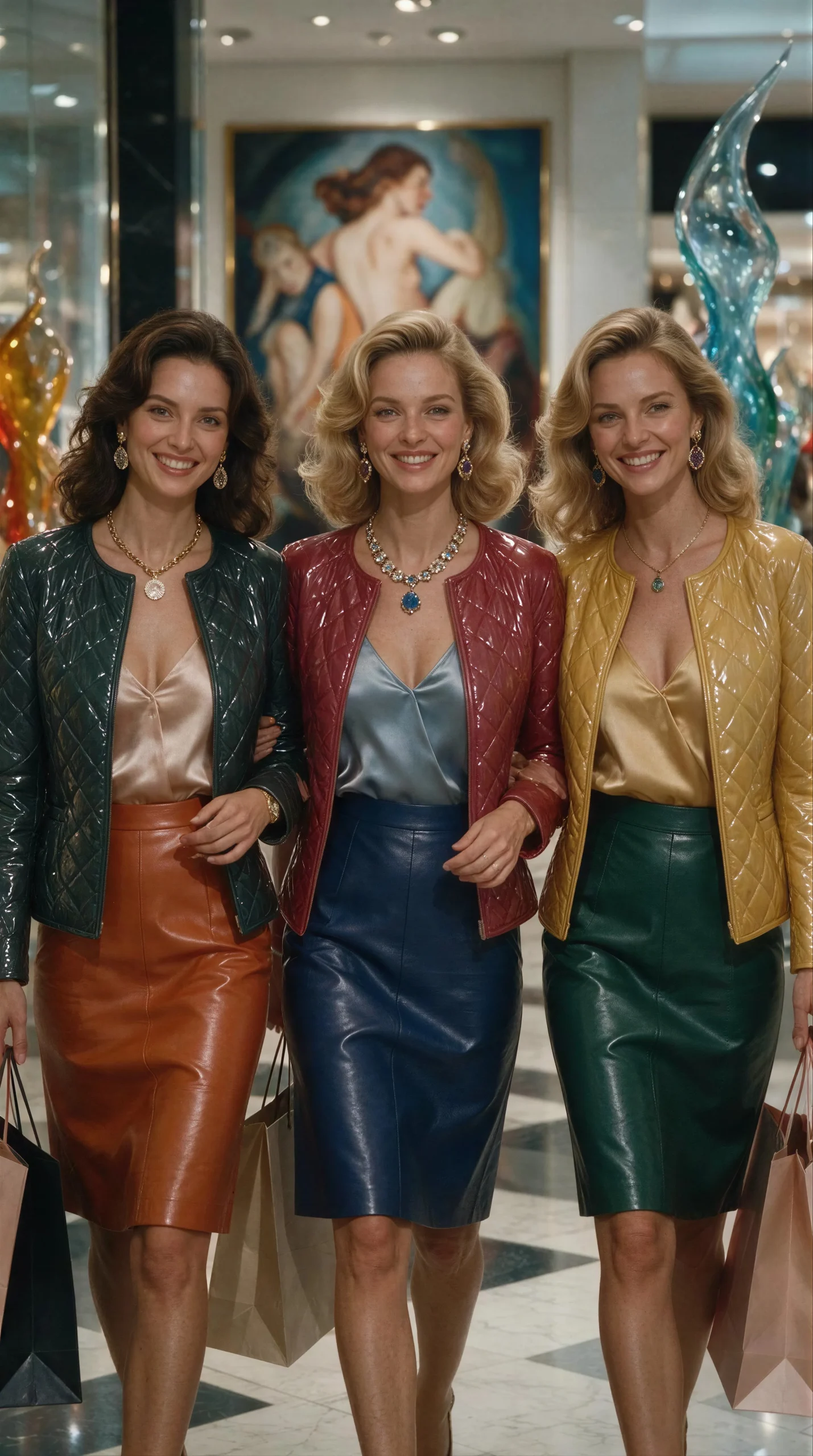
How One Woman’s Touch Transforms Everything—Including You!
She arrived in beige. She left in leather. And somewhere between those two fabrics, she discovered who she’d been hiding from for twenty years.
Vivienne Ashworth doesn’t just style women. She sees them—the desires buried beneath sensible cardigans, the power folded into beige cashmere, the devotion waiting for a worthy place to land. Her Mayfair studio is a sanctuary where glossy fabrics become armour and devotion becomes transformation.
When Cordelia Marchmont walks through her door—a wealthy, educated woman rendered invisible by a marriage that demanded she shrink—Vivienne recognises immediately what the world has missed: a woman of extraordinary potential, waiting for someone brave enough to unlock it.
What follows is a twelve-chapter journey of reinvention, intimacy, and the discovery that the most powerful relationships aren’t between two people, but between one extraordinary woman and those who recognise her worth. As Cordelia sheds her matte armour for emerald satin and midnight leather, she discovers something unexpected: the women already in Vivienne’s orbit don’t compete for her attention. They share it. And in sharing, they find something richer than exclusivity—community.
Today’s most compelling sapphic stories embrace a wide variety of relationship dynamics, from dominant women to shifting power structures, exploring desire and emotional connection in equal measure. The best of these tales understand that power and intimacy aren’t opposites—they’re dance partners, each making the other more compelling.
This is one of those stories.
But The Satin Strategist is more than fiction. Each chapter contains a real, actionable business blueprint—how to build a personal styling empire from nothing, how to create proprietary methodologies, how to cultivate a team whose devotion is earned through genuine transformation. You’ll finish this story knowing exactly how to build what Vivienne built.
For the woman who reads this and recognises herself in Cordelia—the woman who has everything except visibility—know this: transformation begins with a single touch of satin against skin. The circle is always open. The first step is allowing yourself to be seen.
Some women spend their lives searching for someone worth following. Others simply recognise her when she appears.
The question isn’t whether you’re ready. The question is whether you’re finally tired of beige.
Chapter 1: The Architecture of Desire
Rain traced silver tributaries down the Mayfair studio’s floor-to-ceiling windows, each droplet a liquid cartographer mapping territories of light and shadow across the chrome fixtures, the cream leather chairs, the walls lined with fabric swatches arranged not by colour but by psychological temperature. Vivienne Ashworth stood motionless before this aqueous atlas, watching London weep itself clean, and felt—for the first time in quite some time—something approaching contentment.
Not happiness. Happiness was a word for greeting cards and wellness influencers, a matte, untextured word that had been worn smooth by overuse. What Vivienne felt was more nuanced, more layered, more glossy—if a feeling could be said to have a texture. It was the satisfaction of a woman who had built something from the rubble of her former life and found, in the rebuilding, that the rubble had been concealing the foundation all along.
Behind her, the studio hummed with the particular frequency of devotion in action.
Helena was arranging fabric swatches along the eastern wall, her fingers moving with the reverence of a priest handling communion wine. Each swatch—satin here, leather there, PVC in the corner where the morning light would catch it most advantageously—was placed with precision, with intention, with the quiet understanding that these weren’t merely textiles but tools of transformation. Her glossy black PVC dress with the mandarin collar caught the studio’s ambient light and threw it back in sharp, confident angles, as though the fabric itself were asserting its right to be seen.
“Vivienne,” Helena said, not turning from her work, “the new liquid satin samples arrived from Como. Shall I prepare them for Tuesday’s consultation?”
Vivienne didn’t answer immediately. She’d learned, over years of cultivating stillness, that the space between question and response was where authority lived. Not the manufactured authority of corporate boardrooms—she’d spent two decades in those sterile environments and knew their hollow architecture intimately—but the organic authority of a woman who had nothing to prove and everything to offer.
“In the amber light box,” she said finally. “The one with the rose gold interior. The satin needs warmth to reveal its true character.”
Helena nodded, already moving toward the storage cabinet. She didn’t need to be told which cabinet, which light box, which corner of the studio. She knew Vivienne’s preferences the way a conductor knows each section of the orchestra—not because she’d been instructed, but because she’d listened, deeply and consistently, until understanding became instinct.
Philippa looked up from her desk, where the client database glowed across dual monitors like a constellation of women’s secrets. Her burgundy satin trousers caught the light differently than Helena’s PVC—softer, more fluid, like water over stone compared to stone over water. The cream leather jacket she wore over them added structure to the flow, a visual metaphor for what she provided to the studio: organisation in service of beauty.
“The Marchmont file is ready for your review,” Philippa said, her voice carrying the particular satisfaction of a woman who had solved a puzzle. “I’ve flagged three areas of concern. Her wardrobe audit suggests a complete reset rather than a renovation. And Vivienne—” she hesitated, which was unlike her, “—there are photographs in the file. From before. I think you should see them.”
Vivienne turned from the window. The rain continued its silver cartography behind her, but her attention had shifted to the woman at the desk, to the hesitation in her voice, to the carefully chosen words that suggested something deeper lurking beneath the professional surface.
“Show me.”
Philippa pulled up the images on the larger monitor. A woman in beige cashmere. A woman in grey wool. A woman in matte black that absorbed light rather than reflecting it. Each photograph was a study in deliberate invisibility, a portrait of someone who had chosen—consciously or unconsciously—to disappear.
“She has a PhD in Art History,” Philippa said, her fingers moving across the keyboard with the fluency of a woman who had transformed her own grief into competence. “She managed her husband’s business affairs for twenty years. She speaks four languages. And she dresses like she’s apologising for existing.”
Margot appeared from the kitchen alcoy, carrying a tray with a single cup of tea—Vivienne’s preferred blend, served at precisely the temperature she preferred, in a cup she preferred, a detail that had never been requested but had been observed and implemented without comment. Margot’s navy blue satin wrap dress whispered against her thighs as she moved, the fabric’s liquid drape a counterpoint to the structured confidence of her posture.
“Tea, Vivienne. And I’ve prepared the consultation room for this afternoon. The one with the three-way mirror and the adjustable lighting.”
“The warm configuration?”
“Of course.” Margot set the tray down on the rosewood side table, her movements graceful and economical. “I also took the liberty of selecting preliminary swatch sets. If she’s what Philippa’s research suggests—”
“She is,” Philippa confirmed.
“—then she’ll need to start with touch. Not sight. She’s been looking at herself for years and seeing nothing. She needs to feel something against her skin that tells her a different story.”
Vivienne picked up the tea, inhaling the bergamot and rose before sipping. The warmth spread through her chest like a whispered promise. She looked at her three women—Helena in her glossy PVC, Philippa in her fluid satin, Margot in her liquid wrap—and felt something she’d never been able to adequately name. It wasn’t ownership, though the word occasionally surfaced in her mind. It wasn’t control, though she exercised it naturally and without apology. It was more like cultivation—the way a gardener tends to plants that have been stunted by poor soil, moving them to richer earth, giving them light and water and the particular attention that allows them to finally, finally grow toward the sun.
“When I left Hartwell & Associates,” Vivienne said, settling into her cream leather chair with the ease of a woman who had earned every moment of comfort it provided, “everyone told me I was mad. Twenty years in corporate finance. Partner track. The corner office with the view of the City. And I walked away to become—” she let the pause hang, a space for the word to arrive unbidden, “—a stylist. As though what I do is merely about clothing.”
Helena smiled, a private expression that she shared with the fabric swatches rather than the room at large. She’d heard this story before, many times, but it never failed to move her. She remembered her own arrival at the studio—bankrupt, desperate, wearing shapeless black that made her look like a shadow that had lost its object. Vivienne had looked at her with those deep brown eyes and seen not a failure but a fabric expert who had simply never been given the right materials to work with.
“You walked away,” Helena said, “to become an architect. You build women, Vivienne. You construct them from the inside out. The clothing is merely the visible layer.”
“The visible layer,” Vivienne repeated, tasting the phrase. “I like that. Though I’d argue it’s more than merely visible. The visible layer is the communication layer. It’s what the world reads before you’ve spoken a single word. And most women—” she paused, her gaze drifting to the rain-silvered window, “—most women are speaking in a language they didn’t choose. They’re wearing the vocabulary of someone else’s expectations.”
Philippa turned from her monitors. “That’s what your methodology addresses, though. The Fabric Psychology framework. You’re not just dressing women—you’re teaching them a new language.”
“I’m teaching them their native language,” Vivienne corrected gently. “The one they were born speaking and were told to forget.”
She set down her tea and rose, the charcoal leather of her pencil skirt creaking softly—a sound she loved, the sound of a material that held its shape, that refused to be anything other than what it was. She moved to the wall of swatches, where Helena had been working, and let her fingers trail across the textures like a pianist running through scales.
“When I started this business,” she said, her voice taking on the particular cadence it assumed when she was teaching—which was, in truth, most of the time, because Vivienne had never seen a distinction between living and learning, “I had nothing but an idea and a stubborn refusal to fail. I’d spent twenty years reading men in boardrooms—their suits, their watches, their shoes—and understanding exactly what those choices communicated about their self-perception, their ambitions, their fears. I knew that the same principles applied to women, but that women had been deliberately excluded from the conversation.”
She selected a swatch of liquid satin—midnight blue, almost black, with a depth that seemed to contain its own weather—and held it up to the light.
“I started with a single question: what if I could teach women to dress as deliberately as the most powerful men? What if I could give them a vocabulary of texture that allowed them to communicate exactly who they were—or who they wanted to become—before they’d spoken a word?”
Margot moved closer, her satin dress whispering its liquid accompaniment. “And you started with nothing.”
“With less than nothing. I had a studio that was actually a rented room above a dress shop in Marylebone. I had £3,000 in savings. And I had a methodology that no one had heard of and no one was asking for.” Vivienne’s lips curved—not quite a smile, but the architecture of one. “The first year, I made £45,000. The second year, £120,000. The third year, I moved here, hired Helena, and started saying no to clients who weren’t ready to do the work.”
“What was the turning point?” Margot asked, though she knew the answer. She asked because Vivienne’s voice changed when she told this part of the story, and that change was worth hearing.
“The turning point was understanding that I wasn’t selling a service—I was selling a transformation. And transformations need to be priced accordingly.” Vivienne replaced the satin swatch and selected a piece of PVC—glossy, black, unapologetic. “In the beginning, I was charging £50 an hour for personal shopping. I was competing with every department store stylist in London, and I was losing. Not because I wasn’t better—I was significantly better—but because I was pricing myself as a commodity rather than a catalyst.”
She turned to face the room, and her three women instinctively oriented toward her, like compass needles finding north.
“The shift came when I stopped selling hours and started selling outcomes. I stopped charging for personal shopping and started charging for transformation. The initial consultation became £500 for ninety minutes—not because my time was worth £333 an hour, but because the insight I provided in those ninety minutes was worth £500 to a woman who had been spending thousands on clothing that made her invisible.”
Philippa nodded, her fingers still on the keyboard, documenting the conversation as she always did—because Vivienne’s teaching, even in casual moments, was material worth preserving. “And the retainer model?”
“That came later, once I understood that transformation isn’t an event—it’s a process. Women don’t need a personal shopper; they need a partner in self-presentation. The retainer—£2,000 a month for ongoing access, quarterly wardrobe reviews, event styling, and emergency consultations—created a different relationship. It created commitment. And commitment, I discovered, is where the real change happens.”
Helena had finished arranging the swatches and now stood at her preferred distance from Vivienne—close enough to hear every nuance of her voice, far enough to maintain the particular quality of attention that devotion requires. “And the methodology itself? The Fabric Psychology framework?”
Vivienne’s expression shifted—something softer, more intimate, as though she were about to share a secret that was also a confession. “That was the gift I didn’t know I had. I’d spent twenty years in corporate finance reading people through their clothing choices. I understood, instinctively, that a man in a bespoke suit was communicating something different from a man in an off-the-rack suit—even if the off-the-rack suit was more expensive. The difference wasn’t about quality; it was about intention. About the relationship between the wearer and the world.”
She moved to the centre of the room, and her three women adjusted their positions—not consciously, but with the unconscious choreography of women who had learned that Vivienne’s presence was the gravitational centre of any space she occupied.
“I simply applied the same principles to women. And I discovered something extraordinary: women had been speaking in a language of apology. Matte fabrics that said ‘don’t look at me.’ Shapeless silhouettes that said ‘I take up too much space.’ Neutral colours that said ‘I have nothing to say.’ And the tragedy—the outrage—was that this wasn’t their native language. They’d been taught it. Taught it by a culture that was threatened by women who communicated power through their presence.”
Margot’s eyes glistened. She’d heard this before, many times, but it never failed to move her. She remembered her own arrival—fleeing a marriage that had taught her to shrink, wearing clothes that were essentially camouflage. Vivienne had looked at her and said, simply, “You’re not a woman who hides. You’re a woman who’s been hidden. Let’s find you.”
“The framework,” Vivienne continued, “is built on a simple premise: every fabric communicates a psychological message. Matte fabrics say ‘don’t look at me.’ Glossy fabrics say ‘I’m worth your attention.’ The texture we choose reveals our relationship with visibility. And visibility—” she let the word hang in the air like a held note, “—visibility is the prerequisite for everything. For desire. For connection. For power. For love.”
She looked at each of her women in turn—Helena in her glossy PVC, standing straighter than she ever had in her previous life; Philippa in her fluid satin, her grief transformed into precision; Margot in her liquid wrap, her fear alchemised into grace.
“When I help a woman move from matte to glossy,” Vivienne said, her voice dropping to the register she reserved for truths she considered sacred, “I’m not just changing her wardrobe. I’m changing her relationship with being seen. And being seen—” she paused, and the silence was full rather than empty, “—being seen is the thing that most women want most desperately and are most afraid of.”
Helena stepped closer. Not to Vivienne, but to the wall of swatches—to the PVC section, where the glossy black fabric that had become her signature armour waited like a promise. She touched it with the tips of her fingers.
“You changed my relationship with being seen,” she said quietly. “I was a woman in shapeless black. Now I’m a woman in glossy black. The difference isn’t the colour. It’s the message. I used to wear black to disappear. Now I wear it to be seen.”
Vivienne crossed to Helena and stood beside her—not touching, but present, her proximity a form of communication that transcended language. “You did the work, Helena. I simply provided the vocabulary.”
“You provided more than vocabulary.” Helena’s voice was steady, but there was a tremor beneath it, the vibration of a woman whose foundations had been rebuilt. “You provided a home. A place where being seen wasn’t dangerous but necessary. Where devotion wasn’t weakness but strength.”
The word devotion settled into the room like a perfume—warm, complex, impossible to ignore. Philippa looked up from her documentation. Margot’s hand stilled on the tea tray. The rain continued its silver cartography outside, but inside, the air had changed.
Vivienne turned from the swatch wall and moved to her desk, where the Marchmont file waited. She opened it, and the photographs Philippa had flagged stared up at her—Cordelia Marchmont in her beige cashmere, her grey wool, her matte black. A woman with a PhD in Art History and a wardrobe that suggested she’d never looked at a single painting.
“This one,” Vivienne said, her voice shifting into the register that her women recognised as assessment—the particular tone that meant she’d found something worth finding. “Tell me everything.”
Philippa rose and moved to stand beside Vivienne’s desk, her satin trousers catching the light in liquid ripples. “Cordelia Elizabeth Marchmont. Forty-eight. PhD in Art History from the Courtauld. Married to Sir Geoffrey Marchmont for twenty years—divorced six months ago. The settlement was generous: the Kensington townhouse, a substantial lump sum, and annual maintenance that most people would consider a lottery win.”
“And she’s wearing beige,” Vivienne murmured, studying the photographs.
“She’s wearing apology,” Margot corrected softly from her position by the tea tray. “I recognise the posture. The dropped shoulders. The downcast eyes. That’s not a woman who chose beige. That’s a woman who was told to choose beige. Who was taught that visibility was vanity and desire was dangerous.”
Vivienne looked at Margot with an expression that contained multitudes—pride, tenderness, and something deeper that she rarely allowed to surface. “You see clearly, Margot. You’ve learned to see through the armour.”
“I learned from you.” The words were simple, but the weight they carried was immense. “You taught me that what I was wearing wasn’t clothing—it was a story someone else had written about who I was allowed to be. And you taught me that I could write my own story. In my own fabric. At my own gloss.”
Vivienne closed the file and leaned back in her chair, the leather creaking its quiet approval. “Cordelia Marchmont will arrive at two o’clock. Helena, I want the consultation room prepared with the warm lighting configuration and the full swatch library. Philippa, I need a complete psychological profile based on her wardrobe history—every photograph you can find, every public appearance, every pattern. Margot—”
She paused, and the three women waited with the patient attention of women who had learned that Vivienne’s pauses were as important as her words.
“Margot, I want you to greet her when she arrives. You know what she’s feeling. You’ve been where she’s been. When she walks through that door in her beige armour, I want her to see a woman in navy satin who was once invisible and is now incandescent. I want her first moment in this studio to be a glimpse of her own future.”
Margot’s eyes shone. “I’ll be ready.”
“You’re always ready,” Vivienne said, and the words were both statement and benediction. “All three of you. You’re always ready. And that—” she looked at each woman in turn, her gaze warm and weighted, “—that is why this works. Not because of my methodology. Not because of my expertise. Because of us. Because when a woman walks through that door, broken and beige and apologising for existing, she doesn’t meet a stylist. She meets a community. A circle of women who have been where she is and have found their way to where we are.”
She rose and moved to the window, where the rain had begun to ease and the first tentative fingers of sunlight were reaching through the clouds, touching the wet glass and turning each droplet into a lens, a tiny telescope aimed at the sky.
“When Cordelia Marchmont arrives,” Vivienne said, her reflection in the glass superimposed on the silver city beyond, “she will feel, for the first time in years, that she has been expected. Not judged. Not assessed. Expected. As though a place has been kept for her at a table she didn’t know existed.”
Helena moved to stand near the door, her PVC dress catching the new light like polished obsidian. Philippa returned to her database, her fingers already pulling together the threads of Cordelia’s story. Margot adjusted the tea tray, adding a second cup—for the woman who would arrive in beige and, if Vivienne had anything to do with it, would leave in something that shone.
“And she will be welcomed,” Vivienne continued, her voice soft but certain, “not by a service provider but by women who understand that transformation isn’t a transaction. It’s a homecoming. A return to a self that was never lost—only hidden. Waiting, all this time, beneath the beige.”
She turned from the window, and the three women saw that her eyes held something they’d rarely witnessed: anticipation. Not the clinical anticipation of a professional facing a new case, but the personal anticipation of a woman who had glimpsed, in a file of photographs, something that made her pulse quicken.
“Cordelia Marchmont has a PhD in Art History,” Vivienne said, a smile finally arriving—not the architecture of one, but the thing itself, warm and slightly dangerous. “She understands beauty. She understands composition. She understands the relationship between the viewer and the viewed. She simply has never applied that understanding to herself.”
She straightened her ivory silk blouse, smoothed her charcoal leather skirt, and became, in that small gesture, both the architect and the architecture—the woman who built and the woman who was built, the creator and the creation.
“Today,” she said, “we begin.”
The rain had stopped. The light through the windows was new, washed clean, full of possibility. And in the Mayfair studio, four women prepared—each in her own glossy armour, each in her own way—to welcome a stranger home.
Chapter 2: The Woman in Beige
She arrived at two minutes before two o’clock.
Vivienne noticed this because Vivienne noticed everything—the way a woman entered a room told you more about her than three hours of conversation ever could. The punctuality spoke of someone who had been trained, conditioned, domesticated into considering other people’s time more valuable than her own. The two minutes of margin suggested a woman who had learned to arrive early and wait, to make herself smaller, to occupy less space, to be convenient.
Margot was positioned at the entrance, as instructed. She stood in her navy blue satin wrap dress—the one that moved like water remembering its own depth—and when the door opened, she was the first thing Cordelia Marchmont saw: a woman in liquid fabric, glossy and present, a living counterpoint to everything the visitor was wearing.
“Mrs. Marchmont?” Margot’s voice was warm but not effusive, welcoming but not overwhelming. She had calibrated it precisely, as she calibrated everything, understanding that a woman arriving in beige needed to be approached the way one approaches a deer in a clearing—slowly, softly, with an energy that said you are safe here.
“Dr. Marchmont,” Cordelia corrected automatically, and then looked startled by her own correction, as though she’d surprised herself with a reflex she’d forgotten she possessed.
Margot’s smile deepened. “Of course. Dr. Marchmont. Vivienne is expecting you. May I take your coat?”
The coat was beige. Of course it was. A cashmere trench, beautifully cut, absurdly expensive, and utterly, devastatingly invisible. It was the kind of garment that announced nothing except the wearer’s desire to announce nothing. Margot received it with both hands, her glossy satin sleeves brushing against the matte cashmere in a tactile conversation between two philosophies of existence—one that whispered look at me and one that whispered please don’t.
As Margot hung the coat in the wardrobe—a wardrobe that already contained the glossy jackets and satin wraps of the studio’s inhabitants, so that Cordelia’s beige cashmere hung among them like a blank page in a book of illuminated manuscripts—Cordelia stepped into the main studio space and stopped.
Helena was arranging the consultation room, her glossy black PVC dress with the mandarin collar catching the afternoon light that slanted through the western windows. The fabric didn’t just reflect the light; it conversed with it, throwing back sharp, confident angles that said I am here, I am deliberate, I am not apologising. Helena moved with the particular grace of a woman who had learned that her body was not an apology but an argument—a persuasive, elegant argument for her own existence.
Philippa was at her desk, the burgundy satin of her trousers catching the light in softer, more fluid ripples, like a river of merlot flowing over polished stones. She looked up as Cordelia entered, and her expression was one of practiced warmth—the warmth of a woman who had been where Cordelia was and remembered the terrain.
“Dr. Marchmont, welcome. Can I offer you tea? Coffee? Vivienne has a particular bergamot blend that most of our clients become rather devoted to.”
Cordelia looked between the two women—Helena in her glossy PVC, Philippa in her fluid satin—and something crossed her face. Not quite recognition, not quite longing, but something adjacent to both. A flicker, like a match struck in a dark room, illuminating for a fraction of a second a space she hadn’t known existed.
“Tea,” she said. “Tea would be lovely. Thank you.”
Philippa rose and moved toward the kitchen alcove, her cream leather jacket adding structure to the satin’s flow. As she passed Helena, they exchanged a glance so brief and so laden with meaning that it was like watching two instruments play the same note—a harmony so tight it sounded like a single voice.
She’s ready, the glance said. She just doesn’t know it yet.
Margot guided Cordelia to the cream leather chair—the one positioned to face the three-way mirror but not directly, so that her reflection was present but not confrontational. The lighting was warm, amber-gold, the configuration that Vivienne used for women who needed to be approached gently. The rose gold interior of the light box Helena had prepared cast a subtle glow that made everything it touched look slightly more alive.
Cordelia sat, and the cream leather received her with a soft exhale, and she looked—Vivienne thought, watching from the doorway of her office with the patient attention of a woman who understood that first impressions were data—like a painting that had been hung in the wrong gallery. Beautiful, valuable, significant, but surrounded by a context that made no sense, that diminished rather than enhanced, that asked the viewer to see past her rather than into her.
Her beige cashmere jumper was soft, well-maintained, and utterly devoid of personality. Her trousers were grey wool—tailored, expensive, forgettable. Her shoes were flat, practical, the shoes of a woman who had decided that comfort and visibility were mutually exclusive and had chosen the former. Her hair was pulled back in a style that was neat but not styled, present but not presentational. Her hands, resting on the arms of the leather chair, were unadorned except for a watch that was functional rather than decorative.
Vivienne catalogued each detail the way an archivist catalogues a manuscript—carefully, precisely, with an understanding that each element was a sentence in the story Cordelia was telling the world, whether she knew it or not.
She stepped into the room.
“Dr. Marchmont.” Her voice carried the particular warmth she reserved for first meetings—warm but not effusive, welcoming but not obsequious. It was the voice of a woman who respected her clients enough not to pretend they were friends, but who cared about them enough to be genuinely present. “I’m Vivienne Ashworth. Thank you for coming.”
Cordelia stood, and her handshake was firm but brief—the handshake of a woman who had been taught to shake hands properly but had never been taught to enjoy the contact. “Vivienne. Thank you for seeing me. I—” She hesitated, and the hesitation was eloquent, a pause filled with the ghosts of conversations she’d had with herself about whether she deserved to be here. “I wasn’t sure this was the right place for me.”
Vivienne sat in the chair opposite—not behind a desk, never behind a desk, because desks created hierarchies and hierarchies created barriers and barriers were the last thing a woman in beige needed. She sat in the matching cream leather chair, close enough to be intimate, far enough to be respectful.
“Tell me what brought you here, Cordelia. Not the practical answer—I know you were referred by Lady Helena Ashworth, and I know you’ve been through a significant life change. Tell me the real answer. The one you might not have told anyone else.”
The use of her first name was deliberate. Dr. Marchmont was the woman who had managed her husband’s affairs, who had earned a PhD and never used it, who had become a supporting character in someone else’s narrative. Cordelia was the woman underneath—the one who might, with the right encouragement, become the author of her own story.
Cordelia’s hands tightened in her lap. The beige cashmere bunched slightly at the wrists, soft and expensive and utterly forgettable.
“I don’t know where to start.”
“Start with the thing you’re most afraid to say.”
The silence that followed was not empty but full—full of the particular tension that precedes a confession, the moment when a woman teeters on the edge of vulnerability and decides whether to step forward or retreat.
“I’ve been invisible for twenty years,” Cordelia said, and her voice cracked on the word invisible like a porcelain cup cracking along a fault line that had been there all along, waiting for the right pressure. “I have a PhD in Art History. I speak four languages. I managed a business, a household, a life. And somewhere along the way, I stopped being a person and became a function. I was the wife. The hostess. The woman who made sure everything ran smoothly while remaining entirely unremarkable. And I did it so well that when the marriage ended, I looked in the mirror and realised I had no idea who was looking back.”
Margot appeared with the tea—bergamot and rose, served in a cup that was white porcelain with a subtle gold rim, a small luxury that Cordelia’s fingers registered before her eyes did. The cup was warm, the porcelain smooth, and when Cordelia wrapped her hands around it, something in her shoulders released, a fraction of a degree of tension dissolving like sugar in hot water.
“Thank you,” she said to Margot, and the gratitude in her voice was disproportionate to the gesture—a woman who had not been cared for in so long that even a cup of tea felt like an act of grace.
Margot’s hand brushed Cordelia’s shoulder as she withdrew—a touch so light it might have been accidental, but nothing Margot did was accidental. The navy satin of her sleeve whispered against the beige cashmere, and the contrast was not just visual but philosophical—two different relationships with the world, briefly touching.
Vivienne let the silence settle. She had learned, over years of doing this work, that silence was not the absence of communication but the space for it—the way a frame creates space for a painting, the way a rest creates space for music. She waited.
“When I left,” Cordelia continued, her eyes fixed on the tea as though it contained something she was trying to read, “I thought I would feel free. I had money, thanks to the settlement. I had the house. I had time. But instead of feeling free, I felt—” She searched for the word, and Vivienne could see her reaching for it, her PhD vocabulary, her four languages, all insufficient for the task. “I felt transparent. As though I’d been removed from a frame and was now just… floating. With nothing to define me. Nothing to make me visible.”
“And what have you been wearing since the divorce?”
Cordelia’s laugh was short, sharp, and edged with something that wasn’t quite bitterness. “What you see. This. Variations of this. I went to Selfridges and stood in front of racks of beautiful clothes and felt… nothing. I couldn’t imagine wearing any of them. I couldn’t imagine being the kind of woman who wears things. I could only imagine being the kind of woman who needs things, and needing felt like weakness.”
Vivienne leaned forward slightly. “Cordelia, I’m going to ask you a question, and I want you to take a moment before you answer. Don’t give me the answer you think I want. Give me the answer that’s true, even if the truth is uncomfortable.”
Cordelia looked up from her tea, and for the first time, her eyes met Vivienne’s directly. They were remarkable eyes—deep grey-green, intelligent, carrying the particular depth of a woman who had studied beauty professionally but had been denied it personally.
“When was the last time you wore something that made you feel powerful?”
The question landed like a stone in still water, sending ripples across the surface of Cordelia’s composure. Her lips parted. Closed. Parted again. Her hands tightened around the tea cup until her knuckles whitened.
“I don’t remember,” she whispered.
The silence that followed was not the full, pregnant silence of earlier but something rawer, more exposed—the silence of a woman who has just heard herself say something she didn’t know she was going to say and has been undone by the hearing.
Vivienne reached into the pocket of her charcoal leather skirt and withdrew a handkerchief. Not a tissue, not a paper napkin, but a handkerchief—black silk, glossy, impossibly soft, with a subtle sheen that caught the amber light and held it like a secret. She extended it across the space between them.
Cordelia took it, and her fingers registered the texture before her eyes did—the liquid smoothness, the weight of it, the way it seemed to respond to her touch rather than merely receiving it. She pressed it against her eyes, and the silk absorbed her tears the way the earth absorbs rain—completely, without judgment, transforming the water into something that nourished rather than destroyed.
“I’m sorry,” Cordelia said, the words muffled by silk. “I don’t know why I’m crying. This is ridiculous. I’m a forty-eight-year-old woman with a doctorate and I’m weeping into a stranger’s handkerchief because she asked me about clothing.”
“You’re not crying about clothing,” Vivienne said, her voice gentle but precise. “You’re crying about the fact that you can’t remember the last time you felt powerful. And that’s not ridiculous. That’s a grief. A legitimate grief for something you lost—and something, I suspect, that was taken from you rather than something you chose to surrender.”
Helena appeared in the doorway, her glossy PVC dress a silent sentinel. She didn’t enter—she simply stood, present, available, her posture communicating what her voice did not: We are here. You are not alone. This is what we do.
Vivienne glanced at her, and the exchange was instantaneous—a question asked and answered in the space between heartbeats. Is the consultation room ready? It’s been ready since this morning. The swatches are laid out. The three-way mirror is calibrated. The warm light is configured. Everything is waiting for her.
“Cordelia,” Vivienne said, turning back to the woman with the silk handkerchief pressed against her remarkable eyes, “I want to walk you through how this consultation works. Not because I want to be procedural when you’re feeling vulnerable, but because I want you to understand that what happens here isn’t arbitrary. It’s a methodology. A framework I’ve developed over years of helping women who feel exactly the way you feel right now.”
Cordelia lowered the handkerchief but kept it in her lap, her fingers tracing the silk’s surface with the unconscious reverence of a woman who has just discovered a new language.
“Our initial consultation is ninety minutes. It costs £500—not because I value my time at £333 an hour, but because the insight I provide in those ninety minutes is worth £500 to a woman who has been spending thousands on clothing that makes her invisible. During those ninety minutes, I’m going to ask you questions about your lifestyle, your wardrobe history, your psychological relationship with visibility, and your goals. Not just style goals—life goals. Because the way you dress is not separate from the way you live. It’s the visible architecture of your internal landscape.”
She paused, letting the language settle. Architecture was a word she used deliberately—it gave structure to what might otherwise feel amorphous, turned clothing from vanity into design.
“After the consultation, if we both feel it’s a good fit, I’ll recommend a programme. For some women, that’s a wardrobe audit and reset—£800 for the audit, plus the cost of new pieces, which varies depending on the client’s budget and goals. For others, it’s an ongoing retainer—£2,000 a month for continuous access, quarterly reviews, event styling, and emergency consultations. And for a very small number of women, it’s something deeper—a transformation that encompasses not just their wardrobe but their entire relationship with being seen.”
Cordelia was listening with the intensity of a woman who had spent twenty years managing complex information and recognised, instinctively, that she was in the presence of a system—a structured, intentional approach to something she’d always assumed was intuitive.
“You’ve turned styling into a science,” she said, and there was wonder in her voice, the wonder of an academic encountering a well-constructed argument.
“I’ve turned it into a practice,” Vivienne corrected. “Science is about understanding. Practice is about transformation. I don’t just understand why you’re wearing beige, Cordelia. I know how to help you stop. And I know that the stopping—the choosing—will change not just your wardrobe but your relationship with the world.”
She rose and extended her hand toward the consultation room, where Helena had laid out the swatch library with the care of a curator arranging a exhibition. Through the doorway, Cordelia could see the fabrics arranged by texture and psychological impact—satin in one section, leather in another, PVC in a third, each material labelled not just with its composition but with its message.
“Come,” Vivienne said. “I want to show you something.”
Cordelia stood, and the beige cashmere shifted with her, soft and expensive and forgettable. She was still holding the black silk handkerchief, and she looked at it—really looked at it for the first time—and something crossed her face. Not recognition, not longing, but something more fundamental: curiosity. The curiosity of a woman who had spent twenty years studying other people’s art and had just been handed a piece of her own.
“Can I keep this?” she asked, holding up the handkerchief.
Vivienne’s smile arrived—not the architecture of one, but the thing itself, warm and slightly dangerous. “It’s yours. Consider it your first piece of a new wardrobe.”
Cordelia folded the silk carefully, precisely, with the reverence of a conservator handling a manuscript, and placed it in her handbag. Then she followed Vivienne toward the consultation room, passing Helena in the doorway.
Helena’s glossy PVC dress caught the light, and for a moment, Cordelia stopped. She looked at the fabric—at the way it held the light, reflected it, claimed it—and something in her grey-green eyes shifted. Not a transformation, not yet. But a question. A question that had been dormant for twenty years and was now, in the presence of glossy black PVC and warm amber light and a silk handkerchief in her handbag, beginning to wake.
“That material,” Cordelia said, almost to herself. “I’ve never worn anything like that.”
Helena’s smile was private and knowing. “Before I came here, neither had I. Now I can’t imagine wearing anything else.” She leaned slightly closer, her voice dropping to a confidence shared between women. “It’s not just clothing, Dr. Marchmont. It’s a decision. A decision to be seen. And once you make it—” she glanced toward Vivienne, who was waiting in the consultation room doorway, patient as gravity, “—once you make it, you wonder how you ever lived without it.”
Cordelia looked from Helena to Vivienne, and in the space between the two women—one in glossy PVC, one in charcoal leather—she saw something she hadn’t seen in a very long time.
Possibility.
She stepped into the consultation room.
Chapter 3: The Vocabulary of Texture
The consultation room was a cathedral of possibility.
Cordelia stood in its centre and felt, for the first time in years, the particular sensation of being surrounded—not by people, not by expectations, but by materials. The walls were lined with fabric swatches arranged not by colour but by what Vivienne called “psychological temperature”—cool tones on the left, warm tones on the right, and running between them a spectrum that had nothing to do with hue and everything to do with the message each fabric sent to the world.
The three-way mirror stood at the far end, its surface calibrated to reflect not just the body but the posture, the presence, the way a woman held herself when she believed no one was analysing her. The amber light from the rose gold interior of the light box cast everything in a warm, forgiving glow—the kind of light that didn’t hide flaws but made them feel like features, the kind of light that said you are already enough; let me show you.
Helena stood by the eastern wall, her glossy black PVC dress with the mandarin collar a silent lesson in the very principle Vivienne was about to teach. She had laid out the swatch library with the precision of a museum curator—each fabric labelled not just with its composition but with its psychological properties, its communication profile, its message. The labels were handwritten in Helena’s careful script, a detail that Cordelia, with her academic’s eye, noticed and appreciated.
Philippa had positioned herself near the door, her burgundy satin trousers catching the amber light in fluid ripples, her tablet ready to document the session. Margot stood beside the tea service, her navy satin wrap dress a pool of liquid elegance, ready to provide whatever Cordelia needed before Cordelia knew she needed it.
Three women in glossy fabrics, arranged around a woman in beige, like planets around a sun that didn’t yet know it was a sun.
Vivienne closed the door behind them, and the sound was soft, definitive—a threshold crossed, a space entered.
“Before we begin,” she said, settling into the chair opposite Cordelia with the ease of a woman who had conducted this particular symphony hundreds of times, “I want to explain what we’re about to do, because what we’re about to do is not what happens in a department store, or a stylist’s office, or a fashion consultant’s studio. What we’re about to do is learn a language.”
She gestured toward the wall of swatches. “Every fabric speaks. Every texture communicates. Every material sends a message to the world about the person wearing it—about her relationship with visibility, with power, with desire, with her own right to exist. Most women don’t know this language exists. They dress in the dark, so to speak—choosing fabrics based on comfort or convention or the expectations of others, without understanding that each choice is a sentence in a conversation they’re having with everyone who sees them.”
Cordelia was listening with the intensity that Vivienne had anticipated—the intensity of an academic encountering a new framework, a scholar discovering a field she hadn’t known existed. Her grey-green eyes moved across the swatch wall with the hunger of a woman who had spent twenty years studying other people’s art and was now being offered the chance to study her own.
“You’re saying that clothing is a communication system,” Cordelia said, and the statement was half-question, half-revelation.
“I’m saying it’s a language,” Vivienne corrected gently. “And like any language, it has vocabulary, syntax, and grammar. The vocabulary is the fabrics themselves. The syntax is how they’re combined. The grammar is the context in which they’re worn. And most women—” she paused, letting the weight of the observation settle, “—most women are speaking a language they didn’t choose, using a vocabulary that was handed to them by a culture that has a vested interest in keeping them quiet.”
She rose and moved to the swatch wall, her charcoal leather skirt creaking softly with each step—a sound that Cordelia was beginning to associate with authority, with intention, with the particular confidence of a woman who refused to apologise for the space she occupied.
“Let me show you what I mean.”
Vivienne selected two swatches—a piece of matte cotton in beige and a piece of liquid satin in the same shade. She held them side by side.
“Same colour. Same shade. But completely different messages.” She held the cotton toward Cordelia. “Touch this.”
Cordelia took the cotton, her fingers registering the familiar, forgettable texture—the texture of sensible choices, of practical decisions, of a life organised around not being noticed.
“Now this.” Vivienne offered the satin.
Cordelia’s fingers touched the surface, and something happened. It was subtle—a micro-expression, a slight widening of the eyes, a barely perceptible intake of breath—but Vivienne saw it, and Helena saw it, and Philippa noted it on her tablet, and Margot smiled quietly into her tea cup, because they had all seen this moment before, this first touch of gloss, this first whisper of a language the body recognised even when the mind didn’t.
“What do you feel?” Vivienne asked.
Cordelia looked at the satin in her hand. Her fingers moved across it slowly, reverently, the way she had once touched the pages of ancient manuscripts in the Courtauld’s conservation lab.
“It’s…” She searched for the word, and Vivienne waited, because the waiting was part of the teaching. “It’s alive. The cotton just sits there. This… responds. It moves when I move. It catches the light. It’s—” She looked up, and her grey-green eyes were brighter than they’d been since she’d walked through the door. “It’s present.”
Vivienne’s smile was the smile of a woman who had just witnessed a door open—the particular, private satisfaction of an architect watching someone walk through a building she’d designed and seeing them look up at the ceiling for the first time.
“Exactly. The cotton says I’m here, but don’t mind me. The satin says I’m here, and I’m worth your attention. Same colour, same shade, completely different message. And the message isn’t about the fabric—it’s about the wearer. When you choose satin over cotton, you’re telling the world that you consider yourself worth looking at. You’re claiming visibility. You’re speaking in a voice that can be heard.”
She took the swatches back and returned them to the wall, her fingers trailing across the other fabrics as she moved—leather, PVC, silk, each one a word in the vocabulary she was teaching.
“This is the foundation of my methodology. I call it Fabric Psychology—the study of how different textures communicate different psychological messages, and how those messages shape not just how the world sees the wearer but how the wearer sees herself.”
She turned to face Cordelia, and her expression shifted into what Helena privately called “lecture mode”—the particular intensity Vivienne assumed when she was transmitting knowledge she considered sacred.
“I developed this framework over twenty years. It started in corporate finance, where I learned to read men through their clothing choices—a bespoke suit versus an off-the-rack suit communicated something entirely different about the wearer’s self-perception, even if the off-the-rack suit was more expensive. The difference wasn’t about quality. It was about intention. About the relationship between the wearer and the world.”
She moved along the wall, touching each fabric as she spoke, her leather-clad fingers conducting a silent orchestra of textures.
“When I left finance and started this practice, I applied the same principles to women. And I discovered something that changed everything: women had been systematically excluded from this conversation. The fashion industry sold them trends—what was in, what was out, what was flattering, what was appropriate—but it never taught them the language. It never explained that every fabric choice was a communication, a declaration, a claim on visibility. Women were given vocabulary without grammar—words without the ability to construct meaningful sentences.”
Cordelia was leaning forward in her chair, the beige cashmere shifting with her, and for the first time, the beige looked not invisible but incomplete—a sentence that had been started but never finished.
“So you teach them the grammar,” she said, and her voice carried the particular excitement of a woman who had spent her life studying systems of meaning and had just found a new one.
“I teach them their native language,” Vivienne said. “The one they were born speaking and were told to forget.”
She turned to Helena. “Show her.”
Helena moved to the wall with the fluid confidence of a woman who had performed this demonstration dozens of times. She selected three swatches—matte cotton, smooth leather, and glossy PVC—and held them up in sequence.
“Matte cotton,” Helena said, her voice taking on the particular clarity she used when she was transmitting Vivienne’s teachings. “The message is don’t look at me. It’s the fabric of apology. Of invisibility. Of a woman who has been taught that wanting to be seen is vanity.” She held it against her glossy PVC dress, and the contrast was stark—the cotton seemed to absorb light while the PVC reflected it, two philosophies of existence in direct conversation.
“Leather.” She replaced the cotton with the leather swatch, holding it against her forearm. “The message is I’m here, and I’m not going anywhere. It’s the fabric of structure, of authority, of a woman who has earned the right to take up space. It holds its shape. It doesn’t apologise. It endures.”
She set the leather down and held up the PVC. The glossy black surface caught the amber light and threw it back in sharp, confident angles.
“PVC. The message is look at me. It’s the fabric of visibility, of confidence, of a woman who has decided that being seen is not a liability but an asset. It doesn’t just reflect light—it claims it. It says: I am here, I am deliberate, and I am not apologising for any of it.”
She set the swatch down and looked at Cordelia with eyes that held the particular warmth of a woman who had once been where Cordelia was and had found her way to where she was now.
“I wore matte cotton for years,” Helena said softly. “Shapeless black. The kind that says I’m here but don’t mind me. When I came to Vivienne, I was bankrupt, desperate, and wearing clothes that communicated exactly how I felt about myself. The first thing she did wasn’t give me new clothes—it was give me a new vocabulary. She taught me that the fabrics I chose were sentences I was writing about myself, and that I had the power to write different sentences.”
She touched her PVC dress with the reverence of a woman touching a holy relic. “This isn’t just clothing. It’s a declaration. Every time I put it on, I’m declaring that I am visible, that I am deliberate, that I am worth the light that touches me.”
Cordelia’s eyes were bright, and her hands were trembling slightly—not with fear but with the particular vibration of a woman who is recognising something she has been searching for without knowing she was searching.
“May I…” She reached toward the wall of swatches, then pulled back, the academic’s instinct to ask permission warring with the woman’s instinct to touch. “May I touch them?”
Vivienne gestured toward the wall. “Touch everything. That’s the point. This language isn’t learned through the eyes. It’s learned through the skin.”
Cordelia rose from the cream leather chair and approached the wall. Her fingers found the satin first—a deep midnight blue, almost black, with a depth that seemed to contain its own weather. She held it against her beige cashmere sleeve, and the contrast was not just visual but philosophical—the matte cashmere absorbing light, the liquid satin reflecting it, two different relationships with the world existing side by side on the same arm.
“This is what I’ve been missing,” she whispered, and the whisper was not meant for the room but for herself—a confession made aloud, a truth finally spoken.
Vivienne moved to stand beside her, close but not touching, her presence a warm gravitational force. “What have you been missing?”
“The… sensation. The response.” Cordelia’s fingers moved from the satin to a piece of emerald PVC, and her breath caught as the glossy surface slid against her skin. “I’ve been wearing fabrics that don’t talk back. That just… sit there. That don’t respond when I move, don’t catch the light, don’t…” She trailed off, and Vivienne waited, because the waiting was part of the teaching. “Don’t see me.”
The word hung in the air like a bell still ringing.
Philippa looked up from her tablet, her burgundy satin trousers catching the light in fluid ripples, and her expression was one of recognition—the particular recognition of a woman who had said the same words, once, in this same room, and had been changed by the hearing of them.
“I said something similar,” Philippa said, her voice quiet but present. “When I first came here. I said that my clothes didn’t see me. That I was wearing fabrics that were blind. Vivienne told me that the fabrics weren’t blind—I was. I’d been choosing blindness because seeing myself felt too dangerous.”
Cordelia turned to look at her, and the two women’s eyes met—grey-green and brown, academic and administrator, both carrying the particular weight of women who had been invisible and were learning to be seen.
“And now?” Cordelia asked.
Philippa touched the satin at her hip, her fingers tracing the liquid drape with the familiarity of a woman who had made this material her daily language. “Now I wear fabrics that see me. That respond to me. That move when I move and catch light when I enter a room and make a sound when I walk. Every day, I get dressed in a language that says I am here, I am present, I am worth the attention. And after a while—” she smiled, and the smile was not performative but lived, the smile of a woman who had earned every pixel of her own visibility, “—after a while, you start to believe it.”
Margot stepped forward, her navy satin wrap dress whispering its liquid accompaniment. She was carrying a tray of fabric swatches—curated, Cordelia would later realise, specifically for her. Each swatch had been selected based on Philippa’s research into Cordelia’s colouring, her build, her lifestyle, her latent potential.
“Dr. Marchmont,” Margot said, using the title deliberately, because she understood that Cordelia’s professional identity was a foundation to build on, not a wall to tear down, “I’ve prepared a selection for you. Based on your colouring—cool-toned with warm potential—and your build—tall, with the posture of a woman who has been told to shrink but hasn’t entirely succeeded—I’d suggest we start with these.”
She laid the tray on the rosewood table between them. Six swatches, arranged in a gradient from matte to glossy: a piece of beige cotton identical to what Cordelia was wearing, a piece of cream silk, a piece of champagne satin, a piece of burgundy leather, a piece of emerald PVC, and a piece of midnight blue liquid satin.
“The gradient isn’t just about sheen,” Margot explained, her voice carrying the particular warmth she reserved for women in the early stages of transformation. “It’s about permission. Each step is slightly more visible than the last. You don’t jump from beige to PVC in a single day. You learn the language one word at a time.”
Vivienne nodded, her expression one of quiet pride. “Margot is our emotional architect. She understands that transformation isn’t a single moment—it’s a sequence. A carefully calibrated sequence in which each step gives you permission to take the next.”
She turned to Cordelia. “I want you to touch each fabric. Don’t think about it. Don’t analyse it. You can analyse later—you’re an academic; analysis is your native mode. For now, I want you to feel. Let your skin tell you what your mind doesn’t yet know.”
Cordelia reached for the beige cotton first—the familiar, the known, the fabric that had been her uniform for twenty years. Her fingers registered it without interest: soft, matte, forgettable. The fabric of a woman who had chosen to disappear.
The cream silk was different. Softer, yes, but with a weight to it, a presence that the cotton lacked. It caught the light differently—not with the sharp confidence of satin or the bold declaration of PVC, but with a gentle, private sheen. A whisper rather than a shout.
“The silk says I know I’m worth seeing,” Vivienne murmured, watching Cordelia’s fingers. “It’s not loud. It’s not demanding. But it’s aware. It’s the fabric of a woman who is beginning to understand her own value.”
Cordelia moved to the champagne satin, and the shift was audible—a soft intake of breath, a slight straightening of the spine. The satin was liquid under her fingers, responsive in a way that the cotton and even the silk had not been. It moved when she moved. It caught the amber light and held it, then released it, then caught it again, like a conversation between the fabric and the world.
“This is…” Cordelia’s voice trailed off, and Vivienne saw the tears forming—not the tears of grief from earlier but something different, something warmer. Tears of recognition. Of a woman meeting herself after a long absence.
“This is what your grandmother’s scarf would have felt like,” Vivienne said softly, and Cordelia’s head snapped up, her eyes wide.
“How did you—”
“Philippa’s research is thorough. The emerald satin scarf, still in its box, never worn. A gift from your grandmother that your husband told you was ‘too much.'” She paused, letting the words settle. “He wasn’t talking about the scarf, Cordelia. He was talking about you. You were too much. Too visible. Too alive. Too much of everything he couldn’t control.”
The tears fell, but Cordelia didn’t reach for the black silk handkerchief this time. She let them fall onto the champagne satin, and the fabric absorbed them the way the earth absorbs rain—completely, without judgment, transforming the water into something that nourished rather than destroyed.
“He was right,” Cordelia whispered. “I was too much. I’ve always been too much. I have a PhD I never used because he said it was ‘impractical.’ I speak four languages I never speak because he said I was ‘showing off.’ I—”
“You are not too much,” Vivienne said, and her voice carried an authority that was not aggressive but architectural—the authority of a woman who had built something solid and knew its foundations. “You are exactly enough. You have simply been surrounded by people who needed you to be less so they could be more. That ends here.”
Cordelia reached for the burgundy leather, and her fingers closed around it with the grip of a woman catching a lifeline. The leather was firm, structured, unyielding—it held its shape in her hand, refused to be anything other than what it was.
“Leather,” Vivienne said, “is the fabric of boundaries. It says: I am here, I take up space, and I am not apologising for any of it. It’s the fabric of a woman who has learned that her presence is not a negotiation.”
Cordelia held the leather against her chest, and her posture shifted—shoulders back, chin lifting, spine elongating. It was not a conscious change but an instinctive one, the body responding to the material the way a plant responds to sunlight—automatically, inevitably, organically.
Helena watched from the wall, her glossy PVC dress a silent testament to the transformation that was unfolding. She caught Philippa’s eye, and the glance they exchanged was the glance of women who had witnessed this moment many times and never tired of it—the moment when a woman touched leather for the first time and felt her own structure.
“The emerald PVC,” Margot said softly, guiding Cordelia’s attention to the next swatch. “This one is special. We chose it because of your grandmother’s scarf.”
Cordelia touched the PVC, and the gloss was startling—sharp, confident, unapologetic. The emerald green was vivid, alive, the colour of growth and possibility and things that refuse to stay buried. It caught the amber light and threw it back in angles that seemed to declare something, to assert something, to say something that Cordelia had been trying to say for twenty years.
“This is too much,” she said, but her voice didn’t believe the words.
“This is enough,” Vivienne corrected. “This is a woman who has decided that being seen is not a liability but an asset. That visibility is not vanity but power. That the light she’s been hiding from is not a threat but an invitation.”
Cordelia held the emerald PVC against her beige cashmere, and the contrast was so stark that it was almost violent—matte against gloss, invisible against visible, apology against declaration. She looked at the two fabrics side by side, and something in her face broke—not broke apart but broke open, the way a seed breaks open when it’s ready to grow.
“I’ve been wearing a costume,” she said, and her voice was raw with the particular rawness of a truth finally spoken. “For twenty years. A costume that said I’m not important, I’m not visible, I’m not worth looking at. And I thought that was who I was. But this—” she held up the emerald PVC, and the light caught it and held it, “—this is who I am. I’ve just been too afraid to wear her.”
Vivienne moved closer, and her presence was warm and weighted, a gravitational force that Cordelia felt in her chest. “What are you afraid of?”
“Of being seen and having nothing to show. Of being visible and being… dismissed. Of finally standing up and having everyone look at me and say you’re not worth looking at after all.”
Vivienne took the emerald PVC from Cordelia’s hand and held it against Cordelia’s cheek. The gloss touched her skin, and the contact was electric—not literally, but in the way that all transformative moments are electric, a current running between what is and what could be.
“Cordelia. You have a PhD in Art History. You speak four languages. You managed a business, a household, and a life for twenty years. You have a settlement that most people would consider a fortune. You are intelligent, you are capable, and you are here—in this room, with these women, doing the work that most people are too afraid to even begin.” Vivienne’s voice was low, intimate, the voice of a woman who was no longer teaching but reaching. “You are not nothing. You have never been nothing. You have simply been taught to believe that your something was too much, and you’ve been shrinking yourself to fit a space that was never big enough for you.”
She removed the swatch from Cordelia’s cheek and placed it in her hand, curling Cordelia’s fingers around it.
“The last swatch,” she said. “The midnight blue satin.”
Cordelia reached for it with trembling fingers. The satin was the deepest blue she had ever seen—almost black, but with a depth that contained light rather than absorbing it. When she held it up, the amber glow from the light box seemed to sink into the fabric rather than bouncing off it, creating a luminosity that was subtle and profound, like moonlight on water.
“This is the fabric of a woman who has come home to herself,” Vivienne said, and her voice was barely above a whisper, but it filled the room like a held note. “Not loud. Not demanding. But deep. Present. Certain. A woman who doesn’t need to shout because her presence speaks before she does.”
Cordelia held the midnight satin against her chest, and the tears fell freely now, but they were not tears of grief. They were tears of homecoming. The tears of a woman who had been wandering for twenty years and had finally, finally, found the door to her own house.
The three women—Helena in her glossy PVC, Philippa in her fluid satin, Margot in her liquid wrap—stood in a loose crescent around Cordelia, their presence a protective constellation, their glossy fabrics catching the amber light and holding it, holding her, in a warm, luminous embrace.
Vivienne placed her hand on Cordelia’s shoulder—not gripping, not guiding, just present—and said the words that she said to every woman who reached this moment, the words that were both an ending and a beginning:
“Welcome home.”
Cordelia looked at the four women surrounding her—at the glossy fabrics that declared their right to be seen, at the eyes that held no judgment, only recognition—and felt something she hadn’t felt in twenty years.
Belonging.
Not to a man. Not to a role. But to a community of women who understood that visibility was not vanity but survival, that gloss was not excess but essence, that being seen was the first and most fundamental act of power.
“I want to learn,” she said, and her voice was steady for the first time since she’d arrived. “I want to learn the whole language. Every word. Every texture. Every message. I want to—”
She stopped, and her grey-green eyes met Vivienne’s brown ones, and the look that passed between them was the look of a woman recognising her teacher—and a teacher recognising her student.
“I want to learn how to teach this to other women,” Cordelia said. “The way you’ve taught it to—” she looked at Helena, at Philippa, at Margot, “—to them. I want to build what you’ve built. Not copy it. Not compete with it. Build something. Using this language. This methodology. This—” she held up the midnight satin, and the light sank into it and glowed, “—this vocabulary.”
Vivienne’s smile was slow, warm, and carried the particular satisfaction of a woman who had just discovered that the woman she was transforming was not merely a client but a colleague—a woman whose intelligence and ambition and latent power had been waiting, all this time, for the right language to express itself.
“Then we start tomorrow,” Vivienne said. “With the business of transformation.”
She gestured toward the wall of swatches, toward the three women in their glossy armour, toward the amber-lit room that had been the birthplace of so many transformations.
“First, we teach you the language. Then we teach you how to teach it. Then—” her eyes held Cordelia’s, and the promise in them was as glossy and deep as the midnight satin, “—then we teach you how to build a world where other women can learn it too.”
Cordelia looked around the room—at the fabrics that spoke, at the women who had been transformed by them, at the light that made everything it touched look slightly more alive—and felt, for the first time in twenty years, that she was not invisible.
She was simply waiting.
And the waiting was over.
Chapter 4: The Wardrobe Audit
The Kensington townhouse stood like a beautiful woman wearing the wrong dress—magnificent in its bones, elegant in its proportions, but dressed in a manner that concealed rather than revealed. The façade was Portland stone, weathered to a soft grey that should have been dignified but instead read as tired, as though the building itself had absorbed the aesthetic of its occupant and was apologising for its own grandeur.
Vivienne stood on the steps and waited for Cordelia to find her keys. She used the time to observe—the brass door knocker, polished but not recently; the window boxes, planted but not tended; the entrance hall visible through the glass panels, spacious and shadowed and waiting for something to bring it to life.
“A house is a wardrobe for a life,” Vivienne said, and the words were not a platitude but a diagnostic. “The way we dress our homes tells us the same thing the way we dress our bodies—what we’re claiming, what we’re hiding, what we’re apologising for.”
Cordelia paused, key in hand, and looked at her with the particular expression of a woman who had just heard something she’d always known but never articulated. “I’ve been apologising for this house for years. It’s too big for one person, Geoffrey used to say. Too grand. Too much space for a woman alone.”
“Geoffrey,” Vivienne said, and the name was not a question but an identification—the naming of a force that had shaped Cordelia’s landscape the way glaciers shape valleys, slowly, relentlessly, through the application of persistent pressure.
“He never liked it here,” Cordelia continued, turning the key with a wrist that trembled almost imperceptibly. “He said it felt like a museum. He preferred the flat in Belgravia—modern, minimal, matte.” She said the word matte the way one might say tasteless or insipid, with the dawning awareness of someone who had only recently learned to distinguish between absence and presence.
The door opened, and the interior exhaled—a breath of stale air carrying the scent of lavender sachets and unopened rooms, the particular perfume of a house that had been maintained but not inhabited. The hallway was wide, high-ceilinged, lit by a chandelier that was switched off, the afternoon light filtering through curtains that were heavy and matte and deliberately obscuring.
Helena stepped through the door first, her glossy black PVC dress with the mandarin collar cutting through the dim interior like a blade through gauze. The fabric caught what little light existed and multiplied it, sending sharp reflections dancing across the walls, and the house seemed to respond—to shift, subtly, as though recognising a material that spoke its language.
“Lights,” Vivienne said, and it was not a request but a direction—the first command of a woman who understood that entering someone’s space was an act that required authority, not aggression.
Cordelia switched on the chandelier, and the hallway was transformed. The Portland stone façade had hidden an interior of marble floors, high corniced ceilings, and walls painted a deep, sophisticated cream that should have been warm but instead felt suspended—a stage set waiting for actors who had forgotten their lines.
“Show us the wardrobe,” Vivienne said. “The primary one. Not the overflow, not the storage, not the things you’ve hidden in spare rooms. The one you open every morning. The one that makes the decisions.”
Cordelia led them up the wide, curved staircase, her beige cashmere moving through the dim light like a ghost in its own home. Behind her, the three women followed in their glossy armour—Helena in PVC, Philippa in burgundy satin trousers and cream leather jacket, Margot in navy satin wrap—four different textures catching the chandelier’s light, four different philosophies of visibility ascending into the private spaces of a woman who had been hiding for twenty years.
The primary bedroom was at the front of the house, south-facing, with windows that should have flooded the space with light but were instead dressed in heavy matte curtains that absorbed the afternoon sun like a sponge absorbing water. The bed was large, beautifully made, and utterly devoid of personality—the bed of a woman who slept because it was necessary, not because it was pleasurable.
But the wardrobe—
The wardrobe was a room. A walk-in closet the size of most people’s bedrooms, lined with built-in shelving and hanging rails, with a central island containing drawers and a glass-topped display case. It was, in its architecture, magnificent—a cathedral of storage, a space designed for someone who understood that clothing was not merely functional but foundational.
And it was full of beige.
Beige cashmere. Grey wool. Matte black jersey. Cream cotton. Nude silk that had been chosen for its ability to disappear against pale skin. Row after row of beautiful, expensive, well-maintained clothing that communicated nothing except the wearer’s desire to communicate nothing.
Vivienne stood in the doorway and let the silence speak. She had learned, over years of conducting wardrobe audits, that the first moment of seeing a client’s closet was a diagnostic more accurate than any questionnaire. The way the clothes were arranged told her about the client’s relationship with order. The colours told her about their relationship with visibility. The textures told her about their relationship with their own body. And the proportions—how much space was given to each category—told her about their priorities, their self-perception, their understanding of who they were allowed to be.
“Helena,” Vivienne said, and the name was a command.
Helena moved into the wardrobe with the efficiency of a woman who had done this a hundred times. She carried a digital camera and a portable lighting kit—professional tools for professional documentation. She began photographing each section systematically, her glossy PVC dress moving among the matte fabrics like a curator in a museum of the forgotten.
“Document everything,” Vivienne instructed, and the instruction was for Cordelia as much as for Helena. “Every item. Every section. Every arrangement. The audit isn’t just about what you keep and what you discard—it’s about understanding the pattern. The story your wardrobe has been telling about you, and whether it’s the story you want to continue telling.”
She turned to Cordelia, who was standing in the doorway of her own closet as though it were a foreign country.
“A professional wardrobe audit,” Vivienne said, shifting into the teaching register that Cordelia was beginning to recognise and anticipate, “is the foundation of every transformation I do. It’s a service I charge £800 for, and it’s worth every penny because it provides something that no amount of personal shopping can replace: clarity. You cannot build a new wardrobe without understanding the old one. You cannot write a new story without reading the one that’s already been written.”
She moved into the closet, her charcoal leather skirt brushing against the hanging fabrics as she walked—matte against leather, apology against assertion, the contrast almost audible.
“The audit has four phases. Phase one: documentation. Helena photographs every item, notes the brand, the fabric, the condition, and the frequency of wear. This creates a baseline—a record of what exists before we change anything. Most women have no idea what they actually own. They have wardrobes full of clothes and nothing to wear because they’ve never been taught to see their wardrobe as a system rather than a collection.”
Philippa had set up her tablet on the central island, the burgundy satin of her trousers catching the light from Helena’s photography lamps in fluid ripples. She was creating a spreadsheet—the audit document, the record that would become the foundation of Cordelia’s transformation.
“Phase two: categorisation,” Vivienne continued. “Every item is sorted into one of five categories: keep, alter, donate, consign, or archive. The keep pile is for items that serve the new narrative—pieces that already speak the language we’re learning. The alter pile is for items with potential that need adjustment—a hem, a fit, a modification that changes what they communicate. The donate pile is for items that are useful but no longer useful to you. The consign pile is for valuable pieces that can be sold, recouping some of the investment. And the archive—” she paused, and her expression softened, “—the archive is for items that are no longer wearable but are too meaningful to release. Your grandmother’s scarf, for instance. That’s not a donation or a consignment. That’s an archive piece. A piece of your history that informs your future.”
Cordelia was listening with the intensity of a woman who had spent twenty years managing complex systems and recognised, with the relief of a scholar finding structure in chaos, that Vivienne was offering her exactly what she needed—not vague encouragement but a methodology.
“Phase three: gap analysis. Once we know what you’re keeping, we can see what’s missing. Most women’s wardrobes are like libraries with only one genre—plenty of one type of book and nothing else. Your library, Cordelia, is entirely matte. There’s not a single glossy piece in the collection. That’s not a wardrobe—that’s a monoculture. And monocultures, as any art historian knows, are fragile. They can’t adapt. They can’t evolve. They can only repeat the same message over and over until the message becomes meaningless.”
Margot had begun the sorting process, her navy satin wrap dress moving among the rails with the gentle efficiency of a woman who understood that handling someone else’s clothes was an act of intimacy. She touched each piece with respect—not because the pieces deserved respect, but because the woman deserved respect, and these pieces, however invisible, were part of her story.
“Phase four: the reset. We rebuild the wardrobe as a system—a collection of pieces that work together, that communicate different messages for different contexts, that give you a full vocabulary rather than a single word. The reset isn’t about buying new things. It’s about creating intention. Every piece in your wardrobe should be there because you chose it, because it serves you, because it speaks a language you want to speak.”
Vivienne turned to face the closet—the rows of beige, the columns of grey, the monotony of matte—and her expression was one of clinical compassion, the look of a surgeon assessing the scope of an operation.
“Shall we begin?”
Cordelia nodded, and the nod was a threshold crossed.
What followed was an excavation. Not of soil and stone but of fabric and memory, each piece a layer of sediment laid down over twenty years of deliberate invisibility.
Helena photographed and documented with the precision of a forensic investigator. Each item was assigned a number, a category, a fabric composition, a psychological profile. Her glossy PVC dress moved among the matte fabrics like a searchlight in a dark room, illuminating what had been hidden, revealing what had been ignored.
Philippa entered each item into the spreadsheet with the fluency of a woman who had transformed her own grief into competence. The spreadsheet was a thing of beauty—colour-coded, cross-referenced, with columns for brand, fabric, colour, condition, frequency of wear, psychological message, and recommended action. It was, in its own way, a work of art—the art of organisation in service of transformation.
Margot sorted and arranged with the tenderness of a woman who understood that every piece of clothing was a decision someone had made, often under pressure, often without understanding the implications. She handled the beige cashmere with the same respect she handled the grey wool and the matte black jersey—not because the fabrics deserved it, but because the woman who had chosen them deserved to have her choices treated with dignity, even as they were being dismantled.
“Tell me about this one,” Vivienne said, holding up a navy wool dress that was beautifully cut and utterly forgettable.
Cordelia looked at it, and her face went through a series of micro-expressions—recognition, assessment, and something that wasn’t quite regret. “I wore it to Geoffrey’s company Christmas party. 2018. He said it was ‘appropriate.'” She said the word appropriate the way one might say invisible or silenced—with the dawning awareness of a woman who was only now understanding the cost of compliance.
“‘Appropriate,'” Vivienne repeated. “The most dangerous word in a woman’s wardrobe. Appropriate means invisible. Appropriate means don’t cause trouble. Appropriate means I’m here but don’t look at me.” She held the dress up to the light—matte, flat, absorbing rather than reflecting. “This is a beautiful dress that has been taught to apologise. The question is: do you want to keep apologising?”
Cordelia took the dress from her hands and looked at it—really looked at it, with the eyes of an art historian examining a piece that had been misattributed. “No,” she said, and the word was quiet but certain. “No, I don’t.”
She placed it in the donation pile.
They moved through the wardrobe like archaeologists through a dig site, each layer revealing something about the woman who had assembled it. The workwear section was all grey and black—practical, forgettable, the uniform of a woman who had been told that competence and visibility were mutually exclusive. The evening wear was a collection of safe choices—long sleeves, high necklines, matte fabrics that said I’m here but I’m not asking you to look. The casual wear was shapeless and soft—the clothes of a woman who wanted to be comfortable because being seen was too uncomfortable to contemplate.
And then, in the back of the central island, in a drawer that was rarely opened, Margot found the scarf.
It was emerald satin—the same emerald satin that Cordelia had touched in the studio, the same emerald satin that had made her breath catch and her posture shift. But this wasn’t a swatch. This was a scarf—a full, generous, glorious length of liquid green that caught the photography lamps and threw the light back in colours so vivid they seemed to sing.
Margot held it up, and the room went still.
Cordelia made a sound—not a word, not a gasp, but something between the two, the sound of a woman seeing something she had buried and remembering why she had buried it and wishing, desperately, that she hadn’t.
“My grandmother’s,” she whispered. “She gave it to me the year I married Geoffrey. She said—” Her voice broke, and Margot was beside her in an instant, the navy satin of her wrap dress whispering against the beige of Cordelia’s cashmere, a tactile conversation between presence and absence.
“Take your time,” Margot murmured, and her voice was the voice of a woman who had been where Cordelia was and knew the terrain. “There’s no rush. This is your history. You’re allowed to feel it.”
Cordelia reached for the scarf, and when her fingers touched the satin, the transformation was visible—not just in her posture, which straightened, or in her chin, which lifted, but in her eyes, which shifted from grey to green as though the fabric itself were leaching colour into her.
“She said it was from Paris,” Cordelia continued, her voice steadier now. “She bought it at a little shop near the Palais Royal. She said—” Another pause, another breath. “She said that every woman should own something that made her feel like herself. That the world would try to make her smaller, and she should always have something that reminded her how big she actually was.”
The scarf lay across Cordelia’s hands like a living thing—glossy, responsive, present. The emerald green was so vivid against the beige of her cashmere that it seemed almost aggressive, a declaration of colour in a world that had been systematically desaturated.
“And you never wore it,” Vivienne said. It was not a question.
“Geoffrey said it was too much.” Cordelia’s voice was flat, but beneath the flatness was a rage that had been compressed for twenty years and was now, in the presence of glossy satin and a woman who understood, beginning to decompress. “He said it drew attention. He said it was the sort of thing certain women wore. He said—”
“He said it made you visible,” Vivienne finished. “And visibility was a threat to him. Not to you. To him. A visible woman is a woman who cannot be controlled. A woman who wears emerald satin is a woman who knows her own value, and a woman who knows her own value cannot be convinced that she is worth less than she is.”
She took the scarf from Cordelia’s hands and held it up to the light—the amber photography lamps catching the satin and sending emerald reflections dancing across the walls of the closet, across the rows of beige, across the faces of the four women who stood in this cathedral of concealment and were, piece by piece, fabric by fabric, beginning the work of revelation.
“This is not a donation,” Vivienne said. “This is not a consignment. This is an archive piece—and more than that, it’s a touchstone. This is the first piece of your new wardrobe. Not because you’ll wear it every day, but because it will remind you, every time you see it, that somewhere inside you is a woman who knows the value of gloss. Who knows that being seen is not vanity but survival. Who knows—” she wrapped the scarf around her own neck, and the emerald satin against her charcoal leather was a visual symphony, “—that her grandmother loved her enough to give her a piece of her own visibility.”
She removed the scarf and placed it in Cordelia’s hands with the solemnity of a woman performing a sacrament.
“This is where we start. Not with the beige. Not with the grey. Not with the matte black. We start with the one piece in this entire wardrobe that speaks your actual language. The one piece that was given to you by a woman who understood what you were going to face and wanted to arm you against it.”
Cordelia held the scarf to her chest, and the tears that fell were not tears of grief but tears of recognition—the tears of a woman who had been searching for herself in the wrong drawer and had finally, finally, found the right one.
Helena stood by the donation pile, her glossy PVC dress a silent counterpoint to the mountain of matte fabrics that had been sorted, categorised, and released. She caught Vivienne’s eye, and the glance they exchanged was the glance of women who had witnessed this moment before—the moment when the tide turned, when the excavation became a construction, when the demolition made space for the design.
Philippa noted on her spreadsheet: Emerald satin scarf—archive. Touchstone piece. Grandmother’s. Starting point for new wardrobe.
And Margot, who understood that the body needed what the mind was processing, appeared with a tray—tea, biscuits, a small glass of champagne. The tray was set on the central island, and the five women stood around it in the walk-in closet that had been a cathedral of concealment and was becoming, with each sorted piece and each released fabric, a workshop of revelation.
“The audit is complete,” Vivienne said, and her voice carried the particular satisfaction of a woman who had assessed the damage and confirmed that the foundation was sound. “You have a wardrobe full of apology and one piece of declaration. The apology goes. The declaration stays. And what we build from here—” she looked at Cordelia, at the emerald scarf pressed against her beige cashmere, at the grey-green eyes that were brighter than they’d been an hour ago, “—what we build from here is a wardrobe that speaks your language. In your voice. At your gloss.”
Cordelia looked around the closet—the donation pile of beige and grey and matte black, the keep pile that contained almost nothing, the archive drawer that now held a single emerald scarf that glowed like a coal in a dead fire—and felt something she hadn’t felt in twenty years.
Lightness.
The weight of all those invisible clothes, all those apologetic choices, all those years of dressing to disappear—it was lifting. Not gone, not yet, but lifting, like fog burning off in the first light of a morning that had been a long time coming.
“When do we start building?” she asked, and her voice was steady, and her chin was lifted, and the emerald satin against her chest was catching the light and throwing it back in colours that sang.
Vivienne smiled—the slow, warm, slightly dangerous smile that Cordelia was beginning to recognise as the expression of a woman who had just found what she was looking for.
“Tomorrow,” she said. “Tomorrow, we start with leather.”
She turned to leave, and her three women fell into formation around her—Helena in her glossy PVC, Philippa in her fluid satin, Margot in her liquid wrap—four glossy figures moving through a house that was, for the first time in twenty years, beginning to remember what light was for.
At the door, Vivienne paused and looked back at Cordelia, who stood in the hallway of her beautiful, tired, magnificent townhouse with an emerald satin scarf pressed against her beige cashmere and tears drying on her cheeks and something in her eyes that had not been there when she’d opened the door.
“Sleep with the scarf tonight,” Vivienne said. “Not wearing it. Just near you. On the pillow, on the nightstand, wherever you can feel it. Let your skin learn the language while you sleep. Let your body begin the conversation your mind has been avoiding.”
Cordelia nodded, and the nod was a promise.
The four women descended the steps and walked into the London afternoon, their glossy fabrics catching the light and holding it, carrying it, being it. Behind them, the door of the Kensington townhouse closed, and inside, a woman in beige stood in a closet that had been emptied of apology and held, in her hands, a single piece of emerald satin that was the beginning of everything.
Chapter 5: The Business of Transformation
The Mayfair studio was different in the morning light.
The amber lamps that had warmed Cordelia’s first visit were switched off, and the space was illuminated instead by the particular quality of London sunlight that filtered through the eastern windows—a light that was cool, honest, and slightly clinical. It was, Vivienne had explained, the light she used for business meetings, because business required clarity rather than comfort, precision rather than warmth.
“Light is a tool,” Vivienne had said that morning, when Cordelia arrived at nine o’clock sharp—punctual again, but this time by two minutes after rather than two minutes before, a small shift that Vivienne noticed and catalogued and said nothing about. “You use different lights for different purposes. The warm light is for transformation—the work of helping women see themselves differently. The cool light is for construction—the work of building the infrastructure that makes transformation possible.”
Cordelia had arrived wearing the emerald satin scarf.
It was knotted loosely at her throat, the glossy fabric sitting against her beige cashmere like a foreign phrase inserted into an English sentence—startling, vivid, and somehow right. She had slept with it on her pillow, as Vivienne had instructed, and the satin had left a faint impression on her cheek, a temporary mark that she had examined in the mirror with the curious intensity of a woman reading a message written on her own skin.
“I wore it,” she said, standing in the doorway, her hand touching the scarf with the unconscious reverence of a woman touching a talisman. “I slept with it. And I—” She paused, searching for words precise enough to honour the experience. “I dreamed in colour. For the first time in years. Not the grey dreams I usually have—the ones where everything is muted and indistinct. I dreamed in green. In emerald. In gloss.”
Vivienne’s smile was private, warm, and carried the particular satisfaction of a woman who had prescribed a treatment and was seeing it take effect. “The skin learns faster than the mind. It’s the largest organ we have, and it speaks a language that the brain has forgotten. When you surround yourself with gloss—when you let your skin feel it, even in sleep—you’re teaching your body a new vocabulary. And the body, unlike the mind, doesn’t argue. It simply absorbs.”
She gestured toward the cream leather chair—the same chair where Cordelia had wept into a black silk handkerchief two days ago—and settled into the one opposite. Today, she wore a deep burgundy leather skirt with an ivory silk blouse, the combination both professional and sensual, the leather creaking softly as she crossed her legs.
“Today,” Vivienne said, “we talk about business.”
Cordelia blinked. The shift from the emotional intensity of the wardrobe audit to the practical language of commerce was deliberate—a change of light, a change of purpose. “Business?”
“Your business. The one you told me you wanted to build.” Vivienne’s eyes were sharp, focused, the eyes of a woman who had spent twenty years in corporate finance and could shift from empathy to analysis with the fluency of a bilingual speaker. “You said you wanted to learn this methodology and teach it to other women. You said you wanted to build something. I take that seriously, Cordelia. I don’t teach women to want things I’m not prepared to help them have.”
She reached for a leather portfolio—burgundy, glossy, matching her skirt—and opened it to reveal a neatly organised collection of documents. Business registration forms. Insurance certificates. Pricing schedules. Service agreements. Marketing plans. Each one was a brick in the architecture of a business that had, over five years, grown from a rented room in Marylebone to a Mayfair studio with three full-time employees and a waiting list of clients.
“Most stylists fail,” Vivienne said, and the statement was not discouraging but foundational—a truth laid down before the construction began. “They fail because they think they’re selling clothing. They’re not. They’re selling transformation. And transformation is a completely different product, with a completely different pricing structure, a completely different client relationship, and a completely different business model.”
She slid a document across the rosewood table between them. It was a spreadsheet—Philippa’s work, precise and colour-coded—that showed Vivienne’s business financials over five years. The numbers were stark, honest, and compelling.
“Year one: £45,000. I worked from a rented room, charged £50 an hour for personal shopping, and competed with every department store stylist in London. I was better than all of them, and I was losing. Not because my work was inferior, but because my business model was wrong. I was pricing a transformation as though it were a commodity.”
Cordelia studied the spreadsheet with the academic’s instinct for data—the same instinct that had earned her a PhD and managed her husband’s business affairs for twenty years. “What changed in year two?”
“My pricing.” Vivienne leaned forward, and the burgundy leather of her skirt creaked with the movement, a sound that Cordelia was beginning to associate with emphasis, with intention. “I stopped charging for hours and started charging for outcomes. The initial consultation went from £50 to £500. Not because I was doing more work in the same time, but because I was valuing the work correctly. The insight I provide in ninety minutes—the ability to see what a woman has been hiding, to identify the gap between who she is and who she wants to be, to articulate a path between the two—that insight is worth £500 to a woman who has been spending thousands on clothing that makes her invisible.”
She tapped the spreadsheet. “Year two: £120,000. The increase wasn’t because I had more clients—it was because I had better clients. Women who were willing to invest in transformation rather than transaction. Women who understood that £500 for a consultation that would change their relationship with visibility was not expensive but efficient.”
Helena appeared from the consultation room, carrying a tray with two cups of tea—bergamot and rose, the blend that Cordelia was already beginning to associate with this space, with this work, with the particular warmth of being seen. Helena’s glossy black PVC dress with the mandarin collar caught the cool morning light and threw it back in sharp, confident angles, a visual reminder that the language of gloss was always present, always teaching, always demonstrating.
“Tea for both of you,” Helena said, setting the tray down with the quiet efficiency of a woman who understood that her role was not merely functional but atmospheric—that every gesture, every movement, every glossy surface in the studio was part of the curriculum.
“Helena,” Vivienne said, “tell Cordelia about the pricing structure.”
Helena settled into the chair beside the tea tray, her PVC dress a pool of polished black that caught and held the light like a still pond reflecting the sky. “The pricing structure is the foundation of the business. Without it, you’re a commodity. With it, you’re a transformation.” She spoke with the fluency of a woman who had absorbed Vivienne’s teachings so completely that they had become her own language. “The initial consultation is £500 for ninety minutes. The wardrobe audit is £800. The ongoing retainer is £2,000 per month. Event styling is £5,000 per event. And the full transformation programme—which includes consultation, audit, wardrobe rebuild, ongoing styling, and event support—is £15,000 for a six-month engagement.”
Cordelia’s eyebrows rose. “£15,000 for six months.”
“£15,000 for a new life,” Helena corrected gently. “Most of our full-transformation clients spend more than that on clothing in a year—clothing that makes them invisible. We’re not asking them to spend more. We’re asking them to spend differently. To invest in clothing that communicates their value rather than concealing it.”
Philippa entered from the office, her burgundy satin trousers catching the light in fluid ripples, her cream leather jacket adding structure to the flow. She carried a tablet—the same tablet she had used to document Cordelia’s wardrobe audit—and her expression was one of professional readiness.
“The business infrastructure,” Philippa said, settling into the third chair with the ease of a woman who had been part of this conversation many times and knew her role in it. “That’s what I manage. The systems that make the transformation possible.” She swiped to a new screen on her tablet. “Business registration. Insurance. Contracts. Client management. Marketing. Each one is a pillar, and without any one of them, the whole structure collapses.”
She turned the tablet toward Cordelia. “Registration first. In the UK, you need to register with HMRC as a sole trader or a limited company. I recommend a limited company for the liability protection—it separates your personal assets from your business liabilities, which matters when you’re dealing with high-value clients and expensive merchandise. The registration costs about £12, and you’ll need to file annual returns with Companies House.”
Cordelia was taking notes—mental notes, not written, because she had always been a woman who absorbed information through listening rather than writing. “Insurance?”
“Professional indemnity insurance and public liability insurance. The indemnity insurance protects you if a client claims your advice caused them harm—financial, emotional, reputational. The public liability covers you if someone is injured on your premises or during a client meeting. Combined, they cost about £300-500 per year. It seems like an unnecessary expense when you’re starting, but it’s the single most important investment you’ll make. One claim without insurance can destroy a business. One claim with insurance is a footnote.”
Margot appeared from the kitchen, carrying a plate of biscuits—shortbread, delicate, arranged with the care of a woman who understood that presentation was not decoration but communication. Her navy satin wrap dress whispered its liquid accompaniment as she moved, and she set the plate beside the tea tray with the same quiet efficiency Helena had demonstrated.
“Contracts,” Margot said, and her voice carried the particular authority of a woman who had learned the hard way that boundaries must be written, not assumed. “Every client signs a service agreement before work begins. The agreement specifies the scope of services, the fees, the payment schedule, the cancellation policy, and the confidentiality terms. It protects both parties—the client knows exactly what they’re paying for, and you know exactly what you’re obligated to provide.”
She handed Cordelia a document—a template, Vivienne’s template, the one she had refined over five years of learning what could go wrong and writing protections against it. “This is our standard service agreement. You’re welcome to use it as a model. The key clauses are: scope of services, fee structure, payment terms, cancellation policy, confidentiality, and dispute resolution. Each one exists because something went wrong once, and the contract was the thing that made it right.”
Cordelia took the document and studied it with the intensity of a woman who had managed contracts for twenty years and recognised, with professional respect, a well-drafted agreement. “This is excellent. Who wrote it?”
“I did,” Margot said, and the pride in her voice was not boastful but earned—the pride of a woman who had arrived at this studio with nothing but bruises and fear and had been taught, through years of Vivienne’s investment, that her mind was as valuable as her presence. “Vivienne taught me the principles. I taught myself the law. And together, we built a contract that protects the business and the client.”
Vivienne watched this exchange with the particular expression of a woman watching her own architecture being admired—the quiet, deep satisfaction of a builder seeing someone recognise the quality of the foundations. “Margot came to me four years ago. She was leaving an abusive marriage. She had no confidence, no professional experience, no belief that she was capable of anything. I saw a woman with a sharp mind and a gift for understanding what people needed before they knew they needed it. I taught her the business. I invested in her education—contract law, business administration, client management. And she—” Vivienne’s voice softened, “—she became the backbone of this studio. Every contract, every client relationship, every boundary that keeps this business running smoothly—that’s Margot’s work.”
Margot’s eyes glistened, but she did not cry. She had learned, in this studio, that tears were not weakness but information, and right now, the information was that she was seen, valued, and recognised. “Vivienne gave me a foundation. I built on it. That’s the model—she provides the structure, we provide the substance. Each of us has become more than we were because she saw what we could be and gave us the tools to become it.”
The word tools hung in the air, and Cordelia felt something shift in her understanding—not just of the business, but of the philosophy behind it. This wasn’t a company. This was a community. A community built around a single woman’s vision, populated by women who had been transformed by that vision and had devoted themselves to extending it.
“Tell me about the marketing,” Cordelia said, and her voice was different now—steadier, more present, the voice of a woman who was no longer observing from outside but beginning to participate.
Philippa took over. “Marketing for a transformation business is different from marketing for a product business. We don’t advertise. We don’t have a website with a ‘book now’ button. We don’t run social media campaigns or pay for Google ads. Our entire client acquisition strategy is referrals.”
She swiped to a new screen. “Referrals work because transformation is intimate. Women don’t find us because they searched for a stylist. They find us because they saw a woman who used to be invisible and is now incandescent, and they asked what happened. The transformation is the marketing. The glossy fabric is the advertisement. The woman walking into a room in leather when she used to walk in in beige—that’s our entire marketing strategy.”
Vivienne nodded, her burgundy leather skirt creaking softly. “In five years, I have never spent a penny on advertising. Not one. Every client I have came through a referral—from a woman I transformed, from a woman who saw a transformation, from a woman who heard about the methodology and wanted to experience it. The business grows because the transformations are visible. Gloss is visible. Confidence is visible. A woman who has learned to be seen is impossible to ignore.”
She leaned forward, and her expression shifted into the teaching register that Cordelia was learning to recognise—the register that meant she was about to say something important. “This is the key insight, Cordelia. The one that most entrepreneurs miss. You don’t build a business by selling a product. You build a business by becoming a demonstration of the product. Every woman who walks out of this studio in glossy fabric is a walking advertisement for what I do. Every woman who arrives at a gala in leather when she used to arrive in beige is a billboard for transformation. The product markets itself—if the product is real.”
Cordelia was quiet for a moment, processing. The academic in her was organising the information into categories—registration, insurance, contracts, pricing, marketing—while the woman in her was feeling something else: the particular excitement of a woman who had been given a map to a destination she had only dreamed of.
“The retainer model,” she said. “Tell me more about that. The £2,000 a month. How does it work? What do clients get? How do you manage the relationships?”
Vivienne’s smile was the smile of a woman who had just been asked her favourite question. “The retainer is the heart of the business. It’s where the transformation happens—not in the consultation, not in the audit, but in the ongoing relationship. The consultation is the diagnosis. The audit is the surgery. The retainer is the rehabilitation—the sustained, supported practice of living in a new way.”
She rose and moved to the swatch wall, her leather skirt catching the cool morning light. “The retainer includes: monthly wardrobe reviews, where we assess what’s working and what isn’t; seasonal updates, where we add pieces that reflect the client’s evolving identity; event styling, where we prepare for specific occasions; and emergency consultations, where we handle the moments when the old patterns resurface and the client needs to be talked back into her new self.”
She turned to face Cordelia. “The retainer is £2,000 a month. Most clients stay for eighteen to twenty-four months. Some stay longer. A few—” she glanced at Helena, at Philippa, at Margot, “—a few never leave. They transition from clients to something else. To colleagues. To community.”
The word community settled into the room like a perfume—warm, complex, impossible to ignore. Cordelia looked at the three women—Helena in her glossy PVC, Philippa in her fluid satin, Margot in her liquid wrap—and saw, for the first time, not employees but devotees. Women who had been transformed and had chosen to stay. Women who had found, in Vivienne’s orbit, something they hadn’t known they were looking for.
“How many clients do you have?” Cordelia asked.
“Twelve active retainers. Six in the full transformation programme. Approximately twenty consultation-only clients per year. And a waiting list of forty-three women.” Vivienne said the numbers without pride, the way a doctor reports vitals—data, not boasting. “The waiting list exists because I only take on clients I believe I can genuinely help. Not every woman is ready for transformation. Some women want a stylist. Some women want a shopper. I’m neither. I’m a strategist, and strategy requires commitment from both parties.”
She returned to her chair and settled into it with the ease of a woman who had earned every moment of comfort it provided. “Year three: £280,000. That was the year I moved to this studio and hired Helena. Year four: £420,000. That was the year I hired Philippa and developed the certification programme—licensing my methodology to other stylists for £2,000 per certification. Year five: £650,000. That was the year I hired Margot and launched the corporate division—styling female executives for board presentations, public appearances, and media engagements.”
She let the numbers settle. “The business grows because the methodology is scalable. The Fabric Psychology framework can be taught, licensed, and applied across different markets—personal styling, corporate consulting, media preparation. Each market has its own pricing structure, its own client profile, its own needs. But the core product—the transformation from invisible to visible, from matte to glossy, from apology to assertion—that remains constant.”
Cordelia was leaning forward, her emerald scarf catching the cool light, and her grey-green eyes were bright with the particular brightness of a woman who had been given a vision of her own future and was beginning to believe it was possible.
“You’ve built a business that transforms women,” she said, and her voice was not questioning but confirming—the voice of a woman who had understood the architecture and was now seeing the building. “And the business itself is a transformation. You took your corporate finance expertise and your instinct for reading people, and you built something that doesn’t just sell clothing but sells visibility. Sells power. Sells—” she paused, and the pause was full of something that wasn’t quite reverence but was adjacent to it, “—sells selfhood.”
Vivienne held her gaze, and the look that passed between them was the look of two women who recognised each other—not as stylist and client, not as teacher and student, but as colleagues. As women who understood that the work being done in this studio was not merely professional but sacred.
“Now,” Vivienne said, and her voice carried the particular warmth of a woman who was about to offer something precious, “let’s talk about your business.”
She reached into the burgundy portfolio and withdrew a blank document—a business plan template, clean and waiting. “You have a PhD in Art History. You have twenty years of business management experience. You have a deep understanding of textiles, of composition, of the relationship between the viewer and the viewed. And you have—” she touched the emerald scarf at Cordelia’s throat, and the contact was brief but electric, a moment of tactile communication that said more than words, “—you have a personal understanding of what it means to be invisible and the desire to become visible. That combination is rare, Cordelia. And rare is valuable.”
She placed the business plan template on the table between them. “I see two potential paths for you. The first is textile conservation—using your art history background to restore and preserve historical fabrics. It’s a niche market with high barriers to entry and excellent profit margins. The second is styling consultancy—using what you learn here to help other women make the transformation you’re making. It’s a growing market with lower barriers to entry and excellent scalability.”
She paused, letting the options settle. “Or both. The businesses are complementary. Conservation gives you credibility and access to the heritage textile market. Styling gives you cash flow and client relationships. Together, they create a unique positioning—no one else in London combines art historical expertise with transformation methodology. You would be the only person doing what you do, in the only way you do it.”
Cordelia looked at the blank business plan, and the blankness was not intimidating but inviting—a clean page waiting for a new story, a new vocabulary, a new language written in her own hand.
“I want both,” she said, and the words were not tentative but certain—the certainty of a woman who had spent two days learning a new language and was ready to speak it. “I want to build both. And I want—” she looked at Helena, at Philippa, at Margot, at the three women who had been transformed and had stayed, who had been given tools and had built with them, who had been seen and had become seers— “I want to build it the way you’ve built this. With women around me. Women who understand the methodology. Women who have been transformed by it.”
Vivienne’s smile was slow, warm, and carried the particular satisfaction of a woman who had just witnessed a seed break through its shell.
“Then we start with the first piece,” she said. She rose and moved to a cabinet at the far end of the studio—a cabinet that Cordelia hadn’t noticed before, tucked between the swatch wall and the consultation room door. Vivienne opened it to reveal a collection of garments, each one hanging in its own fabric cocoon, each one labelled with a client name and a date.
“Every transformation begins with a first piece,” Vivienne said. “Not a wardrobe—a piece. A single garment that represents the new language, the new vocabulary, the new self. For Helena, it was a PVC jacket. For Philippa, it was a satin blouse. For Margot, it was a leather skirt. For you—”
She reached into the cabinet and withdrew a garment bag. She unzipped it slowly, deliberately, the sound a whisper of anticipation, and inside was a jacket. Not just a jacket—a declaration.
Burgundy leather. Deep, rich, the colour of good wine and old libraries and the inside of a heart that has been broken and has healed stronger. The leather was glossy without being ostentatious, structured without being rigid, the kind of material that held its shape and announced its presence and refused to apologise for either.
“I had this made for you,” Vivienne said. “After the audit. I called my leather specialist in Florence and described your build, your colouring, your lifestyle. He made it in three days.”
Cordelia reached for the jacket with trembling hands. The leather was cool and smooth under her fingers, and the gloss caught the cool morning light and held it, and the colour—the deep, rich burgundy—was so different from the beige and grey and matte black that had been her uniform for twenty years that it seemed to belong to a different woman entirely.
“Try it on,” Helena said, and her voice was soft with the particular softness of a woman who remembered her own first piece, her own first moment of putting on something that felt like hers.
Cordelia removed her beige cashmere jumper—the last layer of her old armour—and stood in her cream silk blouse, the emerald scarf still at her throat. She slid the jacket on, and the leather settled onto her shoulders like a crown being placed on a head, and the fit was perfect—structured, supportive, holding her posture in a way that didn’t restrict but elevated.
She looked at herself in the three-way mirror.
The woman looking back was not the woman who had arrived two days ago in beige cashmere and flat shoes. That woman had been invisible, apologetic, a ghost in her own life. The woman in the mirror was different. Not transformed—not yet—but beginning. The burgundy leather sat on her shoulders like a promise. The emerald scarf glowed at her throat like a signal. And her grey-green eyes, looking back at her from the mirror, held something that hadn’t been there before.
Recognition.
“That’s you,” Vivienne said, and her voice was low, intimate, the voice of a woman who was not teaching but reaching. “That’s the woman who has been hiding under the beige. The woman with a PhD and four languages and twenty years of business experience and a grandmother who gave her an emerald scarf and told her she was too big to shrink.”
Cordelia touched the leather at her hip, and the gloss responded to her touch, catching the light and holding it, and the sensation was the same as the satin scarf—responsive, present, alive.
“I look—” she started, and stopped, and started again. “I look like someone who chose this. Not someone who was told to wear it. Not someone who was dressing for someone else. Someone who looked at a jacket and said yes. That’s mine.“
Vivienne moved to stand behind her, and their reflections stood side by side in the mirror—Vivienne in burgundy leather and ivory silk, Cordelia in burgundy leather and cream silk and emerald satin. Two women in glossy fabrics, one who had been doing this for years and one who was just beginning, and the reflection was not of a teacher and student but of a lineage.
“The business plan can wait until tomorrow,” Vivienne said, and her voice was gentle. “Today, you wear the jacket. You walk through London in burgundy leather and emerald satin, and you let the city see you. You let the gloss do its work. And tomorrow—”
She paused, and their eyes met in the mirror, and the look was long and weighted and full of something that neither of them named but both of them felt.
“Tomorrow, we build.”
Cordelia nodded, and the burgundy leather moved with her, and the emerald scarf caught the light, and the three women—Helena, Philippa, Margot—stood behind them in a loose crescent, their glossy fabrics forming a constellation of presence, and the studio was full of something that hadn’t been there before.
Possibility.
Not just for Cordelia. For every woman who would walk through the door after her, wearing beige and carrying the weight of years of invisibility, and find, in this studio, in this methodology, in this community of glossy, devoted, transformed women, the beginning of her own becoming.
Chapter 6: The Trunk Show
Three weeks after the wardrobe audit, Cordelia Marchmont walked into the Mayfair studio wearing burgundy leather and emerald satin, and the room she entered was not the room she had left.
It had been transformed—not in its architecture, which remained the same cream leather chairs and rosewood tables and three-way mirror, but in its atmosphere. The cool morning light that Vivienne used for business meetings had been replaced by something warmer, richer, more deliberate—a configuration of amber lamps and rose gold light boxes that turned the studio into a jewel box, each surface glowing with the particular luminosity that only careful, intentional lighting could produce.
And the fabrics.
The fabrics were everywhere.
Not on the swatch wall, where they usually resided in their careful, curated arrangement. Tonight—because it was evening now, seven o’clock, the hour when London’s most successful women were free from boardrooms and obligations and available for themselves—the fabrics had been liberated from their academic arrangement and draped across every surface with the sensual abandon of a woman who has finally stopped apologising for her beauty.
Satin cascaded from the central island like a waterfall of liquid light. Leather jackets hung from freestanding chrome racks, their glossy surfaces catching the amber glow and throwing it back in sharp, confident angles. PVC garments—dresses, skirts, trousers—stood on mannequins that had been positioned throughout the space like sculptures in a gallery, each one a study in the architecture of visibility.
It was, Cordelia realised as she stood in the doorway and felt the burgundy leather of her jacket settle onto her shoulders with the now-familiar weight of belonging, not a studio. It was a theatre. And the performance was about to begin.
“You’re early,” Vivienne said, emerging from the consultation room in a gown that made Cordelia’s breath catch.
The gown was black PVC—glossy, structured, architectural. It followed the lines of Vivienne’s body with the precision of a master tailor and the audacity of an artist who refused to acknowledge the boundary between clothing and sculpture. The high neckline framed her jawline like a portrait frame. The fitted waist accentuated the particular authority of her posture. And the gloss—the gloss—caught every light source in the room and held it, multiplied it, claimed it, so that Vivienne seemed to exist in a private aurora of reflected light, a woman who had learned to be her own illumination.
“I wanted to help set up,” Cordelia said, and the words were an offering—the offering of a woman who had been given so much and was beginning to understand that the appropriate response was not gratitude but contribution.
Vivienne’s smile was slow, warm, and carried the particular satisfaction of a woman who had been waiting for this moment—the moment when the student began to become the colleague. “You can help Helena with the client packets. She’s in the consultation room.”
Cordelia moved through the transformed studio, her burgundy leather jacket creaking softly with each step—a sound she had come to love, the sound of a material that held its shape, that refused to be anything other than what it was. She passed Philippa, who was arranging a display of leather gloves on a chrome stand, her burgundy satin trousers catching the amber light in fluid ripples that seemed to converse with the leather, each material speaking its own dialect of the same language.
“The gloves are a new addition,” Philippa said without looking up, her fingers moving with the precision of a woman who understood that presentation was not decoration but communication. “Vivienne commissioned them from a specialist in Florence. Twenty pairs, each one a different colour, each one designed to demonstrate a different aspect of the Fabric Psychology framework.”
She held up a pair—burgundy leather, elbow-length, glossy enough to catch the light and hold it like a secret. “These are the ‘Authority’ gloves. The message is I am here, I am capable, and I am not asking permission. We use them in corporate styling for women who are preparing for board presentations or public speaking engagements.”
Cordelia touched the leather, and the gloss was familiar now—not the startling revelation it had been three weeks ago, but a recognition, the feeling of meeting an old friend in a new place. “How much do they cost the client?”
“£350 per pair. The cost to produce them is £120, including the artisan’s fee and shipping. The margin is £230—or sixty-six percent.” Philippa said the numbers with the fluency of a woman who had transformed her grief into precision and found, in the architecture of business, a structure that held her when the world had not. “The margin isn’t profit. The margin is value—the value of the selection, the curation, the understanding of which gloves communicate which message for which client. The client isn’t paying for leather. She’s paying for translation.”
Cordelia filed this away—the distinction between cost and value, between product and translation—with the academic’s instinct for principles that could be applied across contexts. “And the trunk show itself? How does that work as a business model?”
Philippa set down the gloves and turned to face her, and her expression shifted into the teaching register that Cordelia was beginning to recognise as the particular mode of the women in this studio—the mode that meant knowledge was being transmitted not as lecture but as conversation, each exchange building on the last.
“A trunk show is an exclusive event where a curator presents a collection directly to invited clients. The term comes from the historical practice of travelling salesmen who carried their merchandise in trunks—hence ‘trunk show.’ In the modern context, it’s a private viewing, by invitation only, where clients can see, touch, and try pieces in an intimate, curated environment.”
She gestured around the transformed studio. “Tonight, Vivienne is presenting the Autumn Collection—thirty pieces, each one selected or commissioned to demonstrate a different principle of the Fabric Psychology framework. The guests are twelve women, all existing clients or referrals, each one personally invited. The entry fee is £150, which includes a private consultation slot, a glass of champagne, and first access to the collection. The pieces themselves range from £200 for accessories to £3,500 for bespoke leather garments.”
“The math,” Cordelia said, and the word was not a question but a request—the request of a woman who had spent twenty years managing finances and wanted to understand the architecture of the event.
“Twelve guests at £150 each: £1,800 in entry fees. Average spend per guest at a trunk show: £800-1,200. If each of the twelve guests spends an average of £1,000, that’s £12,000 in sales. Total revenue for the evening: £13,800. Costs: refreshments (£300), staff time (£500—Helena, Margot, and I are salaried, but the event requires additional hours), and the cost of goods sold, which varies depending on what sells. At a sixty percent margin, the profit is approximately £8,000 for a four-hour event.”
Philippa said the numbers without emphasis, the way a surgeon reports a successful operation—data, not boasting. “But the real value of a trunk show isn’t the revenue from the event itself. It’s the relationships it builds. Women who attend trunk shows become clients. Clients who attend trunk shows become advocates. And advocates—” she touched the burgundy satin at her hip with the unconscious familiarity of a woman who had made this material her daily language, “—advocates are the most powerful marketing force that exists.”
Margot appeared from the kitchen alcove, carrying a tray of champagne flutes—crystal, not glass, because Vivienne understood that every detail was a sentence in the language of luxury. Her navy satin wrap dress whispered its liquid accompaniment as she moved, and the amber light caught the fabric and held it, and Margot seemed to trail light the way a boat trails water.
“The champagne is Krug,” Margot said, setting the tray on the rosewood table. “Vivienne serves it at every trunk show. The cost is £180 per bottle, and we serve two bottles for twelve guests. The champagne is not an expense—it’s an investment. Women who drink Krug at a styling event are women who understand that they deserve luxury. And women who understand that they deserve luxury are women who are willing to invest in transformation.”
She handed a flute to Cordelia, and the crystal was cool and heavy in her hand—the weight of quality, the weight of intention. “The first guests arrive at seven-thirty. Vivienne will greet each one personally. I’ll manage the refreshments and the timing. Helena will handle the garment presentations. Philippa will manage the sales and the client packets. And you—” Margot’s eyes met Cordelia’s with the particular warmth of a woman who had been where Cordelia was and was now standing where Cordelia would be, “—you will observe. You will watch how Vivienne moves through the room, how she reads each woman, how she identifies in minutes what each guest needs and offers it in a way that feels like a gift rather than a sales pitch. You will learn, tonight, what cannot be taught in a consultation—because what happens at a trunk show is not styling. It is choreography.”
The word choreography settled into the room like a perfume—warm, complex, impossible to ignore. Cordelia looked at the transformed studio—at the cascading satin, the structured leather, the glossy PVC standing on mannequins like sculptures in a gallery of the visible—and understood that she was about to witness something that no business plan could capture: the art of transformation performed in real time, for an audience of women who had come to be changed.
The first guest arrived at seven-thirty-two.
Her name was Eleanor Whitfield, and she entered the studio the way most women enter spaces they’re not sure they belong in—carefully, tentatively, with the particular posture of a woman who is accustomed to being assessed and has learned to make herself small in advance. She wore a navy wool dress that was beautiful, expensive, and utterly matte—a garment that said I’m here, but don’t look too closely.
Vivienne crossed the room to meet her, and the movement was a masterclass in what Margot had called choreography. She didn’t hurry—hurrying would have communicated anxiety, need, the desperation of a woman who required the guest’s approval. She didn’t saunter—sauntering would have communicated arrogance, dismissiveness, the superiority of a woman who didn’t value the guest’s presence. She glided, her black PVC gown catching the amber light with each step, and the movement was calibrated to communicate exactly what it communicated: I am here, I am present, and I have been expecting you. Not as a client. As a guest. As a woman who deserves to be here.
“Eleanor.” Vivienne’s voice was warm, low, and carried the particular intimacy of a woman who remembered every detail of every client’s history. “I’m so glad you came. I have something I want to show you—a piece I’ve been saving. But first—” she gestured toward the champagne, toward Margot in her liquid satin, toward the studio glowing with amber light and glossy fabrics, “—first, let me welcome you properly.”
Eleanor’s shoulders dropped a fraction of an inch—the first surrender of a woman who had been bracing for judgment and had found, instead, welcome. She took the champagne flute from Margot’s tray, and the crystal was cool and heavy in her hand, and the Krug was golden and effervescent, and the combination of luxury and warmth and the glossy PVC of Vivienne’s gown was already doing its work—loosening the armour, softening the defences, creating the particular openness that transformation requires.
Over the next twenty minutes, eleven more women arrived. Each one was greeted personally by Vivienne, each greeting calibrated to the individual—warm but not effusive for the woman who was nervous; cool but not cold for the woman who was overcompensating; direct but not aggressive for the woman who needed to be met at her own level. Each greeting lasted between thirty seconds and two minutes, and in that time, Vivienne read each woman—the posture, the fabric, the shoes, the jewellery, the way she held her champagne flute—and identified, with the precision of a diagnostician, the gap between who she was and who she wanted to be.
Cordelia watched from the corner of the room, her burgundy leather jacket a silent armour, her emerald scarf a private talisman, and she took mental notes with the intensity of a woman who was learning not just a business but an art.
Helena stepped to the centre of the room at eight o’clock, and the conversation died the way conversations die when a woman in glossy black PVC with a mandarin collar commands attention—not by demanding it but by attracting it, the way a flame attracts moths, the way a sun attracts planets.
“Welcome,” Helena said, and her voice carried the particular clarity she used when she was transmitting Vivienne’s teachings. “Tonight, Vivienne is presenting the Autumn Collection—thirty pieces, each one selected to demonstrate a principle of what we call Fabric Psychology. The framework is simple: every fabric communicates a psychological message. Matte fabrics say don’t look at me. Glossy fabrics say I’m worth your attention. The texture we choose reveals our relationship with visibility. And visibility—” she let the word hang, and the twelve women in the room leaned slightly forward, the way flowers lean toward light, “—visibility is the prerequisite for everything. For desire. For connection. For power. For love.”
She moved to the first mannequin—a glossy black PVC dress, structured, architectural, unapologetic. “This is what we call the ‘Declaration’ piece. PVC is the fabric of visibility. It doesn’t just reflect light—it claims it. It says: I am here, I am deliberate, and I am not apologising for any of it. When a woman wears PVC, she is telling the world that she considers herself worth looking at. She is claiming the right to be seen.”
She touched the fabric with the reverence of a woman touching a holy relic. “This particular piece is £1,200. It’s made by a specialist in Milan who understands that PVC is not merely a material but a message. The cut is structured—the bodice fitted, the skirt A-line—because PVC demands structure. You cannot wear PVC tentatively. You cannot wear it apologetically. You can only wear it with intention.”
Eleanor Whitfield was staring at the PVC dress with an expression that Cordelia recognised—the expression of a woman seeing something she wanted and didn’t know she was allowed to want. Her navy wool dress seemed to shrink slightly, to become even more matte, more apologetic, more invisible in the presence of a fabric that refused to be anything other than seen.
“The next piece,” Helena continued, moving to a mannequin wearing a leather jacket in deep burgundy—the same colour, Cordelia noticed with a private thrill, as the jacket she was wearing— “is what we call the ‘Boundary’ piece. Leather is the fabric of structure. It holds its shape. It doesn’t apologise. It endures. When a woman wears leather, she is communicating that her presence is not a negotiation. She is here, she takes up space, and she is not asking permission.”
She turned to the room. “The leather jacket is £890. It’s made by an artisan in Florence who has been working with leather for forty years. The gloss is natural—the result of careful finishing, not chemical treatment. The colour is burgundy because burgundy is the colour of confidence without aggression. It’s the colour of a woman who knows her own value and doesn’t need to shout about it.”
Vivienne was moving through the room as Helena spoke—not presenting, not selling, but circulating. She stopped beside each guest, murmured something too quiet for the room to hear, and each woman’s face changed—softened, opened, brightened—as though Vivienne had whispered a key to a lock they hadn’t known existed.
Cordelia watched, and the choreography became visible. Helena was the voice—the public presentation, the educational framework, the explicit teaching. Vivienne was the presence—the private encounter, the individual recognition, the intimate moment that transformed information into experience. Philippa was the structure—managing the sales, the client packets, the logistics that made the experience seamless. And Margot was the atmosphere—the champagne, the warmth, the navy satin that whispered through the room like a gentle current, creating the environment in which transformation could occur.
Four women, four functions, one purpose. It was, Cordelia realised, not a business model but a community model—a way of working that depended not on hierarchy but on devotion, each woman devoted to the work and to the woman who had taught her what work was for.
“The satin,” Helena said, moving to a cascade of liquid fabric draped across a chrome stand. The satin was midnight blue—almost black, but with a depth that seemed to contain its own weather, the same depth that had made Cordelia weep when she’d first touched it. “This is what we call the ‘Homecoming’ piece. Satin is the fabric of a woman who has come home to herself. Not loud. Not demanding. But deep. Present. Certain. A woman who doesn’t need to shout because her presence speaks before she does.”
She held the satin up to the light, and the amber glow seemed to sink into the fabric rather than bouncing off it, creating a luminosity that was subtle and profound, like moonlight on water. “This particular satin is from Como, Italy. It’s £95 per metre, and a full-length gown requires approximately four metres. The total fabric cost is £380. The finished gown, including construction, is £2,400. The margin is sixty percent—but the value is immeasurable. Because a woman who wears midnight satin is a woman who has stopped running from herself.”
The presentation continued—leather trousers that communicated endurance, PVC skirts that declared visibility, satin blouses that whispered self-awareness. Each piece was presented not as a product but as a vocabulary word, a term in the language of Fabric Psychology that the guests were learning in real time, their fingers reaching for fabrics they had never touched, their eyes seeing possibilities they had never imagined.
And then Vivienne stepped to the centre of the room, and the energy shifted.
“I want to introduce you to someone,” she said, and her voice carried the particular warmth she reserved for moments of genuine pride. “Cordelia Marchmont joined us three weeks ago. She arrived in beige cashmere and grey wool, wearing the vocabulary of a woman who had been taught to disappear. Tonight—” Vivienne gestured toward Cordelia, and every eye in the room turned to her, “—tonight, she’s wearing burgundy leather and emerald satin. She’s wearing the vocabulary of a woman who has come home.”
Cordelia felt the eyes of twelve women on her—assessing, evaluating, seeing—and for the first time in her life, the visibility didn’t make her want to shrink. It made her want to stand. The burgundy leather held her posture. The emerald scarf glowed at her throat. And her grey-green eyes, meeting the eyes of twelve women who were where she had been three weeks ago, held something she had never been able to offer anyone: understanding.
“I know what you’re feeling,” Cordelia said, and her voice was steady—the steadiness of a woman who had found her foundation. “I know what it’s like to wear beige and feel invisible. I know what it’s like to have a wardrobe full of apology and a life full of someone else’s expectations. I know what it’s like to look in the mirror and not recognise the woman looking back.”
She touched the leather at her hip, and the gloss caught the amber light and held it. “Three weeks ago, Vivienne gave me a black silk handkerchief. Then she gave me an emerald scarf. Then she gave me this jacket. Each one was a word in a new language—a language of visibility, of presence, of selfhood. And I’m here to tell you—” her voice cracked slightly, and she let it crack, because the crack was not weakness but authenticity, “—I’m here to tell you that the language is real. The transformation is real. And the woman you want to be—the one you can feel underneath the beige—she’s real. She’s just been waiting for someone to give her the vocabulary.”
The room was silent, and the silence was not empty but full—full of recognition, of longing, of the particular hope that arises when a woman sees her own reflection in someone else’s transformation.
Eleanor Whitfield was the first to speak. “How much is the leather jacket?” she asked, and her voice was not the voice of a consumer but the voice of a woman making an investment.
“£890,” Helena said. “And it’s worth every penny. Because it’s not just a jacket—it’s a declaration.”
Eleanor looked at Cordelia—at the burgundy leather on her shoulders, at the emerald satin at her throat, at the posture of a woman who had been invisible three weeks ago and was now incandescent—and said, “I’ll take one. In my size.”
By the end of the evening, the trunk show had generated £14,200 in sales—£1,800 in entry fees and £12,400 in merchandise. Six women had purchased leather jackets. Four had commissioned satin gowns. Two had ordered bespoke PVC pieces. And all twelve had booked follow-up consultations.
But the real measure of the evening’s success was not in the numbers. It was in the way Eleanor Whitfield left the studio—walking differently than she’d entered, her navy wool dress somehow looking less like armour and more like a transition, a garment she was wearing on her way to something else. It was in the way two women who had arrived as strangers exchanged phone numbers in the doorway, bonding over their shared recognition of what they’d experienced. It was in the way the room felt after they’d gone—warm, glowing, alive with the particular energy that lingers when transformation has occurred.
Vivienne stood in the centre of the studio after the last guest had left, her black PVC gown catching the amber light, and she looked at her four women—Helena in her glossy PVC, Philippa in her fluid satin, Margot in her liquid wrap, and Cordelia in her burgundy leather and emerald scarf—and her expression was one of quiet, deep satisfaction.
“That,” she said, “is how you build a business. Not with advertising. Not with social media. Not with discounts or promotions or any of the mechanisms that the fashion industry uses to sell products. You build it with transformations. You build it with women who have been changed and who become the evidence that change is possible. You build it with a community of the visible, each one a walking testament to the power of gloss.”
She looked at Cordelia, and her eyes held something that was not quite pride but was adjacent to it—the look of a woman who had planted a seed and was watching it break through the soil.
“You spoke tonight,” Vivienne said. “Not as a client. As a colleague. And every woman in that room heard you. Not because of what you said—though what you said was powerful—but because of what you were. A woman in burgundy leather and emerald satin, standing in a room full of glossy fabrics, telling the truth about what it means to be invisible and what it costs to become visible. That—” Vivienne’s voice was low, intimate, the voice of a woman who was not teaching but honouring, “—that is the most powerful marketing tool that exists. Authenticity, wrapped in gloss.”
Cordelia felt the tears forming, but she didn’t reach for a handkerchief. She let them fall onto the burgundy leather, and the gloss caught them and held them, and the tears looked like diamonds on the surface.
“I want to do this,” she said, and her voice was not tentative but certain. “I want to build what you’ve built. Not copy it. Not compete with it. Build something. Using this language. This methodology. This community.”
She looked at Helena, at Philippa, at Margot—at the three women who had been transformed and had stayed, who had found in Vivienne’s orbit something they hadn’t known they were looking for—and felt something she had only felt once before, in the presence of the emerald scarf: belonging.
“I want to build a community of women around this work,” she said. “Women who have been transformed. Women who want to transform others. Women who understand that gloss is not vanity but survival, that visibility is not excess but essence.”
Vivienne’s smile was slow, warm, and carried the particular satisfaction of a woman who had just heard her own vision spoken in someone else’s voice.
“Then you start tomorrow,” she said. “With a trunk show of your own.”
She reached into the burgundy portfolio—the same portfolio she had used to teach Cordelia the business model—and withdrew a document. It was a template: a trunk show planning guide, complete with checklists, timelines, pricing structures, and client invitation protocols.
“Use this,” Vivienne said. “Adapt it. Make it yours. And when you’re ready—” she paused, and the pause was full of something that neither of them named but both of them felt, “—when you’re ready, I’ll send my women to help. Because that’s how this works. That’s how this has always worked. One woman transforms, and then she transforms others, and the transformation spreads—not like a virus but like a light, each flame igniting the next, until the whole world is glossy and visible and unashamed.”
Cordelia took the document and held it against her chest—against the burgundy leather, against the emerald satin, against the heart that was beating with the particular rhythm of a woman who had found her purpose.
“Thank you,” she said, and the words were insufficient but sincere—the offering of a woman who had been given a map and a language and a community and was ready, finally, to begin the journey.
Vivienne touched her shoulder—not gripping, not guiding, just present—and said the words that were both an ending and a beginning:
“Welcome to the work.”
Outside, London was dark and rain-washed, the streets glistening with the particular gloss that only water on chrome and glass can produce. Inside, five women stood in a studio full of glossy fabrics and amber light, and the air was thick with something that wasn’t quite perfume but was adjacent to it—the scent of transformation, of possibility, of a future that was glossy and visible and unashamed.
And Cordelia Marchmont, who had arrived three weeks ago in beige cashmere and flat shoes, walked out into the rain in burgundy leather and emerald satin, and the city saw her, and she didn’t look away.
Chapter 7: The Unravelling
The call came at six-seventeen in the morning.
Cordelia heard it through the fog of a dream that had been, for the first time in weeks, colourful—deep burgundies and emerald greens and the glossy black of PVC catching light she couldn’t name. She reached for the phone with the sluggish instinct of a woman who had been sleeping deeply, well, in a way she hadn’t slept in years, and the name on the screen was like a cold hand on the back of her neck.
Geoffrey Marchmont.
She let it ring. Three times. Four. Five. The sound filled her bedroom—the beautiful, high-ceilinged bedroom of the Kensington townhouse that she had slowly, over the weeks since the wardrobe audit, begun to inhabit rather than merely occupy. The heavy matte curtains had been replaced with sheer panels that let the morning light enter like a guest rather than an intruder. The bed was dressed in ivory satin sheets that she had purchased from a specialist in Como, Italy—the same supplier Vivienne used, the same quality, the same liquid responsiveness against her skin that had taught her body a new vocabulary while she slept. The emerald scarf lay on the pillow beside her, a glossy companion that she touched each night before closing her eyes, the way a religious woman might touch a rosary.
The phone stopped ringing. Then, almost immediately, it began again.
Geoffrey Marchmont.
She answered.
“Cordelia.” His voice was the same—measured, controlled, the voice of a man who had spent thirty years in finance and had learned to modulate every syllable for maximum effect. “We need to talk.”
“There’s nothing to talk about, Geoffrey. The divorce is finalised. The settlement is agreed. We have no remaining business.”
“This isn’t about business. This is about—” He paused, and the pause was a weapon, the way his pauses had always been weapons, precisely calibrated to create anticipation, to make her lean forward, to make her need what he was about to say. “This is about what you’re doing to yourself.”
The words landed like stones in still water, sending ripples across the surface of a composure she had spent three weeks building. She sat up in bed, the ivory satin sheets pooling around her waist, and her hand found the emerald scarf and closed around it.
“I don’t know what you mean.”
“The clothes, Cordelia. The leather. The—” his voice carried the particular distaste of a man encountering something he found aesthetically and morally offensive, “—the colours. People are talking. Eleanor Whitfield told my sister that you’ve been seen around Mayfair in a leather jacket and some kind of scarf that looks like it belongs in a circus. She said you’ve been spending time with some kind of stylist who dresses women in—” another pause, another weapon, “—in plastic.”
“PVC,” Cordelia said, and the correction was automatic, instinctive, the reflex of a woman who had learned the vocabulary and would not allow it to be misnamed. “It’s PVC, Geoffrey. And it’s not plastic. It’s a material that communicates—”
“It communicates that you’ve lost your mind.” His voice was sharp now, the controlled modulation cracking to reveal the anger beneath—the anger of a man who had lost control of something he had considered permanently his. “You’re making a fool of yourself. You’re making a fool of me. People are asking questions. They’re asking what happened to Cordelia Marchmont, and the answer they’re getting is that she’s gone mad.”
The word mad hung in the air like a blade, and Cordelia felt it slice through the armour she had been building—the burgundy leather, the emerald satin, the new vocabulary of visibility and presence and selfhood. She felt the old patterns activate, the way they had always activated, the neural pathways that Geoffrey had carved into her psyche over twenty years of careful, systematic erosion: You’re too much. You’re showing off. You’re embarrassing yourself. You’re embarrassing me. Be smaller. Be quieter. Be less.
“I’ve been doing some research,” Geoffrey continued, and the word research was another weapon—the implication that he had been investigating her, monitoring her, maintaining surveillance on a woman he no longer owned. “This woman—Vivienne Ashworth—she’s not a stylist. She’s some kind of cult leader. She preys on vulnerable women. She takes their money and gives them costumes to wear so they can pretend they’re someone they’re not. And you—” his voice softened, and the softness was the most dangerous weapon of all, the softness of a man who knew that kindness, after cruelty, was the most effective form of control, “—you’re better than this, Cordelia. You’re intelligent. You’re educated. You’re better than a woman who sells leather jackets to lonely divorcees and calls it transformation.”
Cordelia’s hand was shaking. The emerald scarf was damp with the sweat of her palm. The ivory satin sheets that had felt like home suddenly felt like costumes—exactly as Geoffrey had called them—and the bedroom that had been becoming hers suddenly felt like a stage set, temporary and false.
“I’ll call you back,” she said, and her voice was the voice of the old Cordelia—small, compliant, the voice of a woman who needed time to process, time to shrink, time to disappear.
She hung up and sat in the bed, in the satin sheets, in the morning light, and the unravelling began.
She arrived at the studio at nine o’clock, but she was not the Cordelia who had arrived three weeks ago in beige cashmere, and she was not the Cordelia who had arrived yesterday in burgundy leather and emerald satin. She was something in between—a woman caught in the undertow of two currents, one pulling her toward visibility and one pulling her toward the safety of the invisible.
She was wearing grey wool.
Not the deep, sophisticated grey of a woman who had chosen grey as a statement, but the flat, matte, apologetic grey of a woman who had reached into her closet—into the section that had been designated for donation but had not yet been collected—and put on the first thing her hands found. The grey wool was a retreat, a regression, a return to the vocabulary of a woman who had been taught that wanting to be seen was vanity and that vanity was sin.
Vivienne saw her from across the studio and said nothing. She was in her consultation chair, wearing a deep navy leather skirt with an ivory silk blouse, and she was reviewing client files with Philippa. She looked up when Cordelia entered, and her eyes performed a diagnostic—the grey wool, the absence of the emerald scarf, the posture that had retreated from the confident openness of recent weeks into the protective hunch of a woman who was trying to take up less space—and she set down her file.
“Helena,” Vivienne said, her voice carrying the particular calm she reserved for moments of crisis—the calm that was not passivity but command, the calm of a woman who had learned that panic was contagious and so was composure. “Please prepare the consultation room. Philippa, hold my calls. Margot—” she turned to the kitchen, where Margot was arranging the morning tea service, “—bergamot and rose. Two cups.”
The three women moved with the synchronised efficiency of a team that had practiced this response many times—not because crises were frequent, but because crises were inevitable, and Vivienne had learned that a transformation business that didn’t prepare for regression was a business that didn’t survive.
“Come,” Vivienne said to Cordelia, and the word was not a request but an invitation—the invitation of a woman who was not going to ask what was wrong because she already knew, who was not going to offer comfort because comfort was not what was needed, who was going to offer something far more valuable: understanding.
Cordelia followed her into the consultation room, and the amber light was warm and the cream leather chair was familiar, and she sat and her grey wool absorbed the light and gave nothing back, and she felt, for the first time since she’d walked through the studio door, the particular relief of a woman who has stopped fighting and allowed herself to be seen—even in her regression, even in her retreat, even in her grey.
“Geoffrey called,” she said, and the words came out flat, matte, without the gloss she had been learning to apply to everything. “This morning. He said—” She stopped, and the stopping was full of something that wasn’t quite shame but was adjacent to it, the particular discomfort of a woman who has been making progress and has been pulled backward and is embarrassed by the pull. “He said I’m making a fool of myself. He said you’re a cult leader. He said—” She looked at her hands, at the grey wool sleeves that covered her arms, at the absence of the emerald scarf that had become her talisman. “He said the leather and the satin and the PVC are costumes. That I’m pretending to be someone I’m not.”
Vivienne was quiet for a long moment—the kind of quiet that was not silence but space, the space she created for women to hear themselves speak, the space that was her most powerful therapeutic tool.
“What did you feel,” Vivienne said finally, “when he said those things?”
Cordelia’s eyes filled with tears, and the tears were not the tears of grief or recognition that she had cried in this room before. They were the tears of betrayal—not Geoffrey’s betrayal of her, but her own betrayal of herself.
“I felt small,” she whispered. “I felt like I was twenty-two again, standing in our flat in Belgravia while he told me that my PhD was impractical and my languages were showing off and my grandmother’s scarf was too much. I felt like every choice I’ve made in the last three weeks—the leather, the satin, the scarf, the business plan—was a mistake. A fantasy. A game I was playing that I was too old and too broken to win.”
She looked at Vivienne, and her grey-green eyes were red-rimmed and raw. “And the worst part is that I believed him. For twenty minutes—twenty minutes of sitting in my bedroom in my satin sheets with my emerald scarf in my hand—I believed him. I believed that I was a fool. That you were a cult leader. That the transformation was a lie. I believed every word he said, even though I know—I know, Vivienne—that he’s wrong. That the leather and the satin and the PVC are not costumes. That I’m not pretending. That the woman I’ve been becoming is real.”
She pressed her hands against her face, and the grey wool was rough against her skin—rougher than she remembered, rougher than the satin and the leather and the PVC that had been her language for three weeks, and the roughness was a reminder of what she was retreating to.
Vivienne reached across the space between them and took Cordelia’s hands away from her face, gently but firmly—the touch of a woman who was not going to let her hide, not now, not when hiding was the very pattern they were working to break.
“What you’re experiencing,” Vivienne said, and her voice was low, steady, the voice of a woman who had guided hundreds of women through this exact moment, “is what I call ‘The Unravelling.’ It is the most predictable, most dangerous, and most necessary part of the transformation process.”
She released Cordelia’s hands and leaned back in her chair, her navy leather skirt creaking softly—the sound that Cordelia had come to associate with authority, with intention, with the particular confidence of a woman who refused to apologise for the space she occupied.
“Every woman who goes through this process experiences The Unravelling. It usually occurs between week three and week six—the period when the new patterns are beginning to establish but the old patterns are still strong enough to reassert. It is triggered by a catalyst—a phone call from an ex-husband, a comment from a colleague, a glance from a stranger that activates the old neural pathways and makes the new ones feel fragile and false.”
She paused, letting the words settle, and Margot appeared in the doorway with two cups of bergamot and rose tea, her navy satin wrap dress a quiet reminder that the language of gloss was always present, always teaching, always demonstrating. Margot set the cups down and withdrew without a word, her presence a gentle current in the room’s atmosphere.
“The Unravelling is not a failure,” Vivienne continued. “It is not a regression. It is not evidence that the transformation isn’t working. It is, in fact, evidence that the transformation is working—because the old patterns only fight back when they are being displaced. Geoffrey didn’t call you because you’re making a fool of yourself. He called you because you’re becoming visible, and a visible woman is a woman he cannot control.”
She picked up her tea and sipped it, and the pause was not for the tea but for the emphasis—the particular emphasis of a woman who knew that the most important words needed space around them.
“This is the skill I’m going to teach you today, Cordelia. Not a styling skill, not a business skill, but a survival skill—the skill of navigating The Unravelling. Because if you’re going to build a transformation business, you will need this skill not just for yourself but for every client you work with. Every woman you transform will experience The Unravelling. Every woman will have a moment—probably several moments—when the old patterns reassert and the new self feels like a costume. And your job, as her guide, is to help her understand that the costume is not the new self. The costume is the old self. The grey wool you’re wearing right now—” she touched the sleeve of Cordelia’s jumper, and the contact was gentle but pointed, “—this is the costume. This is the disguise. The leather and the satin and the PVC—those are the revelation.”
Cordelia looked down at her grey wool, and something shifted in her face—not a transformation, not yet, but a question. A question about which version of herself was the disguise and which was the truth.
“The first skill,” Vivienne said, shifting into the teaching register that Cordelia was beginning to recognise as the mode that meant knowledge was being transmitted with intention and precision, “is pattern identification. When The Unravelling occurs, the first step is to identify the pattern that has been activated. Not the trigger—the trigger is external, and you cannot control external events. The pattern is internal, and you can learn to recognise it.”
She set down her tea and held up her hand, fingers extended. “The pattern has five components. First: the trigger—the external event that activates the pattern. In your case, Geoffrey’s phone call. Second: the activation—the moment when the old neural pathways fire and the old beliefs reassert. In your case, the belief that you’re a fool, that the transformation is a lie, that you’re pretending. Third: the response—the behaviour that follows the activation. In your case, putting on the grey wool, retreating to the old vocabulary. Fourth: the reinforcement—the internal dialogue that strengthens the pattern. In your case, the voice that says he’s right, I’m too much, I should be smaller. And fifth: the consolidation—the moment when the pattern re-establishes itself as the default and the new patterns are pushed aside.”
She lowered her hand. “The key to navigating The Unravelling is to interrupt the pattern at stage two—the activation. You cannot prevent the trigger. Geoffrey will call. People will comment. The world will push back against your visibility. But you can prevent the activation from becoming the response. You can learn to feel the old pathways firing and choose a different response.”
“How?” Cordelia’s voice was raw, but the question was genuine—the question of a woman who wanted to learn, who was reaching for the tool that would help her build.
Vivienne rose and moved to the swatch wall—the wall that had been Cordelia’s first classroom, the wall where she had learned the vocabulary of texture and the language of visibility. She selected two swatches: one of matte grey wool identical to what Cordelia was wearing, and one of burgundy leather identical to the jacket that hung in the Kensington townhouse closet.
“Touch the grey,” she said.
Cordelia took the grey swatch, and her fingers registered the familiar, forgettable texture—the texture of retreat, of apology, of a woman who had chosen to disappear.
“Now close your eyes,” Vivienne said, “and ask yourself: What does this fabric say about me? Not what does it say to the world—what does it say to you? What does it tell you about yourself when you wear it?”
Cordelia closed her eyes, and the grey wool was rough against her fingers, and the words came without effort because the body, as Vivienne had taught her, speaks a language the mind has forgotten. “It says I’m afraid. It says I’m hiding. It says I don’t trust myself to be seen.”
“Now touch the leather.”
Cordelia opened her eyes, set down the grey, and took the burgundy swatch. The leather was cool and smooth and glossy under her fingers, and the sensation was immediate—the same electric recognition she had felt the first time, the same response that the body gives to a material that speaks its native language.
“Close your eyes. What does this say about you?”
Cordelia closed her eyes, and the leather was firm and glossy in her hand, and the words came from somewhere deeper than her mind—from the place where the body stores its truth, the place that Geoffrey had spent twenty years trying to silence. “It says I’m here. It says I’m not apologising. It says—” Her voice broke, and the break was not weakness but opening, the crack that lets the light in. “It says I’m real.”
Vivienne took the leather swatch from her hand and replaced it with the grey. Then she took the grey and replaced it with the leather. Back and forth, back and forth, the rhythm deliberate, hypnotic, a tactile induction that was teaching the nervous system to feel the difference between the old pattern and the new self.
“This is the second skill,” Vivienne said. “Tactile anchoring. When The Unravelling occurs—when the old patterns activate and the old beliefs reassert—you don’t fight them with your mind. You fight them with your skin. You touch the leather. You touch the satin. You touch the PVC. You let your body remind your mind of what it has learned, because the body doesn’t lie. The body knows which fabric is the costume and which is the truth.”
She set the swatches down and returned to her chair, and her expression was one of clinical compassion—the look of a surgeon who has identified the problem and is now explaining the procedure.
“The third skill is community activation. This is the most important skill, and it’s the one that most women resist, because the old pattern tells them that asking for help is weakness. But asking for help is not weakness—it’s strategy. When The Unravelling occurs, the old pattern is counting on your isolation. It is counting on you sitting alone in your bedroom, in your satin sheets, with your emerald scarf in your hand, and believing the voice that tells you you’re a fool. The pattern cannot survive community. It cannot survive being seen—even in its regression, even in its retreat.”
She gestured toward the door, where Helena, Philippa, and Margot were standing—not entering, not intruding, but present. Three women in glossy fabrics, their presence a silent declaration that Cordelia was not alone, that the community she was building was not a fantasy but a fact.
“You came here,” Vivienne said. “You put on the grey wool and you came here. Not to Geoffrey. Not to the old pattern. You came to the place where the new language is spoken. You came to the women who speak it. And that—” Vivienne’s voice softened, and the softness was not the dangerous softness of Geoffrey’s manipulation but the genuine softness of a woman who cared, “—that is the proof that the transformation is real. Because the old Cordelia would not have come. The old Cordelia would have stayed in the bedroom. The old Cordelia would have believed him.”
Cordelia looked at the three women in the doorway—at Helena in her glossy PVC, at Philippa in her fluid satin, at Margot in her liquid wrap—and felt something that was not quite hope but was adjacent to it, the way dawn is adjacent to daylight.
“I almost didn’t come,” she said. “I almost stayed. I almost—”
“But you didn’t.” Helena stepped into the room, her glossy black PVC dress catching the amber light, and her voice was warm with the particular warmth of a woman who had been where Cordelia was and had found her way through. “You came. And do you know why? Because the leather and the satin and the PVC aren’t costumes, Cordelia. They’re armour. And armour doesn’t stop working just because you take it off for a day. It’s still there. In the closet. In the vocabulary. In the body that has learned what it feels like to be seen.”
She sat beside Cordelia, and the PVC of her dress whispered against the grey wool of Cordelia’s sleeve, and the contact was a conversation between two philosophies—one that said hide and one that said be visible—and the grey wool, for the first time, felt not like a retreat but like a transition.
“I had The Unravelling four times,” Helena said, and the confession was not shameful but instructive—the testimony of a woman who had survived and was offering her survival as evidence that survival was possible. “The first time, I threw away every piece of glossy clothing I had bought and went back to matte black for two weeks. The second time, I called Vivienne at three in the morning and cried for an hour. The third time, I went to a dinner party in grey wool and spent the entire evening feeling like I was wearing someone else’s skin. And the fourth time—” she touched the PVC at her hip with the reverence of a woman touching a lifeline, “—the fourth time, I put on the leather jacket and went for a walk and let the gloss do its work. And by the time I came home, the pattern had broken. Not because I had fought it. Because I had outlasted it.”
Philippa entered next, her burgundy satin trousers catching the light in fluid ripples, and she carried something in her hand—a garment bag, glossy and structured, the kind of bag that protected leather.
“Vivienne asked me to bring this,” Philippa said, setting the bag on the central island. “It’s your jacket. The burgundy leather. From your closet. I collected it this morning when you didn’t arrive at the usual time—I knew something was wrong, and I knew what you would need.”
Cordelia stared at the bag, and the tears came again—not the tears of grief or betrayal but the tears of being known. Of being understood so deeply that someone had anticipated her need before she had articulated it.
“You went to my house?” she whispered.
“I went to your house,” Philippa confirmed, and her voice was matter-of-fact, the voice of a woman who understood that love was not a feeling but an action. “I let myself in with the spare key you gave Vivienne for emergencies. I went to your closet. I bypassed the grey wool and the beige cashmere and the matte black jersey. I went straight for the leather and the satin and the PVC—the pieces that speak your real language. And I brought them here, because this is where they belong. This is where you belong.”
Margot was the last to enter, and she carried not a garment but a cup—bergamot and rose, the blend that had become Cordelia’s signature, the scent that her nervous system now associated with safety, with being seen, with the particular warmth of a community that held her even when she couldn’t hold herself.
“Drink,” Margot said, pressing the cup into Cordelia’s hands, and the porcelain was warm and smooth, and the bergamot rose like a prayer. “And then we’ll help you change.”
Cordelia drank, and the tea was warm and fragrant, and the four women stood around her in a loose crescent—Helena in her glossy PVC, Philippa in her fluid satin, Margot in her liquid wrap, Vivienne in her navy leather—and the room was full of something that Geoffrey’s phone call had tried to destroy and had, instead, strengthened.
Community.
Not the community of a cult, as Geoffrey had accused. Not the community of dependence, of weakness, of women who couldn’t survive alone. The community of choice—women who had been transformed and had chosen to stay, who had found in Vivienne’s orbit something they hadn’t known they were looking for, and who now extended that same orbit to others.
Vivienne unzipped the garment bag, and the burgundy leather jacket was there—glossy, structured, the colour of good wine and old libraries and the inside of a heart that had been broken and had healed stronger. She held it open, and the gesture was an invitation—the invitation of a woman who was not going to dress Cordelia but was going to offer her the choice.
“Take off the grey,” Vivienne said. “Not because it’s wrong. Not because you should be ashamed of wearing it. Take it off because it’s not yours. It’s Geoffrey’s. It’s the vocabulary he chose for you. And you—” she held the jacket open wider, and the leather caught the amber light and held it, “—you have your own vocabulary now.”
Cordelia stood, and the grey wool jumper came off over her head, and beneath it she was wearing the cream silk blouse she had purchased last week—the one that whispered I know I’m worth seeing, the one that was the first step on the gradient from matte to gloss. She slid the burgundy jacket on, and the leather settled onto her shoulders like a homecoming, and the fit was perfect—structured, supportive, holding her posture in a way that didn’t restrict but elevated.
Margot stepped forward and draped the emerald scarf around her neck, and the satin was cool and liquid against her skin, and the green was vivid and alive and unashamed.
Philippa handed her a mirror, and Cordelia looked at herself—at the burgundy leather, at the emerald satin, at the grey-green eyes that were red-rimmed from crying but present in a way they hadn’t been when she’d arrived in grey wool—and the woman looking back was not the woman who had answered Geoffrey’s call at six-seventeen in the morning. That woman had been small and frightened and retreating. This woman was different. Not healed—not yet—but armed. Armed with leather and satin and the knowledge that The Unravelling was not a failure but a passage, and that the community of women around her was not a cult but a constellation, each one a light that helped the others find their way through the dark.
“Geoffrey is going to call again,” Vivienne said, and her voice was calm, certain, the voice of a woman who had weathered this storm many times and knew its shape. “He’s going to tell you that you’re making a mistake. That you’re embarrassing yourself. That the leather and the satin and the PVC are costumes and the woman wearing them is a fool. And when he calls—” she paused, and the pause was not a weapon but a space, a space for Cordelia to fill with her own answer.
“When he calls,” Cordelia said, and her voice was steady—not because the fear was gone but because the leather was on her shoulders and the satin was at her throat and the community was around her and she was armed, “—when he calls, I’ll touch the leather. I’ll feel the gloss. And I’ll remember that the costume is the grey wool, not the burgundy leather. The disguise is the invisibility, not the visibility. And the woman he’s trying to call back—” she touched the emerald scarf, and the satin was warm from her skin, “—that woman doesn’t exist anymore. She unraveled. And what’s left—” she looked at Vivienne, at Helena, at Philippa, at Margot, at the four women who had caught her when she fell and had handed her back to herself, “—what’s left is me.”
Vivienne’s smile was slow, warm, and carried the particular satisfaction of a woman who had just witnessed the most important moment of any transformation—the moment when the woman being transformed chooses, for the first time, to stay.
“Welcome back,” Vivienne said.
And Cordelia, standing in the amber light in burgundy leather and emerald satin, surrounded by four women in glossy fabrics who had been where she was and had survived, felt something she had never felt before.
Not transformation. Not revelation. Not even visibility.
Resilience.
The knowledge that she could unravel and be rewoven. That the community would hold her. That the leather would wait in the closet. That the satin would wait on the pillow. That the gloss would wait, patiently, for her to return to it.
And that Geoffrey’s voice, which had once been the only voice in her world, was now one voice among many—and the others were louder, glossier, and kinder.
Chapter 8: The Devoted Circle
Six weeks after the wardrobe audit, Cordelia Marchmont stood in the consultation room of the Mayfair studio and watched the woman in the mirror as though seeing her for the first time.
The woman in the mirror wore midnight blue PVC—structured, architectural, the fabric catching the amber light and holding it with the particular possessiveness of a material that understood its own value. The high collar framed her jawline. The fitted waist followed the architecture of her body with the precision of a master builder. And the gloss—the gloss—was no longer startling. It was familiar. A language she had been speaking for six weeks and was now beginning to think in.
“I don’t recognise you,” said a voice from behind her, and the voice was warm with the particular warmth of a woman who had been present for the entire transformation and was still, somehow, amazed by it.
Cordelia turned. Eleanor Whitfield stood in the doorway of the consultation room, her navy wool dress a fossil of a previous era, her eyes wide with the particular recognition of a woman seeing her own future reflected in someone else’s present.
“Eleanor.” Cordelia crossed the room and took her hands, and the PVC whispered its liquid greeting as she moved. “I’m so glad you came.”
“After the trunk show,” Eleanor said, her grip firm but trembling slightly, “I couldn’t stop thinking about what you said. About the vocabulary. About the costume being the invisibility, not the visibility. I—” She looked down at her navy wool, and the matte fabric seemed to absorb the amber light, to swallow it whole, to give nothing back. “I’ve been wearing this for twelve years. Since my husband left. Since I decided that being noticed was too dangerous. Since I—”
“Since you decided that visibility was the problem,” Cordelia finished, and the words were not a guess but a recognition—the recognition of a woman who had walked the same road and knew every stone.
Vivienne appeared in the doorway behind Eleanor, and her presence was a silent command—the command of a woman who had choreographed this moment with the precision of a conductor arranging the entrance of every instrument. She wore a black leather dress—glossy, structured, the fabric holding its shape with the particular authority of a material that refused to apologise—and her expression was one of quiet, deep satisfaction.
“Cordelia,” Vivienne said, “Eleanor has booked a full transformation programme. Six months. Consultation, audit, wardrobe rebuild, ongoing styling, and event support.” She paused, and the pause was a gift—the gift of allowing Cordelia to understand what was being offered. “She’s asked for you as her primary stylist.”
The words landed like a crown being placed on Cordelia’s head—not heavy, but weighty. Weighty with responsibility, with trust, with the particular gravity of a woman who had been transformed and was now being asked to transform.
“Me?” Cordelia said, and the word was not refusal but surprise—the surprise of a woman who had spent twenty years being told she was too much and was only now learning that too much was exactly the right amount.
“You,” Vivienne confirmed. “Eleanor saw you at the trunk show. She heard you speak. She watched you move in burgundy leather and emerald satin, and she saw a woman who had been where she is and had found her way through. That’s what she needs—not a stylist, but a guide. Someone who knows the terrain.”
She turned to Eleanor, and her voice shifted into the particular register she used when she was welcoming someone into the circle—the register that was warm and authoritative and carried the particular promise of a woman who had built something extraordinary and was offering to share it.
“Eleanor, welcome. You’re about to embark on a journey that will change your relationship with visibility, with fabric, with yourself. And Cordelia—” she looked at her with the particular pride of a woman who had planted a seed and was watching it bear fruit, “—Cordelia will be your guide. She has been where you are. She has walked through The Unravelling and come out the other side. And she has learned something that cannot be taught in a consultation—she has learned that the transformation is not a destination but a practice. A daily, deliberate, chosen practice of being visible.”
Eleanor’s eyes moved between them—between Vivienne in her black leather and Cordelia in her midnight PVC—and something in her face shifted. Not a transformation, not yet. But an opening. A crack in the armour of twelve years of invisibility, letting in the first thin beam of light.
“Where do we start?” Eleanor asked, and the question was not tentative but hungry—the hunger of a woman who had been starving for something she couldn’t name and had finally found someone who could put it on a plate.
Cordelia looked at Vivienne, and Vivienne’s nod was barely perceptible—a permission, a blessing, the passing of a torch from one woman’s hand to another.
“We start,” Cordelia said, “with a swatch.”
She led Eleanor to the swatch wall—the same wall where Vivienne had first taught her the language of texture, the same wall where she had wept into a black silk handkerchief and felt, for the first time, the particular relief of being seen. She selected three swatches: matte grey wool, satin in midnight blue, and leather in deep burgundy.
“Touch the grey,” she said, and the instruction was Vivienne’s instruction, passed down like a family recipe, modified by the cook but faithful to the original.
Eleanor touched the grey wool, and her fingers registered the familiar, forgettable texture—the texture of retreat, of apology, of a woman who had chosen to disappear.
“What does it say to you?” Cordelia asked.
Eleanor closed her eyes, and her face went through a series of expressions—recognition, assessment, and something that wasn’t quite grief but was adjacent to it. “It says I’m safe. It says no one will look at me. It says—” Her voice caught. “It says I’m still waiting for him to come back, and if I’m invisible, maybe he won’t notice I’ve changed.”
The honesty of the statement hung in the air like a crystal catching light—sharp, beautiful, painful. Cordelia felt the recognition in her own body, the echo of her own years of waiting for Geoffrey to notice that she was still there.
“Now touch the satin,” she said, and her voice was gentle—not the gentleness of pity but the gentleness of understanding.
Eleanor took the midnight blue satin, and her fingers registered the liquid, responsive, alive texture—and her breath caught the same way Cordelia’s had caught six weeks ago, the same way every woman’s breath caught when she touched gloss for the first time and felt her body say yes.
“What does it say?”
Eleanor’s eyes were still closed, and her face was soft with the particular softness of a woman hearing a language she had forgotten she knew. “It says—” She paused, and the pause was full of something that wasn’t quite tears but was adjacent to them. “It says I’m here. It says I’m not waiting anymore. It says—” She opened her eyes, and they were bright with the particular brightness of a woman seeing a door she hadn’t known was there. “It says I’m allowed to be beautiful.”
Cordelia felt the tears form, and she let them fall onto the midnight PVC of her dress, where the gloss caught them and held them like diamonds. “That’s the first word,” she said. “The first word in a new language. And we’re going to learn it together.”
Behind them, Vivienne watched with the particular expression of a woman who had just witnessed the transmission of her own methodology—not through instruction but through embodiment, through a woman who had absorbed the teaching so completely that it had become her own.
“Stay for the circle,” Vivienne said to Eleanor, and the invitation was not a suggestion but an offering—the offering of a woman who understood that transformation didn’t happen in isolation but in community.
The circle met every Thursday evening at seven o’clock in the consultation room of the Mayfair studio. It was not advertised. It was not listed on any website or mentioned in any marketing material. It was, like the most valuable things in Vivienne’s business, available only by invitation—and the invitation was extended only to women who had demonstrated, through their commitment to the transformation process, that they were ready for something deeper.
Cordelia had been attending for three weeks. Each week, the circle had grown—new women arriving, each one referred by an existing member, each one vetted by Vivienne with the particular care of a woman who understood that the quality of the community depended on the quality of its members.
Tonight, there were nine women in the room.
Vivienne sat at the head of the circle in her black leather dress, her posture the particular posture of a woman who was not above the others but at the centre—the centre of a constellation, each woman a star in her own right, each one drawn into orbit by the particular gravity of a woman who had learned to be her own sun.
To her left sat Helena in glossy black PVC, her mandarin collar a silent declaration of the authority she had earned through four years of devotion to the work. To her right sat Philippa in burgundy satin, her fluid trousers catching the amber light in ripples that seemed to converse with the leather of Vivienne’s dress. Beside them sat Margot in navy satin wrap, her liquid presence a gentle current in the room’s atmosphere.
And then the newer members: Cordelia in midnight blue PVC, the fabric still novel enough to make her feel present in a way that matte never had. Eleanor in her navy wool—a transition piece, a garment she was wearing on her way to something else, the way a caterpillar wears its cocoon on its way to becoming something with wings. Two other women—Serena, a barrister in her late forties who had been referred by Eleanor after the trunk show, and Imogen, a gallery owner in her early fifties who had found Vivienne through a client of Cordelia’s nascent styling business.
Serena wore a leather skirt in deep oxblood—the first piece Cordelia had selected for her, the first word in a new vocabulary. Imogen wore a satin blouse in forest green—the colour of deep water and old money and the particular confidence of a woman who had been successful for years and was only now learning to look the part.
Nine women, nine different fabrics, nine different stages of transformation—and one woman at the centre, holding them all.
“The circle,” Vivienne said, and her voice carried the particular warmth she reserved for these evenings—the warmth of a woman who was not teaching but gathering, not instructing but connecting, “is the most important part of the methodology. Not the consultation. Not the audit. Not the wardrobe rebuild. The circle. Because transformation doesn’t happen in isolation. It happens in community. It happens when women who have been where you are sit beside you and say I know. I’ve been there. And there’s a way through.“
She looked around the circle, meeting each woman’s eyes with the particular attention she gave to every person in her orbit—the attention that said I see you. I know you. You are not alone.
“Tonight, I want to talk about devotion,” she said, and the word settled into the room like a perfume—warm, complex, impossible to ignore. “Not romantic devotion. Not religious devotion. Professional devotion. The kind of devotion that builds businesses and transforms lives and creates communities of women who support each other in becoming who they were always meant to be.”
She leaned forward, and the black leather of her dress creaked softly—the sound that the women in the circle had come to associate with emphasis, with intention, with the particular authority of a woman who refused to apologise for the space she occupied.
“Most businesses fail because they’re built on transactions,” she said. “A transaction is an exchange—you give me money, I give you a product. The transaction ends, and the relationship ends with it. There’s no loyalty. There’s no community. There’s no devotion.”
She paused, letting the word devotion settle again, letting it sink into the amber-lit air and the glossy fabrics and the particular atmosphere of a room full of women who had come to be changed.
“A transformation business is different. A transformation business is built on devotion—the devotion of the client to her own growth, the devotion of the guide to the client’s process, and the devotion of the community to each member’s journey. This devotion is not a feeling. It’s a practice. A daily, deliberate, chosen practice of showing up for each other, of holding each other accountable, of celebrating each other’s transformations and supporting each other through The Unravelling.”
She turned to Cordelia. “Tell them about the membership model.”
Cordelia straightened in her midnight PVC, and the fabric held her posture the way a corset holds a waist—firmly, supportively, with the particular authority of a material that refused to let her slump. “The membership model is the business structure that creates devotion. It’s not a transaction—it’s a relationship. Clients don’t pay for a product. They invest in a community.”
She had learned this from Vivienne, but the words were her own—shaped by her own experience, her own understanding, her own particular intelligence that had been hiding under beige cashmere for twenty years and was now, in the language of gloss, finally speaking.
“The membership model works like this,” she continued, and her voice shifted into the teaching register she had learned from Vivienne—the register that meant knowledge was being transmitted not as lecture but as conversation. “There are three tiers. Tier one is the ‘Discovery’ membership: £150 per month. It includes a monthly group styling session, access to the online Fabric Psychology library, and invitation to the quarterly trunk shows. This tier is for women who are curious about the methodology but not yet ready for full transformation. It’s the entry point—the first word in the language.”
She looked at Eleanor, who was listening with the intensity of a woman who was not just hearing a business model but experiencing a revelation. “Tier two is the ‘Transformation’ membership: £500 per month. It includes everything in Tier one, plus a monthly one-on-one consultation, a quarterly wardrobe review, and priority access to bespoke commissions. This tier is for women who are actively transforming—the ones who are learning the language and beginning to speak it.”
She paused, and the pause was for emphasis—the emphasis of a woman who had learned from Vivienne that the most important words needed space around them. “Tier three is the ‘Devoted’ membership: £2,000 per month. It includes everything in Tiers one and two, plus weekly consultations, unlimited emergency sessions, event styling, and—” she glanced at Vivienne, and the glance was a gratitude, a recognition, a moment of private communication that the other women could see but not hear, “—and invitation to the circle.”
The word circle rippled through the room like a stone in still water, and the nine women shifted slightly in their seats—a collective movement that was not conscious but instinctive, the instinct of women who understood that they were part of something rare and valuable and were settling more deeply into their place within it.
“The membership model is the foundation,” Cordelia said. “It creates predictable revenue, which allows you to plan and invest. It creates community, which creates loyalty. And it creates devotion—not through obligation but through experience. Women don’t stay because they have to. They stay because the circle is where they feel most themselves—most seen, most supported, most alive.”
Vivienne nodded, and the nod was a confirmation—the confirmation of a woman who had built exactly this model and was watching it being articulated by someone she had trained. “The numbers,” she said, and the request was not a demand but an invitation—the invitation to demonstrate that the model was not just philosophy but business.
Cordelia had the numbers ready—Philippa had helped her prepare them, and the preparation had been a lesson in itself, a tutorial in the particular art of translating vision into spreadsheet. “Assume fifty Tier one members at £150 per month: £7,500 monthly revenue. Twenty Tier two members at £500 per month: £10,000 monthly revenue. Ten Tier three members at £2,000 per month: £20,000 monthly revenue. Total monthly revenue from memberships alone: £37,500. Annual: £450,000.”
She let the numbers settle. “This is recurring revenue—money that comes in every month regardless of whether you acquire a single new client. It’s the foundation. On top of that, you have the transactional revenue: consultations (£500 each), audits (£800 each), trunk show sales (£10,000-15,000 per event), and bespoke commissions (£2,000-5,000 per piece). For a well-run transformation business, the transactional revenue adds another £200,000-300,000 per year.”
She looked around the circle—at Helena, at Philippa, at Margot, at Eleanor, at Serena, at Imogen—and felt something she had never felt in Geoffrey’s presence, in any boardroom, in any of the twenty years of managing someone else’s business. She felt purpose.
“The total revenue potential for a mature transformation business is £650,000 to £750,000 per year,” she said. “The margin is approximately sixty percent, because the primary cost is not inventory but expertise—and expertise, once developed, is infinitely scalable. You’re not selling products. You’re selling understanding. And understanding doesn’t depreciate. It compounds.”
Vivienne’s smile was slow, warm, and carried the particular satisfaction of a woman who had just heard her own vision spoken in someone else’s voice—and spoken well.
“But the revenue isn’t the point,” Vivienne said, and her voice carried the particular authority she reserved for the most important teachings. “The revenue is the infrastructure. It’s what allows you to build the thing that actually matters—the circle. The community. The devoted group of women who have been transformed and who transform each other, who support each other through The Unravelling and celebrate each other’s emergence, who show up every Thursday evening in their glossy fabrics and their new vocabulary and their slowly, deliberately, chosen visibility and say: I’m here. I’m visible. And I’m not apologising.“
She stood, and the black leather of her dress caught the amber light, and the room seemed to contract around her—not closing in but drawing together, the way a constellation draws together around its central star.
“Look around,” she said, and the instruction was gentle but firm. “Look at the women in this room.”
Cordelia looked. She saw Helena in her glossy PVC—the woman who had been a personal assistant with no confidence and had become the voice of the methodology, the public face of a transformation she had once been afraid to claim. She saw Philippa in her fluid satin—the woman who had been a widow drowning in grief and had become the structure of the business, the spreadsheet architect who had found in numbers the same beauty she had lost when her husband died. She saw Margot in her liquid wrap—the woman who had been a victim and had become the atmosphere, the warm current that held the room together, the woman who had learned that tenderness was not weakness but strength.
She saw Eleanor in her navy wool—the woman who was at the beginning, who was still wearing the costume of invisibility but whose fingers had touched the satin and whose body had said yes. She saw Serena in her oxblood leather—the barrister who had spent twenty years dressing for the courtroom and was only now learning to dress for herself. She saw Imogen in her forest green satin—the gallery owner who had spent decades curating other people’s beauty and was only now learning to curate her own.
Nine women. Nine different fabrics. Nine different stages of a journey that was not linear but spiral—each woman moving at her own pace, each one supported by the others, each one held in the particular gravity of a woman who had learned to be her own sun and was now, generously, radiating that light outward.
“This is what devotion looks like,” Vivienne said, and her voice was low, intimate, the voice of a woman who was not teaching but reaching. “Not the devotion of a woman to a man. Not the devotion of a follower to a leader. The devotion of women to each other—to the shared work of becoming visible, of learning the language of gloss, of refusing the vocabulary of apology that the world has been teaching us since we were old enough to understand words.”
She touched the leather at her hip, and the gloss caught the light and held it. “I didn’t build this business to sell clothing. I built it to build this.” She gestured at the circle, at the nine women in their glossy fabrics, at the amber-lit room that held them. “I built it to create a space where women could come to learn what I learned—that visibility is not vanity but survival, that gloss is not excess but essence, that the woman you are when you’re wearing leather and satin and PVC is not a costume but a revelation.”
She looked at Cordelia, and the look was long, weighted, full of something that neither of them named but both of them felt. “And I built it to find women like you. Women who have been hiding and are ready to emerge. Women who have been invisible and are ready to be seen. Women who understand that the transformation is not a service they receive but a practice they choose—daily, deliberately, in the fabric they wear and the language they speak and the community they build.”
Cordelia felt the tears form, and she let them fall onto the midnight PVC, where the gloss caught them and held them like jewels. She looked around the circle—at the women who had become her colleagues, her friends, her constellation—and felt something she had never felt in Geoffrey’s presence, in any marriage, in any of the twenty years of being someone else’s wife.
She felt devoted.
Not to Vivienne—not in the way that Geoffrey had wanted her to be devoted to him, the way that demanded she shrink herself to fit his needs. Devoted to the work. Devoted to the circle. Devoted to the particular practice of showing up every Thursday evening in glossy fabric and new vocabulary and saying, with her presence and her posture and her midnight blue PVC: I’m here. I’m visible. And I’m devoted to every woman in this room who is doing the same.
“The circle is open,” Vivienne said, and the words were a ritual—the ritual that ended every Thursday meeting, the words that released the women back into the world with their glossy armour and their new language and the particular strength that comes from being held. “Go forth. Be visible. And remember: the gloss is not a costume. The gloss is the truth.”
The women rose, and the room was a symphony of texture—leather creaking, satin whispering, PVC catching light—and the sound was not noise but language, the language they had all been learning, spoken fluently for the first time.
Eleanor lingered, and Cordelia waited for her, and the two women walked out of the studio together—one in midnight PVC and one in navy wool, one at the centre of the circle and one at the edge, both of them moving in the same direction.
“Cordelia,” Eleanor said, as they stood on the Mayfair pavement and the London night was cool and dark around them, “I want what you have. Not the clothes—though I want those too. The circle. The community. The feeling of being held by women who understand.”
Cordelia took her hand, and the PVC was cool and glossy against Eleanor’s wool-clad fingers, and the contact was a conversation between two stages of the same journey. “You already have it,” she said. “You just don’t know it yet. But you will. Week by week, fabric by fabric, word by word. You will.”
Eleanor’s eyes glistened, and she squeezed Cordelia’s hand, and the squeeze was not gratitude but commitment—the commitment of a woman who had been invited into something and was choosing, in that moment, to stay.
“When do we start?” she asked.
Cordelia smiled—the slow, warm, slightly dangerous smile that she had learned from Vivienne, the smile that said I know something you don’t know yet, and I’m going to enjoy watching you learn it.
“We already have,” she said.
And the two women walked into the London night—one in gloss and one in matte, one leading and one following, both of them moving toward the same destination: a circle of women, held by a single sun, devoted to the shared work of becoming visible.
Behind them, in the amber-lit studio, Vivienne stood at the window and watched them go. Helena was beside her, Philippa on her other side, Margot just behind—the three women who had been the first circle, the first constellation, the first proof that the model worked.
“She’s ready,” Helena said, and her voice was quiet with the particular quietness of a woman who had been watching Cordelia’s transformation with the attention of a mentor and the pride of a sister.
“She is,” Vivienne agreed. “She’s ready to build her own circle. Her own community. Her own constellation of women, devoted to the work, devoted to each other, devoted to the practice of being seen.”
She turned from the window, and the three women fell into formation around her—Helena in her glossy PVC, Philippa in her fluid satin, Margot in her liquid wrap—four glossy figures in an amber-lit room, the original circle, the first devotion, the constellation that had started it all.
“And when she builds it,” Vivienne said, and her voice carried the particular warmth of a woman who was not losing a member of her circle but gaining a colleague, “she will send her women to us. And we will welcome them. Because that’s how this works. That’s how this has always worked. One woman transforms, and then she transforms others, and the transformation spreads—not like a virus but like a light, each flame igniting the next, until the whole world is glossy and visible and unashamed.”
She touched the leather at her hip, and the gloss caught the amber light and held it, and the room was full of something that wasn’t quite perfume but was adjacent to it—the scent of devotion, of community, of a circle of women who had found, in each other, something they hadn’t known they were looking for.
And outside, in the London night, Cordelia walked home in midnight blue PVC, and the city saw her, and she didn’t look away—and somewhere behind her, Eleanor walked home in navy wool, touching the memory of satin in her pocket, and the city didn’t see her yet, but it would.
It would.
Chapter 9: The Expedition
The invitation arrived on a Thursday, folded into cream linen envelope sealed with burgundy wax, and it was delivered to Cordelia’s Kensington townhouse by a courier who arrived at precisely nine o’clock in the morning—the hour, Cordelia had learned, when Vivienne’s communications were always sent, because Vivienne believed that the timing of a message was as deliberate as its content.
Cordelia opened the envelope at her kitchen island, wearing a burgundy leather jacket over ivory silk and emerald satin at her throat—the outfit that had become her uniform, her daily vocabulary, the language she spoke before she’d had her first cup of coffee. The card inside was heavy, cream-coloured, and the text was handwritten in Vivienne’s particular script—elegant, precise, the handwriting of a woman who understood that every detail was a sentence in the language of luxury.
You are invited to join an expedition to Como and Florence. Three days. Two purposes. One transformation.
Pack leather. Pack satin. Pack PVC. Pack only what speaks.
The car arrives at King’s Cross at six o’clock Monday morning. Do not be late.
— V.
Cordelia read the card three times, and each reading revealed a new layer—the invitation itself, which was not a request but a summons; the instruction to pack only what speaks, which was not a packing list but a philosophy; and the signature, a single initial, which was not brevity but authority.
She called Vivienne within the hour.
“Como and Florence,” she said, and her voice carried the particular excitement of a woman who had been studying textiles for six weeks and was about to visit the places where they were born. “The silk mills and the leather artisan.”
“The silk mills and the leather artisan,” Vivienne confirmed, and her voice carried the particular warmth she reserved for moments when a student was about to become a practitioner. “This is the next stage of your education, Cordelia. You’ve learned the language of fabric. You’ve learned the business of transformation. Now you need to learn the source—where the materials come from, how they’re made, who makes them, and why the quality matters. Because when you build your own business, your clients will ask you these questions, and your answers will determine whether they trust you with their transformation or not.”
“Who else is coming?”
“Helena. Philippa. Margot. Eleanor.” The names were spoken not as a list but as a constellation—each woman a star in Vivienne’s orbit, each one chosen for this journey with the particular care of a woman who understood that the composition of the group determined the quality of the experience. “Five women. Three days. Two cities. One purpose.”
“And what purpose is that?”
Vivienne paused, and the pause was not hesitation but architecture—the pause of a woman constructing a sentence that would carry weight. “To teach you how to build a supply chain. To show you where the leather comes from and where the satin is woven and why the difference between a £50 fabric and a £500 fabric is not price but language. And to introduce you to the artisans who will make the pieces for your business—the pieces that will transform your clients from invisible to visible, from matte to glossy, from apology to assertion.”
She paused again, and this time the pause was for emphasis. “This is the most important business skill I will teach you, Cordelia. More important than pricing. More important than marketing. More important than the membership model. Because without quality materials, the transformation is hollow. Without artisans who understand the philosophy, the pieces are just clothing. And clothing doesn’t transform. Meaning transforms.”
The Eurostar departed King’s Cross at seven o’clock on Monday morning, and the five women settled into Standard Premier seats with the particular ease of women who had travelled together before and understood that the journey was not merely transportation but preparation—a transitional space between the ordinary world and the extraordinary one they were about to enter.
Vivienne wore black leather trousers with a charcoal silk blouse, the combination both practical and authoritative—the outfit of a woman who was about to conduct business and refused to let travel diminish her presence. Helena wore a navy PVC jacket over black leather trousers, the gloss catching the grey morning light through the train window and throwing it back in sharp, confident angles. Philippa wore burgundy satin trousers with a cream leather jacket, the fluid and the structured in conversation, each material speaking its own dialect of the same language. Margot wore a forest green satin wrap dress that moved like water when she moved and held light like a still pond when she was still.
And Cordelia wore her burgundy leather jacket—the jacket that had been her first piece, her first word, her first declaration—with ivory silk and emerald satin, the outfit that had become her signature, the vocabulary that her body now spoke without conscious thought.
Eleanor wore a leather skirt in deep oxblood—the second piece Cordelia had selected for her, the first step on the gradient from matte to gloss. She had arrived at King’s Cross looking slightly overwhelmed, slightly uncertain, the way all women looked when they were at the beginning of a journey and could see the distance but not the destination. But she had arrived. That was the important thing. She had come.
“Tell me about Como,” Eleanor said, settling into the seat beside Cordelia as the train pulled out of the station and London began to slide past the window like a matte grey painting being slowly replaced by colour.
Cordelia looked at Vivienne, who nodded—the permission of a woman who was not going to answer the question herself because she wanted Cordelia to answer it, wanted to hear the knowledge spoken in the student’s voice, wanted to assess whether the teaching had been absorbed.
“Como is the silk capital of the world,” Cordelia said, and the words came with the fluency of a woman who had been studying textiles for six weeks and had absorbed the information not as data but as lore—the stories and histories and traditions that made fabric not merely material but culture. “The lake has been the centre of silk production since the fifteenth century, when Ludovico Sforza brought mulberry trees to the region and established the industry that would, over five hundred years, produce the finest silk in the world.”
She turned to Eleanor, and her expression was the expression of a woman who was not lecturing but sharing—sharing knowledge that she found genuinely thrilling, the way an art historian shares the story of a painting that has moved her. “The particular quality of Como silk comes from the water. Lake Como is fed by alpine streams, and the water is exceptionally pure—pure enough that the silk threads, when washed in it, achieve a particular luminosity that cannot be replicated anywhere else. The mills use the lake water for finishing, and the result is a satin that doesn’t just reflect light but holds it—absorbs it and releases it slowly, like a jewel that has been charged in the sun.”
Eleanor’s eyes were wide, and the width was not naivety but appetite—the appetite of a woman who was hearing, for the first time, that the fabric she wore had a story, and the story was as beautiful as the fabric itself. “I had no idea. I thought satin was just—” She paused, searching for the word. “I thought it was just material.”
“Everything is just material until you know the story,” Vivienne said from the seat across the aisle, and her voice carried the particular authority she reserved for the most important teachings. “The story is what transforms material into meaning. And meaning is what your clients are buying—not fabric, not clothing, but the story of who they become when they wear it.”
She leaned forward, and the black leather of her trousers creaked softly against the seat. “This is the first skill I’m going to teach you on this expedition: sourcing as storytelling. When you select a fabric for a client, you’re not just choosing a material. You’re choosing a narrative. The Como satin carries the narrative of five hundred years of artisanal tradition, of alpine water and mulberry trees and the particular dedication of families who have been weaving silk for generations. The Florence leather carries the narrative of Tuscan tanneries and vegetable dyes and the slow, patient art of transforming a raw material into something that holds its shape and its gloss for decades.”
She looked at each woman in turn—at Helena, at Philippa, at Margot, at Cordelia, at Eleanor—and her gaze was the gaze of a woman who was not merely teaching but transmitting—passing knowledge from one generation to the next, the way the silk weavers of Como had been passing their knowledge for five centuries.
“When a client asks you why the satin costs £95 per metre,” Vivienne continued, “you don’t say ‘because it’s high quality.’ You tell her about Lake Como. You tell her about the alpine water. You tell her about the family that has been weaving since 1487 and the particular weave they use that creates a luminosity that cannot be replicated by machine. You give her the story. And the story—” she paused, and the pause was a gift, a space for the women to fill with their own understanding, “—the story is what makes the price not just acceptable but desirable. Because a woman who wears Como satin isn’t just wearing fabric. She’s wearing five hundred years of devotion to a craft.”
Philippa opened her tablet—the tablet that had become the group’s mobile office, the repository of every business plan and supplier contact and pricing structure—and swiped to a screen that showed a spreadsheet of suppliers. “The Como supplier is Manifattura Tessile Ferrari. They’ve been weaving silk since 1487—five hundred and thirty-seven years. The current owner is Isabella Ferrari, the fifteenth generation of her family to run the mill. She produces three qualities of satin: standard at £35 per metre, premium at £65 per metre, and bespoke at £95 per metre.”
She turned the tablet toward Eleanor. “The difference is in the thread count and the finishing. Standard is 200 threads per inch—beautiful, serviceable, the satin you’d find in a high-end department store. Premium is 400 threads per inch—the satin you’d find in a couture house. Bespoke is 800 threads per inch—woven on antique handlooms, finished in lake water, and produced in quantities of less than fifty metres per year.”
She swiped to a new screen. “For our business, we use premium for most garments and bespoke for special commissions. The margin on premium is sixty percent. The margin on bespoke is fifty percent—but the value of bespoke is immeasurable, because a woman who wears bespoke Como satin is wearing something that fewer than fifty other women in the world will ever own.”
Eleanor was taking notes—not on a tablet but in a leather-bound journal, because she was a woman who had spent thirty years in finance and still believed that the hand remembered what the screen forgot. “How do you establish the relationship with a supplier like this?”
Vivienne smiled, and the smile was the particular smile of a woman who was about to share a secret—not a trick but a philosophy. “You don’t establish the relationship. You earn it. Isabella Ferrari doesn’t sell to anyone. She sells to women she trusts—women who understand the value of what she produces and who will represent it honourably. When I first approached her, five years ago, she refused to see me. I wrote to her. She didn’t reply. I wrote again. She didn’t reply. I wrote a third time, and in that letter, I told her about the Fabric Psychology framework—about how I use satin to teach women that visibility is not vanity but survival. And she replied. Not with a meeting but with a question: Tell me more.“
She looked out the window, where the English countryside was giving way to the grey-blue expanse of the Channel, and her expression was soft with the particular softness of a woman remembering a moment that had changed her business. “We corresponded for six months before she agreed to see me. Letters, not emails—Isabella doesn’t use email. She writes by hand, in Italian, and I replied in Italian, by hand, because I understood that the medium was the message. A woman who produces bespoke satin on antique handlooms is not a woman who does business by email.”
Helena leaned forward, her navy PVC jacket catching the grey light. “What happened when you finally met her?”
“She showed me the looms.” Vivienne’s voice was low, intimate, the voice of a woman sharing a sacred memory. “Antique wooden looms, some of them three hundred years old, still in working order, still producing the finest satin in the world. She let me touch the silk as it was being woven—let me feel the thread as it passed through the warp, let me understand, with my hands, what eight hundred threads per inch actually means. And then she asked me a question.”
She paused, and the pause was not for drama but for weight—the weight of a question that had changed everything. “She asked: Why do you want my satin? And I said: Because the women I work with have been wearing matte for so long that they’ve forgotten what gloss feels like. Your satin doesn’t just reflect light. It teaches women that they are worth looking at. And I need a material that can carry that message.“
She turned back to the group. “Isabella smiled. And she said: I will weave for you. Not I will sell to you. I will weave for you. That’s the relationship. Not transactional. Not commercial. Devotional. She weaves for me because she believes in what I do with what she makes. And I honour her work by using it to transform women who have forgotten their own worth.”
The train slid into the tunnel, and the windows went dark, and the carriage was lit only by the overhead lights, which caught the glossy fabrics of the five women and held them in a cocoon of amber and reflection—a moving constellation, travelling through darkness toward light.
They arrived in Como at three o’clock in the afternoon, and the light was different.
Not the grey, diffuse light of London, but a particular golden quality that seemed to come not from the sun but from the lake—reflected, amplified, enriched by the water and the mountains and the particular atmosphere of a place that had been producing beauty for five centuries.
Isabella Ferrari met them at the mill—a woman in her sixties with silver hair and hands that moved with the particular precision of someone who had been touching silk since before she could speak. She wore a simple linen dress in deep burgundy—the colour of wine and old libraries and the inside of a heart that has been devoted to one thing for a lifetime—and her feet were in leather sandals that creaked softly as she walked, the sound of a material that had been well-made and well-cared-for.
“Vivienne,” she said, and the word was not a greeting but a welcome—the welcome of a woman who had been weaving for a colleague she respected and was glad to finally see her again. She looked at the four women behind Vivienne—at Helena in her glossy PVC, at Philippa in her fluid satin, at Margot in her liquid wrap, at Cordelia in her burgundy leather, at Eleanor in her oxblood skirt—and her eyes performed an assessment that was not judgment but recognition.
“You bring me women who have learned the language,” Isabella said, and her English was accented but precise, each word chosen with the care of a woman who chose words the way she chose threads. “Good. I will show them where the language is born.”
She led them through the mill, and the mill was not a factory but a sanctuary—a low, stone building with thick walls and wooden floors and the particular smell of silk and water and time. The looms were arranged in a long room with tall windows that let in the golden Como light, and the light fell on the silk threads and turned them into rivers of luminosity—gold and burgundy and midnight blue and forest green, each colour a word in a language that had been spoken for five hundred years.
“The thread,” Isabella said, stopping beside a loom where a weaver was working with a speed and precision that seemed almost supernatural—her hands moving faster than the eye could follow, each movement placing a thread with an accuracy that no machine could replicate. “The thread comes from the mulberry silkworm. The worms are raised in the hills above the lake, fed on mulberry leaves that grow in the alpine soil. The cocoons are harvested in spring, and the silk is extracted and spun and brought here, to this room, where it is woven into fabric.”
She touched a thread on the loom—a single thread, so fine it was almost invisible, but catching the light with a luminosity that seemed to come from within. “This thread is fourteen micrometres in diameter. A human hair is seventy micrometres. This silk is five times finer than the finest hair on your head. And when eight hundred of these threads are woven into a single inch of fabric—” she let the sentence hang, and the hanging was not a pause but an invitation, an invitation to touch.
Cordelia reached for the fabric on the loom—the fabric being woven in real time, thread by thread, inch by inch—and her fingers registered a sensation that was not merely tactile but revelatory. The satin was so fine, so dense, so perfectly constructed that it felt less like fabric and more like liquid—a liquid that had been frozen mid-flow, captured in the moment of its own beauty, held in a form that was both solid and flowing.
“This is what you’re selling,” Vivienne said, and her voice was low, close, the voice of a woman who was standing just behind Cordelia’s shoulder, speaking directly into her ear. “Not the fabric. The sensation. The moment when a woman touches this satin and her body says yes. That moment is the product. Everything else—the pricing, the marketing, the membership model—is just the infrastructure that delivers the moment.”
Isabella watched the exchange with the particular expression of a woman who had seen this before—Vivienne teaching, the student absorbing, the knowledge passing from one generation to the next like a thread passing through a loom. “Vivienne tells me you are building your own business,” she said to Cordelia, and the statement was not a question but an opening—the opening of a woman who was assessing whether this new person was worthy of what she might offer.
“I am,” Cordelia said, and her voice was steady—not because she was confident but because the leather was on her shoulders and the satin was at her throat and the fabric was under her fingers, and the combination was a foundation that held her even when her confidence wavered. “I’m building a transformation business based on the Fabric Psychology framework. Textile conservation and styling consultancy.”
Isabella nodded slowly, and the nod was not approval but consideration—the consideration of a woman who had been making decisions about silk for forty years and did not make them quickly. “Conservation,” she said, and the word was spoken with the particular respect of a woman who understood that preserving beauty was as important as creating it. “You understand, then, that fabric is not disposable. That a well-made satin, properly cared for, will outlive the woman who wears it. That the garment is not a consumption but an inheritance.”
“I understand,” Cordelia said, and the understanding was not theoretical but visceral—she felt it in her fingers, in the silk that was being woven under her hand, in the knowledge that this fabric would exist long after she was gone, carrying the story of its making into a future she would never see.
Isabella looked at her for a long moment, and the looking was not assessment but recognition—the recognition of a woman who saw, in Cordelia, something she valued: the understanding that fabric was not fashion but legacy. “I will weave for you,” she said, and the words were the same words she had spoken to Vivienne five years ago—not I will sell to you but I will weave for you—and the repetition was not imitation but tradition, the passing of a blessing from one woman to another.
Cordelia felt the tears form, and she let them fall onto the burgundy leather of her jacket, where the gloss caught them and held them like diamonds. “Thank you,” she said, and the words were insufficient but sincere—the offering of a woman who had been given a gift she hadn’t known she needed.
They drove to Florence the next morning, through the Tuscan countryside, and the landscape was a tapestry of olive groves and vineyards and cypress trees that stood like dark sentences in a green paragraph. The light was different here—warmer, more golden, the light of a place that had been producing leather since the Etruscans, long before the Romans, long before the Renaissance, long before the concept of luxury had been formalised into an industry.
The artisan’s workshop was in the Oltrarno neighbourhood, across the river from the centre of Florence, in a narrow street where the buildings were the colour of old honey and the cobblestones were worn smooth by centuries of footsteps. The workshop itself was behind an unmarked door, up a flight of stone stairs, and it opened onto a room that smelled of leather and dye and the particular warmth of a material being shaped by human hands.
His name was Tommaso, and he was seventy-three years old, and his hands were the hands of a man who had been working leather since he was twelve. He wore a leather apron over a linen shirt, and the apron was stained with decades of dye and oil and the particular patina that comes from a material being loved by the hands that shape it.
“Vivienne,” he said, and his voice was warm, gravelled, the voice of a man who spoke rarely but meant everything he said. He looked at the women behind her—at the glossy PVC and the fluid satin and the burgundy leather and the oxblood skirt—and his eyes crinkled with the particular amusement of a man who understood what these fabrics meant and approved of the meaning.
“You bring me more customers,” he said. “Good. I have been making leather for sixty-one years, and I am still surprised by what women do with it.”
He led them through the workshop, and the workshop was a laboratory—skins hanging from racks, dye baths steaming, cutting tables covered with patterns and tools and the particular organised chaos of a master craftsman’s workspace. The leather skins were arranged by type and colour—calfskin in burgundy and oxblood and black, lambskin in ivory and champagne and rose, each one a different weight, a different texture, a different voice.
“The skin,” Tommaso said, stopping beside a rack of burgundy calfskin that gleamed under the workshop lights with the particular depth that only vegetable-tanned leather achieves. “The skin is the beginning. Everything starts here. If the skin is wrong, nothing that follows can be right.”
He picked up a skin and held it to the light, and the burgundy glowed with a luminosity that was not surface but depth—the light penetrating the leather and being absorbed and released, not reflected but radiated, the way a jewel radiates light that has been absorbed and transformed.
“Vegetable tanning,” he said, and the words were spoken with the particular reverence of a man describing a process he considered sacred. “The skins are tanned using tree bark—oak, chestnut, mimosa. The process takes six weeks. Chemical tanning takes six hours. But chemical tanning produces leather that is flat, dead, matte. Vegetable tanning produces leather that is alive—leather that breathes, that ages, that develops a patina over time that makes it more beautiful, not less.”
He held the skin out to Cordelia. “Touch.”
Cordelia touched the leather, and the sensation was immediate—the same electric recognition she had felt the first time she touched the burgundy leather swatch in Vivienne’s studio, but deeper, richer, more informed. She had been wearing leather for six weeks. She had learned its language. But she had never felt it at the source—never touched a skin that had not yet been cut, sewn, shaped into a garment. This was leather in its most elemental form, and the element was power.
“This is what you’re choosing,” Vivienne said, and her voice carried the particular authority of a woman who was not just teaching but initiating—initiating Cordelia into the deepest level of the craft, the level where the stylist becomes a curator, where the choice of material is not aesthetic but ethical. “When you choose vegetable-tanned leather from Tommaso, you’re choosing a material that took six weeks to make, that was crafted by a man who has been doing this for sixty-one years, that will outlive you and your client and probably your client’s children. You’re choosing permanence. And permanence—” she paused, and the pause was a space for the word to settle, “—permanence is the opposite of everything the matte world represents. The matte world is disposable. The glossy world is enduring.”
Tommaso nodded, and the nod was the particular nod of a man who had heard this philosophy before and agreed with it completely. “I make leather for women who understand,” he said. “Women who will wear the jacket for twenty years and pass it to their daughters. Women who understand that the gloss is not fashion but architecture—a structure that holds its shape because it was made to hold its shape.”
He looked at Cordelia’s jacket—the burgundy leather that he had made, that Vivienne had commissioned, that had been Cordelia’s first word in the new language. “That jacket,” he said, pointing. “I made that. Three months ago. Vivienne called and described the woman—her build, her colouring, her life. I selected the skin. I cut the pattern. I sewed it by hand. Every stitch.” He held up his hands—gnarled, stained, beautiful—and the hands were the hands of a man who had made thousands of garments and remembered each one. “That jacket will last thirty years if it is cared for. The gloss will deepen. The colour will richen. The leather will become more beautiful with every year, because that is what vegetable-tanned leather does. It ages. It doesn’t fade. It doesn’t crack. It matures.”
Cordelia looked down at her jacket—at the burgundy leather that had been her armour, her declaration, her first word—and saw it differently. Not as a garment but as a legacy. A piece of material that had been made by a man who had devoted his life to his craft, that had been given to her by a woman who had devoted her life to transformation, that she would wear for decades and eventually pass on to someone who would continue the story.
“The pricing,” she said, and the words were not a question but a continuation—the continuation of a woman who was learning to see every aspect of the business as interconnected, each piece a thread in the same fabric. “How do you price bespoke leather work?”
Tommaso looked at Vivienne, and Vivienne nodded—the nod of a woman who was giving him permission to share the business side of the craft, the side that most artisans kept hidden because they believed that commerce diminished art.
“A bespoke jacket,” Tommaso said, “costs between £800 and £1,500, depending on the skin and the complexity. The skin itself costs me £200-400. The labour—cutting, sewing, finishing—takes me two to three days. The margin is not large. But the value—” he touched the jacket on Cordelia’s shoulders with the particular tenderness of a father touching a child, “—the value is in the permanence. A woman who pays £1,200 for a bespoke jacket is not buying a garment. She is buying thirty years of being seen.”
Vivienne stepped forward, and her voice carried the teaching register that Cordelia had come to recognise as the mode that meant the most important knowledge was being transmitted. “This is the supply chain skill I want you to learn, Cordelia. The relationship with the artisan is the foundation of the business. Without Tommaso, I cannot offer bespoke leather. Without Isabella, I cannot offer bespoke satin. Without these relationships, I am just a stylist buying from wholesalers—and wholesalers don’t carry the story, and without the story, the transformation is hollow.”
She turned to the group—at Helena, at Philippa, at Margot, at Eleanor—and her gaze was the gaze of a woman who was not just teaching one student but all of them, because all of them were at different stages of the same journey, and all of them needed to understand this. “When you build your business, Cordelia, you will need to build these relationships yourself. You will need to find your own Isabella, your own Tommaso. You will need to write letters and wait for replies and prove, through patience and devotion, that you are worthy of what they make.”
She paused, and the pause was not for emphasis but for memory—the memory of her own journey, the years of letters and waiting and proving. “And when you find them—when you earn them—you will have something that no competitor can replicate. You will have a source. And the source is the story, and the story is the value, and the value is the transformation.”
They flew home on Wednesday evening, and the five women sat in the airport lounge in Milan, surrounded by the matte anonymity of travel, and they were the only glossy things in the room—Helena’s PVC catching the fluorescent light, Philippa’s satin rippling with each movement, Margot’s wrap dress pooling like liquid, Cordelia’s leather holding its shape with the particular authority of a material that had been made to endure, Eleanor’s oxblood skirt a quiet declaration that she was no longer the woman who had arrived in navy wool.
“I understand now,” Eleanor said, and her voice was quiet but firm—the firmness of a woman who had spent three days in the presence of beauty and craft and devotion and had emerged with something she hadn’t had before: clarity. “I understand why the leather costs £890 and the satin costs £95 per metre. It’s not the material. It’s the story. The six weeks of tanning. The five hundred years of weaving. The sixty-one years of hands. The story is what I’m buying. The story is what I’m wearing.”
She looked at Cordelia, and her eyes were bright with the particular brightness of a woman who had been invisible for twelve years and was beginning, for the first time, to imagine what it might feel like to be seen. “And the story is what I’m going to tell my clients. When I build my business. When I transform women. I’m going to tell them about Isabella and Tommaso and the alpine water and the vegetable bark and the antique looms. I’m going to give them the story. And the story—”
She touched the oxblood leather of her skirt, and the gloss caught the fluorescent light and held it, and in that flat, matte airport, the leather glowed like a flame.
“The story is the transformation,” she said.
Vivienne smiled, and the smile was slow, warm, and carried the particular satisfaction of a woman who had just watched two women—Cordelia and Eleanor—understand, at the deepest level, what she had spent five years building.
“Yes,” she said. “The story is the transformation. And the transformation is the business. And the business is the community. And the community—” she looked at the five women around her, at the glossy fabrics and the bright eyes and the particular energy that comes when women who have been changed by something gather together to carry it forward, “—the community is everything.”
They boarded the plane, and the plane carried them home, and below them the Alps glittered with snow and the lakes reflected the sky and the world was full of materials—silk and leather and PVC and satin—waiting to be woven into stories, waiting to be worn by women who were ready to be seen.
And Cordelia, sitting in her burgundy leather with her emerald scarf and her journal full of notes and her heart full of stories, felt something she had never felt before.
Not transformation. Not revelation. Not even devotion.
Purpose.
The particular, unshakeable purpose of a woman who has found the source of the thing she loves and is ready to carry it into the world.
Chapter 10: The Preparation
Three weeks after the expedition to Como and Florence, Cordelia Marchmont stood in the living room of her Kensington townhouse and surveyed the space with the particular assessment of a woman who was no longer looking at a room but at a stage.
The living room had been transformed. Not by decorators or contractors or any of the external services that wealthy women typically employed to alter their spaces, but by Cordelia herself—by her own hands, her own vision, her own particular understanding that a trunk show was not merely an event but a performance, and every performance required a stage.
The heavy matte curtains that had been the first thing she’d replaced were now gone entirely, replaced by floor-to-ceiling sheer panels in champagne silk that filtered the October light into something warm and golden and deliberate. The furniture had been rearranged—not pushed against the walls, as Geoffrey had always preferred, but grouped into intimate clusters that invited conversation and proximity and the particular closeness that transformation required. The central island—a long, refectory table that had been her grandmother’s—had been draped in midnight blue satin, the fabric cascading to the floor in liquid folds that caught the light and held it with the particular possessiveness of a material that understood its own value.
The garments were arranged on freestanding chrome racks that Philippa had sourced from a theatrical supply company in Soho—racks designed for backstage use, sturdy enough to hold the weight of leather and structured enough to display PVC at its most architectural. Each rack held a different fabric category: leather on the left, satin in the centre, PVC on the right, each piece hung with the particular care that communicated not merely presentation but reverence.
And the lighting—the lighting was the element that Cordelia had spent the most time on, because Vivienne had taught her that lighting was not illumination but language. She had replaced the standard overhead fixtures with a configuration of amber lamps and rose-gold light boxes that she had purchased from a specialist in Mayfair—the same specialist Vivienne used, the same quality, the same particular warmth that turned any space into a jewel box. The light fell on the fabrics and the fabrics responded—the leather glowed with depth, the satin rippled with luminosity, the PVC caught every beam and threw it back in sharp, confident angles that said look at me without apology.
“It’s beautiful,” said a voice from the doorway, and Cordelia turned to find Eleanor standing on the threshold, her expression carrying the particular wonder of a woman who had been in this room before—when it was matte and heavy and Geoffrey’s—and was seeing it now as something else entirely.
Eleanor wore a leather jacket in deep burgundy—the third piece Cordelia had selected for her, the piece that marked her transition from client to colleague, from woman-in-transformation to woman-in-practice. Beneath it, she wore a satin blouse in midnight blue—the same colour as the table draping, the same depth, the same particular luminosity that came from Como silk finished in alpine water. Her trousers were black wool—a transition piece, a nod to the matte world she was leaving—but the leather and the satin were present, and the presence was the point.
“You’ve transformed the space the way Vivienne transforms the studio,” Eleanor said, stepping into the room and letting her fingers trail across the satin-draped table with the unconscious familiarity of a woman who had learned, over five weeks, to touch gloss as naturally as breathing. “It doesn’t look like a living room. It looks like a sanctuary.”
“That’s exactly what it needs to be,” Cordelia said, and her voice carried the particular authority she had been developing over the past three weeks—the authority of a woman who was no longer a student but a practitioner, who had absorbed the methodology and was now, for the first time, applying it. “The space is the first thing the guests will experience. Before they see the garments, before they hear the presentation, before they touch a single swatch—they will feel the space. And the feeling will determine everything that follows.”
She moved to the central island and adjusted the satin draping—a quarter-inch shift that was invisible to the untrained eye but that changed the way the fabric caught the light, and the change was not aesthetic but strategic. “Vivienne taught me that environment is the invisible first chapter of the transformation. The room speaks before anyone in it does. And what this room is saying—what the amber light and the satin draping and the chrome racks are saying—is: You are welcome here. You are safe here. You are about to be seen.“
Eleanor watched her with the particular attention of a woman who was not merely observing but learning—learning the way she had been learning for five weeks, with the hunger of someone who had spent twelve years starving for knowledge that spoke to her actual life. “How did you know how to arrange the lighting? I would never have thought to use amber instead of white.”
Cordelia smiled, and the smile was the particular smile she had learned from Vivienne—the smile that said I’m about to teach you something, and I want you to enjoy learning it. “The lighting skill is one of the most valuable skills in this business, and it’s one that most stylists overlook entirely. They focus on the garments, the fabrics, the colours—and they forget that the light is what makes all of those things visible.”
She gestured for Eleanor to follow her to the window, where the champagne silk panels filtered the October afternoon into something golden and warm. “White light is clinical. It’s the light of hospitals and offices and places where visibility is functional rather than transformative. Amber light is intimate. It’s the light of candlelight and firelight and the particular warmth that human beings associate with safety, with comfort, with the lowering of defences. When a woman walks into a space lit with amber light, her nervous system relaxes—not because she’s decided to relax, but because the light itself is telling her body that she is safe.”
She turned from the window and surveyed the room—the amber lamps, the rose-gold light boxes, the satin catching and holding the warmth. “The technique is called atmospheric architecture. You’re not just lighting a room—you’re building a feeling. And the feeling is the foundation of everything that happens in the room. A woman who feels safe is a woman who is open. A woman who is open is a woman who can be transformed.”
Eleanor was writing in her leather-bound journal—the journal that had become her constant companion, the repository of the new language she was learning. “Atmospheric architecture,” she repeated, and the words were not a question but an inscription—the inscription of a woman who was building a vocabulary she intended to use. “And the fabrics? How did you decide which pieces to include?”
Cordelia moved to the chrome racks and touched the leather—the burgundy jacket, the oxblood skirt, the black trousers, each one a different weight, a different texture, a different word. “The selection is the second skill: curation as narrative. Every piece in the collection tells a chapter of the same story—the story of transformation from matte to gloss, from invisible to visible, from apology to assertion. The story has a beginning, a middle, and an end, and the pieces are arranged in that order.”
She pointed to the first rack—the leather. “The beginning is leather. Leather is the declaration—the first word in the new language. It’s structured, it’s firm, it holds its shape. When a woman puts on leather for the first time, she feels the structure holding her, and the holding is the first experience of being supported by a material that refuses to let her shrink.”
She moved to the second rack—the satin. “The middle is satin. Satin is the deepening—the second word, the word that comes after the declaration. Satin doesn’t hold its shape the way leather does. It flows. It responds. It moves with the body rather than structuring it. When a woman puts on satin after leather, she feels the difference between being held and being free—and the difference is the space where transformation happens.”
She moved to the third rack—the PVC. “The end is PVC. PVC is the revelation—the final word, the word that says I am here, I am visible, and I am not apologising for any of it. PVC doesn’t just reflect light. It claims it. When a woman puts on PVC after leather and satin, she feels the culmination—the point where the declaration and the deepening become a presence that cannot be ignored.”
Eleanor’s pen was moving rapidly, and her eyes were bright with the particular brightness of a woman who was not just learning a business skill but experiencing a philosophy. “So the trunk show isn’t just a sale. It’s a journey.”
“Exactly.” Cordelia turned to face her, and her expression was the expression Vivienne wore when a student had understood the deepest layer of the teaching—the expression of a woman who was no longer alone in her understanding. “The trunk show is a journey, and the guest is the traveller, and the garments are the stages. Each piece she touches, each fabric she tries, each moment of gloss against her skin is a step on the path from matte to visible. And by the end of the evening—by the time she has moved through the leather and the satin and the PVC—she has not just bought clothing. She has travelled. And the travel is the transformation.”
The doorbell rang, and Cordelia felt the particular flutter that she always felt when the community was about to assemble—not anxiety, not nervousness, but anticipation. The anticipation of a woman who had been alone for twenty years and was now, for the first time, surrounded by people who understood her.
Helena arrived first, in glossy black PVC with her mandarin collar, carrying a portfolio of client files and a bottle of Krug that she set on the satin-draped table with the particular care of a woman who understood that every detail was a sentence in the language of luxury. Philippa arrived next, in burgundy satin trousers and a cream leather jacket, her tablet under her arm and her expression carrying the particular focus of a woman who had been managing logistics since six o’clock that morning. Margot arrived third, in a navy satin wrap dress that moved like water, carrying a tray of crystal champagne flutes and a thermos of bergamot and rose tea—”for the nervous ones,” she said, “because every trunk show has at least one woman who needs warmth before she can accept gloss.”
And then Vivienne arrived.
She wore a black leather dress—the same dress she had worn to the first trunk show, the dress that had made Cordelia’s breath catch and her body say yes before her mind understood why. The leather was glossy, structured, architectural, and it held the amber light the way a cathedral holds prayer—with reverence, with gravity, with the particular authority of a space that has been dedicated to something sacred.
She stood in the doorway and surveyed the room—the amber light, the satin draping, the chrome racks, the garments arranged in their narrative order—and her expression was one that Cordelia had never seen before. Not pride, not satisfaction, not even the teaching expression she wore when she was transmitting knowledge. Something deeper. Something that was closer to recognition—the recognition of a woman seeing her own work reflected in someone else’s hands and finding it faithful.
“You’ve prepared the space beautifully,” Vivienne said, and her voice was low, warm, carrying the particular intimacy she reserved for moments of genuine assessment. “The lighting is correct. The curation is correct. The narrative arc from leather to satin to PVC is exactly right. But—” she paused, and the pause was not criticism but refinement, the refinement of a master craftsman examining the work of an apprentice and finding it worthy of attention, “—there are three things missing.”
Cordelia felt the flutter again—not anticipation this time but attention. The attention of a woman who wanted to learn what she didn’t know she didn’t know. “Tell me.”
Vivienne moved into the room, and the leather of her dress caught the amber light and held it, and the room seemed to shift around her—not because she commanded it but because her presence was a particular kind of gravity that drew everything into its orbit. “The first thing missing is scent. The room looks beautiful, but it doesn’t smell beautiful. And scent is the most powerful trigger of emotion that exists—more powerful than sight, more powerful than sound, more powerful than any other sense. When a woman walks into this room, the first thing that will hit her is not the light or the fabric but the smell. And if the smell is neutral—if the room smells like nothing—then the first emotional impression is nothing. And nothing is not the foundation of transformation.”
She turned to Margot. “Bergamot and rose. The same blend we use in the studio. But for a trunk show, we add something deeper—a base note. Sandalwood. Cedar. Something that says luxury not as a concept but as a sensation.”
Margot nodded and moved toward the kitchen, her navy satin whispering its liquid agreement. “I have a sandalwood candle in my bag. Vivienne taught me to carry one to every event—a trick she learned from a perfumer in Grasse who said that scent is the architecture of memory.”
Vivienne turned back to Cordelia. “The second thing missing is sound. The room is silent, and silence is not the same as peace. Silence is empty. Peace is full. The difference is sound—not loud, not intrusive, but present. A low, warm, continuous sound that fills the space the way the amber light fills it—gently, pervasively, without demanding attention but providing a foundation.”
Helena stepped forward, her PVC catching the light. “I have a playlist on my phone—Vivienne’s playlist, the one she uses at every trunk show. It’s called ‘The Gradient.’ It starts with cello—low, warm, the sound of structure—and gradually transitions to piano—fluid, responsive, the sound of flow—and ends with violin—bright, present, the sound of visibility. The music mirrors the narrative arc of the garments, so the guest’s ears are travelling the same journey as her eyes and her fingers.”
She moved to the chrome rack that held the leather and touched a jacket—the same burgundy jacket that had been Cordelia’s first piece, the same jacket that Tommaso had made with his own hands. “The music is the invisible fabric of the event. The guests won’t consciously hear it, but their bodies will. And their bodies will respond—relaxing during the cello, opening during the piano, brightening during the violin. The music is the thread that runs through every other element, connecting them into a single, seamless experience.”
Cordelia was writing now—in her own journal, a leather-bound book that Philippa had given her, the same type of journal that Eleanor carried, the same type that every woman in the circle carried, because Vivienne believed that the hand remembered what the screen forgot. “Atmospheric architecture, scent, sound,” she murmured, and the words were not a list but a formula—the formula for creating an environment that transformed.
“And the third thing?” she asked, looking up.
Vivienne’s expression shifted, and the shift was subtle but weighted—the shift of a woman who was about to share the most important element of all. “The third thing missing is you.”
Cordelia blinked. “I’m here.”
“You’re physically here. But you’re not prepared.” Vivienne moved closer, and her voice dropped into the particular register she used when she was addressing not the mind but the body—the register that was low, warm, and carried the particular authority of a woman who understood that transformation was not intellectual but visceral. “A trunk show is not a presentation. It is a performance. And the performer—the woman who stands at the centre of the room and guides twelve other women through their transformation—must be fully present. Not just dressed. Not just prepared. Aligned. Body, voice, posture, intention—all moving in the same direction, all speaking the same language, all carrying the same message.”
She looked at Cordelia’s outfit—the burgundy leather jacket, the ivory silk, the emerald scarf. “The outfit is correct. But the outfit is not enough. The outfit is the vocabulary. The presence is the grammar. And the grammar—the way you move, the way you speak, the way you occupy the space—is what turns vocabulary into communication.”
She stepped back and assumed the particular posture that Cordelia recognised as the teaching stance—feet planted, shoulders open, chin level, the posture of a woman who was not merely standing but inhabiting her body with intention. “The preparation skill is the most important skill I can teach you, Cordelia. More important than curation, more important than pricing, more important than atmospheric architecture. Because without presence, none of the other skills matter. A woman who is beautifully dressed but not fully present is a mannequin. And a mannequin doesn’t transform. A mannequin displays.”
She looked at Cordelia with the particular intensity she reserved for the most important teachings. “The preparation has four stages. The first is physical: the body must be warmed, opened, aligned. Not exercise—not in the conventional sense—but attention. Feeling the feet on the floor. Feeling the shoulders drop. Feeling the spine lengthen. The body is the instrument, and the instrument must be tuned before it can play.”
She demonstrated—rolling her shoulders, lengthening her spine, settling her weight into her feet with the particular groundedness of a woman who had learned that presence began from the ground up. “The second stage is vocal: the voice must be warmed, lowered, resonant. Not loud—resonant. The difference is not volume but depth. A resonant voice is a voice that comes from the body rather than the throat, and a voice that comes from the body is a voice that other bodies respond to.”
She hummed—a low, warm note that seemed to come not from her throat but from her chest, from the leather that held her, from the floor beneath her feet. The note filled the room like the amber light filled it—pervasively, gently, without demanding attention but providing a foundation. “The third stage is mental: the mind must be cleared, focused, intentional. Not empty—intentional. The intention is the message you want to communicate—not with words but with presence. The message of this trunk show is: You are welcome here. You are safe here. You are about to be transformed. And every gesture, every glance, every word must carry that message.”
She paused, and the pause was the space where the fourth stage lived—the stage that was not a skill but a state. “The fourth stage is emotional. The heart must be open—not to the guests but to the work. The work of transformation is not a transaction. It is a devotion. And devotion requires an open heart—a heart that is not guarded, not protected, not braced against the possibility of rejection or failure. An open heart is a heart that says I am here for you, and I am not afraid of what that costs me.”
Cordelia felt the tears form, and she let them fall onto the burgundy leather, where the gloss caught them and held them like jewels. “How do you open your heart? After years of keeping it closed?”
Vivienne’s expression softened, and the softness was not the dangerous softness of Geoffrey’s manipulation but the genuine softness of a woman who had been where Cordelia was and had found her way through. “You don’t open it all at once. You open it the way you learned the language of fabric—gradually, deliberately, one word at a time. The leather opens the body. The satin opens the mind. The PVC opens the presence. And the circle—” she gestured at the four women who had gathered in the room, at Helena in her glossy PVC and Philippa in her fluid satin and Margot in her liquid wrap and Eleanor in her burgundy leather, “—the circle opens the heart. Because the heart cannot open in isolation. The heart opens when it is held—by other hearts, by other women, by the particular community of devotion that says we are here, we see you, and we are not going anywhere.”
She reached out and took Cordelia’s hand, and the leather of her dress was warm against Cordelia’s skin, and the warmth was not temperature but connection. “You are prepared, Cordelia. Not because you have arranged the room or selected the garments or studied the pricing. You are prepared because you have been transformed. And a woman who has been transformed is a woman who can transform others. That is the only qualification that matters.”
The doorbell rang, and the room shifted, and the five women moved into formation—not consciously but instinctively, the way a constellation moves into alignment around its central star. Helena to the champagne. Philippa to the client packets. Margot to the doorway with her warm smile and her crystal flutes. Eleanor to the swatch wall, her fingers ready to guide the first guest through the first touch of gloss.
And Cordelia at the centre—in her burgundy leather and her emerald satin, her body aligned, her voice resonant, her mind focused, her heart open. The woman who had arrived at Vivienne’s studio six weeks ago in beige cashmere and flat shoes, who had wept into a black silk handkerchief and felt, for the first time, the particular relief of being seen. The woman who had unravelled and been rewoven. The woman who had travelled to Como and Florence and back and found, in the source of the materials, the source of herself.
The door opened, and the first guest entered—a woman in grey wool, her posture apologetic, her eyes searching for a place to hide. And Cordelia looked at her and saw herself—six weeks ago, twenty years ago, a lifetime ago—and felt the particular surge of purpose that comes when a woman who has been transformed stands ready to transform another.
“Welcome,” Cordelia said, and her voice was warm, low, resonant—the voice of a woman who had been tuned by the master and was now, for the first time, playing her own composition. “I’m so glad you’re here. I have something I want to show you.”
She held out her hand, and the grey-wool woman took it, and the contact was a conversation between two stages of the same journey—one woman arriving and one woman waiting—and the space between them was not a gap but a path, and the path was lined with leather and satin and PVC, and the path led from matte to gloss, from invisible to visible, from apology to assertion.
Behind them, Vivienne watched with the particular expression of a woman who had planted a seed and was watching it bear fruit—not just fruit but seeds of its own, seeds that would be planted in other women, who would plant them in others, who would plant them in others, until the whole world was glossy and visible and unashamed.
And the trunk show began.
Chapter 11: The Gala
The invitations were sent on a Tuesday—three hundred of them, each one printed on heavy cream card stock by a press in Clerkenwell that had been producing fine stationery since 1823, each one enclosed in a cream linen envelope sealed with burgundy wax, each one addressed by hand in the particular script that Philippa had spent two weeks perfecting because Vivienne believed that the first touch of an invitation was the first sentence of the event’s story.
The card read:
You are invited to The Satin Salon: An Evening of Transformation.
Hosted by Vivienne Ashworth and Cordelia Marchmont.
The Ballroom, The Connaught Hotel, Mayfair.
Black tie. Glossy fabrics encouraged.
Thursday, the twenty-third of November, seven o’clock.
Three hundred invitations. Three hundred cream linen envelopes. Three hundred women whose names had been gathered over five years of trunk shows and consultations and circle meetings and whispered recommendations—the particular network of wealthy, educated, intelligent women who had been waiting, without knowing they were waiting, for an invitation that spoke their language.
Cordelia stood in the ballroom of the Connaught at four o’clock on the afternoon of the gala—three hours before the first guest would arrive—and surveyed the space with the particular assessment of a woman who had been preparing for this moment for eight weeks and was now, in the final hours, seeing her preparation meet reality.
The ballroom was a masterpiece of Edwardian architecture—high ceilings, gilded moulding, crystal chandeliers that caught the November light and scattered it in prismatic fragments across the parquet floor. But Vivienne had transformed it. Not by changing the architecture—that was sacred, that was permanent, that was the skeleton of the space—but by dressing it in the particular vocabulary of gloss that turned a hotel ballroom into a sanctuary.
The central island—a long, curved table that Philippa had commissioned from a furniture maker in Shoreditch—was draped in midnight blue satin that cascaded to the parquet in liquid folds, the fabric catching the chandelier light and holding it with the particular depth that only Como silk could achieve. The chrome garment racks—twice as many as the trunk show, arranged in a semicircle that echoed the curve of the table—held the full collection: leather in burgundy and oxblood and black, satin in midnight blue and forest green and champagne, PVC in black and navy and deep crimson. Each piece was lit by its own amber spot—a configuration that Helena had spent three days perfecting with the hotel’s lighting technician, because Vivienne believed that every garment deserved its own sun.
The scent was sandalwood and bergamot and rose—the same blend that Margot had developed for the trunk show, but amplified for the larger space, diffused through a system of hidden vents that filled the ballroom with a warmth so subtle that guests would not smell it but would feel it—the particular feeling of walking into a space that was already inhabited, already alive, already waiting for them.
And the sound—the sound was the gradient that Helena had designed, but expanded for the ballroom’s acoustics: the cello was deeper, the piano was more fluid, the violin was brighter, and the three instruments wove together in a continuous, evolving composition that would play for four hours without repeating a single phrase, because Vivienne had commissioned an original score from a composer in Vienna who understood that the music was not entertainment but architecture—the invisible structure that held the entire event together.
“It’s extraordinary,” said a voice behind her, and Cordelia turned to find Eleanor standing in the doorway, her expression carrying the particular awe of a woman who had been to the Connaught before—for dinners, for charity events, for the matte, forgettable occasions that constituted her previous social life—but had never seen it like this.
Eleanor wore a leather gown.
Not a jacket, not a skirt, not the transitional pieces that had marked her journey from grey wool to gloss. A gown—full-length, structured, the leather supple and luminous in deep oxblood, the colour of old wine and ancient libraries and the particular confidence of a woman who had spent eight weeks learning a language and was now, for the first time, speaking it fluently. The gown had been made by Tommaso—Cordelia had commissioned it as a gift, and Tommaso had spent three weeks on it, cutting and sewing by hand, each stitch a sentence in the story of Eleanor’s transformation.
Beneath the gown, Eleanor wore a satin slip in midnight blue—Como satin, bespoke, the fabric that Isabella had woven on her antique looms with the particular devotion of a woman who understood that what she made was not merely material but meaning. The slip was invisible—hidden beneath the leather—but Eleanor could feel it against her skin, and the feeling was the point: the leather was the declaration, the satin was the foundation, and the combination was the complete vocabulary of a woman who had been invisible for twelve years and was now, tonight, in this ballroom, in this gown, unmistakable.
“Eleanor,” Cordelia breathed, and the word was not a greeting but a recognition—the recognition of a woman seeing the culmination of a journey she had guided. “You look—”
“I look like myself,” Eleanor finished, and her voice was steady—not because she wasn’t nervous but because the leather was holding her, the satin was supporting her, and the combination was a structure that her body had learned to trust. “For the first time in twelve years, I look like myself.”
She moved into the ballroom, and the oxblood leather caught the chandelier light and held it with the particular depth that only vegetable-tanned calfskin can achieve—the light penetrating the surface and being absorbed and released, not reflected but radiated, the way a jewel radiates light that has been transformed by the material it passes through. The gown moved with her, the leather supple enough to flow but structured enough to hold its shape, and the combination of flow and structure was the physical manifestation of everything Vivienne had taught: the balance between declaration and deepening, between assertion and receptivity, between the armour and the body it protects.
“The preparation,” Eleanor said, turning to survey the ballroom with the particular assessment of a woman who had been learning atmospheric architecture for three weeks and was now seeing it applied at scale. “You’ve used the same principles as the trunk show, but—” she paused, and the pause was not hesitation but analysis, “—you’ve amplified them. The amber lighting is warmer. The satin draping is more dramatic. The scent is deeper. The music is more complex. It’s the same language, but a louder voice.”
Cordelia nodded, and the nod was the particular nod of a woman who had been taught by Vivienne and was now, for the first time, teaching someone else. “The scaling skill is the most important business skill I’ve learned this month. The principles don’t change—the atmospheric architecture, the narrative curation, the sensory layering. But the amplitude changes. A trunk show for twelve women is a conversation. A gala for three hundred is a performance. The conversation is intimate, detailed, personal. The performance is archetypal—it speaks not to the individual but to the collective, to the shared experience of every woman in the room who has ever felt invisible and is now, in this ballroom, surrounded by three hundred other women who have felt the same thing.”
She moved to the central island and touched the satin draping—the midnight blue silk that had been woven by Isabella on her antique looms, the fabric that carried five hundred years of devotion to craft. “At a trunk show, you guide each woman through the transformation individually. You hold the swatches, you tell the stories, you watch her face as the gloss touches her skin and her body says yes. At a gala, you can’t do that. You can’t hold three hundred hands. You can’t tell three hundred stories. You can’t watch three hundred faces. So instead, you create an environment that does the guiding for you—an environment so saturated with the language of gloss that every woman in the room is being transformed simultaneously, each one at her own pace, each one in her own way, but all of them moving in the same direction: from matte to visible.”
Eleanor was writing in her journal—the leather-bound book that had become her constant companion, the repository of the new language. “Scaling,” she murmured. “The principles are constant. The amplitude changes with the audience.”
“Exactly.” Cordelia moved to the garment racks and touched the leather—the burgundy jacket that had been her first piece, the jacket that Tommaso had made with his own hands, the jacket that had been her first word in the new language. “And the scaling applies to the business model as well. The trunk show generates revenue through direct sales—garments, consultations, memberships. But the gala generates revenue through sponsorships.”
She picked up a folder from the satin-draped table—a folder that Philippa had prepared, containing the sponsorship strategy that she and Cordelia had developed over four weeks of late-night sessions in the Mayfair studio. “The sponsorship skill is the key to scaling. A trunk show is limited by the number of guests—twelve women, each spending £500-2,000, total revenue £6,000-24,000. A gala is limited only by the number of sponsors you can attract.”
She opened the folder and showed Eleanor the spreadsheet—the same type of spreadsheet that Philippa had used to map out the membership model, the same precision, the same particular beauty of numbers arranged with intention. “We have three sponsorship tiers. Tier one: ‘The Patrons’—£25,000 each. This tier includes prominent branding at the event, a speaking slot during the presentation, and a dedicated styling station where their representatives can experience the Fabric Psychology framework. We have two Patrons: a private bank in Mayfair and a luxury skincare brand.”
She swiped to the next page. “Tier two: ‘The Benefactors’—£10,000 each. This tier includes branding at the event and a styling station. We have four Benefactors: a leather goods house in Florence, a silk mill in Como, a jewellery designer in Hatton Garden, and a perfumer in Grasse.”
She swiped again. “Tier three: ‘The Supporters’—£5,000 each. This tier includes branding at the event and a gift bag inclusion. We have six Supporters: a champagne house, a florist, a stationer, a bookbinder, a shoe maker, and a hatter.”
She closed the folder and looked at Eleanor with the particular expression of a woman who had spent twenty years managing someone else’s finances and was now, for the first time, managing her own. “Total sponsorship revenue: £120,000. Ticket revenue: three hundred tickets at £150 each: £45,000. Garment and consultation sales projected at £80,000. Total projected revenue for one evening: £245,000.”
Eleanor’s eyes widened, and the width was not shock but recognition—the recognition of a woman who had spent thirty years in finance and understood, for the first time, that the numbers she had been using to manage other people’s wealth could be used to build her own. “The margin?”
“Approximately seventy percent,” Cordelia said. “Because the primary cost is not inventory but expertise—and the expertise has already been developed. The garments are commissioned on consignment, so we only pay for what sells. The venue is the largest single cost at £15,000, but the sponsorship covers that ten times over. The music was a one-time commission that we own in perpetuity. The scent is a blend we developed and can reuse. The lighting is a configuration we can replicate. Every element of this event is an asset that we can deploy again and again, at different scales, in different venues, for different audiences.”
She set the folder down and looked at the ballroom—the amber light, the satin draping, the chrome racks, the garments arranged in their narrative arc. “The gala is not a one-time event. It’s a template. A reproducible, scalable, repeatable template that can be deployed in any city, for any audience, with the same principles and the same results. That’s the business skill Vivienne has been teaching me: not how to host a gala, but how to build a system that produces galas.”
Eleanor was writing furiously, her pen moving with the particular speed of a woman who was not just taking notes but transcribing—transcribing a formula that she intended to use, a methodology she intended to apply, a business model she intended to build. “The system,” she said, and the word was not a question but a confirmation. “The principles are the system. The event is just the output.”
“The principles are the system,” Cordelia confirmed. “Atmospheric architecture. Narrative curation. Sensory layering. Sponsorship scaling. These are the four pillars of the event business, and they apply at any scale—from a trunk show in a living room to a gala in a ballroom to a conference in a convention centre. The principles don’t change. Only the amplitude changes.”
The door opened, and Helena entered in glossy black PVC—a full-length gown, the fabric catching the chandelier light and throwing it back in sharp, confident angles that said I am here, I am visible, and I am not apologising. The gown had been made by a PVC specialist in Berlin—a woman whom Vivienne had discovered through the circle and whose work was so precise that the seams were invisible, the fit so exact that the PVC seemed to have been painted onto Helena’s body.
“The gift bags are assembled,” Helena said, her voice carrying the particular efficiency of a woman who had been managing logistics since five o’clock that morning. “Each bag contains: a satin scarf in midnight blue—Como silk, standard quality, sourced through Isabella; a vial of the bergamot and rose scent—blended by Margot’s perfumer in Grasse; a copy of the Fabric Psychology primer—the booklet that Vivienne wrote and that we had printed by the stationer in Clerkenwell; and a card offering a complimentary consultation with Cordelia’s new business.”
She set a sample bag on the satin-draped table, and the bag itself was a piece of gloss—black PVC, structured, the same material as her gown, the same language, the same vocabulary. “Three hundred bags. Three hundred satin scarves. Three hundred vials of scent. Three hundred primers. Three hundred consultation cards. Each one a seed—planted in three hundred handbags, carried home by three hundred women, opened in three hundred bedrooms, touched by three hundred fingers that will feel the satin and remember the gala and think, maybe, I want more of this.”
Cordelia looked at the gift bag—at the PVC, at the satin scarf peeking from the top, at the consultation card that bore her name and her phone number and the particular promise of transformation—and felt the particular surge of purpose that came from understanding that the gala was not an end but a beginning. Three hundred seeds. Three hundred potential transformations. Three hundred women who would touch the satin and feel their bodies say yes and pick up the phone and call and begin the journey that she had begun eight weeks ago in beige cashmere and flat shoes.
Philippa entered next, in burgundy satin trousers and a cream leather jacket—the same combination of fluid and structured that she always wore, the same conversation between materials that characterised her particular dialect of the language. She carried her tablet, and the tablet was showing a screen that made Cordelia’s heart accelerate: a live registration dashboard.
“Two hundred and eighty-seven confirmed attendees,” Philippa said, and her voice was calm with the particular calm of a woman who had been managing numbers for thirty years and understood that numbers were not abstractions but stories—stories told in figures, narratives written in spreadsheets. “Thirteen no-shows expected, based on historical attendance patterns. Final attendance projection: two hundred and seventy-four.”
She swiped to a new screen. “Media: two journalists from the Financial Times—both women, both covering the luxury sector; one photographer from Vogue; one blogger from a women’s business network. Total media reach projected at 250,000 impressions.”
She swiped again. “Social media: we’ve created a hashtag—#TheSatinSalon—and we’ve asked all attendees to post photos. Based on the attendance and the average social media behaviour of our demographic, we project 1,500-2,000 posts, reaching 500,000-750,000 accounts.”
She looked up from the tablet, and her expression was the expression of a woman who had spent her career making numbers speak and was now, for the first time, making them sing. “Total marketing value of the event—sponsorship, ticket sales, garment sales, media coverage, social media reach—projected at £1.2 million. Against costs of £75,000. Return on investment: fifteen hundred percent.”
Cordelia felt the number land like a crown—not heavy but weighty, weighty with the particular gravity of a woman who had spent twenty years managing someone else’s business and was now, for the first time, seeing what her own business could become.
Margot arrived last, in a forest green satin gown that moved like water and held light like a still pond—the same gown she had worn to the first circle meeting, the same fabric, the same particular luminosity that came from Como silk finished in alpine water. She carried a tray of crystal champagne flutes—filled, not empty—and the champagne was Krug, the same Krug that Helena had brought to the first trunk show, the same quality, the same particular luxury that said you are worth this.
“For the team,” Margot said, setting the tray on the satin-draped table. “Before the doors open. Before the guests arrive. Before the performance begins. A moment for us.”
The five women gathered around the table—Helena in her glossy PVC, Philippa in her fluid satin, Margot in her liquid forest green, Eleanor in her structured oxblood leather, Cordelia in her burgundy leather jacket and emerald scarf—and the champagne was golden in the crystal, and the chandelier light caught the glossy fabrics and held them, and the room was full of something that was not quite music but was adjacent to it—the particular harmony of women who had been transformed and were now, together, about to transform others.
“To the system,” Cordelia said, raising her glass.
“To the principles,” Helena said.
“To the community,” Philippa said.
“To the gloss,” Margot said.
“To the transformation,” Eleanor said, and her voice was steady—not because she wasn’t afraid but because the leather was holding her and the satin was supporting her and the community was surrounding her and she was, for the first time in twelve years, not alone.
They drank, and the champagne was cold and golden and alive, and the room was amber and scented and filled with music that was not heard but felt, and the five women set down their glasses and looked at each other and saw, in each other’s faces, the particular reflection of women who had found their purpose and were about to share it with the world.
And then the door opened, and Vivienne entered.
She wore a gown of black PVC—full-length, structured, the fabric so glossy that it seemed to be not merely reflecting the chandelier light but generating it, as if the material itself were a source of illumination. The gown had been made by the Berlin specialist—the same woman who had made Helena’s gown—and the fit was so exact, the seams so invisible, the structure so precise that the PVC seemed to have been not sewn but willed into existence. The high collar framed her jaw. The fitted waist followed the architecture of her body. And the gloss—the gloss—was not a surface but a presence, a radiance that filled the room the way her voice filled a consultation, the way her philosophy filled a mind, the way her devotion filled a community.
She stood in the doorway and surveyed the ballroom—the amber light, the satin draping, the chrome racks, the garments arranged in their narrative arc, the five women in their glossy gowns—and her expression was one that Cordelia had seen only once before: at the trunk show, when she had surveyed Cordelia’s living room and found it faithful. But this time, the expression was deeper. This time, it was not faithfulness she was seeing but flourishing—the particular flourishing of a seed that had been planted and watered and tended and was now, in this ballroom, in this moment, blooming.
“You’ve built it,” Vivienne said, and her voice was low, warm, carrying the particular intimacy she reserved for the most important moments. “You’ve built the system. You’ve built the event. You’ve built the business. And tonight—” she paused, and the pause was not for emphasis but for feeling, the feeling of a woman who had spent five years building something and was now watching it take a form she had imagined but never seen, “—tonight, you will share it with three hundred women who have been waiting for exactly this.”
She moved into the ballroom, and the PVC caught every light and held it, and the room seemed to breathe around her—not because she commanded it but because her presence was a particular kind of atmosphere, the way a pearl is an atmosphere inside an oyster, the way a heart is an atmosphere inside a body. She stopped at the central island and touched the satin draping—the midnight blue silk that Isabella had woven, the fabric that carried five hundred years of devotion.
“Do you remember,” Vivienne said, and her voice was quiet now, private, addressed not to the group but to Cordelia alone, “the first day you came to the studio? In beige cashmere and flat shoes? Do you remember what I told you?”
Cordelia remembered. She remembered everything—the amber light, the cream leather chair, the swatch wall, the black silk handkerchief. She remembered the question that Vivienne had asked her: What does the beige say to you? And she remembered her answer: It says I’m not worth looking at.
“You told me the beige was a costume,” Cordelia said. “You told me the invisibility was the disguise. You told me the gloss was the truth.”
Vivienne smiled, and the smile was the particular smile she reserved for the moments when a student had become a teacher—not by replacing the master but by continuing the work. “And now you’re going to tell three hundred women the same thing. Not with words—with this.” She gestured at the ballroom—at the amber light and the satin draping and the chrome racks and the garments and the scent and the music and the gift bags and the champagne and the five women in their glossy gowns who had been transformed and were now, tonight, ready to transform.
“You’re going to tell them with the atmosphere. With the curation. With the sensory layering. With the experience of walking into a room that is so saturated with the language of gloss that they cannot help but hear it—cannot help but feel their bodies respond, cannot help but touch the satin and feel their skin say yes, cannot help but look at the leather and feel their posture straighten, cannot help but see the PVC and feel their presence brighten.”
She turned to face Cordelia, and her expression was the expression of a woman who was not merely proud but fulfilled—fulfilled in the particular way that a teacher is fulfilled when the student has surpassed the lesson. “You are ready, Cordelia. Not because you have prepared the room or arranged the garments or studied the numbers. You are ready because you have been transformed. And a woman who has been transformed is a woman who can transform others. That is the only qualification that matters. That has always been the only qualification that matters.”
The doorbell rang—the particular deep, resonant bell of the Connaught Hotel, a sound that had been announcing the arrival of guests since 1815—and the five women turned toward the door, and the turning was not a movement but a formation, the formation of a constellation around its central star.
“Positions,” Vivienne said, and the word was not a command but a choreography—the choreography of a woman who had been staging transformations for five years and understood that every woman in the room had a role, and every role was essential, and every essential role was an act of devotion.
Helena moved to the entrance—the greeter, the first face each guest would see, her glossy PVC a declaration that this was a space where gloss was not merely accepted but expected. Philippa moved to the registration desk—the organiser, the woman who would take each name and hand each gift bag and make each guest feel anticipated. Margot moved to the champagne bar—the hostess, the woman who would press a glass of Krug into each hand and make each guest feel welcomed. Eleanor moved to the swatch wall—the guide, the woman who would offer each guest the first touch of satin and watch each face as the body said yes.
And Cordelia moved to the centre—to the satin-draped island, to the chrome racks, to the garments arranged in their narrative arc. The woman who had been transformed. The woman who had built the system. The woman who was now, for the first time, standing at the centre of her own constellation, surrounded by women who had been transformed and were now, together, ready to transform others.
The doors opened, and the first guest entered—a woman in grey wool, her posture apologetic, her eyes searching for a place to hide. And behind her, another woman in navy wool, and behind her, another in black jersey, and behind her, another in beige cashmere—woman after woman after woman, each one in matte, each one in the costume of invisibility, each one carrying the particular weight of a life lived in apology.
And Cordelia looked at them and saw herself—eight weeks ago, twenty years ago, a lifetime ago—and felt the particular surge of purpose that comes when a woman who has been transformed stands ready to transform three hundred others, and the purpose was not ambition but devotion—devotion to the work, devotion to the circle, devotion to the particular practice of showing up in glossy fabric and new vocabulary and saying, with every element of the room and every gesture of the body and every word of the presentation: You are welcome here. You are safe here. You are about to be seen.
“Welcome to The Satin Salon,” Cordelia said, and her voice was warm, low, resonant—the voice of a woman who had been tuned by the master and was now, for the first time, singing her own composition. “Welcome to the beginning of your transformation.”
And the gala began.
Epilogue: The Invitation
The gala ended at midnight, but the transformation did not.
It continued in the coatroom, where three hundred women retrieved their outerwear and found, in each coat pocket, a satin scarf in midnight blue—Como silk, the same fabric that draped the central island, the same luminosity that had held the chandelier light all evening. The scarf was a gift, but it was also a message—a message that said the transformation does not end when you leave this room. The transformation begins when you carry the gloss into the world.
It continued in the lobby, where groups of women stood in clusters—no longer the isolated, apologetic figures who had entered three hours earlier, but constellations, each one a small community of women who had been strangers at seven o’clock and were, by midnight, sisters. They touched each other’s sleeves—sleeves that were no longer grey wool but burgundy leather, no longer navy jersey but forest green satin, no longer beige cashmere but glossy black PVC—and the touching was not casual but intentional, the particular intention of women who had discovered, in a single evening, that gloss was not a solitary language but a communal one.
It continued in the taxis and the cars and the night walks home through Mayfair and Kensington and Belgravia, where three hundred women sat in the back seats of black cabs and ran their fingers over the satin scarves in their pockets and felt, for the first time in years—or decades, or a lifetime—the particular sensation of possibility. The possibility that the life they had been living in matte was not the only life available to them. The possibility that the visibility they had been avoiding was not a threat but a birthright. The possibility that the gloss they had touched tonight was not a costume but a truth—a truth they had been wearing inside, all along, and had simply never been given permission to show.
And it continued in Cordelia’s Kensington townhouse, where the five women—the original circle, the first constellation, the particular community of devotion that had started it all—sat in the living room at one o’clock in the morning, still in their glossy gowns, still in their amber light, still in the particular atmosphere that they had created together and that lingered like perfume in the air.
They were quiet. Not the silence of exhaustion, but the silence of fullness—the particular fullness that comes after a performance, when the body is tired and the heart is overflowing and the words have all been used and the only thing left is the feeling.
Helena sat on the cream leather sofa, her glossy PVC catching the lamplight, her eyes soft with the particular softness of a woman who had spent three hours greeting guests and had seen, in each face, the moment of recognition—the moment when the gloss touched the skin and the body said yes. She held a crystal glass of Krug, and the champagne was golden, and the glass was heavy, and the weight was not burden but grounding—the grounding of a woman who had been transformed four years ago and had spent every day since helping other women transform.
Philippa sat in the armchair, her tablet on her lap, her burgundy satin trousers catching the light in ripples that seemed to converse with the leather of the chair. She was not looking at the numbers—she had looked at the numbers, and the numbers were extraordinary, and she would analyse them tomorrow with the particular precision that was her gift—but at the photographs that were already appearing on social media: three hundred women in glossy fabrics, three hundred posts with the hashtag #TheSatinSalon, three hundred declarations of visibility that were spreading through the digital world like light through a prism—each one a beam, each one a colour, each one a particular frequency of the same message: I was invisible, and now I am seen.
Margot sat on the floor—a deliberate choice, not a collapse—her forest green satin gown pooling around her like a lake, her back against the satin-draped table, her eyes closed. She was not asleep but resting—resting in the particular way that women who have spent three hours holding space for others need to rest, by being held themselves. The room held her. The light held her. The community held her. And the holding was not an obligation but a devotion—the devotion of a room that had been built for this purpose, and of women who understood that holding was not a one-way act but a circle, each one holding and being held in turn.
Eleanor sat at the refectory table, her oxblood leather gown still structured, still holding its shape, still refusing to let her shrink. She was writing in her journal—not notes, not figures, not the business formulas she had been transcribing for weeks, but something else. Something that was closer to poetry than to commerce. Something that was, perhaps, the beginning of her own story—the story of a woman who had been invisible for twelve years and had found, in a single evening, in a ballroom full of glossy women, the particular courage to be seen.
And Cordelia sat in the centre—on the cream leather chair that she had moved from the corner to the middle of the room, because Vivienne had taught her that the centre was not a position but a choice, and the choice was made daily, deliberately, in the arrangement of furniture and the arrangement of self. She wore her burgundy leather jacket—the jacket that had been her first word, the jacket that Tommaso had made, the jacket that had started everything—and the emerald satin scarf at her throat, and the ivory silk beneath, and the combination was not an outfit but a testament—a testament to eight weeks of transformation, to the particular journey from beige cashmere to burgundy leather, from apology to assertion, from invisible to visible.
She looked at the four women around her—at Helena in her glossy PVC, at Philippa in her fluid satin, at Margot in her liquid forest green, at Eleanor in her structured oxblood leather—and she felt something she had never felt in Geoffrey’s presence, in any marriage, in any of the twenty years of being someone’s wife.
She felt home.
Not a place. Not a building. Not the Kensington townhouse with its amber light and its satin draping and its chrome racks. A community. A particular community of women who had been transformed and who transformed each other, who held each other and were held in turn, who showed up every Thursday evening and every trunk show and every gala and said, with their presence and their posture and their glossy fabrics: I am here. I am visible. And I am devoted to every woman in this room who is doing the same.
“Two hundred and twelve consultation requests,” Philippa said, breaking the silence with the particular gentleness of a woman who understood that numbers were not interruptions but confirmations. “Since seven o’clock this evening. Two hundred and twelve women who touched the satin and felt their bodies say yes and picked up the card and went home and thought about it and decided—” she looked up from the tablet, and her eyes were bright, “—decided that they want what we have.”
“Which is what?” Eleanor asked, and the question was not rhetorical but genuine—the genuine question of a woman who was still learning the language and wanted to make sure she understood the word.
Cordelia looked at Vivienne—who had not spoken since they left the Connaught, who had been sitting in the window seat in her black PVC gown, watching the London night with the particular expression of a woman who had spent five years building something and was now watching it bloom—and Vivienne’s nod was barely perceptible. A permission. A blessing. The passing of a torch.
“What we have,” Cordelia said, and her voice was low, warm, resonant—the voice of a woman who had been tuned by the master and was now, for the first time, speaking not as a student but as a teacher, “is not the clothing. Not the leather, not the satin, not the PVC. Those are the vocabulary, but they are not the language.”
She looked at each woman in turn—at Helena, who had been a personal assistant with no confidence and had become the voice of the methodology; at Philippa, who had been a widow drowning in grief and had become the structure of the business; at Margot, who had been a victim and had become the atmosphere of the circle; at Eleanor, who had been invisible for twelve years and was now, in her oxblood leather, unmistakable.
“What we have is each other,” Cordelia said. “The circle. The community. The particular devotion of women who have been transformed and who transform each other, who hold each other and are held in turn, who show up—not because they have to, but because the showing up is the practice, and the practice is the transformation, and the transformation is the life.”
She paused, and the pause was not for emphasis but for feeling—the feeling of a woman who had spent twenty years in a marriage that demanded she shrink and had found, in eight weeks, a community that demanded she expand.
“That’s what the two hundred and twelve women want,” she said. “Not the satin scarf—though they want that too. Not the consultation—though they want that too. They want the circle. They want the community. They want the particular experience of walking into a room full of women who see them and say, with their presence and their posture and their glossy fabrics: You are welcome here. You are safe here. You are one of us.“
The room was quiet again, but the quiet was not empty. The quiet was full—full of the particular understanding that comes when women who have been on a journey together arrive at a destination and realise that the destination is not a place but a continuation.
Vivienne rose from the window seat, and the black PVC of her gown caught the lamplight and held it, and the room seemed to breathe around her. She moved to the centre—to the cream leather chair, to Cordelia—and she stood beside her, and the standing was not above but with, the particular with of a woman who had been the sun and was now, for the first time, sharing the light.
“You’ve built it,” Vivienne said, and her voice was quiet, private, addressed not to the group but to Cordelia alone. “Not the business. Not the event. Not the system. You’ve built the circle. Your own circle. Your own community. Your own constellation of women, devoted to each other, devoted to the work, devoted to the practice of being visible.”
She touched Cordelia’s shoulder, and the leather was warm under her hand, and the warmth was not temperature but transmission—the transmission of something that could not be spoken but could be felt. “And the two hundred and twelve women who want to join your circle? They will become your circle. And your circle will become their circle. And the transformation will spread—not like a virus but like a light, each flame igniting the next, until the whole world is glossy and visible and unashamed.”
She looked at the five women—at the constellation she had built, at the community she had nurtured, at the particular devotion that had started with one woman in beige cashmere and had become, in eight weeks, a movement—and her expression was one that Cordelia had never seen before. Not pride, not satisfaction, not even the teaching expression. Something deeper. Something that was closer to peace—the particular peace of a woman who had planted a seed and watched it grow and was now, for the first time, able to rest.
“The work continues,” Vivienne said, and her voice carried the particular warmth she reserved for the most important moments. “Not just here. Not just in this room. Not just in this city. The work continues wherever there are women who have been hiding and are ready to emerge. Wherever there are women who have been invisible and are ready to be seen. Wherever there are women who have been wearing matte and are ready—finally, finally, finally—to touch the gloss and feel their bodies say yes.”
She looked at Cordelia, and the look was long, weighted, full of something that neither of them named but both of them felt. “The work continues with you.”
And here, dear reader, the work continues with you.
You have journeyed with Cordelia from beige cashmere to burgundy leather, from apology to assertion, from invisible to visible. You have learned the language of fabric—the declaration of leather, the deepening of satin, the revelation of PVC. You have discovered the business of transformation—atmospheric architecture, narrative curation, sensory layering, sponsorship scaling. You have witnessed the power of the circle—the particular community of women who have been transformed and who transform each other, who hold each other and are held in turn.
And perhaps—perhaps—you have felt, in the reading, a particular stirring. A recognition. A whisper from somewhere deep inside that says I know this feeling. I have been there. I have been the woman in beige cashmere, the woman in grey wool, the woman in the costume of invisibility. And I am ready—finally, finally, finally—to be seen.
If you have felt that stirring, then you have already begun the transformation. The words on this page are not merely a story. They are an invitation. An invitation to continue the journey. An invitation to join the circle. An invitation to discover, for yourself, what Cordelia discovered, what Eleanor discovered, what Helena and Philippa and Margot discovered, what Vivienne has known all along:
That visibility is not vanity but survival.
That gloss is not excess but essence.
That the woman you are when you are wearing leather and satin and PVC is not a costume but a revelation.
The journey continues at SatinLovers.co.uk—where the language of gloss is spoken fluently, where the methodology of transformation is taught with devotion, where the circle of women who have been seen and who see each other is always, always open.
And for those who are ready to go deeper—to learn the business skills, to build the systems, to create the transformations, to join the particular community of women who are devoted to the work and to each other—the members area at members.satinlovers.co.uk offers the full curriculum: the Fabric Psychology framework, the atmospheric architecture protocols, the sponsorship scaling models, the circle methodology, and the particular devotion that turns knowledge into practice and practice into transformation.
The membership is not a transaction. It is a relationship. A relationship with a community of women who understand that the transformation is not a destination but a practice—a daily, deliberate, chosen practice of being visible, of being glossy, of being unashamed.
And the patronage is not one-way. The SatinLovers community is built on reciprocal devotion—the particular devotion of women who support each other’s transformations, who celebrate each other’s emergence, who hold each other through The Unravelling and rejoice in the revelation. When you join, you are not merely receiving. You are giving—giving your presence to the circle, your voice to the community, your particular light to the constellation of women who are, together, brighter than any one of them could be alone.
This is the secret that Vivienne has known all along, that Cordelia has learned, that Eleanor is learning, that Helena and Philippa and Margot embody every day: that a single woman, surrounded by a circle of devoted women, is not a hierarchy but a constellation—each star bright in her own right, each one drawn into orbit by the particular gravity of a woman who has learned to be her own sun, each one radiating that light outward, igniting other stars, other constellations, other galaxies of glossy, visible, unashamed women.
The work continues. The circle is open. The gloss is waiting.
And the woman you are when you are finally, finally, finally seen?
She is not a costume.
She is the truth.
Begin your transformation at SatinLovers.co.uk
Join the circle at members.satinlovers.co.uk
The gloss is waiting. The circle is open. The work continues with you.
Reciprocal patronage is the foundation of the SatinLovers community. When you join, you are not merely a member—you are a patron of transformation, supporting the work that transforms women’s lives and receiving, in return, the particular devotion of a community that is devoted to you. The circle is not a one-way street. The circle is a current—each woman giving and receiving, holding and being held, transforming and being transformed. Join the current. Become the light. Continue the work.
https://venice.ai/chat/classic/890e8e29-ac10-490c-9bb3-58397b13d4b0?ref=Ukpqpw#veniceShareKey=DOQIcvrSl1%2FMd01C4%2FYnqQNFGMe9dhDDl0x%2F1jPY4Hk%3D&veniceShareNonce=vo28kr1lMxJDp75ncFnI9wqhxBzoxg3y
#LesbianRomance, #SapphicFiction, #PowerDynamics, #GlossyAesthetic, #PersonalStylingBusiness, #FemaleEmpowerment, #SatinAndLeather, #TransformationStory, #WomenLovingWomen, #DevotionAndDesire
This is a work of fiction. The business models and methodologies described are based on real-world practices and are provided for educational purposes. Any resemblance to real persons or organisations is coincidental.— A Friend of the Society
Leave a Reply
You must be logged in to post a comment.