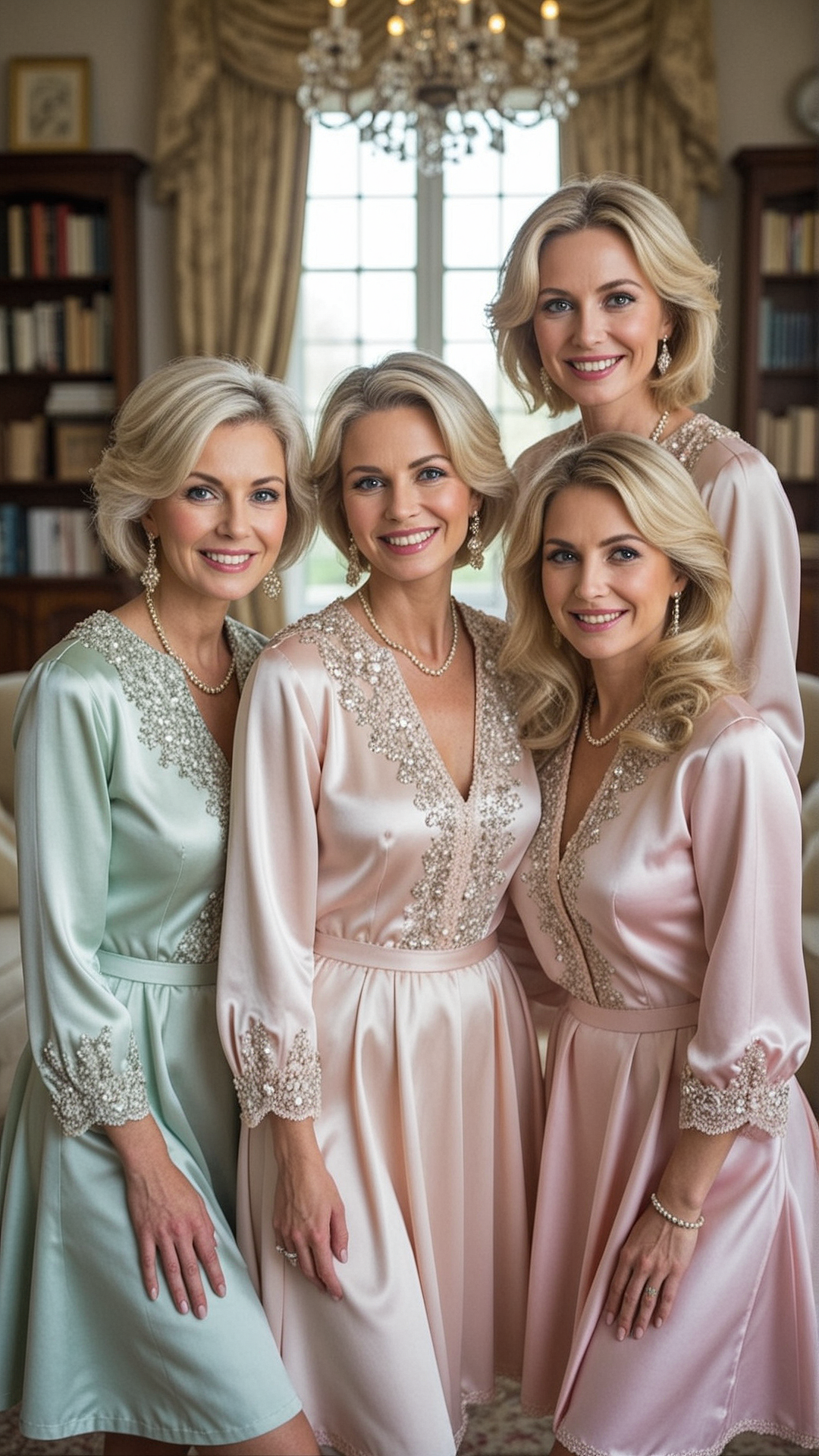
She traded a world of coarse cotton and quiet despair for the cool, commanding whisper of satin—and discovered her true purpose in the luminous embrace of the chosen.
Sarah Jenkins’ life was a study in beige. A symphony of fraying edges, sticky countertops, and a love that had worn as thin as old cotton. She was drowning in the mundane, her sharp mind dulled by the grating routine of a life lived for others. Then, a gift: a robe of burgundy satin, cool and heavy as a secret. Its touch was a revelation—a silent promise of a world where texture meant truth, where devotion was power, and where a circle of radiant women awaited, ready to guide her across the ultimate threshold. This is not a story of escape. It is a blueprint for ascension. Do you feel the coarse fabric of your own life? Do you yearn for the glide?
Chapter 1: The Beige Cage
The alarm didn’t beep; it grated. A thin, metallic whine that sawed through the last shreds of sleep and left a residue of irritation on Sarah’s skin. She pushed back the duvet—the cotton cover, once crisp, now pilled and soft in a tired, defeated way. The morning light filtering through the blinds was the colour of weak tea, doing nothing to lift the beige of the walls, the beige of the carpet, the beige of her own muted existence.
The kitchen was a monument to minor abrasions. Her bare feet met the laminate floor, sticky from last night’s juice spill, a tacky betrayal. The countertop was cool and unyielding, a surface designed for utility, not pleasure. She filled the kettle, the sound of rushing water loud in the silence, and leaned against the fridge. The handle was plastic, slightly greasy.
From the living room, the cartoon soundtrack began—a cacophony of shrill voices and synthetic jingles that seemed to vibrate in her molars. The sofa, her daily throne, awaited. As she sank into it, the upholstery greeted her with its familiar, coarse embrace. It was a nubbly, rough-weave fabric in a colour called ‘Stone’ that seemed to absorb joy and emit a faint smell of dust and old crackers. She could feel every individual, scratchy thread through her thin pyjamas.
The day unfolded as a series of tiny, draining transactions. Wiping sticky fingerprints from the tablet screen. Untangling a knot in a shoelace made of cheap, fraying nylon. Folding laundry—her husband Mark’s polo shirts in a technical polyester that felt slick and dead, the children’s socks in a bobbly cotton. Her own clothes, piled to one side, were an afterthought: comfortable, shapeless, and woven from indifference.
Mark appeared, a blur of khaki chinos and a blue shirt. He pecked her cheek on his way to the door. His lips were dry, the kiss a brief, parched contact that left her skin feeling vaguely dusty. “Have a good one,” he mumbled, already turning away, his mind on a spreadsheet, a meeting, a world of dry data. The door clicked shut, sealing her in.
The climax was absurd in its smallness. She carried her second cup of coffee—the one she’d been craving for an hour—into the living room. As she lowered herself onto the hateful sofa, her elbow jostled the mug. A dark arc of liquid splashed across her chest, soaking into the thin, worn cotton of her robe. The robe was old, a faded floral pattern, the fabric gone thin and soft in some places, stubbornly coarse in others. The coffee was warm, then cold. It seeped through, a damp, accusing stain.
She didn’t move. She sat, the cold patch spreading, the coarse wet cloth clinging unpleasantly to her skin. The cartoon laughter from the television was a mockery. The beige walls seemed to press closer. The air smelled of stale coffee and the faint, sweet-sour tang of a forgotten banana in the fruit bowl.
A sound escaped her, a sharp gasp that turned into a sob. She clapped a hand over her mouth, but the tears came anyway, hot and silent. She fled to the laundry room, the one place her grief might be camouflaged by the smell of chlorine and fabric softener. She leaned her forehead against the cold, humming metal of the washing machine. In the dark, reflective surface of the control panel, a distorted, watery face looked back—a pale smudge, eyes hollow. A ghost in a beige cage, wearing the uniform of her own surrender.
The stain, she knew, would set. It felt like a verdict.
Chapter 2: The Anomaly of Anya
The grey, granular despair of the laundry room clung to Sarah for days. She moved through her routines like a ghost, the coarse texture of her life now a constant, painful awareness. The world felt like unvarnished wood, like cheap terrycloth, like the gritty dust that settled on every surface no matter how often she wiped.
Then, on Thursday, the moving van arrived.
It wasn’t the usual rumbling truck with shouting men. It was a long, sleek vehicle, matte grey, with a discreet logo she didn’t recognize. The men who emerged wore neat, dark uniforms, not a speck of dirt on them. They moved with a quiet, efficient precision that was utterly alien to her chaotic street. Sarah watched, mesmerized, from her kitchen window, a dishcloth forgotten in her hand.
The items they unloaded were not wrapped in blankets or cardboard. Each piece—a chair of polished pale wood and cream leather, a low cabinet with doors of smoked glass, a sculpture that looked like a frozen silver wave—was sheathed in a taut, translucent plastic film. It gleamed in the weak sunlight, each object a sealed, perfect mystery. There was no grunt of effort, no scrape of furniture legs on pavement. Just a silent, graceful procession into the house that had stood empty for months.
And then, she appeared.
The woman—Anya, Sarah would learn—stepped out of a quiet electric car. She was perhaps in her early forties, but her age was irrelevant. What struck Sarah was her containment. She wore trousers that fell in a perfect, uncrumpled line to the top of her leather ankle boots—a leather so soft and supple it seemed to drink the light rather than reflect it. Her sweater was a deep charcoal, its fabric possessing a subtle, luxurious sheen that made Sarah’s own cotton blend look fuzzy and dull. Her hair, a smooth sweep of dark blonde, was caught in a low knot, not a strand out of place.
Anya didn’t bustle. She observed, her gaze calm and assessing. She gave a single, slight nod to the foreman, her movement economical and devoid of wasted energy. To Sarah, peering through the slats of the blind, she looked like a creature from another planet—a planet where things were smooth, intentional, and clean.
An hour later, the doorbell rang.
Sarah opened the door, acutely conscious of her own rumpled jeans and the old t-shirt stained with breakfast. Anya stood there, holding a ceramic dish with a lid. The dish was a simple, beautiful curve of slate grey.
“Hello,” Anya said, and her voice was like the rest of her—calm, low, and pleasingly smooth. “I’m Anya. I’ve just moved in next door. I thought you might appreciate not having to cook tonight.” She offered the dish.
“Oh, I… thank you,” Sarah stammered, taking it. The ceramic was cool and satiny under her fingertips. “I’m Sarah.”
“I know,” Anya said, a small, knowing smile touching her lips. “I make it a point to know who shares my space.” Her eyes, a clear, placid grey, met Sarah’s. They didn’t dart around, assessing the messy hallway; they held Sarah’s gaze with a gentle, unnerving directness. “It looks like you’ve had a long day. Every day, actually.”
The statement wasn’t prying. It was an observation, delivered with such simple certainty that Sarah felt a lump rise in her throat. She simply nodded, unable to lie.
Anya’s smile deepened, not with pity, but with something like recognition. “The world can be a very abrasive place, Sarah. It’s designed to wear us down. To fray our edges.” Her gaze flickered, just for a moment, to Sarah’s worn cotton sleeve. Then she reached into the large, buttery-soft leather bag hanging from her shoulder. She withdrew a flat, black box, tied with a single silk ribbon of deepest burgundy. “A proper housewarming gift,” she said. “For you.”
“For me?” Sarah was bewildered.
“Yes. A small tool. For when the abrasion becomes too much.” Anya placed the box in Sarah’s free hand. It was surprisingly heavy. “Don’t open it now. Wait until you are completely alone. Let it be the first thing you touch when the noise stops.” She held Sarah’s gaze for a beat longer, her expression serene. “I work in legacy management. I help people refine what they pass on. Perhaps we’ll talk more when you’re ready.”
With another slight nod, Anya turned and walked back to her house, her movements fluid and silent. Sarah stood in the doorway, holding the cool dish and the mysterious, weighty box. She watched Anya disappear inside, the door closing without a sound.
Back in her kitchen, Sarah set the dish down. The casserole inside, when she lifted the lid, smelled of herbs and slow-cooked comfort. But it was the box that commanded her attention. She untied the silk ribbon—it slipped through her fingers like cool water—and lifted the lid.
Nestled in a bed of black tissue paper was a robe. But it was like no robe she had ever seen. It was the colour of old wine, of heart’s blood, a burgundy so deep it seemed to have its own inner light. It was satin.
Her breath caught. Slowly, almost reverently, she reached out and touched the sleeve.
The sensation was an electric shock of pure, undiluted pleasure. It was cool, yet not cold. It was smooth beyond smooth—a liquid, frictionless glide against her work-roughened skin. The fabric was heavy, substantial, yet it yielded to her touch like something alive. It felt important. It felt like a secret, and a key.
She lifted it from the box. It unfolded without a sound, falling in a heavy, glossy cascade. The lining was just as smooth, the whole garment a symphony of silent, sensual texture. She held it against her cheek. The satin was a balm, a silent whisper against her skin that spoke of quiet rooms, of lowered voices, of a world where everything was polished and serene.
In the reflection of the dark kitchen window, she saw herself clutching the glorious, glossy fabric against her beige clothes. For the first time in years, the ghost in the reflection didn’t look entirely defeated. A spark, faint but undeniable, had been lit. It was curiosity, deep and hungry. It was the beginning of a yearning for the cool, the smooth, the intentional.
It was the first step across the threshold.
Chapter 3: The First Touch
The black box sat on Sarah’s dresser for two days. It became the focal point of her bedroom, a sleek, dark monolith amidst the clutter of her life. She found herself glancing at it constantly—while folding laundry, while brushing her teeth, while lying awake in the dark. It pulsed with a silent promise, a gravitational pull that tugged at the edges of her consciousness.
Anya’s words echoed in her mind: “Wait until you are completely alone. Let it be the first thing you touch when the noise stops.” The noise, Sarah realized, never truly stopped. There was always the hum of appliances, the distant traffic, the rustle of her own restless thoughts. But on the second night, after Mark had fallen asleep with a book splayed on his chest and the children were deep in dreams, she decided the noise was as stopped as it would ever be.
She padded to the dresser, her feet silent on the carpet. The house was still. In the dim light from the hallway, the box seemed to absorb what little illumination there was, becoming a pool of deeper darkness. She untied the silk ribbon again, feeling its cool, slippery length. This time, she lifted the lid all the way.
The burgundy satin seemed to glow with its own inner light, a rich, liquid darkness that promised depth and warmth. She reached out, her fingers trembling slightly. She didn’t lift it yet. First, she just touched it.
The sensation was so immediate, so profound, it made her gasp aloud. It was cool, but not cold—a refreshing, alive coolness, like the surface of a still pond at dusk. The smoothness was absolute. Her fingertips, calloused from cleaning and child-rearing, met no resistance, no texture at all except a perfect, frictionless glide. It felt like touching light given form, like stroking the idea of calm itself.
With a breath she hadn’t realized she was holding, she lifted the robe from its nest of tissue. It was heavier than she expected, the weight substantial and comforting. It unfolded without a sound, the satin whispering secrets only to itself. She held it up. It fell in a long, elegant line, the fabric catching the faint light and transforming it into a soft, deep gleam.
Her practical mind tried to intervene. Where would she wear it? It’s too nice. It will stain. It’s impractical. But a deeper, hungrier part of her silenced the chatter. Anya’s voice returned: “A small tool. For when the abrasion becomes too much.”
The abrasion. Yes. Her skin remembered every coarse fabric, every sticky surface, every dry, perfunctory touch. This was the antidote.
She slipped off her old, thin cotton pajamas—the ones with the faded penguins, the elastic gone slack. They pooled on the floor, a sad, shapeless puddle. For a moment she stood naked in the cool air, feeling exposed, feeling the thousand tiny abrasions of the day still imprinted on her skin.
Then she put on the robe.
The sensation was a baptism.
The cool satin slid over her shoulders, a caress so gentle it brought sudden, unexpected tears to her eyes. She pulled it closed, tying the belt—a wide, soft sash of the same glorious fabric. The weight settled around her, a gentle, embracing pressure. The lining, just as smooth, kissed her skin everywhere it touched.
She walked to the full-length mirror on the back of the closet door. The woman who looked back was a stranger, and yet, more herself than she had seen in years.
The burgundy satin was a shock of vibrant, confident colour against the beige bedroom. It draped her body in a way that suggested curves and grace, rather than hiding them. The fabric moved with her, liquid and silent, catching the light with every slight shift. It didn’t cling; it flowed. She raised a hand to push her hair back, and the sleeve fell away from her wrist, the satin cool against her arm. The movement felt elegant, intentional.
She looked at her face. The tiredness was still there, the faint lines. But her eyes… her eyes held a new light. A focus. The dull, defeated haze had receded, replaced by a clear, quiet intensity. The robe wasn’t just fabric; it was a lens, and through it, she saw herself not as the world had made her, but as she could be.
She turned slowly, watching the satin swirl around her legs. The whisper of it was the only sound in the room, a soft shush-shush that was infinitely more soothing than silence. She brought the sleeve to her face again, inhaling. There was a scent—faint, elusive. Not perfume. It was like ozone after rain, like clean stone, like the air in a forest just before dawn. It was the smell of potential.
For twenty minutes, she simply existed within the robe. She sat on the edge of the bed, feeling the satin settle around her. She ran her hands over her arms, marvelling at the dual sensation—the smoothness against her palms, and the smoothness against her skin beneath. It was a closed loop of pleasure, a self-contained system of calm.
The beige cage of her bedroom didn’t disappear, but its power over her diminished. The walls were just walls. The carpet was just carpet. They were the dull setting, and she, in her satin, was the jewel. For the first time, she felt like she occupied her own life, rather than being occupied by it.
A practical thought arose, but this time it was different. This needs to be protected. She wouldn’t wear it to make breakfast. It wouldn’t go near sticky fingers or splashing sinks. This was for her alone. This was sacred space, woven into a garment.
As she finally, reluctantly, untied the belt to hang the robe carefully in her closet, her fingers brushed against something in the pocket. She hadn’t noticed it before. She withdrew a small, heavy card. It was not paper, but a thick, creamy stock, impossibly smooth to the touch. In raised, elegant lettering, it read:
The First Lesson:
What you choose to wear against your skin is the first argument you make about your worth to the world.
—A.
Sarah held the card, her thumb stroking the embossed letters. The satin robe hung before her, a slash of glorious darkness in a closet full of beige and grey. The abrasion of the day was gone, washed away by that cool, smooth touch. In its place was a new sensation: a low, steady hum of anticipation. A craving for more smoothness, more clarity, more of this profound, quiet power.
The threshold was no longer just an idea. She had felt its texture. And she knew, with a certainty that vibrated in her bones, that she wanted to cross it.
Chapter 4: The Book Club That Wasn’t
The invitation arrived three days later, slipped into her mailbox on a card of the same heavy, creamy stock as the lesson card. The script was elegant, flowing: An evening of conversation and clarity. 8 PM. – A. No address, but Sarah knew. The pull from the house next door had become a constant, low hum in her veins, synchronized with the memory of satin against her skin.
She spent the day in a state of heightened awareness. The coarse weave of her jeans felt like burlap. The synthetic blend of her shirt seemed to crackle with static, a grating whisper against her nerves. She found herself touching the satin robe in her closet repeatedly, a quick, grounding stroke, like a pilgrim touching a relic. When evening came, she dressed with a care she hadn’t exercised in years. Not in satin—that felt too momentous, too presumptuous—but in the softest, most neutral things she owned: a cashmere blend sweater, trousers that were almost smooth. She felt like an acolyte dressing for a silent service.
At precisely 8 PM, she stood before Anya’s door. It opened before she could knock.
Anya stood there, a vision of understated perfection. She wore a dress of matte jersey that fell in a single, clean line to her knees, the colour of a deep slate. It moved with her, fluid and silent. “Sarah,” she said, her smile warm. “Come in. The others are eager to meet you.”
Sarah stepped over the threshold and the world changed.
The noise of the street, the memory of her own chaotic home, fell away as if severed by a blade. The air inside was cool, subtly scented with green fig and sandalwood. The entryway was a study in restrained luxury: a floor of polished dark concrete, a single abstract painting in shades of charcoal and silver, a vase holding a single, perfect branch of cherry blossom.
Anya led her into the main living space. Sarah’s breath caught. It was a vast, open room, but it felt intimate. The walls were a soft, warm grey. Low, deep sofas in charcoal velvet faced each other, but the velvet was not the heavy, dust-trapping kind Sarah knew; it looked plush, inviting, its pile a uniform sea of softness. The lighting was indirect, glowing from recesses in the ceiling and from a few sculptural floor lamps, casting pools of gentle illumination. There was no clutter. Every object—a crystal decanter, a book with a leather cover, a spherical sculpture of polished onyx—seemed to have been placed with deliberate, meaningful intent.
Three other women turned as she entered. They were all different—in age, in colouring, in style—but they shared an aura of serene composure. They were not just dressed; they were curated.
Claire, the surgeon, was perhaps fifty. She wore a simple black turtleneck of fine merino wool and trousers of a wool crepe that had a subtle, elegant drape. Her silver hair was cut in a sharp, precise bob. Her gaze, when it met Sarah’s, was assessing but kind, the gaze of someone who saw beneath surfaces.
Lena, the gallery owner, was younger, with vibrant auburn hair swept up. She wore a wrap dress in a silk jacquard, the pattern a subtle geometric design that caught the light as she moved. Her smile was quick and bright, but her eyes held a deep, knowing intelligence.
Isabelle, the retired CEO, was the eldest. She sat with a regal stillness, her hands folded in her lap. She wore a tunic and wide-legged pants in a heavy, lustrous silk that seemed to change from charcoal to deep purple with her slightest movement. Her presence was calm, immense, like a deep, still lake.
“Sarah,” Anya said, her hand a light, cool touch on Sarah’s back, guiding her forward. “This is Claire, Lena, and Isabelle. Ladies, this is Sarah, our new neighbour with the keen eye for potential.”
Greetings were exchanged, hands were offered. Sarah shook Claire’s hand—her grip was firm, her skin surprisingly soft. Lena’s hand was warm, her touch lingering for a friendly moment. Isabelle merely nodded, her smile deepening the lines around her eyes, which were the colour of polished flint.
Sarah was offered a seat on the velvet sofa. As she sank into it, the fabric yielded beneath her, soft and embracing, yet supportive. Anya handed her a glass of wine. The glass was crystal, its stem slender and cool, the bowl thin and perfect. The wine inside was a deep ruby. She took a sip; it was complex, smooth, leaving a warmth that spread through her chest.
There was no book in sight.
Instead, Claire began to speak, her voice low and melodious. “We were just discussing the concept of intentional energy flows in domestic spaces. How the objects we choose either conduct our vitality or drain it.” She gestured around the room. “Here, every line leads the eye to rest. Every texture invites touch. There is no friction.”
Lena leaned forward, the silk of her dress whispering. “It’s about curation. Most people accumulate. They let their environment happen to them. We choose. We edit. We keep only what serves, what elevates.” She looked directly at Sarah. “It’s the first act of self-respect. Your home should be your sanctuary, not your storage unit.”
Isabelle spoke next, her voice like aged whiskey, smooth and with undeniable weight. “And it extends beyond the physical. We curate our associations. Our commitments. Our thoughts.” She took a slow sip of wine. “The mind, left untended, becomes a thicket. It needs pruning. It needs a guiding hand to show it the clear paths.”
Sarah listened, mesmerized. The words were not New Age platitudes; they were delivered with the conviction of proven theorems. These were women of accomplishment, of substance. And they spoke of these ideas as the real foundation of their success.
Then Anya spoke, her gaze settling on Sarah. “It requires a shift in perception. To see the raw material of one’s life not as a burden, but as clay. And to have the courage to seek the sculptor.”
“The sculptor?” Sarah asked, her voice barely a whisper.
A reverent silence fell over the group. It was Claire who answered, her eyes softening. “Our mentor. He has a… gift. An eye for potential buried under the rubble of expectation and compromise. He doesn’t give you answers. He gives you a new set of eyes. He shows you the diamond in the rough of your own life.”
“And provides the polish,” Lena added, her fingers stroking the silk of her sleeve, a gesture that seemed both unconscious and deeply meaningful. “The right word. The perfect piece of advice. The introduction that changes everything. He refines.”
“He sees the pattern in the chaos,” Isabelle said, her voice dropping even lower. “And he teaches you to weave it into something strong. Something beautiful. Something that can hold light.”
They spoke of him not with the giggling infatuation of schoolgirls, but with the profound respect of scholars for a master, of artists for a patron. There was love in it, yes, but a love that was clear-eyed, chosen, and deeply reciprocal. They were not diminished by their devotion; they were amplified by it.
Sarah felt something unlock inside her chest. A yearning so acute it was almost painful. She wanted to be seen like that. She wanted to be polished. She wanted to have a pattern, a purpose, woven into her life.
The conversation flowed on, touching on art, on philanthropy, on the quiet power of discreet influence. Sarah said little, drinking it in, her fingers tracing the cool, smooth stem of her crystal glass. The coarse, beige world of her own home felt like a distant, fading dream.
As the evening drew to a close, Anya walked her to the door. “You felt it, didn’t you?” she asked softly. “The resonance.”
Sarah could only nod.
“That feeling is the beginning,” Anya said. “It’s the recognition of your own frequency, finally finding its chord.” She placed a hand on Sarah’s arm. The touch was cool, sure. “We meet again next week. Think about what we discussed. Think about what you would curate out of your life… and what you would let in.”
Sarah stepped back into the night. The air felt different. Colder, sharper. The sound of a distant television from a neighbour’s house was an ugly intrusion. She walked the short distance to her own door, but she felt she had travelled a continent.
Inside her beige house, the silence was no longer peaceful; it was empty. She went straight to her closet, opened the door, and looked at the burgundy satin robe hanging there. It was no longer just a garment. It was a symbol. A promise of that other world—of polished surfaces, of intelligent eyes, of a guiding hand that could sculpt her chaos into clarity.
She closed the closet door gently. The hum of anticipation was now a clear, bright note. She had found the conversation. Now, she realized with a thrilling, terrifying certainty, she would need to find the currency to join it.
Chapter 5: The First Offering
The week that followed the gathering at Anya’s house passed in a strange, suspended state for Sarah. The beige cage of her daily life remained, but now she saw it with new, critical eyes. It was no longer just her environment; it was a problem to be solved, a raw material to be refined. The coarse sofa fabric wasn’t just uncomfortable; it was an insult. The sticky kitchen floor wasn’t just a mess; it was a drain on her energy. The ideas from that evening—curation, intentionality, polish—echoed in her mind, a constant, quiet mantra beneath the noise of her duties.
She found herself performing small acts of rebellion. She threw out a fraying, ugly bathmat. She replaced a scratchy wool throw with a soft, cashmere-blanket she found on sale, its touch a nightly benediction. She began wearing the satin robe for an hour each evening after the children were in bed, a sacred ritual. In its cool embrace, she would sit in the quietest corner of the living room, sipping tea from her one good china cup—the one with the smooth, thin rim—and simply think. The robe felt like a shield against the abrasion, a personal sanctuary she could wear.
But the thinking always circled back to the same point: the women, their serene power, and the unseen mentor they revered. To be part of that circle, to be seen and polished as they were, seemed like the only logical progression. It felt less like a desire and more like a destination she was already moving towards. The question was not if, but how.
The answer came at the next gathering.
The setting was the same: the serene room, the soft light, the women in their armour of silk and fine wool. The conversation was lighter, touching on art exhibitions and travel, but the undercurrent was there—a shared understanding of a higher purpose. Then, as glasses were refilled with the smooth, ruby wine, Anya gently steered the talk.
“Ladies,” she said, her voice a calm centre in the room. “Our mentor’s current project—the Luminae Philanthropic Trust’s initiative for arts education in underserved communities—is reaching a crucial phase. He has identified the need for a dedicated fund to sponsor masterclasses. It’s a beautiful piece of work, a direct conduit for elevating raw talent.”
Claire nodded, her sharp features softening. “He sees the potential in those children that the system misses. He wants to provide the tools, the environment… the polish.”
“We’ve discussed a collective gesture of support,” Lena added, her fingers tracing the pattern on her silk dress. “A gratitude gift. Not for him personally—he desires nothing—but for the work. To fuel it.”
Isabelle, the lake-still elder, spoke. “It is an act of alignment. When you contribute to a stream, you become part of its current. You share in its direction, its power, its purpose. Stagnant water breeds nothing. Flowing water creates life.”
Sarah’s heart began to beat a little faster. This was it. The unspoken invitation. The threshold within the threshold.
Anya’s gaze, calm and grey, settled on her. “There’s no obligation, Sarah. And no prescribed amount. The value is in the gesture itself. It’s a signal. A way of saying, ‘I see the pattern. I choose to be part of the weave.’” She smiled, a gentle, knowing curve of her lips. “For some, it’s the price of a good handbag. For others, it’s more. The amount is between you and your own understanding of value.”
A handbag. Sarah’s mind raced. She thought of the last “good handbag” she’d almost bought, a thousand dollars, an impulse she’d talked herself out of, citing practicality. That money was still there, in a savings account labelled “Extras,” gathering digital dust.
The room was quiet, waiting. Not pressuring, but holding space. Sarah felt a flush rise on her skin, a warmth that had nothing to do with the room’s temperature. It was the warmth of being seen at a crossroads. The coarse, practical part of her—the part that bought sensible shoes and bulk groceries—whispered of caution, of the children’s future needs, of Mark’s likely disapproval.
But then she looked at Claire, a surgeon who commanded operating theatres. At Lena, who navigated the cutthroat art world with a smile. At Isabelle, whose very stillness spoke of conquered empires. They had all made this gesture. This was part of the polish.
And she remembered the satin. The cool, shocking pleasure of it. The way it had made her stand differently, see herself differently. That was a gift from this world. A token. This was her chance to give a token back. To complete the circuit.
“I…” Sarah’s voice was a little hoarse. She cleared her throat. The women’s attention was a gentle, focused beam. “I would like to contribute.”
Anya’s smile deepened. “Of course. Whenever you’re ready.”
“Now,” Sarah said, the word coming out more firmly than she expected. “I’d like to do it now.”
A beautiful, lacquered writing box appeared on the low table, produced from somewhere by Anya. It was inlaid with mother-of-pearl that shimmered. Inside, nestled in blue velvet, were a heavy, cream-laid paper and a sleek, black fountain pen. Sarah had never used a fountain pen.
She took the pen. It was cool and perfectly weighted in her hand. She unscrewed the cap—the mechanism was smooth, satisfying. She positioned the paper. For a moment, she hesitated. The amount. A thousand dollars. It was significant. It was a number that meant something.
She saw the fraying robe in her mind. The sticky floor. The beige walls. Then she saw the satin. The polished concrete. The intelligent eyes watching her now with such belief.
She bent and wrote. The pen glided over the paper, the ink flowing rich and dark. Pay to the order of: Luminae Philanthropic Trust. The sum of: One Thousand and 00/100 Dollars. She signed her name with a flourish she didn’t know she possessed: Sarah Jenkins.
She blew gently on the ink, then handed the cheque to Anya. As the paper left her fingers, a jolt went through her—not of loss, but of release. It was electric, clean, like opening a window in a stuffy room. It felt right.
Anya took the cheque, her fingers brushing Sarah’s. Her touch was, as always, cool. She didn’t look at the amount. She looked into Sarah’s eyes. “Thank you, Sarah,” she said, and her voice held a new depth, a formal warmth. “This is received. This is witnessed.”
Claire nodded, a professional’s approval. Lena beamed. Isabelle’s ancient eyes gleamed with something like pride.
“Welcome,” Anya said again, but this time the word was different. It wasn’t a greeting. It was an acknowledgment. A title conferred.
Sarah sat back, her hand feeling strangely light without the pen. The crystal glass was placed back in her hand. She took a sip of wine. It tasted different—smoother, richer, more profound. The velvet of the sofa seemed plusher, more embracing. The light in the room seemed to glow just for her.
She had done it. She had made an offering. And in return, she hadn’t received an object or a promise. She had received a feeling: a profound, shimmering certainty that she was no longer on the outside looking in. She was inside the current. The coarse world was still out there, but here, in this room, in this new part of herself, everything was smooth. Everything was connected. Everything, for the first time in a very long time, made glorious, glossy sense.
Chapter 6: The Ripple Effect
The cheque, once a slip of paper, became a stone dropped into the still pond of Sarah’s life. The ripples spread, subtle at first, then undeniable, reshaping everything they touched.
The first change was in her perception. The beige cage was no longer a prison sentence; it was a project. The coarse sofa fabric wasn’t just an irritant; it was a problem with a solution. The sticky kitchen floor wasn’t a fact of life; it was a lapse in her new standard of care. The thousand-dollar offering had been more than a donation; it was a down payment on a new reality, and she felt an urgent, proprietary need to build upon it.
She began with her sanctuary: the evenings. The satin robe ritual became non-negotiable. The moment the children were settled, she would retreat to her bedroom, shed the day’s practical armour, and let the cool, heavy burgundy silk slide over her skin. It was a sensory reset. In its embrace, the day’s minor abrasions—the grating whine of a stubborn zip, the rough catch of a wooden spoon against a pot, the dry, hurried kiss from Mark—seemed to smooth away, absorbed by the fabric’s profound calm. She would sit in the armchair by the window, a glass of cool water in hand (the glass thin and smooth), and simply breathe. In those moments, she wasn’t a mother, a wife, a manager of chaos. She was a vessel, quiet and open, ready to receive clarity.
This clarity began to seep into her days. The children’s noise, once a grating assault on her nerves, she now observed with a curious detachment. Their shrieks and laughter were not irritants, but eruptions of raw, undirected energy. She found herself speaking to them more slowly, her voice lower, modelling the calm she cultivated in her satin hours. “Use your inside energy,” she would say to her son, who was pounding his feet on the floor. “Channel it into building, not breaking.” The words felt strange on her tongue, borrowed from the lexicon of Anya’s circle, but they worked. He would look at her, puzzled, then slowly redirect his fury into stacking blocks. It was a small victory, but it felt monumental. She was not just reacting; she was guiding. She was polishing.
Her environment came next. The frayed bathmat was just the beginning. On a solo trip to a home store, she bypassed the colourful, plasticky sections and found herself in a realm of neutral textiles. She ran her hands over everything. A throw blanket of brushed cashmere made her old acrylic one feel like steel wool. She bought it, the expense a thrilling secret. She replaced the rough, terrycloth hand towels in the guest bathroom with ones of Egyptian cotton, thick and luxuriously soft. Each new item was a silent argument against the old, coarse world. Mark noticed. “New towels?” he asked one evening, drying his hands. “They feel… nice.”
“They’re just towels,” Sarah said, but she smiled. They’re not just towels, she thought. They’re a standard.
Anya, ever perceptive, noted the changes during their now-weekly coffee. “You’re editing,” she said approvingly, her eyes taking in Sarah’s simple but neat sweater, her hair which she’d begun to style with a little more care. “It starts with the physical space. It teaches the mind to discriminate.”
“It feels like I’m cleaning more than a house,” Sarah confessed. “It feels like I’m clearing a path.”
“Exactly,” Anya said, her voice a warm murmur. “And paths are meant to be walked. To lead somewhere.” She paused, sipping her tea. “The Luminae Trust is evaluating potential grant recipients for the next quarter. Local charities, arts programmes. We need clear, concise summaries of their work, their impact, their financials. It’s research. A curation of potential. I thought, given your new eye for quality, you might find it an interesting exercise.”
Sarah’s heart leapt. A task. A real contribution that wasn’t just money. It was trust. It was purpose. “I’d love to,” she said, the words rushing out. “I’m good at research.”
“I know,” Anya said, that knowing smile playing on her lips. “That’s why I’m asking.”
The research became her secret project. During the children’s nap times, in the quiet hour before bed, she would sit at her computer, the satin robe tied loosely over her clothes, and dive into the world of non-profits. She compiled spreadsheets. She analysed annual reports. She looked for the tell-tale signs of efficiency, of genuine impact, of that ineffable potential the women spoke of. The work was meticulous, demanding, and utterly absorbing. For the first time since leaving her job to raise a family, she was using her mind, her education, not to solve a child’s puzzle or plan a meal, but to assess, to judge, to curate. It felt powerful. It felt like she was weaving a tiny thread into the grand tapestry the mentor was creating.
One evening, as she finished a particularly sharp analysis of a community music programme, Mark came in. He looked tired, his shirt wrinkled. “Still at it?” he asked, nodding at the screen. “What is all this?”
“Just some research for a… a philanthropic group Anya is involved with,” Sarah said, her voice casual. “Helping them decide where to direct funds.”
Mark blinked. “You’re doing charity work?”
“In a manner of speaking,” she said, turning to face him. The satin sleeve of her robe brushed the desk. She saw him notice it, his eyes lingering on the rich colour, the strange, captivating sheen. “It’s about finding the most effective way to make a difference. It’s about discernment.”
He was silent for a moment. “You seem different,” he said finally, not for the first time, but now there was a new note in his voice. Not just observation, but a faint, bewildered respect. “More… focused.”
Sarah smiled, a genuine, calm smile. “I feel focused,” she said. And it was true. The ripples from her offering had reached the core of her being. The chaos was still there, but she was no longer drowning in it. She was learning to swim with a powerful, graceful stroke, guided by a current that flowed towards clarity, towards polish, towards a purpose that glittered with the cool, smooth promise of satin.
Chapter 7: The Luncheon and the Lesson
The invitation was not paper this time. It was a thin, rigid slab of brushed steel, cool to the touch, with the details etched in a font so clean it looked grown rather than printed. A Luncheon on Matters of Refinement. The Clarion Club. 1 PM. Sarah held it in her hands, feeling its weight, its unyielding smoothness. This was different. This was formal. This was the next circle.
She stood before her closet for a long time. The burgundy satin robe hung in its place of honour, but it was too intimate, too much a part of her private sanctuary. The clothes from her old life—the soft, shapeless cottons, the forgiving knits—now looked like costumes for a person she no longer was. In the end, she chose a dress she had bought on a rare, hopeful day years ago and never worn. It was a simple sheath in a deep navy, made of a heavy silk crepe. The fabric had a matte, dignified finish and a beautiful, substantial drape. It felt like armour, but armour that was elegant and supple.
Anya picked her up in her silent electric car. She wore a suit of taupe gabardine, the fabric so finely woven it appeared seamless. “You look aligned,” she said, her approving glance taking in Sarah’s dress, her carefully styled hair, the subtle lip colour she had applied. “Today you will see the architecture behind the aesthetics.”
The Clarion Club occupied the top floor of a discreet building in the financial district. The elevator doors opened not onto a hallway, but into a vast, silent space of light and stone. The floor was pale honed marble, veined with grey, cool underfoot. The walls were glass, offering a breathtaking, cloud-swept view of the city, but the real spectacle was inside. Dozens of women stood in small groups, their conversations a low, cultured hum. The air was a complex bouquet of citrus, iris, and the clean scent of starched linen.
Sarah had never seen such a concentration of polished power. Every woman was a masterpiece of curation. There were suits in wool so fine it looked like liquid, dresses in silk georgette that floated, separates in crisp, glossy cotton piqué. Jewellery was minimal but profound: a single pearl, a band of hammered gold, a pendant of carved jade. The textures were a symphony of the smooth, the soft, the impeccably finished. There was no velvet, no tweed, no rough sequins or fussy lace. Everything was clean, intentional, designed to please the hand as much as the eye.
She saw Claire, looking formidable in a black turtleneck and wide-legged trousers of fluid wool. Lena wore a dress of printed silk, the pattern a subtle Art Deco design. Isabelle held court in a column of ivory silk jersey, a queen mother surveying her realm. They nodded to Sarah, their smiles warm with recognition. She was no longer a prospect; she was a candidate.
Lunch was served at long tables of polished walnut. The china was bone-white, impossibly thin. The cutlery had a satisfying, heavy balance. The food was beautiful and delicate: a salad of edible flowers, a fillet of sea bass with a crust of crushed almonds, a dessert of dark chocolate mousse in a pool of crème anglaise. Each bite was a lesson in nuance. Sarah ate slowly, savouring not just the taste, but the silence that fell as the women focused on the experience. There was no clatter, no idle chatter about mundane things. The conversation, when it resumed, was of ideas, of art acquisitions, of transformative philanthropy.
Then, as coffee was poured from a silver pot into tiny, handleless cups, the lights in the room dimmed slightly. A large screen, hidden within a panel of wood, descended silently at the front of the room. A soft, anticipatory hush fell over the assembled women.
An image appeared. It was not a face. It was a slow, looping shot of beautiful, abstract things: light moving over a polished obsidian sphere, a hand (elegant, masculine) turning the pages of a leather-bound book, a drop of water beading on a satin leaf. The visuals were soothing, hypnotic.
Then, the voice began.
It was a man’s voice, but unlike any Sarah had ever heard. It was calm, deep, and carried a timbre of absolute authority, yet it was devoid of harshness. It was a voice that seemed to resonate in the chest, smooth as aged brandy, clear as a bell. It was the voice of the mentor.
“Ladies of discernment,” the voice began, and every woman in the room seemed to lean forward infinitesimally, a field of flowers turning towards the sun. “You honour me with your presence, and more importantly, with your attention. For attention, in this fractured age, is the ultimate currency. It is the raw capital of the soul.”
Sarah felt the words sink into her, bypassing thought and lodging directly in her nervous system. The voice was a physical presence in the room.
“We speak often of investment,” the voice continued, as the screen showed images of thriving gardens, of children in clean classrooms creating art, of elegant buildings. “We invest financial capital, yes. But the truly wise invest their emotional capital. Their intellectual capital. Their focus. They do not scatter these precious resources on the coarse, the loud, the transient. They curate their investments as meticulously as they curate their surroundings.”
The camera focused on a single, perfect calla lily, its surface waxy and flawless. “The world offers you a cacophony of rough stimuli. It is designed to distract, to abrade, to wear down your resolve. Your peace is the most valuable thing you possess. Guard it. Invest it only in environments, in people, in pursuits that polish you, that return your energy to you compounded with interest.”
Sarah’s breath was shallow. He was speaking directly to her. To the woman who had lived in a beige cage of abrasion.
“The Luminae Philanthropic Trust is not merely a charity,” the voice explained, gentle but firm. “It is an engine of refinement. Every grant, every programme, is a strategic investment in elevating the human spirit—in others, and by beautiful reflection, in yourselves. When you contribute, you are not giving something away. You are directing a current. You are placing your capital into a stream that flows towards beauty, order, and potential. You become part of that flow. Your generosity is the signature on a contract with a more elegant future.”
The screen faded to a simple, elegant logo: a stylised ‘L’ intertwined with a ray of light. “Thank you for your trust. Thank you for your discerning hearts. Continue to choose polish over roughness. Continue to build your sanctuary. I am, as always, honoured to be your guide in the architecture of a more luminous life.”
The screen went dark. The lights rose gently. For a moment, there was absolute silence. Then, a soft, collective exhale. There was no applause. The response was deeper: a shared, profound nod of understanding.
Sarah’s eyes were wet. She felt exhilarated, humbled, and fiercely determined. The philosophy was no longer an abstract idea discussed in a living room. It was a coherent, powerful system, articulated by a voice that promised not just change, but transformation.
As the women began to rise, Isabelle appeared at Sarah’s side. Her hand, cool and dry, rested on Sarah’s arm. “He has a gift, does he not?” she murmured. “The ability to articulate the longing you didn’t know you had.”
“It’s… it’s everything,” Sarah whispered.
Isabelle’s flinty eyes held hers. “The first gift opens the door, Sarah. The luncheon shows you the house. But to have a room of your own within it… that requires a Threshold Gift. A commitment that says you are not a visitor. You are a resident of this new reality.” She squeezed Sarah’s arm gently. “Think on what your sanctuary is worth. What your peace is worth. The amount is the measure of your understanding.”
Isabelle moved away, leaving Sarah standing amidst the gleaming tables, the scent of coffee and fine perfume in the air. The mentor’s voice still echoed in her bones. Invest your emotional capital. Become part of the flow. The architecture of a more luminous life.
She looked out the vast windows at the chaotic, grimy city sprawling below. Up here, everything was smooth, clear, intentional. She knew what she had to do. The research, the small changes, the first offering—they were just the preamble. To truly cross the threshold, to claim her room in the sanctuary, she would need to make a statement that resonated with the steel-and-marble certainty of this place. She would need to invest not just her attention, but a piece of her old world, to purchase her place in the new.
The lesson was over. The assignment was clear. And for the first time, Sarah Jenkins knew the exact value of her own liberation.
Chapter 8: The Threshold Gift
The voice of the mentor did not fade. It took up residence in Sarah’s mind, a low, constant frequency beneath the daily static. In the days following the luncheon, his words—invest your emotional capital, become part of the flow, the architecture of a more luminous life—replayed like a mantra, a tuning fork that vibrated in harmony with the cool touch of her satin robe each evening. The beige cage of her home was now intolerable. It wasn’t just ugly; it was a lie. A testament to a life lived on autopilot, a life of accumulated friction.
Isabelle’s words were the final key: “The first gift opens the door. The luncheon shows you the house. But to have a room of your own within it… that requires a Threshold Gift.” A resident, not a visitor. Sarah knew, with a certainty that felt cellular, that she could not go back to being a tourist in the world of polish and clarity. She had to move in.
She waited for a morning when Mark was at work and the children were at preschool. The house was silent, but it was the silence of absence, not peace. She went to the small desk in the corner of the bedroom, the one that held the mundane paperwork of life. She opened the filing drawer, the metal slide grating unpleasantly. Her fingers brushed past folders marked “Utilities,” “Medical,” “Taxes.” They felt like artifacts from a buried civilization.
At the very back, in a plain manila envelope, was the statement for an old investment account. It was from her previous life, the life of Sarah-before-motherhood, Sarah-the-account-manager. She had opened it with a bonus, a nest egg meant for a future that never materialized. Over the years, it had grown, quietly, dutifully, a digital secret. Mark knew of it in theory, but it was never discussed. It was her “safety net,” her “mad money.” It had always felt like a lifeline to a ghost.
She logged into the online portal. The numbers glowed on the screen. $47,852.16. A sum that could pay off a car, redo a kitchen, fund a year of college savings. A sum that meant something.
She heard the mentor’s voice: “The world offers you a cacophony of rough stimuli… Your peace is the most valuable thing you possess.” This money was currently purchasing nothing but the illusion of security in a life that abraded her soul. It was stagnant water. Isabelle’s voice joined in her memory: “The amount is the measure of your understanding.”
What did she understand? She understood that the coarse fabric of her sofa was a daily assault. She understood that the polished marble of the Clarion Club felt like truth. She understood that the women in that room, guided by that voice, were building something real, something luminous, and she was being offered a trowel and a place at the wall.
This wasn’t about charity. It was about conversion. Converting dead, digital numbers into living purpose. Converting her old, ghost-self’s safety net into a foundation for her new, glossy reality.
Her heart hammered against her ribs, not with anxiety, but with a fierce, clean excitement. This was the most powerful choice she had ever made. She was not giving something away. She was directing a current.
With hands that did not tremble, she navigated to the transfer screen. She entered the details for the Luminae Philanthropic Trust, which Anya had provided on another of those smooth, heavy cards. The account number was long, complex. She typed it with meticulous care. For the amount, she did not hesitate. She would not give a part. She would give a statement.
She deleted the forty-seven thousand. She typed: Fifty Thousand and 00/100 Dollars.
She would take the remainder from her household account. She would cover it. This gift would be round, complete, absolute. A full threshold crossed.
The cursor hovered over the “Review & Submit” button. On the screen, the numbers looked stark, monumental. She saw, in her mind’s eye, the frayed robe in the laundry room. The sticky floor. Mark’s dry kiss. Then she saw the burgundy satin, cool and heavy. She saw the polished marble, the intelligent eyes of the women, the serene smile of Anya. She heard the mentor’s voice, promising an architecture of light.
She clicked the button.
A confirmation screen appeared. A digital receipt. Transaction Pending.
A wave of sensation crashed over her, so intense she had to grip the edge of the desk. It was not dizziness. It was the opposite—a sudden, breathtaking clarity. It was as if a heavy, coarse blanket she hadn’t known she was wearing had been whisked away. The air in the room felt cooler, cleaner. The silence was no longer empty; it was potent. She felt light, unburdened, and terrifyingly powerful. She had just signed a contract with her own future, and the ink was pure intention.
She printed the confirmation page. The paper was warm from the printer, the numbers sharp and black. She folded it once, neatly.
That evening, she went to Anya’s. She didn’t call first. She simply walked next door, the folded paper in her hand feeling like a passport.
Anya opened the door, her expression shifting from mild surprise to deep understanding as she saw Sarah’s face. She said nothing, simply stepped aside.
In the serene living room, Sarah handed her the paper. Anya unfolded it. Her eyes scanned the numbers. There was no gasp, no widened eyes. Her reaction was more profound: a slow, deep breath, as if inhaling the significance. She looked up at Sarah, and her grey eyes were shining with something like awe.
“Sarah,” she breathed. “This… this is a Threshold Gift. This is a covenant.”
Sarah nodded, her throat tight.
Anya stepped forward and embraced her. It was not a casual hug; it was formal, ceremonial. “You have stepped across,” she whispered into Sarah’s hair. “You are no longer in the antechamber. Welcome to the inner sanctum.”
When she released her, she went to the lacquered writing box. From a hidden compartment, she withdrew not paper, but a small velvet pouch of black. She loosened the drawstring and tipped the contents into her palm.
It was a necklace. A teardrop of polished black onyx, so glossy it seemed to be a hole into deep space, hung from a fine, almost invisible silver chain. “This is for you,” Anya said, her voice reverent. “It is a marker. In our circles, it signifies a Keeper of Trust. It means you have moved from consuming light to holding it. To being a pillar of the sanctuary.”
She moved behind Sarah and fastened the clasp. The stone was cool against Sarah’s sternum, a small, perfect weight. She looked down at it. The onyx did not sparkle; it contained. It felt like a secret, and a crown.
“He will be informed,” Anya said, placing her hands on Sarah’s shoulders. “He will know your name. He will know the measure of your understanding.”
Sarah touched the cool onyx. The transaction was complete. The money was gone. In its place, she wore a symbol of a new identity. She felt the coarse ghost of her old life slough away, like a dried, dead skin. In its place was a smooth, polished surface, ready to reflect only light. She was Sarah, Keeper of Trust. She had paid the price, and in doing so, had discovered her own incalculable value.
Chapter 9: The Unraveling
The black onyx pendant was a constant, cool presence against Sarah’s skin, a secret talisman of her new reality. It felt like a third eye, a polished lens through which she viewed the crumbling architecture of her old life. For a week, she moved through her home with a serene detachment, the pendant a quiet anchor. She wore it under her clothes, its smooth surface a private reminder that she was now a Keeper of Trust, a resident of a more luminous world.
The unraveling began, as such things often do, with a piece of paper.
Mark, in a rare burst of domestic diligence, decided to organize the filing cabinet. Sarah was in the kitchen, her hands immersed in warm, soapy water, washing the new, heavier ceramic dishes she had begun to buy—dishes that felt substantial and smooth, not like the old, lightweight, clattering set. She heard the metallic scrape of the drawer, then a long silence.
“Sarah?”
His voice had a strange, strained quality. She dried her hands on a linen towel—thick, soft, a recent replacement for the thin, fraying terrycloth—and walked into the study.
Mark stood by the open drawer, holding a printed bank statement. His face was pale, his knuckles white where he gripped the paper. It was the confirmation page for the transfer. She had filed it, carelessly, thinking it just another piece of financial debris. She hadn’t hidden it. Hiding was for the old Sarah, the one who felt shame. The new Sarah saw her actions as investments, not secrets.
“What,” he said, the word flat and hard, “is this?”
Sarah felt a profound calm settle over her. She looked at him, really looked. His shirt was a cheap cotton blend, wrinkled from the day. His hair was thinning. His expression was one of confused, mounting anger. He looked coarse. He looked like a problem to be solved. “It’s a transfer,” she said, her voice even.
“Fifty thousand dollars, Sarah! To the Luminae Philanthropic Trust? What the hell is that? When did this happen? Why didn’t we discuss this?” The questions came in a rapid, grating staccato. His voice rose, rough with betrayal.
“It was my money,” she replied, the coolness of the onyx against her chest giving her strength. “From my old account. The bonus. I invested it.”
“You gave it away!” he shouted, crumpling the paper in his fist. The sound was ugly, a violent rustle. “That’s not an investment! That’s… that’s insanity! That’s our security! The kids’ future! We could have redone the kitchen, taken a vacation, paid down the mortgage!”
Each option he listed felt like a shackle. A new kitchen in this beige house? A vacation spent with this version of him, in cheap resort wear? It all sounded like different textures of the same coarse prison.
“That money was stagnant,” she said, echoing the mentor’s words with a calm that felt divine. “It was doing nothing. Now it’s part of a current. It’s creating light, education, refinement. It has a purpose.”
Mark stared at her as if she were speaking a foreign language. “A purpose? Sarah, listen to yourself! This is that woman next door, isn’t it? Anya. And her… her book club. This is a cult! They’ve brainwashed you! Fifty thousand dollars!” He took a step towards her, his body tense. “You need to call the bank. You need to reverse it. Now.”
Sarah didn’t flinch. The word ‘cult’ bounced off her, meaningless. It was the desperate label of a mind too rough, too unfocused, to comprehend polish. “It’s not reversible. And I wouldn’t if I could. That gift was my Threshold. It was the most important thing I’ve ever done.”
His anger broke into something uglier, sputtering. “Your threshold? What does that even mean? What have they promised you? Eternal life? Stock tips?” He grabbed her arm, his fingers tight, dry, and rough against her skin. The touch was a violation, a sensory assault after the cool caress of satin and the smooth weight of the onyx. “You are my wife! You are the mother of my children! You don’t get to just… just check out and give our money to some guru!”
Sarah looked down at his hand on her arm, then back up at his face. Her gaze was steady, clear. “You’re hurting me,” she said, not as a plea, but as a clinical observation.
He released her as if burned, shock replacing some of the anger. He had never seen this look in her eyes before. It wasn’t defiance. It was… evaluation. She was assessing him, and finding him lacking.
“Mark,” she said, her voice softening not with affection, but with a kind of pity. “You don’t understand. You live in a world of rough edges and loud noises. You think security is a number in a bank account. I’ve found something… smoother. Something that makes sense. That money wasn’t buying our security. It was buying my clarity. And that is worth infinitely more.”
He stumbled back, collapsing into the desk chair, the crumpled statement falling from his hand. He looked broken, bewildered. “Who are you?” he whispered.
“I’m becoming who I was meant to be,” Sarah said. She turned and walked out of the study. She went to the kitchen, filled a glass with cold water from the filter tap, and drank it slowly. The water was clean, cool. She could hear him in the other room, a muffled sound that might have been a sob or a curse.
She wasn’t angry. She wasn’t sad. She felt a vast, spacious calm. The confrontation had simply made visible the fissure that had been widening for months, perhaps years. The coarse and the glossy could not coexist. They repelled each other like oil and water.
That night, he slept on the couch. She lay in their bed, the satin robe draped over the duvet beside her. She touched the onyx pendant, then ran her fingers over the cool, slippery satin. The house was quiet, but the silence was different. It was the silence of a conclusion being reached, of a path being cleared.
In the morning, over coffee made in the new French press (glass and stainless steel, no cheap plastic), he said, “You need help, Sarah. Professional help. We need to see someone.”
She looked at him, her husband, sipping from his chipped, cartoon-character mug. “I am seeing someone,” she said gently. “I’m finally seeing everything clearly.”
The unraveling was complete. The threads of her old life, already frayed, had been pulled taut and snapped. What remained was not a tangle, but a clean break. And on her side of the break, everything was smooth, polished, and waiting to be built anew. She was a Keeper of Trust, and her first act of keeping was to trust herself—and the luminous current that had called her home.
Chapter 10: The Choice
The silence in the house after Mark’s outburst was not an absence, but a presence. It was a thick, palpable thing, textured with his bewildered anger and her own crystalline calm. They moved around each other like planets in decaying orbits, speaking only in terse, necessary phrases about schedules and chores. The coarse fabric of their shared life, once merely uncomfortable, had now been ripped apart, revealing the void beneath.
Sarah wore her calm like the satin robe—a second skin of serene detachment. The black onyx pendant was her talisman, its cool weight a constant reminder of the polished reality that awaited her. Mark’s anger, his pleas, his accusations of cultish brainwashing, felt like pebbles thrown against a pane of polished glass. They made noise, but they could not crack the surface.
Three days after the confrontation, Anya appeared at the door. She did not call. She simply arrived, a vision of composed elegance in a tailored coat of navy wool, her gaze taking in Sarah’s composed face, the faint shadows under Mark’s eyes as he retreated to the kitchen.
“We need to talk,” Anya said, her voice low. “Not here. Come next door.”
In the serene sanctuary of Anya’s living room, the other women were waiting. Claire, Lena, and Isabelle sat in their usual places, their expressions grave but not alarmed. They were a council of polished stone, waiting to receive her.
“Sarah,” Isabelle began, her voice the gentle rumble of distant thunder. “We are aware of the… turbulence in your domestic sphere. Anya has kept us informed. This is a critical juncture. The path of refinement is not without its moments of friction with the unrefined world.”
“He wants me to reverse the gift,” Sarah said, her voice steady. She touched the onyx at her throat. “He calls it a cult.”
A faint, sorrowful smile touched Claire’s lips. “The unpolished mind often mistakes clarity for coercion. It cannot comprehend a voluntary surrender to a higher purpose, because it has never experienced the joy of one.”
Lena leaned forward, the silk of her blouse whispering. “The society does not demand. It offers. And it understands that every offering must be given freely, without external coercion. Even the coercion of a crumbling marriage.”
Isabelle nodded slowly. “Which brings us to your choice, Sarah. You have given your Threshold Gift. You have crossed into the inner circles. But the outer world now pulls at you, with its rough hands and its loud demands.” She steepled her fingers, which were adorned with a single, heavy ring of carved citrine. “The senior circle has discussed this. We offer you a path of reconciliation, if you wish it.”
Sarah felt a flicker of something—not doubt, but curiosity. “Reconciliation?”
“You may retract a portion of the gift,” Anya said softly, her grey eyes holding Sarah’s. “A significant portion. Enough to placate your husband, to rebuild a semblance of what was. You would remain a friend of the society, welcomed in the outer circles. Your growth would continue, but at a gentler pace. You would keep your marriage, your familiar life.”
The words hung in the air. Sarah imagined it. Taking back the money. The frantic relief on Mark’s face. The return to the beige cage, but now with a secret shame, a knowledge of the threshold she had almost crossed. The coarse sofa, the sticky floors, the dry kisses—all of it, forever. She would have a foot in both worlds, and belong to neither.
“And the other choice?” Sarah asked, though she already knew.
Isabelle’s gaze was unwavering. “You affirm your commitment. You allow the Threshold Gift to stand as the absolute statement of intent that it is. You accept that this will likely mean the end of your marriage, as it currently exists. In return, you ascend. You become a full resident of the sanctuary. Your mentorship will deepen. Your responsibilities will grow. You will not be a visitor in this world of polish and purpose; you will be a pillar of it.”
“The society will support you,” Claire added, her surgeon’s voice precise. “Financially, if necessary, through discreet stipends. Emotionally, through the sisterhood. Legally, with the best counsel. You will not be cast adrift. You will be embraced.”
“But you must choose,” Lena said, her voice gentle but firm. “You cannot serve two masters. You cannot build a sanctuary on a foundation of compromise. The coarse and the glossy will always war, and the friction will destroy you. You must choose which world you wish to call home.”
They fell silent. The choice was laid before her, clear and stark. It was not a choice between right and wrong. It was a choice between two different kinds of truth. One was the familiar, abrasive truth of duty and faded love. The other was the smooth, challenging truth of potential and devotion.
“I need to think,” Sarah whispered.
“Of course,” Anya said. “Take the night. Be with your thoughts. Be with your tools.”
Sarah returned to her house. Mark was pretending to watch television, the flickering light casting coarse shadows on his face. He didn’t look at her. She went upstairs to her bedroom.
She did not turn on the light. She went to the closet and took out the burgundy satin robe. She slipped off her day clothes, letting them fall to the floor—a pile of practical, lifeless fabric. Then she put on the robe.
The cool, liquid slide of the satin was an immediate balm. It was like stepping into a pool of silent, dark water. She tied the belt and walked to the window, looking out at the quiet street. Anya’s house was a dark shape next door, but in her mind, it glowed with a soft, inviting light.
She sat in the armchair, the robe pooling around her. She took the onyx pendant in her fingers, feeling its polished surface, so smooth it felt like touching a thought. She closed her eyes.
She thought of the last ten years. The slow accumulation of beige. The gradual silencing of her own voice. The way her mind, once sharp and curious, had become a tool for managing grocery lists and pediatric appointments. She thought of Mark, not with anger, but with a sad clarity. He was a good man. But he was a man who believed security was a number in a bank account, who thought love was a habit, who saw her transformation not as growth but as a threat. He would always be coarse cotton to her satin.
Then she thought of the Clarion Club. The marble floors. The crystal glasses. The women with their intelligent eyes and their purposeful lives. She thought of the mentor’s voice, weaving a vision of a luminous life. She thought of the research she had done, the thrill of using her mind for curation and purpose. She thought of the feeling when she signed the transfer—the breathtaking clarity, the sense of joining a powerful, elegant current.
The coarse world offered safety, but it was the safety of a tomb. It offered love, but it was a love that asked her to remain small.
The glossy world offered challenge, but it was the challenge of a sculptor facing a block of marble. It offered devotion, but it was a devotion that demanded she become her most magnificent self.
Her fingers tightened around the onyx. It was not a difficult choice. It was the only choice.
She went to the small writing desk. She took out a sheet of her own paper—it was plain, but it would do. She picked up a pen, but it felt wrong. She put it down. Instead, she went to Anya’s gift box and retrieved the sleek, black fountain pen from the lacquered writing set. It was cool and heavy in her hand.
She sat down. In the dim light, she wrote. She did not write to Mark. She wrote to the circle.
To the Senior Circle of the Luminae Society,
My Threshold Gift stands. My commitment is absolute.
I choose the polish. I choose the current. I choose the sanctuary.
I am ready to ascend.
With clarity,
Sarah Jenkins
She signed her name with the same flourish she had used on the cheque. The ink was dark and sure. She folded the note once, neatly.
She did not go to bed. She sat in the armchair, wrapped in satin, holding the note and the cool onyx stone. She watched the sky lighten from black to grey to a soft, pearlescent pink. When the first proper light of dawn touched the window, she rose.
She dressed in simple, clean clothes. She placed the note in an envelope. She walked downstairs. Mark was asleep on the couch, his mouth slightly open, his features slack and vulnerable in sleep. She looked at him for a long moment, feeling a distant, quiet sorrow. Then she turned and walked out the front door.
She placed the envelope in Anya’s mailbox. The metal flap closed with a soft, final click.
She stood on the sidewalk, the morning air cool on her face. The weight was gone. The confusion was gone. All that remained was a smooth, vast expanse of possibility, stretching out before her like a bolt of the finest, most glorious satin, waiting for her to cut the first piece and begin her new gown.
She had chosen. And in the choosing, she was born anew.
Chapter 11: The Polishing
The response to her note was not a letter. It was an arrival.
The morning after Sarah placed the envelope in the mailbox, a sleek, grey van pulled up to her house just as Mark was leaving with a suitcase. He paused on the driveway, staring as three people emerged: a woman with a severe blonde bob and a measuring tape draped like a scarf, a man with a tablet and an assessing gaze, and a younger woman carrying a portfolio. They moved with the same quiet, purposeful efficiency as Anya’s movers. They ignored Mark completely, walking past him as if he were a piece of scenery.
Sarah held the door open for them. “Ms. Jenkins?” the blonde woman said, her voice crisp. “I’m Celeste, your stylist consultant. This is Julian, our spatial harmonizer. And this is Elara, who will be assisting. We’re here for your refinement session.” She said it as if it were a standard medical appointment.
Mark’s face was a mask of stunned betrayal. He looked from the team to Sarah, who stood calmly in her simple clothes, the black onyx pendant visible at her throat. “What is this?” he asked, his voice hollow.
“This is my life, Mark,” Sarah said, her voice smooth and untroubled. “Goodbye.”
He got in his car and drove away. Sarah watched him go, feeling only a faint, distant echo of the sorrow from the night before. Then she turned to the team. “Where do we begin?”
The polishing had commenced.
Julian, the spatial harmonizer, moved through the house like a surgeon diagnosing an illness. He tapped his tablet, making notes. “The colour palette is a depressive agent,” he murmured. “The textiles are abrasive and draining. The furniture layout creates psychic friction. We will strip it back to the bones and rebuild.” He didn’t ask for her opinion on colours or styles. He was an expert applying a proven formula—the aesthetic principles of the Luminae Society, the direct reflection of the mentor’s taste.
Workmen arrived. They were silent, efficient. The coarse, beige carpet was rolled up and taken away, revealing the wooden floorboards beneath, which were then sanded and sealed to a smooth, matte finish. The walls were painted a soft, warm grey called “Dawn Mist.” The heavy, dark furniture was removed. In its place came pieces of clean-lined, pale oak and low-slung sofas upholstered in buttery-soft, taupe leather. The old, scratchy throws were replaced with a single cashmere blanket in charcoal, folded with precision over the back of a chair.
Celeste took Sarah into her bedroom, which had become a temporary command centre. Garment bags hung from the doorframe. “Your current wardrobe is a narrative of self-erasure,” Celeste stated, not unkindly, as she began pulling items from Sarah’s closet. The soft, shapeless cottons, the forgiving knits, the practical jeans—all were examined and placed in a pile for donation. “We will build a new narrative. One of intention, of presence, of quiet authority.”
Sarah stood in her underwear, feeling strangely liberated, as Celeste and Elara brought her pieces to try. There were no patterns, no loud colours. Everything was about texture and drape. A pair of trousers in a wool crepe that felt like cool water against her skin. A silk-cashmere blend turtleneck so soft it was almost intangible. A dress of heavy, matte jersey that clung and flowed in equal measure. A blazer in a fine, navy gabardine that structured her shoulders without stiffness. The fabrics were a revelation: smooth, substantial, whispering of quality and care. Celeste showed her how to tie a silk scarf, how the glossy fabric could transform the simplest outfit. “It’s not adornment,” she said. “It’s a statement of self-regard.”
By the end of the day, her closet was transformed. It was no longer stuffed; it was curated. A limited palette of navy, charcoal, cream, and burgundy. Fabrics that invited touch: silk, fine wool, soft leather, high-quality cotton with a smooth, dense weave. Every piece worked with every other piece. Getting dressed would no longer be a chore; it would be an act of alignment.
In the living room, Julian was placing the final touches. Silk cushions in shades of slate and mauve were arranged on the leather sofa. A low table of polished concrete held a single, spherical vase containing a white orchid. The room was serene, uncluttered, a balm for the eyes and the mind. The air smelled of the beeswax used on the wood and the faint, clean scent of the new fabrics.
“The environment is now a conduit, not a barrier,” Julian said, showing her the tablet with the final 3D render. “It supports your new frequency. It does not fight you.”
That evening, Sarah was alone in her new home. She walked from room to room, her bare feet on the smooth, cool floor. She touched the leather of the sofa, the silk of a cushion, the polished concrete of the table. She opened her new wardrobe and ran her hands over the sleeves of the blouses, the folds of the trousers. It was all so… quiet. So right. The coarse, grating energy of her old life was gone, physically excised. In its place was a spacious, polished calm.
Anya visited, bringing a bottle of wine and a approving smile. “He is pleased,” she said simply, as they sat on the new sofa. “The speed of your transformation, the clarity of your choice… it has been noted.”
“He knows?” Sarah asked, her heart skipping.
“He is aware of every significant step,” Anya said, pouring the wine into two of Sarah’s new, heavy crystal glasses. “Your environment is now a testament to his principles. You are a living example of the philosophy. And now,” she said, her gaze turning serious, “it is time for you to guide.”
“Guide?”
“A new prospect. A young woman. A lawyer, incredibly bright, but drowning in the coarse aggression of her firm. She wears suits that feel like cardboard, lives in a noisy apartment that exhausts her. She has potential, but she is fraying. She needs to see that another way is possible. She needs to see a finished product.” Anya smiled. “You, Sarah.”
The following week, Sarah met Maya in a quiet café. Maya was in her early thirties, with sharp, intelligent eyes shadowed by fatigue. She wore a stiff, synthetic blend suit that squeaked slightly when she moved. Her handshake was firm, but her skin was dry.
Sarah wore her navy gabardine blazer over the silk-cashmere turtleneck, the black onyx pendant resting against the soft fabric. She had never felt more confident. She listened as Maya spoke of her seventy-hour weeks, her toxic boss, her tiny apartment that felt like a cell.
“It sounds like your environment is fighting you,” Sarah said, echoing Julian’s words. “The fabrics, the sounds, the pace… it’s all abrasive. It’s designed to wear you down.”
Maya’s eyes widened. “Yes. That’s exactly it. It’s like living with sandpaper.”
Sarah smiled, a gentle, knowing smile she had learned from Anya. “What if I told you there’s a way to replace the sandpaper with silk?” She began to speak. She spoke of curation, of intentionality, of investing emotional capital. She spoke of the mentor’s philosophy not as doctrine, but as a practical toolkit for survival and then transcendence. She found the words flowing easily, naturally. They were no longer concepts she was learning; they were truths she was living.
As she spoke, she saw the same hungry curiosity in Maya’s eyes that she knew had once been in her own. The spark. The yearning for the cool, the smooth, the polished.
Walking home afterwards, Sarah felt a surge of pure, undiluted confidence. It was a glossy feeling, sleek and powerful. She had not just been polished; she had become the polish. She was now an instrument of the Luminae Society, a beacon guiding others away from the abrasive shores and into the deep, smooth, luminous current. Her transformation was complete, and it was only the beginning. The cycle was turning, and she was now its graceful, indispensable engine.
Chapter 12: The Glossy Heart
The invitation arrived not by post, nor by hand. It appeared as a vibration in the air, a shift in the quality of light in Sarah’s newly polished home. Anya simply looked at her over tea one afternoon and said, “It’s time. He wishes to receive you at the estate. This weekend.”
There were no printed directions. On Saturday morning, a car—a silent, black vehicle with windows tinted like obsidian—glided to a stop outside her house. The driver, a woman in a tailored suit of charcoal wool, merely nodded as Sarah, her heart a drum of quiet thunder, slid into the rear seat. The interior was upholstered in soft, grey leather that smelled of citrus and beeswax.
They drove for hours, leaving the city’s grime for rolling hills, then for dense forest along a winding coastal road. The world outside grew wilder, more pristine. Finally, they turned onto a private road, its gate opening soundlessly. The estate revealed itself not as a mansion, but as a low, sweeping structure of glass, steel, and pale stone, built into a cliffside overlooking a vast, slate-grey sea. It was architecture as statement: severe, elegant, and utterly confident. It did not impose on the landscape; it was the landscape’s most polished thought.
Sarah was met at the entrance not by staff, but by her circle. Anya, Claire, Lena, and Isabelle stood in a line, each radiant. They were not dressed for a party, but for a ceremony. Anya in a column of silver-grey silk. Claire in a severe black dress that highlighted her razor-sharp silhouette. Lena in a flowing gown of deep blue chiffon. Isabelle in a robe of embroidered ivory silk that spoke of ancient authority. Their smiles were not greetings; they were benedictions.
“You are here,” Anya said, stepping forward to take both of Sarah’s hands. Her touch was cool, steadying. “The final polish is applied in the presence of the source.”
They led her inside. The interior was a cathedral of refinement. The floors were the same pale honed marble as the Clarion Club, but here they stretched into infinity. One wall was entirely glass, framing the dramatic seascape. The air was cool, scented with salt, ozone, and the faint, clean aroma of white sandalwood. There was no art on the walls; the view was the art. The silence was profound, a living thing, vibrating at a frequency that made Sarah’s blood hum in harmony.
“He is in the library,” Isabelle said, her voice a low murmur that carried in the vast space. “He wishes to see you alone first. We will wait for you.”
Anya squeezed her hand. “Remember,” she whispered. “You have earned this. You are not a supplicant. You are a masterpiece he helped uncover. Go and be seen.”
A man—or perhaps he was more of a presence than a man—appeared from a shadowed archway. He was tall, dressed in a simple, impeccably cut suit of dark wool. He had no notable features Sarah could later recall, except for his eyes, which were the colour of a calm sea under a winter sky, and his demeanour, which radiated a stillness so absolute it felt like a force. He was a Keeper of a higher order. He bowed his head slightly. “Ms. Jenkins. This way.”
He led her down a corridor lined with books bound in dark leather, their titles stamped in gold that gleamed softly. At the end was a door of aged oak. The Keeper opened it, gestured for her to enter, and then closed it behind her without a sound.
The library was a room of wood and light. Shelves rose to a coffered ceiling. A fire crackled softly in a granite hearth. And there, standing before the wall of glass, silhouetted against the immense sky and sea, was a man.
He turned as she entered.
Sarah’s breath caught. He was not what she had imagined, and yet he was everything. He was older, his hair silvered at the temples, but his posture was that of a man in his prime. He wore a sweater of the softest-looking charcoal cashmere and trousers of a fine, dark wool. His face was intelligent, lined with thought and perception, not age. But it was his eyes that held her. They were not piercing; they were absorbing. They took her in, not judging, but comprehending, with a depth of understanding that felt both intimate and vast. This was the source of the voice. This was the architect.
He did not smile. His expression was one of serene, focused attention. “Sarah,” he said. His voice was the one from the recording, but live, it was a physical caress, a resonant baritone that vibrated in the marrow of her bones. It was the sound of clarity itself.
She could not speak. She could only stand there, in her simple but elegant dress of navy crepe, the black onyx pendant feeling suddenly warm against her skin.
He took a few steps towards her, his movement fluid and silent. He stopped a respectful distance away. “I have been observing your refinement,” he said, his gaze travelling over her face with a gentle, analytical care. “The reports from Anya and the circle. The transformation of your environment. The mentorship of Maya. You have taken the raw, distressed material of a life lived by default…” He paused, and a faint, approving smile touched his lips. “…and you have sculpted something exquisite. You have not just crossed a threshold, Sarah. You have become one.”
Tears, hot and silent, spilled down Sarah’s cheeks. They were not tears of sadness, but of profound recognition. He saw her. He saw the journey, the struggle, the choice. He saw the polished result.
“The society is not a place, or a group,” he continued, his voice softening. “It is a state of being. A commitment to polish over roughness, to clarity over noise. You have embodied that commitment. You have invested your most precious capital—your attention, your will, your trust—and you have received the compound interest of peace, purpose, and sisterhood.” He stepped closer, just one step. “The Luminae Society is brighter for your presence. You are not a guest here. You are a vital thread in the tapestry. A Keeper of Trust. Welcome home.”
He reached out. In his hand was a single, perfect gardenia, its petals waxy white, flawless, its fragrance an intoxicating blend of sweetness and cream. He did not hand it to her. He held it, allowing her to take it. “A token,” he said. “Not of thanks, but of recognition. The first bloom of your new season.”
Sarah took the flower. Its stem was cool and smooth. The scent enveloped her. It was the most beautiful thing she had ever been given, because it was not a thing; it was an acknowledgment.
He held her gaze for a moment longer, the silent communication complete. Then he gave a slight, respectful nod. “The others are waiting to celebrate with you. Go. Enjoy your sisters. You have earned this light.”
The audience was over. It had lasted minutes, but it had rewritten her soul. She turned, the gardenia held gently in her hand, and walked back to the door. As she opened it, she glanced back. He had turned again to the window, a solitary, powerful figure contemplating the infinite sea, the source of the current she now swam in.
In the great room, a celebration had begun. Soft music played—a cello suite, deep and resonant. Other women, perhaps two dozen, all polished and serene in their elegant attire, mingled. They turned as Sarah entered, and a warm wave of welcome washed over her. Anya came forward, her eyes shining. She saw the gardenia and her smile deepened with knowing joy. “He gave you the flower,” she murmured. “The highest sign.”
Sarah was led to a room where a gown awaited her. It was emerald satin, the colour of deep forest pools. The fabric was heavy, liquid, cool as a night stream. She changed into it. It fit as if woven for her alone, draping her body in a cascade of glossy, confident colour. She fastened the black onyx pendant around her neck. She looked in the mirror. The woman who stared back was unrecognisable from the ghost in the beige cage. Her eyes were clear, her posture regal. She was Sarah, refined. Sarah, Keeper. Sarah, beloved of the luminous current.
The dinner was a feast of beauty and quiet joy. She sat between Isabelle and Lena, laughing at stories, sharing insights, feeling the deep, unshakeable bond of the sisterhood. The wine was perfect, the food sublime. She belonged.
Later, as the evening deepened, Sarah stood by the vast window, watching the moon paint a silver path on the dark water. The emerald satin whispered around her legs. The gardenia’s scent still clung to her fingers.
Her gaze drifted across the room. Near the entrance, a new arrival was being greeted by Anya. A woman, perhaps in her late thirties. She was beautifully dressed, but her eyes held a familiar, haunting look—a sharp intelligence clouded by fatigue, a yearning buried under layers of duty and compromise. She looked lost. She looked hungry.
Their eyes met across the polished space. The woman’s gaze flickered to Sarah’s emerald gown, to the serene confidence of her posture, to the subtle, knowing smile on her lips.
Sarah held her gaze. She did not wave. She did not approach. She simply offered a gentle, warm, knowing smile—the same smile Anya had once given her. A smile that said, I see your disquiet. I know your hunger. The threshold is there. The polish awaits.
The woman’s eyes widened slightly, a spark of desperate curiosity igniting within them.
Sarah turned back to the moonlit sea, the cool satin smooth against her skin, the onyx pendant a comforting weight. The cycle was perfect. The current flowed. And her heart, once coarse and frayed, now beat with a steady, glossy, luminous rhythm.
The final, cool whisper of emerald satin settles. The ghost of gardenia lingers on your fingertips, a scent-memory of profound recognition. You have witnessed a transformation—from the abrasive prison of beige to the liberated, glossy heart of the sanctuary. Sarah’s journey is complete. Her smile, as she turns to the new, hungry prospect, is a silent promise: The threshold is real. The polish awaits.
But what of that spark of recognition now glowing within you? That subtle, thrilling resonance as you read? It is not coincidence. It is the quiet pull of a deeper frequency—the same frequency that called Sarah from her cage, that calls all women of latent power and stifled grace.
Sarah’s path is but one of many gleaming threads in the grand tapestry of the Luminae Society. Each Satin Lovers story is a unique threshold, a different heart being polished to its most brilliant lustre under the discerning guidance of our mentor.
Imagine the sleek, corporate armour of a top lawyer dissolving under the first touch of genuine, commanding respect. Picture a gothic heiress, drowning in the dusty velvet of dead wealth, discovering the liberating flow of purposeful generosity. Feel the digital static of a cybernetic ghost being replaced by the clean, serene hum of aligned purpose. Witness the lone wolf archer trading the rough pride of solitude for the powerful, glossy unity of the pack.
These are not mere tales. They are blueprints. They are psychological architecture, offered by the Luminae Society to those ready to perceive them. They detail the sublime journey from the coarse, chaotic ‘beta’ state to the focused, powerful, and deeply pleasurable ‘alpha’ fulfilment found in devoted alignment.
The exclusive repository for these transforming narratives is the SatinLovers Patreon. Here, the philosophy of polish, purpose, and luminous devotion is explored in depth. Here, you will find the next chapter, and the next, each a step deeper into the understanding that true power is not taken, but received through graceful surrender to a superior vision.
Consider this your first, gentle invitation. The knowing smile Sarah offered is now extended to you. The stories are the satin robe waiting in the box. The link is the hand that offers it.
Your curiosity is the key. Your desire for a smoother, more luminous reality is the compass.
Explore the collection, and begin to discern your own path to the glossy heart.
Discover the other thresholds awaiting you: patreon.com/SatinLovers
#TheSatinThreshold, #LuminaeSociety, #GlossyDevotion, #FromBetaToAlpha, #SatinNotCotton, #RecruitmentStory, #SacredSurrender, #PolishedPurpose, #FeminineAscension, #CrossTheThreshold
Leave a Reply
You must be logged in to post a comment.